Exhibition: ‘Danny Lyon: Message to the Future’ at the Whitney Museum of American Art, New York

Exhibition dates: 17th June – 25th September, 2016

Curator: Julian Cox


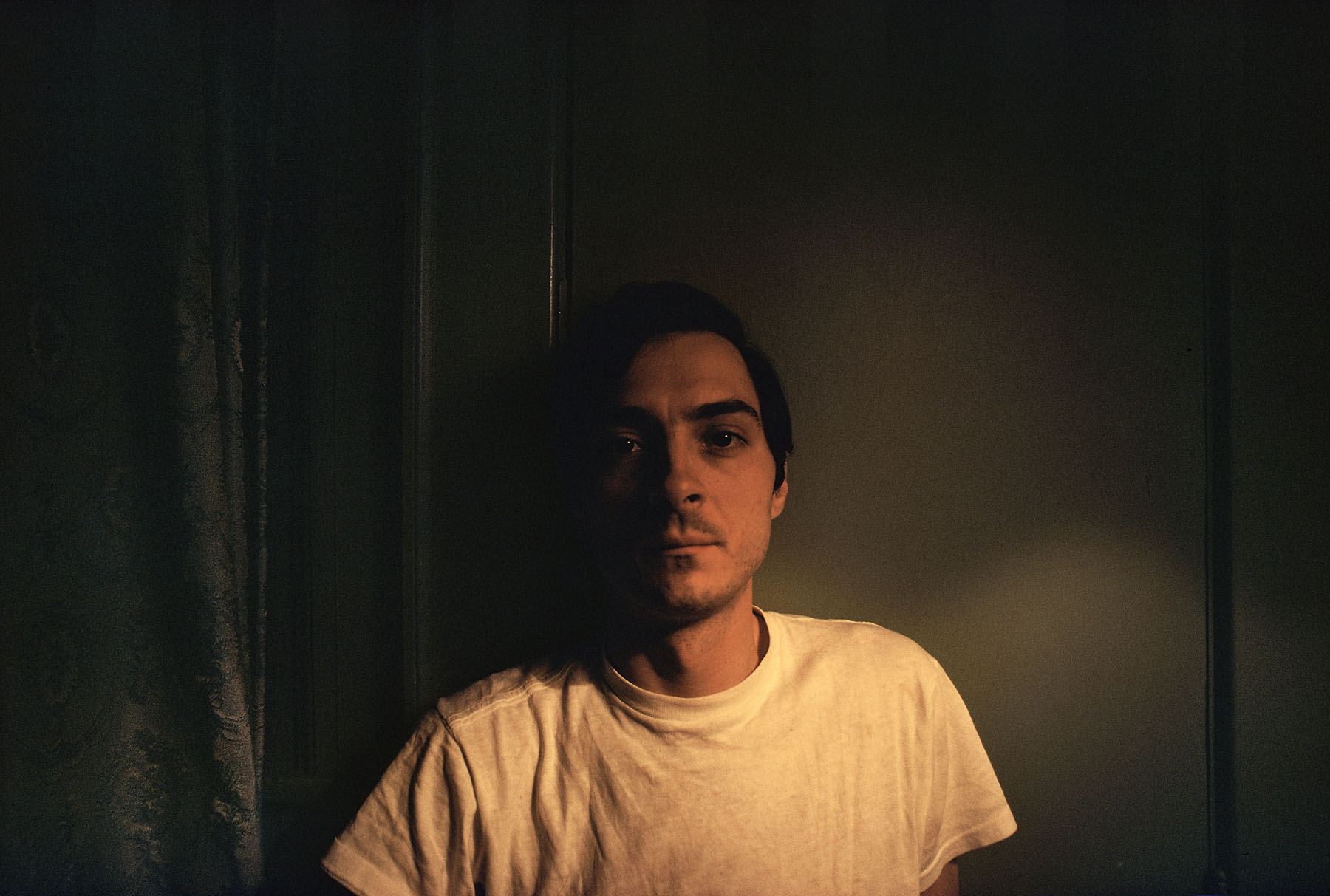
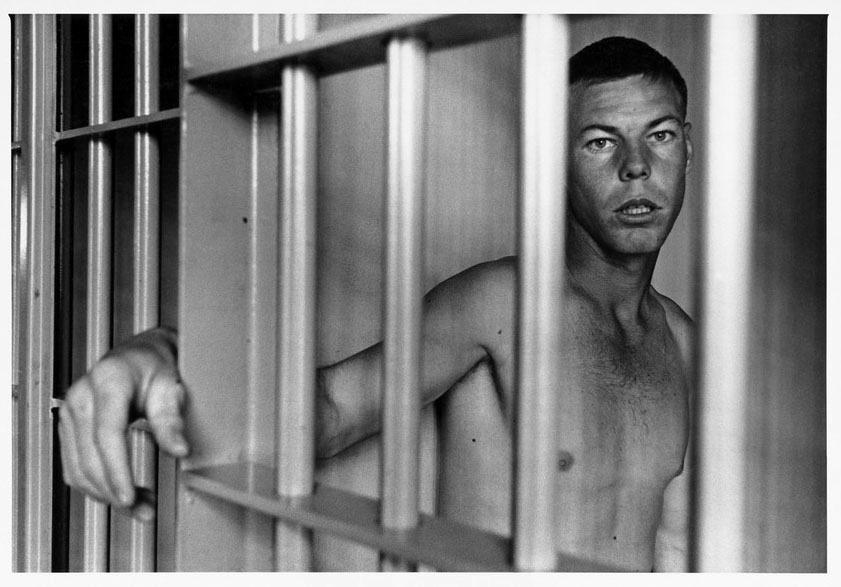
Danny Lyon (American, b. 1942) 'Self-portrait, Chicago' 1965/1995  from the exhibition 'Danny Lyon: Message to the Future' at the Whitney Museum of American Art, New York, June - Sept, 2016


Danny Lyon (American, b. 1942)
Self-portrait, Chicago
1965/1995
Gelatin silver print montage
Image: 31.2 x 27.8cm (12 1/4 x 10 15/16 in.)
Mount: 50.8 x 40.6cm (20 x 16 in.)
Collection of the artist


This man is a living legend. What a strong body of socially conscious work he has produced over a long period of time. Each series proposes further insight into the human condition – and adds ‘value’ to series that have gone before. It is a though the artist possesses the intuition for a good story and the imagination to photograph it to best advantage, building the story over multiple encounters and contexts to form a thematic whole.

In a press release for a currently showing parallel exhibition titled Journey at Edwynn Houk Gallery the text states, “Continuing in the tradition of Walker Evans and Robert Frank, Lyon forged a new style of realistic photography, described as “New Journalism,” where the photographer immerses himself in his subject’s world.” This reference to immersion is reinforced by the second quotation below, where “the power of Lyon’s work has often derived from his willingness of immerse himself entirely in the cultures and communities he documents.”

While the observation is correct that the artist immerses himself in the cultures and communities he documents, this is different to the tradition of Robert Frank and to a lesser extent, Walker Evans. Frank was a Swiss man who imaged his impressions of America on a road trip across the country. His “photographs were notable for their distanced view of both high and low strata of American society” which pictured the culture as both alienating and strange, “skeptical of contemporary values and evocative of ubiquitous loneliness”. This is why The Americans had so much power and caused so much consternation when it was first released in 1959 in America, for it held up a mirror to an insular society, one not used to looking at itself especially from the position of an “outsider” – where the tone of the book was perceived as derogatory to national ideals – and it didn’t like what it saw. The American Walker Evans was also an outsider photographing outsiders, journeying through disparate towns and communities documenting his impressions how I can I say, subjectively with an objective focus, at one and the same time. He never immersed himself in the culture but was an active observer and documenter, never an insider.

Lyon was one of the first “embedded” social documentary photographers of the American street photography movement of the 1960s who had the free will and the social conscience to tell it like it is. His self-proclaimed “advocacy journalism” is much more than just advocacy / journalism. It is a vitality of being, of spirit, an inquiry of the mind that allows the artist to get close, both physically and emotionally, to the problems of others through becoming one with them – and then to picture that so that others can see their story, so that he can “change history and preserve humanity.” But, we must acknowledge, that humanity is mainly (good looking) males: outlaw motorcycle clubs, mainly male prisons, mainly male civil rights, tattoo shops, and male Uptown, Chicago. Women are seemingly reduced to bit-players at best, singular portraits or standing in the background at funerals. This is a man’s world and you better not forget it…

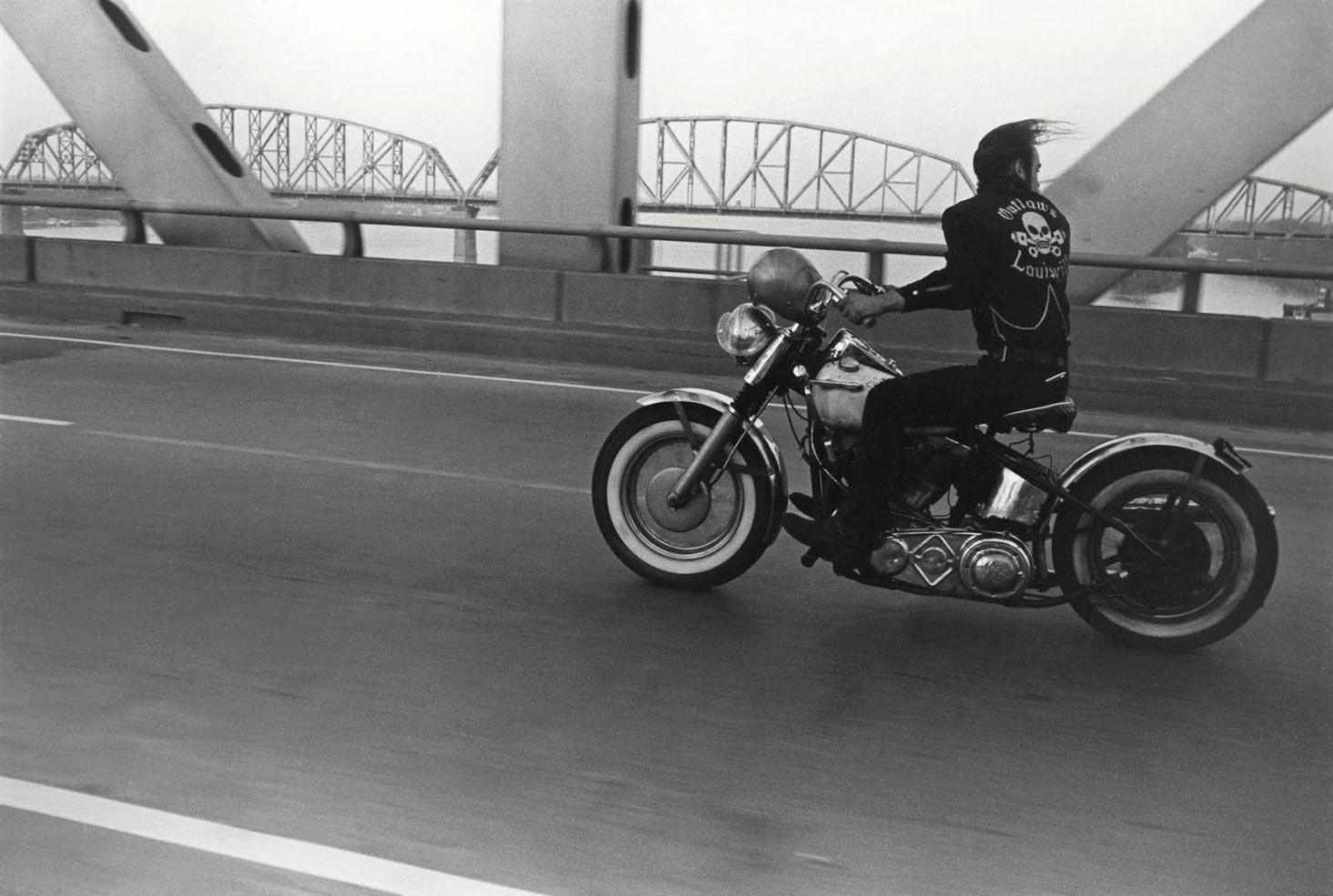
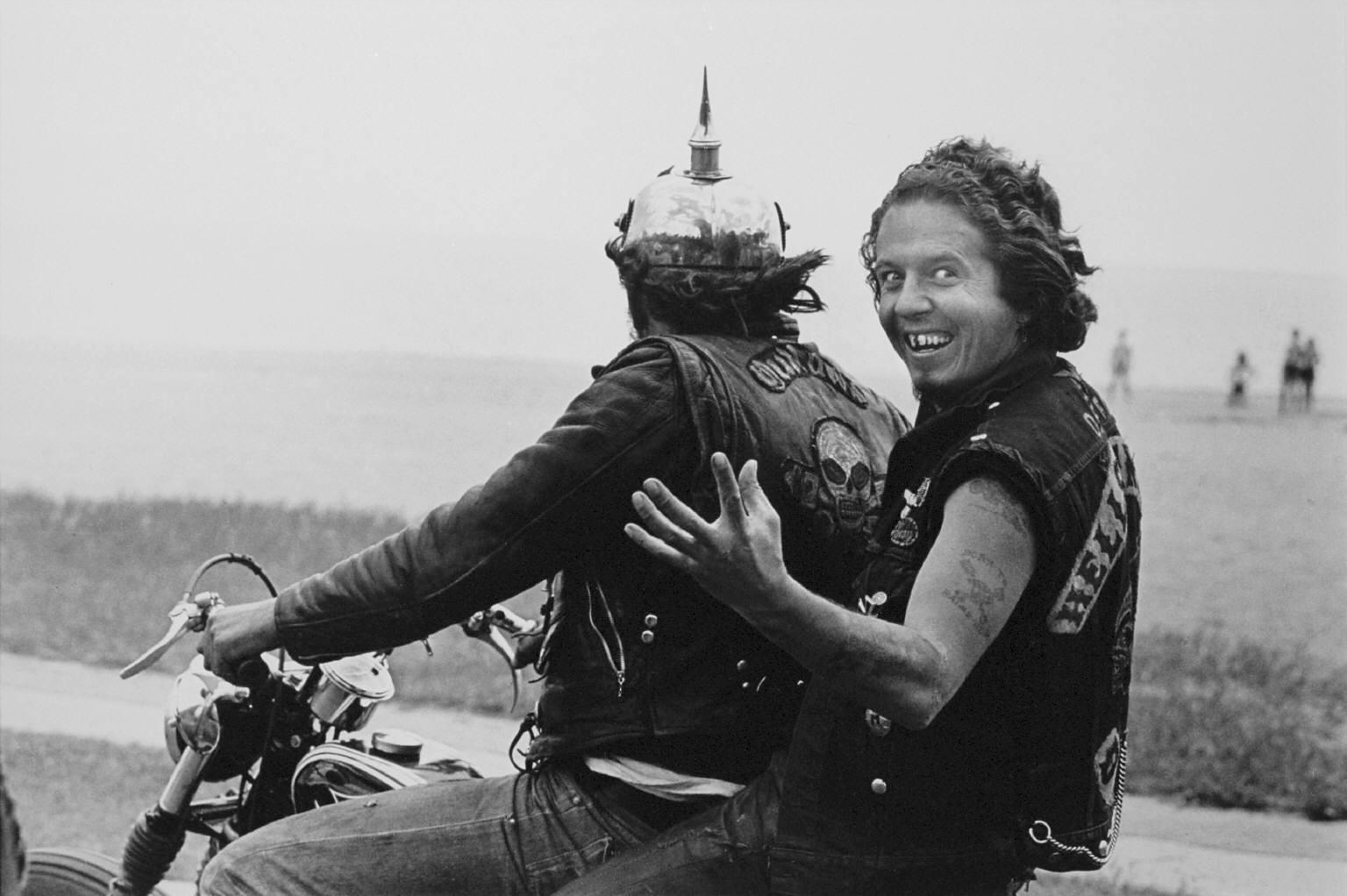
Having said that, can you imagine living the life, spending four years as a member of the Chicago Outlaw Motorcycle Club. How exhilarating, how enmeshed with the culture you would become – the people, the travel, the ups and downs, the life, the danger – and then when you get photographs like Funny Sonny Packing with Zipco, Milwaukee (1966, below) with the manic look in Funny Sonny’s eyes, how your heart would sing. If I had to nominate one image that is for me the epitome of America in the 1960s it would be this: Crossing the Ohio River, Louisville (1966, below): all Easy Rider (an 1969 American road movie) encapsulated in one image. The structure and modernism / of the two bridges frames / the speeding / wicked bike / helmet lodged over the headlight; the man / wearing a skull and crossbones emblazoned jacket / helmet-less / head turned / behind / hair flying in the wind / not looking where / he is going / as though his destiny: unknown.

Danny Lyon IS one of the great artists working in photography today. He is a rebel with his own cause. Through his vital and engaging images his message to the future is this: everyone has their own story, their own trials and tribulations, each deserving of empathy, compassion, and non-judgemental acceptance. Prejudice has no voice here, a lesson never more pertinent than for America today as it decides who to elect – a woman who has fought every inch of the way or a narcissistic megalomaniac who preaches hate to minorities.

Dr Marcus Bunyan


Many thankx to the Whitney Museum of American Art for allowing me to publish the photographs in the posting. Please click on the photographs for a larger version of the image.


“Closeness, both physical and emotional, is a recurring theme throughout the 175 works in “Message to the Future,” Lyon’s Whitney Museum retrospective, a quietly brilliant affair curated with panache by Julian Cox. (Later this year, the show will travel to the Fine Arts Museums in San Francisco, which organized it; Elisabeth Sussman oversaw the Whitney installation.) We see here a photographer who was witness to a changing America and, occasionally, other places in the world. Since the early ’60s, Lyon has been infiltrating outsider groups – talking to and photographing bikers, Texas prison inmates, and hippies, and learning from them by becoming close with them. It’s as if Lyon has no sense of personal space. That, as this revelatory show proves, is his greatest attribute…
Lyon is a deft stylist who cares deeply about his subjects, to the point of exchanging letters with them for years after taking their pictures. What results is something more intimate, more political, and, in some ways, better than traditional photojournalism – a fuller portrait of America since the ’60s.”


Alex Greenberger. “Close Encounters: The Danny Lyon Retrospective at the Whitney Museum Is Quietly Brilliant,” on the ARTnews website August 17, 2016 [Online] Cited 16/02/2023


“Self-taught, and driven by his twin passions for social change and the medium of photography, the power of Lyon’s work has often derived from his willingness of immerse himself entirely in the cultures and communities he documents. This was evident early on in his series ‘Bikeriders’ (1968; reissued in 2003 by Chronicle Books), which evolved from four years spent as a member of the Chicago Outlaw Motorcycle Club. And ‘Conversations with the Dead’ derived from his close study of the Texas prison system; it also revealed Lyon’s novel and distinctive approach to the photobook, which often sees him splicing images with texts drawn from various sources, including interviews, letters, and even fiction.”


Text from the Edwynn Houk Gallery website [Online] Cited 21/09/2016. No longer available online


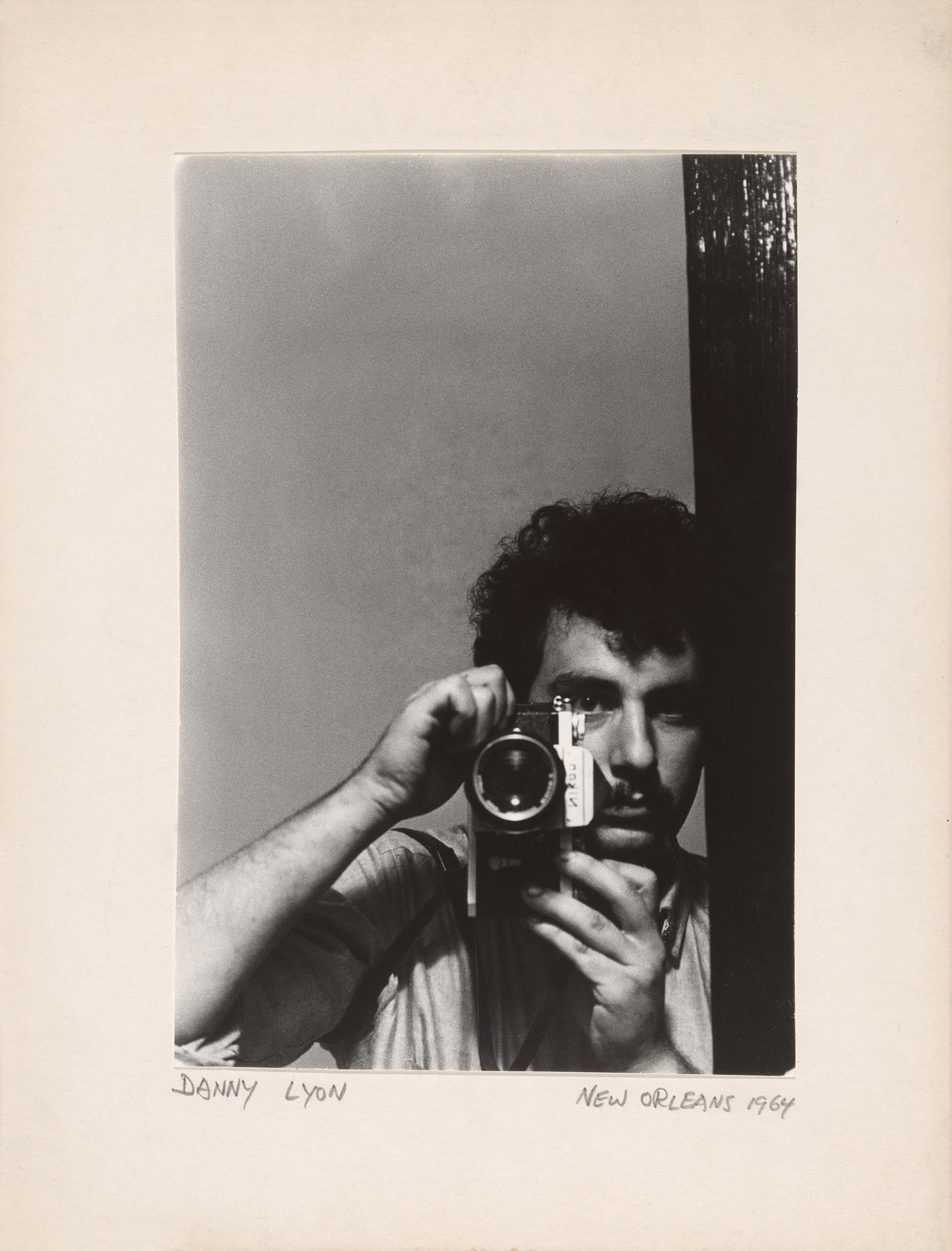
Danny Lyon (American, b. 1942) 'Self-Portrait, New Orleans 1964' 1964 'Danny Lyon: Message to the Future' at the Whitney Museum of American Art, New York
 

Danny Lyon (American, b. 1942)
Self-Portrait, New Orleans, 1964
1964
Gelatin silver print
18.2 x 12.2cm (7 3/16 x 4 13/16 in.)
Collection of the artist


In his 1981 book, “Danny Lyon: Pictures From the New World,” he wrote of starting out in the early ’60s. “Photography then seemed new and exciting, and all America, which I regarded with mystery and reverence, lay before me.”

That sense of newness and excitement fills the show. What we’re discovering now, Lyon was discovering then – not just seeing or observing, but discovering, with the sense of revelation that brings. Mystery and reverence are here, too, but complicatedly. Framing them – debating with them? – are the clarity of precision the camera affords and a skepticism born of a forthrightly ’60s sensibility. Several photographs of the Occupy movement attest to how vigorous that sensibility remains…

He was working as a documentarian but not a photojournalist. That’s an important distinction. These images are implicitly polemical – inevitably polemical, too. Rarely in our nation’s history has the distinction between what’s right and what’s wrong been as clear cut. Yet then as now, people matter more to Lyon than any ideological stance. Outsiders attract Lyon and populate the show: civil rights demonstrators, transgender people (in Galveston, Texas, of all places), lower Manhattan demolition crews, inmates, undocumented workers, Indians, Appalachian whites transplanted to Chicago, motorcycle gangs…

Enclosure and entrapment are not for Lyon – nor, for that matter, is the absence of people (a very rare condition in his work). A larger restlessness in Lyon’s career reflects the energy so often evident within the frame – within the frame being another form of enclosure and entrapment. The South, Chicago, lower Manhattan, Texas, New Mexico, China, Haiti, Latin America share space in the show. Even so, sense of place doesn’t signify as much for Lyon as a sense of a place’s inhabitants. More likely he’d say that the two are indistinguishable. Looking at his pictures, you can see why he’d think so.”

Mark Feeney. “Outsiders fill compelling Danny Lyon photography show,” on the Boston Globe website 8th July 2016 [Online] Cited 10/09/2016


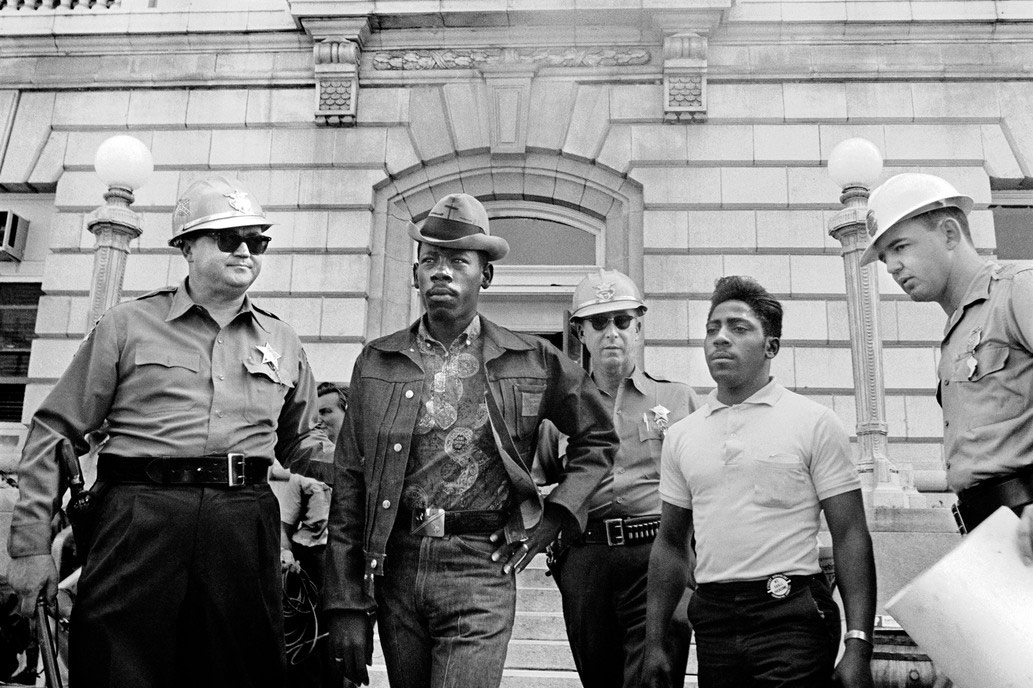
Danny Lyon (American, b. 1942) 'Arrest of Eddie Brown, Albany, Georgia' 1962


Danny Lyon (American, b. 1942)
Arrest of Eddie Brown, Albany, Georgia
1962
Gelatin silver print
Image: 22 x 31.7cm (8 5/8 x 12 1/2 in.)
Sheet: 27.9 x 35.6cm (11 x 14 in.)
Collection of the artist


Eddie Brown former gang leader and movement activist is arrested.

“The first sit-in arrests I see and photograph are those of Eddie Brown, a former Albany gang leader, and a visitor from the North. Both have volunteered to be arrested for the photographs. The picture of Eddie Brown, calmly being carried off by the Albany police, is widely distributed as the image of the classic non-violent arrest, Georgia.”

~ Danny Lyon


“Eddie Charles Brown, Jr., a great-souled human being committed to fighting the oppression of all people from Mississippi to South Africa, died at his home on November 23, 2011. In political circles, Ed was respected for his enduring commitment to our people. As a consequence of his tireless devotion to, and success in advancing the culture and economic progress of poor black folk, Ed Brown was widely recognised as among the most, incorruptible, responsible, resourceful and effective of the activist leaders of the Movement. As his SNCC colleagues said of him, “More than most, Ed’s life embodies and exemplifies to a remarkable degree, the principle of undying love for our people both here and in the Motherland.” …

A native of Louisiana, Ed was born on August 19, 1941, in New Orleans and raised in Baton Rouge to Thelma Warren and Eddie Charles Brown, Sr. Ed’s historical efforts to fight segregation and all forms of oppression as well as to empower Black people started in 1960 as a young student at Louisiana’s Southern University. He and 16 other classmates confronted the University and staged a sit-in protesting the racial segregation prevalent in Louisiana at the time. After he and the others were arrested, expelled and banned from enrolling in any university in Louisiana Ed began the ongoing struggle for justice, which would define his entire life. This expulsion led Ed to Howard University in Washington, D.C. in 1961, where he landed on the front line of the Civil Rights Movement. Ed was an active member of the Nonviolent Action Group, the SNCC affiliate at Howard.

As a leader and field secretary for the Student Nonviolent Coordinating Committee (SNCC) he fought to win constitutional rights for Blacks and all disenfranchised people. Ed always proclaimed that he was “fighting fire with a feather,” but he knew he would prevail because he often said, ironically, he was protected by “asbestos gloves.””

Anonymous. “In Memoriam: Eddie Charles Brown, Jr.,” on the SNCC Legacy Project website Nd [ONline] Cited 04/04/2024


The most comprehensive retrospective of the work of American photographer, filmmaker, and writer Danny Lyon in twenty-five years debuts at the Whitney on June 17, 2016. The first major photography exhibition to be presented in the Museum’s downtown home, Danny Lyon: Message to the Future is organised by the Fine Arts Museums of San Francisco, where it will make its West Coast debut at the de Young Museum on November 5, 2016. The exhibition assembles approximately 175 photographs and is the first to assess the artist’s achievements as a filmmaker. The presentation also includes a rare look at works from Lyon’s archives, including vintage prints, unseen 16mm film footage made inside Texas prisons, and his personal photo albums. A leading figure in the American street photography movement of the 1960s, Lyon has distinguished himself by the personal intimacy he establishes with his subjects and the inventiveness of his practice.

Photographer, filmmaker, and writer Danny Lyon (b. 1942) has over the past five decades presented a charged alternative to the sanitised vision of American life presented in the mass media. Throughout, he has rejected the standard detached humanism of the traditional documentary approach in favour of a more immersive, complicated involvement with his subjects. “You put a camera in my hand,” he has explained, “I want to get close to people. Not just physically close, emotionally close, all of it.” In the process he has made several iconic bodies of work, which have not only pictured recent history but helped to shape it.

Lyon committed intensively to photography from the beginning. In 1962, while still a student at the University of Chicago, he hitchhiked to the segregated South to make a photographic record of the civil rights movement. He went on to photograph biker subcultures, explore the lives of the incarcerated, and document the architectural transformation of Lower Manhattan. He has travelled to Latin America and China, and has lived for years in New Mexico; the work he has made throughout these journeys demonstrates his respect for the people he photographs on the social and cultural margins.

Message to the Future, shaped in collaboration with the artist, incorporates seldom-exhibited materials from Lyon’s archive, including rare vintage prints, previously unseen 16mm film footage made inside the Texas prisons, his personal photo albums, and related documents and ephemera. In his roles as a photographer, filmmaker, and writer, Lyon has reinvented the expectations for how the still photographic image can be woven together with journalism, books, films, and collage to present a diverse record of social customs and human behaviour. His work, which he continues to make today, reveals a restless idealist, digging deep into his own life and those of his subjects to uncover the political in the personal and the personal in the political.

Text from the Whitney Museum of American Art


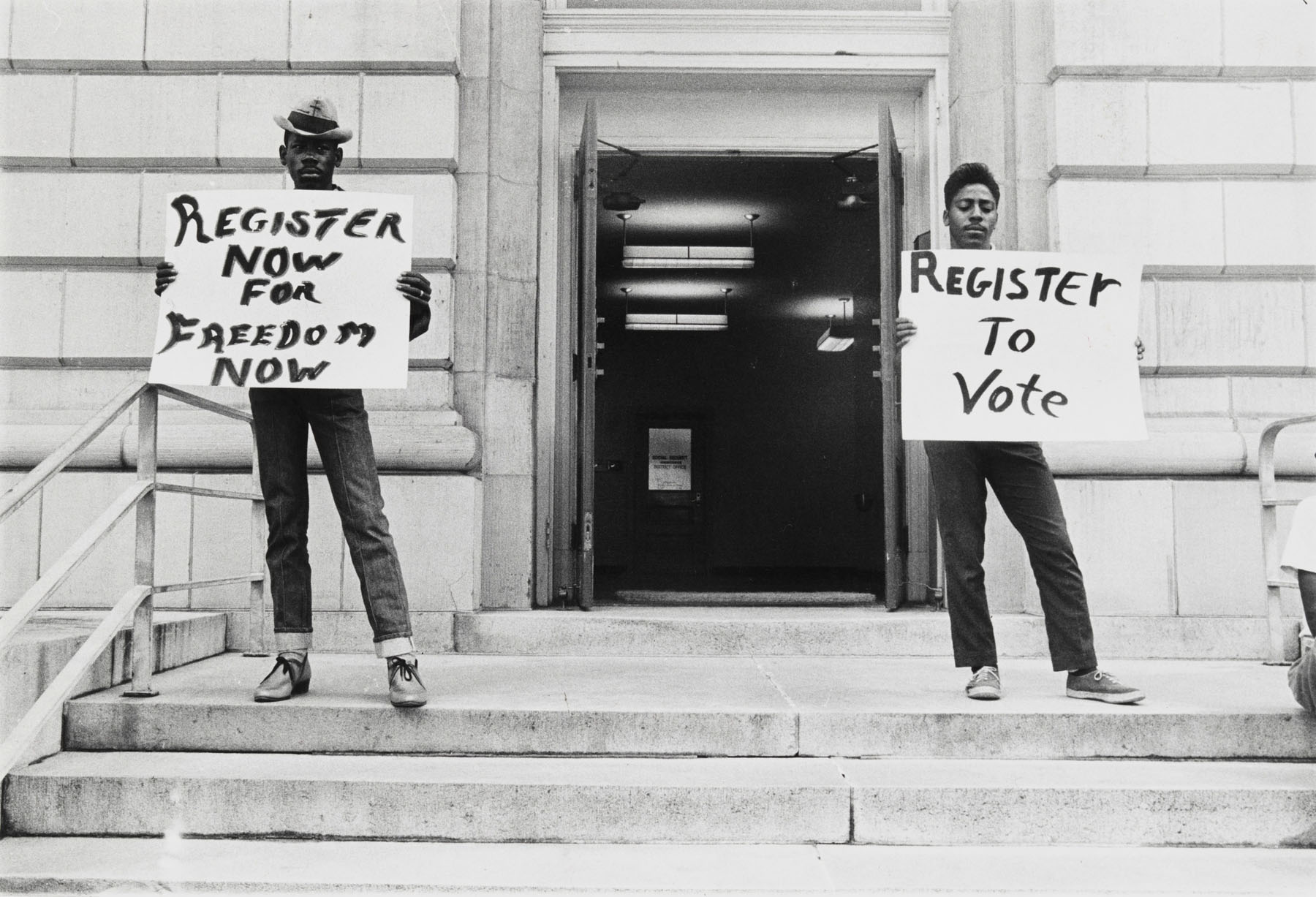
Civil rights

In the summer of 1962, Lyon hitchhiked to Cairo, Illinois, to witness demonstrations and a speech by John Lewis, chairman of the Student Nonviolent Coordinating Committee (SNCC), one of the most important organisations driving the civil rights movement of the early 1960s. Inspired to see the making of history firsthand, Lyon then headed to the South to participate in and photograph the civil rights movement. There, SNCC executive director James Forman recruited Lyon to be the organisation’s first official photographer, based out of its Atlanta headquarters. Traveling throughout the South with SNCC, Lyon documented sit-ins, marches, funerals, and violent clashes with the police, often developing his negatives quickly in makeshift darkrooms.

Lyon’s photographs were used in political posters, brochures, and leaflets produced by SNCC to raise money and recruit workers to the movement. Julian Bond, the communications director of SNCC, wrote of Lyon’s pictures, “They put faces on the movement, put courage in the fearful, shone light on darkness, and helped make the movement move.”


Danny Lyon (American, b. 1942) 'Student Nonviolent Coordinating Committee (SNCC) Sit-In, Atlanta' 1963


Danny Lyon (American, b. 1942)
Student Nonviolent Coordinating Committee (SNCC) Sit-In, Atlanta
1963
Gelatin silver print
Image: 16.1 x 24cm (6 3/8 x 9 1/2 in.)
Sheet: 20.3 x 25.4cm (8 x 10 in.)
Collection of the artist


Danny Lyon (American, b. 1942) 'The Leesburg Stockade, Leesburg, Georgia' 1963


Danny Lyon (American, b. 1942)
The Leesburg Stockade, Leesburg, Georgia
1963
Gelatin silver print
Image: 17.5 x 26cm (6 7/8 x 10 3/16 in.)
Sheet: 27.9 x 35.6cm (11 x 14 in.)
Collection of the artist


Danny Lyon (American, b. 1942) 'Abernathy, Shuttlesworth (SCLC), King and Wilkinson (NAACP)' 1963


Danny Lyon (American, b. 1942)
Abernathy, Shuttlesworth (SCLC), King and Wilkinson (NAACP)
1963
Gelatin silver print


Danny Lyon (American, b. 1942) 'Voting Rights Demonstration, Organized by the Student Nonviolent Coordinating Committee (SNCC), Selma, Alabama' October 7, 1963


Danny Lyon (American, b. 1942)
Voting Rights Demonstration, Organized by the Student Nonviolent Coordinating Committee (SNCC), Selma, Alabama
October 7, 1963
Gelatin silver print
Image: 18.3 x 26.8cm (7 3/16 x 10 9/16 in.)
Sheet: 27.8 x 35.4cm (10 15/16 x 13 15/16 in.)
Whitney Museum of American Art, New York; purchase with funds from the Photography Committee


Danny Lyon (American, b. 1942) 'Sheriff Jim Clark Arresting Demonstrators, Selma, Alabama' October 7, 1963


Danny Lyon (American, b. 1942)
Sheriff Jim Clark Arresting Demonstrators, Selma, Alabama
October 7, 1963
Gelatin silver print
Image: 18.4 x 27cm (7 1/4 x 10 5/8 in.)
Sheet: 27.8 x 35.4cm (10 15/16 x 13 15/16 in.)
Whitney Museum of American Art, New York; purchased with funds from the Photography Committee


Danny Lyon (American, b. 1942) 'Stokely Carmichael, Confrontation with National Guard, Cambridge, Maryland' 1964


Danny Lyon (American, b. 1942)
Stokely Carmichael, Confrontation with National Guard, Cambridge, Maryland
1964
Gelatin silver print
Image: 16.5 x 22.2cm (6 1/2 x 8 3/4 in.)
Sheet: 20.3 x 25.4cm (8 x 10 in.)
Collection of the High Museum of Art, Atlanta; purchase with funds from Joan N. Whitcomb


Danny Lyon (American, b. 1942) 'Woman Holds Off a Mob, Atlanta' 1963


Danny Lyon (American, b. 1942)
Woman Holds Off a Mob, Atlanta
1963
Gelatin silver print


Danny Lyon (American, b. 1942) 'Bob Dylan behind the SNCC office, Greenwood, Mississippi' 1963


Danny Lyon (American, b. 1942)
Bob Dylan behind the SNCC office, Greenwood, Mississippi
1963
Gelatin silver print


Danny Lyon (American, b. 1942) 'Arrest of Taylor Washington, Atlanta' 1963


Danny Lyon (American, b. 1942)
Arrest of Taylor Washington, Atlanta
1963
Gelatin silver print
24 x 16cm (9 7/16 x 6 1/4 in.)
Collection of the artist


Atlanta, Georgia. High school student Taylor Washington is arrested at Lebs Delicatessen. His eighth arrest.

“One of Taylor Washington’s numerous arrests is immortalised as he yells while passing before me. The photograph became the cover of SNCC’s photo book, The Movement, and was reproduced in the former Soviet Union in Pravda, captioned “Police Brutality USA.””

~ Danny Lyon


The Civil Rights movement of the 1960’s was a widespread effort to end racial segregation and discrimination against African Americans. News coverage of sit-ins and freedom rides dominated the cultural and political landscape of the United States. At this time Danny Lyon was in his early 20s and an undergraduate student at the University of Chicago. After meeting John Lewis, the chairman of the Student Nonviolent Coordinating Committee’s (SNCC’s) in Cairo, Illinois, Lyon then traveled to Mississippi, to cover voter registrations, and soon he was present at almost all of the major SNCC events during the movement. Lyon served as SNCC’s photographer from 1962 to 1964 and later documented his experiences in his book Memories of the Southern Civil Rights Movement.

Text from the Minneapolis Institute of Art Collection website


Danny Lyon (American, b. 1942) 'The March on Washington' August 28, 1963


Danny Lyon (American, b. 1942)
The March on Washington
August 28, 1963
Gelatin silver print
29.8 x 20.8cm (11 3/4 x 8 3/16 in.)
Museum of Modern Art, New York; Gift of Anne Ehrenkranz


Galveston


Danny Lyon (American, b. 1942) 'Pumpkin and Roberta, Galveston, Texas' 1967


Danny Lyon (American, b. 1942)
Pumpkin and Roberta, Galveston, Texas
1967
Gelatin silver print
Image: 23.8 x 16.1cm (6 3/8 x 9 3/8 in.)
Sheet: 20.3 x 25.4cm (8 x 10 in.)
Collection of the artist


Prisons

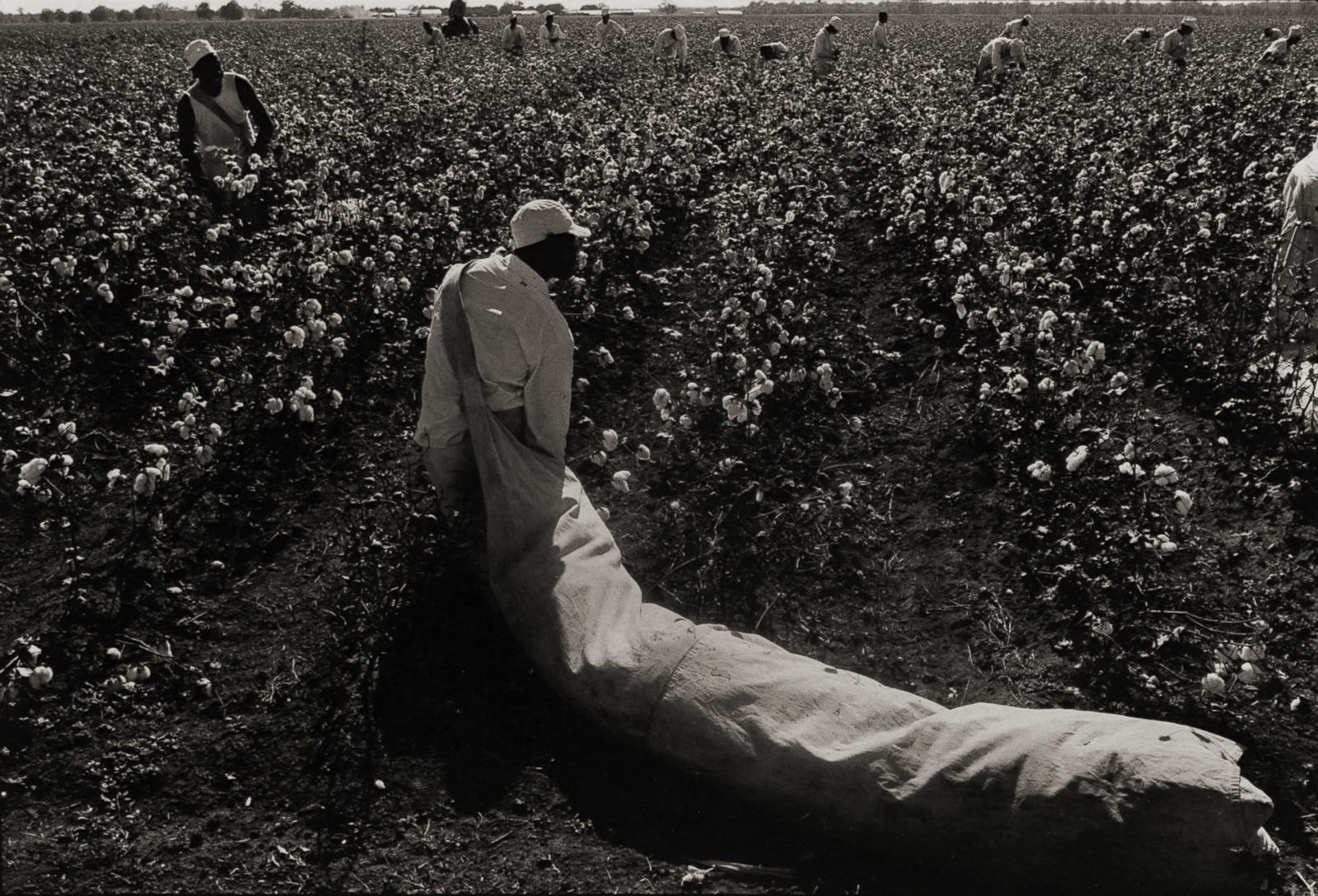
In 1967, Lyon applied to the Texas Department of Corrections for access to the state prisons. Dr. George Beto, then director of the prisons, granted Lyon the right to move freely among the various prison units, which he photographed and filmed extensively over a fourteen-month period. The result is a searing record of the Texas penal system and, symbolically, of incarceration everywhere.

Lyon’s aim was to “make a picture of imprisonment as distressing as I knew it to be in reality.” This meant riding out to the fields to follow prisoners toiling in the sun, as well as visiting the Wynne Treatment Centre, which housed primarily convicts with mental disabilities. He befriended many of the prisoners, listening to their stories and finding the humanity in their experiences, and still maintains contact with some of them.


Danny Lyon (American, b. 1942) 'Weight Lifters, Ramsey Unit, Texas' 1968


Danny Lyon (American, b. 1942)
Weight Lifters, Ramsey Unit, Texas
1968
Gelatin silver print
Image: 22.4 x 33.2cm (8 7/8 x 13 1/16 in.)
Sheet: 27.7 x 35.6cm (11 x 14 in.)
Collection of the artist


Danny Lyon (American, b. 1942) 'New Arrivals from Corpus Christi, The Walls, Texas' 1968


Danny Lyon (American, b. 1942)
New Arrivals from Corpus Christi, The Walls, Texas
1968
Gelatin silver print
Image: 21.4 x 32cm (8 7/16 x 12 5/8 in.)
Sheet: 27.9 x 35.6cm (11 x 14 in.)
Collection of the artist


Danny Lyon (American, b. 1942) 'Contents of Arriving Prisoner’s Wallet, Diagnostic Unit, The Walls, Huntsville, Texas' 1968


Danny Lyon (American, b. 1942)
Contents of Arriving Prisoner’s Wallet, Diagnostic Unit, The Walls, Huntsville, Texas
1968
Gelatin silver print
Image: 24.3 x 17.5cm (9 9/16 x 6 3/4 in.)
Sheet: 25.4 x 20.3cm (10 x 8 in.)
Collection of the artist


Danny Lyon (American, b. 1942) 'Six-Wing Cell Block, Ramsey Unit, Texas' 1968


Danny Lyon (American, b. 1942)
Six-Wing Cell Block, Ramsey Unit, Texas
1968
Gelatin silver print
Image: 16 x 24cm (6 5/16 x 9 7/16 in.)
Sheet: 20.3 x 25.4cm (8 x 10 in.)
Collection of the artist


Danny Lyon (American, b. 1942) 'Charlie Lowe, Ellis Unit, Texas' 1968


Danny Lyon (American, b. 1942)
Charlie Lowe, Ellis Unit, Texas
1968
Gelatin silver print
Image: 16.2 x 23.8cm (6 3/8 x 9 3/8 in.)
Sheet: 20.3 x 25.4cm (8 x 10 in.)
Collection of the artist


Danny Lyon (American, b. 1942) 'Shakedown, Ellis Unit, Texas' 1968


Danny Lyon (American, b. 1942)
Shakedown, Ellis Unit, Texas
1968
Gelatin silver print
21.6 x 31.3cm (8 1/2 x 12 1/4 in.)
Museum of Modern Art, New York; purchase


Danny Lyon (American, b. 1942) 'Shakedown, Ramsey Unit, Texas' 1968


Danny Lyon (American, b. 1942)
Shakedown, Ramsey Unit, Texas
1968
Gelatin silver print
Image: 17 x 24.2cm (6 5/8 x 9 9/16 in.)
Sheet: 20.3 x 25.4cm (8 x 10 in.)
Collection of the artist


Danny Lyon (American, b. 1942) 'Convict With a Bag of Cotton, Texas' 1968


Danny Lyon (American, b. 1942)
Convict With a Bag of Cotton, Texas
1968
Gelatin silver print


Danny Lyon (American, b. 1942) 'Two Inmates, Goree Unit, Texas' 1968


Danny Lyon (American, b. 1942)
Two Inmates, Goree Unit, Texas
1968
Gelatin silver print
Image: 16.8 x 24cm (6 5/8 x 9 91/6 in.)
Sheet: 20.3 x 25.4cm (8 x 10 in.)
Collection of the artist


The destruction of Lower Manhattan

In late 1966 and into the summer of 1967, starting from his loft at the corner of Beekman and William Streets near City Hall Park, Lyon documented the demolition of some sixty acres of predominantly nineteenth-century buildings below Canal Street in lower Manhattan. With funding from the New York State Council on the Arts, he photographed most of the buildings that would be torn down to make way for the World Trade Center. Lyon recalled later: “I wanted to inhabit [the buildings] with feelings and give them and their demise a meaning.”

Moving from the outside of the buildings to their deserted interiors, Lyon also took pictures of the workers involved in the demolition. The photographs, together with Lyon’s journal entries, became a book, published by Macmillan in 1969 and dedicated to his close friend, sculptor Mark di Suvero. The volume’s significance lies in part in its depiction of a city – and, more broadly, a culture – cannibalising its own architectural history for the sake of development.


Danny Lyon (American, b. 1942) 'View South from 100 Gold Street, New York' 1967


Danny Lyon (American, b. 1942)
View South from 100 Gold Street, New York
1967
Gelatin silver print
18.3 x 18.2cm (7 1/4 x 7 3/16 in.)
Collection of Melissa Schiff Soros and Robert Soros


Danny Lyon (American, b. 1942) 'Self-Portrait in Susquehanna Hotel, Third-Floor Room with Grass, New York' 1967


Danny Lyon (American, b. 1942)
Self-Portrait in Susquehanna Hotel, Third-Floor Room with Grass, New York
1967
Gelatin silver print
18.2 x 18.2cm (7 3/16 x 7 3/16 in.)
Collection of Melissa Schiff Soros and Robert Soros


Danny Lyon (American, b. 1942) 'Ruins of 100 Gold Street, New York' 1967


Danny Lyon (American, b. 1942)
Ruins of 100 Gold Street, New York
1967
Gelatin silver print
23.6 x 23.4cm (9 5/16 x 10 7/16 in.)
Collection of Melissa Schiff Soros and Robert Soros


The Bikeriders

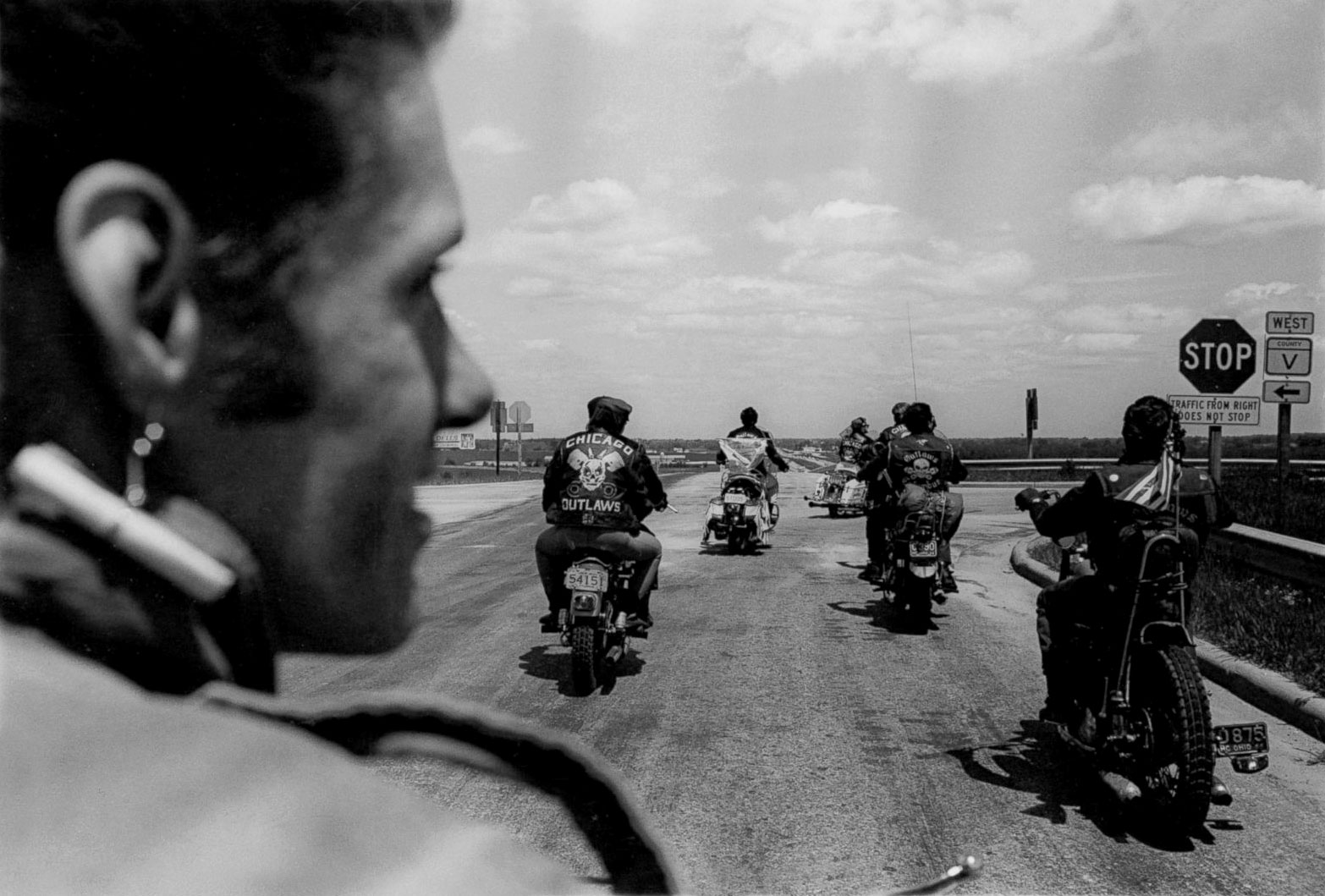
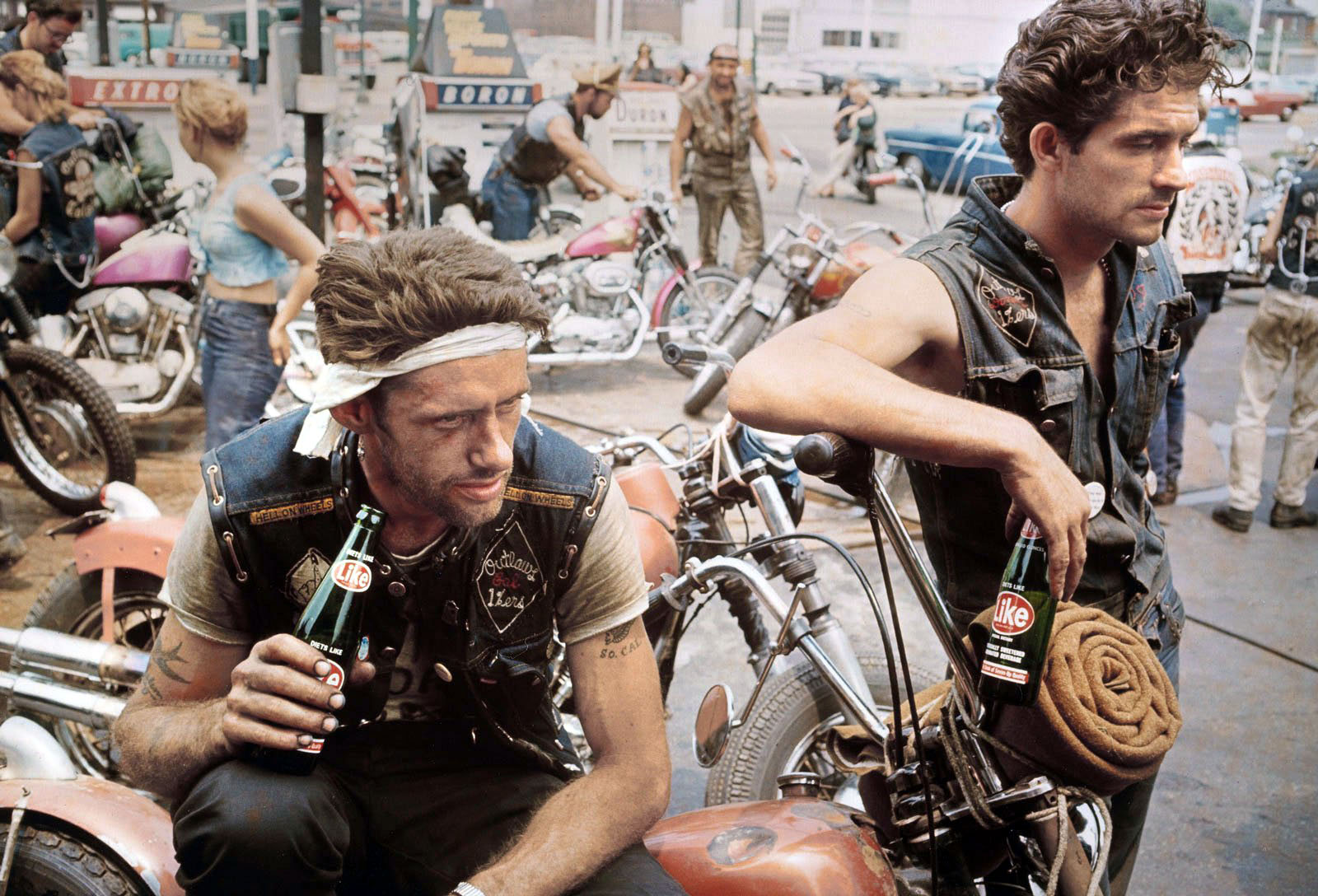
Lyon purchased his first motorcycle – a 1953 Triumph TR6 – in 1962, after spending weekends watching college friend and motorcycle racer Frank Jenner compete at informal dirt track races across the Midwest. When he returned to Chicago in 1965 after leaving SNCC, Lyon joined the hard-riding, hard-drinking Chicago Outlaws Motorcycle Club and began making photographs with a goal to “record and glorify the life of the American bike rider.” With clubs like the Hells Angels making headlines for their criminal and vigilante activities at the time, bike riders were simultaneously feared for their anarchism and romanticised for their independence.

Riding with the Outlaws, Lyon attempted to capture their way of life from the inside out. Their unapologetic pursuit of freedom and libertine pleasures compelled him to get close to them as people. Lyon’s images are intimate and familiar, whether taken during rides or at clubhouse meetings. He also used a tape recorder to document the bikers speaking for themselves, unobtrusively capturing their collective voice. The resulting photographs were gathered into the now classic book of the same name, published in 1968, combining his pictures with an edited transcription of the interviews.


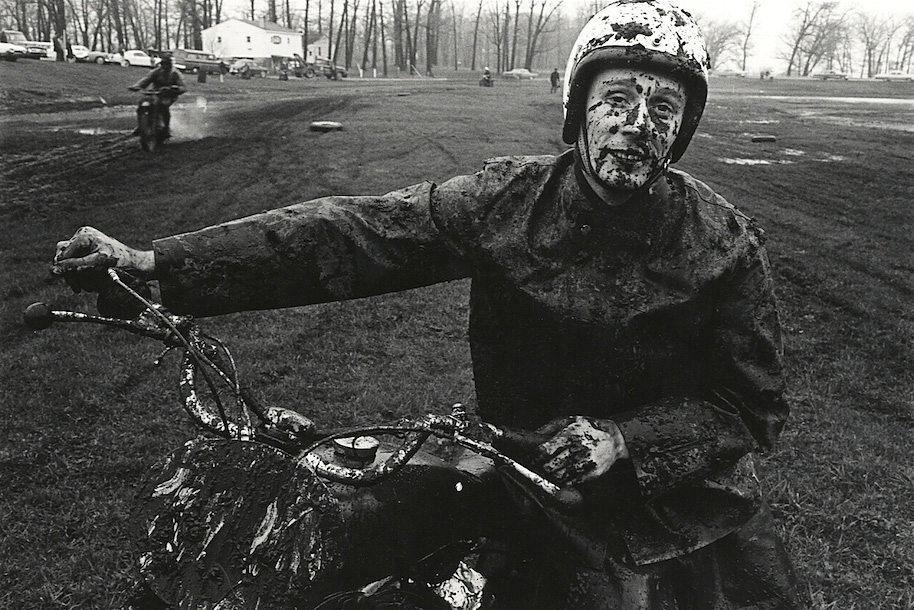
Danny Lyon (American, b. 1942) 'Racer, Schererville, Indiana' 1965


Danny Lyon (American, b. 1942)
Racer, Schererville, Indiana
1965
Gelatin silver print
13.9 x 20.3cm (5 1/2 x 8 in.)
Silverman Museum Collection


Danny Lyon (American, b. 1942) 'Crossing the Ohio River, Louisville' 1966


Danny Lyon (American, b. 1942)
Crossing the Ohio River, Louisville
1966
Gelatin silver print
20.3 x 31.8cm (8 x 12 1/2 in.)
Silverman Museum Collection


Danny Lyon (American, b. 1942) 'Route 12, Wisconsin' 1963


Danny Lyon (American, b. 1942)
Route 12, Wisconsin
1963
Gelatin silver print
15.6 x 23.8cm (6 1/8 x 9 1/8 in.)
Silverman Museum Collection


Danny Lyon (American, b. 1942) 'Sparky and Cowboy, Schererville, Indiana' 1965


Danny Lyon (American, b. 1942)
Sparky and Cowboy, Schererville, Indiana
1965
Gelatin silver print
Image: 16.1 x 23.9cm (6 3/8 x 9 3/8 in.)
Sheet: 20.3 x 25.4cm (8 x 10 in.)
Collection of the artist


Danny Lyon (American, b. 1942) 'Untitled (Close Up of Cal on the Road)' 1966


Danny Lyon (American, b. 1942)
Untitled (Close Up of Cal on the Road)
1966
Gelatin silver print


Danny Lyon (American, b. 1942) 'Renegade's funeral, Detroit' 1966


Danny Lyon (American, b. 1942)
Renegade’s funeral, Detroit
1966
Gelatin silver print


Danny Lyon (American, b. 1942) 'Funny Sonny Packing with Zipco, Milwaukee' 1966


Danny Lyon (American, b. 1942)
Funny Sonny Packing with Zipco, Milwaukee
1966
Gelatin silver print


Danny Lyon (American, b. 1942) 'Kathy, Chicago' 1965 (printed 1966)


Danny Lyon (American, b. 1942)
Kathy, Chicago
1965 (printed 1966)
Gelatin silver print
25.8 x 25.5cm (10 1/8 x 10 1/16 in.)
Collection of the artist


Danny Lyon (American, b. 1942) 'Cal on the Springfield Run, Illinois' 1966 (printed 2003)


Danny Lyon (American, b. 1942)
Cal on the Springfield Run, Illinois
1966 (printed 2003)
Cibachrome print
Image: 22.8 x 32.5cm (9 x 13 1/4 in.)
Sheet: 27.9 x 35.6cm (11 x 14 in.)
Collection of the artist


Danny Lyon (American, b. 1942) 'Cowboy, Rogue's Picnic, Chicago' 1966


Danny Lyon (American, b. 1942)
Cowboy, Rogue’s Picnic, Chicago
1966
Gelatin silver print
Image: 23.5 x 15.9cm (9 1/4 x 6 1/4 in.)
Mount: 50.8 x 40.6cm (20 x 16 in.)
Collection of the artist


Danny Lyon (American, b. 1942) 'Benny, Grand and Division, Chicago' 1965


Danny Lyon (American, b. 1942)
Benny, Grand and Division, Chicago
1965
Gelatin silver print
24.5 x 17.2cm (9 5/8 x 6 3/4 in.)
Collection of the artist


New Mexico and the West

Lyon headed west from New York in 1969. Tired of the hectic pace of the big city and in search of new surroundings, he settled in Sandoval County, New Mexico. He developed a great admiration for the region’s close knit communities of Native Americans and Chicanos. Lyon’s photographs and, increasingly, his films reflected his growing understanding of the cross-cultural flow between these disparate groups and how they interacted with the geography of the Southwest.

With the help of his good friend, a migrant labourer named Eduardo Rivera Marquez, Lyon built a traditional adobe home for his family in Bernalillo, in the Rio Grande Valley just north of Albuquerque. As Lyon’s family grew, his children also became a frequent subject, often depicted against the dramatic Western landscape. Though Lyon moved back to New York in 1980, New Mexico would remain a centre of gravity for the artist, who returned every summer with his family to photograph and make films.


Danny Lyon (American, b. 1942) 'Eddie, New Mexico' 1972


Danny Lyon (American, b. 1942)
Eddie, New Mexico
1972
Gelatin silver print
Image: 23 x 34.5cm (9 x 13 5/8 in.)
Sheet: 27.9 x 35.6cm (11 x 14 in.)
Collection of the artist


Danny Lyon (American, b. 1942) 'Navajo Boy, Gallup, New Mexico' 1971


Danny Lyon (American, b. 1942)
Navajo Boy, Gallup, New Mexico
1971
Gelatin silver print
Image: 23.3 x 33.8cm (9 1/8 x 13 5/16 in.)
Sheet: 27.9 x 35.6cm (11 x 14 in.)
Collection of the artist


Danny Lyon (American, b. 1942) 'Maricopa County, Arizona' 1977


Danny Lyon (American, b. 1942)
Maricopa County, Arizona
1977
Gelatin silver print
Image: 22.8 x 33.5cm (9 x 13 3/16 in.)
Sheet: 27.9 x 35.6cm (11 x 14 in.)
Collection of the artist


Danny Lyon (American, b. 1942) 'Stephanie, Sandoval County, New Mexico' 1969/1975


Danny Lyon (American, b. 1942)
Stephanie, Sandoval County, New Mexico
1969/1975
Gelatin silver print (decorated)
Image: 16.7 x 25cm (6 9/16 x 9 3/4 in.)
Sheet: 27.9 x 35.6cm (11 x 14 in.)
Collection of the artist


Danny Lyon (American, b. 1942) 'El Paso, Texas' 1975 (printed 2015)


Danny Lyon (American, b. 1942)
El Paso, Texas
1975 (printed 2015)
Pigmented inkjet print
Image: 27.9 x 40.6cm (11 x 16 in.)
Sheet: 33 x 45.7cm (13 x 18 in.)
Collection of the artist


Danny Lyon (American, b. 1942) 'El Paso, Texas' 1975


Danny Lyon (American, b. 1942)
El Paso, Texas
1975


Films and montages

Lyon started making 16mm films in earnest in the 1970s, focusing on marginalised communities and injustice as he had in his photographs. His subjects included Colombian street kids in Los Niños Abandonados (1975) and undocumented workers from Mexico in El Mojado (1974) and El Otro Lado (1978). Lyon has explained that after leaving the Texas prisons he struggled to move forward, feeling that there were “no more worlds to conquer” in creating photography books. Filmmaking became the means by which he could continue to make sense of the beauty and inequality he saw in the world around him.

Lyon did not give up photography completely, however. He turned to assembling family albums and creating collaged works that he describes as montages, referencing the filmmaking practice of juxtaposing disparate images to form a continuous whole. Lyon’s montages combine multiple images and materials sourced from his archives. Initially meant as vehicles for reflection and, in the case of the albums, as family heirlooms, these deeply personal works bridge past generations of his family with his present.


Danny Lyon (American, b. 1942)
Los Niños Abandonados
1975


Danny Lyon (American, b. 1942)
El Mojado
1974
New Mexico, colour, 14 minutes [The Wetback]
English and Spanish with subtitles
A portrait of a hard-working undocumented labourer from Mexico produced by J.J. Meeker


Danny Lyon (American, b. 1942)
El Otro Lado
1978
Mexico and Arizona, colour, 60 minutes [The Other Side]
Spanish with English subtitles
An honest film infused with poignant beauty, without political rhetoric


Danny Lyon (American, b. 1942)
Dear Mark
1981, New York and France, colour and b&w, 15 minutes
A comedy in which the artist’s voice has been replaced by Gene Autry’s
Lyon’s homage to his friend, sculptor Mark di Suvero, from footage shot in 1965 and 1975.


Danny Lyon (American, b. 1942)
Soc Sci 127
1969
Houston, color and b&w, 21 minutes
A comedy – Danny Lyon’s first film with the late great Bill Sanders and his “painless” tattoo shop.


Danny Lyon (American, b. 1942)
Willie
1985
New Mexico, color, b&w, 82 minutes
Willie is a realistic film made in Bernalillo, home of Willie Jaramillo and filmmakers Danny and Nancy Weiss Lyon
Defiantly individual and implacable in the face of authority, Willie is repeatedly thrown into jail for relatively minor offences. The filmmakers gain access to jail cells, day rooms, lunatic wards, and the worst cellblock in the penitentiary where Willie is locked up next to his childhood friend and convicted murderer, Michael Guzman.


Knoxville


Danny Lyon (American, b. 1942) 'Knoxville' 1967


Danny Lyon (American, b. 1942)
Knoxville
1967
Gelatin silver print


Danny Lyon (American, b. 1942) 'Knoxville, Tennessee' 1967


Danny Lyon (American, b. 1942)
Knoxville, Tennessee
1967
Gelatin silver print


Danny Lyon (American, b. 1942) 'Leslie, Downtown Knoxville' 1967


Danny Lyon (American, b. 1942)
Leslie, Downtown Knoxville
1967
Gelatin silver print
Image: 28.7 x 19.1cm (11 1/4 x 7 1/2 in.)
Mount: 56.2 x 45.7cm (22 1/8 x 18 in.)
Art Institute of Chicago; gift of Mr. Danny Lyon


Tattoo


Danny Lyon (American, b. 1942) 'Bill Sanders, Tattoo Artist, Houston, Texas' 1968


Danny Lyon (American, b. 1942)
Bill Sanders, Tattoo Artist, Houston, Texas
1968
Gelatin silver print
Image: 20.7 x 20.7cm (8 3/16 x 8 3/16 in.)
Sheet: 35.6 x 27.9cm (14 x 11 in.)
Collection of the artist


Chicago


Danny Lyon (American, b. 1942) 'Two youths in Uptown, Chicago, Illinois, a neighborhood of poor white southerners' 1974


Danny Lyon (American, b. 1942)
Two youths in Uptown, Chicago, Illinois, a neighborhood of poor white southerners
1974


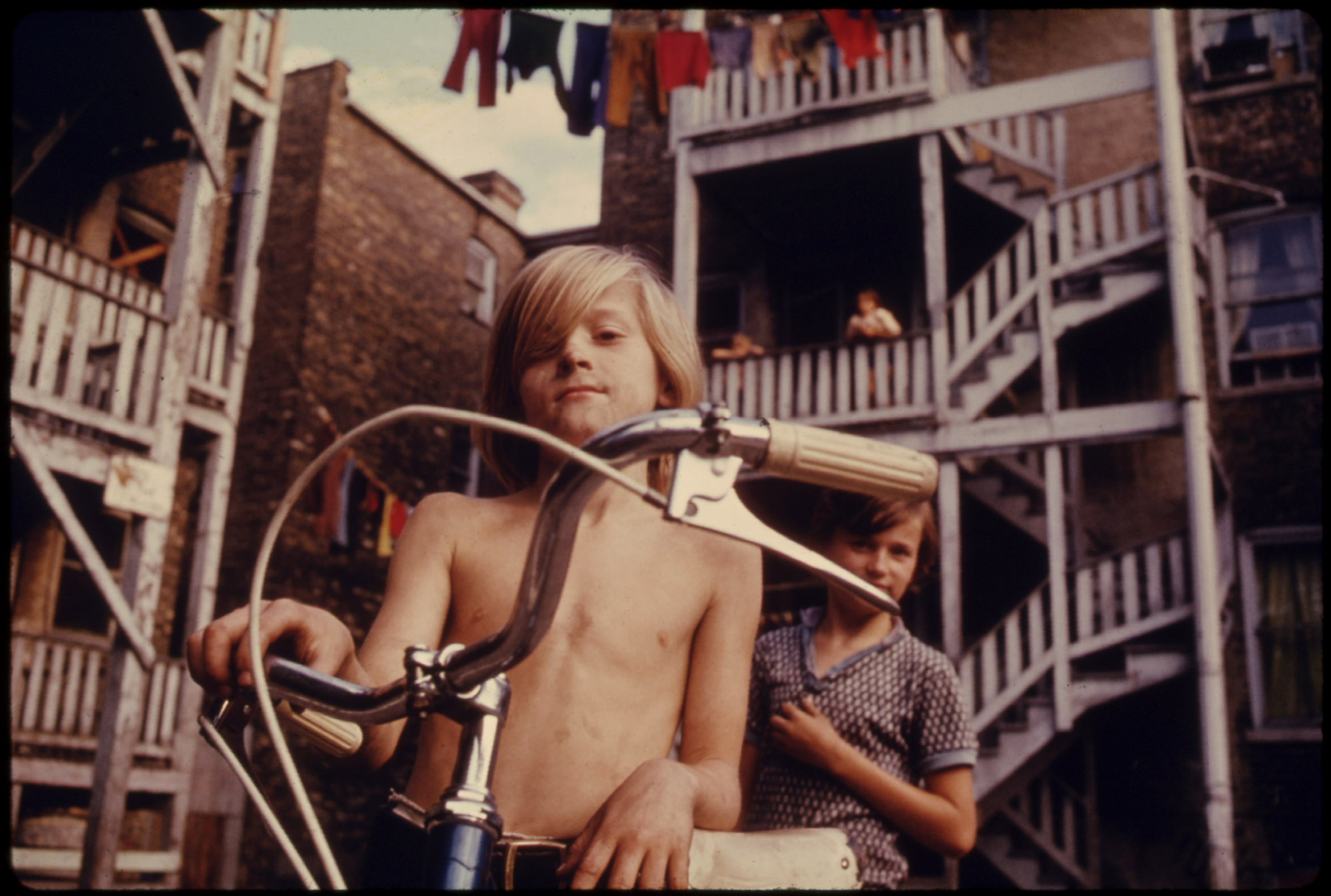
Danny Lyon (American, b. 1942) 'Children at an apartment entrance' 1965


Danny Lyon (American, b. 1942)
Children at an apartment entrance
1965
From series Uptown, Chicago
Gelatin silver print


Danny Lyon (American, b. 1942) 'Kathy, Uptown, Chicago' 1965


Danny Lyon (American, b. 1942)
Kathy, Uptown, Chicago
1965
Gelatin silver print
Image: 24.1 x 23.9cm (9 1/2 x 9 3/8 in.)
Sheet: 35.6 x 27.9cm (14 x 11 in.)
Collection of the artist


Danny Lyon (American, b. 1942) 'Uptown, Chicago' 1965


Danny Lyon (American, b. 1942)
Uptown, Chicago
1965
Gelatin silver print
Image: 16.4 x 16.4cm (6 1/2 x 6 1/2 in.)
Mount: 50.8 x 40.6cm (20 x 16 in.)
Collection of the artist


New York


Danny Lyon (American, b. 1942) 'Subway, New York' 1966 (printed 2015)


Danny Lyon (American, b. 1942)
Subway, New York
1966 (printed 2015)
Pigmented inkjet print
Image: 23.7 x 24.1cm (9 5/16 x 9 1/2 in.)
Sheet: 28.8 x 29.2cm (11 5/16 x 11 1/2 in.)
Collection of the artist


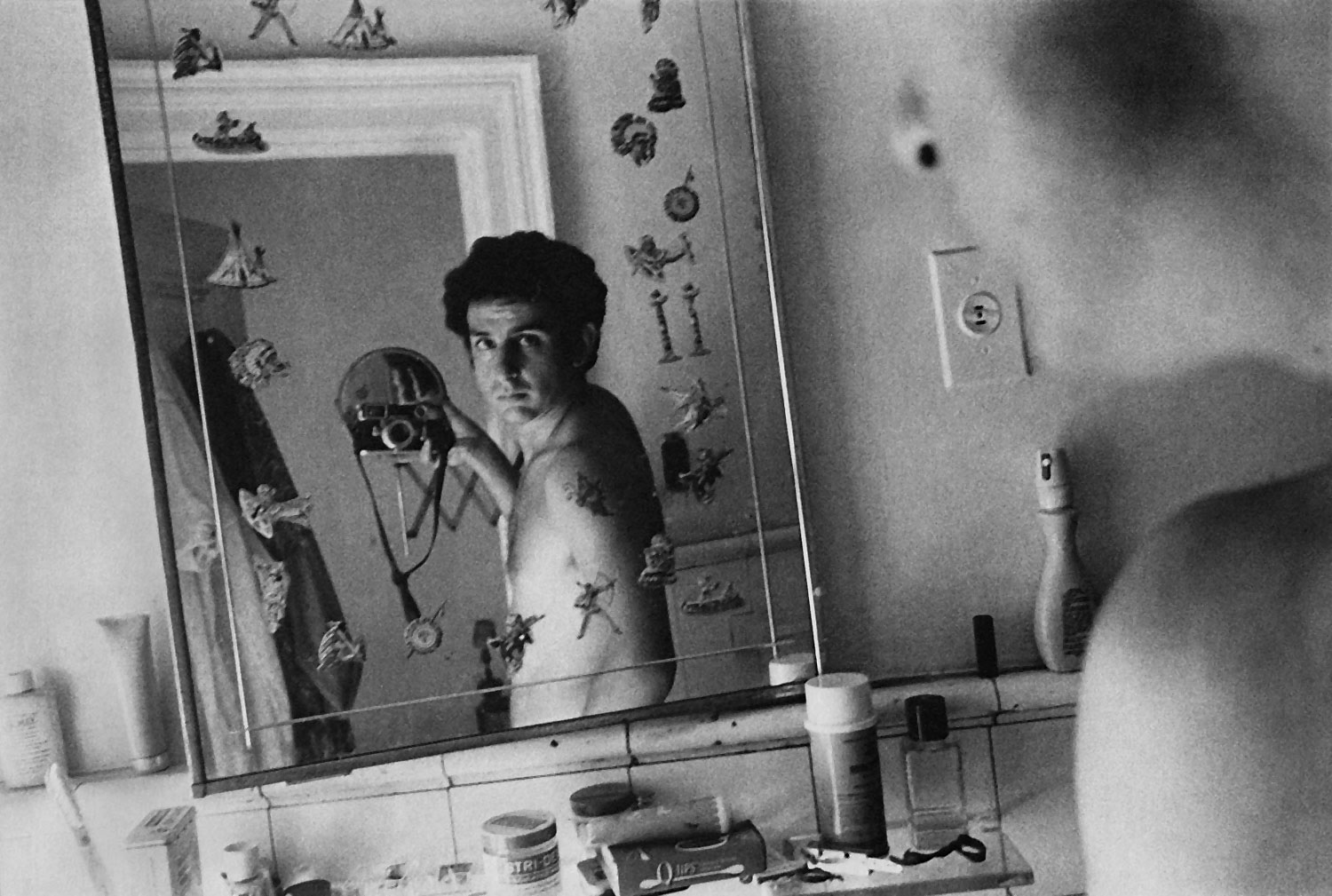
Danny Lyon (American, b. 1942) 'Self-Portrait in Mary Frank’s Bathroom, New York' 1969


Danny Lyon (American, b. 1942)
Self-Portrait in Mary Frank’s Bathroom, New York
1969
Gelatin silver print
Image: 15.6 x 23.5cm (6 1/8 x 9 1/4 in.)
Sheet: 20.3 x 25.2cm (8 x 9 15/16 in.)
Whitney Museum of American Art, New York; purchase with funds from Joanna Leonhardt Casullo, Niko Elmaleh, Lauren DePalo, Julia Macklowe, and Fern Kaye Tessler


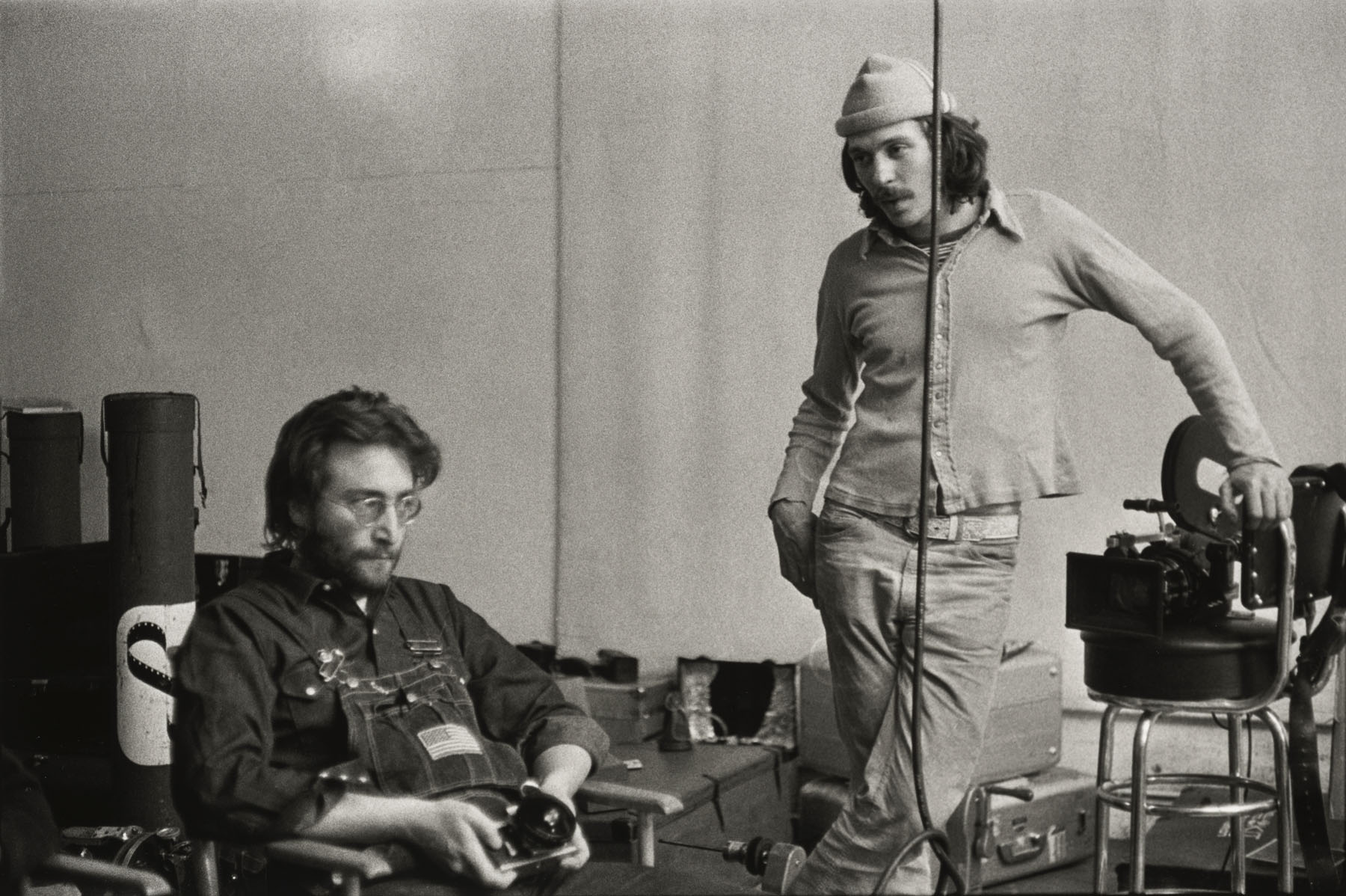
Danny Lyon (American, b. 1942) 'John Lennon and Danny Seymour, The Bowery, New York' 1969 (printed c. 2005)


Danny Lyon (American, b. 1942)
John Lennon and Danny Seymour, The Bowery, New York
1969 (printed c. 2005)
Gelatin silver print, printed later
Image: 22.3 x 33.3cm (8 13/16 x 13 1/8 in.)
Sheet: 27.6 x 35.4cm (11 x 14 in.)
Collection of the artist


Danny Lyon (American, b. 1942) 'Mark di Suvero and Danny Lyon, Hyde Park, Chicago' 1965


Danny Lyon (American, b. 1942)
Mark di Suvero and Danny Lyon, Hyde Park, Chicago
1965
Gelatin silver print
Image: 23.9 x 16.2cm (9 3/8 x 6 3/8 in.)
Sheet: 25.4 x 20.3cm (10 x 8 in.)
Collection of the artist


Colombia


Danny Lyon (American, b. 1942) 'Mary, Santa Marta, Colombia' 1972


Danny Lyon (American, b. 1942)
Mary, Santa Marta, Colombia
1972
Gelatin silver print
Image: 17.1 x 25.3cm (6 3/4 x 10 in.)
Sheet: 27.9 x 35.6cm (11 x 14 in.)
Collection of the artist


Danny Lyon (American, b. 1942) 'Tesca, Cartagena, Colombia' 1966 (printed 2008)


Danny Lyon (American, b. 1942)
Tesca, Cartagena, Colombia
1966 (printed 2008)
Cibachrome print
Image: 25.7 x 25.7cm (10 1/8 x 10 1/8 in.)
Sheet: 35.6 x 27.9cm (14 x 11 in.)
Collection of the artist


The most comprehensive retrospective of the work of American photographer, filmmaker, and writer Danny Lyon in twenty-five years debuted at the Whitney on June 17, 2016. The first major photography exhibition to be presented in the Museum’s downtown home, Danny Lyon: Message to the Future is organised by the Fine Arts Museums of San Francisco, where it will make its West Coast debut at the de Young Museum on November 5, 2016.

The exhibition assembles approximately 175 photographs and is the first to assess the artist’s achievements as a filmmaker as well as a photographer. The presentation also includes many objects that have seldom or never been exhibited before and offers a rare look at works from Lyon’s archives, including vintage prints, unseen 16mm film footage made inside Texas prisons, and his personal photo albums.

A leading figure in the American street photography movement of the 1960s, Lyon has distinguished himself by the personal intimacy he establishes with his subjects and the inventiveness of his practice. With his ability to find beauty in the starkest reality, Lyon has presented a charged alternative to the vision of American life presented in the mass media. Throughout, he has rejected the traditional documentary approach in favour of a more immersive, complicated involvement with his subjects. “You put a camera in my hand,” he has explained, “I want to get close to people. Not just physically close, emotionally close, all of it.” In the process he has made several iconic bodies of work, which have not only pictured recent history, but helped to shape it.

“We are delighted to partner with the Fine Arts Museums of San Francisco on Danny Lyon: Message to the Future,” stated Adam D. Weinberg, the Alice Pratt Brown Director of the Whitney Museum of American Art. “Since the early 1960s, Lyon’s photographs and films have upturned conventional notions of American life. The Whitney has long championed Lyon’s work and we are thrilled to present this retrospective, which encompasses more than half a century of important work.”

In 1962, while still a student at the University of Chicago, Lyon hitchhiked to the segregated South to make a photographic record of the Civil Rights movement. His other projects have included photographing biker subcultures, exploring the lives of individuals in prison, and documenting the architectural transformation of Lower Manhattan. Lyon has lived for years in New Mexico, and his commitment to personal adventure has taken him to Mexico and other countries in Latin America, China, and the less-traveled parts of the American West.

“Danny Lyon is one of the great artists working in photography today,” said Julian Cox, Founding Curator of Photography for the Fine Arts Museums of San Francisco and Chief Curator at the de Young Museum. “Lyon’s dedication to his art and his conviction to produce work underpinned by strong ethical and ideological motivations sets him apart from many of his peers.

Press release from the Whitney Museum of American Art


Ongoing activism

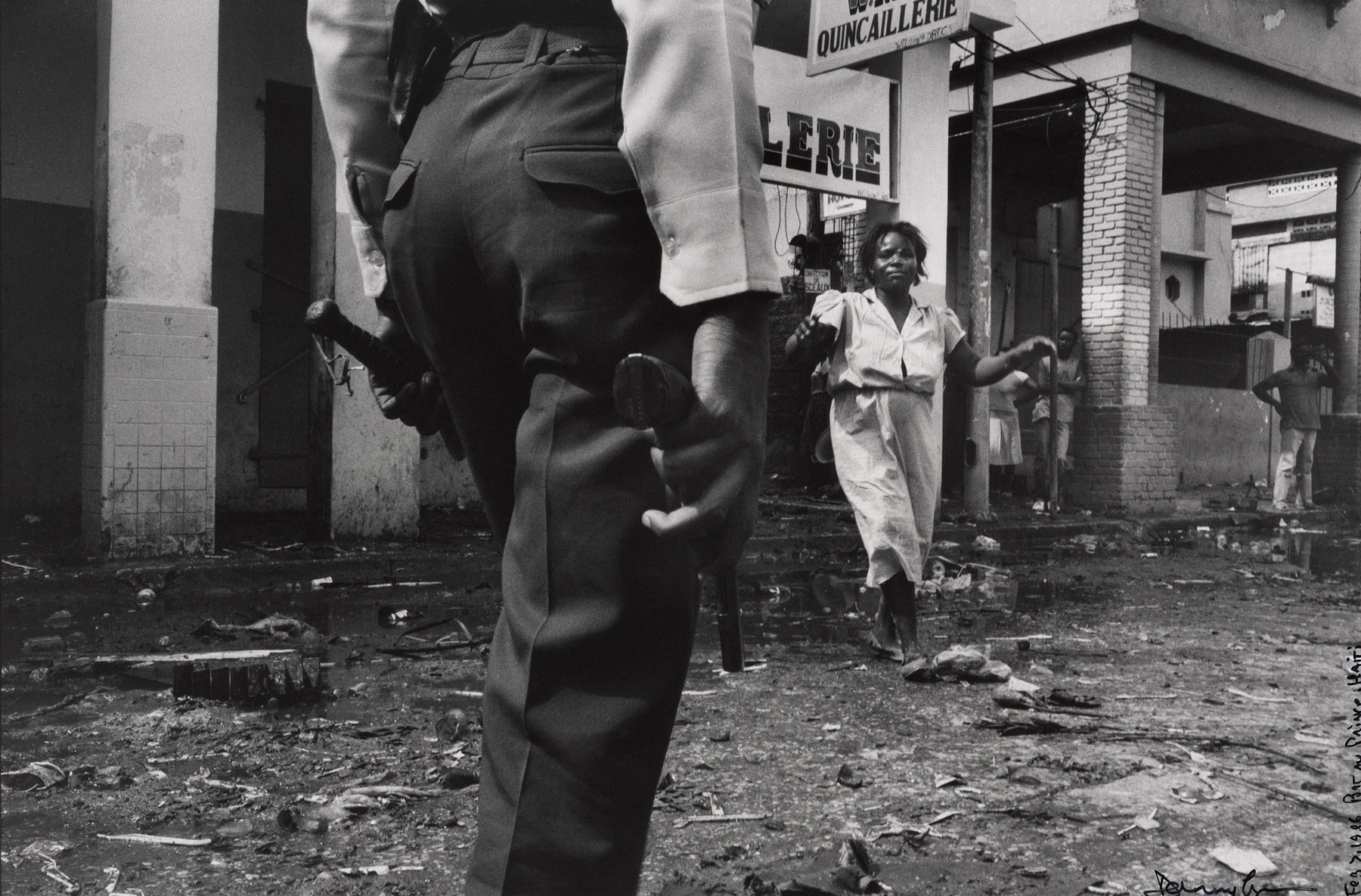
Lyon’s first encounter with Latin America was through a trip to Colombia in February 1966, during which he photographed extensively in and around Cartagena. In the 1970s and 1980s, Lyon’s self-described “advocacy journalism” took him to Bolivia, where he captured the hard lives of rural miners; Mexico, where he photographed undocumented workers moving back and forth across the U.S. – Mexico border; back to Colombia, where he made the film Los Niños Abandonados, chronicling the lives of street children; and to Haiti, where he witnessed firsthand the violent revolution overthrowing Jean-Claude Duvalier’s dictatorship.

More recently, Lyon made six trips between 2005 and 2009 to Shanxi province in northeast China. Aided by a guide, he photographed the people living in this highly polluted coal-producing region. As in his work in the civil rights movement and the Texas prisons, Lyon’s photographs from his travels are examples of his advocacy journalism, part of his effort to “change history and preserve humanity.”


Danny Lyon (American, b. 1942) 'Boulevard Jean-Jacques Dessalines, Port-au-Prince, Haiti' February 7, 1986


Danny Lyon (American, b. 1942)
Boulevard Jean-Jacques Dessalines, Port-au-Prince, Haiti
February 7, 1986
Gelatin silver print
Image: 21.3 x 32.1cm (8 3/8 x 12 5/8 in.)
Sheet: 27.9 x 35.6cm (11 x 14 in.)
Collection of the artist


Occupy


Danny Lyon (American, b. 1942) 'Occupy Demonstration on Broadway, Los Angeles' 2011


Danny Lyon (American, b. 1942)
Occupy Demonstration on Broadway, Los Angeles
2011
Inkjet print
Image: 24.5 x 32.9cm (9 5/8 x 12 15/16 in.)
Sheet: 32.7 x 40cm (13 x 15 3/4 in.)
Collection of the artist


Danny Lyon (American, b. 1942) 'Occupy Oakland, City Hall, Oakland' 2011


Danny Lyon (American, b. 1942)
Occupy Oakland, City Hall, Oakland
2011
Pigmented inkjet print
Image: 24.6 x 33cm (9 3/4 x 13 in.)
Sheet: 27.3 x 38cm (10 3/4 x 15 in.)
Collection of the artist


Whitney Museum of American Art
99 Gansevoort Street
New York, NY 10014
Phone: (212) 570-3600

Opening hours:
Wednesday – Monday: 10.30am – 6pm
Tuesdays: Closed

Whitney Museum of American Art website

LIKE ART BLART ON FACEBOOK

Back to top

Exhibition: ‘Painting with Light: Art and Photography from the Pre-Raphaelites to the Modern Age’ at Tate Britain, London

Exhibition dates: 11th May – 25th September, 2016

Curators: Dr Carol Jacobi, Curator of British Art 1850-1915 at Tate Britain, and Dr Hope Kingsley, Curator, Education and Collections, Wilson Centre for Photography, with Tim Batchelor, Assistant Curator at Tate Britain


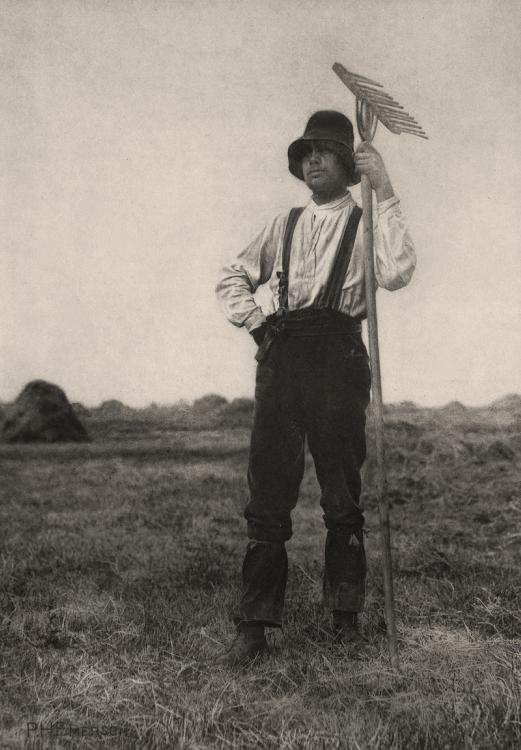
Peter Henry Emerson (British, 1856-1936) 'Haymaker with Rake' c. 1888, published 1890 from the exhibition 'Painting with Light: Art and Photography from the Pre-Raphaelites to the Modern Age' at Tate Britain, London, May - Sept, 2016


Peter Henry Emerson (British, 1856-1936)
Haymaker with Rake
c. 1888, published 1890
From Pictures of East Anglian Life portfolio
Photogravure on paperImage: 277 x 196mm
Victoria and Albert Museum
Gift from the photographer


An interesting concept for an exhibition. I would have liked to have seen the exhibition to make a more informed comment. Parallels can be drawn, but how much import you put on the connection is up to you vis-à-vis the aesthetic feeling and formal construction of each medium. It is fascinating to note how many of the original art works are photographs with the painting following at a later date, or vice versa. Photographically, Julia Margaret Cameron and John Cimon Warburg are the stars.

Photographs have always been used by artists as aide-mémoire since the birth of photograph. Eugené Atget called his photographs of Paris “Documents pour artistes”, declaring his modest ambition to create images for other artists to use as source material … but I take that statement with a pinch of salt. Perhaps a salt print from a calotype paper negative!

Dr Marcus Bunyan


Many thankx to the Tate for allowing me to publish the art work and photographs in the posting. Please click on the photographs for a larger version of the image.


Tate Britain presents the first major exhibition to celebrate the spirited conversation between early photography and British art. It brings together photographs and paintings including Pre-Raphaelite, Aesthetic and British impressionist works. Spanning 75 years across the Victorian and Edwardian ages, the exhibition opens with the experimental beginnings of photography in dialogue with painters such as J.M.W. Turner and concludes with its flowering as an independent international art form.

Stunning works by John Everett Millais, Dante Gabriel Rossetti, JAM Whistler, John Singer Sargent and others will for the first time be shown alongside ravishing photographs by pivotal early photographers such as Julia Margaret Cameron, which they inspired and which inspired them.


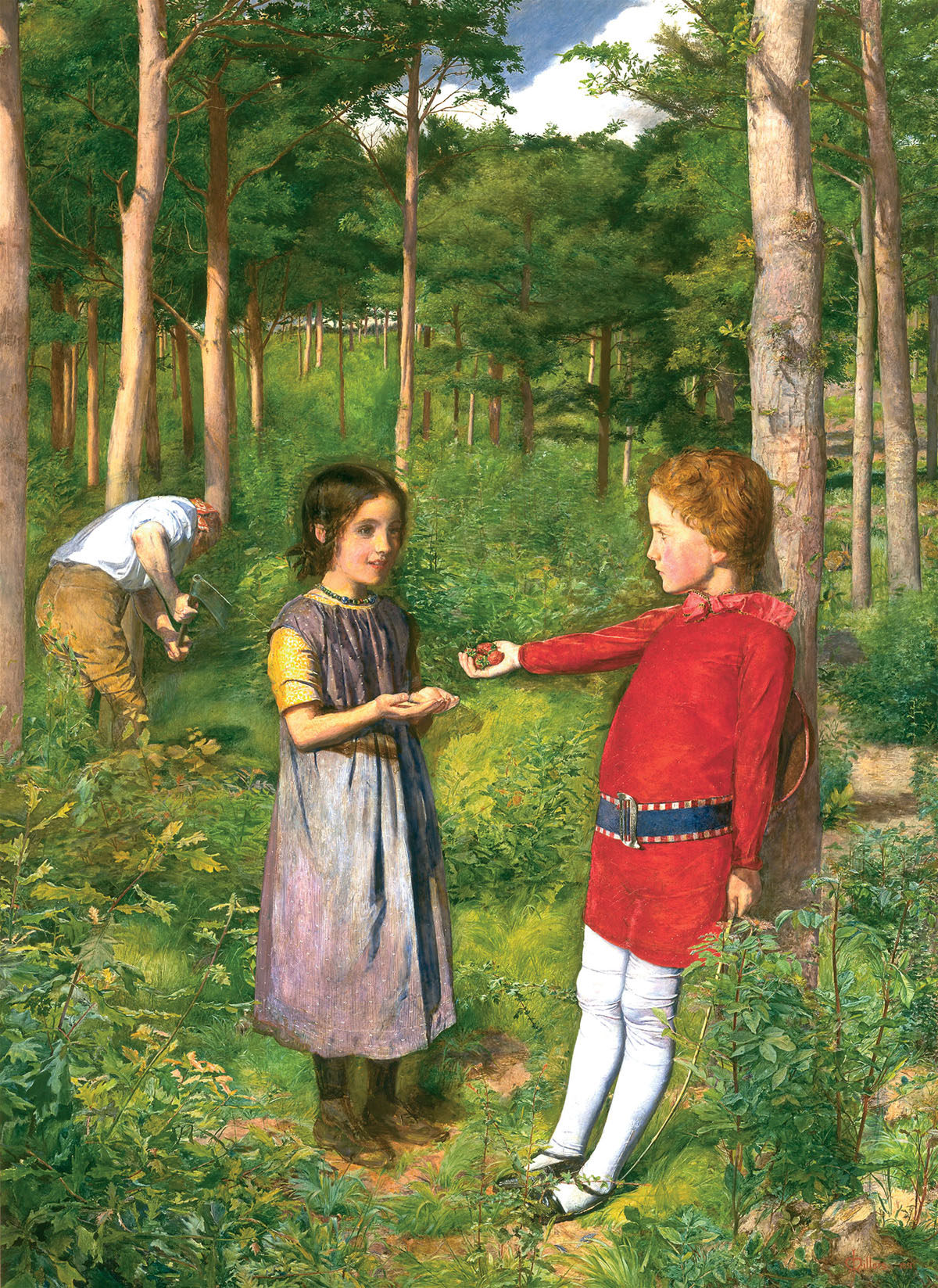
John Everett Millais (English, 1829-1896) 'The Woodman's Daughter' 1850-1851 from the exhibition 'Painting with Light: Art and Photography from the Pre-Raphaelites to the Modern Age' at Tate Britain, London, May - Sept, 2016


John Everett Millais (English, 1829-1896)
The Woodman’s Daughter
1850-51
Oil paint on canvas
889 x 648mm
Guildhall Art Gallery, City of London


Minna Keene (Canadian born Germany, 1861-1943) 'Decorative Study' c. 1906


Minna Keene (Canadian born Germany, 1861-1943)
Decorative Study
c. 1906
© Royal Photographic Society / National Media Museum/ Science & Society Picture Library


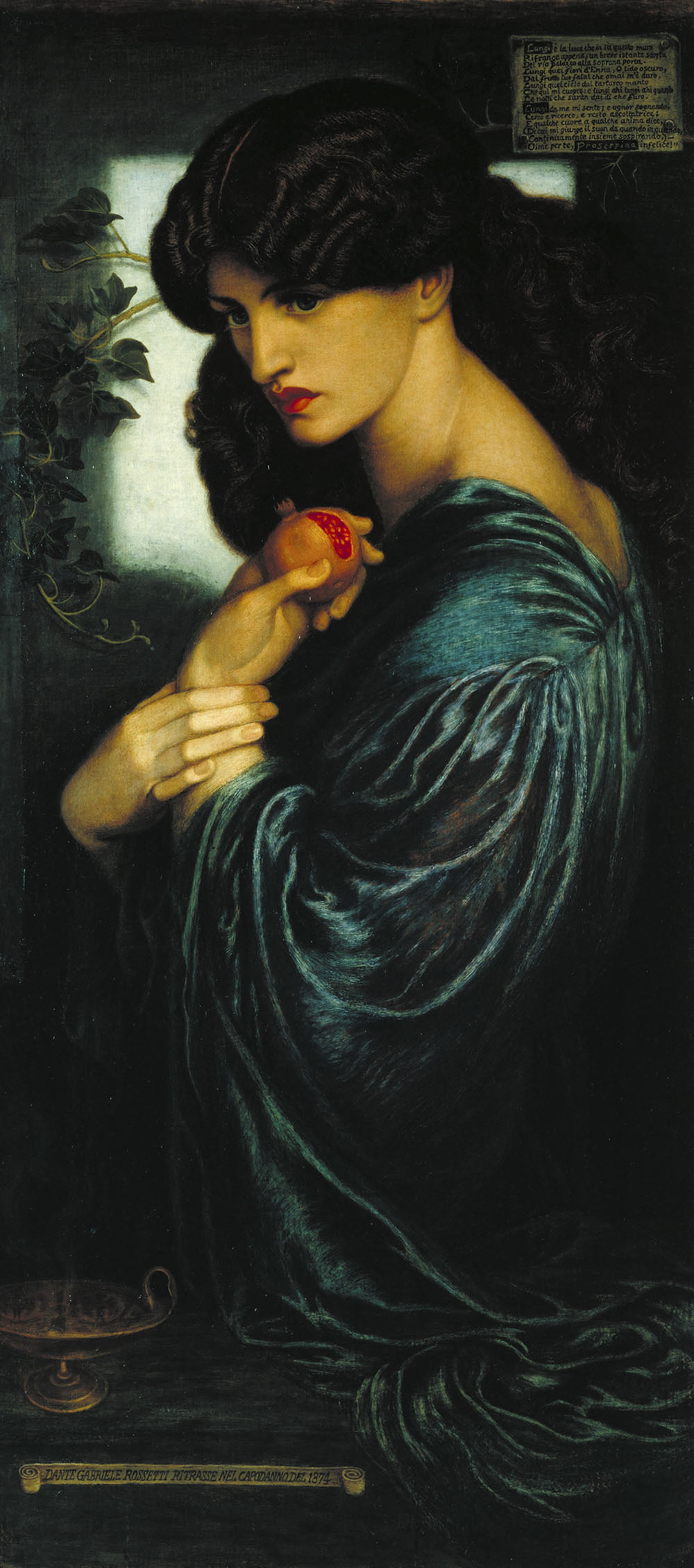
Dante Gabriel Rossetti (English, 1828-1882) 'Proserpine' 1874


Dante Gabriel Rossetti (English, 1828-1882)
Proserpine
1874
Oil on canvas
Support: 1251 x 610mm
Frame: 1605 x 930 x 85mm
Presented by W. Graham Robertson 1940


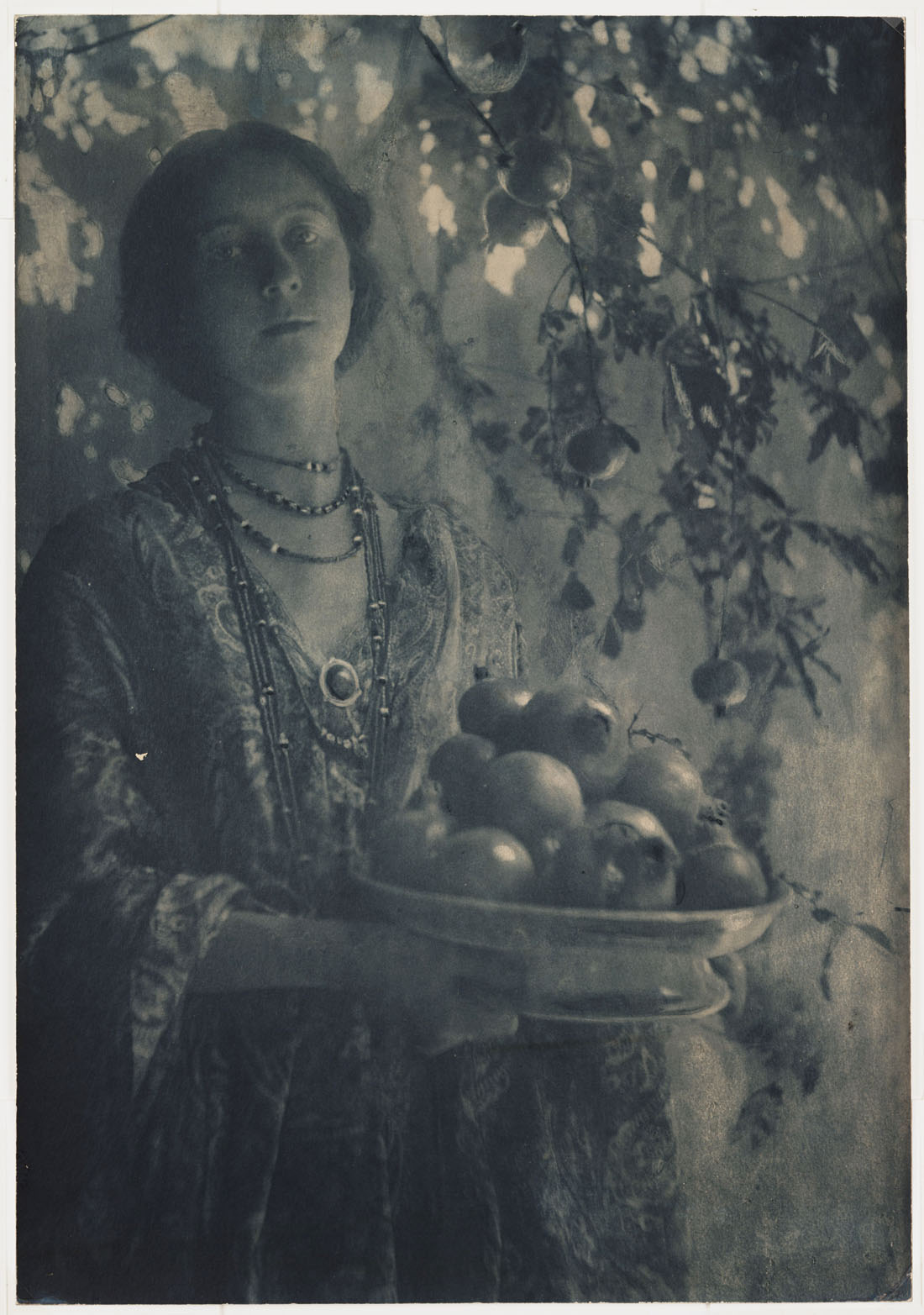
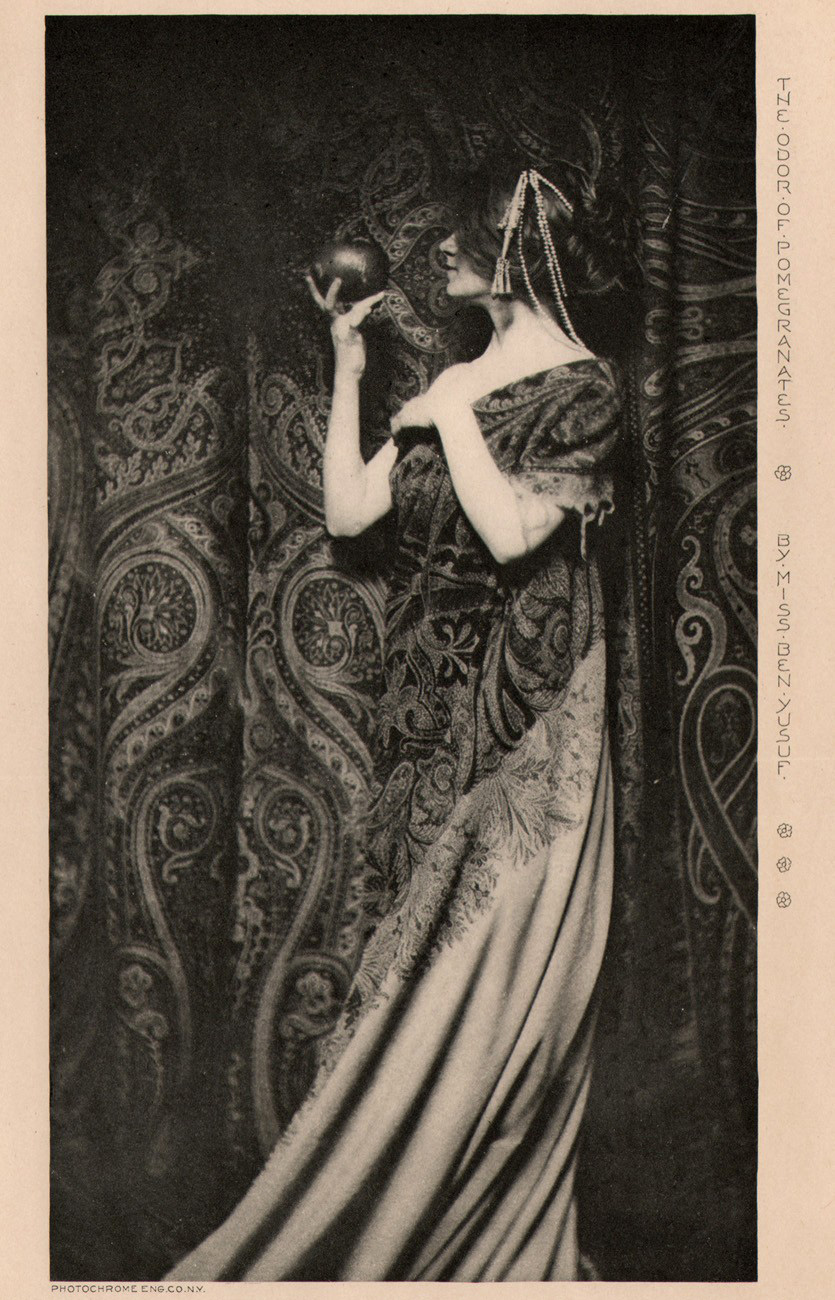
Zaida Ben-Yusuf (American born England, 1869-1933) 'The Odor of Pomegranates' 1899


Zaida Ben-Yusuf (American born England, 1869-1933)
The Odor of Pomegranates
1899, published 1901
Photogravure on paper
Tate


Zaida Ben-Yusuf (American born England, 1869-1933)

Zaida Ben-Yusuf (21 November 1869 – 27 September 1933) was a New York-based portrait photographer noted for her artistic portraits of wealthy, fashionable, and famous Americans of the turn of the 19th-20th century. She was born in London to a German mother and an Algerian father, but became a naturalised American citizen later in life. In 1901 the Ladies Home Journal featured her in a group of six photographers that it dubbed, “The Foremost Women Photographers in America.” In 2008, the Smithsonian National Portrait Gallery mounted an exhibition dedicated solely to Ben-Yusuf’s work, re-establishing her as a key figure in the early development of fine art photography…

In 1896, Ben-Yusuf began to be known as a photographer. In April 1896, two of her pictures were reproduced in The Cosmopolitan Magazine, and another study was exhibited in London as part of an exhibition put on by The Linked Ring. She travelled to Europe later that year, where she met with George Davison, one of the co-founders of The Linked Ring, who encouraged her to continue her photography. She exhibited at their annual exhibitions until 1902.

In the spring of 1897, Ben-Yusuf opened her portrait photography studio at 124 Fifth Avenue, New York. On 7 November 1897, the New York Daily Tribune ran an article on Ben-Yusuf’s studio and her work creating advertising posters, which was followed by another profile in Frank Leslie’s Weekly on 30 December. Through 1898, she became increasingly visible as a photographer, with ten of her works in the National Academy of Design-hosted 67th Annual Fair of the American Institute, where her portrait of actress Virginia Earle won her third place in the Portraits and Groups class. During November 1898, Ben-Yusuf and Frances Benjamin Johnston held a two-woman show of their work at the Camera Club of New York.

In 1899, Ben-Yusuf met with F. Holland Day in Boston, and was photographed by him. She relocated her studio to 578 Fifth Avenue, and exhibited in a number of exhibitions, including the second Philadelphia Photographic Salon. She was also profiled in a number of publications, including an article on female photographers in The American Amateur Photographer, and a long piece in The Photographic Times in which Sadakichi Hartmann described her as an “interesting exponent of portrait photography”.

1900 saw Ben-Yusuf and Johnston assemble an exhibition on American women photographers for the Universal Exposition in Paris. Ben-Yusuf had five portraits in the exhibition, which travelled to Saint Petersburg, Moscow, and Washington, D.C. She was also exhibited in Holland Day’s exhibition, The New School of American Photography, for the Royal Photographic Society in London, and had four photographs selected by Alfred Stieglitz for the Glasgow International Exhibition of 1901, Scotland.

In 1901, Ben-Yusuf wrote an article, “Celebrities Under the Camera”, for the Sunday Evening Post, where she described her experiences with her sitters. By this stage she had photographed Grover Cleveland, Franklin Roosevelt, and Leonard Wood, amongst others. For the September issue of Metropolitan Magazine she wrote another article, “The New Photography – What It Has Done and Is Doing for Modern Portraiture”, where she described her work as being more artistic than most commercial photographers, but less radical than some of the better-known art photographers. The Ladies Home Journal that November declared her to be one of the “foremost women photographers in America”, as she began the first of a series of six illustrated articles on “Advanced Photography for Amateurs” in the Saturday Evening Post.

Ben-Yusuf was listed as a member of the first American Photographic Salon when it opened in December 1904, although her participation in exhibitions was beginning to drop off. In 1906, she showed one portrait in the third annual exhibition of photographs at Worcester Art Museum, Massachusetts, the last known exhibition of her work in her lifetime.

Text from the Wikipedia website


In the Studio

Many photographers trained as painters. They set up studios and employed artists’ models, skilled at holding poses for the time it took to take a picture. Later in the century, improved photographic negatives required shorter exposure times and it became easier to stage and capture difficult positions and spontaneous gestures.

Painters and illustrators used photographs as preparatory studies and as substitutes for props, costumes and models, and art schools created photographic archives for their students. Photographs commissioned and sold by institutions such as the British Museum made classical sculpture and old master paintings more accessible, inspiring both painters and photographers.


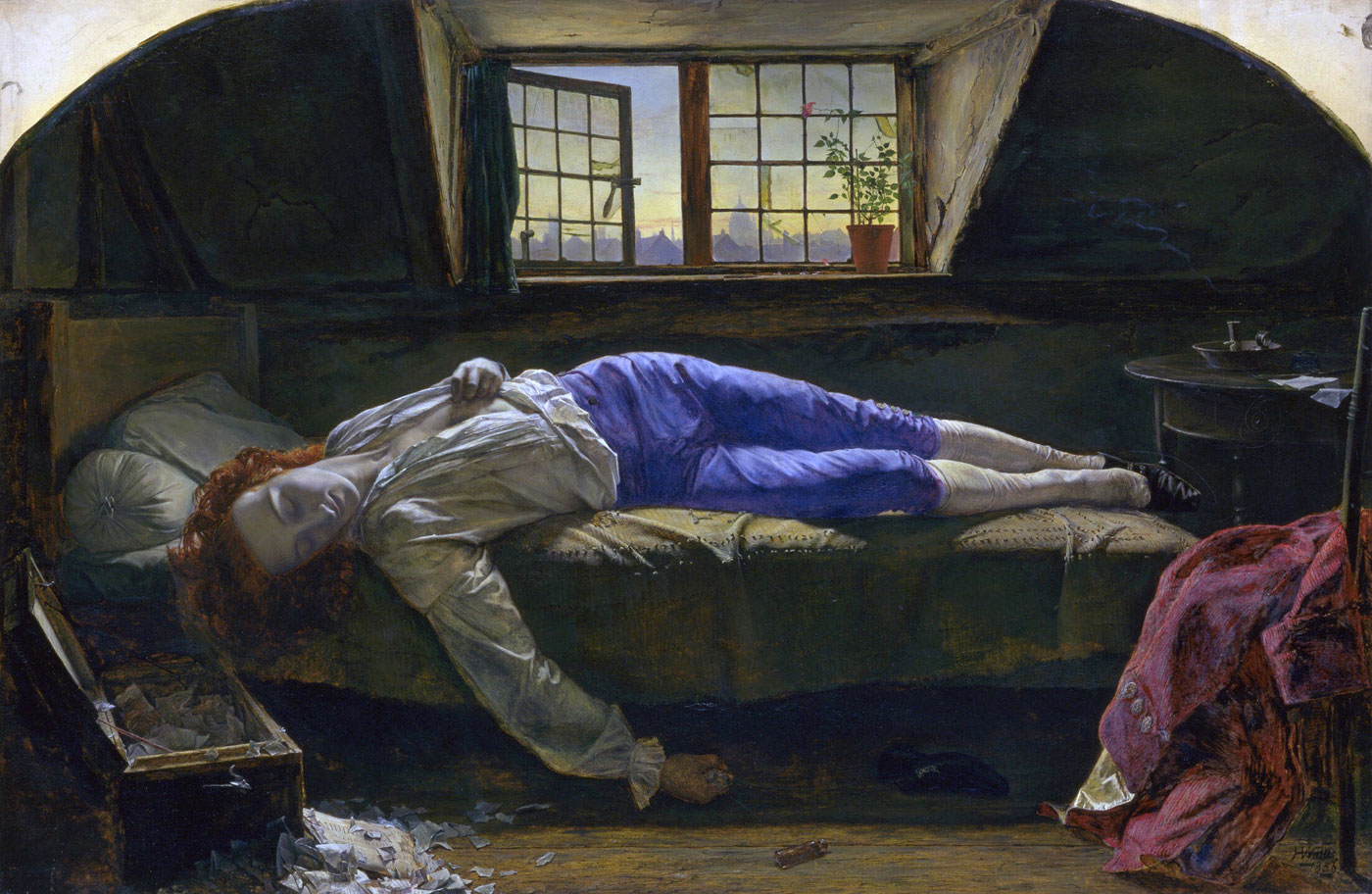
Henry Wallis (British, 1830-1916) 'Chatterton' 1856


Henry Wallis (British, 1830-1916)
Chatterton
1856
Oil paint on canvas
Support: 622 x 933mm
Frame: 905 x 1205 x 132mm
Tate
Bequeathed by Charles Gent Clement 1899


Chatterton is Wallis’s earliest and most famous work. The picture created a sensation when it was first exhibited at the Royal Academy in 1856, accompanied by the following quotation from Marlowe:

Cut is the branch that might have grown full straight
And burned is Apollo’s laurel bough.


Ruskin described the work in his Academy Notes as ‘faultless and wonderful’.

Thomas Chatterton (1752-1770) was an 18th Century poet, a Romantic figure whose melancholy temperament and early suicide captured the imagination of numerous artists and writers. He is best known for a collection of poems, written in the name of Thomas Rowley, a 15th Century monk, which he copied onto parchment and passed off as mediaeval manuscripts. Having abandoned his first job working in a scrivener’s office he struggled to earn a living as a poet. In June 1770 he moved to an attic room at 39 Brooke Street, where he lived on the verge of starvation until, in August of that year, at the age of only seventeen, he poisoned himself with arsenic. Condemned in his lifetime as a forger by influential figures such as the writer Horace Walpole (1717-1797), he was later elevated to the status of tragic hero by the French poet Alfred de Vigny (1797-1863).

Wallis may have intended the picture as a criticism of society’s treatment of artists, since his next picture of note, The Stonebreaker (1858, Birmingham City Museum and Art Gallery), is one of the most forceful examples of social realism in Pre-Raphaelite art. The painting alludes to the idea of the artist as a martyr of society through the Christ-like pose and the torn sheets of poetry on the floor. The pale light of dawn shines through the casement window, illuminating the poet’s serene features and livid flesh. The harsh lighting, vibrant colours and lifeless hand and arm increase the emotional impact of the scene. A phial of poison on the floor indicates the method of suicide. Following the Pre-Raphaelite credo of truth to nature, Wallis has attempted to recreate the same attic room in Gray’s Inn where Chatterton had killed himself. The model for the figure was the novelist George Meredith (1828-1909), then aged about 28. Two years later Wallis eloped with Meredith’s wife, a daughter of the novelist Thomas Love Peacock (1785-1866).

Frances Fowle. “Chatterton,” on the Tate website December 2000 [Online] Cited 16/02/2023


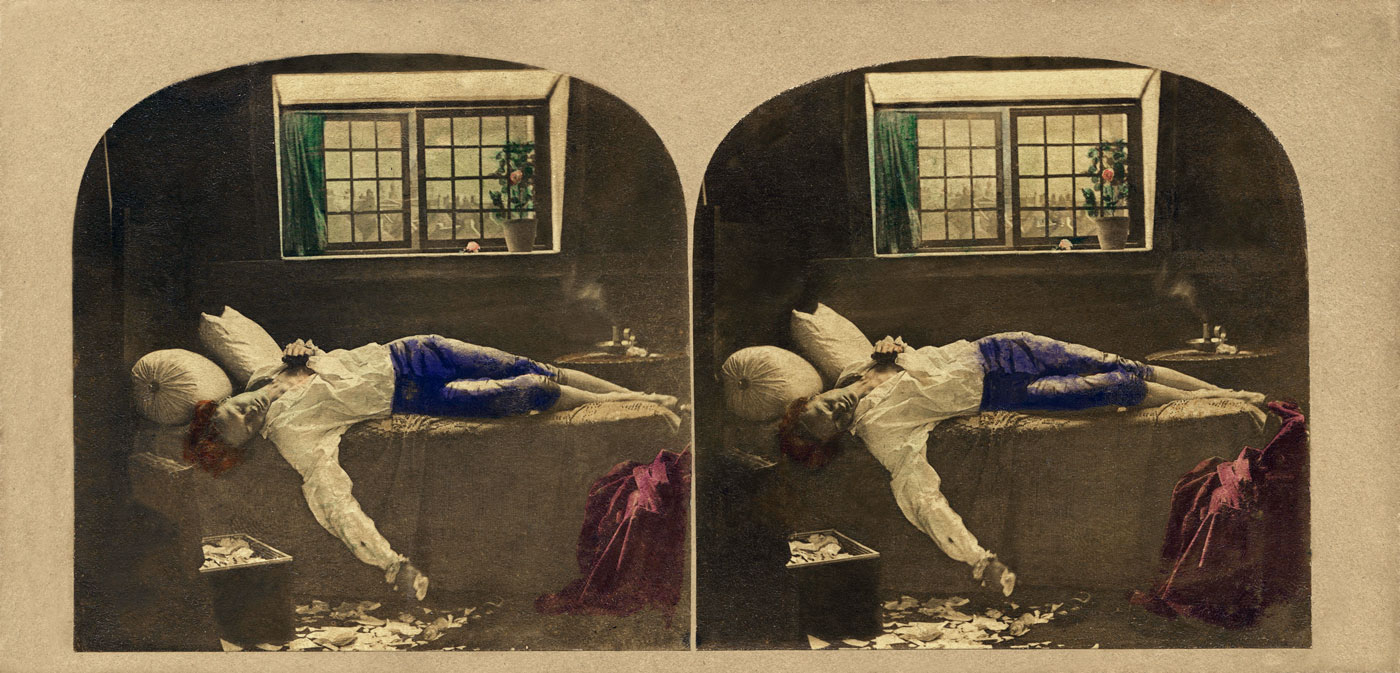
James Robinson. 'The Death of Chatterton' 1859


James Robinson
The Death of Chatterton
1859
Two photographs, hand-tinted albumen prints on paper mounted on card
Collection Dr Brian May

THIS STEREOCARD IS NOT IN THE EXHIBITION


James Robinson. 'The Death of Chatterton' 1859 (detail)


James Robinson
The Death of Chatterton (detail)
1859
Two photographs, hand-tinted albumen prints on paper mounted on card
Collection Dr Brian May

THIS STEREOCARD IS NOT IN THE EXHIBITION


One of the most famous paintings of Victorian times was Chatterton, 1856 (Tate) by the young Pre-Raphaelite-style artist, Henry Wallis (1830-1916). Again, the tale of the suicide of the poor poet, Thomas Chatterton, exposed as a fraud for faking medieval histories and poems to get by, had broad appeal. Chatterton was also an 18th-century figure, but Wallis set his picture in a bare attic overlooking the City of London which evoked the urban poverty of his own age. The picture toured the British Isles and hundreds of thousands flocked to pay a shilling to view it. One of these was James Robinson, who saw the painting when it was in Dublin. He immediately conceived a stereographic series of Chatterton’s life. Unfortunately Robinson started with Wallis’s scene (The Death of Chatterton, 1859). Within days of its publication, legal procedures began, claiming his picture threatened the income of the printmaker who had the lucrative copyright to publish engravings of the painting. The ensuing court battles were the first notorious copyright cases. Robinson lost, but strangely, in 1861, Birmingham photographer Michael Burr published variations of Death of Chatterton with no problems. No other photographer was ever prosecuted for staging a stereoscopic picture after a painting and the market continued to thrive…

Robinson’s The Death of Chatterton illustrates the way this uncanny quality [the ability to record reality in detail] distinguishes the stereograph from even the immaculate Pre-Raphaelite style of Wallis’s painting of the same subject. The stereograph represented a young man in 18th-century costume on a bed. The backdrop was painted, but the chest, discarded coat and candle were real. Again, the light and colour appear crude in comparison with the painting but the stereoscope records ‘every stick, straw, scratch’ in a manner that the painting cannot. The torn paper pieces, animated by their three-dimensionality, trace the poet’s recent agitation, while the candle smoke, representing his extinguished life, is different in each photograph due to their being taken at separate moments. The haphazard creases of the bed sheet are more suggestive of restless movement, now stilled, than Wallis’s elegant drapery. Even the individuality of the boy adds potency to his death.

Extract from the essay by Carol Jacobi. “Tate Painting and the Art of Stereoscopic Photography,” on the Tate website 17th October, 2014 [Online] Cited 14/02/2015


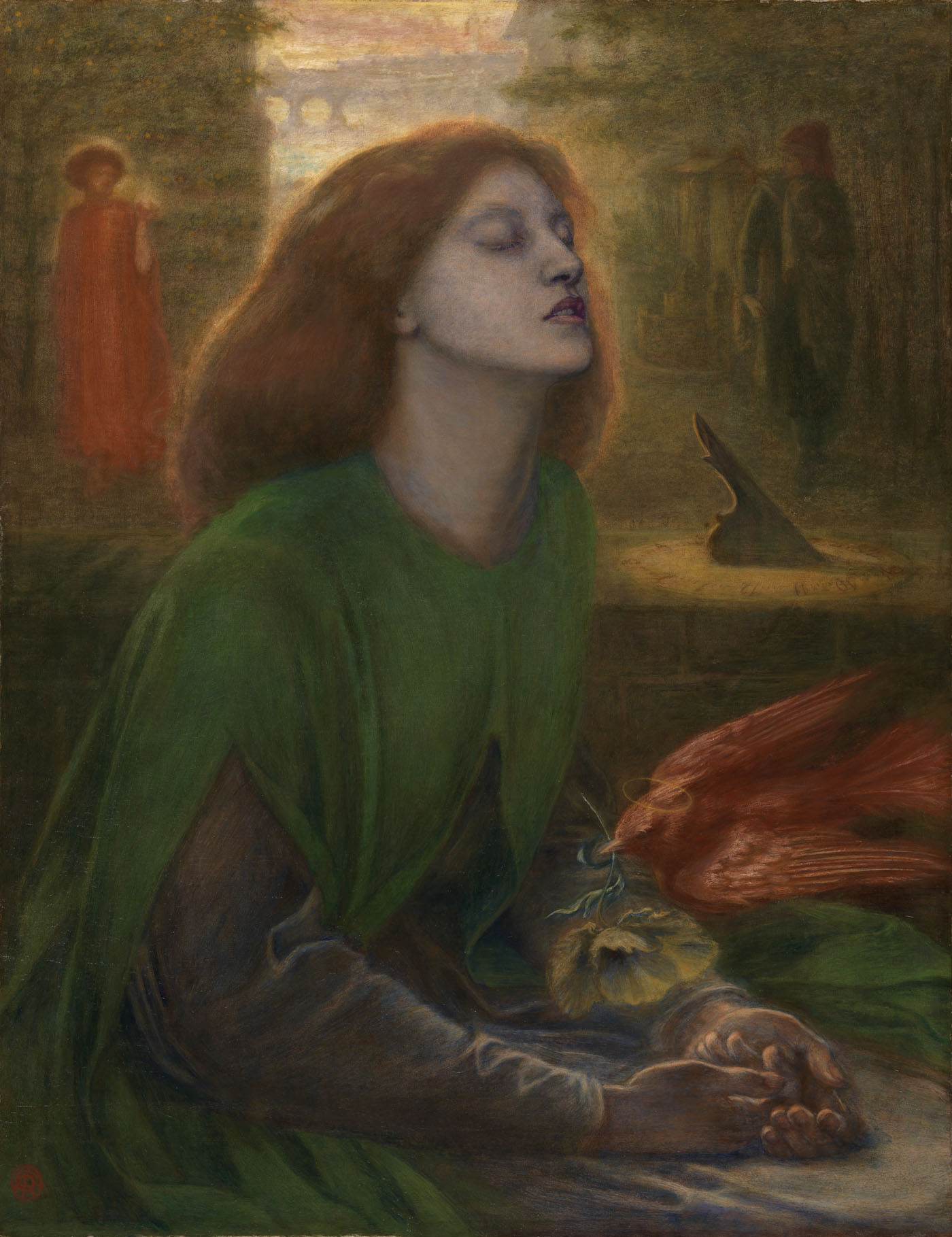
Dante Gabriel Rossetti (English, 1828-1882) 'Beata Beatrix' c. 1864-1870


Dante Gabriel Rossetti (English, 1828-1882)
Beata Beatrix
c. 1864-1870
Oil on canvas
Support: 864 x 660mm
Frame: 1212 x 1015 x 104mm
Presented by Georgiana, Baroness Mount-Temple in memory of her husband, Francis, Baron Mount-Temple 1889


Rossetti draws a parallel in this picture between the Italian poet Dante’s despair at the death of his beloved Beatrice and his own grief at the death of his wife Elizabeth Siddal, who died on 11 February 1862. Dante Alighieri (1265-1321) recounted the story of his unrequited love and subsequent mourning for Beatrice Portinari in the Vita Nuova. This was Rossetti’s first English translation and appeared in 1864 as part of his own publication, The Early Italian Poets.

The picture is a portrait of Elizabeth Siddall in the character of Beatrice. It has a hazy, transcendental quality, giving the sensation of a dream or vision, and is filled with symbolic references. Rossetti intended to represent her, not at the moment of death, but transformed by a ‘sudden spiritual transfiguration’ (Rossetti, in a letter of 1873, quoted in Wilson, p.86). She is posed in an attitude of ecstasy, with her hands before her and her lips parted, as if she is about to receive Communion. According to Rossetti’s friend F.G. Stephens, the grey and green of her dress signify ‘the colours of hope and sorrow as well as of love and life’ (‘Beata Beatrix by Dante Gabriel Rossetti’, Portfolio, vol. 22, 1891, p. 46).

In the background of the picture the shadowy figure of Dante looks across at Love, portrayed as an angel and holding in her palm the flickering flame of Beatrice’s life. In the distance the Ponte Vecchio signifies the city of Florence, the setting for Dante’s story. Beatrice’s impending death is evoked by the dove – symbol of the holy spirit – which descends towards her, an opium poppy in its beak. This is also a reference to the death of Elizabeth Siddall, known affectionately by Rossetti as ‘The Dove’, and who took her own life with an overdose of laudanum. Both the dove and the figure of Love are red, the colour of passion, yet Rossetti envisaged the bird as a messenger, not of love, but of death. Beatrice’s death, which occurred at nine o’clock on 9th June 1290, is foreseen in the sundial which casts its shadow over the number nine. The picture frame, which was designed by Rossetti, has further references to death and mourning, including the date of Beatrice’s death and a phrase from Lamentations 1:1, quoted by Dante in the Vita Nuova: ‘Quomodo sedet sola civitas’ (‘how doth the city sit solitary’), referring to the mourning of Beatrice’s death throughout the city of Florence.

Frances Fowle. “Beata Beatrix,” on the Tate website December 2000 [Online] Cited 16/02/2023


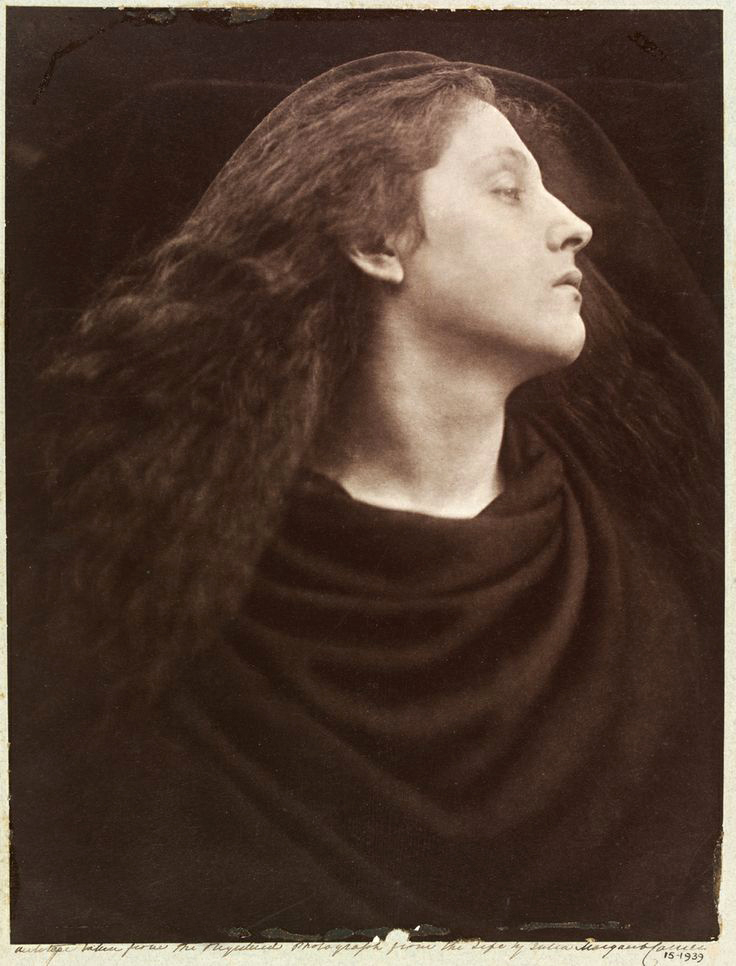
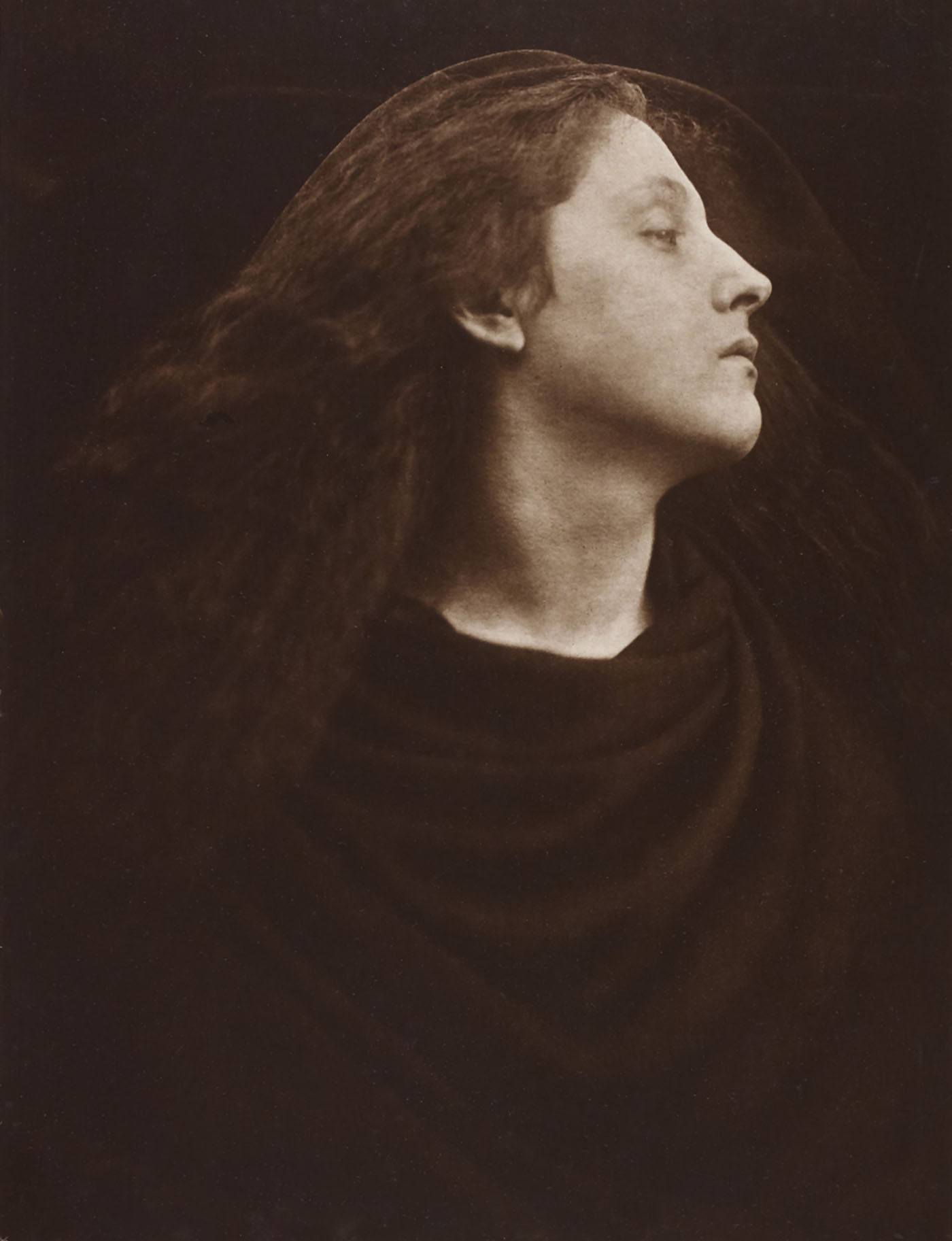
Julia Margaret Cameron (British born India, 1815-1879) 'Call, I Follow, I Follow, Let Me Die!' 1867

Julia Margaret Cameron (British born India, 1815-1879) 'Call, I Follow, I Follow, Let Me Die!' 1867


Julia Margaret Cameron (British born India, 1815-1879)
Call, I Follow, I Follow, Let Me Die!
1867
© Royal Photographic Society / National Media Museum / Science & Society Picture Library


In late 1865, Julia Margaret Cameron began using a larger camera. It held a 15 x 12 inch glass negative, rather than the 12 x 10 inch negative of her first camera. Early the next year she wrote to Henry Cole with great enthusiasm – but little modesty – about the new turn she had taken in her work. Cameron initiated a series of large-scale, closeup heads that fulfilled her photographic vision. She saw them as a rejection of ‘mere conventional topographic photography – map-making and skeleton rendering of feature and form’ in favour of a less precise but more emotionally penetrating form of portraiture. Cameron also continued to make narrative and allegorical tableaux, which were larger and bolder than her previous efforts.

In this image, Cameron concentrates upon the head of her maid Mary Hillier by using a darkened background and draping her in simple dark cloth. The lack of surrounding detail or context obscures references to narrative, identity or historical context. The flowing hair, lightly parted lips and exposed neck suggest sensuality. The title, taken from a line in the poem ‘Lancelot and Elaine’ from Alfred Tennyson’s ‘Idylls of the King’, transforms the subject into a tragic heroine.

Anonymous. “Call, I Follow, I Follow, Let Me Die!,” on the V&A website [Online] Cited 16/02/2023


New truths

Mid-nineteenth century innovations in science and the arts became part of intense debates about ‘truth’ – variously defined as objective observation and as individual artistic vision. Inspired by artist and critic John Ruskin, the Pre-Raphaelite circle took a new approach to nature, discovering meaning in details previously overlooked, ‘rejecting nothing, selecting nothing’.

As the quality of paints and lenses improved, painters and photographers tested the bounds of perception and representation. They moved out of the studio, to explore light and other atmospheric effects as well as geological subjects, landscape and architecture. New photographic materials like glass plate negatives and coated printed papers offered greater accuracy and photography became a valuable aid for painters.


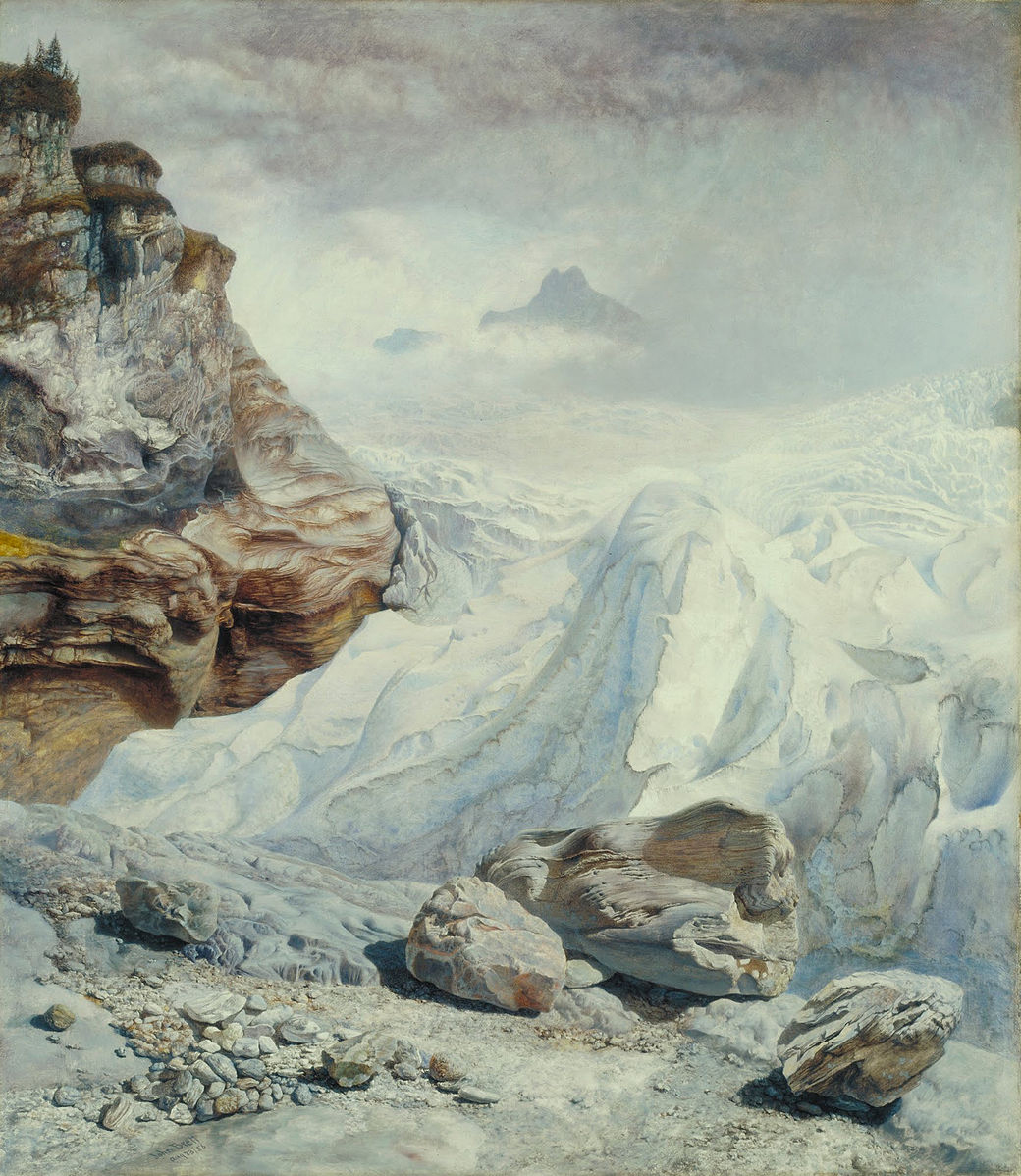
John Brett (British, 1831-1902) 'Glacier of Rosenlaui' 1856


John Brett (British, 1831-1902)
Glacier of Rosenlaui
1856
Oil on canvas
Height: 445 mm (17.52 in)
Width: 419 mm (16.5 in)
Tate Britain
Purchased 1946
Photo: Tate, London, 2011


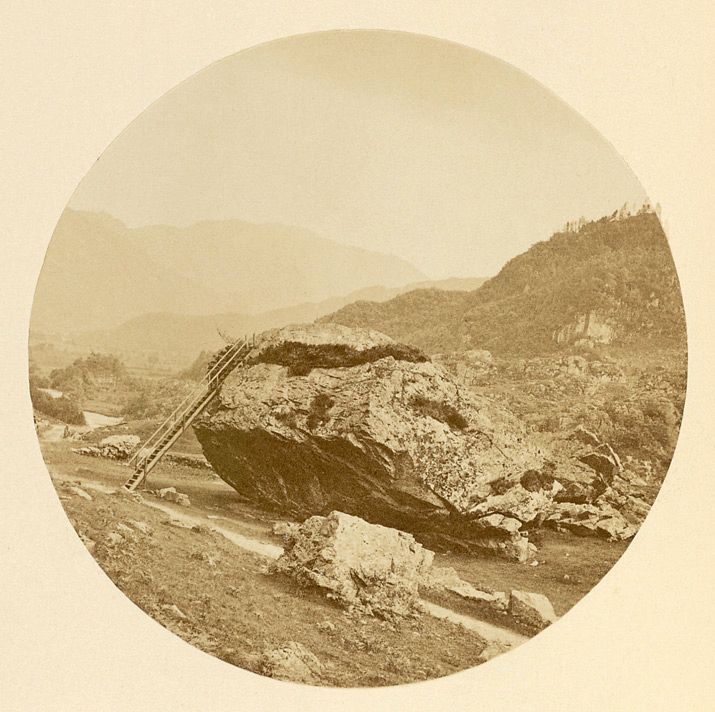
Thomas Ogle (British, 1813 - about 1882) 'The Bowder Stone in Our English Lakes, Mountains and Waterfalls as seen by William Wordsworth by A.W. Bennett' Published 1864


Thomas Ogle (British, 1813 – about 1882)
The Bowder Stone in Our English Lakes, Mountains and Waterfalls as seen by William Wordsworth by A.W. Bennett
Published 1864
Tate


View taken by Thomas Ogle of the Bowder Stone in Borrowdale, Cumbria, illustrating Our English Lakes, Mountains, And Waterfalls, as seen by William Wordsworth (1864). The book juxtaposes photographs of the Lake District with poems by the English Romantic poet. The Bowder Stone, an enormous boulder, was probably deposited by glaciation during the last Ice Age. It rests in Borrowdale, a valley of woods and crags in the Lake District whose scenic beauty inspired artists, writers and poets of the Romantic Movement in the late 18th and early 19th centuries. Wordsworth (1770-1850) was among them, and the photograph of the Bowder Stone accompanies his poem, Yew-Trees (1803), from which the following passage is taken:

“…But worthier still of note
Are those fraternal four of Borrowdale,
Joined in one solemn and capacious grove;
Huge trunks! – and each particular trunk a growth
Of intertwined fibres serpentine
Up-coiling, and inveterately convolved, –
Nor uninformed with phantasy, and looks
That threaten the profane; – a pillared shade,
Upon whose grassless floor of red-brown hue,
By sheddings from the pining umbrage tinged
Perenially – beneath whole sable roof
Of boughs, as if for festal purpose, decked
With unrejoicing berries, ghostly shapes
May meet at noontide – Fear and trembling Hope,
Silence and Foresight – Death the skeleton
And Time the shadow…”

Text from the British Library website [Online] Cited 18/09/2016


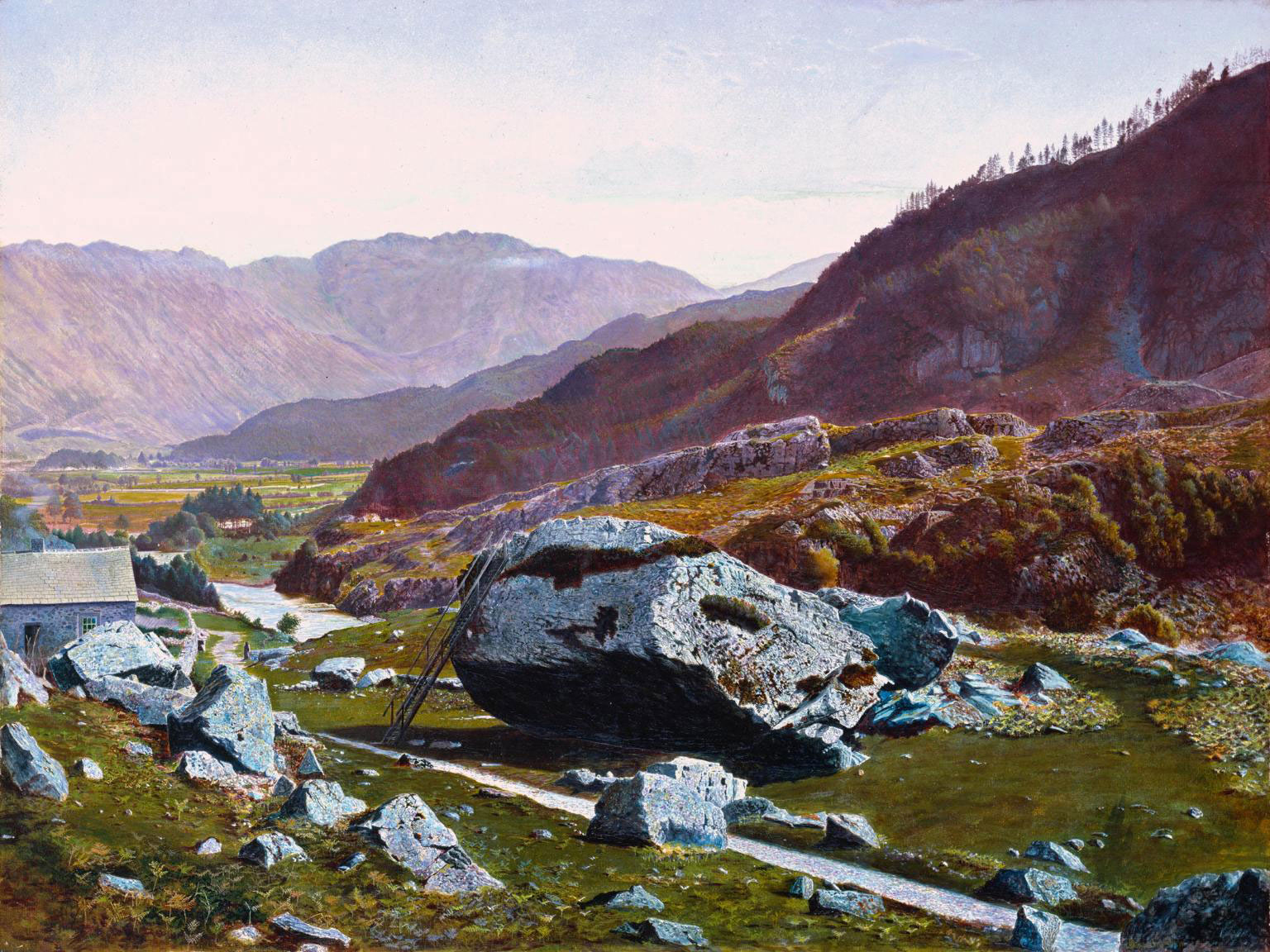
Atkinson Grimshaw (English, 1836-1893) 'Bowder Stone, Borrowdale' c. 1863-1868


Atkinson Grimshaw (English, 1836-1893)
Bowder Stone, Borrowdale
c. 1863-1868
Oil on canvas
Support: 400 x 536mm
Frame: 662 x 709 x 100mm
Purchased with assistance from the Friends of the Tate Gallery 1983


Tate Britain uncovers the dynamic dialogue between British painters and photographers; from the birth of the modern medium to the blossoming of art photography. Spanning over 70 years, the exhibition brings together nearly 200 works – many for the first time – to reveal their mutual influences. From the first explorations of movement and illumination by David Octavius Hill (1802-1870) and Robert Adamson (1821-1848) to artful compositions at the turn-of-the-century, the show discovers how painters and photographers redefined notions of beauty and art itself.

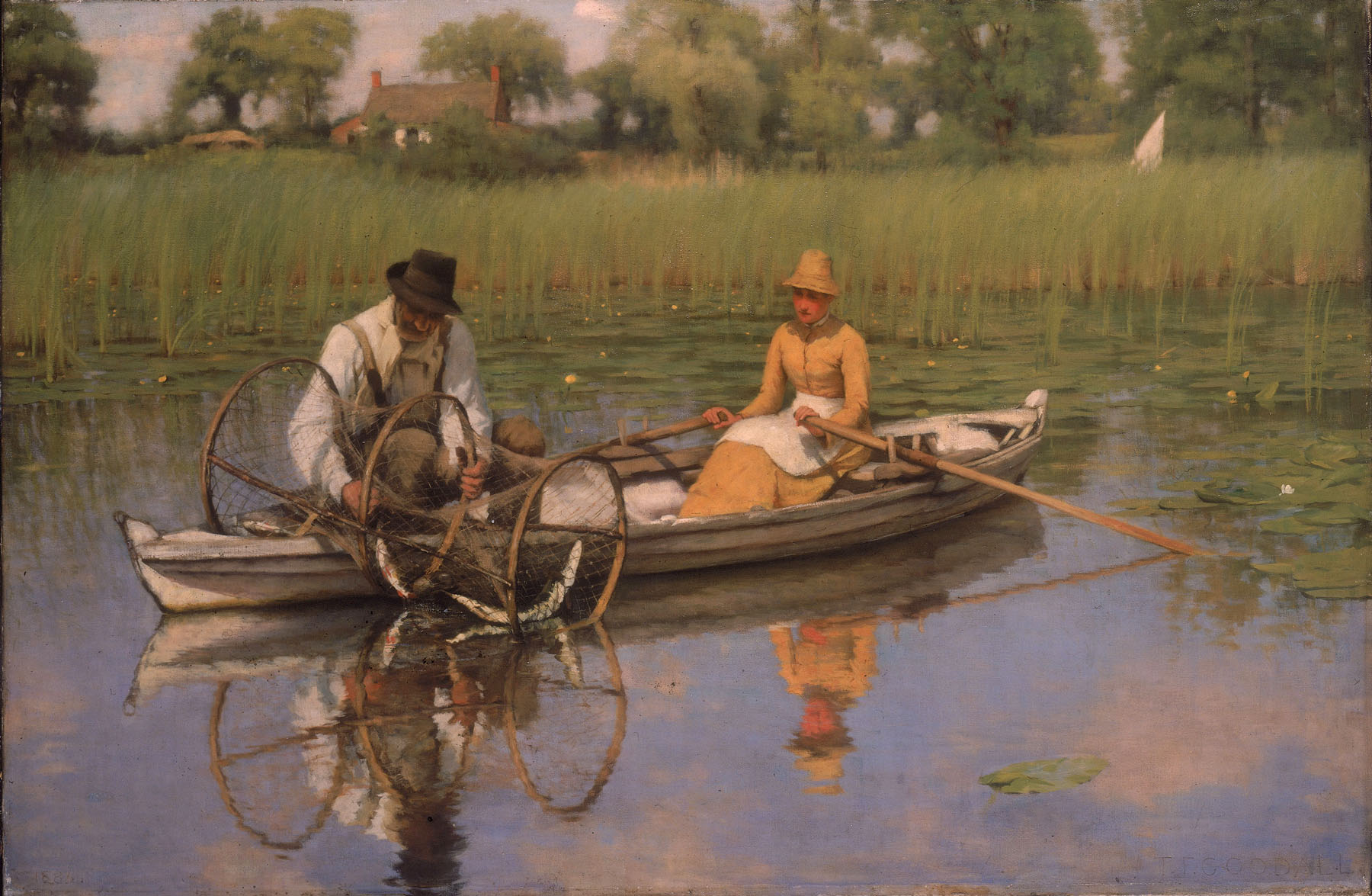
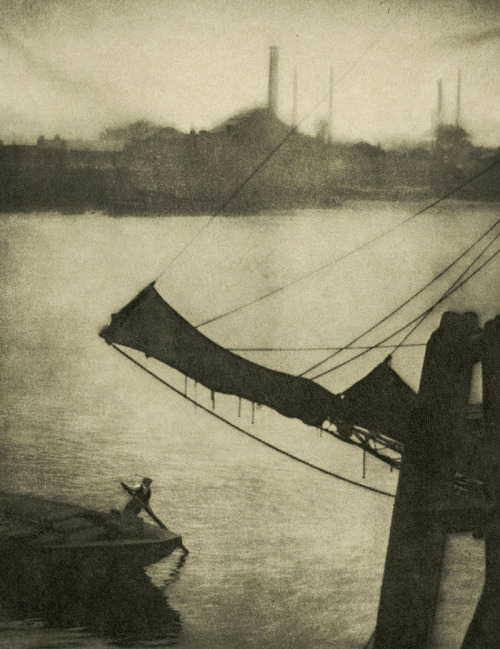
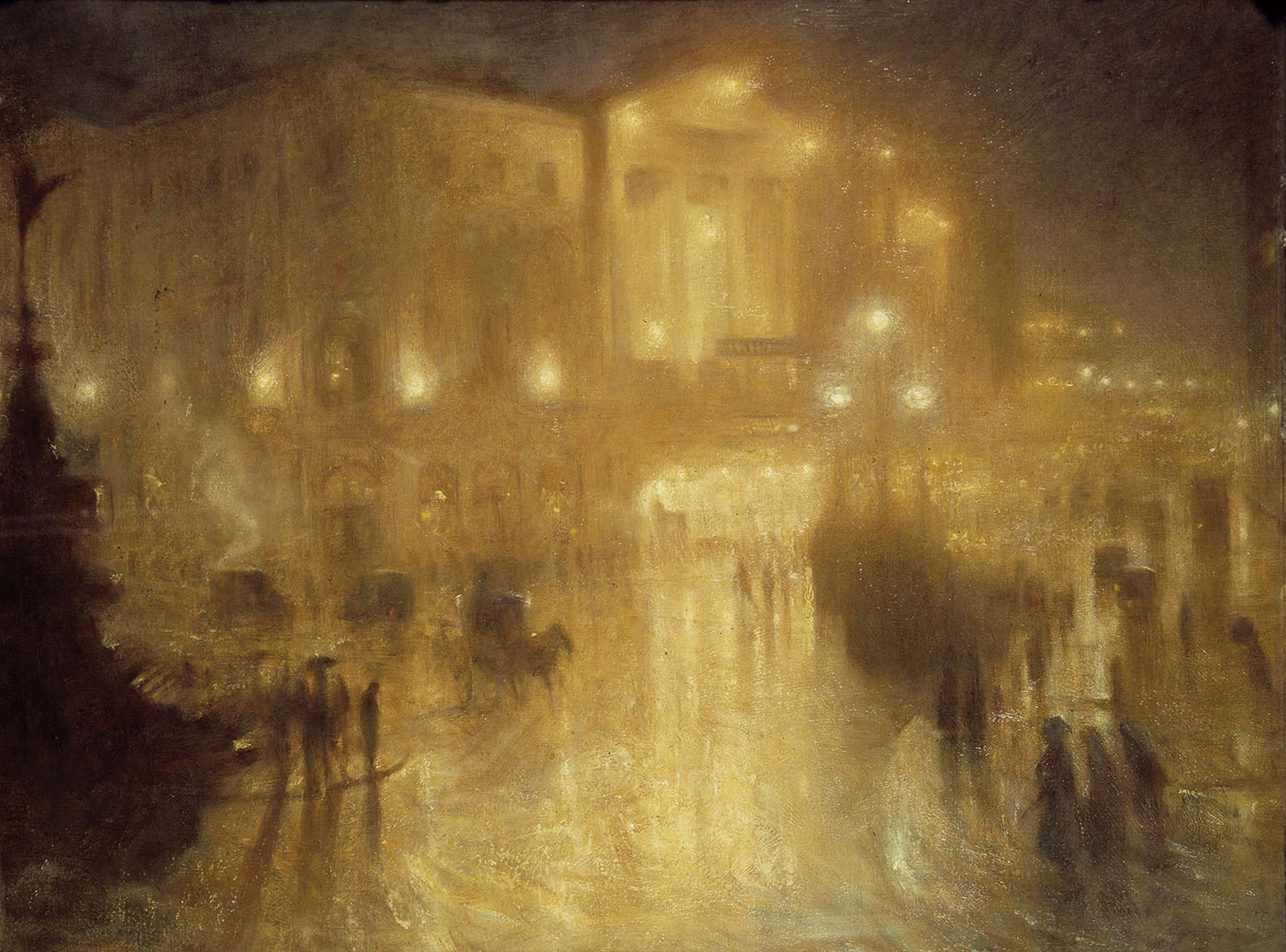
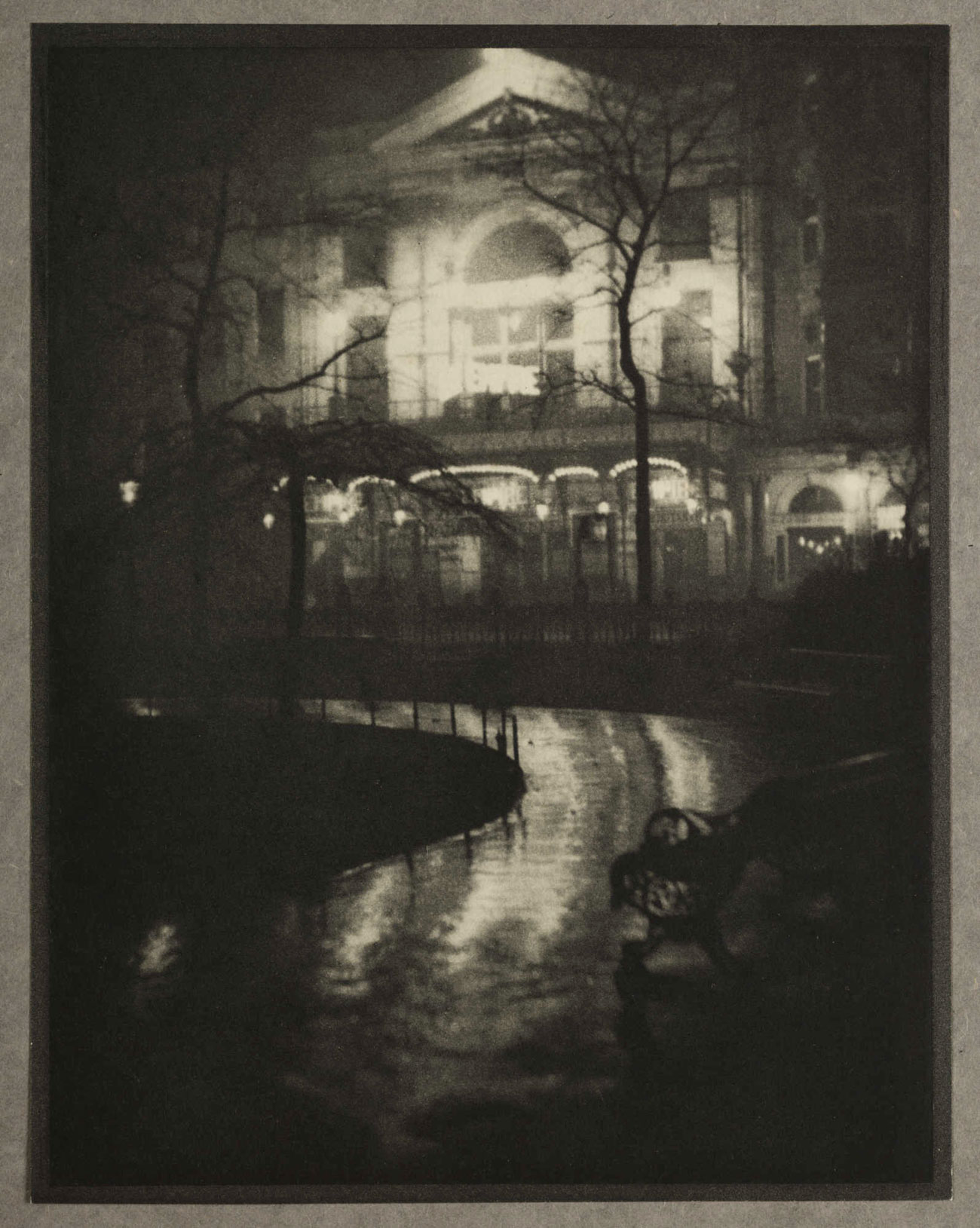
The dawn of photography coincided with a tide of revolutionary ideas in the arts, which questioned how pictures should be created and seen. Photography adapted the Old Master traditions within which many photographers had been trained, and engaged with the radical naturalism of JMW Turner (1775-1851), the Pre-Raphaelites, and their Realist and Impressionist successors. Turner inspired the first photographic panoramic views, and, in the years that followed his death, photographers and painters followed in his footsteps and composed novel landscapes evoking meaning and emotion. The exhibition includes examples such as John Everett Millais’s (1829-1896) nostalgic The Woodman’s Daughter and John Brett’s (1831-1902) awe inspiring Glacier Rosenlaui. Later in the century, PH Emerson (1856-1936) and TF Goodall’s (c. 1856-1944) images of rural river life allied photography to Impressionist painting, while JAM Whistler (1834-1903) and Alvin Langdon Coburn (1882-1966) created smoky Thames nocturnes in both media.

The exhibition celebrates the role of women photographers, such as Zaida Ben-Yusuf (1869-1933) and the renowned Julia Margaret Cameron (1815-1879). Cameron’s artistic friendships with George Frederic Watts (1817-1904) and Dante Gabriel Rossetti (1830-94) are recognised in a room devoted to their beautiful, enigmatic portraits of each other and shared models, where works including Cameron’s Call, I Follow, I Follow, Let Me Die and Rossetti’s Beata Beatrix are on display.

Highlights of the show include examples of three-dimensional photography, which incorporated the use of models and props to stage dramatic tableaux from popular works of the time, re-envisioning well-known pictures such as Henry Wallis’s (1830-1916) Chatterton. Such stereographs were widely disseminated and made art more accessible to the public, often being used as a form of after-dinner entertainment for middle class Victorian families. A previously unseen private album in which the Royal family painstakingly re-enacted famous paintings is also exhibited, as well as rare examples of early colour photography.

Carol Jacobi, Curator British Art 1850-1915, Tate Britain says: “Painting with Light offers new insights into Britain’s most popular artists and reveals just how vital painting and photography were to one another. Their conversations were at the heart of the artistic achievements of the Victorian and Edwardian era.”

Painting with Light: Art and Photography from the Pre-Raphaelites to the Modern Age is curated by Dr Carol Jacobi, Curator of British Art 1850-1915 at Tate Britain, and Dr Hope Kingsley, Curator, Education and Collections, Wilson Centre for Photography, with Tim Batchelor, Assistant Curator at Tate Britain. The exhibition is accompanied by a fully illustrated catalogue from Tate Publishing and a programme of talks and events in the gallery.”

Press release from Tate Britain


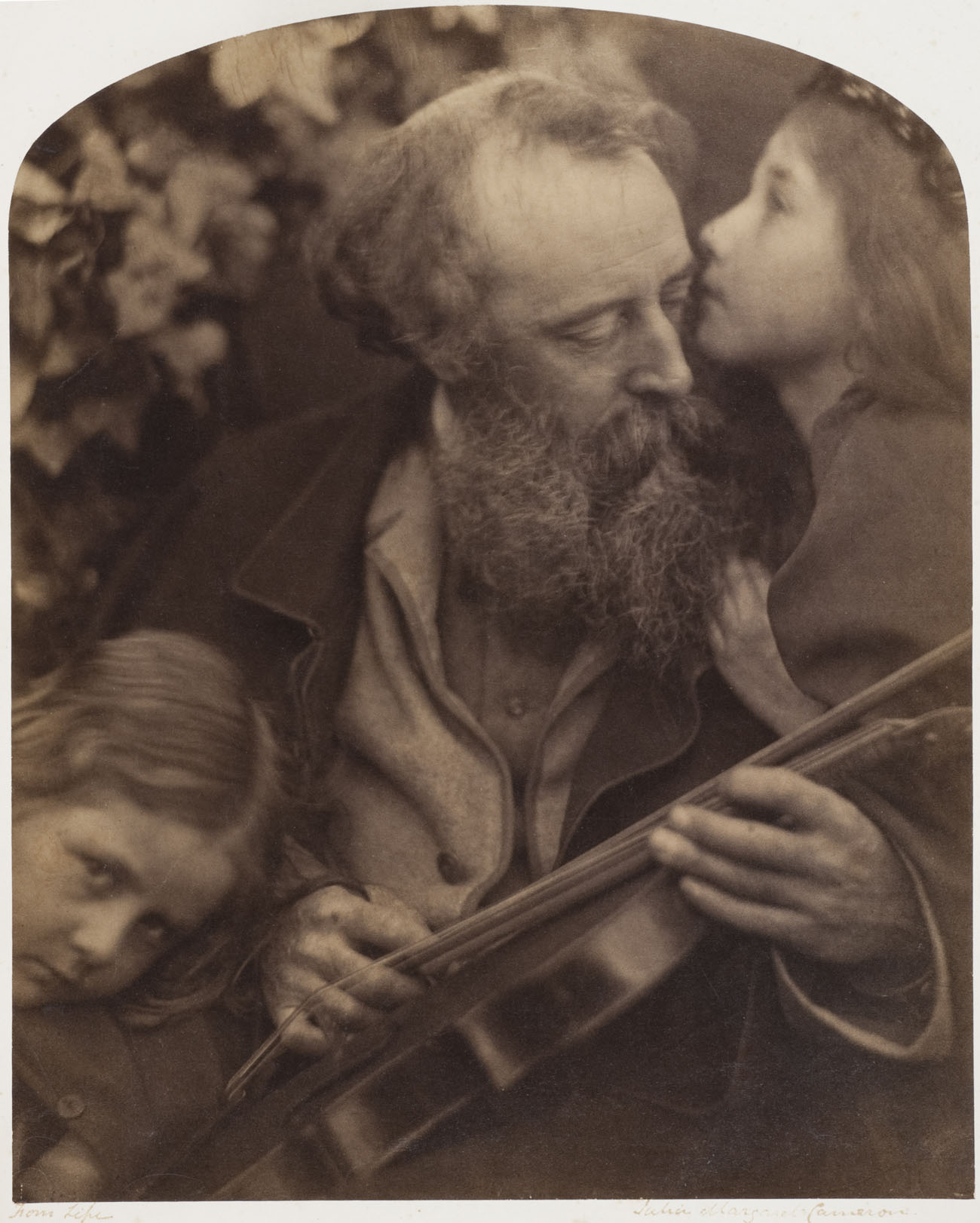
‘Whisper of the Muse’

As the nineteenth century progressed, some artists moved away from the clarity and detail that had been the aim of earlier Pre-Raphaelite art, turning instead to a search for pure beauty. The aesthetic movement, as this tendency came to be known, emphasised the sensual qualities of art and design and explored imaginative themes and effects.

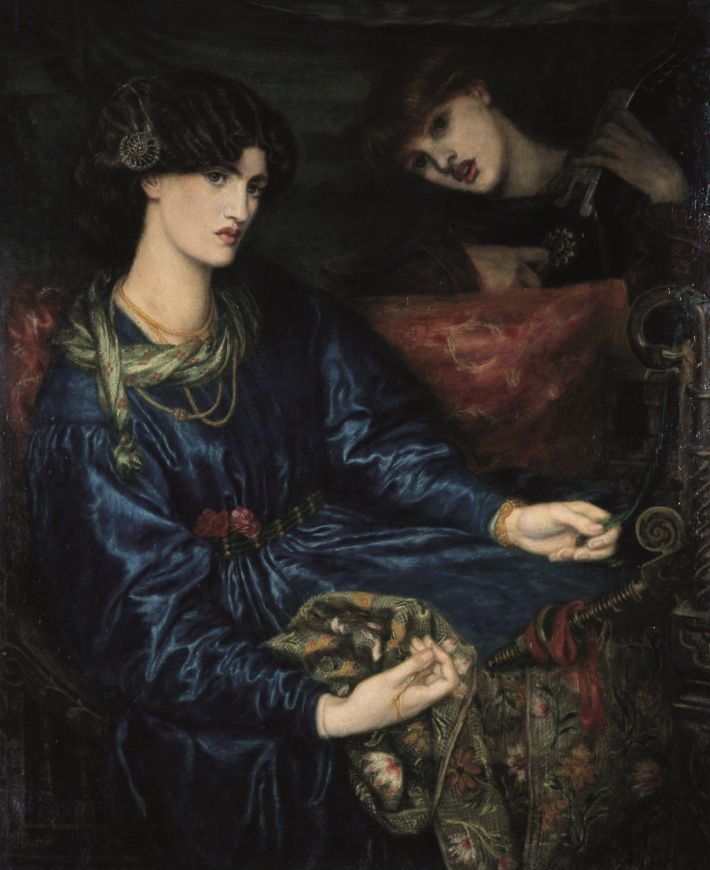
In London and on the Isle of Wight, a community of artists forged closer links between the visual arts, music and literature. This circle included the photographer Julia Margaret Cameron, painters George Frederic Watts and Dante Gabriel Rossetti, and the poet Alfred Tennyson. Rossetti and Cameron worked with similar subjects, many inspired by Tennyson’s poetry. Together with Watts they developed a newly-intimate form of portraiture, exploring emotional and psychological states. They also shared models, whose striking looks introduced new types of modern beauty.


Julia Margaret Cameron (British born India, 1815-1879) 'Whisper of the Muse' 1865


Julia Margaret Cameron (British, 1815-1879)
Whisper of the Muse
1865
Photograph, albumen print on paper
325 x 238mm
Wilson Centre for Photography


Dante Gabriel Rossetti (English, 1828-1882) 'Mariana' 1870


Dante Gabriel Rossetti (English, 1828-1882)
Mariana
1870
Oil on canvas
Aberdeen Art Gallery & Museum Collection


Into Light and Colour

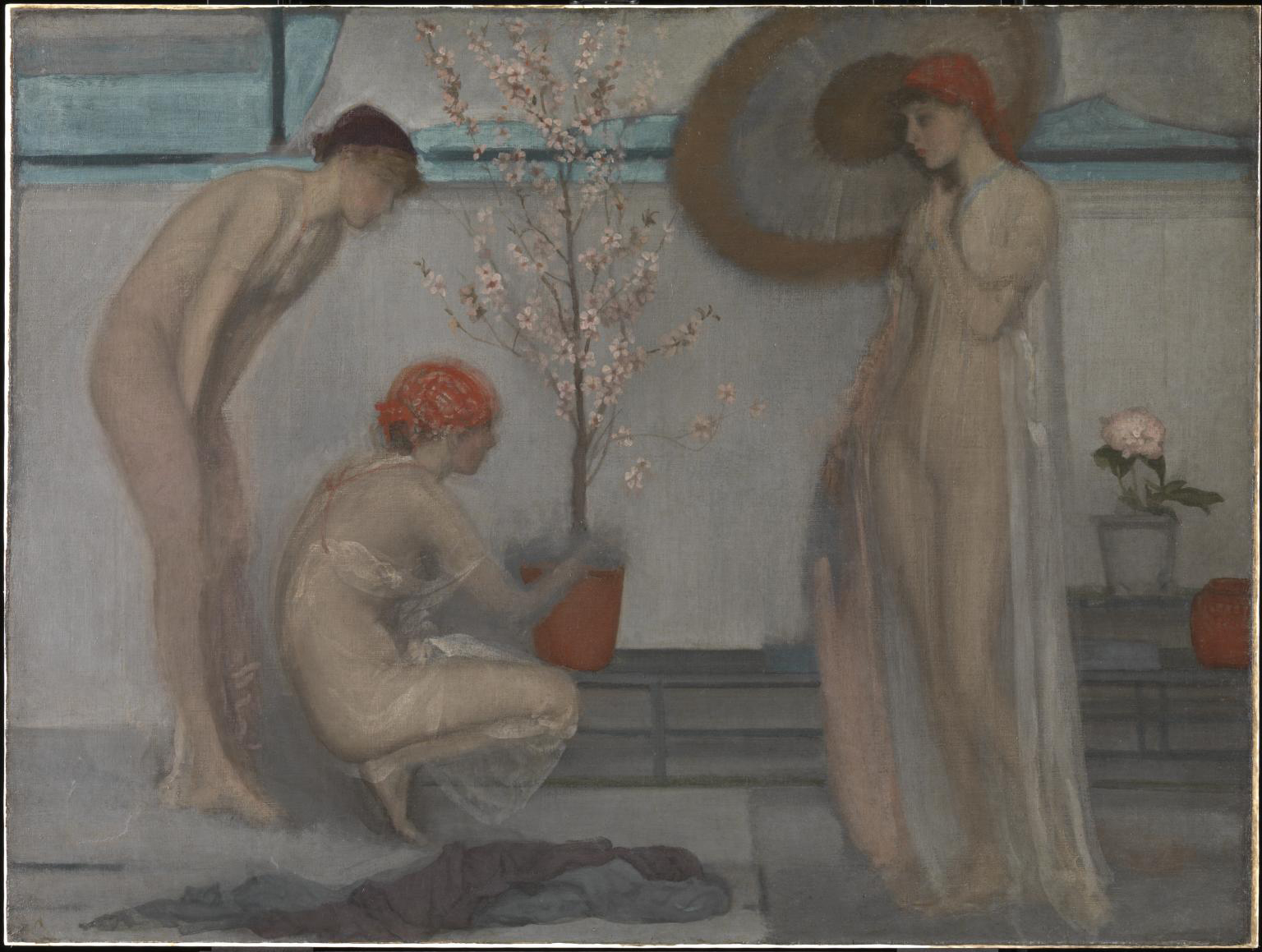
In the second half of the nineteenth century Japanese culture became an important influence in Britain. Japanese goods were sold in London in new department stores such as Liberty, while the Japanese Village, established in Knightsbridge in 1885, attracted more than a million visitors.

Japanese props and motifs appeared in art and design and the vogue for Japanese prints inspired painters and photographers. Painters experimented with new colour palettes, flattened picture planes and condensed, cropped formats, innovations also important to later British impressionist works. Such experiments in light and colour were paralleled in photography with the 1907 introduction of the autochrome, the first practical colour photographic process.


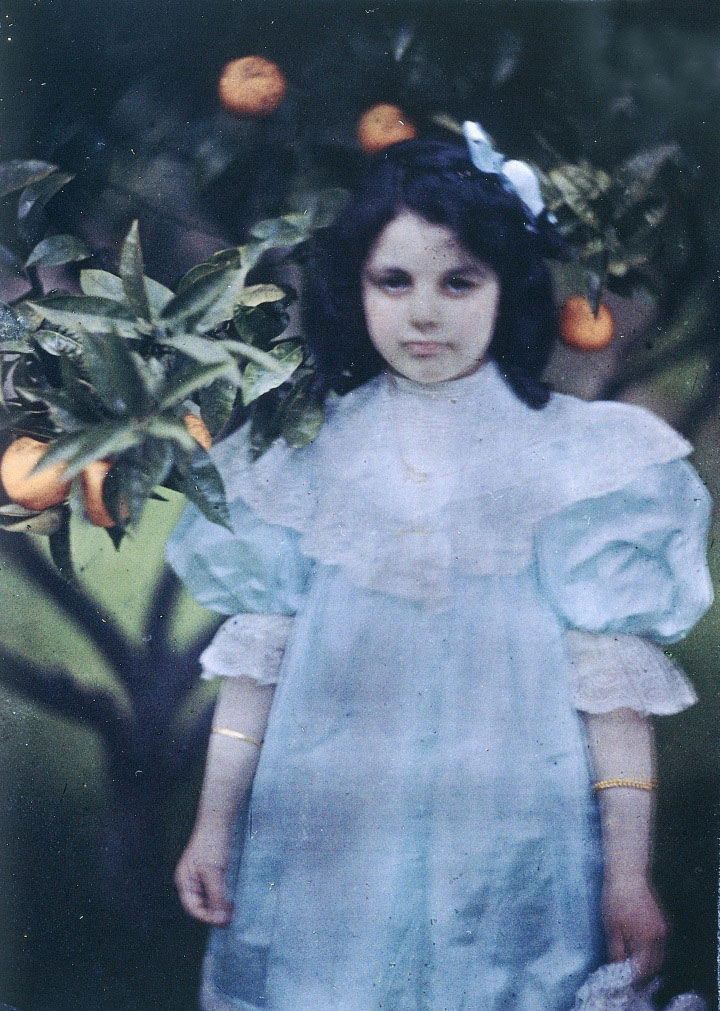
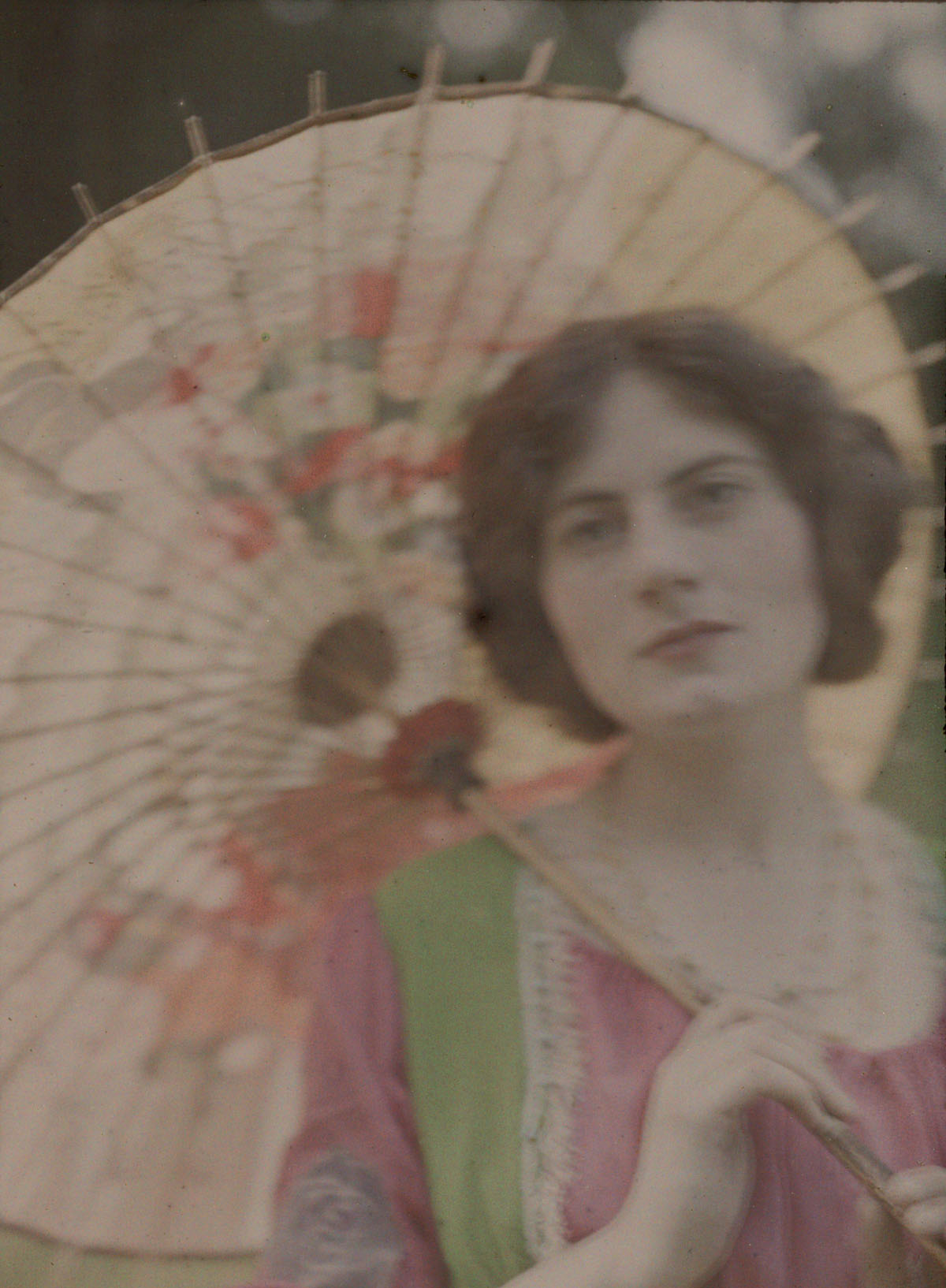
John Cimon Warburg (British, 1867-1931) 'Peggy in the Garden' 1909, printed 2016


John Cimon Warburg (British, 1867-1931)
Peggy in the Garden
1909, printed 2016
Photograph, transparency on lightbox from autochrome
Royal Photographic Society / National Media Museum / Science and Society Picture Library


John Cimon Warburg (1867-1931) British photographer born to a wealthy family dedicated his whole life to photography. In 1897, he joined the Royal Photographic Society. During his photographic career, John Cimon Warburg used a wide range of photographic processes, but excelled especially in autochromes. Best known for his atmospheric landscapes and its fascinating studies of his children, Warburg lectured and written about the process and explained his autochromes the annual exhibition of the Royal Photographic Society.

Text from the Autochrome website [Online] Cited 18/09/2016. No longer available online


Patented by the Lumière brothers in 1903, Autochrome produced a colour transparency using a layer of potato starch grains dyed red, green and blue, along with a complex development process. Autochromes required longer exposure times than traditional black-and-white photos, resulting in images with a hazy, blurred atmosphere filled with pointillist dots of colour.


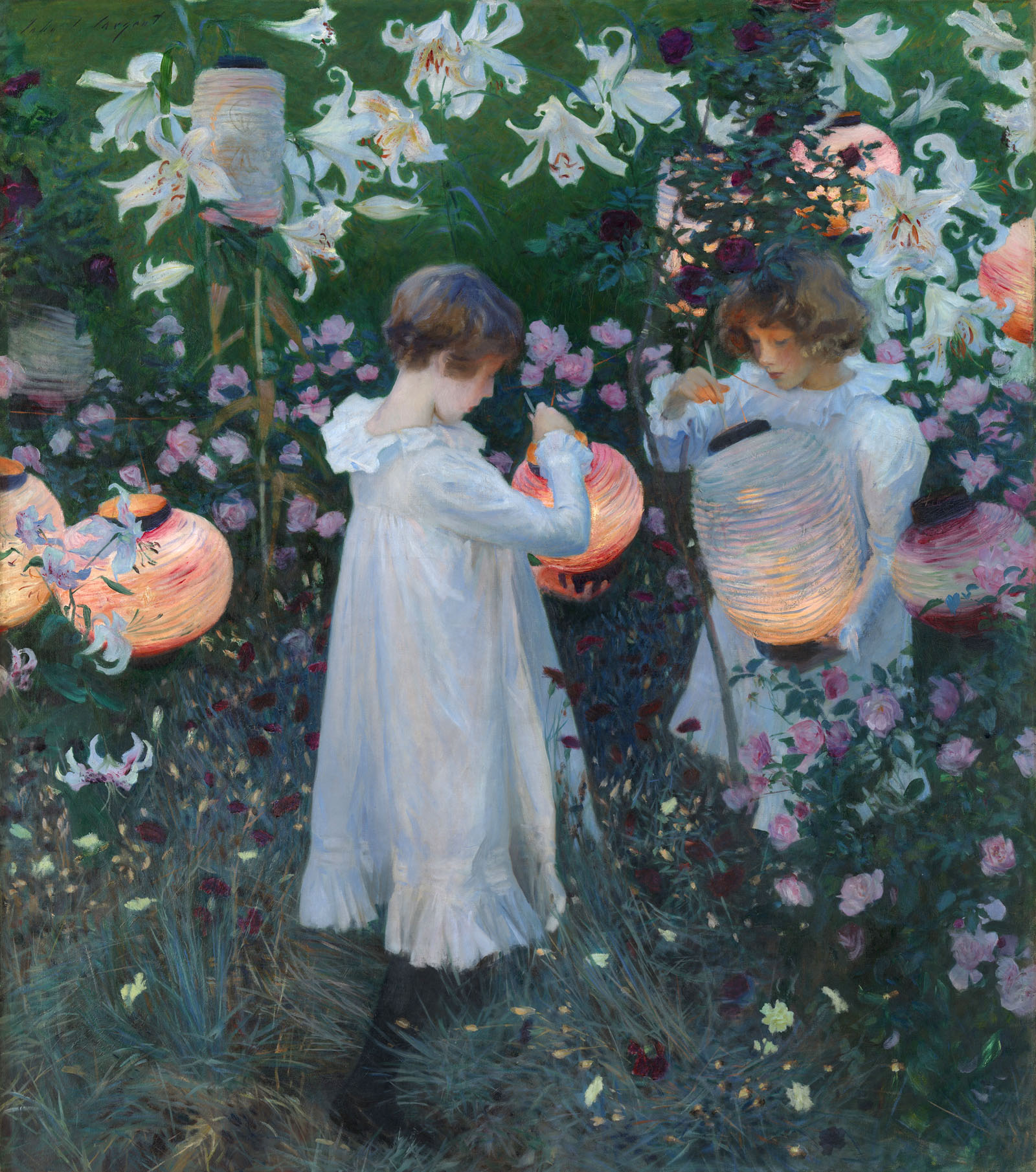
John Singer Sargent (American, 1856-1925) 'Carnation, Lily, Lily, Rose' 1885-1886


John Singer Sargent (American, 1856-1925)
Carnation, Lily, Lily, Rose
1885-1886
Oil paint on canvas
1740 x 1537 mm
Tate. Presented by the Trustees of the Chantrey
Bequest 1887


The inspiration for Carnation, Lily, Lily, Rose came during a boating expedition Sargent took on the Thames at Pangbourne in September 1885, with the American artist Edwin Austin Abbey, during which he saw Chinese lanterns hanging among trees and lilies. He began the picture while staying at the home of the painter F.D. Millet at Broadway, Worcestershire, shortly after his move to Britain from Paris. At first he used the Millets’s five-year-old daughter Katharine as his model, but she was soon replaced by Polly and Dorothy (Dolly) Barnard, the daughters of the illustrator Frederick Barnard, because they had the exact hair-colour Sargent was seeking.

He worked on the picture, one of the few figure compositions he ever made out of doors in the impressionist manner, from September to early November 1885, and again at the Millets’s new home, Russell House, Broadway, during the summer of 1886, completing it some time in October. Sargent was able to work for only a few minutes each evening when the light was exactly right. He would place his easel and paints beforehand, and pose his models in anticipation of the few moments when he could paint the mauvish light of dusk.

As autumn came and the flowers died, he was forced to replace the blossoms with artificial flowers. The picture was both acclaimed and decried at the 1887 Royal Academy exhibition. The title comes from the song The Wreath, by the eighteenth-century composer of operas Joseph Mazzinghi, which was popular in the 1880s. Sargent and his circle frequently sang around the piano at Broadway. The refrain of the song asks the question ‘Have you seen my Flora pass this way?’ to which the answer is ‘Carnation, Lily, Lily, Rose’.

Terry Riggs. “Carnation, Lily, Lily, Rose,” on the Tate website February 1998 [Online] Cited 16/02/2023


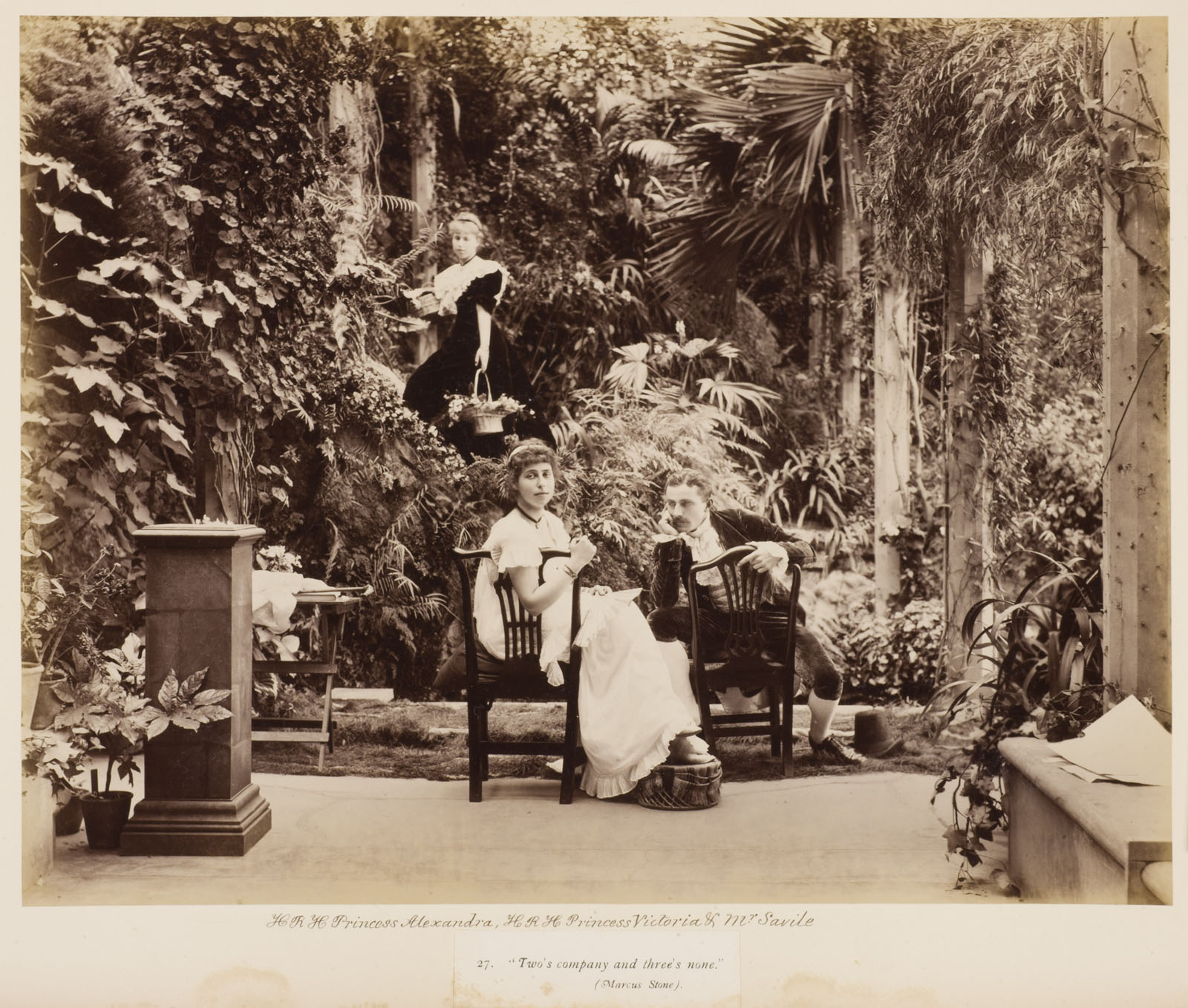
Unknown photographer. 'H.R.H. Princess Alexandra, H.R.H. Princess Victoria & Mr. Savile, “Two’s company and three’s none” in Tableaux Vivants Devonport' c. 1892-1893


Unknown photographer
H.R.H. Princess Alexandra, H.R.H. Princess Victoria & Mr. Savile, “Two’s company and three’s none” in Tableaux Vivants Devonport
c. 1892-1893
Bound volume. Displayed open at Marcus C. Stone’s ‘Two’s Company, Three’s None”
Photograph, albumen print on paper
360 x 480 x 58mm – book closed
Wilson Centre for Photography


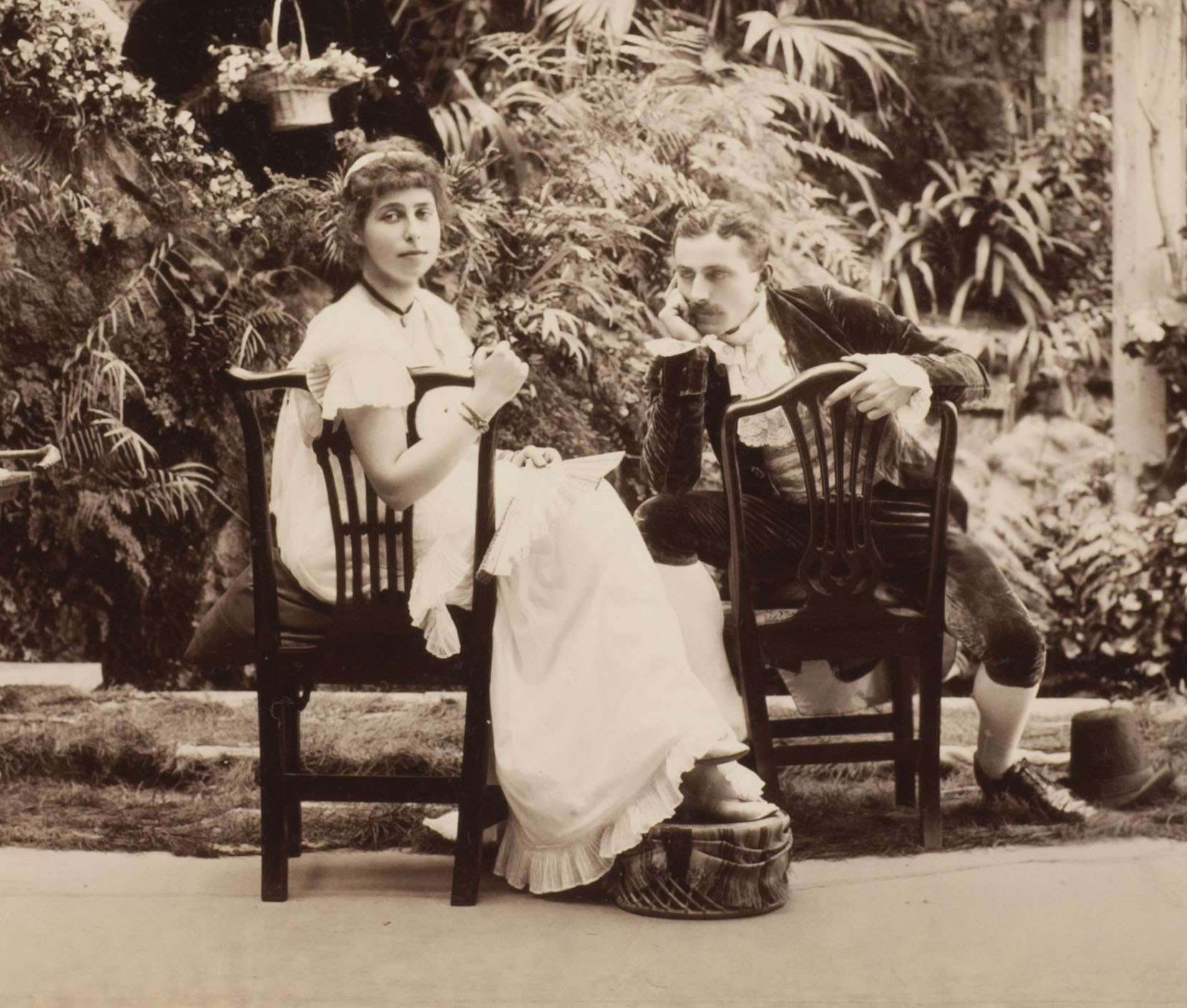
Unknown photographer. 'H.R.H. Princess Alexandra, H.R.H. Princess Victoria & Mr. Savile, “Two’s company and three’s none” in Tableaux Vivants Devonport' c. 1892-1893 (detail)


Unknown photographer
H.R.H. Princess Alexandra, H.R.H. Princess Victoria & Mr. Savile, “Two’s company and three’s none” in Tableaux Vivants Devonport (detail)
c. 1892-1893
Bound volume. Displayed open at Marcus C. Stone’s ‘Two’s Company, Three’s None”
Photograph, albumen print on paper
360 x 480 x 58mm – book closed
Wilson Centre for Photography


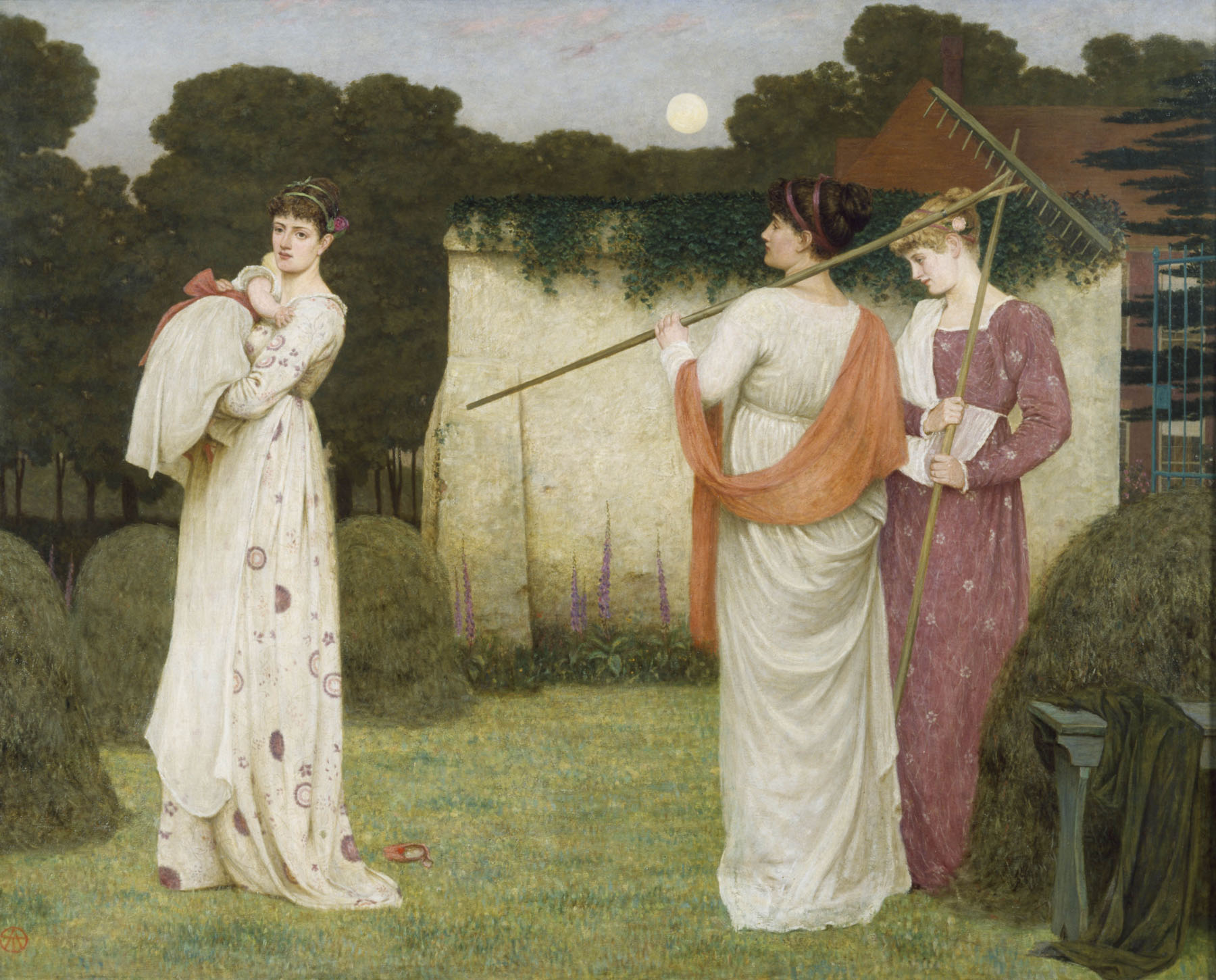
Thomas Armstrong (English, 1832-1911) 'The Hay Field' 1869


Thomas Armstrong (English, 1832-1911)
The Hay Field
1869
© Victoria and Albert Museum, London


Atmosphere and Effect

The relationship between landscape painting and photography continued to develop into the twentieth century. The etchings and nocturnes of James Abbott McNeill Whistler inspired photographers, who adopted his atmospheric subjects and aesthetics. While photography had achieved a technical sophistication that allowed photographers to produce highly resolved, realistic images, many chose to pursue soft-focus effects rather than detail and precision. Such photographs paralleled the unpeopled landscapes of painters like John Everett Millais and the gas-lit cityscapes of John Atkinson Grimshaw.


James Abbott McNeill Whistler (American, 1834-1903) 'Three Figures Pink and Grey' 1868-1878


James Abbott McNeill Whistler (American, 1834-1903)
Three Figures Pink and Grey
1868-1878
Oil paint on canvas
Support: 1391 x 1854mm
Frame: 1701 x 2158 x 75mm
Tate
Purchased with the aid of contributions from the International Society of Sculptors, Painters and Gravers as a Memorial to Whistler, and from Francis Howard 1950


This picture derives from one of six oil sketches that Whistler produced in 1868 as part of a plan for a frieze, commissioned by the businessman F.R. Leyland (1831-1892), founder of the Leyland shipping line. Known as the ‘Six Projects’, the sketches (now in the Freer Art Gallery, Washington) were all scenes with women and flowers, and all six were strongly influenced by his admiration for Japanese art. Another precedent for these works was The Story of St George, a frieze that Edward Burne-Jones (1833-1898) executed for the artist and illustrator Myles Birket Foster (1825-1899) in 1865-1867. The series of large pictures was destined for Leyland’s house at Prince’s Gate, but never produced, and only one – The White Symphony: Three Girls (1867) was finished, but was later lost. Whistler embarked on a new version, Three Figures: Pink and Grey, but was never satisfied with this later painting, and described it as, ‘a picture in no way representative, and in its actual condition absolutely worthless’ (quoted in Wilton and Upstone, p. 117). He followed the original sketch closely, but made a number of pentimenti which suggest that the picture is not simply a copy of the lost work. In spite of Whistler’s dissatisfaction, it has some brilliant touches and a startlingly original composition.

Although the three figures are clearly engaged in tending a flowering cherry tree, Whistler’s aim in this picture is to create a mood or atmosphere, rather than to suggest any kind of theme. Parallels have been drawn with the work of Albert Moore, whose work of this period is equally devoid of narrative meaning. The design is economical and the picture space is partitioned like a Japanese interior. The shallow, frieze-like arrangement, the blossoming plant and the right-hand figure’s parasol are also signs of deliberate Japonisme. Whistler has suppressed some of the details in the oil sketch, effectively disrobing the young girls by depicting them in diaphanous robes. The painting is characterised by pastel shades, a ‘harmony’ of pink and grey, punctuated by the brighter reds of the flower pot and the girls’ bandannas, and the turquoise wall behind. It has been suggested that Whistler derived his colour schemes, and even the figures themselves, in their rhythmically flowing drapery, from polychrome Tanagra figures in the British Museum, which was opposite his studio in Great Russell Street.

Frances Fowle. “Three Figures: Pink and Grey,” on the Tate website December 2000 [Online] Cited 16/02/2023


John Cimon Warburg (British, 1867-1931) 'The Japanese Parasol' c. 1906


John Cimon Warburg (British, 1867-1931)
The Japanese Parasol
c. 1906
Autochrome
711 x 559mm
© Royal Photographic Society / National Media
Museum/ Science & Society Picture Library


Life and Landscape

The 1880s brought a renewed interest in landscape. Rural scenes provided common ground for British painters and photographers. Their distinctive style derived from French realism and impressionism, which had been introduced by independent galleries, and by artists such as George Clausen and Henry La Thangue who studied in Paris. This new approach was shared by their friend and fellow painter Thomas Goodall, and influenced his collaboration with the photographer Peter Henry Emerson. Emerson and Goodall’s first project, a photographic series on the Norfolk Broads, focused on the life of working people, as described in their album Life and Landscape on the Norfolk Broads, published in 1887.


Sir George Clausen (British, 1852-1944) 'Winter Work' 1883-1884


Sir George Clausen (British, 1852-1944)
Winter Work
1883-1884
Oil on canvas
Frame: 1075 x 1212 x 115mm
Support: 775 x 921mm
Purchased with assistance from the Friends of the Tate Gallery 1983
© The estate of Sir George Clausen


In the 1880s Clausen devoted himself to painting realistic scenes of rural work after seeing such pictures by the French artist Jules Bastien-Lepage (1848-1884). In this picture he shows a family of field workers topping and tailing swedes for sheep fodder. It was painted at Chilwick Green near St Albans, where the artist had moved in 1881. He uses subdued colouring to capture the dull light and cold of winter, and manages to convey the hard reality of country work. Such unromanticised scenes of country life were often rejected by the selectors of the Royal Academy annual exhibitions.


Thomas Frederick Goodall (British, 1856-1944) and Peter Henry Emerson (British, 1856-1936) 'Setting the Bow-Net, in Life and Landscape on the Norfolk Broads' 1885, published 1887


Thomas Frederick Goodall (British, 1856-1944) and Peter Henry Emerson (British, 1856-1936)
Setting the Bow-Net, in Life and Landscape on the Norfolk Broads
1885, published 1887
Book – open at The Bow Net
Photograph, platinum print on paper
300 x 420mm (book closed)
Private collection


Thomas Frederick Goodall (British, 1856-1944) 'The Bow Net' 1886


Thomas Frederick Goodall (British, 1856-1944)
The Bow Net
1886
Oil paint on canvas
838 x 1270mm
National Museums Liverpool, Walker Art Gallery


Roger Fenton (British, 1819-1869) 'The Water Carrier' 1858


Roger Fenton (British, 1819-1869)
The Water Carrier
1858
Albumen Print, Wilson Center for Photography


Frederick Goodall (English, 1822-1904), R.A. 'The Song of the Nubian Slave' 1863


Frederick Goodall (English, 1822-1904), R.A.
The Song of the Nubian Slave
1863
Diploma Work, accepted 1863
71.2 x 92 x 2.3cm
Oil on canvas
Photo credit: © Royal Academy of Arts, London; Photographer: John Hammond


Out of the Shadows

In the late nineteenth century, painters and photographers pursued the representation of an idealised beauty, inspired by Italian Renaissance artists such as Michelangelo and Leonardo da Vinci. Themes of allegory and myth were widely explored in the arts at this time, particularly in Britain in the writings of Walter Pater and Oscar Wilde.

At the turn of the century painting and photography were part of a wider artistic search for harmony between subject matter and expression. Artists found inspiration in each other’s practice and continued to share ideas through illustrated books and journals. This spirit of collaboration and interchange led photographer Fred Holland Day to claim that ‘the photographer no longer speaks the language of chemistry, but that of poetry’.


Alvin Langdon Coburn (American, 1882-1966) 'Regent's Canal' c. 1904-1905, published 1909


Alvin Langdon Coburn (American, 1882-1966)
Regent’s Canal
c. 1904-1905, published 1909
Photogravure on paper
Image: 206 x 161 mm
Frame: 508 x 406 mm

Wilson Centre for Photography


Arthur Hacker (English, 1858-1919) 'A Wet Night at Piccadilly Circus' 1910


Arthur Hacker (English, 1858-1919)
A Wet Night at Piccadilly Circus
1910
Oil on canvas
710 x 915mm
Royal Academy of Arts, London


Alvin Langdon Coburn (American, 1882-1966) 'Leicester Square (The Old Empire Theatre)' 1908, published 1909


Alvin Langdon Coburn (American, 1882-1966)
Leicester Square (The Old Empire Theatre)
1908, published 1909
Photogravure on paper
Image: 206 x 172mm
Frame: 508 x 406mm
Wilson Centre for Photography


Edward Linley Sambourne (English, 1844-1910) 'Ethel Warwick, Camera Club, 2 August 1900'


Edward Linley Sambourne (English, 1844-1910)
Ethel Warwick, Camera Club, 2 August 1900
Photograph, cyanotype on paper
Dimensions
Image: 165 x 120mm
Frame: 507 x 855mm
18 Stafford Terrace, The Royal Borough of Kensington and Chelsea


Tate Britain
Millbank, London SW1P 4RG
United Kingdom
Phone: +44 20 7887 8888

Opening hours:
Daily 10.00am – 18.00pm

Tate Britain website

LIKE ART BLART ON FACEBOOK

Back to top

Exhibition: ‘The Intimate World of Josef Sudek’ at Jeu de Paume, Paris

Exhibition dates: 7th June – 25th September, 2016


Josef Sudek (Czech, 1896-1976) 'St. Vitus cathedral, Prague, Czech Republic' c. 1926 from the exhibition 'The Intimate World of Josef Sudek' at Jeu de Paume, Paris, June - Sept, 2016


Josef Sudek (Czech, 1896-1976)
St. Vitus cathedral, Prague, Czech Republic
c. 1926
Silver gelatin print


A poetry of the everyday

Josef Sudek, a one-armed man lugging around a large format camera, is one of my top ten photographers of all time.

His photographs, sometimes surreal, always sensitive, have a profound sensibility that affect the soul. Melancholy and mysterious by turns, they investigate the inner life of objects which stand as metaphors for the inner life of the artist. A form of healing after his horrific injuries and the loss of his arm during the First World War, the photographs purportedly look outwards upon the world but are actually interior meditations on life, death and the nature of being. Light emerges from the darkness; understanding from tribulation; and Sudek, in Jungian terms, integrates his ego into his soul through the process of (photographic) individuation – whereby the personal and collective unconscious (his hurt and damage) are brought into consciousness (eg. by means of dreams, active imagination, or free association) to be assimilated into the whole personality. It is a completely natural process necessary for the integration of the psyche and, in Sudek’s life, was integral to his healing from the vicissitudes of war.

Using Pictorialism as the starting point for his exploration of the world, Sudek never abandons the creation of “atmosphere” in his photographs, even as the images become modernist, surrealist and offer a new way of seeing the world. Having myself photographed extensively at night, and from the interior of my flat, I can understand Sudek’s fascination with both locations: the quiet of night, the stillness, the clarity of vision and thought; the interior as exterior, the projection of interior thoughts onto an external surface reflected back into the camera lens. “Nature, architecture, streets and objects are magnified by his sensitivity and mastery of the effects of light, contrasting with the impenetrable cloak of darkness.” Except the cloak of darkness is not impenetrable, as light cannot exist without darkness.

Pace, his photographs are breath / taking. They are exhalations of the spirit.

Sudek’s ability to transcend the literal, his ability to transform the objectal quality of photography ranks him as one of the top photographers of all time. He synthesises  a poetry of objects, a poetry of the everyday, and projects the folds of his mind onto the visual field (through “tears” of condensation on the window, through labyrinths of paper and glass, such as in Labyrinth on my table, 1967, below). As a form of self-actualisation – the desire to become everything that one is capable of becoming – Sudek’s photographs interrogate that chthonic darkness that lurks in the heart of everyone of us, our dark night of the soul.

In that process of discovery (who am I, what kind of human being am I, how can I heal myself), he finds redemption.

Dr Marcus Bunyan


Many thankx to Jeu de Paume for allowing me to publish the photographs in the posting. Please click on the photographs for a larger version of the image.


“I like to tell stories about the life of inanimate objects, to relate something mysterious: the seventh side of a dice. Everything around us, dead or alive, in the eyes of a crazy photographer mysteriously takes on many variations, so that a seemingly dead object comes to life through light or by its surroundings.”


Josef Sudek


Josef Sudek at Jeu de Paume

“The Intimate World of Josef Sudek”, exhibition at Jeu de Paume Paris, from 07 June 2016 until 25 September 2016

Entitled “The Intimate World of Josef Sudek”, this exhibition is the first of this scale to revisit the life and work of Josef Sudek (Kolin, 1896 – Prague, 1976) within its socio-geographical and historical context: Prague during the first half of the twentieth century, at a time when the Czech capital was a veritable hub of artistic activity.

The exhibition features a selection of 130 works spanning the totality of Sudek’s career, from 1920 to 1976, and allows the public to examine the extent to which his photography was a reflection of his personal relationship to the surrounding world. On display are works that are the result of Sudek’s photographic experiments carried out within the privacy of his own studio, images of the garden seen from his window, and photographs of adventures further afield. The artist enjoyed meandering through the streets of Prague and its surrounding suburbs, and made frequent excursions to the nearby countryside.

Sudek’s enduring fascination with light, and its absence, is at the root of some of the most haunting photographs of the twentieth century. Nature, architecture, streets and objects are magnified by his sensitivity and mastery of the effects of light, contrasting with the impenetrable cloak of darkness.

Text from the Jeu de Paume Vimeo website


On display are works that are the result of Sudek’s photographic experiments carried out within the privacy of his own studio, images of the garden seen from his window, and photographs of adventures further afield. The artist enjoyed meandering through the streets of Prague and its surrounding suburbs, and made frequent excursions to the nearby countryside. Sudek’s enduring fascination with light, and its absence, is at the root of some of the most haunting photographs of the twentieth century. Nature, architecture, streets and objects are magnified by his sensitivity and mastery of the effects of light, contrasting with the impenetrable cloak of darkness.

As a photographer, Sudek was particularly concerned with the quality of the photographic print, an essential component in terms of the expressive potential of an image. His mastery of the pigment printing process enabled him to produce highly atmospheric and evocative images, thereby reaping all of the reflective and descriptive power of the gelatin silver print. The exhibition presents work from Sudek’s early career, but also features photographs from a pivotal period of experimentation and innovation, beginning in the 1940s. Focusing on the technical and formal aspects of the medium of photography, Sudek created pigment prints, halftone prints, puridlos (photographs between two windows) and veteše (photographs inserted into old frames), techniques which allowed him to transform the objectal quality of photography.

The loss of his right arm during the First World War and the difficulties he now encountered in transporting his view camera did not dampen his passion for photography. Sudek’s studio window became an object of abiding fascination – rather like the surface of a canvas – reflecting moments of exquisite tenderness and hope when a flowering branch brushed against its pane, or of poignant melancholy when he observed the world beyond his window transformed by the playful infinity of mist. His room with a view allowed him to capture, on film, his love of Prague. His photographs demonstrate both a precision and a depth of feeling, fitting odes to the rich history and architectural complexity of the Czech capital.

Like many artists of his generation marked by their experience of war, Sudek expresses a particularly acute awareness of the dark and tormented aspects of human existence – feelings that would inspire some of his most melancholy and most moving pictures. A photograph taken at night, through the glass pane of his window, shows a city plunged into darkness during the Occupation of the Second World War, and communicates a sentiment of unspeakable despair – a dramatic illustration of Sudek’s technical ability to transcend the literal.

The first part of the exhibition features images that herald the photographer’s later work, showing his early landscapes, portraits of fellow patients at Invalidovna, the Prague hospice for war invalids like Sudek, his hesitant foray into modernism, and his interior shots of St. Vitus Cathedral. Through images that recount the narrative of his life, the viewer gains access to Sudek’s inner world, and an insight into his immediate environment, the views and objects he loved, his studio and garden. His endless walks in Prague found expression in the views of the city and its surroundings, as well as in photographs of its more sordid “suburbs”, a subject explored by other Prague artists. The eastern and northern areas of Bohemia, the Beskid Mountains and the Mionší forest were other destinations close to the photographer’s heart. The exhibition “The Intimate World of Josef Sudek” provides a fascinating panorama of the work of this unique artist.

Text from the Jeu de Paume website


Beginnings

Sudek’s first photographic prints – small and largely assembled in albums – were mainly views of the countryside taken along the Elbe River when he travelled from Prague to Kolín to visit his mother between 1916 and 1922.

Using processes such as gelatin silver and bromoil he showed a talent for printing his pictures in a style that favoured soft edges and broad swathes of tone. Here Sudek was not so much studying the effects of light as he was observing the conventions of Pictorialism, a photography movement that straddled the last decade of the nineteenth century and the first decades of the twentieth century, and was based on a strong Romantic ethos. Pictorialist photographers enhanced atmospheric effects with such processes as carbon and gum bichromate. Sudek began using the carbon process regularly and in a personally expressive manner in the late 1940s.

His Invalidovna and St. Vitus Cathedral series in Prague, begun in the first half of the 1920s, show him exploring interior spaces where light emphasises both the profane and the sacred. The play of bands of sunlight and darkness is a central feature of the composition and, indeed, of the life of the photograph.


Josef Sudek (Czech, 1896-1976) 'Dimanche après-midi à l'île Kolín' [Sunday afternoon at Kolín island] c. 1922–1926


Josef Sudek (Czech, 1896-1976)
Dimanche après-midi à l’île Kolín [Sunday afternoon at Kolín island]
c. 1922-1926
Gelatin silver print
28.4 × 28.7cm
Musée des beaux-arts du Canada, Ottawa. Achat, 2000
© Succession de Josef Sudek


“… [Sudek] referred to photography as meteorology to describe the significance of the atmosphere, and how a photographer must predict the right conditions for photographing and enlarging prints. His work became sharper with richer tones, and his compositions became more illusive. The foregrounds and backgrounds of his photographs, particularly in his “Window” series began to oscillate. These achievements were perhaps made more attainable by his focus on inanimate objects over which he had more control than living things. Most of his cityscapes became deserted, as he directed his camera at statues or replaced what would have been a living subject with such emulative sculptures.

In effect, Sudek’s substitution of the inanimate for the animate brought the objects he photographed to life in his mind. He called the enormous decaying trees in the woods of Bohemia “sleeping giants” and would take portraits of masks and statuary heads, transforming them into frozen, worn grotesqueries. His personification of objects is even more vivid in his studio photography, particularly after 1939, the oncoming of World War II and the Nazi occupation of Prague. As the city was oppressed by German troops, the artist retreated into his studio and insulated himself sentimentally with still lifes. To an interviewer, he explained, “I love the life of objects. When the children go to bed, the objects come to life. I like to tell stories about the life of inanimate objects.” He devoted endless hours to arranging and photographing the everyday – apples, eggs, bread, and shells – and special objects given to him by friends, such as feathers, spectacles, and watches, which he called “remembrances” of that person. A photograph from his series “Remembrances of Architect Rothmayer, Mr. Magician,” for example, portrays objects respectfully placed in a row on a desk, as if artifacts from an archeological site, from which the history of a life or character of a man could be divined.

“Everything around us, dead or alive, in the eyes of a crazy photographer mysteriously takes on many variations,” Sudek said, “so that a seemingly dead object comes to life through light or by its surroundings.” This statement is perhaps telling of Sudek’s relationship to death and life, as a result of the loss of his arm and the manner in which he suffered the loss. In the 1963 film, “Zit Svuj Zivot” (Living Your Life), a documentary portrait of Sudek by Evald Strom, we see a sensitive man describing his efforts to photograph the reality of the objects around him, not as if he were bringing the objects to life, but as if it was his purpose to represent the lives of objects as they truly are. Of the image of a vase of wildflowers, he says “This is a photograph of wildflowers, my attempt to photograph wildflowers,” and of an old lamp, “This is a celebrated lamp; it holds a lot of memories.””

Ashley Booth Klein, “Josef Sudek and The Life of Objects,” in Obelisk Vol. 2 Issue 1, Winter 2015 [Online] Cited 18/09/2016. No longer available online


Josef Sudek (Czech, 1896-1976) 'Rue de Prague' 1924


Josef Sudek (Czech, 1896-1976)
Rue de Prague
1924
Gelatin silver print
8.3 × 8.2cm
Musée des beaux-arts du Canada, Ottawa. Don anonyme, 2010
© Succession de Josef Sudek


Josef Sudek (Czech, 1896-1976) 'Portrait de mon ami Funke' [Portrait of my friend Funke] 1924


Josef Sudek (Czech, 1896-1976)
Portrait de mon ami Funke [Portrait of my friend Funke]
1924
Gelatin silver print
28.5 × 22.6cm
Musée des beaux-arts du Canada, Ottawa. Achat, 1985
© Succession de Josef Sudek


“Josef Sudek: The World at My Window” is the first exhibition in France since 1988 to cover Sudek’s entire career and spotlight the different phases of his work. Coming in the wake of several exhibitions at the Jeu de Paume devoted to Eastern European photographers of the early twentieth century, among them André Kertész and Francois Kollar, this one comprises some 130 vintage prints by the Czech artist. Bringing to bear a vision at once subjective and timeless, Sudek captures the ongoing changes in Prague’s natural world and landscapes.

His early profession as a bookbinder came to an abrupt halt when he was conscripted into the Austro-Hungarian army in Bohemia and sent to the Italian front. After the First World War he came back to Prague wounded; the loss of his right arm meant abandoning bookbinding, and he turned to photography. After revisiting the battlefield in Italy once more he returned, in despair, to Prague: “I found the place,” he recounted, “but my arm wasn’t there. Since then I’ve never gone anywhere. I didn’t find what I was looking for.”

A study grant enabled him to train at the state-run school of graphic arts in Prague, where he mixed with practitioners of Pictorialism, a photographic movement aiming at achieving colour and texture effects similar to those of painting. He started concentrating on architectural details, always waiting until the light was absolutely perfect. Little by little he gave up the Pictorialist ambiences of his views of St Vitus’s cathedral, opting for a pure, straightforward approach which the American photographer Alfred Stieglitz summed up as “maximum detail for maximum simplification”.

During the Second World War Sudek began photographing the window giving onto his garden, the result being the celebrated Window of My Studio series. He then shifted his focus to the accumulated jumble of objects in the studio, producing a further series titled Labyrinths. Light was an inexhaustible theme in his work, orchestrating the seasons, making the invisible visible and transporting us into another world. As if to escape the leaden context of the War and then of Communism, Sudek took refuge in music, especially that of his compatriot Leoš Janáček. A true music lover, he gradually built up a substantial collection of recordings which he played to his friends during improvised concerts in his studio.

The second half of his career saw Sudek abandon photography’s traditional subjects as he explored the outskirts of Prague with his black view camera on his shoulder. Known as “the poet of Prague”, he became an emblematic figure in the Czech capital. Discreet and solitary, he gradually withdrew from the city’s art scene, leaving his studio only to prowl the streets at night with his imagination as his guide.

Sudek’s photographs rarely include people; his focus was more on empty urban and rural spaces. Fascinated by the streets of Prague, the city’s deserted parks and public gardens, and the wooded Bohemian landscapes his mastery of light rendered sublime, he preferred the un-enlarged contact print as a means of preserving all the detail and authenticity of the places he roamed through.  His work moved towards experiments with light. In photographs shot through with simplicity and sensitivity, Sudek foregrounds a kind of poetry of the everyday, using the interplay of light and shade to achieve a kind of fluctuation between interior and exterior.

Text from Jeu de Paume


Josef Sudek (Czech, 1896-1976) 'La Fenêtre de mon atelier' [The window of my studio] c. 1940-1948


Josef Sudek (Czech, 1896-1976)
La Fenêtre de mon atelier [The window of my studio]
c. 1940-1948
Gelatin silver print
17 × 11.2cm
Musée des beaux-arts du Canada, Ottawa. Don anonyme, 2010
© Succession de Josef Sudek


Josef Sudek (Czech, 1896-1976) 'La Fenêtre de mon atelier' [The window of my studio] c. 1940–1954


Josef Sudek (Czech, 1896-1976)
La Fenêtre de mon atelier [The window of my studio]
c. 1940-1954
Gelatin silver print
22.9 × 16.8cm
Musée des beaux-arts du Canada, Ottawa. Don anonyme, 2010
© Succession de Josef Sudek


Josef Sudek (Czech, 1896-1976) 'La Fenêtre de mon atelier' [The window of my studio] c. 1940-1950


Josef Sudek (Czech, 1896-1976)
La Fenêtre de mon atelier [The window of my studio]
c. 1940-1950
Gelatin silver print
28.1 × 22.9cm
Musée des beaux-arts du Canada, Ottawa. Don anonyme, 2010
© Succession de Josef Sudek


The world from my window

Sudek was not content with making single, unrelated images. He generally worked in projects or series, creating extended visual explorations of the phenomena and scenes he viewed – often from the closed window of his studio, which separated his private studio-home from the exterior world. In the series From My Window it was the endlessly varying states of transformation of droplets of water that he watched streaming down his windowpane. His images invite us to contemplate, with great fascination, the physical cycles of water and the phenomenon of rivulets coursing down a surface – like human tears. Reminding us even of [Paul] Verlaine’s “There is weeping in my heart like the rain upon the city…” Sometimes the melancholy mood of these images is leavened by a rose in a vase on the windowsill or tendrils of leaves announcing the arrival of spring.


There is weeping in my heart
like the rain falling on the town.
What is this languor
that pervades my heart?

Oh the patter of the rain
on the ground and the roofs!
For a heart growing weary
oh the song of the rain!

There is weeping without cause
in this disheartened heart.
What! No betrayal?
There’s no reason for this grief.

Truly the worst pain
is not knowing why,
without love or hatred,
my heart feels so much pain.

Paul Verlaine. “Il pleure dans mon coeur”


Josef Sudek (Czech, 1896-1976) 'Quatre saisons: l'été' [Four seasons: summer] c. 1940-1954


Josef Sudek (Czech, 1896-1976)
Quatre saisons: l’été [Four seasons: summer]
c. 1940-1954
From the series “La Fenêtre de mon atelier” [The window of my studio]
Gelatin silver print
22.6 × 17.1cm
Musée des beaux-arts du Canada, Ottawa. Don anonyme, 2010
© Succession de Josef Sudek


Josef Sudek (Czech, 1896-1976) 'La Dernière Rose' [The Last Rose] 1956


Josef Sudek (Czech, 1896-1976)
La Dernière Rose [The Last Rose]
1956
Gelatin silver print
28.2 x 23.2cm
Musée des beaux-arts du Canada, Ottawa. Don anonyme, 2010
© Succession Josef Sudek


Night walks

Sudek’s preoccupation with darkness dates to the Nazi Occupation of Prague from March 1939 until the end of the war. Experiencing his city plunged into nights of enforced darkness Sudek explored the absence of light in his pictures. We know that this was more than a technical exercise, for he wrote “Memories” and “Restless Night” on the verso of one nocturnal photograph dated 1943.

The curfews imposed on citizens at the time made it unlikely that Sudek ventured out into the city after dark during wartime. Neither agile nor inconspicuous with his large-format camera slung over his increasingly hunched back, Sudek would have risked his life had he done so. The small courtyard of his studio on Ujezd street was hidden from the road, however, and one or two lights in neighbouring apartments served as beacons. Well after sundown he would photograph the syncopated play of blurs of light against the wall of impenetrable blackness.

The spirit of place

Sudek visited and photographed places that held either personal or spiritual significance for him: the landscape along the Elbe River, Invalidovna, St. Vitus Cathedral, his studio, Prague’s complex streets and open squares, the majestic Prague Castle, the city’s surrounds, and Frenštát pod Radhoštĕm where he spent summers with friends. Hukvaldy, home of Leoš Janaček, the composer whose music he loved, was a particularly favoured haunt. This was true also of the ancient Mionší Forest where he navigated his way through dense brush and forests by way of shortcuts that he created and playfully named. The Beskid Mountains also served as spiritual retreat. Although he was an urbanite in many respects, Sudek’s love of nature and sense of despair for its desecration is strongly expressed in Sad Landscapes, his series of images made in the Most region where industrialisation ravaged the countryside in the 1950s.

The life of objects

Sudek collected everything. Today he would be known as a hoarder. But his obsession served him well, for out of the chaos of his small studio and living spaces he carefully selected a variety of these objects to photograph. From delicate feathers to crumpled paper and tinfoil, multi-faceted drinking glasses, flowers, fruit, seashells, envelopes, flasks, frames, prisms, candelabras, string and shoe moulds, the subjects ranged from the mundane to the exotic. Once chosen, the set-up was lovingly composed – often in subtly changed configurations with other objects – and carefully lit before being memorialised in either pigment or gelatin silver prints.


Josef Sudek (Czech, 1896-1976) 'Le Jardin Royal' [The Royal Garden] c. 1940-1946


Josef Sudek (Czech, 1896-1976)
Le Jardin Royal [The Royal Garden]
c. 1940-1946
Procédé pigmentaire au papier charbon [Carbon pigment on paper]
16.1 × 11.7cm
Musée des beaux-arts du Canada, Ottawa. Don anonyme, 2010
© Succession de Josef Sudek


Josef Sudek (Czech, 1896-1976) 'Prague pendant la nuit' [Prague at night] 1950


Josef Sudek (Czech, 1896-1976)
Prague pendant la nuit [Prague at night]
1950
Gelatin silver print
22.8 × 29cm
Musée des beaux-arts du Canada, Ottawa. Don anonyme, 2010
© Succession de Josef Sudek


Josef Sudek (Czech, 1896-1976) 'Prague pendant la nuit' [Prague at night] c. 1950-1959


Josef Sudek (Czech, 1896-1976)
Prague pendant la nuit [Prague at night]
c. 1950-1959
Gelatin silver print
12 × 16.7cm
Musée des beaux-arts du Canada, Ottawa. Don anonyme, 2010
© Succession de Josef Sudek


Josef Sudek (Czech, 1896-1976) 'Prague pendant la nuit' [Prague at night] c. 1950-1959


Josef Sudek (Czech, 1896-1976)
Prague pendant la nuit [Prague at night]
c. 1950-1959
Gelatin silver print
12.2 × 17.3cm
Musée des beaux-arts du Canada, Ottawa. Don anonyme, 2010
© Succession de Josef Sudek


Josef Sudek (Czech, 1896-1976) 'Le Jardin de Rothmayer' [The Rothmayer Garden] 1954-1959


Josef Sudek (Czech, 1896-1976)
Le Jardin de Rothmayer [The Rothmayer Garden]
1954-1959
Gelatin silver print
16.9 × 22.9cm
Musée des beaux-arts du Canada, Ottawa. Don anonyme, 2010
© Succession de Josef Sudek


Entitled “The Intimate World of Josef Sudek”, this exhibition is the first of this scale to revisit the life and work of Josef Sudek (Kolín, 1896 – Prague, 1976) within its socio-geographical and historical context: Prague during the first half of the twentieth century, at a time when the Czech capital was a veritable hub of artistic activity. The exhibition features a selection of 130 works spanning the totality of Sudek’s career, from 1920 to 1976, and allows the public to examine the extent to which his photography was a reflection of his personal relationship to the surrounding world. On display are works that are the result of Sudek’s photographic experiments carried out within the privacy of his own studio, images of the garden seen from his window, and photographs of adventures further afield. The artist enjoyed meandering through the streets of Prague and its surrounding suburbs, and made frequent excursions to the nearby countryside. Sudek’s enduring fascination with light, and its absence, is at the root of some of the most haunting photographs of the twentieth century. Nature, architecture, streets and objects are magnified by his sensitivity and mastery of the effects of light, contrasting with the impenetrable cloak of darkness.

As a photographer, Sudek was particularly concerned with the quality of the photographic print, an essential component in terms of the expressive potential of an image. His mastery of the pigment printing process enabled him to produce highly atmospheric and evocative images, thereby reaping all of the reflective and descriptive power of the gelatin silver print.

The exhibition presents work from Sudek’s early career, but also features photographs from a pivotal period of experimentation and innovation, beginning in the 1940s. Focusing on the technical and formal aspects of the medium of photography, Sudek created pigment prints, halftone prints, puridlos (photographs between two windows) and veteše (photographs inserted into old frames), techniques which allowed him to transform the objectal quality of photography. The loss of his right arm during the First World War and the difficulties he now encountered in transporting his view camera did not dampen his passion for photography.

Sudek’s studio window became an object of abiding fascination – rather like the surface of a canvas – reflecting moments of exquisite tenderness and hope when a flowering branch brushed against its pane, or of poignant melancholy when he observed the world beyond his window transformed by the playful infinity of mist. His room with a view allowed him to capture, on film, his love of Prague. His photographs demonstrate both a precision and a depth of feeling, fitting odes to the rich history and architectural complexity of the Czech capital.

Like many artists of his generation marked by their experience of war, Sudek expresses a particularly acute awareness of the dark and tormented aspects of human existence – feelings that would inspire some of his most melancholy and most moving pictures. A photograph taken at night, through the glass pane of his window, shows a city plunged into darkness during the Occupation of the Second World War, and communicates a sentiment of unspeakable despair – a dramatic illustration of Sudek’s technical ability to transcend the literal.

Through images that recount the narrative of his life, the viewer gains access to Sudek’s inner world, and an insight into his immediate environment, the views and objects he loved, his studio and garden. His endless walks in Prague found expression in the views of the city and its surroundings, as well as in photographs of its more sordid “suburbs”, a subject explored by other Prague artists. The eastern and northern areas of Bohemia, the Beskid Mountains and the Mionší forest were other destinations close to the photographer’s heart.

Text from Jeu de Paume


New ways of seeing

Although more influenced by prevailing photographic conventions in the beginning, Sudek came to show an openness to experimenting with new ways of composing and printing his images. In the late 1920s, Sudek photographed objects designed by modernist Ladislav Sutnar, thus creating angled views of furniture with reflective surfaces and ceramics of pure form.

Sudek’s most successful foray into modernism is his experimentation with grotesque (surreal) subjects such as mannequins, decaying sculptures and the accoutrements of the architect Otto Rothmayer’s garden. There is little doubt that in the fragmented figurative sculptures Sudek was recalling some of the human devastation that he witnessed on the battlefields of the First World War.


Josef Sudek (Czech, 1896-1976) 'Statue' c. 1948-1964


Josef Sudek (Czech, 1896-1976)
Statue
c. 1948-1964
Gelatin silver print
9 × 14cm
Musée des beaux-arts du Canada, Ottawa. Don anonyme, 2010
© Succession de Josef Sudek


Josef Sudek (Czech, 1896-1976) 'Dans le jardin' [In the garden] 1954-1959


Josef Sudek (Czech, 1896-1976)
Dans le jardin [In the garden]
1954-1959
Gelatin silver print
17 × 23.3cm
Musée des beaux-arts du Canada, Ottawa. Don anonyme, 2010
© Succession de Josef Sudek


Josef Sudek (Czech, 1896-1976) 'Labyrinthe sur ma table' [Labyrinth on my table] 1967


Josef Sudek (Czech, 1896-1976)
Labyrinthe sur ma table [Labyrinth on my table]
1967
Gelatin silver print
39 × 22.9cm
Musée des beaux-arts du Canada, Ottawa. Don anonyme, 2010
© Succession de Josef Sudek


Josef Sudek (Czech, 1896-1976) 'Labyrinthe de verre' [Glass Maze] around 1968-1972


Josef Sudek (Czech, 1896-1976)
Labyrinthe de verre [Glass Maze]
around 1968-1972
Gelatin silver print
39 × 22.9cm
Musée des beaux-arts du Canada, Ottawa. Don anonyme, 2010
© Succession de Josef Sudek


Josef Sudek (Czech, 1896-1976) 'Sans titre (Nature morte sur le rebord de la fenêtre)' [Untitled (Still life on the windowsill)] 1951


Josef Sudek (Czech, 1896-1976)
Sans titre (Nature morte sur le rebord de la fenêtre) [Untitled (Still life on the windowsill)]
1951
Montage par le photographe c. 1960.
Two silver gelatin prints, glass plate, lead
48.2 × 39.2cm
Musée des arts décoratifs, Prague.
© Succession de Josef Sudek


Jeu de Paume
1, Place de la Concorde
75008 Paris
métro Concorde
Phone: 01 47 03 12 50

Opening hours:
Tuesday: 11.00 – 21.00
Wednesday – Sunday: 11.00 – 19.00
Closed Monday

Jeu de Paume website

LIKE ART BLART ON FACEBOOK

Back to top

Review: ‘Degas: A New Vision’ at the National Gallery of Victoria International, Melbourne Part 2

Exhibition dates: 24th June – 18th September, 2016

Curator: Dr Ted Gott, Senior Curator of International Art at the National Gallery of Victoria


Edgar Degas (French, 1834-1917) 'Finishing the arabesque' 1877 from the exhibition 'Degas: A New Vision' at the National Gallery of Victoria International, Melbourne, June - Sept, 2016


Edgar Degas (French, 1834-1917)
Finishing the arabesque
1877
Oil and essence, pastel on canvas
67.4 x 38cm
Musée d’Orsay, Paris (RF 4040)
© Musée d’Orsay, Dist. RMN-Grand Palais / Patrice Schmidt


This is a magnificent exhibition, well paced and beautifully hung in the gallery spaces. It is gratifying to see a “blockbuster” at the National Gallery of Victoria that does not rely on papered walls or patterned floors, that just allows the work to speak for itself. There is an excellent chronological trajectory to the work, showcasing the holistic development of the artist in one interweaving arc: from the early history paintings, where Degas is educating himself not only in the history of art but also in the practicalities of the history of painting (how actually to paint) … through to the late, bravura pastels.

Pastel is Degas’s strongest medium and it was incredible to observe close up how he could make pastel look like oil paint and vice versa. My favourite was Femme à la toilette [Woman at her toilette] (c. 1894, below) were the flattened perspectival image disintegrates before your eyes: “As well as reflecting the artist’s love of Japanese woodblock prints with their frequently intimate subject matter, in this late drawing Degas applied his vivid pigments with an almost sculptural intensity, building them up as though modelling form with his fingers.” Abstraction eat your heart out.

His “impressions” of reality rely on a keen eye, a wonderful understanding of space and the refractions of light, and the use of depth of field. The paintings I like best were not of the ballet, but rather the everyday “observational” paintings of the theatre box, a conversation and, particularly, The laundress ironing (c. 1882-86, below) with its simplified planar colour fields that run in different directions. These “punctures” of reality, or punctum to use a photographic term, elevate mundane everyday occurrences into a revelatory state – as though these encounters were taken from the flow of space and time, one frame out of a non-linear narrative.

The paintings of women at the toilettes are not voyeuristic but show a love and passion for an intimacy with women which he perhaps never achieved in real life, brought forth in observations of the female form “that challenged conventional notions of feminine beauty in their depiction of non-idealised jolie-laide (unconventionally beautiful) models”. Melbourne arts blogger Natalie Thomas observes that, “”Women and girls are everywhere in this show, but strangely absent too,” writes Thomas. Despite the fact the majority of Degas’ work explores femininity and the female body, the show, she says, fails to provide a female perspective.” (Natalie Thomas quoted in Shad D’Souza, “Gender and the NGV: ‘More white male artists than you can shake a stick at’,” on The Guardian website 15 September 2016 Cited 16/09/2016).

While I agree with Natalie Thomas that these paintings fail to provide a contemporary female perspective, that is not all that these paintings are about. Of course, they are a privileged white male gaze looking upon the body of a female and we must accept and acknowledge that is what they are. But that is just one element of their narrative. It’s all very well critiquing the work from the present day and saying there is no female perspective, but in the era in which these “sensational” paintings emerged – it was an epoch where the privileged, powerful male gaze could look upon the female body. Yes, please look at the paintings from a contemporary perspective while understanding the conditions under which they were created, and then try to say something more interesting about them: the perspective, the colours, the form, the position of the painter, the framing of the scene, the possible disappearance of the artist to the sitter, as though the camera (his eyes) had disappeared: where someone is so used to the other being there, that they are natural (do not act or perform), unselfconscious in front of them. Then, and only then, do the paintings perhaps become something else – about women, their lives and habits / habitats. A different perspective from trotting out the usual “we are objectified / subjugated / defiled” trope.

The sculptures are the revelation of the exhibition. Again, the male gaze pushing and prodding at the female form… except, these sculptures seem to erupt from within – like bubbling hot mud that seems to emanate from deep within the artist, erupting into the glorious form of the female body. Dark and mysterious, I would have loved to have seen one of the wax models, just one, to see the colour and feel the fragility of that form, over the robustness of the bronze.

And finally to the last room, the late works. There is an essentialness to the late work, the form stripped bare, heavily applied pastel in layers, dark heavy outlines with the frame filled with an “orgy of colours” – he “developed an expressive use of colour and line that may have arisen due to his deteriorating vision.” But he could still feel what he was doing and we can feel it too: the working of the medium, the working of the theme to its final resolution.

While I didn’t know much about the work of Degas other than the ballet pictures before this exhibition – after three visits, perhaps I know just a little more.

Dr Marcus Bunyan

See Part 1 of the posting


Many thankx to the National Gallery of Victoria for allowing me to publish the artwork and photographs in the posting. All installation photographs © Marcus Bunyan and the National Gallery of Victoria. Please click on the photographs for a larger version of the image.


Edgar Degas biography

Edgar Degas was born in 1834 into a wealthy banking family. Unlike many of his contemporaries, his family were supportive of his artistic talent and desire to become an artist.

Degas resisted being labelled an ‘Impressionist’ yet was at the core of the movement’s most important manifestations. Classically trained, Degas initially aspired to be a painter of historical narratives. As he matured, however, he made the depiction of daily life the central focus of his art. He was drawn primarily to the human figure engaged in movement and work, sketching on the spot then working up his finished compositions indoors in his studio. Degas’ obsession with the theatre and ballet in particular enabled him to explore his fascination with artificial light, which set him apart from the other Impressionists who preferred to work out-of-doors capturing the transient effects of natural daylight.

Degas absorbed many diverse influences, from Japanese prints to Italian Mannerism, and reinterpreted them in innovative ways. Degas obsessively revisited and experimented with his favourite themes which saw him fashion varied and unusual vantage points and asymmetrical framing. His depictions of ballet dancers alone number in the hundreds. Such endeavours helped him to achieve the innovative and distinctive style which is explored in Degas: A New Vision.

Degas served in the Franco-Prussian War of 1870-71 and began to experience eyesight deterioration by the late 1880s. He increasingly took up sculpture as his eyesight weakened. In his later years, he was preoccupied with the subject of women bathing unselfconsciously and developed an expressive use of colour and line that may have arisen due to his deteriorating vision.

Degas continued working to as late as 1912. He died five years later in 1917, at the age of eighty-three.


Edgar Degas (French, 1834-1917) 'Danseuses, éventail [Dancers (Fan, design)]' 1879 (installation view)


Edgar Degas (French, 1834-1917)
Danseuses, éventail [Dancers (Fan, design)] (installation view)
1879
Gouache, pastel and oil paint on silk
Tacoma Art Museum, Washington State
Gift of Mr and Mrs W. Hilding Lindberg
Photo: © Marcus Bunyan and the National Gallery of Victoria


[Dancers (Fan, design)] belongs to a group of fans made in the late 1870s that reflect Degas’s fascination at this time with Japanese art. Highly aestheticised, these fans show how Degas took advantage of this unusual format to explore new compositional possibilities. Here, for example, the balletic action taking place on stage competes for the viewer’s attention with the theatre’s screening machinery, as well as with the group of black-clad abonnés (subscribers with back stage passes) gathered in the wings in the middle distance.

Wall text from the exhibition


Installation view of the exhibition 'Degas: A New Vision' at the National Gallery of Victoria International, Melbourne with at left, 'Theatre box' (1885) and at right, 'Theatre box' (1880)


Installation view of the exhibition Degas: A New Vision at the National Gallery of Victoria International, Melbourne with at left, Theatre box (1885) and at right, Theatre box (1880)
Photo: © Marcus Bunyan and the National Gallery of Victoria


Edgar Degas (French, 1834-1917 'La Loge [Theatre box]' 1885 (installation view)


Edgar Degas (French, 1834-1917)
La Loge [Theatre box] (installation view)
1885
Pastel
Hammer Museum, Los Angeles
The Armand Hammer Collection
Photo: © Marcus Bunyan and the National Gallery of Victoria


In contrast with his numerous ballet works, Degas produced relatively few studies of the spectators at the Opera and other theatrical venues. Theatre box is one of his most captivating studies of the magical effects created by artificial stage lighting. Its contrast between the shadowy reality of the viewer in her dimmer theatre box and the vividly illuminated fantasy being performed before her onstage is as compelling as it is radical.

Wall text from the exhibition


Edgar Degas (French, 1834-1917) 'La Loge [Theatre box]' 1880 (installation view)


Edgar Degas (French, 1834-1917)
La Loge [Theatre box] (installation view)
1880
Pastel and oil on cardboard on canvas
The Lewis Collection, Houston
Photo: © Marcus Bunyan and the National Gallery of Victoria


When exhibited at the fifth ‘impressionist’ group exhibition in Paris in 1880, this pastel attracted the attention of the critic Charles Ephrussi, who wrote glowingly of how it shoed ‘a profound knowledge of the relations between tones, producing the most unexpected and curious effects: the wine-coloured draperies of the spectator’s box and the yellowish glow of the footlights are projected onto the face of a diminutive theatre-goer, who thus finds herself illuminated by violet and brilliant yellow; the impression is strange, but captured with perfect reality’.

Wall text from the exhibition


Edgar Degas (French, 1834-1917) 'Theatre box' 1880 from the exhibition 'Degas: A New Vision' at the National Gallery of Victoria International, Melbourne, June - Sept, 2016


Edgar Degas (French, 1834-1917)
Theatre box
1880
Pastel and oil on cardboard on canvas
66.0 x 53.0cm
The Lewis Collection


Edgar Degas (French, 1834-1917) 'In a café (The Absinthe drinker)' c. 1875-1876


Edgar Degas (French, 1834-1917)
In a café (The Absinthe drinker)
c. 1875-1876
Oil on canvas
92 x 68.5cm
Musée d’Orsay, Paris (RF 1984)
© RMN-Grand Palais (Musée d’Orsay) / Martine Beck-Coppola


Cafés-concerts: 1870s

The time that Degas spent overseas in New Orleans made him surprisingly nostalgic for everything he had left behind in Paris. The simple reason he gave was that ‘One loves and gives art only to the things to which one is accustomed’. Although delighted by the new sights and sensations he experienced in New Orleans, he felt that ‘ new things capture your face and bore you by turns’. With these words, Degas expressed what would become his credo for the rest of his career.

After this time, Degas refused invitations to travel to exotic locales and put aside the search for new subjects, focusing instead on the same themes: dancers, rockets, women in the bath. The novelty of what he had discovered in America also led him soon afterwards to retreat into himself. seeing inspiration in introspection. For Degas the exotic could be found perfectly well at home, especially in the new evening venues of 1870s Paris, the café-concerts. He delighted in exploring the tension and psychological preparation that lay behind the surface glamour of stage performances conducted within an artificial other-reality.

Wall text from the exhibition


All that gesture in theatre summon,
or that the agile and mendacious tongue
of ballet speaks to those who comprehend
the silent eloquence of limbs in motion.


Edgar Degas


Edgar Degas (French, 1834-1917) 'Rehearsal hall at the Opéra, rue Le Peletier' 1872


Edgar Degas (French, 1834-1917)
Rehearsal hall at the Opéra, rue Le Peletier
1872
Oil on canvas
32.7 x 46.3cm
Musée d’Orsay, Paris
© RMN-Grand Palais (Musée d’Orsay) / Hervé Lewandowski


Edgar Degas (French, 1834-1917) 'The dance rehearsal' c. 1870-1872


Edgar Degas (French, 1834-1917)
The dance rehearsal
c. 1870-1872
Oil on canvas
40.6 x 54.6cm
The Phillips Collection, Washington D.C.
Gift of anonymous donor, initiated 2001, completed 2006


Installation view of the exhibition 'Degas: A New Vision' at the National Gallery of Victoria International, Melbourne showing at left, 'The rehearsal' (c. 1874), and at right 'The dance class' (c. 1873)


Installation view of the exhibition Degas: A New Vision at the National Gallery of Victoria International, Melbourne showing at left, The rehearsal (c. 1874), and at right The dance class (c. 1873)
Photo: © Marcus Bunyan and the National Gallery of Victoria


Edgar Degas (French, 1834-1917) 'The rehearsal' c. 1874 (installation view)


Edgar Degas (French, 1834-1917)
The rehearsal (installation view)
c. 1874
Oil on canvas
58.4 x 83.8cm
Lent by Glasgow Life (Glasgow Museums) on behalf of Glasgow City Council: from the Burrell Collection with the approval of the Burrell Trustees
© CSG CIC Glasgow Museums Collection
Photo: © Marcus Bunyan and the National Gallery of Victoria


Edgar Degas (French, 1834-1917) 'The rehearsal' c. 1874


Edgar Degas (French, 1834-1917)
The rehearsal
c. 1874
Oil on canvas
58.4 x 83.8 cm
Lent by Glasgow Life (Glasgow Museums) on behalf of Glasgow City Council: from the Burrell Collection with the approval of the Burrell Trustees
© CSG CIC Glasgow Museums Collection


First Ballet Works: 1870s

While the friendships he established in the 1860s with musicians such as Désiré Dihau, a bassoon player with the Paris Opéra, brought Degas into the orbit of ballet performances in the French capital, the full extent of his access to this world prior to the mid-1880s remains unknown. This may explain why his many depictions of dancers practising backstage in rehearsal rooms in the 1870s were his own studio inventions rather than accurate depictions of the Opéra’s foyers de la danse.

Degas’ favourite theatrical venues – the Opéra in the rue le Peletier that was destroyed by fire in October 1873 and its replacement, the Palais Garnier, which opened in 1875 – were both located in the 9th arrondissement, close to his studio. Degas exhibited ballet compositions at the ‘impressionist’ group exhibitions from 1874 onwards, all the while resisting the label, arguing that his own art was Realist and meticulously crafted in the studio instead of spontaneously created before nature. When the Galeries Durand-Ruel began acquiring Degas’ paintings in 1872, the artist’s first sales at this time were of ballet subjects. Unlike the romantic perspective through which these scenes are viewed today, Degas’ contemporaries recognised in them a rejection of the surface glamour of ballet’s front of house in favour of a serious study of the gritty reality of life backstage. There, junior impoverished dancers jostled for attention from their trainers, all too frequently prostituting themselves on the side so they could afford to stay in competition for coveted stardom.

While The rehearsal and other similar depictions such as The dance class, c. 1873, are ostensibly based on direct observations of dance rehearsals at the Paris Opéra in the rue Le Peletier, their different treatments of architecture hint at the degree to which Degas constructed their compositions from memory. This painting shows a radical cropping of the spiral staircase at left connecting the stage level to the rehearsal room, down which the disembodied limbs of young ballerinas descend. In the background to the right the celebrated dance instructor Jules Perrot can be seen.

Wall text from the exhibition


Edgar Degas (French, 1834-1917) 'The dance class' c. 1873


Edgar Degas (French, 1834-1917)
The dance class
c. 1873
Oil on canvas
47.6 x 62.2cm
National Gallery, Washington D.C.
Corcoran Collection (William A. Clark Collection)
© Courtesy of National Gallery, Washington


Edgar Degas (French, 1834-1917) 'The dance class' c. 1873 (installation view)


Edgar Degas (French, 1834-1917)
The dance class (installation view)
c. 1873
Oil on canvas
47.6 x 62.2cm
National Gallery, Washington D.C.
Corcoran Collection (William A. Clark Collection)
© Courtesy of National Gallery, Washington
Photo: © Marcus Bunyan and the National Gallery of Victoria


Edgar Degas (French, 1834-1917) 'Dancers on the stage' c. 1899 (installation view)

Edgar Degas (French, 1834-1917) 'Dancers on the stage' c. 1899 (installation view)


Edgar Degas (French, 1834-1917)
Dancers on the stage (installation views)
c. 1899
Oil on canvas
76.0 x 82.0cm
Musée des Beaux-Arts de Lyon
Legs Jacqueline Delubac, 1997
Photos: © Marcus Bunyan and the National Gallery of Victoria


Edgar Degas (French, 1834-1917) 'Dancers on the stage' c. 1899


Edgar Degas (French, 1834-1917)
Dancers on the stage
c. 1899
Oil on canvas
76.0 x 82.0cm
Musée des Beaux-Arts de Lyon
Legs Jacqueline Delubac, 1997
Image © Lyon MBA – Photo RMN / Ojeda, Le Mage


Edgar Degas (French, 1834-1917) 'Dancers on the stage' c. 1899 (detail)


Edgar Degas (French, 1834-1917)
Dancers on the stage (detail)
c. 1899
Oil on canvas
76.0 x 82.0cm
Musée des Beaux-Arts de Lyon
Legs Jacqueline Delubac, 1997


Dancers on the stage looks back to the experiments with pictorial space and repoussoir compositional staging that had so characterised Degas’s ballet works of the 1870s and early 1880s. Repoussoir was a favourite technique for Degas, a technique in which an object place prominently in the foreground of a work serves to emphasise the recession of physical space in the rest of the composition. In an unusual choice for the artist, Degas shows here a dress rehearsal on stage. The attention of the dancers is focused upon the diminutive figure of the dave master in the far left background whose presence ignites a diagonal magnetism that animates the whole painting.

Wall text from the exhibition


Curator Dr Ted Gott talking to the media standing in front of Degas's 'Dancer with bouquets' c. 1895-1900


Dr Ted Gott, Senior Curator of International Art at the National Gallery of Victoria talking to the media, standing in front of Degas’s Dancer with bouquets c. 1895-1900
Photo: © Marcus Bunyan and the National Gallery of Victoria


Edgar Degas (French, 1834-1917) 'Dancer with bouquets' c. 1895-1900 (installation view)

Edgar Degas (French, 1834-1917) 'Dancer with bouquets' c. 1895-1900 (installation view detail)


Edgar Degas (French, 1834-1917)
Dancer with bouquets (installation view and detail)
c. 1895-1900
Oil on canvas
180.3 x 152.4 cm
Chrysler Museum of Art, Norfolk, Virginia
Gift of Walter P. Chrysler, Jr, in memory of Della Viola Forker Chrysler
Photos: © Marcus Bunyan and the National Gallery of Victoria


Edgar Degas (French, 1834-1917) 'Dancer with bouquets' c. 1895-1900


Edgar Degas (French, 1834-1917)
Dancer with bouquets
c. 1895-1900
Oil on canvas
180.3 x 152.4cm
Chrysler Museum of Art, Norfolk, Virginia
Gift of Walter P. Chrysler, Jr, in memory of Della Viola Forker Chrysler


Sculptures

Although Degas exhibited only one sculpture during his lifetime, The little fourteen-year old dancer, he worked in this medium in privacy in his studio from the 1860s until the 1910s. His primary subjects were thoroughbred racehorses, female dances and women at the toilette, and he modelled his sculptures in wax, over steel wire and cork armatures. Never satisfied, he made, destroyed and remade them repeatedly. As Degas’s eyesight deteriorated in his later years, making three-dimensional figures fulfilled a physical and emotional need that transcended any desire to perfect a finished object; he allegedly side that sculpture was ‘a blind man’s trade’.

After Degas’s death in 1917, some 150 wax sculptures were found in his studio, some broken but many intact. His heirs subsequently authorised the casting in bronze of seventy-four of the most intact of Degas’s sculptures. While many of Degas’s original wax sculptures still survive, they are too fragile to travel. These bronzes allow wider audiences today to engage with some of the most beautiful sculptures of the nineteenth century.

Wall text from the exhibition


Installation view of the exhibition 'Degas: A New Vision' at the National Gallery of Victoria International, Melbourne

Installation view of the exhibition 'Degas: A New Vision' at the National Gallery of Victoria International, Melbourne

Installation view of the exhibition 'Degas: A New Vision' at the National Gallery of Victoria International, Melbourne

Installation view of the exhibition 'Degas: A New Vision' at the National Gallery of Victoria International, Melbourne

Installation view of the exhibition 'Degas: A New Vision' at the National Gallery of Victoria International, Melbourne showing the sculpture cases


Installation views of the exhibition Degas: A New Vision at the National Gallery of Victoria International, Melbourne showing the sculpture cases
Photos: © Marcus Bunyan and the National Gallery of Victoria


Edgar Degas (French, 1834-1917) 'The tub' 1888-1889


Edgar Degas (French, 1834-1917)
The tub
1888-89, cast 1919-32
Bronze
22.5 x 45.0 x 42.0cm
Czestochowski/Pingeot 26 (cast S)
Museu de Arte de São Paulo, Assis Chateaubriand
Donated by Alberto José Alves, Alberto Alves Filho and Alcino Ribeiro de Lima


Edgar Degas (French, 1834-1917) 'The masseuse' c. 1896-1911


Edgar Degas (French, 1834-1917)
The masseuse
c. 1896-1911, cast 1919-32
Bronze
43 x 38 x 30cm
Czestochowski/Pingeot 55 (cast S)
Museu de Arte de São Paulo, Assis Chateaubriand
Donated by Alberto José Alves, Alberto Alves Filho and Alcino Ribeiro de Lima


Edgar Degas (French, 1834-1917) 'Seated woman wiping her left side' c. 1901-1911


Edgar Degas (French, 1834-1917)
Seated woman wiping her left side
c. 1901-11, cast 1919-32
Bronze
35 x 30.5 x 30.4cm
Czestochowski/Pingeot 46 (cast S)
Museu de Arte de São Paulo, Assis Chateaubriand
Donated by Alberto José Alves, Alberto Alves Filho and Alcino Ribeiro de Lima


Edgar Degas (French, 1834-1917) 'Dancer adjusting the shoulder strap of her bodice' 1882-1895


Edgar Degas (French, 1834-1917)
Dancer adjusting the shoulder strap of her bodice
1882-95, cast 1919-32
Bronze
35.2 x 15.9 x 11.8cm
Czestochowski/Pingeot 64 (cast S)
Museu de Arte de São Paulo, Assis Chateaubriand
Donated by Alberto José Alves, Alberto Alves Filho and Alcino Ribeiro de Lima


Edgar Degas (French, 1834-1917) 'Dancer looking at the sole of her right foot' (Second study) c. 1900-1910


Edgar Degas (French, 1834-1917)
Dancer looking at the sole of her right foot (Second study)
c. 1900-1910, cast 1919-1937 or later
Bronze
47.3 x 24.3 x 20.8cm
Czestochowski/Pingeot 59 (cast T)
National Gallery of Victoria, Melbourne
Purchased with funds donated by Leigh Clifford AO and Sue Clifford, 2016


Edgar Degas (French, 1834-1917) 'The laundress ironing' c. 1882-1886 (installation view)


Edgar Degas (French, 1834-1917)
The laundress ironing (installation view)
c. 1882-1886
Oil on canvas
64.8 x 66.7cm
Reading Public Museum, Pennsylvania Gift, Miss Martha Elizabeth Dick Estate
© Courtesy of the Reading Public Museum, Pennsylvania
Photo: © Marcus Bunyan and the National Gallery of Victoria


Edgar Degas (French, 1834-1917) 'The laundress ironing' c. 1882-1886


Edgar Degas (French, 1834-1917)
The laundress ironing
c. 1882-1886
Oil on canvas
64.8 x 66.7cm
Reading Public Museum, Pennsylvania Gift, Miss Martha Elizabeth Dick Estate
© Courtesy of the Reading Public Museum, Pennsylvania


Edgar Degas (French, 1834-1917) 'The Conversation' 1895 (installation view)


Edgar Degas (French, 1834-1917)
The Conversation (installation view)
1895
Pastel
65 x 50cm (sheet)
Acquavella Galleries
© Courtesy of Acquavella Galleries
Photo: © Marcus Bunyan and the National Gallery of Victoria


Edgar Degas (French, 1834-1917) 'The Conversation' 1895


Edgar Degas (French, 1834-1917)
The Conversation
1895
Pastel
65 x 50cm (sheet)
Acquavella Galleries
© Courtesy of Acquavella Galleries


Walter Sickert recalled Degas speaking of his obsession with observing women at their most private moments. He wanted to look at their private activities through keyholes, according to Sickert: ‘He said that painters too much made of women formal portraits, whereas their hundred and one gestures, their chatteries, &c., should inspire an infinite variety of design’. The Conversation reflects the artist’s love of Japanese woodblock prints and their frequently intimate subject matter. The specifics of setting are only alluded to in this exquisite pastel, the emphasis being placed instead upon the close relationship between these two elegant Parisiennes.

Wall text from the exhibition


Edgar Degas (French, 1834-1917) 'Rose Caron' c. 1892 (installation view)


Edgar Degas (French, 1834-1917)
Rose Caron (installation view)
c. 1892
Albright-Knox Art Gallery, Buffalo
Photo: © Marcus Bunyan and the National Gallery of Victoria


Women at their toilettes: 1880s and 1890s

In 1875 pastel became one of Degas’s favourite techniques. Gustave Moreau had introduced him to this medium during their time together in Italy during the late 1850s, and the increasing interest in pastel in artistic circles during the 1870s influenced Degas’s choice to explore its potential. At the eighth and last ‘impressionist’ group exhibition in 1886 Degas exhibited a suite of pastel studies of women bathing that challenged conventional notions of feminine beauty in their depiction of non-idealised jolie-laide (unconventionally beautiful) models. George Moore wrote tellingly of these nudes: ‘The effect is prodigious. Degas has done what Baudelaire did – he has invented un frisson nouveau (a new sensation)’.

Because intimate access to female ablutions was rarely experience by husbands in bourgeois married life at the time, it was assumed by critics and audiences that Degas’s female nudes were performing their toilettes in a brothel setting. The close observation of undressed women engaged in private acts of washing and drying themselves led Degas’s ongoing status as a bachelor to become a topic of speculation in both the art world and wider social circles.

Wall text from the exhibition


Installation view of the exhibition 'Degas: A New Vision' at the National Gallery of Victoria International, Melbourne with, from left to right, 'Nude woman lying down' (c. 1901), 'Dancer in a leotard' (c. 1896) and 'Toilette after the bath' (c. 1890)


Installation views of the exhibition Degas: A New Vision at the National Gallery of Victoria International, Melbourne with, from left to right, Nude woman lying down (c. 1901), Dancer in a leotard (c. 1896) and Toilette after the bath (c. 1890)
Photo: © Marcus Bunyan and the National Gallery of Victoria


Installation view of the exhibition 'Degas: A New Vision' at the National Gallery of Victoria International, Melbourne

Installation view of the exhibition 'Degas: A New Vision' at the National Gallery of Victoria International, Melbourne showing at centre left, 'The Bather' (La Baigneuse), c. 1895


Installation views of the exhibition Degas: A New Vision at the National Gallery of Victoria International, Melbourne showing at centre left in the bottom image, The Bather (La Baigneuse), c. 1895
Photos: © Marcus Bunyan and the National Gallery of Victoria


Edgar Degas (French, 1834-1917) 'La Baigneuse [The bather]' c. 1895


Edgar Degas (French, 1834-1917)
The Bather (La Baigneuse) (installation view)
c. 1895
Pastel and charcoal on paper
Bequest, Henry K. Dick Estate
Photo: © Marcus Bunyan and the National Gallery of Victoria


Edgar Degas (French, 1834-1917) 'Femme a la toilette [Woman at he toilette] c. 1895-1900 (installation view)


Edgar Degas (French, 1834-1917)
Femme à la toilette [Woman at he toilette] (installation view)
c. 1895-1900
Oil on canvas
Private collection
Photo: © Marcus Bunyan and the National Gallery of Victoria


Edgar Degas (French, 1834-1917) 'Femme a la toilette [Woman at her toilette] c. 1894 (installation view)


Edgar Degas (French, 1834-1917)
Femme à la toilette [Woman at her toilette] (installation view)
c. 1894
Charcoal and pastel on paper
956 x 1099mm
Tate, London
Presented by C. Frank Stoop 1933
© Tate, London 2016
Photo: © Marcus Bunyan and the National Gallery of Victoria


Edgar Degas (French, 1834-1917) 'Femme a la toilette [Woman at her toilette] c. 1894


Edgar Degas (French, 1834-1917)
Femme à la toilette [Woman at her toilette]
c. 1894
Charcoal and pastel on paper
956 x 1099mm
Tate, London
Presented by C. Frank Stoop 1933
© Tate, London 2016


The repetitive work involved in a woman’s daily maintenance of her hair appealed greatly to Degas. As early as 187 he asked whether he could observe Geneviève Halévy, a cousin of his old school friend Ludovic, performing this private tasks. Woman at her toilette is a fascinating study of a woman’s labour-intensive morning routine, drawn with a sense of pathos and human frailty. As well as reflecting the artist’s love of Japanese woodblock prints with their frequently intimate subject matter, in this late drawing Degas applied his vivid pigments with an almost sculptural intensity, building them up as though modelling form with his fingers.

Wall text from the exhibition


Edgar Degas (French, 1834-1917) 'Woman in a Tub' 1883


Edgar Degas (French, 1834-1917)
Woman in a Tub
c. 1883
Pastel on paper
70 x 70cm
Tate, London
Bequeathed by Mrs A.F. Kessler 1983
© Tate, London 2016


Edgar Degas (French, 1834-1917) 'Woman at her bath' c. 1895


Edgar Degas (French, 1834-1917)
Woman at her bath
c. 1895
Oil on canvas
71.1 x 88.9cm
Art Gallery of Ontario, Toronto
Purchase, Frank P. Wood Endowment, 1956
© 2016 Art Gallery of Ontario


Edgar Degas (French, 1834-1917) 'Woman at her bath' c. 1895 (installation view)


Edgar Degas (French, 1834-1917)
Woman at her bath (installation view)
c. 1895
Oil on canvas
71.1 x 88.9cm
Art Gallery of Ontario, Toronto
Purchase, Frank P. Wood Endowment, 1956
© 2016 Art Gallery of Ontario
Photo: © Marcus Bunyan and the National Gallery of Victoria


Edgar Degas (French, 1834-1917) 'Woman seated on the edge of the bath sponging her neck' 1880-1895 (installation view)


Edgar Degas (French, 1834-1917)
Woman seated on the edge of the bath sponging her neck (installation view)
1880-1895
Oil and essence on paper mounted to canvas
52.2 x 67.5 cm
Musée d’Orsay, Paris
© RMN-Grand Palais (Musée d’Orsay) / Hervé Lewandowski
Photo: © Marcus Bunyan and the National Gallery of Victoria


Edgar Degas (French, 1834-1917) 'Woman seated on the edge of the bath sponging her neck' 1880-1895


Edgar Degas (French, 1834-1917)
Woman seated on the edge of the bath sponging her neck
1880-1895
Oil and essence on paper mounted to canvas
52.2 x 67.5cm
Musée d’Orsay, Paris
© RMN-Grand Palais (Musée d’Orsay) / Hervé Lewandowski


Installation view of the exhibition 'Degas: A New Vision' at the National Gallery of Victoria International, Melbourne showing at right, 'Femme au Tub' [Nude woman drying herself] c. 1884-1886


Installation view of the exhibition Degas: A New Vision at the National Gallery of Victoria International, Melbourne showing at right, Femme au Tub [Nude woman drying herself] c. 1884-1886
Photo: © Marcus Bunyan and the National Gallery of Victoria


Edgar Degas. 'Femme au Tub [Nude woman drying herself]' c. 1884-1886 (installation view)


Edgar Degas (French, 1834-1917)
Femme au Tub [Nude woman drying herself] (installation view)
c. 1884-1886
Oil on canvas
Brooklyn Museum, New York
Photo: © Marcus Bunyan and the National Gallery of Victoria


Horse racing


Broken staccato heralds its approach,
strong, steaming breath, as early as the dawn,
kept to its straining pace by stable lad,
the fine colt gallops throwing up the dew.


Edgar Degas


Racecourses: 1860s

Horse racing was Degas’s first recurrent modern subject, and preceded his dance classes and opera scenes. In 1861 Degas visited Ménil-Hubert in the Normandy countryside, the family estate of his old school friend Paul Valpinçon, situated near to the Haras-le-Pin stud and the Argentan racecourse. The recreational sports of horse racing and the steeplechase now offered him scope for exploring contemporary narrative painting. In pre-mechanised Europe, horses were as ubiquitous as the car is today. They were an essential part of life, whether for work or pleasure, and Degas was accordingly fascinated by these magnificent creatures. They feature in his earliest sketchbooks when he carefully copied equestrian subjects after the Parthenon frieze sculptures and the Italian Old Masters Paolo Uccello and Benozzo Gozzoli; and he continuously drew, painted and sculpted horses until his death.

Degas’s approach to depicting horses embodies his lifelong methodology. He studied and copied how they were represented by specialist animalier artists, as well as by the Old Masters, and he spent many hours observing and examining them. How he portrayed horses changed over time and his earliest works reveal a slightly tentative and clichéd manner as he struggled for perfection. As his art evolved, his images of horses became more innovative and remarkable: he attained great precision in their appearance yet the rendering remained tactile and lively. He also perfectly captured the physical relationship between rider and horse through all the different poses they struck, whether at rest or in full flight. Few artists have reproduced the grace, power and elegance of horses as well as Degas.

Wall text from the exhibition


Edgar Degas (French, 1834-1917) 'Out of the paddock (Racehorses)' c. 1871-1872, reworked c. 1874-1878


Edgar Degas (French, 1834-1917)
Out of the paddock (Racehorses)
c. 1871-1872, reworked c. 1874-1878
Oil on wood panel
32.5 x 40.5cm
Private collection


Edgar Degas (French, 1834-1917) 'Chevaux de courses [Racehorses]' c. 1895-1899 (installation view)


Edgar Degas (French, 1834-1917)
Chevaux de courses [Racehorses] (installation view)
c. 1895-1899
Pastel on tracing paper on cardboard
55.8 x 64.8cm
National Gallery of Canada, Ottawa
Purchase 1950
Photo: © Marcus Bunyan and the National Gallery of Victoria


Edgar Degas (French, 1834-1917) 'Chevaux de courses [Racehorses]' c. 1895-1899


Edgar Degas (French, 1834-1917)
Racehorses
c. 1895-1899
Pastel on tracing paper on cardboard
55.8 x 64.8cm
National Gallery of Canada, Ottawa
Purchased 1950
Photo © NGC


Edgar Degas (French, 1834-1917) 'Before the race' c. 1883-1890


Edgar Degas (French, 1834-1917)
Before the race
c. 1883-1990
Pastel
49 x 62cm (sheet)
Private collection


Photography

By the time he began making photographs in 1895, Degas was 61 years old and the eighth and final Impressionist exhibition was a decade behind him. Daniel Halévy, son of his old friends Ludovic and Louise Halévy, introduced Degas to photography, prompting the artist to acquire a camera that required glass plates and a tripod. In a burst of creative energy that lasted less than five years, he made a body of photographs of which fewer than 50 survive…

Exactly why Degas took up photography remains unknown. Clearly, photography provided a new pair of eyes during the period when his eyesight was failing. The illness and death of his sister, Marguerite, in 1895 and his brother Achille in 1893 may also have played a role. Photographs were for Degas a powerful tool of memory to recall his loved ones, and the activity of photographing bound him closely to an extended family-the Halévys-that embraced him in his time of grief…

Degas often illuminated his subjects with a single bright light source. The figures seem to emerge from darkness. In a series of individual portraits he made of Daniel and Louise Halévy in the autumn of 1895, each sitter is pictured in the same armchair in their home, under this Rembrandtesque light. They are seen in original contact prints (about 3 x 4 inches) and in enlargements. Altogether, these images show the artist’s picture-making process and reveal Degas’ manipulations of space, scale, focus, and emotional effect. In Louise Halévy Reading to Degas (J. Paul Getty Museum), another enlargement from a contact print done about the same time, Degas conveys unusual intimacy. It shows a vulnerable man’s dependence upon a friend in reading the newspaper at a time when his eyesight was failing.

Text from the J. Paul Getty Museum website. No longer available online


“These days, Degas abandons himself entirely to his new passion for photography,” wrote an artist friend in autumn 1895, the moment of the great Impressionist painter’s most intense exploration of photography. Degas’s major surviving photographs little known even among devotees of the artist’s paintings and pastels, are insightfully analysed and richly reproduced for the first time in this volume, which accompanies an exhibition at The Metropolitan Museum of Art, The J. Paul Getty Museum, and the Bibliothéque Nationale de France.

Degas’s photographic figure studies, portraits of friends and family, and self-portraits – especially those in which lamp-lit figures emerge from darkness – are imbued with a Symbolist spirit evocative of realms more psychological than physical. Most were made in the evenings, when Degas transformed dinner parties into photographic soirees, requisitioning the living rooms of his friends, arranging oil lamps, and directing the poses of dinner guests enlisted as models. “He went back and forth … running from one end of the room to the other with an expression of infinite happiness,” wrote Daniel Halévy, the son of Degas’s close friends Ludovic and Louise Halévy, describing one such evening. “At half-past eleven everybody left; Degas, surrounded by three laughing girls, carried his camera as proudly as a child carrying a rifle.”

Text from The Met website


Installation view of the exhibition 'Degas: A New Vision' at the National Gallery of Victoria International, Melbourne with at right, 'Paul Gobillard, Jeannie Gobillard, Julie Manet, and Geneviève Mallarmé' (16 December 1895)


Installation view of the exhibition Degas: A New Vision at the National Gallery of Victoria International, Melbourne with at right, Paul Gobillard, Jeannie Gobillard, Julie Manet, and Geneviève Mallarmé (16 December 1895, below)
Photo: © Marcus Bunyan and the National Gallery of Victoria


Edgar Degas (French, 1834-1917) 'Paul Gobillard, Jeannie Gobillard, Julie Manet, and Genevieve Mallarme' 16 December 1895 (installation view)


Edgar Degas (French, 1834-1917)
Paul Gobillard, Jeannie Gobillard, Julie Manet, and Geneviève Mallarmé (installation view)
16 December 1895
Gelatin silver print
The Metropolitan Museum of Art, New York
Photo: © Marcus Bunyan and the National Gallery of Victoria


Edgar Degas (French, 1834-1917) 'Self-portrait with Zoé Closier' probably Autumn 1895


Edgar Degas (French, 1834-1917)
Self-portrait with Zoé Closier
Probably Autumn 1895
Gelatin silver print
18.2 x 24.2cm (image and sheet)
Bibliothèque Nationale de France


Edgar Degas (French, 1834-1917) 'Self-portrait with Zoé Closier' probably Autumn 1895 (installation view)


Edgar Degas (French, 1834-1917)
Self-portrait with Zoé Closier (installation view)
Probably Autumn 1895
Gelatin silver print
18.2 x 24.2cm (image and sheet)
Bibliothèque Nationale de France
Photo: © Marcus Bunyan and the National Gallery of Victoria


Edgar Degas (French, 1834-1917) 'Self-portrait with Bartholome's Weeping girl' probably Autumn 1895 (installation view)


Edgar Degas (French, 1834-1917)
Self-portrait with Bartholomé’s Weeping girl (installation view)
Probably Autumn 1895
Gelatin silver print
Musée d’Orsay, Paris
Photo: © Marcus Bunyan and the National Gallery of Victoria


Edgar Degas (French, 1834-1917) 'Daniel Halévy' 14 October 1895


Edgar Degas (French, 1834-1917)
Daniel Halévy
14 October 1895
Gelatin silver print
40.0 x 29.4cm (image and sheet)
Musée d’Orsay, Paris
Gift of the children of Mme Halévy-Joxe
Photo © RMN – Hervé Lewandowski


Late works


Edgar Degas (French, 1834-1917) 'Three dancers' 1896-1905


Edgar Degas (French, 1834-1917)
Les Trois Danseuses [Three dancers]
1896-1905
Pastel
51 x 47cm
Lent by Glasgow Life (Glasgow Museums) on behalf of Glasgow City Council: from the Burrell Collection with the approval of the Burrell Trustees (35.249)
© CSG CIC Glasgow Museums Collection


Pastel entitled Les Trois Danseuses, depicting three ballet dancers, apparently making an entry, wearing yellow ballet skirts.


Edgar Degas (French, 1834-1917) 'Group of dancers (red skirts)' 1895-1900 (installation view)


Edgar Degas (French, 1834-1917)
Group of dancers (red skirts) [Les Jupes Rouges] (installation view)
1895-1900
Pastel
77 x 58cm
Lent by Glasgow Life (Glasgow Museums) on behalf of Glasgow City Council: from the Burrell Collection with the approval of the Burrell Trustees
© CSG CIC Glasgow Museums Collection
Photo: © Marcus Bunyan and the National Gallery of Victoria


Edgar Degas (French, 1834-1917) 'Group of dancers (red skirts)' 1895-1900


Edgar Degas (French, 1834-1917)
Group of dancers (red skirts) [Les Jupes Rouges]
1895-1900
Pastel
77 x 58cm
Lent by Glasgow Life (Glasgow Museums) on behalf of Glasgow City Council: from the Burrell Collection with the approval of the Burrell Trustees
© CSG CIC Glasgow Museums Collection


Pastel entitled Les Jupes Rouges, depicting three ballet dancers in red skirts – in posing practice.

Throughout his career Degas produced more than 700 works in pastel. In the 1870s he often worked ‘wet’, employing pastel à l’eau (crushing pastel sticks to powder which, mixed with water, could be applied with a brush) to create smooth, seamless textures. By the mid 1890s he worked increasingly with layers of pastel cement together over applications of fixative. This created shimmering optical effects that celebrated the crumbly texture of the pastel medium.

Wall text from the exhibition


Edgar Degas (French, 1834-1917) 'Dancers at the barre' 1900


Edgar Degas (French, 1834-1917)
Dancers at the barre
1900
Charcoal and pastel on tracing paper on cardboard
111.2 x 95.6cm
National Gallery of Canada, Ottawa
Purchased 1921
Photo © NGC


Installation view of the exhibition 'Degas: A New Vision' at the National Gallery of Victoria International, Melbourne

Installation view of the exhibition 'Degas: A New Vision' at the National Gallery of Victoria International, Melbourne with at right, 'Dancers at the barre' (1900)


Installation views of the exhibition Degas: A New Vision at the National Gallery of Victoria International, Melbourne with at right in the bottom image, Dancers at the barre (1900)
Photos: © Marcus Bunyan and the National Gallery of Victoria


Installation view of the exhibition 'Degas: A New Vision' at the National Gallery of Victoria International, Melbourne with at right, 'The Russian dancer' (1895)


Installation views of the exhibition Degas: A New Vision at the National Gallery of Victoria International, Melbourne with at right, The Russian dancer (1895)
Photo: © Marcus Bunyan and the National Gallery of Victoria


Edgar Degas (French, 1834-1917) 'Dancers at a rehearsal' c. 1895-1898 (installation view)


Edgar Degas (French, 1834-1917)
Dancers at a rehearsal (installation view)
c. 1895-1898
Von der Heydt-Museum, Wuppertal
Photo: © Marcus Bunyan and the National Gallery of Victoria


NGV International
180 St Kilda Rd, Melbourne

Opening hours:
Open daily, 10am – 5pm

National Gallery of Victoria website

LIKE ART BLART ON FACEBOOK

Back to top

Exhibition: ‘Degas: A New Vision’ at the National Gallery of Victoria International, Melbourne Part 1

Exhibition dates: 24th June – 18th September, 2016

Curator: Dr Ted Gott, Senior Curator of International Art at the National Gallery of Victoria


Installation view of the exhibition 'Degas: A New Vision' at the National Gallery of Victoria International, Melbourne


Installation view of the exhibition Degas: A New Vision at the National Gallery of Victoria International, Melbourne with at right, Female nude
Photo: © Marcus Bunyan and the National Gallery of Victoria


A magnificent exhibition of the work of Edgar Degas at NGV International. So nice to see a blockbuster without papered walls or patterned floors, an exhibition that just allows the work to speak for itself.

See the review in part 2 of the posting.

“Il y a quelque chose plus terrible encore que le bourgeois – c’est l’homme qui nous singe [There’s something even more awful than the bourgeois – it’s the man who apes us]”

Edgar Degas as noted down by Oscar Wilde when he met him in 1883.

Dr Marcus Bunyan


Many thankx to the National Gallery of Victoria for allowing me to publish the artwork and photographs in the posting. All installation photographs © Marcus Bunyan and the National Gallery of Victoria. Please click on the photographs for a larger version of the image.


Edgar Degas (French, 1834-1917) 'Female nude' 1905 (installation view)


Edgar Degas (French, 1834-1917)
Female nude (installation view)
1905
Charcoal and brown pastel
Art Gallery of Ontario, Toronto
Gift of Mr Noah Torno, 2003
Photo: © Marcus Bunyan and the National Gallery of Victoria


Installation view of the exhibition 'Degas: A New Vision' at the National Gallery of Victoria International, Melbourne showing Degas' work 'Thérèse De Gas' (c. 1863, below)


Installation view of the exhibition Degas: A New Vision at the National Gallery of Victoria International, Melbourne showing Degas’ work Thérèse De Gas (c. 1863, below)
Photo: © Marcus Bunyan and the National Gallery of Victoria


Edgar Degas (French, 1834-1917) 'Thérèse De Gas' c. 1863 from the exhibition 'Degas: A New Vision' at the National Gallery of Victoria International, Melbourne, June - Sept, 2016


Edgar Degas (French, 1834-1917)
Thérèse De Gas
c. 1863
Oil on canvas
89.5 x 66.7cm
Musée d’Orsay, Paris (RF 2650)
Photo © RMN-Grand Palais (Musée d’Orsay)


At the start of the 1860s Degas’s family still acted as his primary models for portraiture. In early 1863 he painted this engagement portrait of his sister Thérèse. He shows her as a young woman all dressed up to go out; in fact, to go abroad. Timidly she show off her engagement ring before a view of Naples, her face serene, the sky blue with future happiness. She was to move to Naples after her marriage in Paris on 11 April 1863 to her first cousin Edmondo Morbilli, the son of Rose Morbilli, the sister of Degas’s father.

Wall text from the exhibition


Installation view of the exhibition 'Degas: A New Vision' at the National Gallery of Victoria International, Melbourne showing in the centre, 'Degas's father listening to Lorenzo Pagans playing the guitar' (after 1874)


Installation view of the exhibition Degas: A New Vision at the National Gallery of Victoria International, Melbourne showing in the centre, Degas’s father listening to Lorenzo Pagans playing the guitar (after 1874)
Photo: © Marcus Bunyan and the National Gallery of Victoria


Edgar Degas (French, 1834-1917) 'Degas's father listening to Lorenzo Pagans playing the guitar' after 1874 from the exhibition 'Degas: A New Vision' at the National Gallery of Victoria International, Melbourne, June - Sept, 2016


Edgar Degas (French, 1834-1917)
Degas’s father listening to Lorenzo Pagans playing the guitar
after 1874
Oil on canvas
81.6 x 65.1cm
Museum of Fine Arts, Boston
Bequest of John T. Spaulding
© 2016 Museum of Fine Arts, Boston


Edgar Degas (French, 1834-1917) 'Edgar Degas: Self-portrait (two of four states)' 1857 (installation view)


Edgar Degas (French, 1834-1917)
Edgar Degas: Self-portrait (two of four states) (installation view)
1857
Etching and drypoint
The Metropolitan Museum of Art, New York, H.O.
Havemeyer Collection, Bequest of Mrs. H.O. Havemeyer, 1929
© The Metropolitan Museum of Art
Photo: © Marcus Bunyan and the National Gallery of Victoria


Edgar Degas (French, 1834-1917) 'Edgar Degas: Self-portrait' (third of four states) 1857


Edgar Degas (French, 1834-1917) 'Edgar Degas: Self-portrait' (third of four states) 1857


Edgar Degas (French, 1834-1917)
Edgar Degas: Self-portrait (third of four states) (detail)
1857
Etching and drypoint
23.0 x 14.4cm (plate)
34.9 x 25.7cm (sheet)
The Metropolitan Museum of Art, New York, H.O.
Havemeyer Collection, Bequest of Mrs. H.O. Havemeyer, 1929
© The Metropolitan Museum of Art


While studying in Rome as a young man degas became increasingly interested in printmaking and also in the portraits of Rembrandt, which he first saw in publication by the French art writer Charles Blanc. The effects of light and shadow in Rembrandt’s portraits inspired Degas to undertake a series of self-portraits including this, his only self-portrait etching, which he produced in four separate states. He experimented with altering the appearance of these etchings through leaving varying amounts of ink on the plate before printing. Degas was very pleased with this exercise, and gave away examples of these trials to his friends.

Wall text from the exhibition


Installation view of the exhibition 'Degas: A New Vision' at the National Gallery of Victoria International, Melbourne showing at left, 'Thérèse De Gas' (c. 1855-1856)


Installation view of the exhibition Degas: A New Vision at the National Gallery of Victoria International, Melbourne showing at left, Thérèse De Gas (c. 1855-1856)
Photo: © Marcus Bunyan and the National Gallery of Victoria


Traces of Ingres’s influence on the young Degas are clearly visible here in the clean, firm contours delineating the face of his hen fifteen-year-old sister Thérèse De Gas. Offsetting the crisp edge drawn along her cheek is a subtle modelling of the chin and cheeks produced with smudged pencil, recalling the sfumato (soft or blurred) effects of Leonardo da Vinci.

Wall text from the exhibition


Edgar Degas (French, 1834-1917) 'Thérèse De Gas' c. 1855-1856


Edgar Degas (French, 1834-1917)
Thérèse De Gas
c. 1855-1856
Black crayon and graphite on brown paper
32.0 x 28.4cm (sheet)
Museum of Fine Arts, Boston
Julia Knight Fox Fund
© 2016 Museum of Fine Arts, Boston


Edgar Degas (French, 1834-1917) 'René De Gas' 1855 (installation view)


Edgar Degas (French, 1834-1917)
René De Gas (installation view)
1855
Smith College Museum of Art, Northampton, Massachusetts
Purchased 1935
Photo: © Marcus Bunyan and the National Gallery of Victoria


Degas’s family members were his principal models in the early years of his career. His first art lessons were undertaken with Louis Lamothe, a loyal follower of the Neoclassical master Jean-Auguste-Dominique Ingres. This portrait of his younger brother René, the family darling, betrays Degas’s resolve to follow in the footsteps of his mentor Ingres, whose work was exhibited at the Exposition Universelle in September 1854. Degas visited the elderly master of Neoclassical portraiture in 1855, the year the he undertook this portrait. Preparatory drawings show that degas radically simplified his composition, eliminating a complex interior setting in favour of a dramatic dark background reminiscent of the Mannerist Old Master, Angolo Bronzino.

Wall text from the exhibition


Installation view of the exhibition 'Degas: A New Vision' at the National Gallery of Victoria International, Melbourne

Installation view of the exhibition 'Degas: A New Vision' at the National Gallery of Victoria International, Melbourne showing at left, 'Mendiante romaine' [Roman beggar women] (1857)


Installation views of the exhibition Degas: A New Vision at the National Gallery of Victoria International, Melbourne showing at left in the bottom image, Mendiante romaine [Roman beggar women] (1857, below)
Photo: © Marcus Bunyan and the National Gallery of Victoria


Edgar Degas (French, 1834-1917) 'Mendiante romaine' [Roman beggar women] 1857 (installation view)


Edgar Degas (French, 1834-1917)
Mendiante romaine [Roman beggar women] (installation view)
1857
Oil on canvas
Birmingham Museum and Art Gallery
Purchased 1960
Lent by Birmingham Museums Trust on behalf of Birmingham City Council
Photo: © Marcus Bunyan and the National Gallery of Victoria


This work is both a portrait and a genre scene, but it leans towards the former in that there is little trace of narrative, local colour or exotic reference. Degas details the marks of old age, fatigue and poverty – wrinkled skin, gnarled hands, the motley garments of a pauper – along with the faded colours that he recorded in a contemporary notebook: ‘figure of an old woman / very tanned skin, white veil / cloak thrown over / shoulder faded brown / faded free dress / a little like the back wall / of my room / yellow apron’

Wall text from the exhibition


Installation view of the exhibition 'Degas: A New Vision' at the National Gallery of Victoria International, Melbourne with at centre, 'Family portrait also called The Bellelli family' 1867


Installation views of the exhibition Degas: A New Vision at the National Gallery of Victoria International, Melbourne with at centre, Family portrait also called The Bellelli family 1867
Photo: © Marcus Bunyan and the National Gallery of Victoria


Edgar Degas (French, 1834-1917) 'Family portrait also called The Bellelli family' 1867 (installation view)


Edgar Degas (French, 1834-1917)
Family portrait also called The Bellelli family (installation view)
1867
Oil on canvas
201 x 249.5cm
Musée d’Orsay, Paris (RF 2210)
© Musée d’Orsay, Dist. RMN-Grand Palais / Patrice Schmidt
Photo: © Marcus Bunyan and the National Gallery of Victoria


Edgar Degas (French, 1834-1917) 'Family portrait' also called 'The Bellelli family' 1867


Edgar Degas (French, 1834-1917)
Family portrait also called The Bellelli family
1867
Oil on canvas
201 x 249.5cm
Musée d’Orsay, Paris (RF 2210)
© Musée d’Orsay, Dist. RMN-Grand Palais / Patrice Schmidt


In 1858-1859, during an Italian sojourn, Degas stayed in Florence for nine months with his aunt Laure and her husband, Baron Gennaro Bellelli. There he embarked on the largest painting he would ever create – a monumental portrait of Laure, Gennaro and their daughters, Giovanna and Giulia. A study of marital discontent presented on the scale of a history painting, Family portrait, also called The Bellelli family, reflected Degas’ recent study of the dignified sitters in the Flemish master Anthony van Dyck’s early seventeenth-century portraits, which he had seen in Genoa. He worked on this painting continuously after his return to Paris, completing a final version of it for the Paris Salon of 1867. Alive to the unhappy marital dynamics between Laure and her husband, a political exile from Naples, Degas showed his morose relatives in their rented apartment, physically separated from one another by items of furniture and Giovanna (on the left) and Giulia. Although expecting her third child, Laure Bellelli (la Baronne) stands proud and aloof, in full mourning for her recently deceased father (Degas’ grandfather) Hilaire Degas, whose portrait hangs on the wall behind her. Meanwhile, her husband, conspicuously not in mourning, sits in comfort by the fire. Adults and children are compressed into a shallow plane, an airless, static vacuum. The uneasy ambience is accentuated by Giulia’s absent leg and the family dog, shown without its head, in the right foreground.

Wall text from the exhibition


Installation view of the exhibition 'Degas: A New Vision' at the National Gallery of Victoria International, Melbourne showing at left, 'Monsieur Reulle' (1861); and at right, 'Portrait de jeune femme' [Portrait of a young woman] (1867)


Installation views of the exhibition Degas: A New Vision at the National Gallery of Victoria International, Melbourne showing at left, Monsieur Reulle (1861); and at right, Portrait de jeune femme [Portrait of a young woman] (1867)
Photo: © Marcus Bunyan and the National Gallery of Victoria


In this portrait of Monsieur Ruelle, Degas shows his father’s former bank cashier as a man of seriousness and restrained sophistication, dressed in a dinner suit and black bow tie as if preparing to go the opera. In its combination of informality and masculine severity the portrait conforms to a convention among nineteenth-century Realist artists of portraying each other and their friends as modern men of leisure and the metropolis.

Wall text from the exhibition


Edgar Degas (French, 1834-1917) 'Étude pour Jeunes Spartiates s'exerçant à la lutte' [Study for The young Spartans exercising] c. 1860-1861 (installation view)


Edgar Degas (French, 1834-1917)
Étude pour Jeunes Spartiates s’exerçant à la lutte [Study for The young Spartans exercising] (installation view)
c. 1860-1861
Oil on paper on paper on cardboard
Harvard Art Museum/Fogg Museum, Cambridge, Massachusetts
Friends of the Fogg Museum
Photo: © Marcus Bunyan and the National Gallery of Victoria


On returning to Paris from Italy in 1860 Degas began work on scenes from the Bible and ancient history, including this preparatory oil sketch for a vignette from an ancient greek subject. In the foreground two groups of adolescents are seen confronting each other on the plains of Sparta, watched over by the white-haired law-giver Lycurgus and the teenagers’ mothers. The subject has conventionally been read as the exercises traditionally undertaken by Spartans in preparation for war, but it has also been suggested that it represents Spartan courtship rites. In the Life of Lycurgus it was noted that display of physical prowess by girls assisted young men in choosing strong mothers, who would produce strong children.

Wall text from the exhibition


Edgar Degas (French, 1834-1917) 'Petites filles spartiates provoquant des garçons' [Young Spartan girls challenging boys] c. 1860 (installation view)

Edgar Degas (French, 1834-1917) 'Petites filles spartiates provoquant des garçons' [Young Spartan girls challenging boys] c. 1860 (installation view)


Edgar Degas (French, 1834-1917)
Petites filles spartiates provoquant des garçons [Young Spartan girls challenging boys] (installation views)
c. 1860
Oil on canvas
The Art Institute of Chicago, Illinois
Photo: © Marcus Bunyan and the National Gallery of Victoria


Edgar Degas (French, 1834-1917) 'Edmondo and Thérèse Morbilli' c. 1865


Edgar Degas (French, 1834-1917)
Edmondo and Thérèse Morbilli
c. 1865
Oil on canvas
116.5 x 88.3cm
Museum of Fine Arts, Boston
Gift of Robert Treat Paine, 2nd
© 2016 Museum of Fine Arts, Boston


An exhibition of one of the world’s most beloved artists, Edgar Degas, opens to the public from tomorrow at NGV International showcasing significant works never-before-seen in Australia.

In its world premiere, Degas: A New Vision presents the largest display of Degas’ works to ever come to Australia, and forms the most comprehensive retrospective of the artist’s oeuvre in decades. Featuring more than 200 works, Degas: A New Vision reveals Degas’ talent in a new light; not only as a great master of painting, but also as a master of drawing, printmaking, sculpture and photography. The works travel to Melbourne from 65 lenders in more than 40 cities across the globe.

The Premier of Victoria, the Hon. Daniel Andrews MP, said, “Degas: A New Vision is a coup for the NGV and for Victoria. Local audiences will be the first in the world to experience this incredible exhibition – another example of how we are leading the way as the creative state. Part of the Melbourne Winter Masterpieces series, this exhibition continues the tradition of creating drawcard cultural events for locals and visitors and bringing must-see art to our city each year.”

Some of Degas’ most famous masterworks are presented including the bronze sculpture The little fourteen-year-old dancer, 1879-1881, and In a café (The Absinthe drinker), c. 1875-1876. World-renowned paintings, never-before-seen in Australia, are also exhibited such as the celebrated ballet paintings The rehearsal, c. 1874, and Finishing the arabesque, 1877, and Degas’ monumental portrait The Bellelli family, 1867.

Tony Ellwood, Director, NGV, said, “Presenting Edgar Degas’ magnificent oeuvre in a fresh and reinvigorated light showcases him as one of the defining artists of the nineteenth and twentieth centuries. Considered one of the world’s most celebrated and significant artists, his influence upon modern and contemporary art is undeniable. Degas: A New Vision provides audiences with a rare experience to truly be immersed in the creativity and originality of his art, giving visitors a deeper and richer understanding of his brilliance.”

Degas: A New Vision is presented thematically, grouping together the subjects which Degas continually returned to throughout his career, including not only his famous ballet scenes but also arresting portraits, the nude, horse-racing, the social world of Parisian nightlife, and women at work and leisure. The exhibition also explores the great technical, conceptual and expressive freedoms that Degas achieved in his later years, and reveals his experiments with a range of mediums including sculpture and photography. This approach emphasises Degas’ obsessive and highly creative working methods, and allows visitors to enjoy the development of Degas’ art from its beginnings.

Degas was fascinated by aspects of modern life – voraciously painting Paris’ dance halls and cabarets, cafés, racetracks, opera and ballet stages. He also studied the simple, everyday gestures of working women: milliners, dressmakers and laundresses. He was drawn to explore movement that was precise and disciplined, such as that of racehorses and ballet dancers, and absorbed a diverse range of influences from Japanese prints to Italian Mannerism.

The National Gallery of Victoria is pleased to be working with the world’s pre-eminent expert on Edgar Degas, Henri Loyrette, former Director of the Musée du Louvre (2001-2013) and Musée d’Orsay (1994-2001), who is principal curator of the exhibition. The National Gallery of Victoria and the Museum of Fine Arts, Houston, are both staging this major retrospective, which has been developed by both institutions in association with Art Exhibitions Australia. Degas: A New Vision travels to the Museum of Fine Arts, Houston, in October 2016.

Press release from the National Gallery of Victoria


Installation view of the exhibition 'Degas: A New Vision' at the National Gallery of Victoria International, Melbourne showing at centre left, 'Portrait of Mademoiselle Eugénie Fiocre in the ballet The Spring' (1867-1868) and, a centre right, 'Etude de nus: Mlle Fiocre dans le ballet La Source' [Nude study: Mademoiselle Fiocre in the ballet The Spring) (1867-1868)


Installation view of the exhibition Degas: A New Vision at the National Gallery of Victoria International, Melbourne showing at centre left, Portrait of Mademoiselle Eugénie Fiocre in the ballet The Spring (1867-1868) and, a centre right, Etude de nus: Mlle Fiocre dans le ballet La Source [Nude study: Mademoiselle Fiocre in the ballet The Spring) (1867-1868)
Photo: © Marcus Bunyan and the National Gallery of Victoria


Edgar Degas (French, 1834-1917) 'Portrait of Mademoiselle Eugénie Fiocre in the ballet The Spring' 1867-1868


Edgar Degas (French, 1834-1917)
Portrait of Mademoiselle Eugénie Fiocre in the ballet The Spring
1867-1868
Oil on canvas
130.8 x 145.1cm
Brooklyn Museum, New York
Gift of James H. Post, A. Augustus Healy, and John T. Underwood, 1921


Edgar Degas (French, 1834-1917) 'Etude de nus: Mlle Fiocre dans le ballet La Source' [Nude study: Mademoiselle Fiocre in the ballet 'The Spring'] 1867-1868 (installation view)


Edgar Degas (French, 1834-1917)
Etude de nus: Mlle Fiocre dans le ballet La Source [Nude study: Mademoiselle Fiocre in the ballet ‘The Spring’] 
(installation view)
1867-1868
Oil on canvas
Albright-Knox Art Gallery, Buffalo
Photo: © Marcus Bunyan and the National Gallery of Victoria


Installation view of the exhibition 'Degas: A New Vision' at the National Gallery of Victoria International, Melbourne showing at left, 'Portrait d'homme' [Portrait of a man] (c. 1866) and at right, 'Victoria Dubourg' (1868-1869)

Installation view of the exhibition 'Degas: A New Vision' at the National Gallery of Victoria International, Melbourne Installation view of the exhibition 'Degas: A New Vision' at the National Gallery of Victoria International, Melbourne showing at left, 'Portrait d'homme' [Portrait of a man] (c. 1866) and at right, 'Victoria Dubourg' (1868-1869)


Installation views of the exhibition Degas: A New Vision at the National Gallery of Victoria International, Melbourne showing at left, Portrait d’homme [Portrait of a man] (c. 1866); and at right, Victoria Dubourg (1868-1869)
Photo: © Marcus Bunyan and the National Gallery of Victoria


Among Degas’s circle of Realist painters were some outstanding practitioners of still life, a genre that enjoyed a resurgence of popularity following the revival of interest in the French eighteenth-century painter Jean-Baptiste Siméon Chardin. The identity of the man in this portrait is unknown, although he seems to be a still-life artist. He is depicted by Degas in his studio, informal seated with hands clasped, surrounded by the standard props of his trade: hunks of meat, white cloths, glassware and sketches of past still lives displayed on a wall as aides-mémoire – a masculine counterpart to the portrait of Victoria Dubourg that is also displayed here.

Wall text from the exhibition


Edgar Degas (French, 1834-1917) 'Victoria Dubourg' c. 1868-1869


Edgar Degas (French, 1834-1917)
Victoria Dubourg
c. 1868-1869
Oil on canvas
81.3 x 64.8cm
Toledo Museum of Art, Toledo, Ohio
Gift of Mr. and Mrs. William E. Levis


Edgar Degas (French, 1834-1917) 'Mme Jeantaud sur sa chaise longue, avec deux chiens' [Madame Jeantaud on her chaise longue, with two dogs] 1877 (installation view)


Edgar Degas (French, 1834-1917)
Mme Jeantaud sur sa chaise longue, avec deux chiens [Madame Jeantaud on her chaise longue, with two dogs] (installation view)
1877
Oil on canvas
Staatliche Kunsthalle Karlsruhe
Photo: © Marcus Bunyan and the National Gallery of Victoria


Berthe Marie Jeantaud was the wife of Charles Jeantaud, with whom Degas served in the artillery company under the command of Henri Rouart in 1870-1871, during the chaos of the Franco-Prussian War and Paris Commune. Following Berthe Marie’s marriage to Jeantaud in 1872, Degas produced this as well as a second portrait of her. Her cousin was Vicomte Ludovic Lepic, a landscape painter and etcher who taught degas methods of manipulating plate tones in his monotypes. In this remarkable candid and economical oil sketch, Degas depicts Madame Jeantaud at home with her two small dogs at 24 rue de Téhéran.

Wall text from the exhibition


Edgar Degas (French, 1834-1917) 'Mme Jeantaud sur sa chaise longue, avec deux chiens' [Madame Jeantaud on her chaise longue, with two dogs] 1877 (installation view detail)


Edgar Degas (French, 1834-1917)
Mme Jeantaud sur sa chaise longue, avec deux chiens [Madame Jeantaud on her chaise longue, with two dogs] (installation view detail)
1877
Oil on canvas
Staatliche Kunsthalle Karlsruhe
Photo: © Marcus Bunyan and the National Gallery of Victoria


Edgar Degas (French, 1834-1917) 'Henri Rouart and his daughter Hélène' 1871-1872 (installation view)


Edgar Degas (French, 1834-1917)
Henri Rouart and his daughter Hélène (installation view)
1871-1872
Oil on canvas
63.5 x 74.9cm
Courtesy of Acquavalla Galleries
© Courtesy of Acquavella Galleries
Photo: © Marcus Bunyan and the National Gallery of Victoria


Edgar Degas (French, 1834-1917) 'Henri Rouart and his daughter Hélène' 1871-1872


Edgar Degas (French, 1834-1917)
Henri Rouart and his daughter Hélène
1871-1872
Oil on canvas
63.5 x 74.9cm
Courtesy of Acquavalla Galleries
© Courtesy of Acquavella Galleries


So cordial were Degas’s relations with Henri Rouart and his brother Alexis, who was also an art collector, that he dined with Alexis on Tuesdays and Henri on Fridays. In 1906 Degas wrote to his sister Thérèse that the Rouarts were his only remaining family in France. This portrait of Henri with his daughter Hélène was the first of many portraits. Henri is seen here as a paterfamilias, head of his household (a role that Degas esteemed) and in front of one of his landscapes, which degas also admired enough to invite Henri to exhibit with the ‘impressionists’.

Wall text from the exhibition


Installation view of the exhibition 'Degas: A New Vision' at the National Gallery of Victoria International, Melbourne with at right, 'Dead fox in the undergrowth' (1864-1868)


Installation view of the exhibition Degas: A New Vision at the National Gallery of Victoria International, Melbourne with at right, Dead fox in the undergrowth (1864-1868)
Photo: © Marcus Bunyan and the National Gallery of Victoria


Edgar Degas (French, 1834-1917) 'Dead fox in the undergrowth' 1864-1868


Edgar Degas (French, 1834-1917)
Renard mort, sou-bois [Dead fox in the undergrowth]
1864-1868
Oil on canvas
35.0 x 58.0cm
Musée des Beaux-Arts, Rouen
Photo © RMN-Grand Palais


While his colleagues exhibition plein-air landscapes as ‘Impressionists’, degas adhered to his position as a ‘Realist’ during the 1860s and 70s, with at times awkward results. Dead fox in the undergrowth displays the powerful sense of physical presence that can be achieved by studying a dead fox in the studio under artificial light, and by using a brush to render the fox’s luscious pelt. Less convincing is the forest setting, which is invited and only roughly blocked out. Here Degas applied thin slashes of green and brown paint to suggest trees and forest floor, emulating, some have suggested, the Realist technique of Gustave Courbet.

Wall text from the exhibition


Installation view of the exhibition 'Degas: A New Vision' at the National Gallery of Victoria International, Melbourne

Installation view of the exhibition 'Degas: A New Vision' at the National Gallery of Victoria International, Melbourne

Installation view of the exhibition 'Degas: A New Vision' at the National Gallery of Victoria International, Melbourne showing at left, 'The little fourteen-year-old dancer' (1879-1881); and at centre, 'The song rehearsal' (c. 1872-1873)


Installation views of the exhibition Degas: A New Vision at the National Gallery of Victoria International, Melbourne showing at left in the bottom image, The little fourteen-year-old dancer (1879-1881); and at centre, The song rehearsal (c. 1872-1873)
Photos: © Marcus Bunyan and the National Gallery of Victoria


Edgar Degas (French, 1834-1917) 'The little fourteen-year-old dancer' 1879-1881, cast 1922-1937


Edgar Degas (French, 1834-1917)
The little fourteen-year-old dancer
1879-1881, cast 1922-1937
Bronze with cotton skirt and satin ribbon
99.0 x 35.2 x 24.5cm
Czestochowski/Pingeot 73 (cast unlettered)
Museu de Arte de São Paulo, Assis Chateaubriand
Donated by Alberto José Alves, Alberto Alves Filho and Alcino Ribeiro de Lima


At the 1881 ‘impressionist’ group exhibition Degas unveiled a large wax sculpture of an immature ballerina (of which this is a bronze version), which he provocatively clad in real clothing. Critics were scandalised, accusing him of having dredged ‘the lower depths of dance’, choosing his dancer from among the ‘most hatefully ugly’. Degas’ model, ballet student Marie Van Goethem, the daughter of a tailor and a laundress and part-time prostitute, was later to abandon her dance studies and disappear into Paris’ underworld.

Degas produced sculptures in his studio from the 1860s until the 1910s. He modelled them in wax, over steel wire and cork armatures. Never satisfied, he made, destroyed and remade them repeatedly, his primary subjects being thoroughbred racehorses, female dancers and women at their toilette. As Degas’ eyesight deteriorated in his later years, making three-dimensional figures fulfilled a physical and emotional need that transcended any desire to perfect a finished object; he allegedly said that sculpture was ‘a blind man’s trade’.

After Degas’ death in 1917, some 150 wax sculptures were found in his studio, some broken but many intact. His heirs subsequently authorised the casting in bronze, by the Adrien-A. Hébrard Foundry, Paris, and their Milanese master craftsman Albino Palazzolo, of seventy four of the most intact of Degas’ sculptures. While many of Degas’ original wax sculptures still survive, they are too fragile to travel. These bronzes allow wider audiences today to engage with some of the most beautiful sculptures of the nineteenth century.

Wall text from the exhibition


Edgar Degas (French, 1834-1917) 'The song rehearsal' c. 1872–1873


Edgar Degas (French, 1834-1917)
The song rehearsal
c. 1872-1873
Oil on canvas
81.0 x 64.9cm
House Collection, Dumbarton Oaks, Washington D.C.


Edgar Degas (French, 1834-1917) 'Cotton merchants in New Orleans' 1873 (installation view)


Edgar Degas (French, 1834-1917)
Marchands de coton à la Nouvelle-Orléans [Cotton merchants in New Orleans] (installation view)
1873
Oil on linen
Harvard Art Museum/Fogg Museum, Cambridge, Massachusetts
Gift of Herbert N. Strauss
Photo: © Marcus Bunyan and the National Gallery of Victoria


Edgar Degas (French, 1834-1917) 'Un bureau de coton à la Nouvelle-Orléans' [A cotton office in New Orleans] 1873 (installation view)


Edgar Degas (French, 1834-1917)
Un bureau de coton à la Nouvelle-Orléans [A cotton office in New Orleans] (installation view)
1873
Oil on linen
Museé des Beaux-Arts, Pau
Photo: © Marcus Bunyan and the National Gallery of Victoria


Edgar Degas (French, 1834-1917) 'Un bureau de coton à la Nouvelle-Orléans' [A cotton office in New Orleans] 1873 (installation view)


Edgar Degas (French, 1834-1917)
Un bureau de coton à la Nouvelle-Orléans [A cotton office in New Orleans] (installation view)
1873
Oil on linen
Museé des Beaux-Arts, Pau
Photo: © Marcus Bunyan and the National Gallery of Victoria


In October 1872 Degas travelled to New Orleans in the United States, where he stayed for five months with his late mother’s brother Michel Musson and the extended Musson family. The artist’s younger brothers René and Achille had already relocated there, and had opened a wine import business financed by the Parisian Degas family bank. During his stay in Louisiana, Degas painted A cotton office in New Orleans, 1873, which reflected his observations of the industry that was central to that city. This now celebrated painting, which became the first work by Degas to enter a public collection when acquired by Pau’s Musée des Beaux-Arts in 1878, depicts Michel Musson in the foreground sampling cotton fibre in the office of his cotton export business.

René and Achille De Gas appear as relaxed visitors – René reading a newspaper and Achille casually observing the other men at work – in this complex group portrait of fourteen men, which has echoes of the artist’s love of seventeenth-century Dutch guild portraits. A cotton office in New Orleans was the prototype for many of Degas’ works of the 1870s and 1880s: framing that cuts to the heart of the subject and slices through men and objects alike; a de-centred composition viewed from slightly overhead, with a steep, diagonal perspective; a depth of field that creates close-ups while miniaturising anything farther off; and contrasts provided by light sources and, more particularly, by the frequently reproduced backlighting effect.

Wall text from the exhibition


Edgar Degas (French, 1834-1917) 'Courtyard of a house (New Orleans, sketch) 1873 (installation view)


Edgar Degas (French, 1834-1917)
Cour d’une maison à la Nouvelle-Orléans [Courtyard of a house (New Orleans, sketch)] (installation view)
1873
Oil on canvas
Ordeupgaard, Copenhagen
Bequest of the Danish government, 1951
Photo: © Marcus Bunyan and the National Gallery of Victoria


The partially finished state of Courtyard of a house (New Orleans, sketch) reflects Degas’s experiences in the city, as he struggled to fulfil social obligations with his American relatives. The view here looking out from a shaded interior also indicates that Degas was already experiencing problems with his eyesight, which was affected by the harsh Louisiana sunlight.

Wall text from the exhibition


Edgar Degas (French, 1834-1917) 'The pedicure' 1873


Edgar Degas (French, 1834-1917)
The pedicure
1873
Oil and essence on paper on canvas
61.5 x 46.5cm
Musée d’Orsay, Paris (RF 1986)
Photo © RMN – Hervé Lewandowski


The young girl being attended to by a chiropodist in this painting is believed to be Joe Balfour, daughter of Degas’s widowed cousin Estelle Musson, whose husband had been killed in 1862 during the American Civil War. Degas here uses a technique he invented, peinture à l’essence (which entailed using oil pigments with most of the oil blotted away, thinned out with turpentine). Applied like watercolour, it dried with a soft matt finish that Degas preferred to the glossy sheen of traditional oil paintings.

Wall text from the exhibition


Installation view of the exhibition 'Degas: A New Vision' at the National Gallery of Victoria International, Melbourne showing 'Interior' (c. 1868-1869)

Edgar Degas (French, 1834-1917) 'Interior' c. 1868-1869 (installation view)


Installation views of the exhibition Degas: A New Vision at the National Gallery of Victoria International, Melbourne showing Interior (c. 1868-1869)
Photos: © Marcus Bunyan and the National Gallery of Victoria


Edgar Degas (French, 1834-1917) 'Interior' c. 1868-1869


Edgar Degas (French, 1834-1917)
Interior
c. 1868-1869
Oil on canvas
81.3 x 114.3cm
Philadelphia Museum of Art, Pennsylvania
The Henry P. McIlhenny Collection in memory of Frances P. McIlhenny, 1986
© Philadelphia Museum of Art


Degas ironically referred to this painting as ‘my genre picture’, by which he understated the gravitas of this domestic scene. This drama of seeming violation perpetrated on a young working-class woman b a man displaying the clothing and posture of a young bourgeois acquired in Degas’s hands the breadth and intensity of history painting. The muted colours and dim light accentuate the unspoken violence, anguish and simmering tension between the two people. The open box on the round table at the centre of the painting is a telling symbol of lost virginity. The rosy interior of the gaping jewel-case is brutally expired by the lamp standing next to it.

Wall text from the exhibition


NGV International
180 St Kilda Rd, Melbourne

Opening hours:
Open daily 10am – 5pm

National Gallery of Victoria website

LIKE ART BLART ON FACEBOOK

Back to top

Exhibition: ‘A History: Contemporary Art from the Centre Pompidou’ at the Haus der Kunst, Munich

Exhibition dates: 25th March – 4th September, 2016

Curator: Christine Macel

Artists include: Pawel Althamer/ Maja Bajević / Yto Barrada / Jean-Michel Basquiat / Taysir Batniji / Christian Boltanski / Erik Boulatov / Mohammed Bourouissa / Frédéric Bruly Bouabré / Sophie Calle and Greg Shephard / Mircea Cantor / Chen Zhen / Hassan Darsi / Destroy All Monsters / Atul Dodiya / Marlene Dumas / Ayşe Erkmen / Fang Lijun / Harun Farocki and Andrei Ujica / Samuel Fosso / Michel François / Coco Fusco und Paula Heredia / Regina José Galindo / Kendell Geers / Liam Gillick / Fernanda Gomes / Dominique Gonzalez-Foerster / Felix Gonzalez-Torres / Renée Green / Subodh Gupta / Andreas Gursky / Hans Haacke / Petrit Halilaj / Edi Hila / Gregor Hildebrandt / Thomas Hirschhorn / Nicholas Hlobo / Carsten Höller / Pierre Huyghe / Fabrice Hyber / Isaac Julien / Oleg Kulik / Glenn Ligon / Robert Longo / Sarah Lucas / Gonçalo Mabunda / David Maljković / Chris Marker / Ahmed Mater / Mike Kelley and Paul McCarthy / Annette Messager / Rabih Mroué / Zanele Muholi / Jun Nguyen-Hatsushiba / Roman Ondák / Gabriel Orozco / Damián Ortega / Philippe Parreno / Nira Pereg / Dan Perjovschi / Wilfredo Prieto / Tobias Putrih / Walid Raad / Sara Rahbar / Tobias Rehberger / Nick Relph und Oliver Payne / Pipilotti Rist / Chéri Samba / Anne-Marie Schneider / Santiago Sierra / Mladen Stilinović / Georges Tony Stoll / Wolfgang Tillmans / Rirkrit Tiravanija / Danh Vo / Marie Voignier / Akram Zaatari / Zhang Huan


Thomas Hirschhorn (Swiss, b. 1957) 'Outgrowth' 2005 from the exhibition 'A History: Contemporary Art from the Centre Pompidou' at the Haus der Kunst, Munich, March - Sept, 2016


Thomas Hirschhorn (Swiss, b. 1957)
Outgrowth
2005
Wood, plastic, newspaper clipping, tape, metal, bubble wrap
Installation: 374 x 644 x 46cm
Minimum dimensions of the rail: 400 x 670cm
Achat en 2006, Ankauf / Purchase
Collection Centre Pompidou, Paris
Musée national d’art moderne – Centre de création industrielle
Crédit photographique: © Centre Pompidou, MNAM-CCI/Georges Meguerditchian/Dist. RMN-GP
Copyright de l’oeuvre: © VG Bild-Kunst, Bonn 2016


Take your pick: some interesting, some not. My favourite: Annette Messager Mes voeux (1989, below) … such a strong, creative and inspiring artist.

I’m not writing so much as I have bad RSI in my left wrist at the moment.

Dr Marcus Bunyan


Many thankx to Haus der Kunst for allowing me to publish the art work in the posting. Please click on the photographs for a larger version of the image.


In 2016, two prominent exhibition projects explore the pressing question of which factors remain relevant to the writing of art history. While “Postwar – Art between the Pacific and Atlantic, 1945-1965” concentrates on the time immediately after World War II, “A History: Contemporary Art from the Centre Pompidou” provides an overview of contemporary art since the 1980s with 160 works by more than 100 artists.

The year 1989 marked a break with the past and the start of a new era. The fall of the Berlin Wall toppled divisions in the world of European art, while the events of Tiananmen Square focused attention on a new China. The ongoing globalisation allows for an unprecedented mobility. The static understanding of identity, once based on origin and nationality, has since given way to a more transnational and variable narrative. Contemporary artistic proposals, which arise from the new “decolonised subjectivity”, are also based on a new understanding of site-specificity. For example, in the 1960s and 1970s the protagonists of Land Art still understood landscapes primarily as post-industrial ruins. In contemporary artistic practice, however, space is defined above all socially and politically – by traumatic historical events, home country, exile, diaspora and hybrid identities, such as African-American, Latino, Turkish-German, African-Brazilian, and so forth. The new presentation of the Centre Pompidou contemporary collections at Haus der Kunst focuses particularly on this altered geography, notably the former Eastern Europe, China, Lebanon, and various Middle Eastern countries, India, Africa, and Latin America. This is the first time such a large-scale view of the Centre Pompidou collection has been presented outside France.


Lijun Fang (Chinese, b. 1963) 'Sans titre' 2003 from the exhibition 'A History: Contemporary Art from the Centre Pompidou' at the Haus der Kunst, Munich, March - Sept, 2016


Lijun Fang (Chinese, b. 1963)
Sans titre
2003
Woodcut on paper
400 x 854cm
Each panel: 400 x 120cm
Achat en 2004, Ankauf / Purchase
Collection Centre Pompidou, Paris
Musée national d’art moderne – Centre de création industrielle


Marlene Dumas (South African, b. 1953) 'The Missionary' (Le Missionnaire) 2002-2004


Marlene Dumas (South African, b. 1953)
The Missionary (Le Missionnaire)
2002-2004
Oil on canvas
60 x 230cm
Don de la Clarence Westbury Foundation, 2005
Collection Centre Pompidou, Paris
Musée national d’art moderne – Centre de création industrielle
Crédit photographique: © Centre Pompidou, MNAM-CCI/Philippe Migeat/Dist. RMN-GP
Copyright de l’oeuvre: © Marlene Dumas


Jean-Michel Basquiat (American, 1960-1988) 'Slave Auction (Vente aux enchères d’esclaves)' 1982


Jean-Michel Basquiat (American, 1960-1988)
Slave Auction (Vente aux enchères d’esclaves)
1982
Acrylic paint, oil pastel and collages
Collage of crumpled papers, oil pastel and acrylic paint on canvas
183 x 305.5cm
Don de la Société des Amis du Musée national d’art moderne, 1993
Collection Centre Pompidou, Paris
Musée national d’art moderne – Centre de création industrielle
Crédit photographique: © Centre Pompidou, MNAM-CCI/Philippe Migeat/Dist. RMN-GP
Copyright de l’oeuvre: © The estate of Jean-Michel Basquiat / VG Bild-Kunst, Bonn 2016


Fabrice Hyber (French, b. 1961) 'Peinture homéopathique n° 10 (Guerre désirée)' (Homeopathic painting n° 10 (Desired war)) 1983-1996


Fabrice Hyber (French, b. 1961)
Peinture homéopathique n° 10 (Guerre désirée) (Homeopathic painting n° 10 (Desired war))
1983-1996
Mixed media on canvas
Graphite lead, charcoal, coloured pencil, resin, gouache, India ink, acrylic, pastel, watercolour, felt-tip pen, adhesive tape, on paper, photocopy, photographs and tissue paper pasted on canvas
225 x 450cm
Each panel: 225 x 225cm
Achat en 1996, Ankauf / Purchase
Collection Centre Pompidou, Paris
Musée national d’art moderne – Centre de création industrielle
Crédit photographique: © Centre Pompidou, MNAM-CCI/Jacques Faujour/Dist. RMN-GP
Copyright de l’oeuvre: © Adagp, Paris


Hans Haacke (German, b. 1936) 'MetroMobiltan' 1985


Hans Haacke (German, b. 1936)
MetroMobiltan
1985
Fibreglass, photography, hardboard, polyester fabric, aluminum, acrylic paint
Fibreglass pediment, 1 fibreglass plate with English text, 1 black and white photograph in 5 parts laminated on hardboard, 3 banners in synthetic polyester fabric each mounted on 2 aluminium tubes: on the left and on the right 2 banners blue with English text (letters in cut and sewn white polyester fabric), in the centre 1 brown banner with photographic enlargement in cut and sewn fabric and English text), platform in 8 elements of acrylic painted fibreglass
Installation: 355.6 x 609.6 x 152.4cm
Achat en 1988, Ankauf / Purchase
Collection Centre Pompidou, Paris
Musée national d’art moderne – Centre de création industrielle
Crédit photographique: © Centre Pompidou, MNAM-CCI/Georges Meguerditchian/Dist. RMN-GP
Copyright de l’oeuvre: © VG Bild-Kunst, Bonn 2016


Chéri Samba (Democratic Republic of Congo, b. 1956) 'Marche de soutien à la campagne sur le SIDA' 1988


Chéri Samba (Democratic Republic of Congo, b. 1956)
Marche de soutien à la campagne sur le SIDA
1988
Oil and glitter on prepared canvas
134.5 x 200cm
Purchase in 1990
Collection Centre Pompidou, Paris Musée national d’art moderne – Centre de création industrielle
© Chéri Samba, photo © Centre Pompidou, MNAM-CCI/Philippe Migeat/Dist. RMN-GP


Haus der Kunst is pleased to present A History: Contemporary Art from Centre Pompidou, an exhibition originally curated by Christine Macel at the Centre Pompidou, Paris. With approximately 160 works by more than 100 artists from across the world, “A History: Contemporary Art from the Centre Pompidou” provides an incisive overview of artistic positions since the 1980s in painting, sculpture, installation, video, photography, and performance.

The Centre Pompidou’s collection of contemporary art has rarely been presented so comprehensively outside France. The selected works on view date from the 1980s to the present raising two significant questions: What factors are relevant for ensuring that art history is written in a specific way, and what does an ever changing understanding of the term ‘contemporary’ mean for public museums and their collections? Still, the concentration on Euro- American domains, which many museums formerly pursued in the acquisition of works for their collections, can hardly be sustained today and is no longer the aspiration of most museums. Globalisation, with its expanded narratives, has recently become too determining for the position of contemporary art to ignore. Curator Christine Macel defines her intention accordingly: to present ‘one’ among many possible histories of contemporary art.

With the progression of globalisation – understood here as the consolidation of economic, technological and financial systems, but also the questioning of linear history, and hegemonic cultural narratives – our perception of identity has changed. Since the first globally-oriented biennial in Havana in 1986, exhibition organisers and larger museums in Europe and North America have strived to display art created beyond the Western artistic circuit. The static understanding of identity as something based in origins and a “home base” has largely given way to a transnational and variable one.

The turning point for Centre Pompidou was its 1989 exhibition “Les Magiciens de la Terre”, in which curator Jean-Hubert Martin aimed to confront the problematic phenomenon of “one hundred percent of exhibitions that ignore eighty percent of the world.” Half the participating artists came from non-Western countries, while the other half came from the West. In addition, all exhibiting artists were – without exception – still active, making the presentation truly contemporary. Since then, the Centre Pompidou, like many large museums, has had to confront the reality of the expanded circuits of contemporary art. Over the years the museum gradually changed its acquisition practices and has increasingly opened its focus toward Eastern Europe, China, Lebanon, the Middle East, India, Congo, Nigeria, South Africa, Cameroon, Mexico and Brazil.

Meanwhile, our understanding of the term “origins” has continued to evolve. Consequently, the definition of “site-specific” has also changed. In the 1960s and 70s, artists of the Land Art movement still essentially regarded landscapes as post-industrial ruins. By contrast, Okwui Enwezor, director of Haus der Kunst believes that, in today’s artistic practice, space is defined by impermanence, by the mutability of politically and socially grounded positions, by aesthetic pluralism, and by cultural differences. Furthermore, colonial and postcolonial experiences shaped by traumatic historical events, home, exile, diaspora produced hybrid identities – such as African-American, Euro- American, Latino, Turkish-German, French-Arabic, African-Brazilian, etc. Consequently new forms of cosmopolitanism and provincialism jostle next to one another. It is no coincidence that the exhibition practice of today can already look back on a number of shows that focused on borders and issues of migration.

Against this backdrop of dynamism and permanent transition the exhibition is divided into seven chapters:

The Artist as Historian

An interest in the historical document and a more general obsession with the past, have led to the nostalgic excavation and re-enactments of existing works of art. Artists from the Arab speaking world are increasingly present in the art world; having borne witness to the Gulf War in 1991, these artists have developed new practices around the examination of history.

The Artist as Archivist

A passion for the archive initially led to a demand for completeness and later to an acceptance of the fragmentary, resulting on the one hand in concurrence of taxonomic efforts and endless accumulation, and, on the other, in an insight into the accelerated loss of memory. On a higher level, both coincide: Archives are especially useful in helping to identify and address wounds in the collective memory.

Sonic Boom

Trying to capture the sensation of listening to music in an image has a long tradition. Yet, even for artists who take their works to the edge of physical dissolution, listening often moves to the fore. Further, changes in the music industry and music production have reinforced the permeability of art and composition.

The Artist as Producer: The “Traffic” Generation

The concept of artwork is transformed through its dematerialisation. An awareness of temporality, volatility, and process shifts to the foreground. Artists develop new forms of collaboration and collective creation, and make aesthetic use of clips, sampling, and film narrative (which is also regarded as an exhibition platform). As a result, copyright as an object of reflection has come into focus.

The Artist as Documentarist: As Close as Possible to the Real

The proliferation of the Internet in the context of a market economy and consumer society has led to a greater interest in the real, in the status quo of the observer and the reporter and generally in an engagement with all areas of human life. The artist takes on the role of a witness who accepts the subjectivity of his observations.

Artist and Object

Between 1980 and 1990, artists turned to an exploration of the everyday and the object; the 1990’s can be considered as the ultimate epoch of the aesthetic of the mundane. The now-famous video, “The Way Things Go” by Fischli and Weiss (1986-87) sings this song of songs to the everyday. No less iconic is Gabriel Orozco’s modified Citroën (La DS, 1993). The confrontation with consumer society is manifested in photography in detailed and richly coloured compositions like Gursky’s 99 Cent (1999), and in sculpture with the integration of found objects. The common denominator is the attention artists pay to excessive consumption – as an opportunity or as a fact.

The Artist and the Body

Video and photography seem to be particularly fitting mediums for artists whose works include a performative element. The theme of the human body – wounded or damaged by oppression – returns as a theme with a vengeance. Many works with erotic and sexual overtones emerge. New technical possibilities, either through plastic surgery or image manipulation, bring the grotesque into the fold.

Press release from Haus der Kunst


Fischli and Weiss
The Way Things Go
1986-1987


Erik Boulatov (Russian, b. 1933) 'Printemps dans une maison de repos des travailleurs' 1988


Erik Boulatov (Russian, 1933-2025)
Printemps dans une maison de repos des travailleurs
1988
Oil on canvas
169.2 x 239 x 4cm
Purchased in 1989
Collection Centre Pompidou, Paris Musée national d’art moderne – Centre de création industrielle
© VG Bild-Kunst, Bonn 2016,
Photo © Centre Pompidou, MNAM-CCI/Philippe Migeat/Dist. RMN-GP


Michel François (Belgian, b. 1956) 'Affiche Cactus' 1997


Michel François (Belgian, b. 1956)
Affiche Cactus
1997
Print on paper
120 x 178cm
Don de l’artiste en 2003
Collection Centre Pompidou
Paris Musée national d’art moderne – Centre de création industrielle
© VG Bild-Kunst, Bonn 2016
Photo © Centre Pompidou, MNAM-CCI/Philippe Migeat/Dist. RMN-GP


Pawel Althamer (Polish, b. 1967) 'Tecza' (Rainbow) 2004


Pawel Althamer (Polish, b. 1967)
Tecza (Rainbow)
2004
Metal, cotton, felt, rubber, cork, plastic
120 x 185 x 57cm
Purchased in 2006
Collection Centre Pompidou, Paris Musée national d’art moderne – Centre de création industrielle
© Pawel Althamer
Photo © Centre Pompidou, MNAM-CCI/Service de la documentation photographique du MNAM/Dist. RMN-GP


Samuel Fosso (Nigerian born Cameroon, b. 1962) 'La Femme américaine libérée des années 70' 1997


Samuel Fosso (Nigerian born Cameroon, b. 1962)
La Femme américaine libérée des années 70
1997
Chromogenic print
127 x 101cm
Crédit photographique: © Centre Pompidou, MNAM-CCI/Philippe Migeat/Dist. RMN-GP
Copyright de l’oeuvre: © Samuel Fosso, courtesy J.M. Patras, Paris
Achat en 2004, Ankauf / Purchase
Collection Centre Pompidou, Paris
Musée national d’art moderne – Centre de création industrielle


Atul Dodiya (Indian, b. 1959) 'Charu' 2004


Atul Dodiya (Indian, b. 1959)
Charu
2004
Enamel paint and synthetic varnish on plywood
183 x 122cm
Don de la Société des Amis du Musée national d’art moderne, 2013
Collection Centre Pompidou, Paris
Musée national d’art moderne – Centre de création industrielle
Crédit photographique: © Centre Pompidou, MNAM-CCI/Philippe Migeat/Dist. RMN-GP
Copyright de l’oeuvre: © Atul Dodiya


Huan Zhang (Chinese, b. 1966) 'Family Tree' 2000


Huan Zhang (Chinese, b. 1966)
Family Tree
2000
9 chromogenic prints
396 x 318cm
Each print 132 x 106cm
Montage of the nine prints
Collection Centre Pompidou, Paris
Musée national d’art moderne – Centre de création industrielle,
Purchased in 2004
© droits réservés, photo © Centre Pompidou, MNAM-CCI/Philippe Migeat/Dist. RMN-GP


Huan Zhang (Chinese, b. 1966) 'Family Tree' 2000 (detail)

Huan Zhang (Chinese, b. 1966) 'Family Tree' 2000 (detail) 'Family Tree' 2000 (detail)


Huan Zhang (Chinese, b. 1966)
Family Tree (details)
2000
9 chromogenic prints
396 x 318cm
Each print 132 x 106cm
Montage of the nine prints
Musée national d’art moderne – Centre de création industrielle,
Achat en 2004
© droits réservés, photo
© Centre Pompidou, MNAM-CCI/Philippe Migeat/Dist. RMN-GP


Andreas Gursky (German, b. 1955) 'Madonna I' 2001


Andreas Gursky (German, b. 1955)
Madonna I
2001
Chromogenic print
282 x 213 x 6.5cm
Achat en 2003, Ankauf / Purchase
Collection Centre Pompidou, Paris
Musée national d’art moderne – Centre de création industrielle
Crédit photographique: © Centre Pompidou, MNAM-CCI/Georges Meguerditchian/Dist. RMN-GP
Copyright de l’oeuvre: © Courtesy: Monika Sprüth Galerie, Cologne / VG Bild-Kunst, Bonn 2016


Ahmed Mater (Saudi, b. 1979) 'From the Real to the Symbolic City' 2012


Ahmed Mater (Saudi, b. 1979)
From the Real to the Symbolic City
2012
Digital proof
292 x 245cm
Don de Athr Gallery, avec le soutien de Sara Binladin et Zahid Zahid, Sara Alireza et Faisal Tamer, Abdullah Al-Turki, 2013
Collection Centre Pompidou, Paris
Musée national d’art moderne – Centre de création industrielle
Crédit photographique: © Centre Pompidou, MNAM-CCI/Georges Meguerditchian/Dist. RMN-GP
Copyright de l’oeuvre: © droits réservés


Annette Messager (French, b. 1943) 'Mes voeux' 1989


Annette Messager (French, b. 1943)
Mes voeux
1989
263 gelatin silver prints framed under glass held in place by black adhesive paper and hung on the wall by long strings
Overall dimensions: 320 x 160cm
1 épreuve 24 x 17cm, 50 épreuves 20 x 14cm, 57 épreuves 15 x 11cm, 49 épreuves 13 x 9cm, 106 épreuves 8 x 6cm
Collection Centre Pompidou, Paris
Musée national d’art moderne – Centre de création industrielle
Achat en 1990
© VG Bild-Kunst, Bonn 2016, photo Centre Pompidou, MNAM-CCI/Philippe Migeat/Dist. RMN-GP


Annette Messager (French, b. 1943) 'Mes voeux' 1989 (detail)


Annette Messager (French, b. 1943)
Mes voeux (detail)
1989
263 gelatin silver prints framed under glass held in place by black adhesive paper and hung on the wall by long strings
Overall dimensions: 320 x 160cm
1 épreuve 24 x 17cm, 50 épreuves 20 x 14cm, 57 épreuves 15 x 11cm, 49 épreuves 13 x 9cm, 106 épreuves 8 x 6cm
Collection Centre Pompidou, Paris
Musée national d’art moderne – Centre de création industrielle
Achat en 1990
© VG Bild-Kunst, Bonn 2016, photo Centre Pompidou, MNAM-CCI/Philippe Migeat/Dist. RMN-GP


Ayse Erkmen (Turkish, b. 1949) 'Netz' 2006


Ayse Erkmen (Turkish, b. 1949)
Netz
2006
Cotton garment labels, nails
Installation: 220 x 60 x 20cm
Purchased in 2012
Collection Centre Pompidou, Paris
Musée national d’art moderne – Centre de création industrielle
© Ayse Erkmen
Photo © Centre Pompidou, MNAM-CCI/Georges Meguerditchian/Dist. RMN-GP


Wolfgang Tillmans (German, b. 1968) 'Suzanne & Lutz, white dress, army skirt' 1993


Wolfgang Tillmans (German, b. 1968)
Suzanne & Lutz, white dress, army skirt
1993
Chromogenic print
99 x 66 x 2cm
Donation de la Caisse des Dépôts en 2006
Collection Centre Pompidou, Paris
Musée national d’art moderne – Centre de création industrielle
© Wolfgang Tillmans
Photo © Centre Pompidou, MNAM-CCI/Philippe Migeat/Dist. RMN-GP


Gabriel Orozco (Mexican, b. 1962) 'La D.S.' 1992

Gabriel Orozco (Mexican, b. 1962) 'La D.S.' 1992 'La D.S.' 1992


Gabriel Orozco (Mexican, b. 1962)
La D.S.
1992
Centre national des arts plastiques, FNAC 94003
© Gabriel Orozco/CNAP, courtesy photo Galerie Crousel-Robelin-Bama


Gonçalo Mabunda (Mozambique, b. 1975) 'O trono de um mundo sem revoltas (Le trône d’un monde sans révolte)' 2011


Gonçalo Mabunda (Mozambique, b. 1975)
O trono de um mundo sem revoltas (Le trône d’un monde sans révolte) (The throne of the world without revolt)
2011
Recycled iron, weapons of the civil war in Mozambique
79 x 88 x 49cm
Don de la Société des Amis du Musée national d’art moderne, 2012. Projet pour l’art contemporain 2011, avec le soutien de Nathalie Quentin-Mauroy
Collection Centre Pompidou, Paris
Musée national d’art moderne – Centre de création industrielle
Crédit photographique: © Centre Pompidou, MNAM-CCI/Georges Meguerditchian/Dist. RMN-GP
Copyright de l’oeuvre: © Gonçalo Mabunda


Chen Zhen (Chinese-French, 1955-2000) 'Paris Round Table' 1995


Chen Zhen (Chinese-French, 1955-2000)
Paris Round Table
1995
Wood, metal
180cm, diameter 550cm
Purchased in 2002
Dépôt du Centre national des arts plastiques, 2002
Collection Centre Pompidou, Paris
Musée national d’art moderne – Centre de création industrielle
© VG Bild-Kunst, Bonn 2016, Présentation dans “Extra Large”, Grimaldi Forum, Monaco, juillet 2012
Photo © Centre Pompidou, MNAM-CCI/Philippe Migeat/Dist. RMN-GP


Yto Barrada (Franco-Moroccan, b. 1971) 'Sans titre' 1998-2004


Yto Barrada (Franco-Moroccan, b. 1971)
Sans titre
1998-2004
Chromogenic print
73 x 73cm
Donation de la Caisse des Dépôts en 2006
Collection Centre Pompidou, Paris
Musée national d’art moderne – Centre de création industrielle
© Yto Barrada
Photo © Centre Pompidou, MNAM-CCI/Georges Meguerditchian/Dist. RMN-GP


Haus der Kunst
Prinzregentenstraße 1
80538 Munich
Germany
Phone: +49 89 21127 113

Opening hours:
Mon | Wed | Fri | Sat | Sun 10am – 8pm
Thurs 10am – 10pm
Tues closed

Haus der Kunst website

LIKE ART BLART ON FACEBOOK

Back to top

Exhibition: ‘An Anonymous Art: American Snapshots from the Peter J. Cohen Gift’ at The Nelson-Atkins Museum of Art, Kansas City

Exhibition dates: 15th April – 4th September, 2016

Curator: Keith F. Davis, Senior Curator, Photography at The Nelson-Atkins Museum of Art


Unknown maker (American). 'Group at pond' c. 1910s from the exhibition 'An Anonymous Art: American Snapshots from the Peter J. Cohen Gift' at The Nelson-Atkins Museum of Art, Kansas City, April - September, 2016


Unknown maker (American)
Group at pond
c. 1910s
Gelatin silver print
3 × 4 inches
The Nelson-Atkins Museum of Art, Kansas City, Missouri
Gift of Peter J. Cohen


Dis/membering the snapshot

To say that I dislike the term “snapshot” is an understatement. The term snap/shot implies a lack of consideration in the physical act of taking the photograph. In a snap it was shot – like a snap of the fingers or a bolt out of the blue. But if we think about the photographs in this posting … and we then think about the photographs of Henri Lartigue, or Robert Frank and his travels across 1950s America, I would argue that the only difference between Lartigue, Frank and the former “Unknown makers” is that they were embarked upon a photographic project, and, latterly, were decreed artists.

I believe, and I have always believed, that the taking of photographs is a matter of intention on the part of the photographer.

If you look at these photographs from Unknown makers was it their intention to take this photograph, did they think about what they were doing before they pressed the shutter. And the answer is unequivocally, yes they did. Their aim, their purpose, was that they had the intention to take the photograph they did, they determined of their own free will how to frame these photos and at what split second to press the shutter so as to suit their aim, their thought about what they wanted to capture in the image. This is not a “snap” shot in contemporary parlance, but a considered action and intention.

To say, as Keith F. Davis, Senior Curator, Photography does in the press release, that “Snapshots represent a collective visual unconsciousness of 20th-century American culture,” could not be farther from the truth. They may represent a form of collective subconscious, where these images hover in collective memories and dreams waiting to be visualised, but a collective visual unconsciousness? I don’t think so.

Vernacular photography is about a conscious decision to take a photograph and, at its most poignant, it is about a collective movement that emerges from the subconscious of people all the way around the world – in order (a taxonomic state) to document the world around them.

The joy of the women on the bed, the man and women in the cornfield, the couple in love with the Christmas tree, the man riding the bucking horse bareback, even the close-up of child’s mouth – all of the photographs were taken with an inquiring mind, with an intention to look and see, to feel the memory of that event, that time and space – not as a snap/shot but as an expression of (everlasting) life.

“To see a world in a grain of sand and heaven in a wild flower
Hold infinity in the palms of your hand and eternity in an hour.

William Blake


Dr Marcus Bunyan


Many thankx to the The Nelson-Atkins Museum of Art for allowing me to publish the photographs in the posting. Please click on the photographs for a larger version of the image.


Unknown maker (American). 'Man and woman in corn' c. 1930s from the exhibition 'An Anonymous Art: American Snapshots from the Peter J. Cohen Gift' at The Nelson-Atkins Museum of Art, Kansas City, April - September, 2016


Unknown maker (American)
Man and woman in corn
c. 1930s
Gelatin silver print
3 × 4 1/8 inches
The Nelson-Atkins Museum of Art, Kansas City, Missouri
Gift of Peter J. Cohen


Unknown maker (American). 'Couple with Christmas tree' c 1940s


Unknown maker (American)
Couple with Christmas tree
c. 1940s
Gelatin silver print
3 × 3 inches
The Nelson-Atkins Museum of Art, Kansas City, Missouri
Gift of Peter J. Cohen


Unknown maker (American). 'Woman with drink on bed' 1950s


Unknown maker (American)
Woman with drink on bed
1950s
Gelatin silver print
3 1/8 x 4 inches
Gift of Peter J. Cohen


Unknown maker (American). 'Close-up of child's mouth' 1956


Unknown maker (American)
Close-up of child’s mouth
1956
Gelatin silver print
3 × 3 inches
The Nelson-Atkins Museum of Art, Kansas City, Missouri
Gift of Peter J. Cohen


Unknown maker (American). 'Superman with dumbbell' 1972


Unknown maker (American)
Superman with dumbbell
1972
Ektacolor print
3 1/8 × 3 1/8 inches
The Nelson-Atkins Museum of Art, Kansas City, Missouri
Gift of Peter J. Cohen


When photography was introduced in 1839, the making of even a single picture was difficult and painstaking. The medium was transformed in the 1880s with the introduction of easier processes and the simple Kodak camera. Amateur photography was born: images became casual and spontaneous, and they were called “snapshots.”

Amateur snapshots are highlighted in An Anonymous Art: American Snapshots from the Peter J. Cohen Gift, which opens at The Nelson-Atkins Museum of Art in Kansas City April 15. The Chicago-born Cohen, an investment manager who now lives in New York, bought his first snapshots at a flea market in 1991. Within 20 years he had amassed more than 50,000 of them, and has given away as many as 12,000 snapshots. Cohen gifted the Nelson-Atkins with 350 photos.

“This incredible exhibition of amateur snapshots depicts broadly shared aspects of everyday life,” said Julián Zugazagoitia, Menefee D. and Mary Louise Blackwell CEO and Director of the Nelson-Atkins. “It highlights the deep cultural importance of photography, a visual tradition that flourishes today in images that are made and shared in a variety of ways.”

There are snapshots of pets, baseball games, Christmas trees, amateur plays, vacation fun – and even subjects snapping themselves in mirrors, which could be considered the original selfies.

“The large themes of this exhibition have tremendous continuity,” said Keith F. Davis, Senior Curator, Photography. “Snapshots represent a collective visual unconsciousness of 20th-century American culture – a connection to basic human concerns that is both direct and mysterious.”

Each of the 238 snapshots in An Anonymous Art was hand-selected by Davis himself from an extensive survey of the Cohen collection. The exhibition suggests the medium’s profound social importance as well as its quirky and surprising nature. It features groupings of works illustrating key visual traits and cultural motifs, ranging from accidental multiple exposures to comic and play-acting images. An Anonymous Art runs through Sept 4.

Press release from The Nelson-Atkins Museum of Art


Unknown maker (American). Flying bi-plane' c. 1920s


Unknown maker (American)
Flying bi-plane
c. 1920s
Gelatin silver print
5 3/8 × 3 3/16 inches
The Nelson-Atkins Museum of Art, Kansas City, Missouri
Gift of Peter J. Cohen


Unknown maker (American). 'Whoa!' 1928


Unknown maker (American)
Whoa!
1928
Gelatin silver print
3 3/16 × 2 1/8 inches
The Nelson-Atkins Museum of Art, Kansas City, Missouri
Gift of Peter J. Cohen


“Especially poignant are the images captioned “Me,” depicting both adults and children. We may imagine a grown woman writing “me” at the bottom of her childhood photograph as a reminder that she was once a small, vulnerable girl.  In Camera Lucida: Reflections on Photography, French theoretician Roland Barthes writes, “In front of the photograph of my mother as a child, I tell myself: she is going to die: I shudder … over a catastrophe which has already occurred.  Whether or not the subject is already dead, every photograph is this catastrophe.”

And yet, despite Barthes’ melancholy, or our own sadness over images of loved ones who have died, each photograph exclaims and reclaims existence – that we have been here.  The snapshot embodies an emotion that existed at the time as an agreement between the photographer and the photographed, and that experience bridges time’s distance. And while that may sound simplistic, it is part of the deeper social meaning of the photographic image as a souvenir of experience – a small, visual (auto)biography.

Barthes goes on to discuss his mother’s photograph, writing, “… [the] photograph was indeed essential, it achieved for me, utopically, the impossible science of the unique being.”  The image of his mother as a child evinced for Barthes his mother’s true nature – kindness. Similarly, these anonymous photos perhaps reveal the essence of the subjects depicted … daredevil brothers, goofy friends and sisters, sedate parents, and so on.”

Dana Self. ‘”An Anonymous Art: American Snapshots from the Peter J. Cohen Gift,” Nelson-Atkins Museum of Art,’ on the KC Studio website July 8, 2016 [Online] Cited 16/12/2025


Unknown maker (American) 'Allen and Gladys' c. 1930s


Unknown maker (American)
Allen and Gladys
c. 1930s
Gelatin silver print
3 1/8 × 2 1/8 inches
The Nelson-Atkins Museum of Art, Kansas City, Missouri
Gift of Peter J. Cohen


Unknown maker (American) 'Dog being held by neck' c. 1940


Unknown maker (American)
Dog being held by neck
c. 1940
Gelatin silver print
3 1/2 × 2 1/2 inches
The Nelson-Atkins Museum of Art, Kansas City, Missouri
Gift of Peter J. Cohen


Unknown maker (American) 'Doris' 1949


Unknown maker (American)
Doris
1949
Gelatin silver print
3 1/8 × 2 1/8 inches
The Nelson-Atkins Museum of Art, Kansas City, Missouri
Gift of Peter J. Cohen


Unknown maker (American) 'Boy with bat' c. 1950s


Unknown maker (American)
Boy with bat
c. 1950s
Gelatin silver print
3 × 3 1/16 inches
The Nelson-Atkins Museum of Art, Kansas City, Missouri
Gift of Peter J. Cohen


The Nelson-Atkins Museum of Art
4525 Oak Street
Kansas City, MO 64111

Opening hours:
Thursday – Monday 10am – 5pm
Closed Tuesday and Wednesday

The Nelson-Atkins Museum of Art website

LIKE ART BLART ON FACEBOOK

Back to top

Exhibition: ‘Roberto Donetta Photographer and Seed Salesman from Bleniotal’ at Fotostiftung Schweiz, Winterthur, Zurich

Exhibition dates: 28th May – 4th September, 2016

Curator: Roland Jaeger, Director of Fotostiftung Schweiz in collaboration with the Fondazione Archivio Donetta


Roberto Donetta (Swiss, 1865-1932) 'Female Workers in Front of the Chocolate Factory Cima Norma, Dangio-Torre' Nd from the exhibition 'Roberto Donetta Photographer and Seed Salesman from Bleniotal' at Fotostiftung Schweiz, Winterthur, Zurich, May - Sept, 2016


Roberto Donetta (Swiss, 1865-1932)
Female Workers in Front of the Chocolate Factory Cima Norma, Dangio-Torre
Nd
© Fondazione Archivio Fotografico Roberto Donetta, Corzoneso


I have found a hidden gem in Roberto Donetta. He has become one of my favourite photographers, this seed salesman from Bleniotal, who died in obscurity and poverty in 1932.

His photographs are like no other that I have seen. There is a directness to his photographs that is deceptively disarming, and humour as well. His theatre is the the theatre of life: the archaic life of his compatriots in the Blenio Valley. If you look at his work on the Roberto Donetta Archive website the landscapes and ambiguous object photographs are interesting, but it is in the genre of portrait photography that he really excels. This was his passion, photographing people.

Somehow, it seems as if the person being photographed has forgotten that the camera was there, as though it has disappeared from view. As the press release observes, “the people did not dissimulate [to disguise or conceal under a false appearance], indeed it’s almost as if they forgot that someone with a camera was watching, so self-engrossed do they look, serious, at one with themselves.” At one with themselves but also at one with being photographed, which is very unusual. There is little affectation here.

The details of the photographs are fascinating. The placement of the figures in Female Workers in Front of the Chocolate Factory Cima Norma for example, where the left two sitting figures have their legs crossed in the opposite direction while both rest their face in their hands, a central figure, and then two figures interlocked as in an infinity symbol looking at each other. The ‘line’ of the photograph changes from one height to another. We observe that Donetta stages his photographs with infinite care, even when there is a blank wall behind the sitter. In Family Portrait, Bleniotal there is a gorgeous touch, as the mother holds the arm of the boy on the left hand side and gently rests two fingers on his other hand. Donetta’s photographs are full of these familial and human observations.

In Group of musicians in front of a building all the men have cigarettes hanging from their mouths, even as they stare directly, unflinchingly into the camera lens. In Humoristic scene, Bleniotal the man holding the tongs can hardly suppress laughing as the theatrical photograph is being taken. Kittens or toys are held in hands while protective arms wrap around shoulders. Here are the precursors to the work of Diane Arbus, in their honesty and straight forwardness: in its modernity Children with Toys, Bleniotal even reminds me a little of Arbus’ Identical Twins, Roselle, New Jersey, 1967. And then there is the use of temporary backdrops, to imitate the upmarket studios of larger towns: “Donetta did imitate the decorative aesthetic of the late 19th century professional studios: he transformed interior or outdoor spaces into improvised studios by, for example, hanging up fabrics or carpets as backdrops and placing objects like chairs or tables with vases of flowers in the foreground. His portraits are carefully composed and arranged, look uncontrived, calm and archaic.”

Despite their deceptively simple nature, there is a mysterious quality to Donetta’s photographs which is enhanced through the use of these portable backdrops. The fabric backdrop and sheet to the left in A wedding couple staged in front of a cloth obscures a rock wall; the idyllic scene behind the boy in Portrait of a Boy, Bleniotal hides an earthy, rudimentary stone wall (and note the figure at the top of the image, holding the backdrop up); in Family Portrait, Bleniotal the hastily hung sheet has been decorated with leaves and branches; and in Untitled [Portrait of a women] a plain concrete wall acts as the backdrop even as a) the women looks out of the image not towards the camera; b) the eye can escape down the left hand side of the image and c) there is a ghost-like figure at the very right hand side of the image standing in what I presume is a doorway. The frontality of his photographs is also very powerful: in Untitled [Portrait of a man] the man looks like he is wearing his Sunday best jacket replete with bow tie. His legs are spread on the chair, the jacket looks to big for him, is stiff and unforgiving, his workers hands rest in his lap and he stares quizzically out of the image: calm, accepting, himself. In Portrait of Cesarina Andreazzi Lazzari, Bleniotal we (again) notice the textures in the image – the stipple, the concrete, the rocks – and then Cesarina’s stubby, dark hands clutching a bunch of flowers and a book, reminiscent of the dirt under the finger nails and dark features of the peasant boys that appear in the work of Baron Wilhelm von Gloeden.

Above all these are honest, direct and engaging photographs. You can think of Lewis Hine, Jacob Riis, Eugène Atget, Walker Evans, Dorothea Lange and all the FSA photographers, Diane Arbus and others, and yet they don’t come close to the modern/archaic aesthetic of this man. These photographs are a pilgrimage into a past that has long disappeared. But these faces, these people and their lives, still resonate long after they have passed. I was so moved by these photographs I was in tears the other night when I was constructing this posting, studying the intimate details of these images. That means a lot to me.

Dr Marcus Bunyan

PS. I usually don’t publish photographs without title and date but in this instance, to gather together as many Donetta images as possible, I have published them when I have found good quality images on the internet. I believe that in this instance it is very worth while.


Many thankx to Fotostiftung Schweiz for allowing me to publish some of the photographs in the posting. Please click on the photographs for a larger version of the image.


Roberto Donetta (Swiss, 1865-1932) 'Untitled' Nd from the exhibition 'Roberto Donetta Photographer and Seed Salesman from Bleniotal' at Fotostiftung Schweiz, Winterthur, Zurich, May - Sept, 2016


Roberto Donetta (Swiss, 1865-1932)
Untitled
Nd
© Fondazione Archivio Fotografico Roberto Donetta, Corzoneso


Roberto Donetta (Swiss, 1865-1932) 'Untitled' Nd from the exhibition 'Roberto Donetta Photographer and Seed Salesman from Bleniotal' at Fotostiftung Schweiz, Winterthur, Zurich, May - Sept, 2016


Roberto Donetta (Swiss, 1865-1932)
Untitled
Nd
© Fondazione Archivio Fotografico Roberto Donetta, Corzoneso


Roberto Donetta (Swiss, 1865-1932) 'Untitled' Nd


Roberto Donetta (Swiss, 1865-1932)
Untitled
Nd
© Fondazione Archivio Fotografico Roberto Donetta, Cortonese


Roberto Donetta (Swiss, 1865-1932) 'Family Portrait, Bleniotal' Nd


Roberto Donetta (Swiss, 1865-1932)
Family Portrait, Bleniotal
Nd
© Fondazione Archivio Fotografico Roberto Donetta, Corzoneso


Roberto Donetta (Swiss, 1865-1932) 'In Sonntagsgewand: men in the Torre village come together for bowling' Nd


Roberto Donetta (Swiss, 1865-1932)
In Sonntagsgewand: men in the Torre village come together for bowling
Nd
© Fondazione Archivio Fotografico Roberto Donetta, Corzoneso


Roberto Donetta (Swiss, 1865-1932) 'Untitled [Basket maker], Bleniotal' Nd


Roberto Donetta (Swiss, 1865-1932)
Untitled [Basket maker], Bleniotal
Nd
© Fondazione Archivio Fotografico Roberto Donetta, Cortonese


Roberto Donetta (Swiss, 1865-1932) 'Family Portrait, Bleniotal' Nd


Roberto Donetta (Swiss, 1865-1932)
Family Portrait, Bleniotal
Nd
© Fondazione Archivio Fotografico Roberto Donetta, Cortonese


Roberto Donetta (Swiss, 1865-1932) 'Untitled [Group Portrait], Bleniotal' Nd


Roberto Donetta (Swiss, 1865-1932)
Untitled [Group Portrait], Bleniotal
Nd
© Fondazione Archivio Fotografico Roberto Donetta, Cortonese


Roberto Donetta (Swiss, 1865-1932) 'Group of musicians in front of a building, Bleniotal' 1900-1932


Roberto Donetta (Swiss, 1865-1932)
Group of musicians in front of a building, Bleniotal
1900-1932
© Fondazione Archivio Fotografico Roberto Donetta, Cortonese


Roberto Donetta (Swiss, 1865-1932) 'Untitled [Group of men], Bleniotal' Nd


Roberto Donetta (Swiss, 1865-1932)
Untitled [Group of men], Bleniotal
Nd
© Fondazione Archivio Fotografico Roberto Donetta, Cortonese


Roberto Donetta (Swiss, 1865-1932) 'Three girls in the break from work in the fields under a tree' 1900-1932


Roberto Donetta (Swiss, 1865-1932)
Three girls in the break from work in the fields under a tree
1900-1932
© Fondazione Archivio Fotografico Roberto Donetta, Cortonese


Roberto Donetta (Swiss, 1865-1932) 'Untitled' Nd


Roberto Donetta (Swiss, 1865-1932)
Untitled
Nd
© Fondazione Archivio Fotografico Roberto Donetta, Cortonese


Roberto Donetta (Swiss, 1865-1932) 'Untitled' Nd


Roberto Donetta (Swiss, 1865-1932)
Untitled
Nd
© Fondazione Archivio Fotografico Roberto Donetta, Cortonese


Roberto Donetta (Swiss, 1865-1932) 'Humoristic scene, Bleniotal' Nd


Roberto Donetta (Swiss, 1865-1932)
Humoristic scene, Bleniotal
Nd
© Fondazione Archivio Fotografico Roberto Donetta, Cortonese


Roberto Donetta (Swiss, 1865-1932) 'Humoristic scene, Bleniotal' Nd (detail)


Roberto Donetta (Swiss, 1865-1932)
Humoristic scene, Bleniotal (detail)
Nd
© Fondazione Archivio Fotografico Roberto Donetta, Cortonese


Roberto Donetta (Swiss, 1865-1932) 'Four Children in Leafs, Bleniotal' Nd


Roberto Donetta (Swiss, 1865-1932)
Four Children in Leafs, Bleniotal
Nd
© Fondazione Archivio Fotografico Roberto Donetta, Corzoneso


Roberto Donetta (Swiss, 1865-1932) 'Four Children in Leafs, Bleniotal' Nd (detail)


Roberto Donetta (Swiss, 1865-1932)
Four Children in Leafs, Bleniotal (detail)
Nd
© Fondazione Archivio Fotografico Roberto Donetta, Corzoneso


Roberto Donetta (1865-1932) from Ticino is one of Swiss photography’s great outsiders. He managed to survive as a travelling photographer and seed salesman, and upon his death left almost 5,000 glass plates which were preserved merely by chance. These capture the archaic life of his compatriots in the Blenio Valley, which at the time was totally isolated, and the gradual advent of modern times in a precise and sensitive way. Over a period of 30 years and in an era of great change, Donetta became a unique chronicler. At the same time, he saw himself as an artist who – self-taught – experimented freely and knew how to master his medium. His pictures are penetrating and humorous, cheerful and deadly serious – be they of children, families, wedding couples, professional people, the harsh everyday-life of women and men, or of the photographer himself. The Blenio Valley as a microcosm: with Donetta the mountain valley becomes the stage for a great Theater of the World. The exhibition will display about 120 works from the Donetta Archive, many of them on show to the public for the first time ever.

Roberto Donetta was born in Biasca on 6 June 1865. It is not known where he spent his youth. Towards the late 1870s his family most probably moved to Castro in the Blenio Valley, as his father had got a job there as a military functionary. An official register entry on the occasion of his marriage to Teodolinda Tinetti indicates that Roberto Donetta certainly lived in the valley as of 1886. He is registered there as “contadino”, a farmer, which he most likely never was. In 1892 he opened a small grocery shop in Corzoneso, but he had it for only six months. In 1894 he went to London to work as a waiter, returning just 15 months later, sick and exhausted. He then became a hawker and travelled into the most remote corners of the whole valley selling vegetable and flower seeds. As of 1900 he lived in the “Casa Rotonda” in Casserio, part of the Corzoneso municipality. He and Teodolinda meantime had seven children, one of whom died at the age of one. It was around that time that Donetta began to be involved with photography. Apparently Dionigi Sorgesa, a sculptor from Corzoneso, introduced him to the profession and also rented him a camera. Now Donetta was not only a seed merchant but also the valley’s photographer.

A Constant traveller

After turbulent quarrels about the use of their sparse income, he and his family separated in 1912: his wife and children left him in the direction of Bellinzona in search of more lucrative work. Only the youngest son, Saul, remained with his father. On 6 June 1913, his 48th birthday, some of Donetta’s belongings were seized and, for a couple of months, he had no camera, which was a great worry to him: “Not to be able to work for a period of nine months – that severed my connection with my art and made me totally destitute.” Donetta spent the years after the First World War in great solitude, constantly on the road throughout the valley. From 1927 onwards, some of his photographs were published in one of Switzerland’s first illustrated journals, L’Illustré, issued by Ringier.

On the morning of 6 September 1932, Roberto Donetta was found dead in his home. All his photographic equipment was confiscated and auctioned so as to pay off his debts to the municipality. The glass plates, however, were all left untouched. In the mid-1980s Mariarosa Bozzini rediscovered them in Corzoneso.

Between tradition and modernity

Donetta’s personality was full of contradictions. On the one hand, he expressed considerable interest in all the phenomena associated with the advent of modern achievements, such as photography. On the other hand, he was decidedly conservative when it came to the cohesion of the family or his close links with nature. The latter prevented him from leaving the valley to look for more secure work in town. He lamented the constant changes associated with road building and new railway lines, which he did not see as a blessing for the valley. In his capacity as a photographer he succumbed to the fascination of the modern, yet at the same time he expressed a deep respect for long-standing traditions and rituals.

Roberto Donetta’s passion was undoubtedly for portrait photography. The self-taught photographer not only exhibited an astonishing technical mastery in portraying people, but was also able to give free rein to his creativity – despite the fact that this particular field of photography was strongly influenced by the conventions and expectations of his clients. His numerous portraits of children are remarkable. With children he was well able to live out his delight in composing, his talent in staging small scenes. He took the young people seriously, and they in turn were his accomplices, becoming involved in his idiosyncratic ideas.

The chronicler and his style

Throughout his life Donetta accompanied life in the valley, taking commissioned photographs of the inhabitants and the representatives of the different professions, as well as of various events: a visit by a bishop, the arrival of a carousel, a flood, a fire, the construction of a railway line or a bell tower. He was also present at life’s rituals, the transitions from one age group to another, from one social group to the next, or else the prominent fixed points in the year’s cycle, be they secular or ecclesiastical: festivals, weddings, funerals, processions, outdoor church services, these were inconceivable without “il fotografo”. Donetta made photography an important part of those rituals, and over the course of time the photographer was as much a part of the valley as the parson was of the church. This is surely the source of the quality of his photographs: the people did not dissimulate, indeed it’s almost as if they forgot that someone with a camera was watching, so self-engrossed do they look, serious, at one with themselves.

The improvised studio

As Donetta did not have a studio of his own, he travelled the whole valley to take his portraits and produced only small modest prints in postcard format (ie. 7 x 11 cm), which he occasionally stamped with his initials. Often the only ornamentation was an oval vignetting or rounded edges. He regularly delivered the commissioned photographs late because, in order to save chemicals, he only developed his films infrequently. After his rounds as a seed merchant, he then struggled with his business correspondence late into the evening. His works differ greatly from the elegant, classic, gold-edged cards that people could have done those days in the city studios without long waiting periods.

Yet in his own way Donetta did imitate the decorative aesthetic of the late 19th century professional studios: he transformed interior or outdoor spaces into improvised studios by, for example, hanging up fabrics or carpets as backdrops and placing objects like chairs or tables with vases of flowers in the foreground. His portraits are carefully composed and arranged, look uncontrived, calm and archaic. Because of the long exposure times, he was concerned to eliminate chance and spontaneity as far as possible.

In addition to this, he also experimented, or simply took photographs for himself: still life, stormy scenes, cloud formations, strangely shaped cliff or tree outlines. These photographs impress us by their modernity and originality and testify to an inquisitive man with an interest in aesthetic issues.

Press release from Fotostiftung Schweiz


Roberto Donetta (Swiss, 1865-1932) 'For the photographer, he briefly interrupts his work: A chef in Bleniotal' Nd


Roberto Donetta (Swiss, 1865-1932)
For the photographer, he briefly interrupts his work: A chef in Bleniotal
Nd
© Fondazione Archivio Fotografico Roberto Donetta, Corzoneso


Roberto Donetta


Roberto Donetta (Swiss, 1865-1932) 'Untitled [Boy and girl]' Nd


Roberto Donetta (Swiss, 1865-1932)
Untitled [Boy and girl]
Nd
© Fondazione Archivio Fotografico Roberto Donetta, Cortonese


Roberto Donetta


Roberto Donetta (Swiss, 1865-1932) 'Children with Toys, Bleniotal' Nd


Roberto Donetta (Swiss, 1865-1932)
Children with Toys, Bleniotal
Nd
© Fondazione Archivio Fotografico Roberto Donetta, Corzoneso


Roberto Donetta (Swiss, 1865-1932) 'Roberto and Linda Donetta with Their Children Brigida and Saulle' 1905-1910


Roberto Donetta (Swiss, 1865-1932)
Roberto and Linda Donetta with Their Children Brigida and Saulle
1905-1910
© Fondazione Archivio Fotografico Roberto Donetta, Corzoneso


Roberto Donetta (Swiss, 1865-1932) 'Roberto and Linda Donetta with Their Children Brigida and Saulle' 1905-1910 (detail)


Roberto Donetta (Swiss, 1865-1932)
Roberto and Linda Donetta with Their Children Brigida and Saulle (detail)
1905-1910
© Fondazione Archivio Fotografico Roberto Donetta, Corzoneso


Roberto Donetta


Roberto Donetta (Swiss, 1865-1932) 'A wedding couple staged in front of a cloth' Nd


Roberto Donetta (Swiss, 1865-1932)
A wedding couple staged in front of a cloth
Nd
© Fondazione Archivio Fotografico Roberto Donetta, Corzoneso


Roberto Donetta (Swiss, 1865-1932) 'Portrait of a Boy, Bleniotal' Nd


Roberto Donetta (Swiss, 1865-1932)
Portrait of a Boy, Bleniotal
Nd
© Fondazione Archivio Fotografico Roberto Donetta, Corzoneso


Roberto Donetta (Swiss, 1865-1932) 'Killing of a pig, Bleniotal' 1900-1932


Roberto Donetta (Swiss, 1865-1932)
Killing of a pig, Bleniotal
1900-1932
© Fondazione Archivio Fotografico Roberto Donetta, Corzoneso


Roberto Donetta (Swiss, 1865-1932) 'Family Portrait, Bleniotal' Nd


Roberto Donetta (Swiss, 1865-1932)
Family Portrait, Bleniotal
© Fondazione Archivio Fotografico Roberto Donetta, Corzoneso


Roberto Donetta (Swiss, 1865-1932) 'Untitled [Portrait of a women]' Nd


Roberto Donetta (Swiss, 1865-1932)
Untitled [Portrait of a women]
Nd
© Fondazione Archivio Fotografico Roberto Donetta, Cortonese


Roberto Donetta (Swiss, 1865-1932) 'Untitled [Portrait of a man]' Nd


Roberto Donetta (Swiss, 1865-1932)
Untitled [Portrait of a man]
Nd
© Fondazione Archivio Fotografico Roberto Donetta, Cortonese


Roberto Donetta (Swiss, 1865-1932) 'Portrait of Cesarina Andreazzi Lazzari, Bleniotal' Nd


Roberto Donetta (Swiss, 1865-1932)
Portrait of Cesarina Andreazzi Lazzari, Bleniotal
Nd
© Fondazione Archivio Fotografico Roberto Donetta, Corzoneso


Roberto Donetta (Swiss, 1865-1932) 'Portrait of Cesarina Andreazzi Lazzari, Bleniotal' Nd (detail)


Roberto Donetta (Swiss, 1865-1932)
Portrait of Cesarina Andreazzi Lazzari, Bleniotal (detail)
Nd
© Fondazione Archivio Fotografico Roberto Donetta, Corzoneso


Roberto Donetta (Swiss, 1865-1932) 'Self-portrait of Roberto Donetta with hat and a photo album in hand, in front of a wall, Bleniotal' 1900-1932


Roberto Donetta (Swiss, 1865-1932)
Self-portrait of Roberto Donetta with hat and a photo album in hand, in front of a wall, Bleniotal
1900-1932
© Fondazione Archivio Fotografico Roberto Donetta, Corzoneso


Fotostiftung Schweiz
Grüzenstrasse 45
CH-8400 Winterthur (Zürich)
Phone: +41 52 234 10 30

Opening hours:
Tuesday – Saturday 11am – 6pm
Wednesday 11am – 8pm
Closed on Mondays

Fotostiftung Schweiz website

Roberto Donetta Archive website

LIKE ART BLART ON FACEBOOK

Back to top

Exhibition: ‘Robert Mapplethorpe: The Perfect Medium’ at the Los Angeles County Museum of Art (LACMA)

Exhibition dates: 20th March – 31st July, 2016

Curator: Britt Salvesen, Curator and Head of the Wallis Annenberg Photography Department and the Department of Prints and Drawings at LACMA


Robert Mapplethorpe (American, 1946-1989) 'Self-portrait' c. 1970 from the exhibition 'Robert Mapplethorpe: The Perfect Medium' at the Los Angeles County Museum of Art (LACMA), March - July, 2016


Robert Mapplethorpe (American, 1946-1989)
Self-portrait
c. 1970
Paint, canvas, and stickers on fiver-based gelatin silver print
6/5/16 x 9 1/4 in. (16 x 23.5cm)
Gift of The Robert Mapplethorpe Foundation to the J. Paul Getty Trust and the Los Angeles County Museum of Art
© Robert Mapplethorpe Foundation


Robert Mapplethorpe is a formalist.

Apollonian and Dionysian ideals are two sides of the same coin.

Dr Marcus Bunyan


Many thankx to the Los Angeles County Museum of Art for allowing me to publish the photographs in the posting. Please click on the photographs for a larger version of the image.


An extract from one of my earliest piece’s of research and writing (1996)

“In the work of the American photographer Robert Mapplethorpe, we can see the formalised classical aesthetic of beauty combined with content which many people are repelled by (pornography, sexuality, violence, power) creating work which is both Apollonian and Dionysian.14 Peoples’ disgust at the content of some of Mapplethorpe’s images is an Apollonian response, an aesthetic judgement, a backing away from a connection to ‘nature’, meaning ‘that which is born’. Mapplethorpe said, “I’ve done everything I show in my photographs,”15 revealing a connection to an inner self, regardless of whether he intended to shock. Those seeking suppression of Mapplethorpe’s photographs, mainly conservative elements of society, cite the denigration of moral values as the main reason for their attacks. However Mapplethorpe’s S&M photographs sought to re-present the identity of a small subculture of the gay community that exists within the general community and by naming this subculture he sought to document and validate its existence. The photograph can and does lie but here was the ‘truth’ of these Dionysian experiences, which conservative bigots could not deny – that they exist.

In the NEA/Cincinnati Contemporary Arts Center controversy surrounding Mapplethorpe16 his work was defended on aesthetic grounds, not on the grounds of homoerotic content, of freedom of expression or artistic freedom. The classical Apollonian form of his images was emphasised. As one juror put it, “Going in, I would never have said the pictures have artistic value. Learning as we did about art, I and everyone else thought they did have some value. We are learning about something ugly and harsh in society.”17 Ugly and harsh. To some people in the world S&M scenes are perfectly natural and beautiful and can lead to the most transcendent experience that a human being can ever have in their life. Who is to decide for the individual his or her freedom to choose?

This Apollonian fear of the Dionysian ‘Other’, the emotional chaotic self, was found to involve fear of that which is potentially the ‘same as’ – two sides of the same coin. This fear of ‘the same’, or of the proximity of the same, or of the threat of the same, can lead to violence, homophobia, racism and bigotry. Mapping out sexual identities’ toleration of difference, which is ‘the same as’, recognises that there are many different ways of being, and many truths in the world.”


Extract from Marcus Bunyan. “The defining of Apollonian and Dionysian ideals in images of the male body,” (1996 Master of Arts exegesis) published September 2012 on Art Blart.


Footnotes

14/ Danto, Arthur C. Mapplethorpe – Playing With The Edge. Essay. London: Jonathon Cape, 1992, p. 331

15/ Interview with Robert Mapplethorpe quoted in Cooper, Emmanuel. The Sexual Perspective. London: Routledge, 1986, p. 286

16/ Ellenzweig, p. 205, Footnote 1

17/ Cembalest, Robin. “The Obscenity Trial: How They Voted To Acquit,” in Art News December 1990 89 (10), p. 141 quoted in Ellenzweig, Allan. The Homoerotic Photograph. New York: Columbia University, 1992, p. 208


Robert Mapplethorpe (American, 1946-1989) 'Leatherman #1' 1970 from the exhibition 'Robert Mapplethorpe: The Perfect Medium' at the Los Angeles County Museum of Art (LACMA), March - July, 2016


Robert Mapplethorpe (American, 1946-1989)
Leatherman #1
1970
9 7/16 x 6 3/4 in. (23.97 x 17.15cm)
Jointly acquired by the J. Paul Getty Trust and the Los Angeles County Museum of Art; partial gift of The Robert Mapplethorpe Foundation; partial purchase with funds provided by the J. Paul Getty Trust and the David Geffen Foundation
© Robert Mapplethorpe Foundation


Robert Mapplethorpe (American, 1946-1989) 'Candy Darling' 1972


Robert Mapplethorpe (American, 1946-1989)
Candy Darling
1972
Dye diffusion transfer print, cardboard
3/34 x 2 7/8 in. (9.6 x 7.3cm)
Gift of The Robert Mapplethorpe Foundation to the J. Paul Getty Trust and the Los Angeles County Museum of Art
© Robert Mapplethorpe Foundation


Robert Mapplethorpe (American, 1946-1989) 'Untitled (Nancy Nortia/Dugan)' c. 1974


Robert Mapplethorpe (American, 1946-1989)
Untitled (Nancy Nortia/Dugan)
c. 1974
4 1/2 x 5 1/8 in. (11.4 x 13cm)
Gift of The Robert Mapplethorpe Foundation to the J. Paul Getty Trust and the Los Angeles County Museum of Art
© Robert Mapplethorpe Foundation


Robert Mapplethorpe (American, 1946-1989) 'Nick' 1977


Robert Mapplethorpe (American, 1946-1989)
Nick
1977
Gelatin silver print
14 x 14 1/16 in. (35.56 x 35.72cm)
Promised Gift of The Robert Mapplethorpe Foundation to the J. Paul Getty Trust and the Los Angeles County Museum of Art
© Robert Mapplethorpe Foundation


Robert Mapplethorpe (American, 1946-1989) 'Self-portrait' 1980


Robert Mapplethorpe (American, 1946-1989)
Self-portrait
1980
13 3/4 x 13 3/4 in. (34.93 x 34.93cm)
Promised Gift of The Robert Mapplethorpe Foundation to the J. Paul Getty Trust and the Los Angeles County Museum of Art
© Robert Mapplethorpe Foundation


The Los Angeles County Museum of Art (LACMA) presents Robert Mapplethorpe: The Perfect Medium, a major retrospective examining the work and career of one of the most influential visual artists of the 20th century. Robert Mapplethorpe: The Perfect Medium is co-organised by LACMA and the J. Paul Getty Museum. In a historic collaboration, the two institutions will trace the artist’s working methods and materials, presenting the improvisational, experimental aspects of his practice alongside the refined perfection of his prints. The works on display provide new context for understanding the key genres that Mapplethorpe pursued: portraiture, the nude, and still life. His personal connections to sitters, his ability to manage a successful studio, and his ambition to elevate photography to the status of contemporary art will be demonstrated through rarely seen correspondence, books, and other ephemera, including those from the artist’s archive held by the Getty Research Institute.

LACMA’s presentation (March 20 – July 31, 2016) focuses on Mapplethorpe’s working methods, sources, and creative processes – the experimental and performative aspects of his work – while the J. Paul Getty Museum (March 15 – July 31, 2016) highlights the artist’s disciplined studio practice, figure studies, and legacy. Between the two museums, more than 300 works by Mapplethorpe will be on view, making this one of the largest-ever presentations of his work. The objects on view in Robert Mapplethorpe: The Perfect Medium are drawn almost entirely from the landmark joint acquisition of art and archival materials made in 2011 by the J. Paul Getty Trust and LACMA from The Robert Mapplethorpe Foundation.

“4 years ago LACMA and the Getty came together to jointly acquire the art and archives of Robert Mapplethorpe,” said Michael Govan, LACMA CEO and Wallis Annenberg Director. “It has been an exciting collaboration ever since, as our researchers, conservators, and curators have all spent time with this trove of Mapplethorpe’s art. Now, we are glad to present this large-scale joint exhibition to Los Angeles and the world.”

“Through this historic collaboration, the LACMA and J. Paul Getty Museum exhibitions offer a new perspective on this influential artist,” said Britt Salvesen, curator and head of the Wallis Annenberg Photography department. “Robert Mapplethorpe: The Perfect Medium reveals the rich resources of the Mapplethorpe archive, which provides a broader context for the iconic images that brought him fame. Mapplethorpe’s refined style challenged viewers to consider his portraits, flowers, and sexually explicit images as equal expressions of a personal vision. His drive to capture the perfect moment is the core of his art.”

Following its Los Angeles debut, Robert Mapplethorpe: The Perfect Medium will travel internationally beginning with the Montreal Museum of Fine Arts in Canada (September 10, 2016 – January 15, 2017), the Art Gallery of New South Wales, Sydney, Australia, (October 28, 2017 – February 4, 2018), and another international venue. This will be the first major traveling retrospective in North America since the landmark exhibition The Perfect Moment, organized in 1988 by the Institute of Contemporary Art in Philadelphia.

The exhibition is accompanied by a fully illustrated book, Robert Mapplethorpe: The Photographs, co-published by LACMA and the J. Paul Getty Museum. A comprehensive guide to the artist’s work and career, this publication will feature an introduction by co-curators Britt Salvesen and Paul Martineau, five scholarly essays, an illustrated chronology, and a selected exhibition history and bibliography.

Exhibition organisation

The LACMA presentation is organised in five thematic sections. The first gallery establishes Mapplethorpe in the milieu of 1970s and 1980s urban gay culture, depicting himself and his models openly declaring their sexuality through clothing, body adornment, and gesture. The second gallery highlights the work Mapplethorpe created in the late 1960s and early 1970s before he took up photography in earnest. As a student of graphic design at the Pratt Institute, he demonstrated an early facility for draftsmanship and a penchant for geometric composition. He designed jewellery and temporary assemblages using items of clothing. Inspired by Andy Warhol, Jasper Johns, and Robert Rauschenberg, he also experimented with collages and constructions, often incorporating Catholic iconography and appropriated imagery from homosexual periodicals.

Mapplethorpe borrowed a Polaroid camera from a friend in 1970 and, over the course of the next year, honed his vision as a photographer. These early unique images, installed in the third gallery, reveal his observational acuity and his ability to be in the moment. Mapplethorpe was one of his own best subjects, as his many self-portraits attest, and he was open about being a participant in the scenarios he depicted. The fourth gallery focuses on Mapplethorpe’s engagement with the leather and bondage community, his appropriation of pornographic source material, and his exploration of the African American male nude. Additionally, this gallery features ephemera relating to Mapplethorpe’s first breakout exhibitions in New York, including a joint exhibition at The Kitchen and Holly Solomon Gallery in 1977. The fifth gallery presents work from the mid-1980s, when Mapplethorpe was running a successful studio and producing many commissioned portraits. Among his favourite subjects were the artists, musicians, and other performers he first encountered in the downtown art scene in the ’70s. He commented that photography was “the perfect medium for the 70s and 80s, when everything was fast. If I were to make something that took two weeks to do, I’d lose my enthusiasm. It would become an act of labor and the love would be gone.”

Exhibition highlights

Self-portrait (1980)

Mapplethorpe’s turn to photography in the early 1970s coincided with his embrace of New York’s leather subculture, and, throughout the decade, he explored the potential of both forms of expression simultaneously. His 1980 self-portrait as a surly, smoking leatherman captures the hyper masculine posturing that was concomitant with the choice of leather as a fashion statement and as a sexual fetish. Staring defiantly into the camera, Mapplethorpe declares his participation in the leather community. At the same time, the photograph expresses the playful and performative aspects of his studio practice. An element of dress-up and theater is evident in much of his portraiture. This self-portrait shows the artist posing in the role of an archetypal tough-guy – a greaser complete with popped collar, a lit cigarette dangling from his lip, and hair styled into a pompadour.

Patti Smith (1978)

Mapplethorpe was studying art at the Pratt Institute, in Brooklyn, when he met Patti Smith in spring 1967. Mapplethorpe and Smith spent the next decade in close proximity, inspiring one another’s artistic aspirations. Mapplethorpe chose photography as his medium in the early 1970s, whereas Smith gravitated toward poetry and music, and the two collaborated in a number of portrait sessions. Here, Smith poses in the act of cutting her hair, a gesture of defiance. As she explained in a 1975 interview, she didn’t “want to walk around New York looking like a folk-singer. I like rock ‘n’ roll. So I got hundreds of pictures of Keith Richards, and I hung them up and then just took scissors and chopped away until I had a real Rolling Stones haircut.” Mapplethorpe captured Smith’s androgynous style, composing the photograph to emphasise contrasts of black and white in Smith’s features and wardrobe, in the background, and even in the cat.

Lisa Lyon (1982)

Mapplethorpe met Lisa Lyon at a party in 1979, and he would go on to produce nearly 200 photographs of her over the next several years. The first woman to win the International Federation of Body Builders female competition, Lyon had an androgynous, muscular physique that appealed to Mapplethorpe’s interest in the sculptural body. “I’d never seen anybody that looked like that before,” he said. “Once she took her clothes off it was like seeing something from another planet.” The pinnacle of their collaboration came with the release of the book Lady (1983), a series of portraits of Lyon. In this portrait, Mapplethorpe captures Lyon in her work-out attire, a nod to her role as an early advocate for fitness and weight training, which came to be a defining feature of early and mid-1980s American culture.

Complementary exhibition

The LACMA exhibition will also be accompanied by the installation Physical: Sex and the Body in the 1980s, which will feature roughly 30 works from the museum’s permanent collection. Placing Mapplethorpe’s work in dialogue with his contemporaries, the installation examines the cultural and artistic upheavals of a pivotal decade in the history of American art and society. Featured artists include Bruce Weber, Kiki Smith, Sarah Charlesworth, Laura Aguilar, and Marina Abramovic, among others. Physical: Sex and the Body is curated by Ryan Linkof, assistant curator of the Wallis Annenberg Photography department.

Press release from the Los Angeles County Museum of Art


Robert Mapplethorpe (American, 1946-1989) 'Parrot Tulips' 1988


Robert Mapplethorpe (American, 1946-1989)
Parrot Tulips
1988
Dye imbibition print
20 11/16 x 26 in. (52.55 x 66.04cm)
Jointly acquired by the J. Paul Getty Trust and the Los Angeles County Museum of Art; partial gift of The Robert Mapplethorpe Foundation; partial purchase with funds provided by the J. Paul Getty Trust and the David Geffen Foundation
© Robert Mapplethorpe Foundation


Robert Mapplethorpe (American, 1946-1989) 'Joe, N.Y.C.' 1978


Robert Mapplethorpe (American, 1946-1989)
Joe, N.Y.C.
1978
Gelatin silver print
7 11/16 x 7 5/8 in.
Jointly acquired by the J. Paul Getty Trust and the Los Angeles County Museum of Art; partial gift of The Robert Mapplethorpe Foundation; partial purchase with funds provided by the J. Paul Getty Trust and the David Geffen Foundation
© Robert Mapplethorpe Foundation


Robert Mapplethorpe (American, 1946-1989) 'Patti Smith' 1978


Robert Mapplethorpe (American, 1946-1989)
Patti Smith
1978
Gelatin silver print
13 7/8 x 13 3/4 in. (35.24 x 34.93cm)
Jointly acquired by the J. Paul Getty Trust and the Los Angeles County Museum of Art; partial gift of The Robert Mapplethorpe Foundation; partial purchase with funds provided by the J. Paul Getty Trust and the David Geffen Foundation
© Robert Mapplethorpe Foundation


Robert Mapplethorpe (American, 1946-1989) 'Keso Dekker' 1979


Robert Mapplethorpe (American, 1946-1989)
Keso Dekker
1979
Gelatin silver print
14 x 13 13/16 in. (35.56 x 35.08cm)
Promised Gift of The Robert Mapplethorpe Foundation to the J. Paul Getty Trust and the Los Angeles County Museum of Art
© Robert Mapplethorpe Foundation


Keso Dekker, Dutch-born visual artist (b. 1946), has designed sets and costumes for over 500 theatre productions, with some 70 directors and choreographers across Europe and the United States. Initially a painter, designer of private and public spaces and museum exhibitions, he also taught, published and wrote for television and organised exhibitions – always on the subjects of design, fashion, dance and the visual arts, plus their histories.


Robert Mapplethorpe (American, 1946-1989) 'Tim Scott' 1980


Robert Mapplethorpe (American, 1946-1989)
Tim Scott
1980
Gelatin silver print
13 15/16 x 14 in. (35.4 x 35.56cm)
Promised Gift of The Robert Mapplethorpe Foundation to the J. Paul Getty Trust and the Los Angeles County Museum of Art
© Robert Mapplethorpe Foundation


Robert Mapplethorpe (American, 1946-1989) 'Phillip Prioleau' 1980


Robert Mapplethorpe (American, 1946-1989)
Phillip Prioleau
1980
Gelatin silver print
13 13/16 x 13 13/16 in. (35.08 x 35.08cm)
Promised Gift of The Robert Mapplethorpe Foundation to the J. Paul Getty Trust and the Los Angeles County Museum of Art
© Robert Mapplethorpe Foundation


Robert Mapplethorpe (American, 1946-1989) 'Lisa Lyon' 1982


Robert Mapplethorpe (American, 1946-1989)
Lisa Lyon
1982
Gelatin silver print
15 3/16 x 16 3/16 in. (38.58 x 38.58cm)
Promised Gift of The Robert Mapplethorpe Foundation to the J. Paul Getty Trust and the Los Angeles County Museum of Art
© Robert Mapplethorpe Foundation


Robert Mapplethorpe (American, 1946-1989) 'Brian Ridley and Lyle Heeter' 1979


Robert Mapplethorpe (American, 1946-1989)
Brian Ridley and Lyle Heeter
1979
Gelatin silver print
14 x 14 in. (35.56 x 25.56cm)
Promised Gift of The Robert Mapplethorpe Foundation to the J. Paul Getty Trust and the Los Angeles County Museum of Art
© Robert Mapplethorpe Foundation


Robert Mapplethorpe (American, 1946-1989) 'Kathy Acker' 1983


Robert Mapplethorpe (American, 1946-1989)
Kathy Acker
1983
Gelatin silver print
Promised Gift of The Robert Mapplethorpe Foundation to the J. Paul Getty Trust and the Los Angeles County Museum of Art
© Robert Mapplethorpe Foundation


Kathy Acker (1947-1997) was an American experimental novelist, poet, playwright, essayist, critic, performance artist, and postmodernist writer, known for her idiosyncratic and transgressive writing that dealt with complex themes such as childhood trauma, sexuality, language, identity, and rebellion.


Robert Mapplethorpe (American, 1946-1989) 'Ken Moody' 1985


Robert Mapplethorpe (American, 1946-1989)
Ken Moody
1985
© Robert Mapplethorpe Foundation


Robert Mapplethorpe (American, 1946-1989) 'Larry and Bobby Kissing' 1979


Robert Mapplethorpe (American, 1946-1989)
Larry and Bobby Kissing
1979
Gelatin silver print
17 13/16 x 13 11/16 in. (45.24 x 34.77cm)
Promised Gift of The Robert Mapplethorpe Foundation to the J. Paul Getty Trust and the Los Angeles County Museum of Art
© Robert Mapplethorpe Foundation


Robert Mapplethorpe (American, 1946-1989) 'Melody Danielson' 1987


Robert Mapplethorpe (American, 1946-1989)
Melody Danielson
1987
Gelatin silver print
23 3/16 x 19 5/16 in. ( 58.9 x 49.05cm)
Promised Gift of The Robert Mapplethorpe Foundation to the J. Paul Getty Trust and the Los Angeles County Museum of Art
© Robert Mapplethorpe Foundation


Robert Mapplethorpe (American, 1946-1989) 'Poppy' 1988


Robert Mapplethorpe (American, 1946-1989)
Poppy
1988
Dye imbibition print
19 13/16 x 18 11/16 in. (50.32 x 47.47cm)
Jointly acquired by the J. Paul Getty Trust and the Los Angeles County Museum of Art; partial gift of The Robert Mapplethorpe Foundation; partial purchase with funds provided by the J. Paul Getty Trust and the David Geffen Foundation
© Robert Mapplethorpe Foundation


Robert Mapplethorpe (American, 1946-1989) 'Lucinda's Hand' 1985


Robert Mapplethorpe (American, 1946-1989)
Lucinda’s Hand
1985
Gelatin silver print
19 3/16 x 15 1/4 in. (48.74 x 38.74cm)
Promised Gift of The Robert Mapplethorpe Foundation to the J. Paul Getty Trust and the Los Angeles County Museum of Art
© Robert Mapplethorpe Foundation


Robert Mapplethorpe (American, 1946-1989) 'Two Men Dancing' 1984


Robert Mapplethorpe (American, 1946-1989)
Two Men Dancing
1984
Gelatin silver print
19 1/8 x 15 3/16 in. (72.4 x 59.7cm)
Promised Gift of The Robert Mapplethorpe Foundation to the J. Paul Getty Trust and the Los Angeles County Museum of Art
© Robert Mapplethorpe Foundation


Los Angeles County Museum of Art (LACMA)
5905 Wilshire Boulevard (at Fairfax Avenue)
Los Angeles, CA, 90036
Phone: 323 857 6000

Opening hours:
Thursday – Tuesday 10am – 6pm
Closed Wednesday

LACMA website

LIKE ART BLART ON FACEBOOK

Back to top

Exhibition: ‘Robert Mapplethorpe: The Perfect Medium’ at the J. Paul Getty Museum, Los Angeles

Exhibition dates: 15th March – 31st July, 2016

Curator: Paul Martineau, associate curator of photographs at the J. Paul Getty Museum


Robert Mapplethorpe (American, 1946-1989) 'Self-portrait of Robert Mapplethorpe with trip cable in hand' 1974  from the exhibition 'Robert Mapplethorpe: The Perfect Medium' at the J. Paul Getty Museum, Los Angeles, March - July, 2016


Robert Mapplethorpe (American, 1946-1989)
Self-portrait of Robert Mapplethorpe with trip cable in hand
1974
Gelatin silver print
Sheet (each): 9.3 x 11.6cm (3 11/16 x 4 9/16 in.)
Gift of The Robert Mapplethorpe Foundation to the J. Paul Getty Trust and the Los Angeles County Museum of Art
© Robert Mapplethorpe Foundation


The Perfect Moment, The Perfect Medium and … Mapplethorpe, that seminal exhibition for Australia that I saw at the Museum of Contemporary Art (MCA) in Sydney in 1995.

The technical brilliance, ravishing platinum prints (even though he never printed them himself), formalism, beauty, sensuality and, dare I say it –  morality of his work fair bowled me over. His was an eye with a innate sensibility: “a quick sense of the right and wrong, in all human actions. And other objects considered in every view of morality and taste.”

I have never forgotten that exhibition, yet until recently there was hardly a sentence online about Mapplethorpe at the MCA. Now, thankfully, there are a some installation photographs and four paragraphs of text up on the MCA website.

The lack of information about this exhibition was one of the driving forces behind the setting up of Art Blart. Museums spend inordinate amounts of money putting on these exhibitions and after they are finished and the art work packed up, the catalogue shelved in a bookcase, that’s it. I wanted this website to be a form of cultural memory where I could record the exhibition objects, installation photos and my thoughts about them so that they could live on, online.

I had great fun sequencing these images from the Getty (part of a double exhibition with the Los Angeles County Museum of Art (LACMA) second posting to follow): self-portraits in chronological order; portraits of the body as flesh and stone spliced by sculptural grapes; Lily and Lisa Lyon’s leg; the cross-over between tulips and white curtain; the sinuousness of Poppy and fabric of Lisa Lyon’s gown; Hermes / Moody / Sherman; and the blindness of all three men – the perfect Ken Moody, the darker (in both psychological and bodily sense) Ajitto, and the roughest, Jim, Sausalito.

I doubt that Mapplethorpe would have ever have sequenced them thus, but I hope it gives insight and a different perspective into his work.

Dr Marcus Bunyan


Many thankx to the J. Paul Getty Museum for allowing me to publish the photographs in the posting. Please click on the photographs for a larger version of the image.


“I don’t understand the way my pictures are. It’s all about the relationship I have with the subject that’s unique to me. Taking a picture and sexuality are parallels. They’re both unknowns. And that’s what excites me most.”


Robert Mapplethorpe


Robert Mapplethorpe (American, 1946-1989) 'Self-Portrait' 1975 from the exhibition 'Robert Mapplethorpe: The Perfect Medium' at the J. Paul Getty Museum, Los Angeles, March - July, 2016


Robert Mapplethorpe (American, 1946-1989)
Self-Portrait
1975
Gelatin silver print
35.4 x 35.7cm (13 15/16 x 14 1/16 in.)
Jointly acquired by the J. Paul Getty Trust and the Los Angeles County Museum of Art, with funds provided by the J. Paul Getty Trust and the David Geffen Foundation
© Robert Mapplethorpe Foundation


Robert Mapplethorpe (American, 1946-1989) 'Self-Portrait' 1980


Robert Mapplethorpe (American, 1946-1989)
Self-Portrait
1980
Gelatin silver print
35.6 x 35.6cm (14 x 14 in.)
Jointly acquired by the J. Paul Getty Trust and the Los Angeles County Museum of Art; partial gift of The Robert Mapplethorpe Foundation; partial purchase with funds provided by the J. Paul Getty Trust and the David Geffen Foundation
© Robert Mapplethorpe Foundation


Robert Mapplethorpe (American, 1946-1989) 'Self-Portrait' 1985


Robert Mapplethorpe (American, 1946-1989)
Self-Portrait
1985
Gelatin silver print
38.7 x 38.6cm (15 1/4 x 15 3/16 in.)
Jointly acquired by the J. Paul Getty Trust and the Los Angeles County Museum of Art, with funds provided by the J. Paul Getty Trust and the David Geffen Foundation
© Robert Mapplethorpe Foundation


Robert Mapplethorpe (American, 1946-1989) 'Self-Portrait' 1988


Robert Mapplethorpe (American, 1946-1989)
Self-Portrait
1988
Platinum print
58.7 x 48.3cm (23 1/8 x 19 in.)
Jointly acquired by the J. Paul Getty Trust and the Los Angeles County Museum of Art; partial gift of The Robert Mapplethorpe Foundation; partial purchase with funds provided by the J. Paul Getty Trust and the David Geffen Foundation
© Robert Mapplethorpe Foundation


Robert Mapplethorpe (American, 1946-1989) 'Sam Wagstaff' 1977


Robert Mapplethorpe (American, 1946-1989)
Sam Wagstaff
1977
Gelatin silver print
35.2 x 35.3cm (13 7/8 x 13 7/8 in.)
Promised Gift of The Robert Mapplethorpe Foundation to the J. Paul Getty Trust and the Los Angeles County Museum of Art
© Robert Mapplethorpe Foundation


Robert Mapplethorpe (American, 1946-1989) 'Andy Warhol' 1983


Robert Mapplethorpe (American, 1946-1989)
Andy Warhol
1983
Gelatin silver print
39.1 x 38.5cm (15 3/8 x 15 3/16 in.)
Promised Gift of The Robert Mapplethorpe Foundation to the J. Paul Getty Trust and the Los Angeles County Museum of Art
© Robert Mapplethorpe Foundation


Robert Mapplethorpe (American, 1946-1989) 'Wrestler' 1988


Robert Mapplethorpe (American, 1946-1989)
Wrestler
1988
Gelatin silver print
49 x 49cm (19 5/16 x 19 5/16 in.)
Jointly acquired by the J. Paul Getty Trust and the Los Angeles County Museum of Art; partial gift of The Robert Mapplethorpe Foundation; partial purchase with funds provided by the J. Paul Getty Trust and the David Geffen Foundation
© Robert Mapplethorpe Foundation


Robert Mapplethorpe (American, 1946-1989) 'Derrick Cross' 1983


Robert Mapplethorpe (American, 1946-1989)
Derrick Cross
1983
Gelatin silver print
48.5 x 38.2cm (19 1/8 x 15 1/16 in.)
Promised Gift of The Robert Mapplethorpe Foundation to the J. Paul Getty Trust and the Los Angeles County Museum of Art
© Robert Mapplethorpe Foundation


Robert Mapplethorpe (American, 1946-1989) 'Grapes' 1985


Robert Mapplethorpe (American, 1946-1989)
Grapes
1985
Gelatin silver print
38.5 x 38cm (15 3/16 x 14 15/16 in.)
Jointly acquired by the J. Paul Getty Trust and the Los Angeles County Museum of Art, with funds provided by the J. Paul Getty Trust and the David Geffen Foundation
© Robert Mapplethorpe Foundation


Robert Mapplethorpe (American, 1946-1989) 'Lydia Cheng' 1987


Robert Mapplethorpe (American, 1946-1989)
Lydia Cheng
1987
Gelatin silver print
59 x 49.1cm (23 1/4 x 19 5/16 in.)
Promised Gift of The Robert Mapplethorpe Foundation to the J. Paul Getty Trust and the Los Angeles County Museum of Art
© Robert Mapplethorpe Foundation


Robert Mapplethorpe (American, 1946-1989) 'Melody (Shoe)' 1987


Robert Mapplethorpe (American, 1946-1989)
Melody (Shoe)
1987
Gelatin silver print
48.9 x 49.2cm (19 1/4 x 19 3/8 in.)
Gift of The Robert Mapplethorpe Foundation to the J. Paul Getty Trust and the Los Angeles County Museum of Art
© Robert Mapplethorpe Foundation


Since his death in 1989, Robert Mapplethorpe (American, 1946-1989) has become recognised as one of the most significant artists of the late 20th century. He is best known for his perfectly composed photographs that explore gender, race, and sexuality, which became hallmarks of the period and exerted a powerful influence on his contemporaries. The J. Paul Getty Museum will present one half of Robert Mapplethorpe: The Perfect Medium, a major retrospective exhibition of Mapplethorpe’s work, on view March 15-July 31, 2016 at the Getty Center. The Los Angeles County Museum of Art (LACMA) will host the other half of the exhibition March 20-July 31, 2016. The two exhibitions are drawn from the landmark joint acquisition and gift of art and archival materials made in 2011 by the J. Paul Getty Trust and LACMA from the Robert Mapplethorpe Foundation.

“The historic acquisition of Mapplethorpe’s art and archival materials in 2011 has enabled our institutions’ curators and other scholars to study and assess Mapplethorpe’s achievement in greater depth than ever before,” says Timothy Potts, director of the J. Paul Getty Museum. “The rich photographic holdings in the Getty Museum and LACMA, together with the artist’s archive housed at the Getty Research Institute, make Los Angeles an essential destination for anyone with a serious interest in the late 20th-century photography scene in New York. These exhibitions will provide the most comprehensive and intimate survey of Mapplethorpe’s work ever seen.”

The Getty’s exhibition features the full range of Mapplethorpe’s photographs from his portraits, self-portraits, and figure studies to his floral still lifes. It includes some of Mapplethorpe’s best-known images alongside work that has been seldom exhibited. Key themes include Mapplethorpe’s studio practice, the controversy provoked by the inclusion of his sexually explicit pictures in the 1988-90 retrospective exhibition The Perfect Moment, and the legacy he left behind after his death from AIDS-related complications in 1989.

The exhibition begins with a survey of some of Mapplethorpe’s most familiar portraits, including those of his long-time benefactor and lover Samuel J. Wagstaff Jr., poet-musician Patti Smith, and fashion designer Carolina Herrera, among others. It also includes a number of intimate self-portraits, images of artists, and a rarely exhibited series of portraits of the eleven dealers who dominated the downtown New York City art scene during the late 1970s.

Mapplethorpe searched for well-proportioned models and underscored their powerful physical presence through obsessive attention to detail, the precision of their statuesque poses, and sophisticated lighting. This interest becomes evident in examples of the sculptural bodies he enlisted as subjects through the years. In particular, Mapplethorpe was attracted to the colour of black skin (he liked to refer to it as “bronze”), and the exhibition includes a number of photographs of African-American models such as Ajitto and Thomas, whom he frequently used to evoke classical themes.

Mapplethorpe’s Ken and Lydia and Tyler (1985) suggests the ancient trope of the Three Graces through three models of different racial backgrounds, while select photographs of model Lydia Cheng were further idealised through the application of a shimmering bronze powder on her skin.

One of Mapplethorpe’s frequent subjects was Lisa Lyon, a bodybuilding champion who considered herself a performance artist or sculptor whose body was her medium. After meeting Lyon at a party in 1979, Mapplethorpe and his new model embarked on a six-year collaboration that resulted in 184 editioned portraits. A selection of these images in the exhibition shows her dressed, undressed, and in various guises, ranging from ingénue to dominatrix. In his art Mapplethorpe was a perfectionist who preferred to make photographs in the highly controlled environment of his New York City studio loft. His style was predominately directorial – during a shoot he used short verbal commands and gestures to communicate the poses he wanted his models to strike. Afterwards, he would spend hours reviewing his contact sheets and hired master printer Tom Baril to make finely crafted gelatin silver prints.

“Mapplethorpe was more sophisticated than most people realise,” says Paul Martineau, associate curator of photographs at the J. Paul Getty Museum and curator of the exhibition. “He was an artist who understood the value of his own intuition and eye, who taught himself the history of photography, how to network, how to run a studio, and how to keep the public interested in him.”

The exhibition includes a selection of Mapplethorpe’s floral still lifes, which further demonstrate his skill in the studio. In these photographs he imbued orchids, calla lilies, poppies, and irises with an erotic charge through carefully orchestrated compositions and meticulous lighting. The Getty’s installation also features Mapplethorpe’s X Portfolio, which depicts the gay s&m community of which he was not just an observer, but a participant. It comprises 13 photographs of sex acts that Mapplethorpe staged for the camera with particular attention to the harmonious arrangement of forms. The careful selection, sizing, sequencing, and packaging of these prints in a luxurious portfolio case wrapped in black silk help to blur the line between fine art and pornography.

The exhibition directly addresses Robert Mapplethorpe: The Perfect Moment, a retrospective exhibition that opened in 1988 at the Institute of Contemporary Art at the University of Pennsylvania in Philadelphia before beginning an eight-venue tour. After the exhibition caught the attention of conservative politicians, it was canceled at the Corcoran Gallery of Art in Washington, D.C., two weeks before its scheduled opening. When it was later shown at the Contemporary Arts Center in Cincinnati, director Dennis Barrie was arrested and charged with pandering obscenity – a charge of which he was acquitted. The exhibition also traveled to the Washington Project for the Arts (WPA), where it had record-breaking attendance. The Getty exhibition documents the media uproar surrounding The Perfect Moment through items that include a 1989 cover of ArtForum International featuring a protest that took place outside the Corcoran, exhibition catalogues that include images that were considered “obscene,” by some and Mapplethorpe’s photograph of an American flag.

“When planning this exhibition, I wanted the focus to be on Mapplethorpe’s work and not on the sensationalism that accompanied The Perfect Moment. I’ve included it in a small way because that exhibition not only represents a highpoint in Mapplethorpe’s career, but the controversy it engendered puts his sex pictures in a historical context,” says Paul Martineau. “I’m afraid that the first thing that comes to people’s minds when they think of Mapplethorpe is that controversy. There is so much more to discover about Mapplethorpe and his work than that. He continues to have an enormous impact on the photographic scene.”

The exhibition also emphasises the care that Mapplethorpe took to craft his legacy. After being diagnosed with AIDS in 1986, Mapplethorpe continued to work more ardently than ever. In 1988 he established the Robert Mapplethorpe Foundation to steward his own work into the future, provide support for photography at the institutional level, and help fund AIDS research. A 1988 self-portrait on view shows Mapplethorpe’s face revealing signs of illness, his hand gripping a skull-topped cane, a symbol of his impending death. The simple composition and brutal honesty combine to make this photograph one of his most visually and psychologically powerful images.

The two complementary presentations at the Getty and LACMA highlight different aspects of the artist’s complex personality. LACMA’s exhibition underscores the artist’s relationship to New York’s underground, as well as his experimentation with a variety of media. Following its Los Angeles debut, the exhibition will go on an international tour, traveling to the Montreal Museum of Fine Arts in Montreal, Canada (8/29/16 – 1/22/17), the Art Gallery of New South Wales in Sydney, Australia (10/28/17 – 2/4/18), and another international venue. The Getty and LACMA will be the exhibition’s sole U.S. venues, and the exhibitions will be combined and toured as one for the international locations. The LACMA exhibition is curated by Britt Salvesen, Department Head and Curator, Wallis Annenberg Photography Department and the Department of Prints and Drawings at LACMA.

Two books will be published in conjunction with the Mapplethorpe exhibition: Robert Mapplethorpe: The Photographs by Paul Martineau and Britt Salvesen with an essay by Eugenia Parry and an introduction by Weston Naef, and Robert Mapplethorpe: The Archive by Frances Terpak and Michelle Brunnick, with essays by Patti Smith and Jonathan Weinberg.

Press release from the J. Paul Getty Museum


Robert Mapplethorpe (American, 1946-1989) 'Orchid' 1987


Robert Mapplethorpe (American, 1946-1989)
Orchid
1987
Gelatin silver print
49.1 x 49.2cm (19 5/16 x 19 3/8 in.)
Gift of The Robert Mapplethorpe Foundation to the J. Paul Getty Trust and the Los Angeles County Museum of Art
© Robert Mapplethorpe Foundation


Robert Mapplethorpe (American, 1946-1989) 'Calla Lily' 1988


Robert Mapplethorpe (American, 1946-1989)
Calla Lily
1988
Gelatin silver print
49 x 49cm (19 5/16 x 19 5/16 in.)
Jointly acquired by the J. Paul Getty Trust and the Los Angeles County Museum of Art; partial gift of The Robert Mapplethorpe Foundation; partial purchase with funds provided by the J. Paul Getty Trust and the David Geffen Foundation
© Robert Mapplethorpe Foundation


Robert Mapplethorpe (American, 1946-1989) 'Lisa Lyon' 1981


Robert Mapplethorpe (American, 1946-1989)
Lisa Lyon
1981
Gelatin silver print
45.1 x 35cm (17 3/4 x 13 3/4 in.)
Promised Gift of The Robert Mapplethorpe Foundation to the J. Paul Getty Trust and the Los Angeles County Museum of Art
© Robert Mapplethorpe Foundation


Robert Mapplethorpe (American, 1946-1989) 'Tulips' 1988


Robert Mapplethorpe (American, 1946-1989)
Tulips
1988
Gelatin silver print
49.1 x 49cm (19 5/16 x 19 5/16 in.)
Gift of The Robert Mapplethorpe Foundation to the J. Paul Getty Trust and the Los Angeles County Museum of Art
© Robert Mapplethorpe Foundation


Robert Mapplethorpe (American, 1946-1989) 'Phillip Prioleau' 1982


Robert Mapplethorpe (American, 1946-1989)
Phillip Prioleau
1982
Gelatin silver print
38.8 x 38.8cm (15 1/4 x 15 1/4 in.)
Promised Gift of The Robert Mapplethorpe Foundation to the J. Paul Getty Trust and the Los Angeles County Museum of Art
© Robert Mapplethorpe Foundation


Robert Mapplethorpe (American, 1946-1989) 'Tulips' 1978


Robert Mapplethorpe (American, 1946-1989)
Tulips
1978
Gelatin silver print
35.4 x 35.4cm (13 15/16 x 13 15/16 in.)
Jointly acquired by the J. Paul Getty Trust and the Los Angeles County Museum of Art, with funds provided by the J. Paul Getty Trust and the David Geffen Foundation
© Robert Mapplethorpe Foundation


Robert Mapplethorpe (American, 1946-1989) 'Flower Arrangement' 1986


Robert Mapplethorpe (American, 1946-1989)
Flower Arrangement
1986
Gelatin silver print
49 x 49cm (19 5/16 x 19 5/16 in.)
Promised Gift of The Robert Mapplethorpe Foundation to the J. Paul Getty Trust and the Los Angeles County Museum of Art
© Robert Mapplethorpe Foundation


Robert Mapplethorpe (American, 1946-1989) 'Flower With Knife' 1985


Robert Mapplethorpe (American, 1946-1989)
Flower With Knife
1985
Platinum print
49.2 x 49.5cm (19 3/8 x 19 1/2 in.)
Jointly acquired by the J. Paul Getty Trust and the Los Angeles County Museum of Art, with funds provided by the J. Paul Getty Trust and the David Geffen Foundation
© Robert Mapplethorpe Foundation


Robert Mapplethorpe (American, 1946-1989) 'Poppy' 1988


Robert Mapplethorpe (American, 1946-1989)
Poppy
1988
Gelatin silver print
49.1 x 49.2cm (19 5/16 x 19 3/8 in.)
Promised Gift of The Robert Mapplethorpe Foundation to the J. Paul Getty Trust and the Los Angeles County Museum of Art
© Robert Mapplethorpe Foundation


Robert Mapplethorpe (American, 1946-1989) 'Lisa Lyon' 1982


Robert Mapplethorpe (American, 1946-1989)
Lisa Lyon
1982
Gelatin silver print
38.4 x 38.4cm (15 1/8 x 15 1/8 in.)
Promised Gift of The Robert Mapplethorpe Foundation to the J. Paul Getty Trust and the Los Angeles County Museum of Art
© Robert Mapplethorpe Foundation


Robert Mapplethorpe (American, 1946-1989) 'Lisa Lyon' 1982


Robert Mapplethorpe (American, 1946-1989)
Lisa Lyon
1982
Gelatin silver print
40 x 38.5cm (15 3/4 x 15 3/16 in.)
Promised Gift of The Robert Mapplethorpe Foundation to the J. Paul Getty Trust and the Los Angeles County Museum of Art
© Robert Mapplethorpe Foundation


Robert Mapplethorpe (American, 1946-1989) 'Calla Lily' 1986


Robert Mapplethorpe (American, 1946-1989)
Calla Lily
1986
Gelatin silver print
48.6 x 48.6cm (19 1/8 x 19 1/8 in.)
Promised Gift of The Robert Mapplethorpe Foundation to the J. Paul Getty Trust and the Los Angeles County Museum of Art
© Robert Mapplethorpe Foundation


Robert Mapplethorpe (American, 1946-1989) 'Thomas' 1987


Robert Mapplethorpe (American, 1946-1989)
Thomas
1987
Gelatin silver print
48.8 x 48.8cm (19 3/16 x 19 3/16 in.)
Jointly acquired by the J. Paul Getty Trust and the Los Angeles County Museum of Art, with funds provided by the J. Paul Getty Trust and the David Geffen Foundation
© Robert Mapplethorpe Foundation


Robert Mapplethorpe (American, 1946-1989) 'Ken and Lydia and Tyler' 1985


Robert Mapplethorpe (American, 1946-1989)
Ken and Lydia and Tyler
1985
Gelatin silver print
38.4 x 38.2cm (15 1/8 x 15 1/16 in.)
Jointly acquired by the J. Paul Getty Trust and the Los Angeles County Museum of Art, with funds provided by the J. Paul Getty Trust and the David Geffen Foundation
© Robert Mapplethorpe Foundation


Robert Mapplethorpe (American, 1946-1989) 'Ken Moody and Robert Sherman' 1984


Robert Mapplethorpe (American, 1946-1989)
Ken Moody and Robert Sherman
1984
Platinum print
49.4 x 50.2cm (19 7/16 x 19 3/4 in.)
Jointly acquired by the J. Paul Getty Trust and the Los Angeles County Museum of Art, with funds provided by the J. Paul Getty Trust and the David Geffen Foundation
© Robert Mapplethorpe Foundation


Robert Mapplethorpe (American, 1946-1989) 'Hermes' 1988


Robert Mapplethorpe (American, 1946-1989)
Hermes
1988
Gelatin silver print
49 x 49cm (19 5/16 x 19 5/16 in.)
Jointly acquired by the J. Paul Getty Trust and the Los Angeles County Museum of Art; partial gift of The Robert Mapplethorpe Foundation; partial purchase with funds provided by the J. Paul Getty Trust and the David Geffen Foundation
© Robert Mapplethorpe Foundation


Robert Mapplethorpe (American, 1946-1989) 'Ken Moody' 1983


Robert Mapplethorpe (American, 1946-1989)
Ken Moody
1983
Gelatin silver print
38.5 x 38.7cm (15 3/16 x 15 1/4 in.)
Jointly acquired by the J. Paul Getty Trust and the Los Angeles County Museum of Art, with funds provided by the J. Paul Getty Trust and the David Geffen Foundation
© Robert Mapplethorpe Foundation


Robert Mapplethorpe (American, 1946-1989) 'Ajitto' 1981


Robert Mapplethorpe (American, 1946-1989)
Ajitto
1981
Gelatin silver print
45.4 x 35.5cm (17 7/8 x 14 in.)
Jointly acquired by the J. Paul Getty Trust and the Los Angeles County Museum of Art, with funds provided by the J. Paul Getty Trust and the David Geffen Foundation
© Robert Mapplethorpe Foundation


Robert Mapplethorpe (American, 1946-1989) 'Jim, Sausalito' 1977


Robert Mapplethorpe (American, 1946-1989)
Jim, Sausalito
1977
from The X Portfolio
Selenium toned gelatin silver print mounted on black board
19.5 x 19.5cm (7 11/16 x 7 11/16 in.)
Jointly acquired by the J. Paul Getty Trust and the Los Angeles County Museum of Art; partial gift of The Robert Mapplethorpe Foundation; partial purchase with funds provided by the J. Paul Getty Trust and the David Geffen Foundation
© Robert Mapplethorpe Foundation


Robert Mapplethorpe (American, 1946-1989) 'Patrice, N.Y.C.' 1977


Robert Mapplethorpe (American, 1946-1989)
Patrice, N.Y.C.
1977
from The X Portfolio
Selenium toned gelatin silver print mounted on black board
19.5 x 19.5cm (7 11/16 x 7 11/16 in.)
Jointly acquired by the J. Paul Getty Trust and the Los Angeles County Museum of Art; partial gift of The Robert Mapplethorpe Foundation; partial purchase with funds provided by the J. Paul Getty Trust and the David Geffen Foundation
Robert Mapplethorpe Foundation


The J. Paul Getty Museum
1200 Getty Center Drive
Los Angeles, California 90049

Opening hours:
Daily 10am – 5pm

The J. Paul Getty Museum website

LIKE ART BLART ON FACEBOOK

Back to top