Exhibition: ‘Naked Before the Camera’ at the Metropolitan Museum of Art, New York

Exhibition dates: 27th March – 9th September 2012

WARNING: this posting contains photographs of nudity. If you do not like please do not look.


Many thankx to the Metropolitan Museum of Art for allowing me to publish the photographs in the posting. Please click on the photographs for a larger version of the image.


Franck-François-Genès Chauvassaignes (French, 1831 - after 1900) 'Untitled [Female Nude in Studio]' 1856-1859


Franck-François-Genès Chauvassaignes (French, 1831 – after 1900)
Untitled [Female Nude in Studio]
1856-1859
Salted paper print from glass negative
19.1 x 15.2cm (7.5 x 6 in.)
Metropolitan Museum of Art
Purchase, The Horace W. Goldsmith Foundation Gift, through Joyce and Robert Menschel, 1998
Public domain


This corner of a painter’s atelier somewhere in France in the middle of the nineteenth century is scarcely tethered to time or place; it could as easily be a loft in New York today or, had photography existed four centuries earlier, a studio in the Italian Renaissance. What is surprising here is the absence of even the thinnest disguise – no swags of drapery, elaborate coiffure, or skeins of beads as are commonly found in the work of other purveyors of “studies for artists.” Here, the model is utterly naked. With her intelligent head and dirty feet, this young woman helped found the matter-of-fact modelling sorority joined a decade later by Édouard Manet’s Olympia.

Text from the Metropolitan Museum of Art website


Félix-Jacques-Antoine Moulin (French, 1800 - after 1875) 'Untitled [Two Standing Female Nudes]' c. 1850


Félix-Jacques-Antoine Moulin (French, 1800 – after 1875)
Untitled [Two Standing Female Nudes]
c. 1850
Daguerreotype
Visible: 14.5 x 11.1cm (5 11/16 x 4 3/8 in.)
Metropolitan Museum of Art
The Rubel Collection, Purchase, Anonymous Gift and Lila Acheson Wallace Gift, 1997
Public domain


Although Moulin was sentenced in 1851 to a month in jail for producing images that, according to court papers, were “so obscene that even to pronounce the titles… would be to commit an indecency,” this daguerreotype seems more allied to art than to erotica. Instead of the boudoir props and provocative poses typical of hand-coloured pornographic daguerreotypes, Moulin depicted these two young women utterly at ease, as unselfconscious in their nudity as Botticelli’s Venus.

Text from the Metropolitan Museum of Art website


Unknown photographer (French) '[Seated Female Nude]' c. 1850


Unknown photographer (French)
[Seated Female Nude]
c. 1850
Daguerreotype
9.1 x 6.9cm (3 9/16 x 2 11/16 in.)
Metropolitan Museum of Art
Credit Line: Gilman Collection, Gift of The Howard Gilman Foundation, 2005
Public domain


This daguerreotype was surely intended to serve artistic purposes, but the odd twist of the body and the strange relationship of the three visible limbs seem to render it inappropriate for artistic emulation. Such tension between an artistic ideal and realistic means – between the classicism of an academic pose and the awkwardness of the camera’s rendering of human movement – seems emblematic of the dilemma faced by the nascent medium striving to be an art.

Text from the Metropolitan Museum of Art website


Julien Vallou de Villeneuve (French, 1795-1866) '[Standing Female Nude]' c. 1853


Julien Vallou de Villeneuve (French, 1795-1866)
[Standing Female Nude]
c. 1853
Salted paper print from paper negative
12 x 16cm (4 3/4 x 6 5/16 in.)
Metropolitan Museum of Art
Purchase, Lila Acheson Wallace Gift, 1993
Public domain


A student of the painter Jean François Millet (1814-1875) and a lithographer of scenes of daily life, costume, and erotica in the 1820s and 1830s, Vallou reportedly took up photography in the early 1840s. Because his early photographs have not been identified, it has been assumed that they depicted naked women, a subject for which it was to improper to acknowledge authorship.

Between 1851 and 1855, Vallou made a series of small-scale paper photographs of female nudes that he marketed (and legally registered) as models for artists. Vallou’s nudes have long been associated with those of Gustave Courbet (1819-1877), who is known to have used photographs in his painting process. Though no absolute one-to-one correspondence can be pointed to, there are some striking similarities in pose, and the heavy, soporific quality of Vallou’s models is very close to Courbet’s concept of the nude.

Text from the Metropolitan Muesum of Art website


Eugène Durieu (French, 1800-1874) 'Untitled [Seated Female Nude]' 1853-1854


Eugène Durieu (French, 1800-1874)
Untitled [Seated Female Nude]
1853-1854
Albumen silver print from glass negative
6 13/16 × 4 11/16 in. (17.3 × 11.9cm)
Metropolitan Museum of Art
Gilman Collection, Purchase, Mr. and Mrs. Henry R. Kravis Gift, 2005
Public domain


Durieu was a lawyer and early advocate and practitioner of photography in France who, in 1853-1854, made a series of photographic studies of nude and costumed figures as models for artists. The French Romantic painter Eugène Delacroix helped him pose the figures and later praised the prints, from which he sketched, as “palpable demonstrations of the free design of nature.” While the painter saw the accurate transcription of reality as a virtue of photography, Durieu knew that a good photograph was not simply the result of the correct use of the medium but, more significantly, an expression of the photographer’s temperament and vision. In an important article he emphasised the interpretative nature of the complex manipulations in photography and explained that the photographer must previsualise his results so as to make a “picture,” not just a “copy.”

This photograph proves Durieu’s point: through the elegant contours of the drapery, the smooth modelling of the flesh, and the grace and restraint of the pose, the picture attains an artistic poise that combines Delacroix’s sensuality with Ingres’s classicism, and rivals both.

Text from the Metropolitan Museum of Art website


Charles Alphonse Marlé (French, 1821 - after 1867) 'Untitled [Standing Male Nude]' c. 1855


Charles Alphonse Marlé (French, 1821 – after 1867)
Untitled [Standing Male Nude]
c. 1855
Salted paper print from paper negative
25.7 x 17.6cm (10 1/8 x 6 15/16 in.)
Metropolitan Museum of Art
Purchase, Ezra Mack Gift and The Horace W. Goldsmith Foundation Gift through Joyce and Robert Menschel, 1991


Marlé’s photograph was probably intended as an aid for painters and sculptors. The jury-rigged arrangement of podium, books, and potted tree, as well as the painting held in the background by a studio assistant, may strike the modern viewer as an incongruous contrast to the heroic gesture of the model. Marlé and those who bought his photograph, however, would have been absorbed by the grand academic pose and likely would have thought the awkward accoutrements of little consequence.

Text from the Metropolitan Museum of Art website


Nadar (French, Paris 1820 - 1910 Paris) '[Standing Female Nude]' 1860-1861


Nadar (French, Paris 1820 – 1910 Paris)
[Standing Female Nude]
1860-1861
20.2 x 13.3cm (7 15/16 x 5 1/4 in.)
Metropolitan Museum of Art
Purchase, The Horace W. Goldsmith Foundation Gift, through Joyce and Robert Menschel, 1991
Public Domain


Famed for his portraits of writers, artists, and left-wing politicians, Nadar is known to have photographed only three female nudes. This one was made at the behest of the painter Jean-Léon Gérôme to assist in the process of painting Phryné before the Areopagus, displayed at the Salon of 1861. Gérôme’s painting depicts the moment when the famous courtesan Phryné, on trial for impiety, is suddenly unveiled by her lawyer; persuaded by Phryné’s divine beauty, the jurors acquit her.

Like Phryné, who is said to have modelled for the ancient Greek painter Apelles and other artists of antiquity, Nadar’s model, Marie-Christine Leroux (1820-1863), was widely sought by artists of her time and was the basis for the character Musette in Henri Murger’s Scènes de la vie de bohème.

Text from the Metropolitan Museum of Art website


Depicting the human body has been among the greatest challenges, preoccupations, and supreme achievements of artists for centuries. The nude – even in generalised or idealised renderings – has triggered impassioned discussions about sin, sexuality, cultural identity, and canons of beauty, especially when the chosen medium is photography, with its inherent accuracy and specificity. Through September 9, 2012, Naked before the Camera, an exhibition of more than 60 photographs selected from the renowned holdings of The Metropolitan Museum of Art, surveys the history of this subject and explores some of the motivations and meanings that underlie photographers’ fascination with the nude.

“In every culture and across time, artists have been captivated by the human figure,” commented Thomas P. Campbell, Director of the Metropolitan. “In Naked before the Camera, we see how photographers have used their medium to explore this age-old subject and create compelling new images.”

The exhibition begins in the 19th century, when photographs often served artists as substitutes for live models. Such “studies for artists” were known to have been used by the French painter Gustave Courbet, whose Woman with a Parrot (1866), for instance, is strikingly similar to photographer Julien Vallou de Villeneuve’s Female Nude of 1853. Even when their stated purpose was to aid artists, however, the best of these 19th-century photographs of the nude were also intended as works of art in their own right. Two recently acquired photographs, made in the mid-1850s by an unknown French artist, are striking examples. Not only are they larger than all other photographic nudes from the time, they stand out due to an extraordinary surface pattern that interrupts the images and suggests a view through gossamer or a photograph printed on finely pleated silk rather than paper. The elegant Female Nude harkens back to an Eve or Venus and is vignetted by the camera lens as if seen through a peephole, while her male counterpart is shown in strict profile in a pose that recalls precedents from antiquity. Each figure draws from the past while being presented in a strikingly modern way, without any equivalent among other 19th-century studies for artists.

Not all photographers of the nude were motivated by artistic desire. The second section of Naked before the Camera includes photographs made for medical and forensic purposes, as ethnographic studies, as tools to analyse anatomy and movement, and – not surprisingly – as erotica. The lines between such categories were not always clearly drawn; some photographers called their images “studies for artists” merely to evade the censors, while viewers of the G. W. Wilson Studio’s Zulu Girls (1892-93) or Paul Wirz’s ethnographic photographs of scantily clad Indonesians from the 1910s and 1920s were undoubtedly titillated by the blending of exoticism and eroticism.

Beginning in the fertile period of modernist experimentation that followed on the heels of World War I, photographers such as Brassaï, Man Ray, Hans Bellmer, André Kertész, and Bill Brandt found in the human body a perfect vehicle for both visual play and psycho-sexual exploration. In Distortion #6 (1932) by André Kertész, a woman’s body is stretched and pulled in the reflections of a fun-house mirror – a figure from a Surrealist dream that stands in stark contrast to the images of perfect feminine beauty by earlier photographers.

In mid-20th-century America, photographers more often communicated an intimate connection with their subjects. Following the example of Alfred Stieglitz’s famed portraits of Georgia O’Keeffe, photographers such as Edward Weston, Harry Callahan, and Emmet Gowin made many nude studies of their wives. Callahan’s photograph of his wife and daughter, Eleanor and Barbara, Chicago (1954), for instance, gives the viewer access to a private, tender moment of intimacy.

In the wake of the sexual revolution of the 1960s and the AIDS crisis that began in the 1980s, artists began to think of the body as a politicised terrain and explored issues of identity, sexuality, and gender. Diane Arbus’s Retired man and his wife at home in a nudist camp one morning, N.J. (1963) and A naked man being a woman, N.Y.C. (1968), Larry Clark’s untitled image (1972-1973) from the series Teenage Lust, and Hannah Wilke’s Snatch Shot with Ray Gun (1978) are among the works featured in the concluding section of the exhibition.

Press release from the Metropolitan Museum of Art website


Unknown photographer (French) '[Nude with Mirror]' c. 1850


Unknown photographer (French)
[Nude with Mirror]
c. 1850
Daguerreotype
Dimensions: visible: 7 x 5.7cm (2 3/4 x 2 1/4 in.)
Metropolitan Museum of Art
The Rubel Collection, Purchase, Lila Acheson Wallace Gift, 1997
Public domain


Julien Vallou de Villeneuve (French, 1795-1866) '[Reclining Female Nude]' c. 1853


Julien Vallou de Villeneuve (French, 1795-1866)
[Reclining Female Nude]
c. 1853
Salted paper print from paper negative
11.8 x 16.0cm (4 5/8 x 6 5/16 in.)
Metropolitan Museum of Art
Purchase, Lila Acheson Wallace Gift, 1993
Public domain


A student of the painter Jean François Millet and a lithographer of scenes of daily life, costume, and erotica in the 1820s and 1830s, Vallou reportedly took up photography in the early 1840s, but his early photographs have not been identified. Perhaps they depicted naked women, a subject for which it was improper to acknowledge authorship.

Between 1851 and 1855, however, Vallou made a series of photographs of female nudes that he marketed (and legally registered) as models for artists. Vallou’s nudes have long been associated with those of Gustave Courbet, who is known to have used photographs in his painting process. Although no absolute one-to-one correspondence can be pointed to, the heavy soporific quality of Vallou’s models is very close to Courbet’s concept of the nude, and the reclining figure displayed here is strikingly similar in pose to the painter’s Woman with a Parrot (1866), on view in the galleries for nineteenth-century painting.

Text from the Metropolitan Museum of Art website


Gustave Le Gray (French, 1820-1884) 'Nu féminin allongé sur un canapé Récamier' (Female nude lying on a Recamier sofa) c. 1856


Gustave Le Gray (French, 1820-1884)
Nu féminin allongé sur un canapé Récamier (Female nude lying on a Recamier sofa)
c. 1856
Albumen silver print from glass negative
21.7 x 32.9cm (8 9/16 x 12 15/16 in.)
Metropolitan Museum of Art
Gilman Collection, Purchase, The Horace W. Goldsmith Foundation Gift, through Joyce and Robert Menschel, 2005
Public domain


The central figure in French photography of the 1850s, Le Gray was a master of many genres including landscape and seascape, architectural photography, and portraiture. Only four nude studies by Le Gray are known, however, each in a single example. In this striking image, the photographer departed from the usual academic treatment of the nude, such as he might have learned from his years in the painting studio of Paul Delaroche, in favor of a more psychologically charged spirit. The daybed’s velvet upholstery, the tassels on the pillow, and the heavy curtain fabric have a reassuring and familiar presence, but the serpentine locks of hair evoke Medusa and hint at strangulation, while the legs and feet cross and tense in the manner of a crucifixion. Withdrawn in sleep – or is it death? – the beautiful young woman reminds one of a drowning victim, an Ophelia freshly recovered from the Seine, a theme favoured by the painters and poets of Paris.

Text from the Metropolitan Museum of Art website


Unknown photographer (French) '[Standing Female Nude]' c. 1856


Unknown photographer (French)
[Standing Female Nude]
c. 1856
Salted paper print from collodion glass negative
43.4 x 28.3cm (17 1/16 x 11 1/8 in.)
Metropolitan Museum of Art
Purchase, Louis V. Bell, Harris Brisbane Dick, Fletcher, and Rogers Funds and Joseph Pulitzer Bequest; Edwynn Houk and Hans P. Kraus Jr., Alfred Stieglitz Society, Robert Mapplethorpe Foundation, Anonymous, Adam R. Rose and Peter R. McQuillan, Joseph M. Cohen, Susan and Thomas Dunn, Kurtz Family Foundation, W. Bruce and Delaney H. Lundberg, Christian Keesee Charitable Trust, and Robert A. Taub Gifts; and Funds from various donors, 2012
Public domain


The original impulse behind these boldly ambitious figure studies may have been to aid a painter or sculptor, but they are nonetheless without parallel in the early history of photography. Enlarged to the size of drawn académies – drawings of the live model that were a standard part of art instruction in France – their scale alone sets them apart from the more modest productions of Vallou de Villeneuve, Durieu, and other artists of the 1850s. More unusually, the images are interrupted by a surface pattern that gives the impression that the photographs are printed on finely pleated silk rather than paper – likely the result of a technical error. Instead of wiping clean his glass-plate negatives and starting over as virtually all other photographers would have done, this artist recognised that the pattern created a veil that, like time or memory, removed the images from their merely utilitarian purpose and elevated them from the mundane to the realm of art.

Just as the eye and mind may be pleasantly torn between bravura brushwork and the ostensible subject of a painting, there is a tension here between the beauty of the subject – the elegant female draped in gossamer; the strict profile and geometric setting of the male – and the visible traces of their creation, such as the flowing surface pattern and the strong vignetting of the female, which suggests a view spied through a peephole.

Text from the Metropolitan Museum of Art website


Unknown photographer (French) '[Standing Male Nude]' c. 1856


Unknown photographer (French)
[Standing Male Nude]
c. 1856
Salted paper print from collodion glass negative
43.4 x 28.4cm (17 1/16 x 11 3/16 in.)
Metropolitan Museum of Art
Purchase, Louis V. Bell, Harris Brisbane Dick, Fletcher, and Rogers Funds and Joseph Pulitzer Bequest; Edwynn Houk and Hans P. Kraus Jr., Alfred Stieglitz Society, Robert Mapplethorpe Foundation, Anonymous, Adam R. Rose and Peter R. McQuillan, Joseph M. Cohen, Susan and Thomas Dunn, Kurtz Family Foundation, W. Bruce and Delaney H. Lundberg, Christian Keesee Charitable Trust, and Robert A. Taub Gifts; and funds from various donors, 2012
Public domain
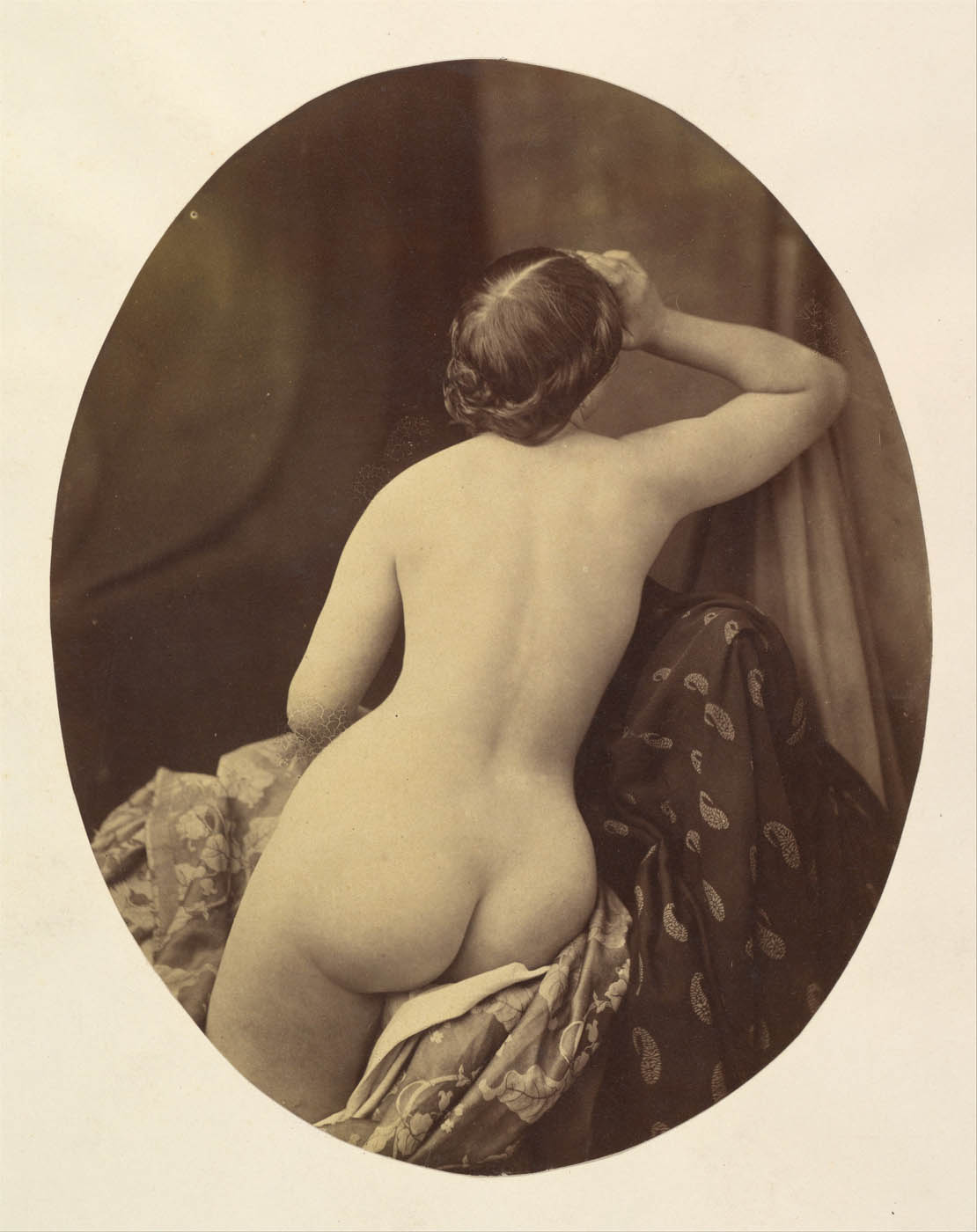
 

Oscar Gustav Rejlander (British born Sweden, 1813-1875) 'Ariadne' 1857


Oscar Gustav Rejlander (British born Sweden, 1813-1875)
Ariadne
1857
Albumen silver print from glass negative
Mount: 16 1/16 in. × 13 1/16 in. (40.8 × 33.2cm)
Image: 8 1/4 × 6 1/2 in. (21 × 16.5cm); oval
Metropolitan Museum of Art
Gilman Collection, Purchase, The Horace W. Goldsmith Foundation Gift, through Joyce and Robert Menschel, 2005
Public domain


Working in a place – Victorian England – where any photographic nude was considered offensive because the process implied not only the “nastiness” of the artist and vendor, but also “the degradation of the person who serves as model on the occasion,” Rejlander sought to ally his work with that of noted painters. This nude study is one of a series based on figures in the work of Raphael, Titian, Correggio, Rubens, Murillo, and Gainsborough; the precedent here is Titian’s Venus and Adonis, and Rejlander’s intention was to show how the painter adhered to or strayed from the ways a real body can twist and turn. Critic A. H. Wall defended the propriety of Rejlander’s Studies from the Nude, saying, “Refined and ennobled by art, real beauty, palpable flesh and blood, speaks of nothing but its own inherent loveliness.”

Such references to painting did not always afford adequate protection, however. Writing of Rejlander’s famous Two Ways of Life, photographer and critic Thomas Sutton wrote, “There is no impropriety in exhibiting such works of art as Etty’s Bathers Surprised by a Swan or the Judgment of Paris but there is impropriety in allowing the public to see photographs of nude prostitutes, in flesh-and-blood truthfulness and minuteness of detail.”

Text from the Metropolitan Museum of Art website


Unknown photographer (French) '[Female Nude with Mask]' c. 1870


Unknown photographer (French)
[Female Nude with Mask]
c. 1870
Albumen silver print from glass negative
26 x 19.1cm (10 1/4 x 7 1/2 in.)
Metropolitan Museum of Art
Gilman Collection, Gift of The Howard Gilman Foundation, 2005
Public domain


Even as she seems to part her tresses to expose her naked body, the model here masks her face in an effort to conceal her identity. While drawing, painting, and sculpture of the human figure commonly involve elements of transformation, idealisation, or the combination of features from various models, photography usually presents a recognisable image of its subject. It was not uncommon, therefore, for models who routinely posed nude for artists in other media to hide their faces when standing naked before the camera. For the viewer – not always an artist looking for help in figure drawing – the mask added an element of erotic frisson.

Text from the Metropolitan Museum of Art website
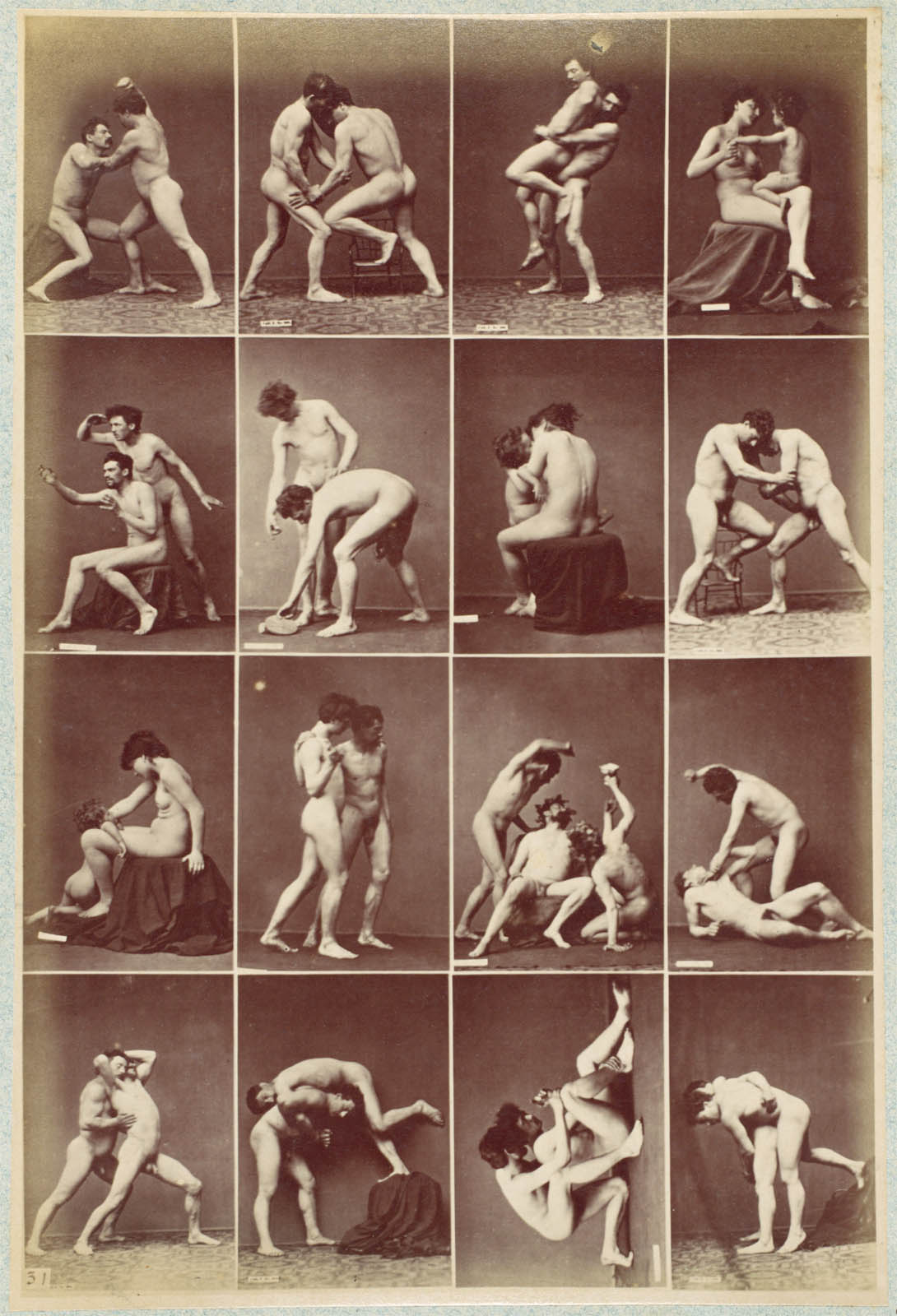
 

Louis Igout (French, 1837-1881)(Photographer) A. Calavas (French)(Editor) 'Plate from Album d'Études – Poses' c. 1880


Louis Igout (French, 1837-1881)(Photographer)
A. Calavas (French)(Editor)
Plate from Album d’Études – Poses
c. 1880
Albumen silver prints from glass negatives
Metropolitan Museum of Art
Purchase, The Horace W. Goldsmith Foundation Gift, through Joyce and Robert Menschel, 1993
Public domain


This album is an excellent example of the type of photography produced in the nineteenth century as an aid to artists in the study of contour, modelling, and proportion, and as a vocabulary of expression, gesture, and pose sanctioned by the art of antiquity and the Old Masters. Groupings representing Cain and Abel, the Drunken Silenus, Hercules and Antaeus, the Dying Gaul, the Cnidian Aphrodite, and others are recognisable among the photographs. Single prints showing sixteen small images, such as the page shown here, served as a type of stock catalogue, allowing clients to survey a broad range of possible poses and order larger prints of those which best served their needs.

Text from the Metropolitan Museum of Art website
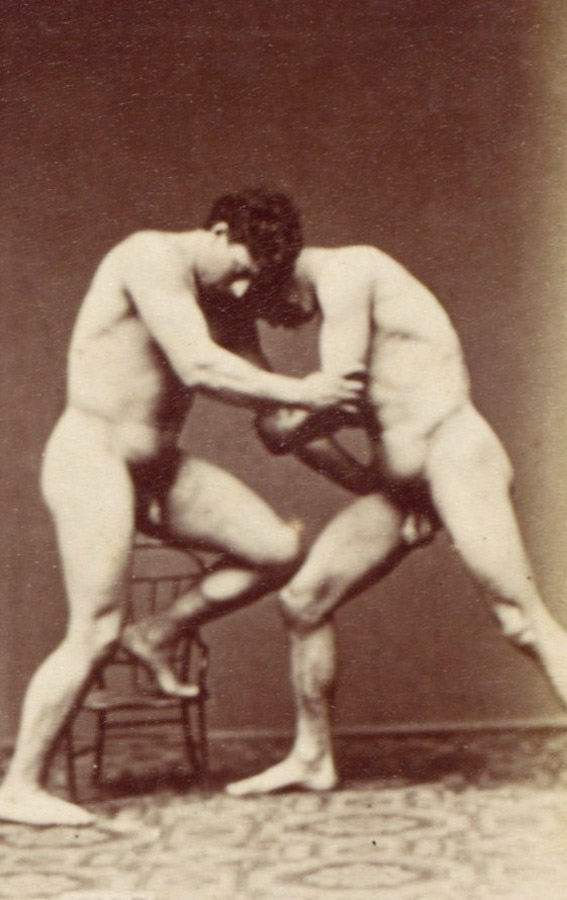
 

Louis Igout (French, 1837-1881)(Photographer) A. Calavas (French)(Editor) 'Plate from Album d'Études – Poses' c. 1880 (detail)

Louis Igout (French, 1837-1881)(Photographer) A. Calavas (French)(Editor) 'Plate from Album d'Études – Poses' c. 1880 (detail)

Louis Igout (French, 1837-1881)(Photographer) A. Calavas (French)(Editor) 'Plate from Album d'Études – Poses' c. 1880 (detail)


Louis Igout (French, 1837-1881)(Photographer)
A. Calavas (French)(Editor)
Plate from Album d’Études – Poses (details)
c. 1880
Albumen silver prints from glass negatives
Metropolitan Museum of Art
Purchase, The Horace W. Goldsmith Foundation Gift, through Joyce and Robert Menschel, 1993
Public domain


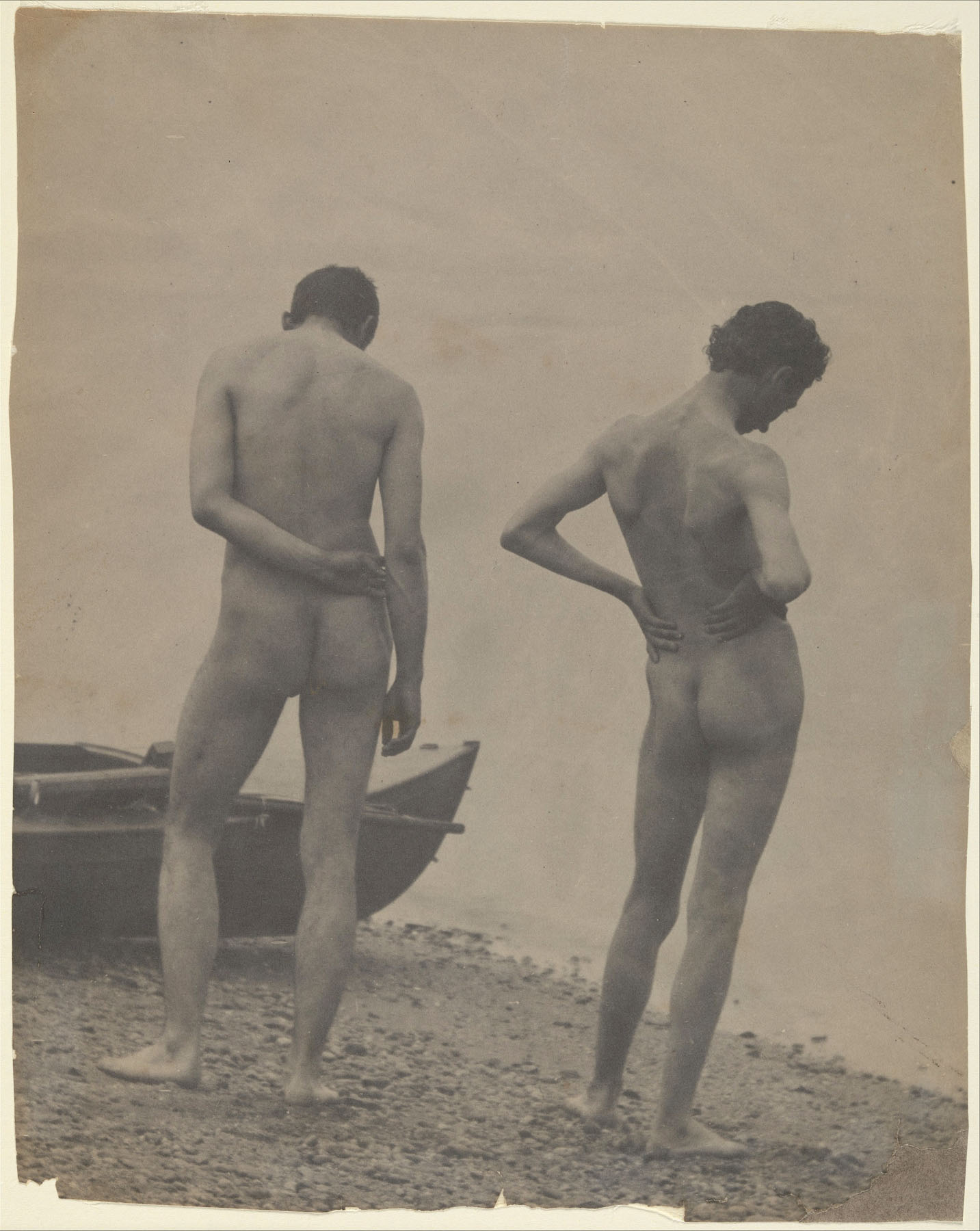
Thomas Eakins (American, 1844-1916) '(Thomas Eakins and John Laurie Wallace on a Beach)' c. 1883


Thomas Eakins (American, Philadelphia, Pennsylvania 1844–1916 Philadelphia, Pennsylvania)
[Thomas Eakins and John Laurie Wallace on a Beach]
c. 1883
Platinum print
25.5 x 20.4cm (10 1/16 x 8 1/16 in.), irregular
Metropolitan Museum of Art
David Hunter McAlpin Fund, 1943
Public domain


The great American painter and photographer Thomas Eakins was devoted to the scientific study of the human form and committed to its truthful representation. While he and his students at the Pennsylvania Academy of the Fine Arts were surrounded by casts of classical sculpture, Eakins declared that he did not like “a long study of casts. … At best they are only imitations, and an imitation of imitations cannot have so much life as an imitation of life itself.” Photography provided an obvious solution.

This photograph, in which Eakins and a student affected the elegant contrapposto stances of classical sculpture, was probably taken during an excursion with students to Manasquan Inlet at Point Pleasant, New Jersey, during the summer of 1883. Valuing his photographs not only as studies for paintings but also for their own sake, Eakins carefully printed the best images on platinum paper. In this case, he went to the additional trouble of enlarging the original, horizontally formatted image and cropping it vertically to better contain the perfectly balanced figures.

Text from the Metropolitan Museum of Art website
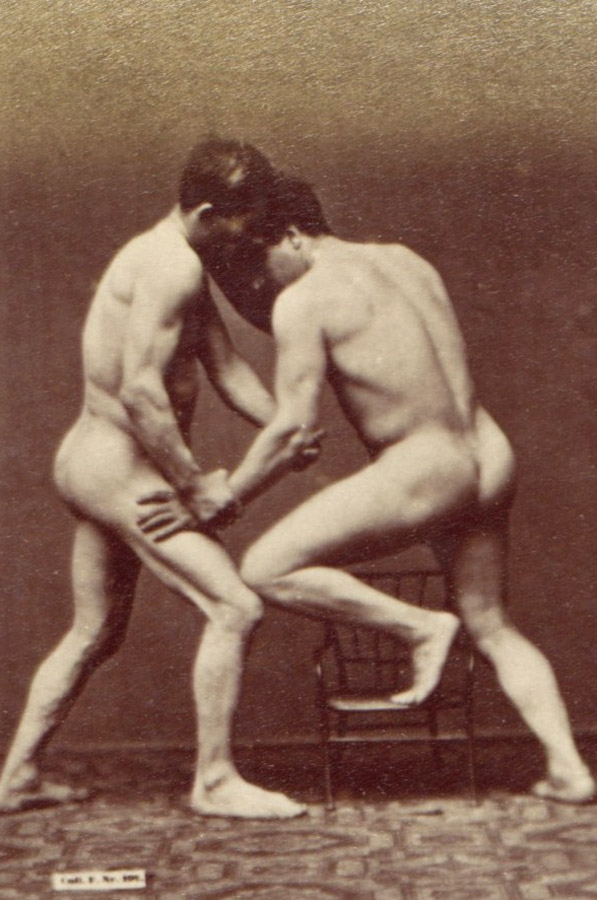
 

Albert Londe (French, 1858-1917) Paul Marie Louis Pierre Richer (French, 1849-1933) '[Male Musculature Study]' c. 1890


Albert Londe (French, 1858-1917)
Paul Marie Louis Pierre Richer (French, 1849-1933)
[Male Musculature Study]
c. 1890
Albumen silver print
Image: 14.9 x 9.6 cm (5 7/8 x 3 3/4 in.)
Mount: 14.9 x 9.9 cm (5 7/8 x 3 7/8 in.)
Metropolitan Museum of Art
Gift of Charles Isaacs and Carol Nigro, 2012


Author of a treatise on the importance of the camera in medical practice, Albert Londe declared, “the photographic plate is the scientist’s true retina.” In collaboration with a laboratory director and professor of anatomy at the École des Beaux-Arts, Londe found that photographs intended for physiological analysis could also serve artistic applications. Their careful portraits of athletes – whether taken with stop-action cameras specially designed by Londe or in static poses such as the example here – were used in scientific texts on musculature and became templates for illustrations to aid artists in rendering ideally proportioned figures.

Text from the Metropolitan Museum of Art website
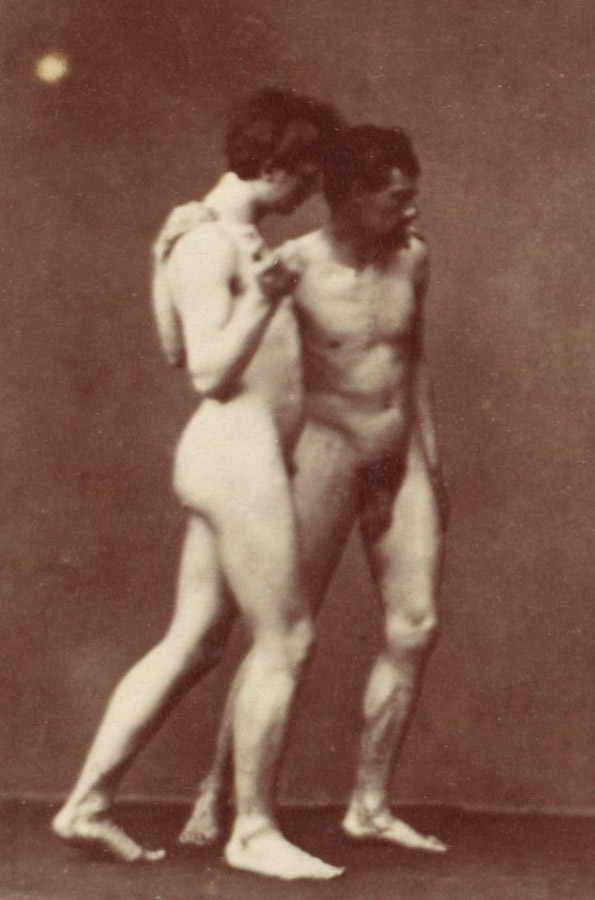
 

Guglielmo Plüshow (Italian born Germany, 1852–1930) '[Young Male Nude Seated on Leopard Skin]' 1890s-1900s


Guglielmo Plüshow (Italian born Germany, 1852–1930)
[Young Male Nude Seated on Leopard Skin]
1890s-1900s
Albumen silver print from glass negative
22.2 x 16.2cm (8 3/4 x 6 3/8 in.)
Metropolitan Museum of Art
Museum Accession
Creative Commons CC0 1.0 Universal Public Domain Dedication


Censors have long struggled to keep pace with evolving technology and expanding distribution networks of photographic erotica. In nineteenth-century France, government officials regularly seized thousands of photographs similar to the daguerreotype displayed here, which were deemed lewd.

Male nudity has frequently been subject to stricter control than pornography featuring women. The Arcadian photographs of Plüshow and his cousin and student Wilhelm von Gloeden were avidly collected in the late nineteenth century, but in the 1930s many of their prints and negatives, considered deviant by the Italian Fascist government, were destroyed. For much of the twentieth century, it was illegal in the United States to mail photographs that might be judged prurient, forcing photographers to mask genitalia and pubic hair with strategic props or with overpainting that could be easily removed by purchasers. Sale of erotic male physique magazines and bodybuilder pin-ups, ostensibly circulated to promote fitness, was legalised in a 1962 Supreme Court ruling, which concluded that “portrayals of the male nude cannot fairly be regarded as more objectionable than many portrayals of the female nude that society tolerates.”

Text from the Metropolitan Museum of Art website
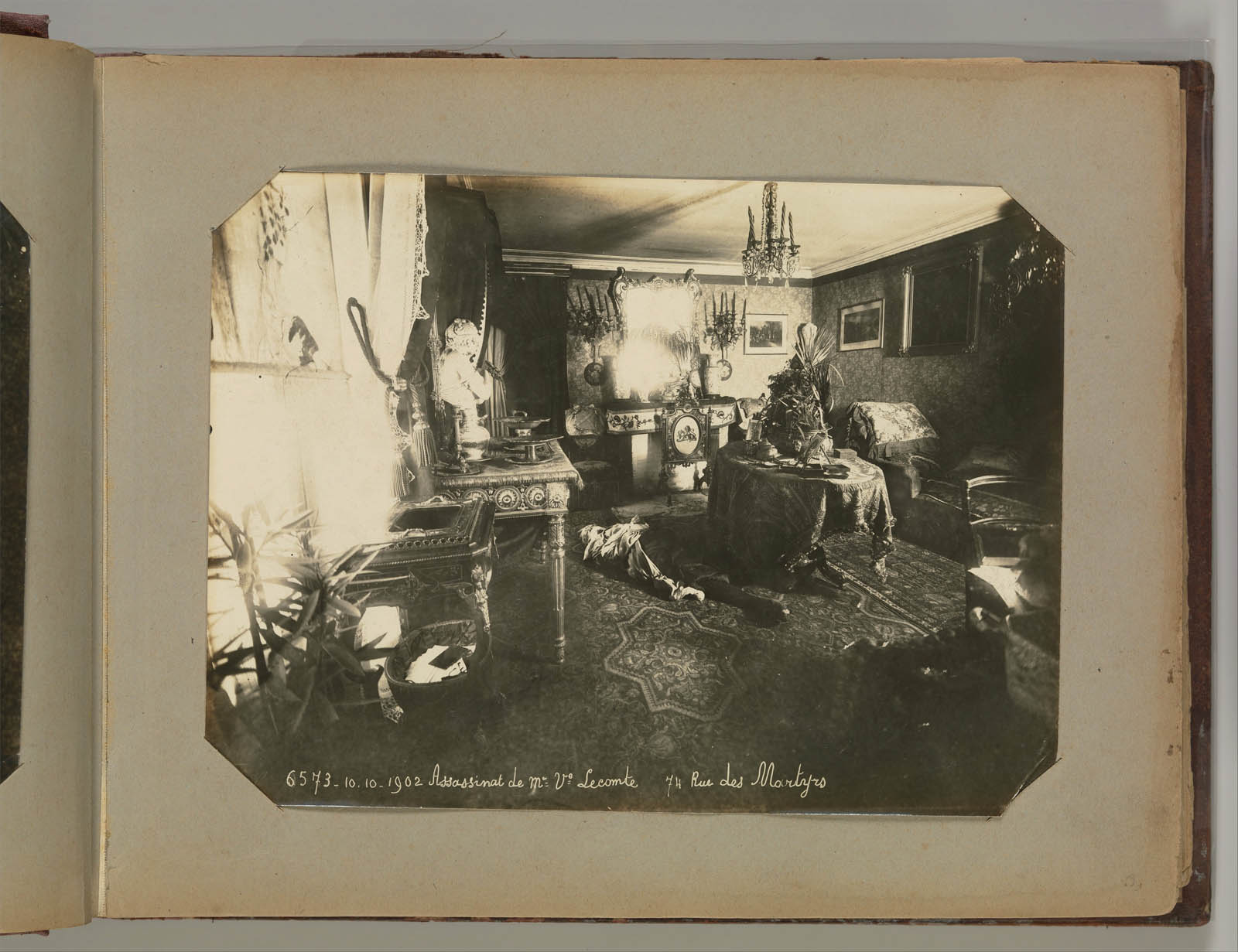
 

Attributed to Alphonse Bertillon (French, 1853–1914) 'Assasination of C. Lecomte 711 Rue des Martyrs' 1901-1908 From 'Album of Paris Crime Scenes'


Attributed to Alphonse Bertillon (French, 1853–1914)
Assasination of C. Lecomte 711 Rue des Martyrs
1901-1908
From Album of Paris Crime Scenes
Gelatin silver print
Overall: 24.3 x 31cm (9 9/16 x 12 3/16in.)
Page: 23 x 29cm (9 1/16 x 11 7/16 in.)
Metropolitan Museum of Art
Gilman Collection, Purchase, The Howard Gilman Foundation Gift, 2001
Public domain


Alphonse Bertillon, the chief of criminal identification for the Paris police department, developed the mug shot format and other photographic procedures used by police to register criminals. Although the images in this extraordinary album of forensic photographs were made by or under the direction of Bertillon, it was probably assembled by a private investigator or secretary who worked at the Paris prefecture. Photographs of the pale bodies of murder victims are assembled with views of the rooms where the murders took place, close-ups of objects that served as clues, and mug shots of criminals and suspects. Made as part of an archive rather than as art, these postmortem portraits, recorded in the deadpan style of a police report, nonetheless retain an unsettling potency.

Text from the Metropolitan Museum of Art website
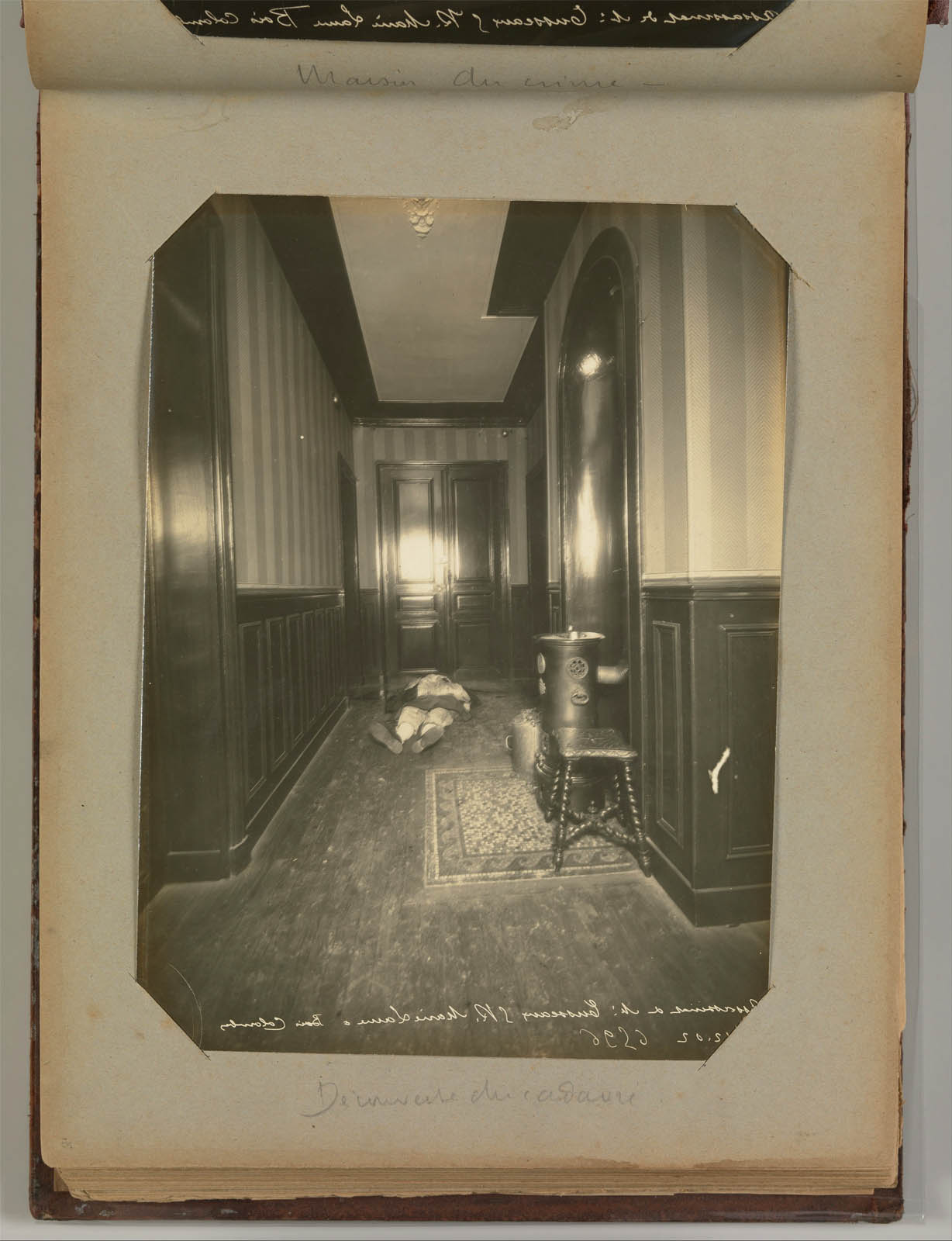
 

Attributed to Alphonse Bertillon (French, 1853–1914) 'Untitled' 1901-1908 From 'Album of Paris Crime Scenes'


Attributed to Alphonse Bertillon (French, 1853–1914)
Untitled
1901-1908
From Album of Paris Crime Scenes
Gelatin silver print
Overall: 24.3 x 31cm (9 9/16 x 12 3/16in.)
Page: 23 x 29cm (9 1/16 x 11 7/16 in.)
Metropolitan Museum of Art
Gilman Collection, Purchase, The Howard Gilman Foundation Gift, 2001
Public domain
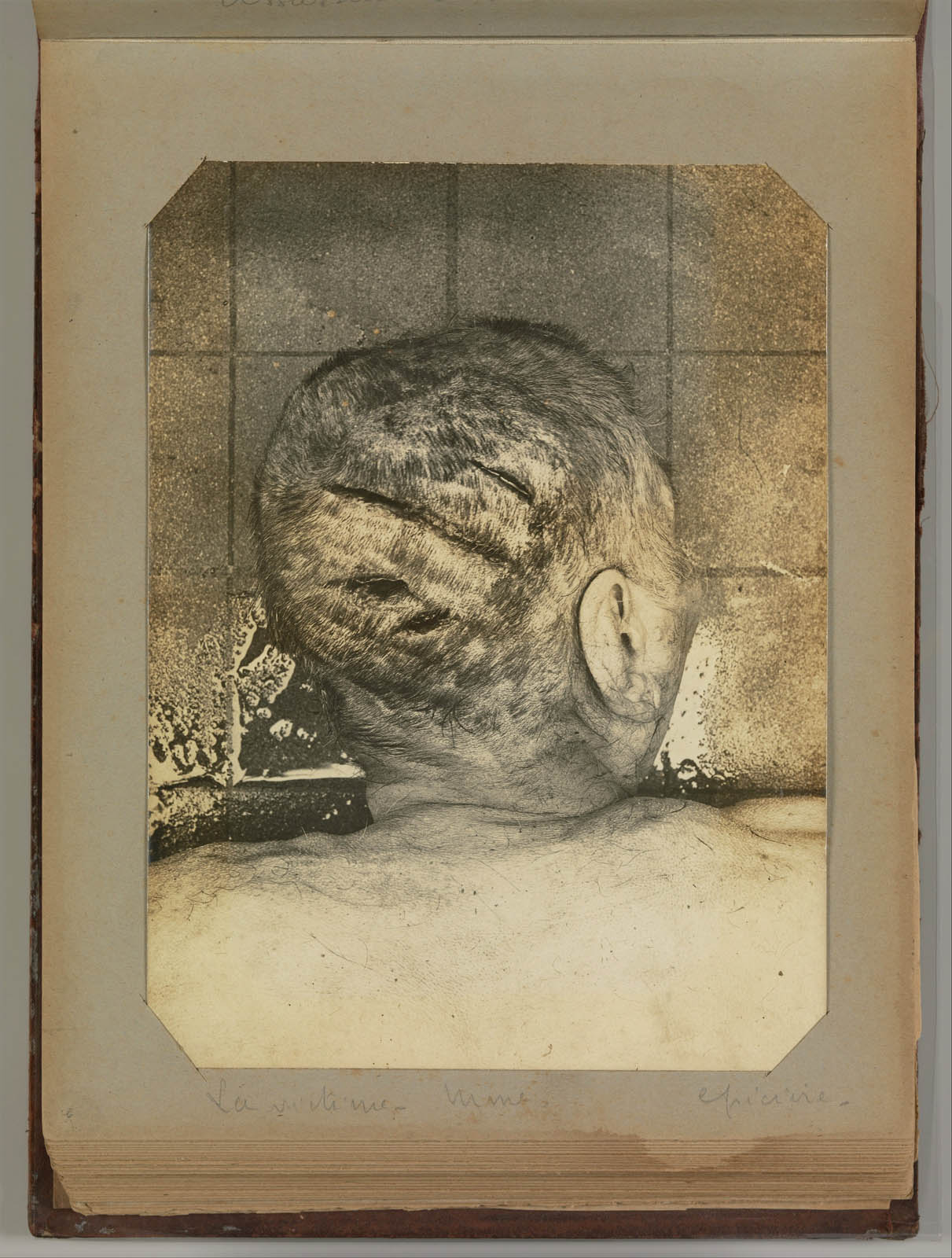
 

Attributed to Alphonse Bertillon (French, 1853–1914) 'Untitled' 1901-1908 From 'Album of Paris Crime Scenes'


Attributed to Alphonse Bertillon (French, 1853–1914)
Untitled
1901-1908
From Album of Paris Crime Scenes
Gelatin silver print
Overall: 24.3 x 31cm (9 9/16 x 12 3/16in.)
Page: 23 x 29cm (9 1/16 x 11 7/16 in.)
Metropolitan Museum of Art
Gilman Collection, Purchase, The Howard Gilman Foundation Gift, 2001
Public domain


Lady Ottoline Violet Anne Cavendish-Bentinck Morrell (British, 1873-1938) '[Cavorting by the Pool at Garsington]' c. 1916


Lady Ottoline Violet Anne Cavendish-Bentinck Morrell (British, 1873-1938)
[Cavorting by the Pool at Garsington]
c. 1916
Gelatin silver print
8.8 x 6.3cm (3 7/16 x 2 7/16 in.)
Metropolitan Museum of Art
Gilman Collection, Purchase, The Horace W. Goldsmith Foundation Gift, through Joyce and Robert Menschel, 2005
Creative Commons CC0 1.0 Universal Public Domain Dedication


Rebelling against the narrow values of upper-class Edwardian society, Lady Ottoline Morrell, an eccentric hostess to Bloomsbury, surrounded herself in London and on her estate at Garsington with a large circle of friends including Bertrand Russell, W. B. Yeats, D. H. Lawrence, T. S. Eliot, Virginia Woolf, Aldous Huxley, and E. M. Forster. These images of an improvised dance show Lady Ottoline’s ten-year-old daughter, Julian, and her slightly older companions embroiled in a naked whirl, pagan in its exuberance, that reflects the emancipated attitudes of the photographer’s circle.

Text from the Metropolitan Museum of Art website


Lady Ottoline Violet Anne Cavendish-Bentinck Morrell (British, 1873-1938) '[Cavorting by the Pool at Garsington]' c. 1916


Lady Ottoline Violet Anne Cavendish-Bentinck Morrell (British, 1873-1938)
[Cavorting by the Pool at Garsington]
c. 1916
Gelatin silver print
8.8 x 6.2cm (3 7/16 x 2 7/16 in.)
Metropolitan Museum of Art
Gilman Collection, Purchase, The Horace W. Goldsmith Foundation Gift, through Joyce and Robert Menschel, 2005
Creative Commons CC0 1.0 Universal Public Domain Dedication


Edward Weston (American, Highland Park, Illinois 1886 - 1958 Carmel, California) '[Nude]' 1925


Edward Weston (American, Highland Park, Illinois 1886 – 1958 Carmel, California)
[Nude]
1925
Gelatin silver print
Image: 14.8 x 23.4 cm (5 13/16 x 9 3/16 in.)
Mount: 35.2 x 43.9 cm (13 7/8 x 17 5/16 in.)
Metropolitan Museum of Art
Gilman Collection, Purchase, Ann Tenenbaum and Thomas H. Lee Gift, 2005
© Center for Creative Photography, Arizona Board of Regents
Public domain


In his early attempts to merge the realism of photography with the expressive effect of abstract art, Weston honed in on close-up details of his subjects. That the faces of his models were often cropped or averted served practical as well as aesthetic purposes, enabling the photographs to be read as figure studies rather than as individual portraits while also protecting the privacy of the friends and lovers who served as models.

Text from the Metropolitan Museum of Art website


George Platt Lynes (American, East Orange, New Jersey 1907–1955 New York) '[Male Nude]' 1930s


George Platt Lynes (American, East Orange, New Jersey 1907–1955 New York)
[Male Nude]
1930s
Gelatin silver print
24.5 x 18.9cm (9 5/8 x 7 7/16 in.)
Metropolitan Museum of Art
Ford Motor Company Collection, Gift of Ford Motor Company and John C. Waddell, 1987
© Estate of George Platt Lynes
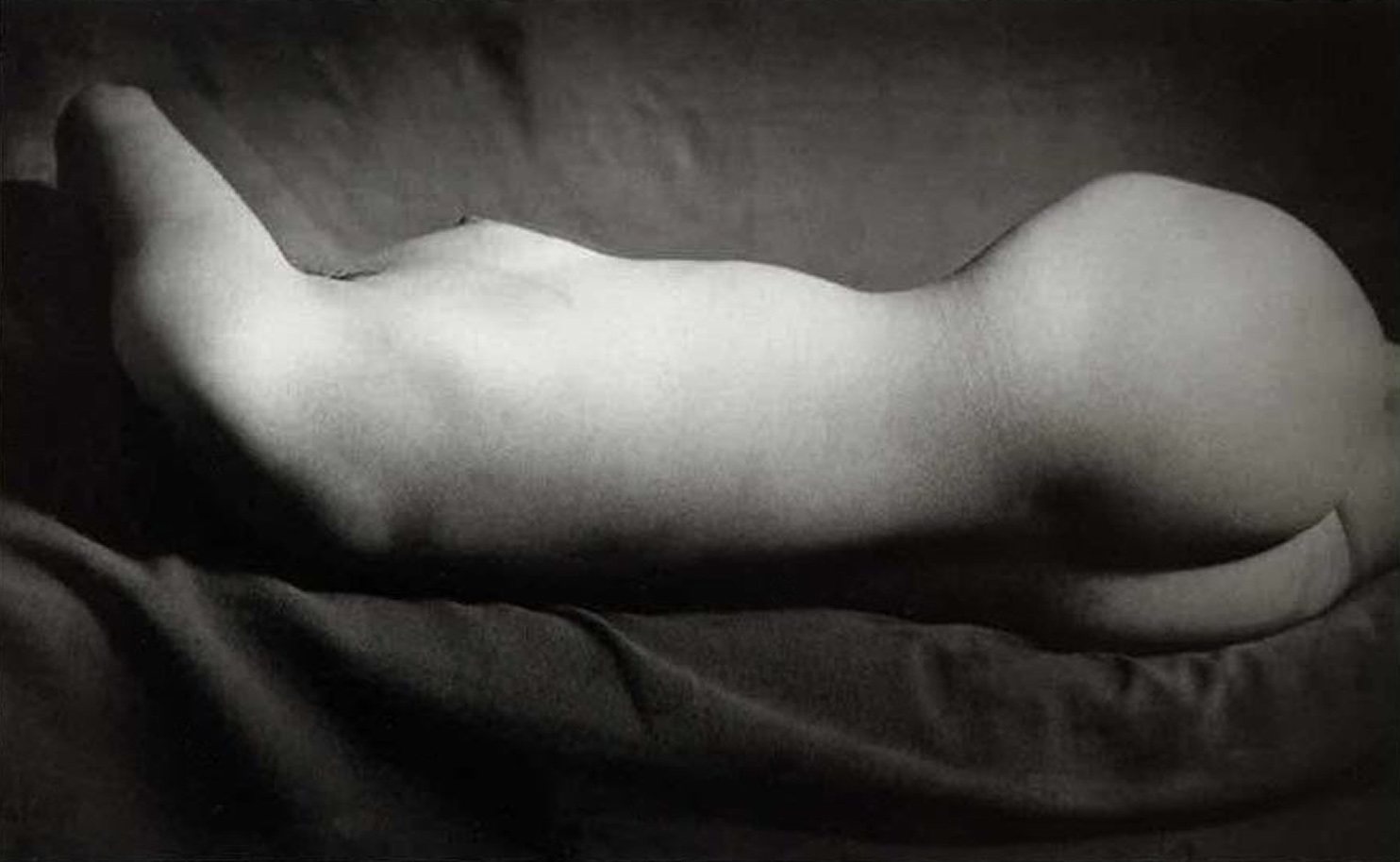
 

Brassaï (French born Romania, Brasov 1899 - 1984 Côte d'Azur) 'Nude' 1931-1934


Brassaï (French born Romania, Brasov 1899 – 1984 Côte d’Azur)
Nude
1931-1934
Gelatin silver print
14.1 x 23.5cm (5 9/16 x 9 1/4 in.)
Metropolitan Museum of Art
Twentieth-Century Photography Fund, 2007
© The Estate of Brassai


One of the most radically abstract of Brassaï’s nudes, this image was published in 1933 in the inaugural issue of the avant-garde magazine Minotaure. With the figure’s head and legs cut off by the picture’s edges, the twisting, truncated torso seems to float in space like an apparition – an ambiguous, organic form with an uncanny resemblance to a phallus. This transformation of the female figure into a fetish object is a hallmark of Surrealism that reflects the important influence of Freud’s psychoanalytic theory on European art of the early twentieth century.

Text from the Metropolitan Museum of Art website
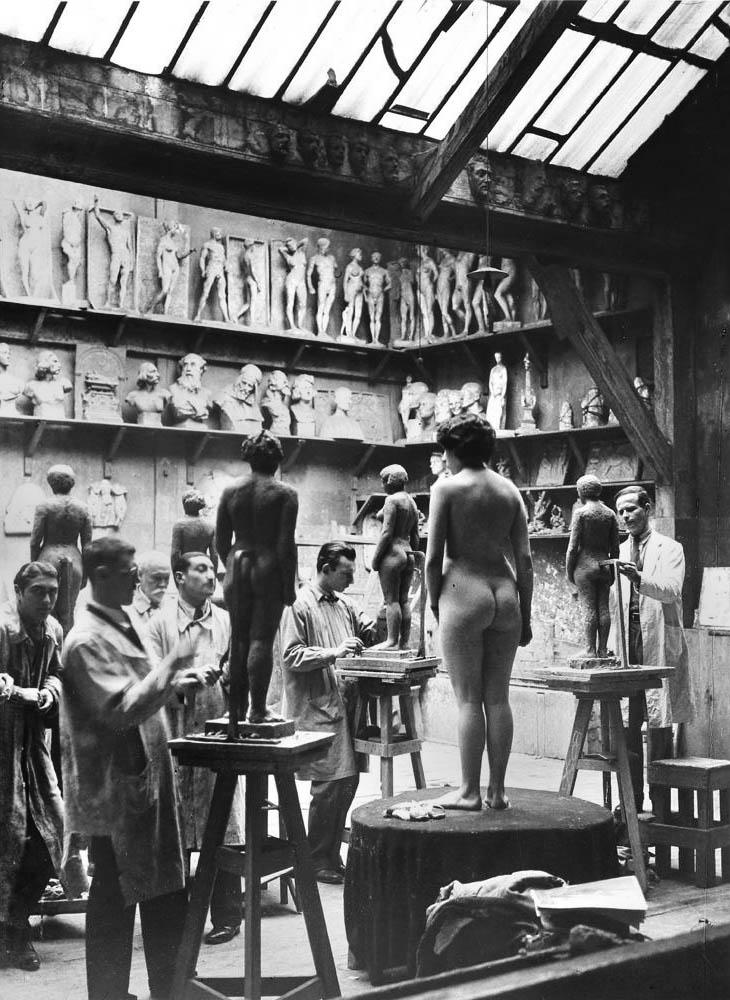
 

Brassaï (French born Romania, Brasov 1899 - 1984 Côte d'Azur) 'L'Académie Julian' 1931, printed 1950s


Brassaï (French born Romania, Brasov 1899 – 1984 Côte d’Azur)
L’Académie Julian
1931, printed 1950s
Gelatin silver print
29.7 x 23.7cm (11 11/16 x 9 5/16 in.)
Metropolitan Museum of Art
Gilman Collection, Purchase, The Horace W. Goldsmith Foundation Gift, through Joyce and Robert Menschel, 2005
© Estate Brassaï Succession – Paris
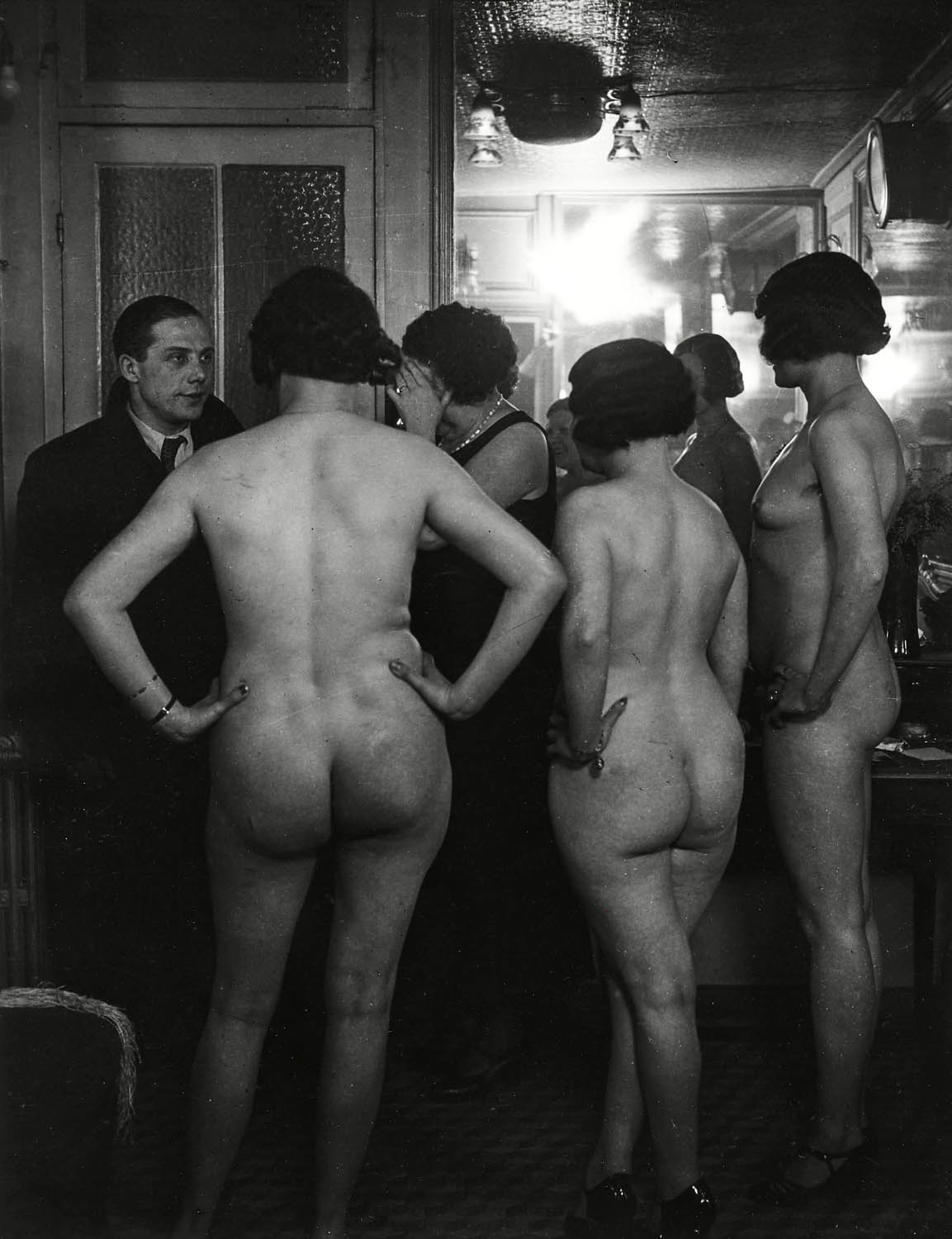
 

Brassaï (French born Romania, Brasov 1899 - 1984 Côte d'Azur) 'Introductions at Suzy's' 1932-1933


Brassaï (French born Romania, Brasov 1899 – 1984 Côte d’Azur)
Introductions at Suzy’s
1932-1933, printed later
Gelatin silver print
23.1 x 16.8cm (9 1/16 x 6 5/8 in.)
Metropolitan Museum of Art
Ford Motor Company Collection, Gift of Ford Motor Company and John C. Waddell, 1987
© Estate Brassaï Succession – Paris


Brassaï made his name as a chronicler of the night, with images that ranged from reflections on wet cobblestones to the denizens of bars and brothels. Like so many of his photographs, Introductions at Suzy’s was not an impromptu scene caught by an undetected observer but rather a carefully constructed tableau meant to highlight the dynamic between buttoned-up bourgeois clients and Suzy’s bevy of prostitutes, naked but for their bracelets and high heels. The “client” was actually Brassaï’s friend and bodyguard; the “girls,” however, were not stand-ins.

Text from the Metropolitan Museum of Art website


Brassaï (French, 1899-1984) 'Chez Suzy / Armoire à glace dans un hôtel de passe, rue Quincampoix' (Mirrored cabinet in a brothel, rue Quincampoix) 1932, printed 1950s


Brassaï (French, 1899-1984)
Chez Suzy / Armoire à glace dans un hôtel de passe, rue Quincampoix (Mirrored cabinet in a brothel, rue Quincampoix)
1932, printed 1950s
Gelatin silver print
23.3 x 16.8cm (9 3/16 x 6 5/8 in.)
Metropolitan Museum of Art
Warner Communications Inc. Purchase Fund, 1980
© Estate Brassaï Succession – Paris


A keen observer of Parisian nightlife in the 1930s, Brassaï was drawn to the visual conundrums and optical innuendos of everyday life. The play of reflections and absences in this image, made in a Paris brothel, suggests the materialization of subconscious impulses. Evoking Freud’s definition of desire as the sensation arising from a perceived absence of remembered pleasure, this blatantly sexual scene suggests but withholds a specific narrative.

Text from the Metropolitan Museum of Art website


André Kertész (American born Hungary, Budapest 1894 - 1985 New York City) 'Distortion #6' 1932


André Kertész (American born Hungary, Budapest 1894 – 1985 New York City)
Distortion #6
1932
Gelatin silver print
23.4 x 17.3cm (9 3/16 x 6 13/16 in.)
Metropolitan Museum of Art
Ford Motor Company Collection, Gift of Ford Motor Company and John C. Waddell, 1987
© The Estate of André Kertész / Higher Pictures


Although Kertesz had long been interested in mirrors, reflections, and the idea of distorting the human figure, he did not seriously investigate their photographic possibilities until 1933, when the risqué French magazine Le Sourire commissioned him to make a series of figure studies. Using a funhouse mirror from a Parisian amusement park, Kertesz, who had never photographed nudes before, spent four weeks making about two hundred negatives.

Kertész accentuated the narrow ribcage and long waist of the ideal contemporary woman by photographing his model in a carnival mirror. If the top half of this beautiful nude resembles those Modigliani painted, the swell of the haunch recalls Mannerist nudes and their nineteenth-century revivals, especially Ingres’ grande odalisque.

Text from the Metropolitan Museum of Art website
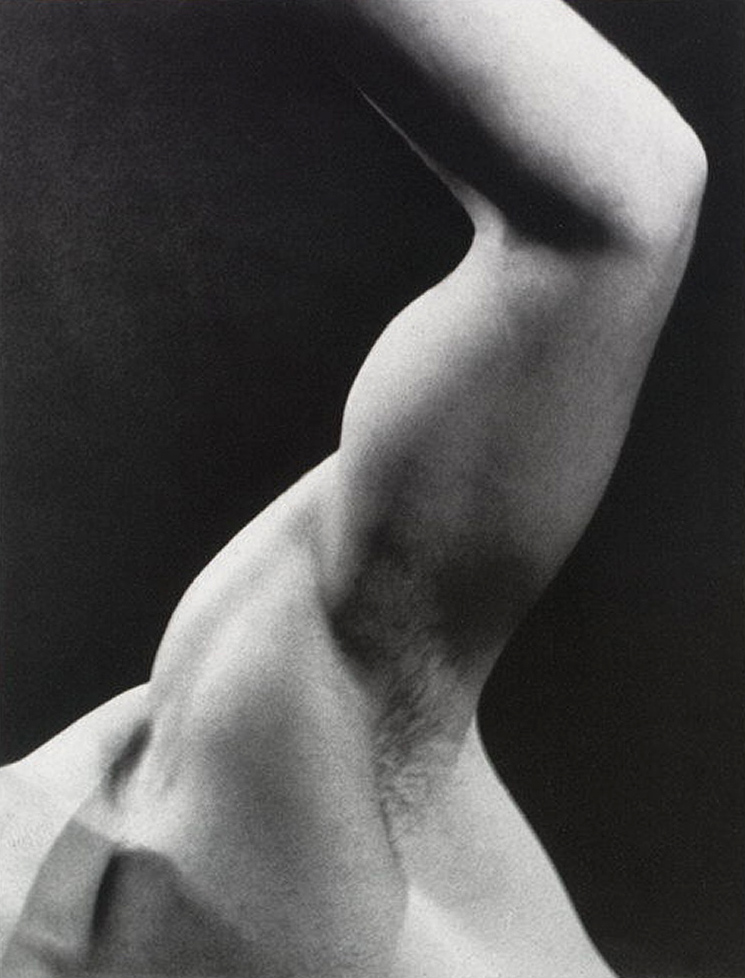
 

Man Ray (American, Philadelphia, Pennsylvania 1890 - 1976 Paris) 'Arm' c. 1935


Man Ray (American, Philadelphia, Pennsylvania 1890 – 1976 Paris)
Arm
c. 1935
Gelatin silver print
29.7 x 23.0cm (11 11/16 x 9 1/16 in.)
Metropolitan Museum of Art
Ford Motor Company Collection, Gift of Ford Motor Company and John C. Waddell, 1987
© 2012 Man Ray Trust / Artists Rights Society (ARS), NY / ADAGP, Paris


Man Ray’s photograph of an arm is cropped so abstractly that it seems to metamorphose into other body parts – a knee, a calf, a thigh – or into some utterly unidentifiable yet heroic form. This image appeared on the cover of Formes Nues (1935), which also included the work of Brassaï, László Moholy-Nagy, Franz Roh, and George Platt Lynes, among others.

In the magazine’s introduction, Man Ray wrote, “were it not for the fact that photography permits me to seize and to possess the human body and face in more than a temporary manner, I should quickly have tired of this medium.”

Text from the Metropolitan Museum of Art website


Paul Outerbridge Jr. (American, New York 1896 - 1959 Laguna Beach, California) 'Nude with Mask and Hat' c. 1936


Paul Outerbridge Jr. (American, New York 1896 – 1959 Laguna Beach, California)
Nude with Mask and Hat
c. 1936
Carbro print
43.3 x 30.0cm (17 1/16 x 11 13/16 in.)
Metropolitan Museum of Art
Warner Communications Inc. Purchase Fund, 1977


Outerbridge was a successful commercial photographer, but although he found such work stimulating, he also made photographs as a means of personal expression throughout his career. Photographing nude models in colour in the 1930s was challenging – not only in the difficulty of correctly capturing skin tones using complicated new processes, but also because finding a venue to publish or exhibit the work was unlikely. Although he began by posing his models in the manner of painted masterpieces, Outerbridge’s compositions became increasingly provocative in the late 1930s. The sexualised charge and commercial palette of works such as this were not in keeping with attitudes of the period and were not shown during the artist’s lifetime.

Text from the Metropolitan Museum of Art website


Hans Bellmer (German born Poland, Katowice 1902–1975 Paris) 'La Poupée' 1936


Hans Bellmer (German born Poland, Katowice 1902–1975 Paris)
La Poupée
1936
Gelatin silver print with applied colour
Mount: 9 5/8 in. × 7 1/2 in. (24.5 × 19cm)
Image: 5 5/16 × 5 9/16 in. (13.5 × 14.1cm)
Metropolitan Museum of Art
Ford Motor Company Collection, Gift of Ford Motor Company and John C. Waddell, 1987
© 2024 Artists Rights Society (ARS), New York


In his nightmarish tableaux of mutilated and reassembled dolls posed in domestic interiors, Bellmer grappled with the base condition of the human body and with the bodily fragment as fetish object. Mannequins and dolls – simultaneously familiar and strange – supplied the material for his primal expressions of terror and awe, which often evoked the innocent violence and latent sexuality of childhood games. Whether they are read as Freudian emblems of the uncanny or as ominous harbingers of Nazi atrocities, Bellmer’s images exemplify the Surrealist view of the female body as the source of simultaneous fascination and revulsion.

Text from the Metropolitan Museum of Art website


Edward Weston (American 1886-1958) 'Nude' 1936, printed c. 1954


Edward Weston (American, Highland Park, Illinois 1886 – 1958 Carmel, California)
Printer: Brett Weston (American, Los Angeles, California 1911-1993 Kona, Hawaii) or Cole Weston (American, 1919-2003)
Nude on Sand, Oceano
1936, printed c. 1954
Gelatin silver print
19.1 x 24.2cm (7 1/2 x 9 1/2 in.)
David Hunter McAlpin Fund, 1957
© Center for Creative Photography, Arizona Board of Regents


Charis Wilson, the model for this series, admitted to being shocked upon seeing Weston’s nudes for the first time, as she had previously known only the romantically retouched photographs of depilated bodies then popular. In studying Weston’s work she found, “I couldn’t get past the simple amazement at how real they were. Then I began to see the rhythmic patterns, the intensely perceived sculptural forms, the subtle modulations of tone, of which these small, perfect images were composed. And I began to appreciate the originality of the viewpoint that had selected just these transitory moments and made them fast against the current of time.”

Text from the Metropolitan Museum of Art website


Irving Penn (American, Plainfield, New Jersey 1917 - 2009 New York City) 'Nude No. 57' 1949-1950


Irving Penn (American, Plainfield, New Jersey 1917 – 2009 New York City)
Nude No. 57
1949-1950
Gelatin silver print
39.4 x 37.5cm (15 1/2 x 14 3/4 in.)
Metropolitan Museum of Art
Gift of the artist, 2002
© 1950-2002 Irving Penn


By 1950, Penn was a well-known Vogue portrait and fashion photographer but had already made, privately, a major series of nudes – a personal but lesser-known body of work. During the week, he photographed models wearing fashionable clothes for the magazine, but weekends and evenings he made studies of female nudes. The women were full-bodied and the photographs unorthodox, recalling the form and spirit of archaic fertility idols.

Text from the Metropolitan Museum of Art website


Harry Callahan (American, 1912-1999) 'Eleanor and Barbara' 1954, printed 1970s


Harry Callahan (American, 1912-1999)
Eleanor and Barbara
1954
Gelatin silver print
22.8 x 22.1cm (9 x 8 11/16 in.)
Metropolitan Museum of Art
Gift of Joyce and Robert Menschel, 1993
© The Estate of Harry Callahan; Courtesy Pace/MacGill Gallery, New York


Muses throughout his career, Callahan’s wife and daughter played, posed, and aged before his lens. With their attention to the physicality of light, however, Callahan’s photographs transcend mere family portraiture by calling attention to the simple beauty of life’s fleeting moments. “He just liked to take the pictures of me,” Eleanor recalled in her nineties. “In every pose. Rain or shine. And whatever I was doing. If I was doing the dishes or if I was half asleep. And he knew that I never, never said no. I was always there for him. Because I knew that Harry would only do the right thing.”

Eleanor Callahan died in February 2012 at the age of ninety-five.

Text from the Metropolitan Museum of Art website


Diane Arbus (American, 1923-1971) 'Retired man and his wife at home in a nudist camp one morning, N.J.' 1963


Diane Arbus (American, 1923-1971)
Retired man and his wife at home in a nudist camp one morning, N.J.
1963
Gelatin silver print
39.9 × 37.9cm (15 11/16 × 14 15/16 in.)
Metropolitan Museum of Art
Purchase, Joyce Frank Menschel, and Ann Tenenbaum and Thomas H. Lee Gifts; Louis V. Bell, Harris Brisbane Dick, Fletcher, and Rogers Funds and Joseph Pulitzer Bequest; and Marlene Nathan Meyerson Family Foundation, Twentieth-Century Photography Fund, Diana Barrett and Robert Vila, Elizabeth S. and Robert J. Fisher, Charlotte and Bill Ford, Lita Annenberg Hazen Charitable Trust and Hazen Polsky Foundation Inc., Jennifer and Joseph Duke, Jennifer and Philip Maritz, Saundra B. Lane, The Jerry and Emily Spiegel Family Foundation and Pamela and Arthur Sanders, Anonymous, and The Judith Rothschild Foundation Gifts, 2007
© The Estate of Diane Arbus


Arbus’s interest in the tension between revelation and concealment comes into starkest focus in the portraits she made at Sunshine Park, a family nudist camp in New Jersey. While nudism might be considered the ultimate form of exposure, it often required a different kind of cover-up. As the artist remarked in an unpublished article written for Esquire magazine in 1966: “For many of these people, their presence here is the darkest secret of their lives, unsuspected by relatives, friends, and employers in the outside world, the disclosure of which might bring disgrace.”

Text from the Metropolitan Museum of Art website


Diane Arbus (American, 1923-1971) 'A naked man being a woman, N.Y.C.' 1968


Diane Arbus (American, 1923-1971)
A naked man being a woman, N.Y.C.
1968
Gelatin silver print
38.2 x 36.2cm
Metropolitan Museum of Art
Purchase, Joyce Frank Menschel, and Ann Tenenbaum and Thomas H. Lee Gifts; Louis V. Bell, Harris Brisbane Dick, Fletcher, and Rogers Funds and Joseph Pulitzer Bequest; and Marlene Nathan Meyerson Family Foundation, Twentieth-Century Photography Fund, Diana Barrett and Robert Vila, Elizabeth S. and Robert J. Fisher, Charlotte and Bill Ford, Lita Annenberg Hazen Charitable Trust and Hazen Polsky Foundation Inc., Jennifer and Joseph Duke, Jennifer and Philip Maritz, Saundra B. Lane, The Jerry and Emily Spiegel Family Foundation and Pamela and Arthur Sanders, Anonymous, and The Judith Rothschild Foundation Gifts, 2007
© The Estate of Diane Arbus


Mark Morrisroe (American, 1959-1989) 'Untitled [Two Men in Silhouette]' c. 1987


Mark Morrisroe (American, 1959-1989)
Untitled [Two Men in Silhouette]
c. 1987
Gelatin silver print
28.4 x 20.8cm (11 3/16 x 8 3/16 in.)
Metropolitan Museum of Art
Twentieth-Century Photography Fund, 2009
© The Estate of Mark Morrisroe (Ringier Collection) at Fotomuseum Winterthur


Sexuality and mortality – which many would say are central preoccupations of humankind – are key to Morrisroe’s biography and art. The son of a drug-addicted mother, a teenage hustler, and a precocious punk queer, Morrisroe carried a bullet (shot by a disgruntled john) in his chest from the age of eighteen and consequently walked with a limp that added one more element to his outsider self-image. Sex and death were persistent themes in his work, with pronounced poignancy after his 1986 AIDS diagnosis. In this work, Morrisroe has taken a page from a gay S&M magazine, cut out the shapes of two naked men, and used the sheet as a negative to print a unique image in which the figures – literally absent – appear as dark silhouettes against a netherworld of sexual activity.

Text from the Metropolitan Museum of Art website


The Metropolitan Museum of Art
1000 Fifth Avenue at 82nd Street
New York, New York 10028-0198
Phone: 212-535-7710

Opening hours:
Thursday – Tuesday 10am – 5pm
Closed Wednesday

The Metropolitan Museum of Art website

LIKE ART BLART ON FACEBOOK

Back to top

Exhibition: ‘Time Exposures: Picturing a History of Isleta Pueblo in the 19th Century’ at the National Museum of the American Indian, New York

Exhibition dates: 17th September 2011 – 10th June 2012

George Gustav Heye Center, New York


Photographer unknown. 'Albuquerque Indian School Boys with Flags' c. 1900


Photographer unknown
Albuquerque Indian School Boys with Flags
c. 1900
9 x 12cm
Courtesy of the National Archives and Records Center


Another glorious, eclectic posting with a couple of knockout photographs, including Sumner Matteson’s Simon Zuni (1900, below) and George Wharton James’s Selling goods along tracks (late 1880s to early 1900s, below). The latter is a masterpiece of early modernist photography. Observe the spatial construction of the picture: open and yet closed at the same time. What do I mean by this? The image allows the eye to wander, to meander if you like among the structures while always having an escape into the sky, into the distance of the partially blocked vanishing point. The objects flow across the image plane like music; at left the dark shape and its shadow falling on the railway tracks hold in that side of the image. If the shape wasn’t there your eye would fall out of that side of the photograph, it would not be enclosed. It is this enclosure which forces your gaze into the distance. An asymmetrical balance is achieved with the train car at right, this time with the added punctum of the limply hanging flag to hold the viewer’s attention.

Most stunning of all is the composition in the centre, with changes in scale, orientation and direction – frontal, angled, away – and the commensurate shadows thrown from a setting sun. Reinforcing this flow is the chiaroscuro of the people selling goods – the white of the dress and the dark of the shawl, with the wonderfully raised arm breaking up the vanishing point / vertical composition. The shape of the dog lopping away parallel to the train tracks would normally lead us to an empty vista, the vanishing point on the horizon line of the image. Partially it still does, but the photographers skill in orientating his camera, in previsualising this tableaux (which must have been seen in a split second) is that the box car denies the eye an easy exit point. A series of telegraph poles at left hint at further human encroachment into the landscape, while at right the eye can finally leave the ground an ascend into the sky and escape into the beyond.

This is quite the most exquisite photograph I have seen in a long time.

Dr Marcus Bunyan


Many thankx to the National Museum of the American Indian, New York for allowing me to publish the photographs in the posting. Please click on the photographs for a larger version of the image.


Charles Lummis (American, 1859-1928) 'Cacique Bautista Chivira, with his wife and daughter Lupe Chivira and Rafaelita Chivira Charles' September 21, 1892


Charles Lummis (American, 1859-1928)
Cacique Bautista Chivira, with his wife and daughter Lupe Chivira and Rafaelita Chivira Charles
September 21, 1892
30.5 x 48cm
Courtesy of the Autry National Center/Southwest Museum, Los Angeles


Charles Lummis (American, 1859-1928) 'Group portrait' c. 1890's


Charles Lummis (American, 1859-1928)
Group portrait
c. 1890’s
15.425 x 24cm
Courtesy of the Autry National Center/Southwest Museum, Los Angeles


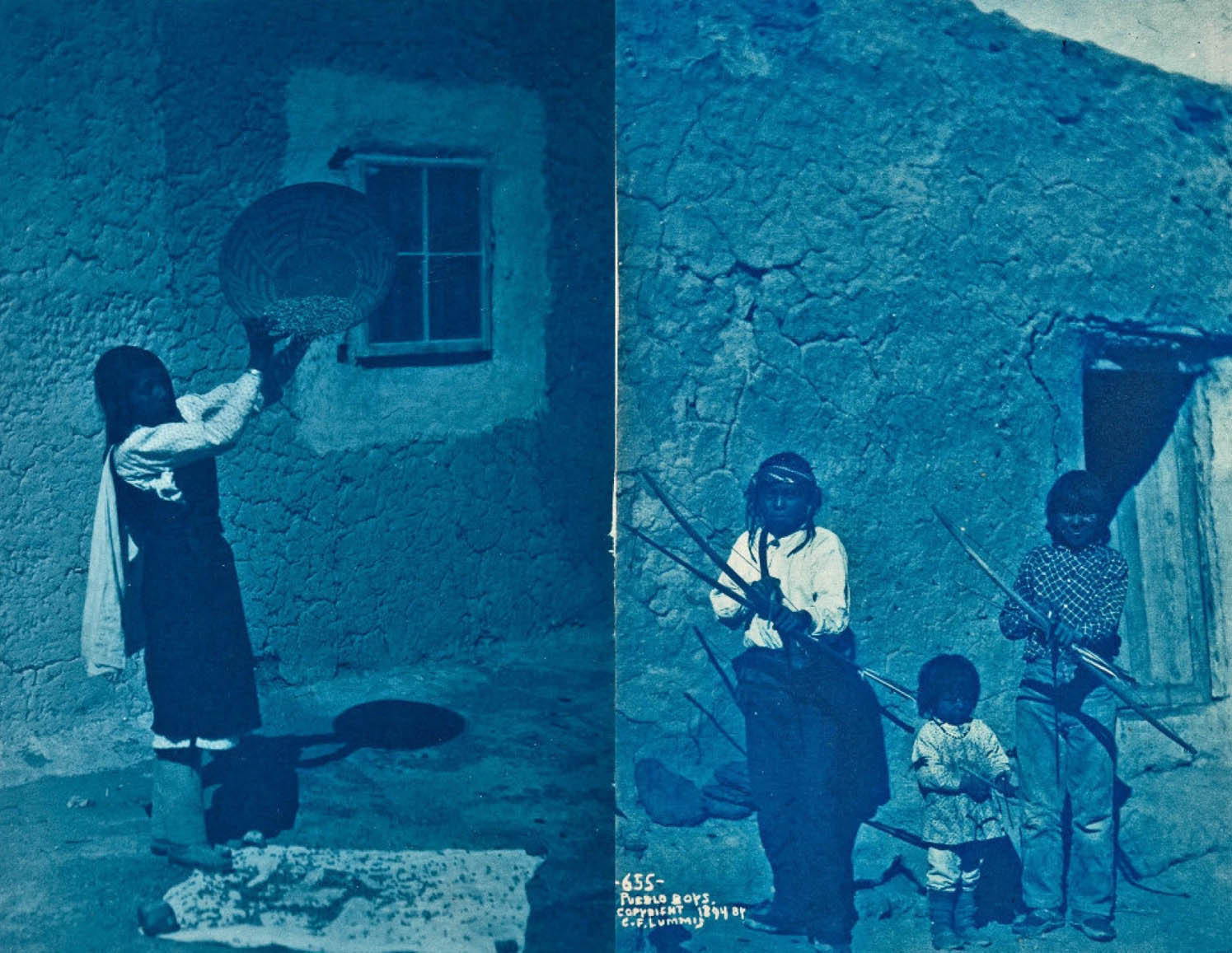
Charles Lummis (American, 1859-1928) 'Photograph of an Isleta girl winnowing beans, Isleta Pueblo, New Mexico' 1890 and Charles Lummis (American, 1859-1928) 'Photograph of three Isleta boys with bows and arrows, Isleta Pueblo, New Mexico' 1894


(Left)

Charles Lummis (American, 1859-1928)
Photograph of an Isleta girl winnowing beans, Isleta Pueblo, New Mexico
1890
Cyanotype
8 in x 5 in.
Courtesy of the Braun Research Library Collection, Autry Museum of the American West

(Right)

Charles Lummis (American, 1859-1928)
Photograph of three Isleta boys with bows and arrows, Isleta Pueblo, New Mexico
1894
Cyanotype
8 in x 5 in.
Courtesy of the Braun Research Library Collection, Autry Museum of the American West


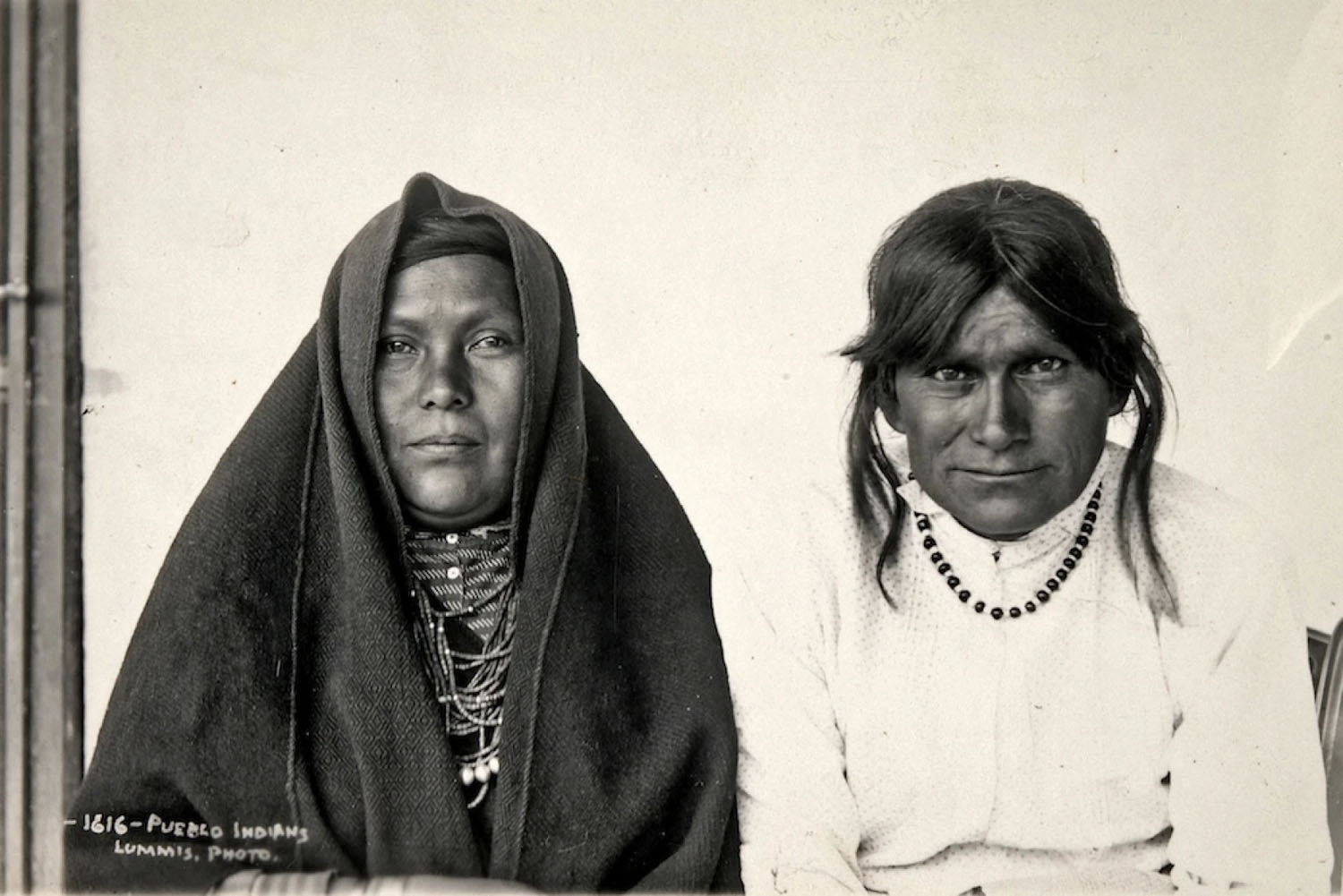
Charles Lummis (American, 1859-1928) 'Photograph of a Pueblo couple (probably Isleta or Taos), New Mexico' April 27, 1896


Charles Lummis (American, 1859-1928)
Photograph of a Pueblo couple (probably Isleta or Taos), New Mexico
April 27, 1896
5 in x 7 in.
Courtesy of the Braun Research Library Collection, Autry Museum of the American West


Charles Lummis (American, 1859-1928) 'Photograph of spectators watching races, Isleta Pueblo, New Mexico' April 19, 1896


Charles Lummis (American, 1859-1928)
Photograph of spectators watching races, Isleta Pueblo, New Mexico
April 19, 1896
5 in x 7 in.
Courtesy of the Braun Research Library Collection, Autry Museum of the American West


Charles Lummis (American, 1859-1928) 'Cyanotype photograph album: Bits of New Mexico and Arizona, Vol. 2' Nd


Charles Lummis (American, 1859-1928)
Cyanotype photograph album: Bits of New Mexico and Arizona, Vol. 2
Nd 
5.25″ x 9.25″
Courtesy of the Autry National Center/Southwest Museum, Los Angeles


The rapid changes forced on the Native American peoples of the American southwest are documented in Time Exposures: Picturing a History of Isleta Pueblo in the 19th Century. With more than 80 images and objects that detail life on the Isleta Pueblo Reservation after the arrival of the railroads in 1881, the exhibition opens Saturday, Sept. 17, at the Smithsonian’s National Museum of the American Indian in New York, the George Gustav Heye Center, and continues through Sunday, June 10, 2012.

In 1881, the railroad companies forcibly took land in the centre of Isleta Pueblo in the Rio Grande Valley and the rail lines built there brought scores of tourists. Prominent non-Native artists and photographers, such as Edward Curtis and Ben Wittick, traveled there to capture everyday Pueblo life. Organised by the people of Isleta Pueblo, Time Exposures portrays their lives before the arrival of tourists and other visitors, the changes imposed over the following decades and the ways in which the people of Isleta Pueblo worked to preserve their way of life.

Time Exposures is divided into three parts. In the first section, the cycle of the Isleta traditional year as it was observed in the mid-19th century is detailed. The second section describes the arrival of the Americans and the how this disrupted the Isleta way of living. In the third section, the exhibit examines the photos themselves as products of an outside culture. While exploring the underlying ideas and values of the photos, the exhibition questions their portrayal of Isleta people and ways. “In this exhibition, Native people respond to the stereotypical images of their lives that have been circulated by outsiders for centuries,” said Kevin Gover (Pawnee), director of the museum. “It is an opportunity for us all to learn the realities behind some of these popular and enduring photographs.”

“These photographs tell such an important story,” said John Haworth (Cherokee), director of the Heye Center. “The people of Isleta Pueblo fought to maintain their traditions despite radical and dramatic disruptions.”

Included in the exhibition are images by photographers Edward Curtis, A.C. Vroman, Karl Moon, John Hillers, Charles Lummis, Carlos Vierra, Sumner Matteson, Albert Sweeney, Josef Imhof and Ben Wittick. Time Exposures: Picturing a History of Isleta Pueblo in the 19th Century was organised by the people of the Pueblo of Isleta. A committee of Isleta Pueblo traditional leaders oversaw the development, writing and design of the exhibition. Time Exposures originally appeared at the Albuquerque Museum of Art and History in New Mexico.

Press release from the National Museum of the American Indian, New York website


George Wharton James (American, 1858-1923) 'Selling goods along tracks' late 1880s to early 1900s


George Wharton James (American, 1858-1923)
Selling goods along tracks
late 1880s to early 1900s
40 x 27cm
Courtesy of the Autry National Center/Southwest Museum, Los Angeles


Sumner Matteson (American, 1867-1920) 'Simon Zuni' 1900


Sumner Matteson (American, 1867-1920)
Simon Zuni
1900
46 x 33 cm
Photograph Courtesy of the Milwaukee Public Museum, Sumner W. Sumner Matteson Collection


In Time Exposures, we the people of Isleta Pueblo, a Native American community in New Mexico, tell our own story about this time and its lasting effects on our life today. Using a selection of over 300 historic photographs and an array of artefacts, the exhibit portrays our lives before the arrival of the Americans, the changes imposed over the following decades, and the ways in which our people worked to preserve our way of life. Through this process, the exhibit explains how we came to be who we are today.

The exhibit is divided into three parts. In the first section, we describe the cycle of our traditional year as it was observed in the mid-19th century. As a community, our lives were organised according to the seasons, farming, hunting and gathering practices and a regular sequence of ceremonies and rituals. Much has changed for us, but the cycles described here still define the contours of a parallel life we live today.

The second section of the exhibition describes the arrival of the Americans and the many ways in which this influx disrupted our way of living. The new authority took our lands and waters, prohibited hunts, and severely limited our access to plants and other resources. The exhibit shows how our people fought these changes and how we learned to become members of America on our own terms.

In the third section of the show, the exhibit examines the photographs themselves as products of white culture. The exhibit explores the underlying ideas and values of the photos, and asks what kind of record they truly represent of our people and our ways.

Text from the Time Exposures exhibition catalogue


Unknown photographer. 'Jose S. Abeita, bronco buster, in Magdalena' c. 1920


Unknown photographer
Jose S. Abeita, bronco buster, in Magdalena
c. 1920
25 x 40cm
Courtesy of the Autry National Center/Southwest Museum, Los Angeles


Charles Lummis (American, 1859-1928) 'Young Isleta Girl' Nd 


Charles Lummis (American, 1859-1928)
Young Isleta Girl
Nd 
Cabinet card
Courtesy of the Library of Congress


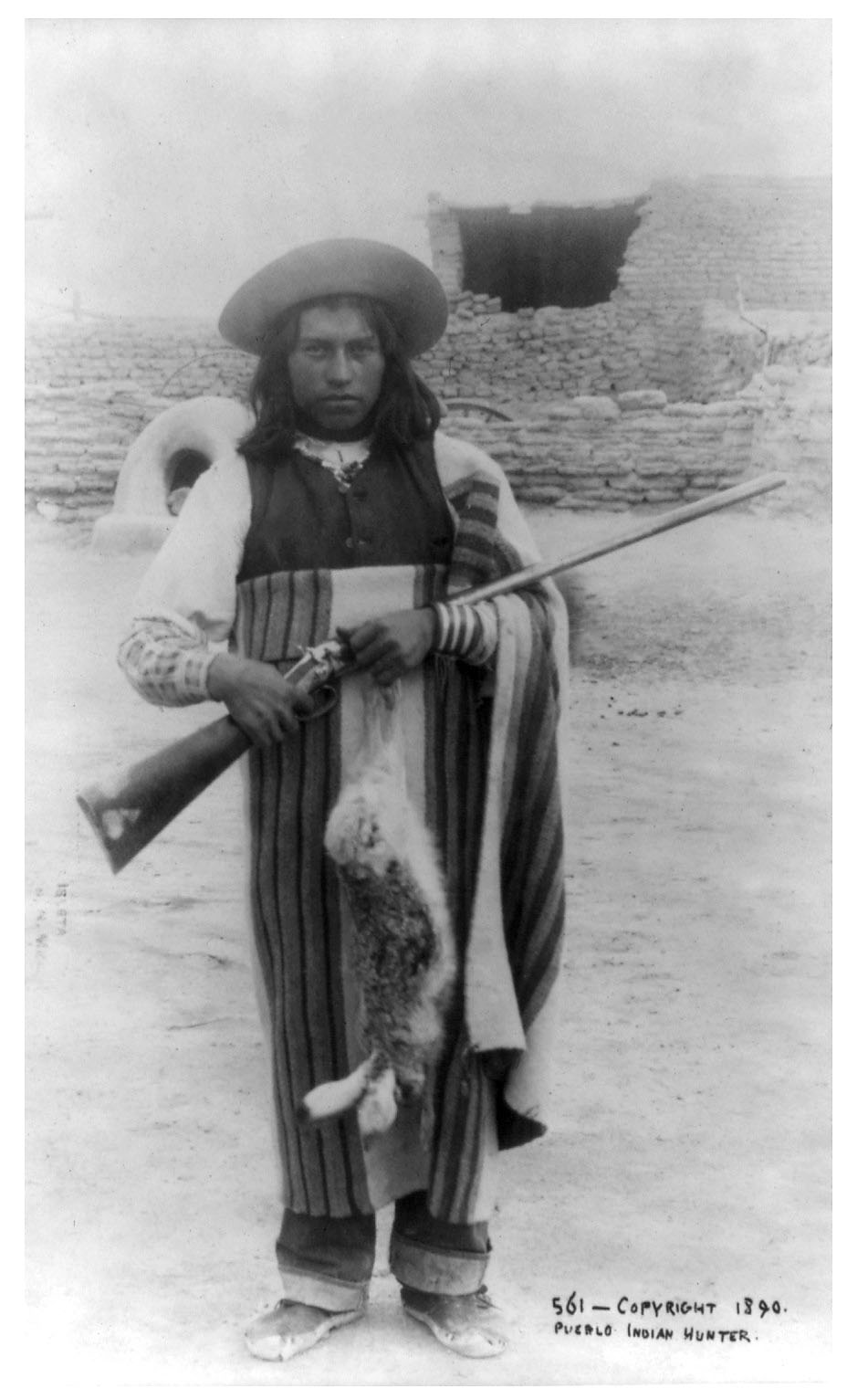
Charles Lummis (American, 1859-1928) 'Isleta hunter, Juan Diego' 1890


Charles Lummis (American, 1859-1928)
Isleta hunter, Juan Diego
1890
Courtesy of the Autry National Center/Southwest Museum, Los Angeles


Smithsonian National Museum of the American Indian
The George Gustav Heye Center
One Bowling Green, Battery Park, New York City
Phone: (212) 514-3700

Opening hours:
Every day from 10am – 5pm
Thursdays until 8pm

National Museum of the American Indian website

LIKE ART BLART ON FACEBOOK

Back to top

Exhibition: ‘Helios: Eadweard Muybridge in a Time of Change’ at the San Francisco Museum of Modern Art (SFMOMA)

Exhibition dates: 26th February – 7th June, 2011


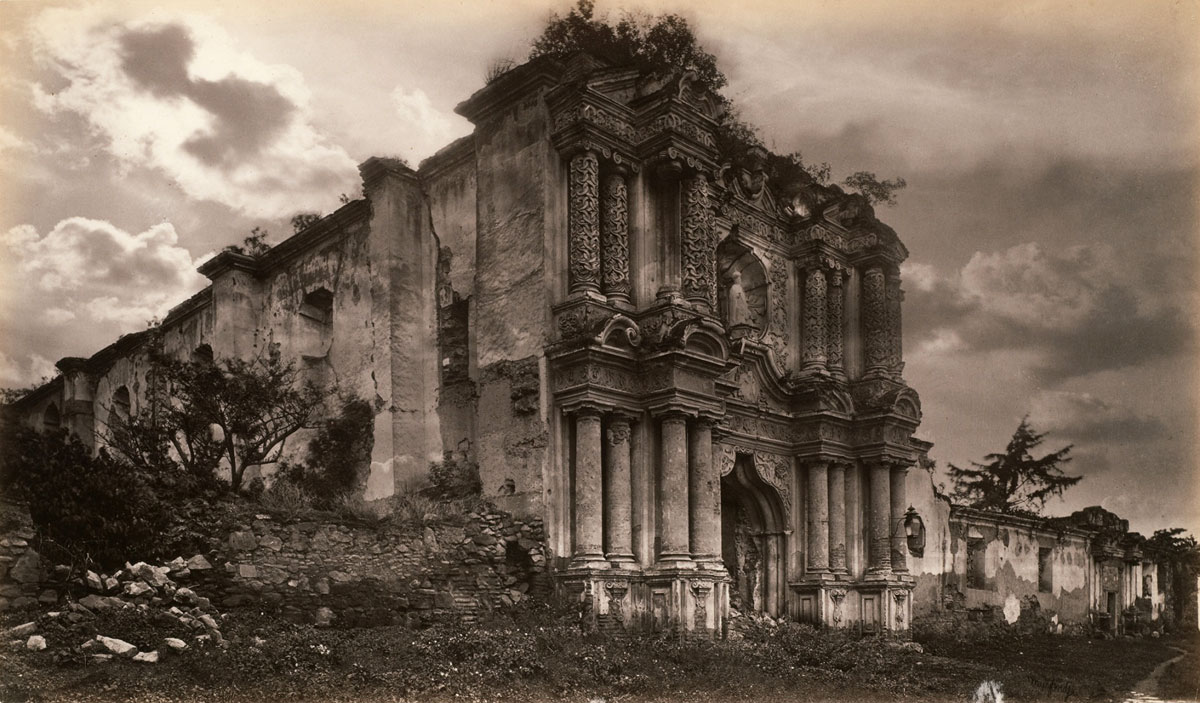
Eadweard Muybridge (English-American, 1830-1904) 'Ruins of a Church, Antigua, Guatemala' 1875


Eadweard Muybridge (English-American, 1830-1904)
Ruins of a Church, Antigua, Guatemala
1875
Albumen print
Collection Centre Canadien d’Architecture/Canadian Centre for Architecture, Montreal


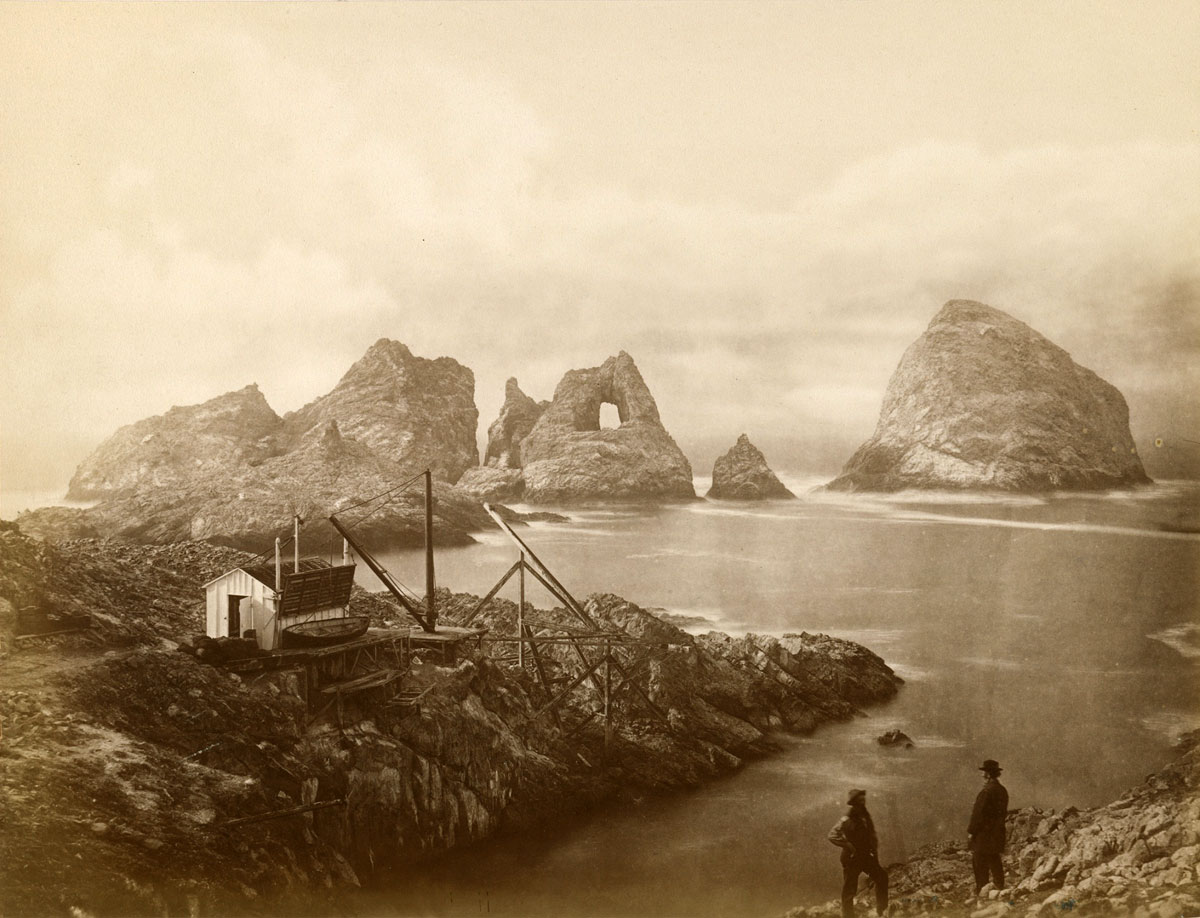
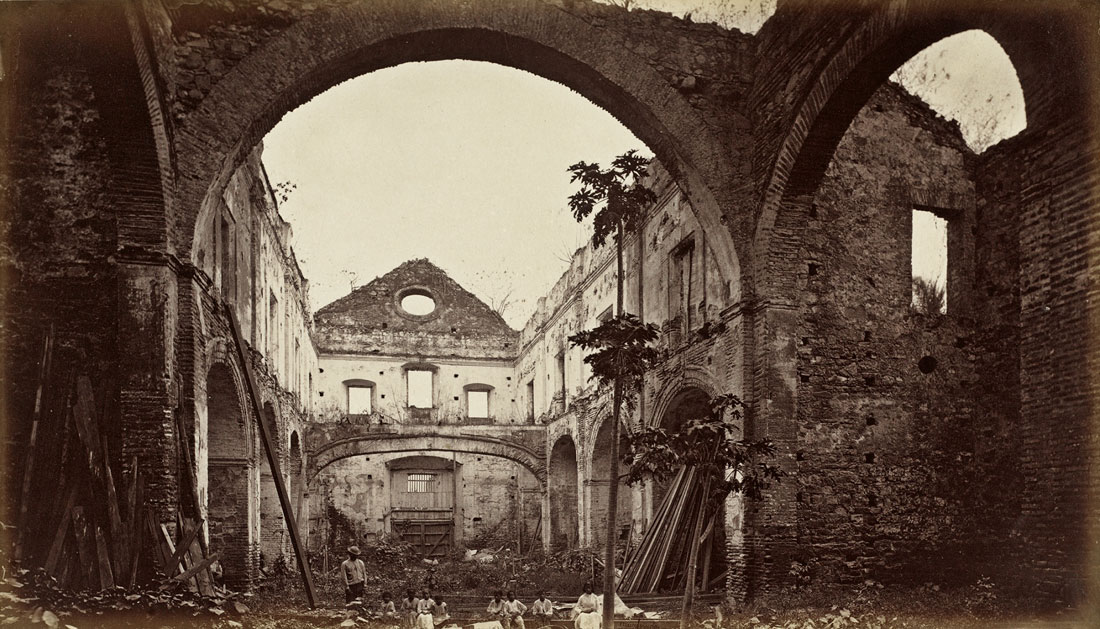
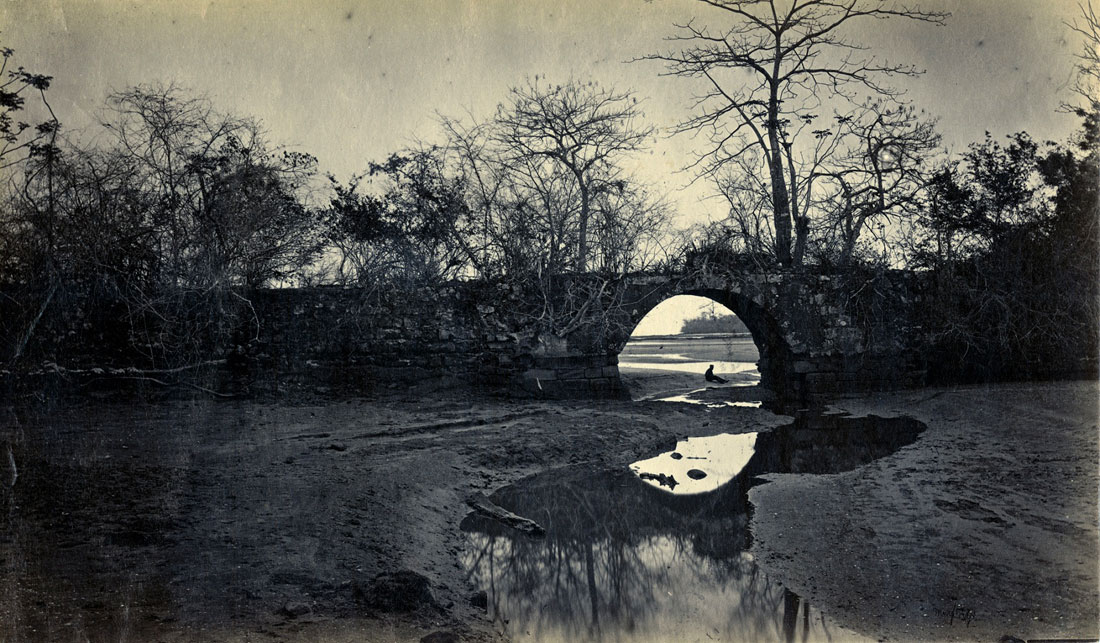
While rightly famous for his work on animal locomotion it is the first group of photographs in this posting that shine most brightly. It is often overlooked how magnificent a photographer Eadweard Muybridge was and what a brilliant eye he had. The top three photographs, especially the first one (above), are knockouts – radiant jewels in which the tensional points of the composition and the atmosphere of the scene are captured magnificently. I also love the use of human figures to give scale to the scene.

It is rare to find Eadweard Muybridge photographs other than his locomotion studies on the Internet (do a search under Google and see for yourself!), so it is a particular pleasure to post these photographs. It is something I have been wanted to do for quite a while now and finally it has come to pass; earlier iterations of this exhibition had few press images so I must heartily thank the San Francisco Museum of Modern Art (SFMOMA) for allowing me to publish the photographs in the posting.

Dr Marcus Bunyan


Many thankx to the San Francisco Museum of Modern Art (SFMOMA) for allowing me to publish the photographs in the posting. Please click on the photograph for a larger version of the image.


Eadweard Muybridge (English-American, 1830-1904) 'The Ramparts, Funnel Rock, Hole in the Wall, Pyramid, Sugar Loaf, Oil House, and Landing Cove on Fisherman's Bay, South Farallon Island (4150)' 1871


Eadweard Muybridge (English-American, 1830-1904)
The Ramparts, Funnel Rock, Hole in the Wall, Pyramid, Sugar Loaf, Oil House, and Landing Cove on Fisherman’s Bay, South Farallon Island (4150)
1871
Albumen print
U.S. Coast Guard Historian’s Office


Eadweard Muybridge (English-American, 1830-1904) 'Ruins of the Church of San Domingo, Panama' 1875


Eadweard Muybridge (English-American, 1830-1904)
Ruins of the Church of San Domingo, Panama
1875
Albumen print
Image courtesy The Board of Trustees, National Gallery of Art, Washington


Eadweard Muybridge (English-American, 1830-1904) 'Bridge on the Porto Bello, Panama' 1875


Eadweard Muybridge (English-American, 1830-1904)
Bridge on the Porto Bello, Panama
1875
Albumen print
Department of Special Collections, Charles E. Young Research Library, UCLA


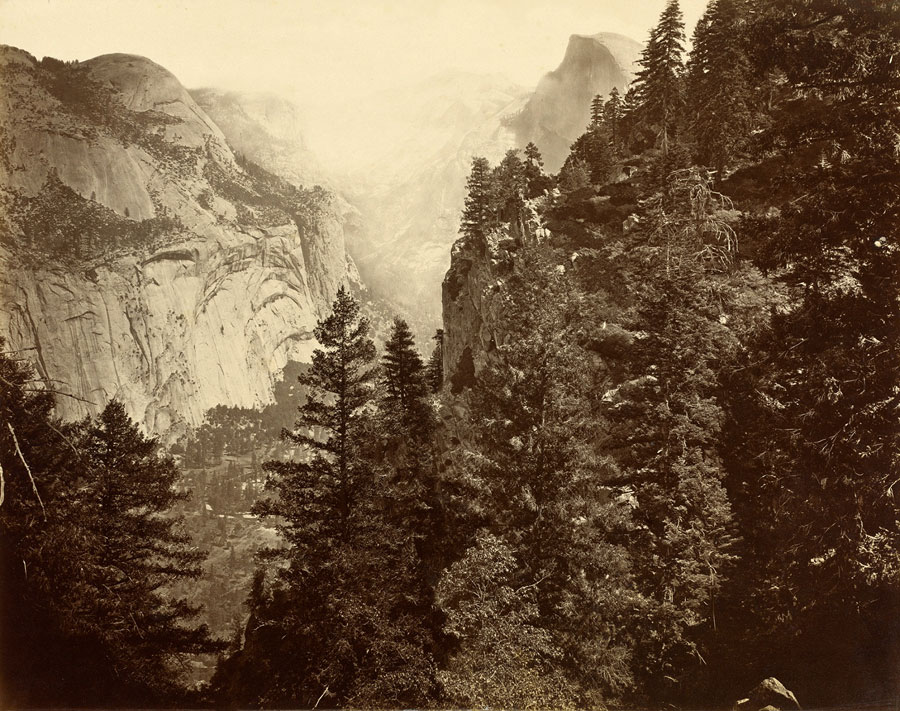
Eadweard Muybridge (English-American, 1830-1904) 'Tenaya Canyon. Valley of the Yosemite. From Union Point. No. 35,'1872


Eadweard Muybridge (English-American, 1830-1904)
Tenaya Canyon. Valley of the Yosemite. From Union Point. No. 35
1872
Albumen print
Collection National Gallery of Art, Washington, DC


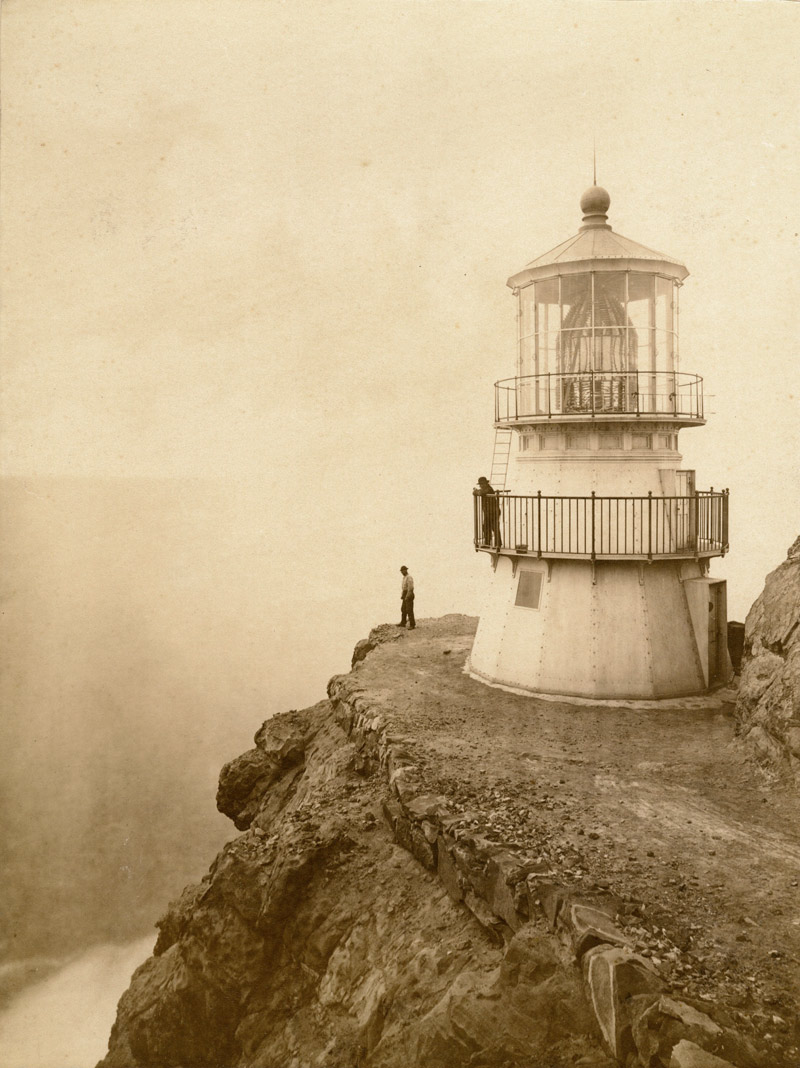
Eadweard Muybridge (English-American, 1830-1904) 'First-Order Lighthouse at Punta de los Reyes, Seacoast of California, 296 Feet Above Sea (4136)' 1871


Eadweard Muybridge (English-American, 1830-1904)
First-Order Lighthouse at Punta de los Reyes, Seacoast of California, 296 Feet Above Sea (4136)
1871
Albumen print
U.S. Coast Guard Historian’s Office


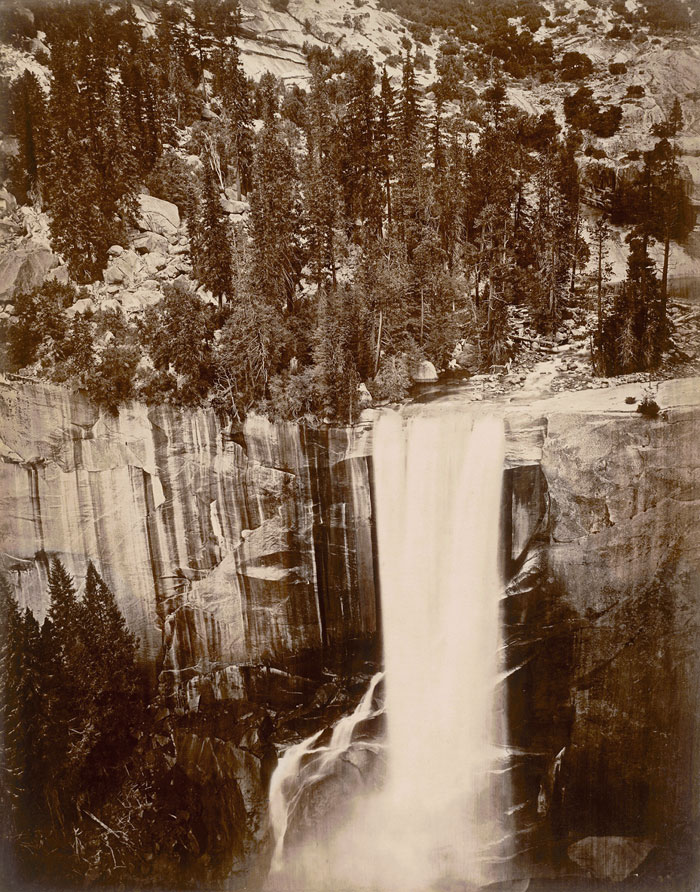
Eadweard Muybridge (English-American, 1830-1904) Pi-Wi-Ack. Valley of the Yosemite. (Shower of Stars) “Vernal Fall.” 400 Feet Fall. No. 29, 1872


Eadweard Muybridge (English-American, 1830-1904)
Pi-Wi-Ack. Valley of the Yosemite. (Shower of Stars) “Vernal Fall.” 400 Feet Fall. No. 29
1872
Albumen print
Collection San Francisco Museum of Modern Art; gift of Jeffrey Fraenkel and Frish Brandt


From February 26 through June 7, 2011, the San Francisco Museum of Modern Art (SFMOMA) will showcase the first-ever retrospective examining all aspects of artist Eadweard Muybridge’s pioneering photography. Helios: Eadweard Muybridge in a Time of Change brings together more than 300 objects created between 1857 and 1893, including Muybridge’s only surviving zoopraxiscope – an apparatus he designed in 1879 to project motion pictures. Originally organised by Philip Brookman, Corcoran Gallery of Art chief curator and head of research, the San Francisco presentation is organised by SFMOMA Associate Curator of Photography Corey Keller.

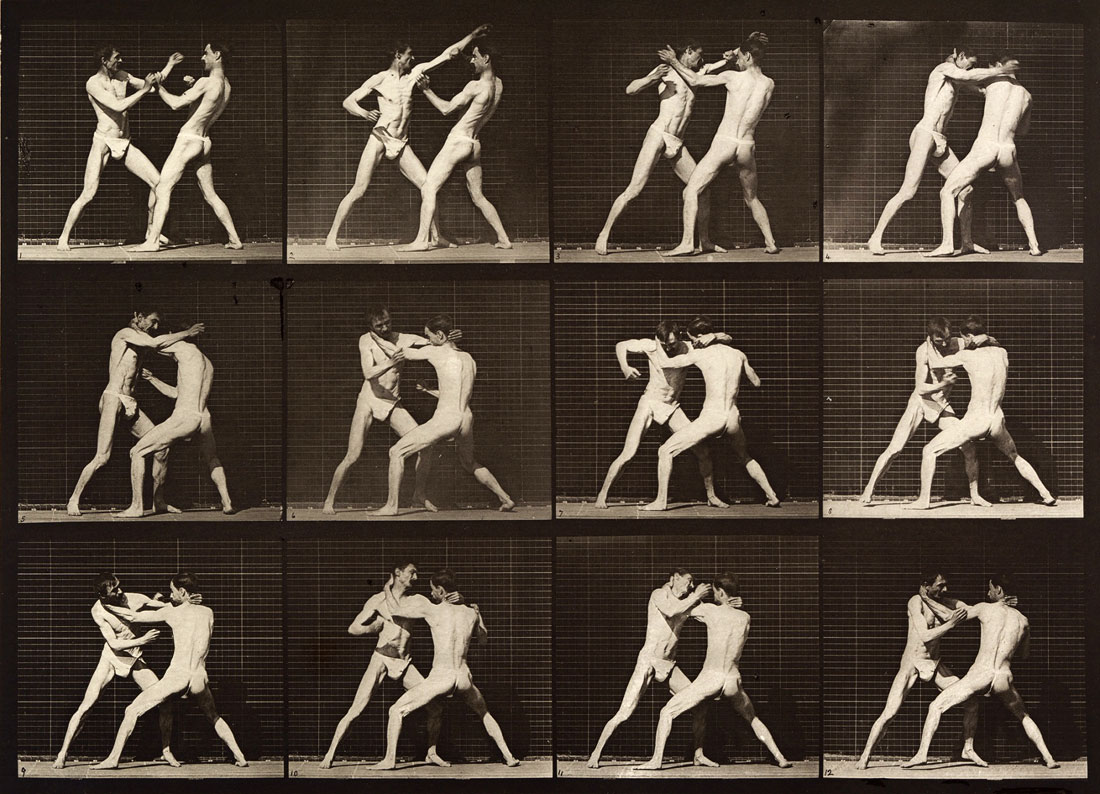
Helios: Eadweard Muybridge in a Time of Change includes numerous vintage photographs, albums, stereographs, lantern slides, glass negatives and positives, patent models, zoopraxiscope discs, proof prints, notes, books, and other ephemera. The works have been brought together from 38 different collections and include a number of Muybridge’s photographs of Yosemite Valley, including dramatic waterfalls and mountain views from 1867 and 1872; images of Alaska and the Pacific coast; an 1869 survey of the Central Pacific and Union Pacific Railroads in California, Nevada, and Utah; pictures from the Modoc War, pictures from Panama and Guatemala; and urban panoramas of San Francisco. The exhibition also includes examples from Muybridge’s experimental series of sequential stop-motion photographs such as Attitudes of Animals in Motion (1881) and his later masterpiece Animal Locomotion (1887).

The exhibition is organised in a series of thematic sections that present the chronology of Muybridge’s career, the evolution of his unique sensibility, the foundations of his experimental approach to photography, and his connections to other people and events that helped guide his work. The sections include: Introduction: The Art of Eadweard Muybridge (1857-1887); The Infinite Landscape: Yosemite Valley and the Western Frontier (1867-1869); From California to the End of the Earth: San Francisco, Alaska, the Railroads, and the Pacific Coast (1868-1872); The Geology of Time: Yosemite and the High Sierra (1872); Stopping Time: California at the Crossroads of Perception (1872-1878); War, Murder, and the Production of Coffee: the Modoc War and the Development of Central America (1873-1875); Urban Panorama (1877-1880); The Horse in Motion (1877-1881); Motion Pictures: the Zoopraxiscope (1879-1893); and Animal Locomotion (1883-1893).

Muybridge and San Francisco

Best known for his groundbreaking studies of animals and humans in motion, Muybridge (1830-1904) was also an innovative and successful landscape and survey photographer, documentary artist, inventor, and war correspondent. Born in Kingston upon Thames, England, in 1830, Muybridge immigrated to the United States around 1851. He worked as a bookseller in New York and San Francisco and returned to London in 1860 following a serious injury. Muybridge learned photography in Britain and by 1867 returned to the United States, where began his career as a photographer in San Francisco. He gained recognition through innovative landscape photographs, which showed the grandeur and expansiveness of the American West. Between 1867 and 1871, these were published under the pseudonym “Helios.”

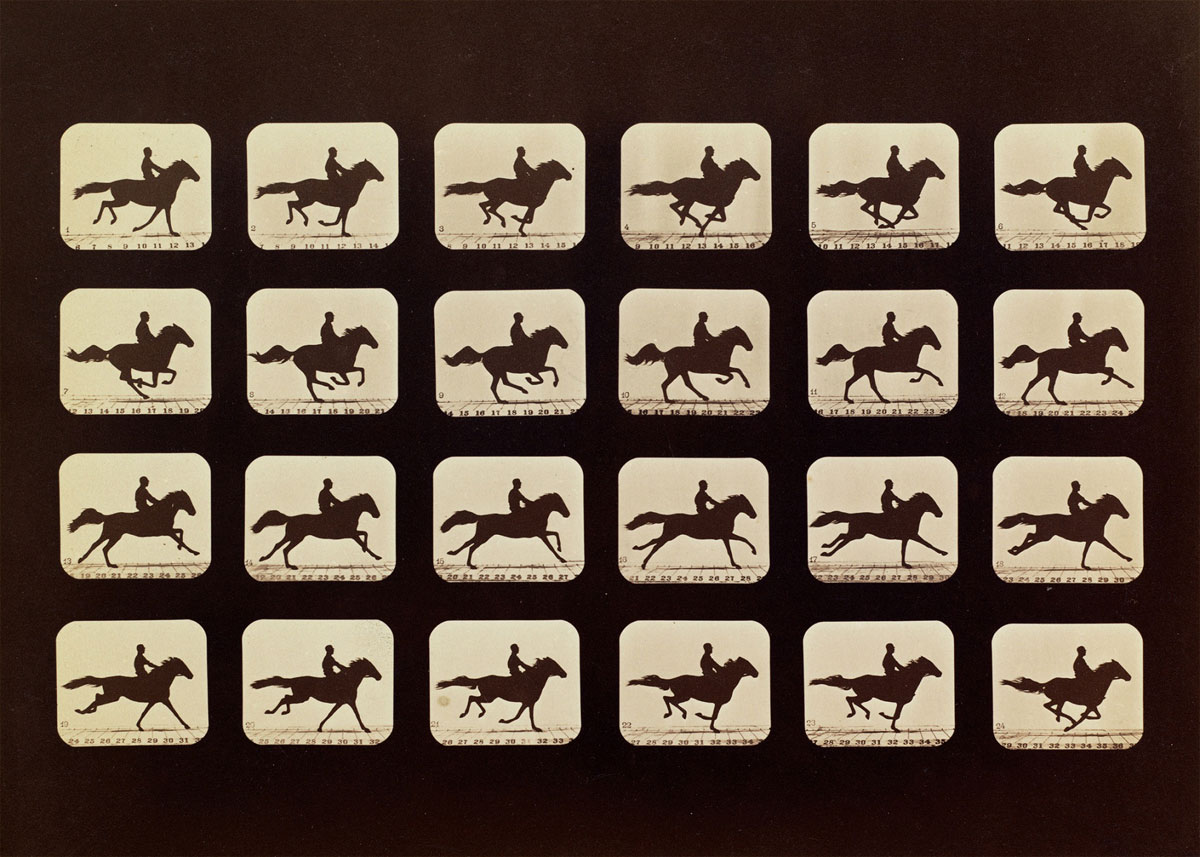
Muybridge spent most of his career in San Francisco and Philadelphia during a time of rapid industrial and technological growth. In the 1870s he developed new ways to stop motion with his camera. Muybridge’s legendary sequential photographs of running horses helped change how people saw the world. His projected animations inspired the early development of cinema, and his revolutionary techniques produced timeless images that have profoundly influenced generations of photographers, filmmakers, and visual artists.

Press release from the San Francisco Museum of Modern Art (SFMOMA) website [Online] Cited 02/06/2011 no longer available online


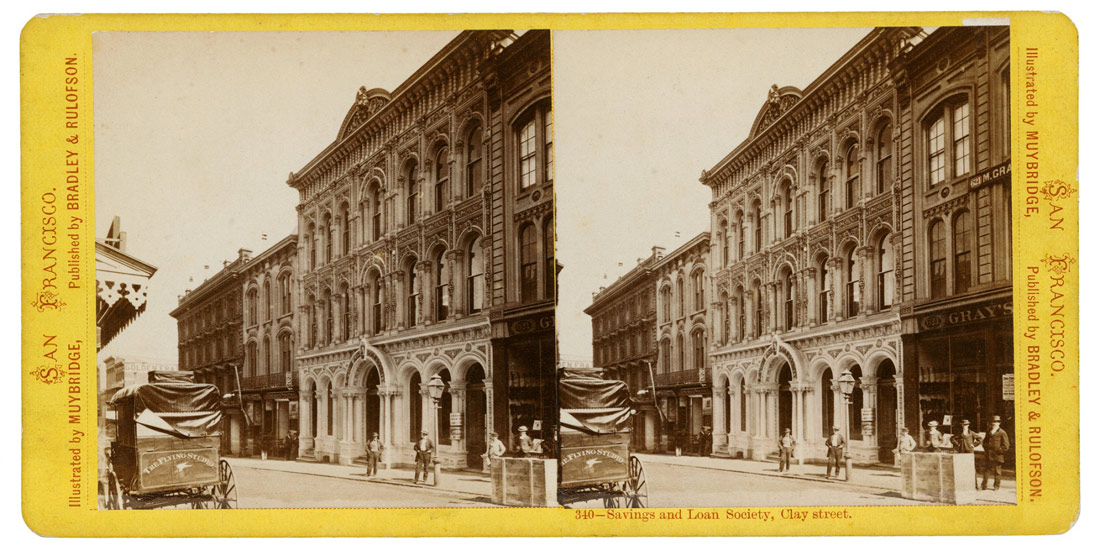
Eadweard Muybridge (English-American, 1830-1904) Savings and Loan Society, Clay Street (340), 1869


Eadweard Muybridge (English-American, 1830-1904)
Savings and Loan Society, Clay Street (340)
1869
albumen stereograph
Collection of Leonard A. Calle


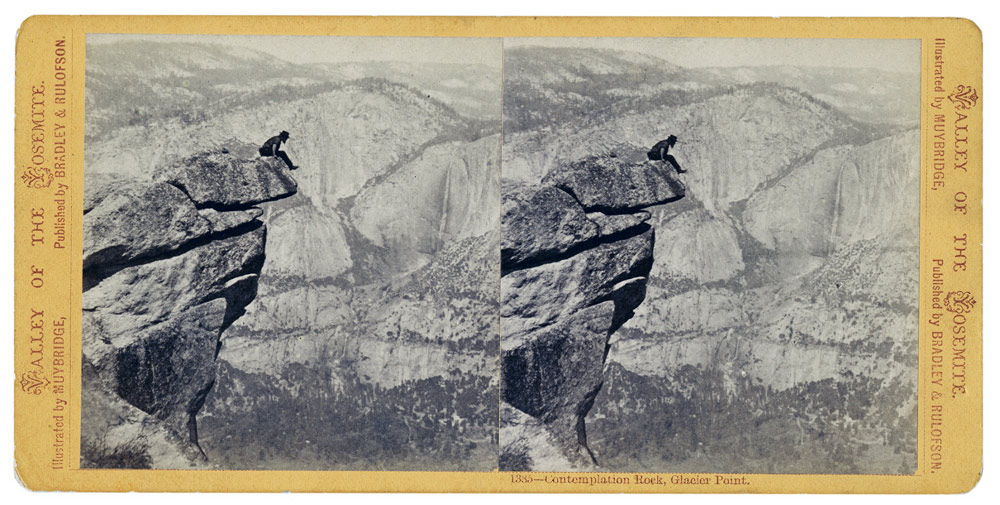
Eadweard Muybridge (English-American, 1830-1904) Contemplation Rock, Glacier Point (1385), 1872


Eadweard Muybridge (English-American, 1830-1904)
Contemplation Rock, Glacier Point (1385)
1872
Albumen stereograph
Collection of California Historical Society


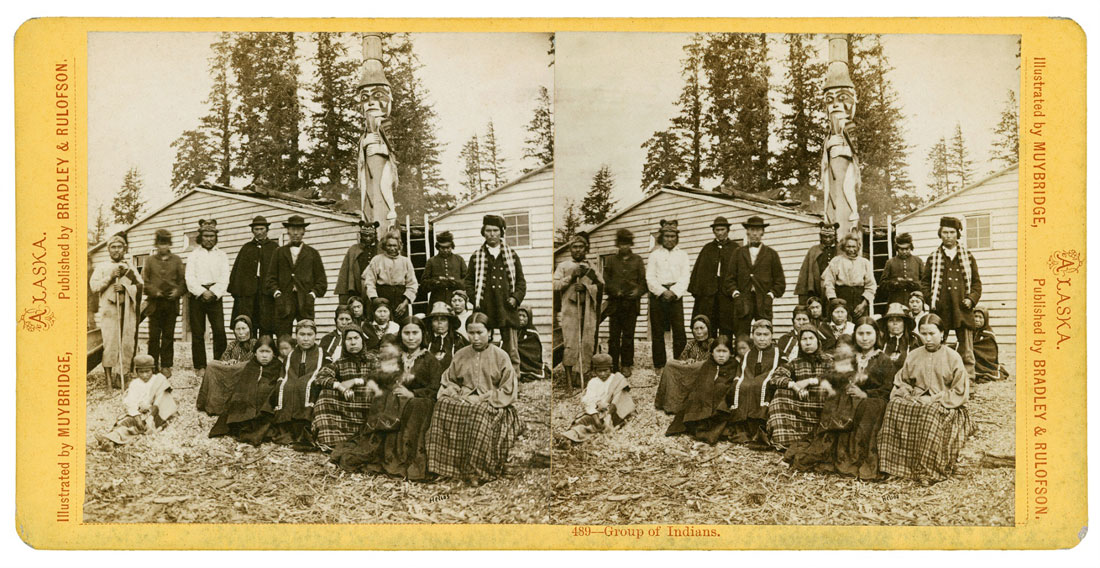
Eadweard Muybridge (English-American, 1830-1904) 'Group of Indians (489)' 1868


Eadweard Muybridge (English-American, 1830-1904)
Group of Indians (489)
1868
Albumen stereograph
Collection of Leonard A. Walle


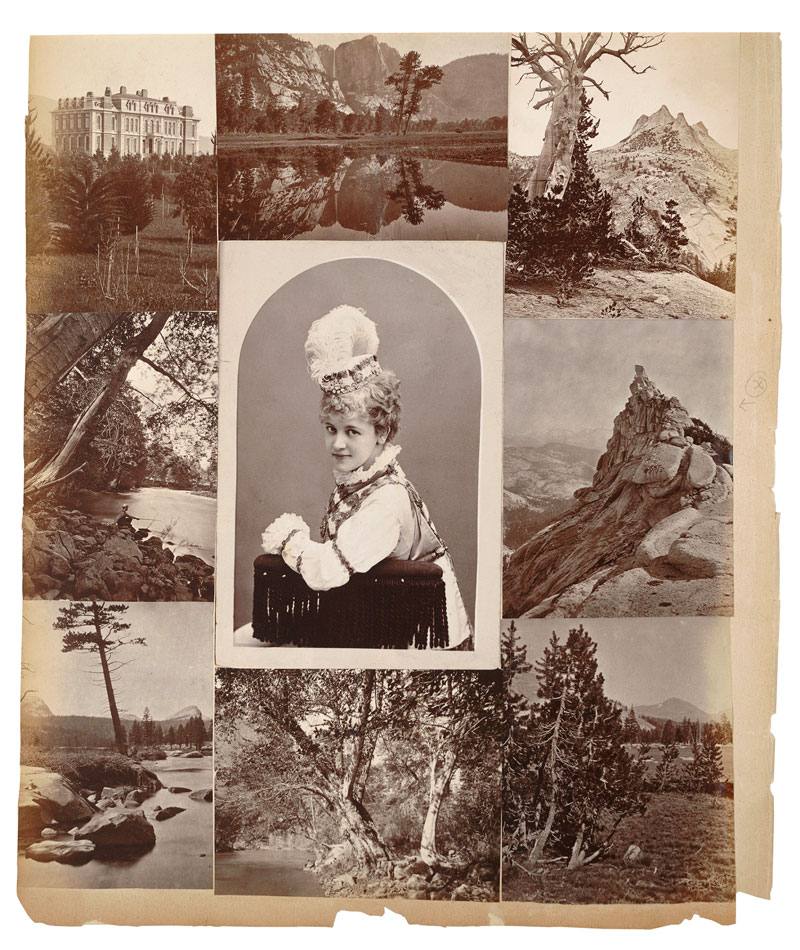
Eadweard Muybridge (English-American, 1830-1904) 'The Brandenburg Album of Bradley & Rolufson "Celebrities" and Muybridge Photographs, page 104' 1874


Eadweard Muybridge (English-American, 1830-1904)
The Brandenburg Album of Bradley & Rolufson “Celebrities” and Muybridge Photographs, page 104
1874
Albumen prints
Iris & B. Gerald Cantor Center for Visual Arts at Stanford University, Museum Purchase Fund


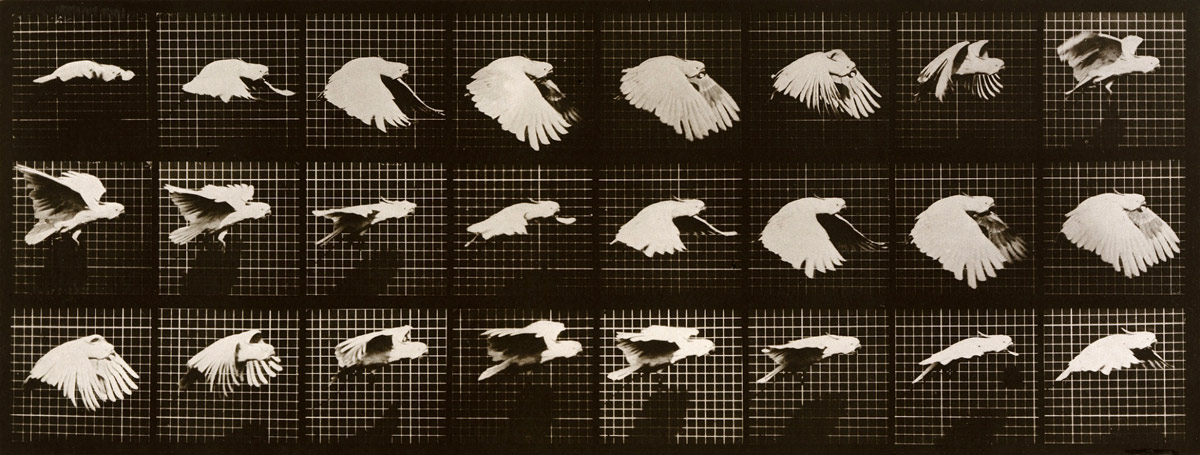
Eadweard Muybridge (English-American, 1830-1904) 'Cockatoo; flying. Plate 759' 1887


Eadweard Muybridge (English-American, 1830-1904)
Cockatoo; flying. Plate 759
1887
Collotype
Corcoran Gallery of Art, Washington, D.C.


Eadweard Muybridge (English-American, 1830-1904) 'Boxing; open-hand. Plate 340' 1887


Eadweard Muybridge (English-American, 1830-1904)
Boxing; open-hand. Plate 340
1887
Collotype
Corcoran Gallery of Art, Washington, D.C.


Eadweard Muybridge (English-American, 1830-1904) 'Horses. Running. Phryne L. Plate 40, 1879, from 'The Attitudes of Animals in Motion'' 1881


Eadweard Muybridge (English-American, 1830-1904)
Horses. Running. Phryne L. Plate 40
1879
From The Attitudes of Animals in Motion, 1881
Albumen print
Image courtesy The Board of Trustees, National Gallery of Art, Washington, Gift of Mary and Dan Solomon


Eadweard Muybridge (English-American, 1830-1904) 'Studies of Foreshortenings. Horses. Running. Mahomet. Plates 143-144, 1879, from 'The Attitudes of Animals in Motion'' 1881


Eadweard Muybridge (English-American, 1830-1904)
Studies of Foreshortenings. Horses. Running. Mahomet. Plates 143-144
1879
From The Attitudes of Animals in Motion, 1881
Albumen print
Chrysler Museum of Art, Norfolk, VA


Eadweard Muybridge (English-American, 1830-1904) 'Leland Stanford, Jr. on his pony “Gypsy” - Phases of a Stride by a Pony While Cantering' 1879


Eadweard Muybridge (English-American, 1830-1904)
Leland Stanford, Jr. on his pony “Gypsy” – Phases of a Stride by a Pony While Cantering
1879
Collodion positive on glass
Wilson Centre for Photography


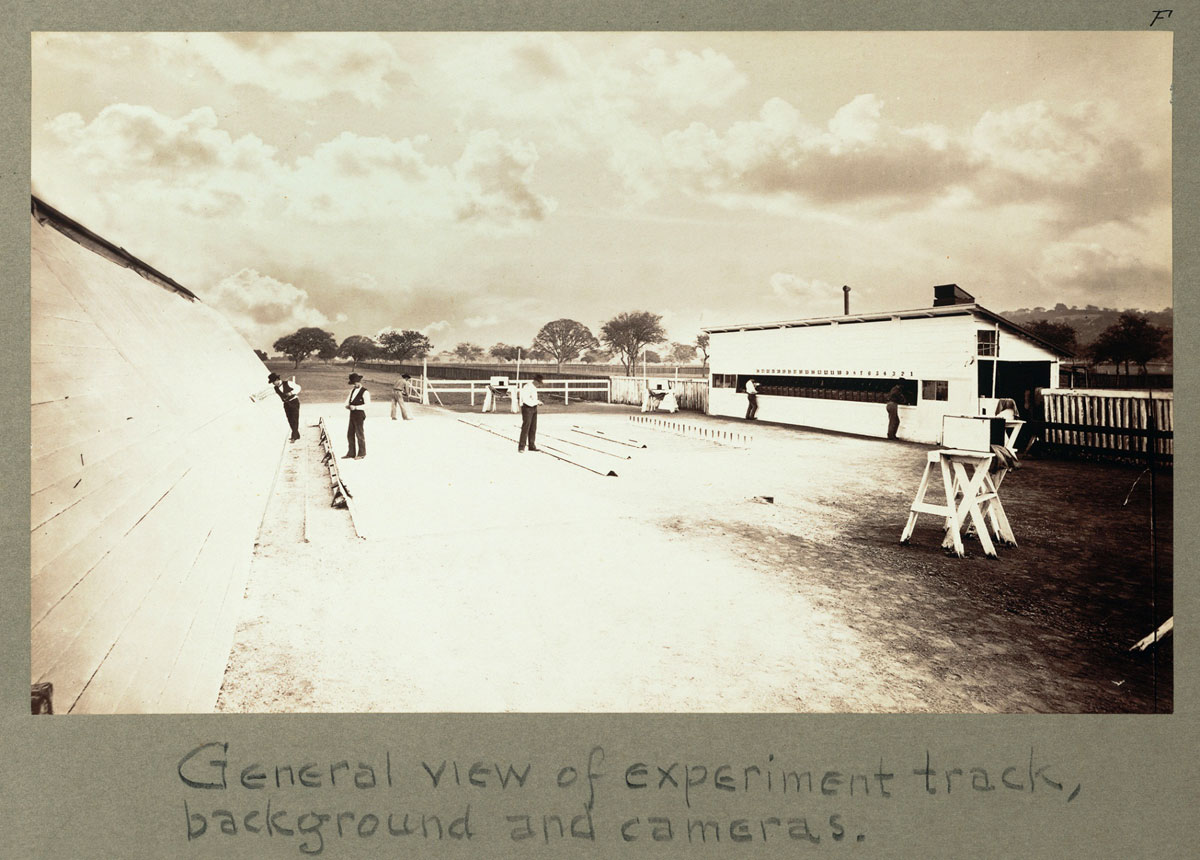
Eadweard Muybridge (English-American, 1830-1904) 'General view of experiment track, background and cameras, Plate F, from The Attitudes of Animals in Motion' 1881


Eadweard Muybridge (English-American, 1830-1904)
General view of experiment track, background and cameras, Plate F
1881
From The Attitudes of Animals in Motion, 1881
Albumen print
Courtesy Special Collections, Stanford University Libraries


San Francisco Museum of Modern Art (SFMOMA)
151 Third Street (between Mission + Howard)
San Francisco CA 94103

Opening hours:
Friday – Tuesday 10 am – 5 pm and Thursday 10 am – 9 pm
Wednesday Closed
San Francisco Museum of Modern Art website

LIKE ART BLART ON FACEBOOK

Back to top

Exhibition: ‘A Ballad of Love and Death: Pre-Raphaelite Photography in Great Britain, 1848-1875’ at the Musée d’Orsay, Paris

Exhibition dates: 8th March – 29th May 2011


Julia Margaret Cameron – you are one of my heroes!


Many thankx to the Musée d’Orsay for allowing me to publish the photographs in the posting. Please click on the photographs for a larger version of the image.


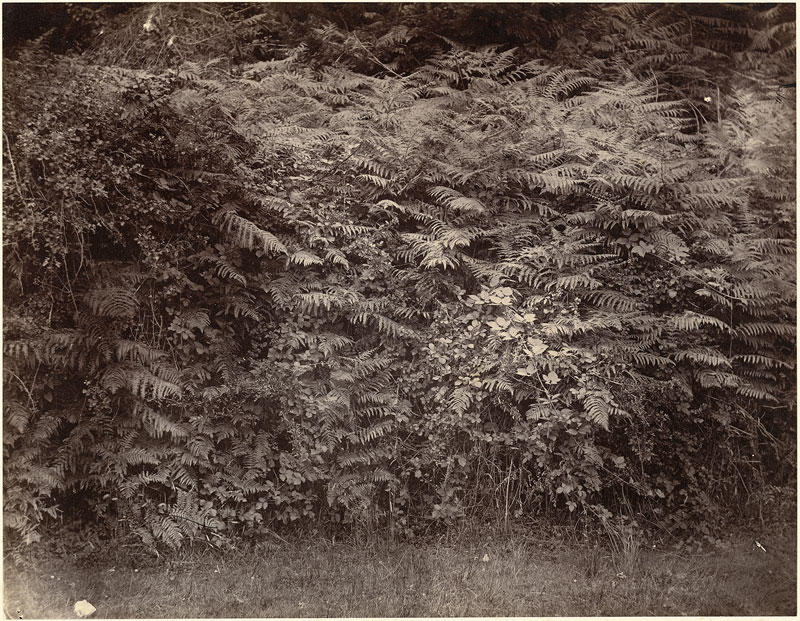
Henry White (British, 1819-1903) 'Ferns and brambles' 1856


Henry White (British, 1819-1903)
Fougères et ronces (Ferns and brambles)
1856
Albumen print
19.1 x 24.1cm
Collection particulière
© Droits réservés


John Ruskin (English, 1819-1900) 'Fribourg' 1859


John Ruskin (English, 1819-1900)
Fribourg
1859
Pencil, ink, watercolour and gouache on paper
22.5 x 28.7cm
London, The British Museum
© The Trustees of The British Museum. All rights reserved


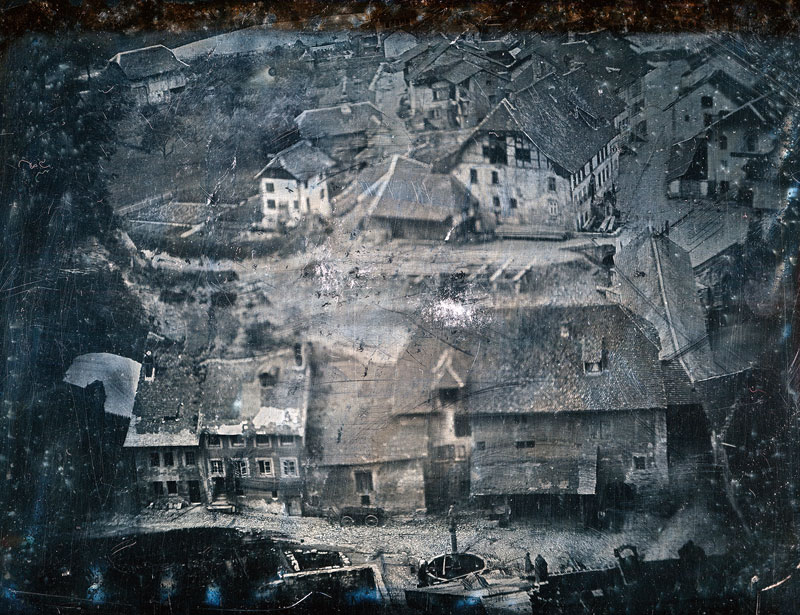
Frederick Crawley, under the direction of John Ruskin (English, 1819-1900) 'Fribourg, Switzerland, Palm Street and Berne Bridge' about 1854 or 1856


Frederick Crawley, under the direction of John Ruskin (English, 1819-1900)
Fribourg, Suisse, Rue de la Palme et Pont de Berne (Fribourg, Switzerland, Palm Street and Berne Bridge)
about 1854 or 1856
Daguerréotype
11.5 x 15.1cm
Angleterre, Courtesy K. and J. Jacobson
© Droits réservés


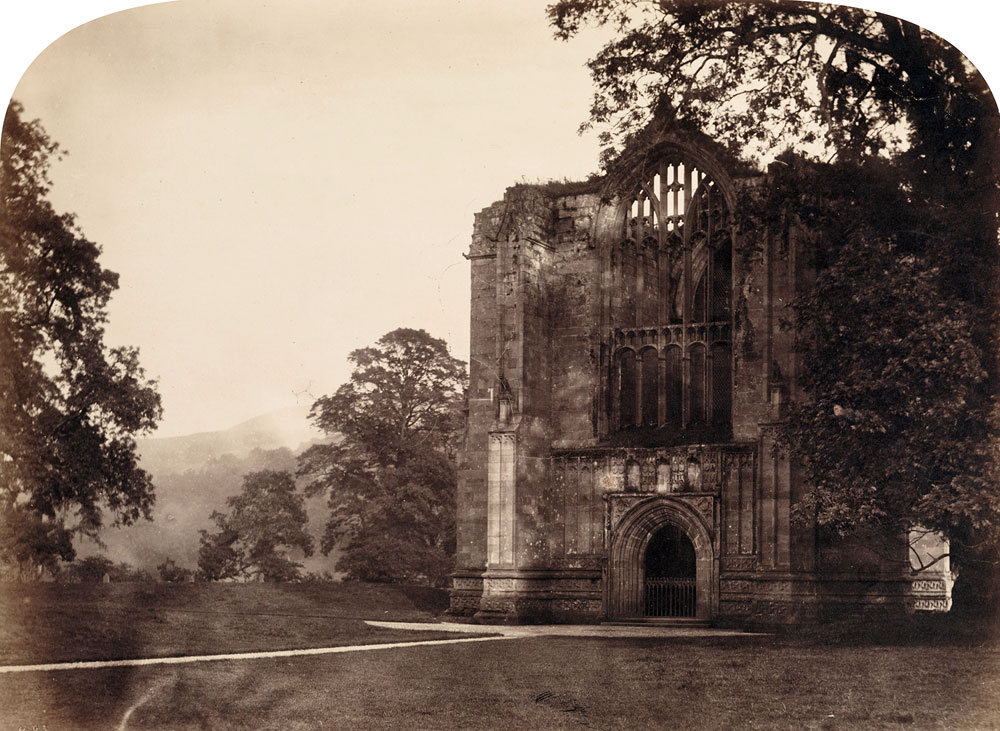
Roger Fenton (British, 1819-1869) 'Bolton Abbey' 1854


Roger Fenton (British, 1819-1869)
Bolton Abbey, West window
1854
Albumen print
25.1 x 34.5cm
Bradford, National Media Museum
© National Media Museum, Bradford/Science & Society Picture Library


John William Inchbold (English, 1830-1888) 'La Chapelle de Bolton Abbey' 1853


John William Inchbold (English, 1830-1888)
La Chapelle de Bolton Abbey (The Vault of Bolton Abbey)
1853
Oil on canvas
50 x 68.4cm
Northampton, Museum and Art Gallery
© Northampton, Museum and Art Gallery


Henry Peach Robinson (English, 1830-1901) 'Fading Away' 1858


Henry Peach Robinson (English, 1830-1901)
Fading Away
1858
Albumen print
28.8 x 52.1cm
Bradford, The Royal Photographic Society Collection au National Media Museum.
© National Media Museum, Bradford/Science & Society Picture Library


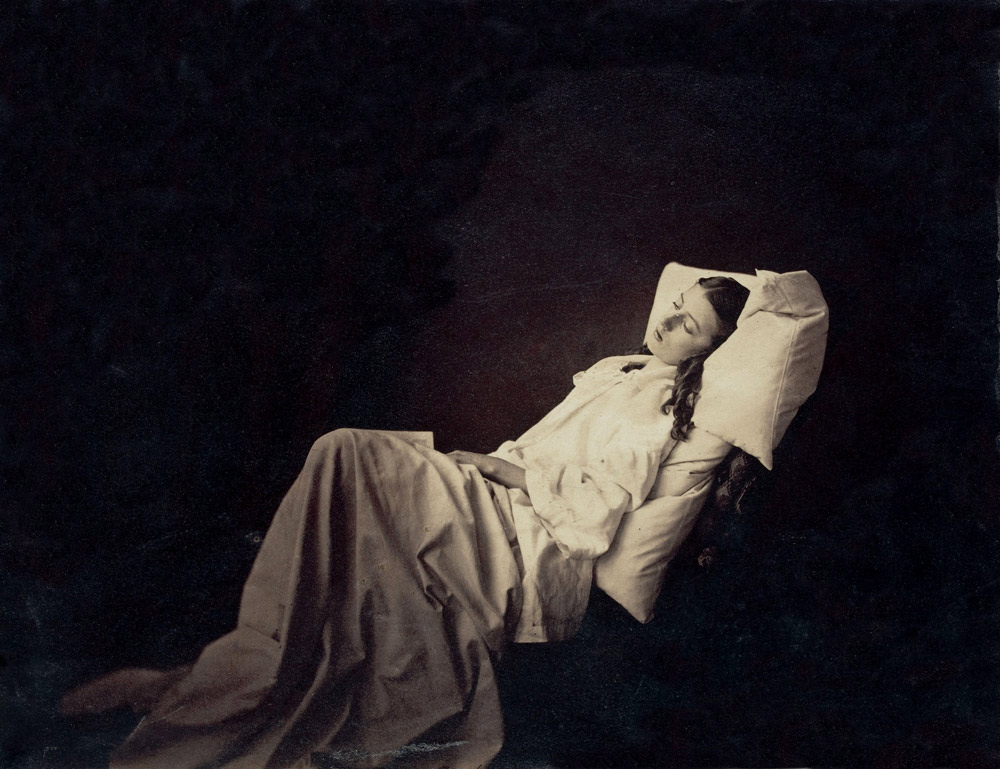
Henry Peach Robinson (English, 1830-1901) 'She Never Told her Love' 1857


Henry Peach Robinson (English, 1830-1901)
She Never Told her Love
1857
Albumen print
18.6 x 23.3cm
Paris, musée d’Orsay
© Musée d’Orsay (dist. RMN)/Patrice Schmidt


Consumed by the passion of unrequited love, a young woman lies suspended in the dark space of her unrealised dreams in Henry Peach Robinson’s illustration of the Shakespearean verse “She never told her love,/ But let concealment, like a worm i’ the bud,/ Feed on her damask cheek” (Twelfth Night II,iv,111-13). Although this picture was exhibited by Robinson as a discrete work, it also served as a study for the central figure in his most famous photograph, Fading Away, of 1858.

Purportedly showing a young consumptive surrounded by family in her final moments, Fading Away was hotly debated for years. On the one hand, Robinson was criticised for the presumed indelicacy of having invaded the death chamber at the most private of moments. On the other, those who recognised the scene as having been staged and who understood that Robinson had created the picture through combination printing (a technique that utilised several negatives to create a single printed image) accused him of dishonestly using a medium whose chief virtue was its truthfulness.

While addressing the moral and literary themes that Robinson believed crucial if photography were to aspire to high art, this picture makes only restrained use of the cloying sentimentality and showy technical artifice that often characterise this artist’s major exhibition pictures. Perhaps intended to facilitate the process of combination printing, the unnaturally black background serves also to envelop the figure in palpable melancholia.

Text from the Metropolitan Museum of Art website [Online] Cited 27/01/2020


Frederick Pickersgill (English, 1820-1900) 'Sunshine and Shade' 1859


Frederick Pickersgill (English, 1820-1900)
Sunshine and Shade
1859
Albumen print
16.4 x 19.4cm
The Royal Photographic Society Collection at the National Media Museum.
© National Media Museum, Bradford/Science & Society Picture Library


The historian and art critic, John Ruskin, had a great influence in Great Britain not only on the Pre-Raphaelite movement created in 1848, but on the development of early photography in the 1850s. The leading Pre-Raphaelite painters, John Everett Millais, Dante Gabriel Rossetti, Holman Hunt and Ford Madox Brown and their followers, wished to change the pictorial conventions laid down by the Royal Academy, and in order to demonstrate the transformations in modern life, invented a radically new idiom marked by bright colours and clarity of detail.

Pre-Raphaelite painters and photographers frequently made similar choices of subjects, and the photographers, particularly Julia Margaret Cameron, David Wilkie Wynfield and Lewis Carroll, were often had close links with the painters.

When painting landscapes, the Pre-Raphaelite artists answered Ruskin’s call, meticulously observing nature in order to capture every nuance of detail. For their part, photographers, such as Roger Fenton, Henry White, William J. Stillman and Colonel Henry Stuart Wortley, experimented with the new process of wet plate collodion negatives that allowed much greater image detail, and achieved similar effects. Although highly impressed at first by the daguerreotype, which enabled the eye to see tiny, overlooked details, Ruskin was nonetheless still very critical of landscape photography, which could not reproduce the colours of nature and in particular of the sky. This failing also gave rise to a major debate amongst photography critics.

In portraiture, there were clear links between the painted portraits of Watts and Cameron’s photographic portraits. By using special lenses and photographing her models in close-up, Cameron, achieved, with a glass negative, exactly the opposite effect to the clear image advocated by Ruskin, and her work was distinctive for the breadth of relief and contour, as well as the compositions evoking Raphael’s paintings, also a source of inspiration for Watts.

The painter Dante Gabriel Rossetti repeatedly drew and painted Jane Morris, a model with whom he was infatuated, and he asked Robert Parsons to produce a series of photographs, under his personal direction, which captured the fascinating presence of the young woman as effectively as his own paintings.

Just like the Pre-Raphaelite painters, Victorian photographers would turn to religious or historical subjects, finding a shared inspiration in the poems of Dante, Shakespeare and possibly Byron, and above all in the Arthurian legend made popular once more by Lord Tennyson, the poet laureate. From a formal point of view, Millais’ Ophelia, one of his most successful paintings, was a source for Henry Peach Robinson’s photograph, The Lady of Shalott, even though it had a different theme.

Finally, Pre-Raphaelite painters and Victorian photographers both liked to present scenes from modern life with a moralising undertone: hence She Never Told Her Love, a photograph by Robinson that was very successful when exhibited at the Crystal Palace in 1858, William Holman Hunt’s painting, Awakening of Conscience, and Rossetti’s Found, a painting depicting a countryman who comes across his former sweetheart, now a prostitute in the city.

In the 1880s, Pre-Raphaelite painting would be transformed, with artists and writers like William Morris, Burne-Jones, Whistler and Oscar Wilde, into a very different movement concerned only with the cult of beauty and rejecting Ruskin’s concept of art as something moral or useful. British photographers, however, inspired by the Pre-Raphaelites would inspire the Pictorialist movement that flourished in the 1890s, encouraged by the writings of Henry Peach Robinson and Peter Henry Emerson, extolling artistic photography.

Press release from the Musée d’Orsay website


James Sinclair 14th Earl of Caithness (Scottish, 1821-1881) 'Weston Avenue, Warwickshire' c. 1860


James Sinclair 14th Earl of Caithness (Scottish, 1821-1881)
Avenue à Weston, Warwickshire (Weston Avenue, Warwickshire)
c. 1860
Albumen print
23 x 18.3cm
New York, Courtesy George Eastman House Rochester
© Courtesy of George Eastman House, International Museum of Photography and Film


Julia Margaret Cameron (British, 1815-1879) 'The sunflower' 1866-1870


Julia Margaret Cameron (British, 1815-1879)
Le tournesol (The sunflower)
1866-1870
Albumen print
35.2 x 24.3cm
Washington, National Gallery of Art, Fond Paul Mellon
© National Gallery of Art, Washington


John Robert Parsons (Irish, 1826-1909), under the direction of Dante Gabriel Rossetti (English, 1828-1882) 'Jane Morris posing in the house of Rossetti' summer 1865


John Robert Parsons (Irish, 1826-1909), under the direction of Dante Gabriel Rossetti (English, 1828-1882)
Jane Morris posant dans la maison de Rossetti (Jane Morris posing in the house of Rossetti)
Summer 1865
Modern print
22.6 x 17.5cm
London, Victoria and Albert Museum
© V&A Images / Victoria and Albert Museum, London


John Robert Parsons (Irish, 1826-1909) 'Jane Morris posing in the garden of the house of Rossetti' summer 1865


John Robert Parsons (Irish, 1826-1909)
Jane Morris posant dans le jardin de la maison de Rossetti (Jane Morris posing in the garden of the house of Rossetti)
Summer 1865
Albumen print
Private collection
© Tim Hurst Photography


Dante Gabriel Rossetti (English, 1828-1882) 'Jane Morris, the blue silk dress' 1868


Dante Gabriel Rossetti (English, 1828-1882)
Jane Morris, the blue silk dress
1868
Oil on canvas
110.5 x 90.2cm
Londres, The Society of Antiquaries
© Kelmscott Manor Collection, by Permission of the Society of Antiquaries of London


Charles Lutwidge Dodgson (Lewis Caroll) (English, 1832-1898) 'Amy Hughes' 1863


Charles Lutwidge Dodgson (Lewis Caroll) (English, 1832-1898)
Amy Hughes
1863
Austin, The University of Texas, Harry Ransom Center, Gernsheim Collection
© Droits réservés


Julia Margaret Cameron (British, 1815-1879) 'Maud' 1875


Julia Margaret Cameron (British, 1815-1879)
Maud
1875
Charcoal print
30 x 25cm
Paris, musée d’Orsay
© Musée d’Orsay (dist. RMN)/Patrice Schmidt


Sir John Everett Millais (British, 1829-1896) 'A Huguenot, on St. Bartholomew's Day Refusing to Shield Himself from Danger by Wearing the Roman Catholic Badge' 1851-1852


Sir John Everett Millais (British, 1829-1896)
A Huguenot, on St. Bartholomew’s Day Refusing to Shield Himself from Danger by Wearing the Roman Catholic Badge
1851-1852
Oil on canvas
91.4 x 62.2cm
Collection Makins
© The Makins Collection/The Bridgeman Art Library


Sir Edward Burne-Jones (British, 1833-1898) 'Princess Sabra (The King's Daughter)' 1865-1866


Sir Edward Burne-Jones (British, 1833-1898)
Princess Sabra (The King’s Daughter)
1865-1866
Oil on canvas
105 x 61cm
Paris, Musée d’Orsay
© Musée d’Orsay (dist. RMN)/Patrice Schmidt


Julia Margaret Cameron  (British, 1815-1879) 'And Enid Sang' 1874


Julia Margaret Cameron  (British, 1815-1879)
And Enid Sang
1874
Print on albumen paper, collodion glass negative, laminated on cardboard
35 x 28cm
Paris, Musée d’Orsay
© Musée d’Orsay (dist. RMN)


Musée d’Orsay
62, rue de Lille
75343 Paris Cedex 07
France

Opening hours:
Tuesday – Sunday 9.30am – 6pm
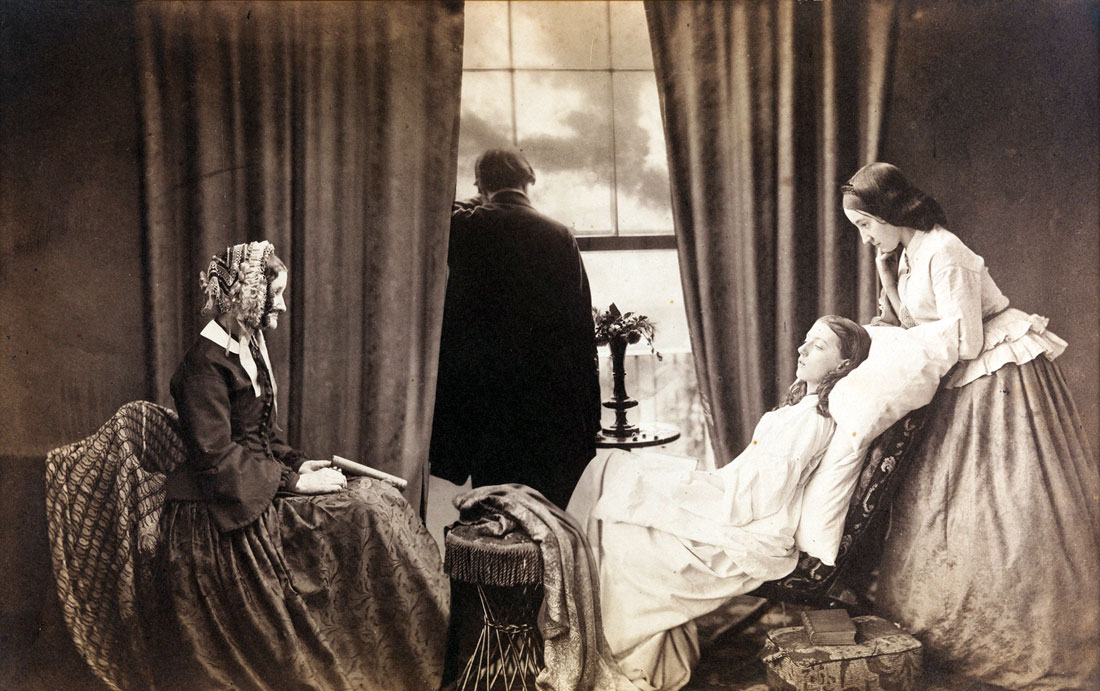
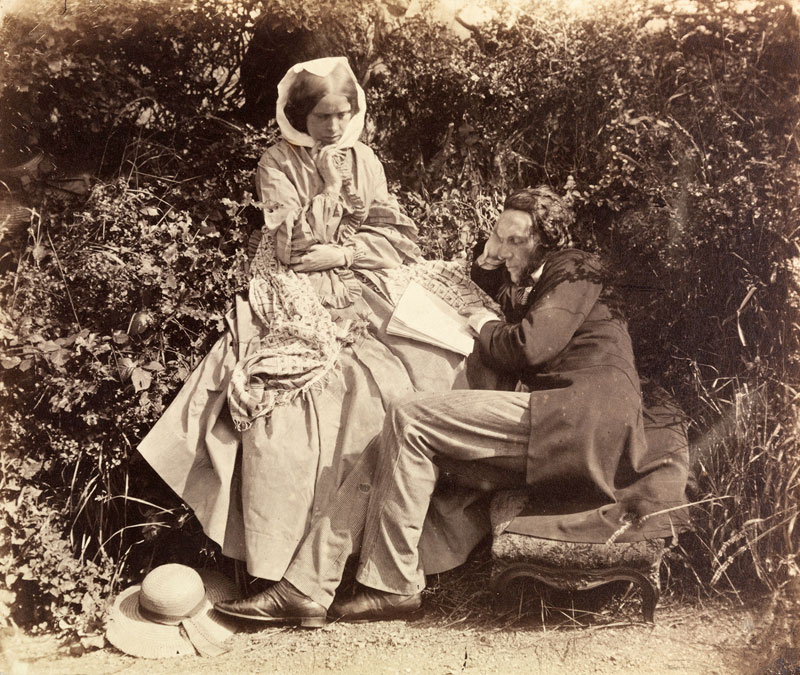
Thursdays 9.30am – 9.45pm
Closed on Mondays

Musée d’Orsay website

LIKE ART BLART ON FACEBOOK

Back to top

Exhibition: ‘Sally Mann: The Flesh and the Spirit’ at the Virginia Museum of Fine Arts, Richmond, VA

Exhibition dates: 13th November 2010 – 23rd January 2011


Many thankx to the Virginia Museum of Fine Arts for allowing me to publish the photographs in the posting. Please click on the photographs for a larger version of the image.


Sally Mann (American, b. 1951) 'Jessie #34' 2004 from the exhibition 'Sally Mann: The Flesh and the Spirit' at the Virginia Museum of Fine Arts


Sally Mann (American, b. 1951)
Jessie #34
2004
Gelatin Silver enlargement print from 8 x 10 in. collodion wet-plate negative, with Soluvar matte varnish mixed with diatomaceous earth


Sally Mann (American, b. 1951) 'Untitled (Still Life)' 2006 from the exhibition 'Sally Mann: The Flesh and the Spirit' at the Virginia Museum of Fine Arts


Sally Mann (American, b. 1951)
Untitled (Still Life)
2006
Ambrotype (unique collodion wet-plate positive on black glass), with sandarac varnish (15 x 13 in)


Sally Mann (American, b. 1951) 'Untitled' 1983 from the exhibition 'Sally Mann: The Flesh and the Spirit' at the Virginia Museum of Fine Arts


Sally Mann (American, b. 1951)
Untitled
1983
Polaroid (8 x 10 in)


Sally Mann (American, b. 1951) 'Untitled' 2000-2001 from the exhibition 'Sally Mann: The Flesh and the Spirit' at the Virginia Museum of Fine Arts


Sally Mann (American, b. 1951)
Untitled
2000-2001
Gelatin silver enlargement prints from 8 x 10 in. (20.3 x 25.4cm) collodion wet-plate negatives, with Soluvar matte varnish mixed with diatomaceous earth


Sally Mann (American, b. 1951) 'Untitled-#4, Antietam' 2001 from the exhibition 'Sally Mann: The Flesh and the Spirit' at the Virginia Museum of Fine Arts


Sally Mann (American, b. 1951)
Untitled #4, Antietam
2001
Gelatin silver enlargement print from 8 x 10 in. collodion wet-plate


One of the first major presentations in the United States of the bold work of contemporary photographer Sally Mann opened at the Virginia Museum of Fine Arts website (VMFA) on November 13, 2010. Exclusive to Richmond, the exhibition will continue until January 23, 2011.

Focusing on the theme of the body, the exhibition will revolve around several entirely new series while also incorporating little-known early work. Mann is admired for her passionate use of photography to address issues of love and loss, expressed in images of her children and southern landscapes. Her recent work uses obsolete photographic methods and nearly abstract images to push the limits of her medium and to dig deeper into themes of mortality and vulnerability. The images include several powerful series of self-portraits – an entirely new subject in her work – and figure studies of her husband. Some of the works in the exhibition include nudity and other graphic material. Viewer and parental discretion is advised.

“Sally Mann is among the top tier of photographers today. Although she is widely exhibited, we are fortunate to be one of the first U.S. museums to produce a major exhibition of her work,” says John Ravenal, the exhibition curator and Sydney and Frances Lewis Family Curator of Modern and Contemporary Art at the Virginia Museum of Fine Arts. “The fearlessness, power and deeply emotional themes of her art are both captivating and unforgettable. We are pleased to exhibit one of Virginia’s, and the nation’s, finest artists.”

Self-examination, ageing, death, and decay are some of the subjects of the exhibition, and these are balanced by themes of beauty, love, trust, and the hopefulness of youth. Among the works are portraits of Mann’s husband, who suffers from a degenerative muscle disease. These are juxtaposed with colourful images of her children, forming a poignant comparison between youthful evanescence and the expressive capacity of the mature adult body.

Other works offer additional perspectives on the themes of ageing and mortality. Made during a trip to the University of Tennessee Forensic Anthropology Center, Mann’s “Body Farm” images explore her fascination with the thin line between animate and inanimate, form and matter. Multi-part self-portraits represent Mann’s first extended exploration of her own face as a subject. Two self-portrait pieces consist of multiple unique photographs printed on black glass – a format known as ambrotypes – arranged in monumental grids of Mann’s likeness.

“The focus on the body in the exhibition will offer a profound meditation on human experience,” continues Ravenal. “The sheer beauty, formal sophistication, and expressive power of the work is likely to appeal to art world and general audiences alike.”

For her landscapes, Mann developed the method she continues to use today, involving an antique large-format view camera and the laborious process of collodion wet-plate. This method, invented in the 1850s, uses sticky ether-based collodion poured on glass, which must be exposed and developed in a matter of minutes before it dries. Unlike her nineteenth-century predecessors, who strove for perfection, Mann embraces accident. Her approach produces spots, streaks, and scars, along with piercing focus in some areas and evaporation of the image in others. These distortions – “honest” artefacts of the process – add a profoundly emotional quality to Mann’s images.

Mann’s recent work continues to use this technique, but returns to the body as a principle subject after a decade of landscapes. Though the body has been an essential focus in Mann’s work from the beginning, this is the first time an exhibition and publication have explored it as a coherent theme.

Born in 1951, Sally Mann has played a leading role in contemporary photography for the past 25 years. Her career began in the 1970s and fully matured in the Culture Wars of the early 1990s, when photographs of her children became embroiled in national debates about family values. In the mid-1990s, Mann turned her attention to large-scale landscapes, specifically the evocative terrain of the South, where she was born, raised and continues to live. Her landscape work raised questions about history, memory and nostalgia, and also embraced a romantic beauty that proved as troubling to some critics as the sensual images of her children had to others. By the early 2000s, she had returned to figurative subjects, adding images of her husband and herself to her work.

Text from the Virginia Museum of Fine Arts website


Sally Mann (American, b. 1951) 'Untitled (Self Portraits)' 2006-2007 from the exhibition 'Sally Mann: The Flesh and the Spirit' at the Virginia Museum of Fine Arts


Sally Mann (American, b. 1951)
Untitled (Self Portraits)
2006-2007
Ambrotypes (unique collodion wet-plate positives on black glass) with sandarac varnish


Sally Mann (American, b. 1951) 'Untitled (Self Portraits)' 2006-2007 (detail)


Sally Mann (American, b. 1951)
Untitled (Self Portraits) (detail)
2006-2007
Ambrotypes (unique collodion wet-plate positives on black glass) with sandarac varnish


Sally Mann (American, b. 1951) 'Untitled (Self Portraits)' 2006-2007 (detail)


Sally Mann (American, b. 1951)
Untitled (Self Portraits) (detail)
2006-2007
Ambrotypes (unique collodion wet-plate positives on black glass) with sandarac varnish


Sally Mann (American, b. 1951) 'Untitled (Self Portraits)' 2006-2007 (detail)


Sally Mann (American, b. 1951)
Untitled (Self Portraits) (detail)
2006-2007
Ambrotypes (unique collodion wet-plate positives on black glass) with sandarac varnish


Sally Mann (American, b. 1951) 'Untitled' 2007-2008 from the exhibition 'Sally Mann: The Flesh and the Spirit' at the Virginia Museum of Fine Arts


Sally Mann (American, b. 1951)
Untitled
2007-2008
Ambrotypes (unique collodion wet-plate positives on black glass), with sandarac varnish


Sally Mann (American, b. 1951) 'Ponder Heart' 2009 from the exhibition 'Sally Mann: The Flesh and the Spirit' at the Virginia Museum of Fine Arts


Sally Mann (American, b. 1951)
Ponder Heart
2009
Gelatin silver contact print from 15 x 13 1/2-in. collodion wet-plate negative


Sally Mann (American, b. 1951) 'Hephaestus' 2008 from the exhibition 'Sally Mann: The Flesh and the Spirit' at the Virginia Museum of Fine Arts


Sally Mann (American, b. 1951)
Hephaestus
2008
Gelatin silver contact print from 15 x 13 1/2 –in. collodion wet-plate negative


Sally Mann (American, b. 1951) 'Was Ever Love' 2009 from the exhibition 'Sally Mann: The Flesh and the Spirit' at the Virginia Museum of Fine Arts


Sally Mann (American, b. 1951)
Was Ever Love
2009
Gelatin silver contact print from 15 x 13 1/2 –in. collodion wet-plate negative


Virginia Museum of Fine Arts
200 N. Boulevard
Richmond, Virginia USA
23220-4007

Opening hours:
Daily 10am – 5pm
Wed – Friday until 9pm

Virginia Museum of Fine Arts website

LIKE ART BLART ON FACEBOOK

Back to top

Exhibition: ‘In the Darkroom: Photographic Processes before the Digital Age’ at the National Gallery of Art, Washington, D.C.

Exhibition dates: 25th October, 2009 – 14th March, 2010


William Henry Fox Talbot (British, 1800-1877) 'Lace' 1839-1844 from the exhibition 'In the Darkroom: Photographic Processes before the Digital Age' at the National Gallery of Art, Washington, D.C., October 2009 - March, 2010


William Henry Fox Talbot (British, 1800-1877)
Lace
1839-1844
Photogenic drawing (salted paper print)
Sheet (trimmed to image): 17.1 x 22cm (6 3/4 x 8 11/16 in.)
Support: 24.8 x 31.1cm (9 3/4 x 12 1/4 in.)
National Gallery of Art, Washington
Patrons’ Permanent Fund
Public domain


Many thankx to Kate Afanasyeva and the National Gallery of Art for allowing me to reproduce the photographs from the exhibition below. Please click on the photographs for a larger version of the image.

Dr Marcus Bunyan


Anna Atkins (British, 1799-1871) 'Ferns, Specimen of Cyanotype' 1840s from the exhibition 'In the Darkroom: Photographic Processes before the Digital Age' at the National Gallery of Art, Washington, D.C., October 2009 - March, 2010


Anna Atkins (British, 1799-1871)
Ferns, Specimen of Cyanotype
1840s
cyanotype
National Gallery of Art, Washington
R.K. Mellon Family Foundation Fund


Albert Sands Southworth and Josiah Johnson Hawes. 'The Letter' c. 1850  from the exhibition 'In the Darkroom: Photographic Processes before the Digital Age' at the National Gallery of Art, Washington, D.C., October 2009 - March, 2010


Albert Sands Southworth and Josiah Johnson Hawes
The Letter
c. 1850
daguerreotype
National Gallery of Art, Washington
Patrons’ Permanent Fund


Southworth and Hawes’ aspirations for their portraits went far beyond those of the average photographer of their day. Whereas most daguerreotypists, simply concerned with rendering a likeness, used stock poses, painted backdrops, and even head restraints to firmly fix their subjects, Southworth and Hawes were celebrated not just for their technical expertise, but also for their penetrating studies, innovative style, and creative use of natural light. They sought to elevate their subjects “far beyond common nature” and embody their “genius and spirit of poetry,” as Southworth wrote in 1871. “What is to be done is obliged to be done quickly. The whole character of the sitter is to be read at first sight; the whole likeness, as it shall appear when finished, is to be seen at first, in each and all its details, and in their unity and combination.”2

Among Southworth and Hawes’ most accomplished studies, The Letter is exceptional in its composition and mood. Most American daguerreotype portraits made in the 1840s and 1850s were frontal, bust-length studies of single figures who rarely show any kind of facial expression because of the often long exposure times. The Letter, however, is a highly evocative study. With its carefully constructed composition and tight pyramidal structure, it presents two thoughtful young women contemplating a letter. Through their posture and expression, these women seem to gain not only physical support from each other, but also emotional strength. Although the identity of the women is unknown, as is the content of the letter, this large and distinguished daguerreotype reflects Southworth and Hawes’ aspiration to capture “the life, the feeling, the mind, and the soul” of their subjects.3

(Text by Sarah Greenough, published in the National Gallery of Art exhibition catalogue, Art for the Nation, 2000)

Text from the National Gallery of Art website


Charles Nègre (French, 1820-1880)
'Saint John the Evangelist, Chartres Cathedral' c. 1854


Charles Nègre (French, 1820-1880)
Saint John the Evangelist, Chartres Cathedral
c. 1854
Salted paper print from a paper negative
National Gallery of Art, Washington
Eugene L. and Marie-Louise Garbaty Fund, Pepita Milmore Memorial Fund and New Century Fund
Public domain


In 1851 the French government’s Commission des Monuments Historiques selected five photographers to document architectural treasures throughout the country. Nègre was not included, perhaps because he was a member of the opposition party, but he took it upon himself to photograph extensively in Marseilles, Arles, Avignon, and Aix-en-Provence in the early 1850s, and in 1854 he made many photographs of Chartres Cathedral.

Nègre applied his growing understanding of light, shadow, line, and form in Saint John the Evangelist, Chartres Cathedral, and the photograph beautifully illustrates his willingness to sacrifice “a few details,” as he wrote, to capture “an imposing effect.” In addition, unlike photographers associated with the Commission des Monuments Historiques, who were asked to provide general studies of a building’s façade, Nègre was free to explore more unusual views. The statue of Saint John the Evangelist is situated high in the north spire of Chartres, several feet above a nearby balcony. Although difficult to see and even harder for Nègre to record (he most likely perched his camera on a platform), the view in his photograph succinctly captured what he called the cathedral’s “real character” and “preserved the poetic charm that surrounded it.”

Text from the National Gallery of Art website


Unknown photographer (American 19th Century) 'George E. Lane, Jr.' c. 1855


Unknown photographer (American 19th Century)
George E. Lane, Jr.
c. 1855
Ambrotype
National Gallery of Art, Washington
Gift of Kathleen, Melissa, and Pamela Stegeman
Public domain


Étienne Carjat (French, 1828-1906)
'Charles Baudelaire' 1861, printed 1877


Étienne Carjat (French, 1828-1906)
Charles Baudelaire
1861, printed 1877
Woodburytype
National Gallery of Art, Washington
Gift of Jacob Kainen
Public domain


William James Stillman (American, 1828-1901) 'The Acropolis of Athens'
1869/1870


William James Stillman (American, 1828-1901)
The Acropolis of Athens
1869/1870
Carbon print
National Gallery of Art, Washington
Horace W. Goldsmith Foundation through Robert and Joyce Menschel


J.G. Ellinwood (American, 1844-1924) 'Portrait of a Woman' c. 1870


J.G. Ellinwood (American, 1844-1924)
Portrait of a Woman
c. 1870
Tintype, hand-coloured
National Gallery of Art, Washington
Mary and Dan Solomon Fund


Clarence White (American, 1871-1925) 'Mrs. White - In the Studio' 1907


Clarence White (American, 1871-1925)
Mrs. White – In the Studio
1907
platinum print
National Gallery of Art, Washington
Horace W. Goldsmith Foundation through Robert and Joyce Menschel and R.K. Mellon Family Foundation Fund


Karl Struss (American, 1886-1981) 'Columbia University, Night' 1910


Karl Struss (American, 1886-1981)
Columbia University, Night
1910
Gum dichromate over platinum print
Image: 24.1 × 19.9cm (9 1/2 × 7 13/16 in.)
National Gallery of Art, Washington
Horace W. Goldsmith Foundation through Robert and Joyce Menschel


Laura Gilpin (American, 1891-1979) 'Ghost Rock, Colorado Springs' 1919


Laura Gilpin (American, 1891-1979)
Ghost Rock, Colorado Springs
1919
Platinum print
24.2 x 19.1cm (9 1/2 x 7 1/2 in.)
National Gallery of Art, Washington
Marvin Breckinridge Patterson Fund
© 1979 Amon Carter Museum, Fort Worth, Texas


László Moholy-Nagy (Hungarian, 1895-1946) 'Untitled (Positive)' c. 1922-1924


László Moholy-Nagy (Hungarian, 1895-1946)
Untitled (Positive)
c. 1922-1924
gelatin silver print
National Gallery of Art, Washington
Gift of The Circle of the National Gallery of Art


László Moholy-Nagy (Hungarian, 1895-1946) 'Untitled' c. 1922-1924


László Moholy-Nagy (Hungarian, 1895-1946)
Untitled
c. 1922-1924
gelatin silver print
National Gallery of Art, Washington
New Century Fund


Eugène Atget (French, 1857-1927)
'Magasin, Avenue des Gobelins' 1925


Eugène Atget (French, 1857-1927)
Magasin, Avenue des Gobelins
1925
gelatin silver print, printed-out
National Gallery of Art, Washington
Patrons’ Permanent Fund
Public domain


Aleksandr Rodchenko (Russian, 1891-1956) 'Pioneer with a Bugle' 1930


Aleksandr Rodchenko (Russian, 1891-1956)
Pioneer with a Bugle
1930
Gelatin silver print
National Gallery of Art, Washington
Patrons’ Permanent Fund


Sid Grossman (American, 1913-1955) 'San Gennaro Festival, New York City' 1948


Sid Grossman (American, 1913-1955)
San Gennaro Festival, New York City
1948
gelatin silver print
National Gallery of Art, Washington
Anonymous Gift


Saul Leiter (American, 1923-2013) 'Snow' 1960


Saul Leiter (American, 1923-2013)
Snow
1960, printed 2005
Chromogenic colour print
National Gallery of Art, Washington
Gift of Saul Leiter


Diane Arbus (American, 1923-1971) 'A young man in curlers at home on West 20th Street, N.Y.C. 1966' 1966


Diane Arbus (American, 1923-1971)
A Young Man in Curlers at Home on West 20th Street, N.Y.C., 1966
1966
Gelatin silver print
National Gallery of Art, Washington
Gift of the Collectors Committee


The extraordinary range and complexity of the photographic process is explored, from the origins of the medium in the 1840s up to the advent of digital photography at the end of the 20th century, in a comprehensive exhibition and its accompanying guidebook at the National Gallery of Art, Washington. On view in the West Building, from October 25, 2009 through March 14, 2010, In the Darkroom: Photographic Processes Before the Digital Age chronicles the major technological developments in the 170-year history of photography and presents the virtuosity of the medium’s practitioners. Drawn from the Gallery’s permanent collection are some 90 photographs – ranging from William Henry Fox Talbot’s images of the 1840s to Andy Warhol’s Polaroid prints of the 1980s.

“In the Darkroom and the accompanying guidebook provide a valuable overview of the medium as well as an introduction to the most commonly used photographic processes from its earliest days,” said Earl A. Powell III, director, National Gallery of Art.

In the Darkroom

Organised chronologically, the exhibition opens with Lace (1839-1844), a photogenic drawing by William Henry Fox Talbot. Made without the aid of a camera, the image was produced by placing a swath of lace onto a sheet of sensitised paper and then exposing it to light to yield a tonally reversed image.

Talbot’s greatest achievement – the invention of the first negative-positive photographic process – is also celebrated in this section with paper negatives by Charles Nègre and Baron Louis-Adolphe Humbert de Molard as well as salted paper prints made from paper negatives by Nègre, partners David Octavius Hill and Robert Adamson, and others.

The daguerreotype, the first publicly introduced photographic process and the most popular form of photography during the medium’s first decade, is represented by a selection of British and American works, including an exquisite large-plate work by the American photographers Albert Sands Southworth and Josiah Johnson Hawes (see photograph above). By the mid-1850s, the daguerreotype’s popularity was eclipsed by two new processes, the ambrotype and the tintype. These portable photographs on glass or metal were relatively inexpensive to produce and were especially popular for portraiture.

The year 1851 marked a turning point in photographic history with the introduction of the collodion negative on glass and the albumen print process. Most often paired together, this negative-print combination yielded lustrous prints with a subtle gradation of tones from dark to light and became the most common form of photography in the 19th century, seen here in works by Julia Margaret Cameron, Roger Fenton, and Gustave Le Gray.

Near the turn of the 20th century, a number of new, complex print processes emerged, such as platinum and palladium, gum dichromate, and bromoil. Often requiring significant manipulation by the hand of the artist, these processes were favoured by photographers such as Gertrude Käsebier, Alfred Stieglitz, and Edward Weston.

One of the most significant developments of the late 19th century was the introduction of gelatin into photographic processes, which led to the invention of the film negative and the gelatin silver print. These became the standard for 20th-century black-and-white photography. A chronological selection of gelatin silver prints, including a contact print made by André Kertész in 1912; a grainy, blurred image of Little Italy’s San Gennaro festival at night by Sid Grossman from 1948 (see photograph above); and a coolly precise industrial landscape by Frank Gohlke from 1975, reveals how the introduction of the film negative and changes in the gelatin silver print process profoundly shaped the direction of modern photography. This section also explores the development of ink-based, photomechanical processes such as photogravure, Woodburytype, and halftone that enabled the large-scale, high-quality reproduction of photographs in books and magazines.

The final section of the exhibition explores the rise of colour photography in the 20th century. Although the introduction of chromogenic colour processes made colour photography commercially viable by the 1930s, it was not widely employed by artists until the 1970s. The exhibition celebrates the pioneers of colour photography, including Harry Callahan and William Eggleston, who made exceptional work using the complicated dye transfer process. The exhibition also explores the range of processes developed by the Polaroid Corporation that provided instant gratification to the user, from Andy Warhol’s small SX-70 prints to the large-scale Polaroid prints represented by the work of contemporary photographer David Levinthal.

Press release from the National Gallery of Art website [Online] Cited 15/02/2010 no longer available online


Roger Fenton (British, 1819-1869) 'The Cloisters, Tintern Abbey' 1854  from the exhibition 'In the Darkroom: Photographic Processes before the Digital Age' at the National Gallery of Art, Washington, D.C., October 2009 - March, 2010


Roger Fenton (British, 1819-1869)
The Cloisters, Tintern Abbey
1854
Salted paper print from a collodion negative
18.3 x 22.1cm (7 3/16 x 8 11/16 in.)
National Gallery of Art, Washington
Horace W. Goldsmith Foundation through Robert and Joyce Menschel
Public domain


Although Roger Fenton’s photographic career lasted for only 11 years, he exerted a profound influence on the medium. Trained as a lawyer, he began to paint in the early 1840s, studying in Paris with Michel-Martin Drölling and later in London with Charles Lucy. But in 1851 he took up photography and produced a distinguished and varied body of work. He was a pivotal figure in the formation of the Photographic Society (later known as the Royal Photographic Society), garnering support from Queen Victoria and Prince Albert. He is best known for his 1855 photographs made during the Crimean War, among the first to document war. But he also made ambitious studies of English cathedrals, country houses, and landscapes as well as portraits of the royal family, a series of still lifes, and studies of figures in Asian costume.

When Fenton first began to make photographs, he generally posed figures in a fairly stiff, even anecdotal manner. But in 1854 he began to use figures to create a sense of tension at once intriguing and compelling. The Cloisters, Tintern Abbey shows this more dynamic approach. Fenton placed people in three groups, not interacting with one another but engaging in silent and solitary dialogue with their decaying surroundings. Tintern Abbey had, of course, inspired many artists and poets to reflect on both “the life of things” – as William Wordsworth wrote in his 1798 poem, “Lines Composed a Few Miles above Tintern Abbey” – and on the transitory nature of life itself.

Text from the National Gallery of Art website


Charles Nègre (French, 1820-1880)
'Cathédrale de Chartres - Portique du Midi XIIe Siècle (Chartres Cathedral, South Portal, 12th Century)' c. 1854, printed c. 1857


Charles Nègre (French, 1820-1880)
Cathédrale de Chartres – Portique du Midi XIIe Siècle (Chartres Cathedral, South Portal, 12th Century)
c. 1854, printed c. 1857
photogravure
National Gallery of Art, Washington
William and Sarah Walton Fund


Roger Fenton (British, 1819-1869)
'Fruit and Flowers' 1860


Roger Fenton (British, 1819-1869)
Fruit and Flowers
1860
Albumen print from a collodion negative
National Gallery of Art, Washington
Paul Mellon Fund
public domain


In the summer of 1860 Fenton made his most deliberate and exacting photographs to date: a series of still lifes. Although the subject obviously had its roots in painting, his densely packed compositions are far removed from the renditions of everyday life by the Dutch masters. Instead, Fenton extravagantly piled luscious fruits and intricately patterned flowers on top of one another and pushed them to the front of his composition so that they seem almost ready to tumble out of the photograph into the viewer’s space. It is that very immediacy – the precarious composition, the lush sensuousness of the objects, and our knowledge of their imminent decay – that makes these photographs so striking.
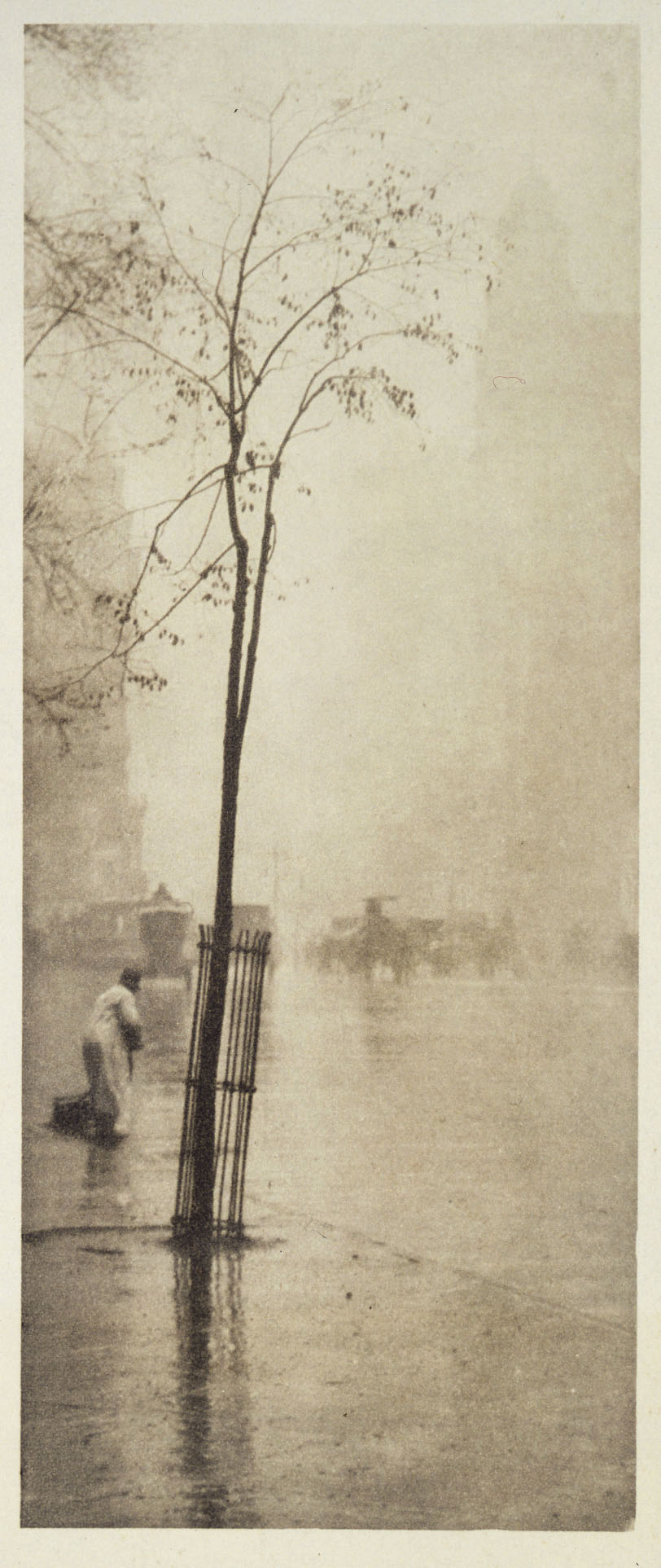
Text from the National Gallery of Art website


Gustave Le Gray (French, 1820-1884) 'Cavalry Maneuvers behind barrier, Camp de Châlons' 1857


Gustave Le Gray (French, 1820-1884)
Cavalry Maneuvers behind barrier, Camp de Châlons
1857
Albumen silver print from glass negative
National Gallery of Art, Washington


Platt D. Babbitt (American, 1822-1879) 'Niagara Falls' c. 1860


Platt D. Babbitt (American, 1822-1879)
Niagara Falls
c. 1860
Ambrotype
National Gallery of Art, Washington
Vital Projects Fund


Alfred Stieglitz (American, 1864-1946) 'The Terminal' 1893


Alfred Stieglitz (American, 1864-1946)
The Terminal
1893, printed 1920s/1930s
Gelatin silver print
National Gallery of Art, Washington
Alfred Stieglitz Collection


Aaron Siskind (American, 1903-1991) 'Martha's Vineyard 108' 1954


Aaron Siskind (American, 1903-1991)
Martha’s Vineyard 108
1954
Gelatin silver print
National Gallery of Art, Washington
Diana and Mallory Walker Fund


Dave Heath (Canadian, born United States, 1931-2016) 'Hastings-on-Hudson, New York' 1963


Dave Heath (Canadian, born United States, 1931-2016)
Hastings-on-Hudson, New York
1963
Gelatin silver print
National Gallery of Art, Washington
Gift of Howard Greenberg


William Eggleston (American, b. 1939) 'Untitled (Car in Parking Lot)' 1973


William Eggleston (American, b. 1939)
Untitled (Car in Parking Lot)
1973
Dye imbibition print
National Gallery of Art, Washington
Anonymous Gift


Harry Callahan (American, 1912-1999) 'Providence' 1977


Harry Callahan (American, 1912-1999)
Providence
1977
Dye transfer print


Robert Adams (American, b. 1937) 'Summer Nights #2 (Longmont, Colorado)' 1979


Robert Adams (American, b. 1937)
Summer Nights #2 (Longmont, Colorado)
1979
Gelatin silver print
National Gallery of Art, Washington
Gift of Mary and David Robinson


Richard Misrach (American, b. 1949)
'Dead Fish, Salton Sea, California' 1983, printed 1997


Richard Misrach (American, b. 1949)
Dead Fish, Salton Sea, California
1983, printed 1997
Chromogenic colour print
National Gallery of Art, Washington
Anonymous Gift


Mark Klett (American, b. 1952) 'Under the Dark Cloth, Monument Valley, May 27' 1989


Mark Klett (American, b. 1952)
Under the Dark Cloth, Monument Valley, May 27
1989
Gelatin silver print from Polaroid instant film negative
National Gallery of Art, Washington
Gift of the Collectors Committee


Edward Burtynsky (Canadian, b. 1955) 'Shipbreaking #10, Chittagong, Bangladesh' 2000, printed 2001


Edward Burtynsky (Canadian, b. 1955)
Shipbreaking #10, Chittagong, Bangladesh
2000, printed 2001
Chromogenic colour print
National Gallery of Art, Washington
Fund for Living Photographers


The National Gallery of Art, Washington, DC

The National Gallery of Art, located on the National Mall between 3rd and 7th Streets at Constitution Avenue NW.

Opening hours:
Daily 10.00am – 5.00pm

National Gallery of Art website

LIKE ART BLART ON FACEBOOK

Back to top

Exhibition: ‘TruthBeauty: Pictorialism and the Photograph as Art, 1845-1945’ at George Eastman House, New York

Exhibition dates: 7th February – 31st May, 2009

Curator: Elsa Smithgall


George Davison (English, 1854-1930) 'The Onion Field' 1889 from the exhibition 'TruthBeauty: Pictorialism and the Photograph as Art, 1845-1945' at George Eastman House, New York, Feb - May, 2009


George Davison (English, 1854-1930)
The Onion Field
1889


George Davison (19 September 1854 – 26 December 1930) was an English photographer, a proponent of impressionistic photography, a co-founder of the Linked Ring Brotherhood of British artists and a managing director of Kodak UK. He was also a millionaire, thanks to an early investment in Eastman Kodak.


Pictorialism was simultaneously a movement, a philosophy, an aesthetic, and a style, resulting in some of the most spectacular photographs in the history of the medium. This exhibition shows the rise of Pictorialism in the late 19th century from a desire to elevate photography to an art form equal to painting, drawing, and watercolour, and extends the historical period generally associated with it by including its influential precursors, its persistent practitioners, and its seminal effect on photographic Modernism.

With 130 masterworks from such well-known photographers as Alvin Langdon Coburn, Edward Steichen, Alfred Stieglitz, Robert Demachy, Frederick Evans, and F. Holland Day, this remarkable exhibition will illustrate the Pictorialism movement’s progression from its early influences to its lasting impact on photography and art.

Text from the George Eastman House website [Online] Cited 26/01/2009. No longer available online


Many thankx to George Eastman House for allowing me to publish the photographs in the posting. Please click on the photographs for a larger version of the image.


In this video, Phillips Collection curator Elsa Smithgall introduces special exhibition TruthBeauty: Pictorialism and the Photograph as Art, 1845-1945, on view at The Phillips Collection Oct. 9, 2010 through Jan. 9, 2011.


Julia Margaret Cameron (British born India, 1815-1879) 'Prayer' 1866 from the exhibition 'TruthBeauty: Pictorialism and the Photograph as Art, 1845-1945' at George Eastman House, New York, Feb - May, 2009


Julia Margaret Cameron (British born India, 1815-1879)
Prayer
1866


Peter Henry Emerson (British, 1856-1936) 'Polling the Marsh Hay' c. 1885


Peter Henry Emerson (British, 1856-1936)
Polling the Marsh Hay
c. 1885


Henry Peach Robinson (English, 1830-1901) 'Carolling' 1890


Henry Peach Robinson (English, 1830-1901)
Carolling
1890


Fredrick Holland Day (American, 1864-1933) "I Thirst" 1898


Fredrick Holland Day (American, 1864-1933)
“I Thirst”
1898


Frederick Holland Day (American, 1864-1933) 'Ebony and Ivory' 1899


Frederick Holland Day (American, 1864-1933)
Ebony and Ivory
1899
Photogravure


Alfred Stieglitz (American, 1864-1946) 'Spring Showers' 1901


Alfred Stieglitz (American, 1864-1946)
Spring Showers
1901


Alfred Steiglitz (American, 1864-1946) 'Snapshot – In the New York Central Yards' Negative 1903; Printed 1910


Alfred Steiglitz (American, 1864-1946)
Snapshot – In the New York Central Yards
Negative 1903; Printed 1910
Photogravure


This photograph of a train departing from Grand Central Terminal was probably made from the 48th Street foot bridge, which crossed over the railroad yard.


Edward Steichen (American, 1879-1973) 'The Pond - Moonlight' Negative 1904; print 1906


Edward Steichen (American, 1879-1973)
The Pond – Moonlight
Negative 1904; print 1906
Photogravure


The Pond – Moonlight (also exhibited as The Pond – Moonrise) is a pictorialist photograph by Edward Steichen. The photograph was made in 1904 in Mamaroneck, New York, near the home of his friend art critic Charles Caffin. The photograph features a forest across a pond, with part of the moon appearing over the horizon in a gap in the trees. The Pond – Moonlight is an early photograph created by manually applying light-sensitive gums, giving the final print more than one colour. Only three known versions of The Pond – Moonlight are still in existence and, as a result of the hand-layering of the gums, each is unique.

Text from the Wikipedia website


Edward Steichen (American, 1879-1973) 'Grand Prix at Longchamp, After the Races' 1907


Edward Steichen (American, 1879-1973)
Grand Prix at Longchamp, After the Races
1907
Photogravure


About the Exhibition

Photographic Pictorialism, an international movement, a philosophy, and a style, developed toward the end of the 19th century. The introduction of the dry-plate process, in the late 1870s, and of the Kodak camera, in 1888, made taking photographs relatively easy, and photography became widely practiced. Pictorialist photographers set themselves apart from the ranks of new hobbyist photographers by demonstrating that photography was capable of far more than literal description of a subject. Through the efforts of Pictorialist organisations, publications, and exhibitions, photography came to be recognised as an art form, and the idea of the print as a carefully hand-crafted, unique object equal to a painting gained acceptance.

The forerunners of Pictorialism were early photographers like Henry Peach Robinson and Julia Margaret Cameron. Robinson found inspiration in genre painting; Cameron’s fuzzy portraits and allegories were inspired by literature. Like Robinson and Cameron, the Pictorialists made photographs that were more like paintings and drawings than the work of commercial portraitists or hobbyists. Pictorialist images were heavily dependent on the craft of nuanced printing. Some photographers, like Frederick H. Evans, a master of the platinum print, presented their work like drawings or watercolours, decorating their mounts with ruled borders filled with watercolour wash, or printing on textured watercolour paper, like Austrian photographer Heinrich Kühn. Kühn achieved painterly effects by using an artist’s brush to manipulate watercolour pigment, instead of silver or platinum, mixed with light-sensitised gum arabic.

The idea that the primary purpose of photography was personal expression lay behind Pictorialism’s “Secessionist” movement. Alfred Stieglitz’s “Photo-Secession” was the best-known secessionist group. Stieglitz and his magazine, Camera Work, with its high-quality photogravure illustrations, advocated for the acceptance of photography as a fine art.

Early in the 20th century, Pictorialism began losing ground to modernism: in 1911, Camera Work published drawings by Rodin and Picasso, and its final issue, in 1917, featured Paul Strand’s modernist photographs. Nevertheless, Pictorialism lived on. A second wave of Pictorialists included Clarence H. White, whose students included such photographers as Margaret Bourke-White, Paul Outerbridge, and Dorothy Lange. White’s colleague, Paul Anderson, continued the pictorial tradition until his death in 1956. Five prints of his Vine in Sunlight, 1944, display five different printing techniques, demonstrating how each process subtly shapes the viewer’s response to the image.

Organised by George Eastman House International Museum of Photography and Film, and Vancouver Art Gallery.

Text from the Phillips Collection website Nd [Online] Cited 10/06/2022


Alvin Langdon Coburn (British born United States of America, 1882-1966) 'Fifth Avenue from the St. Regis' c. 1905


Alvin Langdon Coburn (British born United States of America, 1882-1966)
Fifth Avenue from the St. Regis
c. 1905
Gum bichromate and platinotype on paper


Alvin Langdon Coburn (British born United States of America, 1882-1966) 'Wapping' 1904


Alvin Langdon Coburn (British born United States of America, 1882-1966)
Wapping
1904


Alvin Langdon Coburn (British born United States of America, 1882-1966) 'St. Paul's and Other Spires' 1908


Alvin Langdon Coburn (British born United States of America, 1882-1966)
St. Paul’s and Other Spires
1908


Alvin Langdon Coburn (British born United States of America, 1882-1966) 'The Tunnel Builders' 1908


Alvin Langdon Coburn (British born United States of America, 1882-1966)
The Tunnel Builders
1908


Eva Watson Schutze (American, 1867-1935) 'Woman with Lilly' 1905


Eva Watson Schutze (American, 1867-1935)
Woman with Lilly
1905


Eva Watson-Schütze (American, 1867-1935)

Eva Watson-Schütze (1867-1935) was an American photographer and painter who was one of the founding members of the Photo-Secession. …

Around the 1890s Watson began to develop a passion for photography, and soon she decided to make it her career. Between 1894 and 1896 she shared a photographic studio with Amelia Van Buren another Academy alumna in Philadelphia, and the following year she opened her own portrait studio. She quickly became known for her Pictorialist style, and soon her studio was known as a gathering place for photographers who championed this aesthetic vision.

In 1897 she wrote to photographer Frances Benjamin Johnston about her belief in women’s future in photography: “There will be a new era, and women will fly into photography.”

In 1898 six of her photographs were chosen to be exhibited at the first Philadelphia Photographic Salon, where she exhibited under the name Eva Lawrence Watson. It was through this exhibition that she became acquainted with Alfred Stieglitz, who was one of the judges for the exhibit.

In 1899 she was elected as a member of the Photographic Society of Philadelphia. Photographer and critic Joseph Keiley praised the work she exhibited that year, saying she showed “delicate taste and artistic originality”.

The following year she was a member of the jury for the Philadelphia Photographic Salon. A sign of her stature as a photographer at that time may be seen by looking at the other members of the jury, who were Alfred Stieglitz, Gertrude Kasebier, Frank Eugene and Clarence H. White.

In 1900 Johnston asked her to submit work for a groundbreaking exhibition of American women photographers in Paris. Watson objected at first, saying “It has been one of my special hobbies – and one I have been very emphatic about, not to have my work represented as ‘women’s work’. I want [my work] judged by only one standard irrespective of sex.” Johnston persisted, however, and Watson had twelve prints – the largest number of any photographer – in the show that took place in 1901.

In 1901 she married Professor Martin Schütze, a German-born and -trained lawyer who had received his Ph.D. in German literature from the University of Pennsylvania in 1899. He took a teaching position in Chicago, where the couple soon moved.

That same year she was elected a member of The Linked Ring. She found the ability to correspond with some of the most progressive photographers of the day very invigorating, and she began to look for similar connections in the U.S.

In 1902 she suggested the idea of forming an association of independent and like-minded photographers to Alfred Stieglitz. They corresponded several times about this idea, and by the end of the year she joined Stieglitz as one of the founding members of the famous Photo-Secession.

About 1903 Watson-Schütze began to spend summers in Woodstock at the Byrdcliffe Colony in the Catskill Mountains of New York. She and her husband later bought land nearby and built a home they called “Hohenwiesen” (High Meadows) where she would spend most of her summer and autumn months from about 1910 until about 1925.

In 1905 Joseph Keiley wrote a lengthy article about her in Camera Work saying she was “one of the staunchest and sincerest upholders of the pictorial movement in America.

Text from the Wikipedia website


Eva Watson Schutze (American, 1867-1935) 'Young girl seated on bench' c. 1910


Eva Watson Schutze (American, 1867-1935)
Young girl seated on bench
c. 1910


Anne Brigman (American, 1869-1960) The 'Heart of the Storm' 1902


Anne Brigman (American, 1869-1960)
The Heart of the Storm
1902


Anne Brigman (American, 1869-1960) 'The Pine Sprite' 1911


Anne Brigman (American, 1869-1960)
The Pine Sprite
1911


Frederick Evans (British, 1853-1943) 'York Minster: In Sure and Certain Hope' 1903


Frederick Evans (British, 1853-1943)
York Minster: In Sure and Certain Hope
1903
Photogravure


Frederick H. Evans (British, 1853-1943)

Frederick H. Evans (26 June 1853, London – 24 June 1943, London) was a British photographer, primarily of architectural subjects. He is best known for his images of English and French cathedrals. Evans began his career as a bookseller, but retired from that to become a full-time photographer in 1898, when he adopted the platinotype technique for his photography. Platinotype images, with extensive and subtle tonal range, non glossy-images, and better resistance to deterioration than other methods available at the time, suited Evans’ subject matter. Almost as soon as he began, however, the cost of platinum – and consequently, the cost of platinum paper for his images – began to rise. Because of this cost, and because he was reluctant to adopt alternate methodologies, by 1915 Evans retired from photography altogether.

Evans’ ideal of straightforward, “perfect” photographic rendering – unretouched or modified in any way – as an ideal was well-suited to the architectural foci of his work: the ancient, historic, ornate and often quite large cathedrals, cloisters and other buildings of the English and French countryside. This perfectionism, along with his tendency to exhibit and write about his work frequently, earned for him international respect and much imitation. He ultimately became regarded as perhaps the finest architectural photographer of his, or any, era – though some professionals privately felt that the Evans’ philosophy favouring extremely literal images was restrictive of the creative expression rapidly becoming available within the growing technology of the photographic field.

Evans was also an able photographer of landscapes and portraits, and among the many notable friends and acquaintances he photographed was George Bernard Shaw, with whom he also often corresponded. Evans was a member of the Linked Ring photographic society.

Text from the Wikipedia website


Frederick Evans (British, 1853-1943) 'Kelmscott Manor: Attics' c. 1896


Frederick Evans (British, 1853-1943)
Kelmscott Manor: Attics
c. 1896


Getrude Käsebier (American, 1852-1934) 'Woman seated under a tree' c. 1910


Getrude Käsebier (American, 1852-1934)
Woman seated under a tree
c. 1910


The hauntingly beautiful works of the Pictorialist movement are among the most spectacular photographs ever created. Beginning in the late nineteenth century, Pictorialist artists sought to elevate photography – until then seen largely as a scientific tool for documentation – to an art form equal to painting. Adopting a soft-focus approach and utilizing dramatic effects of light, richly coloured tones and bold technical experimentation, they opened up a new world of vision expression in photography. More than a hundred years later, their aesthetic remains highly influential.

TruthBeauty contains 121 stunning works by the form’s renowned artists, including Julia Margaret Cameron, Alvin Langdon Coburn, Robert Demachy, Peter Henry Emerson, Gertrude Käsebier, Heinrich Kühn, Edward Steichen and Alfred Stieglitz. Together, the collected works trace the evolution of Pictorialism over the three decades in which it predominated.

This is the only collection of Pictorialist photographs by artists from North America, the United Kingdom, continental Europe, Japan and Australia in a single publication. Scholarly essays, and a selection of historic texts by Pictoralist artists, complete this rich overview of the first truly international art movement.

Text from the Amazon website Nd [Online] Cited 10/06/2022


Robert Demachy (French, 1859-1936) 'Une Balleteuse' 1900


Robert Demachy (French, 1859-1936)
Une Balleteuse
1900
Gum bichromate print


Demachy was, with Émile Joachim Constant Puyo, the leader of the French Pictorial movement in France. His aesthetic sophistication and skill with the gum bichromate technique, which he revived in 1894 and pressed into the service of fine art photography, were internationally renowned. With the gum medium, he was able to achieve the appearance of a drawing or printmaking process-in this photograph, he has added marks characteristic of etching during intermediate stages of development-in order to advocate photography’s membership in the fine arts by revealing the intervention of the photographer’s hand in the printmaking stage of the photographic process. The result attested to Demachy’s mastery of his medium, but also proved his ability to unify a composition and select significant details from the myriad of facts available in his negatives. In this picture, Demachy has gently elided the background and erased the features of the left third of the image in order to emphasise the grace and delicacy of the ballet dancer that is its subject.

Text from the Metropolitan Museum of Art website [Online] Cited 26/01/2009


John Kauffmann (Australian, 1864-1942) 'Waterlily, Nymphaea Alba' c. 1930


John Kauffmann (Australian, 1864-1942)
Waterlily, Nymphaea Alba
c. 1930
Gelatin silver print
National Gallery of Australia


John Kauffmann was born in South Australia in 1865 and initially trained as an architect. In 1887 he travelled to Europe and became well connected to London’s artistic set, including the young Frank Brangwyn RA. In London and later Vienna, Kauffmann painted and learnt to take and print photographs, exhibiting in various salons and working with a number of important studios. In Austria, he became an enthusiast of Pictorialist photography and pursued studies in photographic chemistry. He returned to Adelaide in 1897 and was championed as the pioneer of Pictorialism in Australia. By 1914, Kauffmann had moved to Melbourne and established his own studio in Collins Street. Kauffmann died in South Yarra, Melbourne in 1942.

Text from the Monash Gallery of Art website


John Kauffmann (Australian, 1864-1942) 'The Silent Watcher' 1919


John Kauffmann (Australian, 1864-1942)
The Silent Watcher
Plate in in John Kauffmann, The Art of John Kauffmann
Melbourne: Alexander McCubbin, 1919 tipped-in plate (halftone)
National Gallery of Australia Research Library, Canberra


Pictorialism in Australia was established when photographic journals, such as the Australian Photographic Journal (APJ), launched in 1892, and the Australasian Photo-Review (APR), begun in 1894, appeared.1

In addition to providing technical advice the magazines covered the controversies in Britain and other centres over the new art photography. Articles on poetic picture making by British artists Henry Peach Robinson and Alfred Horsley Hinton, whose names were often cited by Australian Pictorialist photographers as major influences, were also included.

These magazines featured work by both professional and amateur photographers, and their editors took pride in the artistic quality of their reproductions; they also encouraged and supported the growth of new societies devoted to art photography.

The Photographic Society of New South Wales was duly established in Sydney in 1894, joining the older South Australian Photographic Society in Adelaide at the forefront of Pictorialism. The next decades saw a remarkable level of activity in the growing Pictorialist circles. …

In the years leading up to the war there was growing sentiment that Australian photographers were overly reliant on British models and had failed to advance the art of pictorial photography within an Australian context. A number of the more prominent Australian photographers and art commentators were also increasingly vocal about what they felt to be a decline in the quality of artistic practice despite the feverish activity of exhibitions and proliferation of camera clubs.

In 1916 a group of artists including Cazneaux, Cecil W. Bostock, a graphic artist who had recently set up a photography studio in Sydney, and James Stening formed the Sydney Camera Circle. They signed a pledge “to advance pictorial photography and to show our own Australia in terms of sunlight rather than those of greyness and dismal shadows.”10 …

Although it had largely waned in Europe and the United States by then, Pictorialism continued in Australia during the 1920s and 1930s. There was a new generation of artists showing their work alongside that of their more established colleagues in two large Pictorialist salons held in Sydney in 1924 and 1926 accompanied by catalogues called Cameragraphs (designed by Bostock). Perhaps because of the Depression, these salons did not continue.

Beginning in the 1920s Pictorialist and Modernist photography existed side by side with the professional photographers bridging both movements. Pictorialist photography would remain popular, particularly with the amateur members of the camera clubs up to the 1940s, ironically becoming increasingly conservative and backward looking in subject and execution.

However, the ascendancy of Modernist photography was now evident, even in the work of Cazneaux and Bostock, who would become active in the 1920s in commercial spheres.

Extract from Gael Newton. “Australian Pictorial Photography – Seeing The Light,” in TruthBeauty – Pictorialism and the Photograph as Art, 1845-1945. Essay originally published in the 2008 catalogue for the Vancouver Art Gallery exhibition [Online] Cited 12/06/2022


Cecil W. Bostock (Australian born England, 1884-1939) 'Nude Study' c. 1916

Cecil W. Bostock (Australian born England, 1884-1939)
Nude Study
c. 1916
Gelatin silver print


Cecil Westmoreland Bostock (1884-1939) was born in England. He emigrated to New South Wales, Australia, with his parents in 1888. His father, George Bostock, was a bookbinder who died a few years later in 1892.

Bostock had an important influence on the development of photography in Australia, initiating a response to the strong sunlight. He presided over the transition from Pictorialism to Modernism and was a mentor to several famous Australian photographers: notably Harold Cazneaux and Max Dupain.


The Sydney Camera Circle

On 28 November 1916, a group of six photographers met at Bostock’s ‘Little Studio in Phillip Street’ to form the Pictorialist “Sydney Camera Circle”. This initially included Cecil Bostock, James Stening, W. S. White, Malcolm McKinnon and James Paton, and they were later joined by Henri Mallard.

A “manifesto” was drawn up by Cecil and signed by all six attendees who pledged “to work and to advance pictorial photography and to show our own Australia in terms of sunlight rather than those of greyness and dismal shadows”. This established what was known as the ‘sunshine school’ of photography. The style of Pictorialism practiced by Australians was “concerned with the play of light, sunshine and shadow, and the attention to nature and the landscape, and had an affinity with the Heidelberg School of painters.”

Text from the Wikipedia website


Jack Cato (Australian, 1889-1971) 'Snorky' 1924


Jack Cato (Australian, 1889-1971)
Snorky
1924
Gelatin silver print


Jack Cato (1889-1971) was born in Tasmania and was introduced to photography by his cousin, renowned photographer John Watt Beattie. Cato trained and worked as a photographer in Launceston from 1901 to 1906 before establishing his own business in Hobart. He travelled to Europe in 1908 and worked in London as a theatre and society photographer from 1909 to 1914. He then spent six years photographing in South Africa. Cato received a fellowship at the Royal Photographic Society in 1917. He returned to Tasmania in 1920 and re-opened his portrait studio in Hobart. He moved his studio to Melbourne in 1927 and became known as a leader in Australian photography. Cato is particularly known for his pictorial portraits.

Text from the Monash Gallery of Art website


Olive Cotton (Australian, 1911-2003) 'Grass at sundown' 1939


Olive Cotton (Australian, 1911-2003)
Grass at Sundown
1939
Gelatin silver print


Olive Cotton (Australia 1911-2003) worked at Max Dupain’s Bond Street studio from 1934 to 1940. During this time she produced some of her best-known photographs. Her subjects ranged from nature to the built environment as well as still-life and portraiture. Cotton’s often geometric compositions reflect the modernist photographic styles of the time and illustrate her interest in light and shadow. She was included in the London Salon of Photography in 1935 and 1937, and in 1942 returned to the Bond Street studio as manager. She stayed until 1945 before moving to Koorawatha in country New South Wales where she raised her family. From 1964 to 1980, Cotton ran a small photographic studio in Cowra, New South Wales.

Text from the Monash Gallery of Art website


John B. Eaton (Australian born England, 1881-1966) 'Wet Day in Melbourne' 1920


John B. Eaton (Australian born England, 1881-1966)
Wet Day in Melbourne
1920
Gelatin silver print


John Eaton (b. 1881 England, arrived 1888 Australia, d. 1966) is the most prolific Pictorialist photographer to be based in Melbourne during the early twentieth century. He worked in his father’s picture framing business from a young age and expanded the family business to include fine art prints as his amateur interest in photography developed. He began exhibiting his work in 1917 and was frequently commended for his contributions to international photography exhibitions throughout his life. Eaton is most well-known for his ‘portraits’ of gum trees and his appreciation of the bucolic Victorian countryside.

Text from the Monash Gallery of Art website


John Bertram Eaton was born in England and migrated to Australia with his family eight years later. His father ran a small gallery and framing shop in Melbourne, where Eaton began work. In the early 1920s his photographs were included in local and international exhibitions and in 1921 he joined the Victorian Pictorial Workers Society. Four years later he held a solo exhibition of 124 photographs, nearly all of them landscapes. At this time Cazneaux called him ‘a fairly new man amongst the Pictorialists of today’.1 He became a foundation member of the Melbourne Camera Club and remained a prolific exhibitor into the late 1940s.

Jack Cato called Eaton ‘the Poet of the Australian landscape’.2 Among his contemporaries he was considered one of the most gifted interpreters of the landscape. When this photograph was exhibited at the Victorian Salon in 1936, the reviewer claimed that it already was a ‘picture too well known to need description’.3 Eaton’s reputation as an interpreter of the Australian landscape extended overseas, with one English reviewer noting, ‘when it comes to Australian landscape, we in England regard John B Eaton as its interpreter’.4 Like the painter Elioth Gruner, Eaton frequently depicts wide, expansive landscapes, denuded of trees, with low receding hills in the distance. He was very skilled at rendering atmosphere and it was probably his aerial, rather than linear, perspective – that sense of distance given by atmosphere which seems to veil and lighten certain parts of the landscape – which appealed so strongly to his admirers here and overseas.

1/ Cazneaux, H. 1925, ‘Review of the pictures’, in Harrington’s Photographic Journal, 1 Apr p. 20
2/ Cato, J. 1955, The story of the camera in Australia, Georgian House, Melbourne p. 156
3/ Baillot, L. A. 1936, ‘The sixth international exhibition of the Victorian Salon of Photography’, in Australasian Photo-Review, 1 May p. 226
4/ Dudley, Johnston J. 1936, ‘London news and doings’, in Australasian Photo-Review, 2 Nov p. 541

© Art Gallery of New South Wales Photography Collection Handbook, 2007 [Online] Cited 11/06/2022


Harold Cazneaux (Australian born New Zealand, 1878-1953) 'Slag Dump, Newcastle (NSW)' 1934


Harold Cazneaux (Australian born New Zealand, 1878-1953)
Slag Dump, Newcastle (NSW)
1934
Gelatin silver print


Harold Cazneaux (b. New Zealand 1878; a. Australia 1889; d. 1953) was a key figure of the Pictorialist movement in Australia. His career began in photographic studios, first in Adelaide, then Sydney. In Sydney, Cazneaux exhibited in local photographic competitions and held his first solo exhibition in 1909. His photographs, which were mostly portraits, city views and landscapes, show his interest in natural light and reflect his belief that photography should be used as a form of artistic expression. He was a founding member of the Sydney Camera Circle and through his photography, writing and teaching made a significant contribution to Australian photography in the early twentieth century.

Text from the Monash Gallery of Art website


Harold Cazneaux (Australian born New Zealand, 1878-1953) 'The Orphan Sisters' c. 1906


Harold Cazneaux (Australian born New Zealand, 1878-1953)
The Orphan Sisters
c. 1906
Gelatin silver print


May Moore (New Zealand, 1881-1931) and Mina Moore (New Zealand, 1882-1957) 'Portrait of an Actress ("Lily" Brayton)' c. 1916


May Moore (New Zealand, 1881-1931) and Mina Moore (New Zealand, 1882-1957)
Portrait of an Actress (“Lily” Brayton)
c. 1916
Gelatin silver print
19.9 x 15.2cm
National Gallery of Australia
Purchased 1989


May and Mina Moore were New Zealand-born photographers who made careers as professional photographers, first in Wellington, New Zealand, and later in Sydney and Melbourne, Australia. They are known for their Rembrandt-style portrait photography, and their subjects included famous artists, musicians, and writers of the era. …

In Australia

After only a few years, the sisters moved their business to Australia, running separate studios in Sydney (1910-1928) and Melbourne (1913-1918). May in Sydney continued to focus on studio portraits, while Mina in Melbourne moved into theatrical photography and portraits of interview subjects. Nonetheless, they continued to often cosign the work produced by their respective studios. Their photographs were frequently published in magazines such as Home and Triad.

Their styles were very consistent, and they used dramatic lighting to get the effect of making the subject’s face the centre of attention.

May in Sydney

In 1910, May took a holiday trip to Australia that resulted in her opening a new studio in Sydney. One of May’s notable images from the Sydney period was a portrait of cartoonist Livingston Hopkins.

May began writing articles for the Austral-Briton in 1916. In articles like “Photography for Women”, she encouraged more women to take up the medium. Her advocacy extended to her own business, where she mostly employed women. One exception to this rule was her husband, Henry Hammon Wilkes, a dentist whom she married on 13 July 1915 and who gave up his dental practice to help his wife with her photography business.

May was a member of the Lyceum Club, the Musical Association of New South Wales, the Society of Women Painters (Sydney), and the Professional Photographers’ Association of Australia.

Around 1928, May was forced into retirement by illness and turned her creative energies to painting landscapes. She died of cancer in her Pittwater home on 10 June 1931; her remains are at the Manly Cemetery. Six months after her death the Lyceum Club mounted a memorial exhibition of her work.

Mina in Melbourne

In 1913, Mina joined May in Australia, setting up shop in the Auditorium Building on Collins Street in downtown Melbourne and specialising in theatrical photography. Mina also formed an alliance with a freelance journalist, agreeing to photograph whomever the journalist planned to interview. These images were typically taken during the interview itself, affording a better opportunity to capture a subject’s natural expressions.

Mina married William Alexander Tainsh on 20 December 1916. When their daughter was born in 1918, Mina retired from professional photography. Her Auditorium Building studio was taken over by photographer Ruth Hollick. She came out of retirement briefly in 1927, when Shell commissioned her to do a series of portraits. At that point she was working out of a home darkroom and caring for an expanded family, so after the Shell series she decided against restarting her photography business.

Mina died in Croydon, Victoria on 30 January 1957. Her remains were cremated.

Text from the Wikipedia website


Elizabeth “Lily” Brayton (23 June 1876 – 30 April 1953) was an English actress and singer, known for her performances in Shakespeare plays and for her nearly 2,000 performances in the First World War hit musical Chu Chin Chow.


Mina and May Moore’s Actress Elizabeth ‘Lily’ Brayton [Mrs Oscar Asche]

Sisters Annie May (May) and Minnie Louise (Mina) Moore ran photographic studios, first in Wellington and then in Sydney and Melbourne. Their work was most often jointly stamped ‘May and Mina Moore’ and was remarkably consistent. They portrayed their subjects in head and shoulder shots, focusing attention exclusively on the face through the use of dramatic lighting and dark backgrounds.

From the 1880s until well after the turn of the century, women in photography were more commonly employed as retouchers and hand-colourists. The number of women running photographic studios, however, increased noticeably around 1910. This was an era in which the graceful and distant Edwardian ‘ladies’ shown in so many paintings of the late 19th and early 20th century were being replaced by the jazz age flappers and mass media celebrities. The Moore sisters were themselves typical ‘modern women’ of the 1910s-1930s in seeking their independence and social mobility through new types of careers in photography. They both mixed in artistic circles and May, in particular, was interested in the theatre. Their success surprised the critics even as late as the 1930s, when the Australian Worker in 1931 stated about May: ‘practically every artist, musician, critic, journalist, story-writer and poet of local celebrity was at some time or other a subject for her camera.’1

It is not clear which sister made this striking close-up of a stylish young woman (who may have been an actress or entertainer as the image was registered for copyright). She is shown in the recognisable Moore style but with particular verve as she stares straight into the camera, head slightly lowered in the femme fatale guise made popular in celebrity portraits and stills for the silent movies. Through the mass circulation of celebrity images everyone could have their favourite star for their wall.

Anne O’Hehir

1/ The Australian Worker, 24 June 1931, p. 1.

Text © National Gallery of Australia, Canberra 2010
From: Anne Gray (ed), Australian art in the National Gallery of Australia, National Gallery of Australia, Canberra, 2002


George Eastman House
900 East Avenue
Rochester, NY 14607

Opening hours:
Tues – Sat 10am – 5pm
Sunday 11am – 5pm

George Eastman House website

LIKE ART BLART ON FACEBOOK

Back to top