Exhibition: ‘Dorothea Lange: Politics of Seeing’ at the Barbican Art Gallery, London

Exhibition dates: 22nd June – 2nd September, 2018
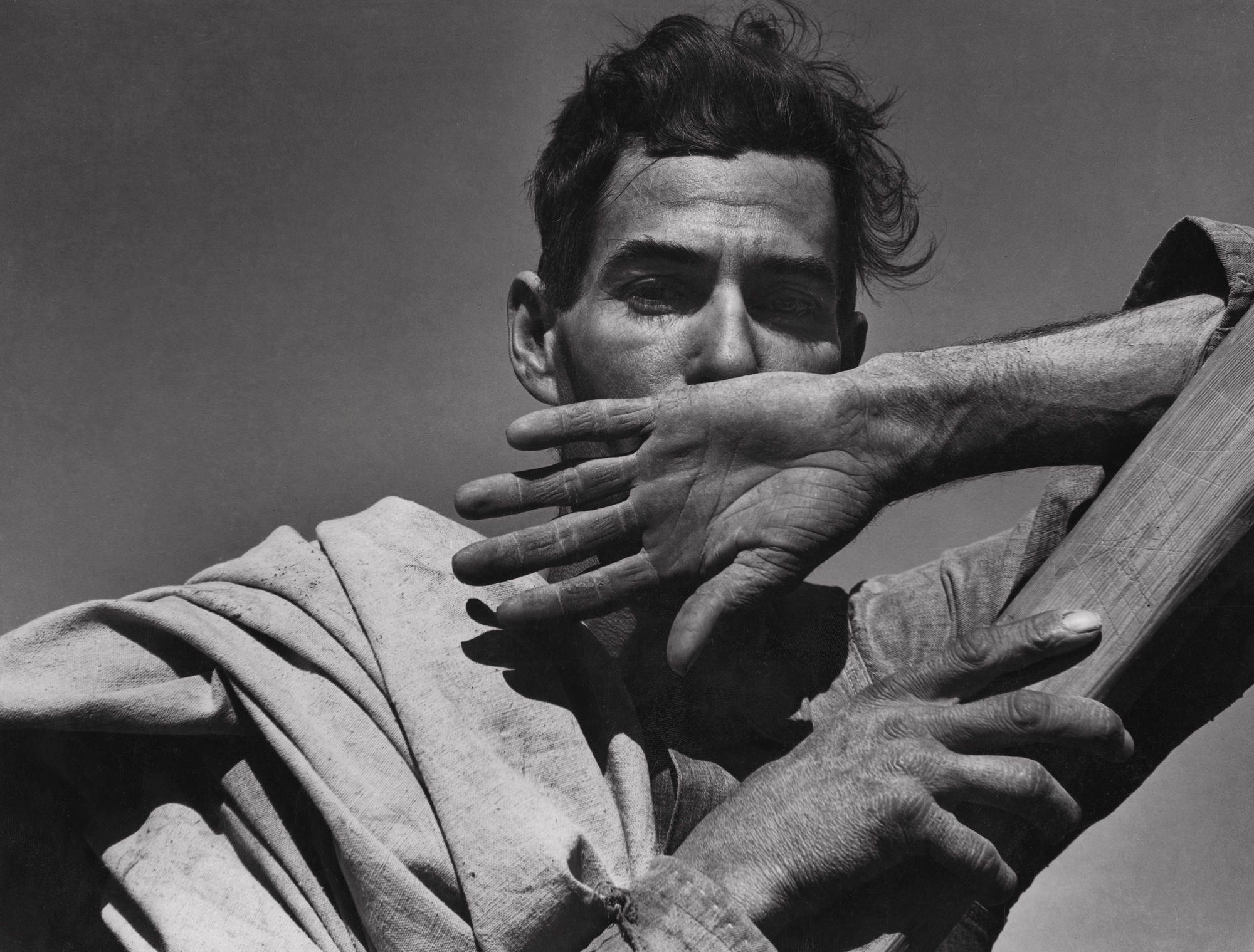


Dorothea Lange (American, 1895-1965) 'Migratory Cotton Picker, Eloy, Arizona' 1940 from the exhibition 'Dorothea Lange: Politics of Seeing' at the Barbican Art Gallery, London, June - Sept, 2018


Dorothea Lange (American, 1895-1965)
Migratory Cotton Picker, Eloy, Arizona
1940
Silver gelatin print
© The Dorothea Lange Collection, the Oakland Museum of California


Damaged, desperate and displaced

I am writing this short text on a laptop in Thailand which keeps jumping lines and misspelling words. The experience is almost as disorienting as the photographs of Dorothea Lange, with their anguished angles and portraits of despair. Her humanist, modernist pictures capture the harsh era of The Great Depression and the 1930s in America, allowing a contemporary audience to imagine what it must have been like to walk along blistering roads with five children, not knowing where your next meal or drink of water is coming from.

Like Lewis Hine and Jacob Riis from an earlier era, Lange’s photographs are about the politics of seeing. They are about human beings in distress and how photography can raise awareness of social injustice and disenfranchisement in the name of cultural change.

Dr Marcus Bunyan

#dorothealange @barbicancentre


Many thankx to the Barbican Art Gallery for allowing me to publish the photographs in the posting. Please click on the photographs for a larger version of the image.


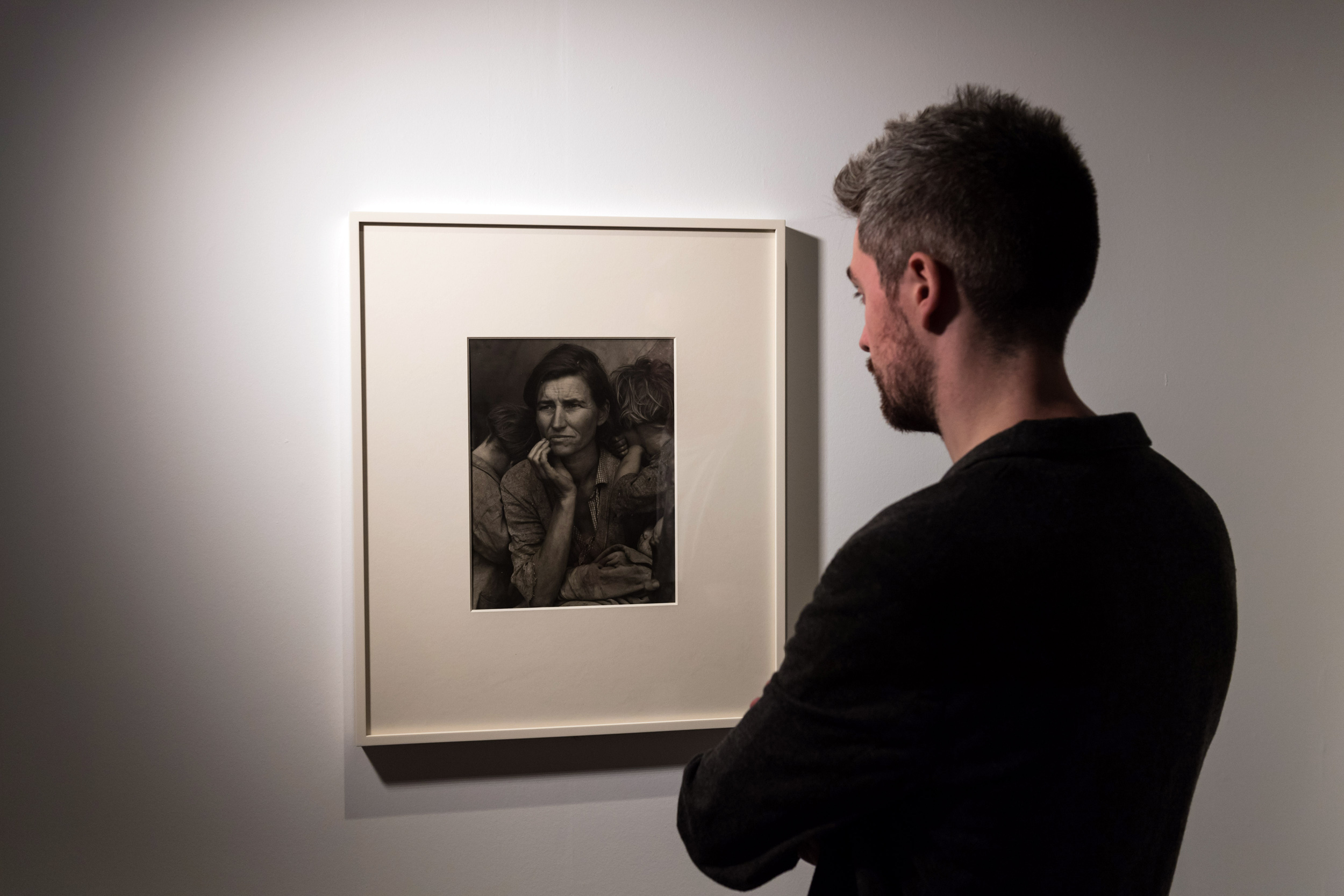
Dorothea Lange (American, 1895-1965) 'Migrant Mother, Nipomo, California' 1936 from the exhibition 'Dorothea Lange: Politics of Seeing' at the Barbican Art Gallery, London, June - Sept, 2018


Dorothea Lange (American, 1895-1965)
Migrant Mother, Nipomo, California
1936
Silver gelatin print
© The Dorothea Lange Collection, the Oakland Museum of California


Dorothea Lange took this photograph in 1936, while employed by the U.S. government’s Farm Security Administration (FSA) program, formed during the Great Depression to raise awareness of and provide aid to impoverished farmers. In Nipomo, California, Lange came across Florence Owens Thompson and her children in a camp filled with field workers whose livelihoods were devastated by the failure of the pea crops. Recalling her encounter with Thompson years later, she said, “I saw and approached the hungry and desperate mother, as if drawn by a magnet. I do not remember how I explained my presence or my camera to her, but I do remember she asked me no questions. I made five exposures, working closer and closer from the same direction.”1 One photograph from that shoot, now known as Migrant Mother, was widely circulated to magazines and newspapers and became a symbol of the plight of migrant farm workers during the Great Depression.

As Lange described Thompson’s situation, “She and her children had been living on frozen vegetables from the field and wild birds the children caught. The pea crop had frozen; there was no work. Yet they could not move on, for she had just sold the tires from the car to buy food.”2 However, Thompson later contested Lange’s account. When a reporter interviewed her in the 1970s, she insisted that she and Lange did not speak to each other, nor did she sell the tires of her car. Thompson said that Lange had either confused her for another farmer or embellished what she had understood of her situation in order to make a better story.

Anonymous text. “Migrant Mother, Nipomo, California,” on the MoMA Learning website Nd [Online] Cited 16/02/2022

1/ Dorothea Lange, “The Assignment I’ll Never Forget,” Popular Photography 46 (February, 1960). Reprinted in Photography, Essays and Images, ed. Beaumont Newhall (New York: The Museum of Modern Art), p. 262-265

2/ Dorothea Lange, paraphrased in Karin Becker Ohm, Dorothea Lange and the Documentary Tradition (Baton Rouge, LA: Louisiana State University Press, 1980), p. 79
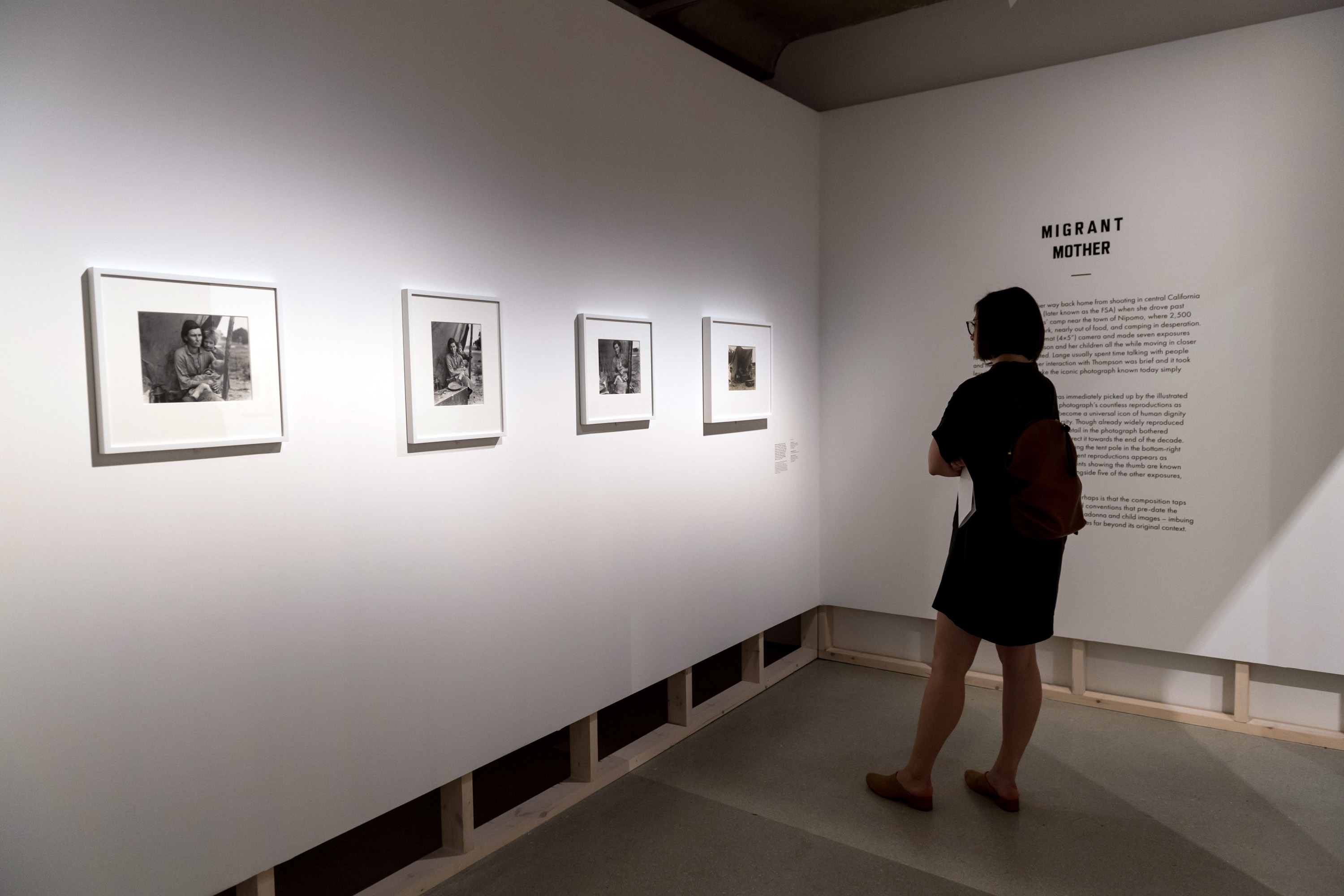
 

Installation view of the exhibition ‘Dorothea Lange: Politics of Seeing’ at the Barbican Art Gallery, London

Installation view of the exhibition ‘Dorothea Lange: Politics of Seeing’ at the Barbican Art Gallery, London showing Dorothea Lange's photograph 'Migrant Mother, Nipomo, California' 1936


Installation views of the exhibition Dorothea Lange: Politics of Seeing at the Barbican Art Gallery, London showing Dorothea Lange’s photograph Migrant Mother, Nipomo, California 1936
Photos: Ian Gavan/Getty Images for Barbican Art Gallery


“I saw and approached the hungry and desperate mother, as if drawn by a magnet. I do not remember how I explained my presence or my camera to her, but I do remember she asked me no questions. I made five exposures, working closer and closer from the same direction. I did not ask her name or her history. She told me her age, that she was thirty-two. She said that they had been living on frozen vegetables from the surrounding fields, and birds that the children killed. She had just sold the tires from her car to buy food. There she sat in that lean- to tent with her children huddled around her, and seemed to know that my pictures might help her, and so she helped me. There was a sort of equality about it.” (From: Popular Photography, Feb. 1960).

The images were made using a Graflex camera. The original negatives are 4 x 5″ film. It is not possible to determine on the basis of the negative numbers (which were assigned later at the Resettlement Administration) the order in which the photographs were taken.

Hanna Soltys, Reference Librarian, Prints & Photographs Division. “Dorothea Lange’s “Migrant Mother” Photographs in the Farm Security Administration Collection” Photographs in the Farm Security Administration Collection,” on The Library of Congress website 1998 February 19, 2019 [Online] Cited 16/02/2022


Florence Owens Thompson: The Story of the “Migrant Mother” 2014

Thompson’s identity was discovered in the late 1970s; in 1978, acting on a tip, Modesto Bee reporter Emmett Corrigan located Thompson at her mobile home in Space 24 of the Modesto Mobile Village and recognised her from the 40-year-old photograph.[10] A letter Thompson wrote was published in The Modesto Bee and the Associated Press distributed a story headlined “Woman Fighting Mad Over Famous Depression Photo.” Florence was quoted as saying “I wish she [Lange] hadn’t taken my picture. I can’t get a penny out of it, she didn’t ask my name. She said she wouldn’t sell the pictures, she said she’d send me a copy. She never did.”

Lange was funded by the federal government when she took the picture, so the image was in the public domain and Lange never directly received any royalties. However, the picture did help make Lange a celebrity and earned her “respect from her colleagues.”

In a 2008 interview with CNN, Thompson’s daughter Katherine McIntosh recalled how her mother was a “very strong lady”, and “the backbone of our family”, she said: “We never had a lot, but she always made sure we had something. She didn’t eat sometimes, but she made sure us children ate. That’s one thing she did do.”

Anonymous text. “Florence Owens Thompson,” on the WikiVisually website Nd [Online] Cited 05/08/2018. No longer available online
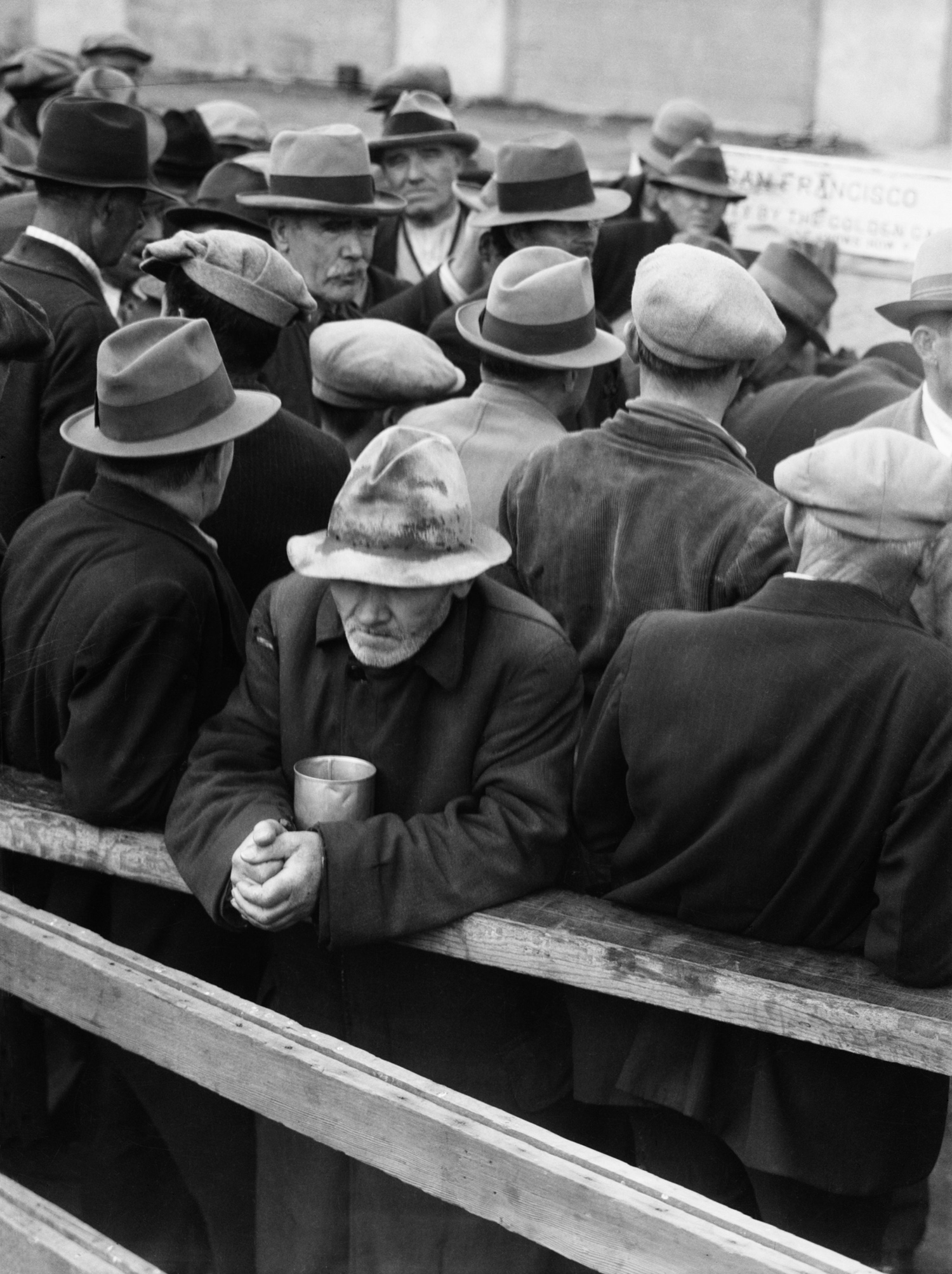
 

Dorothea Lange (American, 1895-1965) 'White Angel Breadline, San Francisco' 1933


Dorothea Lange (American, 1895-1965)
White Angel Breadline, San Francisco
1933
Silver gelatin print
© The Dorothea Lange Collection, the Oakland Museum of California


“There are moments such as these when time stands still and all you do is hold your breath and hope it will wait for you. And you just hope you will have enough time to get it organised in a fraction of a second on that tiny piece of sensitive film. Sometimes you have an inner sense that you have encompassed the thing generally. You know then that you are not taking anything away from anyone: their privacy, their dignity, their wholeness.” ~ Dorothea Lange 1963

Davis K F 1995, The photographs of Dorothea Lange, Hallmark Cards Inc, Missouri p. 20.


White angel breadline, San Francisco is Lange’s first major image that encapsulates both her sense of compassion and ability to structure a photograph according to modernist principles. The diagonals of the fence posts and the massing of hats do not reduce this work to the purely formal – the figure in the front middle of the image acts as a lightening rod for our emotional engagement.

© Art Gallery of New South Wales Photography Collection Handbook, 2007


“I had made some photographs of the state [of] people, in an area of San Francisco which revealed how deep the depression was. It was at that time beginning to cut very deep. This is a long process. It doesn’t happen overnight. Life, for people, begins to crumble on the edges; they don’t realise it…”


Dorothea Lange, interview, 1964


There was a real “White Angel” behind the breadline that served the needy men photographed by Dorothea Lange. She was a widow named Lois Jordan. Mrs. Jordan, who gave herself the name White Angel, established a soup kitchen during the Great Depression to feed those who were unemployed and destitute. Relying solely on donations, she managed to supply meals to more than one million men over a three-year period.

Jordan’s soup kitchen occupied a junk-filled lot in San Francisco located on the Embarcadero near Filbert Street. This area was known as the White Angel Jungle. The Jungle was not far from Lange’s studio. As she began to change direction from portrait to documentary photography, Lange focused her lens on the poignant scenes just beyond her window. White Angel Breadline is the result of her first day’s work to document Depression-era San Francisco. Decades later, Lange recalled: “[White Angel Breadline] is my most famed photograph. I made that on the first day I ever went out in an area where people said, ‘Oh, don’t go there.’ It was the first day that I ever made a photograph on the street.”

Anonymous text. “Dorothea Lange + White Angel Breadline: Meet the master artist through one of her most important works,” on The Kennedy Centre website Nd [Online] Cited 16/02/2022


Dorothea Lange’s Documentary Photographs

Hear Dorothea Lange discuss her photographs and the difficulty of leading a visual life.

Dorothea Lange’s stirring images of migrant farmers and the unemployed have become universally recognised symbols of the Great Depression. Later photographs documenting the internment of Japanese Americans and her travels throughout the world extended her body of work. Watch the video to hear Lange discuss how she began her documentary projects for the Farm Security Administration, and learn how she felt about some of her assignments and subjects.
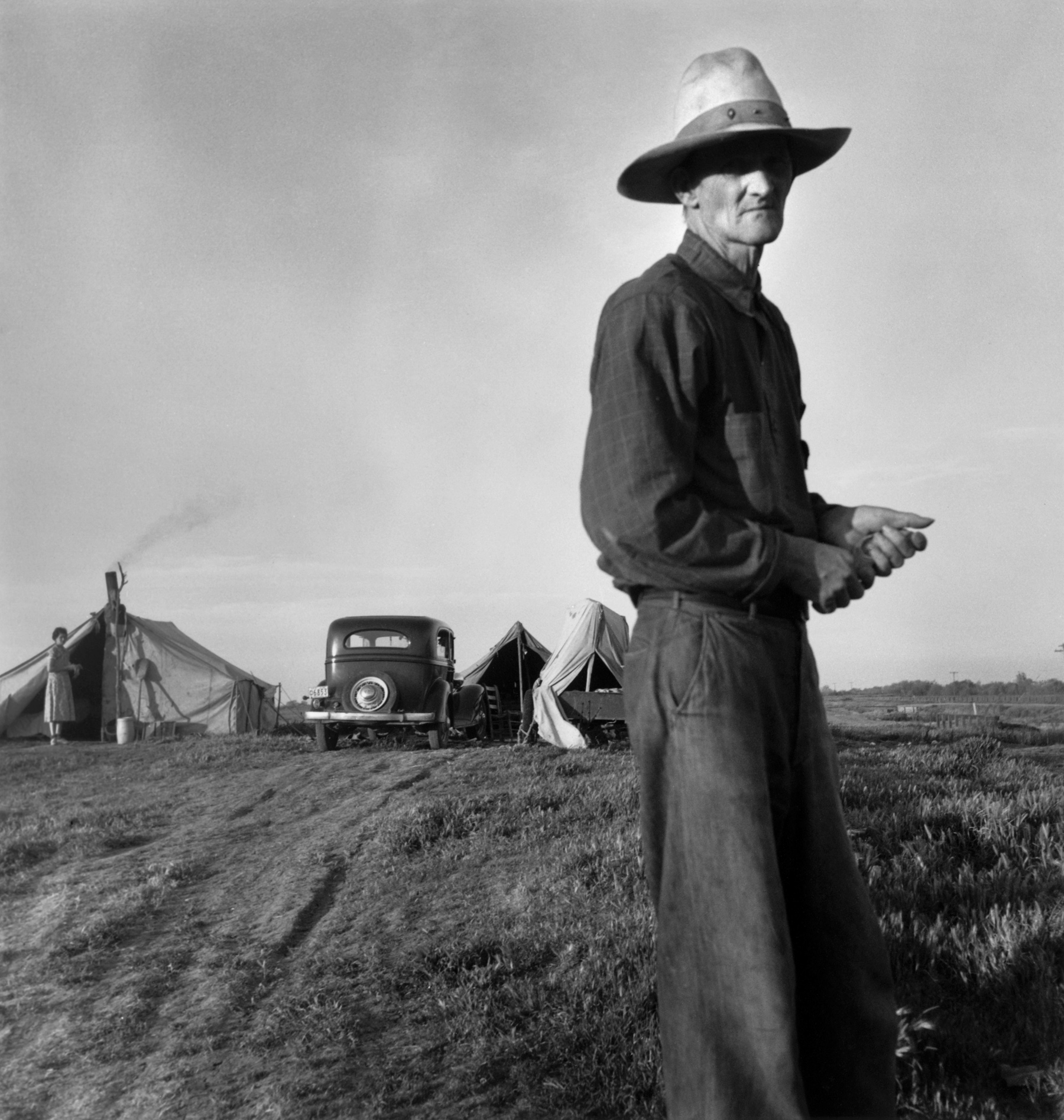
 

Dorothea Lange (American, 1895-1965) 'Drought Refugees' c. 1935


Dorothea Lange (American, 1895-1965)
Drought Refugees
c. 1935
Silver gelatin print
© The Dorothea Lange Collection, the Oakland Museum of California
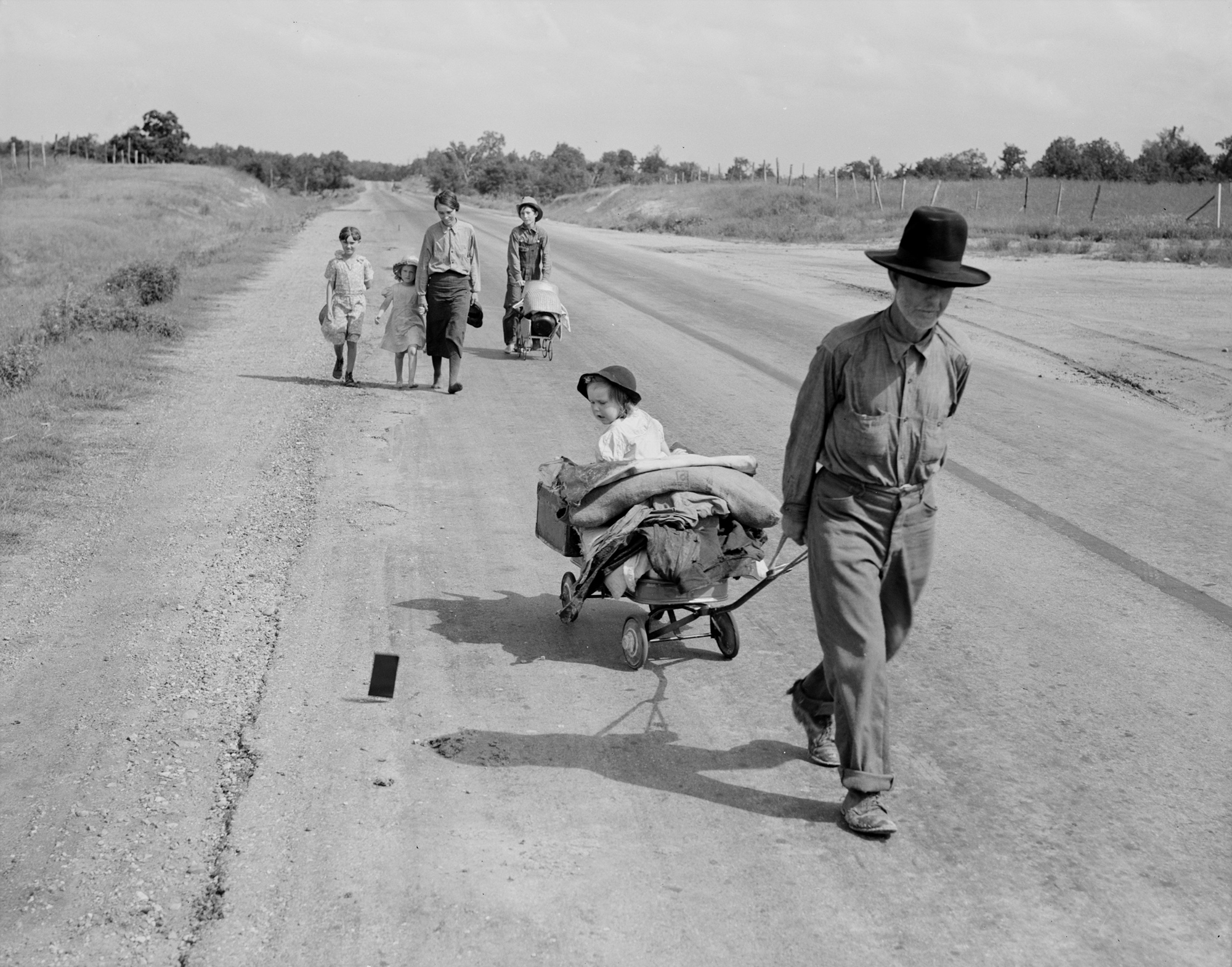
 

Dorothea Lange (American, 1895-1965) 'Family walking on highway - five children. Started from Idabel, Oklahoma, bound for Krebs, Oklahoma' June 1938


Dorothea Lange (American, 1895-1965)
Family walking on highway – five children. Started from Idabel, Oklahoma, bound for Krebs, Oklahoma
June 1938
Silver gelatin print
Library of Congress
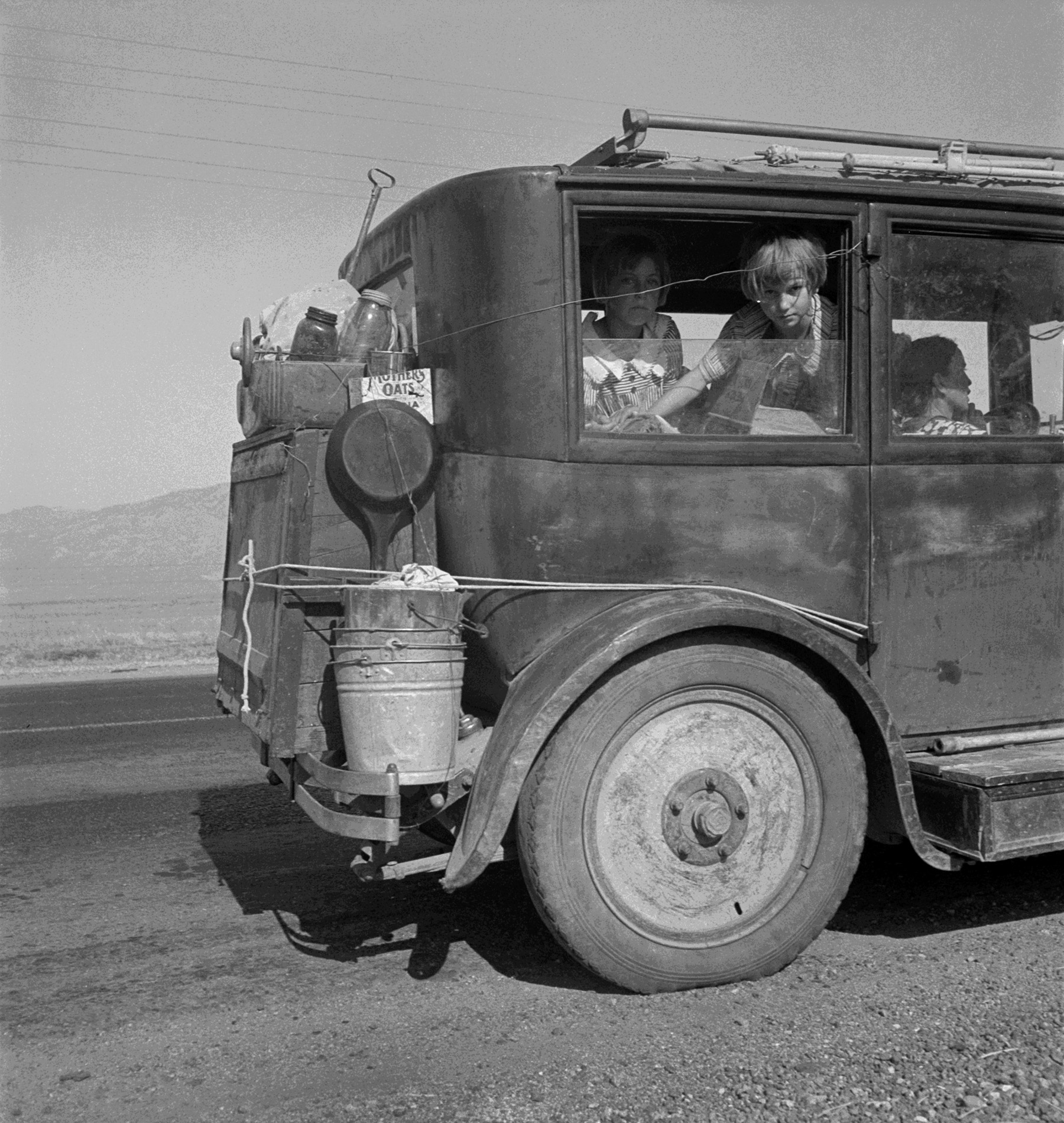
 

Dorothea Lange (American, 1895-1965) 'Cars on the Road' August 1936


Dorothea Lange (American, 1895-1965)
Cars on the Road
August 1936
Silver gelatin print
Library of Congress
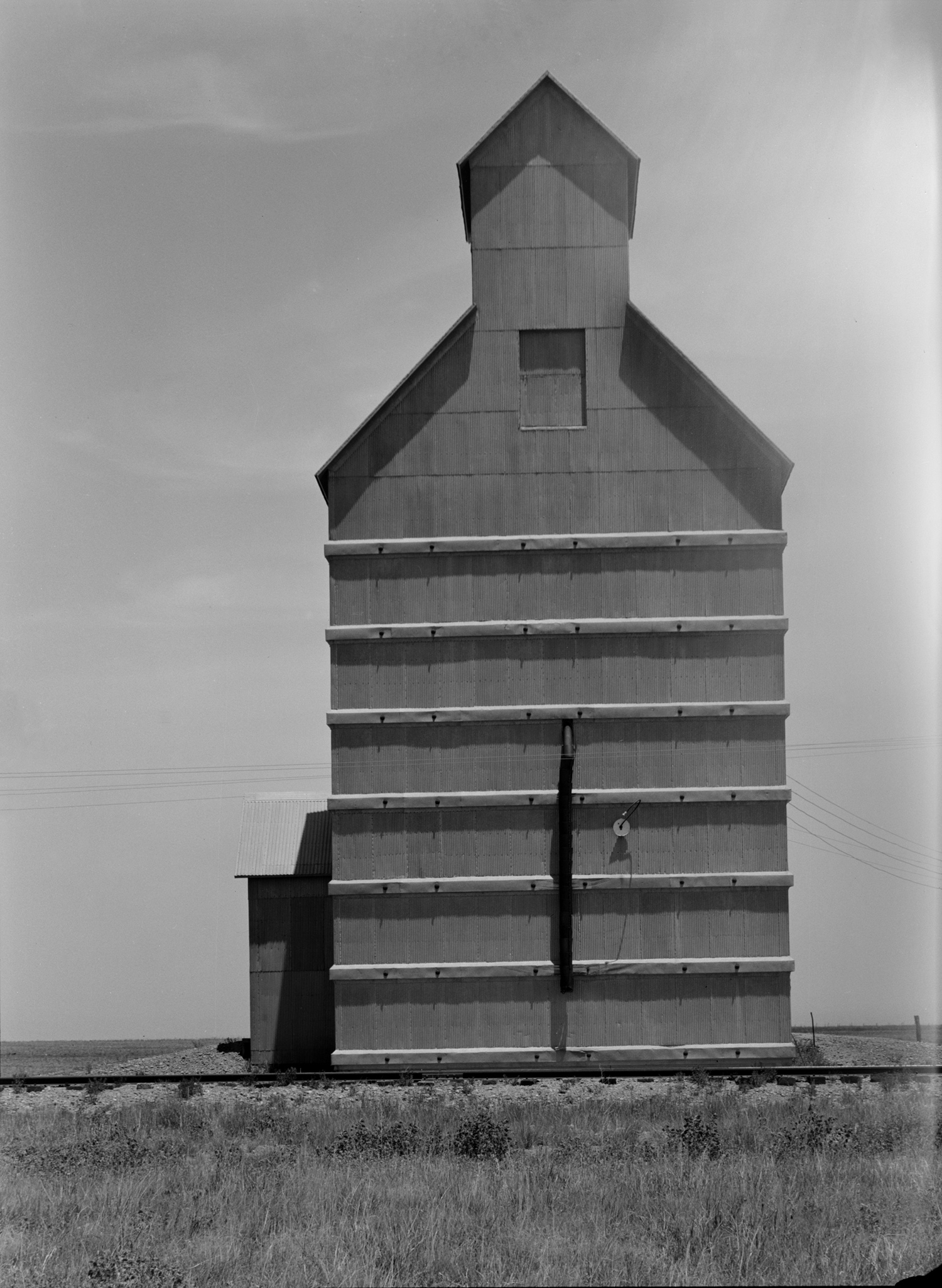
 

Dorothea Lange (American, 1895-1965) 'Dust Bowl, Grain Elevator, Everett, Texas' June 1938


Dorothea Lange (American, 1895-1965)
Dust Bowl, Grain Elevator, Everett, Texas
June 1938
Silver gelatin print
Library of Congress


This summer, Barbican Art Gallery stages the first ever UK retrospective of one of the most influential female photographers of the 20th century, the American documentary photographer Dorothea Lange (1895-1965). A formidable woman of unparalleled vigour and resilience, the exhibition charts Lange’s outstanding photographic vision from her early studio portraits of San Francisco’s bourgeoisie to her celebrated Farm Security Administration work (1935-1939) that captured the devastating impact of the Great Depression on the American population. Rarely seen photographs of the internment of Japanese-Americans during the Second World War are also presented as well as the later collaborations with fellow photographers Ansel Adams and Pirkle Jones documenting the changing face of the social and physical landscape of 1950s America. Opening 22 June at Barbican Art Gallery, Dorothea Lange: Politics of Seeing is part of the Barbican’s 2018 season, The Art of Change, which explores how the arts respond to, reflect and potentially effect change in the social and political landscape.

Dorothea Lange: Politics of Seeing encompasses over 300 objects from vintage prints and original book publications to ephemera, field notes, letters, and documentary film. Largely chronological, the exhibition presents eight series in Lange’s oeuvre spanning from 1919 to 1957.

Jane Alison, Head of Visual Arts, Barbican, said: “This is an incredible opportunity for our visitors to see the first UK survey of the work of such a significant photographer. Dorothea Lange is undoubtedly one of the great photographers of the twentieth century and the issues raised through her work have powerful resonance with issues we’re facing in society today. Staged alongside contemporary photographer Vanessa Winship as part of The Art of Change, these two shows are unmissable.”

Opening the exhibition are Lange’s little known early portrait photographs taken during her time running a successful portrait studio in San Francisco between 1919 and 1935. Lange was at the heart of San Francisco’s creative community and her studio became a centre in which bohemian and artistic friends gathered after hours, including Edward Weston, Anne Brigman, Alma Lavenson, Imogen Cunningham, and Willard van Dyke. Works from this period include intimate portraits of wealthy West Coast families as well as of Lange’s inner circle, counting amongst others photographer Roi Partridge and painter Maynard Dixon, Lange’s first husband and father of her two sons.

The Great Depression in the early 1930s heralded a shift in her photographic language as she felt increasingly compelled to document the changes visible on the streets of San Francisco. Taking her camera out of the studio, she captured street demonstrations, unemployed workers, and breadline queues. These early explorations of her social documentary work are also on display.

The exhibition charts Lange’s work with the newly established historical division of the Farm Security Administration (FSA), the government agency tasked with the promotion of Roosevelt’s New Deal programme. Alongside Lange, the FSA employed a number of photographers, including Walker Evans, Ben Shahn and Arthur Rothstein, to document living conditions across America during the Great Depression: from urban poverty in San Francisco to tenant farmers driven off the land by dust storms and mechanisation in the states of Oklahoma, Arkansas and Texas; the plight of homeless families on the road in search of better livelihoods in the West; and the tragic conditions of migrant workers and camps across California. Lange used her camera as a political tool to critique themes of injustice, inequality, migration and displacement, and to effect government relief.

Highlights in this section are, among others, a series on sharecroppers in the Deep South that exposes relations of race and power, and the iconic Migrant Mother, a photograph which has become a symbol of the Great Depression, alongside images of vernacular architecture and landscapes, motifs often overlooked within Lange’s oeuvre. Vintage prints in the exhibition are complemented by the display of original publications from the 1930s to foreground the widespread use of Lange’s FSA photographs and her influence on authors including John Steinbeck, whose ground-breaking novel The Grapes of Wrath was informed by Lange’s photographs. Travelling for many months at a time and working in the field, she collaborated extensively with her second husband Paul Schuster Taylor, a prominent social economist and expert in farm labour with whom she published the seminal photo book An American Exodus: A Record of Human Erosion in 1939, also on display in the exhibition.

The exhibition continues with rarely seen photographs of the internment of more than 100,000 American citizens of Japanese descent that Lange produced on commission for the War Relocation Authority following the Japanese attack on the American naval base at Pearl Harbor in 1941. Lange’s critical perspective of this little discussed chapter in US history however meant that her photographs remained unpublished during the war and stored at the National Archives in Washington. It is the first time that this series will be shown comprehensively outside of the US and Canada.

Following her documentation of the Japanese American internment, Lange produced a photographic series of the wartime shipyards of Richmond, California with friend and fellow photographer Ansel Adams (1902-1984). Lange and Adams documented the war effort in the shipyards for Fortune magazine in 1944, recording the explosive increase in population numbers and the endlessly changing shifts of shipyard workers. Capturing the mass recruitment of workers, Lange turned her camera on both female and black workers, for the first time part of the workforce, and their defiance of sexist and racist attitudes.

The exhibition features several of Lange’s post-war series, when she photographed extensively in California. Her series Public Defender (1955-1957) explores the US legal defence system for the poor and disadvantaged through the work of a public defender at the Alameda County Courthouse in Oakland. Death of a Valley (1956-1957), made in collaboration with photographer Pirkle Jones, documents the disappearance of the small rural town of Monticello in California’s Berryessa Valley as a consequence of the damming of the Putah Creek. Capturing the destruction of a landscape and traditional way of life, the photographs testify to Lange’s environmentalist politics and have not been displayed or published since the 1960s.

The exhibition concludes with Lange’s series of Ireland (1954), the first made outside the US. Spending six weeks in County Clare in western Ireland, Lange captured the experience of life in and around the farming town of Ennis in stark and evocative photographs that symbolise Lange’s attraction to the traditional life of rural communities.

An activist, feminist and environmentalist, Lange used her camera as a political tool to critique themes of injustice, inequality, migration and displacement that bear great resonance with today’s world, a prime example of which is her most iconic image the Migrant Mother (1936). Working in urban and rural contexts across America and beyond, she focused her lens on human suffering and hardship to create compassionate and piercing portraits of people as well as place in the hope to forge social and political reform – from the plight of sharecroppers in the Deep South to Dust Bowl refugees trekking along the highways of California in search of better livelihoods.

Dorothea Lange: Politics of Seeing is organised by the Oakland Museum of California. The European presentation has been produced in collaboration with Barbican Art Gallery, London and Jeu de Paume, Paris.

Press release from the Barbican Art Gallery
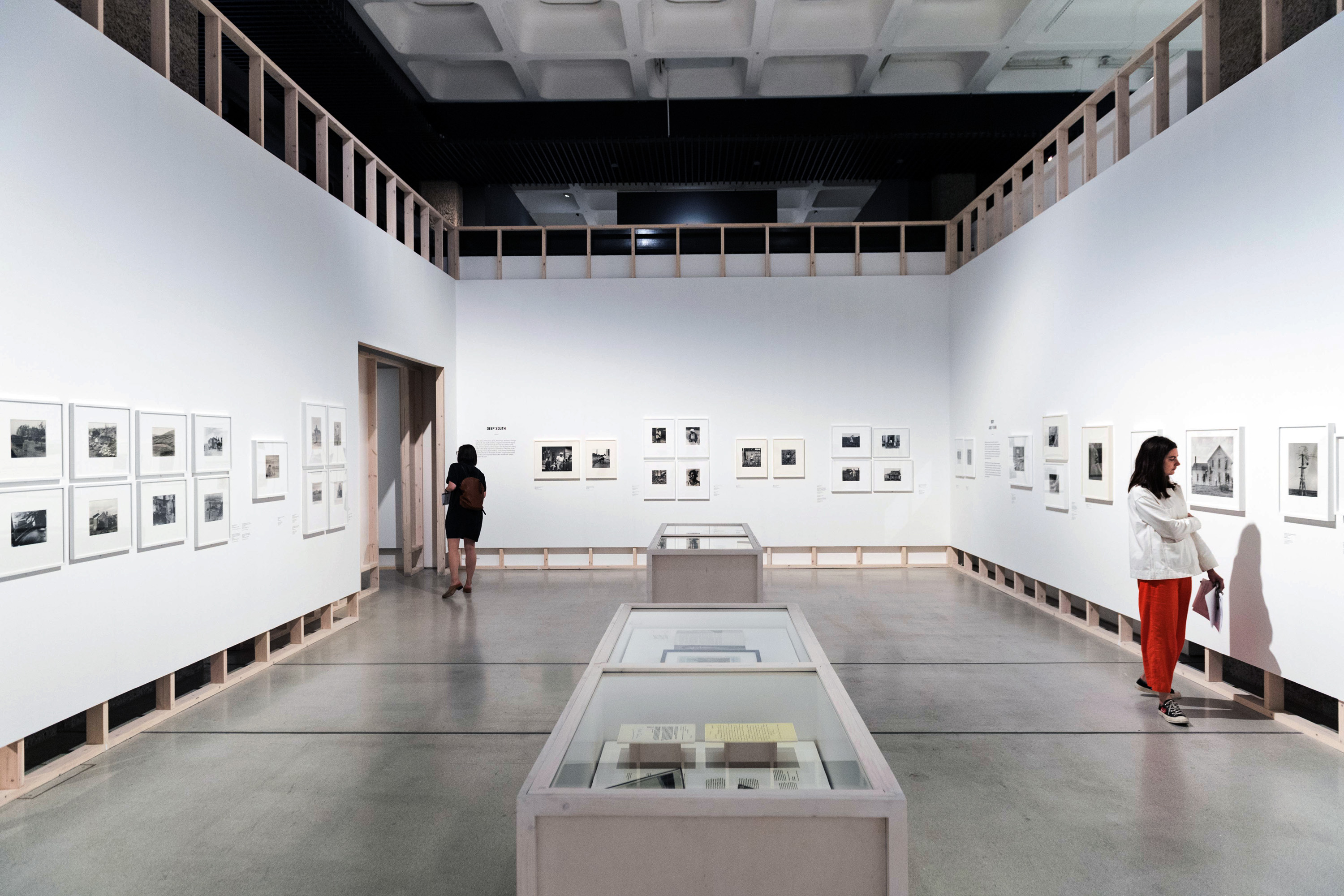
 

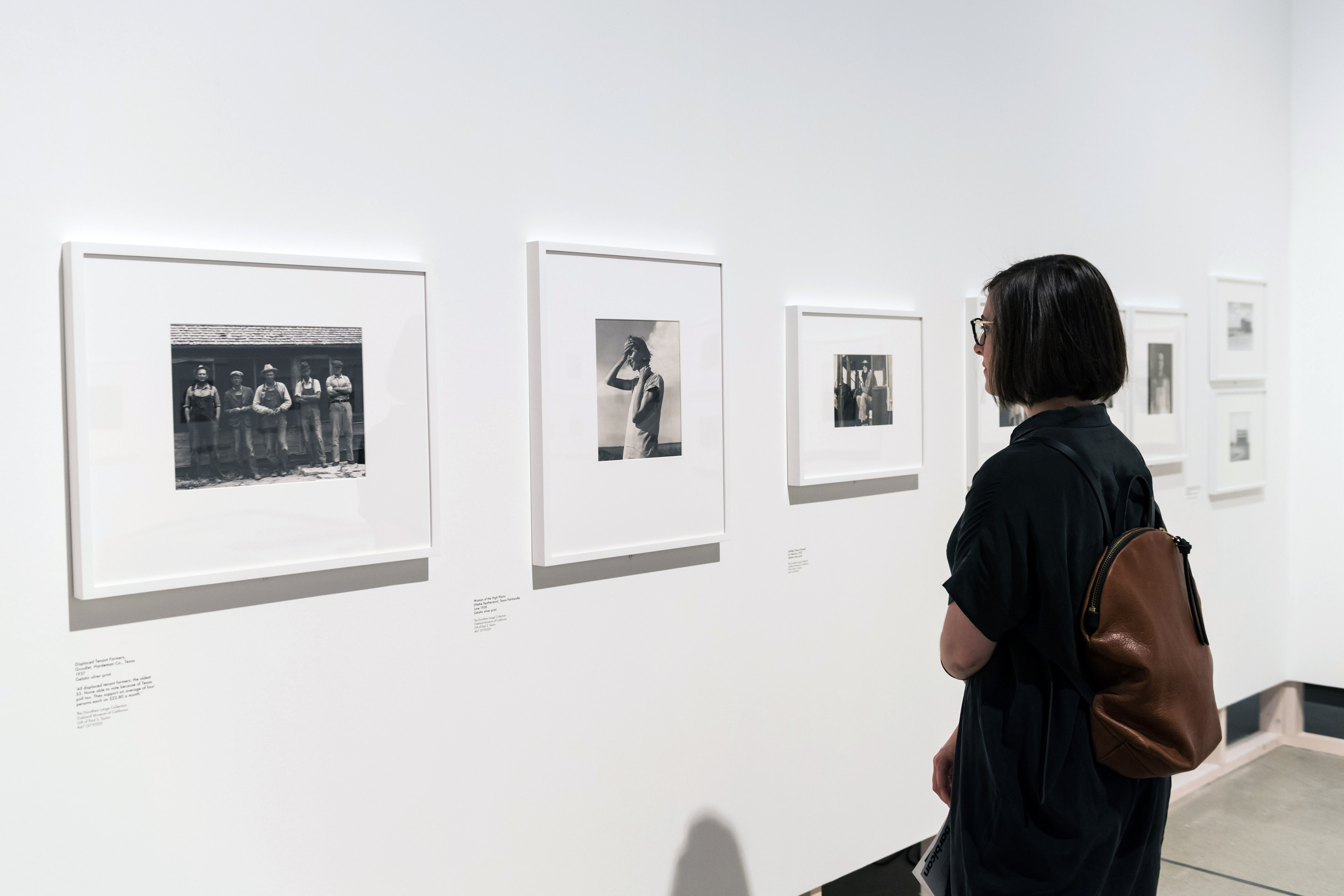
Installation view of the exhibition ‘Dorothea Lange: Politics of Seeing’ at the Barbican Art Gallery, London

Installation view of the exhibition ‘Dorothea Lange: Politics of Seeing’ at the Barbican Art Gallery, London


Installation views of the exhibition Dorothea Lange: Politics of Seeing at the Barbican Art Gallery, London showing in the bottom image at left, Lange’s Displaced Tennant Farmers, Goodlet, Hardeman Co., Texas 1937. ‘All displaced tenant farmers, the oldest 33. None able to vote because of Texas poll tax. They support an average of four persons each on $22.80 a month’; and at second left, Woman of the High Plains, Texas Panhandle June 1938 (below)
Photos: Ian Gavan/Getty Images for Barbican Art Gallery
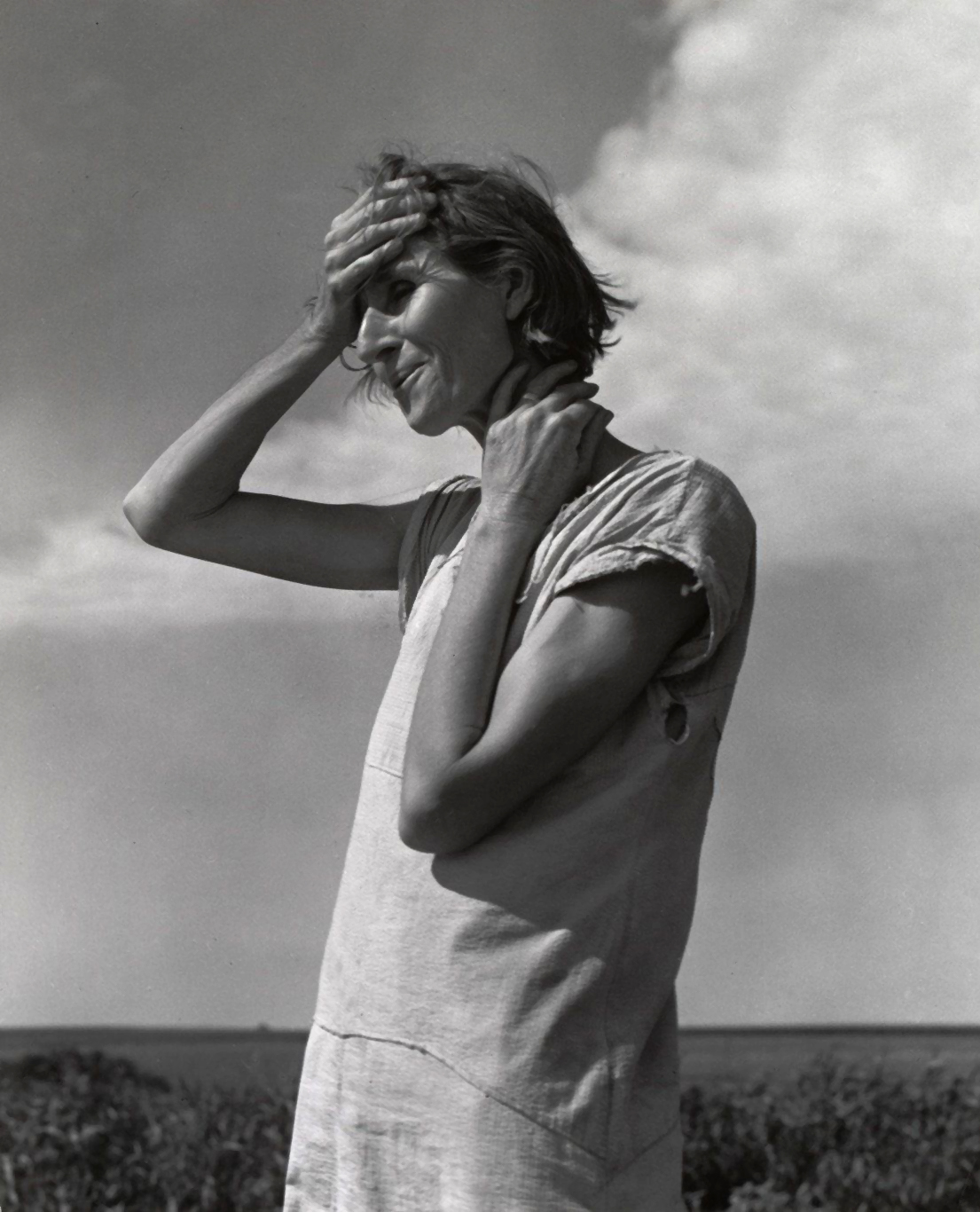
 

Dorothea Lange (American, 1895-1965) 'Woman of the High Plains, Texas Panhandle' June 1938


Dorothea Lange (American, 1895-1965)
Woman of the High Plains, Texas Panhandle
June 1938
Silver gelatin print
© The Dorothea Lange Collection, the Oakland Museum of California
Gift of Paul S. Taylor
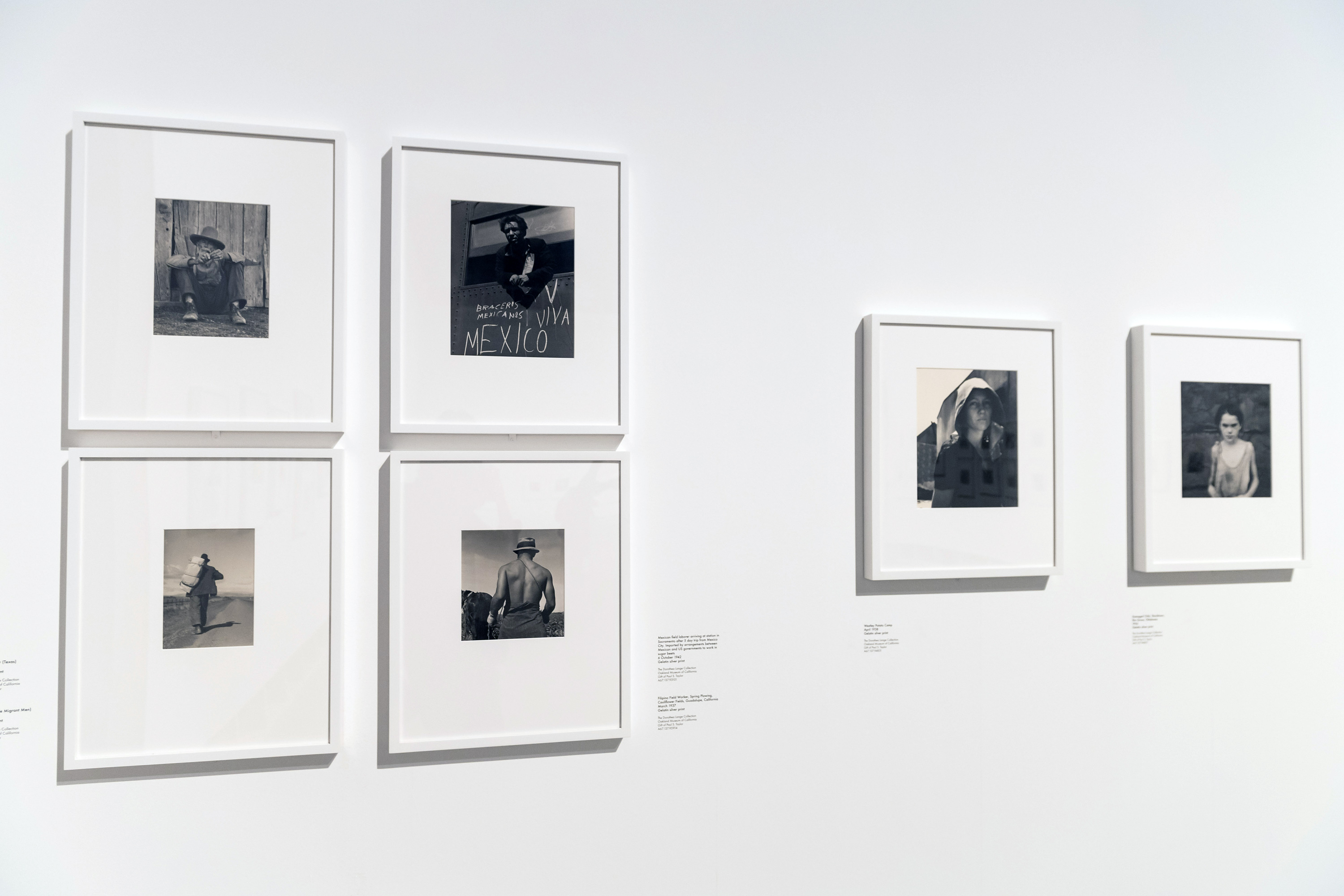
 

Installation view of the exhibition ‘Dorothea Lange: Politics of Seeing’ at the Barbican Art Gallery, London


Installation view of the exhibition Dorothea Lange: Politics of Seeing at the Barbican Art Gallery, London showing at second left top, Lange’s Mexican field labourer at station in Sacramento after 5 day trip from Mexico City. Imported by arrangements between Mexican and US governments to work in sugar beets. 6 October 1942; at second left bottom, Filipino Field Worker, Spring Plowing, Cauliflower Fields, Guadalupe, California. March 1937 (below); and at right, Damaged Child, Shacktown, Elm Grove, Oklahoma. 1936 (below)
Photos: Ian Gavan/Getty Images for Barbican Art Gallery
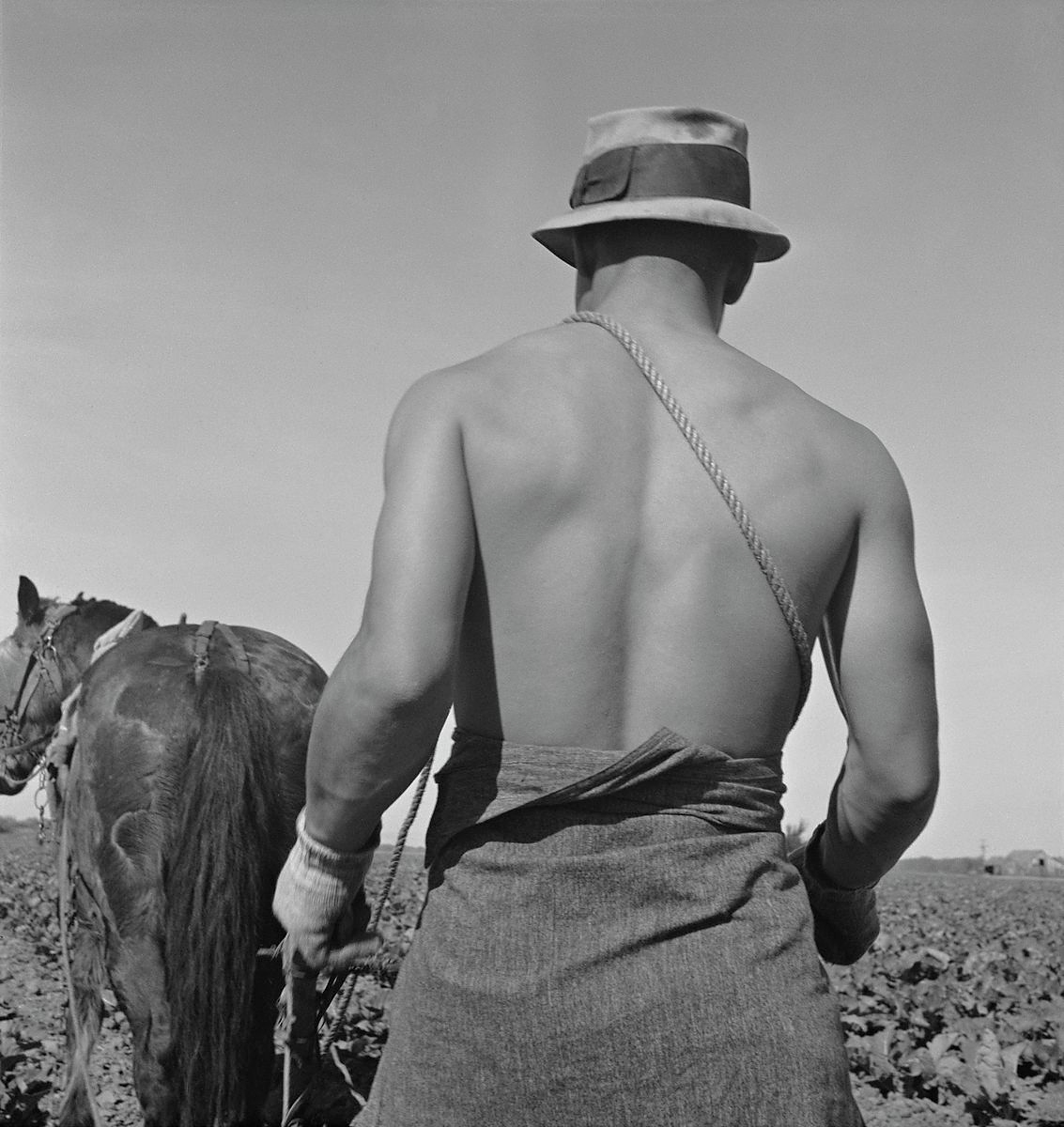
 

Dorothea Lange (American, 1895-1965) 'Filipino Field Worker, Spring Plowing, Cauliflower Fields, Guadalupe, California' March 1937


Dorothea Lange (American, 1895-1965)
Filipino Field Worker, Spring Plowing, Cauliflower Fields, Guadalupe, California
March 1937
Silver gelatin print
© The Dorothea Lange Collection, the Oakland Museum of California
Gift of Paul S. Taylor
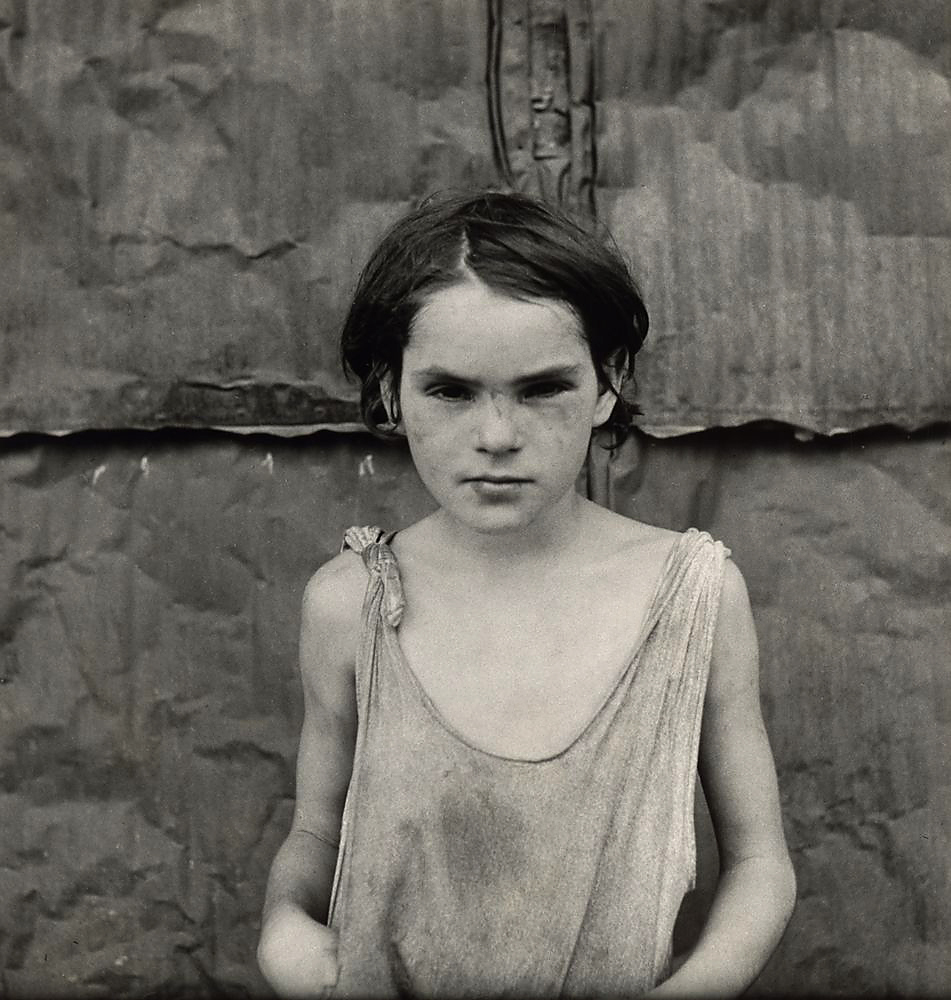
 

Dorothea Lange (American, 1895-1965) 'Damaged Child, Shacktown, Elm Grove, Oklahoma' 1936


Dorothea Lange (American, 1895-1965)
Damaged Child, Shacktown, Elm Grove, Oklahoma
1936
© The Dorothea Lange Collection, Oakland Museum of California, City of Oakland
Gift of Paul S. Taylor
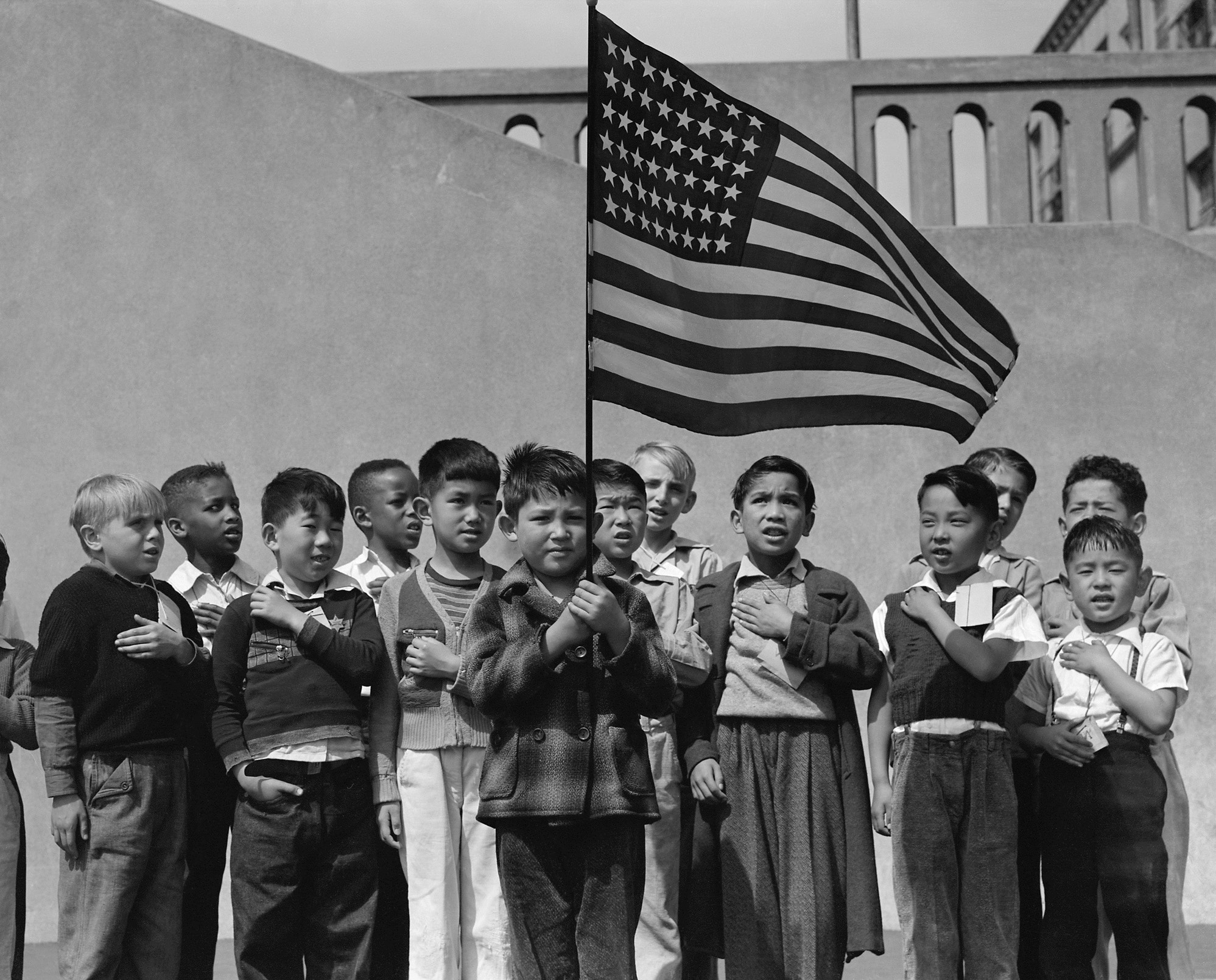
 

Dorothea Lange (American, 1895-1965) 'San Francisco, California. Flag of allegiance pledge at Raphael Weill Public School, Geary and Buchanan Streets' 1942


Dorothea Lange (American, 1895-1965)
San Francisco, California. Flag of allegiance pledge at Raphael Weill Public School, Geary and Buchanan Streets. Children in families of Japanese ancestry were evacuated with their parents and will be housed for the duration in War Relocation Authority centers where facilities will be provided for them to continue their education
1942
Silver gelatin print
Courtesy National Archives, photo no. 210-G-C122
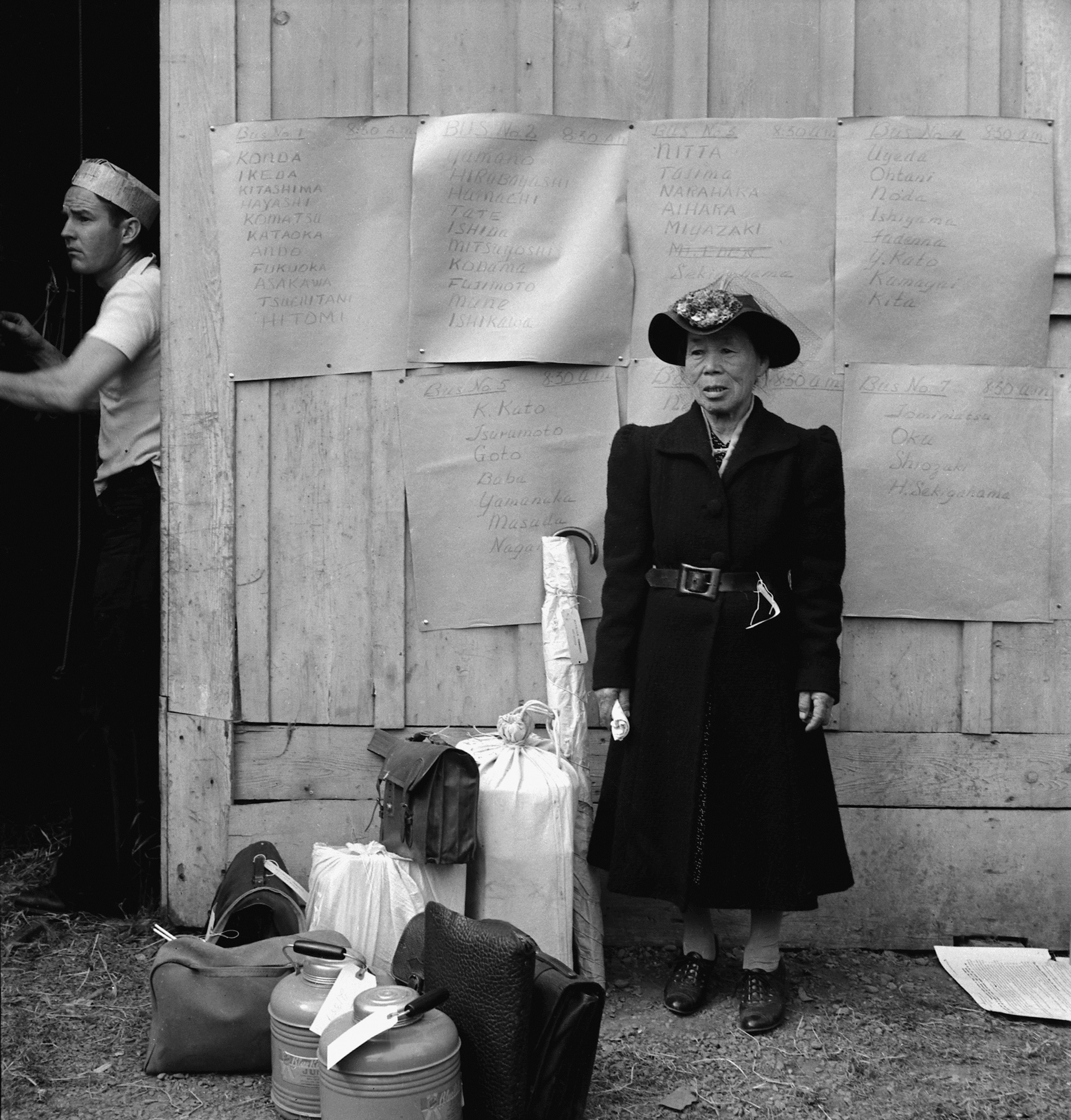
 

Dorothea Lange (American, 1895-1965) 'Centerville, California. This evacuee stands by her baggage as she waits for evacuation bus' 1942


Dorothea Lange (American, 1895-1965)
Centerville, California. This evacuee stands by her baggage as she waits for evacuation bus. Evacuees of Japanese ancestry will be housed in War Relocation Authority centers for the duration
1942
Silver gelatin print
Courtesy National Archives, photo no. 210-G-C241
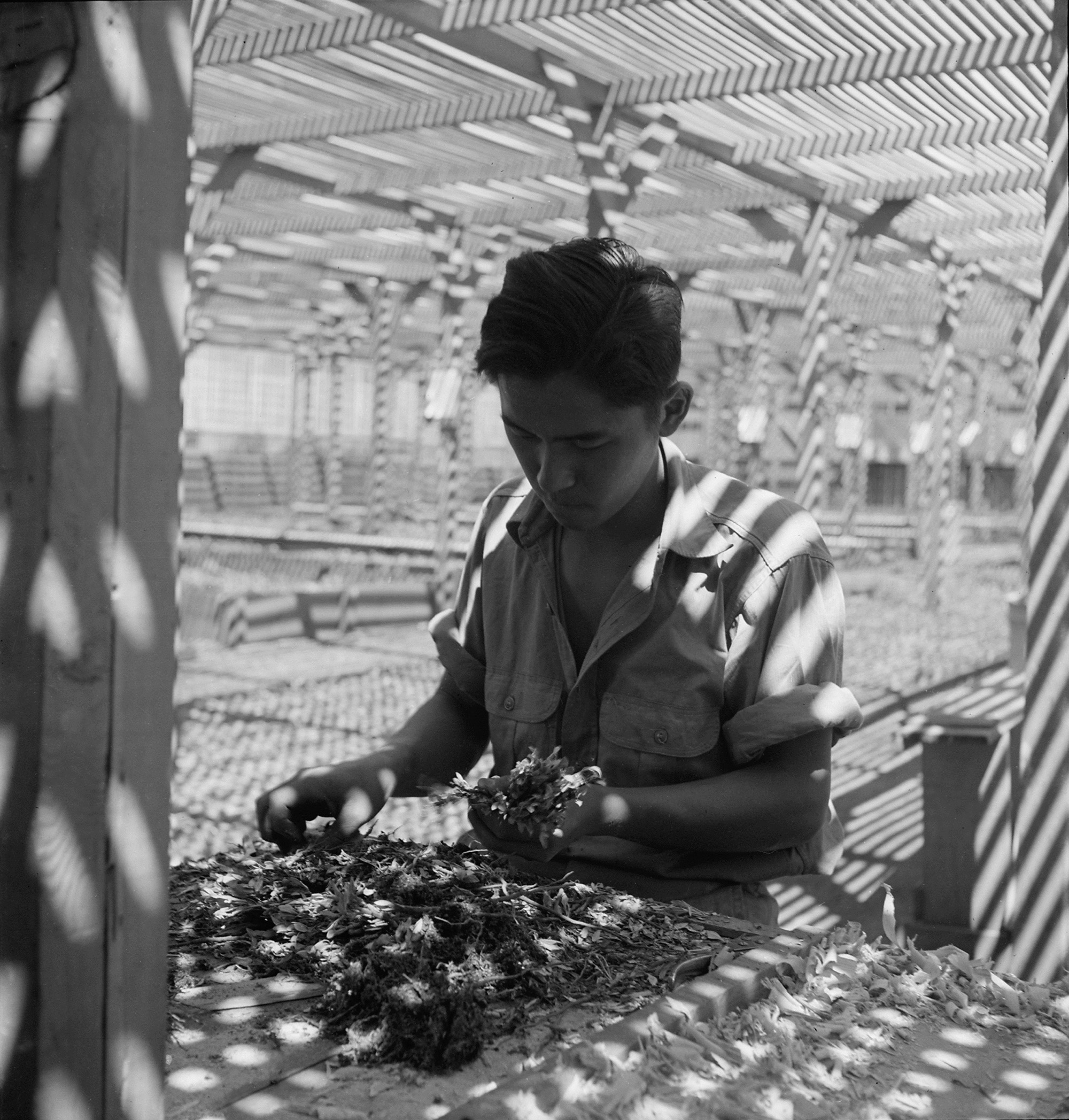
 

Dorothea Lange (American, 1895-1965) 'Manzanar Relocation Center, Manzanar, California. An evacuee is shown in the lath house sorting seedlings for transplanting' 1942


Dorothea Lange (American, 1895-1965)
Manzanar Relocation Center, Manzanar, California. An evacuee is shown in the lath house sorting seedlings for transplanting. These plants are year-old seedlings from the Salinas Experiment Station
1942
Silver gelatin print
Courtesy National Archives, photo no. 210-GC737
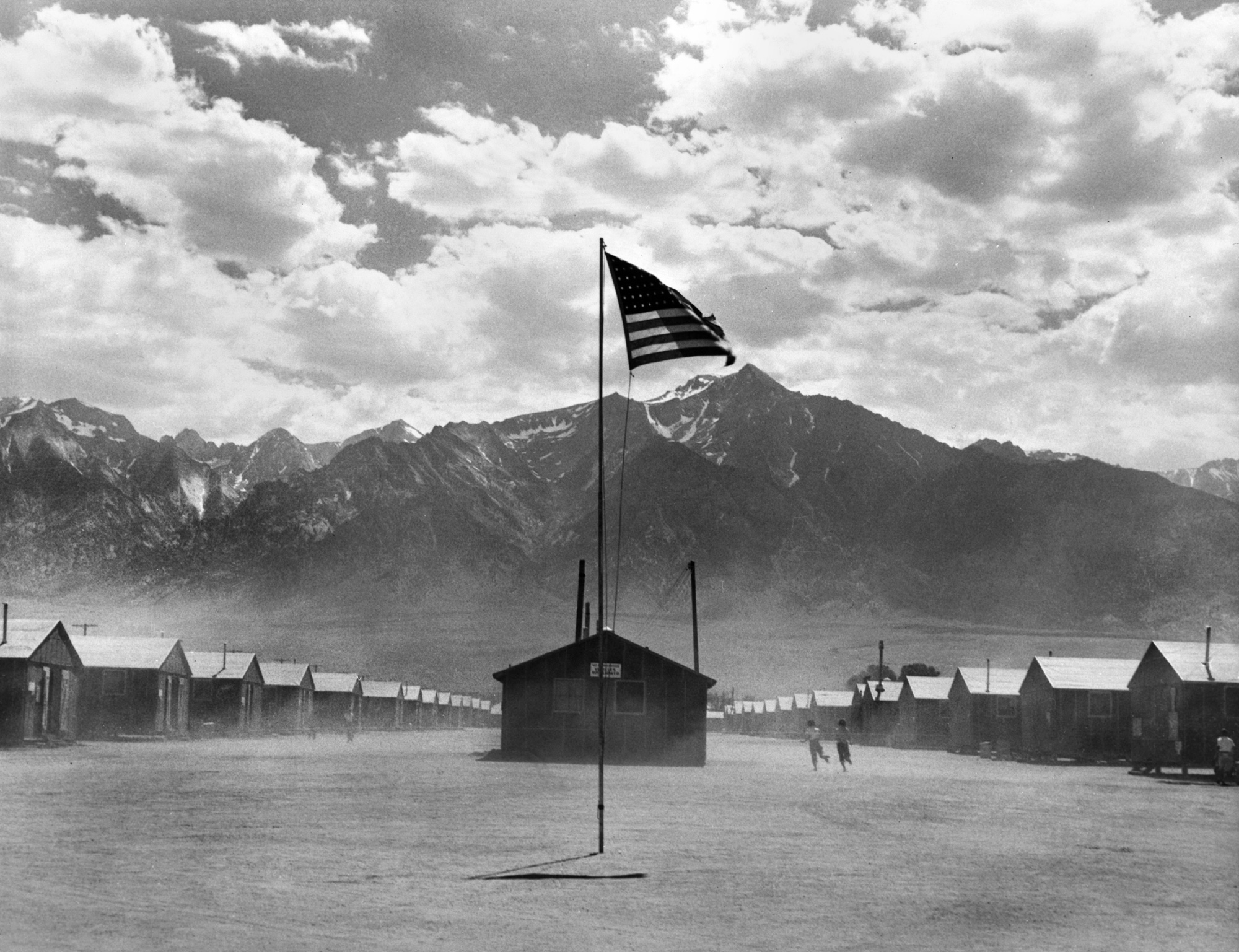
 

Dorothea Lange (American, 1895-1965) 'Manzanar Relocation Center' 1942


Dorothea Lange (American, 1895-1965)
Manzanar Relocation Center, Manzanar, California
July 3, 1942
Silver gelatin print
© The Dorothea Lange Collection, the Oakland Museum of California
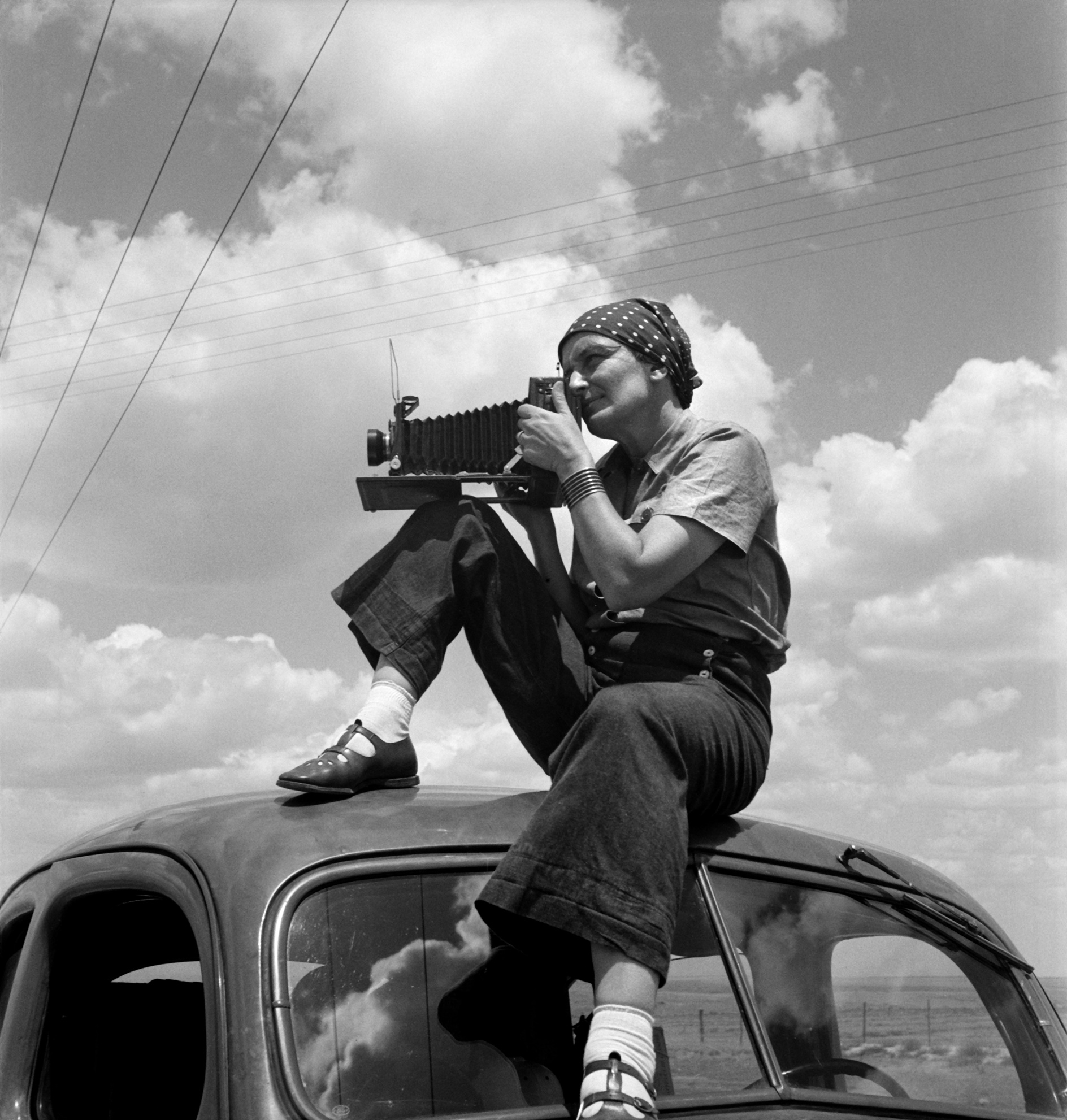
 

Paul S. Taylor (American, 1895-1984) 'Dorothea Lange in Texas on the Plains' c. 1935


Paul S. Taylor (American, 1895-1984)
Dorothea Lange in Texas on the Plains
c. 1935
Silver gelatin print
© The Dorothea Lange Collection, the Oakland Museum of California
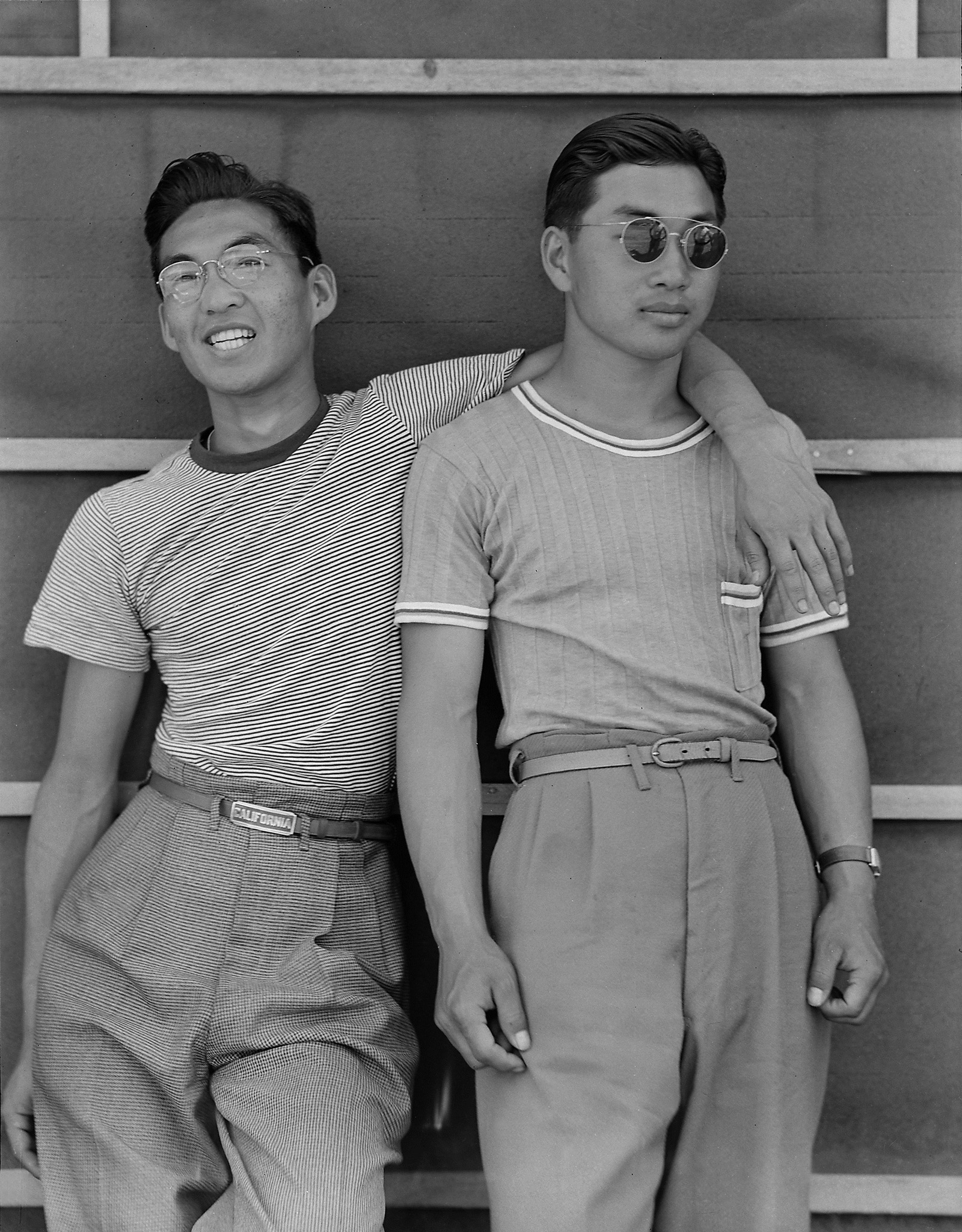
 

Dorothea Lange (American, 1895-1965) 'Sacramento, California. College students of Japanese ancestry' 1942


Dorothea Lange (American, 1895-1965)
Sacramento, California. College students of Japanese ancestry who have been evacuated from Sacramento to the Assembly Center
1942
Silver gelatin print
Courtesy National Archives, photo no. 210-GC471
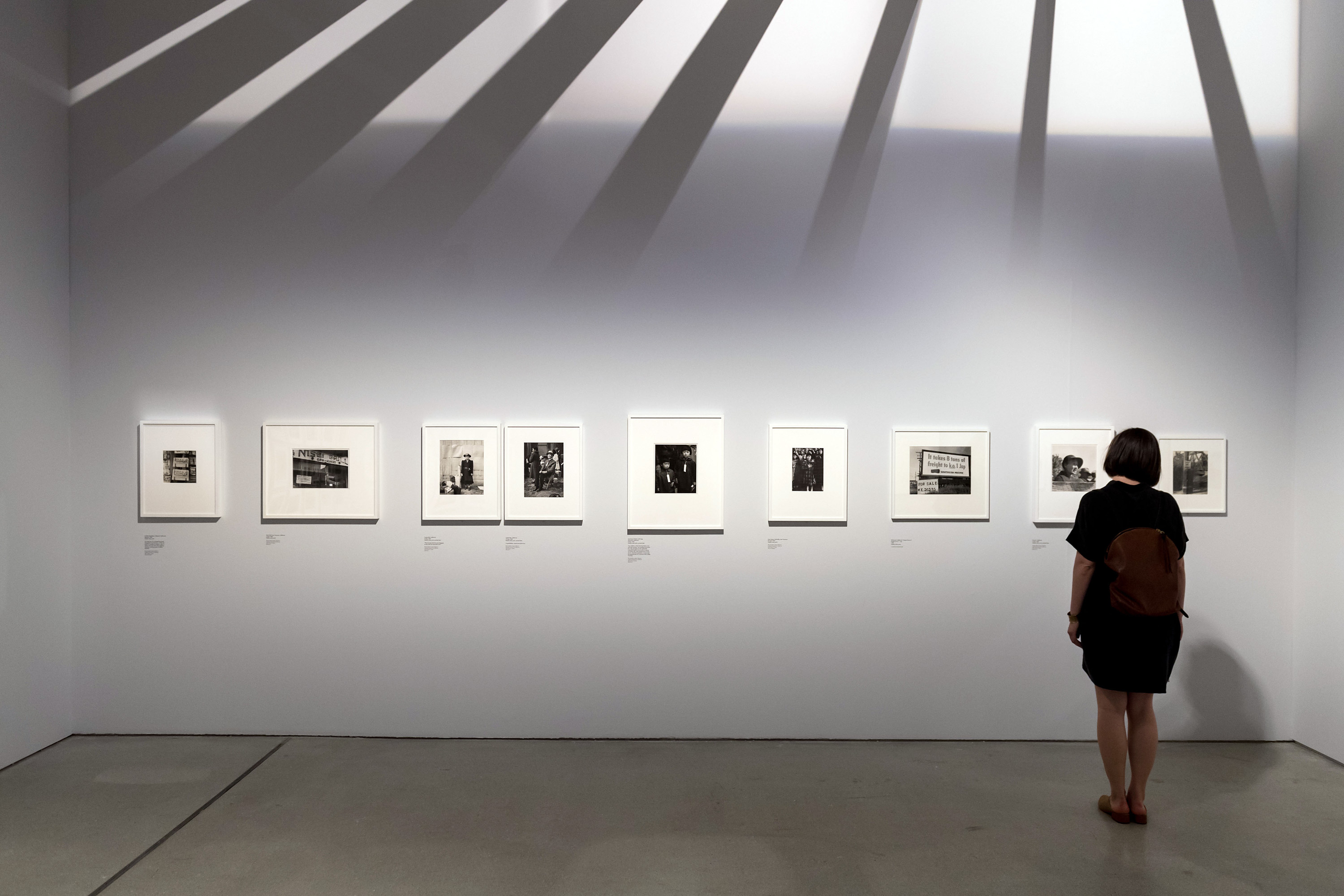
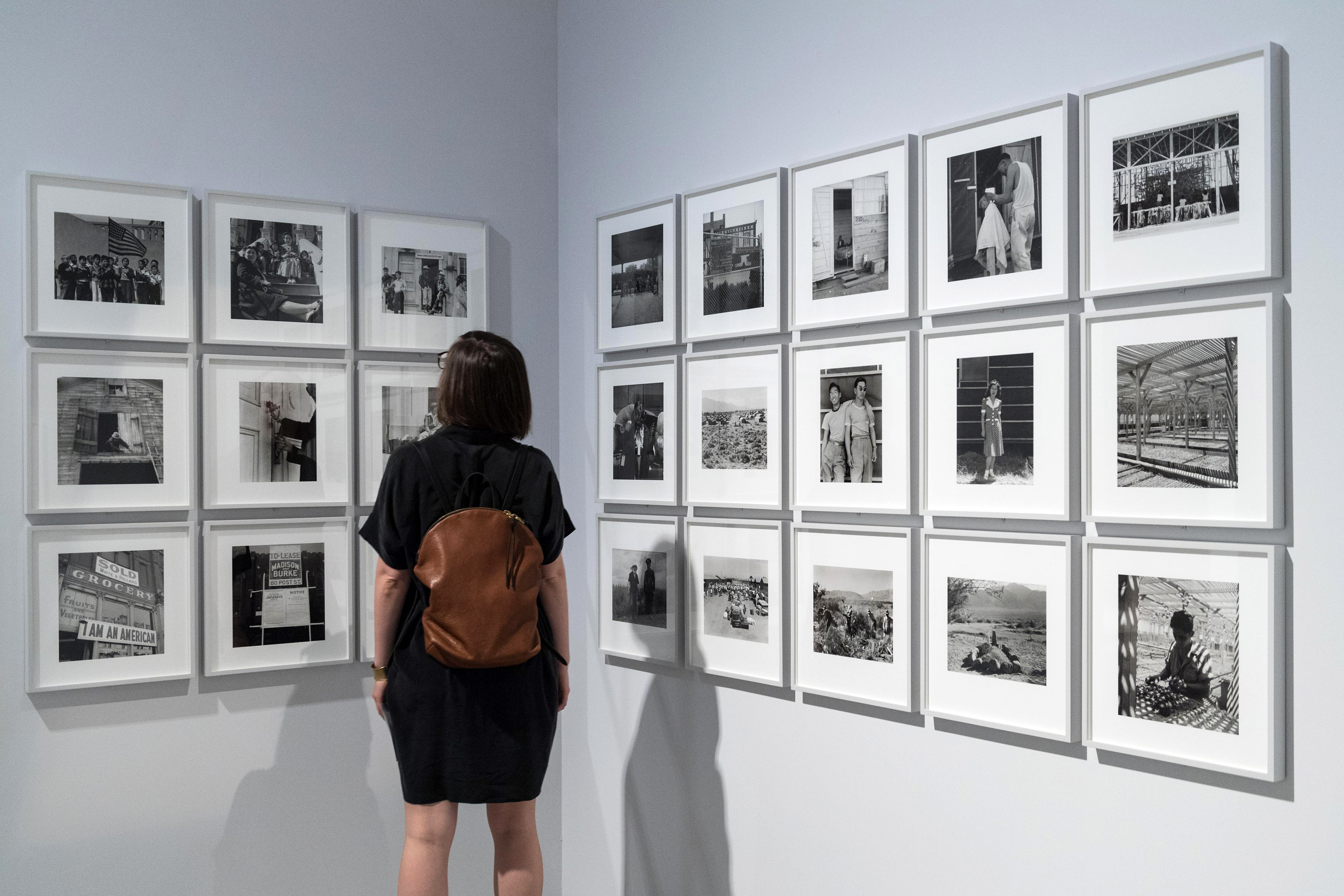
 

Installation view of the exhibition ‘Dorothea Lange: Politics of Seeing’ at the Barbican Art Gallery, London

Installation view of the exhibition ‘Dorothea Lange: Politics of Seeing’ at the Barbican Art Gallery, London


Installation views of the exhibition Dorothea Lange: Politics of Seeing at the Barbican Art Gallery, London showing in the bottom image, Lange’s photographs of Japanese Americans
Photos: Ian Gavan/Getty Images for Barbican Art Gallery
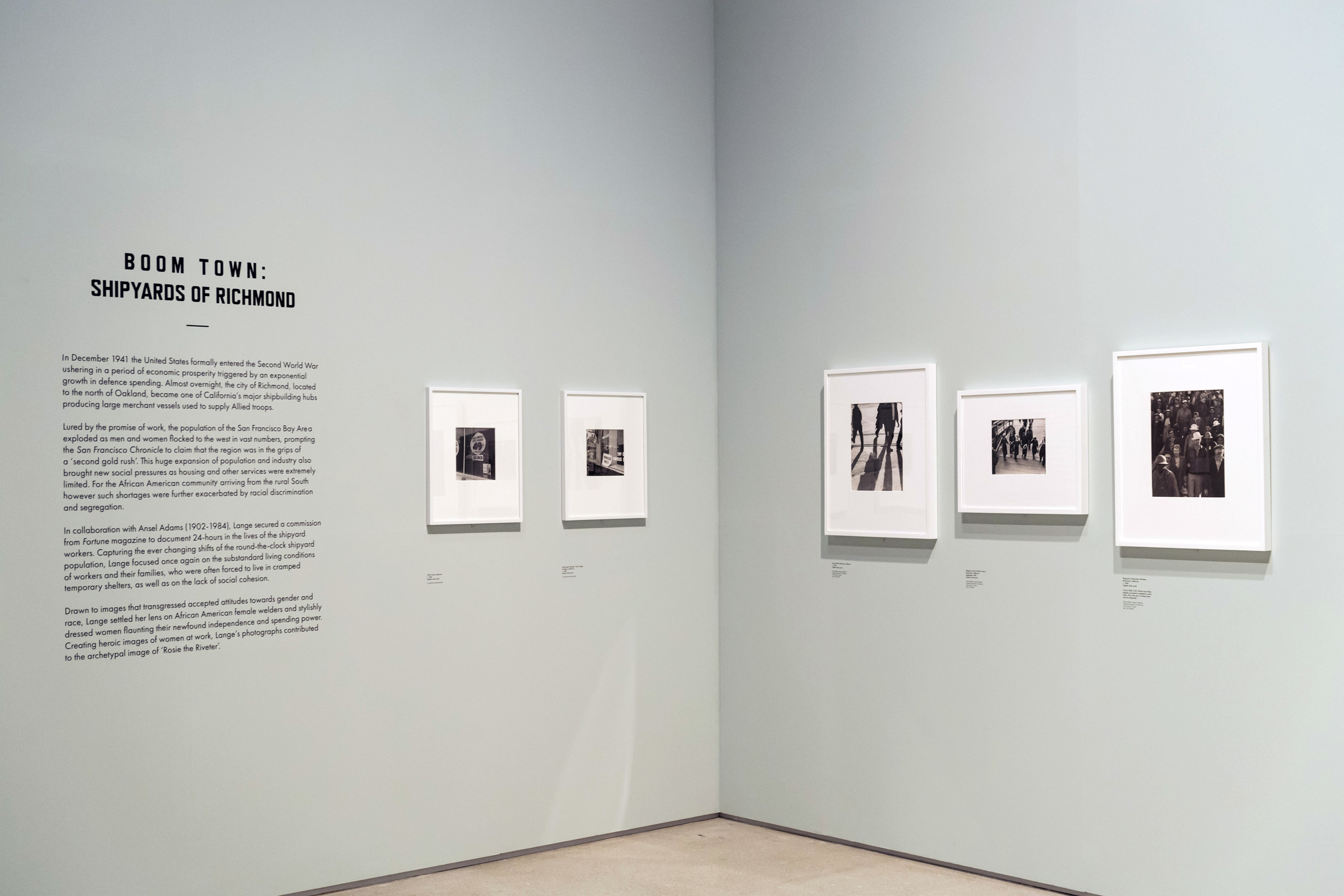
 

Installation view of the exhibition ‘Dorothea Lange: Politics of Seeing’ at the Barbican Art Gallery, London


Installation view of the exhibition Dorothea Lange: Politics of Seeing at the Barbican Art Gallery, London showing Lange’s ‘Shipyards of Richmond’ photographs
Photos: Ian Gavan/Getty Images for Barbican Art Gallery


Boom Town: Shipyards of Richmond

In December 1941 the United States entered the Second World War ushering in a period of economic prosperity triggered by an exponential growth in defence spending. Almost overnight, the city of Richmond, located to the north of Oakland, became one of California’s major shipbuilding hubs producing large merchant vessels used to supply Allied troops.

Lured by the promised of work, the population of the San Francisco Bay Area exploded as men and women flocked to the west in vast numbers, prompting the San Francisco Chronicle to claim that the region was in the grips of a ‘second gold rush’. This huge expansion of population and industry also brought new social pressures as housing and other services were extremely limited. For African American community arriving from the rural South however such shortages were further exacerbated by racial discrimination and segregation.

In collaboration with Ansel Adams (1902-1984), Lange secured a commission from Fortune magazine to document 24-hours in the lives of the shipyard workers. Capturing the ever changing shifts of the round-the-clock shipyard population, Lange focused once again on the substandard living conditions of workers and their families, who were often forced to live in cramped temporary shelters, as well as on the lack of social cohesion.

Drawn to images that transgressed accepted attitudes towards gender and race, Lange settled her lens on African American female welders and stylishly dressed women flaunting their newfound independence and spending power. Creating heroic images of women at work, Lange’s photographs contributed to the archetypal image of ‘Rosie the Riveter’.

Wall text from the exhibition
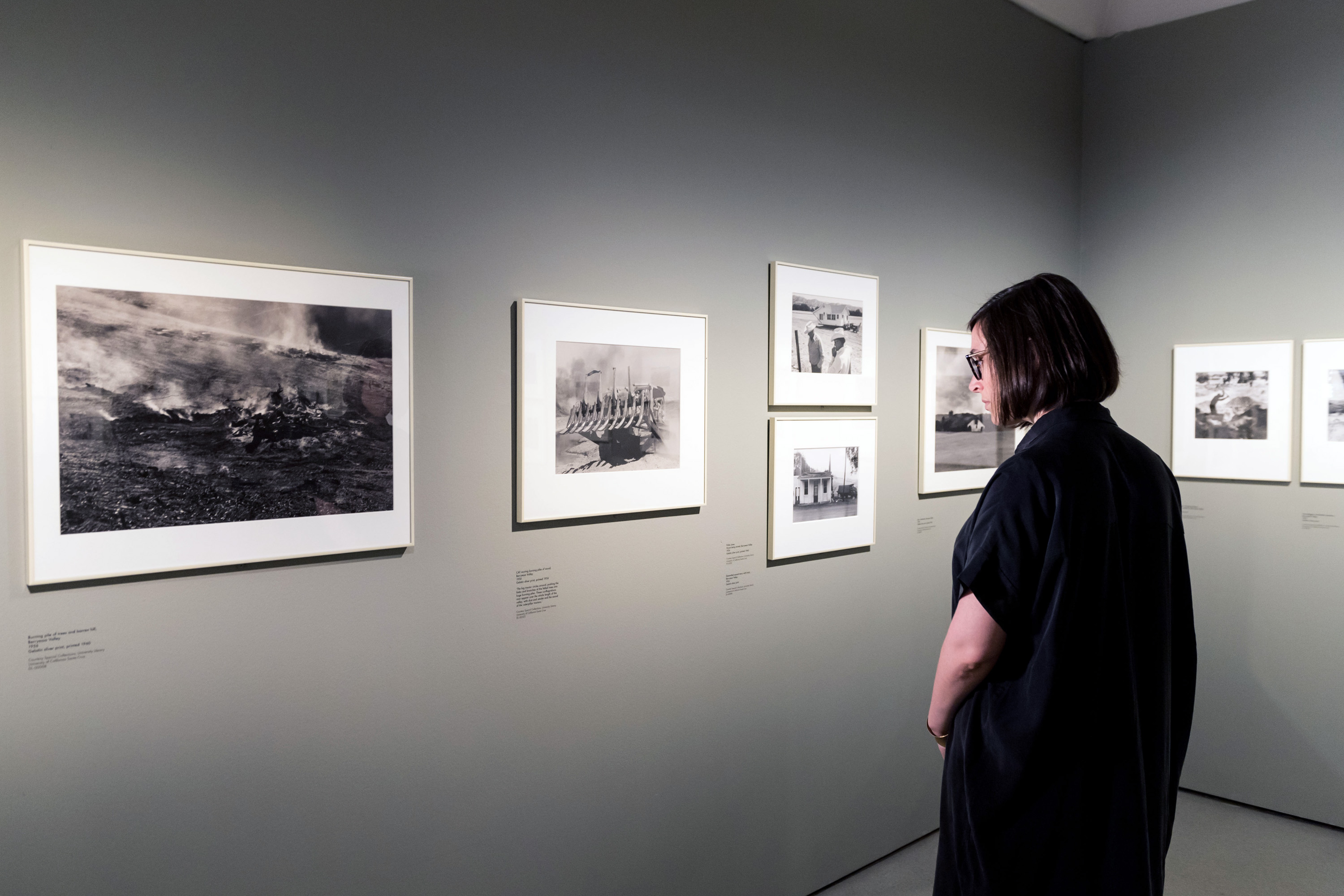
 

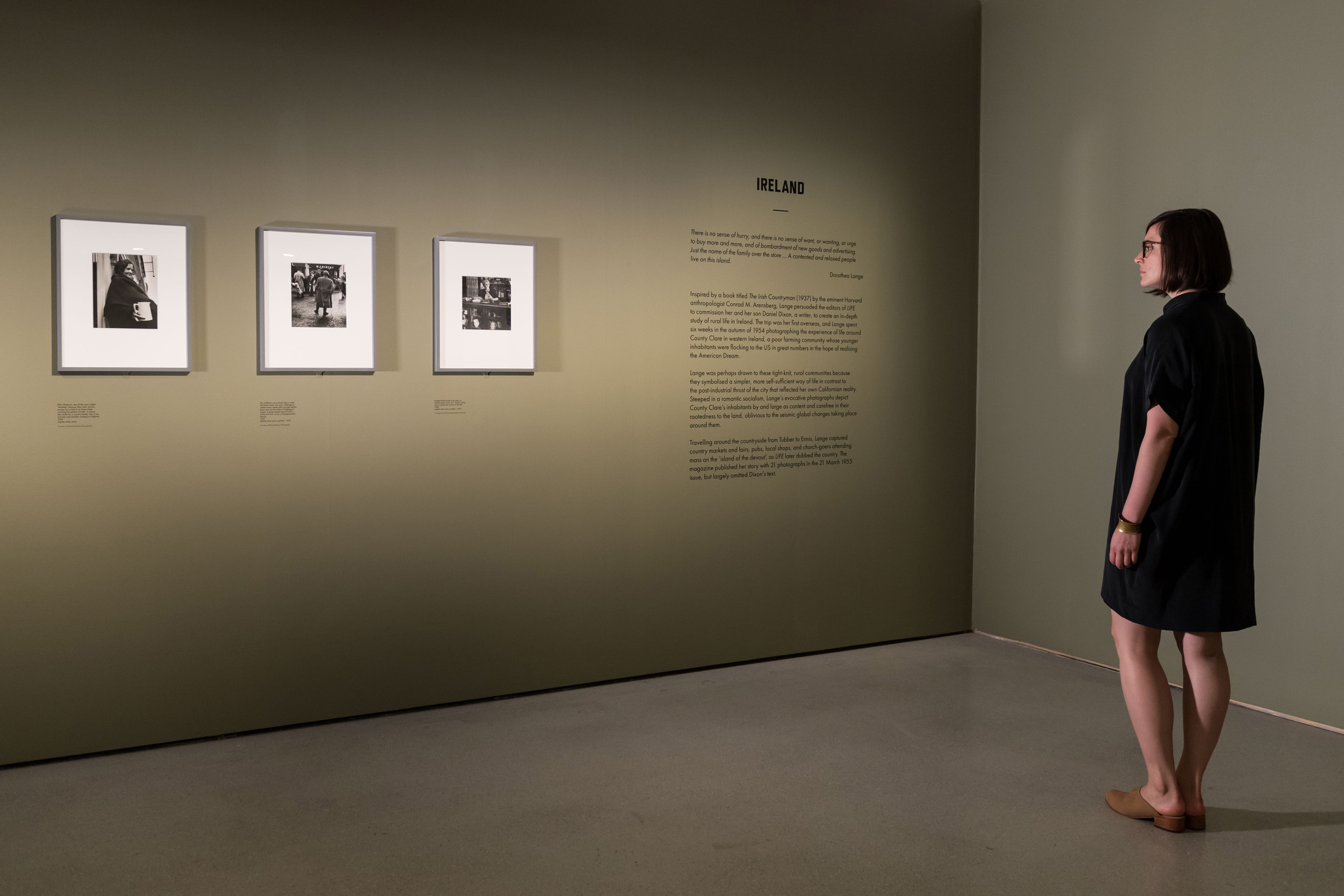
Installation view of the exhibition ‘Dorothea Lange: Politics of Seeing’ at the Barbican Art Gallery, London

Installation view of the exhibition ‘Dorothea Lange: Politics of Seeing’ at the Barbican Art Gallery, London


Installation views of the exhibition Dorothea Lange: Politics of Seeing at the Barbican Art Gallery, London showing in the bottom image, Lange’s ‘Ireland’ photographs
Photos: Ian Gavan/Getty Images for Barbican Art Gallery


“There is no sense of hurry, and there is no sense of want, or wanting, or urge to buy more and more, and of bombardment of new goods and advertising. Just the name of the family over the store … A contented and relaxed people live on this island.


Dorothea Lange


Ireland

Inspired by a book titled The Irish Countryman (1937) the the eminent anthropologist Conrad M. Arensberg, Lange persuaded the editors of LIFE to commission her and her son Daniel Dixon, a writer, to create an in-depth study of rural life in Ireland. The trip was her first overseas, and Lange spent six weeks in the autumn of 1954 photographing the experience of life around County Clare in western Ireland, a poor farming community whose younger inhabitants were flocking to the US in great numbers in the hope of realising the American Dream.

Lange was perhaps drawn to these tight-knit, rural communities because they symbolised a simpler, more self-sufficient way of life in contrast to the post-industrial thrust of the city that reflected her own Californian reality. Steeped in a romantic socialism, Lange’s evocative photographs depict County Clare’s inhabitants by and large as content and carefree in their rootedness to the land, oblivious to the seismic global changes taking place around them.

Travelling around the countryside from Tubber to Ennis, Lange captured country markets and fairs, pubs, local shops, and church-goers attending mass on the ‘island of the devout’, as LIFE later dubbed the country. The magazine published her story with 21 photographs in the 21 March 1955 issue, but largely omitted Dixon’s text.

Wall text from the exhibition


Barbican Art Gallery
Barbican Centre
Silk Street, London, EC2Y 8DS

Opening hours:
Sat – Wed 10am – 6pm (last entry 5pm)
Thu – Fri 10am – 8pm (last entry 7pm)
Bank Holidays 12 – 6pm (last entry 5pm)

Barbican Art Gallery website

LIKE ART BLART ON FACEBOOK

Back to top

Exhibitions: ‘Now, the new form of the past’ and ‘Senses’ at Kunstwerk! Liemers Museum, Netherlands

Exhibition dates: 16th June – 9th September 2018

Artists: Drager Meurtant (assemblages, NL) and Petra Senn (photography, D); Jeanine Keuchenius (paintings, NL) Kelly Elmendorp, Stijn Geutjes, Robert van der Kroft, Drager Meurtant, Winny de Meij, Petra Senn.


Drager Meurtant (Dutch, b. 1951) 'Green bird day' 2017


Drager Meurtant (Dutch, b. 1951)
Green bird day
2017

When the green bird / came to live / we agreed to call / it a day


Accumulating, life

I first had contact with Gerard Rutteman (artist alias Drager Meurtant) when he emailed me about a posting I had done on Art Blart about the Japanese photographer Shomei Tomatsu in 2015. Since then we have become firm friends. In 2017 on a trip to Europe, I caught a high speed train from Paris to the French city of Reims to meet him and his vivacious wife Jeanine. We spent a glorious day wandering the city, taking photographs, talking art, and eating a hearty lunch at a local brasserie. This pair of self-taught artists, creative human beings, are so talented.

While I greatly admire Jeanine’s paintings with their powerful and poetic muscularity (in my mind, I note the influence of artists such as Pierre Soulages, Cy Twombly and Anselm Kiefer) and their use of colour which can be seen in other paintings on her website – and observe the photographs of Petra Senn (I would need to see more to make constructive comment) – it is the work of Drager Meurtant to which I am going to focus my attention in this text.

The path of Drager Meurtant reminds me of that of Australian artist Rosalie Gascoigne.

“Gascoigne worked as a teacher before moving to Australia in 1943 following her marriage to astronomer Ben Gascoigne. She discovered a natural talent for creating assemblages through the ensuing seventeen years spent in relative isolation on the stony terrain of Mount Stromlo, home to Stromlo Observatory, and the wheat belt of Monaro near Canberra, a landscape she designated as the crucible from which her art emerged… Gascoigne’s lifelong passion for collecting and arranging developed initially from the Sogetsu school of ikebana, with its emphasis on form and line rather than colour. Its general principles of valuing immediate response, the experience of materials, process and experiment with variations can be seen as underpinning all of her later work. The collection of discarded materials, such as farm machinery parts, for use as suitable vessels for her arrangements, led her to also make sculptural assemblages… Gascoigne had no formal art training, often asserting that her fifty-year apprenticeship was in looking. She began exhibiting in 1974 at the age of 57.”1

Gascoigne went on to become one of Australia’s most loved and respected artists.

Drager Meurtant spent most of his life as a veterinarian-biomedical researcher. He is an autodidact and, like Gascoigne, his apprenticeship as an artist was one of looking and writing poetry. Only in the last five years has he really been able to fully concentrate on his art practice. To my mind, he has the potential to become a much beloved artist of his country, and an international artist of high repute. I am palpably excited by his art and its development. There is a frisson of expectation every time I see new work; that frisson enhanced by the amplitude of the music he creates and the temperature of the environment that surrounds his work.

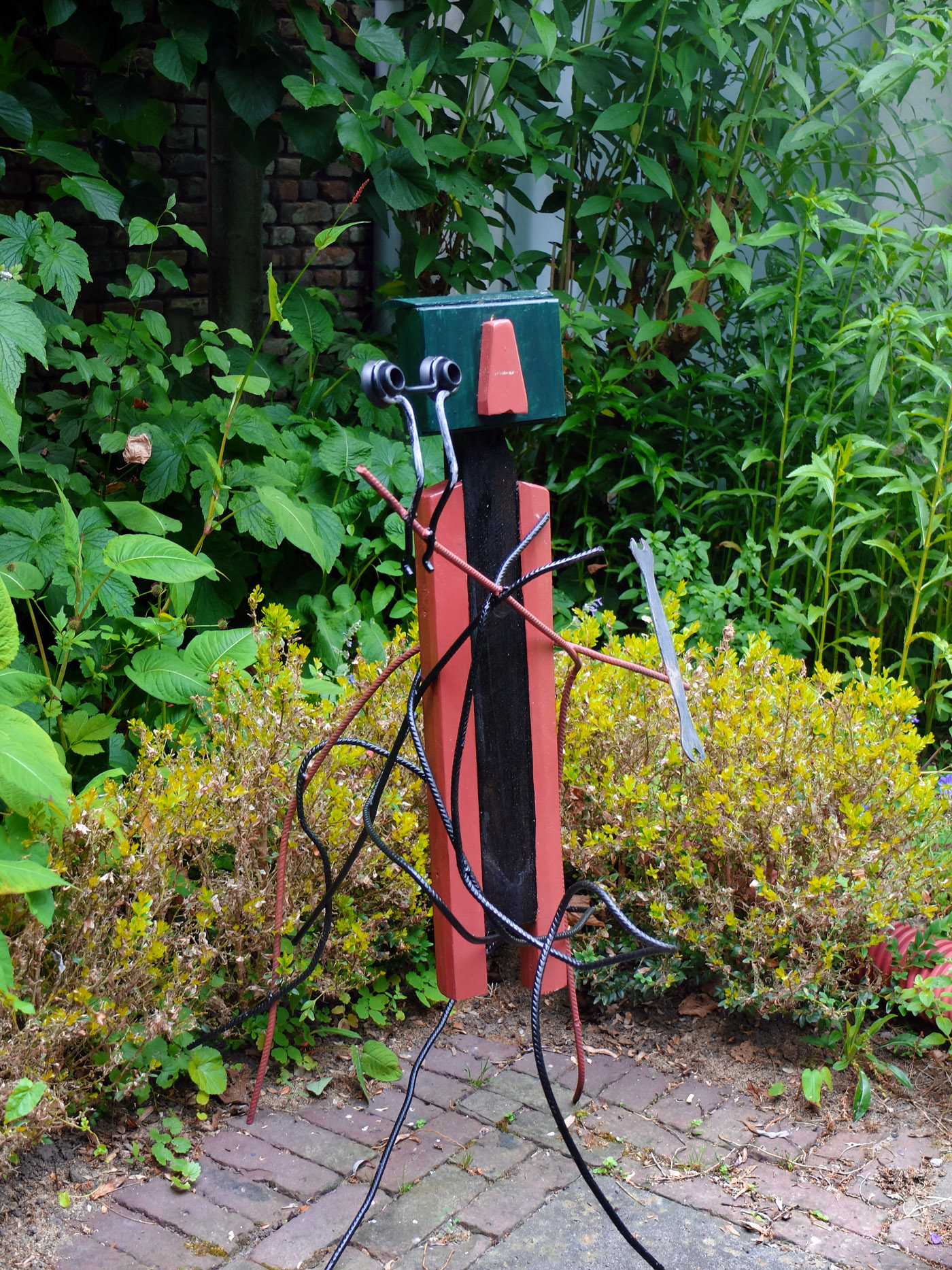
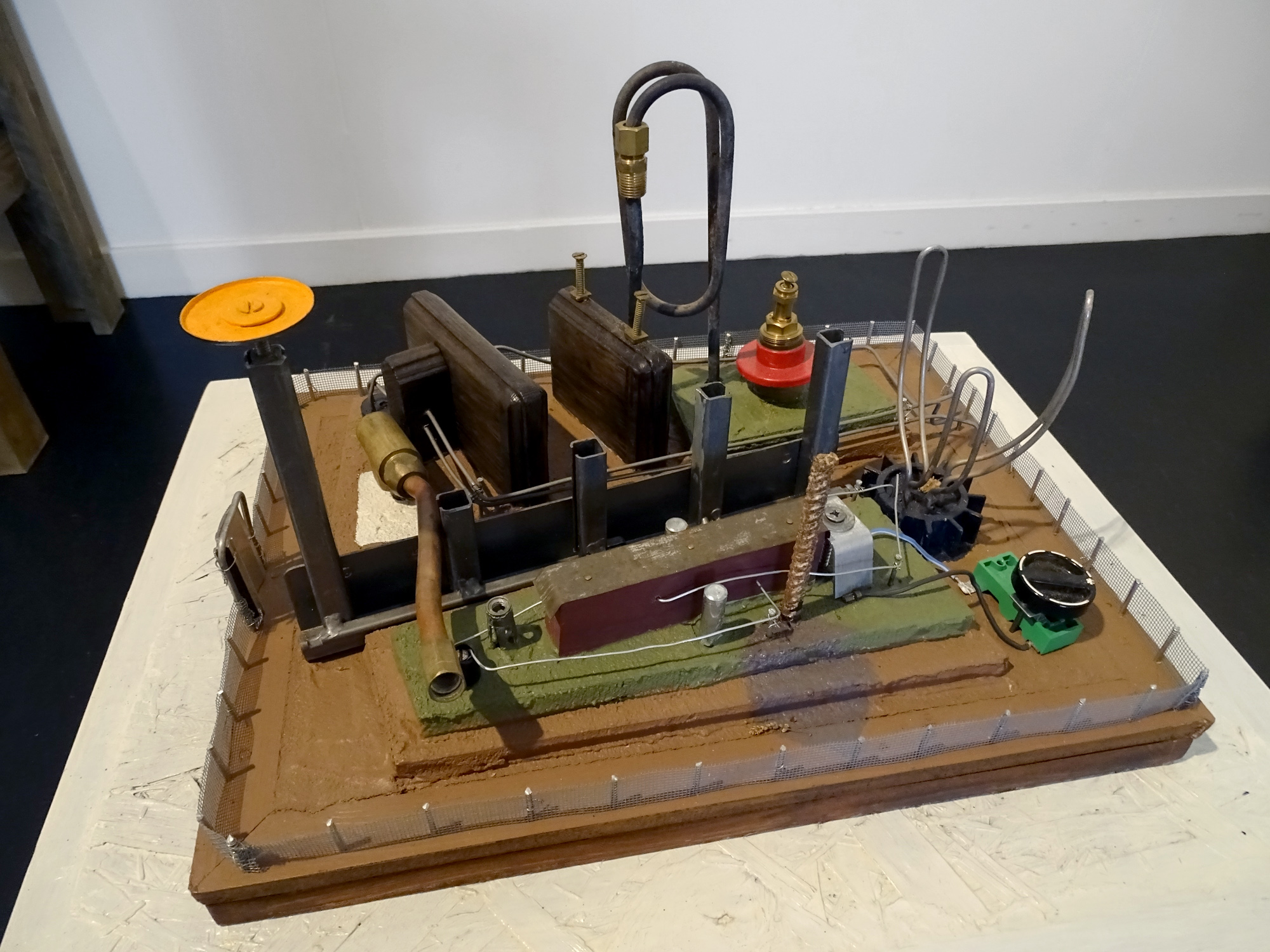
In this latest exhibition, there is a wonderful, tensional balance between elements and energy in his constructions. Much of the basic elements are from demolition- / remnant materials (“recycling art”), sometimes called objets trouvés: things coil around, are contained, wire, wood, recycled materials, energy, intimacy. His un/civilised forms of expression create an interplay between the conscious and the unconscious minds.

Drager is true to the integrity of his materials, the inherent qualities of natural and man made materials, and his vision. He incorporates primitive, mythical, spiritual and folkloric elements into his art. And his pleasure is in the layering and painting, in the materials, forms and, finally, in the art itself. Here is humour (The snake kept its mouth shut, 2018 below; the moustache of The Orator, 2016 below), ecology and spirit. A sense of mystery and purpose at one and the same time.

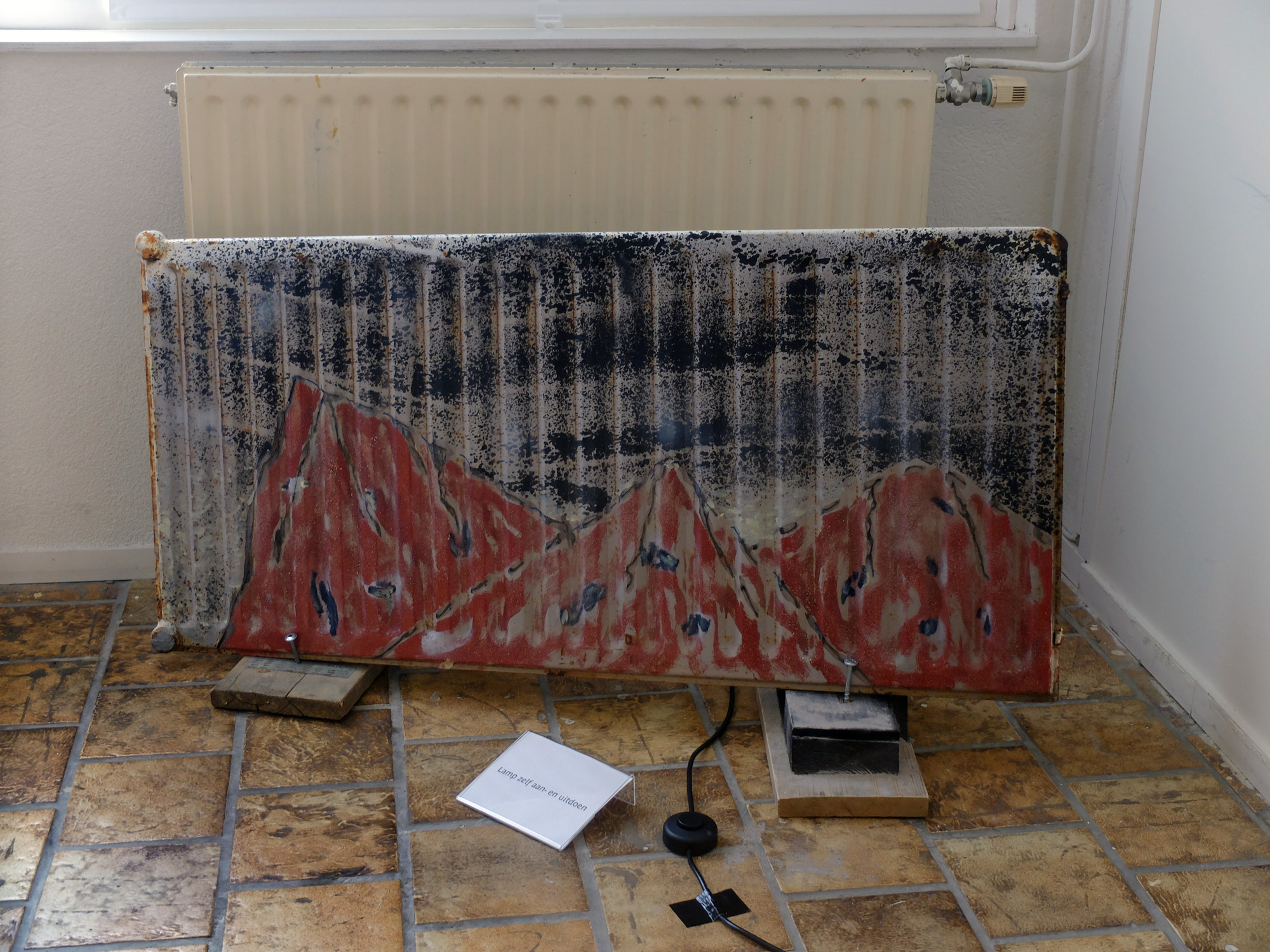
Riffing on Guy Debord’s concept of dérive (“drift” in English) which Debord defines as “a mode of experimental behaviour linked to the conditions of urban society: a technique of rapid passage through varied ambiances”2, I can relate Drager’s art to an unplanned journey through the urban landscape in which he drops his everyday relations and lets himself be drawn by the attractions of the terrain and the encounters he finds there. Drager’s attractions are the refuse of the human race. His encounters lead to the construction of contexts and situations, an artistic practice of “the happening”, which is a structured but unencumbered, expressive approach that encourages us to question our finite place in the world. Who else would paint a mountain on a radiator!

While I believe that some of the most important qualities in this world have their meanings proscribed by their opposite, some of these qualities have to be understood by reference only to themselves – which is very difficult – but must be attempted. A lot of things have been made too simple (taught in art schools?) by constructing fraught dichotomies. In other words, as an artist and as a human being, do not rely on binaries but just “on the thing itself”. Let it reveal itself to you – whether that is through Dada, an enigmatic self, of movement and form – or through some other mechanism. Drager has enough intellect and talent not to fall into the too simple, too easy, trap.

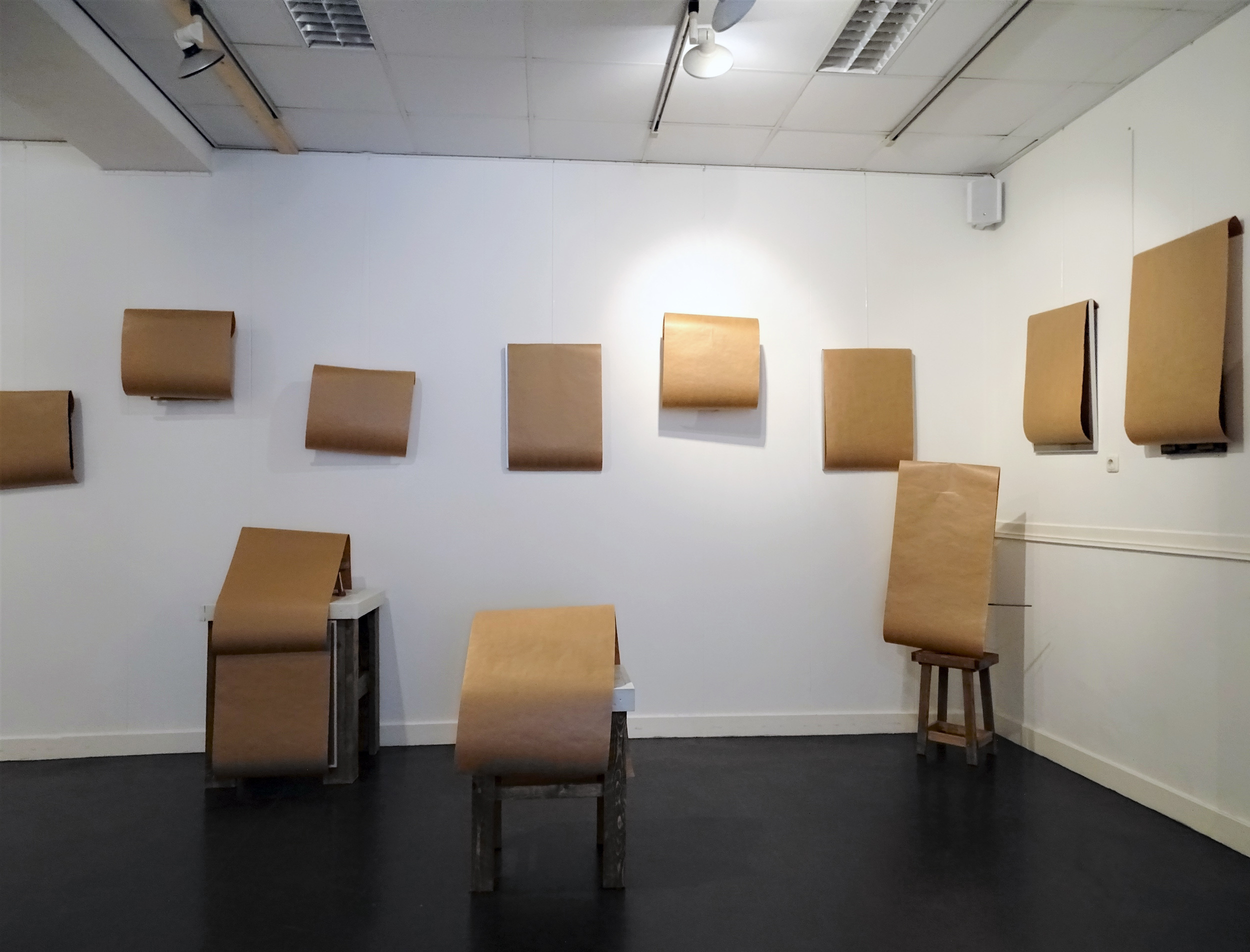
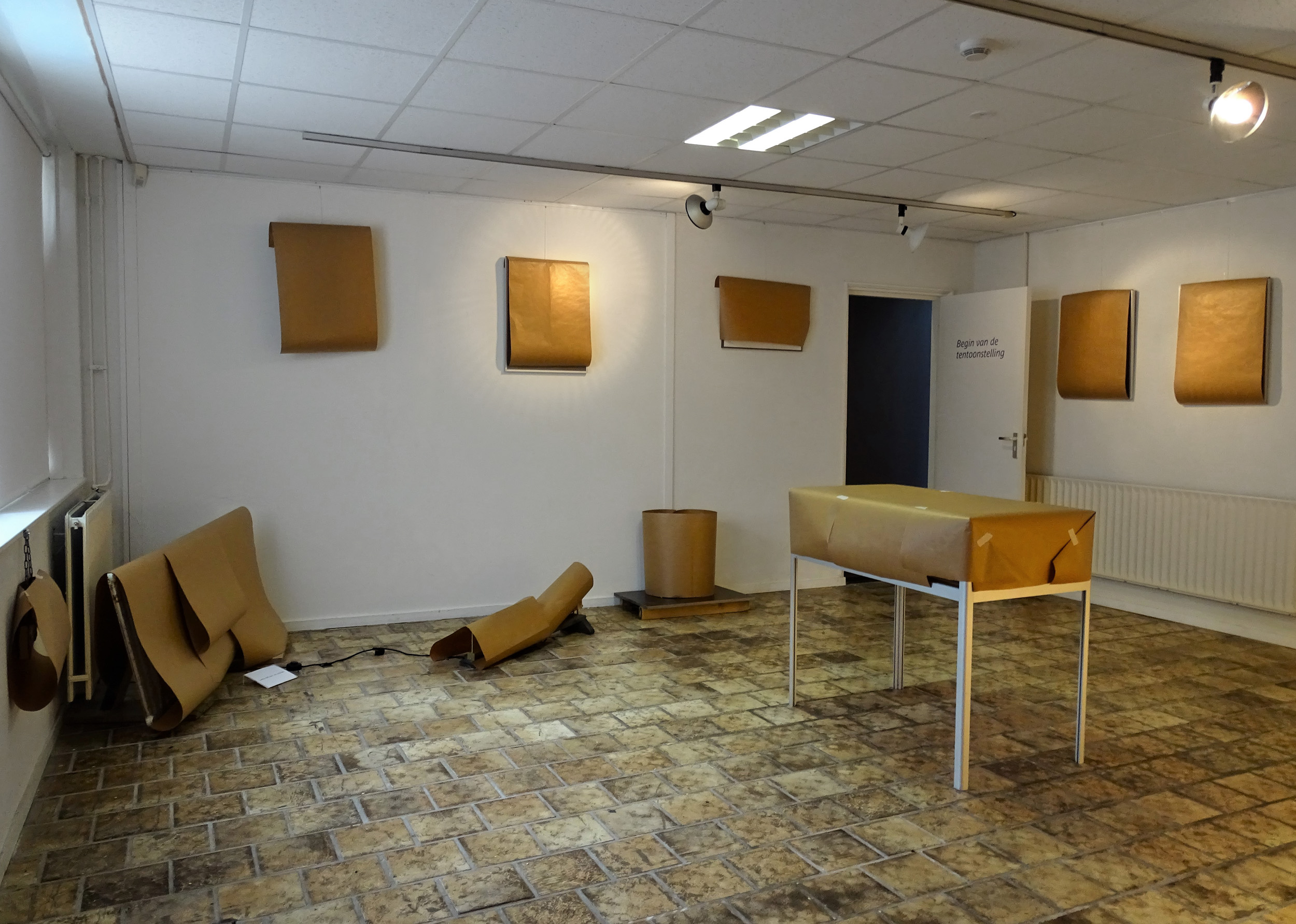
In this small regional gallery in the Netherlands, this visionary of the romantic, otherworldy (definition: devoted to intellectual or imaginative pursuits), utopian / dystopian unification of art and life constructs his paradoxes. I love the poetry that accompanies and informs his work; I love the brown butchers paper that covered “the happenings” before the unveiling; and I love the energy, the concern for the environment, and the construction and conceptualisation of his assemblages. I am challenged, in a good way, by his art.

The next step on the path for my friend is to keep the faith, is to keep making the art for himself and no one else. To keep them free and not contained by unwanted concerns. For, as he said to me, “in the end the path followed will be more interesting than the stakes raised in passing.” But curators please take note… here is a star of the future!

Dr Marcus Bunyan


1/ Anonymous. “Rosalie Gascoigne,” on the Art Gallery of New South Wales website 08/08/2018. No longer available online

2/ Guy Debord (1958) Definitions. Internationale Situationniste #1 (Paris, June 1958). Translated by Ken Knabb.


Many thankx to the artists and Kunstwerk! Liemers Museum for allowing me to publish the art work in the posting. Please click on the photographs for a larger version of the image.


“The creation of art, to me, is not work. The end-result is not seen as a piece, but as a whole. Since it brings me comfort and relieves stress, I call my assemblages ‘art-peaces’.”

“The essence of working with found objects (or scrap material) is that their different natures will enrich the composition as they are expressed in its different layers. This effect is based upon the divergent origins, structures and functions of these elements: wood, metal, glass, stone, cloth, plastic, etc. As a consequence, each bears a different weight and ease for ‘penetrance’ (transparency), that will influence the final form of the composition.”


Drager Meurtant


“Nearly every work of assemblage, in its relational structure, approaches abstract art” [but] “the practice of assemblage raises materials from the level of formal relations to that of associational poetry.”


Seitz, W. C. The Art of Assemblage. New York: Museum of Modern Art, 1961, p. 25, 84.


“It’s not where you take things from, it’s where you take them to.”


Jean-Luc Godard


Before the exhibition Now, the new form of the past opening


Before the opening of the exhibition 'Now, the new form of the past' at Kunstwerk! Liemers Museum, Netherlands

Before the opening of the exhibition 'Now, the new form of the past' at Kunstwerk! Liemers Museum, Netherlands

Before the opening of the exhibition 'Now, the new form of the past' at Kunstwerk! Liemers Museum, Netherlands

Before the opening of the exhibition 'Now, the new form of the past' at Kunstwerk! Liemers Museum, Netherlands

Before the opening of the exhibition 'Now, the new form of the past' at Kunstwerk! Liemers Museum, Netherlands


Before the opening of the exhibition Now, the new form of the past at Kunstwerk! Liemers Museum, Netherlands


Now, the new form of the past is an exhibition based on international collaboration between Drager Meurtant (assemblages, NL) and Petra Senn (photography, D) with the theme Recycling Art . Both artists place most of the energy in their art and demand attention for its creativity, in the reuse of materials and objects.

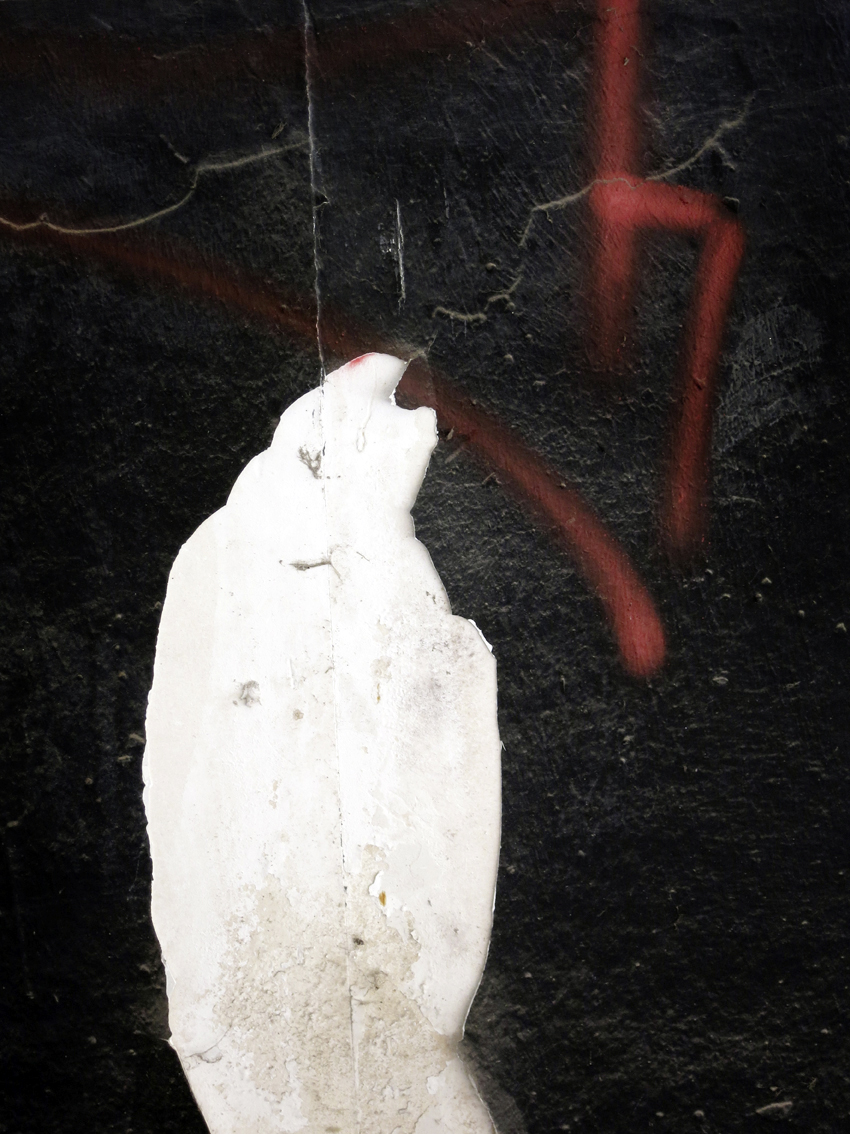
Drager uses demolition material and remnants from construction, plus objets trouvés, to make assemblages; while Petra uses weathered matter and the perishableness (transitoriness) of materials in her photographs. Every artwork thus carries echoes from the past within itself. Senses is a parallel exhibition of abstract paintings by Jeanine Keuchenius.

Text from the Kunstwerk! Liemers Museum website


The artists Drager Meurtant and Petra Senn first met on ‘pictify’, a social medium for artists (at present no longer accepting new art submissions.) After an exchange of some ‘faves’ and views, the retrospective The Trauma of Painting by Alberto Burro in the museum K21 in Düsseldorf, Germany, became the place where at the end of June 2016 the three, Petra Senn, Drager Meurtant and his artist-partner Jeanine Keuchenius, met in person. With the overwhelming artistic environment, the basis of a human and artistic interest became established. Thus, when Stijn Geutjes, the curator of Kunstwerk! Liemers Museum asked Drager about willingness to exhibit his art in the museum, the answer came with the suggestion of the theme “Now, the new form of the past”, and introduction of colleague Petra Senn as associate, and Jeanine to come with an addition of the theme “Senses”. After some discussion, and rising interest of Stijn Geutjes in the abstract photographies of Petra Senn, the decision came to exhibit in a collaborative effort, that included partaking in the selection process of works of the curator and the three artists.

Text by Drager Meurtant


Objets trouvés

An objets trouvé is a found object; a natural or discarded object found by chance and held to have aesthetic value; an ordinary object, as a piece of driftwood, a shell, or a manufactured article, that is treated as an object of art by one who finds it aesthetically pleasing.

The term relates directly to Marcel Duchamp’s readymades, Dada and Fluxus art. Art critics have coined the terms arte povera (Italian) and junk art (Anglo-American) to signify art which incorporates said objects.

Arte Povera is basically the legitimate justification for creating art of junk and found objects. Arte Povera was a term coined by the Italian art critic Germano Celant. He used the word to sum up a type of art which combined elements of conceptual art, minimal art and performance art. He conceived the idea of the art movement in reaction to the ever increasing commercialism within the art world. The artists embrace the ideas of using valueless materials such as earth, gravel, rocks or litter in order to create works of art.

Junk art is the flattering name is given to 20th and 21st-century art in which the artist uses refuse, scrap metal, urban waste or just anything viewed as useless or cast of from modern society. Junk art is very much synonymous with American artist Robert Rauschenberg. It is also very much part of the 1960s Italian movement Arte Povera. The movement was the product of Antoni Tàpies, Alberto Burri, Michelangelo Pistoletto, Piero Manzoni, and Lucio Fontana.

Anonymous text. “Objet trouvé art,” on the Xamou website [Online] Cited 17/02/2022. No longer available online

Found object

Found object originates from the French objet trouvé, describing art created from undisguised, but often modified, objects or products that are not normally considered materials from which art is made, often because they already have a non-art function. …

Found objects derive their identity as art from the designation placed upon them by the artist and from the social history that comes with the object. This may be indicated by either its anonymous wear and tear (as in collages of Kurt Schwitters) or by its recognisability as a consumer icon (as in the sculptures of Haim Steinbach). The context into which it is placed is also a highly relevant factor. The idea of dignifying commonplace objects in this way was originally a shocking challenge to the accepted distinction between what was considered art as opposed to not art. …

As an art form, found objects tend to include the artist’s output – at the very least an idea about it, i.e. the artist’s designation of the object as art – which is nearly always reinforced with a title. There is usually some degree of modification of the found object, although not always to the extent that it cannot be recognised, as is the case with ready-mades. Recent critical theory, however, would argue that the mere designation and relocation of any object, ready-mades included, constitutes a modification of the object because it changes our perception of its utility, its lifespan, or its status.

Text from the Wikipedia website


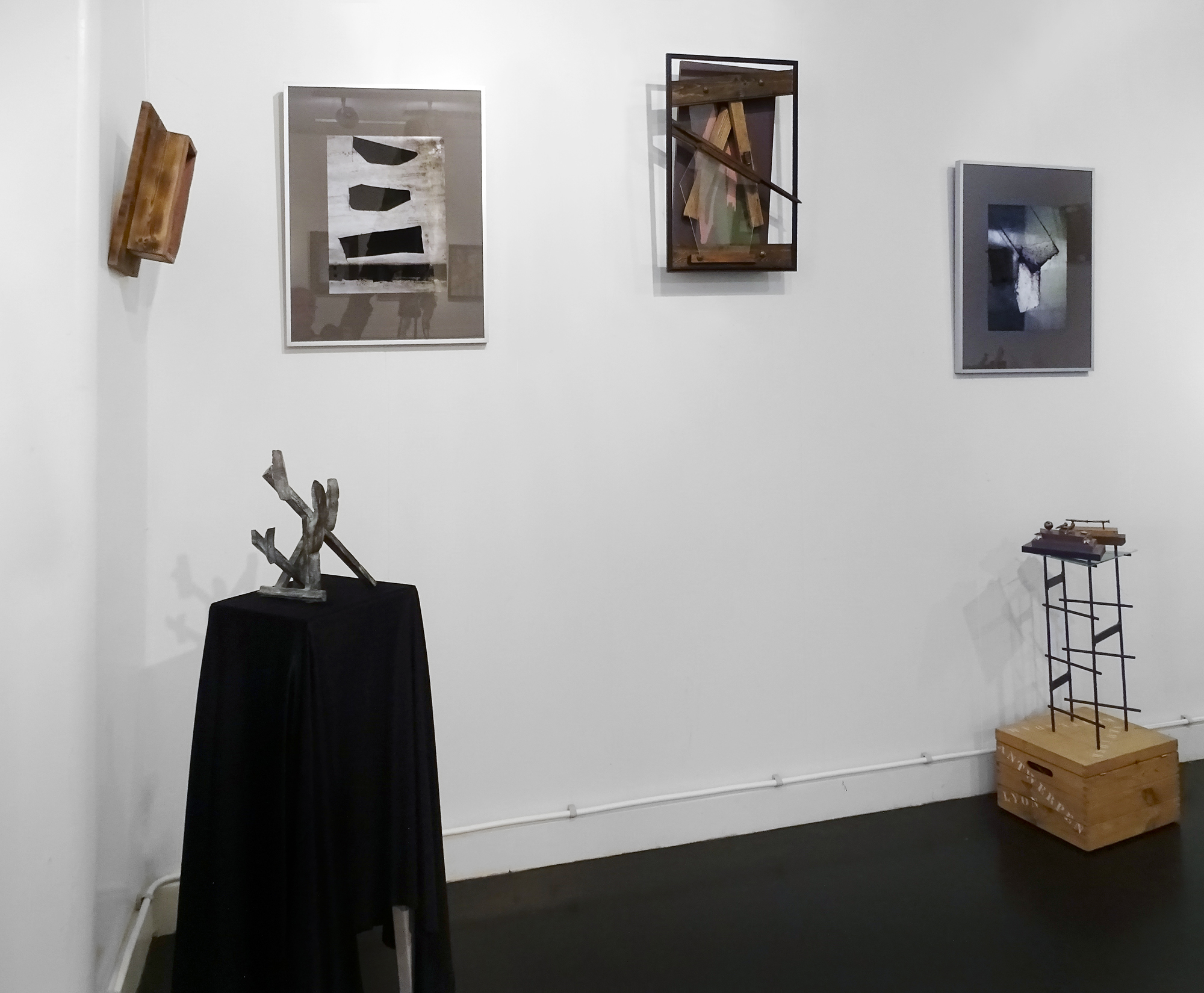
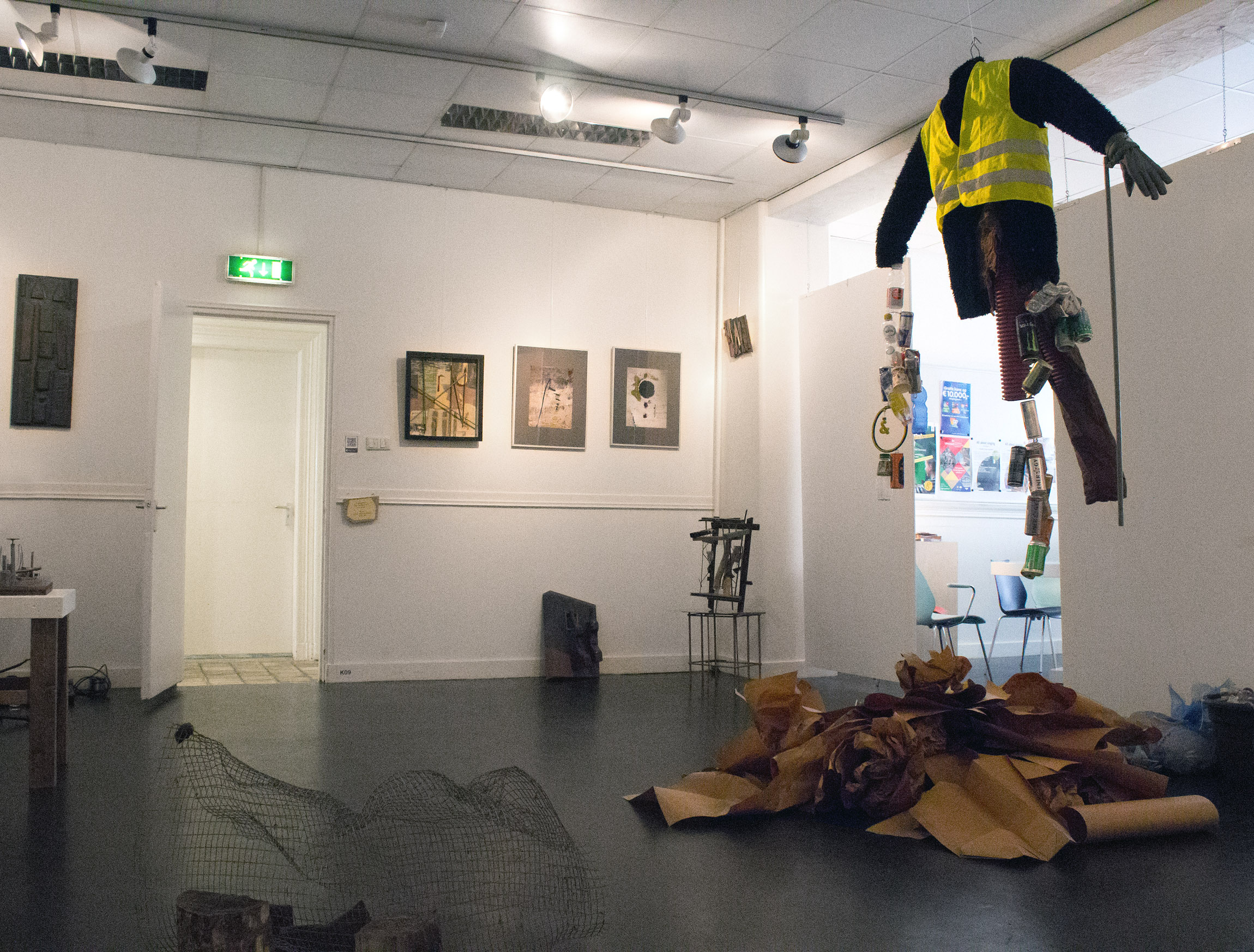
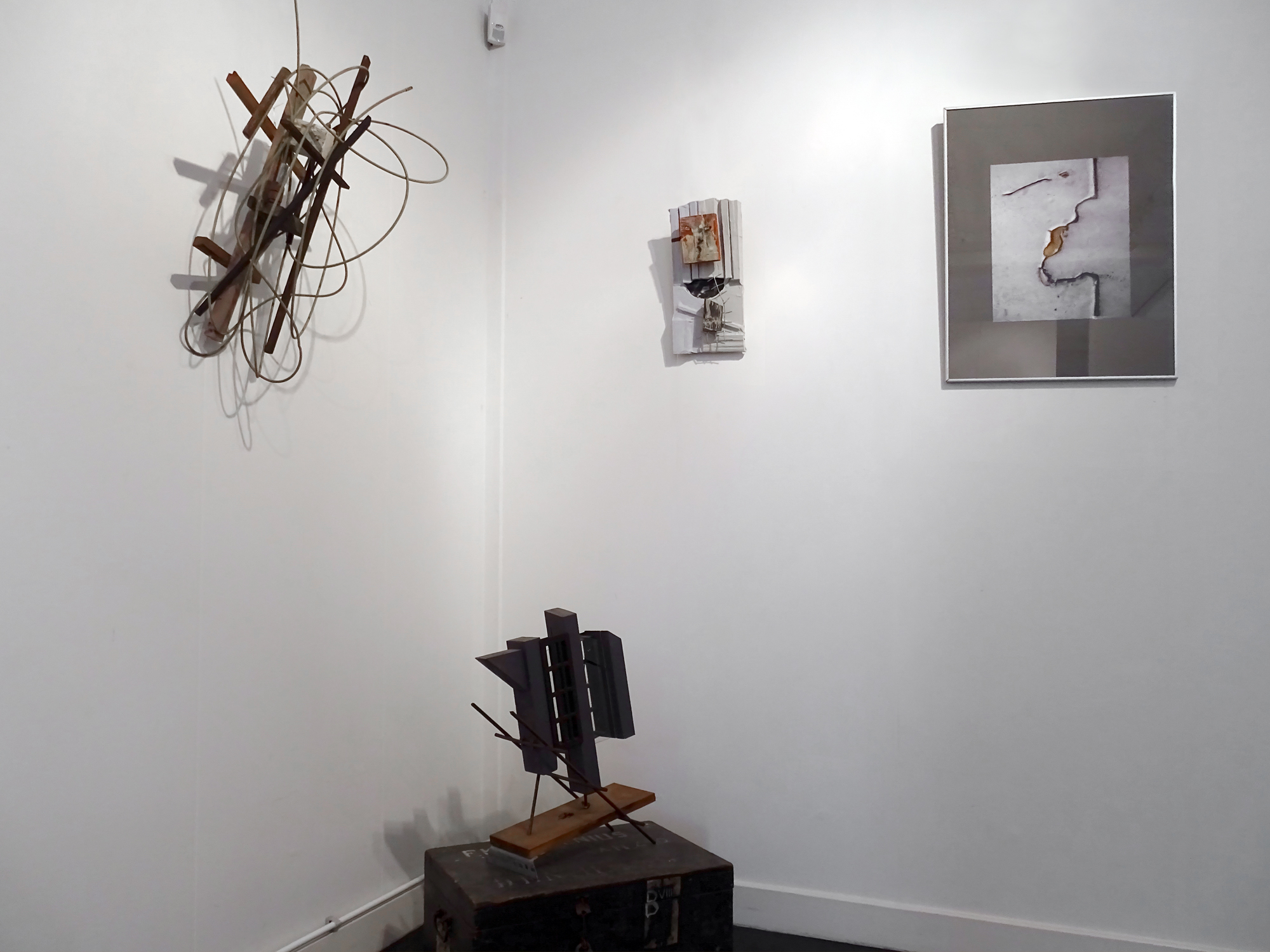
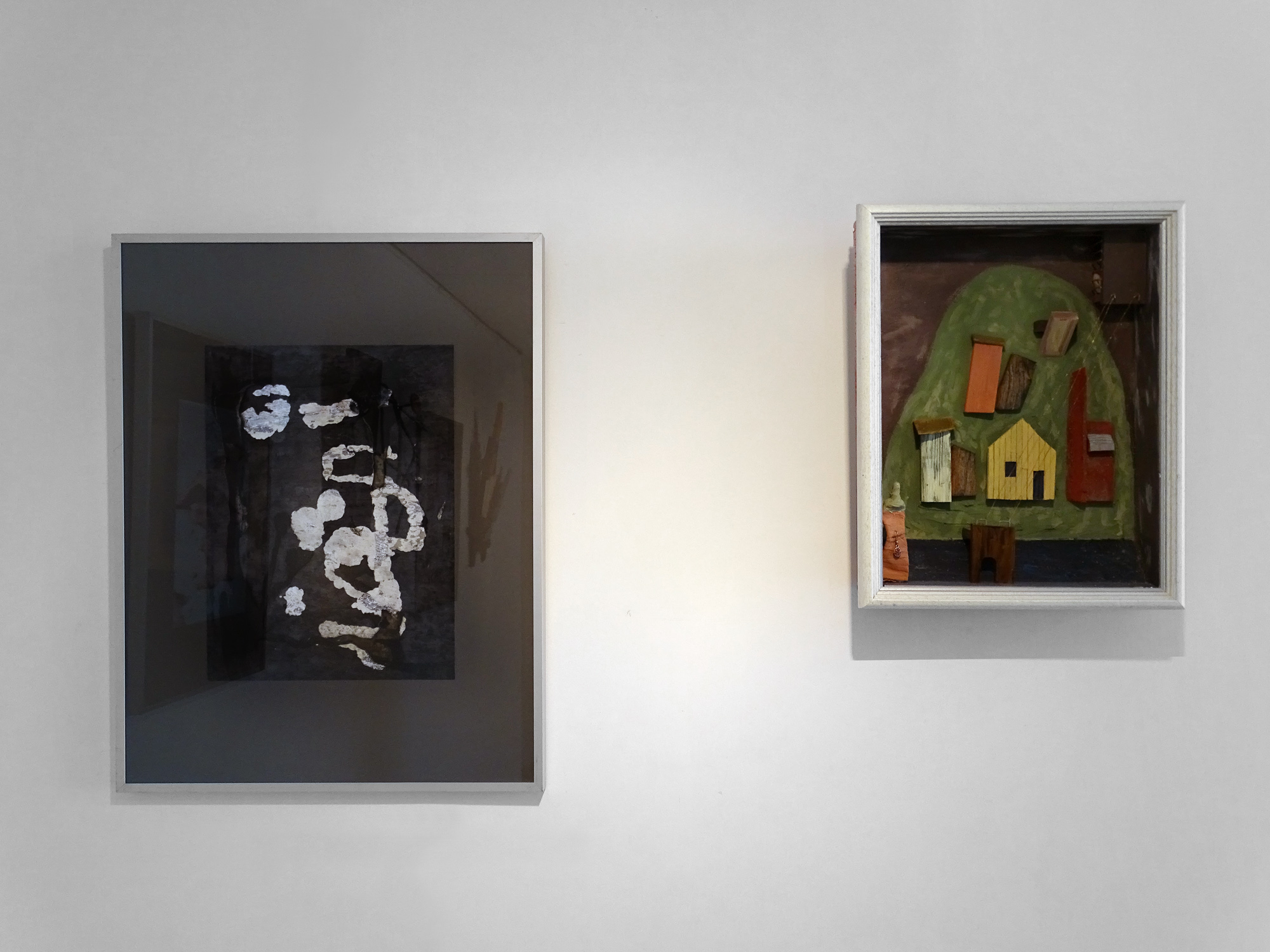
Installation views of the exhibition Now, the new form of the past


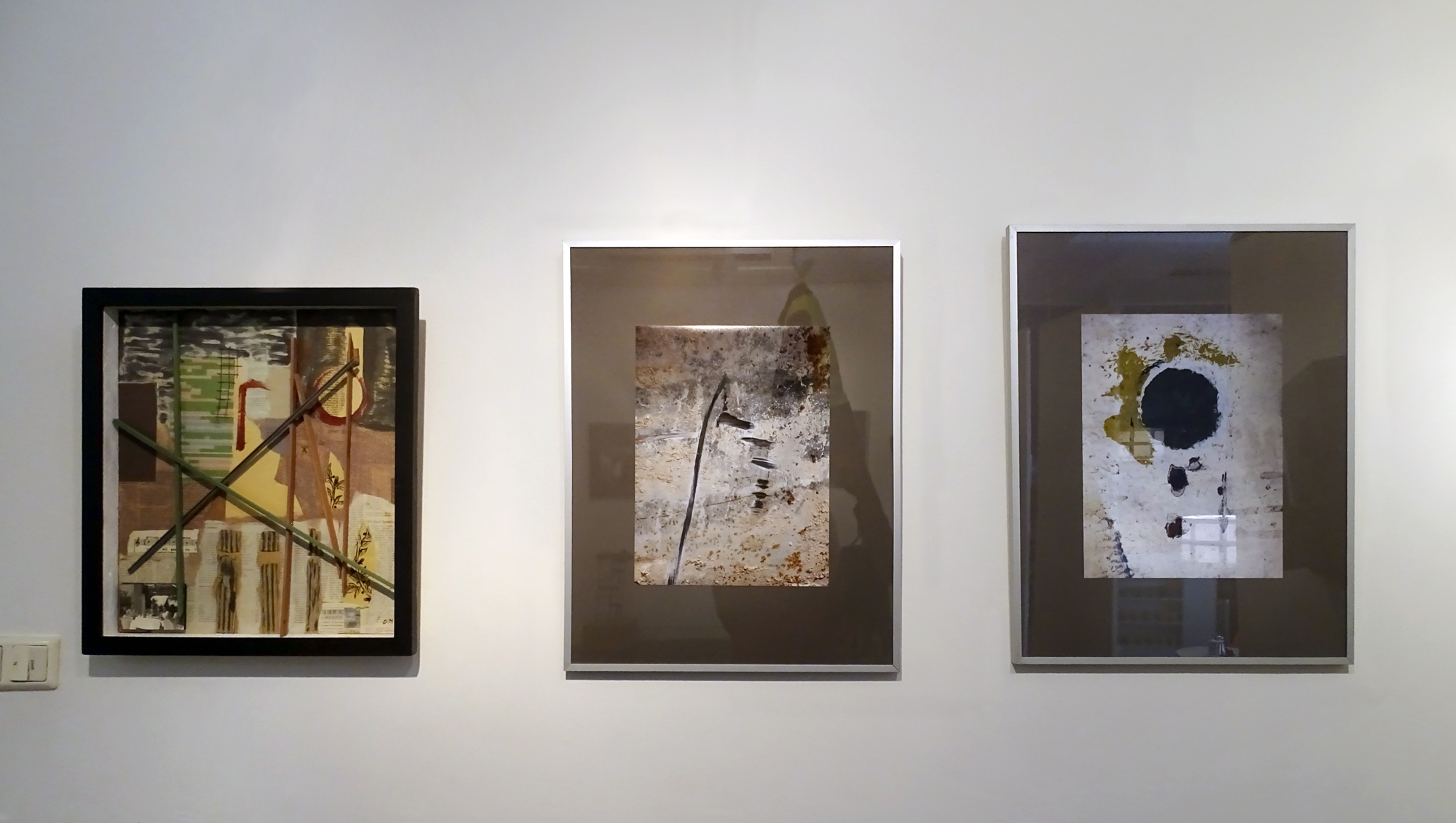
Installation view of the exhibition 'Now, the new form of the past' at Kunstwerk! Liemers Museum, Netherlands

Installation view of the exhibition 'Now, the new form of the past' at Kunstwerk! Liemers Museum, Netherlands

Installation view of the exhibition 'Now, the new form of the past' at Kunstwerk! Liemers Museum, Netherlands

Installation view of the exhibition 'Now, the new form of the past' at Kunstwerk! Liemers Museum, Netherlands

Installation view of the exhibition 'Now, the new form of the past' at Kunstwerk! Liemers Museum, Netherlands

Installation view of the exhibition 'Now, the new form of the past' at Kunstwerk! Liemers Museum, Netherlands


Installation views of the exhibition Now, the new form of the past at Kunstwerk! Liemers Museum, Netherlands showing the work of Drager Meurtant and Petra Senn


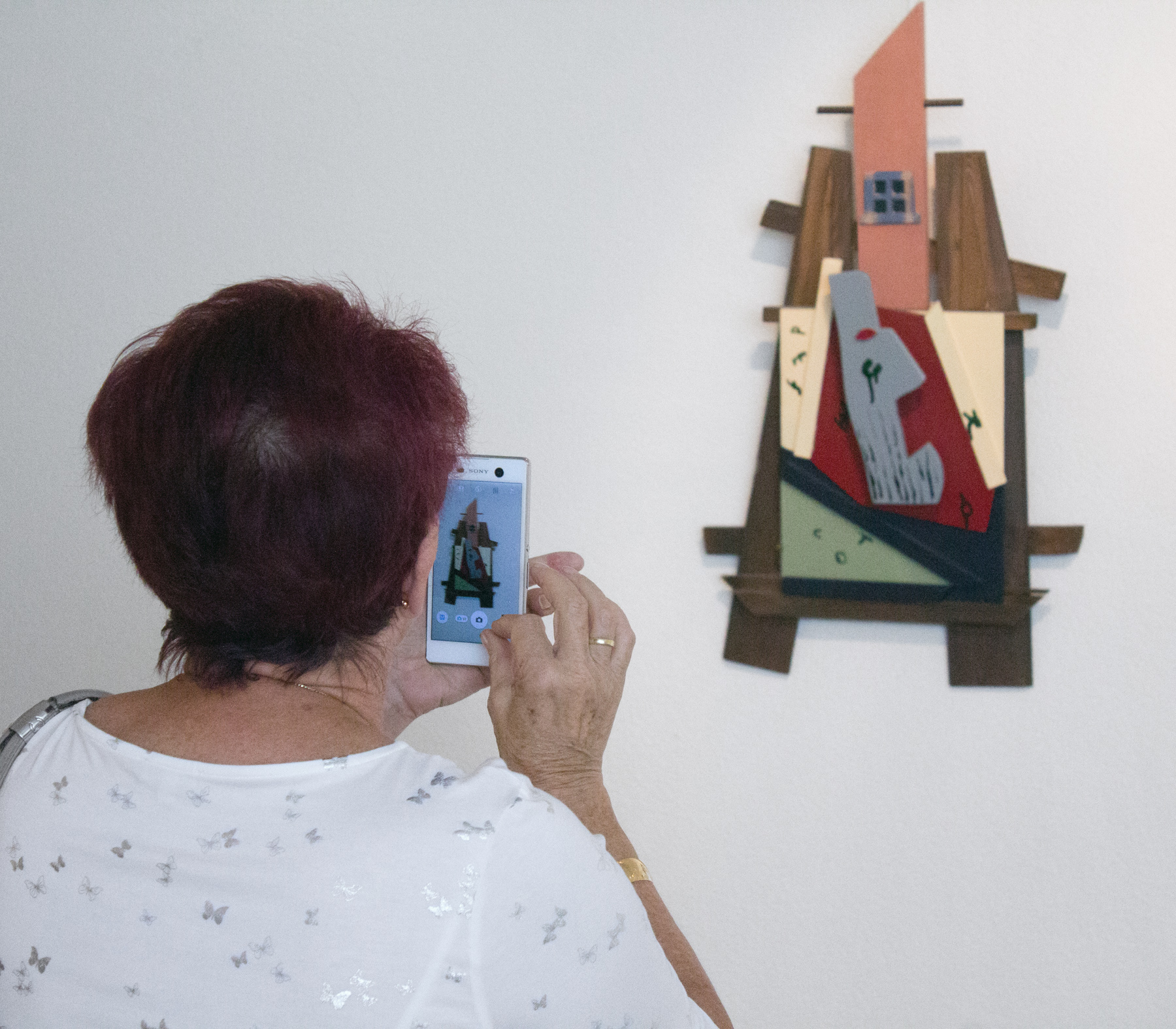
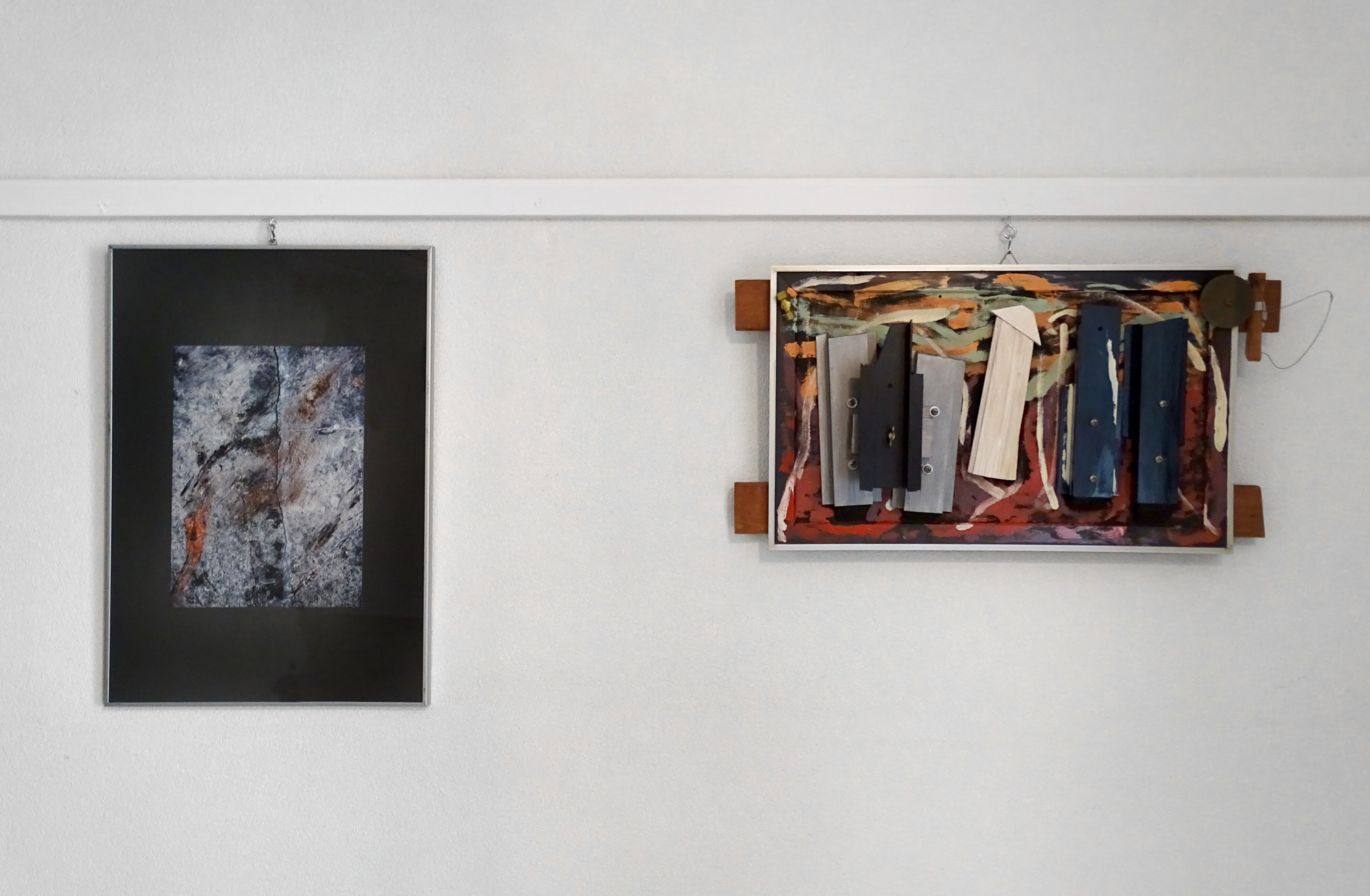
Installation view of the exhibition 'Now, the new form of the past' at Kunstwerk! Liemers Museum, Netherlands showing Drager Meurtant's work 'connection not wireless' (2014) top left, and Petra Senn's 'Persuasiveness' (2012) top right


Installation view of the exhibition Now, the new form of the past at Kunstwerk! Liemers Museum, Netherlands showing Drager Meurtant’s work connection not wireless (2014) top left, and Petra Senn’s Persuasiveness (2012) top right


Installation view of the exhibition 'Now, the new form of the past' at Kunstwerk! Liemers Museum, Netherlands showing Drager Meurtant's 'Under way' Nd


Installation view of the exhibition Now, the new form of the past at Kunstwerk! Liemers Museum, Netherlands showing Drager Meurtant’s Under way Nd


Installation view of the exhibition 'Now, the new form of the past' at Kunstwerk! Liemers Museum, Netherlands showing Drager Meurtant's work 'Swan in essence' (2014) at centre, with Petra Senn's 'Insubordination' (2017) top left and 'someone from the past I' (Nd) top right


Installation view of the exhibition Now, the new form of the past at Kunstwerk! Liemers Museum, Netherlands showing Drager Meurtant’s work Swan in essence (2014) at centre, with Petra Senn’s Insubordination (2017) top left and someone from the past I (Nd) top right


Installation view of the exhibition 'Now, the new form of the past' at Kunstwerk! Liemers Museum, Netherlands showing the work of Drager Meurtant and Petra Senn with DM's 'The promised land' (2016) at right


Installation view of the exhibition Now, the new form of the past at Kunstwerk! Liemers Museum, Netherlands showing the work of Drager Meurtant and Petra Senn with DM’s The promised land (2016) at right


About Drager Meurtant

In almost four decades since his training as as veterinarian-biomedical researcher, Drager Meurtant (artist alias of Gerard Rutteman) has channeled much creativity towards scientific publications and – in his free time – poetry. In more recent years, through a rapid learning curve, his creations have taken form as sculptures (in particular assemblages), collages, paintings and graphical works.

As autodidact and experienced carpenter, the circle saw, jig-saw, chisel, gouge, hammer are used to handle natural materials (wood, stone) in addition to manufactured (paper, cloth) and construction material (metal, glass, etcetera). Much of the basic elements are from demolition- / remnant materials (“recycling art”), sometimes objets trouvés. The assembly of contrasting elements creates tension, sometimes suspension.

The sculptures made by David Smith and (box) assemblages by Joseph Cornell, but also installations by Dieter Roth inspire Drager, as does the art by Joan Miró and members of CoBrA. The making of photographs is considered complementary to the assemblages, in an attempt to capture the fleeting world in which we live.


Drager Meurtant (Dutch, b. 1951) 'Movement from within' 2016


Drager Meurtant (Dutch, b. 1951)
Movement from within
2016
Three-dimensional sculpture, mixed media
Assemblage (relief), wood, paper, paint, sand, image
40 x 50 x 7cm

“When the pieces were seen fit / and fixed in their proper position / the movement was undeniable / as it arose from within”


Drager Meurtant (Dutch, b. 1951) 'Crawling, again' 2018


Drager Meurtant (Dutch, b. 1951)
Crawling, again
2018
Three-dimensional sculpture, mixed media
47 x 34 x 20cm

“How to make connections / of elements and the outside world? The answer to my question / came crawling, again”


Drager Meurtant (Dutch, b. 1951) 'Crawling, again' 2018 (installation view)


Drager Meurtant (Dutch, b. 1951)
Crawling, again (installation view)
2018
Three-dimensional sculpture, mixed media
47 x 34 x 20cm


Drager Meurtant (Dutch, b. 1951) 'Number 53' 2016 (installation view)


Drager Meurtant (Dutch, b. 1951)
Number 53 (installation view)
2016
Mixed media sculpture
Assemblage, wood, paper, metal, plaster, paint
31 x 36 x 9cm

“In former times / you could buy / petroleum, paraffin and coal / at number 53”


Drager Meurtant (Dutch, b. 1951) 'The Orator' 2016


Drager Meurtant (Dutch, b. 1951)
The Orator (installation view)
2016
Sculpture, wood, paint


Drager Meurtant (Dutch, b. 1951) 'Tegut' 2018


Drager Meurtant (Dutch, b. 1951)
Tegut
2018
Collage, paper
11 x 15cm

“The next generation / has more generations / to lean upon”


Drager Meurtant (Dutch, b. 1951) 'Three of a kind' 2018 (installation view)


Drager Meurtant (Dutch, b. 1951)
Three of a kind (installation view)
2018
Mixed media
24 x 32 x 1cm

“When presented three figures / of different size / and writing / and colour”


Drager Meurtant (Dutch, b. 1951) 'Three of a kind' 2018


Drager Meurtant (Dutch, b. 1951)
Three of a kind
2018
Mixed media
24 x 32 x 1cm


Drager Meurtant (Dutch, b. 1951) 'Mon Combat' 2018


Drager Meurtant (Dutch, b. 1951)
Mon Combat
2018
Installation of book, metal
60 x 30 x 5cm

Mon Combat by A. Tempspassé: there is always someone who sees argument to start a battle


Installation view of the exhibition 'Now, the new form of the past' at Kunstwerk! Liemers Museum, Netherlands showing Drager Meurtant's works 'the listener (needs protection)' (2018) at left, and 'The Mechanic' (2018) at right


Installation view of the exhibition Now, the new form of the past at Kunstwerk! Liemers Museum, Netherlands showing Drager Meurtant’s works the listener (needs protection) (2018) at left, and The Mechanic (2018) at right


Drager Meurtant (Dutch, b. 1951) 'The Mechanic' 2018


Drager Meurtant (Dutch, b. 1951)
The Mechanic
2018
Mixed media (wood, iron, paint)
105 x 65 x 65cm

“With good tools / you get everything moving”


Drager Meurtant (Dutch, b. 1951) 'The snake kept its mouth shut' 2018


Drager Meurtant (Dutch, b. 1951)
The snake kept its mouth shut
2018
Mixed media, trash
35 x 25 x 500cm

“Curling, the snake kept its mouth shut”


Drager Meurtant (Dutch, b. 1951) 'Destiny' 2018 (installation view)


Drager Meurtant (Dutch, b. 1951)
Destiny (installation view)
2018
Painting on discarded radiator with support
60 x 130cm


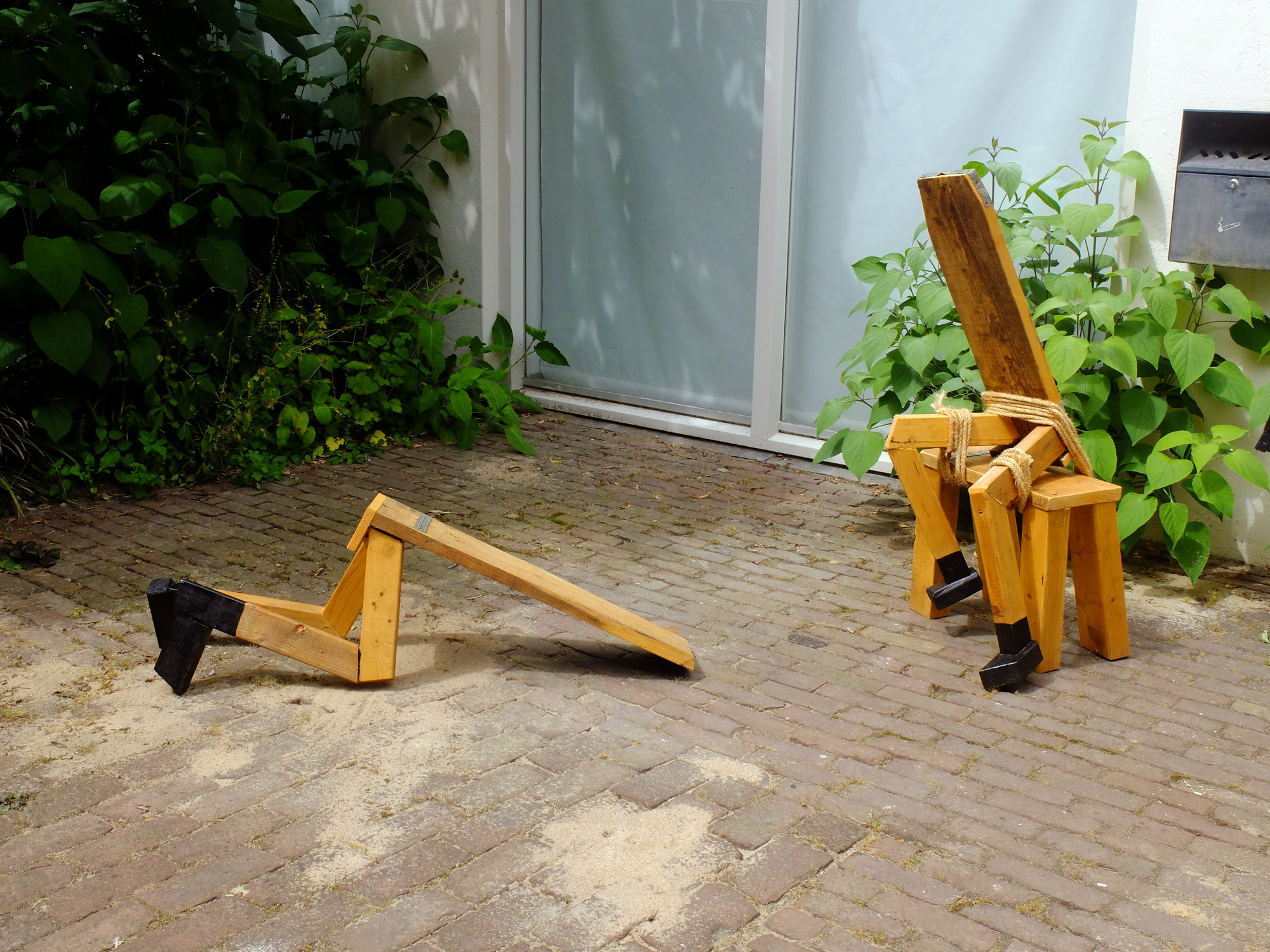
Drager Meurtant (Dutch, b. 1951) 'All humans are equal' 2018 (installation view)


Drager Meurtant (Dutch, b. 1951)
All humans are equal (installation view)
2018
Mixed media
100 x 50 x 200cm

All humans are equal. // To test this assumption / take two / and tilt the angle / and position towards, one another.


Drager Meurtant (Dutch, b. 1951) 'Rudimentary' 2016 (installation view)


Drager Meurtant (Dutch, b. 1951)
Rudimentary (installation view)
2016
Mixed media
23 x 13 x 16cm

“Mental metal / rudimentary face / mind you!”


Drager Meurtant (Dutch, b. 1951) 'The promised land' 2016


Drager Meurtant (Dutch, b. 1951)
The promised land
2016
Box assemblage
Mixed media, wood, board, metal, paint
34 x 44 x 10cm

“The promised land / cannot be for outsiders. // They may look / how it is, yonder.”


Drager Meurtant (Dutch, b. 1951) 'Steep-2' 2014 (installation view)


Drager Meurtant (Dutch, b. 1951)
Steep-2 (installation view)
2014
Mixed media, wood partly rotten, metal, paint and glass
35 x 23 x 10cm

Steep-2: The Monte Rotondo / is left behind / it weighs too much / for me. // The climbing rock of Feyr / I leave / to the climbers. // But / this wooden rock / serves as model / of a viewpoint on imagination.


Drager Meurtant (Dutch, b. 1951) 'The avail of propaganda' 2016


Drager Meurtant (Dutch, b. 1951)
The avail of propaganda
2016
Mixed media
Assemblage, wood, cloth, metal, paper, paint
43 x 21 x 8cm

“The avail of propaganda / is that you and I / do what / we detest.”


Drager Meurtant (Dutch, b. 1951) 'Twosome' Nd (installation view)


Drager Meurtant (Dutch, b. 1951)
Twosome (installation view)
Nd
Mixed media


Drager Meurtant (Dutch, b. 1951) 'fact-ohry' 2013 (installation view)


Drager Meurtant (Dutch, b. 1951)
fact-ohry (installation view)
2013
Mixed media
24 x 32 x 42cm

I said / now I will build a fact-ohry / and that / became factual. // With grabbing and placing / elements that together / took progressively the shape / of a fact-ohry / I became part of it. // Could shape the further design / and steer it at minor extent / but the end-result / was determined / by the starting point. // Voila.

(Note: This Fact-ohry is the only one with guarantee that risks during drilling for shale gas are secured.)


Drager Meurtant (Dutch, b. 1951) 'Progress (halted)' 2016 (installation view)


Drager Meurtant (Dutch, b. 1951)
Progress (halted) (installation view)
2016
Bronze
26 x 18 x 21cm

“When going forth / from wood to bronze / and grasping the result / I realised progress had halted. // A result stands in the way / of the learning process.”


Drager Meurtant (Dutch, b. 1951) 'Progress (halted)' 2016


Drager Meurtant (Dutch, b. 1951)
Progress (halted)
2016
Bronze
26 x 18 x 21cm


About Petra Senn

Petra’s work has mostly to do with memories and emotions. Her photos directly respond to the surrounding environment and use everyday experiences from the artist as a starting point. These experiences are often framed instances that would go unnoticed in their original context.

By contesting the division between the realm of memory and the realm of experience, she wants to amplify the astonishment of the spectator by creating compositions or settings that generate tranquil poetic images that leave traces and balances on the edge of recognition and alienation.

Her works appear as dreamlike images in which fiction and reality meet, well-known tropes merge, meanings shift, past and present fuse. Time and memory always play a key role. By applying abstraction, she absorbs the tradition of remembrance art into daily practice. She has a deep inner desire to protect the past from vanishing, both physically and, inevitably, mentally.

In her work Petra takes great care neither to simply reflect reality nor to just make visual statements. There is always left space for the spectators own emotions and opinions. She considers her work as visual stimulus, an invitation to enter ones inner world, knowing well that this process only works if she perceives deeper emotions while taking the pictures herself. Her search is for poetry in almost every item and condition.

Artist statement


Petra Senn. 'Her Lips' 2015


Petra Senn
Her Lips
2015


Petra Senn. 'Insubordination' 2017


Petra Senn
Insubordination
2017


Petra Senn. 'Persuasiveness' 2012


Petra Senn
Persuasiveness
2012


About Jeanine Keuchenius

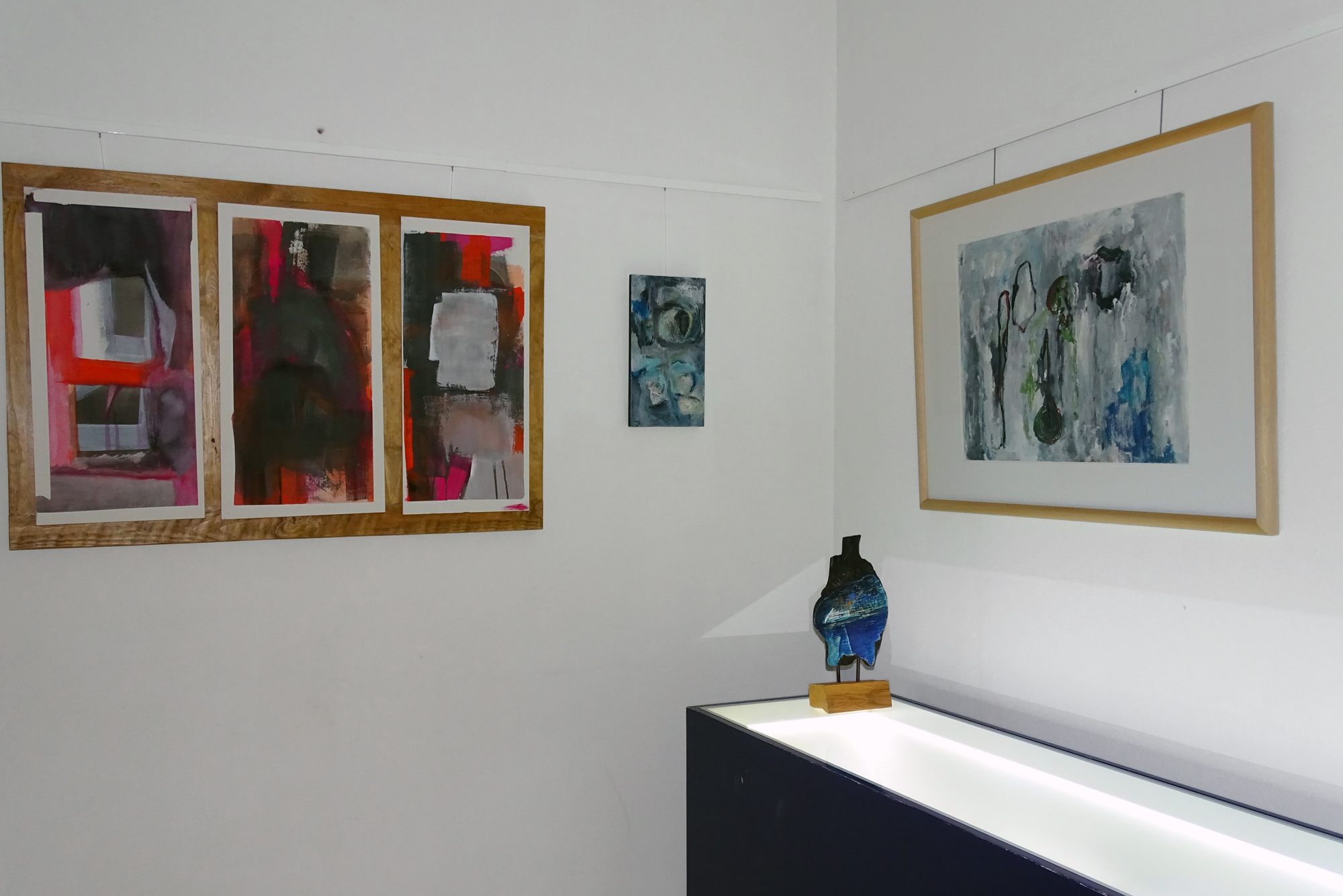
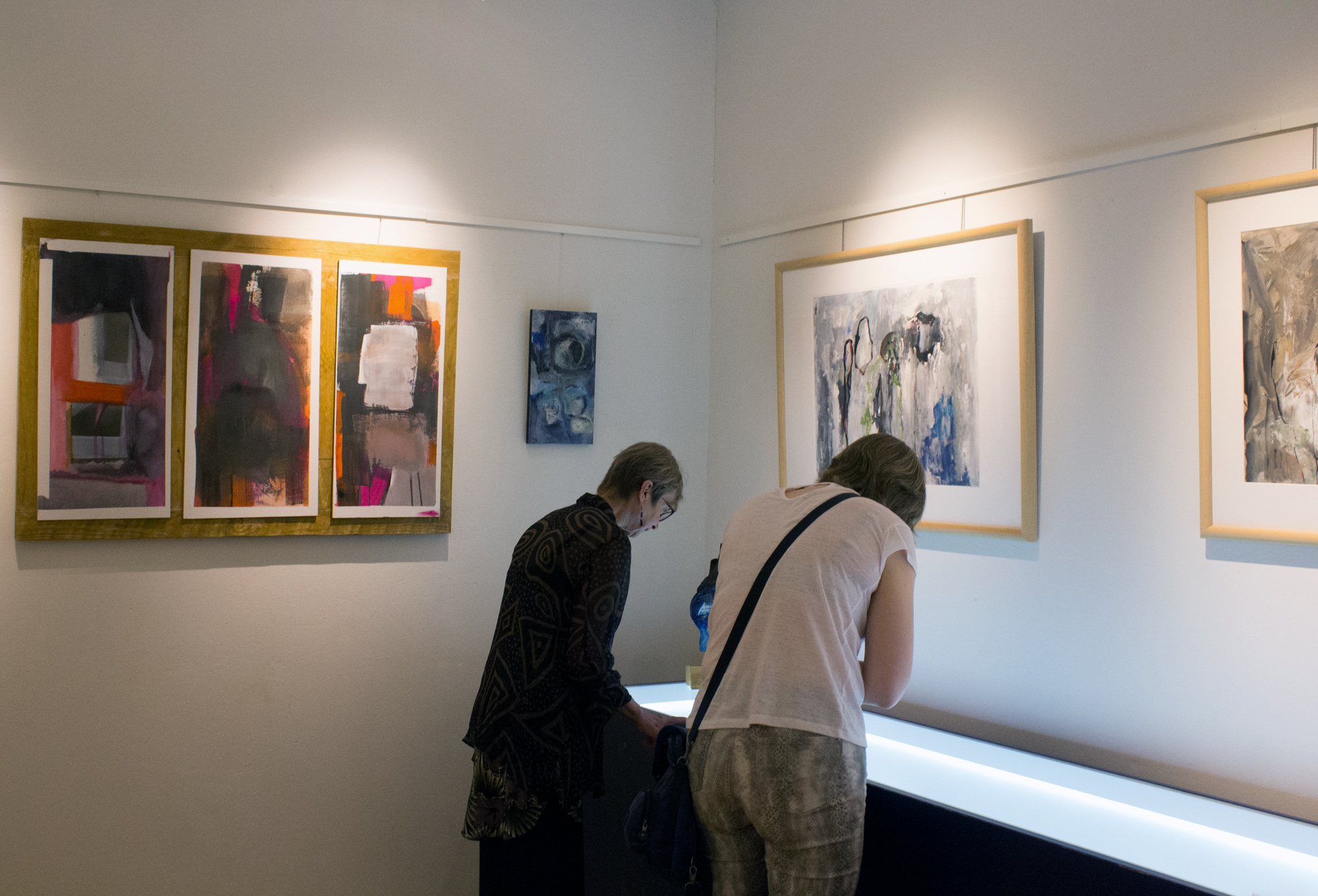
Jeanine Keuchenius (1953, Indonesia) is a creative artist, dancer, and performer. Her background is as an art therapist (independent and within psychiatry) and social worker / pastoral worker. In the visual art she is an autodidact (a self-taught person), acquiring some skills at high school (teacher in visual art), she then followed several courses / workshops given by professional artists.

Jeanine’s painting uses paper, linen or panel, with palette filled with gouache, acrylic, oil, ink, with at times addition of tar, sand, and glue. Artists that inspire her are Henri Toulouse-Lautrec, Edvard Munch, Antoni Tapies and Emil Schumacher, but also the medium of modern dance moves her in her work, which is mostly abstract, but at times features more figurative elements. Sometimes echoes from mountain landscapes and abandoned hamlets (e.g. on the island of Corsica) are visualised. Her motto is: “In duet with myself.”


Installation views of the exhibition Senses


Installation view of the exhibition 'Senses' at Kunstwerk! Liemers Museum, Netherlands

Installation view of the exhibition 'Senses' at Kunstwerk! Liemers Museum, Netherlands


Installation views of the exhibition Senses at Kunstwerk! Liemers Museum, Netherlands


Jeanine Keuchenius (Dutch born Indonesia, b. 1953) 'Amulet' 2011 (installation view)


Jeanine Keuchenius (Dutch born Indonesia, b. 1953)
Amulet (installation view)
2011
Gouache on paper
50 x 65cm


Jeanine Keuchenius (Dutch born Indonesia, b. 1953) 'Amulet' 2011


Jeanine Keuchenius (Dutch born Indonesia, b. 1953)
Amulet
2011
Gouache on paper
50 x 65cm


Jeanine Keuchenius (Dutch born Indonesia, b. 1953) 'Pink and grey' 2012


Jeanine Keuchenius (Dutch born Indonesia, b. 1953)
Pink and grey (installation view)
2012
Gouache on paper
50 x 65cm

Each painting is the reflection of memory or dream.


Jeanine Keuchenius (Dutch born Indonesia, b. 1953) 'Pink and grey' 2012


Jeanine Keuchenius (Dutch born Indonesia, b. 1953)
Pink and grey
2012
Gouache on paper
50 x 65cm


Jeanine Keuchenius (Dutch born Indonesia, b. 1953) 'Lying figure 2' 2017


Jeanine Keuchenius (Dutch born Indonesia, b. 1953)
Lying figure 2 (installation view)
2017
Two-dimensional plaster cut, printed on newspaper
22 x 26cm


Jeanine Keuchenius (Dutch born Indonesia, b. 1953) 'Beautiful stay' 2014


Jeanine Keuchenius (Dutch born Indonesia, b. 1953)
Beautiful stay (installation view)
2014
Gouache on paper


Jeanine Keuchenius (Dutch born Indonesia, b. 1953) 'Unchained' 2016 (installation view)


Jeanine Keuchenius (Dutch born Indonesia, b. 1953)
Unchained (installation view)
2016
Mixed media on panel (bitumen, acrylic, sand on panel)
45 x 57cm


Jeanine Keuchenius (Dutch born Indonesia, b. 1953) 'Memory 1' 2018 (installation view)


Jeanine Keuchenius (Dutch born Indonesia, b. 1953)
Memory 1 (installation view)
2018
Mixed media on panel (acrylic, sand, plaster, oil on panel)
60 x 70cm


Jeanine Keuchenius (Dutch born Indonesia, b. 1953) 'Gribusella' 2014


Jeanine Keuchenius (Dutch born Indonesia, b. 1953)
Gribusella
2014
Acrylic on paper
50 x 65cm

Form and colour accompany depth and emotion


Jeanine Keuchenius (Dutch born Indonesia, b. 1953) 'Senses' 2012


Jeanine Keuchenius (Dutch born Indonesia, b. 1953)
Senses
2012
Acrylic on paper
50 x 65cm


Jeanine Keuchenius (Dutch born Indonesia, b. 1953) 'Bwual ènzo' 2014


Jeanine Keuchenius (Dutch born Indonesia, b. 1953)
Bwual ènzo
2014
Gouache on paper
50 x 65cm

Both when handling and avoiding themes, you sometimes walk in a circle.


Poster for the exhibitions 'Now, the new form of the past' and 'Senses'


Poster for the exhibitions Now, the new form of the past and Senses


Kunstwerk! Liemers Museum
Kerkstraat 16, 6901
AB Zevenaar, Nederland
Phone: +31 85 040 9971

Opening hours :
Tuesday to Sunday from 2pm – 5pm

Jeanine Keuchenius website

Drager Meurtant website

Petra Senn website

Kunstwerk! Liemers Museum website

LIKE ART BLART ON FACEBOOK

Back to top

Photographs: Hermann Kummler (1863-1949) (compiler) ‘Ethnographic portraits of Indigenous women of Pernambuco and Bahia’ 1861-1862

August 2018


Hermann Kummler (compiler) (Swiss, 1863-1949) '[Portrait of Indigenous Brazilian tradeswoman]' 1861-1862


Hermann Kummler (compiler) (Swiss, 1863-1949)
(Portrait of Indigenous Brazilian tradeswoman)
1861-1862
From Ethnographic portraits of indigenous women of Pernambuco and Bahia
Salt paper print, hand-painted


Art Blart has been mining a rich vein of (anti-)colonial art and photography over the past few months, and the next two posts continue this trend.

Tonight we have Ethnographic portraits of Indigenous women of Pernambuco and Bahia (Brazil, 1861-1862) by unknown local photographers, collected and compiled by the Swiss photographer Hermann Kummler in 1888-1891 into an album. These were vintage prints when he purchased them and already had significant historical interest.

Thus, we have unknown sitters photographed by unknown photographers, removed from their original context(s) – the family, business or photographers album perhaps – to be annotated in a foreign hand, the machinations of (colonial, male) power evidenced through the gaze of the camera. And text. Mulatto; Mestizo; Negress.

The underprivileged of society being punished in their men/iality: servile; submissive: menial attitudes; pertaining to or suitable for domestic servants. Mistress punishing a native child. Teacher with a schoolgirl in Bahia in one picture, becomes Native Brazilian lady-in-waiting and young child attend to a veiled aristocrat in another (note the same background curtain).

None of the sitters look happy. Most scowl at the camera, unsmiling at their lot, probably being forced to have their photograph taken. The hand-coloured photographs are even more absurd, the lurid colours creating caricatures of human beings, cut out figures with all semblance of humanity removed. Rather than reinforcing “the sense of individual style associated with these remarkable figures”, the photographs become pure representation of figurative form. The camera enacts the shaping of disputed, contested identities into a particular figure, a particular palatable form.

Why it is valuable to show these photographs is that we must be ever vigilant in understanding the networks of power, dispossession and enslavement that patriarchal societies use to marginalise the poor, the weak, the different for their gain. For it is men that are looking.

“The category of “masculinity” should be seen as always ambivalent, always complicated, always dependent on the exigencies (necessary conditions and requirements) of personal and institutional power … [masculinity is] an interplay of emotional and intellectual factors – an interplay that directly implicates women as well as men, and is mediated by other social factors, including race, sexuality, nationality, and class … Far from being just about men, the idea of masculinity engages, inflects, and shapes everyone.”1


Dr Marcus Bunyan

PS. “two of the Indigenous women (one of whom wears a cross), simply pose in the studio” – they are not in a studio, a curtain has been drawn over a back wall.


1/ Berger, Maurice; Wallis, Brian and Watson, Simon. Constructing Masculinity. Introduction. New York: Routledge, 1995, pp. 3-7.


These digitally cleaned photographs are published under “fair use” for the purposes of academic research and critical commentary. Please click on the photographs for a larger version of the image.


Overview

Group of 19 ethnographic portraits of Indigenous women of Pernambuco and Bahia that were compiled by the Swiss photographer Hermann (Ermano) Kummler (1863-1949). With subjects of Indian and mixed-race descent, including vendors, wet nurses, maids, mothers and children, and merchants, including a mistress punishing a native child. Salted paper prints with trimmed corners, the images measuring 7 x 3 3/8 to 7 1/4 x 4 1/2 inches (17.8 x 8.4 to 18.4 x 11.4 cm).

7 are hand-coloured with gouache; the original mounts, 9 bright blue or green, 6 double mounted, measuring 9 1/4 x 7 to 8 1/4 x 11 1/4 inches (24.1 x 17.8 to 21 x 29.8 cm), most with Kummler’s caption notations, in ink, and each with his red hand stamp on prints (one) or mounts recto. 1861-1862

Kummler was a Swiss photographer who accompanied Als Kaufmann to Brazil, where they traveled extensively from 1888-91. Kummler apparently purchased vintage prints by local photographers (which he stamped and annotated), and eventually set up his own commercial studio in the town of Aarau. During the three year period he was in Brazil with Kaufmann, Kummler apparently made more than 130 photographs. Their journey was the subject of a monograph entitled Als Kaufmann in Pernambuco, Ein Reisebericht mit Bildern aus Brasiilien von Hermann Kummler (Als Kaufmann in Pernambuco 1888-1891. A travelogue with pictures from Brazil by Hermann Kummler), copiously illustrated with his images.

Tradeswomen are depicted with a teapot on a table, a comb, a basket laden with bottles or wares carefully balanced on their heads; maids hold embroidered cloth and a wet nurse is shown with an infant. A native lady-in-waiting (and a young child) attend to a gorgeously dressed aristocrat, who wears a long veil. The hand-coloured prints reinforce the sense of individual style associated with these remarkable figures; two of the Indigenous women (one of whom wears a cross), simply pose in the studio with trade womens objects.

Text from an auction house website

Pernambuco and Bahia

Pernambuco is a state of Brazil, located in the Northeast region of the country. Bahia is one of the 26 states of Brazil and is located in the Northeastern part of the country on the Atlantic coast.

Charles Darwin visited Bahia in 1832 on his famous voyage on the Beagle. In 1835, Bahia was the site of an urban slave revolt, particularly notable as the only predominately-Muslim slave rebellion in the history of the Americas. Under the Empire, Bahia returned 14 deputies to the general assembly and 7 senators; its own provincial assembly consisted of 36 members. In the 19th century, cotton, coffee, and tobacco plantations joined those for sugarcane and the discovery of diamonds in 1844 led to large influx of “washers” (garimpeiros = an independent prospector for minerals) until the still-larger deposits in South Africa came to light.


Hermann Kummler (compiler) (Swiss, 1863-1949) 'Mullatin [Portrait of a Indigenous Brazilian woman wearing a cross]' 1861-1862


Hermann Kummler (compiler) (Swiss, 1863-1949)
Mullatin (Portrait of a Indigenous Brazilian woman wearing a cross)
1861-1862
From Ethnographic portraits of indigenous women of Pernambuco and Bahia
Salt paper print, hand-painted


Mulatto

Mulatto is a term used to refer to people born of one white parent and one black parent or to people born of a mulatto parent or parents. In English, the term is today generally confined to historical contexts. English speakers of mixed white and black ancestry seldom choose to identify themselves as “mulatto.” …

Mulattoes represent a significant part of the population of various Latin American and Caribbean countries: Brazil (49.1% mixed-race, Gypsy and Black, Mulattoes (20.5%), Mestiços, Mamelucos or Caboclos (21.3%), Blacks (7.1%) and Eurasian (0.2%).

In colonial Latin America, mulato could also refer to an individual of mixed African and Native American ancestry. In the 21st century, persons with indigenous and black African ancestry in Latin America are more frequently called zambos in Spanish or cafuzo in Portuguese.

According to the IBGE 2000 census, 38.5% of Brazilians identified as pardo, i.e. of mixed ancestry. This figure includes mulatto and other multiracial people, such as people who have European and Amerindian ancestry (called caboclos), as well as assimilated, westernised Amerindians, and mestizos with some Asian ancestry. A majority of mixed-race Brazilians have all three ancestries: Amerindian, European, and African. According to the Brazilian Institute of Geography and Statistics census 2006, some 42.6% of Brazilian identify as pardo, an increase over the 2000 census.

Text from the Wikipedia website


Hermann Kummler (compiler) (Swiss, 1863-1949) 'Mestize [Portrait of a Brazilian woman]' 1861-1862


Hermann Kummler (compiler) (Swiss, 1863-1949)
Mestize (Portrait of a Brazilian woman)
1861-1862
From Ethnographic portraits of indigenous women of Pernambuco and Bahia
Salt paper print, hand-painted

Mestizo: (in Latin America) a person of mixed race, especially one having Spanish and American Indian parentage.


Mixed-race Brazilian

Brazilian censuses do not use a “multiracial” category. Instead, the censuses use skin colour categories. Most Brazilians of visibly mixed racial origins self-identify as pardos. However, many white Brazilians have distant non-white ancestry, while the group known as pardos likely contains non-mixed acculturated Amerindians. According to the 2010 census, “pardos” make up 82.277 million people, or 43.13% of Brazil’s population. …

History

Before the arrival of the Portuguese in 1500, Brazil was inhabited by nearly five million Amerindians. The Portuguese colonisation of Brazil started in the sixteenth century. In the first two centuries of colonisation, 100,000 Portuguese arrived in Brazil (around 500 colonists per year). In the eighteenth century, 600,000 Portuguese arrived (6,000 per year). Another race, Blacks, were brought from Africa as slaves, starting around 1550. Many came from Guinea, or from West African countries – by the end of the eighteenth century many had been taken from Congo, Angola and Mozambique (or, in Bahia, from Benin). By the time of the end of the slave trade in 1850, around 3.5 million slaves had been brought to Brazil – 37% of all slave traffic between Africa and the Americas.

In the late nineteenth and early twentieth centuries, a considerable influx of mainly European immigrants arrived in Brazil. According to the Memorial do Imigrante, Brazil attracted nearly 5 million immigrants between 1870 and 1953. Most of the immigrants were from Italy or Portugal, but also significant numbers of Germans, Spaniards, Japanese and Syrian-Lebanese.

The Portuguese settlers were the ones to start the intensive race-mixing process in Brazil. Miscegenation in Brazil… was not a pacific process as some used to believe: it was a form of domination from the Portuguese against the Native Brazilian and African populations. …

White/Amerindian

Most of the first colonists from Portugal who arrived in Brazil were singles or did not bring their wives. For that reason the first interracial marriages in Brazil occurred between Portuguese males and Amerindian females.

In Brazil, people of White/Indian ancestry are historically known as caboclos or mamelucos. They predominated in many regions of Brazil. One example are the Bandeirantes (Brazilian colonial scouts who took part in the Bandeiras, exploration expeditions) who operated out of São Paulo, home base for the most famous bandeirantes.

Indians, mostly free men and mamelucos, predominated in the society of São Paulo in the 16th and early 17th centuries and outnumbered Europeans. The influential families generally bore some Indian blood and provided most of the leaders of the bandeiras, with a few notable exceptions such as Antonio Raposo Tavares (1598-1658), who was European born.

White/Black

According to some historians, Portuguese settlers in Brazil used to prefer to marry Portuguese-born females. If not possible, the second option were Brazilian-born females of recent Portuguese background. The third option were Brazilian-born women of distant Portuguese ancestry. However, the number of White females in Brazil was very low during the Colonial period, causing a large number of interracial relationships in the country.

White/Black relationships in Brazil started as early as the first Africans were brought as slaves in 1550 where many Portuguese men starting marrying black women. The Mulattoes (people of White/Black ancestry) were also enslaved, though some children of rich aristocrats and owners of gold mines were educated and became important people in Colonial Brazil. Probably, the most famous case was Chica da Silva, a mixed-race Brazilian slave who married a rich gold mine owner and became one of the richest people in Brazil.

Other mulattoes largely contributed to Brazil’s culture: Aleijadinho (sculptor and architect), Machado de Assis (writer), Lima Barreto (writer), Chiquinha Gonzaga (composer), etc. In 1835, Blacks would have made up the majority of Brazil’s population, according to a more recent estimate quoted by Thomas Skidmore. In 1872, their number was shown to be much smaller according to the census of that time, outnumbered by pardos and Whites. …

Black/Amerindian

People of Black African and Native Brazilian ancestry are known as Cafuzos and are historically the less numerous group. Most of them have origin in black women who escaped slavery and were welcomed by indigenous communities, where started families with local amerindian men.

Text from the Wikipedia website


Modesto Brocos (Brazilian born Spain, 1853-1936) 'A Redenção de Cam (Ham's Redemption)' 1895


Modesto Brocos (Brazilian born Spain, 1853-1936)
A Redenção de Cam (Ham’s Redemption)
1895
Oil on canvas
199cm (78.3 in) x 166cm (65.3 in)
Public domain / Museu Nacional de Belas Artes


The painting shows a Brazilian family each generation becoming “whiter” (black grandmother, mulatto mother and white baby).


Hermann Kummler (compiler) (Swiss, 1863-1949) '[Portrait of Indigenous Brazilian tradeswoman]' 1861-1862


Hermann Kummler (compiler) (Swiss, 1863-1949)
(Portrait of Indigenous Brazilian tradeswoman)
1861-1862
From Ethnographic portraits of indigenous women of Pernambuco and Bahia
Salt paper print, hand-painted


Hermann Kummler (compiler) (Swiss, 1863-1949) '[Portrait of Indigenous Brazilian tradeswoman]' 1861-1862


Hermann Kummler (compiler) (Swiss, 1863-1949)
(Portrait of Indigenous Brazilian tradeswoman)
1861-1862
From Ethnographic portraits of indigenous women of Pernambuco and Bahia
Salt paper print, hand-painted


Hermann Kummler (compiler) (Swiss, 1863-1949) '[Portrait of a maid holding an embroidered cloth]' 1861-1862


Hermann Kummler (compiler) (Swiss, 1863-1949)
(Portrait of a maid holding an embroidered cloth)
1861-1862
From Ethnographic portraits of indigenous women of Pernambuco and Bahia
Salt paper print, hand-painted


Hermann Kummler (compiler) (Swiss, 1863-1949) '[Portrait of wet nurse with infant]' 1861-1862


Hermann Kummler (compiler) (Swiss, 1863-1949)
(Portrait of wet nurse with infant)
1861-1862
From Ethnographic portraits of indigenous women of Pernambuco and Bahia
Salt paper print, hand-painted


Indigenous peoples in Brazil

Indigenous peoples in Brazil (Portuguese: povos indígenas no Brasil), or Indigenous Brazilians (Portuguese: indígenas brasileiros), comprise a large number of distinct ethnic groups who have inhabited what is now the country of Brazil since prior to the European contact around 1500. Unlike Christopher Columbus, who thought he had reached the East Indies, the Portuguese, most notably Vasco da Gama, had already reached India via the Indian Ocean route when they reached Brazil.

Nevertheless, the word índios (“Indians”) was by then established to designate the people of the New World and continues to be used today in the Portuguese language to designate these people, while a person from India is called indiano in order to distinguish the two.

At the time of European contact, some of the indigenous people were traditionally mostly semi-nomadic tribes who subsisted on hunting, fishing, gathering, and migrant agriculture. Many of the estimated 2,000 nations and tribes which existed in the 16th century suffered extinction as a consequence of the European settlement, and many were assimilated into the Brazilian population.

The indigenous population was largely killed by European diseases, declining from a pre-Columbian high of millions to some 300,000 (1997), grouped into 200 tribes. However, the number could be much higher if the urban indigenous populations are counted in all the Brazilian cities today. A somewhat dated linguistic survey found 188 living indigenous languages with 155,000 total speakers.

The rubber trade

The 1840s brought trade and wealth to the Amazon. The process for vulcanising rubber was developed, and worldwide demand for the product skyrocketed. The best rubber trees in the world grew in the Amazon, and thousands of rubber tappers began to work the plantations. When the Indians proved to be a difficult labor force, peasants from surrounding areas were brought into the region. In a dynamic that continues to this day, the indigenous population was at constant odds with the peasants, who the Indians felt had invaded their lands in search of treasure.

Urban Rights Movement

The urban rights movement is a recent development in the rights of indigenous peoples. Brazil has one of the highest income inequalities in the world, and much of that population includes indigenous tribes migrating toward urban areas both by choice and by displacement. Beyond the urban rights movement, studies have shown that the suicide risk among the indigenous population is 8.1 times higher than the non-indigenous population.

Many indigenous rights movements have been created through the meeting of many indigenous tribes in urban areas. For example, in Barcelos, an indigenous rights movement arose because of “local migratory circulation.” This is how many alliances form to create a stronger network for mobilisation. Indigenous populations also living in urban areas have struggles regarding work. They are pressured into doing cheap labor. Programs like Oxfam have been used to help indigenous people gain partnerships to begin grassroots movements. Some of their projects overlap with environmental activism as well.

Many Brazilian youths are mobilising through the increased social contact, since some indigenous tribes stay isolated while others adapt to the change. Access to education also affects these youths, and therefore, more groups are mobilising to fight for indigenous rights.

Text from the Wikipedia website


Hermann Kummler (compiler) (Swiss, 1863-1949) '[Portrait of Indigenous Brazilian tradeswoman]' 1861-1862


Hermann Kummler (compiler) (Swiss, 1863-1949)
(Portrait of Indigenous Brazilian tradeswoman)
1861-1862
From Ethnographic portraits of indigenous women of Pernambuco and Bahia
Salt paper print


Hermann Kummler (compiler) (Swiss, 1863-1949) 'Hermann Kummler (compiler) (1863-1949) '[Kellnerinnen im Grand Hotel / Waitresses in Grand Hotel]' 1861-1862' 1861-1862


Hermann Kummler (compiler) (Swiss, 1863-1949)
(Kellnerinnen im Grand Hotel / Waitresses in Grand Hotel)
1861-1862
From Ethnographic portraits of indigenous women of Pernambuco and Bahia
Salt paper print


Hermann Kummler (compiler) (Swiss, 1863-1949) '[Lehrerin mit Schülerin im Bahia / Teacher with a schoolgirl in Bahia]' 1861-1862


Hermann Kummler (compiler) (Swiss, 1863-1949)
(Lehrerin mit Schülerin im Bahia / Teacher with a schoolgirl in Bahia)
1861-1862
From Ethnographic portraits of indigenous women of Pernambuco and Bahia
Salt paper print


Hermann Kummler (compiler) (Swiss, 1863-1949) '[Native Brazilian lady-in-waiting and young child attend to a veiled aristocrat]' 1861-1862


Hermann Kummler (compiler) (Swiss, 1863-1949)
(Native Brazilian lady-in-waiting and young child attend to a veiled aristocrat)
1861-1862
From Ethnographic portraits of indigenous women of Pernambuco and Bahia
Salt paper print


Hermann Kummler (compiler) (Swiss, 1863-1949) '[Negerin mit dem Knaben in schlechter Stimmung / Negress with a boy in a bad mood]' 1861-1862


Hermann Kummler (compiler) (Swiss, 1863-1949)
(Negerin mit dem Knaben in schlechter Stimmung / Negress with a boy in a bad mood)
1861-1862
From Ethnographic portraits of indigenous women of Pernambuco and Bahia
Salt paper print


Hermann Kummler (compiler) (Swiss, 1863-1949) '[Portrait of Brazilian woman servant and child]' 1861-1862


Hermann Kummler (compiler) (Swiss, 1863-1949)
(Portrait of Brazilian woman servant and child)
1861-1862
From Ethnographic portraits of indigenous women of Pernambuco and Bahia
Salt paper print


Hermann Kummler (compiler) (Swiss, 1863-1949) '[Portrait of a young Brazilian woman]' 1861-1862


Hermann Kummler (compiler) (Swiss, 1863-1949)
(Portrait of a young Brazilian woman)
1861-1862
From Ethnographic portraits of indigenous women of Pernambuco and Bahia
Salt paper print


 Hermann Kummler (compiler) (Swiss, 1863-1949) '[Portrait of a Brazilian woman]' 1861-1862


Hermann Kummler (compiler) (Swiss, 1863-1949)
(Portrait of a Brazilian woman)
1861-1862
From Ethnographic portraits of indigenous women of Pernambuco and Bahia
Salt paper print


 Hermann Kummler (compiler) (Swiss, 1863-1949) '[Portrait of a Brazilian woman]' 1861-1862


Hermann Kummler (compiler) (Swiss, 1863-1949)
(Portrait of a Brazilian woman)
1861-1862
From Ethnographic portraits of indigenous women of Pernambuco and Bahia
Salt paper print


Hermann Kummler (compiler) (Swiss, 1863-1949) '[Portrait of a Brazilian woman with two children]' 1861-1862


Hermann Kummler (compiler) (Swiss, 1863-1949)
(Portrait of a Brazilian woman with two children)
1861-1862
From Ethnographic portraits of indigenous women of Pernambuco and Bahia
Salt paper print


Hermann Kummler (compiler) (Swiss, 1863-1949) '[Portrait of a Brazilian mother and child]' 1861-1862


Hermann Kummler (compiler) (Swiss, 1863-1949)
(Portrait of a Brazilian mother and child)
1861-1862
From Ethnographic portraits of indigenous women of Pernambuco and Bahia
Salt paper print


Hermann Kummler (compiler) (Swiss, 1863-1949) '[Mistress punishing a native child]' 1861-1862


Hermann Kummler (compiler) (Swiss, 1863-1949)
(Mistress punishing a native child)
1861-1862
From Ethnographic portraits of indigenous women of Pernambuco and Bahia
Salt paper print


LILKE ART BLART ON FACEBOOK

Back to top

Photographs: ‘Edward S. Curtis (1868-1952) – The North American Indian’ List of Large Plates Supplementing Volume V

July 2018

Published in: The North American Indian / Edward S. Curtis. (Seattle, Wash.) : Edward S. Curtis, 1907-1930 suppl., v. 5


Edward S. Curtis. 'The North American Indian': List of Large Plates Supplementing Volume Five


The North American Indian: List of Large Plates Supplementing Volume Five


On the one hand, it is a privilege to post the complete large plates supplementing Volume Five of Edward S. Curtis’ The North American Indian, together with the complimentary biographical sketches of the subject as they appear in the volume, and supplementary research that I undertook into Native American customs and dress. There is no doubt that these are beautiful and atmospheric photographs of a supposedly “Vanishing Race”.

From a technical point of view we can observe the close cropping, the contextless backgrounds of the portraits, the low depth of field, the beautiful light, the direct gaze of the sitter, and the profile view; and in the exterior shots, the balance between sky and earth, how the horizon line moves up and down, how Curtis often looks up at his subject, and how he crops the negative to obtain different effects (Arikara Medicine Ceremony – The Ducks; Arikara chief).

On the other hand, these photographs can only be viewed as “constructions”, flights of fancy, imagined by Curtis to depict and capture traditional culture, a way of life that had almost disappeared by the time he took these photographs.

Talking to Executive Director Shannon Keller O’Loughlin (Choctaw) of the Association on American Indian Affairs (AAIA) he observed that,

“There is no one person who can give you one opinion about the Curtis photographs – there is definitely a variety of opinion in Indian Country about them both good and bad. If you find someone in Indian Country that says there is only one way to look at the Curtis photographs, then you have the wrong person!

Personally, I understand those pictures were posed to capture what Curtis and others thought were the vanishing Indian. They do not necessarily represent reality, but a posed amalgamation of pieces of Tribal life and existence at that time. So, like so many cultural items and ancestors that have been stolen and put in museums and in private collections, American society viewed the Indian in that manner too.

Those photos are not who we are but what someone has posed as the story they (Curtis) wanted to tell. On the other hand, they show us today some things that we may no longer have access to and give us a window into eyes of real human beings who were in the process of losing the lives they had known for centuries.” (Email to the author, 1 June 2018)


I thank Shannon very much for his insightful words. His powerful, evocative statement has just as much relevance here in Australia as in America: for these photographs picture ghosts from the past, made manifest as real human beings in the present, together with their commensurate strength and suffering. They give us a window into eyes of real human beings who were in the process of losing the lives they had known for centuries.

Colonisation, and all that it entails – here in Australia, invasion, massacres, religious conversion, Stolen Generation – is so appalling. These “staged” photographs of a “vanishing race” – again, the same photographs taken here in Australia – show the contempt of the invader for centuries of life, culture and tradition even as they document their “existence.” Culture just becomes a circus, a spectacle to be captured, owned and destroyed.

The effects of colonisation are ever present and continuing. The hurt is ongoing.

Dr Marcus Bunyan


These digitally cleaned photographs are published under “fair use” for the purposes of academic research and critical commentary. Please click on the photographs for a larger version of the image.


Edward S. Curtis (American, 1868-1952) 'Yellow Owl - Mandan' c. 1908 from 'Edward S. Curtis (1868-1952) – The North American Indian' List of Large Plates Supplementing Volume V


Edward S. Curtis (American, 1868-1952)
Yellow Owl – Mandan
c. 1908
Photogravure on vellum
The North American Indian / Edward S. Curtis. (Seattle, Wash.): Edward S. Curtis, 1907-1930 suppl., v. 5, pl. 148


A face approaching the type of pure Mandan. The neck ornament consists of beads and cylindrical bones, and from the eagle-feather war-bonnet hang numerous weasel-tails.


Edward S. Curtis (American, 1868-1952) 'Spotted Bull - Mandan' c. 1908 from 'Edward S. Curtis (1868-1952) – The North American Indian' List of Large Plates Supplementing Volume V


Edward S. Curtis (American, 1868-1952)
Spotted Bull – Mandan
c. 1908
Photogravure on vellum
The North American Indian / Edward S. Curtis. (Seattle, Wash.): Edward S. Curtis, 1907-1930 suppl., v. 5, pl. 149


Edward S. Curtis (American, 1868-1952) '[Bear's Belly, Arikara Indian half-length portrait, facing front, wearing bearskin]' c. 1908 from 'Edward S. Curtis (1868-1952) – The North American Indian' List of Large Plates Supplementing Volume V


Edward S. Curtis (American, 1868-1952)
Bear’s Belly, Arikara Indian half-length portrait, facing front, wearing bearskin
c. 1908
Photogravure on vellum
The North American Indian / Edward S. Curtis. (Seattle, Wash.): Edward S. Curtis, 1907-1930 suppl., v. 5, pl. 150


A member of the medicine fraternity, wrapped in his sacred bearskin.


Edward S. Curtis (American, 1868-1952) 'Four Horns – Arikara' c. 1908


Edward S. Curtis (American, 1868-1952)
Four Horns – Arikara
c. 1908
Photogravure on vellum
The North American Indian / Edward S. Curtis. (Seattle, Wash.): Edward S. Curtis, 1907-1930 suppl., v. 5, pl. 151


A biographical sketch of this subject appears in Volume V, page 179 (below)

Born in 1847 near Fort Berthold. At the age of fourteen he accompanied a war-party against the Sioux. Two years later he enlisted as scout at Fort Buford; he served served also at Fort Phil. Kearny, where in a skirmish with Sioux he had a horse shot under him. Returning that summer to the village at Fort Berthold he led a party in pursuit of some Chippewa who had murdered a Hidatsa, and succeeded in killing two of them. Twice he joined in successful pursuit of Sioux horse-raiders. He fasted several times. On the third morning of his first fast three horse-skulls and a buffalo-skull were fastened with rawhide ropes to the muscles of his back. He dragged them a mile to the Hidatsa village, encircled it, and returned to the starting-point, but no vision was experienced. The following summer the Sun Dance was observed, and his father, determined that Four Horns should receive a vision, took him to the burial-ground and fastened him to a post by slits through his back-muscles. From sunset to sunrise he walked around the post, constantly puling on the rope. The next year his father led him to the same place and had another man tie four horse-skulls and a buffalo-skull to his back, and these he dragged some three miles; but the task occupied fully six hours, as the skulls became entangled in the roots of a stump and he had to free them without using his hands. During the Sun Dance of the succeeding year he was fastened, again by his father, to a resilient ash pole, which, springing back when he pulled on the ropes, greatly increased the torture. Thus he remained from mid-afternoon until well after sunset – about six hours – but no vision was vouchsafed him. Four Horns married at the age of fifteen, being eligible by reason of his experience in war gained during the previous year. Portrait, folio plate 151.


Vision Quests

Numerous Native American practiced the rite of Vision Quests, which was often taken by older children before puberty to “find themselves” and their life’s direction. How the rite was taken, its length and intensity, and at what age varied greatly from tribe to tribe. In most cases the vision quest was a “supernatural” experience in which the individual seeks to interact with a guardian spirit, usually an animal, to obtain advice or protection.

Much preparation was often taken before the vision quest was undertaken in order to determine the sincerity and commitment of the person. Sometimes the quest required the individual to go alone into the wilderness for several days, in order to become attuned to the spirit world.

Other tribes required the individual to take a long walk, or were confined to a small room. Often the individual was required to fast prior to the quest, and was not allowed to sleep. During this period of sensory deprivation, the individual was to search for a a guardian spirit’s presence or a sign that would be given to them. Once the presence or sign was “seen,” and the individual had realized his/her direction in life, they would return to the tribe to pursue their life’s journey.

Kathy Weiser. “Native American Rituals and Ceremonies,” on the Legends of America website [Online] Cited 31/05/2018


Edward S. Curtis (American, 1868-1952) 'White Shield – Arikara' c. 1908


Edward S. Curtis (American, 1868-1952)
White Shield – Arikara
c. 1908
Photogravure on vellum
The North American Indian / Edward S. Curtis. (Seattle, Wash.): Edward S. Curtis, 1907-1930 suppl., v. 5, pl. 152


A mixed-blood member of the medicine fraternity.


Edward S. Curtis (American, 1868-1952) 'Sitting Bear – Arikara' c. 1908


Edward S. Curtis (American, 1868-1952)
Sitting Bear – Arikara
c. 1908
Photogravure on vellum
The North American Indian / Edward S. Curtis. (Seattle, Wash.): Edward S. Curtis, 1907-1930 suppl., v. 5, pl. 153


A biographical sketch of this subject will be found in Volume V, page 180 (below)

Born in 1844 on the west side of the Missouri, opposite present Washburn, North Dakota. He was eighteen years of age before making his first trial at war, and even then he took no part in the actual conflict with the Assiniboin whom his party encountered. The following year he engaged in the fight when a hunting party near the Fort Berthold village was surrounded by Sioux, and he even acquired some distinction by being first to strike one of the horses of the enemy. In all the was participant in twelve battles, himself being the leader six times, but only twice did he conduct his warriors into the enemy’s country. On the other occasions the encounters were brought on by Sioux attacking the village. The first expedition of which he was chief was made down the Missouri in bull-boats. After travelling for nine night, concealing themselves by day, they killed a woman that came to the river for water, and then made their escape after a minor engagement with the men of the hostile camp. Sitting Bear was the leader of the Arikara in a combined party of Hidatsa, Mandan, and Arikara into the Sioux country. A camp was raided and Sitting bear captured five horses. The retreat to Fort Berthold consumed six days. Sitting Bear conted a first coup in a fight near Fort Berthold being the first Arikara to strike one of the enemy, although a Hidatsa had already counted coup on him. He married at nineteen, and like his father and grandfather he became the tribal chief. Portrait, folio plate 153.


Edward S. Curtis (American, 1868-1952) 'Bear's Teeth - Arikara' c. 1908


Edward S. Curtis (American, 1868-1952)
Bear’s Teeth – Arikara
c. 1908
Photogravure on vellum
The North American Indian / Edward S. Curtis. (Seattle, Wash.): Edward S. Curtis, 1907-1930 suppl., v. 5, pl. 154


A member of the Night order of the medicine fraternity.


Edward S. Curtis (American, 1868-1952) 'Little Sioux – Arikara' c. 1908


Edward S. Curtis (American, 1868-1952)
Little Sioux – Arikara
c. 1908
Photogravure on vellum
The North American Indian / Edward S. Curtis. (Seattle, Wash.): Edward S. Curtis, 1907-1930 suppl., v. 5, pl. 155


Edward S. Curtis (American, 1868-1952) 'Bull Neck – Arikara' c. 1908


Edward S. Curtis (American, 1868-1952)
Bull Neck – Arikara
c. 1908
Photogravure on vellum
The North American Indian / Edward S. Curtis. (Seattle, Wash.): Edward S. Curtis, 1907-1930 suppl., v. 5, pl. 156


A member of the Buffalo order of the medicine fraternity. Bull Neck is portrayed wearing his head-dress of buffalo horns and hide. A biographical sketch is given in Volume V, page 178 (below)

Born in 1836. His first experience in war was gained at the age of sixteen, when with a party of six others he floated down the Missouri into what is now South Dakota. They succeeded in running off some horses from a Sioux encampment, and Bull Neck, the youngest of the seven, was charged with the duty of driving them home, while the others retuned afoot on the other side of the river. His second war experience came while on another expedition down the Missouri. Four Sioux horses were captured, and three of the party turned back with the spoils; but the remaining four, of whom Bull Neck was one, went on southward into a region of heavy timber, where more Sioux horses were taken. On another down-river raid, about twenty-five Arikara, camping one night among the trees, heard the neighing of a horse. They prepared to fight, believing the Sioux were upon them. Bull Neck went out to make a reconnoissance and found a stray horse. The party proceeded on its way and came to a camp of wood-cutters providing fuel for the river steamboats. One of the white men, speaking in Arikara, told them of a nearby camp of Sioux, and the war-party, having found the enemy, made an attack. One Sioux and two Arikara were killed. Bull Neck participated in numerous encounters with the same enemy, some of them being engagements of his own seeking, others the result of attacks upon the Fort Berthold village. He counted a first coup in a winter campaign. Bull Neck was a Buffalo medicine-man in the medicine fraternity. Portrait, folio plate 156.


Fort Berthold Indian Reservation is in the upper-left corner on this map.


Fort Berthold Indian Reservation is in the upper-left corner on this map.

The Fort Berthold Indian Reservation is a U.S. Indian reservation in western North Dakota that is home for the federally recognised Mandan, Hidatsa, and Arikara Nation, also known as the Three Affiliated Tribes. The reservation includes lands on both sides of the Missouri River.

Created in 1870, the reservation is a small part of the lands originally reserved to the tribes by the Fort Laramie Treaty of 1851, which allocated nearly 12 million acres (49,000 km²) in North Dakota, South Dakota, Montana, Nebraska and Wyoming.

The population of the reservation was 6,341 as of the 2010 census. The Tribe reported a total enrolment of 15,013 registered tribe members in March 2016. Many members live in cities because there are more job opportunities. Unemployment on the reservation was at 42%. The 2000 census reported a reservation population of 5,915 persons living on a land area of 1,318.895 sq mi (3,415.923 km²).

Text from the Wikipedia website


Edward S. Curtis (American, 1868-1952) 'Arikara medicine fraternity' c. 1908


Edward S. Curtis (American, 1868-1952)
Arikara medicine fraternity
c. 1908
Photogravure on vellum
The North American Indian / Edward S. Curtis. (Seattle, Wash.): Edward S. Curtis, 1907-1930 suppl., v. 5, pl. 157


In this group are shown the principal participants in the reenactment of the Arikara medicine ceremony, which was given for the author’s observation and study in July, 1908.


Edward S. Curtis (American, 1868-1952) 'Arikara medicine ceremony - Dance of the fraternity' c. 1908


Edward S. Curtis (American, 1868-1952)
Arikara medicine ceremony – Dance of the fraternity
c. 1908
Photogravure on vellum
The North American Indian / Edward S. Curtis. (Seattle, Wash.): Edward S. Curtis, 1907-1930 suppl., v. 5, pl. 158


After each order has performed its dance about the sacred cedar, the entire fraternity, group by group, emerges from the lodge and dances.


Edward S. Curtis (American, 1868-1952) 'Announcement – Arikara' c. 1908


Edward S. Curtis (American, 1868-1952)
Announcement – Arikara
c. 1908
Photogravure on vellum
The North American Indian / Edward S. Curtis. (Seattle, Wash.): Edward S. Curtis, 1907-1930 suppl., v. 5, pl. 159


Among the Missouri River Indians of the earthen lodges – the Mandan, Hidatsa, and Arikara – the chiefs and priests made their announcements from the housetops. This picture is of Bear’s Teeth standing on the roof of the ceremonial lodge in which occurred the medicine ceremony described in Volume V, pages 70-76.


Edward S. Curtis (American, 1868-1952) 'The rush gatherer' c. 1908


Edward S. Curtis (American, 1868-1952)
The rush gatherer
c. 1908
Photogravure on vellum
The North American Indian / Edward S. Curtis. (Seattle, Wash.): Edward S. Curtis, 1907-1930 suppl., v. 5, pl. 160


The Arikaras, as well as their close neighbours, the Mandan and Hidatsa, made many mats of rushes. These were used largely as floor coverings.


Edward S. Curtis (American, 1868-1952) '[Arikara medicine ceremony - the Bears]' c. 1908


Edward S. Curtis (American, 1868-1952)
(Arikara medicine ceremony – the Bears)
c. 1908
Photogravure on vellum
The North American Indian / Edward S. Curtis. (Seattle, Wash.): Edward S. Curtis, 1907-1930 suppl., v. 5, pl. 161


After dancing around the sacred cedar, the members of the Bear order halt and complete their songs before reentering the medicine-lodge.


Edward S. Curtis (American, 1868-1952) 'Arikara medicine ceremony - Dance of the black-tail deer' c. 1908


Edward S. Curtis (American, 1868-1952)
Arikara medicine ceremony – Dance of the black-tail deer
c. 1908
Photogravure on vellum
The North American Indian / Edward S. Curtis. (Seattle, Wash.): Edward S. Curtis, 1907-1930 suppl., v. 5, pl. 162


The two dark figures are painted in a manner suggesting the elk, the others the antelope.


Edward S. Curtis (American, 1868-1952) 'Arikara Medicine Ceremony – The Ducks' c. 1908


Edward S. Curtis (American, 1868-1952)
Arikara Medicine Ceremony – The Ducks
c. 1908
Photogravure on vellum
The North American Indian / Edward S. Curtis. (Seattle, Wash.): Edward S. Curtis, 1907-1930 suppl., v. 5, pl. 163


Three members of the medicine fraternity, painted to represent ducks and holding the rushes among which waterfowl rest, in their dance around the sacred cedar.


Edward S. Curtis (American, 1868-1952) 'Arikara Medicine Ceremony – The Ducks' c. 1908


Edward S. Curtis (American, 1868-1952)
Arikara Medicine Ceremony – The Ducks
c. 1908
LC-DIG-ppmsca-39866
Library of Congress


Edward S. Curtis (American, 1868-1952) 'Arikara medicine fraternity – The prayer' c. 1908


Edward S. Curtis (American, 1868-1952)
Arikara medicine fraternity – The prayer
c. 1908
Photogravure on vellum
The North American Indian / Edward S. Curtis. (Seattle, Wash.): Edward S. Curtis, 1907-1930 suppl., v. 5, pl. 164


Photograph shows Arikara shamans, without shirts, backs to camera, seated in a semi-circle around a sacred cedar tree, tipis in background. This impressive picture from the Arikara medicine ceremony shows the priests in a semi-circle about the sacred cedar.


Edward S. Curtis (American, 1868-1952) 'Arikara girl' c. 1908


Edward S. Curtis (American, 1868-1952)
Arikara girl
c. 1908
Photogravure on vellum
The North American Indian / Edward S. Curtis. (Seattle, Wash.): Edward S. Curtis, 1907-1930 suppl., v. 5, pl. 165


A type produced by several generations of tribal and racial intermarriage. The subject is considered by her tribesmen to be a pure Arikara, but her features point unmistakably to a white ancestor, and there is little doubt that the blood of other tribes than the one which claims her flows in her veins.


Edward S. Curtis (American, 1868-1952) 'Arikara chief' c. 1908


Edward S. Curtis (American, 1868-1952)
Arikara chief
c. 1908
Photogravure on vellum
The North American Indian / Edward S. Curtis. (Seattle, Wash.): Edward S. Curtis, 1907-1930 suppl., v. 5, pl. 166


The tribal chief, Sitting Bear, is portrayed in full costume of scalp-shirt, leggings, and moccasins, all of deerskin, and eagle-feather war-bonnet and coup-stick. (Curtis)

Photograph shows Sitting Bear, an Arikara chief, in full regalia, with a medallion around his neck. The medallion appears to bear the image of Millard Fillmore and the words: … President of the United States, 1851(?).


Edward S. Curtis (American, 1868-1952) 'Arikara chief' c. 1908


Edward S. Curtis (American, 1868-1952)
Arikara chief
c. 1908
LC-USZ62-136605 (b&w film copy neg.)
Library of Congress


Edward S. Curtis (American, 1868-1952) 'No Bear – Atsina' c. 1908


Edward S. Curtis (American, 1868-1952)
No Bear – Atsina
c. 1908
Photogravure on vellum
The North American Indian / Edward S. Curtis. (Seattle, Wash.): Edward S. Curtis, 1907-1930 suppl., v. 5, pl. 167


A biographical sketch of this subject is given in Volume V, page 182 (below)

Born in 1841 near the mouth of Marias river. He counted a third coup when, at the age of fifteen, he first accompanied a war-party. On another raid a solitary Indian was seen. The Atsina charged, and no Bear was the first to reach him. The enemy fired but missed, and No Bear then shot him tomahawked him, took his scalp, medicine bundle, and gun, and counted coup before the rest of the warriors reached the spot. On another occasion, while fighting some Cree who were in the timber, No Bear ran up to one who was pointing an arrow at him and counted first coup. Later another charged him, but he rushed to meet the Cree, who fired and missed, and No Bear then attacked him with his tomahawk, missing the first time, but burying the blade in his opponent’s skull at the next stroke. No Bear tomahawked an enemy during a fight with the Bloods, and counted a second coup. He was in the battle in which the twenty-one Piegan were killed (page 109), and captured a bow and a quiver. In another battle he went back and rescued an unhorsed friend. He married at the age of thirty. Portrait, folio plate 167.


Edward S. Curtis (American, 1868-1952) 'Eagle Child – Atsina' c. 1908


Edward S. Curtis (American, 1868-1952)
Eagle Child – Atsina
c. 1908
Photogravure on vellum
The North American Indian / Edward S. Curtis. (Seattle, Wash.): Edward S. Curtis, 1907-1930 suppl., v. 5, pl. 168


A biographical sketch of this subject will be found in Volume V, page 181 (below)

Born in 1862 east of the Little Rockies. He first followed the war-path when twenty years of age, but gained no honours on this occasion. His next experience was in an expedition against the Piegan. Three of the enemy charged a small party of the Atsina, and one, singling him out, came so close that when the Piegan shot, the powder burned Eagle Child. Another Atsina shot the Piegan, and Eagle Child counted second coup and took the scalp. Portrait, folio plate 168.


Edward S. Curtis (American, 1868-1952) 'The land of the Atsina' c. 1908


Edward S. Curtis (American, 1868-1952)
The land of the Atsina
c. 1908
Photogravure on vellum
The North American Indian / Edward S. Curtis. (Seattle, Wash.): Edward S. Curtis, 1907-1930 suppl., v. 5, pl. 169


Edward S. Curtis (American, 1868-1952) 'Horse Capture – Atsina' c. 1908


Edward S. Curtis (American, 1868-1952)
Horse Capture – Atsina
c. 1908
Photogravure on vellum
The North American Indian / Edward S. Curtis. (Seattle, Wash.): Edward S. Curtis, 1907-1930 suppl., v. 5, pl. 170


A biographical sketch of this subject will be found in Volume V, page 182 (below)

Born near Milk river in 1858. When about fifteen years of age he went with a war-party against the Piegan, but achieved no honour. From their camp at Beaver creek the Atsina sent out a war-party which came upon two Sioux. Remaining hidden in a coulée, the warriors sent an old man out as a decoy. When the Sioux charged him, the rest of the Atsina rushed out and killed them both. During the fight, Horse Capture ran up to one of the enemy, who was wounded, in order to count coup, when one of his companions dashed in ahead of him and was killed by the wounded Sioux. Horse Capture then counted first coup on the enemy and killed him. He married at the age of twenty-five. Portrait, folio plate 170.


Edward S. Curtis (American, 1868-1952) 'Assiniboin Boy – Atsina' c. 1908


Edward S. Curtis (American, 1868-1952)
Assiniboin Boy – Atsina
c. 1908
Photogravure on vellum
The North American Indian / Edward S. Curtis. (Seattle, Wash.): Edward S. Curtis, 1907-1930 suppl., v. 5, pl. 171


The head-band, so commonly used by many tribes of the Southwest, notably the Apache and Navaho, is often worn in the Northwest. A biographical sketch of Assiniboin Boy appears in Volume V, page 180 (below)

Born in 1861 in western Montana. He first went on the war-path at the age of eighteen, but gained no honours. During a fight against the Piegan he counted a second coup. He participated in the battle in which the twenty-one Piegan were killed (page 109), and slew one in the pits with the knife of the enemy. On another expedition he killed two horses of the Piegan, and shot a man through both legs. He married at the age of twenty-two. Portrait, folio plate 171.


Edward S. Curtis (American, 1868-1952) 'Atsina chiefs' c. 1908


Edward S. Curtis (American, 1868-1952)
Atsina chiefs
c. 1908
Photogravure on vellum
The North American Indian / Edward S. Curtis. (Seattle, Wash.): Edward S. Curtis, 1907-1930 suppl., v. 5, pl. 172


Two Atsina chiefs on horseback, one with feathered staff and one with a coup stick.


Edward S. Curtis (American, 1868-1952) 'On the war path – Atsina' c. 1908


Edward S. Curtis (American, 1868-1952)
On the war path – Atsina
c. 1908
Photogravure on vellum
The North American Indian / Edward S. Curtis. (Seattle, Wash.): Edward S. Curtis, 1907-1930 suppl., v. 5, pl. 173


These grim-visaged old warriors made a thrilling picture as they rode along, breaking out now and then into a wild song of the chase or the raid. (Curtis)

Small band of Atsina men on horseback, some carrying staffs with feathers, one wearing a war bonnet.


War bonnet

War bonnets (also called warbonnets or headdresses) are feathered headgear traditionally worn by male leaders of the American Plains Indians Nations who have earned a place of great respect in their tribe. Originally they were sometimes worn into battle, but they are now primarily used for ceremonial occasions. They are seen as items of great spiritual and political importance, only to be worn by those who have earned the right and honour through formal recognition by their people.

Native American tribes consider the presentation of an eagle feather to be one of their highest marks of respect. Any honoured person must have earned their feather through selfless acts of courage and honour, or been gifted them in gratitude for their work or service to their tribe. Traditional deeds that brought honour would include acts of valour in battle, but also political and diplomatic gains or acts that helped their community survive and prosper. The esteem attached to eagle feathers was so high that in many cases, such as a warrior (e.g. Dog Soldiers of the Cheyenne), only two or three honour feathers might be awarded in their whole lifetime. Historically, the warrior who was the first to touch an enemy in battle and escape unscathed received an eagle feather. When enough feathers were collected, they might be incorporated into a headdress or some other form of worn regalia. Headdresses were usually reserved exclusively for the tribe’s chosen political and spiritual leaders. …

Plains-style bonnets

Plains Indians normally use eagle feathers as the most significant part of the bonnet to represent honour and respect. Some Plains-style bonnet forms are the “horned” bonnet, “flaring” eagle feather bonnet, and the “fluttering feather” bonnet. The “horned” bonnet can consist of a buckskin skull cap, shaved bison or cow horns, and dyed horsehair with bunches of owl feathers beneath the skull cap. The “flaring” eagle feather bonnet is often made of golden eagle tail feathers connected to a buckskin or felt crown. There are slits at the base of the crown that allow the bonnet to have a “flaring” look. An unusual form of bonnet that is no longer used would be the “fluttering feather” bonnet. This can have golden eagle, hawk, and owl feathers loosely attached to a felt or buckskin cap to make it hang at the sides.

Text from the Wikipedia website


Unknown maker (Native American) 'Feather headdress from 'Wolf Chief', Hidatsa' c. 1830


Unknown maker (Native American)
Feather headdress from ‘Wolf Chief’, Hidatsa
c. 1830
Red-dyed eagle feathers
Ethnological Museum, Berlin
Copyright free image


Unknown maker (Native American) 'War bonnet, Plains Indian style' c. 1900


Unknown maker (Native American)
War bonnet, Plains Indian style
c. 1900
Eagle feathers
Robbins Museum – Middleborough, Massachusetts
Copyright free image


Edward S. Curtis (American, 1868-1952) '[Atsina Indian, Red Whip, half-length portrait, seated, facing front, wearing feather, beaded buckskin shirt, holding pipe in left hand]' c. 1908


Edward S. Curtis (American, 1868-1952)
Atsina Indian, Red Whip, half-length portrait, seated, facing front, wearing feather, beaded buckskin shirt, holding pipe in left hand
c. 1908
Photogravure on vellum
The North American Indian / Edward S. Curtis. (Seattle, Wash.): Edward S. Curtis, 1907-1930 suppl., v. 5, pl. 174


A biographical sketch of this subject is given in Volume V, page 183 (below)

Born in 1858 near Fort McGinnis, Montana. At the age of seventeen he went out on his first war expedition, going against the Sioux. The enemy was camped at Lodepole creek, and the Atsina attacked them at dawn, capturing several horses. Red Whip was in the lead of the charge and took a few of the animals single-handed. During a battle with the Piegan, he rushed in the enemy’s line and captured a gun, counting first coup on the owner. On another expedition the Atsina met a Sioux scout whom Red Whip charged and killed, then counted first coup and took his scalp. Later, the main body of the Sioux charged the Atsina; one singled out Red Whip and fired at him, but missed, and the young warrior shot him down. Red Whip was scouting on Tongue river with General Miles, when the Sioux charged a small body of soldiers, routing them. Red Whip says he stood firm and stopped the onrushing enemy until the troops escaped. His medicine, given to him by an uncle, is a strip of otter-fur. Portrait, folio plate 174.


Counting coup

Counting coup was the winning of prestige against an enemy by the Plains Indians of North America. Warriors won prestige by acts of bravery in the face of the enemy, which could be recorded in various ways and retold as stories. Any blow struck against the enemy counted as a coup, but the most prestigious acts included touching an enemy warrior with the hand, bow, or coup stick and escaping unharmed. Touching the first enemy to die in battle or touching the enemy’s defensive works also counted as coup. Counting coup could also involve stealing an enemy’s weapons or horses tied up to his lodge in camp. Risk of injury or death was required to count coup.

Escaping unharmed while counting coup was considered a higher honour than being wounded in the attempt. A warrior who won coup was permitted to wear an eagle feather in his hair. If he had been wounded in the attempt, however, he was required to paint the feather red to indicate this.

After a battle or exploit, the people of a tribe would gather together to recount their acts of bravery and “count coup.” Coups were recorded by putting notches in a coup stick. Indians of the Pacific Northwest would tie an eagle feather to their coup stick for each coup counted, but many tribes did not do so. Among the Blackfoot tribe of the upper Missouri River Valley, coup could be recorded by the placement of “coup bars” on the sleeves and shoulders of special shirts that bore paintings of the warrior’s exploits in battle.

Text from the Wikipedia website


Edward S. Curtis (American, 1868-1952) 'Atsina Camp' c. 1908


Edward S. Curtis (American, 1868-1952)
Atsina Camp
c. 1908
Photogravure on vellum
The North American Indian / Edward S. Curtis. (Seattle, Wash.): Edward S. Curtis, 1907-1930 suppl., v. 5, pl. 175


Edward S. Curtis (American, 1868-1952) 'The scout – Atsina' c. 1908


Edward S. Curtis (American, 1868-1952)
The scout – Atsina
c. 1908
Photogravure on vellum
The North American Indian / Edward S. Curtis. (Seattle, Wash.): Edward S. Curtis, 1907-1930 suppl., v. 5, pl. 176


The scouts of many tribes, among which were the Atsina, carried a wolf-skin which they used in waving signals to their chief. That which is apparently hair-ornamentation, standing high above the head of the subject, is in reality coarse stalks of grass, indicating that the wearer is a scout. The origin of the custom was in the practice of scouts to wear on their head thick masses of grass, which enabled them to peer over hilltops without being discovered by the enemy.


Edward S. Curtis (American, 1868-1952) 'Head Dress – Atsina' c. 1908


Edward S. Curtis (American, 1868-1952)
Head Dress – Atsina
c. 1908
Photogravure on vellum
The North American Indian / Edward S. Curtis. (Seattle, Wash.): Edward S. Curtis, 1907-1930 suppl., v. 5, pl. 177


A biographical sketch of this subject appears in Volume V, page 181 (below)

Born about 1855, near Marias river, Montana. He first took the war-path when twenty years of age, going against the Assiniboin. One woman was killed by his party, but Head-dress gained no honours. A war-party composed of a few Atsina, Apsaroke, and Assiniboin, went westward and found a Flathead camp, which they charged killing one man; Head-dress was with them, but accomplished nothing. While he and another were scouting in the Piegan country, they found two of the enemy, who took refuge behind a bank. The two Atsina charged and captured both, counting coups on them. While hunting buffalo, the Atsina met a party of Sioux with a band of stolen horses, and, charging them, forced them to abandon their booty. Head-dress captured two horses himself, each with a saddle. He counted a first coup against the Piegan, and while fighting the Sioux he and another struck first coup at the same time. Head-dress has had no visions, nor has he ever fasted, but has the medicine of an eagle down-feather, which was given to him. He married at the age of thirty. Portrait, folio plate 177.


Edward S. Curtis (American, 1868-1952) 'War party's farewell – Atsina' c. 1908


Edward S. Curtis (American, 1868-1952)
War party’s farewell – Atsina
c. 1908
Photogravure on vellum
The North American Indian / Edward S. Curtis. (Seattle, Wash.): Edward S. Curtis, 1907-1930 suppl., v. 5, pl. 178


Edward S. Curtis (American, 1868-1952) 'Atsina warriors' c. 1908


Edward S. Curtis (American, 1868-1952)
Atsina warriors
c. 1908
Photogravure on vellum
The North American Indian / Edward S. Curtis. (Seattle, Wash.): Edward S. Curtis, 1907-1930 suppl., v. 5, pl. 179


Several Atsina warriors on horseback some with feathered staffs and one with a headdress.


Edward S. Curtis (American, 1868-1952) 'Lone Flag – Atsina' c. 1908


Edward S. Curtis (American, 1868-1952)
Lone Flag – Atsina
c. 1908
Photogravure on vellum
The North American Indian / Edward S. Curtis. (Seattle, Wash.): Edward S. Curtis, 1907-1930 suppl., v. 5, pl. 180


An eagle-wing fan is held in the hand. A biographical sketch of this subject will be found in Volume V, page 182 (below)

Born in 1854 in northwest Montana. His first experience in war was gained in the great battle with the Piegan (page 109), on which occasion he killed one and captured his medicine bundle. In an engagement with the Sioux near what is now St. Paul’s Mission, in the Little Rockies, he saved a comrade in the thick of the fight. Lone Flag married at the age of thirty-four. Portrait, folio plate 180.


Little Rocky Mountains

The Little Rocky Mountains, also known as the Little Rockies, are a group of buttes, roughly 765 km2 in area, located towards the southern end of the Fort Belknap Agency in Blaine County and Phillips County in north-central Montana. Their highest summit is Antoine Butte ~5720 ft (1743 m). The nearest town is Dodson, Montana.

“Many Indian people believe that spirits dwell in north central Montana’s “island” mountains”: the Sweet Grass hills and the Bears Paw and Little Rocky ranges. Their rugged peaks, clustered like tepees in a camp, offer access to the supernatural and provide a nesting place for eagles, the messengers of the spirits who lived there. Generations of Blackfeet, Gros Ventre [the older name for Hidatsas], Assiniboine, and Chippewa-Cree have used these isolated areas for fasting, prayer and vision questing. Here are the precious gifts of water, plants, animals, and solitude from the Great Spirit. Stories describing the supernatural powers of the Little Rocky Mountains abound. One such story, handed down in many variations, tells of a terrible water-monster called Bax’aa that inhabited the spring on Eagle Child Mountain, frightening or even slaying some who attempted to fast there. Another well known site at the western end of the Little Rockies is a battleground remembered among northern Montana tribes for its spiritual significance. The great Gros Ventre warrior Red Whip won victory there over the Sioux against incredible odds. His success is attributed to a powerful war charm and a vision that foretold the battle.”

‘Little Rocky Mountains’ video on YouTube website


Little Rocky Mountains

Little Rocky Mountains

Little Rocky Mountains

Little Rocky Mountains


Medicine bundle

A Native American medicine bag or medicine bundle is a container for items believed to protect or give spiritual powers to its owner. Varying in size, it could be small enough to wear around the neck or it could be a large bag with a long strap called a “bandolier.” The size of the bag is determined by how many items need to be carried.

In historic times, medicine men and shamans generally carried a large medicine bundle that could hold numerous items such as seeds, herbs, pine cones, grass, animal teeth or claws, horse hair, rocks, tobacco, beads, arrowheads, bones, or anything else of relatively small size that possessed spiritual value to the bundle’s owner. Warriors also carried bundles that included items that were important to him such as rattles, animal furs, special stones, or anything that meant something to the owner.

Because the medicine bag is considered a very precious possession which represents a person’s spiritual life, it and its contents are generally considered holy by the tribal community and its contents are meant to be kept secret by the owner. The bundle should never touch the ground which is why the bundles are to be securely wrapped. Prayers and rituals usually accompany the manufacture and opening of medicine bundles. …

In many cultures some of the items that would be carried in the bag would often be procured through a vision quest, a right of passage that includes personal sacrifice such as fasting and prayer over several days in an isolated location. The purpose is to make contact with natural spiritual forces that will guide the individual in reaching his or her potential and increase his or her understanding of him/herself, community, and the world. During the vision quest a guardian spirit will generally come to the individual in a dream or a vision, which is afterwards interpreted with the help of a Shaman. Some items within the individual’s medicine bag would represent their guardian spirit.

Kathy Weiser. “Medicine Bags or Bundles,” on the Legends of America website [Online] Cited 31/05/2018 © Kathy Weiser/Legends of America, updated June, 2017.


Edward S. Curtis (American, 1868-1952) 'Awaiting the scouts return, Atsina' c. 1908


Edward S. Curtis (American, 1868-1952)
Awaiting the scouts return, Atsina
c. 1908
Photogravure on vellum
The North American Indian / Edward S. Curtis. (Seattle, Wash.): Edward S. Curtis, 1907-1930 suppl., v. 5, pl. 181


The war-party sent scouts in advance, who kept a constant lookout for the enemy. From time to time they returned to the main party to report, and when they were sighted the warriors formed in line and chanted a song of welcome.


Edward S. Curtis (American, 1868-1952) 'Scout's report – Atsina' c. 1908


Edward S. Curtis (American, 1868-1952)
Scout’s report – Atsina
c. 1908
Photogravure on vellum
The North American Indian / Edward S. Curtis. (Seattle, Wash.): Edward S. Curtis, 1907-1930 suppl., v. 5, pl. 182


The Chief of the scouts, returning to the main party, tells in the vigorous and picturesque language so natural to the Indians what he has seen and experienced. While he speaks, the war-leader stands slightly in advance of his men, and carefully listening to the words of the scout, quickly forms his plan of action.


Edward S. Curtis (American, 1868-1952) 'Otter Robe – Atsina' c. 1908


Edward S. Curtis (American, 1868-1952)
Otter Robe – Atsina
c. 1908
Photogravure on vellum
The North American Indian / Edward S. Curtis. (Seattle, Wash.): Edward S. Curtis, 1907-1930 suppl., v. 5, pl. 183


A biographical sketch of this subject is given in Volume V, page 182 (below)

Born in 1851 near Fort Benton. When sixteen years of age he joined a war-party against the Piegan, but on this first expedition he gained no honours. On another raid against the same people he counted a first coup. A party of Atsina, of which he was a member, camped one night near a war-party of Sioux, not knowing of their presence. At dawn the enemy charged, but were driven back, and during the skirmish he counted another first coup. A party of Piegan stole some horses; the Atsina followed, overtaking the enemy and forcing them to abandon their booty; during the fight he killed one Piegan. On another expedition against the same tribe Otter Robe killed one with the stock of his gun and counted a first coup. In another battle with the Piegan, he rushed in, pulled a warrior from his horse, and killed him with his knife. When a young man he fasted two days and two nights by a river, and had a vision in which a tree became transformed to a warrior who told him he was to obtain many honours. The faster was instructed to paint as was the spirit – yellow on the temples, with a streak of red across the forehead – and to wear a strip of otter-fur around his scalp-lock. Otter Robe married at the age of thirty. Portrait, folio plate 183.


LILKE ART BLART ON FACEBOOK

Back to top

Photographs: Marcus Bunyan. ‘Paris in film’ 2018 Part 2

July 2018


Marcus Bunyan (Australian, b. 1958) 'Parc de Sceaux' from the series 'Paris in film' 2018


Marcus Bunyan (Australian, b. 1958)
Parc de Sceaux
2018
From the series Paris in film
Digital photograph


Paris in film

These photographs were taken on a trip to Paris in 2017 using my Mamiya twin-lens C220 medium format camera shot on Kodak Ektra 100 colour negative film.

It was strange taking these photographs over numerous, adventurous, energised days in Paris. Different from the yet to be sorted 4,000+ digital photographs I took, the act of taking these photographs allowed me to fully concentrate, to immerse myself in the environment, to loose myself in the process – with a commensurate dropping away of ego. I just was in the moment, “in the zone” as athletes would say.

They are reasonable scans of the negatives, full frame, no cropping, and I have colour corrected as best I can, noting that all digital images look different from computer monitor to monitor – one of the perennial hazards of looking at work online. They have not been sequenced at the moment.

The photographs seem to hang well together as a body of work.

Through their clear visualisation, the photographs speak directly to the viewer.

Marcus


68 images
© Marcus Bunyan

Please click on the photographs for a larger version of the image.

Photographs are available from this series for purchase. As a guide, a digital colour 16″ x 20″ costs $1000 plus tracked and insured shipping. For more information please see my Store web page.


“The great goal that we must all pursue is to kill off the great evil that eats away at us: egotism.”


“Sometimes I think I love nature just as much, if not more, for not being capable of translation into words… No words can describe some things. The more one says the less one sees. You see… nature is like love, it’s in the heart and you must not talk about it too much. You diminish what you try to describe. As for myself, I have no idea of my own nature when I act unselfconsciously. I only see what there is between the sky and myself. I have no part in it all. If I think of you, in my odd way I am you and I cease to exist.”


George Sand


Marcus Bunyan (Australian, b. 1958) 'Parc de Sceaux' from the series 'Paris in film' 2018


Marcus Bunyan (Australian, b. 1958)
Parc de Sceaux
2018
From the series Paris in film
Digital photograph


Marcus Bunyan (Australian, b. 1958) 'Parc de Sceaux' from the series 'Paris in film' 2018


Marcus Bunyan (Australian, b. 1958)
Parc de Sceaux
2018
From the series Paris in film
Digital photograph


Marcus Bunyan (Australian, b. 1958) 'Parc de Sceaux' from the series 'Paris in film' 2018


Marcus Bunyan (Australian, b. 1958)
Parc de Sceaux
2018
From the series Paris in film
Digital photograph


Marcus Bunyan (Australian, b. 1958) 'Parc de Sceaux' from the series 'Paris in film' 2018


Marcus Bunyan (Australian, b. 1958)
Parc de Sceaux
2018
From the series Paris in film
Digital photograph


Marcus Bunyan (Australian, b. 1958) 'Parc de Sceaux' from the series 'Paris in film' 2018


Marcus Bunyan (Australian, b. 1958)
Parc de Sceaux
2018
From the series Paris in film
Digital photograph


Marcus Bunyan. 'Parc de Sceaux' from the series 'Paris in film' 2018


Marcus Bunyan (Australian, b. 1958)
Parc de Sceaux
2018
From the series Paris in film
Digital photograph


Marcus Bunyan. 'Parc de Sceaux' from the series 'Paris in film' 2018


Marcus Bunyan (Australian, b. 1958)
Parc de Sceaux
2018
From the series Paris in film
Digital photograph


Marcus Bunyan. 'Parc de Sceaux' from the series 'Paris in film' 2018


Marcus Bunyan (Australian, b. 1958)
Parc de Sceaux
2018
From the series Paris in film
Digital photograph


Marcus Bunyan. 'Parc de Sceaux' from the series 'Paris in film' 2018


Marcus Bunyan (Australian, b. 1958)
Parc de Sceaux
2018
From the series Paris in film
Digital photograph


Marcus Bunyan. 'Parc de Sceaux' from the series 'Paris in film' 2018


Marcus Bunyan (Australian, b. 1958)
Parc de Sceaux
2018
From the series Paris in film
Digital photograph


Marcus Bunyan. 'Parc de Sceaux' from the series 'Paris in film' 2018


Marcus Bunyan (Australian, b. 1958)
Parc de Sceaux
2018
From the series Paris in film
Digital photograph


Marcus Bunyan. 'Parc de Sceaux' from the series 'Paris in film' 2018


Marcus Bunyan (Australian, b. 1958)
Parc de Sceaux
2018
From the series Paris in film
Digital photograph


Marcus Bunyan. 'Parc de Sceaux' from the series 'Paris in film' 2018


Marcus Bunyan (Australian, b. 1958)
Parc de Sceaux
2018
From the series Paris in film
Digital photograph


Marcus Bunyan. 'Parc de Sceaux' from the series 'Paris in film' 2018


Marcus Bunyan (Australian, b. 1958)
Parc de Sceaux
2018
From the series Paris in film
Digital photograph


Marcus Bunyan. 'Parc de Sceaux' from the series 'Paris in film' 2018


Marcus Bunyan (Australian, b. 1958)
Parc de Sceaux
2018
From the series Paris in film
Digital photograph


Marcus Bunyan. 'Parc de Sceaux' from the series 'Paris in film' 2018


Marcus Bunyan (Australian, b. 1958)
Parc de Sceaux
2018
From the series Paris in film
Digital photograph


Marcus Bunyan. 'Parc de Sceaux' from the series 'Paris in film' 2018


Marcus Bunyan (Australian, b. 1958)
Parc de Sceaux
2018
From the series Paris in film
Digital photograph


Marcus Bunyan. 'Parc de Sceaux' from the series 'Paris in film' 2018


Marcus Bunyan (Australian, b. 1958)
Parc de Sceaux
2018
From the series Paris in film
Digital photograph


Marcus Bunyan (Australian, b. 1958) 'Fontainebleau' from the series 'Paris in film' 2018


Marcus Bunyan (Australian, b. 1958)
Fontainebleau
2018
From the series Paris in film
Digital photograph


Marcus Bunyan (Australian, b. 1958) 'Fontainebleau' from the series 'Paris in film' 2018


Marcus Bunyan (Australian, b. 1958)
Fontainebleau
2018
From the series Paris in film
Digital photograph


Marcus Bunyan (Australian, b. 1958) 'Animaux Nuisibles' from the series 'Paris in film' 2018


Marcus Bunyan (Australian, b. 1958)
Animaux Nuisibles
2018
From the series Paris in film
Digital photograph


Marcus Bunyan (Australian, b. 1958) 'Animaux Nuisibles' from the series 'Paris in film' 2018


Marcus Bunyan (Australian, b. 1958)
Animaux Nuisibles
2018
From the series Paris in film
Digital photograph


Marcus Bunyan (Australian, b. 1958) 'Animaux Nuisibles' from the series 'Paris in film' 2018


Marcus Bunyan (Australian, b. 1958)
Animaux Nuisibles
2018
From the series Paris in film
Digital photograph


Marcus Bunyan (Australian, b. 1958) 'Rats Surmulots Captures aux Halles vers 1925' from the series 'Paris in film' 2018


Marcus Bunyan (Australian, b. 1958)
Rats Surmulots Captures aux Halles vers 1925
2018
From the series Paris in film
Digital photograph


Marcus Bunyan (Australian, b. 1958) 'Saint-Eustache Church' from the series 'Paris in film' 2018


Marcus Bunyan (Australian, b. 1958)
Saint-Eustache Church
2018
From the series Paris in film
Digital photograph


Marcus Bunyan (Australian, b. 1958) 'Saint-Eustache Church' from the series 'Paris in film' 2018


Marcus Bunyan (Australian, b. 1958)
Saint-Eustache Church
2018
From the series Paris in film
Digital photograph


Marcus Bunyan (Australian, b. 1958) 'Saint-Eustache Church' from the series 'Paris in film' 2018


Marcus Bunyan (Australian, b. 1958)
Saint-Eustache Church
2018
From the series Paris in film
Digital photograph


Marcus Bunyan (Australian, b. 1958) 'Saint-Eustache Church' from the series 'Paris in film' 2018


Marcus Bunyan (Australian, b. 1958)
Saint-Eustache Church
2018
From the series Paris in film
Digital photograph


Marcus Bunyan (Australian, b. 1958) 'Saint-Eustache Church' from the series 'Paris in film' 2018


Marcus Bunyan (Australian, b. 1958)
Saint-Eustache Church
2018
From the series Paris in film
Digital photograph


Marcus Bunyan (Australian, b. 1958) 'Saint-Eustache Church' from the series 'Paris in film' 2018


Marcus Bunyan (Australian, b. 1958)
Saint-Eustache Church
2018
From the series Paris in film
Digital photograph


Marcus Bunyan (Australian, b. 1958) 'Saint-Eustache Church' from the series 'Paris in film' 2018


Marcus Bunyan (Australian, b. 1958)
Saint-Eustache Church
2018
From the series Paris in film
Digital photograph


Marcus Bunyan (Australian, b. 1958) 'Dying light, Keith Haring in Saint-Eustache Church' from the series 'Paris in film' 2018


Marcus Bunyan (Australian, b. 1958)
Dying light, Keith Haring in Saint-Eustache Church
2018
From the series Paris in film
Digital photograph


Marcus Bunyan website

LIKE ART BLART ON FACEBOOK

Back to top

Exhibition: ‘Jacqui Stockdale: Ghost Hoovanah’ at This Is No Fantasy, Melbourne

Exhibition dates: 30th June – 21st July, 2018


Jacqui Stockdale (Australian, b. 1968) 'The New Pilgrim' 2018


Jacqui Stockdale (Australian, b. 1968)
The New Pilgrim
2018
C Type Print
130 x 100cm


It’s time…

As I said to Jacqui recently in an email, her images are magnificent – as always. She has knocked the Debil right out of the park.

We are so lucky to have such a talented group of female artist photographers in Australia at the moment.

You would think one of the big galleries, such as the National Gallery of Victoria or the National Gallery of Australia, would curate a large exhibition on the emergence of these artists, whose work mainly revolves around issues of gender, sexuality, identity, and place.

Here is a list of prospective artists that I can already think of: Hoda Afshar, Jane Burton, Pat Brassington, Rosemary Laing, Anne Ferran, Destiny Deacon, Simryn Gill, Katrin Koenning, Jane Brown, Carolyn Lewens, Clare Rae, Claudia Terstappen, Bindi Cole, Elizabeth Gertsakis, Janina Green, Siri Hayes, Joan Ross, Nicola Loder, Tracey Moffatt, Petrina Hicks, Robyn Stacey, Patricia Piccinini, Jacqui Stockdale and the late Polixeni Papapetrou – to name but a few.

What an illuminating exhibition and research it would be, digging around in the backstories of these amazing artists. Never, ever, in Australia have we had such creative talent amassed in one place at one time.

Someone, anyone, now is the time!

Dr Marcus Bunyan


Many thankx to Jacqui Stockdale and This Is No Fantasy for allowing me to publish the photographs in the posting. Please click on the photographs for a larger version of the image.


Installation view of the exhibition 'Jacqui Stockdale: Ghost Hoovanah' at This Is No Fantasy, Melbourne

Installation view of the exhibition 'Jacqui Stockdale: Ghost Hoovanah' at This Is No Fantasy, Melbourne


Installation views of the exhibition Jacqui Stockdale: Ghost Hoovanah at This Is No Fantasy, Melbourne


Jacqui Stockdale (Australian, b. 1968) 'The Migrant' 2018


Jacqui Stockdale (Australian, b. 1968)
The Migrant
2018
C Type Print
130 x 100cm


Jacqui Stockdale (Australian, b. 1968) 'The Donkey Debil' 2018


Jacqui Stockdale (Australian, b. 1968)
The Donkey Debil
2018
C Type Print
130 x 100cm


Jacqui Stockdale (Australian, b. 1968) 'The Hoo' 2018


Jacqui Stockdale (Australian, b. 1968)
The Hoo
2018
C Type Print
130 x 100cm


Jacqui Stockdale (Australian, b. 1968) 'The L'hybride' 2018


Jacqui Stockdale (Australian, b. 1968)
The L’hybride
2018
C Type Print
130 x 100cm


Hoovanah in the highest: Jacqui Stockdale and the post-colonial lens

Ghost Hoovanah is the title of Jacqui Stockdale’s new exhibition; but neither conventional geography nor modern linguistics will help in its decipherment. Instead, if we are to unpick her cryptic patois, an imaginative leap is required. Hoovanah? The word behooves its sassy Caribbean sister, Havana, that sweaty town of utopias where desires both real and imagined are woven into the fabric of its streets. And what of those spirits that inhabit this Ghost Hoovanah? The articulation of its name conjures a city of the dead; one that slumbers, but where those shouts of fervent praise, hosanna, might awaken the citizen spirits, who in turn come out to play for just one day of the year.

Stockdale is a contemporary Australian artist but her project is the production of a colonial history, albeit one that is conceived and written by all but the colonisers themselves. A classical historian might baulk at the site of a Mexican wrestler at large in the Australian landscape, displaced in time and space even as his status as ‘other’ is entirely suited to the job. This disruption of historical realities has a magical realist quality, but one also that unseats the authority of official histories. After all, how can one know if scenarios such as these were not a part of the local story? And why after all, would their narratives not be important as well?

Stockdale’s take on history – conflated, dark and elliptical – and which already has our attention, is further energised by a palpable sexuality. It pervades much of her imagery. Stockdale’s compositions beckon with sassy visual come-ons and haughty gestures of defiance, rolled together into tightly packed tableaus. This libidinous assertion of figures who are otherwise passively observed, is declarative in its liberating intent. In Stockdale’s photographic piece The Migrant 2018, the upright sitter gazes directly at the viewer, who surveys in turn, the curvaceous female form. The inference: Shove off, for the game is on. But the prerogative, dear viewer, is now mine and not yours, as once you might have thought. This is the crux of the artist’s revisionist position, the reanimation of voices that paternal histories repress. The awakening brings forth mothers, monsters, lovers and the wild folk, known to haunt the colonial scene. Even the tooth fairy is a fiend, as Stockdale reveals in The Donkey Debil 2018, a composition that captures a strange bunyip-like creature that suggests multiple mythic forms.

The question of who speaks for our past depends largely on who is asking the question. In Stockdale’s work that inquiry is the clarion call of the other. Yet in speaking for the past, Stockdale is accounting also for the present, and with it, the presence of those who are new to the local scene. This politicised stance draws strength from the artist’s historical awareness, wherein those who do not fit are simply expunged from the record. In Stockdale’s photograph The New Pilgrim 2018, the first impression is of a Georgian aristocrat set in the saddle, as one might see in a painting by George Stubbs (1724-1806), yet this is eclipsed as our eyes alight on a traditional Burmese skirt. The figure is revealed as a Karen Thai refugee, a friend of the Stockdale family, who arrived most recently on Australia’s distant shores and has now settled in Bendigo, in Northern Victoria.

In Ghost Hoovanah each of Stockdale’s figures is set before a backdrop painted by the artist for the project. The staging is not new to Stockdale, and indeed it is a trope of early studio photography. It enabled that exciting yet gimmicky invention to look like posh old painting. But in Stockdale’s work, the link to painting recalls both her own immersion in the medium and also a self-conscious lineage. It is anchored in the Baroque canvases of Diego Velazquez (1599-1660) and the Romanticised vistas of colonial interloper John Glover (1767-1849). Velazquez confronted his viewers with the unnerving stares of spoilt Spanish Infantas and bilious courtier dwarfs, while Glover, enthralled by his arrival in Tasmania, evoked an idyll where the natives were at one with nature, even as the slaughter was upon them. Flickers of these antecedents emerge in Stockdale’s images and it is not surprising to discover that the scene she chose to paint is a disused gold-mine slag-heap abandoned by Chinese hopefuls who named their promised land as ‘Big Gold Mountain’.

The spectre of failure, as befell those Asian migrants and which dogged almost every colonial adventure, from Captain Cook to Burke and Wills, and our favourite outlaw Ned, is expunged in their unique apotheosis. Raised up as mythic spirits, their inability to triumph is transformed in the telling of their tales. Yet in Stockdale’s work, a subterranean undercurrent, of sub-cultures and those unnamed others who the white-man’s hall of fame passed by, emerge as entirely more enticing as they call us out to play. These are Dionysian dancers, and their haughty disinterest is catnip to our imagination. Even the mule, who appears in L’hybride 2018 seems fresh from Francisco de Goya’s nightmare Los Caprichos etchings. But on an upbeat note, the Sudanese Australian figure who appears in The Rider 2018, sets her eyes on the sky as clouds billow from her mind, as she, like all of Stockdale’s figures take possession of their imaginative space, and refuse in the face of all that surrounds them to be defined in the eyes of another. The promise of Stockdale’s work is the enfoldment of the world and its double, of all that is known and all that is dreamt of, and in that consummation of difference, the emergence of her vision is revealed. For the timid, such scenes may be affronting, but this bestiary is the artist’s presentiment, and in many respects, it is already the world.

Damian Smith, 2018

Dr Damian Smith is a freelance curator, arts writer and academic working in Australia at the University of Melbourne and RMIT, in Asia and Latin America. He is the Director of Words For Art, a member of the International Association of Art Critics and an art historian. He is currently curating Australian participation in the 2019 Bienal de la Habana, Cuba.


Installation view of the exhibition 'Jacqui Stockdale: Ghost Hoovanah' at This Is No Fantasy, Melbourne

Installation view of the exhibition 'Jacqui Stockdale: Ghost Hoovanah' at This Is No Fantasy, Melbourne


Installation views of the exhibition Jacqui Stockdale: Ghost Hoovanah at This Is No Fantasy, Melbourne


Jacqui Stockdale (Australian, b. 1968) 'The Rider' 2018


Jacqui Stockdale (Australian, b. 1968)
The Rider
2018
C Type Print
130 x 100cm


Jacqui Stockdale (Australian, b. 1968) 'Duel of the Mount' 2018 (installation view)


Jacqui Stockdale (Australian, b. 1968)
Duel of the Mount (installation view)
2018
Diptych
Dimensions variable


Jacqui Stockdale (Australian, b. 1968) 'Duel of the Mount 1' 2018


Jacqui Stockdale (Australian, b. 1968)
Duel of the Mount 1
2018
C Type Print
130 x 100cm


Jacqui Stockdale (Australian, b. 1968) 'Duel of the Mount 2' 2018


Jacqui Stockdale (Australian, b. 1968)
Duel of the Mount 2
2018
C Type Print
130 x 100cm


This Is No Fantasy
108-110 Gertrude St
Fitzroy VIC 3065
Australia
Phone: +61 3 9417 7172

Opening hours:
Tues – Fri 10am – 5pm
Sat 12 – 5pm

This Is No Fantasy website

LIKE ART BLART ON FACEBOOK

Back to top

Exhibition: ‘I-Photo. Japanese Photography 1960-1970 from the Collection’ at Museum der Moderne Salzburg

Exhibition dates: 21st April – 8th July, 2018

Curator: Christiane Kuhlmann, Curator Photography and Media Art; with Andrea Lehner-Hagwood, Curatorial Assistant, Museum der Moderne Salzburg

Works by Nobuyoshi Araki, Masahisa Fukase, Takashi Hanabusa, Jun Jumoji, Daidõ Moriyama, Masaaki Nakagawa, Bishin Jumonji, Shunji Õkura, Issei Suda, Akihide Tamura, Shin Yanagisawa, Yoshihiro Tatsuki


Daidō Moriyama (Japanese, b. 1938) 'Lips from a Poster' 1975 from the exhibition 'I-Photo. Japanese Photography 1960-1970 from the Collection' at Museum der Moderne Salzburg, April - July, 2018


Daidō Moriyama (Japanese, b. 1938)
Lips from a Poster
1975
Gelatin silver print on Baryte paper
Museum der Moderne Salzburg
© Daidō Moriyama


Much as I love the grittiness and stark contrast of Japanese photography of the 1960-70s – its reaction against the pro-American optimism of The Family of Man exhibition that went to Tokyo in the 1950s, its rejection of journalistic illustration, its I-reality that is not a objective record but a personal story, “a poem composed in photography”, its spirit of ennui, a state of dissatisfaction with the status quo – there is also another, less edifying side to Japanese photography of this period.

Basically, it’s a male view of the world, any world, any reality, but always with the “I” at the front of it, the world of the male ego. A world where women are objectified, bound and gagged in pretty gruesome “erotic” sex scenes (not in this posting, but you can Google them online). No matter that the photographer had permission, these photographs are about male power and the male gaze. Nothing more, nothing less. A world where cameras pry on people having anonymous sex in the park in the dark. Let’s call it what it is, it’s misogynistic and voyeuristic.

The obverse of a concern for the sitter, or the landscape, or the object, can be observed (did you see what I did there… obverse / observe), in that there is a concern with the minutiae of life in extremis, rather than an empathy for it. Maybe that is the Japanese culture. Perhaps this microscopic analysis comes about because of the fast pace of their life, their mixture of state, religion, culture and capitalism, their violent history and the submissive place of women within that society (The traditional role of women in Japan has been defined as “three submissions”: young women submit to their fathers; married women submit to their husbands, and elderly women submit to their sons ~ Wikipedia)

There is something I cannot put my finger on about the power of the photograph to capture a dominance over women, the landscape, people, protests – a suppressed violence against the self?

I’m just thinking out loud here…

Dr Marcus Bunyan


Many thankx to the Museum der Moderne Salzburg for allowing me to publish the photographs in the posting. Please click on the photographs for a larger version of the image.


The collections of the Museum der Moderne Salzburg include an outstanding and sizeable ensemble of Japanese photographs from the 1960s and 1970s. These works will be on view for the first time in many years in a series of exhibitions. The opening presentation is dedicated to the depiction of humans and perceptions of postwar Japanese society in transformation. A future second exhibition will focus on images of city and countryside.

In the history of Japanese photography, the idea of the “I-photo” is a kind of photographic adaptation of the literary convention of first-person narrative. The photographic image is conceived and employed as a medium articulating the photographer’s self as well as an instrument with which to scrutinise reality. A pioneer of postwar photography, Masahisa Fukase in the late 1960s created photographic series mixing documentary and fictional elements. His central motifs and models were his wife Yoko and their family. Nobuyoshi Araki, the best-known, most prolific, and probably also most provocative Japanese photography artist, launched his career as a fashion and advertising photographer in 1963. The collection contains highly personal photographic notes by him and his wife Yoko, who died early. Fukase, Araki, and the other Japanese “I-photographers” such as Issei Suda, Shin Yanagisawa, and Daidõ Moriyama regard the “I-photo” as a blend of truth and falsification that can elicit an emotional response and disconcert. The aesthetic of the pictures is characterised by hard black-and-white contrasts and lacerated abstract structures. It signals the artists’ rejection of the tradition of classical art photography while also probing the potentials of the medium itself. The Japanese photography scene is highly controversial; the spectrum of themes ranges from erotic depictions of bodies to political statements.


Exhibition view of 'I-Photo. Japanese Photography 1960-1970 from the Collection' showing at centre, Moriyama's 'Lips from a Poster' (1975)


Daidō Moriyama (Japanese, b. 1938)
Untitled (l. a. r.)
c. 1970
Lips from a Poster
1975
3 gelatin silver prints on Baryte paper
Museum der Moderne Salzburg

Exhibition view of I-Photo. Japanese Photography 1960-1970 from the Collection
© Museum der Moderne Salzburg
Photo: Rainer Iglar


Exhibition view of 'I-Photo. Japanese Photography 1960-1970 from the Collection' showing at right, Moriyama's 'Stray Dog, Misawa' (1971)


Daidō Moriyama (Japanese, b. 1938)
Stray Dog, Misawa (installation view at right)
1971
From the series Hunter
Untitled
c. 1970
9 gelatin silver prints on Baryte paper
Museum der Moderne Salzburg

Exhibition view of I-Photo. Japanese Photography 1960-1970 from the Collection
© Museum der Moderne Salzburg
Photo: Rainer Iglar


Daidō Moriyama (Japanese, b. 1938) 'Stray Dog, Misawa' 1971 from the exhibition 'I-Photo. Japanese Photography 1960-1970 from the Collection' at Museum der Moderne Salzburg, April - July, 2018


Daidō Moriyama (Japanese, b. 1938)
Stray Dog, Misawa
1971
From the series Hunter
Gelatin silver print on Baryte paper
Museum der Moderne Salzburg
© Daidō Moriyama


Daidō Moriyama (Japanese, b. 1938) 'National Highway 1 AT Dawn 1, Asahi-cho, Kuwana City, Mie Prefecture' 1968 from the exhibition 'I-Photo. Japanese Photography 1960-1970 from the Collection' at Museum der Moderne Salzburg, April - July, 2018


Daidō Moriyama (Japanese, b. 1938)
National Highway 1 AT Dawn 1, Asahi-cho, Kuwana City, Mie Prefecture
1968
Gelatin silver print on Baryte paper
6.50 x 9.72 in. (16.5 x 24.7cm)
Museum der Moderne Salzburg
© Daidō Moriyama


Daidō Moriyama (Japanese, b. 1938)

Daidō Moriyama is one of Japan’s leading contemporary photographers. He studied design and photography in Kōbe before moving to Tokyo in 1961 and deciding to focus entirely on photography. After a stint as Eikō Hosoe’s assistant, he went into business for himself as a photographer in 1964.

Like the art critic Kōji Taki and the photographers Yutaka Takanashi, Shōmei Tōmatsu, and Takuma Nakahira, Moriyama was a member of the group around the influential magazine Provoke (1968-1969). Although no more than three issues appeared in print, its importance in the history of the medium in Japan can hardly be overstated. The Provoke Manifesto declared that photography was capable of registering what could not be expressed in words. The visual style of the photographs Provoke would run was to be are-bure-boke, Japanese for “grainy, blurry, and out of focus” – a specification that still aptly describes Moriyama’s photographs; the same style is evident in his work for magazines such as Camera Mainichi, Asahi Journal, and Asahi Camera.

Moriyama’s inexhaustible signature theme is the city of Tokyo, but he has also worked elsewhere. In an interview, he once said: “For me cities are enormous bodies of people’s desire.” He still prowls the streets day after day, taking pictures of appealing or striking sights, never peering into his small compact camera’s viewfinder. Shots of traffic, of pedestrians and shop windows, of posters and details such as lips, eyes, or plants are recurrent motifs. Hard black-and-white contrasts lend his prints a strangely alien and otherworldly allure, but the depictions always remain anecdotal, as though from a dream. Moriyama’s photobooks may accordingly be read as photonovels of a sort. Japan A Photo Theater (1968) was the first book in this vein he published; his oeuvre has now grown to several hundred photobooks.
The Photographic Society of Japan, whose purpose is to promote photography in Japan, elected him its photographer of the year in 1983. In 2012, he received the Infinity Award for Lifetime Achievement of the International Center of Photography, New York, which honours outstanding accomplishments in photography and visual art.


Exhibition view of I-Photo. Japanese Photography 1960-1970 from the Collection showing Masahisa Fukase's 'Untitled' (1971) from the series 'Yoko'


Masahisa Fukase (Japanese, 1934-2012)
Untitled
1971
From the series Yoko
9 gelatin silver prints on Baryte paper (Vintage prints)
Museum der Moderne Salzburg

Exhibition view of I-Photo. Japanese Photography 1960-1970 from the Collection
© Museum der Moderne Salzburg
Photo: Rainer Iglar


Masahisa Fukase (Japanese, 1934-2012) 'Untitled' 1961-1970


Masahisa Fukase (Japanese, 1934-2012)
Untitled
1961-1970
From the series Yoko
Gelatin silver print on Baryte paper
Museum der Moderne Salzburg
© Masahisa Fukase, Courtesy Michael Hoppen Gallery London


Masahisa Fukase (Japanese, 1934-2012)

Masahisa Fukase completed a PhD at the Institute of Photography at Nihon University, Tokyo, in 1956. He worked as a photographer for advertising agencies and various publishing houses until 1968 and then as a freelance photographer until his death in 2012. His work was included in the 1974 group exhibition New Japanese Photography at the Museum of Modern Art, New York, followed by numerous solo and group shows all over the world. In 1976, he received the annual Ina Nobuo Award, which has been given out by the Nikon Salon in Tokyo since 1976. At the 1992 Higashikawa International Photo Festival, his exhibition Karasu (Ravens) earned him a Higashikawa Photography Award in the Special Award category.

In the 1960s, his photography is largely focused on his own life and that of his wife Yoko. She stars in pictures that show her in all sorts of situations in life, private as well as public. Fukase captures Yoko as his bride, in the nude, during sex, or as a tourist in the street. He is also interested in the passage of time and ageing in general. After separating from Yoko, Fukase started photographing ravens as symbols of loneliness and loss. The photobook Karasu (Ravens) became one of the most coveted works of its kind in postwar Japan; it was first reprinted just last year.


Exhibition view of 'I-Photo. Japanese Photography 1960-1970 from the Collection' showing Bishin Jumonji's 'Untitled' (1971)


Bishin Jumonji (Japanese, b. 1947)
Untitled
1971
3 gelatin silver prints on Baryte paper
Museum der Moderne Salzburg

Exhibition view of I-Photo. Japanese Photography 1960-1970 from the Collection
© Museum der Moderne Salzburg
Photo: Rainer Iglar


Bishin Jumonji (Japanese, b. 1947) 'Untitled' 1971


Bishin Jumonji (Japanese, b. 1947)
Untitled
1971
Gelatin silver print on Baryte paper
Museum der Moderne Salzburg
© Bishin Jumonji


Bishin Jumonji (Japanese, b. 1947) 'Untitled' 1971


Bishin Jumonji (Japanese, b. 1947)
Untitled
1971
Gelatin silver print on Baryte paper
Museum der Moderne Salzburg
© Bishin Jumonji


Bishin Jumonji (Japanese, b. 1947)

After studying at the Tokyo College of Photography, Bishin Jumonji became an assistant to the photographer Kishin Shinoyama, who had risen to renown with publications about Kabuki theater, erotic depictions in photography magazines, and work in unusual book formats such as flipbooks. Since 1971, Jumonji has worked both freelance and as an advertising photographer. This was also when he began to take pictures for the series on view, Untitled. Shot around Tokyo, the works portray families, day-trippers, a quartet of rock musicians, dancers, or bodybuilders – in short, representatives of modern Japan. The details are chosen so that the heads and faces do not appear in the prints. This underscores the subjective quality of photography as such while also conveying the anonymity of life in the megalopolis.

Otto Breicha had seen the series as early as 1974, when it was featured in New Japanese Photography, a group exhibition John Szarkowski organised at the MoMA in New York. Breicha decided to include it in Neue Fotografie aus Japan, the follow-up show he mounted in Graz in 1977.

In 1990, Jumonji receives the Domon Ken Award, one of the most important Japanese photography prizes. The work of the honourees is showcased at the Ginza Nikon Salon, Tokyo, and the Domon Ken Museum of Photography, Sakata, the first museum in Japan dedicated to photography. Some of Jumonji’s pictures are published in international magazines including the German newsweekly Stern.


Exhibition view of 'I-Photo. Japanese Photography 1960-1970 from the Collection' showing Akihide Tamura's 'Yokohama', 1966 at left; and 'Yokosuka', 1969 at right, from the series 'Base'


Akihide Tamura (Japanese, b. 1947)
Yokohama, 1966 (l.)
Yokosuka, 1969 (r.)
7 gelatin silver prints on Baryte paper
From the series Base
Museum der Moderne Salzburg

Exhibition view of I-Photo. Japanese Photography 1960-1970 from the Collection
© Museum der Moderne Salzburg
Photo: Rainer Iglar


Akihide Tamura (Japanese, b. 1947) 'Yokohama' 1966


Akihide Tamura (Japanese, b. 1947)
Yokohama
1966
From the series Base
Gelatin silver print on Baryte paper
Museum der Moderne Salzburg
© Akihide Tamura


Akihide Tamura (Japanese, b. 1947)

Akihide Tamura studied at the Tokyo College of Photography and got his degree in 1967. Even before he graduated, the academy’s director, the photography critic Shigemori Koen, recognised his unusual approach. In 1974, the MoMA in New York featured Tamura’s House series in its group exhibition New Japanese Photography and acquired it for the museum’s collection. Taken over the course of a year – from July to July – the pictures show houses in abandoned landscapes. The alternation of day and night and the cycle of the seasons play a prominent part in the series.

Tamura’s life was defined by the wrenching changes Japan underwent after World War II. His work is an astute photographic record of these metamorphoses. For the series Base (1966-1970), he captured landscapes, people, and combat aircraft and other military planes at several American bases south of Tokyo. In retrospect, he wrote: “When I was a photography student, I knew that the military base existed in a territory that had been created due to the tensions between the United States and the Soviet Union and the possibility of a nuclear war. I was shaken by the incredibly beautiful and yet insane fighter jets before my eyes. The contradiction between my fear that the world would vanish in an instant if someone were to push the nuclear button and the exotic and eerie spell the military base cast over me left me perpetually torn.”

The works on view are part of the major cycle Erehwon – the title is the word “nowhere” read backwards – that Tamura worked on between 1967 and 1973. The series combines combat aircraft taking off and hurtling off into the sky, their engines a pair of glowing eyes, with ghostly portraits of children that gradually fade into the dark. The composition reflects the photographer’s mindset, a hard-to-pin-down blend of admiration and fear.


Diverse and controversial, sometimes mysterious and often at odds with stereotypical ideas about Japan: there is much to discover in Japanese photography from the 1960s and 1970s. The Museum der Moderne Salzburg now presents its extensive and singular collection in a two-part exhibition series.

For the first time in many years, the Museum der Moderne Salzburg puts its collection of c. 600 original prints of Japanese photography from the 1960s and 1970s, which was purchased in the museum’s early years, on display. The series of two shows begins with IPhoto. Japanese Photography 1960-1970 from the Collection, which presents works that focus on the depiction of the human being and the changes in postwar Japanese society.

“In this exhibition, my vigorous efforts to undertake a thorough review of our collections are bearing fruit, and so I am especially pleased that we are able to present our holdings of Japanese photography – a sizeable ensemble of outstanding works – which have not been seen by the public in a long time. The show also spotlights a chapter in the history of the museum, which started collecting and conserving photography early on. Otto Breicha, the museum’s first director, personally traveled to Japan to meet many of the artists and select works for the projected exhibition,” Sabine Breitwieser, Director of the Museum der Moderne Salzburg, observes. Curator of Photography and Media Art Christiane Kuhlmann emphasises that “this effort to champion Japanese culture and acquire Japanese art for the nascent collection constitutes a pioneering achievement.” “At the time, the primary media in which Japanese photographers presented their pictures were photobooks and magazines,” Kuhlmann notes, “so that vintage prints in the quality and form at our disposal are now hard or impossible to come by. Breicha’s initiative to build a centre for contemporary photography in Austria was in part motivated by his experiences in Japan.”

In the early 1960s, Japan enters a period of fast-paced economic growth, becoming a leading technology manufacturer. A quarter-century after the end of the war and the nuclear bombs over Hiroshima and Nagasaki, Japan hosts Expo’70, the first world’s fair to be held in an Asian country. Tokyo grows into an enormous megalopolis; construction on an international airport that will connect it to the entire world begins in 1971. These developments mark the definite end of the island nation’s decades-long isolation from the West, bringing rapid changes that affect Japanese society as well. In the 1960s, millions of Japanese citizens rally to protest against educational and land reforms and the security treaty with the former enemy, the United States of America. The Japanese photography scene devises a new and dynamic visual language that reflects the country’s more expansive self-image. Distinctive features include the reflection on perception, the quest for novel ways to express the self, and a revised definition of the photographic medium. Hard black-and-white contrasts and lacerated abstract structures are characteristic of the aesthetic of these pictures.

The idea of the “I-photo” is an adaptation of the term “I-novel,” which designates a genre of first-person narrative fiction in Japanese literature. Conceiving of themselves as authors, the photographers understand the “Iphoto” as the instrument of an exploration of reality. Japan’s photography scene is often highly controversial, with themes ranging from erotic depictions of bodies to political statements. Western observers are bound to find some pictures enigmatic and unsettling; they run counter to how Japan is generally imagined abroad. Yet it was Western art institutions that, in the 1970s, first included Japanese contemporary photography in their programming. Neue Fotografie aus Japan (New Photography from Japan) was the title of the first exhibition in Europe that Otto Breicha mounted in Graz in 1977; with I-Photo. Japanese Photography 1960-1970 from the Collection, the Museum der Moderne Salzburg brings back the exhibits from that historic show, though with different emphases. The presentation includes works by the photographers associated with the magazine Provoke (1968-1969) in which reality seems to be dismantled into its constituent elements, as well as by artists such as Nobuyoshi Araki and Masahisa Fukase who pursued their own highly individual creative agendas. Also on display are pictures by the members of the Kompora group, who sought to render a lucid and accurate portrait of everyday life in a clinical visual idiom.

Press release from Museum der Moderne Salzburg


Exhibition view of 'I-Photo. Japanese Photography 1960-1970 from the Collection'


Exhibition view of I-Photo. Japanese Photography 1960-1970 from the Collection
© Museum der Moderne Salzburg
Photo: Rainer Iglar


Exhibition view of 'I-Photo. Japanese Photography 1960-1970 from the Collection' showing Yoshihiro Tatsuki's 'Untitled' c. 1970


Yoshihiro Tatsuki (Japanese, b. 1937)
Untitled
c. 1970
3 gelatin silver prints on Baryte paper
Museum der Moderne Salzburg

Exhibition view of I-Photo. Japanese Photography 1960-1970 from the Collection
© Museum der Moderne Salzburg
Photo: Rainer Iglar


Yoshihiro Tatsuki (Japanese, b. 1937) 'Untitled' c. 1970


Yoshihiro Tatsuki (Japanese, b. 1937)
Untitled
c. 1970
Gelatin silver print on Baryte paper
Museum der Moderne Salzburg
© Yoshihiro Tatsuki


Yoshihiro Tatsuki (Japanese, b. 1937)

Yoshihiro Tatsuki was born in 1937 in Tokushima, where his family had long run an established portrait studio. He studied at the Tokyo College of Photography (today’s Tokyo Polytechnic University) and graduated in 1958. Initially joining the advertising agency Adcenter in Tokyo as a photographer, Tatsuki went freelance in 1969, working for clients in the advertising, fashion, and publishing industries. In 1965, his series Just Friends and Fallen Angels, which had appeared in the photography magazine Camera Mainichi, earned him the emerging photographer’s award of the association of Japanese photography critics. The works garnered wide attention in Japan. Among his best-known creations are GIRL, EVES, Private Mariko Kaga, Aoi Toki, My America, and Portrait of Family.

Tatsuki has long focused on nude photography, combining traditional Japanese compositional templates with the characteristic poses of Western models. It is hard to tell whether he wants to debunk or cater to the – primarily Western – fantasy of the Geisha as concubine.


Exhibition view of 'I-Photo. Japanese Photography 1960-1970 from the Collection' showing Nobuyoshi Araki's 'Untitled' (1971) from the series 'Sentimental Journey'


Nobuyoshi Araki (Japanese, b. 1940)
Untitled
1971
From the series Sentimental Journey
7 gelatin silver prints on Baryte paper
Museum der Moderne Salzburg

Exhibition view of I-Photo. Japanese Photography 1960-1970 from the Collection
© Museum der Moderne Salzburg
Photo: Rainer Iglar


Nobuyoshi Araki (Japanese, b. 1940) 'Untitled' 1971


Nobuyoshi Araki (Japanese, b. 1940)
Untitled
1971
From the series Sentimental Journey
Gelatin silver print on Baryte paper
Museum der Moderne Salzburg
© Nobuyoshi Araki


Nobuyoshi Araki (Japanese, b. 1940) 'Yoko, my Love' Nd


Nobuyoshi Araki (Japanese, b. 1940)
Yoko, my Love
Nd
Gelatin silver print on Baryte paper (Vintage print)
Museum der Moderne Salzburg
© Nobuyoshi Araki


Nobuyoshi Araki (Japanese, b. 1940)

Nobuyoshi Araki studied photography and film studies at Chiba University from 1959 until 1963. After completing his degree, he joined an advertising agency; in the spare time left by his work as a commercial photographer, he started developing his own photographic ideas.

1970, the artist declared, would be “The First Year of Araki.” Increasingly dissatisfied with the status quo that prevailed in established photography, he launched a variety of creative experiments. The popular photography that dominated the market in Japan at the time, he thought, traded in illusions and dishonesty, and so he proposed to change the situation and create a new kind of photography that would reveal the true face of a society undergoing rapid change.

In 1971, he was married to Yoko. His documentation of their honeymoon was published as the small photobook Sentimental Journey. The travelogue – several pictures from it are in the Museum der Moderne Salzburg’s collection – opens with a portrait of Yoko on the train. The title and this picture are a reference to Doris Day’s 1945 worldwide hit. The series continues with shots of places, sights, and, again and again, pictures of Yoko, in the street, nude, or having sex. As Araki sees it, the book is a new form of reportage about life. Taking photographs and living, to his mind, are synonymous. In a statement accompanying Sentimental Journey, he writes: “The I-novel comes closer to photography.” The title of our exhibition, I-Photo, alludes to this Japanese literary genre, in which the author’s experiences, rendered in as much realistic detail as possible, form the material out of which a fictional story is wrought.

In 1992, Camera Austria, Graz, hosted Araki’s first solo exhibition in Europe. He is famous for his widely debated photographs of erotic bondage, but also for his photobooks, which now number almost six hundred.


Exhibition view of 'I-Photo. Japanese Photography 1960-1970 from the Collection' featuring the work of Nobuyoshi Araki


Exhibition view of I-Photo. Japanese Photography 1960-1970 from the Collection featuring the work of Nobuyoshi Araki
© Museum der Moderne Salzburg
Photo: Rainer Iglar


Exhibition view of 'I-Photo. Japanese Photography 1960-1970 from the Collection'


Exhibition view of I-Photo. Japanese Photography 1960-1970 from the Collection
© Museum der Moderne Salzburg
Photo: Rainer Iglar


Takashi Hanabusa (Japanese, b. 1949) 'Untitled' Nd


Takashi Hanabusa (Japanese, b. 1949)
Untitled
Nd
Gelatin silver print on Baryte paper
Museum der Moderne Salzburg
© Takashi Hanabusa


Takashi Hanabusa (Japanese, b. 1949)

Takashi (Lyu) Hanabusa was born in Osaka in 1949. After graduating from the Kuwasawa Design School, Tokyo, he joined the staff of the publishing house that produced the magazine Nippon Camera. In 1971, he became an assistant to the photographer Yutaka Takanashi, whose well-known series Tôshi-e (Towards the City) surveyed Tokyo as the Japanese began to embrace modern metropolitan life.

Hanabusa’s works build on this influence, documenting the city as a mysterious place defined by jarring contrasts between tradition and modernity, high tech and nature. His photographs are marked by deliberately ambiguous particulars, as when faces are obscured by shadows. The shots are framed so as to render bodies in fragments or bring out details in classic Japanese fabric patterns that European beholders cannot place.

Hanabusa has been a freelance photographer and member of the Japan Professional Photographers Society since 1973.


Masaaki Nakagawa (Japanese, 1943-2005) 'Selfportrait, Against Wall of My Home' Nd


Masaaki Nakagawa (Japanese, 1943-2005)
Selfportrait, Against Wall of My Home
Nd
Gelatin silver print on Baryte paper
Museum der Moderne Salzburg
© Masaaki Nakagawa


Masaaki Nakagawa (Japanese, 1943-2005)

Masaaki Nakagawa completed his studies of Japanese literature at Kōnan University, Kōbe, in 1966. He then worked for various advertising agencies and created fashion shots and reportages for magazines. From 1969 until his death in 2005, he was a freelance photographer in Tokyo and taught at the Kuwasawa Design School.

Otto Breicha described Nakagawa as a storyteller and compared him to the American photographer Duane Michals, whose notion that “things are queer” seems to inform his Japanese colleague’s work as well. Created in series, Nakagawa’s sequences of pictures, rather than aiming for an obvious punch line, appear to move in circles. In the series Self-Portrait against Wall of My Home, the photographer’s shadow looms on the wall, as do things the title identifies as his possessions. Yet the pictures remain vague, almost ghostly, and it is not clear what the focus is on. In this respect, Nakagawa joins the ranks of those conceptual photographers who employ photography as a tool of pictorial analysis, scrutinising the medium’s intrinsic technical-visual potential.

Masaaki Nakagawa was one of the photographers who assisted Otto Breicha during his research in Japan in preparation for the exhibition Neue Fotografie aus Japan.


Issei Suda (Japanese, 1940-2019) 'Untitled' 1975-1976


Issei Suda (Japanese, 1940-2019)
Untitled
1975-1976
From the series Fûshi Kaden
Gelatin silver print on Baryte paper
Museum der Moderne Salzburg
© Issei Suda


Issei Suda (Japanese, 1940-2019)

Issei Suda was trained at the Tokyo College of Photography, from which he graduated in 1962. From 1967 until 1970, he worked as a stage photographer for the avant-garde theater ensemble Tenjō Sajiki, which was led by the writer and filmmaker Shūji Terayama.

In the late 1960s, Suda and others opposed to the style championed by the magazine Provoke founded the group Kompora. The label is a typical Japanese compound, a contraction of the English terms “contemporary” and “photography.” The group’s key point of reference was Contemporary Photographers: Toward a Social Landscape, an exhibition held at the George Eastman House in Rochester, N.Y., in 1966. Their goal was to create lucid and accurate portrayals of everyday life in a clinical visual idiom. Despite the aspiration to cool objectivity, however, some of their pictures strike Western beholders as no less enigmatic and unsettling.

That is certainly the impression one gets from the works we present, a selection from the series Fûshi Kaden (1975-1976), which was published as a photobook – Suda’s first – by Asahi Sonorama in 1978. The series proposes a visual discourse on tradition and modernity. The enormous tension between Japan’s hyper-modern cities and the deep-rooted traditions lingering in rural areas is a theme that preoccupies Suda throughout his life. For Fûshi Kaden, he crisscrossed the country; many pictures were taken at the traditional festivals known as matsuri. The title is difficult to translate. It is a tribute to a theoretical disquisition on Nō theater penned in the early fifteenth century by one of its leading practitioners, the grand master Zeami Motokiyo. Sketching his vision of the beauty and style of drama, the author compares it to a flower that has not yet fully blossomed. But he also examines questions of inward perception and outward expression in theatrical performance. Issei Suda translates this vision into his mode of photography. The figures in his pictures sometimes seem to be involved in some kind of stage action and yet utterly unaware of it, as though only the photographer knew the director’s script.

Suda was a professor at the Osaka University of Arts and received the Domon Ken Award in 1997.


Shin Yanagisawa (Japanese, 1936-2008) 'Untitled' 1972


Shin Yanagisawa (Japanese, 1936-2008)
Untitled
1972
From the series In the Street, Toyama
Gelatin silver print on Baryte paper
Museum der Moderne Salzburg
© Estate of Shin Yanagisawa


Shin Yanagisawa (Japanese, 1936-2008)

Shin Yanagisawa, who was born in Tokyo in 1936, was a member of the eminent generation of Japanese photographers who, in the 1960s and 1970s, saw contemporary life in their country with fresh eyes, discovering themes for photography that still inform how we imagine Japan between tradition and modernity. Yanagisawa studied at the Tokyo College of Photography in Shibuya and then worked as a freelance photographer.

He was interested in the changing face of the landscape and the raw reality of nature as well as the many facets of life in the big city. The series Traces of the City (1965-1970) reflects the worldview of an entire generation; as early as 1979, it was the subject of a solo presentation in Tokyo. Yanagisawa also contributed work to numerous group shows, including the famous 15 Photographers Exhibition at the Tokyo National Museum of Modern Art (1974), which featured work by Daidō Moriyama und Yutaka Takanashi as well.

The shots we present are a selection from the series In the Street (1972) and show a group of dancers and performers in costumes that would seem to fit in seamlessly with our vision of traditional Japanese culture. Upon closer inspection, however, dissonant notes creep in, especially when individuals turn to face the camera directly or a flashlight illuminates the situation. They reveal Yanagisawa’s presence as the photographer or, more properly, author of the picture. He has abandoned the position of the uninvolved observer, and although he is not visible in the picture as such, he becomes an active participant in the action before the camera. This approach may be regarded as characteristic of the principle of I-photography.

After concluding his active career as a photographer, Shin Yanagisawa wrote about various aspects of photography.


Shunji Ōkura (Japanese, 1936-2015) 'Untitled' Nd


Shunji Ōkura (Japanese, 1936-2015)
Untitled
Nd
Gelatin silver print on Baryte paper
Museum der Moderne Salzburg
© Shunji Ōkura


Shunji Ōkura (Japanese, 1936-2015)

A grandson of the Japanese painter Kawai Gyokudō, Shunji Ōkura graduated from Dokkyo High School, Tokyo, in 1956. In 1958, he became an assistant to the photographer Akira Satō while also starting out as a freelance photographer, creating fashion shots for the magazines Fukuso, Wakai Josei, and So-en. Numerous photographs appeared in periodicals such as Camera Mainici, Hanashin No Tokushu, and Sunday Mainichi.

In the photographs in the Museum der Moderne Salzburg’s collection, Ōkura devotes himself to a classic subject of photography: the children’s portrait. These are situation-bound snapshots taken a playground; no posing was involved. It is interesting to note how the photographer embraces the way children see the world. Some parts of the scene are invisible in the low-angle shots or obscured by other objects, while Ōkura’s portraits suggest profound empathy; we feel we get a sense of these children’s fears and anxieties.


Museum der Moderne Salzburg
Mönchsberg 32
5020 Salzburg
Phone: +43 662 842220

Opening hours:
Tuesday – Sunday: 10am – 6pm
Wednesday: 10am – 8pm
Monday: closed

Museum der Moderne Salzburg website

LIKE ART BLART ON FACEBOOK

Back to top

Review: ‘My last 60 years on the streets: John Williams Retrospective (1933 – 2016)’ at Magnet Galleries, Melbourne

Exhibition dates: 14th June – 7th July, 2018

Curator: Merle Hathaway


John Williams (Australian, 1933-2016) 'Paper Seller, Farmer’s Building, Sydney' 1965 from the exhibition 'My last 60 years on the streets: John Williams Retrospective (1933 - 2016)' at Magnet Galleries, Melbourne, June - July, 2018


John Williams (Australian, 1933-2016)
Paper Seller, Farmer’s Building, Sydney
1965
Silver gelatin print
© John Williams


An Australian Classic

When I think of Australian photography, I invariably think of four themes / concepts / era: Pictorialism, Modernism, contemporary (mainly talented female artists) … and street photography. In the latter category, the artist John Williams is an Australian classic. Personally, I have never had the facility or confidence to be a street photographer. It takes a particular kind of person with a very special “eye” to be successful in this genre of photography. Williams had that “eye” in spades.

This retrospective of his work at Magnet Galleries in downtown Melbourne Central Business District is fascinating. You know that you are having a good time at an exhibition when you walk around looking at image after image and chortling to yourself. And laughing out loud. While the quality of some of the prints might not be the best in the world, the aesthetic, fun and irony which the images contain more than make up for it. To actually see these compositions in a spilt second and recognise them for what they are, in that instant, is incomparable.

The paper seller with the woman top right, the woman half appearing at left, the table in the distance and the vanishing point far left. The woman in Paddington with her hand on her hip, looking at the camera and thinking to herself, “what the hell do you think your doing”. The man at Clovelly Beach sunning himself in all his masculinity, not knowing that there is another man with his legs spread in shot behind him. Oh the irony! My particular favourite is the photograph Anzac Day, Melbourne (1965, below) in which what looks like a homeless man, fag in hand, casts a disparaging look towards a veteran in suit and tie displaying all his medals. You can just hear him thinking: “what a tosser”. There are many more: the hand and expression on the face of the women second from the right in Rocks Pub Crawl, Sydney (1973, below) and the disparaging grimace of the man on the left in St Kilda (1975, below). The look on the attendant’s face in front of the Leonardo da Vinci Mona Lisa is an absolute cracker.

Williams’ street photography emerged out of the culture that inspired it. In his photographs we can observe the White Australia policy, the remains of British Empire in the stiff upper lip of ANZAC veterans, powerful white men sitting behind desks with nameless female secretaries, rebellious youth culture, the informality of beach culture and the larrikinism of pub crawls everywhere in Australia. While “Williams embraced the ‘element of chance’ or the ‘decisive moment’ (Cartier-Bresson) … to socially document the raw character of Australia”, in so doing investigating the myth of national identity, his photographs are much more complex than traditional street photography.

There is a much more formal, classical aesthetic going on in these photographs than in other street photography, for example the work of the Americans Lee Friedlander and Garry Winogrand. Here is an artist who, while working with a necessary immediacy, implicitly understands the formal composition and structure of the image plane. Williams loves his off-centre vanishing points, he loves spatially layering the image, and understands how the eye of the viewer wanders across the surface of the image. Look at the two images of the beach, Bondi Beach, Sydney (1964, below) and Clovelly Beach (1964, below) and just let your eye play over the diagonals and verticals, the negative and positive spaces, the ways of escape that the eye has out of each image. The shadow of the two heads ground the first image, while the space either side of the lying man at the top of the image allows your eye to escape the strong diagonal below; while in the second image the horizon line is breached by the sitting woman. If she were not there the image would not work.

Williams’ photographic work deserves to be better known. Here is a talented man who as a historian wrote many books on the First World War; a far sighted man who (with film maker Paul Cox and Rod McNicol), established one of the first commercial fine art photography galleries in Melbourne (The Photographers’ Gallery, Punt Road, South Yarra) in 1973; and a man who took damn good photographs that held a mirror up to Australian culture at that time, which question Australian identity through humour and irony balanced by a complex, classical aesthetic.

Dr Marcus Bunyan


Many thankx to John Williams’ widow Jean Curthoys, curator Merle Hathaway, Michael Silver and Magnet Galleries for allowing me to publish the photographs in the posting. Please click on the photographs for a larger version of the image.


John Williams (Australian, 1933-2016) 'Paddington' 1962 from the exhibition 'My last 60 years on the streets: John Williams Retrospective (1933 - 2016)' at Magnet Galleries, Melbourne, June - July, 2018


John Williams (Australian, 1933-2016)
Paddington
1962
Silver gelatin print
© John Williams


John Williams (Australian, 1933-2016) 'Clovelly Beach' 1964


John Williams (Australian, 1933-2016)
Clovelly Beach
1964
Silver gelatin print
© John Williams


John Williams (Australian, 1933-2016) 'Clovelly Beach' 1964


John Williams (Australian, 1933-2016)
Clovelly Beach
1964
Silver gelatin print
© John Williams


John Williams (Australian, 1933-2016) 'Bondi Beach, Sydney' 1964


John Williams (Australian, 1933-2016)
Bondi Beach, Sydney
1964
Silver gelatin print
© John Williams


John Williams (Australian, 1933-2016) 'Open Air Shower, Bronte Beach' 1964


John Williams (Australian, 1933-2016)
Open Air Shower, Bronte Beach
1964
Silver gelatin print
© John Williams


John Williams (Australian, 1933-2016) 'Anzac Day, Sydney' 1964


John Williams (Australian, 1933-2016)
Anzac Day, Sydney
1964
Silver gelatin print
© John Williams


John Williams (Australian, 1933-2016) 'Anzac Day, Martin Place' 1964


John Williams (Australian, 1933-2016)
Anzac Day, Martin Place (also titled Sydney)
1964
Silver gelatin print
© John Williams


Sydney photographer, lecturer and historian John F. Williams has a long and personal interest in the ramifications of the Allies’ commitment to and sacrifice in the First World War which he later explored in his 1985 series From the flatlands. Williams became an amateur street photographer, inspired by Henri Cartier-Bresson and the photojournalist W. Eugene Smith. He read The family of man catalogue and saw the exhibition in 1959 but he rejected its “saccharine humanism and deliberate ahistoricism” choosing instead to socially document the raw character of Australia.1

When interviewed in 1994 Williams said: “After the [First World War] you had a range of societies which were pretty much exhausted, and they tended to turn inwards. In a society like Australia which had a poorly formed image of itself, where there was no intellectual underpinning, the image of the soldier replaced everything else as a national identity.”2

Sydney expresses the ‘Anzac spirit’ born in the battlefields of Gallipoli, the Somme and Flanders, a character study of an independent, introspective soldier. With an air of grit, determinedly smoking and wearing his badge, ribbons and rosemary as remembrance, Sydney stands apart from the crowd, not marching with his regiment. Williams embraced the ‘element of chance’ or the ‘decisive moment’ as he documented the soldier in a public place observing the procession. Taken from a low angle and very close up the man is unaware of the photographer at the moment the shot was taken, apparently lost in his own memories. The old soldier represents a generation now lost to history but portraits such as these continue to reinforce the myth of national identity.

1/ Jolly, M. “Faith sustained,” in Art Monthly, September 1989, pp. 18-19

2/ “John Williams – photographer and historian: profile,” in Sirius, winter, Macquarie University, Sydney, 1994, p. 5

© Art Gallery of New South Wales Photography Collection Handbook, 2007


John Williams (Australian, 1933-2016) 'Anzac Day, Melbourne' 1965


John Williams (Australian, 1933-2016)
Anzac Day, Melbourne
1965
Silver gelatin print
© John Williams


Melbourne’s best photographic gallery, Magnet Galleries, will feature the work of two major Australian photographers, John Williams and Ingeborg Tyssen.

John Williams always wanted to hold an exhibition with his photographer wife, and sadly it did not occur during either of their lifetimes. Magnet Galleries, at 640 Bourke Street now fulfils this wish with a double exhibition running from 14 June to 7 July 2018.

The two exhibitions, “My last 60 years on the streets: John Williams Retrospective (1933-2016)” and “Swimmers: Ingeborg Tyssen (1945-2002)” feature their superb black and white photography. Both artists were keen observers of people in their environments and preferred the black and white format.

On the day she was fatally injured in an accident Tyssen was in Holland, learning to use her new digital camera. She died two days later with John at her side. Williams’ work was also darkroom generated until 2002 when he became concerned at the effects of chemicals on photographers. From then on he only used the digital format, and increasingly played with the effects of overlaying images and stitching multiple images.

Williams became well known for his 1960s and 1970s Sydney street scenes, and Anzac Day marches over the decades. He described himself as a photographer who wrote history and a historian who took photographs. He wrote seven books and many articles about World War 1. This exhibition will show the full extent of his legacy.

The exhibition at Magnet Galleries is organised by John Williams’ widow Jean Curthoys and curator Merle Hathaway.


John Williams (Australian, 1933-2016) 'Tesiphon, Iraq' 1965


John Williams (Australian, 1933-2016)
Tesiphon, Iraq
1965
Silver gelatin print
© John Williams


John Williams (Australian, 1933-2016) 'Brighton Beach, Sussex' 1967


John Williams (Australian, 1933-2016)
Brighton Beach, Sussex
1967
Silver gelatin print
© John Williams


John Williams (Australian, 1933-2016) 'Pisa' 1968


John Williams (Australian, 1933-2016)
Pisa
1968
Silver gelatin print
© John Williams


John Williams (Australian, 1933-2016) 'Rozelle, Sydney' 1968


John Williams (Australian, 1933-2016)
Rozelle, Sydney
1968
Silver gelatin print
© John Williams


John Williams (Australian, 1933-2016) 'Rocks Pub Crawl, Sydney' 1973


John Williams (Australian, 1933-2016)
Rocks Pub Crawl, Sydney
1973
Silver gelatin print
© John Williams


John Williams (Australian, 1933-2016) 'Rocks Pub Crawl, Sydney' 1973


John Williams (Australian, 1933-2016)
Rocks Pub Crawl, Sydney
1973
Silver gelatin print
© John Williams


John Williams (Australian, 1933-2016) 'St Kilda' 1975


John Williams (Australian, 1933-2016)
St Kilda
1975
Silver gelatin print
© John Williams


John Williams (Australian, 1933-2016) 'Louvre' 1975


John Williams (Australian, 1933-2016)
Louvre
1975
Silver gelatin print
© John Williams


John Williams (Australian, 1933-2016) 'Chicago' 1975


John Williams (Australian, 1933-2016)
Chicago
1975
Silver gelatin print
© John Williams


John Williams (Australian, 1933-2016) 'Haymarket, Sydney' 1977


John Williams (Australian, 1933-2016)
Haymarket, Sydney
1977
Silver gelatin print
© John Williams


John Williams (Australian, 1933-2016) 'William McMahon, Australian Prime Minister' 1971-1972


John Williams (Australian, 1933-2016)
William McMahon, Australian Prime Minister
1971-1972
Silver gelatin collage
© John Williams


Photographed in his parliamentary office in 1980 when he was ‘Father of the House’


John Williams (Australian, 1933-2016) 'Andrew Peacock and Secretary' 1980


John Williams (Australian, 1933-2016)
Andrew Peacock and Secretary
1980
Silver gelatin collage
© John Williams


At the time of this photograph, Andrew Peacock was Minister for Foreign Affairs


John Williams (Australian, 1933-2016) 'Ed Douglas (photographer)' 1980


John Williams (Australian, 1933-2016)
Ed Douglas (photographer)
1980
From the series Living Room Portraits, 1980
Silver gelatin collage
© John Williams


John Williams (Australian, 1933-2016) 'Christine, Sydney' 1980


John Williams (Australian, 1933-2016)
Christine, Sydney
1980
From the series Living Room Portraits, 1980
Silver gelatin collage
© John Williams


John Williams (Australian, 1933-2016) 'Anzac Day, Sydney' 2000


John Williams (Australian, 1933-2016)
Anzac Day, Sydney
2000
Silver gelatin print
© John Williams


Magnet Galleries Melbourne Inc.
SC G19, Wharf st, The District, Docklands
Melbourne, Victoria, 3008
Australia
Phone: +61 3 8589 0371

Opening hours:
Tuesday – Saturday: 10am – 4pm

Magnet Galleries website

LIKE ART BLART ON FACEBOOK

Back to top

Review: ‘DEEPER DARKER BRIGHTER’ at Town Hall Gallery, Hawthorn Arts Centre, Melbourne

Exhibition dates: 12th May – 1st July, 2018

Artists: Pamela Bain and Carolyn Lewens
Curator: Stephanie Sacco


Installation view of gallery one at the exhibition 'Deeper Darker Brighter' at Town Hall Gallery, Hawthorn Arts Centre, Melbourne


Installation view of gallery one at the exhibition Deeper Darker Brighter at Town Hall Gallery, Hawthorn Arts Centre, Melbourne
Photo: Christian Capurro


It is a great pleasure to be able to post on my friend Carolyn Lewens’ joint exhibition with Pamela Bains, DEEPER DARKER BRIGHTER at Town Hall Gallery, Hawthorn Arts Centre, both Visiting Fellows at Swinburne University’s Centre for Astrophysics and Supercomputing.

I have known Carolyn since we were both studying photography at Brighton Tech under the tutelage of Peter Barker in 1989. Nearly 30 years later, we are both still making art and writing about art, which says a lot for our perseverance and perspicacity as both artists and human beings. There are not a lot of us left from those days, photographers who are still being creative, still following the path of enquiry with dedication and insight into the condition of (our) becoming.

In this latest iteration, an exhibition which investigates our place in the universe, Carolyn and Pamela offer a “creative response to an astrophysics program that is searching for the fastest explosions in the universe… an immersive and stimulating space wherein fresh awareness of the cosmos and science is mediated via aesthetic and conceptual means.” As the catalogue essay by Associate Professor Christopher Fluke observes, “Science and Art are both highly creative endeavours, that cannot succeed without research, experimentation, and an acceptance that some ideas will not work.” And so with this exhibition also. Some ideas work, some ideas do not.

The highlight for me in the first two galleries were the model telescopes, observatories and types of star made by research staff and postgraduate students in weekly workshops with the two artists. It was fascinating to see how modern astronomers see their own building blocks, fantastical human creations, architectural marvels made specifically to capture faint electromagnetic signals from the sky; and stars that can only be “captured” on photographic plates which record features invisible to the human eye. Akin to naive or “outsider” art (I hate that term but there is no better one at present to describe the work), these sculptures possess an essential presence in the “hands on” nature of their construction. Only in the darkened third gallery does the work of the two main artists coalesce, cosmogrify (I know that’s not a real word, but we are “out of this world”, as in cosmography, the branch of science which deals with the general features of the universe) into a satisfying whole. And what an out of this world gallery it is!

Pamela’s wondrous paintings, full of colour and paint splatters, transmogrify their earthly origins into music from the stars, while the paintings themselves are physically transformed and printed as digital photographs: in other words, there is a double transmogrification of concept and aesthetics going on here, moving from hand to universe and from analog to digital. As Fluke states, “The death event and the life giving properties shared between supernovae and our own physical outcome often reside in the subtext of Pam’s work, offering scope for the contemplation of ourselves as celestial entities.” These “creations” are illuminated by spotlights on one side of gallery three, and their multi-hued presence play off Carolyn’s blue cyanotype photogram images digitally printed on cotton rag on the other side of the long gallery – the exchange of constructed cosmos’ making for a truly immersive, quite moving experience.

Carolyn’s camera-less photograms use cyanotype photography, a process invented by astronomer Sir John Herschel in the early 1840s, so this process is entirely appropriate for her investigation into the “metaphors of light and the mysteries of shadows.” As Fluke notes, “The creations that emerge are a direct response to the presence or absence of light, generating a shadowy imprint of more complexity than we can perceive. Links to photosynthesis via the cyanotype process mean her work is more about life than death.” Carolyn uses objects and materials which are often dense – folded and layered – which she then over exposes in order to get detail in some areas of the image. The resultant cyanotypes are then digital remastered (but not manipulated) in Photoshop, so that the resultant prints do not loose that beautiful blue that is the signature of the cyanotype process. Here again, transmogrification becomes a happening concept – an idea, a concept uses photosynthesis, the light of the sun, to create images in an early photographic process which are then scientifically remastered into digital photographs.

In both artists work, there is evidence of the ineffable, the unknowable, which is what makes this exhibition so special. These works have been created out of the explosions of human imagination and creativity (like little big bangs) after observing light from stars millions of miles away, light that may no longer exist since it takes millions of years to reach us here on Earth. The light that these artists and astronomers observe may no longer exist, it is just an after image of a physical presence that may be long gone. To then create these universal emanations as intimations of the retina of the eye, being underwater, in the womb, or being a plant (think the tactile qualities of Karl Blossfeldt’s photographs); or cells of the brain and spermatozoa, is a special thing. The nexus between the works and the universe make these associations quite breathtaking.

Dr Marcus Bunyan


Many thankx to Pamela Bain, Carolyn Lewens and Town Hall Gallery for allowing me to publish the photographs in the posting. Please click on the photographs for a larger version of the image.


Conveying the wonder of science through art, Pamela Bain and Carolyn Lewens explore the universe with Swinburne University’s Centre for Astrophysics and Supercomputing, resulting in an odyssey of aesthetic and sensory experiences.

DEEPER DARKER BRIGHTER is a creative response to an astrophysics program that is searching for the fastest explosions in the universe. The artists, present for real-time space observations, were stimulated by bombardments of astronomical imagery, data and technology that inspired these new bodies of work. The exhibition offers an immersive and stimulating space wherein fresh awareness of the cosmos and science is mediated via aesthetic and conceptual means.


Carolyn Lewens in front of her work 'In the Photic Zone' 2018 at the opening of the exhibition 'Deeper Darker Brighter' at Town Hall Gallery, Hawthorn Arts Centre, Melbourne


Carolyn Lewens in front of her work In the Photic Zone 2017 at the opening of the exhibition
Photo: ImagePlay


Pamela Bain in front of her work 'Electric Cosmic' 2018 at the opening of the exhibition 'Deeper Darker Brighter' at Town Hall Gallery, Hawthorn Arts Centre, Melbourne


Pamela Bain in front of her work Electric Cosmic 2018 at the opening of the exhibition
Photo: ImagePlay


THG Artist Interview: Carolyn Lewens & Pamela Bain – DEEPER DARKER BRIGHTER, 12 May – 1 July 2018


Installation view of gallery one at the exhibition 'Deeper Darker Brighter' at Town Hall Gallery, Hawthorn Arts Centre, Melbourne

Installation view of gallery one at the exhibition 'Deeper Darker Brighter' at Town Hall Gallery, Hawthorn Arts Centre, Melbourne

Installation view of gallery one at the exhibition 'Deeper Darker Brighter' at Town Hall Gallery, Hawthorn Arts Centre, Melbourne


Installation views of gallery one at the exhibition Deeper Darker Brighter at Town Hall Gallery, Hawthorn Arts Centre, Melbourne
Photos: Christian Capurro


Installation view of Pamela Bain's work 'Candidate Light Collective' 2018 (watercolour on cotton rag)


Installation view of Pamela Bain’s work Candidate Light Collective 2018 (watercolour on cotton rag)
Photo: ImagePlay


Installation view of gallery two at the exhibition 'Deeper Darker Brighter' at Town Hall Gallery, Hawthorn Arts Centre, Melbourne

Installation view of gallery two at the exhibition 'Deeper Darker Brighter' at Town Hall Gallery, Hawthorn Arts Centre, Melbourne

Installation view of gallery two at the exhibition 'Deeper Darker Brighter' at Town Hall Gallery, Hawthorn Arts Centre, Melbourne


Installation views of gallery two at the exhibition Deeper Darker Brighter at Town Hall Gallery, Hawthorn Arts Centre, Melbourne
Photos: Christian Capurro


Augmented visions: the art of the dynamic universe

Associate Professor Christopher Fluke

The consistency of the night sky was important for the development of astronomy: a science of observation, record-keeping and prediction. Across human lifetimes, the stars maintained their positions with respect to an imagined celestial sphere. The planets – literally wandering stars – moved with respect to the fixed stars in their own regular cycles.

Much rarer, and sometimes a cause for alarm, were the unexpected events – an eclipse of the Sun or the sudden appearance of a new star in the immutable heavens. On 4 July 1054, Chinese astronomers recorded a bright light appearing in the constellation Taurus. So luminous that it was visible in the daylight for 20 days, it faded from view over the next two years. The cause of this transient celestial event was the explosion of a star 6500 light years away: a supernova event in our own Galaxy. Today, astronomers search the sky for other exploding stars – but in galaxies far beyond our own. Sophisticated telescopes capture the brief yet spectacular death throes of some of the biggest stars, revealing valuable information about the origin and evolution of all stars. The spark of inspiration for artists Pamela Bain and Carolyn Lewens was the Deeper Wider Faster project: a systematic search for short-lived, transient explosions. Led by Swinburne University of Technology’s Associate Professor Jeff Cooke and PhD student Igor Andreoni, Deeper Wider Faster requires the coordination of multiple observatories distributed around the Earth, all watching the same regions of the sky, waiting to catch a cosmic cataclysm.

While signalling the death of a star, a supernova is also a source of new life. At the heart of the explosion, nuclear processes create gold, silver, and other elements. Billions of years ago, supernovae created the elemental mixture that would collapse and coalesce into our Solar System: the raw materials for life. As Carl Sagan noted “we are made of star-stuff”.

The mutual composition shared by humans and the Universe has influenced Pamela’s work for some time. Her paintings capture the essence of the explosion and the aftermath. The interplay between light and dark and the shadowy in between also reveals a human presence via daubs of colour, paint splatters and brushstrokes amalgamating the artist with the Universe. While technical processes are later integrated, evidence of an organic origin remain. The death event and the life giving properties shared between supernovae and our own physical outcome often reside in the subtext of Pam’s work, offering scope for the contemplation of ourselves as celestial entities.

Many of the great astronomers of the Renaissance were also great artists, perhaps none more so than Galileo Galilei. Although not the first to draw the Moon through a telescope, Galileo’s sketches of the craters and shadows of the Moon were an essential step in overturning the conception that the Moon was a perfect object. Through drawing and illustration, astronomers could share, discuss and debate what was seen via the augmentation of lenses and mirrors. As telescopes grew in size, the increased level of detail they revealed challenged the skills of many astronomers. The quality of the interpretation was only as good as the talents of the astronomer-artist. During the 19th century, a move from subjectivity to objectivity in astronomical imaging took place. While not without their own challenges, photographic plates could record features invisible to the human eye, and the era of the astronomer-artist came to an end. The longer the exposure, the DEEPER and DARKER elements of the Universe could be seen.

The cyanotype photography used by Carolyn was invented by astronomer Sir John Herschel in the early 1840s. While Herschel created the process to make blueprint copies of his notes, Carolyn’s camera-less photograms allow her to “investigate the metaphors of light and the mysteries of shadows.”

Physical engagement with processes of light and materiality is central to Carolyn’s work. The creations that emerge are a direct response to the presence or absence of light, generating a shadowy imprint of more complexity than we can perceive. Links to photosynthesis via the cyanotype process mean her work is more about life than death. There has always been a close connection between art and astronomy. Depictions of the night sky, accompanied by stories of the origin of the Universe, appear throughout human history. Complex motions of the celestial objects were often encoded in architecture. In Peru, the Thirteen Towers of Chankillo encode the Sun’s motion on the horizon throughout the year.

Modern astronomers build architectural marvels to capture faint electromagnetic signals from the sky. Large white domes huddle together on the tops of mountains far from the light pollution of cities, holding mirrors with diameters measured in metres. Elsewhere, an enormous parabolic dish sits incongruously in the Australian countryside, surrounded by sheep and the occasional poisonous snake.

The orchestration of observatories at the heart of Deeper Wider Faster is depicted in an animation in the Gallery, conceived by Pamela and Carolyn, and animated by James Josephides. Connections are made between geographical locations of observatories and their place in the electromagnetic spectrum. Radio waves, X-rays, infrared, ultraviolet and visible light are all the same phenomena. Yet each holds its own secret about the transient, dynamic Universe.

In a return to astronomy’s artistic roots, Pamela and Carolyn led weekly workshops with research staff and postgraduate students from Swinburne’s Centre for Astrophysics & Supercomputing. The opportunity to make model telescopes with Carolyn or learn to paint supernova with Pamela was taken up enthusiastically. Science and Art are both highly creative endeavours, that cannot succeed without research, experimentation, and an acceptance that some ideas will not work. The creative outputs of Swinburne’s astronomers are shown alongside the primary works of the exhibition.

Science and Art are both iterative experiences – it can be hard to say when either has come to an end. DEEPER DARKER BRIGHTER is an aesthetic and sensory response by Pamela Bain and Carolyn Lewens to Deeper Wider Faster. It implores us to reconsider the nature of the Universe, the light and the dark, and the augmented visions that astronomers use to capture the art of the dynamic Universe. This is the era of transient astronomy: the heavens are immutable no more.

Associate Professor Christopher Fluke is a researcher with Swinburne’s Centre for Astrophysics and Supercomputing, and Director of Swinburne’s Advanced Visualisation Laboratory.


Installation view of gallery three at the exhibition 'Deeper Darker Brighter' at Town Hall Gallery, Hawthorn Arts Centre, Melbourne

Installation view of gallery three at the exhibition 'Deeper Darker Brighter' at Town Hall Gallery, Hawthorn Arts Centre, Melbourne

Installation view of gallery three at the exhibition 'Deeper Darker Brighter' at Town Hall Gallery, Hawthorn Arts Centre, Melbourne

Installation view of gallery three at the exhibition 'Deeper Darker Brighter' at Town Hall Gallery, Hawthorn Arts Centre, Melbourne

Installation view of gallery three at the exhibition 'Deeper Darker Brighter' at Town Hall Gallery, Hawthorn Arts Centre, Melbourne

Installation view of gallery three at the exhibition 'Deeper Darker Brighter' at Town Hall Gallery, Hawthorn Arts Centre, Melbourne

Installation view of gallery three at the exhibition 'Deeper Darker Brighter' at Town Hall Gallery, Hawthorn Arts Centre, Melbourne

Installation view of gallery three at the exhibition 'Deeper Darker Brighter' at Town Hall Gallery, Hawthorn Arts Centre, Melbourne


Installation views of gallery three at the exhibition Deeper Darker Brighter at Town Hall Gallery, Hawthorn Arts Centre, Melbourne
Photos: Christian Capurro


Pamela Bain. 'Electric Cosmos' 2018


Pamela Bain
Electric Cosmos
2018
From the Death and Creation series
Painting remastered onto archival digital print on cotton rag
140 x 186cm
© image courtesy of the artist


Pamela Bain. 'Explosion' 2018


Pamela Bain
Explosion
2018
From the Death and Creation series
Painting remastered onto archival digital print on cotton rag
© image courtesy of the artist


Pamela Bain. 'Nebula' 2018


Pamela Bain
Nebula
2018
From the Death and Creation series
Painting remastered onto archival digital print on cotton rag
© image courtesy of the artist


Pamela Bain. 'Through A Portal Lightly' 2018


Pamela Bain
Through A Portal Lightly
2018
From the Death and Creation series
Painting remastered onto archival digital print on cotton rag
© image courtesy of the artist


Opening of the exhibition 'Deeper Darker Brighter' at Town Hall Gallery, Hawthorn Arts Centre, Melbourne


At the opening of the exhibition Deeper Darker Brighter at Town Hall Gallery, Hawthorn Arts Centre, Melbourne
Photo: ImagePlay


Carolyn Lewens (Australian, b. 1948) 'Light Phenomenon 2' 2017


Carolyn Lewens (Australian, b. 1948)
Light Phenomenon 2
2017
Dimensions variable
Unique state cyanotype photogram image digitally remastered print on cotton rag
© image courtesy of the artist


Carolyn Lewens (Australian, b. 1948) 'Fast Burst' 2017


Carolyn Lewens (Australian, b. 1948)
Fast Burst
2017
Dimensions variable
Unique state cyanotype photogram image digitally remastered print on cotton rag
© image courtesy of the artist


Carolyn Lewens (Australian, b. 1948) 'Filamentous' 2017


Carolyn Lewens (Australian, b. 1948)
Filamentous
2017
Dimensions variable
Unique state cyanotype photogram image digitally remastered print on cotton rag
© image courtesy of the artist


Carolyn Lewens (Australian, b. 1948) 'Naked Retina 8' 2017


Carolyn Lewens (Australian, b. 1948)
Naked Retina 8
2017
Dimensions variable
Unique state cyanotype photogram image digitally remastered print on cotton rag
© image courtesy of the artist


Carolyn Lewens (Australian, b. 1948) 'Naked Retina 9' 2017


Carolyn Lewens (Australian, b. 1948)
Naked Retina 9
2017
Dimensions variable
Unique state cyanotype photogram image digitally remastered print on cotton rag
© image courtesy of the artist


Carolyn Lewens (Australian, b. 1948) 'Spiralling orbits' 2017


Carolyn Lewens (Australian, b. 1948)
Spiralling orbits
2017
Dimensions variable
Unique state cyanotype photogram image digitally remastered print on cotton rag
© image courtesy of the artist


Carolyn Lewens (Australian, b. 1948) 'Light Remnants' 2017


Carolyn Lewens (Australian, b. 1948)
Light Remnants
2017
Dimensions variable
Unique state cyanotype photogram image digitally remastered print on cotton rag
© image courtesy of the artist


Carolyn Lewens (Australian, b. 1948) 'In the Photic Zone' 2013-2018


Carolyn Lewens (Australian, b. 1948)
In the Photic Zone
2013-18
Dimensions variable
Unique state cyanotype photogram image digitally remastered print on cotton rag
© image courtesy of the artist


Town Hall Gallery
Hawthorn Arts Centre
360 Burwood Road,
Hawthorn VIC 3122
Phone: +61 3 9278 4770

Opening hours:
Monday to Friday 10am – 5pm
Saturday 12 – 4pm
Closed on Sundays and public holidays

Town Hall Gallery website

LIKE ART BLART ON FACEBOOK

Back to top

Exhibition: ‘Planes, Trains and Automobiles: Transportation Photographs from the National Galleries of Scotland’ at the Scottish National Portrait Gallery, Edinburgh

Exhibition dates: 2nd June, 2018 – 13th January, 2019


Iain Mackenzie (Scottish, b. 1950) 'Man on the Metro, Glasgow' c. 1980 from the exhibition 'Planes, Trains and Automobiles: Transportation Photographs from the National Galleries of Scotland' at the Scottish National Portrait Gallery, Edinburgh, June 2018 - January 2019


Iain Mackenzie (Scottish, b. 1950)
Man on the Metro, Glasgow
c. 1980
Silver gelatin print
36.5 x 24.6cm
Collection: National Galleries of Scotland
Scottish Arts Council Gift 1997
© Iain Mackenzie


The highlights for me in this posting, and probably in the exhibition if I actually saw it, are the works of Alfred G. Buckham and Iain Mackenzie.

The first, a daredevil, crash-prone pilot who trained as a painter and then became the leading aerial photographer of his day, renowned for his atmospheric shots of the landscape. “Over the years Buckham amassed a vast collection of photographs of skies which he could integrate with a separate landscape photograph to enhance the drama and create a more impressive composition. He also often manipulated his images further by adding hand painted aircraft… which heightens the viewer’s awareness of the dominating power and scale of the natural world.”

These ever so romantic constructions are, in effect, flights of fancy. Buckingham wanted them to be as accurate as possible to ‘the effect that I saw’ through effect – he “collaged or hand-painted the form of a tiny aircraft to enhance the vertiginous effect” and also to enhance the surreal nature of nature. Just imagine the skill needed to combine multiple negatives and then hand-paint aircraft and airships, such as the R100 below, at the correct scale and delicate composition into the photographic image. Impressive not just from a technical perspective (the taking of the photographs; the montaging of the negatives) – but also from an aesthetic, sensual and spiritual perspective of the land and the air, the clouds and the sky. The stuff we breathe and the clouds that we observe everyday.

Speaking of the everyday, the second artist that I admire in this posting for his down to earth photographs of everyday life, is Iain Mackenzie. You can see many more of his photographs than are in this posting on the National Galleries of Scotland website. Notice the isolated figures in the brittle, urban landscape – the large, empty white-washed windows, the large signs, the “weight” of the heavy space that hangs above the grounded figures: The Cabin Restaurant, Shoe Repairs, The Govan Restaurant, Enjoy Your Seafood in Comfort!

The desolate streets of downtown Glasgow where the Shoe Repair Shop man stares straight at the camera, while his sign proclaims ~ Long Life ~ Repair Specialist. I absolutely love this type of photography, it washes over me and refreshes me, it seeps into my bones and lives there. Because I grew up belonging to this “working class”; they are me when I was young. We had no hot water when I was a child, my mother used to boil the kettle on the stove and fill a bath tub on the kitchen floor to bathe us kids, we were that poor. There is a grittiness about these people, resilience and fortitude, charm on occasion, that Mackenzie captures perfectly. Just look at the faces of the people on the Glasgow Metro. It’s a tough life.

Dr Marcus Bunyan


Many thankx to the Scottish National Portrait Gallery for allowing me to publish the photographs in the posting. Please click on the photographs for a larger version of the image.


Planes, Trains & Automobiles is the third in a series of thematic exhibitions exploring the exceptional permanent collection of photography at the National Galleries of Scotland.

Navigating land, sea and air, this exhibition takes a look at the variety of modes of transport used around the world from the 1840s onwards. This is a truly global look at travel, from pedal power to commercial airliners, via cars, horse-drawn carriages, sleighs, buses, and the occasional camel!

Through work by the likes of Alfred G. Buckham, Humphrey Spender and Alfred Stieglitz we examine how photography has been used to chart the technological innovations created by the desire to travel and the impact that transportation has on society. The exhibition shows how transport is part of our everyday lives, from the daily grind of commuting to the pleasure of holidays away.


Evelyn George Carey (British, 1858-1932) 'The Forth Bridge. Two Seated Men Raising a Boy up to Demonstrate the Cantilever Principle' September 17th 1885 from the exhibition 'Planes, Trains and Automobiles: Transportation Photographs from the National Galleries of Scotland' at the Scottish National Portrait Gallery, Edinburgh, June 2018 - January 2019


Evelyn George Carey (British, 1858-1932)
The Forth Bridge. Two Seated Men Raising a Boy up to Demonstrate the Cantilever Principle
September 17th 1885 (print by Michael and Barbara Gray 2007)
Digital inkjet print from negative
46.40 x 58cm
© National Records of Scotland


During the construction of the Forth Bridge, the young engineer Evelyn George Carey was given privileged access to the site in order to make a comprehensive photographic record of the bridge’s development. It was hoped that this visual documentation would restore public confidence in British engineering following the Tay Bridge disaster of 1879. In this photograph Carey uses volunteers, possibly the architects of the bridge Sir John Fowler and Sir Benjamin Baker, to demonstrate the cantilever principle. If you look closely you can see that the boy’s weight is sufficiently supported for his feet to rise off the ground – just as the cantilevers support the central girder of the bridge.


Evelyn George Carey (British, 1858-1932) 'The Forth Bridge. Inchgarvie South Cantilver' September 21st 1889 (print by Michael and Barbara Gray 2007)


Evelyn George Carey (British, 1858-1932)
The Forth Bridge. Inchgarvie South Cantilver
September 21st 1889 (print by Michael and Barbara Gray 2007)
Digital inkjet print from negative
46.40 x 58.00cm
Commissioned 2007
© National Records of Scotland


The building of the Forth Bridge was celebrated in its day as “a triumph of engineering skill to eclipse the Ship Canal which has turned Africa into an island and a work which will reduce the pyramids to mere child’s play”. Following the disastrous collapse of the Tay Bridge in 1879, the engineers, John Fowler and Benjamin Baker, proposed a revolutionary design. The project was observed and controlled through photography. The official photographer was Evelyn George Carey, who was the assistant engineer from 1883-1890. His pictures express the labour, tensions and hazards of the project. Together, his photographs create a sequence, following and examining the course of the construction with a critical eye, and offer an understanding of the later, Modernist fascination with such structures.


Dieter Appelt (German, b. 1935) 'Forth Bridge - Cinema. Metric Space, 2004' 2004


Dieter Appelt (German, b. 1935)
Forth Bridge – Cinema. Metric Space, 2004
2004
312 silver gelatin prints, framed in eight panels
150 x 400cm (individual framed panels: 48 x 150 x 4cm)
Collection: National Galleries of Scotland
Purchased 2006
© Dieter Appelt


It was during a journey through Scotland in 1976 that Appelt first saw the Forth Rail Bridge. It made an immediate impact and he began to imagine a film work based on its construction. He returned to the project in 2002, producing a precisely composed photographic montage of the Rail Bridge comprising 312 separate black and white prints. Appelt then began by making a 35mm film, running the camera along the parallel Road Bridge. For the artist, the piece “emerges like a musical score from the filmic frame”, constructing a formal complexity as intricate as the physical laws that govern the original structure. This work lends an expressive weight both to photography and the conceptualisation of one of Scotland’s iconic monuments.


Dieter Appelt (German, b. 1935)

Dieter Appelt (born Niemegk, 3 March 1935) is a German photographer, painter, sculptor and video artist.

He studied music from 1954 to 1958 in the Mendelssohn Bartholdy Akademie in Leipzig. There, he discovers and develops a strong interest for Impressionism, Fauvism, and Russian constructivism. In 1959, he leaves East Germany and settles in West Berlin to study in the music school of Berlin until 1964. That same year, he decides to study fine art and he takes his first steps in painting, photography, etching, and sculpture. In the 1970s, he makes his appearance on the public stage, with his first exhibition at the Deutsche Oper Berlin in 1974. In 1976 he focuses on visual arts and his career as an artist takes off. Appelt is also known for his works on the mechanics and techniques of photography that he made in the 1980s. In 1990 and 1999, he took part in the Venice Biennale. During this decade, Dieter Appelt exhibited in several major capitals of the world including: Tokyo, New-York, Berlin, Moscow, Budapest, Montreal, and Edinburgh. He lives and works in Berlin.

Text from the Wikipedia website


Eugene Clutterbuck Impey (British born France, 1830-1904) 'Riding Camel with trappings. The figure on foot is a Rajpoot Thakoor' 1858-1865


Eugene Clutterbuck Impey (British born France, 1830-1904)
Riding Camel with trappings. The figure on foot is a Rajpoot Thakoor
1858-1865
Albumen print
15.4 x 20.4cm
Collection: National Galleries of Scotland
Gift of Mrs. Riddell in memory of Peter Fletcher Riddell, 1985


The British Government began to build a photographic record of India in 1855. At first this was a random selection of images of important architectural and archaeological sites, produced by amateur photographers working as government officials and amateurs alike. From the 1860s images of Indian society were also added to this archive. Impey, a government colonial official as well as a skilled photographer, made numerous portraits illustrating characteristic Indian types and activities. This scene of a royal court invokes a sense of a timeless Indian past. Such ‘exotic’ scenes were popular with Victorian Britons.


Unknown photographer. 'Man on a Bicycle' c. 1910


Unknown photographer
Man on a Bicycle
c. 1910
Silver gelatin print
15.30 x 10.80cm
Collection: National Galleries of Scotland
Gift of Mrs. Riddell in memory of Peter Fletcher Riddell 1985


In the late nineteenth century cycling became a popular leisure activity. This was in part due to the introduction of the pneumatic tyre, patented in 1888 by the Ayrshire-born John Dunlop. This made bicycles more reliable and less expensive. Cycling clubs formed across Europe and America and for many women cycling provided unprecedented mobility and freedom. In recent years cycling has seen a resurgence in popularity amongst both sports enthusiasts and commuters.


Alfred Stieglitz (American, 1864-1946) 'The Steerage' 1907


Alfred Stieglitz (American, 1864-1946)
The Steerage
1907
Photogravure
19.5 x 15.7cm
Collection: National Galleries of Scotland
Presented by Mrs Elizabeth Uldall in memory of her sister, Ruth Anderson 1998
© Georgia O’Keeffe Museum / DACS 2017


Stieglitz was sailing to Europe in 1907 and found the company of other first class passengers unbearable. One day as he was trying to avoid them, he walked to the end of his deck and looked down into the part of the ship which accommodated the poor passengers. He perceived the ordinary men and women as flashes of colour dotted in among the geometric shapes of ‘iron machinery’. Moved and fascinated by this sight, he raced to his cabin and returned with his camera to take a picture that to him constituted a step in his ‘own evolution’.


The extraordinary advances in the technology of travel over the past 170 years, and their wide-ranging impact on our lives are the subject of a dramatic and inspiring new exhibition of photographs at the Scottish National Portrait Gallery this summer. Planes, Trains and Automobiles draws upon the outstanding collection of the National Galleries of Scotland to consider the rapid expansion of transportation from the end of the Industrial Revolution to the present day. It features 70 outstanding images, including key images by Alfred G Buckham and Alfred Stieglitz, which demonstrate how the technologies of photography and transport have evolved in tandem, each of them broadening our horizons and radically altering our perception of our ever-shrinking world.

The exhibition includes iconic photographs such as The Steerage, a career-defining image by the American photographer Alfred Stieglitz (1864-1946), made in 1907, while he was travelling to Europe by sea; and Inge Morath’s striking portrait Mrs Eveleigh Nash, The Mall, London (1953). Walking on the first-class deck, Stieglitz looked down into the third-class steerage area below him. Immediately struck by the strength of the composition created by the group of travellers gathered there, he quickly retrieved his camera, and captured the jarring class divide. Celebrated both for its modernist composition and its social commentary, the resulting photograph is one of the most recognisable images in the history of photography. Similarly, Morath (1923-2002), one of the first female photographers to work for renowned photo agency Magnum, used the door frame of an open-topped car to artfully divide her composition, suggesting the social gulf between the wealthy Mrs Nash and her chauffeur.

One of aerial photography’s pioneers was Alfred G. Buckham (1879-1956) who took breath-taking photographs in the skies above Edinburgh. Just as fascinating as his photographs, are Buckham’s dare-devil techniques to capture the perfect shot. He gave this sage advice to budding aerial photographers: ‘It is essential to stand up, not only to make the exposures but to see what is coming along ahead. If one’s right leg is tied to the seat with a scarf or a piece of rope, it is possible to work in perfect security’. Buckham also pioneered early layering of multiple negatives to create the perfect shot giving his photographs an ethereal, otherworldly quality.

The Industrial Revolution led to the rapid expansion of the railways, which had a huge impact on the way that people lived and worked and led to the expansion of many towns and cities. As early as 1845, the railway line in Linlithgow was photographed by David Octavius Hill (1802-1870) and Robert Adamson (1821-1848), who travelled by train to document the main sights of the town.

The Forth Bridge was the longest bridge in the world when it opened in 1890 and it is now widely regarded as a symbol of Scottish innovation and cultural identity. Radical in style, materials and scale, it marked an important milestone in bridge design and construction during the period when railways came to dominate long-distance land travel. Evelyn George Carey (1858-1932), a young engineer working on the construction of the bridge, made an incredible series of photographs as the building work progressed. In one of these photographs Carey records the amusing sight of two men demonstrating the cantilever principle – resulting in the boy sitting at the centre of the ‘bridge’ being lifted into the air. This series of photographs inspired the German contemporary photographer Dieter Appelt (b. 1935) to make Forth Bridge – Cinema. Metric Space – a photographic montage of 312 separate silver gelatine prints which together offer a beautiful, lyrical interpretation of an engineering masterpiece.

Another innovation explored in Planes, Trains and Automobiles is the Victorian phenomenon of the stereograph. Made of two nearly identical scenes, which when viewed together in a special device, create a single three-dimensional image, this new photographic technology essentially mimicked how we see the world. It sparked curiosity and encouraged the public to view images of far-flung places from the comfort of their own home. The natural association between travel and transport meant that modes of transport were one of the most popular themes for stereographs. This exhibition features over 100 stereographs from the National Galleries of Scotland’s collection in a dynamic wall display, alongside digital interpretations.

524 million journeys were made by public transport in Scotland last year and Planes, Trains and Automobiles explores this common form of travel. Photographers have been repeatedly drawn to the theme of commuting, fascinated by its ability to show humanity in movement, following regulated routes to work. Among these are documentary photographers Humphrey Spender (1910-2005) and Larry Herman (b. 1942) who both made work observing Glasgow and Glasweigians on their the daily commute. From photographs of the iconic Forth Bridge to images of commuting, Planes, Trains and Automobiles is a photographic celebration of transportation in all its forms.

“his is the third in a hugely popular series of thematic exhibitions drawn entirely from the outstanding collection of photography held by the National Galleries of Scotland. The carefully selected photographs on display show how technology and transport have impacted on so many aspects of our lives and provided such a rich and thought-provoking focus for outstanding Scottish and international photographers, from very earliest days of the medium to today’s innovators.” ~ Christopher Baker, Director, European and Scottish Art and Portraiture, National Galleries of Scotland

Press release from the Scottish National Portrait Gallery


Alfred G. Buckham (British, 1879-1956) 'R100' c. 1920


Alfred G. Buckham (British, 1879-1956)
R100
c. 1920
Silver gelatin print
38.50 x 46cm
Collection: National Galleries of Scotland
Purchased with the assistance of the Art Fund 2008
© Richard and John Buckham


Buckham was the leading aerial photographer of his day and was renowned for his atmospheric shots of the landscape. He felt that the most spectacular cloud formations and theatrical light could be captured on “stormy days, with bursts of sunshine and occasional showers of rain”. This is an example of one of his shots of an impressive cloud formation. It features the R100 airship, noted for its more oval, aerodynamic shape in comparison to the traditional Zeppelin. The R100 embarked on its maiden flight in 1929 but in 1930 it was deflated and removed from service following the crash of her sister ship, the R101, with the loss of forty-eight lives. Buckham painted the airship into the scene by hand.


Alfred G. Buckham (British, 1879-1956) 'Cloud Turrets' c. 1920


Alfred G. Buckham (British, 1879-1956)
Cloud Turrets
c. 1920
Silver gelatin print
38 x 45.7cm
Collection: National Galleries of Scotland
Purchased with the assistance of the Art Fund 2008
© Richard and John Buckham


This dramatic, and almost surreal photograph, shows the diversity of cloud formations during a fierce thunderstorm. Over the years Buckham amassed a vast collection of photographs of skies which he could integrate with a separate landscape photograph to enhance the drama and create a more impressive composition. He also often manipulated his images further by adding hand painted aircraft, such as in this image, which heightens the viewer’s awareness of the dominating power and scale of the natural world.


Alfred G. Buckham (British, 1879-1956) 'Sunshine, and Showers' c. 1920


Alfred G. Buckham (British, 1879-1956)
Sunshine, and Showers
c. 1920
Silver gelatin print
45.5 x 37.7cm
Collection: National Galleries of Scotland
Purchased with the assistance of the Art Fund 2008
© Richard and John Buckham


This image shows Captain Jordan flying his ‘Black Camel’ biplane at very close proximity to Buckham’s aircraft. Taken over the landscape around Rosyth, this was near to where Buckham crashed for the ninth time in 1918 and sustained serious injuries.


Alfred G. Buckham (British, 1879-1956) 'The Forth Bridge' c. 1920


Alfred G. Buckham (British, 1879-1956)
The Forth Bridge
c. 1920
Silver gelatin print
46 x 38cm
Collection: National Galleries of Scotland
Purchased with the assistance of the Art Fund 2008
© Richard and John Buckham


Over the years he amassed a vast collection of photographs of skies which he integrated with a separate landscape photograph to enhance the drama and create a more impressive composition. This image over the Firth of Forth, encapsulates the romantic fusion of man’s engineering achievements against the dramatic beauty of nature. The three steel arches of the Forth Rail Bridge are mirrored in the three biplanes, which Buckham added later by hand, silhouetted against the spectacular sky.


About Alfred G. Buckham’s art

From the earliest days of manned flight, photographers sought to capture the strange and unfamiliar beauty of the view from above. Whether it was from balloons, airships or later, fixed-wing aircraft, enterprising pioneers overcame formidable technical obstacles to create striking new images of the world below. It was, however, through warfare in the twentieth century that aerial photography came to prominence. Alfred Buckham’s remarkable body of work in the air had its origins in a brief, eventful career with the Royal Navy in the last phase of the First World War, but he was also able to develop a highly personal approach that combined his skills in documentary reconnaissance with an artist’s feeling for mood and atmosphere.

Born in London, Buckham’s first ambition was to become a painter but after seeing an exhibition of work by J.M.W. Turner at the National Gallery he apparently destroyed all his own work. He turned instead to photography and in 1917 was enlisted into the photographic division of the Royal Navy. He was stationed first at Turnhouse near Edinburgh and was later transferred to the Grand Fleet based at Rosyth on the Firth of Forth. On his missions he took two cameras, one for his technical photography for the Navy and the other for personal use. Flying over Scotland he took numerous photographs of cloud formations, hilly landscapes and views of towns, often seeking out extremes of weather to add drama to his subject matter.

Buckham’s aerial view of Edinburgh has become one of the most popular photographs in our collection. The view is taken from the west, with the castle in the foreground and the buildings of the Old Town along the Royal Mile gradually fading into a bank of mist with the rocky silhouette of Arthur’s Seat just visible in the distance. Buckham was always keen to capture strong contrasts of light and dark, often combining the skies and landscapes from separate photographs to achieve a theatrical effect. As he does here, he sometimes collaged or hand-painted the form of a tiny aircraft to enhance the vertiginous effect. Yet accuracy remained a concern; Buckham later professed a particular fondness for his view of Edinburgh, ‘because it presents, so nearly, the effect that I saw’.

In the early days of flight, aerial reconnaissance was a hazardous task. Buckham crashed nine times and in 1919 was discharged out of the Royal Navy as one hundred per cent disabled. However, he continued to practise aerial photography through the 1920s, and in 1931 he travelled to Central and South America to take photographs for an American magazine, a commission that resulted in a remarkable series of views of mountain ranges and snow-rimmed volcanoes. In his journals and in various magazine articles, Buckham conveyed a spirit of adventure and derring-do that is not for the faint-hearted or those with a fear of flying. In an article dating from 1927 he wrote:

“It is not easy to tumble out of an aeroplane, unless you really want to, and on considerably more than a thousand flights I have used a safety belt only once and then it was thrust upon me. I always stand up to make an exposure and, taking the precaution to tie my right leg to the seat, I am free to move about rapidly, and easily, in any desired direction; and loop the loop and indulge in other such delights, with perfect safety.”

This text was originally published in 100 Masterpieces: National Galleries of Scotland, Edinburgh, 2015.


Alfred G. Buckham (British, 1879-1956) 'Aerial view of Edinburgh' c. 1920


Alfred G. Buckham (British, 1879-1956)
Aerial view of Edinburgh
c. 1920
Silver gelatin print
45.80 x 37.8cm
Collection: National Galleries of Scotland
Purchased 1990
© Richard and John Buckham
Photo: Antonia Reeve


Buckham had crashed nine times before he was discharged from the Royal Naval Air Service as a hundred per cent disabled. Continuing to indulge his passion for aerial photography, he wrote that “If one’s right leg is tied to the seat with a scarf or a piece of rope, it is possible to work in perfect security”. Presumably these were the perilous conditions in which the photographer took this dazzling picture of Edinburgh.


Inge Morath (Austrian, 1923-2002) 'Mrs Eveleigh Nash, The Mall, London, 1953' 1953


Inge Morath (Austrian, 1923-2002)
Mrs Eveleigh Nash, The Mall, London, 1953
1953
Silver gelatin print
40.6 x 50.8cm
Collection: National Galleries of Scotland
Purchased 2001
© Inge Morath / Magnum Photos


This is a very elegant composition, with an element of surrealism. It seems to have two perspectives and two vanishing points – the avenue of trees and the little figures on the left inhabit another world from the terrace of the houses on the right. The wealthy Mrs Eveleigh Nash in the foreground is, unexpectedly, shown as a shy woman. The two men in conversation walking by and the distant figures on the left are not so much a background as other lives being lived at the same time.


Sean Hudson (British, 1935-1997) 'New York Subway 1975' 1975


Sean Hudson (British, 1935-1997)
New York Subway 1975
1975
Silver gelatin print
25.4 x 38.4cm
Collection: National Galleries of Scotland
Presented by Robin Gillanders
© Sean Hudson


The New York subway was officially opened in 1904, forty-one years after the London Underground and eight years after the Glasgow Subway. It is now one of the largest underground systems in the world. In this atmospheric photograph, Hudson captures the often claustrophobic experience of travelling underground with hundreds of other people.


Iain Mackenzie (Scottish, b. 1950) 'Ticket Office, Glasgow Metro' 1980s


Iain Mackenzie (Scottish, b. 1950)
Ticket Office, Glasgow Metro
1980s
Silver gelatin print
24.4 x 36.5cm
Collection: National Galleries of Scotland
Scottish Arts Council Gift 1997
© Iain Mackenzie


In the 1980s Mackenzie made a series of photographs depicting life in Glasgow, several of which show Glaswegians navigating the subway on their way to work. The Glasgow Subway opened in 1896, making it one of the world’s first underground systems.


Iain Mackenzie (Scottish, b. 1950) 'Radiator of Vehicle, Glasgow' Nd


Iain Mackenzie (Scottish, b. 1950)
Radiator of Vehicle, Glasgow
Nd
Silver gelatin print
24.8 x 37cm
Collection: National Galleries of Scotland
Scottish Arts Council Gift 1997
© Iain Mackenzie


Ian MacKenzie & the School of Scottish Studies

The internationally renowned archives of the School of Scottish Studies, based at the University of Edinburgh, were established in 1951 for the collection, research, archiving and publication of materials relating to the cultural life and traditions of Scotland. …

The Photographic Archive contains thousands of images from all over Scotland and beyond. Notable collections include work by Werner Kissling in the Hebrides and Galloway and Robert Atkinson’s images of the Western Isles. Ian MacKenzie’s extensive ethnological record, containing both still and video footage of local customs, festivals and working life, resides alongside his portfolio of fine art photography, of which the School of Scottish Studies Archives is custodian.

MacKenzie was born in Inverness and grew up in the distillery village of Tomatin, Strathdearn. He graduated from Napier College and went on to London to obtain a masters degree in photography from the Royal College of Art. Throughout his life, his devotion to the Highlands inspired him to capture the essence of Scottish culture in his artwork, even when travelling abroad. He came to work at the School of Scottish Studies in 1985, where he was curator of the Photographic Archive for nearly twenty-five years. Aside from maintaining the existing collections, he travelled all over Scotland capturing scenes and customs on the edge of extinction.

His photos reflect his belief that there is always room for the appreciation of the important things in life that are so often overlooked. His project ZenBends reflected this philosophy by focusing on the quality of day-to-day life rather than the constant pursuit of a final goal.

The Ian MacKenzie Memorial Fund was established after his passing in 2009 and all proceeds go to the School of Scottish Studies Archives.

Talitha MacKenzie. Broadsheet Issue 22, January 2013 on the Scottish Council on Archives website [Online] Cited 20/06/2018. No longer available online

More Iain Mackenzie photographs


Richard Hough (Scottish born America, 1945-1985) 'Edinburgh Bus Queue' Nd


Richard Hough (Scottish born America, 1945-1985)
Edinburgh Bus Queue
Nd
Silver gelatin print
20.2 x 30cm
Collection: National Galleries of Scotland
Presented by the Scottish Arts Council 1997
© The Estate of the Artist


Richard Hough (Scottish born America, 1945-1985) 'Edinburgh Bus Queue' Nd


Richard Hough (Scottish born America, 1945-1985)
Edinburgh Bus Queue
Nd
Silver gelatin print
20.2 x 30cm
Collection: National Galleries of Scotland
Presented by the Scottish Arts Council 1997
© The Estate of the Artist


David Williams (Scottish, b. 1952) 'Royal Botanic Garden, Edinburgh' 1980


David Williams (Scottish, b. 1952)
Royal Botanic Garden, Edinburgh
1980
Silver gelatin print
Collection: National Galleries of Scotland
Purchased 1997
© David Williams


For many of us, being pushed in a pram is the first mode of transport we will experience. In this carefully composed photograph it appears that the baby is joined in the pram by a statue of the Madonna and Child and an elderly man – prompting us to contemplate the different stages of life. In 1980, when this photograph was taken, Inverleith House in the Royal Botanic Garden was home to the Scottish National Gallery of Modern Art. The collection was moved to its current location on Belford Road in 1984. The sculpture seen in this photograph, La Vierge d’Alsace (The Virgin of Alsace) by Emile-Antoine Bourdelle, can now been found in the grounds of Modern Two.


Tricia Malley (Scottish, b. 1955) and Ross Gillespie (Scottish, b. 1958) 'Brian Souter' 1998


Tricia Malley (Scottish, b. 1955) and Ross Gillespie (Scottish, b. 1958)
Brian Souter
1998
Colour inkjet print
38.3 x 50.8cm
Collection: National Galleries of Scotland, purchased 2009
© Tricia Malley & Ross Gillespie


Sir Brian Souter (born 5 May 1954) is a Scottish businessman and philanthropist. With his sister, Ann Gloag, he founded the Stagecoach Group of bus and rail operators. He also founded the bus and coach operator Megabus, the train operating company South West Trains, his investments company Souter Holdings Ltd and the Souter Charitable Trust. (Wikipedia)


Jeffrey Milstein (American, b. 1944) '49 Jets' 2007


Jeffrey Milstein (American, b. 1944)
49 Jets
2007
Archival pigment print
101.6 x 101.6cm
Collection: National Galleries of Scotland
© Jeffrey Milstein


Jeffrey Milstein is a photographer, architect and pilot. His photographic work reflects both his lifelong passion for flight (he received his pilot’s licence when only seventeen years old) and his love of architecture. Milstein utilises small planes and helicopters to create stunning aerial photographs which display a graphic designer’s eye for geometry and design. In addition to photographing from aircraft Milstein has also produced a body of work in which aircraft are the subject of the photograph. For these Milstein positions himself below the aircraft and photographs them as they pass overhead, preparing to land. In the resulting prints Milstein removes the background to better focus on the colours and design of the aircraft. Milstein’s photographs have been exhibited and published worldwide.


Scottish National Portrait Gallery
1 Queen Street, Edinburgh EH2 1JD
Phone: +44 131 624 6200

Opening hours:
Daily 10am – 5pm

Scottish National Portrait Gallery website

LIKE ART BLART ON FACEBOOK

Back to top