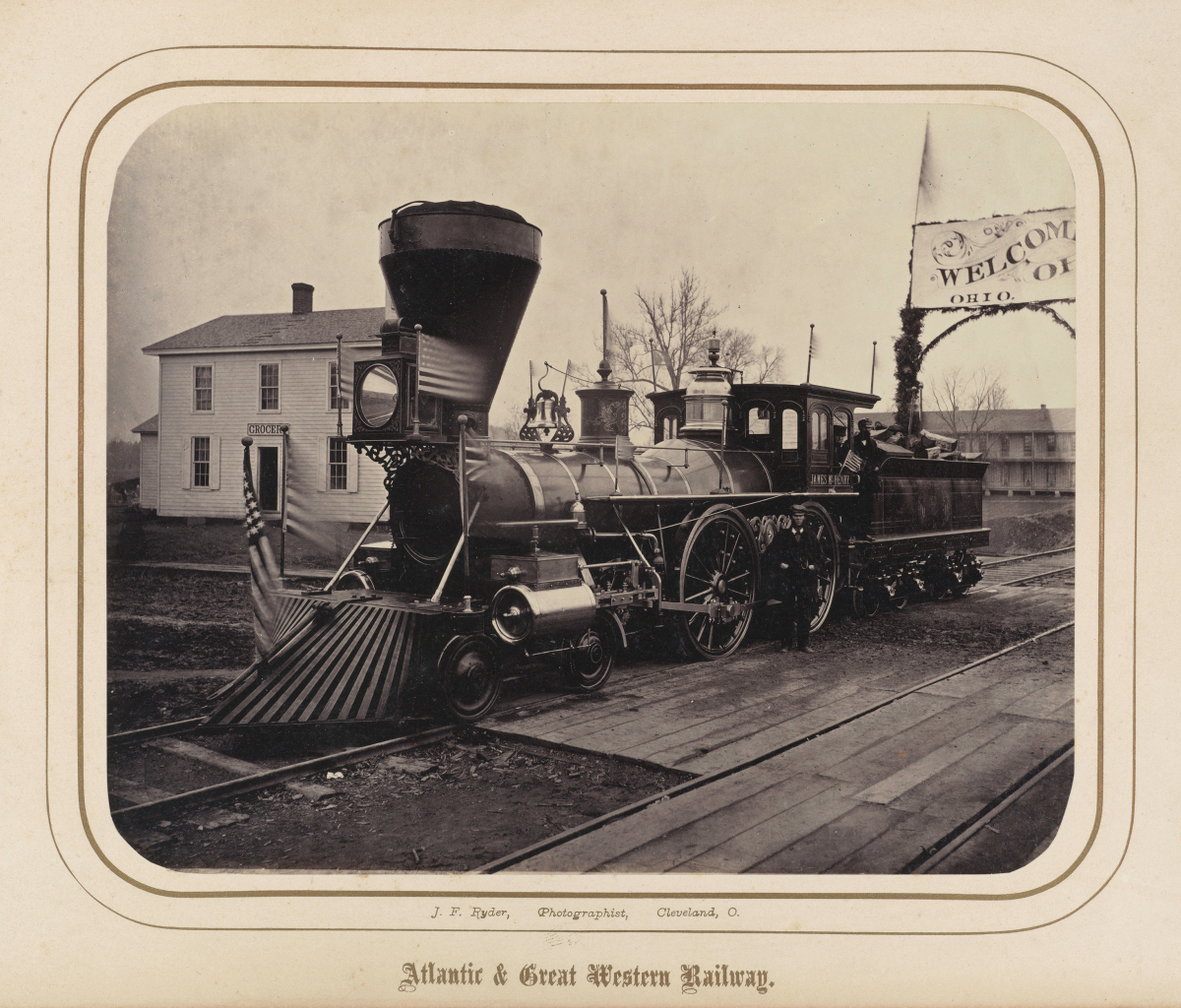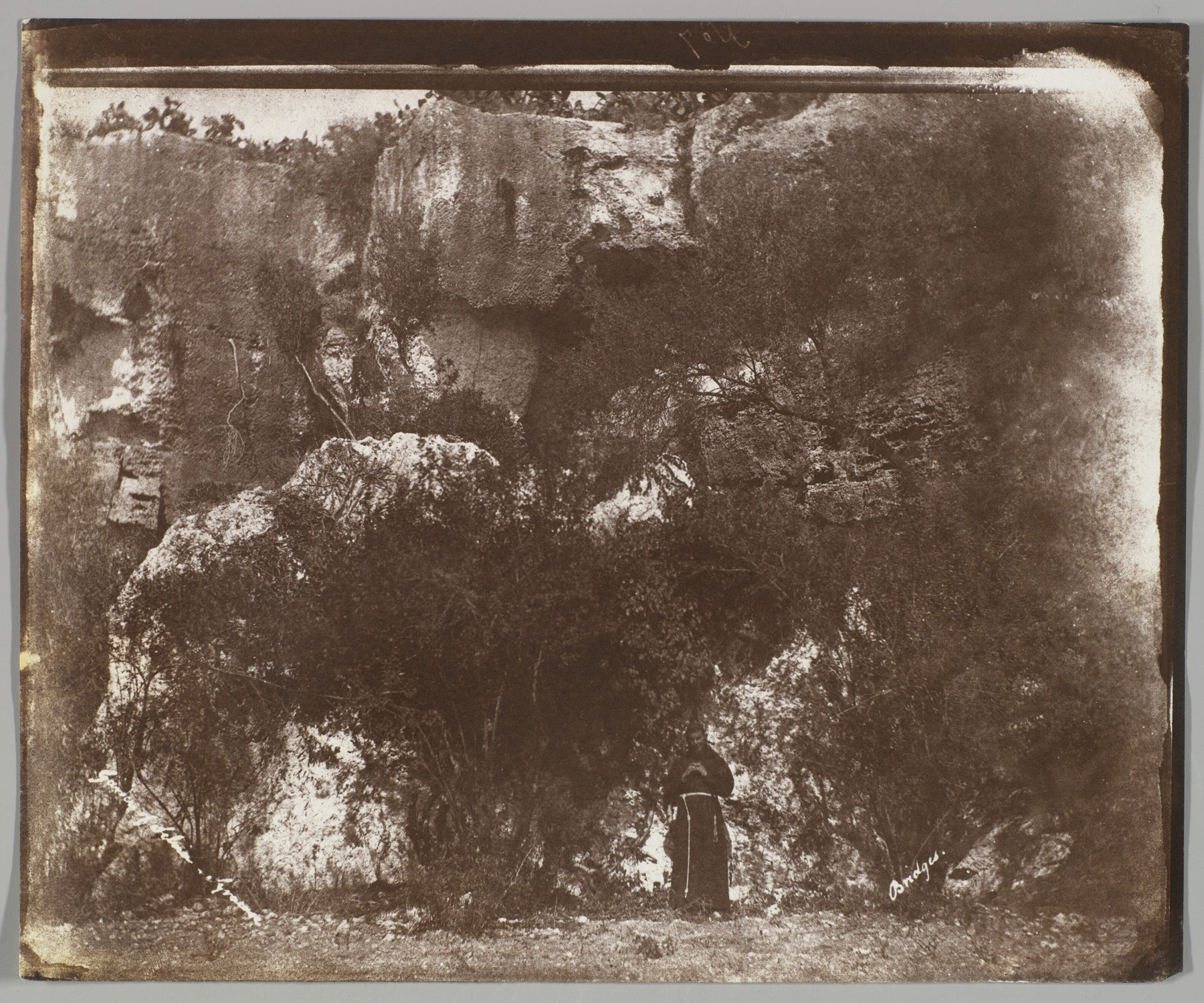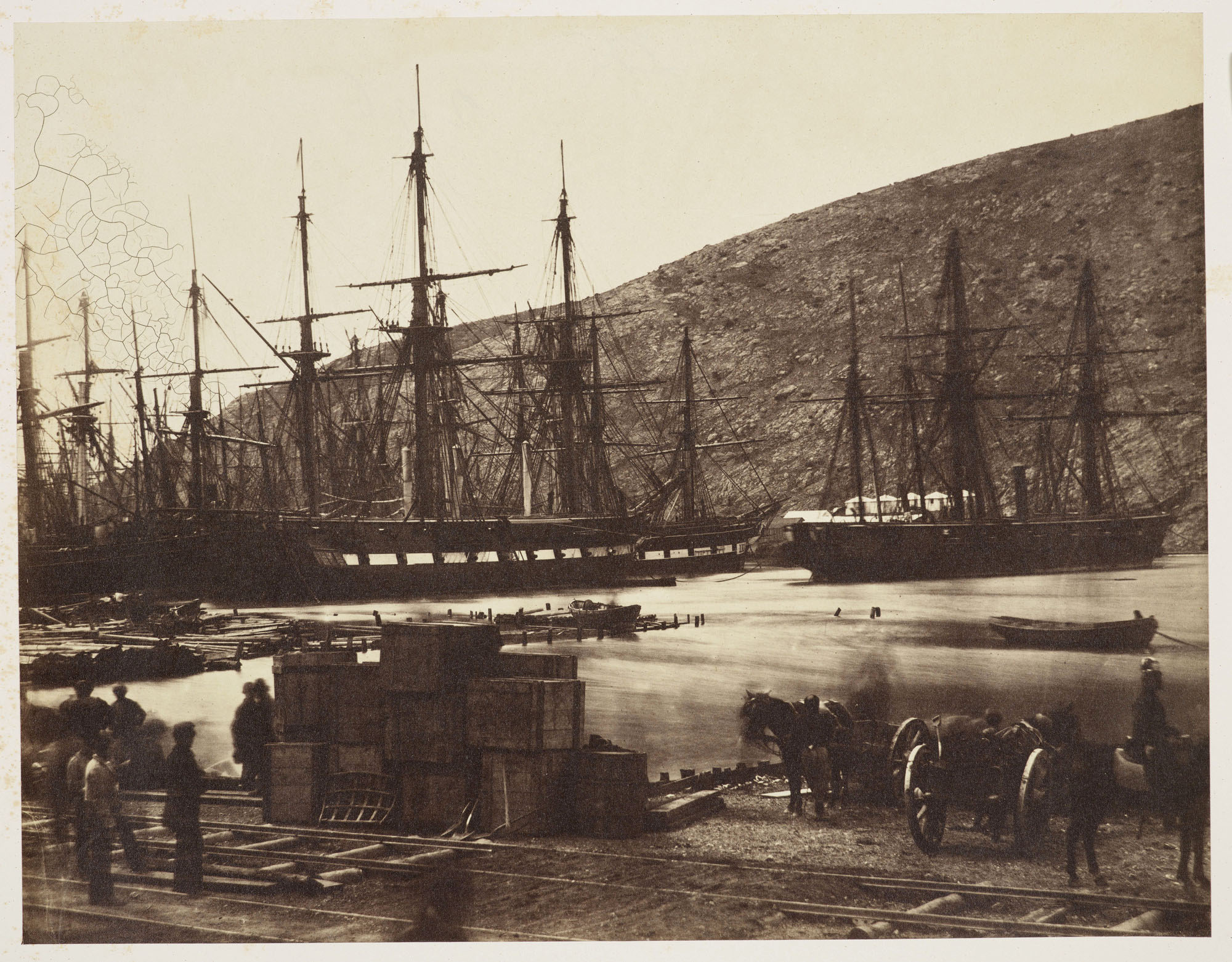
European art research tour: Pinball art at the Flippermúzeum, Budapest

Visited September 2019 posted November 2020
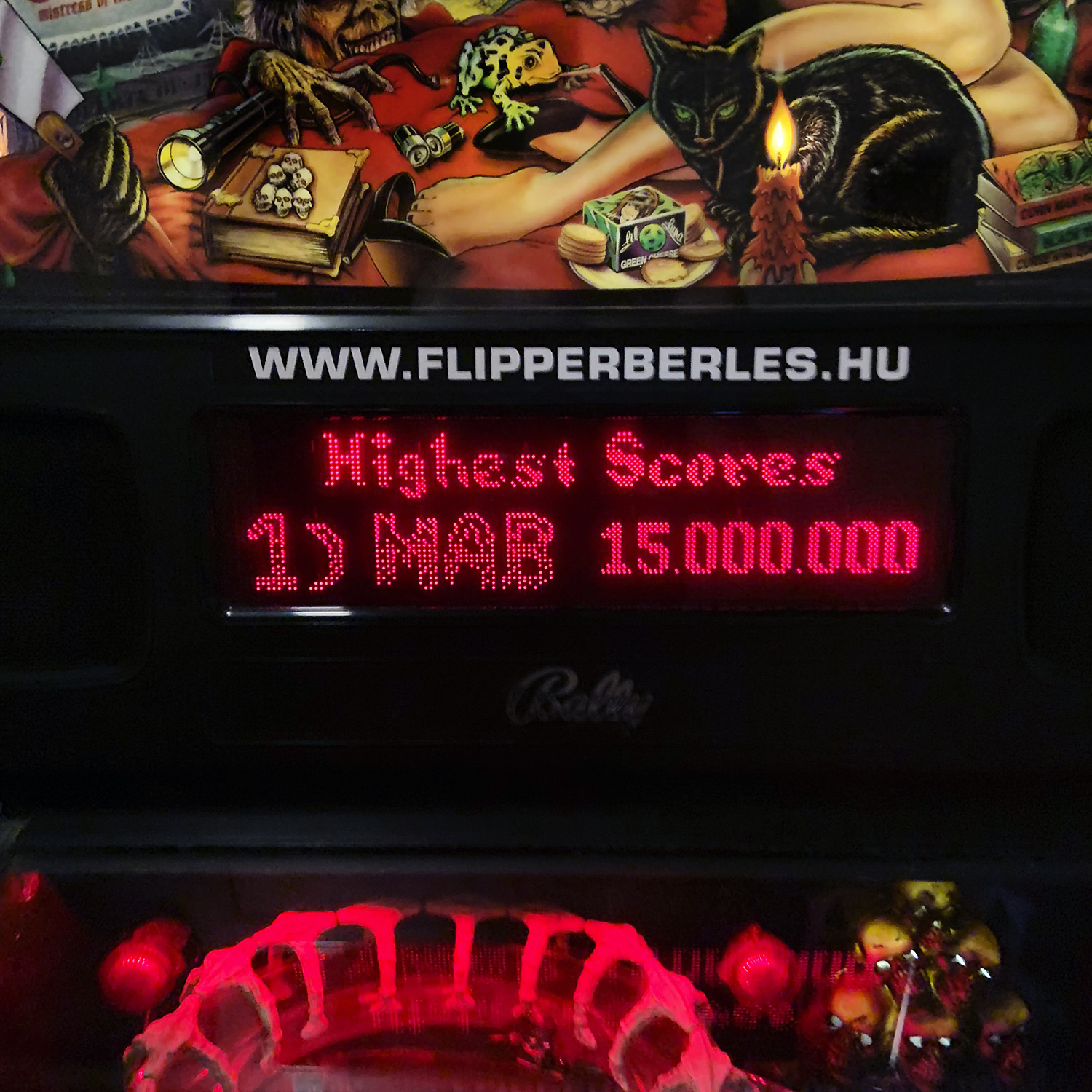
 

Bally Manufacturing Corporation. 'Scared Stiff' 1996 (detail) from the posting Pinball art at the Flippermúzeum, Budapest


Bally Manufacturing Corporation (1931-1983)
Scared Stiff (detail)
1996
Photo: Marcus Bunyan


Pinball Wizard

Thanks to playing pinball, I’ve had my name up in lights as “highest scorer” in New York, Paris and London – just like the perfume bottles – and also Melbourne, Mentone (a suburb of the city), Adelaide and various other places around the world. As luck and skill would have it, on my recent trip around Europe, I scored highest score on Scared Stiff (1996, above and below) in a gay sauna – where else you might ask! – in Budapest. A surreal experience.

Along with my friends Jeff and Woody, I have been an addicted pinball playing wizard for many years. I love the sounds, the colour, the movement; the frenzy of the multiball (during which the flashing lights and noise serve to distract the player from the position of the balls), the exultation of the knocker when you score a replay; and the ultimate elation of becoming the highest scorer on the machine. Good fun is to be had, a test of skill and concentration in order to beat the machine and score a replay.

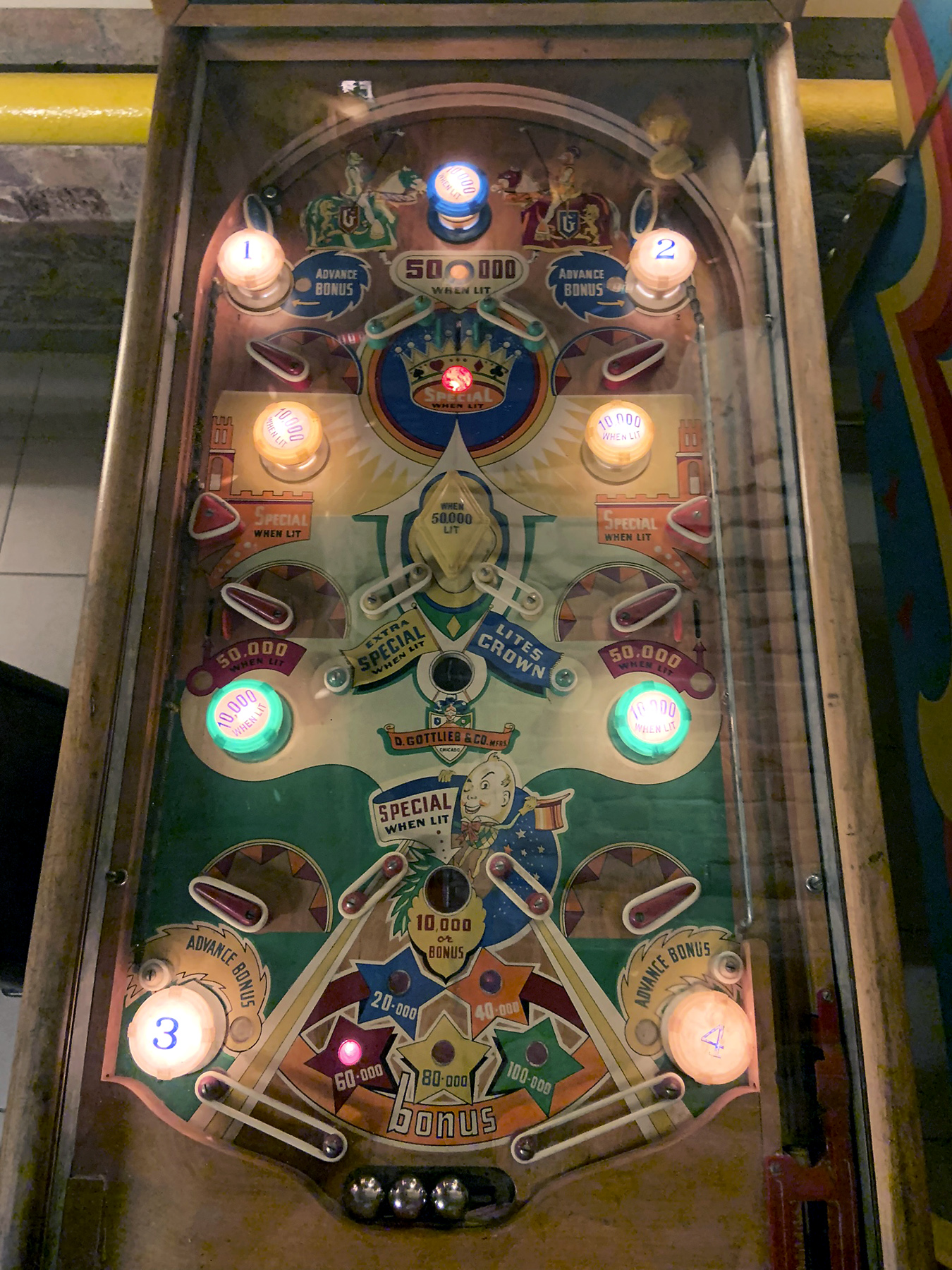
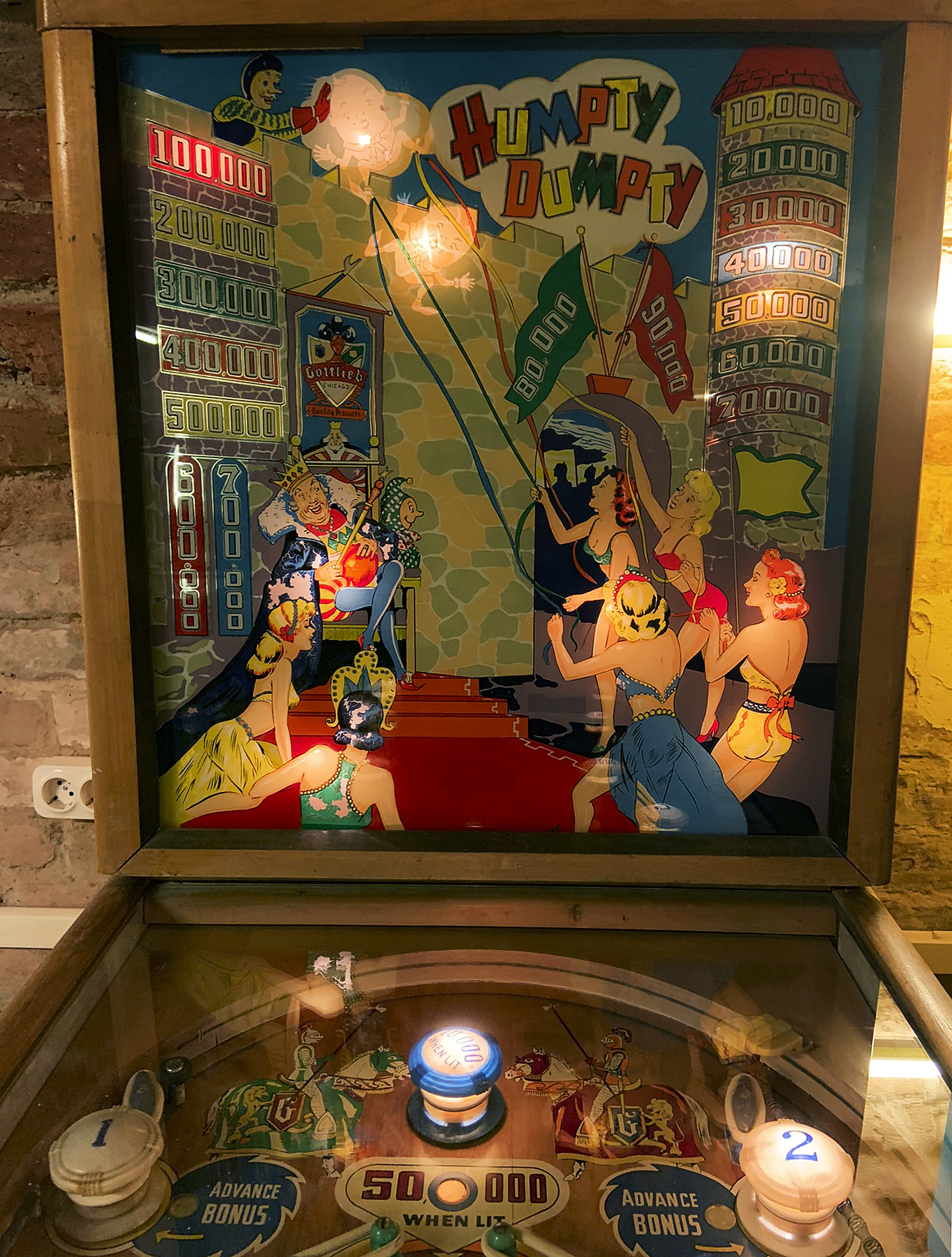
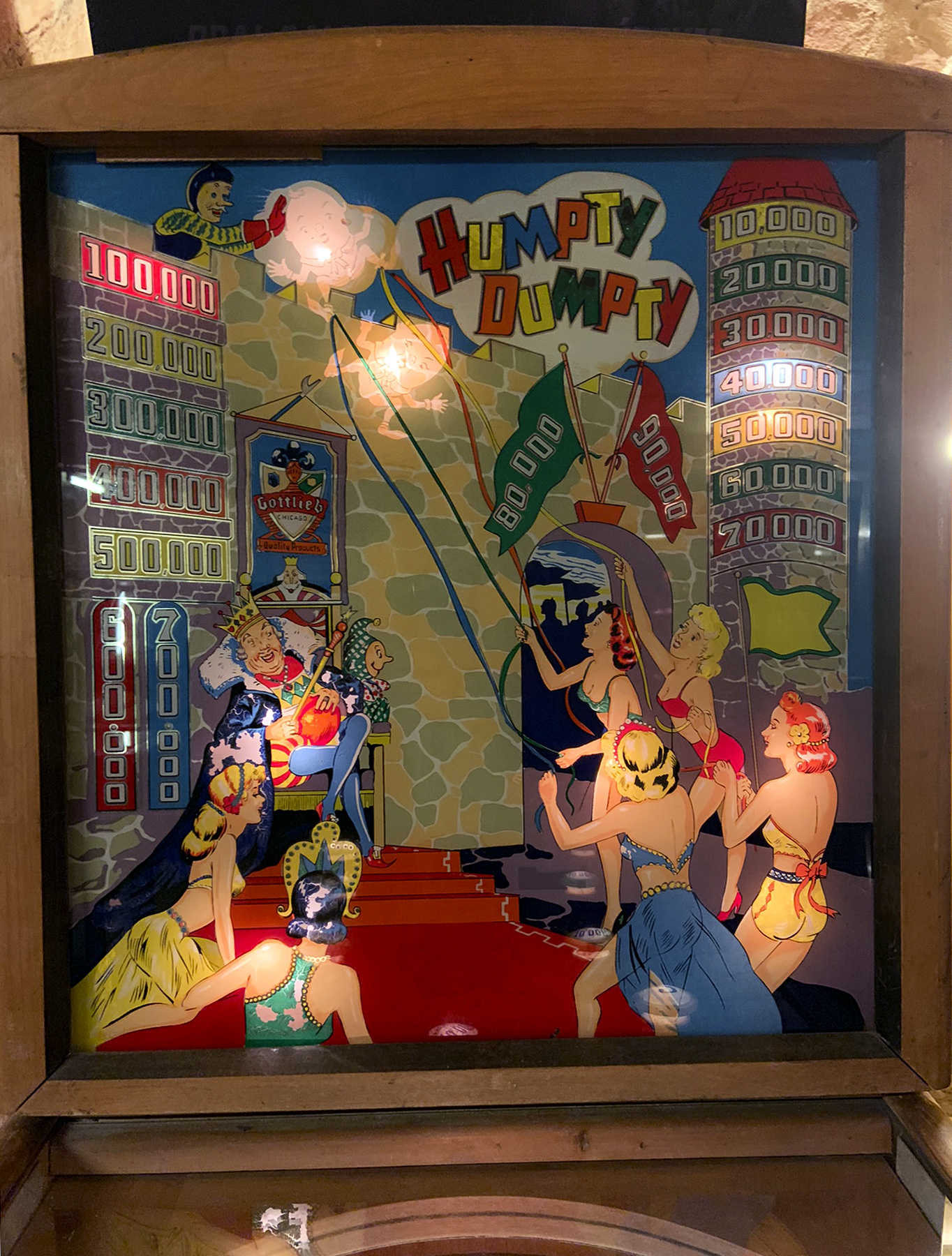
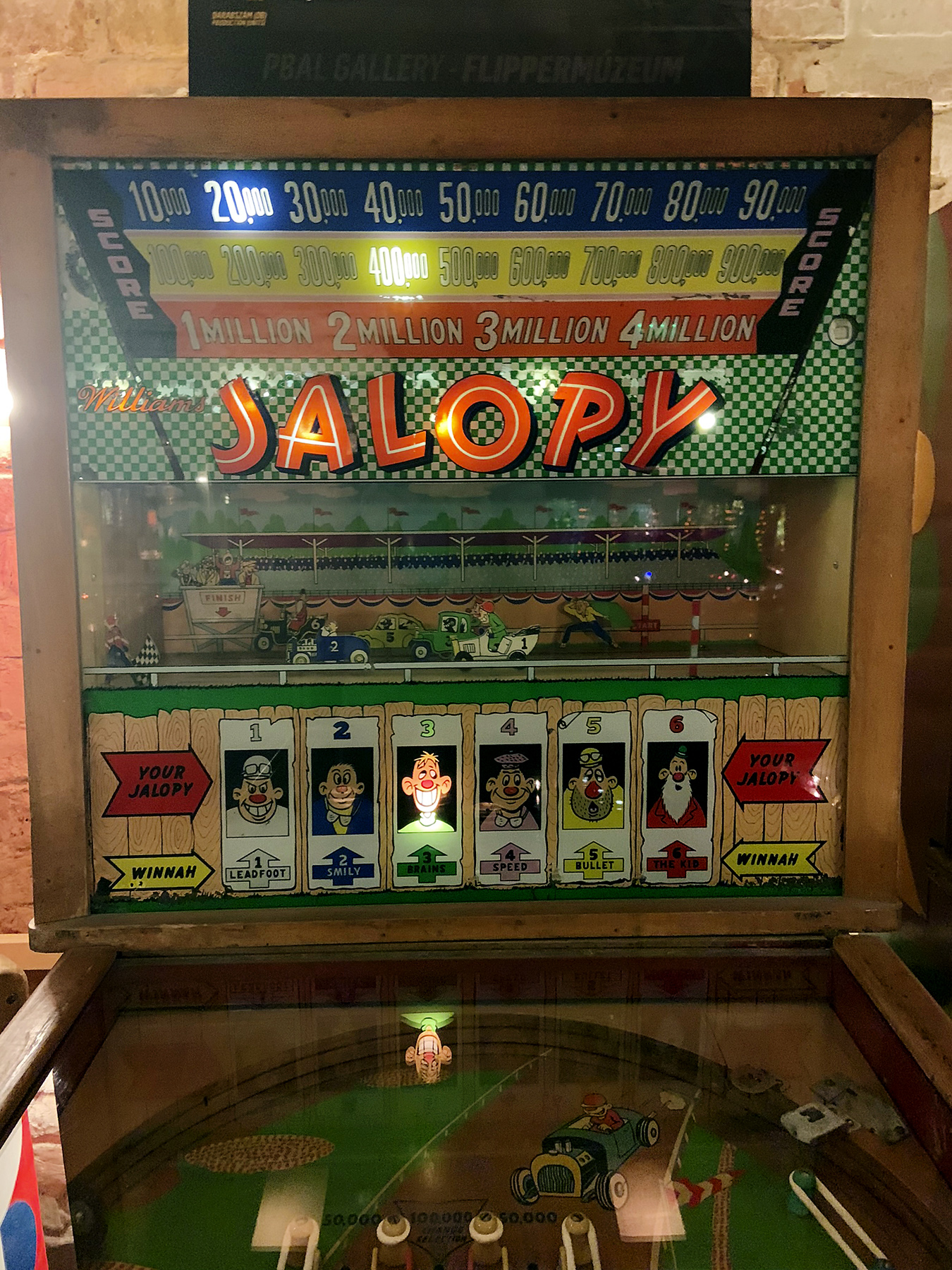
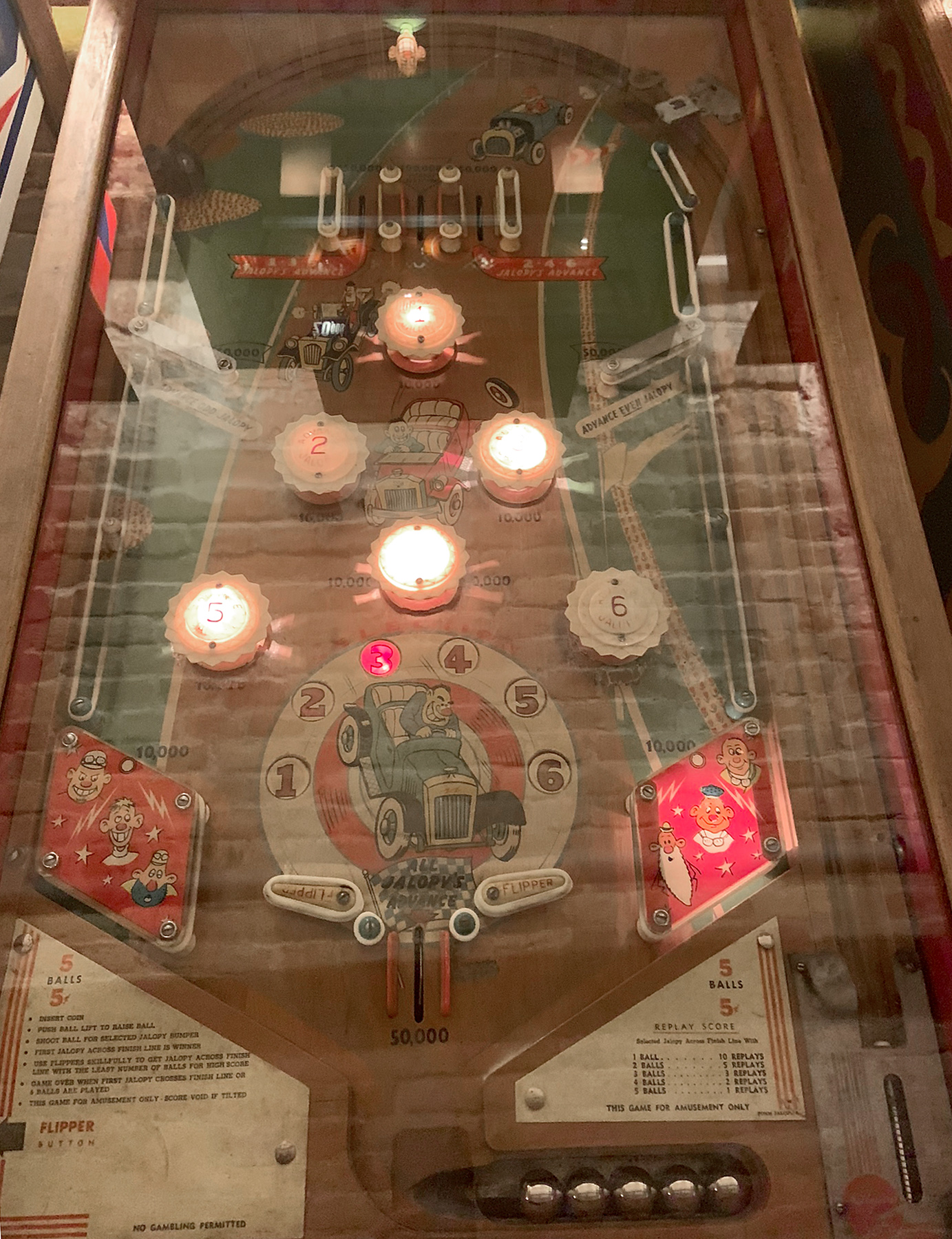
To say that I was in my element at the Flippermúzeum, Budapest is an understatement. Situated in a suitably dark underground cavern, and after paying the entry fee, you can play all the pinballs for free for as long as you want. There are “more than 140 machines, making the venue one of the biggest ongoing pinball collections in Europe… Some of the exhibition’s older pieces qualify as truly unique antiques, like the first pinball machines ever made with flippers, dating back to 1947.” Photographs of this pinball made by D. Gottlieb & Co. named Humpty Dumpty can be seen in the posting below. This is the oldest pinball I have ever played. Note that the flippers are not at the bottom of the machine, but in three pairs at the side of the machine. I found it very difficult to play, as the ball was easily lost between the large gap at the bottom, once the ball had made its way past the side mounted flippers. Other early idiosyncrasies were the outward facing flippers on Williams’ Jalopy (1951, below), and the fact that you got 5 balls for your money on the early machines, whereas today you only get 3.

The graphic art of the backglass and cabinet art add immeasurably to the playing experience. The art is linked to the theme of the particular machine and is often film, sci-fi, circus or mythically based – innovative, funny and sometimes lascivious – totally un-PC. In games up to the 1980s the eye-catching graphics would often objectify women, depicting them as playthings to be won (Genco’s Triple Action 1948, with graphic roots in the nose art of Second World War bombers), or portray them as available, large-breasted women in skimpy clothing (see Bally’s Wizard 1975; Bally’s Elvira and the Party Monsters 1989; and Bally’s Dr. Dude And His Excellent Ray 1990). In house jokes abound, such as the drum kit being named “The Bootles” in Williams’ Beat Time (1967) and “Gravestone Pizza Dig it!” in Bally’s Elvira and the Party Monsters 1989. My particular favourite graphic in this selection is Williams’ The Machine: Bride of Pinbot (1991) where humans work to repair the Metropolis-like robot, her leg lighting up in millions the closer you reach the jackpot. Completely sexist, completely over the top but fantastic, fantasy art nevertheless.

Ultimately for me, playing pinball is a complete melding between human and machine, a space where you loose yourself in the moment and movement of the ball(s), and the sights and sounds of the machine. On a good day when I am playing I become one with the machine, lost in time and space. Your concentration is so intense that nothing else matters. I remember playing a pinball up in Circular Quay in Sydney, and I was going so well that I had people two deep watching me play. What a blast!

Dr Marcus Bunyan


All iPhone images Dr Marcus Bunyan. Please click on the photographs for a larger version of the image.


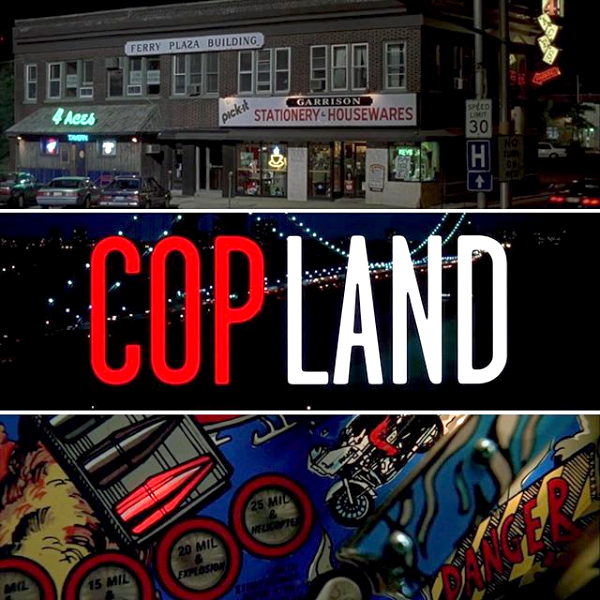
“Two kind of people in this world; pinball people and video game people. You, Freddy, you’re pinball people.”


Gary Figgis (Ray Liotta) in the movie Cop Land (1997)
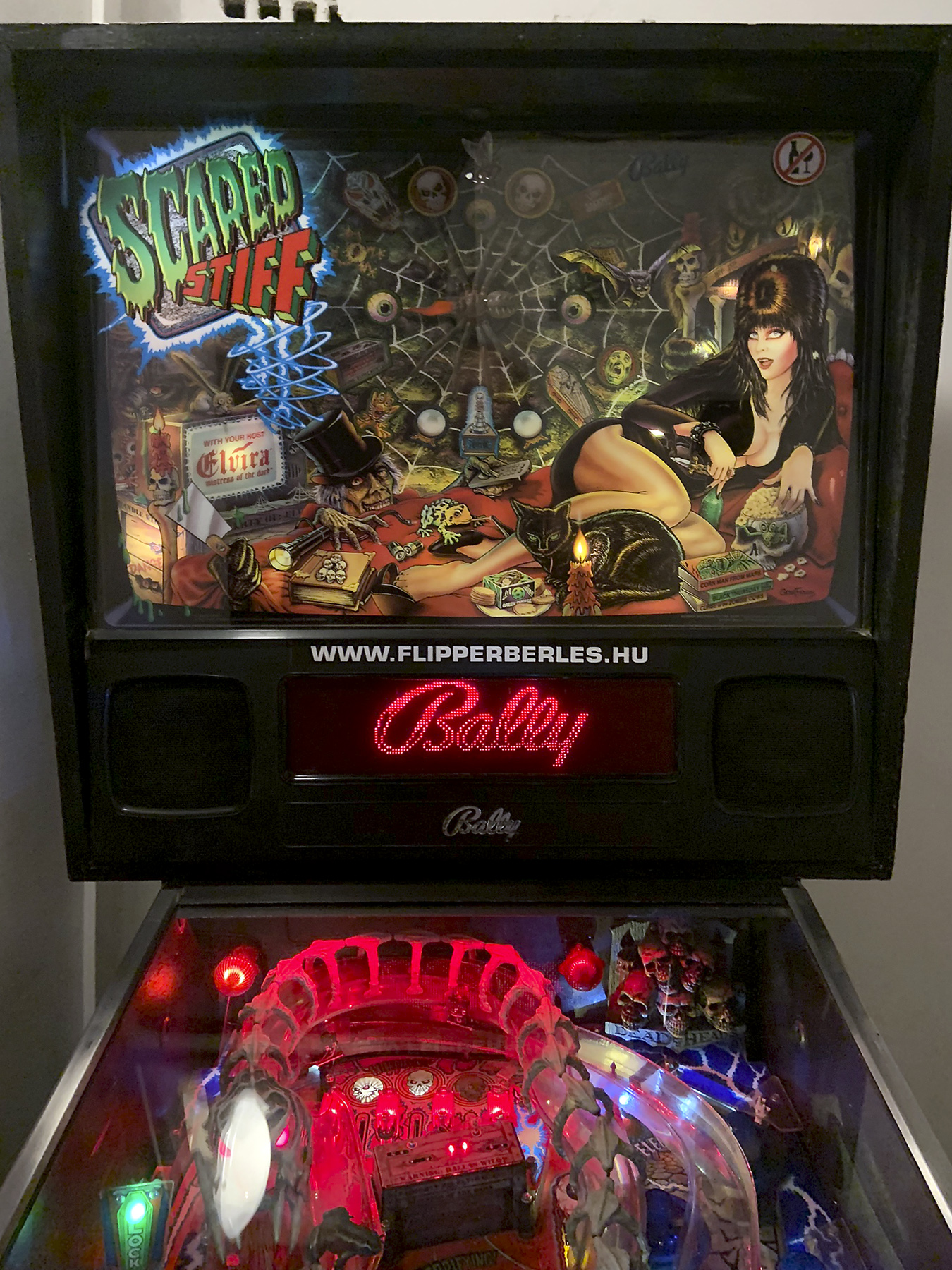


Bally Manufacturing Corporation 'Scared Stiff' 1996 (detail) from the posting Pinball art at the Flippermúzeum, Budapest


Bally Manufacturing Corporation (1931-1983)
Scared Stiff (detail)
1996
Photo: Marcus Bunyan
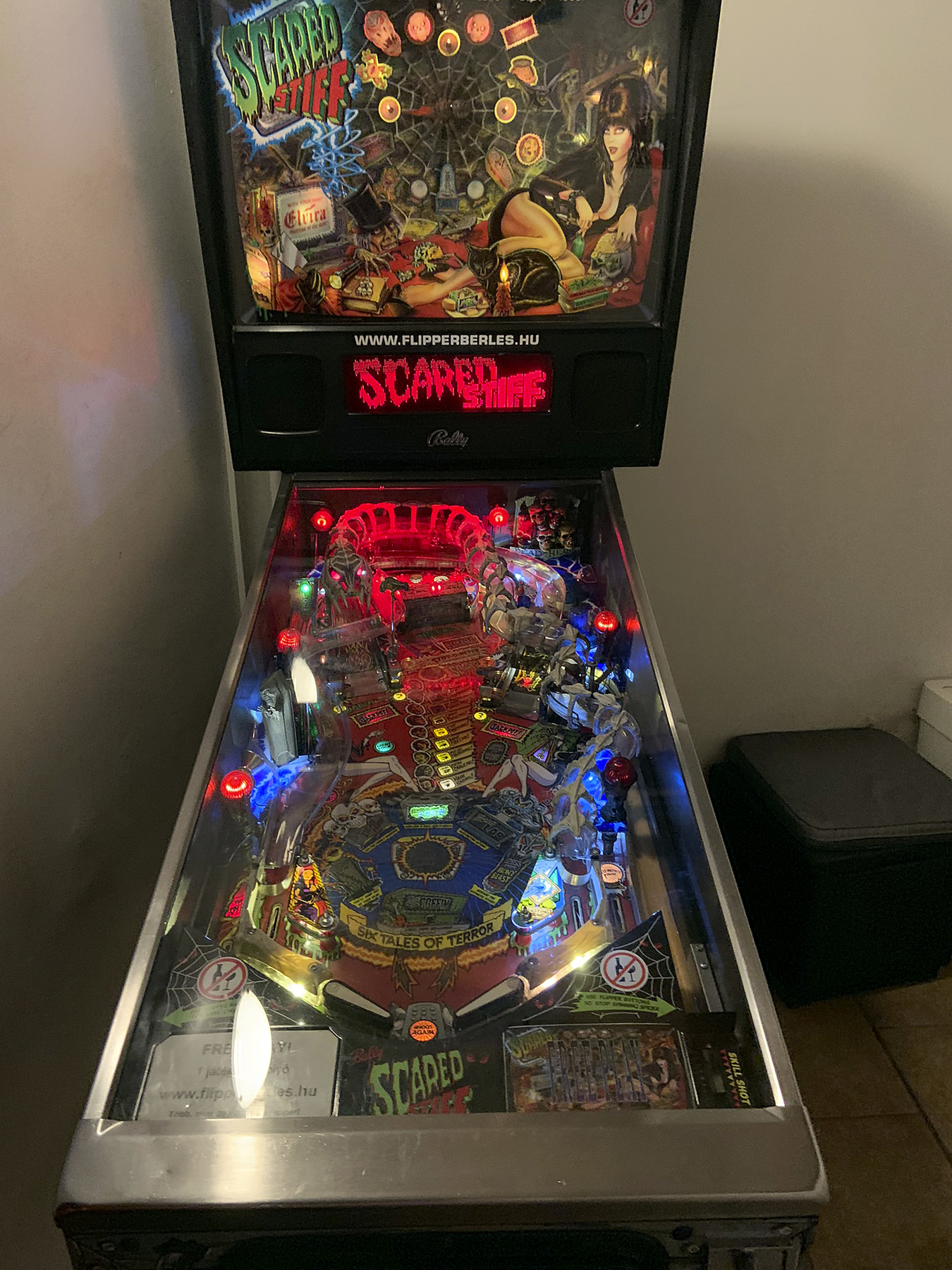
 

Bally Manufacturing Corporation 'Scared Stiff' 1996


Bally Manufacturing Corporation (1931-1983)
Scared Stiff (detail)
1996
Photo: Marcus Bunyan


“So fun, It’s Scary!”
“Elvira has the features that turn players on.”


Special scores

High score lists: If a player attains one of the highest scores ever (or the highest score on a given day), they are invited to add their initials to a displayed list of high-scorers on that particular machine. “Bragging rights” associated with being on the high-score list are a powerful incentive for experienced players to master a new machine.

Pinball designers also entice players with the chance to win an extra game or replay. Ways to get a replay might include the following:

Replay Score: An extra game is rewarded if the player exceeds a specified score. Some machines allow the operator to set this score to increase with each consecutive game in which the replay score is achieved, in order to prevent a skilled player from gaining virtually unlimited play on one credit by simply achieving the same replay score in every game.

Special: A mechanism to get an extra game during play is usually called a “special.” Typically, some hard-to-reach feature of the game will light the outlanes (the areas to the extreme left and right of the flippers) for special. Since the outlanes always lose the ball, having “special” there makes it worth shooting for them (and is usually the only time, if this is the case).

Match: At the end of the game, if a set digit of the player’s score matches a random digit, an extra game is rewarded. In earlier machines, the set digit was usually the ones place; after a phenomenon often referred to as score inflation had happened (causing almost all scores to end in 0), the set digit was usually the tens place. The chances of a match appear to be 1 in 10, but the operator can alter this probability – the default is usually 7% in all modern Williams and Bally games for example. Other non-numeric methods are sometimes used to award a match.

High Score: Most machines award 1-3 bonus games if a player gets on the high score list. Typically, one or two credits are awarded for a 1st – 4th place listing, and three for the Grand Champion.

When an extra game is won, the machine typically makes a single loud bang, most often with a solenoid that strikes a piece of metal, or the side of the cabinet, with a rod, known as a knocker, or less commonly with loudspeakers. “Knocking” is the act of winning an extra game when the knocker makes the loud and distinctive noise.

Text from the Wikipedia website
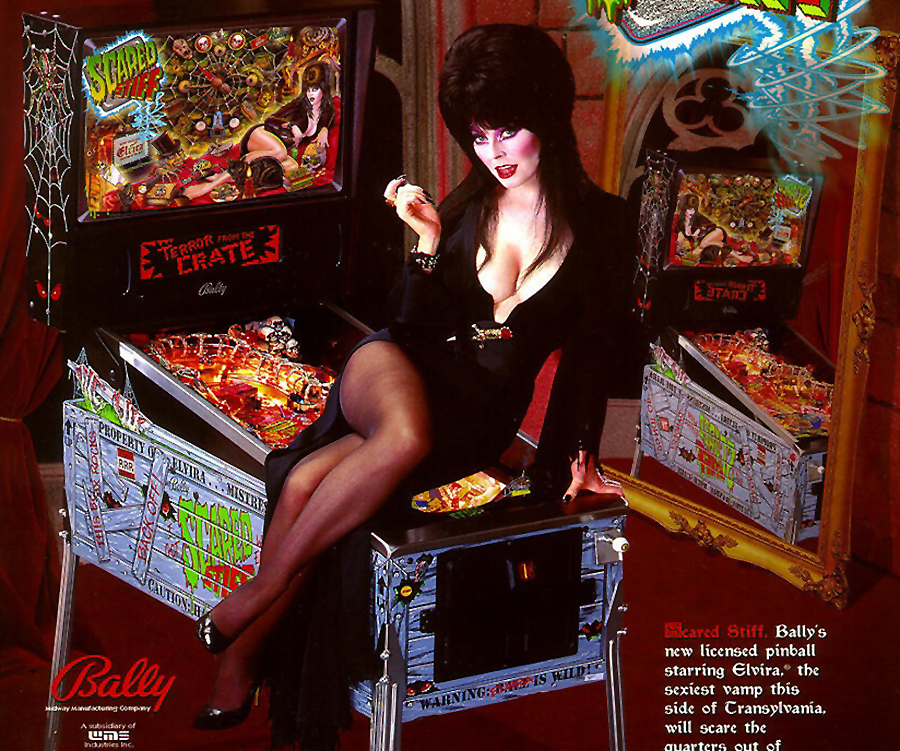
 

Scared Stiff pinball flyer


Bally flyer for the Scared Stiff pinball (1996)

“The Sexiest Vampire this side of Transylvania”
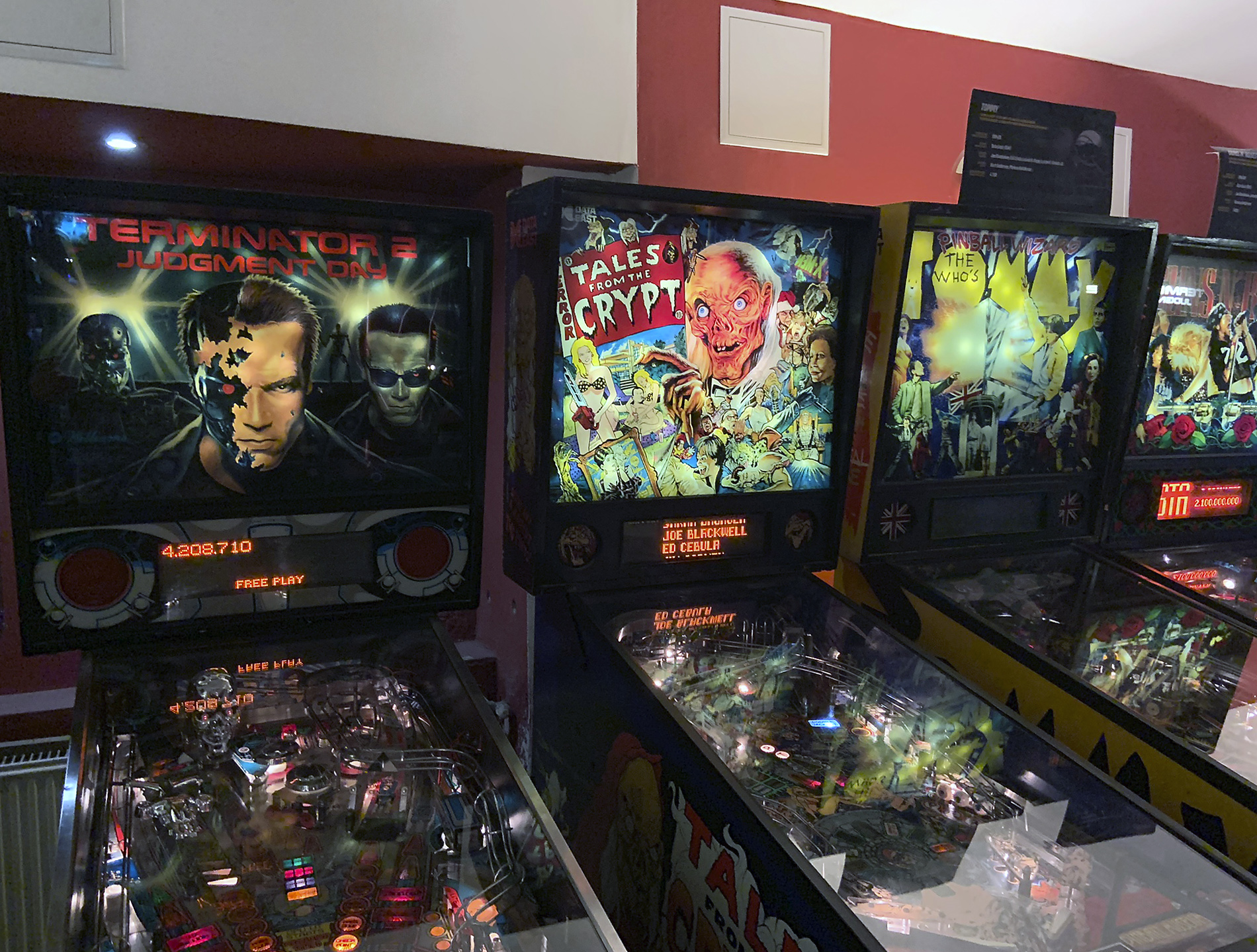
 

Installation view of the exhibition of pinball art at the Flippermúzeum, Budapest showing from left to right, Williams Terminator 2: Judgment Day (1991); Data East USA, Inc. Tales from the Crypt (1993); Data East USA, Inc. The Who's Tommy Pinball Wizard (1994)


Installation view of the exhibition of pinball art at the Flippermúzeum, Budapest showing from left to right, Williams Terminator 2: Judgment Day (1991); Data East USA, Inc. Tales from the Crypt (1993); Data East USA, Inc. The Who’s Tommy Pinball Wizard (1994)
Photo: Marcus Bunyan
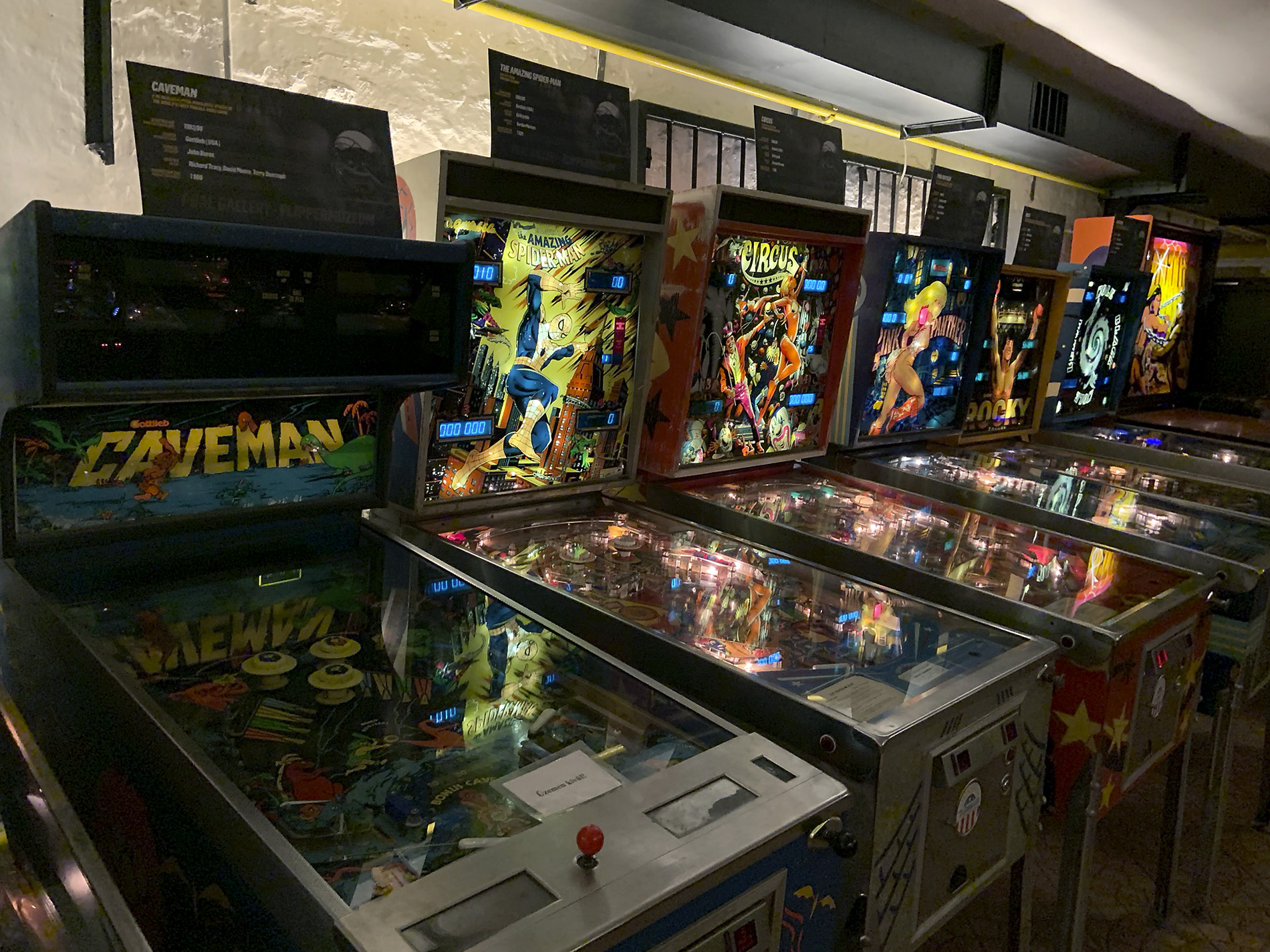
 

Installation view of the exhibition of pinball art at the Flippermúzeum, Budapest showing from left to right, Gottlieb's 'Caveman' (1982); Gottlieb's the 'Amazing Spiderman' (1980); Gottlieb's 'Circus' (1980); Gottlieb's 'Pink Panther' (1981); and Gottlieb's 'Rocky' (1982)


Installation view of the exhibition of pinball art at the Flippermúzeum, Budapest showing from left to right, Gottlieb’s Caveman (1982); Gottlieb’s the Amazing Spiderman (1980); Gottlieb’s Circus (1980); Gottlieb’s Pink Panther (1981); and Gottlieb’s Rocky (1982)
Photo: Marcus Bunyan
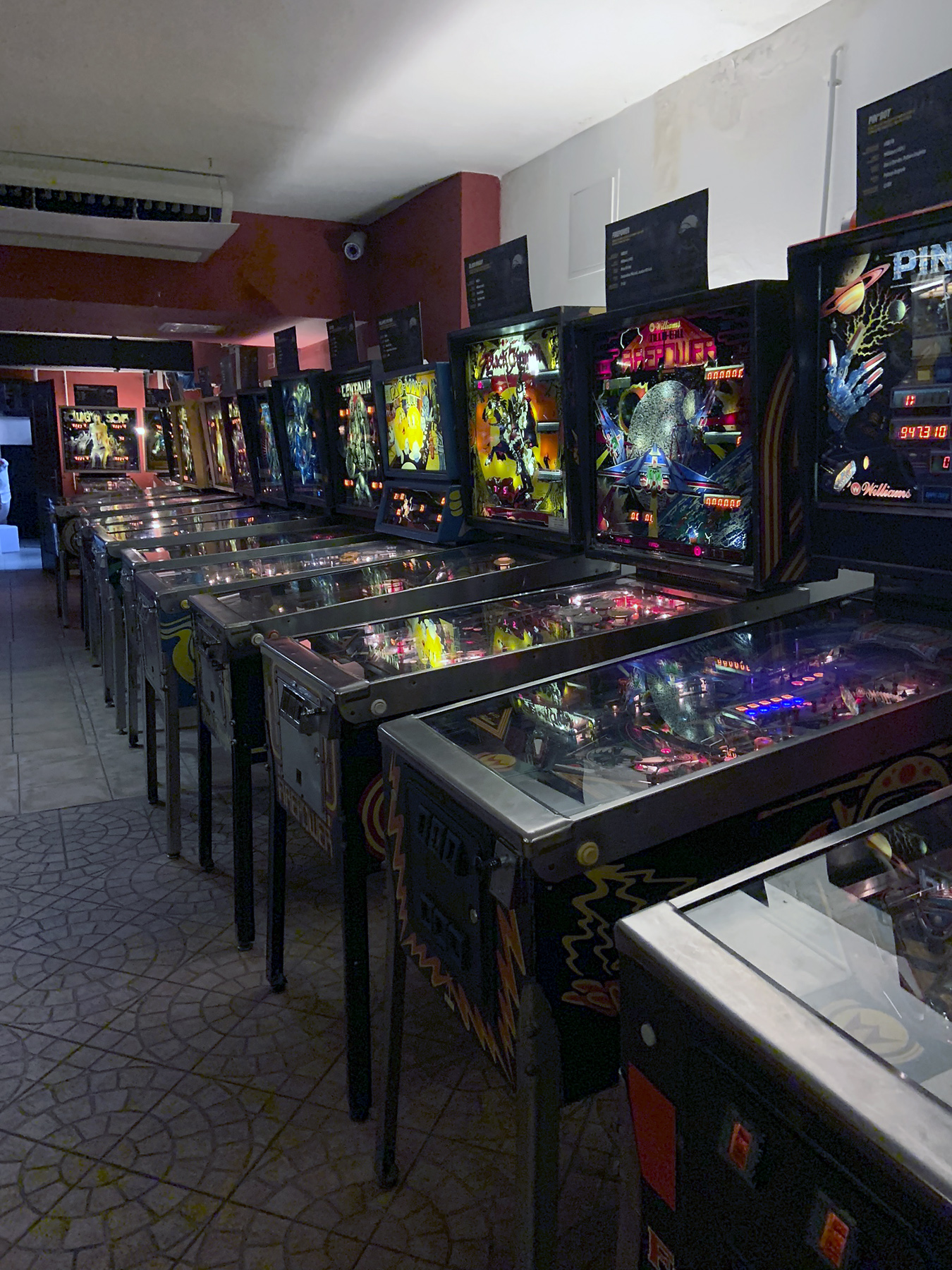
 

Installation view of the exhibition of pinball art at the Flippermúzeum, Budapest


Installation view of the exhibition of pinball art at the Flippermúzeum, Budapest
Photo: Marcus Bunyan
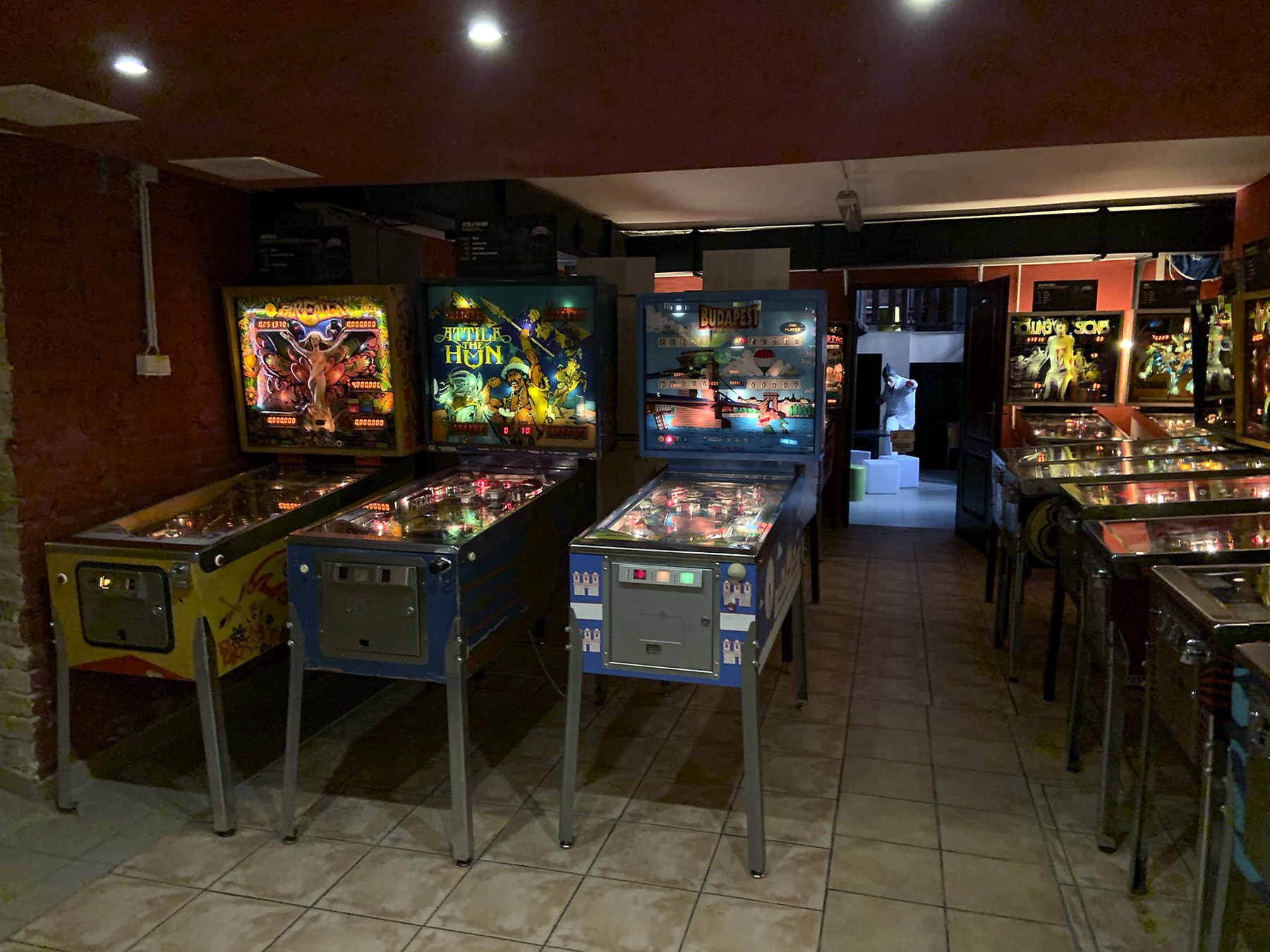
 

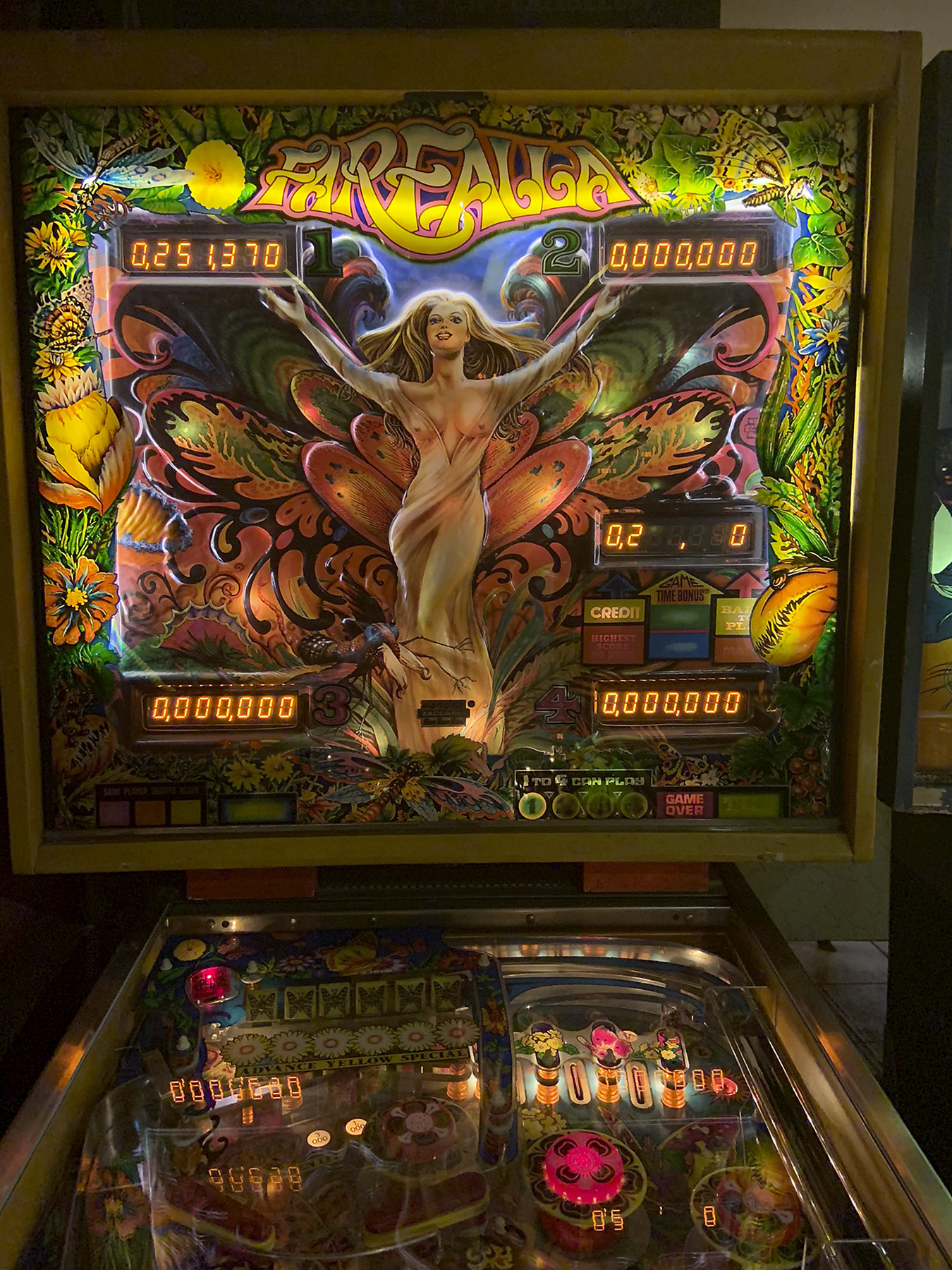
Installation view of the exhibition of pinball art at the Flippermúzeum, Budapest showing at left, Zaccaria's 'FarFalla' (1983); at second left, Game Plan, Inc. 'Attila the Hun' (1984); and at right back, Bally's 'Rolling Stones' (1980)


Installation view of the exhibition of pinball art at the Flippermúzeum, Budapest showing at left, Zaccaria’s FarFalla (1983); at second left, Game Plan, Inc. Attila the Hun (1984); and at right back, Bally’s Rolling Stones (1980)
Photo: Marcus Bunyan
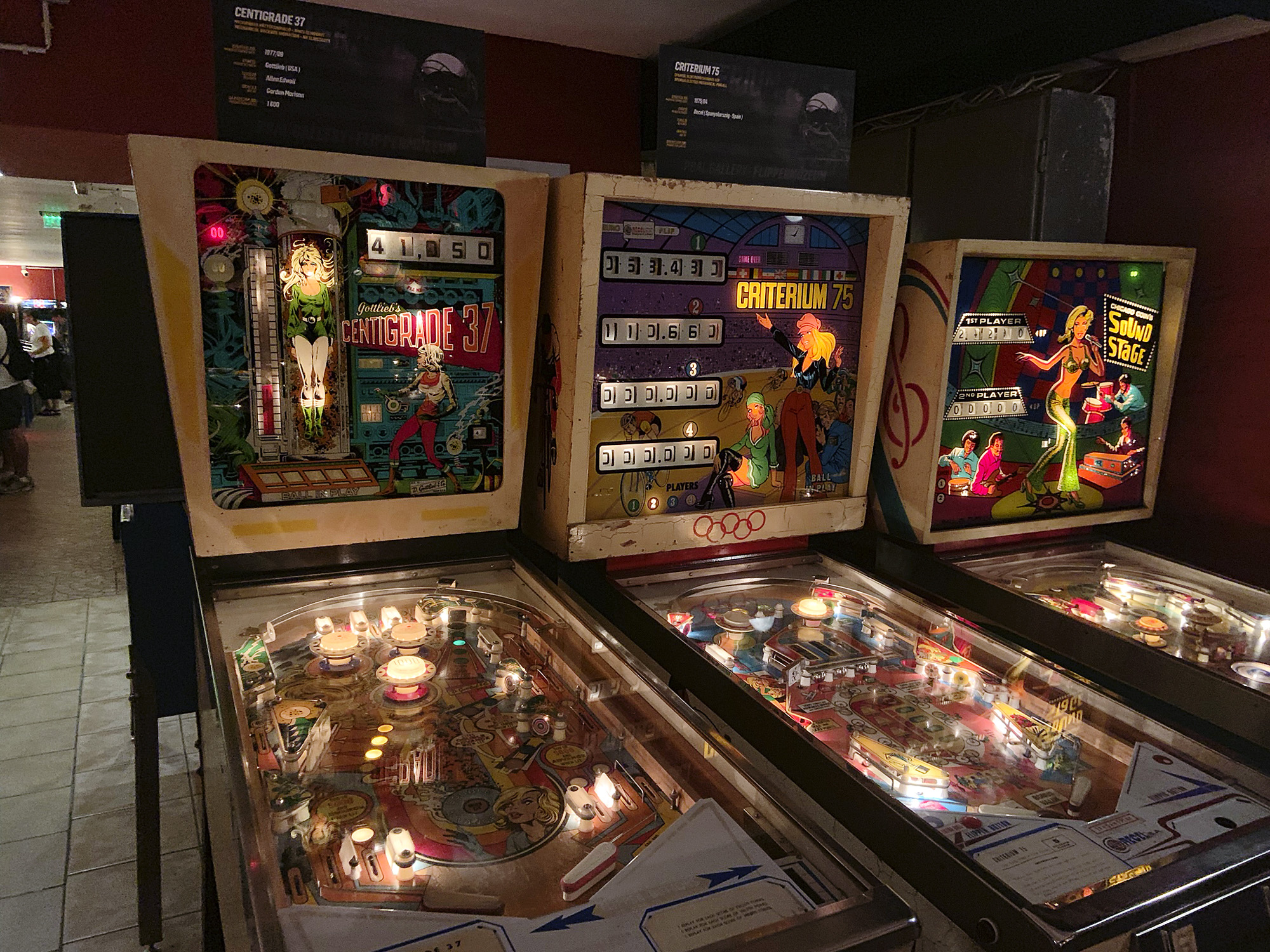
 

Installation view of the exhibition of pinball art at the Flippermúzeum, Budapest showing from left to right, Gottlieb's 'Centigrade 37' (1977); Recel S. A. 'Criterium 75' (1978); Chicago Coin Machine Mfg. Co. 'Sound Stage' (1976)


Installation view of the exhibition of pinball art at the Flippermúzeum, Budapest showing from left to right, Gottlieb’s Centigrade 37 (1977); Recel S. A. Criterium 75 (1978); Chicago Coin Machine Mfg. Co. Sound Stage (1976)
Photo: Marcus Bunyan
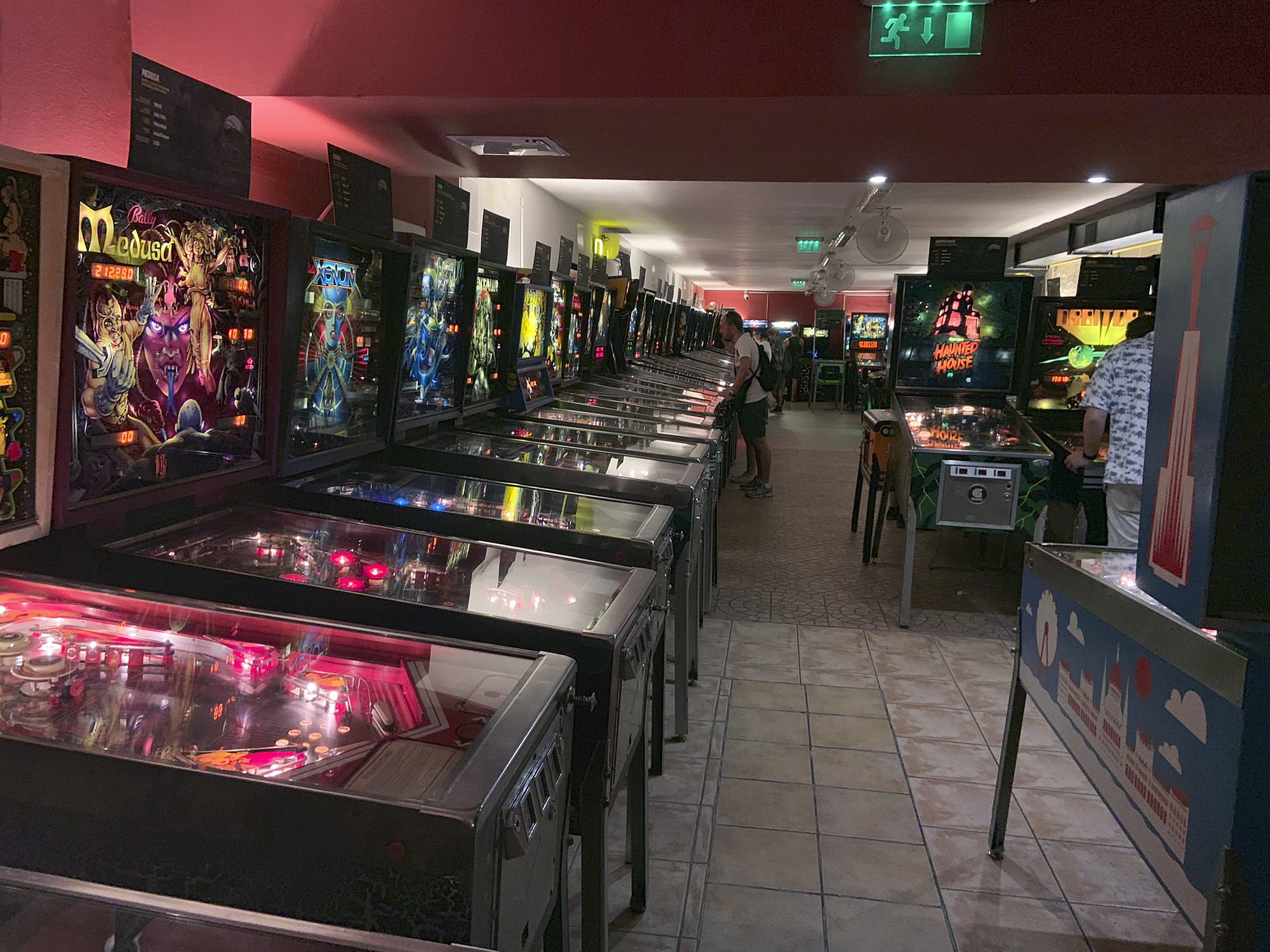
 

Installation view of the exhibition of pinball art at the Flippermúzeum, Budapest showing at left, Bally's 'Medusa' (1981); and at second left, Bally's 'Xenon' (1980); and at right, Gottlieb's 'Haunted House' (1982)


Installation view of the exhibition of pinball art at the Flippermúzeum, Budapest showing at left, Bally’s Medusa (1981); and at second left, Bally’s Xenon (1980); and at right, Gottlieb’s Haunted House (1982)
Photo: Marcus Bunyan
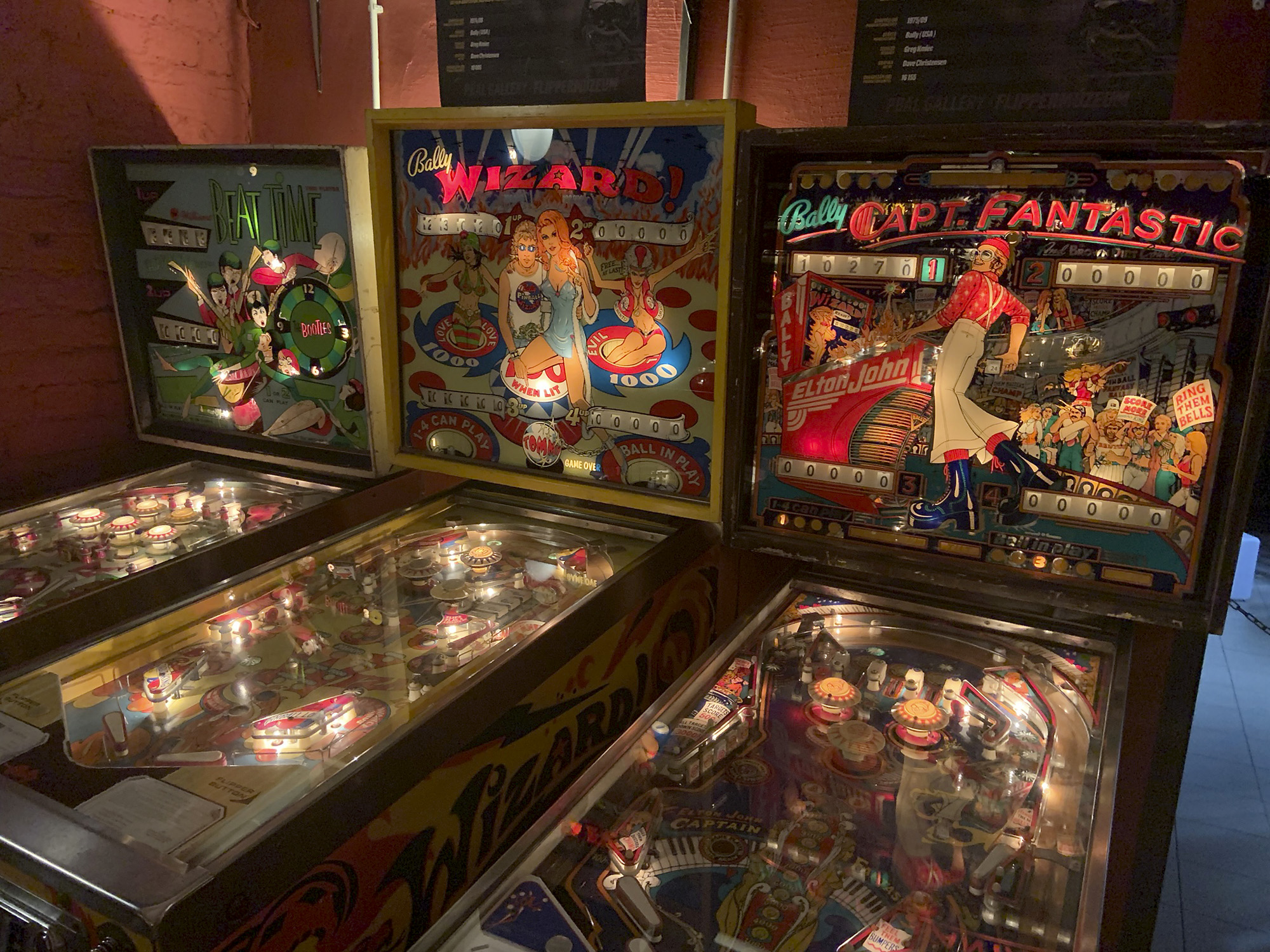
 

Installation view of the exhibition of pinball art at the Flippermúzeum, Budapest showing from left to right, Williams 'Beat Time' (1967); Bally's 'Wizard! featuring Ann Margret and Roger Daltrey' (1975); and Bally's 'Capt. Fantastic and the Dirt Brown Cowboy featuring Elton John' (1976)


Installation view of the exhibition of pinball art at the Flippermúzeum, Budapest showing from left to right, Williams Beat Time (1967); Bally’s Wizard! featuring Ann Margret and Roger Daltrey (1975); and Bally’s Capt. Fantastic and the Dirt Brown Cowboy featuring Elton John (1976)
Photo: Marcus Bunyan


Budapest Pinball Museum magnet


Budapest Pinball Museum magnet


Budapest Pinball Museum

Budapest Pinball Museum deploys more than 140 machines (pinball, arcade video cabinets and other games), making the venue one of the biggest ongoing pinball collections in Europe. All of our games are set to free play. Some of the exhibition’s older pieces qualify as truly unique antiques, like the first pinball machines ever made with flippers, dating back to 1947. Some of pinball’s predecessors are also on display, such as the unique bagatelles from the 1880s. It is the most popular museum in Hungary, usually in the top 10 out of some 600 Budapest tourist attractions on Tripadvisor.

Pinballs are time machines

It might as well be the occasion of an anniversary. It was a quarter of a century ago that legendary Data East marketed a pinball called the Time Machine. This name has got a symbolic meaning ever since. Today all pinballs have transformed into a time machine, remnants of an old age. Their natural environment, the arcade has been outdated since then, yet we can find an ever increasing number of pinballs at collectors.

The moment that dwells in our memories will never pass, never fade away: the moment as we were standing in front of the machines or waiting our turn at the arcade. Beyond the lights, colours and sounds of pinballs, a mystical children’s dreamworld is still shaping for us. A dreamworld that is still alive in us adults, even as we read this.

This dreamworld, these lights, these colours and sounds will be reawaken by our ‘time machines’, at our carefully selected exhibition. Our inner Child is inviting us for an encounter we will never forget.

It was the 70’s: that’s where my love for pinball has really started, by the way. I have encountered first with these tinkling machines at camp sites and arcades of my childhood. Pinballs have been thrilling me ever since: anytime the opportunity arises, I try new ones out. I have met many people during the last four years who share my passion for pinball. This also encouraged me to set up an ‘institute’, with pinballs playing the main role, offering however, experiences also for those interested in the history of technology and for the pinball rookie.

In April 2013 I have finally succeeded in my endeavours: I was granted license to open the museum / exhibition. Pbal Gallery opened at last to the public on April 10th, 2014.

You’re welcome to join an unforgettable time travel at the gallery!

Balázs Pálfi (owner)

Text from the Flippermúzeum, Budapest [Online] Cited 03/11/2020
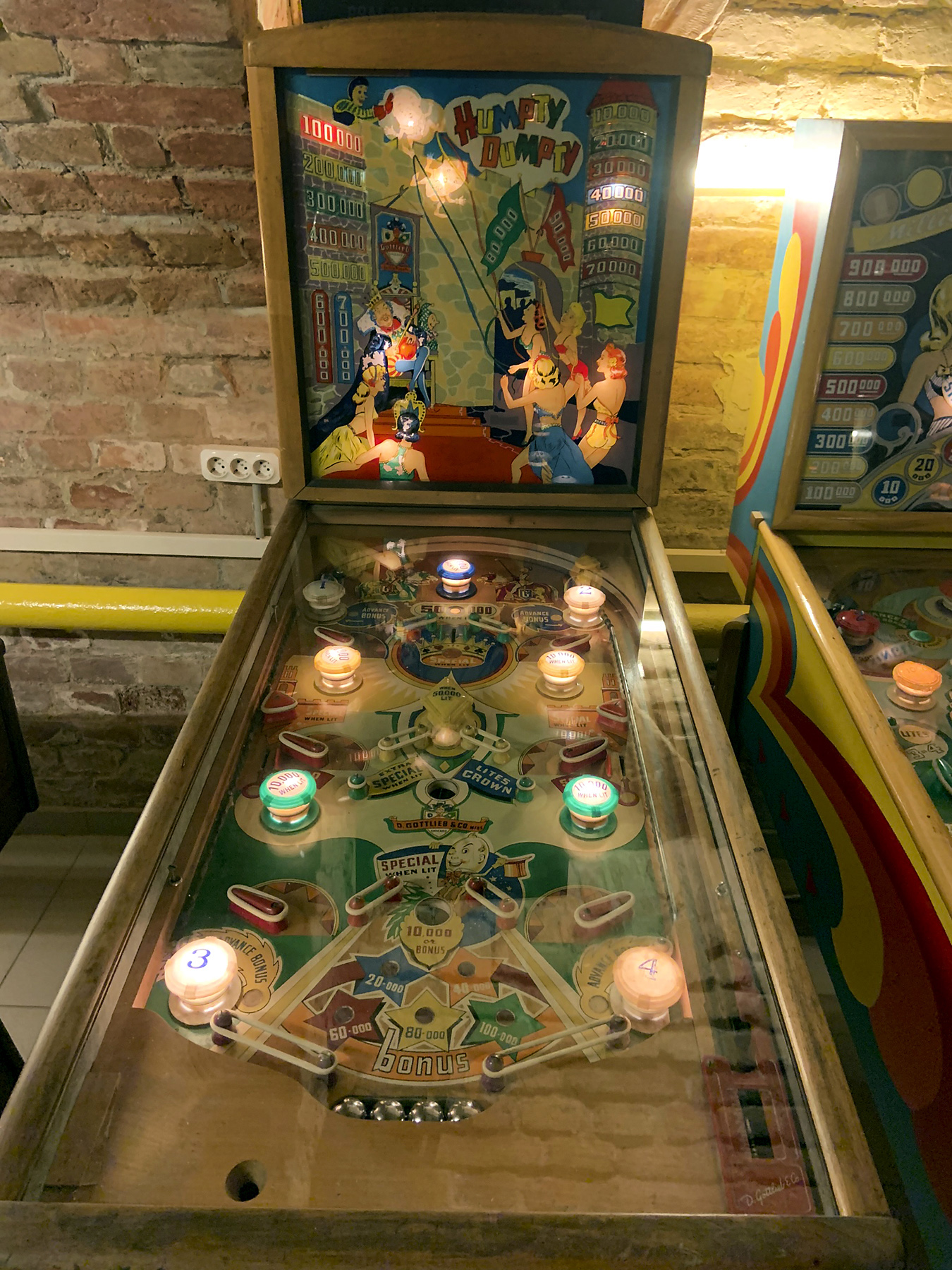
 

Gottlieb. 'Humpty Dumpty' 1947

Gottlieb. 'Humpty Dumpty' 1947 (detail)

Gottlieb. 'Humpty Dumpty' 1947 (detail)

Gottlieb. 'Humpty Dumpty' 1947 (detail)


D. Gottlieb & Co. (1931-1977)
Humpty Dumpty
1947
6,500 produced
Photos: Marcus Bunyan


“Announcing… The Greatest Triumph in Pin Game History – Sensationally New Player Controlled Flipper Bumpers..The player will Laugh! The Spectator will Roar! The operator will be Thrilled!”

The very first FLIPPER Game. Harry Mabs invented the Flipper with this machine.

This is the oldest pinball I have ever played. Note that the flippers are not at the bottom of the machine, but in three pairs at the side of the machine. I found it very difficult to play, as the ball was easily lost between the large gap.
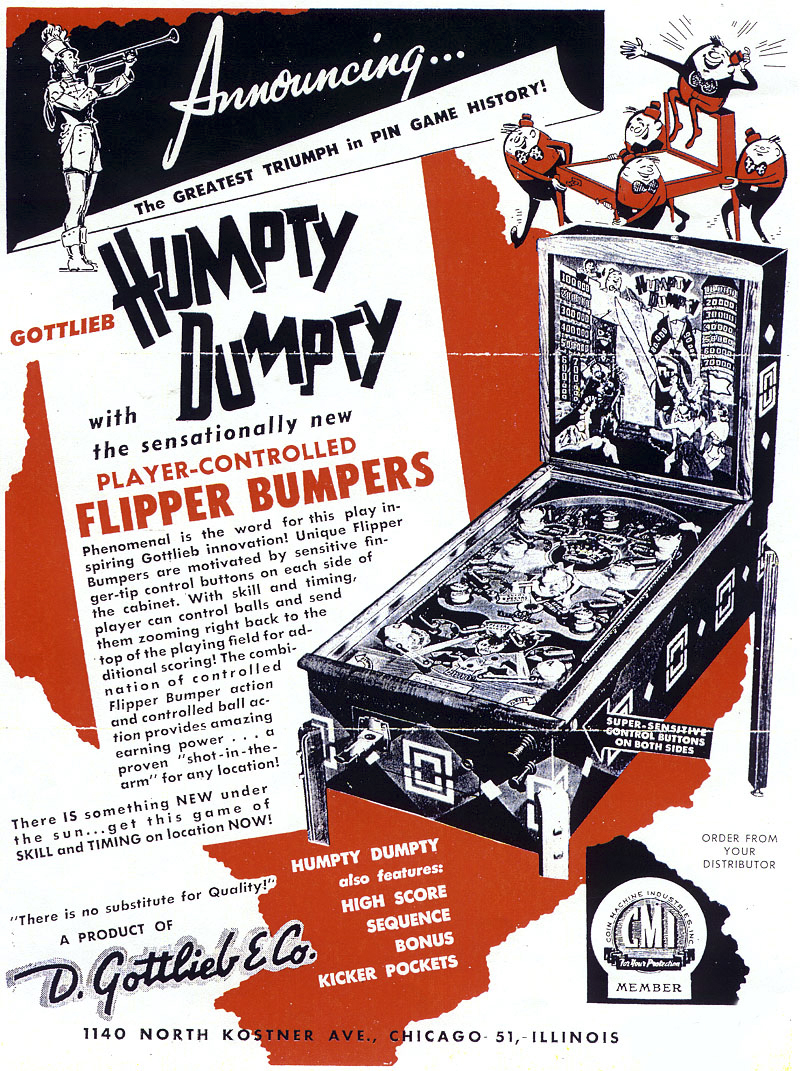
 

Humpty Dumpty pinball flyer


Humpty Dumpty flyer


Williams Electronic Games, Inc. 'Jalopy' 1951 (detail)

Williams Electronic Games, Inc. 'Jalopy' 1951 (detail)


Williams Electronic Games, Inc. (1967-1985)
Jalopy
1951
Photos: Marcus Bunyan


Note the outward facing flippers, and the non-central exit lanes. Also, this is a five ball game, whereas later games are only 3 ball games. If you get a replay in 1 ball, you get 10 free replays. YOUR JALOPY is a WINNAH!
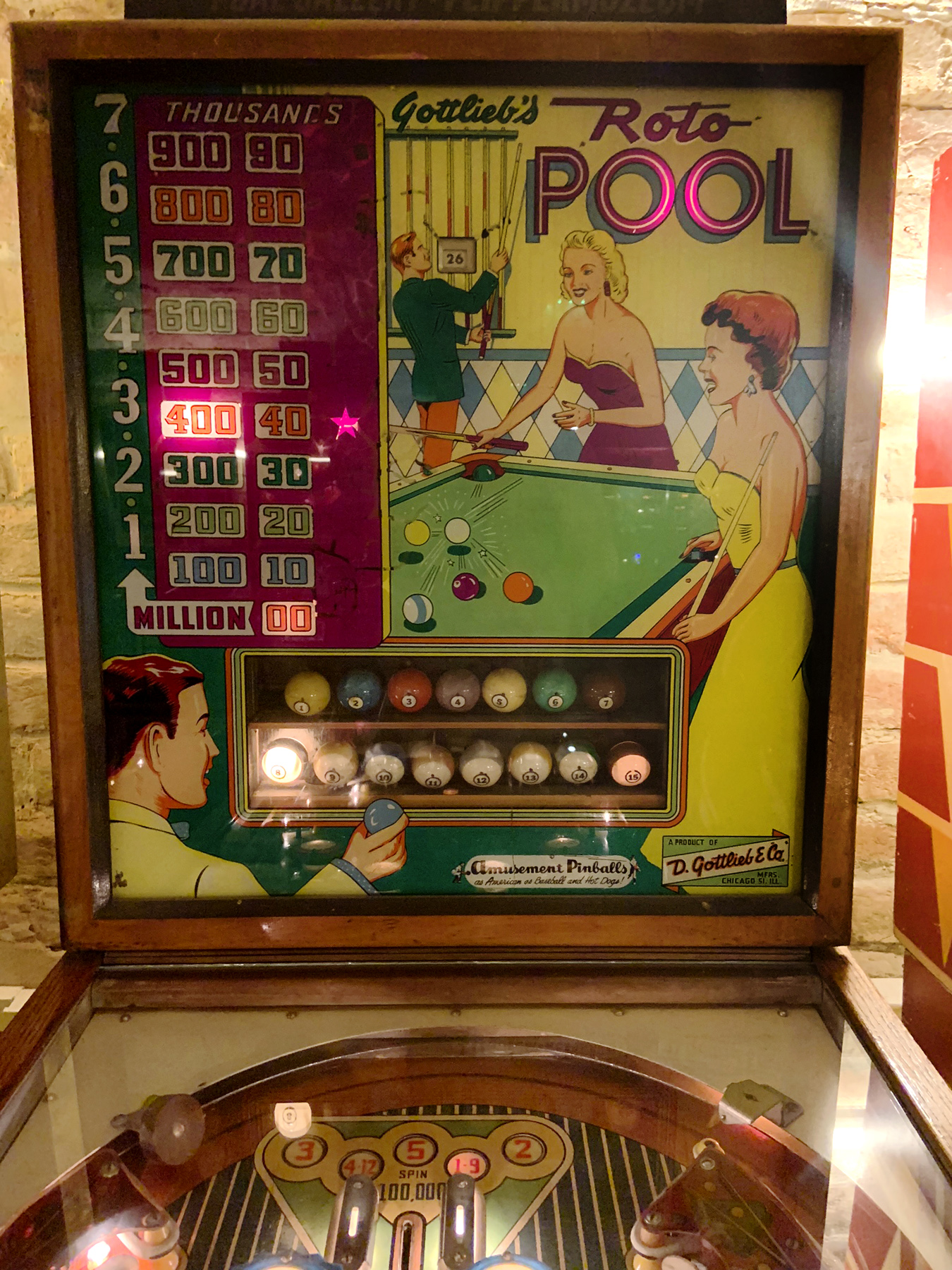
 

D. Gottlieb & Co. 'Roto Pool' 1958 (detail)


D. Gottlieb & Co. (1931-1977)
Roto Pool (detail)
1958
Photo: Marcus Bunyan
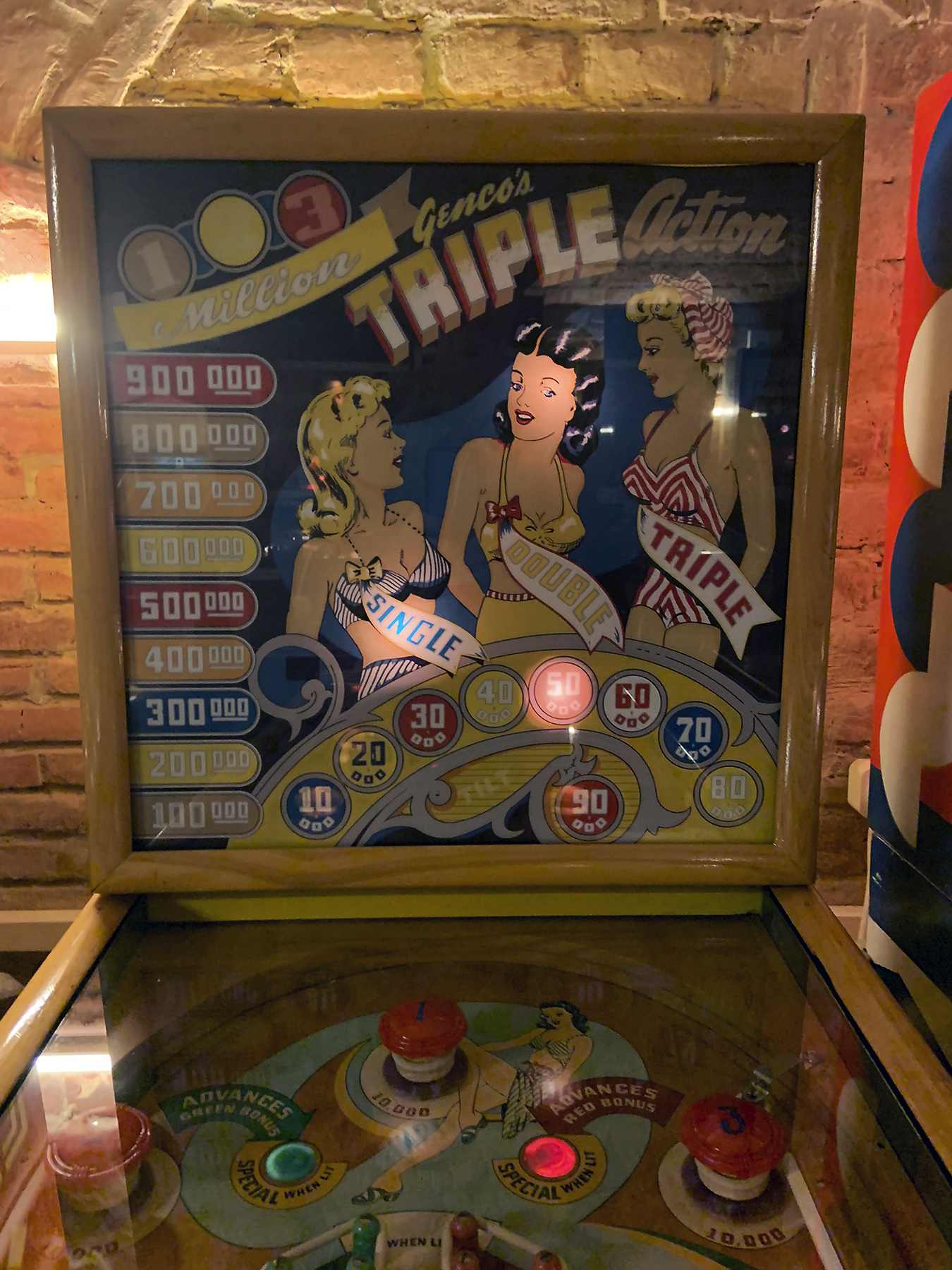
 

Genco Manufacturing Company (Chicago, Illinois, USA, 1931-1958) 'Triple Action' 1948 (detail)


Genco Manufacturing Company (Chicago, Illinois, USA, 1931-1958)
Triple Action
1948
Photo: Marcus Bunyan
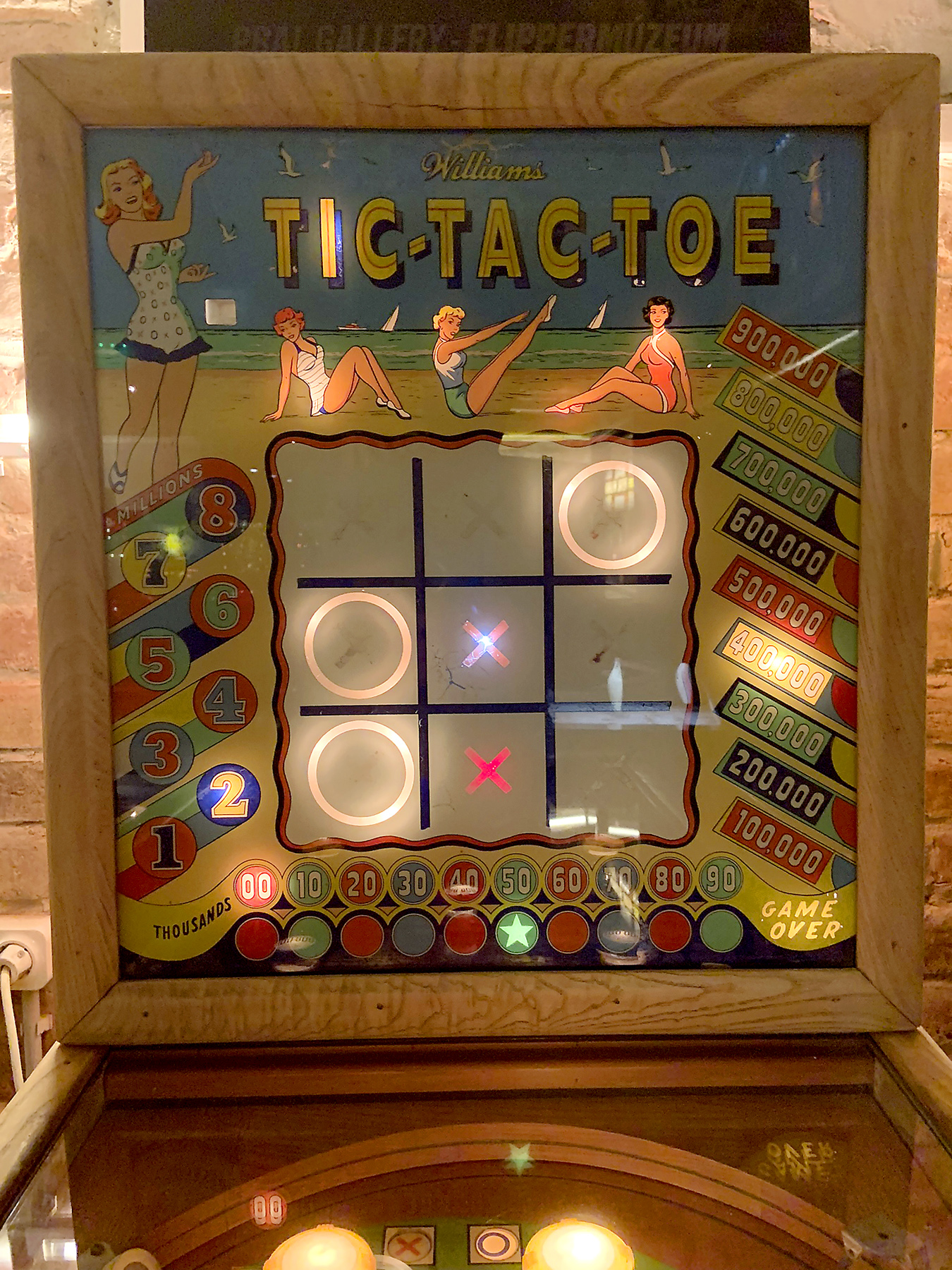
 

Williams Electronic Games, Inc. 'Tic-Tac-Toe' 1959 (detail)


Williams Electronic Games, Inc. (1967-1985)
Tic-Tac-Toe (detail)
1959
Photo: Marcus Bunyan
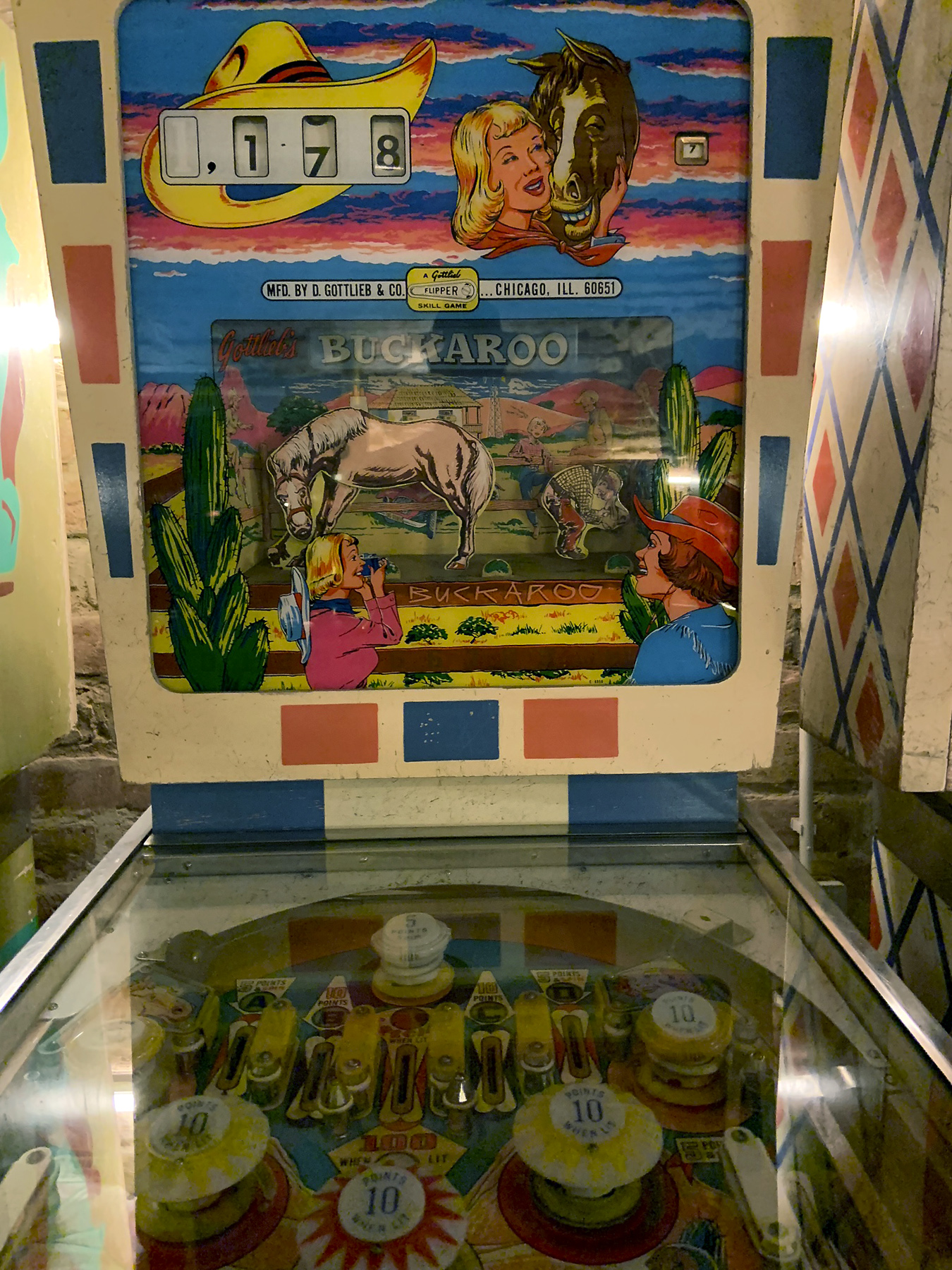
 

Gottlieb. 'Buckaroo' 1965 (detail)


D. Gottlieb & Co. (1931-1977)
Buckaroo (detail)
1965
2,600 produced
Photo: Marcus Bunyan
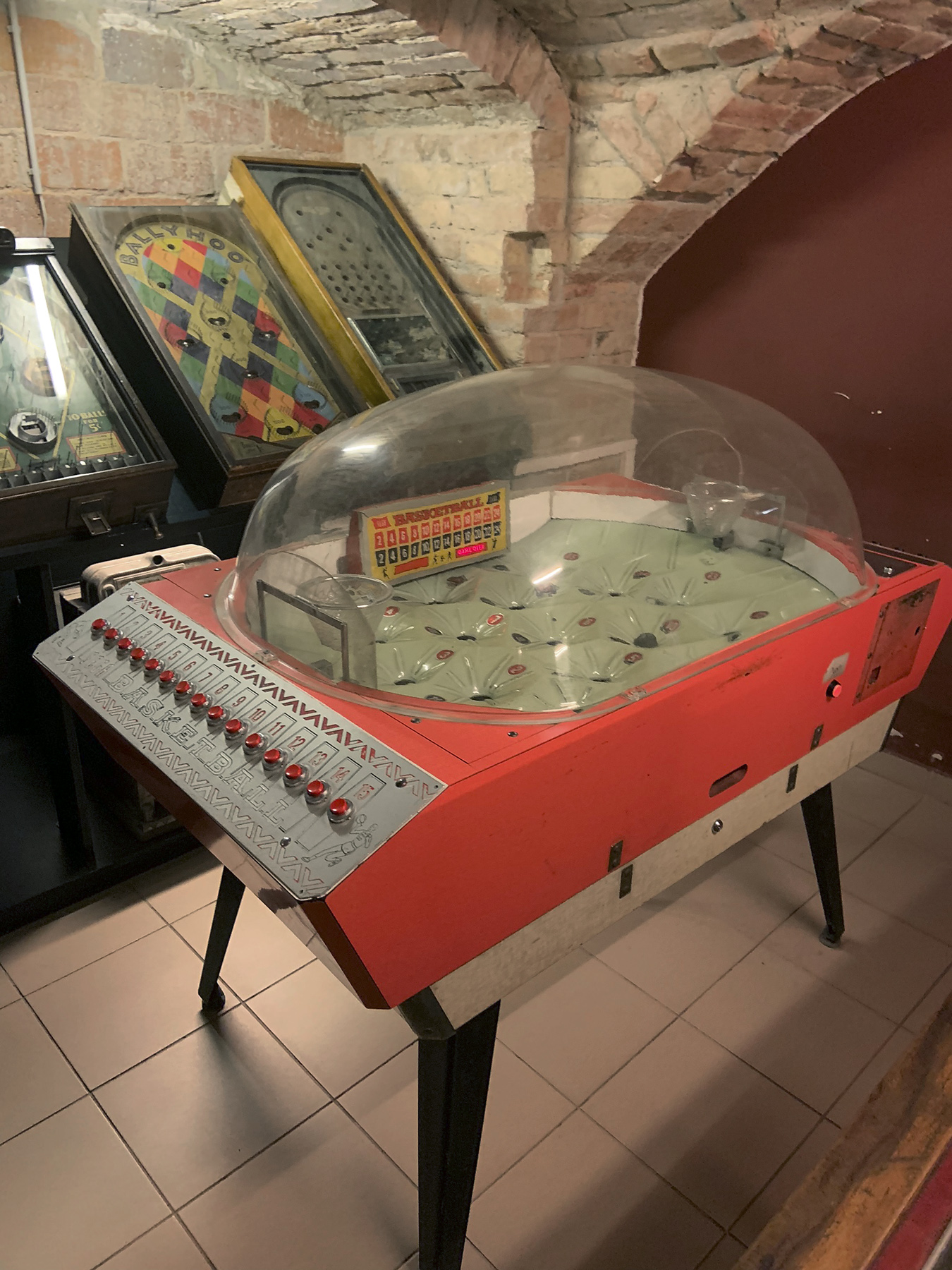
 

Sega. 'Basketball' 1966


Sega
Basketball
1966
Photo: Marcus Bunyan
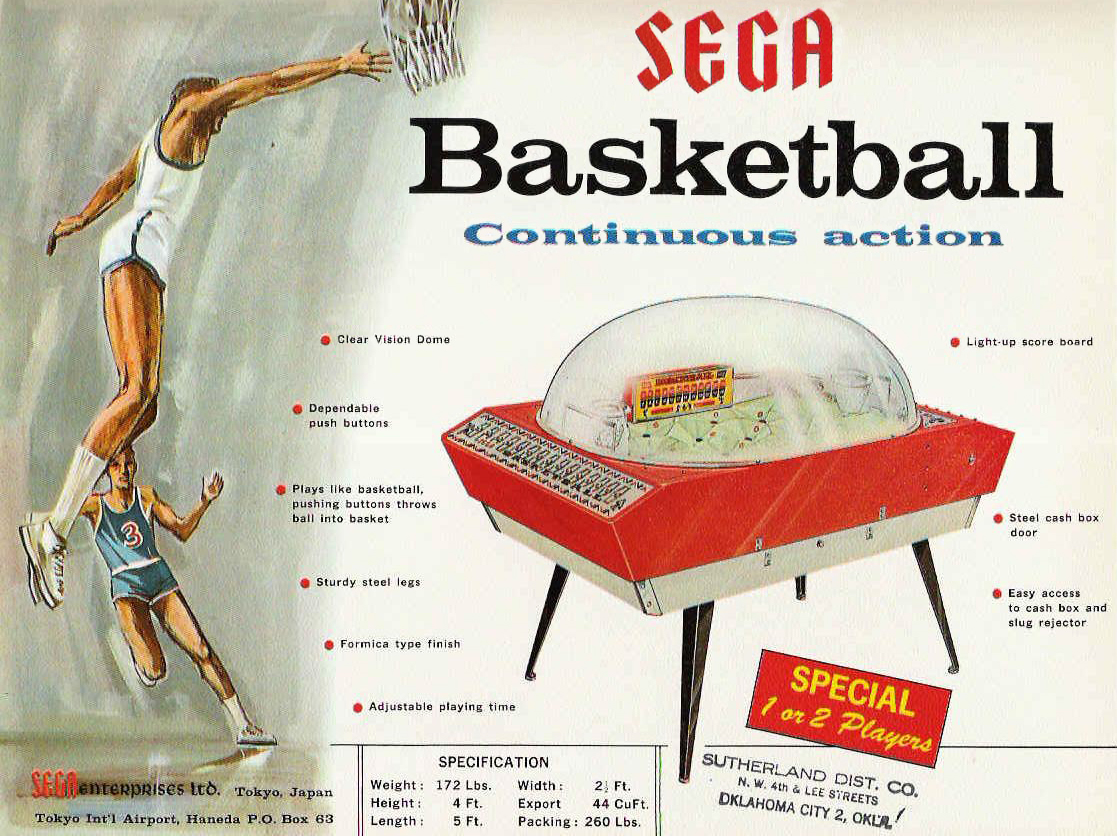
 

Sega Basketball flyer
 

Sega Basketball flyer


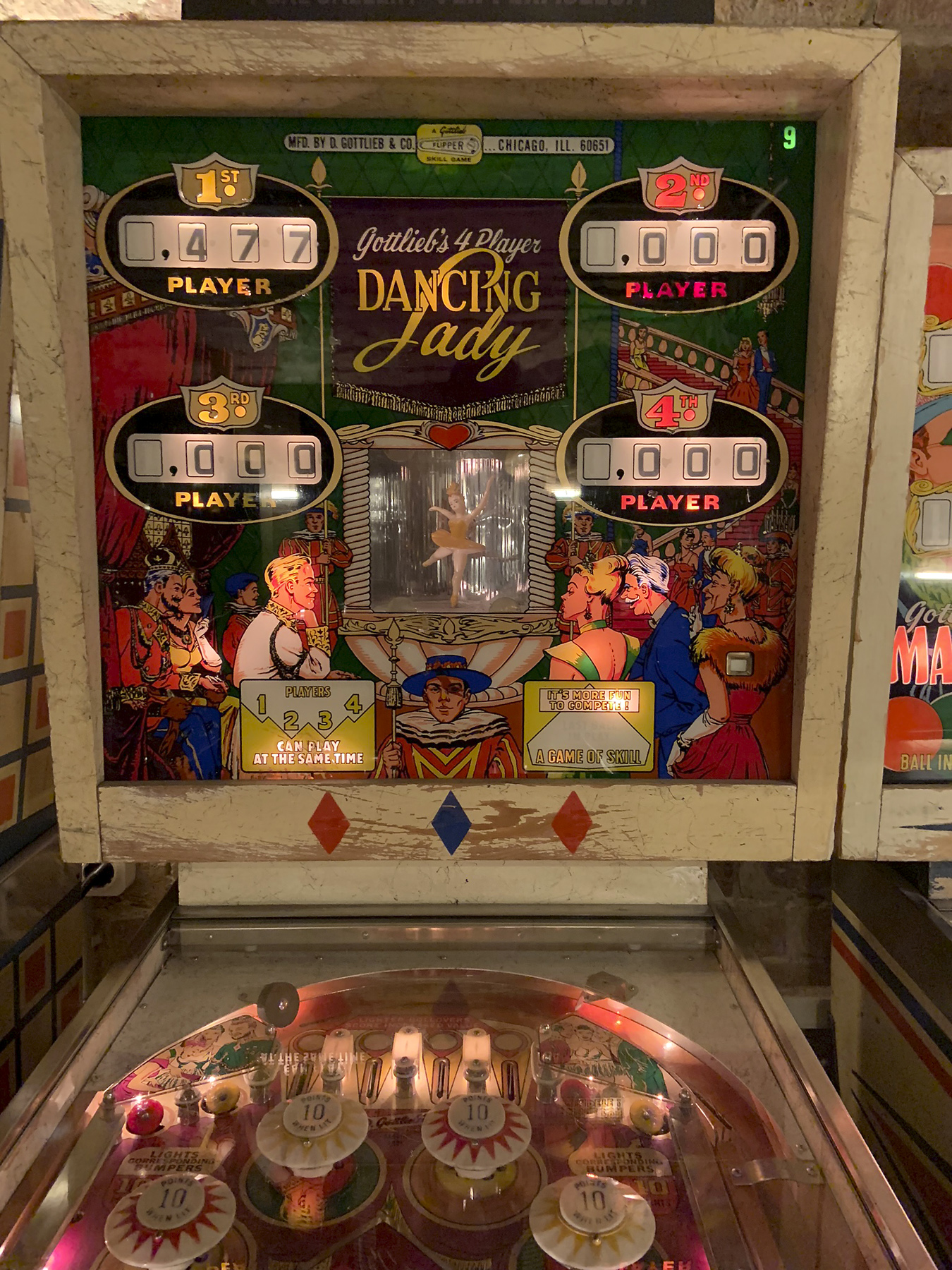
D. Gottlieb & Co. 'Dancing Lady' 1966


D. Gottlieb & Co. (1931-1977)
Dancing Lady
1966
2,675 produced
Photo: Marcus Bunyan


Dancing Lady exists in 2 versions – the Serial-Run had a new, larger Top with a completely new designed Glass in different colours (above). Test-Samples (approximately 100 to 150 Machines) from Summer / Autumn 1966 had slightly different Art on the lower Playboard and a complete different, more colourful and smaller Backglass, because the Serial-Run from December 1966 used the new and much higher Backbox. This new sort of Backbox was used for the Four-Players until 1977 while the Two-Players still used the smaller Backbox.

Text from the Pinside website [Online] Cited 04/11/2020
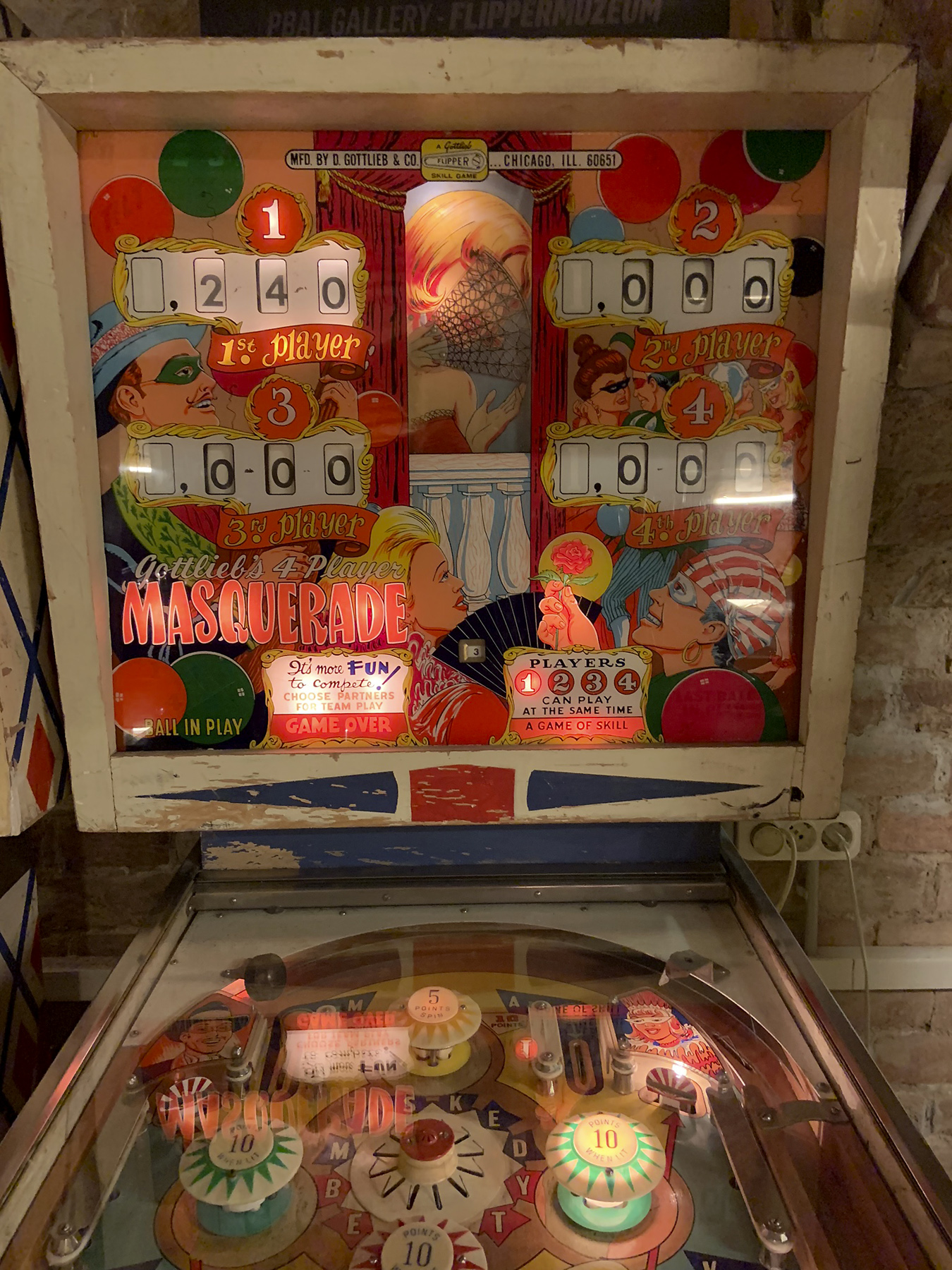
 

D. Gottlieb & Co. 'Masquerade' 1966 (detail)


D. Gottlieb & Co. (1931-1977)
Masquerade (detail)
1966
3,662 produced
Photo: Marcus Bunyan
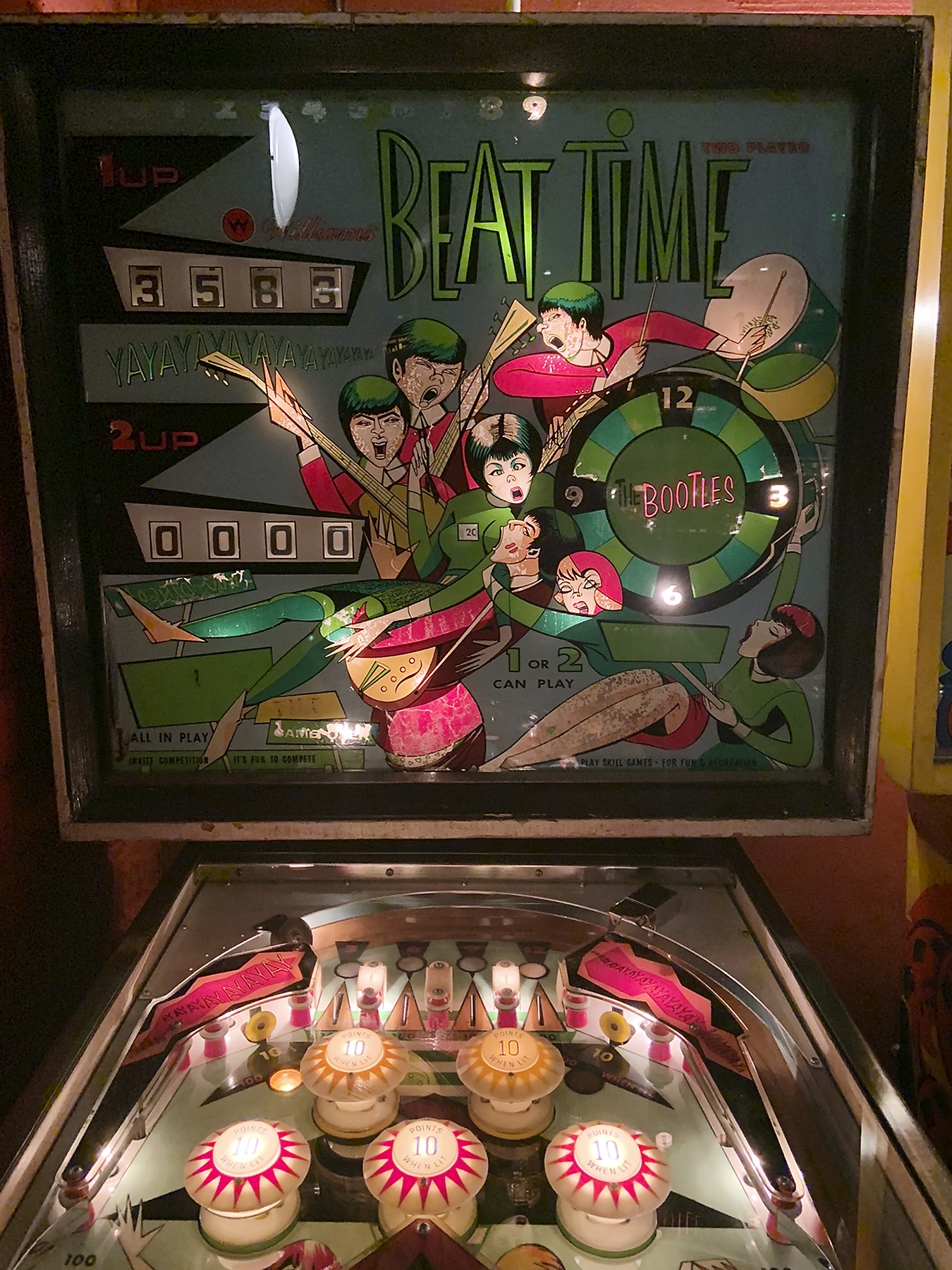
 

Williams. 'Beat Time' 1967 (detail)


Williams Electronic Games, Inc. (1967-1985)
Beat Time (detail)
1967
2,802 produced
Photo: Marcus Bunyan
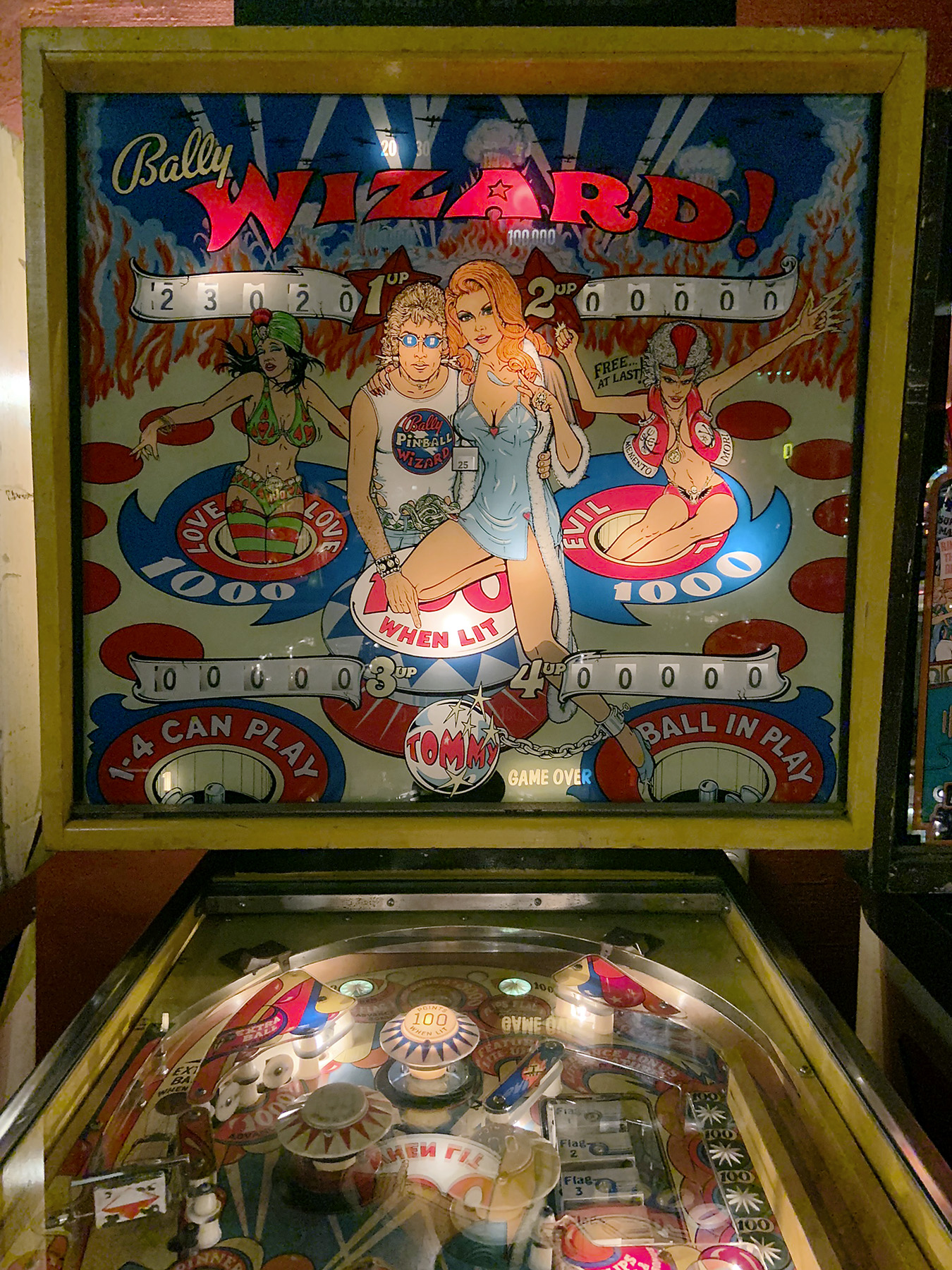
 

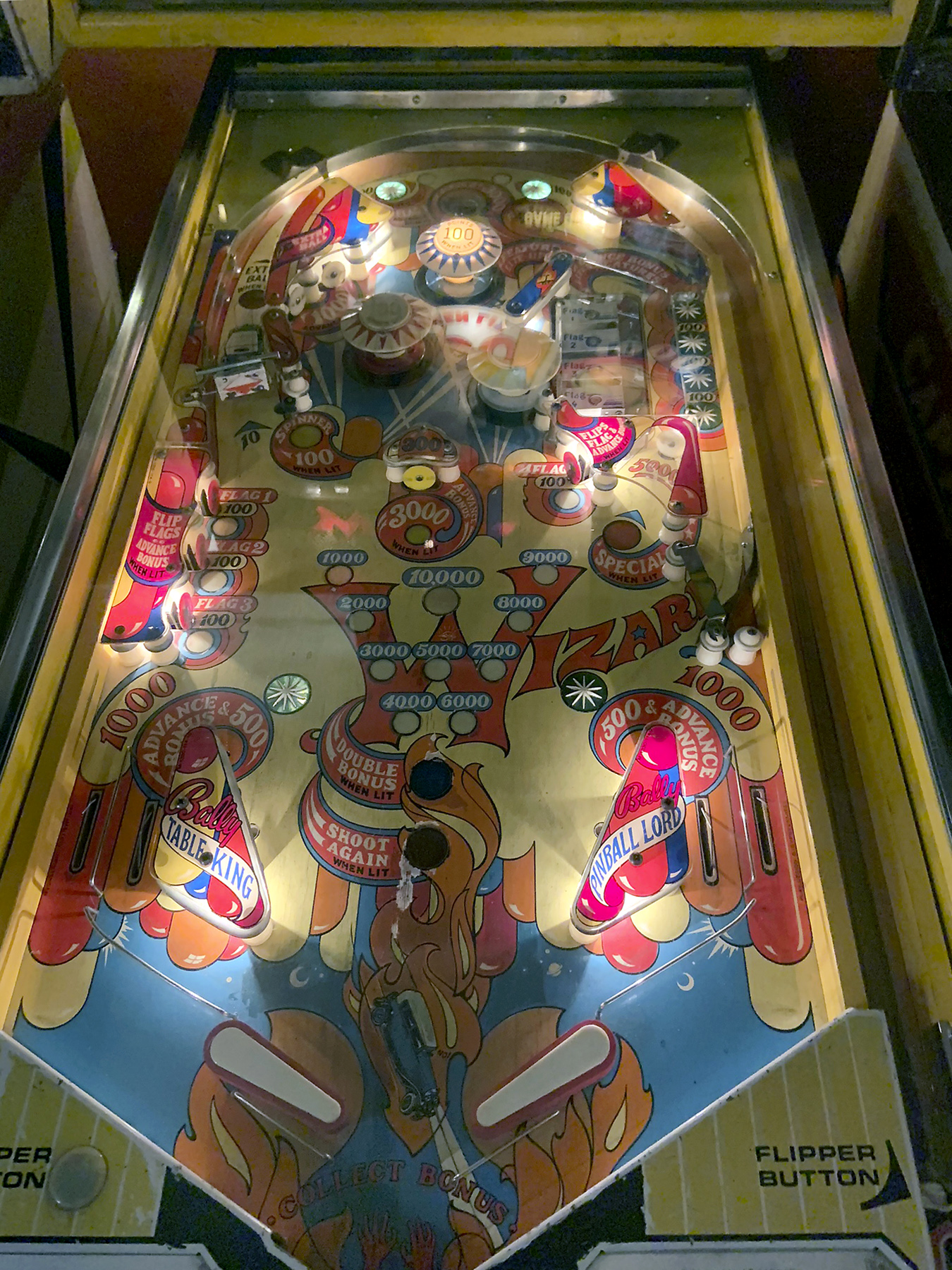
Bally Manufacturing Corporation (1931-1983) 'Wizard!' 1975 (detail)

Bally Manufacturing Corporation (1931-1983) 'Wizard!' 1975 (detail)


Bally Manufacturing Corporation (1931-1983)
Wizard! (details)
1975
10,005 produced
Photos: Marcus Bunyan


Wizard!, released in May 1975, was Bally’s highest production flipper game to that date with over 10,000 units produced. The game comes at the tail end of Bally’s electromechanical production schedule, and sets the stage for the company’s solid state success in the years to follow. Widely regarded as one of the first proper licensed games in pinball history, Wizard! features the likenesses of Ann Margret and Roger Daltrey, stars of the 1976 Ken Russell film Tommy (a screen adaptation of the Who’s rock opera of the same name). Other than its classic theme, Wizard! is notable as being the first game to showcase playfield “flip flags”, a feature used on only a handful of other Bally games.

Text from the Pinside website [Online] Cited 04/11/2020
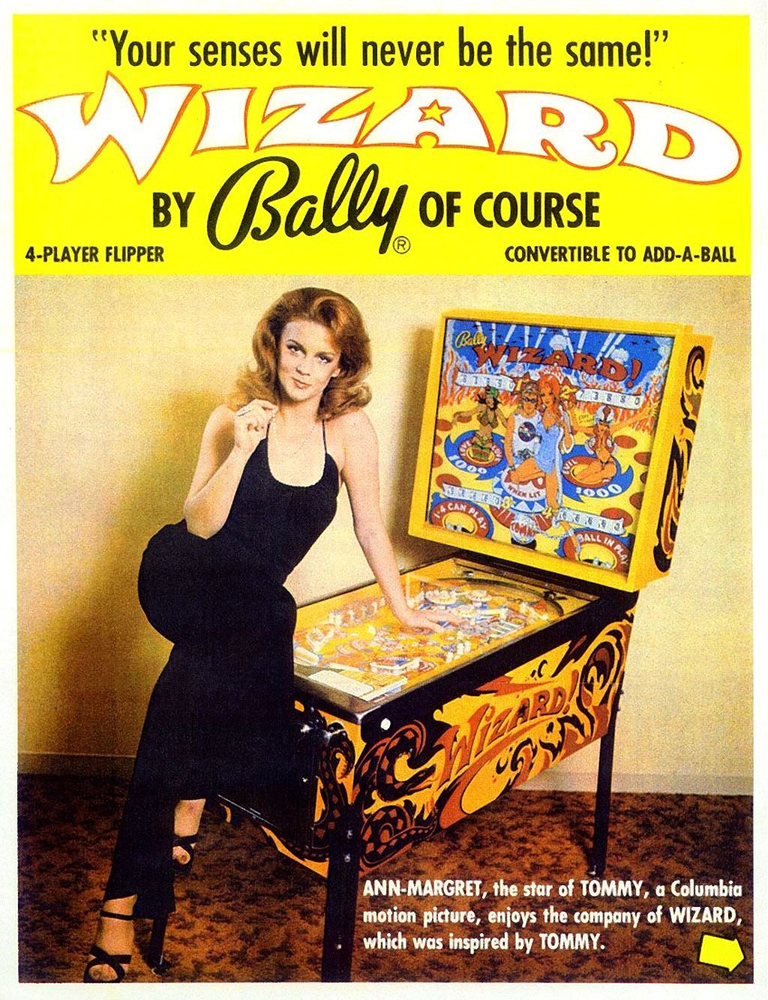
 

Wizard! flyer


Wizard! flyer


Pinball

Pinball is a type of arcade game, in which points are scored by a player manipulating one or more metallic balls on a play field inside a glass-covered cabinet called a pinball machine. The primary objective of the game is to score as many points as possible. Many modern pinball machines include a “storyline” where the player must complete certain objectives in a certain fashion to complete the story, usually earning high scores for different methods of completing the game. Different numbers of points are earned when the ball strikes different targets on the play field. A drain is situated at the bottom of the play field, partially protected by player-controlled paddles called flippers. A game ends after all the balls fall into the drain a certain number of times. Secondary objectives are to maximise the time spent playing (by earning “extra balls” and keeping the ball in play as long as possible), and to earn bonus credits by achieving a high enough score or through other means.

Backglass

The backglass is a vertical graphic panel mounted on the front of the backbox, which is the upright box at the top back of the machine. The backglass contains the name of the machine and eye-catching graphics; in games up to the 1980s the artwork would often portray large-breasted women in skimpy clothing. The score displays (lights, mechanical wheels, an LED display, or a dot-matrix display depending on the era) would be on the backglass, and sometimes also a mechanical device tied to game play, for example, elevator doors that opened on an image or a woman swatting a cat with a broom such as on Williams’ 1989 “Bad Cats”. For older games, the backglass image is screen printed in layers on the reverse side of a piece of glass; in more recent games, the image is imprinted into a translucent piece of plastic-like material called a translite which is mounted behind a piece of glass and which is easily removable. The earliest games did not have backglasses or backboxes and were little more than playfields in boxes. Games are generally built around a particular theme, such as a sport or character and the backglass art reflects this theme to attract the attention of players. Recent machines are typically tied into other enterprises such as a popular film series, toy, or brand name. The entire machine is designed to be as eye-catching as possible to attract players and their money; every possible space is filled with colourful graphics, blinking lights, and themed objects, and the backglass is usually the first artwork the players see from a distance. Since the artistic value of the backglass may be quite impressive, it is not uncommon for enthusiasts to use a deep frame around a backglass (lighted from behind) and hang it as art after the remainder of the game is discarded.

Text from the Wikipedia website
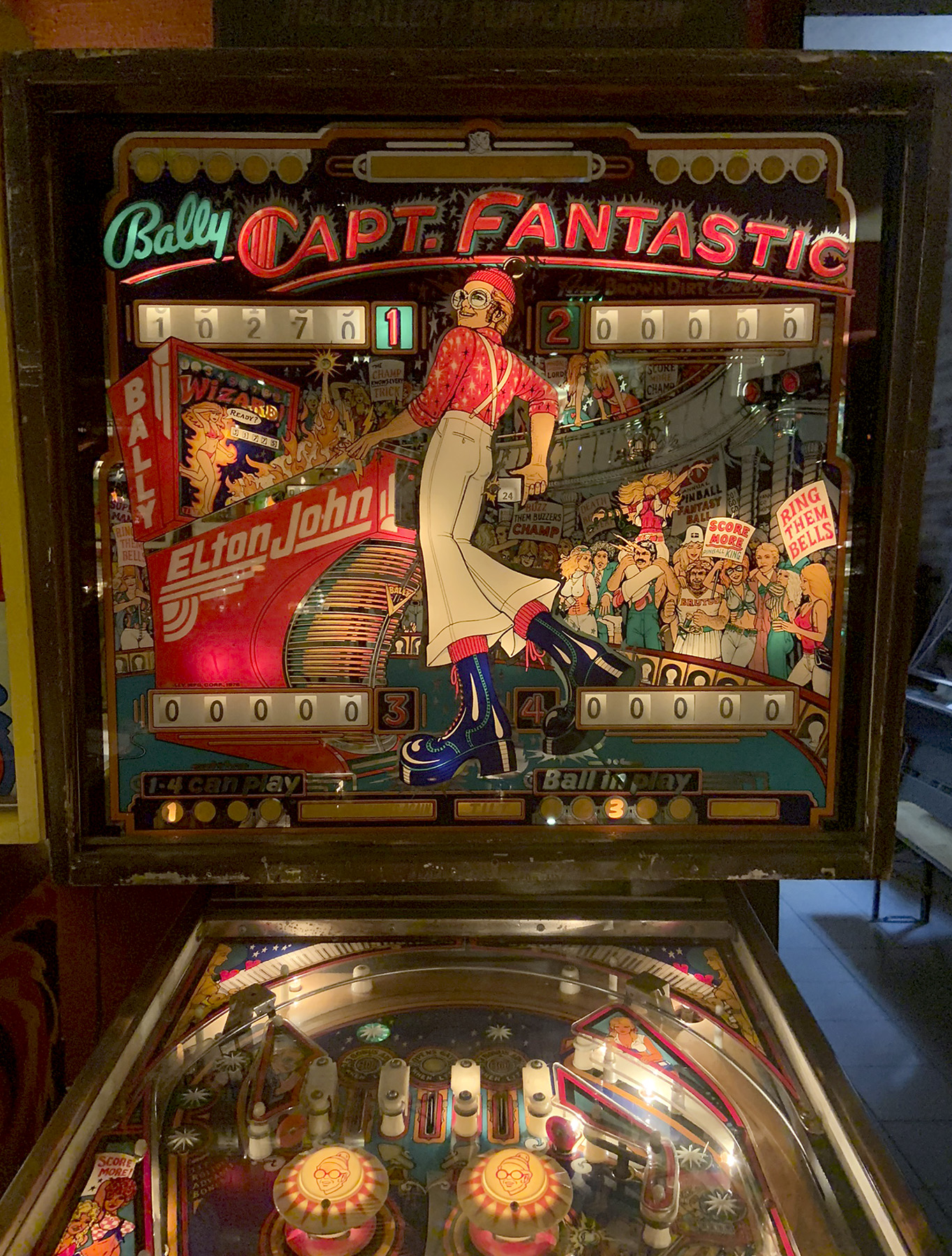
 

Bally Manufacturing Corporation (1931-1983) 'Capt. Fantastic and the Dirt Brown Cowboy' 1976 (detail)


Bally Manufacturing Corporation (1931-1983)
Capt. Fantastic and the Dirt Brown Cowboy (detail)
1976
16,155 produced
Photo: Marcus Bunyan


‘Capt. Fantastic’ was inspired by the movie ‘Tommy’ and includes a representation of Elton John, as his character from the movie, playing pinball on the backglass. The game name, however, is the title of Elton John’s 1975 autobiographical song and album where “Captain Fantastic” was Elton and “The Brown Dirt Cowboy” was his then-lyricist Bernie Taupin. Included in the song lyrics are the words “From the end of the world to your town” which appear at the very top center of the backglass.

Text from the The Internet Pinball Machine Database website [Online] Cited 04/11/2020


Bally Manufacturing Corporation (1931-1983) 'Space Invaders' 1980 (detail)


Bally Manufacturing Corporation (1931-1983)
Space Invaders (detail)
1980
11,400 produced
Photo: Marcus Bunyan


The alien depicted on the backglass was deemed an unlicensed use of the one used in the 1979 Hollywood movie Alien. Some playfield art elements and game sounds were borrowed from the 1978 ‘Space Invaders’ video game which was still popular at the time that this pinball machine came out.

Text from the The Internet Pinball Machine Database website [Online] Cited 04/11/2020
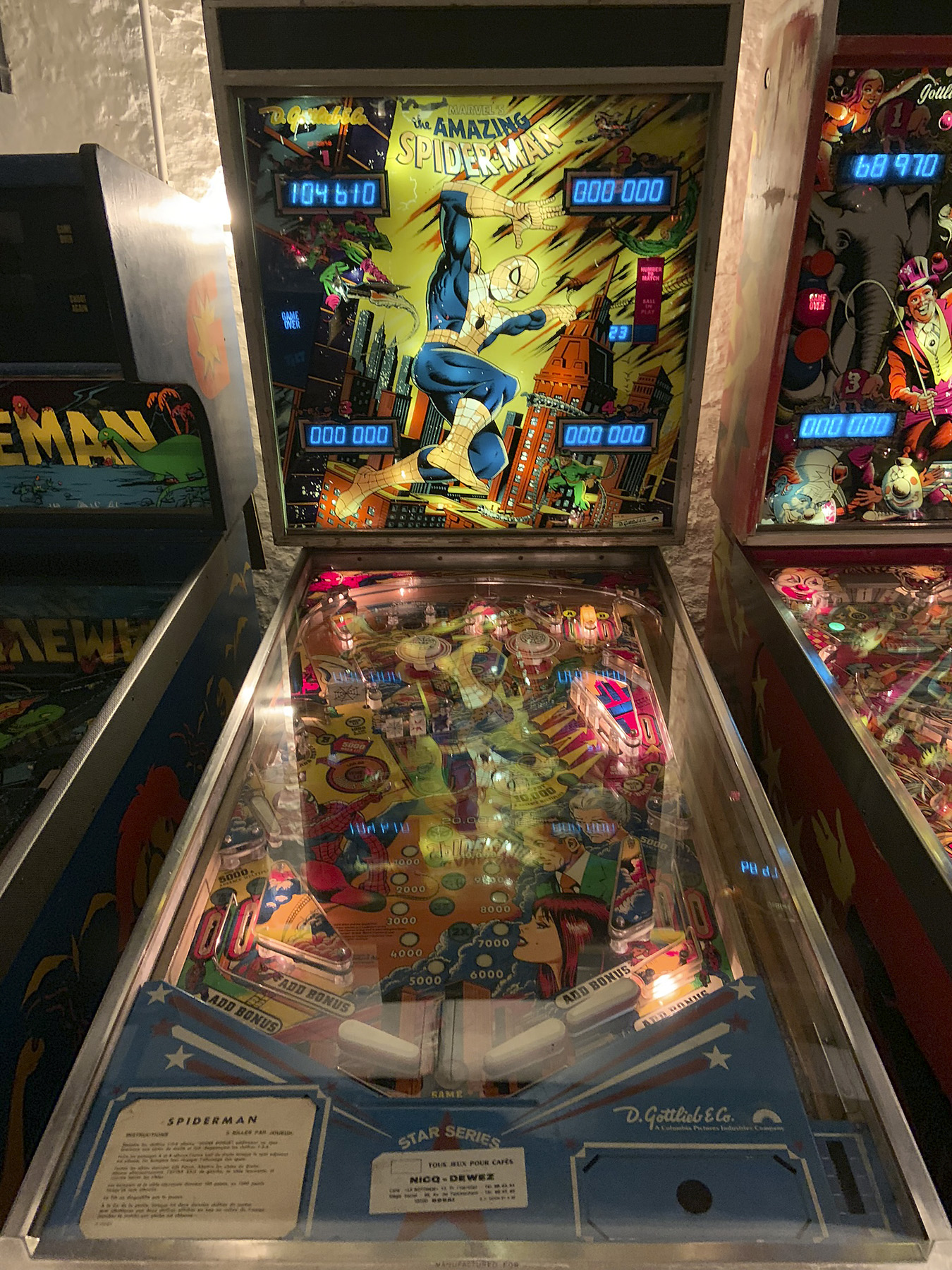
 

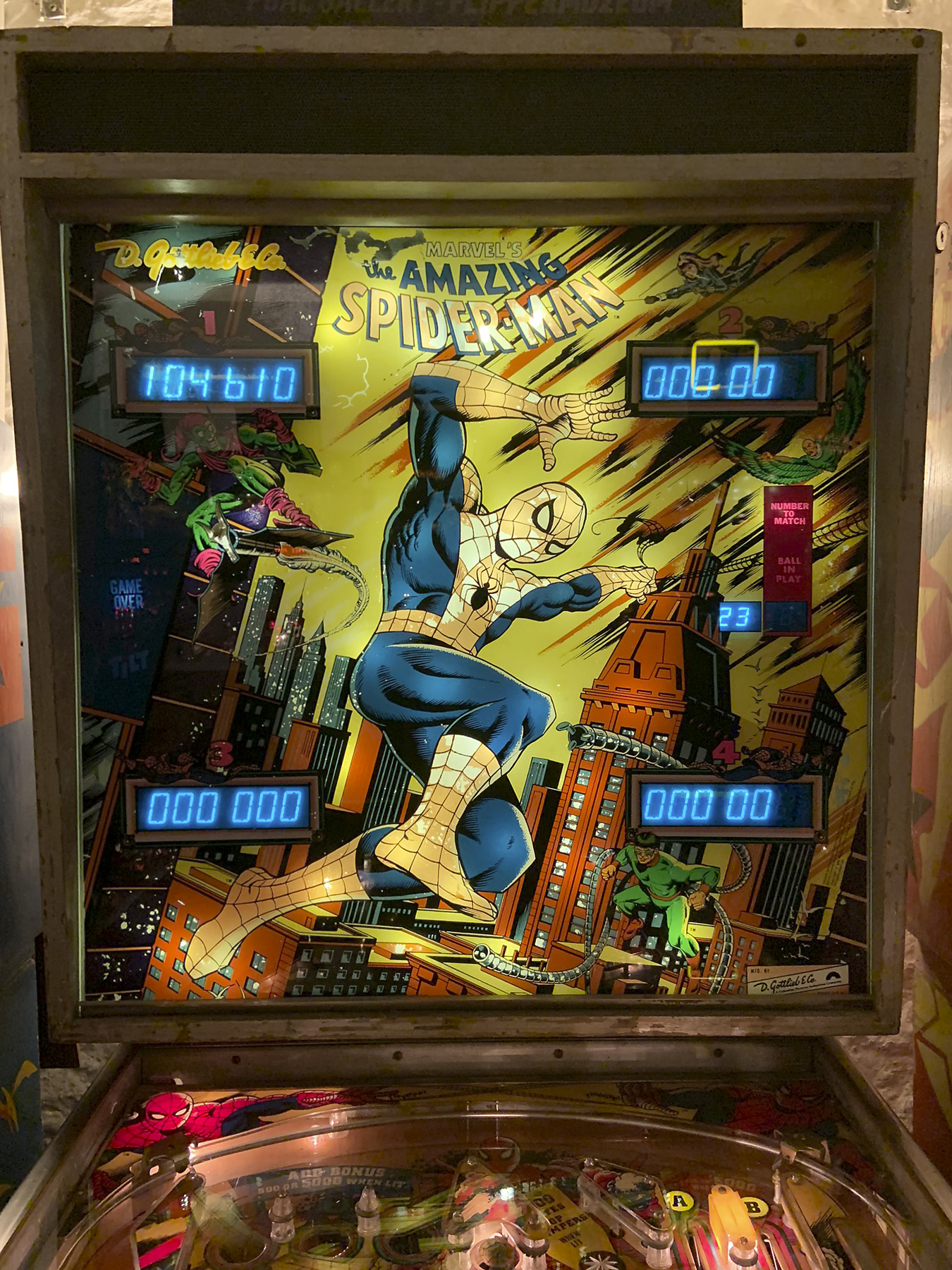
D. Gottlieb & Company. 'The Amazing Spider-Man' 1980 (detail)

D. Gottlieb & Company. 'The Amazing Spider-Man' 1980 (detail)


D. Gottlieb & Company, a Columbia Pictures Industries Company (1977-1983)
The Amazing Spider-Man (details)
1980
7,625 produced
Photos: Marcus Bunyan


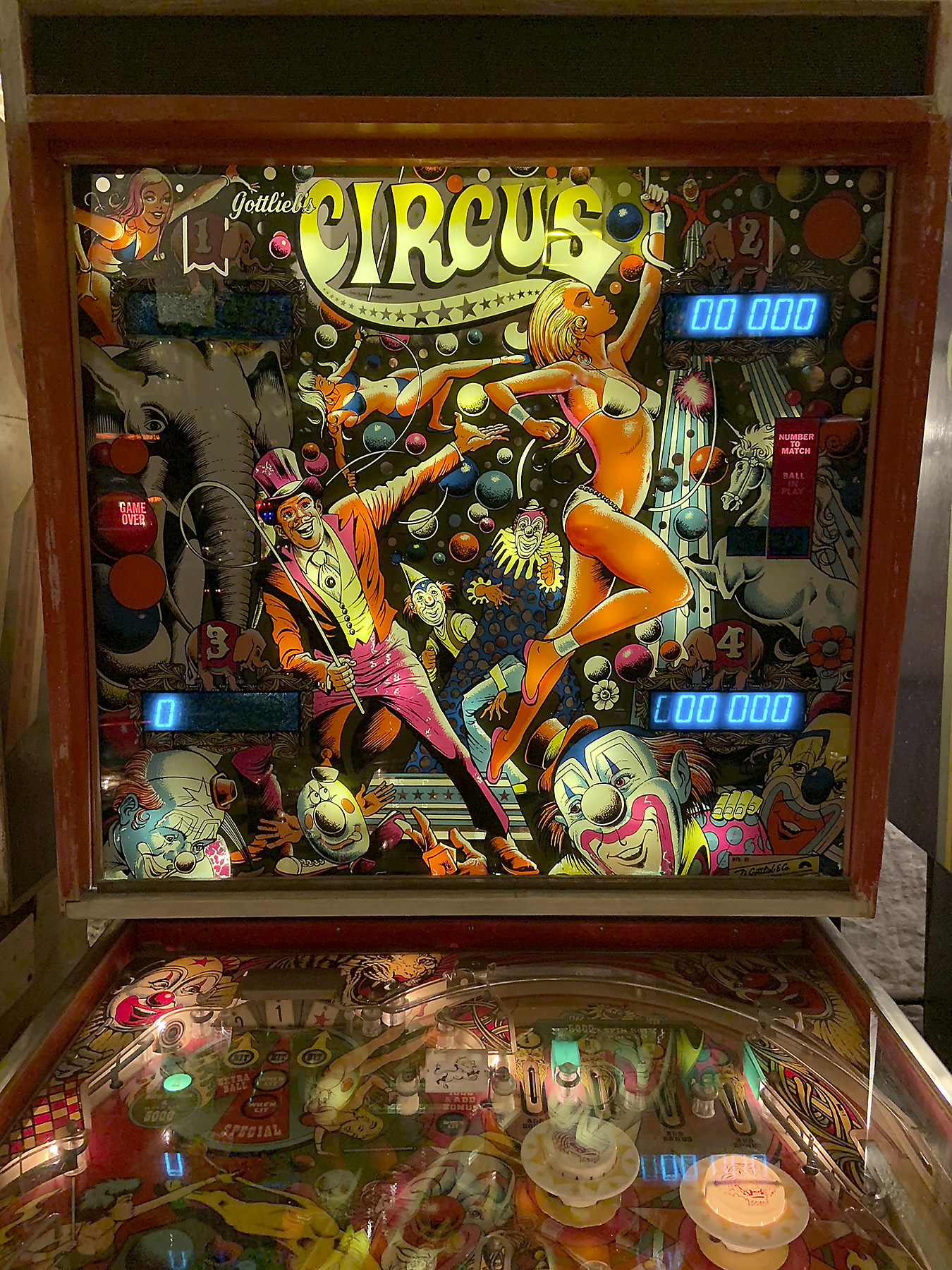
D. Gottlieb & Company (1977-1983) 'Circus' 1980 (detail)


D. Gottlieb & Company, a Columbia Pictures Industries Company (1977-1983)
Circus (detail)
1980
1,700 produced
Photo: Marcus Bunyan


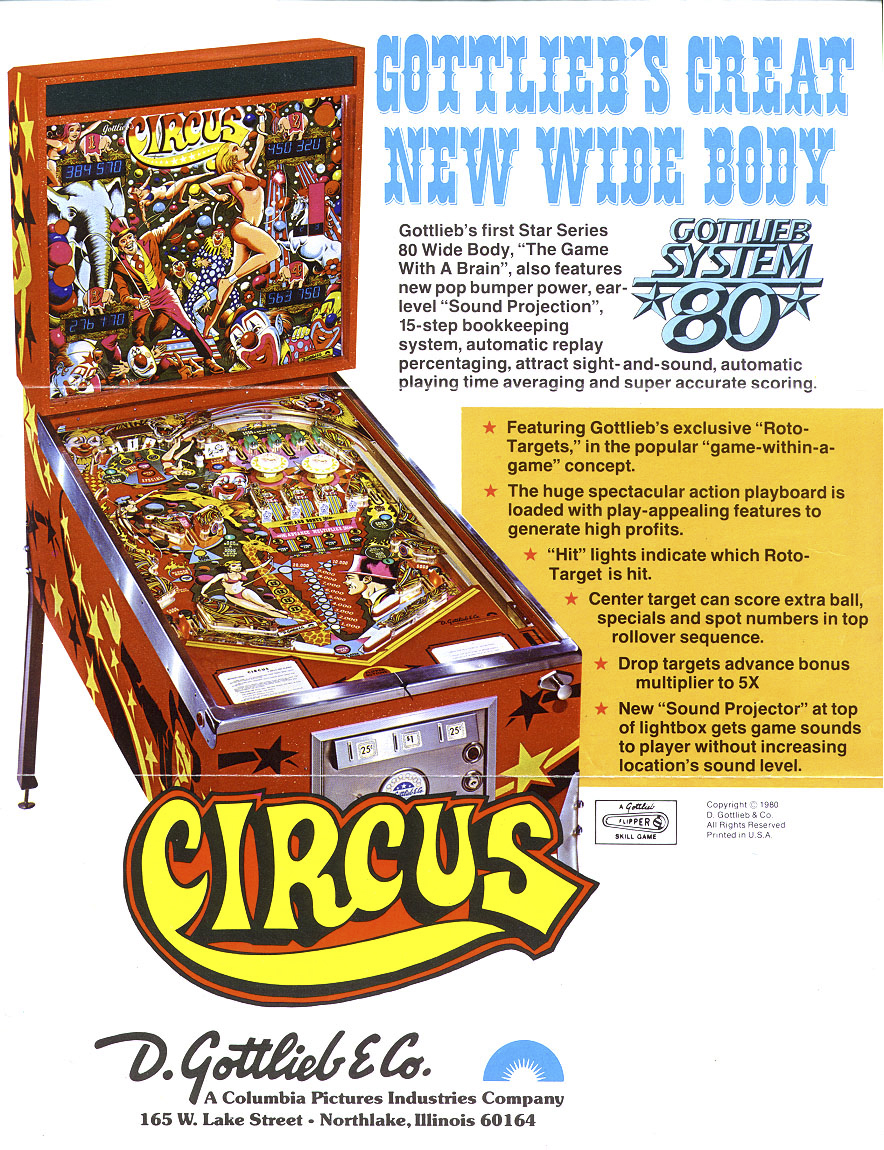
“The Greatest Pinball On Earth!”


Circus pinball flyer


Circus pinball flyer


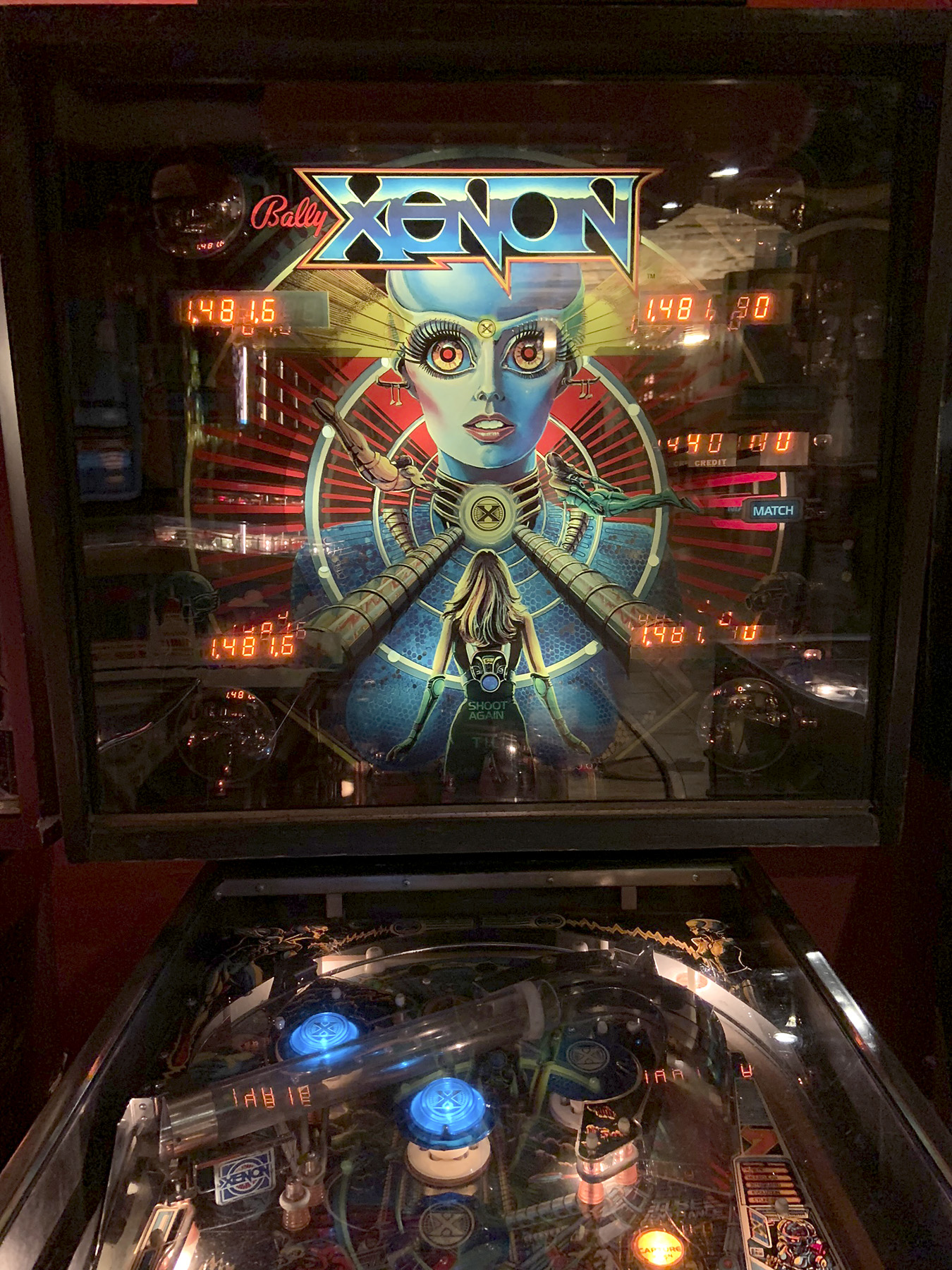
Bally Manufacturing Corporation (1931-1983) 'Xenon' 1980 (detail)


Bally Manufacturing Corporation (1931-1983)
Xenon
1980
11,000 produced
Photo: Marcus Bunyan


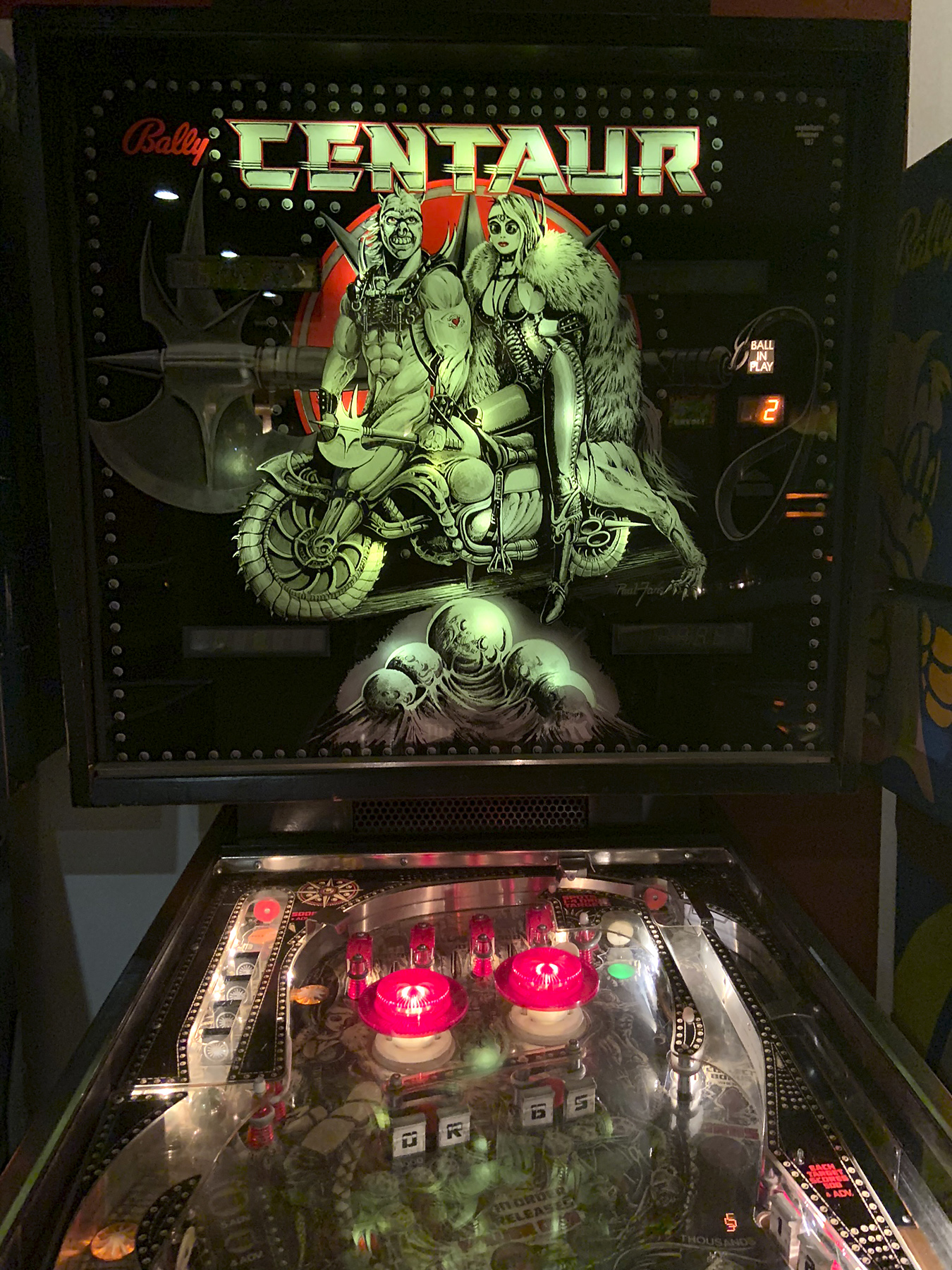
Bally Manufacturing Corporation (1931-1983) 'Centaur' 1981 (detail)


Bally Manufacturing Corporation (1931-1983)
Centaur (detail)
1981
3,700 produced
Photo: Marcus Bunyan


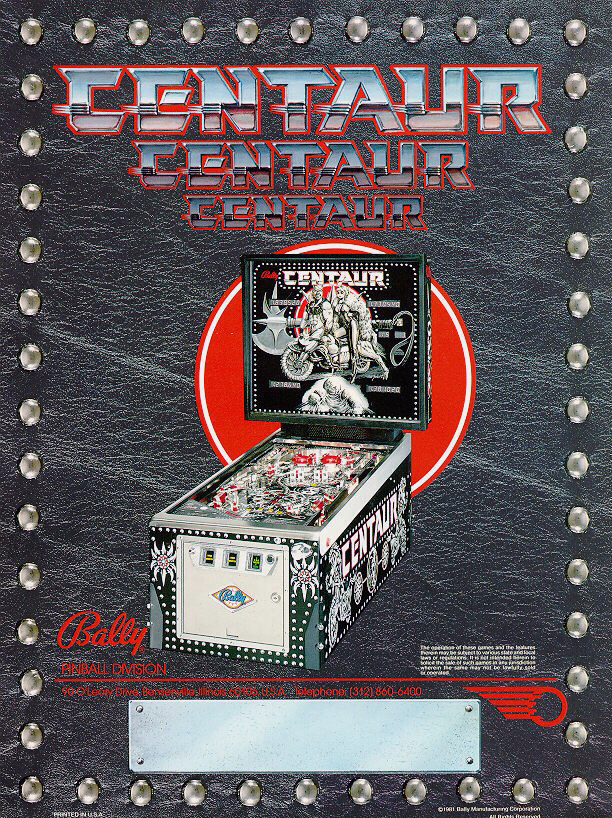
Centaur pinball flyer


Centaur pinball flyer


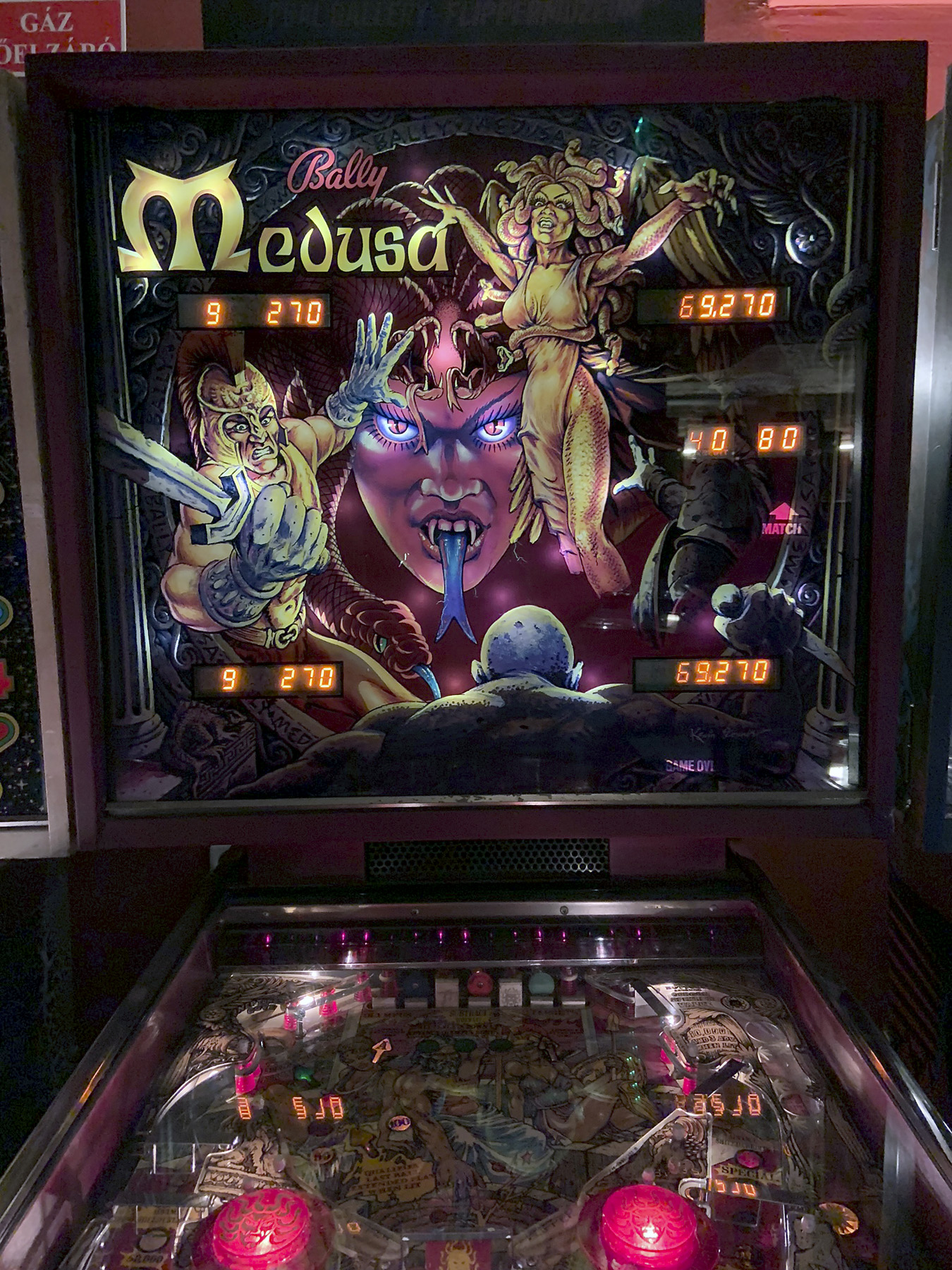
Bally Manufacturing Corporation (1931-1983) 'Medusa' 1981


Bally Manufacturing Corporation (1931-1983)
Medusa (detail)
1981
3,250 produced
Photo: Marcus Bunyan


“Bally MEDUSA… A Legend of Features”


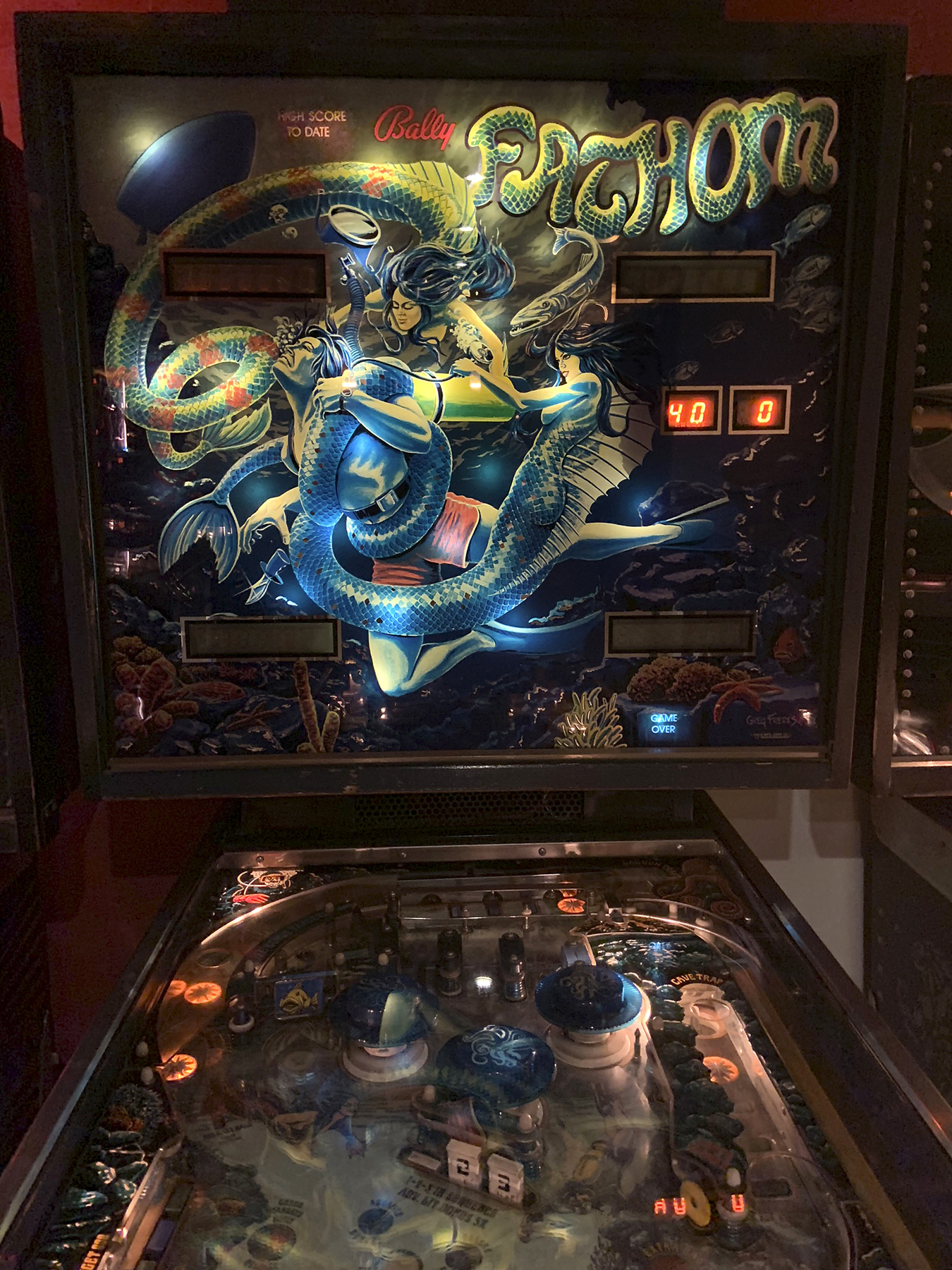
Bally Manufacturing Corporation (1931-1983) 'Fathom' 1981 (detail)


Bally Manufacturing Corporation (1931-1983)
Fathom
1981
3,500 produced
Photo: Marcus Bunyan


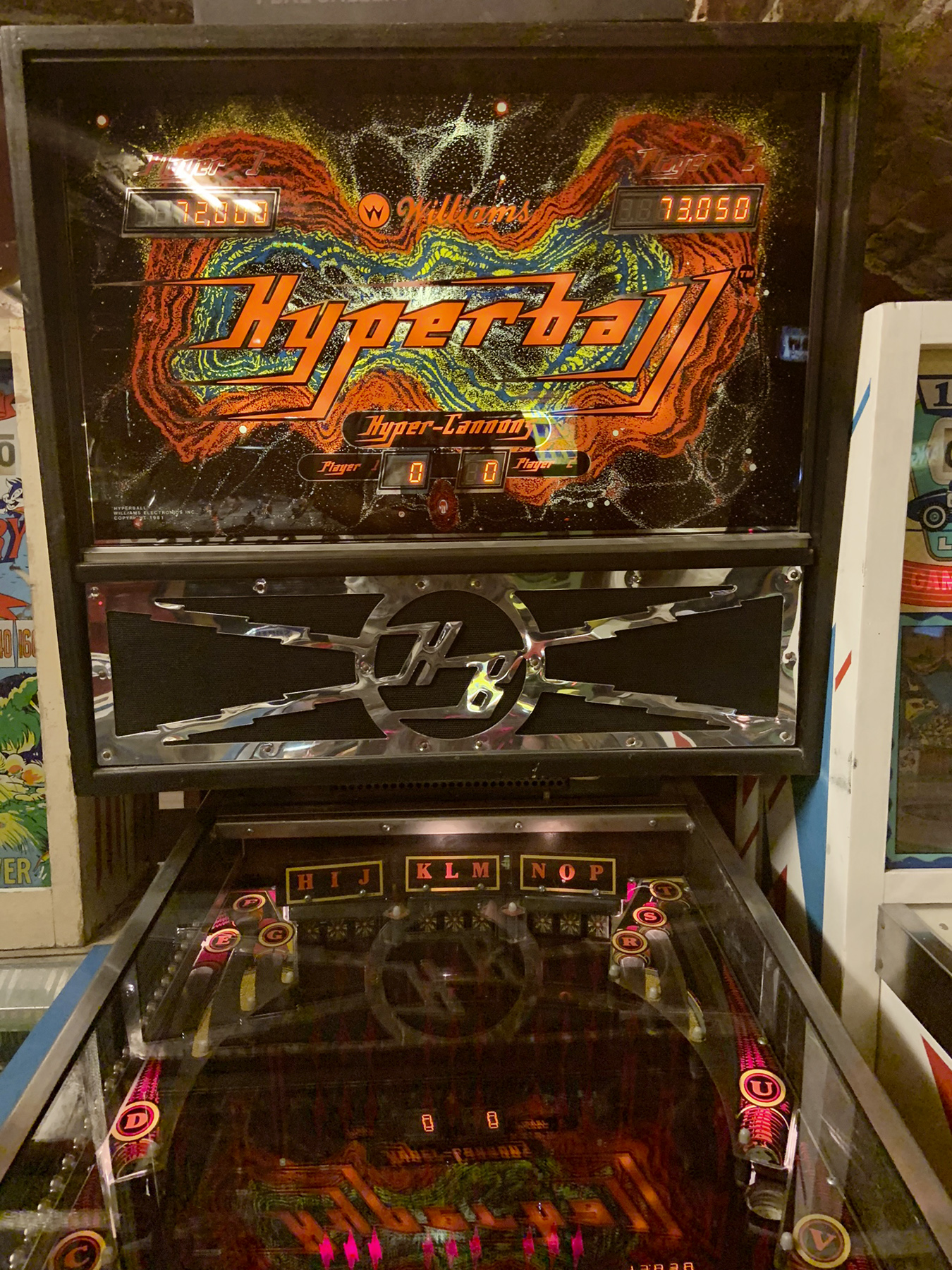
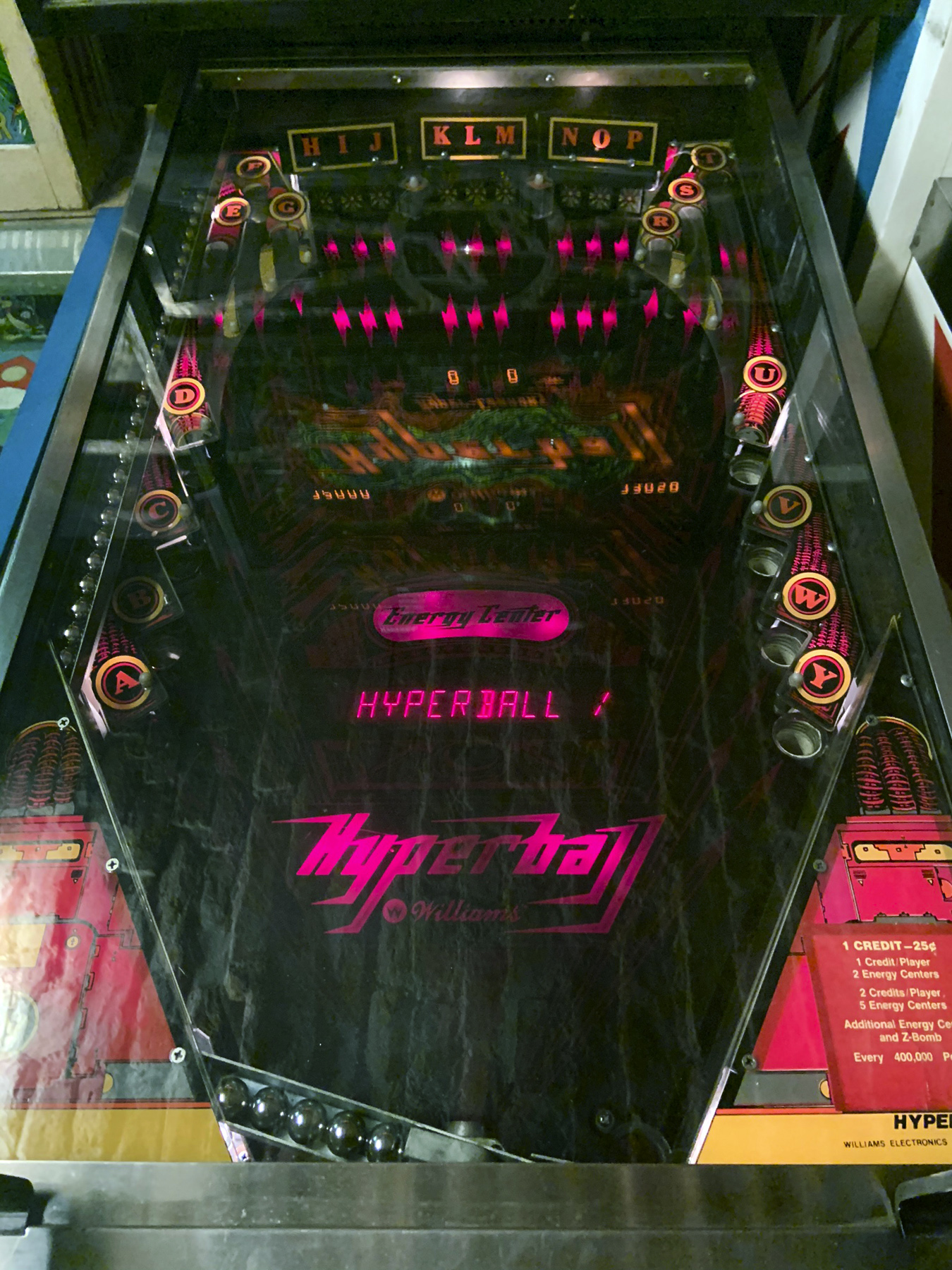
Williams Electronics Incorporated (1967-1985) 'Hyperball' 1981 (detail)

Williams Electronics Incorporated (1967-1985) 'Hyperball' 1981 (detail)


Williams Electronics Incorporated (1967-1985)
Hyperball (details)
1981
5,000 produced
Photos: Marcus Bunyan


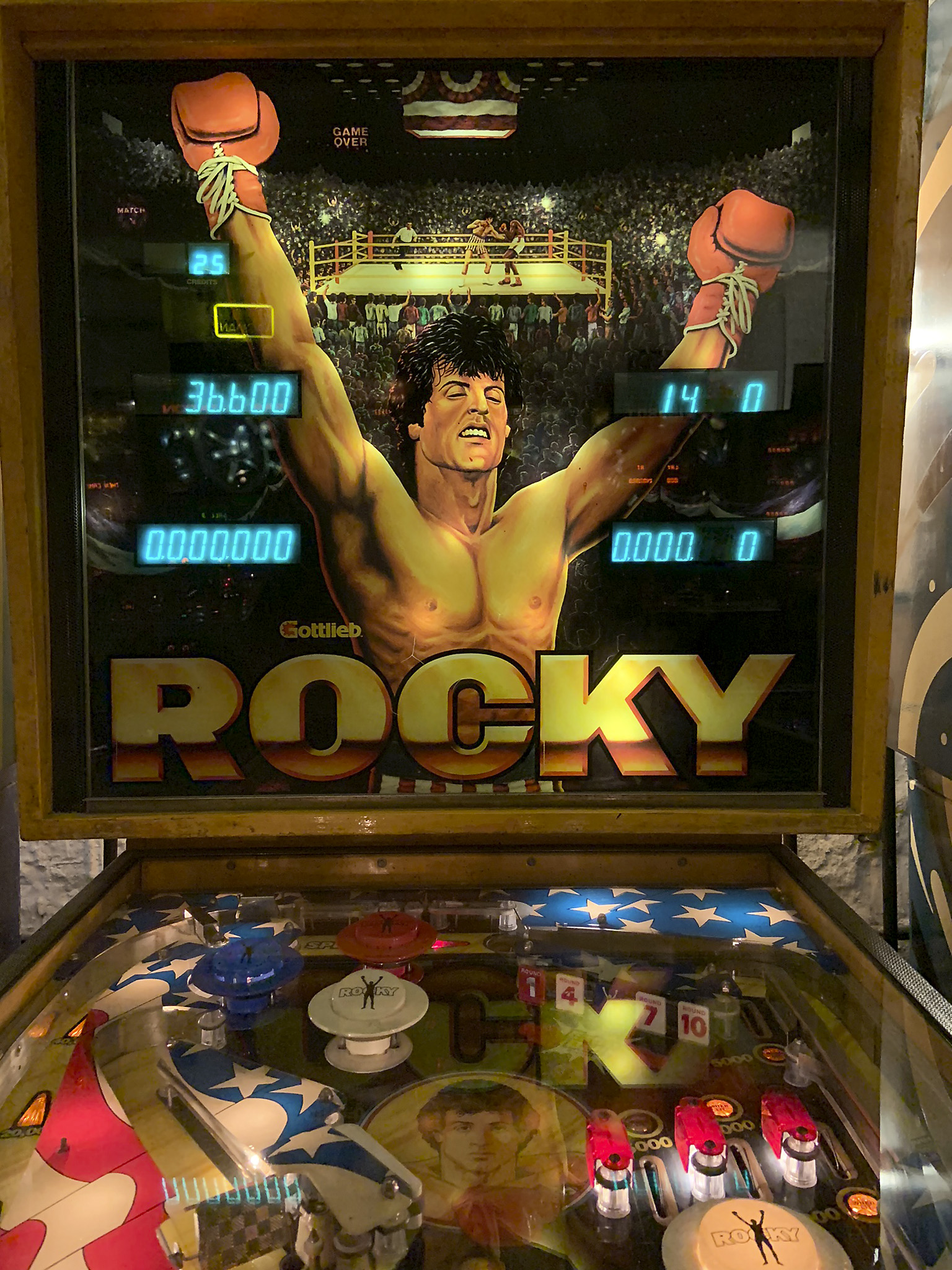
D. Gottlieb & Company. 'Rocky' 1982 (detail)


D. Gottlieb & Company, a Columbia Pictures Industries Company (1977-1983)
Rocky (detail)
1982
1,504 produced
Photo: Marcus Bunyan


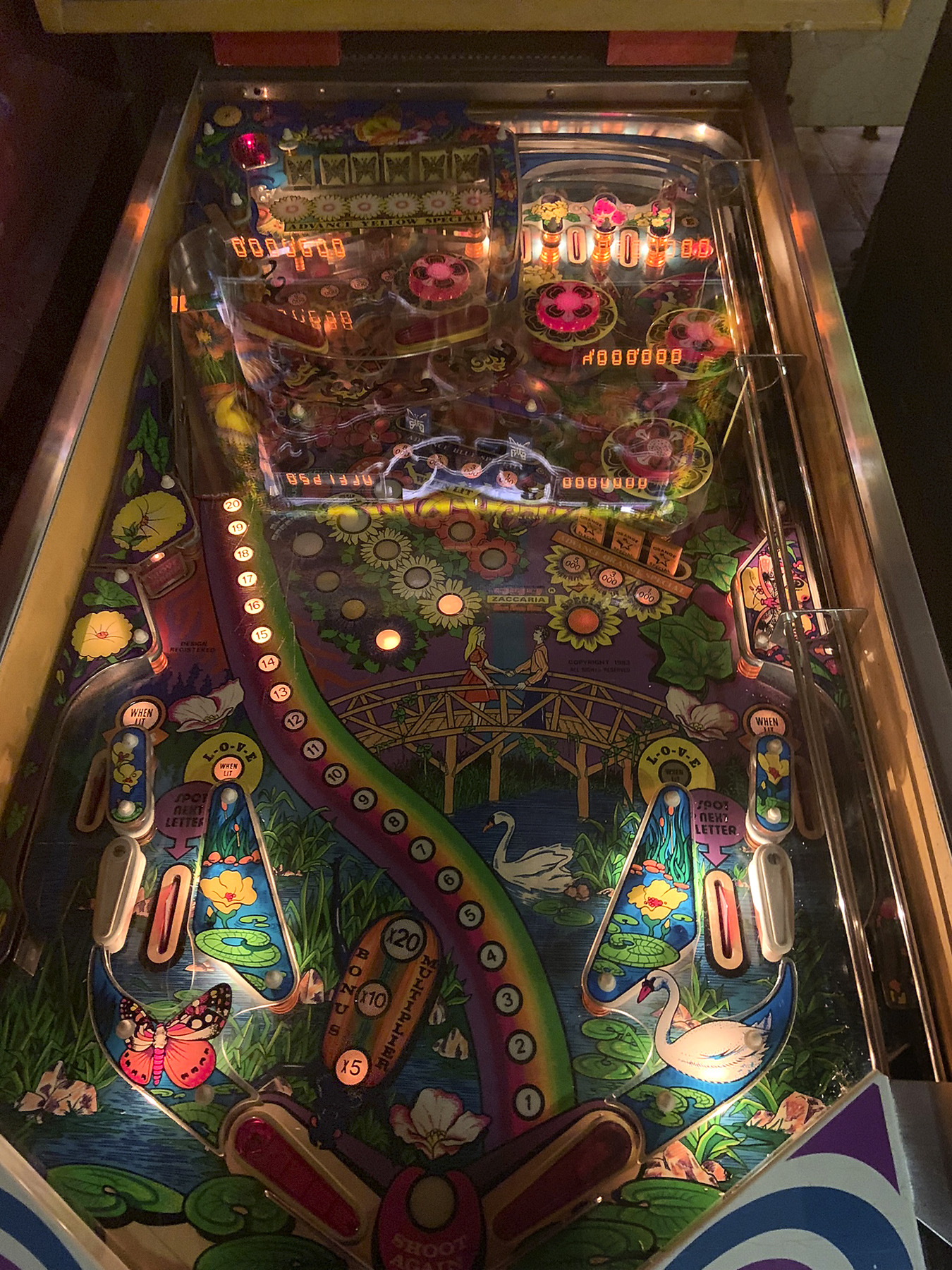
Zaccaria. 'Farfalla' 1983 (detail)

Zaccaria. 'Farfalla' 1983 (detail)


Zaccaria (Bologna, Italy, 1974-1987)
Farfalla
1983
Photos: Marcus Bunyan


Farfalla is Italian for “butterfly”


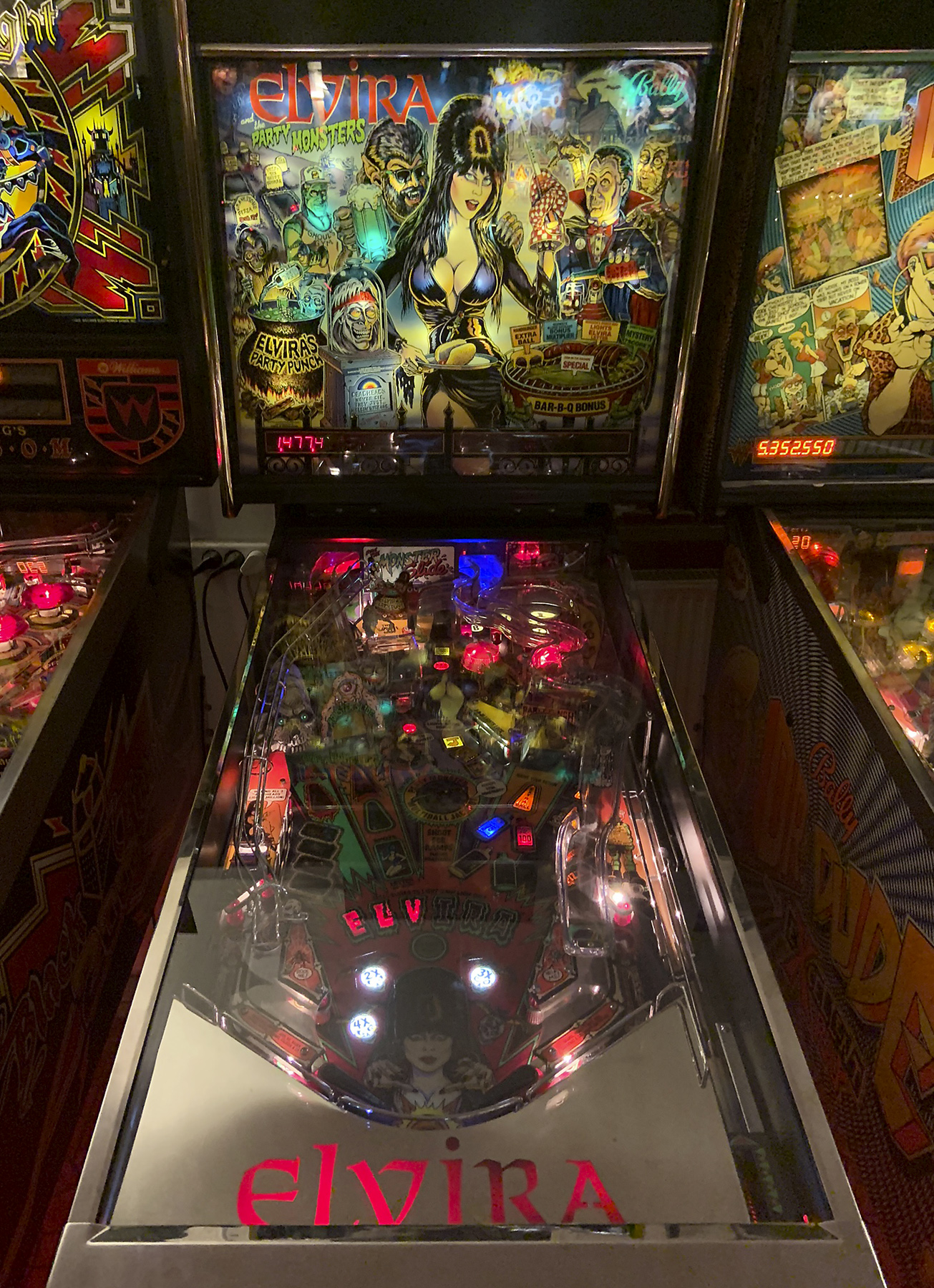
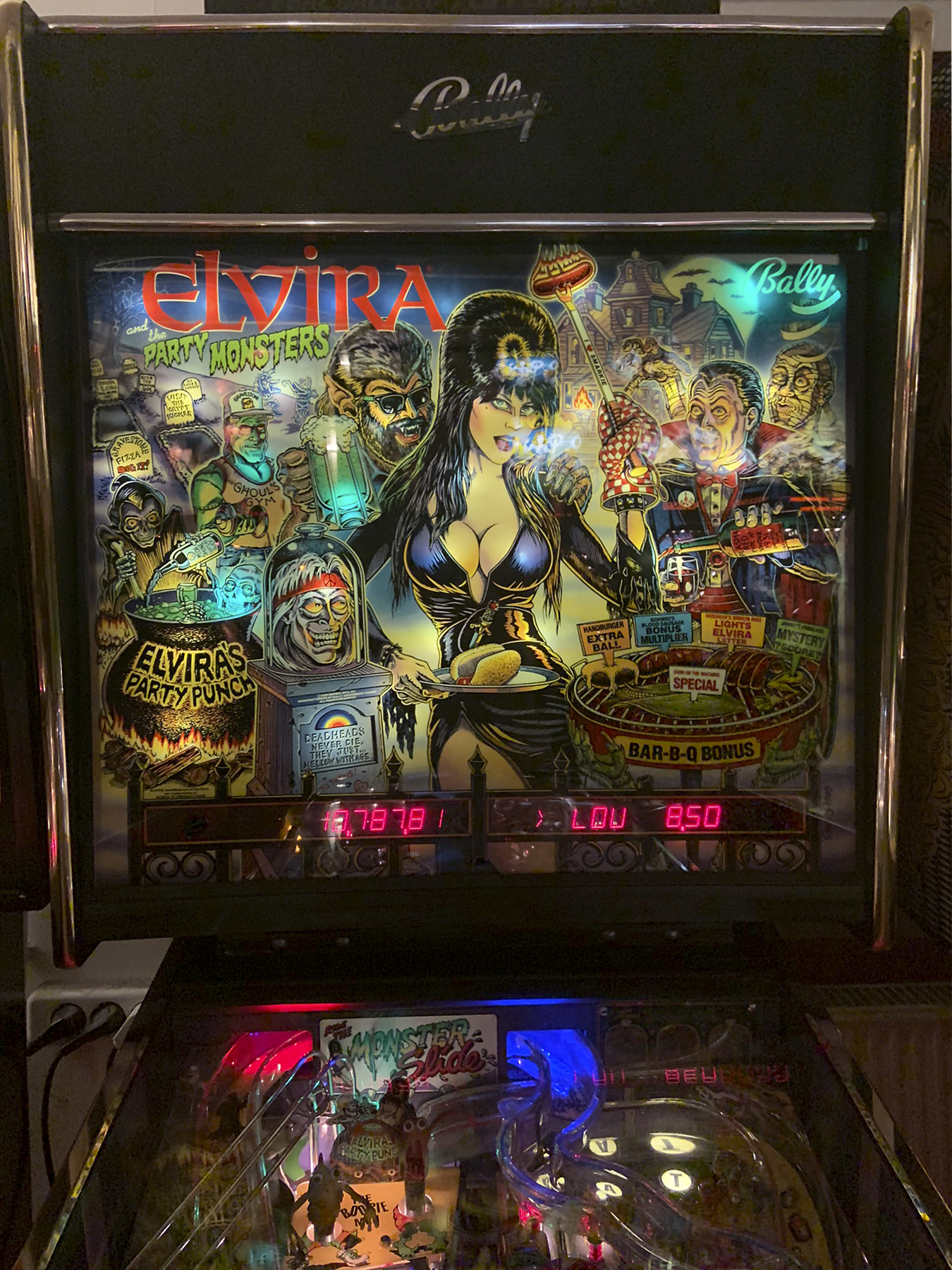
Bally. 'Elvira and the Party Monsters' 1989 (detail)

Bally. 'Elvira and the Party Monsters' 1989 (detail)


Bally (Midway Manufacturing Company) (Chicago, 1988-1999)
Elvira and the Party Monsters (details)
1989
4,000 produced
Photos: Marcus Bunyan


“Monstrous Pinball”
“You’re Gonna Have a Ball!”
“When They Named a Game After Me, It Had to be Built!”


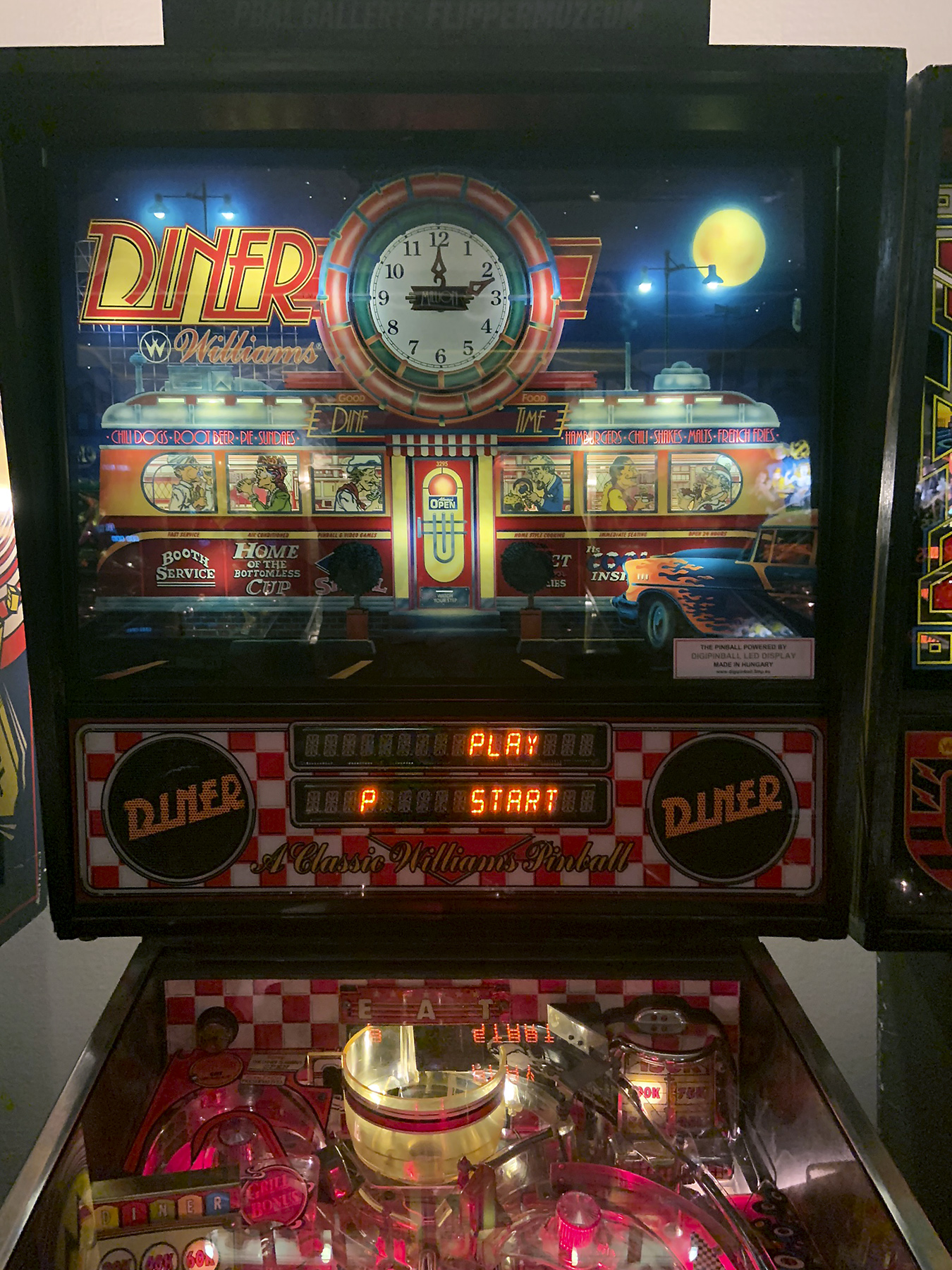
Williams Electronic Games (1985-1999) 'Diner' 1990 (detail)


Williams Electronic Games (1985-1999)
Diner (detail)
1990
3,552 produced
Photo: Marcus Bunyan


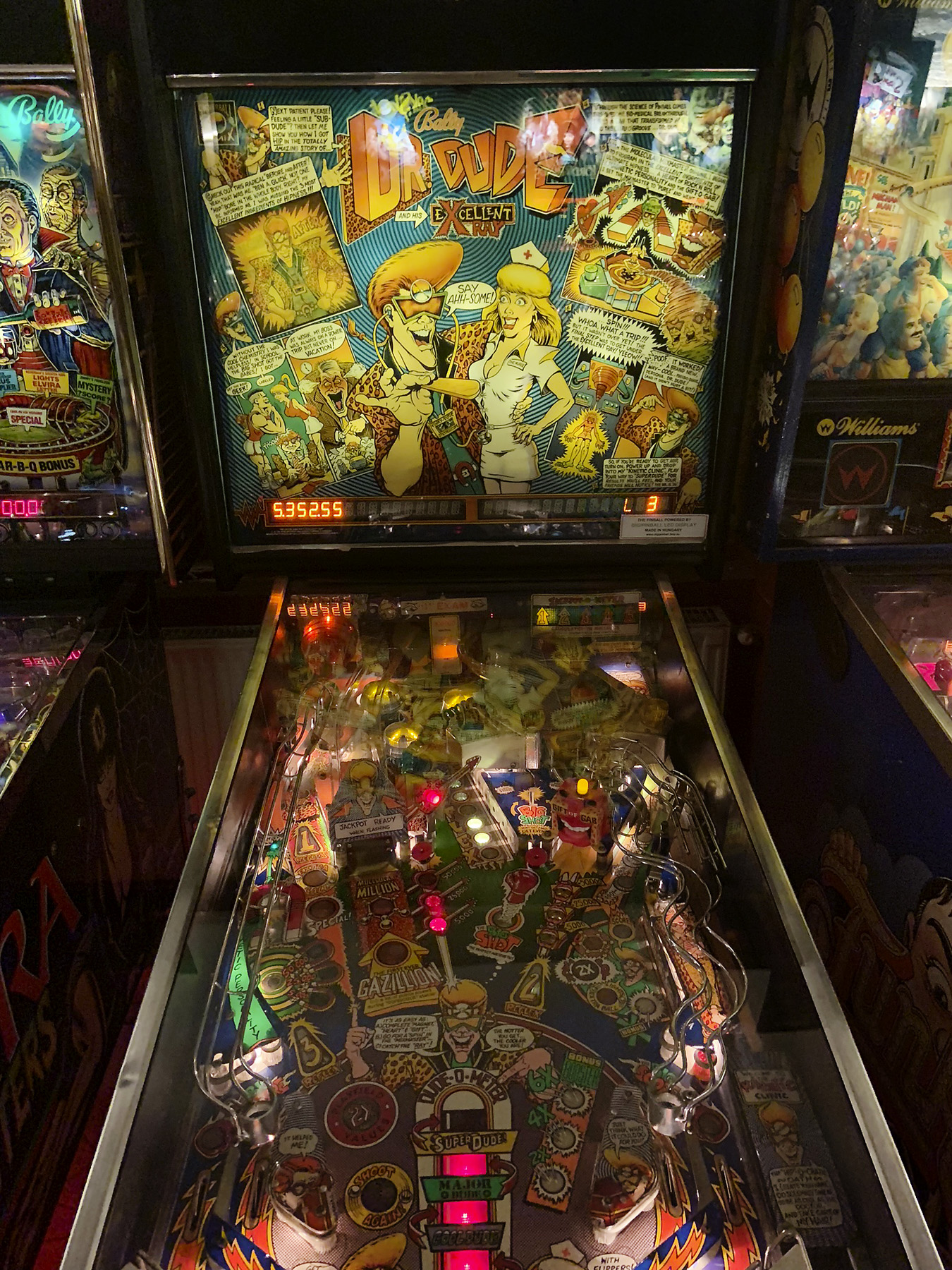
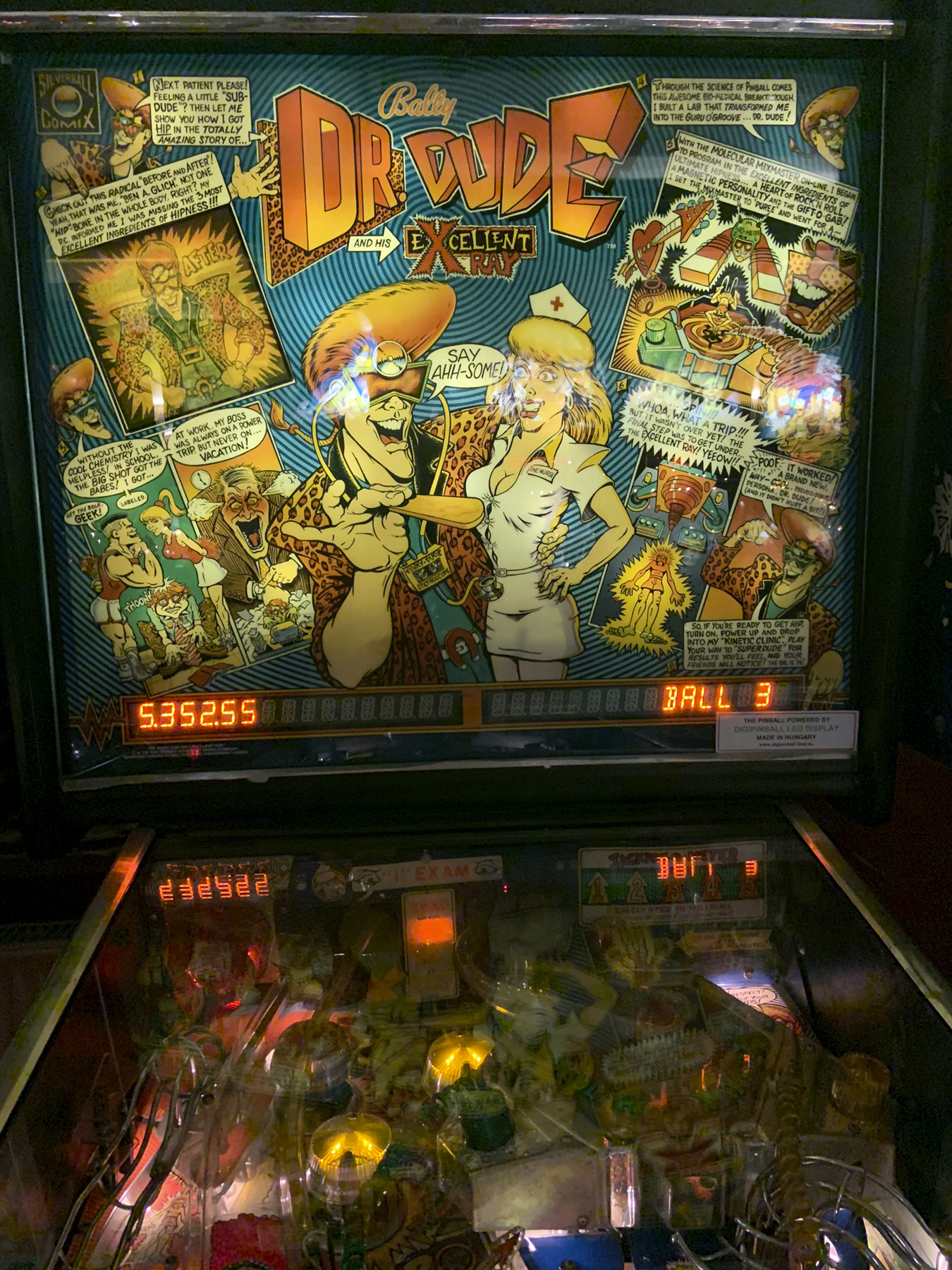
Bally (Midway Manufacturing Company) (Chicago, 1988-1999) 'Dr. Dude And His Excellent Ray' 1990 (detail)

Bally (Midway Manufacturing Company) (Chicago, 1988-1999) 'Dr. Dude And His Excellent Ray' 1990 (detail)


Bally (Midway Manufacturing Company) (Chicago, 1988-1999)
Dr. Dude And His Excellent Ray (details)
1990
4,000 produced
Photos: Marcus Bunyan


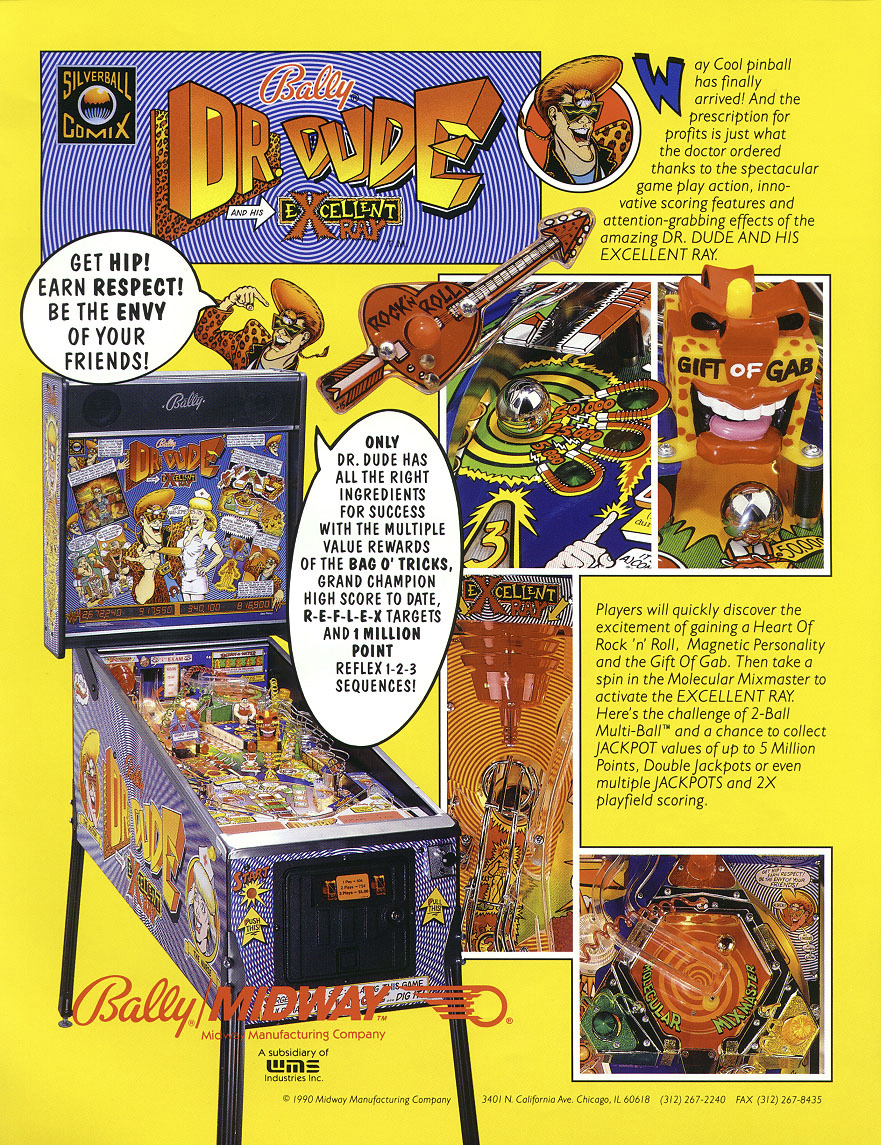
“Get Hip! Earn Respect! Be the Envy of your Friends!”


Dr. Dude And His Excellent Ray pinball flyer


Dr. Dude And His Excellent Ray flyer


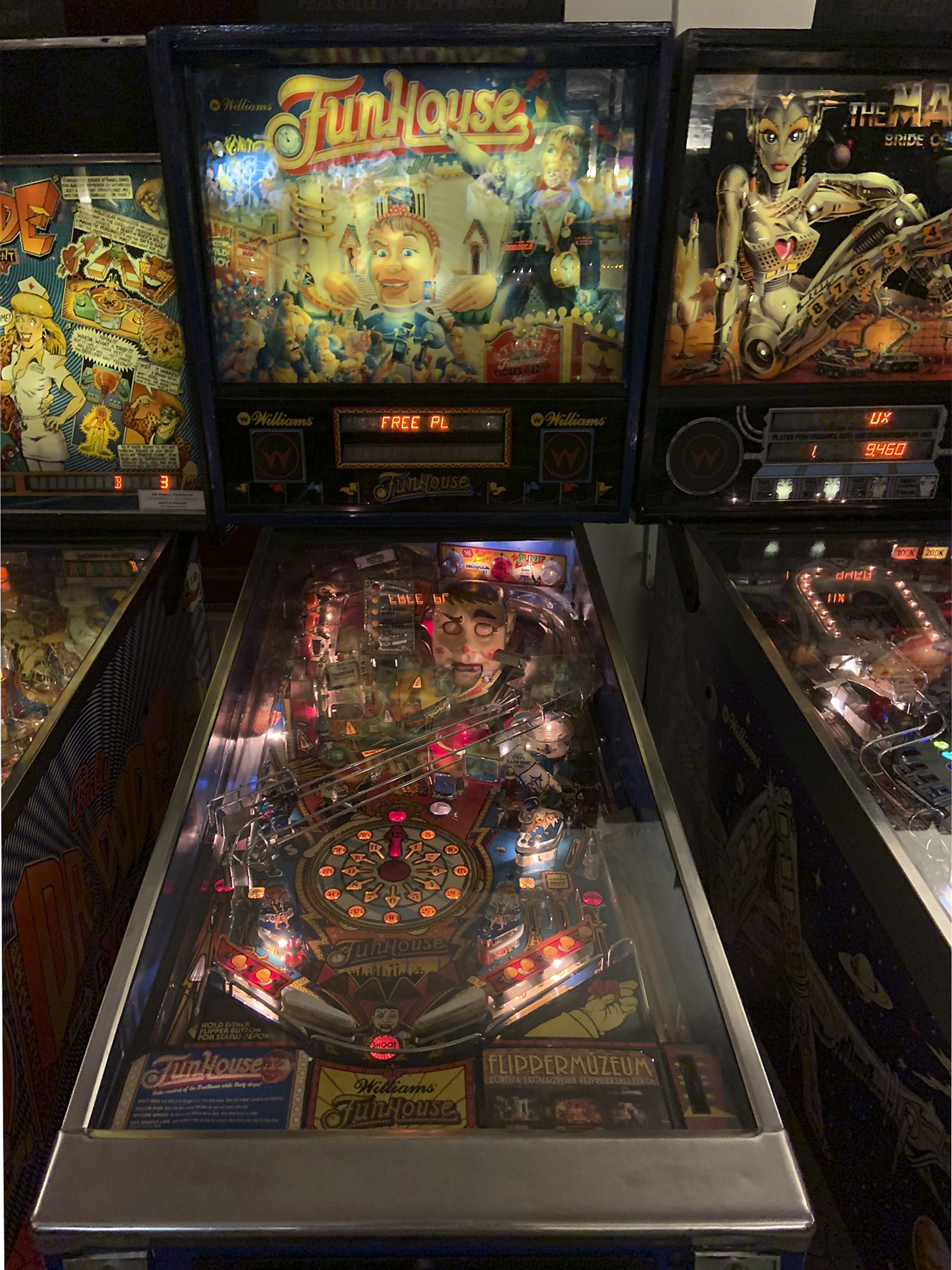
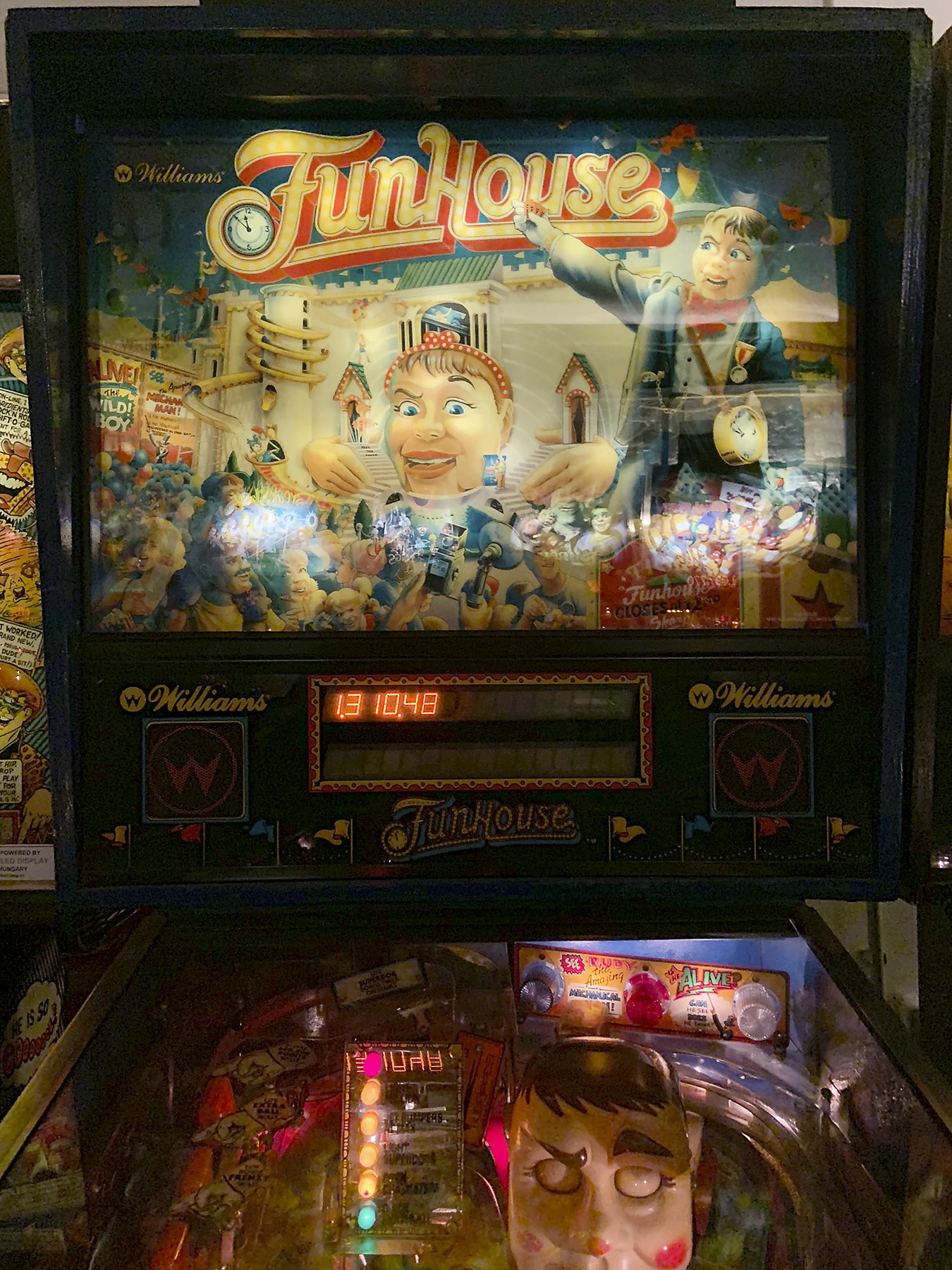
Williams Electronic Games (1985-1999) 'FunHouse' 1990 (detail)

Williams Electronic Games (1985-1999) 'FunHouse' 1990 (detail)

Williams Electronic Games (1985-1999) 'FunHouse' 1990 (detail)


Williams Electronic Games (1985-1999)
FunHouse (details)
1990
10,750 produced
Photos: Marcus Bunyan


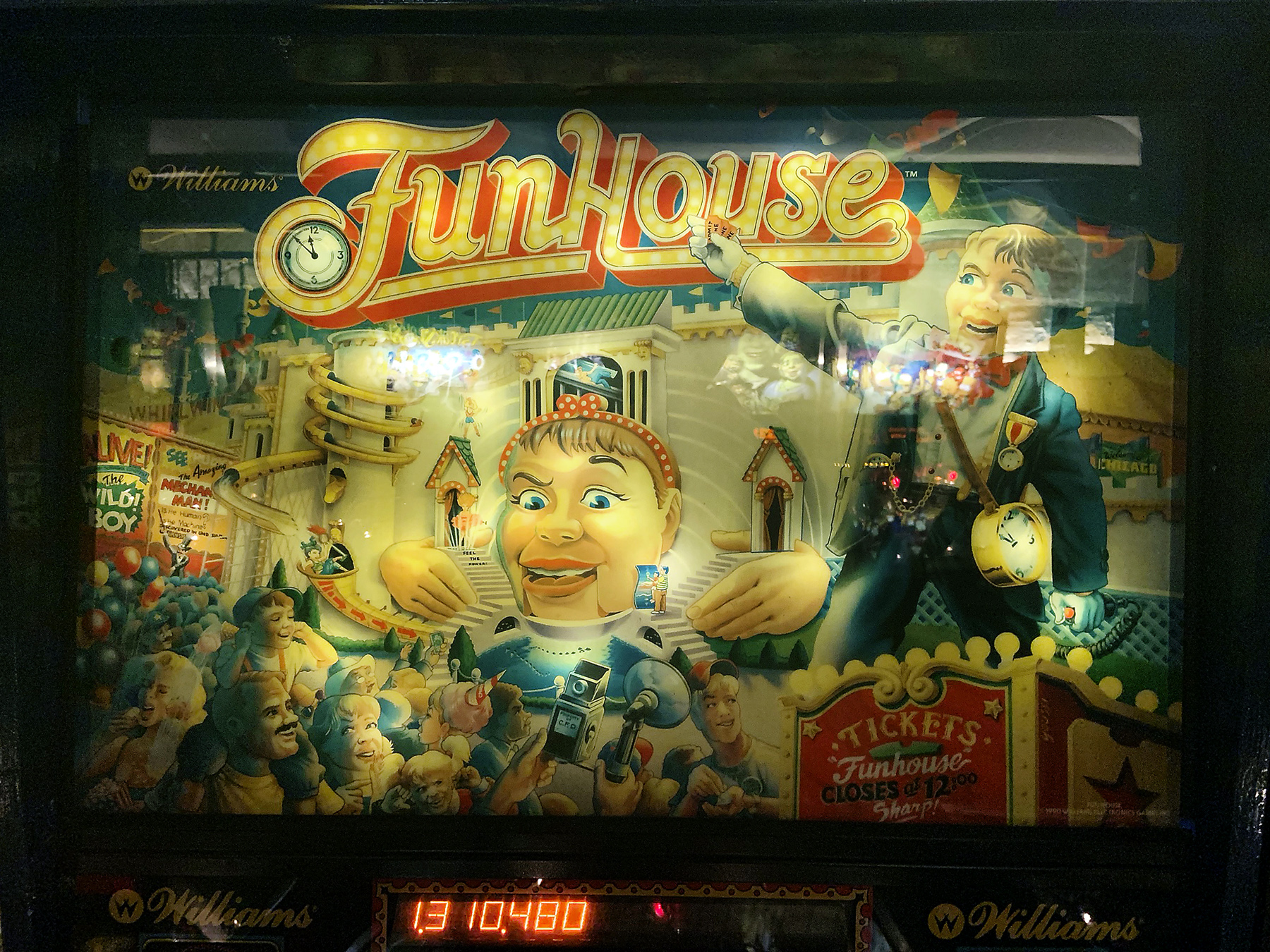
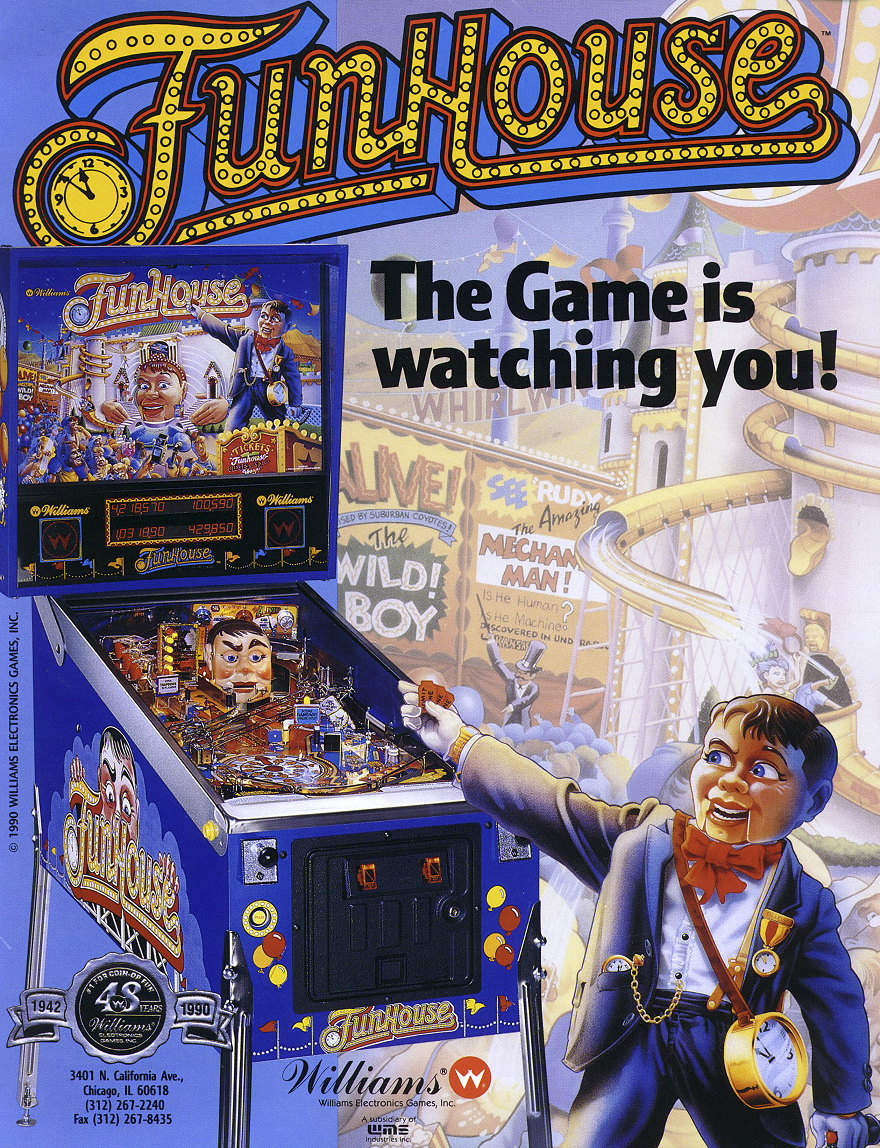
FunHouse backglass


FunHouse backglass


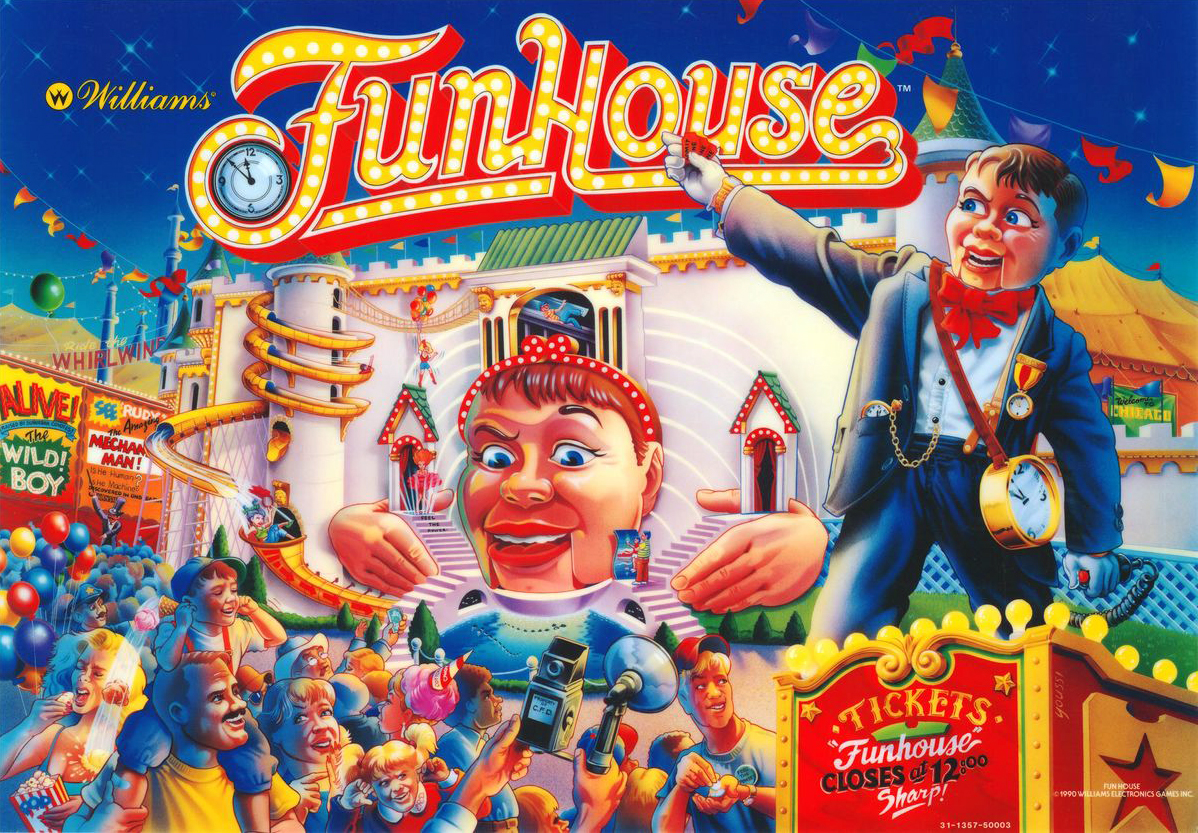
FunHouse pinball flyer


FunHouse pinball flyer


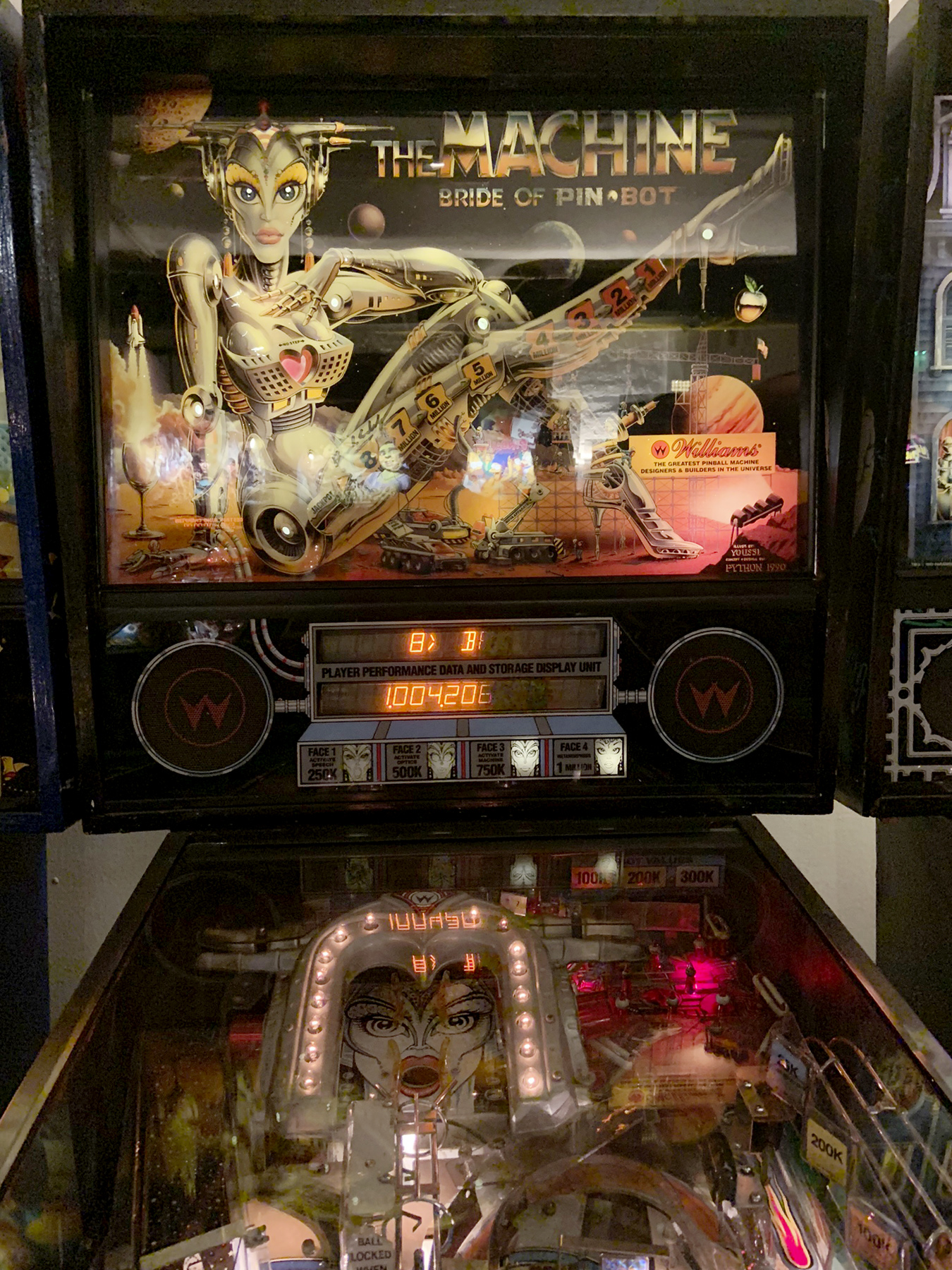
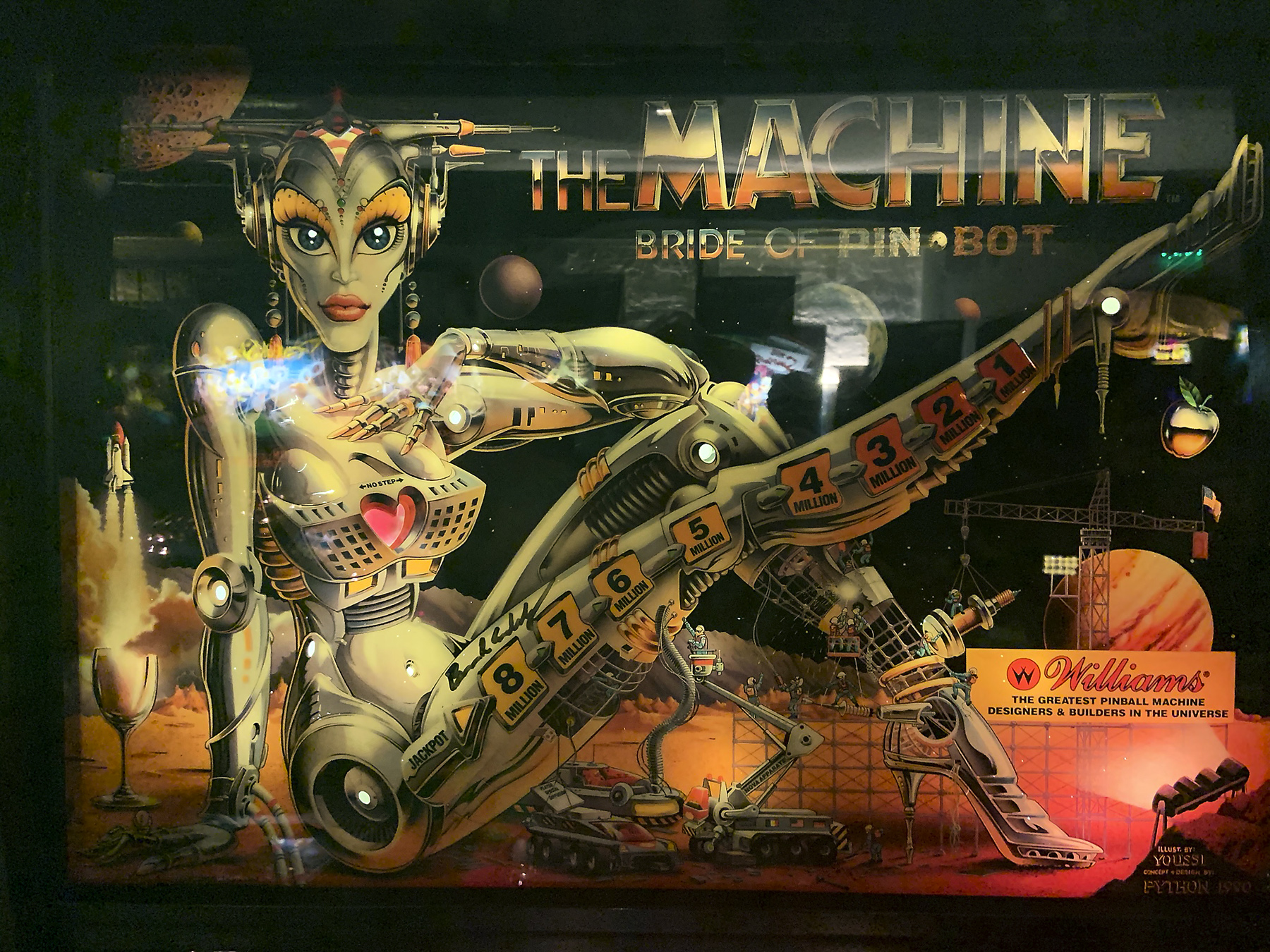
Williams Electronic Games (1985-1999) 'The Machine: Bride of Pinbot' 1991 (detail)

Williams Electronic Games (1985-1999) 'The Machine: Bride of Pinbot' 1991 (detail)


Williams Electronic Games (1985-1999)
The Machine: Bride of Pinbot (details)
1991
8,100 produced
Photos: Marcus Bunyan


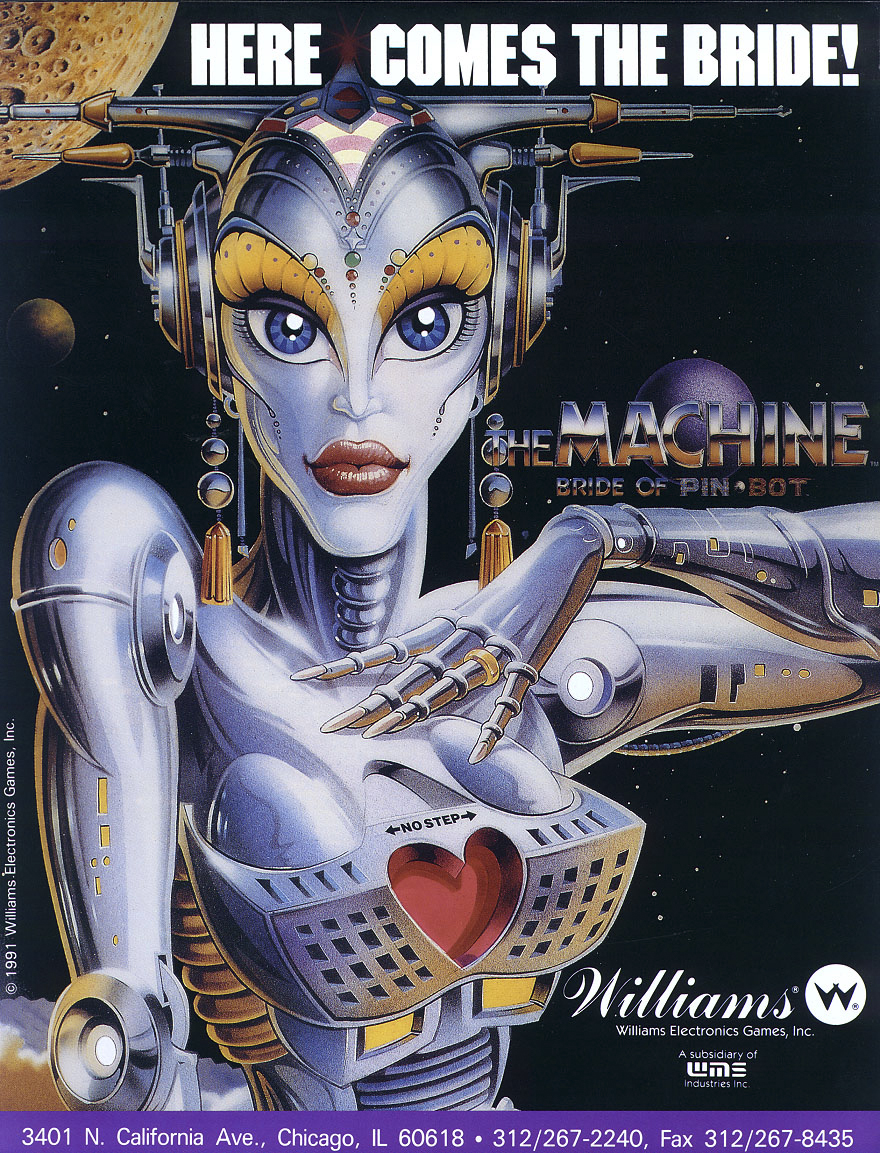
“Here Comes the Bride!”
“Watch Her Turn Heads!”

Artist John Youssi provided us the following information:

“I painted the backglass based on a rough sketch Python [Anghelo] gave me. I re-sketched the whole thing, adding detail while tightening it up. Python was the artist for the cabinet while Kevin O’Connor inked only. I remember Python doing all the art except for the backglass. Plus it all looks like his style.”

Text from the The Internet Pinball Machine Database website [Online] Cited 04/11/2020
 

The Machine: Bride of Pinbot pinball flyer


The Machine: Bride of Pinbot flyer


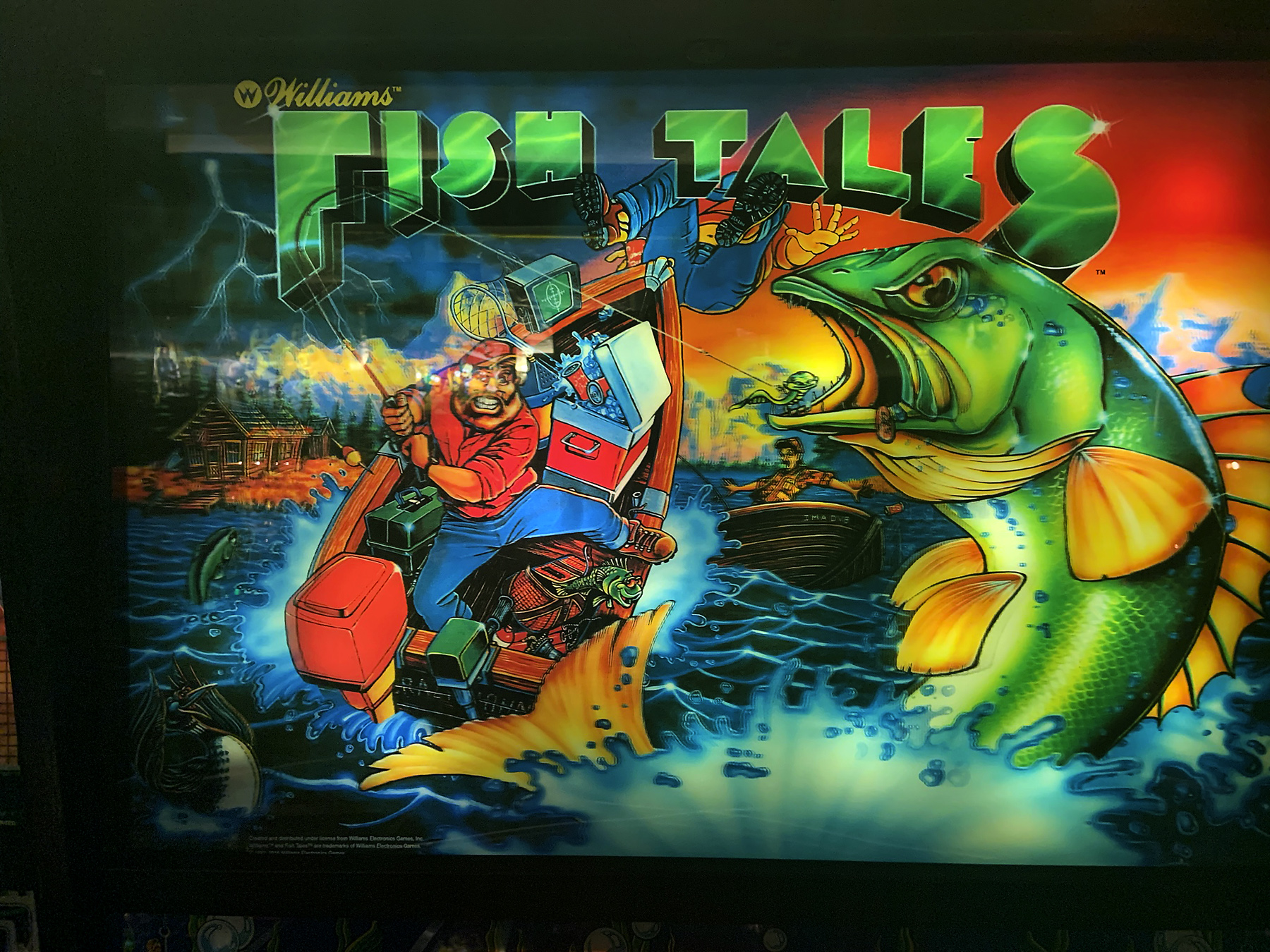
Williams Electronic Games (1985-1999) 'Fish Tales' 1992 (detail)


Williams Electronic Games (1985-1999)
Fish Tales (detail)
1992
13,640 produced
Photo: Marcus Bunyan


“Catch Em All – Hook Line and Sinker”
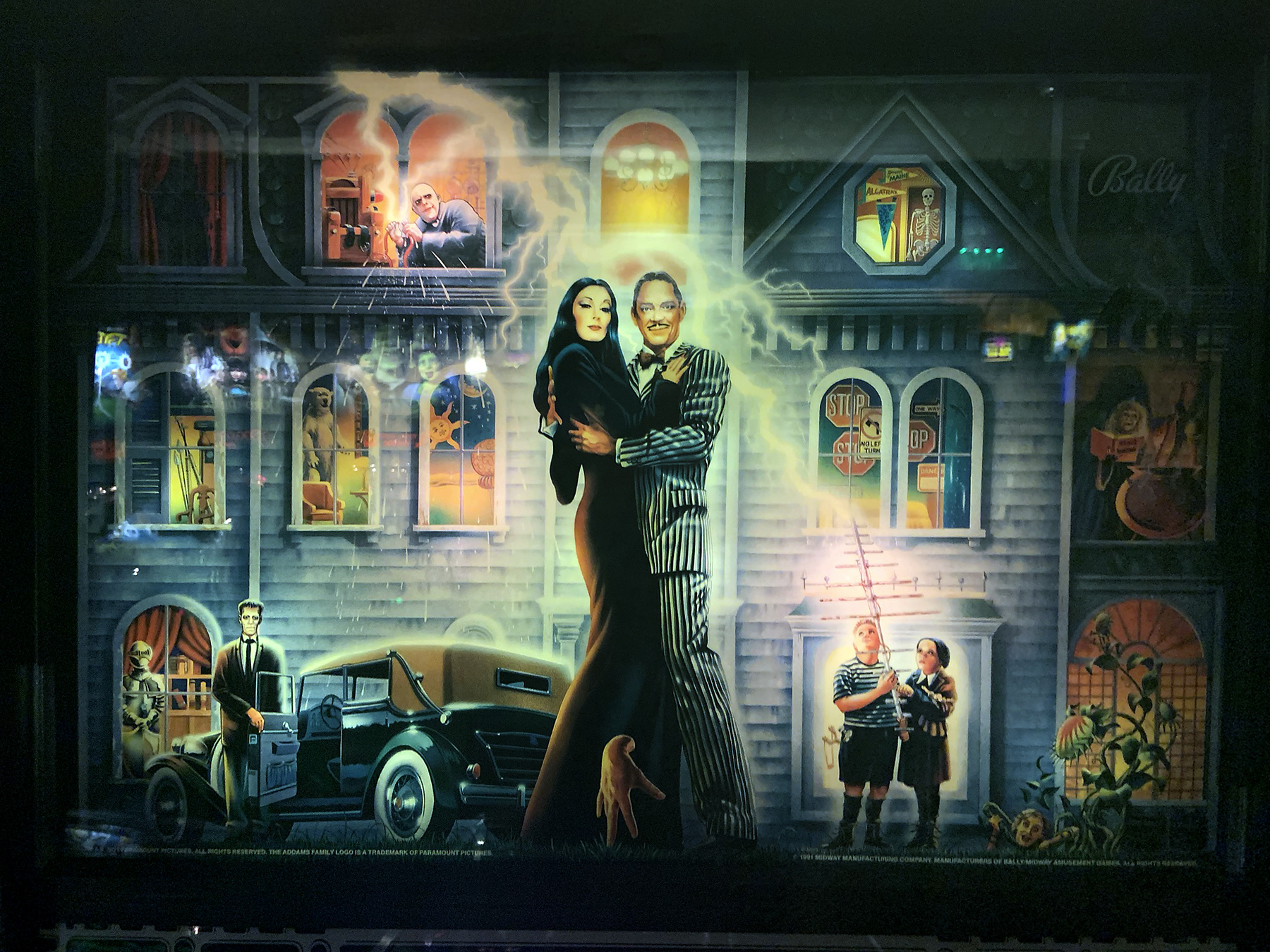
 

Bally. 'The Addams Family' 1992 (detail)


Bally (Midway Manufacturing Company) (Chicago, 1988-1999)
The Addams Family (detail)
1992
20,270 produced
Photo: Marcus Bunyan
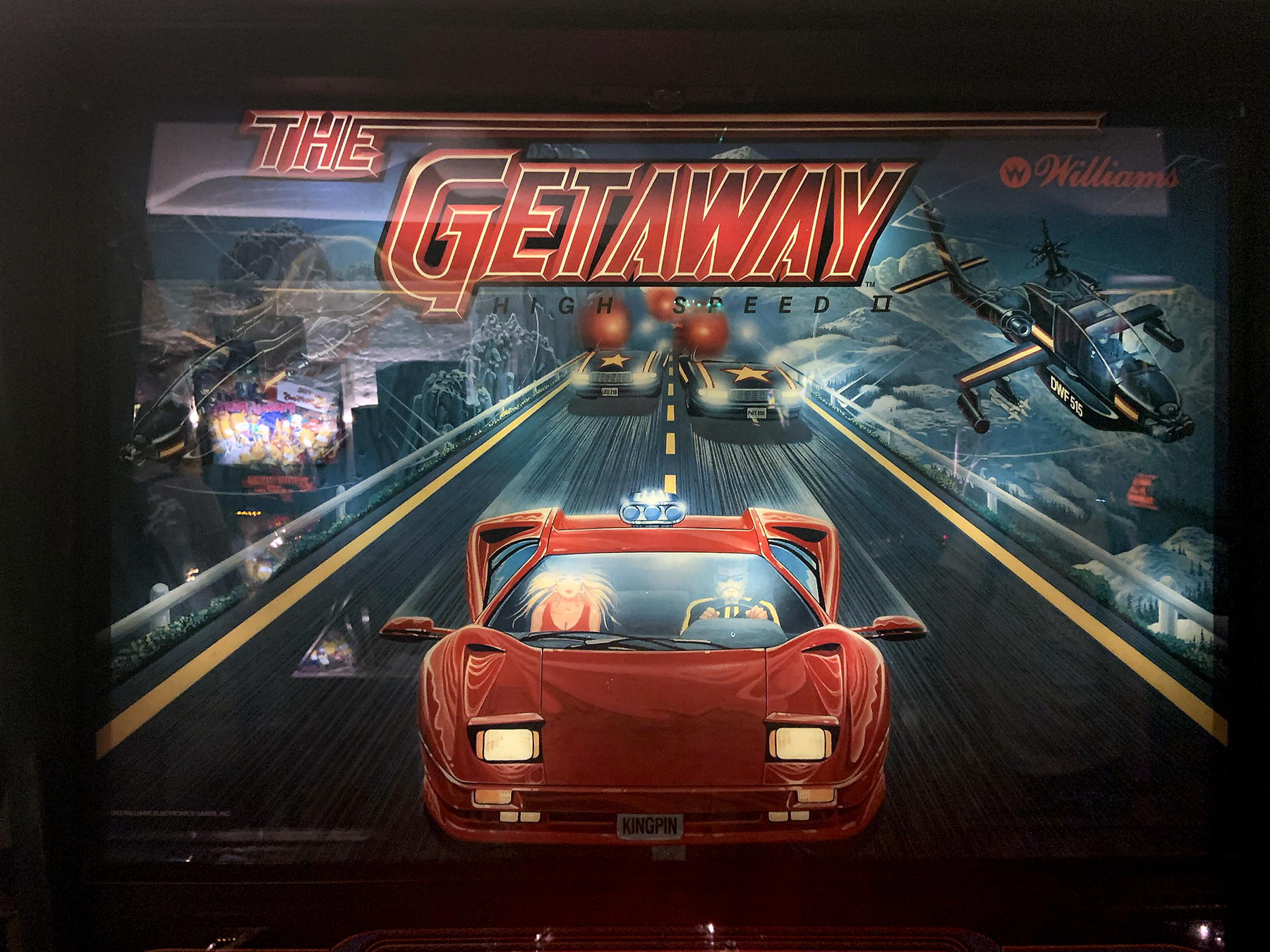
 

Williams Electronic Games (1985-1999) 'The Getaway: High Speed II' 1992 (detail)


Williams Electronic Games (1985-1999)
The Getaway: High Speed II (detail)
1992
13,259 produced
Photo: Marcus Bunyan
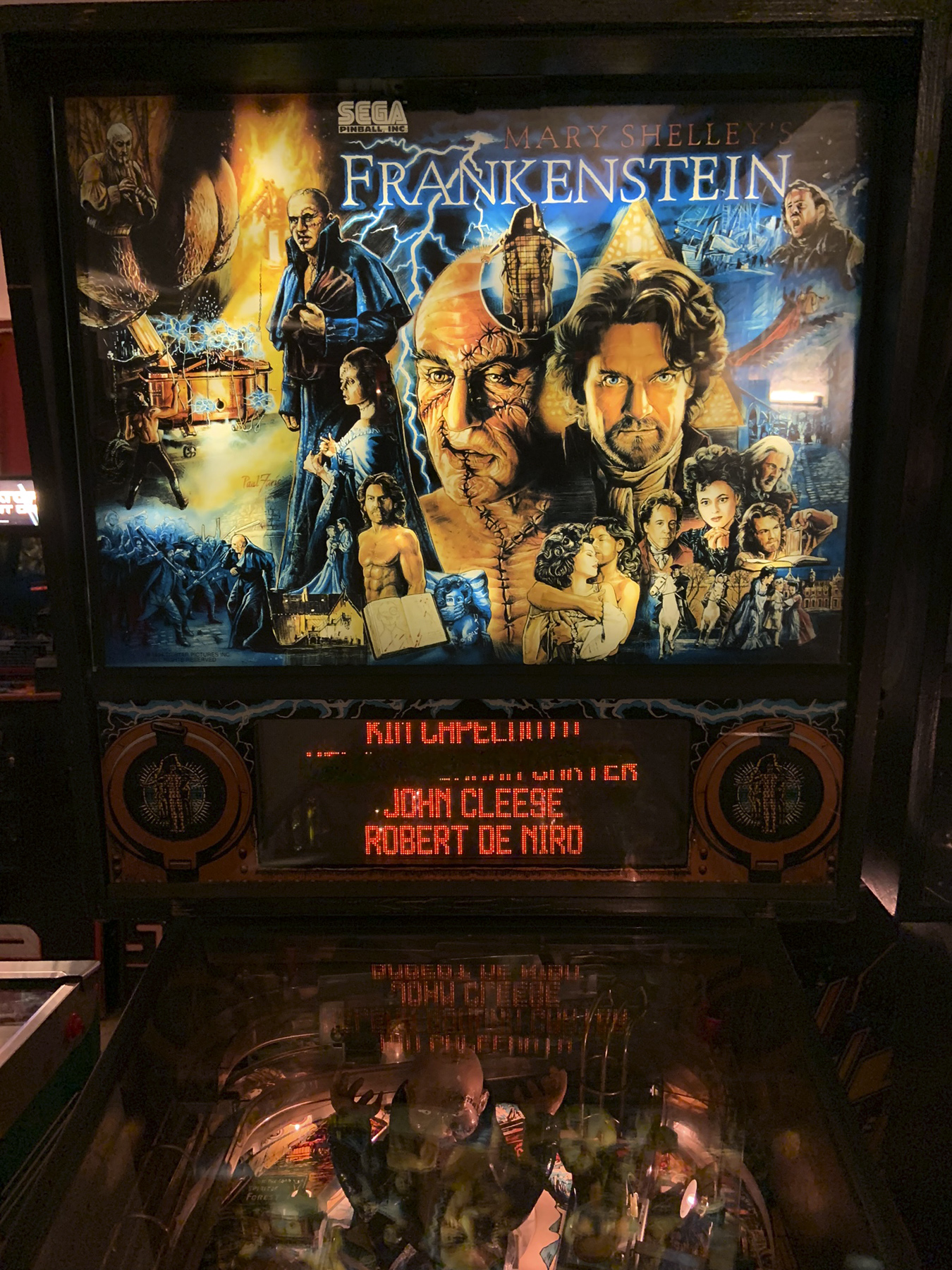
 

Sega Pinball Incorporated. 'Mary Shelley's Frankenstein' 1995 (detail)


Sega Pinball Incorporated (Chicago, Illinois, USA, 1994-1999)
Mary Shelley’s Frankenstein
1995
3,000 produced
Photo: Marcus Bunyan
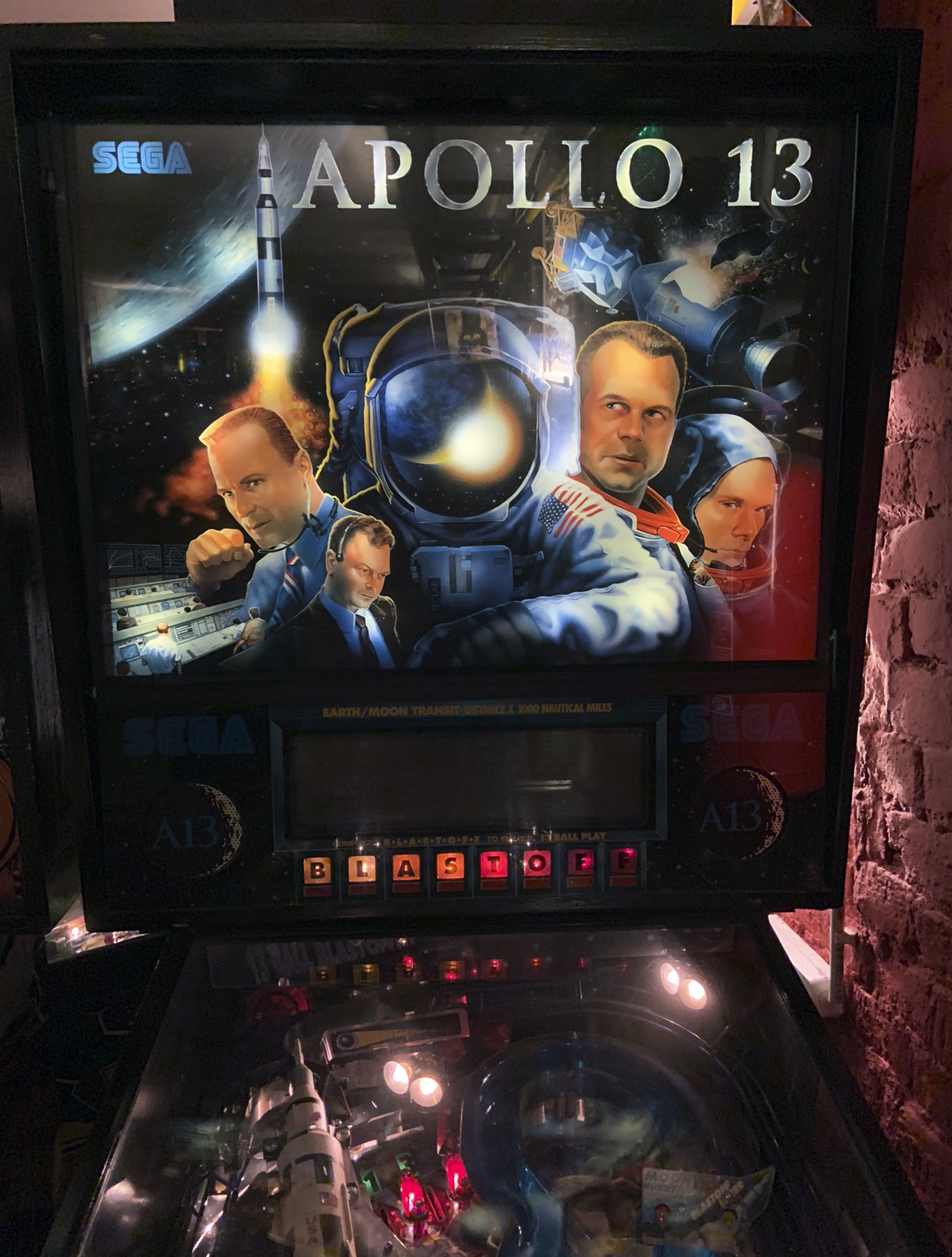
 

Sega. 'Apollo 13' 1995 (detail)


Sega Pinball Incorporated (Chicago, Illinois, USA, 1994-1999)
Apollo 13
1995
2,000 produced
Photo: Marcus Bunyan


“I Believe this will be Our Finest Hour.”
“‘Apollo 13 the Pinball’ is on the Launch Pad with All Systems Go!”
“The First Game in the Universe with 13 Ball Multiball!”


Flippermúzeum
Radnóti Miklós utca 18.
1137, Budapest, Hungary

Opening hours:
Wednesday – Friday 16.00 – 24.00
Saturday 14.00 – 24.00
Sunday 10.00 – 22.00
Monday/Tuesday: CLOSED
Flippermúzeum website

LIKE ART BLART ON FACEBOOK

Back to top

European art research tour: Vasarely Museum, Budapest permanent exhibition

Visited September 2019 posted November 2020


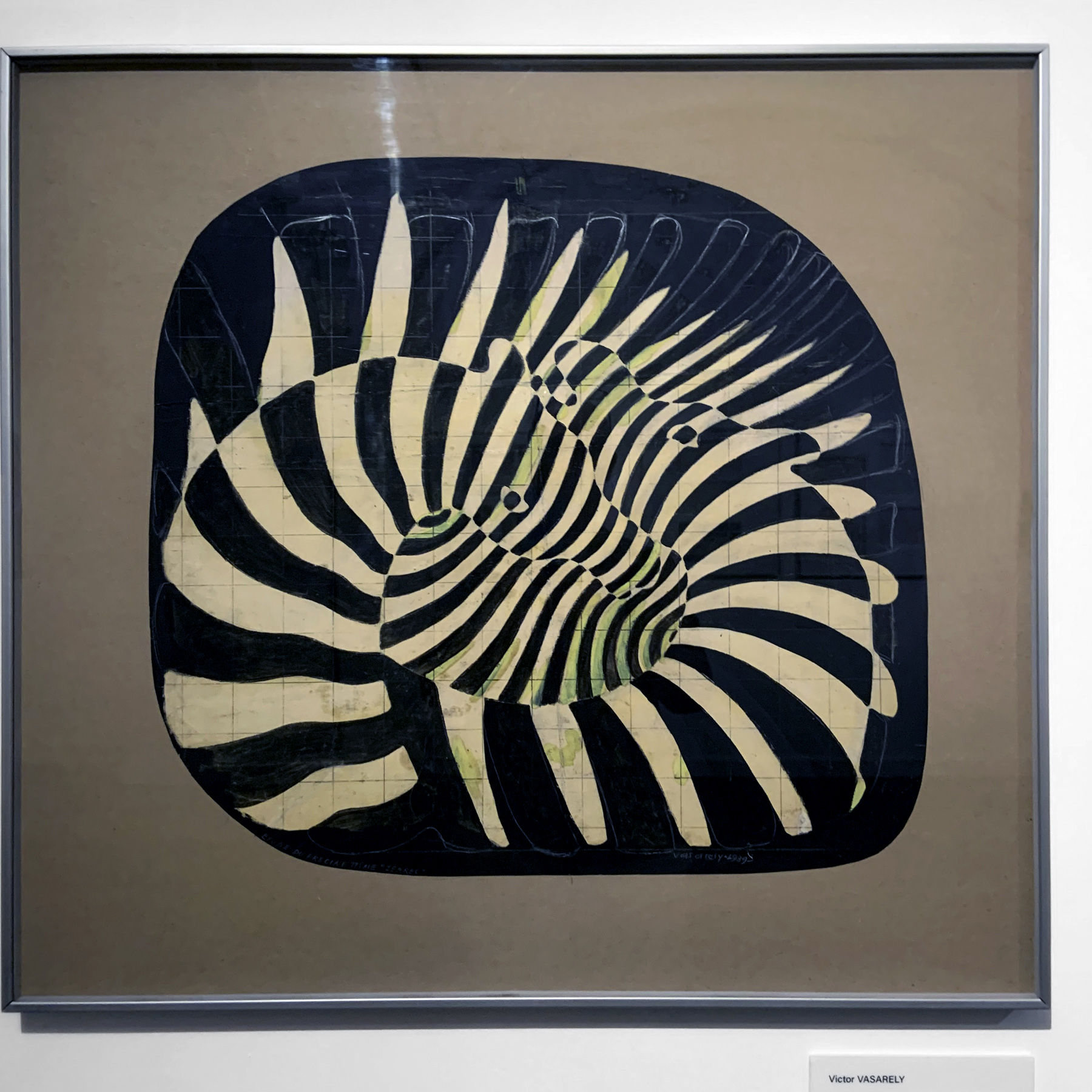
Victor Vasarely (Hungarian-French, 1906-1997) 'Zebras. Prekinetic study (Preliminary study for the kinetic theory. Graphic Period, 1929-1939)' 1939 (installation view)


Victor Vasarely (Hungarian-French, 1906-1997)
Zebras. Prekinetic study (Preliminary study for the kinetic theory. Graphic Period, 1929-1939) (installation view)
1939
Gouache, pencil, colour and white chalk on paper
Photo: Marcus Bunyan


While on my European art trip in 2019, I ventured by tram to the deepest suburbs of Budapest to visit the Vasarely Museum on a Sunday – one of only three days the museum is open. The journey was an experience in itself. The reward was that I got to see an artists work I have always admired (I have a Vasarely serigraph in my collection), set in one of the most beautiful art galleries I have ever seen in my life. What’s not too like.

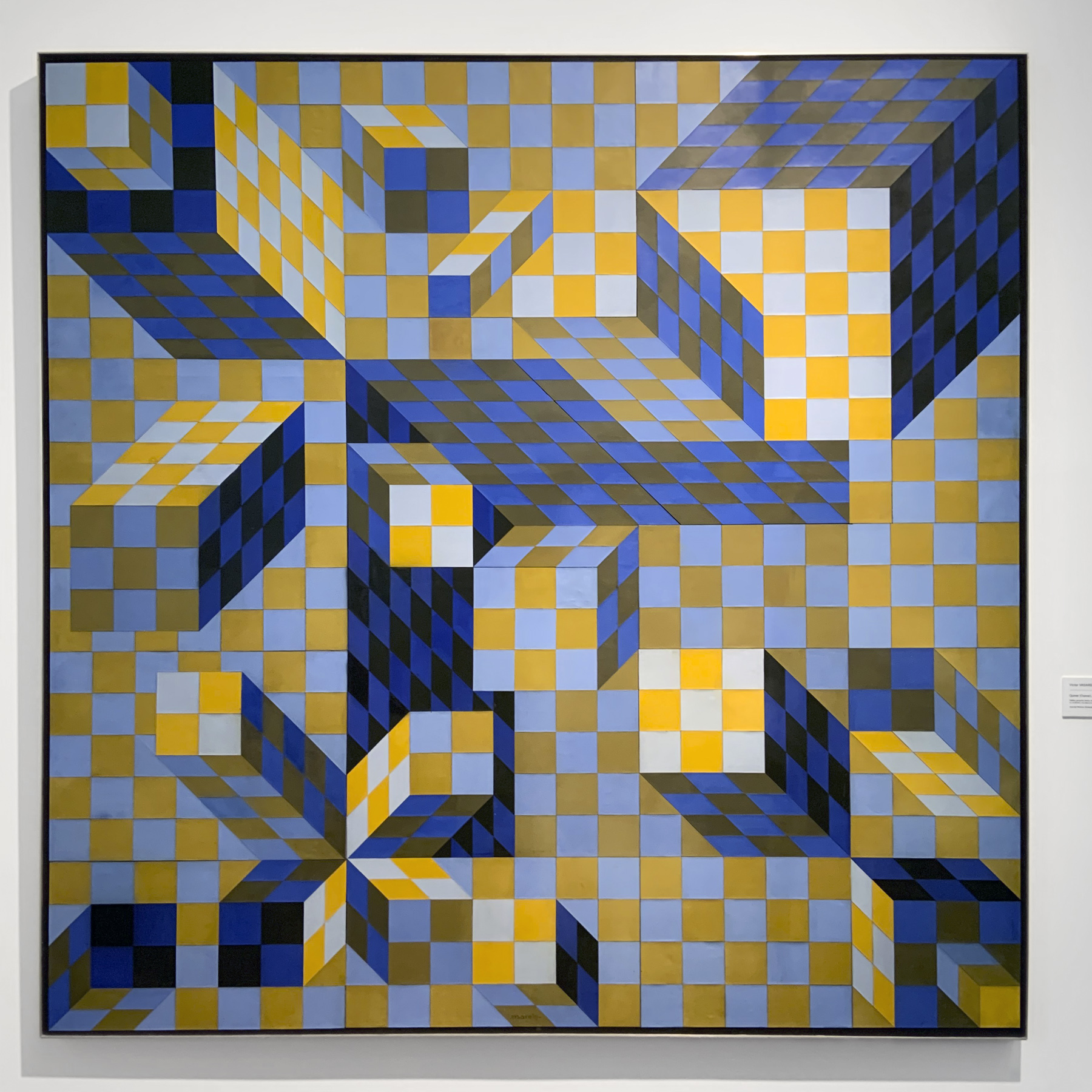
Critically, I got to examine Vasarely’s work up close and personal, on a large scale. I noted how gestural his work is, even as it is geometric – emerging from his Gesture Drawings. Ground Plans of 1946. There is a mesmerising flow to his compositions, even as they are supposedly set, fixed, in their mathematical complexity.

Even as Josef Albers explored colour in the belief that colours have no inherent emotional associations, so Vasarely investigated the formula for a “plastic alphabet”, a universal visual language based on the structural interplay of form and colour, a programmed language with an infinite number of form and colour variations. Through serialisation and the processes of re-creation, multiplication and expansion, “in pictures based on the mutual association between forms and colours, he claimed to perceive a ‘grammar’ of visual language, with which a set of basic forms making up a composition could be arranged into a system similar to musical notation… He regarded colour-forms as the cells or molecules out of which the universe was made.”

Don’t believe all that is written on the can. While both artists want to euthanise the authenticity of the hand, the feeling of he eye, and the beauty of the object through an investigation of concept, form and replication, when in the presence of these paintings, once, twice, three times, one cannot deny the intimacy of their construction.

Unlike flat reproductions of these paintings in books, their serial reproduction, in these installation photographs you can see the ripples in the surface of these paintings. Their meticulous, hand-crafted production. For example, look at the surface of paintings such as Lom-Lan 2 (1953, below); Marsan (1950 / 1955 / 1958, below); and Sonora (1973, below). From a distance their patterns are stable but optically disturbing. Up close, their surface dis/integrates into swirls and ripples at a molecular level. The musical annotation – colour, form, pattern, repetition – of these optical illusions is subsumed into an aura, an earthly divination of a transient ‘planetary folklore’.

Dr Marcus Bunyan

.
All iPhone images © Dr Marcus Bunyan. Please click on the photographs for a larger version of the image.


Downstairs galleries


View of the downstairs galleries of the Vasarely Museum, Budapest


View of the downstairs galleries of the Vasarely Museum Budapest
Photo: Marcus Bunyan


View of one of the downstairs galleries of the Vasarely Museum, Budapest showing at second left, Gesture Drawings. Ground Plans (1946); and at second right, Composition (1948)


View of one of the downstairs galleries of the Vasarely Museum, Budapest showing at second left, Gesture Drawings. Ground Plans (1946); and at second right, Composition (1948)
Photo: Marcus Bunyan


Victor Vasarely (Hungarian-French, 1906-1997) 'Gesture Drawings. Ground Plans' 1946 (installation view)


Victor Vasarely (Hungarian-French, 1906-1997)
Gesture Drawings. Ground Plans (installation view)
1946
Pencil on paper
Vasarely Museum Budapest
Photo: Marcus Bunyan


The Galerie Denise René opened in 1944. Its first exhibition was Les dessins et composition de Vasarely (Vasarely’s drawings and graphic compositions). Surrealism influenced his works, and even caught the attention of André Breton. As Denise René recalled: ‘André Breton was even convinced we had found a Surrealist painter; it was mostly the trompe l’œils that made him think so, which abounded in Vasarely’s graphic innovations. Breton invited me and Vasarely to visit him in rue Fontaine. Éluard and Breton both came to see the exhibition, though on different days because Éluard had broken with Breton and Surrealism.’ Vasarely had a painterly turn. Shortly he made experimentations in gesture painting. (Victor Vasarely, Jazz, 1942, inv. V. 195) Later, despite his artistic discoveries, he described his earliest period as Les Fausses Routes (Wrong Roads).

Text from the Vasarely Museum website [Online] Cited 26/10/2020


Victor Vasarely (Hungarian-French, 1906-1997) 'Man in motion. Study of Motion (The Man)' 1943


Victor Vasarely (Hungarian-French, 1906-1997)
Hombre en movimiento – Estudio del movimiento (El hombre)
Man in motion. Study of Motion (The Man)
1943
Tempera on plywood
117 x 132cm
Vasarely Museum Budapest


Victor Vasarely (Hungarian-French, 1906-1997) 'Composition' 1948 (installation view)


Victor Vasarely (Hungarian-French, 1906-1997)
Composition (installation view)
1948
Oil on canvas
Vasarely Museum Budapest
Photo: Marcus Bunyan


Magyar Grafika (Hungarian Graphics). 'Az Ujság Hirdetés' (The Newspaper is Advertised) Edition 12 1931 (installation view)


Magyar Grafika (Hungarian Graphics)
Az Ujság Hirdetés (The Newspaper is Advertised) (installation view)
Edition 12
1931
Vasarely Museum Budapest
Photo: Marcus Bunyan


A journal for the development of graphic industries and related professions. Budapest, 1. 1920 – 13. 1932


Installation view of the downstairs galleries of the Vasarely Museum, Budapest

Installation view of the downstairs galleries of the Vasarely Museum, Budapest

Installation view of the downstairs galleries of the Vasarely Museum, Budapest


Installation views of the downstairs galleries of the Vasarely Museum, Budapest with in the last photo at left, Versant (1952)
Photos: Marcus Bunyan


Victor Vasarely (Hungarian-French, 1906-1997) 'Versant' 1952 (installation view)


Victor Vasarely (Hungarian-French, 1906-1997)
Versant (installation view)
1952
Acrylic on plywood
Vasarely Museum Budapest
Photo: Marcus Bunyan


Installation view of the Vasarely Museum, Budapest


Installation view of the Vasarely Museum, Budapest with at right, Lom-Lan 2 (1953)
Photo: Marcus Bunyan


Victor Vasarely (Hungarian-French, 1906-1997) 'Lom-Lan 2' 1953 (installation view)


Victor Vasarely (Hungarian-French, 1906-1997)
Lom-Lan 2 (installation view)
1953
Oil on fibreboard
Vasarely Museum Budapest
Photo: Marcus Bunyan


Installation views on one of the downstairs galleries of the Vasarely Museum, Budapest showing the painting 'Amir ("Rima")' 1953

Installation views on one of the downstairs galleries of the Vasarely Museum, Budapest showing the painting 'Amir ("Rima")' 1953


Installation views on one of the downstairs galleries of the Vasarely Museum, Budapest showing the painting Amir (“Rima”) 1953 (installation view)
Photos: Marcus Bunyan


Victor Vasarely (Hungarian-French, 1906-1997) 'Amir ("Rima")' 1953 (installation view)


Victor Vasarely (Hungarian-French, 1906-1997)
Amir (“Rima”) (installation view)
1953
Acrylic on plywood
Vasarely Museum Budapest
Photo: Marcus Bunyan


Victor Vasarely (Hungarian-French, 1906-1997) 'MORA' Oeuvre profonde cinétique 1954/1960 (installation view)

Victor Vasarely (Hungarian-French, 1906-1997) 'MORA' Oeuvre profonde cinétique 1954/1960 (installation view)


Victor Vasarely (Hungarian-French, 1906-1997)
MORA (Oeuvre profonde cinétique) (installation views)
1954/1960 (?)
Deep kinetic object, silk screen on plexiglas, glass and steel
Vasarely Museum Budapest
Photos: Marcus Bunyan


Installation view one of the downstairs galleries of the Vasarely Museum, Budapest showing at left, 'Orion noir' (1970); and at right, 'Norma' (1962-1979)


Installation view one of the downstairs galleries of the Vasarely Museum, Budapest showing at left, Orion noir (1970); and at right, Norma (1962-1979)
Photo: Marcus Bunyan


Victor Vasarely (Hungarian-French, 1906-1997) 'Orion noir' 1970


Victor Vasarely (Hungarian-French, 1906-1997)
Orion noir
1970
Acrylic on canvas
Vasarely Museum Budapest


Victor Vasarely (Hungarian-French, 1906-1997) 'Norma' 1962-1979 (installation view)


Victor Vasarely (Hungarian-French, 1906-1997)
Norma (installation view)
1962-1979
Acrylic on canvas
Vasarely Museum Budapest
Photo: Marcus Bunyan


Installation view of the Vasarely Museum, Budapest


Installation view of the Vasarely Museum, Budapest
Photo: Marcus Bunyan


Victor Vasarely (Hungarian-French, 1906-1997) 'Chess Set' 1980 (installation view)

Victor Vasarely (Hungarian-French, 1906-1997) 'Chess Set' 1980 (installation view)


Victor Vasarely (Hungarian-French, 1906-1997)
Chess Set
1980
Multiple, plexiglass
Vasarely Museum Budapest
Photos: Marcus Bunyan


Installation view of one of the downstairs galleries of the Vasarely Museum, Budapest showing at left, 'Marsan-2' (1964/1974); at centre, 'Gizeh' (1955/1962); and at right, 'Marsan' (1950/1955/1958)


Installation view of one of the downstairs galleries of the Vasarely Museum, Budapest showing at left, Marsan-2 (1964/1974); at centre, Gizeh (1955/1962); and at right, Marsan (1950/1955/1958)
Photo: Marcus Bunyan


Victor Vasarely (Hungarian-French, 1906-1997) 'Marsan-2' 1964/1974 (installation view)

Victor Vasarely (Hungarian-French, 1906-1997) 'Marsan-2' 1964/1974 (installation view)


Victor Vasarely (Hungarian-French, 1906-1997)
Marsan-2 (installation views)
1964/1974
Acrylic on canvas
Vasarely Museum Budapest
Photos: Marcus Bunyan


Victor Vasarely (Hungarian-French, 1906-1997) 'Gizeh' 1955/1962 (installation view)


Victor Vasarely (Hungarian-French, 1906-1997)
Gizeh (installation view)
1955/1962
Oil on canvas
Donation of Victor Vasarely, 1970
Vasarely Museum Budapest
Photo: Marcus Bunyan


Victor Vasarely (Hungarian-French, 1906-1997) 'Marsan' 1950/1955/1958 (installation view)


Victor Vasarely (Hungarian-French, 1906-1997)
Marsan (installation view)
1950/1955/1958
Oil on canvas
Donation of Victor Vasarely, 1970
Vasarely Museum Budapest
Photo: Marcus Bunyan


Victor Vasarely (Hungarian-French, 1906-1997) 'Naissances' 1954/1960 (installation view)


Victor Vasarely (Hungarian-French, 1906-1997)
Naissances (installation view)
1954/1960
From the album Hommage à Johann Sebastian Bach (Éd. Pierre belford, Paris, 1973. Éxemplaire XIV/XX), Supplement no. 3.
Deep kinetic object, plexiglass, silk screen
Vasarely Museum Budapest
Photo: Marcus Bunyan


Victor Vasarely (Hungarian-French, 1906-1997) 'Zilia' 1981 (installation view)


Victor Vasarely (Hungarian-French, 1906-1997)
Zilia (installation view)
1981
Acrylic on canvas
Vasarely Museum Budapest
Photo: Marcus Bunyan


Victor Vasarely (Hungarian-French, 1906-1997) 'Stridio-Z' 1976-1977 (installation view)


Victor Vasarely (Hungarian-French, 1906-1997)
Stridio-Z (installation view)
1976-1977
Acrylic on canvas
Vasarely Museum Budapest
Photo: Marcus Bunyan


Victor Vasarely (Hungarian-French, 1906-1997) 'Tri-Axo' 1972/1976 (installation view)


Victor Vasarely (Hungarian-French, 1906-1997)
Tri-Axo (installation view)
1972/1976
Acrylic on canvas
Vasarely Museum Budapest
Photo: Marcus Bunyan


William Seitz. 'The responsive eye' Museum of Modern Art, 1965


William Seitz
The responsive eye (book cover)
Museum of Modern Art, 1965
Photo: Marcus Bunyan


Installation view of the downstairs galleries of the Vasarely Museum, Budapest


Installation view of the downstairs galleries of the Vasarely Museum, Budapest
Photo: Marcus Bunyan


Installation view of the Vasarely Museum, Budapest showing 'Yllus' (1978)


Installation view of the Vasarely Museum, Budapest showing Yllus (1978)
Photo: Marcus Bunyan


Victor Vasarely (Hungarian-French, 1906-1997) 'Yllus' 1978 (installation view)


Victor Vasarely (Hungarian-French, 1906-1997)
Yllus
1978
Acrylic on canvas
Vasarely Museum Budapest
Photo: Marcus Bunyan


Upstairs galleries


Installation view of the upstairs galleries of the Vasarely Museum, Budapest


Installation view of the upstairs galleries of the Vasarely Museum, Budapest
Photo: Marcus Bunyan


Installation view of the Vasarely Museum, Budapest showing 'V.P. 102' (1979)


Installation view of the Vasarely Museum, Budapest showing V.P. 102 (1979)
Photo: Marcus Bunyan


Victor Vasarely (Hungarian-French, 1906-1997) 'V.P. 102' 1979 (installation view)


Victor Vasarely (Hungarian-French, 1906-1997)
V.P. 102 (installation view)
1979
Acrylic on cardboard, mounted on plywood
Vasarely Museum Budapest
Photo: Marcus Bunyan


Installation view of the upstairs galleries of the Vasarely Museum, Budapest showing at left in the display cabinet, 'KROA-MC' (1969); and at centre, 'Quivar (Ouivar)' (1974)


Installation view of the upstairs galleries of the Vasarely Museum, Budapest showing at left in the display cabinet, KROA-MC (1969); and at centre, Quivar (Ouivar) (1974)
Photo: Marcus Bunyan


Installation view of the upstairs galleries of the Vasarely Museum, Budapest showing at left, 'Eroed-Pre' (1978); and at right, 'Quivar (Ouivar)' (1974)


Installation view of the upstairs galleries of the Vasarely Museum, Budapest showing at left, Eroed-Pre (1978); and at right, Quivar (Ouivar) (1974)
Photo: Marcus Bunyan


Victor Vasarely (Hungarian-French, 1906-1997) 'Eroed-Pre' 1978 (installation view)


Victor Vasarely (Hungarian-French, 1906-1997)
Eroed-Pre (installation view)
1978
Acrylic on canvas
Vasarely Museum Budapest
Photo: Marcus Bunyan


Victor Vasarely (Hungarian-French, 1906-1997) 'Quivar (Ouivar)' 1974 (installation view)


Victor Vasarely (Hungarian-French, 1906-1997)
Quivar (Ouivar) (installation view)
1974
Collage, gouache on cardboard, mounted on plywood
Vasarely Museum Budapest
Photo: Marcus Bunyan


Installation view of the upstairs galleries of the Vasarely Museum, Budapest showing at right, 'Stri-oet' (1979)


Installation view of the upstairs galleries of the Vasarely Museum, Budapest showing at right, Stri-oet (1979)
Photo: Marcus Bunyan


Victor Vasarely (Hungarian-French, 1906-1997) 'Stri-oet' 1979 (installation view)


Victor Vasarely (Hungarian-French, 1906-1997)
Stri-oet (installation view)
1979
Acrylic on canvas
Vasarely Museum Budapest
Photo: Marcus Bunyan


Installation view of the upstairs galleries of the Vasarely Museum, Budapest showing at left centre, 'Stri-oet' (1979); and in the display cabinet, 'KROA-MC' (1969)


Installation view of the Vasarely Museum, Budapest showing at left centre, Stri-oet (1979); and in the display cabinet, KROA-MC (1969). Love the reflection of the colours on the wall behind!
Photo: Marcus Bunyan


Installation view of the Vasarely Museum, Budapest showing 'KROA-MC' (1969)


Installation view of the Vasarely Museum, Budapest showing KROA-MC (1969)
Photo: Marcus Bunyan


Installation view of the upstairs galleries of the Vasarely Museum, Budapest showing at left, 'Bull' (1973/74); and at centre left, 'Orion noir' (1963)


Installation view of the upstairs galleries of the Vasarely Museum, Budapest showing at left, Bull (1973/74); and at centre left, Orion noir (1963)
Photo: Marcus Bunyan


Victor Vasarely (Hungarian-French, 1906-1997) 'Bull' 1973/1974 (installation view)


Victor Vasarely (Hungarian-French, 1906-1997)
Bull (installation view)
1973/1974
Acrylic on canvas
Vasarely Museum Budapest
Photo: Marcus Bunyan


Victor Vasarely (Hungarian-French, 1906-1997) 'Vega Mir' 1954/1960 (installation view)


Victor Vasarely (Hungarian-French, 1906-1997)
Vega Mir (Oeuvre profonde cinétique) (installation view)
1954/1960
From the album Hommage à Johann Sebastian Bach (Éd. Pierre belford, Paris, 1973. Éxemplaire XIV/XX), Supplement no. 1.
Multiple, silk screen on anodised aluminium
Vasarely Museum Budapest
Photo: Marcus Bunyan


Victor Vasarely (Hungarian-French, 1906-1997) 'Vega Mir' 1954/1960 (installation view detail)


Victor Vasarely (Hungarian-French, 1906-1997)
Vega Mir (Oeuvre profonde cinétique) (installation view detail)
1954/1960
From the album Hommage à Johann Sebastian Bach (Éd. Pierre belford, Paris, 1973. Éxemplaire XIV/XX), Supplement no. 1.
Multiple, silk screen on anodised aluminium
Vasarely Museum Budapest
Photo: Marcus Bunyan. Self portrait with ‘Vega Mir’ 2019


Installation view of the upstairs galleries of the Vasarely Museum, Budapest showing at left, 'Bi. Octans' (1979)


Installation view of the upstairs galleries of the Vasarely Museum, Budapest showing at left, Bi. Octans (1979)
Photo: Marcus Bunyan


Victor Vasarely (Hungarian-French, 1906-1997) 'Bi. Octans' 1979 (installation view)


Victor Vasarely (Hungarian-French, 1906-1997)
Bi. Octans (installation view)
1979
Acrylic on canvas
Vasarely Museum Budapest
Photo: Marcus Bunyan


Installation view of the upstairs galleries of the Vasarely Museum, Budapest showing at left, 'Kotzka' (1973-1976); and at right, 'Trybox' (1979)


Installation view of the upstairs galleries of the Vasarely Museum, Budapest showing at left, Kotzka (1973-1976); and at right, Trybox (1979)
Photo: Marcus Bunyan


Victor Vasarely (Hungarian-French, 1906-1997) 'Kotzka' 1973-1976 (installation view)


Victor Vasarely (Hungarian-French, 1906-1997)
Kotzka (installation view)
1973-1976
Acrylic on canvas
Vasarely Museum Budapest
Photo: Marcus Bunyan


Victor Vasarely (Hungarian-French, 1906-1997) 'Trybox' 1979 (installation view)


Victor Vasarely (Hungarian-French, 1906-1997)
Trybox (installation view)
1979
Acrylic on canvas
Vasarely Museum Budapest
Photo: Marcus Bunyan


Installation view of the upstairs galleries of the Vasarely Museum, Budapest showing at centre right, 'Vonal-Ket' (1972/1977)


Installation view of the upstairs galleries of the Vasarely Museum, Budapest showing at centre right, Vonal-Ket (1972/1977)
Photo: Marcus Bunyan


Victor Vasarely (Hungarian-French, 1906-1997) 'Vonal-Ket' 1972/1977 (installation view)

Victor Vasarely (Hungarian-French, 1906-1997) 'Vonal-Ket' 1972/1977 (installation view)


Victor Vasarely (Hungarian-French, 1906-1997)
Vonal-Ket (installation views)
1972/1977
Acrylic on canvas
Vasarely Museum Budapest
Photos: Marcus Bunyan


Installation view of the upstairs galleries of the Vasarely Museum, Budapest showing at centre left, 'Sonora' (1973)


Installation view of the upstairs galleries of the Vasarely Museum, Budapest showing at centre left, Sonora (1973)
Photo: Marcus Bunyan


Victor Vasarely (Hungarian-French, 1906-1997) 'Sonora' 1973 (installation view)


Victor Vasarely (Hungarian-French, 1906-1997)
Sonora (installation view)
1973
Acrylic on canvas
Vasarely Museum Budapest
Photo: Marcus Bunyan


Vasarely Museum
1033, Budapest Szentlélek tér 6
Phone: + 36 1 388 7551

Opening hours:
Friday 11am – 4.00pm
Saturday – Sunday 11am – 4.00pm

Vasarely Museum website

LIKE ART BLART ON FACEBOOK

Back to top

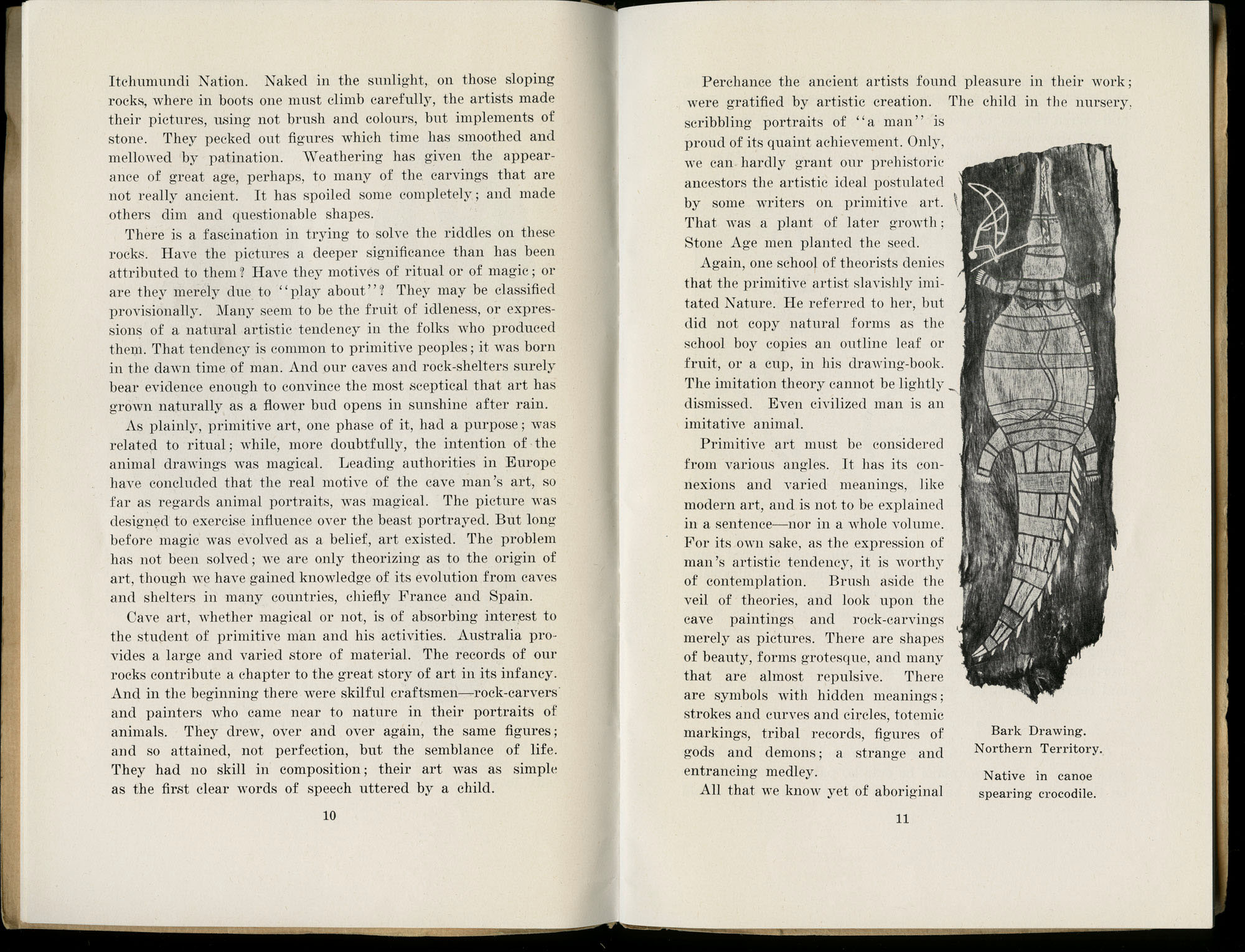
Pamphlet: ‘Australian Aboriginal Art’ with texts by Charles Barrett and A.S. Kenyon, National Museum of Victoria, 1952

August 2020


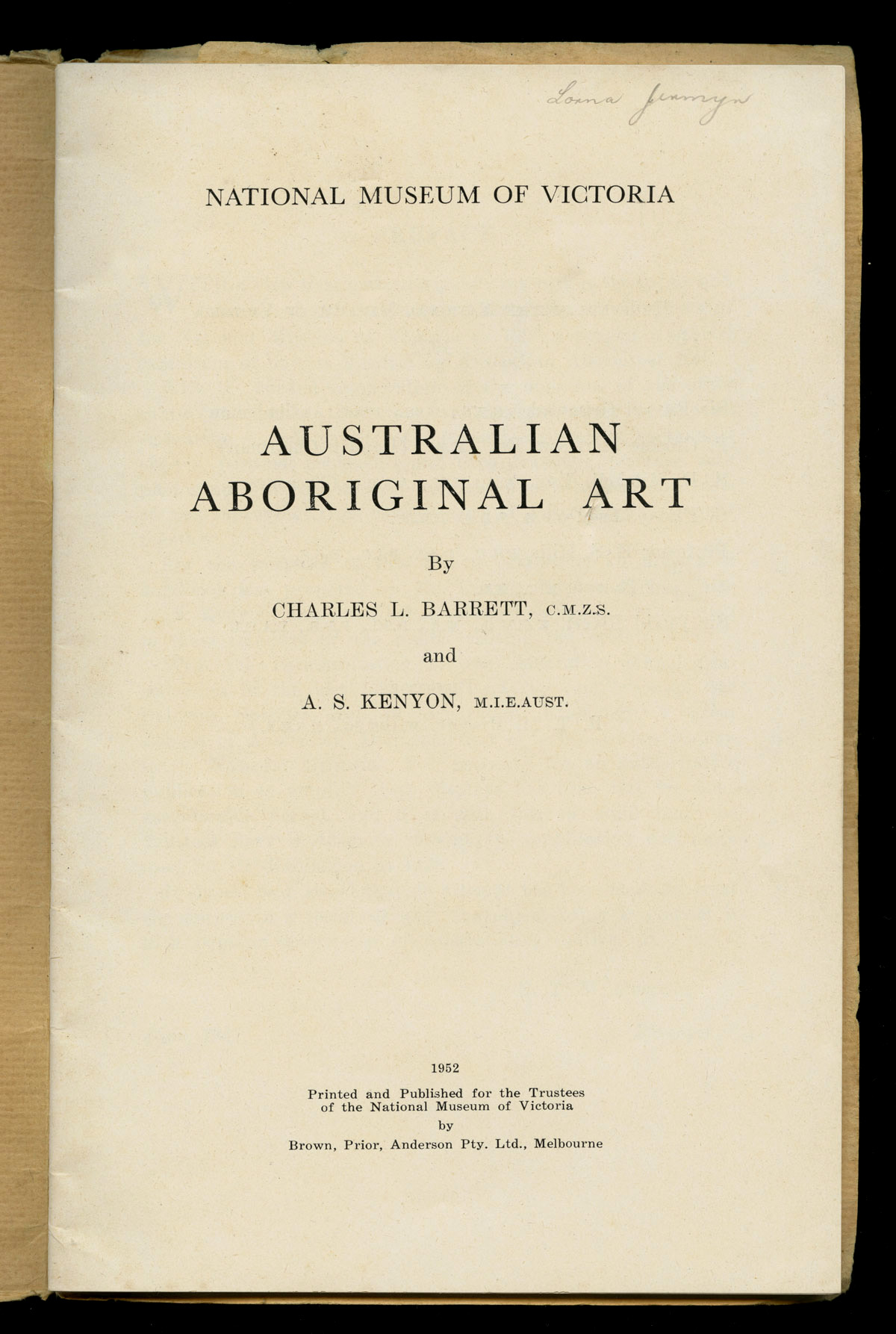
Cover of the pamphlet 'Australian Aboriginal Art' by Charles Barrett and A.S. Kenyon 1952


Unknown artist. Cover of the pamphlet Australian Aboriginal Art, National Museum of Victoria, 1952


I found this rare pamphlet in an op shop (charity shop). I have decided to publish it on Art Blart as part of a historical record, so that it is available to researchers into Indigenous Australian culture and art. While I believe that the text and images contain no information of secret sacred importance, if anyone has any concerns please contact me at bunyanth@netspace.net.au.

What is fascinating about the text is that it was originally published by the National Museum of Victoria in 1929, and then reprinted verbatim for this pamphlet in 1952. In other words, no new scholarship had taken place in the intervening 23 years that was noteworthy enough for the Museum to feel it needed to update the text. Other interesting facts are that Aboriginal Art was housed within the Australian Ethnology section, art as an outcome of the study of the characteristics of different people, and that it was known as “primitive art” made by “primitive peoples”. Even the National Gallery of Australia had a “primitive art” gallery up until the 1980s!

Of course, the texts are of their time. In the first text “The Primitive Artist” by Charles Barrett, he questions the quality, authenticity and age of the rock paintings at Mootwingee – whether they are a few centuries old or of old antiquity it – and apparently, it makes no difference. Barrett then praises the magic making art of Indigenous Australians, while at the same time encouraging us to look upon their art as merely pictures (Barrett, p. 11). He seems to be equally attracted and repulsed by “primitive art”, as an expression of man’s artistic tendency, in cave paintings and rock-carvings whose forms are grotesque and even repulsive.

Barrett admits that their finest decorations, on weapons and sacred objects, are magic: “Here is a magic truly; no “Art for Art’s sake.” (Barrett, p. 12). And then in the next paragraph, while extolling that we should have more interest in the Australian race, and learn its culture, he announces that Indigenous Australians are “living fossils” and are failing. Using the terminology of Edward S. Curtis (who photographed the First Nations Peoples of America in the early 20th century), they are The Vanishing Race (1904), the title of his photograph of Navajo riding off into an indeterminate distance. Destined for extinction. Further, Barrett states that every “relic” of the Aboriginals is worth preserving, as though all Indigenous people were already a historical artefact, no longer living. The use of the word relic is informative: its derivation comes from Old French relique (originally plural), from Latin reliquiae, the latter mid 17th century Latin, feminine plural (used as a noun) of reliquus ‘remaining’, based on linquere ‘to leave’. In other words, they remain and leave at one and the same time, the remainder only a husk of the original.

In the second text “The Art of the Australian Aboriginal” by A.S. Kenyon, the researcher and psychologist into Indigenous art is urged, indeed must, divest themselves of all civilised conceptions and mentality and assume those of a prehistoric man – or that of a child. “Prior or the British settlement of Eastern Australia – to be precise, prior to Governor Phillip establishing his colony at Port Jackson, there appears to be no record of aboriginal paintings or carvings.” (A.S. Kenyon, p. 22) What Kenyon seems to be suggesting is that it is only through the influence of the “civilised” Europeans that Indigenous Australians begin painting and carving. A description of the various representational techniques of Indigenous Australian art making follows, the art divided into two classes: fixed and portable. “In the first class, those of fixed objects, we have (a) rock-paintings; (b) rock-carvings; (c) tree-carvings; (d) tree-paintings; (e) ground-paintings; (f) ground-models. In the second, or portable class, there are (a) figures or models; (b) weapons, implements and utensils, decorated either by painting or carving; (c) ceremonial objects; (d) ornaments or personal adornment; (e) bark-paintings. (A.S. Kenyon, p. 27)

I believe it is important to have these texts (which are less than 100 years old), and the paradoxical historical attitudes towards Australian Indigenous culture and art they contain, published online. The pamphlet recognises Aboriginal culture yet also rules a ledger under it. (Professor Tom Griffiths’ observations on Geoffrey Blainey’s book Triumph of the Nomads). The attitude was that while this “primitive art” was worthy of study, ultimately it belonged to an archaic, fragile culture which was destined to be consigned to history.

I am so glad that this spiritual culture (and the changing Western understanding of Australian Indigenous art and culture) has proved the authors wrong.

Dr Marcus Bunyan


Please click on the photographs for a larger version of the image.


Title page of the pamphlet 'Australian Aboriginal Art' by Charles Barrett and A.S. Kenyon 1952


Title page of the pamphlet Australian Aboriginal Art with texts by Charles Barrett and A.S. Kenyon (text reprinted from the 1929 exhibition), National Museum of Victoria, 1952


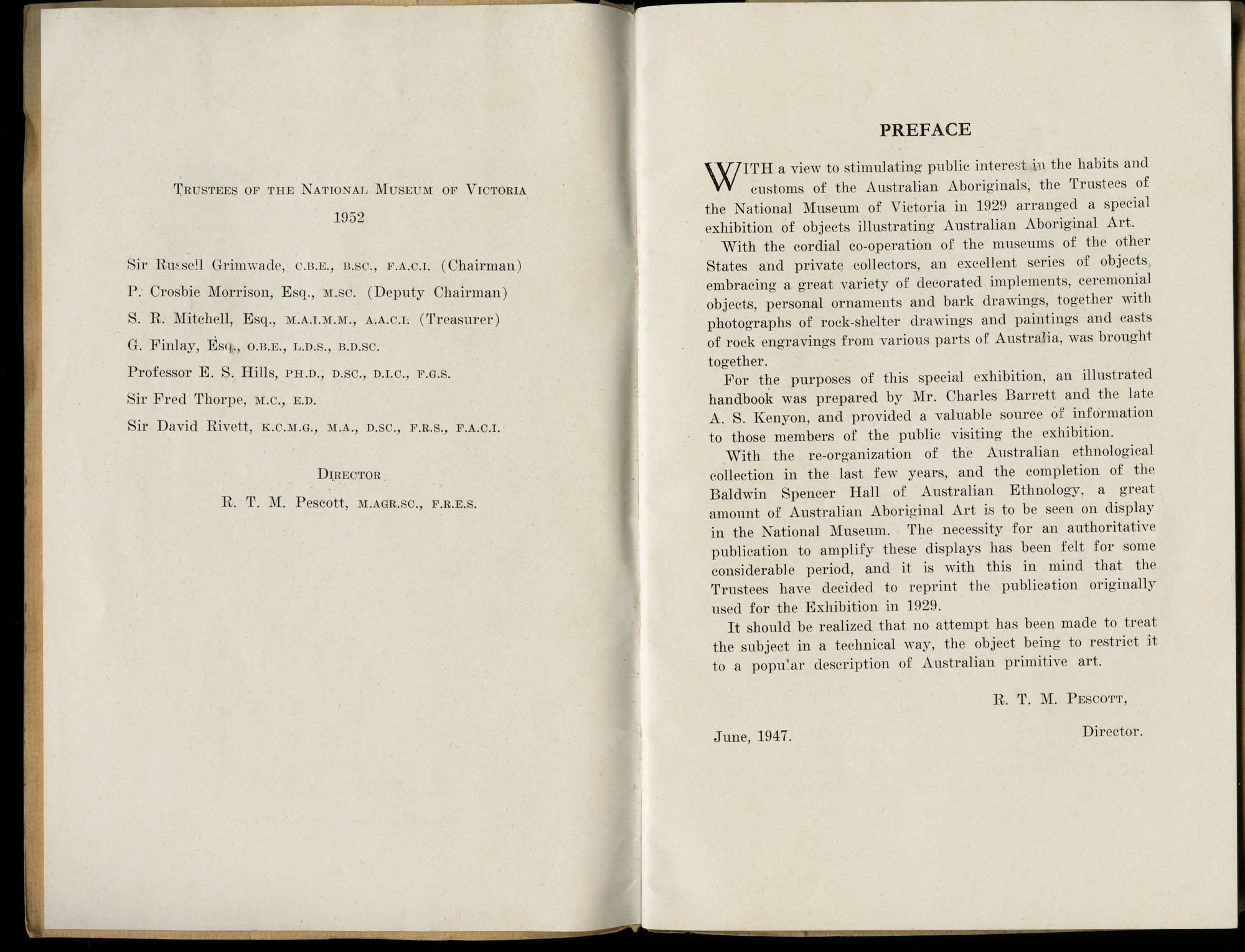
Preface of the pamphlet 'Australian Aboriginal Art' by Charles Barrett and A.S. Kenyon 1952


Preface of the pamphlet Australian Aboriginal Art with texts by Charles Barrett and A.S. Kenyon (text reprinted from the 1929 exhibition), National Museum of Victoria, 1952


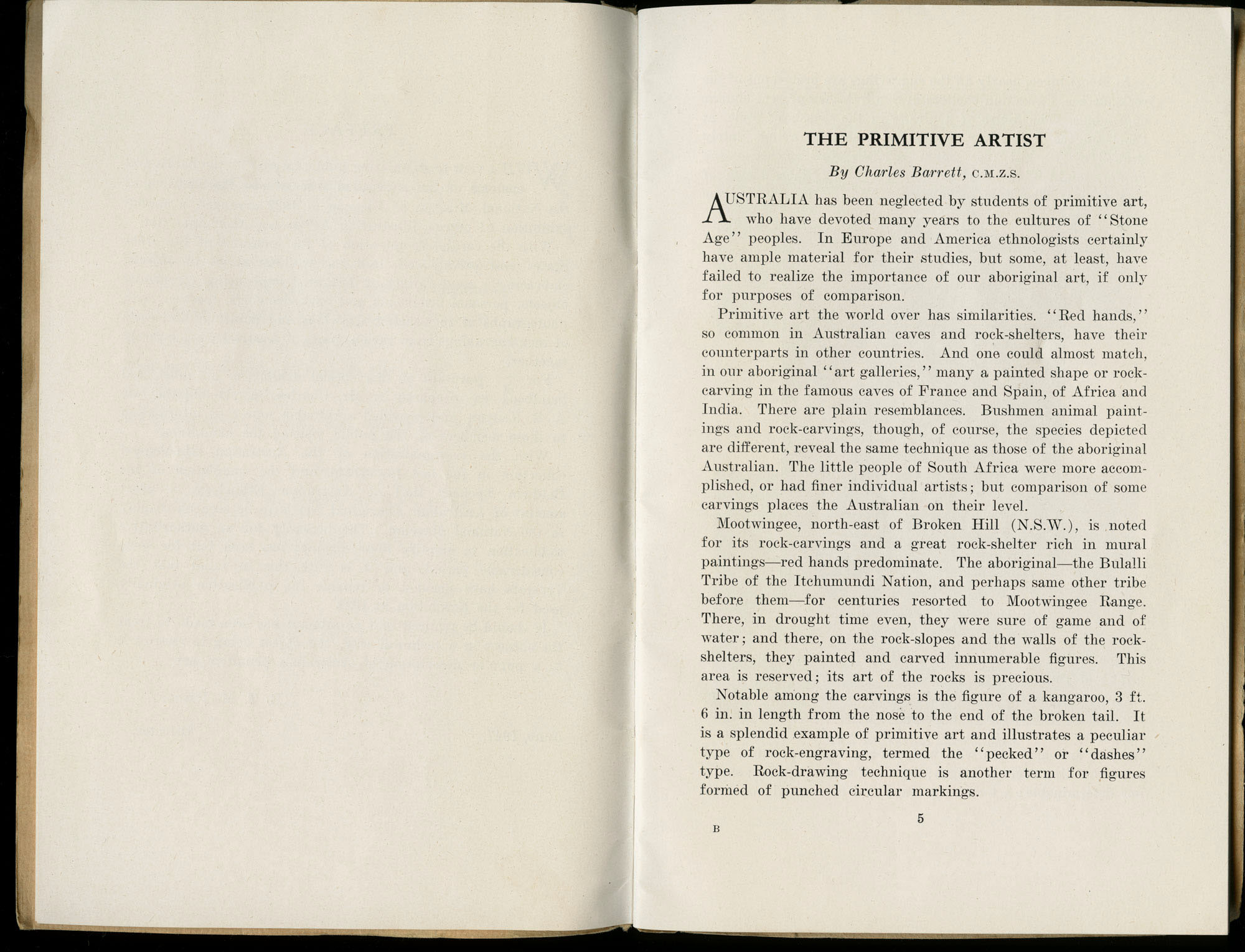
"The Primitive Artist" by Charles Barrett in the pamphlet 'Australian Aboriginal Art' by Charles Barrett and A.S. Kenyon


“The Primitive Artist” by Charles Barrett in the pamphlet Australian Aboriginal Art with texts by Charles Barrett and A.S. Kenyon (text reprinted from the 1929 exhibition), National Museum of Victoria, 1952, p. 5


"The Primitive Artist" by Charles Barrett in the pamphlet 'Australian Aboriginal Art' by Charles Barrett and A.S. Kenyon


“The Primitive Artist” by Charles Barrett in the pamphlet Australian Aboriginal Art with texts by Charles Barrett and A.S. Kenyon (text reprinted from the 1929 exhibition), National Museum of Victoria, 1952, p. 6-7


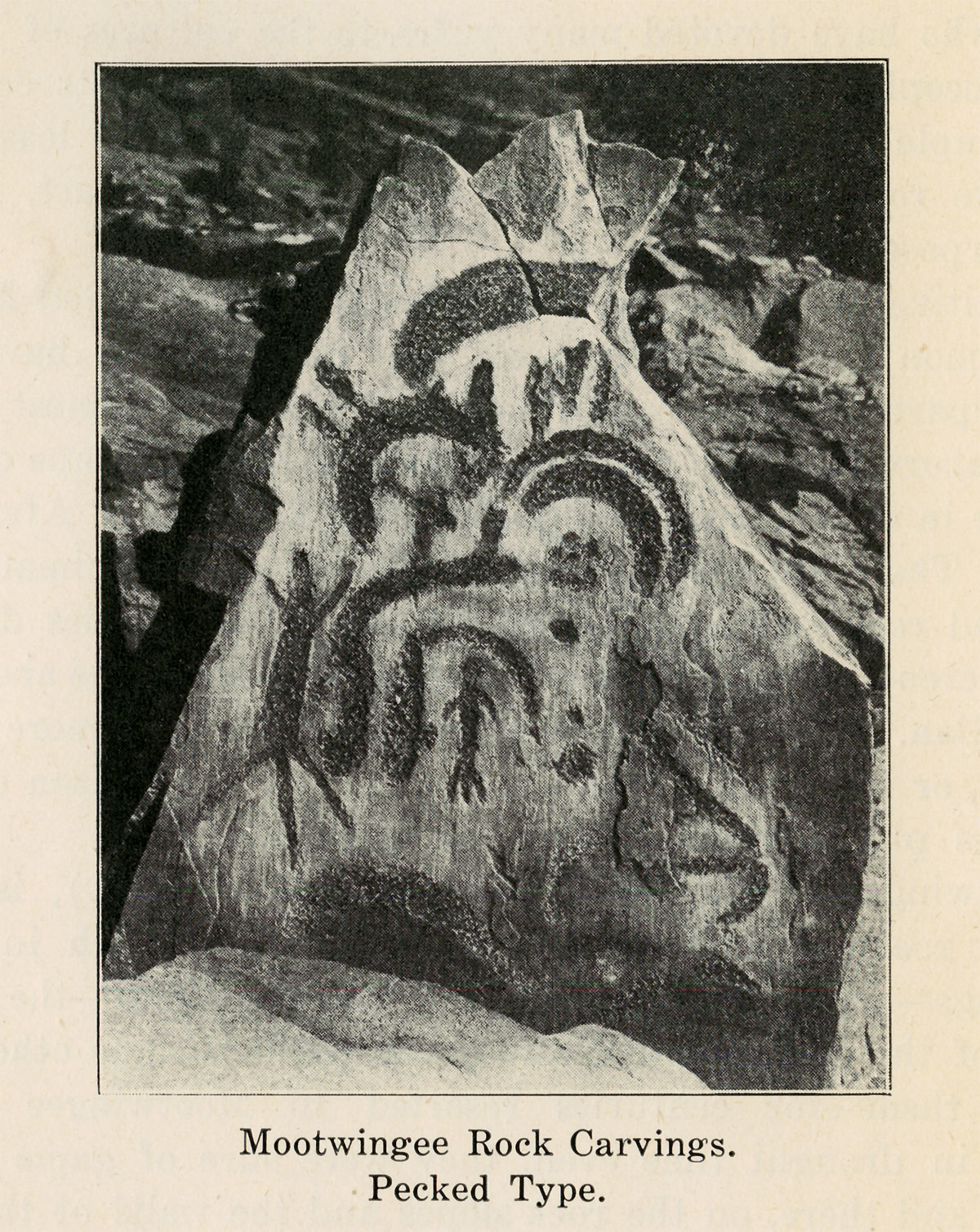
Mootwingee Rock Carvings


Unknown photographer. “Mootwingee Rock Carvings. Pecked Type,” in “The Primitive Artist” by Charles Barrett from the pamphlet Australian Aboriginal Art with texts by Charles Barrett and A.S. Kenyon (text reprinted from the 1929 exhibition), National Museum of Victoria, 1952, p. 6


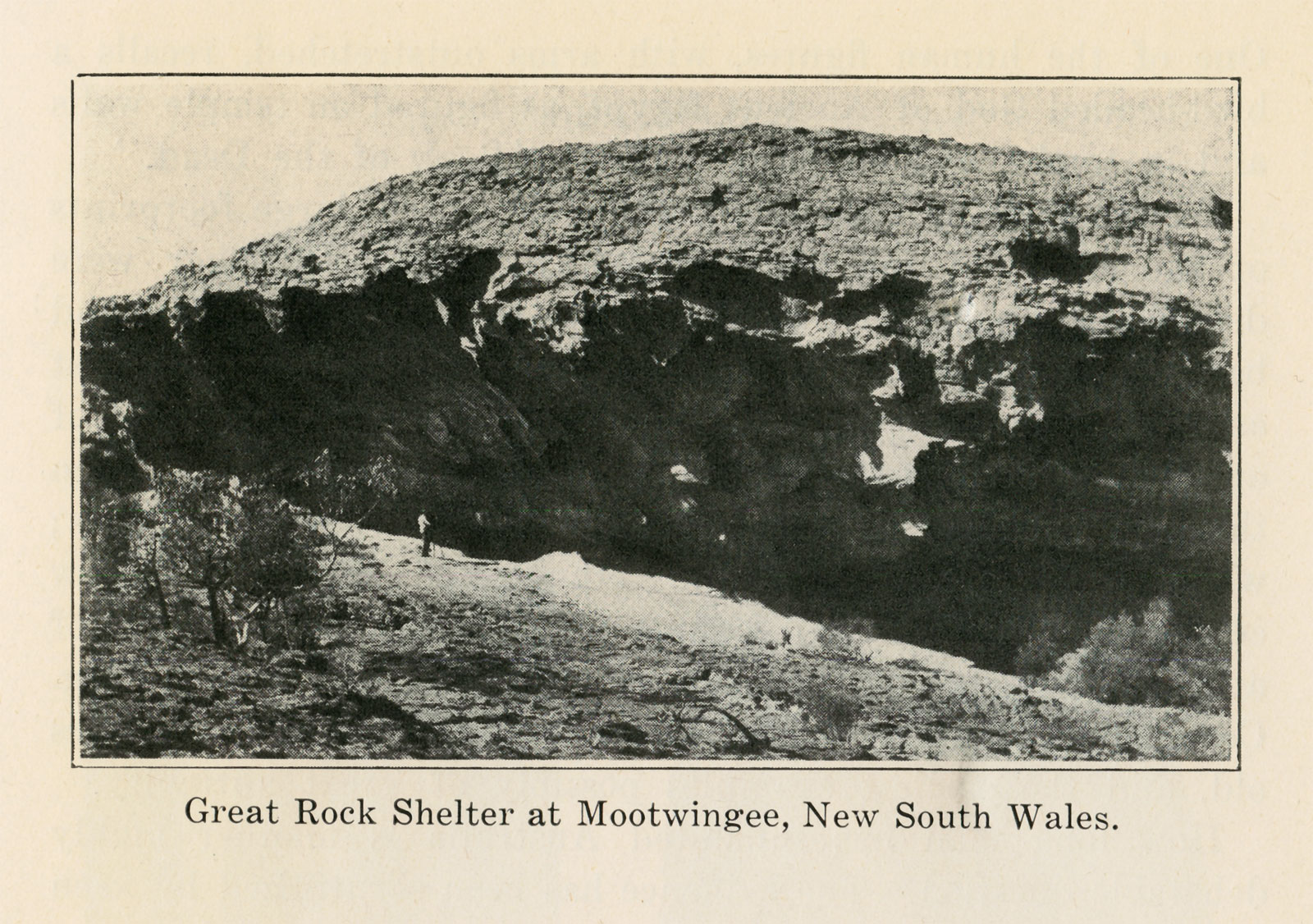
Great Rock Shelter at Mootwingee, New South Wales


Unknown photographer. “Great Rock Shelter at Mootwingee, New South Wales,” in “The Primitive Artist” by Charles Barrett from the pamphlet Australian Aboriginal Art with texts by Charles Barrett and A.S. Kenyon (text reprinted from the 1929 exhibition), National Museum of Victoria, 1952, p. 7


Rock Engraving, Mootwingee


Unknown photographer. “Rock Engraving, Mootwingee,” in “The Primitive Artist” by Charles Barrett from the pamphlet Australian Aboriginal Art with texts by Charles Barrett and A.S. Kenyon (text reprinted from the 1929 exhibition), National Museum of Victoria, 1952, p. 7


"The Primitive Artist" by Charles Barrett in the pamphlet 'Australian Aboriginal Art' by Charles Barrett and A.S. Kenyon


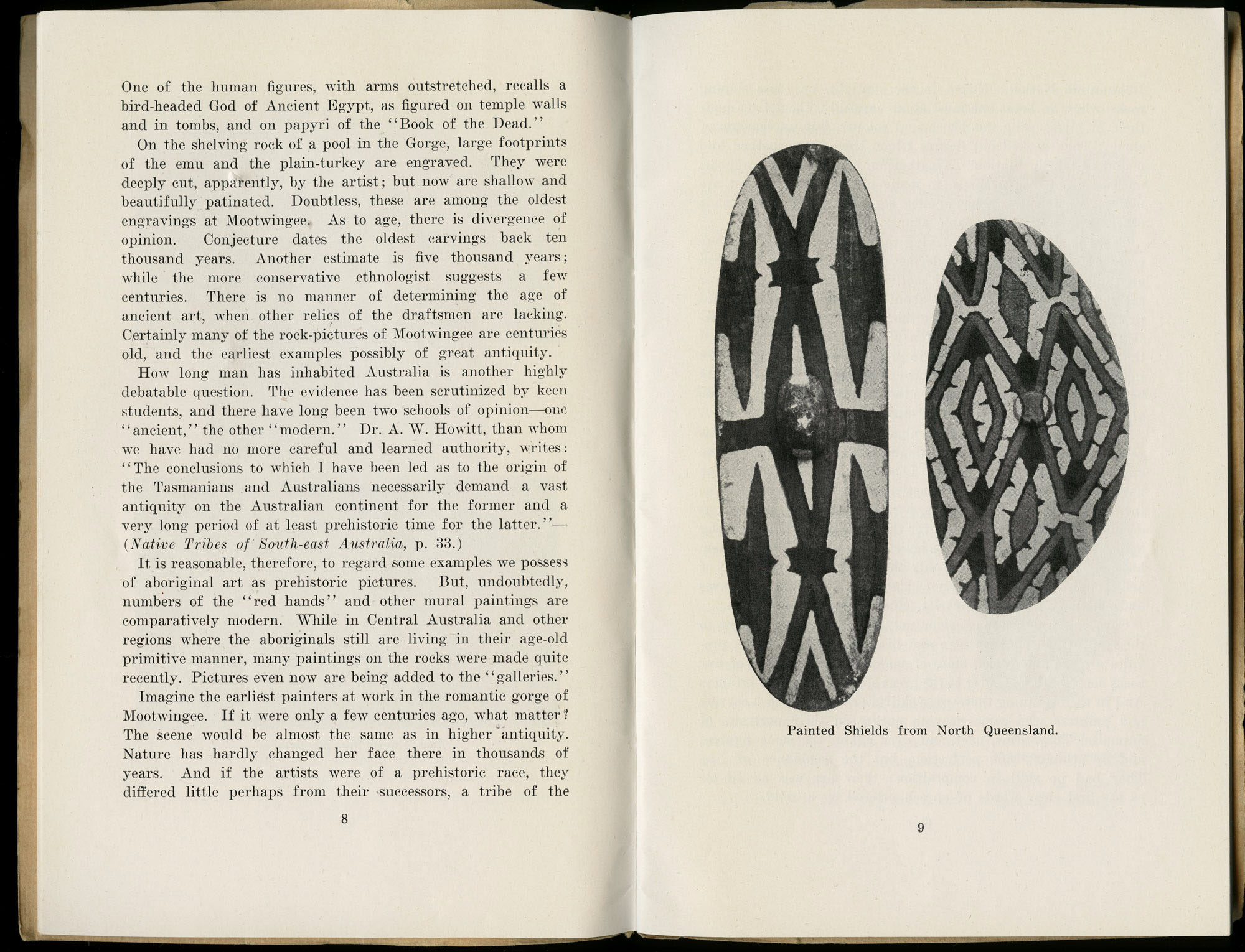
“The Primitive Artist” by Charles Barrett in the pamphlet Australian Aboriginal Art with texts by Charles Barrett and A.S. Kenyon (text reprinted from the 1929 exhibition), National Museum of Victoria, 1952, p. 8-9


Painted Shields from North Queensland


“Painted Shields from North Queensland,” in “The Primitive Artist” by Charles Barrett from the pamphlet Australian Aboriginal Art with texts by Charles Barrett and A.S. Kenyon (text reprinted from the 1929 exhibition), National Museum of Victoria, 1952, p. 9


"The Primitive Artist" by Charles Barrett in the pamphlet 'Australian Aboriginal Art' by Charles Barrett and A.S. Kenyon


“The Primitive Artist” by Charles Barrett in the pamphlet Australian Aboriginal Art with texts by Charles Barrett and A.S. Kenyon (text reprinted from the 1929 exhibition), National Museum of Victoria, 1952, p. 10-11


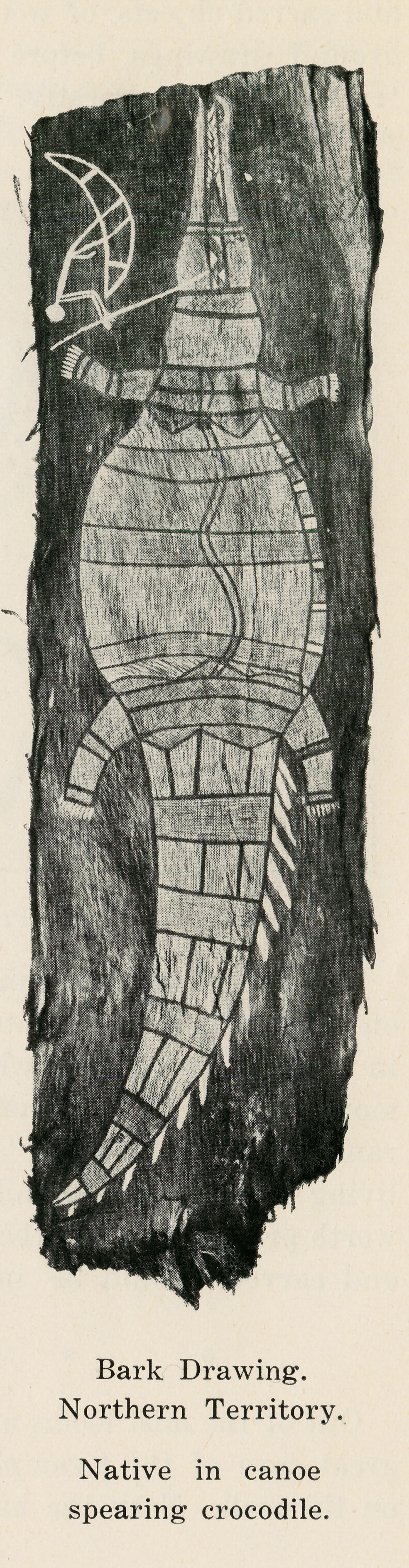
Bark Drawing. Northern Territory. Native in canoe spearing crocodile


“Bark Drawing. Northern Territory. Native in canoe spearing crocodile,” in “The Primitive Artist” by Charles Barrett from the pamphlet Australian Aboriginal Art with texts by Charles Barrett and A.S. Kenyon (text reprinted from the 1929 exhibition), National Museum of Victoria, 1952, p. 11


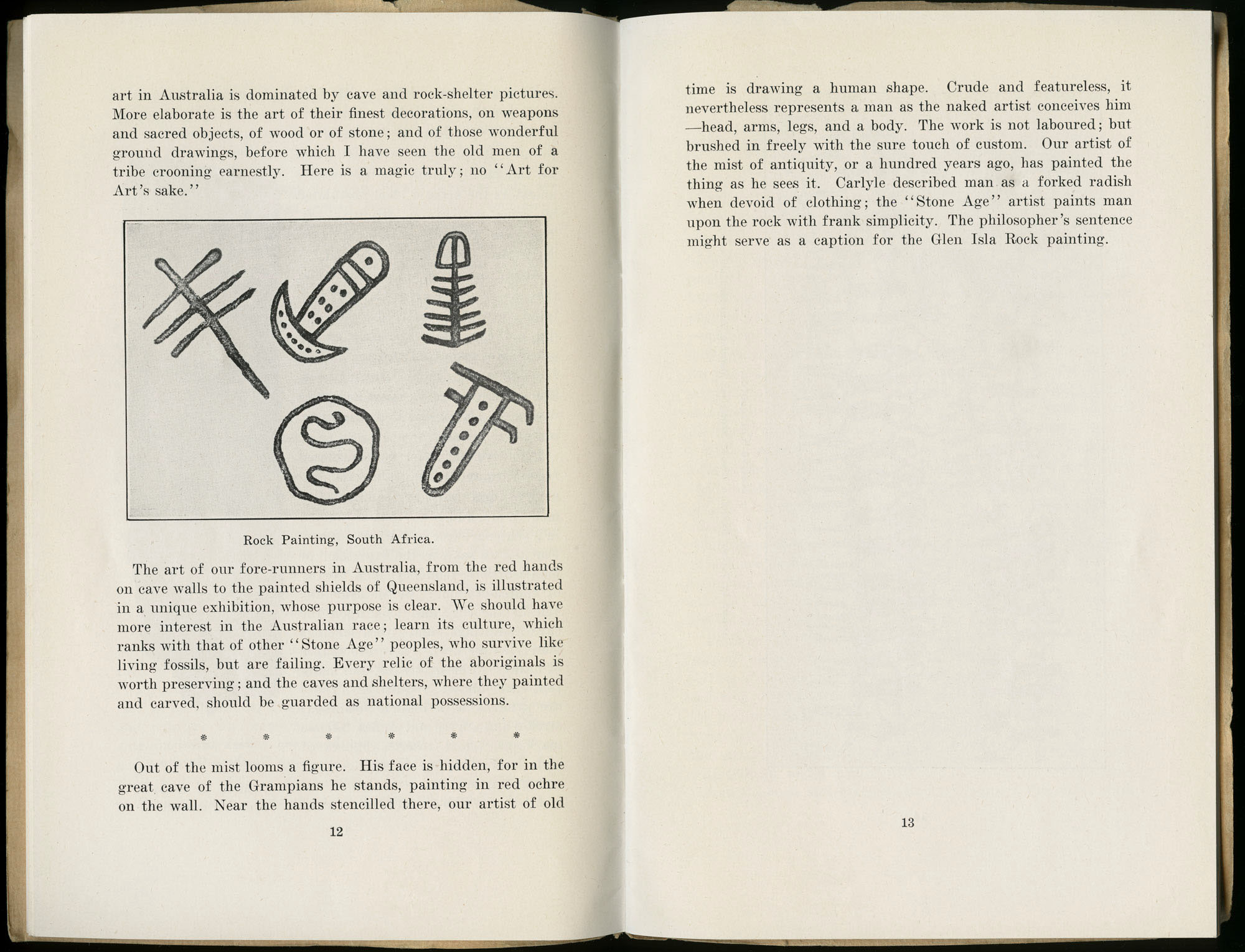
"The Primitive Artist" by Charles Barrett in the pamphlet 'Australian Aboriginal Art' by Charles Barrett and A.S. Kenyon


“The Primitive Artist” by Charles Barrett in the pamphlet Australian Aboriginal Art with texts by Charles Barrett and A.S. Kenyon (text reprinted from the 1929 exhibition), National Museum of Victoria, 1952, p. 12-13


Rock Painting, South Africa


“Rock Painting, South Africa,” in “The Primitive Artist” by Charles Barrett from the pamphlet Australian Aboriginal Art with texts by Charles Barrett and A.S. Kenyon (text reprinted from the 1929 exhibition), National Museum of Victoria, 1952, p. 12


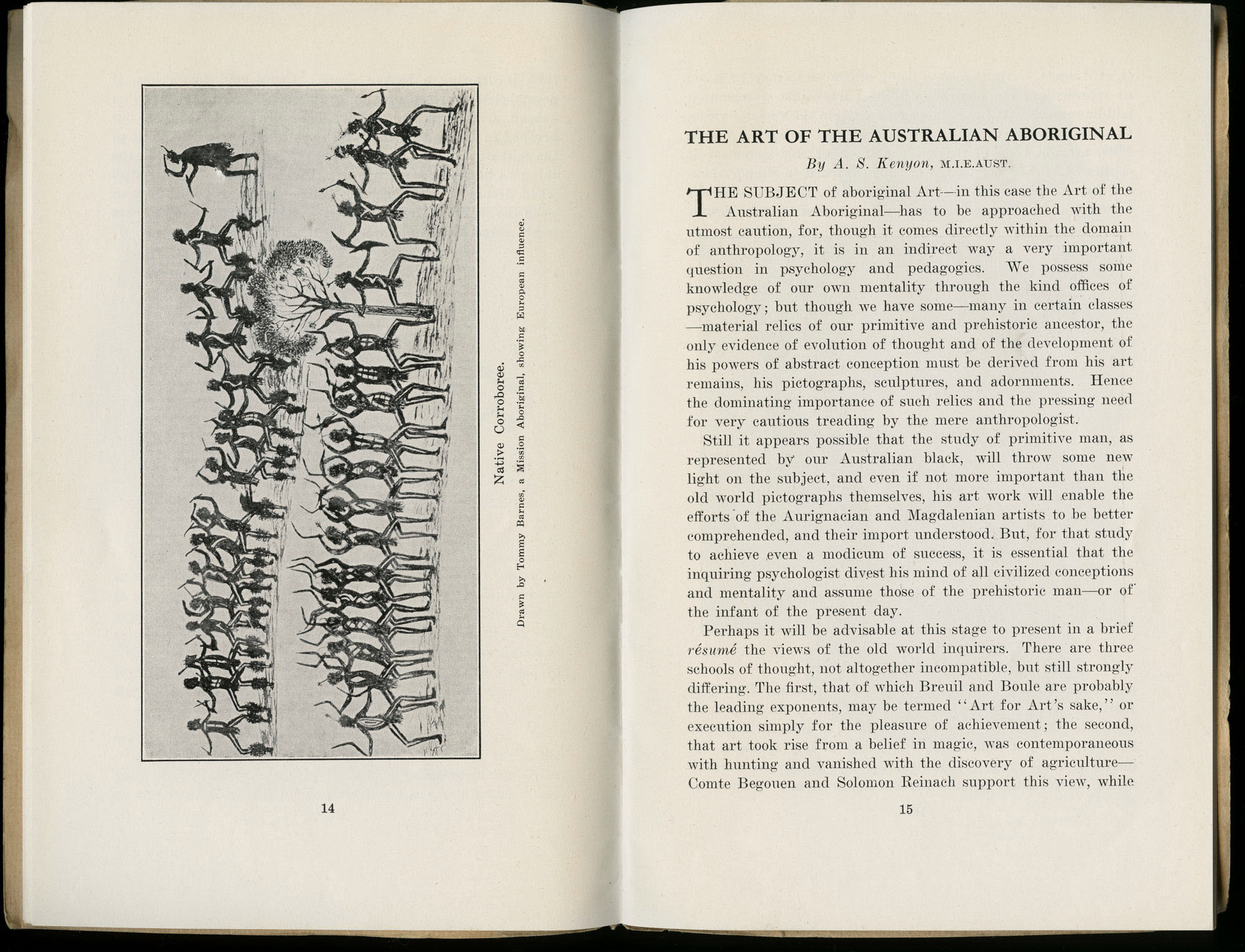
"The Art of the Australian Aboriginal" by A.S. Kenyon in the pamphlet 'Australian Aboriginal Art' by Charles Barrett and A.S. Kenyon


“The Art of the Australian Aboriginal” by A.S. Kenyon in the pamphlet Australian Aboriginal Art with texts by Charles Barrett and A.S. Kenyon (text reprinted from the 1929 exhibition), National Museum of Victoria, 1952, p. 14-15


Native Corroboree drawn by Tommy Barnes


“Native Corroboree. Drawn by Tommy Barnes, a Mission Aboriginal, showing European influence,” in “The Art of the Australian Aboriginal” by A.S. Kenyon from the pamphlet Australian Aboriginal Art with texts by Charles Barrett and A.S. Kenyon (text reprinted from the 1929 exhibition), National Museum of Victoria, 1952, p. 14.


"The Art of the Australian Aboriginal" by A.S. Kenyon in the pamphlet 'Australian Aboriginal Art' by Charles Barrett and A.S. Kenyon


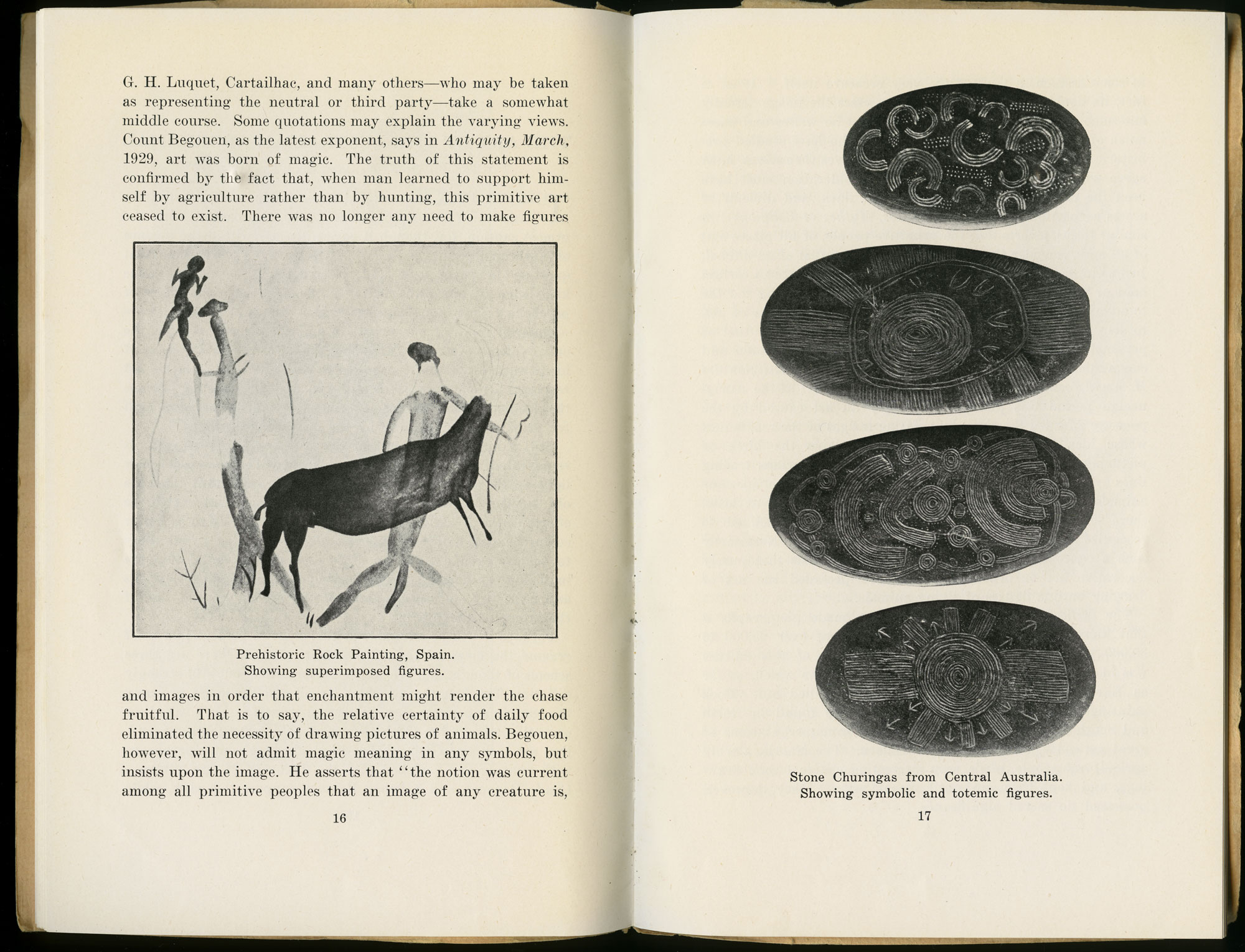
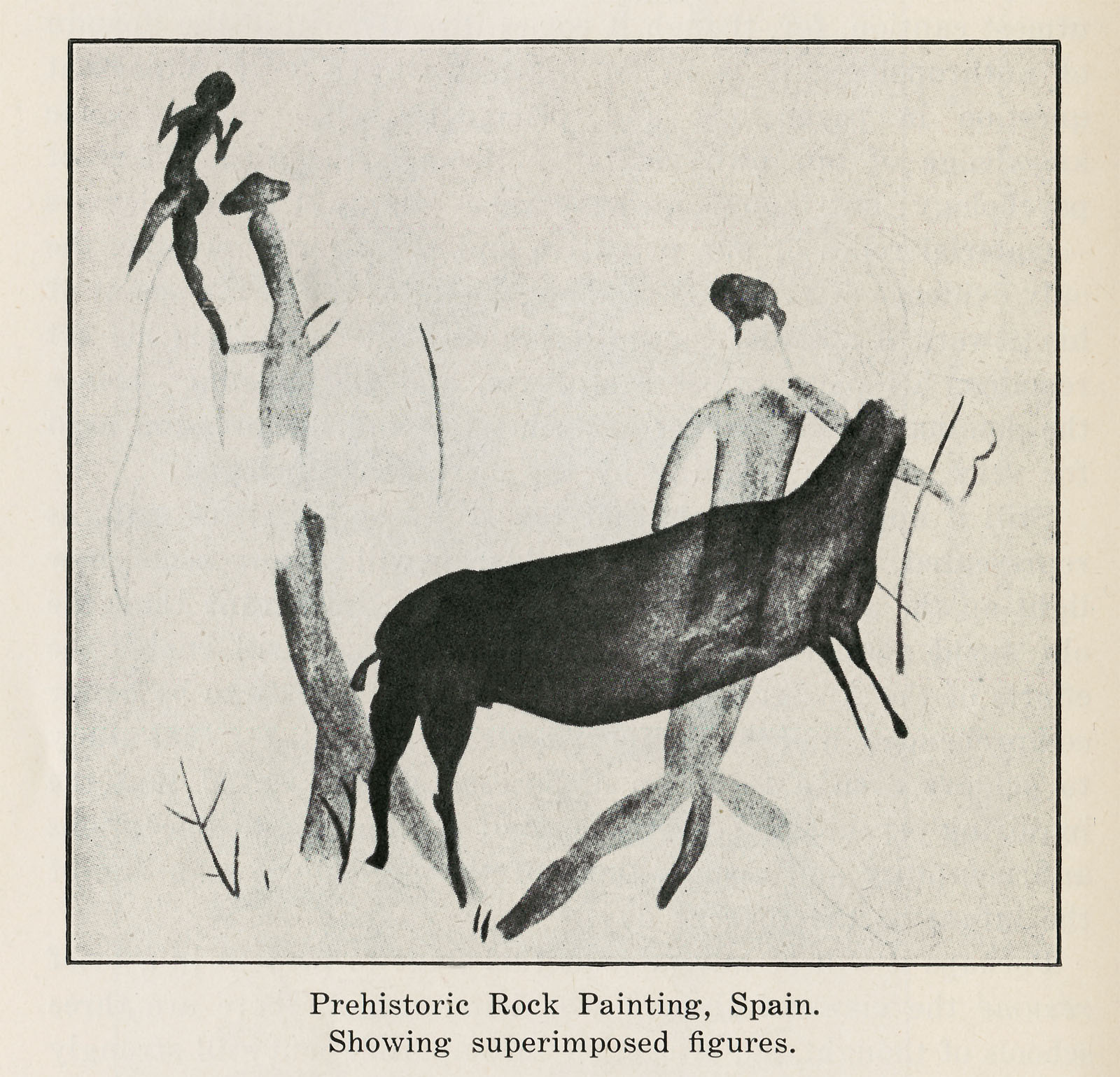
“The Art of the Australian Aboriginal” by A.S. Kenyon in the pamphlet Australian Aboriginal Art with texts by Charles Barrett and A.S. Kenyon (text reprinted from the 1929 exhibition), National Museum of Victoria, 1952, p. 16-17


Prehistoric Rock Painting, Spain. Showing superimposed figures


“Prehistoric Rock Painting, Spain. Showing superimposed figures,” in “The Art of the Australian Aboriginal” by A.S. Kenyon from the pamphlet Australian Aboriginal Art with texts by Charles Barrett and A.S. Kenyon (text reprinted from the 1929 exhibition), National Museum of Victoria, 1952, p. 16


Stone Churingas from Central Australia. Showing symbolic and totemic figures


“Stone Churingas from Central Australia. Showing symbolic and totemic figures,” in “The Art of the Australian Aboriginal” by A.S. Kenyon from the pamphlet Australian Aboriginal Art with texts by Charles Barrett and A.S. Kenyon (text reprinted from the 1929 exhibition), National Museum of Victoria, 1952, p. 17


"The Art of the Australian Aboriginal" by A.S. Kenyon in the pamphlet 'Australian Aboriginal Art' by Charles Barrett and A.S. Kenyon


“The Art of the Australian Aboriginal” by A.S. Kenyon in the pamphlet Australian Aboriginal Art with texts by Charles Barrett and A.S. Kenyon (text reprinted from the 1929 exhibition), National Museum of Victoria, 1952, p. 18-19


"The Art of the Australian Aboriginal" by A.S. Kenyon in the pamphlet 'Australian Aboriginal Art' by Charles Barrett and A.S. Kenyon


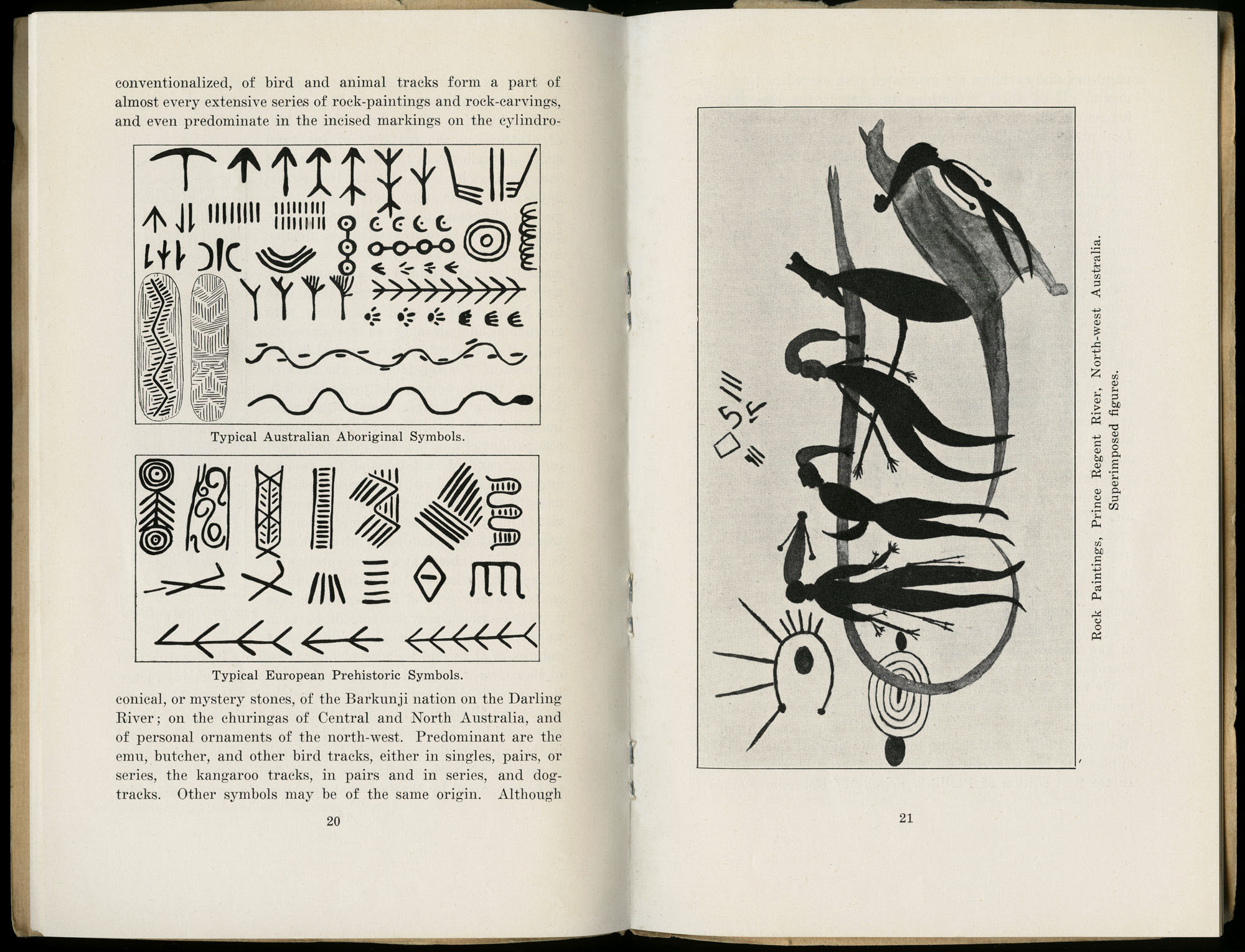
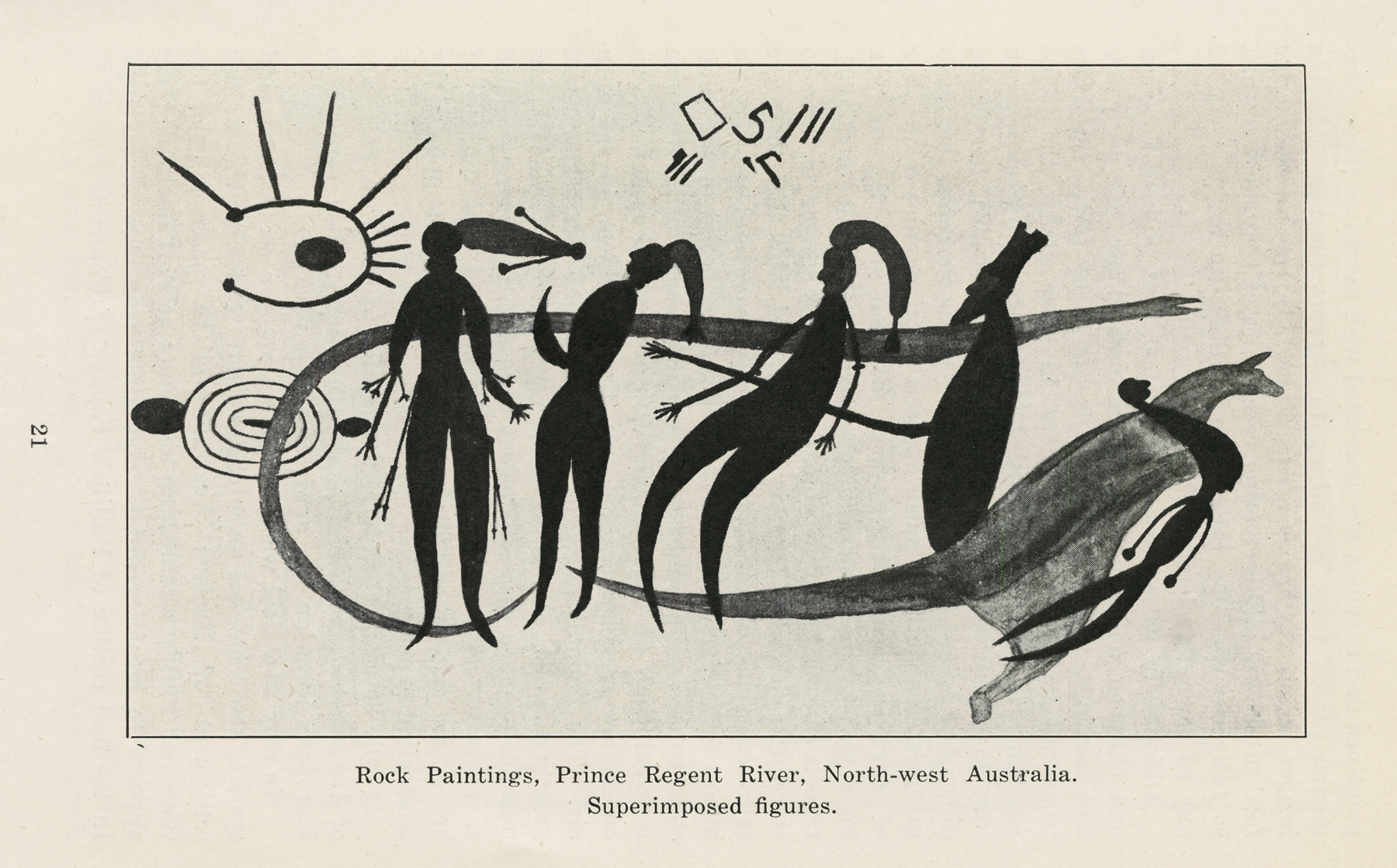
“The Art of the Australian Aboriginal” by A.S. Kenyon in the pamphlet Australian Aboriginal Art with texts by Charles Barrett and A.S. Kenyon (text reprinted from the 1929 exhibition), National Museum of Victoria, 1952, p. 20-21


Rock Paintings. Prince Regent River, North-west Australia. Superimposed figures


“Rock Paintings. Prince Regent River, North-west Australia. Superimposed figures,” in “The Art of the Australian Aboriginal” by A.S. Kenyon from the pamphlet Australian Aboriginal Art with texts by Charles Barrett and A.S. Kenyon (text reprinted from the 1929 exhibition), National Museum of Victoria, 1952, p. 21


"The Art of the Australian Aboriginal" by A.S. Kenyon in the pamphlet 'Australian Aboriginal Art' by Charles Barrett and A.S. Kenyon


“The Art of the Australian Aboriginal” by A.S. Kenyon in the pamphlet Australian Aboriginal Art with texts by Charles Barrett and A.S. Kenyon (text reprinted from the 1929 exhibition), National Museum of Victoria, 1952, p. 22-23


Bark drawing representing Settler's Homestead, Lake Tyrrell, Victoria


“Bark drawing representing Settler’s Homestead, Lake Tyrrell, Victoria,” in “The Art of the Australian Aboriginal” by A.S. Kenyon from the pamphlet Australian Aboriginal Art with texts by Charles Barrett and A.S. Kenyon (text reprinted from the 1929 exhibition), National Museum of Victoria, 1952, p. 23


"The Art of the Australian Aboriginal" by A.S. Kenyon in the pamphlet 'Australian Aboriginal Art' by Charles Barrett and A.S. Kenyon


“The Art of the Australian Aboriginal” by A.S. Kenyon in the pamphlet Australian Aboriginal Art by Charles Barrett and A.S. Kenyon (text reprinted from the 1929 exhibition), National Museum of Victoria, 1952, p. 24-25


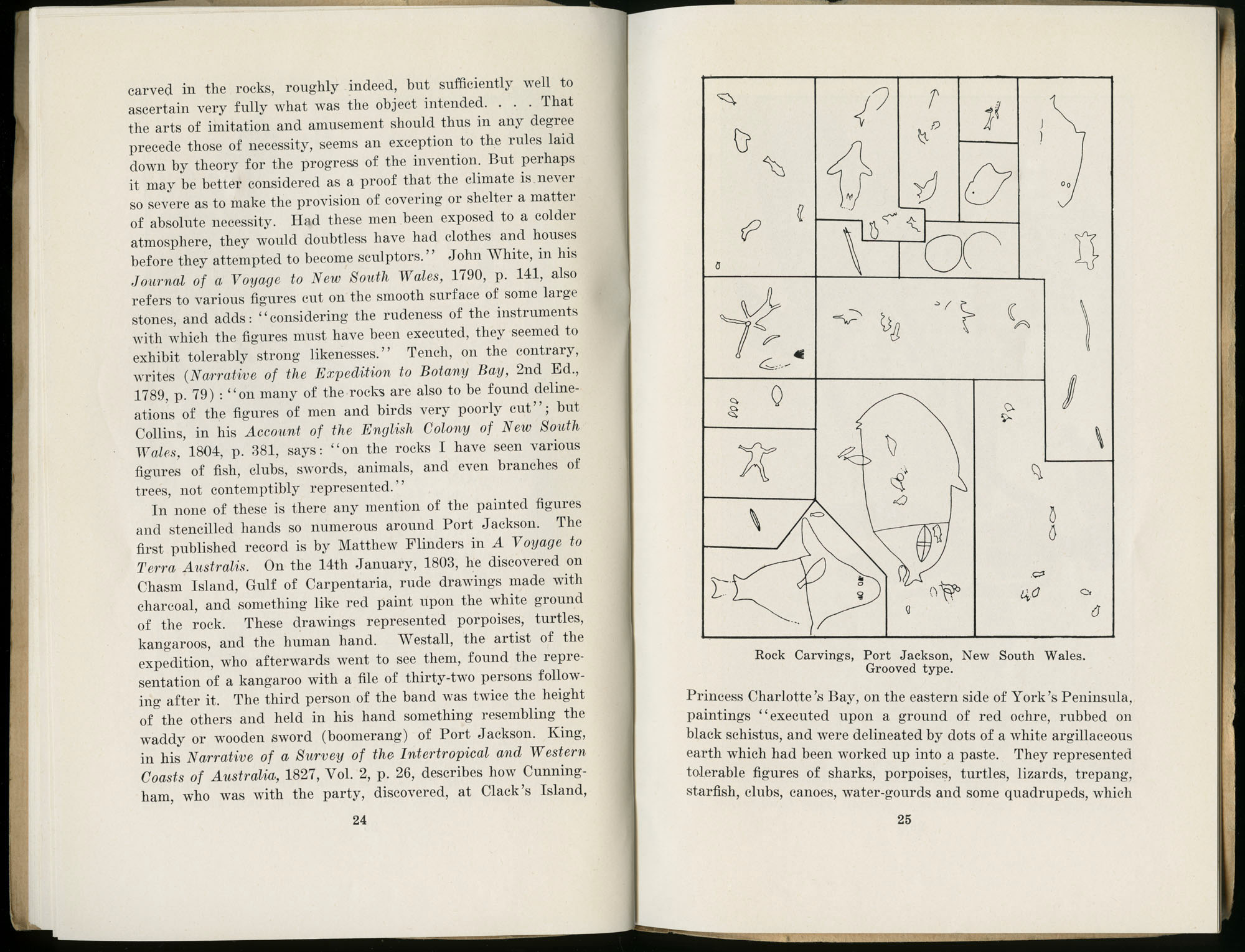
Rock Carvings, Port Jackson, New South Wales. Grooved type


“Rock Carvings, Port Jackson, New South Wales. Grooved type,” in “The Art of the Australian Aboriginal” by A.S. Kenyon from the pamphlet Australian Aboriginal Art with texts by Charles Barrett and A.S. Kenyon (text reprinted from the 1929 exhibition), National Museum of Victoria, 1952, p. 25


"The Art of the Australian Aboriginal" by A.S. Kenyon in the pamphlet 'Australian Aboriginal Art' by Charles Barrett and A.S. Kenyon


“The Art of the Australian Aboriginal” by A.S. Kenyon in the pamphlet Australian Aboriginal Art with texts by Charles Barrett and A.S. Kenyon (text reprinted from the 1929 exhibition), National Museum of Victoria, 1952, p. 26-27


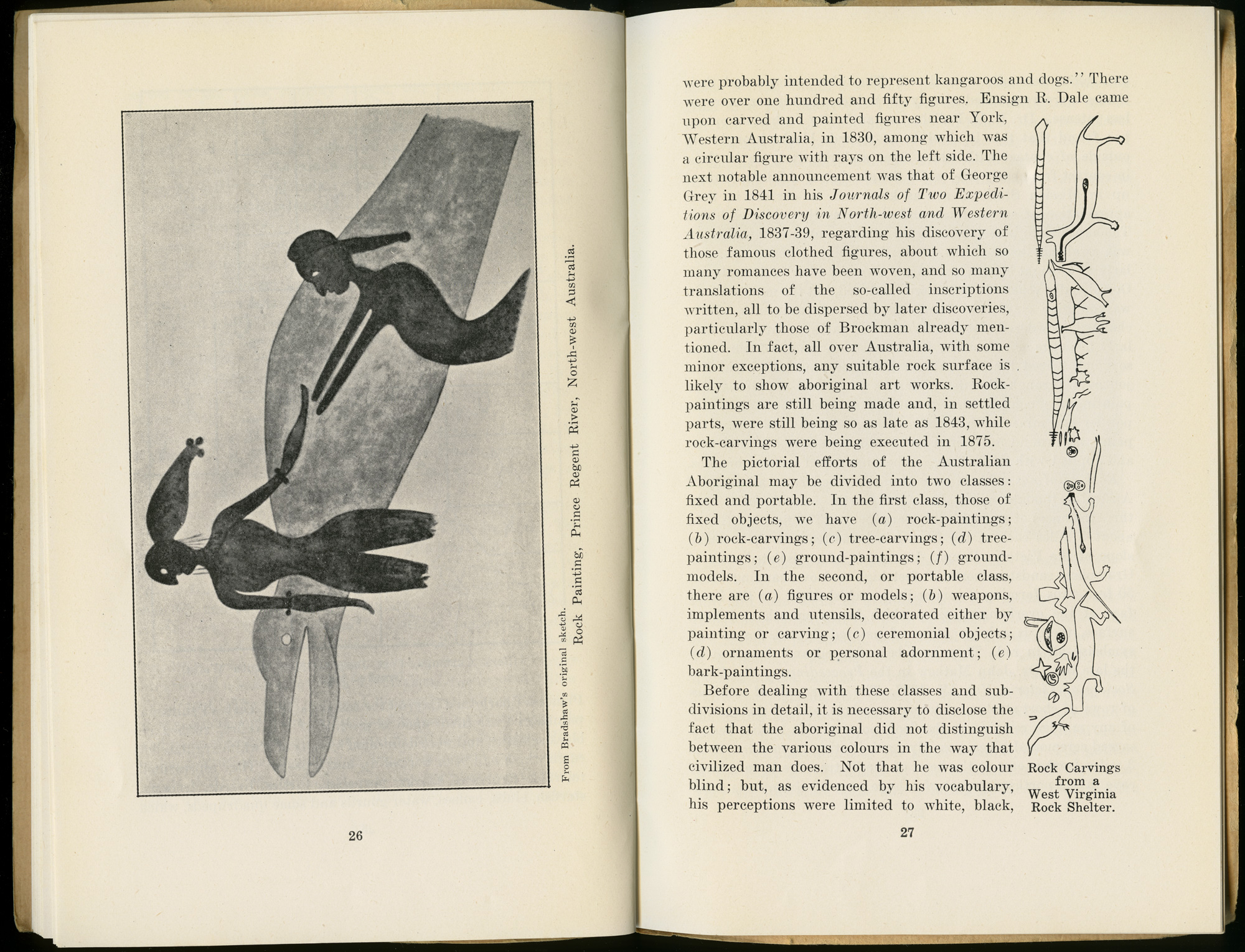
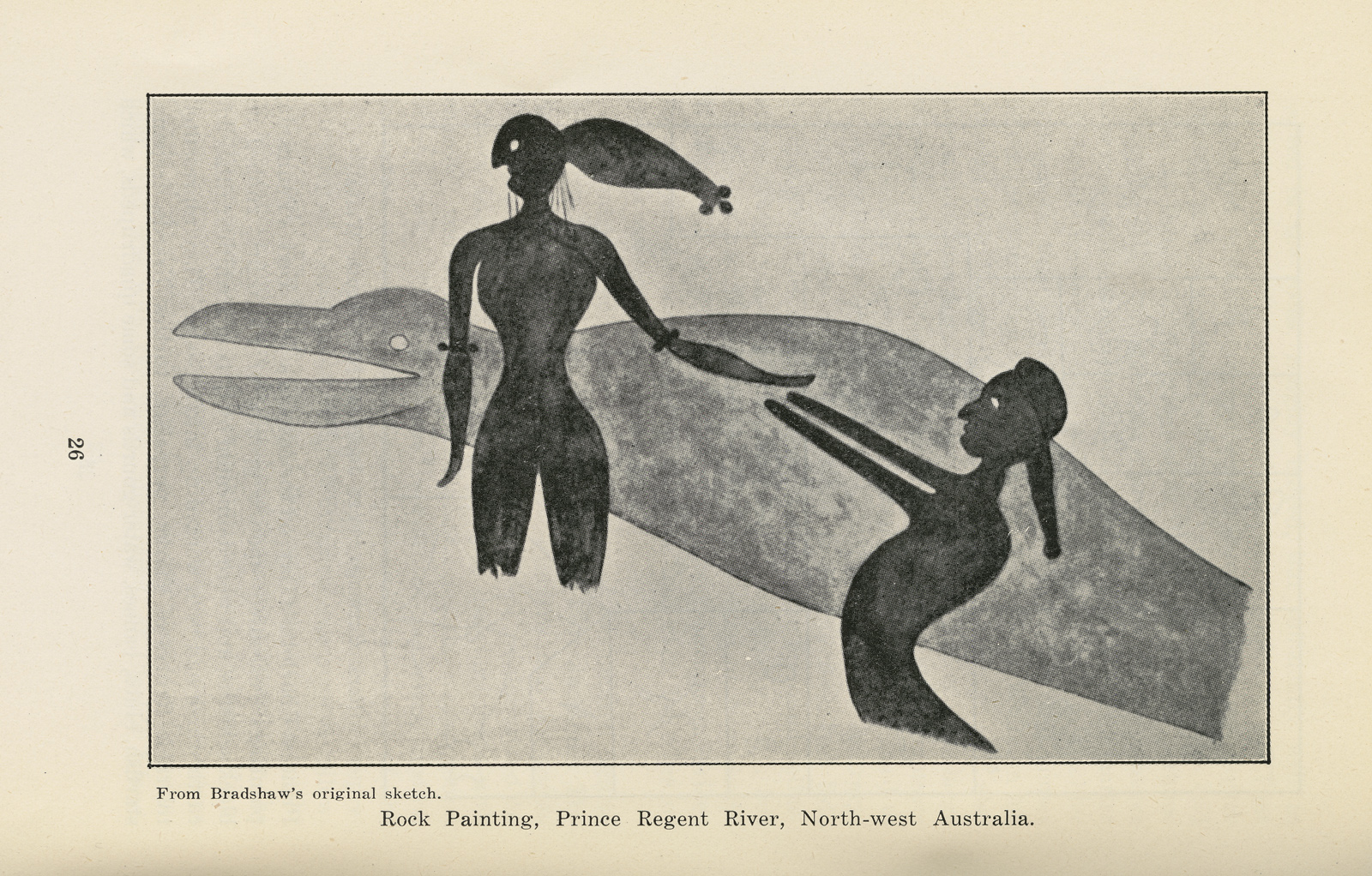
Rock Painting, Prince Regent River, North-west Australia. From Bradshaw's original sketch


“Rock Painting, Prince Regent River, North-west Australia. From Bradshaw’s original sketch,” in “The Art of the Australian Aboriginal” by A.S. Kenyon from the pamphlet Australian Aboriginal Art with texts by Charles Barrett and A.S. Kenyon (text reprinted from the 1929 exhibition), National Museum of Victoria, 1952, p. 26


"The Art of the Australian Aboriginal" by A.S. Kenyon in the pamphlet 'Australian Aboriginal Art' by Charles Barrett and A.S. Kenyon


“The Art of the Australian Aboriginal” by A.S. Kenyon in the pamphlet Australian Aboriginal Art with texts by Charles Barrett and A.S. Kenyon (text reprinted from the 1929 exhibition), National Museum of Victoria, 1952, p. 28-29


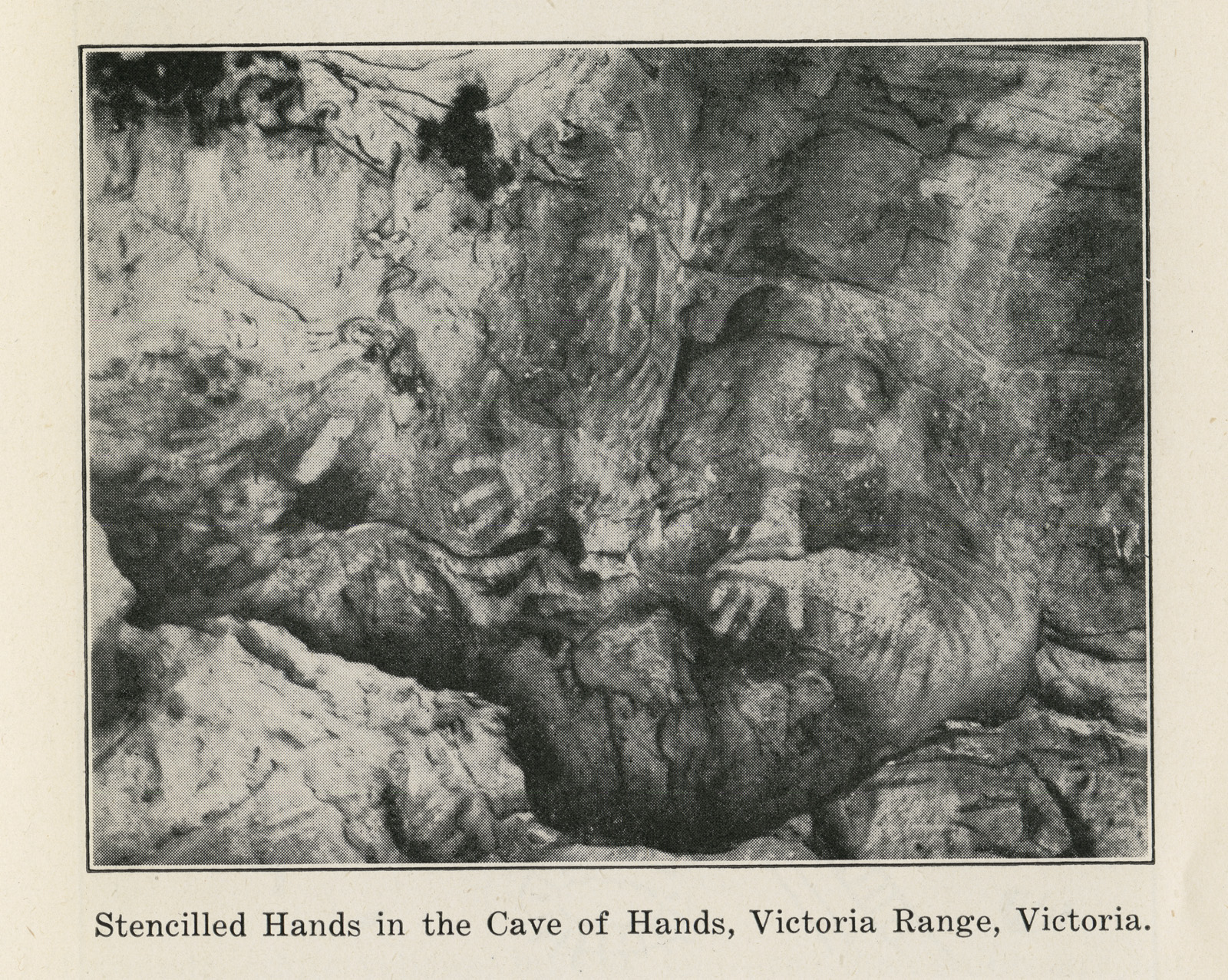
Stencilled Hands in the Cave of Hands, Victoria Range, Victoria


Unknown photographer. “Stencilled Hands in the Cave of Hands, Victoria Range, Victoria,” in “The Art of the Australian Aboriginal” by A.S. Kenyon from the pamphlet Australian Aboriginal Art with texts by Charles Barrett and A.S. Kenyon (text reprinted from the 1929 exhibition), National Museum of Victoria, 1952, p. 29


"The Art of the Australian Aboriginal" by A.S. Kenyon in the pamphlet 'Australian Aboriginal Art' by Charles Barrett and A.S. Kenyon


“The Art of the Australian Aboriginal” by A.S. Kenyon in the pamphlet Australian Aboriginal Art with texts by Charles Barrett and A.S. Kenyon (text reprinted from the 1929 exhibition), National Museum of Victoria, 1952, p. 30-31


Rock Painting, Cave of the Serpent, Langi Ghiran, Victoria


“Rock Painting, Cave of the Serpent, Langi Ghiran, Victoria,” in “The Art of the Australian Aboriginal” by A.S. Kenyon from the pamphlet Australian Aboriginal Art with texts by Charles Barrett and A.S. Kenyon (text reprinted from the 1929 exhibition), National Museum of Victoria, 1952, p. 30


"The Art of the Australian Aboriginal" by A.S. Kenyon in the pamphlet 'Australian Aboriginal Art' by Charles Barrett and A.S. Kenyon


“The Art of the Australian Aboriginal” by A.S. Kenyon in the pamphlet Australian Aboriginal Art with texts by Charles Barrett and A.S. Kenyon (text reprinted from the 1929 exhibition), National Museum of Victoria, 1952, p. 32-33


Carved Tree. From a photograph by Edmund Milne


Edmund Milne. “Carved Tree. From a photograph by Edmund Milne,” in “The Art of the Australian Aboriginal” by A.S. Kenyon from the pamphlet Australian Aboriginal Art with texts by Charles Barrett and A.S. Kenyon (text reprinted from the 1929 exhibition), National Museum of Victoria, 1952, p. 32


"The Art of the Australian Aboriginal" by A.S. Kenyon in the pamphlet 'Australian Aboriginal Art' by Charles Barrett and A.S. Kenyon


“The Art of the Australian Aboriginal” by A.S. Kenyon in the pamphlet Australian Aboriginal Art with texts by Charles Barrett and A.S. Kenyon (text reprinted from the 1929 exhibition), National Museum of Victoria, 1952, p. 34-35


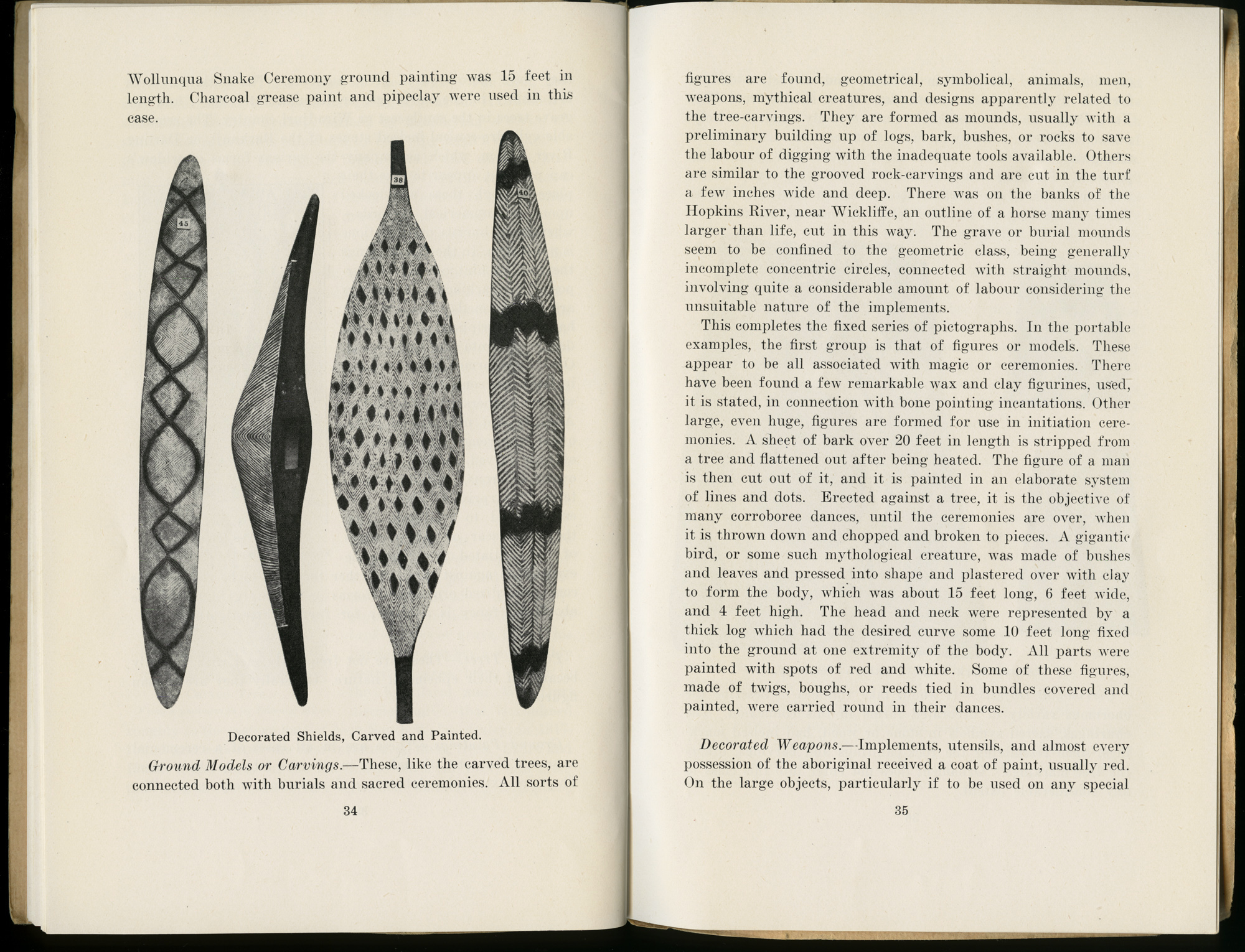
Decorated Shields, Carved and Painted


“Decorated Shields, Carved and Painted,” in “The Art of the Australian Aboriginal” by A.S. Kenyon from the pamphlet Australian Aboriginal Art with texts by Charles Barrett and A.S. Kenyon (text reprinted from the 1929 exhibition), National Museum of Victoria, 1952, p. 34


"The Art of the Australian Aboriginal" by A.S. Kenyon in the pamphlet 'Australian Aboriginal Art' by Charles Barrett and A.S. Kenyon


“The Art of the Australian Aboriginal” by A.S. Kenyon in the pamphlet Australian Aboriginal Art with texts by Charles Barrett and A.S. Kenyon (text reprinted from the 1929 exhibition), National Museum of Victoria, 1952, p. 36-37


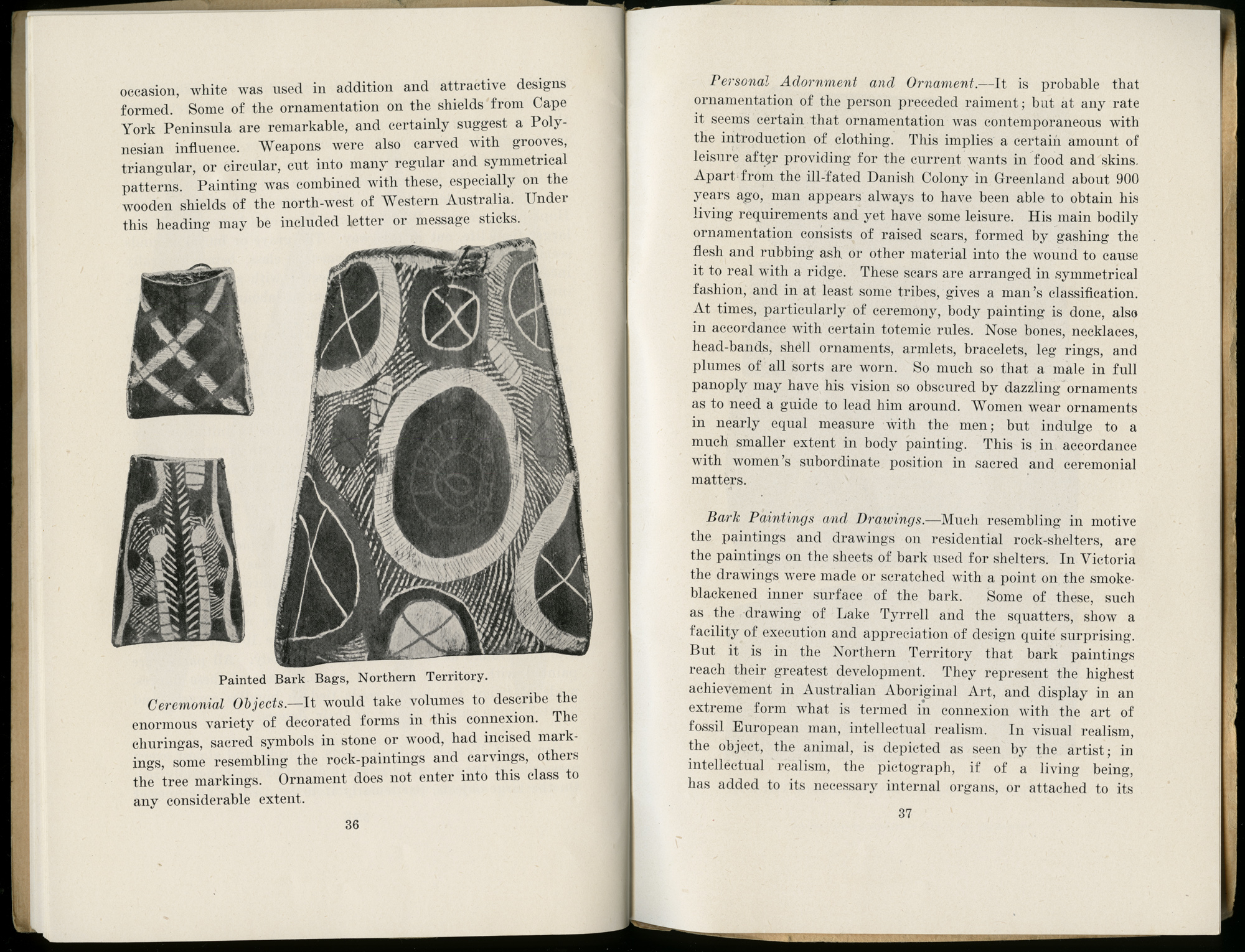
Painted Bark Bags, Northern Territory


“Painted Bark Bags, Northern Territory,” in “The Art of the Australian Aboriginal” by A.S. Kenyon from the pamphlet Australian Aboriginal Art with texts by Charles Barrett and A.S. Kenyon (text reprinted from the 1929 exhibition), National Museum of Victoria, 1952, p. 36


"The Art of the Australian Aboriginal" by A.S. Kenyon in the pamphlet 'Australian Aboriginal Art' by Charles Barrett and A.S. Kenyon


“The Art of the Australian Aboriginal” by A.S. Kenyon in the pamphlet Australian Aboriginal Art with texts by Charles Barrett and A.S. Kenyon (text reprinted from the 1929 exhibition), National Museum of Victoria, 1952, p. 38-39


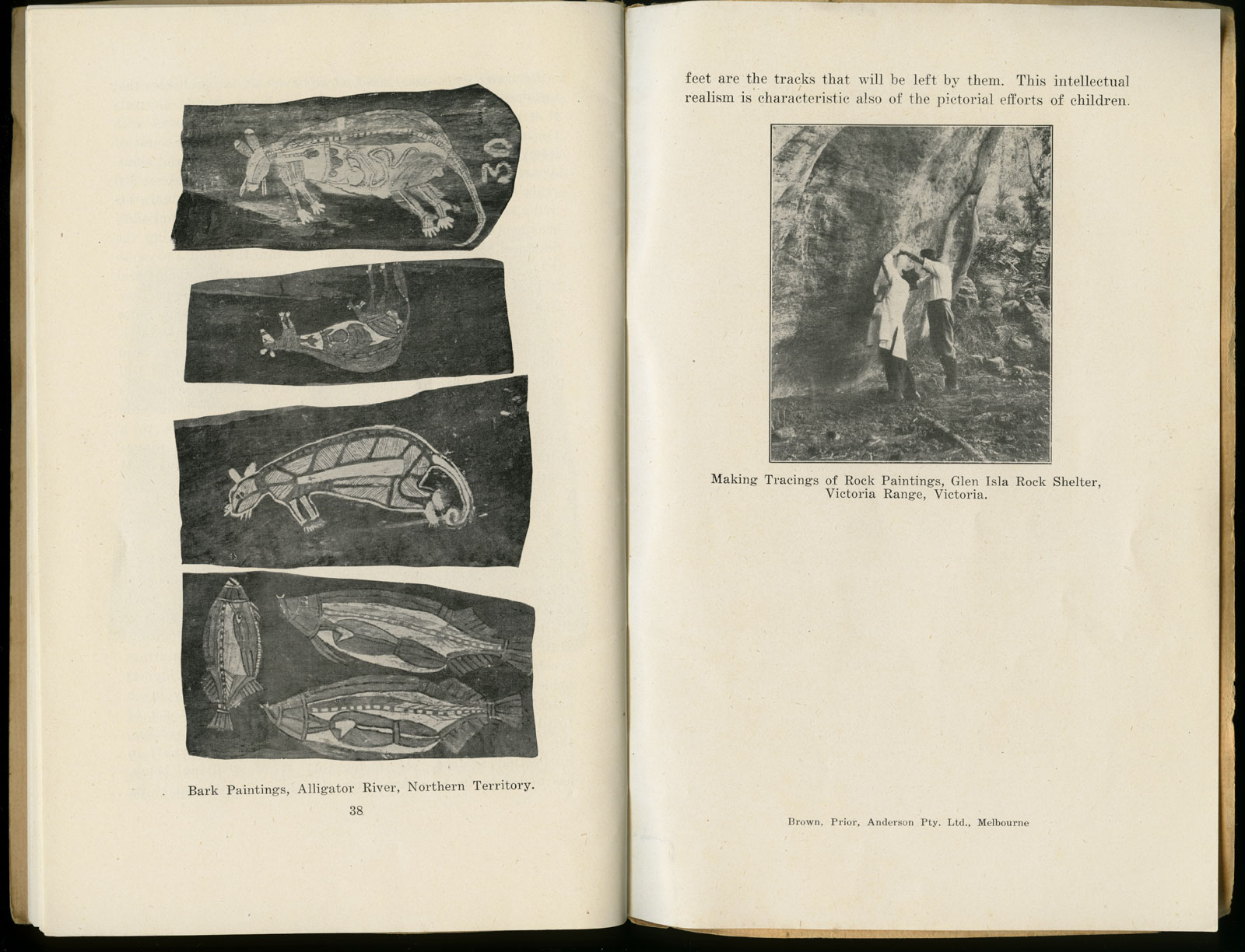
Bark Paintings, Alligator River, Northern Territory


“Bark Paintings, Alligator River, Northern Territory,” in “The Art of the Australian Aboriginal” by A.S. Kenyon from the pamphlet Australian Aboriginal Art with texts by Charles Barrett and A.S. Kenyon (text reprinted from the 1929 exhibition), National Museum of Victoria, 1952, p. 38


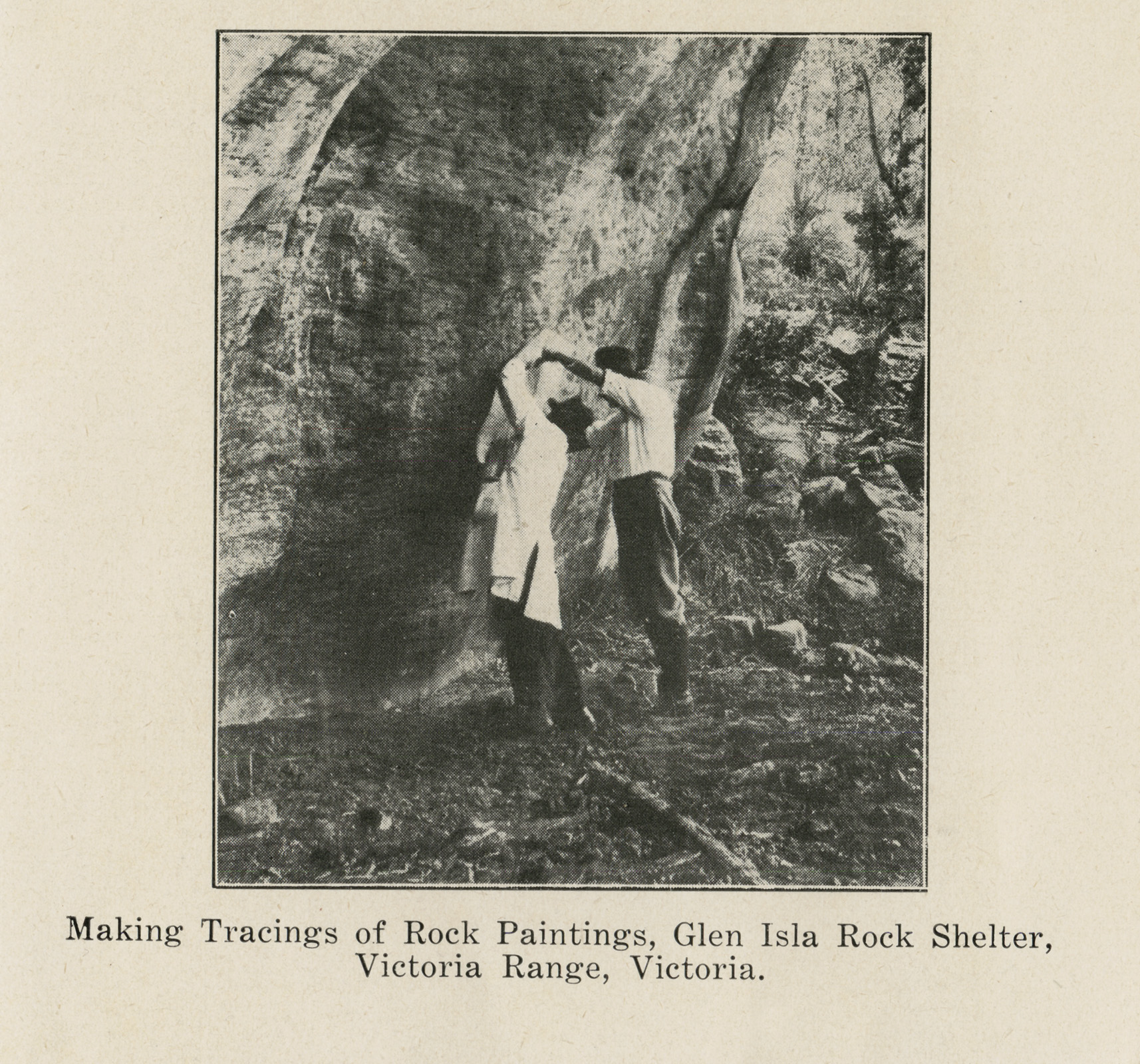
Making Tracings of Rock Paintings, Glen Isla Rock Shelter, Victoria Range, Victoria


Unknown photographer. “Making Tracings of Rock Paintings, Glen Isla Rock Shelter, Victoria Range, Victoria,” in “The Art of the Australian Aboriginal” by A.S. Kenyon from the pamphlet Australian Aboriginal Art with texts by Charles Barrett and A.S. Kenyon (text reprinted from the 1929 exhibition), National Museum of Victoria, 1952, p. 39


LIKE ART BLART ON FACEBOOK

Back to top

Exhibition: ‘2020 Vision: Photographs, 1840s-1860s’ at the Metropolitan Museum of Art, New York

Exhibition dates: 3rd December, 2019 – 13th December, 2020


Likely by Antoine-François-Jean Claudet (French, Lyon 1797 - 1867 London) Possibly by Nicolaas Henneman (Dutch, Heemskerk 1813 - 1898 London) ‘The Chess Players’ c. 1845 (detail) from the exhibition '2020 Vision: Photographs, 1840s-1860s' at the Metropolitan Museum of Art, New York, Dec 2019 - Dec 2020


Likely by Antoine-François-Jean Claudet (French, Lyon 1797 – 1867 London)
Possibly by Nicolaas Henneman (Dutch, Heemskerk 1813 – 1898 London)
The Chess Players (detail)
c. 1845
Salted paper print from paper negative
Sheet: 9 5/8 × 7 11/16 in. (24.5 × 19.6cm)
Image: 7 13/16 × 5 13/16 in. (19.8 × 14.7cm)
Bequest of Maurice B. Sendak, 2012
The Metropolitan Museum of Art
Public domain


An excellent selection of photographs in this posting. I particularly like the gender-bending, shape-shifting, age-distorting 1850s-60s Carte-de-visite Album of Collaged Portraits by an unknown artist. I’ve never seen anything like it before, especially from such an early date. Someone obviously took a lot of care, had a great sense of humour and definitely had a great deal of fun making the album.

Other fascinating details include the waiting horses and carriages in Fox Talbot’s View of the Boulevards of Paris (1843); the mannequin perched above the awning of the photographic studio in Dowe’s Photograph Rooms, Sycamore, Illinois (1860s); and the chthonic underworld erupting from the tilting ground in Carleton E. Watkins’ California Oak, Santa Clara Valley (c. 1863).

Dr Marcus Bunyan


Many thankx to the Metropolitan Museum of Art for allowing me to publish the photographs in the posting. Please click on the photographs for a larger version of the image.


When The Met first opened its doors in 1870, photography was still relatively new. Yet over the preceding three decades it had already developed into a complex pictorial language of documentation, social and scientific inquiry, self-expression, and artistic endeavour.

These initial years of photography’s history are the focus of this exhibition, which features new and recent gifts to the Museum, many offered in celebration of The Met’s 150th anniversary and presented here for the first time. The works on view, from examples of candid portraiture and picturesque landscape to pioneering travel photography and photojournalism, chart the varied interests and innovations of early practitioners.

The exhibition, which reveals photography as a dynamic medium through which to view the world, is the first of a two-part presentation that plays on the association of “2020” with clarity of vision while at the same time honouring farsighted and generous collectors and patrons. The second part will move forward a century, bringing together works from the 1940s through the 1960s.

Text from the Metropolitan Museum of Art website


Likely by Antoine-François-Jean Claudet (French, Lyon 1797 - 1867 London) Possibly by Nicolaas Henneman (Dutch, Heemskerk 1813 - 1898 London) ‘The Chess Players’ c. 1845 from the exhibition '2020 Vision: Photographs, 1840s-1860s' at the Metropolitan Museum of Art, New York, Dec 2019 - Dec 2020


Likely by Antoine-François-Jean Claudet (French, Lyon 1797 – 1867 London)
Possibly by Nicolaas Henneman (Dutch, Heemskerk 1813 – 1898 London)
The Chess Players
c. 1845
Salted paper print from paper negative
Sheet: 9 5/8 × 7 11/16 in. (24.5 × 19.6cm)
Image: 7 13/16 × 5 13/16 in. (19.8 × 14.7cm)
Bequest of Maurice B. Sendak, 2012
The Metropolitan Museum of Art
Public domain


Lewis Carroll (British, Daresbury, Cheshire 1832 - 1898 Guildford) '[Alice Liddell]' June 25, 1870 from the exhibition '2020 Vision: Photographs, 1840s-1860s' at the Metropolitan Museum of Art, New York, Dec 2019 - Dec 2020


Lewis Carroll (British, Daresbury, Cheshire 1832 – 1898 Guildford)
[Alice Liddell]
June 25, 1870
Albumen silver print from glass negative
Sheet: 6 1/4 × 5 9/16 in. (15.9 × 14.1cm)
Image: 5 7/8 × 4 15/16 in. (15 × 12.6cm)
Bequest of Maurice B. Sendak, 2012
The Metropolitan Museum of Art
Public domain


Eighteen-year-old Alice Liddell’s slumped pose, clasped hands, and sullen expression invite interpretation. A favoured model of Lewis Carroll, and the namesake of his novel Alice in Wonderland, Liddell had not seen the writer and photographer for seven years when this picture was made; her mother had abruptly ended all contact in 1863. The young woman poses with apparent unease in this portrait intended to announce her eligibility for marriage. The session closed a long and now controversial history with Carroll, whose portraits of children continue to provoke speculation. In what was to be her last sitting with the photographer, Liddell embodies the passing of childhood innocence that Carroll romanticised through the fictional Alice.


Unknown photographer (American) '[Surveyor]' c. 1854


Unknown photographer (American)
[Surveyor]
c. 1854
Daguerreotype
Case: 1.6 × 9.2 × 7.9cm (5/8 × 3 5/8 × 3 1/8 in.)
Gift of Charles Isaacs and Carol Nigro, in celebration of the Museum’s 150th Anniversary, 2019
The Metropolitan Museum of Art
Public domain


This portrait of a surveyor from an unknown daguerreotype studio was made during the heyday of the Daguerreian era in the United States, a time that coincided with an increased need for survey data and maps for the construction of railways, bridges, and roads. The unidentified surveyor, seated in a chair, grasps one leg of the tripod supporting his transit, a type of theodolite or surveying instrument that comprised a compass and rotating telescope. The carefully composed scene, in which the angle of the man’s skyward gaze is aligned with the telescope and echoed by one leg of the tripod, conflates its surveyor subject with an astronomer. As a result, the lands of young America are compared to the vast reaches of space, with both territories full of potential discovery.


Unknown photographer (American) '[Surveyor]' c. 1854


Unknown photographer (American)
[Surveyor]
c. 1854
Daguerreotype
Case: 1.6 × 9.2 × 7.9cm (5/8 × 3 5/8 × 3 1/8 in.)
Gift of Charles Isaacs and Carol Nigro, in celebration of the Museum’s 150th Anniversary, 2019
The Metropolitan Museum of Art
Public domain


Alphonse Delaunay (French, 1827-1906) 'Patio de los Arrayanes, Alhambra, Granada, Spain' 1854


Alphonse Delaunay (French, 1827-1906)
Patio de los Arrayanes, Alhambra, Granada, Spain
1854
Albumen silver print from paper negative
10 in. × 13 5/8 in. (25.4 × 34.6cm)
Gift of W. Bruce and Delaney H. Lundberg, 2017
The Metropolitan Museum of Art
Public domain


One of the most talented students of famed French photographer Gustave Le Gray, Delaunay was virtually unknown before a group of his photographs appeared at auction in 2007. Subsequent research led to the identification of several bodies of work, including the documentation of contemporary events through instantaneous views captured on glass negatives. Delaunay also was a particular devotee of the calotype (or paper negative) process, with which he created his best pictures – including this view of the Alhambra. Among a group of pictures he made between 1851 and 1854 in Spain and Algeria, this view of the Patio de los Arrayanes reveals the extent to which Delaunay was able to manipulate the peculiarities of the paper negative. He revels in the graininess of the image, purposefully not masking out the sky before printing the negative, so that the marble tower appears somehow carved out of the very atmosphere that surrounds it. In contrast, the reflecting pool remains almost impossibly limpid, its dark surface offering a cool counterpart to the harsh Spanish sky.


Hippolyte Bayard (French, 1801-1887) '[Classical Head]' probably 1839


Hippolyte Bayard (French, 1801-1887)
[Classical Head]
probably 1839
Salted paper print
6 1/2 × 5 7/8 in. (16.5 × 15cm)
Purchase, Horace W. Goldsmith Foundation Gift, 2019
The Metropolitan Museum of Art
Public domain


This luminous head seems to materialise before our very eyes, as if we are observing the moment in which the latent photographic image becomes visible. Nineteenth-century eyewitnesses to Hippolyte Bayard’s earliest photographs (direct positives on paper) described a similarly enchanting effect, in which hazy outlines coalesced with light and tone to form charmingly faithful, if indistinct, images. These works, which Bayard referred to as essais (tests or trials), often included statues and busts, which he frequently arranged in elaborate tableaux. In this case, he photographed the lone subject (an idealised classical head) from the front and side, as if it were a scientific specimen. The singular object emerges as a relic from photography’s origins and now distant past.


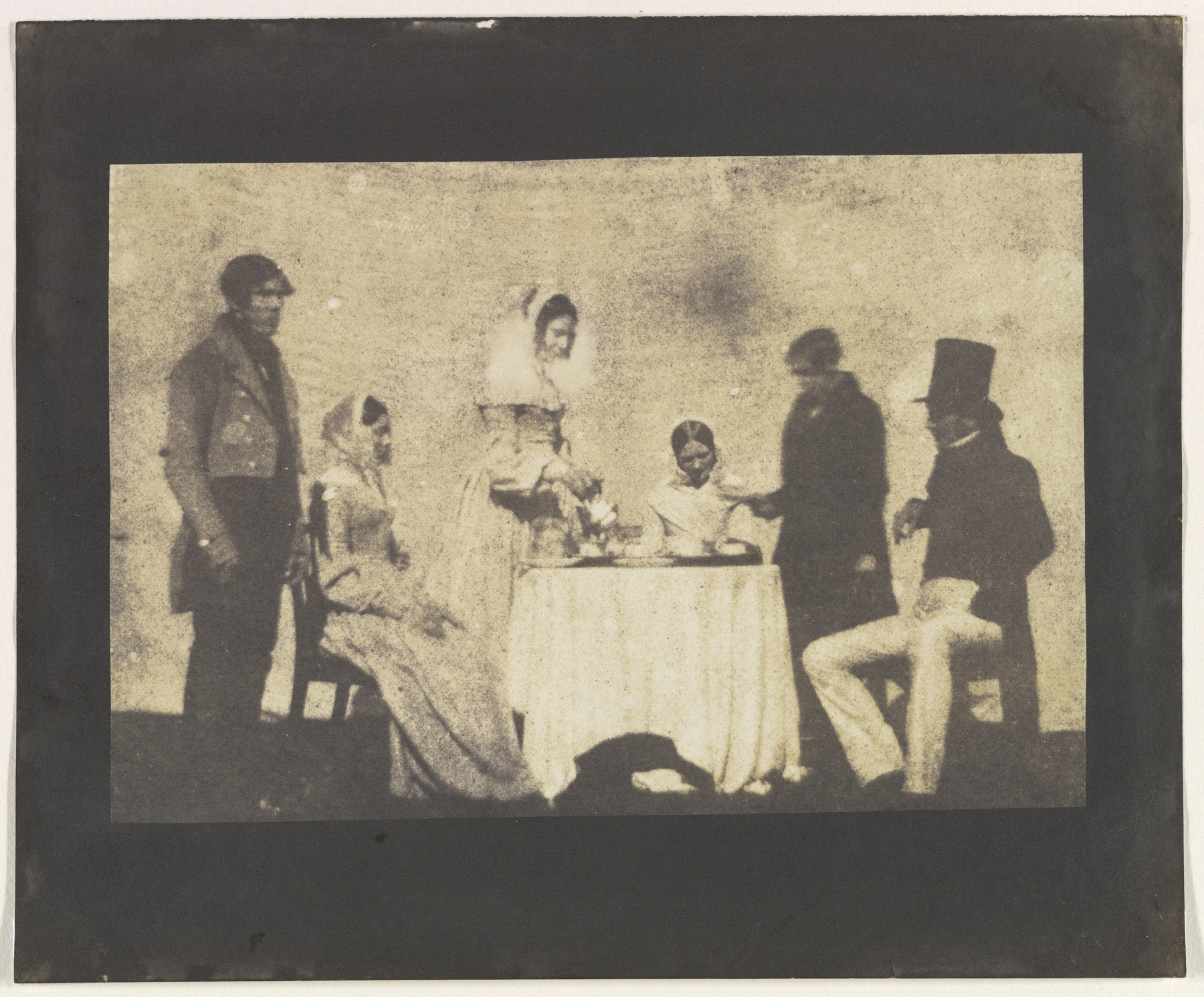
William Henry Fox Talbot (British, Dorset 1800 - 1877 Lacock) 'Group Taking Tea at Lacock Abbey' August 17, 1843


William Henry Fox Talbot (British, Dorset 1800 – 1877 Lacock)
Group Taking Tea at Lacock Abbey
August 17, 1843
Salted paper print from paper negative
Mount: 9 15/16 in. × 13 in. (25.3 × 33cm)
Sheet: 7 3/8 × 8 15/16 in. (18.7 × 22.7cm)
Image: 5 in. × 7 1/2 in. (12.7 × 19cm)
Bequest of Maurice B. Sendak, 2012
The Metropolitan Museum of Art
Public domain


Although Talbot’s groundbreaking calotype (paper negative) process allowed for more instantaneous image making, works such as this one nevertheless reflect the technical limitations of early photography. Here, he adapts painterly conventions to the new medium, staging a genre scene on his family estate. The stilted arrangement of figures – rigidly posed to produce a clear image – belies Talbot’s attempt to show action in progress. To achieve sufficient light exposure, he photographed the domestic tableau outdoors, arranging his subjects before a blank backdrop to create the illusion of interior space.


Unknown artist. '[Carte-de-visite Album of Collaged Portraits]' 1850s-1860s

Unknown artist. '[Carte-de-visite Album of Collaged Portraits]' 1850s-1860s

Unknown artist. '[Carte-de-visite Album of Collaged Portraits]' 1850s-1860s

Unknown artist. '[Carte-de-visite Album of Collaged Portraits]' 1850s-1860s

Unknown artist. '[Carte-de-visite Album of Collaged Portraits]' 1850s-1860s

Unknown artist. '[Carte-de-visite Album of Collaged Portraits]' 1850s-1860s

Unknown artist. '[Carte-de-visite Album of Collaged Portraits]' 1850s-1860s

Unknown artist. '[Carte-de-visite Album of Collaged Portraits]' 1850s-1860s


Unknown artist (American or Canadian)
[Carte-de-visite Album of Collaged Portraits]
1850s-1860s
Albumen silver prints
5 15/16 × 5 1/8 × 2 1/16 in. (15.1 × 13 × 5.3cm)
Bequest of Herbert Mitchell, 2008
The Metropolitan Museum of Art
Public domain


Beginning in the late 1850s, cartes de visite, or small photographic portrait cards, were produced on a scale that put photography in the hands of the masses. This unusual collection of collages is ahead of its time in spoofing the rigidity of the format. The images play with scale and gender by juxtaposing cutout heads and mismatched sitters, thereby highlighting the difference between social identity – which was communicated in part through the exchange of calling cards – and individuality.


Unknown artist (American) '[Studio Photographer at Work]' c. 1855


Unknown artist (American)
[Studio Photographer at Work]
c. 1855
Salted paper print
Image: 5 1/8 × 3 13/16 in. (13 × 9.7cm)
Sheet: 9 1/2 × 5 5/8 in. (24.1 × 14.3cm)
William L. Schaeffer Collection, Promised Gift of Jennifer and Philip Maritz, in celebration of the Museum’s 150th Anniversary
The Metropolitan Museum of Art


In this evocative image, picture making takes centre stage. Underneath a canopy of dark cloth, the photographer poses as if to adjust the bellows of a large format camera. The view reflected on its ground glass would appear reversed and upside down. Viewers’ expectations are similarly overturned, because the photographer’s subject remains unseen.


Unknown artist (American) '[Boy Holding a Daguerreotype]' 1850s


Unknown artist (American)
[Boy Holding a Daguerreotype]
1850s
Daguerreotype with applied colour
Image: 3 1/4 × 2 3/4 in. (8.3 × 7cm)
William L. Schaeffer Collection, Promised Gift of Jennifer and Philip Maritz, in celebration of the Museum’s 150th Anniversary
The Metropolitan Museum of Art


The boy in this picture clutches a cased image to his chest, as if to illustrate his affection for the subject depicted within. Daguerreotypes were a novel form of handheld picture, portable enough to slip into a pocket or palm. Portraits exchanged between friends and family could be kept close – a practice often mimed by sitters, who would pose for one daguerreotype while holding another.


James Fitzallen Ryder (American, 1826-1904) 'Locomotive James McHenry (58), Atlantic and Great Western Railway' 1862


James Fitzallen Ryder (American, 1826-1904)
Locomotive James McHenry (58), Atlantic and Great Western Railway
1862
Albumen silver print
Image: 7 3/8 × 9 1/4 in. (18.7 × 23.5cm)
Mount: 10 × 13 in. (25.4 × 33cm)
William L. Schaeffer Collection, Promised Gift of Jennifer and Philip Maritz, in celebration of the Museum’s 150th Anniversary
The Metropolitan Museum of Art


In spring 1862, the chief engineer in charge of building the Atlantic and Great Western Railway – which ran from Salamanca, New York, to Akron, Ohio, and from Meadville to Oil City, Pennsylvania – engaged James Ryder to make photographs that would convince shareholders of the worthiness of the project. Ryder’s assignment was “to photograph all the important points of the work, such as excavations, cuts, bridges, trestles, stations, buildings and general character of the country through which the road ran, the rugged and the picturesque.” In a converted railroad car kitted out with a darkroom, water tank, and developing sink, he processed photographs that make up one of the earliest rail surveys.


Attributed to Josiah Johnson Hawes (American, Wayland, Massachusetts 1808 - 1901 Crawford Notch, New Hampshire) Winter on the Common, Boston' 1850s


Attributed to Josiah Johnson Hawes (American, Wayland, Massachusetts 1808 – 1901 Crawford Notch, New Hampshire)
Winter on the Common, Boston
1850s
Salted paper print
Window: 6 15/16 × 8 15/16 in. (17.6 × 22.7cm)
Mat: 16 × 20 in. (40.6 × 50.8cm)
William L. Schaeffer Collection, Promised Gift of Jennifer and Philip Maritz, in celebration of the Museum’s 150th Anniversary
The Metropolitan Museum of Art


Having originally set his sights on a career as a painter, Josiah Hawes gave up his brushes for a camera upon first seeing a daguerreotype in 1841. Two years later, he joined Albert Sands Southworth in Boston to form the celebrated photographic studio Southworth & Hawes. Turning to paper-based photography in the early 1850s, Hawes frequently depicted local scenery. This surprising picture, which presents Boston Common through a veil of snow-laden branches, shows that Hawes brought his creative ambitions to the nascent art of photography.


Carleton E. Watkins (American, 1829-1916) '[California Oak, Santa Clara Valley]' c. 1863


Carleton E. Watkins (American, 1829-1916)
[California Oak, Santa Clara Valley]
c. 1863
Albumen silver print
Image: 12 in. × 9 5/8 in. (30.5 × 24.5cm)
Mount: 21 1/4 in. × 17 5/8 in. (54 × 44.8cm)
William L. Schaeffer Collection, Promised Gift of Jennifer and Philip Maritz, in celebration of the Museum’s 150th Anniversary
The Metropolitan Museum of Art


For viewers today, the crown of this majestic oak tree, with its complex network of branches, might evoke the allover paintings of Abstract Expressionism with their layers of dripped paint. As photographed by Carleton Watkins, the dark, flattened silhouette of the tree feathers out across the camera’s field of view. The sloped horizon line, uncommon in Watkins’s output, both echoes the ridge in the distance and grounds the energy of the tree canopy, ably demonstrating his masterful command of pictorial composition.


George Wilson Bridges (British, 1788-1864) 'Garden of Selvia, Syracuse, Sicily' 1846


George Wilson Bridges (British, 1788-1864)
Garden of Selvia, Syracuse, Sicily
1846
Salted paper print from paper negative
Image: 6 15/16 × 8 9/16 in. (17.7 × 21.7cm)
Sheet: 7 5/16 × 8 13/16 in. (18.5 × 22.4cm)
Bequest of Maurice B. Sendak, 2012
The Metropolitan Museum of Art
Public domain


The monk’s gesture of prayer in this image by George Wilson Bridges is a touchstone of stillness against the impressive landscape and vegetation that rise up behind him. Bridges was an Anglican reverend and friend of William Henry Fox Talbot, the inventor of the calotype (paper negative), who instructed him on the method before it was patented. Bridges was also one of the earliest photographers to embark upon a tour of the Mediterranean region; he wrote to Talbot that he conceived of the excursion both as a technical mission to advance photography and as a pilgrimage to collect imagery of religious sites.


Pietro Dovizielli (Italian, 1804-1885) '[Spanish Steps, Rome]' c. 1855


Pietro Dovizielli (Italian, 1804-1885)
[Spanish Steps, Rome]
c. 1855
Albumen silver print from glass negative
Image: 14 11/16 × 11 5/16 in. (37.3 × 28.8cm)
Sheet: 24 7/16 × 18 7/8 in. (62 × 48cm)
Gift of W. Bruce and Delaney H. Lundberg, in celebration of the Museum’s 150th Anniversary, 2019
The Metropolitan Museum of Art
Public domain


Made in late afternoon light, Pietro Dovizielli’s picture shows a long shadow cast onto Rome’s Piazza di Spagna that almost obscures one of the market stalls flanking the base of the famed Spanish Steps. Rising above the sea of stairs is the church of Trinità dei Monti, its facade neatly bisected by the Sallustiano obelisk. In the piazza, a lone figure – the only visible inhabitant of this eerily empty public square – rests against the railing of the Barcaccia fountain. Keenly composed pictures like this led reviewers of Dovizielli’s photographs to proclaim them “the very paragons of architectural photography.”


Edouard Baldus (French (born Prussia), 1813-1889) '[Amphitheater, Nîmes]' c. 1853


Edouard Baldus (French (born Prussia), 1813-1889)
[Amphitheater, Nîmes]
c. 1853
Salted paper print from paper negative
Overall: 12 3/8 × 15 3/16 in. (31.5 × 38.5cm)
Gift of Joyce F. Menschel, in celebration of the Museum’s 150th Anniversary, 2019
The Metropolitan Museum of Art


Instead of photographing the entire arena in Nîmes, as he had two years earlier, Baldus focusses here on a section of the façade, playing the superimposed arches against the vertical, shadowed pylons in the foreground. The resulting composition manages to isolate and monumentalise the architecture, while creating a rhythmic play of light and dark that energises the picture. The photograph was part of a massive, four-year project, Villes de France photographiées, in which the views from the south of France were said to surpass all of the photographer’s previous work in the region.


William Henry Fox Talbot (British, Dorset 1800-1877 Lacock) 'View of the Boulevards of Paris' 1843


William Henry Fox Talbot (British, Dorset 1800 – 1877 Lacock)
View of the Boulevards of Paris
1843
Salted paper print from paper negative
Mount: 9 in. × 10 1/16 in. (22.8 × 25.6cm)
Sheet: 7 3/8 × 10 1/8 in. (18.7 × 25.7cm)
Image: 6 5/16 × 8 1/2 in. (16.1 × 21.6cm)
Bequest of Maurice B. Sendak, 2012
The Metropolitan Museum of Art
Public domain


In May 1843 Talbot traveled to Paris to negotiate a licensing agreement for the French rights to his patented calotype process. His invention used a negative-positive system and a paper base – not a copper support as in a daguerreotype. Although his negotiations were not fruitful, Talbot’s views of the elegant new boulevards of the French capital were highly successful.

Filled with the incidental details of urban life, architectural ornamentation, and the play of spring light, this photograph appears as the second plate in Talbot’s groundbreaking publication The Pencil of Nature (1844). The chimney posts on the roofline of the rue de la Paix, the waiting horses and carriages, and the characteristically French shuttered windows evoke as vivid a notion of mid-nineteenth-century Paris now as they must have 170 years ago.


Lewis Dowe (American, active 1860s-1880s) '[Dowe's Photograph Rooms, Sycamore, Illinois]' 1860s


Lewis Dowe (American, active 1860s-1880s)
[Dowe’s Photograph Rooms, Sycamore, Illinois]
1860s
Albumen silver print
Image: 5 7/8 × 7 5/8 in. (14.9 × 19.3cm)
Mount: 8 × 10 in. (20.3 × 25.4cm)
William L. Schaeffer Collection, Promised Gift of Jennifer and Philip Maritz, in celebration of the Museum’s 150th Anniversary
The Metropolitan Museum of Art


Above a bustling thoroughfare in Sycamore, Illinois, boldface lettering advertises the services of photographer Lewis Dowe, a portraitist who also published postcards and stereoviews. Easier to miss in the image is a mannequin perched above the awning to promote the studio. The flurry of activity below Dowe’s storefront and the prime location of the outfit, poised between a tailor and a saloon, speak to the important role of photography in town life.


E. & H. T. Anthony (American) '[Specimens of New York Bill Posting]' 1863


E. & H. T. Anthony (American)
[Specimens of New York Bill Posting]
1863
Albumen silver prints
Mount: 3 1/4 in. × 6 3/4 in. (8.3 × 17.1cm)
Image: 2 15/16 in. × 6 in. (7.5 × 15.3cm)
William L. Schaeffer Collection, Promised Gift of Jennifer and Philip Maritz, in celebration of the Museum’s 150th Anniversary
The Metropolitan Museum of Art


Benefit concerts, minstrel shows, lectures, and horse races all clamour for attention in this graphic field of broadsides posted in the Bowery neighbourhood of Manhattan. The stereograph format lends added depth and dimensionality to the layered fragments of text, transporting viewers to a hectic city sidewalk. Published for a national market, the scene indexes a precise moment in the summer of 1863, offering armchair tourists an inadvertent trend report on downtown cultural life.


Roger Fenton (British, 1819-1869) 'The Diamond and Wasp, Balaklava Harbour' March, 1855


Roger Fenton (British, 1819-1869)
The Diamond and Wasp, Balaklava Harbour
March, 1855
Albumen silver print from glass negative
Image: 8 in. × 10 1/8 in. (20.3 × 25.7cm)
Mount: 19 5/16 × 24 3/4 in. (49 × 62.9cm)
Gift of Thomas Walther Collection, in celebration of the Museum’s 150th Anniversary, 2019
The Metropolitan Museum of Art


Fenton’s view of the Black Sea port of Balaklava, which the British used as a landing point for their siege of Sevastopol during the Crimean War, shows a busy but orderly operation. The British naval ships, HMS Diamond and HMS Wasp, oversaw the management of transports into and out of the harbour, which explains the presence of ships and rowboats, as well as the large stack of crates near the rail track in the foreground. Against claims of “rough-and-tumble” mismanagement of Balaklava in the British press, Fenton (commissioned by a Manchester publisher to record the theatre of war) offers documentation of a well-functioning port.


Roger Fenton (British, 1819-1869) 'The Mamelon and Malakoff from front of Mortar Battery' April, 1855


Roger Fenton (British, 1819-1869)
The Mamelon and Malakoff from front of Mortar Battery
April, 1855
Salted paper print from glass negative
Image: 9 1/8 × 13 1/2 in. (23.1 × 34.3cm)
Sheet: 14 3/4 × 17 13/16 in. (37.5 × 45.3cm)
Gift of Joyce F. Menschel, in celebration of the Museum’s 150th Anniversary, 2019
The Metropolitan Museum of Art


Fenton’s extensive documentation of the Crimean War – the first use of photography for that purpose – was a commercial endeavour that did not include pictures of battle, the wounded, or the dead. His unprepossessing view of a vast rocky valley instead discloses, in the distance, a site of crucial strategic importance. Fort Malakoff, the general designation of Russian fortifications on two hills (Mamelon and Malakoff) is just perceptible at the horizon line. Malakoff’s capture by the French in September 1855, five months after Fenton made this photograph, ended the eleven-month siege of Sevastopol and was the final episode of the war.


Felice Beato (British (born Italy), Venice 1832-1909 Luxor) and James Robertson (British, 1813-1881) [Dome of the Rock, Jerusalem] 1856-1857


Felice Beato (British (born Italy), Venice 1832-1909 Luxor) and James Robertson (British, 1813-1881)
[Dome of the Rock, Jerusalem]
1856-1857
Albumen silver print
Image: 9 in. × 11 1/4 in. (22.9 × 28.6cm)
Mount: 17 5/8 in. × 22 1/2 in. (44.8 × 57.2cm)
Gift of Joyce F. Menschel, 2013
The Metropolitan Museum of Art


This detailed print showing the Dome of the Rock in Jerusalem provides a sense of the structure’s natural and architectural surroundings. Felice Beato depicted the religious site from a pilgrim’s point of view – walls and roads are given visual priority and stand between the viewer and the shrine. Holy sites such as this were the earliest and most common subjects of travel photography. Beato made multiple journeys to the Mediterranean and North Africa, and he is perhaps best known for photographing East Asia in the 1880s.


R.C. Montgomery (American, active 1850s) '[Self-Portrait (?)]' 1850s


R.C. Montgomery (American, active 1850s)
[Self-Portrait (?)]
1850s
Daguerreotype with applied colour
Image: 3 1/4 × 4 1/4 in. (8.3 × 10.8cm)
William L. Schaeffer Collection, Promised Gift of Jennifer and Philip Maritz, in celebration of the Museum’s 150th Anniversary
The Metropolitan Museum of Art


The insouciant subject here may be the daguerreotypist himself, posing in bed for a promotional picture or a private joke. His rumpled suit and haphazard hairstyle affect intimacy, perhaps in an effort to showcase an informal portrait style. Because they required long exposure times, daguerreotypes often captured sitters at their most stilted. With this surprising picture, the maker might have hoped to attract clients who were in search of a more novel or natural likeness.


The Metropolitan Museum of Art
1000 Fifth Avenue at 82nd Street
New York, New York 10028-0198
Phone: 212-535-7710

Opening hours:
Thursday – Tuesday 10am – 5pm
Closed Wednesday

The Metropolitan Museum of Art website

LIKE ART BLART ON FACEBOOK

Back to top

European photographic research tour: V&A Photography Centre, London

Visited October 2019 posted May 2020


Unknown photographer. 'Photograph of Allied War exhibition, Serbian Section, V&A' 1917 (installation view)


Unknown photographer
Photograph of Allied War exhibition, Serbian Section, V&A (installation view)
1917
Gelatin silver print
The Royal Photographic Society Collection at the V&A Museum
Photo: Marcus Bunyan


The older I grow, the more exponentially I appreciate and love these early photographs. Imagine having a collection like this!

Wonderful to see Edward Steichen’s Portrait – Lady H (1908, below) as I have a copy of Camera Work 22 in my collection.

Dr Marcus Bunyan


All iPhone images © Dr Marcus Bunyan. Please click on the photographs for a larger version of the image.


The V&A has been collecting photographs since 1856, the year the Museum was founded, and it was one of the first museums to present photography exhibitions. Since then the collection has grown to be one of the largest and most important in the world, comprising around 500,000 images. The V&A is now honoured to have added the Royal Photographic Society (RPS) collection to its holdings, which contains around 270,000 photographs, an extensive library, and 6,000 cameras and pieces of equipment associated with leading artists and photographic pioneers.

Take a behind-the-scenes look at our world class photography collection following the transfer of the Royal Photographic Society (RPS) Collection, which has enabled a dramatic reimagining of the way photography is presented at the V&A. The photographs curators introduce a series of five highlights that are on display in the new Photography Centre, which opened on 12th October 2018. The first phase of the centre will more than double the space dedicated to photography at the Museum.

Text from the V&A and YouTube websites


Unknown photographer. 'Photograph of Allied War exhibition, Serbian Section, V&A' 1917


Unknown photographer
Photograph of Allied War exhibition, Serbian Section, V&A (installation view)
1917
Gelatin silver print
The Royal Photographic Society Collection at the V&A Museum
Photo: Marcus Bunyan


The V&A has been collecting and exhibiting photographs since the 1850s. This image shows part o a photographic exhibition held over 100 years ago in the same galleries you are standing in today. The exhibition presented a densely packed display of images depicting the Allied Powers during the First World War.


Installation view of the V&A Photography Centre, London

Installation view of the V&A Photography Centre, London

Installation view of the V&A Photography Centre, London

Installation view of the V&A Photography Centre, London

Wall text from the V&A Photography Centre, London

Installation view of the V&A Photography Centre, London


Installation views of the V&A Photography Centre, London
Photos: Marcus Bunyan


Joseph Nicéphore Niépce (French, 1765-1833) 'Christ Carrying his Cross' 1827 (installation view)

Joseph Nicéphore Niépce (French, 1765-1833) 'Christ Carrying his Cross' 1827 (installation view)


Joseph Nicéphore Niépce (French, 1765-1833)
Christ Carrying his Cross (installation views)
1827
Heliograph on pewter plate
The Royal Photographic Society Collection at the V&A Museum
Photos: Marcus Bunyan


The French inventor Niépce made the earliest surviving photographic images, which he called ‘heliographs’ or ‘sun-writing’. Only 16 are thought to still exist. Although Niépce experimented with light-sensitive plates inside a camera, he made most of his images, including this one, by placing engravings of works by other artists directly onto a metal plate. He would probably have had the resulting heliographs coated in ink and printed.


Joseph Nicéphore Niépce (French, 1765-1833) 'Christ Carrying his Cross' 1827 (installation view)


Joseph Nicéphore Niépce (French, 1765-1833)
Christ Carrying his Cross (installation view)
1827
Heliograph on pewter plate
The Royal Photographic Society Collection at the V&A Museum
Photo: Marcus Bunyan


David Octavius Hill (Scottish, 1802-70) and Robert Adamson (Scottish, 1821-48) 'The Adamson Family' 1843-1845 (installation view)


David Octavius Hill (Scottish, 1802-1870) and Robert Adamson (Scottish, 1821-1848)
The Adamson Family (installation view)
1843-1845
Salted paper print
The Royal Photographic Society Collection at the V&A Museum
Photo: Marcus Bunyan


The partnership between Scottish painter Hill and chemist Adamson merged the art and science of photography. The pair initially intended to create preliminary studies for Hill’s paintings, but soon recognised photography’s artistic potential. With Hill’s knowledge of composition and lighting, and Adamson’s considerable sensitivity and dexterity in handling the camera, together they produced some of the most accomplished photographic portraits of their time.


William Henry Fox Talbot (British, 1800-77) 'The Haystack' 1844 from  the V&A Photography Centre, London 2019


William Henry Fox Talbot (British, 1800-1877)
The Haystack
1844
From The Pencil of Nature
Salted paper print
The Royal Photographic Society Collection at the V&A Museum


Benjamin Brecknell Turner (British, 1815-94) 'Hedgerow Trees, Clerkenleap' 1852-1854 (installation view)

Benjamin Brecknell Turner (British, 1815-94) 'Hedgerow Trees, Clerkenleap' 1852-1854 (installation view)


Benjamin Brecknell Turner (British, 1815-1894)
Hedgerow Trees, Clerkenleap (installation views)
1852-1854
Albumen print; Calotype negative
The Royal Photographic Society Collection at the V&A Museum
Photos: Marcus Bunyan


Turner took out a licence to practice ‘calotype’ photography from Talbot in 1848. He contact-printed positive images from paper negatives. The negative (below) and its corresponding positive (above) are reunited here to illustrate this process, but the pairing as you see them would not have been the photographer’s original intention for display. Although unique negatives were sometimes exhibited in their own right, only showing positive prints was the norm.


Benjamin Brecknell Turner (British, 1815-94) 'Hedgerow Trees, Clerkenleap' 1852-1854 (installation view)


Benjamin Brecknell Turner (British, 1815-1894)
Hedgerow Trees, Clerkenleap (installation view)
1852-1854
Albumen print; Calotype negative
The Royal Photographic Society Collection at the V&A Museum
Photo: Marcus Bunyan


Gustave Le Gray (French, 1820-84) 'The Road to Chailly, Forest of Fontainebleau' 1852 (installation view)


Gustave Le Gray (French, 1820-1884)
The Road to Chailly, Forest of Fontainebleau (installation view)
1852
Albumen print from a collodion glass negative
Bequeathed to the V&A by Chauncey Hare Townshend
Photo: Marcus Bunyan


Installation view of the V&A Photography Centre, London

Installation view of the V&A Photography Centre, London

Wall text from the V&A Photography Centre, London


Installation views of the V&A Photography Centre, London
Photos: Marcus Bunyan


Gustave Le Gray (French, 1820-84) 'The Marseillaise (The Departure of the Volunteers of 1792), by Francois Rude, 1833-35, Arc de Triomphe de l’Etoile, Paris' 1852 (installation view)


Gustave Le Gray (French, 1820-1884)
The Marseillaise (The Departure of the Volunteers of 1792), by Francois Rude, 1833-35, Arc de Triomphe de l’Etoile, Paris (installation view)
1852
Albumen print
Bequeathed to the V&A by Chauncey Hare Townshend
Photo: Marcus Bunyan


Gustave Le Gray (French, 1820-1884) 'The Marseillaise (The Departure of the Volunteers of 1792), by Francois Rude, 1833-1835, Arc de Triomphe de l’Etoile, Paris' 1852 (installation view)


Gustave Le Gray (French, 1820-1884)
The Marseillaise (The Departure of the Volunteers of 1792), by Francois Rude, 1833-35, Arc de Triomphe de l’Etoile, Paris (installation view)
1852
Albumen print
Bequeathed to the V&A by Chauncey Hare Townshend
Photo: Marcus Bunyan


Roger Fenton (British, 1819-1869) 'Parian Vase, Grapes and Silver Cup' 1860 (installation view)


Roger Fenton (British, 1819-1869)
Parian Vase, Grapes and Silver Cup (installation view)
1860
Albumen print
The Royal Photographic Society Collection at the V&A Museum
Photo: Marcus Bunyan


Fenton was one of the most versatile and technically brilliant photographers of the 19th century. He excelled at many subjects, including war photography, portraiture, architecture and landscape. He also made a series of lush still lives. Here, grapes, plums and peaches are rendered in exquisite detail, and the silver cup on the right reflects a camera tripod.


Roger Fenton (British, 1819-1869) 'Parian Vase, Grapes and Silver Cup' 1860 (installation view)


Roger Fenton (British, 1819-1869)
Parian Vase, Grapes and Silver Cup (installation view)
1860
Albumen print
The Royal Photographic Society Collection at the V&A Museum
Photo: Marcus Bunyan


Roger Fenton (British, 1819-1869) 'Parian Vase, Grapes and Silver Cup' 1860 (installation view)


Roger Fenton (British, 1819-1869)
Parian Vase, Grapes and Silver Cup (installation view)
1860
Albumen print
The Royal Photographic Society Collection at the V&A Museum
Photo: Marcus Bunyan


Roger Fenton (British, 1819-1869) 'Parian Vase, Grapes and Silver Cup' 1860 (installation view detail)


Roger Fenton (British, 1819-1869)
Parian Vase, Grapes and Silver Cup (installation view detail)
1860
Albumen print
The Royal Photographic Society Collection at the V&A Museum
Photo: Marcus Bunyan


Roger Fenton (British, 1819-1869) 'Still Life with Fruit and Decanter' 1860 from the V&A Photography Centre, London 2019


Roger Fenton (British, 1819-1869)
Still Life with Fruit and Decanter
1860
Albumen print
The Royal Photographic Society Collection at the V&A Museum


Oscar Gustaf Rejlander (British born Sweden, 1813-1875) 'Head of St John the Baptist on a Charger' c. 1856 (installation view)


Oscar Gustaf Rejlander (British born Sweden, 1813-1875)
Head of St John the Baptist on a Charger (installation view)
c. 1856
Albumen print
The Royal Photographic Society Collection at the V&A Museum
Photo: Marcus Bunyan


Rejlander probably intended this photograph to be part of a larger composition telling the biblical story of Salome, in which the severed head of John the Baptist was presented to her on a plate. Rejlander never made the full picture, however, and instead produced multiple prints of the head alone.


Oscar Gustaf Rejlander (British born Sweden, 1813-75) 'Head of St John the Baptist on a Charger' c. 1856 (installation view)


Oscar Gustaf Rejlander (British born Sweden, 1813-1875)
Head of St John the Baptist on a Charger (installation view)
c. 1856
Albumen print
The Royal Photographic Society Collection at the V&A Museum


Francis Frith (British, 1822-1898) 'Th', from Egypt, Sinai, and Jerusalem: A Series of Twenty Photographic Views by Francis Frith 1858 (published 1860 or 1862) (installation view)


Francis Frith (British, 1822-1898)
The Pyramids of Dahshoor [Dahshur], from the East, from Egypt, Sinai, and Jerusalem: A Series of Twenty Photographic Views by Francis Frith (installation view)
1858 (published 1860 or 1862)
Albumen print
The Royal Photographic Society Collection at the V&A Museum
Photo: Marcus Bunyan


Frith’s photographs were popular and circulated widely, both because of their architectural interest and because they often featured sites mentioned in the Bible. Photographs of places described in biblical stories brought a new level of realism to a Christian Victorian audience, previously only available through the interpretations of a painter or illustrator.


Francis Frith (British, 1822-1898) 'Th', from Egypt, Sinai, and Jerusalem: A Series of Twenty Photographic Views by Francis Frith 1858 (published 1860 or 1862) (installation view)


Francis Frith (British, 1822-1898)
The Pyramids of Dahshoor [Dahshur], from the East, from Egypt, Sinai, and Jerusalem: A Series of Twenty Photographic Views by Francis Frith (installation view)
1858 (published 1860 or 1862)
Albumen print
The Royal Photographic Society Collection at the V&A Museum
Photo: Marcus Bunyan


Francis Frith (British, 1822-98) 'The Pyramids of Dahshoor [Dahshur], from the East, from Egypt, Sinai, and Jerusalem: A Series of Twenty Photographic Views by Francis Frith' 1858 (published 1860 or 1862) from the V&A Photography Centre, London 2019


Francis Frith (British, 1822-1898)
The Pyramids of Dahshoor [Dahshur], from the East, from Egypt, Sinai, and Jerusalem: A Series of Twenty Photographic Views by Francis Frith
1858 (published 1860 or 1862)
Albumen print
The Royal Photographic Society Collection at the V&A Museum
Photo: Marcus Bunyan


Installation view of the V&A Photography Centre, London


Installation view of the V&A Photography Centre, London
Photo: Marcus Bunyan


Gustave Le Gray (French, 1820-1884) 'Solar Effect in the Clouds – Ocean' 1856-1859 (installation view)


Gustave Le Gray (French, 1820-1884)
Solar Effect in the Clouds – Ocean (installation view)
1856-1859
Albumen Print
Bequeathed to the V&A by Chauncey Hare Townshend
Photo: Marcus Bunyan


Gustave Le Gray (French, 1820-1884) 'Solar Effect in the Clouds – Ocean' 1856-1859


Gustave Le Gray (French, 1820-1884)
Solar Effect in the Clouds – Ocean
1856-1859
Albumen Print
Art Institute of Chicago
Creative Commons Zero (CC0)


Gustave Le Gray (French, 1820-1884) 'The Imperial Yacht, La Reine Hortense, Le Havre' 1856-1857 (installation view)


Gustave Le Gray (French, 1820-1884)
The Imperial Yacht, La Reine Hortense, Le Havre (installation view)
1856-1857
Albumen print
Bequeathed to the V&A by Chauncey Hare Townshend
Photo: Marcus Bunyan


Gustave Le Gray (French, 1820-1884) 'The Imperial Yacht, La Reine Hortense, Le Havre' 1856-1857


Gustave Le Gray (French, 1820-1884)
The Imperial Yacht, La Reine Hortense, Le Havre
1856-1857
Albumen print
The Metropolitan Museum of Art
Public domain


Gustave Le Gray (French, 1820-1884) 'Pavilion Richelieu, Louvre, Paris' 1857-1859 (installation view)


Gustave Le Gray (French, 1820-1884)
Pavilion Richelieu, Louvre, Paris (installation view)
1857-1859
Albumen print
Bequeathed to the V&A by Chauncey Hare Townshend
Photo: Marcus Bunyan


Gustave Le Gray (French, 1820-1884) 'Pavilion Richelieu, Louvre, Paris' 1857-1859 (installation view)


Gustave Le Gray (French, 1820-1884)
Pavilion Richelieu, Louvre, Paris (installation view)
1857-1859
Albumen print
Bequeathed to the V&A by Chauncey Hare Townshend
Photo: Marcus Bunyan


Roger Fenton (British, 1819-1869) 'Balaclava from Guard’s Hill, the Crimea' 1855 (installation view)


Roger Fenton (British, 1819-1869)
Balaclava from Guard’s Hill, the Crimea (installation view)
1855
Albumen print
Bequeathed to the V&A by Chauncey Hare Townshend
Photo: Marcus Bunyan


Roger Fenton (British, 1819-1869) 'Balaclava from Guard’s Hill, the Crimea' 1855 (installation view)


Roger Fenton (British, 1819-69)
Balaclava from Guard’s Hill, the Crimea (installation view)
1855
Albumen print
Bequeathed to the V&A by Chauncey Hare Townshend
Photo: Marcus Bunyan


Julia Margaret Cameron (British born India, 1815-1879) 'Lucia' 1864-1865 (installation view)


Julia Margaret Cameron (British, born India, 1815-1879)
Lucia (installation view)
1864-1865
Albumen print
The Royal Photographic Society Collection at the V&A Museum
Photo: Marcus Bunyan


Charles Lutwide Dodgson (also known as Lewis Carroll)(British, 1832-1898) 'Tea Merchant (On Duty)' and 'Tea Merchant (Off Duty)' 1873 (installation view)


Charles Lutwide Dodgson (also known as Lewis Carroll)(British, 1832-1898)
Tea Merchant (On Duty) and Tea Merchant (Off Duty) (installation view)
1873
Albumen prints
The Royal Photographic Society Collection at the V&A Museum
Photo: Marcus Bunyan


Lewis Carroll is best known as the author of Alice’s Adventures in Wonderland, but he was also an accomplished amateur photographer. Approximately half of his photographs are portraits of children, sometimes wearing foreign costumes or acting out scenes. Here, Alexandra ‘Xie’ Kitchen, his most frequent child sitter, poses in Chinese dress on a stack of tea chests.


Charles Lutwide Dodgson (also known as Lewis Carroll)(British, 1832-1898) 'Tea Merchant (On Duty)' 1873 (installation view)


Charles Lutwide Dodgson (also known as Lewis Carroll)(British, 1832-1898)
Tea Merchant (On Duty) (installation view)
1873
Albumen prints
The Royal Photographic Society Collection at the V&A Museum
Photo: Marcus Bunyan


Charles Lutwide Dodgson (also known as Lewis Carroll)(British, 1832-1898) 'Tea Merchant (Off Duty)' 1873 (installation view)


Charles Lutwide Dodgson (also known as Lewis Carroll)(British, 1832-1898)
Tea Merchant (Off Duty) (installation view)
1873
Albumen prints
The Royal Photographic Society Collection at the V&A Museum
Photo: Marcus Bunyan


Julia Margaret Cameron (British, born India, 1815-1879) 'Pomona' 1887 (installation view)


Julia Margaret Cameron (British, born India, 1815-1879)
Pomona (installation view)
1887
Albumen print
The Royal Photographic Society Collection at the V&A Museum
Photo: Marcus Bunyan


The South Kensington museum (now the V&A) was the only museum to collect and exhibit Julia Margaret Cameron’s during her lifetime. This is one of several studies she made of Alice Liddell, who as a child had modelled for the author and photographer Lewis Carroll and inspired his novel Alice’s Adventures in Wonderland. Cameron, Carroll and Liddell moved in overlapping artistic and intellectual circles. Here, surrounded by foliage, a grown-up Alice poses as the Roman goddess of orchards and gardens.


Julia Margaret Cameron (British, born India, 1815-1879) 'Pomona' 1887 (installation view)


Julia Margaret Cameron (British, born India, 1815-1879)
Pomona (installation view)
1887
Albumen print
The Royal Photographic Society Collection at the V&A Museum
Photo: Marcus Bunyan


Installation view of the V&A Photography Centre, London


Installation view of the V&A Photography Centre, London
Photo: Marcus Bunyan


Alvin Langdon Coburn (American 1882-1966) 'Frederick Holland Day' 1900 (installation view)


Alvin Langdon Coburn (American 1882-1966)
Frederick Holland Day (installation view)
1900
Gum platinum print
The Royal Photographic Society Collection at the V&A Museum
Photo: Marcus Bunyan


The British-American photographer Alvin Langdon Coburn enjoyed success on both sides of the Atlantic. Active in the early 20th century, he gained recognition from a young age as a talented photographer. His style ranged from the painterly softness of Pictorialism to the unusual vantage points and abstraction of Modernism. As well as being a practising photographer, Coburn was an avid collector. In 1930 he donated over 600 photographs to the Royal Photographic Society. The gift included examples of Coburn’s own work alongside that of his contemporaries, many of whom are now considered to be the most influential of their generation. Coburn also collected historic photographs, and was among the first in his time to rediscover and appreciate the work of 19th-century masters like Julia Margaret Cameron and Hill and Adamson.


Fredrick Holland Day (American, 1864-1933) 'Head of a Girl, Hampton, Virginia' 1905 (installation view)


Fredrick Holland Day (American, 1864-1933)
Head of a Girl, Hampton, Virginia (installation view)
1905
Gum platinum print
The Royal Photographic Society Collection at the V&A Museum
Photo: Marcus Bunyan


Day made this portrait when he visited the Hampton Institute in Virginia, which was founded after the American Civil War as a teacher-training school for freed slaves. The institute’s camera club invited Day to visit the school and critique the work of its students. Day’s friend and fellow photographer, Frederick Evans, donated this strikingly modern composition to the Royal Photographic Society in 1937.


Fredrick Holland Day (American, 1864-1933) 'Head of a Girl, Hampton, Virginia' 1905 (installation view)


Fredrick Holland Day (American, 1864-1933)
Head of a Girl, Hampton, Virginia (installation view)
1905
Gum platinum print
The Royal Photographic Society Collection at the V&A Museum
Photo: Marcus Bunyan


Fredrick Holland Day (American, 1864-1933) 'Head of a Girl, Hampton, Virginia' 1905


Fredrick Holland Day (American, 1864-1933)
Head of a Girl, Hampton, Virginia
1905
Gum platinum print
The Royal Photographic Society Collection at the V&A Museum


Gertrude Käsebier (American, 1852-1934) 'The Letter' 1906


Gertrude Käsebier (American, 1852-1934)
The Letter
1906
Platinum print
The Royal Photographic Society Collection at the V&A Museum


Käsebier studied painting before opening a photography studio in New York. Her Pictorialist photographs often combine soft focus with experimental printing techniques. These sisters were dressed in historic costume for a ball, but their pose transforms a society portrait into a narrative picture. In a variant image, they turn to look at the framed silhouette on the wall.


Installation view of the V&A Photography Centre, London

Wall text from the V&A Photography Centre, London


Installation views of the V&A Photography Centre, London
Photo: Marcus Bunyan


Francis James Mortimer (British, 1874-1944) 'Alvin Langdon Coburn at the Opening of His One-Man Exhibition the Royal Photographic Society, London' 1906 (installation view)


Francis James Mortimer (British, 1874-1944)
Alvin Langdon Coburn at the Opening of His One-Man Exhibition the Royal Photographic Society, London (installation view)
1906
Carbon print
The Royal Photographic Society Collection at the V&A Museum
Photo: Marcus Bunyan


Annie Wardrope Brigman (American, 1869-1950) 'The Spirit of Photography' c. 1908


Annie Wardrope Brigman (American, 1869-1950)
The Spirit of Photography
c. 1908
Platinum print
The Royal Photographic Society Collection at the V&A Museum


Alvin Langdon Coburn (American 1882-1966) 'Kensington Gardens' 1910 (installation view)


Alvin Langdon Coburn (American 1882-1966)
Kensington Gardens (installation view)
1910
Platinum print
The Royal Photographic Society Collection at the V&A Museum
Photo: Marcus Bunyan


Cover of 'Camera Work'


Cover of Camera Work Number XXVI (installation view)
Photo: Marcus Bunyan


Edward Steichen (American, 1879-1973) 'Portrait – Lady H' 1908 from 'Camerwork 22'


Edward Steichen (American, 1879-1973)
Portrait – Lady H (installation view)
1908
Camera Work 22
1908
Photogravure
The Royal Photographic Society Collection at the V&A Museum
Photo: Marcus Bunyan


Edward Steichen (American, 1879-1973) 'Portrait – Lady H' 1908 from 'Camerwork 22'


Edward Steichen (American, 1879-1973)
Portrait – Lady H
1908
Camera Work 22
1908
Photogravure
The Royal Photographic Society Collection at the V&A Museum


Paul Strand (American, 1890-1976) 'New York' 1916 from 'Camerwork 48' (installation view)


Paul Strand (American, 1890-1976)
New York (installation view)
1916
Camera Work 48
1916
Photogravure
The Royal Photographic Society Collection at the V&A Museum
Photo: Marcus Bunyan


Alfred Stieglitz (American, 1864-1946) was an American photographer, publisher, writer and gallery owner. From 1903-1917, he published the quarterly journal Camera Work, which featured portfolios of exquisitely printed photogravures (a type of photograph printed in ink), alongside essays and reviews. Camera Work promoted photography as an art form, publishing the work of Pictorialist photographers who drew inspiration from painting, and reproducing 19th-century photographs. It also helped to introduce modern art to American audiences, including works by radical European painters such as Matisse and Picasso.


Alvin Langdon Coburn (American 1882-1966) 'Vortograph' 1917 (installation view)


Alvin Langdon Coburn (American 1882-1966)
Vortograph (installation view)
1917
Bromide print
The Royal Photographic Society Collection at the V&A Museum
Photo: Marcus Bunyan


Rudolph Koppitz. 'Movement Study' 1925


Rudolph Koppitz (American, 1884-1936)
Bewegungsstudie (Movement Study)
1926
Carbon print
The Royal Photographic Society Collection at the V&A Museum


Koppitz was a leading art photographer in Vienna between the two World Wars, as well as a master of complex printing processes, including the pigment, gum and broccoli process of transfer printing. Tis dynamic and sensual composition captures dancers from the Vienna State Opera Ballet frozen mid-movement.


Herbert Bayer (Austrian American, 1900-1985) 'Shortly Before Dawn' 1932-1939 (installation view)


Herbert Bayer (Austrian American, 1900-85)
Shortly Before Dawn (installation view)
1932-39
Gelatin silver print
The Royal Photographic Society Collection at the V&A Museum
Photo: Marcus Bunyan


Bayer had a varied and influential career as a designer, painter, photographer, sculptor, art director and architect. He taught at the Bauhaus school in Dessau, Germany, and later began to use photomontage, both in his artistic and advertising work. Using this process, he combined his photographs with found imagery, producing surreal or dreamlike pictures.


Herbert Bayer (Austrian American, 1900-1985) 'Shortly Before Dawn' 1932-1939 (installation view)


Herbert Bayer (Austrian American, 1900-85)
Shortly Before Dawn (installation view)
1932-39
Gelatin silver print
The Royal Photographic Society Collection at the V&A Museum
Photo: Marcus Bunyan


Bernard Eilers (Dutch, 1878-1951) 'Reguliersbreestraat, Amsterdam' 1934 (installation view)


Bernard Eilers (Dutch, 1878-1951)
Reguliersbreestraat, Amsterdam (installation view)
1934
Foto-choma Eilers
Given by Joan Luckhurst Eilers
Photo: Marcus Bunyan


In the 1930s, the Dutch photographer Bernard Eilers developed an experimental new photographic colour separation process known as ‘Foto-chroma Eilers’. Although the process was short-lived, Eilers successfully used this technique to produce prints like this of great intensity and depth of colour. Here, the misty reflections and neon lights create an atmospheric but modern view of a rain-soaked Amsterdam at night.


Bernard Eilers (Dutch, 1878-1951) 'Reguliersbreestraat, Amsterdam' 1934 (installation view)


Bernard Eilers (Dutch, 1878-1951)
Reguliersbreestraat, Amsterdam (installation view)
1934
Foto-choma Eilers
Given by Joan Luckhurst Eilers
Photo: Marcus Bunyan


Edward Weston (American, 1886-1958) 'Valentine to Charis' 1935 (installation view)


Edward Weston (American, 1886-1958)
Valentine to Charis (installation view)
1935
Gelatin silver print
The Royal Photographic Society Collection at the V&A Museum
Photo: Marcus Bunyan


When Weston met the model and writer Charis Wilson in 1934, he was immediately besotted. This valentine to her contains a cluster of objects arranged as a still life, including the photographer’s camera lens and spectacles. Some of the objects seem to hold a special significance that only the lovers could understand. The numbers on the right possibly refer to their ages – there were almost thirty years between them.


Horst P. Horst (German-American, 1906-1999) 'Portrait of Gabrielle ('Coco') Chanel' 1937 (installation view)


Horst P. Horst (German-American, 1906-1999)
Portrait of Gabrielle (‘Coco’) Chanel
1937
Gelatin silver print
The Royal Photographic Society Collection at the V&A Museum

Variant, American Vogue, 1 December 1937, p. 86: ‘Fashion: Mid-Season Prophecies’

Caption reads: Chanel in her fitted, three-quarters coat / Mademoiselle Chanel, in one of her new coats that are making the news – a three quarters coat buttoned tightly and trimmed with astrakham like her cap. 01/12/1937


Nickolas Muray (American, 1892-1965) 'Women with headscarf, 'McCall’s' Cover, July 1938' 1938 (installation view)


Nickolas Muray (American, 1892-1965)
Women with headscarf, McCall’s Cover, July 1938 (installation view)
1938
Tricolour carbro print
The Royal Photographic Society Collection at the V&A Museum


Berenice Abbott (American, 1898-1991) 'Hardware Store' 1938 (installation view)


Berenice Abbott (American, 1898-1991)
Hardware Store (installation view)
1938
Gelatin silver print
The Royal Photographic Society Collection at the V&A Museum
Photo: Marcus Bunyan


Between 1935 and 1939, the Federal Art Project emptied Abbott to make a series of photographs entitled Changing New York, documenting the rapid development and urban transformation of the city. This picture shows the facade of a downtown hardware store, its wares arranged in a densely-packed window display with extend onto the pavement.


Berenice Abbott (American, 1898-1991) 'Hardware Store' 1938 (installation view)


Berenice Abbott (American, 1898-1991)
Hardware Store (installation view)
1938
Gelatin silver print
The Royal Photographic Society Collection at the V&A Museum
Photo: Marcus Bunyan


Berenice Abbott (American, 1898-1991) 'Hardware Store' 1938


Berenice Abbott (American, 1898-1991)
Hardware Store
1938
Gelatin silver print
The Royal Photographic Society Collection at the V&A Museum


Walker Evans (American, 1903-1975) 'Photographs of African masks, from an exhibition entitled African Negro Art at the Museum of Modern Art, New York' 1935 (installation view)


Walker Evans (American, 1903-75)
Photographs of African masks, from an exhibition entitled African Negro Art at the Museum of Modern Art, New York (installation view)
1935
Gelatin silver prints
The Royal Photographic Society Collection at the V&A Museum
Photo: Marcus Bunyan


In 1935, the Museum of Modern Art commissioned Evans to photograph objects in its major exhibition of African art. Using his 8 x 10 inch view camera, he highlighted the artistry and detail of the objects, alternating between front, side and rear views. In total, Evans produced 477 images, and 17 complete sets of them were printed. Several of these sets were donated to colleges and libraries in America, and the V&A bought one set in 1936 to better represent African art in its collection.

The term ‘negro’ is given here in its original historical context.


Walker Evans (American, 1903-1975) 'Photograph of African mask, from an exhibition entitled African Negro Art at the Museum of Modern Art, New York' 1935 (installation view)


Walker Evans (American, 1903-75)
Photograph of African mask, from an exhibition entitled African Negro Art at the Museum of Modern Art, New York (installation view)
1935
Gelatin silver prints
The Royal Photographic Society Collection at the V&A Museum
Photo: Marcus Bunyan


Bill Brandt (British, 1904-1983) 'Dubuffet’s Right Eye, Alberto Giacometti’s Left Eye, Louise Nevelson’s Eye, Max Ernst’s Left Eye' 1960-1963 (installation view)


Bill Brandt (British, 1904-1983)
Dubuffet’s Right Eye
Alberto Giacometti’s Left Eye
Louise Nevelson’s Eye
Max Ernst’s Left Eye (installation view)
1960-1963
Gelatin silver print
The Royal Photographic Society Collection at the V&A Museum
Photo: Marcus Bunyan


Bill Brandt (British, 1904-1983) 'Dubuffet’s Right Eye' 1960-1963 (installation view)


Bill Brandt (British, 1904-83)
Dubuffet’s Right Eye (installation view)
1960-1963
Gelatin silver print
The Royal Photographic Society Collection at the V&A Museum
Photo: Marcus Bunyan


German-born Brandt moved to London in the 1930s. In his long and varied career, he made many compelling portraits of people including Ezra Pound, Dylan Thomas, the Sitwell family, Robert Graves and E.M. Forster. For this series he photographed the eyes of well-known artists over several years, creating a substantial collection of intense and unique portraits. The pictures play upon ideas of artistic vision and the camera lens, which acts as a photographer’s ‘mechanical eye’.


Josef Sudek (Czech, 1896-1976) 'Simple Still Life, Egg' 1950 (installation view)


Josef Sudek (Czech, 1896-1976)
Simple Still Life, Egg (installation view)
1950
Gelatin silver print
The Royal Photographic Society Collection at the V&A Museum
Photo: Marcus Bunyan


Throughout his career, Sudek used various photographic styles but always conveyed an intensely lyrical vision of the world. Here, his formal approach to a simple still life presents a poetic statement, and evokes an atmosphere of contemplation. Sudek’s motto and advice to his students – ‘hurry slowly’ – encapsulates his legendary patience and the sense of meditative stillness in his photographs.


Otto Steiner (German, 1915-1978) 'Luminogram' 1952 (installation view)


Otto Steiner (German, 1915-1978)
Luminogram (installation view)
1952
Gelatin silver print
The Royal Photographic Society Collection at the V&A Museum
Photo: Marcus Bunyan


Otto Steiner (German, 1915-1978) 'Luminogram' 1952 (installation view)


Otto Steiner (German, 1915-1978)
Luminogram (installation view)
1952
Gelatin silver print
The Royal Photographic Society Collection at the V&A Museum
Photo: Marcus Bunyan


Mark Cohen (American, b. 1943) 'True Color' 1974-1987 (installation view)

Mark Cohen (American, b. 1943) 'True Color' 1974-1987 (installation view)


Mark Cohen (American, b. 1943)
True Color (installation views)
1974-1987
Portfolio of thirty dye transfer prints, printed in 2007
American Friends of the V&A through the generosity of The Michael G. and C. Jane Wilson 2007 Trust
Photos: Marcus Bunyan


Known for his dynamic street photography, Cohen’s work presents a fragmented, sensory image of his hometown of Wiles-Barre, Pennsylvania. This set of pictures was taken at a time when colour photography was just beginning to be recognised as a fine art. Until the 1970s, colour had largely been associated with other advertising or family snapshots, and was not thought of as a legitimate medium for artists. Cohen and other photographers like William Eggleston transferred this perception using the dye-transfer printing process. Although complicated and time-consuming, the technique results in vibrant and high quality colour prints.


Mark Cohen (American, b. 1943) 'True Color' 1974-1987 (installation view detail)


Mark Cohen (American, b. 1943)
True Color (installation view detail)
1974-1987
Portfolio of thirty dye transfer prints, printed in 2007
American Friends of the V&A through the generosity of The Michael G. and C. Jane Wilson 2007 Trust
Photo: Marcus Bunyan


Graham Smith (British, b. 1947) 'What she wanted & who she got' 1982  (installation view)


Graham Smith (British, b. 1947)
What she wanted & who she got (installation view)
1982
Gelatin silver print
The Royal Photographic Society Collection at the V&A Museum
Photo: Marcus Bunyan


Since the 1980s, Graham Smith has been photographing his hometown of South Bank near Middlesbrough. His images convey his deep sensitivity towards the effects of changing working conditions on the former industrial north-east. In this photograph, despite the suggested humour of the title, we are left wondering who the couple are and what the nature of their relationship might be.


Jan Kempenaers (b. 1968) 'Spomenik #3' 2006


Jan Kempenaers (Belgian, b. 1968)
Spomenik #3
2006
C-type print


The Kosmaj monument in Serbia is dedicated to soldiers of the Kosmaj Partisan detachment from World War II.


Jan Kempenaers (b. 1968) 'Spomenik #4' 2007


Jan Kempenaers (Belgian, b. 1968)
Spomenik #4
2007
C-type print


This monument, authored by sculptor Miodrag Živković, commemorates the Battle of Sutjeska, one of the bloodiest battles of World War II in the former Yugoslavia.


Kempenaers toured the balkans photographing ‘Spomeniks’ – monuments built in former Yugoslavia in the 1960s and ’70s on the sites of Second World War battles and concentration camps. Some have been vandalised in outpourings of anger against the former regime, while others are well maintained. In Kempenaers’ photographs, the monuments appear otherworldly, as if dropped from outer space into a pristine landscape.


Installation view of the V&A Photography Centre, London


Installation view of the V&A Photography Centre, London
Photo: Marcus Bunyan


Victoria and Albert Museum
Cromwell Road
London
SW7 2RL
Phone: +44 (0)20 7942 2000

Opening hours:
Daily 10.00 – 17.45
Friday 10.00 – 22.00

V&A website

V&A Photography Centre website

LIKE ART BLART ON FACEBOOK

Back to top

Exhibition: ‘Liquid Light: 500 Years of Venetian Glass’ at NGV International, Melbourne

Exhibition dates: 8th March 2019 – 13th April, 2020


Italy, Venice (manufacturer) 'Bowl' c. 1736 from the exhibition 'Liquid Light: 500 Years of Venetian Glass' at NGV International, Melbourne, March 2019 - April 2020


Italy, Venice (manufacturer)
Bowl
c. 1736
Glass (latticinio)
6.1 x 12.0cm diameter
National Gallery of Victoria, Melbourne Purchased, 1871


I love art glass, glass art: either old or contemporary, Italian, Scandinavian or Australian, it doesn’t matter. I have a collection of contemporary art glass myself. This love of glass comes from my parents who took us kids to see glass blowing on the island of Mallorca when we were growing up. Our house had numerous pieces of beautiful mouth blown glass brought back from the Balearic Islands.

My favourite period for Italian glass is the 1960s. My favourite techniques are the use of ‘millefiori’ (the production of glass canes or rods, known as ‘murrine’, with multicoloured patterns which are viewable only from the cut ends of the cane), latticinio (which resembles lace) and vetro a retorti (twisted glass). Venetian mirrors and chandeliers are another love: imagine them twinkling in the candlelight when there was no electricity!

Glass is such a malleable medium. The results can look effortless, sublime… but only after years of experience and experimentation by the artist. The delicacy, colour, iridescence, form and strength (of purpose) of glass is mesmerising. Words are not enough.

Dr Marcus Bunyan


Many thankx to the National Gallery of Victoria for allowing me to publish the photographs in the posting. Please click on the photographs for a larger version of the image.


Italy, Venice / Spain (manufacturer) 'Jug' Mid 16th century from the exhibition 'Liquid Light: 500 Years of Venetian Glass' at NGV International, Melbourne, March 2019 - April 2020


Italy, Venice / Spain (manufacturer)
Jug
Mid 16th century
Glass (vetro a retorti decoration)
16.6 x 14.2 x 9.4cm
National Gallery of Victoria, Melbourne
Purchased through The Art Foundation of Victoria with the assistance of Mrs Margaret Stewart, Founder Benefactor, 1987


Italy, Venice (manufacturer) 'Oil and vinegar cruet' c. 1680 from the exhibition 'Liquid Light: 500 Years of Venetian Glass' at NGV International, Melbourne, March 2019 - April 2020


Italy, Venice (manufacturer)
Oil and vinegar cruet
c. 1680
Glass (applied decoration)
23.0 x 11.3 x 9.5cm
National Gallery of Victoria, Melbourne William and Margaret Morgan Endowment, 1973


Installation view of 'Serpent-stem goblet (Flügelglas)' (early 17th century), The Netherlands, Holland / Germany (manufacturer)


Installation view of Serpent-stem goblet (Flügelglas), (early 17th century), The Netherlands, Holland / Germany (manufacturer) on display as part of Liquid Light: 500 Years of Venetian Glass at NGV International from 8 March 2018 – 13 April 2020
Photo: Tom Ross


The Netherlands, Holland / Germany. 'Serpent-stem goblet (Flügelglas)' early 17th century


The Netherlands, Holland / Germany
Serpent-stem goblet (Flügelglas)
Early 17th century
Glass (façon de Venise), (red and white threads, applied and pincered decoration)
28.3 x 10.0cm diameter
Felton Bequest, 1977
Photo: Victoria Zschommler


Italy, Venice (manufacturer) 'Tazza' 18th century


Italy, Venice (manufacturer)
Tazza
18th century
Glass
2.3 x 17.1cm diameter
National Gallery of Victoria, Melbourne Purchased, 1871


Installation view of 'Tazza' 18th century, Italy, Venice (manufacturer)


Installation view of Tazza, 18th century, Italy, Venice (manufacturer) on display as part of Liquid Light: 500 Years of Venetian Glass at NGV International from 8 March 2018 – 13 April 2020
Photo: Tom Ross


Installation view of 'Liquid Light: 500 Years of Venetian Glass' on display at NGV International


Left to right

Giuseppe Briati (Italian 1686-1772) (manufacturer)
Bowl
c. 1736
Glass (latticinio)
6.1 x 12.0cm diameter
Purchased, 1871

Italy, Venice
Decanter
c. 1800
Glass
(a-b) 36.5 x 7.3cm diameter (overall)
Purchased, 1919

Venice and Murano Glass and Mosaic Company, Venice (manufacturer) Italian est. 1859
Wine glass
c. 1880
Glass
16.5 x 6.9cm diameter
Photo: Victoria Zschommler


Italy, Venice (manufacturer) 'Vase' 18th century


Italy, Venice (manufacturer)
Vase
18th century
Glass
14.9 x 11.6 x 8.0cm
National Gallery of Victoria, Melbourne Purchased, 1871


Installation view of 'Liquid Light: 500 Years of Venetian Glass' on display at NGV International showing Italian glass, covered bowl and goblet from the 18th century


Clockwise from left

Italy, Venice
Vase
18th century
Glass
14.9 x 11.6 x 8.0cm
Purchased, 1871

Italy, Venice
Covered bowl
18th century
Glass
(a-b) 14.2 x 13.2 x 12.0cm (overall)
Purchased, 1871

Italy, Venice
Goblet
c. 1794
Glass, silver
12.0 x 10.7cm diameter
Purchased, 1871
Photo: Victoria Zschommler


Italy, Venice (manufacturer) 'Beaker' Late 18th century


Italy, Venice (manufacturer)
Beaker
Late 18th century
Glass (enamel, gilt)
10.5 x 8.0cm diameter
National Gallery of Victoria, Melbourne Purchased, 1871


Italy, Venice (manufacturer) 'Covered bowl and stand' late 18th century


Italy, Venice (manufacturer)
Covered bowl and stand
Late 18th century
Glass (applied decoration)
(a-c) 14.0 x 15.2cm diameter (overall)
National Gallery of Victoria, Melbourne Purchased, 1871


Venice And Murano Glass And Mosaic Company, Venice (manufacturer) Italy est. 1859 'Ewer' c. 1870


Venice And Murano Glass And Mosaic Company, Venice (manufacturer) Italy est. 1859
Ewer
c. 1870
Glass
15.9 x 6.6 x 6.1cm
National Gallery of Victoria, Melbourne Purchased, 1874


Venice And Murano Glass And Mosaic Company, Venice (manufacturer) Italy est. 1859 'Goblet' c. 1878


Venice And Murano Glass And Mosaic Company, Venice (manufacturer) Italy est. 1859
Goblet
c. 1878
Glass
17.4 x 9.9cm diameter
National Gallery of Victoria, Melbourne Purchased, 1881


Venice And Murano Glass And Mosaic Company, Venice (manufacturer) Italy est. 1859 'Decanter' c. 1880


Venice And Murano Glass And Mosaic Company, Venice (manufacturer) Italy est. 1859
Decanter
c. 1880
Glass
(a-b) 23.6 x 12.9 x 11.2cm (overall)
National Gallery of Victoria, Melbourne Purchased, 1881


Installation view of 'Liquid Light: 500 Years of Venetian Glass' on display at NGV International

Installation view of 'Tazza', 18th century, Italy, Venice (manufacturer) on display as part of 'Liquid Light: 500 Years of Venetian Glass' at NGV International from 8 March 2018 - 13 April 2020


Installation view of Tazza, 18th century, Italy, Venice (manufacturer) on display as part of Liquid Light: 500 Years of Venetian Glass at NGV International from 8 March 2018 – 13 April 2020
Photo: Tom Ross


Venice and Murano Glass and Mosaic Company, Venice (manufacturer) Italy est. 1859 'Ewer' c. 1880


Venice and Murano Glass and Mosaic Company, Venice (manufacturer) Italy est. 1859
Ewer
c. 1880
Glass
24.7 x 12.1 x 9.9cm
National Gallery of Victoria, Melbourne Gift of John H. Connell, 1914


Venice And Murano Glass And Mosaic Company, Venice (manufacturer) Italy est. 1859 'Jug' c. 1880


Venice And Murano Glass And Mosaic Company, Venice (manufacturer) Italy est. 1859
Jug
c. 1880
Glass
27.2 x 13.3 x 10.7cm
National Gallery of Victoria, Melbourne Gift of John H. Connell, 1914


Venetian glass is famous throughout the world for its vibrant colour and crystalline clarity, elaborate design and unmatched craftsmanship, honed over hundreds of years by local artisans on the island of Murano in Venice, Italy.

Liquid Light: 500 Years of Venetian Glass draws upon the National Gallery of Victoria’s extensive holdings of Venetian glass, ranging in date from the sixteenth to the twentieth century, including the NGV’s especially rich material from the nineteenth-century revival period.

In displays exploiting the characteristic brilliance and vivid colour palette of Murano glass, the exhibition traverses five centuries of style – from Baroque to post-modernism – through a display of glassware, including elaborate champagne flutes and goblets, bowls and vases, tableware and decorative objects.

Highlights from the exhibition include an opulent Serpent-stem goblet from the early seventeenth century, replete with intertwining dragons that coil around its stem, and a bottle-shaped Patchwork vase by Fulvio Bianconi, c. 1950, created by masterfully fusing blocks of coloured glass into a kaleidoscope of colour.

The exhibition will showcase the Venetians’ technical prowess through considered displays of the famous cristallo body, known for its transparent, watery fineness, as well as lattimo, a milky, white glass coveted for its resemblance to porcelain, and vetro a filigrana – glasses decorated with fine white threads twisted into elaborate patterns.

Though the secret formula for Venetian glass was heavily guarded on Murano, its qualities were emulated by major European glasshouses, particularly in the Netherlands. Through exquisite displays of ‘façon de Venise’ glass, the exhibition will celebrate the indelible impact and legacy of Venetian glass on glassblowing world-wide.

Venetian glass experienced a major revival in the nineteenth-century as Venice became part of the newly unified Kingdom of Italy. The unification sparked the restoration of traditional Italian industries, including the Muranese glass industry, which enjoyed a resurgence in connoisseurship and supremacy.

In 1871 a large collection of Venetian glass was acquired by the NGV directly from Venice by the proconsul to the Kingdom of Italy, and a further group of works was acquired in 1874, from the manufactory of Antonio Salviati, the father of the Venetian glass revival. Further important groups of nineteenth-century Venetian glass entered the Collection from the Italian displays at the 1880-81 Melbourne International Exhibition.

Tony Ellwood AM, Director, NGV said, ‘The first examples of Venetian glass entered the NGV Collection nearly 150 years ago. This exhibition will celebrate not only the breadth and beauty of the glassware in the NGV Collection, but also the rich legacy of the art form from the sixteenth century to today.’

Press release from the National Gallery of Victoria [Online] Cited 13/02/2020


Venice and Murano Glass and Mosaic Company, Venice (manufacturer) Italy est. 1859 'Chalice' c. 1880


Venice and Murano Glass and Mosaic Company, Venice (manufacturer) Italy est. 1859
Chalice
c. 1880
Glass (pincered and applied decoration)
30.0 x 10.3cm diameter
National Gallery of Victoria, Melbourne Purchased, 1881


Venice And Murano Glass And Mosaic Company, Venice (manufacturer) Italy est. 1859 'Kuttrolf' c. 1880


Venice And Murano Glass And Mosaic Company, Venice (manufacturer) Italy est. 1859
Kuttrolf
c. 1880
Glass
21.6 x 10.9cm diameter
National Gallery of Victoria, Melbourne Purchased, 1881


Installation view of 'Kuttrolf' c. 1880, Venice and Murano Glass and Mosaic Company, Venice (manufacturer)


Installation view of Kuttrolf, c. 1880, Venice and Murano Glass and Mosaic Company, Venice (manufacturer) on display as part of Liquid Light: 500 Years of Venetian Glass at NGV International from 8 March 2018 – 13 April 2020
Photo: Tom Ross


Venice And Murano Glass And Mosaic Company, Venice (manufacturer) Italy est. 1859 'Goblet' c. 1880


Venice And Murano Glass And Mosaic Company, Venice (manufacturer) Italy est. 1859
Goblet
c. 1880
Glass
23.2 x 14.1 x 7.6cm
National Gallery of Victoria, Melbourne Gift of John H. Connell, 1914


Installation view of 'Liquid Light: 500 Years of Venetian Glass' on display at NGV International from 8 March 2018 - 13 April 2020 showing at centre, 'Goblet' c. 1880 by the Venice And Murano Glass And Mosaic Company, Venice


Installation view of Liquid Light: 500 Years of Venetian Glass on display at NGV International from 8 March 2018 – 13 April 2020 showing at centre, Goblet c. 1880 by the Venice And Murano Glass And Mosaic Company, Venice
Photo: Tom Ross


Venice and Murano Glass and Mosaic Company, Venice (manufacturer) Italy, est. 1859 'Covered goblet' c. 1880


Venice and Murano Glass and Mosaic Company, Venice (manufacturer) Italy, est. 1859
Covered goblet
c. 1880
Glass
(a-b) 29.1 x 15.4 x 10.8cm (overall)
National Gallery of Victoria, Melbourne Purchased, 1881


Installation view of 'Liquid Light: 500 Years of Venetian Glass' on display at NGV International showing Italian goblet, covered goblet and wine glass, all 19th century


Left to right

Venice and Murano Glass and Mosaic Company, Venice (manufacturer) Italian est. 1859
Covered goblet
c. 1880
Glass
(a-b) 29.1 x 15.4 x 10.8cm (overall)
Purchased, 1881

Venice and Murano Glass and Mosaic Company, Venice (manufacturer) Italian est. 1859
Goblet
c. 1880
Glass
18.3 x 12.0cm diameter
Purchased, 1881

Venice and Murano Glass and Mosaic Company, Venice (manufacturer) Italian est. 1859
Wine glass
c. 1880
Glass (blown, applied decoration)
11.7 x 6.8 x 5.9cm
Purchased, 1881
Photo: Victoria Zschommler


Vetreria Fratelli Toso, Murano, Venice (attributed to) (manufacturer) Italy 1854-1901 'Vase' c. 1890-1900


Vetreria Fratelli Toso, Murano, Venice (attributed to) (manufacturer) Italy 1854-1901
Vase
c. 1890-1900
Glass (murrine decoration)
25.5 x 19.7 x 15.1cm
National Gallery of Victoria, Melbourne Purchased, 1996


Millefiori

Millefiori is a glasswork technique which produces distinctive decorative patterns on glassware. The term millefiori is a combination of the Italian words “mille” (thousand) and “fiori” (flowers). Apsley Pellatt in his book Curiosities of Glass Making was the first to use the term “millefiori”, which appeared in the Oxford English Dictionary in 1849; prior to that, the beads were called mosaic beads. While the use of this technique long precedes the term “millefiori”, it is now most frequently associated with Venetian glassware.

The manufacture of mosaic beads can be traced to Ancient Roman, Phoenician and Alexandrian times. Canes, probably made in Italy, have been found as far away as 8th century archaeological sites in Ireland. Millefiori beads have been uncovered from digs at Sandby borg, Öland, Sweden, dating apparently from the late 5th or early 6th century. A piece of millefiori was found, along with unworked garnets, in a purse at the early 7th century Anglo-Saxon burial site at Sutton Hoo.

The technical knowledge for creating millefiori was lost by the eighteenth century, and the technique was not revived until the nineteenth century. Within several years of the technique’s rediscovery, factories in Italy, France and England were manufacturing millefiori canes. They were often incorporated into fine glass art paperweights.

Until the 15th century, Murano glass makers were only producing drawn Rosetta beads made from moulded Rosetta canes. Rosetta beads are made by the layering of a variable number of layers of glass of various colours in a mould, and by pulling the soft glass from both ends until the cane has reached the desired thickness. It is then cut into short segments for further processing.

The millefiori technique involves the production of glass canes or rods, known as murrine, with multicoloured patterns which are viewable only from the cut ends of the cane. A murrine rod is heated in a furnace and pulled until thin while still maintaining the cross section’s design. It is then cut into beads or discs when cooled.

Text from the Wikipedia website


Installation view of 'Liquid Light: 500 Years of Venetian Glass' on display at NGV International

Installation view of 'Liquid Light: 500 Years of Venetian Glass' on display at NGV International showing at left, 'Goblet' c. 1878 by the Venice and Murano Glass and Mosaic Company, Venice


Installation view of Liquid Light: 500 Years of Venetian Glass on display at NGV International from 8 March 2018 – 13 April 2020 showing at left in the bottom image, Goblet c. 1878 by the Venice and Murano Glass and Mosaic Company, Venice
Photo: Tom Ross


Venice and Murano Glass and Mosaic Company, Venice (manufacturer) Italian est. 1859 'Goblet' c. 1878


Venice and Murano Glass and Mosaic Company, Venice (manufacturer) Italian est. 1859
Goblet
c. 1878
Glass
15.1 x 14.1cm diameter
Purchased, 1881
Photo: Victoria Zschommler


Installation view of 'Liquid Light: 500 Years of Venetian Glass' on display at NGV International

Installation view of 'Liquid Light: 500 Years of Venetian Glass' on display at NGV International

Installation view of 'Liquid Light: 500 Years of Venetian Glass' on display at NGV International


Installation view of Liquid Light: 500 Years of Venetian Glass on display at NGV International from 8 March 2018 – 13 April 2020
Photo: Tom Ross


Installation view of 'Candelabrum' c. 1880, Venice and Murano Glass and Mosaic Company, Venice (manufacturer)


Installation view of Candelabrum, c. 1880, Venice and Murano Glass and Mosaic Company, Venice (manufacturer) on display as part of Liquid Light: 500 Years of Venetian Glass at NGV International from 8 March 2018 – 13 April 2020
Photo: Tom Ross


Installation view of 'Liquid Light: 500 Years of Venetian Glass' on display at NGV International

Installation view of 'Liquid Light: 500 Years of Venetian Glass' on display at NGV International

Installation view of 'Liquid Light: 500 Years of Venetian Glass' on display at NGV International

Installation view of 'Liquid Light: 500 Years of Venetian Glass' on display at NGV International


Installation view of Liquid Light: 500 Years of Venetian Glass on display at NGV International from 8 March 2018 – 13 April 2020
Photo: Tom Ross


Installation view of 'Tazza' c. 1880, Venice and Murano Glass and Mosaic Company, Venice (manufacturer)


Installation view of Tazza, c. 1880, Venice and Murano Glass and Mosaic Company, Venice (manufacturer) on display as part of Liquid Light: 500 Years of Venetian Glass at NGV International from 8 March 2018 – 13 April 2020. Photo: Tom Ross


Venice and Murano Glass and Mosaic Company, Venice (manufacturer) Italian est. 1859 'Tazza' c. 1880


Venice and Murano Glass and Mosaic Company, Venice (manufacturer) Italian est. 1859
Tazza
c. 1880
Glass (applied decoration)
23.4 x 22.3cm diameter
Purchased, 1881
Photo: Victoria Zschommler


Installation view of 'Liquid Light: 500 Years of Venetian Glass' on display at NGV International showing Italian glass ewers 19th century


Left to right

Venice and Murano Glass and Mosaic Company, Venice (manufacturer) Italian est. 1859
Ewer
c. 1880
Glass (blown, applied decoration)
25.8 x 9.9 x 9.2cm
Purchased, 1881

Venice and Murano Glass and Mosaic Company, Venice (manufacturer) Italian est. 1859
Ewer
c. 1880
Glass (blown, applied decoration)
26.0 x 9.7cm diamater
Purchased, 1881
Photo: Victoria Zschommler


Installation view of 'Liquid Light: 500 Years of Venetian Glass' on display at NGV International showing Italian glass goblets 19th century


Left to right

Venice and Murano Glass and Mosaic Company, Venice (manufacturer) Italian est. 1859
Goblet
c. 1870
Glass
14.1 x 10.2 x 9.4cm
Purchased, 1881

Venice and Murano Glass and Mosaic Company, Venice (manufacturer) Italian est. 1859
Goblet
c. 1880
Glass (pincered and applied decoration)
28.7 x 9.9cm diameter
Purchased, 1881
Photo: Victoria Zschommler


Installation view of 'Liquid Light: 500 Years of Venetian Glass' on display at NGV International showing Italian glass goblet, vase and tazza 19th century


Clockwise from left

Venice and Murano Glass and Mosaic Company, Venice (manufacturer) Italian est. 1859
Tazza
c. 1880
Glass
11.9 x 14.2cm diameter
Purchased, 1881

Venice and Murano Glass and Mosaic Company, Venice (manufacturer) Italian est. 1859
Goblet
c. 1878
Glass
19.7 x 12.4cm diameter
Purchased, 1881

Venice and Murano Glass and Mosaic Company, Venice (manufacturer) Italian est. 1859
Vase
c. 1880
Glass
13.2 x 8.8 x 7.9cm
Purchased, 1881
Photo: Victoria Zschommler


Venice and Murano Glass and Mosaic Company, Venice (manufacturer) Italian est. 1859 'Bottle' c. 1878


Venice and Murano Glass and Mosaic Company, Venice (manufacturer) Italian est. 1859
Bottle
c. 1878
Glass
(a-b) 16.0 x 13.1 x 11.8cm (overall)
Purchased, 1881
Photo: Victoria Zschommler


Venini & Co., Murano (manufacturer) Italy est. 1921 Fulvio Bianconi (designer) (Italy 1915-96) 'Handkerchief (Fazzoletto) vase' 1949


Venini & Co., Murano (manufacturer) Italy est. 1921
Fulvio Bianconi (designer) (Italy 1915-96)
Handkerchief (Fazzoletto) vase
1949 designed, c. 1950-60 manufactured
Glass (vetro a fili decoration)
19.8 x 34.0 x 21.7cm
National Gallery of Victoria, Melbourne Purchased from Admission Funds, 1989


Installation view of 'Liquid Light: 500 Years of Venetian Glass' on display at NGV International


Clockwise from right

Vetreria Fratelli Toso, Murano, Venice (Italian 1854-1901) (manufacturer)
Vase
c. 1890-1900
Glass (murrine decoration)
25.5 x 19.7 x 15.1cm
Purchased, 1996

Richard Marquis (American born 1945) (designer)
Non-functional teapot
1976
Glass (murrini (mosaic) decoration, applied decoration)
8.6 x 15.8 x 12.6cm
Presented through The Art Foundation of Victoria by Terence Lane, Fellow, 1996

Venini & Co., Murano (Italian est. 1921) (manufacturer)
Fulvio Bianconi (Italian 1915-1996) (designer)
Patchwork (Pezzato) vase
c. 1950
Glass
36.6 x 14.6 x 10.9cm
Felton Bequest, 1952
Photo: Victoria Zschomm


Venini & Co., Murano (manufacturer) Italy est. 1921 Fulvio Bianconi (designer) (Italy, 1915-96) 'Patchwork (Pezzato) vase' c. 1950


Venini & Co., Murano (manufacturer) Italy est. 1921
Fulvio Bianconi (designer) (Italy, 1915-96)
Patchwork (Pezzato) vase
c. 1950
Glass
36.6 x 14.6 x 10.9cm
National Gallery of Victoria, Melbourne Felton Bequest, 1952


Installation view of 'Liquid Light: 500 Years of Venetian Glass' on display at NGV International from 8 March 2018 - 13 April 2020

Installation view of 'Liquid Light: 500 Years of Venetian Glass' on display at NGV International


Installation view of Liquid Light: 500 Years of Venetian Glass on display at NGV International from 8 March 2018 – 13 April 2020
Photo: Tom Ross


NGV International
180 St Kilda Rd, Melbourne

Opening hours:
Open daily, 10am – 5pm

National Gallery of Victoria website

LIKE ART BLART ON FACEBOOK

Back to top

European research tour exhibition: ‘Into the Night: Cabarets and Clubs in Modern Art’ at the Barbican Art Gallery, UK Part 1

Exhibition dates: 4th October, 2019 – 19th January, 2020
Visited October 2019 posted January 2020

Curator: Florence Ostende


Installation view of the exhibition 'Into the Night: Cabarets and Clubs in Modern Art' at the Barbican Art Gallery, London, October 2019 - January 2019


Installation view of the exhibition Into the Night: Cabarets and Clubs in Modern Art at the Barbican Art Gallery, London
Photo: Marcus Bunyan


I saw this exhibition in London in October, my last on my European research trip.

Having been a clubber since 1975, I was fascinated to see the history of cabarets and clubs in modern art. I remember going to gay clubs such as Scandals in Soho in the 1970s with their Saturday Night Fever lit up glass dance floor – except this one had a revolving glass turntable at its centre; or Adams under the the Leicester Square Odeon (I think it was the Odeon?) with walls padded and buttoned in red velvet, where they played the latest funk and international disco. Sylvester was the first out and out gay disco star, still beloved, who was taken from us by AIDS. And then there was Heaven, at the time of its opening in December 1979 the biggest gay club in Europe, housed in the arches beneath Charing Cross railway station – the site of many a debauched evening of gay disco, then hi-energy, and sex. We could dance for hours on that huge dance floor, under the lasers and neons, only leaving to get water at the bar, just dancing on pure energy, and then cruise the famous tunnels and bars of the club. Fabulous.

Getting back to the exhibition, Into the Night was a tale of two halves, as can be seen in the installation photographs. The upper level gallery at the Barbican was stirring, intoxicating, mesmerising, especially the sections on Vienna and the Cabaret Fledermaus (see below) and Berlin and the Weimar Nightlife 1920s-1930s, always a favourite avant-garde era of mine (see part 2 of the posting). The lower level featured 3 separate rooms, recreations of the bar at the Cabaret Fledermaus; the Ciné-Dancing space of L’Aubette; and the shadow theatre of Chat Noir: interesting to see as a walk through but nothing more – then followed by some sparse sections on London’s Cave of the Golden Calf, Harlem’s Jazz Clubs and Cabarets and Tehran’s Rasht 29 (Part 2 of the posting). It felt to me as though the curators ran out of money / time? objects? and curatorial inspiration for the last sections of the exhibition.

Whatever the case, looking at the exhibition as a whole, this was a fascinating insight into cabaret and club art, architecture and design with gems such as Jeanne Mammen’s glorious watercolour paintings on queer female desire and Lohse-Watchler’s dark scenes of Hamburg nightlife.

The complex breadth of bohemian and artistic culture covered in the exhibition was truly breathtaking.

Dr Marcus Bunyan


Many thankx to the Barbican Art Gallery for allowing me to publish the media photographs in the posting. All installation images are iPhone images © Dr Marcus Bunyan unless otherwise stated. Please click on the photographs for a larger version of the image. See Part 2 of the posting.


Catalogue cover for 'Into the Night: Cabarets and Clubs in Modern Art' at the Barbican Art Gallery, London


Catalogue cover for Into the Night: Cabarets and Clubs in Modern Art at the Barbican Art Gallery, London


Vienna: Cabaret Fledermaus 1907-13 wall text from the exhibition 'Into the Night: Cabarets and Clubs in Modern Art' at the Barbican Art Gallery, London, October 2019 - January 2019

Vienna: Cabaret Fledermaus 1907-13 wall text from the exhibition 'Into the Night: Cabarets and Clubs in Modern Art' at the Barbican Art Gallery, London, October 2019 - January 2019

Vienna: Cabaret Fledermaus 1907-13 wall text from the exhibition 'Into the Night: Cabarets and Clubs in Modern Art' at the Barbican Art Gallery, London, October 2019 - January 2019


Vienna: Cabaret Fledermaus 1907-1913 wall text
Photos: Marcus Bunyan


Josef Hoffmann (Austrian, 1870-1956) 'Weiner Werkstätte Postkarte' (left to right) No. 74 (Interior view of the bar at the Cabaret Fledermaus); No. 75 (Interior view of the bar at the Cabaret Fledermaus); No. 67 (Interior view of the auditorium with stage at the Cabaret Fledermaus) 1907 (installation view)

Josef Hoffmann (Austrian, 1870-1956) 'Weiner Werkstätte Postkarte' (left to right) No. 74 (Interior view of the bar at the Cabaret Fledermaus); No. 75 (Interior view of the bar at the Cabaret Fledermaus); No. 67 (Interior view of the auditorium with stage at the Cabaret Fledermaus) 1907 (installation view)


Josef Hoffmann (Austrian, 1870-1956)
Weiner Werkstätte Postkarte (left to right) (installation views)
No. 74 (Interior view of the bar at the Cabaret Fledermaus);
No. 75 (Interior view of the bar at the Cabaret Fledermaus);
No. 67 (Interior view of the auditorium with stage at the Cabaret Fledermaus)
1907
Lithograph postcards
Collection of Leonard A. Lauder
Photos: Marcus Bunyan


Wall text about the Weiner Werkstätte postcards from the exhibition 'Into the Night: Cabarets and Clubs in Modern Art' at the Barbican Art Gallery, London, October 2019 - January 2019


Wall text about the Weiner Werkstätte postcards
Photo: Marcus Bunyan


Josef Hoffmann (Austrian, 1870-1956) 'Wiener Werkstätte Postkarte No. 74 (Interior view of the bar at the Cabaret Fledermaus)' 1907


Josef Hoffmann (Austrian, 1870-1956)
Wiener Werkstätte Postkarte No. 74 (Interior view of the bar at the Cabaret Fledermaus)
1907
Collection of Leonard A. Lauder


Installation view of the exhibition 'Into The Night: Cabarets And Clubs In Modern Art' showing a recreation of the bar at the Cabaret Fledermaus, originally designed by Josef Hoffmann (1907), 2019

Installation view of the exhibition 'Into The Night: Cabarets And Clubs In Modern Art' showing a recreation of the bar at the Cabaret Fledermaus, originally designed by Josef Hoffmann (1907), 2019

Installation view of the exhibition 'Into The Night: Cabarets And Clubs In Modern Art' showing a recreation of the bar at the Cabaret Fledermaus, originally designed by Josef Hoffmann (1907), 2019


Into the Night: Cabarets and Clubs in Modern Art (downstairs gallery, room recreation)
Installation view Barbican Art Gallery 4 October 2019 – 19 January 2020
Recreation of the bar at the Cabaret Fledermaus, originally designed by Josef Hoffmann (1907), 2019
Conceived by the Barbican Art Gallery and Caruso St John, in collaboration with the University of Applied Arts, Vienna
© Tristan Fewings / Getty Images


Downstairs gallery, room recreation


Josef von Divéky (Hungarian, 1887-1951) 'Poster design for the Cabaret Fledermaus (unrealised)' 1907 (installation view)

Josef von Divéky (Hungarian, 1887-1951) 'Poster design for the Cabaret Fledermaus (unrealised)' 1907 (installation view)


Josef von Divéky (Hungarian, 1887-1951)
Poster design fro the Cabaret Fledermaus (unrealised) (installation views)
1907
Gouache over pencil on paper
University of Applied Arts Vienna, Collection and Archive
Photos: Marcus Bunyan


Carl Otto Czeschka (Austrian, 1878-1960) (design) 'First programme for the Cabaret Fledermaus' (installation view)


Carl Otto Czeschka (Austrian, 1878-1960) (design)
with illustrations by various artists
First programme for the Cabaret Fledermaus (installation view)
1907
Printed book
Publisher: Wiener Werkstate, Vienna
Printer: August Chwala, Vienna
Theatermuseum, Vienna
Photo: Marcus Bunyan


This programme for the opening night at the Cabaret Fledermaus on 19 October 1907 showcases its variety of experimental performances. Carl Otto Czeschka conceived the overarching design for the booklet, while vivid interior illustrations by contributing artists summon the spirit of the evenings activities.


Carl Otto Czeschka (Austrian, 1878-1960) (design) 'First programme for the Cabaret Fledermaus' 1907 (installation view)

Carl Otto Czeschka (Austrian, 1878-1960) (design) 'First programme for the Cabaret Fledermaus' 1907 (installation view)


Carl Otto Czeschka (design)(Austrian, 1878-1960)
with illustrations by various artists
First programme for the Cabaret Fledermaus (installation views)
1907
Printed book
Publisher: Wiener Werkstate, Vienna
Printer: August Chwala, Vienna
Theatermuseum, Vienna
Photos: Marcus Bunyan


Fritz Zeymer’s lyrical drawings capture the movements of Gertrude Barrison, who along with her sisters had become known in Europe and America for her bold, expressive dancing style. At the opening of the cabaret, Barrison performed solo to Edvard Greig’s romantic ‘Morgenstimmung’ (1875) in the ethereal white costume design by Zeymer himself (design shown here).


Carl Otto Czeschka (Austrian, 1878-1960) (design) 'Second programme for the Cabaret Fledermaus' 1907 (installation view)


Carl Otto Czeschka (Austrian, 1878-1960) (design)
with cover design and illustrations by Moriz Jung
Second programme for the Cabaret Fledermaus (installation view)
1907
Printed book
Publisher: Wiener Werkstate, Vienna
Printer: August Chwala, Vienna
Ariel Muzicant Collection, Vienna
Photo: Marcus Bunyan


Le Corbusier (Swiss-French, 1887-1965) 'Plan at 1:100 for the Cabaret Fledermaus' 1907 (installation view)

Le Corbusier (Swiss-French, 1887-1965) 'Plan at 1:100 for the Cabaret Fledermaus' 1907 (installation view)


Le Corbusier (Swiss-French, 1887-1965)
Plan at 1:100 for the Cabaret Fledermaus (installation views)
1907
Graphite pencil, ink and wash on paper
Fondation Le Corbusier, Paris
Photos: Marcus Bunyan


Installation view of the exhibition 'Into the Night: Cabarets and Clubs in Modern Art' at the Barbican Art Gallery

Installation view of the exhibition 'Into the Night: Cabarets and Clubs in Modern Art' at the Barbican Art Gallery. Artefacts in display cabinet include Josef Hoffmann plant pot (1907), pepper mill (1907), vases for the Cabaret Fledermaus (1907) and an ashtray (1907)


Artefacts in display cabinet include Josef Hoffmann plant pot (1907), pepper mill (1907), vases for the Cabaret Fledermaus (1907) and an ashtray (1907) (installation views)
Photos: Marcus Bunyan


Installation view of the exhibition 'Into the Night: Cabarets and Clubs in Modern Art' at the Barbican Art Gallery


Installation views of the exhibition Into the Night: Cabarets and Clubs in Modern Art at the Barbican Art Gallery
Photo: Marcus Bunyan


Installation view of the exhibition 'Into the Night: Cabarets and Clubs in Modern Art' at the Barbican Art Gallery


Into the Night: Cabarets and Clubs in Modern Art
Installation view Barbican Art Gallery 4 October 2019 – 19 January 2020
© Tristan Fewings / Getty Images


Bertold Löffler (Austrian, 1874-1960) 'Poster for the Cabaret Fledermaus' 1907 (installation view)


Bertold Löffler (Austrian, 1874-1960)
Poster for the Cabaret Fledermaus (installation view)
1907
Lithograph
The Albertina Museum, Vienna
Photo: Marcus Bunyan


Bertold Löffler (Austrian, 1874-1960) 'Poster for the Cabaret Fledermaus' 1907


Bertold Löffler (Austrian, 1874-1960)
Poster for the Cabaret Fledermaus
1907
The Albertina Museum, Vienna
© The Albertina Museum, Vienna


Bertold Löffler (Austrian, 1874-1960) 'Poster for a performance by Miss Macara at the Cabaret Fledermaus' 1909 (installation view)


Bertold Löffler (Austrian, 1874-1960)
Poster for a performance by Miss Macara at the Cabaret Fledermaus (installation view)
1909
Lithograph
The Albertina Museum, Vienna
Photo: Marcus Bunyan


Wall text about the poster for a performance by Miss Macara  from the exhibition 'Into the Night: Cabarets and Clubs in Modern Art' at the Barbican Art Gallery, London, October 2019 - January 2019


Wall text about the poster for a performance by Miss Macara
Photo: Marcus Bunyan


Fritz Lang (Austrian-German-American, 1890-1976) 'Poster for the Cabaret Fledermaus' 1911 (installation view)


Fritz Lang (Austrian-German-American, 1890-1976)
Poster for the Cabaret Fledermaus (installation view)
1911
Lithograph
The Albertina Museum, Vienna
Photo: Marcus Bunyan


Josef von Divéky (Hungarian, 1887-1951) 'Design for 'Green Domino'for the Cabaret Fledermaus' 1908 (installation view)

Josef von Divéky (Hungarian, 1887-1951) 'Design for 'Orange Domino'for the Cabaret Fledermaus' 1908 (installation view)

Josef von Divéky (Hungarian, 1887-1951) 'Design for 'Blue Domino'for the Cabaret Fledermaus' 1908


Josef von Divéky (Hungarian, 1887-1951)
Design for ‘Green Domino’, ‘Orange Domino’ and ‘Blue Domino’ for the Cabaret Fledermaus (installation views)
1908
Ink and pencil on paper
MAK – Austrian Museum of Applied Arts, Vienna
Photos: Marcus Bunyan


Installation view of the exhibition 'Into The Night: Cabarets And Clubs In Modern Art' showing the work of Josef von Divéky


Into the Night: Cabarets and Clubs in Modern Art
Installation view Barbican Art Gallery 4 October 2019 – 19 January 2020 showing the work of Josef von Divéky (above)
© Tristan Fewings / Getty Images


Eduard Josef Wimmer-Wisgrill (Austrian, 1882-1961) 'Design for Maskenspiele (Masquerades) (two characters)' 1907


Eduard Josef Wimmer-Wisgrill (Austrian, 1882-1961)
Design for Maskenspiele (Masquerades) (two characters)
1907
MAK – Austrian Museum of Applied Arts, Vienna
© MAK


Opening 4 October 2019, Into the Night: Cabarets and Clubs in Modern Art explores the social and artistic role of cabarets, cafés and clubs around the world. Spanning the 1880s to the 1960s, the exhibition presents a dynamic and multi-faceted history of artistic production. The first major show staged on this theme, it features both famed and little-known sites of the avant-garde – these creative spaces were incubators of radical thinking, where artists could exchange provocative ideas and create new forms of artistic expression. Into the Night offers an alternative history of modern art that highlights the spirit of experimentation and collaboration between artists, performers, designers, musicians and writers such as Henri de Toulouse-Lautrec, Loïe Fuller, Josef Hoffmann, Giacomo Balla, Theo van Doesburg and Sophie Taeuber-Arp, as well as Josephine Baker, Jeanne Mammen, Aaron Douglas, Jacob Lawrence, Ramón Alva de la Canal and Ibrahim El-Salahi.

Focusing on global locations from New York to Tehran, London, Paris, Mexico City, Berlin, Vienna and Ibadan, Into the Night brings together over 350 works rarely seen in the UK, including paintings, drawings, prints, photographs, films and archival material. Liberated from the confines of social and political norms, many of the sites provided immersive, often visceral experiences, manifesting the ideals of the artists and audiences who founded and frequented them. The exhibition features full-scale recreations of specific spaces, such as the multi-coloured ceramic tiled bar of the Cabaret Fledermaus in Vienna (1907), designed by Josef Hoffmann for the Wiener Werkstätte, and the striking abstract composition of the Ciné-Dancing designed by Theo van Doesburg for L’Aubette in Strasbourg (1926-28). The exhibition will feature a soundscape created by hrm199, the studio of acclaimed artist Haroon Mirza, specifically commissioned for the show.

Jane Alison, Head of Visual Arts, Barbican, said: “Into the Night casts a spotlight on some of the most electrifying cabarets and clubs of the modern era. Whether a creative haven, intoxicating stage or liberal hangout, all were magnets for artists, designers and performers to come together, collaborate and express themselves freely. Capturing the essence of these global incubators of experimentation and cross-disciplinarity, immersive 1:1 scale interiors will take the visitor on a captivating journey of discovery.”

Into the Night begins in Paris, on the eve of the 20th century, with two thrilling and iconic locations of the avant-garde. The theatrical shadow plays of the Chat Noir in the 1880s are brought to life through original silhouettes and works that decorated the interior of the cabaret, which acted as a forum for satire and debate for figures such as founder Rodolphe Salis, artist Henri Rivière and composer Erik Satie. The captivating serpentine dances of Loïe Fuller staged at the Folies Bergère in the 1890s were trail-blazing experiments in costume, light and movement. Henri de Toulouse-Lautrec captured her performances in his extraordinary series of delicately hand-coloured lithographs, brought together for the exhibition. Visitors will encounter the immersive “Gesamtkunstwerk” (total work of art) design of the Cabaret Fledermaus (1907) in Vienna by the Wiener Werkstätte, where experimental cabaret productions were staged. The exhibition includes original documentation of Oskar Kokoschka’s exuberant puppet theatre and Gertrude Barrison’s expressionist dance.

The Cave of the Golden Calf (1912), an underground haunt in Soho epitomising decadence and hedonism, is evoked through designs for the interior by British artists Spencer Gore and Eric Gill, as well as Wyndham Lewis’s highly stylised programmes for the eclectic performance evenings – advertised at the time as encompassing “the picturesque dances of the South, its fervid melodies, Parisian wit, English humour.” In Zurich, the radical atmosphere of the Cabaret Voltaire (1916) is manifested through absurdist sound poetry and fantastical masks that deconstruct body and language, evoking the anarchic performances by Hugo Ball, Emmy Hennings and Marcel Janco. This is the birthplace of Dada, where humour, chaos and ridicule reign. Two significant clubs in Rome provide insights into the electrifying dynamism of Futurism in Italy in the 1920s. Giacomo Balla’s mesmerising Bal Tic Tac (1921) is summoned by colour-saturated designs for the club’s interior, capturing the swirling movement of dancers. Also on show are drawings and furnishings for Fortunato Depero’s spectacular inferno-inspired Cabaret del Diavolo (1922) which occupied three floors representing heaven, purgatory and hell. Depero’s flamboyant tapestry writhes with dancing demons, expressing the club’s motto “Tutti all’inferno!!! (Everyone to hell!!!)”.

A few years later, a group of artists and writers from the radical movement Estridentismo, including Ramón Alva de la Canal, Manuel Maples Arce and Germán Cueto, began to meet at the Café de Nadie (Nobody’s Café) in Mexico City, responding to volatile Post-Revolutionary change and the urban metropolis. The ¡30-30! group expressed its values by holding a major print exhibition (partially reassembled here) in a travelling circus tent open to all. Meanwhile in Strasbourg, Theo van Doesburg, Hans Arp and Sophie Taeuber-Arp worked together to create the L’Aubette (1926-28), conceived as the ultimate “deconstruction of architecture”, with bold geometric abstraction as its guiding principle. The vast building housed a cinema-ballroom, bar, tearoom, billiards room, restaurant and more, each designed as immersive environments.

After a period of restraint in Germany during the First World War, the 1920s heralded an era of liberation and the relaxation of censorship laws. Numerous clubs and bars in metropolitan cities, such as Berlin, playing host to heady cabaret revues and daring striptease; the notorious synchronised Tiller Girls are captured in Karl Hofer’s iconic portrait. Major works by often overlooked female artists such as Jeanne Mammen and Elfriede Lohse-Wächtler, as well as George Grosz, Otto Dix and Max Beckmann, capture the pulsating energy of these nightclubs and the alternative lifestyles that flourished within them during the 1920s and 1930s. During the same time in New York, the literary and jazz scenes thrived and co-mingled in the predominantly African American neighbourhood of Harlem, where black identity was re-forged and debated. Paintings and prints by Aaron Douglas and Jacob Lawrence convey the vibrant atmosphere and complex racial and sexual politics of the time, while poetry by Langston Hughes and early cinema featuring Duke Ellington shed light on the rich range of creative expression thriving within the city.

Into the Night also celebrates the lesser known but highly influential Mbari Artists and Writers Club, founded in the early 1960s in Nigeria. Focusing on two of the club’s key locations, in Ibadan and Osogbo, the exhibition explores how they were founded as laboratories for postcolonial artistic practices, providing a platform for a dazzling range of activities – including open-air dance and theatre performances, featuring ground breaking Yoruba operas by Duro Ladipo and Fela Kuti’s Afro-jazz; poetry and literature readings; experimental art workshops; and pioneering exhibitions by African and international artists such as Colette Omogbai, Ibrahim El-Salahi and Uche Okeke. Meanwhile in Tehran, Rasht 29 emerged in1966 as a creative space for avant-garde painters, poets, musicians and filmmakers to freely discuss their practice. Spontaneous performances were celebrated and works by artists like Parviz Tanavoli and Faramarz Pilaram hung in the lounge while a soundtrack including Led Zeppelin and the Beatles played constantly.

The exhibition is curated and organised by Barbican Centre, London, in collaboration with the Belvedere, Vienna.

Press release from the Barbican Art Gallery [Online] Cited 28/12/2019


Rome: Cabaret Del Diavolo 1922 wall text from the exhibition 'Into the Night: Cabarets and Clubs in Modern Art' at the Barbican Art Gallery, London, October 2019 - January 2019

Rome: Cabaret Del Diavolo 1922 wall text from the exhibition 'Into the Night: Cabarets and Clubs in Modern Art' at the Barbican Art Gallery, London, October 2019 - January 2019

Rome: Cabaret Del Diavolo 1922 wall text from the exhibition 'Into the Night: Cabarets and Clubs in Modern Art' at the Barbican Art Gallery, London, October 2019 - January 2019


Rome: Cabaret Del Diavolo 1922 wall text
Photos: Marcus Bunyan


Installation view of the exhibition 'Into the Night: Cabarets and Clubs in Modern Art' at the Barbican Art Gallery showing Fortunato Depero's tapestry 'Diavoletti neri e bianchi. Danza di diavoli' (Black and White Little Devils: Dance of the Devils), 1922

Installation view of the exhibition 'Into the Night: Cabarets and Clubs in Modern Art' at the Barbican Art Gallery

Installation view of the exhibition 'Into the Night: Cabarets and Clubs in Modern Art' at the Barbican Art Gallery

Installation view of the exhibition 'Into the Night: Cabarets and Clubs in Modern Art' at the Barbican Art Gallery

Installation view of the exhibition 'Into the Night: Cabarets and Clubs in Modern Art' at the Barbican Art Gallery showing Fortunato Depero's tapestry 'Diavoletti neri e bianchi. Danza di diavoli' (Black and White Little Devils: Dance of the Devils), 1922

Installation view of the exhibition 'Into the Night: Cabarets and Clubs in Modern Art' at the Barbican Art Gallery showing Fortunato Depero's tapestry 'Diavoletti neri e bianchi. Danza di diavoli' (Black and White Little Devils: Dance of the Devils), 1922

Installation view of the exhibition 'Into the Night: Cabarets and Clubs in Modern Art' at the Barbican Art Gallery

Installation view of the exhibition 'Into the Night: Cabarets and Clubs in Modern Art' at the Barbican Art Gallery showing Fortunato Depero's tapestry 'Diavoletti neri e bianchi. Danza di diavoli' (Black and White Little Devils: Dance of the Devils), 1922


Installation views of the exhibition Into the Night: Cabarets and Clubs in Modern Art at the Barbican Art Gallery showing Fortunato Depero’s tapestry Diavoletti neri e bianchi. Danza di diavoli (Black and White Little Devils: Dance of the Devils), 1922
Photos: Marcus Bunyan


Fortunato Depero wall text from the exhibition 'Into the Night: Cabarets and Clubs in Modern Art' at the Barbican Art Gallery, London, October 2019 - January 2019


Fortunato Depero wall text
Photo: Marcus Bunyan


Installation view of the exhibition 'Into the Night: Cabarets and Clubs in Modern Art' at the Barbican Art Gallery showing at left Fortunato Depero's tapestry 'Diavoletti neri e bianchi. Danza di diavoli' (Black and White Little Devils: Dance of the Devils), 1922


Into the Night: Cabarets and Clubs in Modern Art
Installation view Barbican Art Gallery 4 October 2019 – 19 January 2020 showing at left Fortunato Depero’s tapestry Diavoletti neri e bianchi. Danza di diavoli (Black and White Little Devils: Dance of the Devils), 1922
© Tristan Fewings / Getty Images


Fortunato Depero (Italian, 1892-1960) 'Diavoletti neri e bianchi. Danza di diavoli' (Black and White Little Devils: Dance of the Devils) 1922


Fortunato Depero (Italian, 1892-1960)
Diavoletti neri e bianchi. Danza di diavoli (Black and White Little Devils: Dance of the Devils)
1922
Mart, Museo di arte moderna e contemporanea di Trento e Rovereto / Fondo Depero
© DACS 2019. Archivo Depero, Rovereto. Courtesy Mart – Archivio Fotografico e Mediateca


Rome: Bal Tic Tac 1921 wall text from the exhibition 'Into the Night: Cabarets and Clubs in Modern Art' at the Barbican Art Gallery, London, October 2019 - January 2019

Rome: Bal Tic Tac 1921 wall text from the exhibition 'Into the Night: Cabarets and Clubs in Modern Art' at the Barbican Art Gallery, London, October 2019 - January 2019


Rome: Bal Tic Tac 1921 wall text
Photos: Marcus Bunyan


Giacomo Balla (Italian, 1871-1958) 'Design for the sign and flashing light for the facade of the Bal Tic Tac' 1921 (installation view)

Giacomo Balla (Italian, 1871-1958) 'Design for the sign and flashing light for the facade of the Bal Tic Tac' 1921 (installation view)


Giacomo Balla (Italian, 1871-1958)
Design for the sign and flashing light for the facade of the Bal Tic Tac (installation views)
1921
Photos: Marcus Bunyan


Giacomo Balla wall text from the exhibition 'Into the Night: Cabarets and Clubs in Modern Art' at the Barbican Art Gallery, London, October 2019 - January 2019


Giacomo Balla wall text
Photo: Marcus Bunyan


Giacomo Balla (Italian, 1871-1958) 'Design for the sign and flashing light for the facade of the Bal Tic Tac' 1921


Giacomo Balla (Italian, 1871-1958)
Design for the sign and flashing light for the facade of the Bal Tic Tac
1921
© DACS, 2019. Reproduced by permission of the Fondazione Torino Musei
Photo: Studio Fotografico Gonella 2014


Installation view of the exhibition 'Into the Night: Cabarets and Clubs in Modern Art' at the Barbican Art Gallery

Installation view of the exhibition 'Into the Night: Cabarets and Clubs in Modern Art' at the Barbican Art Gallery


Installation views of the exhibition Into the Night: Cabarets and Clubs in Modern Art at the Barbican Art Gallery
Photos: Marcus Bunyan


Installation view of the exhibition 'Into the Night: Cabarets and Clubs in Modern Art' at the Barbican Art Gallery showing at left, Giacomo Balla's 'Dancer from the Bal Tic Tac' 1921; and at right, Giacomo Balla's 'Design for a light for the Bal Tic Tac' 1921 (installation view)

Giacomo Balla. 'Dancer from the Bal Tic Tac' 1921 (installation view)


Giacomo Balla (Italian, 1871-1958)
Dancer from the Bal Tic Tac (installation views)
1921
Pencil on paper
Biagiotti Cigna Foundation
Photos: Marcus Bunyan


Giacomo Balla (Italian, 1871-1958) 'Design for a light for the Bal Tic Tac' 1921 (installation view)


Giacomo Balla (Italian, 1871-1958)
Design for a light for the Bal Tic Tac (installation view)
1921
Pencil and tempera on paper
Torino, GAM – Galleria Civica d’Arte moderna e Contemporanea, Gabinetto Disegni e Stampe
Photo: Marcus Bunyan


Giacomo Balla wall text from the exhibition 'Into the Night: Cabarets and Clubs in Modern Art' at the Barbican Art Gallery, London, October 2019 - January 2019


Giacomo Balla wall text
Photo: Marcus Bunyan


Installation view of the exhibition 'Into the Night: Cabarets and Clubs in Modern Art' at the Barbican Art Gallery

Installation view of the exhibition 'Into the Night: Cabarets and Clubs in Modern Art' at the Barbican Art Gallery


Installation views of the exhibition Into the Night: Cabarets and Clubs in Modern Art at the Barbican Art Gallery
Photos: Marcus Bunyan


Mexico City: Cafe De Nadie & Carpa Amaro 1920s from the exhibition 'Into the Night: Cabarets and Clubs in Modern Art' at the Barbican Art Gallery, London, October 2019 - January 2019

Mexico City: Cafe De Nadie & Carpa Amaro 1920s from the exhibition 'Into the Night: Cabarets and Clubs in Modern Art' at the Barbican Art Gallery, London, October 2019 - January 2019

Mexico City: Cafe De Nadie & Carpa Amaro 1920s from the exhibition 'Into the Night: Cabarets and Clubs in Modern Art' at the Barbican Art Gallery, London, October 2019 - January 2019


Mexico City: Cafe De Nadie & Carpa Amaro 1920s wall text
Photos: Marcus Bunyan


Installation view of the exhibition 'Into the Night: Cabarets and Clubs in Modern Art' at the Barbican Art Gallery showing a group of Mexican woodcuts 1922-1928

Installation view of the exhibition Into the Night: Cabarets and Clubs in Modern Art at the Barbican Art Gallery

Installation view of the exhibition 'Into the Night: Cabarets and Clubs in Modern Art' at the Barbican Art Gallery showing a group of Mexican woodcuts 1922-1928

Wall text about Mexican woodcuts from the exhibition 'Into the Night: Cabarets and Clubs in Modern Art' at the Barbican Art Gallery, London, October 2019 - January 2019


Installation views of the exhibition Into the Night: Cabarets and Clubs in Modern Art at the Barbican Art Gallery showing a group of Mexican woodcuts 1922-1928
Photos: Marcus Bunyan


Justino Fernandez (Mexican, 1904-1972) 'El corrido' (The Corrido) 1928 (installation view)

Justino Fernandez (Mexican, 1904-1972) 'El corrido' (The Corrido) 1928 (installation view)


Justino Fernandez (Mexican, 1904-1972)
El corrido (The Corrido) (installation views)
1928
Woodcut
Fondo Diaz de León
Colección Andres Blastien, Mexico
Photos: Marcus Bunyan


Justino Fernandez (Mexican, 1904-1972) 'La hora del mando' (Market Time) 1928 (installation view)

Justino Fernandez (Mexican, 1904-1972) 'La hora del mando' (Market Time) 1928 (installation view)


Justino Fernandez (Mexican, 1904-1972)
La hora del mando (Market Time) (installation views)
1928
Woodcut
Fondo Diaz de León
Colección Andres Blastien, Mexico
Photos: Marcus Bunyan


Fernando Leal (Mexican, 1896-1964) 'Danzantes' (Dancers) 1922 (installation view)


Fernando Leal (Mexican, 1896-1964)
Danzantes (Dancers) (installation view)
1922
Woodcut
Fondo Diaz de León
Colección Andres Blastien, Mexico
Photo: Marcus Bunyan


Francisco Diaz de León (Mexican, 1897-1975) 'Retablo' (Altarpiece) 1928 (installation view)

Francisco Diaz de León (Mexican, 1897-1975) 'Retablo' (Altarpiece) 1928 (installation view)


Francisco Diaz de León (Mexican, 1897-1975)
Retablo (Altarpiece)
1928
Woodcut
Fondo Diaz de León
Colección Andres Blastien, Mexico
Photos: Marcus Bunyan


Isabella Villaseñor (Mexican, 1909-1953) 'Autorretrato' (Self-portrait) 1928 (installation view)


Isabella Villaseñor (Mexican, 1909-1953)
Autorretrato (Self-portrait) (installation view)
1928
Woodcut
Colecciones Carlos Monsivais
Museo del Estanquillo
Photo: Marcus Bunyan


Fernando Leal (Mexican, 1896-1964) 'Dance of the Crescent Moon' 1922 (installation view)


Fernando Leal (Mexican, 1896-1964)
Dance of the Crescent Moon (installation view)
1922
Woodcut
Museo Nacional de Arte, INBA
Photo: Marcus Bunyan


Gabriel Fernández Ledesma (Mexican, 1900-1983) 'Cabeza de Lenin' (Head of Lenin) 1927 (installation view)


Gabriel Fernández Ledesma (Mexican, 1900-1983)
Cabeza de Lenin (Head of Lenin) (installation view)
1927
Woodcut
Fondo Diaz de León
Colección Andres Blastien, Mexico
Photo: Marcus Bunyan


Gabriel Fernández Ledesma (Mexican, 1900-1983) 'Tlacuache' (Opposum) c. 1920s


Gabriel Fernández Ledesma (Mexican, 1900-1983)
Tlacuache (Opposum) (installation view)
c. 1920s
Woodcut
Fondo Diaz de León
Colección Andres Blastien, Mexico
Photo: Marcus Bunyan


Gabriel Fernández Ledesma (Mexican, 1900-1983) 'Patos Chinos' (Chinese Ducks) 1928 (installation view)


Gabriel Fernández Ledesma (Mexican, 1900-1983)
Patos Chinos (Chinese Ducks) (installation view)
1928
Woodcut
Fondo Diaz de León
Colección Andres Blastien, Mexico
Photo: Marcus Bunyan


Installation view of the exhibition 'Into the Night: Cabarets and Clubs in Modern Art' at the Barbican Art Gallery showing a group of Mexican woodcuts 1922-1928


Into the Night: Cabarets and Clubs in Modern Art
Installation view Barbican Art Gallery 4 October 2019 – 19 January 2020 showing a group of Mexican woodcuts 1922-1928
© Tristan Fewings / Getty Images


Installation view of the exhibition 'Into the Night: Cabarets and Clubs in Modern Art' at the Barbican Art Gallery showing Germán Cueto's 'Máscara estridentista' (Stridentist Masks), c. 1924

Installation view of the exhibition 'Into the Night: Cabarets and Clubs in Modern Art' at the Barbican Art Gallery showing Germán Cueto's 'Máscara estridentista' (Stridentist Masks), c. 1924

Wall text about Mexican masks from the exhibition 'Into the Night: Cabarets and Clubs in Modern Art' at the Barbican Art Gallery, London, October 2019 - January 2019

Installation view of the exhibition 'Into the Night: Cabarets and Clubs in Modern Art' at the Barbican Art Gallery showing Germán Cueto's 'Máscara estridentista' (Stridentist Masks), c. 1924

Installation view of the exhibition 'Into the Night: Cabarets and Clubs in Modern Art' at the Barbican Art Gallery showing Germán Cueto's 'Máscara estridentista' (Stridentist Masks), c. 1924

Installation view of the exhibition 'Into the Night: Cabarets and Clubs in Modern Art' at the Barbican Art Gallery showing Germán Cueto's 'Máscara estridentista' (Stridentist Masks), c. 1924

Installation view of the exhibition 'Into the Night: Cabarets and Clubs in Modern Art' at the Barbican Art Gallery showing Germán Cueto's 'Máscara estridentista' (Stridentist Masks), c. 1924


Installation view of the exhibition Into the Night: Cabarets and Clubs in Modern Art at the Barbican Art Gallery showing Germán Cueto’s Máscara estridentista (Stridentist Masks), c. 1924
Photos: Marcus Bunyan


Germán Cueto (Mexican, 1893-1975) 'Máscara estridentista' (Stridentist Mask) c. 1924


Germán Cueto (Mexican, 1893-1975)
Máscara estridentista (Stridentist Mask)
c. 1924
Colección Ysabel Galán, México
Photo: Cortesia del Museo Frederico Silva Escultura Contemporeana, San Luis Potosi, Mexico


Installation view of the exhibition Into the Night: Cabarets and Clubs in Modern Art at the Barbican Art Gallery showing Ramón Alva de la Canal's painting 'El Café de Nadie' (Nobody's Café), c. 1970

Installation view of the exhibition Into the Night: Cabarets and Clubs in Modern Art at the Barbican Art Gallery showing Ramón Alva de la Canal's painting 'El Café de Nadie' (Nobody's Café), c. 1970

El Café de Nadie (Nobody's Café) wall text from the exhibition 'Into the Night: Cabarets and Clubs in Modern Art' at the Barbican Art Gallery, London, October 2019 - January 2019


Installation views of the exhibition Into the Night: Cabarets and Clubs in Modern Art at the Barbican Art Gallery showing Ramón Alva de la Canal’s painting El Café de Nadie (Nobody’s Café), c. 1970
Photos: Marcus Bunyan


Installation view of the exhibition Into the Night: Cabarets and Clubs in Modern Art at the Barbican Art Gallery showing Ramón Alva de la Canal's painting 'El Café de Nadie' (Nobody's Café), c. 1970


Into the Night: Cabarets and Clubs in Modern Art
Installation view Barbican Art Gallery 4 October 2019 – 19 January 2020 showing Ramón Alva de la Canal’s painting El Café de Nadie (Nobody’s Café), c. 1970
© Tristan Fewings / Getty Images


Ramón Alva de la Canal (Mexican, 1892-1985) 'El Café de Nadie' (Nobody's Café) c. 1970


Ramón Alva de la Canal (Mexican, 1892-1985)
El Café de Nadie (Nobody’s Café)
c. 1970
© DACS, 2019
Courtesy Private Collection


Installation view of the exhibition 'Into the Night: Cabarets and Clubs in Modern Art' at the Barbican Art Gallery, London showing Mexican printed books 1923-1927

Installation view of the exhibition 'Into the Night: Cabarets and Clubs in Modern Art' at the Barbican Art Gallery, London showing Mexican printed books 1923-1927

Installation view of the exhibition 'Into the Night: Cabarets and Clubs in Modern Art' at the Barbican Art Gallery, London showing Mexican printed books 1923-1927

Installation view of the exhibition 'Into the Night: Cabarets and Clubs in Modern Art' at the Barbican Art Gallery, London showing Mexican printed books 1923-1927

Mexican printed books 1923-1927 wall text from the exhibition 'Into the Night: Cabarets and Clubs in Modern Art' at the Barbican Art Gallery, London, October 2019 - January 2019


Installation views of the exhibition Into the Night: Cabarets and Clubs in Modern Art at the Barbican Art Gallery showing Mexican printed books 1923-1927
Photos: Marcus Bunyan


Installation views of the exhibition 'Into the Night: Cabarets and Clubs in Modern Art' at the Barbican Art Gallery, London

Ramón Alva de la Canal (Mexican, 1892-1985) 'El movimiento estridentista' (The Stridentist Movement) 1926 (installation view)


Ramón Alva de la Canal (Mexican, 1892-1985)
El movimiento estridentista (The Stridentist Movement) (installation views)
1926
Woodcut
Francisco Reyes Palma Collection
Photos: Marcus Bunyan


Ramón Alva de la Canal (Mexican, 1892-1985) 'Manuel Maples Arce en el Café de Nadie' (Manuel Maples Arce in the Café de Nadie) c. 1924 (installation view)


Ramón Alva de la Canal (Mexican, 1892-1985)
Manuel Maples Arce en el Café de Nadie (Manuel Maples Arce in the Café de Nadie) (installation view)
c. 1924
Woodcut
Museo Nacional de Arte, Mexico City
Photos: Marcus Bunyan


Barbican Art Gallery
Silk Street, London
EC2Y 8DS

Opening hours:
Sat – Wed 10am – 6pm
Thu – Fri 10am – 8pm

Barbican Art Gallery website

LIKE ART BLART ON FACEBOOK

Back to top

Exhibition: ‘John Pfahl Altered Landscapes’ at Joseph Bellows Gallery, La Jolla, California

Exhibition dates: 5th November – 13th December, 2019


John Pfahl (American, 1939-2020) 'Wave, Lave, Lace, Pescadero Beach, California' 1978 from the exhibition 'John Pfahl Altered Landscapes' at Joseph Bellows Gallery, La Jolla, California, Nov - Dec, 2019


John Pfahl (American, 1939-2020)
Wave, Lave, Lace, Pescadero Beach, California
1978
Archival pigment print
16 x 20 inches


I like these photographs, I like them a lot.

Unlike most conceptual art where you have to read a heavy tome of text to understand, actually, the work is about very little and means even less – here, there is humour, wit, intelligence and insight into the condition of our existence on this earth.

Using the optics of the large format camera to enhance perspective, Pfahl projects (his) music into the cosmos. The mark making is lightly made on the landscape, as in Triangle, Bermuda or Australian Pines, Fort DeSoto, Florida. Imagine having the impulse, the creativity, to make that gesture, to wrap silver foil around the trees in the latter image at just that height. A brilliant intervention into the “natural” (i.e. constructed) scene. Often used in his photographs is the Sowilō or the s-rune, the runic symbol ϟ meaning “sun”.

In 1981, Peter C. Bunnell observes in his Introduction to James Alinder’s book Altered Landscapes: The Photographs of John Pfahl, “Our momentary, fragmented and captured vision of disorder and emotion has been replaced by a cool rendering of purposefulness as if to accord another dimension of positivism to the moving force of contemporary human awareness. Pfahl’s work is an attack on the problems of space and, ultimately, existence from a rational point of view.”

Forty years later, these photographs seem not so much rational, or picturesque, as spiritual. The human construction touches the earth lightly, almost reverentially. As Pfahl notes, utmost care is taken not to alter the actual subject in a way he would consider harmful to his positivist respect for nature. In this delicate footprint, these photographs are very prescient of the dangers of our own Anthropocene – of climate change, of raging bushfires, drought, flood and bio-exinction. We are literally destroying this planet and its creatures. Bunnell states, “Pfahl’s imagery is a sure manifestation of the belief that society can produce an art suitable to its nature and, in this case, a specific kind of photographic presence that expresses current societal values.”

Unfortunately, it’s all too late. The lesson has not been learned.

Dr Marcus Bunyan


Many thankx to Joseph Bellows Gallery for allowing me to publish the photographs and the text (reproduced with permission) in the posting. Please click on the photographs for a larger version of the image.


John Pfahl (American, 1939-2020) 'Moonrise over Pie Pan, Capitol Reef National Park' 1977 from the exhibition 'John Pfahl Altered Landscapes' at Joseph Bellows Gallery, La Jolla, California, Nov - Dec, 2019


John Pfahl (American, 1939-2020)
Moonrise over Pie Pan, Capitol Reef National Park
1977
Archival pigment print
16 x 20 inches


John Pfahl (American, 1939-2020) 'Haystack Cone, Freeport, Maine' 1976 from the exhibition 'John Pfahl Altered Landscapes' at Joseph Bellows Gallery, La Jolla, California, Nov - Dec, 2019


John Pfahl (American, 1939-2020)
Haystack Cone, Freeport, Maine
1976
Vintage dye transfer print
7 3/4 x 10 inches


John Pfahl (American, 1939-2020) 'Pink Rock Rectangle, Lewiston, New York' 1975


John Pfahl (American, 1939-2020)
Pink Rock Rectangle, Lewiston, New York
1975
Vintage dye transfer print
7 3/4 x 10 inches


John Pfahl (American, 1939-2020) 'Triangle, Bermuda' 1975


John Pfahl (American, 1939-2020)
Triangle, Bermuda
1975
Archival pigment print
16 x 20 inches


John Pfahl (American, 1939-2020) 'Australian Pines, Fort DeSoto, Florida' 1977


John Pfahl (American, 1939-2020)
Australian Pines, Fort DeSoto, Florida
1977
Vintage dye transfer print
7 3/4 x 10 inches


Joseph Bellows Gallery is pleased to announce its upcoming solo exhibition, John Pfahl Altered Landscapes. The exhibition will open November 5th and continue thru December 13th, 2019. A reception is scheduled for November 23rd, from 5-8 pm. The exhibition will present a selection of vintage dye transfer colour photographs that the artist printed in the late 1970s, as well as larger archival pigment prints of the series most celebrated images.

In his series Altered Landscapes, Pfahl physically changes the environment, fabricating the view to question our perception of the landscape through added elements that reference mark-making devices associated with photographs, maps, plans, and diagrams. These gestures sometimes repeat strong formal components; fill in information suggested by the scene, or act upon information external to the photograph itself. The picturesque scenes are at once interrupted and completed by the artist’s involvement in creating the photograph.

John Pfahl was born in 1939 in New York, New York and raised in New Jersey. He studied art at Syracuse University, receiving a B.F.A. in 1961 and a M.A. from the School of Communications of the same university in 1968. His position in photography has been one of both a celebrated artist and an important educator. Pfahl taught photography for over decade at the Rochester Institute of Technology, educating many now important contemporary photographers and has served as a longtime adjunct professor in the Visual Studies department of the University of Buffalo. In 2009, he was the Honored Educator of the Year by the Society for Photographic Education. Other honours include two National Endowment for the Arts, Photographer’s Fellowships.

His work is in numerous prominent collections, including: Albright-Knox Art Gallery, J. Paul Getty Museum, Los Angeles County Museum of Art, San Francisco Museum of Modern Art, Metropolitan Museum of Art, George Eastman House, Museum of Fine Arts, Houston, The Museum of Modern Art, Center for Creative Photography, Princeton University Art Museum, among others.

Monographs on Pfahls’s work include Altered Landscapes: The Photographs of John Pfahl (Friends of Photography 1982), Picture Windows (New York Graphic Society 1987), A Distanced Land (UNM/Albright-Knox Gallery 1990), Permutations on the Picturesque (Lightwork 1997) and Waterfall (Nazraeli Press 2000), and Extreme Horticulture (Verlag 2003).

Press release from the Joseph Bellows Gallery [Online] Cited 09/11/2019


John Pfahl (American, 1939-2020) 'Slanting Forest, Lewiston, New York' 1975


John Pfahl (American, 1939-2020)
Slanting Forest, Lewiston, New York
1975
Vintage dye transfer print
7 3/4 x 10 inches


John Pfahl (American, 1939-2020) 'Live Oak Lightning, Lompoc, California' 1978


John Pfahl (American, 1939-2020)
Live Oak Lightning, Lompoc, California
1978
Vintage dye transfer print
7 3/4 x 10 inches


John Pfahl (American, 1939-2020) 'Tracks, Bonneville Salt Flats, Utah' 1977


John Pfahl (American, 1939-2020)
Tracks, Bonneville Salt Flats, Utah
1977
Archival pigment print
16 x 20 inches


John Pfahl (American, 1939-2020) 'Monument Valley with Red String, Monument Valley, Utah' 1977


John Pfahl (American, 1939-2020)
Monument Valley with Red String, Monument Valley, Utah
1977
Archival pigment print
16 x 20 inches


Introduction

Peter C. Bunnell


Peter C. Bunnell. "Introduction," from James Alinder (ed.,). 'Altered Landscapes: The Photographs of John Pfahl (Untitled Series, No. 26)'

Peter C. Bunnell. "Introduction," from James Alinder (ed.,). 'Altered Landscapes: The Photographs of John Pfahl (Untitled Series, No. 26)'

Peter C. Bunnell. "Introduction," from James Alinder (ed.,). 'Altered Landscapes: The Photographs of John Pfahl (Untitled Series, No. 26)'

Peter C. Bunnell. "Introduction," from James Alinder (ed.,). 'Altered Landscapes: The Photographs of John Pfahl (Untitled Series, No. 26)'

Peter C. Bunnell. "Introduction," from James Alinder (ed.,). 'Altered Landscapes: The Photographs of John Pfahl (Untitled Series, No. 26)'

Peter C. Bunnell. "Introduction," from James Alinder (ed.,). 'Altered Landscapes: The Photographs of John Pfahl (Untitled Series, No. 26)'

Peter C. Bunnell. "Introduction," from James Alinder (ed.,). 'Altered Landscapes: The Photographs of John Pfahl (Untitled Series, No. 26)'

Peter C. Bunnell. "Introduction," from James Alinder (ed.,). 'Altered Landscapes: The Photographs of John Pfahl (Untitled Series, No. 26)'


Peter C. Bunnell. “Introduction,” from James Alinder (ed.,). Altered Landscapes: The Photographs of John Pfahl (Untitled Series, No. 26). Friends of Photography / Robert Freidus Gallery, June 1, 1981


John Pfahl (American, 1939-2020) 'Six Oranges, Buffalo, New York' 1975


John Pfahl (American, 1939-2020)
Six Oranges, Buffalo, New York
1975
Vintage dye transfer print
7 3/4 x 10 inches


John Pfahl (American, 1939-2020) 'Red Setters in Red Field, Charlotte, North Carolina' 1976


John Pfahl (American, 1939-2020)
Red Setters in Red Field, Charlotte, North Carolina
1976
Vintage dye transfer print
7 3/4 x 10 inches


John Pfahl (American, 1939-2020) 'Roan Mounting Lightning, Roan Mountain, North Carolina' 1977


John Pfahl (American, 1939-2020)
Roan Mounting Lightning, Roan Mountain, North Carolina
1977
Archival pigment print
16 x 20 inches


John Pfahl (American, 1939-2020) 'Blue Right Angle, Buffalo, New York' 1978


John Pfahl (American, 1939-2020)
Blue Right Angle, Buffalo, New York
1978
Archival pigment print
16 x 20 inches


John Pfahl (American, 1939-2020) 'Tree and Mountain Cleft, Boulder, Colorado' 1977


John Pfahl (American, 1939-2020)
Tree and Mountain Cleft, Boulder, Colorado
1977
Archival pigment print
16 x 20 inches


John Pfahl (American, 1939-2020) 'Canyon Point, Zion Canyon National Park, Utah' 1977


John Pfahl (American, 1939-2020)
Canyon Point, Zion Canyon National Park, Utah
1977
Archival pigment print
20 x 16 inches


Joseph Bellows Gallery
7661 Girrard Avenue
La Jolla, California
Phone: 858 456 5620

Opening hours:
Tuesday – Saturday 11am – 5pm and by appointment

Joseph Bellows Gallery website

LIKE ART BLART ON FACEBOOK

Back to top

Exhibition: ‘Terracotta Warriors: Guardians of Immortality’ at the National Gallery of Victoria, Melbourne

Exhibition dates: 24th May – 13th October, 2019


Censer 灰陶熏炉 Qin dynasty, 221 - 207 BCE from the exhibition 'Terracotta Warriors: Guardians of Immortality' at the National Gallery of Victoria, Melbourne, May-  October, 2019


Censer
灰陶熏炉
Qin dynasty, 221 – 207 BCE
Earthenware
Xi’an Museum, Xi’an
Photo: Marcus Bunyan


The best thing about this exhibition were the beautiful lidded containers, flasks, everyday vessels and censers; cows, sows, goats, mythical creatures and smaller soldiers. The female attendant was divine.

Other than that I refrain from comment for fear of incriminating myself!

(perhaps a yawn would suffice)

Dr Marcus Bunyan


Many thankx to the National Gallery of Victoria for allowing me to publish the photographs in the posting. All photographs are iPhone images © Marcus Bunyan and the National Gallery of Victoria. Please click on the photographs for a larger version of the image.


Epic accounts of China’s ruling dynasties, philosophies, inventions and social customs during ancient times have been passed down through the centuries in the writings of philosophers, imperial scribes and military strategists. However, it was not until archaeologists in the twentieth century unearthed evidence – masterful bronzes, delicately crafted jades and boldly decorated ceramics – that the advanced levels of civilisation, artistry and refined aesthetics that existed in the past were more fully revealed. This provided a greater understanding of the rituals, social customs, preparation for the afterlife and quest for immortality that remained central to Chinese culture.

The greatest discovery of all was in 1974, when local farmers digging an irrigation well in Lintong district, Xi’an, unearthed fragments of the terracotta warriors. With this astounding discovery the legends of ancient China’s first emperor, Qin Shihuang, were confirmed. In their size and number, the terracotta warriors are unique in world history and signify Qin Shihuang’s quest for immortality, his affiliation with China’s mythical rulers, and his supreme imperial mandate as the son of heaven.

Text from the National Gallery of Victoria website


Lacquered vessel, Ding 陶胎漆鼎 Warring States period, 475 - 221 BCE from the exhibition 'Terracotta Warriors: Guardians of Immortality' at the National Gallery of Victoria, Melbourne, May-  October, 2019


Lacquered vessel, Ding
陶胎漆鼎
Warring States period, 475 – 221 BCE
Lacquer on earthenware
Shangluo City Museum, Shangluo
Photo: Marcus Bunyan


Lidded container, He (left) 彩绘陶盒 Han dynasty, 207 BCE - 220 CE from the exhibition 'Terracotta Warriors: Guardians of Immortality' at the National Gallery of Victoria, Melbourne, May-  October, 2019


Lidded container, He (left)
彩绘陶盒
Han dynasty, 207 BCE – 220 CE
Earthenware, pigments
Ganquan County Museum, Yan’an

Lidded container, He (right)
彩绘陶盒
Han dynasty, 207 BCE – 220 CE
Earthenware, pigments
Ganquan County Museum, Yan’an
Photo: Marcus Bunyan


Jar for storing grain (left) 彩绘陶仓 Han dynasty, 207 BCE - 220 CE


Jar for storing grain (left)
彩绘陶仓
Han dynasty, 207 BCE – 220 CE
Earthenware, pigments
Ganquan County Museum, Yan’an

Jar for storing grain (right)
彩绘陶仓
Han dynasty, 207 BCE – 220 CE
Earthenware, pigments
Ganquan County Museum, Yan’an
Photo: Marcus Bunyan


Ceramic ware with boldly painted decoration became widely used as substitutes for bronze vessels during the Qin (221 – 207 BCE) and Han (207 BCE – 220 CE) dynasties. The spontaneous and energetic decoration indicates they were produced in large numbers and therefore affordable to the general public. Vessels like these were used as utensils in daily life as well as modest tomb ware to contain provisions for the afterlife, like grain, wine and other foods. Ceramic ware like water pourers or incense burners also served as affordable utensils used in ceremonies and rituals.

Wall text from the exhibition


Flask, Hu 彩绘陶壶 Spring and Autumn period, 771 - 475 BCE


Flask, Hu
彩绘陶壶
Spring and Autumn period, 771 – 475 BCE
Earthenware, pigments
Longxian County Museum, Baoji
Photo: Marcus Bunyan


These Han dynasty ceramic vessels maintain the elegant shapes and decorative features of Zhou dynasty bronze vessels produced 1000 years earlier. Free-flowing painted designs reference nature motifs and auspicious subjects like clouds and dragons. The Four-sided flask displays ringed handles in solid relief on either side in a direct reference to identically shaped bronze vessels from the Zhou dynasty.

Wall text from the exhibition


Hollow brick with snake and tortoise 玄武纹空心砖 Western Han dynasty, 207 BCE - 9 CE


Hollow brick with snake and tortoise
玄武纹空心砖
Western Han dynasty, 207 BCE – 9 CE
Earthenware
Maoling Museum, Xingping
Photo: Marcus Bunyan


The Qin state capital city changed location on numerous occasions before establishing its grandest city and ultimate capital at Xianyang in 350 BCE. Vast palaces were constructed with wooden structures and clay-tiled roofs. Palaces were decorated with magnificent murals that featured geometric and floral designs as well as figures and animals. At the fall of the Qin empire in 207 BCE, the palaces were destroyed, with the grandest of them, Epang Palace, so large it reportedly burned for more than three months. Today, nothing but foundations remain; however, an idea of their grandeur and decoration can be gained from bricks and roof tiles. Four of the bricks display the four protective spirits representing each of the cardinal directions: the turtle (north), dragon (east), vermilion bird (south) and tiger (west).

Wall text from the exhibition


Flask, Hu 彩绘陶壶 Spring and Autumn period, 771 - 475 BCE


Flask, Hu
彩绘陶壶
Spring and Autumn period, 771 – 475 BCE
Earthenware, pigments
Longxian County Museum, Baoji
Photo: Marcus Bunyan


Ritual objects and ancestral treasures

Before the establishment of a nationally unified state by Emperor Qin Shihuang in 221 BCE, China had a long history of opposing kingdoms, self-governing territories and dynasties whose customs, beliefs and refined artisanship influenced the Qin dynasty and its creativity. Family prestige, social harmony and a belief in immortality and the afterlife were central to the creation of auspicious and ceremonial objects used for burial rituals, ancestor worship and encouraging good fortune. This gallery displays some of the most exquisitely crafted of these objects, produced from the beginning of the Zhou dynasty to the end of the Han dynasty (1046 BCE – 220 CE).

Jade was believed to possess magical powers that could maintain the human life force of air or breath after death, and beautifully carved jade objects would often accompany bodies in burial to help purify the deceased’s soul for its journey to the afterlife. Bronze objects with decorative motifs and inscriptions were created to represent a symbolic connection to China’s earliest dynasties and a ‘mandate from heaven’ to rule. Gold is thought to have been introduced to China from Central Asia and was mostly used for decoration on clasps, buckles and ceremonial objects.

Wall text from the exhibition


Belt plaque 金牌饰 Western Han dynasty, 207 BCE - 9 CE


Belt plaque
金牌饰
Western Han dynasty, 207 BCE – 9 CE
Gold, jade, agate, turquoise
Shaanxi Provincial Institute of Archaeology, Xi’an
Photo: Marcus Bunyan


In contrast to jade, which symbolised wealth and spiritual purity, and bronze, used to produce ritual objects, gold was used to a lesser extent and served a primarily decorative purpose. The tradition of using gold for personal adornment is believed to have come to China from Central Asia, and gold became a favoured material from the Spring and Autumn period (771-475 BCE) onwards. Objects that represented personal status, such as belt hooks, belt plaques and personal adornments, were usually cast in solid gold and often featured stylised geometric dragon motifs and inlaid semiprecious stones like turquoise and agate.

Wall text from the exhibition


Door ring holder in the form of a mythological beast, Pushou 四神兽面纹玉铺首 Han dynasty, 207 BCE - 220 CE

Door ring holder in the form of a mythological beast, Pushou 四神兽面纹玉铺首 Han dynasty, 207 BCE - 220 CE


Door ring holder in the form of a mythological beast, Pushou
四神兽面纹玉铺首
Han dynasty, 207 BCE – 220 CE
Jade
Maoling Museum, Xingping
Photos: Marcus Bunyan


This impressive door ring holder (pushou) in the form of a taotie mythological beast mask would support a large ring from its lower section and be positioned in the centre of doors or gateways. Its size is evidence of the grandeur of the palace or mausoleum building it once adorned. Its fierce appearance, with bulging eyes, was believed to ward off evil spirits, and its curling motifs ingeniously incorporate the four protective spirits in each corner. The four holy creatures are (clockwise from top left) the white tiger, the azure dragon, the vermilion bird and the black tortoise.

Wall text from the exhibition


In a dual presentation of Chinese art and culture past and present, the Melbourne Winter Masterpieces series at the National Gallery of Victoria will present China’s ancient Terracotta Warriors alongside a parallel display of new works by one of the world’s most exciting contemporary artists, Cai Guo-Qiang, at NGV International, May 2019.

Terracotta Warriors: Guardians of Immortality is a large-scale presentation of the Qin Emperor’s Terracotta Warriors, which, discovered in 1974 in China’s Shaanxi province, are regarded as one of the greatest archaeological finds of the twentieth century and widely described as the eighth wonder of the world. The exhibition will feature eight warrior figures and two life-size horses from the Imperial Army, as well as two half-size replica bronze chariots, each drawn by four horses.

These sculptures will be contextualised by an unprecedented Australian presentation of more than 150 exquisite ancient treasures of Chinese historic art and design lent by leading museums and archaeological sites from across Shaanxi province. These include priceless gold, jade and bronze artefacts that date from the Western Zhou through to the Han dynasties (1046 BC – 220AD). Illuminating more than a millennium of Chinese history, the exhibition will showcase the magnificence and authority of the once-entombed figures and reveal, through the intricate display of accompanying objects and artefacts, the sophistication that characterised the formative years of Chinese civilisation.

Presented in parallel, Cai Guo-Qiang: The Transient Landscape, will see contemporary artist, Cai Guo-Qiang, create all new art works inspired by his home country’s culture and its enduring philosophical traditions, including a monumental installation of 10,000 suspended porcelain birds. Spiralling over visitors’ heads, the birds create a three-dimensional impression of a calligraphic drawing of the sacred Mount Li, the site of the ancient tomb of China’s first emperor, Qin Shihuang, and his warriors. Cai will collaborate on the exhibition’s design, creating breathtaking immersive environments for the presentation of both his work and the Terracotta Warriors.

Drawing on Cai’s understanding of ancient Chinese culture and his belief that a dialogue with tradition and history can invigorate contemporary art, he will also create a monumental porcelain sculpture of peonies, placed at the centre of a 360-degree gunpowder drawing.

Tony Ellwood AM, Director, NGV said: ‘Thirty-six years ago, in 1982, the National Gallery of Victoria presented the first international exhibition of China’s ancient Terracotta Warriors only several years after their discovery. History will be made again in 2019, when the Qin Emperor’s Terracotta Army will return to the NGV for the 2019 Melbourne Winter Masterpieces exhibition series – this time in a sophisticated dialogue with the work one of China’s most celebrated contemporary artists, Cai Guo-Qiang.’

Of the parallel presentation, Cai said: ‘They are two rivers of time separated by two millennia, each creating a course at their own individual speed across a series of shared galleries. The ancient and the contemporary – two surges of energy that crisscross, pull, interact and complement each other, generating a powerful tension and contrast, each attracting and resisting the other.’

Jeff Xu, Founder and Managing Director, Golden Age Group said: ‘This exhibition will inspire Australian and international audiences to delve deeper into the many rich and diverse facets of China’s heritage. As Principal Partner, Golden Age is pleased to support such an ambitious world-exclusive showing in Victoria,  demonstrating our commitment to Melbourne as the cultural capital. We believe this exhibition will leave a lasting impression on this city for decades to come.’

This exhibition was organised by the National Gallery of Victoria, Melbourne, in partnership with Shaanxi Provincial Cultural Relics Bureau, Shaanxi History Museum, Shaanxi Cultural Heritage Promotion Centre, and Emperor Qin Shihuang’s Mausoleum Site Museum of the People’s Republic of China.

Press release from the National Gallery of Victoria [Online] Cited 14/07/2019


Armoured general 铠甲将军俑 Qin dynasty, 221 - 207 BCE

Armoured general 铠甲将军俑 Qin dynasty, 221 - 207 BCE

Armoured general 铠甲将军俑 Qin dynasty, 221 - 207 BCE


Armoured general
铠甲将军俑
Qin dynasty, 221 – 207 BCE
Earthenware
Emperor Qin Shihuang’s Mausoleum Site Museum, Xi’an
Photos: Marcus Bunyan


This general, the largest of the terracotta warriors in the exhibition, has a distinguished beard and moustache and displays a stance of importance. His position of authority is indicated by his headdress, which is the same style as that of the adjacent unarmoured general, and is further enforced by decorative tassels on his chest and back that act as insignias of rank. Generals and other high-ranking officers wore long armoured tunics that tapered from the waist to a triangular shape at the front, protecting their vital organs.

Wall text from the exhibition


Armoured military officer 中级铠甲军吏俑 Qin dynasty, 221 - 207 BCE

Armoured military officer 中级铠甲军吏俑 Qin dynasty, 221 - 207 BCE

Armoured military officer 中级铠甲军吏俑 Qin dynasty, 221 - 207 BCE

Armoured military officer 中级铠甲军吏俑 Qin dynasty, 221 - 207 BCE


Armoured military officer
中级铠甲军吏俑
Qin dynasty, 221 – 207 BCE
Earthenware
Emperor Qin Shihuang’s Mausoleum Site Museum, Xi’an
Photos: Marcus Bunyan


Standing warriors weigh between 150 and 300 kilograms and usually consist of seven different parts: a plinth, feet, legs, torso, arms, hands and head. Clay was kneaded by foot, and the torso section was built up with a coil layering technique. Other parts were created by pressing soft clay into moulds, in a process similar to making roof tiles or drainage pipes. To give each warrior a unique appearance, different moulds were used and the position of fingers and arms was manipulated while the clay was soft. Folds of clothing or armour plates were added to the torso, and head features were developed with additional small pieces of clay to define the cheekbones, chin, ears, nose and hair.

Wall text from the exhibition


Standing archer 立射俑 Qin dynasty, 221 - 207 BCE

Standing archer 立射俑 Qin dynasty, 221 - 207 BCE

Standing archer 立射俑 Qin dynasty, 221 - 207 BCE


Standing archer
立射俑
Qin dynasty, 221 – 207 BCE
Earthenware
Emperor Qin Shihuang’s Mausoleum Site Museum, Xi’an
Photos: Marcus Bunyan


The release of energy and sense of movement at the moment of firing an arrow results in archers displaying the most elegant and dramatic stances of all the terracotta warriors. The standing archer’s feet are slightly parted for balance, and he stares intently into the distance as if following the flight of an arrow just released from his bow. Displaying the topknot and braiding of a warrior, he wears a simple gown that allows freedom of movement. When created, the warriors were painted in bright colours and coated with lacquer, but this colouring had mostly been lost by the time of their excavation. New techniques of colour preservation are currently being developed at the terracotta warriors site.

Wall text from the exhibition


Unarmoured infantryman 战袍武士俑 Qin dynasty, 221 - 207 BCE


Unarmoured infantryman
战袍武士俑
Qin dynasty, 221 – 207 BCE
Earthenware
Emperor Qin Shihuang’s Mausoleum Site Museum, Xi’an
Photo: Marcus Bunyan


Unarmoured or light infantrymen are distinguished by their hair gathered in a top knot and their absence of armour. Their simple robes and low-slung belts give them a less military appearance; however, their half-closed right hand would have originally held a sword. We can clearly see that this figure has been reconstructed from many small broken parts. Of more than 2000 warriors unearthed to date, none have been discovered intact. It is speculated that shortly after their completion at the fall of the Qin dynasty, the victorious Han entered the terracotta warriors’ underground passages, smashed the contents and set the wooden passages on fire.

Wall text from the exhibition


Terracotta warriors

The discovery of the terracotta warriors, one of the most significant archaeological finds of the twentieth century, was made by chance. In March 1974, seeking water during a period of drought, local farmers began digging an irrigation well in Lintong district, Xi’an. Little more than a metre below ground, they unearthed fragments of the terracotta army, including a warrior’s head and a group of bronze arrowheads. Had the farmers commenced their digging a metre to the east, the warriors may have remained undetected.

The enormous tomb mound of China’s first emperor, Qin Shihuang, is located 1.5 kilometres from the terracotta warriors. While this has been the Qin emperor’s recognised tomb site over the centuries, astoundingly the creation of the warriors who guarded it was never recorded and knowledge of their existence was lost over time. It was recorded that the emperor employed and conscripted up to 700,000 workers to construct his mausoleum, the terracotta army and other buried items, making it the largest and most ambitious mausoleum construction in China’s history. To date, approximately 2000 of an estimated 8000 warriors have been excavated, and the pieces on display here represent the variety of individuals created, their positions within the army and their styles of apparel.

The first emperor’s mausoleum, according to the grand historian

Han dynasty historian and scribe Sima Qian (145 – 86 BCE) wrote a detailed account of the construction and interior of Qin Shihuang’s mausoleum in his text Records of the Grand Historian – Basic Annals of Qin:

‘In the ninth month, the First Emperor was interred at Mount Li. When he first came to the throne, the digging and preparation work began. Later, when he had unified China, 700,000 men were sent there from all over the empire. They dug through three layers of groundwater, and poured in bronze for the outer coffin. Palaces and scenic towers for a hundred officials were constructed, and the tomb was filled with rare artefacts and wonderful treasure. Craftsmen were ordered to make crossbows and arrows primed to shoot at anyone who entered the tomb. Mercury was used to simulate the hundred rivers, the Yangtze and Yellow River, and the great sea, and set to flow mechanically. Above were representations of the heavenly constellations, below were the features of the land. Candles were made from fat of “man-fish”, calculated to burn and not extinguish for a long time. The Second Emperor said: “It would be inappropriate for the concubines of the late emperor who have no sons to be out free”, [and] ordered that they should accompany the dead, and a great many died. After the burial, it was suggested that it would be a serious breach if the craftsmen who constructed the mechanical devices and knew of its treasures were to divulge those secrets.

Therefore after the funeral ceremonies had completed and the treasures [had been] hidden away, the inner passageway was blocked, and the outer gate lowered, immediately trapping all the workers and craftsmen inside. None could escape. Trees and vegetation were then planted on the tomb mound such that it resembles a hill.’

Wall text from the exhibition


Armoured military officer 中级铠甲军吏俑 Qin dynasty, 221 - 207 BCE


Armoured military officer
中级铠甲军吏俑
Qin dynasty, 221 – 207 BCE
Earthenware
Emperor Qin Shihuang’s Mausoleum Site Museum, Xi’an
Photo: Marcus Bunyan


Civil official 文官俑 Qin dynasty, 221 - 207 BCE

Civil official 文官俑 Qin dynasty, 221 - 207 BCE

Civil official 文官俑 Qin dynasty, 221 - 207 BCE


Civil official
文官俑
Qin dynasty, 221 – 207 BCE
Earthenware
Emperor Qin Shihuang’s Mausoleum Site Museum, Xi’an
Photos: Marcus Bunyan


In preparation for the afterlife, Emperor Qin Shihuang not only produced a terracotta army for his protection, but also ceramic administrators to look after government and civil affairs. This terracotta figure was discovered at a site adjacent to the emperor’s tomb, more than a kilometre from the terracotta army. Twelve civil officials were discovered, as well as the bones of twenty actual horses, one chariot and one charioteer. The officials all feature moustaches and a small tuft of chin hair and wear small hats believed to symbolise their status as officials or public conveyances. The attire of some civil officials includes baggy robes and a belt from which a pouch (presumably carrying a sharpening stone) and knife (to inscribe bamboo slats used for record keeping) hang.

Wall text from the exhibition


Chariot horse 车马 Qin dynasty, 221 - 207 BCE

Chariot horse 车马 Qin dynasty, 221 - 207 BCE

Chariot horse 车马 Qin dynasty, 221 - 207 BCE

Chariot horse 车马 Qin dynasty, 221 - 207 BCE


Chariot horse
车马
Qin dynasty, 221 – 207 BCE
Earthenware
Emperor Qin Shihuang’s Mausoleum Site Museum, Xi’an
Photos: Marcus Bunyan


Horses were fundamental to the strength of Chinese rulers and sacrificial horse burials had been practised since the Shang dynasty (c. 1600 – 1046 BCE). This is particularly notable at the tomb of Duke Jing of Qi (reigned 547 – 490 BCE), which contained a pit with the remains of over 600 horses. At several separate excavation sites in the vicinity of Emperor Qin Shihuang’s tomb, the remains of real horses and chariots have been discovered. However, the first emperor is significantly noted as the first to create life-sized horse replicas as an integral part of the terracotta army’s military formation. While the adjacent horse features a hole on each side to prevent cracking during firing, this example was ventilated through its detachable tail.

Wall text from the exhibition


Tomb gate 画像石 Eastern Han dynasty, 25 - 220 CE

Tomb gate 画像石 Eastern Han dynasty, 25 - 220 CE

Tomb gate 画像石 Eastern Han dynasty, 25 - 220 CE

Tomb gate 画像石 Eastern Han dynasty, 25 - 220 CE


Tomb gate
画像石
Eastern Han dynasty, 25 – 220 CE
Stone, pigments
Suide County Museum
Photos: Marcus Bunyan


This graphically decorated tomb gate depicts animated events and scenes of daily life typical of the Qin (221 – 207 BCE) and Han (207 BCE – 220 CE) dynasties. The lintel displays a hunting scene with men on horseback galloping at full speed – some with lances and others shooting arrows – in pursuit of wild animals. The inner left and right supports feature images of people wrestling, playing instruments, nursing children, performing acrobatics, walking with a horse, carrying goods or climbing stairs. Mythical birds, creatures and people are pictured on the rooftops and on the curling vines of the outer supports.

Wall text from the exhibition


Mythical creatures 石兽 Eastern Han dynasty, 25 - 220 CE

Mythical creatures 石兽 Eastern Han dynasty, 25 - 220 CE


Mythical creatures
石兽
Eastern Han dynasty, 25 – 220 CE
Stone
Xi’an Beilin Museum, Xi’an
Photos: Marcus Bunyan


Large stone beasts lined ‘spirit paths’ leading to the tombs of emperors, royals and aristocrats to protect them in the afterlife. These two magnificent Han dynasty examples stride forward with teeth displayed and powerful tails gracefully balanced behind. The female rests her front paw on a playful infant beast, representing natural harmony, and the male beast places his paw on a ball, representing his supremacy.

Wall text from the exhibition


Female attendant 粉彩女俑 Western Han dynasty, 207 BCE - 9 CE

Female attendant 粉彩女俑 Western Han dynasty, 207 BCE - 9 CE


Female attendant
粉彩女俑
Western Han dynasty, 207 BCE – 9 CE
Earthenware, pigments
Shaanxi Provincial Institute of Archaeology, Xi’an
Photos: Marcus Bunyan


Excavated from the Yangling tomb of the fourth Han emperor, Jing, this female attendant displays the rounded shoulders typical of a Han dynasty beauty. She wears multi-layered robes with wide sleeves and the splayed lower section fashionable among women of the time. The position of her hands, concealed in her sleeves, elegant stance and gentle expression suggest that she is waiting to attend the imperial household members.

Wall text from the exhibition


Standing soldiers 彩绘步兵俑 Western Han dynasty, 207 BCE - 9 CE


Standing soldiers
彩绘步兵俑
Western Han dynasty, 207 BCE – 9 CE
Earthenware, pigments
Xianyang Museum, Xianyang
Photo: Marcus Bunyan


Large cavalrymen 彩绘骑马俑 Western Han dynasty, 207 BCE - 9 CE

Large cavalrymen 彩绘骑马俑 Western Han dynasty, 207 BCE - 9 CE

Large cavalrymen 彩绘骑马俑 Western Han dynasty, 207 BCE - 9 CE

Large cavalrymen 彩绘骑马俑 Western Han dynasty, 207 BCE - 9 CE

Large cavalrymen 彩绘骑马俑 Western Han dynasty, 207 BCE - 9 CE


Large cavalrymen
彩绘骑马俑
Western Han dynasty, 207 BCE – 9 CE
Earthenware, pigments
Xianyang Museum, Xianyang
Photos: Marcus Bunyan


A terracotta army of more than 2400 horses with riders and standing figures was discovered in 1965 by villagers levelling land at Yangjiawan, approximately twenty-two kilometres north-east of Xi’an. Due to the large number of military objects found, the site is believed to be a satellite tomb in the burial complex of the first Han emperor, Gaozu, associated with the military generals Zhou Bo and his son Zhou Yafu. Each standing warrior carries a shield and wears a loose rove, and one has painted armour. Colour remains visible on these figures and provides a good indication of their original appearance.

Label text from the exhibition


Goat 陶山羊 Western Han dynasty, 207 BCE - 9 CE

Goat 陶山羊 Western Han dynasty, 207 BCE - 9 CE


Goat
陶山羊
Western Han dynasty, 207 BCE – 9 CE
Earthenware
Han Yangling Museum, Xianyang
Photos: Marcus Bunyan


Cow 陶牛 Western Han dynasty, 207 BCE - 9 CE

Cow 陶牛 Western Han dynasty, 207 BCE - 9 CE


Cow
陶牛
Western Han dynasty, 207 BCE – 9 CE
Earthenware
Han Yangling Museum, Xianyang
Photos: Marcus Bunyan


Wild male dog 陶狼犬(公)Western Han dynasty, 207 BCE - 9 CE; Domestic female dog 陶家犬(母) Western Han dynasty, 207 BCE - 9 CE


Wild male dog
陶狼犬(公)
Western Han dynasty, 207 BCE – 9 CE
Earthenware
Han Yangling Museum, Xianyang

Domestic female dog
陶家犬(母)
Western Han dynasty, 207 BCE – 9 CE
Earthenware
Han Yangling Museum, Xianyang
Photo: Marcus Bunyan


Sow 陶母猪 Western Han dynasty, 207 BCE - 9 CE


Sow
陶母猪
Western Han dynasty, 207 BCE – 9 CE
Earthenware
Shaanxi Provincial Institute of Archaeology, Xi’an
Photo: Marcus Bunyan


Group of ten soldiers 男武士俑--十人组 Western Han dynasty, 207 BCE - 9 CE

Group of ten soldiers 男武士俑--十人组 Western Han dynasty, 207 BCE - 9 CE


Group of ten soldiers
男武士俑–十人组
Western Han dynasty, 207 BCE – 9 CE
Earthenware
Han Yangling Museum, Xianyang
Photos: Marcus Bunyan


More than 40,000 small-scale terracotta warriors were discovered and excavated during the 1990s from pits adjacent to the Han Yangling tomb of Emperor Jing. Created seventy years after Qin Shihuang’s life-sized terracotta warriors, they served the same purpose as tomb guardians but were of a scale that could be more practically produced. The torsos, legs and heads were moulded separately then joined with moist clay before firing. Arms, made from wood, clothing, made from cloth, and armour, made from leather, have all perished during their 2000 years underground. The variety of faces produced from different moulds suggest a multicultural nation and the many regions and ethnicities present in the Han dynasty army.

Label text from the exhibition


Wellhead 绿釉陶井 Han dynasty, 207 BCE - 220 CE


Wellhead
绿釉陶井
Han dynasty, 207 BCE – 220 CE
Glazed earthenware
Xi’an Museum, Xi’an
Photo: Marcus Bunyan


NGV International
180 St Kilda Rd, Melbourne

Opening hours:
Open daily, 10am – 5pm

National Gallery of Victoria website

LIKE ART BLART ON FACEBOOK

Back to top

Exhibition: ‘Bauhaus and Photography: On Neues Sehen in Contemporary Art’ at the Museum für Fotografie, Berlin

Exhibition dates: 11th April – 25th August, 2019

PLEASE NOTE: Postings will be limited over the next 2 months as I travel to see photographic prints and exhibitions in Europe: August Sander, Brassai, Kertesz, Josef Sudek, Fortepan and more.


T. Lux Feininger (German-American, 1910-2011) 'Bauhaus Stage Dessau: 'Light Play' by Oskar Schlemmer with the dancer and pantomime Werner Siedhoff' 1927 from the exhibition 'Bauhaus and Photography: On Neues Sehen in Contemporary Art' at the Museum für Fotografie, Berlin, April - August, 2019


T. Lux Feininger (German-American, 1910-2011)
Bauhausbühne Dessau: ‘Lichtspiel’ von Oskar Schlemmer mit dem Tänzer und Pantomimen Werner Siedhoff / Bauhaus Stage Dessau: ‘Light Play’ by Oskar Schlemmer with the dancer and pantomime Werner Siedhoff
1928
Gelatin silver print
© Staatliche Museen zu Berlin, Kunstbibliothek
© Estate of T. Lux Feininger


“Im Grunde ist es nichts anderes als die Welt seiner Bilder, die in den Bühnenschöpfungen Schlemmers Gestalt gewinnt. […] Es ist eine künstliche, aber auch eine in hohem Maße künstlerische Welt, die ihren Eindruck auf ein formenempfindliches Auge nicht verfehlen wird.” (Curt Glaser: Schlemmers Bühnenentwürfe, 1932). / “Essentially, it is nothing but the world of his pictures that takes form in Schlemmer’s stage creations. […] It is an artificial, but also to a high degree artistic world which cannot fail to make an impression on an eye that is sensitive to form.” (Curt Glaser: Schlemmer’s Stage Designs, 1932).


A COSMIC posting of all that is good about the Neues Sehen (New Vision) photographic movement (Neues Sehen considered photography to be an autonomous artistic practice with its own laws of composition and lighting, through which the lens of the camera becomes a second eye for looking at the world. This new way of seeing was based on the use of unexpected framings, the search for contrast in form and light, the use of high and low camera angles, etc… Moholy-Nagy, László, (1932) The new vision, from material to architecture. New York: Brewer, Warren & Putnam).

Alien orchids, dizzying perspectives and superlative light shows. Design, film, photo, collage, photogram, reflection, dance, portrait, fragmentation, architecture, beauty.

I’m in love with Florence Henri 🙂

Dr Marcus Bunyan


Many thankx to the Museum of Photography, Berlin for allowing me to publish the photographs in the posting, and to Nick Henderson for the installation photographs. Please click on the photographs for a larger version of the image.


Installation view of the exhibition 'Bauhaus and Photography' at the Museum für Fotografie, Berlin

Installation view of the exhibition 'Bauhaus and Photography' at the Museum für Fotografie, Berlin

László Moholy-Nagy (Hungarian, 1895-1946) 'No title (on the shore)' c. 1929 (installation view)


László Moholy-Nagy (Hungarian, 1895-1946)
O.T. (Am Strand) / No title (on the shore) (installation view)
c. 1929
Gelatin silver print


Die Aufnahme war 1929 auf der FiFo in Stuttgart zu sehen. “Ich habe fast nie einen vorbedachten plan bei meinen fotos. Sie sind aber auch nicht zufallsergebnisse. Ich habe – seitdem ich fotografiere – gelernt, eine gegebene situation rasch zu erfassen. Wenn mich dabei die verhältnisse von licht und schatten stark beeindrucken, fixiere ich den am günstigsten erscheinenden ausschnitt. Das strandbild ist auch auf diese weise entstanden.” (László Moholy-Nagy in: Uhu, 1929) / This photo was on view in 1929 at FiFo in Stuttgart. “With my photos, I almost never have a predetermined plan. Nor however are they the result of happenstance. I have learned – ever since I began making photographs – to grasp a given situation quickly. When I am also strongly impressed by relationships of light and shadow, I record the framed view that seems most favorable. The beach picture was also produced in this way.” László Moholy-Nagy in: Uhu, 1929)


Max de Esteban (Spanish, born 1959) 'TOUCH ME NOT: Fleeing the Presence of Death' 2013


Max de Esteban (Spanish, b. 1959)
TOUCH ME NOT: Fleeing the Presence of Death
2013
Inkjet print
Courtesy of Max de Esteban


In Touch Me Not (2013), Max de Esteban focuses on microelectronic de-vices: CDs, plastic boxes, and electronic circuit boards derived from computers. As data carriers that are X-rayed, the metal surfaces and structures do not reveal any information and refuse to be read.


Catalogue cover from the exhibition 'Bauhaus and Photography' at the Museum für Fotografie, Berlin


Bauhaus and Photography catalogue cover


Installation view of the exhibition 'Bauhaus and Photography' at the Museum für Fotografie, Berlin


Installation views of the exhibition Bauhaus and Photography at the Museum für Fotografie, Berlin


Poster for 'Film und Foto' 1929


International Exhibition of the Deutscher Werkbund Film und Foto (FiFo) at Städtische Ausstellungshallen

Poster for Film und Foto
1929
Offset lithograph
33 x 23 1/8″ (84 x 58.5cm)


Willi Ruge (German, 1892-1961) 'Self-portrait from earthworm perspective' c. 1927 from the exhibition 'Bauhaus and Photography: On Neues Sehen in Contemporary Art' at the Museum für Fotografie, Berlin, April - August, 2019


Willi Ruge (German, 1892-1961)
Selbstbildnis aus der Regenwurm-Perspektive / Self-portrait from earthworm perspective
c. 1927
Gelatin silver print
© Staatliche Museen zu Berlin, Kunstbibliothek
© Erbengemeinschaft Ruge


To mark the centenary of the founding of the Bauhaus, this exhibition opens up a dialogue between contemporary art and the photographic avant-garde of the 1930s.

The Bauhaus is not just a key figure in the history of twentieth-century design and art, but also of photography. How are the innovations that were made then still influencing the evolution of the visual language of today’s photography and contemporary aesthetic concepts? What role does the photographic avant-garde of circa 1930 play for contemporary artists? This exhibition juxtaposes works by artists such as László Moholy-Nagy, Lucia Moholy, Man Ray, Jan Tschichold, Hedda Walther, Florence Henri, Hans Robertson and Erich Consemüller with groups of works by Thomas Ruff, Dominique Teufen, Daniel T. Braun, Wolfgang Tillmans, Doug Fogelson, Max de Esteban, Viviane Sassen, Stephanie Seufert, Kris Scholz, Taiyo Onorato & Nico Krebs, Antje Hanebeck and Douglas Gordon.

The historical reference point of the exhibition is the Werkbund exhibition Film and Photo, which was shown in Stuttgart, Berlin and Zurich, among other locations in 1929/1930. The Berlin leg was put together by the Kunstbibliothek. The Hungarian artist László Moholy-Nagy (1895-1946), who had already made a name for himself with his experimental photographic works, curated one room on the history of photography, and one on the future. The Bauhaus artist was interested in conducting a systematic investigation of Neues Sehen (New Vision) in photography. The historical exhibition, which functioned as a kind of manifesto, intervening in the debates of the time around the position of photography in the hierarchy of art, is reconstructed virtually with over 300 exhibits. Additionally, there will be a recreation of part of the Berlin exhibition. The reconstruction of the original exhibition design will be complemented by numerous vintage prints from the holdings of the Kunstbibliothek and a presentation of films from the 1920s. In combination with photographic works by contemporary artists, the exhibition opens up a dialogue between this historical event and the present moment.

Students from the design department at the Darmstadt University of Applied Sciences and the faculty of design at Nuremberg Tech offer a glimpse into the future, presenting their own forward-looking designs, which also incorporate digital media.

Text from the Museum für Fotografie website [Online] Cited 03/08/2019


David Octavius Hill / Robert Adamson (1802-1870 / 1821-1848) 'Lady Mary Hamilton (Campbell) Ruthven' 1843 from the exhibition 'Bauhaus and Photography: On Neues Sehen in Contemporary Art' at the Museum für Fotografie, Berlin, April - August, 2019


David Octavius Hill / Robert Adamson (Scottish, 1802-1870 / 1821-1848)
Lady Mary Hamilton (Campbell) Ruthven
1843 / Reprint 1890-1900 by James Craig Annan
Pigment print


David Octavius Hill / Robert Adamson (1802-1870 / 1821-1848) 'Newhaven Fisherman'. John Henning and Alex H. Ritchie 1843


David Octavius Hill / Robert Adamson (Scottish, 1802-1870 / 1821-1848)
Newhaven Fisherman. John Henning and Alex H. Ritchie
1843 / Reprint 1890-1900 by James Craig Annan
Oil/bromide transfer print or pigment print


Eugène Atget (French, 1857-1927) 'Shopfront, Quai Bourbon, Paris, France' c. 1900


Eugène Atget (French, 1857-1927)
Au Franc Pinot, quai Bourbon, 1
1902
Aus der Folge / From the series L’Art dans le Vieux Paris
Albumen print


Atget, der sich selbst als Dokumentarfotograf verstand, wurde auf der FiFo als Erneuerer der Fotografie vorgestellt. / Atget, who saw himself as a documentary photographer, was presented at FiFo as a renewer of photography.


László Moholy-Nagy (Hungarian, 1895-1946) 'Photogram (photogram with Eiffel Tower)' 1925 / 1989


László Moholy-Nagy (Hungarian, 1895-1946)
Fotogramm (Fotogramm mit Eiffelturm) / Photogram (photogram with Eiffel Tower)
1925 / 1989
Reproduction by the artist from the unique specimen, Silver gelatin print
© Staatliche Museen zu Berlin, Kunstbibliothek


Das Fotogramm war 1929 auf der FiFo in Stuttgart und Berlin zu sehen. Die Motivvorlage ist 1929 in Moholy-Nagys Buch von material zu architektur abgebildet: “spielzeug / durch die bewegung erzeugtes, virtuelles volumen – optische auflösung des festen materials […] spielzeuge sind in vielen fällen die zeitgemäßen plastiken. Sie enthalten oft geistreiche übersetzungen technischer ideen, die meist mehr von dem wesen technischer vorgänge vermitteln als gelehrte vorträge.” / The photogram was on view in 1929 at FiFo in Stuttgart and Berlin. The template for this motif is reproduced in Moholy-Nagy’s book from material towards architecture (1929): “toy / through the virtual volumes generated by movement – optical dissolution of the solid material […] toys are in many cases contemporary sculptures. They often contain ingenious translations of technical ideas, most convey more concerning the nature of technical procedures than learned lectures.”


Erich Consemüller (German, 1902-1957) 'Bauhaus Stage Dessau: 'Curtain Play' by Oskar Schlemmer with the dancer and pantomime Werner Siedhoff' 1927


Erich Consemüller (German, 1902-1957)
Bauhausbühne Dessau: ‘Vorhangspiel’ von Oskar Schlemmer mit dem Tänzer und Pantomimen Werner Siedhoff / Bauhaus Stage Dessau: ‘Curtain Play’ by Oskar Schlemmer with the dancer and pantomime Werner Siedhoff
1927
Gelatin silver print
© Staatliche Museen zu Berlin, Kunstbibliothek
© Stephan Consemüller


In 1927, Consemüller was commissioned by Gropius to photographically document Bauhaus’s activities and people. This resulted in the creation of around 300 photographs documenting the school’s work and environment. “Bauhaus Scene,” a frequently reproduced photograph of his, combines three works by Bauhaus artists in one photo. It depicts a woman sitting in Breuer’s Wassily Chair, wearing a theatrical mask made by Oskar Schlemmer and a dress designed by Lis Volger-Beyer [de]. Other notable photographs of his feature Bauhaus architecture, often with figures interposed.

Text from the Wikipedia website


László Moholy-Nagy (Hungarian, 1895-1946) 'Radio Tower Berlin' 1925


László Moholy-Nagy (Hungarian, 1895-1946)
Funkturm Berlin / Radio Tower Berlin
1925
Gelatin silver print


Albert Renger-Patzsch (German, 1897-1966) 'Catasetum tridentatum. Orchidaceae' 1922-1923


Albert Renger-Patzsch (German, 1897-1966)
Catasetum tridentatum. Orchidaceae
1922-1923
Gelatin silver print


“Eines der wundervollsten Fotos, das überhaupt in unserer Zeit entstanden ist, ist die Rengersche Orchideenblüte […]. Hier ist ein fotografischer Bildraum entstanden, der mehr räumlich als plastisch lebendig ist.” (Die Form, 1929) / “One of the most marvellous photographs produced during our time is the orchid blossom by Renger […]. Emerging here is a photographic picture space that is more lively in spatial than in sculptural terms.” (Die Form, 1929)


Albert Renger-Patzsch (German, 1897-1966) 'Bügeleisen für Schuhfabrikation, Faguswerk Alfeld [Shoemakers' irons, Fagus factory, Alfeld]' 1928


Albert Renger-Patzsch (German, 1897-1966)
Bügeleisen für Schuhfabrikation. Fagus-Werk Benscheidt in Alfeld / Flat iron for shoe fabrication. Fagus-Werk Benscheidt in Alfeld
1926
Gelatin silver print


Albert Renger-Patzsch (German, 1897-1966) 'Gebirgsforst im Winter (Fichtenwald im Winter)' [Mountain forest in winter (spruce forest in winter)] 1926


Albert Renger-Patzsch (German, 1897-1966)
Gebirgsforst im Winter / Montane woods in winter
1926
Gelatin silver print


Albert Renger-Patzsch (German, 1897-1966) 'Potter's hands' 1925-1927


Albert Renger-Patzsch (German, 1897-1966)
Töpferhände / Potter’s hands
1925-1927
Gelatin silver print


Aenne Biermann (German, 1898-1933) 'View into a piano' c. 1928


Aenne Biermann (German, 1898-1933)
Einblick in ein Klavier. Scherzo / View into a piano
1928 or earlier
Gelatin silver print


Die Aufnahme war 1929 auf der FiFo in Stuttgart zu sehen. / This photo was on view in 1929 at FiFo in Stuttgart.


Aenne Biermann (1898-1933) 'Finale' before October 1928


Aenne Biermann (German, 1898-1933)
Finale
before October 1928
Gelatin silver print


Die Aufnahme war 1929 auf der FiFo in Stuttgart zu sehen. / This photo was on view in 1929 at FiFo in Stuttgart.


Jan Tschichold (German, 1902-1974) 'Vice of Humanity' 1927


Jan Tschichold (German, 1902-1974)
Laster der Menschheit / Vice of Humanity
1927
Plakat (Raster- und Tiefdruck) / Poster (halftone and intaglio)
© Staatliche Museen zu Berlin, Kunstbibliothek
© Familie Tschichold


Das Plakat war 1929 im Raum 1 der FiFo in Berlin zu sehen. “Zu den elementaren Mitteln neuer Typographie gehört in der heutigen, auf Optik eingestellten Welt auch das exakte Bild: die Photographie.” (Jan Tschichold: Elementare Typographie, 1925). / The poster was shown in 1929 in Room 1 at FiFo in Berlin. “In the contemporary world, with its orientation toward optics, among the elementary resources of the new typography is the exact image: photography.” (Jan Tschichold: Elementary Typography, 1925).


Jan Tschichold (2 April 1902 Leipzig, Germany – 11 August 1974 Locarno, Switzerland) (born as Johannes Tzschichhold, also Iwan Tschichold, Ivan Tschichold) was a calligrapher, typographer and book designer. He played a significant role in the development of graphic design in the 20th century – first, by developing and promoting principles of typographic modernism, and subsequently (and ironically) idealising conservative typographic structures. His direction of the visual identity of Penguin Books in the decade following World War II served as a model for the burgeoning design practice of planning corporate identity programs. He also designed the much-admired typeface Sabon.

Text from the Wikipedia website


Florence Henri (French, 1893-1982) 'Composition with spools of thread' 1928


Florence Henri (French, 1893-1982)
Komposition mit Garnrollen / Composition with spools of thread
1928
Gelatin silver print
© Florence Henri


Die Aufnahme war 1929 auf der FiFo in Stuttgart zu sehen. / This photo was on view in 1929 at FiFo in Stuttgart.


Max Burchartz (German, 1887-1961) 'Lotte (Eye)' (Lotte [Auge]) 1928


Max Burchartz (German, 1887-1961)
Lotte (Eye) (Lotte [Auge])
1928
Gelatin silver print
11 7/8 x 15 3/4″ (30.2 x 40cm)


Max Burchartz (German, 1887-1961) 'Grete W. (eyes)' c. 1928


Max Burchartz (German, 1887-1961)
Grete W. (Augen) / Grete W. (eyes)
c. 1928
Gelatin silver print


Die Aufnahme war 1929 auf der FiFo in Stuttgart zu sehen. / This photo was on view in 1929 at FiFo in Stuttgart.


Charlotte Rudolph (German, 1896-1983) 'Leap (Gret Palucca)' 1928


Charlotte Rudolph (German, 1896-1983)
Sprung / Leap (Gret Palucca)
1928
Gelatin silver print
On permanent loan from Österreichischen Ludwig-Stiftung für Kunst und Wissenschaft
© Albertina, Vienna


Eine ähnliche Aufnahme der Fotografin Charlotte Rudolph von Palucca bildete László Moholy-Nagy 1925 in dem Buch Malerei Photographie Film ab. / This shot of Palucca by the photographer Charlotte Rudolph was reproduced by László Moholy-Nagy in the book Painting Photography Film in 1925.


Florence Henri (French, 1893-1982) 'No title (composition with plate and mirror)' 1929 or earlier


Florence Henri (French, 1893-1982)
O.T. (Komposition mit Teller und Spiegel) / No title (composition with plate and mirror)
1929 or earlier
Gelatin silver print
© Staatliche Museen zu Berlin, Kunstbibliothek
© Florence Henri
© Galleria Martini & Ronchetti
Courtesy Archives Florence Henri


Die Aufnahme war 1929 auf der FiFo in Stuttgart zu sehen. / This photo was on view in 1929 at FiFo in Stuttgart.


Florence Henri. 'Fenêtre [Window]' 1929


Florence Henri (French, 1893-1982)
Pariser Fenster / Parisian window
1929 or earlier
Gelatin silver print
© Florence Henri


Die Aufnahme war 1929 auf der FiFo in Stuttgart zu sehen. / This photo was on view in 1929 at FiFo in Stuttgart.


Walter Funkat (German, 1906-2006) 'Glass spheres' 1929


Walter Funkat (German, 1906-2006)
Glaskugeln / Glass spheres
1929
Gelatin silver print
© NRW-Forum


Man Ray (American, 1902-1958) 'Rayograph' 1921-1928


Man Ray (American, 1902-1958)
Rayograph
1921-1928, print 1963
Fotogramm
Gelatin silver print
© Staatliche Museen zu Berlin, Kunstbibliothek
© Man Ray Trust, Paris / VG Bild-Kunst, Bonn 2019


László Moholy-Nagy and the FiFo

László Moholy-Nagy – Bauhaus artist and pioneer of media art – co-curated the legendary exhibition Film und Foto (FiFo) in 1929, which was set up by the Deutscher Werkbund in the exhibition halls on Interimtheaterplatz in Stuttgart. The FiFo, which subsequently travelled to Zurich, Berlin, Gdansk, Vienna, Agram, Munich, Tokyo and Osaka, presented a total of around 200 artists with 1200 works and showed the creations of the international film and photography scene of those years. Moholy-Nagy curated the hall, which reflected the history and present of photography. His artistic perspective on the history of photography and his efforts to provide a comprehensive overview of the contemporary fields of photo-graphic application were fundamental. At the exit of the large hall, Moholy-Nagy suggestively posed the question of the future of photographic development. On the basis of extensive scientific research, the Moholy-Nagy room was virtually reconstructed with approximately 300 exhibits.

The exhibition Film und Foto took its starting point in 1929 in Stuttgart, but was opened only a short time later in the Kunstgewerbemuseum (today: Gropius Bau) in Berlin. In the inner courtyard of the museum, large partition walls were erected to present the numerous photo exhibits. The hanging concept, handed down through three documentary photos, apparently deviated from the Stuttgart hanging. A corner situation, mainly showing photographs by Lucia Moholy and László Moholy-Nagy, was restored in a 1:1 reconstruction. In this way, the curatorial concept of comparative contemplation, as envisioned by Moholy-Nagy, can be re-experienced.

Play with Images

The rooms organised by László Moholy-Nagy at FiFo illustrated the continuity between the formal and optical qualities of photography, as well as the forward-looking influence of technical image media on contemporary culture. Moholy-Nagy’s works were interpretable as exemplifying visual modernism. They comprised close-up portrait fragments, architectural photographs using unconventional perspectives, and playful photo collages. Appearing entirely new at the time were the technical and material qualities of these photographs, as well as the aesthetic principles upon which they functioned. This was true in particular for the boldly configured light spaces of his photograms. These cameraless photographs embodied Moholy-Nagy’s artistic intentions in a very special way, and the medium offered him maximal autonomy in the use of light as a creative resource.

As examples of the photography of the Neue Sehen (New Vision), his works also entered the Kunstbibliothek, which – as the organiser of the Berlin FiFo – also acquired works by other artists from the show. The selection on view here evokes the comparative play with images and with modes of perception and use that was instigated by Moholy-Nagy, while confronting photographs from the 1920s with those from the 19th century. The form of presentation using passe-partouts and frames, prescribed by museum custom, renders the material and formal properties of each individual original print sensuously graspable.

A New Way of Seeing: An Homage to Film und Foto

In the exhibition Film und Foto, the camera emerged as the key to an expanded perception of the world, and as a mediator of new modes of seeing. In conjunction with photographic and cinematic experimentation, the New Objectivity and the New Vision came to epitomise avant-garde production. The central role of film for 20th-century culture was now recognised and manifested for the first time. Today, devices that can produce photographs or filmic scenes depending upon the chosen setting are at our disposal. This medial juxtaposition was conceptualised for the first time at FiFo – not coincidentally in 1929, the year sound film was inaugurated. Questions such as: “What is a photograph?” “What is a cinematic image?” “What is a technically produced image?” were investigated. In the Russian room, El Lissitzky hung photographs in open frames that were reminiscent of filmstrips, and ran excerpts from Soviet films on continuous loops from daylight projectors directly adjacent to them. The presentation of both media in both tandem and on equal terms was realised for the first time here in a modern dispositive. The program The Good Film, assembled by Victor Schamoni, ran at the former Kunstgewerbemuseum, today the GropiusBau, and at other Berlin cinemas, establishing cinema as an art form.

Daniel T. Braun

Daniel T. Braun describes his pictorial work as performative form research. Behind this lies an actionist stubbornness that wrestles unknown facets from the analogue forms of photography. The work group of Rocketograms may serve as an apt example. Following the action forms of action painting, Braun brings light-sensitive colour photographic paper into physical contact with burning pyrotechnics. With the uncommon use of magnesium torches, he refers to undertakings largely forgotten today, which were used for lighting in the early days of photography. In addition, the artefacts created in this way have an emphatically expressive effect. The moment of explosion is inscribed in the unique pieces in a virtually picture-creative way. Referring to Susan Sontag, Braun explicitly directs his goal “not to the creation of harmony, but to the overexpansion of the medium through destructive processes.”

A material-based exploration of light is also reflected in several sculptures, which Daniel T. Braun has transferred into another aspect of being through nuanced lighting and rotations in the studio. In the photographic image, the recorded light traces of the objects develop a strange independence. They seem to elude the observer’s gaze and yet are present in a peculiar way.

Max de Esteban

In the photographic works of Max de Esteban we encounter references critical of civilisation. His digital photo collages are designed as visual textures. They are inscribed with a skepticism based on media theory. He already indicates the vertigo that the works can trigger in their titles: Heads Will Roll is the name of a series of works from 2014. Fragments of perception from the media world are transformed into a visual totality. A spectrum of constructive forms and colour surfaces, as handed down from Modernism, is combined with individual motif elements from the image pool of mass media. In the sense of Zygmunt Bauman, the motifs of Heads Will Roll represent the unredeemed world of a “retrotopia”.

In Touch Me Not (2013), Max de Esteban focuses on microelectronic devices: CDs, plastic boxes, and electronic circuit boards derived from computers. As data carriers that are X-rayed, the metal surfaces and structures do not reveal any information and refuse to be read.

Doug Fogelson

For his series Forms & Records, the American artist Doug Fogelson visited a historically significant site of the New Bauhaus. His analogue black-and-white and colour photographs were taken in the darkroom of the IIT Institute of Design (ID) photography school in Chicago, which was founded by László Moholy-Nagy.

Fogelson’s graphically adept pictorial inventions can be understood as an expression of visual archaeology. He uses architectural models, vinyl singles, film and tape strips from the immediate post-war era as found motifs. In doing so, he refers to concepts of recording, designing, documenting and ephemerality in order to find his way back from a historical distance to the basics of form-finding with light. In addition, Moholy-Nagy’s series also refers to suggestions published in 1922 in his essay “New Plasticism in Music. Possibilities of the Gramophone”. The Bauhaus teacher there implements his ideas on the manipulative use of wax records with the intention of creating new sounds.

Douglas Gordon

In an obsessive way, the video and photographic works of Douglas Gordon wrestle with the receptive parameters of New Vision. His passionate engagement reveals itself in the leitmotif of the eye. For the artist’s book Punishment Exercise in Gothic (2001), the Scottish Turner Prize winner portrays himself in a black-and-white photograph, which shows his bleached portrait in cut. The fragmented cyclopean gaze is directed straight at the viewer and can be interpreted ambiguously. The motif is based on Max Burchartz’s photograph Lotte (eye), a key image of photo-graphic modernism presented in 1929 at the Stuttgart exhibition Film und Foto. In the book, the artist repeats his self-portrait no less than 118 times.

Antje Hanebeck

Antje Hanebeck dedicates her artistic photography to the architecture of post-war Modernism and the present. A moment of the documentary does not apply to her. Instead, she operates with a coarse-grained, tonal black-and-white aesthetic that seems pre-modern in an confounding way. Graphic and photographic elements are subtly intertwined and contrasted with the captured buildings, which retain their strictly constructive character. “Her pictures are picture puzzles, riddles, question marks, which – also – resist any temporal classification” (Hans-Michael Koetzle). This also applies to the large-format work Borough (2008). Hanebeck’s motif refers to photographs taken by László Moholy-Nagy in 1928 on the viewing platform of the Berlin Radio Tower. However, her spectacular downward gaze leads to a new irritation of perception. The irritation can only be resolved by a change of view – a 90 degree turn of the head to the left. Of course, the artist’s intervention is not limited to the formal. “The Borough motif undergoes transformation into a newly created, utopian, urban land-scape through a rotation.” (Ellen Maurer Zilioli).

Behind the poetic name of the work Desert Rose lies the National Museum of Qatar, designed by Jean Nouvel, which is due to open in March 2019. The French star architect develops his representative buildings from various stylistic concepts, including Bauhaus modernist architecture. It is not uncommon for the buildings to be symbolically formulated. In her horizontal-format photographs, Hanebeck exposes a section of the constructive sub-layers of the “desert rose”. She interprets the functional longwall system of the steel pillars as a deeply vital, vibrating fabric.

Taiyo Onorato & Nico Krebs

“The enemy of photography is the convention, the fixed rules, the ‘how to do it’. The rescue of photography takes place through experimentation.” Programmatically, this quotation by László Moholy-Nagy is prefixed in a catalogue on the works of Taiyo Onorato and Nico Krebs. The Swiss artist duo, who have been working together since 2003, is interested in the shifting of photo-technical boundaries, in a productive confusion of the perception of things and their representation. Onorato & Krebs act inventively, ironically and always with analogue means in their image findings. For their work group Color Spins, created in 2012, they have developed their own rotational apparatuses. The dynamic light sculptures, which are captured by colour photography, create a surprising illusionism. With a wink, the figurations recall the famous ensembles that Oskar Schlemmer developed more than a hundred years ago and later performed on the Bauhaus stage in Dessau.

The ephemeral light sculptures of the black-and-white series Ghost from 2012, on the other hand, step in front of the dreary backdrop of a piece of woodland. A disturbing surreality emanates from the appearances. The medium of photography still retains its magical character in the works of Onorato & Krebs.

Thomas Ruff

The phg series by Thomas Ruff is characterised by digital processes. They can be interpreted as an homage. The work phg.05_II, in its spiral form, recites one of László Moholy-Nagy’s most famous photograms from 1922. The three-letter abbreviation, which recalls the name of a file format, refers to a contemporary approach to image generation. The process is completely virtualised. Both the generation of the objects and the simulation of the shadows on the paper take place in an immaterial space.

“With phg, Ruff transfers an analogue technique into virtual space – and at the same time questions all attributes assigned to the photogram, such as immediacy and objectivity, as they were relevant to Moholy-Nagy’s ‘Photography of New Vision'” (Martin Germann). But the phg series can also be thought of in the opposite way. By radically erasing the analogue essence of the photogram, but retaining the terminology of the photograms, Ruff redeems a central doctrine of photography for the digital present. As early as 1928, László Moholy-Nagy brought the doctrine to a formula: “Photography is the shaping of light.”

Viviane Sassen

What is photography? Viviane Sassen understands the imaging process as a peculiar “art of darkening”. Umbra (Latin: “shadow”) is the title of her group of works created in 2014. In it, the Dutch fashion and art photographer explores in a number of variations the effect aspects of semi-transparent colour surfaces placed in desert sceneries. For the three-part work Vlei, Viviane Sassen locates square plates of coloured glass in a hollow. In their form and colour, these plates are reminiscent of the abstract paintings by Bauhaus master Josef Albers. The surfaces of the Umbra series are also partly captured in perspective foreshortening. They, too, assert themselves as an autonomous, colour-shaded picture within the picture. Sassen’s arrangements always retain a slight contradictoriness. Moments of realism and abstraction are equally effective in them.

The artist’s book Umbra from 2015 brings together eleven coloured shadow motifs in the form of a loose-leaf collection. The motifs once again operate with variations of gaze and reflections. Sassen’s artistic oeuvre often contains feminist references to modernist photography. The work Marte #03, for example, is based on Germaine Krull’s experimental self-portraits.

Kris Scholz

In the age of the digital, there can be no question of a demand for ahistoricity, as evoked by the New Vision. This is documented by the series Marks and Traces by Kris Scholz. His large-format colour photographs show worn floors, floor boards, and tabletops from German, Spanish, Moroccan and Chinese studios and art academies. One may initially classify the motifs as pictorial documents. “But just as important is the question of who left these markings and traces. As documents, his pictures ‘fail’ because they hardly provide any information” (Gérard A. Goodrow). The perceptual perspective of the pictures is based on a radically lowered gaze that was already applied by Umbo and László Moholy-Nagy in the 1920s. Scholz also uses stretched linen as a medium for his highly abstract large formats, which, despite their sharpness of detail, are, from a greater distance, perceived as painterly artefacts.

Stefanie Seufert

The works of Stefanie Seufert show an architectural reference. Her sculptures from 2016 are titled Towers. Photographic papers serve as the start-ing point for her experimental exploration. In the darkroom, these papers are edited by elaborate folding and exposure processes. From the respective layers and trace-like superimpositions, a materiality of its own is formulated, which the artist consciously expands into space. “Fragile, strangely monumental and oddly alien to themselves, they arise from a folding of the picture, which now occupies a space, encloses a space and suggests the idea of an (interior) space of the pictures themselves” (Ma-en Lübbke-Tidow). As tower-like artefacts, Seufert’s Towers, which are reminiscent of contemporary high-rise buildings, literally stand in the way of the viewer. Like an ensemble of materialised metaphors, they insist on autonomy that includes both alienation and abstraction.

Dominique Teufen

The artistic works of Dominique Teufen are characterised by an expansive drive of photography towards the genres of sculpture and architecture. Her group of Blitzlicht-Skulpturen (flashlight sculptures) was created in 2013. The setting follows a strict arrangement. Like architectural models, glass structures composed of shapes of cubes, slabs, and pyramids are positioned on the stage of a black plinth or white table. Something theatrical happens on it. The camera flashes. Reflective surfaces reflect the light onto the walls, catch these light forms again and connect the perspectival surfaces and lines to an illusion: the concrete moves into the background, the light as a sculpture enters the room; as soon as the eye suspects it, only the photograph remains as a witness to its existence. Teufen’s tableaus explore border areas. What already is architecture? What is sculpture? What, in turn, is photography?

In an ironic way, a catalogue of questions opens up in Teufen’s installation Selfiepoint from 2016. The expansive work formulates the invitation to shoot a selfie with the smartphone and thus to practice a central iconic gesture of our time. The backdrop of a mountain landscape quickly turns out to be a whimsically composed mountain of paper. It originated solely from the copier. What remains is a creative desire for self-reflection. Selfiepoint reminds us that the snapshot aesthetics of amateur photography have already been tried out by the students at the Bauhaus. At that time, the students were already playfully exploring new ways of presenting individual and group portraits with the 35 mm camera.

Wolfgang Tillmans

To what extent was the Bauhaus politically oriented? With a view to photography, the question still arises today as to the degree to which New Vision can be assigned to an artistic avant-garde of Modernism. Because the latter “aims, beyond the aesthetic, at radical social change […] which hardly applies to the protagonists of the New Vision. They were interested in little more than new perspectives from which they put people and things into the picture” (Timm Starl). The accusation of aestheticism arises. It contradicts the thesis that a reflexive visual process already provides political impulses itself. For the self-conception of contemporary art, however, the integration of political fields of thought and action has gained central importance. Both aspects of the political can be found exemplarily in the work of Wolfgang Tillmans. In June 2016, the artist launched an Anti-Brexit campaign for which he designed a 25-part poster series and called for Great Britain to remain in the EU. Tillmans does not want his project to be understood as an art action. He uses images from his Vertical Landscapes, which is a group of motifs of heavens and horizons. His photo-graphs are used as a form of agitation and placed in a tradition of image propaganda. Think, for example, of the collages by John Heartfield.

An edition realised by Wolfgang Tillmans in 2016 at the invitation of Tate Modern in London acts with a different field of photography. The occasion is the reopening of the Switch House, a brick building apse by Swiss architects Herzog & de Meuron. The sequence of images shows the still empty room areas of the museum on colour photocopies. Even this materiality undermines the auratic charge of the building. In their limited colour spectrum, Tillmans’ pictures produce “patterns and reductions that are literally subtracted from the naturalistic image” (Heinz Schütz). Paradoxically enough, the reproductions are transformed back into unique pieces through alienating colour shifts.


Daniel T. Braun (German, b. 1975) 'Overseer' 2003


Daniel T. Braun (German, b. 1975)
Overseer
2003
Raketogramm / colour photogram
c.170 x 106cm
© VG Bild-Kunst, Bonn 2018


Daniel T. Braun (German, b. 1975) 'Rafael Shafir' 2006


Daniel T. Braun (German, b. 1975)
Rafael Shafir
2006
Raketogramm / colour photogram
c. 260 x 130cm
© VG Bild-Kunst, Bonn 2018


Antje Hanebeck. 'Borough' 2008


Antje Hanebeck (German, b. 1968)
Borough
2008
Textildruck im Spannrahmen
230 x 230cm
© VG Bild-Kunst, Bonn 2018


Taiyo Onorato & Nico Krebs. 'Spin 07 (green brown)' 2012


Taiyo Onorato & Nico Krebs (Swiss, both b. 1979)
Spin 07 (green brown)
2012
Colour print
Courtesy the artists & Sies + Höke, Düsseldorf
© Taiyo Onorato & Nico Krebs


Daniel T. Braun (German, b. 1975) 'SBSVI Nr. 6' 2013


Daniel T. Braun (German, b. 1975)
SBSVI Nr. 6
2013
C-Print analog
110 x 90cm
© VG Bild-Kunst, Bonn 2018


Kris Scholz (German, b. 1952) 'Marks and Traces, Caochangdi 1' 2013


Kris Scholz (German, b. 1952)
Marks and Traces, Caochangdi 1
2013
Fine art print on canvas
200 x 150cm
© VG Bild-Kunst, Bonn 2018


Kris Scholz (German, b. 1952) 'Marks and Traces, Chongqing 5' 2018


Kris Scholz (German, b. 1952)
Marks and Traces, Chongqing 5
2018
Fine art print on canvas
200 x 150cm
© VG Bild-Kunst, Bonn 2018


Dominique Teufen (Swiss, b. 1975) 'Flashlight Sculpture #3' 2013


Dominique Teufen (Swiss, b. 1975)
Flashlight Sculpture #3
2013
Colour print
60 x 90cm
Courtesy Christophe Guye Galerie, Zürich
© Dominique Teufen


Dominique Teufen (Swiss, b. 1975) 'Flash Sculpture # 5' 2013


Dominique Teufen (Swiss, b. 1975)
Flash Sculpture # 5
2013
Colour print
60 x 90cm
Courtesy Christophe Guye Galerie, Zürich
© Dominique Teufen


Doug Fogelson (American, b. 1970) 'Forms and Records No. 11' 2014


Doug Fogelson (American, b. 1970)
Forms and Records No. 11
2014
Fotogramm
Silver gelatin paper
Courtesy Doug Fogelson
© Doug Fogelson


Doug Fogelson (American, b. 1970) 'Forms And Records No 06' 2014


Doug Fogelson (American, b. 1970)
Forms And Records No 6
2014
Photogram, light box
© Doug Fogelson


Doug Fogelson (American, b. 1970) 'Forms And Records No 8' 2014


Doug Fogelson (American, b. 1970)
Forms And Records No 8
2014
Photogram, light box
© Doug Fogelson


Doug Fogelson (American, b. 1970) 'Forms And Records No 13' 2014


Doug Fogelson (American, b. 1970)
Forms And Records No 13
2014
Photogram, light box
© Doug Fogelson


Max de Esteban (Spanish, b. 1959) 'HEADS WILL ROLL: Geographies of Permanent Emergency' 2014


Max de Esteban (Spanish, b. 1959)
HEADS WILL ROLL: Geographies of Permanent Emergency
2014
Inkjet print
Courtesy Max de Esteban
© Max de Esteban


Vivianne Sassen (Dutch, b. 1972) 'Red Vlei' 2014


Vivianne Sassen (Dutch, b. 1972)
Red Vlei
2014
Colour print
Courtesy Vivianne Sassen
© Vivianne Sassen


Viviane Sassen (Dutch, b. 1972) 'Yellow Vlei' 2014


Viviane Sassen (Dutch, b. 1972)
Yellow Vlei
2014
Colour print
Courtesy Vivianne Sassen
© Vivianne Sassen


Daniel T. Braun (German, b. 1975) 'Atmozons & Horizspheres no. 11' c. 2015


Daniel T. Braun (German, b. 1975)
Atmozons & Horizspheres no. 11
c. 2015
Photogram / luminogram on colour film
114 × 80cm
C-Print analog, 2+1 AP
© Daniel T. Braun und VG Bild-Kunst


Daniel T. Braun (German, b. 1975) 'AZ Nr. 6' 2016


Daniel T. Braun (German, b. 1975)
AZ Nr. 6
2016
Photogram on coloUr film / C- Print analog
c. 84 x 120cm
© VG Bild-Kunst, Bonn 2018


Stefanie Seufert (German, b. 1969) 'Towers Option #2, Just Yellow, Atlas Grey, Dark Aubergine' 2016


Stefanie Seufert (German, b. 1969)
Towers Option #2, Just Yellow, Atlas Grey, Dark Aubergine
2016
Fotogramm / Colour paper
Courtesy Stefanie Seufert
© Stefanie Seufert


Antje Hanebeck. 'CaSO4•2 H2O 46' 2018


Antje Hanebeck (German, b. 1968)
CaSO4•2 H2O 46
2018
Pigment print
Courtesy Antje Hanebeck
© VG Bild-Kunst, Bonn 2019


Museum für Fotografie
Jebensstraße 2, 10623 Berlin, Germany
Phone: +49 30 266424242

Opening hours:
Tues – Sunday 11am – 7pm

Museum für Fotografie website

LIKE ART BLART ON FACEBOOK

Back to top