Exhibition: ‘Soulèvements / Uprisings’ at Jeu de Paume, Paris

Exhibition dates: 18th October, 2016 – 15th January, 2017

Curator: Georges Didi-Huberman, philosopher and art historian
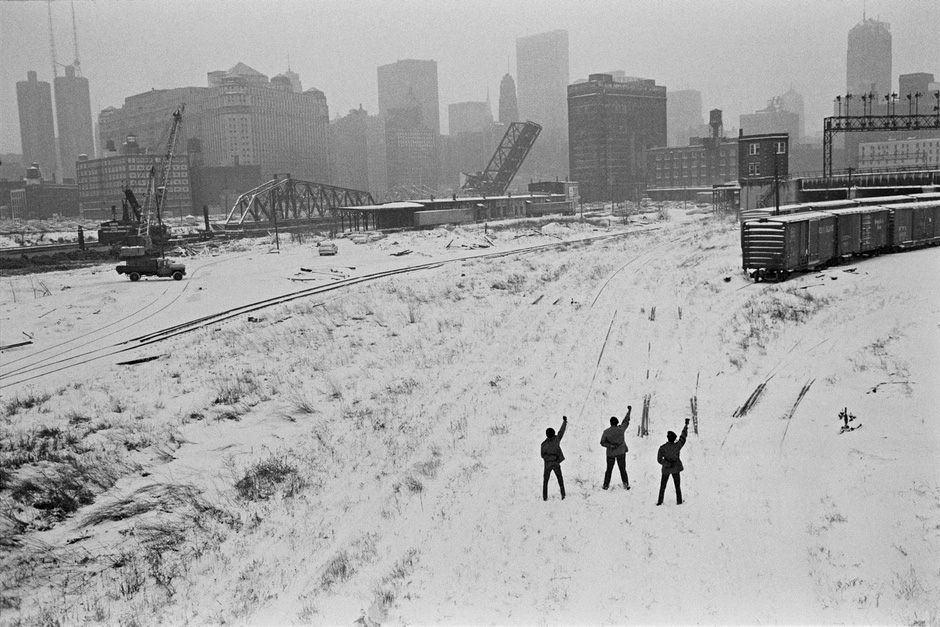
 

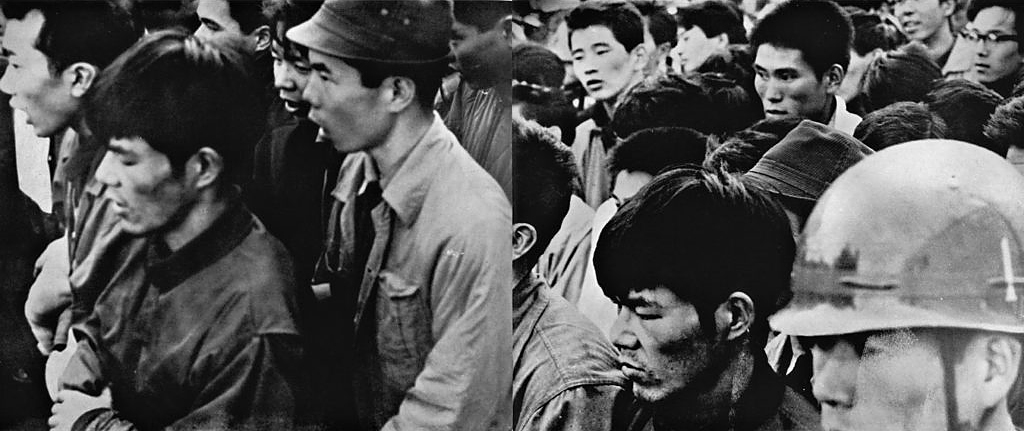
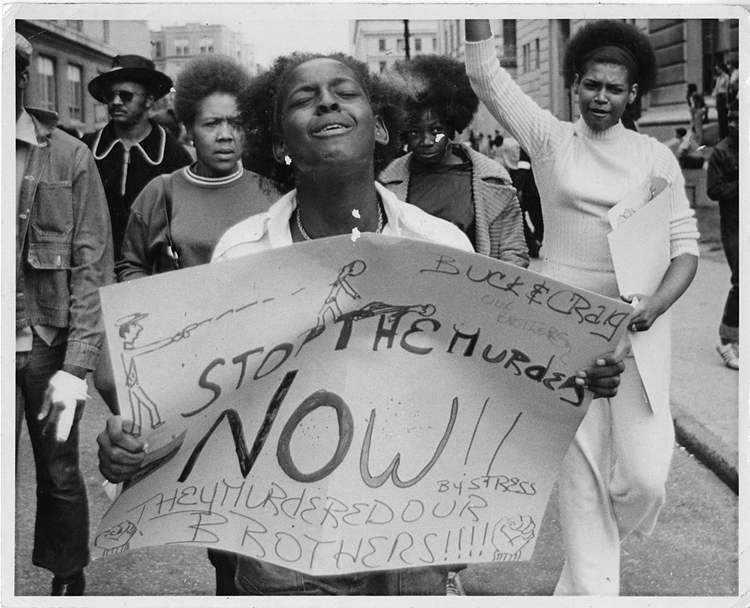
Hiroji Kubota (Japanese, b. 1939) 'Black Panthers in Chicago, Illinois' 1969 from the exhibition 'Soulèvements / Uprisings' at Jeu de Paume, Paris, Oct 2016 - Jan 2017


Hiroji Kubota (Japanese, b. 1939)
Black Panthers in Chicago, Illinois
1969
Gelatin silver print
© Hiroji Kubota/Magnum Photos


soulèvement m ‎(plural soulèvements)

1/ the act of raising, the act of lifting up
2/ revolt, uprising


I believe this to be one of the most complex, original and important exhibitions of 2016. Conceptually, intellectually, ethically and artistically, the exhibition “Soulèvements / Uprisings” seems to stand head and shoulders above most others I posted on during 2016.

Through the profound curatorship of philosopher and art historian Georges Didi-Huberman (a man whose writing I admire), Soulèvements e/merges as a “trans-disciplinary exhibition on the theme of human gestures that raise up the world or rise up against it: collective or individual gestures, actions or passions, works or thoughts” actioned through five themes: Elements (Unleashed); Gestures (Intense); Words (Exclaimed); Conflicts (Flared up); and Desires (Indestructibles), evidenced across mediums: paintings, drawings, prints, video installations, photographs, fiction films, documentary images, writers’ manuscripts, tracts, posters, etc., without hierarchies. Unlike the earlier posting, Intersections: Photographs and Videos from the National Gallery of Art and the Corcoran Gallery of Art at the National Gallery of Art, Washington, where I noted that the self-contained themes of that exhibition seemed purely illusory, here the themes are active and engaging, fluid in meaning and representation (the choice of laterally aligned art works to the themes – dust breeding, waves, sea concertos, banners and capes, red tape, montages, posters etc…), which emphasis resistance, the raising up, the uprising as a desirous and joyful act, one that is performative (hence the wonderful video elements in the exhibition) and transgressive.

As one of the most important mediums of the twentieth century in terms of documenting, promoting, obscuring and forgetting “uprisings” – gestures of resistance and joy of any kind – photography is capable of concealing, denying and sustaining the social context in which we are living … obscuring the ethics and morals of dubious political positions; reinforcing or obscuring the issues behind revolution, rebellion, and revolt; or, through collective amnesia and inertia, through the millions of forgettable images produced each day, overwhelming the authenticity of living that leads to “uprisings” in the first place. Photographs, as people do, cross borders: they are transnational and multidisciplinary. They are global thought patterns that can, in skilled hands, document and sustain alternative ways of seeing the world through a “rising up” of feeling – the “soul” of soulèvement – the act of raising up, the act of lifting ones eyes and one’s spirit from the dire circumstances of oblivion to the hope of a future redemption.

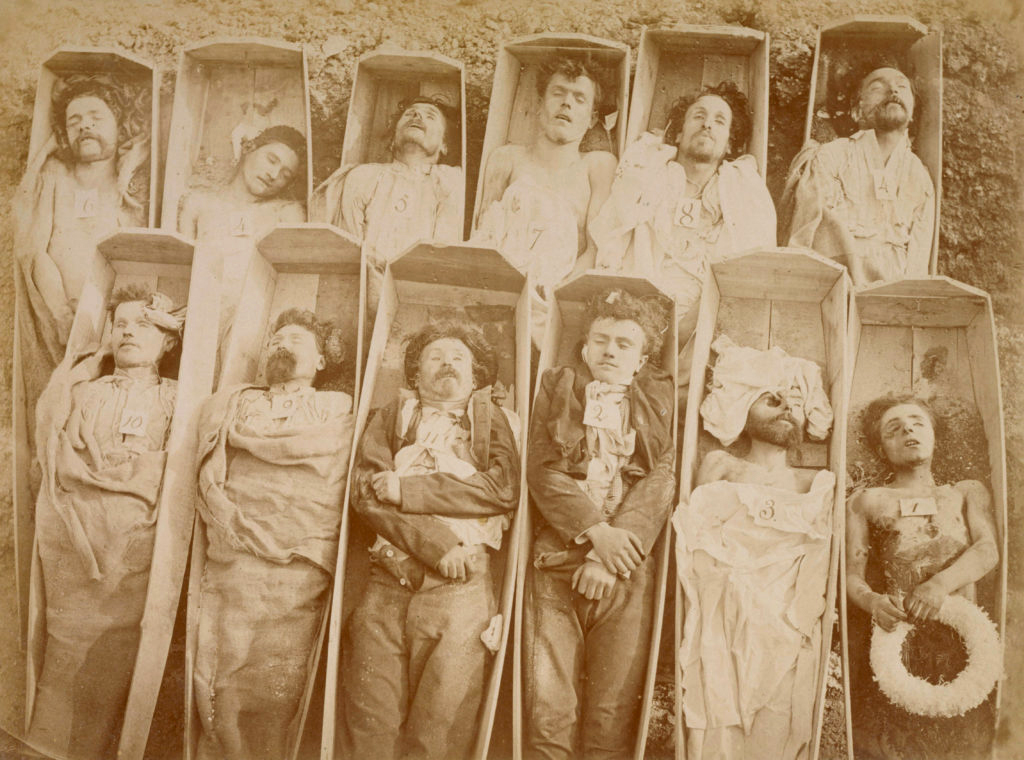
Through photographs, we witness Insurgents killed during bloody week of the Commune (1871, below), where “the exposure of these bodies is transformed by the photographic act. The latter confers on the rebels a particular aura, passing thus from figures of guilty to those of martyrs.” The political act, although a failure in reality in this case, is sustained through time and space by the performance of the documentary image. Their monstration [the act of demonstrating; proof] – the insurgents act of demonstrating; the photograph as an act of demonstrating their death for judicial purposes; and also a certain monstration (proof) that these mostly young, skinny men died for a belief in a better world – is an evidentiary act of transubstantiation. Is the camera looking down on these bodies in cheap coffins from above, or are the coffins propped up against a wall? How do we feel about these people we do not know, who existed in past time now made present, without being that person who tucked a wreath into the hands of the man at bottom right, someone’s brother, father or son.

In “uprisings” (as the hands raise the camera to the face), there is also an acknowledgment of a certain despair at the death of an innocent. In Manuel Álvarez Bravo’s Striking worker, assassinated (1934, below) the young, handsome youth has been killed with a blow to the head. He lies prostrate on the ground, arm outstretched, hand curled, his body and clothes spattered with his own blood his eyes, open, staring at the now invisible sky. A flow of dried blood has discharged from his mouth and nose, coating and matting his thick long hair and running away in rivulets, soaking into the parched d/earth. Bits of dust and earth are still stuck to his arm through the viscosity of his blood. Earlier, he had dressed for the day in a white singlet, put on his trousers and fastened them with an embossed belt, then put on a crisp, stripped shirt and neatly rolled up the sleeves to his elbows. He might have had breakfast before heading of to a meeting outside where he worked. This day he died, protesting his rights – striking worker, assassinated! Assassinated – executed, eliminated, liquidated (to which the congealing blood attests) … slaughtered. For his right to strike, to protest, the conditions of his being. Any human “being”.

And, mortally, I comment on that one photograph, that one evidence of human beings transcending their own lives (knowing they were going to die) for the greater good – the anonymous photograph taken by members of the Sonderkommando of Auschwitz-Birkenau death camp that documents AS PROOF of the reality of the Final Solution: Women pushed towards the gas chamber of crematorium V of Birkenau (1944, below). The risks that these people took to capture this photograph speaks to the power of photography to transcend even the most barbaric of circumstances, to prove to the world what was happening in this place. As Georges Didi-Huberman affirms, “in the depths of this fundamental despair, the “solicitation to resist” has probably detached itself from the beings themselves, who have been promised to disappear, to fix themselves on signals to be emitted beyond the boundaries of the camp.” Among others, the image, this “eye of history”, is then invested with the only hope still possible: to make the hell of Auschwitz visible and therefore imaginable.”

In other words, the solicitation to resist is not singular or human, but collective and eternal, embodied and embedded in cultural thoughts and actions. Even though they knew they were going to die (almost none of the 2,000 prisoners placed in these Sonderkommando units survived to the camp’s liberation), because they have been “promised to disappear”, their spirit flowed beyond the boundaries of the camp into the ether of history, into the elemental upper air, the raising up of spirits: as an observation and representation of the difference between right and wrong. As the world enters a renewed period of right wing promulgation we must resist the rump of bigotry and oppression. Not just for ourselves but for all those that have passed before.

This is why this exhibition is so important. It speaks to the need for vigilance and protest against discrimination and dictatorship, against the persecution of the less fortunate in society. It also speaks to our desire as human beings that our actions and the actions of others be held to account. Intrinsically uprisings are all about desire, the desire to be stand up and be counted, to put your reputation (as Oscar Wilde did) or your life on the line for what you believe in. The courage of your convictions. As Edmund Burke said, “The only thing necessary for the triumph of evil is for good men to do nothing.”

Dr Marcus Bunyan

Addendum

Thank goodness for Google translate because otherwise I would have had no text to put under most of these images. This becomes problematic for weak images such as Dennis Adams’ Patriot (2002, below). Without text to support the image you would have absolutely no idea what this image is about… it’s just a plastic bag floating in the air against the azure sky.

The text states: “… considering the serenity that emanates from the photographs of this series, to imagine that they refer to a dramatic event: the attack of the World Trade Center. Located in Lower Manhattan, Dennis Adams’ studio is very close to the twin towers that were destroyed on September 11, 2001. However, rather than rushing to witness the catastrophe, Dennis Adams photographed for three months the roof of his building, the newspapers and the rubbish that fly away from the ruins.”

Who would have thunk it! From a plastic bag floating in the sky!

Such insight proffered months after the event by any plastic bag floating in the air. The image does not invite reverie and meditation because there is nothing to meditate on. It is an example of contemporary photography as graphic art THAT MEANS ABSOLUTELY NOTHING! If an image cannot stand on its own two feet, without the help of reams of text to support its substance, its contention, then no wonder there are millions of vacillating images in this world. Including contemporary art.

Outdamned spot! the stain of thy blood cannot be exacted from your feeble representation.


Word count: 1,451

Translations of soulèvement

noun

uprising – soulèvement, révolte
rising – soulèvement, hausse (rise), insurrection, montant, lever, élévation
insurrection – insurrection, soulèvement, émeute (riot), rébellion

uplift – soulèvement
upheaval – bouleversement, soulèvement, agitation, perturbation, séisme, renversement


Many thankx to Jeu de Paume for allowing me to publish the photographs in the posting. Please click on the photographs for a larger version of the image.


Uprisings at Jeu de Paume – Concorde, Paris / Teaser

Uprisings is a trans-disciplinary exhibition on the theme of human gestures that raise up the world or rise up against it: collective or individual gestures, actions or passions, works or thoughts. They are gestures which say no to a state of history that is considered too “heavy” and that therefore needs to be “lifted” or even sent packing. They are also gestures that say yes to something else: to a desired better world, an imagined or adumbrated world, a world that could be inhabited and conceived differently.


Foreword

“For almost a decade, the Jeu de Paume’s exhibition program has been conceived with the conviction that twenty-first century museums and cultural institutions cannot be detached from the social and political challenges of the society of which they are part. To us, this approach is a matter of simple common sense.

The program it has shaped does not monitor market trends or seek complacent legitimacy within the field of contemporary art. Rather, we have chosen to work with artists whose poetic and political concerns are attuned to the need to critically explore the models of governance and practices of power that mold much of our perceptual and emotional experience, and thus, the social and political world we live in.

Because the Jeu de Paume is a centre for images, we are aware of the urgent necessity – in line with our societal responsibilities – to revise the analysis of the historical conditions in which photography and the moving image developed in modernity and, subsequently, in postmodernity, with all its alternatives, provocations, and challenges.

Thankfully, the history of images and our ways of seeing and understanding the world through them is neither linear nor unidirectional. These are the sources of our fascination with images that don’t tell everything they show and with images affected by the vicissitudes of the human condition.

Photography, and images in general, represent not only reality, but things that the human eye cannot see; like us, photography is capable of concealing, denying and sustaining. It is only waiting for someone to listen to its joys and its sorrows.

The Jeu de Paume’s programming sites its oblique look at history and contemporaneity in this oscillation between the visible and the invisible in the life of images, creating a space for encounter and the clashing of ideas, emotions, and knowledge, accepting that the coexistence of conflict and antagonism are an essential part of community building.

For these reasons, and from this position, in the superb proposal by the philosopher and art historian Georges Didi-Huberman to form an exhibition from his research on the theme of “uprisings,” we found the ideal intellectual, artistic, and museological challenge.

While the notion of revolution, rebellion, and revolt isn’t alien in contemporary society’s vocabulary, the object of its action is replete with collective amnesia and inertia. That is why analysing the representations of “uprisings” – from the etchings Goya, to contemporary installations, paintings photographs, documents, videos, and films – demonstrates an unequivocal relevance to the social context in which we are living in 2016. […]

Marta Gili, “Foreword,” in Uprisings, catalogue of the exhibition, p. 7-10.


Enrique Ramirez (Chile, b. 1979)
Cruzar un muro [Franchir un mur] (Crossing a wall)
2013
Vidéo HD couleur, son, 5’15”
Courtesy de l’artiste et galerie Michel Rein, Paris/Brussels


A series of images of people in a waiting room is in an unusual place, perhaps in our imagination, or perhaps anywhere. The short by Enrique Ramirez addresses article number 13 of the Universal Declaration of Human Rights: “Everyone has the right to leave any country, including his own, and to return to his country”.
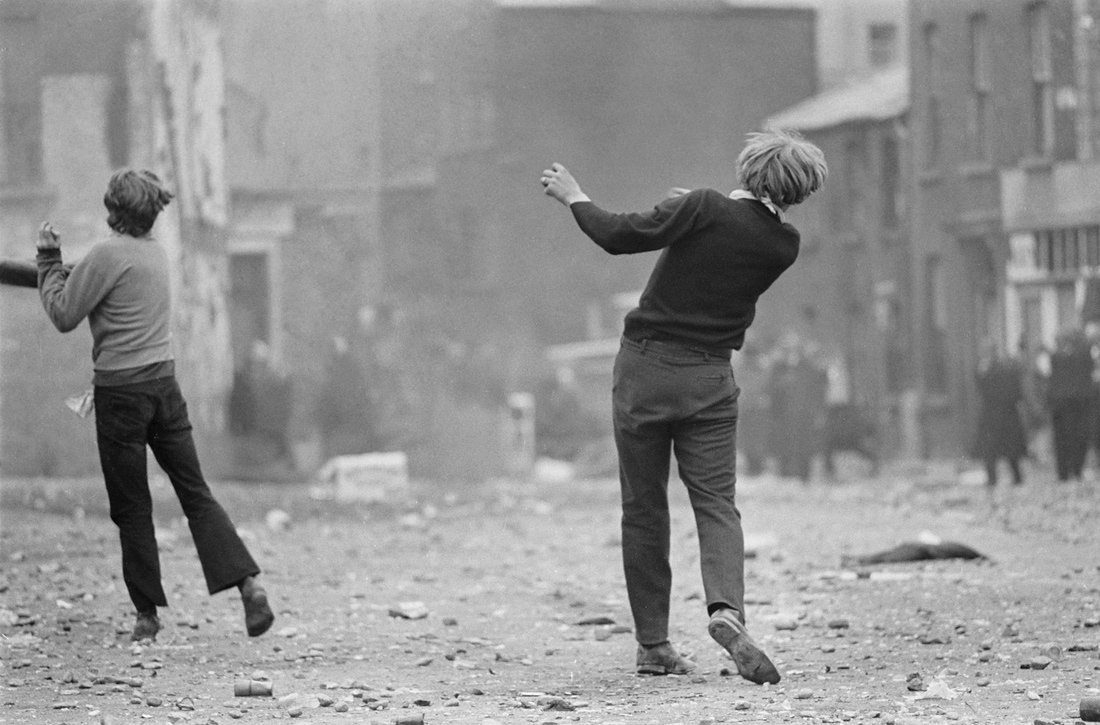
 

Gilles Caron (French, 1939-1970) 'Anticatholic protests, Londonderry, Northern Ireland' August 1969 from the exhibition 'Soulèvements / Uprisings' at Jeu de Paume, Paris, Oct 2016 - Jan 2017


Gilles Caron (French, 1939-1970)
Manifestations anticatholiques à Londonderry
Anticatholic protests, Londonderry, Northern Ireland
August 1969
© Gilles Caron / Fondation Gilles Caron / Gamma Rapho


Known for his wartime photo-reports, fascinated by liberating acts and the figure of the insurgent, photographer Gilles Caron carried throughout the 1960s an interest in the social conflicts that marked his time. At first he is led to cover is a peasant revolt which takes place in Redon in 1967. Anxious to produce an image which appears to him as a formal translation of the anger of these peasants, he seizes the gesture of a demonstrator sending a projectile in the direction of the forces of order. Photogenic, this suspended gesture gives the insurrections a choreographic dimension and testifies to the violence of the social demands that animate the demonstrators. The “figure of the pitcher” then reappears on the occasion of the events of May 1968 and then of the conflicts that took place in Northern Ireland in 1969. This archetype is part of the tradition of the representation of David against Goliath: the symbol of the power carried by the faith of one who is thought weak in the face of brute force. If there is no question of faith in the images of Caron, it is nonetheless an irrepressible form of desire that animates those bodies which revolt: no matter the imbalance of forces, the insurgents are carried by a feeling of invulnerability and of power in the face of the forces of order objectively much more armed.

Text from the Jeu de Paume website translated by Google translate


Man Ray (American, Philadelphia, Pennsylvania 1890-1976 Paris) 'Dust Breeding' 1920


Man Ray (American, Philadelphia, Pennsylvania 1890-1976 Paris)
Dust Breeding (Duchamp’s Large Glass with Dust Motes)
1920
Gelatin silver print
23.9 x 30.4cm (9 7/16 x 12 in.)
© 2016 Artists Rights Society (ARS), New York


One of Duchamp’s close friends and a member of the New York Dada scene, the American photographer and painter Man Ray (1890-1976) was also one of Duchamp’s collaborators. His photograph Dust Breeding (Duchamp’s Large Glass with Dust Motes) from 1920 is a document of The Large Glass after it had collected a year’s worth of dust while Duchamp was in New York. The photograph was taken with a two-hour-long exposure that beautifully captures the complex texture and diversity of materials that lay atop the glass surface. Dust Breeding marks a pivotal phase in the development of Duchamp’s masterpiece. After the photograph was taken, Duchamp wiped The Large Glass almost entirely clean, leaving a section of the cones covered with dust, which he permanently affixed to the glass plate with a diluted cement.

Text from The Met website


Introduction

by Georges Didi-Huberman, curator of the exhibition

What makes us rise up? It is forces: mental, physical, and social forces. Through these forces we transform immobility into movement, burden into energy, submission into revolt, renunciation into expansive joy. Uprisings occur as gestures: arms rise up, hearts beat more strongly, bodies unfold, mouths are unbound. Uprisings are never without thoughts, which often become sentences: we think, express ourselves, discuss, sing, scribble a message, create a poster, distribute a tract, or write a work of resistance.

It is also forms: forms through which all of this will be able to appear and become visible in the public space. Images, therefore; images to which this exhibition is devoted. Images of all times, from Goya to today, and of all kinds: paintings, drawings, sculptures, films, photographs, videos, installations, documents, etc. They interact in dialogue beyond the differences of their times. They are presented according to a narrative in which there will appear, in succession, unleashed elements, when the energy of the refusal makes an entire space rise up; intense gestures, when bodies can say “No!”; exclaimed words, when barricades are erected and when violence becomes inevitable; and indestructible desires, when the power of uprisings manages to survive beyond their repression or their disappearance.

In any case, whenever a wall is erected, there will always be “people arisen” to “jump the wall”, that is, to cross over borders. If only by imagining. As though inventing images contributed – a little here, powerfully there – to reinventing our political hopes.

The exhibition

“Soulèvements / Uprisings” is a trans-disciplinary exhibition on the theme of human gestures that raise up the world or rise up against it: collective or individual gestures, actions or passions, works or thoughts.

They are gestures which say no to a state of history that is considered too “heavy” and that therefore needs to be “lifted” or even sent packing. They are also gestures that say yes to something else: to a desired better world, an imagined or adumbrated world, a world that could be inhabited and conceived differently.

These figures of uprising and up-raising will range freely across mediums: paintings, drawings, prints, video installations, photographs, fiction films, documentary images, writers’ manuscripts, tracts, posters, etc., without hierarchies.

The exhibition sequence will follow a sensitive, intuitive path along which the gaze can focus on exemplary “cases” treated with a precision that prevents any kind of generalisation. We will be mindful not to conclude, not to dogmatically foreclose anything. The sequence will comprise five main parts:

ELEMENTS (UNLEASHED)
GESTURES (INTENSE)
WORDS (EXCLAIMED)
CONFLICTS (FLARED UP)
DESIRES (INDESTRUCTIBLES)


“All the uprisings failed, but taken together, they succeeded.”

“They rise, but they do not simply stand up – they rise up.”

Judith Butler, “Uprisings” catalogue of the exhibition Uprisings


ELEMENTS (UNLEASHED)

The elements become unleashed, time falls out of joint. – And if the imagination made mountains rise up?

To rise up, as when we say “a storm is rising.” To reverse the weight that nailed us to the ground. So it is the laws of the atmosphere itself that will be contradicted. Surfaces – sheets, draperies, flags – fly in the wind. Lights that explode into fireworks. Dust that rises up from nooks and crannies. Time that falls out of joint. The world upside down. From Victor Hugo to Eisenstein and beyond, uprisings are often compared to hurricanes or to great, surging waves. Because then the elements (of history) become unleashed.

We rise up first of all by exercising our imagination, albeit through our “caprichos” (whims or fantasies) or “disparates” (follies) as Goya said. The imagination makes mountains rise up. And when we rise up from a real “disaster,” it means that we meet what oppresses us, and those who seek to make it impossible for us to move, with the resistance of forces that are desires and imaginations first of all, that is to say psychical forces of unleashing and of reopening possibilities.

Dennis Adams, Francis Alÿs, Léon Cogniet, Marcel Duchamp, Francisco de Goya, William Hogarth, Victor Hugo, Leandro Katz, Eustachy Kossakowski, Man Ray, Jasmina Metwaly, Henri Michaux, Tina Modotti, Robert Morris, Saburô Murakami, Hélio Oiticica, Roman Signer, Tsubasa Kato, Jean Veber, French anonymous.
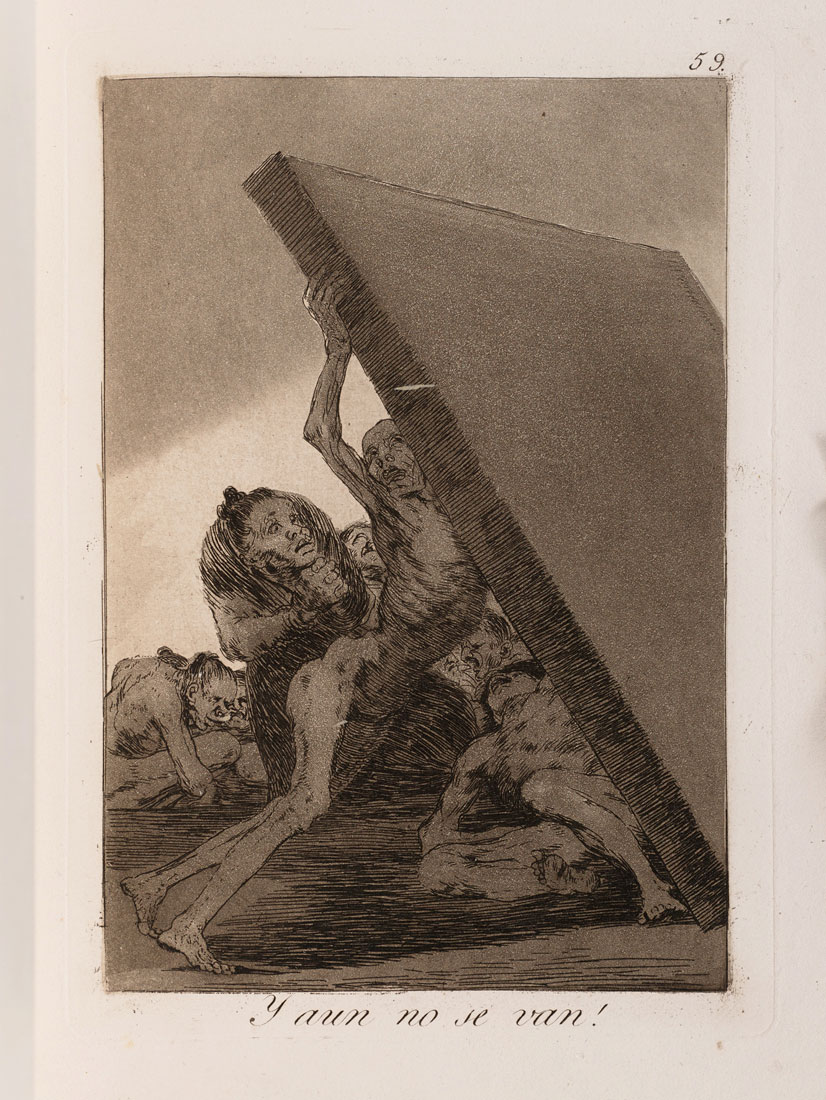
 

Francisco de Goya (Spanish, 1746-1828) 'Los Caprichos' 1799


Francisco de Goya (Spanish, 1746-1828)
Los Caprichos
1799
Eau-forte, aquatinte et burin, 2e édition de 1855.
Collection Sylvie et Georges Helft
Photo: Jean de Calan


Between 1797 and 1799, Francisco de Goya composed a collection of engravings, Los Caprichos [Les Caprices], in which he portrayed in a satirical way the behaviour of his Spanish fellow citizens. “Y aun no se van!” (“And yet they do not go away!”) is the 59th engraving of a set of 80. Each time the title constitutes an ironic commentary on the image. This one refers to the group of people represented on the engraving, with the bodies emaciated, folded on themselves, praying, looking scared. One of them tries to prevent the tombstone from falling on them, but all seem helpless, destitute of strength, unable to resist this final ordeal. The use of chiaroscuro, which produces a dramatic effect, as well as the thick slice of the slab that forms the diagonal of the composition, accentuates the desperate character of the scene. Finally, the massive aspect and the weight of the stone, opposed to fragile and denuded bodies, complete their inexorable destiny. This engraving thus seems to illustrate the absolute dejection felt by individuals under certain circumstances. For Georges Didi-Huberman, degradation is one of the conditions conducive to the uprising. The imagination and the critical eye of the artist – a fervent supporter of the Enlightenment – can constitute a force of resistance and struggle for the oppressed.

Text from the Jeu de Paume website translated by Google translate
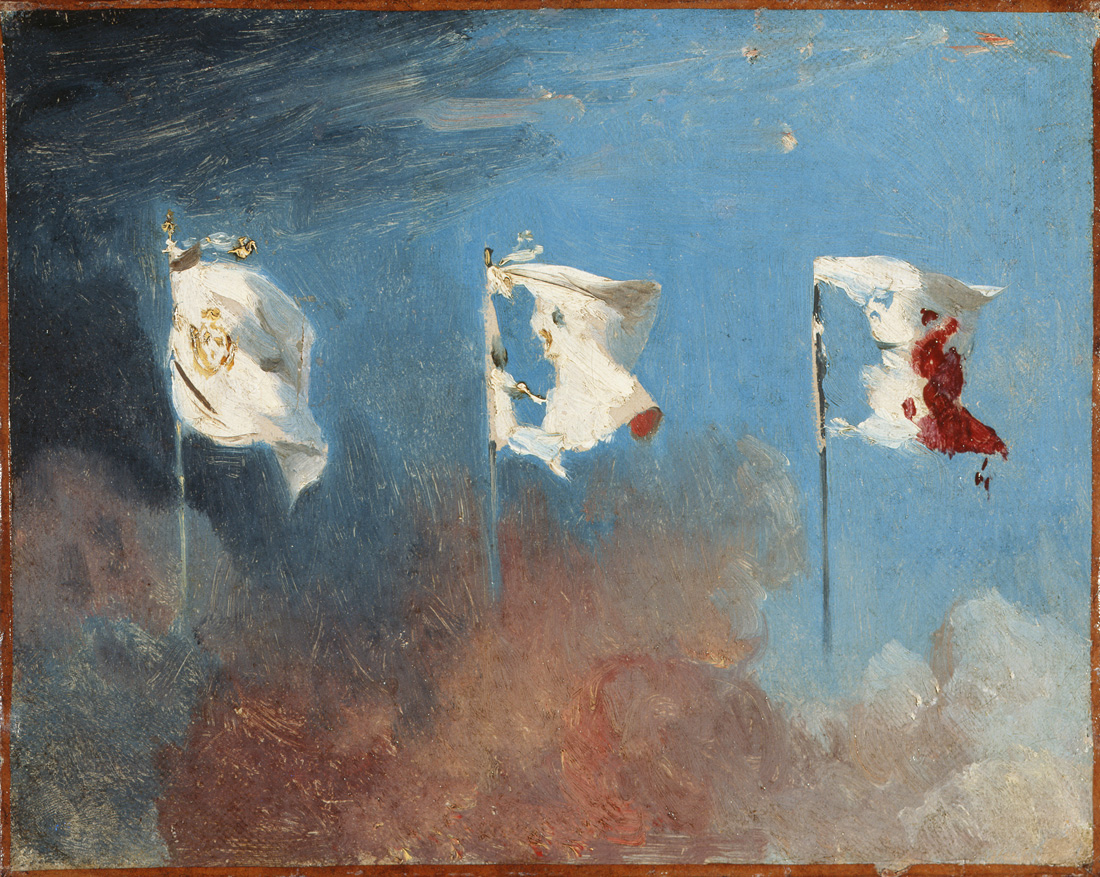
 

Léon Cogniet (French, 1794-1880) 'Les Drapeaux' 1830


Léon Cogniet (French, 1794-1880)
Les Drapeaux (The flags)
1830
Huile sur toile
Musée des Beaux-Arts, Orléans
Photo: François Lauginie


The Revolution of 1830 led to the overthrow of the government of King Charles X. After the publication of several ordinances, including a restriction on freedom of the press, this episode, which failed to restore the Republic, The tricolour flag, abandoned by the Restoration for the benefit of the white flag, symbol of royalty. This is evidenced by Leon Cogniet’s study of a painting that will never see the light of day.

These revolutionary days, also called the Three Glorious Days, are symbolically represented by three flags caught in the turmoil. The first, white, overhung by a menacing sky, is hoisted on a mast adorned with a fleur-de-lis. The second tears apart and reveals the blue sky as a promise of freedom. Finally, the third, torn and covered with blood, allows the reconstruction of the tricolour emblem created during the Revolution of 1789. Thus the blood poured during these days allows the people to reconnect with the revolutionary ideals. The unleashing of elements, a metaphor for the tempestuous popular revolt, accompanies the transformation of the banished flag of royalty to the national flag. This sketch is repeated and widely circulated at the time, accompanied by an anonymous poem: “To the darkness finally succeeds the clarity / And pale shreds of the flag of the slaves / And of the azure sky and the blood of our brave / The brilliant standard of our freedom is born.”

Text from the Jeu de Paume website translated by Google translate
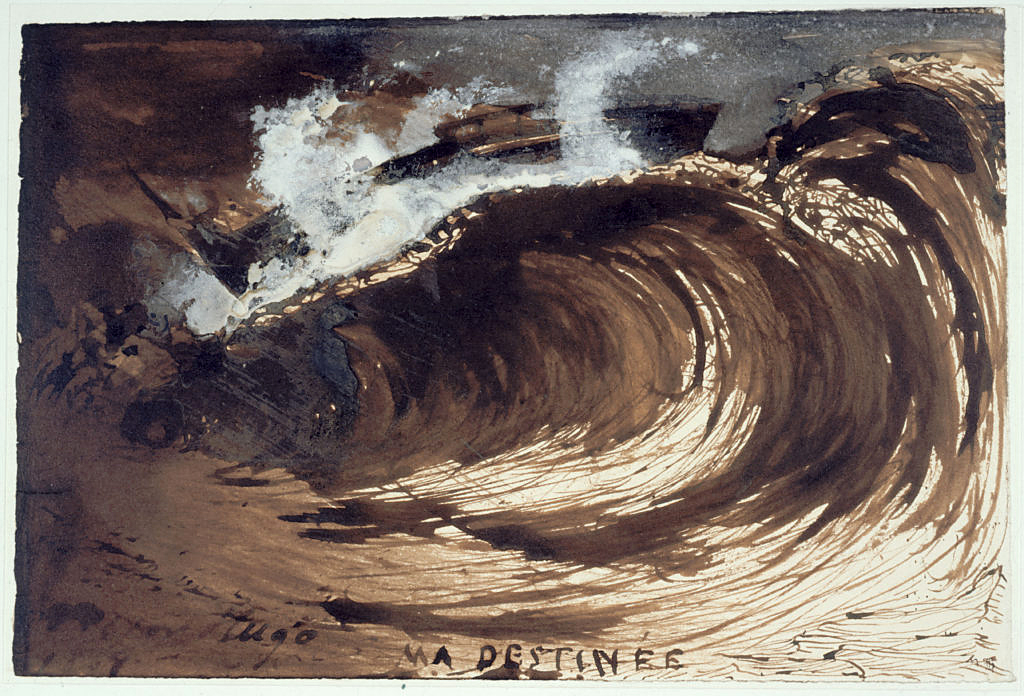
 

Victor Hugo (French, 1802-1885) 'La vague ou Ma destinée (The wave or My destiny)' 1857


Victor Hugo (French, 1802-1885)
La vague ou Ma destinée (The wave or My destiny)
1857
Plume et lavis d’encre brune, gouache, papier vélin
Maison de Victor Hugo
© Maisons de Victor Hugo / Roger-Viollet


This drawing is the witness of Victor Hugo’s fascination with the sea. His pen marries the movements of the ocean, which then becomes the symbol of his exile: “It is the image of my current destiny stranded in abandonment and solitude,” he says. On the drawing he calls ‘My destiny’, it is not known whether the ship, alone in front of the monster of the sea, enveloped by its foam, is carried or precipitated by the immense wave. It is a figure of his destiny, but also of the human condition.
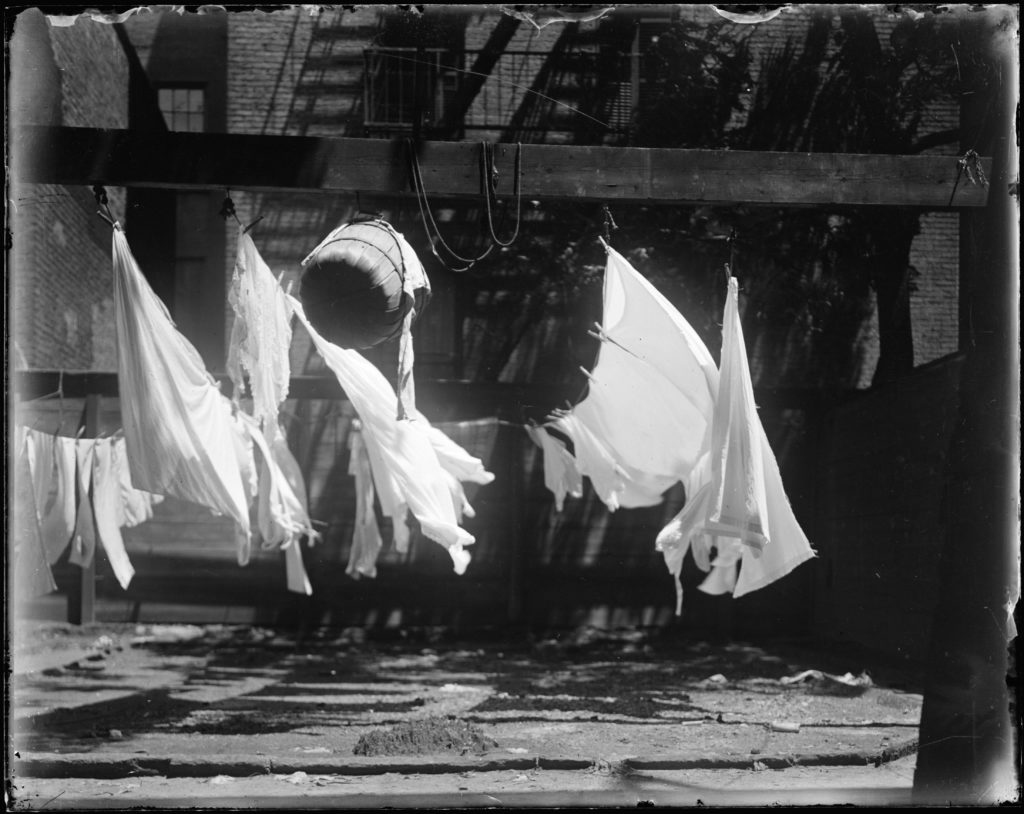
 

Man Ray (American, 1890-1976) "Sculpture mouvante" ou "La France" ("Moving Sculpture" or "France") 1920


Man Ray (American, 1890-1976)
“Sculpture mouvante” ou “La France” (“Moving Sculpture” or “La France”)
1920
Musée national d’Art moderne, Centre Pompidou, Paris, dation en 1994
Negative gelatin-silver on glass plate
9 x 12cm
Photo: © Centre Pompidou, MNAM-CCI, Dist. RMN-Grand Palais / image Centre Pompidou, MNAM-CCI
Image obtenue par inversion des valeurs du scan du négatif
© Man Ray Trust / ADAGP, Paris, 2016


An active member of the Dada group in New York with Marcel Duchamp, Man Ray joined the surrealists in Paris in 1921. He was interested in questioning the conventions of the world of art and considered photography as a means of expression. It explores all potentialities: experiments, diversions, portraits, advertising applications … The fixation of an element in movement constitutes one of the specificities of photography that fascinates the surrealists because the object thus grasped by the apparatus appears in an unexpected light: the linen which dries, inflated under the effect of the wind, becomes a moving sculpture as the title of the work suggests. This way the title can guide the reception of the passionate photography of Man Ray. This image is also published on the cover of the sixth issue of La Révolution Surréaliste in 1926, accompanied by the legend “La France”. This enigmatic title, rather than helping to understand photography, multiplies the possible interpretations and attests to Man Ray’s desire to subvert the use and meaning of the images. Thus this wind which “transforms” linen into sculpture, appears as a metaphor for the surrealist project, which makes the photographic medium the operator of a true conversion of the gaze. By this image of the “uprising”, Man Ray thus gives a visual form to the aesthetic and political revolution that the members of the Surrealist group called for.

Text from the Jeu de Paume website translated by Google translate
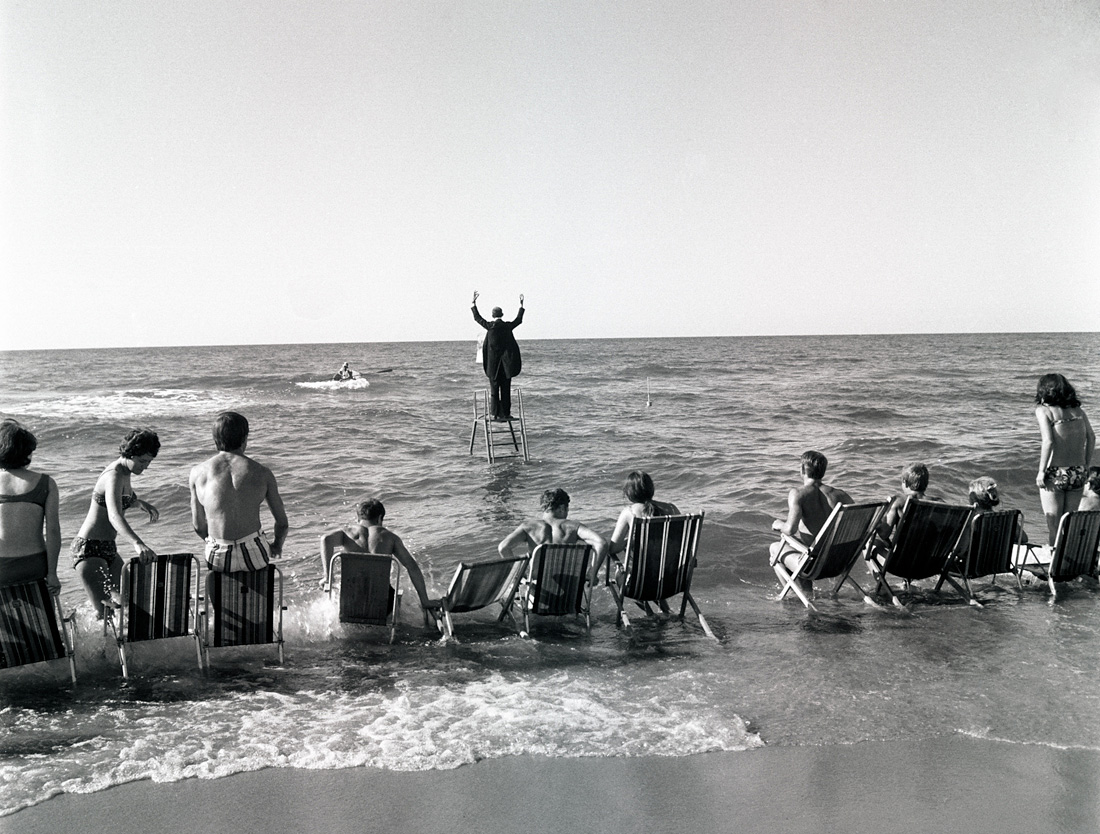
 

Eustachy Kossakowski (Polish, 1925-2001) 'Le "Panoramic Sea Happening - Sea Concerto, Osieki" de Tadeusz Kantor (extrait d'une série)' 1967


Eustachy Kossakowski (Polish, 1925-2001)
Le “Panoramic Sea Happening – Sea Concerto, Osieki” de Tadeusz Kantor (extrait d’une série)
The “Panoramic Sea Happening – Sea Concerto, Osieki” by Tadeusz Kantor (from a series)
1967
Inkjet pigment print
Owner of negatives and slides: Musée d’Art Moderne de Varsovie
© Collection Anka Ptaszkowska


In 1967 Tadeusz Kantor with a group of other Polish avant-garde artists delivered Panoramic Sea Happening. They were working in frames of artistic plain-air in Osieki (near Koszalin) organised there every year since 1963. This complex action was in a way a preface to Kantor’s theatre. But it was also parallel to actions of Western artists, which led to the birth of performance art. In this important moment Kantor formulated a category of impossible. It derived from the night dream but as this one was compromised Kantor wanted to use a new word: ‘impossible’. At the same time the very essence of the happening, as he was saying, was to make impossible real. How did he do it? By reenactment, repetition and documentation.

Dorota Sosnowska. From the abstract for “Impossible is Real: Tadeusz Kantor at the seashore” 2016


Hélio Oiticica (Brazilian, 1937-1980) and Leandro Katz (Argentinian, b. 1938) 'Parangolé - Encuentros de Pamplona' 1972


Hélio Oiticica (Brazilian, 1937-1980) and Leandro Katz (Argentinian, b. 1938)
Parangolé – Encuentros de Pamplona (Parangolé – Encounters of Pamplona)
1972
Impression chromogène (sur papier et carton)
Museo Nacional Centro de Arte Reina Sofía, Madrid
Photo: Archives Museo Nacional Centro de Arte Reina Sofía
© Projeto Hélio Oiticica / © Leandro Katz


“At the time when he was producing his first Penetrables, Oticica started to design Parangolés, banners and capes printed in a great variety of colors and designs, and occasionally inscribed with mottoes, advertisement lines, or found phrases. Oiticica premiered his (anti)fashion statements in 1965 in what he called a Parangolé Coletivo, in which he distributed his creations among friends and members of the Mangueira samba school – he had joined in 1964 – who paraded wearing them while dancing to samba… He would continue making Parangolés and staging Parangolé events throughout the rest of his life, at times through friends who acted as intermediaries, as in the Pamplona encounters of 1972 in Spain when Argentinean artist Leandro Katz ran a Parangolé event on Oiticica’s behalf.”

Juan A. Suárez. “Jack Smith, Hélio Oiticica, Tropicalism,” in Criticism Vol. 56, No. 2, Jack Smith: Beyond the Rented World (Spring 2014) pp. 310-311.


Henri Michaux (French born Belgium, 1899-1984) 'Untitled' 1975


Henri Michaux (French born Belgium, 1899-1984)
Untitled
1975
Acrylic on paper
Private collection
© ADAGP, Paris, 2016
Photo: Jean-Louis Losi

 

Dennis Adams (American, b. 1948) 'Patriot' 2002


Dennis Adams (American, b. 1948)
Patriot
2002
From the series Airborne
C-Print contrecollé sur aluminium.
Prêt du Centre national des Arts Plastiques, Paris, inv. FNAC 03.241.
© Dennis Adams / CNAP / Courtesy Galerie Gabrielle Maubrie


A plastic bag stands out on the azure sky and floats in the air. Difficult, considering the serenity that emanates from the photographs of this series, to imagine that they refer to a dramatic event: the attack of the World Trade Center. Located in Lower Manhattan, Dennis Adams’ studio is very close to the twin towers that were destroyed on September 11, 2001. However, rather than rushing to witness the catastrophe, Dennis Adams photographed for three months the roof of his building, the newspapers and the rubbish that fly away from the ruins. These images, although directly related to this highly publicised event have nothing of the “shock” images that then invade the press.

They carry neither sensationalism nor exaggerated patriotism, but rather invite reverie and meditation. By adopting this attitude to the antipodes of the media and political enthusiasm that follows September 11, Dennis Adams questions the relationship to temporality in the face of this type of event. He denounces the “greed of politicians and military men who have a definite opinion on moments of history”* and questions the imperative of hyper-reactivity not conducive to the analysis and the constitution of a historical consciousness.

Text from the Jeu de Paume website translated by Google translate

*Dennis Adams quoted by Michel Guerrin, “In Madrid, photographers face history”, in Le Monde, June 15, 2004, p. 30.
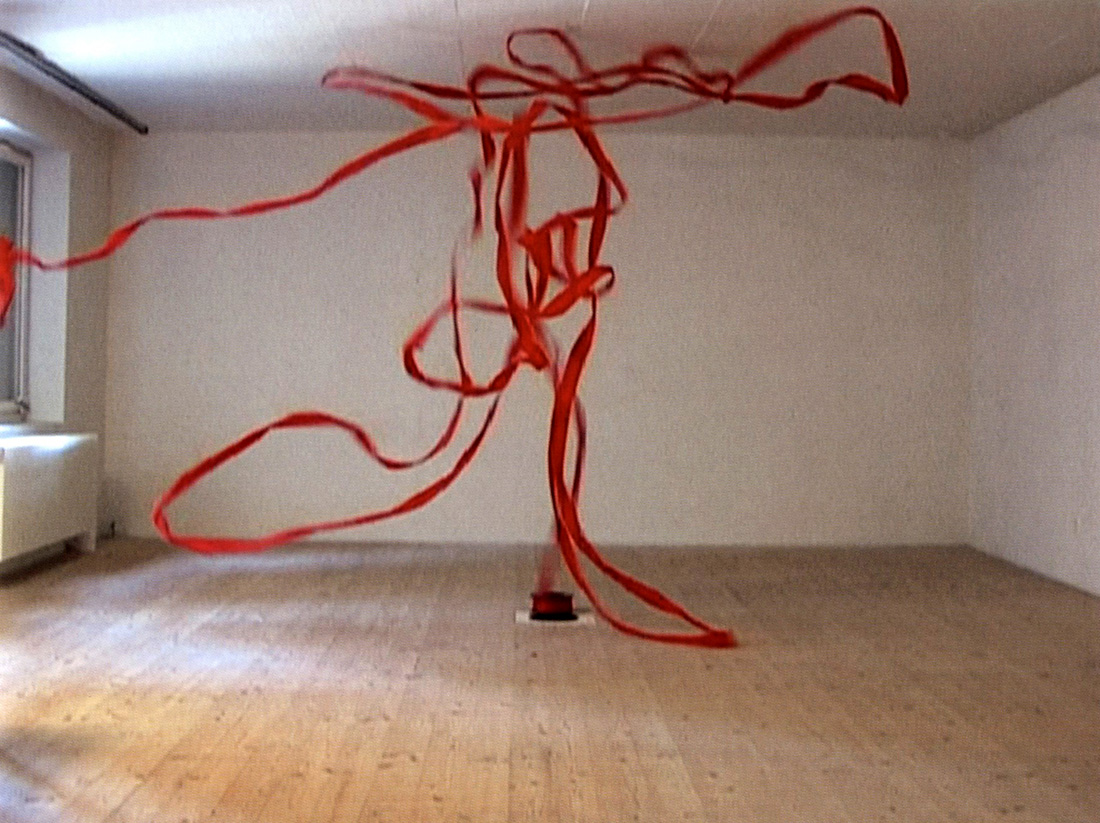
 

Roman Signer (Swiss, b. 1938) 'Rotes Band / Red Tape' 2005


Roman Signer (Swiss, b. 1938)
Rotes Band / Red Tape
2005
Vidéo couleur, son, 2’07′”
Caméra: Aleksandra Signer
Courtesy de l’artiste et d’Art: Concept, Paris
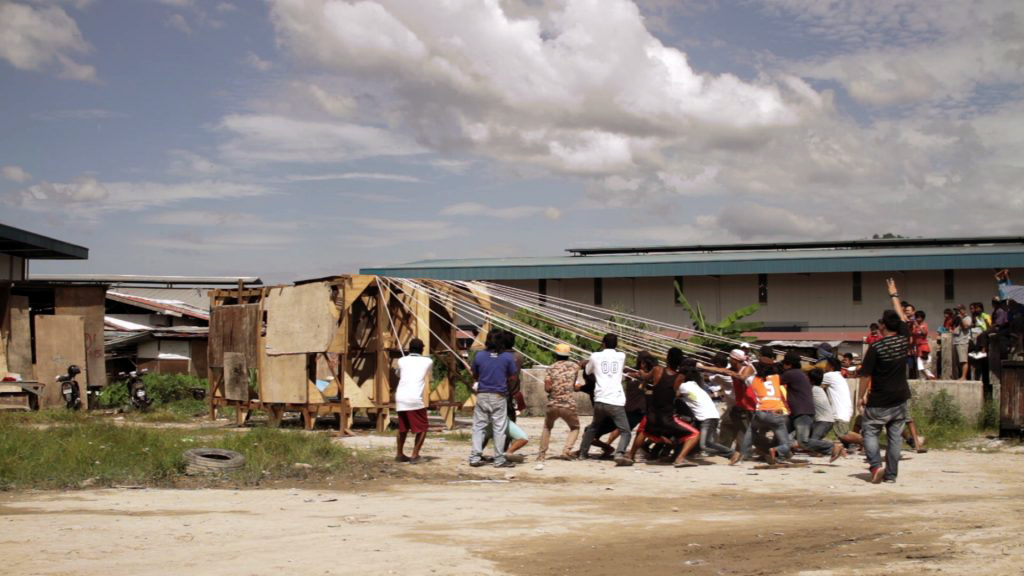
 

Tsubasa Kato (Japanese, b. 1984) 'Break it before it’s broken' 2015

Tsubasa Kato (Japanese, b. 1984) 'Break it before it’s broken' 2015


Tsubasa Kato (Japanese, b. 1984)
Break it before it’s broken
2015
Video: colour, sound, 4:49 min
© Tsubasa Kato / caméraman: Taro Aoishi


On March 11, 2011, a tsunami struck the Japanese coast and caused a nuclear accident at the Fukushima Daiichi plant. The disastrous environmental and social consequences are still impossible to evaluate and the inhabitants, partly neglected by the public authorities, have to face an unprecedented crisis. Many of them have been displaced and most of their income from fishing is reduced to nothing because of the contamination of the ocean. Tsubasa Kato then decides to get involved with them by accompanying them daily in this difficult period. In addition to this support, he decided on November 3rd (03/11) – the day of the celebration of culture in Japan (Bunka no Hi) and date whose numerical writing is the inverse of that of the tsunami (11/03) – to achieve a strongly symbolic performance.

Entitled Break it before it’s broken, the video of this action shows residents of the region invited to overthrow the structure of a house washed away by the tsunami and destroy it definitively. Becoming actors of destruction and no longer passive observers, participants can then transform the event undergone into action. This festival of culture, for Tsubasa Kato, is an opportunity to initiate a unifying artistic moment that testifies to the strength of collective movements and the mobilisation necessary to reverse the course of events. He will then reiterate this performance in other parts of the world, which are often subject to delicate social situations.

Text from the Jeu de Paume website translated by Google translate


Mari Kourkouta (Greek, b. 1982) 'Remontages' 2016

Mari Kourkouta (Greek, b. 1982) 'Remontages' 2016


Mari Kourkouta (Greek, b. 1982)
Remontages
2016
16 mm sur vidéo (en boucle), noir et blanc, silencieux, 4’ 10.
© Maria Kourkouta. Production : Jeu de Paume, Paris


“Body, mind and soul are uplifted by the divine energy of desire”


Marie-José Mondzain, “To those who sail the sea…” catalogue of the exhibition Uprisings


“To make the world rise up we need gestures, desires, and depths.”


Georges Didi-Huberman, “By the desires (Fragments on What Makes Us Rise Up)” catalogue of the exhibition Uprisings


GESTURES (INTENSE)

From burden to uprising. – With hammer blows. – Arms rise up. – The pasión. – When bodies say no. – Mouths for exclaiming.

Rising up is a gesture. Before even attempting to carry out a voluntary and shared “action,” we rise up with a simple gesture that suddenly overturns the burden that submission had, until then, placed on us (be it through cowardice, cynicism, or despair). To rise up means to throw off the burden weighing down on our shoulders, keeping us from moving. It is to break a certain present – be it with hammer blows as Friedrich Nietzsche and Antonin Artaud sought to do – and to raise your arms towards the future that is opening up. It is a sign of hope and of resistance.

It is a gesture and it is an emotion. The Spanish Republicans – whose visual culture was shaped by Goya and Picasso, but also by all the photographers on the field who collected, the gestures of freed prisoners, of voluntary combatants, of children and of the famous La Pasionaria, Dolores Ibárruri – fully assumed this. In the gesture of rising up, each body protests with all of its limbs, each mouth opens and exclaims its no-refusal and its yes-desire.

Paulo Abreu, Art & Language, Antonin Artaud, Taysir Batniji, Joseph Beuys, Désiré-Magloire Bourneville, Gilles Caron, Claude Cattelain, Agustí Centelles, Chim, Pascal Convert, Gustave Courbet, Élie Faure, Michel Foucault, Leonard Freed, Gisèle Freund, Marcel Gautherot, Agnès Geoffray, Jochen Gerz, Jack Goldstein, Käthe Kollwitz, Alberto Korda, Germaine Krull, Hiroji Kubota, Annette Messager, Lisette Model, Tina Modotti, Friedric Nietzsche, Willy Römer, Willy Ronis, Graciela Sacco, Lorna Simpson, Wolf Vostell, anonymes catalans, français, italiens.


Gustave Courbet (French, 1819-1877) 'Home en blouse debout sur une barricade (projet de frontispice pour Le Salut public)' 1848


Gustave Courbet (French, 1819-1877)
Home en blouse debout sur une barricade (projet de frontispice pour Le Salut public)
Man in a smock standing on a barricade (frontispiece for Le Salut public project)

1848
Fusain sur papier
Musée Carnavalet – Histoire de Paris
© Musée Carnavalet / Roger-Viollet


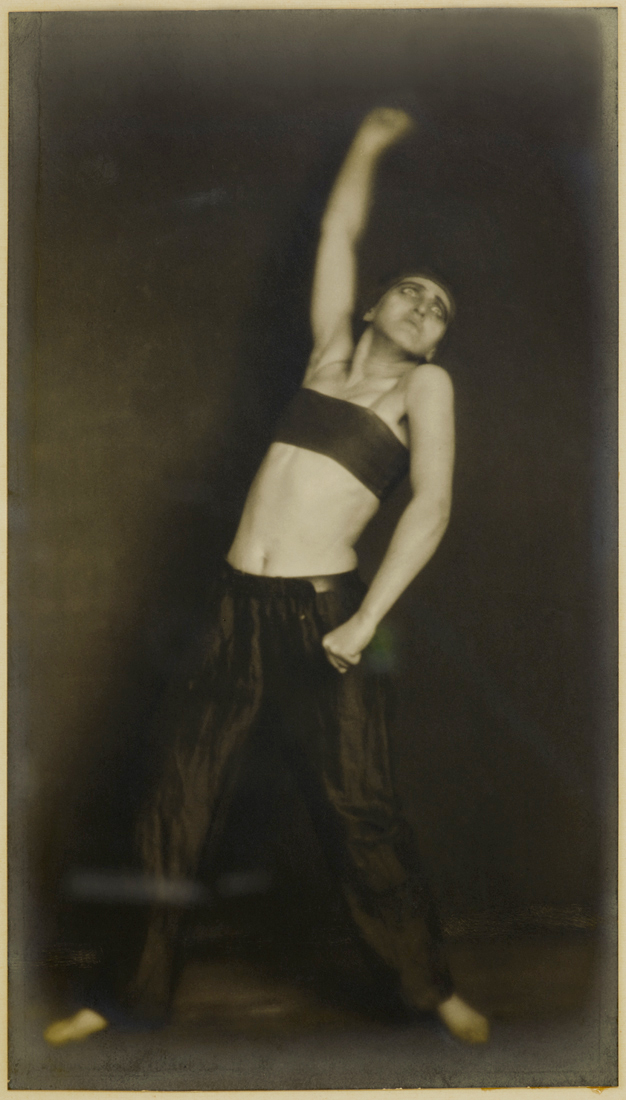
Germaine Krull (European, 1897-1985) 'The Dancer Jo Mihaly, danse "Révolution"' 1925


Germaine Krull (European, 1897-1985)
The Dancer Jo Mihaly, danse “Révolution”
1925
Gelatin silver print
Museum Folkwang, Essen
© Estate Germaine Krull, Folkwang Museum, Essen


Pioneer and adventurous, Germaine Krull is one of those women photographers of the inter-war period who contributed largely to the emergence of a nervous and dynamic photographic approach, in step with a modern world in constant acceleration. In photographing Jo Mihaly, she portrays a dancer who shares this avant-garde sensibility. Indeed, a pupil of Mary Wigman, this singular figure of dance participates in the German expressionist movement and contributes to the development of a modern choreographic art: the unconstrained body emancipates itself from the conventions of classical dance, the gesture of the dancer is released and regains its vitality. The movement then becomes the result of the personal expression of the dancer whose photographer has the burden of seizing the fulgurance [dazzling speed]. Stretched arm, smoky eyes and feverish eyes, Jo Mihaly – who has always claimed her commitment to the Communist Party – realises a gesture that resonates with her time but also with the youth of Germaine Krull, marked by its proximity to the Republic of the Soviets of Berlin in 1919. Thus, it is as much for these artists to participate in an aesthetic revolution in their respective artistic fields as to echo the social and political uprisings that have taken place throughout Europe since the the advent of the industrial era.

Text from the Jeu de Paume website translated by Google translate


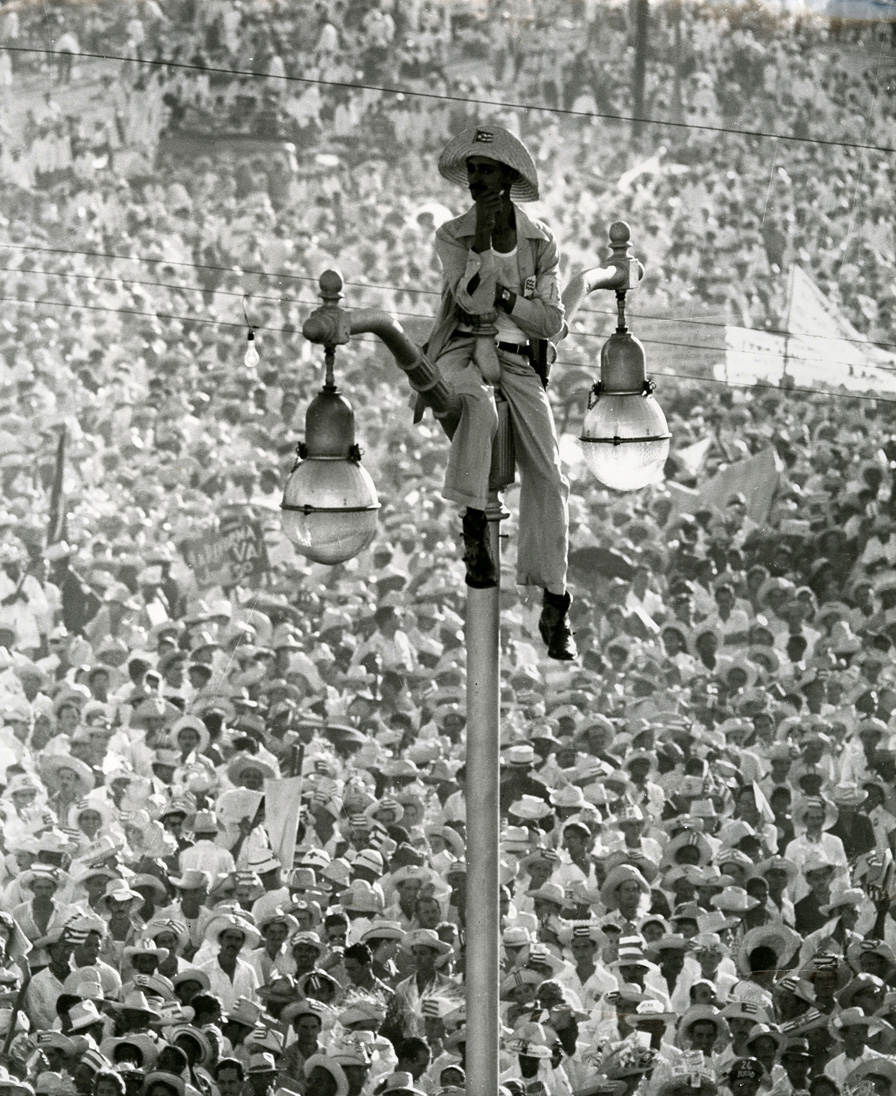
Alberto Korda (Cuban, 1928-2001) 'Don Quixote of the streetlamp, Plaza de la Revolución, Havana, Cuba' 1959


Alberto Korda (Cuban, 1928-2001)
El Quijote de la Farola, Plaza de la Revolución, La Habana, Cuba
Don Quixote of the streetlamp, Plaza de la Revolución, Havana, Cuba

1959
Vintage gelatin silver print on baryta paper
Leticia et Stanislas Poniatowski collection
© ADAGP, Paris, 2016


Kitai Kazuo (Japanese, b. 1944) 'Resistance' (book) 1965


Kitai Kazuo (Japanese, b. 1944)
Resistance (book)
1965
BAL
© Kitai Kazuo/ Collection privée


With a manifesto both aesthetic and philosophical, the Japanese publication Provoke proposed a radical break in only three issues, published in 1968 and 1969. Provoke (photographers Takuma Nakahira, Yutaka Takanashi and Daidō Moriyama, critic Kōji Taki and poet Takahiko Okada) proposes a new visual language – rough, grainy and blurred – that captures the complexity of the experience and the paradoxes of modernity suffered by all.


Wolf Vostell (German, 1932-1998) 'Dutschke' 1968


Wolf Vostell (German, 1932-1998)
Dutschke
1968
Polymer painting on canvas
Haus der Geschichte der Bundensrepublik Deutschland, Bonn
© ADAGP, Paris, 2016


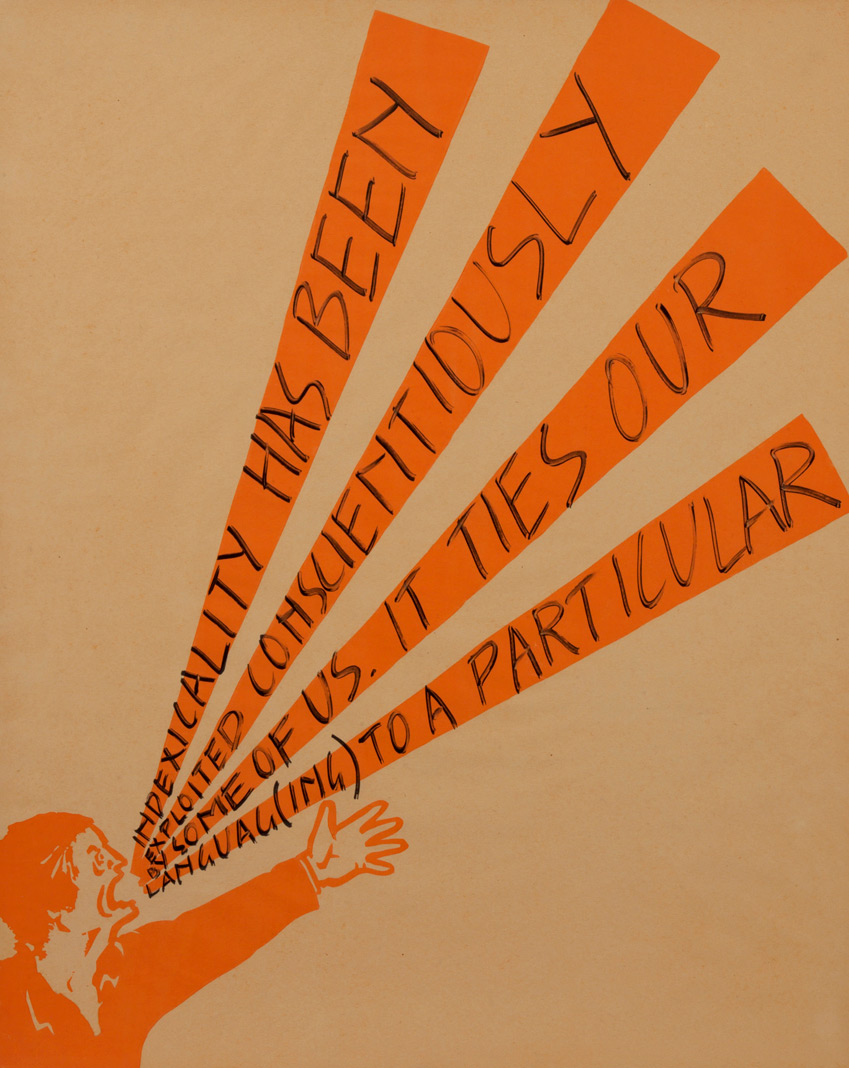
Art and Language (collective created late 1960s) 'Shouting Men' 1975 (details)

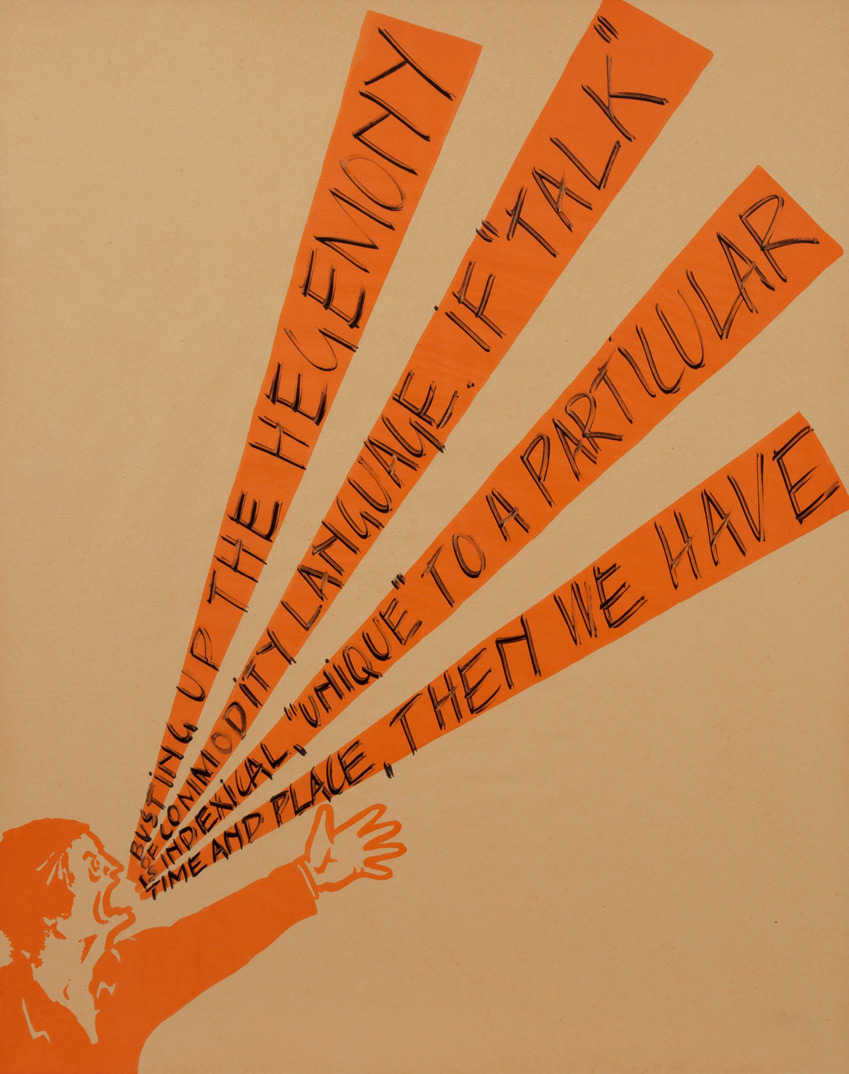
Art and Language (collective created late 1960s) 'Shouting Men' 1975 (details)

Art and Language (collective created late 1960s) 'Shouting Men' 1975 (details)


Art and Language (collective created late 1960s)
Shouting Men (details)
1975
Screenprint and felt pen on paper
Museu d’Art Contemporani de Barcelona collection
Photo: Àngela Gallego
© Art and Language


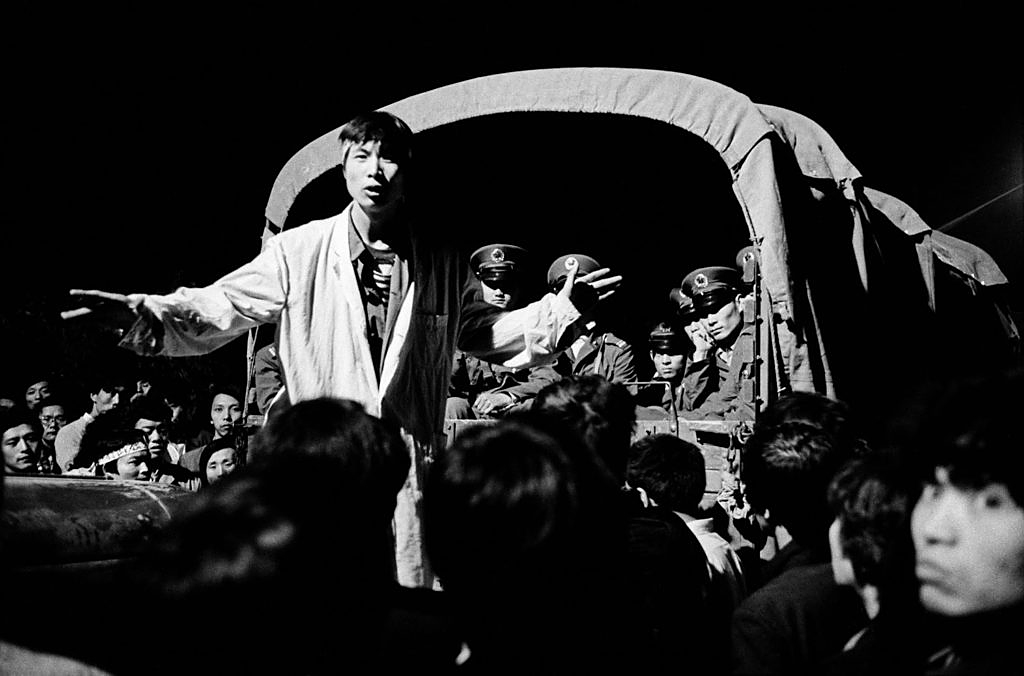
Patrick Zachmann (French, b. 1955) 'The army blocked by the crowd at the gates of the capital' 1989


Patrick Zachmann (French, b. 1955)
L’armée bloquée par la foule aux portes de la capitale
The army blocked by the crowd at the gates of the capital
1989
Gelatin-silver bromide print on baryta paper
50.4 x 60.9cm
Musée du quai Branly – Jacques Chirac
© Patrick Zachmann


From the early 1980s, Patrick Zachmann carried out an in-depth investigation into the Chinese diaspora. Present in China at the time of the events in Tiananmen Square, he photographed particularly symbolic episodes. This picture, taken on 20 May, is located just after the beginning of the hunger strikes, and before the massive repression known as the Tiananmen massacre. The nocturnal atmosphere and the gestures of the orator confer on this “moment before” a dramatic theatricality.


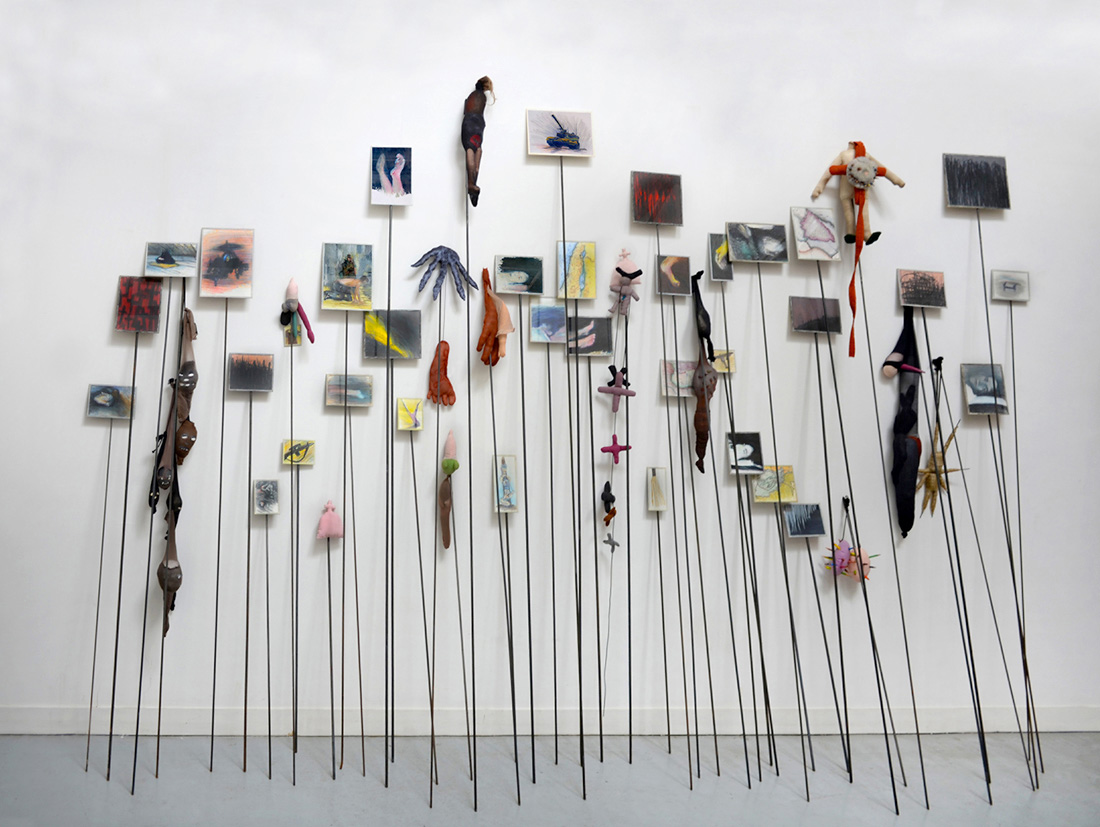
Annette Messager (French, b. 1943) '47 Piques (47 Pikes)' 1992


Annette Messager (French, b. 1943)
47 Piques (47 Pikes)
1992
Soft toys, coloured pencils on paper, various materials, and 47 metal pikes
270 x 570 x 70cm
Annette Messager and Marin Karmitz collection/Marian Goodman Gallery, Paris
© ADAGP, Paris, 2016


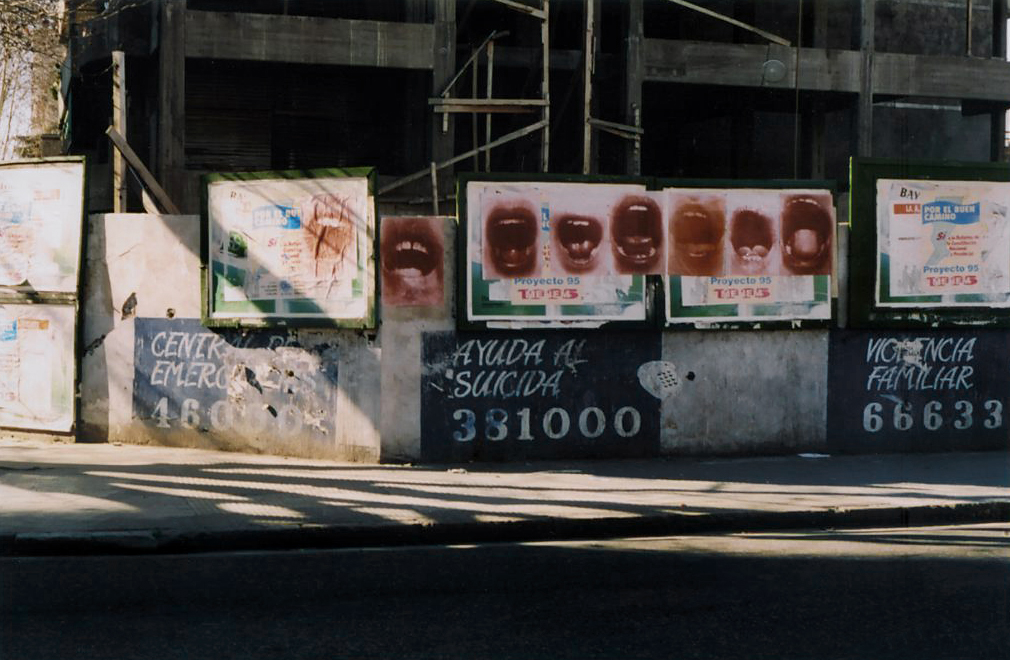
Graciela Sacco (Argentinian, 1956-2017) from the "Bocanada" (A breath of fresh air) series 1992-1993


Graciela Sacco (Argentinian, 1956-2017)
from the “Bocanada” (A breath of fresh air) series
1992-1993
Posters in the streets of Rosario, Argentina
© Graciela Sacco


This series of photographs of open mouths was immediately considered by Graciela Sacco as being intended to circulate in the public space on various supports (stamps, spoons, stickers, posters …). It is however in the form of a wild display that the artist has most often given to see this set. The first of these displays took place in 1993, during a strike, in public school canteens in the town of Rosario. It was then a question of questioning the impossibility of the municipal staff to make their claims heard and the consequences of this movement knowing that for the majority of the children, this meal was the only one of the day. Graciela Sacco then continues to post these posters in cities like Buenos Aires, São Paulo or New York, often during election campaigns or close to advertising images. Are they hungry mouths? Cries of claims? Of suffering? Or even breathing as the title suggests? Be that as it may, this repeated but inaudible message tends to become oppressive. By exposing them in public space, the artist seems to give visibility to those anonymous calls that we do not want or can not hear.

Text from the Jeu de Paume website translated by Google translate


WORDS (EXCLAIMED)

Poetic insurrections. – The message of the butterflies. – Newspapers. – Making a book of resistance. – The walls speak up.

Arms have been raised, mouths have exclaimed. Now, what are needed are words, sentences to say, sing, think, discuss, print, transmit. That is why poets place themselves “at the forefront” of the action itself, as Rimbaud said at the time of the Paris Commune. Upstream the Romantics, downstream the Dadaists, Surrealists, Lettrists, Situationists, etc., all undertook poetic insurrections.

“Poetic” does not mean “far from history,” quite the contrary. There is a poetry of tracts, from the protest leaflet written by Georg Büchner in 1834 to the digital resistance of today, through René Char in 1943 and the “cine-tracts,” from 1968. There is a poetry particular to the use of newspapers and social networks. There is a particular intelligence – attentive to the form – inherent in the books of resistance or of uprising. Until the walls themselves begin to speak and occupy the public space, the sensible space in its entirety.

Antonin Artaud, Ever Astudillo, Ismaïl Bahri, Artur Barrio, Georges Bataille, Charles Baudelaire, Joseph Beuys, Enrique Bostelmann, André Breton, Marcel Broodthaers, Cornelius Castoriadis, Champfleury, Dada, Armand Dayot, Guy Debord, Carl Einstein, Jean-Luc Fromanger, Federico García Lorca, Jean-Luc Godard, Groupe Dziga Vertov, Raymond Hains, Raoul Hausmann, John Heartfield, Bernard Heidsieck, Victor Hugo, Asger Jorn, Jérôme Lindon, Rosa Luxemburg, Man Ray, Germán Marín, Chris Marker, Cildo Meireles, Henri Michaux, Tina Modotti, Pier Paolo Pasolini, Pablo Picasso, Sigmar Polke, Jacques Rancière, Alain Resnais, Armando Salgado, Álvaro Sarmiento, Philippe Soupault, Félix Vallotton, Gil Joseph Wolman, German, Chilean, Cuban, Spanish, French, Italian, Mexican, Russian unknowns.


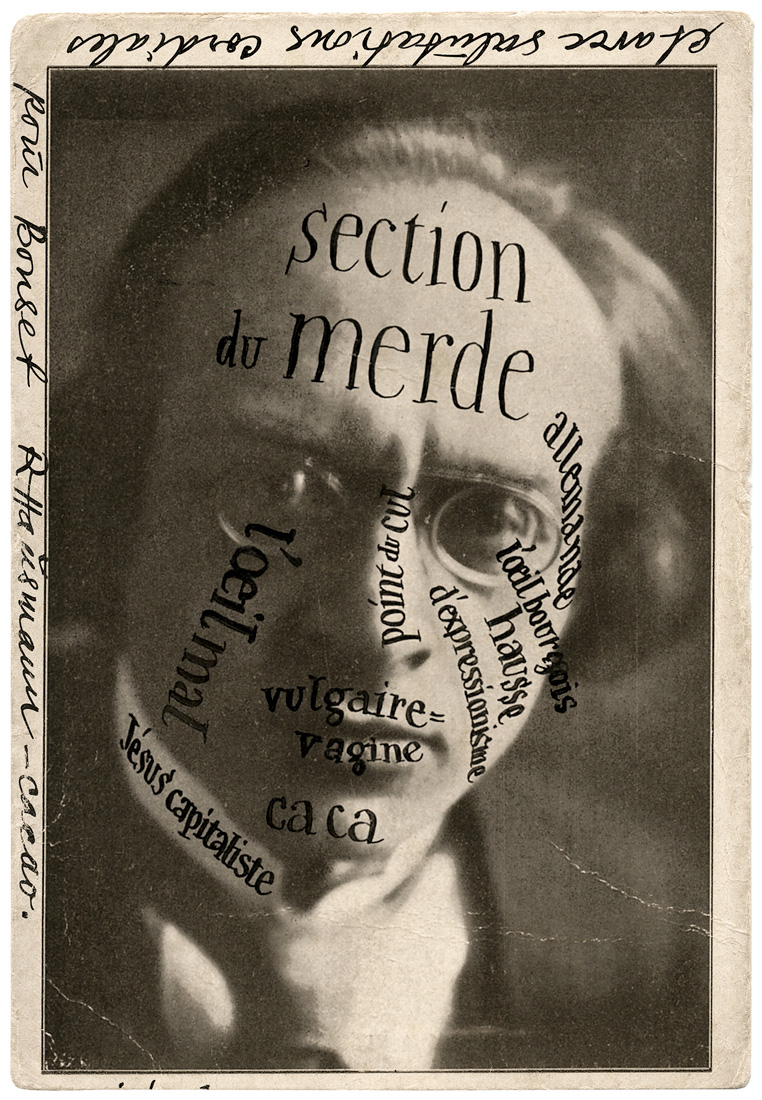
Raoul Hausman (Austrian, 1886-1971) 'Portrait of Herwarth Walden at Bonset' 1921


Raoul Hausman (Austrian, 1886-1971)
Portrait of Herwarth Walden at Bonset
1921
Postcard sent by Raoul Hausmann to Theo van Doesburg
Archives Theo and Nelly van Doesburg
Photo: collection RKD – Netherlands Institute for Art History
© ADAGP, Paris, 2016


Herwarth Walden (German, 1879-1941)

Herwarth Walden (actual name Georg Lewin, 16 September 1879 in Berlin – 31 October 1941 in Saratov, Russia) was a German Expressionist artist and art expert in many disciplines. He is broadly acknowledged as one of the most important discoverers and promoters of German avant-garde art in the early twentieth century (Expressionism, Futurism, Dadaism, Magic Realism).

From 1901 to 1911 Walden was married to Else Lasker-Schüler, the leading female representative of German Expressionist poetry. She invented for him the pseudonym “Herwarth Walden”, inspired by Henry Thoreau’s novel Walden, or Life in the Woods (1854). In 1912 he married Swedish painter Nell Roslund. In 1919 he became a member of the Communist Party. In 1924 he was divorced from his second wife.

With the economic depression of the 1930s and the subsequent rise of National Socialism, his activities were compromised. In 1932 he married again and left Germany shortly later because of the threat of the Gestapo. He went to Moscow, where he worked as a teacher and publisher. His sympathies for the avant-garde soon aroused the suspicion of the Stalinist Soviet government, and he had to repeatedly defend against the equation of avant-garde and fascism. Walden died in October 1941 in a Soviet prison in Saratov.

Text from the Wikipedia website


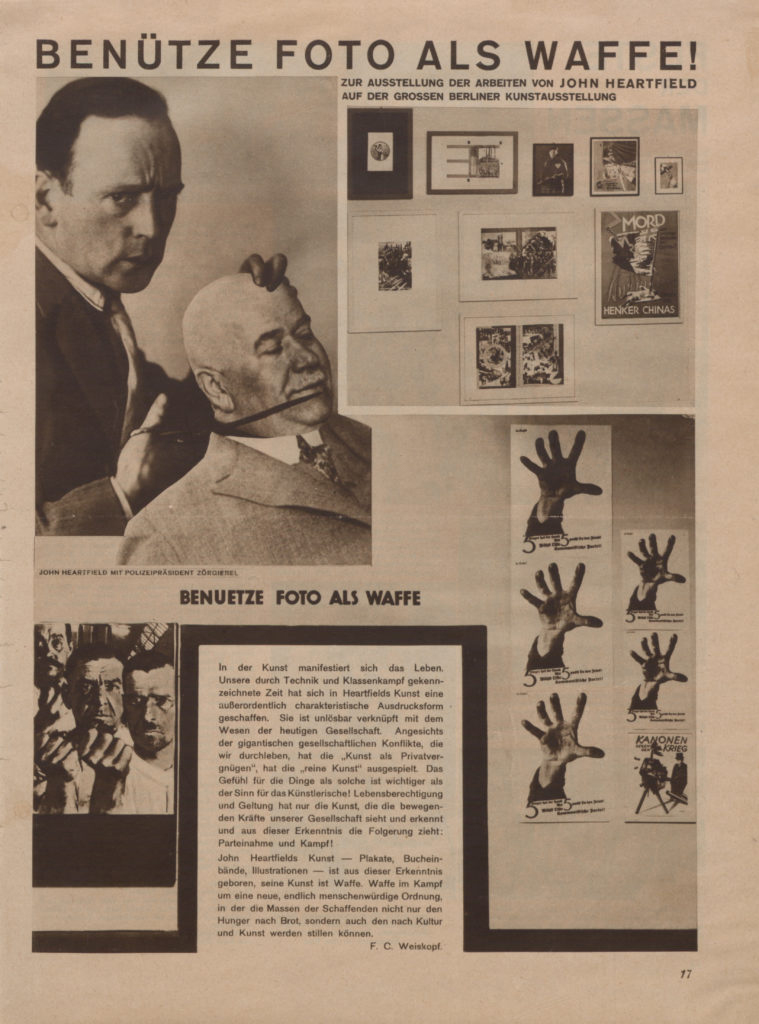
John Heartfield (German, 1891-1968) 'Use photography as a weapon !' 1929


John Heartfield (German, 1891-1968)
Benütze Foto als Waffe! 
Utilise la photo comme une arme !
Use photography as a weapon !

AIZ, année VIII, no 37, Berlin, 1929, p. 17
Revue
37.8 x 27.5cm
Akademie der Künste, Berlin, Kunstsammlung, Inv.-Nr.: JH 2265
© The Heartfield Community of Heirs/ADAGP, Paris, 2016


In the late 1910s, members of the Dada movement practiced the first collages using images from cheap publications. The iconoclastic dimension of these heterogeneous juxtapositions allows them to open up the critical potential of images. Then, in the 1920s in Berlin, the Dada movement became politicised and the idea that the affiliated artists of the Communist Party were to serve the proletarian cause was strengthened. Few artists felt as committed to this mission as John Heartfield (his real name was Helmut Herzfeld). From the end of the 1920s, he developed a practice of satirical photomontage for the press, and in particular of the Communist journal AIZ (Arbeiter Illustrierte Zeitung) for which he worked until 1938. He then produced 237 photomontages denouncing Fascist ideology, the financing of the Nazi party by the industrialists and the extreme violence of the national socialist program. Invited to the Film und Foto exhibition in 1929 in Stuttgart, he had inscribed above the section devoted to him the slogan found in AIZ the same year: “Use photography as a weapon!”. Through the massive dissemination of his photomontages, he wants to mobilise public opinion and incite him to rise up against the rise of the fascisms that threaten Europe.

Text from the Jeu de Paume website translated by Google translate


Heartfield lived in Berlin until April 1933, when the National Socialists took power. On Good Friday, the SS broke into his apartment, and the 5’2″ Heartfield escaped by jumping from his balcony and hiding in a trash bin. He left Germany by walking over the Sudeten Mountains to Czechoslovakia. In Czechoslovakia, John Heartfield rose to number-five on the Gestapo’s most-wanted list.


Federico García Lorca (Spanish, 1898-1936) 'García Lorca Mierda (Shit)' 1934


Federico García Lorca (Spanish, 1898-1936)
Mierda (Shit)
1934
Calligram, Indian ink
Federico García Lorca foundation, Madrid
© Federico García Lorca foundation, Madrid / VEGAP


Réseau Buckmaster (Buckmaster Network) 'Tract clandestin (Clandestine Tract)' 1942

Réseau Buckmaster (Buckmaster Network) 'Tract clandestin (Clandestine Tract)' 1942


Réseau Buckmaster (Buckmaster Network)
Tract clandestin (Clandestine Tract)
1942
Papier
17 x 25cm
Collection particulière
Courtesy des éditions de L’échappée


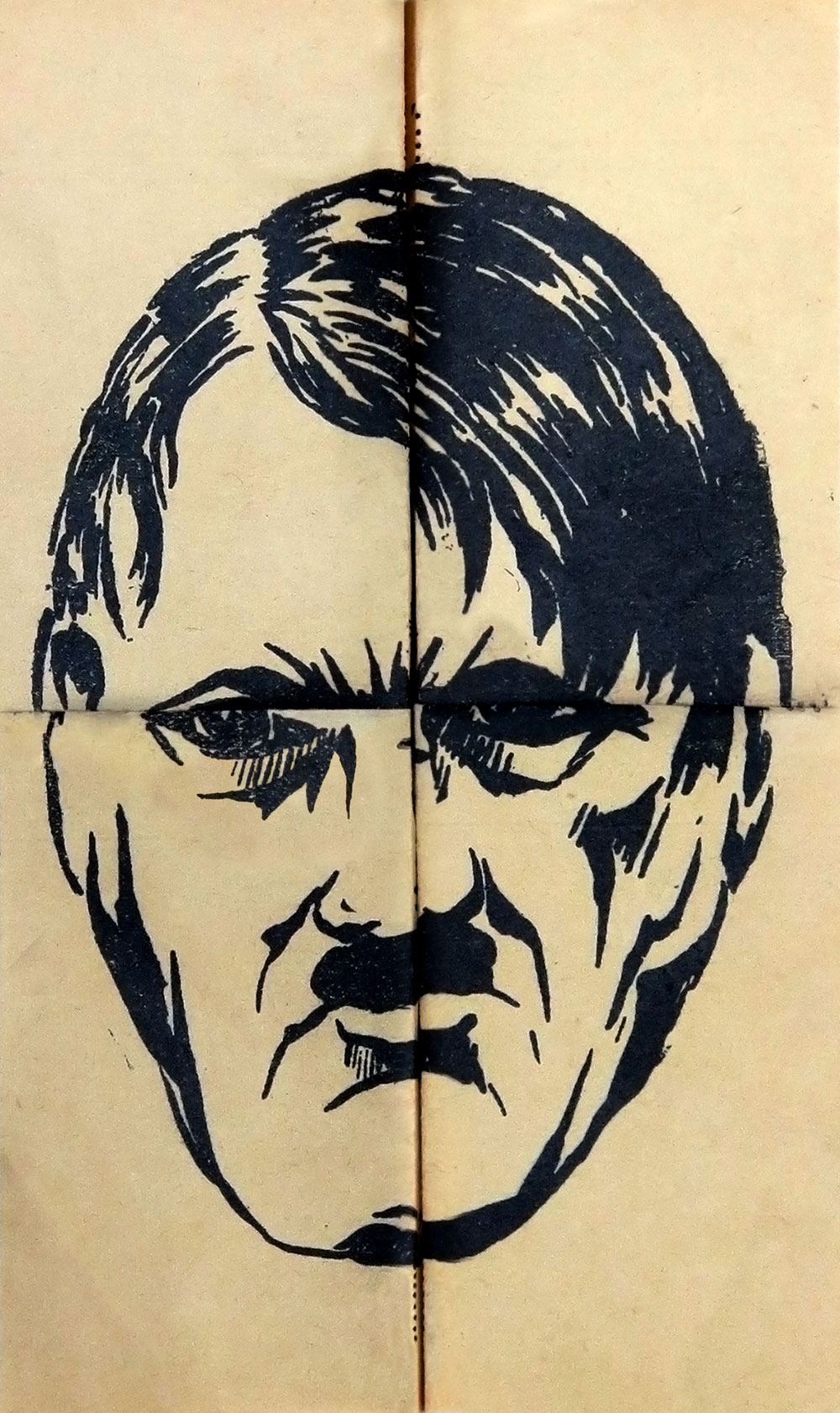
This satirical tract was realised and distributed in 1942 by the network of the Resistance Buckmaster, during the German occupation in France. The flying leaflet, given from hand to hand or slipped into a mailbox, the leaflet or the butterfly (smaller) is at the same time the expression of a refusal – that of yielding – and of an imperious desire to act and call for a start. Intended to mark the minds and to attract adhesion, they can be formed of short and poetic texts, slogans or images. Open, it presents a caricature drawing of four pigs and, in the centre, an inscription in capital letters which apostrophes the reader and invites him to look for the fifth … Indeed, if the recipient folds the sheet according to the dotted lines, he makes Hitler’s acrimonious face! Thus, like any clandestine message, the meaning of the leaflet is not given immediately. The system of folding conceals and intrigues before revealing, but also accentuates the critical and percussive nature of the subject. Opening and closing like two wings, this butterfly is an anonymous, ephemeral and fragile missive ready to fly in the air to carry its message of rising. Like a firefly gleaming in the night of war, “an indication of a desire that flies, goes where it wants, insists, persists, resists in spite of everything”*, in the words of Georges Didi-Huberman, this image constitutes a weapon at the same time frail and powerful.

Text from the Jeu de Paume website translated by Google translate

*Georges Didi-Huberman, “Through desires (fragments on what raises us)”, in Soulèvements, Paris, Jeu de Paume, 2016, p. 372.


Raymond Hains (French, 1926-2005) 'OAS. Fusillez les plastiqueurs (OAS. Shoot the bombers)' 1961


Raymond Hains (French, 1926-2005)
OAS. Fusillez les plastiqueurs (OAS. Shoot the bombers)
1961
Torn poster on canvas backing
Private collection
© ADAGP, Paris, 2016
Photo: Michel Marcuzzi


By the end of the 1940s, Raymond Hains paced the streets of Paris and sought out surprising agglomerates of torn posters that he picked up before painting them on canvas. The artist, flâneur, is the catalyst of a new form of urban poetry that gives rise to impromptu entanglements of words and images. This practice of hijacking posters largely echoed the world of art and French society after the Second World War. These torn posters formally evoke the canvases of “action painting” in vogue at the time, which Hains enjoys by calling himself “inaction painter”. The proliferation of these posters accompanies the rise of consumption but also the many political debates that agitate France. Thus futile advertisements co-exist promoting an eternally joyful world and political posters whose subjects are sometimes dramatic. In 1961, Raymond Hains realised an exhibition entitled “La déchirée France” [The Torn France] which presents itself as a sounding board of contemporary French history, marked by the decomposition of the Fourth Republic and what is not yet called the war of Algeria. The work OAS. Shoot the bombers testifies to the violence of the positions taken with regard to this organisation favourable to the maintenance of French Algeria, but also to the reality of the attacks they commit.

Text from the Jeu de Paume website translated by Google translate


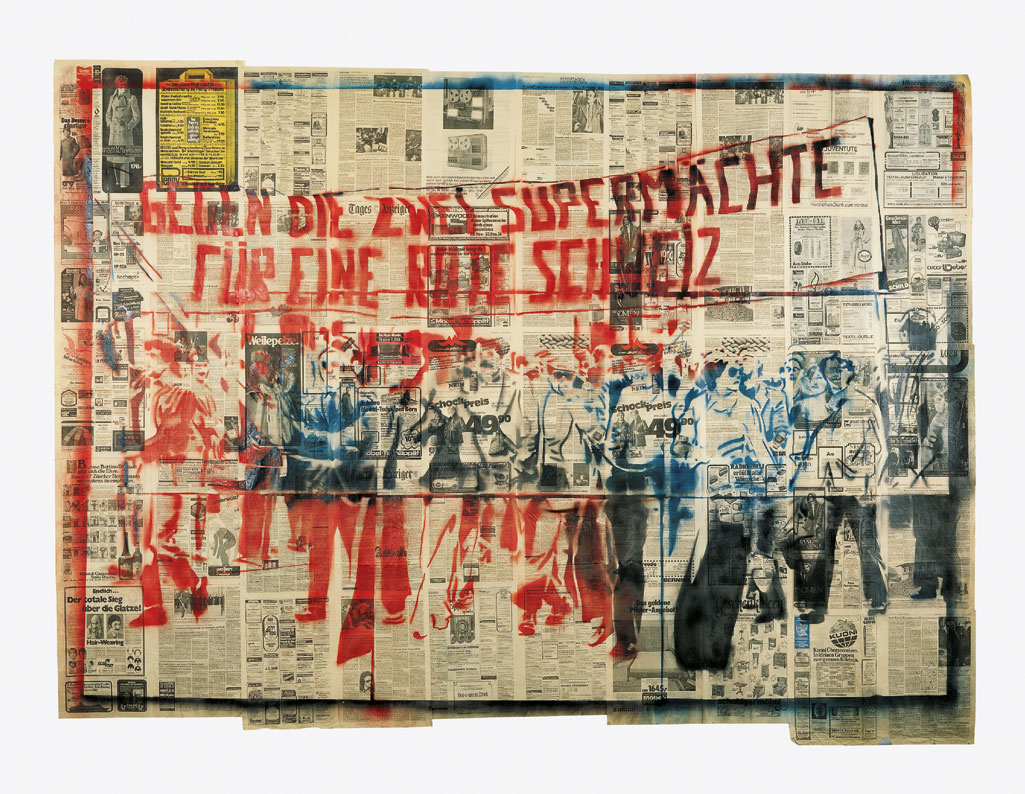
Sigmar Polke (German, 1941-2010) 'Against the two superpowers - for a red Switzerland' (1st version) 1976


Sigmar Polke (German, 1941-2010)
Gegen die zwei Supermächte – für eine rote Schweiz (1e version)
(Against the two superpowers – for a red Switzerland) (1st version)
1976
Spray paint and stencil on paper
Ludwig Forum für internationale Kunst, Aachen
© The Estate of Sigmar Polke, Cologne /ADAGP, Paris, 2016


Henri Michaux (French born Belgium, 1899-1984) 'Untitled' 1975


Henri Michaux (French born Belgium, 1899-1984)
Untitled
1975
Indian ink, acrylic on paper
50 x 65cm
Private collection
© ADAGP, Paris, 2016 / Photo : Jean-Louis Losi


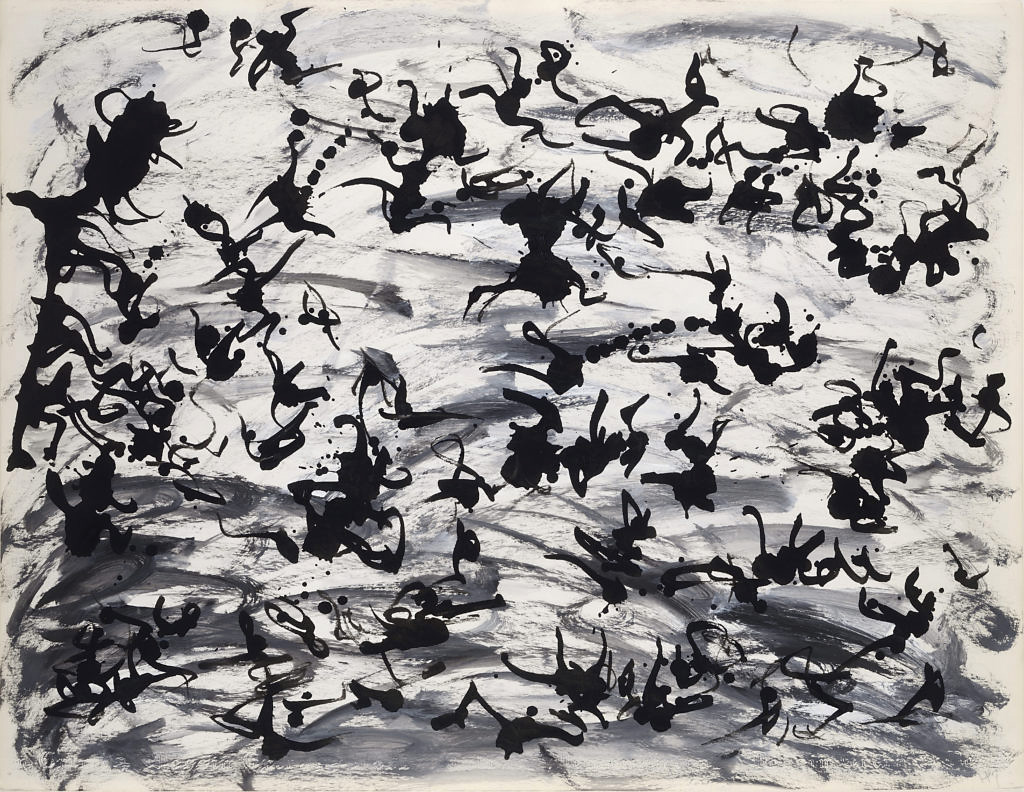
The poet Henri Michaux has endeavoured to combine writing and drawing. Already in his invention of a new graphic alphabet in 1927, and then in his hallucinogenic experiments by absorption of mescaline from 1955, Henri Michaux sought to liberate, unbind language and drawing and thus to explore “the space within”. This ink on paper presents an entanglement of disorderly spots more or less energetic or impregnated. Just as his poems try to lift the tongue, this drawing seems to express what he calls “trembling in images”. Traces of liberating gestures, this expressive “new language”, noisy, made of floods of forms and collisions of signs, becomes the image of the disorderly world and the claimed insubordination of its author. In 1971, Michaux always seems to be looking for what he calls in the turbulent infinity “a confidence of a child, a confidence that goes ahead, hopes, raises you, confidence which, entering into the tumultuous universe … becomes a greater upheaval, a prodigiously great uprising, an extraordinary uprising, an uprising never known, a rising above itself, above all, a miraculous uprising which is at the same time an acquiescence, an unbounded, calming and exciting acquiescence, an overflow and a liberation.” Thus Michaux considered drawing as a movement, the very rise of thought and bodies.

Text from the Jeu de Paume website translated by Google translate


“Uprising transforms consciousness and in this movement it reconstitutes it. It gathers needs together and turns them into demands, it turns affects into desires and wills, it positions them in a tension towards liberty.”


Antonio Negri, “Uprisings” catalogue of the exhibition Uprisings


CONFLICTS (FLARED UP)

To go on strike is not to do nothing. – Demonstrating, showing oneself. – Vandal joys. – Building barricades. – Dying from injustice.

And so everything flares up. Some see only pure chaos. Others witness the sudden appearance of the forms of a desire to be free. During strikes, ways of living together are invented. To say that we “demonstrate,” is to affirm – albeit to be surprised by it or even not to understand it – that something appeared that was decisive. But this demanded a conflict. Conflict: an important motif of modern historical painting (from Manet to Polke), and of the visual arts in general (photography, cinema, video, digital arts).

It happens sometimes that uprisings produce merely the image of broken images: vandalism, those kinds of celebrations in negative format. But on these ruins will be built the temporary architecture of uprisings: paradoxical, moving, makeshift things that are barricades. Then, the police suppress the demonstration, when those who rise up had only the potency of their desire (potency: not power). And this is why there are so many people in history who have died from having risen up.

Manuel Álvarez Bravo, Hugo Aveta, Ruth Berlau, Malcolm Browne, Henri Cartier-Bresson, Agustí Centelles, Chen Chieh-Jen, Armand Dayot, Honoré Daumier, Adolphe-Eugène Disdéri, Robert Filliou, Jules Girardet, Arpad Hazafi, John Heartfield, Dmitri Kessel, Herbert Kirchhorff, Héctor López, Édouard Manet, Ernesto Molina, Jean-Luc Moulène, Voula Papaioannou, Sigmar Polke, Willy Römer, Pedro G. Romero, Jésus Ruiz Durand, Armando Salgado, Allan Sekula, Thibault, Félix Vallotton, Jean Veber, German, Catalan, French, Mexican, South African unknowns.


Charles-François Thibault (French) 'The Barricade of the Rue Saint-Maur-Popincourt before the attack by the troops of General Lamoriciere' Sunday, June 25, 1848


Charles-François Thibault (French)
La Barricade de la rue Saint-Maur-Popincourt avant l’attaque par les troupes du général Lamoricière
The Barricade of the Rue Saint-Maur-Popincourt before the attack by the troops of General Lamoriciere
Sunday, June 25, 1848
Daguerréotype
11.7 x 15cm
Musée d’Orsay, Paris
Photo © RMN-Grand Palais (musée d’Orsay) / Hervé Lewandowski


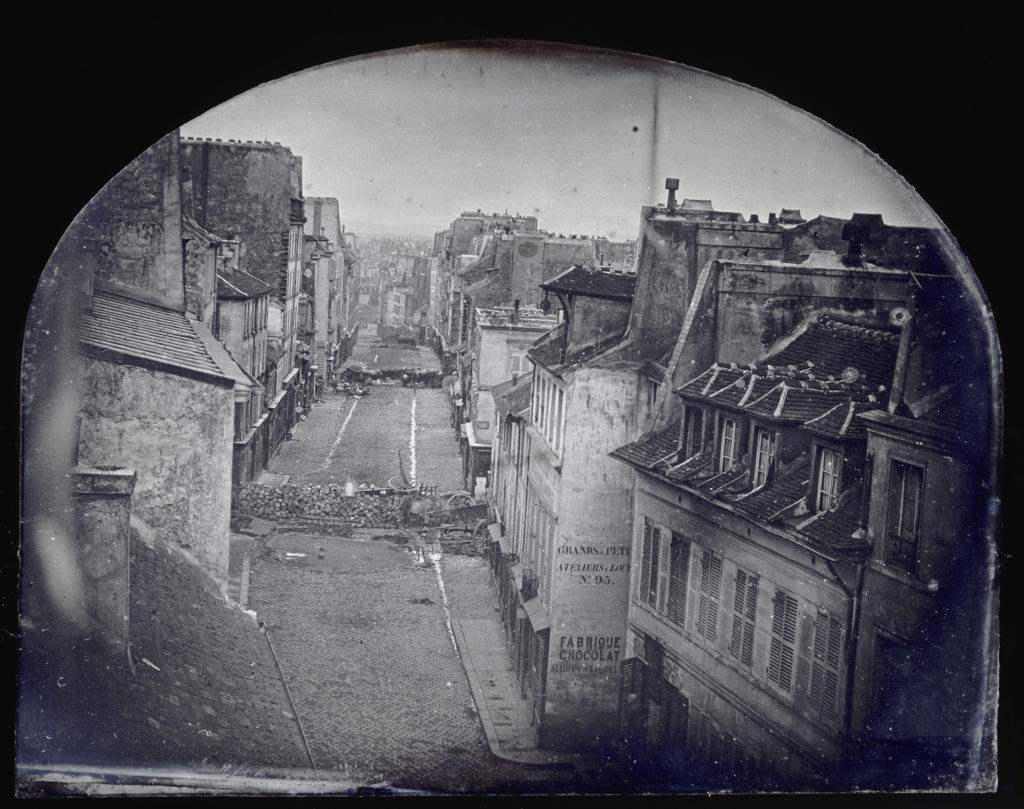
This daguerreotype is part of a series of two exceptional views of the barricades taken during the popular insurrection of June 1848. Disseminated in the form of woodcuts in the newspaper L’Illustration at the beginning of the following July, these photographs were realised by an amateur named Thibault, from a point of view overlooking the Rue Saint-Maur-Popincourt, June 25 and 26, before and after the assault. The first photographs reproduced in the press, they show the value of proof given to the medium in the processing of information since the middle of the nineteenth century, well before the development of photomechanical reproduction techniques. The inaccuracies and ghostly traces caused by a long exposure time limit the accuracy lent to the medium. Also the engraver allowed himself to “rectify” the views for the newspaper, adding clouds here and there and specifying the posture or the detail of the silhouettes. The remarkable interest of these daguerreotypes, however, resides in their indeterminate aspect. In fact, they reveal the singular temporality of these events: both short (since each second counts during the confrontations) and at the same time extended (in the moments of preparation and waiting). The temporalities proper to events and photography are thus combined in order to offer the perennial image of an invisible uprising and therefore always in potentiality.

Text from the Jeu de Paume website translated by Google translate


The first photo of an insurrectionary barricade

This photo was taken by a young photographer, by the name of Charles-François Thibault, at the level of no. 92 of the current rue du Faubourg-du-Temple on the morning of Sunday June 25, 1848. The insurrection is coming to an end, and only the last defences of the working-class districts of eastern Paris resist.

Thibault used twice, probably between 7 am and 8 am, his daguerreotype, a primitive process of photography which fixed the image on a metal plate. These two pictures are visible in Parisian museums, the first at the Carnavalet museum, the second (featured image) at the Musée d’Orsay. One distinguishes there in particular a flag planted in the axle of a wheel on the first barricade (which according to the researches of Olivier Ilh [La Barricade reversed, history of a photograph, Paris 1848, Editions du Croquant, 2016] carried the inscription “Democratic and social Republic”) as well as silhouettes of back.

Anonymous text. “The first photo of a barricade,” on the Un Jour de Plus a Paris website [Online] Cited 11/11/2021.


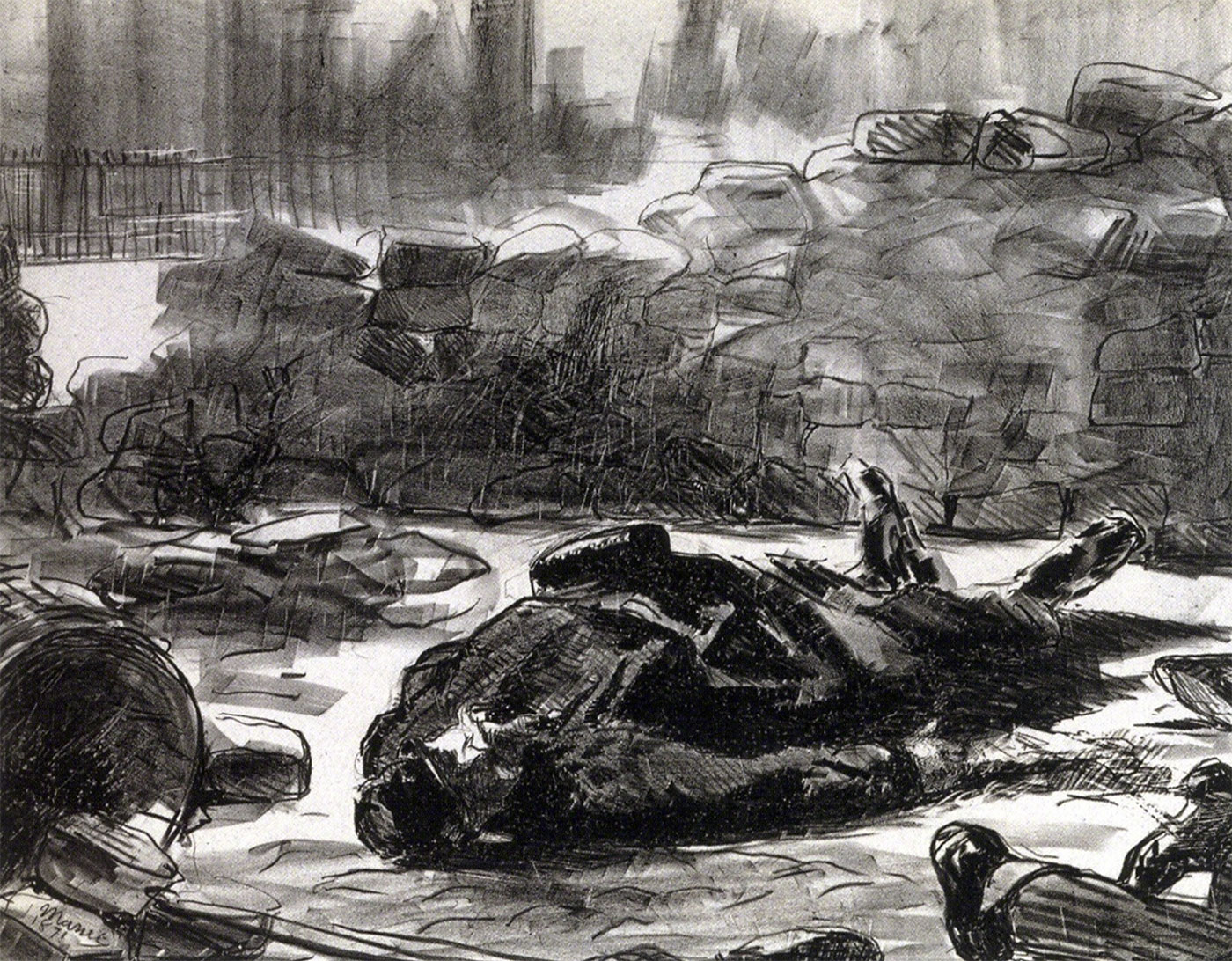
Édouard Manet (French, 1832-1883) 'Guerre civile (Civil war)' 1871


Édouard Manet (French, 1832-1883)
Guerre civile (Civil war)
1871
Two-tone lithograph on thick paper
Musée Carnavalet – Histoire de Paris
© Musée Carnavalet / Roger-Viollet
 

André Adolphe Eugène Disdéri (French, 1819-1889) (attributed to) 'Insurgents killed during bloody week of the Commune' 1871


André Adolphe Eugène Disdéri (French, 1819-1889) (attributed to)
Insurgés tués pendant la Semaine sanglante de la Commune
Insurgents killed during bloody week of the Commune
1871
Albumen photograph
21 x 27cm
Musée Carnavalet – Histoire de Paris, Paris
© André A.E. Disdéri / Musée Carnavalet / Roger-Viollet


This photograph was taken at the end of the tragic Bloody Week which concluded the Commune of Paris in May 1871. It shows the corpses of Communards shot by the Versailles troops, presented in their coffins at the public exhibition of their bodies. This image is imprinted with brutality: that of the authors of the massacre of these young men struggling for the independence of Paris, that of the monstration [The act of demonstrating; proof] and, that of photography, in its realisation, its frontality and its precision. Why did one of the most famous portraitists of the Second Empire record the image of these inanimate bodies? We know today that photography has played an important role in anti-communard propaganda, the aim of which was to show the “exactions” of the insurgents (barricades, vandalism, assassinations …) and to present this event not as a revolution but as a civil war. It was also used for identification purposes, used for judicial proceedings and repression. The value of this image, however, is due to the fact that the exposure of these bodies is transformed by the photographic act. The latter confers on the rebels a particular aura, passing thus from figures of guilty to those of martyrs. Gathered for the occasion and set up facing us, they form, through photography, the image of an inseparable community. Even if the revolution has failed and power has failed, its power remains and continues to nourish the memory of political uprisings.

Text from the Jeu de Paume website translated by Google translate
 

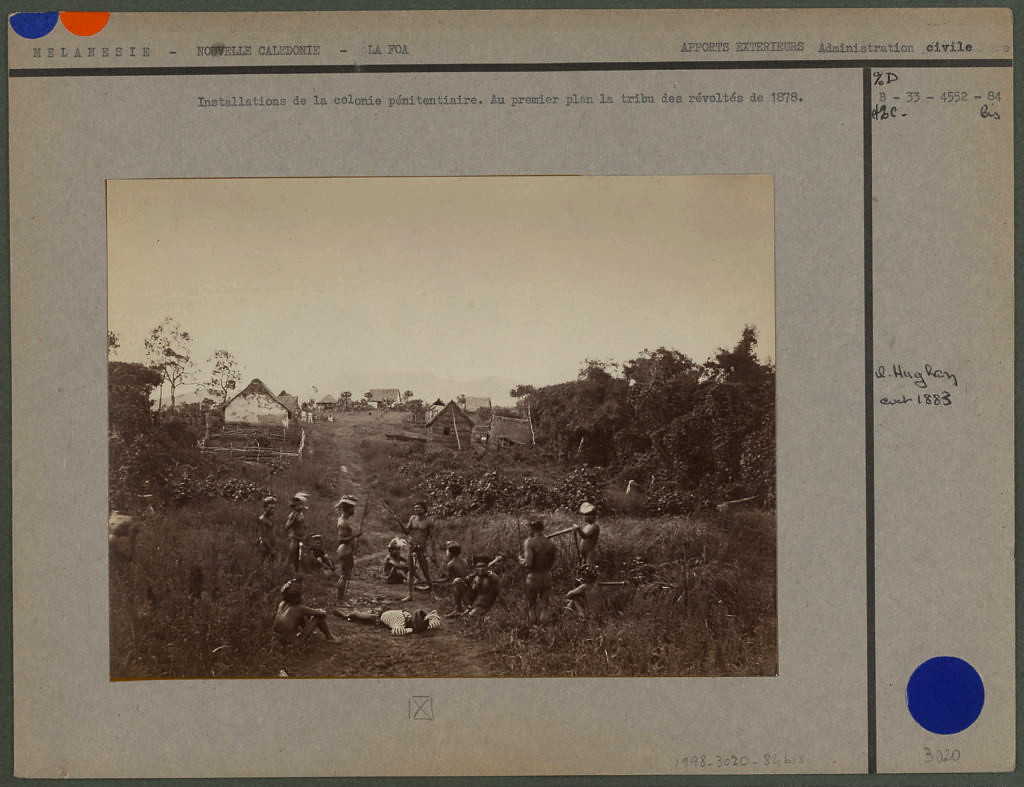
Allan Hughan (British, 1834-1883) 'Installations de la colonie pénitentiaire (Installations of the penal colony)' May 1874


Allan Hughan (British, 1834-1883)
Installations de la colonie pénitentiaire (Installations of the penal colony)
May 1874
Albumen print
14.7 x 19.6cm
Musée du quai Branly – Jacques Chirac


The legend of the image, written in the thirties, states: “In the foreground the tribe of rebels of 1878”, while that handwritten on the original negative says “tribe of Atai revolted.” These elements drag the meaning of this image realised by the first photographer present in New Caledonia. The photographs he takes of kanaks, villages, but also of the prison and mining facilities in 1874, take on a new retrospective significance after the great Kanak revolt of 1878.


Félix Vallotton (Swiss-French, 1865-1925) 'La Charge (The Charge)' 1893


Félix Vallotton (Swiss-French, 1865-1925)
La Charge (The Charge)
1893
Proof, woodcut on paper
Musée national d’Art moderne, Centre Pompidou, Paris
Gift of Adèle et Georges Besson en 1963. On loan to Musée des Beaux-Arts et d’Archéologie de Besançon
© Centre Pompidou / MNAM / Cliché Pierre Guenat, Besançon, Musée des Beaux-Arts et d’Archéologie


Felix Vallotton made this engraving on wood in 1893 as part of his critical contributions to social violence for newspapers and magazines of his time. Composed with great economy of means, La Charge represents the brutal repression of a demonstration by the forces of the order. The diving point of view testifies to the influence of photography on his work and reinforces the voyeur character of the viewer as well as his feeling of helplessness. The formal repetition of the uniform of the “guardians of the peace” and the resemblance of their faces, all wedged between their moustache and their kepi, translates well the impression of mechanical unleashing of a blind violence. By contrasting black and white, Vallotton refers to the physical confrontation between civilians and policemen. The centrifugal force which animates the composition gives the impression that the wounded bodies shatter like an explosion. By distorting the characteristic perspective of the Nabi aesthetic, the victims’ bodies seem to be abandoned. Through the eyes of man in the foreground, the artist denounces the abuse of force but also takes the spectator to witness and invites him to rise up against this injustice. The artist, known for his anarchist positions, broke as much with the traditional principles of composition as with the established order. At the charge against the protesters, he responds by his own charge against the authorities.

Text from the Jeu de Paume website translated by Google translate
 

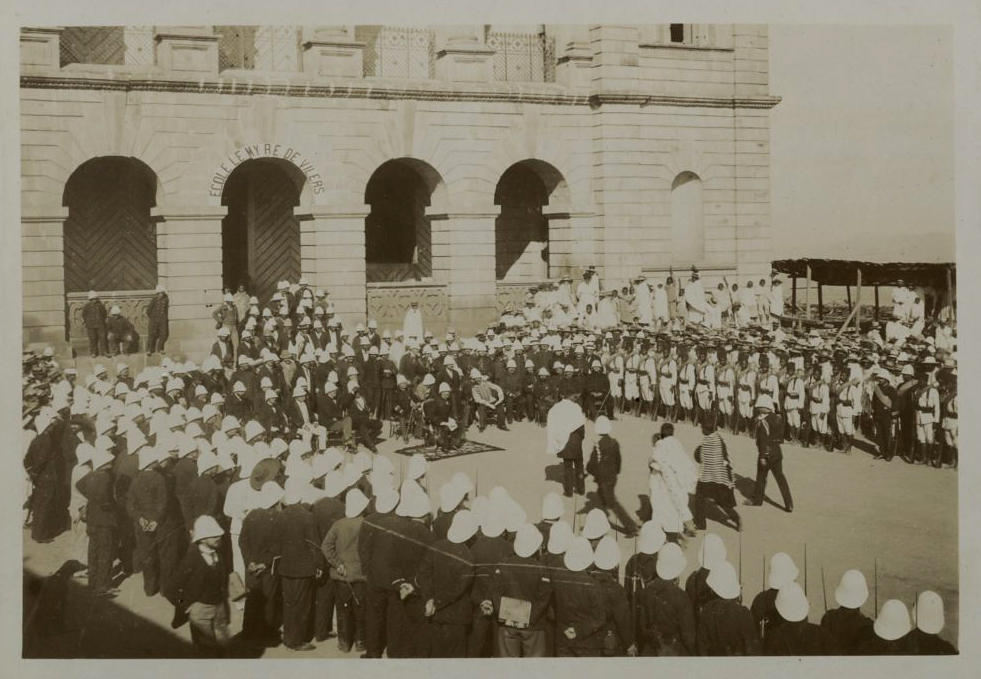
Joseph Marie Ernest Prud'Homme. 'Submission of Rabezavana and Rainibetsimisaraka' 1897


Joseph Marie Ernest Prud’Homme
Submission of Rabezavana and Rainibetsimisaraka
1897
Print on aristotype paper
12 x 17 cm
Musée du quai Branly – Jacques Chirac


On July 29, 1897, Rabezavana and Rainibetsimisaraka, two of the greatest leaders of the Menalamba insurrection, which began after the abdication of Queen Ranavalona III and the establishment of the protectorate in October 1895, publicly knelt before Governor General Joseph Gallieni to signify their submission. This ceremony is the theatrical acme of the policy of “pacification” carried out in Madagascar by Gallieni, since his arrival in September 1896.


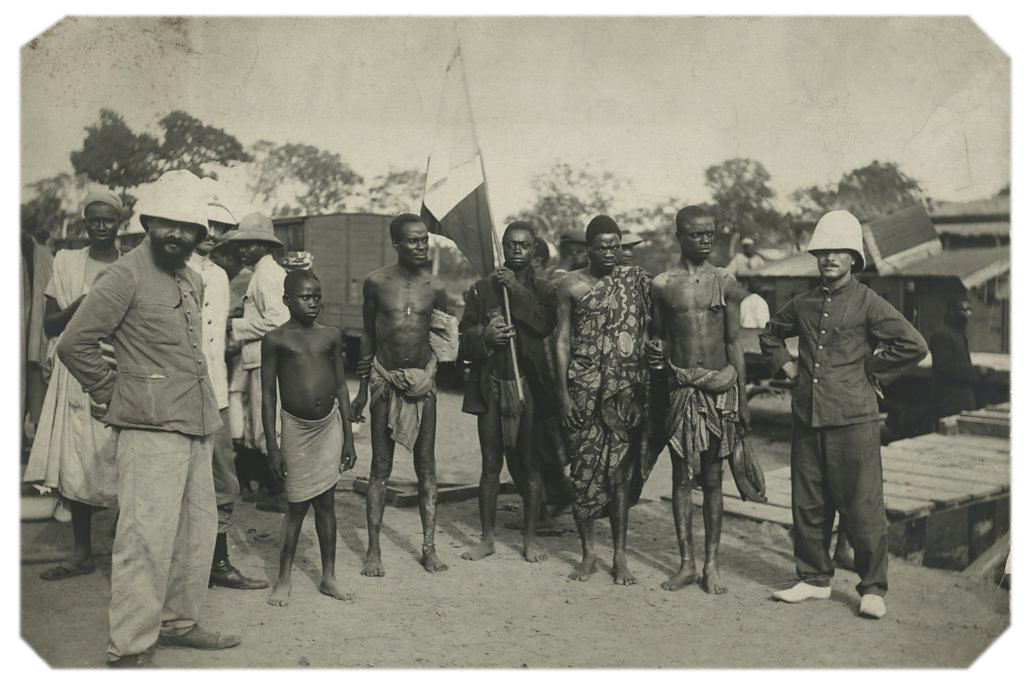
Anonymous photographer. 'The Habés send a parliamentarian to make their submission to Major Pognio' 17 March 1910


Anonymous photographer
Les Habés envoient un parlementaire pour faire leur soumission au commandant Pognio
The Habés send a parliamentarian to make their submission to Major Pognio
17 March 1910
Print on baryta paper
10.9 x 16.7cm
Musée du quai Branly – Jacques Chirac


The French colonial conquest of West Africa, begun in 1854, stops with the unification of its possessions within French West Africa in 1895. It was mainly carried out by the infantry which had to face populations hostile to colonization. The Habés (Dogons) of the Bandiagara region (present-day Mali) resisted the French soldiers from 1894 to 1910.


José Clemente Orozco (Mexican, 1883-1949) 'Les Femmes des soldats (The Women Soldiers)' 1926


José Clemente Orozco (Mexican, 1883-1949)
Les Femmes des soldats (The Women Soldiers)
1926
Oil on canvas
México, INBA, Collection Museo de Arte Moderno
Photo © Francisco Kochen
© Adagp, Paris 2016


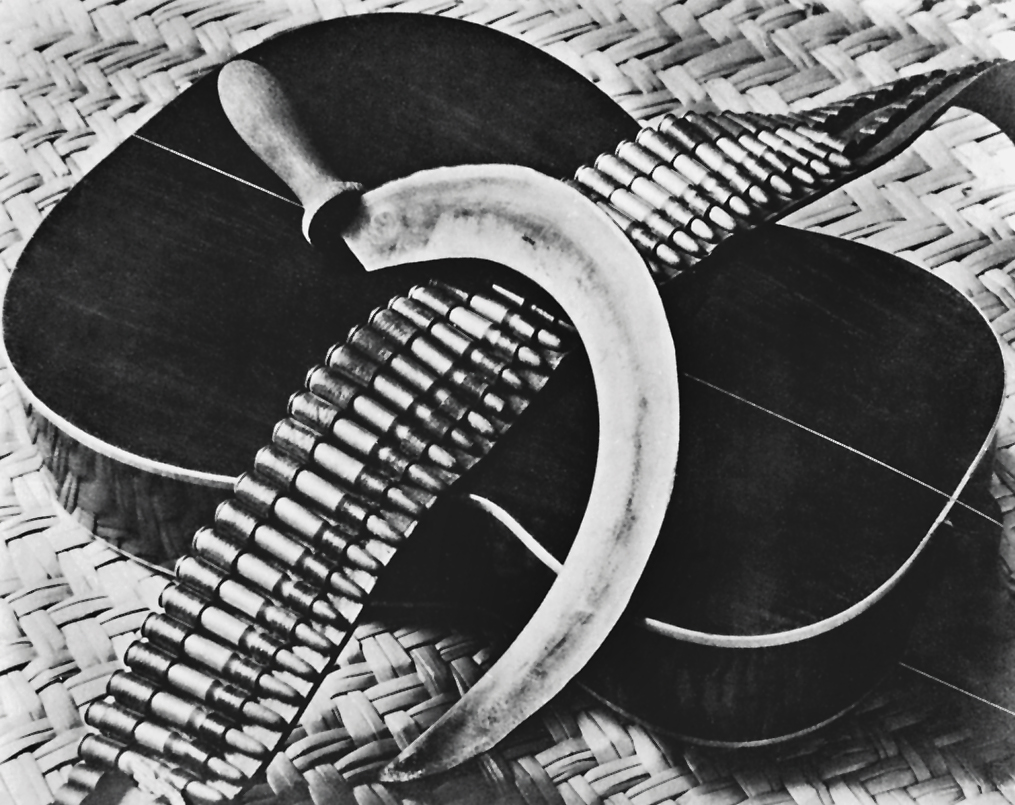
Tina Modotti (Italian American, 1896-1942) 'Guitare, cartouchière et faucille (Guitar, cartridge belt and sickle)' 1st June 1929


Tina Modotti (Italian American, 1896-1942)
Guitare, cartouchière et faucille (Guitar, cartridge belt and sickle)
1st June 1929
Illustration de l’annonce pour la chanteuse communiste Concha Michel, publiée dans el machete, no 168, 1
Illustration of the announcement for the communist singer Concha Michel, published in El Machete, no 168, 1
Gelatin silver print
México, INBA, Museo Nacional de Arte
Donation de la famille Maples Arce, 2015
© Francisco Kochen


The Mexican Revolution profoundly changed the structure of society: since men had gone to war or to search for work and livelihoods, women took on new tasks, first in armed struggle and then in rebuilding culture and education within society. Thus, the image of the soldiaderas, those women who followed the revolutionary troops, acquired a special significance and was symbolically compared to the “strong women” of the Bible. In the artistic field, women also played a decisive role, sometimes called “proto-feminism”: patrons of valuable artists or artists themselves, they participated in the quest for an aesthetic language capable of expressing their doubts and questioning.

Text from the Jeu de Paume website translated by Google translate
 

Concha Michel (1899-1990) was a singer-songwriter, political activist, playwright, and a researcher who published several projects on the culture of Indigenous communities. She was one of the few women who performed in the corrido style. She created the Institute of Folklore in Michoacan and was one of the first collectors of folklore and preservers of the traditions of the Mexican people. She was a cultural icon having relationships with two presidents, and a broad range of Mexico’s most prominent artists including Diego Rivera, Frida Kahlo, Guadalupe Marín, Tina Modotti, Elena Poniatowska, Anita Brenner and others.

Text from the Wikipedia website


Ruth Berlau (Danish, 1906-1974) 'Grévistes américains (American warriors)' 1941


Ruth Berlau (Danish, 1906-1974)
Grévistes américains (American warriors)
1941
Gelatin silver print
10 x 15cm
Akademie der Künste, Berlin, Bertolt Brecht Archiv
© by R. Berlau/Hoffmann


Ruth Berlau, actress, director and photographer of Danish origin realises this photograph shortly after his arrival in the United States. She fled Nazi Germany with the writer and playwright Bertolt Brecht and accompanied him during much of his exile. In line with her commitment to the Spanish war and her communist ideas, she photographed American social movements and showed the actors of the struggle and the victims of oppression. This series on strikes highlights the workforce of the workers, with the desire to get their faces out of anonymity. It is in keeping with the documentary use of photography undertaken by social programs such as the New Deal and in particular the path traced by Walker Evans, initiator of the “documentary style”. It chooses a frontal point of view, apt to reveal with precision and clarity the faces of the strikers. In doing so, it applies itself to restoring their dignity while producing the documents of a social history. The counter-drive gives the strikers a particular scope and strength, just as the framing, which ostensibly divides the group, suggests that they belong to a powerful and determined group. The photographic practice of Ruth Berlau seems to embody a democratic ideal, revealing both the unity and the singularity of each and a common political commitment, which is reflected here through the exchange of views.

Text from the Jeu de Paume website translated by Google translate
 

Manuel Álvarez Bravo (Mexican, 1902-2002) 'Ouvrier en grève, assassiné (Striking worker, assassinated)' 1934


Manuel Álvarez Bravo (Mexican, 1902-2002)
Ouvrier en grève, assassiné (Striking worker, assassinated)
1934
Gelatin silver print
Musée d’Art moderne de la Ville de Paris
© Musée d’Art Moderne de la Ville de Paris / Roger Viollet
© Estate Manuel Álvarez Bravo


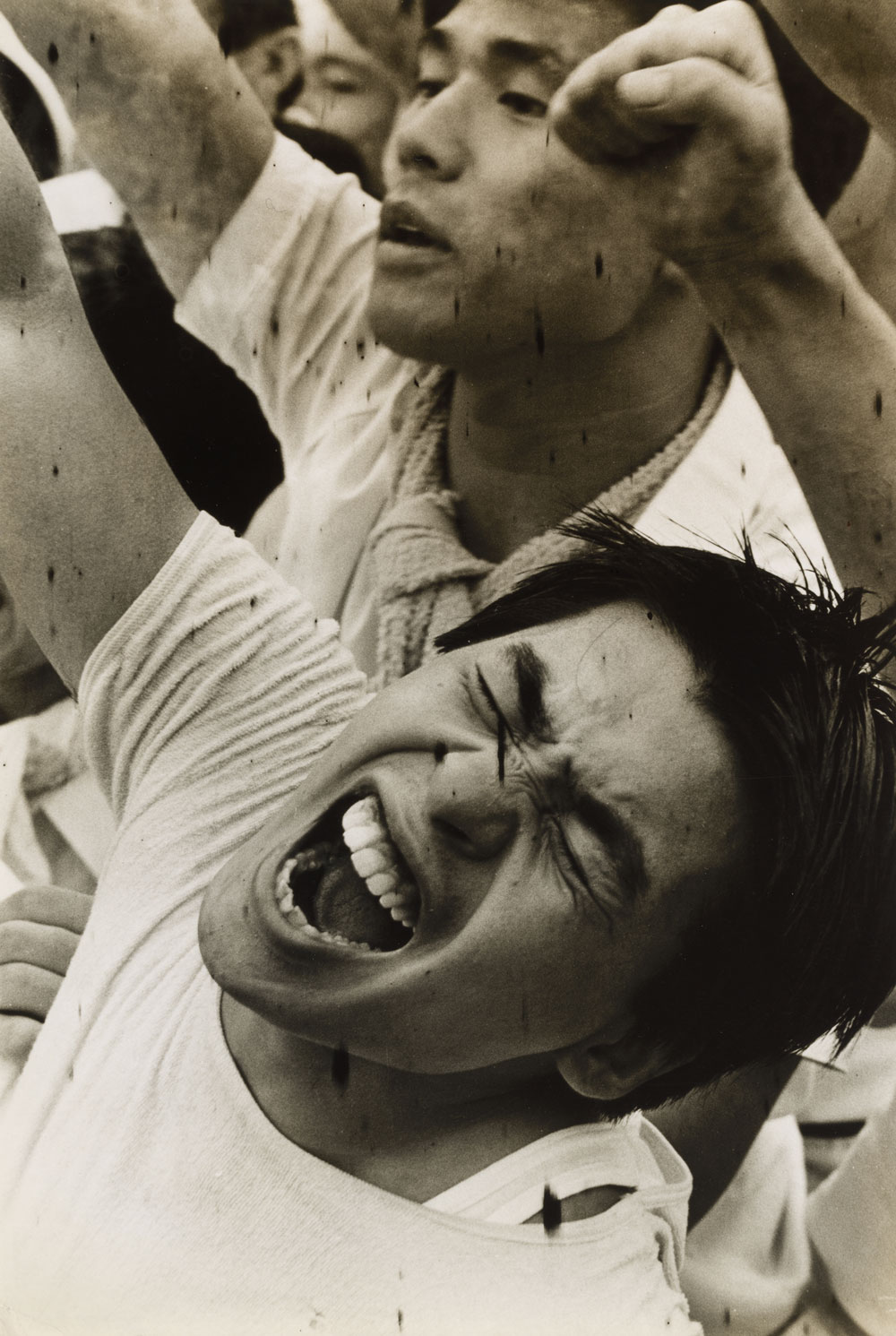
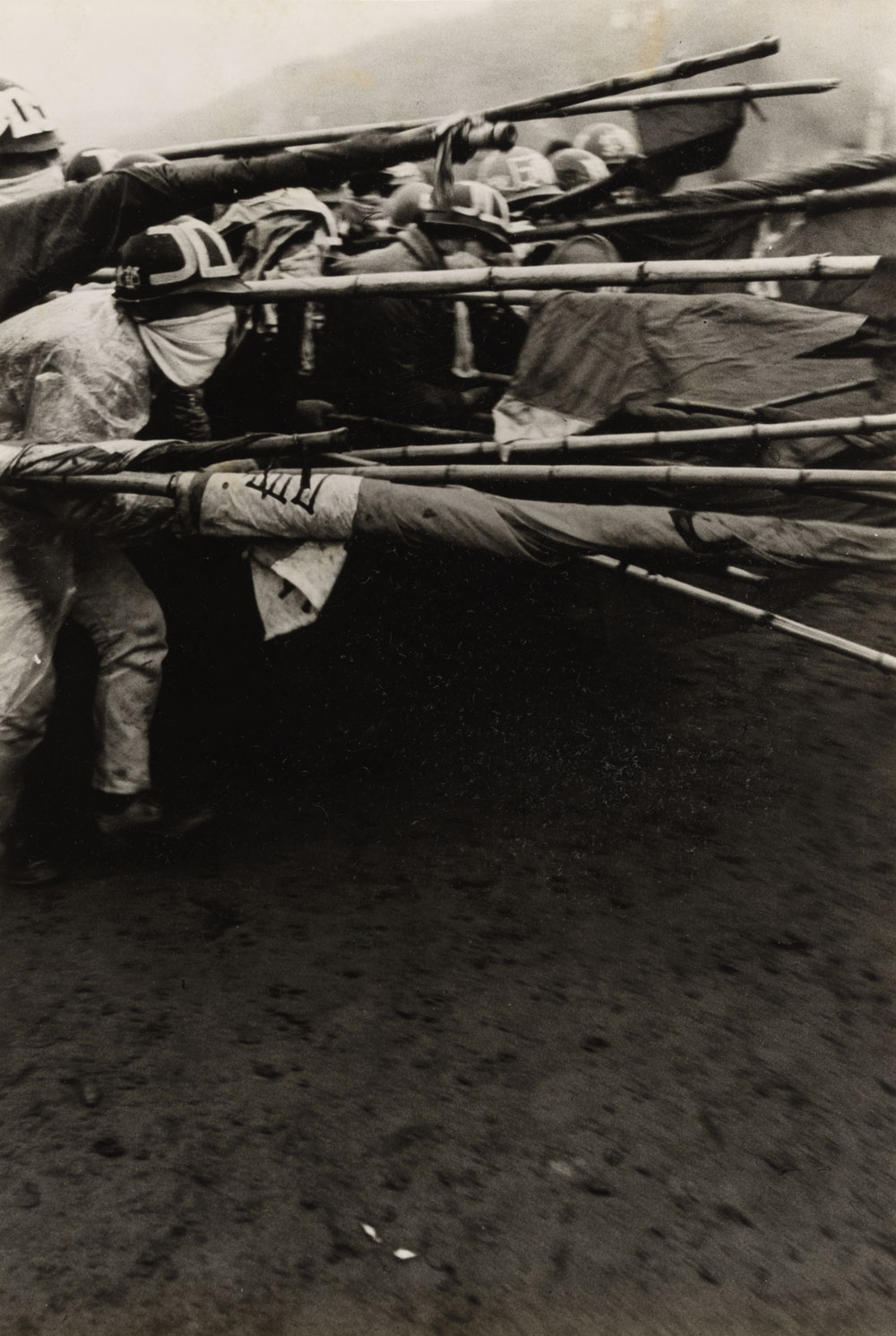
Unknown photographer. 'Contestation around the construction of Narita airport' 1969

Unknown photographer. 'Contestation around the construction of Narita airport' 1969


Unknown photographer
Contestation autour de la construction de l’aéroport de Narita
Contestation around the construction of Narita airport

1969
Gelatin silver prints
© Collection Art Institute of Chicago


In parallel with the dazzling rise of a consumer society on the Western model, for ten years (from 1960 to 1970) Japan went through a major identity crisis that unfolded on multiple fronts: American military bases in Okinawa, construction of Narita airport, occupation of universities by students …


Chieh-Jen Chen (Taiwanese, b. 1960) 'The Route' 2006

Chieh-Jen Chen (Taiwanese, b. 1960) 'The Route' 2006


Chieh-Jen Chen (Taiwanese, b. 1960)
The Route
2006
35 mm film transferred onto DVD: color and black and white, silent, 16:45 min.
© Chieh-Jen Chen, courtesy galerie Lily Robert


“To rise up is to break a history that everyone believed to have been heard. It is to break the foreseeability of history, to refute the rule that presided, as we thought, over its development or its preservation.”


Georges Didi-Huberman, “By the desires (Fragments of What Makes Us Rise Up)” catalogue of the exhibition Uprisings


DESIRES (INDESTRUCTIBLES)

The hope of one condemned to death. – Mothers rise up. – They are your own children. – They who go through walls.

But potency outlives power. Freud said that desire was indestructible. Even those who knew they were condemned – in the camps, in the prisons – seek every means to transmit a testimony or call out. As Joan Miró evoked in a series of works titled “The Hope of a Condemned Man,” in homage to the student anarchist Salvador Puig i Antich, executed by Franco’s regime in 1974.

An uprising can end with mothers’ tears over the bodies of their dead children. But these tears are merely a burden: they can still provide the potencies of uprising, like in the “resistance marches” of mothers and grandmothers in Buenos Aires. It is our own children who rise up: “Zero for Conduct!” was Antigone not almost a child herself? Whether in the Chiapas forests or on the Greece – Macedonia border, somewhere in China, in Egypt, in Gaza, or in the jungle of computerised networks considered as a vox populi, there will always be children to jump the wall.

Francisca Benitez, Ruth Berlau, Bruno Boudjelal, Agustí Centelles, Eduardo Gil, Mat Jacob, Ken Hamblin, Maria Kourkouta, Joan Miró, Pedro Motta, Voula Papaioannou, Estefania Peñafiel Loaiza, Enrique Ramirez, Argentinian, Greek, Mexican unknowns.


Denis Foyatier (French, 1793-1863 'Spartacus' 1830


Denis Foyatier (French, 1793-1863)
Spartacus
1830
Marble
Commande de Charles X, 1828
Département des Sculptures
© 2011 Musée du Louvre, dist. RMN – Grand Palais / Thierry Ollivier


Victor Hugo (French, 1802-1885) 'Le Pendu (The hanged man)' 1854


Victor Hugo (French, 1802-1885)
Le Pendu (The hanged man)
1854
Pen and brown ink wash, black ink, charcoal, black chalk, gouache on paper
Paris, Maison de Victor Hugo
© Maisons de Victor Hugo / Roger-Viollet


While in exile in Jersey, Victor Hugo is deeply moved by the death sentence in Guernsey of John Charles Tapner, a condemnation against which he protests and asks for a pardon that he will not get. Hugo then makes four drawings depicting a gaunt hanged man at his gallows. The museum preserves two (Ecce and Ecce Lex). Hugo had hung them in his room in Marine Terrace in Jersey, and in his study under the roof of Hauteville House in Guernsey.


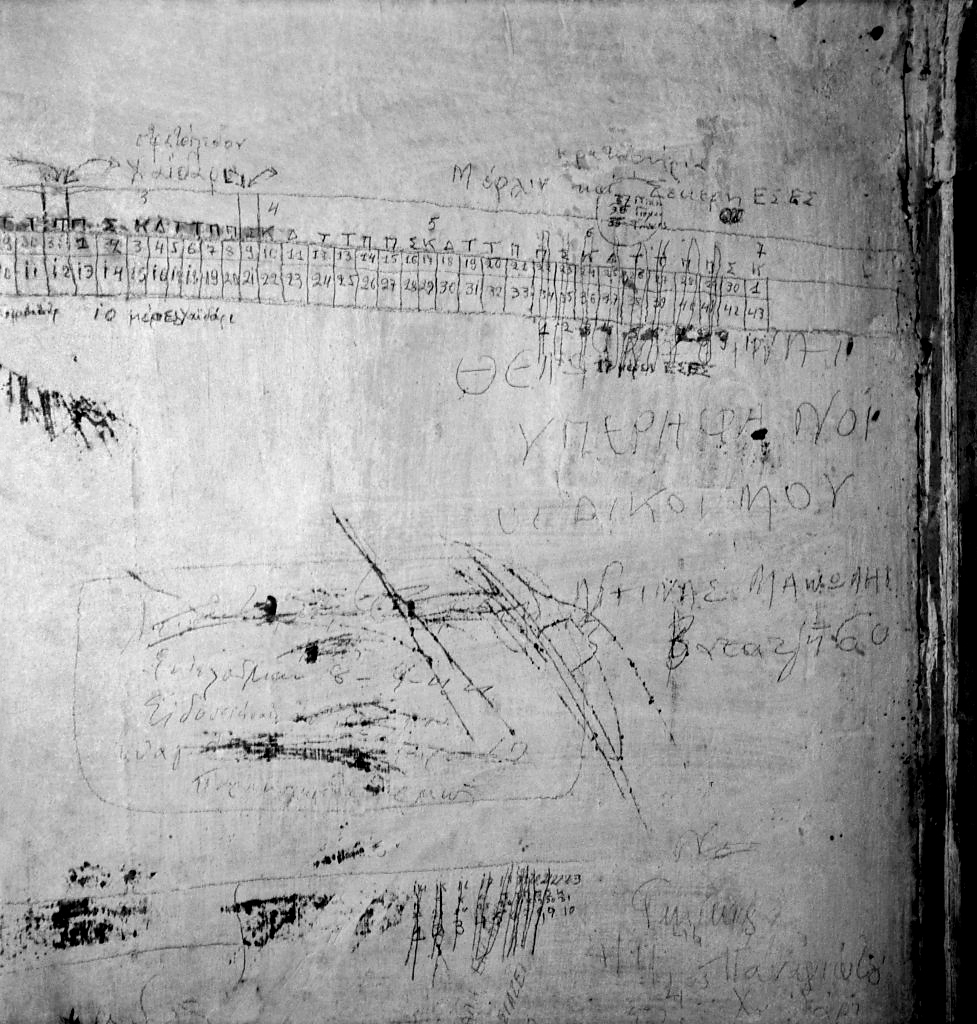
Voula Papaioannou (Greek, 1898-1990) 'Graffiti of prisoners on the walls of the German prison in Merlin Street, Athens' 1944


Voula Papaioannou (Greek, 1898-1990)
Graffitis de prisonniers sur les murs de la prison allemande de la rue Merlin à Athènes
Graffiti of prisoners on the walls of the German prison in Merlin Street, Athens
1944
Gelatin-silver print, modern print
24 x 30cm
Benaki Museum Photographic Archive, Athènes


Voula Papaioannou is a major figure in Greek documentary photography. Born in 1898, she made numerous photographs of landscapes, monuments and archaeological sites in the 1930s. The Second World War led her to wonder about her practice and she was committed to covering the realities of the conflict. Her apparatus then becomes a tool to testify and publicise the misery and suffering of the Greek population during the German occupation. It reflects the difficulties of everyday life, the departure of the military in combat and the famines that strike civilians. During the liberation, she made a few shots of street fights as well as these images of the walls of the prison of Athens held until then by the Germans. It shows the graffiti (inscriptions and drawings) left by the detainees, most of them awaiting execution. Many say their names and send a message to their families (“I want my relatives to be proud of me”) or claim their political convictions (“Vive le KKE”, Greek Communist Party) for the sake of transmitting until the day before their deaths the reasons for their struggle and the conditions of their disappearance. These photographic recordings are similar to archaeological documents bearing the traces of the imprisonment of the Greek Resistance fighters and their hope that these messages will one day be read in a Greece freed from the Nazi occupation.

Text from the Jeu de Paume website translated by Google translate


Photographe Anonyme (membre du Sonderkommando d'Auschwitz-Birkenau) Anonymous photographer (member of the Auschwitz-Birkenau Sonderkommando) 'Femmes poussées vers la chambre à gaz du crématoire V de Birkenau' 'Women pushed towards the gas chamber of crematorium V of Birkenau' 1944


Photographe Anonyme (membre du Sonderkommando d’Auschwitz-Birkenau)
Anonymous photographer (member of the Auschwitz-Birkenau Sonderkommando)

Femmes poussées vers la chambre à gaz du crématoire V de Birkenau
Women pushed towards the gas chamber of crematorium V of Birkenau
1944
Contact plate with two images
12 x 6cm
Archival collection of the State Museum Auschwitz-Birkrenau, Oświęcim
Photo: Archival collection of the State Museum Auschwitz-Birkrenau, Oświęcim


This photograph was taken by a member of the Sonderkommando Auschwitz-Birkenau, a special unit of Jewish inmates commissioned by the SS to carry out the final solution. It belongs to a set of four photographs carried out clandestinely on a piece of film, using a photographic camera infiltrated in the camp and then concealed at the bottom of a bucket. Hidden near crematory furnace V, the author of these photographs was assisted by other members of the Sonderkommando. To do such an act was indeed extremely dangerous. The sloping framing and the blur reflect the perilous conditions in which the photographer was then placed. This picture, however, clearly shows a convoy of naked women pushed by the special unit to the gas chamber, located off-field. The film was then filtered from the camp into a tube of toothpaste to join the Polish Resistance, accompanied by an explanatory letter. These photographs therefore have an informative aim and constitute the only photographic documents on the gas chambers. As Georges Didi-Huberman affirms, “in the depths of this fundamental despair, the “solicitation to resist” has probably detached itself from the beings themselves, who have been promised to disappear, to fix themselves on signals to be emitted beyond the boundaries of the camp.*” Among others, the image, this “eye of history”, is then invested with the only hope still possible: to make the hell of Auschwitz visible and therefore imaginable.

*Georges Didi-Huberman, Images malgré tout, (Images despite everything), Paris, Les Editions de Minuit, 2003, p. 14.


Sonderkommandos were work units made up of German Nazi death camp prisoners. They were composed of prisoners, usually Jews, who were forced, on threat of their own deaths, to aid with the disposal of gas chamber victims during the Holocaust. The death-camp Sonderkommandos, who were always inmates, should not be confused with the SS-Sonderkommandos which were ad hoc units formed from various SS offices between 1938 and 1945. The term itself in German means “special unit”, and was part of the vague and euphemistic language which the Nazis used to refer to aspects of the Final Solution (cf. Einsatzkommando units of the Einsatzgruppen death squads).

About 120 SS personnel were assigned to the gas chambers and lived on site at the crematoria. Several SS personnel oversaw the killings at each gas chamber, while the bulk of the work was done by the mostly Jewish prisoners known as Sonderkommandos (special squads)  Sonderkommando responsibilities included guiding victims to the gas chambers and removing, looting, and cremating the corpses.

The Sonderkommado were housed separately from other prisoners, in somewhat better conditions. Their quality of life was further improved by access to the goods taken from murdered prisoners, which Sonderkommandos were sometimes able to steal for themselves and to trade on Auschwitz’s black market. Hungarian doctor Miklós Nyiszli reported that the Sonderkommando numbered around 860 prisoners when the Hungarian Jews were being killed in 1944. Many Sonderkommandos committed suicide due to the horrors of their work; those who did not generally were shot by the SS in a matter of weeks, and new Sonderkommando units were then formed from incoming transports. Almost none of the 2,000 prisoners placed in these units survived to the camp’s liberation.

Text from the Wikipedia website


Ken Hamblin (American, b. 1940) 'Beaubien Street' 1971


Ken Hamblin (American, b. 1940)
Beaubien Street
1971
Modern gelatin silver print
Fifth Estate photo
Joseph A. Labadie Collection, Special Collections Library, University of Michigan


Joan Miró (Spanish, 1893-1983) 'Prisoner's Hope, Preparatory Drawing for The Hope of the Dead Man I, II and III' 1973


Joan Miró (Spanish, 1893-1983)
L’Espoir du prisonnier, dessin préparatoire pour L’Espoir du condamné à mort I, II et III
Prisoner’s Hope, Preparatory Drawing for The Hope of the Dead Man I, II and III
1973
Colored pencils and pen on paper (notepad)
7.7 x 12.5cm
Fundació Joan Miró, Barcelone
© Successió Miró / ADAGP, Paris, 2016
Photo: Fundació Miró, Barcelone


This sketch is part of a series of preparatory studies for a triptych entitled The Hope of the Condemned to Death, completed in March 1974. It is already possible to guess the overall design (three horizontal compositions of primary colours formed of sinuous lines) and the title seems to be clarified with the addition of these words: “the hope of the prisoner”. Sensitive to the death sentence of the anarchist and anti-fascist militant Salvador Puig i Antich, a member of the Movimiento Ibérico de Liberación, Joan Miró claims that he completed his triptych on the day of his execution on 2 March 1974. Thus the artwork – initially imagined in an abstract and metaphorical way – then encounters history. This triptych executed in very large format so as to address the greatest number, as Miró wished that the painting would be, thus constitutes a real monument to the memory of one of the last victims of Francoism. Judged “prophetic” by the artist, he presents a series of black lines that he interpreted as an image of the tourniquet used for execution. Struggling or playing as much with the void as with the spots of vivid colours, these dark lines on a light background also seem to be distended and open like a permitted hope. From his first studies, Joan Miró managed to preserve intact, by the energy of the gesture and the vivacity of the keys, the “indestructible desire” to hope and resist, which culminated the following year in the fall of the Franco regime.

Text from the Jeu de Paume website translated by Google translate
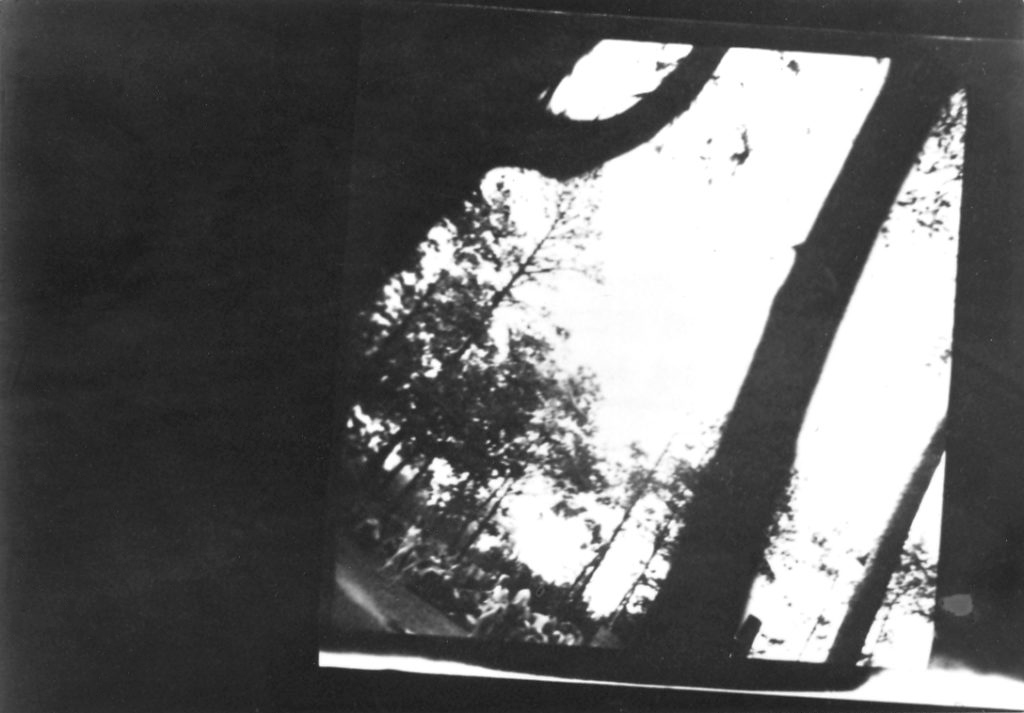
 

Eduardo Gil (Argentinian, b. 1948) 'Niños desaparecidos. Secunda Marcha de la Resistancia (Murdered children. Second Resistance March)' December 9-10 1982


Eduardo Gil (Argentinian, b. 1948)
Niños desaparecidos. Secunda Marcha de la Resistancia (Murdered children. Second Resistance March)
December 9-10 1982
Modern gelatin silver print
Eduardo Gil collection
© Eduardo Gil


Eduardo Gil was born in 1948 in Buenos Aires, Argentina. After studying sociology, he became a photographer. Self-taught and sensitive to social struggles, his commitment was linked to the establishment of the military dictatorship following the coup d’état of 24 March 1976. Working for the press and as an independent author, he made a series of reports on the political situation and social life of his country. He photographed in particular the second March for the Resistance in Buenos Aires on 9 and 10 December 1982. Organised at the call of the Mothers of the Place de Mai in tribute to the missing children during the dictatorship, the First march of the Resistance in 1981 ‘Is then reproduced every year until 2006, involving the entire society, including after the end of the dictatorship. Faced with the march, Eduardo Gil records the determined faces of the women, mothers and grandmothers of the children of Argentina, demonstrating to obtain answers on the fate of the disappeared. The use of black and white flattened the composition and accentuated the juxtaposition of the women’s faces with the banners and placards. The photographs of the children brandished by the demonstrators thus seem to merge in the procession. All appear in this sense more united than ever, stretched out towards us, as towards politics. Eduardo Gil seems to prove here that by recording the image of the missing among the living, photography itself is a force of uprising.

Text from the Jeu de Paume website translated by Google translate
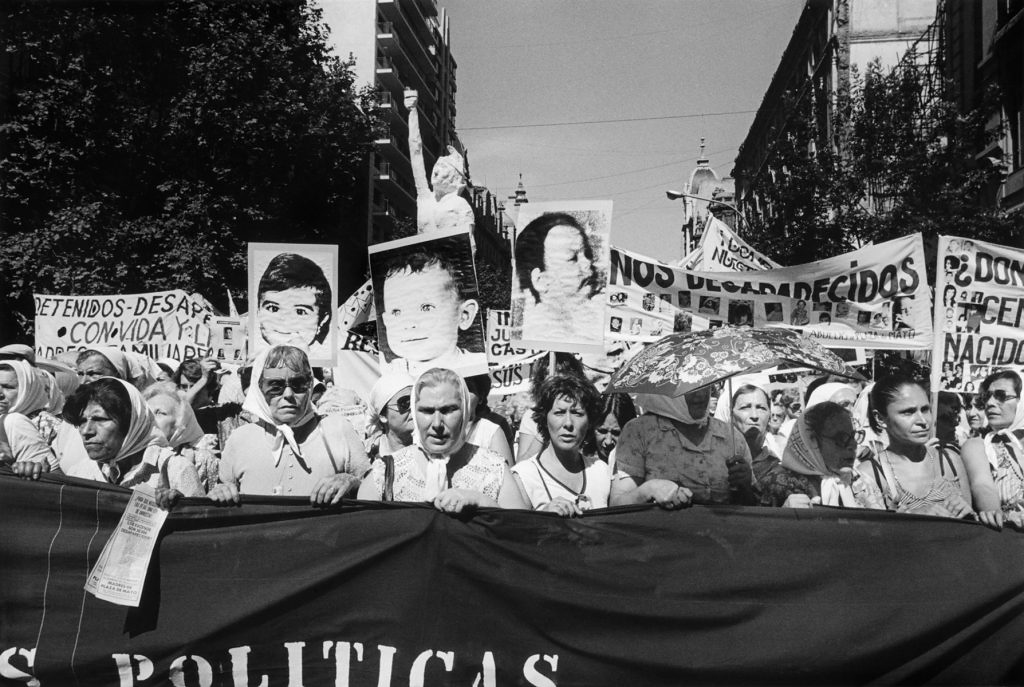
 

Francisca Benítez (Chilean, b. 1974) 'Garde l'Est' 2005


Francisca Benítez (Chilean, b. 1974)
Garde l’Est
2005
Still frame
Francisca Benitez collection
© Francisca Benítez
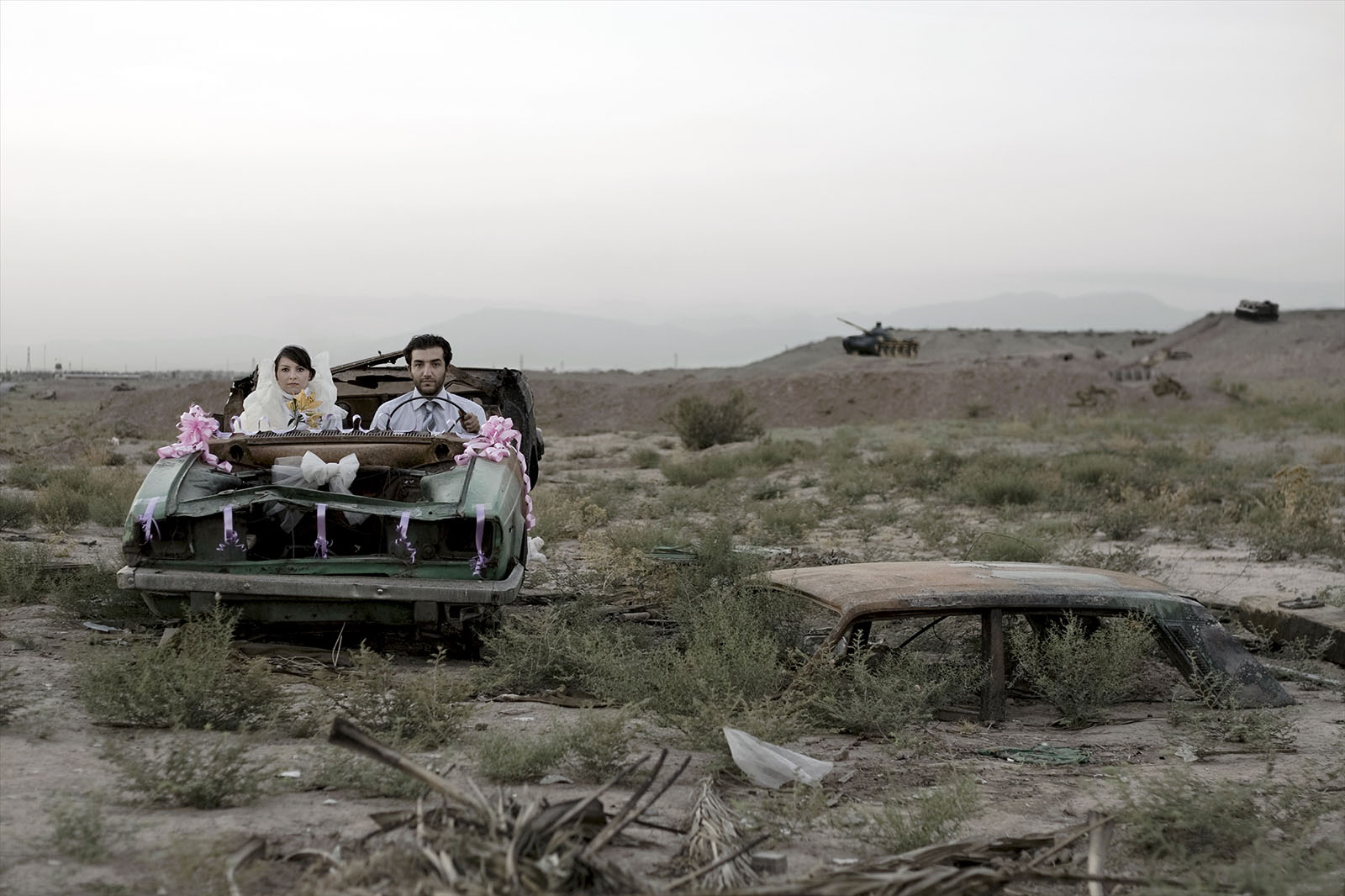
 

Gohar Dashti (Iranian, b. 1980) From the series 'Today's Life and War' 2008


Gohar Dashti (Iranian, b. 1980)
From the series Today’s Life and War
2008
Institut des Cultures d’Islam


The photographs of the Iranian artist Gohar Dashti’s Today’s Life and War show the daily life of a young couple against a background of war. Surrounded by tanks, bunkers and armed soldiers, the spouses live in the middle of the fields of ruins and continue to go about their occupations. Between impassivity and disillusionment, their attitudes show perseverance and unwavering determination to simply continue living. With these surreal scenes, the artist is witnessing a generation caught between the memories of ten years of war against Iraq and the permanent threat of conflict.


Pedro Motta (Brazilian, b. 1977) 'Natureza das coisas #024, (The nature of things #024)' 2013


Pedro Motta (Brazilian, b. 1977)
Natureza das coisas #024, (The nature of things #024)
From the “Natureza das coisas” series
2013
Mineral print on cotton paper
Private collection
Courtesy of the artist and gallery Bendana Pinel
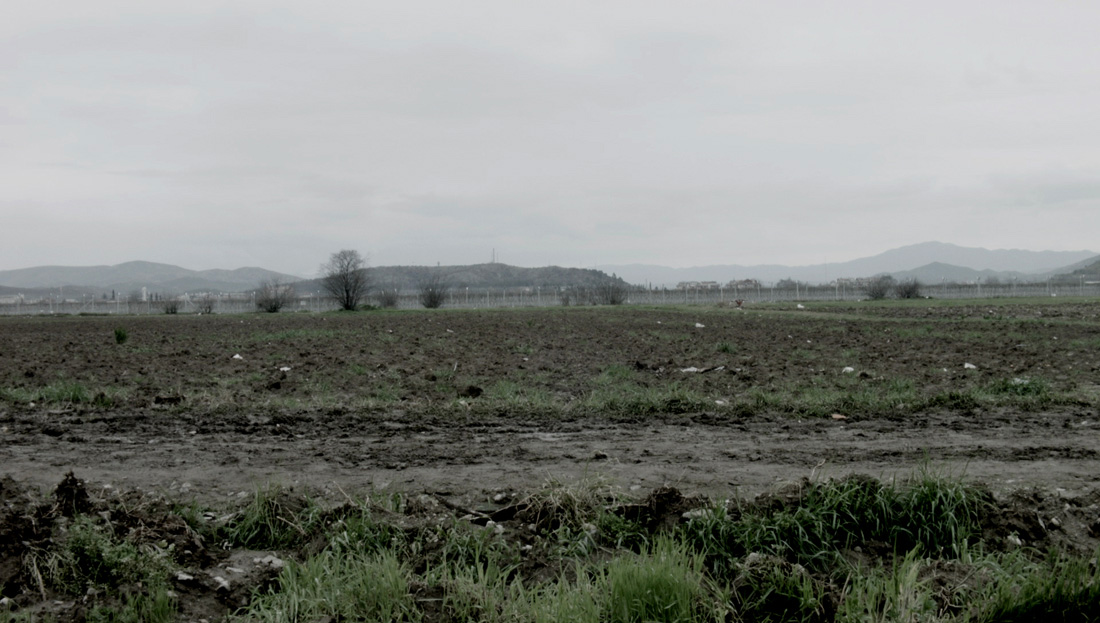
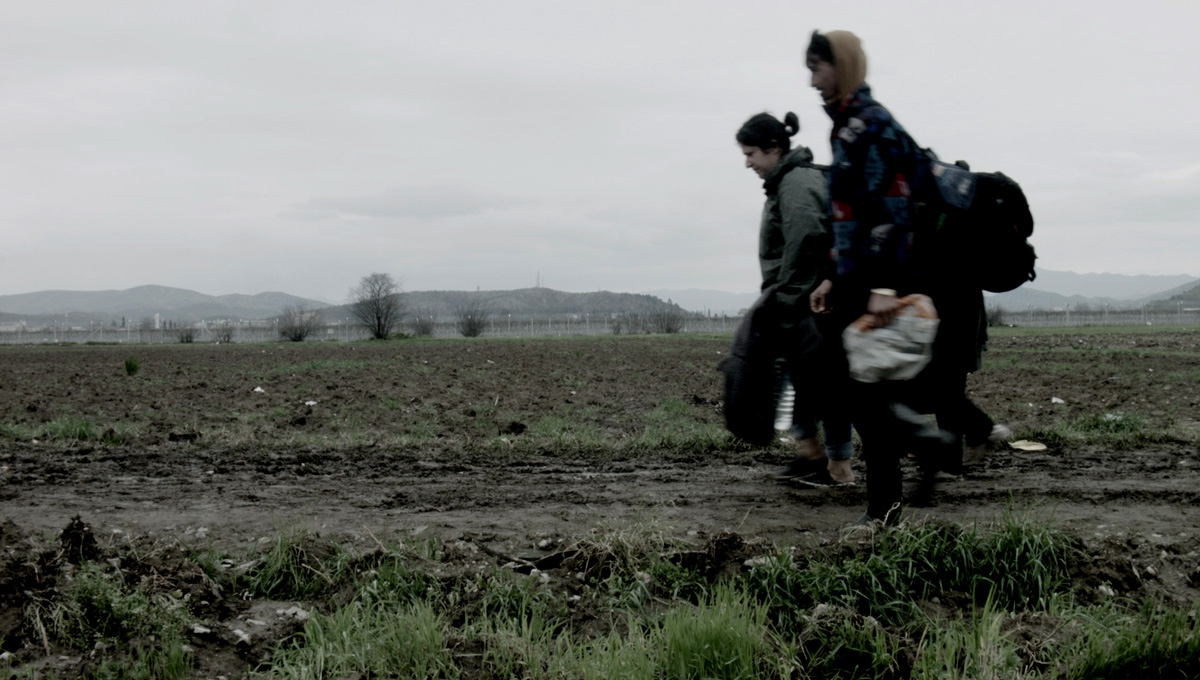
 

Maria Kourkouta (Greek, b. 1982) 'Idomeni, 14 mars 2016. Frontière gréco-macédonienne, (Idomeni, March 14, 2016. Greek-Macedonian border)' 2016

Maria Kourkouta (Greek, b. 1982) 'Idomeni, 14 mars 2016. Frontière gréco-macédonienne, (Idomeni, March 14, 2016. Greek-Macedonian border)' 2016


Maria Kourkouta (Greek, b. 1982)
Idomeni, 14 mars 2016. Frontière gréco-macédonienne, (Idomeni, March 14, 2016. Greek-Macedonian border)
2016
HD video loop: colour, sound, 36:00 min.
© Maria Kourkouta. Production: Jeu de Paume, Paris


Jeu de Paume
1, Place de la Concorde
75008 Paris
métro Concorde
Phone: 01 47 03 12 50

Opening hours:
Tuesday: 11.00 – 21.00
Wednesday – Sunday: 11.00 – 19.00
Closed Monday

Jeu de Paume website

LIKE ART BLART ON FACEBOOK

Back to top

Exhibitions: ‘Beyond Eden: Polixeni Papapetrou’ / ‘Dutch masters of light: Hendrik Kerstens & Erwin Olaf’ / ‘Glamour stakes: Martin Parr’ at Monash Gallery of Art, Melbourne

Exhibition dates: 22nd October – 4th December, 2016


Installation view of 'Beyond Eden: Polixeni Papapetrou' at Monash Gallery of Art, Melbourne featuring three images from the series 'It's all about me' (2016)


Installation view of Beyond Eden: Polixeni Papapetrou at Monash Gallery of Art, Melbourne, featuring three images from the series It’s all about me (2016)
Photo: © Marcus Bunyan, the artist and the Monash Gallery of Art


There was hardly standing room at the opening of Beyond Eden: Polixeni Papapetrou at Monash Gallery of Art, Melbourne. As for car parking, I had to park the car on the grass out the back of the gallery it was so full. Inside, it was great to see Poli and the appreciative crowd really enjoyed her work.

It was the usual fair from the exhibition Glamour stakes: Martin Parr, a whirl of movement, colour, intensity – in the frenetic construction of the picture plane; in the feverish nature of encounter between camera and subject – and obnoxious detail in photographs from the series Luxury (2003-2009). Low depth of field, flash photography, fabulous hats, and vibrant colours feature in images that ‘document leisure and consumption and highlight the unintentional, awkward and often ugly sides of beauty, fashion and wealth’. Sadly, after a time it all becomes a bit too predictable and repetitive.

The pick of the bunch in the exhibition Dutch masters of light: Hendrik Kerstens & Erwin Olaf was the work of Hendrik Kerstens. Simple, elegant portrait compositions that feature, and subvert, the aesthetics of 17th-century Dutch master paintings. I love the humour and disruption in the a/historical account, “the différance [which] simultaneously contains within its neo-graphism the activities of differing and deferring, a distancing acted out temporally as well as spatially.” (Geoffrey Batchen)

Dr Marcus Bunyan


Many thankx to Monash Gallery of Art for allowing me to publish the photographs in the posting. Please click on the photographs for a larger version of the image.


Installation view of 'Beyond Eden: Polixeni Papapetrou' at Monash Gallery of Art, Melbourne featuring three images from the series 'It's all about me' (2016)


Installation view of Beyond Eden: Polixeni Papapetrou at Monash Gallery of Art, Melbourne, featuring three images from the series It’s all about me (2016)
Photo: © Marcus Bunyan, the artist and the Monash Gallery of Art


Polixeni Papapetrou (Australian, 1960-2018) 'It's all about me' 2016 (installation view)


Polixeni Papapetrou (Australian, 1960-2018)
It’s all about me (installation view)
2016
From the series It’s all about me
Pigment ink-jet print
Collection of the artist
Photo: © Marcus Bunyan, the artist and the Monash Gallery of Art


Polixeni Papapetrou (Australian, 1960-2018) 'Ask me again when I'm drunk' (installation view) 2016 from the series 'It's all about me' 2016


Polixeni Papapetrou (Australian, 1960-2018)
Ask me again when I’m drunk (installation view)
2016
From the series It’s all about me
Pigment ink-jet print
Collection of the artist
Photo: © Marcus Bunyan, the artist and the Monash Gallery of Art


It’s all about me comprises five photographs of the artist’s daughter wearing doll-like masks and sporting a series of T-shirts bearing sassy slogans. As in much of Papapetrou’s work, the aesthetic of role-playing is used to suggest an awkward relationship between social appearances and an authentic self. These works specifically explore the complex world that contemporary teenage live in and the way identities are created and manipulated through fashion, social media and the internet. In this respect, the gauche quality of the photographs reflects the awkward self-importance of teenagers reaching for adulthood.


Installation view of 'Beyond Eden: Polixeni Papapetrou' at Monash Gallery of Art, Melbourne featuring photographs from the series 'Eden' (2016)

Installation view of 'Beyond Eden: Polixeni Papapetrou' at Monash Gallery of Art, Melbourne featuring photographs from the series 'Eden' (2016)

Installation view of 'Beyond Eden: Polixeni Papapetrou' at Monash Gallery of Art, Melbourne featuring photographs from the series 'Eden' (2016)

Installation view of 'Beyond Eden: Polixeni Papapetrou' at Monash Gallery of Art, Melbourne featuring photographs from the series 'Eden' (2016)

Installation view of 'Beyond Eden: Polixeni Papapetrou' at Monash Gallery of Art, Melbourne featuring photographs from the series 'Eden' (2016)

Installation view of 'Beyond Eden: Polixeni Papapetrou' at Monash Gallery of Art, Melbourne featuring photographs from the series 'Eden' (2016)


Installation views of Beyond Eden: Polixeni Papapetrou at Monash Gallery of Art, Melbourne, featuring photographs from the series Eden (2016)
Photos: © Marcus Bunyan, the artist and the Monash Gallery of Art


Polixeni Papapetrou (seated) surrounded by friends, family and well wishers at the opening of her exhibition 'Beyond Eden: Polixeni Papapetrou' at Monash Gallery of Art, Melbourne


Polixeni Papapetrou (seated) surrounded by friends, family and well wishers at the opening of her exhibition Beyond Eden: Polixeni Papapetrou at Monash Gallery of Art, Melbourne
Photo: © Marcus Bunyan, the artist and the Monash Gallery of Art


Beyond Eden: Polixeni Papapetrou

Polixeni Papapetrou is a Melbourne-based photographic artist. She first began taking photographs in the 1980s, creating documentary-style portraits of drag queens, body builders and Elvis fans. Soon after the birth of her first child, Papapetrou’s artistic practice began to focus on projects that employed her children, Olympia and Solomon, as models. She is now known nationally and internationally for her staged images that show her children dressed in costumes and masks while performing in front of real and imaginary backgrounds.

This exhibition brings together three recent bodies of work by Papapetrou: Lost psyche (2014), It’s all about me (2016) and Eden (2016). Each of these studio-based series explores themes that have been central to Papapetrou’s practice for the past 30 years. In particular, they highlight her long-term interest in social identity being elaborated through the processes of role-playing and performance.

It is important to note that Papapetrou composes her photographs using a range of historical and contemporary references, thereby embedding these staged performances in a network of competing forces. As a result, there is often a purposefully awkward style to the images, which suggests that identity is continually being inherited, negotiated and perpetuated through the history of representation.

As with much of Papapetrou’s work, the series included in this exhibition either partly or wholly feature the artist’s children, who are now in their late teenage years. By photographing her children and at the same time concealing their identities, Papapetrou is able to create portraits that are grounded in her personal experience of parenting but reflect on more universal themes of childhood innocence and the transience of life.

Text from the Monash Gallery of Art website


Polixeni Papapetrou (Australian, 1960-2018) 'Flora' 2016


Polixeni Papapetrou (Australian, 1960-2018)
Flora
2016
From the series Eden
Pigment print
127.3 x 85cm
Courtesy of the artist and STILLS Gallery, Sydney


In Roman mythology, Flora (Latin: Flōra) was a Sabine-derived goddess of flowers and of the season of spring – a symbol for nature and flowers (especially the may-flower). While she was otherwise a relatively minor figure in Roman mythology, being one among several fertility goddesses, her association with the spring gave her particular importance at the coming of springtime, as did her role as goddess of youth. Her name is derived from the Latin word “flos” which means “flower”. In modern English, “Flora” also means the plants of a particular region or period.


Polixeni Papapetrou (Australian, 1960-2018) 'Blinded' from 'Eden', 2016


Polixeni Papapetrou (Australian, 1960-2018)
Blinded
2016
From the series Eden
Pigment print
127.3 x 85cm
Courtesy of the artist and STILLS Gallery, Sydney


Polixeni Papapetrou (Australian, 1960-2018) 'Eden' 2016


Polixeni Papapetrou (Australian, 1960-2018)
Eden
2016
From the series Eden
Pigment print
127.3 x 85cm
Courtesy of the artist and STILLS Gallery, Sydney


Installation view of 'Dutch masters of light: Hendrik Kerstens and Erwin Olaf' at Monash Gallery of Art, Melbourne, featuring photographs Irwin Olaf's 'Keyhole' series (2012)


Installation view of Dutch masters of light: Hendrik Kerstens and Erwin Olaf at Monash Gallery of Art, Melbourne, featuring photographs Irwin Olaf’s Keyhole series
Photo: © Marcus Bunyan, the artist and the Monash Gallery of Art


Installation view of 'Dutch masters of light: Hendrik Kerstens and Erwin Olaf' at Monash Gallery of Art, Melbourne featuring at left, Irwin Olaf's 'Keyhole 7' (2012); and at right, 'Keyhole 12' (2012)


Installation view of Dutch masters of light: Hendrik Kerstens and Erwin Olaf at Monash Gallery of Art, Melbourne featuring at left, Irwin Olaf’s Keyhole 7 (2012); and at right, Keyhole 12 (2012)
Photo: © Marcus Bunyan, the artist and the Monash Gallery of Art


Erwin Olaf (Netherlands, 1959-2023) 'Keyhole 3' 2011


Erwin Olaf (Netherlands, 1959-2023)
Keyhole 3
2011
From the Keyhole series
Chromogenic print
62.5 x 50.0cm
Courtesy of the artist


Installation view of 'Dutch masters of light: Hendrik Kerstens and Erwin Olaf' at Monash Gallery of Art, Melbourne featuring the work of Hendrik Kerstens


Installation view of Dutch masters of light: Hendrik Kerstens and Erwin Olaf at Monash Gallery of Art, Melbourne featuring the work of Hendrik Kerstens
Photo: © Marcus Bunyan, the artist and the Monash Gallery of Art


Hendrik Kerstens (Dutch, b. 1956) 'Bathing cap' 1992


Hendrik Kerstens (Dutch, b. 1956)
Bathing cap
1992
Ink-jet print 62.5 x 50.0cm
Courtesy of the artist


Installation view of 'Dutch masters of light: Hendrik Kerstens and Erwin Olaf' at Monash Gallery of Art, Melbourne featuring the work of Hendrik Kerstens with at left, 'Re rabbit IV' (2009); and in centre, 'Doilly' (2011)


Installation view of Dutch masters of light: Hendrik Kerstens and Erwin Olaf at Monash Gallery of Art, Melbourne featuring the work of Hendrik Kerstens with at left, Re rabbit IV (2009); and in centre, Doilly (2011)
Photo: © Marcus Bunyan, the artist and the Monash Gallery of Art


Installation view of 'Dutch masters of light: Hendrik Kerstens and Erwin Olaf' at Monash Gallery of Art, Melbourne featuring the work of Hendrik Kerstens with at left, 'Bag' (2007); and at right, 'Paper roll' (2008)


Installation view of Dutch masters of light: Hendrik Kerstens and Erwin Olaf at Monash Gallery of Art, Melbourne featuring the work of Hendrik Kerstens with at left, Bag (2007); and at right, Paper roll (2008)
Photo: © Marcus Bunyan, the artist and the Monash Gallery of Art


Installation view of 'Dutch masters of light: Hendrik Kerstens and Erwin Olaf' at Monash Gallery of Art, Melbourne featuring the work of Hendrik Kerstens with at left, 'Naturel' (1999); and at right, 'Wet' (2002)


Installation view of Dutch masters of light: Hendrik Kerstens and Erwin Olaf at Monash Gallery of Art, Melbourne featuring the work of Hendrik Kerstens with at left, Naturel (1999); and at right, Wet (2002)
Photo: © Marcus Bunyan, the artist and the Monash Gallery of Art


Hendrik Kerstens (Dutch, b. 1956) 'Re rabbit IV' 2009 (installation view)


Hendrik Kerstens (Dutch, b. 1956)
Re rabbit IV (installation view)
2009
Ink-jet print
62.5 x 50.0cm
Collection of the artist
Photo: © Marcus Bunyan, the artist and the Monash Gallery of Art


Dutch masters of light: Hendrik Kerstens and Erwin Olaf

This exhibition features work by the internationally acclaimed Dutch photographers, Hendrik Kerstens and Erwin Olaf. These photographers both create images that reflect an interest in paintings by Dutch Masters such as Rembrandt (1606-1669) and Vermeer (1632-1675). This is particularly evident in their manipulation of light and shade and also in their poetic use of everyday subject matter. Drawing on aesthetics of the past while also incorporating aspects of the present, these photographers create emotionally charged portraits that draw attention to the liminal nature of contemporary life.

Hendrik Kerstens took up photography in 1995 and has since been creating portraits of his daughter, Paula. His photographs began as documents and reflections on the fleeting nature of childhood. He later introduced the aesthetics of 17th-century Dutch master paintings to his portraits, creating a dialogue between painting and photography and between the past and the present.

Erwin Olaf is a multidisciplinary artist who is best known for his highly polished staged photographs that draw on his experiences of everyday life. His refined style and meticulous technique relate his background as a commercial photographer; and his use of light is inspired by painting. The subjects of his Keyhole series turn their gaze away from the camera in a way that evokes feelings of shame and humility.

Dutch masters of light: Hendrik Kerstens and Erwin Olaf is part of a series of events that mark the 400th anniversary of the first Dutch contact with Western Australia. On 25 October 1616, Dirk Hartog made landfall with his ship the Eendracht at Dirk Hartog Island, in the Shark Bay area.

Text from the Monash Gallery of Art website


Hendrik Kerstens (Dutch, b. 1956) 'Bag' 2007


Hendrik Kerstens (Dutch, b. 1956)
Bag
2007
Ink-jet print
62.5 x 50.0cm
Collection of the artist


Hendrik Kerstens (Dutch, b. 1956) 'Cosy' 2012


Hendrik Kerstens (Dutch, b. 1956)
Cosy
2012
Ink-jet print
62.5 x 50.0cm
Collection of the artist


Martin Parr (British, 1952-2025) 'Australia, Melbourne' 2006 (installation view)


Martin Parr (British, 1952-2025)
Australia, Melbourne (installation view)
2006
From the series Luxury
Pigment ink-jet print
50.8 x 76.2cm
Photo: © Marcus Bunyan, the artist and the Monash Gallery of Art


Martin Parr (British, 1952-2025) 'Australia, Melbourne' 2008


Martin Parr (British, 1952-2025)
Australia, Melbourne
2008
From the series Luxury
Pigment ink-jet print
50.8 x 76.2cm
Courtesy of the artist and Niagara Galleries (Melbourne)


Installation view of 'Glamour stakes: Martin Parr' at Monash Gallery of Art, Melbourne with work from the series 'Luxury'


Installation view of Glamour stakes: Martin Parr at Monash Gallery of Art, Melbourne with work from the series Luxury
Photo: © Marcus Bunyan, the artist and the Monash Gallery of Art


Installation view of 'Glamour stakes: Martin Parr' at Monash Gallery of Art, Melbourne with work from the series 'Luxury'

Installation view of 'Glamour stakes: Martin Parr' at Monash Gallery of Art, Melbourne with work from the series 'Luxury'

Installation view of 'Glamour stakes: Martin Parr' at Monash Gallery of Art, Melbourne with work from the series 'Luxury'

Installation view of 'Glamour stakes: Martin Parr' at Monash Gallery of Art, Melbourne with work from the series 'Luxury'


Installation views of Glamour stakes: Martin Parr at Monash Gallery of Art, Melbourne with work from the series Luxury: Australia, Melbourne 2008
Photos: © Marcus Bunyan, the artist and the Monash Gallery of Art


Glamour stakes: Martin Parr

Martin Parr was born in Surrey in the United Kingdom in 1952. He studied photography at Manchester Polytechnic from 1970-73 and held his first exhibition the following year. He has since developed an international reputation as a photographer, filmmaker and curator and has been a full member of Magnum Photos since 1994.

Parr is known for his satirical social documentary photography. Focusing on particular aspects of contemporary consumer culture, he produces images that are a combination of the mundane and the bizarre. He uses the language of commercial photography, creating an aesthetic that is bright, colourful and seductive. However, his images often inspire viewers to cringe or laugh.

Glamour stakes: Martin Parr shows a selection of works from Parr’s Luxury series. This series is comprised of images taken predominantly between 2003 and 2009 in multiple destinations around the world. While creating Luxury, Parr photographed what he describes as ‘situations where people are comfortable showing off their wealth’, such as art fairs, car shows and horse races. The series is indicative of Parr’s practice in that the images document leisure and consumption and highlight the unintentional, awkward and often ugly sides of beauty, fashion and wealth.

The images in this series are not only documents but also critical and humorous reflections on contemporary society. By turning his camera to the world of luxury, Parr invites viewers to consider the sustainability of a culture that constantly demands the latest styles in fashion and the newest luxury items. This exhibition focuses specifically on Parr’s images of horse-racing events, particularly those taken in Melbourne in 2008.

Text from the Monash Gallery of Art website


Martin Parr (British, 1952-2025) 'Australia, Melbourne' 2008


Martin Parr (British, 1952-2025)
Australia, Melbourne
2008
From the series Luxury
Pigment ink-jet print
50.8 x 76.2cm
Courtesy of the artist and Niagara Galleries (Melbourne)


Martin Parr (British, 1952-2025) 'Australia, Melbourne' 2008


Martin Parr (British, 1952-2025)
Australia, Melbourne
2008
From the series Luxury
Pigment ink-jet print
50.8 x 76.2cm
Courtesy of the artist and Niagara Galleries (Melbourne)


Martin Parr (British, 1952-2025) 'Australia, Melbourne' 2008


Martin Parr (British, 1952-2025)
Australia, Melbourne
2008
From the series Luxury
Pigment ink-jet print
50.8 x 76.2cm
Courtesy of the artist and Niagara Galleries (Melbourne)


Martin Parr (British, 1952-2025) 'Australia, Melbourne' 2008


Martin Parr (British, 1952-2025)
Australia, Melbourne
2008
From the series Luxury
Pigment ink-jet print
50.8 x 76.2cm
Courtesy of the artist and Niagara Galleries (Melbourne)


Martin Parr (British, 1952-2025) 'Australia, Melbourne' 2008


Martin Parr (British, 1952-2025)
Australia, Melbourne
2008
From the series Luxury
Pigment ink-jet print
50.8 x 76.2cm
Courtesy of the artist and Niagara Galleries (Melbourne)


Installation view of 'Glamour stakes: Martin Parr' at Monash Gallery of Art, Melbourne with work from the series 'Luxury': showing at right, 'South Africa, Durban' 2003

Installation view of 'Glamour stakes: Martin Parr' at Monash Gallery of Art, Melbourne with work from the series 'Luxury': at right, 'South Africa, Durban' 2003


Installation views of Glamour stakes: Martin Parr at Monash Gallery of Art, Melbourne with work from the series Luxury: at right, South Africa, Durban 2003
Photo: © Marcus Bunyan, the artist and the Monash Gallery of Art


Martin Parr (British, 1952-2025) 'South Africa, Durban' 2005


Martin Parr (British, 1952-2025)
South Africa, Durban
2005
From the series Luxury
Pigment ink-jet print
101.6 x 152.4cm
Courtesy of the artist and Niagara Galleries (Melbourne)


Martin Parr (British, 1952-2025) 'England, Ascot' 2003


Martin Parr (British, 1952-2025)
England, Ascot
2003
From the series Luxury
Pigment ink-jet print
101.6 x 152.4cm
Courtesy of the artist and Niagara Galleries (Melbourne)


Monash Gallery of Art
860 Ferntree Gully Road, Wheelers Hill
Victoria 3150 Australia
Phone: + 61 3 8544 0500

Opening hours:
Tue – Fri: 10am – 5pm
Sat – Sun: 10pm – 4pm
Mon/public holidays: closed

Monash Gallery of Art website

LIKE ART BLART ON FACEBOOK

Back to top

Exhibition: ‘London Calling: Bacon, Freud, Kossoff, Andrews, Auerbach, and Kitaj’ at the J. Paul Getty Museum, Getty Centre, Los Angeles

Exhibition dates: 26th July – 13th November, 2016

Curators: Timothy Potts, director of the J. Paul Getty Museum; Julian Brooks, curator of Drawings at the Getty Museum; and Elena Crippa , curator, Modern and Contemporary British Art at Tate.


Francis Bacon (British born Ireland, 1909-1992) 'Figure in a Landscape' c. 1952 from the exhibition 'London Calling: Bacon, Freud, Kossoff, Andrews, Auerbach, and Kitaj' at the J. Paul Getty Museum, Getty Centre, Los Angeles, July - Nov, 2016


Francis Bacon (British born Ireland, 1909-1992)
Figure in a Landscape
c. 1952
Oil on paper
33.9 × 26.3cm (13 3/8 × 10 3/8 in.)
Tate: Purchased with assistance from the National Lottery through the Heritage Lottery Fund, the Art Fund and a group of anonymous donors in memory of Mario Tazzoli 1998
© The Estate of Francis Bacon. All rights reserved. / DACS, London / ARS, NY 2016
Photo: © Tate, London 2016


While there are a selection of non-figurative paintings in this exhibition, I decided to focus this posting on the figurative work. It seemed a logical and strong thematic choice.

I love these British artists. They get to the essence of contemporary life and portray it in an embodied, emboldened way. As curator Julian Brooks observes, “By pursuing painting as an activity that records and revitalizes an intense sensory experience, these artists rendered the frailty and vitality of the human condition, translating life into art and reinventing the way in which their surroundings could be represented.”

For me, the fluidity and gravitas of the Bacon drawings are a standout, as are the distended faces of the early Freud paintings. It’s almost as if the artist had a fish eye lens to observe his sitters; apparently his approach to them at this time had distinct psychological and spatial aspects, as most of the work in this exhibition does. “The artist admits his early portraits emerged from his ‘visual aggression’ with sitters. He claimed, ‘I would sit very close and stare. It could be uncomfortable for both of us’.” Photography and film have a distinctive influence upon these artists.

Nearly all of the works radiate an evocative psychological intensity. These are feelings about life and the world that come from deep within and… erupt and explode into life. Whether controlled realism (Freud) or molten accretions (Auerbach) these essential works challenge how we inhabit the world and how we see that in/habit-ation. Demons, refugees, murder, rape, suicide (George Dyer), illness, building sites, fascist grotesque bather, surreal-automatic women, nude, self-portrait are all grist to the mill – helping portray certain philosophical or fundamental truths extant to the human condition. The body is destablised in space and destabilised in the landscape of human existence. Anything is possible as long as the artist (and we) recognise it and represent it as such.

These palimpsestic paintings superimpose a new rendition on earlier writings of the body (Velázquez, Titian, Muybridge, Durer etc…). They contain within them the very DNA of our being, now effaced, reused and altered but still bearing visible traces of its earlier form. These are deep and timeless paintings which upset our apparently secure equilibrium through the representation of a fundamental understanding of life in this very moment. Ego. Self. Other. Culture. Existence. They hold up a mirror to things that we would rather not see, an outsiders (mis)recognition of all that has gone before and all that is to come.

Dr Marcus Bunyan


Many thankx to the J. Paul Getty Museum for allowing me to publish the photographs in the posting. Please click on the photographs for a larger version of the image.


Francis Bacon (British born Ireland, 1909-1992) 'Figure with Left Arm Raised, No. 2' c. 1957-1961 from the exhibition 'London Calling: Bacon, Freud, Kossoff, Andrews, Auerbach, and Kitaj' at the J. Paul Getty Museum, Getty Centre, Los Angeles, July - Nov, 2016


Francis Bacon (British born Ireland, 1909-1992)
Figure with Left Arm Raised, No. 2
c. 1957-1961
Oil on paper
34 × 27cm (13 3/8 × 10 5/8 in.)
Tate
Purchased with assistance from the National Lottery through the Heritage Lottery Fund, the Art Fund and a group of anonymous donors in memory of Mario Tazzoli 1998
© The Estate of Francis Bacon. All rights reserved. / DACS, London / ARS, NY 2015
Photo: © Tate, London 2016


From the 1940s through the 1980s, a prominent group of London-based artists developed new styles and approaches to depicting the human figure and the landscape. These painters resisted the abstraction, minimalism, and conceptualism that dominated contemporary art at the time, instead focusing on depicting contemporary life through innovative figurative works.

On view at the J. Paul Getty Museum from July 26 to November 13, 2016, London Calling: Bacon, Freud, Kossoff, Andrews, Auerbach, and Kitaj represents the first major American museum exhibition to explore the leaders of this movement, often called the “School of London,” as central to a richer and more complex understanding of 20th century painting. The exhibition includes 80 paintings, drawings, and prints by Francis Bacon, Lucian Freud, Leon Kossoff, Michael Andrews, Frank Auerbach, and R.B. Kitaj.

“The majority of paintings and drawings in the Getty Museum’s collection are fundamentally concerned with the rendition of the human figure and landscape up to 1900,” says Timothy Potts, director of the J. Paul Getty Museum and one of the exhibition curators. “This significant exhibition shows an important part of ‘what happened next’, highlighting an innovative group of figurative artists at a time when abstraction dominated avant-garde discourse in the U.S. and much of Europe. Working with our partners at Tate in London, we have brought together a fabulous group of pictures that exemplify the radical approaches to figure and landscape pioneered by this influential coterie of artists, illuminating their crucial place in modern art history.”

London Calling is a collaboration between Tate and the J. Paul Getty Museum and is curated by Julian Brooks, curator of Drawings at the Getty Museum, Timothy Potts, and Elena Crippa, curator, Modern and Contemporary British Art at Tate. Drawn largely from the unrivalled holdings of Tate, the exhibition has been enriched by a number of loans from other museums and private collectors.

“By pursuing painting as an activity that records and revitalises an intense sensory experience, these artists rendered the frailty and vitality of the human condition, translating life into art and reinventing the way in which their surroundings could be represented,” said Brooks. “The ‘School of London’ artists doggedly pursued forms of figurative painting at a time when it was considered outmoded. In recent decades the work of these artists has rightly been reassessed. It is timely to look at them as a group and deepen our appreciation of their contribution.”

Francis Bacon (British, 1909-1992)

Francis Bacon was born in Dublin in 1909 to English parents. After traveling to Germany and France he settled in London. He received guidance from an older friend, the Australian artist Roy de Maistre, but was otherwise largely self-taught. In 1945, the showing of a number of his paintings at London’s Lefevre Gallery established his critical reputation, and he became central to an artistic milieu in Soho that included Lucian Freud and Michael Andrews. From the mid-1940s, he began taking as a starting point for his work reproductions of paintings, sculpture, photographs, and film stills, mostly relating to the imagery of angst that resonated with both historical and personal circumstances. From 1962 he expanded the range of his photographic sources by commissioning particular shots of models, mostly friends and lovers. For example, Portrait of Isabel Rawsthorne, 1966, on view in the exhibition, was based on a photo of his friend and regular subject, the artist Isabel Rawsthorne (1912-1992).

A highlight of the exhibition, Triptych – August 1972 forms part of a series of so-called “Black Triptychs,” which followed the suicide of Bacon’s longtime lover, George Dyer, in 1971. In the composition, Dyer appears on the left and Bacon himself is on the right. The image on the central panel is derived from a photograph of wrestlers by Eadweard Muybridge.

Bacon’s well-known Figure with Meat, 1954 belongs to a large series of works based on reproductions of Diego Velázquez’s Portrait of Pope Innocent X. In this version, Bacon depicts the Pope between two halves of a hanging animal carcass, a motif relating to the first portrait of Bacon taken by the photographer John Deakin, in 1952, in which the painter is stripped to the waist and holds a split carcass. In establishing a connection between the raw, butchered meat and human flesh, Bacon expresses a sense of emotional turmoil and reminds the viewer of the vulnerability of the human body.


Francis Bacon (British born Ireland, 1909-1992) 'Collapsed Figure' c. 1957-1961


Francis Bacon (British born Ireland, 1909-1992)
Collapsed Figure
c. 1957-1961
Oil on paper
34 × 27cm (13 3/8 × 10 5/8 in.)
Tate
Purchased with assistance from the National Lottery through the Heritage Lottery Fund, the Art Fund and a group of anonymous donors in memory of Mario Tazzoli 1998
© The Estate of Francis Bacon. All rights reserved. / DACS, London / ARS, NY 2015
Photo: © Tate, London 2016


Although no source has been identified it is likely that Collapsed Figure derived from sports photographs which, in a 1974 interview, Bacon specified as a valued stimulus: ‘I look all the time at photographs in magazines of footballers and boxers and all that kind of thing – especially boxers.’ He noted that he trawled them in the same way that he used Eadweard Muybridge’s stills of figures in motion.


Francis Bacon (British born Ireland, 1909-1992) 'Blue Crawling Figure, No. 1' c. 1957-1961


Francis Bacon (British born Ireland, 1909-1992)
Blue Crawling Figure, No. 1
c. 1957-1961
Oil on paper
34 × 27cm (13 3/8 × 10 5/8 in.)
Tate
Purchased with assistance from the National Lottery through the Heritage Lottery Fund, the Art Fund and a group of anonymous donors in memory of Mario Tazzoli 1998
© The Estate of Francis Bacon. All rights reserved. / DACS, London / ARS, NY 2015
Photo: © Tate, London 2016


These pages almost certainly came at the end of the dismembered sketchbook. They represent the most coherent programme of drawing through which Bacon explored compositional possibilities in a succession of images. The sense of structure of the body, as well as the degree of abstraction of form, are progressively modified across the ‘Crawling Figure’ images. They were probably achieved by tracing from one to the other. Although no related oil painting is known to survive, the extent to which the possibilities are explored testifies to the significant role of sketches within Bacon’s working process.

September 2004


Francis Bacon (British born Ireland, 1909-1992) 'Reclining Figure, No. 1' c. 1961


Francis Bacon (British born Ireland, 1909-1992)
Reclining Figure, No. 1
c. 1961
Oil and ink on paper
23.8 × 15.6cm (9 3/8 × 6 1/8 in.)
Tate
Purchased with assistance from the National Lottery through the Heritage Lottery Fund, the Art Fund and a group of anonymous donors in memory of Mario Tazzoli 1998
© The Estate of Francis Bacon. All rights reserved. / DACS, London / ARS, NY 2015
Photo: © Tate, London 2016


These two works on paper by Bacon are the only ones in the display in which the page has been filled. As the pose remains the same, they may have served as colour studies and may even be a response to Mark Rothko’s contemporary work (seen in London in 1959). The male nude, and the horizontal bands (derived from a sofa against a wall) are common to a series of Bacon’s oil  paintings from 1959 and 1961. The sketches appear to be later, as an impression of writing from another sheet but visible on ‘Reclining Figure, no.1’ gives his address as ‘7 Reece Mews’, the studio which he occupied in the autumn of 1961.

September 2004


Francis Bacon (British born Ireland, 1909-1992) 'Portrait of George Dyer Riding a Bicycle' 1966


Francis Bacon (British born Ireland, 1909-1992)
Portrait of George Dyer Riding a Bicycle
1966
Oil on canvas
198 x 147.5cm (77 15/16 x 58 1/16 in.)
Fondation Beyeler, Riehen/Basel, Beyeler Collection
© The Estate of Francis Bacon. All rights reserved. / DACS, London / ARS, NY 2016
Photo: Peter Schibli, Basel


Francis Bacon (British born Ireland, 1909-1992) 'Figure with Meat' 1954


Francis Bacon (British, born Ireland, 1909-1992)
Figure with Meat
1954
Oil on canvas
129.9 × 121.9cm (51 1/8 × 48 in.)
The Art Institute of Chicago, Harriott A. Fox Fund
© The Estate of Francis Bacon. All rights reserved. / DACS, London / ARS, NY 2016
Photo: © The Art Institute of Chicago


Francis Bacon (British born Ireland, 1909-1992) 'Study for Portrait II (after the Life Mask of William Blake)' 1955


Francis Bacon (British born Ireland, 1909-1992)
Study for Portrait II (after the Life Mask of William Blake)
1955
Oil on canvas 61 × 50.8cm (24 × 20 in.)
Tate
Purchased 1979
© The Estate of Francis Bacon. All rights reserved. / DACS, London / ARS, NY 2015
Photo: © Tate, London 2016


This is one of a series based on the life mask of poet and painter William Blake. Bacon first saw the mask at the National Portrait Gallery in London, but he also used photographs and, at some point, he even acquired a cast of it. His response to the source is typical of his preference for a mediated image of the body. The painting is more complex than it seems: it is built up with delicate layers of paint against a rich black ground. One commentator wrote, ‘broad strokes of pink and mauve, with which Bacon establishes an equivocation between waxen mask and human flesh, drag pain and loneliness and imperturbable spirit in their wake’.

May 2007


Francis Bacon (British born Ireland, 1909-1992) 'Portrait of Isabel Rawsthorne' 1966


Francis Bacon (British born Ireland, 1909-1992)
Portrait of Isabel Rawsthorne
1966
Oil on canvas
81.3 × 68.6cm (32 × 27 in.)
Tate
Purchased 1966
© The Estate of Francis Bacon. All rights reserved. / DACS, London / ARS, NY 2016
Photo: © Tate, London 2016


Francis Bacon (British born Ireland, 1909-1992) 'Triptych August 1972' 1972


Francis Bacon (British born Ireland, 1909-1992)
Triptych August 1972
1972
Oil and sand on three canvases
Each 198.1 × 147.3cm (78 × 58 in.)
Tate
Purchased 1980
© The Estate of Francis Bacon. All rights reserved. / DACS, London / ARS, NY 2016
Photo: © Tate, London 2016


This work is generally considered one in a series of Black Triptychs which followed the suicide of Bacon’s lover, George Dyer. Dyer appears on the left and Bacon is on the right. The central group is derived from a photograph of wrestlers by Edward Muybridge, but also suggests a more sexual encounter. The seated figures and their coupling are set against black voids and the central flurry has been seen as ‘a life-and death struggle’. The artist’s biographer wrote: ‘What death has not already consumed seeps incontinently out of the figures as their shadows.’

September 2016


Lucian Freud (British born Germany, 1922-2011) 'Man with a Thistle (Self-Portrait)' 1946


Lucian Freud (British born Germany, 1922-2011)
Man with a Thistle (Self-Portrait)
1946
Oil on canvas
61 × 50.2cm (24 × 19 3/4 in.)
Tate
Purchased 1961
© Lucian Freud Archive / Bridgeman Copyright Service
Photo: © Tate, London 2016


This is one of a number of self-portraits painted by Freud during the 1940s. Freud has used a realistic, but emblematic, style which derives from Old Master paintings of the Northern Renaissance. The artist shows himself looking through a window at a spiky thistle resting on a ledge in the foreground. At the same time, the thistle may also be read as an emblem occupying flattened space at the bottom of the painting. This ambiguity allows the thistle to be interpreted as a real object, but also as a device which suggests the mood of the painting and Freud’s own psychological state.

September 2004


Lucian Freud (British born Germany, 1922-2011) 'Girl with a Kitten' 1947


Lucian Freud (British born Germany, 1922-2011)
Girl with a Kitten
1947
Oil on canvas
41 × 30.7 × 1.8cm (16 1/8 × 12 1/16 × 11/16 in.)
Tate
Bequeathed by Simon Sainsbury 2006, accessioned 2008
© Lucian Freud Archive / Bridgeman Copyright Service
Photo: © Tate, London 2016


In 1946-7 Freud traveled to Paris and Greece, returning to London in February 1947. Here he began a relationship with Kitty Garman, the eldest daughter of the sculptor Jacob Epstein and the model and collector Kathleen Garman. The subsequent marriage between Freud and Kitty was short-lived – they wed in the spring of 1948 and divorced in 1952 after having two daughters. Freud’s portraits of Kitty include four oil paintings – beginning with Girl in a Dark Jacket 1947 and finishing with Girl with a White Dog 1950-1 (Tate N06039) – as well as two etchings, a work in pastel, and a drawing in ink and crayon.

The portraits of Kitty Garman mark the culmination of Freud’s early portrait style, which evoked the tradition of Neue Sachlichkeit (New Objectivity) – a form of realist painting that emerged in Germany in the early 1920s, and was characterised by its sharp and unsentimental style. (Freud, grandson of the psychoanalyst Sigmund Freud, was born in Berlin in 1922 and came to Britain in 1933, and studied at a number of art schools during the war.) The intensity of Girl with a Kitten, and especially the manner in which Garman dominates the pictorial frame, might also stem from Freud’s approach to his sitters at this time, which had distinct psychological and spatial aspects. The artist admits his early portraits emerged from his ‘visual aggression’ with sitters. He claimed, ‘I would sit very close and stare. It could be uncomfortable for both of us.’ (Quoted in Michael Auping, ‘Freud from America’, in Howgate, Auping and Richardson 2012, p. 41.) By the mid-1950s Freud had abandoned the highly controlled style of portraiture seen in this work, and he began to paint in a looser and more viscous style.

Lee Hallman. “Girl with a Kitten,” on the Tate website January 2014 [Online] Cited 17/02/2023


Lucian Freud (British born Germany, 1922-2011) 'Narcissus' 1948


Lucian Freud (British born Germany, 1922-2011)
Narcissus
1948
Ink on paper
Image: 21 × 13.7cm (8 1/4 × 5 3/8 in.)
Framed: 36 × 28.9 × 2.9cm (14 3/16 × 11 3/8 × 1 1/8 in.)
Tate
Bequeathed by Pauline Vogelpoel, Director of the Contemporary Art Society, 2002, accessioned 2004
© Lucian Freud Archive / Bridgeman Copyright Service Photo
© Tate, London 2016


In the late 1940s the publishers MacGibbon & Kee commissioned Freud to illustrate Rex Warner’s book Men and Gods on classical mythology. He produced four drawings for the book, of which Narcissus is one. The others are Man of Hyacinths (Colin St John Wilson Collection), Hercules (private collection) and Actaeon (private collection). The figures in all the drawings are in modern dress. The publishing house rejected the drawings because they did not illustrate the stories sufficiently, and instead chose Elizabeth Corsellis’s drawings for the book, which was published in 1950. Freud made illustrations for several other books during the 1940s, though few were ever selected for publication.

The close-up view and tight framing of Narcissus are typical of Freud’s many portraits of this early period, which frequently emphasize the subjects’ large, almond-shaped eyes. These are depicted in a meditative mood looking down, as in Narcissus, or looking upwards and away from the viewer. Reflection and mirroring were to become recurring themes in Freud’s work, particularly in his many self-portraits. The pose portrayed in Narcissus is later echoed in the painting Man’s Head (Self-Portrait I) 1963 (Whitworth Art Gallery, Manchester) in which the artist’s head, propped with one arm cutting aggressively into the frame, looks down at a mirror not included in the work. Another self-portrait, Interior with Hand Mirror (Self-Portrait) 1967 (private collection), shows the artist’s face isolated in a hand mirror propped between two sections of window. His expression is contorted in a winking grimace as though he is attempting to see, a reminder that viewing is central to Freud’s process as a painter. In this image the mirror’s cropping has cut off the viewing part of him from his body. In a similar manner, Narcissus shows the subject cut off from the viewer by the exclusion of his viewing eyes, omitted from the bottom of the image. A more recent image, the print Self-Portrait: Reflection 1996 (Tate P11509), again refers to this circular process of mirroring and interior looking which is emphasised in its title.

Elizabeth Manchester. “Narcissus,” on the Tate website March 2005 [Online] Cited 17/02/2023


Lucian Freud (British born Germany, 1922-2011) 'Boy Smoking' 1950-1951


Lucian Freud (British born Germany, 1922-2011)
Boy Smoking
1950-1951
Oil on copper
15.5 × 11.5 × 0.2cm (6 1/8 × 4 1/2 × 1/16 in.)
Tate
Bequeathed by Simon Sainsbury 2006, accessioned 2008
© Lucian Freud Archive / Bridgeman Copyright Service
Photo © Tate, London 2016


The painting was made by the British artist Lucian Freud in his studio in London in 1950. To create this work Freud took a used copper etching plate and prepared it with a thick layer of white primer. He then employed sable paintbrushes (as opposed to hogshair, which he would use almost exclusively from 1956 onwards) to apply a smoothly blended mixture of oil paint and tempera to the copper plate in fine, even brushstrokes. The white primer was left exposed by Freud to produce the lighter areas of the painting, except for the very brightest parts, which he created using a fresh application of white paint. Freud used thin washes of grey and brown underpaint to create areas of shadow around the boy’s eyes and hair. Each section of the painting has been given equal focus by Freud, establishing a uniformity of detail and flatness, characteristics not present in many of the artist’s later portraits.

The oversized almond shaped eyes and the plump mouth in Boy Smoking are features that recur in the portraits Freud made early in his career, as can be seen in Girl with a Kitten 1947 (Tate T12617), Narcissus 1948 (Tate T11793) and Francis Bacon 1952 (Tate N06040). Furthermore, the subjects of these early head-and-shoulder portraits are all presented in isolation, divorced from any context, with no indication of their personal history or social status. In this sense, they evoke the tradition of Neue Sachlichkeit (New Objectivity), a form of realist painting that emerged in the early 1920s in Germany and was characterised by its unsentimental style. (Freud was born in Berlin in 1922 and moved to Britain in 1933, and studied at a number of art schools during the war.) According to the art historian and Freud biographer William Feaver, Freud painted portraits such as Boy Smoking by sitting uncomfortably near to his subjects, often knee-to-knee, staring at them intently for periods of up to eight hours at a time during multiple sittings that extended over a period of several months (Feaver 2002, p.26).

The boy in the painting has been identified as Charlie Lumley, a neighbour and friend of Freud’s whom the artist painted regularly while occupying a studio in Delamere Terrace near Paddington during the 1950s. The inhabitants of this part of London at the time have been characterised by curator Catherine Lampert as ‘costermongers, villains and thieves’ (Lampert 1993, p.15), a description that could be applied to Lumley, whom Freud first encountered when Lumley and his brother were attempting to break into Freud’s studio (see Wilson 2008, p.112).

Judith Wilkinson. “Boy Smoking,” on the Tate website October 2014 [Online] Cited 17/02/2023


Lucian Freud (British born Germany, 1922-2011) 'Girl with a White Dog' 1950-1951


Lucian Freud (British born Germany, 1922-2011)
Girl with a White Dog
1950-1951
Oil on canvas
76.2 × 101.6cm (30 × 40 in.)
Tate
Purchased 1952
Photo: © Tate, London 2016


This picture shows the artist’s first wife when she was pregnant. The style of the painting has roots in the smooth and linear portraiture of the great nineteenth-century French neoclassical painter, Ingres. This, together with the particular psychological atmosphere of Freud’s early work, led the critic Herbert Read to make his celebrated remark that Freud was ‘the Ingres of Existentialism’. The sense that Freud gives of human existence as essentially lonely, and spiritually if not physically painful, is something shared by his great contemporaries, Francis Bacon and the sculptor Alberto Giacometti.

April 2005


Lucian Freud (British born Germany, 1922-2011) 'Man Posing' 1985


Lucian Freud (British born Germany, 1922-2011)
Man Posing
1985
Etching on paper
Image: 69.5 × 54.3cm (27 3/8 × 21 3/8 in.)
Framed: 99 × 84 × 4cm (39 × 33 1/16 × 1 9/16 in.)
Tate
Purchased 1987
© Lucian Freud Archive / Bridgeman Copyright Service
Photo: © Tate, London 2016


Lucian Freud (British, 1922-2011)

Grandson of the creator of psychoanalysis Sigmund Freud (1856-1939), Lucian Freud was born in Berlin in 1922 and moved with his family to London in 1933 to escape Nazism. He trained at the Central School of Art in London and at the East Anglian School of Painting and Drawing in Dedham. Freud had his first solo exhibition in 1944 at London’s Lefevre Gallery. Throughout his career he focused on the human figure, rendered in a realist manner and imbued with a stark and evocative psychological intensity. He described his work as autobiographical, most of his work taking his surroundings and people he knew intimately as his subjects, as in the case of friends, lovers, and family members.

Between 1947 and 1951 Freud made eight portraits of his first wife Kathleen (“Kitty”) Garman (1926-2011). On view in the exhibition, Girl with a Kitten, 1947 is a psychologically charged composition featuring Garman holding a kitten by its neck in a tense grip, her white knuckles especially prominent. The precision in this work is achieved through the use of fine sable brushes on finely woven canvas.

One of Freud’s frequent subjects was the performance artist, designer, and nightclub personality Leigh Bowery (1961-1994). In an intimate and vulnerable small portrait from 1991 Freud depicts Bowery sleeping. In contrast, the monumental Leigh under the Skylight, 1994 renders his starkly naked form as theatrically statuesque.


Lucian Freud (British born Germany, 1922-2011) 'Leigh Bowery' 1991


Lucian Freud (British born Germany, 1922-2011)
Leigh Bowery
1991
Oil on canvas
51 × 40.9cm (20 1/16 × 16 1/8 in.)
Tate
Presented anonymously 1994
© Lucian Freud Archive / Bridgeman Copyright Service
Photo: © Tate, London 2016


This is a small portrait of the maverick gay performer and nightclub personality Leigh Bowery (1961-1994). It portrays Bowery’s head and naked upper torso framed against dark red upholstery. His bald head rests against his raised left shoulder, his eyes are closed and his cheeks and mouth hang loosely as though he is asleep. Freud’s manner of painting emphasises the fleshiness of Bowery’s face. This is achieved through the application of paint in different textures – in some areas relatively smooth, in others thickly but delicately built up. Apparently unconscious of the artist’s gaze, Bowery has a vulnerable appearance which belies the bulk of his physical form.

Freud was introduced to Bowery by their mutual friend, the artist Cerith Wyn Evans (born 1958), in 1988. He had recently seen Bowery’s performance at Anthony d’Offay Gallery, London. In his first public appearance in a fine art context, Bowery posed behind a one way mirror in the gallery for two hours a day over the period of a week. He was dressed in the flamboyant outfits he usually wore in the London nightclubs where he had become a leading figure in the underground scene, known for his outrageous and frequently offensive performances. Born and bred in Australia, he had come to London in 1980 in search of glamour. The extraordinary costumes he created for himself played on fashion, fetishism and carnival aesthetics and transformed his sixteen stones of flesh into an androgynous spectacle. Bowery used his body to construct an identity through which he could express aspects of his personality. This involved moulding and taping his torso, often quite masochistically, as though it were his sculptural material and masking his face or covering it with outlandish makeup. Holes in his cheeks, visible in Freud’s portrait, were pierced for the insertion of large safety-pins which would attach fake smiling lips to his face. Freud said of Bowery ‘I found him perfectly beautiful’ (quoted in Bernard, p. 19). He also commented ‘the way he edits his body is amazingly aware and amazingly abandoned’ (quoted in Feaver, p. 43). Bowery said of Freud: ‘I love the psychological aspect of his work – in fact I sometimes felt as if I had been undergoing psychoanalysis with him … His work is full of tension. Like me he is interested in the underbelly of things.’ (Quoted in Sue Tilley, Leigh Bowery: The Life and Times of an Icon, London 1997, p. 220.) …

Freud frames his subjects in the manner of a photographer; they are often viewed close-up and cropped dramatically. His treatment of bodies emphasises the tactile attributes of flesh almost to the point of viscerality. From his earliest paintings, his treatment of nudes was unorthodox and frequently viewed as shocking at the time of their making. At the age of fourteen he had painted a bearded, naked male figure Old Man Running 1936 (collection unknown), an irreverent representation of the patriarch whose nakedness is considered taboo in Western cultures. Man with Rat 1977 (Art Gallery of Western Australia) depicts a red-haired man lounging naked, legs splayed on a sofa and genitals almost painfully exposed, holding a black rat, the tail of which is draped sensuously over his thigh. Freud considers his paintings of nudes to be as much portraits as they refer to the traditional genre of the nude and it is significant that he chose to paint Bowery naked rather than in the costumes through which Bowery expressed his public identity. Rather than glorifying the body, Freud’s ‘realistic’ representation presents it in all the vulnerability of nakedness, emphasising his subject’s humanity.

Elizabeth Manchester. “Leigh Bowery,” on the Tate website March 2003 [Online] Cited 17/02/2023


Lucian Freud (British born Germany, 1922-2011) 'Leigh under the Skylight' 1994


Lucian Freud (British born Germany, 1922-2011)
Leigh under the Skylight
1994
Oil on canvas
270.5 × 119.4cm (106 1/2 × 47 in.)
Private Collection
© Lucian Freud Archive / Bridgeman Copyright Service
Image: Bridgeman Images


Bowery posed regularly for Freud over a four year period. Freud’s first painting of him was Leigh Bowery (Seated) 1990 (private collection). To accommodate and emphasise Bowery’s enormous scale, it was one of the largest paintings Freud had ever made (2437 x 1830mm). In an even larger painting of Bowery, Leigh Under the Skylight 1994 (2972 x 1207mm, collection unknown), the model stands on a draped table towering over the artist and viewer as though he is a monumental sculpture. This contrasts markedly with the majority of Freud’s portraits and nudes which are almost exclusively painted looking down at his subject.


Lucian Freud (British born Germany, 1922-2011) 'Woman Sleeping' 1995


Lucian Freud (British born Germany, 1922-2011)
Woman Sleeping
1995
Etching on paper
Image: 73 × 59.4cm (28 3/4 × 23 3/8 in.)
Framed: 89.8 × 124.5 × 3cm (35 3/8 × 49 × 1 3/16 in.)
Tate
Presented anonymously 1997
© Lucian Freud Archive / Bridgeman Copyright Service
Photo: © Tate, London 2016


Lucian Freud (British born Germany, 1922-2011) 'Naked Portrait' 2001


Lucian Freud (British born Germany, 1922-2011)
Naked Portrait
2001
Oil on canvas
167.6 × 132.1cm (66 × 52 in.)
Michael Moritz and Harriet Heyman
© Lucian Freud Archive / Bridgeman Copyright Service


Leon Kossoff (British, 1926-2019)

Leon Kossoff was born in London, where he still resides and works, to first-generation immigrants of Russian Jewish ancestry. He studied at Saint Martin’s (where he and Frank Auerbach became close friends), at Borough Polytechnic, and at the Royal College of Art. He had his first exhibition at London’s Beaux Arts Gallery in 1957. From the early 1950s, Kossoff began painting a close circle of family and friends, producing pictures in which they acquired a solid, material presence, similar to that of the buildings and streets of London that he knew intimately and to which he also constantly returned. He developed a painterly style with thickly applied, constantly reworked layers of paint in characteristic earth tones.

In the early 1950s, Kossoff and Auerbach were fascinated by building sites, abundant in London at the time as the bomb-damaged city was being rebuilt after the war. For these artists, they were places where the earth beneath the city was revealed, and ladders and scaffolding offered ready-made linear structures. Early drawings such as Building Site, Oxford Street, 1952 were intensively worked, as Kossoff constantly erased and restarted the image.

Children’s Swimming Pool, Autumn Afternoon, 1971, depicts a newly built swimming pool near the artist’s North London studio where he took his son to learn to swim. Kossoff made five large paintings of the pool and its light-filled space from 1969-1972, each distinguished by an expansive treatment of space and vibrant sense of energy.


Leon Kossoff (British, 1926-2019) 'Building Site, Oxford Street' 1952


Leon Kossoff (British, 1926-2019)
Building Site, Oxford Street
1952
Crayon, charcoal and gouache on paper
112 × 133.5cm (44 1/8 × 52 9/16 in.)
Tate
Purchased 1996
© Leon Kossoff Photo
© Tate, London 2016


Like his close friend Frank Auerbach Kossoff was fascinated by building sites during the 1950s. These abounded in London as its bomb-damaged fabric was rebuilt after the war. Perhaps they stood for the transient and ever-changing nature of the modern city. They were also places where the earth beneath the city was revealed. This drawing, like Auerbach’s painting on the same theme, shows how they also offered a  ready-made linear structure for the artist’s picture.

September 2004


Leon Kossoff (British, 1926-2019) 'Man in a Wheelchair' 1959-1962


Leon Kossoff (British, 1926-2019)
Man in a Wheelchair
1959-1962
Oil on masonite attached to auxiliary wooden framework
213.4 × 123.2cm (84 × 48 1/2 in.)
Tate
Purchased 1963
© Leon Kossoff Photo
© Tate, London 2016


Kossoff developed a manner of painting with exceptionally thick paint which is deposited on the board in places almost untouched, giving a sense of three-dimensional form. The model for this painting was the painter John Lessore, who sat for Kossoff once or twice a week for three years. For most of that time, Kossoff recalled, he concentrated on developing the subject through drawings. The discipline of drawing every day is at the heart of Kossoff’s practice.

July 2012


Leon Kossoff (British, 1926-2019) 'Woman III in Bed, Surrounded by Family' 1965


Leon Kossoff (British, 1926-2019)
Woman III in Bed, Surrounded by Family
1965
Oil on masonite attached to auxiliary wooden framework
185.4 × 124.5cm (73 × 49 in.)
Tate
Purchased 1981
© Leon Kossoff
Photo: © Tate, London 2016


‘Woman Ill in Bed, Surrounded by Family’ was painted at a time when there was illness in the artist’s family. In common with all his work Kossoff worked on the painting in his studio, basing it on drawings made from life. However, it departs from Kossoff’s usual practices in that the composition was based, not on preliminary sketches, but on an engraving of the Virgin in bed by Albrecht Durer. The sombre colours and great density of paint evoke vividly a sense of human suffering and the tragic nature of human existence, themes which are at the heart of Kossoff’s work.

September 2004


Leon Kossoff (British, 1926-2019) 'Children's Swimming Pool, Autumn Afternoon' 1971


Leon Kossoff (British, 1926-2019)
Children’s Swimming Pool, Autumn Afternoon
1971
Oil on masonite attached to auxiliary wooden framework
168 × 214 × 5.6cm (66 1/8 × 84 1/4 × 2 3/16 in.)
Tate
Purchased 1981
© Leon Kossoff Photo
© Tate, London 2016


Kossoff’s principal subjects are his immediate family and friends and the parts of London which he knows best. In the 1960s he set up a studio in Willesden, north London and in 1967 a swimming pool opened close by. He began taking his son there to teach him to swim, and the pool and its space provided him with a new subject. He made four large paintings of the pool between 1969 and 1972 of which this is one. All are distinguished by a lightness of touch and a sense of movement, noise and space.

August 2004


Leon Kossoff (British, 1926-2019) 'Two Seated Figures No. 2' 1980


Leon Kossoff (British, 1926-2019)
Two Seated Figures No. 2
1980
Oil on masonite attached to auxiliary wooden framework
243.8 × 182.8cm (96 × 71 15/16 in.)
Tate
Purchased 1983
© Leon Kossoff
Photo: © Tate, London 2016


This painting is a unique departure from Kossoff’s usual methods. Normally he works on paintings for months and even years, continually scraping back and repainting the image. Instead, Kossoff completed this work ‘in two or three hours. There are no other attempts on this board’. He sees it as ‘a direct urgent extension’ of two drawings made earlier the same day. The thread-like traces of paint resulted from the brush dripping onto the painting’s surface while it was in a horizontal position. Its subject is Kossoff’s parents – Jewish immigrants from Russia – who arrived in England as children early this century. Kossoff has painted his parents ‘all my painting life’.

September 2004


Leon Kossoff (British, 1926-2019) 'Booking Hall, Kilburn Underground' 1987


Leon Kossoff (British, 1926-2019)
Booking Hall, Kilburn Underground
1987
Oil on masonite attached to auxiliary wooden framework
198.2 × 182.7cm (78 1/16 × 71 15/16 in.)
Tate
Purchased with assistance from the Friends of the Tate Gallery and the Mail on Sunday through the Friends of the Tate Gallery 1989
© Leon Kossoff
Photo: © Tate, London 2016


This large and imposing oil painting belongs to a series of works – which began in 1976 and continued until the late 1980s – by the British painter Leon Kossoff depicting Kilburn Underground station in north-west London. In the foreground of this work, two men and three women walk through the station’s booking hall, and more shadowy human forms can be glimpsed on the staircase leading up to the platforms in the background and on the right-hand side of the painting. With the exception of the brighter clothing worn by some of the figures in the foreground, the palette is distinguished by cloudy blues, pinks and whites, and the painting seems filled with a distinct gloom, perhaps reflecting the drudgery of the daily commute. The figures are locked into a loose structure of vertical and diagonal lines formed by the booking hall’s roof and tilted-up floor.

Kossoff has said that, when painting public scenes such as Booking Hall, Kilburn Underground 1987, portraits of people close to him begin to appear within the crowds (see Rose 2013, p. 18). Without exactly specifying the figures, curator Paul Moorhouse has identified the group in the foreground of this painting as comprising Kossoff’s wife, Peggy, his brothers, and his long-time model and friend Fidelma (Moorhouse 1996, p. 24).

Lee Hallman. “Booking Hall, Kilburn Underground,” on the Tate website January 2014 [Online] Cited 17/02/2023


Leon Kossoff (British, 1926-2019) 'Christ Church, Spitalfields, Morning' 1990


Leon Kossoff (British, 1926-2019)
Christ Church, Spitalfields, Morning
1990
Oil on masonite attached to auxiliary wooden framework
198.6 × 189.2cm (78 3/16 × 74 1/2 in.)
Tate
Purchased 1994
© Leon Kossoff Photo
© Tate, London 2016


Michael Andrews (British, 1928-1995) 'A Man Who Suddenly Fell Over' 1952


Michael Andrews (British, 1928-1995)
A Man Who Suddenly Fell Over
1952
Oil on hardboard
120.6 × 172.7cm (47 1/2 × 68 in.)
Tate
Purchased 1958
© the Estate of Michael Andrews, courtesy James Hyman Gallery, London
Photo: © Tate, London 2016


In common with much of Andrews’s work this picture is partly autobiographical. It was painted for his Diploma Examination shortly before leaving the Slade School of Art to face a period of uncertainty. He later commented that this painting was ‘about the complete upsetting of someone’s apparently secure equilibrium and about their most immediate efforts at recovery and their attempt to conceal that they have perhaps been badly hurt or upset’. This might explain why the man seems to grin instead of crying out in shock. The image of the body destabilised in space was of interest to a number of artists in the 1950s, including Francis Bacon and Anthony Caro.

September 2004


Michael Andrews (British, 1928-1995) 'Study for a Man in a Landscape (Digswell)' 1959


Michael Andrews (British, 1928-1995)
Study for a Man in a Landscape (Digswell)
1959
Oil on canvas
40.6 × 35.9cm (16 × 14 1/8 in.)
Tate
Presented by the executors of the estate of David Wilkie 1993
© the Estate of Michael Andrews, courtesy James Hyman Gallery, London Photo
© Tate, London 2016


Many of the works owned by Wilkie held a particular, often personal, significance for him. He was interested in philosophy and he saw the art he admired as expressing certain philosophical or fundamental truths. This painting by Michael Andrews demonstrates this principle. It portrays a tramp whom the artist sometimes saw when he occupied a communal studio in Digswell, Hertfordshire, in the late 1950s. Wilkie’s attitude to such social outcasts – outsiders looking in on society – was compassionate and respectful. He observed that characters like Digswell Man, as Andrews called him, ‘possess a true knowledge of human life… through their fundamental life’.

September 2004


Michael Andrews (British, 1928-1995) 'The Deer Park' 1962


Michael Andrews (British, 1928-1995)
The Deer Park
1962
Oil on board
214 × 244.5cm (84 1/4 × 96 1/4 in.)
Tate
Purchased 1974
© the Estate of Michael Andrews, courtesy James Hyman Gallery, London
Photo: © Tate, London 2016


‘The Deer Park’ was inspired by Norman Mailer’s novel of the same title. For Andrews, the novel seemed to describe ‘the world of Soho’ whose clubs and bars he had frequented. Rather than illustrating the text, however, the painting creates a new, imaginary situation involving a cast of different characters. Its subject is social behaviour ‘where people are relaxed and project images close to themselves’. The figures are all based on photographs of people from show business and literary worlds, past and present. They include Marilyn Monroe, Brigitte Bardot and the poet Rimbaud. The background is based on ‘The Boar Hunt’ by Velasquez in the National Gallery, London.

August 2004


Michael Andrews (British, 1928-1995) 'Melanie and Me Swimming' 1978-1979


Michael Andrews (British, 1928-1995)
Melanie and Me Swimming
1978-1979
Acrylic on canvas
182.9 × 182.9cm (72 × 72 in.)
Tate
Purchased 1979
© the Estate of Michael Andrews, courtesy James Hyman Gallery, London
Photo: © Tate, London 2016


Michael Andrews (British, 1928-1995)

Andrews studied painting under William Coldstream at the Slade School of Art between 1949 and 1953. Lucian Freud, who also taught at the school, was an important example and offered encouragement, while Francis Bacon visited to talk about his work, also making a memorable impression. His first solo exhibition was presented at London’s Beaux Arts Gallery in 1958. From the early 1950s photographs became important sources in the creation of his work. During this early period Andrews concentrated on portraits of his friends and contemporaries as well as party scenes, developing his characteristic combination of meticulous observation with imaginative elements and implied narrative. From the mid-1970s the landscape he encountered while traveling became the subject of many paintings. In the 1990s, after being diagnosed with terminal cancer, he chose the river Thames as his final, major subject.

The Deer Park, 1962 was inspired by Norman Mailer’s 1955 novel of the same title. For Andrews, the novel seemed to describe the world of the Soho clubs and bars he frequented. Rather than illustrating the text, however, the painting creates a new, imaginary situation involving a cast of different characters exhibiting various social behaviours and interactions. The figures are all based on photographs and film images of people from the entertainment and literary worlds, past and contemporary. They include Marilyn Monroe, Brigitte Bardot, and the poet Rimbaud. The background landscape is based on Diego Velasquez’s Philip IV Hunting Wild Boar (about 1632-1637) in the National Gallery, London.

Melanie and Me Swimming, 1978-1979 is a painting of Andrews and his daughter, then aged six, swimming together in a rock pool, based on a colour photograph taken by a friend while they were on holiday at Glenartney Lodge, in Scotland, in the summer of 1976. As with many of his paintings, this one is a combination of real elements and his own memories of the event.
 

Frank Auerbach (German-British, b. 1931) 'E. O. W. Nude' 1953-1954


Frank Auerbach (German-British, b. 1931)
E. O. W. Nude
1953-1954
Oil on masonite attached to auxiliary wooden framework
50.8 × 76.8cm (20 × 30 1/4 in.)
Tate
Purchased 1959
© Frank Auerbach, courtesy Marlborough Fine Art
Photo © Tate, London 2016


Auerbach studied with Bomberg longer than anyone else. He started at Borough Polytechnic in January 1947 and went to evening classes there until 1953, while officially attending St Martin’s School of Art and the Royal College of Art. Auerbach said he learnt from Bomberg not technique but ‘a sense of the grand standards of painting.’ He developed a distinctive manner of painting in which thick paint is given an independent reality of its own, as well as being used as a means of representing a physical object.

September 2004


Frank Auerbach (German-British, b. 1931) 'Self-Portrait' 1958


Frank Auerbach (German-British, b. 1931)
Self-Portrait
1958
Charcoal and paper collage
77.2 × 56.5cm (30 3/8 × 22 1/4 in.)
Courtesy of the Daniel Katz Gallery, London
© Frank Auerbach, courtesy Marlborough Fine Art


Frank Auerbach (German-British, b. 1931)

Born in Berlin in 1931, Auerbach was sent to Kent, England at age seven to escape Nazism. In 1947 he moved to London, where he continues to live and work. After the war, he performed in small London theatres and studied painting at the Borough Polytechnic at Saint Martin’s School of Art and at the Royal College of Art. Auerbach’s early work focused on the human figure and numerous building sites in the British capital scarred by the war and undergoing reconstruction. In 1956 he had his first solo exhibition at the Beaux Arts Gallery. He quickly became known for his thick application of paint. In the 1960s he began employing brighter colours and scraping down entire canvases rather than working on top of previous attempts, often spending months or years on a single painting. Recurring subjects are regular portrait sitters, Primrose Hill (a part of Regent’s Park in north London), and the streets of Camden Town, where he has been living and working since 1954. He still draws and paints 365 days a year.

Mornington Crescent with the Statue of Sickert’s Father-in-Law, 1966, depicts the area of North London in which Auerbach works, an area that has long captivated other artists such as Walter Sickert and the Camden Town Group. While Auerbach acknowledges this, he has stated that he doesn’t paint this area to ally himself with such history, rather that he simply sees London as a raw unpainted city. A streetlight can be seen at upper right, and the multitude of railings and lampposts in this view give the composition an almost grid-like formal structure, animated by the bright, bold pigments that Auerbach began to favour during the 1960s.

One of the most recent paintings in the exhibition, Mornington Crescent – Summer Morning, 2004 refers to the same location and captures the intense process of its making, with the use of large brushes to apply the paint energetically and rapidly. Elements of the composition – such as the windows and edges of buildings, rooftops, cars, and passersby – are highlighted with thick strokes. These straight marks contrast with the gestural quality of the marks that build up the large areas of the sky, road, and buildings.


Frank Auerbach (German-British, b. 1931) 'Study after Titian II' 196


Frank Auerbach (German-British, b. 1931)
Study after Titian II
1965
Oil on canvas
67.3 × 62.2cm (26 1/2 × 24 1/2 in.)
Tate
Presented by the executors of the estate of David Wilkie 1993
© Frank Auerbach, courtesy Marlborough Fine Art
Photo © Tate, London 2016


Both this painting and the related work, ‘Study after Titian I’, shown nearby, were inspired by Titian’s ‘Tarquin and Lucretia’. Although the original work exists in two versions, one being in the Fitzwilliam Museum in Cambridge, Wilkie specified that the version in question was the one in the Akademie der Bildenden Künst in Vienna. Titian’s subject is Tarquin’s rape of Lucretia. Auerbach created his versions of that image by working from a reclining female model who adopted the pose of Lucretia, and from a drawing made from a reproduction of the original work. In both works a gash in the paint surface forcefully conveys a sense of violence and violation.

September 2004


Frank Auerbach (German-British, b. 1931) 'J. Y. M. Seated No. 1' 1981


Frank Auerbach (German-British, b. 1931)
J. Y. M. Seated No. 1
1981
Oil on masonite attached to auxiliary wooden framework
71.1 × 61cm (28 × 24 in.)
Tate
Purchased 1981
© Frank Auerbach, courtesy Marlborough Fine Art
Photo: © Tate, London 2016


The subject of this painting is Juliet Yardley Mills (JYM), Auerbach’s principal model since 1963. Auerbach has completed over seventy portraits and studies of Mills. This, the first of three paintings of her executed in 1981, was completed in about twenty sittings. As in nearly all his studies of her, Mills is shown looking out of the picture and is seen slightly from below. In contrast to Auerbach’s earlier paintings, in which the paint surface is built up to a thick accretion, this portrait demonstrates the freedom of drawing and fluid movement of paint which characterise his later style.

August 2004


Frank Auerbach (German-British, b. 1931) 'Self-Portrait II' 2010


Frank Auerbach (German-British, b. 1931)
Self-Portrait II
2010
Graphite on paper
76.5 × 57.5cm (30 1/8 × 22 5/8 in.)
Private Collection
© Frank Auerbach, courtesy Marlborough Fine Art


R. B. Kitaj (American lived England, 1932-2007)

R. B. Kitaj was born in Cleveland. After high school Kitaj sailed extensively as a merchant seaman and served in the U.S. Army in Europe. Between those assignments he studied painting at Cooper Union and the Academy of Fine Art, Vienna. Following his army stint, he moved to England to attend the Ruskin School, Oxford, and the Royal College of Art, London. His first exhibition was held at Marlborough Fine Art in 1963. It was around this time that Kitaj met Andrews, Auerbach, Bacon, Freud, and Kossoff, who were also with the gallery. During the early 1960s Kitaj concentrated on combining figurative imagery with abstraction and began to incorporate collage into his paintings, drawing on photography and cinema and referring to historical events and political circumstances. In the mid-1970s he began to work increasingly from life, moving away from complex compositions to more straightforward figure studies. During the late 1980s he continued to read widely in Jewish culture – studying Walter Benjamin, Sigmund Freud, and Franz Kafka – and positioned himself more explicitly as a Jewish artist. In 1989 he published his First Diasporist Manifesto, analysing the Jewish dimension in his art and his role as an outsider. In 1997 he left London and moved to Los Angeles, where he died in 2007.

Cecil Court, London W.C.2. (The Refugees), 1983-1984 is set in the London thoroughfare famous for its secondhand bookshops and a favourite haunt of Kitaj. The artist is shown reclining on a sofa in the foreground, while figures from his life jump out in the background. Kitaj has explained that this theatrical composition was inspired by the peripatetic troupes of the Yiddisher Theatre in Central Europe, which he had learned about from his grandparents and from Kafka’s diaries.

The Wedding 1989-1993 is a major work by Kitaj that brings together crucial themes in his practice – including his Jewish identity and his friendships and associations as a School of London artist. Depicting Kitaj’s wedding to the American artist Sandra Fisher (1947-94), which took place in 1983, the painting prominently depicts School of London artists Freud, Kossoff, and David Hockney, painters who were linked by both friendship and shared artistic concerns.


R. B. Kitaj (American lived England, 1932-2007) 'Erasmus Variations' 1958
 

R. B. Kitaj (American lived England, 1932-2007)
Erasmus Variations
1958
Oil on canvas
104.9 × 84.2cm (41 5/16 × 33 1/8 in.)
Tate: Accepted by HM Government in lieu of inheritance tax and allocated to Tate 2007
© R.B. Kitaj Estate, courtesy Marlborough Fine Art Photo
© Tate, London 2016


The work’s title refers to the initial source for the image, a series of doodles the Dutch humanist scholar Desiderius Erasmus (1466-1536) made in the margins of a manuscript he was annotating. Kitaj encountered Erasmus’s scribbled faces in one of the first books he read while in Oxford, the biography of the scholar by the historian Johan Huizinga (1872-1945). Kitaj’s composition follows the grid-like arrangement imposed on Erasmus’s doodles in the reproduction in Huizinga’s book, and his faces have broadly the same exaggerated features as those drawn by Erasmus.

To Kitaj, Erasmus’s absent-minded doodles suggested a prefiguration of the method of automatic drawing (that is, drawing made without the intervention of reason) that would later be favoured by the surrealists. In Erasmus Variations, the artist employs a loose and gestural method of painting evocative of abstract expressionism. The work thus links the surrealist belief that automatic drawing provides an insight into the workings of the mind with a similar idea implied in gestural abstraction: that the artwork reveals the personality of the artist (Livingstone, 2010, pp. 16-7).

Kitaj derived the style and technique of painting that he used in Erasmus Variations specifically from the Dutch-born abstract expressionist painter Willem de Kooning (1904-97), in particular the images of female nudes de Kooning made in the late 1940s. Kitaj explained: ‘De Kooning’s surreal-automatic ‘Women’ were my favourite action paintings of the School of New York, a recalcitrant or truant of which I had been during my Manhattan years, and so I adapted something of that mode here; Double Dutch (Erasmus and De Kooning, both of Rotterdam).’ (Quoted in Livingstone, 2010, p. 232.)

Alice Sanger. “Erasmus Variations,” on the Tate website December 2010 [Online] Cited 17/02/2023


R. B. Kitaj (American lived England, 1932-2007) 'The Murder of Rosa Luxemburg' 1960


R. B. Kitaj (American lived England, 1932-2007)
The Murder of Rosa Luxemburg
1960
Oil, ink, graphite and paper on canvas
153 × 152.4cm (60 1/4 × 60 in.)
Tate
Purchased 1980
© R.B. Kitaj Estate, courtesy Marlborough Fine Art
Photo: © Tate, London 2016


This is an early example of Kitaj’s many paintings on the theme of the unjust infliction of human suffering. Its ostensible subject is the murder in 1919 of the Jewish agitator and theoretician Rosa Luxemburg, who was killed by troops opposed to the revolutionary movement that swept Germany in the wake of the First World War. In the centre of this painting a figure holds Luxemburg’s corpse, while at top right is a collaged transcription of an account of the murder. Kitaj associated Luxemburg with his grandmother Helene, who was forced to flee Vienna in the 1930s. The veiled figure at top left represents his maternal grandmother, who fled Russia as a result of earlier pogroms of the Jewish people.

September 2004


R. B. Kitaj (American lived England, 1932-2007) 'Boys and Girls!' 1964


R. B. Kitaj (American lived England, 1932-2007)
Boys and Girls!
1964
Screen print on paper
Image: 52.7 × 41.3cm (20 3/4 × 16 1/4 in.)
Framed: 87 × 62.5 × 3cm (34 1/4 × 24 5/8 × 1 3/16 in.)
Tate: Presented by Rose and Chris Prater through the Institute of Contemporary Prints 1975
© R.B. Kitaj Estate, courtesy Marlborough Fine Art Photo
© Tate, London 2016


R. B. Kitaj (American lived England, 1932-2007) 'The Rise of Fascism' 1975-1979


R. B. Kitaj (American lived England, 1932-2007)
The Rise of Fascism
1975-1979
Oil, charcoal and pastel on paper
85.1 × 158.4cm (33 1/2 × 62 3/8 in.)
Tate
Purchased 1980
© R.B. Kitaj Estate, courtesy Marlborough Fine Art
Photo: © Tate, London 2016


‘The central grotesque bather is the fascist. The bather at the left is the beautiful victim. The righthand bather is the ordinary European watching it all happen. A bomber appears in the upper left corner which will cross the English Channel and bring an end to it all one day.

‘The three figures were originally drawn on separate sheets of paper from women who posed for me in New York and London. Later, between 1975 and 1979, when I took it into my head to make a composition, I asked a few other women to assume the poses that would represent the bathers in fascist Europe. After the drawings were glued together, the images began to change many times.

Much of the drawing was ultimately invented but the pose of the righthand figure is based on a picture by the Cordoban painter Romero de Torres (d. 1930).’ ~ R. B. Kitaj

The method of fusing together drawings done on separate pieces of paper to produce a single image, which can be seen in several other pastels of this period … contributes to the ambiguous relationship, both physical and psychological, between the three figures… While one effect of this cutting and joining is to emphasise the fragmentary nature of the composition, Kitaj also makes use of the edges of the paper to reinforce contour and volume. When questioned about the extreme anatomical foreshortening in the torso of the left-hand bather the artist replied that it was in fact possible and that a source existed for it in a pornographic magazine. ‘The often unlikely joining’, Kitaj added, ‘of limbs and postures in Cézanne’s Bather compositions are also entrenched in one’s memory … but the pose was taken from the life.’

Anonymous. “The Rise of Fascism,” published in The Tate Gallery 1978-80: Illustrated Catalogue of Acquisitions, London 1981, on the Tate website Nd [Online] Cited 17/02/2023


R. B. Kitaj (American lived England, 1932-2007) 'Cecil Court, London W. C. 2. (The Refugees)' 1983-1984


R. B. Kitaj (American lived England, 1932-2007)
Cecil Court, London W. C. 2. (The Refugees)
1983-1984
Oil on canvas
183 × 183cm (72 1/16 × 72 1/16 in.)
Tate
Purchased 1985
© R.B. Kitaj Estate, courtesy Marlborough Fine Art
Photo: © Tate, London 2016


This painting is set in Cecil Court, a street famous for its second-hand bookshops and a favourite haunt of the artist. It is one of many paintings made by Kitaj arising out of an increasing awareness of his own Jewishness. He wrote, ‘I have a lot of experience of refugees from Germany and that’s how this painting came about. My dad and grandmother … just barely escaped.’ The work shows the artist reclining on a sofa while figures from his life pop out of the street behind him. Kitaj has explained that this theatrical composition was inspired by the peripatetic troupes of the Yiddisher Theatre in Central Europe, which he had learned about from his grandparents and from in the diaries of the writer Franz Kafka.

September 2004


R. B. Kitaj (American lived England, 1932-2007) 'The Wedding' 1989-1993


R. B. Kitaj (American lived England, 1932-2007)
The Wedding
1989-1993
Oil on canvas
182.9 × 182.9cm (72 × 72 in.)
Tate
Presented by the artist 1993
© R.B. Kitaj Estate, courtesy Marlborough Fine Art
Photo: © Tate, London 2016


This painting depicts the wedding of Kitaj and the American artist Sandra Fisher (1947-94) which took place in 1983, some six years before this painting was begun. The couple first met in Los Angeles, where Kitaj was teaching. Upon his return to London in 1972, they became reacquainted. Kitaj wrote the following text to accompany the painting’s exhibition in the 1994 Tate Gallery retrospective

“Sandra and I were married in the beautiful old Sephardic Synagogue founded in London by Rembrandt’s friend, Menasseh ben Israel. Under the chupa (canopy), aside from my children and the Rabbi in top hat, Freud is on the left, Auerbach in the middle, then Sandra and me, and Hockney (best man) is to the right of us. Kossoff appears at the far right, transcribed from a drawing by John Lessore. I worked on the painting for years and never learned how to finish it even though painter friends, including most of those in the picture, gave me good advice about it which I took up and changed things all the time. In the end, instead of finishing it, I finished with it and gave it away to a deserving old friend.”


Kitaj has described Picasso’s Les Demoiselles d’Avignon as ‘the most important influence’ on this picture, ‘not a source but a hovering presence’ (unpublished Board note presented to Tate Gallery Trustees, July 1993). The Wedding brings together several crucial themes in Kitaj’s art and thought, including his increasing awareness of his identity as a Jew. The prominent depiction of several of the so-called ‘School of London‘ artists relates to Kitaj’s identification of these artists as part of a group of painters who were linked by friendship, their response to great masters, their emphasis on drawing and their concern with the human subject.

Terry Riggs. “The Wedding,” on the Tate website October 1997 [Online] Cited 17/02/2023


R. B. Kitaj (American lived England, 1932-2007) 'My Cities (An Experimental Drama)' 1990-1993


R. B. Kitaj (American lived England, 1932-2007)
My Cities (An Experimental Drama)
1990-1993
Oil on canvas
183.2 × 183.2cm (72 1/8 × 72 1/8 in.)
Tate
Purchased 1997
© R.B. Kitaj Estate, courtesy Marlborough Fine Art
Photo: © Tate, London 2016


For his 1994 Tate Gallery retrospective exhibition, Kitaj wrote the following text to accompany this picture:

“The three main actors represent myself in youth, middle age and old age. Behind them is a drop-curtain inscribed with historiated capital letters of cities where I’ve lived or loved. Over the course of a few years these capital letters (inspired by William Blake and the paintings of Victor Hugo) have been sublimated by white paint for the most part because they got too emphatic, so not they’re not too easy to read or even see, some of them representing faded (whitened) memories anyway. The idea for the painting comes from a page I’ve kept as long as I can remember, torn from a copy of the old American magazine Theater Arts, showing a scene from what is described as ‘an experimental drama’, ‘A Happy Journey to Trenton and Camden’ by Thornton Wilder. The catwalk stage upon which the figures tread and stumble through life becomes the roof of a baseball dugout in which I’ve tried half-heartedly to draw some of my demons (Don’t Ask!), colourless spectres only thinly isolated from the three leading players above as in a predella.”


The painting develops an idea in Kitaj’s 1960 A Reconstitution (private collection), whereby the map of the Americas is presented in a radically distorted form. In the earlier work, the map was prominent. In My Cities, however, it is virtually buried, running down the left side of the painting. The contour of the east coast of South America can be seen between the left and central figures. Although My Cities celebrates various places that were of special significance in Kitaj’s life, only the Americas are represented in map form…

Kitaj combines painting and drawing in a manner which recalls the techniques of Cézanne, Degas, Matisse and Giacometti. The lower or predella section of the picture relates to the theme of American baseball, which the artist views as a compelling human drama. The players sit in a limbo-like dugout, awaiting a call which may not come, or which, if it does, may lead to heaven or hell. Combined with the upper section, the predella contributes to a reading of the painting as an allegory of life.

Terry Riggs. “My Cities (An Experimental Drama),” on the Tate website October 1997 [Online] Cited 17/02/2023


The J. Paul Getty Museum
1200 Getty Center Drive
Los Angeles, California 90049

Opening hours:
Daily 10am – 5pm

The J. Paul Getty Museum website

LIKE ART BLART ON FACEBOOK

Back to top

Exhibition: ‘Georgia O’Keeffe’ at Tate Modern, London

Exhibition dates: 6th July – 30th October, 2016

Curators: Tanya Barson, Curator, Tate Modern with Hannah Johnston, Assistant Curator, Tate Modern


Alfred Stieglitz (American, 1864-1946) 'Untitled [O'Keeffe with sketchpad and watercolors]' 1918 from the exhibition 'Georgia O'Keeffe' at Tate Modern, London, July - Oct, 2016


Alfred Stieglitz (American, 1864-1946)
Untitled (O’Keeffe with sketchpad and watercolors)
1918
Silver gelatin print


A beautiful world

Briefly I can comment on the influence of photography, calligraphy and Japanese printmaking on the artistic practice of Georgia O’Keeffe.

With their flattened perspective, manipulation of scale, and forms shaped by light, her paintings are a synthesis, a synesthesia of interior and exterior e/motions linked to music and the modern. As Louisa Buck notes, “Texture and painterly qualities were not what was important in the depiction of her smoothed, abstracted forms… Tellingly, she once declared that “art must be a unity of expression so complete that the medium becomes unimportant.””

Important in that unity of expression is the flow of energy in time and space. Throughout a career that spanned many years O’Keeffe never lost that bravura rendition of energy that was present in her early watercolours. The concerns that were present in the first work, developed throughout her career, were still present at the very end in different form. O’Keeffe wasn’t obsessed with the power of the image but rather with insight into the condition of the image, and how it resolved and portrayed the world in its many forms. Texture was not necessary to this clear seeing… of beauty in the intricacy of nature, of Black Place / White Space, and of the faraway – “that memory or dream thing”. Far Away.

Dr Marcus Bunyan


Many thankx to Tate for allowing me to publish the art work in the posting. Please click on the artwork for a larger version of the image.


“When I started painting the pelvis bones I was most interested in the holes in the bones – what I saw through them – particularly the blue from holding them up against the sky… They were the most beautiful thing against the Blue – that Blue that will always be there as it is now after all man’s destruction is finished.”

“Whether you succeed or not is irrelevant, there is no such thing. Making your unknown known is the important thing – and keeping the unknown always beyond you.”

“Someone else’s vision will never be as good as your own vision of yourself. Live and die with it ’cause in the end it’s all you have. Lose it and you lose yourself and everything else. I should have listened to myself.”


Georgia O’Keeffe


“The radical cropping, and the use of fore- and background, but less so of a middle-ground, is clearly influenced by photography – in particular the work of her friend Paul Strand (1890-1976) – but it is disingenuous to suggest that her painting is just like photography, or that photography captures the scenery better (as has been said about some of the works in this exhibition) – since her painterly quality, despite the flatness of the surface, creates a vast sense of space in the composition, reflecting the monumentality of the landscape and a true sense of the expansive horizon. Her landscapes pulsate and, unlike photography, which captures one decisive moment, they are living and breathing. The colours she chooses reflect the atmosphere of the place – particularly the heat of the New Mexico desert – and it is this affinity to a place, this experience of a landscape, that O’Keeffe paints best…

Is it therefore correct that the first major exhibition of O’Keeffe’s work in the UK in 20 years – marking the centenary of her 1916 debut exhibition at 291 – should portray her as half of a co-dependent artistic duo? Of the 221 works in the show, from 71 lenders, only 115 are major O’Keeffes. The rest comprise works by Stieglitz, Strand, Ansel Adams (1902-84), and others – all men – from the sphere in which she was working. What male artist of this calibre would have nearly half the items in his major retrospective made up of works by women who had been working around him? …

Her initial representational painting would be done from life, out in the open air, then she would take the canvas home to her studio and work over it so that it took on an emotional resonance – something she described as: “that memory or dream thing I do that for me comes nearer reality than my objective kind of work”. She painted on canvas with a very fine weave and coated it with a special primer to make the surface extremely smooth, blending one colour into the next, making sure that the brushstrokes were invisible. Her colours remain rich and bright to this day – O’Keeffe was a painter who knew what she was doing on every level.”

Anna McNay, “Georgia O’Keeffe,” on the Studio International website 15 August 2016 [Online] Cited 17/02/2023


Georgia O'Keeffe (American, 1887-1986) 'Sunrise' 1916 from the exhibition 'Georgia O'Keeffe' at Tate Modern, London, July - Oct, 2016


Georgia O’Keeffe (American, 1887-1986)
Sunrise
1916
Watercolour on paper
22.5 x 30.2cm
© Georgia O’Keeffe Museum/DACS 2016
Courtesy Barney Ebsworth collection


“The Texas country that I know is the plains. It was land like the ocean all the way around. Hardly anybody liked it, but I loved it. The wind blew too hard, the dust flew, and we had heavy dust storms. I’ve come in many times when I’d be the colour of the road. At night you could drive away from the town, right out into space. You didn’t have to drive on the road, and when the sunset was gone, you turned around and went back, lighted by the light of the town.”

Georgia O’Keeffe in the film Georgia O’Keeffe, produced and directed by Perry Miller Adato; a WNET/THIRTEEN production for Women in Art, 1977. Portrait of an Artist, no.1; series distributed by Films, Inc./Home Vision, New York.


Georgia O'Keeffe (American, 1887-1986) 'No. 12 Special' 1916


Georgia O’Keeffe (American, 1887-1986)
No. 12 Special
1916
Charcoal on paper, 61 x 48.3cm
© Georgia O’Keeffe Museum/DACS 2016
Photo © 2015 Digital image, The Museum of Modern Art, New York/Scala, Florence


“I was busy in the daytime and I made most of these drawings at night. I sat on the floor and worked against the closet door. Eyes can see shapes. It’s as if my mind creates shapes that I don’t know about. I get this shape in my head and sometimes I know what it comes from and sometimes I don’t. And I think with myself that there are a few shapes that I have repeated a number of times during my life and I haven’t known I was repeating them until after I had done it.”

Georgia O’Keeffe in the film Georgia O’Keeffe, produced and directed by Perry Miller Adato; a WNET/THIRTEEN production for Women in Art, 1977. Portrait of an Artist, no.1; series distributed by Films, Inc./Home Vision, New York.


Georgia O'Keeffe (American, 1887-1986) 'Untitled (Abstraction/Portrait of Paul Strand)' 1917


Georgia O’Keeffe (American, 1887-1986)
Untitled (Abstraction/Portrait of Paul Strand)
1917
Watercolour on paper


Georgia O'Keeffe (American, 1887-1986) 'Blue I' 1916


Georgia O’Keeffe (American, 1887-1986)
Blue I
1916
Watercolour on paper
78.4 x 56.5cm
© Georgia O’Keeffe Museum/DACS 2016
Photo © 2007 Christie’s Images Limited


Georgia O'Keeffe (American, 1887-1986) 'Music – Pink and Blue No 1' 1918


Georgia O’Keeffe (American, 1887-1986)
Music – Pink and Blue No 1
1918
Oil on canvas
88.9 x 73.7cm
Collection of Barney A. Ebsworth. Partial and Promised gift to Seattle Art Museum
© Georgia O’Keeffe Museum/DACS 2016


Georgia O'Keeffe (American, 1887-1986) 'Blue and Green Music' 1921


Georgia O’Keeffe (American, 1887-1986)
Blue and Green Music
1921
Oil on canvas
58.4 x 48.3cm
Alfred Stieglitz Collection, gift of Georgia O’Keeffe
The Art Institute of Chicago © The Art Institute of Chicago


O’Keeffe was inspired by the European modernist movement and Kandinsky’s theories on how visual art can or should be pure patterns of form, colour and line as opposed to representing the material world. Blue and Green Music incorporates these ideas with O’Keeffe’s love of landscapes and the natural world.


Georgia O'Keeffe (American, 1887-1986) 'From the Lake No. 1' 1924


Georgia O’Keeffe (American, 1887-1986)
From the Lake No. 1
1924
Oil on canvas
91.4 x 76.2cm
Purchased with funds from the Coffin Fine Arts Trust; Nathan Emory Coffin Collection of the Des Moines Art Center
© 2016 Georgia O’Keeffe Museum/ DACS, London


Throughout her early work, O’Keeffe was influenced by the European modernist movement and how visual art could be pure patterns of form, colour and line as opposed to representing the material world. From the Lake No.1 clearly demonstrates these ideas, coupled with her enthusiasm for nature and her fascination with bodies of water.


Georgia O'Keeffe (American, 1887-1986) 'Autumn Trees – The Maple' 1924


Georgia O’Keeffe (American, 1887-1986)
Autumn Trees – The Maple
1924
Oil on canvas
91.4 x 76.2 cm
Georgia O’Keeffe Museum, Gift of The Burnett Foundation and Gerald and Kathleen Peters
© 2016 Georgia O’Keeffe Museum/ DACS, London


O’Keeffe made many paintings during her regular trips to Lake George, New York, especially of the vibrant colours of the leaves and trees during autumn. Throughout her life she was deeply inspired by nature and was famous for painting natural objects such as flowers, shells and landscapes from areas she lived in throughout her life, or made painting trips to.


Tate Modern presents the largest retrospective of modernist painter Georgia O’Keeffe (1887-1986) ever to be shown outside of America. Marking a century since O’Keeffe’s debut in New York in 1916, it is the first UK exhibition of her work for over twenty years. This ambitious and wide-ranging survey reassesses the artist’s place in the canon of twentieth-century art and reveals her profound importance. With no works by O’Keeffe in UK public collections, the exhibition is a once-in-a-generation opportunity for European audiences to view her oeuvre in such depth.

Widely recognised as a founding figure of American modernism, O’Keeffe gained a central position in leading art circles between the 1910s and the 1970s. She was also claimed as an important pioneer by feminist artists of the 1970s. Spanning the six decades in which O’Keeffe was at her most productive and featuring over 100 major works, the exhibition charts the progression of her practice from her early abstract experiments to her late works, aiming to dispel the clichés that persist about the artist and her painting.

Opening with the moment of her first showings at ‘291’ gallery in New York in 1916 and 1917, the exhibition features O’Keeffe’s earliest mature works made while she was working as a teacher in Virginia and Texas. Charcoals such as Special No.9 1915 and Early No. 2 1915 are shown alongside a select group of highly coloured watercolours and oils, such as Sunrise 1916 and Blue and Green Music 1919. These works investigate the relationship of form to landscape, music, colour and composition, and reveal O’Keeffe’s developing understanding of synaesthesia.

A room in the exhibition considers O’Keeffe’s professional and personal relationship with Alfred Stieglitz (1864-1946); photographer, modern art promoter and the artist’s husband. While Stieglitz increased O’Keeffe’s access to the most current developments in avant-garde art, she employed these influences and opportunities to her own objectives. Her keen intellect and resolute character created a fruitful relationship that was, though sometimes conflictive, one of reciprocal influence and exchange. A selection of photography by Stieglitz is shown, including portraits and nudes of O’Keeffe as well as key figures from the avant-garde circle of the time, such as Marsden Hartley (1877-1943) and John Marin (1870-1953).

Still life formed an important investigation within O’Keeffe’s work, most notably her representations and abstractions of flowers. The exhibition explores how these works reflect the influence she took from modernist photography, such as the play with distortion in Calla Lily in Tall Glass – No. 2 1923 and close cropping in Oriental Poppies 1927. A highlight is Jimson Weed / White Flower No. 1 1932, one of O’Keeffe’s most iconic flower paintings.

O’Keeffe’s most persistent source of inspiration however was nature and the landscape; she painted both figurative works and abstractions drawn from landscape subjects. Black Mesa Landscape, New Mexico / Out of Black Marie’s II 1930 and Red and Yellow Cliffs 1940 chart O’Keeffe’s progressive immersion in New Mexico’s distinctive geography, while works such as Taos Pueblo 1929/34 indicate her complex response to the area and its layered cultures. Stylised paintings of the location she called the ‘Black Place’ are at the heart of the exhibition.

Georgia O’Keeffe is curated by Tanya Barson, Curator, Tate Modern with Hannah Johnston, Assistant Curator, Tate Modern. The exhibition is organised by Tate Modern in collaboration with Bank Austria Kunstforum, Vienna and the Art Gallery of Ontario, Toronto. It is accompanied by a catalogue from Tate Publishing and a programme of talks and events in the gallery.

Press release from Tate Modern


Georgia O'Keeffe (American, 1887-1986) 'New York Street with Moon' 1925


Georgia O’Keeffe (American, 1887-1986)
New York Street with Moon
1925
Museo Thyssen-Bornemisza (Madrid, Spain)
© 2016 Georgia O’Keeffe Museum/DACS, London


Georgia O'Keeffe (American, 1887-1986) 'Radiator Building – Night, New York' 1927


Georgia O’Keeffe (American, 1887-1986)
Radiator Building – Night, New York
1927
Oil on canvas
121.9 x 76.2cm
Alfred Stieglitz Collection, Co-owned by Fisk University, Nashville, Tennessee, and Crystal Bridges Museum of American Art, Bentonville, Arkansas
© 2016 Georgia O’Keeffe Museum/ DACS, London Photo: by Edward C. Robison III


While living in New York in the 1920s and 1930s O’Keefe made many paintings of the city inspired by the architecture and lifestyle. In Radiator Building – Night, New York O’Keeffe displays her keen eye for composition and uses colour sparingly, but expertly, to convey the atmosphere of the city at night.


Georgia O'Keeffe (American, 1887-1986) 'East River from the 30th Story of the Shelton Hotel' 1928


Georgia O’Keeffe (American, 1887-1986)
East River from the 30th Story of the Shelton Hotel
1928
Oil on canvas
76.2 x 122.2cm
Courtesy of the New Britain Museum of American Art Stephen B. Lawrence Fund
© 2016 Georgia O’Keeffe Museum/ DACS, London


O’Keeffe lived in New York during the 1920s and 30s and made many paintings of the city despite being told to ‘leave New York to the men’. She lived in The Shelton Hotel in Manhattan, for 11 years and this piece is a beautiful example of the studies she created of the city from above in her 30th floor apartment.


Georgia O'Keeffe (American, 1887-1986) 'Lake George' 1922


Georgia O’Keeffe (American, 1887-1986)
Lake George
1922
Oil on canvas
16 1/4 in. x 22 in.
Collection SFMOMA
Gift of Charlotte Mack


Georgia O'Keeffe (American, 1887-1986) 'Grey Lines with Black, Blue and Yellow' c. 1923


Georgia O’Keeffe (American, 1887-1986)
Grey Lines with Black, Blue and Yellow
c. 1923
Oil on canvas
Museum of Fine Arts, Houston (Houston, USA)
© 2016 Georgia O’Keeffe Museum/DACS, London


Georgia O'Keeffe (American, 1887-1986) 'Red Canna' 1924


Georgia O’Keeffe (American, 1887-1986)
Red Canna
1924
Oil on canvas
© 2016 Georgia O’Keeffe Museum/DACS, London


Georgia O'Keeffe (American, 1887-1986) 'Black Iris' 1926


Georgia O’Keeffe (American, 1887-1986)
Black Iris
1926
Oil on canvas
91.4 x 75.9cm
The Metropolitan Museum of Art, New York. Alfred Stieglitz Collection, 1969
Photo: Malcom Varon ? 2015
Image copyright The Metropolitan Museum of Art/ Art Resource/ Scala, Florence


O’Keeffe’s large close-up paintings of flowers were intended to ‘make even busy New Yorkers take time to see what I see of flowers’ who often didn’t take the time to engage with nature as she did. This detail of a black iris uses a subtle colour pallet to explore the intricacies of the flower petals and their contrasting tones.


Georgia O'Keeffe (American, 1887-1986) 'Dark Iris No. 1' 1927


Georgia O’Keeffe (American, 1887-1986)
Dark Iris No. 1
1927
Oil on canvas
© 2016 Georgia O’Keeffe Museum/DACS, London


Georgia O'Keeffe (American, 1887-1986) 'Abstraction White Rose' 1927


Georgia O’Keeffe (American, 1887-1986)
Abstraction White Rose
1927
Georgia O’Keeffe Museum (Santa Fe, USA)
© 2016 Georgia O’Keeffe Museum/DACS, London


Georgia O'Keeffe (American, 1887-1986) 'Abstraction Blue' 1927


Georgia O’Keeffe (American, 1887-1986)
Abstraction Blue
1927
Oil on canvas
102.1 x 76cm
The Museum of Modern Art, New York. Acquired through the Helen Acheson Bequest, 1979 ?
2015 Digital image, The Museum of Modern Art, New York / Scala, Florence


O’Keeffe experimented with abstraction in her early work, saying ‘it is only by selection, by elimination, by emphasis, that we get at the real meaning of things’. Her love of nature is evident in Abstraction Blue, which hints at flower petals, clouds, the sky and the streams, rivers and seashores she enjoyed making studies of.


Georgia O'Keeffe (American, 1887-1986) 'Shell No. 2' 1928


Georgia O’Keeffe (American, 1887-1986)
Shell No. 2
1928
Oil on board
23.5 x 18.4cm
Georgia O’Keeffe Museum, Gift of The Burnett Foundation, 1997
© 2016 Georgia O’Keeffe Museum/ DACS, London


O’Keeffe was fascinated with nature, and collected natural objects such as flowers, bones, shells and leaves to use as subjects in her paintings. Shell No.2 is unusual in the way O’Keeffe has arranged a collection of objects related to the sea, as her paintings typically show objects in isolation to their natural environment.


Georgia O'Keeffe (American, 1887-1986) 'Two Calla Lilies on Pink' 1928


Georgia O’Keeffe (American, 1887-1986)
Two Calla Lilies on Pink
1928
Oil on canvas
101.6 x 76.2cm
Philadelphia Museum of Art; Bequest of Georgia O’Keeffe for the Alfred Stieglitz Collection, 1987
© Philadelphia Museum of Art


O’Keeffe was constantly inspired by nature and hoped that her paintings of enlarged flowers would draw the attention of busy New Yorkers and encourage them to appreciate the beauty in intricacy of nature that might otherwise pass them by. This piece depicts a close up of two lilies, a regularly repeated subject that earned O’Keeffe the nickname ‘The Lady of the Lily’, first coined by caricaturist Miguel Covarrubias in the New Yorker.


Georgia O'Keeffe (American, 1887-1986) 'Grey, Blue & Black – Pink Circle' 1929


Georgia O’Keeffe (American, 1887-1986)
Grey, Blue & Black – Pink Circle
1929
Oil on canvas
91.4 x 122cm
Dallas Museum of Art, gift of The Georgia O’Keeffe Foundation


Originally painted in 1929, Grey Blue & Black – Pink Circle demonstrates O’Keeffe’s interest in the European modernist movement that concentrated on the idea that visual art could or should be purely patterns of form, colour and line. Using vivid colour palettes inspired by nature, she often abstracted natural objects such as flowers, trees and shells.


Georgia O'Keeffe (American, 1887-1986) 'White Iris' 1930


Georgia O’Keeffe (American, 1887-1986)
White Iris
1930
Oil on canvas
40 x 30 in.
Virginia Museum of Fine Arts
Gift of Mr. and Mrs. Bruce C. Gottwald
© 2016 Georgia O’Keeffe Museum/DACS, London


Georgia O'Keeffe (American, 1887-1986) 'Oriental Poppies' 1927


Georgia O’Keeffe (American, 1887-1986)
Oriental Poppies
1927
The Collection of the Frederick R. Weisman Art Museum at the University of Minnesota, Minneapolis
© 2016 Georgia O’Keeffe Museum/DACS, London


Georgia O'Keeffe (American, 1887-1986) 'Jimson Weed/White Flower No. 1' 1932


Georgia O’Keeffe (American, 1887-1986)
Jimson Weed/White Flower No. 1
1932
Oil paint on canvas
48 x 40 inches
Crystal Bridges Museum of American Art, Arkansas, USA
Photography by Edward C. Robison III
© 2016 Georgia O’Keeffe Museum/DACS, London


Introduction

Georgia O’Keeffe (1887-1986) is widely recognised as a foundational figure within the history of modernism in the United States, and during her lifetime became an American icon. Her career spanned more than seven decades and this exhibition encompasses her most productive years, from the 1910s to the 1960s. It aims to dispel the clichés that persist about O’Keeffe’s painting, emphasising instead the pioneering nature and breadth of her career.

O’Keeffe was born in Sun Prairie, Wisconsin, the daughter of Irish and Dutch-Hungarian immigrants, and died in Santa Fe, New Mexico, at the age of 98. She decided to be an artist before she was 12 years old. She was the most prominent female artist in the avant-garde circle around the photographer and gallerist Alfred Stieglitz (1864-1946), later O’Keeffe’s husband. The first showing of her work was at Stieglitz’s New York gallery ‘291’ in 1916, now 100 years ago. Tate Modern’s exhibition therefore marks a century of O’Keeffe

The early years and ‘291’

“I have things in my head that are not like what anyone has taught me – shapes and ideas so near to me … I decided to start anew – to strip away what I had been taught… I began with charcoal and paper and decided not to use any other colour until it was impossible to do what I wanted to do in black and white.”

O’Keeffe’s earliest mature works were abstractions in charcoal, made while she was working as an art teacher in Virginia and Texas. These drawings, made on a comparatively large scale, were exhibited by Alfred Stieglitz at ‘291’ (evoked by this room) in O’Keeffe’s debut in 1916 and in her first solo exhibition in 1917. O’Keeffe had sent her drawings to Anita Pollitzer, a friend from her student days, who first showed them to Stieglitz. He exclaimed: ‘finally a woman on paper’.

This early period also reveals O’Keeffe to be a gifted colourist, skilled in watercolour. Strikingly vivid paintings of the mountain landscapes of Virginia and plains of Texas demonstrate her skilful handling of colour. Her early oil paintings also took their inspiration from the landscape and show an interest in synaesthesia, the stimulation of one sense by another, for example translating sounds such as cattle lowing into abstract forms

Abstraction and the senses

“I paint because colour is a significant language to me.”

After moving from Texas to New York in 1918, O’Keeffe turned with greater assurance to abstraction and to oil paint as a medium. Focusing on paintings from 1918 until 1930, this room shows the importance of abstraction in O’Keeffe’s work and how she took inspiration from sensory stimulation. Here, her paintings investigate the relationship of form to music, colour and composition, showing her understanding of synaesthesia and chromothesia, or as she said ‘the idea that music could be translated into something for the eye’. We also see her early flower-abstractions.

The critical response emphasised O’Keeffe’s identity as a woman artist and attributed essential feminine qualities to her work, often hinting heavily at erotic content. Stieglitz was a major source for such attitudes and supported them by introducing psychoanalytic interpretations of her paintings. Frustrated with this limited view, O’Keeffe began to transform her style and this room includes several less widely-known hard-edged or cubist-inspired abstractions.

“When people read erotic symbols into my paintings, they’re really talking about their own affairs.

O’Keeffe, Stieglitz and their circle

“I have been much photographed… I am at present prejudiced in favour of photography.”

This room takes a closer look at O’Keeffe’s creative and personal partnership with Alfred Stieglitz and the circle of artists, writers and cultural figures that congregated around him and the couple. Many of their personal acquaintances are pictured in Stieglitz’s photographs, figures who impacted on their professional and private lives. This was the generation of the ‘Progressive Era’, men and women who came of age in the late nineteenth and early twentieth century and who embodied an optimistic cultural nationalism, wanting to create a modern America.

Two major series of Stieglitz’s work are displayed here: his extended portrait of O’Keeffe, in which we can see her as both muse and collaborator, and his sky photographs titled Equivalents, several of which were also made as portraits of Georgia, linking the two series. Their personal and aesthetic exchange is continued in the painting A Celebration 1924, an image of clouds made by O’Keeffe the year they married. Other works by O’Keeffe can also be considered indirect portraits of Stieglitz.

New York cityscapes

When O’Keeffe first expressed an intention to paint New York, she said, ‘Of course, I was told it was an impossible idea – even the men hadn’t done too well with it’. She made her first painting of the city in 1925, continuing with the same subject for the rest of the decade. O’Keeffe’s paintings show views from street level, the tall buildings providing an urban parallel to her early depictions of canyons in Texas and later in New Mexico. O’Keeffe and Stieglitz lived on the 30th floor of a skyscraper, and she delighted in the vantage point it afforded of the city beneath.

“I know it is unusual for an artist to want to work way up near the roof of a big hotel, in the heart of a roaring city, but I think that’s just what the artist of today needs for stimulus… Today the city is something bigger, grander, more complex than ever before in history.”

O’Keeffe stopped painting New York not long after the Wall Street Crash of 1929, the year she made her first prolonged visit to New Mexico. With the onset of the Great Depression, the city’s utopian spirit vanished, and it no longer held her attention.

Lake George

“I wish you could see the place here – there is something so perfect about the mountains and the lake and the trees – sometimes I want to tear it all to pieces – it seems so perfect – but it is really lovely.”

The rural Northeast, through Lake George in upstate New York, as well as coastal Maine and Canada, contrasts both with New York City and, later, O’Keeffe’s travels to the Southwest. Lake George in particular, where the Stieglitz family had a summer home, enabled O’Keeffe to continue her investigation of abstraction from nature. O’Keeffe first visited Lake George as a student in 1908, but during her three-decade relationship with Stieglitz, she spent summer and autumn there. ‘Here I feel smothered with green’, she remarked, revealing her ambivalence towards the location. Nevertheless, the years she spent summering there were some of the most prolific of her career.

Lake George and the Northeast suggested a different palette to O’Keeffe. Her works made there range from soft blue and green to the red and purple of maple trees and the warm red of apples and autumn leaves. Like the images of New York, there are correlations between her works and Stieglitz’s photography – key motifs include the lake itself, trees, turbulent clouds, barns and still lifes of apples or leaves.

Flowers and still lifes

“Nobody sees a flower – really – it is so small – we haven’t time – and to see takes time… So I said to myself – I’ll paint what I see – what the flower is to me, but I’ll paint it big and they will be surprised into taking time to look at it – I will make even busy New Yorkers take time to see what I see of flowers… Well – I made you take time to look … and when you took time … you hung all your own associations with flowers on my flower and you write about my flower as if I think and see what you think and see of the flower – and I don’t.”

O’Keeffe is renowned for her flower paintings, which she made from the 1920s until the 1950s. At first her work tended towards imaginative, semi-abstract compositions inspired by flowers, or showing the entire form of the flower, as in her delicate calla lilies of the 1920s. They progressed to works with a greater photographic realism, focusing in close-up on the blooms themselves. This move to realism was partly motivated by her aim to dispel the sexual or bodily interpretations of her work made by critics, and O’Keeffe lamented that this view continued.


Georgia O'Keeffe (American, 1887-1986) 'Black Cross with Stars and Blue' 1929


Georgia O’Keeffe (American, 1887-1986)
Black Cross with Stars and Blue
1929
Oil on canvas
101.6 x 76.2cm
Private Collection
© 2016 Georgia O’Keeffe Museum/ DACS, London


Black Cross with Stars and Blue demonstrates O’Keeffe’s passion for the New Mexico landscape with her talent for creating strong compositions and using a limited colour palette effectively. This early painting of New Mexico echoes her city paintings of the era, using the cross as a towering foreground for the even more monumental mountains behind.


Georgia O'Keeffe (American, 1887-1986) 'Black Mesa Landscape, New Mexico / Out Back of Marie's II' 1930


Georgia O’Keeffe (American, 1887-1986)
Black Mesa Landscape, New Mexico / Out Back of Marie’s II
1930
Oil on canvas mounted on board
24 1/4 x 36 1/4 in. (61.6 x 92.1cm)
Georgia O’Keeffe Museum. Gift of The Burnett Foundation
© 2016 Georgia O’Keeffe Museum/DACS, London


This is one of O’Keeffe’s earliest paintings of the New Mexico landscape after she first visited the area in the summer of 1929. It’s a beautiful example of her early style of painting, with a focus on colour and contour, simplifying and refining the dessert terrain that truly inspired her.

“When I got to New Mexico, that was mine. As soon as I saw it, that was my country. I’d never seen anything like it before, but it fitted to me exactly. It’s something that’s in the air, it’s just different. The sky is different, the stars are different, the wind is different.”

Georgia O’Keeffe in the film Georgia O’Keeffe, produced and directed by Perry Miller Adato; a WNET/THIRTEEN production for Women in Art, 1977. Portrait of an Artist, no.1; series distributed by Films, Inc./Home Vision, New York.


Georgia O'Keeffe (American, 1887-1986) 'Rust Red Hills' 1930


Georgia O’Keeffe (American, 1887-1986)
Rust Red Hills
1930
Oil on canvas
40.6 x 76.2cm
Sloan Fund Purchase Brauer Musuem of Art
Valpariaso University
© 2016 Georgia O’Keeffe Museum/ DACS, London


Having made the first of many trips to New Mexico the previous year, O’Keeffe was constantly inspired by the distinctive red hills of the area, and made it her permanent home in later life. In Rust Red Hills, O’Keeffe uses a range of rich colours, exploring the natural form of the local landscape and the variation of colour within the rock formations.


Sangre de Cristo Mountains in Taos County, New Mexico


Sangre de Cristo Mountains in Taos County, New Mexico, with Arroyo Hondo in the front


Georgia O'Keeffe (American, 1887-1986) 'Horse's Skull with Pink Rose' 1931


Georgia O’Keeffe (American, 1887-1986)
Horse’s Skull with Pink Rose
1931
Oil on canvas
101.6 x 76.2cm
Los Angeles County Museum of Art, Gift of the Georgia O’Keeffe Foundation 1994
Photo: © 2015. Digital image Museum Associates/ LACMA/ Art Resource NY/ Scala, Florence


The arid desert terrain of New Mexico, where O’Keeffe spent many months in her Ghost Ranch house, was littered with animal bones which she often collected and painted. She frequently positioned these bones alongside flowers in her pieces to express how she felt about the desert she enjoyed so much.


Georgia O'Keeffe (American, 1887-1986) 'Deer's Skull with Pedernal' 1936


Georgia O’Keeffe (American, 1887-1986)
Deer’s Skull with Pedernal
1936
Oil on canvas
91.44 x 76.52cm
Museum of Fine Arts, Boston, Gift of the William H. Lane Foundation
© 2016 Georgia O’Keeffe Museum/ DACS, London
Photo: © 2016 Museum of Fine Arts, Boston


The mountain Pedernal was visible from the front door of O’Keeffe’s Ghost Ranch house in New Mexico and is present in a vast amount of her paintings of the New Mexico landscape. O’Keeffe felt a deep connection with the area and described the flat top mountain as ‘my private mountain. It belongs to me’. She picked up animal skulls from the desert terrain and often used them as subjects for her paintings, which became some of her most iconic works.

“The first year I was out here I began picking up bones because there were no flowers. I wanted to take something home, something to work on… When it was time to go home I felt as if I hadn’t even started on the country and I wondered what I could take home that I could continue what I felt about the country and I couldn’t think of anything to take home but a barrel of bones. So when I got home with my barrel of bones to Lake George I stayed up there quite a while that fall and painted them. That’s where I painted my first skulls, from this barrel of bones.”

Georgia O’Keeffe in the film Georgia O’Keeffe, produced and directed by Perry Miller Adato; a WNET/THIRTEEN production for Women in Art, 1977. Portrait of an Artist, no.1; series distributed by Films, Inc./Home Vision, New York.


Georgia O'Keeffe (American, 1887-1986) 'From the Faraway, Nearby' 1937


Georgia O’Keeffe (American, 1887-1986)
From the Faraway, Nearby
1937
Oil in canvas
Photograph: Georgia O’Keeffe/The Metropolitan Museum of Art/Art Resource/Scala, Florence


New Mexico: Taos and Alcalde

“When I got to New Mexico that was mine. As soon as I saw it that was my country. I’d never seen anything like it before, but it fitted to me exactly. It’s something that’s in the air – it’s different. The sky is different, the wind is different. I shouldn’t say too much about it because other people may be interested and I don’t want them interested.”

In 1929 O’Keeffe made her first prolonged visit to New Mexico in the Southwestern United States, a dry and arid high altitude desert region. Initially she was invited to stay with the socialite, art patron and writer Mabel Dodge Luhan in her house in Taos, a town already home to an established artistic community.

Over the next few years, O’Keeffe made repeated visits to New Mexico. Here she had found a landscape that was a contrast to the East coast but whose rural and expansive qualities felt familiar. O’Keeffe explored the specifics of the region, the adobe or earth-built architecture, the crosses, as well as views of the wide mesas or flat mountain plateaus, revealing its cultural complexity – the layering of Native American and Spanish colonial influences on the landscape

From the faraway, nearby: Skull Paintings

“When I found the beautiful white bones on the desert I picked them up and took them home… I have used these things to say what is to me the wideness and wonder of the world as I live in it.”

O’Keeffe began painting animal bones, principally skulls, around 1931, but had collected them since 1929. As she explained, “that first summer I spent in New Mexico I was a little surprised that there were so few flowers. There was no rain so the flowers didn’t come. Bones were easy to find so I began collecting bones.” Wanting to take something back with her she decided “the best thing I could do was to take with me a barrel of bones.”

Writers and painters at this time were searching for a specifically American iconography, or in O’Keeffe’s words ‘the Great American Thing’. In O’Keeffe’s paintings the bones, particularly when juxtaposed with the desert landscape of the Southwest, summarise the essence of America which she felt was not in New York but was the country west of the Hudson River, which symbolised what she called ‘the Faraway’

Ghost Ranch

“I wish you could see what I see out the windows – the earth pink and yellow cliffs to the north – the full pale moon about to go down in an early morning lavender sky behind a very long beautiful tree-covered mesa to the west – pink and purple hills in front and the scrubby fine dull green cedars – and a feeling of much space – It is a very beautiful world.”

O’Keeffe first discovered Ghost Ranch in 1934 – a ‘dude ranch’ for wealthy tourists to gain an experience of the ‘wild west’. Though O’Keeffe wanted nothing to do with the ranch’s patrons she stayed in an adobe house on the property from 1937, purchasing the house in 1940, her first home in New Mexico. During the later 1930s and 1940s O’Keeffe deepened her exploration of the distinctive landscape of the Southwest – the intense reds and pinks of the earth and cliffs, the desiccated trees, the Chama River and the Cerro Pedernal (‘flint hill’), which is the Spanish name for the flat-topped mesa viewed in the distance from Ghost Ranch. ‘It’s my private mountain. It belongs to me’, she said, half-jokingly. ‘God told me if I painted it enough, I could have it’.


Georgia O'Keeffe (American, 1887-1986) 'Pedernal with Red Hills (Red Hills with the Pedernal)' 1936


Georgia O’Keeffe (American, 1887-1986)
Pedernal with Red Hills (Red Hills with the Pedernal)
1936
Oil on canvas
50.8 x 76.2cm
Georgia O’Keeffe Museum, Gift of The Georgia O’Keeffe Foundation, 2006
© 2016 Georgia O’Keeffe Museum/ DACS, London


Georgia O'Keeffe (American, 1887-1986) 'Red Hills and White Flower' 1937


Georgia O’Keeffe (American, 1887-1986)
Red Hills and White Flower
1937
Pastel on paper covered board
19 3/8 x 25 5/8 in.
Georgia O’Keeffe Museum, Gift of the Burnett Foundation © 1987, Private Collection


Georgia O'Keeffe (American, 1887-1986) 'Red and Yellow Cliffs' 1940


Georgia O’Keeffe (American, 1887-1986)
Red and Yellow Cliffs
1940
Oil on canvas
61 x 91.4cm
The Metropolitan Museum of Art, New York. Alfred Stieglitz Collection, Bequest of Georgia O’Keeffe, 1986
Photo: © 2015. Image copyright The Metropolitan Museum of Art/ Art Resource/ Scala, Florence


The distinctive landscape of the New Mexico desert was a constant source of inspiration for O’Keeffe, from her first visit to the area in 1929. She discovered Ghost Ranch in 1934 where she made many painting trips and purchased a house there in 1940. O’Keeffe’s paintings of New Mexico terrain and the natural objects she found there became some of her best known works.


Georgia O'Keeffe (American, 1887-1986) 'My Backyard' 1937


Georgia O’Keeffe (American, 1887-1986)
My Backyard
1937
Oil on canvas
© 2016 Georgia O’Keeffe Museum/ DACS, London


Georgia O'Keeffe (American, 1887-1986) 'My Front Yard, Summer' 1941


Georgia O’Keeffe (American, 1887-1986)
My Front Yard, Summer
1941
Oil on canvas
50.8 x 76.2cm
Georgia O’Keeffe Museum, Gift of The Georgia O’Keeffe Foundation, 2006
© 2016 Georgia O’Keeffe Museum/ DACS, London


O’Keeffe was deeply inspired by the New Mexico landscape that she visited on painting trips from 1929 onwards. She bought a house at Ghost Ranch 1940 before moving there permanently in 1949 and never tired of the desert landscape that she made countless studies of. ‘It’s my private mountain. It belongs to me’, she said, half-jokingly ‘God told me if I painted it enough, I could have it’


Georgia O'Keeffe (American, 1887-1986) 'Red Hills and Bones' 1941


Georgia O’Keeffe (American, 1887-1986)
Red Hills and Bones
1941
Oil on canvas
75.6 x 101.6cm
Philadelphia Museum of Art: The Alfred Stieglitz Collection, 1949
© Philadelphia Museum of Art


The arid desert landscape of New Mexico, where O’Keeffe had a house at Ghost Ranch, was a constant inspiration for her paintings. Red Hills and Bones depicts the distinctive red hills of the local area, exaggerating their colours in contrast to the white animal bones, which in turn mirror the ridges of the landscape in the background.


Georgia O'Keeffe (American, 1887-1986) 'Black Place III' 1944


Georgia O’Keeffe (American, 1887-1986)
Black Place III
1944
Oil on canvas
36 x 40 in.
Georgia O’Keeffe Museum (Santa Fe, USA)
© 2016 Georgia O’Keeffe Museum/DACS, London


“The Black Place is about one hundred and fifty miles from Ghost Ranch and as you come to it over a hill, it looks like a mile of elephants – grey hills all about the same size with almost white sand at their feet. When you get into the hills you find that all the surfaces are evenly crackled so walking and climbing are easy…

I don’t remember what I painted on my first trip over there. I have gone so many times. I always went prepared to camp. There was a fine little spot quite far off the road with thick old cedar trees with handsome trunks – not very tall but making good spots of shade…

Such a beautiful, untouched lonely-feeling place – part of what I call the Far Away.”

Georgia O’Keeffe in Georgia O’Keeffe (A Studio Book), published by Viking Press, New York, 1976


Georgia O'Keeffe (American, 1887-1986) 'Black Place Green' 1949


Georgia O’Keeffe (American, 1887-1986)
Black Place Green
1949
Oil on canvas
94.6 x 117.5 cm
© Georgia O’Keeffe Museum/DACS 2016, collection of Jane Lombard


The black place and the white place

“I must have seen the Black Place first driving past on a trip into the Navajo country and, having seen it, I had to go back to paint – even in the heat of mid-summer. It became one of my favourite places to work … as you come to it over a hill, it looks like a mile of elephants – grey hills all about the same size.”

Two very specific locations recur frequently in O’Keeffe’s work. Their repetition allowed her to explore the various conditions of landscape through changing light and seasons, and its representation through degrees of abstraction. In one location, the ‘White Place’ – a site of grey-white cliffs in the Chama River valley – she explored the differing variations of light on the white limestone cliffs and contrasted this with vivid blue sky. In the more distant ‘Black Place’ – which is 150 miles west of Ghost Ranch – she progressively abstracted from observed, perceptual reality towards more intensely-coloured, non-naturalistic compositions, painted from memory.

In the ‘White Place’ and ‘Black Place’ paintings O’Keeffe also became more clearly engaged with seriality, obsessively returning to the same motif and working through it in its different permutations.


Georgia O'Keeffe (American, 1887-1986) 'In the Patio No IV' 1948


Georgia O’Keeffe (American, 1887-1986)
In the Patio No IV
1948
Illustration: 2016 Georgia O’Keeffe Museum/ DACS, London


“Those little squares in the door paintings are tiles in front of the door; they’re really there, so you see the painting is not abstract. It’s quite realistic. I’m always trying to paint that door – I never quite get it… It’s a curse – the way I feel I must continually go on with that door. Once I had the idea of making the door larger and the picture smaller, but then the wall, the whole surface of that wonderful wall, would have been lost.”

Georgia O’Keeffe in Katherine Kuh, The Artist’s Voice: Talks with Seventeen Artists, published by Harper & Row, New York, 1961; quoted in Georgia O’Keeffe and Her Houses, 2012.


Georgia O'Keeffe (American, 1887-1986) 'Pelvis Series, Red with Yellow' 1945


Georgia O’Keeffe (American, 1887-1986)
Pelvis Series, Red with Yellow
1945
Oil on canvas
91.8 x 122.2cm
Georgia O’Keeffe Museum. Extended loan, private collection
© 2016 Georgia O’Keeffe Museum/ DACS, London


During her long stays in her Ghost Ranch house in New Mexico, O’Keeffe picked up bones from the desert floor and began to paint them. This piece is part of a series of paintings she made to show the sky as seen through the various holes in a pelvis bone she found.

“When I started painting the pelvis bones I was most interested in the holes in the bones – what I saw through them – particularly the blue from holding them up against the sky… They were the most beautiful thing against the Blue – that Blue that will always be there as it is now after all man’s destruction is finished.”

~ Georgia O’Keeffe


Georgia O'Keeffe (American, 1887-1986) 'Pelvis Series' 1947


Georgia O’Keeffe (American, 1887-1986)
Pelvis Series
1947
Oil on canvas
101.6 x 121.9cm
© Georgia O’Keeffe Museum/DACS 2016, courtesy Eykyn Maclean


The series: Abiquiú Patios, pelvis bones and cottonwood trees

“When I started painting the pelvis bones I was most interested in the holes in the bones – what I saw through them – particularly the blue from holding them up in the sun against the sky… They were most beautiful against the Blue – that Blue that will always be there as it is now after all man’s destruction is finished.”

Working in series became an increasingly evident approach for O’Keeffe in the 1940s and 1950s. She developed three series simultaneously during this period, each one exploring a path towards abstraction, in parallel to developments in abstract painting in New York. They were also made against the backdrop of the Second World War (referred to in the quotation above), and of Stieglitz’s death in 1946. At the same time O’Keeffe’s work was becoming increasingly prominent, with major solo exhibitions at The Art Institute of Chicago and the Museum of Modern Art in New York.

O’Keeffe continued her investigation of bones, using pelvis bones rather than skulls, held up against the sky, or viewing a distant landscape through an aperture in the bone. Another motif was the patio of O’Keeffe’s house at Abiquiú, her second New Mexico home, with its distinctive door presented in varying degrees of naturalism and abstraction. Lastly the series of cottonwood trees reveals a more painterly approach to the serialised motif.


Photograph of the Chama River, New Mexico, taken by Georgia O'Keeffe


Photograph of the Chama River, New Mexico, taken by Georgia O’Keeffe
© Georgia O’Keeffe Museum/DACS 2016


Tony Vaccaro (American, 1922-2022) 'Georgia O'Keeffe, Taos Pueblo, New Mexico 1960' 1960


Tony Vaccaro (American, 1922-2022)
Georgia O’Keeffe, Taos Pueblo, New Mexico 1960
1960
Gelatin silver print on paper
16.7 x 23.5cm
Chrysler Museum of Art, Norfolk, VA; photo courtesy Michael A. Vaccaro Studios


Todd Webb (American, 1905-2000) 'Georgia O'Keeffe walking at the White Place, New Mexico, 1957' 1957


Todd Webb (American, 1905-2000)
Georgia O’Keeffe walking at the White Place, New Mexico, 1957
1957
© Estate of Todd Webb, Portland, Maine, USA


The Southwest

“Where I was born and where and how I have lived is unimportant. It is what I have done with where I have been that should be of interest.”

O’Keeffe’s engagement with the Southwest was deep and enduring. This room includes drawings and sketches that reveal aspects of her working method as she immersed herself within the landscape or worked back in one of her two houses and their respective studios. It also includes photographs of O’Keeffe taken by Stieglitz in New York State, but with attributes that place her in the Southwest such as Native American blankets and her car – a sign of her independence. Other photographs are by her close friend Ansel Adams who shared her fascination with the Southwest, its landscape and cultures.

From her arrival in New Mexico and spanning the 1930s and 1940s, O’Keeffe also made a number of paintings of Native American ‘kachinas’ – figures of spirit beings carved in wood or modelled in clay and painted. These works make clear O’Keeffe’s awareness of the indigenous Native American cultures of the region and show her fascination with their ritual life. Painting the objects was for her a way of painting the country

Late abstracts and skyscapes

“One day when I was flying back to New Mexico, the sky below was a most beautiful solid white. It looked so secure that I thought I could walk right out on it to the horizon if the door opened. It was so wonderful I couldn’t wait to be home to paint it.”

This final room shows O’Keeffe’s late paintings of the 1950s and 1960s, focusing on two series that are inspired by aeroplane journeys she took in her later years. One series of the late 1950s takes its cue primarily from aerial views of rivers, which O’Keeffe transformed to create lyrical abstractions that hark back to her earliest works in oil, watercolour and charcoal from the 1910s. A second series of stylised near-abstractions represents the view from a plane over the clouds. Both reveal her awareness of contemporary abstract painting, particularly colour field painting, then dominating American art. O’Keeffe’s works were always rooted in a direct experience of the landscape and her emotional connection to it, and continued to be so until the end of her career.

“It is breathtaking as one rises up over the world one has been living in… It is very handsome way off into the level distance … like some marvellous rug patterns of maybe “Abstract Paintings”.”

Text from the Tate Modern website


Georgia O'Keeffe (American, 1887-1986) 'From the River – Pale' 1959


Georgia O’Keeffe (American, 1887-1986)
From the River – Pale
1959
Oil on canvas
Photograph: 2016 Georgia O’Keeffe Museum/ DACS, London


Georgia O'Keeffe (American, 1887-1986) 'Winter Road I' 1963


Georgia O’Keeffe (American, 1887-1986)
Winter Road I
1963
Oil on canvas
© Georgia O’Keeffe Museum/DACS 2016


Georgia O'Keeffe (American, 1887-1986) 'Sky Above Clouds IV' 1965


Georgia O’Keeffe (American, 1887-1986)
Sky Above Clouds IV
1965
Oil on canvas
243.8 x 731.5cm
© Georgia O’Keeffe Museum/DACS 2016, courtesy Art Institute of Chicago


Tate Modern
Bankside
London SE1 9TG
United Kingdom

Opening hours:
Daily 10.00 – 18.00

Tate Modern website

LIKE ART BLART ON FACEBOOK

Back to top

Exhibition: ‘Painting with Light: Art and Photography from the Pre-Raphaelites to the Modern Age’ at Tate Britain, London

Exhibition dates: 11th May – 25th September, 2016

Curators: Dr Carol Jacobi, Curator of British Art 1850-1915 at Tate Britain, and Dr Hope Kingsley, Curator, Education and Collections, Wilson Centre for Photography, with Tim Batchelor, Assistant Curator at Tate Britain


Peter Henry Emerson (British, 1856-1936) 'Haymaker with Rake' c. 1888, published 1890 from the exhibition 'Painting with Light: Art and Photography from the Pre-Raphaelites to the Modern Age' at Tate Britain, London, May - Sept, 2016


Peter Henry Emerson (British, 1856-1936)
Haymaker with Rake
c. 1888, published 1890
From Pictures of East Anglian Life portfolio
Photogravure on paperImage: 277 x 196mm
Victoria and Albert Museum
Gift from the photographer


An interesting concept for an exhibition. I would have liked to have seen the exhibition to make a more informed comment. Parallels can be drawn, but how much import you put on the connection is up to you vis-à-vis the aesthetic feeling and formal construction of each medium. It is fascinating to note how many of the original art works are photographs with the painting following at a later date, or vice versa. Photographically, Julia Margaret Cameron and John Cimon Warburg are the stars.

Photographs have always been used by artists as aide-mémoire since the birth of photograph. Eugené Atget called his photographs of Paris “Documents pour artistes”, declaring his modest ambition to create images for other artists to use as source material … but I take that statement with a pinch of salt. Perhaps a salt print from a calotype paper negative!

Dr Marcus Bunyan


Many thankx to the Tate for allowing me to publish the art work and photographs in the posting. Please click on the photographs for a larger version of the image.


Tate Britain presents the first major exhibition to celebrate the spirited conversation between early photography and British art. It brings together photographs and paintings including Pre-Raphaelite, Aesthetic and British impressionist works. Spanning 75 years across the Victorian and Edwardian ages, the exhibition opens with the experimental beginnings of photography in dialogue with painters such as J.M.W. Turner and concludes with its flowering as an independent international art form.

Stunning works by John Everett Millais, Dante Gabriel Rossetti, JAM Whistler, John Singer Sargent and others will for the first time be shown alongside ravishing photographs by pivotal early photographers such as Julia Margaret Cameron, which they inspired and which inspired them.


John Everett Millais (English, 1829-1896) 'The Woodman's Daughter' 1850-1851 from the exhibition 'Painting with Light: Art and Photography from the Pre-Raphaelites to the Modern Age' at Tate Britain, London, May - Sept, 2016


John Everett Millais (English, 1829-1896)
The Woodman’s Daughter
1850-51
Oil paint on canvas
889 x 648mm
Guildhall Art Gallery, City of London


Minna Keene (Canadian born Germany, 1861-1943) 'Decorative Study' c. 1906


Minna Keene (Canadian born Germany, 1861-1943)
Decorative Study
c. 1906
© Royal Photographic Society / National Media Museum/ Science & Society Picture Library


Dante Gabriel Rossetti (English, 1828-1882) 'Proserpine' 1874


Dante Gabriel Rossetti (English, 1828-1882)
Proserpine
1874
Oil on canvas
Support: 1251 x 610mm
Frame: 1605 x 930 x 85mm
Presented by W. Graham Robertson 1940


Zaida Ben-Yusuf (American born England, 1869-1933) 'The Odor of Pomegranates' 1899


Zaida Ben-Yusuf (American born England, 1869-1933)
The Odor of Pomegranates
1899, published 1901
Photogravure on paper
Tate


Zaida Ben-Yusuf (American born England, 1869-1933)

Zaida Ben-Yusuf (21 November 1869 – 27 September 1933) was a New York-based portrait photographer noted for her artistic portraits of wealthy, fashionable, and famous Americans of the turn of the 19th-20th century. She was born in London to a German mother and an Algerian father, but became a naturalised American citizen later in life. In 1901 the Ladies Home Journal featured her in a group of six photographers that it dubbed, “The Foremost Women Photographers in America.” In 2008, the Smithsonian National Portrait Gallery mounted an exhibition dedicated solely to Ben-Yusuf’s work, re-establishing her as a key figure in the early development of fine art photography…

In 1896, Ben-Yusuf began to be known as a photographer. In April 1896, two of her pictures were reproduced in The Cosmopolitan Magazine, and another study was exhibited in London as part of an exhibition put on by The Linked Ring. She travelled to Europe later that year, where she met with George Davison, one of the co-founders of The Linked Ring, who encouraged her to continue her photography. She exhibited at their annual exhibitions until 1902.

In the spring of 1897, Ben-Yusuf opened her portrait photography studio at 124 Fifth Avenue, New York. On 7 November 1897, the New York Daily Tribune ran an article on Ben-Yusuf’s studio and her work creating advertising posters, which was followed by another profile in Frank Leslie’s Weekly on 30 December. Through 1898, she became increasingly visible as a photographer, with ten of her works in the National Academy of Design-hosted 67th Annual Fair of the American Institute, where her portrait of actress Virginia Earle won her third place in the Portraits and Groups class. During November 1898, Ben-Yusuf and Frances Benjamin Johnston held a two-woman show of their work at the Camera Club of New York.

In 1899, Ben-Yusuf met with F. Holland Day in Boston, and was photographed by him. She relocated her studio to 578 Fifth Avenue, and exhibited in a number of exhibitions, including the second Philadelphia Photographic Salon. She was also profiled in a number of publications, including an article on female photographers in The American Amateur Photographer, and a long piece in The Photographic Times in which Sadakichi Hartmann described her as an “interesting exponent of portrait photography”.

1900 saw Ben-Yusuf and Johnston assemble an exhibition on American women photographers for the Universal Exposition in Paris. Ben-Yusuf had five portraits in the exhibition, which travelled to Saint Petersburg, Moscow, and Washington, D.C. She was also exhibited in Holland Day’s exhibition, The New School of American Photography, for the Royal Photographic Society in London, and had four photographs selected by Alfred Stieglitz for the Glasgow International Exhibition of 1901, Scotland.

In 1901, Ben-Yusuf wrote an article, “Celebrities Under the Camera”, for the Sunday Evening Post, where she described her experiences with her sitters. By this stage she had photographed Grover Cleveland, Franklin Roosevelt, and Leonard Wood, amongst others. For the September issue of Metropolitan Magazine she wrote another article, “The New Photography – What It Has Done and Is Doing for Modern Portraiture”, where she described her work as being more artistic than most commercial photographers, but less radical than some of the better-known art photographers. The Ladies Home Journal that November declared her to be one of the “foremost women photographers in America”, as she began the first of a series of six illustrated articles on “Advanced Photography for Amateurs” in the Saturday Evening Post.

Ben-Yusuf was listed as a member of the first American Photographic Salon when it opened in December 1904, although her participation in exhibitions was beginning to drop off. In 1906, she showed one portrait in the third annual exhibition of photographs at Worcester Art Museum, Massachusetts, the last known exhibition of her work in her lifetime.

Text from the Wikipedia website


In the Studio

Many photographers trained as painters. They set up studios and employed artists’ models, skilled at holding poses for the time it took to take a picture. Later in the century, improved photographic negatives required shorter exposure times and it became easier to stage and capture difficult positions and spontaneous gestures.

Painters and illustrators used photographs as preparatory studies and as substitutes for props, costumes and models, and art schools created photographic archives for their students. Photographs commissioned and sold by institutions such as the British Museum made classical sculpture and old master paintings more accessible, inspiring both painters and photographers.


Henry Wallis (British, 1830-1916) 'Chatterton' 1856


Henry Wallis (British, 1830-1916)
Chatterton
1856
Oil paint on canvas
Support: 622 x 933mm
Frame: 905 x 1205 x 132mm
Tate
Bequeathed by Charles Gent Clement 1899


Chatterton is Wallis’s earliest and most famous work. The picture created a sensation when it was first exhibited at the Royal Academy in 1856, accompanied by the following quotation from Marlowe:

Cut is the branch that might have grown full straight
And burned is Apollo’s laurel bough.


Ruskin described the work in his Academy Notes as ‘faultless and wonderful’.

Thomas Chatterton (1752-1770) was an 18th Century poet, a Romantic figure whose melancholy temperament and early suicide captured the imagination of numerous artists and writers. He is best known for a collection of poems, written in the name of Thomas Rowley, a 15th Century monk, which he copied onto parchment and passed off as mediaeval manuscripts. Having abandoned his first job working in a scrivener’s office he struggled to earn a living as a poet. In June 1770 he moved to an attic room at 39 Brooke Street, where he lived on the verge of starvation until, in August of that year, at the age of only seventeen, he poisoned himself with arsenic. Condemned in his lifetime as a forger by influential figures such as the writer Horace Walpole (1717-1797), he was later elevated to the status of tragic hero by the French poet Alfred de Vigny (1797-1863).

Wallis may have intended the picture as a criticism of society’s treatment of artists, since his next picture of note, The Stonebreaker (1858, Birmingham City Museum and Art Gallery), is one of the most forceful examples of social realism in Pre-Raphaelite art. The painting alludes to the idea of the artist as a martyr of society through the Christ-like pose and the torn sheets of poetry on the floor. The pale light of dawn shines through the casement window, illuminating the poet’s serene features and livid flesh. The harsh lighting, vibrant colours and lifeless hand and arm increase the emotional impact of the scene. A phial of poison on the floor indicates the method of suicide. Following the Pre-Raphaelite credo of truth to nature, Wallis has attempted to recreate the same attic room in Gray’s Inn where Chatterton had killed himself. The model for the figure was the novelist George Meredith (1828-1909), then aged about 28. Two years later Wallis eloped with Meredith’s wife, a daughter of the novelist Thomas Love Peacock (1785-1866).

Frances Fowle. “Chatterton,” on the Tate website December 2000 [Online] Cited 16/02/2023


James Robinson. 'The Death of Chatterton' 1859


James Robinson
The Death of Chatterton
1859
Two photographs, hand-tinted albumen prints on paper mounted on card
Collection Dr Brian May

THIS STEREOCARD IS NOT IN THE EXHIBITION


James Robinson. 'The Death of Chatterton' 1859 (detail)


James Robinson
The Death of Chatterton (detail)
1859
Two photographs, hand-tinted albumen prints on paper mounted on card
Collection Dr Brian May

THIS STEREOCARD IS NOT IN THE EXHIBITION


One of the most famous paintings of Victorian times was Chatterton, 1856 (Tate) by the young Pre-Raphaelite-style artist, Henry Wallis (1830-1916). Again, the tale of the suicide of the poor poet, Thomas Chatterton, exposed as a fraud for faking medieval histories and poems to get by, had broad appeal. Chatterton was also an 18th-century figure, but Wallis set his picture in a bare attic overlooking the City of London which evoked the urban poverty of his own age. The picture toured the British Isles and hundreds of thousands flocked to pay a shilling to view it. One of these was James Robinson, who saw the painting when it was in Dublin. He immediately conceived a stereographic series of Chatterton’s life. Unfortunately Robinson started with Wallis’s scene (The Death of Chatterton, 1859). Within days of its publication, legal procedures began, claiming his picture threatened the income of the printmaker who had the lucrative copyright to publish engravings of the painting. The ensuing court battles were the first notorious copyright cases. Robinson lost, but strangely, in 1861, Birmingham photographer Michael Burr published variations of Death of Chatterton with no problems. No other photographer was ever prosecuted for staging a stereoscopic picture after a painting and the market continued to thrive…

Robinson’s The Death of Chatterton illustrates the way this uncanny quality [the ability to record reality in detail] distinguishes the stereograph from even the immaculate Pre-Raphaelite style of Wallis’s painting of the same subject. The stereograph represented a young man in 18th-century costume on a bed. The backdrop was painted, but the chest, discarded coat and candle were real. Again, the light and colour appear crude in comparison with the painting but the stereoscope records ‘every stick, straw, scratch’ in a manner that the painting cannot. The torn paper pieces, animated by their three-dimensionality, trace the poet’s recent agitation, while the candle smoke, representing his extinguished life, is different in each photograph due to their being taken at separate moments. The haphazard creases of the bed sheet are more suggestive of restless movement, now stilled, than Wallis’s elegant drapery. Even the individuality of the boy adds potency to his death.

Extract from the essay by Carol Jacobi. “Tate Painting and the Art of Stereoscopic Photography,” on the Tate website 17th October, 2014 [Online] Cited 14/02/2015


Dante Gabriel Rossetti (English, 1828-1882) 'Beata Beatrix' c. 1864-1870


Dante Gabriel Rossetti (English, 1828-1882)
Beata Beatrix
c. 1864-1870
Oil on canvas
Support: 864 x 660mm
Frame: 1212 x 1015 x 104mm
Presented by Georgiana, Baroness Mount-Temple in memory of her husband, Francis, Baron Mount-Temple 1889


Rossetti draws a parallel in this picture between the Italian poet Dante’s despair at the death of his beloved Beatrice and his own grief at the death of his wife Elizabeth Siddal, who died on 11 February 1862. Dante Alighieri (1265-1321) recounted the story of his unrequited love and subsequent mourning for Beatrice Portinari in the Vita Nuova. This was Rossetti’s first English translation and appeared in 1864 as part of his own publication, The Early Italian Poets.

The picture is a portrait of Elizabeth Siddall in the character of Beatrice. It has a hazy, transcendental quality, giving the sensation of a dream or vision, and is filled with symbolic references. Rossetti intended to represent her, not at the moment of death, but transformed by a ‘sudden spiritual transfiguration’ (Rossetti, in a letter of 1873, quoted in Wilson, p.86). She is posed in an attitude of ecstasy, with her hands before her and her lips parted, as if she is about to receive Communion. According to Rossetti’s friend F.G. Stephens, the grey and green of her dress signify ‘the colours of hope and sorrow as well as of love and life’ (‘Beata Beatrix by Dante Gabriel Rossetti’, Portfolio, vol. 22, 1891, p. 46).

In the background of the picture the shadowy figure of Dante looks across at Love, portrayed as an angel and holding in her palm the flickering flame of Beatrice’s life. In the distance the Ponte Vecchio signifies the city of Florence, the setting for Dante’s story. Beatrice’s impending death is evoked by the dove – symbol of the holy spirit – which descends towards her, an opium poppy in its beak. This is also a reference to the death of Elizabeth Siddall, known affectionately by Rossetti as ‘The Dove’, and who took her own life with an overdose of laudanum. Both the dove and the figure of Love are red, the colour of passion, yet Rossetti envisaged the bird as a messenger, not of love, but of death. Beatrice’s death, which occurred at nine o’clock on 9th June 1290, is foreseen in the sundial which casts its shadow over the number nine. The picture frame, which was designed by Rossetti, has further references to death and mourning, including the date of Beatrice’s death and a phrase from Lamentations 1:1, quoted by Dante in the Vita Nuova: ‘Quomodo sedet sola civitas’ (‘how doth the city sit solitary’), referring to the mourning of Beatrice’s death throughout the city of Florence.

Frances Fowle. “Beata Beatrix,” on the Tate website December 2000 [Online] Cited 16/02/2023


Julia Margaret Cameron (British born India, 1815-1879) 'Call, I Follow, I Follow, Let Me Die!' 1867

Julia Margaret Cameron (British born India, 1815-1879) 'Call, I Follow, I Follow, Let Me Die!' 1867


Julia Margaret Cameron (British born India, 1815-1879)
Call, I Follow, I Follow, Let Me Die!
1867
© Royal Photographic Society / National Media Museum / Science & Society Picture Library


In late 1865, Julia Margaret Cameron began using a larger camera. It held a 15 x 12 inch glass negative, rather than the 12 x 10 inch negative of her first camera. Early the next year she wrote to Henry Cole with great enthusiasm – but little modesty – about the new turn she had taken in her work. Cameron initiated a series of large-scale, closeup heads that fulfilled her photographic vision. She saw them as a rejection of ‘mere conventional topographic photography – map-making and skeleton rendering of feature and form’ in favour of a less precise but more emotionally penetrating form of portraiture. Cameron also continued to make narrative and allegorical tableaux, which were larger and bolder than her previous efforts.

In this image, Cameron concentrates upon the head of her maid Mary Hillier by using a darkened background and draping her in simple dark cloth. The lack of surrounding detail or context obscures references to narrative, identity or historical context. The flowing hair, lightly parted lips and exposed neck suggest sensuality. The title, taken from a line in the poem ‘Lancelot and Elaine’ from Alfred Tennyson’s ‘Idylls of the King’, transforms the subject into a tragic heroine.

Anonymous. “Call, I Follow, I Follow, Let Me Die!,” on the V&A website [Online] Cited 16/02/2023


New truths

Mid-nineteenth century innovations in science and the arts became part of intense debates about ‘truth’ – variously defined as objective observation and as individual artistic vision. Inspired by artist and critic John Ruskin, the Pre-Raphaelite circle took a new approach to nature, discovering meaning in details previously overlooked, ‘rejecting nothing, selecting nothing’.

As the quality of paints and lenses improved, painters and photographers tested the bounds of perception and representation. They moved out of the studio, to explore light and other atmospheric effects as well as geological subjects, landscape and architecture. New photographic materials like glass plate negatives and coated printed papers offered greater accuracy and photography became a valuable aid for painters.


John Brett (British, 1831-1902) 'Glacier of Rosenlaui' 1856


John Brett (British, 1831-1902)
Glacier of Rosenlaui
1856
Oil on canvas
Height: 445 mm (17.52 in)
Width: 419 mm (16.5 in)
Tate Britain
Purchased 1946
Photo: Tate, London, 2011


Thomas Ogle (British, 1813 - about 1882) 'The Bowder Stone in Our English Lakes, Mountains and Waterfalls as seen by William Wordsworth by A.W. Bennett' Published 1864


Thomas Ogle (British, 1813 – about 1882)
The Bowder Stone in Our English Lakes, Mountains and Waterfalls as seen by William Wordsworth by A.W. Bennett
Published 1864
Tate


View taken by Thomas Ogle of the Bowder Stone in Borrowdale, Cumbria, illustrating Our English Lakes, Mountains, And Waterfalls, as seen by William Wordsworth (1864). The book juxtaposes photographs of the Lake District with poems by the English Romantic poet. The Bowder Stone, an enormous boulder, was probably deposited by glaciation during the last Ice Age. It rests in Borrowdale, a valley of woods and crags in the Lake District whose scenic beauty inspired artists, writers and poets of the Romantic Movement in the late 18th and early 19th centuries. Wordsworth (1770-1850) was among them, and the photograph of the Bowder Stone accompanies his poem, Yew-Trees (1803), from which the following passage is taken:

“…But worthier still of note
Are those fraternal four of Borrowdale,
Joined in one solemn and capacious grove;
Huge trunks! – and each particular trunk a growth
Of intertwined fibres serpentine
Up-coiling, and inveterately convolved, –
Nor uninformed with phantasy, and looks
That threaten the profane; – a pillared shade,
Upon whose grassless floor of red-brown hue,
By sheddings from the pining umbrage tinged
Perenially – beneath whole sable roof
Of boughs, as if for festal purpose, decked
With unrejoicing berries, ghostly shapes
May meet at noontide – Fear and trembling Hope,
Silence and Foresight – Death the skeleton
And Time the shadow…”

Text from the British Library website [Online] Cited 18/09/2016


Atkinson Grimshaw (English, 1836-1893) 'Bowder Stone, Borrowdale' c. 1863-1868


Atkinson Grimshaw (English, 1836-1893)
Bowder Stone, Borrowdale
c. 1863-1868
Oil on canvas
Support: 400 x 536mm
Frame: 662 x 709 x 100mm
Purchased with assistance from the Friends of the Tate Gallery 1983


Tate Britain uncovers the dynamic dialogue between British painters and photographers; from the birth of the modern medium to the blossoming of art photography. Spanning over 70 years, the exhibition brings together nearly 200 works – many for the first time – to reveal their mutual influences. From the first explorations of movement and illumination by David Octavius Hill (1802-1870) and Robert Adamson (1821-1848) to artful compositions at the turn-of-the-century, the show discovers how painters and photographers redefined notions of beauty and art itself.

The dawn of photography coincided with a tide of revolutionary ideas in the arts, which questioned how pictures should be created and seen. Photography adapted the Old Master traditions within which many photographers had been trained, and engaged with the radical naturalism of JMW Turner (1775-1851), the Pre-Raphaelites, and their Realist and Impressionist successors. Turner inspired the first photographic panoramic views, and, in the years that followed his death, photographers and painters followed in his footsteps and composed novel landscapes evoking meaning and emotion. The exhibition includes examples such as John Everett Millais’s (1829-1896) nostalgic The Woodman’s Daughter and John Brett’s (1831-1902) awe inspiring Glacier Rosenlaui. Later in the century, PH Emerson (1856-1936) and TF Goodall’s (c. 1856-1944) images of rural river life allied photography to Impressionist painting, while JAM Whistler (1834-1903) and Alvin Langdon Coburn (1882-1966) created smoky Thames nocturnes in both media.

The exhibition celebrates the role of women photographers, such as Zaida Ben-Yusuf (1869-1933) and the renowned Julia Margaret Cameron (1815-1879). Cameron’s artistic friendships with George Frederic Watts (1817-1904) and Dante Gabriel Rossetti (1830-94) are recognised in a room devoted to their beautiful, enigmatic portraits of each other and shared models, where works including Cameron’s Call, I Follow, I Follow, Let Me Die and Rossetti’s Beata Beatrix are on display.

Highlights of the show include examples of three-dimensional photography, which incorporated the use of models and props to stage dramatic tableaux from popular works of the time, re-envisioning well-known pictures such as Henry Wallis’s (1830-1916) Chatterton. Such stereographs were widely disseminated and made art more accessible to the public, often being used as a form of after-dinner entertainment for middle class Victorian families. A previously unseen private album in which the Royal family painstakingly re-enacted famous paintings is also exhibited, as well as rare examples of early colour photography.

Carol Jacobi, Curator British Art 1850-1915, Tate Britain says: “Painting with Light offers new insights into Britain’s most popular artists and reveals just how vital painting and photography were to one another. Their conversations were at the heart of the artistic achievements of the Victorian and Edwardian era.”

Painting with Light: Art and Photography from the Pre-Raphaelites to the Modern Age is curated by Dr Carol Jacobi, Curator of British Art 1850-1915 at Tate Britain, and Dr Hope Kingsley, Curator, Education and Collections, Wilson Centre for Photography, with Tim Batchelor, Assistant Curator at Tate Britain. The exhibition is accompanied by a fully illustrated catalogue from Tate Publishing and a programme of talks and events in the gallery.”

Press release from Tate Britain


‘Whisper of the Muse’

As the nineteenth century progressed, some artists moved away from the clarity and detail that had been the aim of earlier Pre-Raphaelite art, turning instead to a search for pure beauty. The aesthetic movement, as this tendency came to be known, emphasised the sensual qualities of art and design and explored imaginative themes and effects.

In London and on the Isle of Wight, a community of artists forged closer links between the visual arts, music and literature. This circle included the photographer Julia Margaret Cameron, painters George Frederic Watts and Dante Gabriel Rossetti, and the poet Alfred Tennyson. Rossetti and Cameron worked with similar subjects, many inspired by Tennyson’s poetry. Together with Watts they developed a newly-intimate form of portraiture, exploring emotional and psychological states. They also shared models, whose striking looks introduced new types of modern beauty.


Julia Margaret Cameron (British born India, 1815-1879) 'Whisper of the Muse' 1865


Julia Margaret Cameron (British, 1815-1879)
Whisper of the Muse
1865
Photograph, albumen print on paper
325 x 238mm
Wilson Centre for Photography


Dante Gabriel Rossetti (English, 1828-1882) 'Mariana' 1870


Dante Gabriel Rossetti (English, 1828-1882)
Mariana
1870
Oil on canvas
Aberdeen Art Gallery & Museum Collection


Into Light and Colour

In the second half of the nineteenth century Japanese culture became an important influence in Britain. Japanese goods were sold in London in new department stores such as Liberty, while the Japanese Village, established in Knightsbridge in 1885, attracted more than a million visitors.

Japanese props and motifs appeared in art and design and the vogue for Japanese prints inspired painters and photographers. Painters experimented with new colour palettes, flattened picture planes and condensed, cropped formats, innovations also important to later British impressionist works. Such experiments in light and colour were paralleled in photography with the 1907 introduction of the autochrome, the first practical colour photographic process.


John Cimon Warburg (British, 1867-1931) 'Peggy in the Garden' 1909, printed 2016


John Cimon Warburg (British, 1867-1931)
Peggy in the Garden
1909, printed 2016
Photograph, transparency on lightbox from autochrome
Royal Photographic Society / National Media Museum / Science and Society Picture Library


John Cimon Warburg (1867-1931) British photographer born to a wealthy family dedicated his whole life to photography. In 1897, he joined the Royal Photographic Society. During his photographic career, John Cimon Warburg used a wide range of photographic processes, but excelled especially in autochromes. Best known for his atmospheric landscapes and its fascinating studies of his children, Warburg lectured and written about the process and explained his autochromes the annual exhibition of the Royal Photographic Society.

Text from the Autochrome website [Online] Cited 18/09/2016. No longer available online


Patented by the Lumière brothers in 1903, Autochrome produced a colour transparency using a layer of potato starch grains dyed red, green and blue, along with a complex development process. Autochromes required longer exposure times than traditional black-and-white photos, resulting in images with a hazy, blurred atmosphere filled with pointillist dots of colour.


John Singer Sargent (American, 1856-1925) 'Carnation, Lily, Lily, Rose' 1885-1886


John Singer Sargent (American, 1856-1925)
Carnation, Lily, Lily, Rose
1885-1886
Oil paint on canvas
1740 x 1537 mm
Tate. Presented by the Trustees of the Chantrey
Bequest 1887


The inspiration for Carnation, Lily, Lily, Rose came during a boating expedition Sargent took on the Thames at Pangbourne in September 1885, with the American artist Edwin Austin Abbey, during which he saw Chinese lanterns hanging among trees and lilies. He began the picture while staying at the home of the painter F.D. Millet at Broadway, Worcestershire, shortly after his move to Britain from Paris. At first he used the Millets’s five-year-old daughter Katharine as his model, but she was soon replaced by Polly and Dorothy (Dolly) Barnard, the daughters of the illustrator Frederick Barnard, because they had the exact hair-colour Sargent was seeking.

He worked on the picture, one of the few figure compositions he ever made out of doors in the impressionist manner, from September to early November 1885, and again at the Millets’s new home, Russell House, Broadway, during the summer of 1886, completing it some time in October. Sargent was able to work for only a few minutes each evening when the light was exactly right. He would place his easel and paints beforehand, and pose his models in anticipation of the few moments when he could paint the mauvish light of dusk.

As autumn came and the flowers died, he was forced to replace the blossoms with artificial flowers. The picture was both acclaimed and decried at the 1887 Royal Academy exhibition. The title comes from the song The Wreath, by the eighteenth-century composer of operas Joseph Mazzinghi, which was popular in the 1880s. Sargent and his circle frequently sang around the piano at Broadway. The refrain of the song asks the question ‘Have you seen my Flora pass this way?’ to which the answer is ‘Carnation, Lily, Lily, Rose’.

Terry Riggs. “Carnation, Lily, Lily, Rose,” on the Tate website February 1998 [Online] Cited 16/02/2023


Unknown photographer. 'H.R.H. Princess Alexandra, H.R.H. Princess Victoria & Mr. Savile, “Two’s company and three’s none” in Tableaux Vivants Devonport' c. 1892-1893


Unknown photographer
H.R.H. Princess Alexandra, H.R.H. Princess Victoria & Mr. Savile, “Two’s company and three’s none” in Tableaux Vivants Devonport
c. 1892-1893
Bound volume. Displayed open at Marcus C. Stone’s ‘Two’s Company, Three’s None”
Photograph, albumen print on paper
360 x 480 x 58mm – book closed
Wilson Centre for Photography


Unknown photographer. 'H.R.H. Princess Alexandra, H.R.H. Princess Victoria & Mr. Savile, “Two’s company and three’s none” in Tableaux Vivants Devonport' c. 1892-1893 (detail)


Unknown photographer
H.R.H. Princess Alexandra, H.R.H. Princess Victoria & Mr. Savile, “Two’s company and three’s none” in Tableaux Vivants Devonport (detail)
c. 1892-1893
Bound volume. Displayed open at Marcus C. Stone’s ‘Two’s Company, Three’s None”
Photograph, albumen print on paper
360 x 480 x 58mm – book closed
Wilson Centre for Photography


Thomas Armstrong (English, 1832-1911) 'The Hay Field' 1869


Thomas Armstrong (English, 1832-1911)
The Hay Field
1869
© Victoria and Albert Museum, London


Atmosphere and Effect

The relationship between landscape painting and photography continued to develop into the twentieth century. The etchings and nocturnes of James Abbott McNeill Whistler inspired photographers, who adopted his atmospheric subjects and aesthetics. While photography had achieved a technical sophistication that allowed photographers to produce highly resolved, realistic images, many chose to pursue soft-focus effects rather than detail and precision. Such photographs paralleled the unpeopled landscapes of painters like John Everett Millais and the gas-lit cityscapes of John Atkinson Grimshaw.


James Abbott McNeill Whistler (American, 1834-1903) 'Three Figures Pink and Grey' 1868-1878


James Abbott McNeill Whistler (American, 1834-1903)
Three Figures Pink and Grey
1868-1878
Oil paint on canvas
Support: 1391 x 1854mm
Frame: 1701 x 2158 x 75mm
Tate
Purchased with the aid of contributions from the International Society of Sculptors, Painters and Gravers as a Memorial to Whistler, and from Francis Howard 1950


This picture derives from one of six oil sketches that Whistler produced in 1868 as part of a plan for a frieze, commissioned by the businessman F.R. Leyland (1831-1892), founder of the Leyland shipping line. Known as the ‘Six Projects’, the sketches (now in the Freer Art Gallery, Washington) were all scenes with women and flowers, and all six were strongly influenced by his admiration for Japanese art. Another precedent for these works was The Story of St George, a frieze that Edward Burne-Jones (1833-1898) executed for the artist and illustrator Myles Birket Foster (1825-1899) in 1865-1867. The series of large pictures was destined for Leyland’s house at Prince’s Gate, but never produced, and only one – The White Symphony: Three Girls (1867) was finished, but was later lost. Whistler embarked on a new version, Three Figures: Pink and Grey, but was never satisfied with this later painting, and described it as, ‘a picture in no way representative, and in its actual condition absolutely worthless’ (quoted in Wilton and Upstone, p. 117). He followed the original sketch closely, but made a number of pentimenti which suggest that the picture is not simply a copy of the lost work. In spite of Whistler’s dissatisfaction, it has some brilliant touches and a startlingly original composition.

Although the three figures are clearly engaged in tending a flowering cherry tree, Whistler’s aim in this picture is to create a mood or atmosphere, rather than to suggest any kind of theme. Parallels have been drawn with the work of Albert Moore, whose work of this period is equally devoid of narrative meaning. The design is economical and the picture space is partitioned like a Japanese interior. The shallow, frieze-like arrangement, the blossoming plant and the right-hand figure’s parasol are also signs of deliberate Japonisme. Whistler has suppressed some of the details in the oil sketch, effectively disrobing the young girls by depicting them in diaphanous robes. The painting is characterised by pastel shades, a ‘harmony’ of pink and grey, punctuated by the brighter reds of the flower pot and the girls’ bandannas, and the turquoise wall behind. It has been suggested that Whistler derived his colour schemes, and even the figures themselves, in their rhythmically flowing drapery, from polychrome Tanagra figures in the British Museum, which was opposite his studio in Great Russell Street.

Frances Fowle. “Three Figures: Pink and Grey,” on the Tate website December 2000 [Online] Cited 16/02/2023


John Cimon Warburg (British, 1867-1931) 'The Japanese Parasol' c. 1906


John Cimon Warburg (British, 1867-1931)
The Japanese Parasol
c. 1906
Autochrome
711 x 559mm
© Royal Photographic Society / National Media
Museum/ Science & Society Picture Library


Life and Landscape

The 1880s brought a renewed interest in landscape. Rural scenes provided common ground for British painters and photographers. Their distinctive style derived from French realism and impressionism, which had been introduced by independent galleries, and by artists such as George Clausen and Henry La Thangue who studied in Paris. This new approach was shared by their friend and fellow painter Thomas Goodall, and influenced his collaboration with the photographer Peter Henry Emerson. Emerson and Goodall’s first project, a photographic series on the Norfolk Broads, focused on the life of working people, as described in their album Life and Landscape on the Norfolk Broads, published in 1887.


Sir George Clausen (British, 1852-1944) 'Winter Work' 1883-1884


Sir George Clausen (British, 1852-1944)
Winter Work
1883-1884
Oil on canvas
Frame: 1075 x 1212 x 115mm
Support: 775 x 921mm
Purchased with assistance from the Friends of the Tate Gallery 1983
© The estate of Sir George Clausen


In the 1880s Clausen devoted himself to painting realistic scenes of rural work after seeing such pictures by the French artist Jules Bastien-Lepage (1848-1884). In this picture he shows a family of field workers topping and tailing swedes for sheep fodder. It was painted at Chilwick Green near St Albans, where the artist had moved in 1881. He uses subdued colouring to capture the dull light and cold of winter, and manages to convey the hard reality of country work. Such unromanticised scenes of country life were often rejected by the selectors of the Royal Academy annual exhibitions.


Thomas Frederick Goodall (British, 1856-1944) and Peter Henry Emerson (British, 1856-1936) 'Setting the Bow-Net, in Life and Landscape on the Norfolk Broads' 1885, published 1887


Thomas Frederick Goodall (British, 1856-1944) and Peter Henry Emerson (British, 1856-1936)
Setting the Bow-Net, in Life and Landscape on the Norfolk Broads
1885, published 1887
Book – open at The Bow Net
Photograph, platinum print on paper
300 x 420mm (book closed)
Private collection


Thomas Frederick Goodall (British, 1856-1944) 'The Bow Net' 1886


Thomas Frederick Goodall (British, 1856-1944)
The Bow Net
1886
Oil paint on canvas
838 x 1270mm
National Museums Liverpool, Walker Art Gallery


Roger Fenton (British, 1819-1869) 'The Water Carrier' 1858


Roger Fenton (British, 1819-1869)
The Water Carrier
1858
Albumen Print, Wilson Center for Photography


Frederick Goodall (English, 1822-1904), R.A. 'The Song of the Nubian Slave' 1863


Frederick Goodall (English, 1822-1904), R.A.
The Song of the Nubian Slave
1863
Diploma Work, accepted 1863
71.2 x 92 x 2.3cm
Oil on canvas
Photo credit: © Royal Academy of Arts, London; Photographer: John Hammond


Out of the Shadows

In the late nineteenth century, painters and photographers pursued the representation of an idealised beauty, inspired by Italian Renaissance artists such as Michelangelo and Leonardo da Vinci. Themes of allegory and myth were widely explored in the arts at this time, particularly in Britain in the writings of Walter Pater and Oscar Wilde.

At the turn of the century painting and photography were part of a wider artistic search for harmony between subject matter and expression. Artists found inspiration in each other’s practice and continued to share ideas through illustrated books and journals. This spirit of collaboration and interchange led photographer Fred Holland Day to claim that ‘the photographer no longer speaks the language of chemistry, but that of poetry’.


Alvin Langdon Coburn (American, 1882-1966) 'Regent's Canal' c. 1904-1905, published 1909


Alvin Langdon Coburn (American, 1882-1966)
Regent’s Canal
c. 1904-1905, published 1909
Photogravure on paper
Image: 206 x 161 mm
Frame: 508 x 406 mm

Wilson Centre for Photography


Arthur Hacker (English, 1858-1919) 'A Wet Night at Piccadilly Circus' 1910


Arthur Hacker (English, 1858-1919)
A Wet Night at Piccadilly Circus
1910
Oil on canvas
710 x 915mm
Royal Academy of Arts, London


Alvin Langdon Coburn (American, 1882-1966) 'Leicester Square (The Old Empire Theatre)' 1908, published 1909


Alvin Langdon Coburn (American, 1882-1966)
Leicester Square (The Old Empire Theatre)
1908, published 1909
Photogravure on paper
Image: 206 x 172mm
Frame: 508 x 406mm
Wilson Centre for Photography


Edward Linley Sambourne (English, 1844-1910) 'Ethel Warwick, Camera Club, 2 August 1900'


Edward Linley Sambourne (English, 1844-1910)
Ethel Warwick, Camera Club, 2 August 1900
Photograph, cyanotype on paper
Dimensions
Image: 165 x 120mm
Frame: 507 x 855mm
18 Stafford Terrace, The Royal Borough of Kensington and Chelsea


Tate Britain
Millbank, London SW1P 4RG
United Kingdom
Phone: +44 20 7887 8888

Opening hours:
Daily 10.00am – 18.00pm

Tate Britain website

LIKE ART BLART ON FACEBOOK

Back to top

Review: ‘Degas: A New Vision’ at the National Gallery of Victoria International, Melbourne Part 2

Exhibition dates: 24th June – 18th September, 2016

Curator: Dr Ted Gott, Senior Curator of International Art at the National Gallery of Victoria


Edgar Degas (French, 1834-1917) 'Finishing the arabesque' 1877 from the exhibition 'Degas: A New Vision' at the National Gallery of Victoria International, Melbourne, June - Sept, 2016


Edgar Degas (French, 1834-1917)
Finishing the arabesque
1877
Oil and essence, pastel on canvas
67.4 x 38cm
Musée d’Orsay, Paris (RF 4040)
© Musée d’Orsay, Dist. RMN-Grand Palais / Patrice Schmidt


This is a magnificent exhibition, well paced and beautifully hung in the gallery spaces. It is gratifying to see a “blockbuster” at the National Gallery of Victoria that does not rely on papered walls or patterned floors, that just allows the work to speak for itself. There is an excellent chronological trajectory to the work, showcasing the holistic development of the artist in one interweaving arc: from the early history paintings, where Degas is educating himself not only in the history of art but also in the practicalities of the history of painting (how actually to paint) … through to the late, bravura pastels.

Pastel is Degas’s strongest medium and it was incredible to observe close up how he could make pastel look like oil paint and vice versa. My favourite was Femme à la toilette [Woman at her toilette] (c. 1894, below) were the flattened perspectival image disintegrates before your eyes: “As well as reflecting the artist’s love of Japanese woodblock prints with their frequently intimate subject matter, in this late drawing Degas applied his vivid pigments with an almost sculptural intensity, building them up as though modelling form with his fingers.” Abstraction eat your heart out.

His “impressions” of reality rely on a keen eye, a wonderful understanding of space and the refractions of light, and the use of depth of field. The paintings I like best were not of the ballet, but rather the everyday “observational” paintings of the theatre box, a conversation and, particularly, The laundress ironing (c. 1882-86, below) with its simplified planar colour fields that run in different directions. These “punctures” of reality, or punctum to use a photographic term, elevate mundane everyday occurrences into a revelatory state – as though these encounters were taken from the flow of space and time, one frame out of a non-linear narrative.

The paintings of women at the toilettes are not voyeuristic but show a love and passion for an intimacy with women which he perhaps never achieved in real life, brought forth in observations of the female form “that challenged conventional notions of feminine beauty in their depiction of non-idealised jolie-laide (unconventionally beautiful) models”. Melbourne arts blogger Natalie Thomas observes that, “”Women and girls are everywhere in this show, but strangely absent too,” writes Thomas. Despite the fact the majority of Degas’ work explores femininity and the female body, the show, she says, fails to provide a female perspective.” (Natalie Thomas quoted in Shad D’Souza, “Gender and the NGV: ‘More white male artists than you can shake a stick at’,” on The Guardian website 15 September 2016 Cited 16/09/2016).

While I agree with Natalie Thomas that these paintings fail to provide a contemporary female perspective, that is not all that these paintings are about. Of course, they are a privileged white male gaze looking upon the body of a female and we must accept and acknowledge that is what they are. But that is just one element of their narrative. It’s all very well critiquing the work from the present day and saying there is no female perspective, but in the era in which these “sensational” paintings emerged – it was an epoch where the privileged, powerful male gaze could look upon the female body. Yes, please look at the paintings from a contemporary perspective while understanding the conditions under which they were created, and then try to say something more interesting about them: the perspective, the colours, the form, the position of the painter, the framing of the scene, the possible disappearance of the artist to the sitter, as though the camera (his eyes) had disappeared: where someone is so used to the other being there, that they are natural (do not act or perform), unselfconscious in front of them. Then, and only then, do the paintings perhaps become something else – about women, their lives and habits / habitats. A different perspective from trotting out the usual “we are objectified / subjugated / defiled” trope.

The sculptures are the revelation of the exhibition. Again, the male gaze pushing and prodding at the female form… except, these sculptures seem to erupt from within – like bubbling hot mud that seems to emanate from deep within the artist, erupting into the glorious form of the female body. Dark and mysterious, I would have loved to have seen one of the wax models, just one, to see the colour and feel the fragility of that form, over the robustness of the bronze.

And finally to the last room, the late works. There is an essentialness to the late work, the form stripped bare, heavily applied pastel in layers, dark heavy outlines with the frame filled with an “orgy of colours” – he “developed an expressive use of colour and line that may have arisen due to his deteriorating vision.” But he could still feel what he was doing and we can feel it too: the working of the medium, the working of the theme to its final resolution.

While I didn’t know much about the work of Degas other than the ballet pictures before this exhibition – after three visits, perhaps I know just a little more.

Dr Marcus Bunyan

See Part 1 of the posting


Many thankx to the National Gallery of Victoria for allowing me to publish the artwork and photographs in the posting. All installation photographs © Marcus Bunyan and the National Gallery of Victoria. Please click on the photographs for a larger version of the image.


Edgar Degas biography

Edgar Degas was born in 1834 into a wealthy banking family. Unlike many of his contemporaries, his family were supportive of his artistic talent and desire to become an artist.

Degas resisted being labelled an ‘Impressionist’ yet was at the core of the movement’s most important manifestations. Classically trained, Degas initially aspired to be a painter of historical narratives. As he matured, however, he made the depiction of daily life the central focus of his art. He was drawn primarily to the human figure engaged in movement and work, sketching on the spot then working up his finished compositions indoors in his studio. Degas’ obsession with the theatre and ballet in particular enabled him to explore his fascination with artificial light, which set him apart from the other Impressionists who preferred to work out-of-doors capturing the transient effects of natural daylight.

Degas absorbed many diverse influences, from Japanese prints to Italian Mannerism, and reinterpreted them in innovative ways. Degas obsessively revisited and experimented with his favourite themes which saw him fashion varied and unusual vantage points and asymmetrical framing. His depictions of ballet dancers alone number in the hundreds. Such endeavours helped him to achieve the innovative and distinctive style which is explored in Degas: A New Vision.

Degas served in the Franco-Prussian War of 1870-71 and began to experience eyesight deterioration by the late 1880s. He increasingly took up sculpture as his eyesight weakened. In his later years, he was preoccupied with the subject of women bathing unselfconsciously and developed an expressive use of colour and line that may have arisen due to his deteriorating vision.

Degas continued working to as late as 1912. He died five years later in 1917, at the age of eighty-three.


Edgar Degas (French, 1834-1917) 'Danseuses, éventail [Dancers (Fan, design)]' 1879 (installation view)


Edgar Degas (French, 1834-1917)
Danseuses, éventail [Dancers (Fan, design)] (installation view)
1879
Gouache, pastel and oil paint on silk
Tacoma Art Museum, Washington State
Gift of Mr and Mrs W. Hilding Lindberg
Photo: © Marcus Bunyan and the National Gallery of Victoria


[Dancers (Fan, design)] belongs to a group of fans made in the late 1870s that reflect Degas’s fascination at this time with Japanese art. Highly aestheticised, these fans show how Degas took advantage of this unusual format to explore new compositional possibilities. Here, for example, the balletic action taking place on stage competes for the viewer’s attention with the theatre’s screening machinery, as well as with the group of black-clad abonnés (subscribers with back stage passes) gathered in the wings in the middle distance.

Wall text from the exhibition


Installation view of the exhibition 'Degas: A New Vision' at the National Gallery of Victoria International, Melbourne with at left, 'Theatre box' (1885) and at right, 'Theatre box' (1880)


Installation view of the exhibition Degas: A New Vision at the National Gallery of Victoria International, Melbourne with at left, Theatre box (1885) and at right, Theatre box (1880)
Photo: © Marcus Bunyan and the National Gallery of Victoria


Edgar Degas (French, 1834-1917 'La Loge [Theatre box]' 1885 (installation view)


Edgar Degas (French, 1834-1917)
La Loge [Theatre box] (installation view)
1885
Pastel
Hammer Museum, Los Angeles
The Armand Hammer Collection
Photo: © Marcus Bunyan and the National Gallery of Victoria


In contrast with his numerous ballet works, Degas produced relatively few studies of the spectators at the Opera and other theatrical venues. Theatre box is one of his most captivating studies of the magical effects created by artificial stage lighting. Its contrast between the shadowy reality of the viewer in her dimmer theatre box and the vividly illuminated fantasy being performed before her onstage is as compelling as it is radical.

Wall text from the exhibition


Edgar Degas (French, 1834-1917) 'La Loge [Theatre box]' 1880 (installation view)


Edgar Degas (French, 1834-1917)
La Loge [Theatre box] (installation view)
1880
Pastel and oil on cardboard on canvas
The Lewis Collection, Houston
Photo: © Marcus Bunyan and the National Gallery of Victoria


When exhibited at the fifth ‘impressionist’ group exhibition in Paris in 1880, this pastel attracted the attention of the critic Charles Ephrussi, who wrote glowingly of how it shoed ‘a profound knowledge of the relations between tones, producing the most unexpected and curious effects: the wine-coloured draperies of the spectator’s box and the yellowish glow of the footlights are projected onto the face of a diminutive theatre-goer, who thus finds herself illuminated by violet and brilliant yellow; the impression is strange, but captured with perfect reality’.

Wall text from the exhibition


Edgar Degas (French, 1834-1917) 'Theatre box' 1880 from the exhibition 'Degas: A New Vision' at the National Gallery of Victoria International, Melbourne, June - Sept, 2016


Edgar Degas (French, 1834-1917)
Theatre box
1880
Pastel and oil on cardboard on canvas
66.0 x 53.0cm
The Lewis Collection


Edgar Degas (French, 1834-1917) 'In a café (The Absinthe drinker)' c. 1875-1876


Edgar Degas (French, 1834-1917)
In a café (The Absinthe drinker)
c. 1875-1876
Oil on canvas
92 x 68.5cm
Musée d’Orsay, Paris (RF 1984)
© RMN-Grand Palais (Musée d’Orsay) / Martine Beck-Coppola


Cafés-concerts: 1870s

The time that Degas spent overseas in New Orleans made him surprisingly nostalgic for everything he had left behind in Paris. The simple reason he gave was that ‘One loves and gives art only to the things to which one is accustomed’. Although delighted by the new sights and sensations he experienced in New Orleans, he felt that ‘ new things capture your face and bore you by turns’. With these words, Degas expressed what would become his credo for the rest of his career.

After this time, Degas refused invitations to travel to exotic locales and put aside the search for new subjects, focusing instead on the same themes: dancers, rockets, women in the bath. The novelty of what he had discovered in America also led him soon afterwards to retreat into himself. seeing inspiration in introspection. For Degas the exotic could be found perfectly well at home, especially in the new evening venues of 1870s Paris, the café-concerts. He delighted in exploring the tension and psychological preparation that lay behind the surface glamour of stage performances conducted within an artificial other-reality.

Wall text from the exhibition


All that gesture in theatre summon,
or that the agile and mendacious tongue
of ballet speaks to those who comprehend
the silent eloquence of limbs in motion.


Edgar Degas


Edgar Degas (French, 1834-1917) 'Rehearsal hall at the Opéra, rue Le Peletier' 1872


Edgar Degas (French, 1834-1917)
Rehearsal hall at the Opéra, rue Le Peletier
1872
Oil on canvas
32.7 x 46.3cm
Musée d’Orsay, Paris
© RMN-Grand Palais (Musée d’Orsay) / Hervé Lewandowski


Edgar Degas (French, 1834-1917) 'The dance rehearsal' c. 1870-1872


Edgar Degas (French, 1834-1917)
The dance rehearsal
c. 1870-1872
Oil on canvas
40.6 x 54.6cm
The Phillips Collection, Washington D.C.
Gift of anonymous donor, initiated 2001, completed 2006


Installation view of the exhibition 'Degas: A New Vision' at the National Gallery of Victoria International, Melbourne showing at left, 'The rehearsal' (c. 1874), and at right 'The dance class' (c. 1873)


Installation view of the exhibition Degas: A New Vision at the National Gallery of Victoria International, Melbourne showing at left, The rehearsal (c. 1874), and at right The dance class (c. 1873)
Photo: © Marcus Bunyan and the National Gallery of Victoria


Edgar Degas (French, 1834-1917) 'The rehearsal' c. 1874 (installation view)


Edgar Degas (French, 1834-1917)
The rehearsal (installation view)
c. 1874
Oil on canvas
58.4 x 83.8cm
Lent by Glasgow Life (Glasgow Museums) on behalf of Glasgow City Council: from the Burrell Collection with the approval of the Burrell Trustees
© CSG CIC Glasgow Museums Collection
Photo: © Marcus Bunyan and the National Gallery of Victoria


Edgar Degas (French, 1834-1917) 'The rehearsal' c. 1874


Edgar Degas (French, 1834-1917)
The rehearsal
c. 1874
Oil on canvas
58.4 x 83.8 cm
Lent by Glasgow Life (Glasgow Museums) on behalf of Glasgow City Council: from the Burrell Collection with the approval of the Burrell Trustees
© CSG CIC Glasgow Museums Collection


First Ballet Works: 1870s

While the friendships he established in the 1860s with musicians such as Désiré Dihau, a bassoon player with the Paris Opéra, brought Degas into the orbit of ballet performances in the French capital, the full extent of his access to this world prior to the mid-1880s remains unknown. This may explain why his many depictions of dancers practising backstage in rehearsal rooms in the 1870s were his own studio inventions rather than accurate depictions of the Opéra’s foyers de la danse.

Degas’ favourite theatrical venues – the Opéra in the rue le Peletier that was destroyed by fire in October 1873 and its replacement, the Palais Garnier, which opened in 1875 – were both located in the 9th arrondissement, close to his studio. Degas exhibited ballet compositions at the ‘impressionist’ group exhibitions from 1874 onwards, all the while resisting the label, arguing that his own art was Realist and meticulously crafted in the studio instead of spontaneously created before nature. When the Galeries Durand-Ruel began acquiring Degas’ paintings in 1872, the artist’s first sales at this time were of ballet subjects. Unlike the romantic perspective through which these scenes are viewed today, Degas’ contemporaries recognised in them a rejection of the surface glamour of ballet’s front of house in favour of a serious study of the gritty reality of life backstage. There, junior impoverished dancers jostled for attention from their trainers, all too frequently prostituting themselves on the side so they could afford to stay in competition for coveted stardom.

While The rehearsal and other similar depictions such as The dance class, c. 1873, are ostensibly based on direct observations of dance rehearsals at the Paris Opéra in the rue Le Peletier, their different treatments of architecture hint at the degree to which Degas constructed their compositions from memory. This painting shows a radical cropping of the spiral staircase at left connecting the stage level to the rehearsal room, down which the disembodied limbs of young ballerinas descend. In the background to the right the celebrated dance instructor Jules Perrot can be seen.

Wall text from the exhibition


Edgar Degas (French, 1834-1917) 'The dance class' c. 1873


Edgar Degas (French, 1834-1917)
The dance class
c. 1873
Oil on canvas
47.6 x 62.2cm
National Gallery, Washington D.C.
Corcoran Collection (William A. Clark Collection)
© Courtesy of National Gallery, Washington


Edgar Degas (French, 1834-1917) 'The dance class' c. 1873 (installation view)


Edgar Degas (French, 1834-1917)
The dance class (installation view)
c. 1873
Oil on canvas
47.6 x 62.2cm
National Gallery, Washington D.C.
Corcoran Collection (William A. Clark Collection)
© Courtesy of National Gallery, Washington
Photo: © Marcus Bunyan and the National Gallery of Victoria


Edgar Degas (French, 1834-1917) 'Dancers on the stage' c. 1899 (installation view)

Edgar Degas (French, 1834-1917) 'Dancers on the stage' c. 1899 (installation view)


Edgar Degas (French, 1834-1917)
Dancers on the stage (installation views)
c. 1899
Oil on canvas
76.0 x 82.0cm
Musée des Beaux-Arts de Lyon
Legs Jacqueline Delubac, 1997
Photos: © Marcus Bunyan and the National Gallery of Victoria


Edgar Degas (French, 1834-1917) 'Dancers on the stage' c. 1899


Edgar Degas (French, 1834-1917)
Dancers on the stage
c. 1899
Oil on canvas
76.0 x 82.0cm
Musée des Beaux-Arts de Lyon
Legs Jacqueline Delubac, 1997
Image © Lyon MBA – Photo RMN / Ojeda, Le Mage


Edgar Degas (French, 1834-1917) 'Dancers on the stage' c. 1899 (detail)


Edgar Degas (French, 1834-1917)
Dancers on the stage (detail)
c. 1899
Oil on canvas
76.0 x 82.0cm
Musée des Beaux-Arts de Lyon
Legs Jacqueline Delubac, 1997


Dancers on the stage looks back to the experiments with pictorial space and repoussoir compositional staging that had so characterised Degas’s ballet works of the 1870s and early 1880s. Repoussoir was a favourite technique for Degas, a technique in which an object place prominently in the foreground of a work serves to emphasise the recession of physical space in the rest of the composition. In an unusual choice for the artist, Degas shows here a dress rehearsal on stage. The attention of the dancers is focused upon the diminutive figure of the dave master in the far left background whose presence ignites a diagonal magnetism that animates the whole painting.

Wall text from the exhibition


Curator Dr Ted Gott talking to the media standing in front of Degas's 'Dancer with bouquets' c. 1895-1900


Dr Ted Gott, Senior Curator of International Art at the National Gallery of Victoria talking to the media, standing in front of Degas’s Dancer with bouquets c. 1895-1900
Photo: © Marcus Bunyan and the National Gallery of Victoria


Edgar Degas (French, 1834-1917) 'Dancer with bouquets' c. 1895-1900 (installation view)

Edgar Degas (French, 1834-1917) 'Dancer with bouquets' c. 1895-1900 (installation view detail)


Edgar Degas (French, 1834-1917)
Dancer with bouquets (installation view and detail)
c. 1895-1900
Oil on canvas
180.3 x 152.4 cm
Chrysler Museum of Art, Norfolk, Virginia
Gift of Walter P. Chrysler, Jr, in memory of Della Viola Forker Chrysler
Photos: © Marcus Bunyan and the National Gallery of Victoria


Edgar Degas (French, 1834-1917) 'Dancer with bouquets' c. 1895-1900


Edgar Degas (French, 1834-1917)
Dancer with bouquets
c. 1895-1900
Oil on canvas
180.3 x 152.4cm
Chrysler Museum of Art, Norfolk, Virginia
Gift of Walter P. Chrysler, Jr, in memory of Della Viola Forker Chrysler


Sculptures

Although Degas exhibited only one sculpture during his lifetime, The little fourteen-year old dancer, he worked in this medium in privacy in his studio from the 1860s until the 1910s. His primary subjects were thoroughbred racehorses, female dances and women at the toilette, and he modelled his sculptures in wax, over steel wire and cork armatures. Never satisfied, he made, destroyed and remade them repeatedly. As Degas’s eyesight deteriorated in his later years, making three-dimensional figures fulfilled a physical and emotional need that transcended any desire to perfect a finished object; he allegedly side that sculpture was ‘a blind man’s trade’.

After Degas’s death in 1917, some 150 wax sculptures were found in his studio, some broken but many intact. His heirs subsequently authorised the casting in bronze of seventy-four of the most intact of Degas’s sculptures. While many of Degas’s original wax sculptures still survive, they are too fragile to travel. These bronzes allow wider audiences today to engage with some of the most beautiful sculptures of the nineteenth century.

Wall text from the exhibition


Installation view of the exhibition 'Degas: A New Vision' at the National Gallery of Victoria International, Melbourne

Installation view of the exhibition 'Degas: A New Vision' at the National Gallery of Victoria International, Melbourne

Installation view of the exhibition 'Degas: A New Vision' at the National Gallery of Victoria International, Melbourne

Installation view of the exhibition 'Degas: A New Vision' at the National Gallery of Victoria International, Melbourne

Installation view of the exhibition 'Degas: A New Vision' at the National Gallery of Victoria International, Melbourne showing the sculpture cases


Installation views of the exhibition Degas: A New Vision at the National Gallery of Victoria International, Melbourne showing the sculpture cases
Photos: © Marcus Bunyan and the National Gallery of Victoria


Edgar Degas (French, 1834-1917) 'The tub' 1888-1889


Edgar Degas (French, 1834-1917)
The tub
1888-89, cast 1919-32
Bronze
22.5 x 45.0 x 42.0cm
Czestochowski/Pingeot 26 (cast S)
Museu de Arte de São Paulo, Assis Chateaubriand
Donated by Alberto José Alves, Alberto Alves Filho and Alcino Ribeiro de Lima


Edgar Degas (French, 1834-1917) 'The masseuse' c. 1896-1911


Edgar Degas (French, 1834-1917)
The masseuse
c. 1896-1911, cast 1919-32
Bronze
43 x 38 x 30cm
Czestochowski/Pingeot 55 (cast S)
Museu de Arte de São Paulo, Assis Chateaubriand
Donated by Alberto José Alves, Alberto Alves Filho and Alcino Ribeiro de Lima


Edgar Degas (French, 1834-1917) 'Seated woman wiping her left side' c. 1901-1911


Edgar Degas (French, 1834-1917)
Seated woman wiping her left side
c. 1901-11, cast 1919-32
Bronze
35 x 30.5 x 30.4cm
Czestochowski/Pingeot 46 (cast S)
Museu de Arte de São Paulo, Assis Chateaubriand
Donated by Alberto José Alves, Alberto Alves Filho and Alcino Ribeiro de Lima


Edgar Degas (French, 1834-1917) 'Dancer adjusting the shoulder strap of her bodice' 1882-1895


Edgar Degas (French, 1834-1917)
Dancer adjusting the shoulder strap of her bodice
1882-95, cast 1919-32
Bronze
35.2 x 15.9 x 11.8cm
Czestochowski/Pingeot 64 (cast S)
Museu de Arte de São Paulo, Assis Chateaubriand
Donated by Alberto José Alves, Alberto Alves Filho and Alcino Ribeiro de Lima


Edgar Degas (French, 1834-1917) 'Dancer looking at the sole of her right foot' (Second study) c. 1900-1910


Edgar Degas (French, 1834-1917)
Dancer looking at the sole of her right foot (Second study)
c. 1900-1910, cast 1919-1937 or later
Bronze
47.3 x 24.3 x 20.8cm
Czestochowski/Pingeot 59 (cast T)
National Gallery of Victoria, Melbourne
Purchased with funds donated by Leigh Clifford AO and Sue Clifford, 2016


Edgar Degas (French, 1834-1917) 'The laundress ironing' c. 1882-1886 (installation view)


Edgar Degas (French, 1834-1917)
The laundress ironing (installation view)
c. 1882-1886
Oil on canvas
64.8 x 66.7cm
Reading Public Museum, Pennsylvania Gift, Miss Martha Elizabeth Dick Estate
© Courtesy of the Reading Public Museum, Pennsylvania
Photo: © Marcus Bunyan and the National Gallery of Victoria


Edgar Degas (French, 1834-1917) 'The laundress ironing' c. 1882-1886


Edgar Degas (French, 1834-1917)
The laundress ironing
c. 1882-1886
Oil on canvas
64.8 x 66.7cm
Reading Public Museum, Pennsylvania Gift, Miss Martha Elizabeth Dick Estate
© Courtesy of the Reading Public Museum, Pennsylvania


Edgar Degas (French, 1834-1917) 'The Conversation' 1895 (installation view)


Edgar Degas (French, 1834-1917)
The Conversation (installation view)
1895
Pastel
65 x 50cm (sheet)
Acquavella Galleries
© Courtesy of Acquavella Galleries
Photo: © Marcus Bunyan and the National Gallery of Victoria


Edgar Degas (French, 1834-1917) 'The Conversation' 1895


Edgar Degas (French, 1834-1917)
The Conversation
1895
Pastel
65 x 50cm (sheet)
Acquavella Galleries
© Courtesy of Acquavella Galleries


Walter Sickert recalled Degas speaking of his obsession with observing women at their most private moments. He wanted to look at their private activities through keyholes, according to Sickert: ‘He said that painters too much made of women formal portraits, whereas their hundred and one gestures, their chatteries, &c., should inspire an infinite variety of design’. The Conversation reflects the artist’s love of Japanese woodblock prints and their frequently intimate subject matter. The specifics of setting are only alluded to in this exquisite pastel, the emphasis being placed instead upon the close relationship between these two elegant Parisiennes.

Wall text from the exhibition


Edgar Degas (French, 1834-1917) 'Rose Caron' c. 1892 (installation view)


Edgar Degas (French, 1834-1917)
Rose Caron (installation view)
c. 1892
Albright-Knox Art Gallery, Buffalo
Photo: © Marcus Bunyan and the National Gallery of Victoria


Women at their toilettes: 1880s and 1890s

In 1875 pastel became one of Degas’s favourite techniques. Gustave Moreau had introduced him to this medium during their time together in Italy during the late 1850s, and the increasing interest in pastel in artistic circles during the 1870s influenced Degas’s choice to explore its potential. At the eighth and last ‘impressionist’ group exhibition in 1886 Degas exhibited a suite of pastel studies of women bathing that challenged conventional notions of feminine beauty in their depiction of non-idealised jolie-laide (unconventionally beautiful) models. George Moore wrote tellingly of these nudes: ‘The effect is prodigious. Degas has done what Baudelaire did – he has invented un frisson nouveau (a new sensation)’.

Because intimate access to female ablutions was rarely experience by husbands in bourgeois married life at the time, it was assumed by critics and audiences that Degas’s female nudes were performing their toilettes in a brothel setting. The close observation of undressed women engaged in private acts of washing and drying themselves led Degas’s ongoing status as a bachelor to become a topic of speculation in both the art world and wider social circles.

Wall text from the exhibition


Installation view of the exhibition 'Degas: A New Vision' at the National Gallery of Victoria International, Melbourne with, from left to right, 'Nude woman lying down' (c. 1901), 'Dancer in a leotard' (c. 1896) and 'Toilette after the bath' (c. 1890)


Installation views of the exhibition Degas: A New Vision at the National Gallery of Victoria International, Melbourne with, from left to right, Nude woman lying down (c. 1901), Dancer in a leotard (c. 1896) and Toilette after the bath (c. 1890)
Photo: © Marcus Bunyan and the National Gallery of Victoria


Installation view of the exhibition 'Degas: A New Vision' at the National Gallery of Victoria International, Melbourne

Installation view of the exhibition 'Degas: A New Vision' at the National Gallery of Victoria International, Melbourne showing at centre left, 'The Bather' (La Baigneuse), c. 1895


Installation views of the exhibition Degas: A New Vision at the National Gallery of Victoria International, Melbourne showing at centre left in the bottom image, The Bather (La Baigneuse), c. 1895
Photos: © Marcus Bunyan and the National Gallery of Victoria


Edgar Degas (French, 1834-1917) 'La Baigneuse [The bather]' c. 1895


Edgar Degas (French, 1834-1917)
The Bather (La Baigneuse) (installation view)
c. 1895
Pastel and charcoal on paper
Bequest, Henry K. Dick Estate
Photo: © Marcus Bunyan and the National Gallery of Victoria


Edgar Degas (French, 1834-1917) 'Femme a la toilette [Woman at he toilette] c. 1895-1900 (installation view)


Edgar Degas (French, 1834-1917)
Femme à la toilette [Woman at he toilette] (installation view)
c. 1895-1900
Oil on canvas
Private collection
Photo: © Marcus Bunyan and the National Gallery of Victoria


Edgar Degas (French, 1834-1917) 'Femme a la toilette [Woman at her toilette] c. 1894 (installation view)


Edgar Degas (French, 1834-1917)
Femme à la toilette [Woman at her toilette] (installation view)
c. 1894
Charcoal and pastel on paper
956 x 1099mm
Tate, London
Presented by C. Frank Stoop 1933
© Tate, London 2016
Photo: © Marcus Bunyan and the National Gallery of Victoria


Edgar Degas (French, 1834-1917) 'Femme a la toilette [Woman at her toilette] c. 1894


Edgar Degas (French, 1834-1917)
Femme à la toilette [Woman at her toilette]
c. 1894
Charcoal and pastel on paper
956 x 1099mm
Tate, London
Presented by C. Frank Stoop 1933
© Tate, London 2016


The repetitive work involved in a woman’s daily maintenance of her hair appealed greatly to Degas. As early as 187 he asked whether he could observe Geneviève Halévy, a cousin of his old school friend Ludovic, performing this private tasks. Woman at her toilette is a fascinating study of a woman’s labour-intensive morning routine, drawn with a sense of pathos and human frailty. As well as reflecting the artist’s love of Japanese woodblock prints with their frequently intimate subject matter, in this late drawing Degas applied his vivid pigments with an almost sculptural intensity, building them up as though modelling form with his fingers.

Wall text from the exhibition


Edgar Degas (French, 1834-1917) 'Woman in a Tub' 1883


Edgar Degas (French, 1834-1917)
Woman in a Tub
c. 1883
Pastel on paper
70 x 70cm
Tate, London
Bequeathed by Mrs A.F. Kessler 1983
© Tate, London 2016


Edgar Degas (French, 1834-1917) 'Woman at her bath' c. 1895


Edgar Degas (French, 1834-1917)
Woman at her bath
c. 1895
Oil on canvas
71.1 x 88.9cm
Art Gallery of Ontario, Toronto
Purchase, Frank P. Wood Endowment, 1956
© 2016 Art Gallery of Ontario


Edgar Degas (French, 1834-1917) 'Woman at her bath' c. 1895 (installation view)


Edgar Degas (French, 1834-1917)
Woman at her bath (installation view)
c. 1895
Oil on canvas
71.1 x 88.9cm
Art Gallery of Ontario, Toronto
Purchase, Frank P. Wood Endowment, 1956
© 2016 Art Gallery of Ontario
Photo: © Marcus Bunyan and the National Gallery of Victoria


Edgar Degas (French, 1834-1917) 'Woman seated on the edge of the bath sponging her neck' 1880-1895 (installation view)


Edgar Degas (French, 1834-1917)
Woman seated on the edge of the bath sponging her neck (installation view)
1880-1895
Oil and essence on paper mounted to canvas
52.2 x 67.5 cm
Musée d’Orsay, Paris
© RMN-Grand Palais (Musée d’Orsay) / Hervé Lewandowski
Photo: © Marcus Bunyan and the National Gallery of Victoria


Edgar Degas (French, 1834-1917) 'Woman seated on the edge of the bath sponging her neck' 1880-1895


Edgar Degas (French, 1834-1917)
Woman seated on the edge of the bath sponging her neck
1880-1895
Oil and essence on paper mounted to canvas
52.2 x 67.5cm
Musée d’Orsay, Paris
© RMN-Grand Palais (Musée d’Orsay) / Hervé Lewandowski


Installation view of the exhibition 'Degas: A New Vision' at the National Gallery of Victoria International, Melbourne showing at right, 'Femme au Tub' [Nude woman drying herself] c. 1884-1886


Installation view of the exhibition Degas: A New Vision at the National Gallery of Victoria International, Melbourne showing at right, Femme au Tub [Nude woman drying herself] c. 1884-1886
Photo: © Marcus Bunyan and the National Gallery of Victoria


Edgar Degas. 'Femme au Tub [Nude woman drying herself]' c. 1884-1886 (installation view)


Edgar Degas (French, 1834-1917)
Femme au Tub [Nude woman drying herself] (installation view)
c. 1884-1886
Oil on canvas
Brooklyn Museum, New York
Photo: © Marcus Bunyan and the National Gallery of Victoria


Horse racing


Broken staccato heralds its approach,
strong, steaming breath, as early as the dawn,
kept to its straining pace by stable lad,
the fine colt gallops throwing up the dew.


Edgar Degas


Racecourses: 1860s

Horse racing was Degas’s first recurrent modern subject, and preceded his dance classes and opera scenes. In 1861 Degas visited Ménil-Hubert in the Normandy countryside, the family estate of his old school friend Paul Valpinçon, situated near to the Haras-le-Pin stud and the Argentan racecourse. The recreational sports of horse racing and the steeplechase now offered him scope for exploring contemporary narrative painting. In pre-mechanised Europe, horses were as ubiquitous as the car is today. They were an essential part of life, whether for work or pleasure, and Degas was accordingly fascinated by these magnificent creatures. They feature in his earliest sketchbooks when he carefully copied equestrian subjects after the Parthenon frieze sculptures and the Italian Old Masters Paolo Uccello and Benozzo Gozzoli; and he continuously drew, painted and sculpted horses until his death.

Degas’s approach to depicting horses embodies his lifelong methodology. He studied and copied how they were represented by specialist animalier artists, as well as by the Old Masters, and he spent many hours observing and examining them. How he portrayed horses changed over time and his earliest works reveal a slightly tentative and clichéd manner as he struggled for perfection. As his art evolved, his images of horses became more innovative and remarkable: he attained great precision in their appearance yet the rendering remained tactile and lively. He also perfectly captured the physical relationship between rider and horse through all the different poses they struck, whether at rest or in full flight. Few artists have reproduced the grace, power and elegance of horses as well as Degas.

Wall text from the exhibition


Edgar Degas (French, 1834-1917) 'Out of the paddock (Racehorses)' c. 1871-1872, reworked c. 1874-1878


Edgar Degas (French, 1834-1917)
Out of the paddock (Racehorses)
c. 1871-1872, reworked c. 1874-1878
Oil on wood panel
32.5 x 40.5cm
Private collection


Edgar Degas (French, 1834-1917) 'Chevaux de courses [Racehorses]' c. 1895-1899 (installation view)


Edgar Degas (French, 1834-1917)
Chevaux de courses [Racehorses] (installation view)
c. 1895-1899
Pastel on tracing paper on cardboard
55.8 x 64.8cm
National Gallery of Canada, Ottawa
Purchase 1950
Photo: © Marcus Bunyan and the National Gallery of Victoria


Edgar Degas (French, 1834-1917) 'Chevaux de courses [Racehorses]' c. 1895-1899


Edgar Degas (French, 1834-1917)
Racehorses
c. 1895-1899
Pastel on tracing paper on cardboard
55.8 x 64.8cm
National Gallery of Canada, Ottawa
Purchased 1950
Photo © NGC


Edgar Degas (French, 1834-1917) 'Before the race' c. 1883-1890


Edgar Degas (French, 1834-1917)
Before the race
c. 1883-1990
Pastel
49 x 62cm (sheet)
Private collection


Photography

By the time he began making photographs in 1895, Degas was 61 years old and the eighth and final Impressionist exhibition was a decade behind him. Daniel Halévy, son of his old friends Ludovic and Louise Halévy, introduced Degas to photography, prompting the artist to acquire a camera that required glass plates and a tripod. In a burst of creative energy that lasted less than five years, he made a body of photographs of which fewer than 50 survive…

Exactly why Degas took up photography remains unknown. Clearly, photography provided a new pair of eyes during the period when his eyesight was failing. The illness and death of his sister, Marguerite, in 1895 and his brother Achille in 1893 may also have played a role. Photographs were for Degas a powerful tool of memory to recall his loved ones, and the activity of photographing bound him closely to an extended family-the Halévys-that embraced him in his time of grief…

Degas often illuminated his subjects with a single bright light source. The figures seem to emerge from darkness. In a series of individual portraits he made of Daniel and Louise Halévy in the autumn of 1895, each sitter is pictured in the same armchair in their home, under this Rembrandtesque light. They are seen in original contact prints (about 3 x 4 inches) and in enlargements. Altogether, these images show the artist’s picture-making process and reveal Degas’ manipulations of space, scale, focus, and emotional effect. In Louise Halévy Reading to Degas (J. Paul Getty Museum), another enlargement from a contact print done about the same time, Degas conveys unusual intimacy. It shows a vulnerable man’s dependence upon a friend in reading the newspaper at a time when his eyesight was failing.

Text from the J. Paul Getty Museum website. No longer available online


“These days, Degas abandons himself entirely to his new passion for photography,” wrote an artist friend in autumn 1895, the moment of the great Impressionist painter’s most intense exploration of photography. Degas’s major surviving photographs little known even among devotees of the artist’s paintings and pastels, are insightfully analysed and richly reproduced for the first time in this volume, which accompanies an exhibition at The Metropolitan Museum of Art, The J. Paul Getty Museum, and the Bibliothéque Nationale de France.

Degas’s photographic figure studies, portraits of friends and family, and self-portraits – especially those in which lamp-lit figures emerge from darkness – are imbued with a Symbolist spirit evocative of realms more psychological than physical. Most were made in the evenings, when Degas transformed dinner parties into photographic soirees, requisitioning the living rooms of his friends, arranging oil lamps, and directing the poses of dinner guests enlisted as models. “He went back and forth … running from one end of the room to the other with an expression of infinite happiness,” wrote Daniel Halévy, the son of Degas’s close friends Ludovic and Louise Halévy, describing one such evening. “At half-past eleven everybody left; Degas, surrounded by three laughing girls, carried his camera as proudly as a child carrying a rifle.”

Text from The Met website


Installation view of the exhibition 'Degas: A New Vision' at the National Gallery of Victoria International, Melbourne with at right, 'Paul Gobillard, Jeannie Gobillard, Julie Manet, and Geneviève Mallarmé' (16 December 1895)


Installation view of the exhibition Degas: A New Vision at the National Gallery of Victoria International, Melbourne with at right, Paul Gobillard, Jeannie Gobillard, Julie Manet, and Geneviève Mallarmé (16 December 1895, below)
Photo: © Marcus Bunyan and the National Gallery of Victoria


Edgar Degas (French, 1834-1917) 'Paul Gobillard, Jeannie Gobillard, Julie Manet, and Genevieve Mallarme' 16 December 1895 (installation view)


Edgar Degas (French, 1834-1917)
Paul Gobillard, Jeannie Gobillard, Julie Manet, and Geneviève Mallarmé (installation view)
16 December 1895
Gelatin silver print
The Metropolitan Museum of Art, New York
Photo: © Marcus Bunyan and the National Gallery of Victoria


Edgar Degas (French, 1834-1917) 'Self-portrait with Zoé Closier' probably Autumn 1895


Edgar Degas (French, 1834-1917)
Self-portrait with Zoé Closier
Probably Autumn 1895
Gelatin silver print
18.2 x 24.2cm (image and sheet)
Bibliothèque Nationale de France


Edgar Degas (French, 1834-1917) 'Self-portrait with Zoé Closier' probably Autumn 1895 (installation view)


Edgar Degas (French, 1834-1917)
Self-portrait with Zoé Closier (installation view)
Probably Autumn 1895
Gelatin silver print
18.2 x 24.2cm (image and sheet)
Bibliothèque Nationale de France
Photo: © Marcus Bunyan and the National Gallery of Victoria


Edgar Degas (French, 1834-1917) 'Self-portrait with Bartholome's Weeping girl' probably Autumn 1895 (installation view)


Edgar Degas (French, 1834-1917)
Self-portrait with Bartholomé’s Weeping girl (installation view)
Probably Autumn 1895
Gelatin silver print
Musée d’Orsay, Paris
Photo: © Marcus Bunyan and the National Gallery of Victoria


Edgar Degas (French, 1834-1917) 'Daniel Halévy' 14 October 1895


Edgar Degas (French, 1834-1917)
Daniel Halévy
14 October 1895
Gelatin silver print
40.0 x 29.4cm (image and sheet)
Musée d’Orsay, Paris
Gift of the children of Mme Halévy-Joxe
Photo © RMN – Hervé Lewandowski


Late works


Edgar Degas (French, 1834-1917) 'Three dancers' 1896-1905


Edgar Degas (French, 1834-1917)
Les Trois Danseuses [Three dancers]
1896-1905
Pastel
51 x 47cm
Lent by Glasgow Life (Glasgow Museums) on behalf of Glasgow City Council: from the Burrell Collection with the approval of the Burrell Trustees (35.249)
© CSG CIC Glasgow Museums Collection


Pastel entitled Les Trois Danseuses, depicting three ballet dancers, apparently making an entry, wearing yellow ballet skirts.


Edgar Degas (French, 1834-1917) 'Group of dancers (red skirts)' 1895-1900 (installation view)


Edgar Degas (French, 1834-1917)
Group of dancers (red skirts) [Les Jupes Rouges] (installation view)
1895-1900
Pastel
77 x 58cm
Lent by Glasgow Life (Glasgow Museums) on behalf of Glasgow City Council: from the Burrell Collection with the approval of the Burrell Trustees
© CSG CIC Glasgow Museums Collection
Photo: © Marcus Bunyan and the National Gallery of Victoria


Edgar Degas (French, 1834-1917) 'Group of dancers (red skirts)' 1895-1900


Edgar Degas (French, 1834-1917)
Group of dancers (red skirts) [Les Jupes Rouges]
1895-1900
Pastel
77 x 58cm
Lent by Glasgow Life (Glasgow Museums) on behalf of Glasgow City Council: from the Burrell Collection with the approval of the Burrell Trustees
© CSG CIC Glasgow Museums Collection


Pastel entitled Les Jupes Rouges, depicting three ballet dancers in red skirts – in posing practice.

Throughout his career Degas produced more than 700 works in pastel. In the 1870s he often worked ‘wet’, employing pastel à l’eau (crushing pastel sticks to powder which, mixed with water, could be applied with a brush) to create smooth, seamless textures. By the mid 1890s he worked increasingly with layers of pastel cement together over applications of fixative. This created shimmering optical effects that celebrated the crumbly texture of the pastel medium.

Wall text from the exhibition


Edgar Degas (French, 1834-1917) 'Dancers at the barre' 1900


Edgar Degas (French, 1834-1917)
Dancers at the barre
1900
Charcoal and pastel on tracing paper on cardboard
111.2 x 95.6cm
National Gallery of Canada, Ottawa
Purchased 1921
Photo © NGC


Installation view of the exhibition 'Degas: A New Vision' at the National Gallery of Victoria International, Melbourne

Installation view of the exhibition 'Degas: A New Vision' at the National Gallery of Victoria International, Melbourne with at right, 'Dancers at the barre' (1900)


Installation views of the exhibition Degas: A New Vision at the National Gallery of Victoria International, Melbourne with at right in the bottom image, Dancers at the barre (1900)
Photos: © Marcus Bunyan and the National Gallery of Victoria


Installation view of the exhibition 'Degas: A New Vision' at the National Gallery of Victoria International, Melbourne with at right, 'The Russian dancer' (1895)


Installation views of the exhibition Degas: A New Vision at the National Gallery of Victoria International, Melbourne with at right, The Russian dancer (1895)
Photo: © Marcus Bunyan and the National Gallery of Victoria


Edgar Degas (French, 1834-1917) 'Dancers at a rehearsal' c. 1895-1898 (installation view)


Edgar Degas (French, 1834-1917)
Dancers at a rehearsal (installation view)
c. 1895-1898
Von der Heydt-Museum, Wuppertal
Photo: © Marcus Bunyan and the National Gallery of Victoria


NGV International
180 St Kilda Rd, Melbourne

Opening hours:
Open daily, 10am – 5pm

National Gallery of Victoria website

LIKE ART BLART ON FACEBOOK

Back to top

Exhibition: ‘Surreal Encounters: Collecting the Marvellous: Works from the Collections of Roland Penrose, Edward James, Gabrielle Keiller and Ulla and Heiner Pietzsch’ at the Scottish National Gallery of Modern Art, Edinburgh

Exhibition dates: 4th June – 11th September, 2016

Curator: Keith Hartley


Marcus Bunyan (Australian, b. 1958) 'Self-portrait with gryphon and Joan Miro (Head of a Catalan Peasant) tattoo' 1998


Marcus Bunyan (Australian, b. 1958)
Self-portrait with gryphon and Joan Miró (Head of a Catalan Peasant) tattoo, both by Alex Binnie, London
1998


I have the five elements in tattoos. In the Head of a Catalan Peasant by Joan Miró featured in the posting, the red hat – in the form of a triangle – signifies ‘fire’ in Western occult mythology.


“Surrealism is not a movement. It is a latent state of mind perceivable through the powers of dream and nightmare.”

~ Salvador Dalí

 
“As beautiful as the chance encounter of a sewing machine and an umbrella on an operating table.”

~ Comte de Lautréamont

 
“A constant human error: to believe in an end to one’s fantasies. Our daydreams are the measure of our unreachable truth. The secret of all things lies in the emptiness of the formula that guard them.”

~ Floriano Martins


Many thankx to the Scottish National Gallery of Modern Art for allowing me to publish the art work in the posting. Please click on the photographs for a larger version of the image.


Joan Miró (Spanish, 1893-1983) 'Tête de Paysan Catalan' [Head of a Catalan Peasant] 1925 from the exhibition 'Surreal Encounters: Collecting the Marvellous: Works from the Collections of Roland Penrose, Edward James, Gabrielle Keiller and Ulla and Heiner Pietzsch' at the Scottish National Gallery of Modern Art, Edinburgh, June-  Sept, 2016


Joan Miró (Spanish, 1893-1983)
Tête de Paysan Catalan [Head of a Catalan Peasant]
1925
Oil on canvas
92.4 x 73cm
Collection: Scottish National Gallery of Modern Art
Purchased jointly with Tate, with the assistance of the Art Fund 1999


Francis Picabia (French, 1879-1953) 'Fille née sans mère' [Girl Born without a Mother] c. 1916-1917 from the Collections of Roland Penrose, Edward James, Gabrielle Keiller and Ulla and Heiner Pietzsch' at the Scottish National Gallery of Modern Art, Edinburgh, June-  Sept, 2016


Francis Picabia (French, 1879-1953)
Fille née sans mère [Girl Born without a Mother]
c. 1916-1917
Gouache and metallic paint on printed paper
50 x 65cm
Collection: Scottish National Gallery of Modern Art, purchased 1990


René Magritte (Belgian, 1898-1967) 'Au seuil de la liberté' (On the Threshold of Liberty) 1930


René Magritte (Belgian, 1898-1967)
Au seuil de la liberté (On the Threshold of Liberty)
1930
Oil on canvas
114 x 146cm
Collection: Museum Boijmans Van Beuningen, Rotterdam (Formerly collection of E. James), purchased 1966


André Masson (French, 1896-1987) 'Massacre' 1931


André Masson (French, 1896-1987)
Massacre
1931
Oil on canvas
Collection: Hamburger Kunsthalle, Hamburg/ Pietzsche Collection


Max Ernst (German, 1891-1976) 'La Joie de vivre' [The Joy of Life] 1936


Max Ernst (German, 1891-1976)
La Joie de vivre [The Joy of Life]
1936
Oil on canvas
73.5 x 92.5cm
Collection: National Galleries of Scotland
Purchased with the assistance of the Heritage Lottery Fund and the Art Fund 1995


Max Ernst (German, 1891-1976) 'The Fireside Angel' (The Triumph of Surrealism) 1937


Max Ernst (German, 1891-1976)
The Fireside Angel (The Triumph of Surrealism)
L’ange du foyer (Le triomphe du surréalisme)
1937
Oil on canvas
114 cm x 146cm


Dorothea Tanning (American, 1910-2012) 'Eine Kleine Nachtmusik' [A Little Night Music] 1943


Dorothea Tanning (American, 1910-2012)
Eine Kleine Nachtmusik [A Little Night Music]
1943
Oil on canvas
40.7 x 61cm
Collection: Tate (formerly collection of R. Penrose)
Purchased with assistance from the Art Fund and the American Fund for the Tate Gallery 1997


Apart from three weeks she spent at the Chicago Academy of Fine Art in 1930, Tanning was a self-taught artist. The surreal imagery of her paintings from the 1940s and her close friendships with artists and writers of the Surrealist Movement have led many to regard Tanning as a Surrealist painter, yet she developed her own individual style over the course of an artistic career that spanned six decades.

Tanning’s early works – paintings such as Birthday and Eine kleine Nachtmusik (1943, Tate Modern, London) – were precise figurative renderings of dream-like situations. Like other Surrealist painters, she was meticulous in her attention to details and in building up surfaces with carefully muted brushstrokes. Through the late 1940s, she continued to paint depictions of unreal scenes, some of which combined erotic subjects with enigmatic symbols and desolate space. During this period she formed enduring friendships with, among others, Marcel Duchamp, Joseph Cornell, and John Cage; designed sets and costumes for several of George Balanchine’s ballets, including The Night Shadow (1945) at the Metropolitan Opera House; and appeared in two of Hans Richter’s avant-garde films.

Over the next decade, Tanning’s painting evolved, becoming less explicit and more suggestive. Now working in Paris and Huismes, France, she began to move away from Surrealism and develop her own style. During the mid-1950s, her work radically changed and her images became increasingly fragmented and prismatic, exemplified in works such as Insomnias (1957, Moderna Museet, Stockholm). As she explains, “Around 1955 my canvases literally splintered… I broke the mirror, you might say.”

Text from the Wikipedia website


Marcel Duchamp (French, 1887-1968) 'La Boîte-en-valise (Box in a Suitcase) 1935-1941


Marcel Duchamp (French, 1887-1968)
La Boîte-en-valise (Box in a Suitcase)
1935-1941
Sculpture, leather-covered case containing miniature replicas and photographs of Duchamp’s works
10 x 38 x 40.5cm
Collection: Scottish National Gallery of Modern Art, presented anonymously 1989


Paul Delvaux (Belgian, 1897-1994) 'L'Appel de la Nuit (The Call of the Night)' 1938


Paul Delvaux (Belgian, 1897-1994)
L’Appel de la Nuit (The Call of the Night)
1938
Oil on canvas
110 x 145cm
Collection: Scottish National Gallery of Modern Art
Purchased with the support of the Heritage Lottery Fund and the Art Fund 1995


Delvaux’s paintings of the late 1920s and early 1930s, which feature nudes in landscapes, are strongly influenced by such Flemish Expressionists as Constant Permeke and Gustave De Smet. A change of style around 1933 reflects the influence of the metaphysical art of Giorgio de Chirico, which he had first encountered in 1926 or 1927. In the early 1930s Delvaux found further inspiration in visits to the Brussels Fair, where the Spitzner Museum, a museum of medical curiosities, maintained a booth in which skeletons and a mechanical Venus figure were displayed in a window with red velvet curtains. This spectacle captivated Delvaux, supplying him with motifs that would appear throughout his subsequent work. In the mid-1930s he also began to adopt some of the motifs of his fellow Belgian René Magritte, as well as that painter’s deadpan style in rendering the most unexpected juxtapositions of otherwise ordinary objects.

Delvaux acknowledged his influences, saying of de Chirico, “with him I realised what was possible, the climate that had to be developed, the climate of silent streets with shadows of people who can’t be seen, I’ve never asked myself if it’s surrealist or not.” Although Delvaux associated for a period with the Belgian surrealist group, he did not consider himself “a Surrealist in the scholastic sense of the word.” As Marc Rombaut has written of the artist: “Delvaux … always maintained an intimate and privileged relationship to his childhood, which is the underlying motivation for his work and always manages to surface there. This ‘childhood,’ existing within him, led him to the poetic dimension in art.”

The paintings Delvaux became famous for usually feature numbers of nude women who stare as if hypnotised, gesturing mysteriously, sometimes reclining incongruously in a train station or wandering through classical buildings. Sometimes they are accompanied by skeletons, men in bowler hats, or puzzled scientists drawn from the stories of Jules Verne. Delvaux would repeat variations on these themes for the rest of his long life…

Text from the Wikipedia website


Photograph album: International Surrealist Exhibition, London 1936, made 1936-1939 Images taken by Chancery. Images titled by Roland Penrose

Photograph album: International Surrealist Exhibition, London 1936, made 1936-1939 Images taken by Chancery. Images titled by Roland Penrose


Photograph album: International Surrealist Exhibition, London 1936
Made 1936-1939
Images taken by Chancery. Images titled by Roland Penrose
32.00 x 26.00cm
Collection: Scottish National Gallery of Modern Art
Photo: Antonio Reeve


Salvador Dalí (Spanish, 1904-1989) 'Mae West Lips Sofa' 1937-1938


Salvador Dalí (Spanish, 1904-1989)
Mae West Lips Sofa
1937-1938
Wood, wool
92 x 215 x 66cm
Museum Boijmans Van Beuningen, Rotterdam © Fundacion Gala – Salvador Dalí, Beeldrecht Amsterdam 2007.
© Salvador Dali, Fundació Gala-Salvador Dalí, DACS, 2015


Salvador Dalí (Spanish, 1904-1989) 'Couple aux têtes pleines de nuages' [Couple with their Heads Full of Clouds] 1936


Salvador Dalí (Spanish, 1904-1989)
Couple aux têtes pleines de nuages [Couple with their Heads Full of Clouds]
1936
Oil on canvas
Left figure: 82.5 x 62.5cm; right figure: 92.5 x 69.5cm
Collection: Museum Boijmans Van Beuningen, Rotterdam (Formerly collection of E. James)
Purchased with the support of The Rembrandt Association (Vereniging Rembrandt) 1979
© Salvador Dali, Fundació Gala-Salvador Dalí, DACS, 2015


Salvador Dalí (Spanish, 1904-1989) 'Impressions d'Afrique' (Impressions of Africa) 1938


Salvador Dalí (Spanish, 1904-1989)
Impressions d’Afrique (Impressions of Africa)
1938
Oil on canvas
91.5 x 117.5cm
Collection: Museum Boijmans Van Beuningen, Rotterdam (Formerly collection of E. James)
Purchased with the support of The Rembrandt Association (Vereniging Rembrandt), Prins Bernhard Fonds, Erasmusstichting, Stichting Bevordering van Volkskracht Rotterdam and Stichting Museum Boijmans Van Beuningen 1979
© Salvador Dali, Fundació Gala-Salvador Dalí, DACS, 2015


Leonora Carrington (Mexican born Britain, 1917-2011) 'The House Opposite' 1945


Leonora Carrington (Mexican born Britain, 1917-2011)
The House Opposite
1945
Tempera on board
33 x 82cm
West Dean College, part of the Edward James Foundation


“I painted for myself… I never believed anyone would exhibit or buy my work.”

Leonora Carrington was not interested in the writings of Sigmund Freud, as were other Surrealists in the movement. She instead focused on magical realism and alchemy and used autobiographical detail and symbolism as the subjects of her paintings. Carrington was interested in presenting female sexuality as she experienced it, rather than as that of male surrealists’ characterisation of female sexuality. Carrington’s work of the 1940s is focused on the underlying theme of women’s role in the creative process.

Text from the Wikipedia website


Masterpieces from four of the finest collections of Dada and Surrealist art ever assembled will be brought together in this summer’s major exhibition at the Scottish National Gallery of Modern Art (SNGMA). Surreal Encounters: Collecting the Marvellous will explore the passions and obsessions that led to the creation of four very different collections, which are bound together by a web of fascinating links and connections, and united by the extraordinary quality of the works they comprise.

Surrealism was one of the most radical movements of the twentieth century, which challenged conventions through the exploration of the subconscious mind, the world of dreams and the laws of chance. Emerging from the chaotic creativity of Dada (itself a powerful rejection of traditional values triggered by the horrors of the First World War) its influence on our wider culture remains potent almost a century after it first appeared in Paris in the 1920s. World-famous works by Salvador Dalí, Joan Miró, René Magritte, Leonora Carrington, Giorgio de Chirico, André Breton, Man Ray, Pablo Picasso, Max Ernst, Dorothea Tanning, Yves Tanguy, Leonor Fini, Marcel Duchamp and Paul Delvaux will be among the 400 paintings, sculptures, prints, drawings, artist books and archival materials, to feature in Surreal Encounters. The exhibition has been jointly organised by the SNGMA, the Museum Boijmans Van Beuningen, Rotterdam and the Hamburger Kunsthalle, where it will be shown following its only UK showing in Edinburgh.

Dalí’s The Great Paranoiac (1936), Lobster Telephone (1938) and Impressions of Africa (1938); de Chirico’s Two Sisters (1915); Ernst’s Pietà or Revolution by Night (1923) and Dark Forest and Bird (1927), and Magritte’s The Magician’s Accomplice (1926) and Not to be Reproduced (1937) will be among the highlights of this exceptional overview of Surrealist art. The exhibition will also tell the personal stories of the fascinating individuals who pursued these works with such dedication and discernment.

The first of these – the poet, publisher and patron of the arts, Edward James (1907-84) and the artist, biographer and exhibition organiser, Roland Penrose (1900-84) – acquired the majority of the works in their collections while the Surrealist movement was at its height in the interwar years, their choices informed by close associations and friendships with many of the artists. James was an important supporter of Salvador Dalí and René Magritte in particular, while Penrose was first introduced to Surrealism through a friendship with Max Ernst. The stories behind James’s commissioning of works such as Dalí’s famous Mae West Lips Sofa (1938) and Magritte’s The Red Model III (1937) and the role of Penrose in the production of Ernst’s seminal collage novel Une Semaine de Bonté (1934) will demonstrate how significant these relationships were for both the artists and the collectors. Other celebrated works on show that formed part of these two profoundly important collections include Tanning’s Eine Kleine Nachtmusik (1943); Magritte’s On the Threshold of Liberty (1937); Miró’s Head of a Catalan Peasant (1925); and The House Opposite (c. 1945) by Leonora Carrington

While the Penrose and James collections are now largely dispersed, the extraordinary collection of Dada and Surrealist art put together by Gabrielle Keiller (1908-95), was bequeathed in its entirety to the SNGMA on her death in 1995, the largest benefaction in the institution’s history. Keiller devoted herself to this area following a visit to the Venice home of the celebrated American art lover Peggy Guggenheim in 1960, which proved to be a pivotal moment in her life. She went on to acquire outstanding works such as Marcel Duchamp’s La Boîte-en-Valise (1935-41), Alberto Giacometti’s Disagreeable Object, to be Thrown Away (1931) and Girl Born without a Mother (c. 1916-17) by Francis Picabia. Recognizing the fundamental significance of Surrealism’s literary aspect, Keiller also worked assiduously to create a magnificent library and archive, full of rare books, periodicals, manifestos and manuscripts, which makes the SNGMA one of the world’s foremost centres for the study of the movement.

The exhibition will be brought up to date by the inclusion of works from the collection of Ulla and Heiner Pietzsch, who have spent more than 40 years in their quest to build up an historically balanced collection of Surrealism, which they have recently presented to the city of Berlin, where they still live. The collection features many outstanding paintings by Francis Picabia, Pablo Picasso, André Masson, Leonor Fini, Ernst, Tanguy, Magritte and Miró; sculptures by Hans Arp and Hans Bellmer; and works by André Breton, the leader of the Surrealists. Highlights include Masson’s Massacre (1931), Ernst’s Head of ‘The Fireside Angel’ (c. 1937), Picasso’s Arabesques Woman (1931) and Arp’s sculpture Assis (Seated) (1937).

The exhibition’s curator in Edinburgh, Keith Hartley, who is Deputy Director of the SNGMA, has said, “Surrealist art has captured the public imagination like perhaps no other movement of modern art. The very word ‘surreal’ has become a by-word to describe anything that is wonderfully strange, akin to what André Breton, the chief theorist of Surrealism, called ‘the marvellous’. This exhibition offers an exceptional opportunity to enjoy art that is full of ‘the marvellous’. It brings together many important works which have rarely been seen in public, by a wide range of Surrealist artists, and creates some very exciting new juxtapositions.”

Press release from SNGMA


Pablo Picasso (Spanish, 1881-1973) 'Tête' [Head] 1913


Pablo Picasso (Spanish, 1881-1973)
Tête [Head]
1913
Drawing, papiers collés with black chalk on card
43.5 x 33cm
Collection: Scottish National Gallery of Modern Art
Purchased with assistance from the Heritage Lottery Fund and the Art Fund 1995
Photo: Antonia Reeve
© DACS / Estate of Pablo Picasso


Max Ernst (German, 1891-1976) 'Pieta or Revolution by Night' 1923


Max Ernst (German, 1891-1976)
Pieta or Revolution by Night
1923
Oil on canvas


René Magritte (Belgian, 1898-1967) 'The Magician's Accomplice' 1926


René Magritte (Belgian, 1898-1967)
The Magician’s Accomplice
1926
Oil on canvas


René Magritte (Belgian, 1898-1967) 'L’Esprit comique (The Comic Spirit)' 1928


René Magritte (Belgian, 1898-1967)
L’Esprit comique (The Comic Spirit)
1928
Oil on canvas
75 x 60cm
Collection: Hamburger Kunsthalle, Hamburg/ Pietzsche Collection


Pablo Picasso (Spanish, 1881-1973) 'Femme aux arabesques (Arabesque Woman)' 1931


Pablo Picasso (Spanish, 1881-1973)
Femme aux arabesques (Arabesque Woman)
1931
Oil on canvas, 100 x 81cm
Hamburger Kunsthalle, Hamburg/ Pietzsche Collection


Max Ernst (German, 1891-1976) 'Jeune homme intrigué par le vol d’une mouche non-euclidienne' [Young Man Intrigued by the Flight of a Non-Euclidean Fly] 1942–1947


Max Ernst (German, 1891-1976)
Jeune homme intrigué par le vol d’une mouche non-euclidienne [Young Man Intrigued by the Flight of a Non-Euclidean Fly]
1942-1947
Oil and paint on canvas
82 x 66cm
Collection: Hamburger Kunsthalle, Hamburg/ Pietzsche Collection


Max Ernst (German, 1891-1976) 'Une semaine de bonté' [A Week of Kindness] 1934

Max Ernst (German, 1891-1976) 'Une semaine de bonté' [A Week of Kindness] 1934


Max Ernst (German, 1891-1976)
Une semaine de bonté [A Week of Kindness]
1934
Collage graphic novel


Une semaine de bonté [A Week of Kindness] is a graphic novel and artist’s book by Max Ernst, first published in 1934. It comprises 182 images created by cutting up and re-organising illustrations from Victorian encyclopaedias and novels.

The 184 collages of Une semaine de bonté [A Week of Kindness] were created during the summer of 1933 while Max Ernst was staying at Vigoleno, in northern Italy. The artist took his inspiration from wood engravings, published in popular illustrated novels, natural science journals or 19th century sales catalogues. With infinite care, he cut out the images that interested him and assembled them with such precision as to bring his collage technique to a level of incomparable perfection. Without seeing the original illustrations, it is difficult to work out where Max Ernst intervened. In the end, each collage forms a series of interlinked images to produce extraordinary creatures which evolve in fascinating scenarios and create visionary worlds defying comprehension and any sense of reality.

After La Femme 100 têtes [The Woman with one Hundred Heads] (1929) and Rêve d’une petite fille qui voulut entrer au Carmel [A Little Girl dreams of taking the Veil] (1930), Une semaine de bonté was Max Ernst’s third collage-novel. Ernst had originally intended to publish it in seven volumes associating each book with a day of the week. Moreover, the title referred to the seven days in Genesis. Yet it was also an allusion to the mutual aid association ‘La semaine de la bonté’ [The Week of Kindness], founded in 1927 to promote social welfare. Paris was flooded with posters from the organisation seeking support from everyone. Like the elements making up the collages, the title was also “borrowed” by Max Ernst.

The first four publication deliveries did not, however, achieve the success that had been anticipated. The three remaining ‘days’ were therefore put together into a fifth and final book. The books came out between April and December 1934, each having been bound in a different colour: purple, green, red, blue and yellow. In the final version, two works were taken out. The edition therefore consists of only 182 collages.

Anonymous text from the Musée D’Orsay website [Online] Cited 07/09/2016. No longer available online


Yves Tanguy (French, 1900-1955) 'Sans titre, ou Composition surréaliste' (Untitled, or Surrealist Composition) 1927


Yves Tanguy (French, 1900-1955)
Sans titre, ou Composition surréaliste (Untitled, or Surrealist Composition)
1927
Oil on canvas
54.5 x 38cm
Hamburger Kunsthalle, Hamburg/ Pietzsche Collection


Tanguy’s paintings have a unique, immediately recognisable style of nonrepresentational surrealism. They show vast, abstract landscapes, mostly in a tightly limited palette of colours, only occasionally showing flashes of contrasting colour accents. Typically, these alien landscapes are populated with various abstract shapes, sometimes angular and sharp as shards of glass, sometimes with an intriguingly organic look to them, like giant amoebae suddenly turned to stone.

Text from the Wikipedia website


Dorothea Tanning (American, 1910-2012) 'Voltage' 1942


Dorothea Tanning (American, 1910-2012)
Voltage
1942
Oil on canvas
29 x 30.9cm
Collection: Hamburger Kunsthalle, Hamburg/ Pietzsche Collection


Alberto Giacometti (Italian, 1901-1966) 'Objet désagréable, à jeter' [Disagreeable Object, to be Thrown away] 1931


Alberto Giacometti (Italian, 1901-1966)
Objet désagréable, à jeter [Disagreeable Object, to be Thrown away]
1931
Wood
19.6 x 31 x 29 cm
Collection: Scottish National Gallery of Modern Art, purchased 1990
© Bridgeman Art Library


Jean (Hans) Arp (French-German, 1886-1996) 'Assis' (Seated) 1937


Jean (Hans) Arp (French-German, 1886-1996)
Assis (Seated)
1937
Limestone
29.5 x 44.5 x 16cm
Collection: Hamburger Kunsthalle, Hamburg/ Pietzsche Collection


Joan Miró (Spanish, 1893-1983) 'Peinture' (Painting) 1925


Joan Miró (Spanish, 1893-1983)
Peinture (Painting)
1925
Oil on canvas
130 x 97cm
Hamburger Kunsthalle, Hamburg/ Pietzsche Collection


Joan Miró (Spanish, 1893-1983) 'Peinture' 1927


Joan Miró (Spanish, 1893-1983)
Peinture [Painting]
1927
Oil on canvas
33 x 24.1 cm
Collection: National Galleries of Scotland
Bequeathed by Gabrielle Keiller 1995


René Magritte (Belgian, 1898-1967) 'Le Modèle rouge III' (The Red Model III) 1937


René Magritte (Belgian, 1898-1967)
Le Modèle rouge III (The Red Model III)
1937
Oil on canvas
206 x 158 x 5cm
Collection: Museum Boijmans Van Beuningen, Rotterdam (Formerly collection of E. James)
Purchased with the support of The Rembrandt Association (Vereniging Rembrandt), Prins Bernhard Fonds, Erasmusstichting, Stichting Bevordering van Volkskracht Rotterdam Museum Boymans-van Beuningen Foundation 1979


René Magritte (Belgian, 1898-1967) 'La reproduction interdite' (Not to be Reproduced) 1937


René Magritte (Belgian, 1898-1967)
La reproduction interdite (Not to be Reproduced)
1937
Museum Boijmans Van Beuningen, Rotterdam
© Beeldrecht Amsterdam 2007
Photographer: Studio Tromp, Rotterdam
© ADAGP, Paris and DACS, London 2015


Scottish National Gallery of Modern Art
75 Belford Road
Edinburgh EH4 3DR
Phone: 0131 624 6200

Opening hours:
Daily 10am – 6pm

Scottish National Gallery of Modern Art website

LIKE ART BLART ON FACEBOOK

Back to top

Exhibition: ‘Degas: A New Vision’ at the National Gallery of Victoria International, Melbourne Part 1

Exhibition dates: 24th June – 18th September, 2016

Curator: Dr Ted Gott, Senior Curator of International Art at the National Gallery of Victoria


Installation view of the exhibition 'Degas: A New Vision' at the National Gallery of Victoria International, Melbourne


Installation view of the exhibition Degas: A New Vision at the National Gallery of Victoria International, Melbourne with at right, Female nude
Photo: © Marcus Bunyan and the National Gallery of Victoria


A magnificent exhibition of the work of Edgar Degas at NGV International. So nice to see a blockbuster without papered walls or patterned floors, an exhibition that just allows the work to speak for itself.

See the review in part 2 of the posting.

“Il y a quelque chose plus terrible encore que le bourgeois – c’est l’homme qui nous singe [There’s something even more awful than the bourgeois – it’s the man who apes us]”

Edgar Degas as noted down by Oscar Wilde when he met him in 1883.

Dr Marcus Bunyan


Many thankx to the National Gallery of Victoria for allowing me to publish the artwork and photographs in the posting. All installation photographs © Marcus Bunyan and the National Gallery of Victoria. Please click on the photographs for a larger version of the image.


Edgar Degas (French, 1834-1917) 'Female nude' 1905 (installation view)


Edgar Degas (French, 1834-1917)
Female nude (installation view)
1905
Charcoal and brown pastel
Art Gallery of Ontario, Toronto
Gift of Mr Noah Torno, 2003
Photo: © Marcus Bunyan and the National Gallery of Victoria


Installation view of the exhibition 'Degas: A New Vision' at the National Gallery of Victoria International, Melbourne showing Degas' work 'Thérèse De Gas' (c. 1863, below)


Installation view of the exhibition Degas: A New Vision at the National Gallery of Victoria International, Melbourne showing Degas’ work Thérèse De Gas (c. 1863, below)
Photo: © Marcus Bunyan and the National Gallery of Victoria


Edgar Degas (French, 1834-1917) 'Thérèse De Gas' c. 1863 from the exhibition 'Degas: A New Vision' at the National Gallery of Victoria International, Melbourne, June - Sept, 2016


Edgar Degas (French, 1834-1917)
Thérèse De Gas
c. 1863
Oil on canvas
89.5 x 66.7cm
Musée d’Orsay, Paris (RF 2650)
Photo © RMN-Grand Palais (Musée d’Orsay)


At the start of the 1860s Degas’s family still acted as his primary models for portraiture. In early 1863 he painted this engagement portrait of his sister Thérèse. He shows her as a young woman all dressed up to go out; in fact, to go abroad. Timidly she show off her engagement ring before a view of Naples, her face serene, the sky blue with future happiness. She was to move to Naples after her marriage in Paris on 11 April 1863 to her first cousin Edmondo Morbilli, the son of Rose Morbilli, the sister of Degas’s father.

Wall text from the exhibition


Installation view of the exhibition 'Degas: A New Vision' at the National Gallery of Victoria International, Melbourne showing in the centre, 'Degas's father listening to Lorenzo Pagans playing the guitar' (after 1874)


Installation view of the exhibition Degas: A New Vision at the National Gallery of Victoria International, Melbourne showing in the centre, Degas’s father listening to Lorenzo Pagans playing the guitar (after 1874)
Photo: © Marcus Bunyan and the National Gallery of Victoria


Edgar Degas (French, 1834-1917) 'Degas's father listening to Lorenzo Pagans playing the guitar' after 1874 from the exhibition 'Degas: A New Vision' at the National Gallery of Victoria International, Melbourne, June - Sept, 2016


Edgar Degas (French, 1834-1917)
Degas’s father listening to Lorenzo Pagans playing the guitar
after 1874
Oil on canvas
81.6 x 65.1cm
Museum of Fine Arts, Boston
Bequest of John T. Spaulding
© 2016 Museum of Fine Arts, Boston


Edgar Degas (French, 1834-1917) 'Edgar Degas: Self-portrait (two of four states)' 1857 (installation view)


Edgar Degas (French, 1834-1917)
Edgar Degas: Self-portrait (two of four states) (installation view)
1857
Etching and drypoint
The Metropolitan Museum of Art, New York, H.O.
Havemeyer Collection, Bequest of Mrs. H.O. Havemeyer, 1929
© The Metropolitan Museum of Art
Photo: © Marcus Bunyan and the National Gallery of Victoria


Edgar Degas (French, 1834-1917) 'Edgar Degas: Self-portrait' (third of four states) 1857


Edgar Degas (French, 1834-1917) 'Edgar Degas: Self-portrait' (third of four states) 1857


Edgar Degas (French, 1834-1917)
Edgar Degas: Self-portrait (third of four states) (detail)
1857
Etching and drypoint
23.0 x 14.4cm (plate)
34.9 x 25.7cm (sheet)
The Metropolitan Museum of Art, New York, H.O.
Havemeyer Collection, Bequest of Mrs. H.O. Havemeyer, 1929
© The Metropolitan Museum of Art


While studying in Rome as a young man degas became increasingly interested in printmaking and also in the portraits of Rembrandt, which he first saw in publication by the French art writer Charles Blanc. The effects of light and shadow in Rembrandt’s portraits inspired Degas to undertake a series of self-portraits including this, his only self-portrait etching, which he produced in four separate states. He experimented with altering the appearance of these etchings through leaving varying amounts of ink on the plate before printing. Degas was very pleased with this exercise, and gave away examples of these trials to his friends.

Wall text from the exhibition


Installation view of the exhibition 'Degas: A New Vision' at the National Gallery of Victoria International, Melbourne showing at left, 'Thérèse De Gas' (c. 1855-1856)


Installation view of the exhibition Degas: A New Vision at the National Gallery of Victoria International, Melbourne showing at left, Thérèse De Gas (c. 1855-1856)
Photo: © Marcus Bunyan and the National Gallery of Victoria


Traces of Ingres’s influence on the young Degas are clearly visible here in the clean, firm contours delineating the face of his hen fifteen-year-old sister Thérèse De Gas. Offsetting the crisp edge drawn along her cheek is a subtle modelling of the chin and cheeks produced with smudged pencil, recalling the sfumato (soft or blurred) effects of Leonardo da Vinci.

Wall text from the exhibition


Edgar Degas (French, 1834-1917) 'Thérèse De Gas' c. 1855-1856


Edgar Degas (French, 1834-1917)
Thérèse De Gas
c. 1855-1856
Black crayon and graphite on brown paper
32.0 x 28.4cm (sheet)
Museum of Fine Arts, Boston
Julia Knight Fox Fund
© 2016 Museum of Fine Arts, Boston


Edgar Degas (French, 1834-1917) 'René De Gas' 1855 (installation view)


Edgar Degas (French, 1834-1917)
René De Gas (installation view)
1855
Smith College Museum of Art, Northampton, Massachusetts
Purchased 1935
Photo: © Marcus Bunyan and the National Gallery of Victoria


Degas’s family members were his principal models in the early years of his career. His first art lessons were undertaken with Louis Lamothe, a loyal follower of the Neoclassical master Jean-Auguste-Dominique Ingres. This portrait of his younger brother René, the family darling, betrays Degas’s resolve to follow in the footsteps of his mentor Ingres, whose work was exhibited at the Exposition Universelle in September 1854. Degas visited the elderly master of Neoclassical portraiture in 1855, the year the he undertook this portrait. Preparatory drawings show that degas radically simplified his composition, eliminating a complex interior setting in favour of a dramatic dark background reminiscent of the Mannerist Old Master, Angolo Bronzino.

Wall text from the exhibition


Installation view of the exhibition 'Degas: A New Vision' at the National Gallery of Victoria International, Melbourne

Installation view of the exhibition 'Degas: A New Vision' at the National Gallery of Victoria International, Melbourne showing at left, 'Mendiante romaine' [Roman beggar women] (1857)


Installation views of the exhibition Degas: A New Vision at the National Gallery of Victoria International, Melbourne showing at left in the bottom image, Mendiante romaine [Roman beggar women] (1857, below)
Photo: © Marcus Bunyan and the National Gallery of Victoria


Edgar Degas (French, 1834-1917) 'Mendiante romaine' [Roman beggar women] 1857 (installation view)


Edgar Degas (French, 1834-1917)
Mendiante romaine [Roman beggar women] (installation view)
1857
Oil on canvas
Birmingham Museum and Art Gallery
Purchased 1960
Lent by Birmingham Museums Trust on behalf of Birmingham City Council
Photo: © Marcus Bunyan and the National Gallery of Victoria


This work is both a portrait and a genre scene, but it leans towards the former in that there is little trace of narrative, local colour or exotic reference. Degas details the marks of old age, fatigue and poverty – wrinkled skin, gnarled hands, the motley garments of a pauper – along with the faded colours that he recorded in a contemporary notebook: ‘figure of an old woman / very tanned skin, white veil / cloak thrown over / shoulder faded brown / faded free dress / a little like the back wall / of my room / yellow apron’

Wall text from the exhibition


Installation view of the exhibition 'Degas: A New Vision' at the National Gallery of Victoria International, Melbourne with at centre, 'Family portrait also called The Bellelli family' 1867


Installation views of the exhibition Degas: A New Vision at the National Gallery of Victoria International, Melbourne with at centre, Family portrait also called The Bellelli family 1867
Photo: © Marcus Bunyan and the National Gallery of Victoria


Edgar Degas (French, 1834-1917) 'Family portrait also called The Bellelli family' 1867 (installation view)


Edgar Degas (French, 1834-1917)
Family portrait also called The Bellelli family (installation view)
1867
Oil on canvas
201 x 249.5cm
Musée d’Orsay, Paris (RF 2210)
© Musée d’Orsay, Dist. RMN-Grand Palais / Patrice Schmidt
Photo: © Marcus Bunyan and the National Gallery of Victoria


Edgar Degas (French, 1834-1917) 'Family portrait' also called 'The Bellelli family' 1867


Edgar Degas (French, 1834-1917)
Family portrait also called The Bellelli family
1867
Oil on canvas
201 x 249.5cm
Musée d’Orsay, Paris (RF 2210)
© Musée d’Orsay, Dist. RMN-Grand Palais / Patrice Schmidt


In 1858-1859, during an Italian sojourn, Degas stayed in Florence for nine months with his aunt Laure and her husband, Baron Gennaro Bellelli. There he embarked on the largest painting he would ever create – a monumental portrait of Laure, Gennaro and their daughters, Giovanna and Giulia. A study of marital discontent presented on the scale of a history painting, Family portrait, also called The Bellelli family, reflected Degas’ recent study of the dignified sitters in the Flemish master Anthony van Dyck’s early seventeenth-century portraits, which he had seen in Genoa. He worked on this painting continuously after his return to Paris, completing a final version of it for the Paris Salon of 1867. Alive to the unhappy marital dynamics between Laure and her husband, a political exile from Naples, Degas showed his morose relatives in their rented apartment, physically separated from one another by items of furniture and Giovanna (on the left) and Giulia. Although expecting her third child, Laure Bellelli (la Baronne) stands proud and aloof, in full mourning for her recently deceased father (Degas’ grandfather) Hilaire Degas, whose portrait hangs on the wall behind her. Meanwhile, her husband, conspicuously not in mourning, sits in comfort by the fire. Adults and children are compressed into a shallow plane, an airless, static vacuum. The uneasy ambience is accentuated by Giulia’s absent leg and the family dog, shown without its head, in the right foreground.

Wall text from the exhibition


Installation view of the exhibition 'Degas: A New Vision' at the National Gallery of Victoria International, Melbourne showing at left, 'Monsieur Reulle' (1861); and at right, 'Portrait de jeune femme' [Portrait of a young woman] (1867)


Installation views of the exhibition Degas: A New Vision at the National Gallery of Victoria International, Melbourne showing at left, Monsieur Reulle (1861); and at right, Portrait de jeune femme [Portrait of a young woman] (1867)
Photo: © Marcus Bunyan and the National Gallery of Victoria


In this portrait of Monsieur Ruelle, Degas shows his father’s former bank cashier as a man of seriousness and restrained sophistication, dressed in a dinner suit and black bow tie as if preparing to go the opera. In its combination of informality and masculine severity the portrait conforms to a convention among nineteenth-century Realist artists of portraying each other and their friends as modern men of leisure and the metropolis.

Wall text from the exhibition


Edgar Degas (French, 1834-1917) 'Étude pour Jeunes Spartiates s'exerçant à la lutte' [Study for The young Spartans exercising] c. 1860-1861 (installation view)


Edgar Degas (French, 1834-1917)
Étude pour Jeunes Spartiates s’exerçant à la lutte [Study for The young Spartans exercising] (installation view)
c. 1860-1861
Oil on paper on paper on cardboard
Harvard Art Museum/Fogg Museum, Cambridge, Massachusetts
Friends of the Fogg Museum
Photo: © Marcus Bunyan and the National Gallery of Victoria


On returning to Paris from Italy in 1860 Degas began work on scenes from the Bible and ancient history, including this preparatory oil sketch for a vignette from an ancient greek subject. In the foreground two groups of adolescents are seen confronting each other on the plains of Sparta, watched over by the white-haired law-giver Lycurgus and the teenagers’ mothers. The subject has conventionally been read as the exercises traditionally undertaken by Spartans in preparation for war, but it has also been suggested that it represents Spartan courtship rites. In the Life of Lycurgus it was noted that display of physical prowess by girls assisted young men in choosing strong mothers, who would produce strong children.

Wall text from the exhibition


Edgar Degas (French, 1834-1917) 'Petites filles spartiates provoquant des garçons' [Young Spartan girls challenging boys] c. 1860 (installation view)

Edgar Degas (French, 1834-1917) 'Petites filles spartiates provoquant des garçons' [Young Spartan girls challenging boys] c. 1860 (installation view)


Edgar Degas (French, 1834-1917)
Petites filles spartiates provoquant des garçons [Young Spartan girls challenging boys] (installation views)
c. 1860
Oil on canvas
The Art Institute of Chicago, Illinois
Photo: © Marcus Bunyan and the National Gallery of Victoria


Edgar Degas (French, 1834-1917) 'Edmondo and Thérèse Morbilli' c. 1865


Edgar Degas (French, 1834-1917)
Edmondo and Thérèse Morbilli
c. 1865
Oil on canvas
116.5 x 88.3cm
Museum of Fine Arts, Boston
Gift of Robert Treat Paine, 2nd
© 2016 Museum of Fine Arts, Boston


An exhibition of one of the world’s most beloved artists, Edgar Degas, opens to the public from tomorrow at NGV International showcasing significant works never-before-seen in Australia.

In its world premiere, Degas: A New Vision presents the largest display of Degas’ works to ever come to Australia, and forms the most comprehensive retrospective of the artist’s oeuvre in decades. Featuring more than 200 works, Degas: A New Vision reveals Degas’ talent in a new light; not only as a great master of painting, but also as a master of drawing, printmaking, sculpture and photography. The works travel to Melbourne from 65 lenders in more than 40 cities across the globe.

The Premier of Victoria, the Hon. Daniel Andrews MP, said, “Degas: A New Vision is a coup for the NGV and for Victoria. Local audiences will be the first in the world to experience this incredible exhibition – another example of how we are leading the way as the creative state. Part of the Melbourne Winter Masterpieces series, this exhibition continues the tradition of creating drawcard cultural events for locals and visitors and bringing must-see art to our city each year.”

Some of Degas’ most famous masterworks are presented including the bronze sculpture The little fourteen-year-old dancer, 1879-1881, and In a café (The Absinthe drinker), c. 1875-1876. World-renowned paintings, never-before-seen in Australia, are also exhibited such as the celebrated ballet paintings The rehearsal, c. 1874, and Finishing the arabesque, 1877, and Degas’ monumental portrait The Bellelli family, 1867.

Tony Ellwood, Director, NGV, said, “Presenting Edgar Degas’ magnificent oeuvre in a fresh and reinvigorated light showcases him as one of the defining artists of the nineteenth and twentieth centuries. Considered one of the world’s most celebrated and significant artists, his influence upon modern and contemporary art is undeniable. Degas: A New Vision provides audiences with a rare experience to truly be immersed in the creativity and originality of his art, giving visitors a deeper and richer understanding of his brilliance.”

Degas: A New Vision is presented thematically, grouping together the subjects which Degas continually returned to throughout his career, including not only his famous ballet scenes but also arresting portraits, the nude, horse-racing, the social world of Parisian nightlife, and women at work and leisure. The exhibition also explores the great technical, conceptual and expressive freedoms that Degas achieved in his later years, and reveals his experiments with a range of mediums including sculpture and photography. This approach emphasises Degas’ obsessive and highly creative working methods, and allows visitors to enjoy the development of Degas’ art from its beginnings.

Degas was fascinated by aspects of modern life – voraciously painting Paris’ dance halls and cabarets, cafés, racetracks, opera and ballet stages. He also studied the simple, everyday gestures of working women: milliners, dressmakers and laundresses. He was drawn to explore movement that was precise and disciplined, such as that of racehorses and ballet dancers, and absorbed a diverse range of influences from Japanese prints to Italian Mannerism.

The National Gallery of Victoria is pleased to be working with the world’s pre-eminent expert on Edgar Degas, Henri Loyrette, former Director of the Musée du Louvre (2001-2013) and Musée d’Orsay (1994-2001), who is principal curator of the exhibition. The National Gallery of Victoria and the Museum of Fine Arts, Houston, are both staging this major retrospective, which has been developed by both institutions in association with Art Exhibitions Australia. Degas: A New Vision travels to the Museum of Fine Arts, Houston, in October 2016.

Press release from the National Gallery of Victoria


Installation view of the exhibition 'Degas: A New Vision' at the National Gallery of Victoria International, Melbourne showing at centre left, 'Portrait of Mademoiselle Eugénie Fiocre in the ballet The Spring' (1867-1868) and, a centre right, 'Etude de nus: Mlle Fiocre dans le ballet La Source' [Nude study: Mademoiselle Fiocre in the ballet The Spring) (1867-1868)


Installation view of the exhibition Degas: A New Vision at the National Gallery of Victoria International, Melbourne showing at centre left, Portrait of Mademoiselle Eugénie Fiocre in the ballet The Spring (1867-1868) and, a centre right, Etude de nus: Mlle Fiocre dans le ballet La Source [Nude study: Mademoiselle Fiocre in the ballet The Spring) (1867-1868)
Photo: © Marcus Bunyan and the National Gallery of Victoria


Edgar Degas (French, 1834-1917) 'Portrait of Mademoiselle Eugénie Fiocre in the ballet The Spring' 1867-1868


Edgar Degas (French, 1834-1917)
Portrait of Mademoiselle Eugénie Fiocre in the ballet The Spring
1867-1868
Oil on canvas
130.8 x 145.1cm
Brooklyn Museum, New York
Gift of James H. Post, A. Augustus Healy, and John T. Underwood, 1921


Edgar Degas (French, 1834-1917) 'Etude de nus: Mlle Fiocre dans le ballet La Source' [Nude study: Mademoiselle Fiocre in the ballet 'The Spring'] 1867-1868 (installation view)


Edgar Degas (French, 1834-1917)
Etude de nus: Mlle Fiocre dans le ballet La Source [Nude study: Mademoiselle Fiocre in the ballet ‘The Spring’] 
(installation view)
1867-1868
Oil on canvas
Albright-Knox Art Gallery, Buffalo
Photo: © Marcus Bunyan and the National Gallery of Victoria


Installation view of the exhibition 'Degas: A New Vision' at the National Gallery of Victoria International, Melbourne showing at left, 'Portrait d'homme' [Portrait of a man] (c. 1866) and at right, 'Victoria Dubourg' (1868-1869)

Installation view of the exhibition 'Degas: A New Vision' at the National Gallery of Victoria International, Melbourne Installation view of the exhibition 'Degas: A New Vision' at the National Gallery of Victoria International, Melbourne showing at left, 'Portrait d'homme' [Portrait of a man] (c. 1866) and at right, 'Victoria Dubourg' (1868-1869)


Installation views of the exhibition Degas: A New Vision at the National Gallery of Victoria International, Melbourne showing at left, Portrait d’homme [Portrait of a man] (c. 1866); and at right, Victoria Dubourg (1868-1869)
Photo: © Marcus Bunyan and the National Gallery of Victoria


Among Degas’s circle of Realist painters were some outstanding practitioners of still life, a genre that enjoyed a resurgence of popularity following the revival of interest in the French eighteenth-century painter Jean-Baptiste Siméon Chardin. The identity of the man in this portrait is unknown, although he seems to be a still-life artist. He is depicted by Degas in his studio, informal seated with hands clasped, surrounded by the standard props of his trade: hunks of meat, white cloths, glassware and sketches of past still lives displayed on a wall as aides-mémoire – a masculine counterpart to the portrait of Victoria Dubourg that is also displayed here.

Wall text from the exhibition


Edgar Degas (French, 1834-1917) 'Victoria Dubourg' c. 1868-1869


Edgar Degas (French, 1834-1917)
Victoria Dubourg
c. 1868-1869
Oil on canvas
81.3 x 64.8cm
Toledo Museum of Art, Toledo, Ohio
Gift of Mr. and Mrs. William E. Levis


Edgar Degas (French, 1834-1917) 'Mme Jeantaud sur sa chaise longue, avec deux chiens' [Madame Jeantaud on her chaise longue, with two dogs] 1877 (installation view)


Edgar Degas (French, 1834-1917)
Mme Jeantaud sur sa chaise longue, avec deux chiens [Madame Jeantaud on her chaise longue, with two dogs] (installation view)
1877
Oil on canvas
Staatliche Kunsthalle Karlsruhe
Photo: © Marcus Bunyan and the National Gallery of Victoria


Berthe Marie Jeantaud was the wife of Charles Jeantaud, with whom Degas served in the artillery company under the command of Henri Rouart in 1870-1871, during the chaos of the Franco-Prussian War and Paris Commune. Following Berthe Marie’s marriage to Jeantaud in 1872, Degas produced this as well as a second portrait of her. Her cousin was Vicomte Ludovic Lepic, a landscape painter and etcher who taught degas methods of manipulating plate tones in his monotypes. In this remarkable candid and economical oil sketch, Degas depicts Madame Jeantaud at home with her two small dogs at 24 rue de Téhéran.

Wall text from the exhibition


Edgar Degas (French, 1834-1917) 'Mme Jeantaud sur sa chaise longue, avec deux chiens' [Madame Jeantaud on her chaise longue, with two dogs] 1877 (installation view detail)


Edgar Degas (French, 1834-1917)
Mme Jeantaud sur sa chaise longue, avec deux chiens [Madame Jeantaud on her chaise longue, with two dogs] (installation view detail)
1877
Oil on canvas
Staatliche Kunsthalle Karlsruhe
Photo: © Marcus Bunyan and the National Gallery of Victoria


Edgar Degas (French, 1834-1917) 'Henri Rouart and his daughter Hélène' 1871-1872 (installation view)


Edgar Degas (French, 1834-1917)
Henri Rouart and his daughter Hélène (installation view)
1871-1872
Oil on canvas
63.5 x 74.9cm
Courtesy of Acquavalla Galleries
© Courtesy of Acquavella Galleries
Photo: © Marcus Bunyan and the National Gallery of Victoria


Edgar Degas (French, 1834-1917) 'Henri Rouart and his daughter Hélène' 1871-1872


Edgar Degas (French, 1834-1917)
Henri Rouart and his daughter Hélène
1871-1872
Oil on canvas
63.5 x 74.9cm
Courtesy of Acquavalla Galleries
© Courtesy of Acquavella Galleries


So cordial were Degas’s relations with Henri Rouart and his brother Alexis, who was also an art collector, that he dined with Alexis on Tuesdays and Henri on Fridays. In 1906 Degas wrote to his sister Thérèse that the Rouarts were his only remaining family in France. This portrait of Henri with his daughter Hélène was the first of many portraits. Henri is seen here as a paterfamilias, head of his household (a role that Degas esteemed) and in front of one of his landscapes, which degas also admired enough to invite Henri to exhibit with the ‘impressionists’.

Wall text from the exhibition


Installation view of the exhibition 'Degas: A New Vision' at the National Gallery of Victoria International, Melbourne with at right, 'Dead fox in the undergrowth' (1864-1868)


Installation view of the exhibition Degas: A New Vision at the National Gallery of Victoria International, Melbourne with at right, Dead fox in the undergrowth (1864-1868)
Photo: © Marcus Bunyan and the National Gallery of Victoria


Edgar Degas (French, 1834-1917) 'Dead fox in the undergrowth' 1864-1868


Edgar Degas (French, 1834-1917)
Renard mort, sou-bois [Dead fox in the undergrowth]
1864-1868
Oil on canvas
35.0 x 58.0cm
Musée des Beaux-Arts, Rouen
Photo © RMN-Grand Palais


While his colleagues exhibition plein-air landscapes as ‘Impressionists’, degas adhered to his position as a ‘Realist’ during the 1860s and 70s, with at times awkward results. Dead fox in the undergrowth displays the powerful sense of physical presence that can be achieved by studying a dead fox in the studio under artificial light, and by using a brush to render the fox’s luscious pelt. Less convincing is the forest setting, which is invited and only roughly blocked out. Here Degas applied thin slashes of green and brown paint to suggest trees and forest floor, emulating, some have suggested, the Realist technique of Gustave Courbet.

Wall text from the exhibition


Installation view of the exhibition 'Degas: A New Vision' at the National Gallery of Victoria International, Melbourne

Installation view of the exhibition 'Degas: A New Vision' at the National Gallery of Victoria International, Melbourne

Installation view of the exhibition 'Degas: A New Vision' at the National Gallery of Victoria International, Melbourne showing at left, 'The little fourteen-year-old dancer' (1879-1881); and at centre, 'The song rehearsal' (c. 1872-1873)


Installation views of the exhibition Degas: A New Vision at the National Gallery of Victoria International, Melbourne showing at left in the bottom image, The little fourteen-year-old dancer (1879-1881); and at centre, The song rehearsal (c. 1872-1873)
Photos: © Marcus Bunyan and the National Gallery of Victoria


Edgar Degas (French, 1834-1917) 'The little fourteen-year-old dancer' 1879-1881, cast 1922-1937


Edgar Degas (French, 1834-1917)
The little fourteen-year-old dancer
1879-1881, cast 1922-1937
Bronze with cotton skirt and satin ribbon
99.0 x 35.2 x 24.5cm
Czestochowski/Pingeot 73 (cast unlettered)
Museu de Arte de São Paulo, Assis Chateaubriand
Donated by Alberto José Alves, Alberto Alves Filho and Alcino Ribeiro de Lima


At the 1881 ‘impressionist’ group exhibition Degas unveiled a large wax sculpture of an immature ballerina (of which this is a bronze version), which he provocatively clad in real clothing. Critics were scandalised, accusing him of having dredged ‘the lower depths of dance’, choosing his dancer from among the ‘most hatefully ugly’. Degas’ model, ballet student Marie Van Goethem, the daughter of a tailor and a laundress and part-time prostitute, was later to abandon her dance studies and disappear into Paris’ underworld.

Degas produced sculptures in his studio from the 1860s until the 1910s. He modelled them in wax, over steel wire and cork armatures. Never satisfied, he made, destroyed and remade them repeatedly, his primary subjects being thoroughbred racehorses, female dancers and women at their toilette. As Degas’ eyesight deteriorated in his later years, making three-dimensional figures fulfilled a physical and emotional need that transcended any desire to perfect a finished object; he allegedly said that sculpture was ‘a blind man’s trade’.

After Degas’ death in 1917, some 150 wax sculptures were found in his studio, some broken but many intact. His heirs subsequently authorised the casting in bronze, by the Adrien-A. Hébrard Foundry, Paris, and their Milanese master craftsman Albino Palazzolo, of seventy four of the most intact of Degas’ sculptures. While many of Degas’ original wax sculptures still survive, they are too fragile to travel. These bronzes allow wider audiences today to engage with some of the most beautiful sculptures of the nineteenth century.

Wall text from the exhibition


Edgar Degas (French, 1834-1917) 'The song rehearsal' c. 1872–1873


Edgar Degas (French, 1834-1917)
The song rehearsal
c. 1872-1873
Oil on canvas
81.0 x 64.9cm
House Collection, Dumbarton Oaks, Washington D.C.


Edgar Degas (French, 1834-1917) 'Cotton merchants in New Orleans' 1873 (installation view)


Edgar Degas (French, 1834-1917)
Marchands de coton à la Nouvelle-Orléans [Cotton merchants in New Orleans] (installation view)
1873
Oil on linen
Harvard Art Museum/Fogg Museum, Cambridge, Massachusetts
Gift of Herbert N. Strauss
Photo: © Marcus Bunyan and the National Gallery of Victoria


Edgar Degas (French, 1834-1917) 'Un bureau de coton à la Nouvelle-Orléans' [A cotton office in New Orleans] 1873 (installation view)


Edgar Degas (French, 1834-1917)
Un bureau de coton à la Nouvelle-Orléans [A cotton office in New Orleans] (installation view)
1873
Oil on linen
Museé des Beaux-Arts, Pau
Photo: © Marcus Bunyan and the National Gallery of Victoria


Edgar Degas (French, 1834-1917) 'Un bureau de coton à la Nouvelle-Orléans' [A cotton office in New Orleans] 1873 (installation view)


Edgar Degas (French, 1834-1917)
Un bureau de coton à la Nouvelle-Orléans [A cotton office in New Orleans] (installation view)
1873
Oil on linen
Museé des Beaux-Arts, Pau
Photo: © Marcus Bunyan and the National Gallery of Victoria


In October 1872 Degas travelled to New Orleans in the United States, where he stayed for five months with his late mother’s brother Michel Musson and the extended Musson family. The artist’s younger brothers René and Achille had already relocated there, and had opened a wine import business financed by the Parisian Degas family bank. During his stay in Louisiana, Degas painted A cotton office in New Orleans, 1873, which reflected his observations of the industry that was central to that city. This now celebrated painting, which became the first work by Degas to enter a public collection when acquired by Pau’s Musée des Beaux-Arts in 1878, depicts Michel Musson in the foreground sampling cotton fibre in the office of his cotton export business.

René and Achille De Gas appear as relaxed visitors – René reading a newspaper and Achille casually observing the other men at work – in this complex group portrait of fourteen men, which has echoes of the artist’s love of seventeenth-century Dutch guild portraits. A cotton office in New Orleans was the prototype for many of Degas’ works of the 1870s and 1880s: framing that cuts to the heart of the subject and slices through men and objects alike; a de-centred composition viewed from slightly overhead, with a steep, diagonal perspective; a depth of field that creates close-ups while miniaturising anything farther off; and contrasts provided by light sources and, more particularly, by the frequently reproduced backlighting effect.

Wall text from the exhibition


Edgar Degas (French, 1834-1917) 'Courtyard of a house (New Orleans, sketch) 1873 (installation view)


Edgar Degas (French, 1834-1917)
Cour d’une maison à la Nouvelle-Orléans [Courtyard of a house (New Orleans, sketch)] (installation view)
1873
Oil on canvas
Ordeupgaard, Copenhagen
Bequest of the Danish government, 1951
Photo: © Marcus Bunyan and the National Gallery of Victoria


The partially finished state of Courtyard of a house (New Orleans, sketch) reflects Degas’s experiences in the city, as he struggled to fulfil social obligations with his American relatives. The view here looking out from a shaded interior also indicates that Degas was already experiencing problems with his eyesight, which was affected by the harsh Louisiana sunlight.

Wall text from the exhibition


Edgar Degas (French, 1834-1917) 'The pedicure' 1873


Edgar Degas (French, 1834-1917)
The pedicure
1873
Oil and essence on paper on canvas
61.5 x 46.5cm
Musée d’Orsay, Paris (RF 1986)
Photo © RMN – Hervé Lewandowski


The young girl being attended to by a chiropodist in this painting is believed to be Joe Balfour, daughter of Degas’s widowed cousin Estelle Musson, whose husband had been killed in 1862 during the American Civil War. Degas here uses a technique he invented, peinture à l’essence (which entailed using oil pigments with most of the oil blotted away, thinned out with turpentine). Applied like watercolour, it dried with a soft matt finish that Degas preferred to the glossy sheen of traditional oil paintings.

Wall text from the exhibition


Installation view of the exhibition 'Degas: A New Vision' at the National Gallery of Victoria International, Melbourne showing 'Interior' (c. 1868-1869)

Edgar Degas (French, 1834-1917) 'Interior' c. 1868-1869 (installation view)


Installation views of the exhibition Degas: A New Vision at the National Gallery of Victoria International, Melbourne showing Interior (c. 1868-1869)
Photos: © Marcus Bunyan and the National Gallery of Victoria


Edgar Degas (French, 1834-1917) 'Interior' c. 1868-1869


Edgar Degas (French, 1834-1917)
Interior
c. 1868-1869
Oil on canvas
81.3 x 114.3cm
Philadelphia Museum of Art, Pennsylvania
The Henry P. McIlhenny Collection in memory of Frances P. McIlhenny, 1986
© Philadelphia Museum of Art


Degas ironically referred to this painting as ‘my genre picture’, by which he understated the gravitas of this domestic scene. This drama of seeming violation perpetrated on a young working-class woman b a man displaying the clothing and posture of a young bourgeois acquired in Degas’s hands the breadth and intensity of history painting. The muted colours and dim light accentuate the unspoken violence, anguish and simmering tension between the two people. The open box on the round table at the centre of the painting is a telling symbol of lost virginity. The rosy interior of the gaping jewel-case is brutally expired by the lamp standing next to it.

Wall text from the exhibition


NGV International
180 St Kilda Rd, Melbourne

Opening hours:
Open daily 10am – 5pm

National Gallery of Victoria website

LIKE ART BLART ON FACEBOOK

Back to top

Exhibition: ‘A History: Contemporary Art from the Centre Pompidou’ at the Haus der Kunst, Munich

Exhibition dates: 25th March – 4th September, 2016

Curator: Christine Macel

Artists include: Pawel Althamer/ Maja Bajević / Yto Barrada / Jean-Michel Basquiat / Taysir Batniji / Christian Boltanski / Erik Boulatov / Mohammed Bourouissa / Frédéric Bruly Bouabré / Sophie Calle and Greg Shephard / Mircea Cantor / Chen Zhen / Hassan Darsi / Destroy All Monsters / Atul Dodiya / Marlene Dumas / Ayşe Erkmen / Fang Lijun / Harun Farocki and Andrei Ujica / Samuel Fosso / Michel François / Coco Fusco und Paula Heredia / Regina José Galindo / Kendell Geers / Liam Gillick / Fernanda Gomes / Dominique Gonzalez-Foerster / Felix Gonzalez-Torres / Renée Green / Subodh Gupta / Andreas Gursky / Hans Haacke / Petrit Halilaj / Edi Hila / Gregor Hildebrandt / Thomas Hirschhorn / Nicholas Hlobo / Carsten Höller / Pierre Huyghe / Fabrice Hyber / Isaac Julien / Oleg Kulik / Glenn Ligon / Robert Longo / Sarah Lucas / Gonçalo Mabunda / David Maljković / Chris Marker / Ahmed Mater / Mike Kelley and Paul McCarthy / Annette Messager / Rabih Mroué / Zanele Muholi / Jun Nguyen-Hatsushiba / Roman Ondák / Gabriel Orozco / Damián Ortega / Philippe Parreno / Nira Pereg / Dan Perjovschi / Wilfredo Prieto / Tobias Putrih / Walid Raad / Sara Rahbar / Tobias Rehberger / Nick Relph und Oliver Payne / Pipilotti Rist / Chéri Samba / Anne-Marie Schneider / Santiago Sierra / Mladen Stilinović / Georges Tony Stoll / Wolfgang Tillmans / Rirkrit Tiravanija / Danh Vo / Marie Voignier / Akram Zaatari / Zhang Huan


Thomas Hirschhorn (Swiss, b. 1957) 'Outgrowth' 2005 from the exhibition 'A History: Contemporary Art from the Centre Pompidou' at the Haus der Kunst, Munich, March - Sept, 2016


Thomas Hirschhorn (Swiss, b. 1957)
Outgrowth
2005
Wood, plastic, newspaper clipping, tape, metal, bubble wrap
Installation: 374 x 644 x 46cm
Minimum dimensions of the rail: 400 x 670cm
Achat en 2006, Ankauf / Purchase
Collection Centre Pompidou, Paris
Musée national d’art moderne – Centre de création industrielle
Crédit photographique: © Centre Pompidou, MNAM-CCI/Georges Meguerditchian/Dist. RMN-GP
Copyright de l’oeuvre: © VG Bild-Kunst, Bonn 2016


Take your pick: some interesting, some not. My favourite: Annette Messager Mes voeux (1989, below) … such a strong, creative and inspiring artist.

I’m not writing so much as I have bad RSI in my left wrist at the moment.

Dr Marcus Bunyan


Many thankx to Haus der Kunst for allowing me to publish the art work in the posting. Please click on the photographs for a larger version of the image.


In 2016, two prominent exhibition projects explore the pressing question of which factors remain relevant to the writing of art history. While “Postwar – Art between the Pacific and Atlantic, 1945-1965” concentrates on the time immediately after World War II, “A History: Contemporary Art from the Centre Pompidou” provides an overview of contemporary art since the 1980s with 160 works by more than 100 artists.

The year 1989 marked a break with the past and the start of a new era. The fall of the Berlin Wall toppled divisions in the world of European art, while the events of Tiananmen Square focused attention on a new China. The ongoing globalisation allows for an unprecedented mobility. The static understanding of identity, once based on origin and nationality, has since given way to a more transnational and variable narrative. Contemporary artistic proposals, which arise from the new “decolonised subjectivity”, are also based on a new understanding of site-specificity. For example, in the 1960s and 1970s the protagonists of Land Art still understood landscapes primarily as post-industrial ruins. In contemporary artistic practice, however, space is defined above all socially and politically – by traumatic historical events, home country, exile, diaspora and hybrid identities, such as African-American, Latino, Turkish-German, African-Brazilian, and so forth. The new presentation of the Centre Pompidou contemporary collections at Haus der Kunst focuses particularly on this altered geography, notably the former Eastern Europe, China, Lebanon, and various Middle Eastern countries, India, Africa, and Latin America. This is the first time such a large-scale view of the Centre Pompidou collection has been presented outside France.


Lijun Fang (Chinese, b. 1963) 'Sans titre' 2003 from the exhibition 'A History: Contemporary Art from the Centre Pompidou' at the Haus der Kunst, Munich, March - Sept, 2016


Lijun Fang (Chinese, b. 1963)
Sans titre
2003
Woodcut on paper
400 x 854cm
Each panel: 400 x 120cm
Achat en 2004, Ankauf / Purchase
Collection Centre Pompidou, Paris
Musée national d’art moderne – Centre de création industrielle


Marlene Dumas (South African, b. 1953) 'The Missionary' (Le Missionnaire) 2002-2004


Marlene Dumas (South African, b. 1953)
The Missionary (Le Missionnaire)
2002-2004
Oil on canvas
60 x 230cm
Don de la Clarence Westbury Foundation, 2005
Collection Centre Pompidou, Paris
Musée national d’art moderne – Centre de création industrielle
Crédit photographique: © Centre Pompidou, MNAM-CCI/Philippe Migeat/Dist. RMN-GP
Copyright de l’oeuvre: © Marlene Dumas


Jean-Michel Basquiat (American, 1960-1988) 'Slave Auction (Vente aux enchères d’esclaves)' 1982


Jean-Michel Basquiat (American, 1960-1988)
Slave Auction (Vente aux enchères d’esclaves)
1982
Acrylic paint, oil pastel and collages
Collage of crumpled papers, oil pastel and acrylic paint on canvas
183 x 305.5cm
Don de la Société des Amis du Musée national d’art moderne, 1993
Collection Centre Pompidou, Paris
Musée national d’art moderne – Centre de création industrielle
Crédit photographique: © Centre Pompidou, MNAM-CCI/Philippe Migeat/Dist. RMN-GP
Copyright de l’oeuvre: © The estate of Jean-Michel Basquiat / VG Bild-Kunst, Bonn 2016


Fabrice Hyber (French, b. 1961) 'Peinture homéopathique n° 10 (Guerre désirée)' (Homeopathic painting n° 10 (Desired war)) 1983-1996


Fabrice Hyber (French, b. 1961)
Peinture homéopathique n° 10 (Guerre désirée) (Homeopathic painting n° 10 (Desired war))
1983-1996
Mixed media on canvas
Graphite lead, charcoal, coloured pencil, resin, gouache, India ink, acrylic, pastel, watercolour, felt-tip pen, adhesive tape, on paper, photocopy, photographs and tissue paper pasted on canvas
225 x 450cm
Each panel: 225 x 225cm
Achat en 1996, Ankauf / Purchase
Collection Centre Pompidou, Paris
Musée national d’art moderne – Centre de création industrielle
Crédit photographique: © Centre Pompidou, MNAM-CCI/Jacques Faujour/Dist. RMN-GP
Copyright de l’oeuvre: © Adagp, Paris


Hans Haacke (German, b. 1936) 'MetroMobiltan' 1985


Hans Haacke (German, b. 1936)
MetroMobiltan
1985
Fibreglass, photography, hardboard, polyester fabric, aluminum, acrylic paint
Fibreglass pediment, 1 fibreglass plate with English text, 1 black and white photograph in 5 parts laminated on hardboard, 3 banners in synthetic polyester fabric each mounted on 2 aluminium tubes: on the left and on the right 2 banners blue with English text (letters in cut and sewn white polyester fabric), in the centre 1 brown banner with photographic enlargement in cut and sewn fabric and English text), platform in 8 elements of acrylic painted fibreglass
Installation: 355.6 x 609.6 x 152.4cm
Achat en 1988, Ankauf / Purchase
Collection Centre Pompidou, Paris
Musée national d’art moderne – Centre de création industrielle
Crédit photographique: © Centre Pompidou, MNAM-CCI/Georges Meguerditchian/Dist. RMN-GP
Copyright de l’oeuvre: © VG Bild-Kunst, Bonn 2016


Chéri Samba (Democratic Republic of Congo, b. 1956) 'Marche de soutien à la campagne sur le SIDA' 1988


Chéri Samba (Democratic Republic of Congo, b. 1956)
Marche de soutien à la campagne sur le SIDA
1988
Oil and glitter on prepared canvas
134.5 x 200cm
Purchase in 1990
Collection Centre Pompidou, Paris Musée national d’art moderne – Centre de création industrielle
© Chéri Samba, photo © Centre Pompidou, MNAM-CCI/Philippe Migeat/Dist. RMN-GP


Haus der Kunst is pleased to present A History: Contemporary Art from Centre Pompidou, an exhibition originally curated by Christine Macel at the Centre Pompidou, Paris. With approximately 160 works by more than 100 artists from across the world, “A History: Contemporary Art from the Centre Pompidou” provides an incisive overview of artistic positions since the 1980s in painting, sculpture, installation, video, photography, and performance.

The Centre Pompidou’s collection of contemporary art has rarely been presented so comprehensively outside France. The selected works on view date from the 1980s to the present raising two significant questions: What factors are relevant for ensuring that art history is written in a specific way, and what does an ever changing understanding of the term ‘contemporary’ mean for public museums and their collections? Still, the concentration on Euro- American domains, which many museums formerly pursued in the acquisition of works for their collections, can hardly be sustained today and is no longer the aspiration of most museums. Globalisation, with its expanded narratives, has recently become too determining for the position of contemporary art to ignore. Curator Christine Macel defines her intention accordingly: to present ‘one’ among many possible histories of contemporary art.

With the progression of globalisation – understood here as the consolidation of economic, technological and financial systems, but also the questioning of linear history, and hegemonic cultural narratives – our perception of identity has changed. Since the first globally-oriented biennial in Havana in 1986, exhibition organisers and larger museums in Europe and North America have strived to display art created beyond the Western artistic circuit. The static understanding of identity as something based in origins and a “home base” has largely given way to a transnational and variable one.

The turning point for Centre Pompidou was its 1989 exhibition “Les Magiciens de la Terre”, in which curator Jean-Hubert Martin aimed to confront the problematic phenomenon of “one hundred percent of exhibitions that ignore eighty percent of the world.” Half the participating artists came from non-Western countries, while the other half came from the West. In addition, all exhibiting artists were – without exception – still active, making the presentation truly contemporary. Since then, the Centre Pompidou, like many large museums, has had to confront the reality of the expanded circuits of contemporary art. Over the years the museum gradually changed its acquisition practices and has increasingly opened its focus toward Eastern Europe, China, Lebanon, the Middle East, India, Congo, Nigeria, South Africa, Cameroon, Mexico and Brazil.

Meanwhile, our understanding of the term “origins” has continued to evolve. Consequently, the definition of “site-specific” has also changed. In the 1960s and 70s, artists of the Land Art movement still essentially regarded landscapes as post-industrial ruins. By contrast, Okwui Enwezor, director of Haus der Kunst believes that, in today’s artistic practice, space is defined by impermanence, by the mutability of politically and socially grounded positions, by aesthetic pluralism, and by cultural differences. Furthermore, colonial and postcolonial experiences shaped by traumatic historical events, home, exile, diaspora produced hybrid identities – such as African-American, Euro- American, Latino, Turkish-German, French-Arabic, African-Brazilian, etc. Consequently new forms of cosmopolitanism and provincialism jostle next to one another. It is no coincidence that the exhibition practice of today can already look back on a number of shows that focused on borders and issues of migration.

Against this backdrop of dynamism and permanent transition the exhibition is divided into seven chapters:

The Artist as Historian

An interest in the historical document and a more general obsession with the past, have led to the nostalgic excavation and re-enactments of existing works of art. Artists from the Arab speaking world are increasingly present in the art world; having borne witness to the Gulf War in 1991, these artists have developed new practices around the examination of history.

The Artist as Archivist

A passion for the archive initially led to a demand for completeness and later to an acceptance of the fragmentary, resulting on the one hand in concurrence of taxonomic efforts and endless accumulation, and, on the other, in an insight into the accelerated loss of memory. On a higher level, both coincide: Archives are especially useful in helping to identify and address wounds in the collective memory.

Sonic Boom

Trying to capture the sensation of listening to music in an image has a long tradition. Yet, even for artists who take their works to the edge of physical dissolution, listening often moves to the fore. Further, changes in the music industry and music production have reinforced the permeability of art and composition.

The Artist as Producer: The “Traffic” Generation

The concept of artwork is transformed through its dematerialisation. An awareness of temporality, volatility, and process shifts to the foreground. Artists develop new forms of collaboration and collective creation, and make aesthetic use of clips, sampling, and film narrative (which is also regarded as an exhibition platform). As a result, copyright as an object of reflection has come into focus.

The Artist as Documentarist: As Close as Possible to the Real

The proliferation of the Internet in the context of a market economy and consumer society has led to a greater interest in the real, in the status quo of the observer and the reporter and generally in an engagement with all areas of human life. The artist takes on the role of a witness who accepts the subjectivity of his observations.

Artist and Object

Between 1980 and 1990, artists turned to an exploration of the everyday and the object; the 1990’s can be considered as the ultimate epoch of the aesthetic of the mundane. The now-famous video, “The Way Things Go” by Fischli and Weiss (1986-87) sings this song of songs to the everyday. No less iconic is Gabriel Orozco’s modified Citroën (La DS, 1993). The confrontation with consumer society is manifested in photography in detailed and richly coloured compositions like Gursky’s 99 Cent (1999), and in sculpture with the integration of found objects. The common denominator is the attention artists pay to excessive consumption – as an opportunity or as a fact.

The Artist and the Body

Video and photography seem to be particularly fitting mediums for artists whose works include a performative element. The theme of the human body – wounded or damaged by oppression – returns as a theme with a vengeance. Many works with erotic and sexual overtones emerge. New technical possibilities, either through plastic surgery or image manipulation, bring the grotesque into the fold.

Press release from Haus der Kunst


Fischli and Weiss
The Way Things Go
1986-1987


Erik Boulatov (Russian, b. 1933) 'Printemps dans une maison de repos des travailleurs' 1988


Erik Boulatov (Russian, 1933-2025)
Printemps dans une maison de repos des travailleurs
1988
Oil on canvas
169.2 x 239 x 4cm
Purchased in 1989
Collection Centre Pompidou, Paris Musée national d’art moderne – Centre de création industrielle
© VG Bild-Kunst, Bonn 2016,
Photo © Centre Pompidou, MNAM-CCI/Philippe Migeat/Dist. RMN-GP


Michel François (Belgian, b. 1956) 'Affiche Cactus' 1997


Michel François (Belgian, b. 1956)
Affiche Cactus
1997
Print on paper
120 x 178cm
Don de l’artiste en 2003
Collection Centre Pompidou
Paris Musée national d’art moderne – Centre de création industrielle
© VG Bild-Kunst, Bonn 2016
Photo © Centre Pompidou, MNAM-CCI/Philippe Migeat/Dist. RMN-GP


Pawel Althamer (Polish, b. 1967) 'Tecza' (Rainbow) 2004


Pawel Althamer (Polish, b. 1967)
Tecza (Rainbow)
2004
Metal, cotton, felt, rubber, cork, plastic
120 x 185 x 57cm
Purchased in 2006
Collection Centre Pompidou, Paris Musée national d’art moderne – Centre de création industrielle
© Pawel Althamer
Photo © Centre Pompidou, MNAM-CCI/Service de la documentation photographique du MNAM/Dist. RMN-GP


Samuel Fosso (Nigerian born Cameroon, b. 1962) 'La Femme américaine libérée des années 70' 1997


Samuel Fosso (Nigerian born Cameroon, b. 1962)
La Femme américaine libérée des années 70
1997
Chromogenic print
127 x 101cm
Crédit photographique: © Centre Pompidou, MNAM-CCI/Philippe Migeat/Dist. RMN-GP
Copyright de l’oeuvre: © Samuel Fosso, courtesy J.M. Patras, Paris
Achat en 2004, Ankauf / Purchase
Collection Centre Pompidou, Paris
Musée national d’art moderne – Centre de création industrielle


Atul Dodiya (Indian, b. 1959) 'Charu' 2004


Atul Dodiya (Indian, b. 1959)
Charu
2004
Enamel paint and synthetic varnish on plywood
183 x 122cm
Don de la Société des Amis du Musée national d’art moderne, 2013
Collection Centre Pompidou, Paris
Musée national d’art moderne – Centre de création industrielle
Crédit photographique: © Centre Pompidou, MNAM-CCI/Philippe Migeat/Dist. RMN-GP
Copyright de l’oeuvre: © Atul Dodiya


Huan Zhang (Chinese, b. 1966) 'Family Tree' 2000


Huan Zhang (Chinese, b. 1966)
Family Tree
2000
9 chromogenic prints
396 x 318cm
Each print 132 x 106cm
Montage of the nine prints
Collection Centre Pompidou, Paris
Musée national d’art moderne – Centre de création industrielle,
Purchased in 2004
© droits réservés, photo © Centre Pompidou, MNAM-CCI/Philippe Migeat/Dist. RMN-GP


Huan Zhang (Chinese, b. 1966) 'Family Tree' 2000 (detail)

Huan Zhang (Chinese, b. 1966) 'Family Tree' 2000 (detail) 'Family Tree' 2000 (detail)


Huan Zhang (Chinese, b. 1966)
Family Tree (details)
2000
9 chromogenic prints
396 x 318cm
Each print 132 x 106cm
Montage of the nine prints
Musée national d’art moderne – Centre de création industrielle,
Achat en 2004
© droits réservés, photo
© Centre Pompidou, MNAM-CCI/Philippe Migeat/Dist. RMN-GP


Andreas Gursky (German, b. 1955) 'Madonna I' 2001


Andreas Gursky (German, b. 1955)
Madonna I
2001
Chromogenic print
282 x 213 x 6.5cm
Achat en 2003, Ankauf / Purchase
Collection Centre Pompidou, Paris
Musée national d’art moderne – Centre de création industrielle
Crédit photographique: © Centre Pompidou, MNAM-CCI/Georges Meguerditchian/Dist. RMN-GP
Copyright de l’oeuvre: © Courtesy: Monika Sprüth Galerie, Cologne / VG Bild-Kunst, Bonn 2016


Ahmed Mater (Saudi, b. 1979) 'From the Real to the Symbolic City' 2012


Ahmed Mater (Saudi, b. 1979)
From the Real to the Symbolic City
2012
Digital proof
292 x 245cm
Don de Athr Gallery, avec le soutien de Sara Binladin et Zahid Zahid, Sara Alireza et Faisal Tamer, Abdullah Al-Turki, 2013
Collection Centre Pompidou, Paris
Musée national d’art moderne – Centre de création industrielle
Crédit photographique: © Centre Pompidou, MNAM-CCI/Georges Meguerditchian/Dist. RMN-GP
Copyright de l’oeuvre: © droits réservés


Annette Messager (French, b. 1943) 'Mes voeux' 1989


Annette Messager (French, b. 1943)
Mes voeux
1989
263 gelatin silver prints framed under glass held in place by black adhesive paper and hung on the wall by long strings
Overall dimensions: 320 x 160cm
1 épreuve 24 x 17cm, 50 épreuves 20 x 14cm, 57 épreuves 15 x 11cm, 49 épreuves 13 x 9cm, 106 épreuves 8 x 6cm
Collection Centre Pompidou, Paris
Musée national d’art moderne – Centre de création industrielle
Achat en 1990
© VG Bild-Kunst, Bonn 2016, photo Centre Pompidou, MNAM-CCI/Philippe Migeat/Dist. RMN-GP


Annette Messager (French, b. 1943) 'Mes voeux' 1989 (detail)


Annette Messager (French, b. 1943)
Mes voeux (detail)
1989
263 gelatin silver prints framed under glass held in place by black adhesive paper and hung on the wall by long strings
Overall dimensions: 320 x 160cm
1 épreuve 24 x 17cm, 50 épreuves 20 x 14cm, 57 épreuves 15 x 11cm, 49 épreuves 13 x 9cm, 106 épreuves 8 x 6cm
Collection Centre Pompidou, Paris
Musée national d’art moderne – Centre de création industrielle
Achat en 1990
© VG Bild-Kunst, Bonn 2016, photo Centre Pompidou, MNAM-CCI/Philippe Migeat/Dist. RMN-GP


Ayse Erkmen (Turkish, b. 1949) 'Netz' 2006


Ayse Erkmen (Turkish, b. 1949)
Netz
2006
Cotton garment labels, nails
Installation: 220 x 60 x 20cm
Purchased in 2012
Collection Centre Pompidou, Paris
Musée national d’art moderne – Centre de création industrielle
© Ayse Erkmen
Photo © Centre Pompidou, MNAM-CCI/Georges Meguerditchian/Dist. RMN-GP


Wolfgang Tillmans (German, b. 1968) 'Suzanne & Lutz, white dress, army skirt' 1993


Wolfgang Tillmans (German, b. 1968)
Suzanne & Lutz, white dress, army skirt
1993
Chromogenic print
99 x 66 x 2cm
Donation de la Caisse des Dépôts en 2006
Collection Centre Pompidou, Paris
Musée national d’art moderne – Centre de création industrielle
© Wolfgang Tillmans
Photo © Centre Pompidou, MNAM-CCI/Philippe Migeat/Dist. RMN-GP


Gabriel Orozco (Mexican, b. 1962) 'La D.S.' 1992

Gabriel Orozco (Mexican, b. 1962) 'La D.S.' 1992 'La D.S.' 1992


Gabriel Orozco (Mexican, b. 1962)
La D.S.
1992
Centre national des arts plastiques, FNAC 94003
© Gabriel Orozco/CNAP, courtesy photo Galerie Crousel-Robelin-Bama


Gonçalo Mabunda (Mozambique, b. 1975) 'O trono de um mundo sem revoltas (Le trône d’un monde sans révolte)' 2011


Gonçalo Mabunda (Mozambique, b. 1975)
O trono de um mundo sem revoltas (Le trône d’un monde sans révolte) (The throne of the world without revolt)
2011
Recycled iron, weapons of the civil war in Mozambique
79 x 88 x 49cm
Don de la Société des Amis du Musée national d’art moderne, 2012. Projet pour l’art contemporain 2011, avec le soutien de Nathalie Quentin-Mauroy
Collection Centre Pompidou, Paris
Musée national d’art moderne – Centre de création industrielle
Crédit photographique: © Centre Pompidou, MNAM-CCI/Georges Meguerditchian/Dist. RMN-GP
Copyright de l’oeuvre: © Gonçalo Mabunda


Chen Zhen (Chinese-French, 1955-2000) 'Paris Round Table' 1995


Chen Zhen (Chinese-French, 1955-2000)
Paris Round Table
1995
Wood, metal
180cm, diameter 550cm
Purchased in 2002
Dépôt du Centre national des arts plastiques, 2002
Collection Centre Pompidou, Paris
Musée national d’art moderne – Centre de création industrielle
© VG Bild-Kunst, Bonn 2016, Présentation dans “Extra Large”, Grimaldi Forum, Monaco, juillet 2012
Photo © Centre Pompidou, MNAM-CCI/Philippe Migeat/Dist. RMN-GP


Yto Barrada (Franco-Moroccan, b. 1971) 'Sans titre' 1998-2004


Yto Barrada (Franco-Moroccan, b. 1971)
Sans titre
1998-2004
Chromogenic print
73 x 73cm
Donation de la Caisse des Dépôts en 2006
Collection Centre Pompidou, Paris
Musée national d’art moderne – Centre de création industrielle
© Yto Barrada
Photo © Centre Pompidou, MNAM-CCI/Georges Meguerditchian/Dist. RMN-GP


Haus der Kunst
Prinzregentenstraße 1
80538 Munich
Germany
Phone: +49 89 21127 113

Opening hours:
Mon | Wed | Fri | Sat | Sun 10am – 8pm
Thurs 10am – 10pm
Tues closed

Haus der Kunst website

LIKE ART BLART ON FACEBOOK

Back to top

Book: ‘HAND-COLOURED NEW ZEALAND: THE PHOTOGRAPHS OF WHITES AVIATION’ by Peter Alsop

August 2016


HAND-COLOURED NEW ZEALAND THE PHOTOGRAPHS OF WHITES AVIATION by Peter Alsop cover


HAND-COLOURED NEW ZEALAND: THE PHOTOGRAPHS OF WHITES AVIATION by Peter Alsop cover


A beautiful book by my New Zealand friend Peter Alsop about that countries hand coloured scenic photos. Whites Aviation changed the way New Zealanders viewed their country. Take a look inside this book.

Dr Marcus Bunyan


“A magical cocktail of aviation and photography … painted with cotton wool.”

“Nothing can change the authenticity and aesthetic of a hand-made craft.”

“This beautiful book follows Marcus King: Painting New Zealand for the World in providing another significant step towards understanding New Zealand’s art and design. However, for me, reading this book has been a transformational experience. In my youth, a Whites Aviation photograph, whether in a living room or office, represented the absence of other art in everyday Kiwi lives. Having read this book, I’ve come to realise that Whites’ hand-coloured photos were instead a harbinger; a forerunner, an object of contemporary art in thousands of New Zealand homes.”

Douglas Lloyd Jenkins, Art & Design Historian


Book blurb

Every single photo coloured by hand? Using cotton wool? Yes, such was the era of hand-coloured photography – a painting and photograph in one – the way you got a high-quality colour photo before colour photography became mainstream.

Some of New Zealand’s best hand-coloured photos were produced by Whites Aviation from 1945. For over 40 years, the glorious scenic vistas were a sensation, adorning offices and lounges around the land; patriotic statements within New Zealand’s emerging visual arts. Now, despite massive changes in society and photography, the stunning scenes and subtle tones still enchant, as coveted collectibles; decorations on screen; and as respected pieces of photographic art.

But, until now, this inspirational story has not been told; nor the full stories of Leo White (company founder); Clyde Stewart (chief photographer and head of colouring); and the mission-critical ‘colouring girls’. New Zealand’s first published collection of hand-coloured photography is also now enshrined, ready to enchant for decades more. Nothing, it seems, can change the appeal of an alluring hand-made craft.


The Colourist

Lovely 3 min doco on hand-coloured photography and Whites Aviation. Every photo coloured by hand.


HAND-COLOURED NEW ZEALAND THE PHOTOGRAPHS OF WHITES AVIATION by Peter Alsop page 31

HAND-COLOURED NEW ZEALAND THE PHOTOGRAPHS OF WHITES AVIATION by Peter Alsop page 41

HAND-COLOURED NEW ZEALAND THE PHOTOGRAPHS OF WHITES AVIATION by Peter Alsop page 50


HAND-COLOURED NEW ZEALAND: THE PHOTOGRAPHS OF WHITES AVIATION by Peter Alsop pages 31, 41 and 50.


LIKE ART BLART ON FACEBOOK

Back to top