Exhibition: ‘Photography and the American Civil War’ at the Metropolitan Museum of Art, New York

Exhibition dates: 2nd April – 2nd September 2013

PLEASE BE WARNED: LIKE “INCIDENTS OF WAR”, THIS POSTING IS DISTURBING AND NOT FOR THE FAINT HEARTED!


Andrew Joseph Russell (American, 1830-1902) 'Slave Pen, Alexandria, Virginia' 1863 (detail)


Andrew Joseph Russell (American, 1830-1902)
Slave Pen, Alexandria, Virginia (detail)
1863
Albumen silver print from glass negative
The Metropolitan Museum of Art, Gilman Collection, Purchase, The Horace W. Goldsmith Foundation Gift, through Joyce and Robert Menschel, 2005
© The Metropolitan Museum of Art, New York


There are some very poignant and disturbing photographs in this posting. The youth of some of the combatants (Private Wood sits against a blank wall in a photographer’s studio. He is sixteen years old and will not see seventeen. An orphan, he joined Company H in Social Circle, Georgia, on July 3, 1861, and before the end of the year died of pneumonia in a Richmond hospital). The sheer brutality and pointlessness of war. Bloated and twisted bodies, inflated like balloons. Starved and beaten human beings.

And yet, you look at the photograph “Slave Pen” – the office of those ‘Dealers in Slaves’ now guarded by Union soldiers (above) – or the photograph of Wilson, Branded Slave from New Orleans and the photograph of the anonymous African American soldier fighting for the Union cause directly below and you understand just one of the reasons that this was such a bloody conflict: it was about the right of all men to be free, to throw off the bonds of servitude.

To be replaced all these years later by another corrupted power – the power of government, the power of government to surveil its people at any and all times. The power of religion, money, the military and the gun.

Praise be the land of the free.

Dr Marcus Bunyan


Many thankx to the Metropolitan Museum of Art for allowing me to publish the photographs in the posting. Please click on the photographs for a larger version of the image.


“It was, indeed, a ‘harvest of death.’ … Such a picture conveys a useful moral: It shows the blank horror and reality of war, in opposition to its pageantry. Here are the dreadful details! Let them aid in preventing such another calamity falling upon the nation.”

“Before the war, a child three years old, would sell in Alexandria, for about fifty dollars, and an able-bodied man at from one thousand to eighteen hundred dollars. A woman would bring from five hundred to fifteen hundred dollars, according to her age and personal attractions.”


Alexander Gardner


“In your hands, my dissatisfied fellow-countrymen, and not in mine, is the momentous issue of civil war. The Government will not assail you. You can have no conflict without being yourselves the aggressors. You have no oath registered in heaven to destroy the Government, while I shall have the most solemn one to ‘preserve, protect, and defend it’.”

“We are not enemies, but friends. We must not be enemies. Though passion may have strained it must not break our bonds of affection. The mystic chords of memory, stretching from every battlefield and patriot grave to every living heart and hearthstone all over this broad land, will yet swell the chorus of the Union, when again touched, as surely they will be, by the better angels of our nature.”

“The dogmas of the quiet past, are inadequate to the stormy present. The occasion is piled high with difficulty, and we must rise – with the occasion. As our case is new, so we must think anew, and act anew.”

American President Abraham Lincoln (1809-1865)
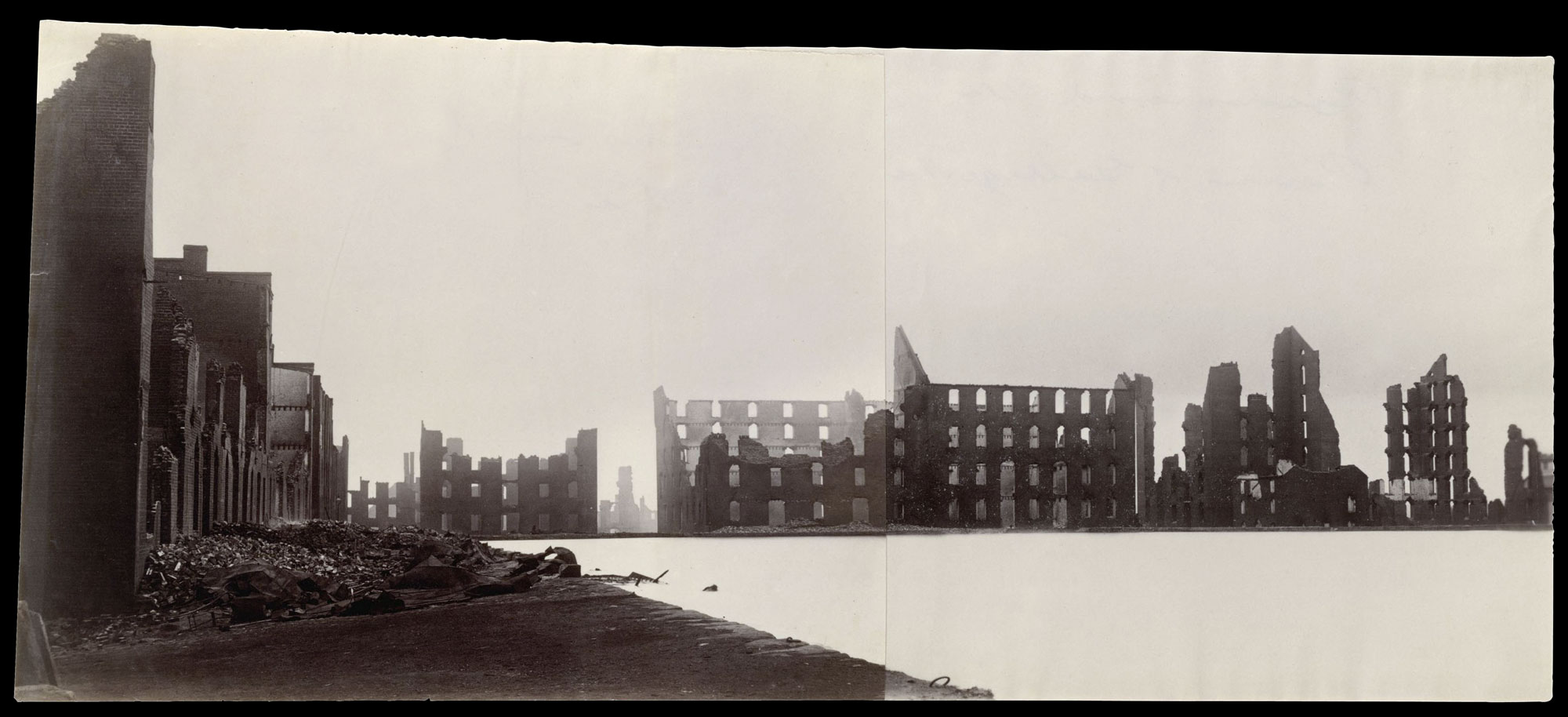


Alexander Gardner (American born Scotland, 1821-1882) 'Ruins of Gallego Flour Mills, Richmond' 1865


Alexander Gardner (American born Scotland, 1821-1882)
Ruins of Gallego Flour Mills, Richmond
1865
Albumen silver prints from glass negatives
The Metropolitan Museum of Art, Harris Brisbane Dick Fund, 1933
© The Metropolitan Museum of Art, New York


In 1861, at the outset of the Civil War, the Confederate government moved its capital from Montgomery, Alabama, to Richmond, Virginia, to be closer to the front and to protect Richmond’s ironworks and flour mills. On April 2, 1865, as the Union army advanced on Richmond, General Robert E. Lee gave the orders to evacuate the city. A massive fire broke out the following day, the result of a Confederate attempt to destroy anything that could be of use to the invading Union army. In addition to consuming twenty square blocks, including nearly every building in Richmond’s commercial district, it destroyed the massive Gallego Flour Mills, situated on the James River and seen here. Alexander Gardner, Mathew B. Brady’s former gallery manager, then his rival, made numerous photographs of the “Burnt District” as well as this dramatic panorama from two glass negatives. The charred remains have become over time an iconic image of the fall of the Confederacy and the utter devastation of war.
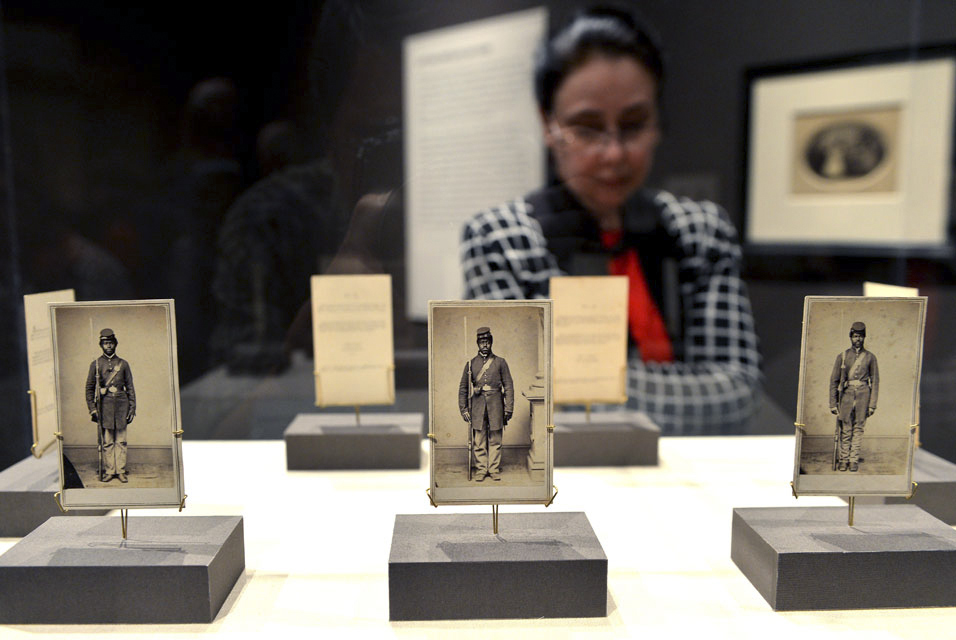
 

A display of three photographs of American Civil War soldiers in the exhibition, "Photography and the American Civil War" April 1, 2013 at The Metropolitan Museum of Art in New York


A display of three photographs of American Civil War soldiers in the exhibition, “Photography and the American Civil War” April 1, 2013 at The Metropolitan Museum of Art in New York. The three albumen silver prints are all by Gayford & Speidel, “Private Christopher Anderson, Company F, 108th Regiment, U.S. Colored Infantry, January-May 1865” (L), “Private Louis Troutman, Company F, 108th Regiment, U.S. Colored Infantry, January-May 1865”, (C) and “Private Gid White, Company F, 108th Regiment, U.S. Colored Infantry, January-May 1865”, (R).
AFP PHOTO/Stan HONDA


Unknown Artist. 'Union Private, 11th New York Infantry (Also Known as the 1st Fire Zouaves)' May-June 1861


Unknown artist
Union Private, 11th New York Infantry (Also Known as the 1st Fire Zouaves)
May-June 1861
One-sixth plate ambrotype
Michael J. McAfee Collection
© The Metropolitan Museum of Art, New York


This melancholy young volunteer was a member of the Eleventh New York Infantry, an early war regiment organised in New York City in May 1861. Primarily composed of volunteers from the city’s many fire companies, the men were also known as the First Fire Zouaves. Along with other volunteer units, the Eleventh helped capture Alexandria, Virginia on May 24, 1861, just a day after the state formally seceded from the Union.


Unknown Artist. 'Union Private, 11th New York Infantry (Also Known as the 1st Fire Zouaves)' May-June 1861 (detail)


Unknown artist
Union Private, 11th New York Infantry (Also Known as the 1st Fire Zouaves) (detail)
May-June 1861
One-sixth plate ambrotype
Michael J. McAfee Collection
© The Metropolitan Museum of Art, New York


Timothy H. O'Sullivan (American, born Ireland, 1840-1882) 'A Harvest of Death, Gettysburg, Pennsylvania' July 1863


Timothy H. O’Sullivan (American, born Ireland, 1840-1882)
A Harvest of Death, Gettysburg, Pennsylvania
July 1863
Printer: Alexander Gardner (American, Glasgow, Scotland 1821-1882 Washington, D.C.)
Publisher: Alexander Gardner (American, Glasgow, Scotland 1821-1882 Washington, D.C.)
Albumen silver print from glass negative
17.8 × 22.5cm (7 × 8 7/8 in.)
Gilman Collection, Museum Purchase, 2005


This photograph of the rotting dead awaiting burial after the Battle of Gettysburg is perhaps the best-known Civil War landscape. It was published in Gardner’s Photographic Sketch Book of the War (1866), the nation’s first anthology of photographs. The Sketch Book features ten photographic plates of Gettysburg – eight by Timothy H. O’Sullivan, who served as a field operator for Alexander Gardner, and two by Gardner himself. The extended caption that accompanies this photograph is among Gardner’s most poetic: “It was, indeed, a ‘harvest of death.’ … Such a picture conveys a useful moral: It shows the blank horror and reality of war, in opposition to its pageantry. Here are the dreadful details! Let them aid in preventing such another calamity falling upon the nation.”


Timothy H. O'Sullivan (American, born Ireland, 1840-1882) Alexander Gardner, printer. 'Field Where General Reynolds Fell, Gettysburg, July 1863' 1863


Timothy H. O’Sullivan (American, born Ireland, 1840-1882)
Alexander Gardner, printer
Field Where General Reynolds Fell, Gettysburg, July 1863
1863
Plate 37 in Volume 1 of Gardner’s Photographic Sketch Book of the War
Albumen silver print from glass negative
The Metropolitan Museum of Art, Gilman Collection, Purchase, Ann Tenenbaum and Thomas H. Lee Gift, 2005
© The Metropolitan Museum of Art, New York


This photograph of the aftermath of the Battle of Gettysburg appears in the two-volume opus Gardner’s Photographic Sketch Book of the War (1865-1866). Gardner’s publication is egalitarian. Offended by Brady’s habit of obscuring the names of his field operators behind the deceptive credit “Brady,” Gardner specifically identified each of the eleven photographers in the publication; forty-four of the one hundred photographs are credited to Timothy O’Sullivan. Gardner titled the plate Field Where General Reynolds Fell, Battlefield of Gettysburg. But the photograph, its commemorative title notwithstanding, relates a far more common story: six Union soldiers lie dead, face up, stomachs bloated, their pockets picked and boots stolen. As Gardner described the previous plate, aptly titled The Harvest of Death, this photograph conveys “the blank horror and reality of war, in opposition to its pageantry.”


Unknown Artist. 'Captain Charles A. and Sergeant John M. Hawkins, Company E, “Tom Cobb Infantry,” Thirty-eighth Regiment, Georgia Volunteer Infantry' 1861-62


Unknown artist
Captain Charles A. and Sergeant John M. Hawkins, Company E, “Tom Cobb Infantry,” Thirty-eighth Regiment, Georgia Volunteer Infantry
1861-1862
Quarter-plate ambrotype with applied colour
David Wynn Vaughan Collection
Photo: Jack Melton


The vast majority of war portraits, either cased images or cartes de visite, are of individual soldiers. Group portraits in smaller formats are more rare and challenged the field photographer (as well as the studio gallerist) to conceive and execute an image that would honour the occasion and be desirable – saleable – to multiple sitters. For the patient photographer, this created interesting compositional problems and an excellent opportunity to make memorable group portraits of brothers, friends, and even members of different regiments.

In this quarter-plate ambrotype, Confederate Captain Charles Hawkins of the Thirty-eighth Regiment, Georgia Volunteer Infantry, on the left, sits for his portrait with his brother John, a sergeant in the same regiment. They address the camera and draw their fighting knives from scabbards. Charles would die on June 13, 1863, in the Shenandoah Valley during General Robert E. Lee’s second invasion of the North. John, wounded at the Battle of Gaines’s Mill in June 1862, would survive the war, fighting with his company until its surrender at Appomattox.
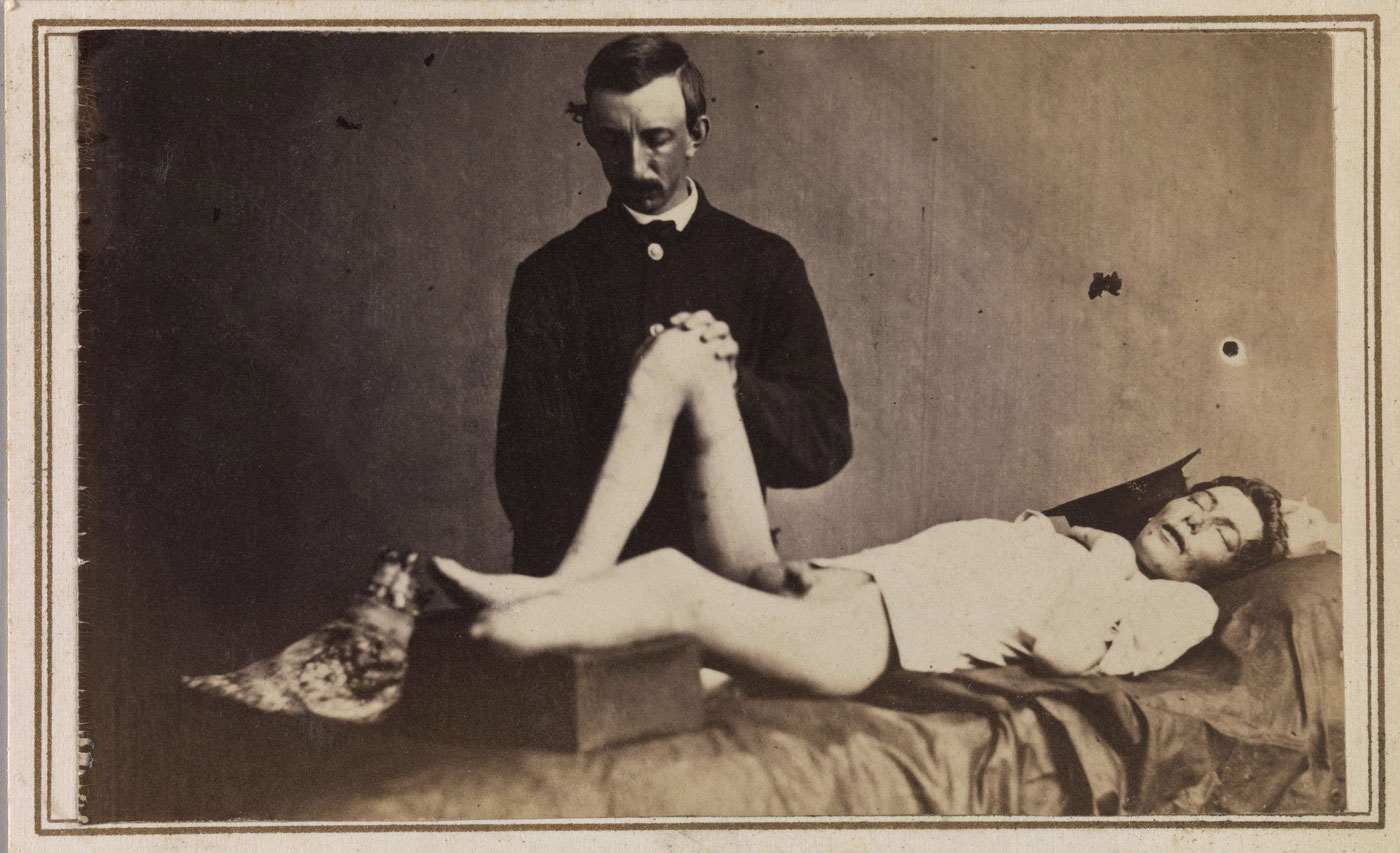
 

Reed Brockway Bontecou (American, 1824-1907) 'Union Private John Parmenter, Company G, Sixty-seventh Pennsylvania Volunteers' June 21, 1865


Reed Brockway Bontecou (American, 1824-1907)
Union Private John Parmenter, Company G, Sixty-seventh Pennsylvania Volunteers (Union Private John Parmenter Under Anesthesia on an Operating Table with His Amputated Foot)
June 21, 1865
Carte de visite format albumen silver print from glass negative
5.7 x 9.1 cm (2 1/4 x 3 9/16 in.)
Collection Stanley B. Burns, M.D.


In this remarkable carte de visite, Private Parmenter lies unconscious from anaesthesia on an operating table at Harewood Hospital in Washington, D.C. To save his patient’s life, Doctor Bontecou amputated the soldier’s wounded, ulcerous foot. Before the discovery of antibiotics, gangrene was a dreaded and deadly infection that greatly contributed to the high mortality rate of soldiers during the Civil War.


Andrew Joseph Russell (American, 1830-1902) 'Slave Pen, Alexandria, Virginia' 1863


Andrew Joseph Russell (American, 1830-1902)
Slave Pen, Alexandria, Virginia
1863
Albumen silver print from glass negative
The Metropolitan Museum of Art, Gilman Collection, Purchase, The Horace W. Goldsmith Foundation Gift, through Joyce and Robert Menschel, 2005
© The Metropolitan Museum of Art, New York


Better known for his later views commissioned by the Union Pacific Railroad, A. J. Russell, a captain in the 141st New York Infantry Volunteers, was one of the few Civil War photographers who was also a soldier. As a photographer-engineer for the U.S. Military Railroad Con struction Corps, Russell’s duty was to make a historical record of both the technical accomplishments of General Herman Haupt’s engineers and the battlefields and camp sites in Virginia. This view of a slave pen in Alexandria guarded, ironically, by Union officers shows Russell at his most insightful; the pen had been converted by the Union Army into a prison for captured Confederate soldiers.

Between 1830 and 1836, at the height of the American cotton market, the District of Columbia, which at that time included Alexandria, Virginia, was considered the seat of the slave trade. The most infamous and successful firm in the capital was Franklin & Armfield, whose slave pen is shown here under a later owner’s name. Three to four hundred slaves were regularly kept on the premises in large, heavily locked cells for sale to Southern plantation owners. According to a note by Alexander Gardner, who published a similar view, “Before the war, a child three years old, would sell in Alexandria, for about fifty dollars, and an able-bodied man at from one thousand to eighteen hundred dollars. A woman would bring from five hundred to fifteen hundred dollars, according to her age and personal attractions.”

Late in the 1830s Franklin and Armfield, already millionaires from the profits they had made, sold out to George Kephart, one of their former agents. Although slavery was outlawed in the District in 1850, it flourished across the Potomac in Alexandria. In 1859, Kephart joined William Birch, J. C. Cook, and C. M. Price and conducted business under the name of Price, Birch & Co. The partnership was dissolved in 1859, but Kephart continued operating his slave pen until Union troops seized the city in the spring of 1861.


Unknown Artist, after an 1860 carte de visite by Mathew B. Brady. 'Presidential Campaign Medal with Portraits of Abraham Lincoln and Hannibal Hamlin' 1860


Unknown Artist, after an 1860 carte de visite by Mathew B. Brady
Presidential Campaign Medal with Portraits of Abraham Lincoln and Hannibal Hamlin
1860
Tintypes in stamped brass medallion
The Metropolitan Museum of Art, Purchase, The Overbrook Foundation Gift, 2012
© The Metropolitan Museum of Art, New York


More than 200 of the finest and most poignant photographs of the American Civil War have been brought together for the landmark exhibition Photography and the American Civil War, opening April 2 at The Metropolitan Museum of Art. Through examples drawn from the Metropolitan’s celebrated holdings of this material, complemented by exceptional loans from public and private collections, the exhibition will examine the evolving role of the camera during the nation’s bloodiest war. The “War between the States” was the great test of the young Republic’s commitment to its founding precepts; it was also a watershed in photographic history. The camera recorded from beginning to end the heartbreaking narrative of the epic four-year war (1861-1865) in which 750,000 lives were lost. This traveling exhibition will explore, through photography, the full pathos of the brutal conflict that, after 150 years, still looms large in the American public’s imagination.

At the start of the Civil War, the nation’s photography galleries and image purveyors were overflowing with a variety of photographs of all kinds and sizes, many examples of which will be featured in the exhibition: portraits made on thin sheets of copper (daguerreotypes), glass (ambrotypes), or iron (tintypes), each housed in a small decorative case; and larger, “painting-sized” likenesses on paper, often embellished with India ink, watercolour, and oils. On sale in bookshops and stationers were thousands of photographic portraits on paper of America’s leading statesmen, artists, and actors, as well as stereographs of notable scenery from New York’s Broadway to Niagara Falls to the canals of Venice. Viewed in a stereopticon, the paired images provided the public with seeming three-dimensionality and the charming pleasure of traveling the world in one’s armchair.

Photography and the Civil War will include: intimate studio portraits of armed Union and Confederate soldiers preparing to meet their destiny; battlefield landscapes strewn with human remains; rare multi-panel panoramas of the killing fields of Gettysburg and destruction of Richmond; diagnostic medical studies of wounded soldiers who survived the war’s last bloody battles; and portraits of Abraham Lincoln as well as his assassin John Wilkes Booth. The exhibition features groundbreaking works by Mathew B. Brady, George N. Barnard, Alexander Gardner, and Timothy O’Sullivan, among many others. It also examines in-depth the important, if generally misunderstood, role played by Brady, perhaps the most famous of all wartime photographers, in conceiving the first extended photographic coverage of any war. The exhibition addresses the widely held, but inaccurate, belief that Brady produced most of the surviving Civil War images, although he actually made very few field photographs during the conflict. Instead, he commissioned and published, over his own name and imprint, negatives made by an ever-expanding team of field operators, including Gardner, O’Sullivan, and Barnard.

The exhibition will feature Gardner’s haunting views of the dead at Antietam in September 1862, which are believed to be the first photographs of the Civil War seen in a public exhibition. A reporter for the New York Times wrote on October 20, 1862, about the images shown at Brady’s New York City gallery: “Mr. Brady has done something to bring home to us the terrible reality and earnestness of war. If he has not brought bodies and laid them in our dooryards and along the streets, he has done something very like it… Here lie men who have not hesitated to seal and stamp their convictions with their blood – men who have flung themselves into the great gulf of the unknown to teach the world that there are truths dearer than life, wrongs and shames more to be dreaded than death.”

Approximately 1,000 photographers worked separately and in teams to produce hundreds of thousands of photographs – portraits and views – that were actively collected during the period (and over the past century and a half) by Americans of all ages and social classes. In a direct expression of the nation’s changing vision of itself, the camera documented the war and also mediated it by memorialising the events of the battlefield as well as the consequent toll on the home front.

Among the many highlights of the exhibition will be a superb selection of early wartime portraits of soldiers and officers who sat for their likenesses before leaving their homes for the war front. In these one-of-a-kind images, a picture of American society emerges. The rarest are ambrotypes and tintypes of Confederates, drawn from the renowned collection of David Wynn Vaughan, who has assembled the country’s premier archive of Southern portraits. These seldom-seen photographs, and those by their Northern counterparts, will balance the well-known and often-reproduced views of bloody battlefields, defensive works, and the specialised equipment of 19th-century war.

The show will focus special attention on the remarkable images included in the two great wartime albums of original photographs: Gardner’s Photographic Sketch Book of War and George N. Barnard’s Photographic Views of Sherman’s Campaign, both released in 1866. The former publication includes 100 views commissioned, sequenced, and annotated by Alexander Gardner. This two-volume opus provides an epic documentation of the war seen through the photographs of 11 artists, including Gardner himself. It features 10 plates of Gettysburg, including Timothy O’Sullivan’s A Harvest of Death, Gettysburg, and Gardner’s Home of a Rebel Sharpshooter, Gettysburg, both of which are among the most well-known and important images from the early history of photography. The second publication includes 61 large-format views by a single artist, George N. Barnard, who followed the army campaign of one general, William Tecumseh Sherman, in the final months of the war – the “March to the Sea” from Tennessee to Georgia in 1864 and 1865. The exhibition explores how different Barnard’s photographs are from those in Gardner’s Sketch Book, and how distinctly Barnard used the camera to serve a nation trying to heal itself after four long years of war and brother-versus-brother bitterness.

Among the most extraordinary, if shocking, photographs in the exhibition are the portraits by Dr. Reed Brockway Bontecou of wounded and sick soldiers from the war’s last battles. Drawn from a private medical teaching album put together by this Civil War surgeon and head of Harewood Hospital in Washington, D.C., and on loan from the celebrated Burns Archive, the photographs are notable for their humanity and their aesthetics. They recall Walt Whitman’s words from 1865, that war “was not a quadrille in a ball-room. Its interior history will not only never be written, its practicality, minutia of deeds and passions, will never be suggested.” Bontecou’s medical portraits offer a glimpse of what the poet thought was not possible.

In addition to providing a thorough analysis of the camera’s incisive documentation of military activity and its innovative use as a teaching tool for medical doctors, the exhibition explores other roles that photography played during the war. It investigates the relationship between politics and photography during the tumultuous period and presents exceptional political ephemera from the private collection of Brian Caplan, including: a rare set of campaign buttons from 1860 featuring original tintype portraits of the competing candidates; a carved tagua nut necklace featuring photographic portraits of Confederate President Jefferson Davis and two members of his cabinet; and an extraordinary folding game board composed of photographic likenesses of President Lincoln and his generals. The show also includes an inspiring carte de visite portrait of the abolitionist and human rights activist Sojourner Truth. A former slave from New York State, she sold photographs of herself to raise money to educate emancipated slaves, and to support widows, orphans, and the wounded. And finally the exhibition includes the first photographically illustrated “wanted” poster, a printed broadside with affixed photographic portraits that led to the capture John Wilkes Booth and his fellow conspirators after the assassination of President Lincoln in April 1865.

Press release from the Metropolitan Museum of Art website


Unknown (American) '[Broadside for the Capture of John Wilkes Booth, John Surratt, and David Herold]' April 20, 1865


Unknown (American)
[Broadside for the Capture of John Wilkes Booth, John Surratt, and David Herold]
Artist: Alexander Gardner (American, Glasgow, Scotland 1821-1882 Washington, D.C.)
Photography Studio: Silsbee, Case & Company (American, active Boston)
Photography Studio: Unknown
April 20, 1865
Ink on paper with three albumen silver prints from glass negatives
Sheet: 60.5 x 31.3cm (23 13/16 x 12 5/16 in.)
Each photograph: 8.6 x 5.4cm (3 3/8 x 2 1/8 in.)
Collages
Gilman Collection, Purchase, The Horace W. Goldsmith Foundation Gift, through Joyce and Robert Menschel, 2005


On the night of April 14, 1865, just five days after Lee’s surrender to Grant at Appomattox, John Wilkes Booth shot Lincoln at the Ford Theatre in Washington, D.C. Within twenty-four hours, Secret Service director Colonel Lafayette Baker had already acquired photographs of Booth and two of his accomplices. Booth’s photograph was secured by a standard police search of the actor’s room at the National Hotel; a photograph of John Surratt, a suspect in the plot to kill Secretary of State William Seward, was obtained from his mother, Mary (soon to be indicted as a fellow conspirator), and David Herold’s photograph was found in a search of his mother’s carte-de-visite album. The three photographs were taken to Alexander Gardner’s studio for immediate reproduction. This bill was issued on April 20, the first such broadside in America illustrated with photographs tipped onto the sheet.
The descriptions of the alleged conspirators combined with their photographic portraits proved invaluable to the militia. Six days after the poster was released Booth and Herold were recognised by a division of the 16th New York Cavalry. The commanding officer, Lieutenant Edward Doherty, demanded their unconditional surrender when he cornered the two men in a barn near Port Royal, Virginia. Herold complied; Booth refused. Two Secret Service detectives accompanying the cavalry, then set fire to the barn. Booth was shot as he attempted to escape; he died three hours later. After a military trial Herold was hanged on July 7 at the Old Arsenal Prison in Washington, D.C.
 Surratt escaped to England via Canada, eventually settling in Rome. Two years later a former schoolmate from Maryland recognised Surratt, then a member of the Papal Guard, and he was returned to Washington to stand trial. In September 1868 the charges against him were nol-prossed after the trial ended in a hung jury. Surratt retired to Maryland, worked as a clerk, and lived until 1916.


Attributed to McPherson & Oliver (American, active New Orleans and Baton Rouge, Louisiana, 1860s) 'The Scourged Back' April 1863


Attributed to McPherson & Oliver (American, active New Orleans and Baton Rouge, Louisiana, 1860s)
The Scourged Back
April 1863
Albumen silver print from glass negative
8.7 x 5.5cm (3 7/16 x 2 3/16 in.)
International Center of Photography, Purchase, with funds provided by the ICP Acquisitions Committee, 2003


Gordon, a runaway slave seen with severe whipping scars in this haunting carte-de-visite portrait, is one of the many African Americans whose lives Sojourner Truth endeavoured to better. Perhaps the most famous of all known Civil War-era portraits of slaves, the photograph dates from March or April 1863 and was made in a camp of Union soldiers along the Mississippi River, where the subject took refuge after escaping his bondage on a nearby Mississippi plantation.

On Saturday, July 4, 1863, this portrait and two others of Gordon appeared as wood engravings in a special Independence Day feature in Harper’s Weekly. McPherson & Oliver’s portrait and Gordon’s narrative in the newspaper were extremely popular, and photography studios throughout the North (including Mathew B. Brady’s) duplicated and sold prints of The Scourged Back. Within months, the carte de visite had secured its place as an early example of the wide dissemination of ideologically abolitionist photographs.


J. W. Jones (American, active Orange, Massachusetts, 1860s) 'Emaciated Union Soldier Liberated from Andersonville Prison' 1865


J. W. Jones (American, active Orange, Massachusetts, 1860s)
Emaciated Union Soldier Liberated from Andersonville Prison
1865
Albumen silver print from glass negative
Image: 9 x 5.5cm (3 9/16 x 2 3/16 in.)
Brian D. Caplan Collection


Most soldiers who survived Andersonville Prison were marked for life. This portrait of an unidentified former prisoner is one of many that document the intense cruelty of prison life during the Civil War. It would be another eighty years, at the end of World War II, before anyone would see comparable pictures of man’s inhumanity to man.


George Wertz (American, active Kansas City, Missouri, 1860s) 'Private William Henry Lord, Company I, Eleventh Kansas Volunteer Cavalry' 1863-65


George Wertz (American, active Kansas City, Missouri, 1860s)
Private William Henry Lord, Company I, Eleventh Kansas Volunteer Cavalry
1863-1865
Albumen silver print from glass negative
8.4 x 5.6cm (3 5/16 x 2 3/16 in.)
W. Bruce and Delaney H. Lundberg Collection


Private William Henry Lord, a cavalryman, sits alert and ready for the next ride. A yet unmuddied enlistee from “Bleeding Kansas,” the last state to enter the Union before Fort Sumter, Lord was in the Eleventh Kansas Volunteer Cavalry; he was wounded in the shoulder in October 1864 but rejoined his company and was mustered out in September 1865.
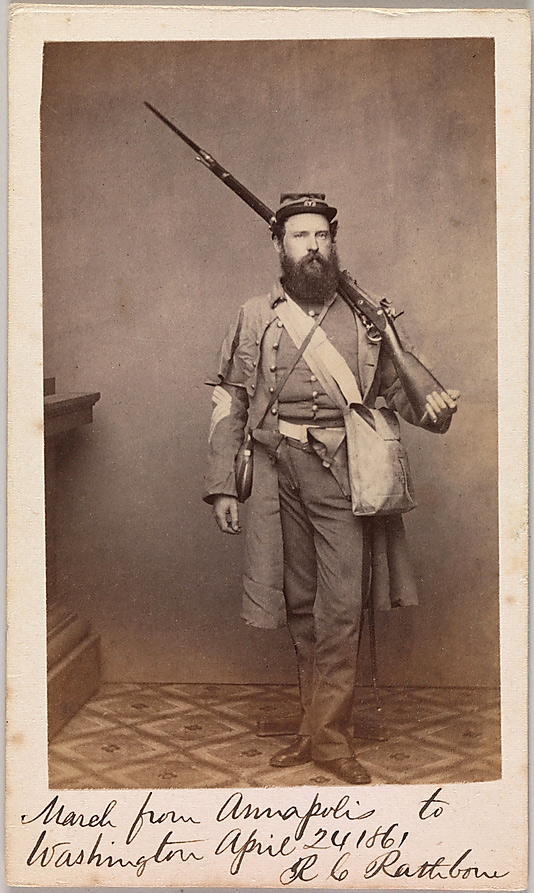
 

Unknown. 'March from Annapolis to Washington, Robert C. Rathbone, Sergeant Major, Seventh Regiment, New York Militia' April 24, 1861


Unknown photographer
March from Annapolis to Washington, Robert C. Rathbone, Sergeant Major, Seventh Regiment, New York Militia
April 24, 1861
Albumen silver print from glass negative
8.9 x 5.4cm (3 1/2 x 2 1/8 in.)
Michael J. McAfee Collection


The Seventh Regiment, New York Militia was among the first military groups to leave for Washington, D.C., after Lincoln’s call to arms in April 1861. In or near Annapolis, en route to the nation’s capital, Sergeant Major Rathbone posed for his portrait. He annotated his likeness with enough information to suggest that this image might be the first (identifiable) photograph of a soldier made after the fall of Fort Sumter. Representative of thousands of similar portraits, this study of an officer seen against a blank wall with just a hint of a studio column is typical of the simplicity of the earliest war pictures.

Note the stand just visible behind Sergeant Major Rathbone’s feet to brace the sitter for the long exposures necessary.


Mathew B. Brady (American, near Lake George, New York 1823?–1896 New York) 'General Robert E. Lee' 1865


Mathew B. Brady (American, near Lake George, New York 1823? – 1896 New York)
General Robert E. Lee
1865
Albumen silver print from glass negative
14 × 9.3cm (5 1/2 × 3 11/16 in.)
Gilman Collection, Museum Purchase, 2005


Confederate General Robert E. Lee surrendered his army to Union General Ulysses S. Grant at Appomattox Court House, Virginia, on April 9, 1865. The Civil War was over. If not whole, the nation was at least reunited, and the slow recovery of Reconstruction could begin. As soon as he heard that Lee had left Appomattox and returned to Richmond, Mathew B. Brady headed there with his camera equipment. The Lees’ Franklin Street residence had survived the fires that had devastated many of the commercial sections of the city. Through the kindness of Mrs. Lee and a Confederate colonel, Brady received permission to photograph the general on April 16, 1865, just two days after President Lincoln’s assassination. Brady’s portrait of General Lee holding his hat, on his own back porch, is one of the most reflective and thoughtful wartime likenesses. The fifty-eight-year-old Confederate hero poses in the uniform he had worn at the surrender. It would be Brady’s last wartime photograph.


Charles Paxson (American, active New York, 1860s) 'Wilson, Branded Slave from New Orleans' 1863


Charles Paxson (American, active New York, 1860s)
Wilson, Branded Slave from New Orleans
1863
Albumen silver print from glass negative
8.4 x 5.3cm (3 5/16 x 2 1/16 in.)
Private Collection, Courtesy of William L. Schaeffer


On January 30, 1864, to fan the anti-slavery cause and promote the sale of abolitionist photographs, Harper’s Weekly published this carte de visite and three others as wood engravings. The newspaper also included stirring bibliographies of the emancipated slaves. The editors noted that Wilson Chinn was about sixty years old. His former master, Volsey B. Marmillion, a sugar planter near New Orleans, “was accustomed to brand his negroes, and Wilson has on his forehead the letters ‘V.B.M.'”
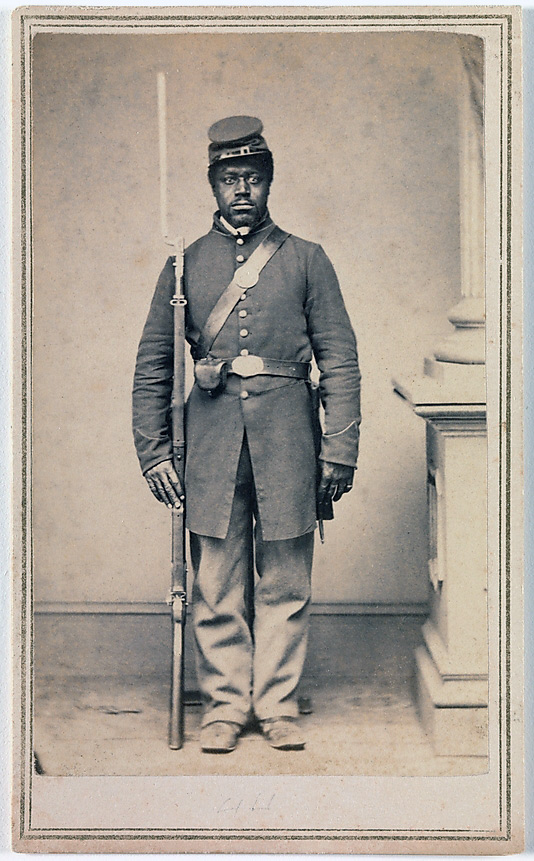
 

Gayford & Speidel (Active Rock Island, Illinois, 1860s) 'Private Louis Troutman, Company F, 108th Regiment, U.S. Colored Infantry' January-May 1865


Gayford & Speidel (Active Rock Island, Illinois, 1860s)
Private Louis Troutman, Company F, 108th Regiment, U.S. Colored Infantry
January – May 1865
Albumen silver print from glass negative
8.8 x 5.4cm (3 7/16 x 2 1/8 in.)
Thomas Harris Collection


Samuel Masury (American, 1818-1874) 'Frances Clalin Clayton' 1864-66


Samuel Masury (American, 1818-1874)
Frances Clalin Clayton
1864-1866
Albumen silver print from glass negative
9.4 x 5.6cm (3 11/16 x 2 3/16 in.)
Buck Zaidel Collection


Frances Clayton is an exception – a woman who served in the Union army by disguising herself as a man. In a popular carte de visite collected by soldiers at the end of the war, she poses here as Jack Williams and suggestively holds the handle of a cavalry sword between her crossed legs. The facts of her life story and military service are difficult to confirm, but it is believed that she served in the Missouri cavalry (or infantry) beside her husband, who died at the Battle of Stones River in late December 1862.


Reed Brockway Bontecou (American, 1824-1907) 'Private Samuel Shoop, Company F, 200th Pennsylvania Infantry' April-May 1865


Reed Brockway Bontecou (American, 1824-1907)
Private Samuel Shoop, Company F, 200th Pennsylvania Infantry
April-May 1865
Albumen silver print from glass negative
18.9 × 13.1cm (7 7/16 × 5 3/16 in.)
Gift of Stanley B. Burns, M.D. and The Burns Archive, 1992


The last great battle of the Civil War was the siege of Petersburg, Virginia – a brutal campaign that led to Confederate General Robert E. Lee’s surrender on April 9, 1865. Samuel Shoop, a twenty-five-year-old private in Company F of the 200th Pennsylvania Volunteers, received a gunshot wound in the thigh at Fort Steadman on the first day of the campaign (March 25) and was evacuated to Harewood Hospital in Washington, D.C. His leg was amputated by Dr. Reed Brockway Bontecou, surgeon in charge, who also made this clinical photograph. It was intended, in part, to serve as a tool for teaching fellow army surgeons and is an extremely rare example of the early professional use of photography in America.


George N. Barnard (American, 1819-1902) 'Bonaventure Cemetery, Four Miles from Savannah' 1866


George N. Barnard (American, 1819-1902)
Bonaventure Cemetery, Four Miles from Savannah
1866
Albumen silver print from glass negative
34 x 26.4cm (13 3/8 x 10 3/8 in.)
Gilman Collection, Purchase, Ann Tenenbaum and Thomas H. Lee Gift, 2005


Unknown photographer. 'Sojourner Truth, "I Sell the Shadow to Support the Substance"' 1864


Unknown photographer
Sojourner Truth, “I Sell the Shadow to Support the Substance”
1864
Albumen silver print from glass negative
Carte-de-visite
The Metropolitan Museum of Art, Purchase, Alfred Stieglitz Society Gifts, 2013
© The Metropolitan Museum of Art, New York


Sojourner Truth (c. 1797 – November 26, 1883) was the self-given name, from 1843 onward, of Isabella Baumfree, an African-American abolitionist and women’s rights activist. Truth was born into slavery in Swartekill, Ulster County, New York, but escaped with her infant daughter to freedom in 1826. After going to court to recover her son, she became the first black woman to win such a case against a white man. Her best-known extemporaneous speech on gender inequalities, “Ain’t I a Woman?”, was delivered in 1851 at the Ohio Women’s Rights Convention in Akron, Ohio. During the Civil War, Truth helped recruit black troops for the Union Army; after the war, she tried unsuccessfully to secure land grants from the federal government for former slaves.

Text from the Wikipedia website
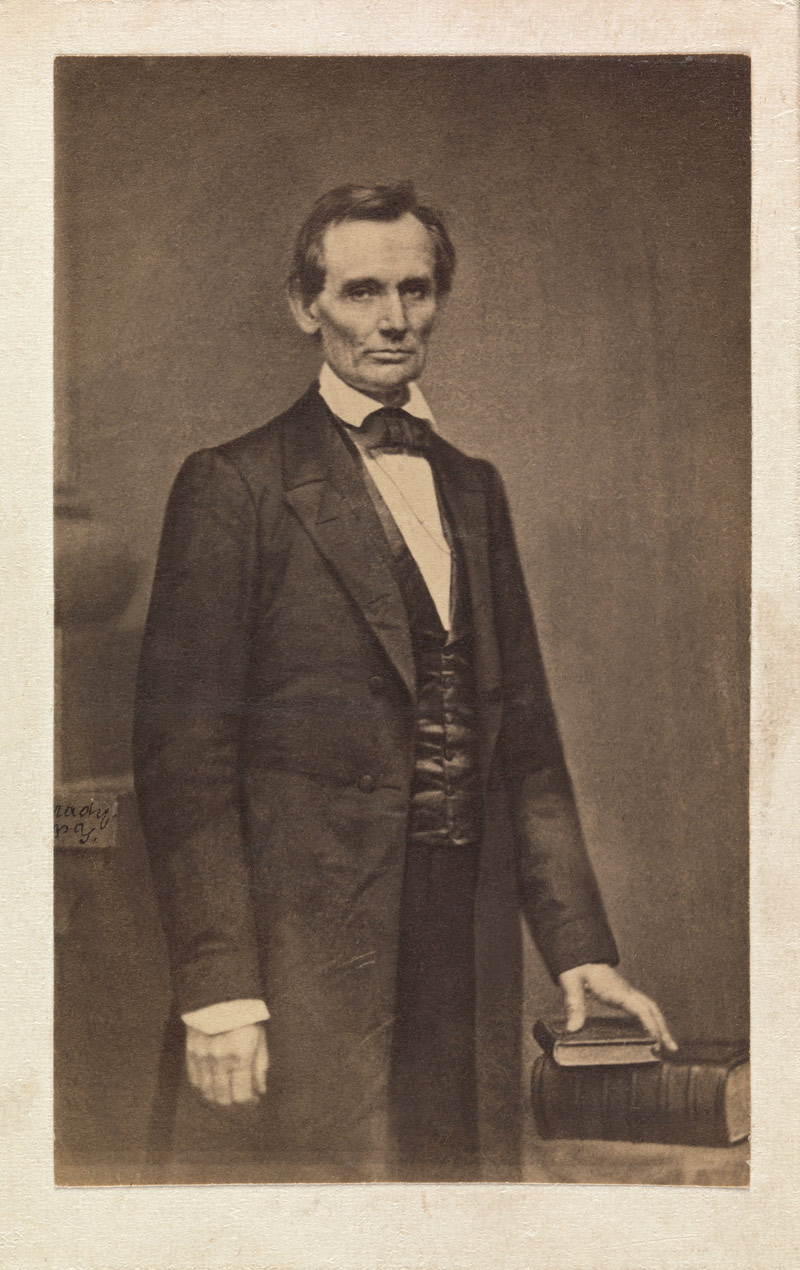
 

Mathew B. Brady (American born Ireland, 1823/24-1896 New York) Edward Anthony (American, 1818-1888) 'Abraham Lincoln' February 27, 1860


Mathew B. Brady (American born Ireland, 1823/1824-1896 New York)
Edward Anthony (American, 1818-1888)
Abraham Lincoln
February 27, 1860
Albumen silver print from glass negative
Carte-de-visite
The Meserve-Kunhardt Foundation


Three months before his nomination as the Republican Party candidate for president, Abraham Lincoln went East, stopping in New York City on February 27, 1860, to give a speech at the Cooper Institute (now the Cooper Union for the Advancement of Science and Art). Many considered Lincoln’s powerful antislavery lecture as his most important to date. The closing words spurred his audience and the country at large: “Let us have faith that right makes might, and in that faith, let us, to the end, dare to do our duty as we understand it.”

Earlier in the day he sat for this portrait at Mathew B. Brady’s gallery on Broadway and Tenth Street, just a few blocks from the lecture hall. Although his visit to the studio could not have lasted long, the result of this first of many portrait sessions with Brady was a simple but powerful image that would alter the visual landscape during the upcoming election. In a single exposure on a silver-coated sheet of glass, Brady captured the odd physiognomy of the man who would change the course of American history.


Unknown photographer (American) '[Private James House with Fighting Knife, Sixteenth Georgia Cavalry Battalion, Army of Tennessee]' 1861-1862?


Unknown photographer (American)
[Private James House with Fighting Knife, Sixteenth Georgia Cavalry Battalion, Army of Tennessee]
1861-1862?
Ambrotype
Sixth-plate; ruby glass
David Wynn Vaughan Collection
Image: Jack Melton


This portrait of a cavalryman is an excellent example of a well-armed Confederate soldier. Private House wears a slouch hat and a checked battle shirt seen through the gaps in a modified woollen shell jacket with tabbed button closures. He brandishes his fighting knife and for quick use has half removed a pocket revolver from its belted holster. Perhaps the most frightening weapons in House’s personal arsenal may be his focused stare and his set jaw.

16th Cavalry Battalion was assembled in May, 1862, at Big Shanty, Georgia, and was composed of six companies. It served in East Tennessee and Southwest Virginia and took part in the engagements at Blue Springs, Bean’s Station, Cloyd’s Mountain, and Marion. In January, 1865, the battalion merged into the 13th Georgia Cavalry Regiment. Lieutenant Colonels F.M. Nix and Samuel J. Winn, and Major Edward Y. Clarke were its commanding officers.


Unknown photographer (American) '[Private James House with Fighting Knife, Sixteenth Georgia Cavalry Battalion, Army of Tennessee]' 1861-1862? (detail)


Unknown photographer (American)
[Private James House with Fighting Knife, Sixteenth Georgia Cavalry Battalion, Army of Tennessee] (detail)
1861-1862?
Ambrotype
Sixth-plate; ruby glass
David Wynn Vaughan Collection
Image: Jack Melton


Unknown photographer (American) 'Union Sergent John Emery' 1861-1865


Unknown photographer (American)
Union Sergent John Emery
1861-1865
Tintype
Plate: 8.9 x 6.4cm (3 1/2 x 2 1/2 in.)
Case: 10 × 8.9cm (3 15/16 × 3 1/2 in.)
The Horace W. Goldsmith Foundation Fund, through Joyce and Robert Menschel, 2012


The only details presently known about this handsome, young Union sergeant wearing a striped bowtie and an imported English snake belt buckle derive from a small paper note found behind the portrait inside the thermoplastic case: “Uncle John Emery / brother of / Lucy King / buried at E. Concord / died in 1876 / buried at back in right corner.”


Unknown photographer (American) '[Private Thomas Gaston Wood, Drummer, Company H, "Walton Infantry," Eleventh Regiment Georgia Volunteer Infantry]' 1861


Unknown photographer (American)
[Private Thomas Gaston Wood, Drummer, Company H, “Walton Infantry,” Eleventh Regiment Georgia Volunteer Infantry]
1861
Tintype
Plate: 6.4 x 5.1cm (2 1/2 x 2 in.)
David Wynn Vaughan Collection


Private Wood sits against a blank wall in a photographer’s studio. He is sixteen years old and will not see seventeen. An orphan, he joined Company H in Social Circle, Georgia, on July 3, 1861, and before the end of the year died of pneumonia in a Richmond hospital. Wood seems proud of his shell jacket and especially his kepi, which he marked under the brim with his initials. The photographer tipped up the cap to reveal the sitter’s handiwork, but the letters are laterally reversed in the tintype. As a musician, he poses without any prop other than his uniform, the buttons touched with gold.


The Metropolitan Museum of Art
1000 Fifth Avenue at 82nd Street
New York, New York 10028-0198
Phone: 212-535-7710

Opening hours:
Sunday – Tuesday and Thursday: 10am – 5pm
Friday and Saturday: 10am – 9pm
Closed Wednesday

The Metropolitan Museum of Art website

LIKE ART BLART ON FACEBOOK

Back to top

Exhibition: ‘Christian Lutz, Trilogy’ at The Musée de l’Elysée, Lausanne

Exhibition dates: 5th June – 1st September 2013


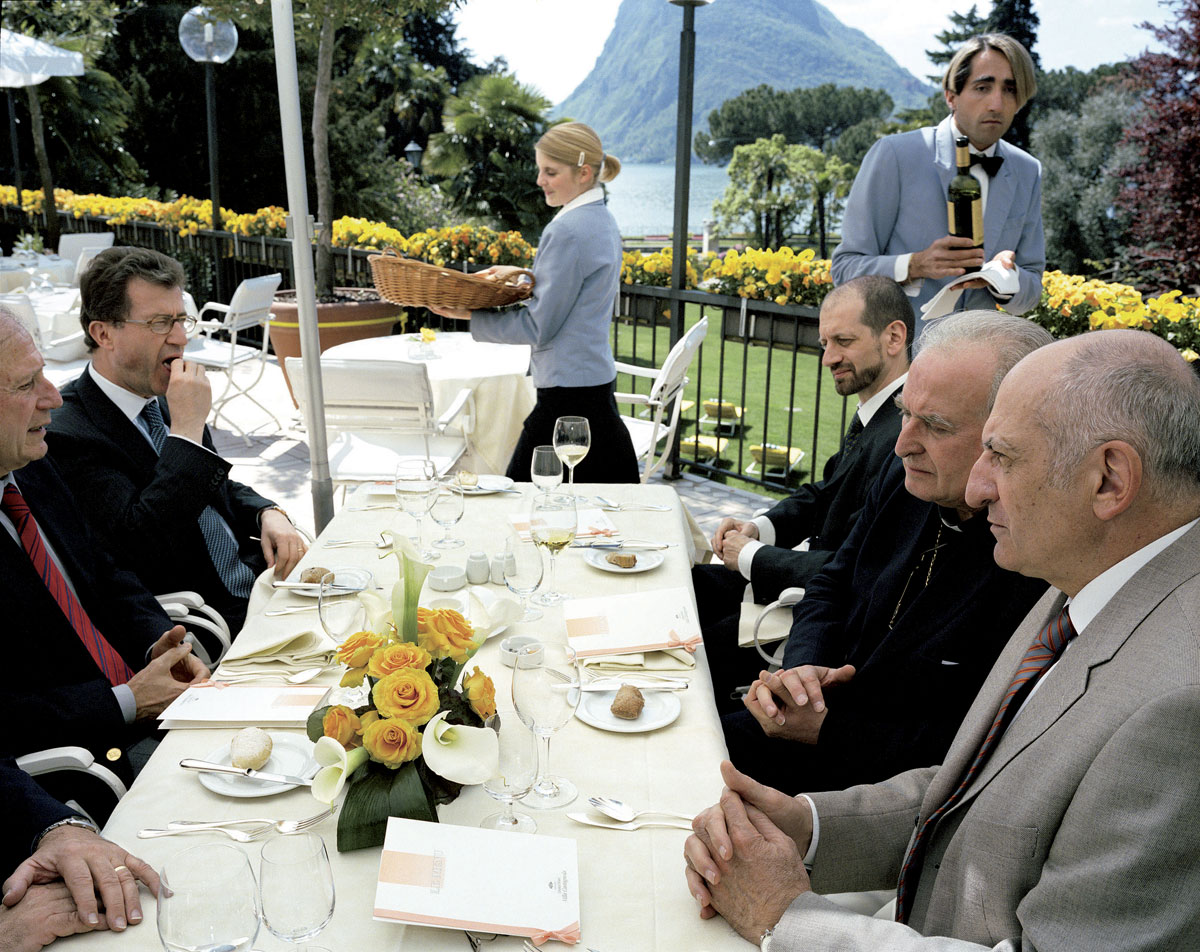
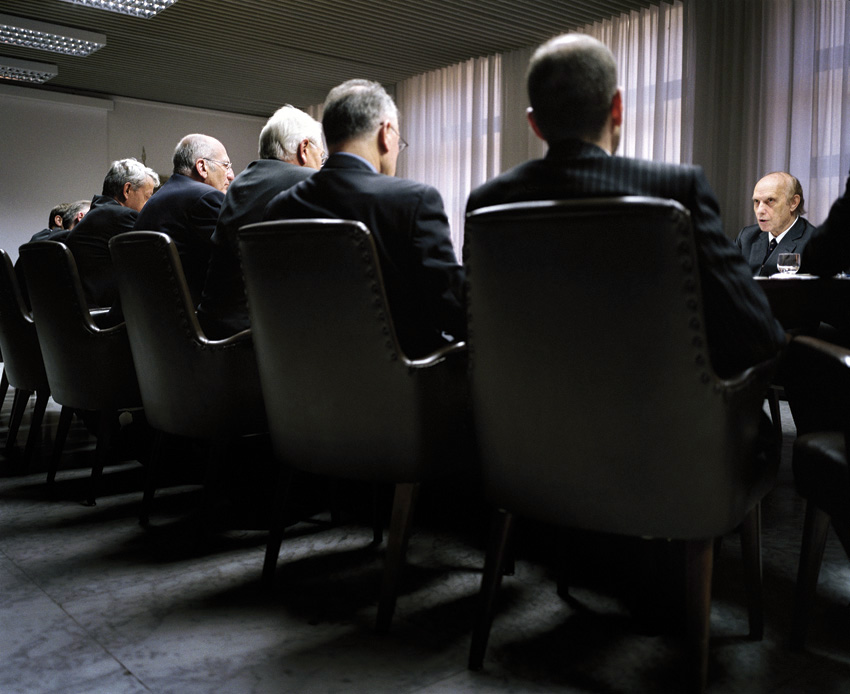
Christian Lutz (Swiss, b. 1973) From the series 'Protokoll' 2007


Christian Lutz (Swiss, b. 1973)
From the series Protokoll
2007
© Christian Lutz


Power: it will corrupt you, but if you don’t want it, it will be used against you.

PS. Some, if not all, of these people seem like marionettes!

Marcus


Many thankx to The Musée de l’Elysée for allowing me to publish the photographs in the posting. Please click on the photographs for a larger version of the image.


Christian Lutz (Swiss, b. 1973) From the series 'Protokoll' 2007


Christian Lutz (Swiss, b. 1973)
From the series Protokoll
2007
© Christian Lutz


Christian Lutz (Swiss, b. 1973) From the series 'Protokoll' 2007


Christian Lutz (Swiss, b. 1973)
From the series Protokoll
2007
© Christian Lutz


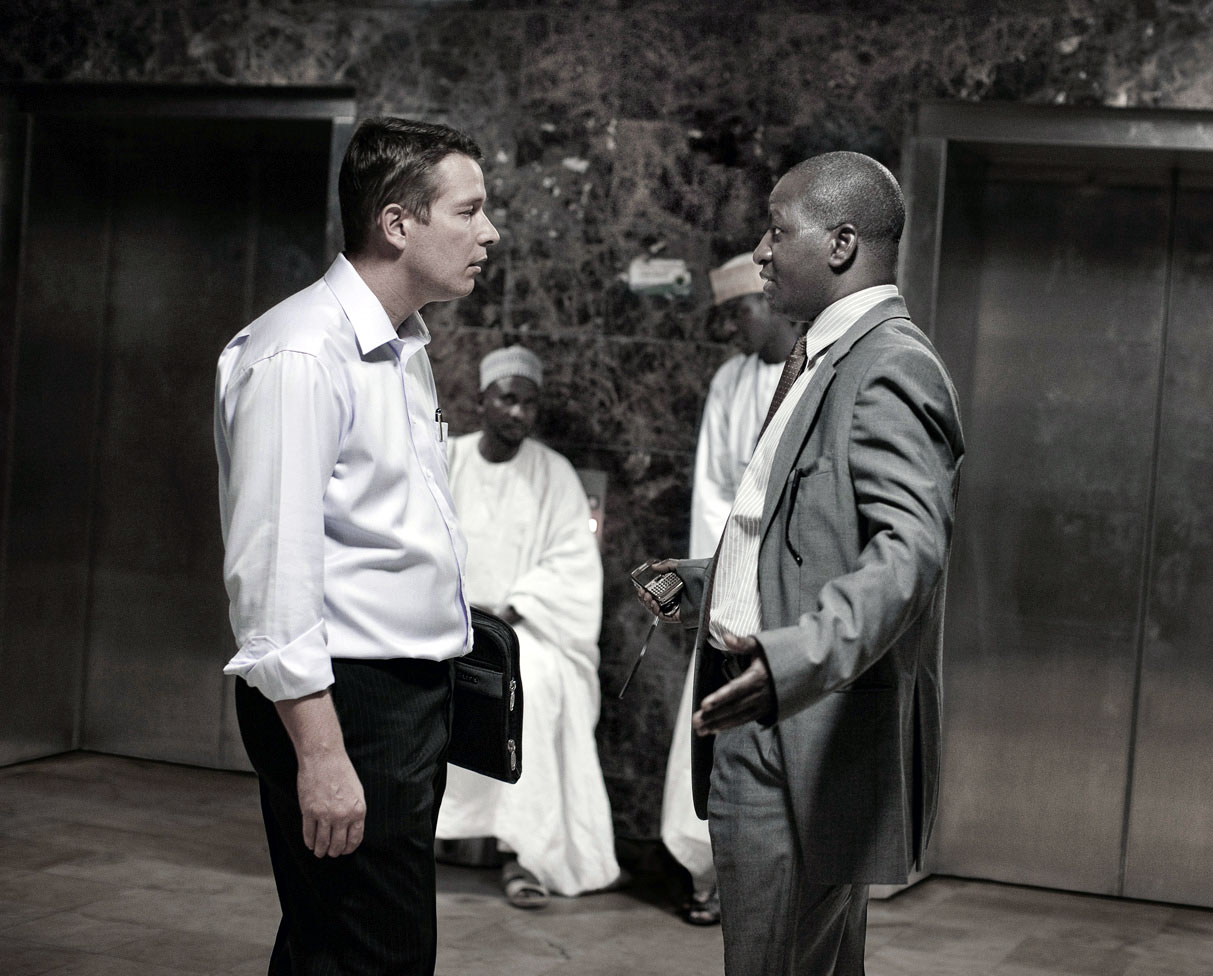
New York, 2003: spectacular security frenzy around the President of the Swiss Confederation Pascal Couchepin – a striking image to the eye of the photographer who was present at the scene. Christian Lutz thus invited himself in the suitcases of the ministerial delegation and documented its various official activities during three years. The first volume of what will become a trilogy on the issue of power is published in 2007: Protokoll. Tropical Gift, dealing with the oil and gas trading in Nigeria, is released in 2010. After portraying the rigorously codified and staged political sphere, the photographer’s cutting eye unveils the malodorous traps of a deadly economic power, with troubling visual poetry. In his viewfinder, reality unnoticeably shifts into a heady thriller. The first two parts of his trilogy have been exhibited worldwide, establishing Christian Lutz as an eminent photographer.

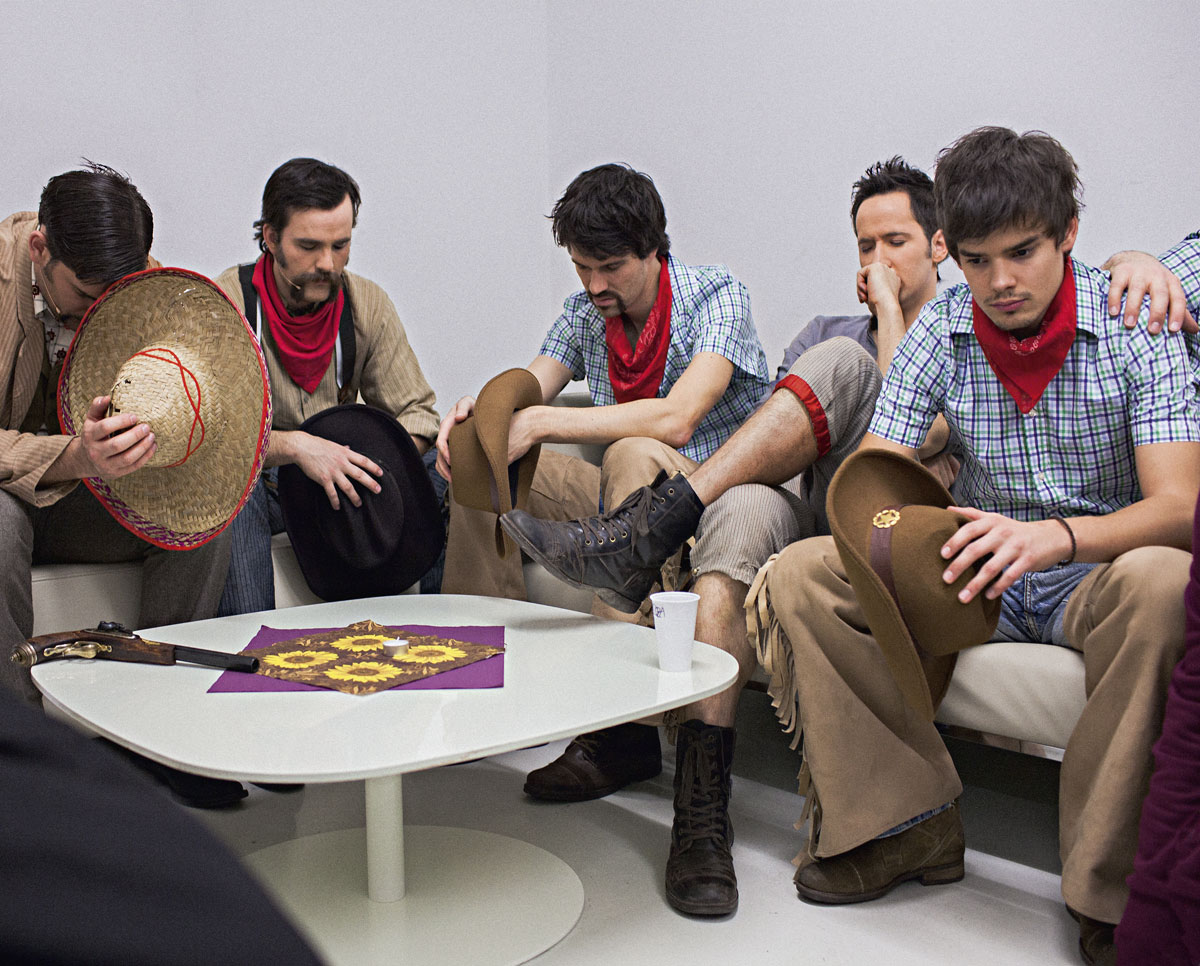
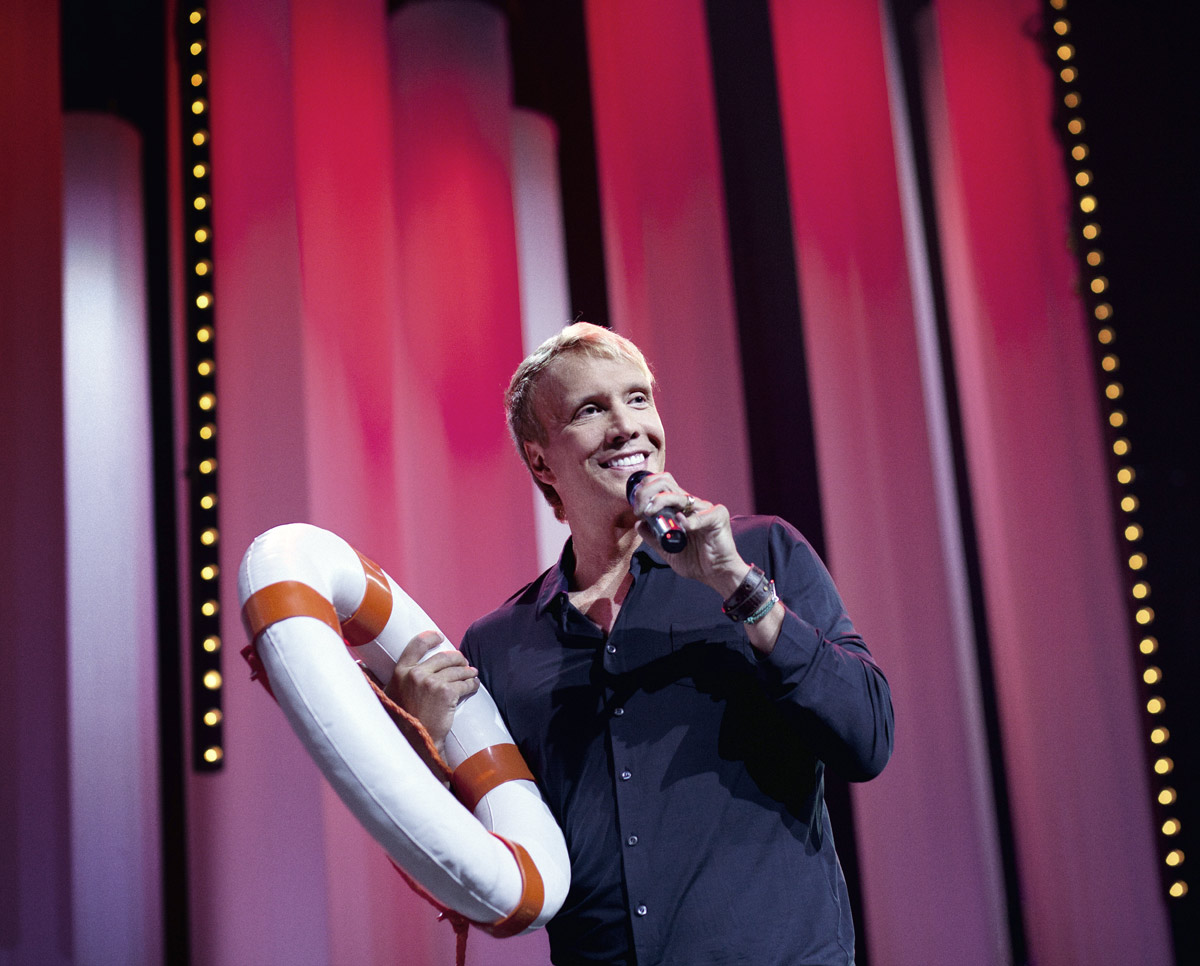
The fate of his yet unreleased third series, In Jesus’ Name, is quite different. Christian Lutz spent a year within a Zurich-based evangelical community. Celebrations and rock concerts, summer camps and blood donation rallies, he photographed all the events he was invited to attend. However, a Zurich Court of Justice banned the book immediately upon its release in November 2012 as 21 people appearing in the volume filed complaints to protect their image; complaints that were carefully orchestrated by the Church’s managers. With these provisional measures, the Court nonetheless ruled against the freedoms of expression and information.

The exhibition Trilogy is a three-fold investigation. Tropical Gift will be shown as a projection accompanied by the original score by Franz Treichler of the Young Gods. As for the latest series, In Jesus’ Name, it carries the marks of a new power, with which it is now inseparable: the judiciary. Troubling and destabilising, this fourth power questions democracy and artistic freedom. But as it pushes art into a corner, it seems to compel it to reconnect itself with its political dimension, to test established systems, by triggering debate.

Censorship of the book In Jesus’ Name

The photography book In Jesus’ Name, Christian Lutz’s third part of the series on the issue of power, was launched during Paris Photo on 17 November 2012, before disappearing from the bookstore shelves a couple of days later. The legal proceedings that followed this project raise issues about the artistic freedom as well as the freedom of expression.

The photographical project In Jesus’ Name

The Zurich-based evangelical community ICF (International Christian Fellowship) is one of the most important free churches in Switzerland. Its success and rapid expansion are a matter of public interest. Created according to the American model of mega-churches, it was initiated in Zurich at the end of the 90s, and has now spread throughout Roman Switzerland thanks to a solid establishment in Lausanne and Geneva. It manages a considerable budget and is characterised by the use of sophisticated and performing marketing and communication methods.

Christian Lutz met the pastor and founder of the Evangelical movement ICF, Leo Bigger, in May 2011. He then introduced him to the other church managers to whom the photographer also presented his project, his former books, his approach and the stakes involved in his Trilogy. He was subsequently granted express consent from the managers who welcomed him in the community.

The photographer nonetheless systematically kept on requesting specific authorisations to the organisers for each ICF’s activity which he wished to photograph. He joined several trips and summer camps organised by the church, and took part in all sorts of events: celebrations, baptisms, ladies lounge, blood donation, theatre show, workshop on the addiction to pornography, etc. He met members of the church, exchanged constantly with them, and freely discussed his reportage.

As for each of his series, Christian Lutz entirely immersed himself, photographing faces and individuals up close while fully respecting a rigorous deontology. He was given an ICF photo-reporter badge, and affiliates or organisers of activities regularly ordered images from him. He photographed openly, each one being aware of the project and accepting to be part of it.

Press release from the Musée de l’Elysée website


Christian Lutz (Swiss, b. 1973) From the series 'Tropical Gift' 2010


Christian Lutz (Swiss, b. 1973)
From the series Tropical Gift
2010
© Christian Lutz


Christian Lutz (Swiss, b. 1973) From the series 'Tropical Gift' 2010


Christian Lutz (Swiss, b. 1973)
From the series Tropical Gift
2010
© Christian Lutz


Christian Lutz (Swiss, b. 1973) From the series 'Tropical Gift' 2010


Christian Lutz (Swiss, b. 1973)
From the series Tropical Gift
2010
© Christian Lutz


Interview of Christian Lutz by Sam Stourdzé, Director of the Musée de l’Elysée

SYS: Protokoll, the first series in the project, started in 2003 when you started photographing the apparatus of federal politics. Ten years later, how would you assess your itinerary?

CL: Actually, I am the kind of person who prefers to look forward rather than backward. And I’ve come to realise that my work on the issue of power is not quite yet finished. It was initiated in 2003 by coincidence, without any real initial intention; I didn’t tell myself “well, how about working on the notion of power”! It is only with time, as my work asserted itself, that I realised why I was doing it and why I wanted to carry on. Power operates everywhere, in the private sphere, in human relations, between nations, among peoples; it is at the heart of countless processes in society. This is an issue that obsesses me and which is in fact an excuse to talk about our world and the interactions between individuals and systems. I thought I would come to terms with it through this trilogy, but I still have some way to go, as the issue of power opens up new fields of exploration.

SYS: All three components of the Trilogy – political, economic, and religious powers, are exhibited for the first time at the Musée de l’Elysée. What tensions or reflections do you intend to create by juxtaposing the series?

CL: My assumption is that power is always staged, as if power needed some form of theatricality to exist: protocol, representational codes, uniforms and role play, decorum, the forms of power that I have observed in the three series presented today all express themselves through external signs. But they are so obvious that they allow for breaches and give a glimpse of details, urging you to take a closer look, to reach beyond appearances. In all three series, there is this permanent tension between what is being observed and the grey areas, the hidden, the unspoken.

SYS: Several images in the series In Jesus’ Name have been censored. How do you intend to show the void of censorship?

CL: From my point of view, censorship did not create a void, it created a surplus. In other words, I consistently refuse to explain my images or to caption them, in order to avoid imposing a unique interpretation and a manipulation of the imagination. Captions freeze the poetical and suggestive space carried within a photograph; which does not mean that photographs can be made to say anything and everything, especially when we’re talking about a series or a book, as in this case. But an image must breathe, and leave some space to the beholder.

Yet, in order to achieve the ban on the book, the lawyer of the plaintiffs wrote out his own interpretation of my images. In doing so, he kills them in a way. So I had two options: either to let go and admit the defeat, or give a new impetus to the series In Jesus’ Name by foiling the situation, exploiting the new power that is being imposed on me, that is, the power of the judiciary.

SYS: You discovered the judiciary power though your appearance in court. Could this constitute a fourth component to your project?

CL: Yes, but I would not say that it would be a fourth component. It would rather be an outlet project, stemming from a situation I didn’t chose. This sequel will link together the three previous series and will probably shed a different light on them. It is likely to be a narrative rather than a photographic project. To tell the truth, I still don’t really precisely know; the legal proceedings are pending and I still have some difficulties figuring out what I could do with this. But what is certain is that as an artist, I cannot let things happen without finding an artistic outcome to this restriction on the freedom of speech.


Christian Lutz (Swiss, b. 1973) From the series 'In Jesus’ Name' 2010


Christian Lutz (Swiss, b. 1973)
From the series In Jesus’ Name
2010
© Christian Lutz


Christian Lutz (Swiss, b. 1973) From the series 'In Jesus’ Name' 2010


Christian Lutz (Swiss, b. 1973)
From the series In Jesus’ Name
2010
© Christian Lutz


Christian Lutz (Swiss, b. 1973) From the series 'In Jesus’ Name' 2010


Christian Lutz (Swiss, b. 1973)
From the series In Jesus’ Name
2010
© Christian Lutz


Christian Lutz (Swiss, b. 1973) From the series 'In Jesus’ Name' 2010


Christian Lutz (Swiss, b. 1973)
From the series In Jesus’ Name
2010
© Christian Lutz


Christian Lutz (Swiss, b. 1973) From the series 'In Jesus’ Name' 2010


Christian Lutz (Swiss, b. 1973)
From the series In Jesus’ Name
2010
© Christian Lutz


Portrait of Christian Lutz © Frédéric Choffat


Portrait of Christian Lutz
© Frédéric Choffat


The Musée de l’Elysée
18, avenue de l’Elysée
CH - 1014 Lausanne
Phone: + 41 21 316 99 11

Opening hours:
Wednesday – Monday, 11am – 6pm
Closed Tuesday, except for bank holidays

The Musée de l’Elysée website

LIKE ART BLART ON FACEBOOK

Back to top

Exhibition: ‘Alexander Rodchenko: 
Revolution in Photography’ at WestLicht Museum for Photography, Vienna

Exhibition dates: 11th June – 25th August 2013


Alexander Rodchenko (Russian, 1891-1956) 'Radio listeners' 1929


Alexander Rodchenko (Russian, 1891-1956)
Radio listeners
1929
Vintage print on Silver gelatin paper
Collection Museum Moscow House of Photography / Multimedia Art Museum, Moscow
© A. Rodchenko – W. Stepanova Archive
© Museum Moscow House of Photography


“The modern city with its multi-storey buildings, plants, factories […], all this […] has changed the psychology of the traditional perception to a great extent. It seems as if only a camera is able to illustrate modern life.”


“Photography – the new, fast and real reflection of the world – should make it possible to map the world from all points of view […]. In order to educate man to a new vision, everyday familiar objects must be shown to him with totally unexpected perspectives and in unexpected situations. New objects should be depicted from different sides in order to provide a complete impression of the object.”


“We must revolutionise our optical perception. We must remove the veil from our eyes.”


“Contradictions of perspective. Contrasts of light. Contrasts of form. Points of view impossible to achieve in drawing and painting. Foreshortenings with a strong distortion of the objects, with a crude handling of matter. Moments altogether new, never seen before… compositions whose boldness outstrips the imagination of painters… Then the creation of those instants which do not exist, contrived by means of photomontage. The negative transmits altogether new stimuli to the sentient mind and eye.”


Alexander Rodchenko


What an impression (on the sentient mind) this artist makes!

Dr Marcus Bunyan


Many thankx to the WestLicht Gallery for allowing me to publish the photographs in the posting. Please click on the photographs for a larger version of the image.


Alexander Rodchenko (Russian, 1891-1956) 'Marching column of the Dynamo Sports Club' 1932


Alexander Rodchenko (Russian, 1891-1956)
Marching column of the Dynamo Sports Club
1932
Vintage gelatin silver print on paper
Collection Museum Moscow House of Photography / Multimedia Art Museum, Moscow
© A. Rodchenko – W. Stepanova Archive
© Museum Moscow House of Photography


Alexander Rodchenko (Russian, 1891-1956) 'Levels' 1929


Alexander Rodchenko (Russian, 1891-1956)
Levels
1929
Vintage print on Silver gelatin paper
Collection Museum Moscow House of Photography / Multimedia Art Museum, Moscow
© A. Rodchenko – W. Stepanova Archive
© Museum Moscow House of Photography


Alexander Rodchenko (Russian, 1891-1956) 'Sportsmen on Red Square' 1935


Alexander Rodchenko (Russian, 1891-1956)
Sportsmen on Red Square
1935
Vintage print on Silver gelatin paper
Collection Museum Moscow House of Photography / Multimedia Art Museum, Moscow
© A. Rodchenko – W. Stepanova Archive
© Museum Moscow House of Photography


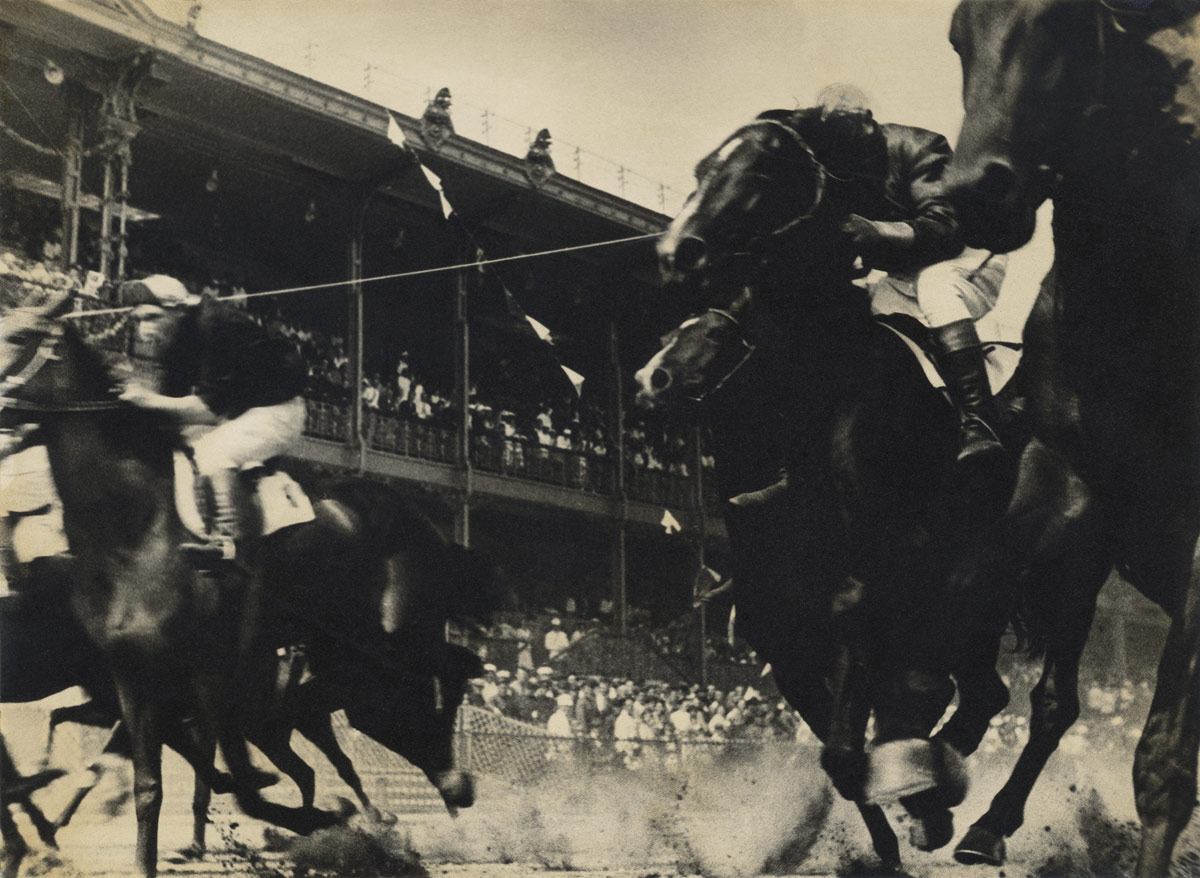
Alexander Rodchenko (Russian, 1891-1956) 'Horse racing' 1935


Alexander Rodchenko (Russian, 1891-1956)
Horse racing
1935
Vintage gelatin silver print on paper
Collection Museum Moscow House of Photography / Multimedia Art Museum, Moscow
© A. Rodchenko – W. Stepanova Archive
© Museum Moscow House of Photography


Alexander Rodchenko (Russian, 1891-1956) 'Sports parade. Girl with towels' 1935


Alexander Rodchenko (Russian, 1891-1956)
Sports parade. Girl with towels
1935
Vintage print on Silver gelatin paper
Collection Museum Moscow House of Photography / Multimedia Art Museum, Moscow
© A. Rodchenko – W. Stepanova Archive
© Museum Moscow House of Photography


Alexander Rodchenko (1891-1956) was a driving force in the Russian avant-garde and is considered one of the great innovators of photography in the first half of the 20th century. In 1924, already well-known as a painter, sculptor and graphic artist, he conquered traditional photography with the slogan “Our duty is to experiment!” Dynamic compositions, stark contrasts, unconventional angles and the use of photomontage are the defining characteristics of his photographic language.

Rodchenko’s visual compositions and constructivist manifestos have been highly influential in the development of modern photography. With more than 200 photographs on display, the exhibition explores Rodchenko’s dynamic vision and the extraordinary range of his work. Alongside renowned, iconic images like Portrait of the Artist’s Mother (1924), Steps (1929) or Girl with a Leica (1934) WestLicht presents many rare vintage prints, which are complemented by a selection of Rodchenko’s posters, publications and typographic works.

As a prominent figure of constructivism, Rodchenko significantly shaped the development of Russian art in the early years of the Revolution. He was also a catalyst of a photography movement, similar to the New Objectivity pioneered by Albert Renger-Patzsch in Germany and the Group f/64 in the USA. “New, unexpected foreshortenings, unusual perspectives, bold light and shadow combinations reproduce fragments of the social reality that are as sharp and clear as possible” (Catalogue for Film and Photo Exhibition, Stuttgart, 1929).

The development of this new reality involved a radical departure from traditional perspectives. As Rodchenko pointed out in an essay on Ways of Contemporary Photography, in 1928: “The modern city with its multi-storey buildings, plants, factories […], all this […] has changed the psychology of the traditional perception to a great extent. It seems as if only a camera is able to illustrate modern life.” Central to Rodenchko’s argumentation was the belief that the camera could act as an active eye of contemporaries, destroying the primacy of the normal view – the navel perspective – established by painting. For Rodchenko the camera lens was “the pupil of the educated person in socialist society.”

Just as the revolution created the new socialist man and swept away the old order, photography should overcome the outdated perception and allow a modern outlook. “Photography – the new, fast and real reflection of the world – should make it possible to map the world from all points of view […]. In order to educate man to a new vision, everyday familiar objects must be shown to him with totally unexpected perspectives and in unexpected situations. New objects should be depicted from different sides in order to provide a complete impression of the object.” According to Rodchenko’s significant and much-quoted claim: “We must revolutionise our optical perception. We must remove the veil from our eyes.”

Curated by Olga Sviblova, Director of the Moscow House of Photography Museum.”

Press release from the WestLicht Gallery website


Alexander Rodchenko (Russian, 1891-1956) 'Girl with Leica' 1934


Alexander Rodchenko (Russian, 1891-1956)
Girl with Leica
1934
Vintage print on Silver gelatin paper
Collection Museum Moscow House of Photography / Multimedia Art Museum, Moscow
© A. Rodchenko – W. Stepanova Archive
© Museum Moscow House of Photography


Alexander Rodchenko (Russian, 1891-1956) 'Balconies. Corner of the house' 1925


Alexander Rodchenko (Russian, 1891-1956)
Balconies. Corner of the house
1925
Vintage print on Silver gelatin paper
Collection Museum Moscow House of Photography / Multimedia Art Museum, Moscow
© A. Rodchenko – W. Stepanova Archive
© Museum Moscow House of Photography


Alexander Rodchenko (Russian, 1891-1956) 'Guard at the Shukhov Tower' 1929


Alexander Rodchenko (Russian, 1891-1956)
Guard at the Shukhov Tower
1929
Vintage print on Silver gelatin paper
Collection Museum Moscow House of Photography / Multimedia Art Museum, Moscow
© A. Rodchenko – W. Stepanova Archive
© Museum Moscow House of Photography


Alexander Rodchenko (Russian, 1891-1956) 'Pines. Puschkino' 1927


Alexander Rodchenko (Russian, 1891-1956)
Pines. Puschkino
1927
Vintage print on Silver gelatin paper
Collection Museum Moscow House of Photography / Multimedia Art Museum, Moscow
© A. Rodchenko – W. Stepanova Archive
© Museum Moscow House of Photography


Alexander Rodchenko (Russian, 1891-1956) 'Fire escape' 1925


Alexander Rodchenko (Russian, 1891-1956)
Fire escape
1925
Deduction on Silver gelatin paper
Collection Museum Moscow House of Photography / Multimedia Art Museum, Moscow
© A. Rodchenko – W. Stepanova Archive
© Museum Moscow House of Photography


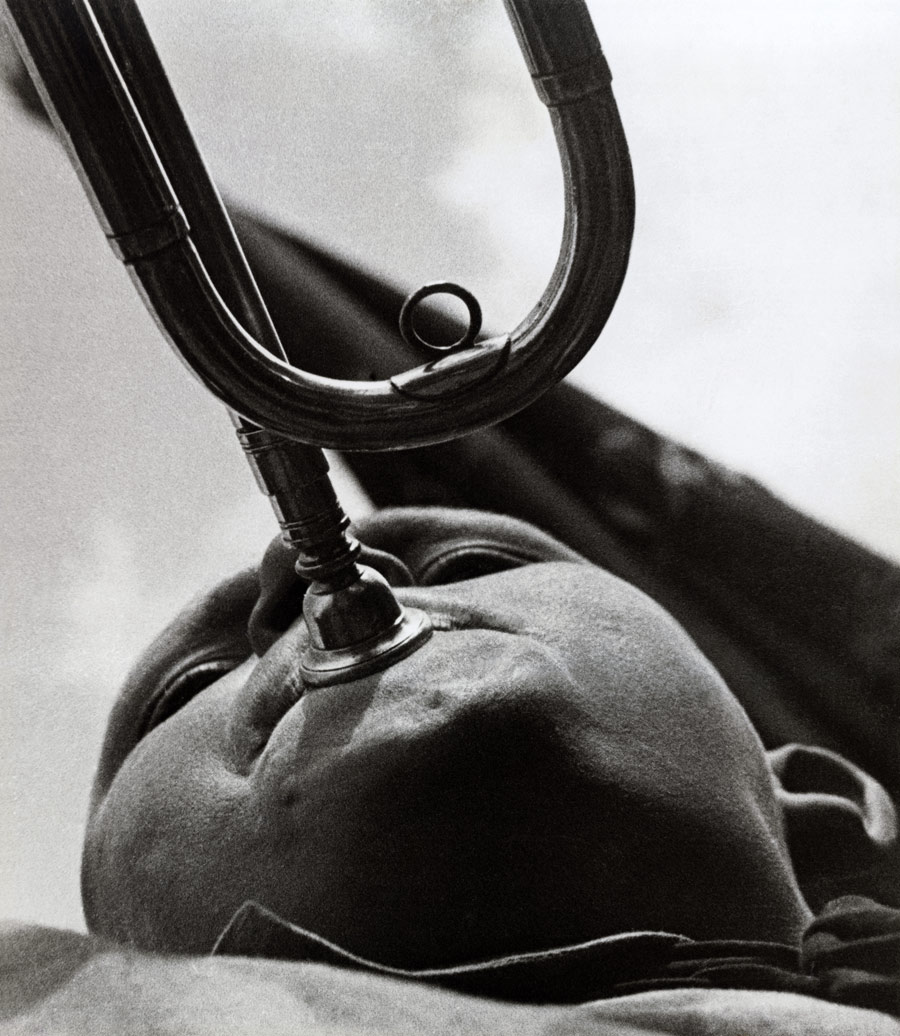
Alexander Rodchenko (Russian, 1891-1956) 'Trumpeting pioneer' 1930


Alexander Rodchenko (Russian, 1891-1956)
Trumpeting pioneer
1930
Vintage print on Silver gelatin paper
Collection Museum Moscow House of Photography / Multimedia Art Museum, Moscow
© A. Rodchenko – W. Stepanova Archive
© Museum Moscow House of Photography


Alexander Rodchenko (Russian, 1891-1956) 'They gathered for the demonstration' 1928


Alexander Rodchenko (Russian, 1891-1956)
They gathered for the demonstration
1928
Vintage print on Silver gelatin paper
Collection Museum Moscow House of Photography / Multimedia Art Museum, Moscow
© A. Rodchenko – W. Stepanova Archive
© Museum Moscow House of Photography


Alexander Rodchenko (Russian, 1891-1956) 'Varvara Stepanova on a balcony' 1928


Alexander Rodchenko (Russian, 1891-1956)
Varvara Stepanova on a balcony
1928
Vintage print on Silver gelatin paper
Collection Museum Moscow House of Photography / Multimedia Art Museum, Moscow
© A. Rodchenko – W. Stepanova Archive
© Museum Moscow House of Photography


Alexander Rodchenko (Russian, 1891-1956) 'Portrait of the Artist's Mother' 1924


Alexander Rodchenko (Russian, 1891-1956)
Portrait of the Artist’s Mother
1924
Vintage print on Silver gelatin paper
Collection Museum Moscow House of Photography / Multimedia Art Museum, Moscow
© A. Rodchenko – W. Stepanova Archive


Alexander Rodchenko (Russian, 1891-1956) 'Pioneer' 1930


Alexander Rodchenko (Russian, 1891-1956)
Pioneer
1930
Vintage print on Silver gelatin paper
Collection Museum Moscow House of Photography / Multimedia Art Museum, Moscow
© A. Rodchenko – W. Stepanova Archive
© Museum Moscow House of Photography


Alexander Rodchenko (Russian, 1891-1956) 'Envelope for Vladimir Mayakovsky's poem "Pro eto" (Darüber)' 1923


Alexander Rodchenko (Russian, 1891-1956)
Envelope for Vladimir Mayakovsky’s poem “Pro eto” (Darüber)
1923
Reprint
Collection Museum Moscow House of Photography / Multimedia Art Museum, Moscow
© A. Rodchenko – W. Stepanova Archive
© Museum Moscow House of Photography


Alexander Rodchenko (Russian, 1891-1956) 'Lilya Brik. Portrait of the advertising poster "Knigi"' 1924


Alexander Rodchenko (Russian, 1891-1956)
Lilya Brik. Portrait of the advertising poster “Knigi”
1924
Vintage print on Silver gelatin paper, cut out and glued on pink paper.
Collection Museum Moscow House of Photography / Multimedia Art Museum, Moscow
© A. Rodchenko – W. Stepanova Archive
© Museum Moscow House of Photography


WestLicht Museum for Photography
Westbahnstraße 40,
1070 Vienna
Phone: +43 (0)1 522 66 36 -60

Opening hours:
Daily 11am – 7pm

WestLicht Gallery website

LIKE ART BLART ON FACEBOOK

Back to top

Exhibition: ‘Lewis Hine – Photography for a Change’ at Fotomuseum Winterthur, Zurich

Exhibition dates: 8th June – 25th August 2013


Lewis Hine (American, 1874-1940) 'Midnight at the Brooklyn Bridge' 1906


Lewis Hine (American, 1874-1940)
Midnight at the Brooklyn Bridge
1906
Gelatin silver print
12 x 17cm
© Collection of George Eastman House, Rochester


“While human truth may be ephemeral qualities like justice are not; the struggle is to define justice and to live it. And for artists to display it.”


Dr Marcus Bunyan


Here is one artist who certainly used photography for social good. Hine “represents the beginning of a long tradition of politically engaged, social documentary photography, so called “concerned photography”… He firmly believed that every person, every individual, was worthy of respect, and he believed photography to be the best tool for clearly and visibly expressing this view.” Bravo to him.

Unfortunately, like so many of these visionary and revolutionary artists, Hine died in 1940, completely impoverished. As a society, why is it that we don’t value these brave human beings until years after they have passed? Is it because of petty jealousies, the rush of life, people in positions of power too long or a lack of understanding of the visionary nature of their work? Or is it just that time passes them by. I would like to pose this question.

Dr Marcus Bunyan


Many thankx to Fotomuseum Winterthur for allowing me to publish the photographs in the posting. Please click on the photographs for a larger version of the image.


Lewis Hine (American, 1874-1940) 'Spinner in New England mill' 1913


Lewis Hine (American, 1874-1940)
Spinner in New England mill
1913
Gelatin silver print
12.6 x 10.1cm
© Collection of George Eastman House, Rochester


Lewis Hine (American, 1874-1940) 'Italian family looking for lost baggage, Ellis Island' 1905


Lewis Hine (American, 1874-1940)
Italian family looking for lost baggage, Ellis Island
1905
Gelatin silver print
33.4 x 27.2cm
© Collection of George Eastman House, Rochester


Lewis Hine (American, 1874-1940) 'Candy worker, New York' c. 1925


Lewis Hine (American, 1874-1940)
Candy worker, New York
c. 1925
Gelatin silver print
17.2 x 11.8cm
© Collection of George Eastman House, Rochester


To what extent can images effectively combat injustice and social inequity? The American photographer Lewis Hine (1874-1940) offered an early answer to this question through his work. Trained as a teacher and sociologist, he ardently wished that Americans would become conscious of the injustice of American labor laws. He also firmly believed that every person, every individual, was worthy of respect, and he believed photography to be the best tool for clearly and visibly expressing this view.

His work represents the beginning of a long tradition of politically engaged, social documentary photography, so called “concerned photography.” His photographs of immigrants from Ellis Island, child labor in American factories, and the construction of the Empire State Building high above Manhattan have become major icons of the 20th century. Simultaneously, the photographs also point to the fact, that the documented problems have not lost their currency, even one hundred years later. Today, even in Europe, we are experiencing intensive migrations, which will continue to increase in the future. Here we are not confronted with child labor, because we have transferred the kinds of industrial production that used child labor to distant countries. Accidents in non-European factories indicate the risky conditions under which our consumer goods are still produced today. Hine’s photographic eye and his black and white images form a trajectory that leads directly to the present.

Lewis Hine grew up in a family that owned a simple restaurant in the small town of Oshkosh, Wisconsin. He lost his father at age 18 due to an accident. He provided for himself and his family first as a factory worker in a furniture production company and then as a doorman, salesman, and bookkeeper. After training as a teacher and studying sociology at the University of Chicago, Hine moved to New York, where he first came in contact with photography while teaching at the Ethical Culture School. Using the camera in his lessons, he made portraits of immigrants on Ellis Island in conjunction with a research project. From then on Hine viewed his camera as a weapon for revealing social injustice and effecting change through the power of images. With this motivation he traveled some 75,000 km through the United States for the National Child Labor Committee (NCLC) and photographed children at work in the fields, mines, factories, mills, and on the streets. His photographs played no small part in raising awareness for child labor and instigating initial reforms. They also represented some of the earliest and most significant contributions to the social documentary genre of photography. During the construction of the Empire State Building Hine was commissioned with documenting the phases of construction over the course of six months in 1930/1931. In over one thousand photographs he recorded the perspective of the construction workers and their hard work on the ultimately 381 m high building. Despite his early success and the use of his images by many governmental agencies, Hine died in 1940, completely impoverished, after an operation.

Fotomuseum Winterthur presents this comprehensive retrospective including 170 images and extensive documentation material in cooperation with the Fundación MAPFRE (Madrid), the Fondation Henri Cartier-Bresson (Paris) and the Nederlands Fotomuseum (Rotterdam). All works come from the George Eastman House, International Museum of Photography and Film in Rochester, USA.

Press release from the Fotomuseum Winterthur website


Lewis Hine (American, 1874-1940) 'Paris gamin' c. 1918


Lewis Hine (American, 1874-1940)
Paris gamin
c. 1918
Gelatin silver print
24.4 x 19.4cm
© Collection of George Eastman House, Rochester


Lewis Hine (American, 1874-1940) 'Jewess at Ellis Island' 1905


Lewis Hine (American, 1874-1940)
Jewess at Ellis Island
1905
Gelatin silver print
24.1 x 19.1cm
© Collection of George Eastman House, Rochester


Lewis Hine (American, 1874-1940) 'Mechanic at steam pump in electric power house' 1920


Lewis Hine (American, 1874-1940)
Mechanic at steam pump in electric power house
1920
Gelatin silver print
16.9 x 11.7cm
© Collection of George Eastman House, Rochester


Lewis Hine (American, 1874-1940) '[Man on girders, Empire State Building]' c. 1931


Lewis Hine (American, 1874-1940)
[Man on girders, Empire State Building]
c. 1931
Gelatin silver print
12 x 9.2cm
© Collection of George Eastman House, Rochester


Lewis Hine (American, 1874-1940) '[Steelworker touching the tip of the Chrysler Building]' c. 1931


Lewis Hine (American, 1874-1940)
[Steelworker touching the tip of the Chrysler Building]
c. 1931
Gelatin silver print
16.9 x 11.9cm
© Collection of George Eastman House, Rochester


Lewis Hine (American, 1874-1940) 'Icarus atop Empire State Building' 1931


Lewis Hine (American, 1874-1940)
Icarus atop Empire State Building
1931
Gelatin silver print
9.3 x 10cm
© Collection of George Eastman House, Rochester


Fotomuseum Winterthur
Grüzenstrasse 44 + 45
CH-8400
Winterthur (Zürich)

Opening hours:
Tuesday to Sunday 11am – 6pm
Wednesday 11am – 8pm
Closed on Mondays

Fotomuseum Winterthur website

LIKE ART BLART ON FACEBOOK

Back to top

Catalogue essay: ‘Intimations of Mor(t)ality: Sudarios (Shrouds) by Erika Diettes’ Dr Marcus Bunyan / Exhibition: ‘Sudarios (Shrouds)’ by Erika Diettes at the Ballarat International Foto Biennale

Exhibition dates: 17th August – 15th September 2013


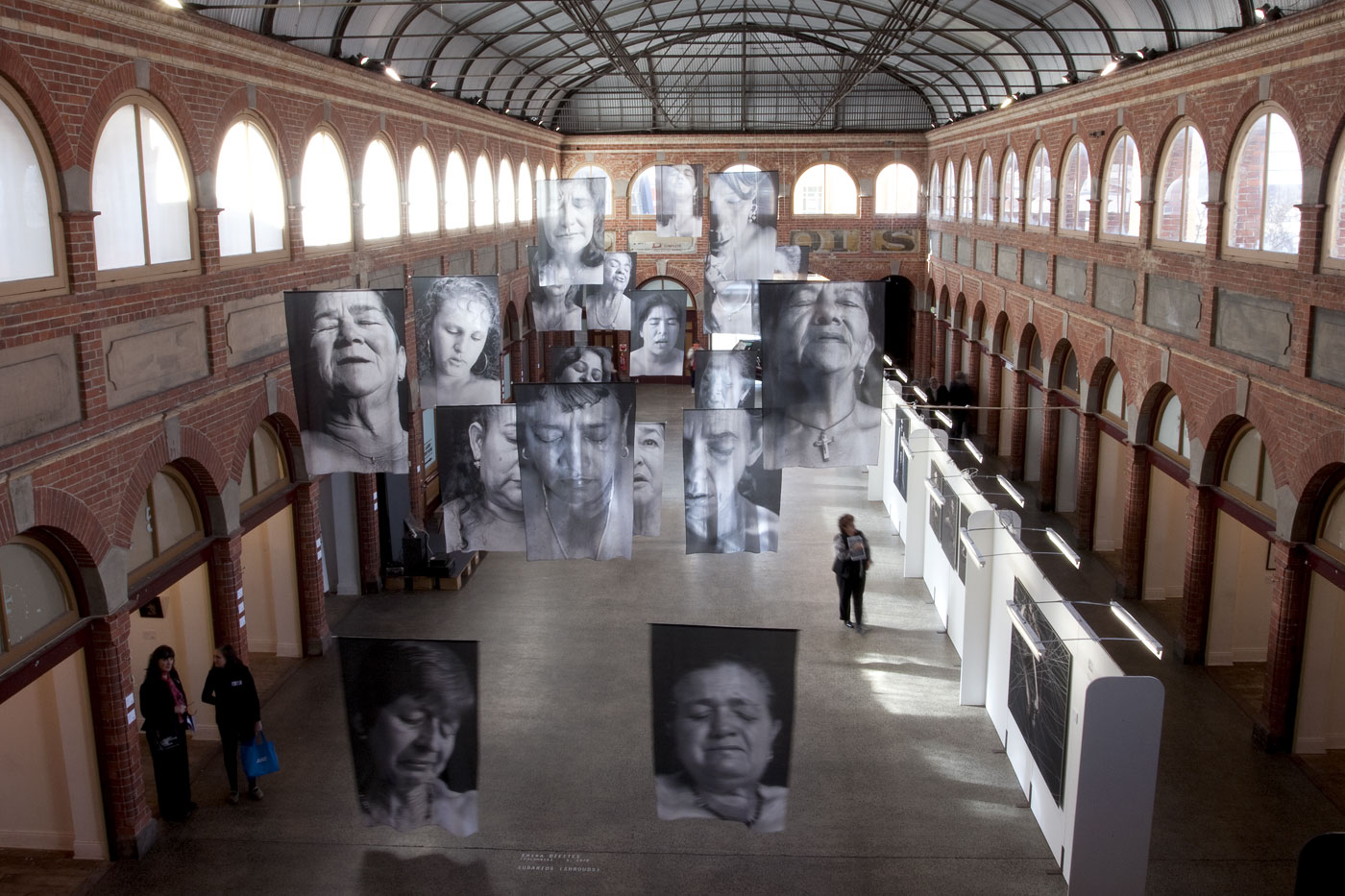
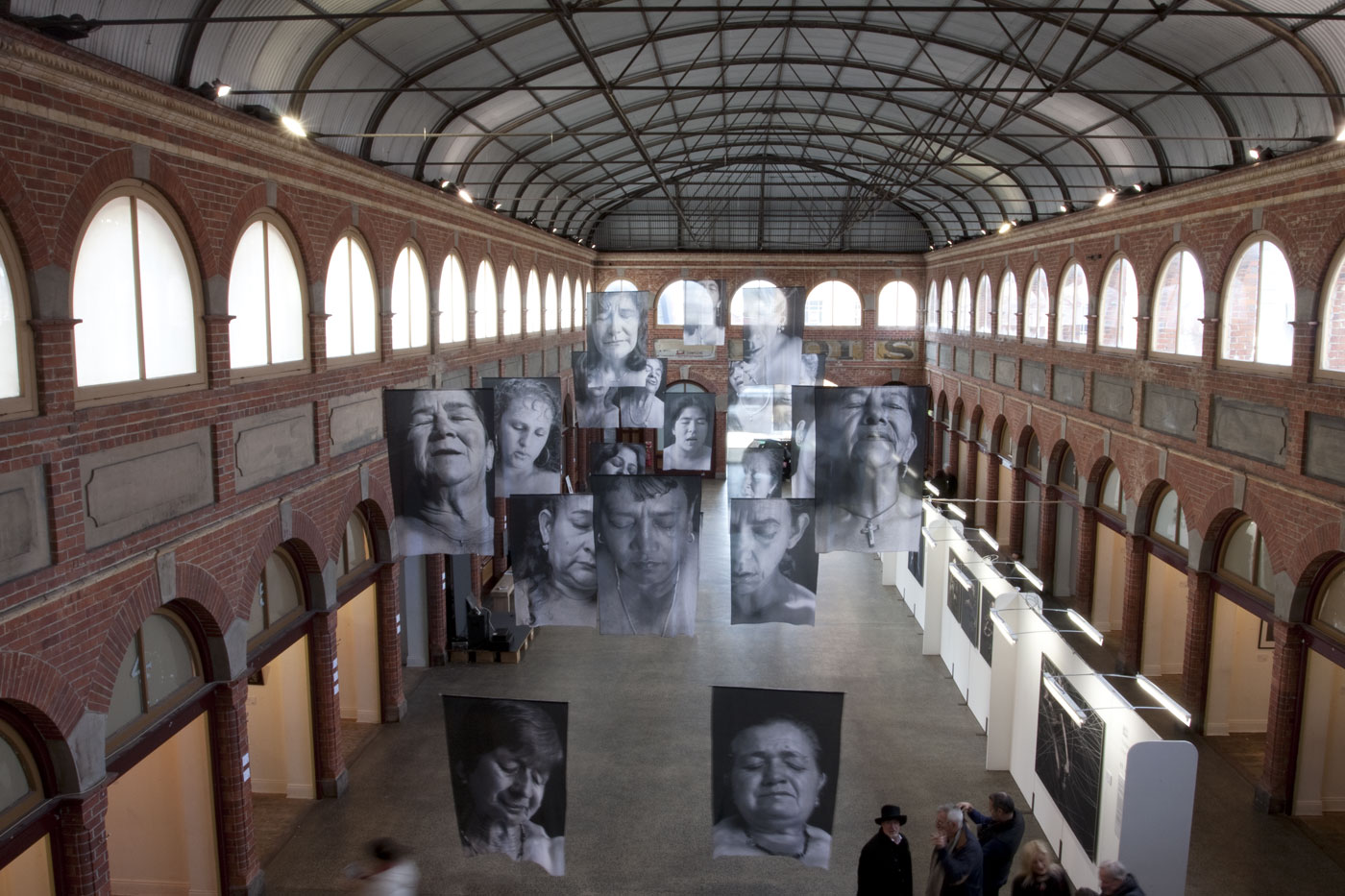
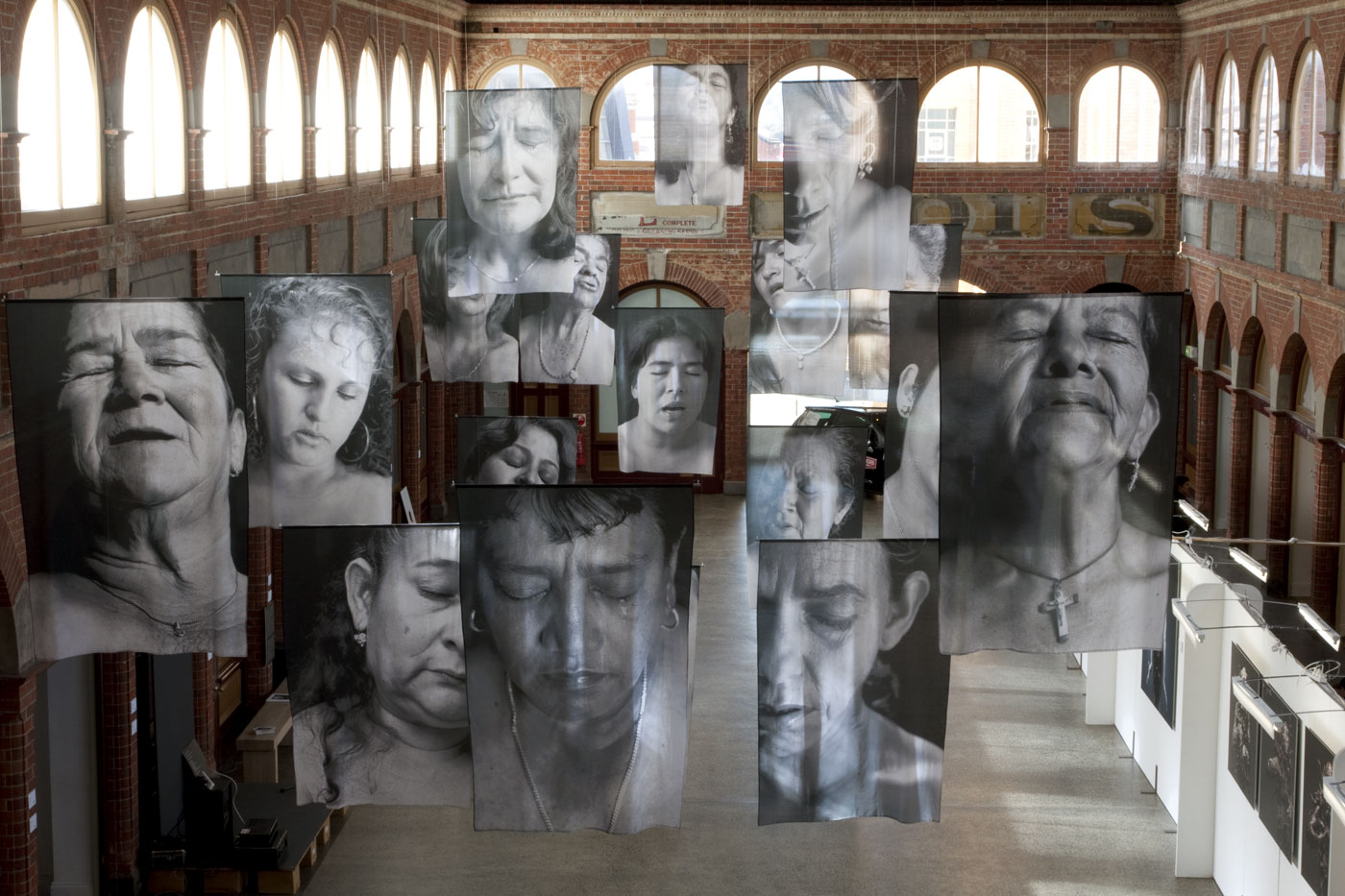
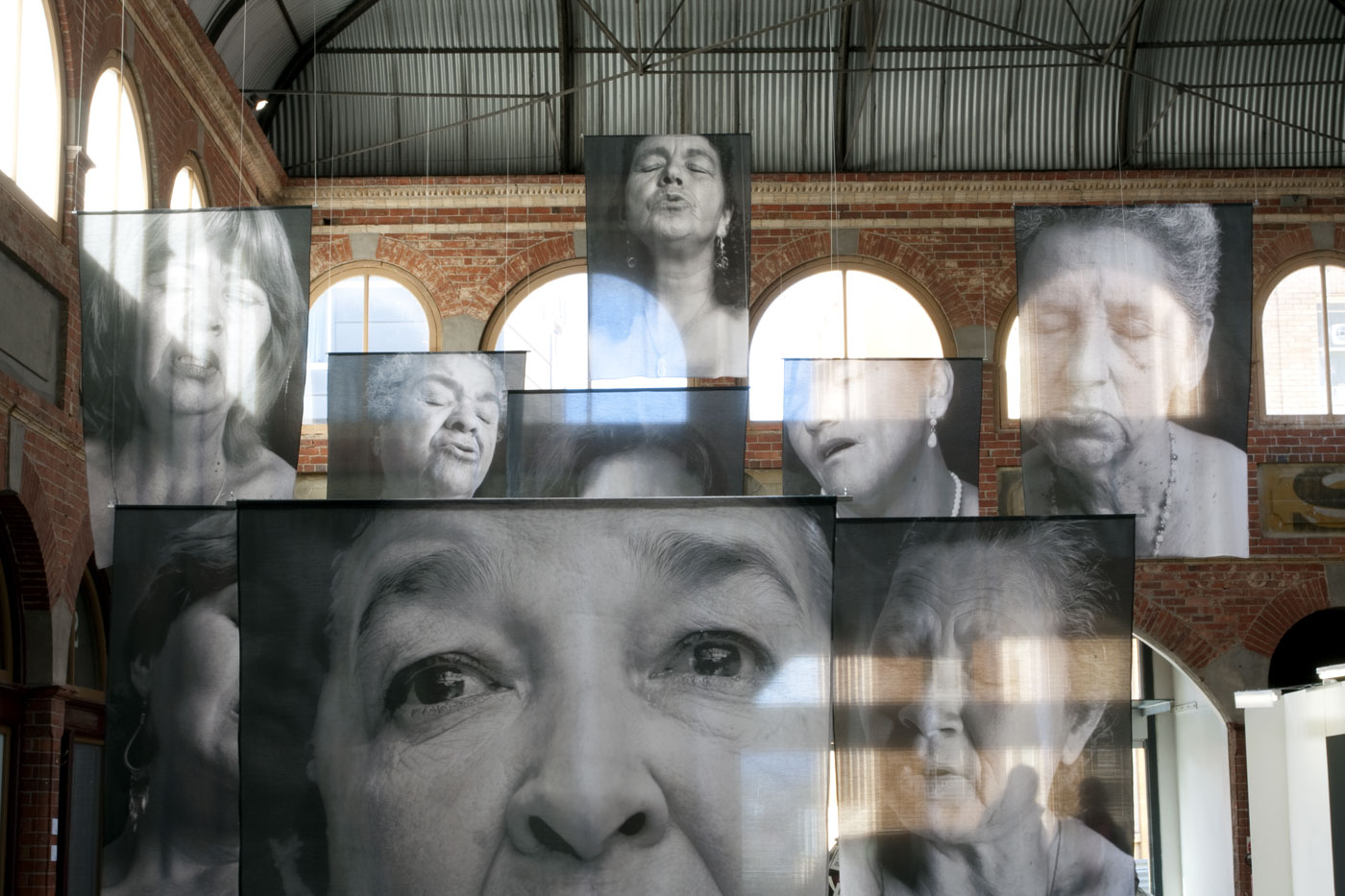
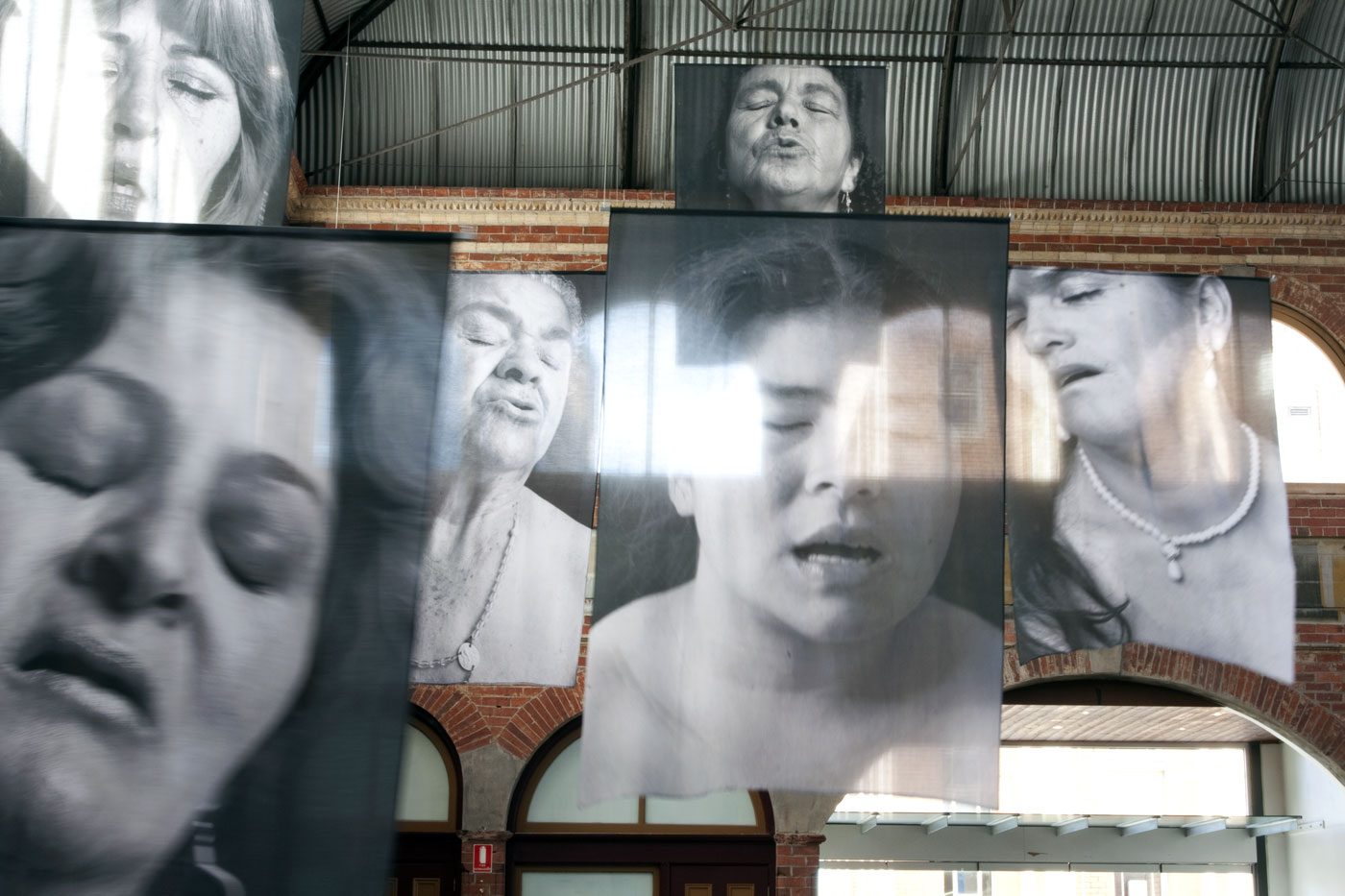
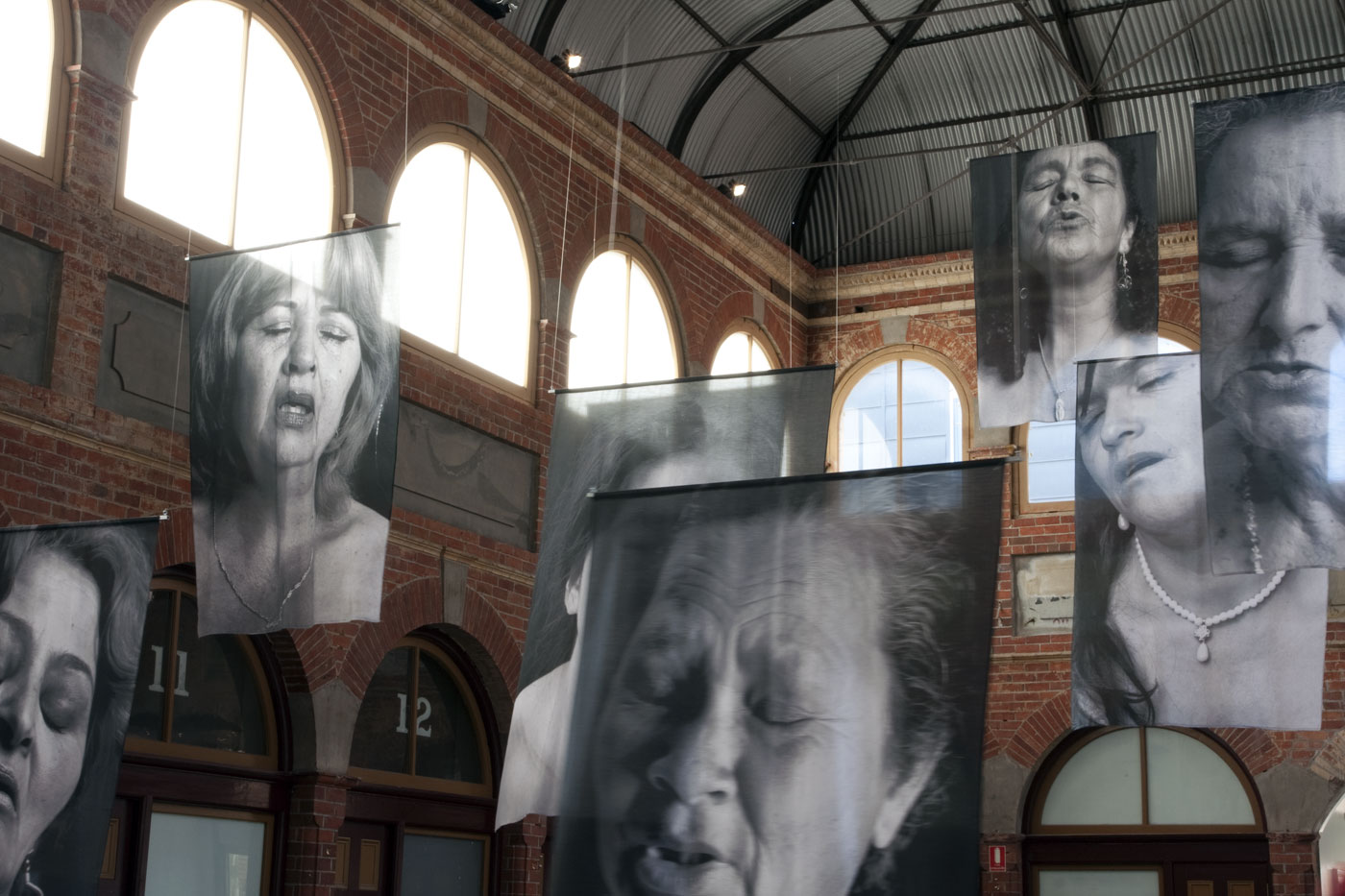
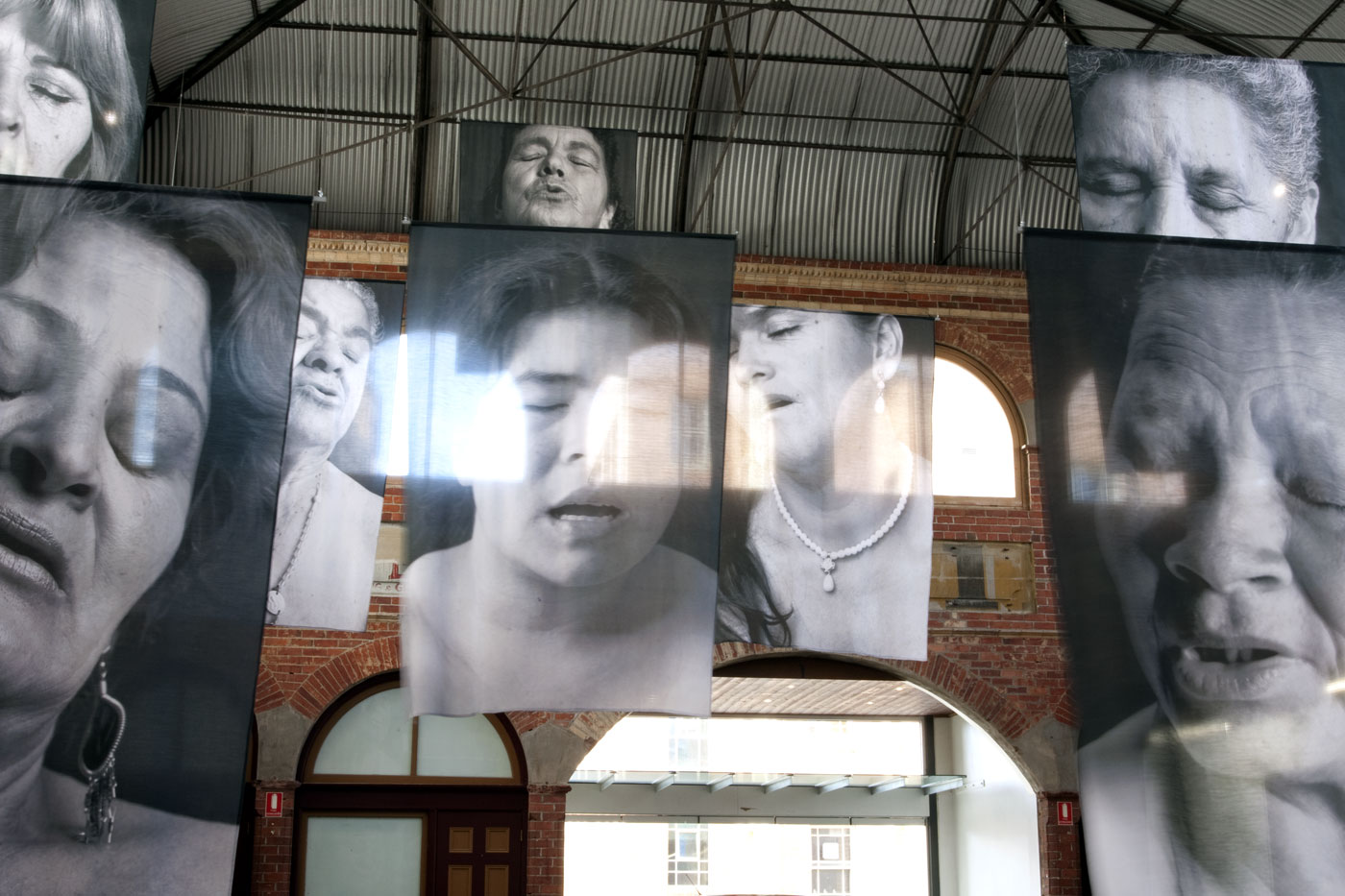
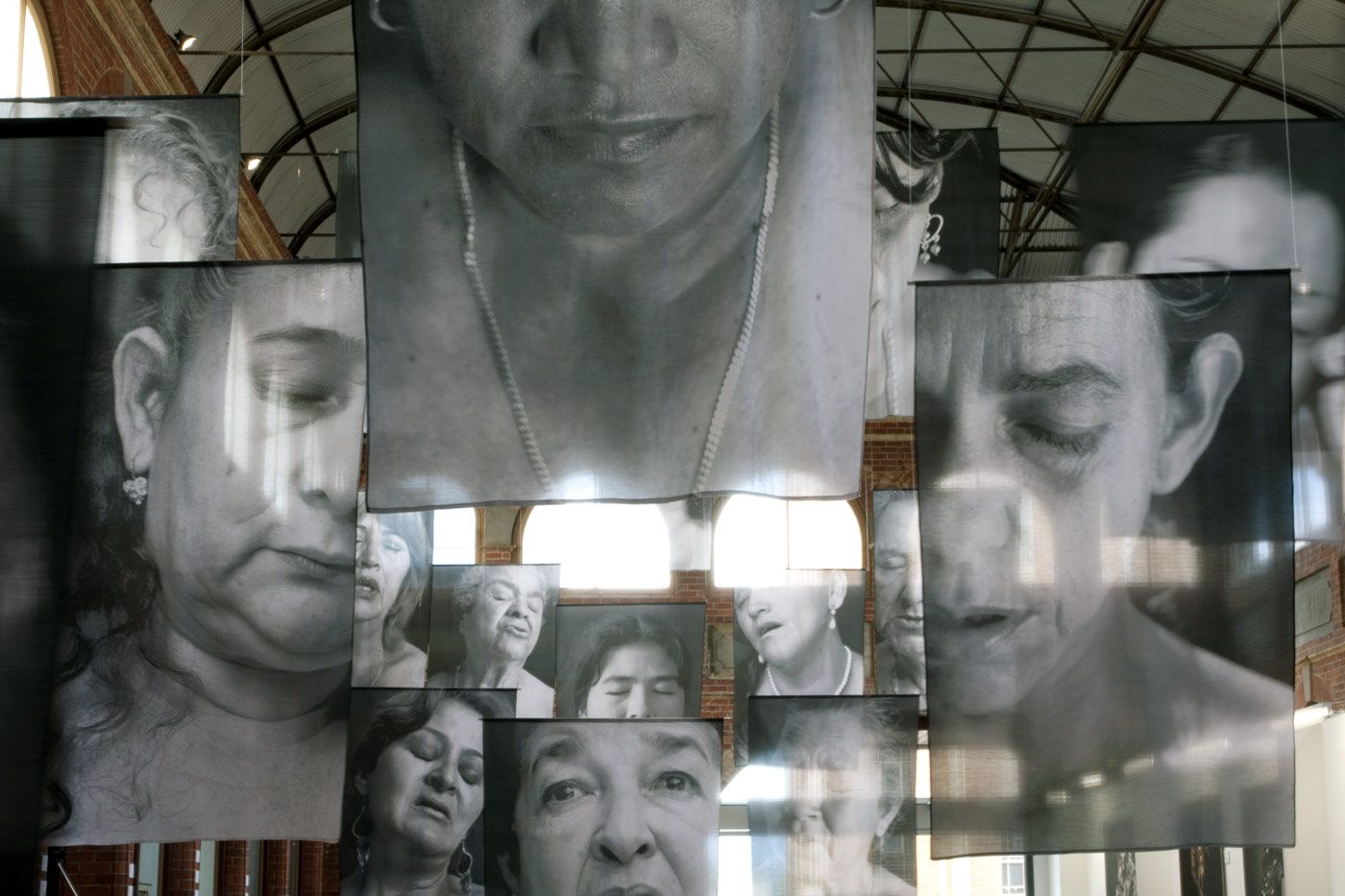
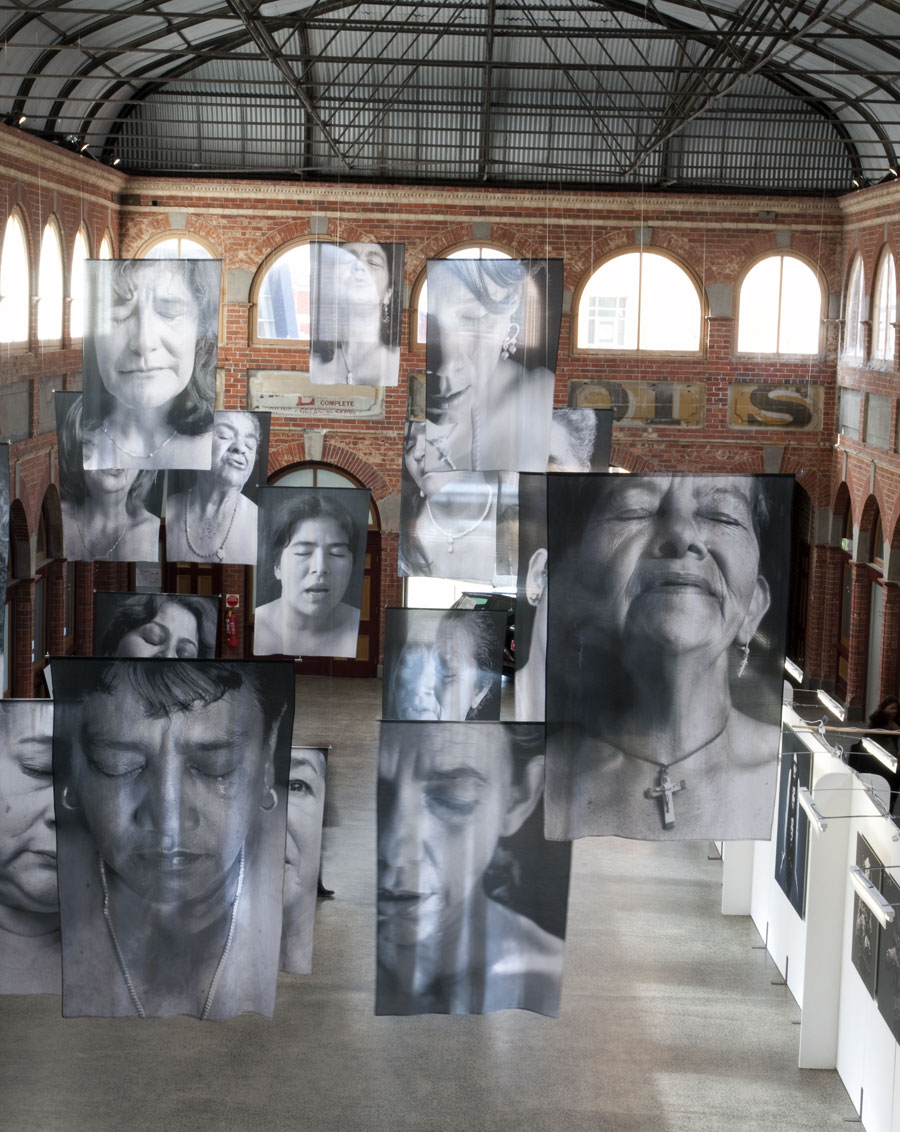
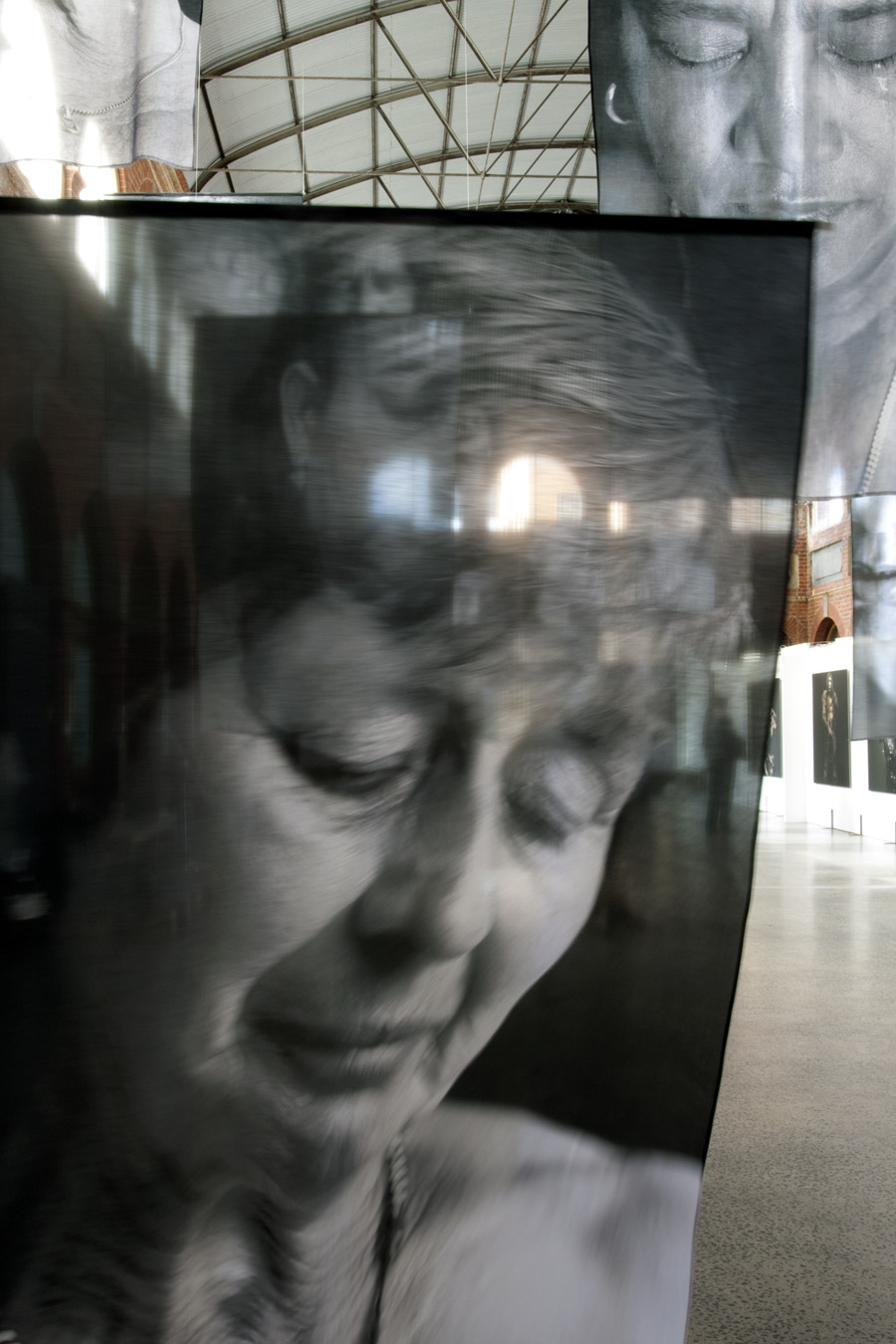
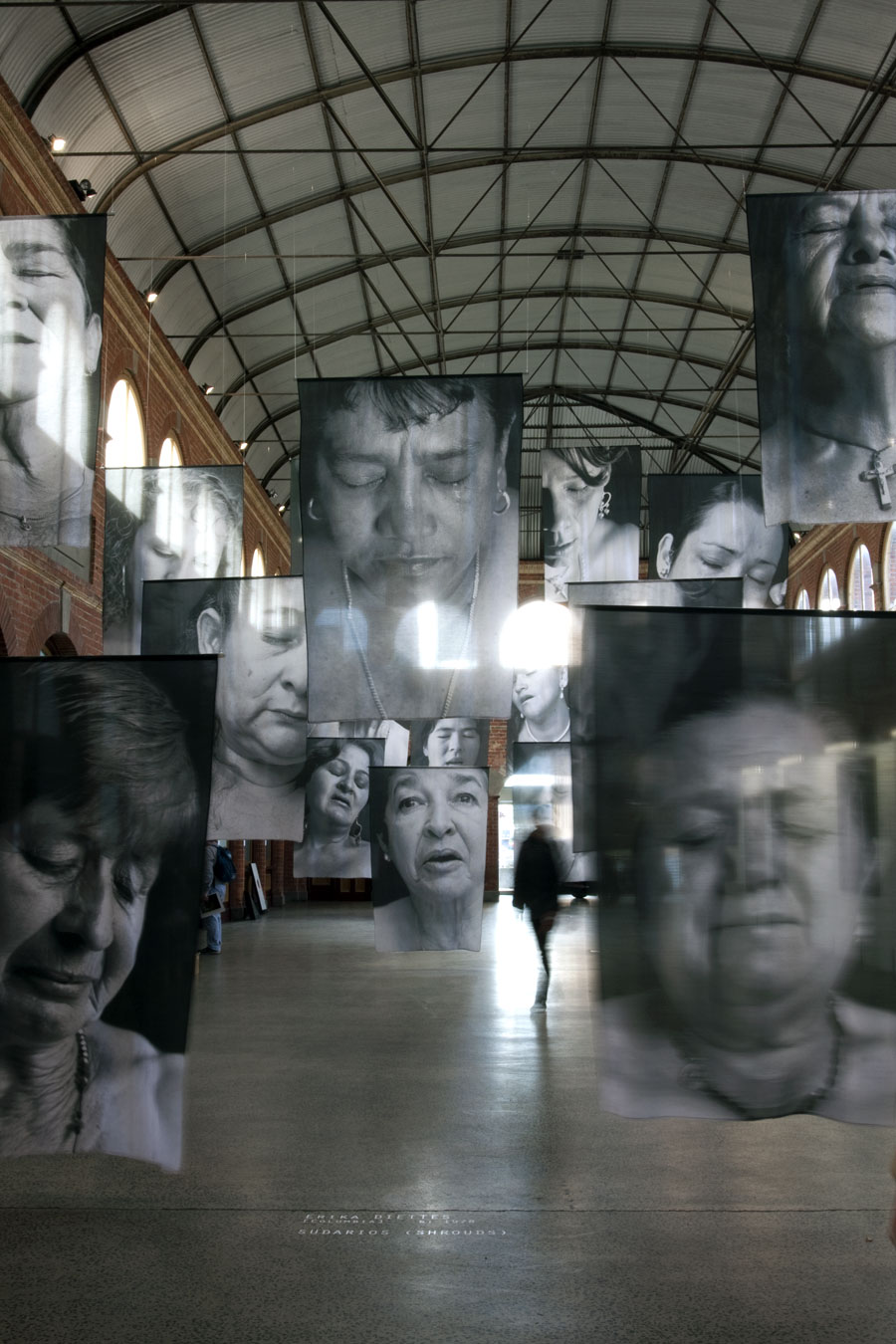
Installation photograph of 'Sudarios (Shrouds)' by Erika Diettes at the Mining Exchange, Ballarat. Photograph by Marcus Bunyan


Installation photograph of Sudarios (Shrouds) by Erika Diettes at the Mining Exchange, Ballarat
Photograph by Marcus Bunyan
© Marcus Bunyan, Erika Diettes and Ballarat International Foto Biennale


This exhibition is one of the core programs for this year’s Ballarat International Foto Biennale and I had the privilege of writing the catalogue essay for the Colombian artist Erika Diettes. I met the delightful Erika and her husband today at the opening of BiFB on their first trip to Australia and I must say the art hangs very well in the Mining Exchange building.

This was one of the most difficult but rewarding pieces that I have ever had to write. In reading, I hope you gather the full import of the text.

Dr Marcus Bunyan

Text © Marcus Bunyan. All images © Marcus Bunyan, Erika Diettes and Ballarat International Foto Biennale.


Intimations of Mor(t)ality: Sudarios (Shrouds) by Erika Diettes

Dr Marcus Bunyan


“There is now a vast repository of images that make it harder to maintain [a] kind of moral defectiveness. Let the atrocious images haunt us. Even if they are only tokens, and cannot possibly encompass most of the reality to which they refer, they still perform a vital function. The images say: This is what human beings are capable of doing – may volunteer to do, enthusiastically, self-righteously. Don’t forget.”


Susan Sontag Regarding the Pain of Others 2003 1


When I was asked to write the catalogue essay on Colombian artist Erika Diettes’ work Sudarios (Shrouds) by editor Esther Gyorki for the Ballarat International Foto Biennale the work gave me pause. What could I say about it that was relevant, insightful and spoke from the heart? I wrote back to Esther saying I needed to do some background research: “This is difficult subject matter and I want to make sure I can do it justice before I commit to writing about it.”2 In a synchronous way that often happens in the world, that is ultimately what this text is about – justice.

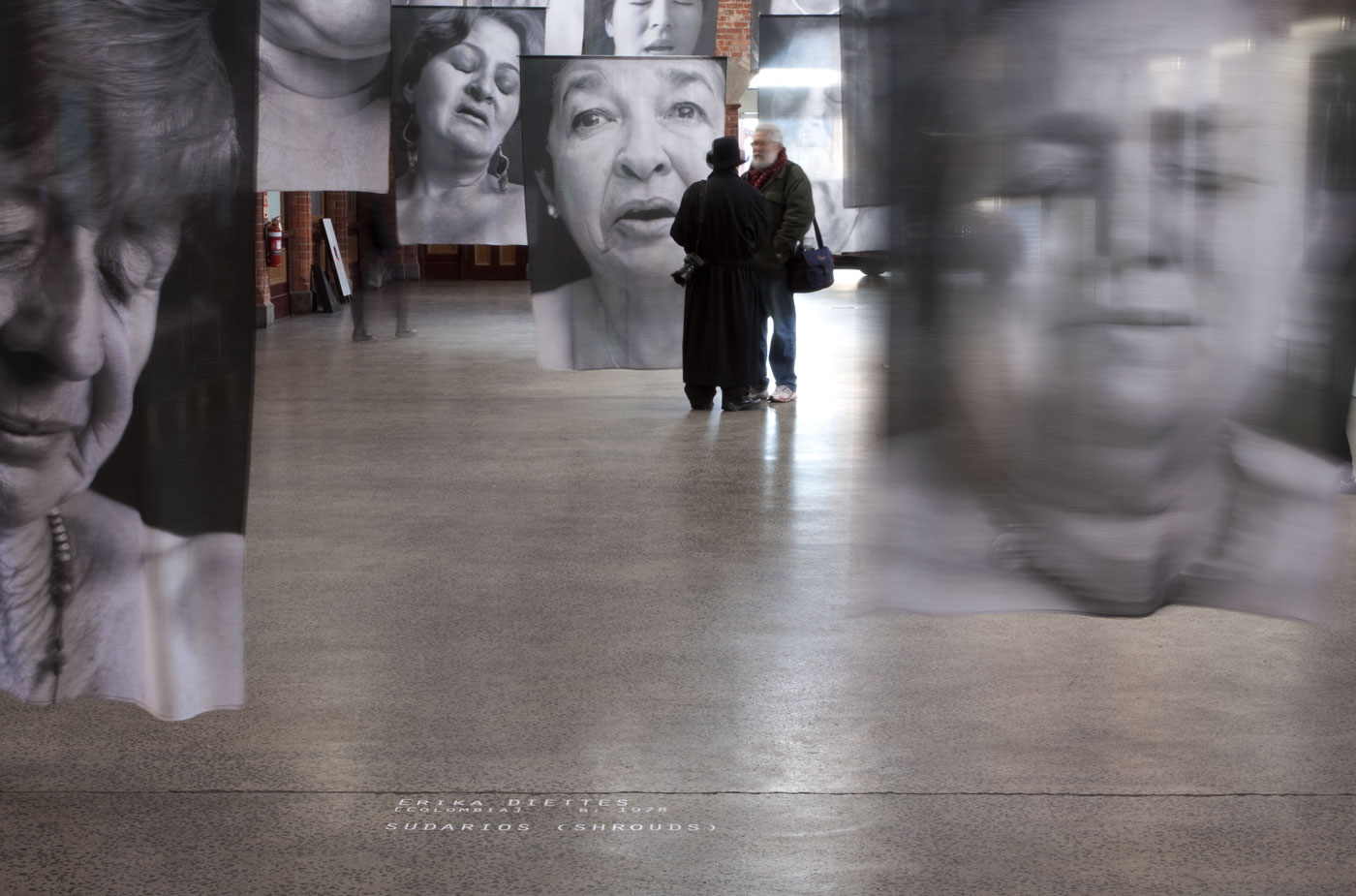
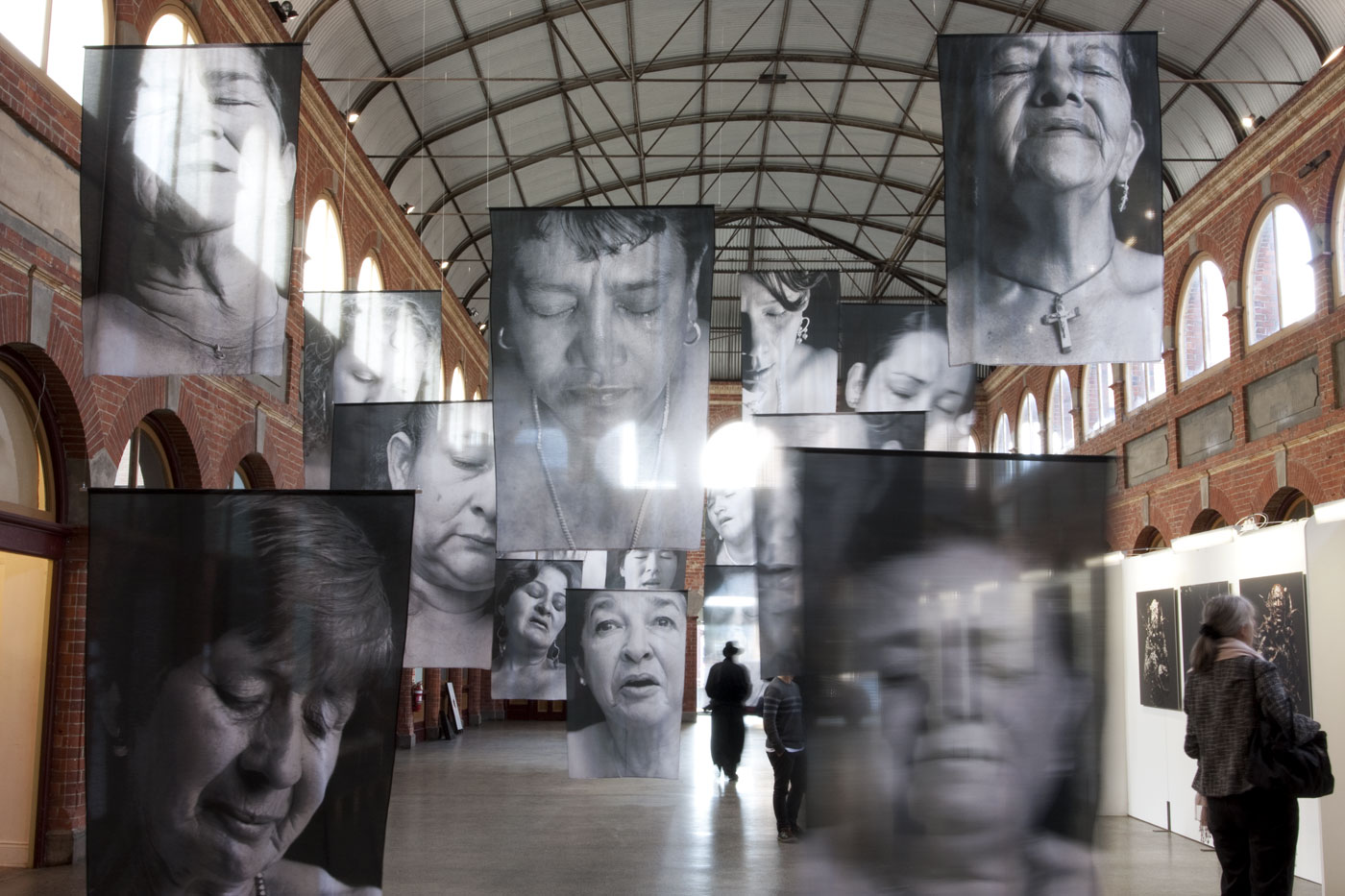
The basics are easily told. Artist and anthropologist Erika Diettes travelled to different cities in the department of Antioquia to interview women who had been present at the torture and murder of their loved ones.3 Diettes photographed the women, closely cropped in black and white, at a moment of great vulnerability – all but one with their eyes closed. The resultant twenty photographs were printed on seven feet tall silk panels and form the work Sudarios (shrouds are a burial cloak, a cloth that shrouds the body of the deceased). The artist always intended for these images to be printed on silk and had the installation in mind before she took the photographs: in other words previsualisation was strong. The work is usually displayed in sacred spaces such as churches and convents with a sound track of a barely audible, sighing female voice; here in Ballarat the work is hung in the former Mining Exchange building, a seat of colonial power and wealth which can be read as appropriate for the presentation of this work, for torture is always about the power of one person over another. The viewer can walk through these floating realities and be enfolded in the aggrieved women’s sorrow as if part of a ceremonial procession, perhaps a funeral cortege.

In her creation of an allegorical space for mourning, Diettes work acts as a funeral rite for both living and dead, acts of mourning placed in a context of splendour. The images evoke the representation of the death of Saint Sebastian, the faces recalling “the exquisite suffering of the Catholic saints and martyrs, but also of refugees and victims of contemporary traumas,”4 while the atrocities perpetrated on the body are hidden by the close cropping of the images. As Diettes observes, “You can’t help being a little pierced by their exhalations,”5 an indirect reference by Diettes to the arrows that pierce Saint Sebastian’s body. Diettes opens a space before the camera for the human ‘being’ in context, a terrain (of) or becoming, where the terrors are written on the countenance of the women, their mouths silently singing their song of mourning. Look at their mouths, each one contorted in agony, each one giving voice to the memory of terror.

These are confronting images about trauma and grief, documenting the ongoing effects of atrocity on the mind of the observer for they are portrayals of the effect of intim(id)ation, where intimations of mortality are evidenced by the removal of an identity, the beloved id, which reveals the intimate – expressed in the adoration/adornment of the women with jewellery which signifies the women’s dignity, comfort, and continuing engagement with the world as an extension of personal self/belief.

The signs of erasure of these murders are rearticulated through Diettes work. The bodies are held in suspended animation, in endless agony, through an act of re-terror-itorialisation. Through the evacuation of loved ones, their discontinuity and deterritorialisation, and the reterritorialisation / re-terroring of that space through memory – portrayed on the faces of the women – the images recast and represent issues of power, domination and abuse. Through suspended sorrow, suspended mourning, the disappearance of some bodies and the speaking of others, the images become a representation of a doubled absence, a doubled momenti mori – for the photographs picture the women (making them dead) as they themselves remember the violence perpetrated before them from behind closed eyes (as the dead have their eyes closed), remembering in their mind’s eye the death of the beloved. The image of the victim has become a ghost, a trace etched upon the face of the relative, a trace of that which “persists and gives testimony of a vanished state” in art, for if art is linked to memory and to what survives, it is from the perspective of its own corpse-oreality, its own ghostly and fragile materiality that these images emerge: the hanged man, the hung woman. Remaking but always recording the past through interaction with the present, the shrouds are a palimpsest in which “personal memories are always interwoven with historical consciousness”6 and are constantly being rewritten.

Of course the photographs elicit our empathy but more than that they make us feel their terrible vulnerability while drawing us into uncomfortable complicity as subsidiary witnesses to the event.7 Normally when looking at a photograph the viewer is a secondary witness but here the viewer becomes a tertiary witness – the actual event, the memory of that event etched on the face of the women captured by the camera and now observed by the viewer. There is an osmotic effect taking place as one as one image is super imposed on another. Even after an event is over, “there’s an after image or an echo that exists… a spirit or a residue, a trace.”8 These visions are like images of the Holocaust. As soon as we see them we are implicated in a narrative – and we are helpless in this process – which is an essential part of history.

Diettes work reframes the subject because there is no traditional frame of reference for the viewer, only a memory of that reference in the form of a ghost-like shroud. The normal definition of a shroud no longer pertains to these images for the cloth is no longer around a dead body but represents / holds a trace of what was once dead.

As spirit photographs in the Victorian era solidified a fractured, unknown reality, so these apparitions of the departed are brought forth and solidified, just for a moment, in the faces of the suffering women. The viewer of these images does not see the (dead) carrier of messages, but only their shadows carried by the grief of their loved ones, shrouded as they are in remembrances of the past. We feel that the women are not looking at us but that the aura of their invisible seeing is directed toward us from outside of its normative context – from behind their eyes. It is this imprint on the Shrouds; the imprint of their memories that travels great distances towards us, that enfolds us in sorrow and shadow.

“It is the special feeling of the ‘presence’ of a work produced not by its remaining where it is but by its moving across boundaries where it reaches us from a distance, looking at us even when it appears not to. It is where the work seems peculiarly meant for us even in its indifference to or difference from us.”9

If photographs really are “experience captured” then Diettes explores this arm of consciousness in its acquisitive mood,10 probing the limitation of the medium, shaping the space within the available conditions. Her images become images of sentience that enable the viewer to live in the world with open eyes (while the victims eyes are closed) – to be made aware of the injustices of this world and not remain silent. Diettes work is not about remembering, it’s about an answerable “not forgetting” for hers… is to remind us of the responsibility to make art in response to mor(t)ality.

As human beings, we must fight for the right to be heard and use art as a visual language to textualise our experience and thereby make it available for interpretation and closure. Powerful, simple questions (and I believe) undeniable questions have to be asked; and in response to those questions (power: it will corrupt you, but if you don’t want it, it will be used against you), intelligence, justice and integrity must be used in the service of art. While human truth may be ephemeral qualities like justice are not; the struggle is to define justice and to live it. And for artists to display it.

You place innocence at the heart of human depravity – and hope it survives.

Dr Marcus Bunyan
Melbourne 2013


Endnotes

1/ Sontag, Susan. Regarding the Pain of Others. London: Hamish Hamilton, 2003, p. 102.

2/ Email to Esther Gyorki. Tue, March 26, 2013

3/ The capital of the department of Antioquia is Medellin. The city is a 35-minute flight from the Colombian capital Bogota and has one of the highest rates of violence concerning drugs in Colombia. Most of the crimes were committed between 2001 and 2008.

4/ Anon. “Berlinde De Bruyckere Into One-Another To P.P.P.” on the Hauser and Wirth website [Online] Cited May 5, 2013. No longer available online

5/ Diettes, Erika quoted in Tobón, Paola Cardona. “The exhalation of sorrow,” in  El Colombiano, November 4, 2012 [Online] Cited Cited May 5, 2013. No longer available online

6/ Garb, Tamar. “A Land of Signs,” in Journal of Contemporary African Art 26, Spring 2010, p. 11.

7/ Op. cit. “Berlinde De Bruyckere Into One-Another To P.P.P.”

8/ Rakes, Rachael and Goldsmith, Leo. “Pasolini’s Body: Cathy Lee Crane with Leo Goldsmith and Rachael Rakes,” on The Brooklyn Rail website. January 13, 2013 [Online] Cited May 5, 2013.
www.brooklynrail.org/2013/02/film/pasolinis-body-cathy-lee-crane-with-leo-goldsmith-rachael-rakes

9/ Butler, Rex. “”Lines”, Leading Out of Sight?: Is Aboriginal Art Losing its Aura?” in Australian Art Collector No. 13, July-September 2000, p. 87.

10/ Campany, David. “Photography and Photographs,” on the Still Searching blog. April 14, 2013 [Online] Cited May 11, 2013.
blog.fotomuseum.ch/2013/04/1-photography-and-photographs/#more-1282


Installation photographs of 'Sudarios (Shrouds)' by Erika Diettes at the Mining Exchange, Ballarat. Photograph by Marcus Bunyan


Installation photograph of 'Sudarios (Shrouds)' by Erika Diettes at the Mining Exchange, Ballarat. Photograph by Marcus Bunyan


Installation photograph of 'Sudarios (Shrouds)' by Erika Diettes at the Mining Exchange, Ballarat. Photograph by Marcus Bunyan


Installation photograph of 'Sudarios (Shrouds)' by Erika Diettes at the Mining Exchange, Ballarat. Photograph by Marcus Bunyan


Installation photograph of 'Sudarios (Shrouds)' by Erika Diettes at the Mining Exchange, Ballarat. Photograph by Marcus Bunyan


Installation photograph of 'Sudarios (Shrouds)' by Erika Diettes at the Mining Exchange, Ballarat. Photograph by Marcus Bunyan


Installation photograph of 'Sudarios (Shrouds)' by Erika Diettes at the Mining Exchange, Ballarat. Photograph by Marcus Bunyan


Installation photograph of 'Sudarios (Shrouds)' by Erika Diettes at the Mining Exchange, Ballarat. Photograph by Marcus Bunyan


Installation photograph of 'Sudarios (Shrouds)' by Erika Diettes at the Mining Exchange, Ballarat. Photograph by Marcus Bunyan


Installation photograph of 'Sudarios (Shrouds)' by Erika Diettes at the Mining Exchange, Ballarat. Photograph by Marcus Bunyan


Installation photograph of 'Sudarios (Shrouds)' by Erika Diettes at the Mining Exchange, Ballarat. Photograph by Marcus Bunyan


Installation photograph of 'Sudarios (Shrouds)' by Erika Diettes at the Mining Exchange, Ballarat. Photograph by Marcus Bunyan


Installation photographs of Sudarios (Shrouds) by Erika Diettes at the Mining Exchange, Ballarat
Photographs by Marcus Bunyan
© Marcus Bunyan, Erika Diettes and Ballarat International Foto Biennale


Please click on the photographs for a larger version of the image.


Ballarat International Foto Biennale
12 Lydiard St North, Ballarat 3350

Ballarat International Foto Biennale website

Erika Diettes website

LIKE ART BLART ON FACEBOOK

Back to top

Exhibition: ‘Photographic Wonders: American Daguerreotypes from The Nelson-Atkins Museum of Art’ at the Taft Museum of Art, Cincinnati

Exhibition dates: 17th May – 25th August 2013


Unknown Maker (American) 'Three Lively Women' c. 1850


Unknown Maker (American)
Three Lively Women
c. 1850
Daguerreotype, quarter plate
3 1/4 x 4 1/4 inches
The Nelson-Atkins Museum of Art, Gift of Hallmark Cards, Inc.,
© Nelson Gallery Foundation


I love the word “occupationals” to describe portraits of individuals with the hallmarks of their trade.

Marcus


Many thankx to the Taft Museum of Art for allowing me to publish the photographs in the posting. Please click on the photographs for a larger version of the image.


Thomas Easterly (American, 1809-1882) 'Man with Elephant' c. 1850


Thomas Easterly (American, 1809-1882)
Man with Elephant
c. 1850
Daguerreotype, quarter plate
3 1/4 x 4 1/4 inches
The Nelson-Atkins Museum of Art, Gift of Hallmark Cards, Inc.,
© Nelson Gallery Foundation


Thomas Martin Easterly

A sometime calligrapher and writing teacher, Vermont-born Thomas Martin Easterly (b. 1809 Guilford, Vermont, d. 1882) learned the daguerreotype process in New York between 1841 and 1844, possibly from Charles and Richard Meade. In 1844 Easterly sailed from New York City to New Orleans, where he made photographs before returning to Vermont the following year. He did not remain for long: by October, he had entered into a daguerreotype studio partnership in Iowa. He and his partner operated as traveling photographers working throughout Iowa and Missouri for several years. Some scholars have credited Easterly with making the first photographs of Plains Indians.

After the dissolution of the partnership, Easterly moved to Saint Louis and took over a studio in 1848. He had a successful career for ten years, but his loyalty to the daguerreotype process after the introduction of the ambrotype, tintype, and paper photograph processes caused his business to falter. By 1860 Easterly had begun to sell farm implements in addition to continuing his daguerreotype practice.

Text from the J. Paul Getty Museum website


Attributed to Ezekiel Hawkins (American, 1808-1862) 'The Jacob Strader at Wharf, Cincinnati' c. 1853


Attributed to Ezekiel Hawkins (American, 1808-1862)
The Jacob Strader at Wharf, Cincinnati
c. 1853
Daguerreotype, half plate
4 1/4 x 5 1/2 inches
The Nelson-Atkins Museum of Art, Gift of Hallmark Cards, Inc.,
© Nelson Gallery Foundation


This daguerreotype of the side-wheel packet Jacob Strader was taken at the Cincinnati boatyard where she was built in 1853. Owned by the U.S. Mail Line Co., this steamboat was named to honour Jacob Strader, the company’s first president. The Jacob Strader ran regularly between Cincinnati and Louisville, however during the Civil War, because her large cabin contained 310 berths, she was frequently used to transport sick and wounded soldiers. This boat was dismantled in 1866.

As steamboats replaced flatboats and keelboats as the major mode of river transportation, travel along the Ohio River became faster and easier. By the middle of the nineteenth century, more than 3,000 steamboats arrived each year at the port of Cincinnati. The city’s prominent location along the river contributed to its rapid growth, and by 1850 Cincinnati became the sixth largest city in the country. The development of railroads slowly led to the decline of steamboats. They continued to operate on the Ohio River, but their numbers dwindled.

Text from the Ohio Memory Collection website


Unknown Maker (American) 'A Showing of Daguerreotypes' c. 1850


Unknown Maker (American)
A Showing of Daguerreotypes
c. 1850
Daguerreotype, quarter plate
3 1/4 x 4 1/4 inches
The Nelson-Atkins Museum of Art, Gift of Hallmark Cards, Inc.,
© Nelson Gallery Foundation


Unknown Maker (American) 'Comic Dentist' c. 1850


Unknown Maker (American)
Comic Dentist
c. 1850
Daguerreotype, sixth plate
3 1/4 x 2 3/4 inches
The Nelson-Atkins Museum of Art, Gift of Hallmark Cards, Inc.,
© Nelson Gallery Foundation


American Daguerreotypes from The Nelson-Atkins Museum of Art, on display May 17 – Aug. 25, features 82 astonishing images of life in 19th-century America. The exhibition includes rare images of such well-known Americans as Harriet Beecher Stowe, Frederick Douglass, and Tom Thumb.

By the middle of the 19th century, Cincinnati was the Queen City of the West. A transportation hub, the city was home to industry, art, and even a professional baseball team. Though there are numerous written accounts of life in the big city at this time, we are also fortunate to have images of this era because of the earliest “photographic” works, known as daguerreotypes. In 1839 the American public first encountered this exciting new invention. By 1843, daguerreotypists had set up shop in every major city in the United States. Visitors to the Taft will have the opportunity to view these remarkable works. This exhibition features about 90 daguerreotypes of exceptional quality and variety, with the high degree of resolution typical of these rare, one-of-a-kind photographs. Works by both famed and anonymous makers provide a window into mid-19th-century America: its occupations, trades, urban and rural scenery, and racial and ethnic diversity.

In 1839 the American public encountered the exciting new invention of photography in its earliest form, the daguerreotype. Together, these two Taft exhibitions present an in-depth look at the art of early photography, as well as candid, touching, and sometimes humorous image of life in mid-19th century America and Cincinnati. A daguerreotype is a unique image crafted on a silvered copper plate, a surface that acts like a mirror. While sometimes hard to view, this exhibition presents the works under perfect lighting conditions. The earliest daguerreotypes required exposures of up to thirty minutes. Within a few years, however, portraits could be made in about ten to twenty seconds.

Among the exceptional daguerreotypes in Photographic Wonders are post-mortem images (portraits taken after death) that tell sorrowful stories, while The Comic Dentist and other humorous subjects still amuse today’s audiences. Portraits of individuals with the hallmarks of their trade (called occupationals), including a blacksmith with his tools, a woman ironing, and a clown in costume, show Americans’ pride in their work. Outdoor scenes reveal quaint towns and growing cities, while landscapes feature popular tourist destinations. The wide range of subjects offers something for every interest. The exhibited works in Photographic Wonders are part of an acclaimed collection that Hallmark Cards, Inc., donated in 2005 to The Nelson-Atkins Museum of Art.

The choice examples selected for the Taft date from about 1840 to about 1860, while Nicholas Longworth and his family lived in the historic house that is now the Taft Museum of Art. Local Exposures, a captivating “snapshot” of life in Cincinnati in the 1800s, will delight Cincinnati history enthusiasts. A rarely exhibited Cincinnati streetscape reveals what the city looked like in 1848, while business cards and advertisements for daguerreotype studios show the prominence of the industry in Cincinnati.

“These were the first photographs. Prior to this the only way you could preserve your image was through a painting or sketch. Imagine seeing yourself in a photograph for the first time – it would seem like magic, and that’s exactly the first reaction people had,” says installing curator, Tamera Muente. Taft Museum of Art Director/CEO, Deborah Emont Scott, says, “It’s an amazing experience to view these precious, one-of-a-kind photographs. The images are small and the viewing experience is an intimate one – you step back in time and share a rare mid-19th-century moment with the sitter.”

Press release from the Taft Museum of Art website


William C. North (American, 1814-1890) 'The Fisherman' c. 1850


William C. North (American, 1814-1890)
The Fisherman
c. 1850
Daguerreotype, half plate
5 1/2 x 4 1/2 inches
The Nelson-Atkins Museum of Art, Gift of Hallmark Cards, Inc.,
© Nelson Gallery Foundation


Unknown Maker (American) 'Clown' c. 1850-1855


Unknown Maker (American)
Clown
c. 1850-1855
Daguerreotype, sixth plate
2 1/4 x 2 3/4 inches
The Nelson-Atkins Museum of Art, Gift of Hallmark Cards, Inc.,
© Nelson Gallery Foundation


Unknown Maker (American) 'Tightrope Walker' c. 1855


Unknown Maker (American)
Tightrope Walker
c. 1855
Daguerreotype, half plate
5 1/2 x 4 1/2 inches
The Nelson-Atkins Museum of Art, Gift of Hallmark Cards, Inc.,
© Nelson Gallery Foundation


Unknown Maker (American) 'Tom Thumb and his Mother' c. 1850-1855


Unknown Maker (American)
Tom Thumb and his Mother
c. 1850-1855
Daguerreotype, quarter plate
4 1/4 x 3 1/4 inches
The Nelson-Atkins Museum of Art, Gift of Hallmark Cards, Inc.,
© Nelson Gallery Foundation


General Tom Thumb was the stage name of Charles Sherwood Stratton (January 4, 1838 – July 15, 1883), a little person who achieved great fame under circus pioneer P.T. Barnum.


Unknown Maker (American) 'Woman Ironing' c. 1850-55


Unknown Maker (American)
Woman Ironing
c. 1850-1855
Daguerreotype, sixth plate
3 1/4 x 2 3/4 inches
The Nelson-Atkins Museum of Art, Gift of Hallmark Cards, Inc.,
© Nelson Gallery Foundation


Unknown Maker (American) 'Profile Portrait of Frederick Douglass' c. 1858


Unknown Maker (American)
Profile Portrait of Frederick Douglass
c. 1858
Daguerreotype, sixth plate
3 1/4 x 2 3/4 inches
The Nelson-Atkins Museum of Art, Gift of Hallmark Cards, Inc.,
© Nelson Gallery Foundation


Frederick Douglass

Frederick Douglass (born Frederick Augustus Washington Bailey, c. February 1818 – February 20, 1895) was an African American social reformer, orator, writer and statesman. After escaping from slavery, he became a leader of the abolitionist movement, gaining note for his dazzling oratory and incisive antislavery writing. He stood as a living counter-example to slaveholders’ arguments that slaves did not have the intellectual capacity to function as independent American citizens. Many Northerners also found it hard to believe that such a great orator had been a slave.

Douglass wrote several autobiographies, eloquently describing his experiences in slavery in his 1845 autobiography, Narrative of the Life of Frederick Douglass, an American Slave, which became influential in its support for abolition. He wrote two more autobiographies, with his last, Life and Times of Frederick Douglass, published in 1881 and covering events through and after the Civil War. After the Civil War, Douglass remained active in the United States’ struggle to reach its potential as a “land of the free”. Douglass actively supported women’s suffrage. Without his approval, he became the first African American nominated for Vice President of the United States as the running mate of Victoria Woodhull on the impracticable and small Equal Rights Party ticket. Douglass held multiple public offices.

Douglass was a firm believer in the equality of all people, whether black, female, Native American, or recent immigrant, famously quoted as saying, “I would unite with anybody to do right and with nobody to do wrong.”(Text from Wikipedia)

“I have often been asked, how I felt when first I found myself on free soil. And my readers may share the same curiosity. There is scarcely anything in my experience about which I could not give a more satisfactory answer. A new world had opened upon me. If life is more than breath, and the ‘quick round of blood,’ I lived more in one day than in a year of my slave life. It was a time of joyous excitement which words can but tamely describe. In a letter written to a friend soon after reaching New York, I said: ‘I felt as one might feel upon escape from a den of hungry lions.’ Anguish and grief, like darkness and rain, may be depicted; but gladness and joy, like the rainbow, defy the skill of pen or pencil.”

Douglass, Frederick. Life and Times of Frederick Douglass. 1882, p. 170.


Taft Museum of Art
316 Pike Street at the east end of Fourth Street
across from Lytle Park, in downtown Cincinnati

Opening hours:
Wednesday – Sunday 11am – 4pm
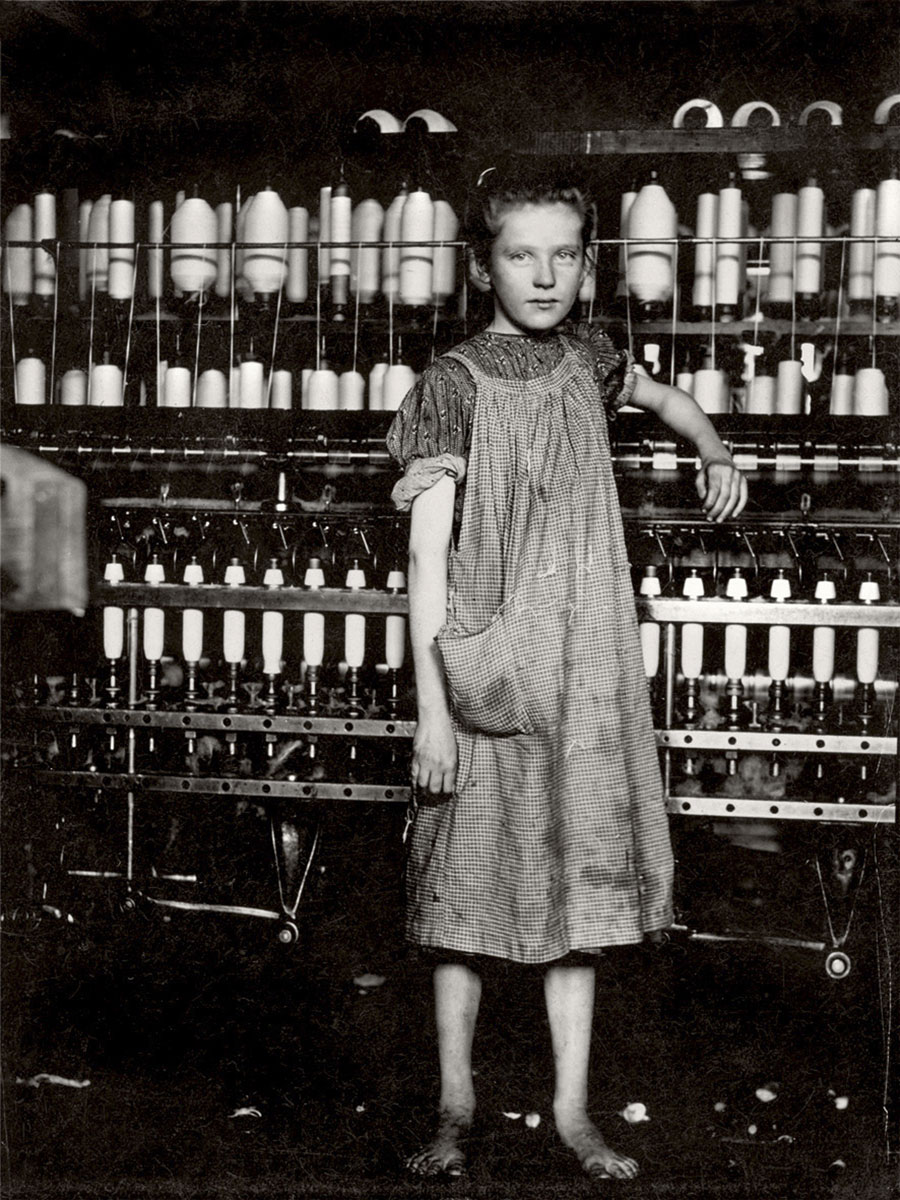
Closed Mondays and Tuesdays

Taft Museum of Art website

LIKE ART BLART ON FACEBOOK

Back to top

Exhibition: ‘Japan’s Modern Divide: The Photographs of Hiroshi Hamaya and Kansuke Yamamoto’ at the J. Paul Getty Museum, Los Angeles

Exhibition dates: 26th March – 25th August 2013


Hiroshi Hamaya (Japanese, 1915-1999) 'The Village up on a Cay, Aomori Prefecture' 1955


Hiroshi Hamaya (Japanese, 1915-1999)
The Village up on a Cay, Aomori Prefecture
1955
Gelatin silver print
The J. Paul Getty Museum, Los Angeles
© Keisuke Katano


According to the press release, “Hamaya focused inward toward rural life on the back coast of Japan, [while] Yamamoto found inspiration in the art of European Surrealists,” the two artists responding differently to upheaval in their country in two different ways.  While Yamamoto is more obviously influenced by the Surrealists, almost becoming the Japanese version of Man Ray, for me Hamaya’s photographs are equally if more subtly influenced by the cultural movement. Observe Woman Planting Rice, Toyama Prefecture (1955, below). I relate this image to the atomisation of bodies during the conflagration of Hiroshima, however subconsciously the artist is expressing this feeling. Similarly, the faceless humans in Rice Harvesting, Yamagata Prefecture (1955, below), blind musicians, disembodied man in a raincoat or poet thinking the void all have an essential quality, that of a disturbing psychological undertow which juxtaposes two more or less distant realities – reality and dream – to form images of great emotional and poetic power.

Dr Marcus Bunyan


Many thankx to the J. Paul Getty Museum, Getty Center for allowing me to publish the photographs in the posting. Please click on the photographs for a larger version of the image.


Hiroshi Hamaya (Japanese, 1915-1999) 'The United States-Japan Security Treaty Protest, Tokyo, May 20, 1960' 1960


Hiroshi Hamaya (Japanese, 1915-1999)
The United States-Japan Security Treaty Protest, Tokyo, May 20, 1960
1960
Gelatin silver print
The J. Paul Getty Museum, Los Angeles
© Keisuke Katano


Hiroshi Hamaya (Japanese, 1915-1999) 'New Year's Ritual, Niigata Prefecture' 1940-1946


Hiroshi Hamaya (Japanese, 1915-1999)
New Year’s Ritual, Niigata Prefecture
1940-1946
Gelatin silver print
30.6 x 20.2cm
The J. Paul Getty Museum, Los Angeles
© Keisuke Katano


Japan’s Black Coast

“Knowledge of the back coast, along the Sea of Japan, is somewhat vague to those not living there, and in the minds of most people it is a country obscured by snow. In Japan, the back coast is where the old era still lingers on… The supporting industries of this back coast are primitive – agriculture, forestry, and fishing. The work involved is backbreaking physical labor. A narrow land, a heavy population, and climatic drawbacks invite a vicious circle of poverty. The basic Japanese foods are fish and rice. And they are obtained by these people only through hard labor.”

Hiroshi Hamaya, Ura Nihon (Japan’s Back Coast), 1957

A Chronicle of Grief and Anger

In 1959 the proposed ten-year renewal of the United States-Japan Security Treaty of 1952 meant the continuation of the presence of U.S. troops and the persistence of U.S. political and cultural influence. When Prime Minister Nobusuke Kishi, with the aid of the police, forced the Japanese parliament to ratify the treaty in May 1960, the public upheaval was immense. Hamaya, a pacifist living outside Tokyo, entered the fray with his camera, chronicling the demonstrations. His pictures were published both individually and in the form of a quickly assembled paperback under the title Ikari to kanashimi no kiroku (A Chronicle of Grief and Anger).

Portraiture

Japanese society had a pronounced respect for artists, authors, craftsmen, and scholars. As a freelance photographer, Hamaya was often enlisted to make portraits of them for publication. He compiled a selection of these portraits made since the 1940s for the 1983 book Japanese Scholars and Artists, which included the renowned poet, art historian, and calligrapher Yaichi Aizu. Hamaya also produced a series of genre studies that featured his wife, Asa Hamaya, who was a skilled master of the tea ceremony. After her death in 1985 Hamaya prepared a memorial to her in the form of a portfolio of prints, titled Calendar Days of Asa Hamaya, following the earlier ukiyo-e tradition of woodblock series such as bijin-ga (pictures of beautiful women).

Observing Nature

“I spent three years and four months on an extended walking tour to observe nature in Japan, from the drifting ice packs off the Shiretoko Peninsula to the coral reefs of Okinawa … Nature breathed, sometimes deeply and sometimes violently, with the climatic changes of the seasons, and with the changing face of daily weather, humidity, seasonal winds, and typhoons. In particular, the distribution of plants from the subarctic to the subtropical zones, and of lichen and mosses, was both complex and varied… I came to realise that natural features in Japan, like the nature of its people, were extremely diversified and complex. I intended to investigate this conclusion with my own eyes.”

Hiroshi Hamaya, My Fifty Years of Photography, 1982


Hiroshi Hamaya (Japanese, 1915-1999) 'Woman Planting Rice, Toyama Prefecture' 1955


Hiroshi Hamaya (Japanese, 1915-1999)
Woman Planting Rice, Toyama Prefecture
1955
Gelatin silver print
42.1 x 28cm
The J. Paul Getty Museum, Los Angeles
© Keisuke Katano


Hiroshi Hamaya (Japanese, 1915-1999) 'Rice Harvesting, Yamagata Prefecture' 1955


Hiroshi Hamaya (Japanese, 1915-1999)
Rice Harvesting, Yamagata Prefecture
1955
Gelatin silver print print
29.5 x 19.7cm (11 5/8 x 7 3/4 in.)
The J. Paul Getty Museum, Los Angeles
© Keisuke Katano


Hiroshi Hamaya (Japanese, 1915-1999) 'Blind Musicians, Niigata Prefecture' 1956


Hiroshi Hamaya (Japanese, 1915-1999)
Blind Musicians, Niigata Prefecture
1956
Gelatin silver print print
30.1 x 20cm (11 7/8 x 7 7/8 in.)
The J. Paul Getty Museum, Los Angeles
© Keisuke Katano


Hiroshi Hamaya (Japanese, 1915-1999) 'Man in a Traditional Minobashi Raincoat, Niigata Prefecture' 1956


Hiroshi Hamaya (Japanese, 1915-1999)
Man in a Traditional Minobashi Raincoat, Niigata Prefecture
1956
Gelatin silver print print
30.6 x 19.8cm (12 1/16 x 7 13/16 in.)
The J. Paul Getty Museum, Los Angeles
© Keisuke Katano


Hiroshi Hamaya (Japanese, 1915-1999) 'Yaichi Aizu, Poet, Calligrapher, and Japanese Art Critic' 1947


Hiroshi Hamaya (Japanese, 1915-1999)
Yaichi Aizu, Poet, Calligrapher, and Japanese Art Critic
1947
Gelatin silver print print
24 x 16cm (9 7/16 x 6 5/16 in.)
Estate of Hiroshi Hamaya, Oiso, Japan
© Keisuke Katano


The Taishō era (1912-1926) was a brief but dynamic period in Japan’s history that ushered in a modern state with increased industrialisation, shifting political parties, radical fashions, and liberal thinking in many areas. However, this era of heightened experimentation ended with the arrival of an international depression, the promotion of ultranationalism, and the country’s entry into what would become the Greater East Asia War.

Reflecting both sides of this dramatic transition, two disparate representations of modern Japan will be displayed together in Japan’s Modern Divide: The Photographs of Hiroshi Hamaya and Kansuke Yamamoto, on view March 26 – August 25, 2013, at the J. Paul Getty Museum, Getty Center. Curated by Judith Keller, senior curator of photographs, and Amanda Maddox, assistant curator of photographs, the exhibition includes photographs from the Getty Museum’s permanent collection, the Toyko Metropolitan Museum of Photography, the estate of Hiroshi Hamaya, the Nagoya City Art Museum, and other public and private lenders.

Born during the Taishō era, photographers Hiroshi Hamaya (1915-1999) and Kansuke Yamamoto (1914-1987) responded to Japan’s rapidly-changing sociopolitical climate in very different ways. While Hamaya focused inward toward rural life on the back coast of Japan, Yamamoto found inspiration in the art of European Surrealists. As the ebb and flow of Japan’s political, economic, and social structures persisted across the 20th century, Hamaya and Yamamoto continued to pursue divergent paths, thus embodying both sides of modern Japanese life: the traditional and the Western, the rural and the urban, the oriental and the occidental.

“Much is known about the Surrealists living and working in Europe, as well as the celebrated documentary tradition of 20th-century photography, but the Japanese artists who embraced these movements remain relatively unknown in the West,” says Timothy Potts, director of the J. Paul Getty Museum. “This exhibition illuminates the extraordinary work of two artists who responded to upheaval in their country in two different, but equally powerful ways.”

Hiroshi Hamaya

The son of a detective, Hamaya grew up in Tokyo’s Ueno neighbourhood during the rise and decline of the Taishō era. After attending Kanto Junior College, he began his photographic career by taking aerial images for the Practical Aeronautical Institute. He later photographed downtown Tokyo from street level, and provided images of daily city life and local events to a number of magazines. In 1939, an assignment that took him to Ura Nihon, or the rural back coast of the Sea of Japan, changed his view of photography and society.

Known for its unforgiving winter snowstorms and the difficult lives of its impoverished inhabitants, Ura Nihon was a mystery to most of Japan and the world. Moved by the customs and lifestyles of a much older era, Hamaya shifted from journalism toward a more humanistic and ethnographic approach to photography, capturing the everyday life of the region’s residents. This included documenting labourers in fields and at sea, as fish and rice were the primary sources of nourishment throughout the year.

From 1940 to 1955 Hamaya pursued a long-term personal interest in the region of Echigo (now known as Niigata Prefecture). He recorded the people, traditions, and landscape of a district that was, at the time, Japan’s chief rice-producing region in spite of a four-month long snow season. Among his many subjects, Hamaya focused on the winter in Kuwatoridani, a small agricultural village that practiced elaborate, long-standing New Year’s Eve rituals. In New Year’s Ritual, Niigata Prefecture (1940-1946), boys in the village are seated with their hands clasped and their eyes closed in prayer. The close-up of the boys’ faces in deep concentration emphasises the respect for customs of the region.

In late 1959, the proposed ten-year renewal of the United States-Japan Security Treaty of 1952 raised doubts about Japan’s sovereignty and its future prosperity. When Prime Minister Nobusuke Kishi, with the aid of police, forced the Japanese parliament to ratify the treaty in May 1960, the political upheaval was immense. While Hamaya was a pacifist, he felt obligated to return to his journalistic roots and entered the fray with his camera. He chronicled the demonstrations day by day, sometimes hour by hour.

“These demonstrations profoundly affected Hamaya, causing him, in the 1960s, to turn from the social landscape to an investigation of nature,” explains Judith Keller. “His disillusionment with Japan’s political apparatus provoked a rejection of the human subject. Much of the work he created in his late career depicts the volcanoes, seas, mountains, forests, and other natural wonders of Japan and other small island nations.”

Hamaya’s career also included portraiture of noted artists and scholars. As a freelance photographer, he was often enlisted to make portraits of well-known men and women, and in 1983 published Japanese Scholars and Artists, a book that included prominent novelist Junichiro Tanizaki, woodcut artist Shiko Manakata, literary critic Kenichi Yoshida, and renowned poet, art historian, and calligrapher Yaichi Aizu. He also documented the daily life of his beloved wife, Asa, and upon her death in 1985 created a portfolio of these sensitive photographs, Calendar Days of Asa Hamaya.

Kansuke Yamamoto

Kansuke Yamamoto (1914-1987) learned about photography from his father, an amateur pictorialist photographer and owner of the first photo supply store in the city of Nagoya. His interest in photography developed at a time when two movements based on experimentation and new modes of expression – Shinkō Shashin (New Photography) and Zen’ei Shashin (avant-garde photography) – were dominant. However, it was Surrealism – particularly Surrealist artists and writers such as René Magritte, Paul Éluard, Yves Tanguy, and Man Ray that appears to have made the most profound impact on his work.

Yamamoto was an influential figure in the avant-garde photography movement in Japan in the 1930s, helping to establish the group Nagoya Foto Avant-Garde by the end of that decade. In 1938 he created a journal, Yoru no Funsui (The Night’s Fountain), which promoted Surrealist poems, literature, ideas, and art in Japanese.

His first photographs date to the early 1930s and reveal an interest in myriad techniques and subjects, including abstract architectural studies, still life, and collage. From the outset, he created work suffused with mystery, provocation, and humour. He often utilised photography as a means to address controversial issues or express avant-garde ideas. For example, in Buddhist Temple’s Birdcage (1940), the telephone enclosed in the cage is possibly a metaphor for the control exercised by the Japanese government during the Showa Era (1926-1989), a theme that reappears in work produced throughout his career. The experience of being interrogated by the Tokkō (Thought Police) in 1939 for his journal, Yoru no Funsui, and its potentially subversive content made a profound impact on Yamamoto, but never deterred his avant-garde spirit.

Yamamoto remained part of the artistic vanguard in Japan during the 1940s and 1950s. He was a member of VOU, a club founded by poet Katue Kitasono that organised exhibitions and published a journal promoting visual “plastic” poetry, photography, literature, and other arts. In 1947 Yamamoto founded VIVI, a collective in Nagoya that allowed further dissemination and promotion of avant-garde ideologies. Yamamoto continued to produce innovative work during this period, experimenting with colour photography, combination printing, photograms, and sculpture.

“At the end of his career in the 1970s, Yamamoto maintained his ardent nonconformist spirit, employing art as a means of criticism, dialogue, and rebellion,” explains Amanda Maddox. “He never failed to generate provocative imagery in an effort to represent his convictions concerning war, liberty, and avant-garde ideologies.”

Press release from the J. Paul Getty Museum website


Kansuke Yamamoto (Japanese, 1914-1987) 'My Thin-aired Room' 1956


Kansuke Yamamoto (Japanese, 1914-1987)
My Thin-aired Room
1956
Gelatin silver print print
34.9 x 42.9cm (13 3/4 x 16 7/8 in.)
Private collection, entrusted to Tokyo Metropolitan Museum of Photography
© Toshio Yamamoto


Kansuke Yamamoto (Japanese, 1914-1987) 'Rose and Shovel' 1956


Kansuke Yamamoto (Japanese, 1914-1987)
Rose and Shovel
1956
Gelatin silver print print
31.9 x 34.9cm (12 9/16 x 13 3/4 in.)
© Toshio Yamamoto
Private collection, entrusted to Tokyo Metropolitan Museum of Photography


Kansuke Yamamoto (Japanese, 1914-1987) 'A Forgotten Person' 1958


Kansuke Yamamoto (Japanese, 1914-1987)
A Forgotten Person
1958
Chromogenic print
46.2 x 33cm (18 3/16 x 13 in.)
© Toshio Yamamoto
The J. Paul Getty Museum, Los Angeles


Kansuke Yamamoto (Japanese, 1914-1987) 'Stapled Flesh' 1949


Kansuke Yamamoto (Japanese, 1914-1987)
Stapled Flesh
1949
Gelatin silver print print
31.1 x 24.8cm (12 1/4 x 9 3/4 in.)
© Toshio Yamamoto
From the Collection of Gloria Katz and Willard Huyck


Kansuke Yamamoto (Japanese, 1914-1987) 'Buddhist Temple's Bird Cage' 1940


Kansuke Yamamoto (Japanese, 1914-1987)
Buddhist Temple’s Bird Cage
1940
Gelatin silver print
© Toshio Yamamoto
Private collection, entrusted to Tokyo Metropolitan Museum of Photography


Kansuke Yamamoto (Japanese, 1914-1987) 'Butterfly' 1970


Kansuke Yamamoto (Japanese, 1914-1987)
Butterfly
1970
Gelatin silver print print
16.4 x 11.4cm (6 7/16 x 4 1/2 in.)
© Toshio Yamamoto
Private collection, entrusted to Tokyo Metropolitan Museum of Photography


Kansuke Yamamoto (Japanese, 1914-1987) 'A Chronicle of Drifting' 1949


Kansuke Yamamoto (Japanese, 1914-1987)
A Chronicle of Drifting
1949
Collage print
30 x 24.8cm (11 13/16 x 9 3/4 in.)
© Toshio Yamamoto
Private collection, entrusted to Tokyo Metropolitan Museum of Photography


The J. Paul Getty Museum
1200 Getty Center Drive
Los Angeles, California 90049

Opening hours:
Tues – Friday 10am – 5.30pm
Saturday 10am – 8pm
Sunday 10am – 5.30pm
Monday closed

The J. Paul Getty Museum website

LIKE ART BLART ON FACEBOOK

Back to top

Exhibition: ‘The Naked Truth and More Besides: Nude Photography around 1900’ at the Museum for Photography, Berlin

Exhibition dates: 3rd May – 25th August 2013


Many thankx to the Museum for Photography for allowing me to publish the photographs in the posting. Please click on the photographs for a larger version of the image.

PLEASE NOTE: THIS POSTING CONTAINS ART PHOTOGRAPHS OF MALE AND FEMALE NUDITY – IF YOU DO NOT LIKE PLEASE DO NOT LOOK, FAIR WARNING HAS BEEN GIVEN


Léon Gimpel (French, 1873-1948) 'The Sculptor' 1911


Léon Gimpel (French, 1873-1948)
The Sculptor
1911
Autochrome
© Société française de photographie, Paris


Photographer unknown. 'Act of Headstand' Before 1905


Photographer unknown
Act of Headstand
Before 1905
Silver gelatin print
© Universität der Künste Berlin, Universitätsarchiv


Photographer unknown. 'The 250-pound ranks of the 1st Caulking men's club, Munich' 1907


Photographer unknown
The 250-pound ranks of the 1st Caulking men’s club, Munich
1907
From: Athletics Sports Illustrated Newspaper, 01/19/1907
© Niedersächsisches Institut für Sport-geschichte, Hannover


Otto Skowranek (German) 'Olga Desmond - Sword Dance' 1908


Otto Skowranek (German)
Olga Desmond – Sword Dance
1908
Gelatin silver print
© Staatliche Museen zu Berlin, Kunst-bibliothek


Frank Eugene (American, 1865-1936) 'Adam and Eve' 1898/99


Frank Eugene (American, 1865-1936)
Adam and Eve
1898-99
Published in Camera Work, 1910
Heliogravure
© Staatliche Museen zu Berlin, Kunst-bibliothek


At the dawn of the last century, photographs of nudes could be found everywhere. The exhibition The Naked Truth and More Besides presents the astonishing diversity of photographic depictions of the disrobed human body that existed around this time. It was an age in which the foundations were laid for the development in the public domain of an extremely varied type of image, which, more than any other continues to inform the world in which we live today.

Most striking of all, the photographic nude appeared as a reproducible medium – on postcards, cigarette cards, posters, in magazines and in advertising, as inspiration for artists and an incentive for sportsmen, as instructional material, and as collector’s items. From the vast array of material, it is possible to identify several distinct groups that fall under such headings as: the mass produced, visual pleasures (arcadias, eroticism, and pornography), the body in the eye of science (ethnography, motion study photography, medicine), the cult of the body (reform movements – especially in German-speaking countries – naturism, and staged nudes from the world of sport and variety shows), and, of course, the nude in the artistic context (art academies and the Pictorialist tradition of fine-art prints). The most important characteristic of the image of naked people during this time is the inseparability of nude photographic production and reproduction. The trade or exchange in nude photographs was widespread across the whole of Europe. This is reflected in the exhibition, which not only features many treasures and rare finds from the Kunstbibliothek’s own Collection of Photography, but also includes important loans from several European institutions, ranging from the Bibliothèque nationale de France to the Police Museum of Lower Saxony.


The exhibition

A Commodity Market – The Machinery of the Nude

Since the invention of photography, the unclothed human body has been positioned – sitting, standing and reclining – in front of the camera. Large numbers of nude images, avidly pursued by censors, were in circulation as of the middle of the 19th century. By around 1900 nude photography had broken into the public sphere. Starting in 1880, photographs had become easier to produce and reproduce. They began to flood the market in various printed forms: alongside stereoviews, cartes de visite and single prints, nudes could now be found on postcards, trading cards, autograph cards, posters and in magazines, books and films. Nude photographs were promoted, ordered, sold and sent. They were published for a large audience under the guise of artistic or academic activity, and people’s viewing habits, their gaze on the naked body – their own or someone else’s – began to change. In this process it became clear that photography played a significant role in the marketing of the naked body, but also in people’s self-understanding. Today’s arbitrary use of scantily-clad models to advertise goods is but one phenomenon that continues what was emerging with the visual material of the turn of the 20th century.

“For Artistic Purposes Only” – Model Studies and Photographic Academies

Nude pictures were reaching the public as “photographs after nature.” In the process, the artistic content or the intended use of the photographs was always emphasised. If we were to judge by the quantity of materials said to be produced solely for artists, then the largest professional group around 1900 would have been composed of them. “For artistic purposes only” was the password to uncensored production of nude photography. For many artists, photographic depictions actually did replace calling in live models. Art academies created a reference collection with nude studies. In many cases, works of painting or sculpture can be directly traced back to a particular photograph. Taken in classrooms that tended toward sobriety, most of the poses were borrowed from the art-historical cannon. Countless Venus and Apollo figures, cherubs, Atlases, Horatii, Graces and boys in the classical style populate the portfolios of the period. A practice of child nudes developed in the slipstream of the photographic academies. Ostensibly, these were created to show the angelic innocence of children of all ages. Photographers also documented classes in studios and at academies. Thus we see photographs of entire student groups with their nude model, and there are also fine examples of the triad of artist, model and work.

(Visual) Yearnings – Ideals from Arcadia

The unclothed body was first and foremost an object of erotic associations, and they were rendered by photography in more or less subtle ways. While a large audience enjoyed the Arcadian idylls of Sicily without coming into a conflict with the law, there was likely an even larger public buying the goods “under the table” or only “per order,” potentially becoming guilty of immorality. Under Wilhelm II, male friendships were cherished as pillars of the system. Homosexuality, by contrast, was the subject of heated debate, its reception mixed. With this in mind, the vast array of potentially homoerotic photographs that were produced is revealing.

Wilhelm von Gloeden counts among the best-known practitioners of a kind of nude photography that gave voice to longings for an idyll that was generally Mediterranean or classical in nature. His photographs enjoyed tremendous commercial success around 1900. Numerous fellow photographers, most of them anonymous, began to photograph young and old satyrs, Ephebes, Apollos and shepherd boys and girls, staging the journey to Arcadia for the camera. Their images were published in such places as the first homoerotic magazine Der Eigene alongside poems, prose and essays. At the same time, these nude photographs were added to ethnographic collections (for example as Sicilian folklore), were discussed in the medical context and were used by (body) reformers to communicate an ideal.

Vividly Immoral – Censored and Pornographic Photography

Since the invention of photography, photographs have been produced that are erotic or pornographic in nature. Crude or more sophisticated fashions, fantasies, means of distribution and censorship changed depending on the period. Around 1900, censorship in Germany generally went hand in hand with the so-called Lex Heinze, a newly added paragraph that forbade public exhibition of material classified as immoral. When enforced, the censorship effort resulted in the impounding by police of thousands of images from individual distribution businesses and studios. But in the face of the new, ever-growing production of nude photographs, the aim of gaining the upper hand over the flood of images was destined to fail.

Material from private collections is rare today but it would have been found in a large number of ordinary households. Aficionados put together albums in which they showed their predilections using a combination of photographs, drawings or caricatures, and sometimes writing. Even the police kept an exemplary inventory of nude photography which they collected in albums. In Germany there remains only the album from the Police Museum of Lower Saxony, whose large format, elaborately stamped leather binding, and careful arrangement of the diverse material make it clear just how significant nude photography was to the guardians of the law, too.

“The photographic plate is the retina of scholars” – The Nude Body in Science

A great number of scientific fields made use of photography in their systematic mapping out of the visible world. The naked body was measured, compared and assessed. Norms were defined and aberrations shown. The new, photographically mediated consciousness of physical constitutions made itself felt in the way people saw themselves and their contemporaries. But the seeming objectivity of the medium also abetted discriminatory views. The photography of movement played a particular role in the photographic experiments that sought to describe and unravel the human body in all its aspects. Special devices were used to record the consecutive positions of motor activities. In addition to movement in everyday life and in sports, photographers also documented freely invented movement and movement resulting from disease. Eadweard Muybridge and Ottomar Anschütz together with Albert Londe count among the best-known representatives of the photographic anatomy study and the systematic recording of movement.

Using special equipment, photographers provided physicians with illustrations of diseases and physical ailments. Image material was gathered on a regular basis and used in medical research and teaching. The often highly suggestive visual language of the time is also reflected in scientific publications. Many of the diagnostic findings and display formats from around 1900 seem outdated today.

When photography became more compatible with travelling, ethnographers brought back to Europe a large number of photographs of the sometimes unclothed inhabitants of colonies they were visiting and exploring. And as the ethnographic nude became more pervasive, posing for the camera became more common. Postures and props were modelled on recognised artworks as well as ideas about foreign cultures that were prevalent in Europe. Photographic comparisons were designed to emphasise particular characteristics of ethnic groups or body types: here, technical tricks, such as using different lighting, backgrounds and poses, came into play. This kind of image material fuelled chauvinist and racist delusions, which became widely published.

“Naked People – a Cheerful Future” – Nude Photography and the Cult of the Body around 1900

At the turn of the century, questions about the body were quickly gaining in importance. Were corsets desirable? The photographs of corset marks on naked female bodies argue against them. What good was exercise? Photographs of trained naked bodies documented the benefits. What did a normal person look like, and what did the ideal body look like? With nude photography printed in numerous magazines and books, people began to develop an eye for these matters. With more and more images becoming available, people became more discerning when it came to their body versus foreign bodies. The body could be compared and evaluated. Ideals spread through powerful imagery and gained an increasing influence on individual body culture.

During the reform movement people, especially those in the German Empire, were drawn to the open air. They enjoyed so-called light baths, whose benefits were discussed at length and proven with photographs. An emerging nudism used photography to demonstrate a deliberately relaxed association with one another. Scantily clad or unclothed, stars soon had their pictures taken onstage, becoming famous when their images were used in advertising and turned into items of mass distribution. Their postcards and cartes de visite were precursors of the pin-up. Several of these images bring to mind hippies of the 1960s and ‘70s. Yet, among the nudists of the turn of the century were also publishers such as Richard Ungewitter, whose racist theories, based in folk identity, lent decidedly ideological undertones to the nude images they used in their argumentation.

Passions of Art Photography – Pictorialist Nudes

Beginning in the 1890s many photographers sought to elevate their craft to the status of art with the aid of particular printing techniques and strategies of image creation. Nude photography, certainly a pleasurable pastime for such ambitious art photographers as the so-called Pictorialists, produced a wide variety of motifs. In the prestigious magazine Camera Work, Alfred Stieglitz published a vast number of such images, including works by Robert Demachy, Constant Puyo, Heinrich Kühn, Annie Brigman and Edward Steichen. Among the Pictorialist nudes are expressive mise-en-scenes, some of them self-portraits of the photographers, whose subject matter was by turns poetic and symbolic. Besides this work, there certainly are images that are conventionally pleasant or academic and that stand out from the common material mostly due to their high print quality. Their pictorial techniques serve an atmosphere of everything from playful coquetry to dramatic religiousness. As the clearly preferred pose of wrestlers was that of a poet or thinker, Auguste Rodin’s sculpture The Thinker can be seen as bringing together the aesthetics of sculpture, Pictorialism and athlete photography.

Press release from the Museum of Photography website


Emile Bayard (French, 1837-1891) 'The Aesthetic Nude No. 34' 1903


Emile Bayard (French, 1837-1891)
Untitled
From The Aesthetic Nude No. 34
1903


Emile Bayard (French, 1837-1891) 'The Aesthetic Nude No. 34' 1903


Emile Bayard (French, 1837-1891)
Untitled
From The Aesthetic Nude No. 34
1903


How many artfully-draped centaurs, bacchantes, and nymphs does it take to make a dirty magazine? Only one early 20th-century periodical has the answer: The Aesthetic Nude (Le Nu Esthétique)… Illustrated entirely with unclothed models enacting quasi-mythological imagery, the covers alone range from a rapturous Leda and the Swan to a centaur’s semi-consensual abduction of a nymph (above). Inside each issue appear even more views of studio models in increasingly far-fetched poses, all of which were ostensibly meant to supplant the live model in studio practice. It’s not clear that anyone ever copied these compositions in paint, but the effort that went into cutting out the photos in lively shapes, and the publication’s run of several years (c. 1902-06), suggests a market existed for it!

These ‘aesthetic nudes’ beg the question of what constituted nudity, as opposed to nakedness in the late 19th and early 20th century. Was it simply the academic and mythological guise that made these images acceptable, even collectible?

Text from the ARTicle, Art Institute of Chicago blog [Online] Cited 08/08/2013


Photographer unknown. 'Two women on a carousel Pig' c. 1900


Photographer unknown
Two women on a carousel Pig
c. 1900
Silver gelatin print
© Collection GERARD LEVY, Paris


Albert Londe (French, 1858-1917) '15 Chronophotographs of Charcot's son / Charcot plays football' c. 1890


Albert Londe (French, 1858-1917)
15 Chronophotographs of Charcot’s son / Charcot plays football
c. 1890
Gelatin silver print
© École nationale supérieure des beaux-arts, Paris; Reprofoto: Jean-Michel Lapelerie


Photographer unknown. 'Postcard with Aktmotiv, stamped and postmarked' 1906


Photographer unknown
Postcard with Aktmotiv, stamped and postmarked
1906
Lichtdruck
© Sammlung Robert Lebeck, Berlin


Photographer unknown (Max Lorenz Nielsen?). 'Male Nude in Tree' c. 1900


Photographer unknown (Max Lorenz Nielsen?)
Male Nude in Tree
c. 1900
Gelatin silver print
© Berlinische Galerie


Rudolf Lehnert (Austro-Hungarian, 1878-1948) and Ernst Landrock (German, 1878-1966) 'Transparency' 1904


Rudolf Lehnert (Austro-Hungarian, 1878-1948) and Ernst Landrock (German, 1878-1966)
Transparency
1904
Salter paper print
© Münchner Stadtmuseum


Heinrich Kühn (Austrian-German, 1866-1944) 'Female Nude' c. 1906


Heinrich Kühn (Austrian-German, 1866-1944)
Female Nude
c. 1906
Bromoil print
© Estate of the Artist / Galerie Kicken Berlin


Museum of Photography
Jebensstraße 2, 10623 Berlin, Germany
Phone: +49 30 266424242

Opening hours:
Tuesday – Sunday 11am – 7pm
Closed Mondays

Museum of Photography website

LIKE ART BLART ON FACEBOOK

Back to top

Exhibition: ‘Bill Brandt: Shadow and Light’ at The Museum of Modern Art, New York

Exhibition dates: 6th March – 12th August 2013


Bill Brandt (British born Germany, 1904-1983) 'Parlourmaid Preparing a Bath before Dinner' c. 1936


Bill Brandt (British born Germany, 1904-1983)
Parlourmaid Preparing a Bath before Dinner
c. 1936
Gelatin silver print
9 1/16 x 7 11/16″ (23 x 19.5cm)
The Museum of Modern Art. Horace W. Goldsmith Fund through Robert B. Menschel
© 2012 Bill Brandt Archive Ltd.


“Brandt ranks among the visionaries who, in the diversity of their approach, established the creative potential of photography based on observation of the world around them. Brandt’s distinctive vision – his ability to present the mundane world as fresh and strange – emerged in London in the 1930s, and drew from his time in the Paris studio of Man Ray. His visual explorations of the society, landscape, and literature of England are indispensable to any understanding of photographic history and, arguably, to our understanding of life in Britain during the middle of the 20th century.”


Text from the press release


Along with Julia Margaret Cameron, Bill Brandt is the greatest British photographer of all time.

Why is it so?

1/ There is the diversity of his approach over decades of artistic endeavour, from social documentary, portrait and landscape photography to nudes.

2/ There is a consistency to this enquiry. He is concerned with the same ideas in the 1930s as the 1960s, only expressed in a different form.

3/ There is a subtle ambiguity to all his work, no doubt influenced by his time in the Paris studio of Man Ray. For example, in the portrait of Northumbrian Miner at His Evening Meal (1937, below), there is an odd sense of surrealism to the mise-en-scène.

Notice the placement of the objects on the table, the positioning of both people’s heads with the jardiniere between, and the askance attitude of the satchel and framed image covered by drying, hanging clothes on the wall behind. And then, just to emphasise this pictorial disjunction, we notice that the miner is leaning one way and, in the framed image, another man with a tie is leaning the other, peering around  the edge of the drying clothes. The man and wife and the framed man for a triangle within the pictorial plane

4/ There is his understanding of light. Look at any of the images in this posting – Bombed Regency Staircase, Upper Brook Street, Mayfair (c. 1942, below), Evening in Kenwood (c. 1934, below) etc… and marvel at Brandt’s “ability to present the mundane world as fresh and strange.” Looking at the light of the world with a sense of wonder!

5/ And his understanding of “perspective”.

Brandt is not afraid of the out of focus photograph as long as it gives him the “feeling” that he wants from the image. For example, see Losing at the Horse Races, Auteuil, Paris (c. 1932, below), shot from below, quickly, to capture the pensiveness of loosing money.

Brandt is not afraid of foreshortening as in the photographs Evening in Kenwood (c. 1934, below) or A Snicket in Halifax (1937, below), where the use of this device leads the viewers eye into the body of the image. Brandt is also not afraid of a shallow depth of field or of placing objects or people right in the forefront of the image in order to create a complex picture plane. For example, in Kensington Children’s Party (c. 1934, below) the two children at bottom right are completely out of focus but hold up that corner of the image and give the image the stability and energy it needs to lead the eye into the small, frontal boy and the suspended balloons.

Notice the really shallow depth of field, as only the girl at extreme right and a small number of balloons are in focus. Another later and more extreme example is the photograph Seaford, East Sussex Coast (1957, below) and the distortions in his book Perspective of Nudes (1961) – “a series that is both personal and universal, sensual and strange… rendering what might otherwise have been hopelessly clichéd aspects of the female form unfamiliar and surprising.


Brandt’s skewed perspectives are not only literal but also have psychological undertones. His work challenges traditional ideas of identity, place and time and makes the mundane seem fresh and strange. Over and over again. These photographs remain as fresh today as the day they were taken BECAUSE OF THE COMPLEXITY OF THOUGHT THAT LIES BEHIND EACH IMAGE.

Many a photographer could do no better than study the work of this incredible artist. I see so many images in Melbourne and from around the world that really say nothing and go nowhere, because of a lack of understanding of what is POSSIBLE when making a photograph, when telling a story. Rules are there to be broken, out of focus, shallow depth of field, complex pictures, complex thoughts succinctly and elegantly told. For Brandt in any photograph, the artifice necessary to make a work was irrelevant so long as he felt the picture rang true. That does not mean lazy story telling, poor conceptualisation, bland visual construction.

As a good friend of mine artist Joyce Evans is fond of saying, “There is no excuse for bad photography.”

Dr Marcus Bunyan


Many thankx to the Museum of Modern Art for allowing me to publish the photographs in the posting. Please click on the photographs for a larger version of the image.


Bill Brandt (British born Germany, 1904-1983) 'Northumbrian Miner at His Evening Meal' 1937


Bill Brandt (British born Germany, 1904-1983)
Northumbrian Miner at His Evening Meal
1937
Gelatin silver print
8 3/4 x 7 3/8″ (22.2 x 18.8cm)
The Museum of Modern Art. John Parkinson III Fund
© 2012 Bill Brandt Archive Ltd.


Analysis of Brandt's visual exploration in 'Northumbrian Miner at His Evening Meal' (1937)


Analysis of Brandt's visual exploration in 'Northumbrian Miner at His Evening Meal' (1937)


Analysis of Brandt’s visual exploration in Northumbrian Miner at His Evening Meal (1937)


Bill Brandt (British born Germany, 1904-1983) 'Packaging Post for the War' c. 1942


Bill Brandt (British born Germany, 1904-1983)
Packaging Post for the War
c. 1942
Gelatin silver print
8 3/16 x 7 13/16″ (20.8 x 19.9cm)
Acquired through the generosity of Mark Levine
© 2013 Estate of Bill Brandt


Bill Brandt (British born Germany, 1904-1983) 'Liverpool Street Underground Station Shelter' 1940


Bill Brandt (British born Germany, 1904-1983)
Liverpool Street Underground Station Shelter
1940
Gelatin silver print
11 11/16 x 9 11/16″ (29.7 x 24.6cm)
© 2013 Estate of Bill Brandt


Bill Brandt (British born Germany, 1904-1983) 'Kensington Children's Party' c. 1934


Bill Brandt (British born Germany, 1904-1983)
Kensington Children’s Party
c. 1934
Gelatin silver print
8 5/8 x 7 3/16″ (21.9 x 18.3cm)
The Museum of Modern Art. Gift of David Dechman and Michel Mercure
© 2012 Estate of Bill Brandt


Bill Brandt (British born Germany, 1904-1983) 'Evening in Kenwood' c. 1934


Bill Brandt (British born Germany, 1904-1983)
Evening in Kenwood
c. 1934
Gelatin silver print
9 x 7 3/4″ (22.9 x 19.7cm)
The Museum of Modern Art. Acquired through the generosity of David Dechman and Michel Mercure and the Committee on Photography Fund.
© 2012 Bill Brandt Archive Ltd.


The Museum of Modern Art presents Bill Brandt: Shadow and Light, a major critical reevaluation of the heralded career of Bill Brandt (British born Germany, 1904-1983) from March 6 to August 12, 2013. A founding figure in photography’s modernist traditions, Brandt ranks among the visionaries who, in the diversity of their approach, established the creative potential of photography based on observation of the world around them. Brandt’s distinctive vision – his ability to present the mundane world as fresh and strange – emerged in London in the 1930s, and drew from his time in the Paris studio of Man Ray. His visual explorations of the society, landscape, and literature of England are indispensable to any understanding of photographic history and, arguably, to our understanding of life in Britain during the middle of the 20th century. Bill Brandt: Shadow and Light is organised by Sarah Meister, Curator, with Drew Sawyer, Beaumont and Nancy Newhall Curatorial Fellow, Department of Photography.

The impressive breadth of Brandt’s career, which suggests his restless experimental impulse, and the dramatic transformations of his printing style have often confounded those seeking to understand the link between the highly celebrated and seemingly unrelated chapters of his oeuvre. The exhibition brings together more than 150 works divided into six sections, each corresponding with a distinct aspect of Brandt’s achievement: London in the Thirties; Northern England; World War II; Portraits; Landscapes; and Nudes. Beginning with a highly selective display of albums and prints made around the European continent as Brandt was forming his artistic identity, the exhibition presents an opportunity to understand Brandt in a new light: one that establishes a chronological trajectory of his career, with an expanded consideration of his activity during World War II. In addition, a closer look at his printing methods with the finest known prints from across the range of Brandt’s career will clarify how the artist, whose early work is characterised by the muted, wistful portrait of a young housewife scrubbing the threshold to her home (East End Morning, 1937), would come to create a bold and unpredictable series of nudes on the rocky English coast (East Sussex Coast, 1957).

Brandt established his reputation before the Second World War with the publication of The English at Home (1936) and A Night in London (1938), books that distilled his early photographic studies of life in Britain. Noted works from this period on view include: Parlourmaid Preparing a Bath before Dinner (c. 1936); Soho Bedroom (1934); Street Scene, London (1936); and Losing at the Horse Races, Auteuil, Paris (c. 1932), which Brandt later re-titled Racegoers in Sandown Park in order to present it in the context of his English pictures, an expression of his disdain for slavish adherence to facts.

During this same period, Brandt ventured to several industrial towns in northern England to witness firsthand the impact of the Depression. Striking images from this group, including Snicket in Halifax (1937), Coal-Searcher Coming Home from Jarrow (1937), and Northumbrian Miner at His Evening Meal (1937), bear unequivocal witness to the devastating unemployment that plagued the region at the time, but there is a subtle ambiguity to many of these images that suggests Brandt found the artistic potential of these soot-blackened structures and faces competing for his attention.

Brandt’s activity during the Second World War – long distilled by Brandt and others to a handful of now-iconic pictures of moonlit London during the Blackout and improvised shelters during the Blitz – are presented for the first time in the context of his assignments for the leading illustrated magazines of his day, establishing a key link between his pre- and postwar work. In addition to photographs such as Liverpool Street Underground Station Shelter (1940) and Deserted Street in Bloomsbury (1942), this section includes lesser-known works from the period such as: Bombed Regency Staircase, Upper Brook Street, Mayfair (c. 1942); Packaging Post for the War (c. 1942); and a suite of extraordinary wartime portraits.

Brandt’s assignments for Picture Post and Lilliput magazines, as well as Harper’s Bazaar (UK and US), led variously into extended investigations of portraiture and landscape photography, with a strong emphasis on contemporary literary figures in Britain and the country’s rich literary heritage. A solemn, vaguely distracted expression became a hallmark of Brandt’s portraiture, and notable examples on view include Dylan Thomas, Norman Douglas, Evelyn Waugh, Reg Butler, Harold Pinter, Martin Amis, Tom Stoppard, Vanessa Redgrave, Barbara Hepworth, Henry Moore, and Francis Bacon.

Brandt’s crowning artistic achievement – published as Perspective of Nudes in 1961 – is a series that is both personal and universal, sensual and strange, collectively exemplifying the “sense of wonder”, to quote Brandt, that is paramount in his photographs. His extended investigation of the female nude remains his most original and memorable work, defying preconceived notions of the genre with his choice of settings (inhospitably barren seashores or prim Victorian interiors that conflated the domestic and the sexual in lieu of sterile, but safe, studios), as well as the extreme exaggeration of his distortions, cropping, and printing styles, rendering what might otherwise have been hopelessly clichéd aspects of the female form unfamiliar and surprising. On view are over 40 photographs from this period, including four prints of his iconic London (1952), which together suggest Brandt’s willingness to reinterpret even the most supremely resolved images in his oeuvre.

Through a rigorous analysis of each chapter of Brandt’s career across a half century of work, the exhibition clarifies the achievement of this towering figure in photography’s modernist tradition.

Press release from the MoMA website


Bill Brandt (British born Germany, 1904-1983) 'Bombed Regency Staircase, Upper Brook Street, Mayfair' c. 1942


Bill Brandt (British born Germany, 1904-1983)
Bombed Regency Staircase, Upper Brook Street, Mayfair
c. 1942
Gelatin silver print
9 x 7 5/8″ (22.8 x 19.4cm)
The Museum of Modern Art. Acquired through the generosity of Clarissa A. Bronfman
© 2012 Bill Brandt Archive Ltd.


Bill Brandt (British born Germany, 1904-1983) 'A Snicket in Halifax' 1937


Bill Brandt (British born Germany, 1904-1983)
A Snicket in Halifax
1937
Gelatin silver print
9 x 7 11/16″ (22.9 x 19.6cm)
Carl Jacobs Fund
© 2013 Estate of Bill Brandt


Bill Brandt (British born Germany, 1904-1983) 'Street Scene, London' 1936


Bill Brandt (British born Germany, 1904-1983)
Street Scene, London
1936
Gelatin silver print
9 1/16 x 7 11/16″ (23 x 19.6cm)
© 2013 Estate of Bill Brandt


This picture, first published in Brandt’s book A Night in London in 1938, recalls the work of the Hungarian-born photographer Brassaï, who had a particular talent for capturing illicit, marginalised, or unconventional activity in the lamplit streets of Paris. Many of Brandt’s pictures, however, feature his family members playing roles. Here he placed his brother and sister-in-law, Rolf and Esther Brandt, in front of a large poster. Using a nearby streetlight or perhaps his own floodlight, Brandt cast Rolf’s profile in melodramatic shadow. The artifice necessary to make a work was irrelevant for Brandt so long as he felt the picture rang true.

Text from MoMA website


Bill Brandt (British born Germany, 1904-1983) 'Soho Bedroom' 1934


Bill Brandt (British born Germany, 1904-1983)
Soho Bedroom
1934
Gelatin silver print
8 3/4 x 7 9/16″ (22.2 x 19.2cm)
Acquired through the generosity of Michèle Gerber Klein
© 2013 Estate of Bill Brandt


Bill Brandt (British born Germany, 1904-1983) 'Haworth Churchyard' 1945


Bill Brandt (British born Germany, 1904-1983)
Haworth Churchyard
1945
Gelatin silver print
8 15/16 x 7 11/16″ (22.7 x 19.5cm)
The Museum of Modern Art. Acquired through the generosity of Jon L. Stryker
© 2012 Bill Brandt Archive Ltd.


Bill Brandt (British born Germany, 1904-1983) 'Losing at the Horse Races, Auteuil, Paris' c. 1932


Bill Brandt (British born Germany, 1904-1983)
Losing at the Horse Races, Auteuil, Paris
c. 1932
Gelatin silver print
8 3/8 x 6 15/16″ (21.3 x 17.6cm)
The Museum of Modern Art. Gift of Edwynn Houk
© 2012 Bill Brandt Archive Ltd.


Bill Brandt (British born Germany, 1904-1983) 'Jean Dubuffet' 1960


Bill Brandt (British born Germany, 1904-1983)
Jean Dubuffet
1960
Gelatin silver print
8 3/8 x 7 1/4″ (21.3 x 18.4cm)
The Museum of Modern Art. John Parkinson III Fund
© 2012 Bill Brandt Archive Ltd.


Bill Brandt (British born Germany, 1904-1983) 'London' 1954


Bill Brandt (British born Germany, 1904-1983)
London
1954
Gelatin silver print
9 1/8 x 7 3/4″ (23.1 x 19.7cm)
The Museum of Modern Art. Acquired through the generosity of Clarissa Alcock Bronfman and Richard E. Salomon
© 2012 Bill Brandt Archive Ltd.


Bill Brandt A Perspective of Nudes 1961

A book that looks back to Kertesz’s Distortions and forward to the psychedelia of the late 60s. As Vince Aletti writes in The Book of 101 Books, Brandt “conjure[d] a dream world of skewed perspectives in which his nude female subjects appeared to float unanchored or loom like giants.” Parr and Badger writing in The Photobook: A History, vol. 1, assert that these images “rewrote the language of nude photography in not one, but several quarters… [they are] as interesting for their psychological undertones as for the wealth of unexpected forms he conjured… Brandt pictured a world of faded grandeur, of Edwardian bourgeois homes metamorphosing into 1940s bedsit land – cavernous refuges for European émigrés or bohemian nonconformists.”


Bill Brandt (British born Germany, 1904-1983) 'Seaford, East Sussex Coast' 1957


Bill Brandt (British born Germany, 1904-1983)
Seaford, East Sussex Coast
1957
Gelatin silver print
9 x 7 11/16″ (22.9 x 19.5cm)
The Museum of Modern Art. Gift of David Dechman and Michel Mercure
© 2012 Bill Brandt Archive Ltd.


The Museum of Modern Art
11 West 53 Street
New York, NY 10019
Phone: (212) 708-9400

Opening hours:
10.30am – 5.30pm daily

MOMA website

LIKE ART BLART ON FACEBOOK

Back to top

Exhibition: ‘Pieter Hugo: This Must Be The Place – Selected Works 2003-2012’ at the Ludwig Museum of Contemporary Art, Budapest

Exhibition dates: 24th May – 11th August 2013


Pieter Hugo (South African, b. 1976) 'The Hyena Men of Abuja, Nigeria' 2005


Pieter Hugo (South African, b. 1976)
The Hyena Men of Abuja, Nigeria
2005
From the series The Hyena & Other Men
© Pieter Hugo
Courtesy of Stevenson, Cape Town/Johannesburg and Yossi Milo, New York


I have not seen enough of the other series of Pieter Hugo to make an informed decision, but work from the The Hyena & Other Men (2005-2007) and Permanent Error (2009-2010) series, the most often reproduced, is certainly strong. Whether I am fully convinced by his singular frontality is another matter…

Dr Marcus Bunyan

Many thankx to the Ludwig Museum of Contemporary Art for allowing me to publish the photographs in the posting. Please click on the photographs for a larger version of the image.


Installation view of the exhibition 'Pieter Hugo: This Must Be The Place – Selected Works 2003-2012' at the Ludwig Museum of Contemporary Art, Budapest showing work from Hugo's 'The Hyena and Other Men' Nigeria, 2005-2007 


Installation view of the exhibition Pieter Hugo: This Must Be The Place – Selected Works 2003-2012 at the Ludwig Museum of Contemporary Art, Budapest showing work from Hugo’s The Hyena and Other Men Nigeria, 2005-2007
Exhibition view © Tamás Bujnovszky / Ludwig Museum – Museum of Contemporary Art, Archives


Installation view of the exhibition 'Pieter Hugo: This Must Be The Place – Selected Works 2003-2012' at the Ludwig Museum of Contemporary Art, Budapest showing work from Hugo's 'The Hyena and Other Men' Nigeria, 2005-2007 


Installation view of the exhibition Pieter Hugo: This Must Be The Place – Selected Works 2003-2012 at the Ludwig Museum of Contemporary Art, Budapest showing work from Hugo’s The Hyena and Other Men Nigeria, 2005-2007
Exhibition view © Tamás Bujnovszky / Ludwig Museum – Museum of Contemporary Art, Archives


Pieter Hugo (South African, b. 1976) 'The Hyena Men of Abuja, Nigeria' 2005


Pieter Hugo (South African, b. 1976)
The Hyena Men of Abuja, Nigeria
2005
From the series The Hyena & Other Men
© Pieter Hugo
Courtesy of Stevenson, Cape Town/Johannesburg and Yossi Milo, New York


The hyena men are itinerants: they never spend more than two days anywhere. I found them in a shanty town near Abuja, the capital. Despite the language barrier we got to know each other pretty quickly. Outside of Lagos and Port Harcourt, I didn’t see a single white person in Nigeria. So I probably seemed as odd to them as a guy walking a hyena in the street seemed to me.

We smoked some weed to break the ice. It turned out they weren’t debt collectors – they were more like town criers, traditional storytellers who performed in the streets and sold potions after their shows. It reminded me of stories I’d read about eastern European circus troupes in the 1930s – except instead of bears, these guys had hyenas, baboons and pythons.

Seeing them perform was unforgettable. It was a huge spectacle. They would beat drums to draw in the crowds, then take the muzzles off the hyenas. Next they’d put their arms and even their heads between the animals’ jaws. The aim was to convince the audience they had special powers, and that the audience could acquire them too, if they bought their potions.

At first I tried photographing the street shows, but there was just too much going on. Then I realised that the relationship between man and beast was more interesting than all the fireworks of the performance. There was something very strange going on between the guys and the hyenas, bordering on sadomasochism. These animals had been taken out of the wild as pups. They couldn’t return. They were entirely dependent on these guys for food. And these men were dependent on the animals for their livelihoods. They needed each other, but it wasn’t an easy symbiosis. …

I love how confrontational this shot is. At no point did I tell him how to pose. It’s all him. He flexed his bicep, stared straight at me, while his hyena jumped all over him. Then in the background, there’s this kind of Mad Max landscape strewn with broken-down trucks, though you can hardly see them because of the light. It was Harmattan season, a time between November and March when the sands of the Sahara blow over western Africa creating this murky, diffused lighting, which I love. It’s a simple shot with an incredible economy. I wish I could take more like it.

Interview by Edward Siddons. “Pieter Hugo’s best photograph: the hyena men of Nigeria,” on the Guardian website Thursday 19 Jul 2018 [Online] Cited 09/07/2024
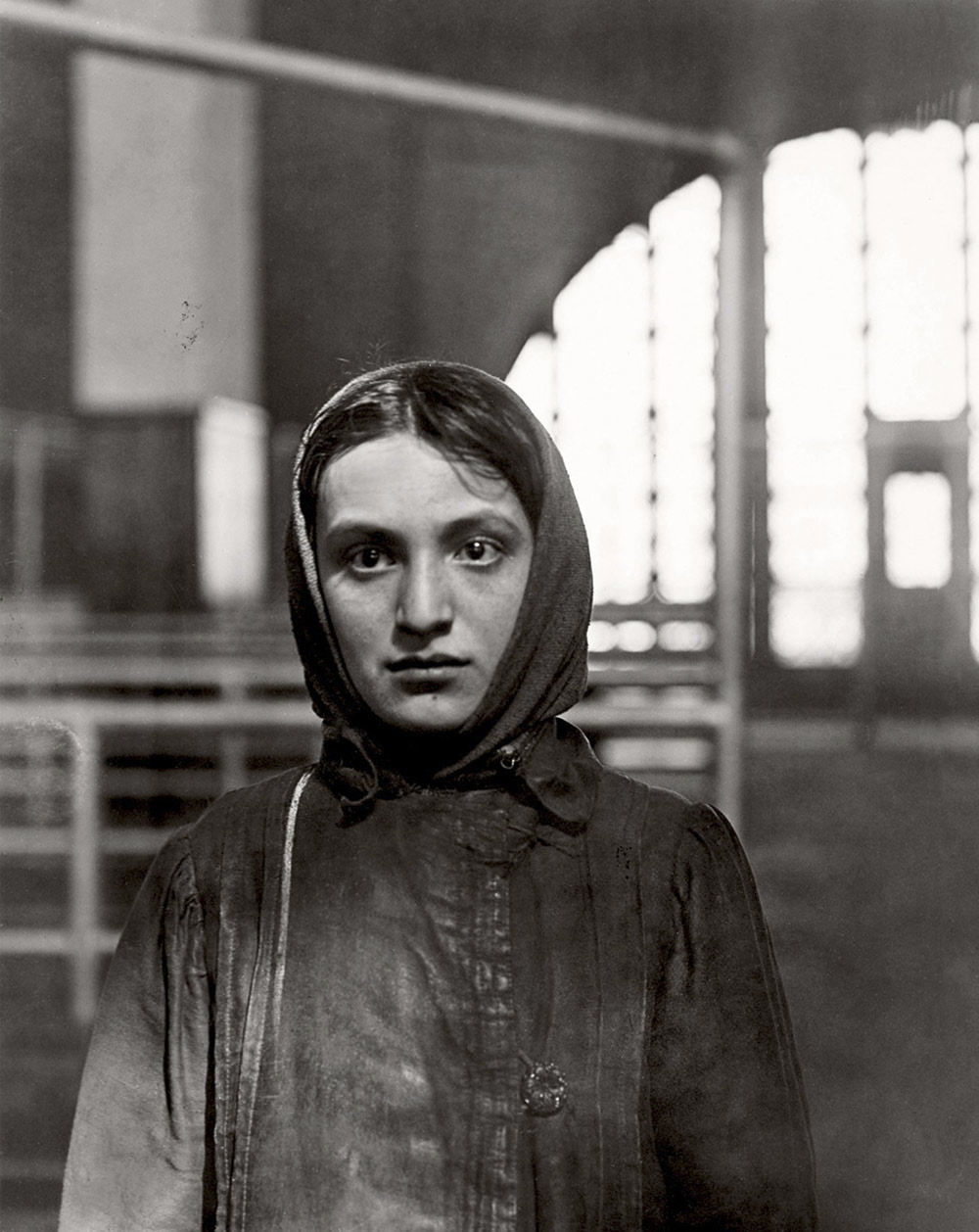
 

Pieter Hugo (South African, b. 1976) 'Naasra Yeti, Agbogbloshie Market, Accra, Ghana' 2009


Pieter Hugo (South African, b. 1976)
Naasra Yeti, Agbogbloshie Market, Accra, Ghana
2009
From the series Permanent Error (2009-2010)
© Pieter Hugo
Courtesy of Stevenson, Cape Town/Johannesburg and Yossi Milo, New York


Pieter Hugo (South African, b. 1976) 'Aissah Salifu, Agbogbloshie Market, Accra, Ghana' 2010


Pieter Hugo (South African, b. 1976)
Aissah Salifu, Agbogbloshie Market, Accra, Ghana
2010
From the series Permanent Error (2009-2010)
© Pieter Hugo
Courtesy of Stevenson, Cape Town/Johannesburg and Yossi Milo, New York


Installation view of the exhibition Pieter Hugo: This Must Be The Place – Selected Works 2003-2012 at the Ludwig Museum of Contemporary Art, Budapest showing at second right, Hugo's 'Obechukwu Nwoye, Enugu' 2008-2009; and at right, 'Escort Kama. Enugu, Nigeria' 2008 (below) both from the series 'Nollywood' (2008-2009)


Installation view of the exhibition Pieter Hugo: This Must Be The Place – Selected Works 2003-2012 at the Ludwig Museum of Contemporary Art, Budapest showing at second right, Hugo’s Obechukwu Nwoye, Enugu 2008-2009; and at right, Escort Kama. Enugu, Nigeria 2008 (below) both from the series Nollywood (2008-2009)
Exhibition view © Tamás Bujnovszky / Ludwig Museum – Museum of Contemporary Art, Archives


Pieter Hugo (South African, b. 1976) 'Escort Kama. Enugu, Nigeria' 2008


Pieter Hugo (South African, b. 1976)
Escort Kama. Enugu, Nigeria
2008
From the series Nollywood (2008-2009)
© Pieter Hugo
Courtesy of Stevenson, Cape Town/Johannesburg and Yossi Milo, New York


Pieter Hugo (South African, b. 1976) 'Chris Nkulo and Patience Umeh. Enugu, Nigeria' 2008


Pieter Hugo (South African, b. 1976)
Chris Nkulo and Patience Umeh. Enugu, Nigeria
2008
From the series Nollywood (2008-2009)
© Pieter Hugo
Courtesy of Stevenson, Cape Town/Johannesburg and Yossi Milo, New York


Pieter Hugo’s (b. Johannesburg, 1976) career is quite young, yet his photography is already so comprehensive that we can rightly speak of a consistent oeuvre. Since 2003 Hugo has photographed people and themes exclusively in sub-Saharan Africa. Daily life in post-colonial Africa, the complex conditions after the end of apartheid in his own land and the impact of global trade and commerce are themes that circulate throughout his intriguing series.

Pieter Hugo spends long periods of time photographing his extensive series in order to capture intimate and often bizarre moments. His use of a large-format camera requires patience and trust between photographer and subject, which is visible in straightforward expressions and candid interactions. There is a moment of calm and even timelessness in these works that allows the viewer to engage more fully with the subject matter.

The political diversity of a continent that is rapidly transforming – some note that Africa will be a global economic power of the future – is portrayed by Pieter Hugo with the clarity of familiar painting genres such as landscape, portraiture, group portraiture and still life. The subjects of his photography: the elderly, the poor, the blind, street artists, soap actors, close family and friends – form a social tableau that is at once personalised while also presenting a more universal image of Africa at the beginning of the twenty first century.

The initial motivation for the series The Hyena & Other Men (2005-2007) comes from a cell phone camera image Pieter Hugo discovered on the internet. The image concerns a group of performers who travel throughout Nigeria with tamed hyenas and other wild animals and collect money from their choreographed public performances. Hugo embarked on two separate trips to document this remarkable nomadic group up close. Hugo presents the complex relationship between animal and owner, capturing moments of calm and tenderness amidst situations full of drama and spectacle.

The Agbogbloshie market on the outskirts of Accra (Ghana) is the thematic of the Permanent Error series (2009-2010), which is mainly a dumping site for the technological waste of the western world. Here computers and other electronic equipment are collected and burned by inhabitants, often children, to extract precious raw materials. These machines formerly representing prosperity and progress are here transformed into only noxious and life threatening vapours. The charred ground, grey sky and scattered groups of foragers and cattle seem isolated from the world, but are in fact one of the last links in a chain of global commerce. Despite the harsh surroundings, the subjects stand tall, identified by full name and framed in the style of classical portraiture.

Nollywood (2008-2009) is the third largest film industry in the world, releasing between 500 and 1,000 movies each year. It produces movies on its own terms, telling stories that appeal to and reflect the lives of its public: it is a rare instance of self-representation on such a scale in Africa. The continent has a rich tradition of story-telling that has been expressed abundantly through oral and written fiction, but has never been conveyed through the popular media before. Stars are local actors; plots confront the public with familiar situations of romance, comedy, witchcraft, bribery, prostitution. The narrative is overdramatic, deprived of happy endings, tragic. The aesthetic is loud, violent, excessive; nothing is said, everything is shouted.

At a morgue in the township of Khayelitsha in Cape Town, Pieter Hugo turns his camera to individuals who have died of AIDS related illnesses. In The Bereaved (2005) as with many of his other series, Hugo gives first and last names of his subjects. Such a personal statement challenges the anonymity of AIDS statistics in South Africa. Ten years after the Rwandan Genocide, Pieter Hugo captures the unimaginable violence of these events through leftover fragments (Vestiges of a Genocide, 2004). The absence of human life is disturbingly present in the images. Bones are preserved with lime so as not to disintegrate. Heavy dust and dirt create an organic seal over the remains. While these substances often signify what is past and forgotten, the items in the photographs are preserved artificially and naturally for all to remember.

The series entitled Messina / Musina (2006) deals with the inhabitants of a small town on the border of Zimbabwe in South Africa’s Limpopo Province. The title reflects the correction of an earlier colonial misspelling of the town’s name (Messina), as well as the transition taking place at this geographical and social periphery.

In Pieter Hugo’s studio portraits of the elderly, the blind and people with albinism – Looking Aside, 2003-2006 – there is a direct and confrontational engagement between the viewer and the subjects. The viewer is made to feel uncomfortable and immobilised by the subject’s gaze. In There’s a Place in Hell for Me and My Friends (2011) – a recent series of portraits realised in the same spirit and adopting a stripped back, close-up and confrontationally direct approach – Hugo explores similar territory [to his earlier series Looking Aside] but from practically the opposite angle. In this case, the subjects are simply the photographer and his friends, who represent an array of ethnicities but are not particularly atypical, abnormal or ‘unusual’ in a genetic sense. Instead they are rendered unusually, portrayed in a heightened monotone with their skin transformed into a range of exaggerated black spots and dark tones.

With Kin (2011), his most autobiographical series to date, Pieter Hugo reflects on his own family and deep ambivalence towards the notion of home. Personal moments such as the pregnancy of his wife, the birth of their child and an operation of his mother are interspersed with national icons: open landscapes, anthropological museums and references to historical places and figures in South Africa. The recent and historical, private and public, rich and poor, ugly and beautiful interact closely in this series and represent the social complexities of post-apartheid South Africa.

Press release from the Ludwig Museum of Contemporary Art website


Installation view of the exhibition 'Pieter Hugo: This Must Be The Place – Selected Works 2003-2012' at the Ludwig Museum of Contemporary Art, Budapest showing work from Hugo's 'Vestiges of a Genocide' Rwanda, 2004


Installation view of the exhibition Pieter Hugo: This Must Be The Place – Selected Works 2003-2012 at the Ludwig Museum of Contemporary Art, Budapest showing work from Hugo’s Vestiges of a Genocide Rwanda, 2004
Exhibition view © Tamás Bujnovszky / Ludwig Museum – Museum of Contemporary Art, Archives

Vestiges of a Genocide

Rwanda, 2004

Ten years after the Rwandan Genocide, Pieter Hugo captures the unimaginable violence of these evens through leftover fragments. The absence of human life is disturbingly person in the images. Bones are preserved with lime so as not to disintegrate. Heavy dust and dirt create an organic seal over the remains. While these substances often signify what is past and forgotten, the items in the photographs are preserved artificially and naturally for all to remember.

Wall text from the exhibition


Pieter Hugo (South African, b. 1976) 'John Kwesi, Wild Honey Collector, Techiman District, Ghana' 2005


Pieter Hugo (South African, b. 1976)
John Kwesi, Wild Honey Collector, Techiman District, Ghana
2005
From the series Wild Honey Collectors Ghana 2005
© Pieter Hugo
Courtesy of Stevenson, Cape Town/Johannesburg and Yossi Milo, New York


Pieter Hugo (South African, b. 1976) 'The Honourable Justice Unity Dow' 2005


Pieter Hugo (South African, b. 1976)
The Honourable Justice Unity Dow
2005
© Pieter Hugo
Courtesy of Stevenson, Cape Town/Johannesburg and Yossi Milo, New York


Installation view of the exhibition 'Pieter Hugo: This Must Be The Place – Selected Works 2003-2012' at the Ludwig Museum of Contemporary Art, Budapest showing work from Hugo's 'Looking Aside: Studio Portraits' South Africa, 2003-2006


Installation view of the exhibition Pieter Hugo: This Must Be The Place – Selected Works 2003-2012 at the Ludwig Museum of Contemporary Art, Budapest showing work from Hugo’s Looking Aside: Studio Portraits South Africa, 2003-2006
Exhibition view © Tamás Bujnovszky / Ludwig Museum – Museum of Contemporary Art, Archives


Looking Aside: Studio Portraits

South Africa, 2003-2006

In Pieter Hugo’s studio portraits of the elderly, the blind and people with albinism there is a direct and confrontational engagement between the viewer and the subjects. The viewer is made to feel uncomfortable and immobilised by the subject’s gaze.

Wall text from the exhibition


Pieter Hugo (South African, b. 1976) 'Steven Mohapi, Johannesburg' 2003


Pieter Hugo (South African, b. 1976)
Steven Mohapi, Johannesburg
2003
From the series Looking Aside: Studio Portraits South Africa, 2003-2006
© Pieter Hugo
Courtesy of Stevenson, Cape Town/Johannesburg and Yossi Milo, New York


Pieter Hugo (South African, b. 1976) 'Themba Tshabalala, Cape Town' 2011


Pieter Hugo (South African, b. 1976)
Themba Tshabalala, Cape Town
2011
From the series There’s a Place in Hell for Me and My Friends
© Pieter Hugo
Courtesy of Stevenson, Cape Town/Johannesburg and Yossi Milo, New York


Installation view of the exhibition 'Pieter Hugo: This Must Be The Place – Selected Works 2003-2012' at the Ludwig Museum of Contemporary Art, Budapest showing work from Hugo's 'There's a Place in Hell for Me and My Friends', 2011


Installation view of the exhibition Pieter Hugo: This Must Be The Place – Selected Works 2003-2012 at the Ludwig Museum of Contemporary Art, Budapest showing work from Hugo’s There’s a Place in Hell for Me and My Friends, 2011
Exhibition view © Tamás Bujnovszky / Ludwig Museum – Museum of Contemporary Art, Archives


There’s a Place in Hell for Me and My Friends

2011

In There’s a Place in Hell for Me and My Friends, a recent series of portraits that adopts a stripped back, close-up confrontationally direct approach – Hugo explores similar territory (to his earlier series Looking Aside, above) but from practically the opposite angle. In this case the subjects are simply the photographer and his friends, who represent an array of ethnicities but are not particularly atypical, abnormal or ‘unusual’ in a genetic sense. Instead they are rendered unusually, portrayed in a heightened monotone with their skin transformed into a range of exaggerated black spots and dark tones.

Wall text from the exhibition


Pieter Hugo (South African, b. 1976) 'Ashleigh McLean' 2011


Pieter Hugo (South African, b. 1976)
Ashleigh McLean
2011
From the series There’s a Place in Hell for Me and My Friends
© Pieter Hugo
Courtesy of Stevenson, Cape Town/Johannesburg and Yossi Milo, New York


Pieter Hugo (South African, b. 1976) 'Yasser Booley, Cape Town' 2011


Pieter Hugo (South African, b. 1976)
Yasser Booley, Cape Town
2011
From the series There’s a Place in Hell for Me and My Friends
© Pieter Hugo
Courtesy of Stevenson, Cape Town/Johannesburg and Yossi Milo, New York


Ludwig Museum of Contemporary Art
1095 Budapest Komor Marcell Street 1
Hungary 06 1 555-3444

Opening hours:
Tuesday – Sunday: 10.00 – 18.00
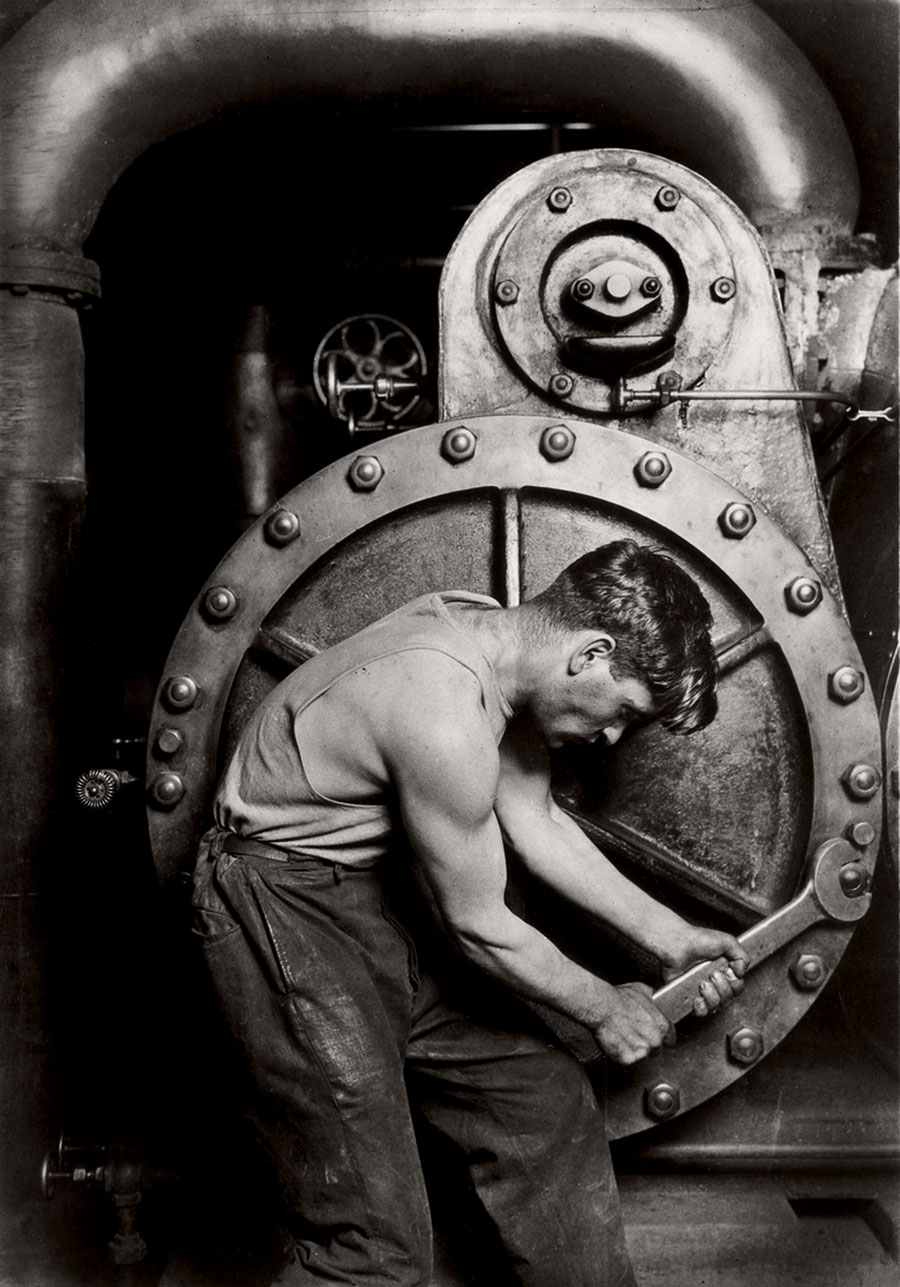
Closed on Mondays

Ludwig Museum of Contemporary Art website

LIKE ART BLART ON FACEBOOK

Back to top