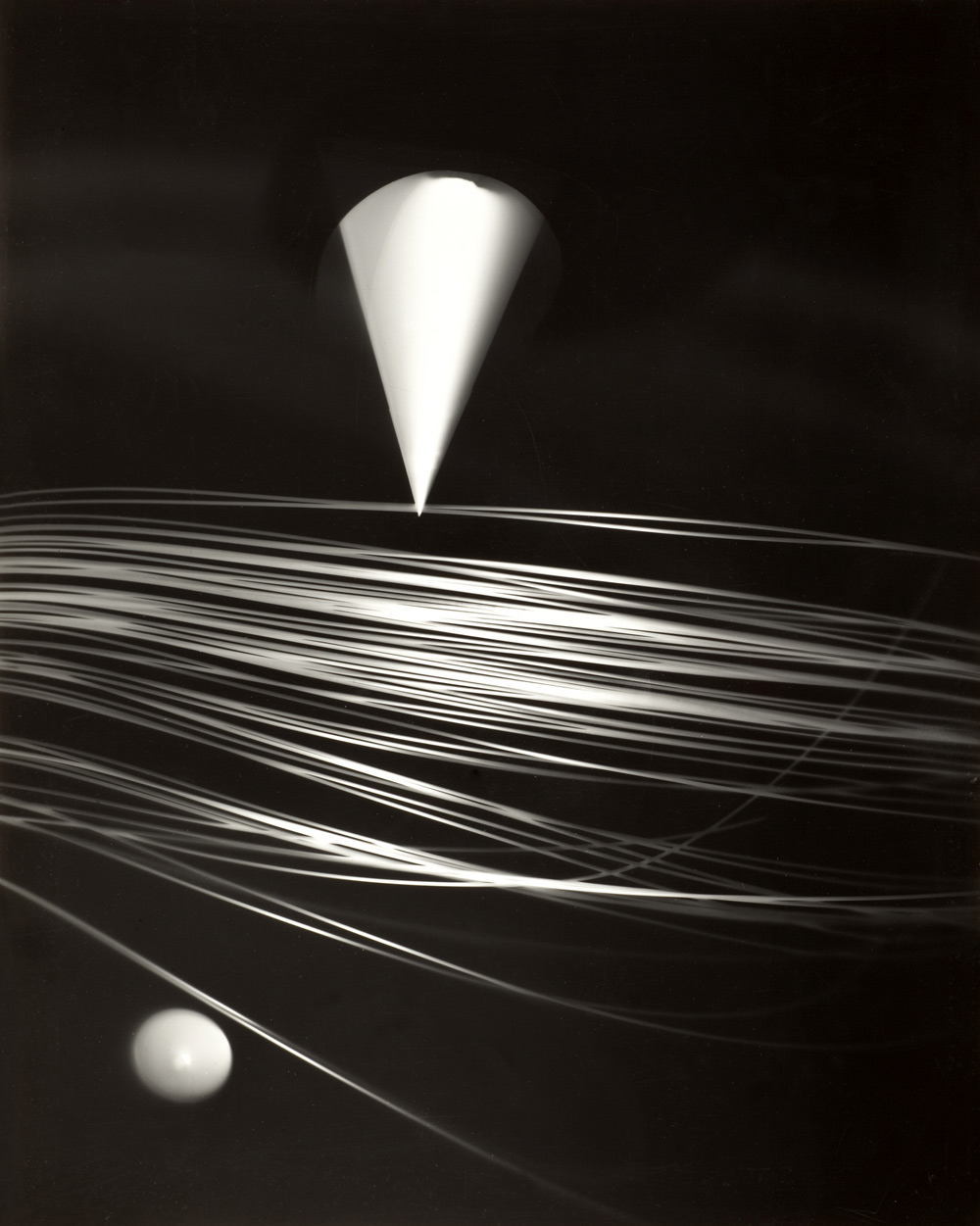
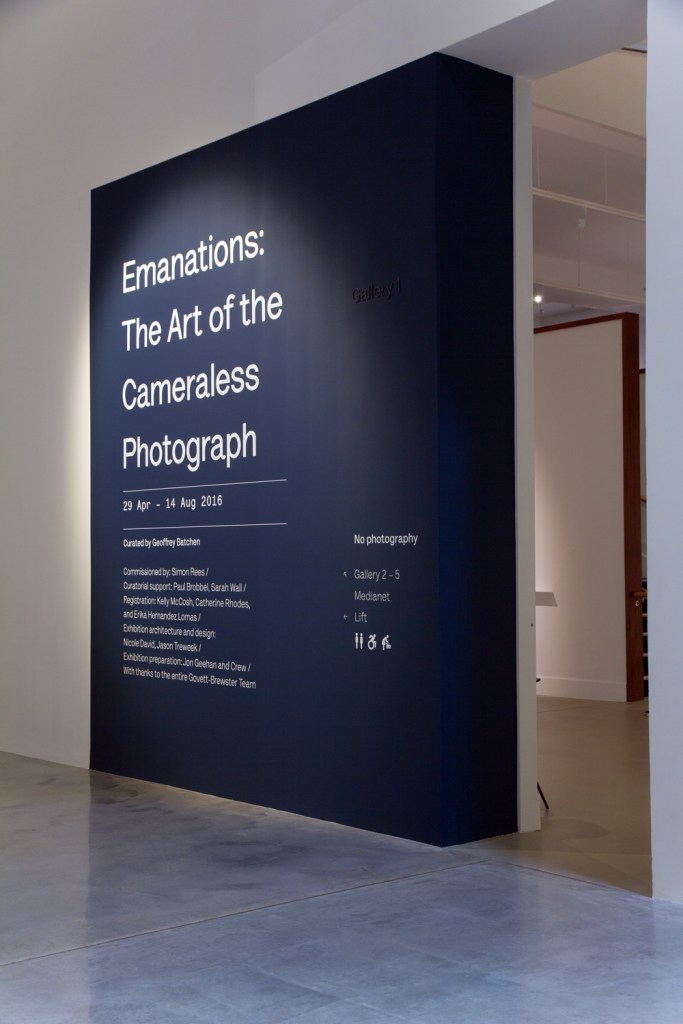
Exhibition: ‘Emanations: The Art of the Cameraless Photograph’ at the Govett-Brewster Art Gallery/Len Lye Centre, New Plymouth, New Zealand Part 2

Exhibition dates: 29th April – 14 August, 2016

Curator: Geoffrey Batchen


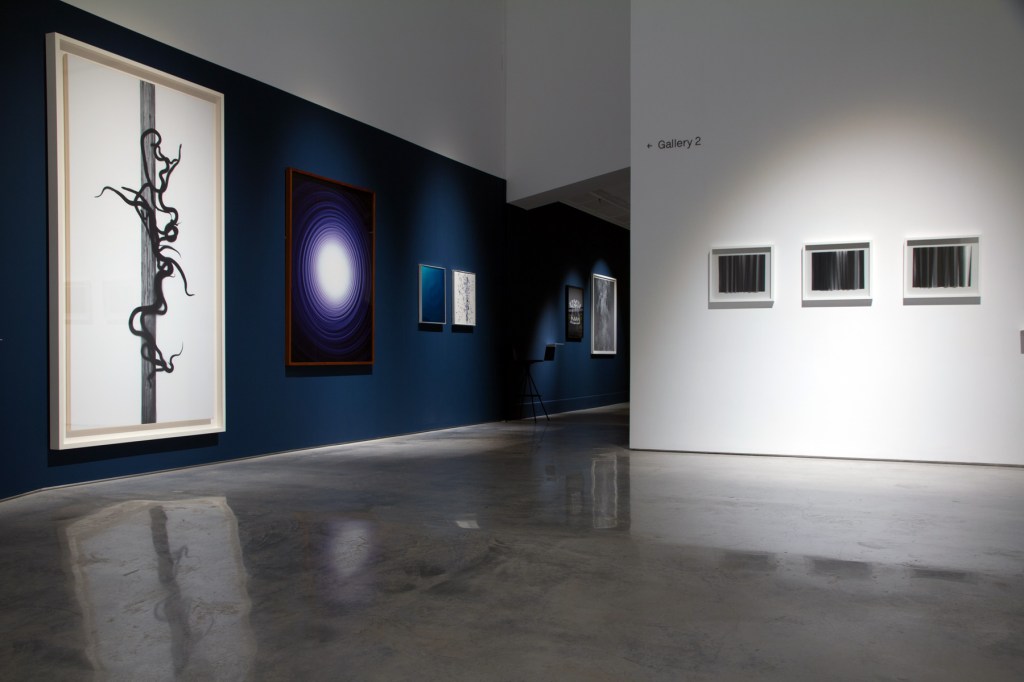
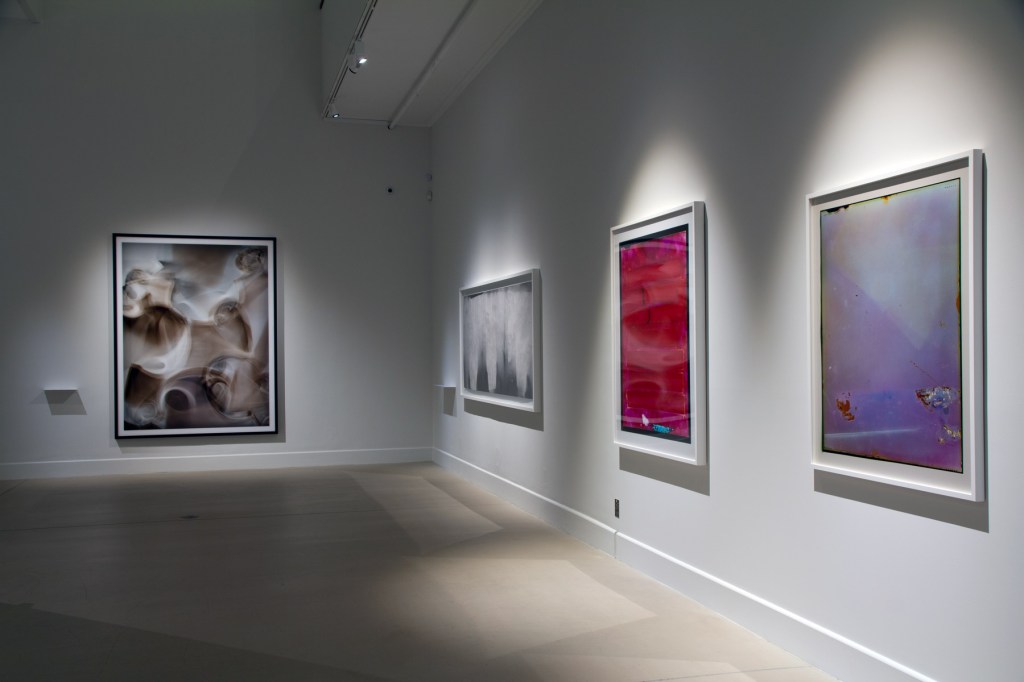
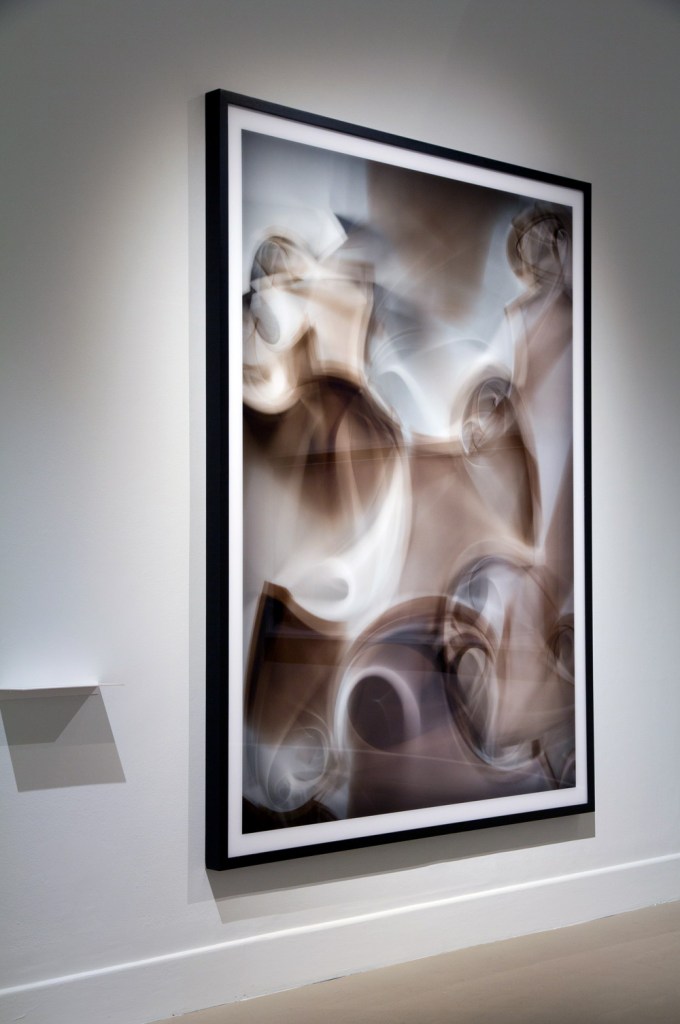
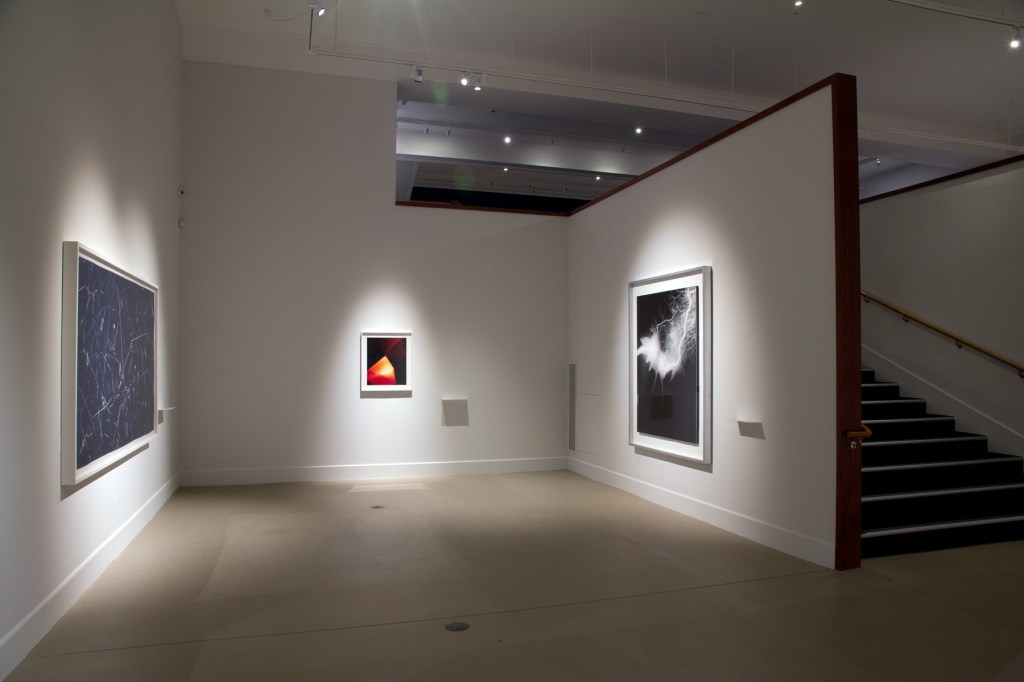
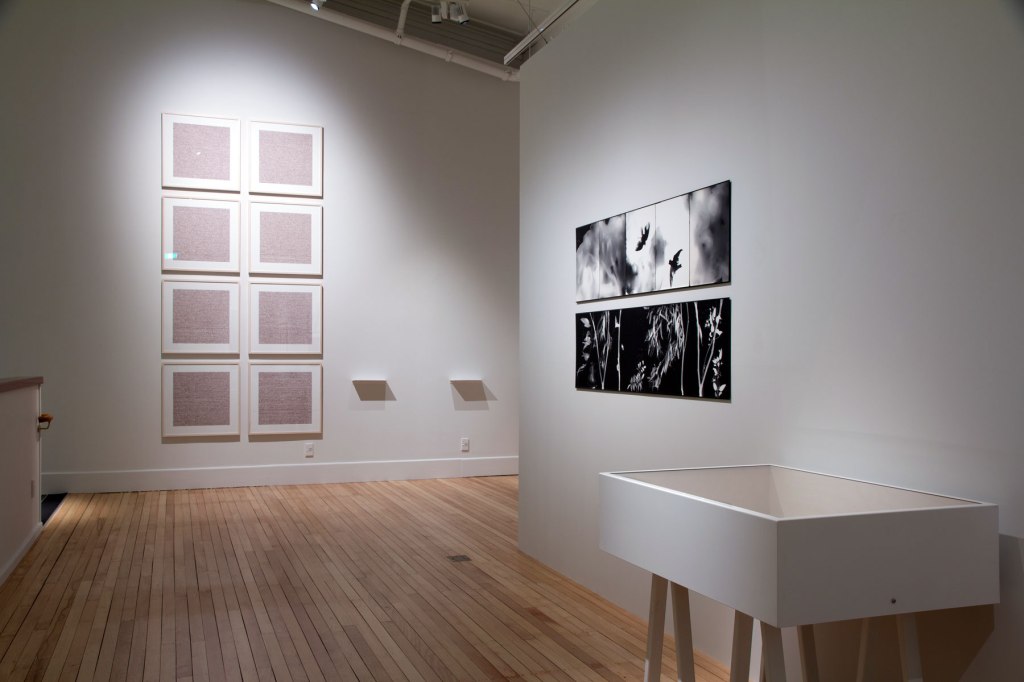
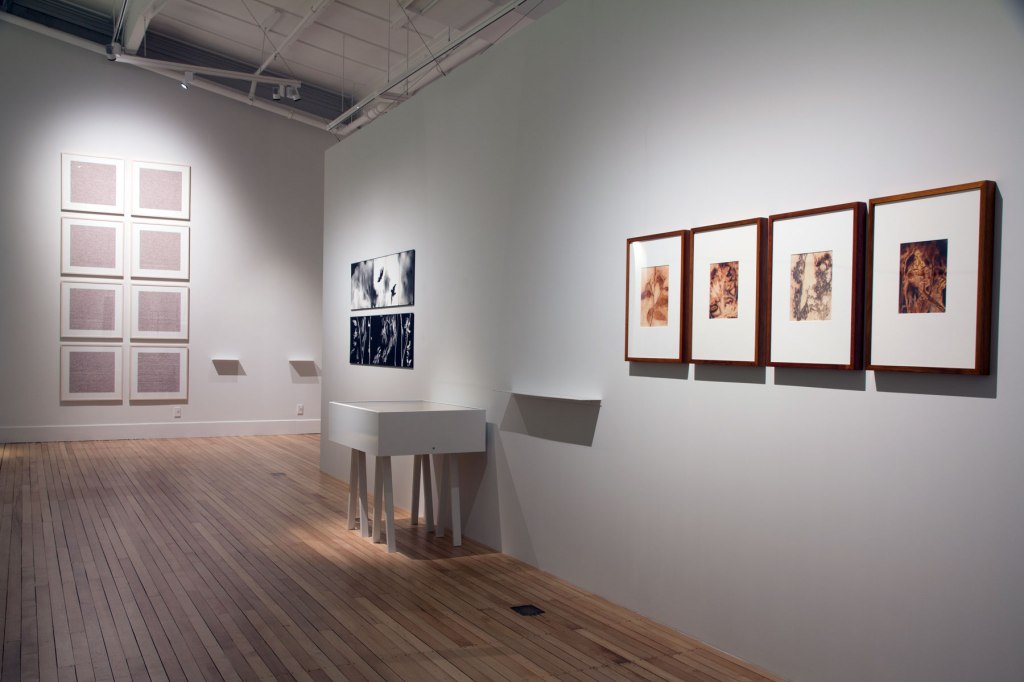
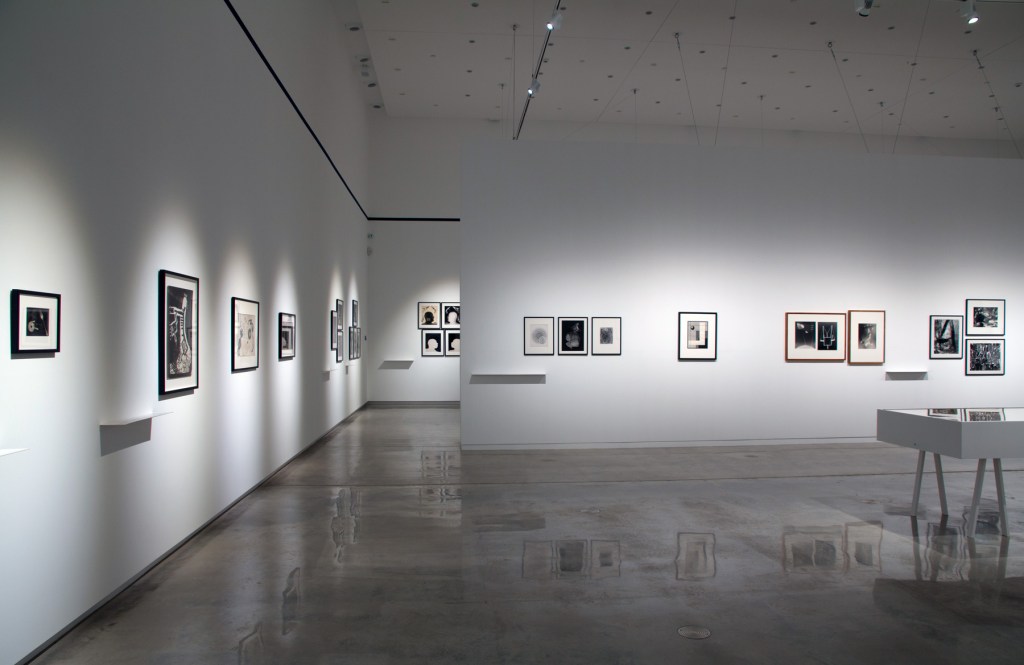
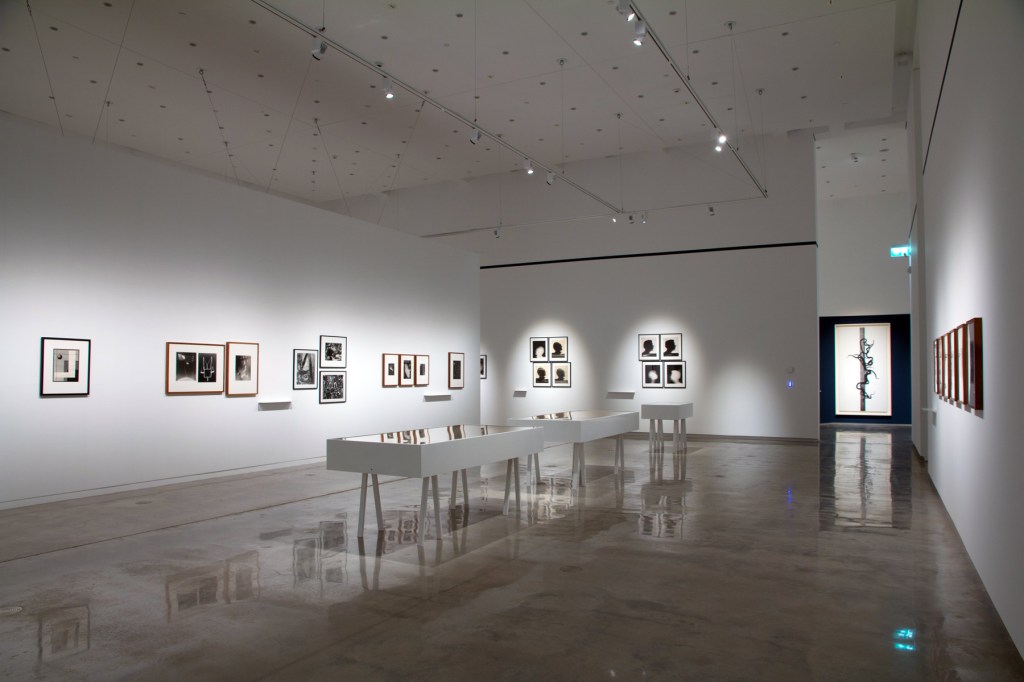
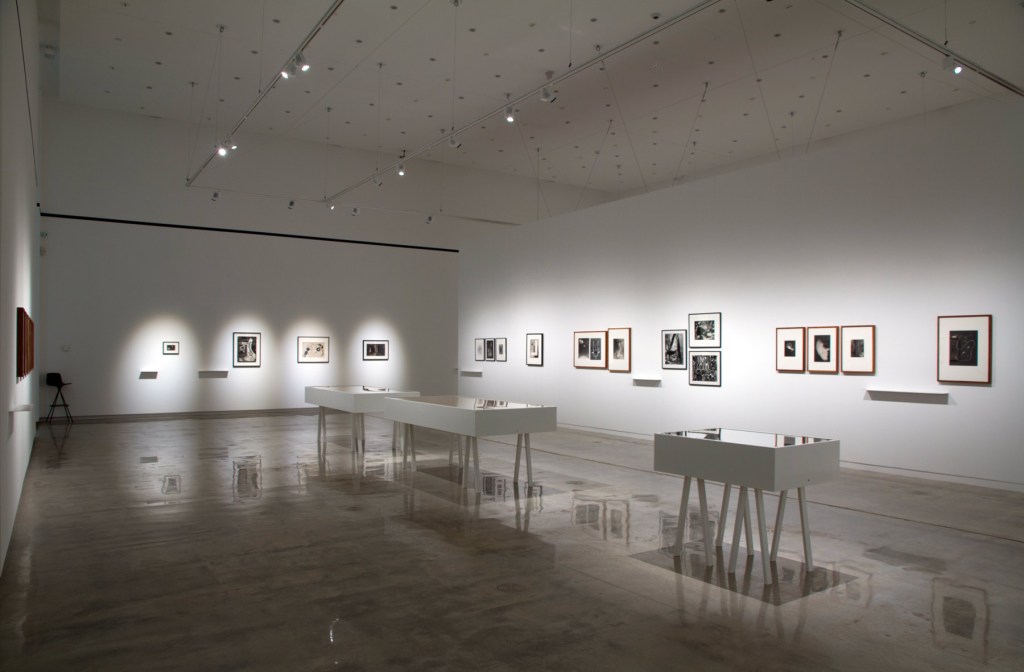
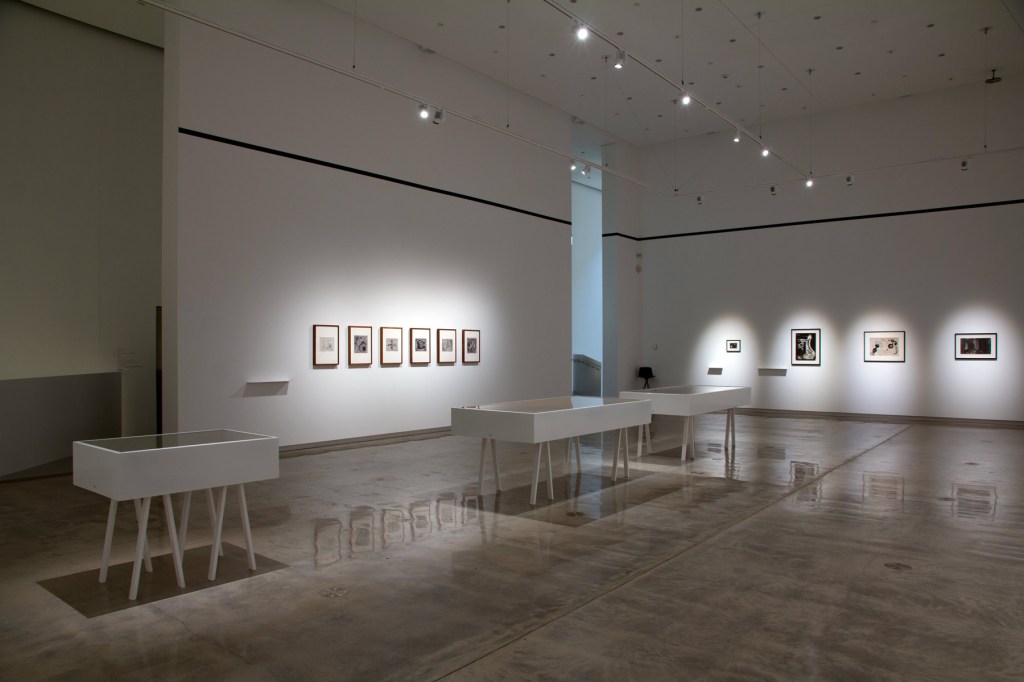
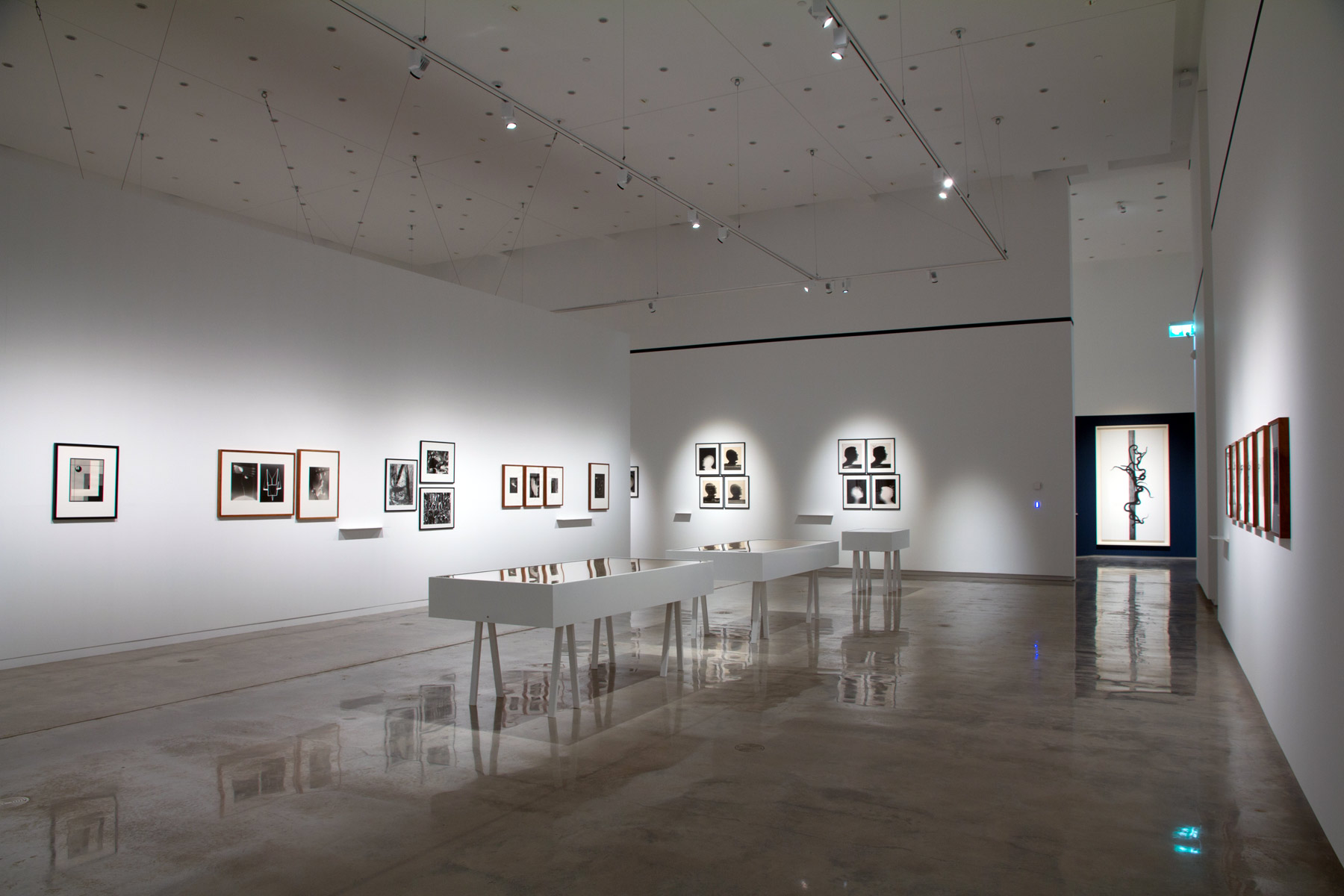
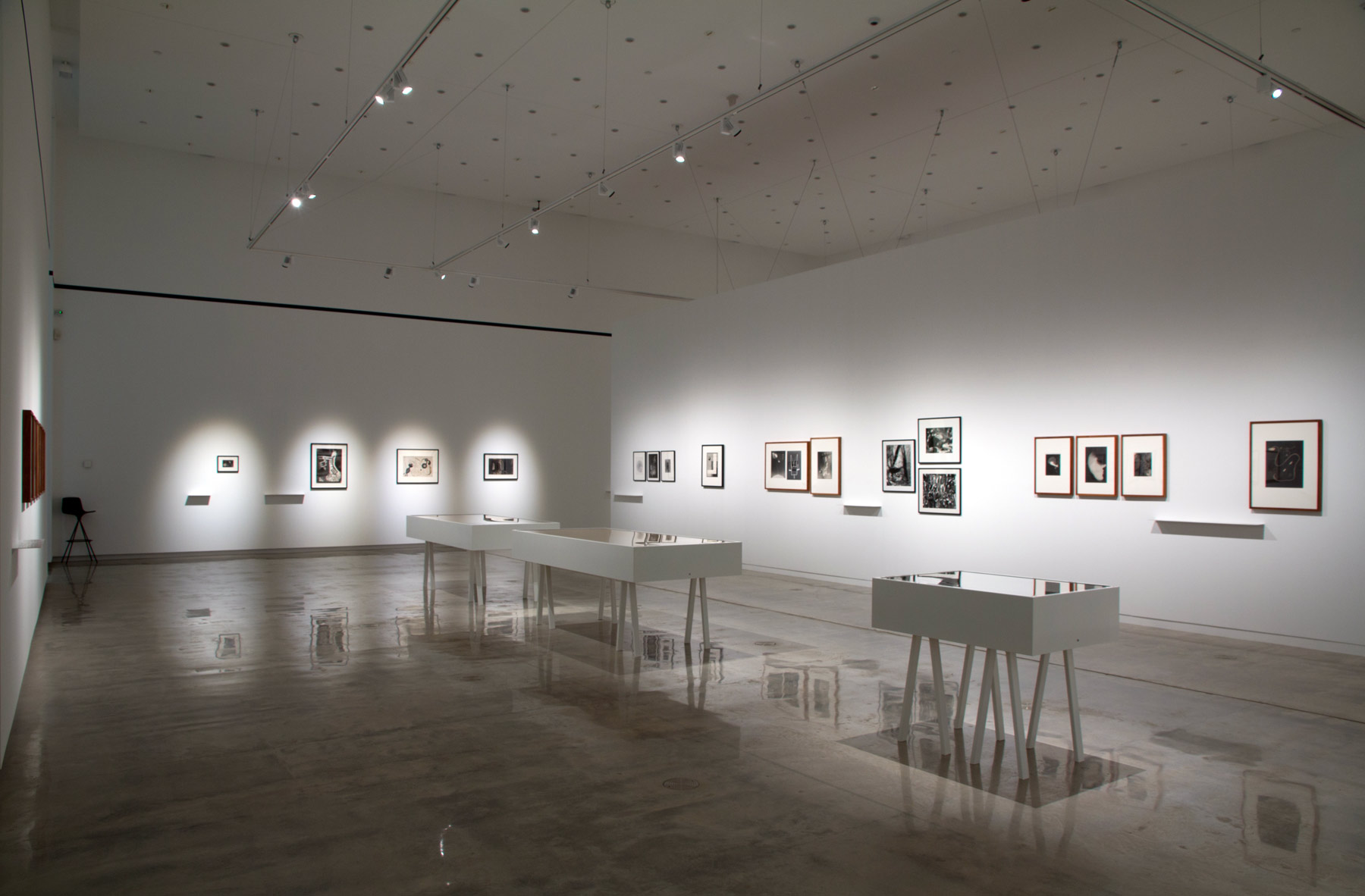
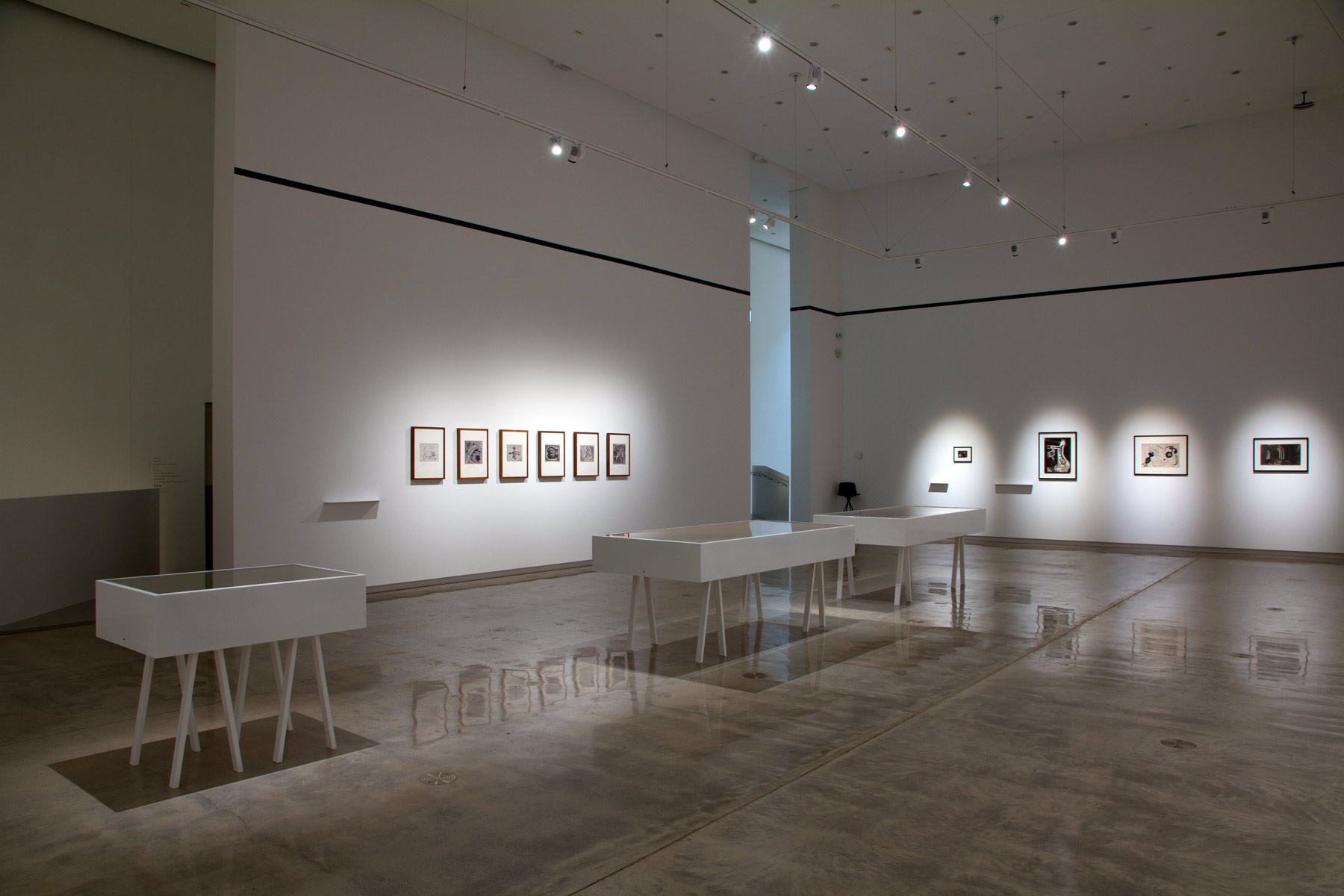
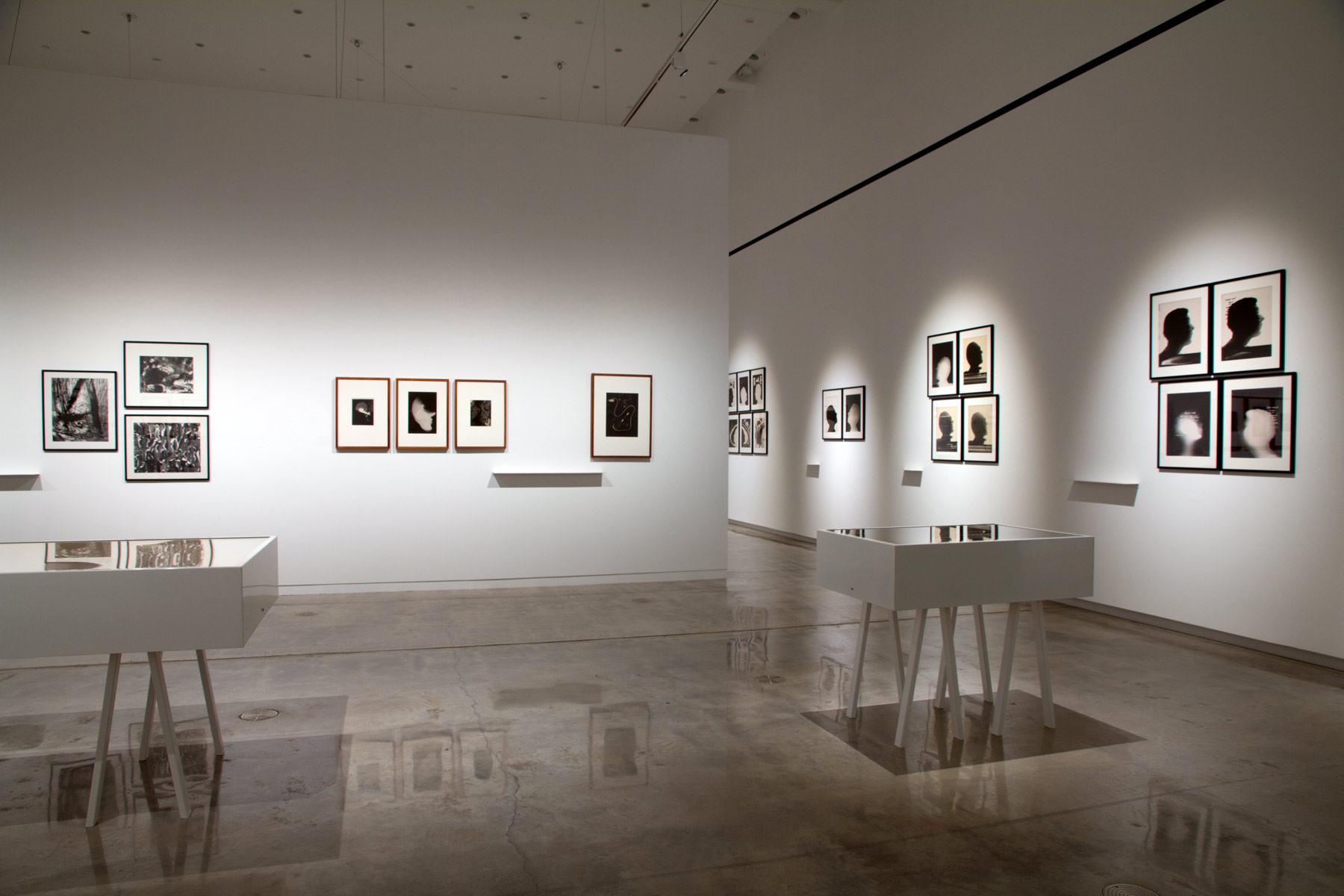
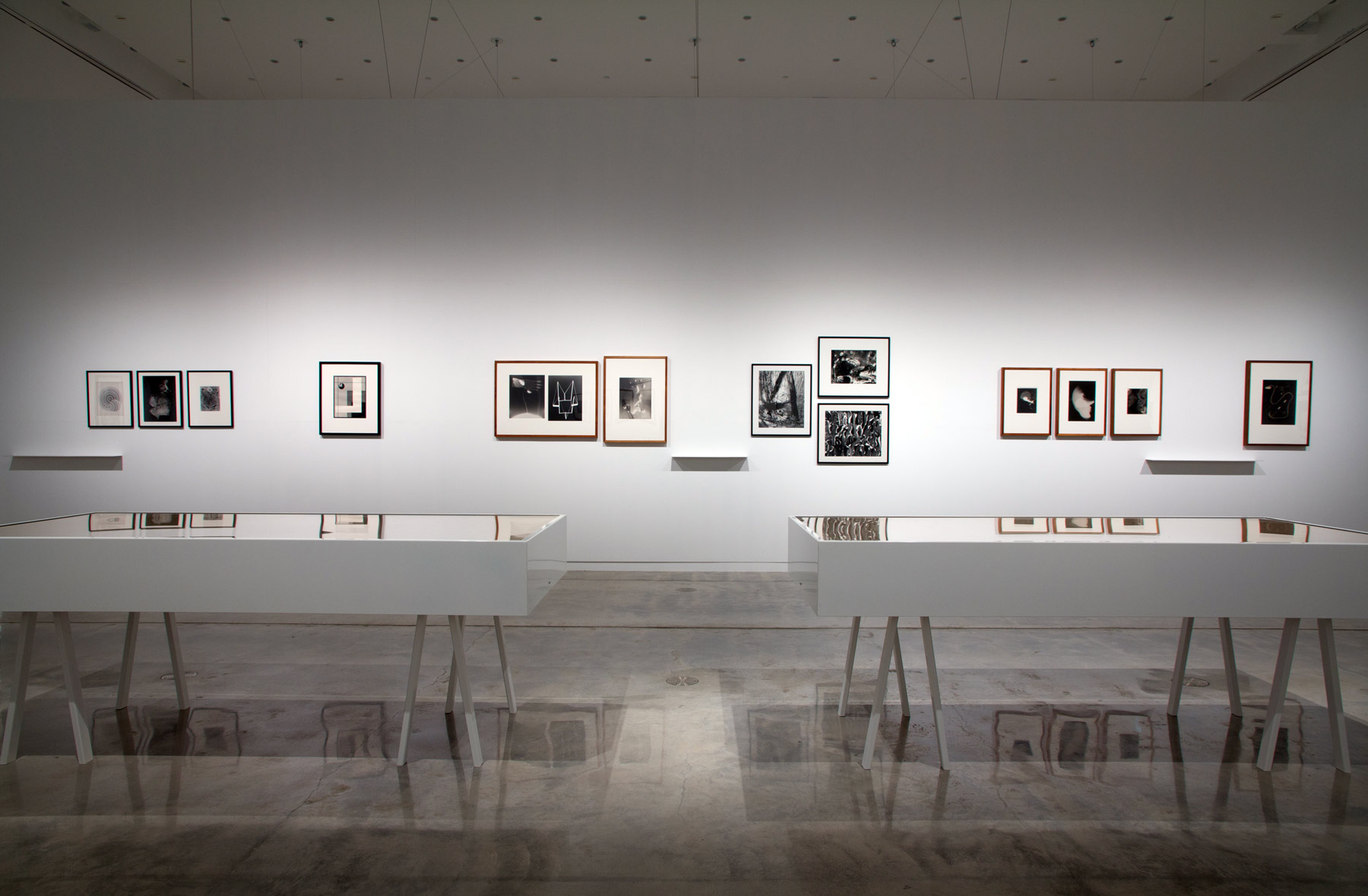
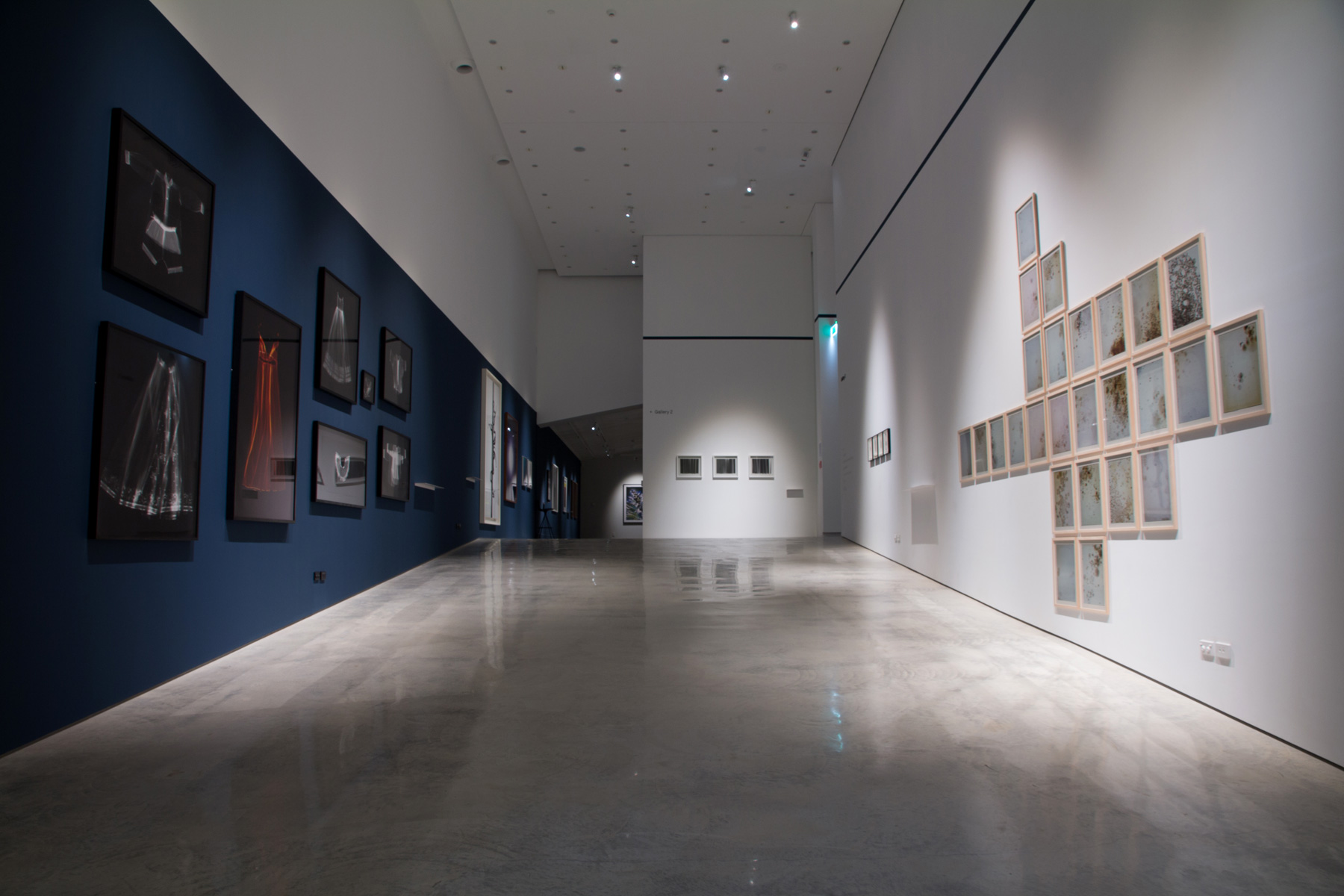
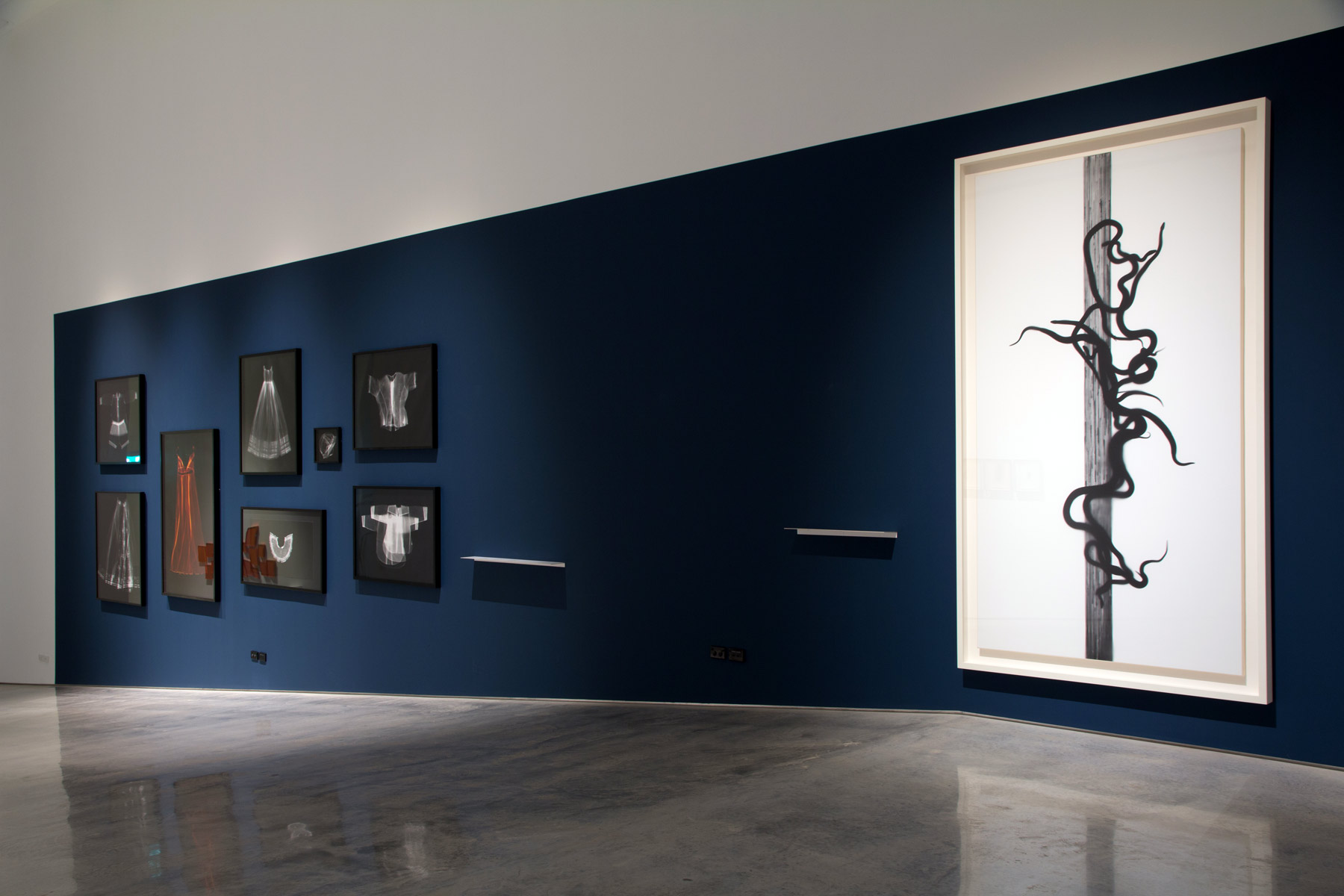
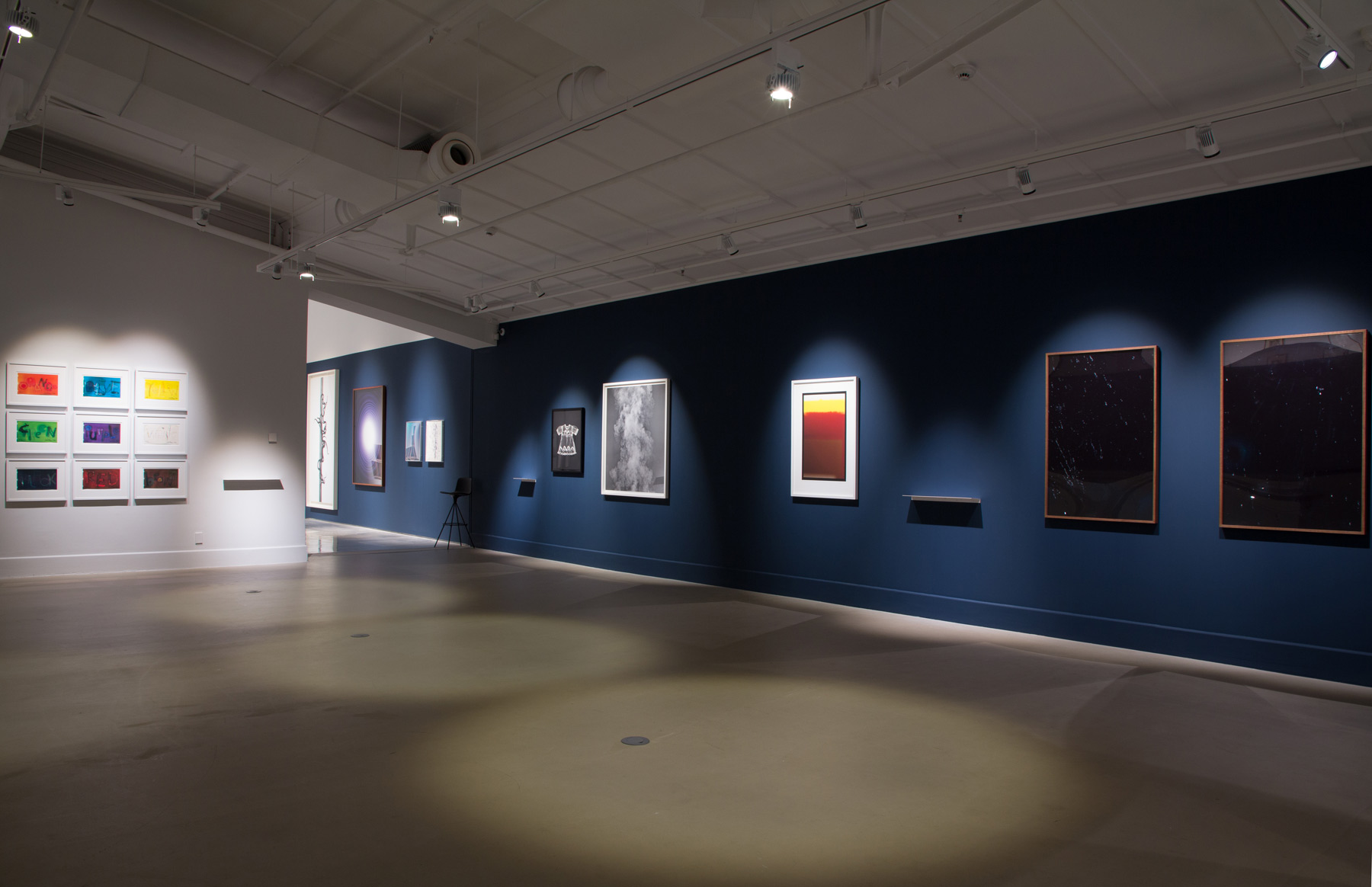
Installation view of the exhibition 'Emanations: The Art of the Cameraless Photograph' at the Govett-Brewster Art Gallery


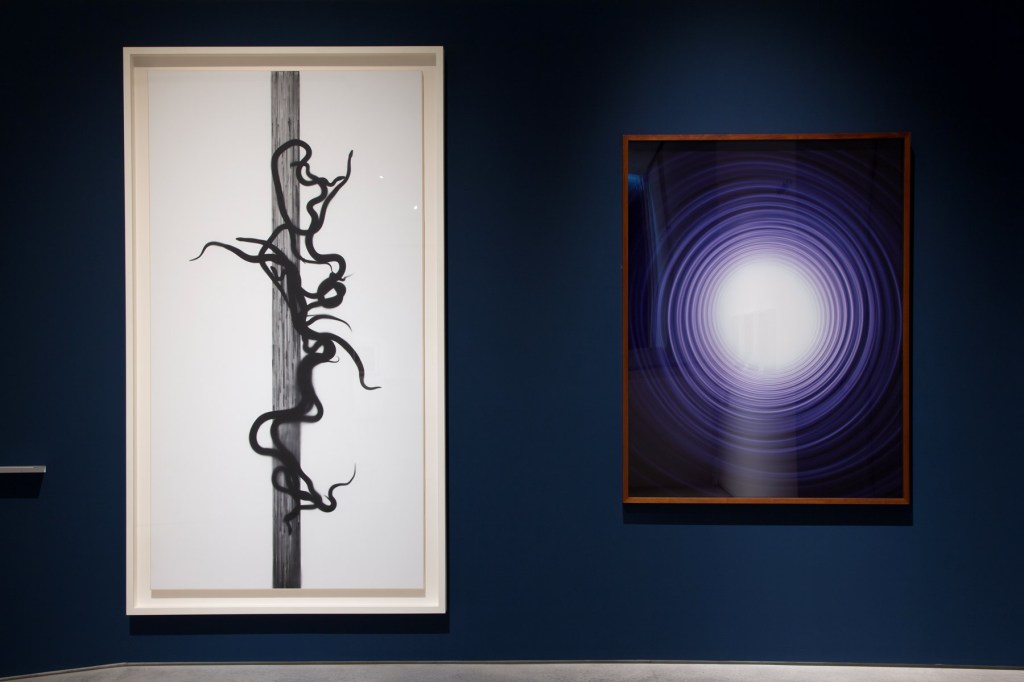
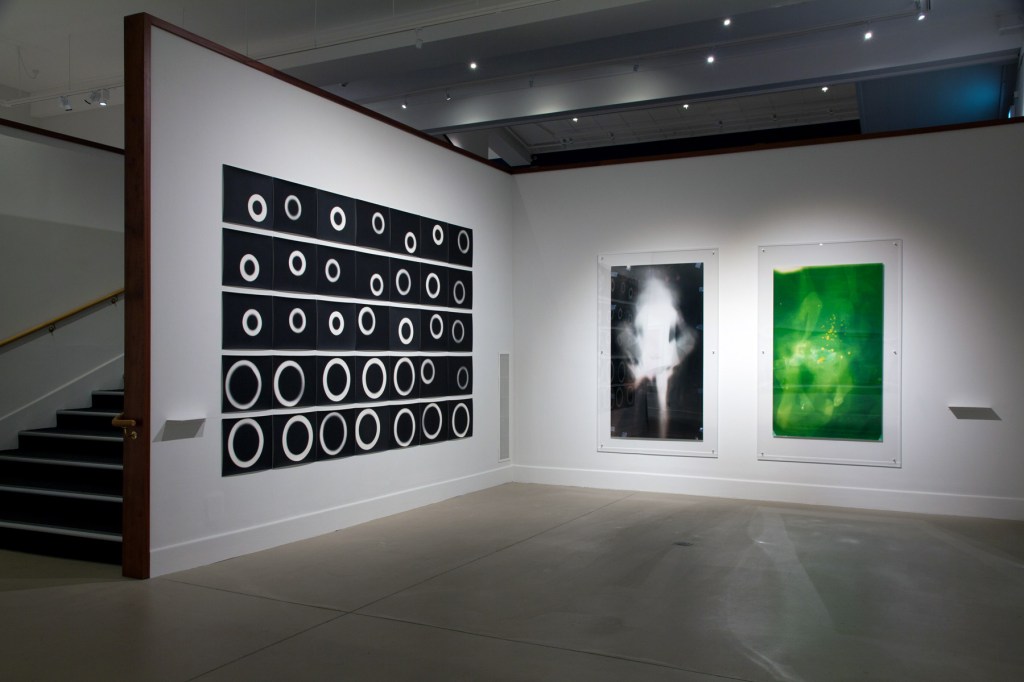
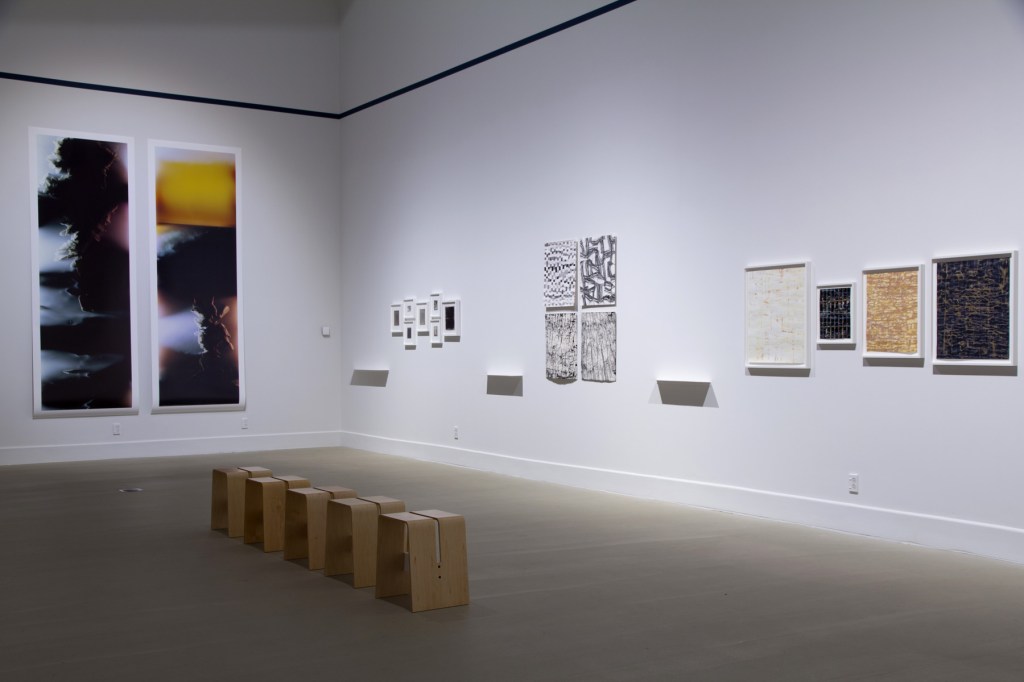
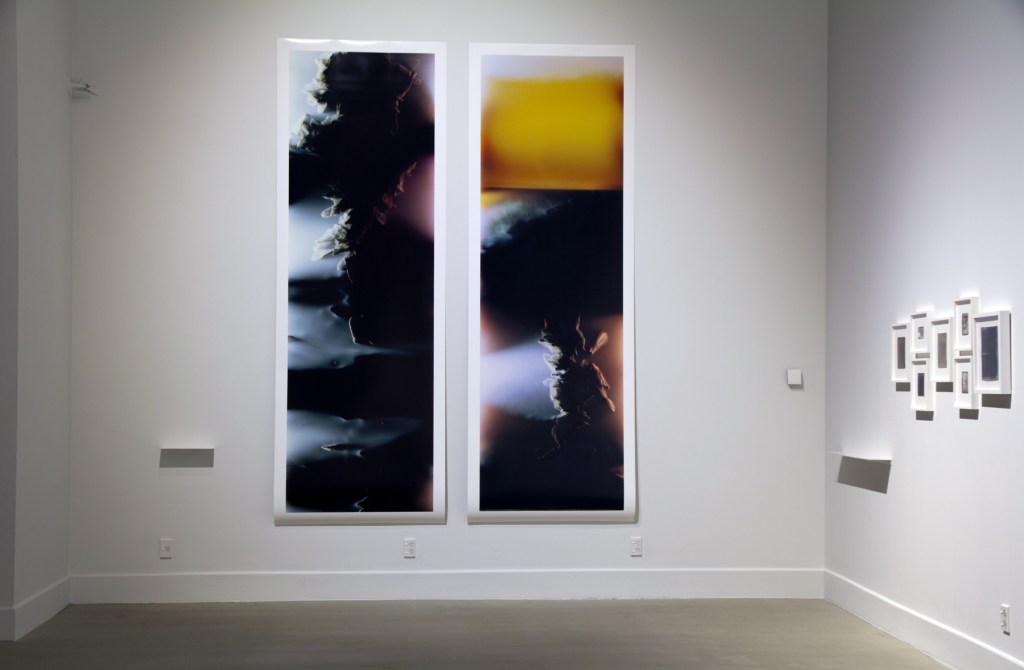
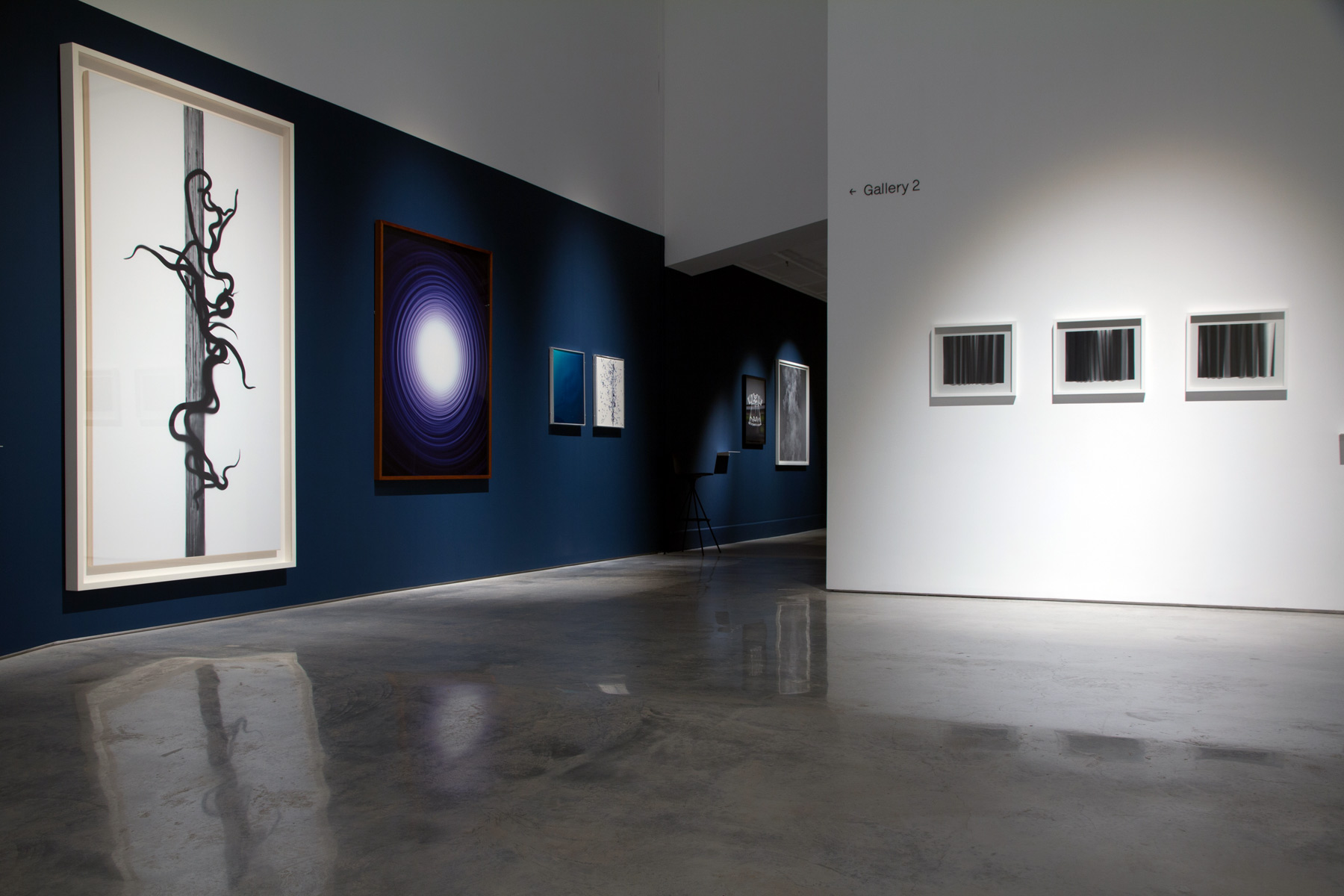
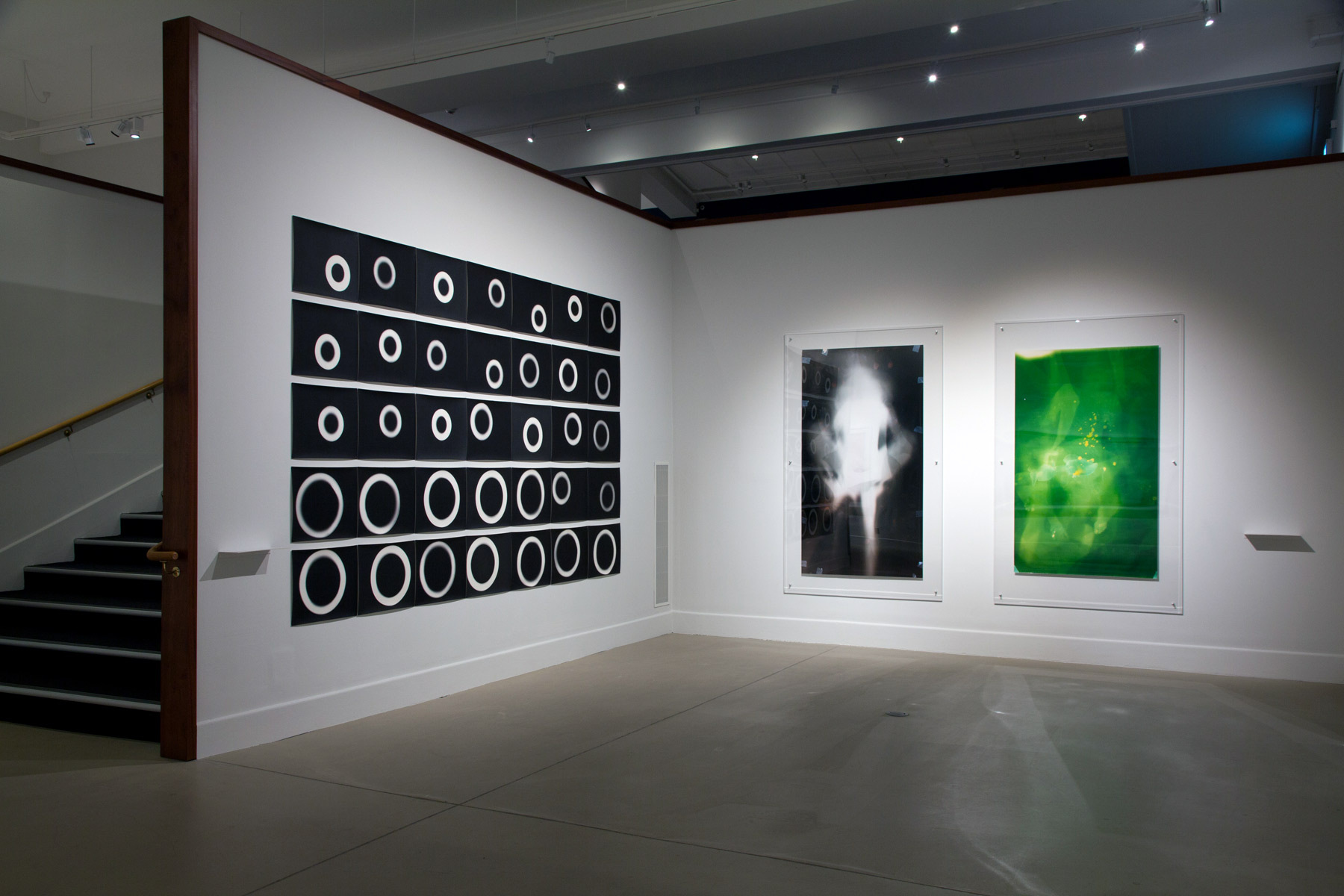
Installation view of the exhibition Emanations: The Art of the Cameraless Photograph at the Govett-Brewster Art Gallery with at left, Christian Marclay and at right, Hiroshi Sugimoto


Part 2 of a posting on the wonderful exhibition Emanations: The Art of the Cameraless Photograph at the Govett-Brewster Art Gallery / Len Lye Centre, New Plymouth, New Zealand. See Part 1 of the posting.


While there is no doubt as to the quality and breadth of the work on display, nor how it has been curated or installed in these beautiful contemporary spaces, I question elements of the conceptual rationale that ground the exhibition. Curator Geoffrey Batchen correctly notes that “artists are coming back to the most basic and elemental chemistry of photography, hands on, making unique images where there is a direct relationship between the thing being imaged and then image itself” as a response to the dematerialisation of the image that occurs in a digital environment and the proliferation of reproductions of digital images, but his assertion in a Radio New Zealand interview that the cameraless photograph has a direct relationship to the world, unmediated – through the unique touch of the object on the photographic paper – is an observation that seems a little disingenuous.

Batchen observes, “it’s as if nature represents itself, completely unmediated and directly. In some ways … [this] is far more realist, far more true to the original object than any camera picture could be.” Note how he qualifies his assertion and position by the statement “in some ways”.

The reality of the situation is that every photograph is mediated to one degree or another, whether through the use of the camera, the choice of developer, photographic paper, size, perspective and so forth. The physicality of the actual print and the context of capture and display are also mediated, in each instance and on every occasion. Every photograph is mediated through the choices of the photographer, even more so in the production of cameraless photographs (what to choose to photograph, where to position the object, what to draw with the light) because the artist has the ultimate control on what is being pictured (unlike the reality of the world). To say that cameraless photographs have a more direct and unmediated relationship to the world than analogue and digital photographs could not be further from the truth – it is just that the taxonomic system of ordering “reality” is of a different order.

Batchen further states in the Radio new Zealand interview that “in these photographs the object is still there, that’s the strange thing about cameraless photographs. There is a sense of presentness to this kind of photograph. … Cameraless photographs seem to exist in a kind of eternal present, and in that sense they complicate our understanding both of photography but also to the world that is being represented here.”

This is a contentious observation that argues for some special state of being that exists within the cameraless photograph which I believe does not exist. I argue that EVERY photograph possesses the POSSIBILITY of a sense of presentness of the object being photographed (whether it be landscape, portrait, street, abstract, etc…). It just depends whether the photographer is attuned to what is present before their eyes, whether they are attuned to the mediation of the camera and whether the print reveals what has been captured in the negative. Minor White’s “revelation of spirit”.

A “hands on” process does not guarantee a more meaningful form of photographic authenticity, or cameraless photographs possess some inherent authentic reality (the appeal to the aura of the object, Benjamin), any more than analogue or digitally reproduced photographs do. They are all representations of a mediated reality in one form or another. Some photographs will simply not capture that “presence” no matter how hard you try, be they cameraless or not.

Further, every photograph exists in an eternal present, bringing past time to present and, in the process of existence, transcending time. In this regard, to claim special status for cameraless photographs is a particularly incongruous and elliptical argument, an argument which posits an obfuscation of the theoretical history of photography.

Dr Marcus Bunyan

PS. I particularly love Len Lye’s work for its visual dexterity and robustness.


Many thankx to the Govett-Brewster Art Gallery for allowing me to publish the photographs in the posting. Please click on the photographs for a larger version of the image. All images are photographed by Bryan James.


“You assume that the image caught by the camera is “the” image, but of course a camera is ultimately a device – about from the Renaissance on – in which perspective is organised within a box using a lens, based on a principle that light travels in straight lines. So what you get when you use a camera is a mediated image, an image constructed according to certain conventions developed during the Renaissance and beyond in which the world is developed … according to the rules of perspective, and we’ve learnt to accept those rules as, as reality itself. But … when you put an object directly onto a piece of paper without any mediation [of a machine], it’s as if nature represents itself, completely unmediated and directly. In some ways … [this] is far more realist, far more true to the original object than any camera picture could be.”


Geoffrey Batchen


Geoffrey Batchen: Cameraless Photography

From Standing Room Only, 2:25 pm on 17 April 2016 Radio New Zealand

Today, if you have a smartphone, you have a camera with you wherever you go. But how were the first ever photos taken?  Professor of Art History at Victoria University and world-renowned historian Geoffrey Batchen is the curator of ‘Emanations: The Art of the Cameraless Photograph’ exhibition at the Govett-Brewster Art Gallery and Len Lye Centre in New Plymouth.


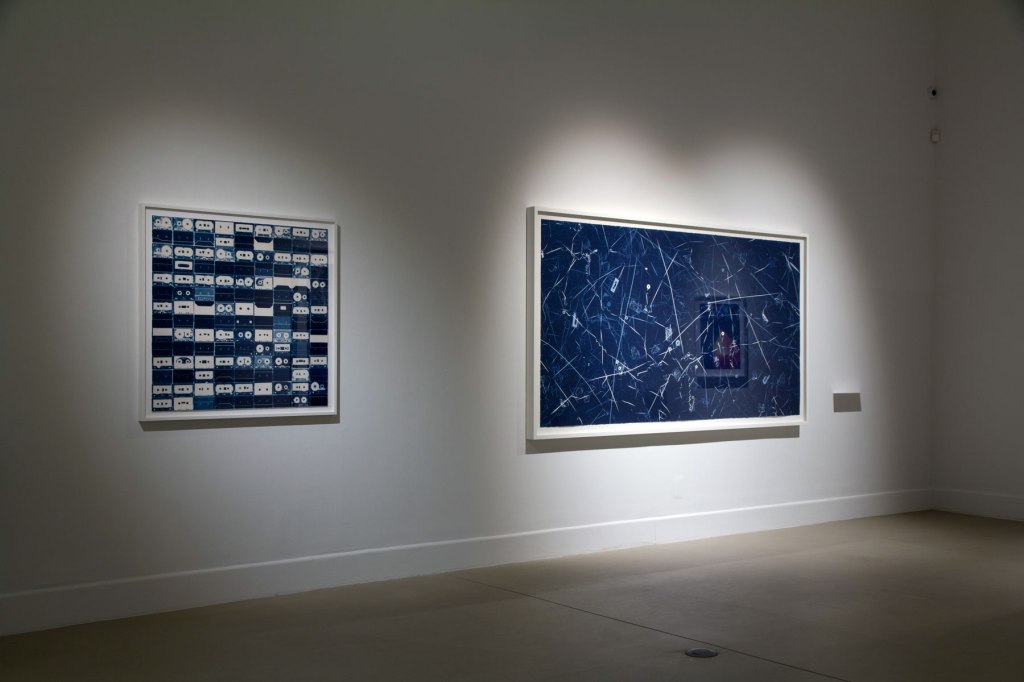
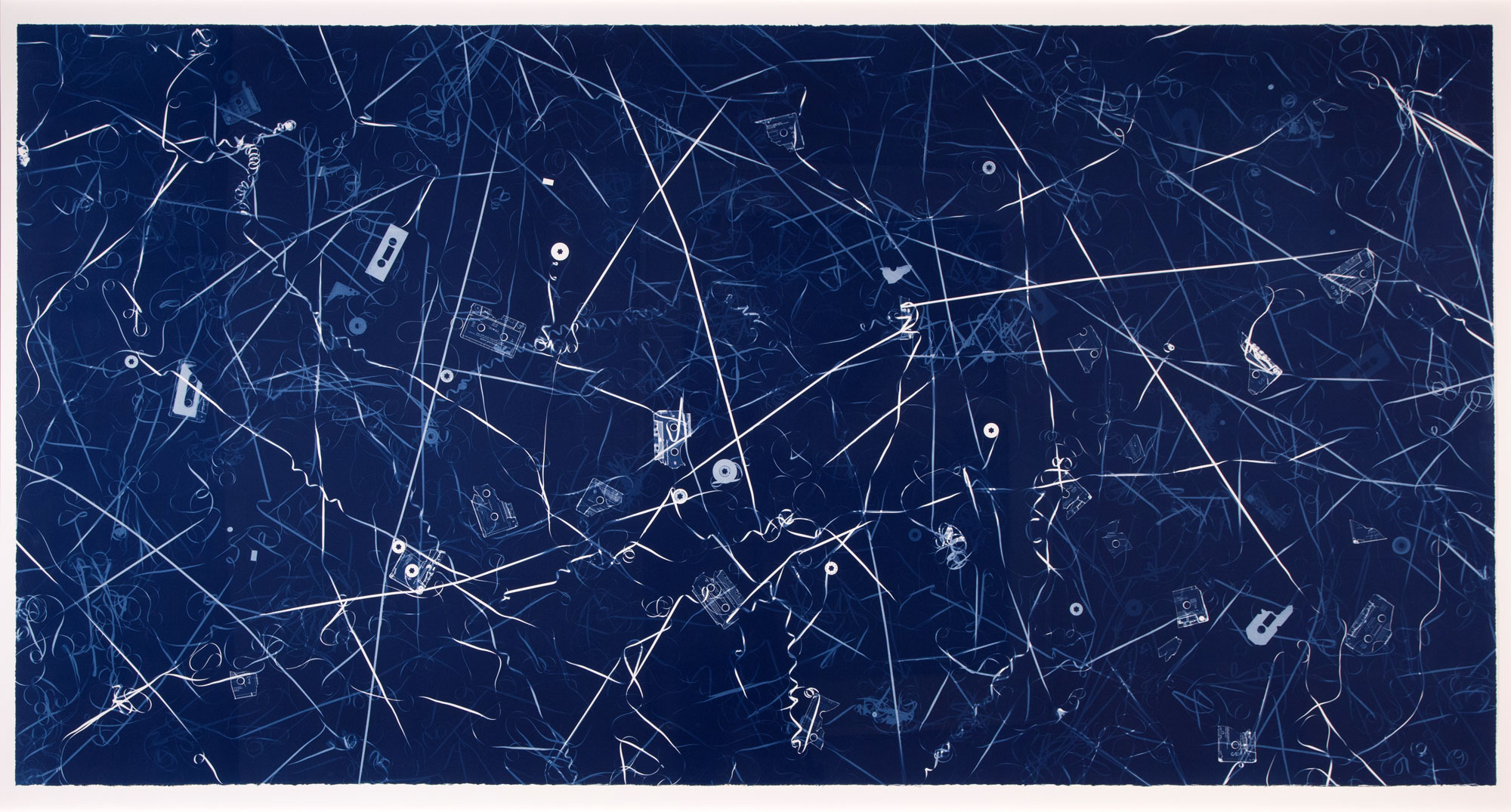
Installation view of the exhibition Emanations: The Art of the Cameraless Photograph at the Govett-Brewster Art Gallery showing Christian Marclay's 'Large Cassette Grid No. 6', 2009 (left) and 'Allover (Rush, Barbra Streisand, Tina Turner, and Others)', 2008 (right)


Installation view of Christian Marclay’s Large Cassette Grid No. 6, 2009 (left) and Allover (Rush, Barbra Streisand, Tina Turner, and Others), 2008 (right)


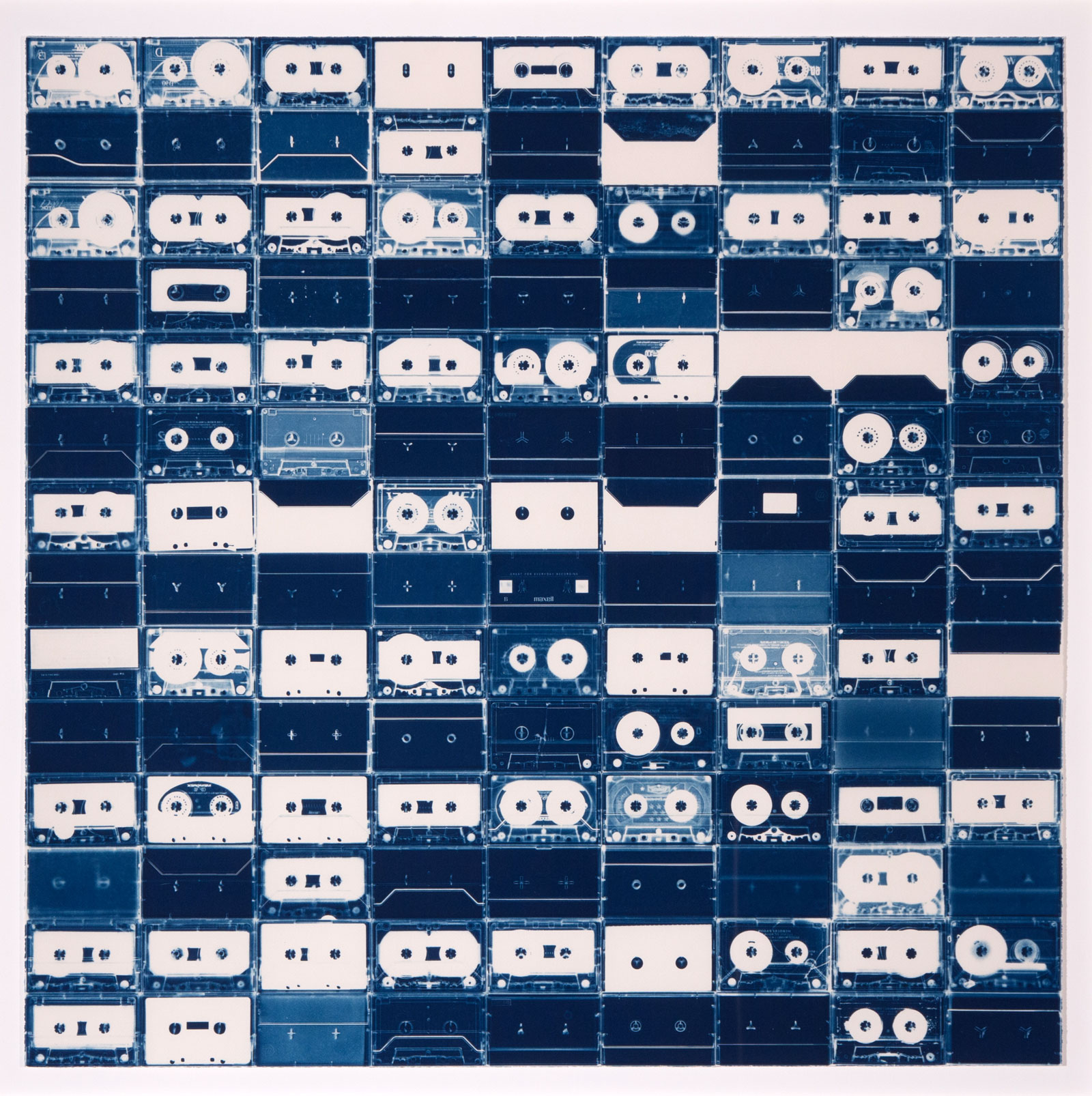
Christian Marclay (US) 'Large Cassette Grid No. 6' 2009 from the exhibition 'Emanations: The Art of the Cameraless Photograph' at the Govett-Brewster Art Gallery/Len Lye Centre, New Plymouth, New Zealand, April - August, 2016


Christian Marclay (American, b. 1955)
Large Cassette Grid No. 6
2009
Cyanotype photograph


Christian Marclay (American, b. 1955) 'Allover (Rush, Barbra Streisand, Tina Turner, and Others)' 2008


Christian Marclay (American, b. 1955)
Allover (Rush, Barbra Streisand, Tina Turner, and Others)
2008
Cyanotype photograph


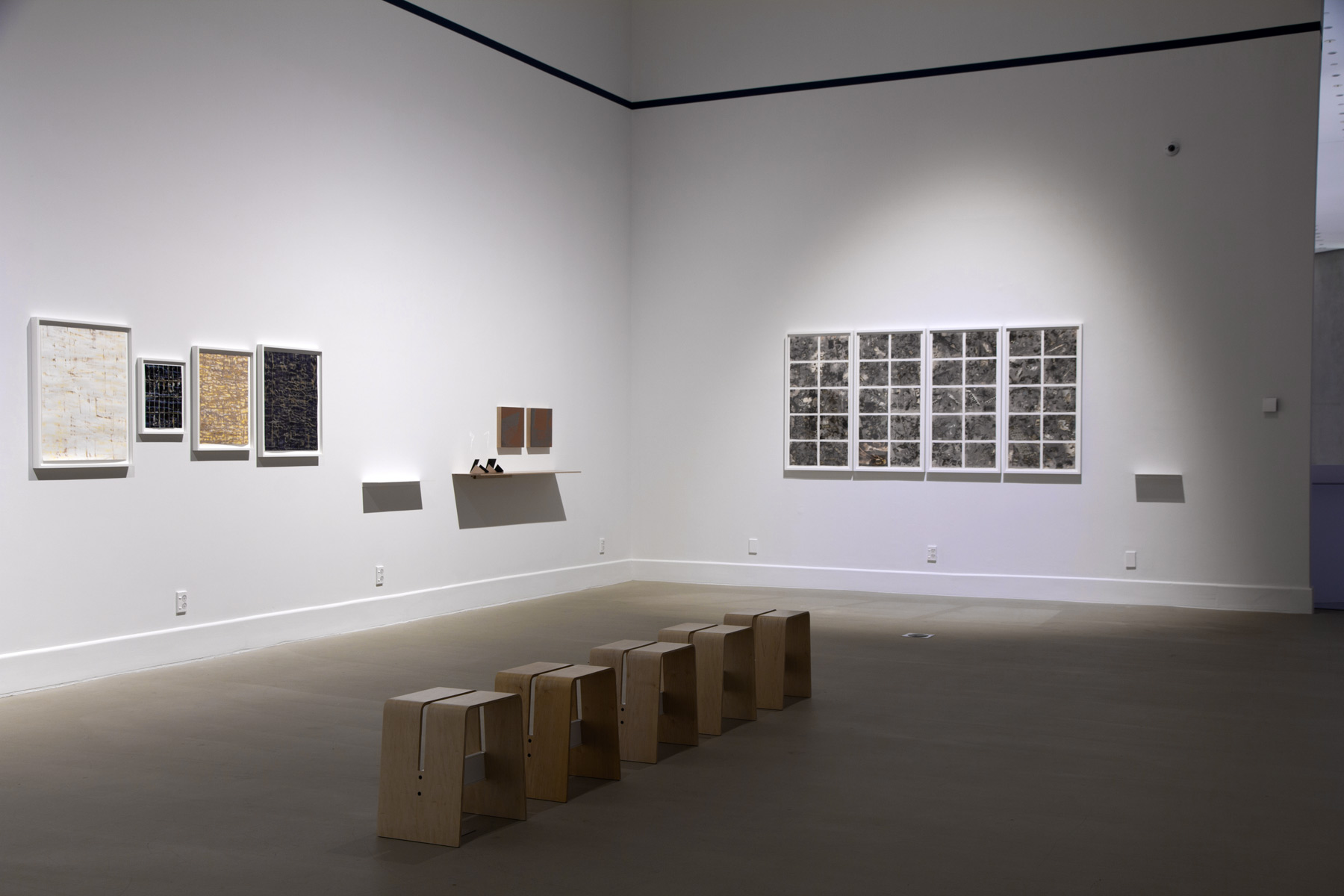
Using hundreds of cassette tapes bought in thrift stores, Christian Marclay has scattered the entangled strands of the tapes across large sheets of specially prepared blueprint paper, deliberately adopting the “action painter” techniques of Jackson Pollock and similar artists. He then exposed them, sometimes multiple times, under a high-powered ultraviolet lamp. In other cases, the cassettes themselves were stacked in translucent grids to make a minimalist composition.


Installation view of the exhibition 'Emanations: The Art of the Cameraless Photograph' at the Govett-Brewster Art Gallery with at left, Christian Marclay and at right, Hiroshi Sugimoto


Installation view of the exhibition Emanations: The Art of the Cameraless Photograph at the Govett-Brewster Art Gallery with at left, Christian Marclay and at right, Hiroshi Sugimoto


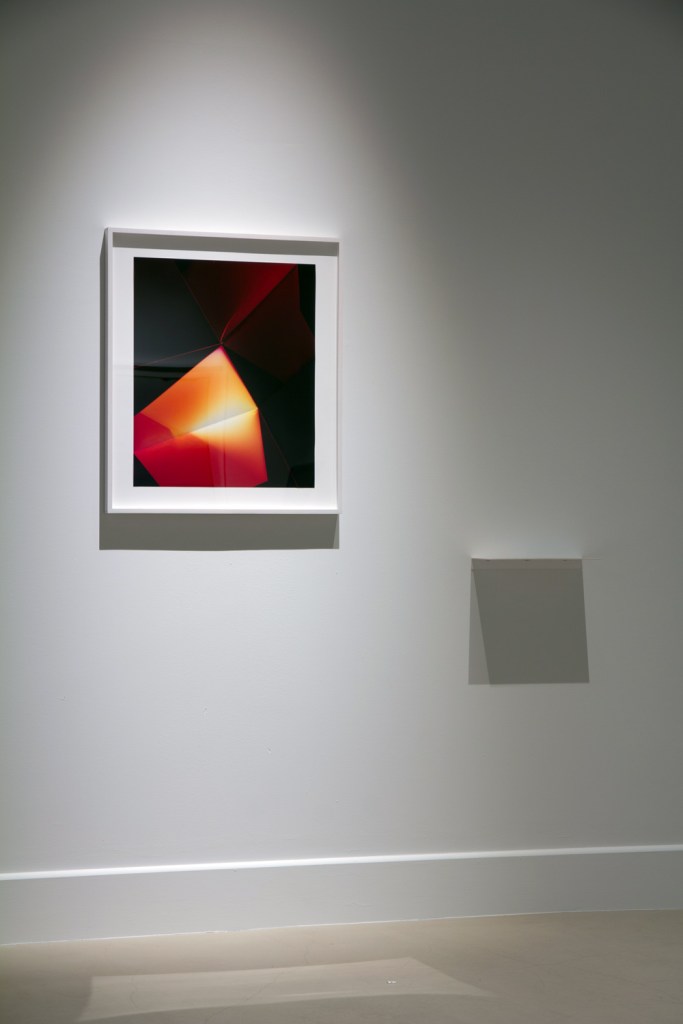
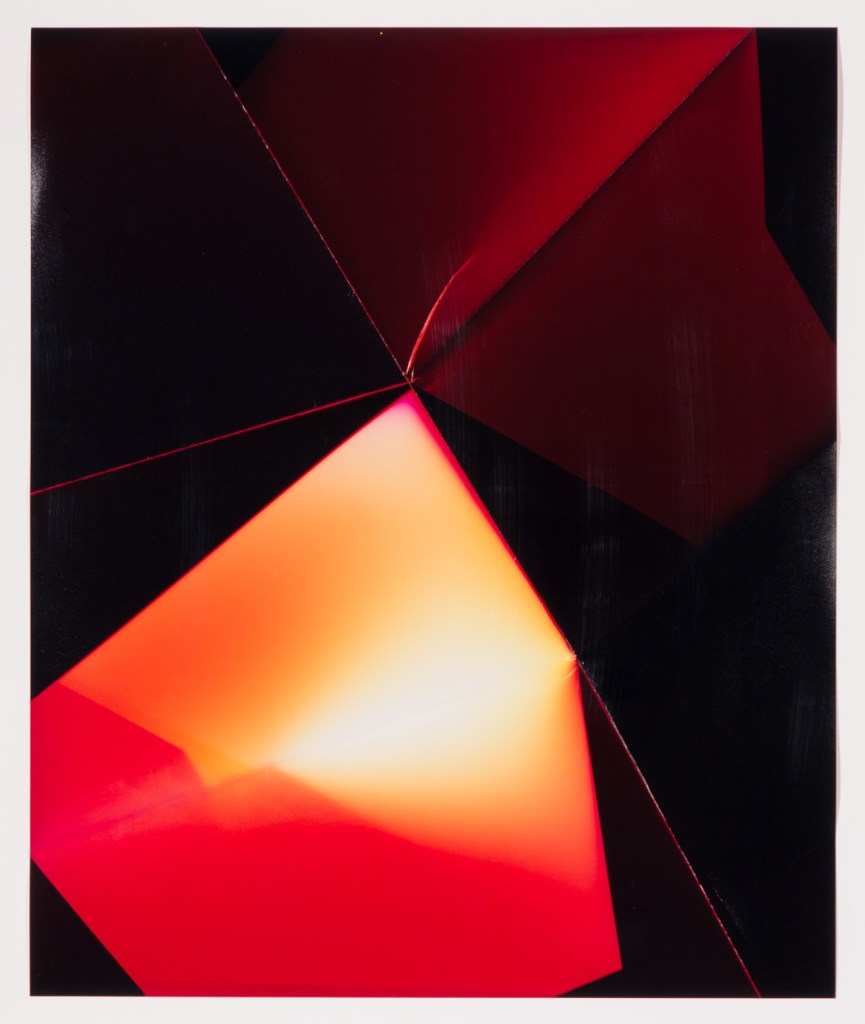
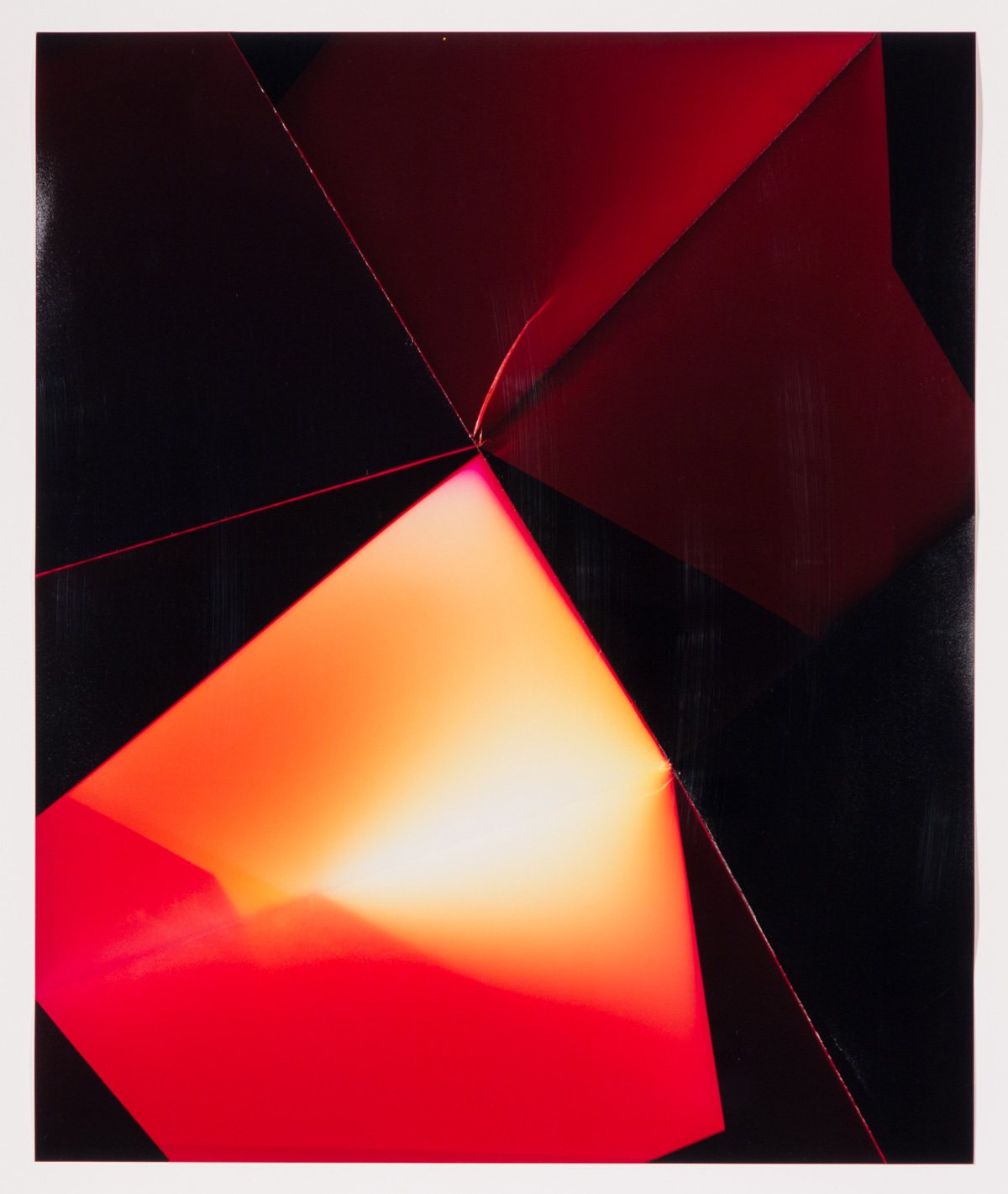
Walead Beshty (American, b. 1976) 'Two Sided Picture (RY), January 11, 2007, Valencia, California, Fujicolor Crystal Archive, 2007' from the exhibition 'Emanations: The Art of the Cameraless Photograph' at the Govett-Brewster Art Gallery/Len Lye Centre, New Plymouth, New Zealand, April - August, 2016


Walead Beshty (American, b. 1976)
Two Sided Picture (RY), January 11, 2007, Valencia, California, Fujicolor Crystal Archive, 2007
Chromogenic photograph


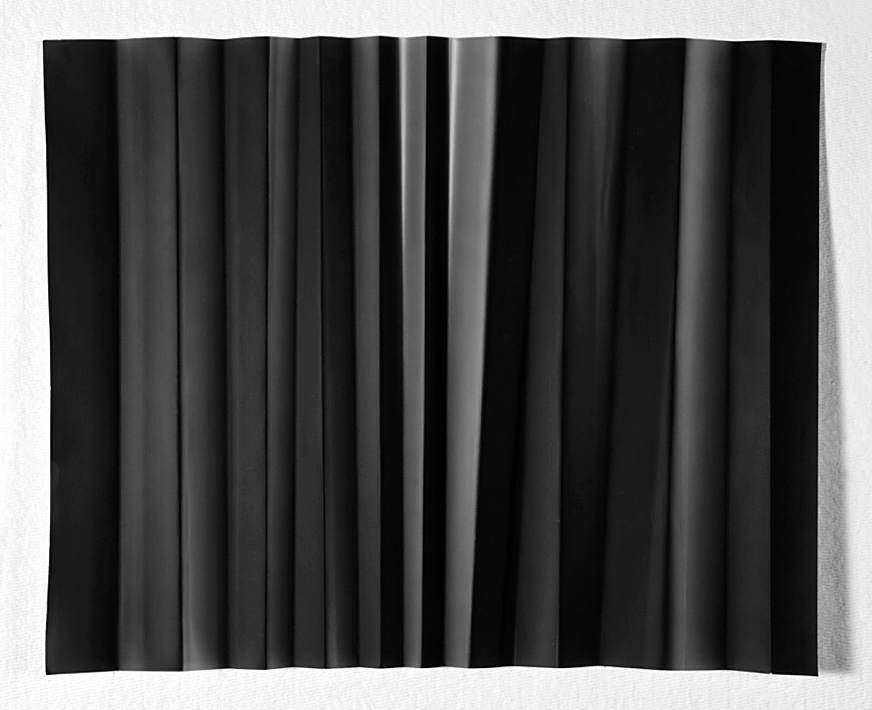
In the series from which this work comes American photographic artist Walead Beshty cut and folded sheets of photographic paper into three-dimensional forms and then exposed each side to a specific colour of light, facilitating the production of multi-faceted prints with the potential to exhibit every possible colour combination. The trace of this process remains visible, with the original folds transformed into a network of contours on the surface of the print.


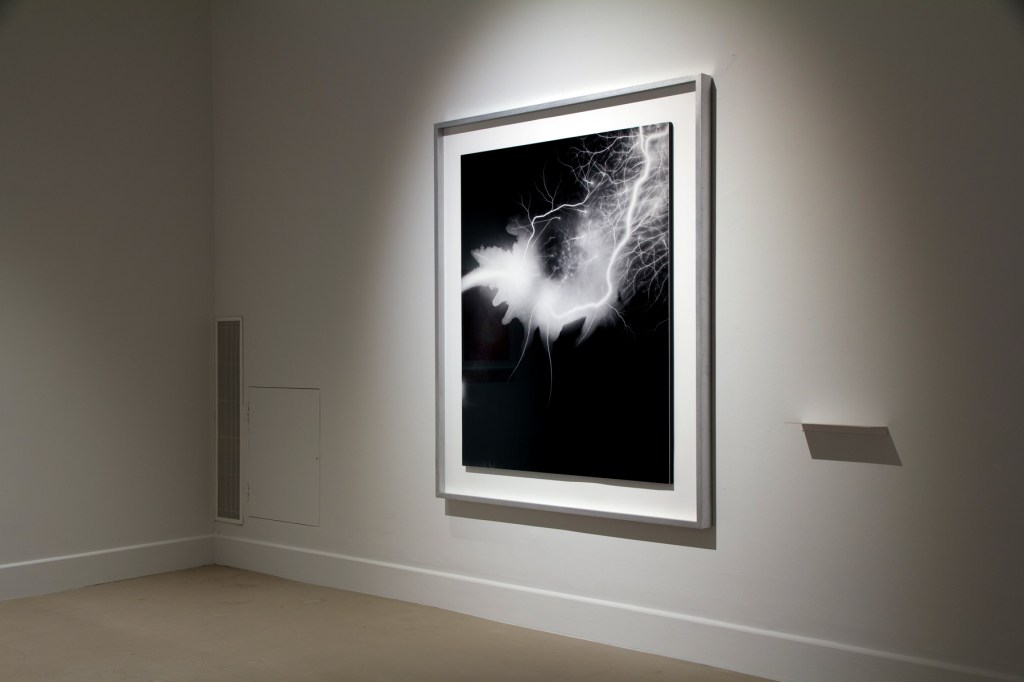
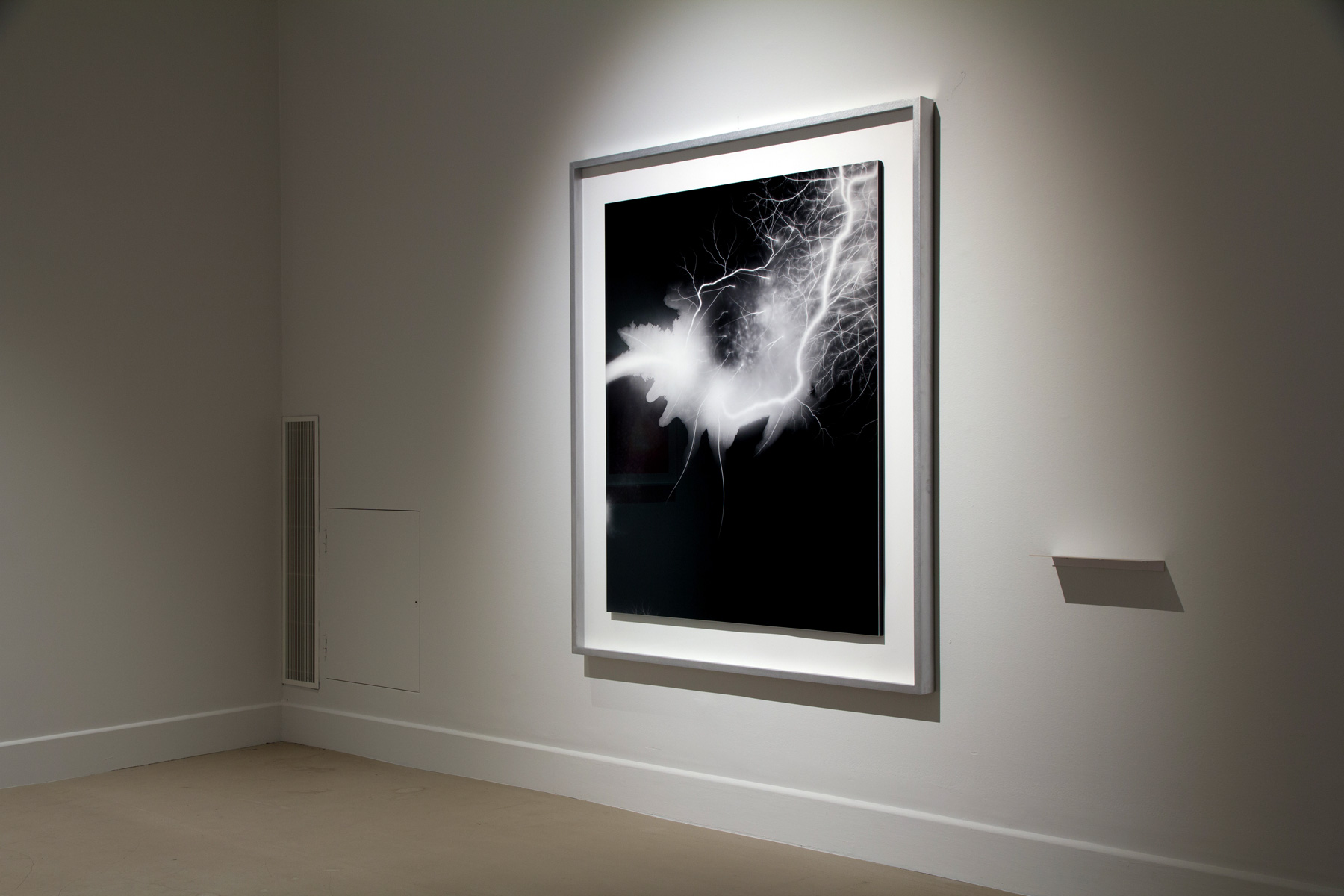
Hiroshi Sugimoto (Japanese, b. 1948) 'Lightning Fields 168' 2009 (installation view)


Hiroshi Sugimoto (Japanese, b. 1948)
Lightning Fields 168 (installation view)
2009


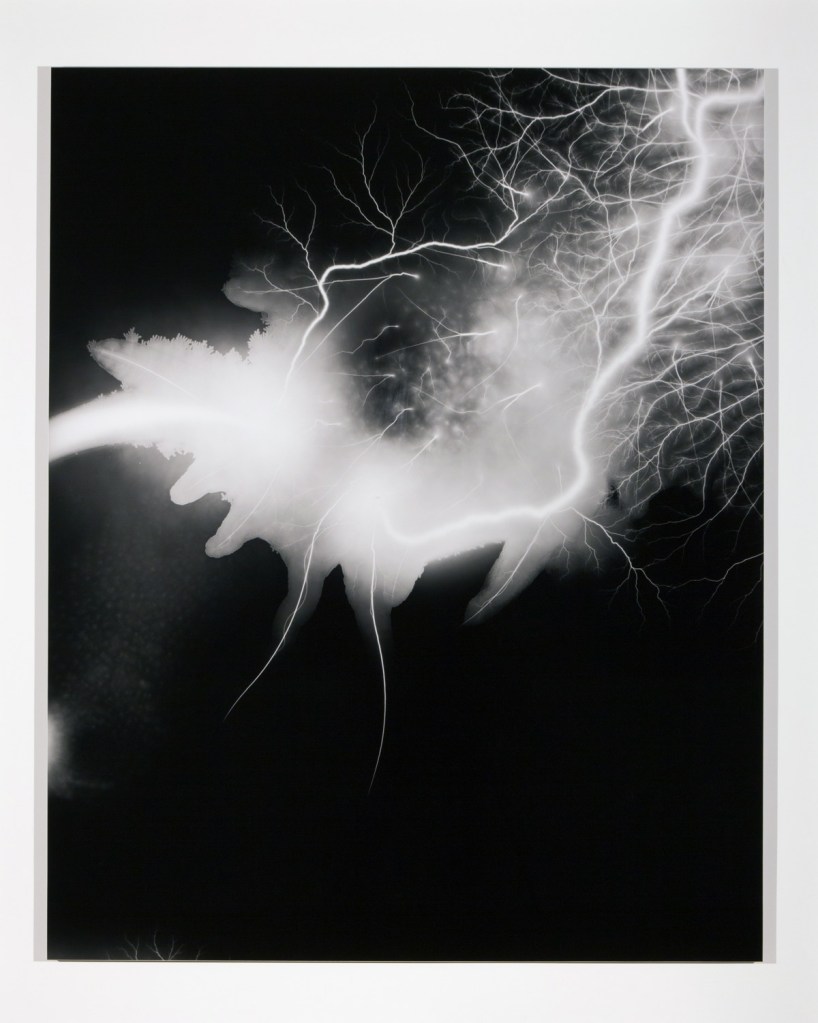
Hiroshi Sugimoto (Japanese, b. 1948) 'Lightning Fields 168' 2009


Hiroshi Sugimoto (Japanese, b. 1948)
Lightning Fields 168
2009
Gelatin silver photograph


Hiroshi Sugimoto’s photographs of static electricity were inspired by his unsuccessful efforts to banish such discharges from the surface of his negatives during the printing process. Sugimoto decided instead to try and harness such discharges for the purposes of image making. Utilising a Van der Graaf generator, he directed as many as 40,000 volts onto metal plates on which rested unexposed film. He soon changed tactics when he discovered that immersing the film in saline water during the discharge gave much better results.


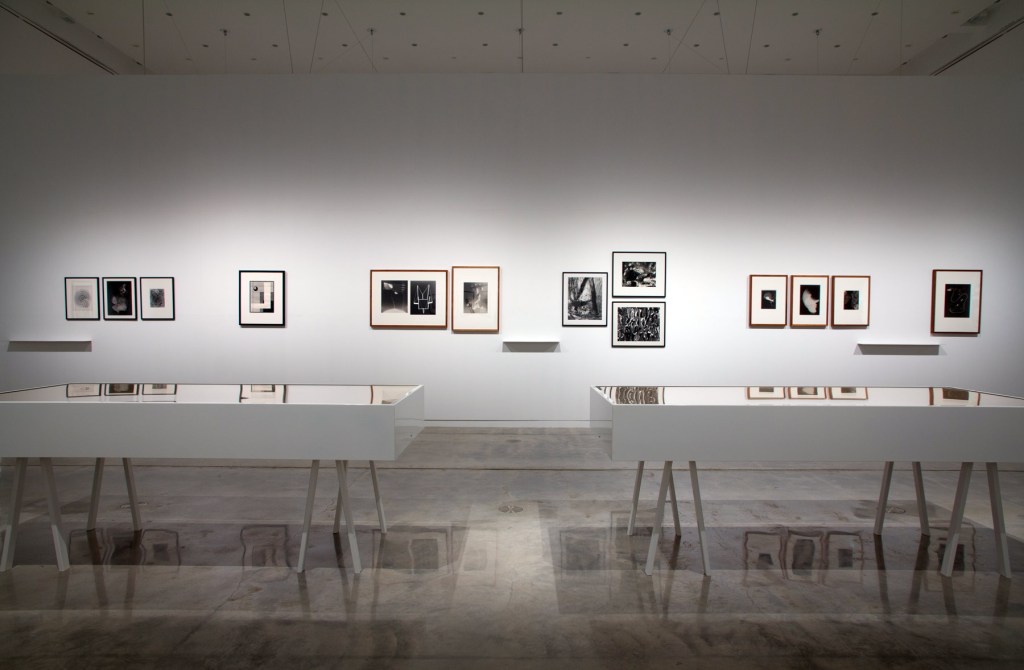
Installation view of the exhibition 'Emanations: The Art of the Cameraless Photograph' at the Govett-Brewster Art Gallery

Installation view of the exhibition 'Emanations: The Art of the Cameraless Photograph' at the Govett-Brewster Art Gallery

Installation view of the exhibition 'Emanations: The Art of the Cameraless Photograph' at the Govett-Brewster Art Gallery


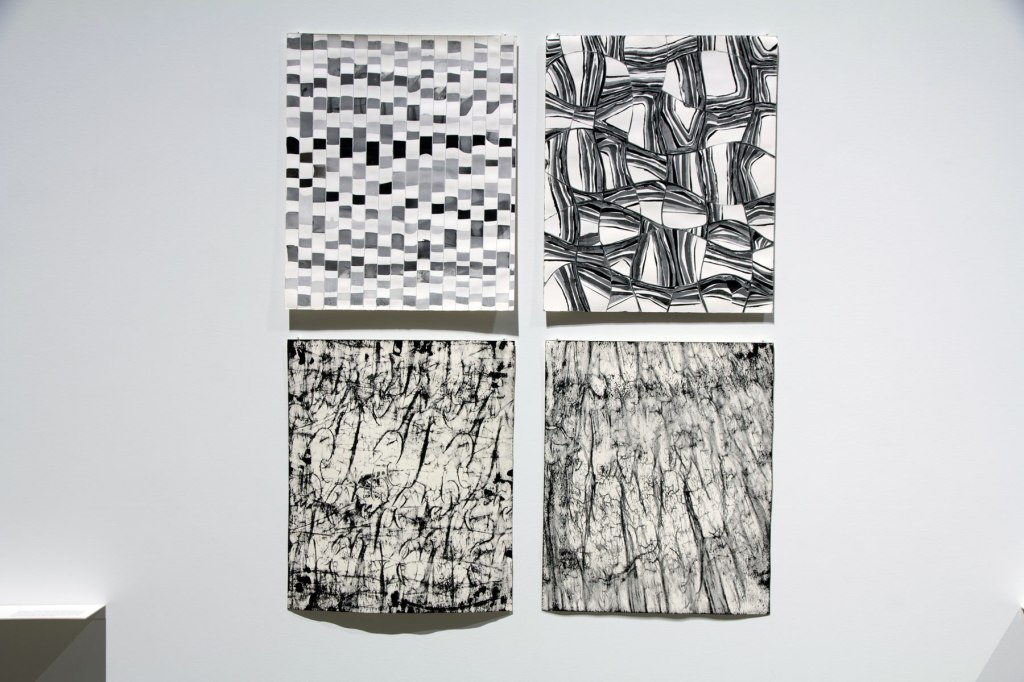
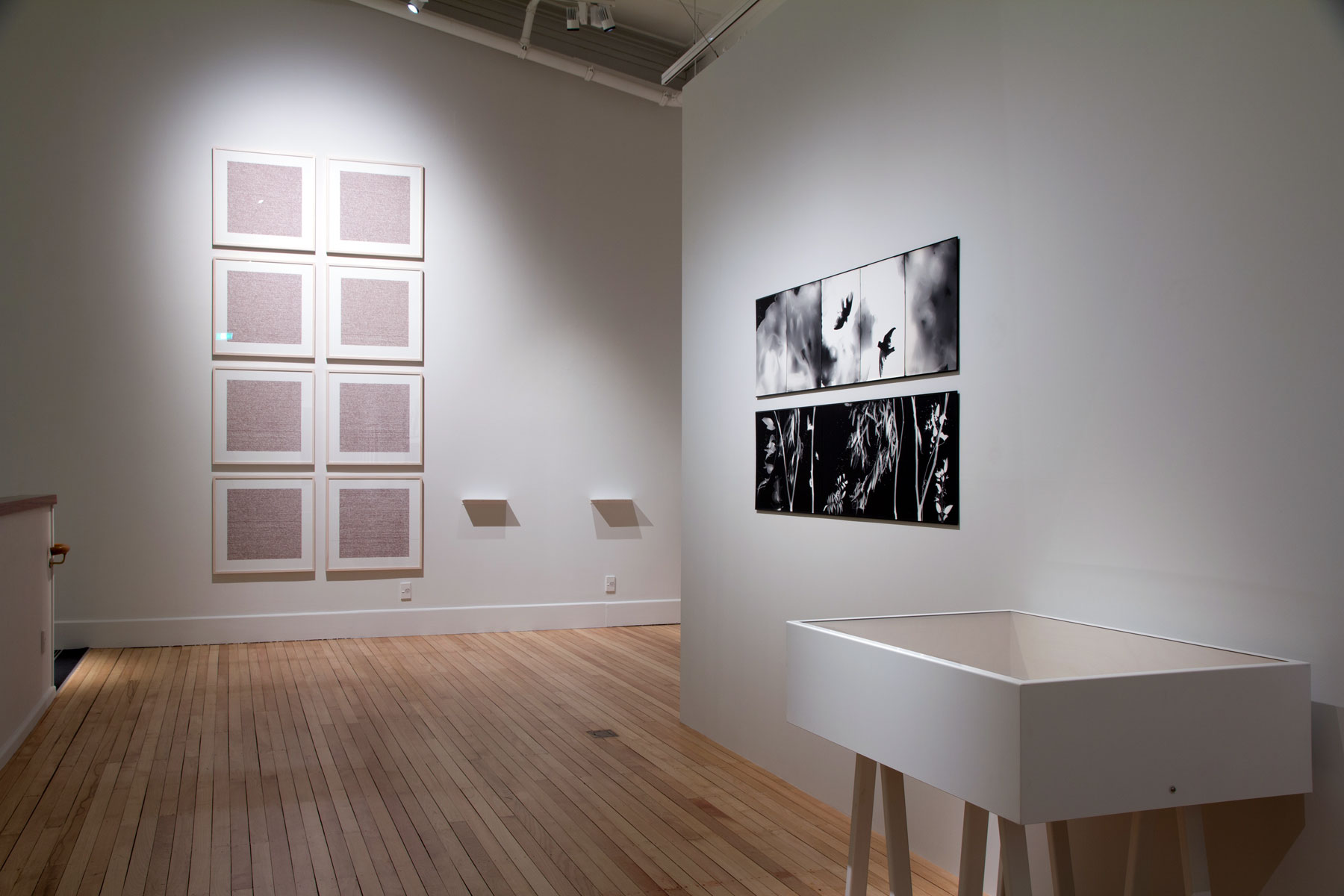
Installation views of the exhibition Emanations: The Art of the Cameraless Photograph at the Govett-Brewster Art Gallery with at left, Andreas Müller-Pohle Digital Scores (after Nicéphore Niépce) 1995, and to the right in the second and third images, Susan Purdy


In 1995 the German artist Andreas Müller-Pohle took the digital code generated by a scan of the supposed “first photograph,” Nicéphore Niépce’s 1827 heliograph View from the window at Le Gras, and spread it across eight panels as a messy swarm of numbers and computer notations. Each of Müller-Pohle’s separations represents an eighth of a full byte of memory, a computer’s divided remembrance of the first photograph. The Scores are therefore less about Niépce’s photograph than about their own means of production (as the title suggests, they bear the same abstracted relation to an image as sheet music has to sound). We see here, not a photograph, but the new numerical rhetoric of digital imaging.


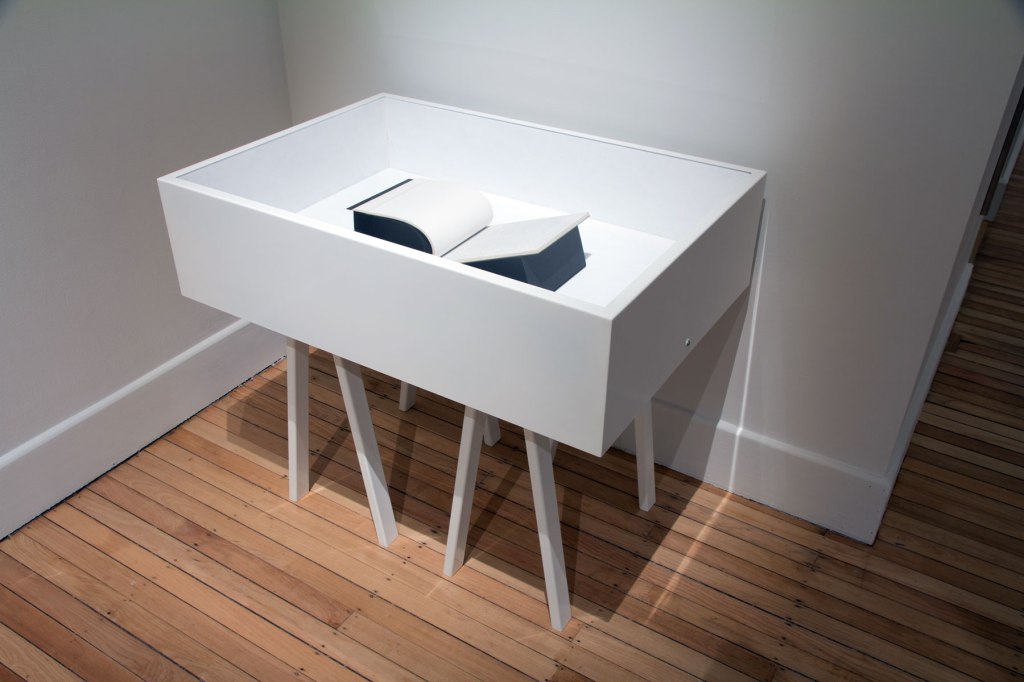
Installation view of Ian Burn (Australian, 1939-1993) 'Xerox book # 1', 1968 from the exhibition 'Emanations: The Art of the Cameraless Photograph' at the Govett-Brewster Art Gallery


Installation view of Ian Burn (Australian, 1939-1993) Xerox book # 1, 1968 from the exhibition Emanations: The Art of the Cameraless Photograph at the Govett-Brewster Art Gallery


In the 1960s a number of artists sought to distil artwork from the new imaging technologies becoming commonly available. Ian Burn, an Australian artist then living in New York, made a series of Xerox Books in 1968 in which he churned out 100 copies of a blank sheet of white paper on a Xerox 660 photocopying machine, copying each copy in turn until the final sheet was filled with the speckled visual noise left by the machine’s own imperfect operations.


Installation view of the exhibition 'Emanations: The Art of the Cameraless Photograph' at the Govett-Brewster Art Gallery


Installation view of the exhibition Emanations: The Art of the Cameraless Photograph at the Govett-Brewster Art Gallery


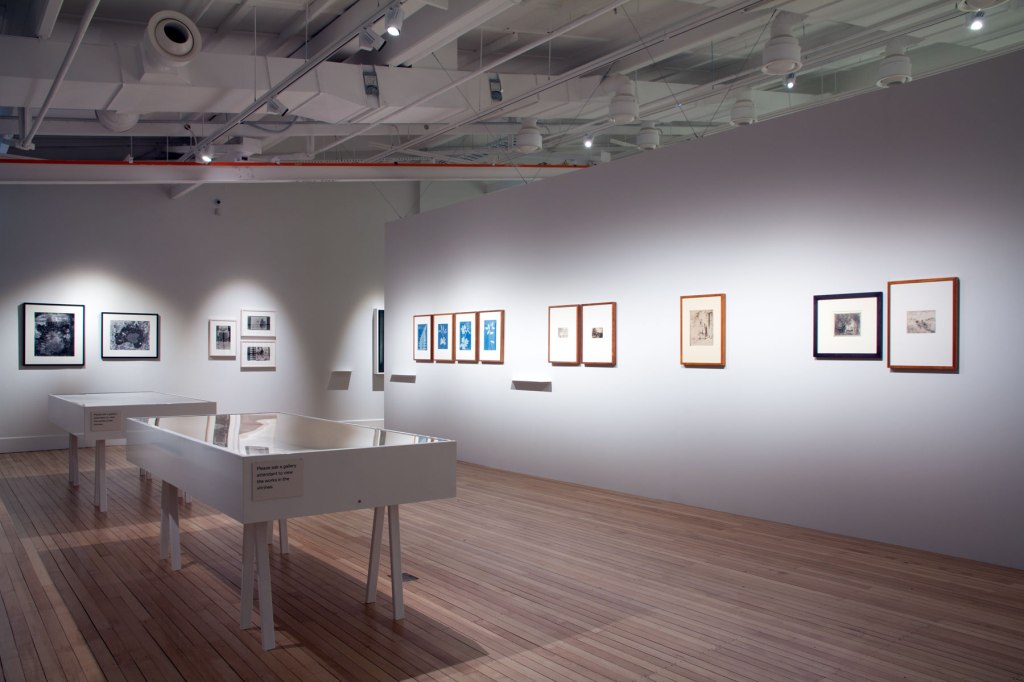
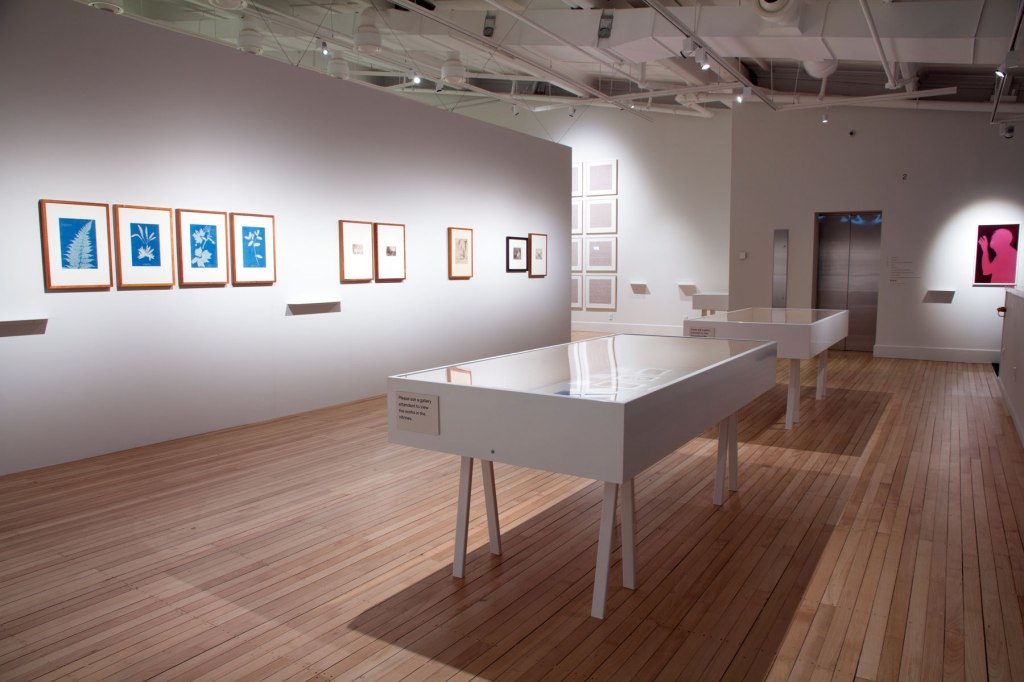
Installation view of the exhibition 'Emanations: The Art of the Cameraless Photograph' at the Govett-Brewster Art Gallery with at left, the cyanotypes of Anna Atkins

Installation view of the exhibition 'Emanations: The Art of the Cameraless Photograph' at the Govett-Brewster Art Gallery

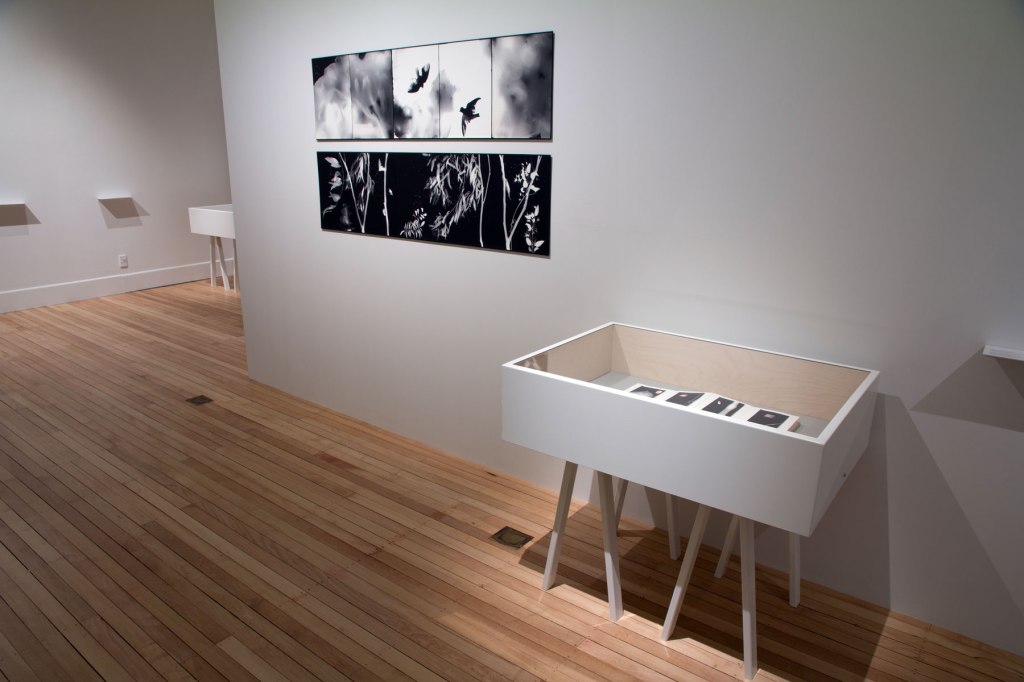
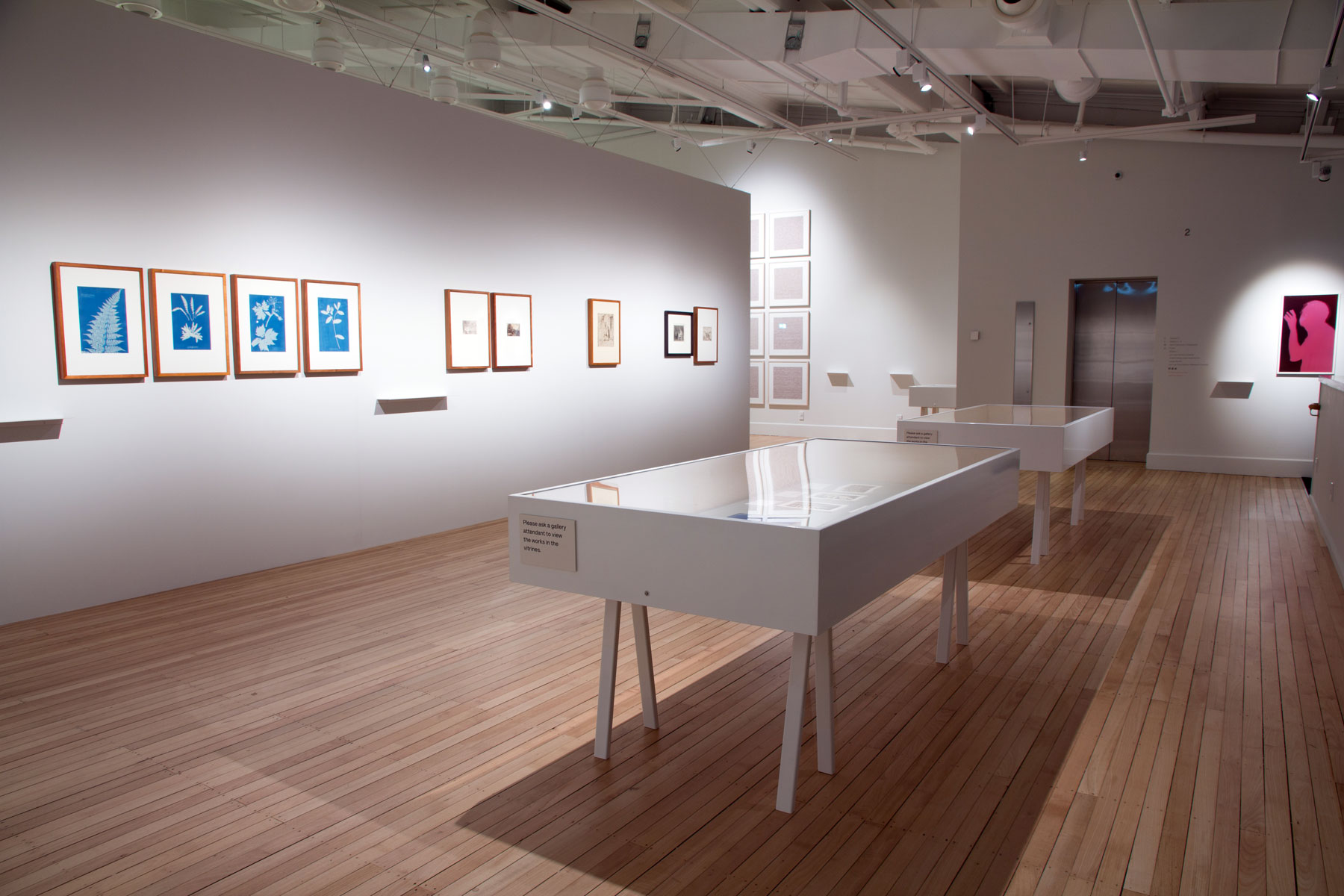
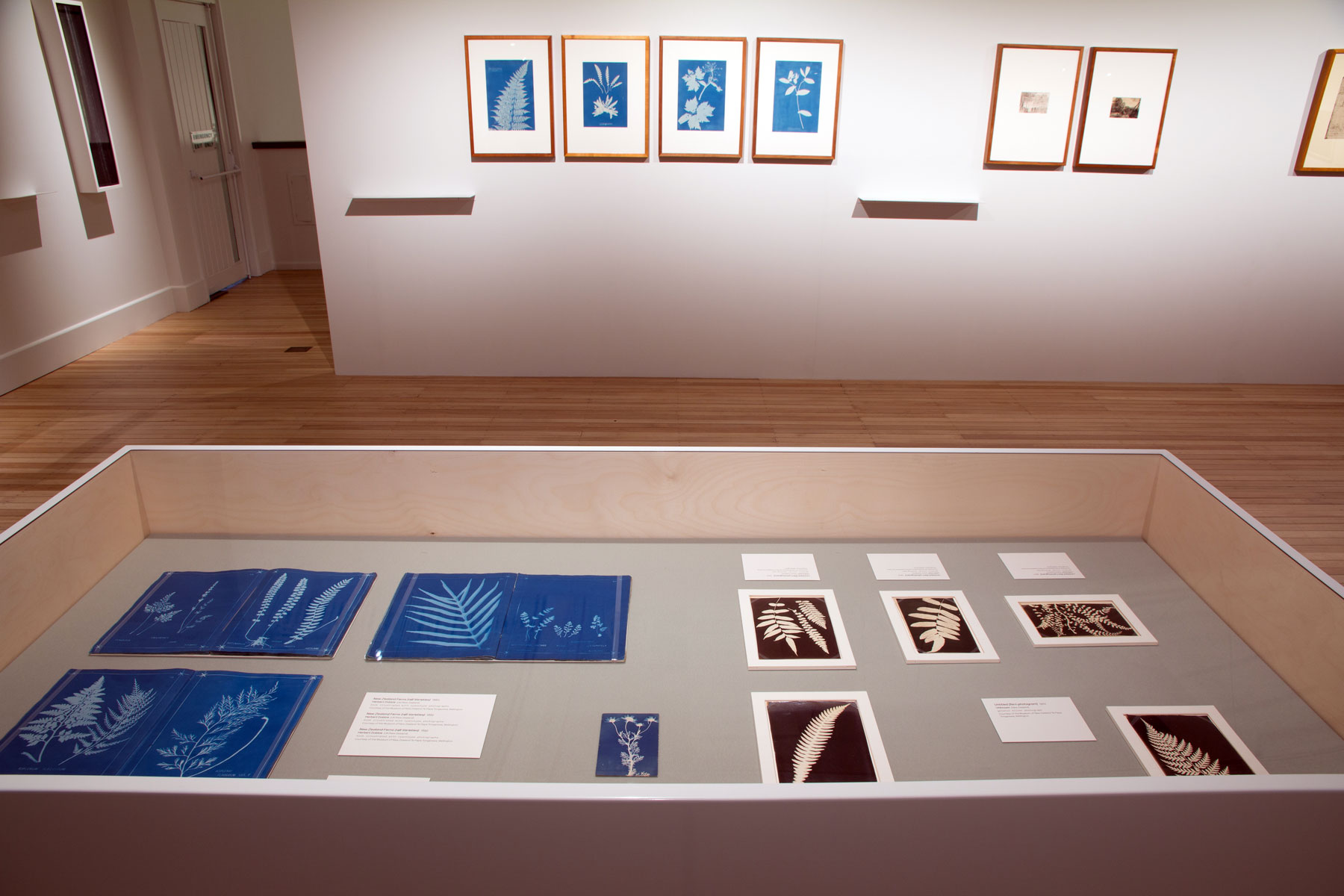
Installation view of the exhibition 'Emanations: The Art of the Cameraless Photograph' at the Govett-Brewster Art Gallery with in foreground display case, Herbert Dobbie's illustrated cyanotype books 'New Zealand Ferns (148 Varieties)' 1880, 1882, 1892 and background, the cyanotypes of Anna Atkins


Installation views of the exhibition Emanations: The Art of the Cameraless Photograph at the Govett-Brewster Art Gallery with in foreground display case, Herbert Dobbie’s illustrated cyanotype books New Zealand Ferns (148 Varieties) 1880, 1882, 1892 and background, the cyanotypes of Anna Atkins


Herbert Dobbie, a railway station master and amateur botanist who emigrated to New Zealand from England in 1875, made cyanotype contact prints of specimens of all 148 known species of fern in his new country in 1880 and sold them in album form. Dobbie was responding to a fashion for collecting and displaying ferns among his local audience, a fashion driven in part by a nostalgia for a pre-modern style of life and in part by a developing nationalism. The end result is a group of images that hover somewhere between science and art, between popular aesthetic enjoyment and commercial profit.


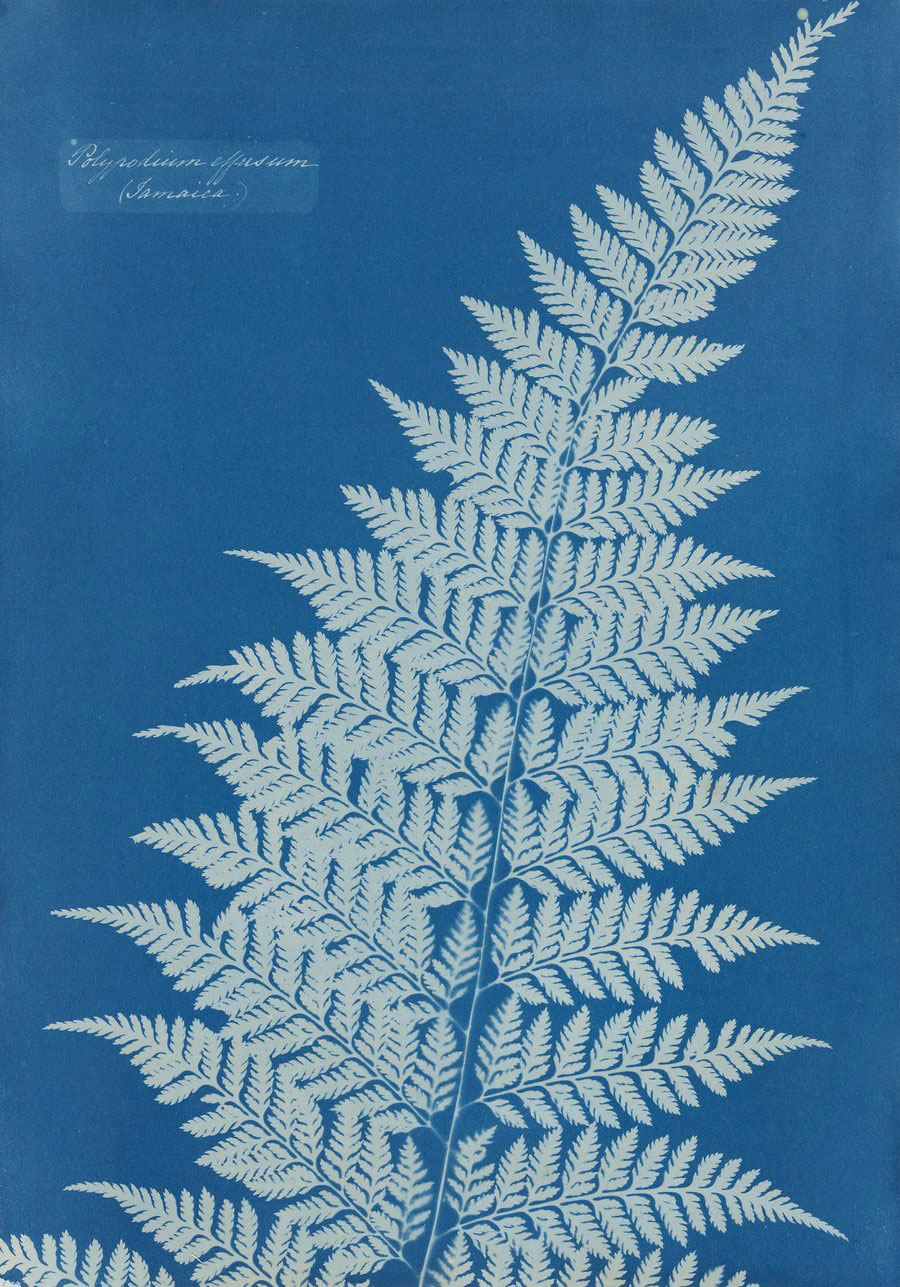
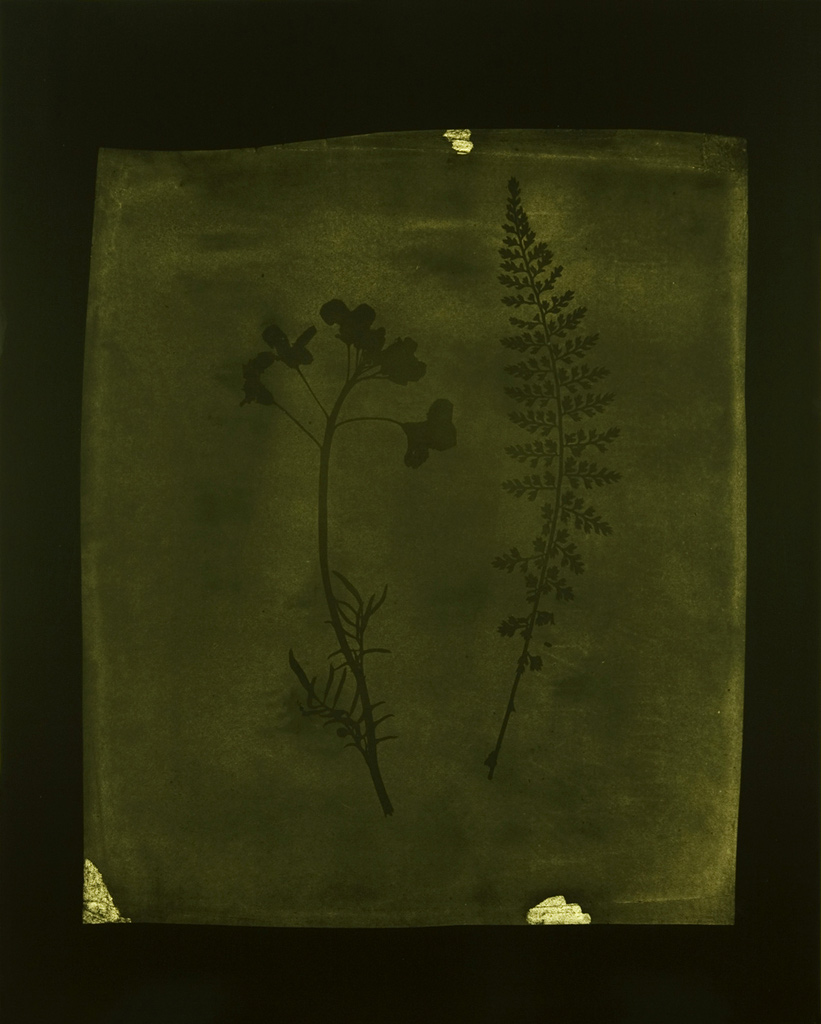
Anna Atkins (English, 1799-1871) 'Untitled' (from the disassembled album 'Cyanotypes of British and Foreign Flowering Plants and Ferns') c. 1854


Anna Atkins (English, 1799-1871)
Untitled (from the disassembled album Cyanotypes of British and Foreign Flowering Plants and Ferns)
c. 1854
Cyanotype photographs


The English photographer Anna Atkins issued albums of cyanotype prints of seaweed and algae from 1843, and these are often regarded as the earliest photographic books.

In the 1850s, Atkins collaborated with her friend Anne Dixon to produce at least three presentation albums of cyanotype contact prints, including Cyanotypes of British and Foreign Ferns (1853) and Cyanotypes of British and Foreign Flowering Plants and Ferns (1854). These albums included examples from places like Jamaica, New Zealand and Australia – a reminder that, for an English observer, all these places were but an extension of home, a part of the British Empire. These cyanotypes look as if they were made yesterday, offering a trace from the past that nevertheless always remains contemporary.


William Henry Fox Talbot (British, 1800-1877) 'Lace' c. 1845


William Henry Fox Talbot (British, 1800-1877)
Floral patterned lace
c. 1845
Salted paper print
23.0 x 18.8 cm (irregular)


During the 1850s, William Henry Fox Talbot focused his energies on the invention of a way of producing photographic engravings on metal plates, so that permanent ink on paper imprints could be taken from them. In April 1858, having found a way to introduce an aquatint ground to the process, he filed a patent for a system which he called photoglyphic engraving.

Talbot described his invention in terms of an ability to make accurate photographic impressions without a camera: “The objects most easily and successfully engraved are those which can be placed in contact with the metallic plate, – such as the leaf of fern, the light feathery flowers of a grass, a piece of lace, etc. In such cases the engraving is precisely like the object; so that it would almost seem to any one, before the process was explained to him, as if the shadow of the object had itself corroded the metal, – so true is the engraving to the object.”

This photograph was made using the calotype process, patented in 1841 by its inventor, the English gentleman William Henry Fox Talbot. The increased exposure speeds allowed by the process made it easier to print positive photographs from a negative image, so that multiple versions of that image could be produced. In this case, a positive photograph has been made from a contact print of a piece of lace.


Installation view of the exhibition 'Emanations: The Art of the Cameraless Photograph' at the Govett-Brewster Art Gallery

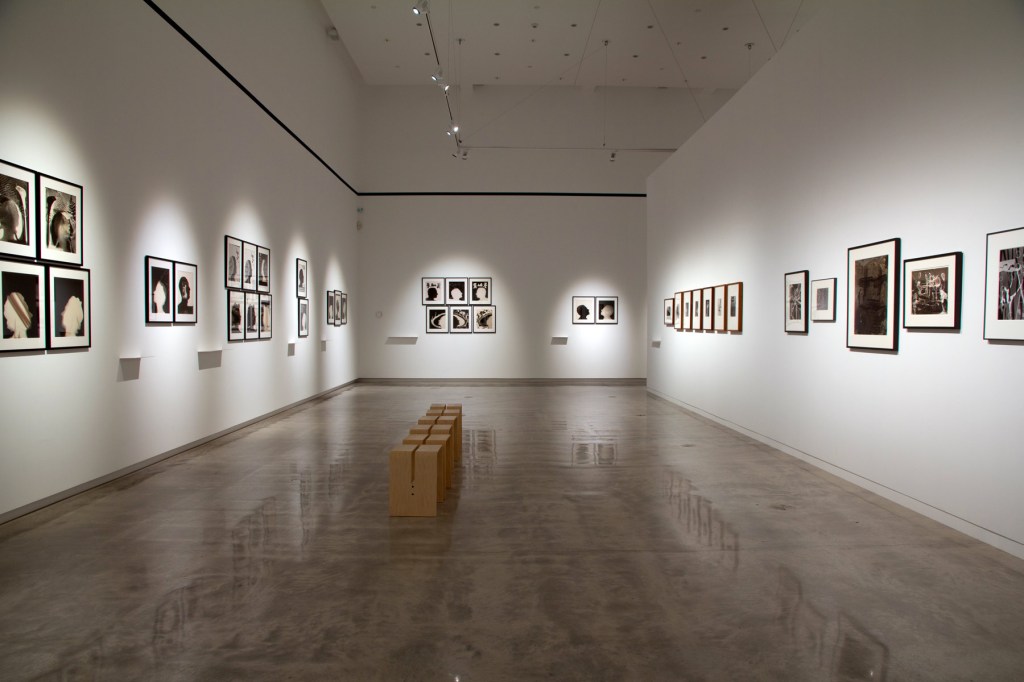
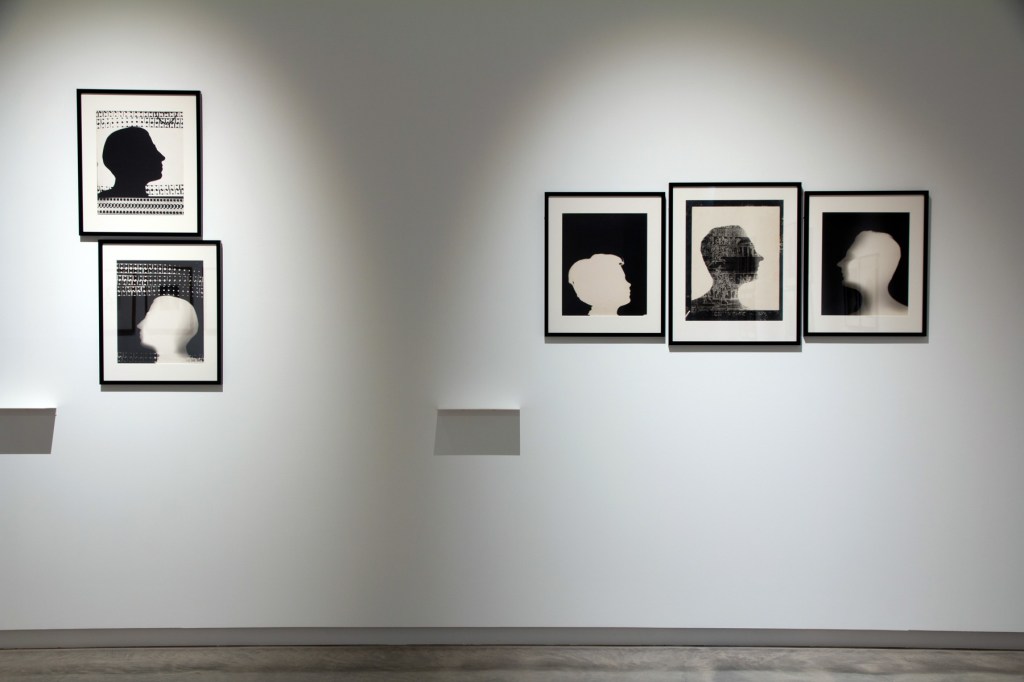
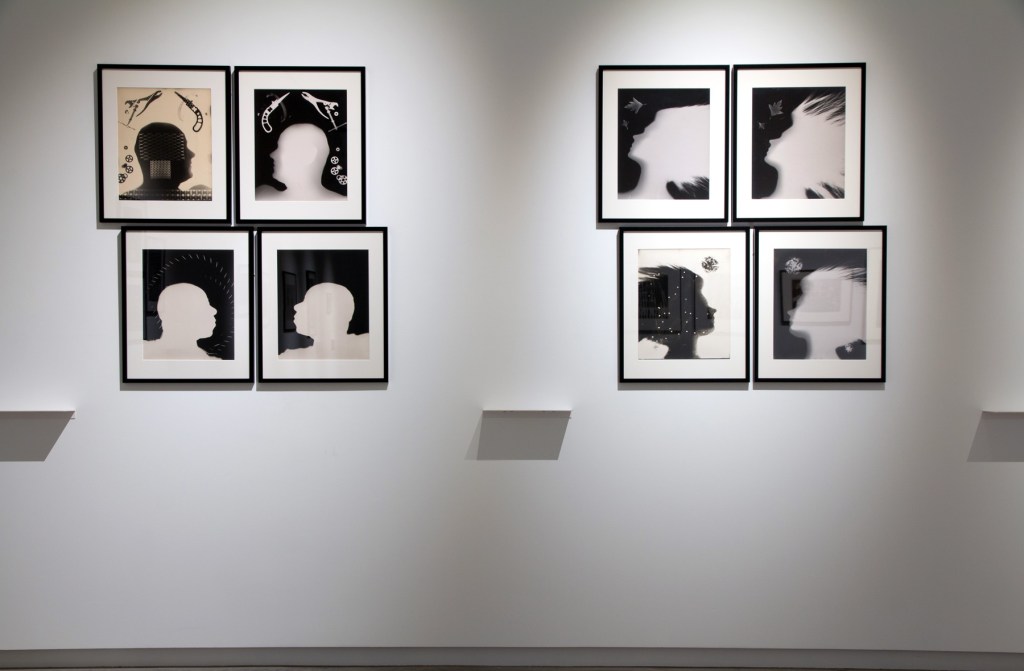
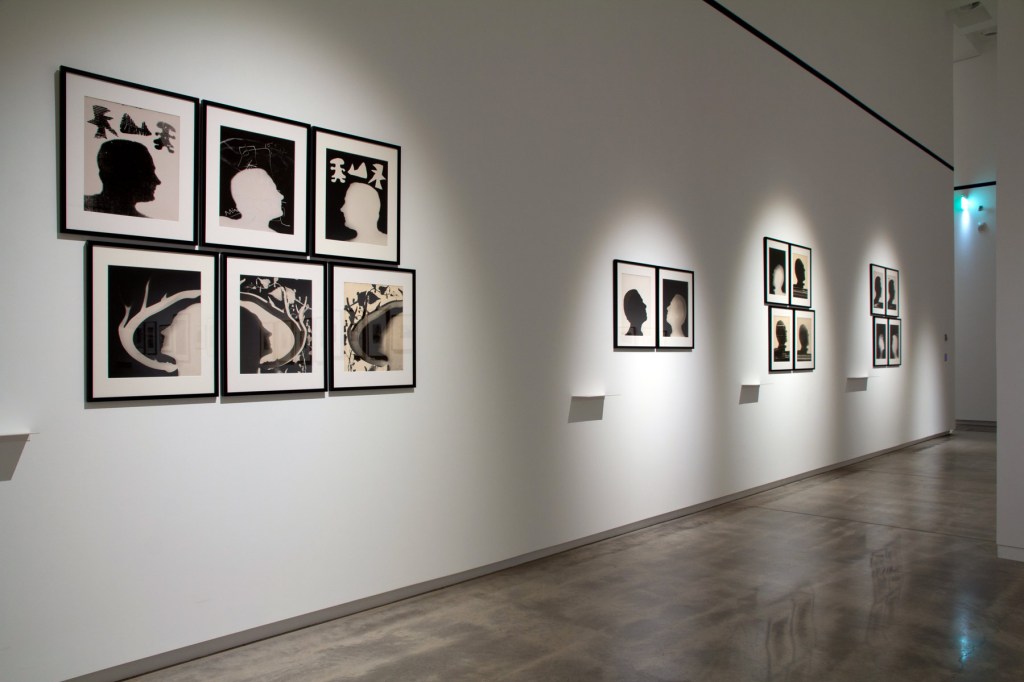
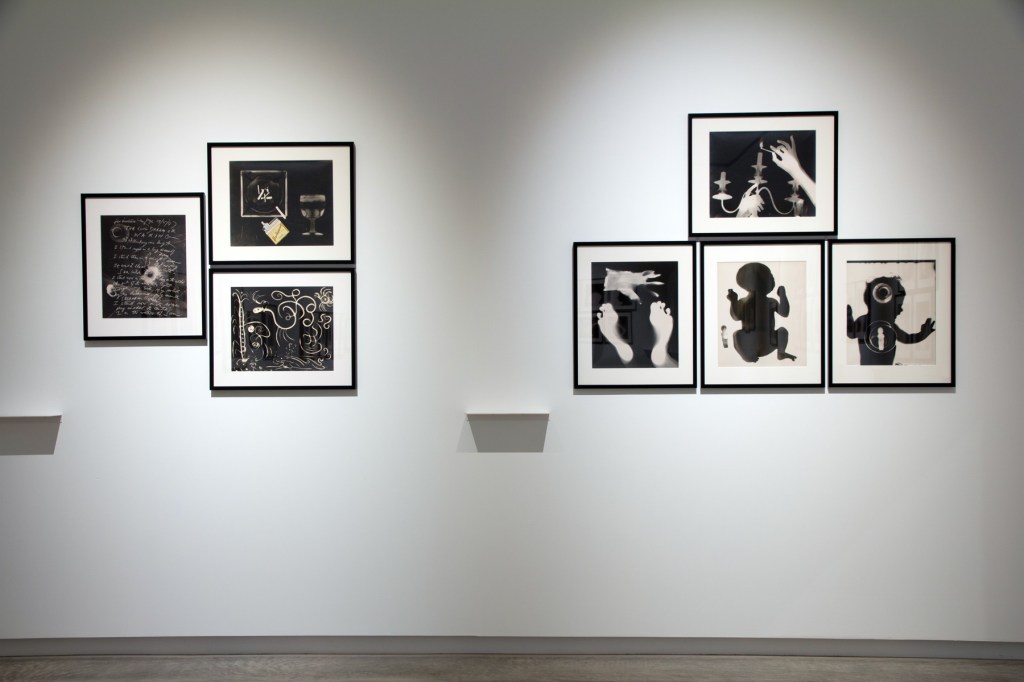
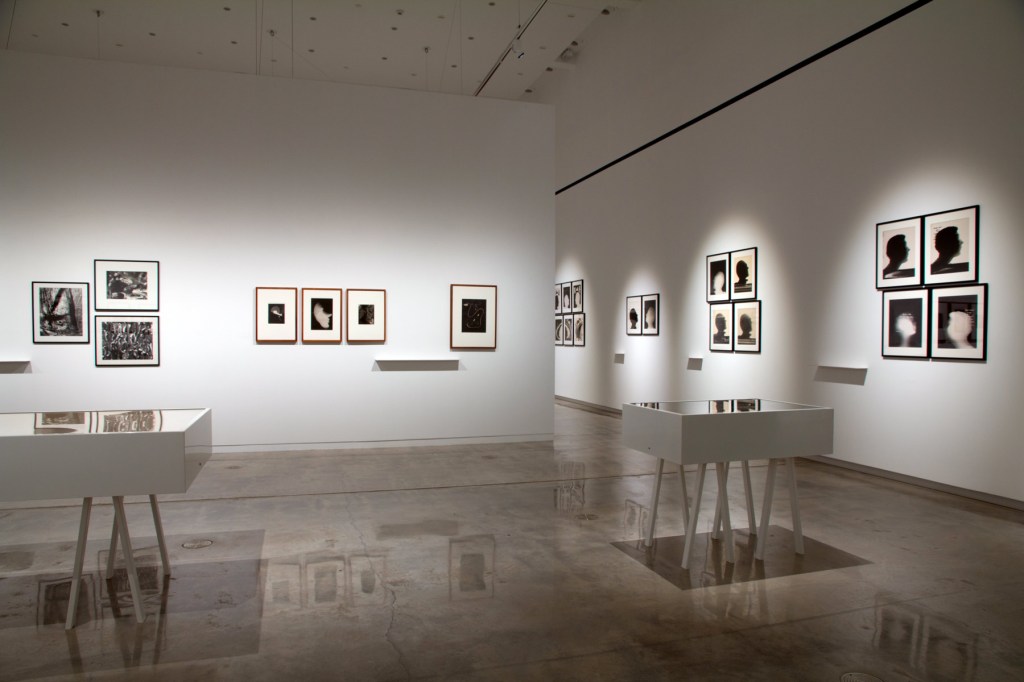
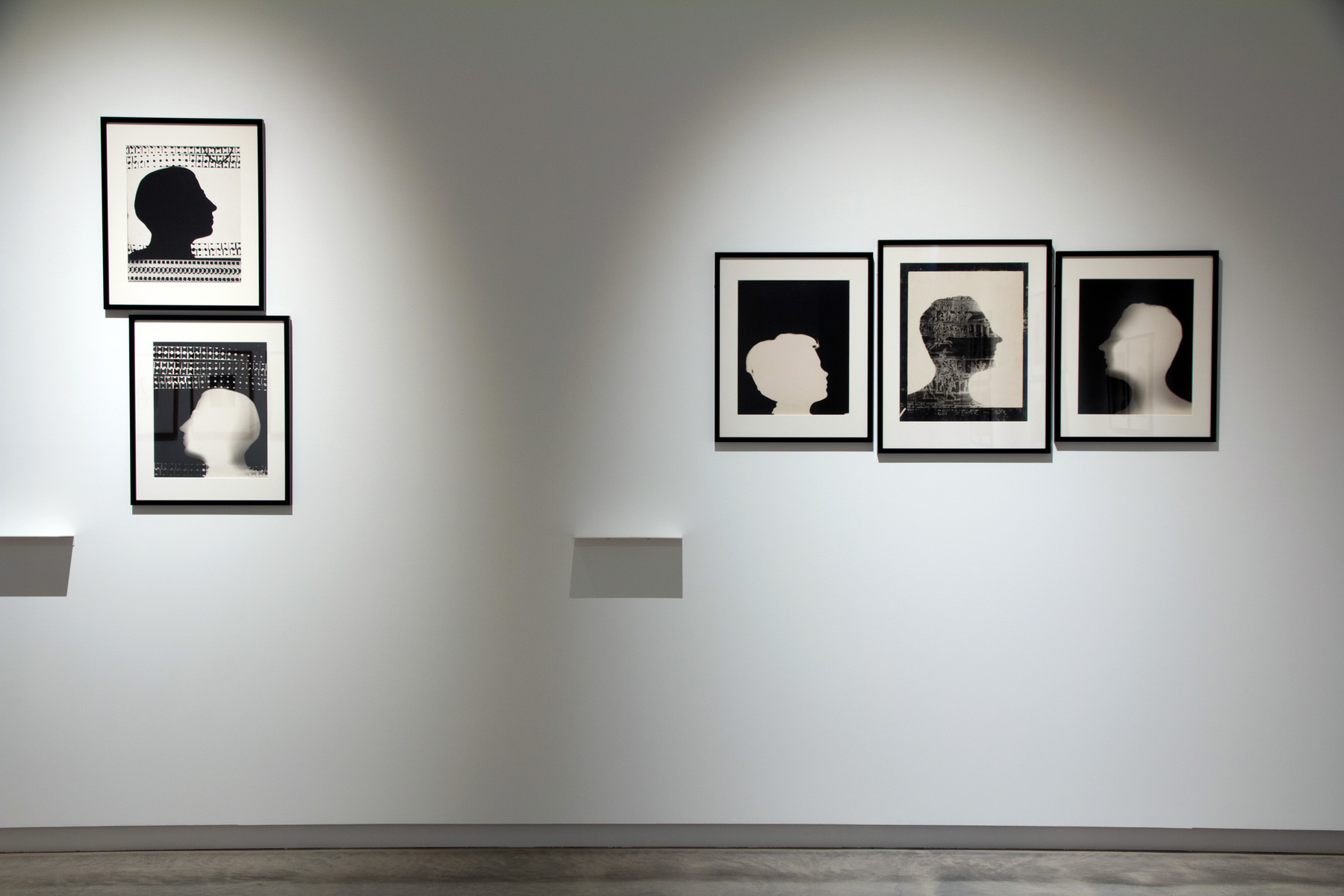
Installation view of the exhibition 'Emanations: The Art of the Cameraless Photograph' at the Govett-Brewster Art Gallery featuring Len Lye's cameraless photographic portraits

Installation view of the exhibition 'Emanations: The Art of the Cameraless Photograph' at the Govett-Brewster Art Gallery

Installation view of the exhibition 'Emanations: The Art of the Cameraless Photograph' at the Govett-Brewster Art Gallery

Installation view of the exhibition 'Emanations: The Art of the Cameraless Photograph' at the Govett-Brewster Art Gallery


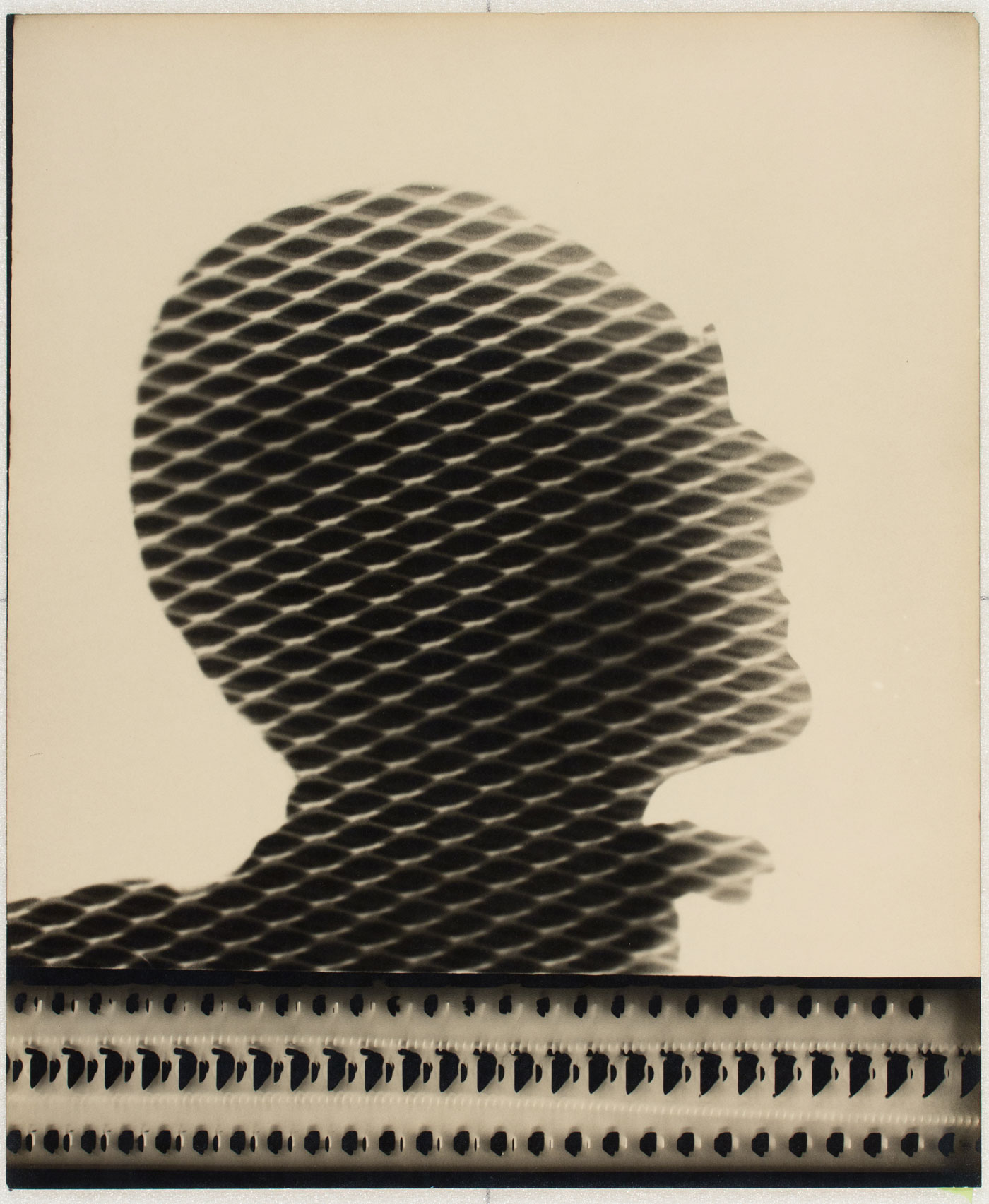
Installation views of the exhibition Emanations: The Art of the Cameraless Photograph at the Govett-Brewster Art Gallery featuring Len Lye’s cameraless photographic portraits


Len Lye (New Zealand, 1901-1980) 'Georgia O'Keeffe' 1947


Len Lye (New Zealand, 1901-1980)
Georgia O’Keeffe
1947
Courtesy of the Len Lye Foundation Collection
Govett-Brewster Art Gallery/Len Lye Centre


Len Lye (New Zealand, 1901-1980) 'Le Corbusier' 1947


Len Lye (New Zealand, 1901-1980)
Le Corbusier
1947
Courtesy of the Len Lye Foundation Collection and Archive
Govett-Brewster Art Gallery/Len Lye Centre


Lye’s subjects included notable artists such as Joan Miró, Hans Richter, and Georgia O’Keeffe (who brought some deer antlers to the shoot), the architect Le Corbusier, the jazz musician Baby Dodds, the scientist Nina Bull, and the writer W. H. Auden. But they also included a baby and a young woman who remain unnamed; Lye’s new partner, Ann Hindle; and Albert Bishop, a plumber who had come by to do some repairs. (Referencing the history of “silhouette” art)


Len Lye (New Zealand, 1901-1980) 'Marks and Spencer in a Japanese Garden (Pond People)' 1930


Len Lye (New Zealand, 1901-1980)
Marks and Spencer in a Japanese Garden (Pond People)
1930
Courtesy of the Len Lye Foundation Collection and Archive
Govett-Brewster Art Gallery/Len Lye Centre


Len Lye’s earliest cameraless photographs were made around 1930 as he settled into the London art scene and before he emerged as a leading figure in experimental cinema. His practice was eclectic during this period. He exhibited paintings, batiks, photographs and sculpture as part of the Seven and Five Society, Britain’s leading avant-garde group. During a visit to Mallorca with his friends Robert Graves and Laura Riding, Lye made a number of photograms with plasticine and cellophane shapes arranged over the photographic paper. Two of these, Self-Planting at Night (Night Tree) and Watershed, were exhibited in the 1936 International Surrealist Exhibition in London.


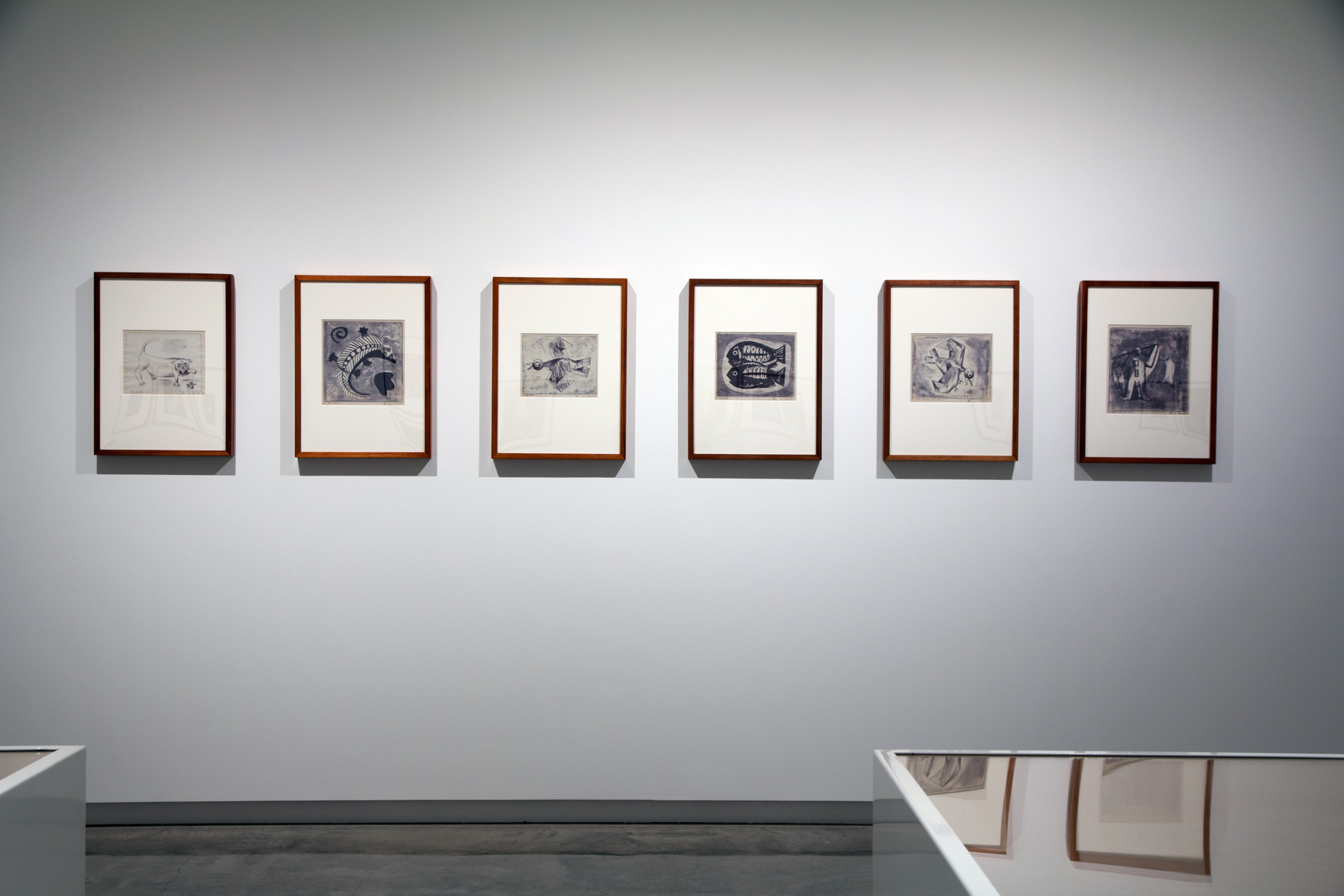
Installation view of the exhibition 'Emanations: The Art of the Cameraless Photograph' at the Govett-Brewster Art Gallery featuring James Cant's 'Six Signed Artist's Prints' 1948


Installation view of the exhibition Emanations: The Art of the Cameraless Photograph at the Govett-Brewster Art Gallery featuring James Cant’s Six Signed Artist’s Prints 1948


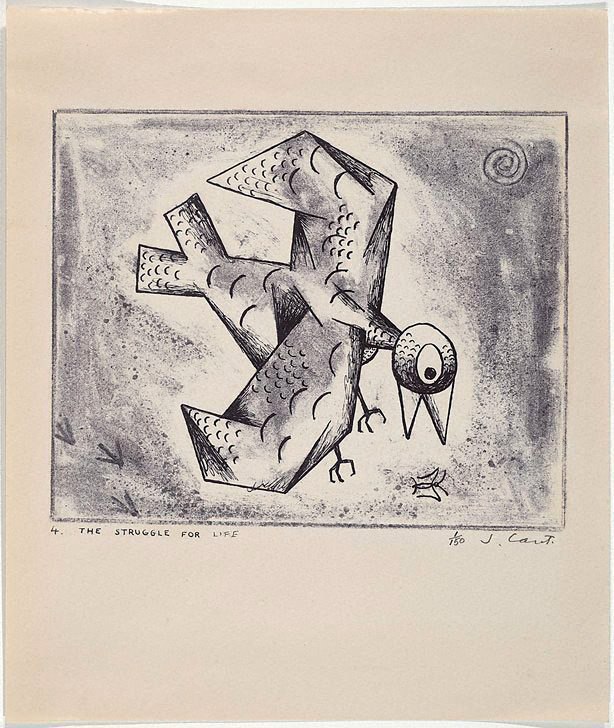
James Cant (Australian, 1911-1982) 'The struggle for life' 1948


James Cant (Australian, 1911-1982)
The struggle for life
1948
Cliché verre print (cyanotype blueprint from one hand-drawn glass plate)
35 x 29.6cm sheet


A number of Australian artists, some working in Melbourne and some in London, issued prints in the 1940s and early 50s using architectural blueprint (or cyanotype) paper, perhaps because, during the deprivations that attended the aftermath of World War Two, it was a cheap and available material for this purpose. James Cant, an artist interested in both Surrealism and Australian Aboriginal art, brought the two together in his designs for a portfolio of Six Signed Artist’s Prints that he issued in a print run of 150 in 1948. Each image was painted on a sheet of glass and then this glass was contact printed onto the blueprint paper to create a photograph.

In August 1834, while resident in Geneva, William Henry Fox Talbot had a friend make some drawings on sheets of varnished glass exposed to smoke, using an engraver’s needle to scratch through this darkened surface. The procedure came to be known as cliché verre.


Kilian Breier (German, 1931-2011) 'Kilian Breier: Fotografik 1953-1990' 1991 (cover)


Kilian Breier (German, 1931-2011)
Kilian Breier: Fotografik 1953-1990 (cover)
1991


The German artist Kilian Breier began making abstract photographs in the 1950s, some by folding his photographic paper and others by allowing rivulets of developer to flow across and stain it. A 1991 exhibition catalogue, Kilian Breier: Fotografik 1953-1990, gave the artist an opportunity to make a provocative gesture in line with his dedication to the self-generated image; he included in it a loose unfixed piece of signed photographic paper that continues to develop every time it is exposed to light. It therefore inhabits the book that protects it like a ghost, unable to be seen but nonetheless always present.


Max Dupain (Australian, 1911-1992) 'Untitled rayograph [with water]' 1936


Max Dupain (Australian, 1911-1992)
Untitled rayograph [with water]
1936
Gelatin silver photograph


The Australian modernist photographer Max Dupain was a great admirer of the work of Man Ray. In 1935 Dupain reviewed a book of the American’s photographs for The Home magazine in Sydney, declaring that “He is alone. A pioneer of the 20th century who has crystallised a new experience in light and chemistry.” With this book as his inspiration, Dupain himself made a number of experimental cameraless photographs in the later 1930s.


Běla Kolářová (Czechoslovakia, 1923-2010) 'Pecky broskve' (z 'cyklu' Stopy) 'Peach Stones' (From 'Traces' series) 1961


Běla Kolářová (Czechoslovakia, 1923-2010)
Pecky broskve (z cyklu Stopy)
Peach Stones
(From Traces series)
1961
Gelatin silver photograph from an artificial negative


Taking up photography in 1956 during the Cold War, the Czech artist Běla Kolářová wrote about the need to photograph things normally beneath the notice of photography, the negligible detritus of everyday life. Her initial experiments along these lines involved the making of prints from what she called “artificial negatives.” Collecting all sorts of discarded items (onion peels, peach pits), she either placed her scraps directly on celluloid or embedded them in a layer of paraffin, projecting the resulting image onto bromide paper using an enlarger. Kolářová also began to produce photographic images by placing her light-sensitive paper on a record turntable, rotating it at varying speeds, and allowing the light to produce a series of overlapping and wavy concentric circles.


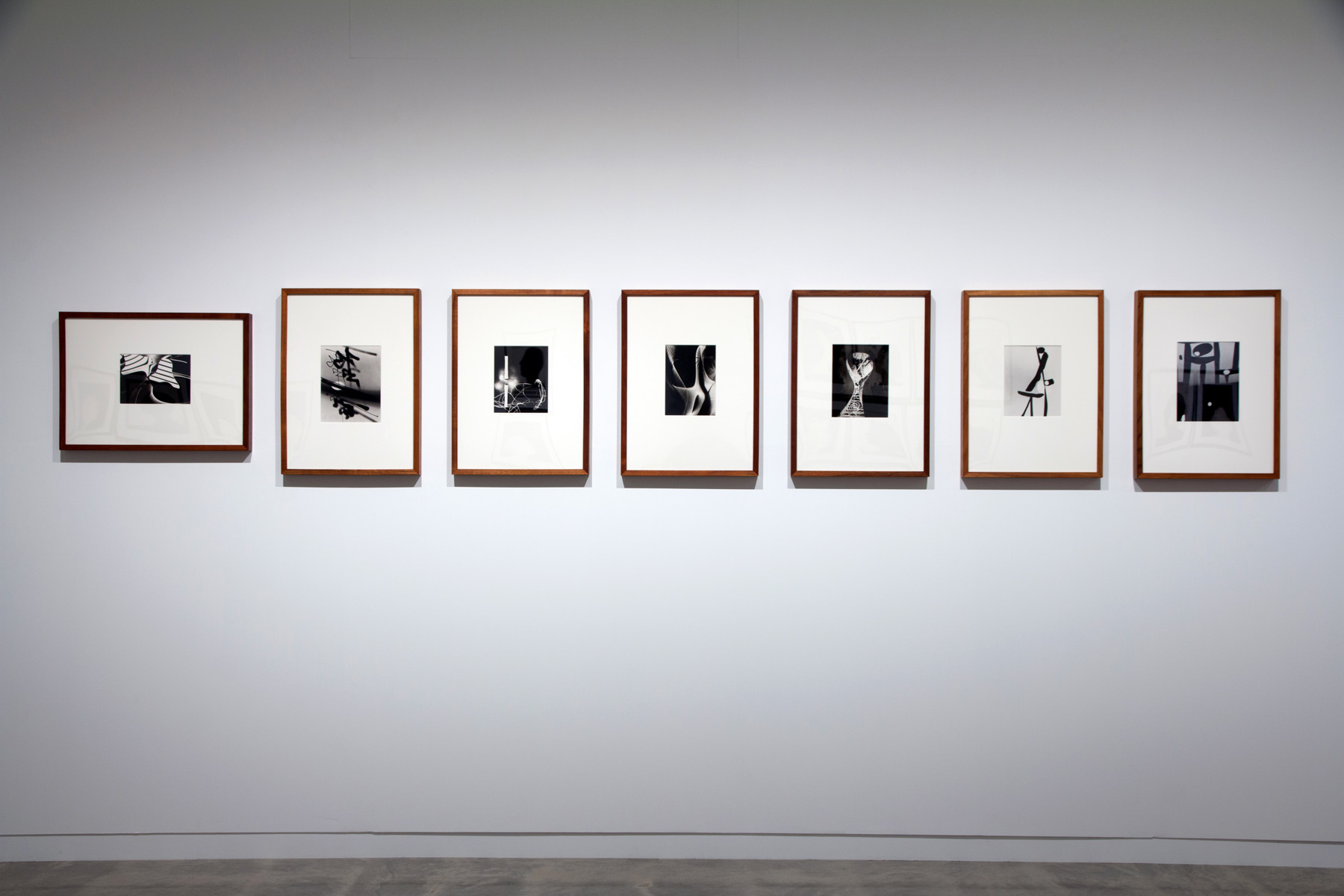
Installation view of György Kepes (Hungarian, 1906-2001) 'Black, great and white light composition', 1949; 'Black and white calligraphy', 1951; 'Fluid patterns', 1938; '(Calligraphic light)', 1948; 'Optical transformation', 1938; 'Hieroglyphic body', 1942; '(Magnetic pattern)', 1938


Installation view of
György Kepes (Hungarian, 1906-2001)
Black, great and white light composition, 1949
Black and white calligraphy, 1951
Fluid patterns, 1938
(Calligraphic light), 1948
Optical transformation, 1938
Hieroglyphic body, 1942
(Magnetic pattern), 1938
Gelatin silver photographs (printed c. 1977)


The Hungarian-born artist György Kepes moved to the United States in the late 1930s, where he published a series of interdisciplinary books concerned with the “language of vision.” Informed by his study of psychological theory, Kepes particularly favoured the cameraless photograph as offering a kind of universal language, stressing the need for images that combined “transparency and interpenetration… the order of our time is to knead together the scientific and technical knowledge required, into an integrated whole on the biological and social plane.” Even when they appear to be abstractions, Kepes’s own photograms were intended as an expression of the interdependence of natural and manmade structures and as an advocacy for the interrelationship of art, science, and technology.


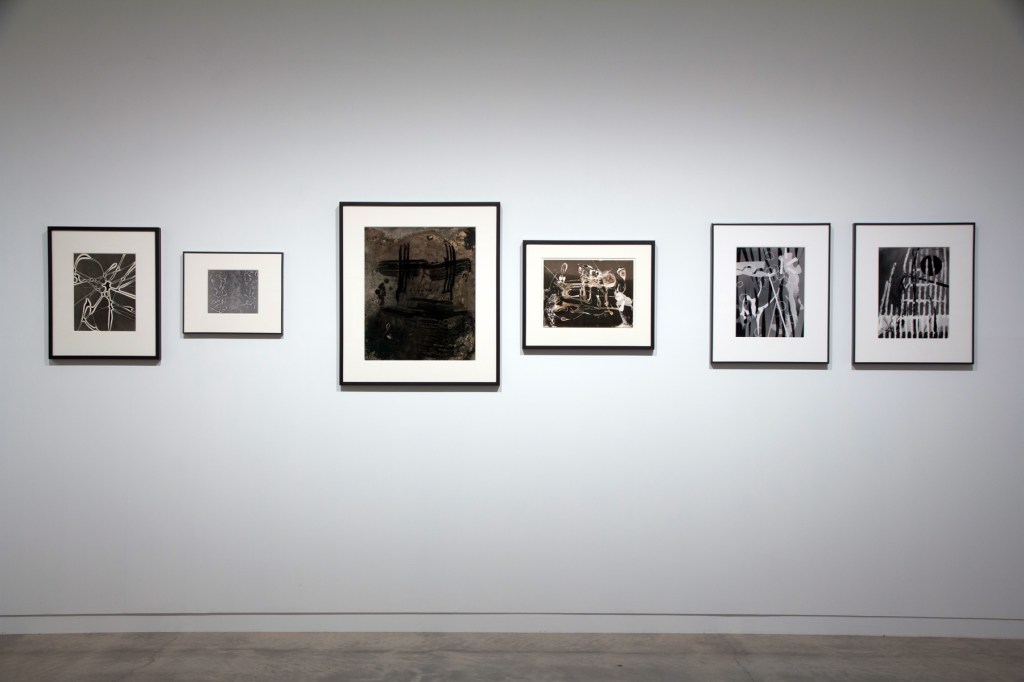
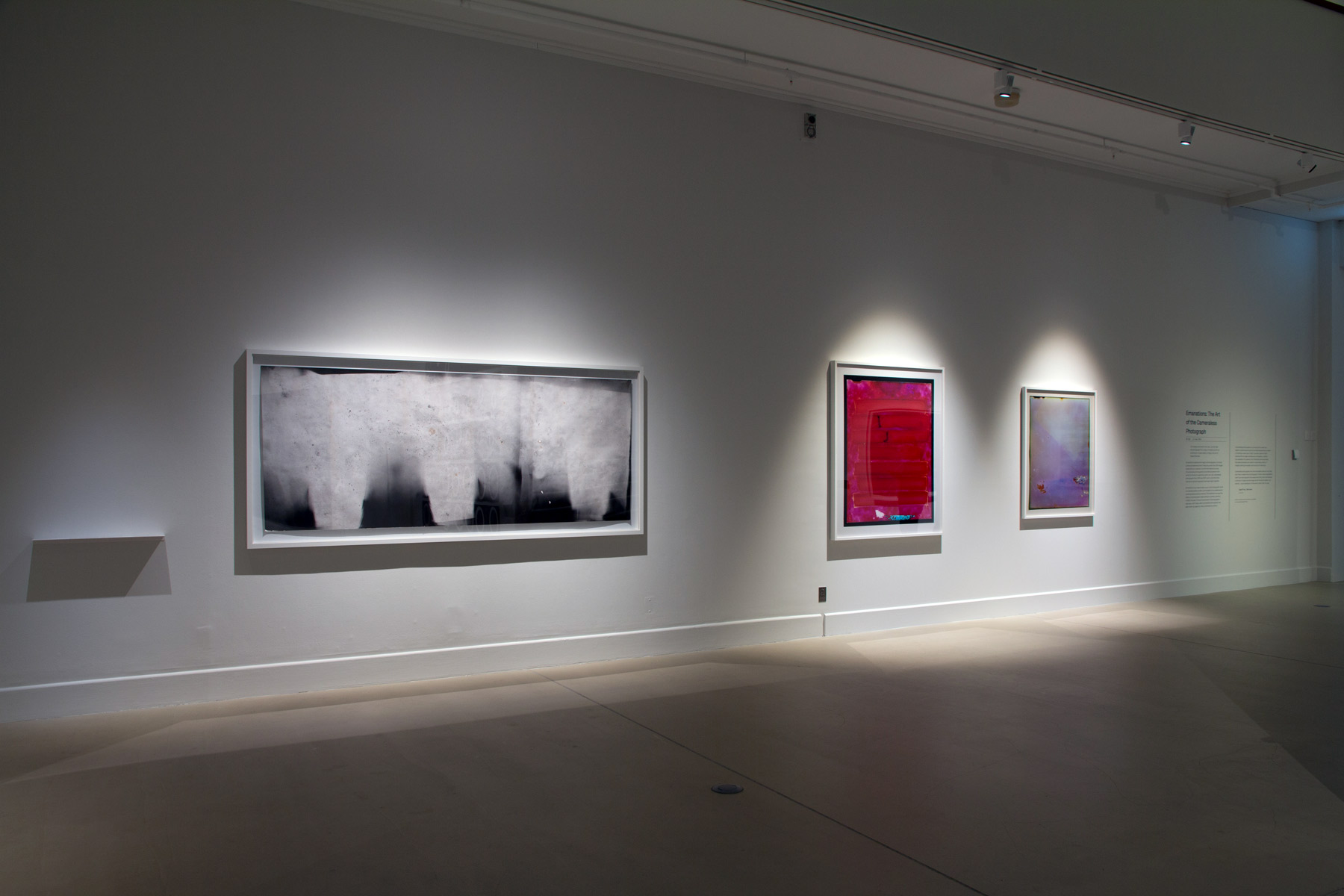
Installation view of the exhibition 'Emanations: The Art of the Cameraless Photograph' at the Govett-Brewster Art Gallery showing the work of Herbert Matter (left), Chargesheimer (centre), and Roger Catherineau (right)


Installation view of the work of Herbert Matter (left), Chargesheimer (centre), and Roger Catherineau (right)


Herbert Matter (American born Switzerland, 1907-1984) 'Untitled' c. 1939-1943


Herbert Matter (American born Switzerland, 1907-1984)
Untitled
c. 1939-1943
Gelatin silver photograph


Born in Switzerland, Herbert Matter studied with Fernand Léger in Paris before working there and in Switzerland as a graphic designer, incorporating photographic images into his many posters. In 1935 he moved to the United States, involving himself in the design and art world he found there, with a special interest in the work of abstract painters. He produced a number of experimental photographs in this period, deliberately designed to break with what he called “the chains of documentation.” These included a calligraphic image made in 1944 by tracing brush strokes on a wet emulsion plate charged by an electrical current and a series of sinuous, painterly photographs, perhaps made by pouring chemicals on sheets of glass already marked with a resist and then printing from them.


Chargesheimer (German, 1924-1972) 'Scenarium' 1961


Chargesheimer (German, 1924-1972)
Scenarium
1961
Gelatin silver chemigram


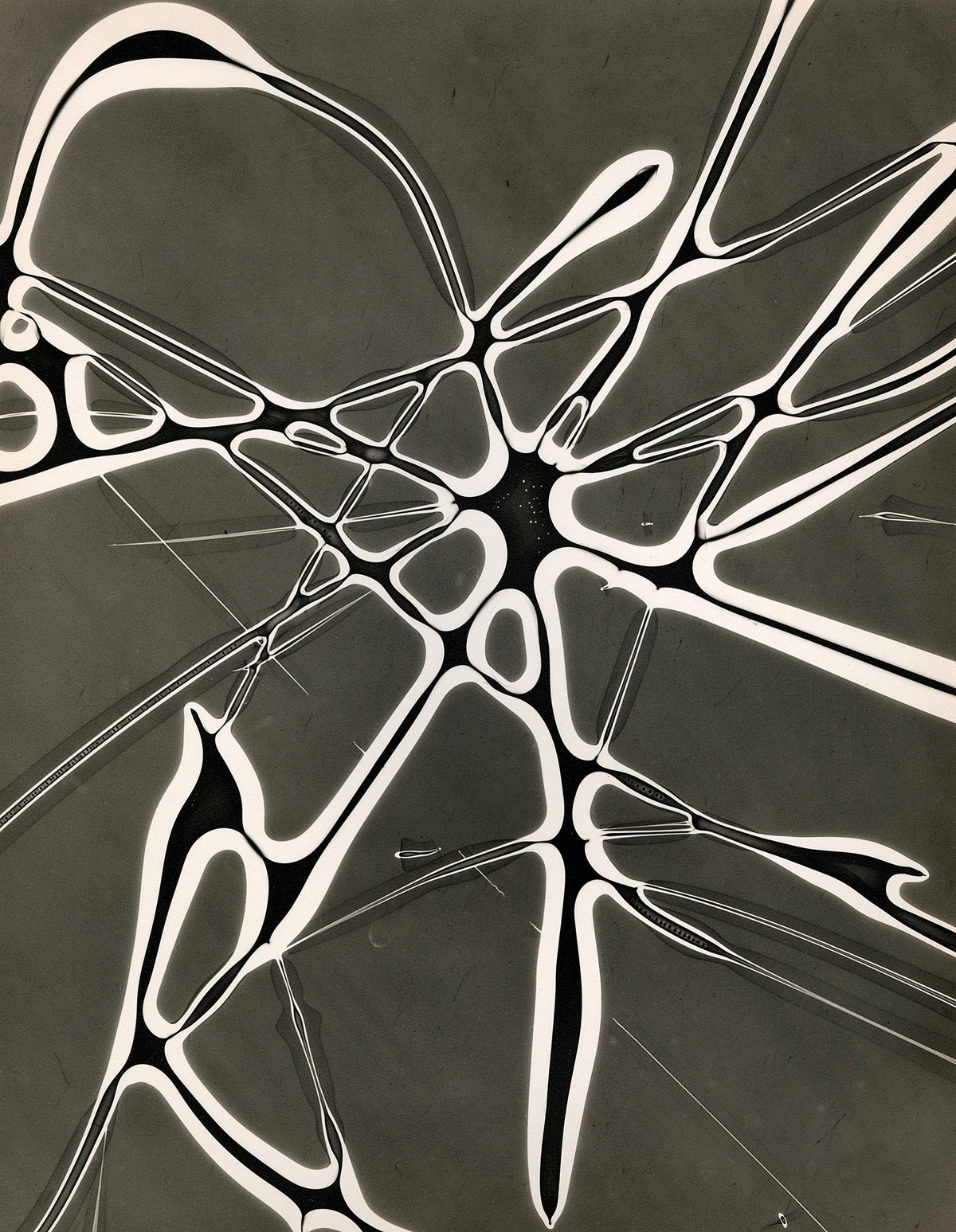
In 1961, the German artist Karl-Heinz Hargesheimer, who went by the single name of Chargesheimer, published a limited-edition book titled Lichtgrafik [Light Graphic]. He described the ten unique prints gathered in it as photochemische Malereien or “photo-chemical paintings,” inducing their strange combinations of gestural calligraphic marks and organic-looking surface using only developer and fixer on gelatin silver photographic paper.


Roger Catherineau (French, 1925-1962) 'Photogramme' 1957


Roger Catherineau (French, 1925-1962)
Photogramme
1957
Gelatin silver photograph


Starting in the 1950s, French artist Roger Catherineau drew on his interest in sculpture and dance to produce sinuous, layered photograms that look more like graphics than paintings. Their ambiguous depths were made even more elusive by the addition of coloured inks to their surfaces.


Installation view of the exhibition 'Emanations: The Art of the Cameraless Photograph' at the Govett-Brewster Art Gallery with at left, Marco Breuer and at right, Lynn Cazabon


Installation view of the exhibition Emanations: The Art of the Cameraless Photograph at the Govett-Brewster Art Gallery with at left, Marco Breuer and at right, Lynn Cazabon


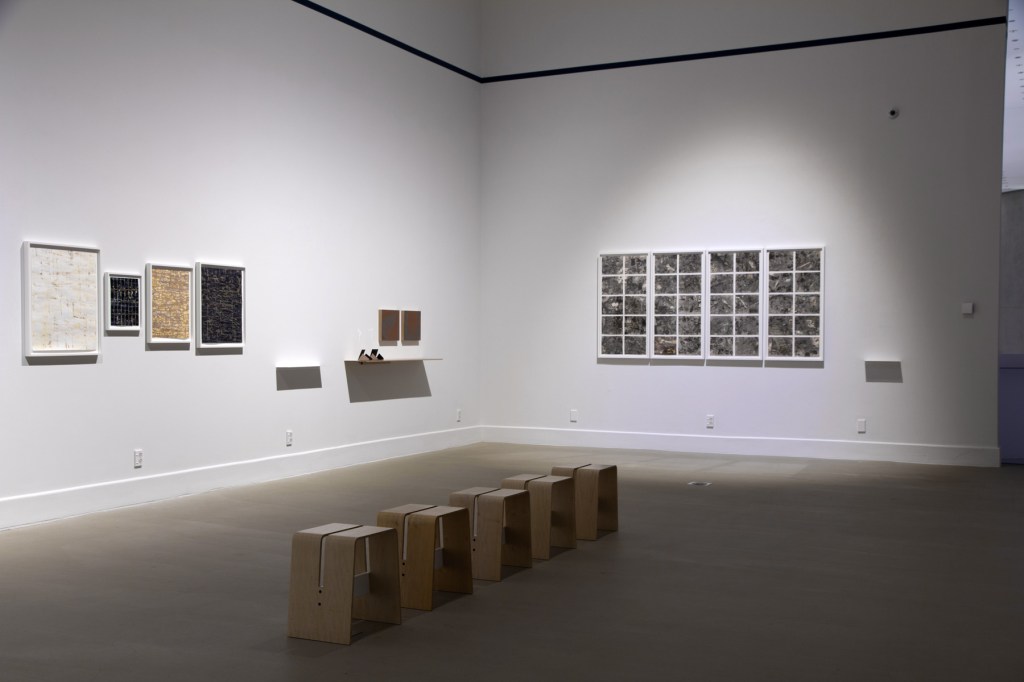
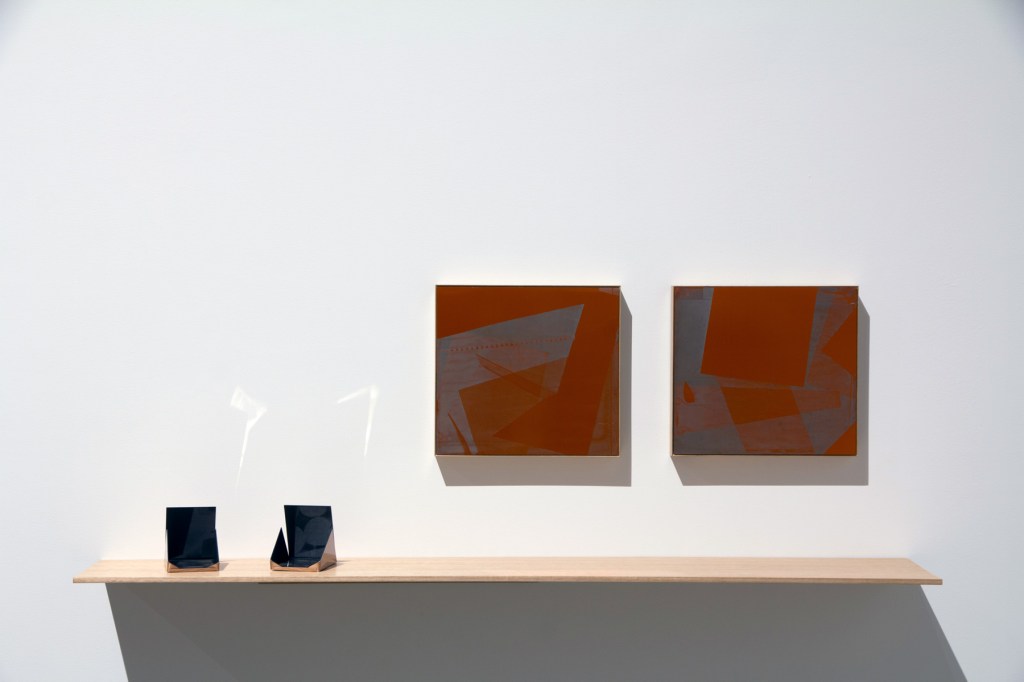
Installation view of Danica Chappell (Australia) 'Slippery Image #1' 2014-2015 'Slippery Image #2' 2014-2015 and 'Traversing Edges & Corners (Orange #9)' 2014 'Traversing Edges & Corners (Orange #10)' 2014 tintype


Installation view of
Danica Chappell (Australian, b. 1972)
Slippery Image #1, 2014-2015
Slippery Image #2, 2014-2015
Daguerreotype

Danica Chappell (Australian, b. 1972)
Traversing Edges & Corners (Orange #9), 2014
Traversing Edges & Corners (Orange #10), 2014
Tintype


The work of Australian artist Danica Chappell brings together the formal experiments of early modernist avant-garde groups, such as the Russian Constructivists and the German Bauhaus, with some of photography’s earliest techniques, resulting in geometrically patterned daguerreotypes and tintypes. These patterns of light and shadow animate the surface of Chappell’s metallic photographs, while also recording her work in the darkroom, her negotiation of radiation, object, body and time.


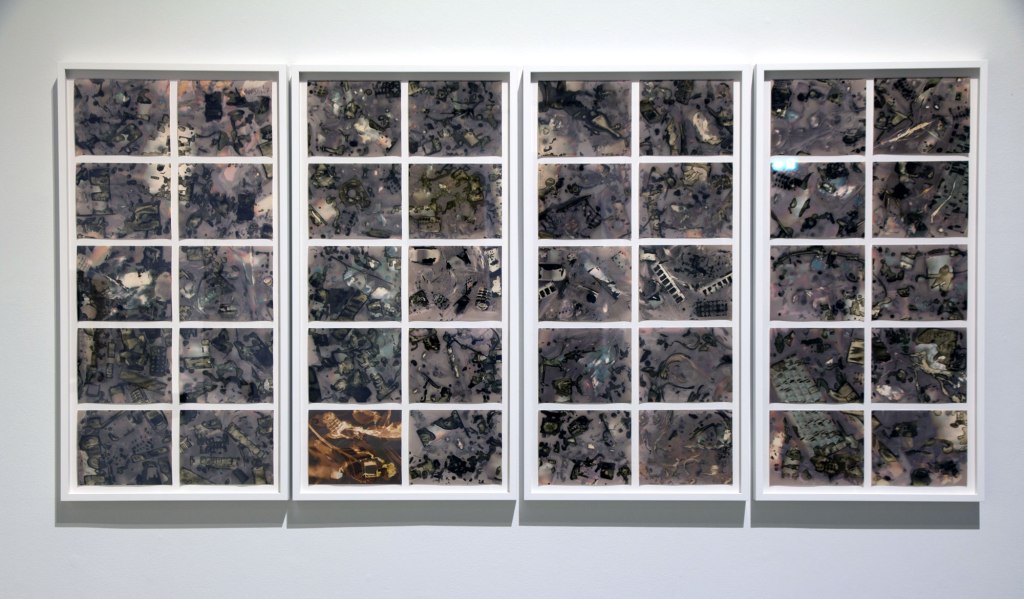
Installation view of Lynn Cazabon (American, b. 1964) 'Diluvian' 2010-2013


Installation view of
Lynn Cazabon (American, b. 1964)
Diluvian
2010-2013
40 unique silver gelatin solar photographs


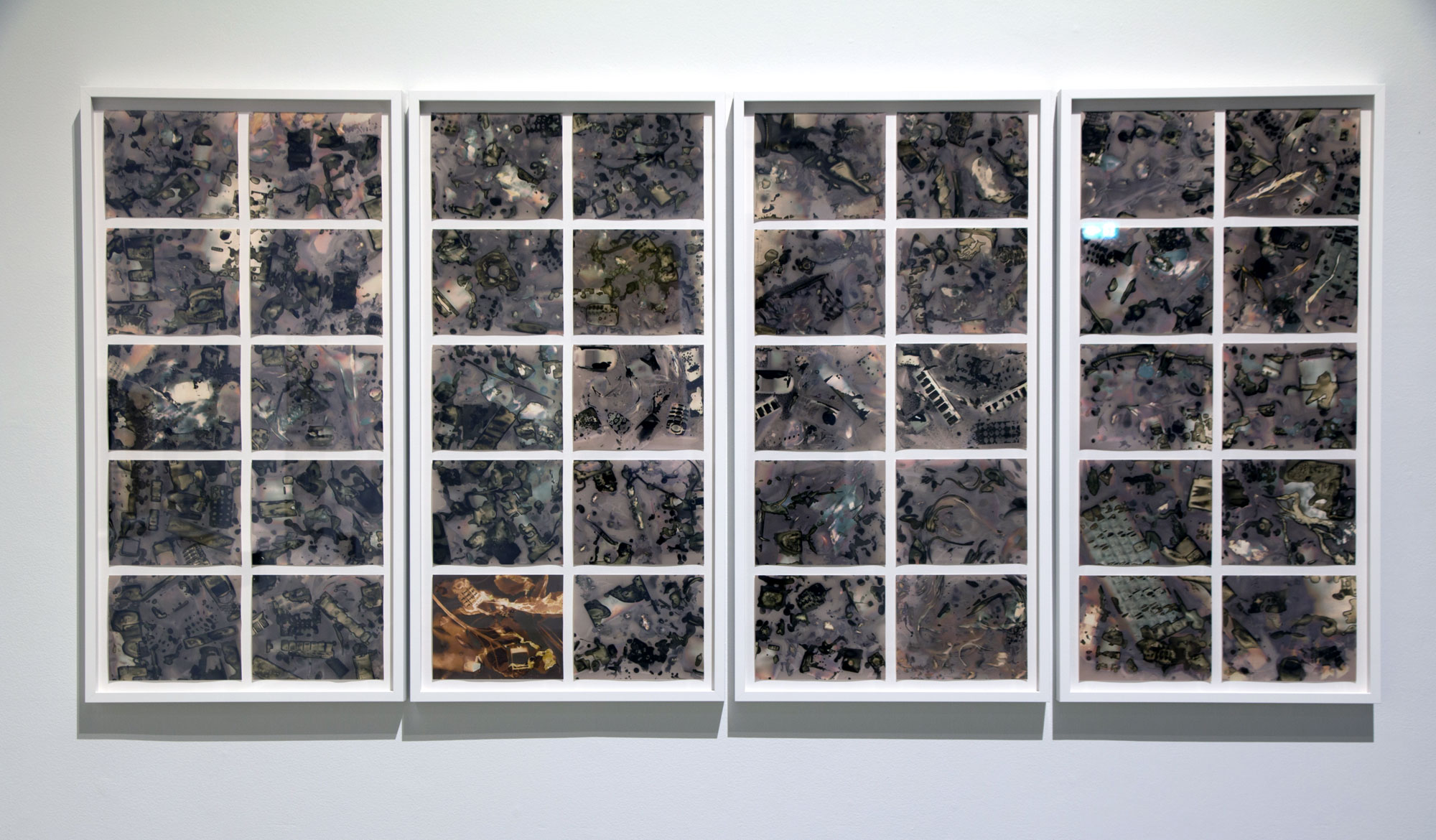
Diluvian, by American artist Lynn Cazabon, comprises a grid of unique contact prints, with their imagery and the means of its production both being directly generated by the work’s subject matter. Embedded in a simulated waste dump, covered with discarded cell phones and computer parts as well as organic material, expired sheets of gelatin silver paper were sprayed with baking soda, vinegar and water, sandwiched under a heavy sheet of glass, and left in direct sunlight for up to six hours, four prints at a time. The chemical reactions that ensued left visual traces – initially vividly coloured and then gradually fading when fixed – of our society’s flood of toxic consumer items, produced by the decomposing after-effects of those very items.


Installation view of works by Marco Breuer (German, b. 1966) Untitled (C-1378), 2013; Untitled (C-1598), 2014; Untitled (C-1526), 2014; Untitled (C-1338), 2013


Installation view of
Marco Breuer (German, b. 1966)
Untitled (C-1378), 2013
Untitled (C-1598), 2014
Chromogenic paper, embossed/burned/scraped

Marco Breuer (German, b. 1966)
Untitled (C-1526), 2014
Chromogenic paper, burned/scraped

Marco Breuer (German, b. 1966)
Untitled (C-1338), 2013
Chromogenic paper, burned


By folding, scoring, burning, scouring, abrading, and/or striking his pieces of photographic paper, German-born, US-based artist Marco Breuer coaxes a wide range of colours, markings and textures from his chosen material. Both touched and tactile, Breuer’s photographs have become surrogate bodies, demonstrating the same fragility and relationship to violence as any other organism. And like any other body, they also bear the marks of time, not of a single instant from the past, like most photographs, but rather of a duration of actions that have left accumulated scars.


Installation view of the exhibition 'Emanations: The Art of the Cameraless Photograph' at the Govett-Brewster Art Gallery with at left, the work of Anne Noble

Installation view of the exhibition 'Emanations: The Art of the Cameraless Photograph' at the Govett-Brewster Art Gallery with at centre, the work of Anne Noble


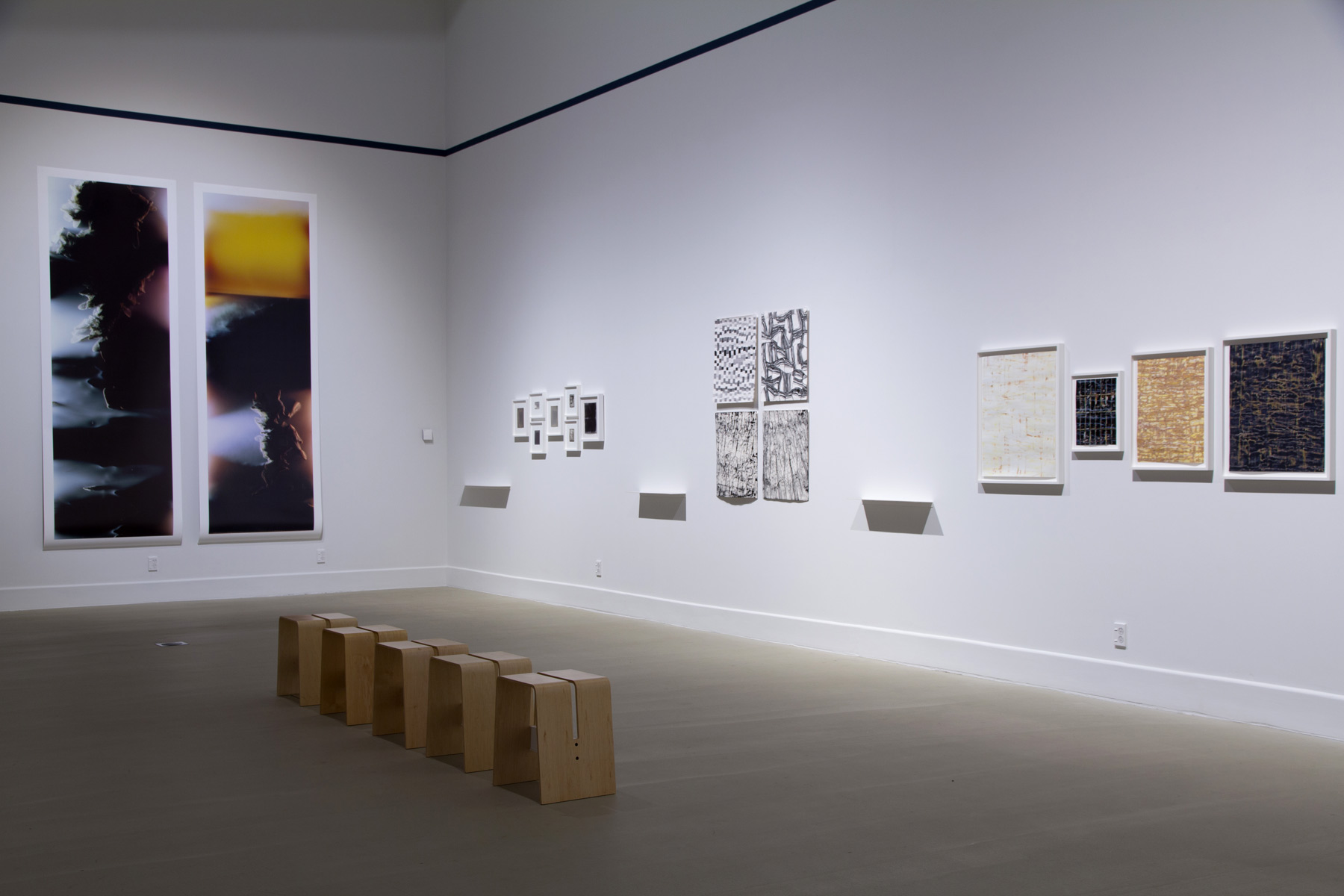
Installation views of the exhibition Emanations: The Art of the Cameraless Photograph at the Govett-Brewster Art Gallery with at centre, the work of Anne Noble


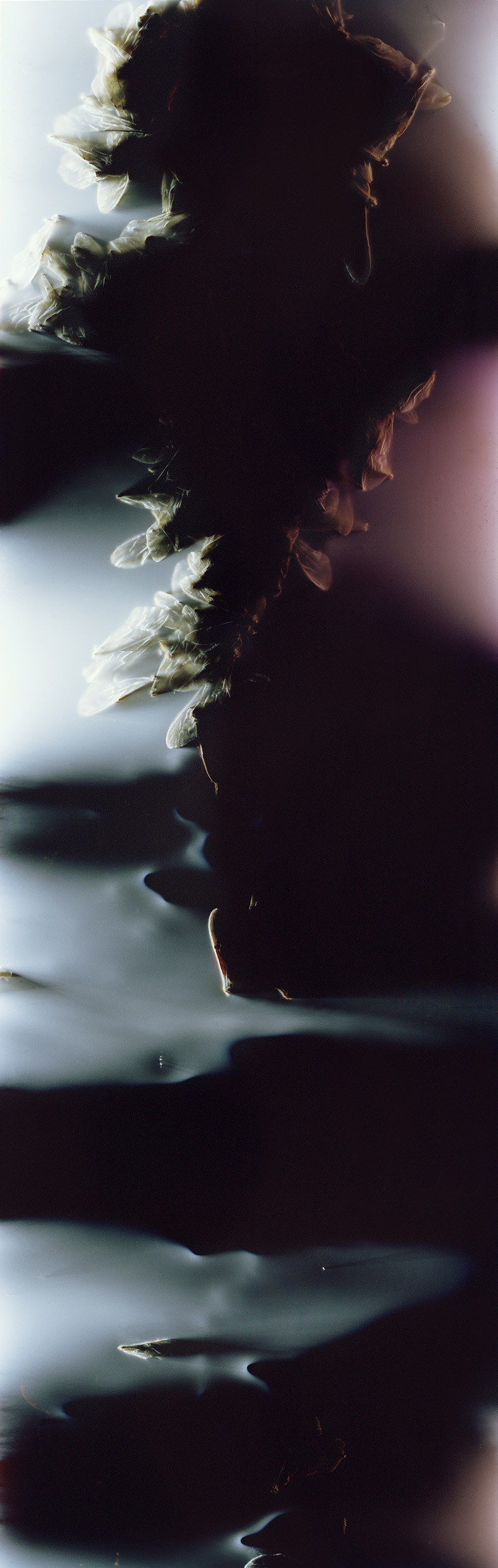
Anne Noble (New Zealand, b. 1954) 'Bruissement: Bee Wing Photograms #10' 2015


Anne Noble (New Zealand, b. 1954)
BruissementBee Wing Photograms #10
2015
Pigment print on Canson baryta paper
320 x 110cm
Courtesy of the artist, Wellington


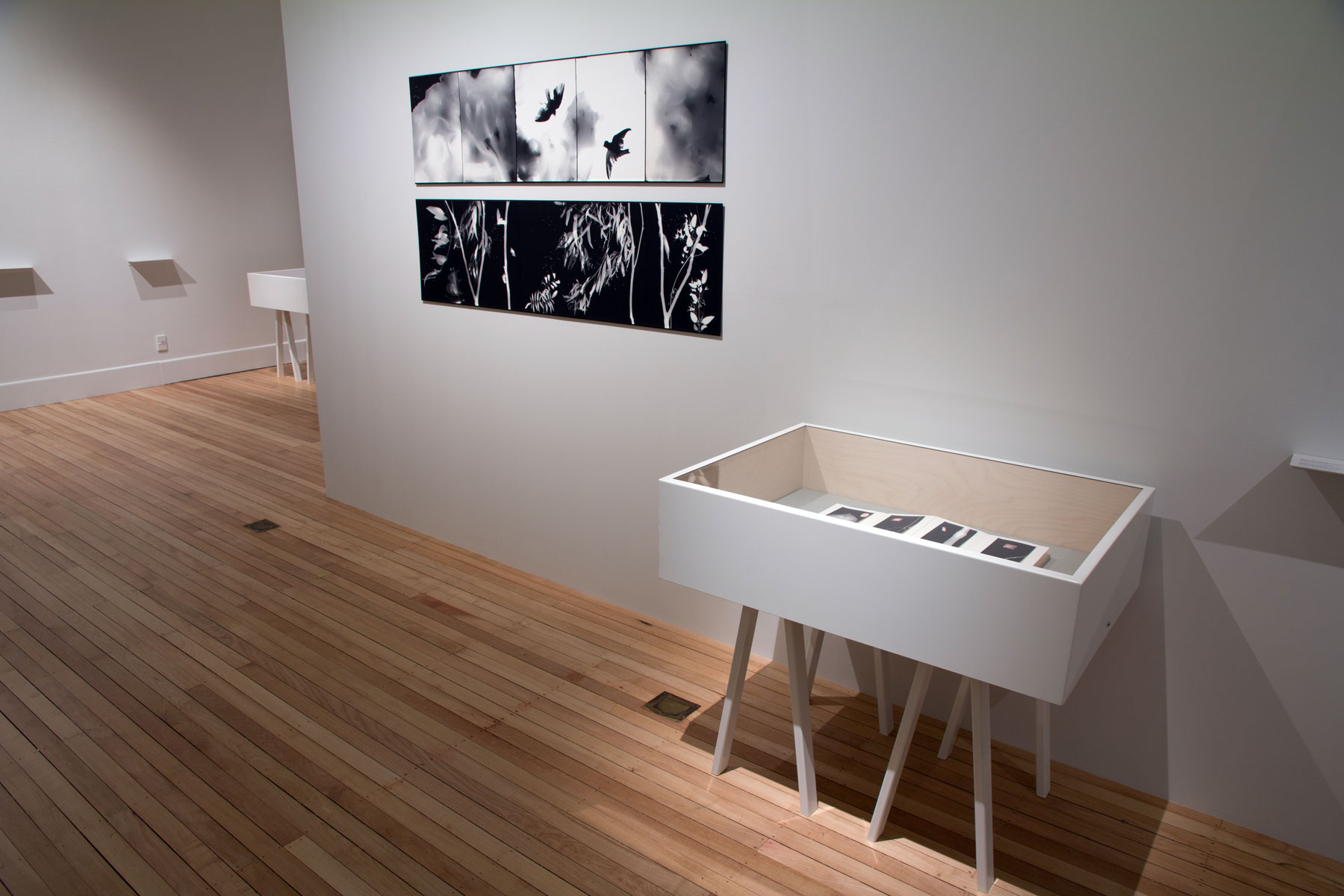
In recent times, the New Zealand artist Anne Noble has made a number of works that address the calamitous collapse of the global honeybee population. In these two cameraless photographs, cascading vertically down the wall like Chinese scroll paintings, we get to see the imprint of thousands of detached bee wings, their determined hum stilled by disease, human interference and a toxic ecology. The haunting beauty of these delicate traceries and strange shadows is also a warning. A beekeeper herself, Noble looks at bees as a living system under stress but also as a model for our own society; as she says, “what is happening to the bees we are likely doing to ourselves.”


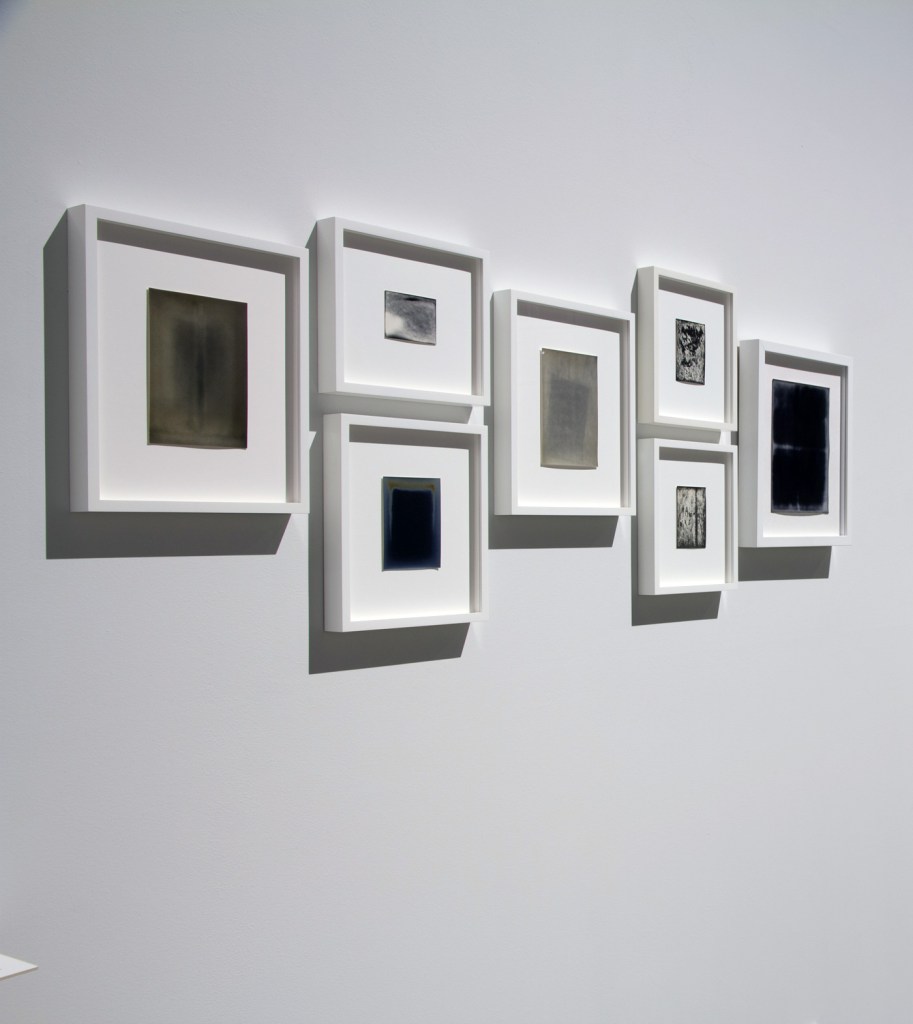
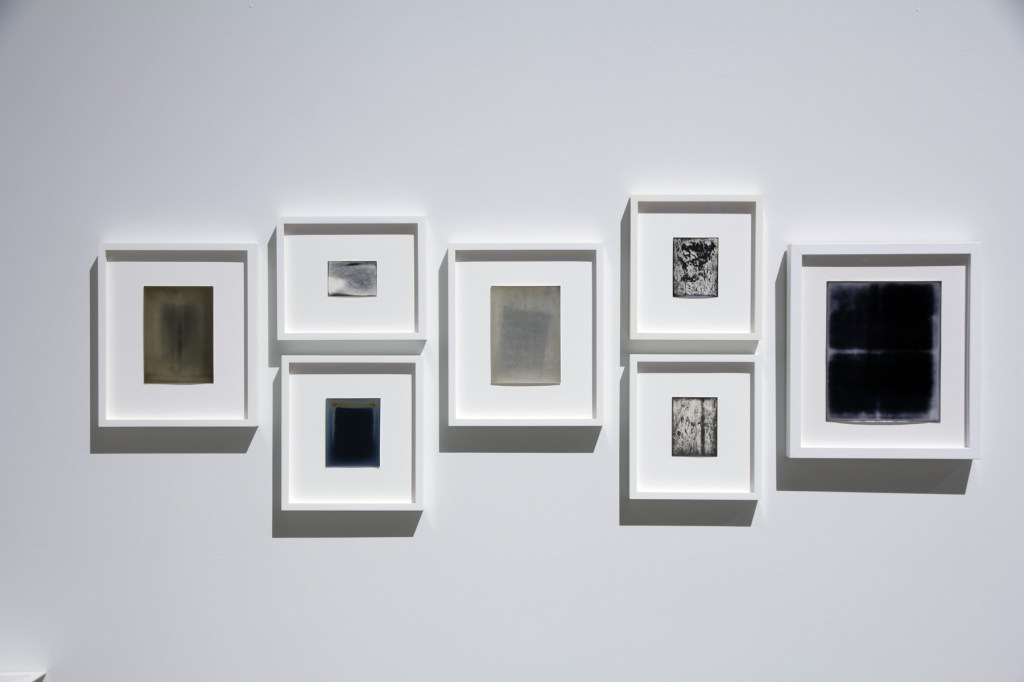
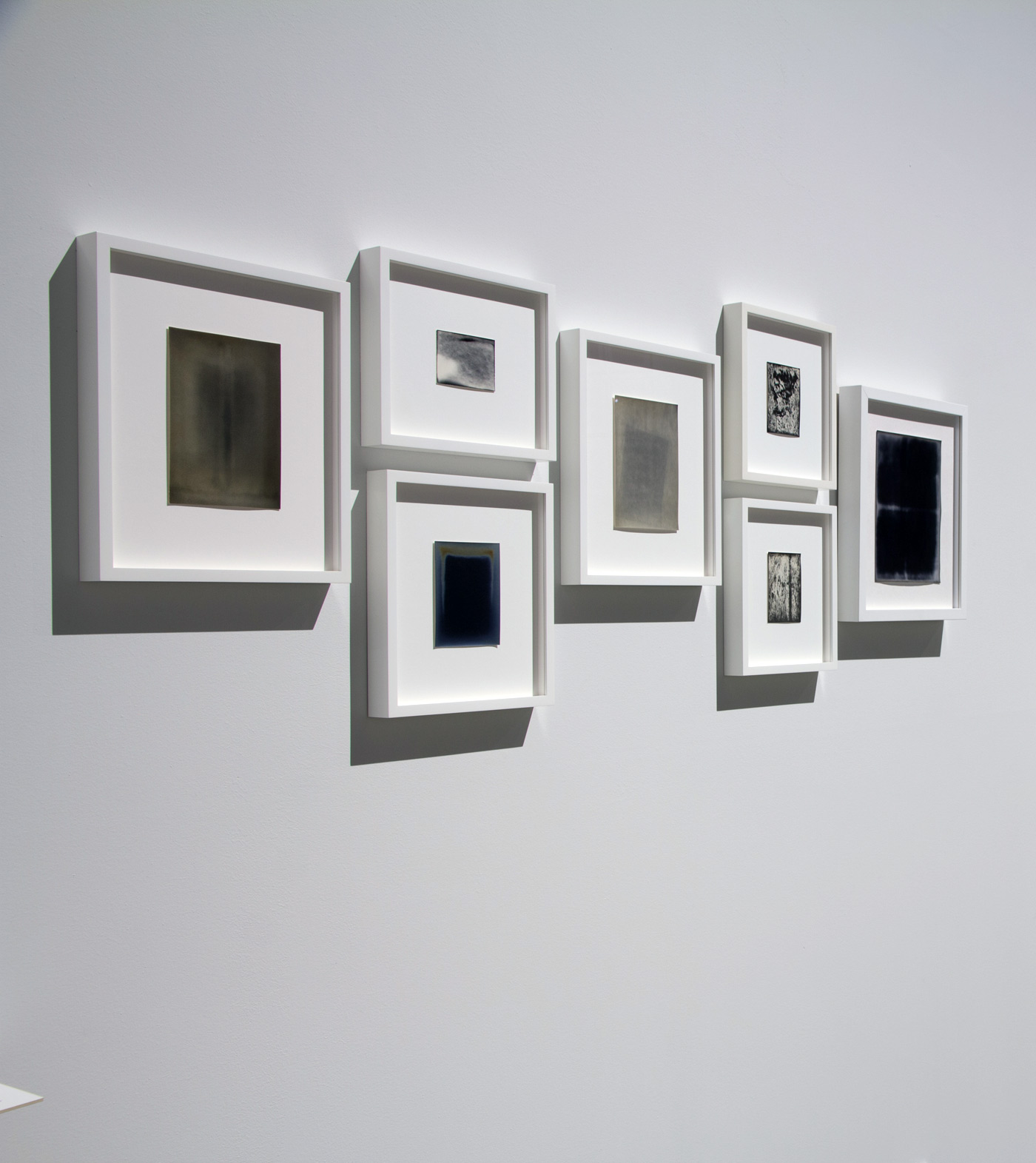
Installation view of works by Alison Rossiter (American, b. 1953) Agfa Cykora, expired January 1942, processed 2013; Eastman Kodak Velox, expired March 1919a, processed 2014; Eastman Kodak Medalist E2, expired September 1956, processed 2010; Eastman Kodak Velox, expired March 1919b, processed 2014; Eastman Kodak PMC No.11, expired September 1937, processed 2013; Defender Argo, exact expiration date unknown, c. 1910, processed 2013; Velox T4, expiry date October 1, 1940, processed 2008

Installation view of works by Alison Rossiter (American, b. 1953) Agfa Cykora, expired January 1942, processed 2013; Eastman Kodak Velox, expired March 1919a, processed 2014; Eastman Kodak Medalist E2, expired September 1956, processed 2010; Eastman Kodak Velox, expired March 1919b, processed 2014; Eastman Kodak PMC No.11, expired September 1937, processed 2013; Defender Argo, exact expiration date unknown, c. 1910, processed 2013; Velox T4, expiry date October 1, 1940, processed 2008


Installation views of
Alison Rossiter
(American, b. 1953)
Agfa Cykora, expired January 1942, processed 2013
Eastman Kodak Velox, expired March 1919a, processed 2014
Eastman Kodak Medalist E2, expired September 1956, processed 2010
Eastman Kodak Velox, expired March 1919b, processed 2014
Eastman Kodak PMC No.11, expired September 1937, processed 2013
Defender Argo, exact expiration date unknown, c. 1910, processed 2013
Velox T4, expiry date October 1, 1940, processed 2008
Unique gelatin silver photographs


Since 2007, American photographic artist Alison Rossiter has been buying old expired packets of unexposed film at auction or on the internet, some of them dating from as early as 1900. She then develops these sheets in her darkroom with no further exposure to light, never quite sure what the resulting object-image will look like. The one inscribed Velox T4, expiry date October 1, 1940, for example, was developed in 2008, and displays a Mark Rothko-like grid of pale impressions on a dark ground. These are the chemical traces left behind by the wrapping paper that once protected it from light. We’re looking, then, at an exposure – to chemicals as well as to leaked light – of approximately seventy years.


Installation view of works by Matt Higgins (Australia) Untitled 134-5, 2014; Untitled 254-5, 2014; Untitled 287-5, 2014; Untitled 292-5, 2014


Installation view of
Matt Higgins (Australia)
Untitled 134-5, 2014
Untitled 254-5, 2014
Untitled 287-5, 2014
Untitled 292-5, 2014
Unique chemigram on gelatin silver photographic paper


Australian artist Matt Higgins makes what are called ‘chemigrams,’ created by the interplay of various manual and chemical processes on a single sheet of photographic paper or film. Higgins also uses resists to help create his patterned surfaces, from soft organic substances such as apple syrup to industrial compounds such as epoxy enamel. He thereby returns photography to its historical roots: the desire to coax images from a chemical reaction to light.


Installation view of the exhibition 'Emanations: The Art of the Cameraless Photograph' at the Govett-Brewster Art Gallery

Installation view of the exhibition 'Emanations: The Art of the Cameraless Photograph' at the Govett-Brewster Art Gallery

Installation view of the exhibition 'Emanations: The Art of the Cameraless Photograph' at the Govett-Brewster Art Gallery

Installation view of the exhibition 'Emanations: The Art of the Cameraless Photograph' at the Govett-Brewster Art Gallery

Installation view of the exhibition 'Emanations: The Art of the Cameraless Photograph' at the Govett-Brewster Art Gallery

Installation view of the exhibition 'Emanations: The Art of the Cameraless Photograph' at the Govett-Brewster Art Gallery

Installation view of the exhibition 'Emanations: The Art of the Cameraless Photograph' at the Govett-Brewster Art Gallery


Installation views of the exhibition Emanations: The Art of the Cameraless Photograph at the Govett-Brewster Art Gallery


Govett-Brewster Art Gallery/Len Lye Centre
Queen St, New Plymouth, New Zealand
Phone: +64 6 759 6060
Email: info@govettbrewster.com

Opening hours:
Daily 10am – 5pm

Govett-Brewster Art Gallery/Len Lye Centre website

LIKE ART BLART ON FACEBOOK

Back to top

Exhibition: ‘Emanations: The Art of the Cameraless Photograph’ at the Govett-Brewster Art Gallery/Len Lye Centre, New Plymouth, New Zealand Part 1

Exhibition dates: 29th April – 14 August, 2016

Curator: Geoffrey Batchen


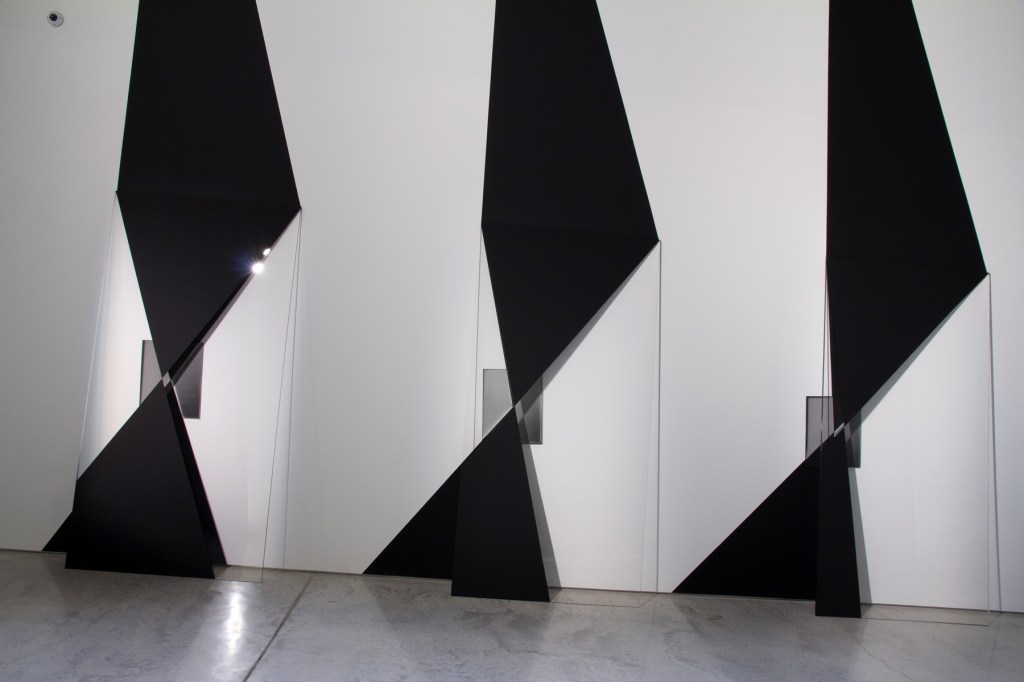
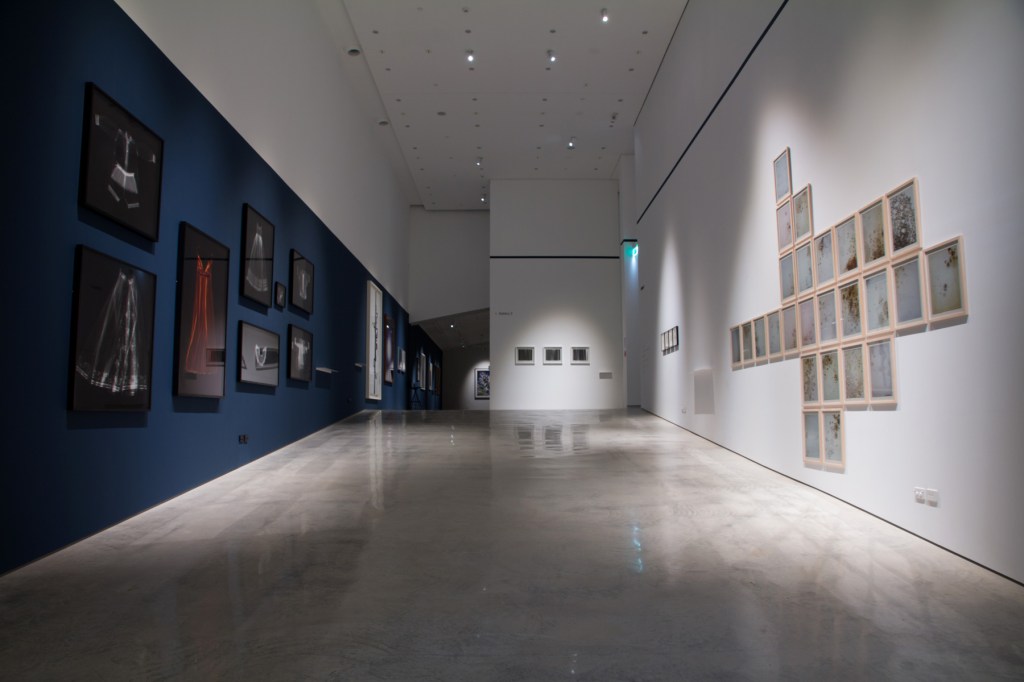
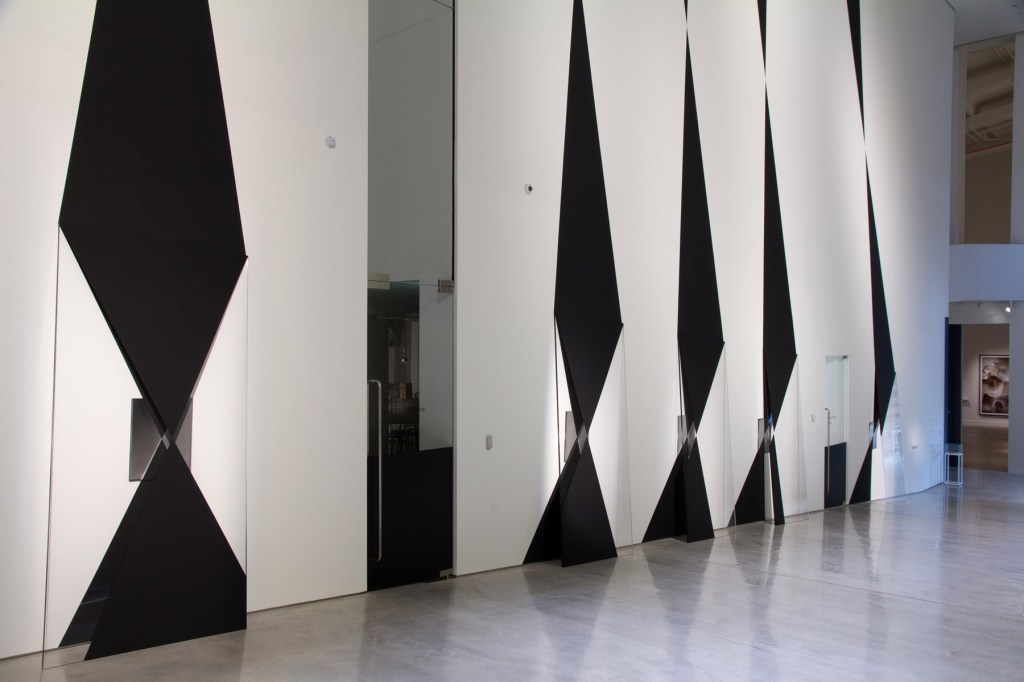
Installation view of the exhibition 'Emanations: The Art of the Cameraless Photograph' at the Govett-Brewster Art Gallery


Installation view of the exhibition Emanations: The Art of the Cameraless Photograph at the Govett-Brewster Art Gallery


This is how best a contemporary art exhibition can show the work to advantage. Just gorgeous!

The well curated, comprehensive content is complemented by a beautifully paced hang nestled within stunning contemporary art spaces. Labels are not just plonked on the wall, but are discretely displayed on horizontal shelves next to the work – accessible but so as not to interrupt the flow of the work. Coloured walls add to the ambience of the installation and act as an adjunct to the colours of the art. Beautiful modernist contemporary display cabinets keep the spaces fresh and vibrant.

A discussion of the content of the exhibition to follow in part 2 of the posting.

Dr Marcus Bunyan


Many thankx to the Govett-Brewster Art Gallery for allowing me to publish the photographs in the posting. Please click on the photographs for a larger version of the image. All images are photographed by Bryan James.


“Exploring the art of cameraless photography, encompassing historical, modern and contemporary works. Emanations: The Art of the Cameraless Photograph is the first comprehensive survey of cameraless photography held anywhere in the world, presenting more than 200 examples, from 1839 – when photography’s invention was announced – through to contemporary artists. We present the most complete study of cameraless photography to date, focusing on the cameraless mode from the 1830s through to today and offering a global perspective on this way of working.

The theme of the exhibition is inspired by artist Len Lye’s cameraless photographs from 1930 and 1947, and it’s the first time all 52 of Lye’s photograms have been seen together. Emanations is an opportunity to put Lye’s photographic work in a suitably global context, surrounded by his predecessors, contemporaries and successors. Emanations includes many masterpieces of photographic art and showcases the talents of some of the world’s leading contemporary photographic artists.

The exhibition has work by photographic pioneers William Henry Fox Talbot and Anna Atkins, important modernist photographers Man Ray and László Moholy-Nagy, and many of today’s most significant photographic artists including Walead Beshty, Marco Breuer, Liz Deschenes, Joan Fontcuberta, Christian Marclay, Thomas Ruff, and Hiroshi Sugimoto. Emanations also includes work by both senior and emerging Australian and New Zealand artists, from Anne Noble and Anne Ferran to Andrew Beck and Justine Varga.

The exhibition presents artwork by more than 50 artists hailing from New Zealand, Australia, Japan, Poland, Czechoslovakia, Hungary, France, Germany, Italy, England, Canada and the United States. Almost every photographic process is included in the exhibition – photogenic drawings, calotypes, daguerreotypes, and tintypes, as well as gelatin silver, chromogenic and ink-jet photographic prints, photocopies, verifax and thermal prints.

The exhibition is accompanied by a major book by the same name and on the same theme, co-published by the Govett-Brewster Art Gallery and DelMonico Books/Prestel, based in New York and Munich. The book contains 184 full-page colour plates and a 25,000 word essay by Geoffrey Batchen. The Govett-Brewster is also publishing another book reproducing all the cameraless photographs by Len Lye, along with an essay by Wystan Curnow.

Emanations is curated by Geoffrey Batchen, Professor of Art History at Victoria University of Wellington, and a world-renowned historian and curator of photography.”

Text from the Govett-Brewster Art Gallery website


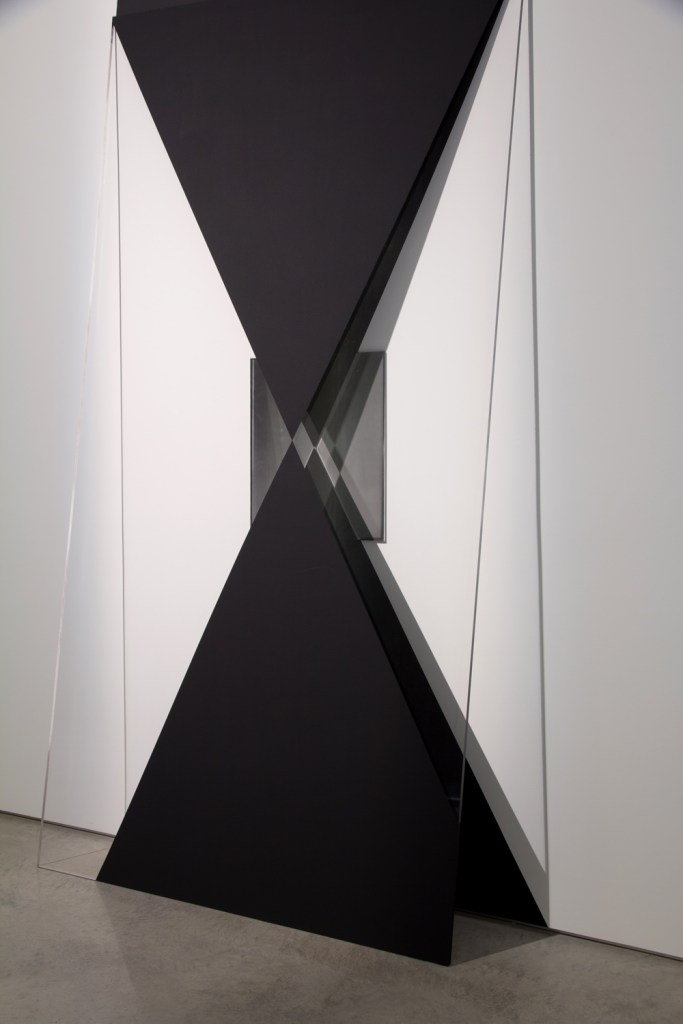
Installation view of Andrew Beck ‘Double Screen’ 2016 part of the exhibition 'Emanations: The Art of the Cameraless Photograph' at the Govett-Brewster Art Gallery

Installation view of Andrew Beck ‘Double Screen’ 2016 part of the exhibition 'Emanations: The Art of the Cameraless Photograph' at the Govett-Brewster Art Gallery

Installation view of Andrew Beck ‘Double Screen’ 2016 part of the exhibition 'Emanations: The Art of the Cameraless Photograph' at the Govett-Brewster Art Gallery


Installation views of
Andrew Beck (New Zealand, b. 1987)
Double Screen
2016
Glass, acrylic paint, gelatin silver photographs


In the 1930s, László Moholy-Nagy made art that combined a cameraless photograph, plexiglass and paint. New Zealand artist Andrew Beck works in a similar way to produce sculptural installations that complicate our expectations of the relationship between light and shadow, the natural and the artificial, images and objects, art and reality. He forces us to look very closely at what we are seeing, and even to critically reflect on the act of seeing itself.


Installation view of the exhibition 'Emanations: The Art of the Cameraless Photograph' at the Govett-Brewster Art Gallery with at left, works by Anne Ferran and at right, Joyce Campbell


Installation view of the exhibition Emanations: The Art of the Cameraless Photograph at the Govett-Brewster Art Gallery with at left, Anne Ferran and at right, Joyce Campbell


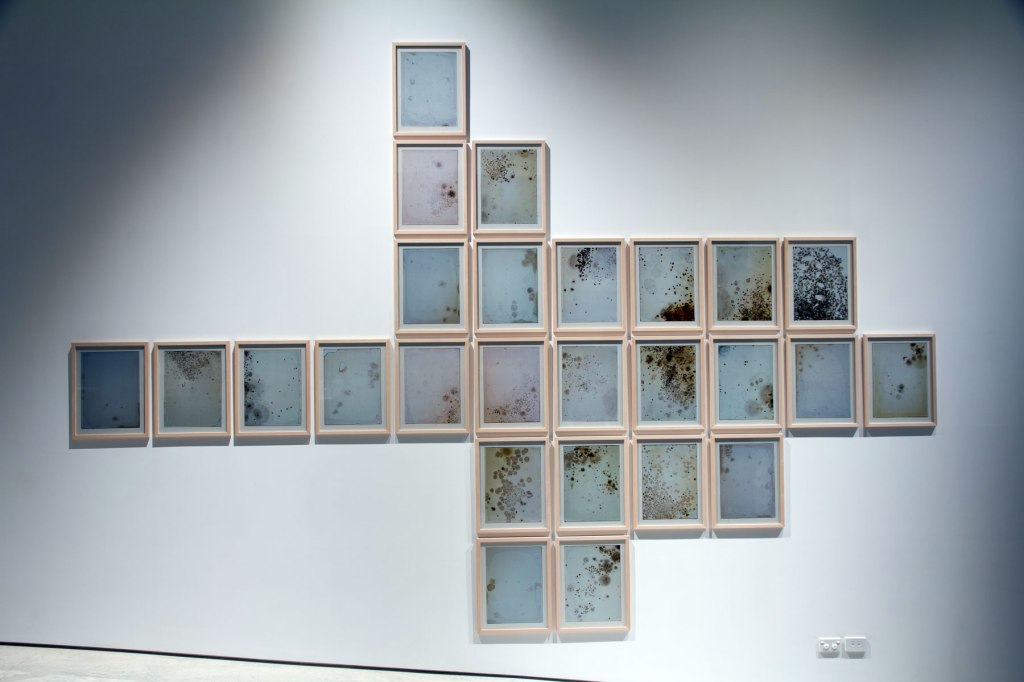
Installation view of Joyce Campbell ‘LA Bloom’ 2002 part of the exhibition 'Emanations: The Art of the Cameraless Photograph' at the Govett-Brewster Art Gallery


Installation view of
Joyce Campbell (New Zealand, b. 1971)
LA Bloom
2002
Cibachrome photographs
Courtesy of the artist, Auckland


In 2002 the New Zealand photographer Joyce Campbell decided to conduct a microbial survey of Los Angeles, a city in which she lives for part of each year. She swabbed the surfaces of plants and soil from twenty-seven locations chosen out of her Thomas Guide to the city. She then transferred each sample onto a sterilised plexiglass plate of agar and allowed it to grow as a living culture. The Cibachrome positive colour contact prints she subsequently made from these plates resemble abstract paintings and yet also offer a critical mapping of the relative fertility of this particular urban landscape, revealing its dependence on the politics of water distribution.


Installation view of Aldo Tambellini (Italy/US) 'Videograms' 1969


Installation view of
Aldo Tambellini
(Italian-American, 1930-2020)
Videogram, 1969
Videogram, 1969
Videogram, 1969
Videogram, 1969
Gelatin silver photographs


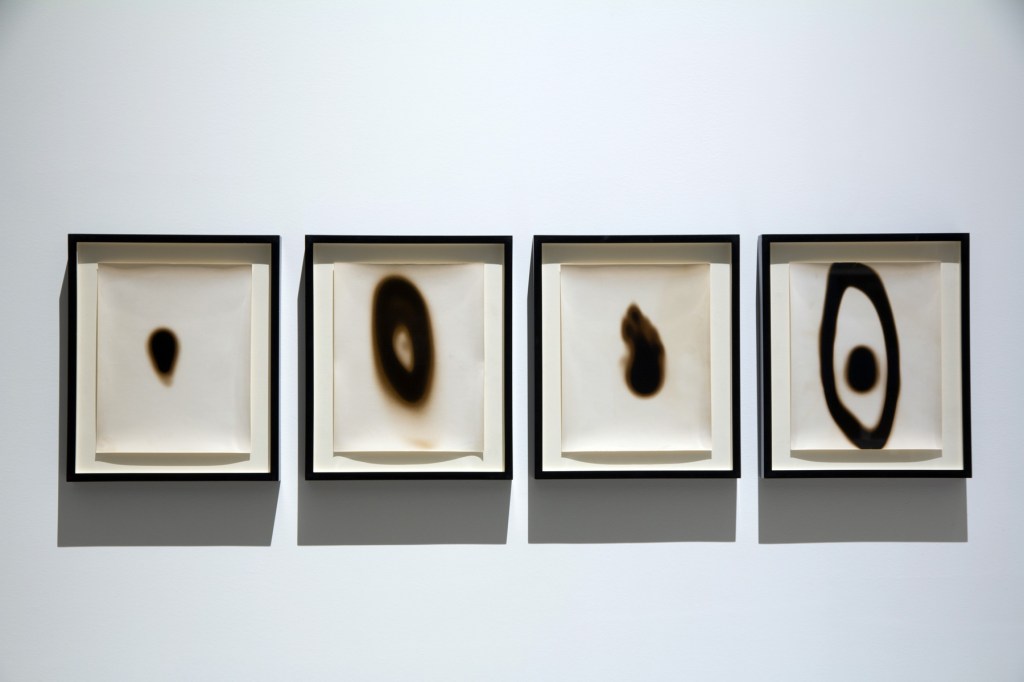
Although raised in Italy, Aldo Tambellini was working in New York in 1969 when he manipulated the cathode ray tube of a TV set into the shape of a spiral (for this artist, a universal sign of energy) and exposed sheets of light-sensitive paper by laying them over its screen. The calligraphic inscriptions that resulted made his paper look as if it had been scorched from the inside out. These ‘videograms,’ as Tambellini called them, highlight the chaos and chance operations that lurk just beneath the surface of technology’s apparent rationality.


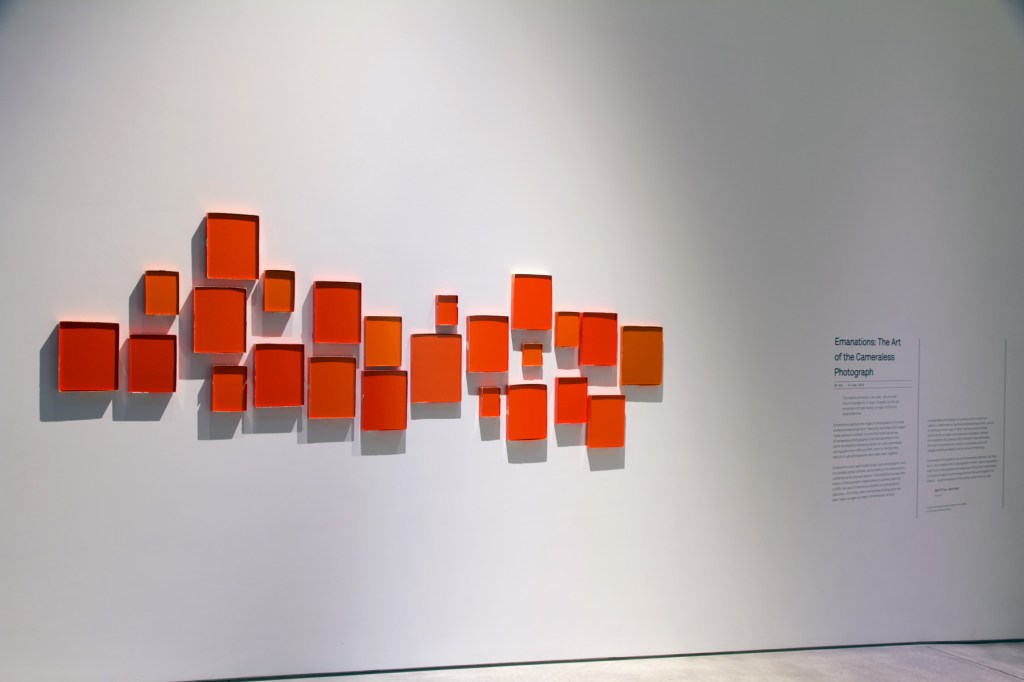
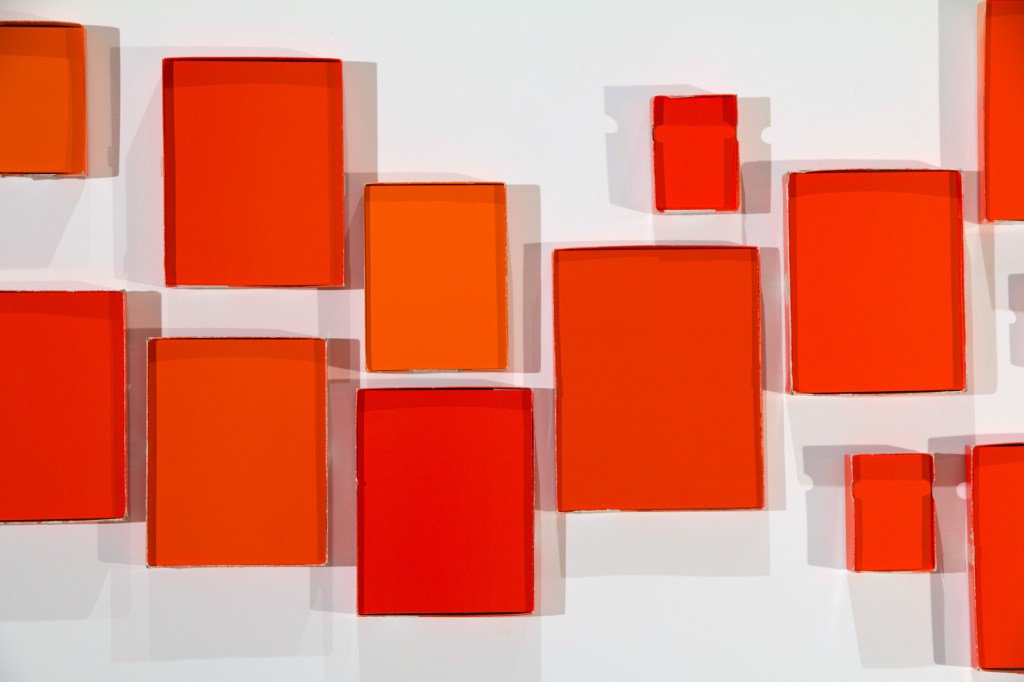
Installation view of Shaun Waugh (New Zealand) 'ΔE2000 1.1' 2014 part of the exhibition of the exhibition 'Emanations: The Art of the Cameraless Photograph' at the Govett-Brewster Art Gallery

Installation view of Shaun Waugh (New Zealand) 'ΔE2000 1.1' 2014 part of the exhibition of the exhibition 'Emanations: The Art of the Cameraless Photograph' at the Govett-Brewster Art Gallery

Installation view of Shaun Waugh (New Zealand) 'ΔE2000 1.1' 2014 part of the exhibition of the exhibition 'Emanations: The Art of the Cameraless Photograph' at the Govett-Brewster Art Gallery


Installation views of
Shaun Waugh (New Zealand, b. 1982)
ΔE2000 1.1
2014
24 Agfa boxes with mounted solid colour inkjet photographs


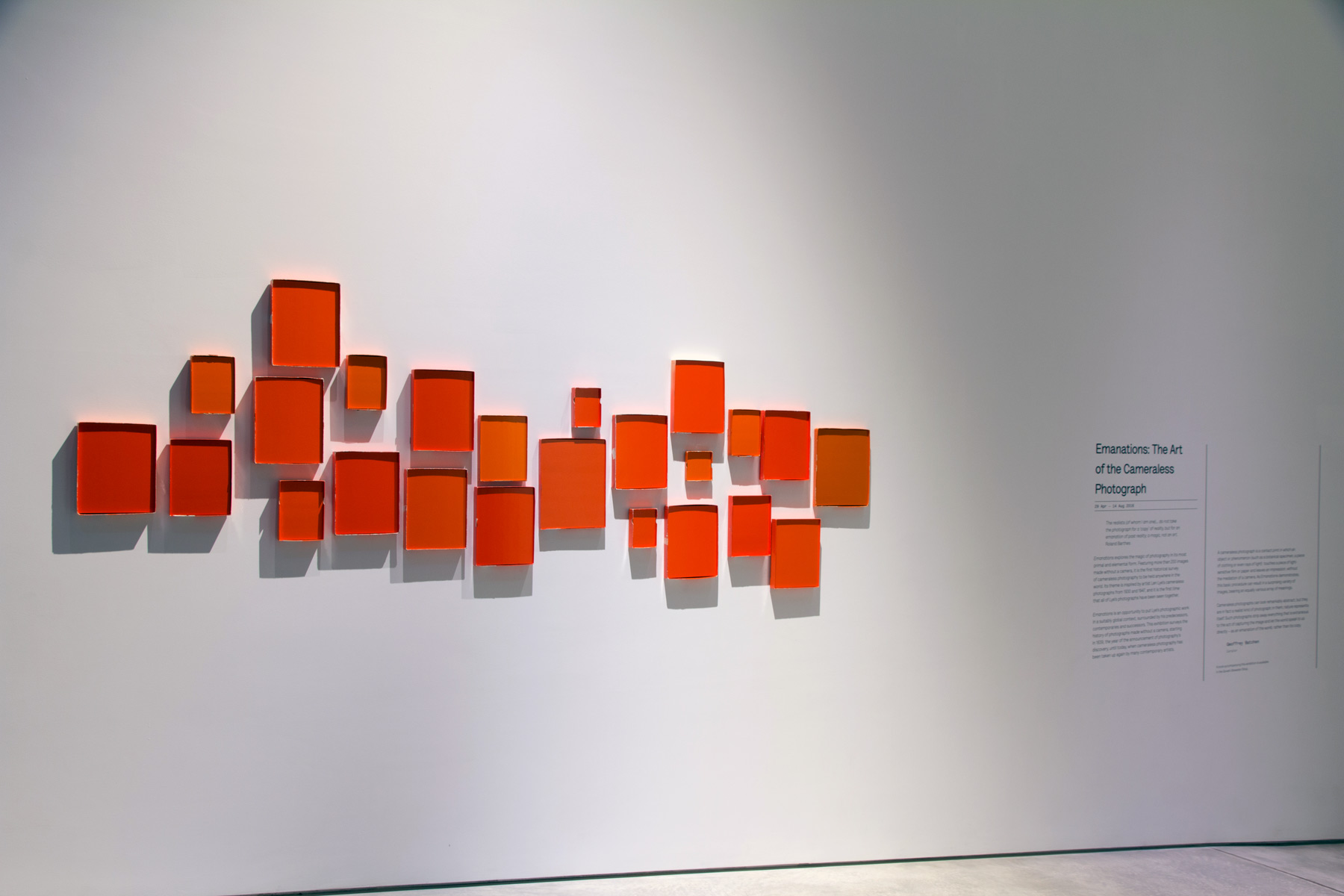
This work by New Zealand artist Shaun Waugh began with the purchase of empty boxes that once held Agfa photographic paper. Waugh then took readings of all four sides of the inside lip of each box lid using a spectrophotometer, employing this data and Photoshop to generate a solid orange-red inkjet print. The box lid is used to frame a two-dimensional version of itself, bringing analogue and digital printing into an uncomfortably close proximity to create a memorial to a kind of photography that is now defunct. Hung salon style, like so many small paintings, Waugh’s work manages to turn the photograph inside out, and thus into something other than itself.


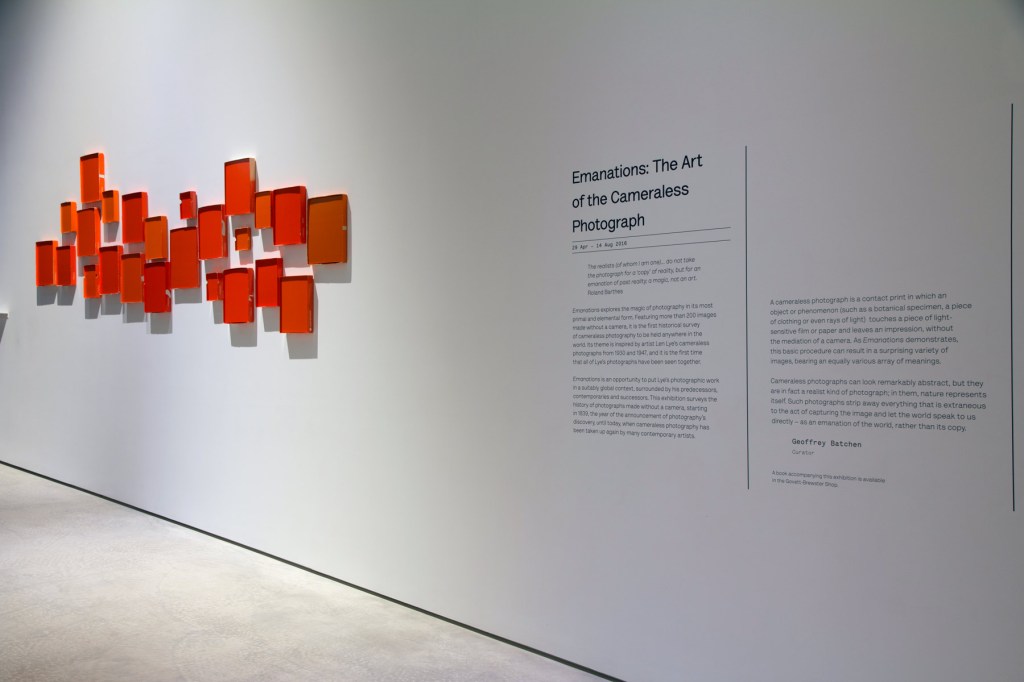
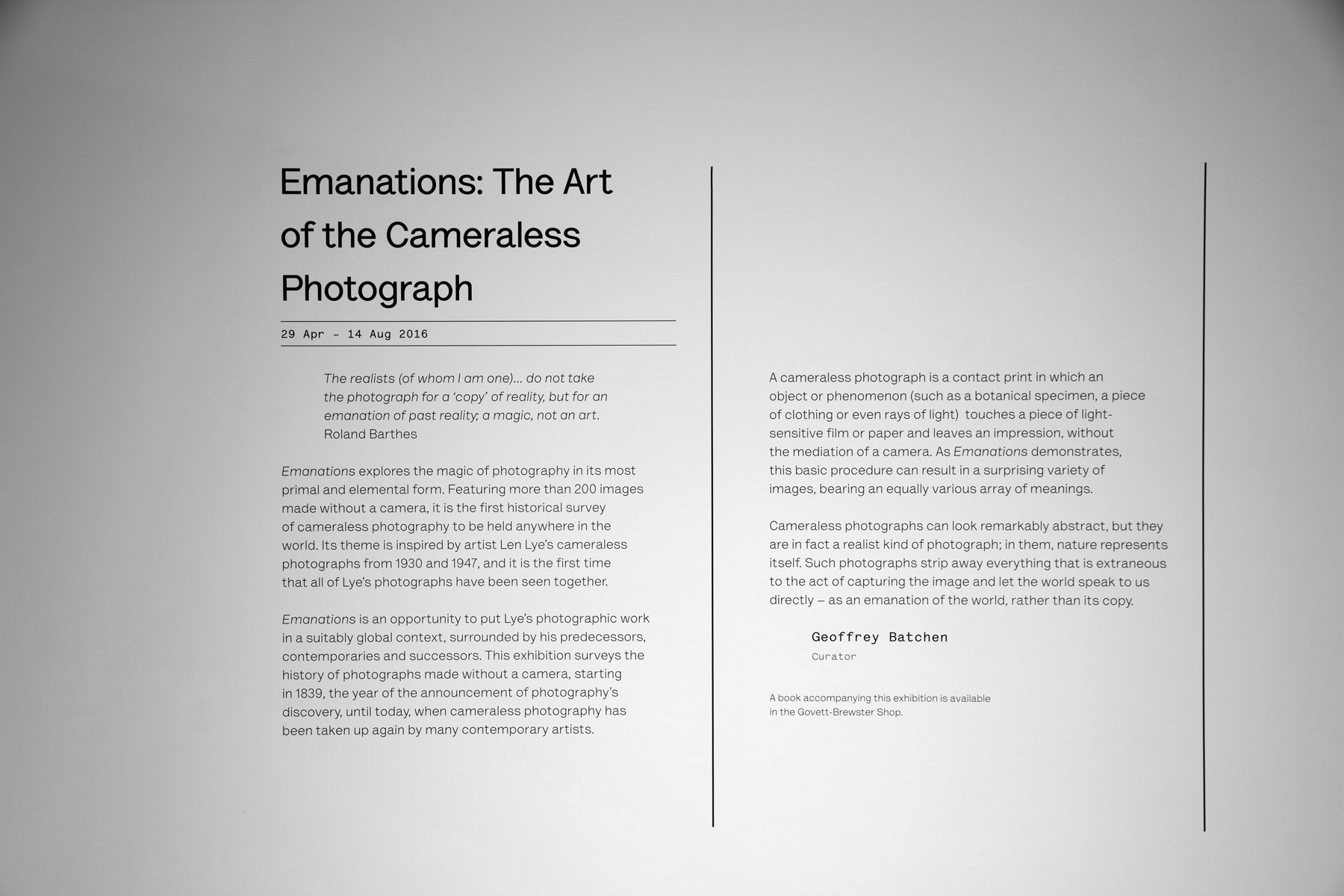
Wall text from the exhibition 'Emanations: The Art of the Cameraless Photograph' at the Govett-Brewster Art Gallery


Wall text from the exhibition Emanations: The Art of the Cameraless Photograph at the Govett-Brewster Art Gallery


Installation view of the exhibition 'Emanations: The Art of the Cameraless Photograph' at the Govett-Brewster Art Gallery with, at left, work by Anne Ferran and, at right, Adam Fuss


Installation view of the exhibition Emanations: The Art of the Cameraless Photograph at the Govett-Brewster Art Gallery with at left, Anne Ferran and at right, Adam Fuss


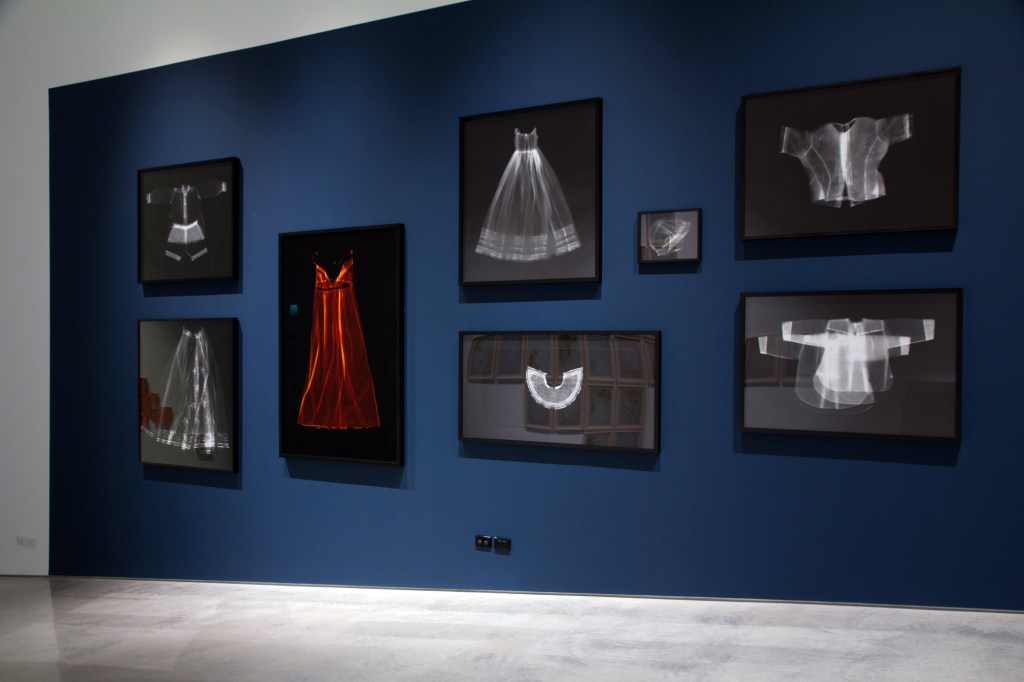
Installation view of the work of Anne Ferran (Australian, b. 1949) Untitled, 1998; Untitled, 1998; Untitled, 1998; Untitled (baby's petticoat), 1998; Untitled (collar), 1998; Untitled (baby's bonnet), 1998; Untitled (sailor suit), 1998; Untitled (shirts), 1998


Installation view of
Anne Ferran (Australian, b. 1949)
Untitled, 1998
Untitled, 1998
Untitled, 1998
Untitled (baby’s petticoat), 1998
Untitled (collar), 1998
Untitled (baby’s bonnet), 1998
Untitled (sailor suit), 1998
Untitled (shirts), 1998

Unique gelatin silver photographs


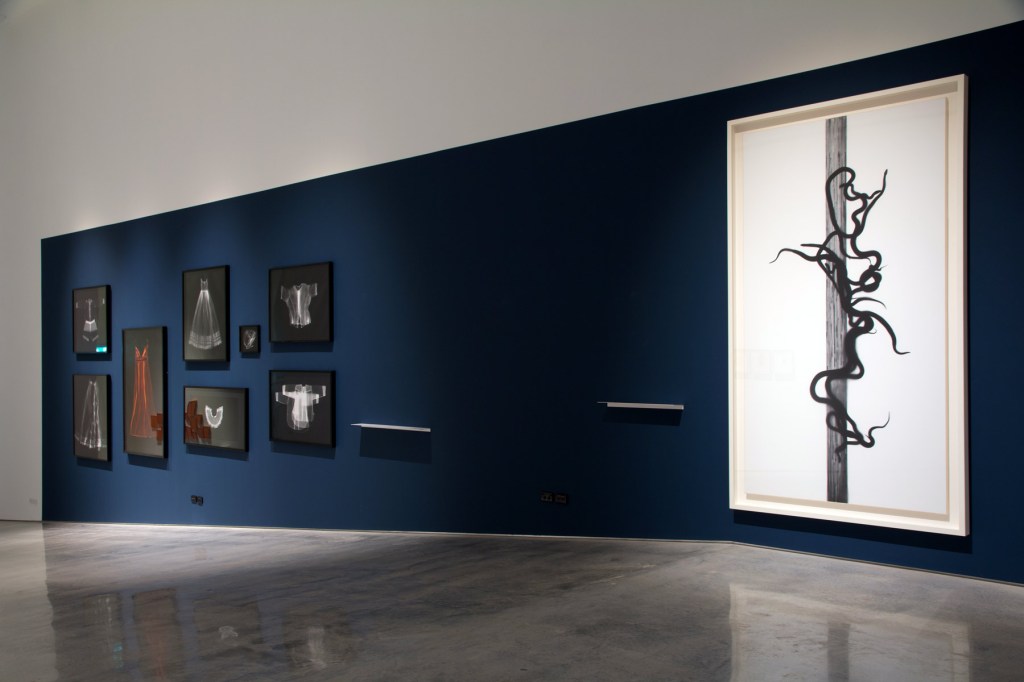
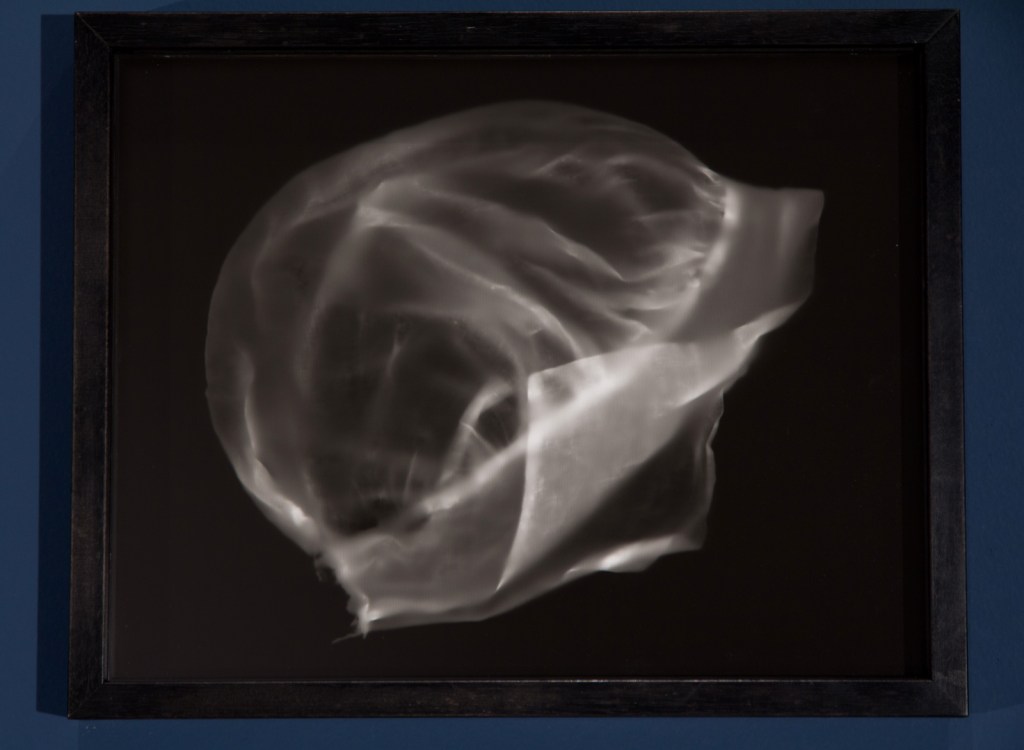
In 1998 Australian artist Anne Ferran was offered an artist-in-resident’s position at an historic homestead not far from Sydney that had been occupied by successive generations of the same family since 1813. Ferran spent six months systematically making contact prints using the dresses, bodices, skirts, petticoats, and collars still contained in the house. Hovering in a surrounding darkness, softly radiating an inner light, the ghostly traces of these translucent garments now act as residual filaments for a century of absorbed sunshine. Many of them have been patched over the years and their signs of wear and repair are made clear. This allows us to witness a history of the use of each piece of clothing, seeing inside them to those small and skilful acts of home economy – the labour of women – usually kept hidden from a public gaze.


Anne Ferran (Australian, b. 1949) 'Untitled (baby's bonnet)' 1998


Anne Ferran (Australian, b. 1949)
Untitled (baby’s bonnet)
1998
Unique gelatin silver photograph


Installation view of the exhibition Emanations: The Art of the Cameraless Photograph at the Govett-Brewster Art Gallery with, at left, work by Adam Fuss and, at right, Lisa Clunie


Installation view of the exhibition Emanations: The Art of the Cameraless Photograph at the Govett-Brewster Art Gallery with at left, Adam Fuss and at right, Lisa Clunie


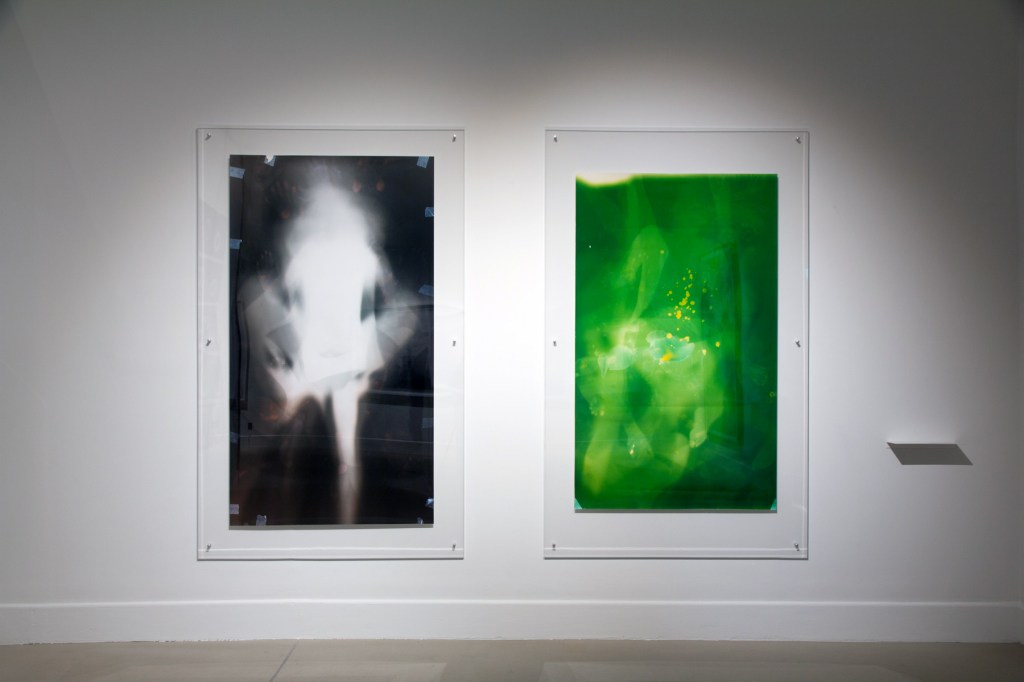
installation view of Adam Fuss (UK/Australia/US) ‘Caduceus’ 2010 (left) and ‘Untitled’ 1991 (right)


Installation view of Adam Fuss (UK/Australia/US) Caduceus 2010 (left) and Untitled 1991 (right)


Born in England, raised in Australia, and resident in New York, Adam Fuss has produced a diverse range of large cameraless photographs since the 1980s, asking his light-sensitive paper to respond to the physical presence of such phenomena as light, water, a slithering snake, flocks of birds, and sunflowers.


Adam Fuss (British, b. 1961) 'Untitled' 1991 from the exhibition 'Emanations: The Art of the Cameraless Photograph' at the Govett-Brewster Art Gallery/Len Lye Centre, New Plymouth, New Zealand, April - August, 2016


Adam Fuss (British, b. 1961)
Untitled
1991
Type C photograph


Lisa Clunie (New Zealand) ‘Fold I’ 2014 from the exhibition 'Emanations: The Art of the Cameraless Photograph' at the Govett-Brewster Art Gallery/Len Lye Centre, New Plymouth, New Zealand, April - August, 2016


Lisa Clunie (New Zealand)
Fold I
2014
Silver gelatin photograph


The work of New Zealand artist Lisa Clunie looks back to the work of pioneer modernist László Moholy-Nagy in order to manifest the idea that our lives are shaped by a continual play of forces. Like Moholy, she wets her photographic paper and then tightly folds it, before moving the paper back and forth under her enlarger, selectively exposing these folds to the ‘force’ of light. The resulting work reminds us that a photograph has weight, surface, texture, tension and edges.


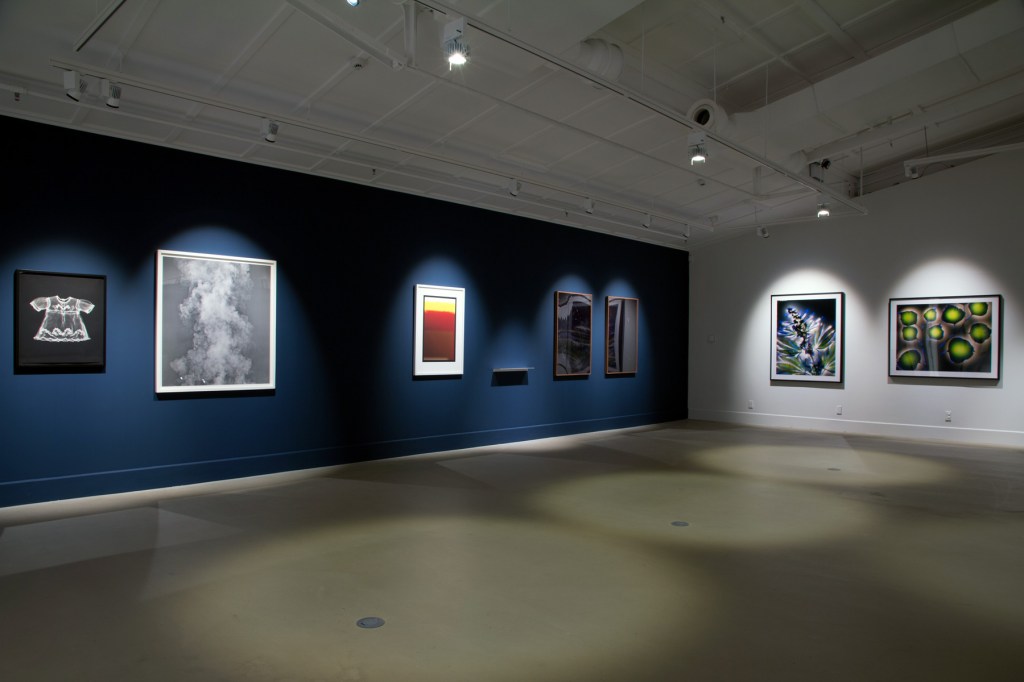
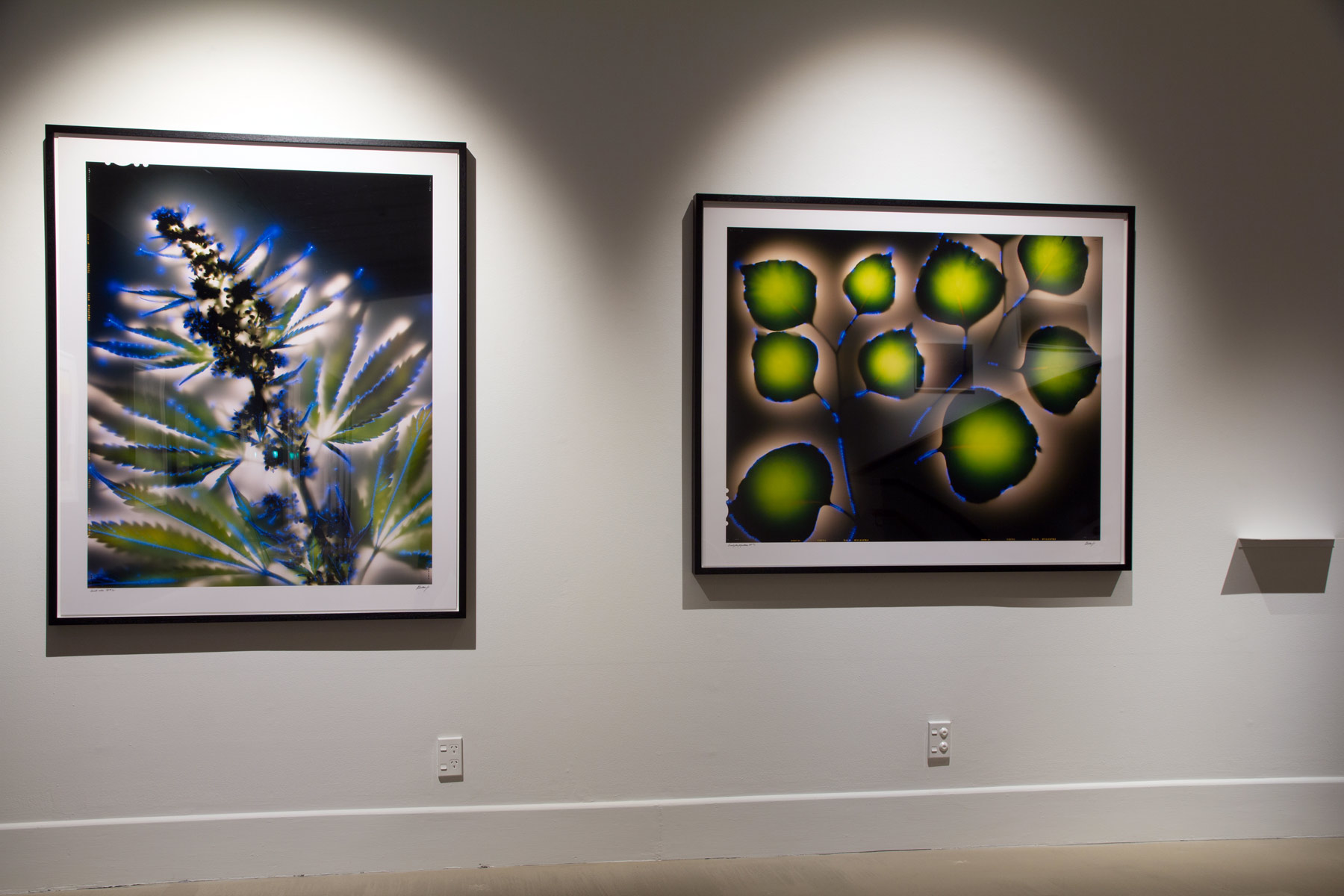
Installation view of the exhibition 'Emanations: The Art of the Cameraless Photograph' at the Govett-Brewster Art Gallery with at right, the work of Robert L. Buelteman


Installation view of the exhibition Emanations: The Art of the Cameraless Photograph at the Govett-Brewster Art Gallery with at right, the work of Robert L. Buelteman


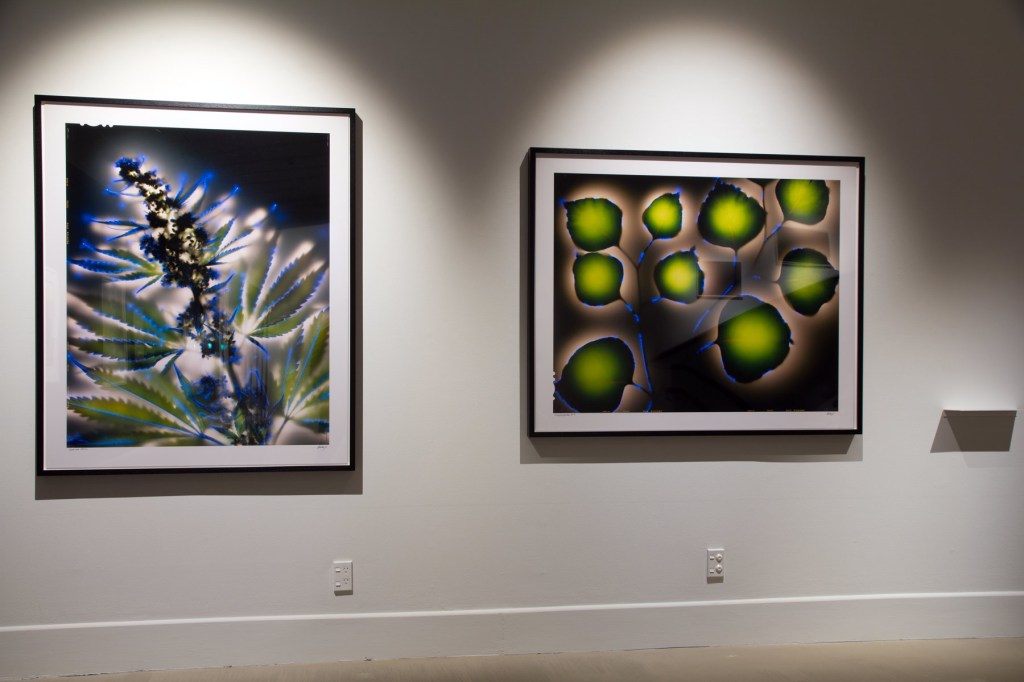
Installation view of Robert L. Buelteman (American, b. 1954) ‘Cannabis sativa’ 2002 (left) and ‘Eucalyptus polyanthemos’ 2000 (right)


Installation view of
Robert L. Buelteman (American, b. 1954)
Cannabis sativa (left)
2002
Digital chromogenic development photograph

Robert L. Buelteman (American, b. 1954)
Eucalyptus polyanthemos (right)
2002
Digital chromogenic development photograph


The San-Franciscan artist Robert Buelteman takes his leaves and other botanical specimens and slices them into paper-thin sections, before charging them, in a complicated and dangerous process, with a pulse of 40,000 volts of electricity. This leaves behind a colorised trace on his photographic paper, a photogram in which these plants appear to be aflame, as if emitting an energy all their own. Hovering between life and death, this is a nature that seems to be on the cusp of its transmutation into something else entirely.


Installation view of the exhibition Emanations: The Art of the Cameraless Photograph at the Govett-Brewster Art Gallery with at centre, the work of Robert Owen and at right, Joan Fontcuberta


Installation view of the exhibition Emanations: The Art of the Cameraless Photograph at the Govett-Brewster Art Gallery with at centre, Robert Owen and at right, Joan Fontcuberta


Robert Owen (Australian, b. 1937) ‘Endings (Rothko died today) – Kodachrome 64, No. 21, 26/02/1970’ 2009


Robert Owen (Australian, b. 1937)
Endings (Rothko died today) – Kodachrome 64, No. 21, 26/02/1970
2009
Pigment ink-jet print


The photographic work of Australian artist Robert Owen is part of a broader tendency on the part of contemporary artists to reflect in morbid terms on aspects of photography’s past. Owen has been collecting film stubs since 1968. Although better known as a painter and sculptor, he recently decided to print these end strips of film as a series of large colour photographs, paying homage to this residue of the Kodak era in a chronological sequence of readymade chromatic fields. This one was collected on the day that the American abstract painter Mark Rothko killed himself.


Adam Fuss (British, b. 1961) 'Untitled' (from the series 'My Ghost') 2001


Adam Fuss (British, b. 1961)
Untitled (from the series My Ghost)
2001
Unique gelatin silver photograph


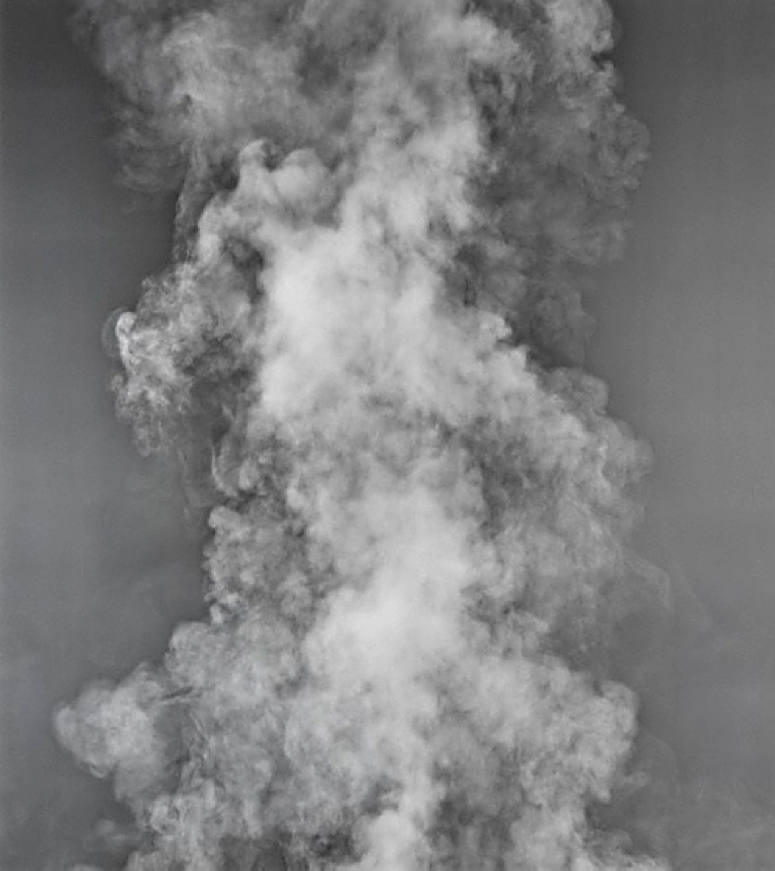
In his series, titled My Ghost, Adam Fuss put together a body of contact photographs of such things as plumes of smoke, patterns of light, a butterfly, a swan and a baptism dress. As his title suggests, Fuss’s work aims to evoke rather than describe; for all their evident tactility, these photographs are meant as metaphors, as prayers, perhaps even as poems.


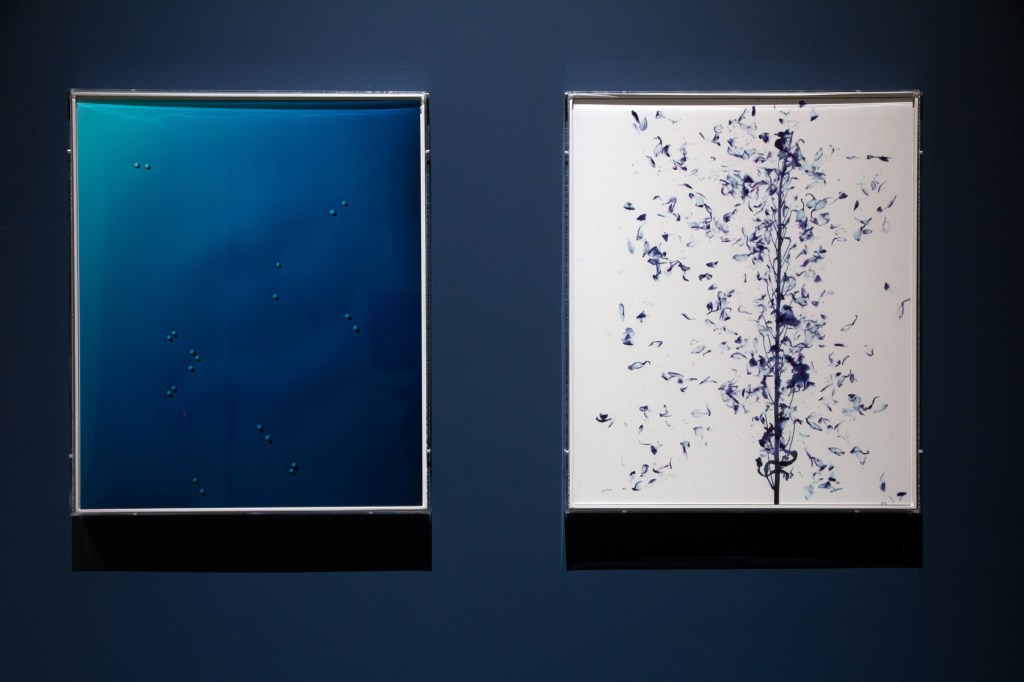
Adam Fuss (British, b. 1961) both 'Untitled' 1989


Installation view of
Adam Fuss (British, b. 1961)
Untitled
1989
Cibachrome photograph

Adam Fuss (British, b. 1961)
Untitled
1989
Cibachrome photograph


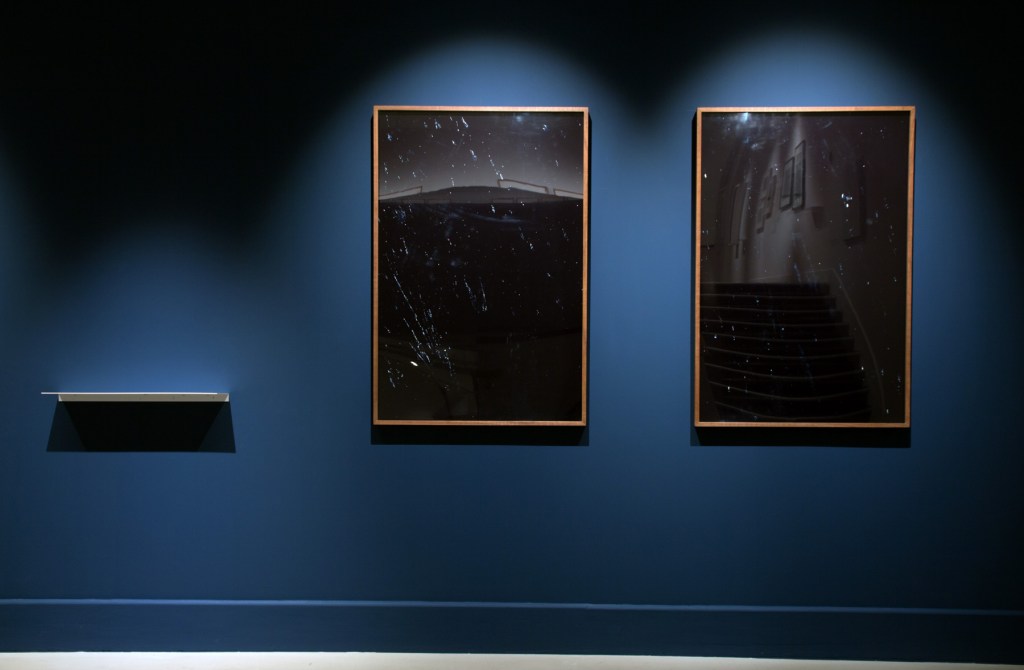
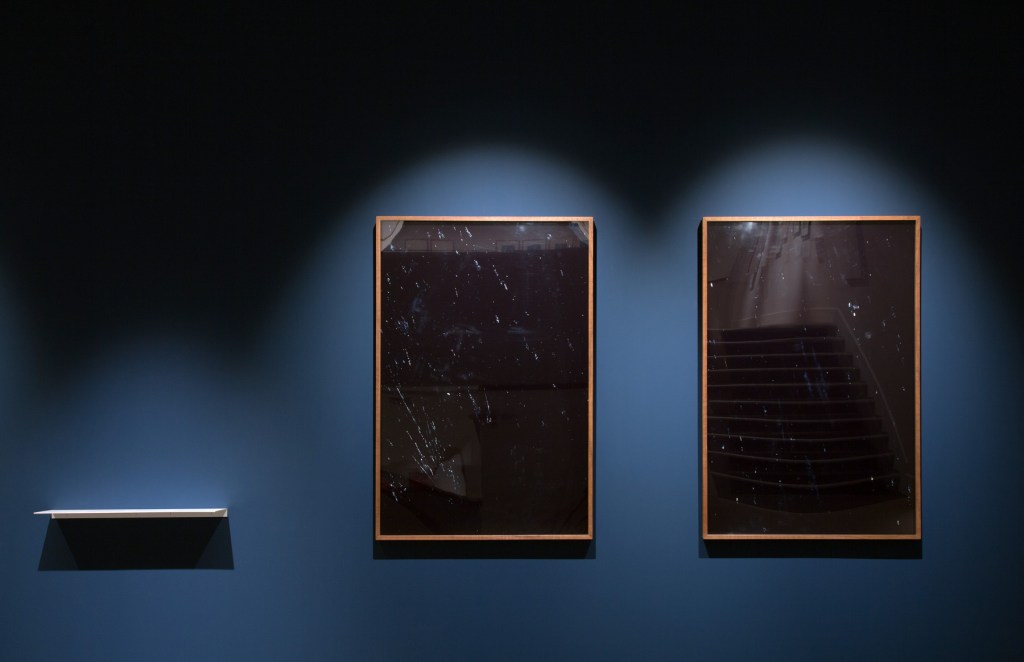
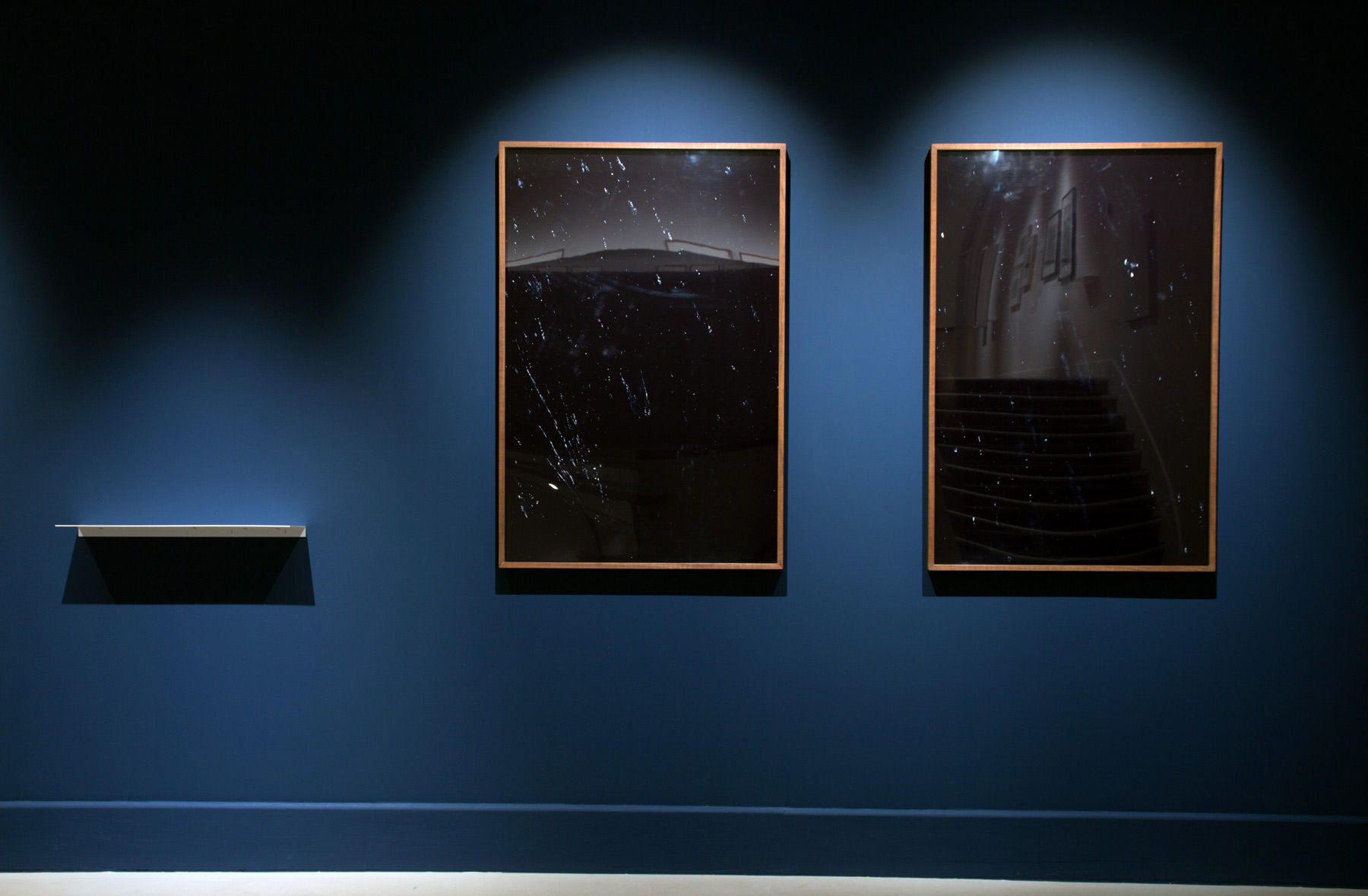
Installation view of Joan Fontcuberta (Spain). ‘MN 62: OPHIUCUS (NGC 6266), AR 17 h. 01,2 min. / D -30º 07’’ (left) and ‘LAMBDA CORONAE AUSTRALIS (Mags 5,1/9,7 Sepn 29,2" AP 214º), AR 18 h 43,8 min. / D -38º 19’’ (right) both 1993

Installation view of Joan Fontcuberta (Spanish, b. 1955) ‘MN 62: OPHIUCUS (NGC 6266), AR 17 h. 01,2 min. / D -30º 07’’ (left) and ‘LAMBDA CORONAE AUSTRALIS (Mags 5,1/9,7 Sepn 29,2" AP 214º), AR 18 h 43,8 min. / D -38º 19’’ (right) both 1993


Installation views of
Joan Fontcuberta (Spanish, b. 1955)
MN 62: OPHIUCUS (NGC 6266), AR 17 h. 01,2 min. / D -30º 07′ (left)
LAMBDA CORONAE AUSTRALIS (Mags 5,1/9,7 Sepn 29,2″ AP 214º), AR 18 h 43,8 min. / D -38º 19′ (right)
both 1993
From the Constellations series
Cibachrome photographs


Photographs from the Constellations series by Spanish artist Joan Fontcuberta come filled with fields of sparkling blackness, their speckled surfaces redolent of infinite space and twinkling stars. Their titles imply we are looking upwards towards the heavens. But this artist’s prints actually record dust, crushed insects and other debris deposited on the windscreen of his car, a trace of the evidence of his own rapid passage through terrestrial space and time. The artist applied sheets of 8-by-10-inch film directly onto the glass windscreen and shone a light through, creating photograms which were then made into glossy Cibachrome prints.


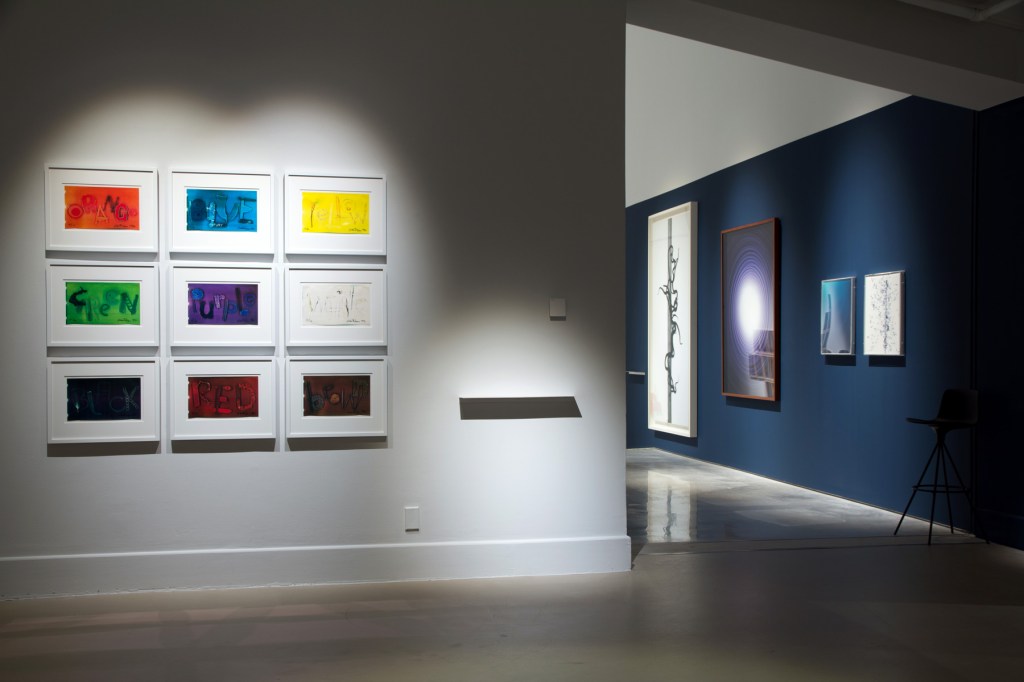
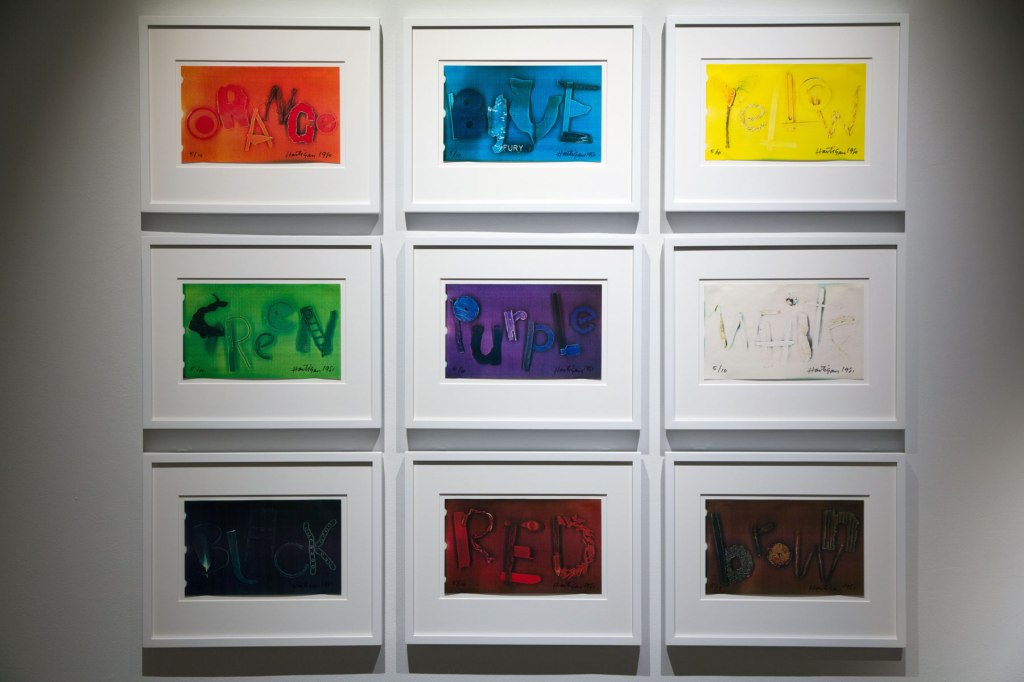
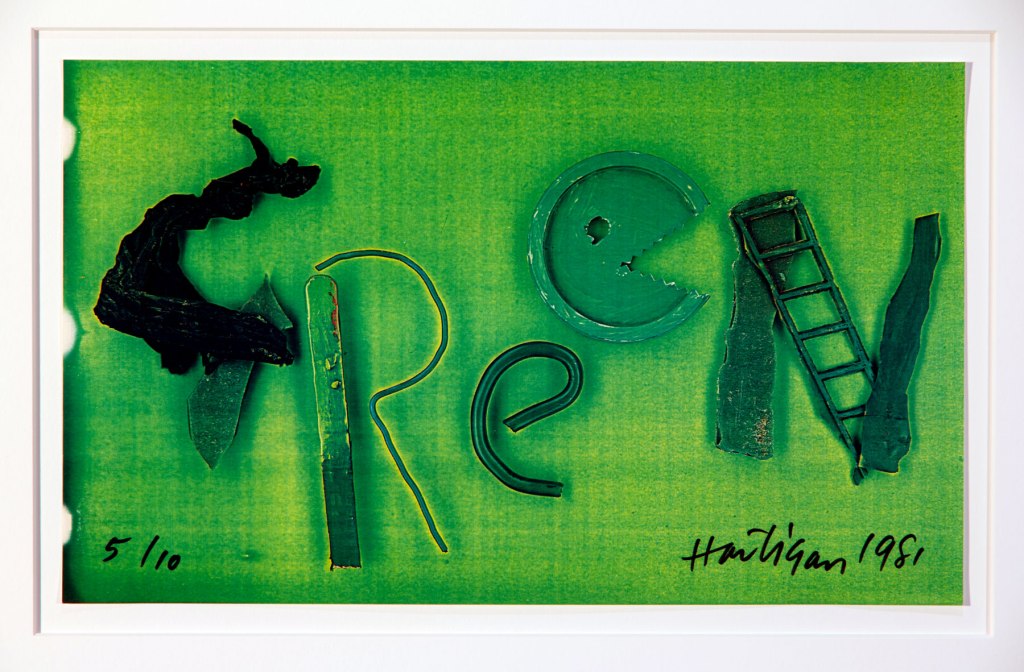
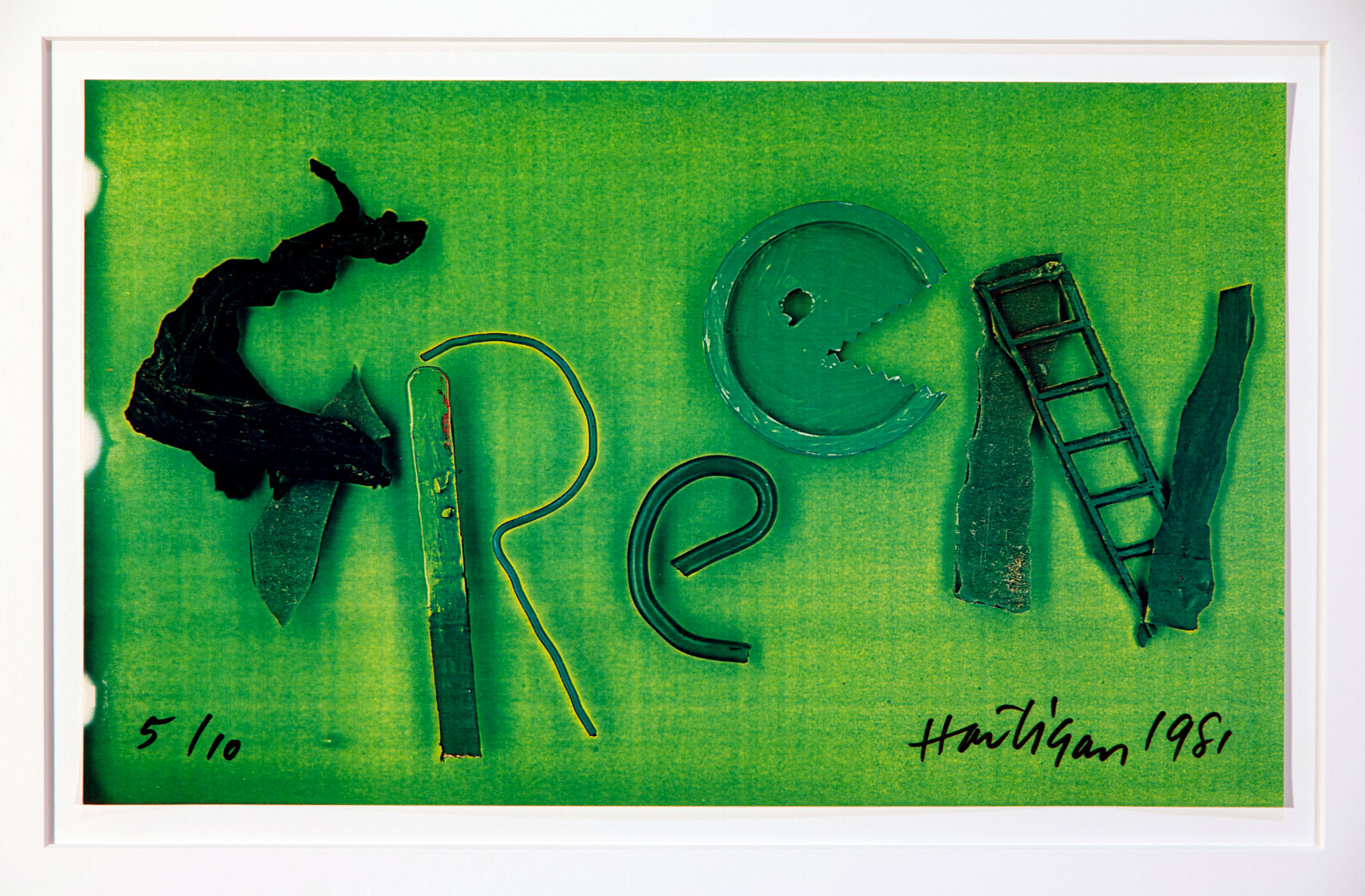
Installation view of Paul Hartigan (New Zealand) 'Colourwords' 1980-1981 as part of the exhibition 'Emanations: The Art of the Cameraless Photograph' at the Govett-Brewster Art Gallery

Installation view of Paul Hartigan (New Zealand) 'Colourwords' 1980-1981 as part of the exhibition 'Emanations: The Art of the Cameraless Photograph' at the Govett-Brewster Art Gallery

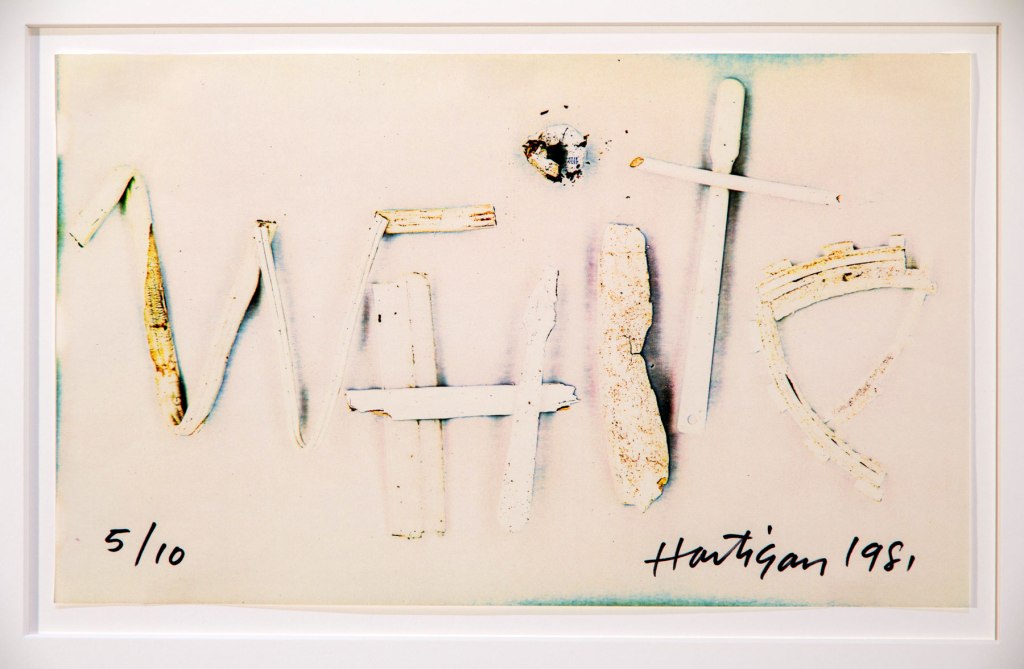
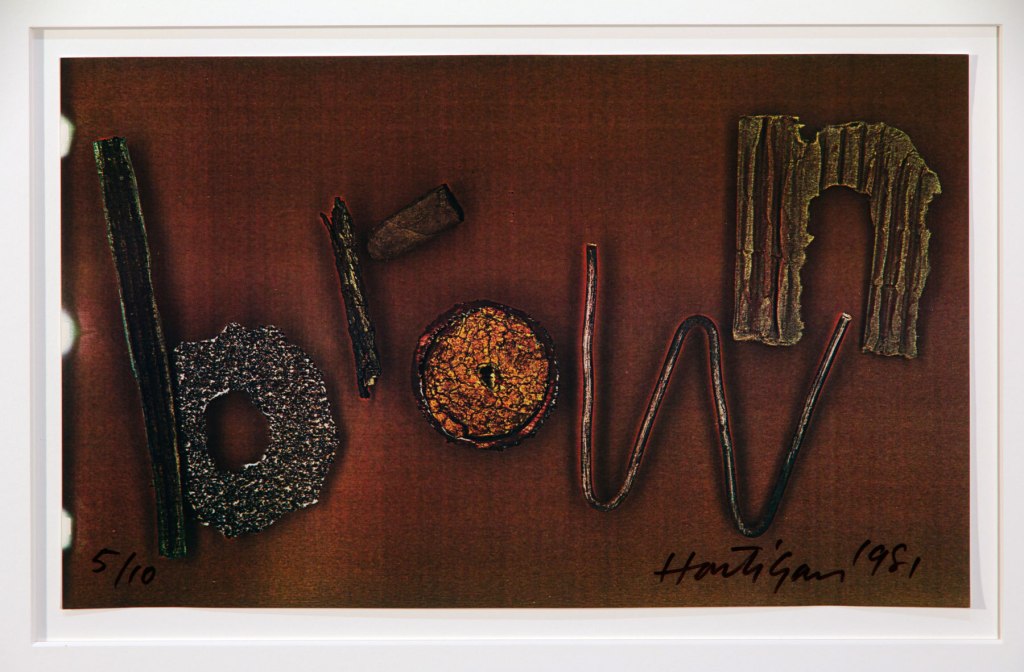
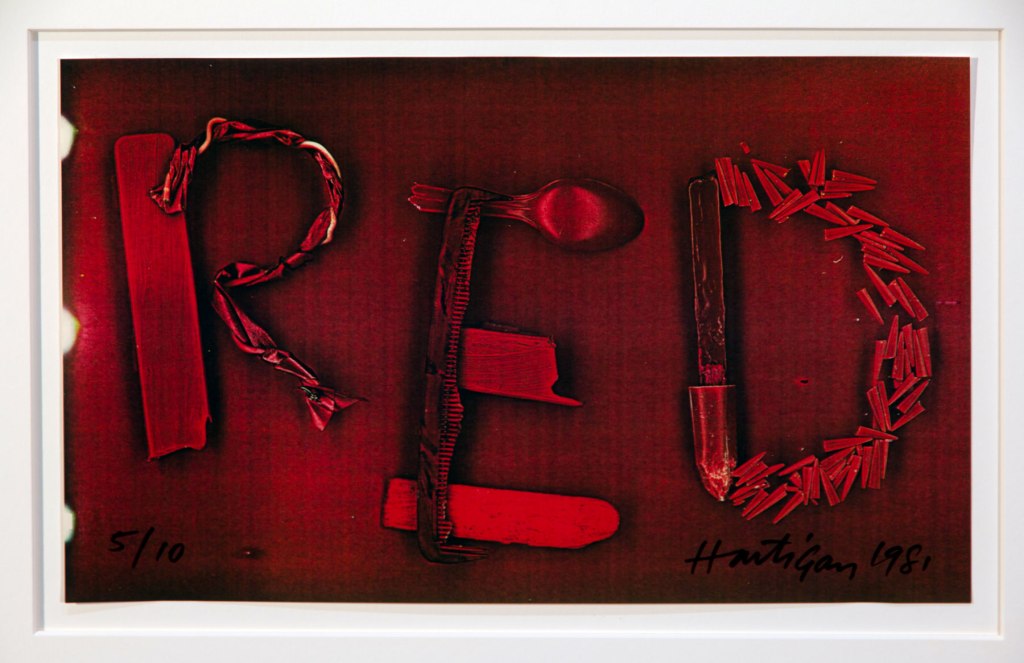
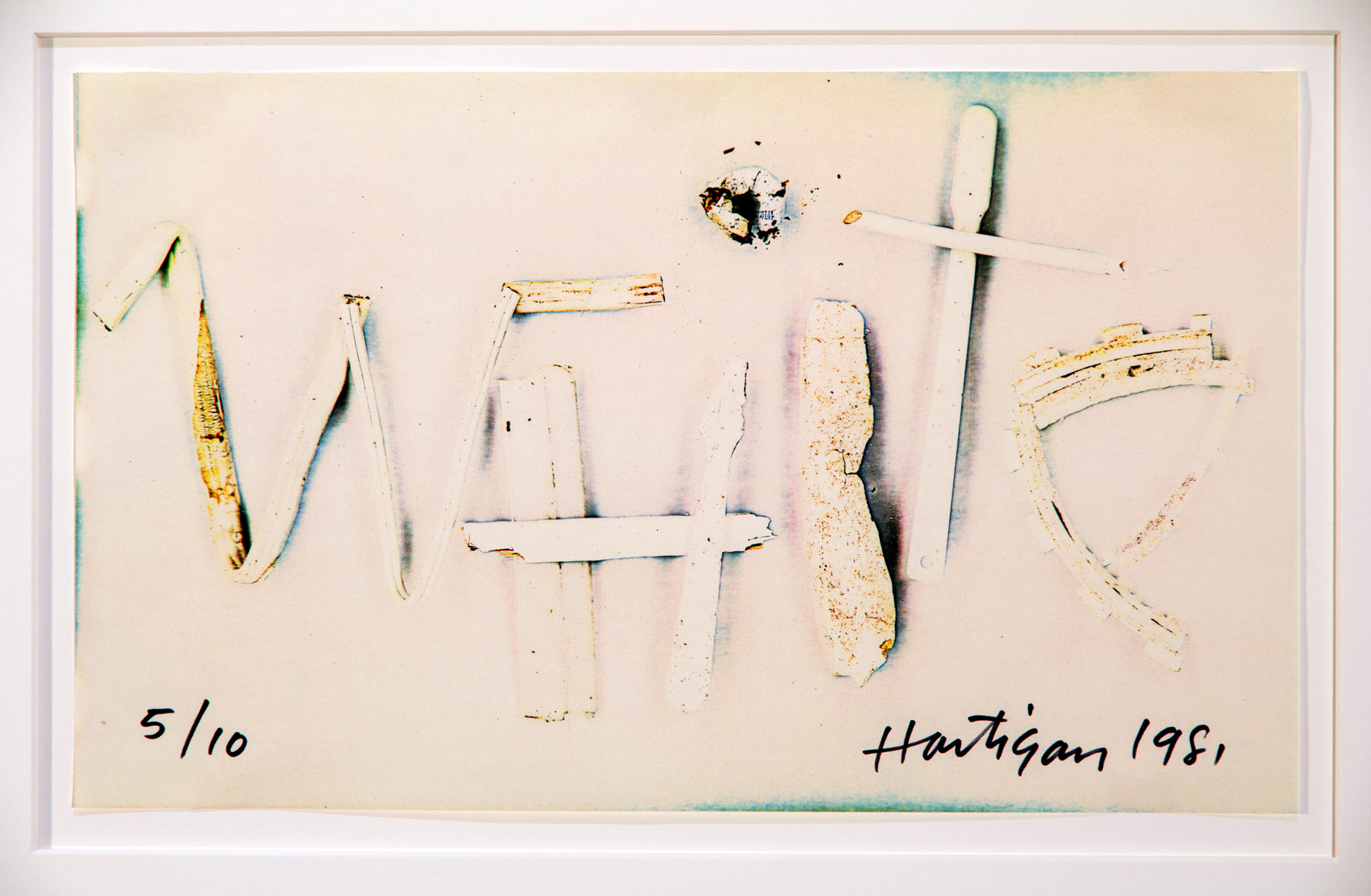
Detail of Paul Hartigan (New Zealand, b. 1939) 'Colourwords' 1980-1981 as part of the exhibition 'Emanations: The Art of the Cameraless Photograph' at the Govett-Brewster Art Gallery

Detail of Paul Hartigan (New Zealand, b. 1939) 'Colourwords' 1980-1981 as part of the exhibition 'Emanations: The Art of the Cameraless Photograph' at the Govett-Brewster Art Gallery

Detail of Paul Hartigan (New Zealand, b. 1939) 'Colourwords' 1980-1981 as part of the exhibition 'Emanations: The Art of the Cameraless Photograph' at the Govett-Brewster Art Gallery

Detail of Paul Hartigan (New Zealand, b. 1939) 'Colourwords' 1980-1981 as part of the exhibition 'Emanations: The Art of the Cameraless Photograph' at the Govett-Brewster Art Gallery

Detail of Paul Hartigan (New Zealand, b. 1939) 'Colourwords' 1980-1981 as part of the exhibition 'Emanations: The Art of the Cameraless Photograph' at the Govett-Brewster Art Gallery


Installation views and detail of
Paul Hartigan (New Zealand, b. 1939)
Colourwords
1980-1981
Colour photocopy


Consistently defined by a subversive edge and a darkly witty humour, the work of New Zealand artist Paul Hartigan is often subtly permeated by astute social and political perceptions. Shortly after they were introduced into New Zealand in 1980, Hartigan explored the creative possibilities of a colour photocopying machine, making a series of images in which words and found objects ironically refer to each other in an endless loop. With the objects arranged to spell out their own colour, each picture offers an oscillation of word and meaning, flatness and dimension, art and detritus.


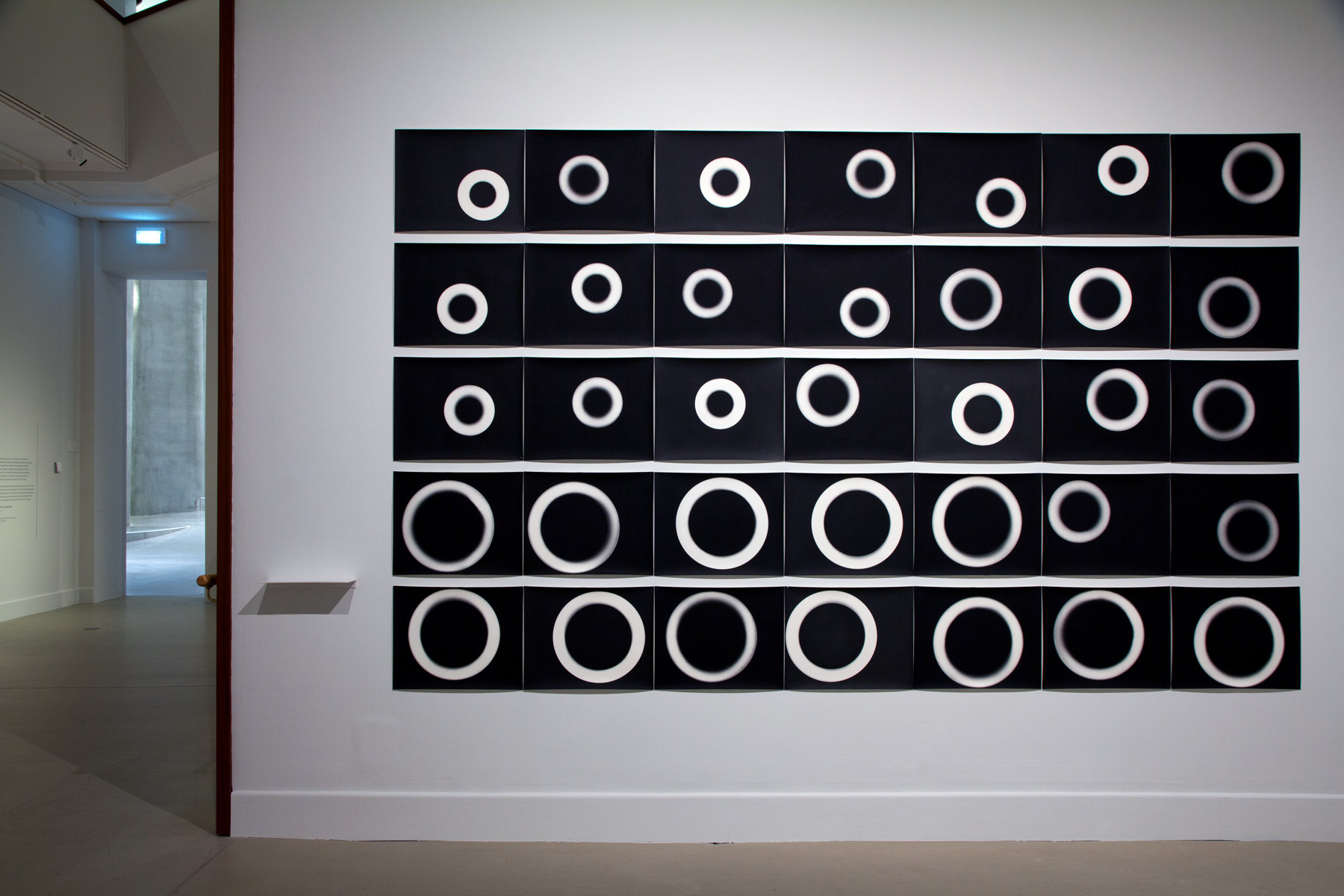
Installation view of Gavin Hipkins (New Zealand) ‘The Coil’ 1998 (left) and Lucinda Eva-May as part of the exhibition 'Emanations: The Art of the Cameraless Photograph' at the Govett-Brewster Art Gallery


Installation view of Gavin Hipkins (left) and Lucinda Eva-May (right) as part of the exhibition Emanations: The Art of the Cameraless Photograph at the Govett-Brewster Art Gallery


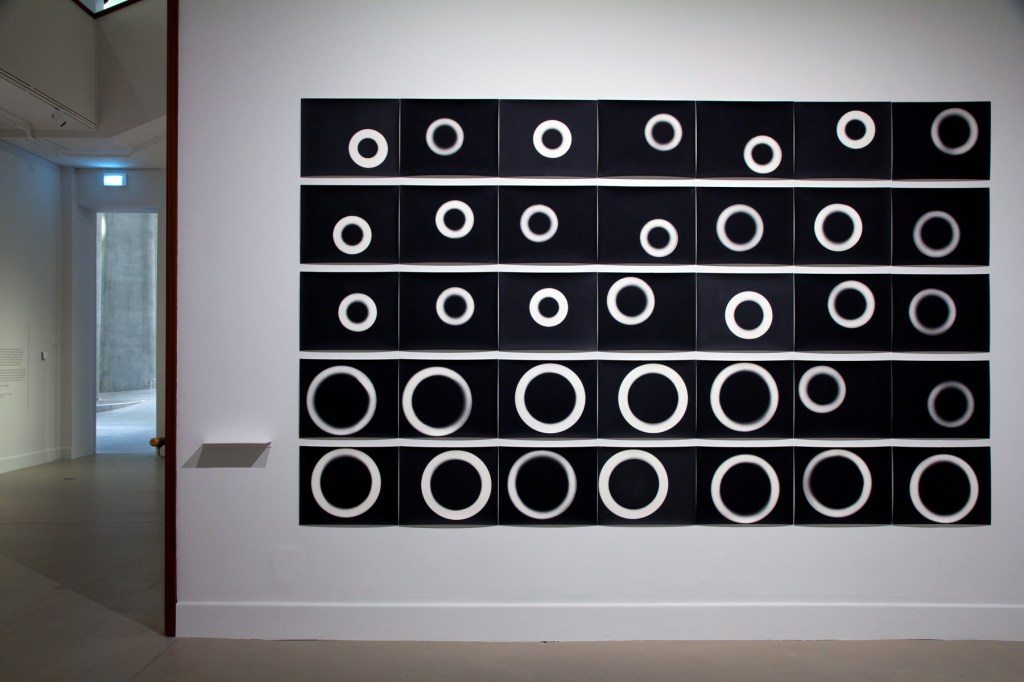
Installation view of Gavin Hipkins (New Zealand, b. 1968) ‘The Coil’ 1998


Installation view of
Gavin Hipkins (New Zealand, b. 1968)
The Coil
1998
Silver gelatin photographs


Inspired by the kinetic films of Len Lye, in the 1990s Gavin Hipkins made a series of cameraless photographs that play with sequence and implied movement. The 32 images that make up The Coil were made by resting polystyrene rings on sheets of photographic paper and then exposing them to light.


Installation view of Lucinda Eva-May (Australia) 'Unity in light #6' 2012 (left) 'Unity in light #9' 2012 (right)


Installation view of
Lucinda Eva-May (Australia)
Unity in light #6, 2012 (left)
Unity in light #9, 2012 (right)
C-type prints


Australian artist Lucinda Kennedy has sought to capture a phenomenological representation of the feelings and sensations of sexual intercourse through the direct imprint on sheets of photographic paper of this most primal of human interactions. Turned into a single blurred organism by the extended duration of the exposure, the artist and her partner become an abstraction, thereby aptly conjuring an experience that has always been beyond the capacity of mere description.


Installation view of the exhibition 'Emanations: The Art of the Cameraless Photograph' at the Govett-Brewster Art Gallery with at left, the work of Thomas Ruff, and at right, Justine Varga


Installation view of the exhibition Emanations: The Art of the Cameraless Photograph at the Govett-Brewster Art Gallery with at left, Thomas Ruff, and at right, Justine Varga


Installation view of Thomas Ruff (Germany, b. 1958) 'r.phg.07_II' 2013

Installation view of Thomas Ruff (Germany, b. 1958) 'r.phg.07_II' 2013


Installation views of
Thomas Ruff (Germany, b. 1958)
r.phg.07_II
2013
Chromogenic print


Thomas Ruff (Germany, b. 1958) 'r.phg.07_II' 2013


Thomas Ruff (Germany, b. 1958)
r.phg.07_II
2013
Chromogenic print


German artist Thomas Ruff uses his computers to construct virtual objects with simulated surfaces and to calculate the lights and shadows they might cast in different compositions. He then prints the results, in colour and at very large scale. Combining variations of spheres, curves, zig-zags and sharp edges, all set within richly coloured surrounds, Ruff’s images are both untethered abstractions and historical ciphers. Although referred to by the artist as photograms, the final prints are perhaps better conceived as being about the photogram, studiously replaying an analogue process in digital terms so as to make a spectacle of its logic.


Installation view of the exhibition 'Emanations: The Art of the Cameraless Photograph' at the Govett-Brewster Art Gallery with at left, Shimpei Takeda and at right, Justine Varga

Installation view of the exhibition 'Emanations: The Art of the Cameraless Photograph' at the Govett-Brewster Art Gallery


Installation view of the exhibition Emanations: The Art of the Cameraless Photograph at the Govett-Brewster Art Gallery with at left, Shimpei Takeda and at right, Justine Varga


Justine Varga (Australian, b. 1984) 'Exit (Red State)' 2014-2015


Justine Varga (Australian, b. 1984)
Exit (Red State)
2014-2015
Chromogenic photograph


Justine Varga (Australian, b. 1984) 'Desklamp' 2011-2012


Justine Varga (Australian, b. 1984)
Desklamp
2011-2012
Chromogenic photograph


Australian artist Justine Varga creates photographic works from an intimate and often prolonged exchange between a strip of film and the world that comes to be inscribed on it. Desklamp involved the year-long exposure of a large format negative placed on top of the artist’s desk lamp. Exit was derived from a similar piece of film that was scarred and weathered during a three-month exposure on her windowsill during a residency in London. Both were then turned into luscious colour photographs in the darkroom via various printing procedures.


Govett-Brewster Art Gallery/Len Lye Centre
Queen St, New Plymouth, New Zealand
Phone: +64 6 759 6060
Email: info@govettbrewster.com

Opening hours:
Daily 10am – 5pm

Govett-Brewster Art Gallery/Len Lye Centre website

LIKE ART BLART ON FACEBOOK

Back to top

Exhibition: ‘Sight Reading: Photography and the Legible World’ at the Morgan Library & Museum, New York

Exhibition dates: 19th February – 30th May, 2016

Co-curators: Joel Smith, the Morgan’s Richard L. Menschel Curator and Department Head of Photography, and Lisa Hostetler, Curator in Charge of Photography at the Eastman Museum


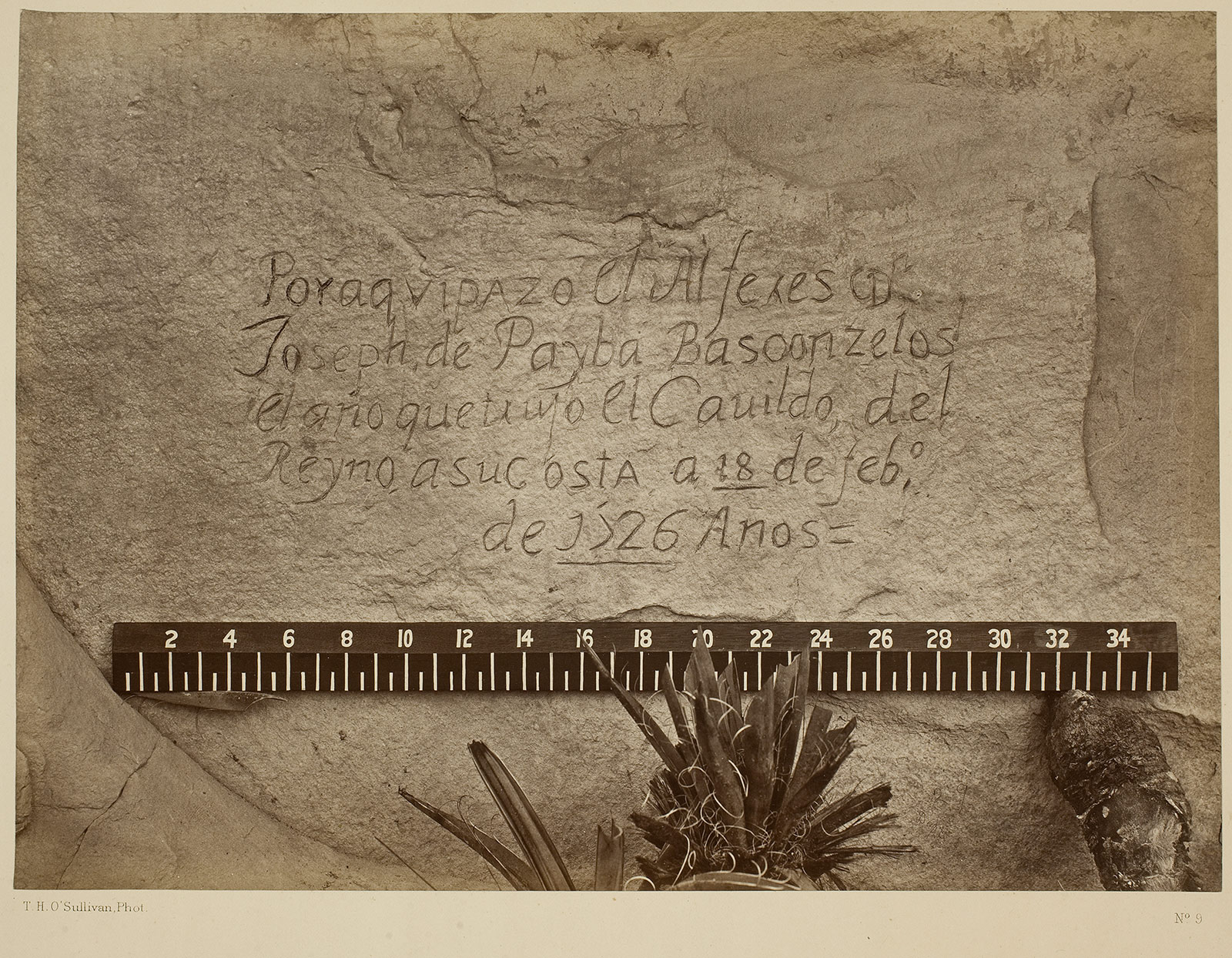
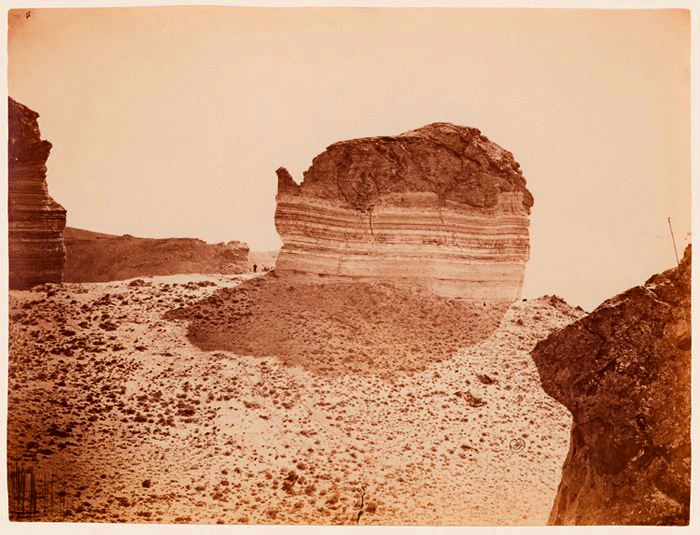
Timothy H. O'Sullivan (American born Ireland, 1840-1882) 'Historic Spanish Record of the Conquest, South Side of Inscription Rock' 1873 from the exhibition 'Sight Reading: Photography and the Legible World' at the Morgan Library & Museum, New York, Feb - May, 2016


Timothy H. O’Sullivan (American born Ireland, 1840-1882)
Historic Spanish Record of the Conquest, South Side of Inscription Rock
1873
From the album Geographical Explorations and Surveys West of the 100th Meridian
Albumen silver print
George Eastman Museum, purchase


In 1873 O’Sullivan joined Lieutenant George Wheeler’s Geographic Survey in New Mexico and Arizona. At El Morro, a sandstone promontory covered with ancient petroglyphs and historic-era inscriptions, the photographer singled out this handsomely lettered sentence to record and measure. It states: By this place passed Ensign Don Joseph de Payba Basconzelos, in the year in which he held the Council of the Kingdom at his expense, on the 18th of February, in the year 1726. Nearby, the rock record now bears another inscription that reads T. H. O’Sullivan.


This looks to be a fascinating exhibition. I wish I could see it.

While Sight Reading cuts across conventional historical and geographic divisions, with the exhibition being organised into nine “conversations” among diverse sets of works, we must always remember that these “themes” are not exclusory to each other. Photographs do cross nominally defined boundaries and themes (as defined by history and curators) so that they can become truly subversive works of art.

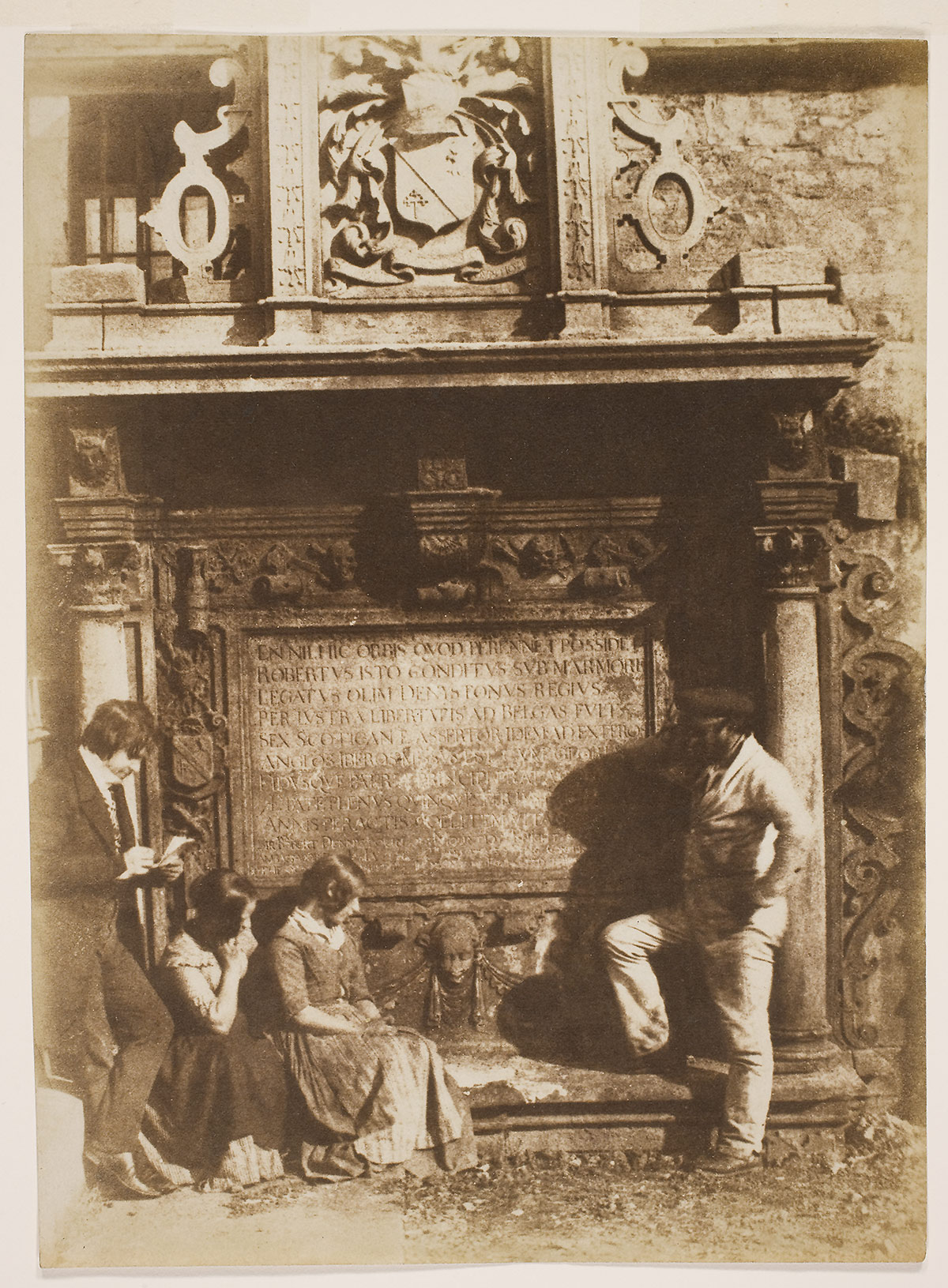
Photographs can form spaces called heterotopia, “a form of concept in human geography elaborated by philosopher Michel Foucault, to describe places and spaces that function in non-hegemonic conditions. These are spaces of otherness, which are neither here nor there, that are simultaneously physical and mental, such as the space of a phone call or the moment when you see yourself in the mirror… Foucault uses the term “heterotopia” (French: hétérotopie) to describe spaces that have more layers of meaning or relationships to other places than immediately meet the eye.”1

In photographs, there is always more than meets the eye. There is the association of the photograph to multiple places and spaces (the histories of that place and space); the imagination of the viewer and the memories they bring to any encounter with a photograph, which may change from time to time, from look to look, from viewing to viewing; and the transcendence of the photograph as it brings past time to present time as an intimation of future time. Past, present and future spacetime are conflated in the act of just looking, just being. Positioning this “‘annihilation of time and space’ as a particular moment in a dynamic cycle of rupture and recuperation enables a deliberate focus on the process of transition.”2 And that transition, Doreen Massey argues, ignores often-invisible contingencies that define spaces those relations that have an effect upon a space but are not visible within it.3

Photographs, then, form what Deleuze and Guattari call assemblages4, where the assemblage is “the processes by which various configurations of linked components function in an intersection with each other, a process that can be both productive and disruptive. Any such process involves a territorialization; there is a double movement where something accumulates meanings (re-territorialization), but does so co-extensively with a de-territorialization where the same thing is disinvested of meanings. The organization of a territory is characterized by such a double movement … An assemblage is an extension of this process, and can be thought of as constituted by an intensification of these processes around a particular site through a multiplicity of intersections of such territorializations.”5 In other words, when looking at a photograph by William Henry Fox Talbot or Timothy H. O’Sullivan today, the meaning and interpretation of the photograph could be completely different to the reading of this photograph in the era it was taken. The photograph is a site of both de-territorialization and re-territorialization – it both gains and looses meaning at one and the same time, depending on who is looking at it, from what time and from what point of view.

Photographs propose that there are many heterotopias in the world, many transitions and intersections, many meanings lost and found, not only as spaces with several places of/for the affirmation of difference, but also as a means of escape from authoritarianism and repression. We must remember these ideas as we looking at the photographs in this exhibition.

Dr Marcus Bunyan


Footnotes

1/ Heterotopia (space) on the Wikipedia website [Online] Cited 27/05/2016.

2/ McQuire, Scott. The Media City. London: Sage Publications, 2008, p. 14.

3/ Massey, Doreen. Space, Place and Gender. Cambridge: Polity Press, 1994, p. 5 in Wood, Aylish. “Fresh Kill: Information technologies as sites of resistance,” in Munt, Sally (ed.,). Technospaces: Inside the New Media. London: Continuum, 2001, pp. 163-164.

4/ Deleuze, Gilles and Guattari, Felix. A Thousand Plateaus: Capitalism and Schizophrenia. Minneapolisand London: University of Minneapolis Press, 1987.

5/ Wood, Aylish. “Fresh Kill: Information technologies as sites of resistance,” in Munt, Sally (ed.,). Technospaces: Inside the New Media. London: Continuum, 2001, p.166


Many thankx to the Morgan Library & Museum for allowing me to publish the text and photographs in the posting. Please click on the photographs for a larger version of the image.


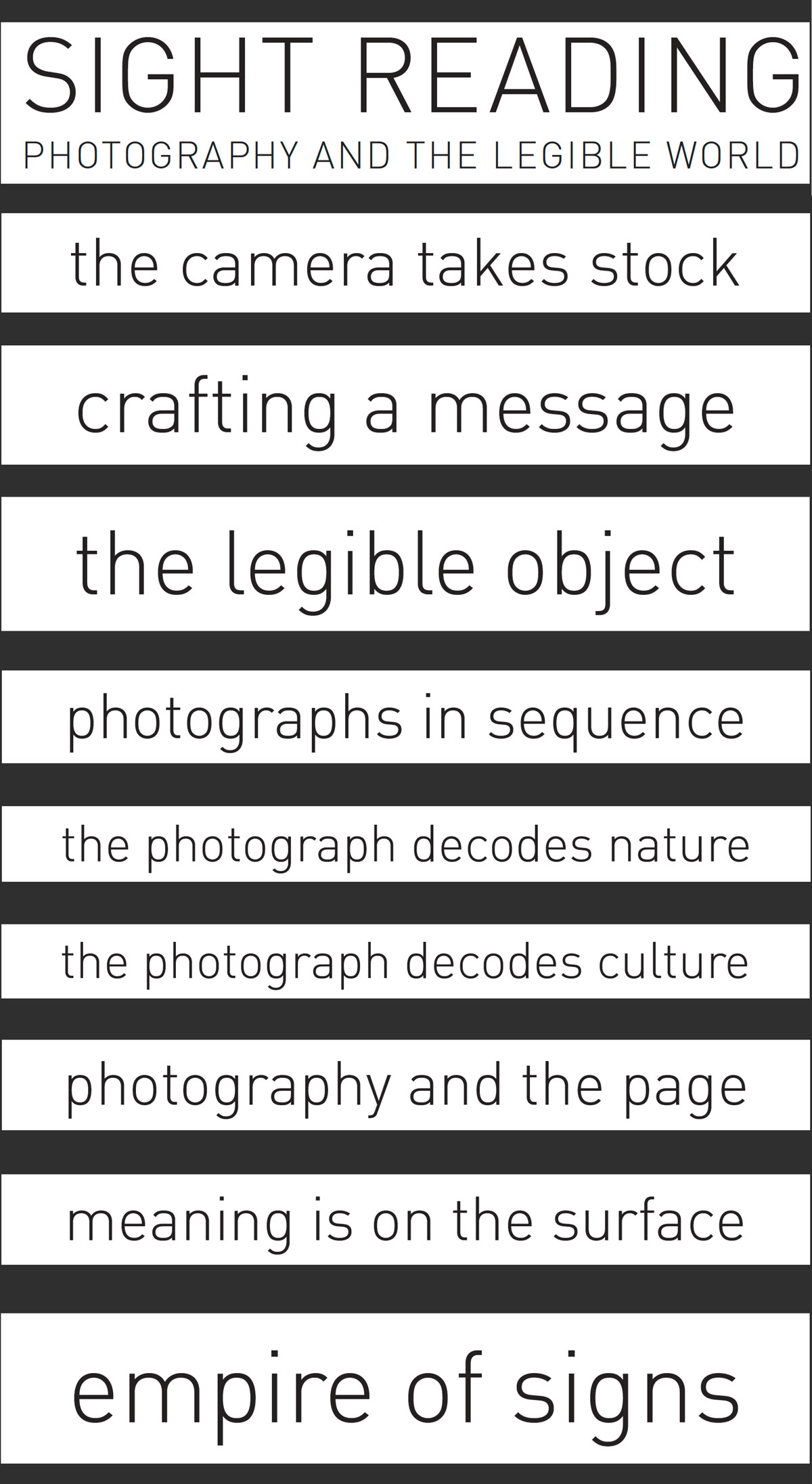
'Sight Reading: Photography and the Legible World' exhibition sections


Sight Reading: Photography and the Legible World exhibition sections


As its name declares, photography is a means of writing with light. Photographs both show and tell, and they speak an extraordinary range of dialects.

Beginning February 19 the Morgan Library & Museum explores the history of the medium as a lucid, literate – but not always literal – tool of persuasion in a new exhibition, Sight Reading: Photography and the Legible World. A collaboration with the George Eastman Museum of Film and Photography, the show features more than eighty works from the 1840s to the present and reveals the many ways the camera can transmit not only the outward appearance of its subject but also narratives, arguments, and ideas. The show is on view through May 30.

Over the past 175 years, photography has been adopted by, and adapted to, countless fields of endeavour, from art to zoology and from fashion to warfare. Sight Reading features a broad range of material – pioneering x-rays and aerial views, artefacts of early photojournalism, and recent examples of conceptual art – organised into groupings that accentuate the variety and suppleness of photography as a procedure. In 1936, artist László Moholy-Nagy (1895-1946) defined “the  illiterate of the future” as someone “ignorant of the use of the camera as well as the pen.” The JPEG and the “Send” button were decades away, but Moholy-Nagy was not the first observer to argue that photography belonged to the arts of commentary and persuasion. As the modes and motives of camera imagery have multiplied, viewers have continually learned new ways to read the information, and assess the argument, embodied in a photograph.

“Traditional narratives can be found throughout the Morgan’s collections, especially in its literary holdings,” said Colin B. Bailey, director of the Morgan. “Sight Reading encourages us to use a critical eye to read and discover the stories that unfold through the camera lens and photography, a distinctly modern, visual language. We are thrilled to collaborate with the Eastman Museum, and together unravel a rich narrative, which exemplifies photography’s deep involvement in the stories of modern art, science, and the printed page.”

The exhibition

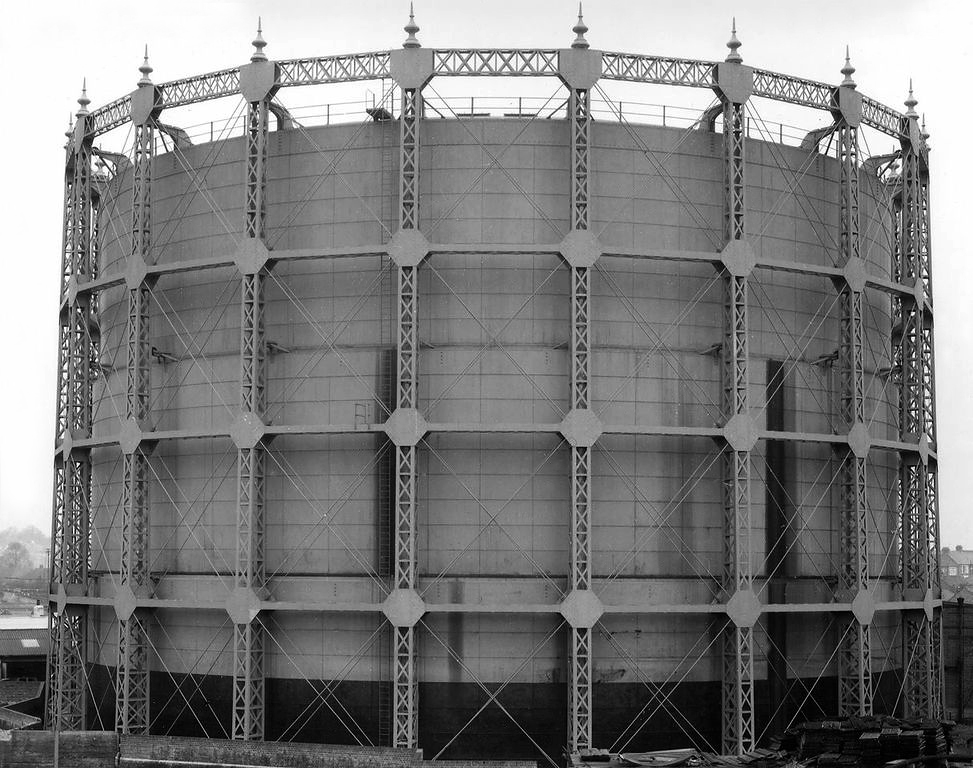
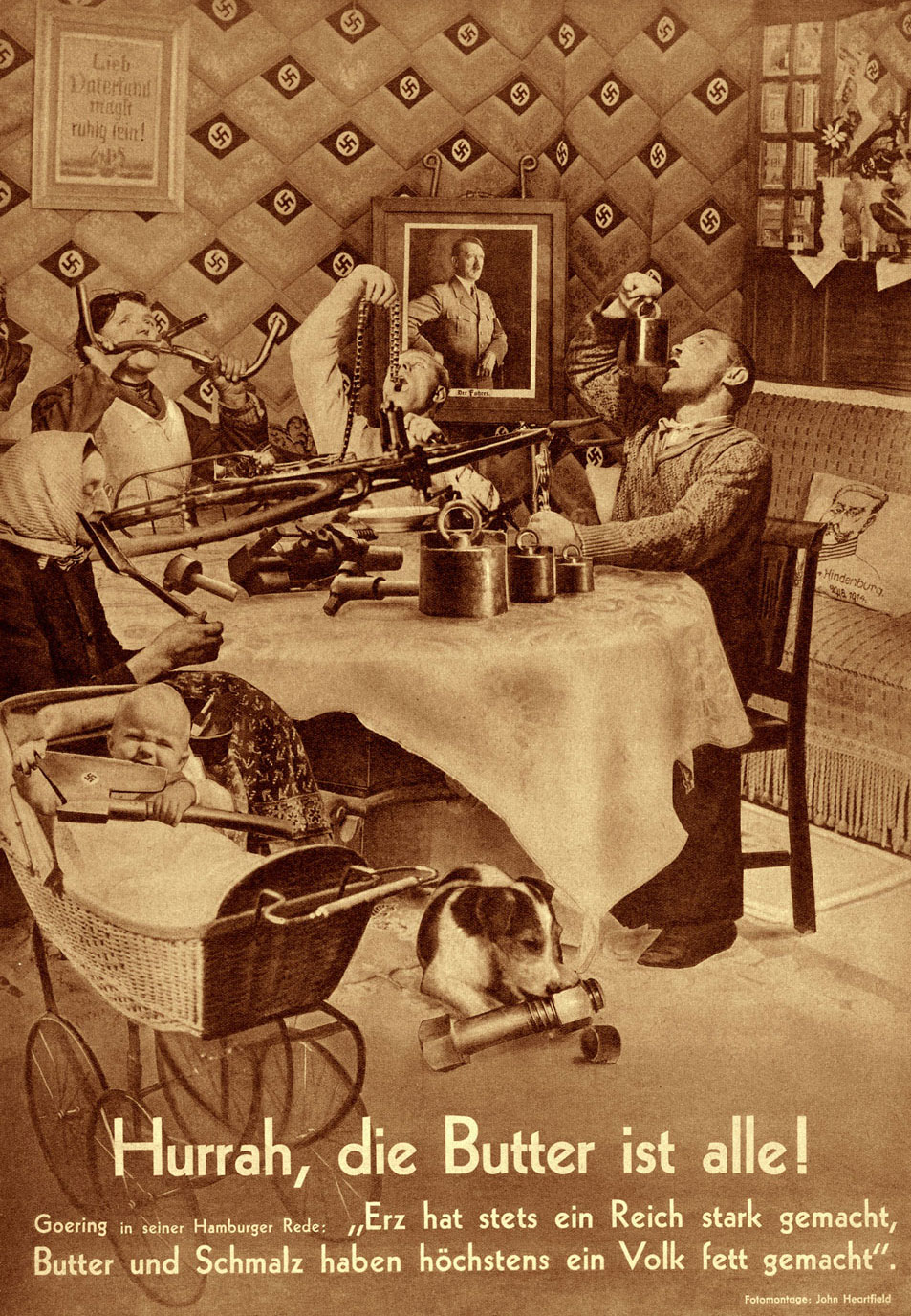
Sight Reading cuts across conventional historical and geographic divisions. Featuring work by William Henry Fox Talbot (1800-1877), Eadweard Muybridge (1830-1904), John Heartfield (1891-1968), Lewis Hine (1874-1940), Harold Edgerton (1903-1990), John Baldessari (1931-2020), Sophie Calle (b. 1953), and Bernd and Hilla Becher (1931-2007; 1934-2015), among many others, the exhibition is organised into nine “conversations” among diverse sets of works.

I. The Camera Takes Stock

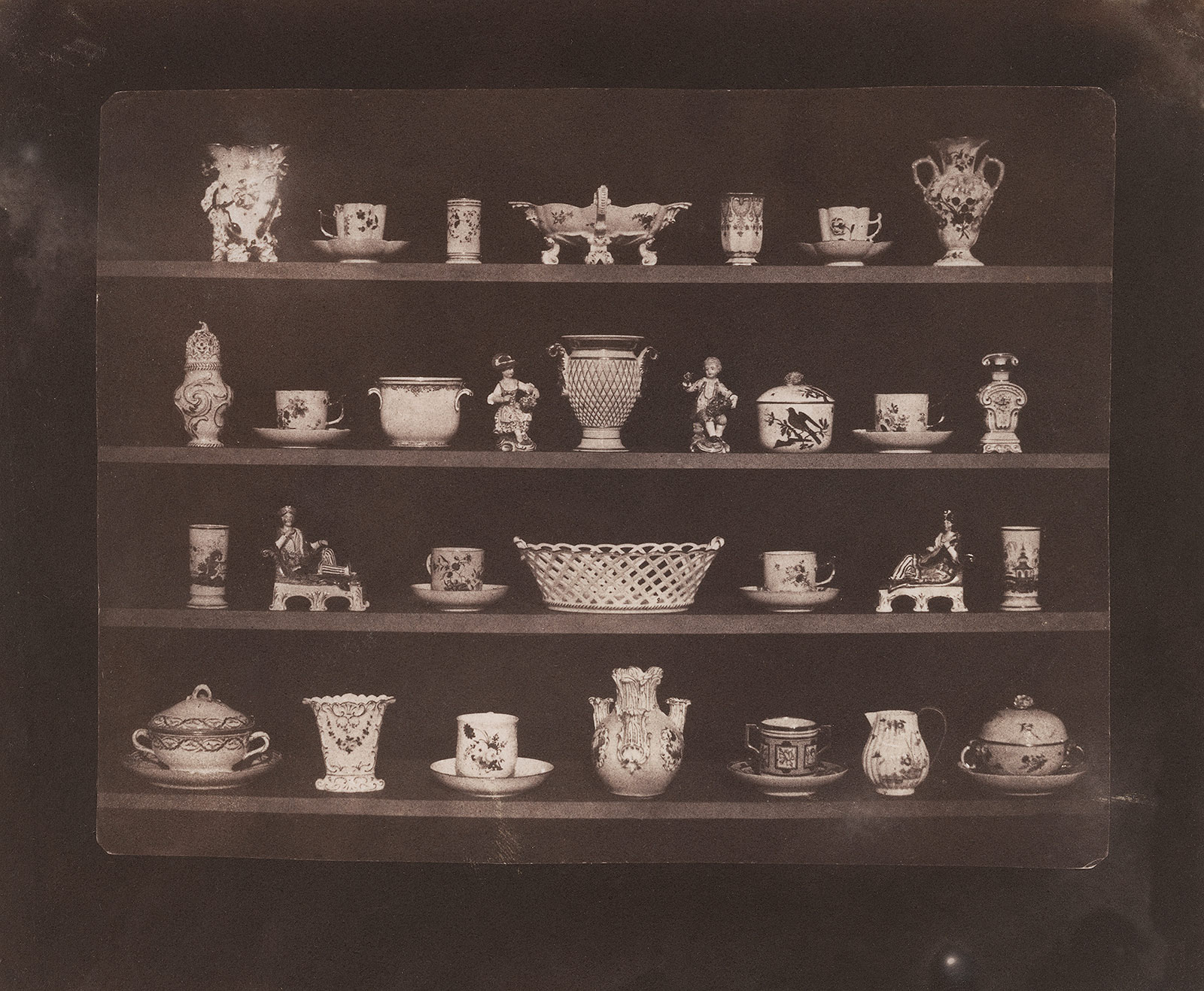
Photography’s practical functions include recording inventory, capturing data imperceptible to the human eye, and documenting historical events. In the first photographically illustrated publication, The Pencil of Nature (1845), William Henry Fox Talbot used his image Articles of China to demonstrate that “the whole cabinet of a … collector … might be depicted on paper in little more time than it would take him to make a written inventory describing it in the usual way.” Should the photographed collection suffer damage or theft, Talbot speculated, “the mute testimony of the picture … would certainly be evidence of a novel kind” before the law.

A century later, Harold Edgerton, an electrical engineer at the Massachusetts Institute of Technology, used the pulsing light of a stroboscope to record states of matter too fleeting for the naked eye. Gun Toss, an undated image of a spinning pistol, is not a multiple exposure: the camera shutter opened and closed just once. But during that fraction of a second, seven bright flashes of light committed to film a seven-episode history of the gun’s trajectory through space.


William Henry Fox Talbot (British, 1800-1877) 'Articles of China' c. 1843, printed c. 1845 from the exhibition 'Sight Reading: Photography and the Legible World' at the Morgan Library & Museum, New York, Feb - May, 2016


William Henry Fox Talbot (British, 1800-1877)
Articles of China
c. 1843, printed c. 1845
Salted paper print from calotype negative
Collection of Richard and Ronay Menschel


In The Pencil of Nature (1845), the first photographically illustrated publication, Talbot used Articles of China to demonstrate that “the whole cabinet of a … collector … might be depicted on paper in little more time than it would take him to make a written inventory describing it in the usual way.” Should the collection suffer damage or theft, Talbot added, “the mute testimony of the picture … would certainly be evidence of a novel kind” before the law.


Harold Edgerton (American, 1903-1990) 'Gun Toss' 1936-1950


Harold Edgerton (American, 1903-1990)
Gun Toss
1936-1950
Gelatin silver print
Collection of Richard and Ronay Menschel


Edgerton, an electrical engineer, used the rapidly pulsing light of a stroboscope to record states of matter too fleeting to be perceived by the naked eye. This image of a spinning pistol is not a multiple exposure: the camera shutter opened and closed just once. But during that fraction of a second, seven bright flashes of light committed to film a seven-episode history of the gun’s trajectory through space.


John Pfahl (American, 1939-2020) 'Wave Theory I–V, Puna Coast, Hawaii, March 1978' 1978


John Pfahl (American, 1939-2020)
Wave Theory I-V, Puna Coast, Hawaii, March 1978
1978
From the series Altered Landscapes
Chromogenic development (Ektacolor) process prints, 1993
George Eastman Museum, purchase


In this sequence, Pfahl twisted the conventions of photographic narrative into a perceptual puzzle. The numbered views appear to chronicle a single event: a wave breaking on the shore. Close inspection, however, reveals that the numeric caption in each scene is made of string laid on the rock in the foreground. The exposures, then, must have been made over a span of at least several minutes, not seconds – and in what order, one cannot say.


II. Crafting A Message

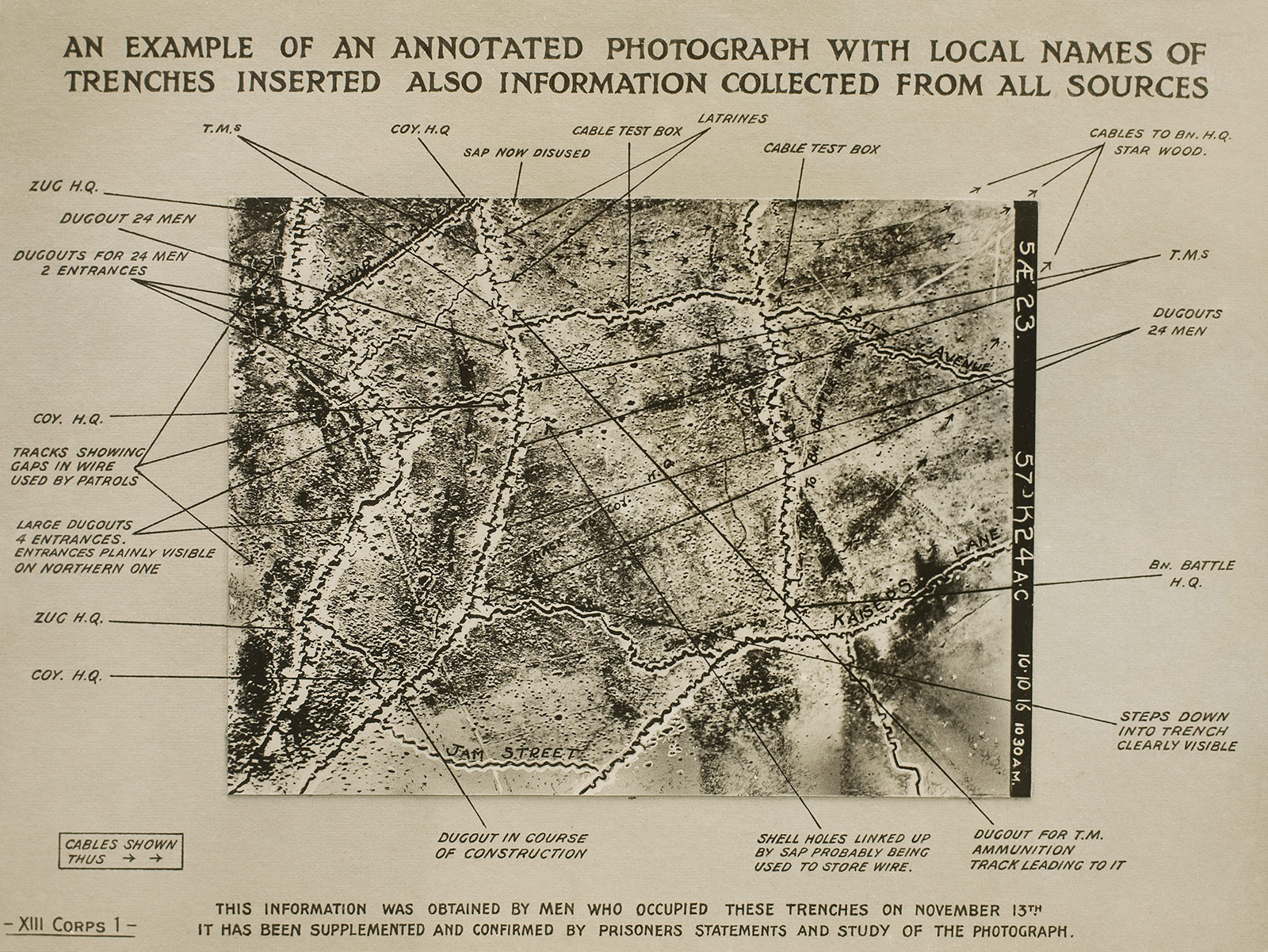
The camera is widely understood to be “truthful,” but what photographs “say” is a product of many procedures that follow the moment of exposure, including page layout, captioning, and cropping of the image. During World War I, military personnel learned to interpret the strange, abstract looking images of enemy territory made from airplanes. Their specialised training fundamentally altered the nature of wartime reconnaissance, even as the unusual perspective unique to aerial photography introduced a new dialect into the expanding corpus of modern visual language. An Example of an Annotated Photograph with Local Names of Trenches Inserted (1916), on view in the exhibition, shows that the tools of ground strategy soon included artificial bunkers and trenches, designed purely to fool eyes in the sky.

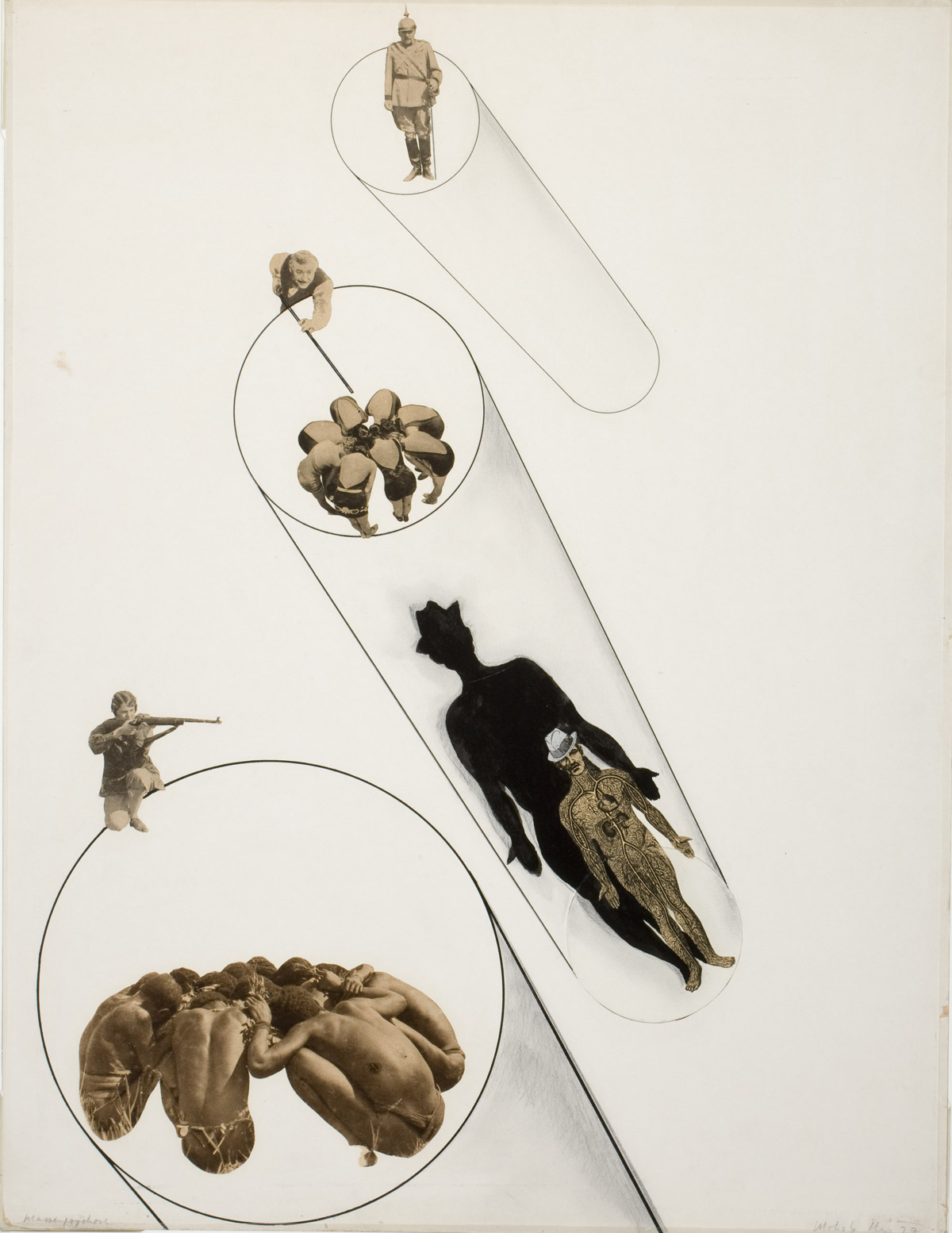
In László Moholy-Nagy’s photocollages of the late 1920s, figures cut out of the plates in mass market magazines appear in new configurations to convey messages of the artist’s devising. Images such as Massenpsychose (Mass Psychosis) (1927) propose a new kind of visual literacy for the machine age. To contemporary eyes, Moholy’s collages seem to foreshadow cut-and-paste strategies that would later characterise the visual culture of cyberspace.


László Moholy-Nagy (American born Hungary, 1895-1946) 'Massenpsychose' (Mass Psychosis) 1927


László Moholy-Nagy (American born Hungary, 1895-1946)
Massenpsychose (Mass Psychosis)
1927
Collage, pencil, and ink
George Eastman Museum, Purchased with funds provided by Eastman Kodak Company


To make his photocollages of the late 1920s, Moholy-Nagy cut figures out of photographs and photomechanical reproductions and arranged them into new configurations that convey messages of his own devising. By extracting the images from their original context and placing them into relationships defined by drawn shapes and volumes, he suggested a new visual literacy for the modern world. In this world – one in which images course through mass culture at a psychotic pace – a two-dimensional anatomical drawing acquires sufficient volume to cast a man’s shadow and a circle of bathing beauties cues up for a pool sharp. To contemporary eyes, the language of Moholy-Nagy’s photo collages seems to foreshadow strategies common to the visual culture of cyberspace.


Unidentified maker. 'An Example of an Annotated Photograph with Local Names of Trenches Inserted' c. 1916


Unidentified maker
An Example of an Annotated Photograph with Local Names of Trenches Inserted
c. 1916
Gelatin silver print
George Eastman Museum


During World War I, aerial photography progressed from a promising technological experiment to a crucial strategic operation. As advances in optics and engineering improved the capabilities of cameras and aircraft, military personnel learned to identify topographic features and man-made structures in the images recorded from above. Such training fundamentally altered the significance and practice of wartime reconnaissance. At the same time, the unusual perspective unique to aerial photography introduced a new dialect into the expanding corpus of modern visual language.


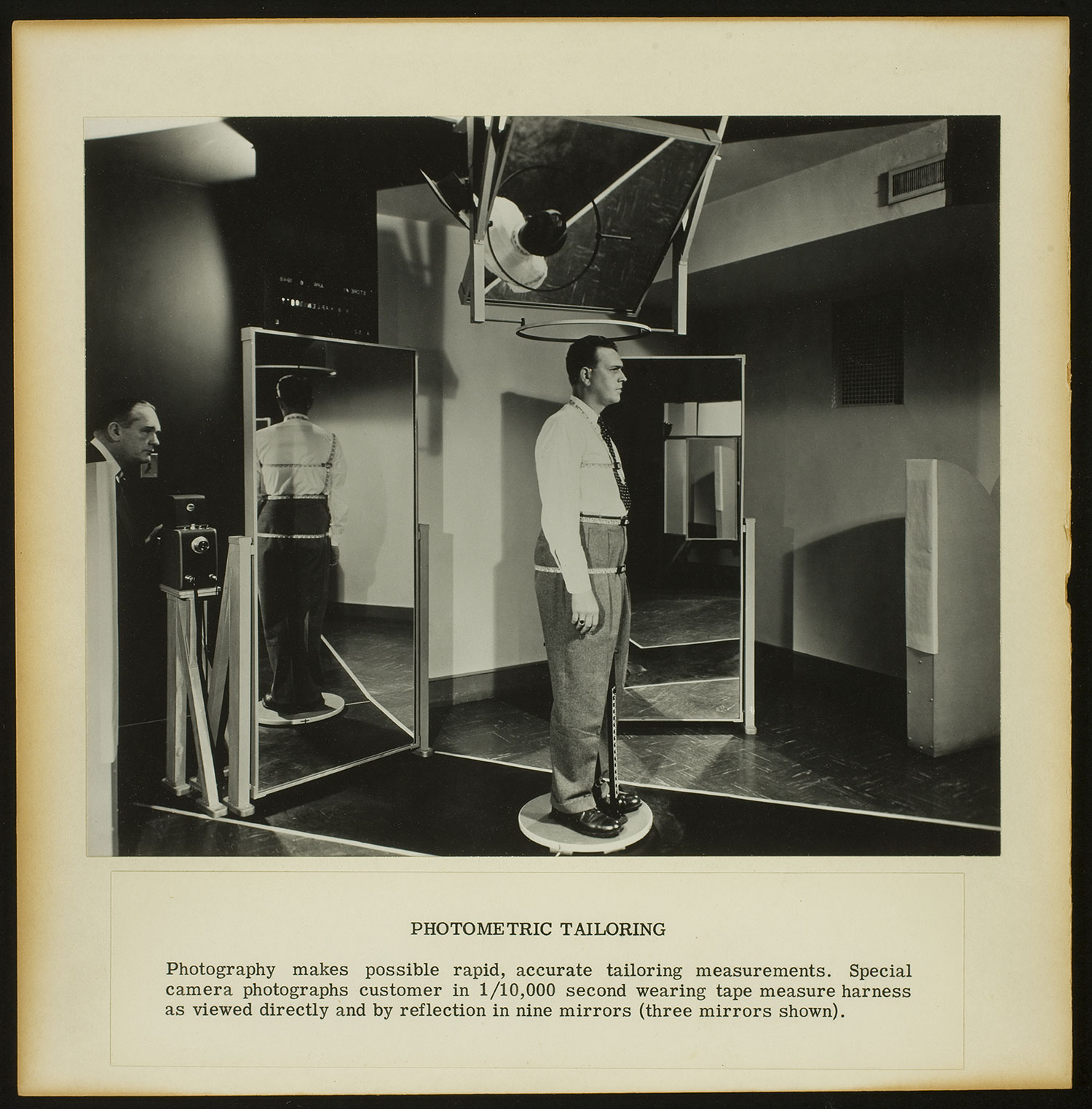
PhotoMetric Corporation, 1942-1974 'PhotoMetric Tailoring' c. 1942-1948


PhotoMetric Corporation, 1942-1974
PhotoMetric Tailoring
c. 1942-1948
Gelatin silver prints
George Eastman Museum


In an effort to streamline the field of custom tailoring, textile entrepreneur Henry Booth devised a method for obtaining measurements by photographing customers with a special camera and angled mirrors. The system was said to be foolproof, making it possible for any sales clerk to operate it. The resulting slides were sent to the manufacturer along with the customer’s order. A tailor translated the images into physical measurements using a geometric calculator, and the company mailed the finished garment to the customer.


III. Photographs in Sequence

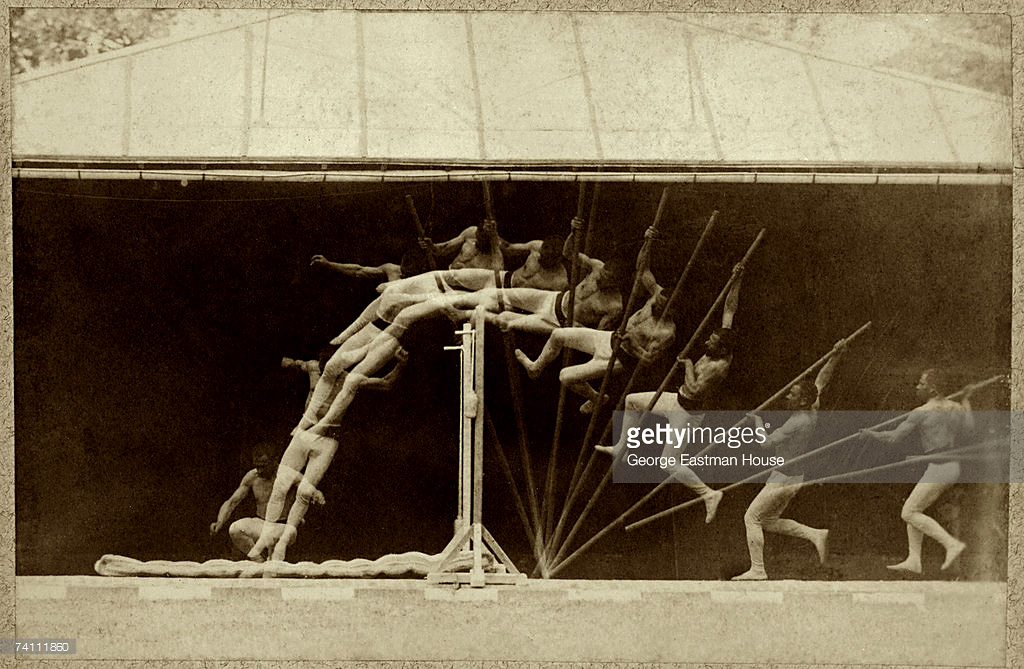
Photography’s debut in the late 1830s happened to coincide with the birth of the modern comic strip. Ultimately the narrative photo sequence would lead to the innovations that gave rise to cinema, another form of storytelling altogether. Exact contemporaries of one another, Eadweard J. Muybridge in the United States and Étienne-Jules Marey (1830-1904) in France both employed cameras to dissect human movement. Muybridge used a bank of cameras positioned to record a subject as it moved, tripping wires attached to the shutters. The result was a sequence of “stop-action” photographs that isolated gestures not otherwise visible in real time. Beginning in 1882, Marey pursued motion studies with a markedly different approach. In the works for which he is best known, he exposed one photographic plate multiple times at fixed intervals, recording the arc of movement in a single image.


Étienne Jules Marey (French, 1830-1904) 'Chronophotographic study of man pole vaulting' c. 1890


Étienne Jules Marey (French, 1830-1904)
Chronophotographic study of man pole vaulting
c. 1890
Albumen silver print
George Eastman Museum, Exchange with Narodni Technical Museum


Exact contemporaries, Muybridge and Marey (the former in the United States, the latter in France) both employed cameras to dissect human movement. Muybridge used a bank of cameras positioned and timed to record a subject as it moved, tripping wires attached to the shutters. The result was a sequence of “stop-action” photographs that isolated gestures not otherwise visible in real time. Beginning in 1882, Marey took a markedly different approach. In the works for which he is best known – such as the image of the man pole-vaulting – he exposed a single photographic plate multiple times at fixed intervals, recording the arc of movement in a single image. In Marey’s chronophotograph of a man on a horse, the action reads from bottom to top. The convention of arranging sequential photographic images from left to right and top to bottom, on the model of written elements on a page, was not yet firmly established.


William N. Jennings (American, b. England, 1860-1946) 'Notebook pages with photographs of lightning' c. 1887


William N. Jennings (American, b. England, 1860-1946)
Notebook pages with photographs of lightning
c. 1887
Gelatin silver prints mounted onto bound notepad paper
George Eastman Museum, Gift of 3M Foundation; Ex-collection of Louis Walton Sipley


With his first successful photograph of a lightning bolt on 2 September 1882, Jennings dispelled the then widely held belief – especially among those in the graphic arts – that lightning traveled toward the earth in a regular zigzag pattern. Instead, his images revealed that lightning not only assumed an astonishing variety of forms but that it never took the shape that had come to define it in art.


Bernd Becher (German, 1931-2007) Hilla Becher (German, 1934-2015) 'Industriebauten' 1968

Bernd Becher (German, 1931-2007) Hilla Becher (German, 1934-2015) 'Industriebauten' 1968


Bernd Becher (German, 1931-2007)
Hilla Becher (German, 1934-2015)
Industriebauten
1968
Gelatin silver prints in presentation box
George Eastman Museum, Purchase


The photographs in this portfolio were made only a few years into what would become the Bechers’ decades-long project of systematically documenting industrial architecture in Europe and the United States. The straightforward and rigidly consistent style of their work facilitates side-by-side comparison, revealing the singularity of structures that are typically understood to be generic.


IV. The Legible Object

Some photographs speak for themselves; others function as the amplifier for objects that can literally be read through the image. In her series Sorted Books, American artist Nina Katchadourian (b. 1968) composes statements by combining the titles of books drawn from the shelves of libraries and collections. Indian History for Young Folks, 2012, shows three books from the turn of the twentieth century that she found in the Delaware Art Museum’s M.G. Sawyer Collection of Decorative Bindings. The viewer’s eye silently provides punctuation: “Indian history for young folks: Our village; your national parks.” Though at first glance it appears merely to arrange words into legible order, Katchadourian’s oblique statement – half verbal, half visual – would be incomplete if divorced from the physical apparatus of the books themselves.


David Octavius Hill (Scottish, 1802-1870) Robert Adamson (Scottish, 1821-1848) 'The Artist and the Gravedigger (Denistoun Monument, Greyfriars Churchyard, Edinburgh)' c. 1845


David Octavius Hill (Scottish, 1802-1870)
Robert Adamson (Scottish, 1821-1848)
The Artist and the Gravedigger (Denistoun Monument, Greyfriars Churchyard, Edinburgh)
c. 1845
Salted paper print from calotype negative
George Eastman Museum, Gift of Alvin Langdon Coburn


Hill, his two nieces, and an unidentified man pose for the camera at the tomb of Robert Denistoun, a seventeenth-century Scottish ambassador. Contemplative poses helped the sitters hold still during the long exposure, even while turning them into sculptural extensions of the monument. Hill puts pen to paper, perhaps playing the part of a graveyard poet pondering mortality. Above him, the monument’s Latin inscription begins: “Behold, the world possesses nothing permanent!”


Robert Cumming (American, 1943-2021) 'Submarine cross-section; feature film, "Gray Lady Down" - Stage #12, March 14, 1977' 1977


Robert Cumming (American, 1943-2021)
Submarine cross-section; feature film, “Gray Lady Down” – Stage #12, March 14, 1977
1977
Inkjet print
George Eastman Museum, Gift of Nash Editions


In the Studio Still Lifes he photographed on the backlots of Universal Studios, Cumming sought to portray the mechanisms behind cinema vision “in their real as opposed to their screen contexts.” Admiring yet subversive, his documents use strategies native to the still camera – distance, point of view, and clear-eyed testimony – to translate Hollywood’s familiar illusions into worksites where “marble is plywood, stone is rubber, … rooms seldom have ceilings, and when the sun shines indoors, it casts a dozen shadows.”


Nina Katchadourian (American, b. 1968) 'Indian History for Young Folks' 2012


Nina Katchadourian (American, b. 1968)
Indian History for Young Folks
2012
From Once Upon a Time in Delaware / In Quest of the Perfect Book
Chromogenic print
The Morgan Library Museum, Purchase, Photography Collectors Committee


In her ongoing series Sorted Books, Katchadourian composes statements by combining the titles of books from a given library – in this case, the M. G. Sawyer Collection of Decorative Bindings at the Delaware Art Museum. Though her compositions are driven by the need to arrange words in a legible order, Katchadourian’s oblique jokes, poems, and koans would be incomplete if divorced from the cultural information conveyed by the physical books themselves.


V. The Photograph Decodes Nature

As early as 1840, one year after photography’s invention was announced, scientists sought to deploy it in their analysis of the physical world. Combining the camera with the microscope, microphotographs recorded biological minutiae, leading to discoveries that would have been difficult, if not impossible, to obtain by observing subjects in real time. Similarly, the development of X-ray technology in 1895 allowed scientists to see and understand living anatomy to an unprecedented degree. Such innovations not only expanded the boundaries of the visible world but also introduced graphic concepts that would have a profound impact on visual culture. In other ways, too, nature has been transformed in human understanding through the interpretive filter of the lens, as seen in Sight Reading in the telescopic moon views of astronomers Maurice Loewy (1833-1907) and Pierre Henri Puiseux (1855-1928) and in the spellbinding aerial abstractions of William Garnett (1916-2006).


William Garnett (American, 1916-2006) 'Animal Tracks on Dry Lake' 1955


William Garnett (American, 1916-2006)
Animal Tracks on Dry Lake
1955
Gelatin silver print
The Morgan Library & Museum, Purchased on the Charina Endowment Fund


After making films for the U.S. Signal Corps during World War II, Garnett used GI-Bill funding to earn a pilot’s license. By the early 1950s, he had the field of artistic aerial landscape virtually to himself. This print, showing the ephemeral traces of wildlife movement on a dry lake bed, appeared in Diogenes with a Camera IV (1956), one in a series of exhibitions at the Museum of Modern Art that highlighted the great variety of ways in which artists used photography to invent new forms of visual truth.


William Henry Jackson (American, 1843-1942) '"Tea Pot" Rock' 1870


William Henry Jackson (American, 1843-1942)
“Tea Pot” Rock
1870
Albumen silver print
George Eastman Museum, Purchase


Jackson made this photograph as a member of the survey team formed by Ferdinand V. Hayden to explore and document the territory now known as Yellowstone National Park. Hayden’s primary goal was to gather information about the area’s geological history, and Jackson’s photographs record with precision and clarity the accumulated layers of sediment that allow this natural landmark to be fit into a geological chronology. The human figure standing at the left of the composition provides information about the size of the rock, demonstrating that photographers have long recognised the difficulty of making accurate inferences about scale based on photographic images.


Dr. Josef Maria Eder (Austrian, 1855-1944) Eduard Valenta (Austrian, 1857-1937) 'Zwei Goldfische und ein Seefisch (Christiceps argentatus)' 1896


Dr Josef Maria Eder (Austrian, 1855-1944)
Eduard Valenta (Austrian, 1857-1937)
Zwei Goldfische und ein Seefisch (Christiceps argentatus)
Two goldfish and a sea fish (Christiceps argentatus)
1896
From the book Versuche über Photographie mittelst der Röntgen’schen Strahlen (Experiments on photography using X-rays)
Photogravure
George Eastman Museum, Gift of Eastman Kodak Company; Ex-collection of Josef Maria Eder


As early as 1840 – a year after photography’s invention was announced – scientists sought to deploy it in their analysis of the physical world. Combining the camera with the microscope, microphotographs recorded biological minutiae, leading to discoveries that would have been difficult, if not impossible, to obtain by observing subjects in real time. Similarly, the development of x-ray technology in 1895 allowed doctors to study living anatomy to an unprecedented degree. Such innovations not only expanded the boundaries of the visible world but also introduced graphic concepts that would have a profound impact on visual culture.


Dr James Deane (American, 1801-1858) 'Ichnographs from the Sandstone of Connecticut River' 1861


Dr James Deane (American, 1801-1858)
Ichnographs from the Sandstone of Connecticut River
1861
Book illustrated with 22 salted paper prints and 37 lithographs
George Eastman Museum, Gift of Alden Scott Boyer


These photographs, which depict traces of fossils discovered in a sandstone quarry, illustrate a book written by Massachusetts surgeon James Deane, who was the author of texts on medicine as well as natural history. Published posthumously using his notes and photographs as a guide, the volume is an early demonstration of photography’s potential as a tool of scientific investigation.


VI. The Photograph Decodes Culture

The photograph not only changed but to a great extent invented the modern notion of celebrity. Modern-age celebrities live apart from the general public, but their faces are more familiar than those of the neighbours next door. Since the mid-nineteenth century, viewers have come to “know” the famous through accumulated photographic sightings, which come in formats and contexts that vary as much as real-life encounters do. In four images that would have communicated instantly to their intended viewers in 1966, Jean-Pierre Ducatez (b. 1970) portrayed the Beatles through closeups of their mouths alone. The graphic shorthand employed by Jonathan Lewis in his series The Pixles is of a more recent variety, but he, too, relies on the visual familiarity conferred by tremendous celebrity. Each print in the series reproduces the iconic art of a Beatles album cover at life size (12 x 12 inches) but extremely low resolution (12 x 12 pixels). Like celebrities themselves, perhaps, the images look more familiar to the eye at a distance than close-up.


Unidentified maker. 'U. S. Grant' c. 1862


Unidentified maker
U. S. Grant
c. 1862
Albumen silver print
George Eastman Museum, Purchase


Timothy H. O'Sullivan (American born Ireland, 1840-1882) 'A Council of War at Massaponax Church, Va. 21st May, 1864. Gens. Grant and Meade, Asst. Sec. of War Dana, and Their Staff Officers' 1864


Timothy H. O’Sullivan (American born Ireland, 1840-1882)
A Council of War at Massaponax Church, Va. 21st May, 1864. Gens. Grant and Meade, Asst. Sec. of War Dana, and Their Staff Officers
1864
From the series Photographic Incidents of the War
Albumen silver print stereograph
George Eastman Museum, Gift of Albert Morton Turner


Modern celebrities live apart from the general public, yet their faces are more familiar than those of the neighbors next door. Since the mid-nineteenth century, viewers have come to “know” the famous through accumulated photographic sightings, which come in formats and contexts that vary as much as real-life encounters do. First as a Union hero in the American Civil War and later as president, Ulysses S. Grant (1822-1885) lived in the public imagination through news images, popular stereographs, campaign buttons, and ultimately the (photo-based) face on the $50 bill. Grant was even a subject for Francois Willème’s patented process for generating a sculpted likeness out of photographs made in the round – an early forerunner to the technology of 3-D printing.


Jonathan Lewis (British, b. 1970) 'Abbey Road' 2003


Jonathan Lewis (British, b. 1970)
Abbey Road
2003
From The Pixles
Inkjet print
George Eastman Museum, By exchange with the artist


Jonathan Lewis (British, b. 1970) 'Please Please Me' 2003


Jonathan Lewis (British, b. 1970)
Please Please Me
2003
From The Pixles
Inkjet print
George Eastman Museum, By exchange with the artist


Jonathan Lewis (British, b. 1970) 'Rubber Soul' 2003


Jonathan Lewis (British, b. 1970)
Rubber Soul
2003
From The Pixles
Inkjet print
George Eastman Museum, By exchange with the artist


Synecdoche is a poetic device in which a part stands in for the whole. (In the phrase “three sails set forth,” sails mean ships.) In four images that would have communicated instantly to their intended viewers in 1966, Ducatez portrayed the Beatles solely through close-ups of their mouths. The graphic shorthand Lewis employs in his series The Pixles is of a more recent variety, though he, too, relies on the visual familiarity conferred by tremendous celebrity. Each print in the series reproduces a Beatles album cover at life size (12 x 12 inches) but extremely low resolution (12 x 12 pixels).


VII. Meaning is on the Surface

Photographs are not just windows onto the world but pieces of paper, which can themselves be inscribed or otherwise altered in ways that enrich or amend their meaning. The group portrait Joint Meeting of the Railway Surgeons Association, Claypool Hotel, Indianapolis (1920) is contact printed, meaning that the negative was the same size as the print. After the portrait sitting, the photographer appears to have presented the developed film to the sixty-four sitters for signing during the three days they were assembled for their convention. The result is a document that unites two conventional signifiers of character: facial features and the autograph.


Gravelle Studio, Indianapolis (American, active 1920) 'Joint Meeting of the Railway Surgeons Association, Claypool Hotel, Indianapolis' 1920


Gravelle Studio, Indianapolis (American, active 1920)
Joint Meeting of the Railway Surgeons Association, Claypool Hotel, Indianapolis
1920
Gelatin silver print
The Morgan Library & Museum, Purchased as the gift of Peter J. Cohen


Panoramic group portraits such as this are made using a banquet camera, which admits light through a narrow vertical slit while rotating on its tripod. This image was contact printed, meaning the negative was the same size as the print. The photographer appears to have presented the developed film to the sixty-four sitters for signing during the three days they were assembled. The result is a document that unites two conventional signifiers of character: facial features and the autograph.


Keith Smith (American, b. 1938) 'Book 151' 1989


Keith Smith (American, b. 1938)
Book 151
1989
Bound book of gelatin silver prints, thread, and leather
Collection of Richard and Ronay Menschel


This unique object unites the arts of photography, quilting, and bookmaking. The composite image on each right-hand page appears to be made of prints cut apart and sewn together. In fact, Smith began by printing patchwork-inspired photomontages in the darkroom. He then stitched along many of the borders where abutting images meet, creating the illusion of a photographic crazy quilt.


VIII. Photography and the Page

News of the world took on a newly visual character in the 1880s, when the technology of the halftone screen made it practical, at last, to render photographs in ink on the printed page.

Among the earliest examples of photojournalism is Paul Nadar’s (1820-1910) “photographic interview” with Georges Ernest Boulanger, a once-powerful French politician. The article’s introduction explains that the photographs were printed alongside the text in order to provide evidence of the encounter and to illustrate Boulanger’s dynamic body language during the conversation.


Stephen Henry Horgan (American, 1854-1941) 'Shanty Town' April 1880


Stephen Henry Horgan (American, 1854-1941)
Shanty Town
April 1880
Photomechanical printing plate A Scene in Shantytown, New York, c. 1928
Lithograph
George Eastman Museum, Gift of 3M Foundation; Ex-collection of Louis Walton Sipley


Paul Nadar (French, 1856-1939) 'Interview with Georges Ernest Jean Marie Boulanger' 1889


Paul Nadar (French, 1856-1939)
Interview with Georges Ernest Jean Marie Boulanger
1889
Le Figaro, 23 November 1889
Photomechanical reproduction
George Eastman Museum, gift of Eastman Kodak Company; ex-collection Gabriel Cromer


Among the earliest examples of photojournalism is Nadar’s “photographic interview” with Georges Ernest Boulanger, a once-powerful French politician who had fallen out of public favour by the time this was published. The article’s introduction explains that the photographs were printed alongside the text in order to provide evidence of the encounter and to illustrate Boulanger’s body language during the conversation.


Lewis W. Hine (American, 1874-1940) 'Italian Family Looking for Lost Baggage, Ellis Island' 1905


Lewis W. Hine (American, 1874-1940)
Italian Family Looking for Lost Baggage, Ellis Island
1905
Ellis Island Group, 1905
Gelatin silver print
George Eastman Museum, Gift of Photo League Lewis Hine Memorial Committee


In an effort to counter American xenophobia in the early years of the twentieth century, Hine photographed immigrants as they arrived at Ellis Island, composing his images to stir sympathy and understanding among viewers. He understood the importance of disseminating his photographs and actively sought to publish them in newspapers, magazines, and pamphlets. The white outline in the photograph on the right instructs the designer and printer where to crop the image for a photomontage featuring figures from multiple portraits.


Claude Cahun (French, 1894-1954) 'La Poupée' (Puppet) 1936


Claude Cahun (French, 1894-1954)
La Poupée (Puppet)
1936
Gelatin silver print
Collection of Richard and Ronay Menschel


John Heartfield (German, 1891-1968) 'Hurrah, die Butter ist alle!' (Hooray, the Butter Is Finished!) 1935


John Heartfield (German, 1891-1968)
Hurrah, die Butter ist alle! (Hooray, the Butter Is Finished!)
1935
Rotogravure
George Eastman Museum, purchase


This is one of 237 photomontages that Heartfield created between 1930 and 1938 for the antifascist magazine Arbeiter-Illustrierte-Zeitung (Worker’s Pictorial Newspaper). It is a parody of the “Guns Before Butter” speech in which Hermann G.ring exhorted German citizens to sacrifice necessities in order to aid the nation’s rearmament. The text reads: “Iron ore has always made an empire strong; butter and lard have at most made a people fat.” Heartfield combined details from several photographs to conjure the image of a German family feasting on tools, machine parts, and a bicycle in a swastika-laden dining room, complete with a portrait of Hitler, a framed phrase from a popular Franco-Prussian war-era song, and a throw pillow bearing the likeness of recently deceased president Paul von Hindenburg.


Unidentified maker. 'Certificate of Marriage between Daniel W. Gibbs and Matilda B. Pierce' c. 1874


Unidentified maker
Certificate of Marriage between Daniel W. Gibbs and Matilda B. Pierce
c. 1874
Tintypes in prepared paper mount
George Eastman Museum, Purchase


Graphic cousins to one other, these wedding certificates are equipped with precut windows for photographs of the bride, groom, and officiant. The portraits, in partnership with the printed and inscribed text on the forms, contribute both to the documentary specificity of the certificates and to their value as sentimental souvenirs.


IX. Empire of Signs

The plethora of signs, symbols, and visual noise endemic to cities has attracted photographers since the medium’s invention. Their records of advertisers’ strident demands for attention, shopkeepers’ alluring displays, and the often dizzying architectural density of metropolitan life chronicle sights that are subject to change without notice. The photographer’s perspective on contemporary social life – whether it is anecdotal, as in John Thompson’s (1837-1921) Street Advertising from Street Life in London (1877), or haunting, as in Eugène Atget’s (1857-1927) Impasse des Bourdonnais (c. 1908) – is embedded in each image.


John Thomson (Scottish, 1837-1921) 'Street Advertising' 1877


John Thomson (Scottish, 1837-1921)
Street Advertising
1877
From Street Life in London, 1877
Woodburytype
George Eastman Museum, Gift of Alden Scott Boyer


Eugène Atget (French, 1857-1927) 'Impasse des Bourdonnais' c. 1908


Eugène Atget (French, 1857-1927)
Impasse des Bourdonnais
c. 1908
Albumen silver print
George Eastman Museum, Purchase


Margaret Bourke-White (American, 1904-1971) 'At the Time of the Louisville Flood' 1937


Margaret Bourke-White (American, 1904-1971)
At the Time of the Louisville Flood
1937
Gelatin silver print
George Eastman Museum


The plethora of signs, symbols, and visual noise endemic to cities has attracted photographers since the medium’s invention. Their records of advertisers’ strident demands for attention, shopkeepers’ alluring displays, and the often dizzying architectural density of metropolitan life chronicle sights that are subject to change without notice. The photographer’s perspective on contemporary social life – whether it is ironic, as in Margaret Bourke-White’s image of a line of flood victims before a billboard advertising middle-class prosperity, or bemused, as in Ferenc Berko’s photograph of columns of oversized artificial teeth on the street – is embedded in each image.


Ferenc Berko (American born Hungary, 1916-2000) 'Rawalpindi, India' 1946


Ferenc Berko (American born Hungary, 1916-2000)
Rawalpindi, India
1946
Gelatin silver print
George Eastman House, Gift of Katharine Kuh


Aaron Siskind (American, 1903-1991) 'New York 6' 1951


Aaron Siskind (American, 1903-1991)
New York 6
1951
Gelatin silver print
The Morgan Library & Museum, Gift of Richard and Ronay Menschel


Alex Webb (American, b. 1952) 'India' 1981


Alex Webb (American, b. 1952)
India
1981
Chromogenic development print
George Eastman Museum, Purchased with funds from Charina Foundation


The Morgan Library & Museum
225 Madison Avenue, at 36th Street
New York, NY 10016-3405
Phone: (212) 685-0008

Opening hours:
Tuesday – Thursday, Saturday – Sunday: 10.30am – 5pm
Friday: 10.30am – 7pm
Closed Mondays

The Morgan Library & Museum website

LIKE ART BLART ON FACEBOOK

Back to top

Exhibition: ‘Photography – A Victorian Sensation’ at the National Museum of Scotland, Edinburgh

Exhibition dates: 19th June – 22nd November 2015


William Henry Fox Talbot (English, 1800-1877) 'The Open Door' 1844-1846


William Henry Fox Talbot (English, 1800-1877)
The Open Door
1844-1846
Salt print from a calotype negative
Plate VI from the Pencil of Nature, the first book to be illustrated with photographs
© National Museums Scotland


In our contemporary image-saturated, comprehensively mediated way of life it is difficult for us to understand how “sensational” photography would have been in the Victorian era. Imagine never having seen a photograph of a landscape, city or person before. To then be suddenly presented with a image written in light, fixed before the eye of the beholder, would have been a profoundly magical experience for the viewer. Here was a new, progressive reality imaged for all to see. The society of the spectacle as photograph had arrived.

Here was the expansion of scopophilic society, our desire to derive pleasure from looking. That fetishistic desire can never be completely fulfilled, so we have to keep looking again and again, constantly reinforcing the ocular gratification of images. Photographs became shrines to memory. They also became shrines to the memory of desire itself.

Dr Marcus Bunyan


Many thankx to the National Museum of Scotland for allowing me to publish the photographs in the posting. Please click on the photographs for a larger version of the image.


Hill and Adamson


Dr Sara Stevenson, photo historian, talks about the origins of Hill and Adamson’s partnership and their photography skills.


Scottish daguerreotypes


Dr Alison Morrison Low, Principal Curator of Science, National Museums Scotland, talks about daguerreotype portraits in Scotland and the work of Thomas Davidson.


Amateur photographers: Julia Margaret Cameron


Anne Lyden, International Photography Curator, National Galleries of Scotland, talks about photographer Julia Margaret Cameron.


George Washington Wilson


Emeritus Professor Roger Taylor talks about George Washington Wilson’s life and work.


TR Williams


Dr Brian May, CBE, musician and collector of stereo-photography talks about the photography of TR Williams.


William Henry Fox Talbot (English, 1800-1877) 'The Ladder' 1844-1846


William Henry Fox Talbot (English, 1800-1877)
The Ladder
1844-1846
Salt print from a calotype negative
Plate XIV from the Pencil of Nature, the first book to be illustrated with photographs
© National Museums Scotland


Calotype images are not as pin-sharp as daguerreotypes, but they had one great advantage: more than one image could be produced from a single negative. Yet both processes were cumbersome and very expensive. What was needed was a faster, cheaper method to really fuel the fire of Victorian photomania.


Daguerreotype camera, made by A Giroux et Cie, 1839


Giroux et Cie
Daguerreotype camera
1839
© National Museums Scotland


This camera was bought by WHF Talbot in October 1839.


William Henry Fox Talbot (English, 1800-1877) 'Talbot's home-made camera' 1840s


William Henry Fox Talbot (English, 1800-1877)
Talbot’s home-made camera
1840s
© National Museums Scotland


Some of his early equipment appears to have been constructed to his design by the estate carpenter.


William Henry Fox Talbot (English, 1800-1877) 'Talbot's calotype photography equipment' c. 1840


William Henry Fox Talbot (English, 1800-1877)
Talbot’s calotype photography equipment
c. 1840
© National Museums Scotland


Camera, printing frame, small domestic iron and chemical balance.


Platt D Babbitt (American, 1822-1879) 'Niagara Falls from the American side' whole plate daguerreotype c.1855


Platt D Babbitt (American, 1822-1879)
Niagara Falls from the American side
c. 1855
Whole plate daguerreotype
Platt D Babbitt ensconced himself at a leading tourist spot beside Niagara Falls, from 1853
© Howarth-Loomes Collection at National Museums Scotland


Platt D Babbitt (American, 1822-1879) 'Niagara Falls from the American side' c. 1855 (detail)


Platt D Babbitt (American, 1822-1879)
Niagara Falls from the American side (detail)
c. 1855
Whole plate daguerreotype
© Howarth-Loomes Collection at National Museums Scotland


Platt D Babbitt ensconced himself at a leading tourist spot beside Niagara Falls, from 1853.


Ross and Thomson of Edinburgh. 'Unknown little girl sitting on a striped cushion holding a framed portrait of a man, possibly her dead father' 1847-1860


Ross and Thomson of Edinburgh
Unknown little girl sitting on a striped cushion holding a framed portrait of a man, possibly her dead father
1847-1860
Ninth-plate daguerreotype
© Howarth-Loomes Collection at National Museums Scotland


D.O. Hill (Scottish, 1802-1870) and Robert Adamson (Scottish, 1821-1848) 'Mrs Elizabeth (Johnstone) Hall, a Newhaven fishwife, famous for her beauty and self-confidence' 1843-1848


D.O. Hill (Scottish, 1802-1870) and Robert Adamson (Scottish, 1821-1848)
Mrs Elizabeth (Johnstone) Hall, a Newhaven fishwife, famous for her beauty and self-confidence
1843-1848
From an album presented by Hill to the Society of Antiquaries of Scotland in 1850
Salt print from a calotype negative,
© National Museums Scotland


Robert Howlett (British, 1831-1858) 'Isambard Kingdom Brunel Standing Before the Launching Chains of the Great Eastern' November 1857


Robert Howlett (British, 1831-1858)
Isambard Kingdom Brunel Standing Before the Launching Chains of the Great Eastern]
November 1857
Carte-de-visite
Sold by the London Stereoscopic Company
© Howarth-Loomes Collection at National Museums Scotland


Calotype photographs from an album compiled by Dr John Adamson, among the earliest in Scotland


Calotype photographs from an album compiled by Dr John Adamson, among the earliest in Scotland


Photograph burnt in on glass, a group of workmen, Paris 1858


Photograph burnt in on glass, a group of workmen, Paris 1858


A major exhibition at the National Museum of Scotland explores the Victorian craze for photography and examine how it has influenced the way we capture and share images today, when more photographs are taken in two minutes than were taken in the whole of the 19th century. Photography: A Victorian Sensation takes visitors back to the very beginnings of photography in 1839, tracing its evolution from a scientific art practised by a few wealthy individuals to a widely available global phenomenon, practised on an industrial scale.

The exhibition showcases National Museums Scotland’s extensive early photographic collections, including Hill and Adamson’s iconic images of Victorian Edinburgh, and the Howarth-Loomes collection, much of which has never been publicly displayed. Highlights include an early daguerreotype camera once owned by William Henry Fox Talbot; an 1869 photograph of Alfred, Lord Tennyson by Julia Margaret Cameron; a carte-de-visite depicting Queen Victoria and Prince Albert as a middle-class couple and an early daguerreotype of the Niagara Falls. The exhibition covers the period from 1839 to 1900, by which point photography had permeated the whole of society, becoming a global sensation. Images and apparatus illustrate the changing techniques used by photographers and studios during the 19th century, and the ways in which photography became an increasingly accessible part of everyday life.

From the pin-sharp daguerreotype and the more textured calotype process of the early years, to the wet collodion method pioneered in 1851, photography developed as both a science and an art form. Visitors can follow the cross-channel competition between photographic trailblazers Louis Daguerre and William Henry Fox Talbot, enter the world of the 1851 Great Exhibition and snap their own pictures inside the photographer’s studio. They can also discover the fascinating stories of some of the people behind hundreds of Victorian photographs. These range from poignant mementos of loved ones to comical shots and early attempts at image manipulation. Photographs of family members were important mementos for Victorians and on display is jewellery incorporating both images of deceased loved ones and elaborately woven locks of their hair.

Sharing images of loved ones drove the craze for collecting cartes-de-visite. The average middle class Victorian home would have had an album full of images of friends and family members as well as never-before-seen famous faces ranging from royalty to well-known authors and infamous criminals. Such images sold in their hundreds of thousands. Also hugely popular were stereoscopes, relatively affordable devices which allowed people to view 3D photographs of scenes from around the world from the comfort of their own homes. On display are a range of ornate stereoscopes as well as early photographs showing views from countries ranging from Egypt to Australia. The increasing affordability of photographs fuelled the demand for the services of photographic studios, and visitors have the opportunity to get a taste of a Victorian studio by posing for their own pictures. They also have the chance to see typical objects from the photographer’s studio, including a cast iron head rest, used to keep subjects still for a sufficient period of time to capture their image.

Alison Morrison Low, Principal Curator of Science at National Museums Scotland commented: “Just as today we love to document the world around us photographically, so too were the Victorians obsessed with taking and sharing photographs. Photography: A Victorian Sensation will transport visitors back to the 19th century, linking the Victorian craze for photography with the role it plays in everyday life today. The period we’re examining may be beyond living memory, but the people featured in these early images are not so different from us.”

A book, Scottish Photography: The First 30 Years by Sara Stevenson and Alison Morrison-Low has been published by NMSEnterprises Publishing to accompany Photography: A Victorian Sensation.

Text from the National Museum of Scotland website


Taken by a photographer of the London School of Photography, based at Newgate Street and Regent Circus, London. 'Portrait of a horse held by a groom' 1858-1860


Taken by a photographer of the London School of Photography, based at Newgate Street and Regent Circus, London
Portrait of a horse held by a groom
1858-1860
Quarter- plate ambrotype
© Howarth-Loomes Collection at National Museums Scotland


George Washington Wilson (Scottish, 1823-1893) 'Balmoral Castle from the N.W.' 1863


George Washington Wilson (Scottish, 1823-1893)
Balmoral Castle from the N.W.
1863
Stereo albumen prints from a wet collodion negative
© Howarth-Loomes Collection at National Museums Scotland


Staff photographer of the London Stereoscopic and Photographic Company (probably William England). 'The Armstrong Trophy and Naval Court' 1862


Staff photographer of the London Stereoscopic and Photographic Company (probably William England)
The Armstrong Trophy and Naval Court
1862
Stereo albumen prints from a wet collodion negative
From the series of International Exhibition of 1862, No. 133
© Howarth-Loomes Collection at National Museums Scotland


It shows material lent to the exhibition by the Northern Lighthouse Board, Edinburgh, now in the collections of National Museums Scotland.


Mayall, London & Brighton. 'The Queen, gazing at a bust of Prince Albert, together with the Prince and Princess of Wales, married 10 March 1863' 1863


Mayall, London & Brighton
The Queen, gazing at a bust of Prince Albert, together with the Prince and  Princess of Wales, married 10 March 1863
1863
Carte-de-visite
© Howarth-Loomes Collection at National Museums Scotland


Cramb Brothers, of Glasgow. 'Dr E W Pritchard, His Wife, Mother-in-Law and Family' 1865


Cramb Brothers, of Glasgow
Dr E W Pritchard, His Wife, Mother-in-Law and Family
1865
Carte-de-visite
© Howarth-Loomes Collection at National Museums Scotland


Edward William Pritchard (1825-1865) was notorious for poisoning with antimony his wife and mother-in-law, both seen in this family portrait in happier days. He was the last person to be publicly executed in Glasgow.


Cramb Brothers, of Glasgow. 'Dr E W Pritchard' 1865


Cramb Brothers, of Glasgow
Dr E W Pritchard
1865
Carte-de-visite
© Howarth-Loomes Collection at National Museums Scotland


Cramb Brothers advertised this image, Price 1 shilling each. They stated: These Portraits are all Copyright, and bear the Publishers’ Names. Legal Proceedings will be taken against any one offering Pirated Copies for Sale.
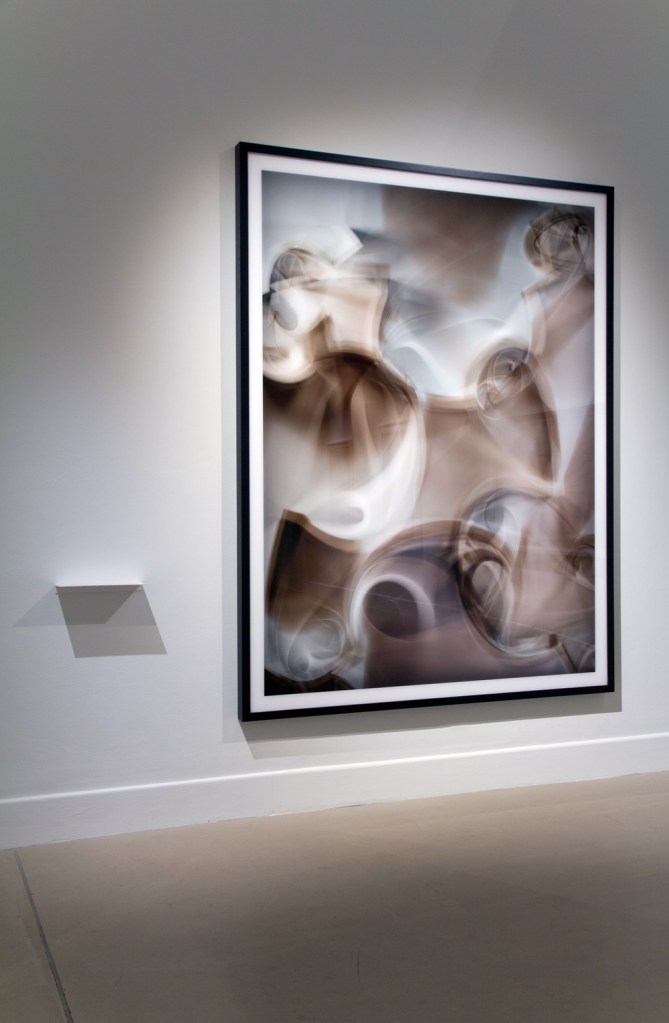
 

Marcus Guttenberg (British born Poland, 1828-1891) 'Portrait group of four unidentified children' 1860s-1870s


Marcus Guttenberg (British born Poland, 1828-1891)
Portrait group of four unidentified children
1860s-1870s
Carte-de-visite
© Howarth-Loomes Collection at National Museums Scotland


Elliot & Fry, 55 Baker Street, Portman Square, London. 'Alfred, Lord Tennyson' 1865-1886


Elliot & Fry, 55 Baker Street, Portman Square, London
Alfred, Lord Tennyson
1865-1886
Carte-de-visite
© Howarth-Loomes Collection at National Museums Scotland


Tennyson (1809-1892) became Poet Laureate in 1850, after the death of William Wordsworth; his poems In Memoriam (1850) and Idylls of the King (1859) were hugely popular during Victorian times, but less so today.


Julia Margaret Cameron (British born India, 1815-1879) 'Alfred Tennyson' 3 June 1870


Julia Margaret Cameron (British born India, 1815-1879)
Alfred Tennyson
3 June 1870
Albumen print from a wet collodion negative
© Howarth-Loomes Collection at National Museums Scotland


Henry Frederick Van Der Weyde, 182 Regent Street, London (English born Holland, 1838-1924) 'Richard Mansfield as Dr Jekyll and Mr Hyde' c. 1888


Henry Frederick Van Der Weyde, 182 Regent Street, London (English born Holland, 1838-1924)
Richard Mansfield as Dr Jekyll and Mr Hyde
c. 1888
© Howarth-Loomes Collection at National Museums Scotland


Mansfield made his name in the title role of R.L. Stevenson’s novella, made into a play and shown in London in 1888.


Henry Frederick Van Der Weyde, 182 Regent Street, London (English born Holland, 1838-1924) 'Richard Mansfield as Dr Jekyll and Mr Hyde' c. 1888 (detail)


Henry Frederick Van Der Weyde, 182 Regent Street, London (English born Holland, 1838-1924)
Richard Mansfield as Dr Jekyll and Mr Hyde (detail)
c. 1888
© Howarth-Loomes Collection at National Museums Scotland


Francis Bedford (English, 1815-1894) 'Lydstep – the Natural Arch' 1860s


Francis Bedford (English, 1815-1894)
Lydstep – the Natural Arch
1860s
Half of a stereoscopic albumen print
From his series South Wales Illustrated
© Howarth-Loomes Collection at National Museums Scotland


Peter Henry Emerson (British, 1856-1936) 'Gathering Water Lilies' 1886


Peter Henry Emerson (British, 1856-1936)
Gathering Water Lilies
1886
Platinum print
© Howarth-Loomes Collection at National Museums Scotland


Peter Henry Emerson (British, 1856-1936) 'Gathering Water Lilies' 1886 (detail)


Peter Henry Emerson (British, 1856-1936)
Gathering Water Lilies (detail)
1886
Platinum print
© Howarth-Loomes Collection at National Museums Scotland


National Museum of Scotland
Chambers Street,
Edinburgh,
EH1 1JF
Phone: 0300 123 6789

Opening hours:
Daily: 10.00 – 17.00
Christmas Day: Closed
Boxing Day: 12.00 – 17.00
New Year’s Day: 12.00 – 17.00

National Museum of Scotland website

LIKE ART BLART ON FACEBOOK

Back to top

Exhibition: ‘In Light of the Past’ at the National Gallery of Art, Washington

Exhibition dates: 3rd May – 26th July 2015

Curators: The curators of In Light of the Past: Celebrating 25 Years of Photography at the National Gallery of Art are Sarah Greenough, senior curator and head of the department of photographs, and Diane Waggoner, associate curator, department of photographs, National Gallery of Art.


Charles Nègre (French, 1820-1880) 'Market Scene at the Port of the Hotel de Ville, Paris' before February 1852


Charles Nègre (French, 1820-1880)
Market Scene at the Port of the Hotel de Ville, Paris
before February 1852
Salted paper print
14.7 x 19.9cm
National Gallery of Art, Washington, Patrons’ Permanent Fund, 2003


What a great title for an exhibition. Photography always evidences light of the past, we live in light of the past (the light of the Sun takes just over 8 minutes to reach Earth) and, for whatever reason, human beings never seem to learn from mistakes, in light of the past history of the human race.

My favourites in this postings are the 19th century photographs, to which I am becoming further attuned the more I look at them. There is almost a point when you become psychologically enmeshed with their light, with the serenity of the images, a quality that most contemporary photographs seem to have lost. There is a quietness to their presence, a contemplation on the nature of the world through the pencil of nature that is captivating. You only have to look at Gustave Le Gray’s The Pont du Carrousel, Paris: View to the West from the Pont des Arts (1856-1858, below) to understand the everlasting, transcendent charisma of these images. Light, space, time, eternity.

Dr Marcus Bunyan


Many thankx to the National Gallery of Art for allowing me to publish the photographs in the posting. Please click on the photographs for a larger version of the image.

The Collection of Photographs at the National Gallery of Art, Washington (110kb Word doc)


William Henry Fox Talbot (English, 1800-1877) 'A Scene in York: York Minster from Lop Lane' 1845


William Henry Fox Talbot (English, 1800-1877)
A Scene in York: York Minster from Lop Lane
1845
Salted paper print
16.2 x 20.4cm
National Gallery of Art, Washington, Edward J. Lenkin Fund, Melvin and Thelma Lenkin Fund and Stephen G. Stein Fund, 2011


A British polymath equally adept in astronomy, chemistry, Egyptology, physics, and philosophy, Talbot spent years inventing a photographic process that created paper negatives, which were then used to make positive prints – the conceptual basis of nearly all photography until the digital age. Calotypes, as he came to call them, are softer in effect than daguerreotypes, the other process announced in 1839. Though steeped in the sciences, Talbot understood the ability of his invention to make striking works of art. Here the partially obstructed view of the cathedral rising from the confines of the city gives a sense of discovery, of having just turned the corner and encountered this scene.


Carleton E. Watkins (American, 1829-1916) 'Piwac, Vernal Falls, 300 feet, Yosemite' 1861


Carleton E. Watkins (American, 1829-1916)
Piwac, Vernal Falls, 300 feet, Yosemite
1861
Albumen print
39.9 x 52.3cm
National Gallery of Art, Washington, Gift of Mary and David Robinson, 1995


The westward expansion of America opened up new opportunities for photographers such as Watkins and William Bell. Joining government survey expeditions, hired by railroad companies, or catering to tourists and the growing demand for grand views of nature, they created photographic landscapes that reached a broad audience of scientists, businessmen, and engineers, as well as curious members of the middle class. Watkins’s photographs of the sublime Yosemite Valley, which often recall landscape paintings of similar majestic subjects, helped convince Congress to pass a bill in 1864 protecting the area from development and commercial exploitation.


Eugène Cuvelier (French, 1837-1900) 'Belle-Croix' 1860s


Eugène Cuvelier (French, 1837-1900)
Belle-Croix
1860s
Albumen print
25.4 x 34.3cm
National Gallery of Art, Washington, Gail and Benjamin Jacobs for the Millennium Fund, 2007


In the second half of the nineteenth century, some photographers in France, hired by governmental agencies to make photographic inventories or simply catering to the growing demand for pictures of Paris, drew on the medium’s documentary abilities to record the nation’s architectural patrimony and the modernisation of Paris. Others explored the camera’s artistic potential by capturing the ephemeral moods of nature in the French countryside. Though photographers faced difficulties in carting around heavy equipment and operating in the field, they learned how to master the elements that directly affected their pictures, from securing the right vantage point to dealing with movement, light, and changing atmospheric conditions during long exposure times.
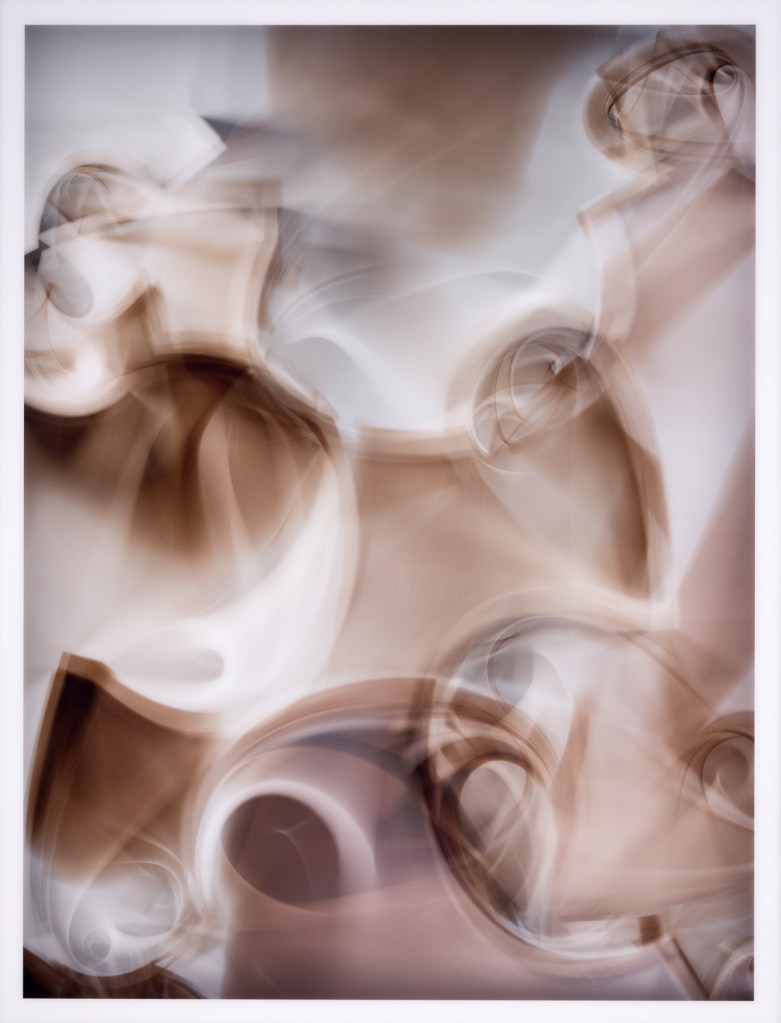
 

Gustave Le Gray (French, 1820-1884) 'The Pont du Carrousel, Paris: View to the West from the Pont des Arts' 1856-1858


Gustave Le Gray (French, 1820-1884)
The Pont du Carrousel, Paris: View to the West from the Pont des Arts
1856-1858
Albumen print
37.8 x 48.8cm
National Gallery of Art, Washington, Patrons’ Permanent Fund, 1995


Édouard-Denis Baldus (French, 1813-1889) 'Toulon, Train Station' c. 1861


Édouard-Denis Baldus (French, 1813-1889)
Toulon, Train Station
c. 1861
Albumen print
27.4 x 43.1cm
National Gallery of Art, Washington, Patrons’ Permanent Fund, 1995


In Light of the Past: Celebrating 25 Years of Photography at the National Gallery of Art, on view in the West Building from May 3 through July 26, 2015, will commemorate more than two decades of the Gallery’s robust photography program. Some 175 of the collection’s most exemplary holdings will reveal the evolution of the art of photography, from its birth in 1839 to the late 1970s. In Light of the Past is one of three stellar exhibitions that will commemorate the 25th anniversary of the National Gallery of Art’s commitment to photography acquisitions, exhibitions, scholarly catalogues, and programs.

In Light of the Past includes some of the rarest and most compelling photographs ever created,” said Earl A. Powell III, director, National Gallery of Art, Washington. “It also honours the generous support of our donors who have enabled us to achieve this new place of prominence for photography at the Gallery.

About the exhibition

In Light of the Past begins with exceptional 19th-century salted paper prints, daguerreotypes, and albumen prints by acclaimed early practitioners such as William Henry Fox Talbot (1800-1877), Gustave Le Gray (1820-1884), Roger Fenton (1819-1869), Julia Margaret Cameron (1815-1879), Albert Sands Southworth (1811-1894), and Josiah Johnson Hawes (1808-1901). It also displays works by American expeditionary photographers, including William Bell (1830-1910) and Carleton E. Watkins (1829-1916).

The exhibition continues with late 19th- and early 20th-century American Pictorialist photographs by Alfred Stieglitz (1864-1946), Clarence H. White (1871-1925), Gertrude Käsebier (1852-1934), and Alvin Langdon Coburn (1882-1966), among others, as well as European masters such as Eugène Atget (1857-1927). The exhibition also examines the international photographic modernism of artists such as Paul Strand (1890-1976), André Kertész (1894-1985), Marianne Brandt (1893-1983), László Moholy-Nagy (1895-1946), and Ilse Bing (1899-1998) before turning to the mid-20th century, where exceptional work by Walker Evans (1903-1975), Robert Frank (b. 1924), Harry Callahan (1912-1999), Irving Penn (1917-2009), Lee Friedlander (b. 1934), and Diane Arbus (1923-1971) will be on view.

The exhibition concludes with pictures from the 1960s and 1970s, showcasing works by photographers such as Robert Adams (b. 1937), Lewis Baltz (1945-2014), and William Eggleston (b. 1939), as well as Mel Bochner (b. 1940) and Sol LeWitt (1928-2007), which demonstrate the diverse practices that invigorated photography during these decades.
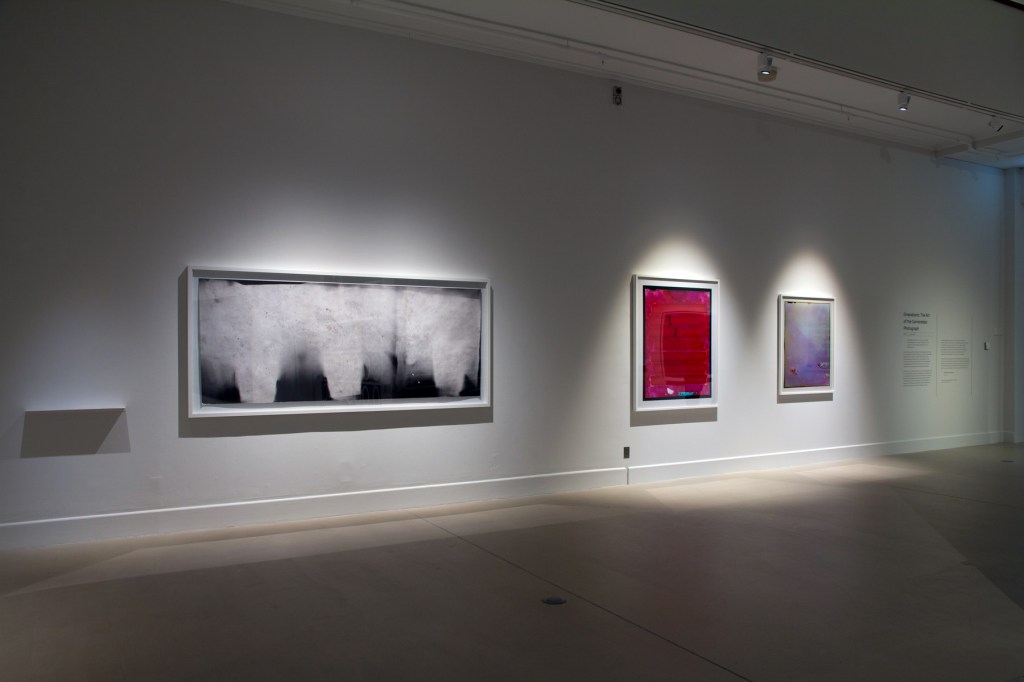
Press release from the National Gallery of Art


Albert Sands Southworth (American, 1811-1894) and Josiah Johnson Hawes (American, 1808-1901) 'The Letter' c. 1850


Albert Sands Southworth (American, 1811-1894) and Josiah Johnson Hawes (American, 1808-1901)
The Letter
c. 1850
Daguerreotype
Plate: 20.3 x 15.2cm
National Gallery of Art, Washington, Patrons’ Permanent Fund, 1999


Working together in Boston, the portrait photographers Southworth and Hawes aimed to capture the character of their subjects using the daguerreotype process. Invented in France and one of the two photographic processes introduced to the public in early 1839, the daguerreotype is made by exposing a silver-coated copper plate to light and then treating it with chemicals to bring out the image. The heyday of the technique was the 1840s and 1850s, when it was used primarily for making portraits. The daguerreotype’s long exposure time usually resulted in frontal, frozen postures and stern facial expressions; this picture’s pyramidal composition and strong sentiments of friendship and companionship are characteristic of Southworth and Hawes’s innovative approach.
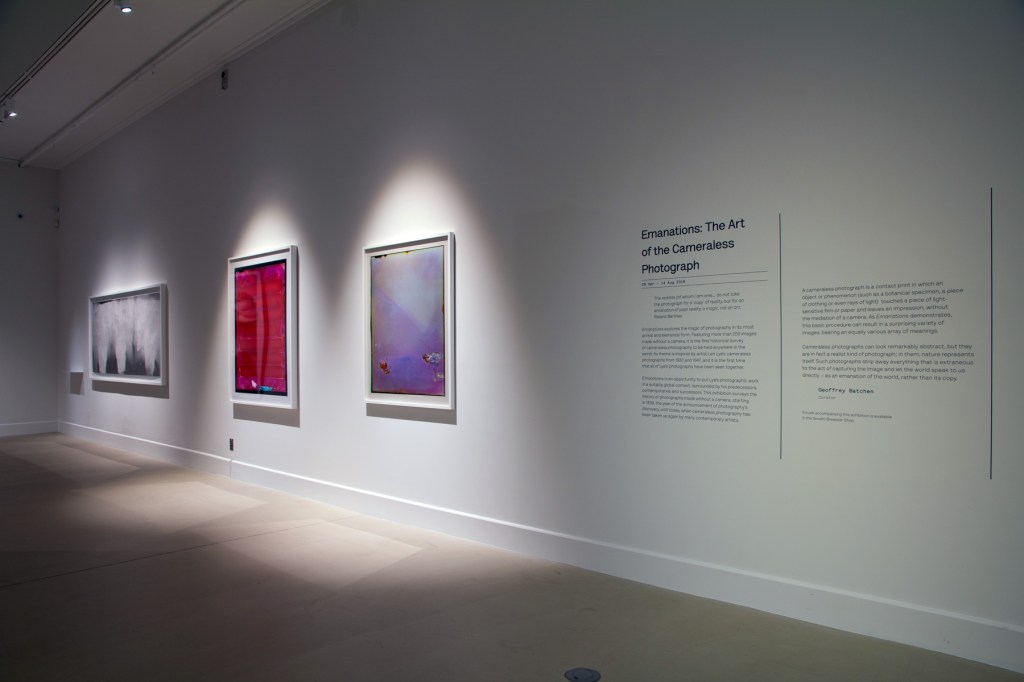
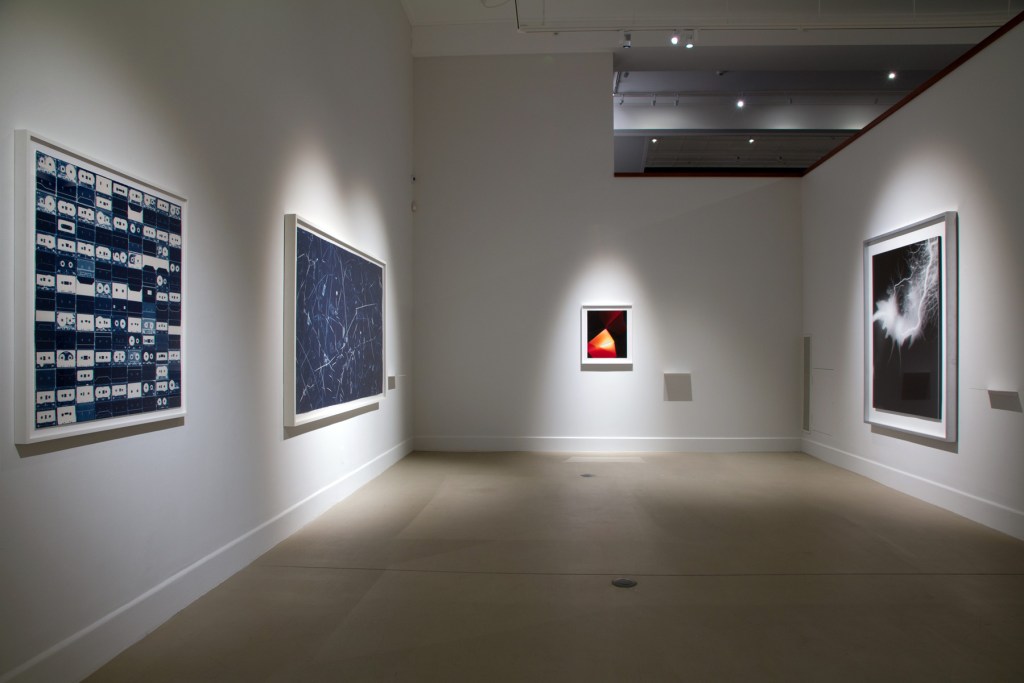
 

Clarence H. White (American, 1871-1925) 'The Hillside' c. 1898


Clarence H. White (American, 1871-1925)
The Hillside
c. 1898
Gum dichromate print
20.8 x 15.88cm
National Gallery of Art, Washington, Patrons’ Permanent Fund, 2008


The Photo-Secession

At the turn of the century in America, Alfred Stieglitz and his colleague Edward Steichen led the movement to establish photography’s status as a fine art. In 1902 Stieglitz founded an organisation called the Photo-Secession, consisting of young artists who shared his belief in the creative potential of the medium. Many of the photographers featured here were members of the group, including Gertrude Käsebier, Clarence White, and Alvin Langdon Coburn. Through the exhibitions Stieglitz organised in his New York gallery, called 291, and the essays he published in his influential quarterly, Camera Work, he and the Photo-Secession promoted the Pictorialist aesthetic of softly textured, painterly pictures that elicit emotion and appeal to the imagination. Occasionally the photographers’ compositions refer to other works of art, such as Steichen’s portrait of his friend Auguste Rodin, whose pose recalls one of the sculptor’s most famous works, The Thinker. Influenced by the modern European and American painting, sculpture, and drawing he exhibited at 291, Stieglitz lost interest in the Photo-Secession in the early 1910s and began to explore a more straightforward expression.


Eugène Atget (French, 1857-1927) 'Saint-Cloud' 1926


Eugène Atget (French, 1857-1927)
Saint-Cloud
1926
Albumen print
22.2 x 18.1cm
National Gallery of Art, Washington, Gift of Mary and Dan Solomon and Patrons’ Permanent Fund, 2006


Using a cumbersome camera mounted on a tripod, Atget recorded the myriad facets of Paris and its environs at the turn of the century. Transforming ordinary scenes into poetic evocations, he created a visual compendium of the objects, architecture, and landscapes that were expressive of French culture and its history. He sold his photographs to artists, architects, and craftsmen, as well as to libraries and museums interested in the vanishing old city. Throughout his career he returned repeatedly to certain subjects and discovered that the variations caused by changing light, atmosphere, and season provided inexhaustible subjects for the perceptive photographer.


Julia Margaret Cameron (British, 1815-1879) 'The Mountain Nymph, Sweet Liberty' June 1866


Julia Margaret Cameron (British, 1815-1879)
The Mountain Nymph, Sweet Liberty
June 1866
Albumen print
36.1 x 26.7cm
National Gallery of Art, Washington, New Century Fund, 1997


Ensconced in the intellectual and artistic circles of midcentury England, Cameron manipulated focus and light to create poetic pictures rich in references to literature, mythology, and history. Her monumental views of life-sized heads were unprecedented, and with them she hoped to define a new mode of photography that would rival the expressive power of painting and sculpture. The title of this work alludes to John Milton’s mid-seventeenth-century poem L’Allegro. Describing the happy life of one who finds pleasure and beauty in the countryside, the poem includes the lines:

Come, and trip it as ye go
On the light fantastic toe;
And in thy right hand lead with thee,
The mountain nymph, sweet Liberty.


Dr Guillaume-Benjamin-Amant Duchenne (de Boulogne) (French, 1806-1875) 'Figure 63, "Fright" from "Mécanisme de la physionomie humaine (Mechanism of human physiognomy)" (1862)' 1854-1855


Dr Guillaume-Benjamin-Amant Duchenne (de Boulogne) (French, 1806-1875)
Figure 63, “Fright” from “Mécanisme de la physionomie humaine (Mechanism of human physiognomy)” (1862)
1854-1855
Albumen print
21.5 × 16cm
National Gallery of Art, Washington, Pepita Milmore Memorial Fund, 2015


A neurologist, physiologist, and photographer, Duchenne de Boulogne conducted a series of experiments in the mid-1850s in which he applied electrical currents to various facial muscles to study how they produce expressions of emotion. Convinced that these electrically-induced expressions accurately rendered internal feelings, he then photographed his subjects to establish a precise visual lexicon of human emotions, such as pain, surprise, fear, and sadness. In 1862 he included this photograph representing fright in a treatise on physiognomy (a pseudoscience that assumes a relationship between external appearance and internal character), which enjoyed broad popularity among artists and scientists.


Lewis Hine (American, 1874-1940) 'An Anaemic Little Spinner in a New England Cotton Mill (North Pownal, Vermont)' 1910


Lewis Hine (American, 1874-1940)
An Anaemic Little Spinner in a New England Cotton Mill (North Pownal, Vermont)
1910
Gelatin silver print
24.1 × 19.2cm
National Gallery of Art, Washington, Pepita Milmore Memorial Fund, 2015


Trained as a sociologist and initially employed as a teacher, Hine used the camera both as a research tool and an instrument of social reform. One of the earliest and most influential social documentary photographers of his time, he made many pictures under the auspices of the National Child Labor Committee, an organisation formed in 1904 to promote better working conditions for children. Hine’s focus on the thin, frail body of this barefoot twelve-year-old spinner, who stands before rows of bobbins in the mill where she worked, was meant to illustrate the unhealthy effects of her employment. Photographs like this one were crucial to the campaign to change American child labor laws in the early twentieth century.


In Light of the Past: Twenty-Five Years of Photography at the National Gallery of Art

Georgia O’Keeffe and the Alfred Stieglitz Estate laid the foundation of the photography collection of the National Gallery of Art in 1949 with their donation of 1,650 Stieglitz photographs, an unparalleled group known as the Key Set. Yet the Gallery did not start actively acquiring photographs until 1990, when it launched an initiative to build a collection of works by European and American photographers from throughout the history of the medium and mount major exhibitions with scholarly publications. Now including nearly fifteen thousand prints, the collection encompasses the rich diversity of photographic practice from fine art to scientific and amateur photography, as well as photojournalism. It is distinguished by its large holdings of works by many of the medium’s most acclaimed masters, such as Paul Strand, Walker Evans, André Kertész, Ilse Bing, Robert Frank, Harry Callahan, Lee Friedlander, Gordon Parks, Irving Penn, and Robert Adams, among others.

In Light of the Past celebrates the twenty-fifth anniversary of the 1990 initiative by presenting some of the Gallery’s finest photographs made from the early 1840s to the late 1970s. It is divided into four sections arranged chronologically. The first traces the evolution of the art of photography during its first decades in the work of early British, French, and American practitioners. The second looks at the contributions of late nineteenth and early twentieth-century photographers, from Stieglitz and the American Pictorialists to European masters such as Eugène Atget. The third section examines the international photographic modernism of the 1920s and 1930s, and the fourth features seminal mid-twentieth-century photographers. The exhibition concludes with pictures representing the varied practices of those working in the late 1960s and 1970s.

The Nineteenth Century: The Invention of Photography

In 1839 a new means of visual representation was announced to a startled world: photography. Although the medium was immediately and enthusiastically embraced by the public at large, photographers themselves spent the ensuing decades experimenting with techniques and debating the nature of this new invention. The works in this section suggest the range of questions addressed by these earliest practitioners. Was photography best understood as an art or a science? What subjects should photographs depict, what purpose should they serve, and what should they look like? Should photographers work within the aesthetics established in other arts, such as painting, or explore characteristics that seemed unique to the medium? This first generation of photographers became part scientists as they mastered a baffling array of new processes and learned how to handle their equipment and material. Yet they also grappled with aesthetic issues, such as how to convey the tone, texture, and detail of multicoloured reality in a monochrome medium. They often explored the same subjects that had fascinated artists for centuries – portraits, landscapes, genre scenes, and still lifes – but they also discovered and exploited the distinctive ways in which the camera frames and presents the world.

Photography at the Turn of the Twentieth Century

In the late nineteenth century, improvements in technology and processing, along with the invention of small handheld cameras such as the Kodak, suddenly made it possible for anyone of middle-class means to take photographs. Many amateurs took up the camera to commemorate family, friends, and special events. Others, such as the sociologist Lewis Hine, used it as a tool for social and political change. Partially in response to the new ease of photography, more serious practitioners in America and Europe banded together to assert the artistic merit of the medium. Called Pictorialists, they sought to prove that photography was just as capable of poetic, subjective expression as painting. They freely manipulated their prints to reveal their authorial control, often resulting in painterly effects, and consciously separated themselves from amateur photographers and mechanised processes.

Photography Between the Wars

In the aftermath of World War I – the first modern, mechanised conflict – sweeping changes transformed photography. Avant-garde painters, graphic designers, and journalists turned to the medium, seeing it as the most effective tool to express the fractured, fast-paced nature of modernity and the new technological culture of the twentieth century. A wide variety of new approaches and techniques flourished during these years, especially in Europe. Photographers adopted radical cropping, unusual angles, disorienting vantage points, abstraction, collage, and darkroom alchemy to achieve what the influential Hungarian teacher László Moholy-Nagy celebrated as the “new vision.” Other photographers, such as the German August Sander or the Americans Alfred Stieglitz, Edward Weston, and Walker Evans, sought a more rigorous objectivity grounded in a precise examination of the world.

Postwar Photography

Photography thrived in the decades after World War II, invigorated by new ideas, practices, and expanding venues for circulating and displaying pictures. Immediately after the war, many photographers sought to publish their pictures in illustrated magazines, which prospered during these years. Some, such as Gordon Parks, made photographs highlighting racial, economic, and social disparities. Others, such as Louis Faurer, Sid Grossman, and Robert Frank, turned to the street to address the conditions of modern life in pictures that expose both its beauty and brutality. Using handheld cameras and available light, they focused on the random choreography of sidewalks, making pictures that are often blurred, out of focus, or off-kilter.

In the later 1950s and 1960s a number of photographers pushed these ideas further, mining the intricate social interactions of urban environments. Unlike photographers from the 1930s, these practitioners, such as Garry Winogrand, Lee Friedlander, and Diane Arbus, sought not to reform American society but to record it in all its complexity, absurdity, and chaos. By the late 1960s and 1970s, other photographers, such as Robert Adams and Lewis Baltz, looked beyond conventional notions of natural beauty to explore the despoliation of the urban and suburban landscape. Their pictures of tract houses, highways, and motels are stripped of any artistic frills, yet they are exquisitely rendered and replete with telling details. Also starting in the 1960s, many conceptual or performance artists working in a variety of media embraced what they perceived to be photography’s neutrality and turned to it as an essential part of their experiments to expand traditional notions of art. In the late 1960s, improvements in colour printing techniques led others, such as William Eggleston, to explore the artistic potential of colour photography.


Edward Steichen (American, 1879-1973) 'An Apple, A Boulder, A Mountain' 1921


Edward Steichen (American, 1879-1973)
An Apple, A Boulder, A Mountain
1921
Platinum print
National Gallery of Art, Washington, Patrons’ Permanent Fund, 2014


After World War I, Steichen became disillusioned with the painterly aesthetic of his earlier work and embarked on a series of experiments to study light, form, and texture. Inverting an apple, he demonstrated how a small object, when seen in a new way, can assume the monumentality and significance of a much larger one. His close-up scrutiny of a natural form closely links this photograph with works by other American modernists of the 1920s, such as Edward Weston, Paul Strand, and Georgia O’Keeffe.


Paul Strand (American, 1890-1976) 'People, Streets of New York, 83rd and West End Avenue' 1916


Paul Strand (American, 1890-1976)
People, Streets of New York, 83rd and West End Avenue
1916
Platinum print
24.2 x 33cm
National Gallery of Art, Washington, Patrons’ Permanent Fund, 1990


Strand was introduced to photography in high school by his teacher Lewis Hine, who instilled in him a strong interest in social issues. In 1907, Hine took his pupil to Alfred Stieglitz’s 291 gallery in New York, which launched Strand’s desire to become a fine art photographer. By the early 1910s, influenced by Stieglitz, he began to make clearly delineated portraits, pictures of New York, and nearly abstract still lifes. Strand came to believe that photography was a gift of science to the arts, that it was an art of selection, not translation, and that objectivity was its very essence.


American 20th Century. 'Untitled' c. 1930


American 20th Century
Untitled
c. 1930
Gelatin silver print
5.7 x 10cm
National Gallery of Art, Washington, Gift of Robert E. Jackson, 2007


Snapshots

After World War I, a parade of technological improvements transformed the practice of photography. With smaller cameras, faster shutter speeds, and more sensitive film emulsions, both amateurs and more serious practitioners could now easily record motion, investigate unexpected angles and points of view, and work in dim light and inclement weather. The amateur’s less staid, more casual approach began to play an important role in the work of modernist photographers as they explored spontaneity and instantaneity, seeking to capture the cacophony and energy of modern life. Blurriness, distorted perspectives, and seemingly haphazard cropping-once considered typical amateur mistakes-were increasingly embraced as part of the modern, vibrant way of picturing the world.


Robert Frank (Swiss, 1924-2019) 'City of London' 1951


Robert Frank (Swiss, 1924-2019)
City of London
1951
Gelatin silver print
23 x 33.6cm
National Gallery of Art, Washington, Robert Frank Collection, Purchased as a Gift of The Howard Gilman Foundation, in Honor of the 50th Anniversary of the National Gallery of Art, 1991


Robert Frank (Swiss, 1924-2019) 'Woman/Paris' 1952


Robert Frank (Swiss, 1924-2019)
Woman/Paris
1952
Gelatin silver print in bound volume
Image: 35.1 x 25.4cm
National Gallery of Art, Washington, Robert Frank Collection, Gift (Partial and Promised) of Robert Frank, in Honor of the 50th Anniversary of the National Gallery of Art, 1990


In the late 1940s and early 1950s, Frank made several handbound volumes of photographs, exploring different ways to link his pictures through non-narrative sequences. While in Zurich in October 1952, he assembled pictures taken in Europe, South America, and the United States in a book called Black White and Things. With a brief introductory quote from Antoine de Saint-Exupéry – “it is only with the heart that one can see rightly; what is essential is invisible to the eye” – the photographs are arranged in a sophisticated sequence that uses formal repetition, conceptual contrasts, and, as here, witty juxtapositions to evoke a range of ideas …

While in Zurich in October of 1952, Frank assembled photographs taken in Europe, South America, and the United States in the preceding years into a bound book called Black White and Things. Designed by Frank’s friend Werner Zryd, and with only a brief introductory statement describing the three sections, the photographs appear in a sophisticated sequence that relies on subtle, witty juxtapositions and powerful visual formal arrangements to evoke a wide range of emotions.

Frank made three copies of this book, all identical in size, construction, and sequence. He gave one copy to his father, gave one to Edward Steichen, and kept one. The book that belonged to his father is now in a private collection; Steichen’s copy resides at the Museum of Modern Art, New York; and in 1990 Frank gave his copy to the Robert Frank Collection at the National Gallery of Art.


Robert Frank (Swiss, 1924-2019) 'Trolley - New Orleans' 1955


Robert Frank (Swiss, 1924-2019)
Trolley – New Orleans
1955
Gelatin silver print
Sheet: 21 x 31.6cm
National Gallery of Art, Washington, Gift of Maria and Lee Friedlander, 2001


Roy DeCarava (American, 1919-2009) 'Mississippi Freedom Marcher, Washington, D.C.' 1963


Roy DeCarava (American, 1919-2009)
Mississippi Freedom Marcher, Washington, D.C.
1963
Gelatin silver print
25.5 x 33cm
National Gallery of Art, Washington, Horace W. Goldsmith Foundation through Robert and Joyce Menschel, 1999


Lee Friedlander (American, b. 1934) 'New York City' 1966


Lee Friedlander (American, b. 1934)
New York City
1966
Gelatin silver print
Image: 13.3 x 20.6 cm
National Gallery of Art, Washington, Trellis Fund, 2001


Heir to the tradition of documentary photography established by Eugène Atget, Walker Evans, and Robert Frank, Friedlander focuses on the American social landscape in photographs that can seem absurd, comical, and even bleak. In dense, complex compositions, he frequently depicts surprising juxtapositions that make the viewer look twice. He has made numerous self-portraits, yet he appears in these pictures in oblique and unexpected ways, for example reflected in a mirror or window. The startling intrusion of Friedlander’s shadow onto the back of a pedestrian’s coat, at once threatening and humorous, slyly exposes the predatory nature of street photography.


Giovanni Anselmo (Italian, 1934-2023) 'Entering the Work' 1971


Giovanni Anselmo (Italian, 1934-2023)
Entering the Work
1971
Photographic emulsion on canvas
49 x 63.5cm
National Gallery of Art, Washington, Glenstone in honor of Eileen and Michael Cohen, 2008


Conceptual Photography

In the 1960s, many painters and sculptors questioned the traditional emphasis on aesthetics and turned to creating art driven by ideas. Photography’s association with mechanical reproduction appealed to them as they sought to downplay the hand of the artist while promoting his or her role as idea maker. Some conceptual artists, such as Sol Lewitt and Mel Bochner, used photographs to explore an interest in perspective, scale, and mathematics. Others turned to photography as a tool to record performances and artistic undertakings, the resulting pictures acting as an integral part of those projects.

Anselmo was a member of the Italian Arte Povera group, which sought to break down the separation of art and life through experimental performances and the use of natural materials such as trees and leaves. To make this work, Anselmo set his camera up with a timed shutter release, and raced into view so that his running figure creates a modest yet heroic impression on the landscape.


Robert Adams (American, b. 1937) 'Colorado Springs, Colorado' 1974


Robert Adams (American, b. 1937)
Colorado Springs, Colorado
1974
Gelatin silver print, printed 1983
15.2 x 15.2cm
National Gallery of Art, Washington, Gift of Mary and Dan Solomon and Patrons’ Permanent Fund, 2006


For more than forty years, Adams has recorded the changing American landscape, especially the ongoing settlement of the West. Although he has photographed roads, tract houses, and strip malls that have utterly transformed the landscape, he has also captured the beauty that remains and indeed, that refuses to die, as in his poetic picture of morning fog over California hills. He is convinced, as he wrote in 1974, that “all land, no matter what has happened to it, has over it a grace, an absolutely persistent beauty.”


Margaret Bourke-White (American, 1904-1971) 'Fort Peck Dam, Montana' 1936


Margaret Bourke-White (American, 1904-1971)
Fort Peck Dam, Montana
1936
Gelatin silver print
33.02 × 27.31cm
National Gallery of Art, Washington, Patrons’ Permanent Fund, 2014


One of the most iconic photographs by the pioneering photojournalist Bourke-White, Fort Peck Dam, Montana was published on the cover of the inaugural issue of Life magazine on November 23, 1936. A striking representation of the machine age, the photograph depicts the stark, massive piers for an elevated highway over the spillway near the dam. The two men at the bottom of the print indicate the piers’ massive scale while revealing the vulnerable position of the worker in the modern industrial landscape.


György Kepes (American born Hungary, 1906-2001) 'Juliet with Peacock Feather and Red Leaf' 1937-1938


György Kepes (American born Hungary, 1906-2001)
Juliet with Peacock Feather and Red Leaf
1937-1938
Gelatin silver print with gouache
15.7 × 11.6cm
National Gallery of Art, Washington, Pepita Milmore Memorial Fund, 2014


Trained as a painter at the Academy of Fine Arts in Budapest, Kepes was an influential designer, educator, aesthetic theorist, and photographer. In 1930 he moved to Berlin, where he worked with László Moholy-Nagy, but eventually settled in Chicago and later Cambridge, Massachusetts. Created soon after his arrival in America, this startling photograph is both an intimate depiction of Kepes’s wife and a study of visual perception. Like the red leaf that seems to float above the image, the peacock feather – its eye carefully lined up with Juliet’s – obscures not only her vision but also the viewer’s ability to see her clearly.


Irving Penn (American, 1917-2009) 'Woman with Roses (Lisa Fonssagrives-Penn in Lafaurie Dress), Paris' 1950


Irving Penn (American, 1917-2009)
Woman with Roses (Lisa Fonssagrives-Penn in Lafaurie Dress), Paris
1950
Platinum/palladium print, 1977
55.1 x 37cm
National Gallery of Art, Washington, Gift of Irving Penn, 2002


One of the most influential fashion and portrait photographers of his time, Penn made pictures marked by refinement, elegance, and clarity. Trained as a painter and designer, he began to photograph in the early 1940s while working at Vogue; more than 150 of his photographs appeared on the cover of the magazine during his long career. A perfectionist, Penn explored earlier printing techniques, such as a late nineteenth-century process that used paper coated with solutions of platinum or palladium rather than silver, to achieve the subtle tonal range he desired.


National Gallery of Art
National Mall between 3rd and 7th Streets
Constitution Avenue NW, Washington

Opening hours:
Open daily 10.00 am – 5.00pm

National Gallery of Art website

LIKE ART BLART ON FACEBOOK

Back to top

Exhibition: ‘Salt and Silver: Early Photography 1840-1860’ at Tate Britain, London

Exhibition dates: 25th February – 7th June 2015

Curators: Carol Jacobi, Curator, British Art 1850-1915, Tate Britain, Simon Baker, Curator, Photography and International Art, Tate, and Hannah Lyons, Assistant Curator, 1850-1915, Tate


'Salt and Silver' exhibition at Tate Britain


“Salt prints are the very first photographs on paper that still exist today. Made in the first twenty years of photography, they are the results of esoteric knowledge and skill. Individual, sometimes unpredictable, and ultimately magical, the chemical capacity to ‘fix a shadow’ on light sensitive paper, coated in silver salts, was believed to be a kind of alchemy, where nature drew its own picture.”


These salted paper prints, one of the earliest forms of photography, are astonishing. The delicacy and nuance of shade and feeling; possessing a soft, luxurious aesthetic that is astounding today… but just imagine looking at these images at the time they were taken. The shock, the recognition, the delight and the romance of seeing aspects of your life and the world around you, near and far, drawn in light – having a physical presence in the photographs before your eyes. The aura of the original, the photograph AS referent – unlike contemporary media saturated society where the image IS reality, endlessly repeated, divorced from the world in which we live.

The posting has taken a long time to put together, from researching the birth and death dates of the artists (not supplied), to finding illustrative texts and biographies of each artist (some translated from the French). But the real joy in assembling this posting is when I sequence the images. How much pleasure does it give to be able to sequence Auguste Salzmann’s Terra Cotta Statuettes from Camiros, Rhodes followed by three Newhaven fishermen rogues (you wouldn’t want to meet them on a dark night!), and then the totally different feel of Fenton’s Group of Croat Chiefs. Follow this up with one of the most stunning photographs of the posting, Roger Fenton’s portrait Captain Mottram Andrews, 28th Regiment (1st Staffordshire) Regiment of Foot of 1855 and you have a magnificent, almost revelatory, quaternity/eternity.

Dr Marcus Bunyan


Many thankx to Tate Britain for allowing me to publish the photographs in the posting. Please click on the photographs for a larger version of the image.


Calvert Jones. 'The Fruit Sellers' c. 1843


Calvert Jones (Welsh, December 4, 1804 – November 7, 1877)
The Fruit Sellers
c. 1843
Photograph, salted paper print from a paper negative


David Hill and Robert Adamson. 'Five Newhaven fisherwomen' c. 1844


David Hill (Scottish, 1802-1870) and Robert Adamson (Scottish, 1821-1848)
Five Newhaven fisherwomen

c. 1844
Photograph, salted paper print from a paper negative


David Hill and Robert Adamson. 'The Gowan [Margaret and Mary Cavendish]' c. 1843-1848


David Hill (Scottish, 1802-1870) and Robert Adamson (Scottish, 1821-1848)
The Gowan [Margaret and Mary Cavendish]
c. 1843-1844
Photograph, salted paper print from a paper negative


Salt and Silver: Early Photography 1840-1860 is the first major exhibition in Britain devoted to salt prints, the earliest form of paper photography. The exhibition features some of the rarest and best early photographs in the world, depicting daily activities and historic moments of the mid 19th century. The ninety photographs on display are among the few fragile salt prints that survive and are seldom shown in public. Salt and Silver: Early Photography 1840-1860 opens at Tate Britain on 25 February 2015.

In the 1840s and 50s, the salt print technique introduced a revolutionary new way of creating photographs on paper. It was invented in Britain and spread across the globe through the work of British and international photographers – artists, scientists, adventurers and entrepreneurs of their day. They captured historic moments and places with an immediacy not previously seen, from William Henry Fox Talbot’s images of a modern Paris street and Nelson’s Column under construction, to Linnaeus Tripe’s dramatic views of Puthu Mundapum, India and Auguste Salzmann’s uncanny studies of statues in Greece.

In portraiture, the faces of beloved children, celebrities, rich and poor were recorded as photographers sought to catch the human presence. Highlights include Fox Talbot’s shy and haunting photograph of his daughter Ela in 1842 to Nadar’s images of sophisticated Parisians and Roger Fenton’s shell-shocked soldiers in the Crimean war.

William Henry Fox Talbot unveiled this ground-breaking new process in 1839. He made the world’s first photographic prints by soaking paper in silver iodide salts to register a negative image which, when photographed again, created permanent paper positives. These hand-made photographs ranged in colour from sepia to violet, mulberry, terracotta, silver-grey, and charcoal-black and often had details drawn on like the swishing tail of a horse. Still lifes, portraits, landscapes and scenes of modern life were transformed into luxurious, soft, chiaroscuro images. The bold contrasts between light and dark in the images turned sooty shadows into solid shapes. Bold contrasts between light and dark turned shadows into abstract shapes and movement was often captured as a misty blur. The camera drew attention to previously overlooked details, such as the personal outline of trees and expressive textures of fabric.

In the exciting Victorian age of modern invention and innovation, the phenomenon of salt prints was quickly replaced by new photographic processes. The exhibition shows how, for a short but significant time, the British invention of salt prints swept the world and created a new visual experience.

Salt and Silver: Early Photography 1840 – 1860 is organised in collaboration with the Wilson Centre for photography. It is curated by Carol Jacobi, Curator, British Art 1850-1915, Tate Britain, Simon Baker, Curator, Photography and International Art, Tate, and Hannah Lyons, Assistant Curator, 1850-1915, Tate. ‘Salt and Silver’ – Early Photography 1840-1860 is published by Mack to coincide with the exhibition and will be accompanied by a programme of talks and events in the gallery.

Press release from the Tate website


William Fox Talbot. 'Scene in a Paris Street' 1843


William Henry Fox Talbot (British, 11 February 1800 – 17 September 1877)
Scene in a Paris Street
1843
Photograph, salted paper print from a paper negative


By 1841, Talbot had dramatically reduced, from many minutes to just seconds, the exposure time needed to produce a negative, and on a trip to Paris to publicise his new calotype process he took a picture from his hotel room window, an instinctive piece of photojournalism. The buildings opposite are rendered in precise and exquisite detail, the black and white stripes of the shutters neat alternations of light and shade. In contrast to the solidity of the buildings are the carriages waiting on the street below; the wheels, immobile, are seen in perfect clarity, while the skittish horses are no more than ghostly blurs.

Florence Hallett. “Salt and Silver, Tate Britain: Early photographs that brim with the spirit of experimentation,” on The Arts Desk website, Wednesday, 25 February 2015 [Online] Cited 03/06/2015.


William Henry Fox Talbot. 'Nelson’s Column Under Construction, Trafalgar Square' 1844


William Henry Fox Talbot (British, 11 February 1800 – 17 September 1877)
Nelson’s Column Under Construction, Trafalgar Square
1844
Salted paper print from a glass plate negative


William Henry Fox Talbot. 'Nelson's Column Under Construction, Trafalgar Square' 1844


William Henry Fox Talbot (British, 11 February 1800 – 17 September 1877)
Nelson’s Column Under Construction, Trafalgar Square
1844
Salted paper print from a glass plate negative


This is the first exhibition in Britain devoted to salted paper prints, one of the earliest forms of photography. A uniquely British invention, unveiled by William Henry Fox Talbot in 1839, salt prints spread across the globe, creating a new visual language of the modern moment. This revolutionary technique transformed subjects from still lifes, portraits, landscapes and scenes of daily life into images with their own specific aesthetic: a soft, luxurious effect particular to this photographic process. The few salt prints that survive are seldom seen due to their fragility, and so this exhibition, a collaboration with the Wilson Centre for Photography, is a singular opportunity to see the rarest and best early photographs of this type in the world.

“The technique went as follows: coat paper with a silver nitrate solution and expose it to light, thus producing a faint silver image. He later realised if you apply salt to the paper first and then spread on the silver nitrate solution the resulting image is much sharper. His resulting photos, ranging in colour from sepia to violet, mulberry, terracotta, silver-grey, and charcoal-black, were shadowy and soft, yet able to pick up on details that previously went overlooked – details like the texture of a horse’s fur, or the delicate silhouette of a tree.”

Priscilla Frank. “The First Paper Photographs Were Made With Salt, And They Look Like This,” on the Huffington Post website 03/06/2015 [Online] Cited 03/06/2015.


William Henry Fox Talbot. 'Cloisters, Lacock Abbey' 1843


William Henry Fox Talbot (British, 11 February 1800 – 17 September 1877)
Cloisters, Lacock Abbey
1843


William Henry Fox Talbot (11 February 1800 – 17 September 1877)

William Henry Fox Talbot (11 February 1800 – 17 September 1877) was a British scientist, inventor and photography pioneer who invented the salted paper and calotype processes, precursors to photographic processes of the later 19th and 20th centuries. Talbot was also a noted photographer who made major contributions to the development of photography as an artistic medium. He published The Pencil of Nature (1844), which was illustrated with original prints from some of his calotype negatives. His work in the 1840s on photo-mechanical reproduction led to the creation of the photoglyphic engraving process, the precursor to photogravure. Talbot is also remembered as the holder of a patent which, some say, affected the early development of commercial photography in Britain. Additionally, he made some important early photographs of Oxford, Paris, Reading, and York.


William Henry Fox Talbot. 'Study of China' 1844


William Henry Fox Talbot (British, 11 February 1800 – 17 September 1877)
Study of China
1844
© Wilson Centre for Photography


William Henry Fox Talbot. 'Plaster Bust of Patroclus' before February 1846


William Henry Fox Talbot (British, 11 February 1800 – 17 September 1877)
Plaster Bust of Patroclus
before February 1846
© Wilson Centre for Photography


John Beasly Greene. 'El Assasif, Porte de Granit Rose, No 2, Thébes' 1854


John Beasly Greene (French-American, 1832-1856)
El Assasif, Porte de Granit Rose, No 2, Thébes
1854
Salted paper print from a waxed plate negative


John Beasly Greene (French-American, 1832-1856)

A French-born archeologist based in Paris and a student of photographer Gustave Le Gray, John Beasly Greene became a founding member of the Société Française de Photographie and belonged to two societies devoted to Eastern studies. Greene became the first practicing archaeologist to use photography, although he was careful to keep separate files for his documentary images and his more artistic landscapes.

In 1853 at the age of nineteen, Greene embarked on an expedition to Egypt and Nubia to photograph the land and document the monuments and their inscriptions. Upon his return, Louis Désiré Blanquart-Evrard published an album of ninety-four of these photographs. Greene returned to Egypt the following year to photograph and to excavate at Medinet-Habu in Upper Egypt, the site of the mortuary temple built by Ramses III. In 1855 he published his photographs of the excavation there. The following year, Greene died in Egypt, perhaps of tuberculosis, and his negatives were given to his friend, fellow Egyptologist and photographer Théodule Devéria.

Text from the Getty Museum website


James Robertson and Felice Beato. 'Pyramids at Giza' 1857


James Robertson (British, 1813-1888) and Felice Beato (Italian-British, 1832 – 29 January 1909)
Pyramids at Giza
1857
Photograph, salted paper print from a glass plate negative


James Robertson (British, 1813-1888)

James Robertson (1813-1888) was an English photographer and gem and coin engraver who worked in the Mediterranean region, the Crimea and possibly India. He was one of the first war photographers.

Robertson was born in Middlesex in 1813. He trained as an engraver under Wyon (probably William Wyon) and in 1843 he began work as an “engraver and die-stamper” at the Imperial Ottoman Mint in Constantinople. It is believed that Robertson became interested in photography while in the Ottoman Empire in the 1840s.

In 1853 he began photographing with British photographer Felice Beato and the two formed a partnership called Robertson & Beato either in that year or in 1854 when Robertson opened a photographic studio in Pera, Constantinople. Robertson and Beato were joined by Beato’s brother, Antonio on photographic expeditions to Malta in 1854 or 1856 and to Greece and Jerusalem in 1857. A number of the firm’s photographs produced in the 1850s are signed Robertson, Beato and Co. and it is believed that “and Co.” refers to Antonio.

In late 1854 or early 1855 Robertson married the Beato brothers’ sister, Leonilda Maria Matilda Beato. They had three daughters, Catherine Grace (born in 1856), Edith Marcon Vergence (born in 1859) and Helen Beatruc (born in 1861). In 1855 Robertson and Felice Beato travelled to Balaklava, Crimea where they took over reportage of the Crimean War from Roger Fenton. They photographed the fall of Sevastopol in September 1855. Some sources have suggested that in 1857 both Robertson and Felice Beato went to India to photograph the aftermath of the Indian Rebellion, but it is more probable that Beato travelled there alone. Around this time Robertson did photograph in Palestine, Syria, Malta, and Cairo with either or both of the Beato brothers.

In 1860, after Felice Beato left for China to photograph the Second Opium War and Antonio Beato went to Egypt, Robertson briefly teamed up with Charles Shepherd back in Constantinople. The firm of Robertson & Beato was dissolved in 1867, having produced images – including remarkable multiple-print panoramas – of Malta, Greece, Turkey, Damascus, Jerusalem, Egypt, the Crimea and India. Robertson possibly gave up photography in the 1860s; he returned to work as an engraver at the Imperial Ottoman Mint until his retirement in 1881. In that year he left for Yokohama, Japan, arriving in January 1882. He died there in April 1888.

Text from the Wikipedia website


James Robertson. 'Base of the Obelisk of Theodosius, Constantinople' 1855


James Robertson (British, 1813-1888)
Base of the Obelisk of Theodosius, Constantinople
1855
Salted paper print from a glass plate negative


Exhibition of intriguing images that charts the birth of photography

Another week, another photography show about death. It’s not officially about death, mind you; it’s officially about the years 1840 to 1860, when photographers made their images on paper sensitised with silver salts. The process was quickly superseded, but the pictures created this way have a beautiful artistic softness and subtlety of tone, quite apart from the fact that every single new photograph that succeeded represented a huge leap forward in the development of the medium. You see these early practitioners start to grasp the scope of what might be possible. Their subjects change, from ivy-covered walls and carefully posed family groups to more exotic landscapes and subjects: Egypt, India, the poor, war.

By the time you get to Roger Fenton’s portrait Captain Lord Balgonie, Grenadier Guards of 1855 you have an inkling of how photography is changing how we understand life, for ever. Balgonie is 23. He looks 50. His face is harrowed by his service in the Crimean War, his eyes bagged with fatigue, fear and what the future may hold. He survived the conflict, but was broken by it, dying at home two years after this picture was taken. That is yet to come: for now, he is alive.

This sense of destiny bound within a picture created in a moment is what is new about photography, and you start to see it everywhere, not just in the images of war. It’s in William Henry Fox Talbot’s The Great Elm at Lacock: a huge tree against a mottled sky, battered by storms. It’s in John Beasly Greene’s near-abstract images of Egyptian statuary, chipped, cracked, alien. And it’s in the portraits of Newhaven fisherwomen by DO Hill and Robert Adamson (their cry was ‘It’s not fish, it’s men’s lives’). In a world where death is always imminent, photography arrives as the perfect way to preserve life, and the perfect way to leave your mark, however fleeting.

Chris Waywell. “Salt and Silver: Early Photography 1840-1860,” on the Time Out London website 22 July 2015 [Online] Cited 18/12/2022


Eugene Piot. 'Le Parthénon de l'Acropole d'Athens' 1852


Eugene Piot (French, 1812-1890)
Le Parthénon de l’Acropole d’Athens
1852
Photograph, salted paper print from a paper negative
© Wilson Centre for Photography


Eugène Piot was a French journalist, art critic, art collector and photographer. His pen name was Nemo. Piot was born in Paris.


Paul Marés. 'Ox cart in Brittany' c. 1857


Paul Marés (French)
Ox cart in Brittany
c. 1857
Photograph, salted paper print from a paper negative


One of the most beautiful photographs in this exhibition is Paul Marès Ox Cart, Brittany, c. 1857. At first it seems a picturesque scene of bucolic tranquillity, the abandoned cart an exquisite study in light and tone. But on the cottage wall are painted two white crosses, a warning – apparently even as recently as the 19th century – to passers-by that the household was afflicted by some deadly disease. Photography’s ability to indiscriminately aestheticise is a dilemma that has continued to present itself ever since, especially in the fields of reportage and war photography.

Florence Hallett. “Salt and Silver, Tate Britain: Early photographs that brim with the spirit of experimentation,” on The Arts Desk website, Wednesday, 25 February 2015 [Online] Cited 03/06/2015.


Jean-Baptiste Frénet. 'Horse and Groom' 1855


Jean-Baptiste Frénet (French – Lyon, 31 January 1814 – Charly, 12 August 1889)
Horse and Groom
1855
Salted paper print from a glass plate negative
© Wilson Centre for Photography


Around 1850 Frénet meets in Lyon personalities involved in the nascent photography, and he has to discover this technique to reproduce the frescoes he painted in Ainay. Curious, he is passionate about this new medium that offers him a respite space in the setbacks he suffers with his painting.

Frénet applies the stereotyped views taken of the time involving heavy stagings and is one of the first to practice the instant, the familiar and intimate subject. Five years before Nadar he produces psychological portraits and engages in close-up. He sees photography as an art, the opinion which has emerged in the first issue of the magazine La Lumière (The Light), text of the young and ephemeral gravure company founded in 1851. Frénet open a professional practice photography in 1866 and 1867 in Lyon. Unknown to the general public, his photographic work was discovered in 2000 at the sale of his photographic collection, many parts were purchased by the Musée d’Orsay.

Translated from the French Wikipedia website


Edouard Denis Baldus (French, 1813-1889) 'The Floods of 1856, Brotteaux Quarter of Lyon' 1856


Edouard Denis Baldus (French, 1813-1889)
The Floods of 1856, Brotteaux Quarter of Lyon
1856
Photograph, salted paper print from a waxed paper negative
© Wilson Centre for Photography


In June 1856, in the midst of his work at the Louvre, Baldus set out on a brief assignment, equally without precedent in photography, that was in many ways its opposite: to photograph the destruction caused by torrential rains and overflowing rivers in Lyon, Avignon, and Tarascon. From a world of magnificent man-made construction, he set out for territory devastated by natural disaster; from the task of re-creating the whole of a building in a catalogue of its thousand parts, he turned to the challenge of evoking a thousand individual stories in a handful of transcendent images. Baldus created a moving record of the flood without explicitly depicting the human suffering left in its wake. The “poor people, tears in their eyes, scavenging to find the objects most indispensable to their daily needs,” described by the local Courier de Lyon, are all but absent from his photographs of the hard-hit Brotteaux quarter of Lyon, as if the destruction had been of biblical proportions, leaving behind only remnants of a destroyed civilization.

Daniel, Malcolm. “Édouard Baldus (1813-1889),” in Heilbrunn Timeline of Art History. New York: The Metropolitan Museum of Art, 2000 [Online] Cited 16/12/2022


Auguste Salzmann. 'Terra Cotta Statuettes from Camiros, Rhodes' 1863


Auguste Salzmann (French, born April 14, 1824 in Ribeauvillé (Alsace) and died February 24, 1872 in Paris)
Terra Cotta Statuettes from Camiros, Rhodes
1863
© Wilson Centre for Photography


Auguste Salzmann (French, 1824-1872) painter, photographer and archaeologist who pioneered the use of photography in the recording of historic sites. He excavated archaeological material in Rhodes in collaboration with Alfred Biliotti.


David Hill and Robert Adamson. 'Newhaven fishermen' c. 1845


David Hill (Scottish, 1802-1870) and Robert Adamson (Scottish, 1821-1848)
Newhaven fishermen
c. 1845
Photograph, salted paper print from a paper negative
© Wilson Centre for Photography


Roger Fenton. 'Cossack Bay, Balaclava' 1855


Roger Fenton (British, 28 March 1819 – 8 August 1869)
Cossack Bay, Balaclava
1855


It is likely that in autumn 1854, as the Crimean War grabbed the attention of the British public, that some powerful friends and patrons – among them Prince Albert and Duke of Newcastle, secretary of state for war – urged Fenton to go the Crimea to record the happenings. He set off aboard HMS Hecla in February, landed at Balaklava on 8 March and remained there until 22 June. The resulting photographs may have been intended to offset the general unpopularity of the war among the British people, and to counteract the occasionally critical reporting of correspondent William Howard Russell of The Times. The photographs were to be converted into woodblocks and published in the less critical Illustrated London News. Fenton took Marcus Sparling as his photographic assistant, a servant known as William and a large horse-drawn van of equipment…

Despite summer high temperatures, breaking several ribs in a fall, suffering from cholera and also becoming depressed at the carnage he witnessed at Sebastopol, in all Fenton managed to make over 350 usable large format negatives. An exhibition of 312 prints was soon on show in London and at various places across the nation in the months that followed. Fenton also showed them to Queen Victoria and Prince Albert and also to Emperor Napoleon III in Paris. Nevertheless, sales were not as good as expected.

Text from the Wikipedia website


Roger Fenton. 'Group of Croat Chiefs' 1855


Roger Fenton (British, 28 March 1819 – 8 August 1869)
Group of Croat Chiefs
1855
Salted paper print from a glass plate negative


Roger Fenton. 'Captain Mottram Andrews, 28th Regiment (1st Staffordshire) Regiment of Foot' 1855


Roger Fenton (British, 28 March 1819 – 8 August 1869)
Captain Mottram Andrews, 28th Regiment (1st Staffordshire) Regiment of Foot
1855
Salted paper print from a glass plate negative
© Wilson Centre for Photography


Roger Fenton. 'Cantiniére' 1855


Roger Fenton (British, 28 March 1819 – 8 August 1869)
Cantiniére
1855
Salted paper print from a glass plate negative
© Wilson Centre for Photography


A woman who carries a canteen for soldiers; a vivandière.


Roger Fenton. 'Captain Lord Balgonie, Grenadier Guards' 1855


Roger Fenton (British, 28 March 1819 – 8 August 1869)
Captain Lord Balgonie, Grenadier Guards
1855
Photograph, salted paper print from a paper negative


Roger Fenton. 'Captain Lord Balgonie, Grenadier Guards' 1855


Roger Fenton (British, 28 March 1819 – 8 August 1869)
Captain Lord Balgonie, Grenadier Guards
1855
Photograph, salted paper print from a paper negative


If I had to choose a figure it would be the Franco-American, archaeological photographer John Beasly Greene. His career was short and dangerous, he died at 24, but he challenged the trend towards clarity that dominated his field. Instead, he used the limits of the medium – burn-out, shadow, halation and the beautiful grainy texture of the print itself – to explore the poetic ambiguity of Egyptian sites.

This revolutionary photographic process transformed subjects, still lifes, portraits, landscapes and scenes of daily life into images. It brings it’s own luxurious aesthetic, soft textures, matt appearance and deep rich red tones, the variations seen throughout this exhibition is fascinating to observe. It’s also an incredible opportunity to view the original prints in an exhibition format, which has never been done before on a scale like this before.

The process starts with dipping writing paper in a solution of common salt, then partly drying it, coating it with silver nitrate, then drying it again, before applying further coats of silver nitrate, William Henry Fox Talbot pioneered what became known as the salt print and the world’s first photographic print! The specifically soft and luxurious aesthetic became an icon of modern visual language.

The few salt prints that survive are rarely seen due to their fragility. This exhibition is extremely important to recognise this historical process as well as a fantastic opportunity to see the rarest and best up close of early photographs of this type in the world.

Anon. “Salt and Silver: Early Photography 1840-1860,” on the Films not dead website [Online] Cited 03/06/2015. No longer available online.


Félix Nadar. 'Mariette' c. 1855


Félix Nadar (Gaspard Félix Tournachon) (French, 6 April 1820 – 23 March 1910)
Mariette
c. 1855
Photograph, salted paper print from a glass plate negative
© Wilson Centre for Photography


Tournachon’s nickname, Nadar, derived from youthful slang, but became his professional signature and the name by which he is best known today. Poor but talented, Nadar began by scratching out a living as a freelance writer and caricaturist. His writings and illustrations made him famous before he began to photograph. His keenly honed camera eye came from his successful career as a satirical cartoonist, in which the identifying characteristic of a subject was reduced to a single distinct facet; that skill proved effective in capturing the personality of his photographic subjects.

Nadar opened his first photography studio in 1854, but he only practiced for six years. He focused on the psychological elements of photography, aiming to reveal the moral personalities of his sitters rather than make attractive portraits. Bust- or half-length poses, solid backdrops, dramatic lighting, fine sculpturing, and concentration on the face were trademarks of his studio. His use of eight-by-ten-inch glass-plate negatives, which were significantly larger than the popular sizes of daguerreotypes, accentuated those effects.

At one point, a commentator said, “[a]ll the outstanding figures of [the] era – literary, artistic, dramatic, political, intellectual – have filed through his studio.” In most instances these subjects were Nadar’s friends and acquaintances. His curiosity led him beyond the studio into such uncharted locales as the catacombs, which he was one of the first persons to photograph using artificial light.

Text from the Getty Museum website. For more information on this artist please see the MoMA website.


Lodoisch Crette Romet. 'A Lesson of Gustave Le Gray in His Studio' 1854


Lodoisch Crette Romet (1823-1872)
A Lesson of Gustave Le Gray in His Studio [Antoine-Emile Plassan]
1850-1853
24.2 x 17.7cm
Photograph, salted paper print from a paper negative


Jean-Baptiste Frénet. 'Women and girls with a doll' c. 1855


Jean-Baptiste Frénet (French – Lyon, 31 January 1814 – Charly, 12 August 1889)
Women and girls with a doll
c. 1855
© Wilson Centre for Photography


John S. Johnston. 'One of Dr Kane’s Men [possibly William Morton]' c. 1857


John S. Johnston (American, c. 1839 – December 17, 1899)
One of Dr Kane’s Men [possibly William Morton]
c. 1857


John S. Johnston was a late 19th-century maritime and landscape photographer. He is known for his photographs of racing yachts and New York City landmarks and cityscapes. Very little is known about his life. He was evidently born in Britain in the late 1830s, and was active in the New York City area in the late 1880s and 1890s. He died in 1899.


William Morton

“Belief in the Open Polar Sea theory subsided until the mid-1800s, when Elisha Kent Kane set forth on a number of expeditions north with hopes of finding this theorised body of water. On an 1850s expedition organised by Kane, explorer William Morton, believing he discovered the Open Polar Sea, described a body of water containing

“Not a speck of ice… As far as I could discern, the sea was open… The wind was due N(orth) – enough to make white caps, and the surf broke in on the rocks in regular breakers.”


Morton, however, did not find the Open Polar Sea – he found a small oasis of water. Morton’s quote is likely tinged with a desire to raise the spirits of his boss, Kane, who saw the Polar Sea as a possible utopia, an area brimming with life amidst a harsh arctic world.”

Keith Veronese. “The Open Polar Sea, a balmy aquatic Eden at the North Pole?” on the Gizmodo website 4/20/12 [Online] Cited 03/06/2015.


David Hill and Robert Adamson. 'Thought to be Elizabeth Rigby' c. 1844


David Hill (Scottish, 1802-1870) and Robert Adamson (Scottish, 1821-1848)
Thought to be Elizabeth Rigby
c. 1844
Photograph, salted paper print from a paper negative


Jean-Baptiste Frenet. 'Thought to be a Mother and Son' c. 1855


Jean-Baptiste Frénet (French – Lyon, 31 January 1814 – Charly, 12 August 1889)
Thought to be a Mother and Son
c. 1855
Photograph, salted paper print from a collodion negative transferred from glass to paper support


William Fox Talbot. 'The Photographer's Daughter, Ela Theresa Talbot' 1843-1844


William Henry Fox Talbot (British, 11 February 1800 – 17 September 1877)
The Photographer’s Daughter, Ela Theresa Talbot
1843-1844


Roger Fenton. 'Portrait of a Woman' c. 1854


Roger Fenton (British, 28 March 1819 – 8 August 1869)
Portrait of a Woman
c. 1854
Photograph, salted paper print from a glass plate negative


John Wheeley Gough. 'Gutch Abbey Ruins' c. 1858


John Wheeley Gough (British, 1809-1862)
Gutch Abbey Ruins
c. 1858
© Wilson Centre for Photography


John Wheeley Gough (British, 1809-1862)

John Wheeley Gough Gutch (1809-1862) was a British surgeon and editor. He was also a keen amateur naturalist and geologist, and a pioneer photographer.

In 1851, Dr. Gutch gave up his medical practice to become a messenger for Queen Victoria, and he began photographing the many cities he visited on his diplomatic missions. During a trip to Constantinople, he became seriously ill, resulting in permanent partial paralysis that ended his public service career. While undergoing experimental treatments in Malvern, England, Dr. Gutch again turned to photography as a cure for his melancholy. His works were exhibited throughout London and Edinburgh from 1856-1861, and he became a frequent contributor to the Photographic Notes publication. Dr. Gutch’s camera of choice was Frederick Scott Archer’s wet-plate camera because he liked the convenience of developing glass negatives within the camera, which eliminated the need for a darkroom. However, the camera proved too cumbersome for him to handle, and had to be manipulated by one of his photographic assistants. His photographs were printed on salt-treated paper and were placed into albums he painstakingly decorated with photographic collages.

Dr. Gutch’s “picturesque” photographic style was influenced by artist William Gilpin. Unlike his mid-nineteenth century British contemporaries who recorded urban expansion, he preferred focusing on ancient buildings, rock formations, archaeological ruins, and tree-lined streams. In 1857, an assignment for Photographic Notes took him to Scotland, northern Wales, and the English Lake District, where he photographed the lush settings, but not always to his satisfaction. Two years’ later, he aspired to photograph and document the more than 500 churches in Gloucestershire, a daunting and quite expensive task. He fitted his camera with a Ross Petzval wide-angle lens and managed to photograph more than 200 churches before illness forced him to abandon the ambitious project. Fifty-three-year-old John Wheeley Gough Gutch died in London on April 30, 1862.

Anonymous text. “John Wheeley Gough Gutch,” on the Historic Camera website Nd [Online] Cited 03/06/2015.


William Fox Talbot. 'The Great Elm at Lacock' 1843-1845


William Henry Fox Talbot (British, 11 February 1800 – 17 September 1877)
The Great Elm at Lacock
1843-1845
Photograph, salted paper print from a paper negative
© Wilson Centre for Photography


Tate Britain
Millbank, London SW1P 4RG
United Kingdom
Phone: +44 20 7887 8888

Opening hours:
10.00am – 18.00pm daily

Tate Britain website

LIKE ART BLART ON FACEBOOK

Back to top

Exhibition: ‘Hiroshi Sugimoto: Past Tense’ at the J. Paul Getty Museum, Getty Center, Los Angeles

Exhibition dates: 4th February – 8th June 2014


Hiroshi Sugimoto (Japanese, b. 1948) 'Sam Eric, Pennsylvania' 1978


Hiroshi Sugimoto (Japanese, b. 1948)
Sam Eric, Pennsylvania
1978
Gelatin silver print
42.5 x 54.5cm
Private collection, Frankfurt
© Hiroshi Sugimoto / Courtesy The Pace Gallery


I loved Sugimoto’s time lapse movie screens, where the exact length of a movie was captured by the open lens of the camera, the substance of time and space evidenced by a seemingly empty screen. There was something wonderfully poetic and transformational about that gesture, about the notion of compressing the narrative, reality and action of a movie into a single frame of light: “the ‘annihilation of time and space’ as a particular moment in a dynamic cycle of rupture and recuperation enables a deliberate focus on the process of transition.”1 The process of transition in the flow of space and time.

Sugimoto’s art since that ground breaking body of work has been a bit of a let down. Where the movie theatres photographs were transubstantiationalist, the three series presented here – Dioramas (1975-1994), Portraits (1999) and his newest series, Photogenic Drawings (2008-present) play, if that is the right word, with the re/animation of death. The stuffed animals, the wax figures, the redrawing of William Henry Fox Talbot photogenic drawings, the redrawing of a light already been, just seem DEAD to me – a kind of double death or even triple death – the death of the animal / the death of the photograph, the unreality (the undead) of the wax figures and their death in the photograph, the death of the plant, their capture not once but twice by the death of the photograph. We know exactly what Sugimoto is doing, but the images are stilted and lifeless and I am not convinced by them.

The diorama images are just OK – almost good undergraduate work but nothing more. My problem with the waxworks images and the pencil of nature is “other images”. We all know Cindy Sherman and her images of historical figures, and we know the work of William Henry Fox Talbot. Somehow these earlier images crowd Sugimoto’s work in a way that doesn’t often happen. Winogrand never crowded Friedlander or vice versa – and you can think of many other examples where comparing is actually beneficial… but not here.

I’m not saying Sugimoto is derivative but because of these other works, they don’t have much room to move. Indeed, they hardly move at all. They are so frozen in attitude that all the daring transcendence of light, the light! of space time travel, the transition from one state to another, has been lost. The Flame of Recognition (Edward Weston) – has gone.

Dr Marcus Bunyan


1/ McQuire, Scott. The Media City. London: Sage Publications, 2008, p. 14.


Many thankx to the J. Paul Getty Museum for allowing me to publish the photographs in the posting. Please click on the photographs for a larger version of the image.


Hiroshi Sugimoto (Japanese, b. 1948) 'Polar Bear' 1976


Hiroshi Sugimoto (Japanese, b. 1948)
Polar Bear
1976
Gelatin silver print
42.1 x 54.6cm (16 9/16 x 21 1/2 in.)
The J. Paul Getty Museum, Los Angeles, Purchased with funds provided by the Photographs Council
© Hiroshi Sugimoto


Hiroshi Sugimoto (Japanese, b. 1948) 'Wapiti' 1980


Hiroshi Sugimoto (Japanese, b. 1948)
Wapiti
1980
Gelatin silver print
34.9 x 58.7cm (13 3/4 x 23 1/8 in.)
The J. Paul Getty Museum, Los Angeles, Purchased with funds provided by the Photographs Council
© Hiroshi Sugimoto


Hiroshi Sugimoto (Japanese, b. 1948) 'Sable Antelope' 1994


Hiroshi Sugimoto (Japanese, b. 1948)
Sable Antelope
1994
Gelatin silver print
42.4 x 54.1cm (16 11/16 x 21 5/16 in.)
The J. Paul Getty Museum, Los Angeles, Purchased with funds provided by the Photographs Council
© Hiroshi Sugimoto


Hiroshi Sugimoto (Japanese, b. 1948) 'Manatee' 1994


Hiroshi Sugimoto (Japanese, b. 1948)
Manatee
1994
Gelatin silver print
42.2 x 54.1cm (16 5/8 x 21 5/16 in.)
The J. Paul Getty Museum, Los Angeles, Purchased with funds provided by the Photographs Council
© Hiroshi Sugimoto


Hiroshi Sugimoto (Japanese, b. 1948) 'Birds of Japan' 1994


Hiroshi Sugimoto (Japanese, b. 1948)
Birds of Japan
1994
Gelatin silver print
38.7 x 58.4cm (15 1/4 x 23 in.)
The J. Paul Getty Museum, Los Angeles, Purchased with funds provided by the Photographs Council
© Hiroshi Sugimoto


Hiroshi Sugimoto (Japanese, b. 1948) 'Cheetah' 1980


Hiroshi Sugimoto (Japanese, b. 1948)
Cheetah
1980
Gelatin silver print
36.5 x 58.7cm (14 3/8 x 23 1/8 in.)
Courtesy Fraenkel Gallery, San Francisco
© Hiroshi Sugimoto


Hiroshi Sugimoto (Japanese, b. 1948) 'White Rhinoceros' 1980


Hiroshi Sugimoto (Japanese, b. 1948)
White Rhinoceros
1980
Gelatin Silver Print
34.1 x 58.6cm (13 7/16 x 23 1/16 in.)
Courtesy Fraenkel Gallery, San Francisco
© Hiroshi Sugimoto


Since the mid-1970s, Hiroshi Sugimoto (Japanese, born 1948) has used photography to investigate how history pervades the present. Featuring photographs of habitat dioramas, wax portraits, and early photographic negatives, Hiroshi Sugimoto: Past Tense, on view February 4 – June 8, 2014 at the J. Paul Getty Museum, Getty Center, brings together three separate bodies of work that present objects of historical and cultural significance in the collections of various museums. By photographing subjects that reimagine or replicate moments from the distant past and diverse geographical locations, Sugimoto critiques the medium’s presumed capacity to portray history with accuracy.

“This exhibition presents work that inventively reframes objects from the collections of a variety of museums, including from our extensive holdings of prints from the early days of photography,” explains Timothy Potts, director of the J. Paul Getty Museum. “Mr. Sugimoto has generously donated eighteen prints from his recent Photogenic Drawings series, which reprise a selection of important experiments by William Henry Fox Talbot that are in the Getty Museum’s collection.”

Sugimoto’s meticulously crafted prints are the result of a rigorous working method that includes extensive preparatory research, the use of a large-format view camera, and long exposures. Each of his projects is rooted in a sustained exploration of a singular motif and often carried out over many years. The exhibition will present a selection of prints from three bodies of work, Dioramas (1975-1994), Portraits (1999) and, his newest series, Photogenic Drawings (2008-present).

Dioramas

The diorama was first introduced in Paris in 1822 by the stage designer Jacques Louis Mandé Daguerre (French, 1787-1851), who later developed the daguerreotype photographic process. Situated in a darkened room, the first diorama consisted of a large painted scene on a semi-transparent curtain that was illuminated by the opening and closing of skylights and the constant shifting or dimming of lamps to create the impression of movement. In the early 20th century, habitat dioramas in natural history museums became popular, staging creatures in their faithfully replicated “natural” environments.

Sugimoto first encountered elaborate animal dioramas at the American Museum of Natural History after moving to New York in 1974, and began to focus his camera on individual scenes shortly thereafter. Omitting the educational text surrounding each display, the works heighten the illusion that animals such as manatees, wapiti, and sea lions were photographed in their natural habitats. While each photograph appears to be a candid moment captured by an experienced nature photographer, the subjects are – in actuality – depicted in poses they hold indefinitely.

Wax Portraits

While waxworks have a long history, contemporary wax museums can be traced to the French sculptor Marie Grosholz (French, 1761-1850), who achieved success in the Parisian entertainment market by creating waxworks of popular politicians and cultural figures. After moving to London in 1802, she established a commercial enterprise under the name Madame Tussaud, specialising in the production and display of full-length wax figures modelled after commissioned portraits.

Posed against pitch-black backdrops and framed by the camera in a manner suggesting old master portrait-painting traditions, each of Sugimoto’s subjects was captured with a nine-minute exposure that illuminates the finely modelled expressions and the sumptuous costumes. These life-size photographs record likenesses that have been distilled through multiple reproductions of the original sitter. The source material for the wax figures of Henry VIII and his wives is based on 16th-century panel paintings, while the portrait of Queen Victoria’s likeness is taken from a photograph of her from the 1890s, around the time of her Diamond Jubilee celebration.

“Hiroshi Sugimoto’s photographic practice is deeply rooted in a tradition of image making that was developed and perfected during the 19th century,” explains Arpad Kovacs, assistant curator in the Department of Photographs at the J. Paul Getty Museum and curator of the exhibition. “By employing century-old techniques and turning his lens to subjects and compositions that recreate or simulate moments from the past, Sugimoto intimately connects himself to the historical moments depicted.”

Photogenic Drawings

In the early 1830s, William Henry Fox Talbot (English, 1800-1877) began trying to create pictures without the aid of a pencil. After coating small pieces of writing paper with a salt solution and silver nitrate, he successfully captured the outlines of leaves and lace placed on the paper and exposed to sunlight. He continued his experiments with a camera obscura, placing a sheet of paper in this precursor to the camera to produce the first negatives, with highlights and shadows reversed. Talbot called the results of these experiments photogenic drawings.

In 2007, Hiroshi Sugimoto visited the J. Paul Getty Museum to study the earliest photographs in the collection. After photographing some of Talbot’s photogenic drawing negatives, he produced large-scale prints and coloured them with toning agents during the processing to replicate the often-bright hues of the original sheets. The scale of the enlarged prints reveals the fibres of the original writing paper, which create subtle and delicate patterns embedded in the images.

The artist’s gift of eighteen gelatin silver prints from his Photogenic Drawings series significantly enhances the Museum’s holdings of work by Sugimoto. His photographic practice, rooted in a serial approach and primarily concerned with the medium’s relationship to the passage of time, has long been an important source of influence for a younger generation of artists. The prints greatly enhance the Getty Museum’s growing collection of contemporary photographs.

Hiroshi Sugimoto: Past Tense is on view February 4 – June 8, 2014 at the J. Paul Getty Museum, Getty Center. The exhibition will run concurrently in the Center for Photographs with A Royal Passion: Queen Victoria and Photography, an exhibition featuring rare private and public photographs from the Victoria era.

Press release from the J. Paul Getty Museum website


Hiroshi Sugimoto (Japanese, b. 1948) 'Henry VIII' 1999


Hiroshi Sugimoto (Japanese, b. 1948)
Henry VIII
1999
Gelatin silver print
148.9 x 119.1cm (58 5/8 x 46 7/8 in.)
Solomon R. Guggenheim Museum, New York, Commissioned by Deutsche Bank AG in consultation with the Solomon R. Guggenheim Foundation for the Deutsche Guggenheim, Berlin
© Hiroshi Sugimoto


Hiroshi Sugimoto (Japanese, b. 1948) 'Queen Victoria' 1999


Hiroshi Sugimoto (Japanese, b. 1948)
Queen Victoria
1999
Gelatin silver print
148.9 x 119.1cm (58 5/8 x 46 7/8 in.)
Fraenkel Gallery, San Francisco
© Hiroshi Sugimoto


Hiroshi Sugimoto (Japanese, b. 1948) 'Anne Boleyn' 1999


Hiroshi Sugimoto (Japanese, b. 1948)
Anne Boleyn
1999
Gelatin silver print
148.9 x 119.1cm (58 5/8 x 46 7/8 in.)
Solomon R. Guggenheim Museum, New York, Commissioned by Deutsche Bank AG in consultation with the Solomon R. Guggenheim Foundation for the Deutsche Guggenheim, Berlin
© Hiroshi Sugimoto


Hiroshi Sugimoto (Japanese, b. 1948) 'Asplenium Halleri, Grande Chartreuse 1821 - Cardamine Pratensis, April 1839' 2008


Hiroshi Sugimoto (Japanese, b. 1948)
Asplenium Halleri, Grande Chartreuse 1821 – Cardamine Pratensis, April 1839
2008
Toned gelatin silver print
93.7 x 74.9cm (36 7/8 x 29 1/2 in.)
The J. Paul Getty Museum, Los Angeles,
Gift of the Artist
© Hiroshi Sugimoto


Hiroshi Sugimoto (Japanese, b. 1948) 'Roofline of Lacock Abbey, circa 1835-1839' 2008


Hiroshi Sugimoto (Japanese, b. 1948)
Roofline of Lacock Abbey, circa 1835-1839
2008
Gelatin silver print
93.7 x 74.9cm (36 7/8 x 29 1/2 in.)
The J. Paul Getty Museum, Los Angeles, Gift of the Artist
© Hiroshi Sugimoto


Hiroshi Sugimoto (Japanese, b. 1948) 'Bust of Venus, November 26, 1840' 2009


Hiroshi Sugimoto (Japanese, b. 1948)
Bust of Venus, November 26, 1840
2009
Gelatin silver print
93.7 x 74.9cm (36 7/8 x 29 1/2 in.)
The J. Paul Getty Museum, Los Angeles, Gift of the Artist
© Hiroshi Sugimoto


Hiroshi Sugimoto (Japanese, b. 1948) 'A Stem of Delicate Leaves of an Umbrellifer, circa 1843-1846' 2009


Hiroshi Sugimoto (Japanese, b. 1948)
A Stem of Delicate Leaves of an Umbrellifer, circa 1843-1846
2009
Gelatin silver print
93.7 x 74.9cm (36 7/8 x 29 1/2 in.)
The J. Paul Getty Museum, Los Angeles, Gift of the Artist
© Hiroshi Sugimoto


Hiroshi Sugimoto (Japanese, b. 1948) 'Arrangement of Botanical Specimens, 1839' 2008


Hiroshi Sugimoto (Japanese, b. 1948)
Arrangement of Botanical Specimens, 1839
2008
Toned gelatin silver print
93.7 x 74.9cm (36 7/8 x 29 1/2 in.)
The J. Paul Getty Museum, Los Angeles, Gift of the Artist
© Hiroshi Sugimoto


Hiroshi Sugimoto (Japanese, b. 1948) 'Nicolaas Henneman, circa 1841' 2008


Hiroshi Sugimoto (Japanese, b. 1948)
Nicolaas Henneman, circa 1841
2008
Toned gelatin silver print
93.7 x 74.9cm (36 7/8 x 29 1/2 in.)
The J. Paul Getty Museum, Los Angeles, Gift of the Artist
© Hiroshi Sugimoto


Hiroshi Sugimoto (Japanese, b. 1948) 'Bust of Patroclus, September 8, 1841' 2009


Hiroshi Sugimoto (Japanese, b. 1948)
Bust of Patroclus, September 8, 1841
2009
Toned gelatin silver print
93.7 x 74.9cm (36 7/8 x 29 1/2 in.)
The J. Paul Getty Museum, Los Angeles, Gift of the Artist
© Hiroshi Sugimoto


The J. Paul Getty Museum
1200 Getty Center Drive
Los Angeles, California 90049

Opening hours:
Tuesday – Friday, Sunday 10am – 5.30pm
Saturday 10am – 8pm
Monday Closed

The J. Paul Getty Museum website

LIKE ART BLART ON FACEBOOK

Back to top

Exhibition: ‘A Royal Passion: Queen Victoria and Photography’ at The J. Paul Getty Museum, Getty Center, Los Angeles

Exhibition dates: 4th February – 8th June 2014

Exhibition includes major loans from Royal Collection Trust


Roger Fenton (English, 1819-1869) 'Buckingham Palace' about 1858


Roger Fenton (English, 1819-1869)
Buckingham Palace
about 1858
Albumen silver print
32.2 x 43.3cm (12 11/16 x 17 1/16 in.)
Royal Collection Trust / © Her Majesty Queen Elizabeth II 2013


There are some glorious photographs in this posting. The serene Buckingham Palace with open gates; Crystal Palace with enclosed tree and ghostly figures; Nelson’s Column with wooden scaffolding and posters (nothing changes – a shop is knocked down in Chapel Street and within half a day the hoarding is covered in posters); atmospheric tugboat by Gustave Le Gray; the very famous, staged, Valley of the Shadow of Death by Roger Fenton; the “attitude” of the melange of men (if you like) in their stovepipe hats in I.K. Brunel and Others Observing by Robert Howlett, with everyone looking in different directions; and the serenity, beauty, grandeur and suppressed sense of power in Queen Victoria Diamond Jubilee Portrait by W. & D. Downey. To name but a few.

Dr Marcus Bunyan


Many thankx to the J. Paul Getty Museum for allowing me to publish the photographs in the posting. Please click on the photographs for a larger version of the image.


William Henry Fox Talbot (English, 1800-1877) 'Nelson's Column under Construction in Trafalgar Square, London' April 1844


William Henry Fox Talbot (English, 1800-1877)
Nelson’s Column under Construction in Trafalgar Square, London
April 1844
Salted paper print from a paper negative
17.1 x 21.1cm (6 3/4 x 8 5/16 in.)
The J. Paul Getty Museum, Los Angeles


Roger Fenton (English, 1819-1869) 'Manchester Art Treasures' 1857


Roger Fenton (English, 1819-1869)
Manchester Art Treasures
1857
Albumen silver print
18.6 x 24.4cm (7 5/16 x 9 5/8 in.)
The J. Paul Getty Museum, Los Angeles


John Jabez Edwin Mayall (British, 1810-1901) 'The Crystal Palace at Hyde Park, London' 1851


John Jabez Edwin Mayall (British, 1810-1901)
The Crystal Palace at Hyde Park, London
1851
Daguerreotype
Image: 30.5 x 24.6cm (12 x 9 11/16 in.)
The J. Paul Getty Museum, Los Angeles


William Edward Kilburn (English, 1818-1891) 'Portrait of Lt. Robert Horsely Cockerell' 1852-1855


William Edward Kilburn (English, 1818-1891)
Portrait of Lt. Robert Horsely Cockerell
1852-1855
Daguerreotype, hand-coloured
8.9 x 6.5cm (3 1/2 x 2 9/16 in.)
The J. Paul Getty Museum, Los Angeles


Gustave Le Gray (French, 1820-1884) 'The Tugboat' 1857


Gustave Le Gray (French, 1820-1884)
The Tugboat
1857
Albumen silver print
Image: 30 x 41.3cm (11 13/16 x 16 1/4 in.)
The J. Paul Getty Museum, Los Angeles


Roger Fenton (English, 1819-1869) 'Valley of the Shadow of Death' April 23, 1855


Roger Fenton (English, 1819-1869)
Valley of the Shadow of Death
April 23, 1855
Salted paper print
27.6 x 34.9cm (10 7/8 x 13 3/4 in.)
The J. Paul Getty Museum, Los Angeles


Leonida Caldesi (Italian, 1823-1891) 'Royal Family' May 27, 1857


Leonida Caldesi (Italian, 1823-1891)
Royal Family
May 27, 1857
Albumen silver print
Royal Collection Trust / © Her Majesty Queen Elizabeth II 2013


William Edward Kilburn (English, 1818-1891) 'Queen Victoria, the Princess Royal, the Prince of Wales, Princess Alice, Princess Helena, Prince Alfred' January 17, 1852


William Edward Kilburn (English, 1818-1891)
Queen Victoria, the Princess Royal, the Prince of Wales, Princess Alice, Princess Helena, Prince Alfred
January 17, 1852
Daguerreotype
9.1 x 11.5cm (3 9/16 x 4 1/2 in.)
Royal Collection Trust / © Her Majesty Queen Elizabeth II 2013


Queen Victoria’s devotion to photography will be on display in A Royal Passion: Queen Victoria and Photography, February 4 – June 8, 2014 at the J. Paul Getty Museum, Getty Center. With important loans held in the Royal Collection, generously lent by Her Majesty The Queen, shown alongside masterpieces from the Getty Museum, the exhibition displays rare daguerreotypes, private portraits of the royal family, and a selection of prints by early masters such as William Henry Fox Talbot, Roger Fenton, and Julia Margaret Cameron.

At the age of 18, Queen Victoria (1819-1901) ascended the throne of Great Britain and Ireland and was about to turn 20 when the invention of photography was announced – first in Paris, then in London – at the beginning of 1839. The queen and her husband Prince Albert fully embraced the new medium early on, and by 1842 the royal family was collecting photographs. Through their patronage and support, they contributed to the dialogue on photography and were integral to its rise in popularity.

“As the first British monarch to have her life fully recorded by the camera, Victoria’s image became synonymous with an entire age,” explains Timothy Potts, director of the J. Paul Getty Museum. “Now, 175 years later, we take this opportunity to celebrate both the anniversary of photography and the queen’s relationship with it, through a rich collection of images that portray both the evolution of the medium and the monarchy.”

Birth of Photography and Royal Patronage

Queen Victoria and Prince Albert took an interest in photography in the 1840s, which is remarkable given its limited application and dissemination at the time. The first royal photographic portrait – of Albert – was made by William Constable in 1842. While Victoria enjoyed seeing Albert photographed, she was initially apprehensive about being photographed herself. A pair of key images in the exhibition feature Victoria with her children in 1852, sitting for photographer William Edward Kilburn. In the first portrait, the long exposure time created an image in which Victoria’s eyes were closed. Writing in her diary entry for that day, she described her image as “horrid.” She disliked the portrait so much that she scratched the daguerreotype to remove her face. However two days later the queen repeated the exercise and sat before Kilburn’s camera again, only this time she chose to sit in profile wearing a large brimmed bonnet to hide her face.

For many people, the first opportunity of viewing an actual photograph took place in 1851 at the Great Exhibition of the Industry of Works of All Nations, which opened in London at an event presided over by Queen Victoria and Prince Albert. Among its 13,000 exhibits were 700 photographs housed in a massive iron and glass structure in Hyde Park. The Crystal Palace, as it was known, was documented in a series of daguerreotypes by John Jabez Edwin Mayall. The royal family would continue to support similar displays of photography that took place during the 1850s; in addition, they became patrons of the Photographic Society of London. Queen Victoria’s interest in the medium was effectively a royal seal of approval and her interest facilitated its growing popularity.

During her reign, a number of conflicts were also captured on camera, including the Crimean War and Sepoy Rebellion. The camera, although unable to record live battle, was able to record the before and after effects of conflict, and its images revealed both the tedium and horrors of war in these far off lands. Roger Fenton’s Valley of the Shadow of Death (1855) shows a stretch of land that was frequently attacked by the Russian Army, strewn with cannonballs. Formal military portraits, such as William Edward Kilburn’s Portrait of Lt. Robert Horsely Cockerell (1854) took on a memorial quality for families who lost loved ones.

As the application of photography developed through the course of the 19th century, so too did the medium itself. Many photographic innovations and experimentations occurred, particularly in the first thirty years. From early daguerreotypes and paper negatives, to the popular carte de visite and stereoscopic photography, the latter a technique that gave photographs the illusion of depth through binocular vision, the exhibition surveys these many innovations and accomplishments. Visitors will be able to look through reproductions of stereoscopic devices in the exhibition.

Private Photographs of the Royal Family

Victoria and Albert shared their passion for photography, not only in exchanging gifts at birthdays and Christmas, but in collecting, organising, and mounting the family portraits in albums, and would frequently spend evenings working together on assembling these volumes. Victoria would often bring albums and small framed portraits of her family along on her travels. The Getty will display a custom-made bracelet she wore that features photographs of her grandchildren.

“As the medium of photography evolved over the years, so did Victoria’s photographic image: she was the camera-shy young mother before she became an internationally recognisable sovereign,” explains Anne Lyden, curator of the exhibition.

In a rare glimpse of these private photographs, the exhibition includes scenes of young royals at play and images in which the royal family appears informal and almost middle-class in their appearance. In an 1854 portrait by Roger Fenton, the casual attire of the queen is disarming. She is wrapped in a tartan shawl and surrounded by four of her children (she would bear nine children in the span of seventeen years). This is not the image of a bejewelled monarch reigning over her empire, but an intimate view of family life. A pair of scissors and a key visible on the chain on her chatelaine suggests practicality and hints at routine household rituals.

Public Photographs, Public Mourning, and State Portraits

Public photographs of the royal family were incredibly popular – the majority of the population would never see a royal in person, and photographs offered a connection to nobility. However, it was not until 1860 that such photographs were available to the public, when John Jabez Edwin Mayall made the first photograph of the queen available for purchase. The event coincided with the rise in popularity of cartes de visite, thin paper photographs mounted on a thick paper card, which, given their small size, were popular for trading and were easily transported. Within days of Mayall’s portrait being issued, over 60,000 orders had been placed, as people were eager to have a glimpse into the private life of the sovereign. Interest in the royal family extended to views of their various royal residences, such as Buckingham Palace, Windsor Castle, Balmoral Castle, and Osborne House, which will also be included in the exhibition.

When Albert died suddenly on December 14, 1861, Victoria became a widow at the age of 42 and was in deep mourning for the rest of her life. While she retreated from public life, photographs of her as the bereaved wife were widely available, becoming in effect the queen’s public presence. While the tableau of a grieving widow remained prevalent for the remainder of Victoria’s reign, in the 1870s and 1880s she sat for a number of extremely popular state portraits that preserved her powerful position as monarch. The exhibition includes portraits taken by W. & D. Downey and Gunn & Stewart on the occasion of her Diamond Jubilee in 1897, as well as other portraits in which she is seen in full regal attire, complete with royal jewels and crown.

A Royal Passion: Queen Victoria and Photography, is on view February 4 – June 8, 2014 at the J. Paul Getty Museum, Getty Center. The exhibition was curated by Anne Lyden, international photography curator at the National Galleries of Scotland and former associate curator of photographs at the J. Paul Getty Museum. Getty Publications will issue the accompanying book A Royal Passion: Queen Victoria and Photography by Anne Lyden. Concurrently on view in the Center for Photographs is Hiroshi Sugimoto: Past Tense, which includes Sugimoto’s wax figure portrait of Queen Victoria.”

Press release from the J. Paul Getty Museum website


Robert Howlett (British, 1831-1858) 'I.K. Brunel and Others Observing the "Great Eastern" Launch Attempt' November 1857


Robert Howlett (British, 1831-1858)
I.K. Brunel and Others Observing the “Great Eastern” Launch Attempt
November 1857
Albumen silver print
Image (arched top): 24.8 x 21.4cm (9 3/4 x 8 7/16 in.)
The J. Paul Getty Museum, Los Angeles


Bryan Edward Duppa (English, 1804-1866) Gustav William Henry Mullins (English, 1854-1921) 'Portrait of Queen Victoria Holding Portrait of Prince Albert' Negative, July 1854; print, 1889


Bryan Edward Duppa (English, 1804-1866)
Gustav William Henry Mullins (English, 1854-1921)
Portrait of Queen Victoria Holding Portrait of Prince Albert
Negative, July 1854; print, 1889
Carbon print
21.8 x 16.6cm (8 9/16 x 6 9/16 in.)
Royal Collection Trust / © Her Majesty Queen Elizabeth II 2013


Roger Fenton (English, 1819-1869) 'The Prince of Wales, the Princess Royal, Princess Alice, the Queen, Prince Alfred' Negative February 8, 1854


Roger Fenton (English, 1819-1869)
The Prince of Wales, the Princess Royal, Princess Alice, the Queen, Prince Alfred
Negative February 8, 1854; print later
Carbon print
22 x 19.7cm (8 11/16 x 7 3/4 in.)
Royal Collection Trust / © Her Majesty Queen Elizabeth II 2013


Roger Fenton (English, 1819-1869) 'Princesses Helena and Louise' 1856


Roger Fenton (English, 1819-1869)
Princesses Helena and Louise
1856
Salted paper print
33 x 29.2cm (13 x 11 1/2 in.)
Repro Credit: © Royal Photographic Society/NMEM / SSPL


William Edward Kilburn (English, 1818-1891) 'Prince Albert' 1848


William Edward Kilburn (English, 1818-1891)
Prince Albert
1848
Daguerreotype, hand-coloured
8.6 x 6.3cm (3 3/8 x 2 1/2 in.)
Royal Collection Trust / © Her Majesty Queen Elizabeth II 2013


Roger Fenton (English, 1819-1869) 'Queen Victoria' June 30, 1854


Roger Fenton (English, 1819-1869)
Queen Victoria
June 30, 1854
Salted paper print, hand-coloured
19.1 x 15.6cm (7 1/2 x 6 1/8 in.)
The J. Paul Getty Museum, Los Angeles


Roger Fenton (English, 1819-1869) 'The Queen and Prince Albert' May 11, 1854


Roger Fenton (English, 1819-1869)
The Queen and Prince Albert
May 11, 1854
Albumen silver print
20.4 x 16.2cm (8 1/16 x 6 3/8 in.)
Royal Collection Trust / © Her Majesty Queen Elizabeth II 2013


W. & D. Downey (British, active 1860-1920s) 'Queen Victoria Diamond Jubilee Portrait' July 1893


W. & D. Downey (British, active 1860-1920s)
Queen Victoria Diamond Jubilee Portrait
July 1893
Carbon print
Image: 37.7 x 25.4cm (14 13/16 x 10 in.)
Royal Collection Trust / © Her Majesty Queen Elizabeth II 2013


Ghémar Frères. 'Portrait of Queen Victoria Seated, Gazing at a Photograph of Prince Albert' about 1862


Ghémar Frères
Portrait of Queen Victoria Seated, Gazing at a Photograph of Prince Albert
About 1862
Albumen silver print
8.4 x 5.4cm (3 5/16 x 2 1/8 in.)
The J. Paul Getty Museum, Los Angeles


Alexander Bassano (British born Italy, 1829-1913) 'Queen Victoria' April 1882


Alexander Bassano (British born Italy, 1829-1913)
Queen Victoria
April 1882
Carbon print
30.9 x 19.1cm (12 3/16 x 7 1/2 in.)
Royal Collection Trust / © Her Majesty Queen Elizabeth II 2013


The J. Paul Getty Museum
1200 Getty Center Drive
Los Angeles, California 90049

Opening hours:
Tuesday – Friday, Sunday 10am – 5.30pm
Saturday 10am – 8pm
Monday Closed

The J. Paul Getty Museum website

LIKE ART BLART ON FACEBOOK

Back to top

Exhibition: ‘Paris as Muse: Photography, 1840s-1930s’ at The Metropolitan Museum of Art, New York

Exhibition dates: 28th January – 4th May 2014


Eugène Atget (French, Libourne 1857–1927 Paris) 'Quai d'Anjou, 6h du matin' 1924


Eugène Atget (French, Libourne 1857-1927 Paris)
Quai d’Anjou, 6h du matin
1924
Albumen silver print from glass negative
17.7 x 22.8cm (6 15/16 x 8 15/16 in.)
Gilman Collection, Purchase, William Talbott Hillman Foundation Gift, 2005


If there is one city in the world in which I would really like to live, it would be Paris. I have loved her since first going there as a teenager and she has never foresaken that love: always romantic, beautiful, intriguing, Paris is my kind of city. As a flâneur there is much to observe, much to digest and assimilate through periods of reflection.

Where do you start? Steichen, Stieglitz, Fox Talbot, Marville, Brassaï, Jeanloup Sieff, Cartier-Bresson, Jacques-Mandé Daguerre, Nadar, any photographer of note but above all Atget – all acquiescent to her charms. Strange as it may seem, it is not that the photographer takes photos of Paris (as though possessing an object of desire), but that the city allows these revelations to occur as a kind of benediction, a kind of divine blessing. Am I making any sense here? Perhaps I am just too much in love, but having photographed in Pere-Lachaise Cemetery for example, there is nothing quite like the feeling I get when in the City of Light.

The photographs in this posting are magnificent. The intimacy of the Brassaï, the tonality of the Steichen; the dankness of the Marville and the informality of the Stieglitz. The first two Atget are cracking images. Note how the auteur éditeur uses the darkness of the tree trunks to divide the picture plane, better than anyone has done before or since. It is a pleasure to be able to show you Atget’s Work Room with Contact Printing Frames (c. 1910, below), an image I have never seen before in all the years I have been looking at his work. Make sure you enlarge the image to see all the details including the simplicity of the trestle table: “On the table are the wooden frames the photographer used to contact print his glass negatives; at right are several bins of negatives stacked vertically; below the table are his chemical trays; on the shelves above are stacks of paper albums – a shelf label reads escaliers et grilles (staircases and grills).”

I am particularly taken by the feather duster, the parcels wrapped in newspapers and tied with string, and intrigued by the print of a moonrise(?) over a bridge high up, tacked to the wall (see detail image below). Obviously this image meant a lot to him because it is the only one in the room and it would have taken a bit of an effort to put it up there. I wonder whose image it is, and what bridge it is of…

Dr Marcus Bunyan


Many thankx to The Metropolitan Museum of Art for allowing me to publish the photographs in the posting. Please click on the photographs for a larger version of the image.


“Oysters and a glass of wine, a corner café, the Sunday bird market on the Île de la Cité, a lover’s stolen kiss: Paris has loomed large in the imagination of artists, writers, and architects for centuries. For 175 years, it has attracted photographers from around the world who have succumbed to its spell and made it their home for part, if not all, of their lives.

Paris as Muse: Photography, 1840s-1930s (January 27 – May 4, 2014) celebrates the first 100 years of photography in Paris and features some 40 photographs, all drawn from the Museum’s collection. Known as the “City of Light” even before the birth of the medium in 1839, Paris has been muse to many of the most celebrated photographers, from Louis-Jacques-Mandé Daguerre (one of the field’s inventors) and Nadar to Charles Marville, Eugène Atget, and Henri Cartier-Bresson. The show focuses primarily on architectural views, street scenes, and interiors. It explores the physical shape and texture of Paris and how artists have found poetic ways to record its essential qualities using the camera.”

Text from The Metropolitan Museum of Art website


Eugène Atget (French, Libourne 1857-1927 Paris) 'Nôtre Dame' 1922


Eugène Atget (French, Libourne 1857-1927 Paris)
Nôtre Dame
1922
Albumen silver print from glass negative
18.2 x 22.1cm (7 1/8 x 8 11/16 in.)
Gilman Collection, Purchase, Joseph M. Cohen Gift, 2005


Atget likely avoided Nôtre Dame during his early career as it was already well documented by other photographers. In his old age, however, he worked more for his own pleasure and during the last five years of his life photographed the cathedral regularly. He always viewed it in an eccentric way – either in the distance, as here, or in detail.


Eugène Atget (French, Libourne 1857-1927 Paris) 'Untitled [Atget's Work Room with Contact Printing Frames]' c. 1910


Eugène Atget (French, Libourne 1857-1927 Paris)
Untitled [Atget’s Work Room with Contact Printing Frames]
c. 1910
Albumen silver print from glass negative
20.9 x 17.3cm (8 1/4 x 6 13/16 in.)
Purchase, The Horace W. Goldsmith Foundation Gift, through Joyce and Robert Menschel, 1990


This straightforward study by Atget of his own work room offers a rare glimpse of the inner sanctum of an auteur éditeur, as he described his profession. On the table are the wooden frames the photographer used to contact print his glass negatives; at right are several bins of negatives stacked vertically; below the table are his chemical trays; on the shelves above are stacks of paper albums – a shelf label reads escaliers et grilles (staircases and grills). Atget used these homemade albums to organise his vast picture collection from which he sold views of old Paris to clients.


Eugène Atget (French, Libourne 1857–1927 Paris) 'Untitled [Atget's Work Room with Contact Printing Frames]' c. 1910 (detail)


Eugène Atget (French, Libourne 1857-1927 Paris)
Untitled [Atget’s Work Room with Contact Printing Frames] (detail)
c. 1910
Albumen silver print from glass negative
20.9 x 17.3cm (8 1/4 x 6 13/16 in.)
Purchase, The Horace W. Goldsmith Foundation Gift, through Joyce and Robert Menschel, 1990


Eugène Atget (French, Libourne 1857-1927 Paris) 'Marchand de Vin, Rue Boyer, Paris' 1910-1911


Eugène Atget (French, Libourne 1857-1927 Paris)
Marchand de Vin, Rue Boyer, Paris
1910-1911
Albumen silver print from glass negative
21.5 x 17.6cm (8 7/16 x 6 15/16 in.)
Gilman Collection, Purchase, Joseph M. Cohen Gift, 2005


Eugène Atget (French, Libourne 1857–1927 Paris) 'Boulevard de Strasbourg, Corsets, Paris' 1912


Eugène Atget (French, Libourne 1857-1927 Paris)
Boulevard de Strasbourg, Corsets, Paris
1912
Gelatin silver print from glass negative
22.4 x 17.5cm (8 13/16 x 6 7/8 in.)
The Metropolitan Museum of Art, New York, Gilman Collection
Purchase, Ann Tenenbaum and Thomas H. Lee Gift, 2005


Atget found his vocation in photography in 1897, at the age of forty, after having been a merchant seaman, a minor actor, and a painter. He became obsessed with making what he termed “documents for artists” of Paris and its environs and compiling a visual compendium of the architecture, landscape, and artefacts that distinguish French culture and history. By the end of his life, Atget had amassed an archive of more than eight thousand negatives, which he organised into such categories as Parisian Interiors, Vehicles in Paris, and Petits Métiers (trades and professions).

In Atget’s inventory of Paris, shop windows figure prominently and the most arresting feature mannequin displays. In the 1920s the Surrealists recognised in Atget a kindred spirit and reproduced a number of his photographs in their journals and reviews. Antiquated mannequins such as the ones depicted here struck them as haunting, dreamlike analogues to the human form.


Marie-Charles-Isidore Choiselat (French, 1815-1858) Stanislas Ratel (French, 1824-1904) 'Untitled [The Pavillon de Flore and the Tuileries Gardens]' 1849


Marie-Charles-Isidore Choiselat (French, 1815-1858)
Stanislas Ratel (French, 1824-1904)
Untitled [The Pavillon de Flore and the Tuileries Gardens]
1849
Daguerreotype
15.2 x 18.7cm (6 x 7 3/8 in.)
Gilman Collection, Purchase, The Horace W. Goldsmith Foundation Gift, through Joyce and Robert Menschel, 2005


Taken in September 1849 from a window of the École des Beaux-Arts, this daguerreotype exhibits the dazzling exactitude and presence that characterise these mirrors of reality. True to the daguerreotype’s potential, stationary objects are rendered with remarkable precision; under magnification one can clearly discern minute architectural details on the Pavillon de Flore, features of statuary and potted trees in the Tuileries Gardens, even the chimney pots on the buildings in the background along the rue de Rivoli.

Daguerre himself had chosen a nearly identical vantage point in 1839 for one of his earliest demonstration pieces, and it may well have been with that archetypal image in mind that Choiselat and Ratel made this large daguerreotype a decade later. Choiselat and Ratel, among the earliest practitioners to utilise and improve upon Daguerre’s process, first published their methods for enhancing the sensitivity of the daguerreotype plate in 1840 and had achieved exposure times of under two seconds by 1843. Unlike Daguerre’s long exposure, which failed to record the presence of moving figures, this image includes people (albeit slightly blurred) outside the garden gates, on the Pont Royal, and peering over the quai wall above the floating warm-bath establishment moored in the Seine. Still more striking is the dramatic rendering of the cloud-laden sky, achieved by the innovative technique of masking the upper portion of the plate partway through the exposure.


William Henry Fox Talbot (British, 1800-1877) 'The Boulevards at Paris' May-June 1843


William Henry Fox Talbot (British, 1800-1877)
The Boulevards at Paris
May-June 1843
Salted paper print from paper negative
15.1 x 19.9cm (5 15/16 x 7 13/16 in. )
Gilman Collection, Purchase, The Horace W. Goldsmith Foundation Gift, through Joyce and Robert Menschel, 2005


Talbot traveled to Paris in May 1843 to negotiate a licensing agreement for the French rights to his patented calotype process and, with Henneman, to give first hand instruction in its use to the licensee, the Marquis of Bassano.

No doubt excited to be traveling on the continent with a photographic camera for the first time, Talbot seized upon the chance to fulfil the fantasy he had first imagined on the shores of Lake Como ten years before. Although his business arrangements ultimately yielded no gain, Talbot’s views of the elegant new boulevards of the French capital are highly successful, a lively balance to the studied pictures made at Lacock Abbey. Filled with the incidental details of urban life, architectural ornamentation, and the play of spring light, this photograph, unlike much of the earlier work, is not a demonstration piece but rather a picture of the real world. The animated roofline punctuated with chimney pots, the deep shopfront awning, the line of waiting horse and carriages, the postered kiosks, and the characteristically French shuttered windows all evoke as vivid a notion of mid-nineteenth-century Paris now as they must have when Talbot first showed the photographs to his friends and family in England.

A variant of this scene, taken from a higher floor in Talbot’s Paris hotel, appeared as plate 2 in The Pencil of Nature.


Alfred Stieglitz (American, Hoboken, New Jersey 1864 - 1946 New York) 'A Snapshot, Paris' 1911, printed 1912


Alfred Stieglitz (American, Hoboken, New Jersey 1864 – 1946 New York)
A Snapshot, Paris
1911, printed 1912
Photogravure
13.8 x 17.4cm (5 7/16 x 6 7/8 in.)
Gift of J. B. Neumann, 1958


Born in Hoboken, New Jersey, Stieglitz trained to be an engineer in Germany and moved to New York in 1890. His lifelong ambition as an artist (and advocate for the arts) was to prove that photography was as capable of artistic expression as painting or sculpture. As the editor of Camera Notes, the journal of the Camera Club of New York, and then later Camera Work (1902-1917), Stieglitz espoused his belief in the aesthetic potential of the medium. He published work by photographers who shared his conviction alongside European modernists such as Auguste Rodin, Pablo Picasso, Constantin Brancusi, and Francis Picabia.


Michel Seuphor (Belgian, 1901-1999) 'Paris' 1929


Michel Seuphor (Belgian, 1901-1999)
Paris
1929
Gelatin silver print
11.4 x 16.4cm (4 1/2 x 6 7/16 in.)
Purchase, The Horace W. Goldsmith Foundation Gift, through Joyce and Robert Menschel, 1994
© 2011 Artists Rights Society (ARS), New York


The Belgian painter, poet, designer, and art critic Seuphor moved to Paris in 1925 and entered the artistic community of such expatriate artists as Wassily Kandinsky, Piet Mondrian, and Theo van Doesburg. Little is known about his work with the camera except that this photograph was made the year Seuphor founded Cercle et Carré (Circle and Square), a group dedicated to abstraction that would include Kandinsky, Mondrian, Jean Arp, Kurt Schwitters, and Le Corbusier.


Marie-Charles-Isidore Choiselat (French, 1815-1858) Stanislas Ratel (French, 1824-1904) 'Défilé sur le Pont-Royal' May 1, 1844


Marie-Charles-Isidore Choiselat (French, 1815-1858)
Stanislas Ratel (French, 1824-1904)
Défilé sur le Pont-Royal
May 1, 1844
Daguerreotype
Gilman Collection, Gift of The Howard Gilman Foundation, 2005


In January 1839 the Romantic painter and printmaker Louis-Jacques-Mandé Daguerre (1787-1851) showed members of the French Académie des Sciences an invention he believed would forever change visual representation: photography. Each daguerreotype (as Daguerre dubbed his invention) is an image produced on a highly polished, silver-plated sheet of copper.

Using an “accelerating liquid” of their own devising, the daguerreotypists Choiselat and Ratel were able to reduce exposure times from minutes to seconds, which allowed them to capture events as they happened. Here the mounted guards stationed along one of Paris’s most famous bridges registered clearly on the daguerreotype plate, but even with a short exposure time the moving crowds and rolling carriages became a blur of activity.


Charles Marville (French, Paris 1813 - 1879 Paris) 'Rue Traversine (from the Rue d'Arras)' c. 1868


Charles Marville (French, Paris 1813 – 1879 Paris)
Rue Traversine (from the Rue d’Arras)
c. 1868
Albumen silver print from glass negative
34.8 x 27.5cm (13 11/16 x 10 13/16 in. )
Gift of Howard Stein, 2010


Brassaï (French born Romania, Brașov 1899 - 1984 Côte d'Azur) 'Street Fair, Boulevard St. Jacques, Paris' 1931


Brassaï (French born Romania, Brașov 1899 – 1984 Côte d’Azur)
Street Fair, Boulevard St. Jacques, Paris
1931
Gelatin silver print
22.9 x 17.1cm (9 x 6 3/4 in.)
Purchase, Alfred Stieglitz Society Gifts, 2007
© The Estate of Brassai


Born in Transylvania, Gyula Halász studied painting and sculpture in Hungary and moved to Paris in 1924 to work as a journalist. About 1930 he changed his name to Brassaï and took up photography. The camera became a constant companion on his nightly walks through the city’s seamier quarters, where he aimed his lens at showgirls, prostitutes, ragpickers, transvestites, and other inhabitants of the demimonde. His first and most famous book of photographs, Paris de nuit (Paris by Night), published in 1933, includes a variation of this scene of three masked women tempting men into a sideshow.


Edward J. Steichen (American born Luxembourg, Bivange 1879 - 1973 West Redding, Connecticut) 'Untitled [Brancusi's Studio]' c. 1920


Edward J. Steichen (American born Luxembourg, Bivange 1879 – 1973 West Redding, Connecticut)
Untitled [Brancusi’s Studio]
c. 1920
Gelatin silver print
24.4 x 19.4cm (9 5/8 x 7 5/8 in.)
Gift of Grace M. Mayer, 1992
Reprinted with permission of Joanna T. Steichen.


Steichen lived in Paris on and off from 1900 to 1924, making paintings and photographs. A cofounder with Alfred Stieglitz of the Photo-Secession, Steichen offered his former New York studio to the fledgling organisation as an exhibition space in 1905. Known first as the Little Galleries of the Photo-Secession and later simply by its address on Fifth Avenue, 291, the gallery introduced modern French art to America through the works of Rodin, Matisse, Cézanne, and, in 1914, Constantin Brancusi.

Steichen and Brancusi, who met at Rodin’s studio, became lifelong friends. This view of a corner of Brancusi’s studio on the impasse Roncin shows several identifiable works, including Cup (1917) and Endless Column (1918). The photograph’s centrepiece is the elegant polished bronze Golden Bird (1919), which soars above the other forms. Distinct from Brancusi’s studio photographs – subjective meditations on his own creations – Steichen’s view is more orchestrated, geometric, and objective. Golden Bird is centred, the light modulated, and the constellation of masses carefully balanced in the space defined by the camera. A respectful acknowledgment of the essential abstraction of the sculpture, the photograph seems decidedly modern and presages the formal studio photographs Steichen made in the service of Vanity Fair and Vogue beginning in 1923.


The Metropolitan Museum of Art
1000 Fifth Avenue at 82nd Street
New York, New York 10028-0198
Phone: 212-535-7710

Opening hours:
Thursday – Tuesday 10am – 5pm
Closed Wednesday

The Metropolitan Museum of Art website

LIKE ART BLART ON FACEBOOK

Back to top

Exhibition: ‘See the Light – Photography, Perception, Cognition: The Marjorie and Leonard Vernon Collection’ at The Los Angeles County Museum of Art (LACMA)

Exhibition dates: 27th October 2013 – 23rd March 2014


William Henry Fox Talbot (England, 1800-1877) 'Articles of China' c. 1844


William Henry Fox Talbot (English, 1800-1877)
Articles of China
c. 1844
Calotype
5 3/8 x 7 1/8 in. (13.65 x 18.1cm)
The Marjorie and Leonard Vernon Collection, gift of The Annenberg Foundation, acquired from Carol Vernon and Robert Turbin


It is a real joy to bring these beautiful images to you!

Frederick H. Evans A Sea Of Steps – Wells Cathedral (England, 1903, below) is one of my favourite photographs of all time, up there in my top 20 or so. But you wouldn’t knock back any of these for your collection, especially Imogen Cunningham’s Magnolia Blossom (1925, below) and Edward Steichen’s Three Pears & An Apple (1921, below).

Marcus


Many thankx to The Los Angeles County Museum of Art for allowing me to publish the photographs in the posting. Please click on the photographs for a larger version of the image.


Linnaeus Tripe (England, 1822-1902) 'The Elliot Marbles, Central Museum, Madras' India, 1858


Linnaeus Tripe (English, 1822-1902)
The Elliot Marbles, Central Museum, Madras
India, 1858
Albumen photograph
10 1/2 × 13 in. (26.67 × 33.02cm)
The Marjorie and Leonard Vernon Collection, gift of The Annenberg Foundation, acquired from Carol Vernon and Robert Turbin


Carl Christian Heinrich Kühn (Germany, active Austria, 1866-1944) 'Still Life' c. 1905


Carl Christian Heinrich Kühn (Germany, active Austria, 1866-1944)
Still Life
c. 1905
Bromoil print
8 1/4 × 11 1/2 in. (20.96 × 29.21cm)
The Marjorie and Leonard Vernon Collection, gift of The Annenberg Foundation, acquired from Carol Vernon and Robert Turbin
© Estate of Heinrich Kühn


Imogen Cunningham (United States, 1883-1976) 'Magnolia Blossom' 1925


Imogen Cunningham (United States, 1883-1976)
Magnolia Blossom
1925
Gelatin silver print
The Marjorie and Leonard Vernon Collection, gift of The Annenberg Foundation, acquired from Carol Vernon and Robert Turbin
© 1925, 2013 Imogen Cunningham Trust


Charles Harbutt (United States, New Jersey, Camden, born 1935) 'Triptych' 1978, printed 1978


Charles Harbutt (United States, New Jersey, Camden, born 1935)
Triptych
1978, printed 1978
Gelatin silver prints
8 x 12″
The Marjorie and Leonard Vernon Collection, gift of The Annenberg Foundation, acquired from Carol Vernon and Robert Turbin
© Charles Harbutt. All rights reserved, Courtesy Peter Fetterman Gallery


The Los Angeles County Museum of Art (LACMA) presents See the Light – Photography, Perception, Cognition: The Marjorie and Leonard Vernon Collection, an exhibition celebrating an extraordinary collection and exploring parallels between photography and the science of vision. Since the invention of photography in the late 1830s, the medium has evolved in relation to theories about vision, perception, and cognition. The exhibition takes a historical perspective, identifying correlations between photography and the science of vision during four chronological periods. See the Light is comprised of 220 works by more than 150 artists, including Ansel Adams, Julia Margaret Cameron, Imogen Cunningham, William Henry Fox Talbot, Edward Steichen, Edward Weston, Minor White, and many more.

The exhibition draws entirely from the Marjorie and Leonard Vernon Collection, a key collection within LACMA’s Wallis Annenberg Photography Department. Acquired in 2008, the collection represents the diversity of photographic processes from the medium’s invention in 1839 to the 21st century. See the Light is accompanied by a free mobile-phone multimedia tour featured on mobile.lacma.org with commentary by the Vernons’ daughter, Carol Vernon; curator Britt Salvesen; artist James Welling; expert in computational vision Pietro Perona; and others. A 208-page catalogue, published by LACMA and DelMonico Books / Prestel, includes an essay by Britt Salvesen with contributions from Todd Cronan, Antonio Damasio, Alan Gilchrist, Pietro Perona, Barbara Maria Stafford, and James Welling. A new web page features excerpts from LACMA’s Vernon Oral History Project, an ongoing series of interviews with prominent artists, curators, dealers, and scholars who worked closely with the Vernons.

“Photography is often approached from either the artistic or the technological point of view, but these two aspects of the medium have been intertwined since its invention,” said Britt Salvesen, Department Head and Curator of the Wallis Annenberg Photography Department. “As a scientific instrument, the camera operates as an infallible eye, augmenting physiological vision, and as an artist’s tool, it channels the imagination, recording creative vision. The Marjorie and Leonard Vernon Collection offers unparalleled scope to the spirit of both science and art.”

The Marjorie and Leonard Vernon Collection

Through a groundbreaking gift from Wallis Annenberg and the Annenberg Foundation, and with the support of Carol Vernon and Robert Turbin, LACMA acquired the Marjorie and Leonard Vernon Collection in 2008. Comprising of more than 3,600 prints by almost 700 artists, the Marjorie and Leonard Vernon Collection at LACMA constitutes one of the finest collections of photography spanning the 19th and 20th centuries. LACMA’s acquisition of this collection makes it possible for the museum to represent photography’s breadth in the context of its encyclopaedic collections.

Marjorie and Leonard Vernon were avid collectors in the Los Angeles and Southern California communities. The Vernons built their collection beginning around 1975, cultivating a group of works with global significance, with a special emphasis on West Coast photography of the early and mid-20th century. The collection grew over the years to include works by international photographers, with the earliest photographs dating from the 1840s and the latest to 2001.

Exhibition organisation

See the Light is organised thematically and traces the trajectory of advanced research on cognition and perception in relation to the art of photography. Four approaches within photography are identified: descriptive naturalism, subjective naturalism, experimental modernism, and romantic modernism.

Descriptive naturalism: Early advocates of photography (from the 1840s through around 1880) were eager to recruit the authority of science without sacrificing the romance of art. The notion that the camera could make a pure transcription of nature, undistorted by human error, took hold at precisely the moment with research in physiological optics revealed the complexities of the human visual system. The depiction of far-off landscapes was one of photography’s key functions in its descriptive naturalist phase, as in Carleton Watkins’s commanding views of the American West, which recorded the natural splendour of the landscape and its settlement.

Subjective naturalism: In the late 19th century, experimental psychology, a newly defined scientific discipline, addressed the progression of sensation into interpretation. At the same time, champions of artistic photography introduced the possibilities of expression, ambiguous form, and abstraction into a medium previously valued for its descriptive functions. Heinrich Kühn’s mastery of painterly techniques, for example, led to the creation of photographs on par with paintings or charcoal drawings. Ultimately Kühn’s photographs depict dreams or memories as much as physical reality.

Experimental Modernism: After World War I, photography became a key tool for avant-garde artists determined to deploy technology in a positive rather than destructive manner, thus restoring balance within the individual psyche and within society at large. The abstract works of György Kepes, influenced by Gestalt psychology, represent a European version of this tendency, which he and other emigrés brought to the United States. A later heir to this tradition is Barbara Kasten, who uses photography to explore key interests including transparency, colour, light, and structure.

Romantic Modernism: Inspired by nature, romantic modernism isolated moments of direct personal contact with the world, and explored the specific capabilities of photography. Despite an apparent divergence of art and science following World War II, photography was a site of connection. Ansel Adams believed in the artist’s unique vision, while also advocating technical precision to realise it. Concurrently, scientists were focusing on contrast perception, the neurological mechanisms by which we distinguish objects and make sense of spatial arrangements. Scientists and photographers alike had to understand the visual system and its responses to black and white.”

Press release from the LACMA website


Edward Steichen (Luxembourg, active United States, 1879-1973) 'Three Pears & An Apple' 1921, printed 1921


Edward Steichen (Luxembourg, active United States, 1879-1973)
Three Pears & An Apple
1921, printed 1921
Gelatin silver print
9 5/8 × 7 1/2 in. (24.45 × 19.05cm)
The Marjorie and Leonard Vernon Collection, gift of The Annenberg Foundation and promised gift of Carol Vernon and Robert Turbin
© The Estate of Edward Steichen


William Henry Fox Talbot (England, 1800-1877) 'Lace' 1841


William Henry Fox Talbot (England, 1800-1877)
Lace
1841
Calotype
7 1/2 × 9 1/4 in. (19.05 × 23.5cm)
The Marjorie and Leonard Vernon Collection, gift of The Annenberg Foundation and promised gift of Carol Vernon and Robert Turbin


Andrew Young (England, active 1870-1879) 'Plane at Aberdour, in Old Avenue' Scotland, late 1870s


Andrew Young (English, active 1870-1879)
Plane at Aberdour, in Old Avenue
Scotland, late 1870s
Woodbury type
9 1/8 × 7 3/8 in. (23.18 × 18.73cm)
The Marjorie and Leonard Vernon Collection, gift of The Annenberg Foundation, acquired from Carol Vernon and Robert Turbin


Frederick H. Evans (England, 1853-1943) 'A Sea Of Steps - Wells Cathedral' England, 1903


Frederick H. Evans (English, 1853-1943)
A Sea Of Steps – Wells Cathedral
England, 1903
Platinum print
9 x 7 1/4 in. (22.86 x 18.44cm)
The Marjorie and Leonard Vernon Collection, gift of The Annenberg Foundation and Carol Vernon and Robert Turbin
© Frederick H. Evans, courtesy Janet B. Stenner


Jaroslav Rössler (Bohemia, Havlíčkův Brod, 1902-1990) 'Still Life with Small Bowl' Czechoslovakia (now Czech Republic), 1923


Jaroslav Rössler (Bohemia, Havlíčkův Brod, 1902-1990)
Still Life with Small Bowl
Czechoslovakia (now Czech Republic), 1923
Gelatin silver print
8 7/8 × 9 3/8 in. (22.54 × 23.81cm)
The Marjorie and Leonard Vernon Collection, gift of The Annenberg Foundation and promised gift of Carol Vernon and Robert Turbin


György Kepes (Hungary, active United States, 1906-2001) 'Balance' 1942, printed 1942


György Kepes (Hungary, active United States, 1906-2001)
Balance
1942, printed 1942
Gelatin Silver Print
The Marjorie and Leonard Vernon Collection, gift of The Annenberg Foundation, acquired from Carol Vernon and Robert Turbin
© The György Kepes Estate


Los Angeles County Museum of Art (LACMA)
5905 Wilshire Boulevard (at Fairfax Avenue)
Los Angeles, CA, 90036
Phone: 323 857-6000

Opening Hours:
Monday – Tuesday, Thursday 11am – 6pm
Friday 11am – 8pm
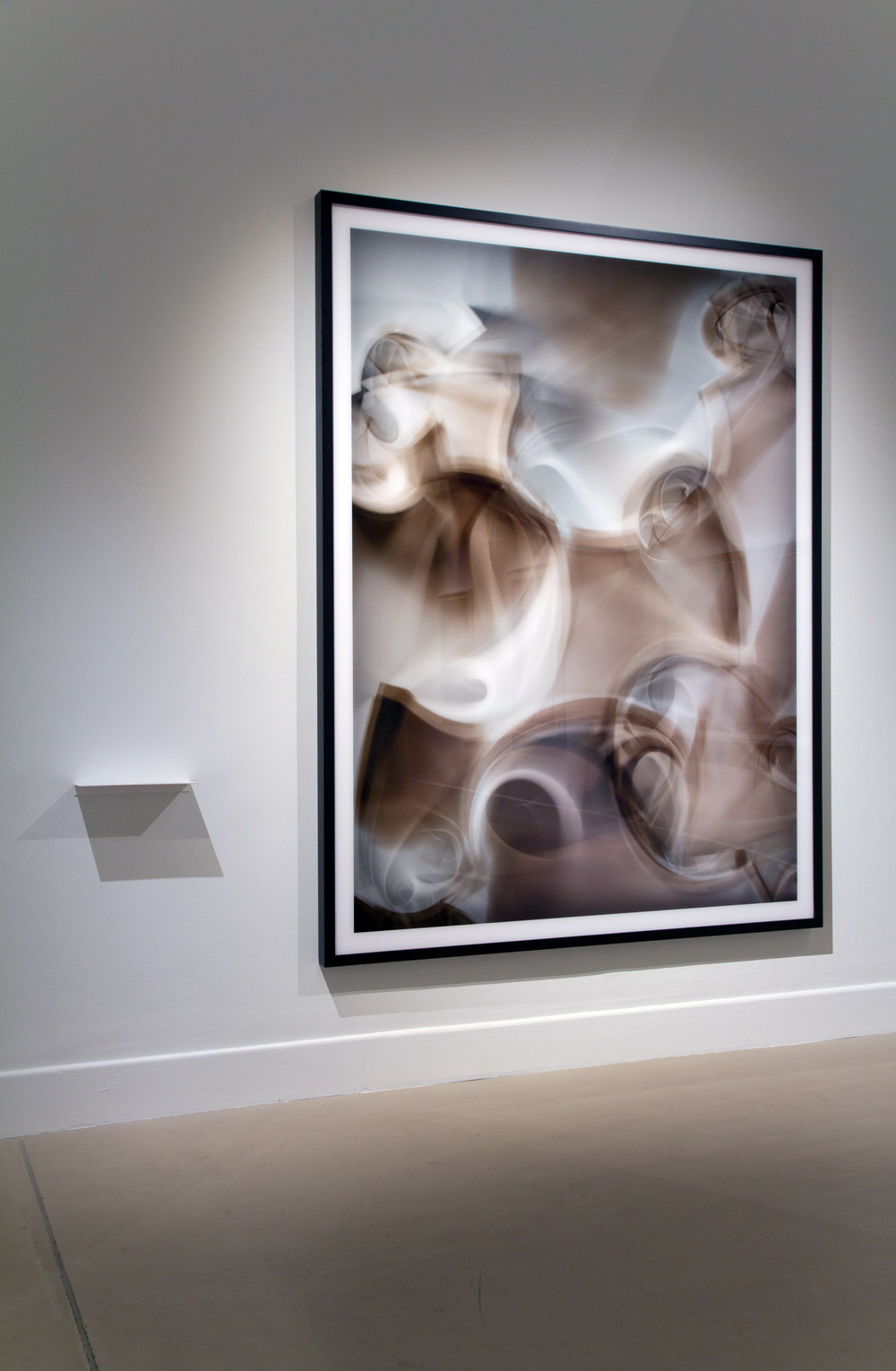
Saturday – Sunday 10am – 7pm
Closed Wednesday

LACMA website

LIKE ART BLART ON FACEBOOK

Back to top