Photographs: Hermann Kummler (1863-1949) (compiler) ‘Ethnographic portraits of Indigenous women of Pernambuco and Bahia’ 1861-1862

August 2018


Hermann Kummler (compiler) (Swiss, 1863-1949) '[Portrait of Indigenous Brazilian tradeswoman]' 1861-1862


Hermann Kummler (compiler) (Swiss, 1863-1949)
(Portrait of Indigenous Brazilian tradeswoman)
1861-1862
From Ethnographic portraits of indigenous women of Pernambuco and Bahia
Salt paper print, hand-painted


Art Blart has been mining a rich vein of (anti-)colonial art and photography over the past few months, and the next two posts continue this trend.

Tonight we have Ethnographic portraits of Indigenous women of Pernambuco and Bahia (Brazil, 1861-1862) by unknown local photographers, collected and compiled by the Swiss photographer Hermann Kummler in 1888-1891 into an album. These were vintage prints when he purchased them and already had significant historical interest.

Thus, we have unknown sitters photographed by unknown photographers, removed from their original context(s) – the family, business or photographers album perhaps – to be annotated in a foreign hand, the machinations of (colonial, male) power evidenced through the gaze of the camera. And text. Mulatto; Mestizo; Negress.

The underprivileged of society being punished in their men/iality: servile; submissive: menial attitudes; pertaining to or suitable for domestic servants. Mistress punishing a native child. Teacher with a schoolgirl in Bahia in one picture, becomes Native Brazilian lady-in-waiting and young child attend to a veiled aristocrat in another (note the same background curtain).

None of the sitters look happy. Most scowl at the camera, unsmiling at their lot, probably being forced to have their photograph taken. The hand-coloured photographs are even more absurd, the lurid colours creating caricatures of human beings, cut out figures with all semblance of humanity removed. Rather than reinforcing “the sense of individual style associated with these remarkable figures”, the photographs become pure representation of figurative form. The camera enacts the shaping of disputed, contested identities into a particular figure, a particular palatable form.

Why it is valuable to show these photographs is that we must be ever vigilant in understanding the networks of power, dispossession and enslavement that patriarchal societies use to marginalise the poor, the weak, the different for their gain. For it is men that are looking.

“The category of “masculinity” should be seen as always ambivalent, always complicated, always dependent on the exigencies (necessary conditions and requirements) of personal and institutional power … [masculinity is] an interplay of emotional and intellectual factors – an interplay that directly implicates women as well as men, and is mediated by other social factors, including race, sexuality, nationality, and class … Far from being just about men, the idea of masculinity engages, inflects, and shapes everyone.”1


Dr Marcus Bunyan

PS. “two of the Indigenous women (one of whom wears a cross), simply pose in the studio” – they are not in a studio, a curtain has been drawn over a back wall.


1/ Berger, Maurice; Wallis, Brian and Watson, Simon. Constructing Masculinity. Introduction. New York: Routledge, 1995, pp. 3-7.


These digitally cleaned photographs are published under “fair use” for the purposes of academic research and critical commentary. Please click on the photographs for a larger version of the image.


Overview

Group of 19 ethnographic portraits of Indigenous women of Pernambuco and Bahia that were compiled by the Swiss photographer Hermann (Ermano) Kummler (1863-1949). With subjects of Indian and mixed-race descent, including vendors, wet nurses, maids, mothers and children, and merchants, including a mistress punishing a native child. Salted paper prints with trimmed corners, the images measuring 7 x 3 3/8 to 7 1/4 x 4 1/2 inches (17.8 x 8.4 to 18.4 x 11.4 cm).

7 are hand-coloured with gouache; the original mounts, 9 bright blue or green, 6 double mounted, measuring 9 1/4 x 7 to 8 1/4 x 11 1/4 inches (24.1 x 17.8 to 21 x 29.8 cm), most with Kummler’s caption notations, in ink, and each with his red hand stamp on prints (one) or mounts recto. 1861-1862

Kummler was a Swiss photographer who accompanied Als Kaufmann to Brazil, where they traveled extensively from 1888-91. Kummler apparently purchased vintage prints by local photographers (which he stamped and annotated), and eventually set up his own commercial studio in the town of Aarau. During the three year period he was in Brazil with Kaufmann, Kummler apparently made more than 130 photographs. Their journey was the subject of a monograph entitled Als Kaufmann in Pernambuco, Ein Reisebericht mit Bildern aus Brasiilien von Hermann Kummler (Als Kaufmann in Pernambuco 1888-1891. A travelogue with pictures from Brazil by Hermann Kummler), copiously illustrated with his images.

Tradeswomen are depicted with a teapot on a table, a comb, a basket laden with bottles or wares carefully balanced on their heads; maids hold embroidered cloth and a wet nurse is shown with an infant. A native lady-in-waiting (and a young child) attend to a gorgeously dressed aristocrat, who wears a long veil. The hand-coloured prints reinforce the sense of individual style associated with these remarkable figures; two of the Indigenous women (one of whom wears a cross), simply pose in the studio with trade womens objects.

Text from an auction house website

Pernambuco and Bahia

Pernambuco is a state of Brazil, located in the Northeast region of the country. Bahia is one of the 26 states of Brazil and is located in the Northeastern part of the country on the Atlantic coast.

Charles Darwin visited Bahia in 1832 on his famous voyage on the Beagle. In 1835, Bahia was the site of an urban slave revolt, particularly notable as the only predominately-Muslim slave rebellion in the history of the Americas. Under the Empire, Bahia returned 14 deputies to the general assembly and 7 senators; its own provincial assembly consisted of 36 members. In the 19th century, cotton, coffee, and tobacco plantations joined those for sugarcane and the discovery of diamonds in 1844 led to large influx of “washers” (garimpeiros = an independent prospector for minerals) until the still-larger deposits in South Africa came to light.


Hermann Kummler (compiler) (Swiss, 1863-1949) 'Mullatin [Portrait of a Indigenous Brazilian woman wearing a cross]' 1861-1862


Hermann Kummler (compiler) (Swiss, 1863-1949)
Mullatin (Portrait of a Indigenous Brazilian woman wearing a cross)
1861-1862
From Ethnographic portraits of indigenous women of Pernambuco and Bahia
Salt paper print, hand-painted


Mulatto

Mulatto is a term used to refer to people born of one white parent and one black parent or to people born of a mulatto parent or parents. In English, the term is today generally confined to historical contexts. English speakers of mixed white and black ancestry seldom choose to identify themselves as “mulatto.” …

Mulattoes represent a significant part of the population of various Latin American and Caribbean countries: Brazil (49.1% mixed-race, Gypsy and Black, Mulattoes (20.5%), Mestiços, Mamelucos or Caboclos (21.3%), Blacks (7.1%) and Eurasian (0.2%).

In colonial Latin America, mulato could also refer to an individual of mixed African and Native American ancestry. In the 21st century, persons with indigenous and black African ancestry in Latin America are more frequently called zambos in Spanish or cafuzo in Portuguese.

According to the IBGE 2000 census, 38.5% of Brazilians identified as pardo, i.e. of mixed ancestry. This figure includes mulatto and other multiracial people, such as people who have European and Amerindian ancestry (called caboclos), as well as assimilated, westernised Amerindians, and mestizos with some Asian ancestry. A majority of mixed-race Brazilians have all three ancestries: Amerindian, European, and African. According to the Brazilian Institute of Geography and Statistics census 2006, some 42.6% of Brazilian identify as pardo, an increase over the 2000 census.

Text from the Wikipedia website


Hermann Kummler (compiler) (Swiss, 1863-1949) 'Mestize [Portrait of a Brazilian woman]' 1861-1862


Hermann Kummler (compiler) (Swiss, 1863-1949)
Mestize (Portrait of a Brazilian woman)
1861-1862
From Ethnographic portraits of indigenous women of Pernambuco and Bahia
Salt paper print, hand-painted

Mestizo: (in Latin America) a person of mixed race, especially one having Spanish and American Indian parentage.


Mixed-race Brazilian

Brazilian censuses do not use a “multiracial” category. Instead, the censuses use skin colour categories. Most Brazilians of visibly mixed racial origins self-identify as pardos. However, many white Brazilians have distant non-white ancestry, while the group known as pardos likely contains non-mixed acculturated Amerindians. According to the 2010 census, “pardos” make up 82.277 million people, or 43.13% of Brazil’s population. …

History

Before the arrival of the Portuguese in 1500, Brazil was inhabited by nearly five million Amerindians. The Portuguese colonisation of Brazil started in the sixteenth century. In the first two centuries of colonisation, 100,000 Portuguese arrived in Brazil (around 500 colonists per year). In the eighteenth century, 600,000 Portuguese arrived (6,000 per year). Another race, Blacks, were brought from Africa as slaves, starting around 1550. Many came from Guinea, or from West African countries – by the end of the eighteenth century many had been taken from Congo, Angola and Mozambique (or, in Bahia, from Benin). By the time of the end of the slave trade in 1850, around 3.5 million slaves had been brought to Brazil – 37% of all slave traffic between Africa and the Americas.

In the late nineteenth and early twentieth centuries, a considerable influx of mainly European immigrants arrived in Brazil. According to the Memorial do Imigrante, Brazil attracted nearly 5 million immigrants between 1870 and 1953. Most of the immigrants were from Italy or Portugal, but also significant numbers of Germans, Spaniards, Japanese and Syrian-Lebanese.

The Portuguese settlers were the ones to start the intensive race-mixing process in Brazil. Miscegenation in Brazil… was not a pacific process as some used to believe: it was a form of domination from the Portuguese against the Native Brazilian and African populations. …

White/Amerindian

Most of the first colonists from Portugal who arrived in Brazil were singles or did not bring their wives. For that reason the first interracial marriages in Brazil occurred between Portuguese males and Amerindian females.

In Brazil, people of White/Indian ancestry are historically known as caboclos or mamelucos. They predominated in many regions of Brazil. One example are the Bandeirantes (Brazilian colonial scouts who took part in the Bandeiras, exploration expeditions) who operated out of São Paulo, home base for the most famous bandeirantes.

Indians, mostly free men and mamelucos, predominated in the society of São Paulo in the 16th and early 17th centuries and outnumbered Europeans. The influential families generally bore some Indian blood and provided most of the leaders of the bandeiras, with a few notable exceptions such as Antonio Raposo Tavares (1598-1658), who was European born.

White/Black

According to some historians, Portuguese settlers in Brazil used to prefer to marry Portuguese-born females. If not possible, the second option were Brazilian-born females of recent Portuguese background. The third option were Brazilian-born women of distant Portuguese ancestry. However, the number of White females in Brazil was very low during the Colonial period, causing a large number of interracial relationships in the country.

White/Black relationships in Brazil started as early as the first Africans were brought as slaves in 1550 where many Portuguese men starting marrying black women. The Mulattoes (people of White/Black ancestry) were also enslaved, though some children of rich aristocrats and owners of gold mines were educated and became important people in Colonial Brazil. Probably, the most famous case was Chica da Silva, a mixed-race Brazilian slave who married a rich gold mine owner and became one of the richest people in Brazil.

Other mulattoes largely contributed to Brazil’s culture: Aleijadinho (sculptor and architect), Machado de Assis (writer), Lima Barreto (writer), Chiquinha Gonzaga (composer), etc. In 1835, Blacks would have made up the majority of Brazil’s population, according to a more recent estimate quoted by Thomas Skidmore. In 1872, their number was shown to be much smaller according to the census of that time, outnumbered by pardos and Whites. …

Black/Amerindian

People of Black African and Native Brazilian ancestry are known as Cafuzos and are historically the less numerous group. Most of them have origin in black women who escaped slavery and were welcomed by indigenous communities, where started families with local amerindian men.

Text from the Wikipedia website


Modesto Brocos (Brazilian born Spain, 1853-1936) 'A Redenção de Cam (Ham's Redemption)' 1895


Modesto Brocos (Brazilian born Spain, 1853-1936)
A Redenção de Cam (Ham’s Redemption)
1895
Oil on canvas
199cm (78.3 in) x 166cm (65.3 in)
Public domain / Museu Nacional de Belas Artes


The painting shows a Brazilian family each generation becoming “whiter” (black grandmother, mulatto mother and white baby).


Hermann Kummler (compiler) (Swiss, 1863-1949) '[Portrait of Indigenous Brazilian tradeswoman]' 1861-1862


Hermann Kummler (compiler) (Swiss, 1863-1949)
(Portrait of Indigenous Brazilian tradeswoman)
1861-1862
From Ethnographic portraits of indigenous women of Pernambuco and Bahia
Salt paper print, hand-painted


Hermann Kummler (compiler) (Swiss, 1863-1949) '[Portrait of Indigenous Brazilian tradeswoman]' 1861-1862


Hermann Kummler (compiler) (Swiss, 1863-1949)
(Portrait of Indigenous Brazilian tradeswoman)
1861-1862
From Ethnographic portraits of indigenous women of Pernambuco and Bahia
Salt paper print, hand-painted


Hermann Kummler (compiler) (Swiss, 1863-1949) '[Portrait of a maid holding an embroidered cloth]' 1861-1862


Hermann Kummler (compiler) (Swiss, 1863-1949)
(Portrait of a maid holding an embroidered cloth)
1861-1862
From Ethnographic portraits of indigenous women of Pernambuco and Bahia
Salt paper print, hand-painted


Hermann Kummler (compiler) (Swiss, 1863-1949) '[Portrait of wet nurse with infant]' 1861-1862


Hermann Kummler (compiler) (Swiss, 1863-1949)
(Portrait of wet nurse with infant)
1861-1862
From Ethnographic portraits of indigenous women of Pernambuco and Bahia
Salt paper print, hand-painted


Indigenous peoples in Brazil

Indigenous peoples in Brazil (Portuguese: povos indígenas no Brasil), or Indigenous Brazilians (Portuguese: indígenas brasileiros), comprise a large number of distinct ethnic groups who have inhabited what is now the country of Brazil since prior to the European contact around 1500. Unlike Christopher Columbus, who thought he had reached the East Indies, the Portuguese, most notably Vasco da Gama, had already reached India via the Indian Ocean route when they reached Brazil.

Nevertheless, the word índios (“Indians”) was by then established to designate the people of the New World and continues to be used today in the Portuguese language to designate these people, while a person from India is called indiano in order to distinguish the two.

At the time of European contact, some of the indigenous people were traditionally mostly semi-nomadic tribes who subsisted on hunting, fishing, gathering, and migrant agriculture. Many of the estimated 2,000 nations and tribes which existed in the 16th century suffered extinction as a consequence of the European settlement, and many were assimilated into the Brazilian population.

The indigenous population was largely killed by European diseases, declining from a pre-Columbian high of millions to some 300,000 (1997), grouped into 200 tribes. However, the number could be much higher if the urban indigenous populations are counted in all the Brazilian cities today. A somewhat dated linguistic survey found 188 living indigenous languages with 155,000 total speakers.

The rubber trade

The 1840s brought trade and wealth to the Amazon. The process for vulcanising rubber was developed, and worldwide demand for the product skyrocketed. The best rubber trees in the world grew in the Amazon, and thousands of rubber tappers began to work the plantations. When the Indians proved to be a difficult labor force, peasants from surrounding areas were brought into the region. In a dynamic that continues to this day, the indigenous population was at constant odds with the peasants, who the Indians felt had invaded their lands in search of treasure.

Urban Rights Movement

The urban rights movement is a recent development in the rights of indigenous peoples. Brazil has one of the highest income inequalities in the world, and much of that population includes indigenous tribes migrating toward urban areas both by choice and by displacement. Beyond the urban rights movement, studies have shown that the suicide risk among the indigenous population is 8.1 times higher than the non-indigenous population.

Many indigenous rights movements have been created through the meeting of many indigenous tribes in urban areas. For example, in Barcelos, an indigenous rights movement arose because of “local migratory circulation.” This is how many alliances form to create a stronger network for mobilisation. Indigenous populations also living in urban areas have struggles regarding work. They are pressured into doing cheap labor. Programs like Oxfam have been used to help indigenous people gain partnerships to begin grassroots movements. Some of their projects overlap with environmental activism as well.

Many Brazilian youths are mobilising through the increased social contact, since some indigenous tribes stay isolated while others adapt to the change. Access to education also affects these youths, and therefore, more groups are mobilising to fight for indigenous rights.

Text from the Wikipedia website


Hermann Kummler (compiler) (Swiss, 1863-1949) '[Portrait of Indigenous Brazilian tradeswoman]' 1861-1862


Hermann Kummler (compiler) (Swiss, 1863-1949)
(Portrait of Indigenous Brazilian tradeswoman)
1861-1862
From Ethnographic portraits of indigenous women of Pernambuco and Bahia
Salt paper print

 

Hermann Kummler (compiler) (Swiss, 1863-1949) 'Hermann Kummler (compiler) (1863-1949) '[Kellnerinnen im Grand Hotel / Waitresses in Grand Hotel]' 1861-1862' 1861-1862


Hermann Kummler (compiler) (Swiss, 1863-1949)
(Kellnerinnen im Grand Hotel / Waitresses in Grand Hotel)
1861-1862
From Ethnographic portraits of indigenous women of Pernambuco and Bahia
Salt paper print
 

Hermann Kummler (compiler) (Swiss, 1863-1949) '[Lehrerin mit Schülerin im Bahia / Teacher with a schoolgirl in Bahia]' 1861-1862


Hermann Kummler (compiler) (Swiss, 1863-1949)
(Lehrerin mit Schülerin im Bahia / Teacher with a schoolgirl in Bahia)
1861-1862
From Ethnographic portraits of indigenous women of Pernambuco and Bahia
Salt paper print
 

Hermann Kummler (compiler) (Swiss, 1863-1949) '[Native Brazilian lady-in-waiting and young child attend to a veiled aristocrat]' 1861-1862


Hermann Kummler (compiler) (Swiss, 1863-1949)
(Native Brazilian lady-in-waiting and young child attend to a veiled aristocrat)
1861-1862
From Ethnographic portraits of indigenous women of Pernambuco and Bahia
Salt paper print


Hermann Kummler (compiler) (Swiss, 1863-1949) '[Negerin mit dem Knaben in schlechter Stimmung / Negress with a boy in a bad mood]' 1861-1862


Hermann Kummler (compiler) (Swiss, 1863-1949)
(Negerin mit dem Knaben in schlechter Stimmung / Negress with a boy in a bad mood)
1861-1862
From Ethnographic portraits of indigenous women of Pernambuco and Bahia
Salt paper print
 

Hermann Kummler (compiler) (Swiss, 1863-1949) '[Portrait of Brazilian woman servant and child]' 1861-1862


Hermann Kummler (compiler) (Swiss, 1863-1949)
(Portrait of Brazilian woman servant and child)
1861-1862
From Ethnographic portraits of indigenous women of Pernambuco and Bahia
Salt paper print


Hermann Kummler (compiler) (Swiss, 1863-1949) '[Portrait of a young Brazilian woman]' 1861-1862


Hermann Kummler (compiler) (Swiss, 1863-1949)
(Portrait of a young Brazilian woman)
1861-1862
From Ethnographic portraits of indigenous women of Pernambuco and Bahia
Salt paper print
 

 Hermann Kummler (compiler) (Swiss, 1863-1949) '[Portrait of a Brazilian woman]' 1861-1862


Hermann Kummler (compiler) (Swiss, 1863-1949)
(Portrait of a Brazilian woman)
1861-1862
From Ethnographic portraits of indigenous women of Pernambuco and Bahia
Salt paper print
 

 Hermann Kummler (compiler) (Swiss, 1863-1949) '[Portrait of a Brazilian woman]' 1861-1862


Hermann Kummler (compiler) (Swiss, 1863-1949)
(Portrait of a Brazilian woman)
1861-1862
From Ethnographic portraits of indigenous women of Pernambuco and Bahia
Salt paper print


Hermann Kummler (compiler) (Swiss, 1863-1949) '[Portrait of a Brazilian woman with two children]' 1861-1862


Hermann Kummler (compiler) (Swiss, 1863-1949)
(Portrait of a Brazilian woman with two children)
1861-1862
From Ethnographic portraits of indigenous women of Pernambuco and Bahia
Salt paper print


Hermann Kummler (compiler) (Swiss, 1863-1949) '[Portrait of a Brazilian mother and child]' 1861-1862


Hermann Kummler (compiler) (Swiss, 1863-1949)
(Portrait of a Brazilian mother and child)
1861-1862
From Ethnographic portraits of indigenous women of Pernambuco and Bahia
Salt paper print


Hermann Kummler (compiler) (Swiss, 1863-1949) '[Mistress punishing a native child]' 1861-1862


Hermann Kummler (compiler) (Swiss, 1863-1949)
(Mistress punishing a native child)
1861-1862
From Ethnographic portraits of indigenous women of Pernambuco and Bahia
Salt paper print


LILKE ART BLART ON FACEBOOK

Back to top

Exhibition: ‘Balthasar Burkhard’ at Fotomuseum Winterthur and Fotostiftung Schweiz, Winterthur, Zurich

Exhibition dates: 10th February – 21st May, 2018


Balthasar Burkhard poster for his exhibition at Fotomuseum Winterthur

Balthasar Burkhard


As is so often the case with an artist, it is the early work that shines brightest in this posting.

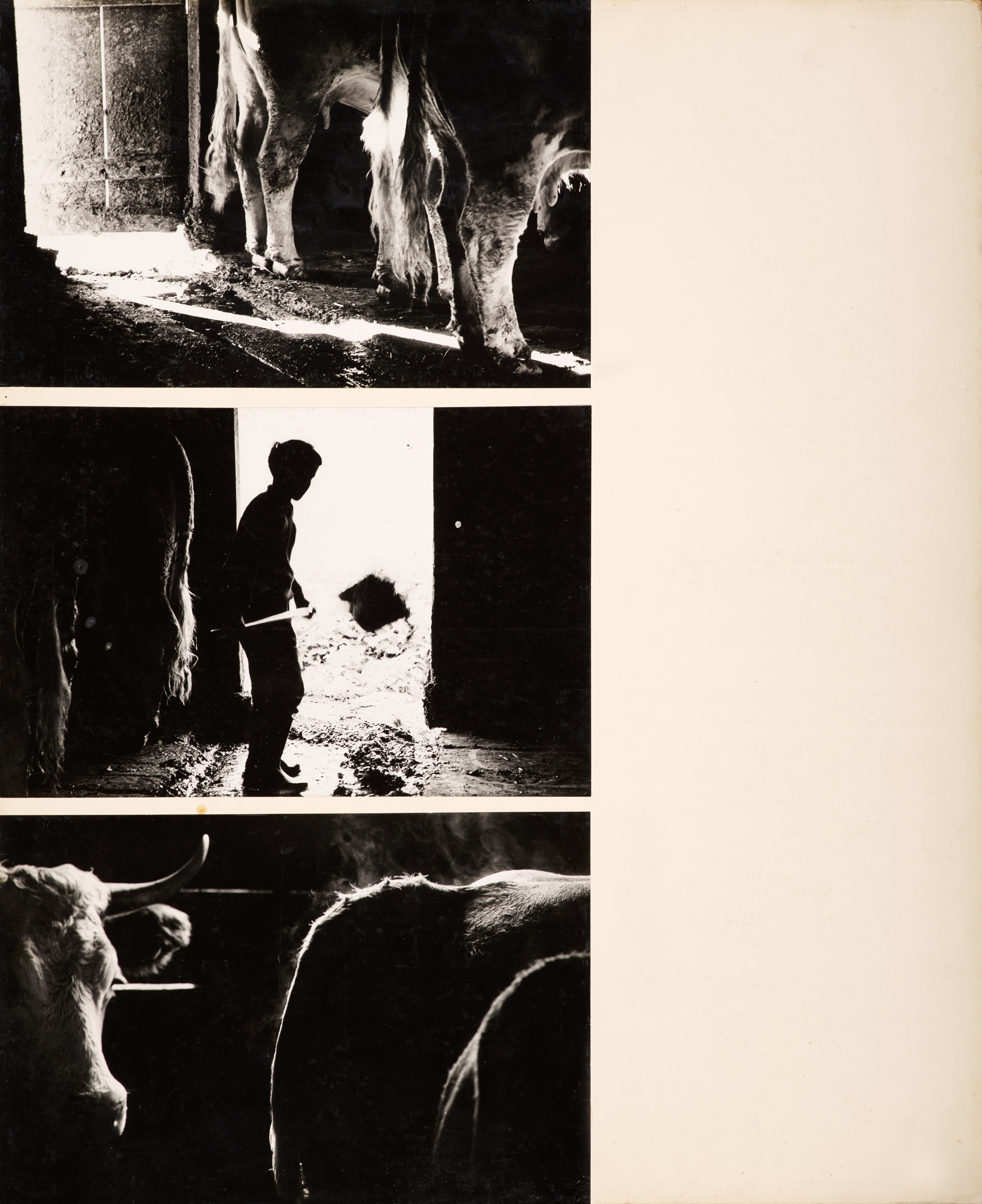
The works from On the Alp possess an essential power; the daring capture of actions and performances by the international avant-garde of the day make you wish you had been there; and the installation photograph of ‘The Knie’, Kunsthalle Basel in 1983 (below) makes me want to see more of his 1980s installations, with their shift in scale and repetitive nature. There are no more examples online, but a couple of photographs can be seen in the first installation photograph below.

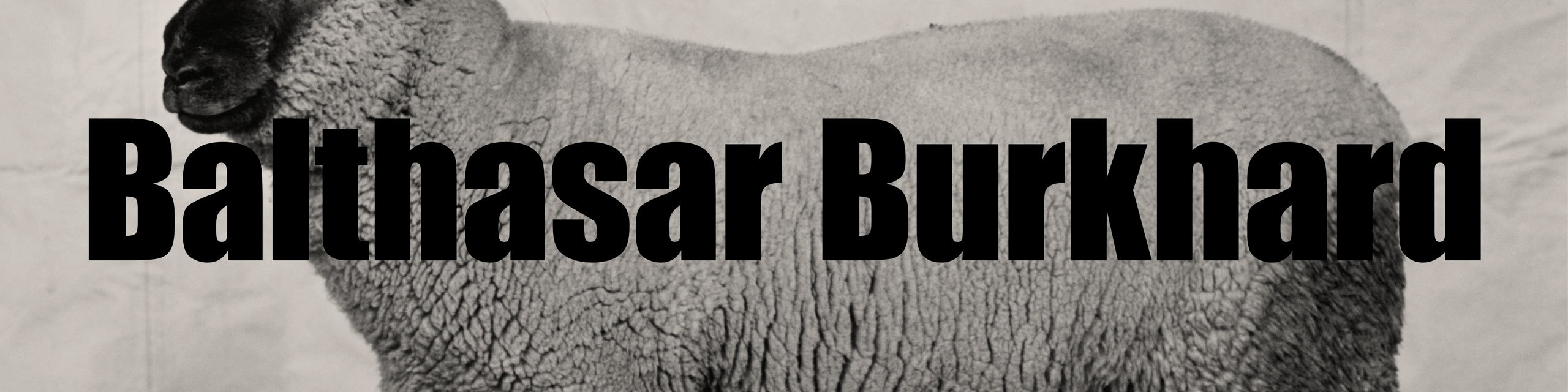
I can leave the underwhelming aerial, cloud and landscape work well alone. There are many people in the history of photography who have taken better photographs of such subject matter. His life-sized photographs of animals again do nothing for me. They possess a reductive minimalism riffing on the canvas backgrounds of Avedon blown up to enormous size (as in most contemporary photography, as if by making something large the photograph gains aura and importance) but they lead nowhere. Perhaps in their actual presence (the physicality of the print) I might be transported to another place, but in reproduction they are a one-dimensional non sequitur.

From the energy of the earlier work emerges “a beauty contest between animals in a photo-shoot”, scrupulous studio photos that demand to be taken seriously, but mean very little. Here, passion has lost out to rigorous and deathly control.

Dr Marcus Bunyan


Many thankx to Fotomuseum Winterthur and Fotostiftung Schweiz for allowing me to publish the photographs in the posting. Please click on the photographs for a larger version of the image.


Together, Fotomuseum Winterthur and Fotostiftung Schweiz will showcase the oeuvre of Swiss artist Balthasar Burkhard (1944-2010) in a major retrospective. Burkhard’s work spans half a century: from his early days as a trainee photographer with Kurt Blum to his seminal role in chronicling the art of his time, eventually becoming a photographic artist in his own right who brought photography into the realms of contemporary art in the form of the monumental tableau. More than 150 works and groups of works chart not only the progress of his own photographic career, but also the emergence of photography as an art form in the second half of the twentieth century. An exhibition in collaboration with Museum Folkwang, Essen, and Museo d’arte della Svizzera italiana, Lugano.


Balthasar Burkhard (Swiss, 1944-2010) from 'On the Alp' 1963 from the exhibition 'Balthasar Burkhard' at Fotomuseum Winterthur and Fotostiftung Schweiz, Winterthur, Zurich, Feb - May, 2018


Balthasar Burkhard (Swiss, 1944-2010)
from On the Alp
1963
© Estate Balthasar Burkhard


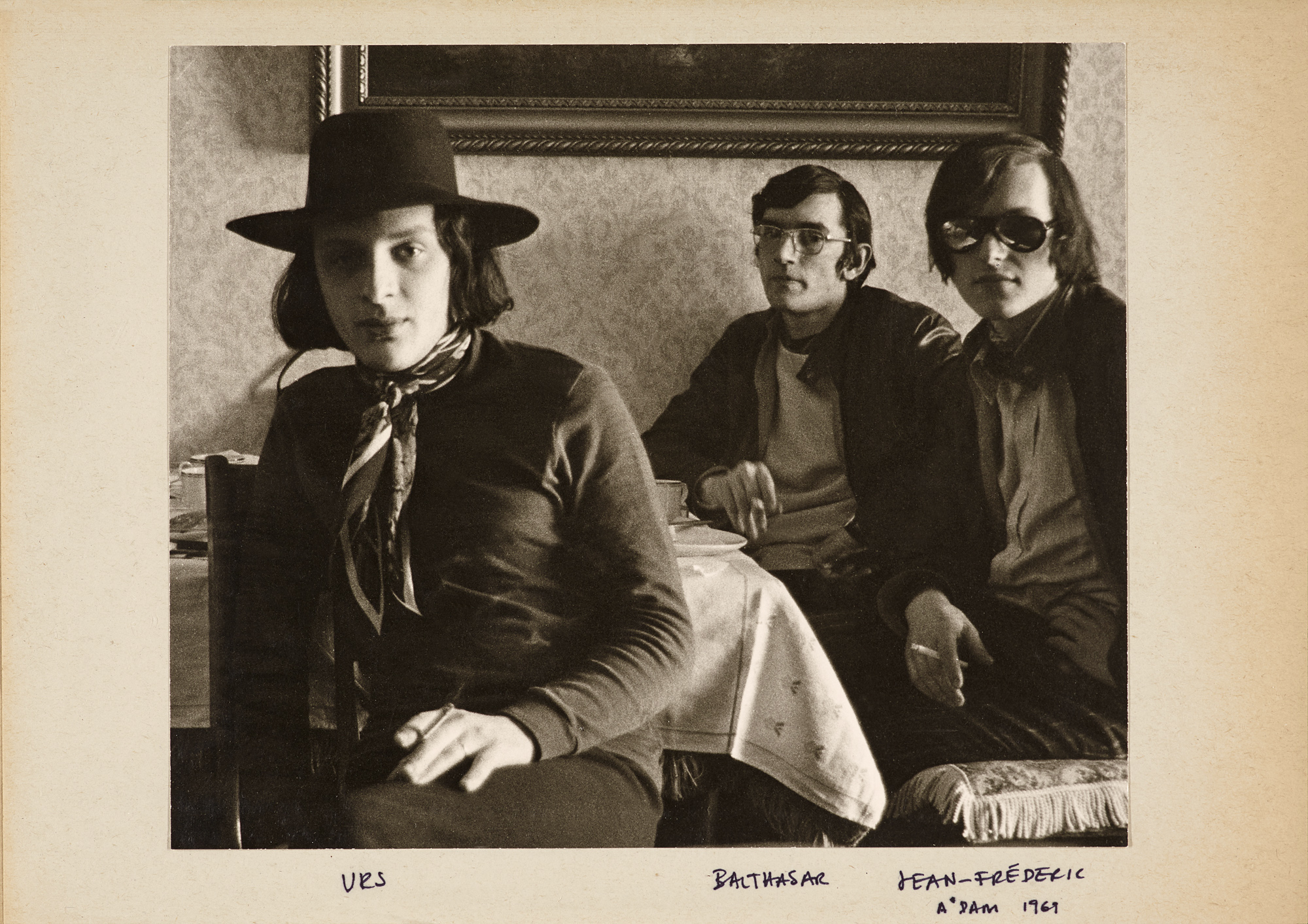
Balthasar Burkhard (Swiss, 1944-2010) 'Untitled (Urs Luthi, Balthasar Burkhard, Jean-Frederic Schnyder), Amsterdam' 1969 from the exhibition 'Balthasar Burkhard' at Fotomuseum Winterthur and Fotostiftung Schweiz, Winterthur, Zurich, Feb - May, 2018


Balthasar Burkhard (Swiss, 1944-2010)
Untitled (Urs Luthi, Balthasar Burkhard, Jean-Frederic Schnyder), Amsterdam
1969
© Estate Balthasar Burkhard


Urs Lüthi (b. 1947) is a Swiss conceptual artist who attended the School of Applied Arts in Zurich. Noted for using his body and alter ego as the subject of his artworks, he has worked in photography, sculpture, performance, silk-screen, video and painting.

Jean-Frédéric Schnyder (Swiss, b. 1945) began producing experimental objects in the late 1960s within the context of pop art and has since gone on to create a broad oeuvre encompassing photographs, sculptures, paintings, objects, and installations.


Balthasar Burkhard (Swiss, 1944-2010) 'Untitled (Jean-Christophe Ammann at Andy Warhol's Factory), New York' 1972


Balthasar Burkhard (Swiss, 1944-2010)
Untitled (Jean-Christophe Ammann at Andy Warhol’s Factory), New York
1972
© Estate Balthasar Burkhard


Jean-Christophe Ammann (14 January 1939 – 13 September 2015) was a Swiss art historian and curator.


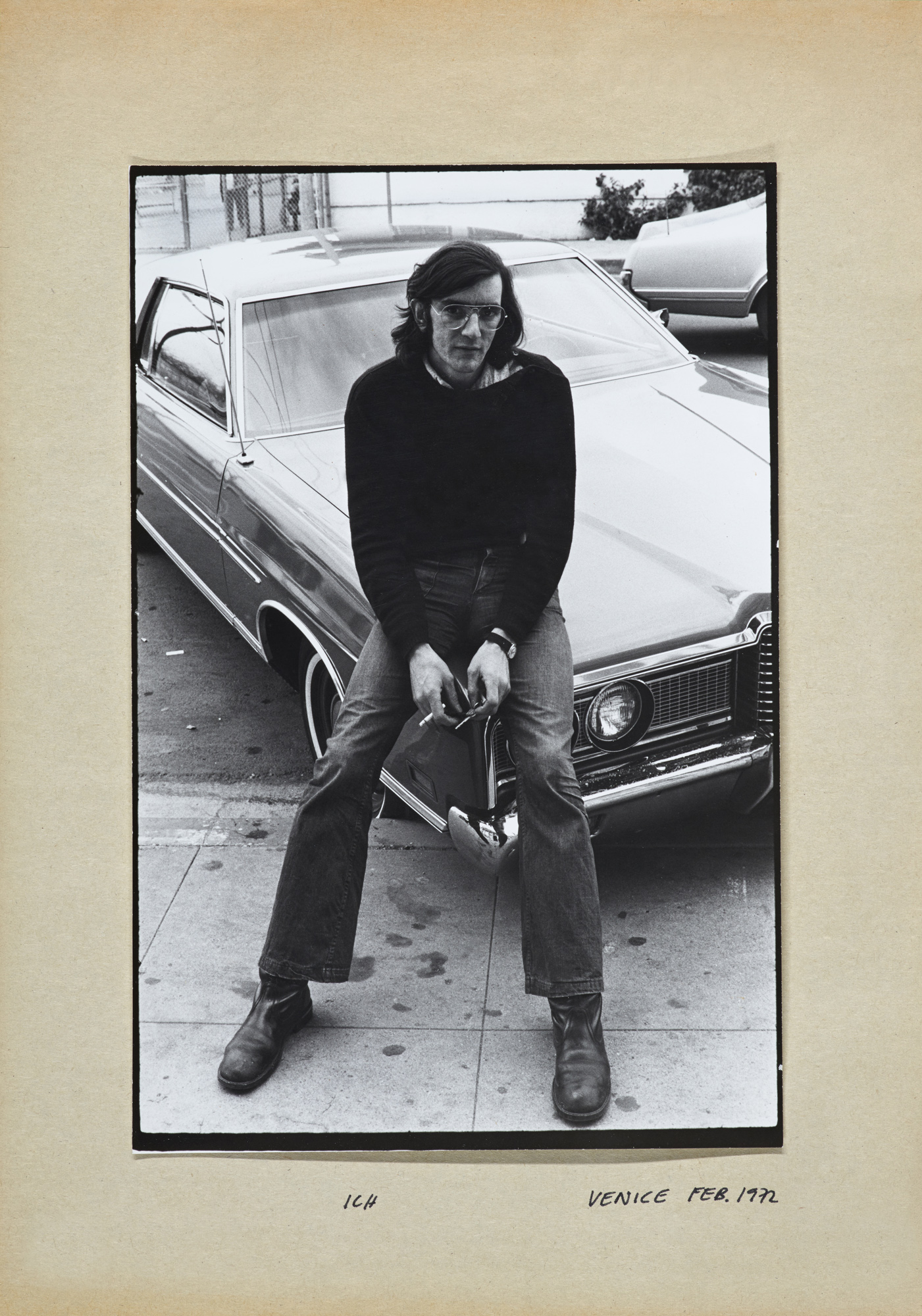
Jean-Christophe Ammann (Swiss, 1939-2015) 'Untitled (Balthasar Burkhard), USA' 1972


Jean-Christophe Ammann (Swiss, 1939-2015)
Untitled (Balthasar Burkhard), USA
Venice, 1972
© Estate Balthasar Burkhard


Together, Fotomuseum Winterthur and Fotostiftung Schweiz have launched a major retrospective exhibition dedicated to the lifetime achievement of Swiss artist Balthasar Burkhard (1944-2010). His oeuvre is almost unparalleled in the way it reflects not only the self-invention of a photographer but also the emancipation of photography as an artistic medium in its own right during the second half of the twentieth century.

The exhibition charts the many facets of Burkhard’s career, step by step, from his apprenticeship with Kurt Blum – in which he adhered closely to the traditional reportage and illustrative photography of the 1960s, and undertook his first independent photographic projects – to his role alongside legendary curator Harald Szeemann, and his documentation of Bern’s bohemian scene in the 1960s and 1970s. Balthasar Burkhard is the author of many iconic images of such groundbreaking exhibitions as When Attitudes Become Form at Kunsthalle Bern in 1969 and the 1972 documenta 5, capturing radical and frequently ephemeral works, actions and performances by the international avant-garde of the day.

Meanwhile, Burkhard endeavoured to make his mark both as a photographer and as an artist, developing his first large-scale photographic canvases in collaboration with his friend and colleague Markus Raetz, trying out his skills as an actor in the USA, and ultimately being invited to hold his own highly influential exhibitions at Kunsthalle Basel and Musée Rath in Geneva in 1983 and 1984. These enabled him to liberate photography from its purely documentary role by creating monumental tableaux in which he developed the motif of the body into sculptural human landscapes and site-specific architectures.

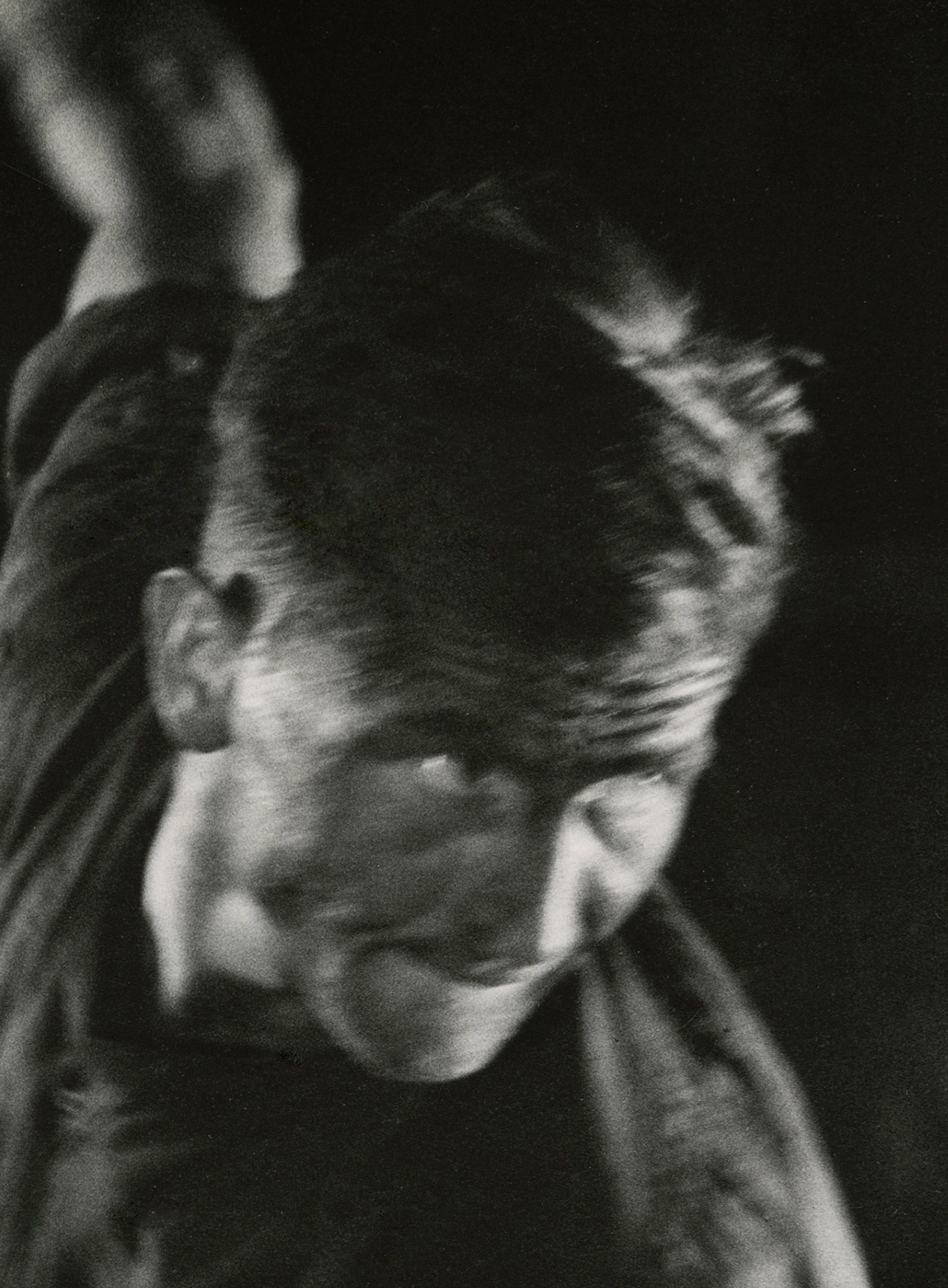
Throughout the course of his career, Burkhard turned time and again to portraiture. Whereas his early photographs tended to show artists in action within their own setting, his later portraits adopted an increasingly formalised approach. During the 1990s, he transposed this stylistic reduction to a wide-ranging series of animal portraits reminiscent of the encyclopaedic style of nineteenth century photography.

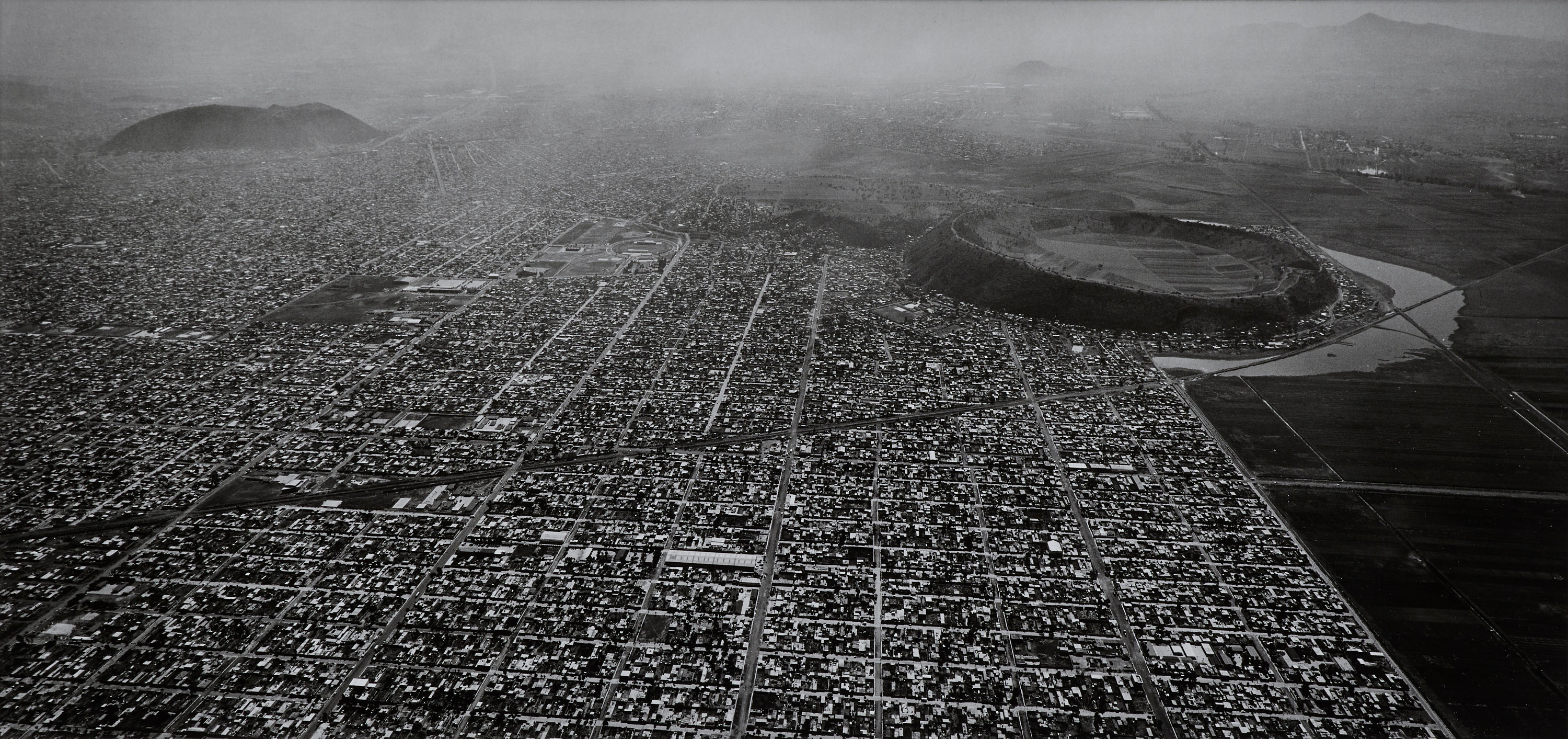
Another milestone of Burkhard’s oeuvre can be found in his vast aerial photographs of major mega cities such as Tokyo and Mexico City. These images, shot from an aircraft, like his images of the earth’s deserts, were destined to become a personal passion. Balthasar Burkhard’s quest for a morphology, for a formula that could encapsulate both nature and culture, is particularly evident in his later work, which ranges from pictures of waves and clouds, Swiss mountains and rivers, to the delicate fragility of plants. His interest was always focused on the materiality of the image. Alongside the highly idosyncratic and somewhat darkly sombre tonality of his prints, Burkhard constantly sought to explore every aspect of photography’s aesthetic and technical potential.

Encompassing half a century of creativity, the joint exhibition by Fotomuseum and Fotostiftung not only shows individual works, but also reflects on Balthasar Burkhard’s own view of how his photographs should be presented, underpinned by a wealth of documents from the archives of the artist. The exhibition is divided in two parts and shown in parallel in the exhibition spaces of Fotomuseum and Fotostiftung.

Press release


Balthasar Burkhard (Swiss, 1944-2010) / Markus Raetz (Swiss, 1941-2020) 'The Bed' 1969/1970


Balthasar Burkhard (Swiss, 1944-2010) / Markus Raetz (Swiss, 1941-2020)
The Bed
1969-1970
© Estate Balthasar Burkhard


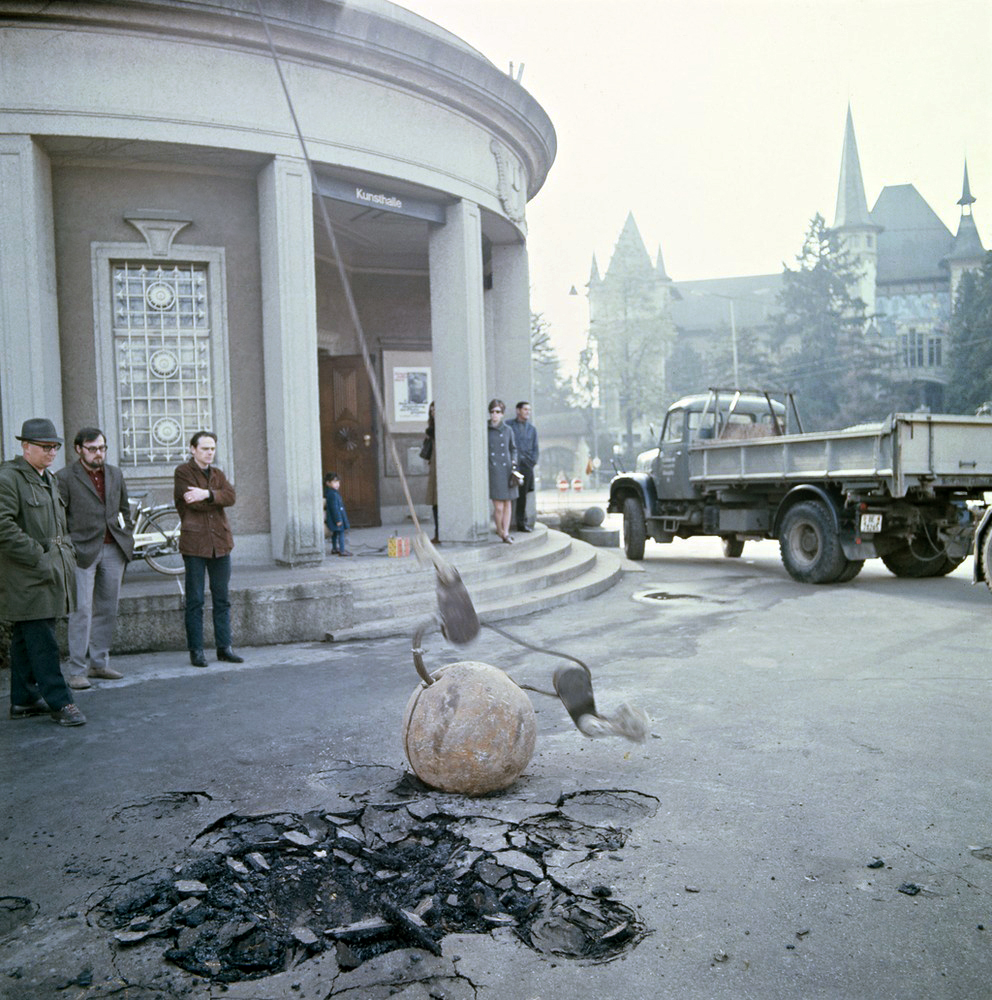
Balthasar Burkhard (Swiss, 1944-2010) 'Untitled (Michael Heizer, Berne Depression), Berne' 1969


Balthasar Burkhard (Swiss, 1944-2010)
Untitled (Michael Heizer, Berne Depression), Berne
1969
© J. Paul Getty Trust. Getty Research Institute, Los Angeles


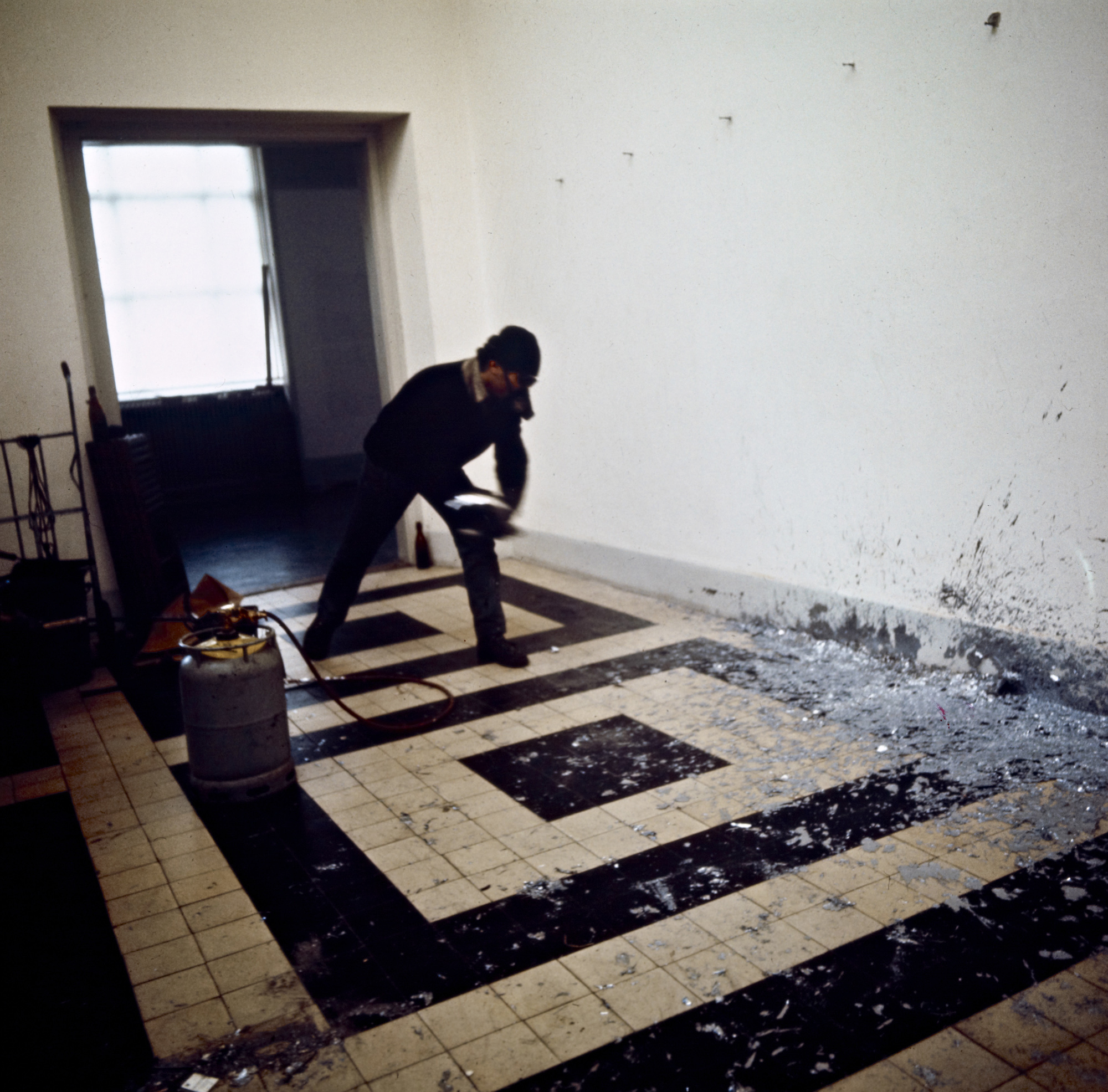
Balthasar Burkhard (Swiss, 1944-2010) 'Untitled (Richard Serra, Splash Piece), Berne' 1969


Balthasar Burkhard (Swiss, 1944-2010)
Untitled (Richard Serra, Splash Piece), Berne
1969
© J. Paul Getty Trust. Getty Research Institute, Los Angeles


Richard Serra (1938-2024) was an American artist known for his large-scale sculptures made for site-specific landscape, urban, and architectural settings. Serra’s sculptures are notable for their material quality and exploration of the relationship between the viewer, the work, and the site.


Balthasar Burkhard (Swiss, 1944-2010) 'Untitled (Harald Szeemann, the last day of documenta 5), Kassel' 1972


Balthasar Burkhard (Swiss, 1944-2010)
Untitled (Harald Szeemann, the last day of documenta 5), Kassel
1972
© Estate Balthasar Burkhard


With this major retrospective, Fotomuseum Winterthur and Fotostiftung Schweiz pay homage to the Swiss artist Balthasar Burkhard (1944-2010). His oeuvre is almost unparalleled in the way it reflects not only the self-invention of a photographer, but also the emancipation of photography as an artistic medium in its own right during the second half of the twentieth century.

Together, the two institutions chart the many and varied facets of Burkhard’s career, step by step. Fotostiftung presents early works from the days of his apprenticeship with Kurt Blum and his first independent documentary photographs. The exhibition also traces Burkhard’s role as a photographer alongside the curator Harald Szeemann and capturing images of Bern’s bohemian scene in the 1960s and 1970s. During that time, Burkhard carved his niche as a photographer and artist, developing his first large-scale photographic canvases in collaboration with his friend Markus Raetz and eventually breaking away from the European art world in search of both himself and new inspiration in the USA.

The second part of the exhibition at Fotomuseum shows the work created by Burkhard after his return to Europe, and his exploration of the photographic tableau. It was during this phase that he largely succeeded in emancipating photography from its purely documentary function. Using monumental formats, he translated the motif of the human body into sculptural landscapes and site-specific architectures. He went on to apply his stylistic device of formal reduction to portraits and landscapes. This marked the beginning of a series of experiments in the handling of photographic techniques. From long-distance aerial photographs of mega-cities such as Mexico City and Tokyo to close-up studies of flowers and plants, Burkhard seemed to be constantly seeking a formula that would embrace both nature and culture, encapsulating a sensory and sensual grasp of visible reality.

Encompassing half a century of creativity, the exhibition not only shows individual works, but is also underpinned by applied projects, films and many documents from the archives of the artist. This wealth of material allows a reflection both on Balthasar Burkhard’s own view of how his photographs should be presented in the exhibition space as well as his constant weighing-up of other media.

Part I (Fotostiftung Schweiz)

Early photographs

Balthasar Burkhard was just eight years old when his father gave him a camera to take along on a school excursion. Burkhard himself describes this early experience with the camera as the starting point of his career. It was also his father who suggested an apprenticeship with Kurt Blum, one of Switzerland’s foremost photographers, ranking along-side Paul Senn, Jakob Tuggener and Gotthard Schuh. Blum taught the young Balz, as he was nicknamed, all the finer points of darkroom technique as well as the art of large-format photography. The earliest work from Burkhard’s apprentice years is a reportage of the school, in the form of a book, while his documentation of the Distelzwang Society’s historic guildhall in the old quarter of Bern was clearly a lesson in architectural photography. Yet, no sooner had he completed his apprenticeship than Burkhard was already embarking on his very own independent projects inspired by post-war humanist photography, such as Auf der Alp, a study of rural Alpine life, for which he was awarded the Swiss Federal Grant for Applied Arts in 1964.

Chronicler of Bohemian Life in Bern

Even during his apprenticeship, Burkhard moved in the Bernese art circles to which his teacher Kurt Blum also belonged. In 1962, he created a first portrait, in book form, of painter and writer Urs Dickerhof. Shortly after that, he became friends with his near-contemporary Markus Raetz, and started taking photographs for the charismatic curator Harald Szeemann, who was director of Kunsthalle Bern from 1961 to 1969. Burkhard immersed himself in the vibrantly dynamic Swiss art scene, documenting the often controversial exhibitions of conceptual art at the Kunsthalle, and capturing the lives of Bern’s bohemian set with his 35mm camera. These visual mementos would later be collated in a kind of photographic journal. Initial collaborative projects with artists included a 1966 artists’ book about the village of Curogna (Ticino) and a window display for the Loeb department store in Bern featuring photographic portraits of the Bernese artist Esther Altorfer, devised in collaboration with Markus Raetz and his later wife, fashion designer Monika Raetz-Müller.

Landscapes 1969

Inspired by his friend Raetz, Burkhard photographed bleak and rugged snow-covered landscapes in the Bernese Seeland region. Heaps of earth piled up along the wayside reminded him of Robert Smithson’s Earthworks, which had just emerged in contemporary art. As Burkhard would later explain, “I wanted to leave out everything relating to myself, so that I could truly relate to what remained. I distanced myself from my subject-matter. I succeeded in stepping back both from myself and from my work.”

A close-up of bare agricultural soil, vaguely reminiscent of a lunar landscape, forms the basis for an object with a neon tube created in 1969 for the legendary exhibition When Attitudes Become Form in collaboration with Harald Szeemann, Markus Raetz and Jean-Frédéric Schnyder. In 1969, Burkhard’s brown-toned landscapes were included in the 1969 exhibition photo actuelle suisse in Sion. They were subsequently published as his first independent portfolio by Allan Porter in the May issue of Camera magazine, which was dedicated to avant-garde European photography and its affinity with contemporary art.

The Amsterdam Canvases 1969-1970

When Markus Raetz took a studio in Amsterdam in 1969, he and Burkhard continued to work on joint projects. Photographs of everyday motifs were enlarged, practically life-sized, onto canvas, and caused a sensation in the spring 1970 exhibition Visualisierte Denkprozesse (Visualised thought processes) at Kunstmuseum Luzern, curated by Jean-Christophe Ammann, who wrote: “On huge canvases, they [Raetz and Burkhard] showed, among other things, a spartan studio space, a bedroom, a kitchen, a curtain. They relativised the purely object-like character by hanging the canvases on clips. The resulting folds enriched the images by adding a new dimension.” In other words, the folds in the canvas created a “quasi ironic and disillusioning barrier.” Burkhard’s large-format works foreshadowed the monumental photographic tableaux that would eventually herald the ultimate march of photography into the museum space some ten years later.

Documentarist of the International Art Scene

By the end of the 1960s, Harald Szeemann and his polarising, controversial exhibitions were drawing increasing attention far beyond the boundaries of Switzerland. In particular, his (in)famous 1969 show When Attitudes Become Form unleashed heated debates that ultimately led to Szeemann’s resignation as director of Kunsthalle Bern. Then, in 1970, he shocked the members and visitors of the Kunstverein in Cologne with an exhibition dedicated to Happening & Fluxus. Here, too, Burkhard was on hand with his camera. Jean-Christophe Ammann, with whom Burkhard undertook a research trip to the USA in 1972, photographing many artists’ studios, proved no less controversial a figure. Moreover, Burkhard also photographed artists, actions and installations at the 1972 documenta 5 in Kassel, which was headed by none other than Szeemann himself. Given the expanded concept of art that prevailed at the time, which strengthened the role of performance art and installation works alike, photography, too, gained a newfound core significance. Indeed, it was only through photography that many of these innovative works were preserved for posterity.

Chicago and the Self-Invention of the Artist

Following a relatively unproductive period in the wake of documenta 5, during which he worked, among other things, on an unfinished documentary project about the small Swiss town of Zofingen, Burkhard spent the years between 1975 and 1978 in Chicago, where he taught photography at the University of Illinois. It was while he was there that he once again reprised the series of photo canvases he had been working on in Amsterdam between 1969 and 1970. This led to new large-format works portraying everyday scenes such as the back seat of an automobile or the interior of a home with a TV, as well as three now lost photographs of roller skaters and a very androgynous back-view nude study of a young man. In 1977 the Zolla/Lieberman Gallery in Chicago presented these canvases together with a selection of the Amsterdam works in what was Burkhard’s first solo exhibition. Critics were impressed by his “soft photographs”. The Chicago Tribune, for instance, enthused: “‘European’ grace is wedded to ‘American’ strength in a supreme artistic fiction that suggests the wide-screen format of film.”

Self-Portraits

In Chicago, Burkhard rekindled his friendship with performance and conceptual artist Thomas Kovachevic, whom he had first met at documenta 5 and who now introduced him to the local art scene. At the same time, Burkhard toyed with the notion of trying his chances as a film actor in Hollywood. With Kovachevich’s help, he produced a series of self-portraits, both Polaroids and slides, which he presented in a small snakeskin-covered box as his application portfolio. He approached Alfred Hitchcock and Joshua Shelley of Columbia Pictures, albeit unsuccessfully. His only film role was in Urs Egger’s 1978 Eiskalte Vögel (Icebound; screened in seminar room I). Burkhard later transformed some of his self-portraits into large-scale canvases, through which he asserted his newfound sense of identity as an artist, making himself the subject-matter of his own artistic work. One of these was also shown in the Photo Canvases exhibition at Zolla/Lieberman Gallery.


Balthasar Burkhard (Swiss, 1944-2010) 'feet 2' 1980


Balthasar Burkhard (Swiss, 1944-2010)
feet 2
1980
© Estate Balthasar Burkhard


Balthasar Burkhard (Swiss, 1944-2010) 'The Knie', Kunsthalle Basel (installation view) 1983


Balthasar Burkhard (Swiss, 1944-2010)
‘The Knie’, Kunsthalle Basel 
(installation view)
1983
© Estate Balthasar Burkhard


Balthasar Burkhard (Swiss, 1944-2010) 'Study of The Head' c. 1983


Balthasar Burkhard (Swiss, 1944-2010)
Study of The Head
c. 1983
© Estate Balthasar Burkhard


Balthasar Burkhard (Swiss, 1944-2010) 'Design for Body II' c. 1983


Balthasar Burkhard (Swiss, 1944-2010)
Design for Body II
c. 1983
© Estate Balthasar Burkhard


Part II (Fotomuseum Winterthur)

Body and Sculpture

The 1980s heralded the advent of a particularly productive period for Balthasar Burkhard in which he adopted a more sculptural approach to photography, treating his prints as an integral part of the exhibition architecture. Just as he himself had witnessed how the generation of artists before him had called the classic exhibition space into question, so too did his own latest works now begin to take control of that space. Burkhard became one of the foremost proponents of large-scale photographic tableaux, as evidenced by his groundbreaking exhibitions at Kunsthalle Basel in 1983 and Museé Rath, Geneva, in 1984.

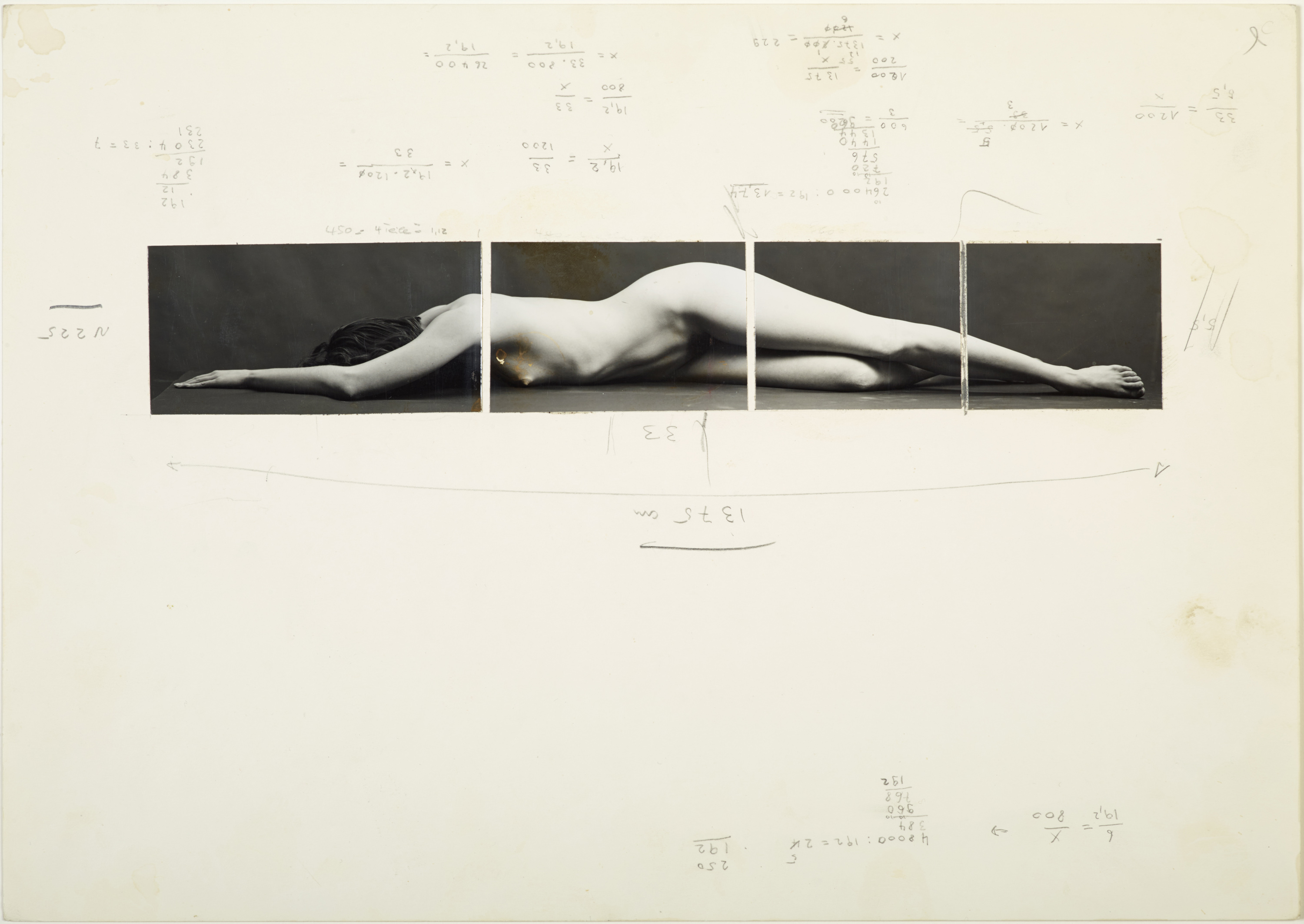
It was in the photo canvases he made in Chicago during the late 1970s that Burkhard first turned towards the motif of the body as a sculptural form with which he would continue to experiment over the coming years. Such an overtly sculptural approach to the body and to the nude as landscape soon began to demand a larger format than Burkhard had previously been using. An arm, almost four metres long, framed by heavy steel, or the multipart installation Das Knie (Knee), reflect the very core of his creative oeuvre in all its many facets: monumentality, fragmentation and the breaking of genre boundaries by transposing two-dimensional images into spatially commanding installations.

Portraits: Types and Individuals

The increasing formal reduction of Balthasar Burkhard’s images continued in the field of portraiture. He invited fellow artists such as Lawrence Weiner and Christian Boltanski to sit for him. With this series, it seemed that he had finally put behind him his days as a chronicler of the art scene, reliant on the techniques of applied photography.

Portraits of a rather different kind are his profiles of animals, in an equally reduced setting, against the backdrop of a tarpaulin. Redolent of Renaissance drawings or nineteenth century animal photography, his images of sheep, wolves and lions come across as representing ideal and typical examples of their species without anthropomorphising them, while at the same time wrenching them out of their natural environment. These images reached a broad audience through the popular 1997 children’s book “Click!”, said the Camera, which was republished in its second edition in 2017.

Architectural Photography

Given his increasing success in the art world, Burkhard could well afford to be selective about his choice of commissioned works. He had already been taking photographs for architects connected with the Bern-based firm Atelier 5 back in the 1960s, and was still accepting commissions in this field in the 1990s. Burkhard’s photographic essay on the Ricola building designed by Swiss architects Herzog & de Meuron indicates just how thoroughly his own distinctive artistic syntax permeates his commissioned and architectural photography, right through to the details of fragments and materials. These photographs were shown in the Swiss Pavilion at the Venice Biennale of Architecture in 1991, having been explicitly designed for this particular exhibition space. As in his artistic oeuvre, Burkhard operates here with spatially commanding installations, skilfully dovetailing the architectural motif with the presentational form.

Aerial Photography

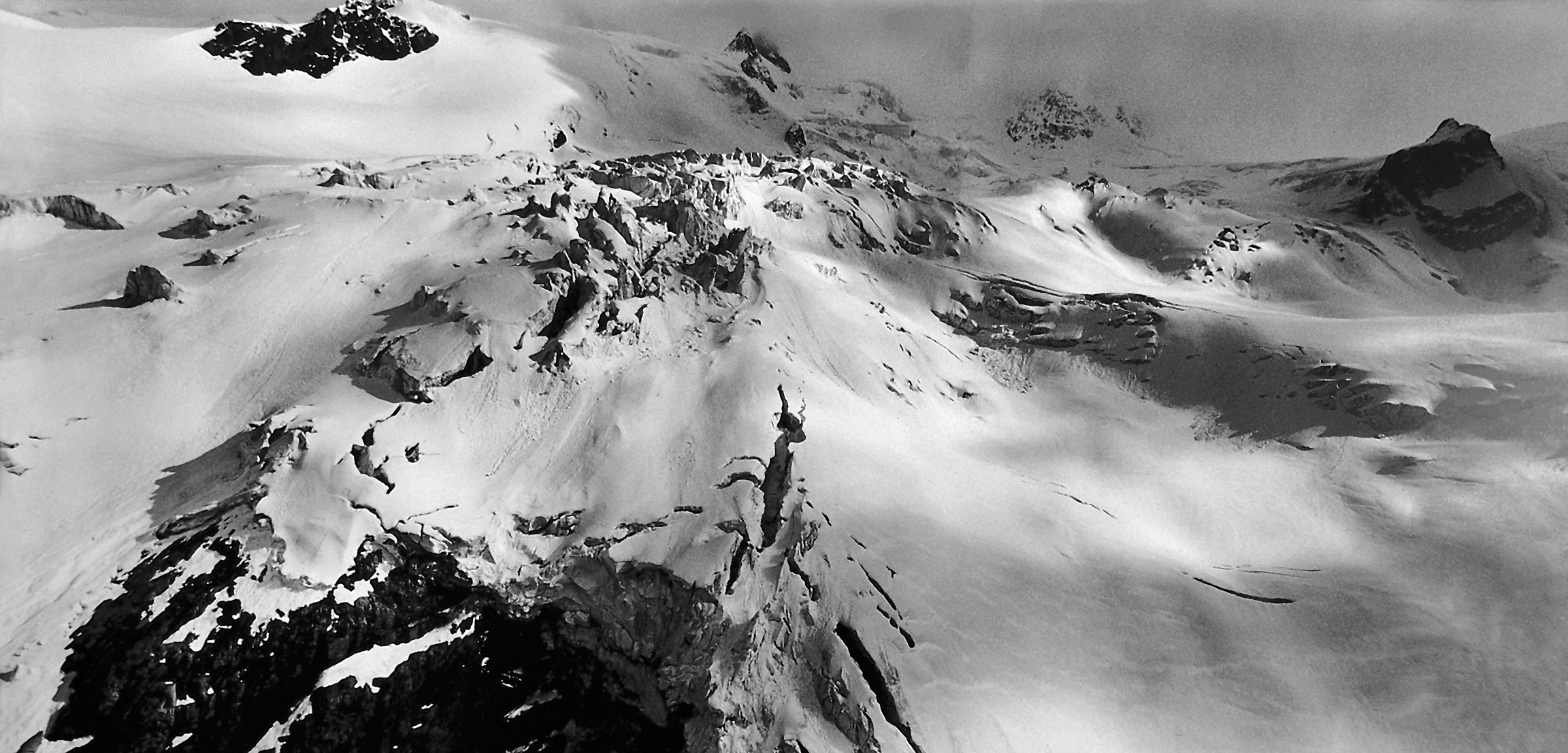
In the 1990s, before the art world had even begun to turn its attention to the subject of megacities, Burkhard was already taking a keen interest in the world’s major conurbations. Following in the footsteps of his father, who had been a Swiss airforce pilot, he took bird’s-eye-view photographs from a plane. His panoramic shots of cities such as London, Mexico City and Los Angeles were preceded by small-format studies of clouds: the so-called Nuages series. Having incorporated a study of rural Switzerland into his formative training in 1963 with the series Auf der Alp (On the Alp), he returned once more to focus on the landscape of his homeland in the early 2000s with an entire series of aerial photographs of the Bernina mountain range.

Landscape and Flora

In the last two decades of his life, Burkhard concentrated primarily on landscape and flora, turning to historical precedents both in his techniques and in his choice of motif. The desert formations of Namibia, in which all sense of proportion is lost amid the remote and untouched wilderness, set a counterpoint to the sprawling urban expanses of Mexico City and London. The diptych Welle (Wave), by contrast, pays homage to the work of French artist Gustave Courbet, with Burkhard making a pilgrimage to the tide swept shores where the father of Realism had painted in 1870.

In another series, Burkhard adapts the aesthetics of botanical plant studies, which were as widely used around the turn of the twentieth century as the complex photographic process of heliography, and transposes these to larger-than-life formats. Whereas Burkhard, as a young photographer, had captured the exuberant art scene of the 1960s and 1970s, snapshot-style, he later went on, as an artist-photographer, to explore the potential of the photographic tableau, diligently researching near-forgotten techniques and the sensual details of the visible world.

Artwork and Commissioned Work

The site-specific installations of his photographs and Burkhard’s own dedicated approach to museum spaces warrant an excursion into the archives of the artist, paying particular attention to four exemplary exhibitions.

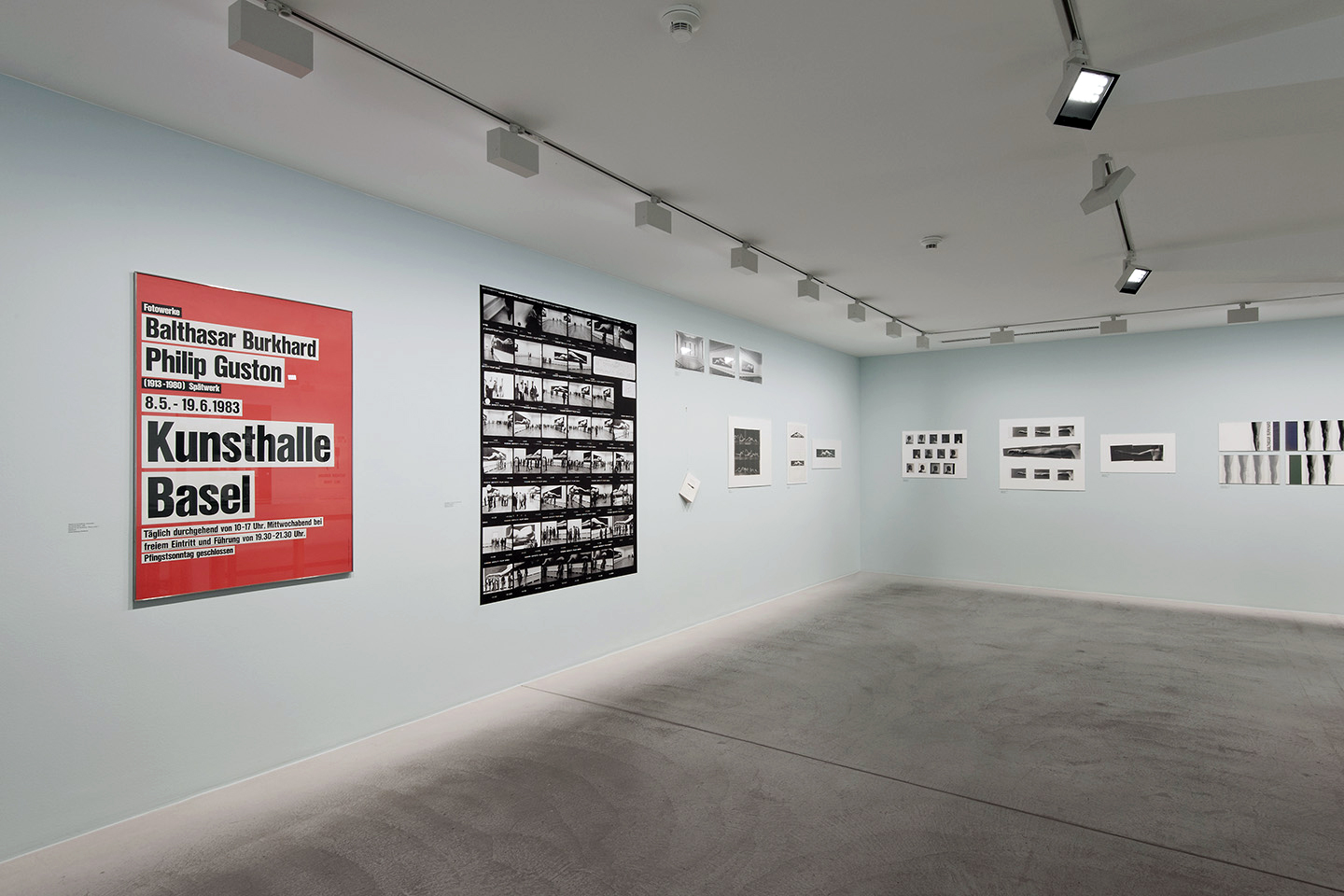
One spectacular and iconic show was the Fotowerke (Photo works) exhibition at Kunsthalle Basel in 1983. Curated by artist Rémy Zaugg, the installations can be reconstructed thanks to the catalogue and copious documentation. Contact prints and studies, for instance, help to give an insight into the no longer extant thirteen metre work Körper I (Body I) as well as shedding light on the choice of motif for further body fragments.

A 1984 solo exhibition at the Le Consortium in Dijon, on the other hand, shows how Burkhard responded with his group of works Das Knie (Knee) to an entirely different installation context within the given space. Similarly, at the Musée Rath in Geneva that same year, Burkhard, together with his friend Niele Toroni, instigated a radical juxtaposition of photography and painting based on the pillars of the exhibition venue.

At Grand-Hornu in the Belgian town of Mons, by contrast, his life-sized photographs of animals were mounted at eye level. While Burkhard chose a large format for the exhibition venue, the images in his children’s book “Click!”, said the Camera tell of a beauty contest between animals in a photo-shoot. This apparent discrepancy between artwork and commissioned work never seemed to be relevant to Burkhard. The sheer volume of his studio photos, alone, indicates just how scrupulously precise he was about the way he wanted to be perceived as a serious photographer.

Wall text from the exhibition


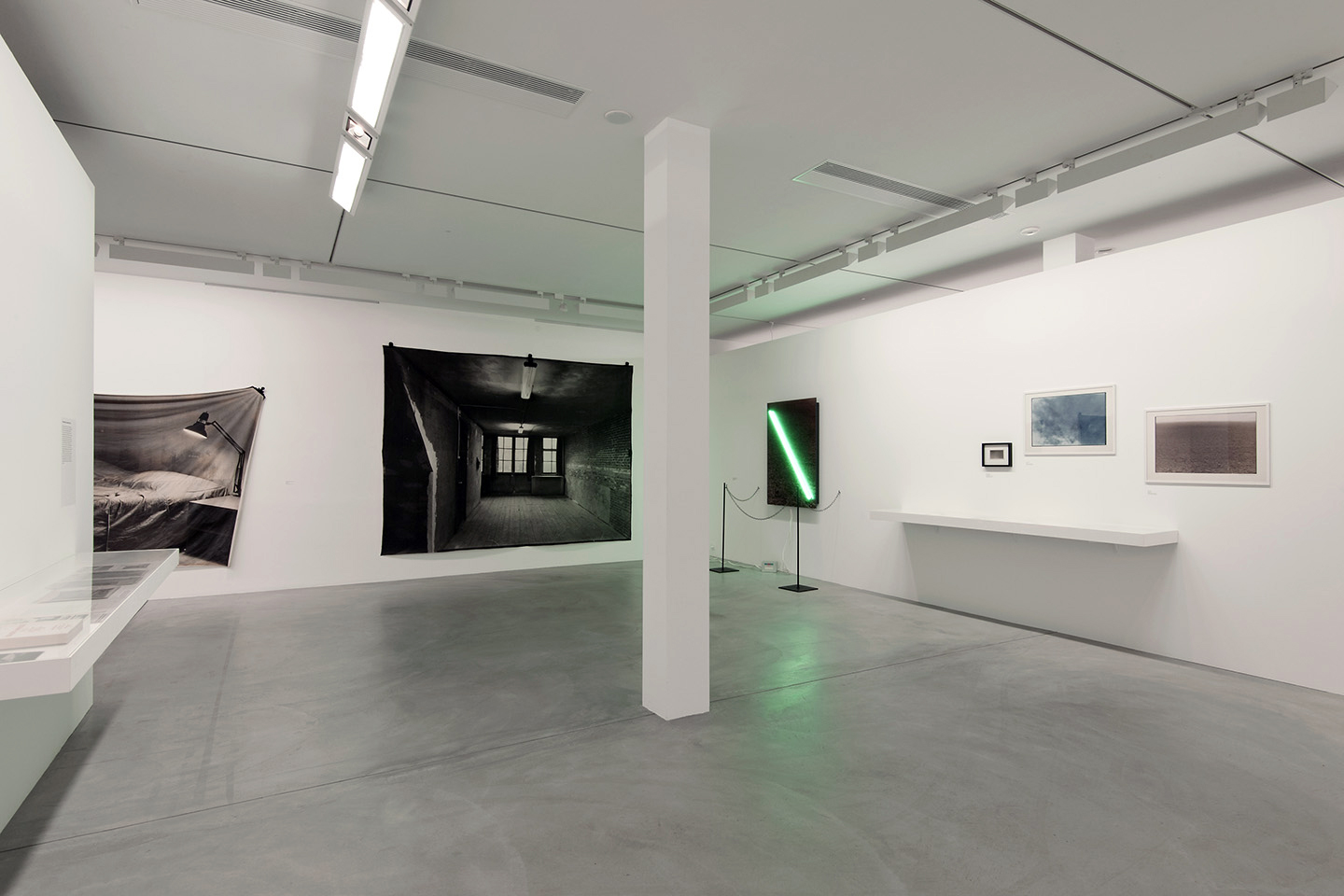
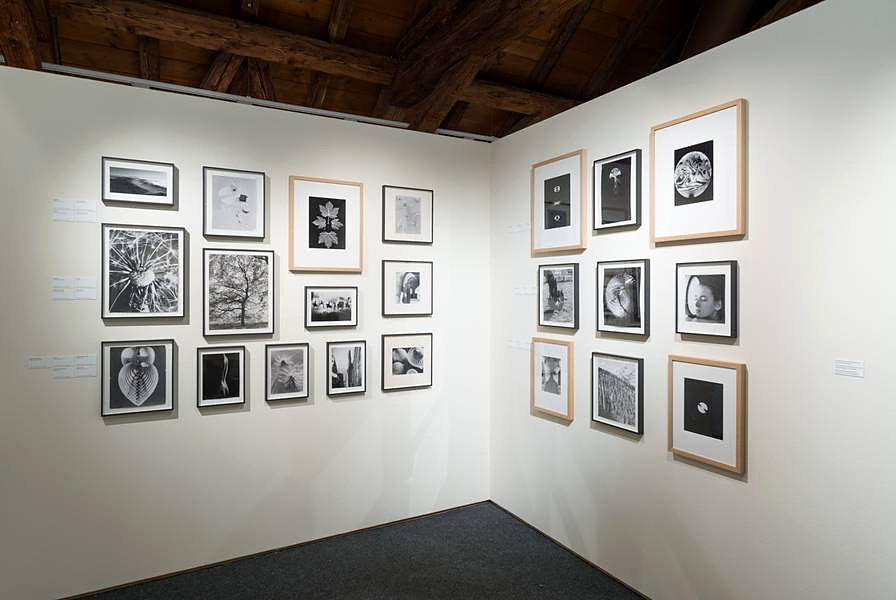
Installation view of the exhibition 'Balthasar Burkhard' at Fotomuseum Winterthur and Fotostiftung Schweiz, Winterthur, Zurich February - May 2018

Installation view of the exhibition 'Balthasar Burkhard' at Fotomuseum Winterthur and Fotostiftung Schweiz, Winterthur, Zurich February - May 2018

Installation view of the exhibition 'Balthasar Burkhard' at Fotomuseum Winterthur and Fotostiftung Schweiz, Winterthur, Zurich February - May 2018

Installation view of the exhibition 'Balthasar Burkhard' at Fotomuseum Winterthur and Fotostiftung Schweiz, Winterthur, Zurich February - May 2018

Installation view of the exhibition 'Balthasar Burkhard' at Fotomuseum Winterthur and Fotostiftung Schweiz, Winterthur, Zurich February - May 2018


Installation views of the exhibition Balthasar Burkhard at Fotomuseum Winterthur and Fotostiftung Schweiz, Winterthur, Zurich February – May 2018


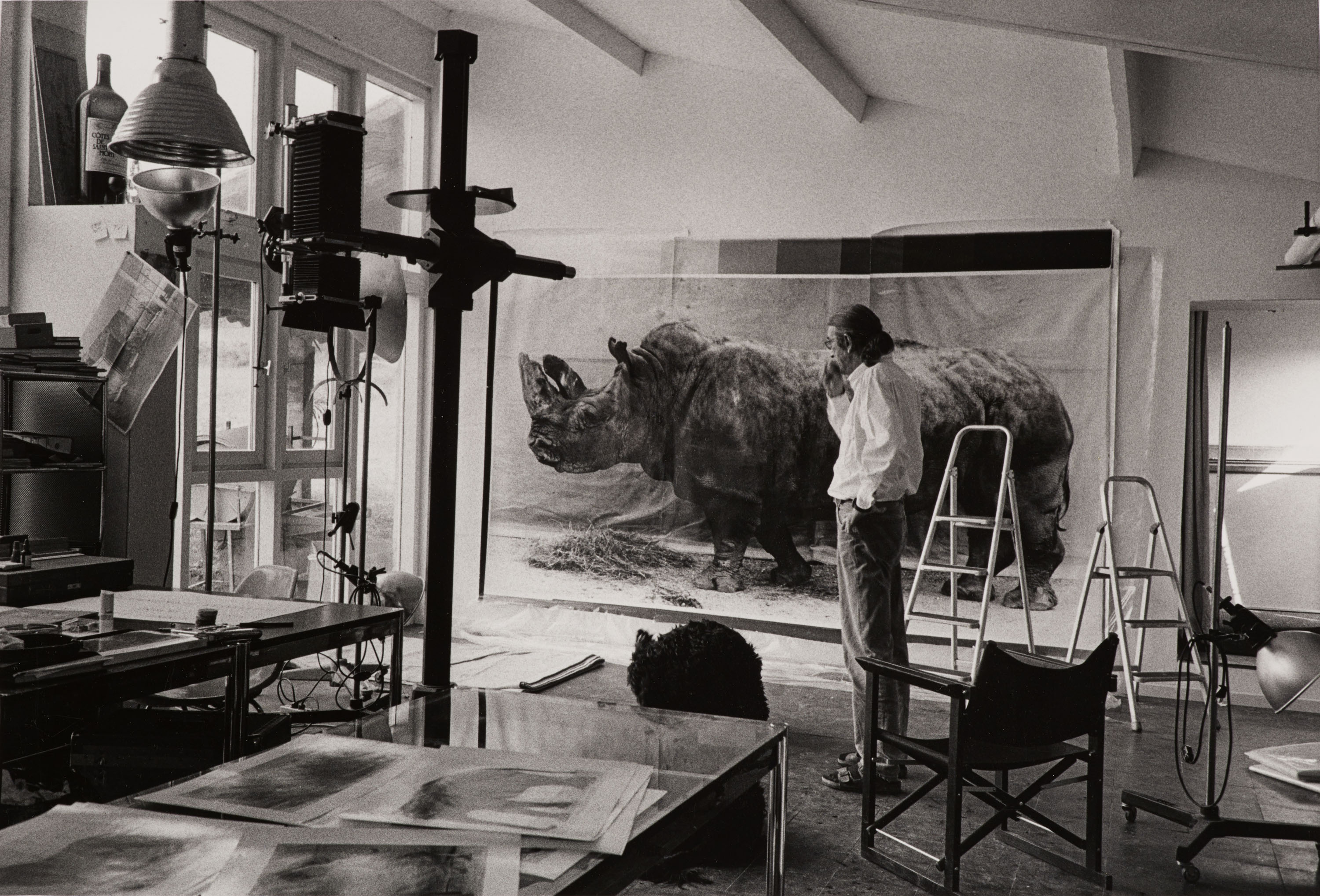
Balthasar Burkhard (Swiss, 1944-2010) 'Balthasar Burkhard in his studio' 1995


Balthasar Burkhard (Swiss, 1944-2010)
Balthasar Burkhard in his studio
1995
© Estate Balthasar Burkhard


Balthasar Burkhard (Swiss, 1944-2010) 'Camel' 1997


Balthasar Burkhard (Swiss, 1944-2010)
Camel
1997
© Estate Balthasar Burkhard


Balthasar Burkhard (Swiss, 1944-2010) 'Bull' 1996


Balthasar Burkhard (Swiss, 1944-2010)
Bull
1996
© Estate Balthasar Burkhard


Balthasar Burkhard (Swiss, 1944-2010) 'The Reindeer' 1996


Balthasar Burkhard (Swiss, 1944-2010)
The Reindeer
1996
© Estate Balthasar Burkhard


Balthasar Burkhard (Swiss, 1944-2010) 'Mexico City' 1999


Balthasar Burkhard (Swiss, 1944-2010)
Mexico City
1999
© Estate Balthasar Burkhard


Balthasar Burkhard (Swiss, 1944-2010) 'Mexico City' 1999


Balthasar Burkhard (Swiss, 1944-2010)
Mexico City
1999
© Estate Balthasar Burkhard


Balthasar Burkhard (Swiss, 1944-2010) 'Nuages ​​8' 1999


Balthasar Burkhard (Swiss, 1944-2010)
Nuages ​​8
1999
© Estate Balthasar Burkhard


Balthasar Burkhard (Swiss, 1944-2010) 'Ecosse' (Scotland) 2000


Balthasar Burkhard (Swiss, 1944-2010)
Ecosse (Scotland)
2000
© Estate Balthasar Burkhard


Balthasar Burkhard (Swiss, 1944-2010) 'Bernina' 2003


Balthasar Burkhard (Swiss, 1944-2010)
Bernina
2003
© Estate Balthasar Burkhard


Balthasar Burkhard (Swiss, 1944-2010) 'Silberen' 2004


Balthasar Burkhard (Swiss, 1944-2010)
Silberen
2004
© Estate Balthasar Burkhard


Balthasar Burkhard (Swiss, 1944-2010) 'Rio Negro' 2002


Balthasar Burkhard (Swiss, 1944-2010)
Rio Negro
2002
© Estate Balthasar Burkhard


Fotostiftung Schweiz
Grüzenstrasse 45
CH-8400 Winterthur (Zürich)
Phone: +41 52 234 10 30

Opening hours:
Tuesday – Saturday 11am – 6pm
Wednesday 11am – 8pm
Closed on Mondays

Fotostiftung Schweiz website

Fotomuseum Winterthur
Grüzenstrasse 44 + 45
CH-8400
Winterthur (Zürich)

Opening hours:
Tuesday to Sunday 11am – 6pm
Wednesday 11am – 8pm
Closed on Mondays

Fotomuseum Winterthur website

LIKE ART BLART ON FACEBOOK

Back to top

Exhibition: ‘Jakob Tuggener – Machine time’ at Fotostiftung Schweiz, Winterthur, Zurich

Exhibition dates: 21st October, 2017 – 28th January, 2018

Curator: Martin Gasser


Jakob Tuggener (Swiss, 1904-1988) 'Fabrik' (book cover) 1943


Jakob Tuggener (Swiss, 1904-1988)
Fabrik (Factory) (book cover)
1943
Rotapfel Verlag, Erlenbach-Zurich


Rare magician, strange alchemist, tells stories through visuals

I am indebted to James McArdle’s blog posting “Work” on his excellent On This Date In Photography website for alerting me to this exhibition, and for reminding me of the work of this outstanding artist, Jakob Tuggener.

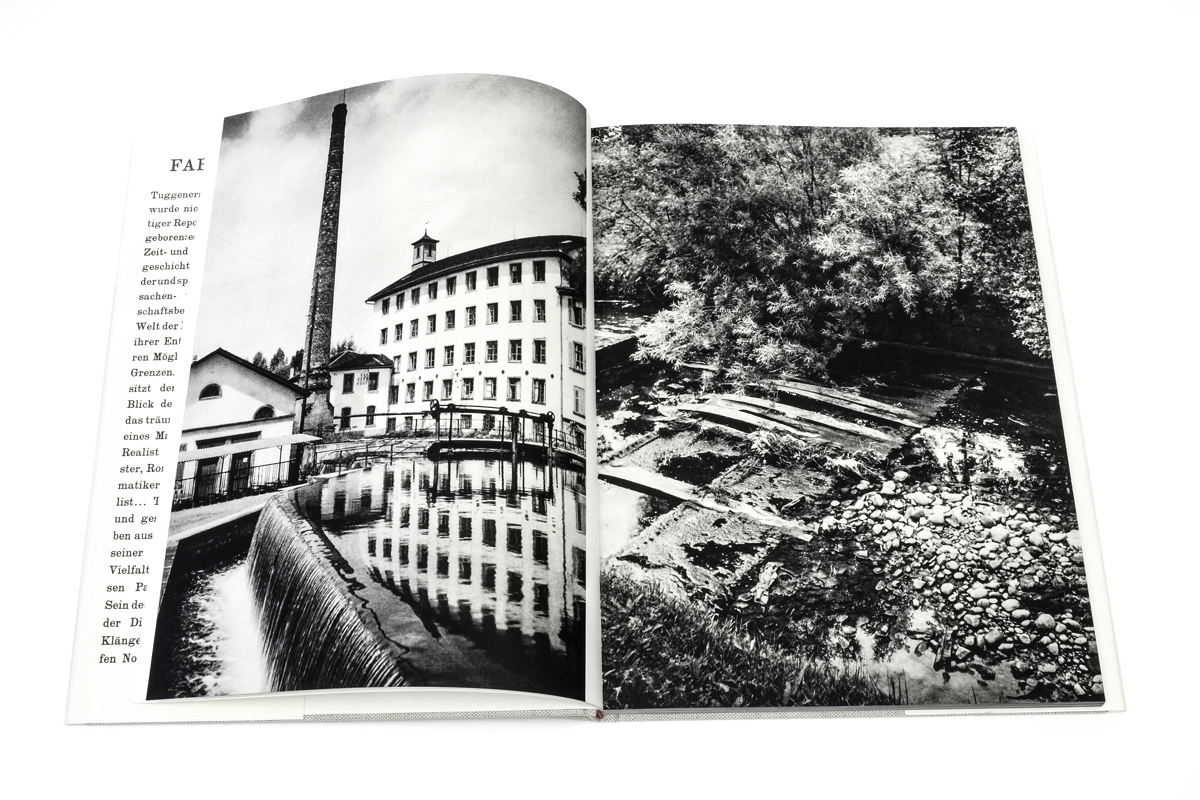
The short version: Jakob Tuggener was a draftsman before he became an artist, studying poster design, typography, photography and film. “In 1943, in the middle of the Second World War, Tuggerer’s book Fabrik (Factory) appeared. At first glance, the series of 72 photographs without a text contained therein seems to depict a kind of history of industrialisation – from the rural textile industry to mechanical engineering and high-voltage electrical engineering to modern power plant construction in the mountains. An in-depth reading, however, shows that Tuggener’s film-associative series of photographs simultaneously points to the destructive potential of unrestrained technological progress, as a result of which he sees the then raging World War, and for which the Swiss arms industry produced unlimited weapons. Tuggener was ahead of his time with the book conceived according to the laws of silent film.” (Press release)

Fabrik, subtitled Ein Bildepos der Technik (“Epic of the technological image” or “A picture of technology”) pictures the world of work and industry, and “is considered a milestone in the history of the photo book.” It uses expressive visuals (actions, appearances and behaviours; movements, gestures and details – Tuggener loves the detail) to tell a subjective story, that of the relationship between human and machine. While the book was well ahead of its time, and influenced the early work of that famous Swiss photographer Robert Frank, it did not emerge out of a vacuum and is perhaps not as revolutionary as some people think. Nothing ever appears out of thin air.

“German photographer Paul Wolff, often working in collaboration with Alfred Tritschler, produced a number of exceptional photo books through the 1920s and ’30s, at a time when Constructivism and the Bauhaus influenced many with visions “of an industrialized and socialized society” that placed Germany at “the forefront of European photography” (Martin Parr and Gerry Badger. The Photobook: A History Volume I, Phaidon Press, 2005, p. 86). Arbeit! (1937) is particularly noted for its architectural framing and lighting of massive machinery, its striking portraits of factory workers, and is frequently aligned with works such as Lewis Hine’s Men at Work (1932) and Albert Renger-Patzsch’s Eisen und Stahl (Iron and Steel) (1931).” (Anonymous. “Arbeit!,” on the Bauman Rare Books website [Online] Cited 03/02/2022)

François Kollar’s project La France travail (Working France) (1931-1934), E. O. Hoppé’s Deutsche Arbeit (1930), Heinrich Hauser’s Schwarzes Revier (Black Area) (1930) and Germaine Krull’s Metal (1928) all address the profound social and economic tensions that preceded the Second World War, through an avant-garde photography in the style of “New Vision” and “New Objectivity” – that is, through objective photographs that question common rules of composition, avoiding the more obvious ways subjects would have been photographed at the time. Obscure angles and perspectives abound in these striking photobooks, making their clinical, objective fervour “the great persuaders” of the 1930s and 40s, Modernist and propaganda books of their time.

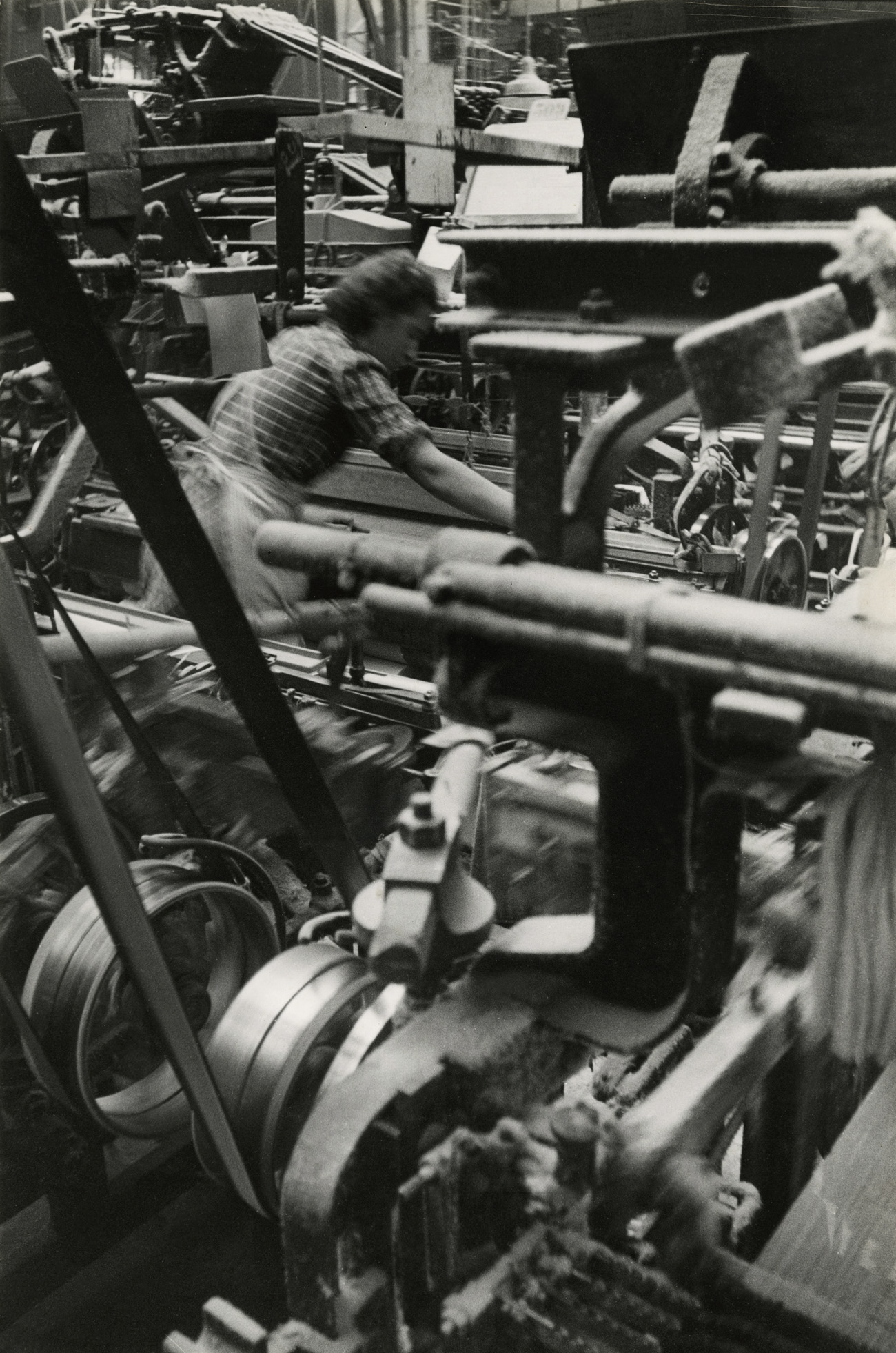
What made Tuggener so different was the uncompromising subjectiveness of his work, “photographing the two worlds, privilege and labour.” His direct, strong images of factories and high society use wonderful form, light, and shadow to convey their message, never loosing sight of the human dimension, for they shift “our angle from the boss’ POV [point of view] to those unable to get any respite or distance from the situation,” that of the workers. They are a piece of time and human history, which gets closer to the lived reality of the factory floor, than much of the work of his predecessors. Tuggener portrays the mundanity of the “operational sequence” (la chaîne opératoire) of the machine, where the human becomes the oil used to grease the cogs of the ever-demanding “mechanical monsters.” (See Evan Calder Williams’ “Rattling Devils” quotations below)

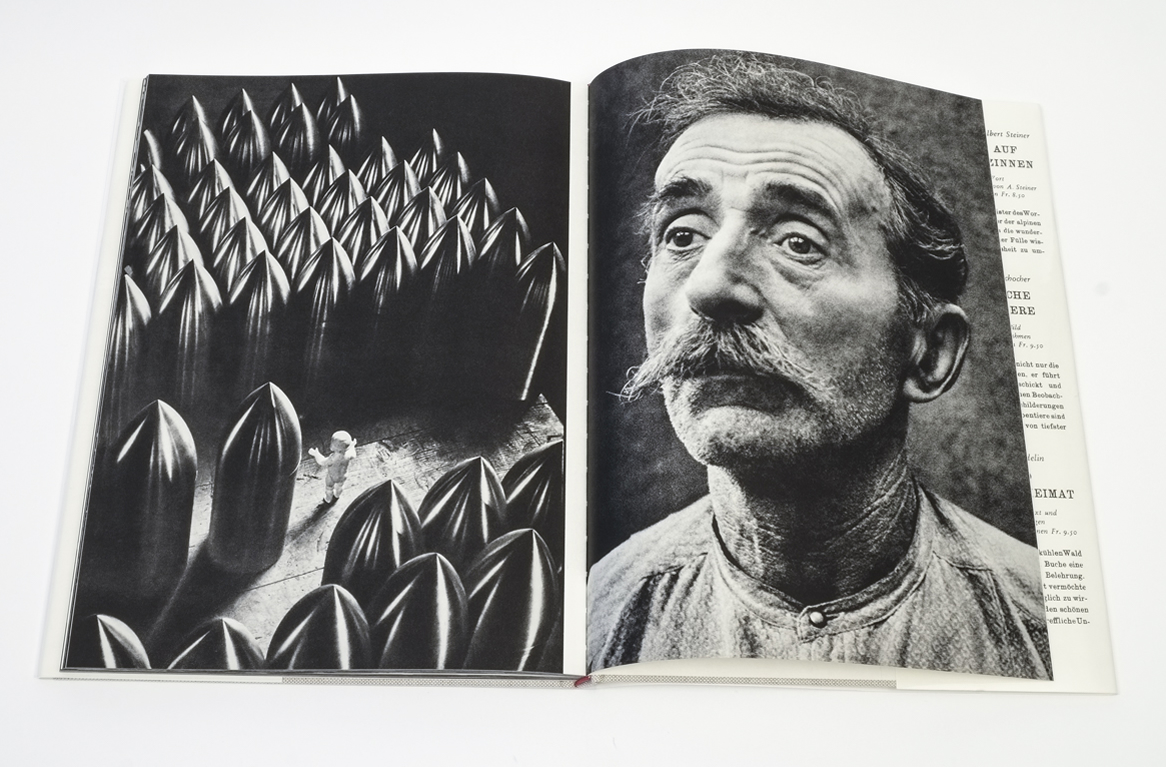
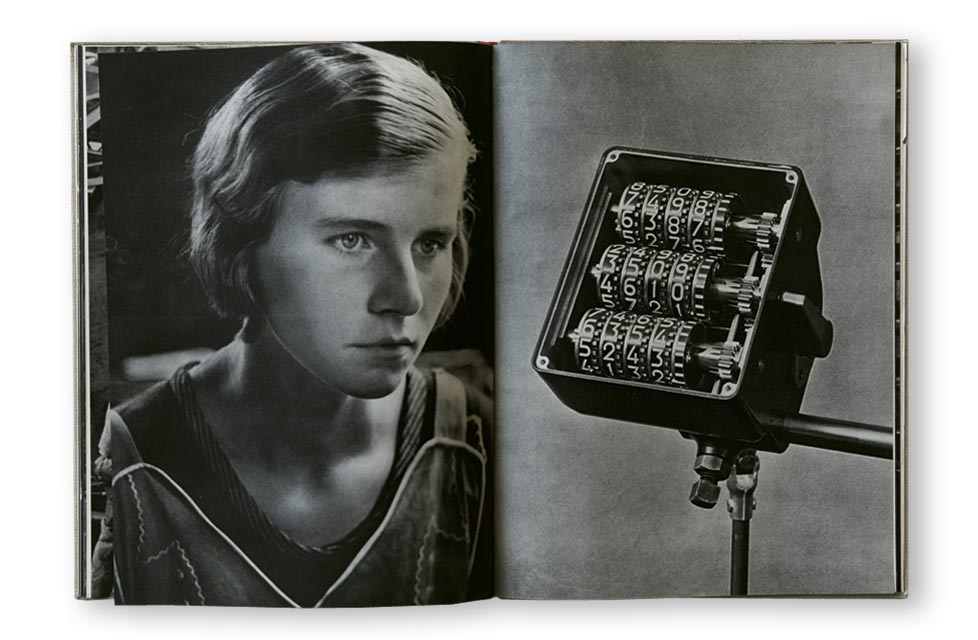
Tuggener then adds to this new way of seeing which recorded the multiplicity of his points of view – “a modern new style of photography showing not just how things looked, but how it felt to be there” – through the sequencing of the images, which can be seen in the wonderfully combined double pages of the Fabrik book layouts below. Take for example, the photograph that is on the dust jacket, a portrait of a middle-aged worker with a grave look on his face that says, “why the hell are you taking my photograph, why don’t you just f… off.” In the book, Tuggener pairs this image with a whistle letting off steam, a metaphor for the man’s state of being. Tuggener creates these most alien worlds from the inside out, worlds which are grounded in actual lived experience – the little screws lying in the palm of a blackened hand; Navy Cut cigarettes amongst steel artefacts; man being consumed by machine; man being dwarfed by machine; man as machine (the girl paired opposite the counting machine); the Frankenstein scenario of the laboratory (man as monster, machine as man); the intense, feverish eyes of the worker in Heater on electric furnace (the machine human as the devil); and the surrealism of a small doll among the serried ranks of mass destruction, facing the opposition, the opposing lined face of an older worker. This is the stuff of alchemy, the place where art challenges life.

“As Arnold Burgaurer cogently states in his introduction, Tuggener is a jack-of-all-trades: he exhibits, ‘the sharp eye of the hunter, the dreamy eye of the painter; he can be a realist, a formalist, romantic, theatrical, surreal.’ Tuggener’s moves effortlessly between large-format lucidity and grainy, blurred impressionism, in a book that is a decade ahead of its time.” (Martin Parr and Gerry Badger. The Photobook: A History Volume I, Phaidon Press, 2005, p. 144.)

James McCardle observes that, “the meaning of Fabrik is left to the viewer to discover between its pictures, its glimpses of an overwhelming industrial whole; it is essentially filmic on a cryptic film-noir level, a revelation to Frank.” Tuggener’s influence on the early work of Robert Frank can be seen in a sequence from the book Portfolio: 40 Photos 1941/1946 by Robert Frank that was republished by Steidl in 2009 (see below). “Like Tuggener, Frank tackles the task of seemingly incongruous subject matter and finds a harmony through edit and assembly. Again and again throughout this portfolio, Frank is not just trying to show his prowess in making images but in pairing them. They define conflicts in life.” Pace Tuggener. At Frank’s suggestion, Tuggener’s work appeared in both Edward Steichen’s Post-War European Photography and in The Museum of Modern Art’s seminal exhibition, The Family of Man, the latter an essentially humanist exhibition which took the form of a photo essay celebrating the universal aspects of the human experience.

McCardle goes onto suggest that Fabrik, as a photo book, was a model for Frank’s Les Américains: The Americans published fifteen years later in Paris by Delpire, 1958. On this point, we disagree. While his early work as seen in Portfolio: 40 Photos 1941/1946 may have been heavily influenced by Tuggener’s photo book, by the time Frank came to compose Les Américains (for that is what The Americans is, a composition) his point of view had changed, as had that of his camera. While The Americans has many formal elements that can be seen in the construction of the photographs, they also have an element of jazz that would have been inconceivable to Tuggener at that time. Grainy film, strange angles, lighting flare, street lights, night time photography, jukeboxes and American flags portray the American dream not so much from the vantage point of a knowing insider (as Tuggener was) but as a visitor from another planet. Not so much alienating world (man as machine) as alien world, picturing something that has never been recognised before. These are two different models of being. While both are photo books and both pair images together in sequences, Frank had moved on to another point of view, that of an “invalid” outsider, and his photo book has a completely different nature to that of Tuggener’s Fabrik.

Dr Marcus Bunyan

Word count: 1,366


Many thankx to Fotostiftung Schweiz for allowing me to publish some of the photographs in the posting. Please click on the photographs for a larger version of the image.


For Jakob Tuggener, whose works can be seen within the context of social documentary photography, the individual and the industrial boom of the 19th and 20th centuries were central themes. His often somber, black and white photographs seem to confront this new world with a sense of fear as well as admiration. Will technology help relieve us of physically hard labour or replace us altogether? Tuggener owes his renown to his photo book Fabrik (Factory) that was published in 1943. With an aesthetic approach that was unique for his time, Tuggener explores in his photographic essay the relationship between humans and the perceived threat as well as progress of technology. The labourers depicted are grave, their faces worn marked by deep folds, while a factory building in the background stands strong, enveloped in a vaporous cloud. This “Pictorial Epic of Technology,” as Tuggener himself described it, is today considered a milestone in the history of photography books.


Jakob Tuggener (Swiss, 1904-1988) Page layout from the book 'Fabrik' 1943

Jakob Tuggener (1904-1988) Page layout from the book Fabrik 1943


Jakob Tuggener (Swiss, 1904-1988) 'Steam whistle, Steckborn artificial silk factory' 1938 from the exhibition Exhibition: 'Jakob Tuggener – Machine time' at Fotostiftung Schweiz, Winterthur, Zurich, Oct 2017 - Jan 2018


Jakob Tuggener (Swiss, 1904-1988)
Steam whistle, Steckborn artificial silk factory
1938
Silver gelatin print
© Jakob Tuggener-Stiftung


Selection from the book 'Portfolio: 40 Photos 1941/1946' by Robert Frank


Selection from the book Portfolio: 40 Photos 1941/1946 by Robert Frank (Steidl, 2009)


The ‘weightless’ and the ‘grounded’ are two opposing themes that Frank repeatedly uses to move us through this sequence. Three radio transistors in a product shot float into the sky while a music conductor, his band and a church steeple succumb to gravity on the facing page. Even in this image Frank shifts focus to the sky and beyond – the weightless. When he photographs rural life, the farmers heft whole pigs into the air and another carries a huge bale of freshly cut grain which seems featherlight but for the woman trailing behind with hands ready to assist.

Considering this work was made while fascism was on the move through Europe, external politics is felt through metaphor. A painted portrait of men in uniform among a display of pots and pans for sale faces a brightly polished cog from a machine – its teeth sharp and precise. In another pairing, demonstrators waving flags in the streets of Zurich face a street sign covered with snow and frost, a Swiss flag blows in the background. in yet another of a crowd of spectators face the illuminated march of a piece of machinery – its illusory shadow filling in the ranks. These pairings feel under the influence of Jakob Tuggener, whose work Frank certainly knew. Like Tuggener, Frank tackles the task of seemingly incongruous subject matter and finds a harmony through edit and assembly.

Again and again throughout this portfolio, Frank is not just trying to show his prowess in making images but in pairing them. They define conflicts in life. One boy struggles to climb a rope while a ski jumper is frozen in flight. Fisherman bask in sunlight while two pedestrians are caught in blinding snowfall.

Text from the SB4 Photography and Books website December 14, 2009


Jakob Tuggener (Swiss, 1904-1988) 'Autoritratto, Zurigo [Self-portrait, Zurich]' 1927 from the exhibition Exhibition: 'Jakob Tuggener – Machine time' at Fotostiftung Schweiz, Winterthur, Zurich, Oct 2017 - Jan 2018


Jakob Tuggener (Swiss, 1904-1988)
Autoritratto, Zurigo (Self-portrait, Zurich)
1927
Silver gelatin print
© Jakob Tuggener-Stiftung


Jakob Tuggener (Swiss, 1904-1988) 'Budenzauber (Charm of the Attic Room) Jakob Tuggener with friends' 1935


Jakob Tuggener (Swiss, 1904-1988)
Budenzauber (Charm of the Attic Room) Jakob Tuggener with friends
1935
Silver gelatin print
© Jakob Tuggener-Stiftung


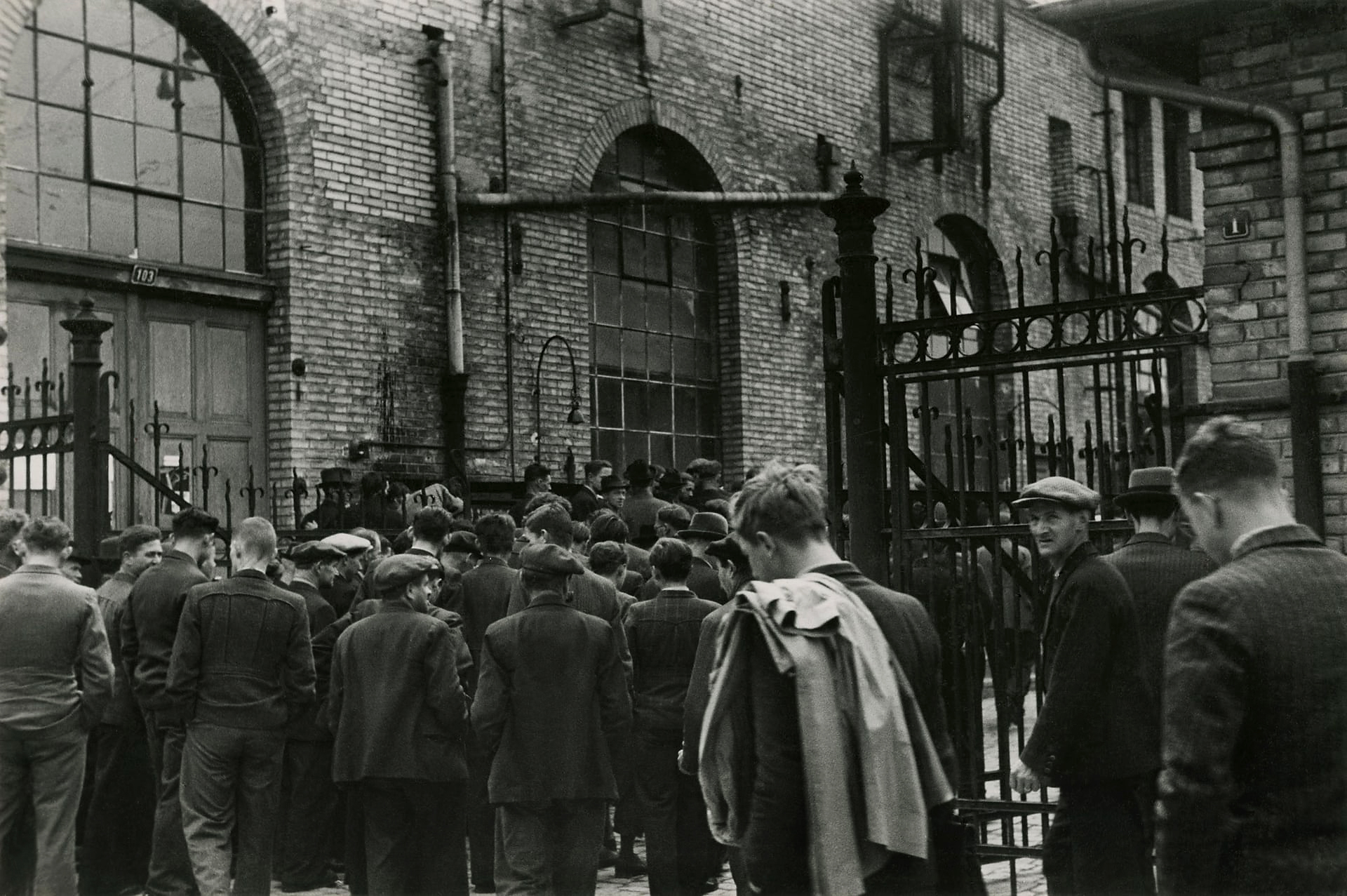
Jakob Tuggener (Swiss, 1904-1988) 'Plant entrance, Oerlikon Machine Factory' 1934


Jakob Tuggener (Swiss, 1904-1988)
Plant entrance, Oerlikon Machine Factory
1934
Silver gelatin print
© Jakob Tuggener-Stiftung


Jakob Tuggener (Swiss, 1904-1988) 'Work in the boiler' 1935


Jakob Tuggener (Swiss, 1904-1988)
Work in the boiler
1935
Silver gelatin print
© Jakob Tuggener-Stiftung


Jakob Tuggener (Swiss, 1904-1988) 'Running girl in the Maschinenfabrik Oerlikon' 1934


Jakob Tuggener (Swiss, 1904-1988)
Running girl in the Maschinenfabrik Oerlikon
1934
Silver gelatin print
© Jakob Tuggener-Stiftung


Jakob Tuggener (Swiss, 1904-1988) 'Façade, Oerlikon Machine Factory' 1936


Jakob Tuggener (Swiss, 1904-1988)
Façade, Oerlikon Machine Factory
1936
Silver gelatin print
© Jakob Tuggener-Stiftung


Jakob Tuggener (Swiss, 1904-1988) Page layout from the book 'Fabrik' 1943

Jakob Tuggener (1904-1988) Page layout from the book Fabrik 1943


Jakob Tuggener (Swiss, 1904-1988) 'Nell'ufficio della fonderia, fabbrica di costruzioni meccaniche Oerlikon' [In the foundry office, Oerlikon mechanical engineering factory] 1937


Jakob Tuggener (Swiss, 1904-1988)
Nell’ufficio della fonderia, fabbrica di costruzioni meccaniche Oerlikon (In the foundry office, Oerlikon mechanical engineering factory)
1937
From Fabrik 1933-1953
Silver gelatin print
© Jakob Tuggener-Stiftung


“Above all, the contrast between the brilliantly lit ballroom and the dark factory hall influenced the perception of his artistic oeuvre,” [curator] Martin Gasser explains. “Tuggener also positioned himself between these two extremes when he stated: ‘Silk and machines, that’s Tuggener’. In reality, he loved both: the wasteful luxury and the dirty work, the enchanting women and the sweaty labourers. For him, they were both of equal value and he resisted being categorised as a social critic who pitted one world against the other. On the contrary, these contrasts belonged to his conception of life and he relished experiencing the extremes – and the shades of tones in between – to the most intense degree.”


“Jakob Tuggener’s ‘Fabrik’, published in Zurich in 1943, is a milestone in the history of the photography book. Its 72 images, in the expressionist aesthetic of a silent movie, impart a skeptical view of technological progress: at the time the Swiss military industry was producing weapons for World War II. Tuggener, who was born in 1904, had an uncompromisingly critical view of the military-industrial complex that did not suit his era. His images of rural life and high-society parties had been easy to sell, but ‘Fabrik’ found no publisher. And when the book did come out, it was not a commercial success. Copies were sold at a loss and some are believed to have been pulped. Now this seminal work, which has since become a sought-after classic, is being reissued with a contemporary afterword. In his lifetime, Tuggener’s work appeared – at Robert Frank’s suggestion – in Edward Steichen’s ‘Post-War European Photography’ and in The Museum of Modern Art’s seminal exhibition, ‘The Family of Man’, in whose catalogue it remains in print. Tuggener’s death in 1988 left an immense catalogue of his life’s work, much of which has yet to be shown: more than 60 maquettes, thousands of photographs, drawings, watercolours, oil paintings and silent films.”


Book description on Amazon. The book has been republished by Steidl in January, 2012.


Jakob Tuggener (Swiss, 1904-1988) 'Tornos Machine-tool Factory, Moutier' 1942


Jakob Tuggener (Swiss, 1904-1988)
Tornos Machine-tool Factory, Moutier
1942
Silver gelatin print
© Jakob Tuggener-Stiftung


Jakob Tuggener (Swiss, 1904-1988) 'Navy Cut, Ateliers de construction mécanique Oerlikon (MFO)' [Navy Cut, Machine Shops Oerlikon (MFO)] 1940


Jakob Tuggener (Swiss, 1904-1988)
Navy Cut, Ateliers de construction mécanique Oerlikon (MFO) [Navy Cut, Machine Shops Oerlikon (MFO)]
1940
Silver gelatin print
© Jakob Tuggener-Stiftung


Jakob Tuggener (Swiss, 1904-1988) 'Pressure pipe, Vernayaz' 1938


Jakob Tuggener (Swiss, 1904-1988)
Pressure pipe, Vernayaz
1938
Silver gelatin print
© Jakob Tuggener-Stiftung


Jakob Tuggener (Swiss, 1904-1988) 'Grande Dixence power station' 1942


Jakob Tuggener (Swiss, 1904-1988)
Grande Dixence power station
1942
Silver gelatin print
© Jakob Tuggener Foundation


Jakob Tuggener (Swiss, 1904-1988) 'Laboratorio di ricerca, fabbrica di costruzioni meccaniche Oerlikon' [Research laboratory, Oerlikon mechanical engineering factory] 1941


Jakob Tuggener (Swiss, 1904-1988)
Laboratorio di ricerca, fabbrica di costruzioni meccaniche Oerlikon (Research laboratory, Oerlikon mechanical engineering factory)
1941
From Fabrik 1933-1953
Silver gelatin print
© Jakob Tuggener-Stiftung


Jakob Tuggener (Swiss, 1904-1988) 'Heater on electric furnace' 1943 (detail)


Jakob Tuggener (Swiss, 1904-1988)
Heater on electric furnace (detail)
1943
Silver gelatin print
© Jakob Tuggener-Stiftung


Jakob Tuggener (Swiss, 1904-1988) 'Heater on electric furnace' 1943


Jakob Tuggener (Swiss, 1904-1988)
Heater on electric furnace
1943
Silver gelatin print
© Jakob Tuggener-Stiftung


Jakob Tuggener (Swiss, 1904-1988) 'Worker, Maschinenfabrik Oerlikon' 1940s


Jakob Tuggener (Swiss, 1904-1988)
Worker, Maschinenfabrik Oerlikon
1940s
Silver gelatin print
© Jakob Tuggener Foundation


Jakob Tuggener (Swiss, 1904-1988) '"Amore", Maschinenfabrik Oerlikon' 1940s


Jakob Tuggener (Swiss, 1904-1988)
“Amore”, Maschinenfabrik Oerlikon
1940s
Silver gelatin print
© Jakob Tuggener Foundation


Jakob Tuggener (Swiss, 1904-1988) 'Weaving mill, Glattfelden' 1940s


Jakob Tuggener (Swiss, 1904-1988)
Weaving mill, Glattfelden
1940s
Silver gelatin print
© Jakob Tuggener Foundation


Jakob Tuggener (Swiss, 1904-1988) 'Lathe, Maschinenfabrik Oerlikon' 1949


Jakob Tuggener (Swiss, 1904-1988)
Lathe, Maschinenfabrik Oerlikon
1949
Silver gelatin print
© Jakob Tuggener-Stiftung


Jakob Tuggener (Swiss, 1904-1988) 'Lathe, Maschinenfabrik Oerlikon' 1949 (detail)


Jakob Tuggener (Swiss, 1904-1988)
Lathe, Maschinenfabrik Oerlikon (detail)
1949
Silver gelatin print
© Jakob Tuggener-Stiftung


Jakob Tuggener (Swiss, 1904-1988) 'Jacob Tuggener at the popular pavillion Montpellier manufactures an epic of industrial photographs of workers' portraits' Montpellier magazine 1943


Jakob Tuggener (Swiss, 1904-1988)
Jacob Tuggener at the popular pavillion Montpellier manufactures an epic of industrial photographs of workers’ portraits
Montpellier magazine
1943
© Jakob Tuggener-Stiftung


Jakob Tuggener (Swiss, 1904-1988) 'Forgeron dans une fabrique de wagons de Schlieren' [Blacksmith in a Schlieren wagon factory] 1949


Jakob Tuggener (Swiss, 1904-1988)
Forgeron dans une fabrique de wagons de Schlieren [Blacksmith in a Schlieren wagon factory]
1949
Silver gelatin print
© Jakob Tuggener-Stiftung


Jakob Tuggener (Swiss, 1904-1988) 'Untitled (Arms of work)' c. 1947


Jakob Tuggener (Swiss, 1904-1988)
Untitled (Arms of work)
c. 1947
Silver gelatin print
© Jakob Tuggener-Stiftung


Jakob Tuggener (1904-1988) is one of the exceptional phenomena of Swiss photography. His personal and expressive recordings of glittering celebrations of better society are legendary, and his 1943 book Fabrik (Factory) is considered a milestone in the history of the photo book. At the centre of the exhibition “Machine time” are photographs and films from the world of work and industry. They not only reflect the technical development from the textile industry in the Zurich Oberland to power plant construction in the Alps, but also testify to Tuggener’s lifelong fascination with all sorts of machines: from looms to smelting furnaces and turbines to locomotives, steamers and racing cars. He loved her noise, her dynamic movements and her unruly power, and he artistically transposed them. At the same time, he observed the men and women who keep up the motor of progress with their work – not without hinting that one day machines might dominate people.

Machine time

Jakob Tuggener knew the world of factories like no other photographer of his time, having completed an apprenticeship as a draftsman at Maag Zahnräder AG in Zurich and then worked in their design department. Through the photographer Gustav Maag he was also introduced to the technique of photography. However, as a result of the economic crisis in the late 1920s, he was dismissed, after which he fulfilled his childhood dream of becoming an artist by studying at the Reimannschule in Berlin. For almost a year he dealt intensively with poster design, typography and film and let himself be carried away with his camera by the dynamics of the big city.

After returning to Switzerland in 1932, he began working as a freelancer for the Maschinenfabrik Oerlikon (MFO), especially for their house newspaper with the programmatic title Der Gleichrichter (The Rectifier). Although the company already employed its own photographer, he was entrusted with the task of developing a kind of photographic interior view of the company. This was intended to bridge the gap between workers and office workers on the one hand and management on the other. By the end of the 1930s, in addition to multi-part reports from the production halls, as well as portraits of “members of the MFO family”, one-sided, album-like series of unnoticed scenes from everyday factory life appeared. From 1937 Tuggener also created a series of 16mm short films – always black and white, silent, and representing the tension between fiction and documentation. This includes, for example, the drama about death and transience (Die Seemühle (The Sea mill), 1944), which was influenced by surrealism and staged by Tuggener with amateur actors in a vacant factory on the shores of Lake Zurich. or the cinematic exploration of the subject of man and machine (Die Maschinenzeit (The Machine Time), 1938-1970). This ties in with the earlier book maquette of the same name and transforms it into a moving, immediately perceptible, but also fleeting vision of the Tuggenean machine age.

In 1943, in the middle of the Second World War, Tuggerer’s book Fabrik (Factory) appeared. At first glance, the series of 72 photographs without a text contained therein seems to depict a kind of history of industrialisation – from the rural textile industry to mechanical engineering and high-voltage electrical engineering to modern power plant construction in the mountains. An in-depth reading, however, shows that Tuggener’s film-associative series of photographs simultaneously points to the destructive potential of unrestrained technological progress, as a result of which he sees the then raging World War, and for which the Swiss arms industry produced unlimited weapons. Tuggener was ahead of his time with the book conceived according to the laws of silent film.1 Neither his uncompromisingly subjective photography nor his critical attitude matched the threatening situation in which Switzerland was called to unity and strength under the slogan “Spiritual Defense”.

Although the book was not commercially successful, Tuggener’s Fabrik was a great artistic success and continued to explore the issues of work and industry. He produced two more book maquettes: Schwarzes Eisen (Black Iron) (1950) and Die Maschinenzeit (The Machine Time) (1952). They can be understood as a kind of continuation of the published book, which the journalist Arnold Burgauer described as a “glowing and sparkling factual and accountable report of the world of the machine, of its development, its possibilities and limitations.” In the mid-1950s, on the threshold of the computer age, Tuggener’s classic “machine time” came to an end. On the one hand, the mechanical processes that had so fascinated Tuggener evaded his eyes. On the other hand, he could not or did not want to make friends with the idea that one day even a human heart could be replaced by a machine.

Portrayer of opposites

As early as 1930 in Berlin, Tuggener had begun to take pictures of the then famous Reimannschule balls. He was fascinated by the tingling erotic atmosphere of these occasions, and he found photography in sparsely lit rooms a great challenge. Back in Zurich, he immediately plunged into local nightlife to surrender to the splendour and luxury of mask, artist and New Year’s balls. Again and again he let himself be abducted by elegant ladies with their silk dresses, their necklines, bare back or shoulders in a glittering fairytale world, whose mysterious facets he sought to fathom with his Leica. Although Tuggener’s ball recordings were only perceived by a small insider audience for a long time, many quickly saw him as a “masterful portrayer of our world of stark contrasts,” a world torn between a brightly lit ballroom and gloomy factory hall. Tuggener also positioned himself between these extremes when he stated, “Silk and machines, that’s Tuggener.” Because he loved both the lavish luxury and the dirty work, the jewelled women and the sweaty men. He felt that he was equal and resisted being classified as a social critic.

In whatever world he moved, Jakob Tuggener did it with the elegance of a grand seigneur [a man whose rank or position allows him to command others]. He was an eye man with a casual, loving look for the inconspicuous, the superficial incident; not just a sensitive picture-poet, but the “photographische Dichter römisch I,” as he used to call himself self-confidently. Critic Max Eichenberger wrote of the Fabrik photographs: “Tuggener is able to make factory photographs that reveal not only a painter, but also a poet, and a rare magician and strange alchemist – lead, albeit modestly turned into gold.”

The exhibition Jakob Tuggener – Maschinenzeit includes vintage and later prints from the early 1930s to the late 1950s, which for the most part come from the photographers estate. In an adjoining room the exhibition will also feature a selection of his 16mm short films from the years 1937-1970, which revolve around the topic of “man and machine” in various ways. These films were newly digitised specifically for the exhibition (in collaboration with Lichtspiel / Cinematheque Bern).

Press release from Fotostiftung Schweiz


1/ The story in silent film is best told through visuals (such as actions, appearances and behaviours). Focus on movements and gestures, and borrow from dance and mime. Large, exaggerated motions translate well to silent films, but balance these also with subtlety (ie. a raised eyebrow, a quivering lip – especially when paired with a close-up shot).
Karlanna Lewis. “8 Tips for Making Silent Movies,” on the Raindance website June 1, 2014 [Online] Cited 03/02/2022


Jakob Tuggener (Swiss, 1904-1988) Page layout from the book 'Fabrik' 1943

Jakob Tuggener (Swiss, 1904-1988) Page layout from the book 'Fabrik' 1943

Jakob Tuggener (Swiss, 1904-1988) Page layout from the book 'Fabrik' 1943

Jakob Tuggener (Swiss, 1904-1988) Page layout from the book 'Fabrik' 1943

Jakob Tuggener (Swiss, 1904-1988) Page layout from the book 'Fabrik' 1943

Jakob Tuggener (Swiss, 1904-1988) Page layout from the book 'Fabrik' 1943

Jakob Tuggener (Swiss, 1904-1988) Page layout from the book 'Fabrik' 1943

Jakob Tuggener (Swiss, 1904-1988) Page layout from the book 'Fabrik' 1943

Jakob Tuggener (Swiss, 1904-1988) Page layout from the book 'Fabrik' 1943

Jakob Tuggener (Swiss, 1904-1988) Page layout from the book 'Fabrik' 1943

Jakob Tuggener (Swiss, 1904-1988) Page layout from the book 'Fabrik' 1943

Jakob Tuggener (Swiss, 1904-1988) Page layout from the book 'Fabrik' 1943

Jakob Tuggener (Swiss, 1904-1988) Page layout from the book 'Fabrik' 1943

Jakob Tuggener (Swiss, 1904-1988) Page layout from the book 'Fabrik' 1943

Jakob Tuggener (Swiss, 1904-1988) Page layout from the book 'Fabrik' 1943

Jakob Tuggener (1904-1988) Page layouts from the book Fabrik 1943


Extracts from Shard Cinema by Evan Calder Williams London: Repeater Books, 2017

“All gestures are perhaps inhuman, because they enact that hinge with the world, forging a bridge and buffer that can’t be navigated by words or by actions that feel like purely one’s own. In Vilém Flusser’s definition, a gesture is “a movement of the body or of a tool connected to the body for which there is no satisfactory causal explanation” – that is, it can’t be explained on its own isolated terms.26 The factory will massively extend this tendency, because the “explanation” lies not in the literal circuit of production but in the social abstraction of value driving the entire process yet nowhere immediately visible. We might frame the difficulty of this imagining with the concept of “operational sequence” (la chaîne opératoire), posed by French archaeologist André Leroi-Gourhan, which designates a “succession of mental operations and technical gestures, in order to satisfy a need (immediate or not), according to a preexisting project.”25

26. Vilém Flusser, Gestures (Minneapolis: University of Minnesota Press, 2014), p. 2.
27. Catherine Perlès, Les Industries Lithiques Taillées de Franchthi, Argolide: Presentation Generate et Industries Paleolithiques (Terre Haute: Indiana University Press, 1987), p. 23.


“Which is to say: we build factories. And in those factories, the process of the exteriorization of memory and muscle becomes almost total, as “the hand no longer intervenes except to feed or to stop” what Leroi-Gourhan, like Larcom, will call “mechanical monsters,” “machines without a nervous system of their own, constantly requiring the assistance of a human partner.”30 But along with engendering the panic of becoming caregiver to the inanimate, this also poses the problem of animation in an unprecedented way. Because if a “technical gesture is the producer of forms, deriving them from inert nature and preparing them for animation,” the factory constitutes us in a different network of the animated and animating.31 It’s a network that can be seen in those writings of factory workers, with their distinct sense of not just preparing those materials but becoming the pivot that eases, smooths, and guides the links of an operational sequence. In particular, a worker functions as the point of compression and transformation between tremendous motive force and products made whose regularity must be assured. The human becomes the regulator of this process, the assurance of an abstract standardization.”

30 André Leroi-Gourhan, Gesture and Speech, trans. Anna Bostock Berger (Cambridge, MA: MIT Press, 1993), p. 246
31. Ibid., p. 313


“… what I’m sketching here in this passage through scattered materials of the century prior to filmed moving images is something simpler, a small corrective to insist that by the time cinema was becoming a medium that seemed to offer a novel form of mechanical time, motion, and vision, one that historians and theorists will fixate on as the unique province and promise of film, many of its viewers had themselves already been enacting and struggling against that form for decades, day in, day out. The point is to place the human operator back in the frame, to ask after those who tended the machine before it was available as a spectacle, and to listen to how they understood what they were tangled in the midst of. But this is neither a humanist gesture of assuring the centrality of the person in the mesh that holds them nor a historical rejoinder to the forgetting and active dismissal of many of these personal accounts. Rather, it’s an effort to show how only with the operator’s experience made central can we see the real historical destruction of such illusions of centrality and, in their place, the novel construction of the human as tender and mender of a flailing inhuman net, the pivot who forms the connective tissue that enacts the lethal animation around her. In short, to see how the real subsumption of labor to capital is not only a systemic or periodizing concept that marks the historical transformation of discrete activities in accordance with the abstractions of value. It also is the granular description of a lived and bitterly contested process by which those abstractions get corporally and mechanically made and unmade, one which we can understand differently if we shift our angle from the boss’ POV to those unable to get any respite or distance from the situation.”

Excerpt from Evan Calder Williams. “Rattling Devils,” on the Viewpoint Magazine website July 13, 2017 [Online] Cited 29/12/2017


Jakob Tuggener (Swiss, 1904-1988) 'Ballo ungherese, Grand Hotel Dolder, Zurigo, 1935' [Hungarian dance, Grand Hotel Dolder, Zurich, 1935] 1935


Jakob Tuggener (Swiss, 1904-1988)
Ballo ungherese, Grand Hotel Dolder, Zurigo, 1935 (Hungarian dance, Grand Hotel Dolder, Zurich, 1935)
1935
From the series Nuits de bal, 1934-1950
Silver gelatin print
© Jakob Tuggener-Stiftung


Jakob Tuggener (Swiss, 1904-1988) 'Ballo ungherese, Grand Hotel Dolder, Zurigo, 1935' [Hungarian dance, Grand Hotel Dolder, Zurich, 1935] 1935


Jakob Tuggener (Swiss, 1904-1988)
Ballo ungherese, Grand Hotel Dolder, Zurigo, 1935 (Hungarian dance, Grand Hotel Dolder, Zurich, 1935)
1935
From the series Nuits de bal, 1934-1950
Silver gelatin print
© Jakob Tuggener-Stiftung


Jakob Tuggener (Swiss, 1904-1988) 'Hotel Belvédère, Davos, 1944' 1944


Jakob Tuggener (Swiss, 1904-1988)
Hotel Belvédère, Davos, 1944
1944
From the series Nuits de bal, 1934-1950
Silver gelatin print
© Jakob Tuggener-Stiftung


Jakob Tuggener (Swiss, 1904-1988) 'Carlton hotel, St. Moritz' Nd


Jakob Tuggener (Swiss, 1904-1988)
Carlton hotel, St. Moritz
Nd
From the series Nuits de bal, 1934-1950
Silver gelatin print
© Jakob Tuggener-Stiftung


Jakob Tuggener (Swiss, 1904-1988) 'Palace hotel, St. Moritz' 1948-1949


Jakob Tuggener (Swiss, 1904-1988)
Palace Hotel, St. Moritz, San Silvestro
1948-49
From the series Nuits de bal, 1934-1950
Silver gelatin print
© Jakob Tuggener-Stiftung


Jakob Tuggener (Swiss, 1904-1988) 'Ballo Acs, Grand Hotel Dolder, Zurigo, 1948' 1948


Jakob Tuggener (Swiss, 1904-1988)
Ballo Acs,Grand Hotel Dolder, Zurigo, 1948
1948
From the series Nuits de bal, 1934-1950
Silver gelatin print
© Jakob Tuggener-Stiftung


Jakob Tuggener (Swiss, 1904-1988) 'Ball Nights' 1934-1950


Jakob Tuggener (Swiss, 1904-1988)
Ball Nights
From the series Nuits de bal, 1934-1950
Silver gelatin print
© Jakob Tuggener-Stiftung


Fotostiftung Schweiz
Grüzenstrasse 45
CH-8400 Winterthur (Zürich)
Phone: +41 52 234 10 30

Opening hours:
Tuesday – Saturday 11am – 6pm
Wednesday 11am – 8pm
Closed on Mondays

Fotostiftung Schweiz website

LIKE ART BLART ON FACEBOOK

Back to top

Book review: ‘Walter Mittelholzer Revisited’ from the photo archive of Walter Mittelholzer. Scheidegger & Spiess publishers (2017)

December 2017

Edited by Michael Gasser and Nicole Graf


Scheidegger & Spiess (publisher) 'Walter Mittelholzer Revisited' from the photo archive of Walter Mittelholzer (front cover) 2017


Scheidegger & Spiess (publisher)
Walter Mittelholzer Revisited from the photo archive of Walter Mittelholzer (front cover)
Edited by Michael Gasser and Nicole Graf
1st edition, 2017
Pictorial Worlds: Photographs from the image Archive, ETH-Bibliothek Volume 6
Text English and German
Hardback
192 pages, 47 colour and 158 b/w illustrations
20 x 26cm
ISBN 978-3-85881-543-9


Do you have a new book fetish? I know I do!

I just love the feel of a brand new, unopened book. The density and quality of the boards, the dynamics of the graphics on the cover… and then, opening the book for the first time, the thickness of the paper, the typography and layout, and the quality of the photographic printing. But above all, it is the smell of a new book that is so intoxicating. I like nothing better than to stick my nose into a new book and savor the smell.

Every new book is different. Each has their own unique aroma, which is caused by a number of chemical reactions used when they are manufactured. “The smell of new books can be attributed to three factors: the paper itself (it smells good because of the chemicals used to manufacture it), the ink used to print the book, and the adhesives used in the process of book-binding.” Which brings me to the book under review today, Walter Mittelholzer Revisited from the photo archive of Walter Mittelholzer, published by Scheidegger & Spiess (2017).

This just under A4 sized hardback book is handsomely produced by Scheidegger & Spiess, No. 6 in the Pictorial Worlds: Photographs from the image Archive, ETH-Bibliothek series. It feels good and solid in the hand. The 23cm thick book has a plain white cover with minimal text. Inset into an embossed area of the cover is a photographic print of Mittelholzer’s Flugplatz in Addis Abeba [Airfield in Addis Ababa] c. 1934. This is an elegant opening statement (see above).

Thick boards lead to plain, light grey endpapers, and on to the pages of the book themselves: excellent quality paper with a slightly textured surface with eminently readable typography. The Editors Foreword and Introduction (with bibliography), printed in both German and English, takes up the first 47 pages of the 192 page book. Images on these pages are rather small and are inset into the text with titles underneath; footnotes are at the bottom of each page.

As for the images themselves, the are well printed within the body of the book, mainly four horizontal images per page with vertical images one to a page. Colour saturation and reproduction is excellent with the images moving from cool, blue tones to warmer yellows and browns. Contrary to what the name suggests, black and white photography is never truly black and white and there are many variations of colour in black and white prints including split toning (a mixture of cool and warm tones together). The printing in this book perfectly captures the colour tonality of the original photographs. Large photographs are printed across the gutter of the book. In the main this works reasonably well, but on occasion (such as the photograph on p. 110 of an African sitting on the ground in camp), the gutter runs right through the subjects’ body, rending the image almost unreadable. In this instance, a fold out of the photograph with the fold repositioned to avoid the figure would have been a desirable outcome.

In terms of the work itself, one cannot underestimate the determination and courage that Mittelholzer possessed in undertaking dangerous journeys through various continents early in the 20th century to document the life of people and place. The reliability of the aircraft, and the hostility of some of the population were constant threats: you only have to look at the photograph Captain Wood and Wegmann still found a cozy spot in the cabin filled with gasoline and oil barrels (1930-31, below) to understand the inherent dangers of flying in those days, surrounded by gasoline and oil barrels. While it could be said that these photographs are just “tourist” photos and Mittelholzer a keen media entrepreneur, marketing “the pictures of his travels to Spitsbergen, Persia or Abyssinia on all channels: in books, films and in the press” – they rise above the purely commercial in their use of aerial photography to transcend and abstract the landscape into pattern and form. The “airplane eye,” a symbiosis of man and machine, was a way of collapsing space… “The verticals that had hitherto defined the artistic gaze had suddenly become obsolete. The tilting of viewer space and oblique perspectives from both above and below were elevated to a new program for both architecture and art.” (p. 35)

Less savoury is Mittelholzer’s patronising view of Africa and its peoples and cultures, even as he and his fellow travellers constantly searched for the most “natural”, the most “authentic” Africa (in their eyes). From a contemporary perspective, these photographs must always be looked at through the prism of colonialism, for this is a white, European male view of these continents and their people. Today, the colonial stereotypes implicit in the photographs are as strong as ever: black / white, male / female, empowered / disempowered seen through the male gaze. More troubling still, and something the Introduction does not shy away from, is Mittelholzer’s connections to the National Socialist party in Germany, the Nazis.

“His images also won approval of the Fascists. His contribution to the German anthology Flug und Wolken published after the Nazis seized power in fact comprised not just photographs but also one of the three prefaces, the other two being the work of Herman Göring, the “Third Reich’s” commander-in chief of the Luftwaffe, and Italo Balbo, Fascist Italy’s aviation minister. Göring for his part lavished praised on the “high artistic appeal” of a book showing the beauty of the “conquered world of the clouds.” (p. 35) You could also add, the conquered lands of the people – for Germany, Britain, Italy and France all had colonies in Africa. His flights in 1924 to Spitsbergen to assist Polar explorer Roald Amundsen and a year later to deliver a plane to Persia were both undertaken for the German aircraft manufacturer Junkers.

Reading between the lines, Mittelholzer seems to have been untroubled by his relationship with the Nazis, perhaps even sympathetic to their cause? His celebrity status allowed him access to elite circles, people such as Baron Louis von Rothschild, socialites, bankers and publishers to fund his expeditions. This state of affairs reminds me of that celebrated German photographer, Leni Riefenstahl – climbing on the back of ambition and closeness to power, whilst denying that she did anything wrong or knew of the despicable acts that were being perpetrated under the National Socialist regime. In the end it’s all about ambition and ego and what you are willing to sacrifice to achieve your goals. Bear that in mind when you are looking at these images.

Dr Marcus Bunyan


Many thankx to Scheidegger & Spiess for the review copy of the book, and for allowing me to publish the photographs in the posting. Please click on the photographs for a larger version of the image.


Pictures from Cape Town to Spitsbergen: How aviation pioneer and photographer Walter Mittelholzer became a media entrepreneur.


Walter Mittelholzer (Swiss, 1894-1937) 'Castell in Aleppo' 1925 from the book 'Walter Mittelholzer Revisited' from the photo archive of Walter Mittelholzer. Scheidegger & Spiess publishers (2017)


Walter Mittelholzer (Swiss, 1894-1937)
Castell in Aleppo
1925
Persia flight 1924-1925
Silver gelatin photograph
12 x 17 cm


Entrance to the citadel of Aleppo, 1925. The citadel is one of the oldest fortresses in the world; its origins can be traced back to the 3rd millennium B.C. The ongoing Syrian Civil War has left it badly damaged.

The Citadel of Aleppo is a large medieval fortified palace in the centre of the old city of Aleppo, northern Syria. It is considered to be one of the oldest and largest castles in the world. Usage of the Citadel hill dates back at least to the middle of the 3rd millennium BC. Subsequently occupied by many civilizations including the Greeks, Byzantines, Ayyubids and Mamluks, the majority of the construction as it stands today is thought to originate from the Ayyubid period. An extensive conservation work took place in the 2000s by the Aga Khan Trust for Culture in collaboration with Aleppo Archeological Society. Dominating the city, the Citadel is part of the Ancient City of Aleppo, a UNESCO World Heritage Site since 1986. The Citadel has received significant damage in the ongoing Syrian Civil War.

Text from the Wikipedia website


Walter Mittelholzer (2 April 1894 – 9 May 1937) was a Swiss aviation pioneer. He was active as a pilot, photographer, travel writer, as well as of the first aviation entrepreneurs. Mittelholzer was born on 2 April 1894 in St. Gallen, the son of a baker, earned his private pilot’s license in 1917. In 1918 he completed his instruction as a military pilot.

On 5 November 1919 he co-founded an air-photo and passenger flight business, Comte, Mittelholzer, and Co. In 1920 this firm merged with the financially stronger Ad Astra Aero. Mittelholzer was the director and head pilot of Ad Astra Aero, which later became Swissair.

He made the first north-south flight across Africa. It took him 77 days. Mittelholzer started in Zürich on 7 December 1926, flying via Alexandria and landing in Cape Town on 21 February 1927. Earlier, he had been the first to do serious aerial reconnaissance of Spitsbergen, in a Junkers monoplane, in 1923. On 08 January 1930 he became the first person to fly over Mount Kilimanjaro; he planned to fly over Mount Everest later in 1930. In 1931, Mittelholzer was appointed technical director of the new airline called Swissair, formed from the merger of Ad Astra Aero and Balair. Throughout his life he published many books of aerial photographs and marketed his expeditions through films and the media as well. He died in 1937 in a climbing accident on an expedition in the Hochschwab massif in southwest face of Stangenwand in Styria, Austria.

Text from the Wikipedia website


Walter Mittelholzer (Swiss, 1894-1937) 'Buschehr aus 800 m Höhe' 1925 'Walter Mittelholzer Revisited' from the photo archive of Walter Mittelholzer. Scheidegger & Spiess publishers (2017)


Walter Mittelholzer (Swiss, 1894-1937)
Buschehr aus 800 m Höhe
1925
Persia flight 1924-1925
Silver gelatin photograph
12 x 17cm


The peninsula with Bushehr on the Persian Gulf, 1925


Walter Mittelholzer (Swiss, 1894-1937) 'Flugplatz Isfahan mit A 20 am Boden' 1925


Walter Mittelholzer (Swiss, 1894-1937)
Flugplatz Isfahan mit A 20 am Boden [Airfield Isfahan with A 20 on the ground]
1925
Persia flight 1924-1925
Silver gelatin photograph
12 x 17cm


Isfahan, historically also rendered in English as IspahanSepahanEsfahan or Hispahan, is the capital of Isfahan Province in Iran, located about 340 kilometres (211 miles) south of Tehran.


Walter Mittelholzer (Swiss, 1894-1937) 'Wilde Schlussszene des Opfertanzes [Wild final scene of the sacrificial dance]' 1926-1927


Walter Mittelholzer (Swiss, 1894-1937)
Wilde Schlussszene des Opfertanzes [Wild final scene of the sacrificial dance]
1926-1927
Silver gelatin photograph


Walter Mittelholzer (Swiss, 1894-1937) 'Die Expeditionsteilnehmer: René Gouzy, Arnold Heim, Walter Mittelholzer, Hans Hartmann' 1926-1927


Walter Mittelholzer (Swiss, 1894-1937)
Die Expeditionsteilnehmer: René Gouzy, Arnold Heim, Walter Mittelholzer, Hans Hartmann
1926-1927
Silver gelatin photograph


Walter Mittelholzer (Swiss, 1894-1937) 'Dornier Merkur, CH-171 "Switzerland" der Ad Astra Aero AG auf dem Zürichsee vor dem Afrikaflug' c. 1926


Walter Mittelholzer (Swiss, 1894-1937)
Dornier Merkur, CH-171 “Switzerland” der Ad Astra Aero AG auf dem Zürichsee vor dem Afrikaflug
[Dornier Merkur, CH-171 “Switzerland” of Ad Astra Aero AG on Lake Zurich before the Africa flight]

c. 1926
Silver gelatin photograph
13 x 18cm


Walter Mittelholzer (Swiss, 1894-1937) 'Westabsturz des Mokattamgebirge mit Niltal' 1929


Walter Mittelholzer (Swiss, 1894-1937)
Westabsturz des Mokattamgebirge mit Niltal [Western Plateau of the Mokattam Mountains with Nile Valley]
1929
Silver gelatin photograph
9 x 12cm


The plateau of Mokattam near Cairo, 1930. The balloonist Eduard Spelterini also photographed this landscape from the air during his 1904 expedition to Egypt.


Walter Mittelholzer (Swiss, 1894-1937) 'Fremdenverkehr vor der Sphinx [Tourism in front of the Sphinx]' 1929


Walter Mittelholzer (Swiss, 1894-1937)
Fremdenverkehr vor der Sphinx [Tourism in front of the Sphinx]
1929
Silver gelatin photograph
9 x 12cm


The Pyramids of Giza with the Sphinx and tourists, 1930. The archaeological excavations there began with Napoleon’s Egyptian campaign of 1798.


Walter Mittelholzer (Swiss, 1894-1937) 'Totentempel Ramses III., Theben' 1929


Walter Mittelholzer (Swiss, 1894-1937)
Totentempel Ramses III., Theben [Mortuary temple of Ramses III, Thebes]
1929
Silver gelatin photograph
9 x 12cm


Walter Mittelholzer (1894-1937) was a pioneering aviator and cofounder of Switzerland’s legendary airline Swissair. From his earliest flights, he was also an avid aerial photographer, and his spectacular views of the Swiss Alps have been popular ever since he began publishing them in the 1920s. Mittelholzer also participated in expeditions to more distant locations, supporting his activities by selling photographs and receiving donations from patrons. Today, the Mittelholzer archive is part of the vast image archive at ETH Bibliothek, the main library at the Swiss Federal Institute of Technology (ETH Zurich).

The sixth volume in Scheidegger & Spiess’s Pictorial Worlds series, Walter Mittelholzer Revisited reproduces two hundred of the most striking and historically significant photographs from the archive. Together, the photographs document Mittelholzer’s extensive travels, including trips to what is today Iran, Ethiopia, and the Svalbard Islands of northern Norway, as well as his 1926-7 trip to Africa on the seaplane Switzerland, which made Mittelholzer a household name both in aviation and photography. Rounding out the book is an essay that revisits Mittelholzer’s activities from a contemporary perspective, with a focus on the issue of colonialism and his patronising view of Africa and its peoples and cultures. The book will appeal to anyone interested in the history of photography.

Walter Mittelholzer (1894-1937), aviation pioneer and one of the co-founders of Swissair, is best known as a great aerial photographer. In particular, his photographs of the Swiss Alps are still present today. Less well known are Mittelholzer’s flight expeditions abroad, with which he also proved to be a keen media entrepreneur. He marketed the pictures of his travels to Spitsbergen, Persia or Abyssinia on all channels: in books, films and in the press. The breakthrough came Mittelholzer with the Africa flight 1926/27 in the seaplane Switzerland from Zurich to Cape Town. Mittelholzer’s flights were financially supported by important industrialists and bankers of the time and had the declared intention of making aviation popular in Switzerland.

The new volume of the series Bilderwelten sheds light on 200 media images and an essay on Mittelholzer’s media presence, inquires into the African image of the aviation and photo pioneer and tells how Swissair stood out against a largely colonialistic backdrop.

Pictorial Worlds: Photographs from the Image archive, ETH-Bibliothek, Vol. 6

Edited by Michael Gasser and Nicole Graf
1st edition, 2017
Text English and German
Hardback
192 pages, 47 colour and 158 b/w illustrations
20 x 26 cm
ISBN 978-3-85881-543-9

Imagery. Photographs from the image archive of the ETH-Bibliothek. Volume 6

Text from the Scheidegger & Spiess website


Walter Mittelholzer (Swiss, 1894-1937) 'Krater des Kibo' 1930


Walter Mittelholzer (Swiss, 1894-1937)
Krater des Kibo
Teil des Kilimanjaro-Massivs [Part of the Kilimanjaro massif]
1930
Silver gelatin photograph
13 x 18cm


On his Kilimanjaro flight Mittelholzer flew over both Mount Kibo (this image) and Mount Kenya, one of Africa’s highest peaks, 1930.

Mount Kilimanjaro with its three volcanic cones, “Kibo”, “Mawenzi”, and “Shira”, is a dormant volcano in Tanzania. It is the highest mountain in Africa, and rises approximately 4,900 metres (16,100 ft) from its base to 5,895 metres (19,341 ft) above sea level. The first persons known to have reached the summit of the mountain were Hans Meyer and Ludwig Purtscheller in 1889. The mountain is part of the Kilimanjaro National Park and is a major climbing destination. The mountain has been the subject of many scientific studies because of its shrinking glaciers and disappearing ice fields.

Text from the Wikipedia website


Walter Mittelholzer (Swiss, 1894-1937) 'Tanken in Mongalla' 1930


Walter Mittelholzer (Swiss, 1894-1937)
Tanken in Mongalla [Refuelling in Mongalla]
1930
Silver gelatin photograph
9 x 12cm


Refuelling stop at Mongalla, Sudan, 1930. Oil and gasoline were supplied to the various way stations by the Anglo-Dutch company Shell.

Mongalla or Mangalla is a community in Jubek State in South Sudan, on the east side of the Bahr al Jebel or White Nile river. It lies about 75 km by road northeast of Juba. The towns of Terekeka and Bor lie downstream, north of Mongalla.

During the colonial era, Mongalla was capital of Mongalla Province, which reached south to Uganda and east towards Ethiopia. On 7 December 1917 the last of the northern Sudanese troops were withdrawn from Mongalla, replaced by Equatorial troops. These southern and at least nominally Christian troops remained the only permanent garrison of the town and province until their mutiny in August 1955. Mongalla and the surrounding province was then absorbed into Equatoria Province in 1956. The town was taken and retaken more than once during the Second Sudanese Civil War (1983-2005).

Text from the Wikipedia website


Walter Mittelholzer (Swiss, 1894-1937) 'Massaifrauen mit Kupferringen als Schmuck' 1930


Walter Mittelholzer (Swiss, 1894-1937)
Massaifrauen mit Kupferringen als Schmuck [Massai women with copper rings as jewellery]
1930
Silver gelatin photograph
9 x 12cm


The Maasai are a Nilotic ethnic group inhabiting southern Kenya and northern Tanzania. They are among the best known local populations due to their residence near the many game parks of the African Great Lakes, and their distinctive customs and dress. The Maasai speak the Maa language (ɔl Maa), a member of the Nilo-Saharan family that is related to Dinka and Nuer. They are also educated in the official languages of Kenya and Tanzania, Swahiliand English. The Maasai population has been reported as numbering 841,622 in Kenya in the 2009 census…

Text from the Wikipedia website


Walter Mittelholzer (Swiss, 1894-1937) 'In der mit Benzin- und Ölfässern gefüllten Kabine haben Captain Wood and Wegmann doch noch ein gemütliches Plätzchen gefunden' 1930-1931


Walter Mittelholzer (Swiss, 1894-1937)
In der mit Benzin- und Ölfässern gefüllten Kabine haben Captain Wood and Wegmann doch noch ein gemütliches Plätzchen gefunden
[Captain Wood and Wegmann still found a cozy spot in the cabin filled with gasoline and oil barrels]
1930-1931
Silver gelatin photograph
9 x 12cm


Mittelholzer always flew with a copilot so that he could take photographs while in the air. Here, he himself is at the controls. Seated in the cabin alongside the oil drums are the mechanic Werner Wegmann and the expedition organiser Georg Wood, 1930/31.


Walter Mittelholzer (Swiss, 1894-1937) 'Marrakech aus 200 m Höhe' 1930-1931


Walter Mittelholzer (Swiss, 1894-1937)
Marrakech aus 200 m Höhe
1930-1931
Silver gelatin photograph
9 x 12cm


Like many Moroccan cities, Marrakesh comprises an old fortified city packed with vendors and their stalls (the medina), bordered by modern neighbourhoods, the most prominent of which is Gueliz. Today it is one of the busiest cities in Africa and serves as a major economic centre and tourist destination. Tourism is strongly advocated by the reigning Moroccan monarch, Mohammed VI, with the goal of doubling the number of tourists visiting Morocco to 20 million by 2020. Despite the economic recession, real estate and hotel development in Marrakesh has grown dramatically in the 21st century. Marrakesh is particularly popular with the French, and numerous French celebrities own property in the city. Marrakesh has the largest traditional market (souk) in Morocco, with some 18 souks selling wares ranging from traditional Berber carpets to modern consumer electronics. Crafts employ a significant percentage of the population, who primarily sell their products to tourists.

Text from the Wikipedia website


Walter Mittelholzer (Swiss, 1894-1937) 'Kano' 1930-1931


Walter Mittelholzer (Swiss, 1894-1937)
Kano
1930-1931
Silver gelatin photograph
9 x 12cm


Kano is the state capital of Kano State in North West, Nigeria. It is situated in the Sahelian geographic region, south of the Sahara. Kano is the commercial nerve centre of Northern Nigeria and is the second largest city in Nigeria, after Lagos. The Kano metropolis initially covered 137 square kilometres (53 square miles), and comprised six local government areas (LGAs) … The total area of Metropolitan Kano is now 499 square kilometres (193 square miles), with a population of 2,828,861 as of the 2006 Nigerian census. The principal inhabitants of the city are the Hausa people. As in most parts of northern Nigeria, the Hausa language is widely spoken in Kano. The city is the capital of the Kano Emirate.

Text from the Wikipedia website


Walter Mittelholzer (Swiss, 1894-1937) 'Typen aus dem Atlas: der rastlose Händler' 1930-1931


Walter Mittelholzer (Swiss, 1894-1937)
Typen aus dem Atlas: der rastlose Händler [Types from the Atlas: the restless dealer]
1930-1931
Silver gelatin photograph
9 x 12cm


Berbers at a cattle market in the High Atlas, 1930/31


Walter Mittelholzer (Swiss, 1894-1937) 'Felsgrab Khazne al-Firaun, Petra' 1934


Walter Mittelholzer (Swiss, 1894-1937)
Felsgrab Khazne al-Firaun, Petra [Rock Tomb Khazne al-Firaun, Petra]
1934
Silver gelatin photograph
6 x 6cm


Four-day visit to the ancient, rock-hewn city of Petra, 1934. Petra was rediscovered for the Europeans by the Basel adventurer Jean Louis Burckhardt in 1812. Mittelholzer often followed the routes taken by earlier explorers of Asia and Africa and saw his own “expeditions” as continuing their tradition.


Walter Mittelholzer (Swiss, 1894-1937) 'Kaiser Haile Selassie, Addis Abeba' c. 1934


Walter Mittelholzer (Swiss, 1894-1937)
Kaiser Haile Selassie, Addis Abeba
c. 1934
Silver gelatin photograph
6 x 6 cm


Haile Selassie I (23 July 1892 – 27 August 1975), born Tafari Makonnen Woldemikael, was Ethiopia’s regent from 1916 to 1930 and emperor from 1930 to 1974. He also served as Chairperson of the Organisation of African Unity from 25 May 1963 to 17 July 1964 and 5 November 1966 to 11 September 1967. He was a member of the Solomonic Dynasty. …

Among the Rastafari movement, whose followers are estimated at between two and four million, Haile Selassie is revered as the returned messiah of the Bible, God incarnate. Beginning in Jamaica in the 1930s, the Rastafari movement perceives Haile Selassie as a messianic figure who will lead a future golden age of eternal peace, righteousness, and prosperity. Haile Selassie was an Ethiopian Orthodox Christian throughout his life. He is a defining figure in Ethiopian history. Haile Selassie died on 27 August 1975 at the age of 83, following a coup d’état.

Text from the Wikipedia website


Walter Mittelholzer (Swiss, 1894-1937) 'Itu-Mann vom Südosten Abessiniens [Itu man from southeastern Abyssinia]' c. 1934


Walter Mittelholzer (Swiss, 1894-1937)
Itu-Mann vom Südosten Abessiniens [Itu man from southeastern Abyssinia]
c. 1934
Silver gelatin photograph
6 x 6cm


Walter Mittelholzer (Swiss, 1894-1937) 'Dankali-Mädchen [Dankali girl]' c. 1934


Walter Mittelholzer (Swiss, 1894-1937)
Dankali-Mädchen [Dankali girl]
c. 1934
Silver gelatin photograph
6 x 6cm


Walter Mittelholzer (Swiss, 1894-1937) 'Flugplatz in Addis Abeba [Airfield in Addis Ababa]' c. 1934


Walter Mittelholzer (Swiss, 1894-1937)
Flugplatz in Addis Abeba [Airfield in Addis Ababa]
c. 1934
Silver gelatin photograph
6 x 6cm


Walter Mittelholzer (Swiss, 1894-1937) 'Übergabe von Schild und Degen an Walter Mittelholzer' c. 1934


Walter Mittelholzer (Swiss, 1894-1937)
Übergabe von Schild und Degen an Walter Mittelholzer [Handover of shield and sword to Walter Mittelholzer]
c. 1934
Silver gelatin photograph
6 x 6cm


Walter Mittelholzer (Swiss, 1894-1937) 'Sudanesischer Kolonialsoldat des englischen Imperiums' c. 1934


Walter Mittelholzer (Swiss, 1894-1937)
Sudanesischer Kolonialsoldat des englischen Imperiums [Sudanese colonial soldier of the English Empire]
c. 1934
Silver gelatin photograph
6 x 6cm


Scheidegger & Spiess website

LIKE ART BLART ON FACBEOOK

Back to top

Exhibition: ‘Autophoto’ at Fondation Cartier pour l’art contemporain, Paris

Exhibition dates: 20th April – 24th September, 2017

Artists: Robert Adams • Eve Arnold • Bernard Asset • Éric Aupol • Theo Baart Et Cary Markerink • Sue Barr • Valérie Belin • Martin Bogren • Nicolas Bouvier • David Bradford • Brassaï • Alain Bublex • Edward Burtynsky • Andrew Bush • Ronni Campana • Gilles Caron • Alejandro Cartagena • Kurt Caviezel • Philippe Chancel • Larry Clark • Langdon Clay • Stéphane Couturier • Bruce Davidson • Jean Depara • Raymond Depardon • John Divola • Robert Doisneau • William Eggleston • Elliott Erwitt • Walker Evans • Barry Feinstein • Pierre De Fenoÿl • Alain Fleischer • Robert Frank • Lee Friedlander • Bernhard Fuchs • Paolo Gasparini • Óscar Fernando Gómez • Jeff Guess • Andreas Gursky • Fernando Gutiérrez • Jacqueline Hassink • Anthony Hernandez • Yasuhiro Ishimoto • Peter Keetman • Seydou Keïta • Germaine Krull • Seiji Kurata • Justine Kurland • Jacques Henri Lartigue • O. Winston Link • Peter Lippmann • Marcos López • Alex Maclean • Ella Maillart • Man Ray • Mary Ellen Mark • Arwed Messmer • Ray K. Metzker • Sylvie Meunier Et Patrick Tourneboeuf • Joel Meyerowitz • Kay Michalak et Sven Völker • Óscar Monzón • Basile Mookherjee • Daido Moriyama • Patrick Nagatani • Arnold Odermatt • Catherine Opie • Trent Parke • Martin Parr • Mateo Pérez • Jean Pigozzi • Bernard Plossu • Matthew Porter • Edward Quinn • Bill Rauhauser • Rosângela Rennó • Luciano Rigolini • Miguel Rio Branco • Ed Ruscha • Sory Sanlé • Hans-christian Schink • Antoine Schnek • Stephen Shore • Malick Sidibé • Guido Sigriste • Raghubir Singh • Melle Smets Et Joost Van Onna • Jules Spinatsch • Dennis Stock • Hiroshi Sugimoto • Juergen Teller • Tendance Floue • Thierry Vernet • Weegee • Henry Wessel • Alain Willaume


Jacques Henri Lartigue (French, 1894-1986) 'Une Delage au Grand Prix de l’Automobile Club de France, circuit de Dieppe' June 26, 1912 from the exhibition 'Autophoto' at Fondation Cartier pour l'art contemporain, Paris, April - Sept, 2017


Jacques Henri Lartigue (French, 1894-1986)
Une Delage au Grand Prix de l’Automobile Club de France, circuit de Dieppe
June 26, 1912
Gelatin silver print
30 x 40cm
Donation Jacques Henri Lartigue, Charenton-le-Pont Photographie Jacques Henri Lartigue
© Ministère de la Culture – France/AAJHL
Exhibition Autophoto from April 20 to September 24, 2017
Fondation Cartier pour l’art contemporain, Paris


I missed this exhibition when I was in Paris recently. A great pity, I would have liked to have seen it. Some rare photographs that I have never laid eyes on before. I especially love Ray K. Metzker’s Washington, DC. The photography in both Paris and London was disappointing during my month overseas. Other than a large exhibition of Gregory Crewdson’s photographs at the Photographers’ Gallery London, there was not much of interest on offer.

Dr Marcus Bunyan

PS. So many more horizontal photographs than vertical, the automobile obviously lending itself to this orientation. I love this observation: “Photography, a tool of immobility, benefited from the automobile, a mobility tool.” And this from Jean Baudrillard: “Riding is a form spectacular amnesia. Everything to discover, everything to be erased.”


Many thankx to Fondation Cartier pour l’art contemporain for allowing me to publish the photographs in the posting. Please click on the photographs for a larger version of the image.


“Photographing is a profession. Craftsmanship. A job that one learns, that one makes more or less well, like all trades. The photographer is a witness. The witness of his time. The true photographer is the witness of every day, they are the reporter. “


Germaine Krull


“I think that cars today are almost the exact equivalent of the great Gothic cathedrals; I mean the supreme creation of an era, conceived with passion by unknown artists, and consumed in image if not in usage by a whole population which appropriates them as a purely magical object.”


Roland Barthes, Mythologies, Le Seuil, Paris, 1970, p. 150


Thirty years after the exhibition Hommage à Ferrari, the Fondation Cartier pour l’art contemporain will once again focus its attention on the world of cars with the exhibition Autophoto, dedicated to photography’s relationship to the automobile. Since its invention, the automobile has reshaped our landscape, extended our geographic horizons, and radically altered our conception of space and time. The car has also influenced the approach and practice of photographers, providing them not only with a new subject but also a new way of exploring the world and a new means of expression. Based on an idea by Xavier Barral and Philippe Séclier, Autophoto will present over 500 works from the beginning of the 20th century to the present. It will invite us to discover the many facets of automotive culture – aesthetic, social, environmental, and industrial – through the eyes of photographers from around the world. The exhibition will bring together over 90 photographers including both famous and lesser-known figures such as Jacques Henri Lartigue, William Eggleston, Justine Kurland and Jacqueline Hassink, who have shown a fascination for the automobile as a subject or have used it as a tool to take their pictures.


Visite de l’exposition – Autophoto – 2017

Thirty years after the Hommage à Ferrari exhibition which put the spotlight on these legendary cars, the Fondation Cartier pour l’art contemporain presents, on a proposal by Xavier Barral and Philippe Séclier, the Autophoto exhibition devoted to the relationship between photography and the automobile. Since its creation, the automobile has shaped the landscape, allowed the discovery of new horizons and upset our conception of time and space.


Juergen Teller (German, b. 1964) 'OJ Simpson no. 5' Miami 2000 from the exhibition 'Autophoto' at Fondation Cartier pour l'art contemporain, Paris, April - Sept, 2017


Juergen Teller (German, b. 1964)
OJ Simpson no. 5
Miami 2000
Giclee print
51 x 61cm
Collection of the artist
© Juergen Teller, 2017


'Relevé photographique des voies de circulation mondiales réalisé par Michelin' c. 1930


Relevé photographique des voies de circulation mondiales réalisé par Michelin
c. 1930
Collection Michelin, Clermont-Ferrand
© Michelin


Studio portraits, 'China' c. 1950, collected by Thomas Sauvin


Studio portraits
China
c. 1950
Collected by Thomas Sauvin
Colourised gelatin silver print
7.5 x 11.5cm
Collection Beijing Silvermine/Thomas Sauvin, Paris Photo all rights reserved


Seydou Keïta (Malian, 1921-2001) 'Untitled' 1952–1955 from the exhibition 'Autophoto' at Fondation Cartier pour l'art contemporain, Paris, April - Sept, 2017


Seydou Keïta (Malian, 1921-2001)
Untitled
1952-1955
Gelatin silver print
50 × 60cm
CAAC – The Pigozzi Collection, Geneva
© SKPEAC (The Seydou Keïta Photography Estate Advisor Corporation)
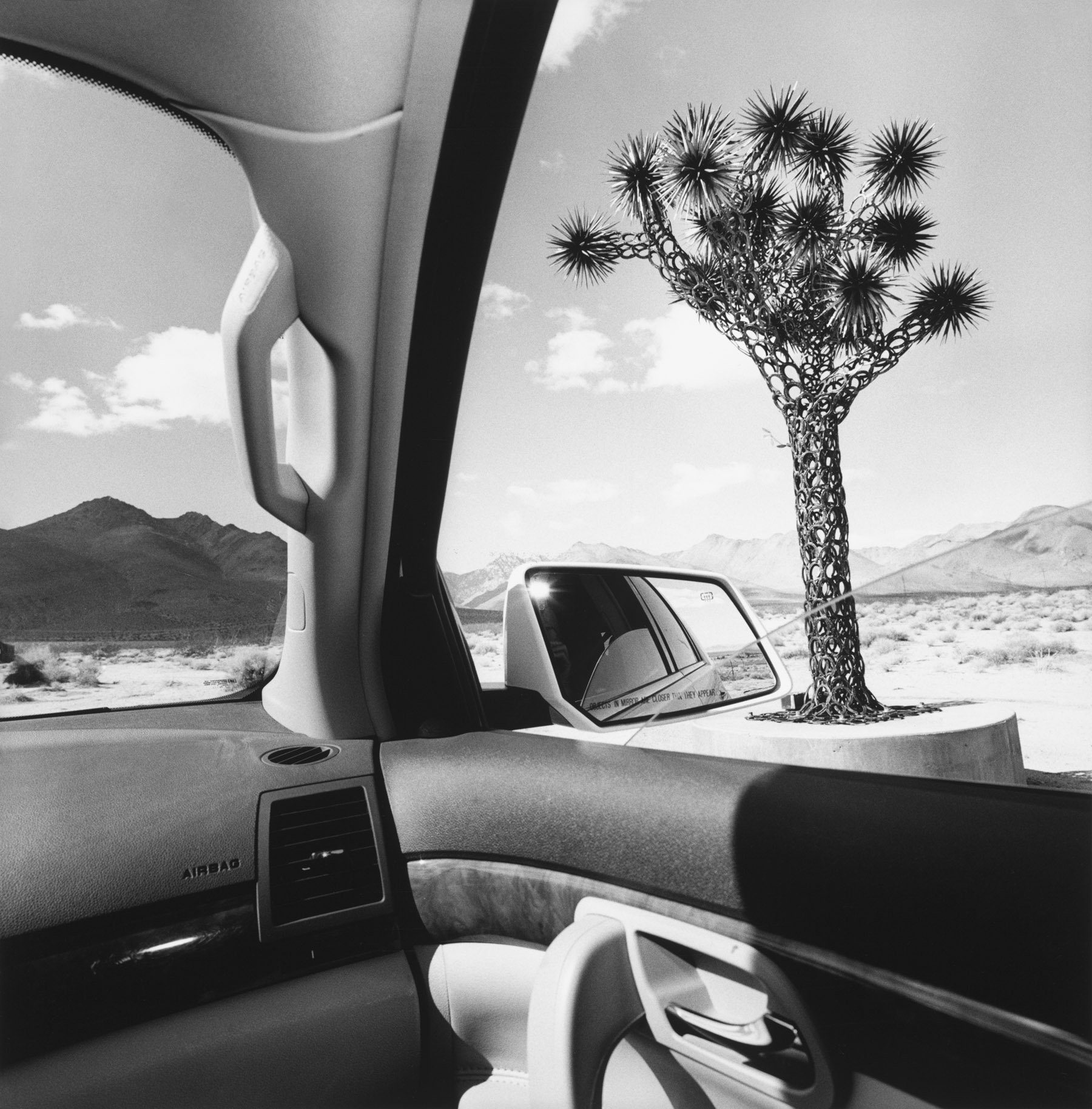
 

Nicolas Bouvier (Swiss, 1929-1998) 'Entre Prilep et Istanbul, Turquie' 1953


Nicolas Bouvier (Swiss, 1929-1998)
Entre Prilep et Istanbul, Turquie
1953
Musée de l’Élysée, Lausanne
© Fonds Nicolas Bouvier / Musée de l’Élysée, Lausanne


O. Winston Link (American, 1914-2001) 'Hot Shot Eastbound' 1956


O. Winston Link (American, 1914-2001)
Hot Shot Eastbound
1956
Collection Mathé Perrin, Bruxelles
© O. Winston Link


Ray K. Metzker (American, 1931-2014) 'Washington, DC' 1964


Ray K. Metzker (American, 1931-2014)
Washington, DC
1964
Gelatin silver print
20 × 25.5cm
Courtesy Les Douches la Galerie, Paris/Laurence Miller Gallery, New York
© Estate Ray K. Metzker, courtesy Les Douches la Galerie, Paris/Laurence Miller Gallery, New York


Bernard Plossu (French, b. 1945) 'Sur la route d'Acapulco, Mexique' 1966


Bernard Plossu (French, b. 1945)
Sur la route d’Acapulco, Mexique
1966
From Le Voyage mexicain series
Gelatin silver print
18 × 27cm
Courtesy of the artist/Galerie Camera Obscura, Paris
© Bernard Plossu


Bernard Plossu (French, b. 1945) 'Chiapas, Mexique' 1966


Bernard Plossu (French, b. 1945)
Chiapas, Mexique
1966
From Le Voyage mexicain series
Gelatin silver print
18 × 27cm
Courtesy of the artist/Galerie Camera Obscura, Paris
© Bernard Plossu


“A panorama framed by the rectangle of the windshield. A long ribbon of asphalt, a line of flight that stretches towards the horizon. For more than a century, we can capture this image and travel the world by car, this photographic “box”. Automotive and photography, two tools to model the landscape, two mechanics of the traction and attraction, have emerged at the end of the nineteenth century, through new rhythms and new rites, the society of modern times. If the photograph allows multiple views and list them, to memorise the movement and leave a trace, the automobile makes it possible to move in space. Photography, a tool of immobility, benefited from the automobile, a mobility tool. And if the automobile like photography is constantly evolving, these two inventions have parallel paths in order to better, to master space-time. “Riding is a form spectacular amnesia. Everything to discover, everything to be erased,”1 writes Jean Baudrillard.”

From the foreword by commissioners of the exhibition Xavier Barral and Philippe Séclier

1/ Jean Baudrillard, Amérique, Grasset, Paris, 1986, p. 15


Henry Wessel (American, 1942-2018) 'Pennsylvania' 1968


Henry Wessel (American, 1942-2018)
Pennsylvania
1968
Courtesy Galerie Thomas Zander, Cologne
© Henry Wessel, courtesy Galerie Thomas Zander, Cologne.


William Eggleston (American, b. 1939) 'Los Alamos' series 1965-1968


William Eggleston (American, b. 1939)
Los Alamos series
1965-1968
Dye-transfer print
40.5 × 50.5cm
Eggleston Artistic Trust, courtesy David Zwirner, New York/London
© Eggleston Artistic Trust. Courtesy David Zwirner, New York/London


Henry Wessel (American, 1942-2018) 'Los Alamos' series c. 1974


Henry Wessel (American, 1942-2018)
Los Alamos series
c. 1974
Inkjet print
56 × 73.5cm
Eggleston Artistic Trust, Memphis
© Eggleston Artistic Trust, Memphis


Bill Rauhauser (American, 1918-2017) 'Detroit Auto Show' series c. 1975


Bill Rauhauser (American, 1918-2017)
Detroit Auto Show series
c. 1975
Detroit Institute of Arts, don de l’artiste en mémoire de Doris Rauhauser
© 2007 Rauhauser Photographic Trust. All Rights Reserved


Langdon Clay (American, b. 1949) 'Zizka Cleaners car, Buick Electra' 1976


Langdon Clay (American, b. 1949)
Zizka Cleaners car, Buick Electra
Series Cars, New York City, 1976
Slide-show
Courtesy of the artist
© Langdon Clay


Joel Meyerowitz (American, b. 1938) 'Upstate New York' 1977


Joel Meyerowitz (American, b. 1938)
Upstate New York
1977
Collection Joel Meyerowitz Photography, New York
© Joel Meyerowitz, courtesy Polka Galerie, Paris


Bernard Asset (French, b. 1955) 'Passager d'Alain Prost (Alain Prost au volant d’une Renault RE30B, tests F1 sur le circuit Dijon-Prenois)' 1982


Bernard Asset (French, b. 1955)
Passager d’Alain Prost (Alain Prost au volant d’une Renault RE30B, tests F1 sur le circuit Dijon-Prenois)
1982
Collection de l’artiste
© Bernard Asset


David Bradford (American, b. 1951) 'Coaster Ride Stealth' 1994


David Bradford (American, b. 1951)
Coaster Ride Stealth
1994
From Drive-By Shootings series
C-print
28 × 35.5cm
Courtesy of the artist
© David Bradford


Andrew Bush (American, b. 1956) 'Woman Waiting to Proceed South at Sunset and Highland Boulevards, Los Angeles, at Approximately 11:59 a.m. One Day in February 1997' 1997


Andrew Bush (American, b. 1956)
Woman Waiting to Proceed South at Sunset and Highland Boulevards, Los Angeles, at Approximately 11:59 a.m. One Day in February 1997
1997
From Vector Portraits series
C-print
122 × 151cm
Courtesy M+B Gallery, Los Angeles
© Andrew Bush


Rosângela Rennó (Brazilian, b. 1962) 'Cerimônia do Adeus' series,1997-2003


Rosângela Rennó (Brazilian, b. 1962)
Cerimônia do Adeus series
1997-2003
C-print face-mounted on Plexiglas
50 × 68 cm
Courtesy of the artist/Cristina Guerra Contemporary Art, Lisbon
© Rosângela Rennó


Valérie Belin (French, b. 1964) 'Untitled' 2002


Valérie Belin (French, b. 1964)
Untitled
2002
Gelatin silver print
61 x 71.5cm (framed)
Courtesy of the artist/Galerie Nathalie Obadia, Paris/Brussels
© Valérie Belin/ADAGP, Paris 2017


Stéphane Couturier (French, b. 1957) 'MELT, Toyota No 8' 2005


Stéphane Couturier (French, b. 1957)
MELT, Toyota No. 8
2005
From Melting Point, Usine Toyota, Valenciennes series
C-print
92 × 137cm
Collection of the artist
Courtesy La Galerie Particulière, Paris/Brussels
© Stéphane Couturier


Óscar Fernando Gómez (Mexican, b. 1970) 'Windows' series, 2009

Óscar Fernando Gómez (Mexican, b. 1970) 'Windows' series, 2009

Óscar Fernando Gómez (Mexican, b. 1970) 'Windows' series, 2009

Óscar Fernando Gómez (Mexican, b. 1970) 'Windows' series, 2009

Óscar Fernando Gómez (Mexican, b. 1970) 'Windows' series, 2009


Óscar Fernando Gómez (Mexican, b. 1970)
Windows series
2009
Slide show
Courtesy Martin Parr Studio, Bristol
© Óscar Fernando Gómez


Alain Willaume (French, b. 1956) '#5069' 2012


Alain Willaume (French, b. 1956)
#5069
2012
From the Échos de la poussière et de la fracturation series
Collection de l’artiste
© Alain Willaume (Tendance Floue)


Peter Lippmann (American works Paris, b. 1956) 'Citroën Traction 7' 2012


Peter Lippmann (American works Paris, b. 1956)
Citroën Traction 7
2012
From the Paradise Parking series
C-print
75 × 100cm
Collection of the artist
© Peter Lippmann


Justine Kurland (American, b. 1969) '280 Coup' 2012


Justine Kurland (American, b. 1969)
280 Coup
2012
Inkjet Print
47 x 61cm
Courtesy of the artist/Mitchell-Innes & Nash, New York
© Justine Kurland


Melle Smets and Joost Van Onna. 'Turtle 1. Building a Car in Africa' 2016


Melle Smets and Joost Van Onna
Turtle 1. Building a Car in Africa
2016
Courtesy des artistes / Paradox, Edam
© Melle Smets et Joost Van Onna


Luciano Rigolini (Swiss, b. 1950) 'Tribute to Giorgio de Chirico' 2017


Luciano Rigolini (Swiss, b. 1950)
Tribute to Giorgio de Chirico
2017
Duratrans in lightbox
124 x 154cm
Collection of the artist
© Luciano Rigolini (appropriation – unknown photographer, 1958)


First Visions: A New Subject for Photography

In the early 20th century, the automobile and its impact on the landscape had already become a subject of predilection for many photographers, influencing both the form and content of their work. The exhibition will begin by focusing on early photographers like Jacques Henri Lartigue, Germaine Krull, and Brassaï, who used the automobile to varying degrees in their work. They registered the thrill of speed, the chaos of Parisian traffic or the city’s dramatic car-illuminated nocturnal landscape to represent a society in transition at the birth of the modern age. Other photographers of the time were attracted by the promise of freedom and mobility offered by the automobile. Anticipating the modern road trip, Swiss writers and photographers Ella Maillart and Nicolas Bouvier, travelled throughout Asia in the 1930s and 1950s respectively, using their cars and cameras to record their adventures along the way.

Auto Portraits

The exhibition will also present a series of “auto portraits”* made by a variety of photographers from the mi-twentieth century to the present. Yashuhiro Ishimoto and Langdon Clay’s photographs, for example, are portraits in profile of cars parked on sparsely inhabited city streets, that immerse the viewer in a different eras and atmospheres. Ishimoto’s black and white photographs, taken in Chicago in the 1950s, emphasise their polished, curved silhouettes in a distanced and serial manner, while Langdon Clay’s colour pictures taken in New York in the 1970s, show their decaying and dented chassis in an eerie nocturnal light. Other works in this section, such as the found photographs of Sylvie Meunier and Patrick Tourneboeuf’s American Dream series, or the flamboyant portraits of African photographers Seydou Keïta and Sory Sanlé, focus on the role of the automobile as a emblem of social mobility showing proud owners posing with their cars.

*A play on words in French: auto portrait meaning self-portrait.

The Car as a Medium: New Perspectives on the Landscape

Many photographers have exploited the technical and aesthetic possibilities offered by the automobile, using it like a camera to capture the surrounding landscape through car windows or the reflections in rear-view mirrors.

Cars have determined the framing and composition as well as the serial nature of the photographs of Joel Meyerowitz, Daido Moriyama, John Divola and David Bradford who have all worked from moving cars. From behind their windshields, these photographers capture an amusing store sign, a white car behind a wire fence, a dog running along a dusty road, a highway stretching out into the horizon. Other photographers, including Sue Barr, Robert Adams, Ed Ruscha, and Alex MacLean scrutinise our car-altered environment. Their landscape is no longer one of magnificent mountains, wondrous waterfalls or awe-inspiring canyons, but of a world transformed by the automobile with its suburban housing complexes, parking lots, and highway infrastructure.

Our Car Culture: Industry, History and New Ways of Life

Many photographers have explored other aspects of our car culture, from the car industry and its impact on the environment to its role in history and society. Both Robert Doisneau and Robert Frank registered life in the factory, from the machines and productions lines to the activities of the workers lives, the first at the Renault plant in the 1930s and the second at Ford River Rouge in the 1950s. Their photographs, unique in their attention to individual assembly line workers, contrast with the work of contemporary photographer Stéphane Couturier whose deliberately distanced, impersonal pictures taken at a Toyota factory reflect the increasingly dehumanised nature of contemporary industry. Working in Ghana, far from the automated factory photographed by Stéphane Couturier, Dutch artist Melle Smets, and sociologist Joost Van Onna, put industrial waste from the car industry to good use. Collaborating with local craftsman in a region called Suame Magazine, where cars are disassembled and their parts traded, they created a car specifically for the African market called Turtle 1, using parts from different brands that happened to be available. Their installation, which includes photographs, drawings, and videos, documents the entire fabrication process of this car.

Photographers such as Philippe Chancel, Éric Aupol and Edward Burtynsky are concerned with the car industry’s damage to the environment. Philippe Chancel’s work focuses on the city of Flint and its dismantled General Motors factory, while Éric Aupol’s and Ed Burtynsky’s photographs reveal the sculptural yet apocalyptic beauty of industrial waste sites.

Other photographers reveal how the car plays an important role in historical events, in society and in daily life. Arwed Messmer’s Reenactement series brings together photographs from the archives of the Stasi showing how people used cars in unusual ways to escape from East Germany, and Fernando Gutiérrez work, Secuelas, explores the role of the Ford Falcon, a symbol of Argentina’s military dictatorship, in the collective imaginary of the Argentinean people. Jacqueline Hassink’s immersive projection Car Girls investigates the role and status of women who work in car shows around the world. Martin Parr’s series From A to B chronicles the thoughts dreams and anxieties of British motorists. Still other series by photographers such as Rosângela Rennó, Óscar Monzón, Kurt Caviezel and Bruce Davidson show how the car has become an extension of the home, used for weddings and picnics, living and sleeping, arguments and making love.

The Fondation Cartier has also invited artist Alain Bublex to create for the exhibition a series of 10 model cars that cast a fresh eye on the history of automobile design. His installation combines photographs, drawings and models to explore how the car design has evolved over time incorporating new techniques, forms, and practices.

Despite energy crises, ecology movements, and industrial mismanagement, the car remains essential to our daily lives. At a time when we are questioning the role and the future of the automobile in our society, the Autophoto exhibition reexamines, with nostalgia, humour, and a critical eye, this 20th century symbol of freedom and independence.

The Catalogue

Bringing together over 600 images, the catalogue of the Autophoto exhibition reveals how photography, a tool privileging immobility, benefited from the automobile, a tool privileging mobility. The catalogue features iconic images by both historic and contemporary photographers who have captured the automobile, and transformed this popular accessible object through their passionate and creative vision. Quotes by the artists, and a chronology of automobile design, as well as interviews and texts by specialists provide a deeper understanding of this vast topic through a variety of aesthetic, sociological, and historical perspectives.

Press release from The Fondation Cartier


Peter Keetman (German, 1916-2005) 'Hintere Kotflügel' 1953


Peter Keetman (German, 1916-2005)
Hintere Kotflügel (Rear fenders)
1953
From Eine Woche im Volkswagenwerk (A week at the Volkswagenwerk) series
Gelatin silver print
27 × 24.5cm
Nachlass Peter Keetman/Stiftung F.C. Gundlach, Hamburg
© Nachlass Peter Keetman/Stiftung F.C. Gundlach, Hamburg


Ed Ruscha (American, b. 1937) '7133 Kester, Van Nuys' 1967


Ed Ruscha (American, b. 1937)
7133 Kester, Van Nuys
1967
Thirtyfour Parking Lots series
Chipmunk Collection
© Ed Ruscha, courtesy Gagosian Gallery


Malick Sidibé (Malian, 1935-2016) 'Taximan avec voiture' 1970


Malick Sidibé (Malian, 1935-2016)
Taximan avec voiture
1970
Gelatin silver print
40 x 30cm
Courtesy Galerie Magnin-A, Paris
© Malick Sidibé


Lee Friedlander (American, b. 1934) 'Montana' 2008


Lee Friedlander (American, b. 1934)
Montana
2008
From the America by Car series
Gelatin silver print
37.5 × 37.5cm
Courtesy Fraenkel Gallery, San Francisco
© Lee Friedlander, courtesy Fraenkel Gallery, San Francisco


Lee Friedlander (American, b. 1934) 'California' 2008


Lee Friedlander (American, b. 1934)
California
2008
From the America by Car series
Gelatin silver print
37.5 × 37.5cm
Courtesy Fraenkel Gallery, San Francisco
© Lee Friedlander, courtesy Fraenkel Gallery, San Francisco


Alejandro Cartagena (Mexican, b. 1977) 'The Carpoolers' series 2011–2012


Alejandro Cartagena (Mexican, b. 1977)
The Carpoolers series
2011-12
Installation of 15 inkjet prints
55.5 × 35.5cm (each)
Courtesy Patricia Conde Galería, Mexico City
© Alejandro Cartagena


Ronni Campana (Italian, b. 1987) 'Badly Repaired Cars' series 2016


Ronni Campana (Italian, b. 1987)
Badly Repaired Cars series
2016
Inkjet print
60 × 40cm
Collection of the artist
© Ronni Campana


Fondation Cartier pour l’art contemporain
261 Boulevard Raspail, Paris

Opening hours: Every day except Mondays, 11am – 8pm
Opening Tuesday evenings until 10pm

Fondation Cartier website

LIKE ART BLART ON FACEBOOK

Back to top

Exhibition: ‘Sabine Weiss’ at Jeu de Paume – Château de Tours

Exhibition dates: 18th June – 30th October, 2016

Curator: Virginie Chardin, independent curator


Sabine Weiss (Swiss-French, 1924-2021) 'Cheval, Porte de Vanves' Paris, 1952 from the exhibition 'Sabine Weiss' at Jeu de Paume – Château de Tours, June - Oct, 2016


Sabine Weiss (Swiss-French, 1924-2021)
Cheval, Porte de Vanves (Horse, Porte de Vanves)
Paris, 1952
Silver gelatin print
© Sabine Weiss


A photographer I knew very little about before assembling this posting. The undoubted influence of Henri Cartier-Bresson can be seen in many images (such as Vendeurs de pain, Athènes 1958 and Village moderne de pêcheurs 1954, both below), while other images are redolent of Josef Koudelka (Marriage gitan, 1953) and Paul Strand (Jeune mineur, 1955).

Weiss strikes one as a solid photographer in the humanist, Family of Man tradition who doesn’t push the boundaries of the medium or the genre, nor generate a recognisable signature style.

Dr Marcus Bunyan


Many thankx to Jeu de Paume for allowing me to publish the photographs in the posting. Please click on the photographs for a larger version of the image.


Sabine Weiss – Jeu de Paume Château de Tours

“Sabine Weiss”: exhibition at Jeu de Paume Château de Tours from 18 June 2016 until 30 October 2016.

Sabine Weiss is the last representative of the French humanist school of photography, which includes photographers like Robert Doisneau, Willy Ronis, Édouard Boubat, Brassaï and Izis.

Still active at over 90 years of age, she has accepted for the first time to present her personal archives, thereby providing a privileged insight into her life and career as a photographer. The exhibition at the Château de Tours will showcase just a few milestones from her long career. 

Through almost 130 prints, as well as numerous period documents – many of which are being shown for the first time – this exhibition provides visitors with an overview of the multiple facets of this prolific artist, for whom photography was first and foremost, a fascinating occupation.

Text from the Vimeo website


Sabine Weiss au Jeu de Paume, Château de Tours


Sabine Weiss (Swiss-French, 1924-2021) 'Vendeurs de pain' Athènes Grèce, 1958 from the exhibition 'Sabine Weiss' at Jeu de Paume – Château de Tours, June - Oct, 2016


Sabine Weiss (Swiss-French, 1924-2021)
Vendeurs de pain, Athènes (Sellers of bread, Athens)
Greece, 1958
Silver gelatin print
© Sabine Weiss


Sabine Weiss is the last representative of the French humanist school of photography, which includes photographers like Robert Doisneau, Willy Ronis, Édouard Boubat, Brassaï and Izis.

Still active at over 90 years of age, she has accepted for the first time to present her personal archives, thereby providing a privileged insight into her life and career as a photographer. The exhibition at the Château de Tours will showcase just a few milestones from her long career. Through almost 130 prints, as well as numerous period documents – many of which are being shown for the first time – this exhibition provides visitors with an overview of the multiple facets of this prolific artist, for whom photography was first and foremost, a fascinating occupation.


Sabine Weiss (Swiss-French, 1924-2021) 'Village moderne de pêcheurs, Olhão, Algarve' Portugal, 1954


Sabine Weiss (Swiss-French, 1924-2021)
Village moderne de pêcheurs, Olhão, Algarve (Modern fishing village, Olhão, Algarve)
Portugal, 1954
Silver gelatin print
© Sabine Weiss


Sabine Weiss (Swiss-French, 1924-2021) 'I Am A Horse, Spain' 1954


Sabine Weiss (Swiss-French, 1924-2021)
I Am A Horse, Spain
1954
Gelatin silver print
© Sabine Weiss


Sabine Weiss (Swiss-French, 1924-2021) 'Times Square, New York' États-Unis, 1955


Sabine Weiss (Swiss-French, 1924-2021)
Times Square, New York
United States, 1955
Silver gelatin print
© Sabine Weiss


Sabine Weiss (Swiss-French, 1924-2021) 'Feux de Bengale, Naples' Italie, 1955


Sabine Weiss (Swiss-French, 1924-2021)
Feux de Bengale, Naples (Fires of Bengal, Naples)
Italy, 1955
Silver gelatin print
© Sabine Weiss


Sabine Weiss (Swiss-French, 1924-2021) 'André Breton chez lui, 42, rue Fontaine' Paris, 1956


Sabine Weiss (Swiss-French, 1924-2021)
André Breton chez lui, 42, rue Fontaine (André Breton at home, 42 rue Fontaine)
Paris, 1956
Silver gelatin print
© Sabine Weiss


Sabine Weiss (Swiss-French, 1924-2021) 'Françoise Sagan chez elle, lors de la sortie de son premier roman Bonjour tristesse' Paris, 1954


Sabine Weiss (Swiss-French, 1924-2021)
Françoise Sagan chez elle, lors de la sortie de son premier roman Bonjour tristesse
(Françoise Sagan at home, with the release of his first novel Bonjour Tristesse)

Paris, 1954
Silver gelatin print
© Sabine Weiss


Sabine Weiss (Swiss-French, 1924-2021) 'Enfant perdu dans un grand magasin, New York' États-Unis, 1955


Sabine Weiss (Swiss-French, 1924-2021)
Enfant perdu dans un grand magasin, New York (Lost child in a department store, New York)
United States, 1955
Silver gelatin print
© Sabine Weiss


Sabine Weiss (Swiss-French, 1924-2021) 'Vieille dame et enfant' Guadeloupe 1990


Sabine Weiss (Swiss-French, 1924-2021)
Vieille dame et enfant, Guadeloupe (Old lady and child, Guadeloupe)
1990
Silver gelatin print
© Sabine Weiss


Sabine Weiss (Swiss-French, 1924-2021) 'La Petite Égyptienne' 1983


Sabine Weiss (Swiss-French, 1924-2021)
La Petite Égyptienne (Little Egyptian)
1983
Silver gelatin print
© Sabine Weiss


Sabine Weiss is the last representative of the French humanist school of photography, which includes photographers like Robert Doisneau, Willy Ronis, Édouard Boubat, Brassaï and Izis.

Still active at over 90 years of age, she has accepted for the first time to present her personal archives, thereby providing a privileged insight into her life and career as a photographer. The exhibition at the Château de Tours will showcase just a few milestones from her long career. Through almost 130 prints, as well as numerous period documents – many of which are being shown for the first time – this exhibition provides visitors with an overview of the multiple facets of this prolific artist, for whom photography was first and foremost, a fascinating occupation.

Née Weber in Switzerland in 1924, Sabine Weiss was drawn to photography from a very early age and did her apprenticeship at Paul Boissonnas’ studio, a dynasty of photographers practising in Geneva since the late nineteenth century. In 1946, she left Geneva for Paris and became the assistant of Willy Maywald, a German photographer living in the French capital, specialising in fashion photography and portraits. She married the American painter Hugh Weiss in 1950, and at this time embarked upon a career as an independent photographer. She moved into a small Parisian studio with her husband – where she continues to live today – and socialised in the artistic circles of the post-war period. This allowed her to photograph Georges Braque, Joan Miró, Alberto Giacometti, André Breton and Ossip Zadkine, and later numerous musicians, writers and actors.

Circa 1952, Sabine Weiss joined the Rapho Agency thanks to Robert Doisneau’s recommendation. Her personal work met with immediate critical acclaim in the United States with exhibitions at the Museum of Modern Art in New York, the Art Institute of Chicago, the Walker Art Institute in Minneapolis and the Limelight Gallery, New York. Three of her photographs were shown as part of the famous exhibition “The Family of Man”, organised by Edward Steichen in 1955, and Sabine obtained long-lasting contracts with The New York Times Magazine, Life, Newsweek, Vogue, Point de vue-Images du monde, Paris Match, Esquire, and Holiday. From that time and up until the 2000s, Sabine Weiss continued to work for the international illustrated press, as well as for numerous institutions and brands, seamlessly passing from reportage to fashion features, and from advertising to portraits of celebrities or social issues.

In the late 1970s, her work returned to the spotlight thanks to a growing revival of interest in so-called humanist photography on behalf of festivals and institutions. This interest encouraged Sabine to return to black and white photography. At over sixty years of age, she began a new body of personal work, punctuated by her travels in France, Egypt, India, Reunion Island, Bulgaria and Burma, and in which a more sentimental melody may be heard, centred on the pensive and solitary moments of human existence. At the same time, Sabine became the focus of a growing number of tributes, all of which has contributed to her reputation as an independent and dynamic photographer, with a great humanist sensibility and an eye for the detail of everyday life.

Virginie Chardin

Sabine Weiss (Swiss-French, 1924-2021) 'Petit matin brumeux, Lyon, France' 1950

Sabine Weiss (Swiss-French, 1924-2021)
Petit matin brumeux, Lyon, France (Misty early morning, Lyon, France)
1950
Silver gelatin print
© Sabine Weiss


Sabine Weiss (Swiss-French, 1924-2021) 'Marchande de frites' Paris, 1952


Sabine Weiss (Swiss-French, 1924-2021)
Marchande de frites (French fries seller)
Paris, 1952
Silver gelatin print
© Sabine Weiss


Sabine Weiss (Swiss-French, 1924-2021) 'L'homme qui court' Paris 1953


Sabine Weiss (Swiss-French, 1924-2021)
L’homme qui court, Paris (The man who runs, Paris)
1953
Silver gelatin print
© Sabine Weiss


Sabine Weiss (Swiss-French, 1924-2021) 'Vitrine, Paris' 1955


Sabine Weiss (Swiss-French, 1924-2021)
Vitrine, Paris (Showcase, Paris)
1955
Silver gelatin print
© Sabine Weiss


Sabine Weiss (Swiss-French, 1924-2021) 'Prêtre devant une trattoria, Rome' Italie, 1957


Sabine Weiss (Swiss-French, 1924-2021)
Prêtre devant une trattoria, Rome (Priest before a trattoria, Roma)
Italie, 1957
Silver gelatin print
© Sabine Weiss


Sabine Weiss (Swiss-French, 1924-2021) 'Terrain vague, Porte de Saint-Cloud' Paris, 1950


Sabine Weiss (Swiss-French, 1924-2021)
Terrain vague, Porte de Saint-Cloud (Vacant Land, Porte de Saint-Cloud)
Paris, 1950
Silver gelatin print
© Sabine Weiss


Sabine Weiss (Swiss-French, 1924-2021) 'Enfants prenant de l’eau à la fontaine, rue des Terres-au-Curé' Paris, 1954


Sabine Weiss (Swiss-French, 1924-2021)
Enfants prenant de l’eau à la fontaine, rue des Terres-au-Curé
(Children taking water from the fountain, rue des Terres au Curé)

Paris, 1954
Silver gelatin print
© Sabine Weiss


Sabine Weiss (Swiss-French, 1924-2021) 'Mariage gitan' Tarascon, 1953


Sabine Weiss (Swiss-French, 1924-2021)
Mariage gitan (Gypsy wedding)
Tarascon, 1953
Silver gelatin print
© Sabine Weiss


Sabine Weiss (Swiss-French, 1924-2021) 'Enfants jouant, rue Edmond-Flamand' [Children playing, rue Edmond-Flamand] Paris, 1952


Sabine Weiss (Swiss-French, 1924-2021)
Enfants jouant, rue Edmond-Flamand (Children playing, rue Edmond-Flamand)
Paris, 1952
Silver gelatin print
© Sabine Weiss


Sabine Weiss (Swiss-French, 1924-2021) 'Jeune mineur, Lens' 1955


Sabine Weiss (Swiss-French, 1924-2021)
Jeune mineur, Lens (Young minor, Lens)
1955
Silver gelatin print
© Sabine Weiss


Sabine Weiss (Swiss-French, 1924-2021) 'Mendiant, Tolède' Espagne, 1949


Sabine Weiss (Swiss-French, 1924-2021)
Mendiant, Tolède (Beggar, Toledo)
Espagne, 1949
Silver gelatin print
© Sabine Weiss


Sabine Weiss (Swiss-French, 1924-2021) 'Portraits multiples, procédé Polyfoto' Genève, 1937


Sabine Weiss (Swiss-French, 1924-2021)
Portraits multiples, procédé Polyfoto (multiple portraits, Polyfoto process)
Genève, 1937
Silver gelatin print
© Sabine Weiss


Sabine Weiss (Swiss-French, 1924-2021) 'Chez Dior, Paris' 1958


Sabine Weiss (Swiss-French, 1924-2021)
Chez Dior, Paris
1958
© Sabine Weiss


Sabine Weiss (Swiss-French, 1924-2021) 'Anna Karina pour la marque Korrigan' [Anna Karina for the brand Korrigan] 1958


Sabine Weiss (Swiss-French, 1924-2021)
Anna Karina pour la marque Korrigan (Anna Karina for the brand Korrigan)
1958
© Sabine Weiss


Studio Fllebé. 'Sabine Weiss chez Vogue' Paris 1956


Studio Fllebé
Sabine Weiss chez Vogue, Paris
1956
Silver gelatin print
© Studio Fllebé


Jeu de Paume – Château de Tours
25 avenue André Malraux
37000 Tours

Opening hours:
Tuesday to Sunday: 2pm – 6pm
Closed Mondays

Jeu de Paume – Château de Tours

LIKE ART BLART ON FACEBOOK

Back to top

Exhibition: ‘Roberto Donetta Photographer and Seed Salesman from Bleniotal’ at Fotostiftung Schweiz, Winterthur, Zurich

Exhibition dates: 28th May – 4th September, 2016

Curator: Roland Jaeger, Director of Fotostiftung Schweiz in collaboration with the Fondazione Archivio Donetta


Roberto Donetta (Swiss, 1865-1932) 'Female Workers in Front of the Chocolate Factory Cima Norma, Dangio-Torre' Nd from the exhibition 'Roberto Donetta Photographer and Seed Salesman from Bleniotal' at Fotostiftung Schweiz, Winterthur, Zurich, May - Sept, 2016


Roberto Donetta (Swiss, 1865-1932)
Female Workers in Front of the Chocolate Factory Cima Norma, Dangio-Torre
Nd
© Fondazione Archivio Fotografico Roberto Donetta, Corzoneso


I have found a hidden gem in Roberto Donetta. He has become one of my favourite photographers, this seed salesman from Bleniotal, who died in obscurity and poverty in 1932.

His photographs are like no other that I have seen. There is a directness to his photographs that is deceptively disarming, and humour as well. His theatre is the the theatre of life: the archaic life of his compatriots in the Blenio Valley. If you look at his work on the Roberto Donetta Archive website the landscapes and ambiguous object photographs are interesting, but it is in the genre of portrait photography that he really excels. This was his passion, photographing people.

Somehow, it seems as if the person being photographed has forgotten that the camera was there, as though it has disappeared from view. As the press release observes, “the people did not dissimulate [to disguise or conceal under a false appearance], indeed it’s almost as if they forgot that someone with a camera was watching, so self-engrossed do they look, serious, at one with themselves.” At one with themselves but also at one with being photographed, which is very unusual. There is little affectation here.

The details of the photographs are fascinating. The placement of the figures in Female Workers in Front of the Chocolate Factory Cima Norma for example, where the left two sitting figures have their legs crossed in the opposite direction while both rest their face in their hands, a central figure, and then two figures interlocked as in an infinity symbol looking at each other. The ‘line’ of the photograph changes from one height to another. We observe that Donetta stages his photographs with infinite care, even when there is a blank wall behind the sitter. In Family Portrait, Bleniotal there is a gorgeous touch, as the mother holds the arm of the boy on the left hand side and gently rests two fingers on his other hand. Donetta’s photographs are full of these familial and human observations.

In Group of musicians in front of a building all the men have cigarettes hanging from their mouths, even as they stare directly, unflinchingly into the camera lens. In Humoristic scene, Bleniotal the man holding the tongs can hardly suppress laughing as the theatrical photograph is being taken. Kittens or toys are held in hands while protective arms wrap around shoulders. Here are the precursors to the work of Diane Arbus, in their honesty and straight forwardness: in its modernity Children with Toys, Bleniotal even reminds me a little of Arbus’ Identical Twins, Roselle, New Jersey, 1967. And then there is the use of temporary backdrops, to imitate the upmarket studios of larger towns: “Donetta did imitate the decorative aesthetic of the late 19th century professional studios: he transformed interior or outdoor spaces into improvised studios by, for example, hanging up fabrics or carpets as backdrops and placing objects like chairs or tables with vases of flowers in the foreground. His portraits are carefully composed and arranged, look uncontrived, calm and archaic.”

Despite their deceptively simple nature, there is a mysterious quality to Donetta’s photographs which is enhanced through the use of these portable backdrops. The fabric backdrop and sheet to the left in A wedding couple staged in front of a cloth obscures a rock wall; the idyllic scene behind the boy in Portrait of a Boy, Bleniotal hides an earthy, rudimentary stone wall (and note the figure at the top of the image, holding the backdrop up); in Family Portrait, Bleniotal the hastily hung sheet has been decorated with leaves and branches; and in Untitled [Portrait of a women] a plain concrete wall acts as the backdrop even as a) the women looks out of the image not towards the camera; b) the eye can escape down the left hand side of the image and c) there is a ghost-like figure at the very right hand side of the image standing in what I presume is a doorway. The frontality of his photographs is also very powerful: in Untitled [Portrait of a man] the man looks like he is wearing his Sunday best jacket replete with bow tie. His legs are spread on the chair, the jacket looks to big for him, is stiff and unforgiving, his workers hands rest in his lap and he stares quizzically out of the image: calm, accepting, himself. In Portrait of Cesarina Andreazzi Lazzari, Bleniotal we (again) notice the textures in the image – the stipple, the concrete, the rocks – and then Cesarina’s stubby, dark hands clutching a bunch of flowers and a book, reminiscent of the dirt under the finger nails and dark features of the peasant boys that appear in the work of Baron Wilhelm von Gloeden.

Above all these are honest, direct and engaging photographs. You can think of Lewis Hine, Jacob Riis, Eugène Atget, Walker Evans, Dorothea Lange and all the FSA photographers, Diane Arbus and others, and yet they don’t come close to the modern/archaic aesthetic of this man. These photographs are a pilgrimage into a past that has long disappeared. But these faces, these people and their lives, still resonate long after they have passed. I was so moved by these photographs I was in tears the other night when I was constructing this posting, studying the intimate details of these images. That means a lot to me.

Dr Marcus Bunyan

PS. I usually don’t publish photographs without title and date but in this instance, to gather together as many Donetta images as possible, I have published them when I have found good quality images on the internet. I believe that in this instance it is very worth while.


Many thankx to Fotostiftung Schweiz for allowing me to publish some of the photographs in the posting. Please click on the photographs for a larger version of the image.


Roberto Donetta (Swiss, 1865-1932) 'Untitled' Nd from the exhibition 'Roberto Donetta Photographer and Seed Salesman from Bleniotal' at Fotostiftung Schweiz, Winterthur, Zurich, May - Sept, 2016


Roberto Donetta (Swiss, 1865-1932)
Untitled
Nd
© Fondazione Archivio Fotografico Roberto Donetta, Corzoneso


Roberto Donetta (Swiss, 1865-1932) 'Untitled' Nd from the exhibition 'Roberto Donetta Photographer and Seed Salesman from Bleniotal' at Fotostiftung Schweiz, Winterthur, Zurich, May - Sept, 2016


Roberto Donetta (Swiss, 1865-1932)
Untitled
Nd
© Fondazione Archivio Fotografico Roberto Donetta, Corzoneso


Roberto Donetta (Swiss, 1865-1932) 'Untitled' Nd


Roberto Donetta (Swiss, 1865-1932)
Untitled
Nd
© Fondazione Archivio Fotografico Roberto Donetta, Cortonese


Roberto Donetta (Swiss, 1865-1932) 'Family Portrait, Bleniotal' Nd


Roberto Donetta (Swiss, 1865-1932)
Family Portrait, Bleniotal
Nd
© Fondazione Archivio Fotografico Roberto Donetta, Corzoneso


Roberto Donetta (Swiss, 1865-1932) 'In Sonntagsgewand: men in the Torre village come together for bowling' Nd


Roberto Donetta (Swiss, 1865-1932)
In Sonntagsgewand: men in the Torre village come together for bowling
Nd
© Fondazione Archivio Fotografico Roberto Donetta, Corzoneso


Roberto Donetta (Swiss, 1865-1932) 'Untitled [Basket maker], Bleniotal' Nd


Roberto Donetta (Swiss, 1865-1932)
Untitled [Basket maker], Bleniotal
Nd
© Fondazione Archivio Fotografico Roberto Donetta, Cortonese


Roberto Donetta (Swiss, 1865-1932) 'Family Portrait, Bleniotal' Nd


Roberto Donetta (Swiss, 1865-1932)
Family Portrait, Bleniotal
Nd
© Fondazione Archivio Fotografico Roberto Donetta, Cortonese


Roberto Donetta (Swiss, 1865-1932) 'Untitled [Group Portrait], Bleniotal' Nd


Roberto Donetta (Swiss, 1865-1932)
Untitled [Group Portrait], Bleniotal
Nd
© Fondazione Archivio Fotografico Roberto Donetta, Cortonese


Roberto Donetta (Swiss, 1865-1932) 'Group of musicians in front of a building, Bleniotal' 1900-1932


Roberto Donetta (Swiss, 1865-1932)
Group of musicians in front of a building, Bleniotal
1900-1932
© Fondazione Archivio Fotografico Roberto Donetta, Cortonese


Roberto Donetta (Swiss, 1865-1932) 'Untitled [Group of men], Bleniotal' Nd


Roberto Donetta (Swiss, 1865-1932)
Untitled [Group of men], Bleniotal
Nd
© Fondazione Archivio Fotografico Roberto Donetta, Cortonese


Roberto Donetta (Swiss, 1865-1932) 'Three girls in the break from work in the fields under a tree' 1900-1932


Roberto Donetta (Swiss, 1865-1932)
Three girls in the break from work in the fields under a tree
1900-1932
© Fondazione Archivio Fotografico Roberto Donetta, Cortonese


Roberto Donetta (Swiss, 1865-1932) 'Untitled' Nd


Roberto Donetta (Swiss, 1865-1932)
Untitled
Nd
© Fondazione Archivio Fotografico Roberto Donetta, Cortonese


Roberto Donetta (Swiss, 1865-1932) 'Untitled' Nd


Roberto Donetta (Swiss, 1865-1932)
Untitled
Nd
© Fondazione Archivio Fotografico Roberto Donetta, Cortonese


Roberto Donetta (Swiss, 1865-1932) 'Humoristic scene, Bleniotal' Nd


Roberto Donetta (Swiss, 1865-1932)
Humoristic scene, Bleniotal
Nd
© Fondazione Archivio Fotografico Roberto Donetta, Cortonese


Roberto Donetta (Swiss, 1865-1932) 'Humoristic scene, Bleniotal' Nd (detail)


Roberto Donetta (Swiss, 1865-1932)
Humoristic scene, Bleniotal (detail)
Nd
© Fondazione Archivio Fotografico Roberto Donetta, Cortonese


Roberto Donetta (Swiss, 1865-1932) 'Four Children in Leafs, Bleniotal' Nd


Roberto Donetta (Swiss, 1865-1932)
Four Children in Leafs, Bleniotal
Nd
© Fondazione Archivio Fotografico Roberto Donetta, Corzoneso


Roberto Donetta (Swiss, 1865-1932) 'Four Children in Leafs, Bleniotal' Nd (detail)


Roberto Donetta (Swiss, 1865-1932)
Four Children in Leafs, Bleniotal (detail)
Nd
© Fondazione Archivio Fotografico Roberto Donetta, Corzoneso


Roberto Donetta (1865-1932) from Ticino is one of Swiss photography’s great outsiders. He managed to survive as a travelling photographer and seed salesman, and upon his death left almost 5,000 glass plates which were preserved merely by chance. These capture the archaic life of his compatriots in the Blenio Valley, which at the time was totally isolated, and the gradual advent of modern times in a precise and sensitive way. Over a period of 30 years and in an era of great change, Donetta became a unique chronicler. At the same time, he saw himself as an artist who – self-taught – experimented freely and knew how to master his medium. His pictures are penetrating and humorous, cheerful and deadly serious – be they of children, families, wedding couples, professional people, the harsh everyday-life of women and men, or of the photographer himself. The Blenio Valley as a microcosm: with Donetta the mountain valley becomes the stage for a great Theater of the World. The exhibition will display about 120 works from the Donetta Archive, many of them on show to the public for the first time ever.

Roberto Donetta was born in Biasca on 6 June 1865. It is not known where he spent his youth. Towards the late 1870s his family most probably moved to Castro in the Blenio Valley, as his father had got a job there as a military functionary. An official register entry on the occasion of his marriage to Teodolinda Tinetti indicates that Roberto Donetta certainly lived in the valley as of 1886. He is registered there as “contadino”, a farmer, which he most likely never was. In 1892 he opened a small grocery shop in Corzoneso, but he had it for only six months. In 1894 he went to London to work as a waiter, returning just 15 months later, sick and exhausted. He then became a hawker and travelled into the most remote corners of the whole valley selling vegetable and flower seeds. As of 1900 he lived in the “Casa Rotonda” in Casserio, part of the Corzoneso municipality. He and Teodolinda meantime had seven children, one of whom died at the age of one. It was around that time that Donetta began to be involved with photography. Apparently Dionigi Sorgesa, a sculptor from Corzoneso, introduced him to the profession and also rented him a camera. Now Donetta was not only a seed merchant but also the valley’s photographer.

A Constant traveller

After turbulent quarrels about the use of their sparse income, he and his family separated in 1912: his wife and children left him in the direction of Bellinzona in search of more lucrative work. Only the youngest son, Saul, remained with his father. On 6 June 1913, his 48th birthday, some of Donetta’s belongings were seized and, for a couple of months, he had no camera, which was a great worry to him: “Not to be able to work for a period of nine months – that severed my connection with my art and made me totally destitute.” Donetta spent the years after the First World War in great solitude, constantly on the road throughout the valley. From 1927 onwards, some of his photographs were published in one of Switzerland’s first illustrated journals, L’Illustré, issued by Ringier.

On the morning of 6 September 1932, Roberto Donetta was found dead in his home. All his photographic equipment was confiscated and auctioned so as to pay off his debts to the municipality. The glass plates, however, were all left untouched. In the mid-1980s Mariarosa Bozzini rediscovered them in Corzoneso.

Between tradition and modernity

Donetta’s personality was full of contradictions. On the one hand, he expressed considerable interest in all the phenomena associated with the advent of modern achievements, such as photography. On the other hand, he was decidedly conservative when it came to the cohesion of the family or his close links with nature. The latter prevented him from leaving the valley to look for more secure work in town. He lamented the constant changes associated with road building and new railway lines, which he did not see as a blessing for the valley. In his capacity as a photographer he succumbed to the fascination of the modern, yet at the same time he expressed a deep respect for long-standing traditions and rituals.

Roberto Donetta’s passion was undoubtedly for portrait photography. The self-taught photographer not only exhibited an astonishing technical mastery in portraying people, but was also able to give free rein to his creativity – despite the fact that this particular field of photography was strongly influenced by the conventions and expectations of his clients. His numerous portraits of children are remarkable. With children he was well able to live out his delight in composing, his talent in staging small scenes. He took the young people seriously, and they in turn were his accomplices, becoming involved in his idiosyncratic ideas.

The chronicler and his style

Throughout his life Donetta accompanied life in the valley, taking commissioned photographs of the inhabitants and the representatives of the different professions, as well as of various events: a visit by a bishop, the arrival of a carousel, a flood, a fire, the construction of a railway line or a bell tower. He was also present at life’s rituals, the transitions from one age group to another, from one social group to the next, or else the prominent fixed points in the year’s cycle, be they secular or ecclesiastical: festivals, weddings, funerals, processions, outdoor church services, these were inconceivable without “il fotografo”. Donetta made photography an important part of those rituals, and over the course of time the photographer was as much a part of the valley as the parson was of the church. This is surely the source of the quality of his photographs: the people did not dissimulate, indeed it’s almost as if they forgot that someone with a camera was watching, so self-engrossed do they look, serious, at one with themselves.

The improvised studio

As Donetta did not have a studio of his own, he travelled the whole valley to take his portraits and produced only small modest prints in postcard format (ie. 7 x 11 cm), which he occasionally stamped with his initials. Often the only ornamentation was an oval vignetting or rounded edges. He regularly delivered the commissioned photographs late because, in order to save chemicals, he only developed his films infrequently. After his rounds as a seed merchant, he then struggled with his business correspondence late into the evening. His works differ greatly from the elegant, classic, gold-edged cards that people could have done those days in the city studios without long waiting periods.

Yet in his own way Donetta did imitate the decorative aesthetic of the late 19th century professional studios: he transformed interior or outdoor spaces into improvised studios by, for example, hanging up fabrics or carpets as backdrops and placing objects like chairs or tables with vases of flowers in the foreground. His portraits are carefully composed and arranged, look uncontrived, calm and archaic. Because of the long exposure times, he was concerned to eliminate chance and spontaneity as far as possible.

In addition to this, he also experimented, or simply took photographs for himself: still life, stormy scenes, cloud formations, strangely shaped cliff or tree outlines. These photographs impress us by their modernity and originality and testify to an inquisitive man with an interest in aesthetic issues.

Press release from Fotostiftung Schweiz


Roberto Donetta (Swiss, 1865-1932) 'For the photographer, he briefly interrupts his work: A chef in Bleniotal' Nd


Roberto Donetta (Swiss, 1865-1932)
For the photographer, he briefly interrupts his work: A chef in Bleniotal
Nd
© Fondazione Archivio Fotografico Roberto Donetta, Corzoneso


Roberto Donetta


Roberto Donetta (Swiss, 1865-1932) 'Untitled [Boy and girl]' Nd


Roberto Donetta (Swiss, 1865-1932)
Untitled [Boy and girl]
Nd
© Fondazione Archivio Fotografico Roberto Donetta, Cortonese


Roberto Donetta


Roberto Donetta (Swiss, 1865-1932) 'Children with Toys, Bleniotal' Nd


Roberto Donetta (Swiss, 1865-1932)
Children with Toys, Bleniotal
Nd
© Fondazione Archivio Fotografico Roberto Donetta, Corzoneso


Roberto Donetta (Swiss, 1865-1932) 'Roberto and Linda Donetta with Their Children Brigida and Saulle' 1905-1910


Roberto Donetta (Swiss, 1865-1932)
Roberto and Linda Donetta with Their Children Brigida and Saulle
1905-1910
© Fondazione Archivio Fotografico Roberto Donetta, Corzoneso


Roberto Donetta (Swiss, 1865-1932) 'Roberto and Linda Donetta with Their Children Brigida and Saulle' 1905-1910 (detail)


Roberto Donetta (Swiss, 1865-1932)
Roberto and Linda Donetta with Their Children Brigida and Saulle (detail)
1905-1910
© Fondazione Archivio Fotografico Roberto Donetta, Corzoneso


Roberto Donetta


Roberto Donetta (Swiss, 1865-1932) 'A wedding couple staged in front of a cloth' Nd


Roberto Donetta (Swiss, 1865-1932)
A wedding couple staged in front of a cloth
Nd
© Fondazione Archivio Fotografico Roberto Donetta, Corzoneso


Roberto Donetta (Swiss, 1865-1932) 'Portrait of a Boy, Bleniotal' Nd


Roberto Donetta (Swiss, 1865-1932)
Portrait of a Boy, Bleniotal
Nd
© Fondazione Archivio Fotografico Roberto Donetta, Corzoneso


Roberto Donetta (Swiss, 1865-1932) 'Killing of a pig, Bleniotal' 1900-1932


Roberto Donetta (Swiss, 1865-1932)
Killing of a pig, Bleniotal
1900-1932
© Fondazione Archivio Fotografico Roberto Donetta, Corzoneso


Roberto Donetta (Swiss, 1865-1932) 'Family Portrait, Bleniotal' Nd


Roberto Donetta (Swiss, 1865-1932)
Family Portrait, Bleniotal
© Fondazione Archivio Fotografico Roberto Donetta, Corzoneso


Roberto Donetta (Swiss, 1865-1932) 'Untitled [Portrait of a women]' Nd


Roberto Donetta (Swiss, 1865-1932)
Untitled [Portrait of a women]
Nd
© Fondazione Archivio Fotografico Roberto Donetta, Cortonese


Roberto Donetta (Swiss, 1865-1932) 'Untitled [Portrait of a man]' Nd


Roberto Donetta (Swiss, 1865-1932)
Untitled [Portrait of a man]
Nd
© Fondazione Archivio Fotografico Roberto Donetta, Cortonese


Roberto Donetta (Swiss, 1865-1932) 'Portrait of Cesarina Andreazzi Lazzari, Bleniotal' Nd


Roberto Donetta (Swiss, 1865-1932)
Portrait of Cesarina Andreazzi Lazzari, Bleniotal
Nd
© Fondazione Archivio Fotografico Roberto Donetta, Corzoneso


Roberto Donetta (Swiss, 1865-1932) 'Portrait of Cesarina Andreazzi Lazzari, Bleniotal' Nd (detail)


Roberto Donetta (Swiss, 1865-1932)
Portrait of Cesarina Andreazzi Lazzari, Bleniotal (detail)
Nd
© Fondazione Archivio Fotografico Roberto Donetta, Corzoneso


Roberto Donetta (Swiss, 1865-1932) 'Self-portrait of Roberto Donetta with hat and a photo album in hand, in front of a wall, Bleniotal' 1900-1932


Roberto Donetta (Swiss, 1865-1932)
Self-portrait of Roberto Donetta with hat and a photo album in hand, in front of a wall, Bleniotal
1900-1932
© Fondazione Archivio Fotografico Roberto Donetta, Corzoneso


Fotostiftung Schweiz
Grüzenstrasse 45
CH-8400 Winterthur (Zürich)
Phone: +41 52 234 10 30

Opening hours:
Tuesday – Saturday 11am – 6pm
Wednesday 11am – 8pm
Closed on Mondays

Fotostiftung Schweiz website

Roberto Donetta Archive website

LIKE ART BLART ON FACEBOOK

Back to top

Exhibitions: ‘Werner Bischof: Point of View’ and ‘Helvetica’ at the Musée de l’Elysée, Lausanne

Exhibition dates: 27th January – 1st May 2016

Curators: Marco Bischof, Werner Bischof Estate, for the exhibition Point of View and Daniel Girardin, Musée de l’Elysée, for the exhibition Helvetica


Werner Bischof (Swiss, 1916-1954) 'Plants' Zürich c. 1941


Werner Bischof (Swiss, 1916-1954)
Plants
Zurich, c. 1941
© Werner Bischof/Magnum Photos


After seven years of curating Art Blart, finally I can talk about an exhibition on one of my favourite humanist/social documentary photographers. This fact alone shows how rare it is to get to see his photographs in an exhibition, let alone display them online, such is the control that agencies have over the artist’s work.

Personally, I prefer the earlier, more avant-garde work around the time of the Second World War which has more bite, more of a cutting edge. But then again how can you argue against the sheer beauty and formalism of Harbour of Kowloon (1952, below) or the “atmosphere” of that wondrous photograph Courtyard of the Meiji shrine (below) where the snow has been falling since 1951. I remember starting out as an artist, seeing this image and staring in disbelief at this vision.

Perhaps that is a good metaphor for Bischof’s work: that of a visionary, for you never sense the presence of the photographer in his work (unless he wants you to!) but always know that it is a Bischof photograph. The photographs are almost ego-less, which is one reason I suppose that they are so damn good. The artist gets physically close to the subject matter (as in Stallion Remus, 1944 and On the road to Cuzco, 1954) and then lets the subject reveal itself. This is such an art, to be present and absent in the work at the same time.

It is a great sadness that Bischof died so young (at age 38, when the jeep in which he was travelling plunged off  a cliff in the area of Peña de Águila, in the Peruvian Andes) and that the work of such a sympathetic photographer is not as well known as the work of that other Swiss photographer, Robert Frank. Bischof’s work lives and breathes in the top echelons of photography but somehow, you never hear of him. In my humble opinion, one of the great photographers of all time.

Dr Marcus Bunyan


Many thankx to the Musée de l’Elysée for allowing me to publish the photographs in the posting. Please click on the photographs for a larger version of the image.


Werner Bischof, Point de vue et Helvetica


An Era Defined by Exile Korean War Photos by Werner Bischof


Installation view of the exhibition 'Werner Bischof: Point of View' and 'Helvetica' at the Musée de l'Elysée, Lausanne

Installation view of the exhibition 'Werner Bischof: Point of View' and 'Helvetica' at the Musée de l'Elysée, Lausanne

Installation view of the exhibition 'Werner Bischof: Point of View' and 'Helvetica' at the Musée de l'Elysée, Lausanne

Installation view of the exhibition 'Werner Bischof: Point of View' and 'Helvetica' at the Musée de l'Elysée, Lausanne

Installation view of the exhibition 'Werner Bischof: Point of View' and 'Helvetica' at the Musée de l'Elysée, Lausanne


Installation views of the exhibition Werner Bischof: Point of View and Helvetica at the Musée de l’Elysée, Lausanne
Photo: © Yannick Lüthy / Musée de l’Elysée


Werner Bischof (Swiss, 1916-1954) 'Oak Tree' Switzerland, c. 1941


Werner Bischof (Swiss, 1916-1954)
Oak Tree
Switzerland, c. 1941
© Werner Bischof/Magnum Photos


Werner Bischof (Swiss, 1916-1954) 'Demonstration on the Piazza del Duomo' Milan, Italy, 1946


Werner Bischof (Swiss, 1916-1954)
Demonstration on the Piazza del Duomo
Milan, Italy, 1946
© Werner Bischof / Magnum Photos


Werner Bischof (Swiss, 1916-1954) 'Enfants des rues (Street children)' Naples, Italy 1946


Werner Bischof (Swiss, 1916-1954)
Enfants des rues (Street children)

Naples, Italy, 1946
© Werner Bischof/Magnum Photos


Werner Bischof (Swiss, 1916-1954) 'The Swiss Worker at the steelworks of Winterthur' 1943


Werner Bischof (Swiss, 1916-1954)
The Swiss Worker at the steelworks of Winterthur
1943
© Werner Bischof/Magnum Photos


Werner Bischof (Swiss, 1916-1954) 'Stallion Remus' Avenches, Switzerland 1944


Werner Bischof (Swiss, 1916-1954)
Stallion Remus
Avenches, Switzerland, 1944
© Werner Bischof/Magnum Photos


Werner Bischof (Swiss, 1916-1954) 'Ruins of the Reichstag' 1946


Werner Bischof (Swiss, 1916-1954)
Ruins of the Reichstag
1946
© Werner Bischof/Magnum Photos


Werner Bischof (Swiss, 1916-1954) 'Brandenburg Gate' Berlin 1946


Werner Bischof (Swiss, 1916-1954)
Brandenburg Gate
Berlin, 1946
© Werner Bischof/Magnum Photos


Werner Bischof (Swiss, 1916-1954) 'Streams (darkroom drawing)' 1941


Werner Bischof (Swiss, 1916-1954)
Streams (darkroom drawing)
1941
© Werner Bischof/Magnum Photos


Werner Bischof (Swiss, 1916-1954) 'Zebra Woman' 1942


Werner Bischof (Swiss, 1916-1954)
Zebra Woman
1942
© Werner Bischof/Magnum Photos


Werner Bischof (Swiss, 1916-1954) 'Breast with grid' Zurich, Switzerland 1941


Werner Bischof (Swiss, 1916-1954)
Breast with grid
Zurich, Switzerland, 1941
© Werner Bischof / Magnum Photos


Werner Bischof (Swiss, 1916-1954) 'Army Boot' Zürich, Switzerland c. 1941


Werner Bischof (Swiss, 1916-1954)
Army Boot
Zurich, Switzerland, c. 1941
© Werner Bischof/Magnum Photos
From the exhibition Helvetica


To mark the centenary of the birth of Swiss photographer Werner Bischof (1916-1954), the Musée de l’Elysée is presenting a retrospective of his work entitled Point of View, produced by Magnum Photos (Paris). The exhibition offers almost 200 original and sometimes unpublished prints selected from the Werner Bischof Estate (Zurich). The exhibition will also display contact sheets, books, magazines and private letters. Several projections will give a contemporary approach to his work. The exhibition will present his work in Switzerland (1934-1944), Europe (1945-1950), Asia (1951-1952), and North and South America (1953-1954).

A second exhibition, produced by the Musée de l’Elysée and entitled Helvetica focuses exclusively on Bischof’s Swiss years, the period of training, studio work fashion and advertising and then the war years in Switzerland during which he became a press photographer working for the magazine DU. The exhibition Helvetica is the subject of the first publication of the “Collection – Musée de l’Elysée”.

Text from the Musée de l’Elysée website


“The Swiss genius is an exceptional photographer possessing tremendous technical knowledge and experience for his age (he’s only 32 years old), being able to make great pictures, both inside studio (a sphere in which she gets superb results thanks to his lighting mastery, the control on the depth of field, etc) and with persons in outdoor assignments, where by means of his great humanistic sensitiveness, intuition, precision in the timing on pressing the release shutter button of his cameras, outstanding grasping to capture the most representative moments and passion for his trade, also creates very powerful and meaningful images once and again, taking care of the most minute details, even when working under the most extreme contexts, since he’s a great perfectionist… Throughout all of his career as a professional photographer, Bischof proved to be an accomplished master of medium format made using a 2 1/4 x 2 1/4 (6 x 6 cm) Rolleiflex medium format cameras. He also used a rangefinder 35 mm Leica IIIc camera with Leitz Elmar 5 cm f/3.5 lens with which he likewise got great photographs.”

Extract from José Manuel Serrano Esparza. “Werner Bischof: A Master of Photography whose work goes on being very alive,” 23rd July 2013 [Online] Cited 07/04/2016.


Werner Bischof (Swiss, 1916-1954) 'Americana, USA' 1954


Werner Bischof (Swiss, 1916-1954)
Americana, USA
1954
© Werner Bischof/Magnum Photos


Werner Bischof (Swiss, 1916-1954) 'Aerial view of New York City' 1953


Werner Bischof (Swiss, 1916-1954)
Aerial view of New York City
1953
© Werner Bischof/Magnum Photos


Werner Bischof (Swiss, 1916-1954) 'Cruising at night' New York 1953


Werner Bischof (Swiss, 1916-1954)
Cruising at night, New York
1953
© Werner Bischof/Magnum Photos


Werner Bischof (Swiss, 1916-1954) 'S Beckenstein' New York 1953


Werner Bischof (Swiss, 1916-1954)
S Beckenstein, New York
1953
© Werner Bischof/Magnum Photos


Werner Bischof (Swiss, 1916-1954) 'Reflecting house, New York' 1953


Werner Bischof (Swiss, 1916-1954)
Reflecting house, New York
1953
© Werner Bischof/Magnum Photos


Werner Bischof (Swiss, 1916-1954) 'Subway signal, New York' 1953


Werner Bischof (Swiss, 1916-1954)
Subway signal, New York
1953
© Werner Bischof/Magnum Photos


Werner Bischof (Swiss, 1916-1954) 'Pedestrian, New York' 1952


Werner Bischof (Swiss, 1916-1954)
Pedestrian, New York
1952
© Werner Bischof/Magnum Photos


Werner Bischof (Swiss, 1916-1954) 'Car in snowfall, New York' 1953


Werner Bischof (Swiss, 1916-1954)
Car in snowfall, New York
1953
© Werner Bischof/Magnum Photos


Werner Bischof (Swiss, 1916-1954) 'Bus commute, New York' 1953


Werner Bischof (Swiss, 1916-1954)
Bus commute, New York
1953
© Werner Bischof/Magnum Photos


Werner Bischof (Swiss, 1916-1954) 'Rushing cars, New York' 1953


Werner Bischof (Swiss, 1916-1954)
Rushing cars, New York
1953
© Werner Bischof/Magnum Photos


Werner Bischof (Swiss, 1916-1954) 'Two nuns, New York' 1953


Werner Bischof (Swiss, 1916-1954)
Two nuns, New York
1953
© Werner Bischof/Magnum Photos


Werner Bischof (Swiss, 1916-1954) 'Penguins of Edinburgh Zoo on a walk' 1950


Werner Bischof (Swiss, 1916-1954)
Penguins of Edinburgh Zoo on a walk
1950
© Werner Bischof/Magnum Photos


Werner Bischof (Swiss, 1916-1954) 'Harbour of Kowloon' Hong Kong, China 1952


Werner Bischof (Swiss, 1916-1954)
Harbour of Kowloon
Hong Kong, China, 1952
© Werner Bischof/Magnum Photos


Werner Bischof (Swiss, 1916-1954) 'On the road to Cuzco' Valle Sagrado, Peru 1954


Werner Bischof (Swiss, 1916-1954)
On the road to Cuzco
Valle Sagrado, Peru, 1954
© Werner Bischof/Magnum Photos


“Another timeless photographic icon in which stands out the lavish level of detail in the garment of the boy and his typical hat, along with the intricate texture of the sack he is wearing on his back, the impression of volume of his right hand, the fibrous musculature in his calves, the soft bokeh in the mountainous area which can be seen in the background and above all a millenary synergy between man and nature that Werner Bischof realised was endangered.”

~ José Manuel Serrano Esparza


Werner Bischof (Swiss, 1916-1954) 'A pleasant sleeping' Island of Kau Sai 1952


Werner Bischof (Swiss, 1916-1954)
A pleasant sleeping
Island of Kau Sai, 1952
© Werner Bischof/Magnum Photos


Werner Bischof (Swiss, 1916-1954) 'Courtyard of the Meiji shrine' Tokyo, Japan 1951


Werner Bischof (Swiss, 1916-1954)
Courtyard of the Meiji shrine
Tokyo, Japan, 1951
© Werner Bischof/Magnum Photos


“Bischof creates a kind of living landscape highlighted by its unmatched formal and compositive precision, masterfully using the natural light, obtaining plentiful details and exceedingly delicate transitions and hues of grey scales, exploiting the capacities of square medium format to the utmost. The very pure whites of the snow on the ground, the temple roof and the tree tops are likewise worth being mentioned.”

~ José Manuel Serrano Esparza


Werner Bischof (Swiss, 1916-1954) 'Famine stricken area' State of Bihar, India, April 1951


Werner Bischof (Swiss, 1916-1954)
Famine stricken area
State of Bihar, India, April 1951
© Werner Bischof/Magnum Photos


Werner Bischof (Swiss, 1916-1954) 'Mount Fuji, Japan' 1951


Werner Bischof (Swiss, 1916-1954)
Mount Fuji, Japan
1951
© Werner Bischof/Magnum Photos


The Musée de l’Elysée
18, avenue de l’Elysée
CH - 1014 Lausanne
Phone: + 41 21 316 99 11

Opening hours:
Tuesday – Sunday, 11am – 6pm
Closed Monday, except for bank holidays

The Musée de l’Elysée website

LIKE ART BLART ON FACEBOOK

Back to top

Exhibition: ‘Robert Frank in America’ at the Cantor Arts Center, Stanford University Part 2

Exhibition dates: 10th September 2014 – 5th January 2015

Curator: Peter Galassi


Robert Frank (American born Switzerland, 1924-2019) 'New York' City 1951


Robert Frank (American born Switzerland, 1924-2019)
New York City
1951
Gelatin silver print Cantor Arts Center Collection, Gift of Raymond B. Gary


The lunatic sublime of America

See Part 1 for comment on this exhibition.

Marcus


Many thankx to the Cantor Arts Center for allowing me to publish the photographs in the posting. Please click on the photographs for a larger version of the image.


“This desire of Frank’s to hold the shape of his feelings in what he made is an ambition found in all Romantic art, one that his style brilliantly encompasses and describes. There is a wonderful illusion of speed trapped in his photographs, a sense of rapidity usually created not by the movement of Frank’s subjects, but by the gesture that he made as he framed his pictures. To photographers who have followed Frank, this autographic gesture incorporates a mystery, one that is distorted, and certainly not explained, by saying that he “shot on the run” or “from the hip.” For the beauty of this gesture is that, caught by such speed, his subjects remain clear, fully recognised, as if the photographer had only glanced at what he wanted to show, but was able to seize it at the moment it unhesitantly revealed itself.”


Tod Papageorge. “Walker Evans And Robert Frank: An Essay On Influence.”


Robert Frank (American born Switzerland, 1924-2019) 'Detroit' 1955


Robert Frank (American born Switzerland, 1924-2019)
Detroit
1955
Gelatin silver print
Cantor Arts Center Collection, Gift of Bowen H. McCoy


Robert Frank (American born Switzerland, 1924-2019) 'Miami' 1955


Robert Frank (American born Switzerland, 1924-2019)
Miami
1955
Gelatin silver print
Cantor Arts Center Collection, Gift of Raymond B. Gary


Robert Frank (American born Switzerland, 1924-2019) 'New York City' 1950-1951


Robert Frank (American born Switzerland, 1924-2019)
New York City
1950-1951
Gelatin silver print
Cantor Arts Center Collection, Gift of Raymond B. Gary


Robert Frank (American born Switzerland, 1924-2019) 'Hollywood' 1958


Robert Frank (American born Switzerland, 1924-2019)
Hollywood
1958
Gelatin silver print
Cantor Arts Center Collection, Gift of Bowen H. McCoy


“Frank’s photos highlight everything from prosperity to poverty, multitudes to desolation, new life to finality of death, and happiness to sorrow which all occur during our lifetimes making his photos easy for the viewers to understand and relate…

Furthermore, Frank was able to emphasise some of the issues of his era, especially segregation, patriotism, and generational gaps. For example, the New Orleans photo on the cover shows a trolley car obviously segregated with white riders in the front and black riders in the back. However, Frank also shows blacks and whites working side by side in an assembly line photo taken in Detroit as well as a black nurse holding a white baby in Charleston, South Carolina with undertones of hope for equality further highlighted by the photo taken in Detroit bar of Presidents Lincoln and Washington bookending an American flag…

American patriotism seems to be a universal theme throughout Frank’s photos as well. Many of the photos in the book contain an American flag which shows the high level of patriotism felt by Americans in the era after defeating Germany and Japan in the Second World War and at the beginning of the Cold War with the rising Soviet Union as a communist superpower. Flags are hung on an apartment building during a parade in Hoboken, on the wall in a Navy Recruiting Station in Butte, Montana, hanging outdoors during a Fourth of July celebration in Jay, New York, on the wall in the Detroit bar, hanging from the building in a political rally in Chicago, and there are star lights in the background of a club car headed to Washington DC.

The most important theme within Frank’s photos is that of “Americans.” Frank photographed people from different cultures, including blacks, Hispanics, Jews, and whites; celebrating different religious and civil ceremonies from funerals to weddings. He included biker groups, prostitutes, celebrities, high-class socialites, rural farmlands, cowboys, soldiers, teenagers, politicians, families, senior citizens, children, gamblers, and travellers among others within the photos. This variety of people from different backgrounds living and socialising in different settings is truly American in that it is a blend of all different types of people living together as one nation.”

Cindy Coffey. “The Americans: An Analysis of the Photography of Robert Frank,” on the History thru Hollywood blog Saturday, May 11, 2013 [Online] No longer available online


Bill Brandt (British, 1904-1983) 'Parlourmaid at the Window in Kensington' 1935


Bill Brandt (British, 1904-1983)
Parlourmaid at the Window, Kensington
1935 (printed later)
Silver gelatin print


“The first critics of The Americans condemned its content; recent critics have attacked it by attempting to describe Frank’s photographic style. Possibly reacting to the variations in cropping that appear in the later editions of the book, or, more probably, looking for the “snapshot aesthetic” under any available stone, they have assumed this style to be haphazard and contemptuously casual. One writer, for example, has said that Frank “produced pictures that look as if a kid had taken them while eating a Popsicle and then had them developed and printed at the corner drugstore.”

The things in Frank’s pictures which have bothered these critics – occasional blur, obvious grain, the use of available light, the cutting off of objects by the frame – are all, however, characteristic of picture journalism, and, arguably, of the entire history of hand-camera photography: Erich Salomon’s work, for example, done for the most part in the twenties, could be discussed in similar terms. The form of Frank’s work, then, is not radical in the true sense of the word: it does not strike to the root of the tradition it serves. The stylistic exaggerations which occur in his pictures serve only to retain that sense of resident wildness we recognise in great lyric poetry – they are present to call attention not to themselves, but to the emotional world of Frank’s subjects, and to his response to those subjects. When, in the statement he wrote shortly before The Americans was published, Frank said: “It is important to see what is invisible to others. Perhaps the look of hope or the look of sadness. Also it is always the instantaneous reaction to oneself that produces a photograph,” he was expressing his belief that both his perceptions (it is significant that he does not mention an intervening camera in these sentences) and the photographs which result from them are essentially unmediated and true.

This desire of Frank’s to hold the shape of his feelings in what he made is an ambition found in all Romantic art, one that his style brilliantly encompasses and describes. There is a wonderful illusion of speed trapped in his photographs, a sense of rapidity usually created not by the movement of Frank’s subjects, but by the gesture that he made as he framed his pictures. To photographers who have followed Frank, this autographic gesture incorporates a mystery, one that is distorted, and certainly not explained, by saying that he “shot on the run” or “from the hip.” For the beauty of this gesture is that, caught by such speed, his subjects remain clear, fully recognised, as if the photographer had only glanced at what he wanted to show, but was able to seize it at the moment it unhesitantly revealed itself.

Despite the grace of this notational style (or perhaps because of it), Frank seems to have felt that movement within the frames of his photographs would only disturb their sense, and, with a few exceptions, ignored the use of dramatic gesture and motion in The Americans (a fact which again suggests his feeling about Cartier-Bresson’s work). In two of his pictures of convention delegates, and in one of a woman in a gambling casino, he shows emphatic hand gestures. In another photograph, he looks down onto a man striding forward under a neon arrow, and, in yet another, describes two girls skipping away from his camera. Otherwise, his subjects move, if at all, toward, and, in a single memorable case, by him – studies in physiognomy, rather than disclosures of a gathering beauty.

The characteristic gestures in his pictures are the slight, telling motions of the head and upper body: a glance, a stare, a hand brought to the face, an arched neck, pursed lips. They suggest that Frank, like Evans, believed significance in a photograph might be consonant with the repose of the things it described. His pictures, of course, are not acts of contemplation – they virtually catalogue the guises of anxiety – but they are stilled, and their meanings found not in broad rhythms of gesture and form, but in the constellations traced by the figures or objects they show, and the short, charged distances between them.

One of the unacknowledged achievements of The Americans is the series of group portraits – odd assemblages of heads, usually seen in profile, that gather in quick, serried cadences and push at the cutting edges of their frames. In the soft muted light that illuminates them, these heads are drawn with the sculptural brevity of those found on worn coins. But, even in this diminishment, as they cluster and fill the shallow space of Frank’s pictures, they assume the unfurling, cursive shapes of great Romantic art.

As this book shows, these photographs beautifully elaborate Evans’ hand-camera pictures, pictures which are not as judgmental as Frank’s, but also not as formally complex and moving. Although Frank’s most literal recastings of American Photographs occur when he is remembering Evans’ view camera pictures – for example, a gas station, a parked car, a statue – these extravagant translations of the older photographer’s bluntest work eloquently reveal one aspect of Frank’s extraordinary gifts as a photographer.”

Tod Papageorge. “Walker Evans And Robert Frank: An Essay On Influence.”

Download the complete essay (100kb pdf)


Cantor Arts Center at Stanford University
328 Lomita Drive at Museum Way
Stanford, CA 94305-5060
Phone: 650-723-4177

Opening hours:
Wednesday – Sunday 11am – 5pm
Closed Monday and Tuesday

Cantor Arts Center at Stanford University website

LIKE ART BLART ON FACEBOOK

Back to top

Exhibition: ‘War from the Victims’ Perspective, Photographs by Jean Mohr’ at the Moscow Manege, Moscow

Exhibition dates: 11th November – 14th December 2014

An exhibition produced by the Musée de l’Elysée, Lausanne, and the Swiss Ministry of Foreign Affairs


Jean Mohr (Swiss, 1925-2018) 'Greek children, Strovolos camp planned for 1,600 people, Cyprus, 1974'


Jean Mohr (Swiss, 1925-2018)
Greek children, Strovolos camp planned for 1,600 people, Cyprus, 1974
1974
© Jean Mohr, Musée de l’Elysée


It’s always the women and children that suffer.

Marcus


Many thanxk to the Musée de l’Elysée, Lausanne and the Moscow Manege for allowing me to publish the photographs in the posting. Please click on the photographs for a larger version of the image.


Jean Mohr (Swiss, 1925-2018) 'Bullet-holes in a façade, Cyprus, 1974'


Jean Mohr (Swiss, 1925-2018)
Bullet-holes in a façade, Cyprus, 1974
1974
© Jean Mohr, Musée de l’Elysée


Jean Mohr (Swiss, 1925-2018) 'Palestinian refugees camp, Gaza, 1979'


Jean Mohr (Swiss, 1925-2018)
Palestinian refugees camp, Gaza, 1979
1979
© Jean Mohr, Musée de l’Elysée


Jean Mohr (Swiss, 1925-2018) 'Portrait of a Greek refugee, Larnaca, Cyprus, 1976'


Jean Mohr (Swiss, 1925-2018)
Portrait of a Greek refugee, Larnaca, Cyprus, 1976
1976
© Jean Mohr, Musée de l’Elysée


Jean Mohr (Swiss, 1925-2018) 'Young Mozambican refugee, Nyimba camp, Zambia, 1968'


Jean Mohr (Swiss, 1925-2018)
Young Mozambican refugee, Nyimba camp, Zambia, 1968
1968
© UNHCR / J. Mohr


Jean Mohr (Swiss, 1925-2018) 'Young Mozambican refugee who gave birth at the Lundo clinic, Tanzania, 1968'


Jean Mohr (Swiss, 1925-2018)
Young Mozambican refugee who gave birth at the Lundo clinic, Tanzania, 1968
1968
© HCR/J.Mohr


Jean Mohr (Swiss, 1925-2018) 'School, Kyangwali camp, Uganda, 1968'


Jean Mohr (Swiss, 1925-2018)
School, Kyangwali camp, Uganda, 1968
1968
© Jean Mohr, Musée de l’Elysée


Jean Mohr (Swiss, 1925-2018) 'A camp of 300 tents for 1,400 refugees, Lefkaritis, near Lamaca, Cyprus, 1974'


Jean Mohr (Swiss, 1925-2018)
A camp of 300 tents for 1,400 refugees, Lefkaritis, near Lamaca, Cyprus, 1974
1974
© HCR/J.Mohr


War from the Victims’ Perspective, Photographs by Jean Mohr


Early on, Jean Mohr sought to understand and explain the drama of civilians trapped in belligerent situations. His reportages are the result of decades of experience, which saw a ICRC and UNRWA (United Nations Relief and Works Agency for Palestine Refugees in the Near East) delegate transform himself into a full-time photographer, after a spell at an academy of painting.

More than 80 exhibitions worldwide have been dedicated to his work, including two at the Musée de l’Elysée in Lausanne that holds his collection. In 1978, at Photokina (Frankfurt’s major Photography Fair), Jean Mohr was awarded the prize for the photographer who had most consistently served the cause of human rights. He is one of the best representatives of humanist photography, masterfully balancing sensitivity and rigour, emotion and reflection, art and documentary evidence.

The exhibition addresses the issues of victims of conflicts, refugees and communities suffering from war and still under potential threat. It focuses on the emblematic cases of Palestine, Cyprus, and Africa. Other examples illustrate the universal problems of populations directly or indirectly enduring repercussions of war (in Iran, Pakistan, Nicaragua…).

Palestine, its refugee camps, precarious sanitary conditions, and the Gaza stalemate, whilst being the subject of major media attention, is a case worthy of reconsideration. It needs to be regularly re-explained and repositioned in the context of the Israeli-Arab conflict. The case of Cyprus serves as a reminder that the refugee problem still remains an issue for certain members of the European Union. Several hundreds of thousands of people were forced into exile. Africa too needed to be addressed, as the post-colonial conflicts forced millions into displacement. The fragility of these States, outlined as they are by inherited colonial borders, regularly fuels turmoil which leads to humanitarian crises. The refugee problem is present throughout the continent.

Focussing upon these three geographical regions presents the problem of war victims in an historical setting classified by theme: “Portraits of Exile”, “The Children’s Diaspora”, “Temporary Landscapes”, and “Life Goes On”. These photographs render a face to the casualties and retrace the steps of their displacement, from their settlement in the precariousness of the camps and reception centres to their attempts to adapt to an enduring situation.


Portraits of Exile

Featuring portraits of refugees from different countries and cultures, the first section gives a human face to the impact of conflict.

Temporary Landscapes

The second section deals with the impact that war has on people’s homes. The photos document the displacement process and the precarious settlement of victims in camps, reception centres, mosques and shanty towns.

The Children’s Diaspora

Featuring images that capture the day-to-day lives of war’s youngest victims, this section reveals the gamut of situations faced by child refugees, as well as the many and diverse activities they engage in. Some photos show children attending a medical centre or clinic, while others show them playing, dancing or in class at a temporary school.

Life Goes On

The final section documents how people adapt to temporary situations that stretch out indefinitely. The images illustrate how important the distribution of food and clothing is, as well as documenting efforts to ensure that refugees can continue their schooling and education. This section includes the iconic image of a young Mozambican refugee and her newborn baby in a clinic in Lundo, Tanzania.

Press release from the Musée de l’Elysée


Jean Mohr (Swiss, 1925-2018) 'A few days after the Six-Day War, an Israeli officer considers an ICRC proposal, under the gaze of a Palestinian boy, Kalandia village between Jerusalem and Ramallah, 1967'


Jean Mohr (Swiss, 1925-2018)
A few days after the Six-Day War, an Israeli officer considers an ICRC proposal, under the gaze of a Palestinian boy, Kalandia village between Jerusalem and Ramallah, 1967
1967
© ICRC / Mohr, Jean


Jean Mohr (Swiss, 1925-2018) 'A needs assessment visit to stricken families, Khan Yunis, Gaza, 2002'


Jean Mohr (Swiss, 1925-2018)
A needs assessment visit to stricken families, Khan Yunis, Gaza, 2002
2002
© ICRC/MOHR, Jean


Jean Mohr (Swiss, 1925-2018) 'A needs assessment visit to stricken families, Khan Yunis, Gaza, 2002'


Jean Mohr (Swiss, 1925-2018)
A needs assessment visit to stricken families, Khan Yunis, Gaza, 2002
2002
© ICRC/MOHR, Jean


Jean Mohr (Swiss, 1925-2018) 'A young Mozambican refugee, Muhukuru clinic, Tanzania, 1968'


Jean Mohr (Swiss, 1925-2018)
A young Mozambican refugee, Muhukuru clinic, Tanzania, 1968
1968
© HCR/J.Mohr


Jean Mohr (Swiss, 1925-2018) 'Young Greek refugee, Cyprus, 1976'


Jean Mohr (Swiss, 1925-2018)
Young Greek refugee, Cyprus, 1976
1976
© Jean Mohr, Musée de l’Elysée


Jean Mohr (Swiss, 1925-2018) 'Kurdish refugees waiting for a food distribution, Qatr camp, Mahabad, Iran, 1991'


Jean Mohr (Swiss, 1925-2018)
Kurdish refugees waiting for a food distribution, Qatr camp, Mahabad, Iran, 1991
1991
© ICRC/Mohr, Jean


Jean Mohr (Swiss, 1925-2018) 'The photographed photographer, Jerusalem, 1979'


Jean Mohr (Swiss, 1925-2018)
The photographed photographer, Jerusalem, 1979
1979
© Jean Mohr, Musée de l’Elysée


Jean Mohr (Swiss, 1925-2018) 'Mozambican refugee at Sunday mass, Lundo installation area, Tanzania, 1968 The photographed photographer, Jerusalem, 1979'


Jean Mohr (Swiss, 1925-2018)
Mozambican refugee at Sunday mass, Lundo installation area, Tanzania, 1968
1968
© UNHCR / J. Mohr


Moscow Manege
Manezhnaya ploschad (Manege Square), 1
Moscow 125009

Opening hours:
Tuesday – Sunday 12.00 – 22.00
Closed Monday

Moscow Manege website

LIKE ART BLART ON FACEBOOK

Back to top