Text: ‘Finding Integrity: “New Woman” artists and female emancipation in the first half of the twentieth century’ on the exhibition ‘The New Woman Behind the Camera’ at the National Gallery of Art, Washington Part 3

Exhibition dates: 31st October, 2021 – 30th January, 2022

Curator: The exhibition is curated by Andrea Nelson, associate curator in the department of photographs, National Gallery of Art, Washington.


Tsuneko Sasamoto (Japanese, b. 1914) 'Ginza 4 Chome P.X.' 1946, printed 1993 from the exhibition 'The New Woman Behind the Camera' at the National Gallery of Art, Washington


Tsuneko Sasamoto (Japanese, b. 1914)
Ginza 4 Chome P.X.
1946, printed 1993
Gelatin silver print
Image: 29.6 x 29.6cm (11 5/8 x 11 5/8 in.)
Frame: 40.64 x 50.8cm (16 x 20 in.)
Frame (outer): 41 x 51.2 x 2.5cm (16 1/8 x 20 3/16 x 1 in.)
Collection of Tokyo Photographic Art Museum


Abstract

Using the media images from the exhibition The New Woman Behind the Camera at the National Gallery of Art, Washington (31st October, 2021 – 30th January, 2022) as a starting point, this text examines the (in)visibility of the “New Woman” behind the camera. The text briefly investigates the disenfranchisement of women in 19th century through the work of George Sand and Camille Claudel; the role of the female flâneuse and the rise of the suffragettes; the relationship between two women and two men; a story; the work of two women photographers (Germaine Krull and Claude Cahun) who through photography challenged the representation of gender identity; a Zen proposition, and the particular becomes universal – in order to understand how artists, both female and male, find integrity on their chosen path.

Keywords

New Woman, photography, art, integrity, George Sand, Camille Claudel, female flâneuse, suffragette, camera, Germaine Krull, Claude Cahun, Leni Reifenstahl, Georgia O’Keeffe, Alfred Stieglitz, female emancipation, gender identity, representation, Sabine Weiss, Susan Sontag, self recognition, patriarchal society.

Download the complete text of Finding Integrity: “New Woman” artists and female emancipation in the first half of the twentieth-century (5.6Mb Word docx)


“The world doesn’t like independent women, why, I don’t know, but I don’t care.”


Berenice Abbott


Finding Integrity: “New Woman” artists and female emancipation in the first half of the twentieth-century

After thousands of years of human existence, woman still do not have equality. They have to fight for equal pay for the same job, they fight for equal opportunity in many jobs and top level positions, they fight for control of their body, and they fight against misogyny, discrimination and the aggression of hypermasculinity. They, and their children, fight not to be killed by jealous and enraged (x)lovers or (x)husbands – where x in mathematics is a variable number which is not yet known (in 2021 in Australia 43 women died at the hands of men) – whose ego and possessiveness cannot bear the thought of a vibrant, free thinking woman living beyond their control. I know of these things having grown in the womb, having grown up for the first 18 years of my life feeling my mother being abused, and then being abused myself trying to protect my mother.

My mother wanted to study music at Cambridge after graduating from the Royal College of Music but because she got married and had children she never had the opportunity. Her struggle, as with many women still, was to find her place in a man’s world – as a wife and mother in her case – to live within the parameters of the social construct that is a patriarchal society. At the time (in the 1960s) she said she felt less than human… for there was no help and little opportunity for women to escape their situation. Her one salvation was music and the one way she found to subvert the dominant structures was to teach piano. Now ninety years old, she has taught piano for the rest of her life. She found her voice and her independence. She found her integrity.

Earlier generations

In earlier generations, before the “New Woman”, women had to conform (to society’s expectations) and submit (to men) … unless they were notorious, celebrities or geniuses. Otherwise they were mainly disenfranchised and disempowered.

Women had to write under men’s names to be accepted, to sell and make a living. The novelist Amantine Lucile Aurore Dupin initially collaborated with the male writer Jules Sandeau and they published under the name Jules Sand before Dupin took up the pen name that was to make her famous and a celebrity across Europe: George Sand (French, 1804-1876). “Sand’s writing was immensely popular during her lifetime and she was highly respected by the literary and cultural elite in France.”1 She chose to wear male attire in public without a permit (which “enabled her to circulate more freely in Paris than most of her female contemporaries, and gave her increased access to venues from which women were often barred, even women of her social standing”1), and she smoked “tobacco in public; neither peerage nor gentry had yet sanctioned the free indulgence of women in such a habit, especially in public… While there were many contemporary critics of her comportment, many people accepted her behaviour until they became shocked with the subversive tone of her novels.”1 Sand was also politically active and “sided with the poor and working class as well as women’s rights. When the 1848 Revolution began, she was an ardent republican. Sand started her own newspaper, published in a workers’ co-operative.”1


Nadar [Gaspard Félix Tournachon] (French, 1820-1910) 'George Sand (Amandine-Aurore-Lucile Dupin), Writer' c. 1865


Nadar (Gaspard Félix Tournachon) (French, 1820-1910)
George Sand (Amandine-Aurore-Lucile Dupin), Writer
c. 1865
Albumen silver print from a glass negative
24.1 x 18.3 cm (9 1/2 x 7 1/4 in.)
The J. Paul Getty Museum, Los Angeles
Used under fair use conditions for the purposes of academic research and education


In other words because of her visibility, celebrity, social standing, writing, intellect and revolutionary fervour she was acknowledged as a great woman. Men consulted with her and took her advice. Upon her death under the heading “Emancipated Woman,” in The Saturday Review, Victor Hugo commented: “George Sand was an idea. She has a unique place in our age. Others are great men … she was a great woman.” All well and good, but then he continues, “In this country, whose law is to complete the French Revolution, and begin that of the equality of the sexes, being a part of the equality of men, a great woman was needed. It was necessary to prove that a woman could have all the manly gifts without losing any of her angelic qualities; be strong without ceasing to be tender. George Sand proved it.”2 In other words to be the equal of a man, a woman must act like a man but also keep her womanly qualities (tenderness, femininity). She couldn’t really be herself because she had to measure up to the ideals of men. What a slap in the face, a kind of pseudo-equality – if you played your cards right and obeyed the rules of the game.

An incredibly sad example of female disenfranchisement in the arts is that of August Rodin’s assistant Camille Claudel (French, 1864-1943) who became his model, his confidante, and his lover. Claudel started working in Rodin’s workshop in 1883 and became a source of inspiration for him.
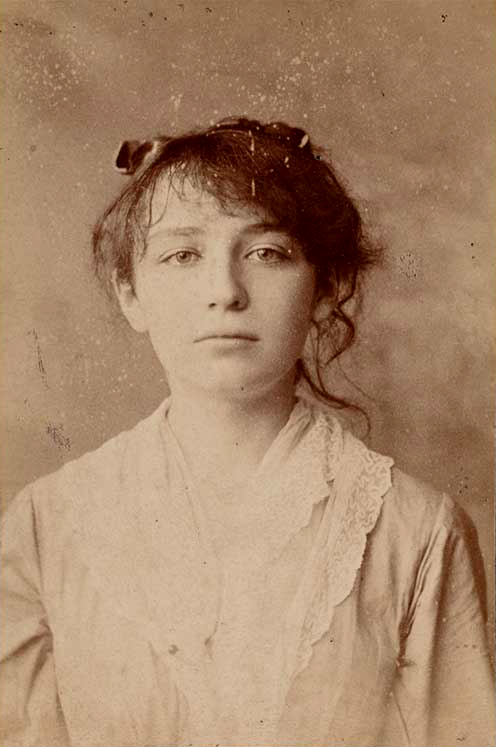
 

César (French) 'Portrait de Camille Claudel' before 1883


César (French)
Portrait de Camille Claudel
before 1883
Musée Camille Claudel
Used under fair use conditions for the purposes of academic research and education


“The exact nature of the tasks with which she was entrusted remains uncertain, but she apparently spent most of her time on difficult pieces, such as the hands and feet of figures for monumental sculptures (notably The Gates of Hell). For Claudel, this was an intensive period of training under Rodin’s supervision: she learned about his profiles method and the importance of expression. In tandem, she pursued her own investigations, accepted her first commissions and sought recognition as an independent artist at the Salon. Between 1882 and 1889, Claudel regularly exhibited busts and portraits of people close to her at the Salon des Artistes Français. Largely thanks to Léon Gauchez, Rodin’s friend the Belgian art dealer and critic, several of her works were purchased by French museums in the 1890s.”3


But women working under the “master” were not often acknowledged.

“Le Cornec and Pollock state that after the sculptors’ physical relationship ended [with Rodin in 1892 after an abortion], she was not able to get the funding to realise many of her daring ideas – because of sex-based censorship and the sexual element of her work. Claudel thus had to either depend on Rodin, or to collaborate with him and see him get the credit as the lionised figure of French sculpture. She also depended on him financially, especially after her loving and wealthy father’s death, which allowed her mother and brother, who disapproved of her lifestyle, to maintain control of the family fortune and leave her to wander the streets dressed in beggars’ clothing.

Claudel’s reputation survived not because of her once notorious association with Rodin, but because of her work. The novelist and art critic Octave Mirbeau described her as “A revolt against nature: a woman genius.”” …

Ayral-Clause says that even though Rodin clearly signed some of her works, he was not treating her as different because of her gender; artists at this time generally signed their apprentices’ work. Others also criticise Rodin for not giving her the acknowledgment or support she deserved. …

Other authors write that it is still unclear how much Rodin influenced Claudel – and vice versa, how much credit has been taken away from her, or how much he was responsible for her woes. Most modern authors agree that she was an outstanding genius who, starting with wealth, beauty, iron will and a brilliant future even before meeting Rodin, was never rewarded and died in loneliness, poverty, and obscurity. Others like Elsen, Matthews and Flemming suggest it was not Rodin, but her brother Paul who was jealous of her genius, and that he conspired with her mother, who never forgave her for her supposed immorality, to later ruin her and keep her confined to a mental hospital.”4


This “sculptor of genius” was eventually “voluntarily” committed by her family to a psychiatric hospital in 1913 where she lived the remaining 30 years of her life, unable to practice her art. Her remains were buried in a communal grave at the asylum, her bones mixed with the bones of the most destitute. Her brother Paul Claudel could not be bothered with a grave for her, while he specified the exact place of his internment… the ultimate irony being that, Rodin had decided to include an exhibition space reserved exclusively for Camille Claudel’s works in the future museum that would house the collections he bequeathed to the French state on his death (at the Rodin Museum) – a request that could not be honoured until 1952, when Paul Claudel donated four major works by his sister to the museum.5 Bitter irony.
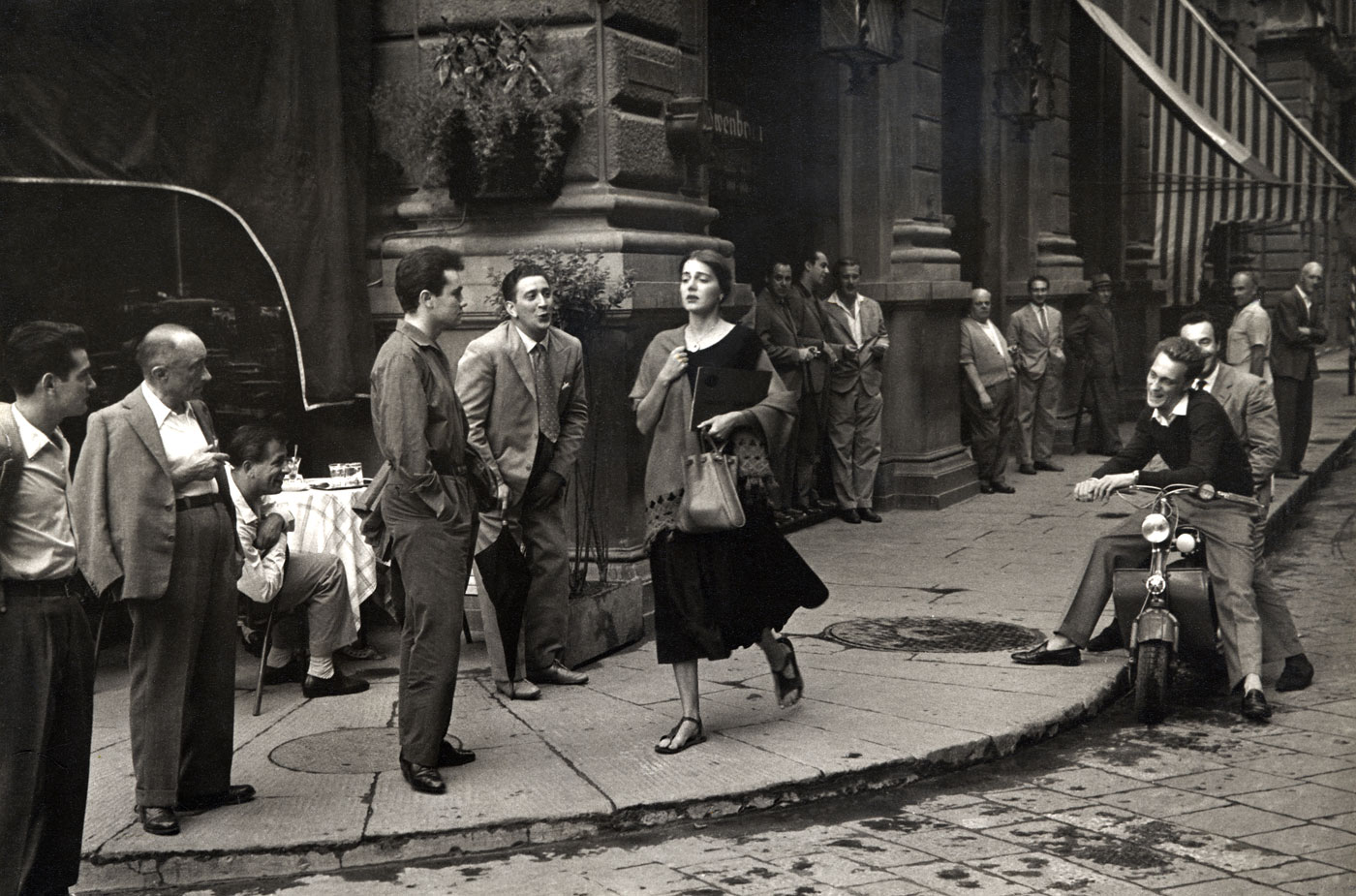
 

Ruth Orkin (American, 1921-1985) 'American Girl in Italy' 1951


Ruth Orkin (American, 1921-1985)
American Girl in Italy
1951
Gelatin silver print
© Ruth Orkin
Courtesy of Howard Greenberg Collection
Used under fair use conditions for the purposes of academic research and education


The female flâneuse and a period of transition

During the 19th century women could not stroll alone in the city.

“In Baudelaire’s essays and poems, women appear very often. Modernity breeds, or makes visible, a number of categories of female city-dwellers. Among the most prominent in these texts are: the prostitute, the widow, the old lady, the lesbian, the murder victim, and the passing unknown woman… But none of these women meet the poet as his equal. They are subjects of his gaze, objects of his ‘botanising’. The nearest he comes to a direct encounter, with a woman who is not either marginal or debased, is in the poem, À Une Passante (Even here, it is worth noting that the woman in question is in mourning – en grand deuil). The tall, majestic woman passes him in the busy street; their eyes meet for a moment before she continues her journey, and the poet remains to ask whether they will only meet again in eternity… (But if this is the rare exception of a woman sharing the urban experience, we may also ask whether a ‘respectable’ woman, in the 1850s would have met the gaze of a strange man).”6

But as Janet Wolff observes, women clearly were active and visible in other ways in the public arena, especially when it came to the construction of women’s dress as a sign of their husbands’ position: in effect, the less they worked and the more they evidenced the performance of conspicuous leisure and consumption, the more this was to the credit of their master rather than to their own credit. Wolff further notes, “The establishment of the department store in the 1850s and the 1860s provided an important new arena for the legitimate public appearance of middle-class women…” but denies this has anything to do with women being a female flâneur – a flâneuse – because the fleeting, anonymous encounters and purposeless strolling she has been considering “do not apply to shopping, or to women’s activities either as public signs of their husband’s wealth or as consumers.”7 Wolff rejects the notion of a female flâneuse as “such a character was rendered impossible by the sexual divisions of the nineteenth century.”8

Others disagree with this interpretation. In a paper titled “Gender Differences in the Urban Environment: The flâneur and flâneuse of the 21st Century”, Akkelies van Nes and Tra My Nguyen offer the following history of the flâneur9 and the flâneuse concepts (apologies for the long quotation but it necessary):


“The term flâneur originated from the 18th century. It was described by Charles Baudelaire as ‘gentleman stroller of city streets’ (van Godsendthoven, 2005). …

‘The flâneur was an idle stroller with an inquisitive mind and an aesthetic eye, a mixture of the watchful detective, the aesthetic dandy and the gaping consumer, the badaud. A solitary character, he avoided serious political, familial or sexual relationships, and was only keen on the aesthetics of city life. He read the city as a book, finding beauty in the obsolete objects of other people, but in a distanced, superior way’ (van Godsendthoven, 2005).

The flâneur is a product of modern life and the industrial revolution, parallel to the references of the tourist in contemporary times. The arrival of department stores and the ‘Haussmannization’ of Paris’ streets in the second half of the nineteenth century swept away large parts of the historical city and also the domain of the flâneur. The archetype of the flâneur disappeared with its surroundings, in favour of the women- oriented department stores. ‘The department store may have been, as Benjamin put it, the flâneur’s last coup, but it was the flâneuse’s first’ (Friedberg, 1993).

The flâneuse is not a female flâneur, but she is a version of the flâneur. She does not experience the city in the same way as he does. It is hard to define the archetype of the flâneuse, because the flâneur himself consists of paradoxes and many subcategories. Key concepts for flâneur and flâneuse are the amount of spare time, the aesthetic detachment towards objects, crowd and sceneries they see and their ambiguity about it.

The department stores were a starting point for the existence of the flâneuse, but this also marked her as a consumer, a ‘badaud’. The difference between badauds and flâneuses are the distance they create between themselves and the activities in the city. A characteristic of flânerie is an aesthetic distance between the subject and the object of attention. The badaud-flâneuse lacks this distance. The city is not being experienced, but is reduced to a place to consume.

As implied, the badaud-flâneuse did not have the full ability to flânerie. However, she has many qualities, which are at least some first initiatives to stroll around. Her domain moved from the interior of her home to the interior of the department store and sometimes even to the streets (Parsons, 2000). Shopping, art and day trips contribute to develop a certain view in that period of society, which was at the end of 19th century. Friedberg was very well aware that this new freedom was not the same as the freedom of the flâneur (Friedberg, 1993).

The flâneuse concept developed throughout the years expanded somehow further than being a badaud. She was discovering domains like art forms, like for example the cinema and the theatre at the beginning of the 20th century. But she was still objectified by men and patriarchic institutes. However, women became independent, without taking over the absent look and gaze of the flâneur. They changed their lives into art forms and had an opinion about the society they lived in. To gain respect as artists, the image of women as muses had to disappear. She had to claim an active role and to develop her own personality.

Through the literature, the life of the flâneuse and the female characters in the city, like passersby, artists, dandies and badauds [gawkers, bystanders] are often interlaced with each other, and difficulties they experienced are alike. The flâneuse often shifted between these roles, but distinguished herself by her independency and distanced. She became a symbol for post-modern urban life: a wanderer in many shapes.”10


Nes and Nguyen further argue that the emancipation of women over the last two decades “has brought the flâneuse to a more equal position with the flâneur in the invisible right to be in public urban space. However, aspects like safety and when and where women are spending time in urban space still have effect on how women use public spaces and affect the public spheres.”11 Indeed, with the despicable murder of too many women in Melbourne in recent years by predatory men (Aiia Maasarwe, Mersina Halvagis, Masa Vukotic, Eurydice Dixon, Tracey Connelly, Sarah Cafferkey, Renea Lau and Jill Meagher to name just a few…), women still fear walking the streets alone. “Even when grief enveloped his family, Bill Halvagis can recall the wider sense of public outrage that followed the murder of his older sister Mersina. The shock that someone could do such a thing in a public place was as brutal as the crime itself.”12

 

Unknown photographer (Australian) 'People march through Brunswick in Melbourne after the murder of Jill Meagher in 2012' 2012


Unknown photographer (Australian)
People march through Brunswick in Melbourne after the murder of Jill Meagher in 2012
2012
Australian Associated Press (AAP)
Republished under Creative Commons from The Conversation website

Used under fair use conditions for the purposes of academic research and education


Looking back a century later, one of the key points of female emancipation in the early twentieth century is that women gained their independence “and had an opinion about the society they lived in… She had to claim an active role and to develop her own personality” while present and visible in the community, present in a public place. The world-wide suffragette movement was at the forefront of this early twentieth-century revolution.

“A suffragette was a member of an activist women’s organisation in the early 20th century who, under the banner “Votes for Women”, fought for the right to vote in public elections. The term refers in particular to members of the British Women’s Social and Political Union (WSPU), a women-only movement founded in 1903 by Emmeline Pankhurst, which engaged in direct action and civil disobedience.” During the First World War “the suffragette movement in Britain moved away from suffrage activities and focused on the war effort… Women eagerly volunteered to take on many traditional male roles – leading to a new view of what women were capable of.”13 However, this new found capability and visibility in society “cast women as passive, erotic objects, subjecting them to a kind of voyeuristic control” by men, embodying the gaze of modernity which is both covetous and erotic – public sites (of interaction) producing “meanings and positions from which those meanings are consumed.”14 Women were “playing” in a man’s world subject to their approval, their gaze and their desire to possess and control the female both physically and sexually.

But, as Griselda Pollock observes, “modernity was not represented as taking place in exclusively masculine, because public, domains: rather, the spaces of modernity were in fact marginal spaces, those in which the city’s “new subjective experiences of exhilaration and alienation, pleasure and fear, mobility and confinement, expansiveness and fragmentation,” were most intense. These spaces of intersection happened to be sites in which bourgeois men came into contact with women…”15

Here comes the “New Woman” taking on traditional male roles, socialising in marginalised spaces, boldly going where few women had gone before, sampling new subjective experiences, becoming who they wanted to be… all under the munificent gaze of the (bourgeois) male.

Two women and two men

The “New Woman”, mainly middle class females, took their courage in their hands to become professional photographers and artists: photojournalists, fashion photographers, war photographers, magazine and picture photographers, working with successful men and women in fashion, interior design, news, graphics and art. At the Bauhaus female students pushed the boundaries in fields such as textiles, lighting, ceramics and costume, the “New Woman” putting her femininity under the spotlight.

By pushing boundaries, female artists and photographers broke ground becoming female in a male world… within the framework of modernity and aesthetics, to form the modern divine. In a youthful culture of commercial and technological changes they gained their independence through hard work and talent via the stereotype of the “New Woman” – a constructed image portrayed in the magazines (bobbed hair beauty, flapper, speed, fast cars, cigarette smoking) which played into the male system of the recognition of the feminine subject. By playing the system they became successful and visible, self conscious of their undeniable abilities. But at what cost? Many women, excited by the world of men, where chewed up and spat out, dumped, and sometimes met a terrible end.


Unknown photographer (German) 'Leni Riefenstahl with Heinrich Himmler (left) during the 1934 Nuremberg Nazi Party Rally in the Luitpold Arena while recording her film "Triumph of the Will"' September 9, 1934


Unknown photographer (German)
Leni Riefenstahl with Heinrich Himmler (left) during the 1934 Nuremberg Nazi Party Rally in the Luitpold Arena while recording her film “Triumph of the Will”
September 9, 1934
German Federal Archives / Wikipedia (public domain)


The epito/me of this new self consciousness and will to power was the Nazi film director Leni Reifenstahl (German, 1902-2003). Reifenstahl began as an interpretive dancer who often made almost 700 Reichsmarks for each performance. “Her dancing revealed her childlike quality, her surrender to the moment, and this natural, naïve quality made her the perfect heroine for his [Arnold Fanck’s] Alpine love stories. Riefenstahl was involved in a love triangle involving Fanck and her leading man [in director Fanck’s 1920s “mountain films”], Luis Trenker, demonstrating, in Mr. Bach’s words, “Leni’s skill at dominating the exclusive male society in which she found herself now and for almost all the rest of her professional life.””16 Reifenstahl used her beauty, voracious sexual prowess (with both women and men) and talent to infiltrate the world of film and learn acting and film editing techniques. Hitler saw her films and thought Riefenstahl epitomised the perfect German female.

“Riefenstahl heard Nazi Party (NSDAP) leader Adolf Hitler speak at a rally in 1932 and was mesmerised by his talent as a public speaker… Hitler was immediately captivated by Riefenstahl’s work. She is described as fitting in with Hitler’s ideal of Aryan womanhood, a feature he had noted when he saw her starring performance in Das Blaue Licht. After meeting Hitler, Riefenstahl was offered the opportunity to direct Der Sieg des Glaubens (“The Victory of Faith”), an hour-long propaganda film about the fifth Nuremberg Rally in 1933… Still impressed with Riefenstahl’s work, Hitler asked her to film Triumph des Willens (“Triumph of the Will”), a new propaganda film about the 1934 party rally in Nuremberg. More than one million Germans participated in the rally. The film is sometimes considered the greatest propaganda film ever made… In February 1937, Riefenstahl enthusiastically told a reporter for the Detroit News, “To me, Hitler is the greatest man who ever lived. He truly is without fault, so simple and at the same time possessed of masculine strength”.”17

After the Second World War Riefenstahl was tried four times by postwar authorities for denazification and eventually found to be a “fellow traveller” (Mitläufer) who sympathised with the Nazis but she won more than fifty libel cases against people accusing her of having previous knowledge regarding the Nazi party.18 Research in the first decade of the twenty-first century (Jürgen Trimborn Leni Riefenstahl: A Life Faber & Faber, 2007 and Steven Bach Leni – The Life and Work of Leni Riefenstahl Knopf, 2007) dismantle Riefenstahl’s myth that she was an artist innocent of political motivations. She hitched her wagon to National Socialism, taking money to make her film Tiefland (Lowlands) and then bringing in extras from a concentration camp, keeping them in rags and starving them. After filming some were executed in the gas chambers. “Bach shows that the contract she entered into with the camp commandant makes clear the terms on which she had access to these ‘extras’ and that she knew they were going back to (at the very least) an uncertain future ‘in the east’.”19 Riefenstahl would later claim that all of the Romani extras – 53 Roma and Sinti from Maxglan, and a further 78 from a camp in eastern Berlin – had survived the war. In fact, almost 100 of them are known or believed to have been gassed in Auschwitz.20

Riefenstahl’s image of wholesome “New Woman” – a “version of an ideal presence, a kind of imperishable beauty” – never faded and she never wavered in her belief in herself and her innocence. The hubris of her egotistical narcissism denied any other version of history was possible, jealousy protecting her self-believed legacy like a protective tigress guarding her cubs, all the while denying her servitude and slavery to Nazi propaganda. Of course, all of it is a lie. There is Riefenstahl after the invasion of Poland filming away dressed as a uniformed army war correspondent replete with revolver around her waist.


Oswald Burmeister (German) 'Visit of Leni Riefenstahl with a pistol at the XIV Army Corps, conversation with soldiers, on the left a film camera' Poland, September, 1939


Oswald Burmeister (German)
Visit of Leni Riefenstahl with a pistol at the XIV Army Corps, conversation with soldiers, on the left a film camera
Poland, September, 1939
German Federal Archives / Wikipedia (public domain)


“Four of the six feature films she directed are documentaries, made for and financed by the Nazi government… [they] celebrate the rebirth of the body and of community, mediated through the worship of an irresistible leader.”21 Susan Sontag saw Riefenstahl’s aesthetics as entirely inseparable from Nazi ideology, “consistent with some of the larger themes of Nazi ideology: the contrast between the clean and the impure, the incorruptible and the defiled, the physical and the mental, the joyful and the critical.”22

Naturally, and I use the word advisedly, the leader was male. While Riefenstahl could wish all she liked that she had power as a “New Woman”, “dominating the exclusive male society” of Nazi Germany, she was in reality just a pawn of their largesse. Women in Nazi Germany were seen mainly as baby producing machines, representing the fundamental ideologies of the role of the mother (the role of women under National Socialism). To that end the Cross of Honour of the German Mother (Mutterkreuz – Mother’s Cross) conferred by the government of the German Reich to honour a Reichsdeutsche German mother for exceptional merit to the German nation – 1st class, Gold Cross: eligible mothers with eight or more children; 2nd class, Silver Cross: eligible mothers with six or seven children; 3rd class, Bronze Cross: eligible mothers with four or five children – reinforced traditional feminine and family values, and “traditional” lifestyle patterns.23 The New Woman in Germany thus became a pure woman of German blood-heredity and genetically fit, the mother worthy of the decoration. In Nazi Germany the New Woman became “decoration” herself, the ideal protected as Sontag puts it as, “the family of man (under the parenthood of leaders).”24
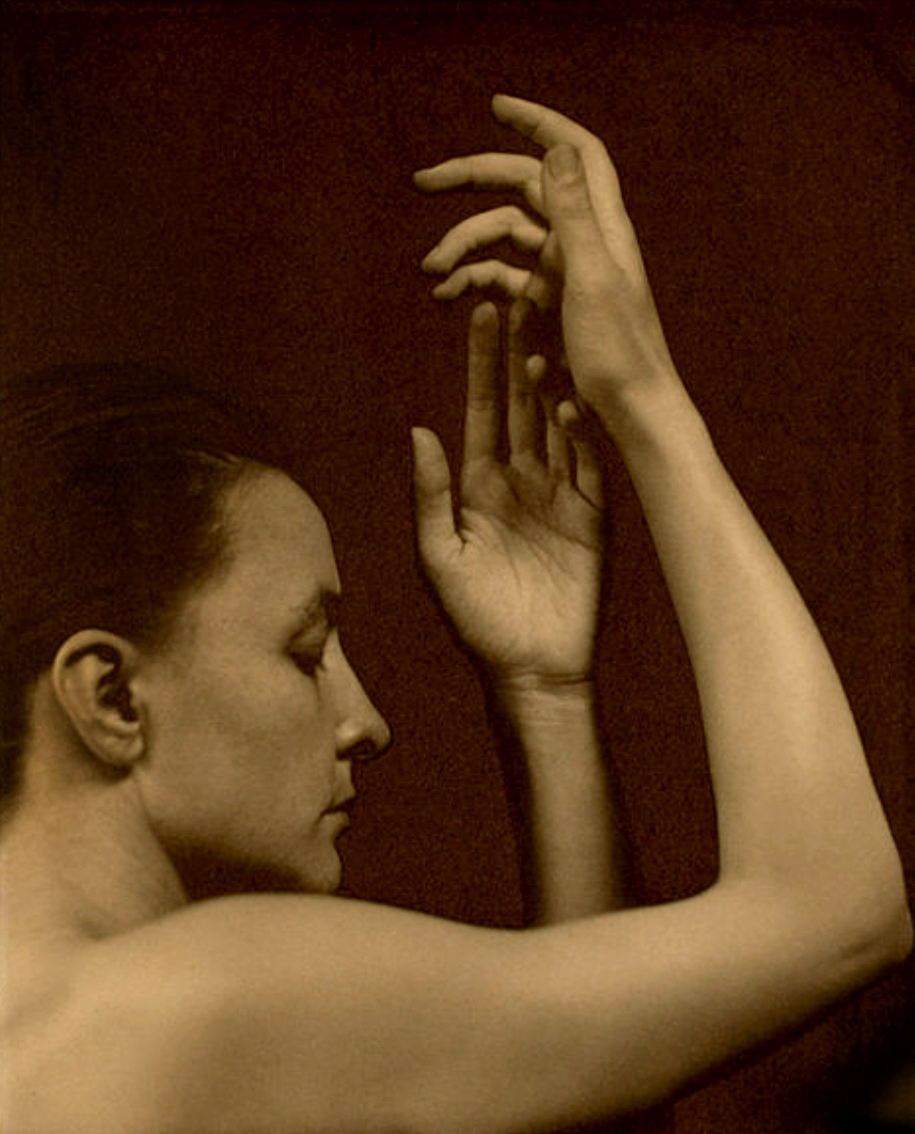
 

Alfred Stieglitz (American, 1864-1946) 'Georgia O'Keeffe' 1920


Alfred Stieglitz (American, 1864-1946)
Georgia O’Keeffe
1920
Platinum print
Wikiart (Public domain)


One of the greatest artists of the twentieth-century was the painter Georgia O’Keeffe (American, 1887-1986). O’Keeffe, born in a small town named Sun Prairie in Dane County, Wisconsin grew up on the family farm south of the city. “As a child she received art lessons and her abilities were recognised and encouraged by local teaches and family throughout her school years. After O’Keeffe left Sun Prairie she pursued studies at the Art Institute of Chicago (1905-1906) and at the Arts Students League, New York (1907-9108).”25 She took a job as a commercial artist and then began teaching art, taking summer at classes at the University of Virginia for several years before becoming chair of an art department beginning the fall of 1916. A friend sent some of O’Keeffe’s charcoal drawings to the photographer, gallerist and impresario Alfred Stieglitz (American, 1864-1946) who exhibited them at his 291 gallery in April 1916. Stieglitz found them to be the “purest, finest, sincerest things that had entered 291 in a long while,” and in the spring of 1917 he sponsored her first one-artist exhibition at 291 – the last show held at the galleries before they closed in July of that year.

At this time, “O’Keeffe painted to express her most private sensations and feelings. Rather than sketching out a design before painting, she freely created designs. O’Keeffe continued to experiment until she believed she truly captured her feelings [in watercolour] … After her relationship with Alfred Stieglitz started, her watercolour paintings ended quickly. Stieglitz heavily encouraged her to quit because the use of watercolour was associated with amateur women artists. … Stieglitz, twenty-four years older than O’Keeffe, provided financial support and arranged for a residence and place for her to paint in New York in 1918. They developed a close personal relationship while he promoted her work. She came to know the many early American modernists who were part of Stieglitz’s circle of artists, including painters Charles Demuth, Arthur Dove, Marsden Hartley, John Marin, and photographers Paul Strand and Edward Steichen. Strand’s photography, as well as that of Stieglitz and his many photographer friends, inspired O’Keeffe’s work.”26 Stieglitz and O’Keeffe were married in 1924. Between 1918 and 1928 O’Keeffe worked primarily in New York City and at the Stieglitz family’s summer home at Lake George.

Working creatively side by side with that egotistical beomoth of American art that was Stieglitz could not have been easy. While Stieglitz promoted his wife’s art, provided financial support, directed the medium of her continued development, he also controlled her “purest” form (a symbol of the ideal) – that of her image. O’Keeffe became Stieglitz’s muse (a goddess, a person or personified force who is the source of inspiration for a creative artist), between 1918-1920 the photographer “making more than 140 photographs of O’Keeffe that, unlike his earlier analytic work, resonated with emotion and personal meaning… conjoining her art and her body, suggesting they were one.”27

“Stieglitz conceived of his portraits of O’Keeffe as a single work – a composite portrait. Each photograph stands on its own, revealing a certain innate quality at a given moment. But because change is a constant, only a series of photographs can evoke a subject’s entire being over time. To underscore the composite nature of his project, in 1921 Stieglitz exhibited more than forty photographs of O’Keeffe – many clustered by body part – under the title “Demonstration of Portraiture.”

Stieglitz and O’Keeffe married in 1924, and he continued to photograph her through the 1930s – his composite portrait eventually numbering 331 works. But his pictures of her changed markedly over the years. In 1923 when he became entranced with photographing clouds, he made smaller, more casual pictures of her at work or holding the subjects of her paintings. Many of his portraits of her from the 1930s lack the feverish intensity of those he made from 1918 to 1920 and reveal instead the distance in their relationship.”28

Stieglitz’s early photographs of O’Keeffe capture her in intimate encounters with the camera, portraying her through the gaze of male passion. “Extreme close-ups evoke an intimate sense of touch,” “different body parts were expressive of O’Keeffe’s individuality,” while in other photographs “she looks directly and longingly at the camera…”.29 O’Keeffe’s supposed independent New Woman was tied to the coat tails of an older man, her place in the cult of beauty (the ideal of life as art) an ideal eroticism. Her image was presented not as a temptation, not as a repression of the sexual impulse … but as its ultimate revelation in the seduction of the physicality of the photograph. Stieglitz’s composite “portrait in time,” “reflects his ideals of modern womanhood and is evocative of their close relationship.”30 Under the control of the man.


Alfred Stieglitz (American, 1864-1946) 'Georgia O'Keeffe' 1918


Alfred Stieglitz (American, 1864-1946)
Georgia O’Keeffe
1918
Wikipedia (Public domain)


O’Keeffe of course realised the power that Stieglitz had over her and she started to remove herself from his field of vision, from his power of influence. To truly gain her independence. As Akkelies van Nes and Tra My Nguyen observed earlier, “To gain respect as artists, the image of women as muses had to disappear” as so this is what O’Keeffe did: she stopped becoming Stieglitz’s muse. After first visiting New Mexico in 1917 O’Keeffe returned to what was her spiritual home in 1929 when she travelled to Mexico with her friend Rebecca Strand and stayed in Taos with Mabel Dodge Luhan, who provided the women with studios,31 from then on spending part of nearly every year working in New Mexico. “Upon returning to the place that touched her heart so deeply, O’Keeffe’s mental health did indeed improve. Her life and her artwork would never be the same again. “I felt as if something was ending and another was beginning,” O’Keeffe once said. She began to feel more like her true self, integrated with parts of her personality that had been submerged in New York City.”32

The distance in the relationship between O’Keeffe and Stieglitz (both physical, he in New York and she in New Mexico, and spiritual with her attenuation to the Cerro Pedernal landscape) was exacerbated by his long-term relationship with Dorothy Norman which started in 1928, leading to O’Keeffe’s mental breakdown and hospitalisation in 1933. She returned to New Mexico and in August 1934 moved to Ghost Ranch, north of Abiquiú. Literally, her place in Mexico was faraway, an isolated landscape which she called the Faraway: “She often talked about her fondness for Ghost Ranch and Northern New Mexico, as in 1943, when she explained, “Such a beautiful, untouched lonely feeling place, such a fine part of what I call the ‘Faraway’. It is a place I have painted before … even now I must do it again.””33 Metaphorically, it was faraway from the life she led with Stieglitz, far away from her wifely concerns. “Shortly after O’Keeffe arrived for the summer in New Mexico in 1946, Stieglitz suffered a cerebral thrombosis. She immediately flew to New York to be with him. He died on July 13, 1946. She buried his ashes at Lake George. She spent the next three years mostly in New York settling his estate, and moved permanently to New Mexico in 1949, spending time at both Ghost Ranch and the Abiquiú house that she made into her studio.”34


Georgia O'Keeffe (American, 1887-1986) 'Rams Head, White Hollyhock - Hills' (Rams Head and White Hollyhock, New Mexico) 1935


Georgia O’Keeffe (American, 1887-1986)
Rams Head and White Hollyhock, New Mexico
1935
Oil on canvas
Brooklyn Museum
Used under fair use conditions for the purposes of academic research and education


Stieglitz never came to New Mexico. It was her space. Here she found her integrity, her own voice, far from the madding crowd, far from the gallery openings – a voice full of songs of the world. “She painted Taos Pueblo, San Francisco de Asís Catholic Church, a tree on the D.H. Lawrence ranch (that still stands), Mexican paper flowers, wood carvings, wild flowers, hills and sky around Taos.”35 She painted her “flowers of the desert”, bleached animal bones that were alive to her; and “she hoped people could see the music that she painted.” In New Mexico she truly became a “New Woman”: independent, intelligent, talented and famous … and her own woman – untamed by men, full of fierce self-protection and formidable work ethic, a woman adept at embracing the unknown and appreciative of the art of solitude.

Pushing the boundaries, finding themselves

While the physical presence of women photographers and their work in the “Roaring Twenties” or “golden 1920s” – “which saw young women breaking with traditional “mores” or likewise step aside from “traditional” lifestyle patterns”36 – was apsirational for young and independent women in order to achieve social prestige and material success, for most women photographers it was all about having a job and making a living.

Paradoxically, while the “New Woman” behind the camera “embraced photography as a mode of professional and personal expression”, promoting female empowerment based on real women making revolutionary changes in life and art they also bought into a capitalist system of male dominance in a patriarchal society where the “feminine” – that is a feminine perspective – underwent a process of sublimation through the sequestering (hiding away) of gender. As women photographers “sought to redefine their positions in society and expand their rights”, their independence, so women were still outsiders in the male system of the recognition of the feminine subject – both of the female body as subject and that of the female photographers’ body (although the latter less so, with the numerous self-portraits of the “New Woman” and their cameras captured in mirrors). Indeed, most “New Woman” photographers never seem to have had the desire, or the eroticism, to virtually put gender in the image. They were still in servitude to the dominant status quo.

The story of the two mites is apposite here. In the story (see below) many rich people put money into the treasury, while a poor widow puts in two mites (two small coins worth a few cents) which is all she has. “The same religious leaders who would reduce widows to poverty also encourage them to make pious donations beyond their means. In [Adison] Wright’s opinion, rather than commending the widow’s generosity, Jesus is condemning both the social system that renders her poor, and “… the value system that motivates her action, and he condemns the people who conditioned her to do it.””37 In other words, the widow (in our case the New Woman) contributes her whole livelihood to maintaining the social system (patriarchal society) that oppresses her by supporting the value system that motivates her action… a system, controlled by men, that keeps her in servitude.

Many “New Woman” photographers behind the camera had to operate in such a value system in order have a job and make a living. Variously, they had to build a career as a fashion photographer, advertising and graphic photographer, magazine photographer, studio photographer, photojournalist, war photographer, social documentary photographer, street photographer and ethnographic photographic … and usually had be proficient at most styles of photography in order to obtain sufficient work for survive. For example, Sabine Weiss bridled at being labelled a humanist, “because she considered her street photography to be just one part of her oeuvre. Most of her career was spent as a fashion photographer and a photojournalist, shooting celebrities like Brigitte Bardot and musicians like Benjamin Britten. “From the start I had to make a living from photography; it wasn’t something artistic,” Weiss told Agence France-Presse in 2014. “It was a craft, I was a craftswoman of photography.”38

I suspect for most women photographers of the era this was the truth: taking photographs wasn’t something artistic it was a craft from which they earned a living. While part of the profound shaping of the medium during a time of tremendous social and political change they did not initiate the “modernisation” of photography but were undoubtedly an important part of that movement. But, and here is the key point, they were still producing “mainstream” images and, as Annette Kuhn notes, “‘Mainstream’ images in our culture bear the traces of the capitalist and patriarchal social relations in which they are produced, exchanged and consumed.”39 They bought into the value system.

Among others (such as Dora Maar, Tina Modotti, Lucia Moholy, Aenne Biermann, Eva Besnyö and Florence Henri to name just a few of my favourites) … two women photographers who did push the boundaries of the art of photography and, in their case, what was acceptable in terms of the representation of gender identity were the temporarily bisexual, pan-world Germaine Krull (1897-1985) and the “neuter” (neither) photographer Claude Cahun (French, 1894-1954).

Krull published her seminal book Métal in 1928 in Paris, and began to receive attention alongside other practitioners of new, assertively modern photographic styles such as Man Ray and André Kertész.

“With Métal, Krull turned her lens on the soaring structures of industrial Europe: Rotterdam’s railroad bridge De Hef, Marseille’s Pont Transbordeur, a number of nameless industrial cranes, factory machinery, and, most recognizably, the Eiffel Tower. The portfolio bore the subtitle “métaux nus” (bare metals), and critics have often likened these metallic bodies to the nude photographs she made around the same time. In both cases, Krull got close to her subjects, dislocating them from their environments. In Métal, Krull rendered the familiar form of the Eiffel Tower nearly unrecognizable…

In an untitled nude photograph from 1928 or ’29, she deployed a similar approach, keeping the camera fixed on an unclothed torso twisting off toward the edge of the frame with upturned face cut off at mid-cheek. The dramatic play of shadow and light renders the figure’s gender indistinct. Whether focused on a living subject or an architectural one, Krull’s camera resists the viewer’s urge to name and categorize.”40
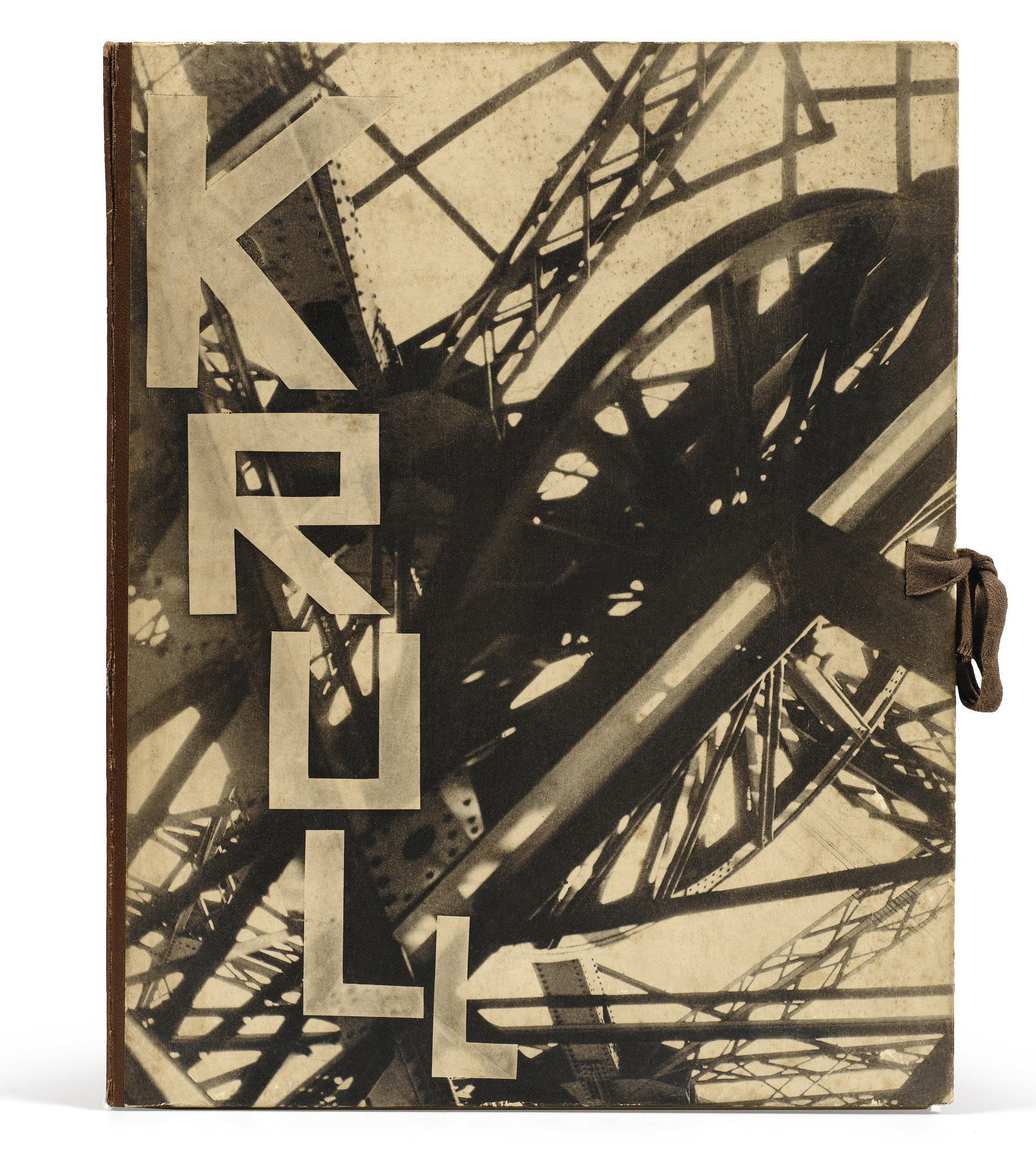
 

Germaine Krull (1897-1985, photographer) Cover design by M. Tchimoukow. 'MÉTAL' cover 1928


Germaine Krull (1897-1985, photographer)
Cover design by M. Tchimoukow (Louis Bonin)
MÉTAL cover
1928
Librairie des Arts décoratifs A. Calavas, Editeur.

Portfolio comprising a title page, a preface by Florent Fels and sixty four (64) loose photogravures, each mentioning the photographer’s name, titled ‘MÉTAL’, plate number and publisher’s name. Original dust jacket. Used under fair use conditions for the purposes of academic research and education

Folio 30 x 23.5cm; 11 3/4 x 9 1/4 in.
Plate 29.2 x 22.5cm; 11 1/2 x 8 3/4 in.
Image 23.6 x 17.1cm; 9 1/4 x 6 1/2 in.
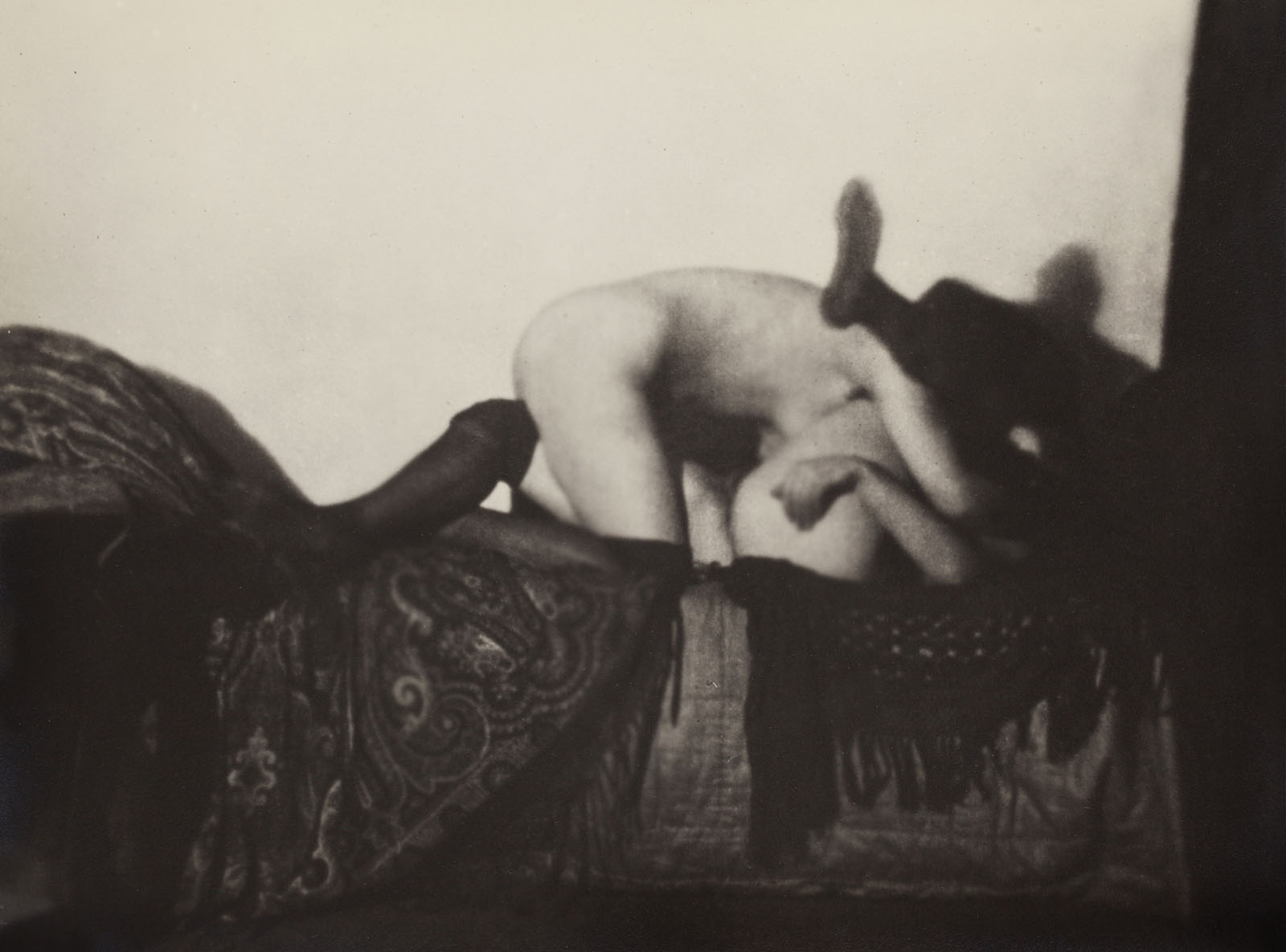
 

Germaine Krull (1897-1985, photographer) From the portfolio 'Les amies' c. 1924


Germaine Krull (1897-1985, photographer)
From the portfolio Les amies
c. 1924
Used under fair use conditions for the purposes of academic research and education


In 1924, in an earlier portfolio of eleven photographs titled Les amies (French for “the friends,” specifically denoting female friends), Krull depicts “a pair of women in stages of gradual undress, eventually left only in their stockings, the rest of their flesh laid bare.” In a tangle of insouciant bodies that hid breasts and eyes, in which none of the models stares at the camera, Krull presents an eroticism that “is contained between the two women, with no imaginary space for a third, presumably male, viewer to enter…,” Krull dismissing “”the male gaze of Weimar culture in favor of a female gaze” and her emphasis on the gazes within the images as the female models view each other. In Les Amies, there is no space for a third party: the only possibility is to become one of the women.”41

“By photographing erotic scenes, Krull not only constructed the desiring gaze but also placed herself in the position of that gaze, taking on privileges previously permitted only to male photographers…”42 whilst at the same time transgressing the definition of middle-class respectability – all the while emphasising the fluidity of female sexual identity in the 1920s, especially for the adventurous “New Woman”.

While these images received little attention during her lifetime (much like the gender bending images of Claude Cahun) they are representations of queer desire which picture the dissolution of the controlling male gaze. Using the mirror of her / Self and her camera, Krull’s staged (erotic) encounters in Les Amies and Métal undermine the male space of control through spatial disorientation – her “reforming mirror” performing a tangle of limbs, the fragmentation of the female body in which gender becomes neutral coupled with the dismantling of the phallocentrism of the (Eiffel) tower until its form becomes an unrecognisable and different “other”. “Armed with her camera, she had the power not only to depict reality but to transform it.”43

The French surrealist photographer, sculptor, and writer Lucy Renee Mathilde Schwob adopted the pseudonym Claude Cahun in 1914.

“In Disavowals, she writes: “Masculine? Feminine? It depends on the situation. Neuter is the only gender that always suits me.” … [She] is most remembered for her highly staged self-portraits and tableaux that incorporated the visual aesthetics of Surrealism. During the 1920s, Cahun produced an astonishing number of self-portraits in various guises such as aviator, dandy, doll, body builder, vamp and vampire, angel, and Japanese puppet.

Some of Cahun’s portraits feature the artist looking directly at the viewer, head shaved, often revealing only head and shoulders (eliminating body from the view), and a blurring of gender indicators and behaviours which serve to undermine the patriarchal gaze. Scholar Miranda Welby-Everard has written about the importance of theatre, performance, and costume that underlies Cahun’s work, suggesting how this may have informed the artist’s varying gender presentations.”44


Cahun’s self-portraiture over a period of 27 years (in collaboration with her lover Marcel Moore) was a unique investigation into the multiplicity of sexuality and gender identity. “By 1930, Cahun had amassed a considerable image bank of photographic self-portraits; that year, she publicly disseminated a handful of those images for the first and only time.”45 In her photographs she explored the mutable definitions of gender through multiple ‘masked’ personas – using photomontage, the doubling of the image (asserting another conception of gender identity that of a “third sex” or an “Androgyne”), the various ways photographs can be produced and viewed (meant to unsettle the audience’s understanding of photography as a documentation of reality), and the dissolution of the self in the space between the body and the mirror to aid her investigation. Self-reflection was not her objective in the use of the mirror but Cahun did use the mirror as a source of reflection in a contemplative, interrogatory mode in her photographs; and these were private photographs never intended for public display. “It has been proposed that these personal photographs allowed for Cahun to experiment with gender presentation and the role of the viewer to a greater degree.”46
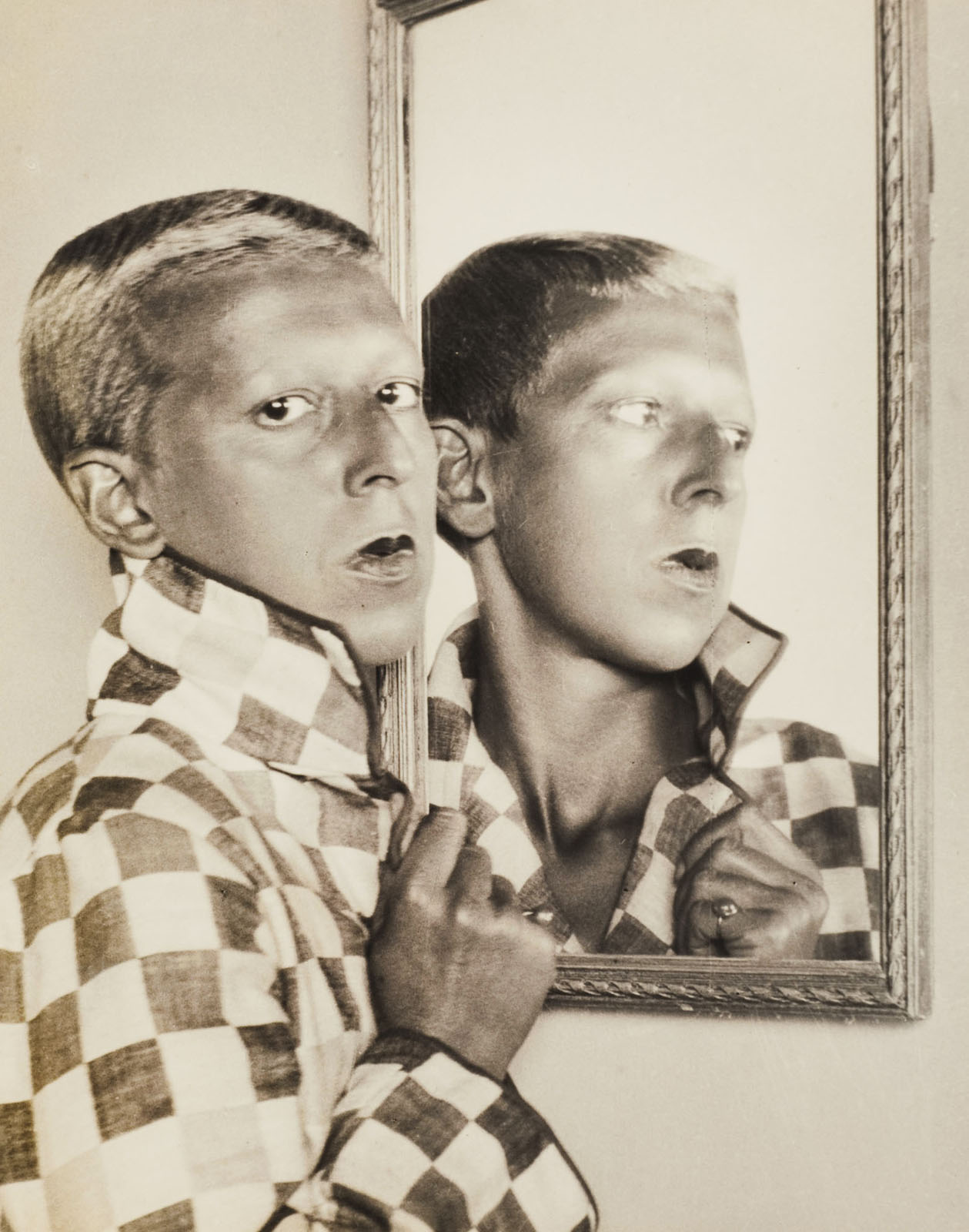
 

Claude Cahun (French, 1894-1954) 'Autoportrait' (Self-Portrait) c. 1927


Claude Cahun (French, 1894-1954)
Autoportrait (Self-Portrait)
c. 1927
Gelatin silver print
Used under fair use conditions for the purposes of academic research and education
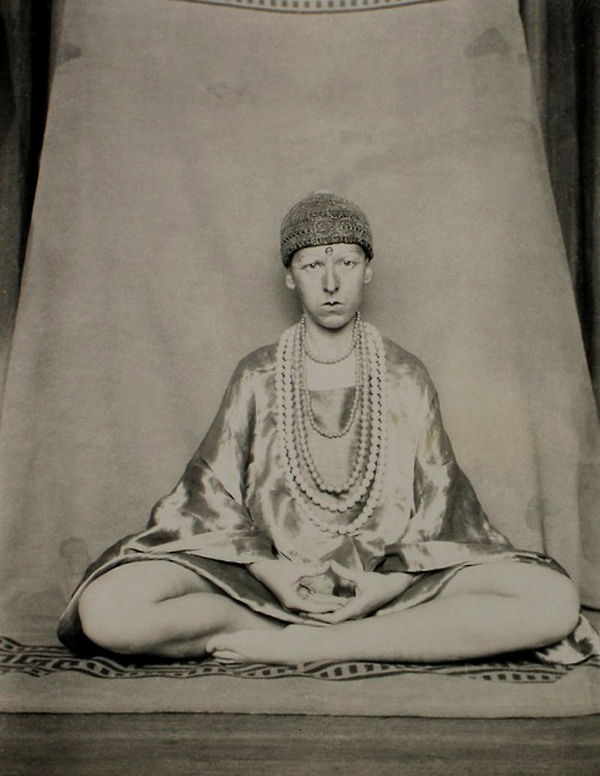
 

Claude Cahun. 'Self-Portrait' 1927


Claude Cahun (French, 1894-1954)
Self-Portrait
1927
Gelatin silver print
Used under fair use conditions for the purposes of academic research and education


In Cahun’s gender non-conforming self-portraits “identity and gender is played out through performance and masquerade in a constructive way, a deep, probing interrogation of the self in front of the camera. While Cahun engages with Surrealist ideas – wearing masks and costumes and changing her appearance, often challenging traditional notions of gender representation – she does so in a direct and powerful way. As Laura Cumming observes, “She is not trying to become someone else, not trying to escape. Cahun is always and emphatically herself. Dressed as a man, she never appears masculine, nor like a woman in drag. Dressed as a woman, she never looks feminine. She is what we refer to as non-binary47 these days, though Cahun called it something else: “Neuter is the only gender that always suits me.””

Cahun had a gift for the indelible image but more than that, she possesses the propensity for humility and openness in these portraits, as though she is opening her soul for interrogation, even as she explores what it is to be Cahun, what it is to be human. This is a human being in full control of the balance between the ego and the self, of dream-state and reality. The photographs, little shown in Cahun’s lifetime, are her process of coming to terms with the external world, on the one hand, and with one’s own unique psychological characteristics on the other. They are her adaption48 to the world.”49

These were private manifestations of her inner self for the benevolence of her own spirit. She made art for herself, willing enough to face uncertainty and take the untrodden path of inner discovery. She was a “New Woman” where the term “woman” is fluid and fragmentary, open to adaptation and interpretation.
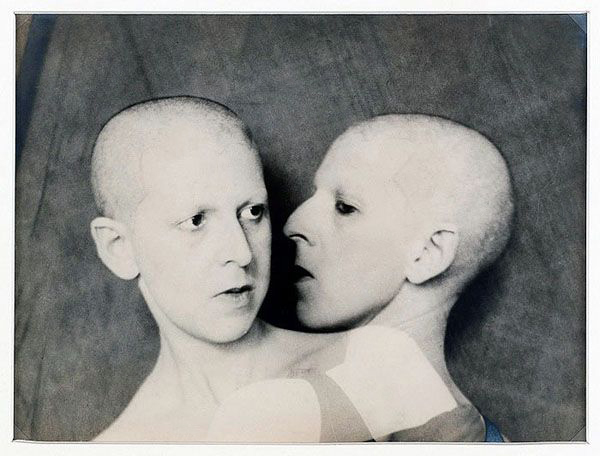
 

Claude Cahun (French, 1894-1954) 'Que me veux tu?' 1929


Claude Cahun (French, 1894-1954)
Que me veux tu? (What do you want from me?)
1929
Gelatin silver print
Used under fair use conditions for the purposes of academic research and education


A proposition and, the particular becomes universal

So the question becomes – when is a photographer a photographer a photographer. Does it matter who is behind the lens?

On the evidence of almost 200 photographs in the postings on this exhibition, if the photographs were labelled “unknown photographer”, many of these images could as easily have been made by men as by women. So in one sense it does not matter. What matters is the quality of the work.

But from other perspectives of course it matters, it matters a great deal. These women photographers have been whitewashed from the history of photography as though they never existed. Their challenge to the dominant narrative of male supremacy in society and the continuation of the struggle for female visibility and emancipation, requires a recognition of their courage and sacrifices. These were talented, strong and creative human beings and their work demands the recognition it deserves.

And then we ask, why has it taken a hundred years to shift the institutionally constructed history of photography, which has been perpetuated from generation to generation, where only male photographers were to be looked at, collected, admired and displayed? And the simple answer is that one word: “men”. Although things are changing slowly, too slowly, it was and still is a patriarchal society, a system of society controlled by men, and in the time period we are talking about (1920s-1950s), it was a world where institutions and their collecting practices were controlled by men; where photography was not being collected by many museums; and where the photographs of the “New Woman” behind the camera was not seen as collectible because it was what they did to make a living… it wasn’t art.

Further, we might postulate a proposition with regard to the practice of “New Woman” photographers, a form of Zen kōan if you like:

It doesn’t matter that I am a woman / I am a woman


In relation to this in/sight, I muse on a quotation about the work of Imogen Cunningham: “I keep coming back to this duality: Don’t pigeonhole her for being a woman. But don’t forget she’s a woman!” says Dunn Marsh. “She photographed flowers, which people sort of treated as a feminine subject matter. But Edward Weston was photographing peppers, and nobody considered that to be an exclusively masculine subject matter.”50

If we unpack this quotation, it reads as ‘it doesn’t matter that Cunningham was a woman… but don’t forget she’s a woman!’. Weston made images of peppers and nobody commented on his masculinity or the masculine “nature” of his subject matter and the same should go for Cunningham. Just because she is a women why comment on the femininity of flowers – but don’t forget Imogen is a women! It’s about the quality of the work, not the gender of the artist and then maybe it’s about being female but only if the artist chooses it to be … (Georgia O’Keeffe got very annoyed by the reading of her close-up flower paintings which many interpreted as representing female genitalia, insisting that the paintings has nothing to do with female sexuality).

Finally we can say, it’s doesn’t matter what gender you are when you look through the camera lens (as a machine it’s impartial), it is about the reality of yourself as a human being and your relationship to the camera. The actions of the photographer are a personal engagement with the camera (in other words, in relation to the women behind the camera, the camera in relation to her/Self) but through direct action – an engagement with time and light – their can be a shift in consciousness from the personal (the particular) to the universal.

It shouldn’t (that is the key word) matter whether you are male or female … it’s about the quality of the work and it’s about following the light. The light of self recognition of the path that you are on. As Maria Popova insightfully observes,

“And so the best we can do is walk step by next intuitively right step until one day, pausing to catch our breath, we turn around and gasp at a path. If we have been lucky enough, if we have been willing enough to face the uncertainty, it is our own singular path, unplotted by our anxious younger selves, untrodden by anyone else.”51


The “New Woman” broke new ground by challenging the (in)visibility of women in a male dominated world. She placed herself in a man’s world but she still had to fit into that man’s world and conform to his image of her. But she followed her path of uncertainty with conviction and motivation, a path until then untrodden by anyone else, until she turned around and found that she had forged her own singular path, had looked within and had found her own voice. Looking back from a contemporary perspective we can finally recognise the struggle of the “New Woman” behind the camera, we can see their singular paths and recognise their achievements. What we can learn from the “New Woman” today, is that we all have a choice… to accept the status quo or offer determined defiance to prejudiced social conventions.

All human beings have to live within the parameters of social constructs but as human beings what we can do is push against the limits society imposes on us, push against the barriers of economic, political and sexual freedom. We can transgress the taboo. We can struggle that great and mighty struggle on the path of life, to push at the boundaries of being. What we all need to do, both women and men, is to find our integrity in relation to the reality of the world and to our own spirit. Through the efforts of those that came before us, we all now have a choice as to the path we follow and how we fit into this multifarious society.

Dr Marcus Bunyan

January 2021

Word count: 8,590


Footnotes

1/ Anonymous text. “George Sand,” on the Wikipedia website [Online] Cited 14/12/2021

2/ Victor Hugo. Les funérailles de George Sand quoted “Emancipated Woman,” in the Saturday Review: Politics, Literature, Science and Art, Volume 41, June 17, 1876, pp. 771 [Online] Cited 14/12/2021

3/ Anonymous text. “Camille Claudel,” on the Musée Rodin website [Online] Cited 14/12/2021

4/ Anonymous text. “Camille Claudel,” on the Wikipedia website [Online] Cited 14/12/2021

5/ Musée Rodin op cit.,

6/ Janet Wolff. “The Invisible Flaneuse. Women and the Literature of Modernity” in Theory, Culture and Society Volume 2, Number 3, Sage, 1985, p. 42

7/ Ibid., p. 44

8/ Ibid.,

“When flanerie moves into the private realm of the department store, feminization alters this urban practice almost beyond recognition … By abolishing the distance between the individual and the commodity, the feminization of flanerie redefines it out of existence. The flaneur‘s dispassionate gaze dissipates under pressure from the shoppers’ passionate engagement in the world of things to be purchase and possessed. The flaneur ends up going shopping after all. … The department store cannot be the scene of urban strolling, not only because it is an enclosed and circumscribed space, but, more importantly, because shopping is a pre-defined and purposeful activity.”

Janet Wolff. “Gender and the haunting of cities (or, the retirement of the flâneur),” in Aruna D’Souza and Tom McDonough (eds.,) The Invisible Flâneuse? Gender, Public Space, and Visual Culture in Nineteenth-Century Paris. London, UK: Manchester UP, 2006, p. 21

9/ Flaneur – “The flaneur symbolises the privilege or freedom to move about the public arenas of the city observing but never interacting, consuming the sights through a controlling but rarely-acknowledged gaze… The flaneur embodies the gaze of modernity which is both covetous and erotic. … The site of pleasurable looking, this look actively cast women as passive, erotic objects, subjecting them to a kind of voyeuristic control; it was in this sense that the visual purview of the bourgeois stroller – now the representative of middle-class masculinity in its entirety – became thoroughly implicated in issues of gender.”

Griselda Pollock. Vision and Difference: Femininity, Feminism and the Histories of Art. London, UK: Routledge, 1988.

10/ Akkelies van Nes and Tra My Nguyen. “Gender Differences in the Urban Environment: The flâneur and flâneuse of the 21st Century,” in Daniel Koch, Lars Marcus and Jesper Steen (eds.,). Proceedings of the 7th International Space Syntax Symposium. Stockholm: KTH, 2009

11/ Ibid.,

“Prostitution was indeed the female version of flânerie, which serves only to emphasise the inequality of gender differences in this era. The male flâneur was simply a man who loitered on the streets; but women who loitered risked being seen as prostitutes, streetwalkers, or les grandes horizontales as they were known in nineteenth-century Paris.”
Bobby Seal. “From Streetwalker to Street Walker: The Rise of the Flâneuse,” on the Psychogeographic Review website 24/12/20212 [Online] Cited 20/01/2022

12/ Bianca Hall and Adam Cooper. “From Jill Meagher to Aiia Maasarwe: The murders that changed Melbourne over the past decade,” on The Age website December 30, 2019 [Online] Cited 15/12/2021.

13/ “Suffragette,” on the Wikipedia website [Online] Cited 14/12/2021

14/ Aruna D’Souza and Tom McDonough (eds.,) The Invisible Flâneuse? Gender, Public Space, and Visual Culture in Nineteenth-Century Paris. London, UK: Manchester UP, 2006, p. 8

15/ Ibid., p. 6

16/ Steven Bach quoted in Carl Rollyson. “Leni Riefenstahl on Trial,” on The New York Sun website March 7, 2007 [Online] Cited 04/01/2022

17/ Anonymous. “Leni Riefenstahl,” on the Wikipedia website [Online] Cited 02/01/2021

18/ Ibid.,

19/ Taylor Downing. “Leni: fully exposed,” on The Observer website Sun 29 April 2007 [Online] Cited 12/01/2022

20/ Kate Connolly. “Burying Leni Riefenstahl: one woman’s lifelong crusade against Hitler’s favourite film-maker,” on The Guardian website Thursday 9 December 2021 [Online] Cited 12/01/2022

21/ Susan Sontag. “Fascinating Fascism,” in The New York Review February 6, 1975 issue [Online] Cited 12/02/2022

22/ Ibid.,

23/ See “Cross of Honour of the German Mother” on the Wikipedia website [Online] Cited 12/01/2022

24/ Sontag, op. cit.,

25/ Text from a sign commemorating birth of Georgia O’Keeffe, located next to Sun Prairie City Hall, 300 E, Main Street

26/ Anonymous. “Georgia O’Keeffe,” on the Wikipedia website [Online] Cited 02/01/2022

27/ Mark Levitch. “Stieglitz Career Overview: Georgia O’Keeffe, 1918-1920,” on the National Gallery of Art website Nd [Online] Cited 12/02/2022

28/ Ibid.,

29/ Ibid.,

30/ John Black. “Alfred Stieglitz and Modern America,” on the Boston Event Guide website Wednesday, 23 August 2017 [Online] Cited 12/02/2022. No longer available online

31/ Anonymous. “Georgia O’Keeffe,” on the Wikipedia website [Online] Cited 12/02/2022

32/ Roberta Courtney Meyers. “O’Keeffe in Taos,” on the Taos News website May 21, 2019 [Online] Cited 12/02/2022

33/ Anonymous. “Georgia O’Keeffe,” on the Wikipedia website [Online] Cited 12/02/2022

34/ Ibid.,

35/ Meyers, op. cit.,

36/ Anonymous. “Cross of Honour of the German Mother” on the Wikipedia website [Online] Cited 12/01/2022

37/ Anonymous. “Lesson of the widow’s mite,” on the Wikipedia website [Online] Cited 15/02/2022

38/ Clay Risen. “Sabine Weiss, Last of the ‘Humanist’ Street Photographers, Dies at 97,” on The New York Times website Jan 4, 2022 [Online] Cited 06/01/2022

39/ Annette Kuhn. The Power of the Image: Essays on Representation and Sexuality. London: Routledge and Kegan Paul, 1985, p. 10.
40/ Marina Molarsky-Beck. “Germaine Krull’s Queer Vision,” on The Met website August 17 2021 [Online] Cited 15/12/2021

41/ Anonymous. “Germaine Krull, From Séries les Amies, 1924,” on the La Petite Mélancolie website 19/06/2012 [Online] Cited 15/01/2022

42/ Ibid.,

43/ Ibid.,

44/ Anonymous. “Claude Cahun,” on the Wikipedia website [Online] Cited 16/01/2022

45/ Jennifer Josten. “Reconsidering Self-Portraits by Women Surrealists: A Case Study of Claude Cahun and Frida Kahlo,” in the Atlantis Journal Vol. 30, No. 2, 30/02/2006 p. 24

46/ Anonymous. “Claude Cahun,” on the Wikipedia website [Online] Cited 16/01/2022

47/ Those with non-binary genders can feel that they: Have an androgynous (both masculine and feminine) gender identity, such as androgyne. Have an identity between male and female, such as intergender. Have a neutral or unrecognised gender identity, such as agender, neutrois, or most xenogenders.

48/ “The constant flow of life again and again demands fresh adaptation. Adaptation is never achieved once and for all.” Carl Jung. “The Transcendent Function,” CW 8, par. 143.

49/ Marcus Bunyan. “Gillian Wearing and Claude Cahun: Behind the mask, another mask” on the Art Blart website 24th May 2017 [Online] Cited 16/01/2022

50/ Dunn Marsh quoted in Margo Vansynghel. “How Seattle’s Imogen Cunningham changed photography forever,” on the Crosscut website November 16, 2021 [Online] Cited 08/01/2022

51/ Maria Popova. “Carl Jung on How to Live and the Origin of “Do the Next Right Thing”,” on The Marginalian website 12th July 2021 [Online] Cited 13/12/2021


Many thankx to the National Gallery of Art for allowing me to publish the photographs in the posting. Please click on the photographs for a larger version of the image.


Uncertainty is the price of beauty, and integrity the only compass for the territory of uncertainty that constitutes the landmass of any given life.

And so the best we can do is walk step by next intuitively right step until one day, pausing to catch our breath, we turn around and gasp at a path. If we have been lucky enough, if we have been willing enough to face the uncertainty, it is our own singular path, unplotted by our anxious younger selves, untrodden by anyone else.


Maria Popova. “Carl Jung on How to Live and the Origin of “Do the Next Right Thing”,” on The Marginalian website 12th July 2021 [Online] Cited 13/12/2021


The beautiful woman will continue to serve as a symbol of feminine mystery to the man who desires her and of potency and success to the man who can claim her. And to the women around her, she will remain a symbol of the ideal against which they will be judged. This can only change when beauty loses its distorted power in the evaluation of a “woman’s worth”; that is, when the dependent relationship between women and men has been dismantled. Thus are the politics of appearance inextricably bound up with the structures of social, political and economic inequality … Fighting pressure to conform, attempting to hold one’s own against the commercial and cultural images of the acceptable is a crucial first act of resistance. The attempt to pass and blend in actually hides us from those we most resemble. We end up robbing each other of authentic reflections of ourselves. Instead, imperfectibly visible behind a fashion of conformity, we fear to meet each others’ eyes …

Real diversity can only become a source of strength if we learn to acknowledge it rather than disguise it. Only then can we recognize each other as different and therefore exciting, imperfect and as such enough.


Wendy Chapkis. Beauty Secrets: Women and the Politics of Appearance. Boston: South End Press, 1986, p. 175.


… in practice, images are always seen in context: they always have a specific use value in the particular time and place of their consumption. This, together with their formal characteristics, conditions and limits the meanings available from them at any on moment. But if representations always have use value, then more often than not they also have exchange value: they circulate as commodities in a social / economic system. This further conditions, or overdetermines, the meanings available from representations. Meanings do not reside in images, then: they are circulated between representation, spectator and social function.


Kuhn, Annette. The Power of the Image: Essays on Representation and Sexuality. London: Routledge and Kegan Paul, 1985, p. 6.


Meanings readable from photographs … are at all points connected with the status they occupy as products, with the contexts of reception and the discourses of authorship, aesthetics, criticism and marketing which surround them. ‘Mainstream’ images in our culture bear the traces of the capitalist and patriarchal social relations in which they are produced, exchanged and consumed.


Kuhn, Annette. The Power of the Image: Essays on Representation and Sexuality. London: Routledge and Kegan Paul, 1985, p. 10.


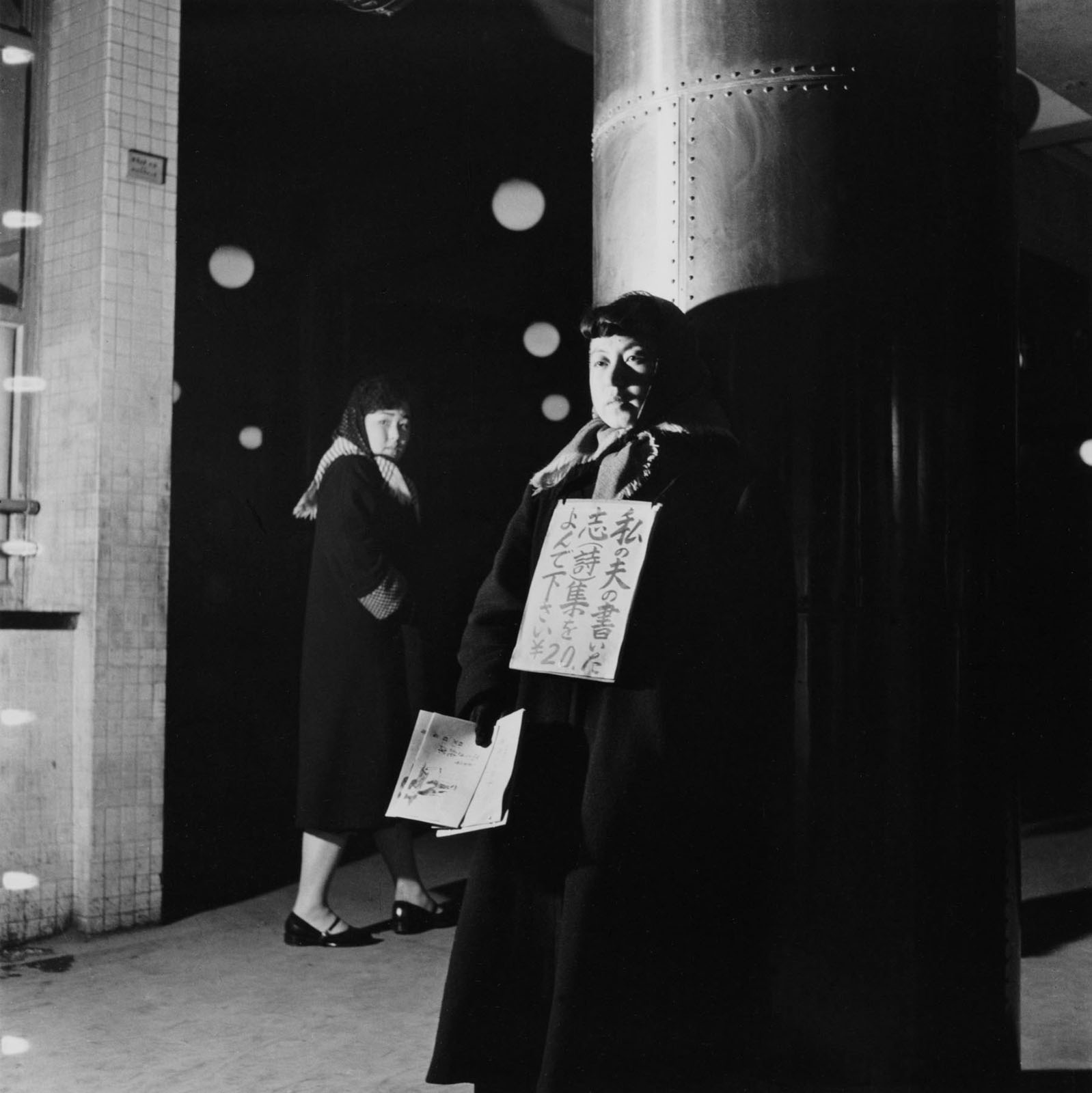
Tsuneko Sasamoto (Japanese, b. 1914) 'Woman Selling Her and Her Husband's Poetry Books (Street Snapshot in Tokyo)' c. 1950-1953, printed 1993 from the exhibition 'The New Woman Behind the Camera' at the National Gallery of Art, Washington


Tsuneko Sasamoto (Japanese, b. 1914)
Woman Selling Her and Her Husband’s Poetry Books (Street Snapshot in Tokyo)
c. 1950-1953, printed 1993
Gelatin silver print
Image: 29.6 x 29.6cm (11 5/8 x 11 5/8 in.)
Frame: 40.64 x 50.8cm (16 x 20 in.)
Frame (outer): 41 x 51.2 x 2.5cm (16 1/8 x 20 3/16 x 1 in.)
Collection of Tokyo Photographic Art Museum


Lesson of the widow’s mite

The lesson of the widow’s mite or the widow’s offering is presented in the Synoptic Gospels (Mark 12:41-44, Luke 21:1-4), in which Jesus is teaching at the Temple in Jerusalem. The Gospel of Mark specifies that two mites (Greek lepta) are together worth a quadrans, the smallest Roman coin. A lepton was the smallest and least valuable coin in circulation in Judea, worth about six minutes of an average daily wage.

Biblical narrative

“He sat down opposite the treasury and observed how the crowd put money into the treasury. Many rich people put in large sums. A poor widow also came and put in two small coins worth a few cents. Calling his disciples to himself, he said to them, ‘Amen, I say to you, this poor widow put in more than all the other contributors to the treasury. For they have all contributed from their surplus wealth, but she, from her poverty, has contributed all she had, her whole livelihood.'”

Commentary

… In the passage immediately prior to Jesus taking a seat opposite the Temple treasury, he is portrayed as condemning religious leaders who feign piety, accept honour from people, and steal from widows. “Beware of the scribes, who like to go around in long robes and accept greetings in the marketplaces, seats of honour in synagogues, and places of honour at banquets. They devour the houses of widows and, as a pretext, recite lengthy prayers. They will receive a very severe condemnation.”

The same religious leaders who would reduce widows to poverty also encourage them to make pious donations beyond their means. In [Adison] Wright’s opinion, rather than commending the widow’s generosity, Jesus is condemning both the social system that renders her poor, and “… the value system that motivates her action, and he condemns the people who conditioned her to do it.”

Text from the Wikipedia website
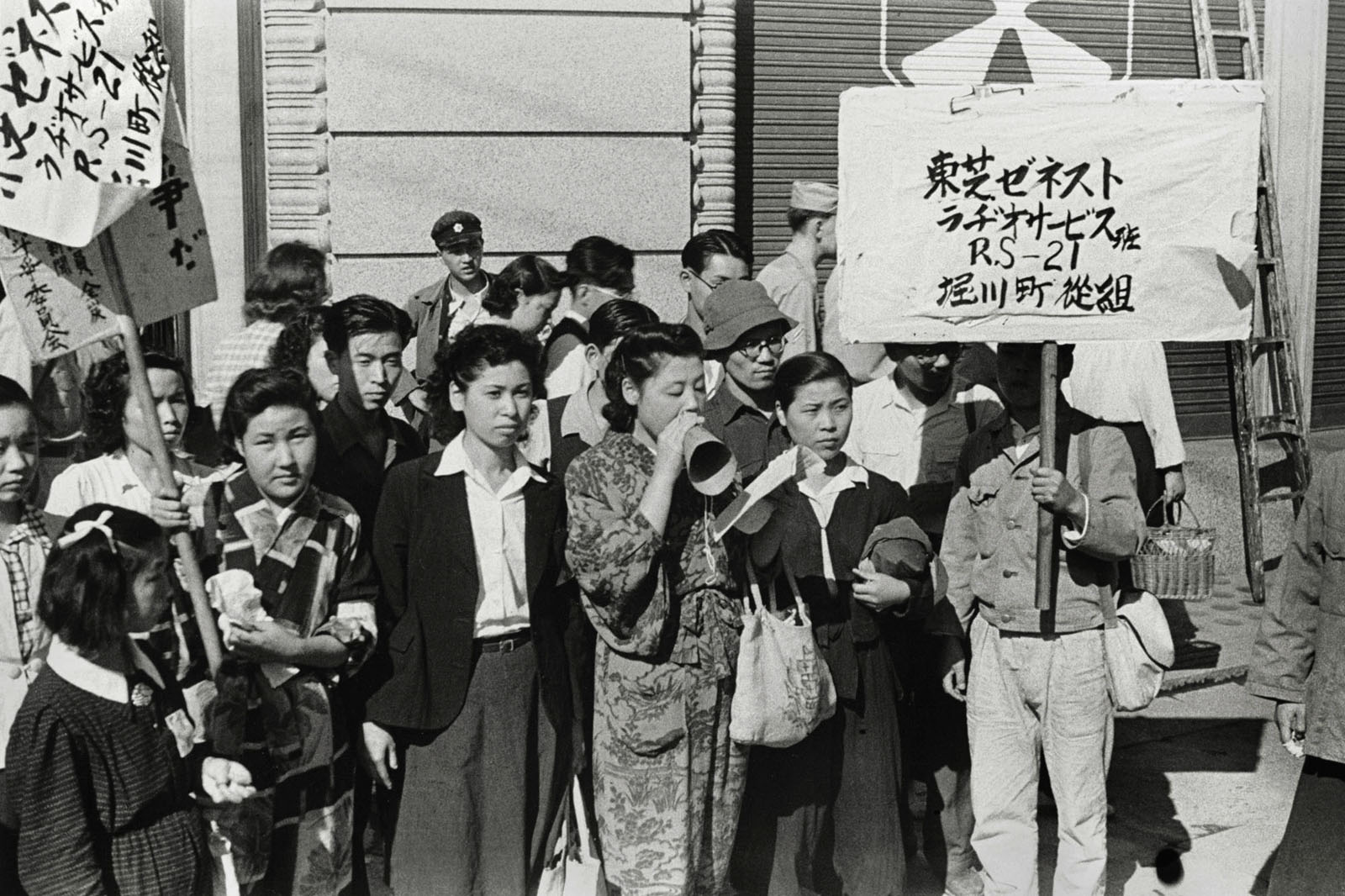
 

Tsuneko Sasamoto (Japanese, b. 1914) 'The Labor Offensive Heats Up' 1946, printed 1993 from the exhibition 'The New Woman Behind the Camera' at the National Gallery of Art, Washington


Tsuneko Sasamoto (Japanese, b. 1914)
The Labor Offensive Heats Up
1946, printed 1993
Gelatin silver print
Image: 24.9 x 37.2cm (9 13/16 x 14 5/8 in.)
Frame: 40.64 x 50.8cm (16 x 20 in.)
Frame (outer): 41 x 51.2 x 2.5cm (16 1/8 x 20 3/16 x 1 in.)
Collection of Tokyo Photographic Art Museum


Tsuneko Sasamoto (Japanese, b. 1914) '"Living New Look" Photography Exhibition' 1950, printed 1993


Tsuneko Sasamoto (Japanese, b. 1914)
“Living New Look” Photography Exhibitionkru
1950, printed 1993
Gelatin silver print
Image: 37.6 x 29.5cm (14 13/16 x 11 5/8 in.)
Frame: 40.64 x 50.8 cm (16 x 20 in.)
Frame (outer): 41 x 51.2 x 2.5 cm (16 1/8 x 20 3/16 x 1 in.)
Collection of Tokyo Photographic Art Museum


Photographer unknown. 'Tsuneko Sasamoto, Tokyo' 1940, printed 2020


Photographer unknown
Tsuneko Sasamoto, Tokyo
1940, printed 2020
Inkjet print
Image: 18.2 x 18.2cm (7 3/16 x 7 3/16 in.)
Frame: 45.72 x 35.56cm (18 x 14 in.)
Frame (outer): 46.99 x 36.83cm (18 1/2 x 14 1/2 in.)
Tsuneko Sasamoto / Japan Professional Photographers Society
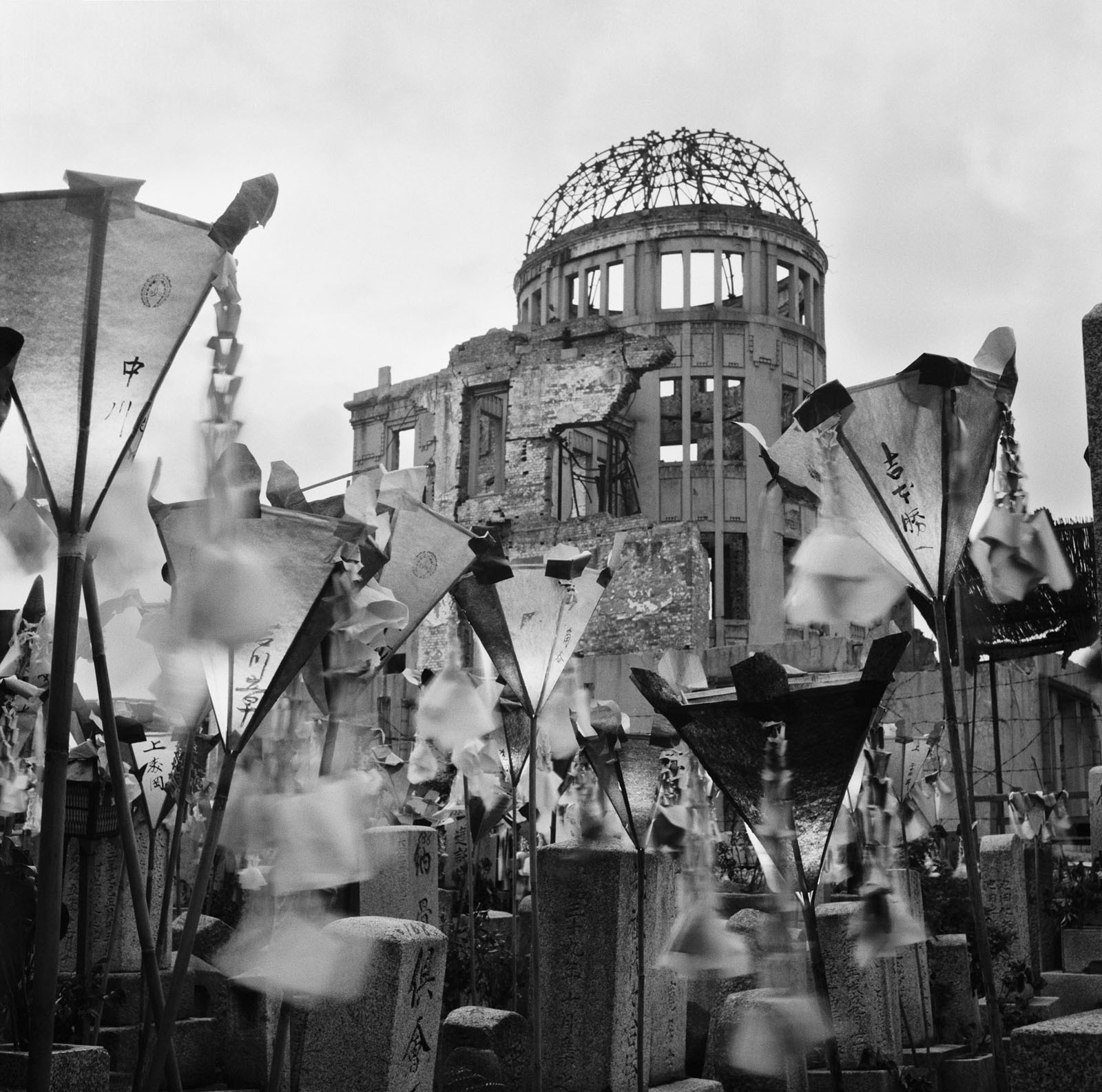
 

Tsuneko Sasamoto (Japanese, 1914-2022) 'Hiroshima Peace Memorial' 1953, printed 2020


Tsuneko Sasamoto (Japanese, 1914-2022)
Hiroshima Peace Memorial
1953, printed 2020
Inkjet print
Image: 37.4 x 37.3cm (14 3/4 x 14 11/16 in.)
Frame: 55.88 x 50.8cm (22 x 20 in.)
Frame (outer): 57.15 x 52.07cm (22 1/2 x 20 1/2 in.)
Tsuneko Sasamoto / Japan Professional Photographers Society
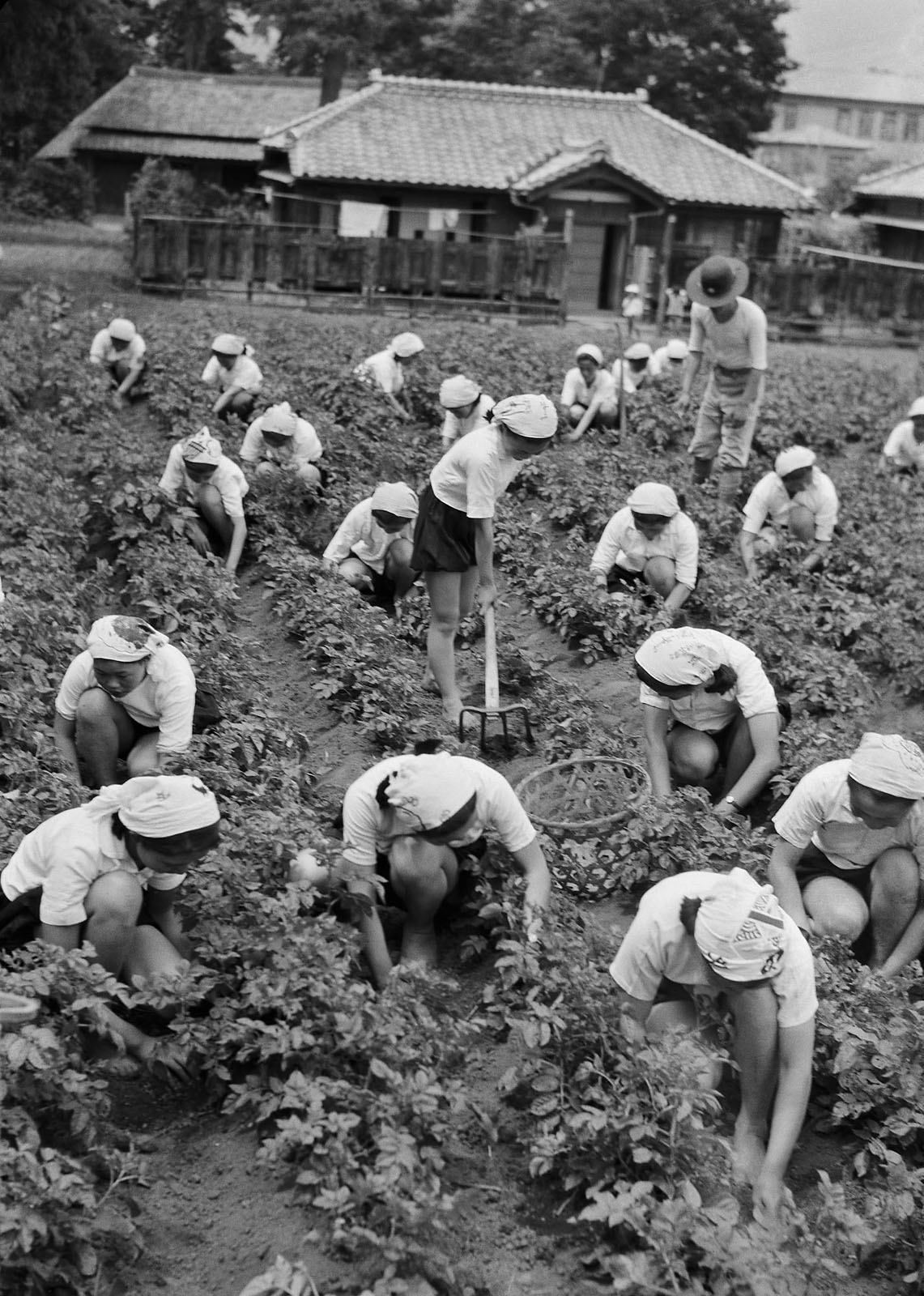
 

Tsuneko Sasamoto (Japanese, 1914-2022) 'Untitled' 1940, printed 2020


Tsuneko Sasamoto (Japanese, 1914-2022)
Untitled
1940, printed 2020
Inkjet print image: 47.5 x 33.8cm (18 11/16 x 13 5/16 in.)
Frame: 60.96 x 45.72cm (24 x 18 in.)
Tsuneko Sasamoto / Japan Professional Photographers Society
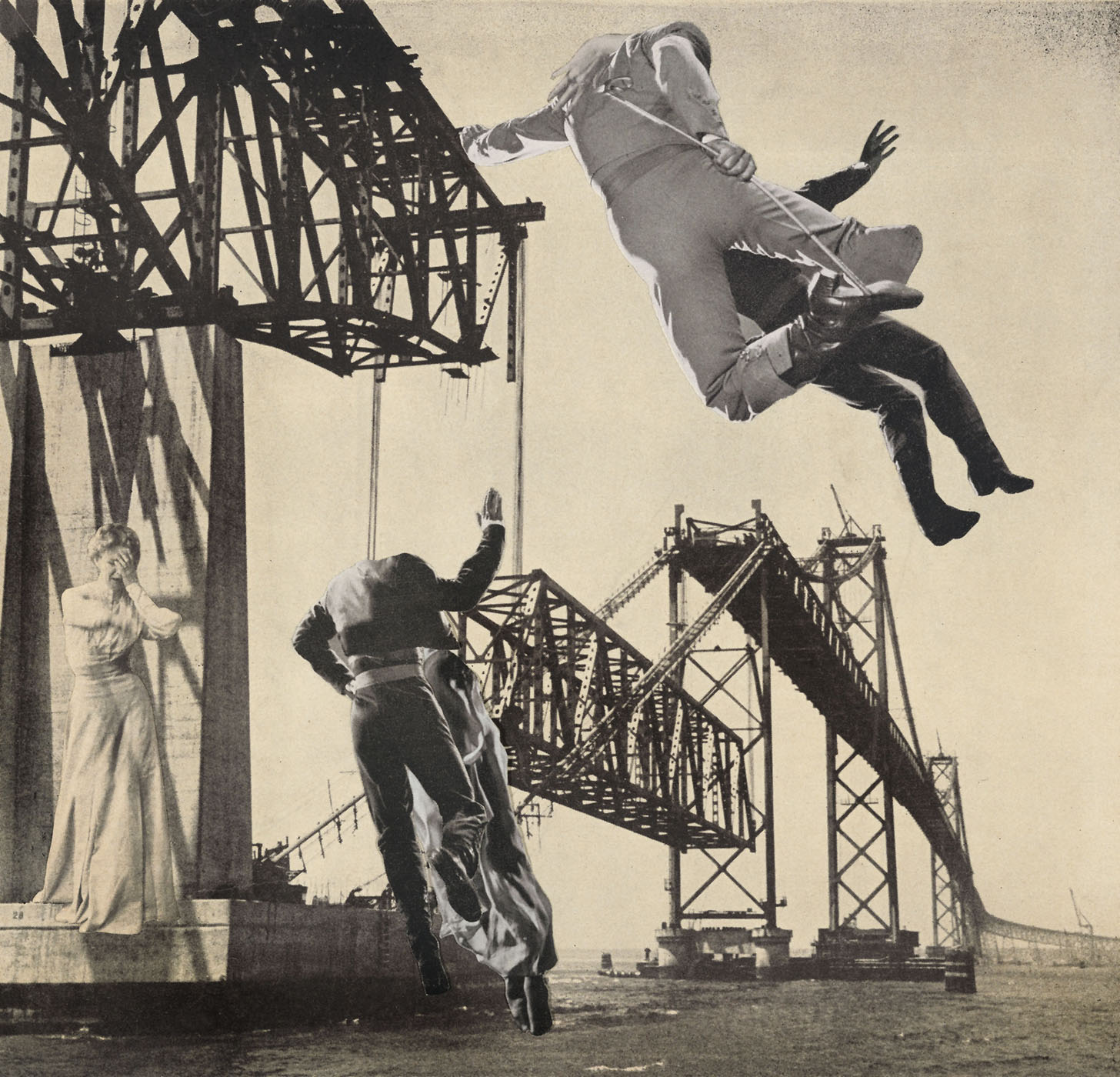
 

Toshiko Okanoue (Japanese, b. 1928) 'Full of Life' 1954


Toshiko Okanoue (Japanese, b. 1928)
Full of Life
1954
Collage on paper
Image/sheet: 23.8 x 24.9cm (9 3/8 x 9 13/16 in.)
Frame: 50.8 x 40.64cm (20 x 16 in.)
Frame (outer): 53.34 x 43.18cm (21 x 17 in.)
National Gallery of Art, Washington, Alfred H. Moses and Fern M. Schad Fund
© Okanoue Toshiko


Toshiko Okanoue (Japanese, b. 1928)

Toshiko Okanoue (岡上 淑子, Okanoue Toshiko, born 3 January 1928) is a Japanese artist associated with the Japanese avant-garde art world of the 1950s and best known for her Surrealist photo collages. …

Early career

Born in Kochi and raised in Tokyo, Okanoue began to make photo collages while studying fashion and drawing at the Bunka Gakuin in Tokyo in the early 1950s. The young Okanoue, initially knew little of art history or the Surrealist movement.

In 1952, a classmate from Keisen Girls’ High School introduced Okanoue to poet and art critic Shuzo Takiguichi, a leading figure in the Japanese Surrealist movement, who would help introduce her to the wider art world, including the work of European Surrealists, such as German artist Max Ernst, who was an influence on her subsequent work.

Over the next six years she would produce over 100 works. She exhibited in two exhibits including, solo shows at the Takemiya Gallery in Tokyo, In the second show at Takemiya, over fifty pieces of Okanoue’s monochrome photographs were hung on display. Also exhibited at the “Abstract and Illusion” exhibition at the National Museum of Modern Art, Tokyo between 1 December 1953 and 20 January 1954, which attracted total of 16,657 audiences appreciating 91 artworks by 91 artists.

Artistic style

In post-war Japan, shortages of goods meant that foreign goods filled the market and fashion and lifestyle magazines such as Vogue, Harpers Bazaar and Life magazine provided the raw materials for Okanoue’s collages. Her black and white photo collages mix images of places, objects and people, often fashionable European women, in dynamic and often unsettling compositions whose subjects explored themes of war, femininity and the relations between the sexes.

Text from the Wikipedia website


Photographer unknown. 'Page spread featuring Eiko Yamazawa and her assistant, from the "Photo Times"' October 1940


Photographer unknown
Page spread featuring Eiko Yamazawa and her assistant, from the “Photo Times”
October 1940
Magazine
Open: 25.4 x 30.48cm (10 x 12 in.)
Cradle: 8.89 x 33.02 x 26.35 cm (3 1/2 x 13 x 10 3/8 in.)
National Gallery of Art Library, Gift of the Department of Photographs


American, 20th Century. '"Photo-Fighter," in "True Comics"' July 1944


American, 20th Century
“Photo-Fighter,” in “True Comics”
July 1944
Comic book
Open: 25.4 x 35.56cm (10 x 14 in.)
National Gallery of Art Library, Gift of the Department of Photographs
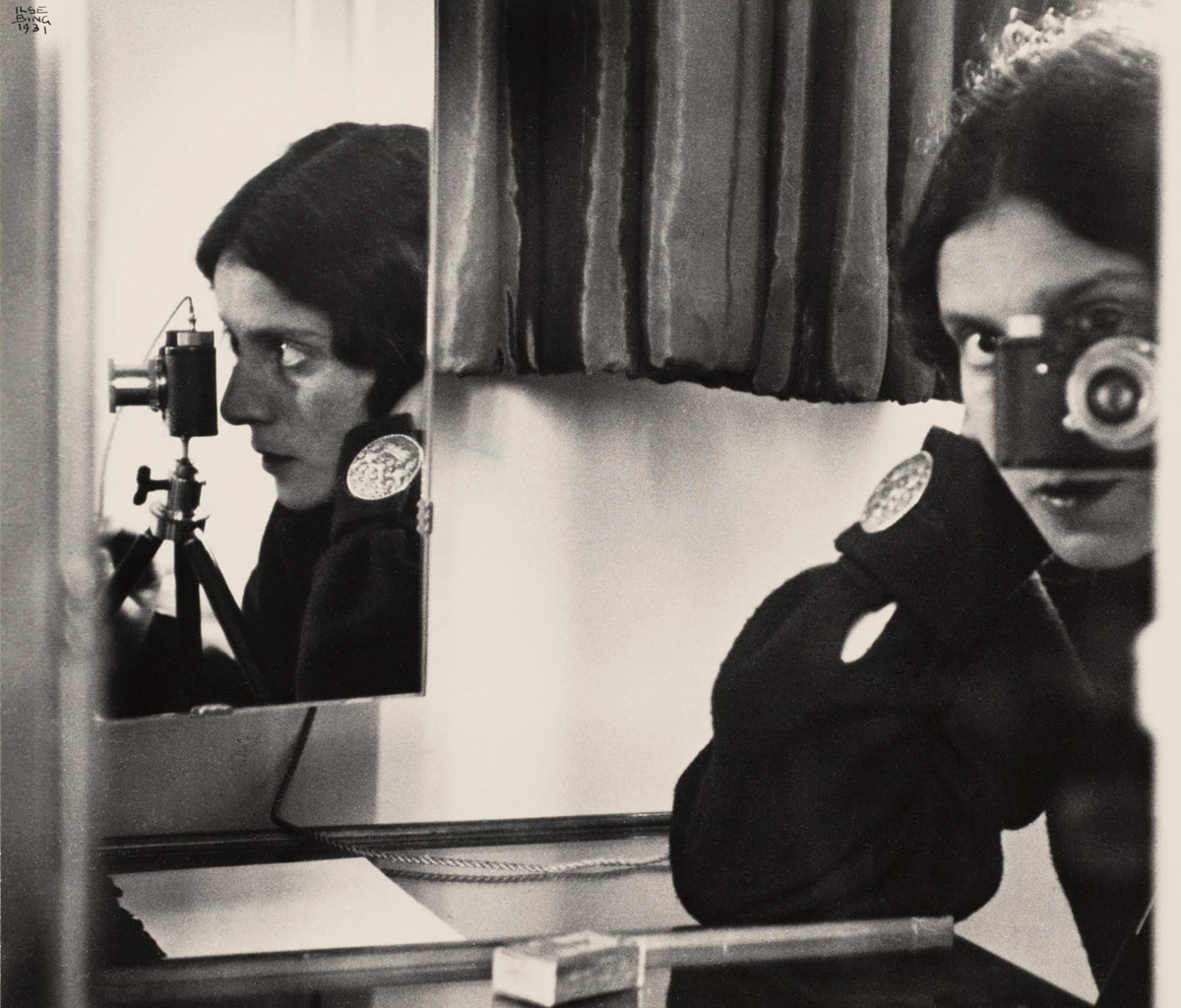
 

Ilse Bing (United States of America, Germany 1899–1998) 'Self portrait with Leica' 1931 printed 1941


Ilse Bing (United States of America, Germany 1899-1998)
Self-Portrait With Leica
1931
Gelatin silver print
Collection of Michael Mattis and Judith Hochberg/Ilse Bing Estate


Ré Soupault (German, 1901–1996) 'Self-Portrait, Tunis' 1939


Ré Soupault (German, 1901–1996)
Self-Portrait, Tunis
1939
Gelatin silver print
Artists Rights Society, New York
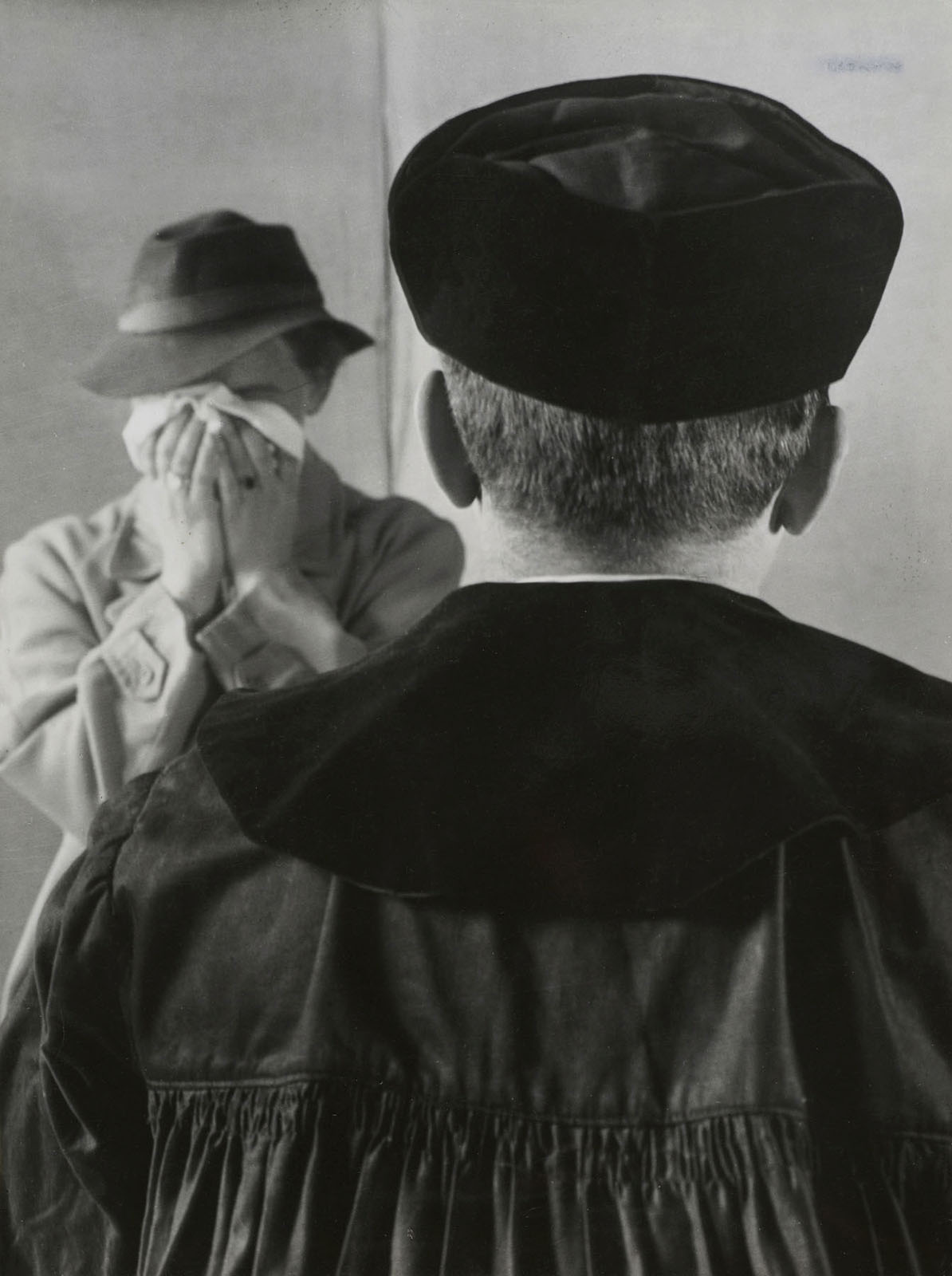
 

Elisabeth Hase (German, 1905-1991) 'Ohne Titel (Weinende Frau)' (Untitled (Crying woman)) c. 1934


Elisabeth Hase (German, 1905-1991)
Ohne Titel (Weinende Frau) (Untitled (Crying woman))
c. 1934
Gelatin silver print
Image/sheet: 22.8 x 17.1cm (9 x 6 3/4 in.)
Frame (outer): 44.5 x 36.8cm (17 1/2 x 14 1/2 in.)
The Metropolitan Museum of Art, Twentieth-Century Photography Fund, 2016
Image © The Metropolitan Museum of Art. Art Resource, NY


Elisabeth Hase (German, 1905-1991)

Elisabeth Hase (December 16, 1905 – October 9, 1991) was a German commercial and documentary photographer active in Frankfurt from 1932 until her death in 1991, at the age of 85.

Hase was born in Döhlen bei Leipzig, Germany. She studied typography and commercial art from 1924 to 1929 at the School of Applied Arts, and later at the Städelschule, under, among other teachers, Paul Renner and Willi Baumeister. Hase was active as a photographer during the time of the transition from the Weimar Republic to the Third Reich and through post-WWII Germany. She was able to avoid government oversight of her work by establishing her own photographic studio in 1933.

Hase’s work included surreal photography, such as close-up photographs of dolls.

She received several awards, several for paper designs and collages. During a two-year collaboration in the studio of Paul Wolff and Alfred Tritschler, Hase took architectural photographs in New Objectivity style for the magazine Das Neue Frankfurt (The New Frankfurt) and documentary photographs of modern housing projects, including those of Ferdinand Kramer.

In 1932, Hase started her own business. It focused on timeless designs like still life, structures, plants, dolls, people, especially self-portraits. Often she used herself as a model in her photographic “picture stories.” Cooperation with agencies like Holland Press Service and the Agency Schostal enabled her to publish her photographs internationally.

Despite the bombing of Frankfurt in 1944 by the Allies, Hare’s photographic archive survived the war without major damage. Many of those works are now part of the collections held by the Folkwang Museum in Essen, Germany, in the Albertina (Vienna) in Vienna, and in the Walter Gropius estate in the Bauhaus Archive in Berlin, as well as in private collections in Germany and abroad.

Despite loss of her cameras and other technical equipment in the chaos of war, Hase was able to resume taking photographs in 1946 by the help of emigre friends who provided her with film and cameras to use. Among other subjects Hase documented was the reconstruction of St. Paul’s Church in Frankfurt.

From 1949, her work focused on advertising, consisting mostly of plant portraits.

Hase died at the age of 85 in 1991 in Frankfurt am Main.

Text from the Wikipedia website


Erna Lendvai-Dircksen (German, 1883-1962) 'Mädchen aus dem Guttachtal, Schwarzwald' (Young Woman from the Guttach Valley, Black Forest) Before 1934


Erna Lendvai-Dircksen (German, 1883-1962)
Mädchen aus dem Guttachtal, Schwarzwald (Young Woman from the Guttach Valley, Black Forest)
Before 1934
Gelatin silver print
Image: 17.1 x 13.2cm (6 3/4 x 5 3/16 in.)
Mount: 26 x 18.4cm (10 1/4 x 7 1/4 in.)
Frame (outer): 52.07 x 39.37cm (20 1/2 x 15 1/2 in.)
The J. Paul Getty Museum, Los Angeles


Erna Lendvai-Dircksen (German, 1883-1962)

Erna Lendvai-Dircksen (born Erna Katherina Wilhelmine Dircksen, 31 May 1883 – 8 May 1962) was a German photographer known for a series of volumes of portraits of rural individuals from throughout Germany. During the Third Reich, she also photographed for eugenicist publications and was commissioned to document the new autobahn and the workers constructing it. …

Critical reception

Lendvai-Dircksen’s portraits of farmers suited the Nazi ethos except that in her initial publication, almost all her subjects were old, and indeed she clearly portrayed the damage to their bodies as a sign of authenticity. She later widened her focus to include children. She never, however, photographed sport, whether for technical reasons or because of her personal philosophy.

Although Lendvai-Dircksen has been referred to as “brown Erna” for the promotion of Nazi ideals in her work under the Third Reich, her portrait photography can be compared to the work of Dorothea Lange or Walker Evans as documentation of impoverished people, and Margaret Bourke-White also photographed labourers in a heroic light. As pointed out by Berlin photographic curator Janos Frecot in the catalogue of an exhibition at the Albertina which included her work, her portraits and those of others at the time can be seen as applications of the same ethnographic principle as portraits of people in faraway cultures; similarly, Leesa Rittelmann has shown that the same principle of characterising a country by the physiognomies of its people, although a throwback to 19th-century theories, was shared by Weimar-era photographers such as the progressive August Sander, in his Antlitz der Zeit (Face of Our Time).

Text from the Wikipedia website


Annemarie Heinrich (Argentinian born Germany, 1912-2005) 'Serge Lifar, "El espectro de la rosa"' (Serge Lifar, "The Spirit of the Rose") 1935


Annemarie Heinrich (Argentinian born Germany, 1912-2005)
Serge Lifar, “El espectro de la rosa” (Serge Lifar, “The Spirit of the Rose”)
1935
Gelatin silver print
Image: 28.4 x 20.7cm (11 3/16 x 8 1/8 in.)
Frame: 45.72 x 35.56cm (18 x 14 in.)
Frame (outer): 49.53 x 39.37cm (19 1/2 x 15 1/2 in.)
National Gallery of Art, Washington, Pepita Milmore Memorial Fund


Annemarie Heinrich (Argentinian born Germany, 1912-2005)

Annemarie Heinrich (9 January 1912 – 22 September 2005) was a German-born naturalised Argentine photographer, who specialised in portraits and nude photographs. Heinrich is considered one of Argentina’s most important photographers.

She is known for having photographed various celebrities of Argentine cinema, such as Tita Merello, Carmen Miranda, Zully Moreno and Mirtha Legrand; as well as other cultural personalities like Jorge Luis Borges, Pablo Neruda and Eva Perón. She also photographed landscapes, city scenes, animals, and abstracts. Her photographs of South America hold significant ethnographic value, showing changes to the area through the 20th century.

Career

In 1930, she opened her first studio in Villa Ballester, Buenos Aires. She also married Ricardo Sanguinetti, a writer under the name Alvaro Sol, in the same year. Two years later she moved to a larger studio and began photographing actors from the Teatro Colón.

Heinrich co-founded Foto Club Argentino and was a founding member of Consejo Argentino de Fotografía (Argentine Council on Photography) and the Consejo Latinoamericano de Fotografía (Latin American Council on Photography). Her photos were also the cover of magazines such as El Hogar, Sintonía, Alta Sociedad, Radiolandia and Antena for forty years.

In Argentina during the Second World War, Heinrich was part of the anti-war movement, Consejo Argentino por la Paz (Argentinian Council for Peace). She was also in the Junta de la Victoria (Victory Board), a women’s group advocating against fascism and for the Allies. After the war, Heinrich travelled across Europe, exhibiting her work in Rome, Milan, Paris, and Zürich. In the 1950s Heinrich was part of a modernist group calling themselves Carpeta de los diez (Group of Ten).

Heinrich was brought to court in 1991 for displaying one of her nude photographs in the Avenida Callao studio window. National and international outcry in support of Heinrich and the aesthetic value of the photograph led to the case being dropped.

In 2015, the Museo de Arte Latinoamericano de Buenos Aires held a retrospective of her work. Heinrich’s work was shown in New York for the first time in 2016 at Nailya Alexander Gallery in the show “Annemarie Heinrich: Glamour and Modernity in Buenos Aires.”

Heinrich’s archive has been digitised in a project between the British Library Endangered Archives Programme and the Institute for Research in Art and Culture, Universidad Nacional de Tres de Febrero, in 2016. The collection is available online at the Endangered Archives Programme website.

Text from the Wikipedia website
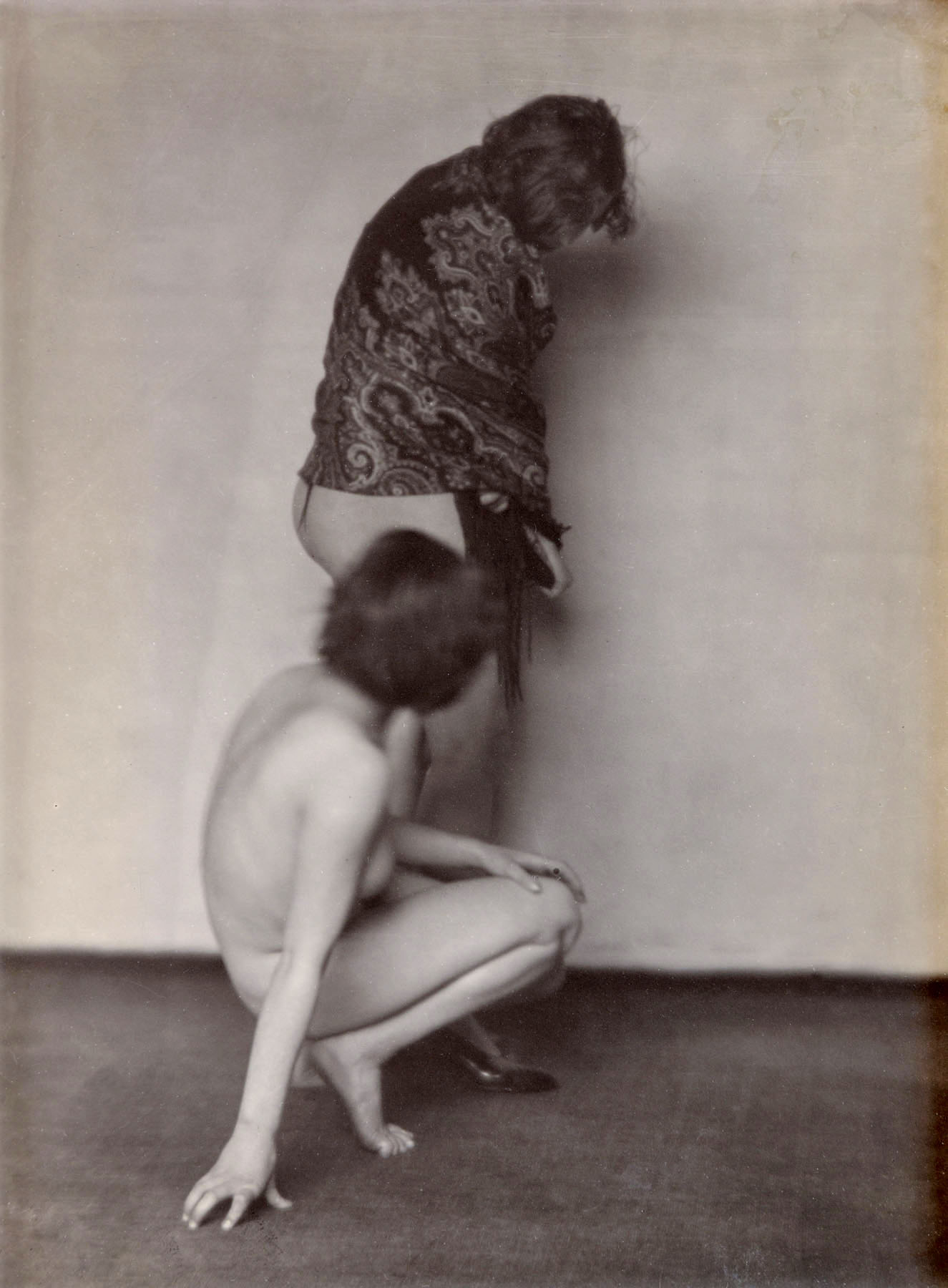
 

Germaine Krull (German, French, and Dutch, Brazil, Republic of the Congo, Thailand and India, 1897-1985) 'Ohne Titel (Studie für "Der Akt")' (Untitled (Study for "The Nude")) 1924


Germaine Krull (German, French, and Dutch, Brazil, Republic of the Congo, Thailand and India, 1897-1985)
Ohne Titel (Studie für “Der Akt”) (Untitled (Study for “The Nude”))
1924
Gelatin silver print
Image: 22.23 x 16.51cm (8 3/4 x 6 1/2 in.)
Frame: 50.8 x 40.64cm (20 x 16 in.)
Frame (outer): 53.34 x 43.18cm (21 x 17 in.)
Trish and Jan de Bont


Germaine Krull’s Queer Vision

The photographer Germaine Krull is little known outside of specialist circles today, but in 1928 she was the toast of Paris. Her avant-garde photographs of the city filled the pages of VU, a magazine known for its dynamic spreads and modern, bold aesthetic. Krull was one of its signature photographers. She shot sailors on the docks, piles of curios at the flea market, dancers at the Moulin Rouge. As both photojournalist and art photographer, Krull was one of the leading lights of the Parisian photography scene. Her pictures hung in the Salon de l’Escalier, a major exhibition of modernist photography, and over the next few years, her work featured in exhibitions across Europe. By 1931, the cultural critic Walter Benjamin used Krull as an example of photography’s potential in his celebrated essay “Little History of Photography.”1

Krull, born in Posen (then Germany, now Poznán, Poland), wound up in Paris after an itinerant childhood, a few years’ study of photography in Munich, and a series of political embroilments that sound like the stuff of fiction. Banned from Bavaria for aiding a Bolshevik emissary’s attempted escape through the Alps, she was later deported from the Soviet Union as a supposed counterrevolutionary.

After a stint in Berlin, where she ran her own photography studio, she made her way to Paris. There, she published her photo book Métal in 1928 and began to receive attention alongside other practitioners of new, assertively modern photographic styles such as Man Ray and André Kertész.

With Métal, Krull turned her lens on the soaring structures of industrial Europe: Rotterdam’s railroad bridge De Hef, Marseille’s Pont Transbordeur, a number of nameless industrial cranes, factory machinery, and, most recognizably, the Eiffel Tower.2 The portfolio bore the subtitle “métaux nus” (bare metals), and critics have often likened these metallic bodies to the nude photographs she made around the same time. In both cases, Krull got close to her subjects, dislocating them from their environments. In Métal, Krull rendered the familiar form of the Eiffel Tower nearly unrecognizable. She tended to shoot the tower from beneath, its iron lattices stretching vertiginously upward, such that the monument’s iconic shape is lost.

In an untitled nude photograph from 1928 or ’29, she deployed a similar approach, keeping the camera fixed on an unclothed torso twisting off toward the edge of the frame with upturned face cut off at mid-cheek. The dramatic play of shadow and light renders the figure’s gender indistinct. Whether focused on a living subject or an architectural one, Krull’s camera resists the viewer’s urge to name and categorize.

Before Krull became a famous Parisian photojournalist, she made a series of enigmatic pictures of female couples. In 1924, while living in Berlin, Krull shot a portfolio of eleven photographs entitled Les amies (French for “the friends,” specifically denoting female friends). The photographs depict a pair of women in stages of gradual undress, eventually left only in their stockings, the rest of their flesh laid bare. In the narrative that unfolds from image to image, the two women move between sofa and floor: the shape of their union shifts but their bodies remain interlocked. The images were risqué enough that they received little attention during Krull’s lifetime – perhaps a bit too lewd for fine art display, and yet not quite pornographic either. Certainly though, these photographs are representations of queer desire; they were made by an artist who desired women herself.

In her memoirs, Krull describes the relationship she had with a woman (perhaps pseudonymously) referred to as “Elsa,” noting, “We would have laughed if someone had labeled us lesbians.” At the time, Krull and Elsa were both married to men, and Krull frames the affair as an exception. She calls Elsa “the only woman I have loved and who has loved me.” In another passage, she seems to contradict herself, stating, “I never loved a woman.” But she does not altogether dismiss this relationship: “With Elsa, the joy of feeling united was so great. … She was so much mine that the physical question did not count.”3

One of the Les amies photographs in The Met collection shows two women wrapped in an amorous knot, so engaged in their pursuit of pleasure that their faces remain almost entirely obscured. This elision of the models’ faces is, perhaps, an effect of modesty or concealing their identity, but it also produces a sense of intense absorption in the sexual act – despite performing for a camera, the two women seem concerned only with each other. The photographs offer a vision of queer feminine sexuality in its most visible form.

Krull’s straightforward depiction of these female lovers is all the more striking given that she took these photographs at a time when lesbians were often imagined to be invisible – or at the very least, imperceptible. In the interwar years of the 1920s and ’30s, and especially in France, anxieties ran high about precisely this problem. If lesbians could not be identified on sight, how could they be apprehended? How could the dangers of rampant female sexuality be curtailed with lesbians walking around Paris in plain sight, undetected? These worries occupied novelists, social scientists, and sexologists alike, as Carolyn J. Dean describes in her book, The Frail Social Body.4

Krull, unlike her (largely male) contemporaries, seems to have had no trouble locating queer female sexuality, or representing it. On the contrary, the Les amies photographs adopt a direct, frontal view of the two lovers. Krull’s models become almost indistinguishable over the course of the series. This compositional strategy suggests a particularly queer eroticization of sameness, very different from the conception of a butch-femme dyad imaged by Krull’s contemporary Brassaï in his photographs of the Parisian lesbian bar Le Monocle. But the representation of queerness as a kind of doubling accords with popular French conceptions of the so-called sapphist as a “female Narcissus,” as Nicole Albert puts it in her 2005 study of the lesbian phantasm at the fin-de-siècle, Lesbian Decadence.5

Just as Narcissus gazed upon his own likeness, the lesbian often appeared in popular representations gazing upon another woman as a kind of mirror image of herself. Mirrors, long linked with feminine vanity, became a convenient shorthand for the idea that lesbian desire is the ultimate narcissism. This allowed for artists and writers to simultaneously denounce sexual immorality and the eroticization of that sin. Contemporary illustrations in magazines and advertisements, for instance, offered up sensuous sights of women embracing through, near, or against mirrors. The mirror’s reflection plays up the autoeroticism of self-regard, and supposedly of sapphism itself. Meanwhile, literary accounts of lesbianism in the interwar period frequently staged scenes of erotic encounters in mirrored rooms.6 Such spaces – be they brothels, nightclubs, or private bedrooms – facilitated both voyeurism and spatial disorientation.

Nor was sapphism the mirror’s only resonance in the 1920s. Contemporary critics frequently compared photography to a mirror. The poet and polymath Jean Cocteau, for instance, told Krull of her art: “You are a reforming mirror. You and the darkroom [chambre noire] obtain a new world, a world that has passed through [the camera’s] workings and a soul.”7 Here, he plays upon the double meaning present in the French “chambre noire,” which refers at once to the literal darkroom where photographs are developed and to the camera obscura, which we might think of as a stand-in for the enterprise of photography itself. As Cocteau would have it, Krull herself was the mirror, not photography. Armed with her camera, she had the power not only to depict reality but to transform it.”

Marina Molarsky-Beck. “Germaine Krull’s Queer Vision,” on The Met website August 17 2021 [Online] Cited 15/12/2021


Footnotes

1/ Walter W. Benjamin, “Little History of Photography,” in Selected Writings: 1927-1934, ed. Howard Eiland, Michael W. Jennings, and Gary Smith, trans. Rodney Livingstone (Cambridge, M.A.: Harvard University Press, 1996), 507-528

2/ Kim Sichel, Making Strange: The Modernist Photobook in France (New Haven: Yale University Press, 2020), 19

3/ Germaine Krull, La vie mène la danse, ed. Françoise Denoyelle (Textuel, 2015), 179-180

4/ Carolyn J. Dean, The Frail Social Body: Pornography, Homosexuality, and Other Fantasies in Interwar France (Berkeley, C.A.: University of California Press, 2000)

5/ Nicole G. Albert, Lesbian Decadence: Representations in Art and Literature of Fin-de-Siècle France, trans. Nancy Erber and William A. Peniston (New York: Columbia University Press, 2016), 241-242. Originally published as Albert, Saphisme et décadence dans Paris fin-de-siècle (Paris: Martinière, 2005)

6/ Dean, The Frail Social Body, 193

7/ “Vous êtes un miroir reformant. Vous et la chambre noire obtenez un monde neuf, un monde qui a traversé des mécanismes et une âme.” Jean Cocteau, Jean Cocteau to Germaine Krull, April 1930. Quoted in Pierre MacOrlan, Germaine Krull (Paris: Librairie Gallimard, 1931), 16
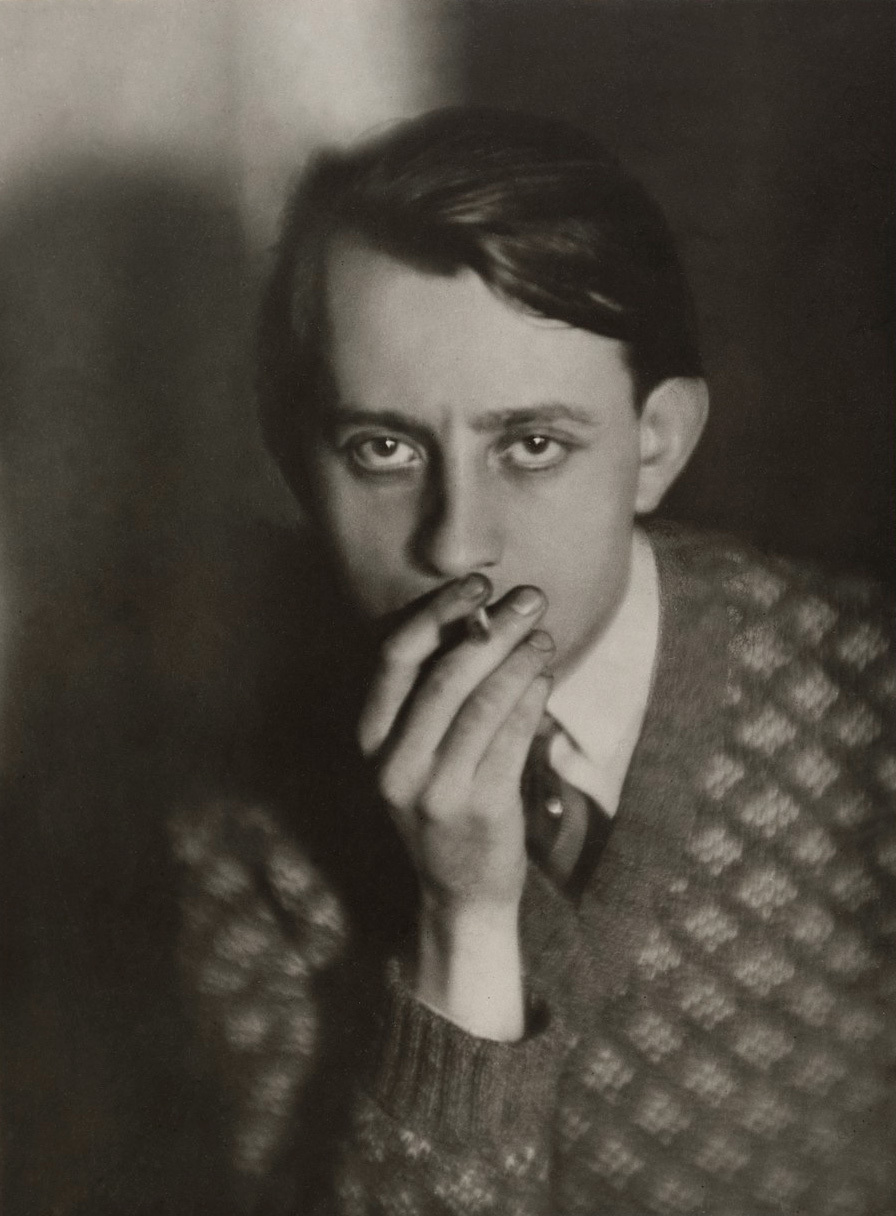
 

Germaine Krull (German, French, and Dutch, Brazil, Republic of the Congo, Thailand and India, 1897-1985) 'André Malraux' 1930


Germaine Krull (German, French, and Dutch, Brazil, Republic of the Congo, Thailand and India, 1897-1985)
André Malraux
1930
Gelatin silver print
Image: 22.5 x 16cm (8 7/8 x 6 5/16 in.)
Mount: 29.1 x 22.8cm (11 7/16 x 9 in.)
Frame: 45.72 x 35.56cm (18 x 14 in.)
Frame (outer): 49.53 x 39.37cm (19 1/2 x 15 1/2 in.)
National Gallery of Art, Washington, R. K. Mellon Family Foundation
© Estate Germaine Krull, Museum Folkwang, Essen


Germaine Krull (German, French, and Dutch, Brazil, Republic of the Congo, Thailand and India, 1897-1985) 'Selbstporträt mit Icarette' (Self-Portrait with Icarette) c. 1925, printed 1978


Germaine Krull (German, French, and Dutch, Brazil, Republic of the Congo, Thailand and India, 1897-1985)
Selbstporträt mit Icarette (Self-Portrait with Icarette)
c. 1925, printed 1978
Gelatin silver print sheet: 30.8 x 24.3cm (12 1/8 x 9 9/16 in.)
Image: 23.3 x 17.3cm (9 3/16 x 6 13/16 in.)
Frame: 50.8 x 40.64cm (20 x 16 in.)
Frame (outer): 53.34 x 43.18cm (21 x 17 in.)
Department of Image Collections, National Gallery of Art Library © Estate Germaine Krull, Museum Folkwang, Essen


During the 1920s, the iconic New Woman was splashed across the pages of magazines and projected on the silver screen. As a global phenomenon, she embodied an ideal of female empowerment based on real women making revolutionary changes in life and art. Featuring more than 120 photographers from over 20 countries, the groundbreaking exhibition, The New Woman Behind the Camera, explores the diverse “new” women who embraced photography as a mode of professional and personal expression from the 1920s to the 1950s. The first exhibition to take an international approach to the subject, it examines how women brought their own perspectives to artistic experimentation, studio portraiture, fashion and advertising work, scenes of urban life, ethnography, and photojournalism, profoundly shaping the medium during a time of tremendous social and political change. Accompanied by a fully illustrated catalogue, this landmark exhibition will be on view from October 31, 2021 through January 30, 2022, in the West Building of the National Gallery of Art, Washington. It was previously on view at The Metropolitan Museum of Art, New York, from July 2 through October 3, 2021.

In an era when traditional definitions of womanhood were being questioned, women’s lives were a mix of emancipating and confining experiences that varied by country. Many women around the world found the camera to be a means of independence as they sought to redefine their positions in society and expand their rights. This exhibition presents a geographically, culturally, and artistically diverse range of practitioners to advance new conversations about the history of modern photography and the continual struggle of women to gain creative agency and self-representation.

“This innovative exhibition reevaluates the history of modern photography through the lens of the New Woman, a feminist ideal that emerged at the end of the 19th century and spread globally during the first half of the 20th century,” said Kaywin Feldman, director, National Gallery of Art. “The transnational realities of modernism visualised in photography by women such as Lola Álvarez Bravo, Berenice Abbott, Claude Cahun, Germaine Krull, Dorothea Lange, Niu Weiyu, Tsuneko Sasamoto, and Homai Vyarawalla offer us an opportunity to better understand the present by becoming more fully informed of the past.”

About the exhibition

This landmark exhibition critically examines the extraordinary impact women had on the practice of photography worldwide from the 1920s to the 1950s. It presents the work of over 120 international photographers who took part in a dramatic expansion of the medium propelled by artistic creativity, technological innovation, and the rise of the printed press. Photographers such as Berenice Abbott, Ilse Bing, Lola Álvarez Bravo, Madame d’Ora, Florence Henri, Elizaveta Ignatovich, Germaine Krull, Dorothea Lange, Dora Maar, Niu Weiyu, Eslanda Goode Robeson, Tsuneko Sasamoto, Gerda Taro, and Homai Vyarawalla, among many others, emerged at a tumultuous moment in history that was profoundly shaped by two world wars, a global economic depression, struggles for decolonisation, and the rise of fascism and communism. Against the odds, these women were at the forefront of experimentation with the camera and produced invaluable visual testimony that reflects both their personal experiences and the extraordinary social and political transformations of the era.

Organised thematically in eight galleries, The New Woman Behind the Camera illustrates women’s groundbreaking work in modern photography, exploring their innovations in the fields of social documentary, avant-garde experimentation, commercial studio practice, photojournalism, ethnography, and the recording of sports, dance, and fashion. By evoking the global phenomenon of the New Woman, the exhibition seeks to reevaluate the history of photography and advance new and more inclusive conversations on the contributions of female photographers.

Known by different names, from nouvelle femme and neue Frau to modan gāru and xin nüxing, the New Woman was easy to recognise but hard to define. Fashionably dressed with her hair bobbed, the self-assured cosmopolitan New Woman was arguably more than a marketable image. She was a contested symbol of liberation from traditional gender roles. Revealing how women photographers from around the world gave rise to and embodied the quintessential New Woman even as they critiqued the popular construction of the role, the exhibition opens with a group of compelling portraits and self-portraits. In these works, women defined their positions as professionals and artists during a time when they were seeking greater personal rights and freedoms.

For many women, the camera became an effective tool for self-determination as well as a source of income. With better access to education and a newfound independence, female photographers emerged as a major force in studio photography. From running successful businesses in Berlin, Buenos Aires, London, and Vienna, to earning recognition as one of the first professional female photographers in their home country, women around the world, including Karimeh Abbud, Steffi Brandl, Trude Fleischmann, Annemarie Heinrich, Eiko Yamazawa, and Madame Yevonde, reinvigorated studio practice. A collaborative space where both sitters and photographers negotiated gender, race, and cultural difference, the portrait studio was also vitally important to African American communities which sought to represent and define themselves within a society that continued to be plagued by racism. Photography studios run by Black women, such as Florestine Perrault Collins and Winifred Hall Allen, thrived throughout the United States, and not only preserved likenesses and memories, but also constructed a counter narrative to the stereotyping images that circulated in the mass media.

With the invention of smaller lightweight cameras, a growing number of women photographers found that the camera’s portability created new avenues of discovery outside the studio. In stunning photographs of the city, photographers such as Alice Brill, Rebecca Lepkoff, Helen Levitt, Lisette Model, Genevieve Naylor, and Tazue Satō Matsunaga used their artistic vision to capture the exhilarating modern world around them. They depicted everyday life, spontaneous encounters on the street, and soaring architectural views in places like Bombay (now Mumbai), New York, Paris, São Paulo, and Tokyo, revealing the multiplicity of urban experience. Many incorporated the newest photographic techniques to convey the energy of the city, and the exhibition continues with a gallery focused on those radical formal approaches that came to define modern photography. Through techniques like photomontage, photograms, sharp contrasts of light and shadow, extreme cropping, and dizzying camera angles, women including Aenne Biermann, Imogen Cunningham, Dora Maar, Tina Modotti, Lucia Moholy, and Cami Stone pushed the boundaries of the medium.

Women also produced dynamic pictures of the modern body, including innovative nude studies as well as sport and dance photography. Around the world, participation in spectator and team sports increased along with membership in fitness and hygiene reform movements. New concepts concerning health and sexuality along with new attitudes in movement and dress emphasised the body as a central site of experiencing modernity. On view are luminous works by photographers Laure Albin Guillot, Yvonne Chevalier, Florence Henri, and Jeanne Mandello who reimagined the traditional genre of the nude. Photographs by Irene Bayer-Hecht and Liselotte Grschebina highlight joyous play and gymnastic exercise, while Charlotte Rudolph, Ilse Bing, Trude Fleischmann, and Lotte Jacobi made breathtaking images of dancers in motion, revealing the body as artistic medium.

During the modern period, a growing number of women pursued professional photographic careers and traveled widely for the first time. Many took photographs that documented their experiences abroad and interactions with other cultures as they engaged in formal and informal ethnographic projects. The exhibition continues with a selection of photographs and photobooks by women, mainly from Europe and the United States, that reveal a diversity of perspectives and approaches. Gender provided some of these photographers with unusual access and the drive to challenge discriminatory practices, while others were not exempt from portraying stereotypical views. Publications by Jette Bang, Hélène Hoppenot, Ella Maillart, Anna Riwkin, Eslanda Goode Robeson, and Ellen Thorbecke exemplify how photographically illustrated books and magazines were an influential form of communication about travel and ethnography during the modern period. Other works on display include those by Denise Bellon and Ré Soupault, who traveled to foreign countries on assignment for magazines and photo agencies seeking ethnographic and newsworthy photographs, and those by Marjorie Content and Laura Gilpin, who worked on their own in the southwestern United States.

The New Woman – both as a mass-circulating image and as a social phenomenon – was confirmed by the explosion of photographs found in popular fashion and lifestyle magazines. Fashion and advertising photography allowed many women to gain unprecedented access to the public sphere, establish relative economic independence, and attain autonomous professional success. Producing a rich visual language where events and ideas were expressed directly in pictures, illustrated fashion magazines such as Die DameHarper’s Bazaar, and Vogue became an important venue for photographic experimentation by women for a female readership. Photographers producing original views of women’s modernity include Lillian Bassman, Ilse Bing, Louise Dahl-Wolfe, Toni Frissell, Toni von Horn, Frances McLaughlin-Gill, ringl + pit, Margaret Watkins, Caroline Whiting Fellows, and Yva.

The rise of the picture press also established photojournalism and social documentary as dominant forms of visual expression during the modern period. Ignited by the effects of a global economic crisis and growing political and social unrest, numerous women photographers including Lucy Ashjian, Margaret Bourke-White, Kati Horna, Elizaveta Ignatovich, Kata Kálmán, Dorothea Lange, and Hansel Mieth engaged a wide public with gripping images. So-called soft topics such as “women and children,” “the family,” and “the home front” were more often assigned to female photojournalists than to their male counterparts. The exhibition asks viewers to question the effect of having women behind the camera in these settings. Pictures produced during the war, from combat photography by Galina Sanko and Gerda Taro to images of the Blitz in London by Thérèse Bonney and the Tuskegee airmen by Toni Frissell, are also featured. At the war’s end, haunting images by Lee Miller of the opening of Nazi concentration camps and celebratory images of the victory parade of Allied Forces in New Delhi by Homai Vyarawalla made way for the transition to the complexities of the postwar era, including images of daily life in US-occupied Japan by Tsuneko Sasamoto and the newly formed People’s Republic of China by Hou Bo and Niu Weiyu.

The New Woman Behind the Camera acknowledges that women are a diverse group whose identities are defined not exclusively by gender but rather by a host of variable factors. It contends that gender is an important aspect in understanding their lives and work and provides a useful framework for analysis to reveal how photography by women has powerfully shaped our understanding of modern life.

Exhibition catalog

Published by the National Gallery of Art, Washington and distributed by DelMonico Books | D.A.P., this groundbreaking, richly illustrated 288-page catalog examines the diverse women whose work profoundly marked the medium of photography from the 1920s to the 1950s. The book – featuring over 120 international photographers, including Lola Álvarez Bravo, Elizaveta Ignatovich, Germaine Krull, Dorothea Lange, Tsuneko Sasamoto, and Homai Vyarawalla – reevaluates the history of modern photography through the lens of the iconic New Woman. Inclusive scholarly essays introduce readers to these important photographers and question the past assumptions about gender in the history of photography. Contributors include Andrea Nelson, associate curator in the department of photographs, National Gallery of Art; Elizabeth Cronin, assistant curator of photography in the Miriam and Ira D. Wallach Division of Art, Prints, and Photographs, New York Public Library; Mia Fineman, curator in the department of photographs, Metropolitan Museum of Art; Mila Ganeva, professor of German in the department of German, Russian, Asian, and Middle Eastern languages and cultures, Miami University, Ohio; Kristen Gresh, Estrellita and Yousuf Karsh Senior Curator of Photographs, Museum of Fine Arts, Boston; Elizabeth Otto, professor of modern and  contemporary art history, University at Buffalo (The State University of New York); and Kim Sichel, associate professor in the department of the history of art and architecture at Boston University; biographies of the photographers by Kara Felt, Andrew W. Mellon postdoctoral fellow in the department of photographs, National Gallery of Art.

Press release from the National Gallery of Art
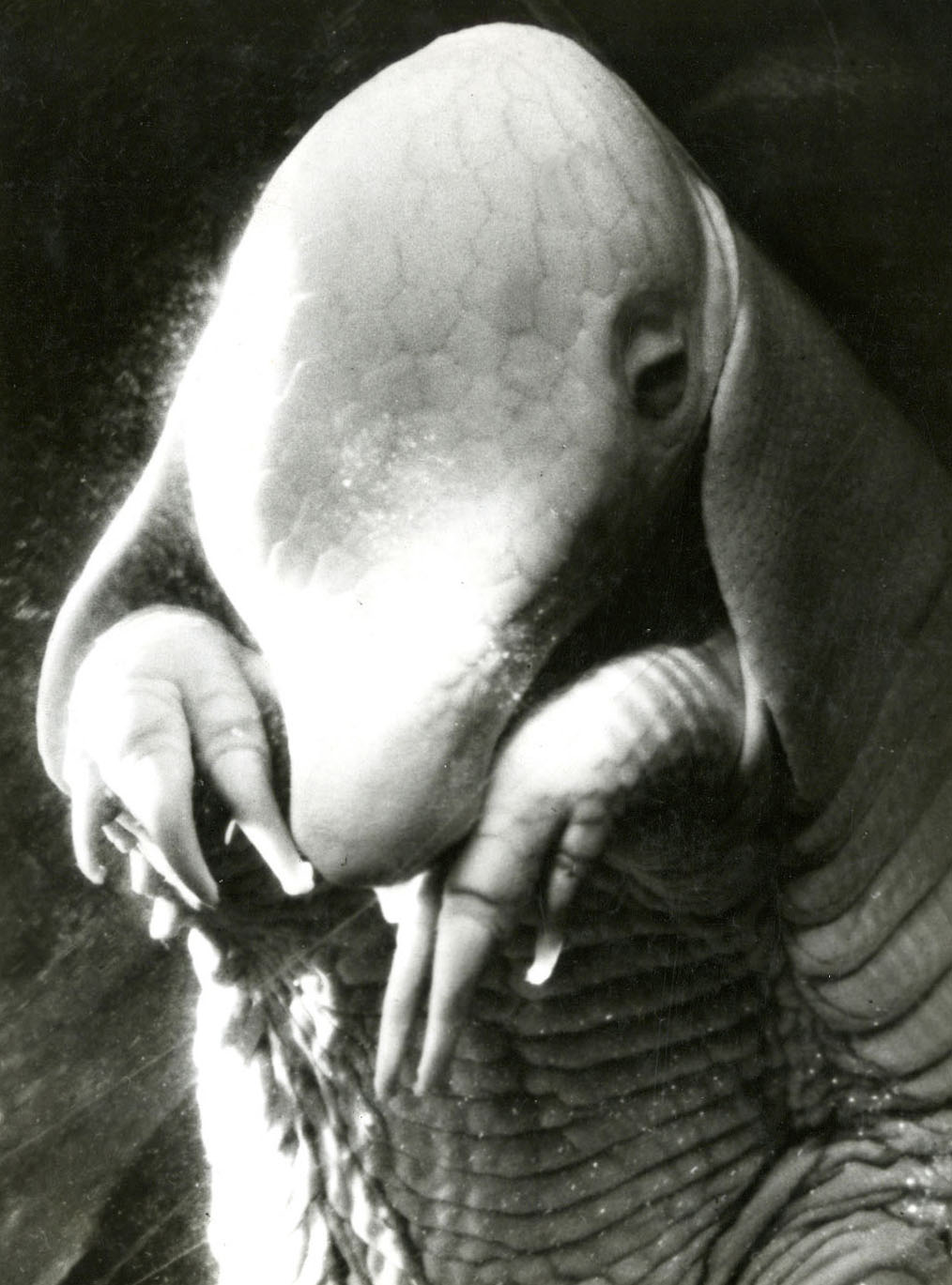
 

Dora Maar (French, 1907-1997) 'Père Ubu' (Portrait of Ubu) 1936


Dora Maar (French, 1907-1997)
Père Ubu (Portrait of Ubu)
1936
Gelatin silver print
Image: 24.13 x 17.78cm (9 1/2 x 7 in.)
Framed (outer): 40.01 x 33.66 x 2.86cm (15 3/4 x 13 1/4 x 1 1/8 in.)
National Gallery of Art, Washington, Gift of J. Patrick and Patricia A. Kennedy
© 2020 Artists Rights Society (ARS), New York / ADAGP, Paris


Portrait of Ubu (1936; also called Père Ubu), a monstrous close-up image by Maar of what may be an armadillo fetus (she would never confirm), became an icon of the movement.


Dora Maar (French, 1907-1997)

Henriette Theodora Markovitch (22 November 1907 – 16 July 1997), known as Dora Maar, was a French photographer, painter, and poet. A love partner of Pablo Picasso, Maar was depicted in a number of Picasso’s paintings, including his Portrait of Dora Maar and Dora Maar au Chat.

Dora Maar the photographer

Maar’s earliest surviving photographs were taken in the early 1920s with a Rolleiflex camera while on a cargo ship going to the Cape Verde Islands.

At the beginning of 1930, she set up a photography studio on rue Campagne-Première (14th arrondissement of Paris) with Pierre Kéfer, photographer, and decorator for Jean Epstein’s 1928 film, The Fall of the House of Usher. In the studio, Maar and Kefer worked together mostly on commercial photography for advertisements and fashion magazines. Her father assisted with her finances in this period of her life as she was establishing herself while trying to earn a living. The studio displayed fashion, advertising and nudes, and it became very successful.

She met the photographer Brassaï with whom she shared the darkroom in the studio. Brassai once said that she had “bright eyes and an attentive gaze, a disturbing stare at times”.

During this time working in advertising and fashion photography, the influence of Surrealism could be seen in her work through her heavy use of mirrors and contrasting shadows. She felt that art should represent the content of reality through links with intuitions or ideas, rather than visually reproduce the natural. Maar also met Louis-Victor Emmanuel Sougez, a photographer working for advertising, archeology and artistic director of the newspaper L’Illustration, whom she considered a mentor.

In 1932, she had an affair with the filmmaker Louis Chavance. Maar frequented the “October group”, formed around Jacques Prévert and Max Morise after their break from surrealism. She had her first publication in the magazine Art et Métiers Graphiques in 1932. Her first solo exhibition was held at the Galerie Vanderberg in Paris.

It is the gelatin silver works of the surrealist period that remain the most sought after by admirers: Portrait of Ubu (1936), 29 rue d’Astorg, black and white, collages, photomontages or superimpositions. The photograph represents the central character in a popular series of plays by Alfred Jarry called Ubu Roi. The work was first shown at the Exposition Surréaliste d’objets at the Galerie Charles Ratton in Paris and at the International Surrealist Exhibition in London in 1936. She also participated in Participates in Fantastic Art, Dada, Surrealism, at the MoMA in New York the same year.

Surrealist concepts and interests often aligned with the ideas of the political left of the time and so Maar became very politically active at this point in her life. After the fascist demonstrations of 6 February 1934, in Paris along with René Lefeuvre, Jacques Soustelle, supported by Simone Weil and Georges Bataille, she signed the tract “Appeal to the Struggle” written at the initiative of André Breton. Much of her work is highly influenced by leftist politics of the time, often depicting those who had been thrown into poverty by the Depression. She was part of an ultra-leftist association called “Masses”, where she first met Georges Bataille, an anti-fascist organisation called the Union of Intellectuals Against Fascism, and a radical collective of left-wing actors and writers called October.

She also was involved in many Surrealist groups and often participated in demonstrations, convocations, and cafe conversations. She signed many manifestos, including one titled “When Surrealists were Right” in August 1935 which concerned the Congress of Paris, which had been held in March of that year.

In 1935, she took a photo of fashion illustrator and designer Christian Berard that was described by writer and critic Michael Kimmelman as “wry and mischievous with only his head perceived above the fountain as if he were John the Baptist on a silver platter”.

Text from the Wikipedia website
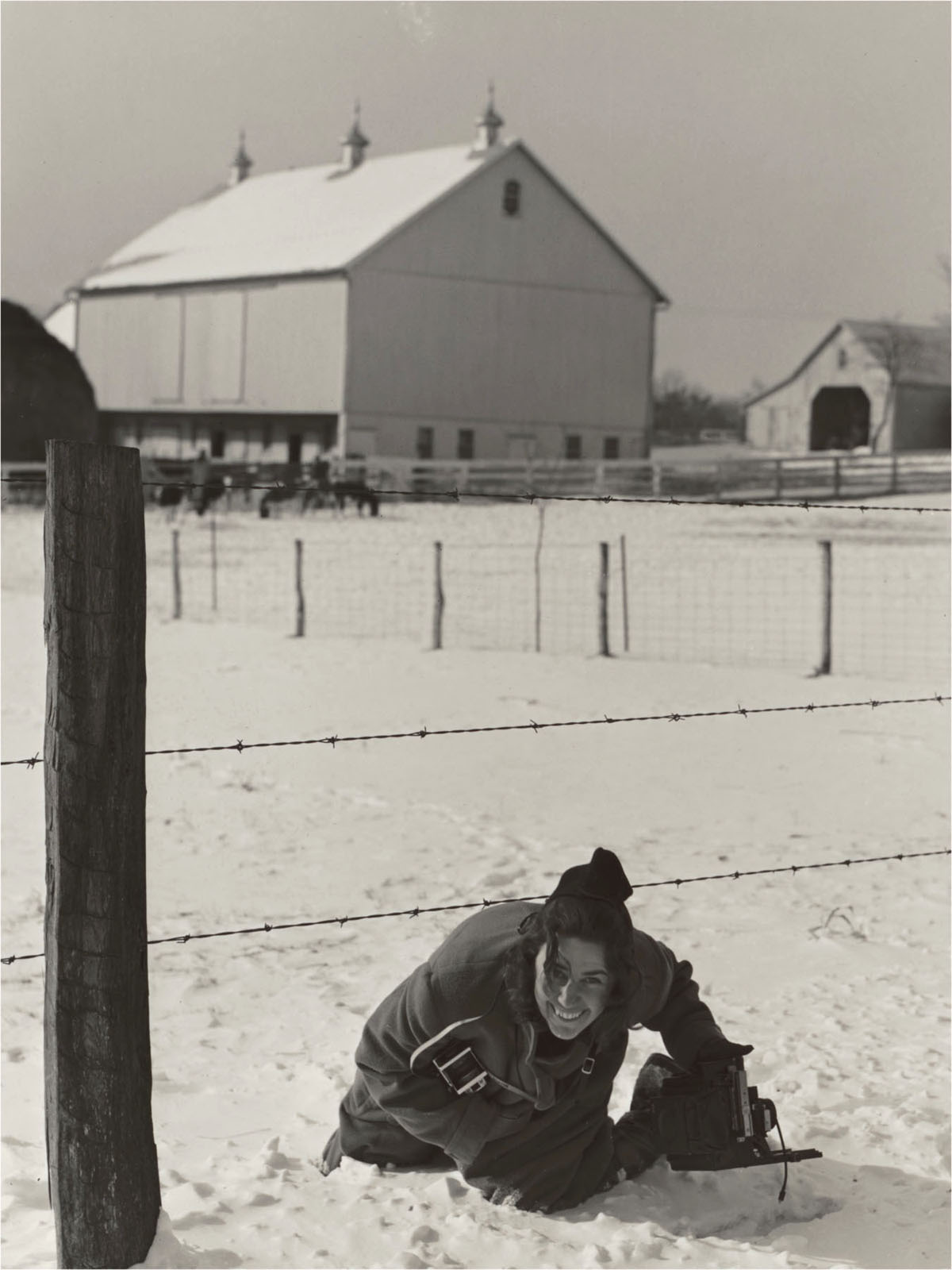
 

Arthur Rothstein (American, 1915-1985) 'Untitled (Marion Post Wolcott on assignment, Montgomery County, Maryland)' 1940


Arthur Rothstein (American, 1915-1985)
Untitled (Marion Post Wolcott on assignment, Montgomery County, Maryland)
1940
Gelatin silver print
Image: 22.86 x 17.4cm (9 x 6 7/8 in.)
Sheet: 25.2 x 20.2cm (9 15/16 x 7 15/16 in.)
Frame (outer): 50.48 x 37.78cm (19 7/8 x 14 7/8 in.)
The J. Paul Getty Museum, Los Angeles

Marion Post Wolcott with Rolleiflex and Speed Graphic in hand in Montgomery County, Maryland


Marion Post (June 7, 1910 – November 24, 1990)

Marion Post (June 7, 1910 – November 24, 1990), later Marion Post Wolcott, was a noted American photographer who worked for the Farm Security Administration during the Great Depression documenting poverty and deprivation. …

Life

Marion Post was born in New Jersey on June 7, 1910. Her parents split up and she was sent to boarding school, spending time at home with her mother in Greenwich Village when not at school. Here she met many artists and musicians and became interested in dance. She studied at The New School.

Post trained as a teacher, and went to work in a small town in Massachusetts. Here she saw the reality of the Depression and the problems of the poor. When the school closed she went to Europe to study with her sister Helen. Helen was studying with Trude Fleischmann, a Viennese photographer. Marion Post showed Fleischmann some of her photographs and was told to stick to photography.

While in Vienna she saw some of the Nazi attacks on the Jewish population and was horrified. Soon she and her sister had to return to America for safety. She went back to teaching but also continued her photography and became involved in the anti-fascist movement. At the New York Photo League she met Ralph Steiner and Paul Strand who encouraged her. When she found that the Philadelphia Evening Bulletin kept sending her to do “ladies’ stories”, Ralph Steiner took her portfolio to show Roy Stryker, head of the Farm Security Administration, and Paul Strand wrote a letter of recommendation. Stryker was impressed by her work and hired her immediately.

Post’s photographs for the FSA often explore the political aspects of poverty and deprivation. They also often find humour in the situations she encountered.

In 1941 she met Leon Oliver Wolcott, deputy director of war relations for the U. S. Department of Agriculture under Franklin Roosevelt. They married, and Marion Post Wolcott continued her assignments for the FSA, but resigned shortly thereafter in February 1942. Wolcott found it difficult to fit in her photography around raising a family and a great deal of traveling and living overseas.

In the 1970s, a renewed interest in Wolcott’s images among scholars rekindled her own interest in photography. In 1978, Wolcott mounted her first solo exhibition in California, and by the 1980s the Smithsonian and the Metropolitan Museum of Art began to collect her photographs. The first monograph on Marion Post Wolcott’s work was published in 1983. Wolcott was an advocate for women’s rights; in 1986, Wolcott said: “Women have come a long way, but not far enough. … Speak with your images from your heart and soul” (Women in Photography Conference, Syracuse, N.Y.).

Marion Post Wolcott’s work is archived at the Center for Creative Photography at the University of Arizona in Tucson, Arizona.

Text from the Wikipedia website


Arthur Rothstein (July 17, 1915 – November 11, 1985) was an American photographer. Rothstein is recognised as one of America’s premier photojournalists. During a career that spanned five decades, he provoked, entertained and informed the American people. His photographs ranged from a hometown baseball game to the drama of war, from struggling rural farmers to US Presidents.
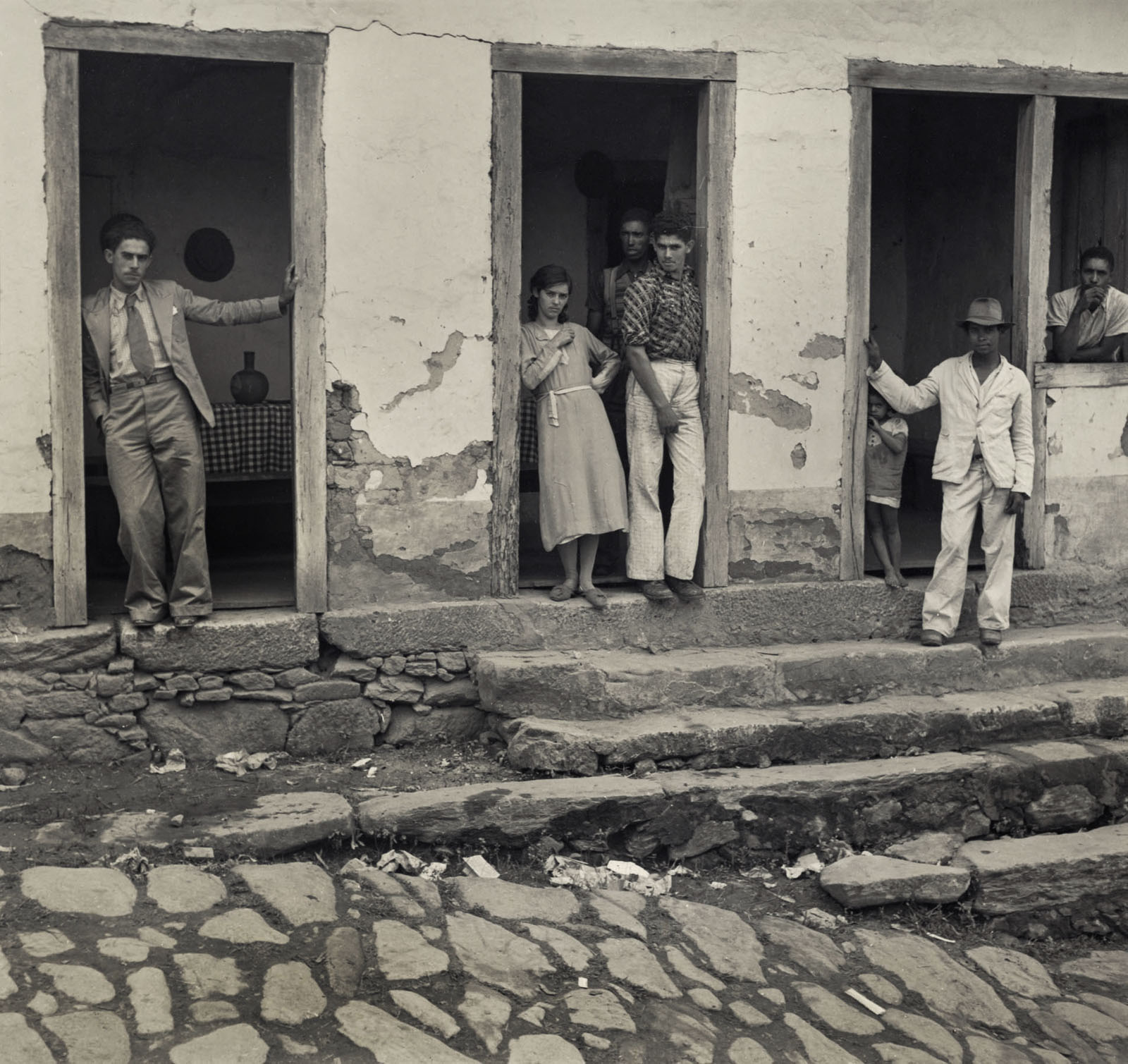
 

Genevieve Naylor (American, 1915-1989) 'A Café, Brazil' Early 1940s


Genevieve Naylor (American, 1915-1989)
A Café, Brazil
Early 1940s
Gelatin silver print
Image/sheet: 16.51 x 17.78cm (6 1/2 x 7 in.)
Frame: 35.56 x 45.72cm (14 x 18 in.)
Frame (outer): 38.1 x 48.26 cm (15 x 19 in.)
National Gallery of Art, Washington, Alfred H. Moses and Fern M. Schad Fund


Genevieve Naylor (American, 1915-1989)

Genevieve Naylor (February 2, 1915 – July 21, 1989) was an American photographer and photojournalist, best known for her photographs of Brazil and as Eleanor Roosevelt’s personal photographer. …

Career

At the age of 22, in 1937, Naylor was chosen by Holger Cahill of the Works Progress Administration (WPA) as a photographer for the Harlem Arts Center. She also worked for the WPA in New Hampshire, Pennsylvania, Washington D.C., and New York. She then worked for the Associated Press and was one of the first women photojournalists to be hired by any American news wire services.

In 1940, Genevieve Naylor was assigned by the U.S. State department as part of a team to travel to Brazil. In an effort to further and strengthen the anti-Nazi relationship between the United States and Brazil and to promote mutual cultural awareness, the U.S. Office of Inter-American Affairs, under the leadership of Nelson Rockefeller, created a team of notable Americans that included Orson Welles, Errol Flynn, and Walt Disney. Genevieve Naylor and her partner (and later husband) Misha Reznikoff arrived in Brazil in October, 1940, where he showed his paintings while Miss Naylor took photographs. Naylor’s assignment was to document Brazil’s progress toward becoming a modern nation, capture images that would boost war-time morale, foster cultural interchange, and promote the Allied cause. But Naylor, with her energetic and outgoing personality, soon ventured into other milieus, taking photographs of Brazilian workers jammed into trams, school children, religious and street festivals, and various aspects of everyday lives. Because it was war time, film was rationed, and Naylor’s equipment was modest. She had neither flash nor studio lights and had to carefully choose her shots, balancing spontaneity with careful composition. Of her work, nearly 1,350 photos survived and were preserved. After her return to the states in 1943, Naylor become only the second woman photographer to be given a one-woman show when her work was exhibited by New York’s Museum of Modern Art.

Naylor later spent 15 years as a photographer with Harper’s Bazaar and from 1944 to 1980 was a freelance photographer for Vogue, McCall’s, Town and Country, Life, Look, Saturday Evening Post, Women’s Home Companion, Cosmopolitan, Fortune, Collier’s, Glamour, Good Housekeeping, Vanity Fair, Elle, Ladies’ Home Journal, Redbook, House Beautiful, Holiday, Mademoiselle, American Home, Seventeen, Better Homes and Gardens, Charm, Bride’s, amongst others. She was a war time photographer, covering parts of the Korean War for Look magazine.

Text from the Wikipedia website


Genevieve Naylor (American, 1915-1989) 'São Januário Trolley' Early 1940s


Genevieve Naylor (American, 1915-1989)
São Januário Trolley
Early 1940s
Gelatin silver print
Image: 19.05 x 19.05cm (7 1/2 x 7 1/2 in.)
Sheet: 20.32 x 25.4cm (8 x 10 in.)
Frame: 35.56 x 45.72cm (14 x 18 in.)
Frame (outer): 38.1 x 48.26cm (15 x 19 in.)
National Gallery of Art, Washington, Alfred H. Moses and Fern M. Schad Fund


Elfriede Stegemeyer (German, 1908-1988) 'Selbstporträt' (Self-Portrait) 1933


Elfriede Stegemeyer (German, 1908-1988)
Selbstporträt (Self-Portrait)
1933
Gelatin silver print
Image: 23.81 x 17.94cm (9 3/8 x 7 1/16 in.)
Support: 23.81 x 17.94cm (9 3/8 x 7 1/16 in.)
Mat: 50.8 x 40.64cm (20 x 16 in.)
Frame: 50.8 x 40.64cm (20 x 16 in.)
Frame (outer): 51.44 x 41.28 x 3.33cm (20 1/4 x 16 1/4 x 1 5/16 in.)
Los Angeles County Museum of Art, The Audrey and Sydney Irmas Collection


Elfriede Stegemeyer (1908-1988); German photographer, painter and film artist. In a bombing raid on Berlin in 1943, much of her work was destroyed. After the war, she dedicated herself under the pseudonym Elde Steeg increasingly to painting and drawing, and experimented with Surrealist and Constructivist expression. From 1945 she lived and worked under the name Elde Steeg. In 1974 she moved to Innsbruck and worked there until her death.
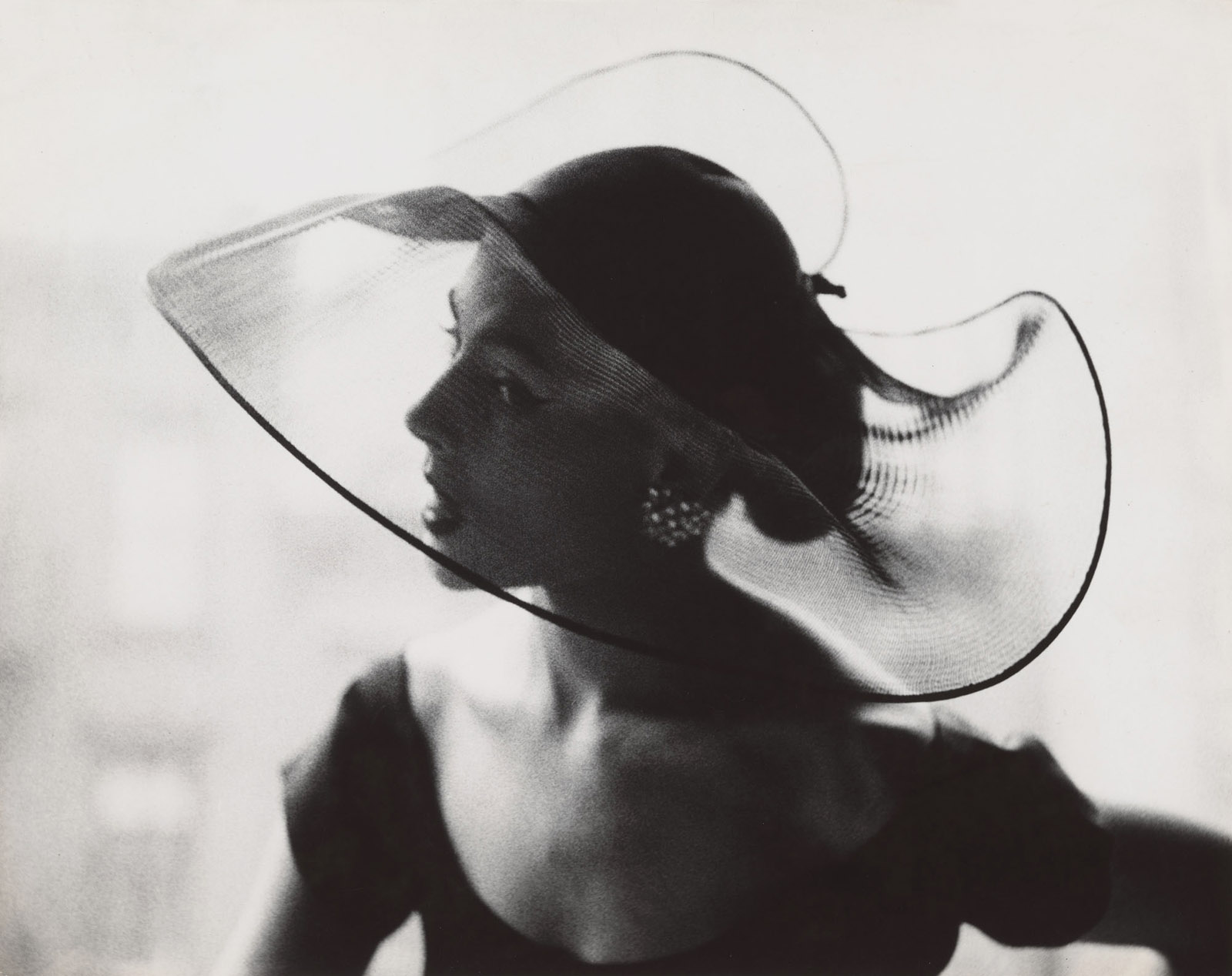
 

Lillian Bassman (American, 1917-2012) 'Translucent Hat' c. 1950


Lillian Bassman (American, 1917-2012)
Translucent Hat
c. 1950
Gelatin silver print
Image/sheet: 26.99 x 34.29cm (10 5/8 x 13 1/2 in.)
Frame: 50.8 x 60.96cm (20 x 24 in.)
Frame (outer): 53.34 x 63.5cm (21 x 25 in.)
National Gallery of Art, Washington, Renee Harbers Liddell Fund and Alfred H. Moses and Fern M. Schad Fund
© Estate of Lilian Bassman


Lillian Bassman (American, 1917-2012)

Lillian Bassman (June 15, 1917 – February 13, 2012) was an American photographer and painter.

Career

From the 1940s until the 1960s Bassman worked as a fashion photographer for Junior Bazaar and later at Harper’s Bazaar where she promoted the careers of photographers such as Richard Avedon, Robert Frank, Louis Faurer and Arnold Newman. Under the guidance of the Russian emigrant, Alexey Brodovitch, she began to photograph her model subjects primarily in black and white. Her work was published for the most part in Harper’s Bazaar from 1950 to 1965.

By the 1970s Bassman’s interest in pure form in her fashion photography was out of vogue. She turned to her own photo projects and abandoned fashion photography. In doing so she tossed out 40 years of negatives and prints – her life’s work. A forgotten bag filled with hundreds of images was discovered over 20 years later. Bassman’s fashion photographic work began to be re-appreciated in the 1990s.

She worked with digital technology and abstract colour photography into her nineties to create a new series of work. She used Photoshop for her image manipulation.

The most notable qualities about her photographic work are the high contrasts between light and dark, the graininess of the finished photos, and the geometric placement and camera angles of the subjects. Bassman became one of the last great woman photographers in the world of fashion. A generation later, Bassman’s pioneering photography and her mentor Alexey Brodovitch’s bold cropping and layout innovations were a seminal influence on Sam Haskins and his black and white work of the sixties.

Bassman died on February 13, 2012, at age 94.

Text from the Wikipedia website
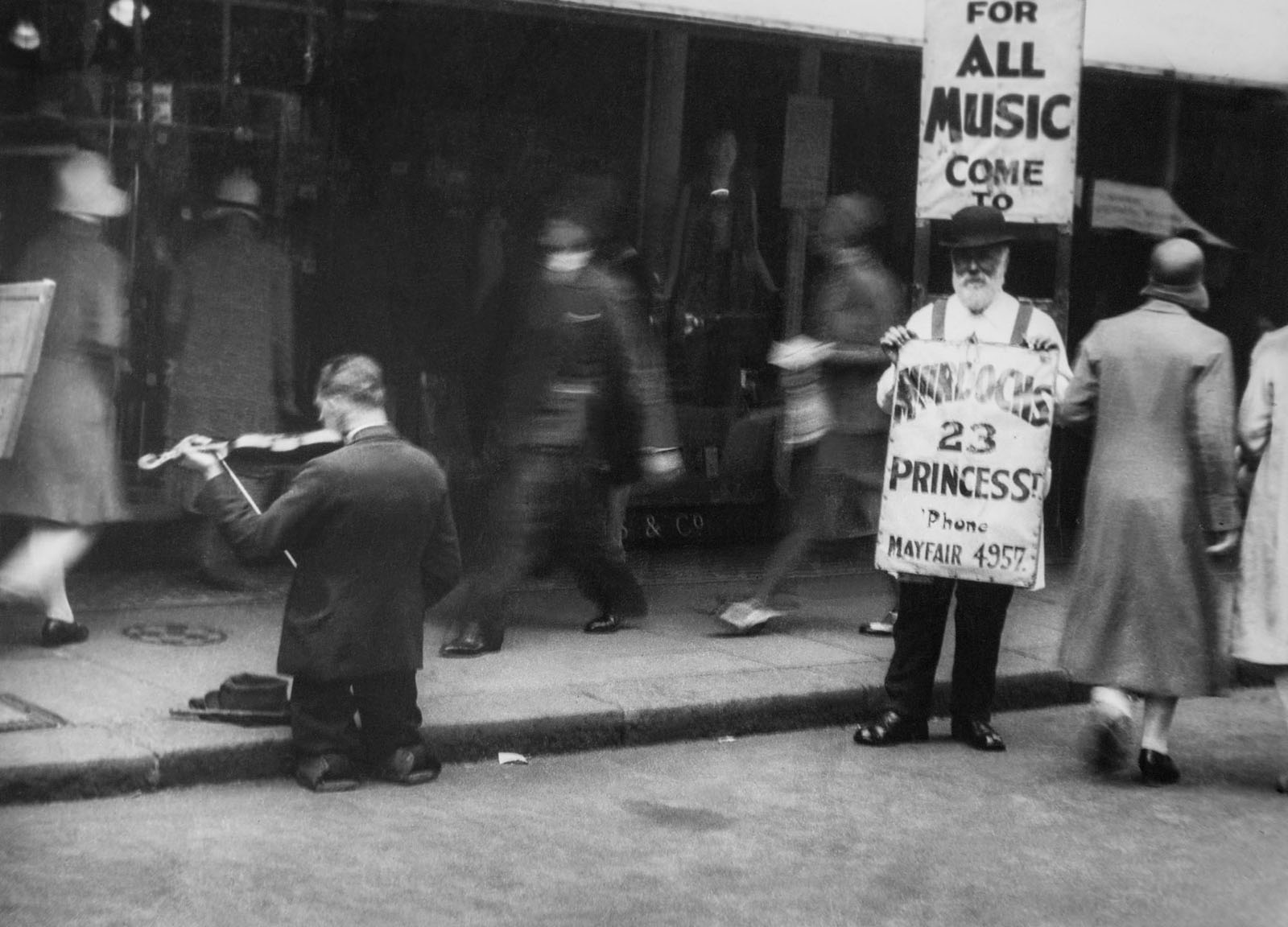
 

Edith Tudor-Hart (British born Austria, 1908-1973) 'Untitled (Street, London)' 1940s, printed later


Edith Tudor-Hart (British born Austria, 1908-1973)
Untitled (Street, London)
1940s, printed later
Gelatin silver print
Image: 21 x 28cm (8 1/4 x 11 in.)
Frame: 35.56 x 45.72cm (14 x 18 in.)
Frame (outer): 38.1 x 48.26cm (15 x 19 in.)
Peter Suschitzky, Julia Donat, and Misha Donat


Edith Tudor-Hart (British born Austria, 1908-1973)

Edith Tudor-Hart (née Suschitzky; 28 August 1908 – 12 May 1973) was an Austrian-British photographer and spy for the Soviet Union. Brought up in a family of socialists, she trained in photography at Walter Gropius’s Bauhaus in Dessau, and carried her political ideals through her art. Through her connections with Arnold Deutsch, Tudor-Hart was instrumental in the recruiting of the Cambridge Spy ring which damaged British intelligence from World War II until the security services discovered all their identities by the mid-1960s. She recommended Litzi Friedmann and Kim Philby for recruitment by the KGB and acted as an intermediary for Anthony Blunt and Bob Stewart when the rezidentura at the Soviet Embassy in London suspended its operations in February 1940.

Read a fuller biography on the Wikipedia website
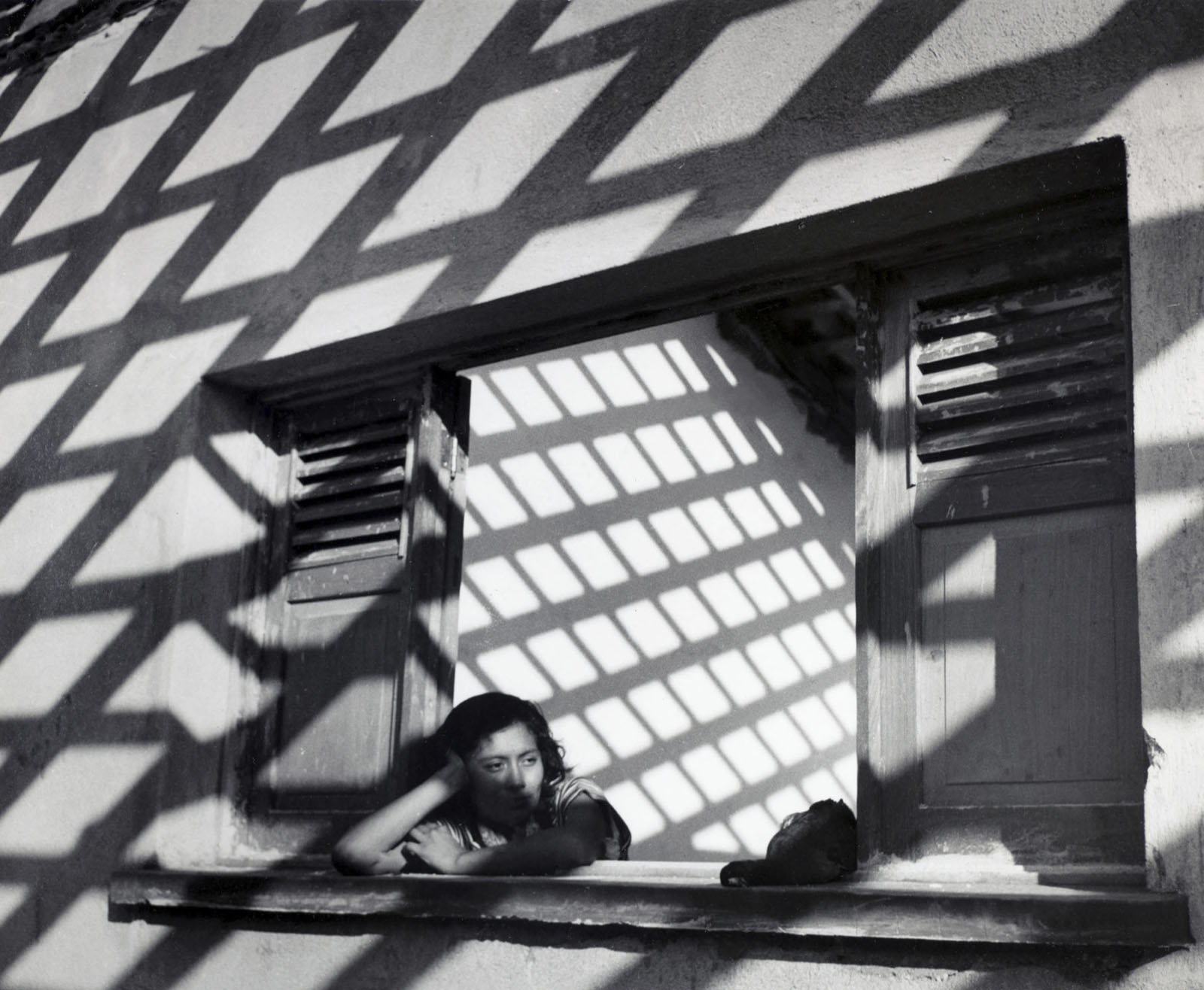
 

Lola Álvarez Bravo (Mexican, 1903-1993) 'En su propia cárcel' (In Her Own Prison) c. 1950


Lola Álvarez Bravo (Mexican, 1903-1993)
En su propia cárcel (In Her Own Prison)
c. 1950
Gelatin silver print
Image: 18.42 x 21.27cm (7 1/4 x 8 3/8 in.)
Frame: 50.8 x 45.72cm (20 x 18 in.)
Frame (outer): 53.34 x 48.26cm (21 x 19 in.)
Daniel Greenberg and Susan Steinhauser
© Center for Creative Photography, The University of Arizona Foundation


Lola Álvarez Bravo (Mexican, 1903-1993)

Lola Álvarez Bravo (3 April 1903 – 31 July 1993) was the first Mexican female photographer and a key figure in the post-revolution Mexican renaissance. Known for her high level of skill in composition, her works were seen by her peers as fine art. She was recognised in 1964 with the Premio José Clemente Orozco (José Clemente Orozco Prize), by the State of Jalisco, for her contributions to photography and her efforts to preserve the culture of Mexico. Her works are included in the permanent collections of international museums, including the Museum of Modern Art in New York City.

Álvarez was born in a small town in Jalisco, but moved to Mexico City with her father when her parents separated around 1906. For a decade, she lived with her father in a large mansion, but upon his death was taken in by her older half-brother, who sent her to boarding school. After completing a traditional education, in 1922 she enrolled in the Escuela Nacional Preparatoria, where she met her lifelong friend, Frida Kahlo. A friendship with another of her childhood friends, Manuel Álvarez Bravo, blossomed into romance around the same time and the two married in 1925. Her husband taught her photography, as well as development techniques, and for nearly a decade, she acted as his assistant. As she sought to explore her own creativity and was unhappy in the marriage, the couple separated in 1934.

Beginning her career as a teacher, Álvarez took photographic assignments for magazines and newspapers, developing a reputation as one of the only women photojournalists working in Mexico City. She chose to portray subjects candidly, revealing the deeper meaning of culture and social significance, rather than seeking newsworthy work. In 1935, she began cataloging photographs in the Department of Education and two years later was hired to run the photography workshops of the National Autonomous University of Mexico, where she remained until her retirement in 1971.

In addition to her contributions to advertising and photojournalism, Álvarez took many photographs of her artistic friends, and in 1951 opened the Galeria de Arte Contemporáneo (Gallery of Contemporary Art) to promote their work. In 1953 at the Galeria, she hosted the only exhibition of Frida Kahlo’s works held in Mexico during the artist’s life. From the late 1970s until her death in 1993, she gained international recognition for her body of work. Her photo archive is located at the Center for Creative Photography in Tucson, Arizona, United States.

Read a fuller biography on the Wikipedia website
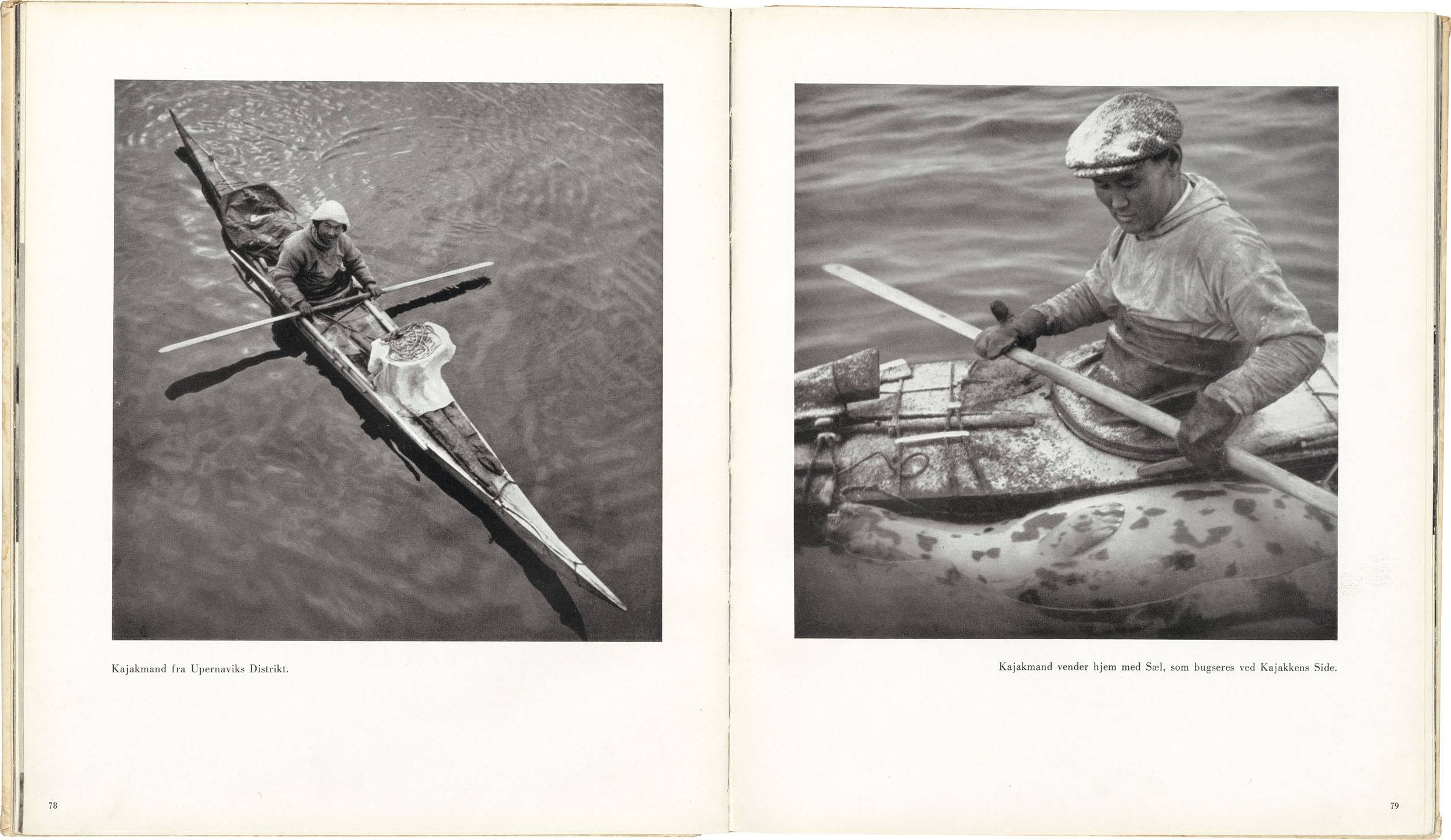
 

Jette Bang (Danish, 1914-1964) 'Grønland' 1940


Jette Bang (Danish, 1914-1964)
Grønland
1940
Bound volume
Open: 26.04 x 44.45cm (10 1/4 x 17 1/2 in.)
Closed: 26.04 x 22.86cm (10 1/4 x 9 in.)
Cradle: 6 1/8 (maximum height at left) x 15 1/2 (width) x 10 1/2 (depth) x 3 3/8 in. (maximum height at right)
National Gallery of Art Library, Gift of the Department of Photographs


Jette Bang (Danish, 1914-1964)

Jette Bang (February 4, 1914 – February 16, 1964) was a Danish photographer and film maker who is remembered for the large collection of photographs and films she took in Greenland, depicting the country and the way of life of its inhabitants before their old culture disappeared. …

Career

In 1936, Bang arrived in Greenland for the first time and spent eight months taking photographs of the traditional lifestyle of the Greenlandic Inuit, which was beginning to die out as a result of European influence. She travelled around on dog sleds and lived with the natives, sharing their way of life. The result was 400 photographs which were exhibited at the Danish Museum of Art & Design in 1937. Some were published in her book Grønland (1940) with a foreword by Minister of State Thorvald Stauning. The book was an eyeopener for the Danes.

Her next expedition in the winter of 1938-1939 was supported by Denmark’s Greenland Administration, who provided a motorboat, lighting and helpers. Under harsh and primitive conditions, she lived closely together with the Greenlanders, spending most of the winter in a hole in the ground with floor space of just four square metres. Joining the Thule postal sleds, she travelled across Melville Bay up to Cape York in the district of Thule. Her trip resulted in a revealing colour film, Inuit, seen as a work of art when it was shown in Denmark in 1938. The film was in two parts, depicting the old and the new Greenland. The reels on Melville Bay were lost in a fire while she was in Thule but there was still enough material for a four-hour production.

For a time, Jette Bang hoped to go back and take some additional shots but her plans were brought to a standstill by the outbreak of the Second World War. Only after the liberation in 1945 was she able to continue her project.

Many stills taken from the film were published in her book 30.000 Kilometer med Sneglefart (30,000 kilometers at a snail’s pace) (1941). Bang, a good storyteller, was able to provide an excellent account of her experiences. With the photo book Grønlænderbørn (Greenlandic Children) (1944) she continued to report on her travels, now addressing Danish schoolchildren.

She travelled to Greenland five more times. Disappointed with modern developments there, she republished her book Grønland in 1961. In 1962, she travelled to Greenland for the last time, trying to rework her 1938 colour film; but illness prevented any more trips.

In 1959, she took part in Peter Glob’s archaeological expedition to Bahrain, which led to her film Beduiner (1962).

Assessment

Jette Bang was the first photographer to take close-up portraits of the Greenlanders. While earlier photographers had been more interested in their clothing and surroundings, she was more concerned with their behaviour, creating more lasting and universal impressions.

Jette Bang’s photographs from Greenland are the only remaining material documenting the old Greelandic way of life which has now almost disappeared. Her dedication to the country and its people was legendary. She was also a talented author: “The full moon’s twisted face tripped up over the tops of the pointed peaks in the north west like a fakir trying to walk on a bed of nails,” she wrote in 30.000 Kilometer med Sneglefart.

Many of her photographs are in the National Museum of Greenland in Nuuk. The main collection of 12,000 photographs is with the Arktisk Institut in Copenhagen, which has made them available on the Internet.

Text from the Wikipedia website


Gerda Leo (German, 1909-1993) 'Korbgeflecht' (Wicker Basket) c. 1928


Gerda Leo (German, 1909-1993)
Korbgeflecht (Wicker Basket)
c. 1928
Gelatin silver print
Image: 36.3 x 29.2cm (14 5/16 x 11 1/2 in.)
Frame (outer): 51.3 x 41.3 x 2.7cm (20 3/16 x 16 1/4 x 1 1/16 in.)
Galerie Berinson, Berlin


Gerda Leo (born February 1, 1909 in Hagen, Westphalia , died September 28, 1993 in Amsterdam, Netherlands) was a German photographer in the field of New Vision and New Objectivity. She studied at the Burg Giebichenstein State School of Applied Arts in Halle (Saale) with Hans Finsler and worked as an assistant to Albert Renger-Patzsch. Her photographic estate is in the Moritzburg Art Museum Halle (Saale).

Read a fuller biography on the Wikipedia website


Behind the Camera

Women actively participated in the development of photography soon after its inception in the 19th century. Yet it was in the 1920s, after the seismic disruptions of World War I, that women entered the field of photography in force. Aided by advances in technology and mass communications, along with growing access to training and acceptance of their presence in the workplace, women around the world made an indelible mark on the growth and diversification of the medium. They brought innovation to a range of photographic disciplines, from avant-garde experimentation and commercial studio practice to social documentary, photojournalism, ethnography, and the recording of sports, dance, and fashion.

The New Woman

A global phenomenon, the New Woman of the 1920s embodied an ideal of female empowerment based on real women making revolutionary changes in life and art. Her image – a woman with bobbed hair, stylish dress, and a confident stride – was a staple of newspapers and magazines first in Europe and the United States and soon in China, Japan, India, Australia, and elsewhere. A symbol of the pursuit of liberation from traditional gender roles, the New Woman in her many guises represented women who faced a mix of opportunities and obstacles that varied from country to country. The camera became a powerful means for female photographers to assert their self-determination and redefine their position in society. Producing compelling portraits, including self-portraits featuring the artist with her camera, they established their roles as professionals and artists.

The Studio

Commercial studio photography was an important pathway for many women to forge a professional career and to earn their own income. Running successful businesses in small towns and major cities from Buenos Aires to Berlin and Istanbul, women reinvigorated the genre of portraiture. In the studio, both sitters and photographers navigated gender, race, and cultural difference; those run by women presented a different dynamic. For example, Black women operated studios in Chicago, New Orleans, and elsewhere in the United States, where they not only preserved likenesses and memories, but also constructed a counter narrative to racist images then circulating in the mass media.

The City

The availability of smaller, lightweight cameras and the increasing freedom to move about cities on their own spurred a number of women photographers to explore the diversity of the urban experience beyond the studio walls. Using their creative vision to capture the vibrant modern world around them, women living and working in Bombay (now Mumbai), London, New York, Paris, São Paulo, Tokyo, and beyond photographed soaring architecture and spontaneous encounters on the street.

Avant-Garde Experiments

Creative formal approaches – photomontage, photograms, sharp contrasts of light and shadow, unconventional cropping, extreme close-ups, and dizzying camera angles – came to define photography during this period. Women incorporated these cutting-edge techniques to produce works that conveyed the movement and energy of modern life. Although often overshadowed by their male partners and colleagues, women photographers were integral in shaping an avant-garde visual language that promoted new ways of seeing and experiencing the world.

Modern Bodies

Beginning in the 1920s, new concepts concerning health and sexuality, along with changing attitudes about movement and dress, emphasised the human body as a central site of experiencing modernity. Women photographers produced incisive visions of liberated modern bodies, from pioneering photographs of the nude to exuberant pictures of sport and dance. Photographs of joyous play and gymnastic exercise, as well as images of dancers in motion, celebrate the body as artistic medium.

Ethnographic Approaches

During this modern period, numerous women pursued professional photographic careers and traveled extensively for the first time. Many took photographs that documented their experiences abroad in Africa, China, Afghanistan, and elsewhere, while others engaged in more formal ethnographic projects. Some women with access to domains that were off limits to their male counterparts produced intimate portraits of female subjects. While gender may have afforded these photographers special connections to certain communities, it did not exempt some, especially those from Europe and the United States, from producing stereotypical views that reinforced hierarchical concepts of race and ethnocentrism.

Fashion and Advertising

Images splashed across the pages of popular fashion and lifestyle magazines vividly defined the New Woman. The unprecedented demand for fashion and advertising photographs between the world wars provided exceptional employment opportunities for fashion reporters, models, and photographers alike, allowing women to emerge as active agents in the profession. Cultivating the tastes of newly empowered female consumers, fashion and advertising photography provided a space where women could experiment with pictures intended for a predominantly female readership.

Social Documentary

Galvanised by the effects of a global economic crisis and the growing political and social unrest that began in the 1930s, numerous women photographers produced arresting images of the human condition. Whether working for government agencies or independently, women contributed to the visual record of the Depression and the events leading up to World War II. From images of breadlines and worker demonstrations to forced migration and internment, women photographers helped to expose dire conditions and shaped what would become known as social documentary photography.

Reportage

The rise of the picture press established photojournalism as a dominant form of visual expression during a period shaped by two world wars. Women photographers conveyed an inclusive view of worldwide economic depression, struggles for decolonisation in Africa, and the rise of fascism and communism in Europe and the Soviet Union. They often received the “soft assignments” of photographing women and children, families, and the home front, but some women risked their lives close to the front lines. Images of concentration camps and victory parades made way for the complexities of the postwar era, as seen in pictures of daily life in US-occupied Japan and the newly formed People’s Republic of China.
The photographers whose works are in The New Woman Behind the Camera represent just some of the many women around the world who were at the forefront of experimenting with the camera. They produced invaluable visual testimony that reflected both their personal experiences and the extraordinary social and political transformations of the early 20th century. Together, they changed the history of modern photography.

Text from the National Gallery of Art website


Dulce Carneiro (Brazilian, 1929-2018) 'Mulher' (Woman) c. 1957


Dulce Carneiro (Brazilian, 1929-2018)
Mulher (Woman)
c. 1957
Gelatin silver print
Image: 37.94 x 28.58cm (14 15/16 x 11 1/4 in.)
Frame: 40.64 x 50.8cm (16 x 20 in.)
Frame (outer): 43.18 x 53.34cm (17 x 21 in.)
National Gallery of Art, Washington, Robert B. Menschel and the Vital Projects Fund
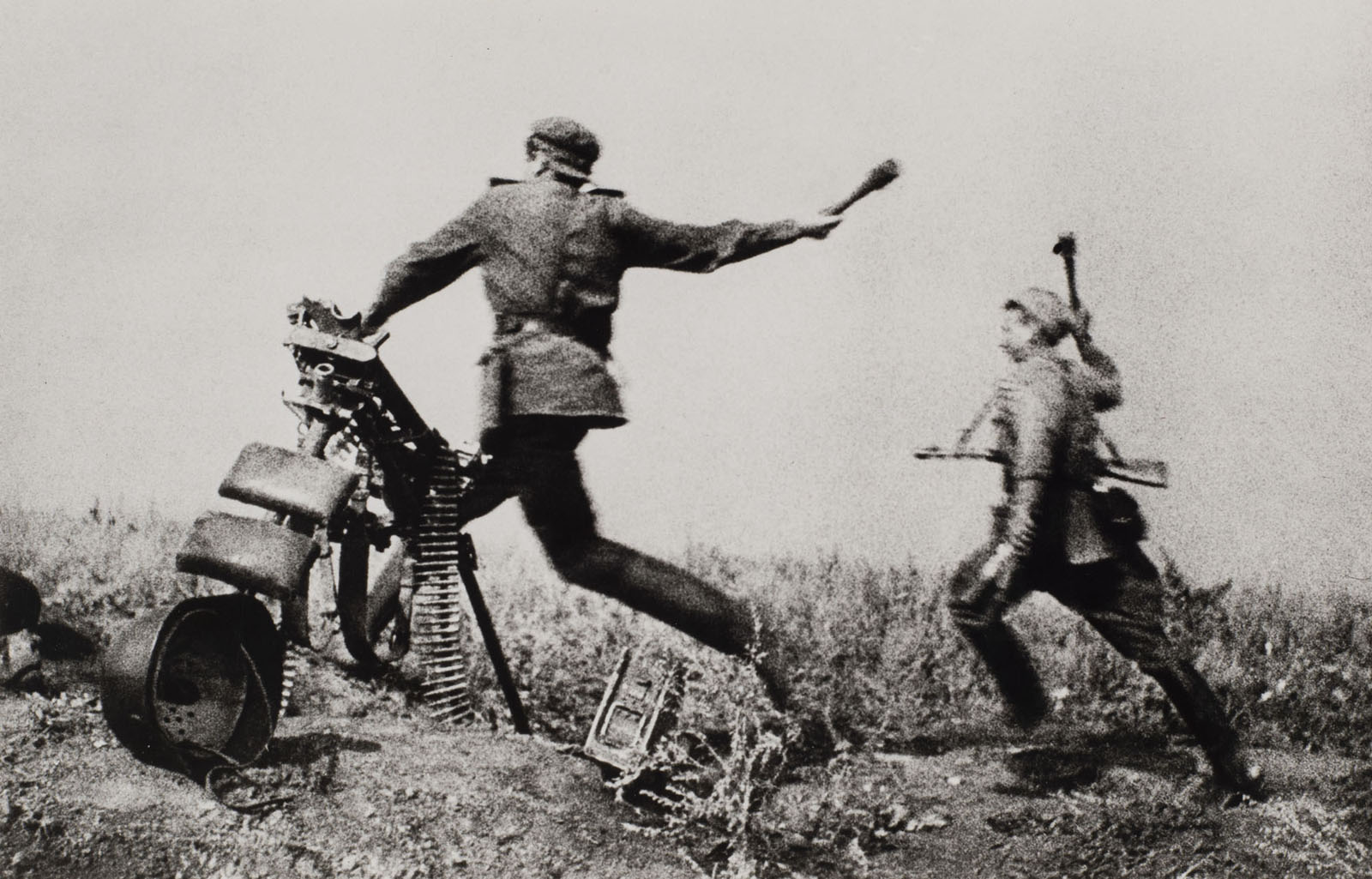
 

Galina Sanko (Russian, 1904-1981) 'During an Attack' 1943, printed c. 1960s


Galina Sanko (Russian, 1904-1981)
During an Attack
1943, printed c. 1960s
Gelatin silver print
Image: 15.72 x 24.29cm (6 3/16 x 9 9/16 in.)
Frame: 40.64 x 50.8cm (16 x 20 in.)
Frame (outer): 43.18 x 53.34cm (17 x 21 in.)
Robert Koch Gallery


Galina Sanko (Russian, 1904-1981)

Galina Sanko (Russian: Галина Захаровна Санько and also Galina Sankova or Galina Sankowa) (1904-1981) was a Russian photographer who worked as a photojournalist and was one of only five women who served as a war photographer during World War II. She was one of the most noted Soviet photographers and known in the West, winning awards both at home and abroad. …

After the persecution of her husband in 1938, Sanko dedicated her life to photography. When the war broke out, she asked to go to the front as a war correspondent. Initially, Sanko trained as a nurse and then studied driving and auto mechanics. She bandaged the wounded and once she had proved her fitness for battle was allowed as one of only five women who served as war photographers. She worked for the magazine Frontline Illustration (Russian: Фронтовая иллюстрация) and took photographs of battles in Kursk, Moscow and Stalingrad, taking pictures at Bryansk and the Don Campaign near Stallingrad. In 1944, during the northern offensive, she took photographs of the siege of Leningrad. Near the end of the war, she took photographs of the fighting against Japan. She was seriously injured twice during the war. In the movie Wild Honey (Russian: Дикий мед) (1967) based on the novel by Leonid Pervomaisky, there is a scene based upon a real-life event in which Sanko escaped in the nick of time from being fired upon by a German tank.

At the end of the war, Sanko worked for the magazine Spark (Russian: Огонек) but until the 1960s, her work was banned and hidden in an archive. Accused of distorting the truth, with her photographs of the liberation of the Petrozavodsk camp, Sanko was exonerated when 20 years after the war, she returned to the Republic of Karelia and found one of the children she had photographed in the camp. After publishing “Claudia 20 years later”, her archive was opened in 1966 and Sanko participated in many photographic exhibitions at home and abroad. She was awarded the Order of the Red Star. Sanko died in Moscow in 1981.

Text from the Wikipedia website


Galina Sanko (Russian, 1904-1981) 'Prisoners, Stalingrad' 1943, printed c. 1960s


Galina Sanko (Russian, 1904-1981)
Prisoners, Stalingrad
1943, printed c. 1960s
Gelatin silver print
Image: 20.32 x 29.53cm (8 x 11 5/8 in.)
Frame: 40.64 x 50.8cm (16 x 20 in.)
Frame (outer): 43.18 x 53.34cm (17 x 21 in.)
Robert Koch Gallery
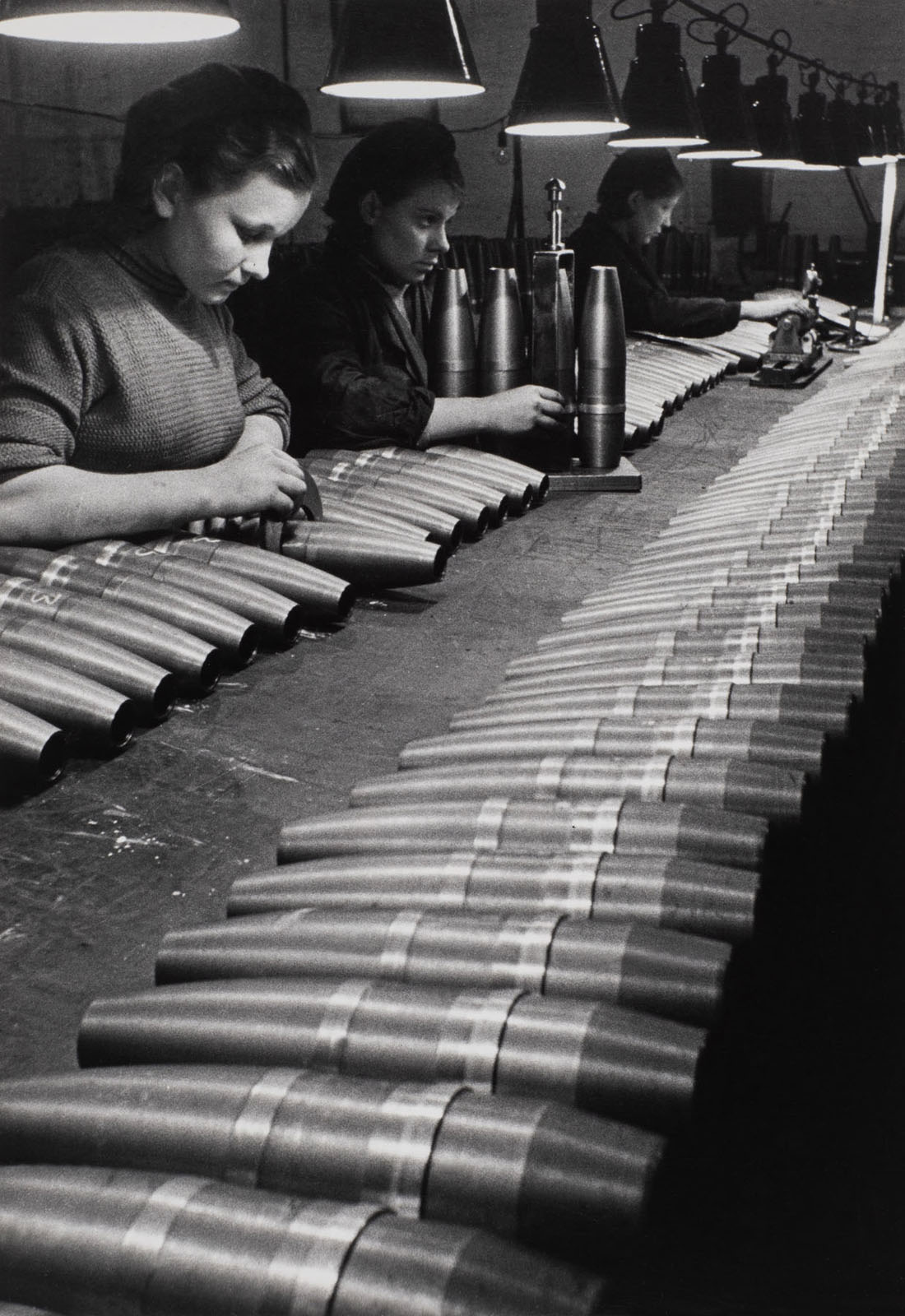
 

Galina Sanko (Russian, 1904-1981) 'Behind the front lines, workers at a factory evacuated from Ukraine to a town on the Volga' 1942, printed c. 1960s


Galina Sanko (Russian, 1904-1981)
Behind the front lines, workers at a factory evacuated from Ukraine to a town on the Volga
1942, printed c. 1960s
Gelatin silver print
Image/sheet: 24.13 x 16.67cm (9 1/2 x 6 9/16 in.)
Frame: 40.64 x 50.8cm (16 x 20 in.)
Frame (outer): 43.18 x 53.34cm (17 x 21 in.)
Robert Koch Gallery
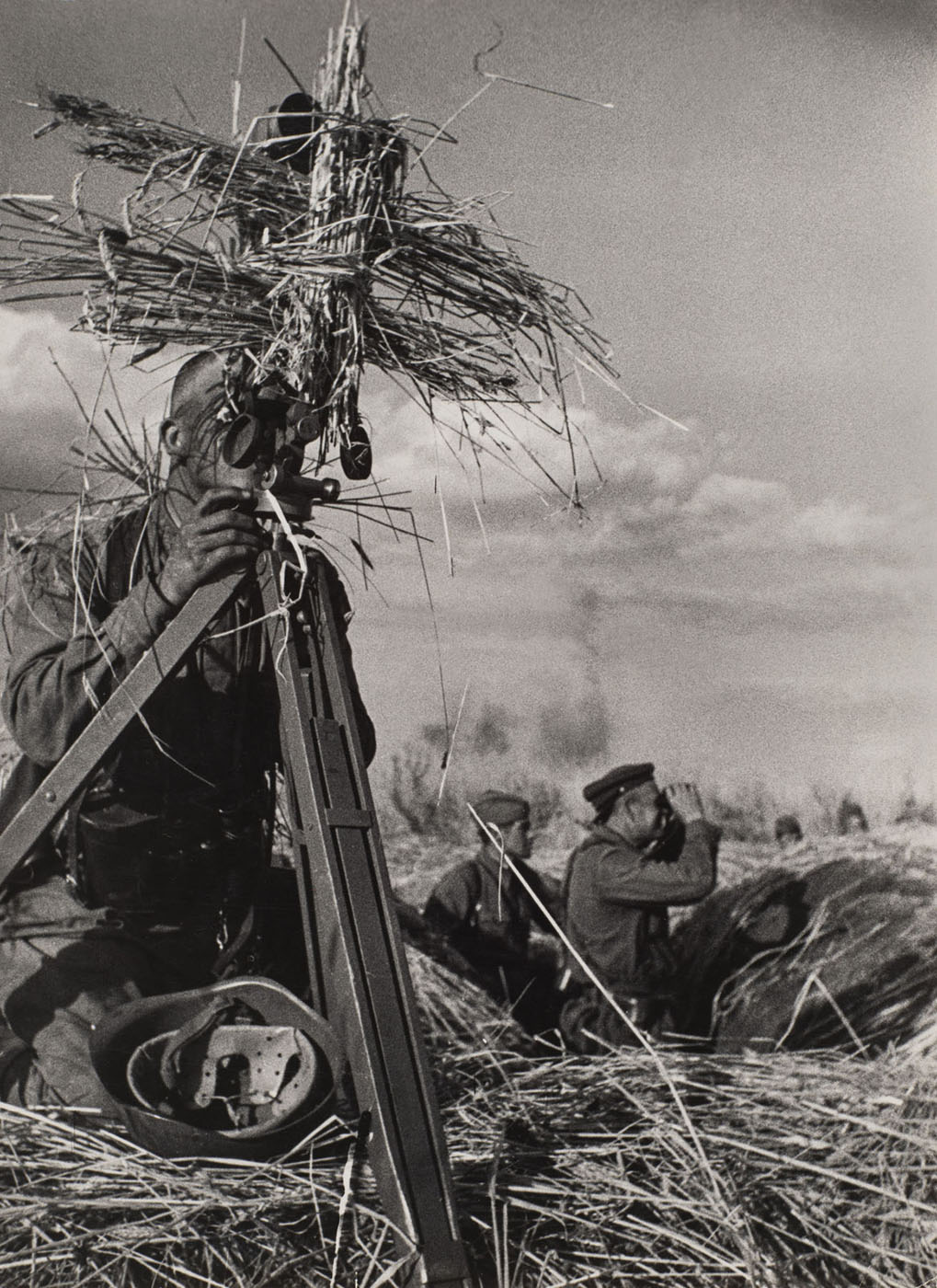
 

Galina Sanko (Russian, 1904-1981) 'Observation Post, the Fight for Hill N' 1942


Galina Sanko (Russian, 1904-1981)
Observation Post, the Fight for Hill N
1942
Gelatin silver print
Image/sheet: 29.21 x 20.96cm (11 1/2 x 8 1/4 in.)
Frame: 40.64 x 50.8cm (16 x 20 in.)
Frame (outer): 43.18 x 53.34cm (17 x 21 in.)
Robert Koch Gallery


G. Herbert Taylor. 'My Best Photograph and Why' 1937


G. Herbert Taylor
My Best Photograph and Why
1937
Photography book
Closed: 29.53 x 23.18cm (11 5/8 x 9 1/8 in.)
Open: 29.53 x 44.77cm (11 5/8 x 17 5/8 in.)
Mount: 1.43 x 44.93 x 29.69cm (9/16 x 17 11/16 x 11 11/16 in.)
National Gallery of Art Library, David K.E. Bruce Fund


Claude Cahun (French, 1894-1954) 'Autoportrait' (Self-Portrait) c. 1927


Claude Cahun (French, 1894-1954)
Autoportrait (Self-Portrait)
c. 1927
Gelatin silver print
Image: 25.5 x 20.1cm (10 1/16 x 7 15/16 in.)
Frame: 53 x 42cm (20 7/8 x 16 9/16 in.)
Wilson Centre for Photography


Claude Cahun (French, 1894-1954)

Claude Cahun (born Lucy Renee Mathilde Schwob, 25 October 1894 – 8 December 1954) was a French surrealist photographer, sculptor, and writer. Schwob adopted the pseudonym Claude Cahun in 1914. Cahun is best known as a writer and self-portraitist, who assumed a variety of performative personae. Cahun’s work is both political and personal. In Disavowals, she writes: “Masculine? Feminine? It depends on the situation. Neuter is the only gender that always suits me.” During World War II, Cahun was also active as a resistance worker and propagandist. …

Cahun’s works encompassed writing, photography, and theatre. She is most remembered for her highly staged self-portraits and tableaux that incorporated the visual aesthetics of Surrealism. During the 1920s, Cahun produced an astonishing number of self-portraits in various guises such as aviator, dandy, doll, body builder, vamp and vampire, angel, and Japanese puppet.

Some of Cahun’s portraits feature the artist looking directly at the viewer, head shaved, often revealing only head and shoulders (eliminating body from the view), and a blurring of gender indicators and behaviours which serve to undermine the patriarchal gaze. Scholar Miranda Welby-Everard has written about the importance of theatre, performance, and costume that underlies Cahun’s work, suggesting how this may have informed the artist’s varying gender presentations. …

Cahun’s work was often a collaboration with Marcel Moore. Cahun and Moore collaborated frequently, though this often goes unrecognised. It is believed that Moore was often the person standing behind the camera during Cahun’s portrait shoots and was an equal partner in Cahun’s collages.

With the majority of the photographs attributed to Cahun coming from a personal collection, not one meant for public display, it has been proposed that these personal photographs allowed for Cahun to experiment with gender presentation and the role of the viewer to a greater degree.

One of my favourite artists – a hero of mine!

Read a fuller biography on the Wikipedia website


Toni von Horn (American born Germany, 1899-1970) 'Untitled' 1932


Toni von Horn (American born Germany, 1899-1970)
Untitled
1932
Gelatin silver print
Image/sheet: 23 x 19cm (9 1/16 x 7 1/2 in.)
Frame: 40.64 x 50.8cm (16 x 20 in.)
Frame (outer): 45.09 x 55.25cm (17 3/4 x 21 3/4 in.)
National Gallery of Art, Washington
Gift of Charles van Horne on behalf of the family of Toni von Horn


Toni von Horn (American born Germany, 1899-1970)

Baroness Antonie “Toni” von Horn was born to a prominent family in Germany in 1899. Around 1920, she opened a photography studio in Heidelberg. While in New York on an assignment, she met the editor of Vanity Fair who recommended she pursue a career in New York.

She did, and soon became a leading fashion and advertising photographer in the 1920s and 30s, working for Vanity Fair, Vogue, and Harper’s Bazaar and at her own studio. She was one of the first woman photographers to gain a national and international reputation, Her many celebrity portraits included Greta Garbo, Eleanor Roosevelt, Ginger Rogers, Cole Porter, Clark Gable, Claudette Colbert, and Jean Harlow. Her photograph of Albert Einstein has been called the best ever made of him.

Toni von Horn was among the first woman professional photographers and was the first to join the stable of Conde Nast’s Vogue and Vanity Fair, and Harper’s Bazaar during those magazines’ glorious years of the early 1930s. Active as Tony von Horn, her images were regular features, along with such luminaries as Edward Steichen, Adolf de Meyer and George Hoyningen-Heune among others, in the magazines from the end of 1930 to 1935.
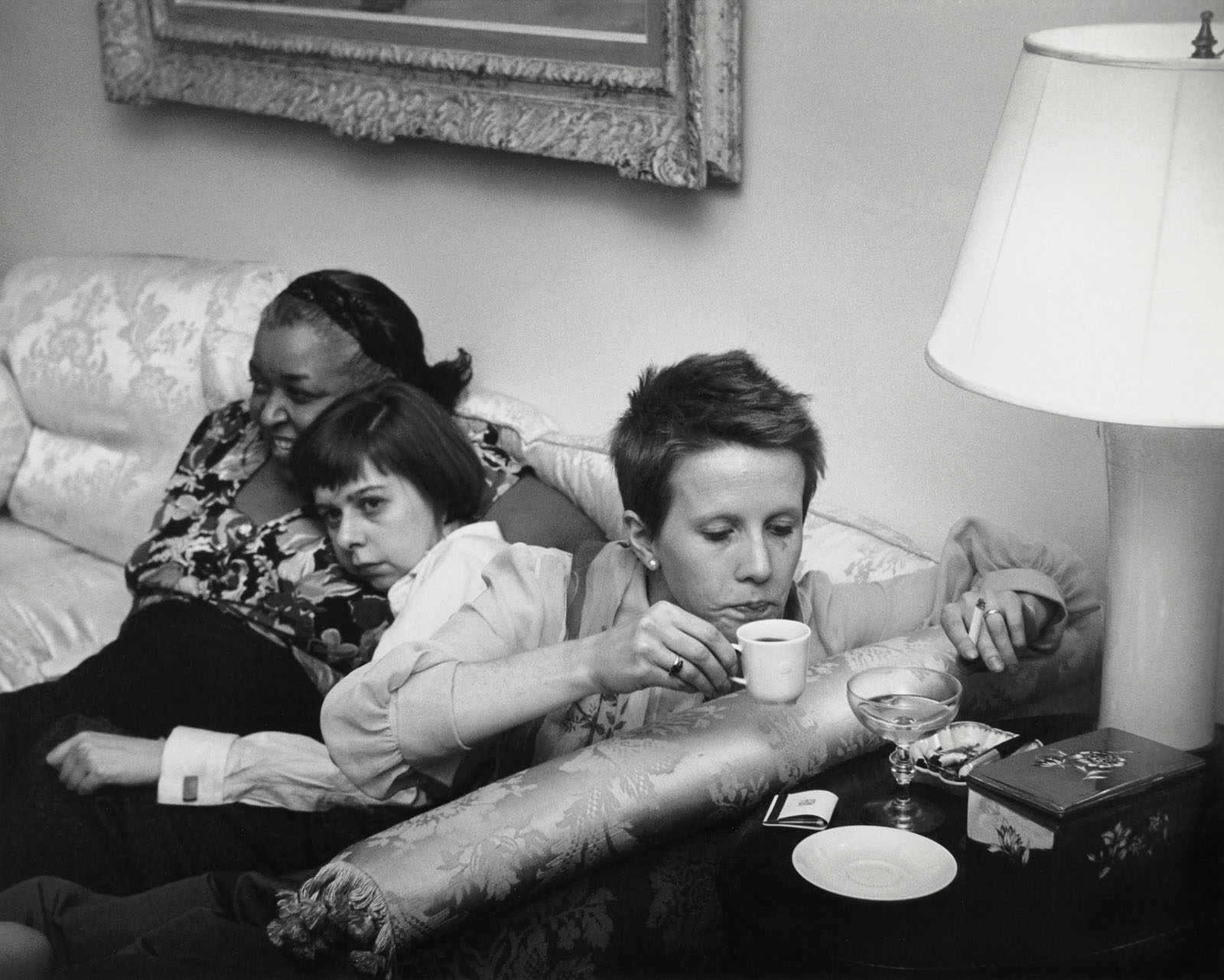
 

Ruth Orkin (American, 1921-1985) 'Ethel Waters, Carson McCullers, and Julie Harris at the Opening Night Party for "The Member of the Wedding," New York City' 1950


Ruth Orkin (American, 1921-1985)
Ethel Waters, Carson McCullers, and Julie Harris at the Opening Night Party for “The Member of the Wedding,” New York City
1950
Gelatin silver print
Image/sheet: 39.7 x 49.5cm (15 5/8 x 19 1/2 in.)
Frame (outer): 57.6 x 67.8cm (22 11/16 x 26 11/16 in.)
The Metropolitan Museum of Art, Purchase, Dorothy Levitt Beskind Gift, 1980
© Ruth Orkin
Image: © The Metropolitan Museum of Art. Image source: Art Resource, NY


Ruth Orkin (American, 1921-1985)

Ruth Orkin (September 3, 1921 – January 16, 1985) was an American photographer, photojournalist, and filmmaker, with ties to New York City and Hollywood. Best known for her photograph An American Girl in Italy (1951), she photographed many celebrities and personalities including Lauren Bacall, Doris Day, Ava Gardner, Tennessee Williams, Marlon Brando, and Alfred Hitchcock.

Life

Ruth Orkin was born on September 3, 1921 in Boston, Massachusetts to Mary Ruby and Samuel Orkin. Ruth grew up in Hollywood, due to her mother’s career as a silent film actress. In 1931, she received her first camera, a 39-cent Univex, and soon began experimenting by taking photographs of her friends and teachers at school. At the age of 17, she decided to bike across America, beginning in Los Angeles, and ending in New York City for the 1939 World’s Fair. She completed the trip in three weeks’ time, taking photographs along the way.

She briefly attended Los Angeles City College for photojournalism in 1940, prior to becoming the first messenger girl at MGM Studios in 1941, citing a desire to become a cinematographer. She left the position after discovering the union’s discriminatory practices that did not allow female members. She joined the Women’s Auxiliary Army Corps during World War II, in 1941 in an attempt to gain filmmaking skills, as advertisements promoting the group promised. The attempt was not fruitful, however, and she was discharged in 1943 without any filmmaking training.

In 1943, Orkin moved to New York City in pursuit of a career as a freelance photojournalist. She began working as a nightclub photographer, and received her first assignment in 1945 from The New York Times to shoot Leonard Bernstein. Shortly after, her freelance career grew as she traveled internationally on assignments and contributed photographs to Life, Look, Ladies’ Home Journal, and others. Orkin is credited with breaking into a heavily male field.

Orkin’s most celebrated image is An American Girl in Italy (1951). The subject of the now-iconic photograph was the 23-year-old Ninalee Craig (known at that time as Jinx Allen). The photograph was part of a series originally titled “Don’t Be Afraid to Travel Alone.” The image depicted Craig as a young woman confidently walking past a group of ogling Italian men in Florence. In recent articles written about the pair, Craig claims that the image was not staged, and was one of many taken throughout the day, aiming to show the fun of traveling alone.

In 1952 Orkin married photographer, filmmaker and fellow Photo League member Morris Engel. Orkin and Engel collaborated on two major independent feature films, “Little Fugitive” (1953) and “Lovers and Lollipops” (1955). After the success of the two films, Orkin returned to photography, taking colour shots of Central Park as seen through her apartment window. The resulting photographs were collected in two books, “A World Through My Window” (1978) and “More Pictures from My Window” (1983).

Orkin taught photography at the School of Visual Arts in the late 1970s, and at the International Center of Photography in 1980. After a long, private battle with cancer, Orkin died of the disease at her New York City apartment on January 16, 1985.

Text from the Wikipedia website


National Gallery of Art
National Mall between 3rd and 7th Streets
Constitution Avenue NW, Washington

Opening hours:
Daily 10am – 5pm

National Gallery of Art website

LIKE ART BLART ON FACEBOOK

Back to top

Exhibition: ‘The New Woman Behind the Camera’ at the National Gallery of Art, Washington Part 1

Exhibition dates: 31st October, 2021 – 30th January, 2022

Curator: The exhibition is curated by Andrea Nelson, associate curator in the department of photographs, National Gallery of Art, Washington.


Marvin Breckinridge Patterson (American, 1905-2002) 'Frontier Nursing Service, Kentucky' 1937 from the exhibition 'The New Woman Behind the Camera' at the National Gallery of Art, Washington, Oct 2021 - Jan 2022


Marvin Breckinridge Patterson (American, 1905-2002)
Frontier Nursing Service, Kentucky
1937
Gelatin silver print
Sheet (trimmed to image): 24.2 x 18.8cm (9 1/2 x 7 3/8 in.)
Frame: 50.8 x 40.64cm (20 x 16 in.)
Frame (outer): 53.34 x 43.18cm (21 x 17 in.)
National Gallery of Art, Washington, Gift of Marvin Breckinridge Patterson


The first of a humungous three-part posting on this archaeological exhibition.

Combined with the posting I did on this exhibition when it was on view at The Metropolitan Museum of Art, this three-part posting will include over 160 new images from the exhibition… meaning a combined total over the four postings of over 200 images with biographical information.

This has been a mammoth effort to construct these postings but so worthwhile!

See Part 2 of the posting. I will make comment on the exhibition in part 3 of the posting.

Dr Marcus Bunyan


Many thankx to the National Gallery of Art for allowing me to publish the photographs in the posting. Please click on the photographs for a larger version of the image.


Helen Levitt (American, 1913-2009) 'New York' c. 1942 from the exhibition 'The New Woman Behind the Camera' at the National Gallery of Art, Washington, Oct 2021 - Jan 2022


Helen Levitt (American, 1913-2009)
New York
c. 1942
Gelatin silver print
Sheet (trimmed to image): 18.6 x 24.8cm (7 5/16 x 9 3/4 in.)
Frame: 35.56 x 45.72cm (14 x 18 in.)
Frame (outer): 38.1 x 48.26cm (15 x 19 in.)
National Gallery of Art, Washington, Gift of William H. Levitt
© Helen Levitt Film Documents LLC. All rights reserved
Courtesy of Thomas Zander Gallery


Renata Bracksieck (German, 1900-1992) 'Karnevalslichter' (Carnival Lights) 1920s-1930s from the exhibition 'The New Woman Behind the Camera' at the National Gallery of Art, Washington, Oct 2021 - Jan 2022


Renata Bracksieck (German, 1900-1992)
Karnevalslichter (Carnival Lights)
1920s-1930s
Gelatin silver print sheet (trimmed to image): 23.8 x 17.8cm (9 3/8 x 7 in.)
Frame: 50.8 x 40.64cm (20 x 16 in.)
Frame (outer): 55.25 x 45.09cm (21 3/4 x 17 3/4 in.)
National Gallery of Art, Washington, Patrons’ Permanent Fund


Renata Bracksieck (German, 1900-1992) was trained as a fashion designer at Christoph Drecoll’s in Berlin, and afterwards ran her own successful fashion studio in Bremen. She started taking photographs in 1929, but had been experimenting with and assisting her close friend and future husband Werner Rohde before. Her photographs were featured in the international exhibition Das Lichtbild in Munich in 1930. In 1937 she married Werner Rohde and subsequently was called Renata Bracksieck-Rohde. After he returned from a POW camp in 1945, they moved to the artist colony Worpswede near the city of Bremen, where they continued to live until their deaths.

Text from the Kicken Berlin website


Lotte Jacobi (American, 1896-1990) 'Lieselotte Felger, die Wespentaille in dem Tanz, der Kreisel, Berlin' (Lieselotte Felger as "Die Wespentaille" in the Dance "Der Kreisel," Berlin) 1931


Lotte Jacobi (American, 1896-1990)
Lieselotte Felger, die Wespentaille in dem Tanz, der Kreisel, Berlin (Lieselotte Felger as “Die Wespentaille” in the Dance “Der Kreisel,” Berlin)
1931
Gelatin silver print sheet (trimmed to image): 25.2 x 20.2cm (9 15/16 x 7 15/16 in.)
Frame: 50.8 x 40.64cm (20 x 16 in.)
Frame (outer): 53.34 x 43.18cm (21 x 17 in.)
National Gallery of Art, Washington, Patrons’ Permanent Fund


Lotte Jacobi (August 17, 1896 – May 6, 1990) was a leading American portrait photographer and photojournalist, known for her high-contrast black-and-white portrait photography, characterised by intimate, sometimes dramatic, sometimes idiosyncratic and often definitive humanist depictions of both ordinary people in the United States and Europe and some of the most important artists, thinkers and activists of the 20th century.

Read a fuller biography on the Wikipedia website


Yva (Else Ernestine Neuländer-Simon) (German, 1900-1944) 'Ohne Titel (Schmuck)' (Untitled (Jewellery)) c. 1930


Yva (Else Ernestine Neuländer-Simon) (German, 1900-1944)
Ohne Titel (Schmuck) (Untitled (Jewellery))
c. 1930
Gelatin silver print
Image/sheet: 22.7 x 16.2 cm (8 15/16 x 6 3/8 in.)
Frame: 45.72 x 35.56 cm (18 x 14 in.)
Frame (outer): 50.17 x 40.01 cm (19 3/4 x 15 3/4 in.)
National Gallery of Art, Washington, Patrons’ Permanent Fund


Yva (26 January 1900 – 31 December 1944) was the professional pseudonym of Else Ernestine Neuländer-Simon who was a German Jewish photographer renowned for her dreamlike, multiple exposed images. She became a leading photographer in Berlin during the Weimar Republic.

When the Nazi Party came to power, she was forced into working as a radiographer. She was deported by the Gestapo in 1942 and murdered, probably in the Majdanek concentration camp during World War II.

Read a fuller biography on the Wikipedia website


Yva (Else Ernestine Neuländer-Simon) (German, 1900-1944) 'Ohne Titel (Schmuck)' (Untitled (Jewellery)) c. 1930


Yva (Else Ernestine Neuländer-Simon) (German, 1900-1944)
Ohne Titel (Schmuck) (Untitled (Jewellery))
c. 1930
Gelatin silver print
Image: 19.05 x 15.24cm (7 1/2 x 6 in.)
Frame: 45.72 x 35.56cm (18 x 14 in.)
Frame (outer): 50.17 x 40.01cm (19 3/4 x 15 3/4 in.)
National Gallery of Art, Washington, Corcoran Collection
Gift of the Women’s Committee of the Corcoran Gallery of Art, Brenda and Robert Edelson Collection


Ilse Bing (German, 1899-1998) 'Study for "Salut de Schiaparelli" (Lily Perfume), Paris' 1934


Ilse Bing (German, 1899-1998)
Study for “Salut de Schiaparelli” (Lily Perfume), Paris
1934
Gelatin silver print
Overall: 28.2 x 22.3cm (11 1/8 x 8 3/4 in.)
Frame: 50.8 x 40.64cm (20 x 16 in.)
Frame (outer): 53.34 x 43.18cm (21 x 17 in.)
National Gallery of Art, Washington, Gift of Ilse Bing Wolff


During the 1920s, the iconic New Woman was splashed across the pages of magazines and projected on the silver screen. As a global phenomenon, she embodied an ideal of female empowerment based on real women making revolutionary changes in life and art. Featuring more than 120 photographers from over 20 countries, the groundbreaking exhibition, The New Woman Behind the Camera, explores the diverse “new” women who embraced photography as a mode of professional and personal expression from the 1920s to the 1950s. The first exhibition to take an international approach to the subject, it examines how women brought their own perspectives to artistic experimentation, studio portraiture, fashion and advertising work, scenes of urban life, ethnography, and photojournalism, profoundly shaping the medium during a time of tremendous social and political change. Accompanied by a fully illustrated catalogue, this landmark exhibition will be on view from October 31, 2021 through January 30, 2022, in the West Building of the National Gallery of Art, Washington. It was previously on view at The Metropolitan Museum of Art, New York, from July 2 through October 3, 2021.

In an era when traditional definitions of womanhood were being questioned, women’s lives were a mix of emancipating and confining experiences that varied by country. Many women around the world found the camera to be a means of independence as they sought to redefine their positions in society and expand their rights. This exhibition presents a geographically, culturally, and artistically diverse range of practitioners to advance new conversations about the history of modern photography and the continual struggle of women to gain creative agency and self-representation.

“This innovative exhibition reevaluates the history of modern photography through the lens of the New Woman, a feminist ideal that emerged at the end of the 19th century and spread globally during the first half of the 20th century,” said Kaywin Feldman, director, National Gallery of Art. “The transnational realities of modernism visualised in photography by women such as Lola Álvarez Bravo, Berenice Abbott, Claude Cahun, Germaine Krull, Dorothea Lange, Niu Weiyu, Tsuneko Sasamoto, and Homai Vyarawalla offer us an opportunity to better understand the present by becoming more fully informed of the past.”

About the exhibition

This landmark exhibition critically examines the extraordinary impact women had on the practice of photography worldwide from the 1920s to the 1950s. It presents the work of over 120 international photographers who took part in a dramatic expansion of the medium propelled by artistic creativity, technological innovation, and the rise of the printed press. Photographers such as Berenice Abbott, Ilse Bing, Lola Álvarez Bravo, Madame d’Ora, Florence Henri, Elizaveta Ignatovich, Germaine Krull, Dorothea Lange, Dora Maar, Niu Weiyu, Eslanda Goode Robeson, Tsuneko Sasamoto, Gerda Taro, and Homai Vyarawalla, among many others, emerged at a tumultuous moment in history that was profoundly shaped by two world wars, a global economic depression, struggles for decolonisation, and the rise of fascism and communism. Against the odds, these women were at the forefront of experimentation with the camera and produced invaluable visual testimony that reflects both their personal experiences and the extraordinary social and political transformations of the era.

Organised thematically in eight galleries, The New Woman Behind the Camera illustrates women’s groundbreaking work in modern photography, exploring their innovations in the fields of social documentary, avant-garde experimentation, commercial studio practice, photojournalism, ethnography, and the recording of sports, dance, and fashion. By evoking the global phenomenon of the New Woman, the exhibition seeks to reevaluate the history of photography and advance new and more inclusive conversations on the contributions of female photographers.

Known by different names, from nouvelle femme and neue Frau to modan gāru and xin nüxing, the New Woman was easy to recognise but hard to define. Fashionably dressed with her hair bobbed, the self-assured cosmopolitan New Woman was arguably more than a marketable image. She was a contested symbol of liberation from traditional gender roles. Revealing how women photographers from around the world gave rise to and embodied the quintessential New Woman even as they critiqued the popular construction of the role, the exhibition opens with a group of compelling portraits and self-portraits. In these works, women defined their positions as professionals and artists during a time when they were seeking greater personal rights and freedoms.

For many women, the camera became an effective tool for self-determination as well as a source of income. With better access to education and a newfound independence, female photographers emerged as a major force in studio photography. From running successful businesses in Berlin, Buenos Aires, London, and Vienna, to earning recognition as one of the first professional female photographers in their home country, women around the world, including Karimeh Abbud, Steffi Brandl, Trude Fleischmann, Annemarie Heinrich, Eiko Yamazawa, and Madame Yevonde, reinvigorated studio practice. A collaborative space where both sitters and photographers negotiated gender, race, and cultural difference, the portrait studio was also vitally important to African American communities which sought to represent and define themselves within a society that continued to be plagued by racism. Photography studios run by Black women, such as Florestine Perrault Collins and Winifred Hall Allen, thrived throughout the United States, and not only preserved likenesses and memories, but also constructed a counter narrative to the stereotyping images that circulated in the mass media.

With the invention of smaller lightweight cameras, a growing number of women photographers found that the camera’s portability created new avenues of discovery outside the studio. In stunning photographs of the city, photographers such as Alice Brill, Rebecca Lepkoff, Helen Levitt, Lisette Model, Genevieve Naylor, and Tazue Satō Matsunaga used their artistic vision to capture the exhilarating modern world around them. They depicted everyday life, spontaneous encounters on the street, and soaring architectural views in places like Bombay (now Mumbai), New York, Paris, São Paulo, and Tokyo, revealing the multiplicity of urban experience. Many incorporated the newest photographic techniques to convey the energy of the city, and the exhibition continues with a gallery focused on those radical formal approaches that came to define modern photography. Through techniques like photomontage, photograms, sharp contrasts of light and shadow, extreme cropping, and dizzying camera angles, women including Aenne Biermann, Imogen Cunningham, Dora Maar, Tina Modotti, Lucia Moholy, and Cami Stone pushed the boundaries of the medium.

Women also produced dynamic pictures of the modern body, including innovative nude studies as well as sport and dance photography. Around the world, participation in spectator and team sports increased along with membership in fitness and hygiene reform movements. New concepts concerning health and sexuality along with new attitudes in movement and dress emphasised the body as a central site of experiencing modernity. On view are luminous works by photographers Laure Albin Guillot, Yvonne Chevalier, Florence Henri, and Jeanne Mandello who reimagined the traditional genre of the nude. Photographs by Irene Bayer-Hecht and Liselotte Grschebina highlight joyous play and gymnastic exercise, while Charlotte Rudolph, Ilse Bing, Trude Fleischmann, and Lotte Jacobi made breathtaking images of dancers in motion, revealing the body as artistic medium.

During the modern period, a growing number of women pursued professional photographic careers and traveled widely for the first time. Many took photographs that documented their experiences abroad and interactions with other cultures as they engaged in formal and informal ethnographic projects. The exhibition continues with a selection of photographs and photobooks by women, mainly from Europe and the United States, that reveal a diversity of perspectives and approaches. Gender provided some of these photographers with unusual access and the drive to challenge discriminatory practices, while others were not exempt from portraying stereotypical views. Publications by Jette Bang, Hélène Hoppenot, Ella Maillart, Anna Riwkin, Eslanda Goode Robeson, and Ellen Thorbecke exemplify how photographically illustrated books and magazines were an influential form of communication about travel and ethnography during the modern period. Other works on display include those by Denise Bellon and Ré Soupault, who traveled to foreign countries on assignment for magazines and photo agencies seeking ethnographic and newsworthy photographs, and those by Marjorie Content and Laura Gilpin, who worked on their own in the southwestern United States.

The New Woman – both as a mass-circulating image and as a social phenomenon – was confirmed by the explosion of photographs found in popular fashion and lifestyle magazines. Fashion and advertising photography allowed many women to gain unprecedented access to the public sphere, establish relative economic independence, and attain autonomous professional success. Producing a rich visual language where events and ideas were expressed directly in pictures, illustrated fashion magazines such as Die DameHarper’s Bazaar, and Vogue became an important venue for photographic experimentation by women for a female readership. Photographers producing original views of women’s modernity include Lillian Bassman, Ilse Bing, Louise Dahl-Wolfe, Toni Frissell, Toni von Horn, Frances McLaughlin-Gill, ringl + pit, Margaret Watkins, Caroline Whiting Fellows, and Yva.

The rise of the picture press also established photojournalism and social documentary as dominant forms of visual expression during the modern period. Ignited by the effects of a global economic crisis and growing political and social unrest, numerous women photographers including Lucy Ashjian, Margaret Bourke-White, Kati Horna, Elizaveta Ignatovich, Kata Kálmán, Dorothea Lange, and Hansel Mieth engaged a wide public with gripping images. So-called soft topics such as “women and children,” “the family,” and “the home front” were more often assigned to female photojournalists than to their male counterparts. The exhibition asks viewers to question the effect of having women behind the camera in these settings. Pictures produced during the war, from combat photography by Galina Sanko and Gerda Taro to images of the Blitz in London by Thérèse Bonney and the Tuskegee airmen by Toni Frissell, are also featured. At the war’s end, haunting images by Lee Miller of the opening of Nazi concentration camps and celebratory images of the victory parade of Allied Forces in New Delhi by Homai Vyarawalla made way for the transition to the complexities of the postwar era, including images of daily life in US-occupied Japan by Tsuneko Sasamoto and the newly formed People’s Republic of China by Hou Bo and Niu Weiyu.

The New Woman Behind the Camera acknowledges that women are a diverse group whose identities are defined not exclusively by gender but rather by a host of variable factors. It contends that gender is an important aspect in understanding their lives and work and provides a useful framework for analysis to reveal how photography by women has powerfully shaped our understanding of modern life.

Exhibition catalog

Published by the National Gallery of Art, Washington and distributed by DelMonico Books | D.A.P., this groundbreaking, richly illustrated 288-page catalog examines the diverse women whose work profoundly marked the medium of photography from the 1920s to the 1950s. The book – featuring over 120 international photographers, including Lola Álvarez Bravo, Elizaveta Ignatovich, Germaine Krull, Dorothea Lange, Tsuneko Sasamoto, and Homai Vyarawalla – reevaluates the history of modern photography through the lens of the iconic New Woman. Inclusive scholarly essays introduce readers to these important photographers and question the past assumptions about gender in the history of photography. Contributors include Andrea Nelson, associate curator in the department of photographs, National Gallery of Art; Elizabeth Cronin, assistant curator of photography in the Miriam and Ira D. Wallach Division of Art, Prints, and Photographs, New York Public Library; Mia Fineman, curator in the department of photographs, Metropolitan Museum of Art; Mila Ganeva, professor of German in the department of German, Russian, Asian, and Middle Eastern languages and cultures, Miami University, Ohio; Kristen Gresh, Estrellita and Yousuf Karsh Senior Curator of Photographs, Museum of Fine Arts, Boston; Elizabeth Otto, professor of modern and  contemporary art history, University at Buffalo (The State University of New York); and Kim Sichel, associate professor in the department of the history of art and architecture at Boston University; biographies of the photographers by Kara Felt, Andrew W. Mellon postdoctoral fellow in the department of photographs, National Gallery of Art.

Press release from the National Gallery of Art


Olga Máté (Hungarian, 1878-1961) 'Horgász-stég' (Fisherman's Dock) c. 1930


Olga Máté (Hungarian, 1878-1961)
Horgász-stég (Fisherman’s Dock)
c. 1930
Gelatin silver print
Overall: 22.38 x 17.46cm (8 13/16 x 6 7/8 in.)
Frame: 45.72 x 35.56cm (18 x 14 in.)
Frame (outer): 48.26 x 38.1cm (19 x 15 in.)
National Gallery of Art, Washington, Patrons’ Permanent Fund


Olga Máté (1878-1961) was one of the first women Hungarian photographers, most known for her portraits. She was known for her lighting techniques and used lighted backgrounds to enhance her portraits and still life compositions. In 1912 she won a gold medal in Stuttgart at an international photography exhibit. Perhaps her best-known images are portraits she took of Mihály Babits and Margit Kaffka. She was also an early suffragist in Hungary and during the Hungarian White Terror assisted several intellectuals in their escapes.

Read a fuller biography on the Wikipedia website


Kata Kálmán (Hungarian, 1909-1978) 'Weisz Ernö 23 éves gyári munkás, Budapest' (Ernö Weisz, 23-Year-Old Factory Worker, Budapest) 1932, printed before 1955


Kata Kálmán (Hungarian, 1909-1978)
Weisz Ernö 23 éves gyári munkás, Budapest (Ernö Weisz, 23-Year-Old Factory Worker, Budapest)
1932, printed before 1955
Gelatin silver print image: 24.2 x 17.6cm (9 1/2 x 6 15/16 in.)
Frame: 45.72 x 35.56cm (18 x 14 in.)
Frame (outer): 48.26 x 38.1cm (19 x 15 in.)
National Gallery of Art, Washington, Patrons’ Permanent Fund


Marianne Brandt (German, 1893-1983) 'Ohne Titel' (Untitled) 1930


Marianne Brandt (German, 1893-1983)
Ohne Titel (Untitled)
1930
Photomontage on paper
Overall: 65 x 50.1cm (25 9/16 x 19 3/4 in.)
Frame: 89.22 x 73.98 x 4.13cm (35 1/8 x 29 1/8 x 1 5/8 in.)
National Gallery of Art, Washington, Gift of Pepita Milmore Memorial Fund, R. K. Mellon Family Foundation, and Thomas Walther


Marianne Brandt (1 October 1893 – 18 June 1983) was a German painter, sculptor, photographer, metalsmith, and designer who studied at the Bauhaus art school in Weimar and later became head of the Bauhaus Metall-Werkstatt (Metal Workshop) in Dessau in 1927. Today, Brandt’s designs for household objects such as lamps, ashtrays and teapots are considered timeless examples of modern industrial design. She also created photomontages. …

Brandt is also remembered as a pioneering photographer. She created experimental still-life compositions, but it is her series of self-portraits which are particularly striking. These often represent her as a strong and independent New Woman of the Bauhaus; other examples show her face and body distorted across the curved and mirrored surfaces of metal balls, creating a blended image of herself and her primary medium at the Bauhaus. Brandt was one of few women at Bauhaus who distanced herself from the fields considered more feminine at the time such as weaving or pottery.

Read a fuller biography on the Wikipedia website


Rosalie Gwathmey (American, 1908-2001) 'Tobacco Picker, Rocky Mount, North Carolina' 1943


Rosalie Gwathmey (American, 1908-2001)
Tobacco Picker, Rocky Mount, North Carolina
1943
Gelatin silver print
Image: 25.56 x 34.13cm (10 1/16 x 13 7/16 in.)
Frame: 40.64 x 50.8cm (16 x 20 in.)
Frame (outer): 43.18 x 53.34cm (17 x 21 in.)
National Gallery of Art, Washington, Gift of Mary and Dan Solomon and Patrons’ Permanent Fund


Rosalie Gwathmey or Rosalie Hook (September 15, 1908 – February 12, 2001) was an American painter and photographer known for her photos of black southern communities around her hometown of Charlotte, North Carolina. …

Her photography was known for capturing the lives of residents of Southern African American communities. She focused on black life in her home of Charlotte and Rocky Mount, North Carolina. She photographed many of the black sharecroppers and southern townscapes that became the basis of her husband’s paintings. While Rosalie’s social documentary photographs offer no stylistic revolution, her life and art reflect significant issues relating to politics and race relations in the United States during the 1940s. While in the Photo League, she worked with many radical photographers of the era: Paul Strand, Aaron Siskind, Sid Grossman, Dorothea Lange, Bernice Abbott, Lizette Modell, Walter Rosenblum, Dan Weiner, and Lou Stettner.

Text from the Wikipedia website


Marjorie Content (American, 1895-1984) 'Adam Trujillo and His Son Pat, Taos' Summer 1933


Marjorie Content (American, 1895-1984)
Adam Trujillo and His Son Pat, Taos
Summer 1933
Gelatin silver print
Image: 11.5 x 14.2cm (4 1/2 x 5 9/16 in.)
Frame: 35.56 x 45.72cm (14 x 18 in.)
Frame (outer): 38.1 x 48.26cm (15 x 19 in.)
National Gallery of Art, Washington, Purchased as the Gift of the Gallery Girls
© Estate of Marjorie Content


Marjorie Content (American, 1895-1984)

Marjorie Content (1895-1984) was an American photographer from New York City active in modernist social and artistic circles. Her photographs were rarely published and never exhibited in her lifetime. Since the late 20th century, collectors and art historians have taken renewed interest in her work. Her photographs have been collected by the Metropolitan Museum of Art and the Chrysler Museum of Art; her work has been the subject of several solo exhibitions.

She was married several times, including for a short period to Harold Loeb, a writer and the editor of the avant-garde journal, Broom. Her marriage to writer Jean Toomer in 1934 lasted more than 30 years, to his death. …

Photographic years (1926-1935)

Content began serious photography while married to her second husband, the painter Michael Carr. She used a 3+1⁄4 × 4+1⁄4 inch Graflex, and, after 1932, a 5×7 inch Graflex as well. Despite reports that Stieglitz taught her developing techniques, some scholars believe it was her friend Consuelo Kanaga. Content sometimes worked in Kanaga’s darkroom.

Her travels in the West and Southwest with painter Gordon Grant influenced her style toward a more formalist aesthetic. She briefly worked for the Bureau of Indian Affairs photographing rural Native American life. She married a third time, to Leon Fleischman.

In the 1930s Content was also close to painter Georgia O’Keeffe. In 1933 she traveled with her to Bermuda to nurse her through a depression. The following year, she drove with her to New Mexico, where O’Keefe had settled. Other close friends of this period included Stieglitz, Ridge, Sherwood Anderson, Paul Rosenfeld, and Margaret Naumburg, at whose Walden School in New York City both of her children were educated.

Read a fuller biography on the Wikipedia website


Madame d'Ora (Austrian, 1881-1963) 'Mariette Pachhofer (later Mariette Lydis)' 1921


Madame d’Ora (Austrian, 1881-1963)
Mariette Pachhofer (later Mariette Lydis)
1921
Gelatin silver print image: 21.9 x 13.9cm (8 5/8 x 5 1/2 in.)
Mount: 38.7 x 26.4cm (15 1/4 x 10 3/8 in.)
Frame: 40.64 x 50.8cm (16 x 20 in.)
Frame (outer): 44.45 x 54.61cm (17 1/2 x 21 1/2 in.)
National Gallery of Art, Washington, Robert B. Menschel and the Vital Projects Fund and the R. K. Mellon Family Foundation


Madame d’Ora (Austrian, 1881-1963)

Dora Philippine Kallmus (20 March 1881 – 28 October 1963), also known as Madame D’Ora or Madame d’Ora, was an Austrian fashion and portrait photographer.

Dora Philippine Kallmus was born in Vienna, Austria, in 1881 to a Jewish family. Her father was a lawyer. Her sister, Anna, was born in 1878 and deported in 1941 during the Holocaust. Although her mother, Malvine (née Sonnenberg), died when she was young, her family remained an important source of emotional and financial support throughout her career.

She became interested in the photography field while assisting the son of the painter Hans Makart, and in 1905 she was the first woman to be admitted to theory courses at the Graphische Lehr- und Versuchsanstalt (Graphic Training Institute). That same year she became a member of the Association of Austrian photographers. At that time she was also the first woman allowed to study theory at the Graphischen Lehr- und Versuchsanstalt, which in 1908 granted women access to other courses in photography.

In 1907, she established her own studio with Arthur Benda in Vienna called the Atelier d’Ora or Madame D’Ora-Benda. The name was based on the pseudonym “Madame d’Ora”, which she used professionally. D’ora and Benda operated a summer studio from 1921 to 1926 in Karlsbad, Germany, and opened another gallery in Paris in 1925. She was represented by Schostal Photo Agency (Agentur Schostal) and it was her intervention that saved the agency’s owner after his arrest by the Nazis, enabling him to flee to Paris from Vienna.

Her subjects included Josephine Baker, Coco Chanel, Tamara de Lempicka, Alban Berg, Maurice Chevalier, Colette, and other dancers, actors, painters, and writers.

Text from the Wikipedia website


Alma Lavenson (American, 1897-1989) 'Self-Portrait' 1932


Alma Lavenson (American, 1897-1989)
Self-Portrait
1932
Gelatin silver print
Image: 17.9 x 24.5cm (7 1/16 x 9 5/8 in.)
Frame: 40.64 x 50.8cm (16 x 20 in.)
Frame (outer): 43.18 x 53.34cm (17 x 21 in.)
National Gallery of Art, Washington, Robert B. Menschel and the Vital Projects Fund, Diana and Mallory Walker Fund, New Century Fund, and the Eugene L. and Marie-Louise Garbáty Fund
© Alma Lavenson Archives, All Rights Reserved, 2020
Courtesy Susan Ehrens


Alma Ruth Lavenson (May 20, 1897, in San Francisco – September 19, 1989 in Piedmont, California) was an American photographer of the early 20th century. She worked with and was a close friend of Ansel Adams, Imogen Cunningham, Edward Weston and other photographic masters of the period.


Rogi André (French born Hungary, 1900-1970) 'Dora Maar' 1941


Rogi André (French born Hungary, 1900-1970)
Dora Maar
1941
Gelatin silver print
Image: 17 x 11.9cm (6 11/16 x 4 11/16 in.)
Mount: 28 x 20cm (11 x 7 7/8 in.)
Frame: 45.72 x 35.56cm (18 x 14 in.)
rame (outer): 49.53 x 39.37cm (19 1/2 x 15 1/2 in.)
National Gallery of Art, Washington, Robert B. Menschel and the Vital Projects Fund


Rogi André (born Rozsa Klein, 10 August 1900, Budapest – 11 April 1970, Paris) was a Hungarian-born French photographer and artist. She was the first wife of André Kertész. …

In 1935, the photographer and theoretician of photography Emmanuel Sougez, writing in the journal Arts et Métiers Graphique compared the photography of Rogi André and that of Laure Albin Guillot, and criticised the former for posing her subjects in their environment. Some critics have noted in her portraits an influence of Cubism, for example in the portrait of Dora Maar (c. 1940) in which she creates a geometric composition using the play of shadows and lights.

What a life she had!

Read a fuller biography on the Wikipedia website


Anna Barna (Hungarian, 1901-1964) 'Leskelodo' (Onlooker) 1930s


Anna Barna (Hungarian, 1901-1964)
Leskelodo (Onlooker)
1930s
Gelatin silver print
Image: 22.6 x 16.9cm (8 7/8 x 6 5/8 in.)
Frame: 45.72 x 35.56cm (18 x 14 in.)
Frame (outer): 48.26 x 38.1cm (19 x 15 in.)
National Gallery of Art, Washington, Robert B. Menschel and the Vital Projects Fund


Behind the Camera

Women actively participated in the development of photography soon after its inception in the 19th century. Yet it was in the 1920s, after the seismic disruptions of World War I, that women entered the field of photography in force. Aided by advances in technology and mass communications, along with growing access to training and acceptance of their presence in the workplace, women around the world made an indelible mark on the growth and diversification of the medium. They brought innovation to a range of photographic disciplines, from avant-garde experimentation and commercial studio practice to social documentary, photojournalism, ethnography, and the recording of sports, dance, and fashion.

The New Woman

A global phenomenon, the New Woman of the 1920s embodied an ideal of female empowerment based on real women making revolutionary changes in life and art. Her image – a woman with bobbed hair, stylish dress, and a confident stride – was a staple of newspapers and magazines first in Europe and the United States and soon in China, Japan, India, Australia, and elsewhere. A symbol of the pursuit of liberation from traditional gender roles, the New Woman in her many guises represented women who faced a mix of opportunities and obstacles that varied from country to country. The camera became a powerful means for female photographers to assert their self-determination and redefine their position in society. Producing compelling portraits, including self-portraits featuring the artist with her camera, they established their roles as professionals and artists.

The Studio

Commercial studio photography was an important pathway for many women to forge a professional career and to earn their own income. Running successful businesses in small towns and major cities from Buenos Aires to Berlin and Istanbul, women reinvigorated the genre of portraiture. In the studio, both sitters and photographers navigated gender, race, and cultural difference; those run by women presented a different dynamic. For example, Black women operated studios in Chicago, New Orleans, and elsewhere in the United States, where they not only preserved likenesses and memories, but also constructed a counter narrative to racist images then circulating in the mass media.

The City

The availability of smaller, lightweight cameras and the increasing freedom to move about cities on their own spurred a number of women photographers to explore the diversity of the urban experience beyond the studio walls. Using their creative vision to capture the vibrant modern world around them, women living and working in Bombay (now Mumbai), London, New York, Paris, São Paulo, Tokyo, and beyond photographed soaring architecture and spontaneous encounters on the street.

Avant-Garde Experiments

Creative formal approaches – photomontage, photograms, sharp contrasts of light and shadow, unconventional cropping, extreme close-ups, and dizzying camera angles – came to define photography during this period. Women incorporated these cutting-edge techniques to produce works that conveyed the movement and energy of modern life. Although often overshadowed by their male partners and colleagues, women photographers were integral in shaping an avant-garde visual language that promoted new ways of seeing and experiencing the world.

Modern Bodies

Beginning in the 1920s, new concepts concerning health and sexuality, along with changing attitudes about movement and dress, emphasised the human body as a central site of experiencing modernity. Women photographers produced incisive visions of liberated modern bodies, from pioneering photographs of the nude to exuberant pictures of sport and dance. Photographs of joyous play and gymnastic exercise, as well as images of dancers in motion, celebrate the body as artistic medium.

Ethnographic Approaches

During this modern period, numerous women pursued professional photographic careers and traveled extensively for the first time. Many took photographs that documented their experiences abroad in Africa, China, Afghanistan, and elsewhere, while others engaged in more formal ethnographic projects. Some women with access to domains that were off limits to their male counterparts produced intimate portraits of female subjects. While gender may have afforded these photographers special connections to certain communities, it did not exempt some, especially those from Europe and the United States, from producing stereotypical views that reinforced hierarchical concepts of race and ethnocentrism.

Fashion and Advertising

Images splashed across the pages of popular fashion and lifestyle magazines vividly defined the New Woman. The unprecedented demand for fashion and advertising photographs between the world wars provided exceptional employment opportunities for fashion reporters, models, and photographers alike, allowing women to emerge as active agents in the profession. Cultivating the tastes of newly empowered female consumers, fashion and advertising photography provided a space where women could experiment with pictures intended for a predominantly female readership.

Social Documentary

Galvanised by the effects of a global economic crisis and the growing political and social unrest that began in the 1930s, numerous women photographers produced arresting images of the human condition. Whether working for government agencies or independently, women contributed to the visual record of the Depression and the events leading up to World War II. From images of breadlines and worker demonstrations to forced migration and internment, women photographers helped to expose dire conditions and shaped what would become known as social documentary photography.

Reportage

The rise of the picture press established photojournalism as a dominant form of visual expression during a period shaped by two world wars. Women photographers conveyed an inclusive view of worldwide economic depression, struggles for decolonisation in Africa, and the rise of fascism and communism in Europe and the Soviet Union. They often received the “soft assignments” of photographing women and children, families, and the home front, but some women risked their lives close to the front lines. Images of concentration camps and victory parades made way for the complexities of the postwar era, as seen in pictures of daily life in US-occupied Japan and the newly formed People’s Republic of China.

The photographers whose works are in The New Woman Behind the Camera represent just some of the many women around the world who were at the forefront of experimenting with the camera. They produced invaluable visual testimony that reflected both their personal experiences and the extraordinary social and political transformations of the early 20th century. Together, they changed the history of modern photography.

Text from the National Gallery of Art website


Constance Stuart Larrabee (English, 1914-2000) 'Johannesburg Social Center, South Africa' 1948, printed later


Constance Stuart Larrabee (English, 1914-2000)
Johannesburg Social Center, South Africa
1948, printed later
Gelatin silver print
Sheet: 50.8 x 40.48cm (20 x 15 15/16 in.)
Image: 43.18 x 37.94cm (17 x 14 15/16 in.)
Frame: 60.96 x 50.8cm (24 x 20 in.)
Frame (outer): 62.23 x 52.07cm (24 1/2 x 20 1/2 in.)
National Gallery of Art, Washington, Corcoran Collection (Museum Purchase)


Constance Stuart Larrabee (English, 1914-2000)

Constance Stuart Larrabee (7 August 1914 – 27 July 2000) was an English photographer best known for her images of South Africa and her photo-journalism on Europe during World War II. She was South Africa’s first female war correspondent. …

Career

On her return to South Africa in 1936 she established the Constance Stuart Portrait Studio in Pretoria. She became a renowned portraitist, and photographed many of the leading statesmen, generals, artists, writers, society and theatrical personalities of that period. In 1946 she opened a second studio in Johannesburg.

Between 1937 and 1949 Stuart developed her lifelong interest in recording and exhibiting the vanishing ethnic cultures of South Africa: the Ndebele, Bushmen, Lobedu, Zulu, Swazi, Sotho and Transkei peoples. Some of them she took during the visit of the British Royals to South Africa in 1947. Stuart was the official photographer of the royal tour, and while traveling throughout Basutoland (Lesotho), Swaziland and Bechuanaland (Botswana), which were at the time the three British protectorates in South Africa. She photographed tribal people dressed up for the occasion in their native costumes. She exhibited these photographs, and many like them in Preotria, Johannesburg and Cape Town, which led to her appointment as South Africa’s first woman war correspondent for Libertas magazine. Between 1945 and 1955 she served in Egypt, Italy, France and England, attached to the American 7th Army and the South African 6th Division in the Italian Apennines. Although she had only been hired to photograph the South African troops in the army, Stuart went well beyond her assignment. She photographed the American, French, British and Canadian troops as well as her South African countrymen. She also photographed the civilians the soldiers met on the way to Germany, and she photographed the devastated villages, towns and cities in their path. As a female war correspondent Stuart was often held back from the front for days, and as she was billeted separately from her male co-workers the facilities available to her were often uncomfortable. She took all the difficulties in stride, accepting them as part of the war, and quickly gained the respect of the people around her. One co-worker wrote: ‘Constance Stuart… has made a fine art of getting around the fronts. She has seen more of war than any other woman I have met.’

Although she was not permitted to keep a diary on the front, she compiled her photographic notes and letters into a memoir named Jeep Trek, published in 1946.

When she returned to South Africa in 1945 she travelled throughout the country exhibiting many of these photographs, as well as her depictions of South African tribal people. In 1948, the National Party came to power in South Africa and instituted a policy of strict racial segregation. The following year, Stuart left South Africa for America.

Text from the Wikipedia website


Constance Stuart Larrabee (English, 1914-2000) 'Untitled (Collaborators, St. Tropez, France)' 1944


Constance Stuart Larrabee (English, 1914-2000)
Untitled (Collaborators, St. Tropez, France)
1944
Gelatin silver print, printed later
Image: 39.53 x 38.1cm (15 9/16 x 15 in.)
Sheet: 50.32 x 40.48cm (19 13/16 x 15 15/16 in.)
Frame: 60.96 x 50.8 cm (24 x 20 in.)
Frame (outer): 62.23 x 52.07cm (24 1/2 x 20 1/2 in.)
National Gallery of Art, Washington, Corcoran Collection
Gift of the Artist, Constance Stuart Larrabee WWII Collection


Margaret De Patta (American, 1903-1964) 'Untitled' 1939


Margaret De Patta (American, 1903-1964)
Untitled
1939
Gelatin silver print
Image: 17.8 x 21.9cm (7 x 8 5/8 in.)
Frame: 40.64 x 50.8cm (16 x 20 in.)
Frame (outer): 53.34 x 43.18cm (21 x 17 in.)
National Gallery of Art, Washington, Alfred H. Moses and Fern M. Schad Fund


“I find work problems as set for myself fall into these main directions: space articulation, movement to a purpose, visual explorations with transparencies, reflective surfaces, negative positive relationships, structures and new materials. A single piece may incorporate one or many of these ideas. Problems common to sculpture and architecture are inherent in jewellery design, i.e. – space, form, tension, organic structure, scale, texture, interpenetration, superimposition and economy of means – each necessary element playing its role in a unified entity.”

~ Margaret De Patta (Design Quarterly #33)


Cami Stone (Belgian, 1892-1975) 'Ohne Titel (Nachtaufnahme, Berlin)' (Untitled (Night shot, Berlin)) c. 1929


Cami Stone (Belgian, 1892-1975)
Ohne Titel (Nachtaufnahme, Berlin) (Untitled (Night shot, Berlin))
c. 1929
Gelatin silver print
Image: 9.5 x 14cm (3 3/4 x 5 1/2 in.)
Frame: 30.48 x 40.64cm (12 x 16 in.)
Frame (outer): 33.02 x 43.18cm (13 x 17 in.)
National Gallery of Art, Washington, Alfred H. Moses and Fern M. Schad Fund


ringl + pit (Grete Stern German-Argentine, 1904-1999, Ellen Auerbach American born Germany, 1906-2004) 'Die Ringlpitis' 1931


ringl + pit (Grete Stern German-Argentine, 1904-1999, Ellen Auerbach American born Germany, 1906-2004)
Die Ringlpitis
1931
Bound volume of 6 photographs, 12 collages, 8 watercolours, 6 texts, and 1 drawing
Open: 20.32 x 38.1cm (8 x 15 in.)
Closed: 20.32 x 20.32cm (8 x 8 in.)
Fold-out page: 37.5 x 57.2cm (14 3/4 x 22 1/2 in)
Sits: 20.3cm (8 in.)
Tall; plus pop-out element: 10.2cm (4 in.)
Cradle: 10.8 x 39.37 x 20.32cm (4 1/4 x 15 1/2 x 8 in.)
National Gallery of Art, Washington, Alfred H. Moses and Fern M. Schad Fund
© ringl + pit, courtesy Robert Mann Gallery, New York


Ringl and Pit were the childhood nicknames of Grete Stern (Ringl) and Ellen Auerbach (Pit). Together, they established a photography studio in 1930 in Berlin. Both studied privately with Walter Peterhans, a photography instructor at the Bauhaus, whose promulgation of a highly rationalized style of advertising photography – one that signified “machine made” in its emphasis on sleek form and graphic design – was proposed as a solution to the question of art’s role in industrial society. …

In their representation of the “modern woman,” a new social type emerging out of the political upheaval of the Weimar Republic, the duo employed visual strategies subversive to traditional conceptions of woman. Often using mannequins, wigs, and other symbols of femininity, Stern and Auerbach worked to question the artifice and masquerade of feminine identity.

Text from The Metropolitan Museum of Art website


Ellen Auerbach and Grete Stern met as private students of Bauhaus professor Walter Peterhans. Stern took over Peterhans’s studio in 1929, and the following year Stern and Auerbach formed the studio foto ringl + pit. “Ringl” and “Pit” were their respective childhood nicknames.

“I frivoled and she was serious,” Auerbach recalled of their personalities in the partnership. ringl + pit specialised in advertising photography, and their photographs redefined the image of women in advertising. Their work came to define the “new women” that emerged in the 1910s and 20s, as women gained the right to vote and entered the work force in increasing numbers. Their partnership ended when they both emigrated in 1933.

Text from the J. Paul Getty website


Márta Aczél (Hungarian, 1909-1997) 'Cím nélkül (Tál)' (Untitled (Bowl)) 1935


Márta Aczél (Hungarian, 1909-1997)
Cím nélkül (Tál) (Untitled (Bowl))
1935
Gelatin silver print
Image: 23.3 x 17.2cm (9 3/16 x 6 3/4 in.)
Sheet: 23.8 x 17.5cm (9 3/8 x 6 7/8 in.)
Frame: 45.72 x 35.56cm (18 x 14 in.)
Frame (outer): 48.26 x 38.1 cm (19 x 15 in.)
National Gallery of Art, Washington, Alfred H. Moses and Fern M. Schad Fund


Born in Budapest in 1909. Educated in a private school Receives a degree in history of arts and German literature at the University of Frankfurt. Returns to Hungary in 1935. Jzsef Pcsi invites her to his private school. Although she did photography prior to that time, Pcsi’s school is a turning point in her life. Not only does the famous photographer teach her the technique but also influences her intellectually. At that time a substantial part of her advertising work and object photographs are made; she also she starts to exhibit her photographs. In 1936 she meets her future husband, György Kreilisheim. Magazines publish articles about their travels illustrated with her photos. After an apprenticeship exam Márta Aczél works for two years as an assistant to Elemérn Marsovszky (Fot Ada). She passes her master exam at Angelo’s. In 1950 starts working for Iparterv, and subsequently deals with industrial photography. At that time she travels widely across the whole country.

Anonymous text from the Luminous-Lint website [Online] Cited 25/11/2021


Margaret Watkins (Canadian, 1884-1969) 'Domestic Symphony' 1919


Margaret Watkins (Canadian, 1884-1969)
Domestic Symphony
1919
Gelatin silver print, printed 1920s
Image: 21.59 x 16.51cm (8 1/2 x 6 1/2 in.)
Mount: 35.56 x 27.94cm (14 x 11 in.)
Frame: 50.8 x 40.64cm (20 x 16 in.)
Frame (outer): 54.61 x 44.45cm (21 1/2 x 17 1/2 in.)
National Gallery of Art, Washington, Alfred H. Moses and Fern M. Schad Fund
© The Estate of Margaret Watkins, Courtesy Robert Mann Gallery


Margaret Watkins (Canadian, 1884-1969)

Margaret Watkins (1884-1969) was a Canadian photographer who is remembered for her innovative contributions to advertising photography. She lived a life of rebellion, rejection of tradition, and individual heroism; she never married, she was a successful career woman in a time when women stayed at home, and she exhibited eroticism and feminism in her art and writing.

Career

Watkins opened a studio in Greenwich Village, New York City, and in 1920 became editor of the annual publication Pictorial Photography in America. She worked successfully as an advertising photographer for Macy’s and the J. Walter Thompson Company and Fairfax, becoming one of the first women photographers to contribute to advertising agencies. She also produced landscapes, portraits, nudes and still lifes. While teaching at the Clarence White school from 1916 to 1928, her students included Margaret Bourke-White, Laura Gilpin, Paul Outerbridge, Ralph Steiner and Doris Ulmann.

One of the earliest art photographers in advertising, her images of everyday objects set new standards of acceptability. From 1928, when she was based in Glasgow, she embarked on street photography in Russia, Germany and France, specialising in store fronts and displays.

Watkins died in Glasgow, Scotland in 1969, largely forgotten as a photographer.

Legacy

Watkins legacy exists in her exemplary work left behind, but also her example as an independent, successful woman. The Queen’s Quarterly suggests her life is an inspiration for single women, who are fulfilled by their careers, rather than the traditional gender roles women face of fulfilment through marrying and having children.

Text from the Wikipedia website


Margaret Watkins (Canadian, 1884-1969) 'Woodbury Soap' 1924


Margaret Watkins (Canadian, 1884-1969)
Woodbury Soap
1924
Palladium print
Image: 15.4 x 20.4cm (6 1/16 x 8 1/16 in.)
Mount: 24 x 31.2cm (9 7/16 x 12 5/16 in.)
Frame: 40.64 x 50.8cm (16 x 20 in.)
Frame (outer): 44.45 x 54.61 cm (17 1/2 x 21 1/2 in.)
National Gallery of Art, Washington, Alfred H. Moses and Fern M. Schad Fund
© The Estate of Margaret Watkins, Courtesy Robert Mann Gallery


Aenne Biermann (German, 1898-1933) 'Ohne Titel (Anthurium)' (Untitled (Anthurium)) 1927


Aenne Biermann (German, 1898-1933)
Ohne Titel (Anthurium) (Untitled (Anthurium))
1927
Gelatin silver print
Image: 37.7 x 48.6cm (14 13/16 x 19 1/8 in.)
Frame: 55.88 x 66.04cm (22 x 26 in.)
Frame (outer): 60.33 x 70.49cm (23 3/4 x 27 3/4 in.)
National Gallery of Art, Washington, Alfred H. Moses and Fern M. Schad Fund


Aenne Biermann (German, 1898-1933)

Aenne Biermann (March 8, 1898 – January 14, 1933), born Anna Sibilla Sternfeld, was a German photographer of Ashkenazi origin. She was one of the major proponents of New Objectivity, a significant art movement that developed in Germany in the 1920s.

Career

Biermann was a self-taught photographer. Her first subjects were her two children, Helga and Gershon. The majority of Biermann’s photographs were shot between 1925 and 1933. Gradually she became one of the major proponents of New Objectivity, an important art movement in the Weimar Republic. Her work became internationally known in the late 1920s, when it was part of every major exhibition of German photography.

Major exhibitions of her work include the Munich Kunstkabinett, the Deutscher Werkbund and the exhibition of Folkwang Museum in 1929. Other important exhibitions include the exhibition entitled Das Lichtbild held in Munich in 1930 and the 1931 exhibition at the Palace of Fine Arts (French: Palais des Beaux Arts) in Brussels. Since 1992 the Museum of Gera has held an annual contest for the Aenne Biermann Prize for Contemporary German Photography, which is one of the most important events of its kind in Germany.

Text from the Wikipedia website


Louise Dahl-Wolfe (American, 1895-1989) 'Model outside the Rose Pauson House' 1942


Louise Dahl-Wolfe (American, 1895-1989)
Model outside the Rose Pauson House
1942
Gelatin silver print
Image: 22.25 x 19.7cm (8 3/4 x 7 3/4 in.)
Frame: 50.8 x 40.64cm (20 x 16 in.)
Frame (outer): 53.34 x 43.18cm (21 x 17 in.)
National Gallery of Art, Washington, Alfred H. Moses and Fern M. Schad Fund
© Center for Creative Photography, Arizona Board of Regents


Louise Dahl-Wolfe (American, 1895-1989)

Louise Dahl-Wolfe (November 19, 1895 – December 11, 1989) was an American photographer. She is known primarily for her work for Harper’s Bazaar, in association with fashion editor Diana Vreeland. …

Style

Among the celebrated fashion photographers of the 20th century, Louise Dahl-Wolfe was an innovator and influencer who significantly contributed to the fashion world. She was most widely known for her work with Harper’s Bazaar. Dahl-Wolfe was considered a pioneer of the ‘female gaze’ in the fashion industry. Dahl-Wolfe created the new image of American women during the World War II. They were strong and independent. Dahl-Wolfe often shot on location and outdoors, bringing her models out of the studio and to exotic locales such as Tunisia, Cuba and South America. Her models pose candidly, almost as if Dahl-Wolfe had just walked in on them. Dahl-Wolf innovatively used colour in photography and mainly concerned with the qualities of natural lighting, composition, and balance. Her methodology in using natural sunlight and shooting outdoors became the industry standard even now. …

“She is the most important woman, fashion photographer of the first half of the 20th century,” according to photographic expert Terrence Pepper and for Valerie Steele, the vitality and dynamism in Dahl-Wolfe’s work “were a big part of the rise of the American look.”

Read a fuller biography on the Wikipedia website


Genevieve Naylor (American, 1915-1989) 'Models wearing suits by Carolyn Schnurer' 1945-1946


Genevieve Naylor (American, 1915-1989)
Models wearing suits by Carolyn Schnurer
1945-1946
Gelatin silver print
Image: 27.4 x 25.2cm (10 13/16 x 9 15/16 in.)
Mount: 50.5 x 25.2cm (19 7/8 x 9 15/16 in.)
Frame: 55.88 x 40.64cm (22 x 16 in.)
Frame (outer): 58.42 x 43.18cm (23 x 17 in.)
National Gallery of Art, Washington, Gift of Peter Rezniko


Genevieve Naylor (American, 1915-1989)

Genevieve Naylor (February 2, 1915 – July 21, 1989) was an American photographer and photojournalist, best known for her photographs of Brazil and as Eleanor Roosevelt’s personal photographer.

Career

At the age of 22, in 1937, Naylor was chosen by Holger Cahill of the Works Progress Administration (WPA) as a photographer for the Harlem Arts Center. She also worked for the WPA in New Hampshire, Pennsylvania, Washington D.C., and New York. She then worked for the Associated press and was one of the first women photojournalists to be hired by any American news wire services.

In 1940, Genevieve Naylor was assigned by the U.S. State department as part of a team to travel to Brazil. In an effort to further and strengthen the anti-Nazi relationship between the United States and Brazil and to promote mutual cultural awareness, the U.S. Office of Inter-American Affairs, under the leadership of Nelson Rockefeller, created a team of notable Americans that included Orson Welles, Errol Flynn, and Walt Disney. Genevieve Naylor and her partner (and later husband) Misha Reznikoff arrived in Brazil in October, 1940, where he showed his paintings while Miss Naylor took photographs. Naylor’s assignment was to document Brazil’s progress toward becoming a modern nation, capture images that would boost war-time morale, foster cultural interchange, and promote the Allied cause. But Naylor, with her energetic and outgoing personality, soon ventured into other milieus, taking photographs of Brazilian workers jammed into trams, school children, religious and street festivals, and various aspects of everyday lives. Because it was war time, film was rationed, and Naylor’s equipment was modest. She had neither flash nor studio lights and had to carefully choose her shots, balancing spontaneity with careful composition. Of her work, nearly 1,350 photos survived and were preserved. After her return to the states in 1943, Naylor become only the second woman photographer to be given a one-woman show when her work was exhibited by New York’s Museum of Modern Art.

Naylor later spent 15 years as a photographer with Harper’s Bazaar and from 1944 to 1980 was a freelance photographer for Vogue, McCall’s, Town and Country, Life, Look, Saturday Evening Post, Women’s Home Companion, Cosmopolitan, Fortune, Collier’s, Glamour, Good Housekeeping, Vanity Fair, Elle, Ladies’ Home Journal, Redbook, House Beautiful, Holiday, Mademoiselle, American Home, Seventeen, Better Homes and Gardens, Charm, Bride’s, amongst others. She was a war time photographer, covering parts of the Korean War for Look magazine.

Naylor’s work has been included in numerous group exhibitions in the United States, the UK, and Europe. The most recent, The New Women Behind the Camera 2021-2022, opened at The Metropolitan Museum of Art, in the summer of 2021, and will continue into 2022 at The National Gallery of Art in Washington, D.C. Her historic alliance with Brazil continues in 2022 with the SESC 24 de Maio, Sao Paulo, exhibition, Raio-Que-O-Parta: Modern Fictions in Brazil.

Text from the Wikipedia website


Olive Cotton (Australian, 1911-2003) 'Teacup Ballet' 1935


Olive Cotton (Australian, 1911-2003)
Teacup Ballet
1935
Gelatin silver print
Image: 40.64 x 30.48cm (16 x 12 in.)
Frame (outer): 53.34 x 45.72 x 4.45cm (21 x 18 x 1 3/4 in.)
The Sir Elton John Photography Collection


Olive Cotton (Australian, 1911-2003)

Olive Cotton (11 July 1911 – 27 September 2003) was a pioneering Australian modernist female photographer of the 1930s and 1940s working in Sydney. Cotton became a national “name” with a retrospective and touring exhibition 50 years later in 1985. A book of her life and work, published by the National Library of Australia, came out in 1995. Cotton captured her childhood friend Max Dupain from the sidelines at photoshoots, e.g. “Fashion shot, Cronulla Sandhills, circa 1937” and made several portraits of him. Dupain was Cotton’s first husband. …

Style

During the 1930s Cotton developed mastery using the ‘Pictorial’ style of photography popular at the time and also incorporated a very modern style approach. Cotton’s photography was personal in feeling with an appreciation of certain qualities of light in the surroundings. From mid-1934 until 1940 she worked as Max Dupain’s assistant in his largely commercial studio in Bond Street, Sydney, where she developed a very personal approach which concentrated on capturing the play of light on inanimate objects and in nature. She would often use her Rolleiflex camera to secure unposed reactions while Max set up the lighting for a portrait. Her style soon became distinguishable from that of other modernist photographers’ of her time.

Signature photographs

Tea cup ballet (1935) was photographed in the studio after Cotton had bought some inexpensive china from Woolworth’s to replace the old chipped studio crockery. In it she used a technique of back of the lighting to cast bold shadows towards the viewer to express a dance theme between the shapes of the tea cups, their saucers and their shadows. It was exhibited locally at the time and in the London Salon of Photography in 1935. It has become Cotton’s signature image and was acknowledged on a stamp commemorating 150 years of photography in Australia in 1991. Tea cup ballet features on the cover of the book Olive Cotton: Photographer published by the National Library of Australia in 1995.

Text from the Wikipedia website


Caroline Whiting Fellows (American, 1905-1989) 'Untitled (Vermouth and rye)' 1930s


Caroline Whiting Fellows (American, 1905-1989)
Untitled (Vermouth and rye)
1930s
Dye imbibition print
Image: 21.6 x 17cm (8 1/2 x 6 11/16 in.)
Mount: 27 x 22.2cm (10 5/8 x 8 3/4 in.)
Frame: 45.72 x 35.56cm (18 x 14 in.)
Frame (outer): 48.26 x 38.1cm (19 x 15 in.)
National Gallery of Art, Washington, Gift of Isabell VanMerlin


Trude Fleischmann (American born Austria, 1895-1990) 'Toni Birkmeyer-Ballett in "Cancan," Wien' (Toni Birkmeyer Ballet Company in "Cancan," Vienna) c. 1930


Trude Fleischmann (American born Austria, 1895-1990)
Toni Birkmeyer-Ballett in “Cancan,” Wien (Toni Birkmeyer Ballet Company in “Cancan,” Vienna)
c. 1930
Gelatin silver print
Image: 19.05 x 17.46cm (7 1/2 x 6 7/8 in.)
Mat: 45.72 x 35.56cm (18 x 14 in.)
Frame: 45.72 x 35.56cm (18 x 14 in.)
Frame (outer): 48.26 x 38.1cm (19 x 15 in.)
Michael Mattis and Judith Hochberg


Trude Fleischmann (American born Austria, 1895-1990)

Trude Fleischmann (22 December 1895 – 21 January 1990) was an Austrian-born American photographer. After becoming a notable society photographer in Vienna in the 1920s, she re-established her business in New York in 1940. …

Early life

Born in Vienna in December 1895, Fleischmann was the second of three children in a well-to-do Jewish family. After matriculating from high school, she spent a semester studying art history in Paris followed by three years of photography at the Lehr- und Versuchsanstalt für Photographie und Reproduktionsverfahren in Vienna. She then worked for a short period as an apprentice in Dora Kallmus’ fashionable Atelier d’Ora and for a longer period for photographer Hermann Schieberth. In 1919, she joined the Photographische Gesellschaft in Wien (Vienna Photographic Society).

Career

In 1920, at the age of 25, Fleischmann opened her own studio close to Vienna’s city hall. Her glass plates benefitted from her careful use of diffuse artificial light. Photographing music and theatre celebrities, her work was published in journals such as Die Bühne, Moderne Welt, ‘Welt und Mode and Uhu. She was represented by Schostal Photo Agency (Agentur Schostal). In addition to portraits of Karl Kraus and Adolf Loos, in 1925 she took a nude series of the dancer Claire Bauroff which the police confiscated when the images were displayed at a Berlin theatre, bringing her international fame. Fleischmann also did much to encourage other women to become professional photographers.

With the Anschluss in 1938, Fleischmann was forced to leave the country. She moved first to Paris, then to London and finally, together with her former student and companion Helen Post, in April 1939 to New York. In 1940, she opened a studio on West 56th Street next to Carnegie Hall which she ran with Frank Elmer who had also emigrated from Vienna. In addition to scenes of New York City, she photographed celebrities and notable immigrants including Albert Einstein, Eleanor Roosevelt, Oskar Kokoschka, Lotte Lehmann, Otto von Habsburg, Count Richard von Coudenhove-Kalergi and Arturo Toscanini. She also worked as a fashion photographer, contributing to magazines such as Vogue. She established a close friendship with the photographer Lisette Model.

Text from the Wikipedia website


Trude Fleischmann (American born Austria, 1895-1990) 'Katharine Cornell' 1939


Trude Fleischmann (American born Austria, 1895-1990)
Katharine Cornell
1939
Gelatin silver print
Image: 31.43 x 25.4cm (12 3/8 x 10 in.)
Mat: 33.5 x 35.56cm (13 3/16 x 14 in.)
Mount: 31.4 x 25.4cm (12 3/8 x 10 in.)
Frame (outer): 52.7 x 42.4 cm (20 3/4 x 16 11/16 in.)
The Metropolitan Museum of Art, Gift of Herbert F. and Teruko S. Neuwalder, 1991
Image © The Metropolitan Museum of Art. Image source: Art Resource, NY


Wynn Richards (American, 1888-1960) 'Preparing Yarn for Weaving' 1948


Wynn Richards (American, 1888-1960)
Preparing Yarn for Weaving
1948
Collage of gelatin silver prints
Sheet: 24 x 20.9cm (9 7/16 x 8 1/4 in.)
Mount: 34.8 x 25.7cm (13 11/16 x 10 1/8 in.)
Frame: 45.72 x 35.88cm (18 x 14 1/8 in.)
Frame (outer): 48.26 x 38.74cm (19 x 15 1/8 in.)
Prints and Photographs Division, Library of Congress, Washington, D.C.


Richards trained as a Pictorialist in 1918 and 1919 at the Clarence White School of Photography in New York City, and then operated a portrait studio in her hometown of Greenville, Mississippi. After centuries of looking to Europe for cultural leadership, America was developing its own forms of creative expression and New York City was emerging as the centre of that movement. In 1922 Richards relocated there and soon found work at Vogue magazine.

After World War I, people showed little interest in the quality of illusion characteristic of the Pictorialist aesthetic. Sharp-focus and artificial lighting were replacing the soft-focus, available-light style she learned initially. With course work in advertising photography at the White School in 1924, Richards broke ground as one of the very first women in a newly emerging area of fashion photography. Richards not only successfully bridged the Pictorialist and Modernist movements but rose to the top of her field and remained there for more than 25 years. …

Richards’s established a career when few professional photography opportunities existed for women. She entered her profession just as formal education and institutional frameworks for fashion photographers began to operate in New York. Even so, she felt forced to choose between being a wife, mother, and social leader or a woman with a career. Richards made a lifelong commitment to photography – not just as a career, but as an art form.

Through her work with schools and professional organisations, Richards helped advance the concept of careers for women. Although she dropped from popular view in the last quarter of the twentieth century, Richards’ photographs are being rediscovered through exhibitions and the art photography market.

Beverly W. Brannan, Curator of Photography, Prints & Photographs Division. “Wynn Richards (1888-1960),” on the Library of Congress website 2013 updated 2015 [Online] Cited 26/11/2021


Frances McLaughlin-Gill (American, 1919-2014) 'Untitled' 1940s


Frances McLaughlin-Gill (American, 1919-2014)
Untitled
1940s
Gelatin silver print
Image: 24 x 19.5cm (9 7/16 x 7 11/16 in.)
Mount: 38.2 x 29.5cm (15 1/16 x 11 5/8 in.)
Frame: 50.8 x 40.64cm (20 x 16 in.)
Frame (outer): 53.34 x 43.18cm (21 x 17 in.)
National Gallery of Art, Washington, R. K. Mellon Family Foundation
© The Estate of Frances McLaughlin-Gill, 2018


Frances McLaughlin-Gill (1919-2014) was an American photographer and the first female fashion photographer under contract with Vogue. After two decades in the fashion industry, she worked as an independent film producer for a decade making commercials and films. One of her films won the Gold Medal at the 1969 International Films and TV Festival of New York. In her later career, she published several collections both with her sister and in collaboration with other authors.

Read a fuller biography on the Wikipedia website


Frances McLaughlin-Gill (American, 1919-2014) 'Untitled' 1946


Frances McLaughlin-Gill (American, 1919-2014)
Untitled
1946
Gelatin silver print
Image/sheet: 25.4 x 26.67cm (10 x 10 1/2 in.)
Frame: 50.8 x 40.64cm (20 x 16 in.)
Frame (outer): 53.34 x 43.18cm (21 x 17 in.)
National Gallery of Art, Washington, R. K. Mellon Family Foundation
© The Estate of Frances McLaughlin-Gill, 2018


Frances McLaughlin-Gill (American, 1919-2014) 'Untitled (Toni Frissell photographing three models at a fashion shoot with her husband and daughter in the foreground)' c. 1940


Frances McLaughlin-Gill (American, 1919-2014)
Untitled (Toni Frissell photographing three models at a fashion shoot with her husband and daughter in the foreground)
c. 1940
Gelatin silver print
Sheet: 27.3 x 26cm (10 3/4 x 10 1/4 in.)
Mat: 50.8 x 40.64cm (20 x 16 in.)
Frame: 50.8 x 40.64cm (20 x 16 in.)
Frame (outer): 53.34 x 43.18cm (21 x 17 in.)
Toni Frissell Collection, Prints and Photographs Division, Library of Congress, Washington, D.C.


Anna Riwkin (Swedish born Russia, 1908-1970) 'Nomads of the North' 1950


Anna Riwkin (Swedish born Russia, 1908-1970)
Nomads of the North
1950
Bound volume
Open:
27.94 x 44.45cm (11 x 17 1/2 in.)
Mount: 3.02 x 43.82 x 28.26cm (1 3/16 x 17 1/4 x 11 1/8 in.)
National Gallery of Art Library, Gift of the Department of Photographs


Anna Riwkin (Swedish born Russia, 1908-1970)

Anna Riwkin-Brick or just Anna Riwkin (Surazh, Chernigov Governorate, Russia 23 June [O.S. 10 June] 1908 – Tel Aviv 19 December 1970) was a Russian-born Swedish photographer. …

Riwkin-Brick contributed significantly to the growing use of photographs in children’s picture-books, a genre that developed in the second half of the century.

In 1950, with the aim of promoting tolerance by introducing children from different countries to each other’s lives, and international understanding through children’s literature that would also be read by adults, Riwkin-Brick was commissioned by the UNESCO to make a photo book about the Sami people. She persuaded Elly Jannes, a journalist for the journal Vi, to write the text for Vandrande by (‘Wandering Village’, also released as ‘Nomads of the North’), published in 1950. Anna Riwkin-Brick took many photos of a Sami family’s little girl Elle Kari that were not included in the Vandrande by edition, and Elly Jannes suggested they make another photo book about Elle Kari and to aim it at a child audience which was published in 1951.

It was the first Swedish picturebook with photos of everyday life of a child in a continuous story, and the first of many such books that the photographer was to make. It was a success. Translated into eighteen languages in editions with high print runs; 25,000 copies were printed for the first edition released in Germany, the United Kingdom, and the United States.

Text from the Wikipedia website


Annelise Kretschmer (German, 1903-1987) 'Junges Mädchen' (Young Woman) 1928


Annelise Kretschmer (German, 1903-1987)
Junges Mädchen (Young Woman)
1928
Gelatin silver print
Image: 46.7 x 39.8cm (18 3/8 x 15 11/16 in.)
Frame: 65 x 50cm (25 9/16 x 19 11/16 in.)
Frame (outer): 67 x 52 x 3cm (26 3/8 x 20 1/2 x 1 3/16 in.)
Museum Folkwang, Essen
© Christiane von Königslöw
Photo © Museum Folkwang Essen – ARTOTHEK


Annelise Kretschmer (1903-1987) was a German portrait photographer. Kretschmer is best known for her depictions of women in Germany in the early 20th century and is credited with helping construct the ‘Neue Frau’ or New Woman image of modern femininity.


Berenice Abbott (American, 1898-1991) 'Page from New York Album' 1929-1930


Berenice Abbott (American, 1898-1991)
Page from New York Album
1929-1930
Ten gelatin silver prints
Mat: 40.6 x 50.8cm (16 x 20 in.)
Mount: 37.1 x 35.7cm (14 5/8 x 14 1/16 in.)
Images: each 5.6 x 8.2cm (2 1/4 x 3 1/4 in.) or 8.2 x 5.6 cm (3 1/4 x 2 1/4 in.)
Reverse album page size: 25.4 x 33.02cm (10 x 13 in.)
Frame (outer): 42.6 x 51.4cm (16 3/4 x 20 1/4 in.)
The Metropolitan Museum of Art, Gift of Emanuel Gerard, 1984
Berenice Abbott / Masters Collection / Getty Images
Image © The Metropolitan Museum of Art; Art Resource, NY


Berenice Abbott (American, 1898-1991) 'Page from New York Album' 1929-1930 (detail)

Berenice Abbott (American, 1898-1991) 'Page from New York Album' 1929-1930 (detail)

Berenice Abbott (American, 1898-1991) 'Page from New York Album' 1929-1930 (detail)

Berenice Abbott (American, 1898-1991) 'Page from New York Album' 1929-1930 (detail)

Berenice Abbott (American, 1898-1991) 'Page from New York Album' 1929-1930 (detail)


Berenice Abbott (American, 1898-1991)
Page from New York Album (details)
1929-1930
Ten gelatin silver prints
Mat: 40.6 x 50.8cm (16 x 20 in.)
Mount: 37.1 x 35.7cm (14 5/8 x 14 1/16 in.)
Images: each 5.6 x 8.2cm (2 1/4 x 3 1/4 in.) or 8.2 x 5.6 cm (3 1/4 x 2 1/4 in.)
Reverse album page size: 25.4 x 33.02cm (10 x 13 in.)
Frame (outer): 42.6 x 51.4cm (16 3/4 x 20 1/4 in.)
The Metropolitan Museum of Art, Gift of Emanuel Gerard, 1984
Berenice Abbott / Masters Collection / Getty Images
Image © The Metropolitan Museum of Art; Art Resource, NY


Berenice Abbott (American, 1898-1991) 'Vanderbilt Avenue from East 46th Street' October 9, 1935


Berenice Abbott (American, 1898-1991)
Vanderbilt Avenue from East 46th Street
October 9, 1935
Gelatin silver print
Overall: 23.7 x 16.5cm (9 5/16 x 6 1/2 in.)
Frame: 50.8 x 40.64cm (20 x 16 in.)
Frame (outer): 53.34 x 43.18cm (21 x 17 in.)
National Gallery of Art, Washington, The Marvin Breckinridge Patterson Fund and Robert B. Menschel Fund


Berenice Abbott (American, 1898-1991) 'Janet Flanner' 1927


Berenice Abbott (American, 1898-1991)
Janet Flanner
1927
Gelatin silver print
Sheet: 22.6 x 17.2cm (8 7/8 x 6 3/4 in.)
Mat: 45.72 x 35.56cm (18 x 14 in.)
Frame: 45.72 x 35.56cm (18 x 14 in.)
Frame (outer): 49.53 x 39.37cm (19 1/2 x 15 1/2 in.)
Prints and Photographs Division, Library of Congress, Washington, D.C.
Berenice Abbott / Masters Collection / Getty Images


Louise Barbour Davis (American, 1905-1955) 'Abstraction' 1953


Louise Barbour Davis (American, 1905-1955)
Abstraction
1953
Gelatin silver print
Image: 34.29 x 27.31cm (13 1/2 x 10 3/4 in.)
Mount: 36.83 x 29.85cm (14 1/2 x 11 3/4 in.)
Frame: 55.88 x 45.72cm (22 x 18 in.)
Frame (outer): 60.33 x 50.17cm (23 3/4 x 19 3/4 in.)
From the estate of Louise Barbour Davis
© Louise Barbour Davis


Emmy Andriesse (Dutch, 1914-1953) 'Amsterdam tijdens de hongerwinter' (Amsterdam during the hunger winter) [1944-1945] book published 1947


Emmy Andriesse (Dutch, 1914-1953)
Amsterdam tijdens de hongerwinter (Amsterdam during the hunger winter) [1944-1945]
Published 1947
Bound volume
Closed:
29.21 x 22.86cm (11 1/2 x 9 in.)
Open: 29.21 x 44.45cm (11 1/2 x 17 1/2 in.)
National Gallery of Art Library, David K.E. Bruce Fund


Emmy Andriesse (Dutch, 1914-1953)

Emmy Eugenie Andriesse (Dutch, 1914-1953) was a Dutch photographer best known for her work with the Underground Camera group (De Ondergedoken Camera [nl]) during World War II. …

War years and the ‘Underground Camera’

In June 1941 Andriesse married graphic designer and visual artist Dick Elffers (a gentile with whom she had two sons, one who died young), but as a Jew during the Nazi occupation Andriesse was no longer able to publish and she was forced into hiding. At the end of 1944, with the assistance of the anthropologist Arie de Froe [nl] she forged an identity card and re-engaged in everyday life, joining a group of photographers, including Cas Oorthuys and Charles Breijer, working clandestinely as De Ondergedoken Camera. The photos that Andriesse made under very difficult conditions of famine in Amsterdam, include Boy with pan, The Gravedigger and Kattenburg Children are documents of hunger, poverty and misery during the occupation in the “winter of hunger” of 1944-1945.

Post-war

After the war, she became a fashion photographer and was an associate and mentor of Ed van der Elsken. She participated in the group show Photo ’48 and in 1952, together with Carel Blazer [nl], Eva Besnyö and Cas Oorthuys, the exhibition Photographie, both in Amsterdam’s Stedelijk Museum. Edward Steichen chose her 1947 portrait of a staid and elderly Dutch couple for the section ‘we two form a multitude’ in the Museum of Modern Art world-touring The Family of Man that was seen by an audience of 9 million. More recently (October 2006 – January 2007) she was included in a display of Twentieth Century European photography at the Barbican Art Gallery, London.

Andriesse’s last commission, the book The World of Van Gogh – published posthumously in 1953 – was not yet complete when she became ill and after a long battle with cancer, died at the age of 39.

Text from the Wikipedia website


Emmy Andriesse (Dutch, 1914-1953) 'Amsterdam tijdens de hongerwinter' (Amsterdam during the hunger winter) [1944-1945] book published 1947 (detail)


Emmy Andriesse (Dutch, 1914-1953)
Amsterdam tijdens de hongerwinter (Amsterdam during the hunger winter) (detail)
1947
Bound volume
Closed:
29.21 x 22.86cm (11 1/2 x 9 in.)
Open: 29.21 x 44.45cm (11 1/2 x 17 1/2 in.)
National Gallery of Art Library, David K.E. Bruce Fund


Steeds grauwer werd het beeld de steden. Schoeisel en kleding raakten totaal versleten.

The image of the cities became increasingly grey. Footwear and clothing became totally worn out.


Emmy Andriesse (Dutch, 1914-1953) 'Amsterdam tijdens de hongerwinter' (Amsterdam during the hunger winter) [1944-1945] book published 1947 (detail)


Emmy Andriesse (Dutch, 1914-1953)
Amsterdam tijdens de hongerwinter (Amsterdam during the hunger winter) (detail)
1947
Bound volume
Closed:
29.21 x 22.86cm (11 1/2 x 9 in.)
Open: 29.21 x 44.45cm (11 1/2 x 17 1/2 in.)
National Gallery of Art Library, David K.E. Bruce Fund


De etalages waren leeg of toonden alleen vervangingsmiddelen.

The shop windows were empty or only showed substitutes.


National Gallery of Art
National Mall between 3rd and 7th Streets
Constitution Avenue NW, Washington

Opening hours:
Daily 10am – 5pm

National Gallery of Art website

LIKE ART BLART ON FACEBOOK

Back to top

Exhibition: ‘Ernst A. Heiniger – Good Morning, World!’ at Fotostiftung Schweiz, Winterthur, Zürich

Exhibition dates: 5th June – 10th October, 2021

Curators: Teresa Gruber and Katharina Rippstein


Ernst A. Heiniger (Swiss, 1909-1993) '"Bjesprisorni", Sleeping boy in Leningrad' 1932 from the exhibition 'Ernst A. Heiniger – Good Morning, World!' at Fotostiftung Schweiz, Winterthur, Zürich, June - Oct, 2021


Ernst A. Heiniger (Swiss, 1909-1993)
“Bjesprisorni”, Sleeping boy in Leningrad
1932
© Fotostiftung Schweiz


An end of week posting before the exhibition closes.

Ernst A. Heiniger seems to have been a man of much learning and creativity … a polymath.

He belonged to the avant-garde of the Swiss “New Photography” movement in the 1930s; he was a retoucher by trade who taught himself the art of photography. He created one of the first photobooks in Switzerland; he created innovative designs combining photography and graphic design, photo | graphic design, “an entirely novel concept at the time.” He made posters. He started shooting short black and white promotional and documentary films. He taught himself the wide format of Cinemascope and Technicolor film – “previously untested creative tools for Heiniger” – and was hired by Walt Disney to shoot his “edutainment” films all over the world. He was commissioned to produce a 360 degree film for Expo 64 in Lausanne and produced the oldest panorama shots in Switzerland (see video below), and then went on to develop his own 360 degree recording and projection technology in 1965, which was ready for use under the name “Swissorama” at the beginning of the 1980s (see images and film below).

What an artist, what creativity, intelligence and drive. Was there nothing this man couldn’t do!

Dr Marcus Bunyan


Many thankx to Fotostiftung Schweiz for allowing me to publish the photographs in the posting. Please click on the photographs for a larger version of the image.


Ernst A. Heiniger (Swiss, 1909-1993) 'Bahnhofplatz, Zurich' 1933 from the exhibition 'Ernst A. Heiniger – Good Morning, World!' at Fotostiftung Schweiz, Winterthur, Zürich, June - Oct, 2021


Ernst A. Heiniger (Swiss, 1909-1993)
Bahnhofplatz, Zurich
1933
© Fotostiftung Schweiz


Ernst A. Heiniger (Swiss, 1909-1993) 'Jumping over a crevasse, Bernese Oberland' 1933


Ernst A. Heiniger (Swiss, 1909-1993)
Jumping over a crevasse, Bernese Oberland
1933
© Fotostiftung Schweiz


Ernst A. Heiniger (Swiss, 1909-1993) 'Grey and Brown, Puszta (Hungary)' 1936


Ernst A. Heiniger (Swiss, 1909-1993)
Grey and Brown, Puszta (Hungary)
1936
© Fotostiftung Schweiz


Ernst A. Heiniger (Swiss, 1909-1993) 'White wine star' 1939


Ernst A. Heiniger (Swiss, 1909-1993)
White wine star
1939
© Fotostiftung Schweiz


Ernst A. Heiniger (Swiss, 1909-1993) 'Rope team on the Bianco ridge, Grisons' 1941


Ernst A. Heiniger (Swiss, 1909-1993)
Rope team on the Bianco ridge, Grisons
1941
© Fotostiftung Schweiz


Ernst A. Heiniger (Swiss, 1909-1993) 'Fitting' 1942


Ernst A. Heiniger (Swiss, 1909-1993)
Fitting
1942
© Fotostiftung Schweiz


Ernst A. Heiniger (Swiss, 1909-1993) 'Water drop' 1943


Ernst A. Heiniger (Swiss, 1909-1993)
Water drop
1943
© Fotostiftung Schweiz


Ernst A. Heiniger (1909-1993) belonged to the avant-garde of the Swiss “New Photography” movement in the 1930s. A photo retoucher by trade, he taught himself the art of photography autodidactically. He quickly developed a keen sense for contemporary and modern aesthetics and soon became one of the first photographers to be admitted to the Swiss Werkbund (SWB). After this initial spark to his career, Heiniger constantly took on new challenges and continued to do pioneering work. In 1936 he created Puszta-Pferde (“Horses in Hungary”), one of the first modern photobooks in Switzerland. He worked with well-known graphic artists such as Heiri Steiner, Herbert Matter and Josef Müller-Brockmann and created innovative designs by combining photography and graphic design, an entirely novel concept at the time. In the 1950s, Heiniger travelled the world as a documentary filmmaker for Walt Disney – two of his short films were awarded an Oscar. He later created Switzerland’s first 360 degree film for Expo 64 in Lausanne.

Even though Ernst A. Heiniger’s visual worlds were admired by a broad public in his day, his name is still largely absent from the canon of Swiss photographic history. In 1986, he left Switzerland determined never to return and lived in Los Angeles until his death in 1993. Since then, the Fotostiftung Schweiz has sought to return his photographic estate to Switzerland – which it finally accomplished in 2014. The exploration and processing of his archive provide the basis for the first comprehensive retrospective of this creative visual designer. The exhibition Ernst A. Heiniger – Good Morning, World! shows object and nature photographs, photobooks, posters, films, making-of pictures and documentaries that situate his work within the history of photography. His 360 degree film Rund um Rad und Schiene (“Magic of the Rails”) – the SBB’s attraction at Expo 64 in Lausanne – has been recreated as an all-around projection. Ernst A. Heiniger’s diverse photographic and cinematic oeuvre was always at the cutting edge of technology and oscillates between cool perfection and sensual closeness to nature.

New Photography and the Swiss Werkbund

In 1929, at the age of twenty, Ernst A. Heiniger set up his own business as a positive retoucher. In the same year, the exhibition Film und Foto (FiFo) by the German Werkbund took place at the School of Applied Arts in Zurich. The title of the exhibition was to be emblematic of Heiniger’s further career, as the two camera-based media, film and photography, defined his entire artistic output. At the time, the international touring exhibition was considered a manifesto for a modern visual aesthetic. The terms “Neues Sehen” (New Vision) and “Neue Sachlichkeit” (New Objectivity) were used to describe those avant-garde tendencies that emphasised genuinely photographic means of design. The characteristics of the new aesthetic included sharpness of image, attention to detail, unusual perspectives such as high and low angle shots, (abstracting) close-ups or multiple exposures. The precise capture of structures and forms was also one of the typical qualities of this “New Photography”, as it became known in Switzerland. After only a short period as a self-employed retoucher, Ernst A. Heiniger decided to learn how to take photographs himself. He made his customers an offer: for the same price, they would receive a new, better photograph instead of a retouched one. Inspired by visits to exhibitions and publications such as Werner Gräff’s Es kommt der neue Fotograf! (“Here Comes the New Photographer”, 1929), he adapted the aesthetics of the international avant-garde and became one of the pioneers of New Photography in Switzerland. His achievements as a photographer did not go unnoticed by the Swiss Werkbund (SWB), which campaigned for the advancement of “New Photography in Switzerland” and organised an exhibition with this title in 1932. Heiniger was represented with several pictures at the exhibition and was one of the first photographers to be admitted to the SWB Zurich in 1933.


Ernst A. Heiniger book covers


Ernst A. Heiniger book covers


Photobooks

In 1936, Ernst A. Heiniger ventured into a new medium – the photobook. For his first essayistic photobook Puszta-Pferde (“Horses in Hungary”), he travelled to Hungary to take pictures of the wild horses of the Pannonian Steppe over the course of several weeks. While designing the book, he experimented freely with his photographic material and composed lively and varied photo pages. In 1937, the book was published in high-quality rotogravure by the Zurich publishing house Fretz & Wasmuth. With a total (German) print run of 23,000 copies, it was a great success and showed for the first time that Ernst A. Heiniger was not merely an aloof representative of avant-garde photography, but also had a talent for inspiring a wider audience with his pictures.

Heiniger was able to build on this success with his next two books Tessin (“Ticino”, 1941) and Viertausender (“Four-Thousanders”, 1942). Both were produced during the Second World War against the backdrop of closed borders and a revival of sentimental homeland imagery. In the context of “spiritual national defence”, the “Heimatbuch”, a genre of books painting an idealised image of Alpine nature and culture, was encouraged by the authorities as a means to inspire the moral uplift of a beleaguered nation. For Heiniger, however, high alpine landscape photography was also a fresh opportunity to translate a subject he was passionate about into book form. The overly romantic transfiguration of the local landscape was kept in check by the fact that he remained true to his detached, objective style. With a firm belief in the documentary power of photography, he wanted to convey the experience that was revealed to the alpinist upon reaching a mountain peak. The many enthusiastic book reviews give an indication of the entertaining, escapist potential of his books in an age when a destructive war was raging outside Switzerland’s borders.


Heiri Steiner (Swiss, 1906-1983) (designer) Ernst A. Heiniger (Swiss, 1909-1993) (photographer) 'Grindewald poster' 1935


Heiri Steiner (Swiss, 1906-1983) (designer)
Ernst A. Heiniger (Swiss, 1909-1993) (photographer)
Grindewald poster
1935


Heiri Steiner (Swiss, 1906-1983) (designer) Ernst A. Heiniger (Swiss, 1909-1993) (photographer) 'Bally Shoes poster' 1936


Heiri Steiner (Swiss, 1906-1983) (designer)
Ernst A. Heiniger (Swiss, 1909-1993) (photographer)
Bally Shoes poster
1936


'Telefon poster' (1942) (installation view)


Installation view of the exhibition Ernst A. Heiniger – Good Morning, World!’ at Fotostiftung Schweiz, Winterthur, Zürich showing at right, Telefon poster (1942)


Ernst A. Heiniger (Swiss, 1909-1993) 'Telefon poster' 1942


Ernst A. Heiniger (Swiss, 1909-1993)
Telefon poster
1942
Poster
128 x 90.5cm (50.4 x 35.6 in.)


Ernst A. Heiniger (Swiss, 1909-1993) 'World Exhibition of Photography Lucerne poster' 1952


Ernst A. Heiniger (Swiss, 1909-1993)
World Exhibition of Photography Lucerne poster
1952


Photo|graphic design

The medium of photography experienced a boom in the 1930s in the form of printed images. The quality standards of the printing trade were high in Switzerland, and photography was increasingly used for magazine illustrations, poster designs and commercial art. Important innovators in typography and graphic design such as Max Bill, Anton Stankowski or Jan Tschichold resided in Zurich; Ernst A. Heiniger worked in a creative and innovative environment. Under the terms “Fotografik” or “Typofoto”, photography entered into a new kind of combination with graphic and typographic elements. The progressive, neo-objective aesthetics of New Photography was ideally suited to applications in the field of advertising. Heiniger supplied images for well-known graphic artists such as Herbert Matter, Richard Paul Lohse and Josef Müller-Brockmann and also practised graphic design himself. From 1934 to 1939, he managed a studio for photography and graphic art on St. Annagasse in Zurich together with Heiri Steiner. As a duo with Steiner, and later as a solo artist, he designed visionary posters that still have a timeless and modern effect today.


Ernst A. Heiniger. 'Das Buch vom Telephon'


Ernst A. Heiniger Das Buch vom Telephon book cover


“Pro Telephon” and first films

After parting company with Heiri Steiner, Ernst A. Heiniger was fortunate to have the opportunity to work for a loyal client that was open to modern advertising. The Swiss telecommunications company PTT had launched a campaign in 1927 to popularise the telephone in Switzerland. Heiniger worked for them as a photographer and graphic designer throughout the war and beyond. From 1942, he also started making his first short promotional films for “Pro Telephon”, and in 1946 he was behind the camera for the 20-minute documentary Sül Bernina (CH, 1948). The film uses impressive scenes and modernist imagery to show how the heavy telephone cable was joined together from the north and south at the Bernina Pass to replace the telephone poles that were susceptible to interference.


Ernst A. Heiniger. 'World Exhibition of Photography 1952 Lucern, Switzerland' catalogue


Ernst A. Heiniger World Exhibition of Photography 1952 Lucern, Switzerland catalogue


The World Exhibition of Photography in Lucerne

The year 1952 marked a turning point in Heiniger’s life and career. The World Exhibition of Photography was held in Lucerne – a universally oriented exhibition that aimed to show the medium’s areas of application as comprehensively as possible. Heiniger was involved in the major event in various capacities: as a graphic designer, he won the competition for the poster design, and as an expert in the field of object photography, he was entrusted with the curatorial task of organising the “Sachwiedergabe” (“object reproduction”) section. His own pictures were omnipresent at the exhibition. A prominent visitor recognised Heiniger’s talent, and in the summer of 1952 he and Walt Disney met for the first time at the Hotel Palace in Lucerne. Disney cut right to the chase and offered Heiniger a job as a cameraman for his planned documentary film about Switzerland. While working with the American media company, Ernst A. Heiniger met his future wife Jean Feaster. After their marriage in 1953, the two became an inseparable team, not only in private but also professionally.


Ernst A. Heiniger. 'Masterpieces of Photography' 1952


Ernst A. Heiniger Masterpieces of Photography 1952


Masterpieces

In addition to the platform offered to Ernst A. Heiniger at the Lucerne exhibition, he produced an illustrated book in the same year to draw attention to his photographic work. He edited a portfolio of sorts comprising 52 of his best independent and applied works that he had produced since the 1930s. The publication appeared in two languages; he called the German edition Das Jahr des Fotografen (“The Year of the Photographer”). On each double-page spread he arranged two pictures that are characterised by contrasts in form or content, but have something in common in their juxtaposition, which the lyricist Albert Ehrismann pondered in the captions. The English edition contains picture commentary by the British writer R.A. Langford and bears the self-confident title Masterpieces of Photography. The estate includes almost all the original prints of these Masterpieces, which were used as print templates at the time. The objects laminated on photo mounting board form the core of the exhibition and provide an insight into Heiniger’s appraisal of his own work as the focus of his activity began to shift from the static to the moving image.

Films for Walt Disney

In the early 1950s, Walt Disney launched the documentary film series People & Places for the supporting programme of his animated films – an anthology of half-hour short films designed to introduce foreign countries and peoples to American audiences. One of these countries was Switzerland. While searching for a suitable cameraman, Disney became aware of Ernst A. Heiniger. Switzerland (CH, 1955) was to be the third film in the series and also the first to be shot in Cinemascope. The pronounced wide format of Cinemascope and Technicolor film were new, previously untested creative tools for Heiniger. But he never shied away from a challenge and quickly learned to work with the format and colour, and so he was immediately rehired for further films by Walt Disney Productions. From 1955 to 1957, Jean and Ernst A. Heiniger travelled extensively in Asia. They shot two new People & Places films in Japan: Ama Girls (USA, 1958) follows the lives of a fishing family from Inatori with a special focus on the unusual profession of the 18-year-old daughter, who earns her living as a seaweed diver. For the second film Japan (USA, 1960), the Heinigers documented Japanese festivals, traditional crafts and a Shinto wedding. Disney’s so-called “edutainment” films were designed to inform and entertain a broad cinema audience. Although Walt Disney gave the camera teams travelling all over the world for him a great deal of creative freedom, the films were eventually edited according to commercial criteria under the supervision of his producer Ben Sharpsteen. In 1958, the Heinigers spent another whole year in the Colorado River area for the film project Grand Canyon (USA, 1958), a film adaptation of the extremely popular suite of the same name by the composer Ferde Grofé. The short film was shown in 1959 as a supporting film for Sleeping Beauty. In the same year, the two films Ama Girls and Grand Canyon both won an Academy Award (“Oscar”) – one for Best Documentary (Short Subject), the other for Best Live Action Short Film.

The Ernst A. Heiniger Archive contains numerous slides that document the filming of Disney productions or can also be described as stills. The films Ama Girls, Japan, Grand Canyon and the German version of Switzerland were made available for viewing thanks to digital copies from film archives and are also part of the exhibition.

360 degree cinema

After film was plunged into crisis by the spread of television, the industry steadily introduced new film formats to enhance the viewing experience at the cinema. Following the various widescreen formats, Disney’s patented “Circarama” technology set new standards in the 1950s. The system, consisting of a camera and projection display, enabled the capture and reproduction of a full 360 degree angle. In the early 1960s, Ernst A. Heiniger was commissioned by the SBB to produce a 360 degree film for Expo 64 in Lausanne. He was not only responsible for the production, cinematography and direction of the project, but also developed the script for Rund um Rad und Schiene (“Magic of the Rails”, CH, 1964) in cooperation with the client. The 20-minute film was shown every half hour at the Expo in a round auditorium with a diameter of 26.5 metres and a capacity of 1500 people. Around 4 million people had seen the film by the end of the Expo. The Fotostiftung Schweiz is showing this first Swiss 360-degree film, which was restored and digitised in 2014 as part of a Memoriav project, on a smaller scale as a walk-in circular projection.

Despite the success of Magic of the Rails, Heiniger was only partially satisfied with the result; he was bothered by the technical shortcomings of the Circarama system, which did not allow seamless projection. He therefore began developing his own 360 degree recording and projection technology in 1965, which was ready for use under the name “Swissorama” at the beginning of the 1980s. From 1982 to 1984, he used his system to produce the film Impressions of Switzerland (CH, 1984), a total image of Switzerland, which was shown continuously from 1984 to 2002 at the Museum of Transport in Lucerne in a custom-built auditorium.

The exhibition was curated by Teresa Gruber and Katharina Rippstein. The publication Ernst A. Heiniger – Good Morning, World! accompanying the exhibition is available from Scheidegger & Spiess. The Ernst A. Heiniger Archive, which is maintained by the Fotostiftung Schweiz, has been comprehensively indexed and digitised and is accessible to the public via an online database: fss.e-pics.ethz.ch.

Press release from the Fotostiftung Schweiz website


The forgotten Swiss Oscars


Ernst A. Heiniger (Swiss, 1909-1993) 'Poster "so telephonieren"' 1950


Ernst A. Heiniger (Swiss, 1909-1993)
Poster “so telephonieren”
1950
© Fotostiftung Schweiz


Ernst A. Heiniger (Swiss, 1909-1993) 'Self-portrait' around 1950


Ernst A. Heiniger (Swiss, 1909-1993)
Self-portrait
around 1950
© Fotostiftung Schweiz


Ernst A. Heiniger (Swiss, 1909-1993) 'Ernst A. Heiniger and his wife Jean were inseparable: here they traveled to Japan for a Cinemascope film' around 1956


Ernst A. Heiniger (Swiss, 1909-1993)
Ernst A. Heiniger and his wife Jean were inseparable: here they traveled to Japan for a Cinemascope film
around 1956
© Fotostiftung Schweiz


Ernst A. Heiniger (Swiss, 1909-1993) 'Seaweed diver, film scene from 'Ama Girls' (USA, 1958)' around 1956

Ernst A. Heiniger (Swiss, 1909-1993)
Seaweed diver, film scene from ‘Ama Girls’ (USA, 1958)
around 1956
© Fotostiftung Schweiz


A day’s trip west of Tokyo, Ernst A. Heiniger found a place that he imagined: the archaic-looking fishing village of Inatori. He selected a few villagers, arranged them into a family and let them play their “authentic” everyday life. Yukiko – an 18-year-old hairdresser in real life – is one of those divers with special skills in the film. They stay under water for minutes to harvest the coveted seaweed.

The 30-minute film “Ama Girls” won an Oscar in 1959 and spurred Heiniger’s further career. Numerous photographs were taken on the set between filming, such as this shot of the alleged diver who had just emerged from the sea. As a kind of mermaid, she embodies a phantasm: beautiful, mysterious, exotic and aloof.

Fotostiftung Schweiz. “Die Bildkritik – Perlen der Fotostiftung Schweiz,” on the NZZ website 8/9/2021 [Online] Cited 13/09/2021. Translated from the German.


Ernst A. Heiniger (Swiss, 1909-1993) 'Women at a festival, Japan' around 1956


Ernst A. Heiniger (Swiss, 1909-1993)
Women at a festival, Japan
around 1956
© Fotostiftung Schweiz


Ernst A. Heiniger (Swiss, 1909-1993) 'Jean and Ernst A. Heiniger during the shooting of the Cinemasope film "Grand Canyon" (USA, 1958)' 1958


Ernst A. Heiniger (Swiss, 1909-1993)
Jean and Ernst A. Heiniger during the shooting of the Cinemasope film “Grand Canyon” (USA, 1958)
1958
© Fotostiftung Schweiz


Ernst A. Heiniger (Swiss, 1909-1993) 'Ernst A. Heiniger with his wife Jean while shooting a Cinemascope film' Nd


Ernst A. Heiniger (Swiss, 1909-1993)
Ernst A. Heiniger with his wife Jean while shooting a Cinemascope film
Nd
© Fotostiftung Schweiz


Karl Wolf. 'Shooting of the Circarama film "Rund um Rad und Schiene"' 1963


Karl Wolf
Shooting of the Circarama film “Rund um Rad und Schiene”
1963
© Fotostiftung Schweiz


Echorama in 360°: Eine Schweizer Zeitreise in die 60er-Jahre und zurück
Echorama in 360°: A Swiss journey through time to the 1960s and back


The oldest panorama shots in Switzerland come from the film “All about wheel and rail” by Ernst A. Heiniger. The recordings amazed the visitors of Expo 64. Discover scenes from the crowd puller here: take a look around Bern’s old town, a dining car with neatly dressed people or a construction site from the 1960s. Recordings from the present also show how cityscapes, technologies and worldviews have changed. With headphones you can dive deeper into the pictures, which are underlaid with news articles from the respective time.


Karl Wolf. 'The 9-camera system on Heiniger's Chevrolet: the filmmaker worked hard for the Expo film' around 1963


Karl Wolf
The 9-camera system on Heiniger’s Chevrolet: the filmmaker worked hard for the Expo film
around 1963
© Fotostiftung Schweiz


The 9-camera system outdoors


The 9-camera system outdoors


Vicky Schoch. 'Ernst A. Heiniger showed Walt Disney the site of Expo 64. The two were close friends' 1964


Vicky Schoch
Ernst A. Heiniger showed Walt Disney the site of Expo 64. The two were close friends
1964
SRF Schweizer Radio und Fernsehen


Anonymous. 'The Circarama Circular Theatre of the SBB at Expo 64 in Lausanne' 1964


Anonymous
The Circarama Circular Theatre of the SBB at Expo 64 in Lausanne
1964
© Fotostiftung Schweiz


Anonymous. 'The Circarama Circular Theatre of the SBB at Expo 64 in Lausanne' 1964


Anonymous
The Circarama Circular Theatre of the SBB at Expo 64 in Lausanne
1964
© Fotostiftung Schweiz


The 360 pioneer

Heiniger, who had a passion for technology, was very much involved in the development of Disney’s “Circarama” system. Creating a circular movie theatre that screened 360° films became one of his dreams. He was able to realise this dream when the Swiss Federal Railways commissioned him to shoot a movie in this format for the Expo 64 in Lausanne. The film All About Wheels and Rails was a huge success. It is allegedly one of Switzerland’s most watched films with almost four million viewers.

Heiniger continued to develop the 360° technology until the end of the 1980s when he launched “Swissorama”, a new-and-improved cylindrical 360° film system. Europeans were sceptical of the system, and when Heiniger moved to Los Angeles with his wife in 1986, he sold it to a US company which marketed it under the new name “Imagine 360”.

His last wide-screen film, Destination Berlin, was due to be screened in a dome cinema near West Berlin’s tourist district, the Ku’damm, but historic events shuttered his project. With German reunification, half of the city, namely East Berlin, was missing from the movie. Audiences stayed away and the film never reached the expected success.

Heiniger’s death

The money he made with the sale of “Swissorama” enabled him to buy a house in the Hollywood Hills, where he lived for the remainder of his life. His death in 1993 went unnoticed in Switzerland where he is still relatively unknown, even though several exhibitions and events have been dedicated to him.

In 1997 the newly established Swiss Photo Foundation organised an exhibition of his work at the Zurich Art Museum, and one of his wide-screen films was shown at the Transportation Museum in Lucerne until 2002. When the Swissorama closed that year, this kind of film disappeared, dashing his dream of creating a worldwide network of 360° cinemas.

Anonymous. “On the trail of photographer and Oscar winner Ernst A. Heiniger,” on the Swissinfo website August 2, 2021 [Online] Cited 13/09/2021.


Books

Puszta horses (Zurich 1936)
The Photo Book of the National Exhibition (Zurich 1939)
Ticino (Zurich 1941)
Four-thousanders. A picture book of the beauty of our Alps (Zurich 1942)
The Year of the Photographer (Zurich 1952)
Grand Canyon, nature and wildlife in 157 colour photos. Kümmerly & Frey Geographischer Verlag, Bern 1971
The Great Book of Jewels (Lausanne 1974)

Filmography

1942: The telephone cable
1943: The telephone set
1944: From wire to cable
1945: The telephone exchange
1948: On the Bernina
1954: Switzerland
1957: Japan
1956-1957: Ama Girls (TV series in 13 parts)
1958: Grand Canyon
1965-1967: Switzerland
1964: All about wheels and rails
1984: Impressions of Switzerland
1988: Shikoku Alive
1989: Destination Berlin


Ernst A. Heiniger (Swiss, 1909-1993) 'Self-portrait' 1960s


Ernst A. Heiniger (Swiss, 1909-1993)
Self-portrait
1960s
© Fotostiftung Schweiz


'Ernst A. Heiniger – Good Morning, World!' book cover


Ernst A. Heiniger – Good Morning, World! book cover


'Ernst A. Heiniger – Good Morning, World!' book pages

'Ernst A. Heiniger – Good Morning, World!' book pages

'Ernst A. Heiniger – Good Morning, World!' book pages

'Ernst A. Heiniger – Good Morning, World!' book pages


Ernst A. Heiniger – Good Morning, World! book pages


Fotostiftung Schweiz
Grüzenstrasse 45
CH-8400 Winterthur (Zürich)
Phone: +41 52 234 10 30

Opening hours:
Tuesday – Sunday 11am – 6pm
Wednesday 11am – 8pm
Closed on Mondays

Fotostiftung Schweiz website

LIKE ART BLART ON FACEBOOK

Back to top

Exhibition: ‘Max Beckmann: feminine-masculine’ at Hamburger Kunsthalle, Hamburg

Exhibition dates:

Curator: Dr Karin Schick


Max Beckmann (German, 1884-1950) 'Early humans – primeval landscape' 1939 (revised 1947/48) from the exhibition 'Max Beckmann: feminine-masculine' at Hamburger Kunsthalle, Hamburg, Sept 2020 - Jan 2021


Max Beckmann (German, 1884-1950)
Frühe Menschen – Urlandschaft
Early humans – primeval landscape

1939 (revised 1947/48)
Gouache, watercolour and ink
49.8 x 64.5cm
Courtesy of Daxer & Marschall, München
© VG Bild-Kunst, Bonn 2020
© Foto: Daxer & Marschall, München


If ever there were a time in history that I would like to go back to and work as an artist, it is most definitely the interwar years in Paris, or Berlin up until 1933 when the Nazis took control of German culture. I would have revelled in the freedom of expression, freedom of identity, sexuality, gender, New Objectivity (Neue Sachlichkeit), New Woman, news ways of experimentation, and new ways of thinking about the human condition (Jung, Freud, Benjamin). I would have been empowered as an artist to push the boundaries of conservative society, to break prescriptive and outdated cultural norms.

And so with Max Beckmann. There is a basic and fundamental feeling to his paintings, a primordial feeling, in which the artist breaks the boundaries of the taboo fully aware that there may be consequences for doing so. In his paintings Beckmann crafts his stories of passion, desire, mythology and the jouissance of everyday life, expressed through ever more delineated black-outlined caricatures which feature elongated claw-like hands, distorted bodies and mobile, multiple perspectives (see Das Bad (The bathroom) 1930, below). These paintings so generate and compose their own existence (their presence) – one which opposes conventional classical portraiture – that the Nazis labelled them De/generate Art. “Although not Jewish, he was beleaguered by the Nazis, who dismissed him from his teaching post in Frankfurt in 1933 and removed his “degenerate” work from public collections.” (NY Times)

As with any artist, the journey is the key to the development of the work. Look at the assured, slightly fey, well-dressed man in Beckmann’s classical Self-portrait, Florence (1907, below) and then compare it to his Self-Portrait with Horn (1938, below). In the first self-portrait Beckmann is aged 23, seemingly untouched by the vicissitudes of life, debonair, staring straight at the camera, ooh I mean mirror – sorry, canvas – the mouth held in a small thin line, eyes almost blank, cigarette in nonchalantly curled hand. Thirty one years later, age/d 54, Beckmann’s features (having lived through the desolation of the First World War, famine, revolution, the Great Depression, assassination, violence) are gnarled and wizened, his expression grim, his clothing that of a concentration camp inmate, his horn silent and occluded, reminding me of the hearing trumpet of the composer Beethoven. Unable to hear, not wanting to face, the clamour of the onrushing maelstrom.

Dr Marcus Bunyan


Many thankx to the Hamburger Kunsthalle for allowing me to publish the photographs in the posting. Please click on the photographs for a larger version of the image.


Max Beckmann (German, 1884-1950) 'Self-portrait, Florence' 1907 from the exhibition 'Max Beckmann: feminine-masculine' at Hamburger Kunsthalle, Hamburg, Sept 2020 - Jan 2021


Max Beckmann (German, 1884-1950)
Self-portrait, Florence
1907
Oil on canvas
98 x 90cm
Hamburger Kunsthalle Dauerleihgabe Nachlass Peter und Maja Beckmann
© VG Bild-Kunst, Bonn 2020
© Hamburger Kunsthalle / bpk
Foto: Elke Walford


Max Beckmann (German, 1884-1950) 'Self-Portrait with Horn' 1938


Max Beckmann (German, 1884-1950)
Self-Portrait with Horn
1938
Oil on canvas
101 x 110cm
Neue Galerie New York and Private Collection
Used under fair use conditions


Max Beckmann (German, 1884-1950) 'Adam and Eve' 1917


Max Beckmann (German, 1884-1950)
Adam and Eve
1917
Oil on canvas
79.8 x 56.7cm
Staatliche Museen zu Berlin, Nationalgalerie
Erworben mit Unterstützung der Ernst von Siemens Kunststiftung
© VG Bild-Kunst, Bonn 2020
© bpk / Nationalgalerie, SMB
Foto: André van Linn


Max Beckmann (German, 1884-1950) 'Portrait of a Romanian (Portrait of Dr. Heidel)' 1922


Max Beckmann (German, 1884-1950)
Bildnis einer Rumänin (Bildnis Frau Dr. Heidel)
Portrait of a Romanian (Portrait of Dr. Heidel)
1922
Oil on canvas
100 x 65cm
Dauerleihgabe der Stiftung Hamburger Kunstsammlungen
© VG Bild-Kunst, Bonn 2020
© SHK / Hamburger Kunsthalle / bpk
Foto: Elke Walford


Max Beckmann (German, 1884-1950) 'Portrait of Käthe von Porada' 1924


Max Beckmann (German, 1884-1950)
Bildnis Käthe von Porada (Portrait of Käthe von Porada)
1924
Oil on canvas
120 x 43cm
Städel Museum, Frankfurt am Main
© VG Bild-Kunst, Bonn 2020
© Städel Museum – ARTOTHEK
Foto: U. Edelmann


Max Beckmann (German, 1884-1950) 'Portrait of Ludwig Berger' 1945


Max Beckmann (German, 1884-1950)
Bildnis Ludwig Berger (Portrait of Ludwig Berger)
1945
Oil on canvas
135.6 x 90.9cm
Saint Louis Art Museum, Bequest of Morton D. May
© VG Bild-Kunst, Bonn 2020
© Foto: Saint Louis Art Museum, Bequest of Morton D. May


Max Beckmann (German, 1884-1950) 'Das Bad' (The bathroom) 1930


Max Beckmann (German, 1884-1950)
Das Bad (The bathroom)
1930
Oil on canvas
174.9 x 121.3cm
Saint Louis Art Museum, Bequest of Morton D. May
© VG Bild-Kunst, Bonn 2020
© Foto: Saint Louis Art Museum, Bequest of Morton D. May


Max Beckmann: feminine-masculine is the first exhibition to examine in detail the often contradictory roles played by women and men in the works of Max Beckmann (1884-1950), one of the great artists of modernism and a potent interpreter of his times. With some 140 paintings, sculptures and works on paper, the show demonstrates the impressive breadth of this subject area in the artist’s oeuvre while enabling viewers to come to a deeper understanding of Beckmann’s multifaceted art. Important loans from public and private collections in Germany and abroad – including the Max Beckmann Estate, the Städel Museum, Frankfurt on the Main, the Saint Louis Art Museum, Missouri / USA, and the Stedelijk Museum in Amsterdam – supplement the Hamburger Kunsthalle’s extensive Beckmann holdings.

The exhibition explores both the historical significance of Beckmann’s paintings as well as their relevance in today’s world. His incisive self-portraits, his double portraits with his wives, the stately likenesses of his sponsors and patrons as well as his mythological and biblical figure paintings compellingly evoke basic constants of human togetherness: desire, devotion and conflict, power and powerlessness, the urge for freedom and the longing to become one with another human being.

Beckmann both exaggerated and blurred gender roles; he discovered tenderness in both female and male figures, power in the heroine as well as the hero. Fascinated by the myths of different cultures, he was familiar with the age-old notion that male and female once split off from a single, androgynous gender and are doomed to yearn forever to be reunified. The artist also read and commented on contemporary writings by Carl Gustav Jung and Otto Weininger that are still the subject of frequent discussion today and which explain individuality as a combination of female and male elements. Beckmann nonetheless liked to style himself as a manfully resolute interpreter of the world, an image that to this day dominates the reception of his work, hindering a more open understanding of his many-layered art.

Accompanying the exhibition are a richly illustrated scholarly catalogue (Prestel Verlag, Munich), an audio guide and regular theme-based guided tours (Saturdays at 3 pm). The museum education offerings uncover multiple perspectives on Beckmann’s art and enable visitors to take part in an on-site dialogue between the curator and further experts (for example on gender research). On 15 January 2021, the Kunsthalle will also host a public, international symposium on Beckmann’s multifaceted examination of the topic of “femaleness and masculinity”.

The exhibition Max Beckmann: feminine-masculine is a true highlight on the Hamburger Kunsthalle’s agenda for 2020. It represents a further instalment in a series of highly acclaimed exhibitions devoted to Beckmann’s art, including Self-Portraits (1993), Landscape as Stranger (1998) and Max Beckmann: The Still Lifes (2014).

Press release from the Hamburger Kunsthalle


Max Beckmann (German, 1884-1950) 'Double portrait (Max and Mathilde Beckmann)' 1941


Max Beckmann (German, 1884-1950)
Doppelbildnis (Max und Mathilde Beckmann)
Double portrait (Max and Mathilde Beckmann)
1941
Oil on canvas
193.5 x 89cm
Collection Stedelijk Museum Amsterdam
© VG Bild-Kunst, Bonn 2020
© Foto: Stedelijk Museum, Amsterdam


Max Beckmann (German, 1884-1950) 'Messingstadt' 1944


Max Beckmann (German, 1884-1950)
Messingstadt (City of Brass)
1944
Oil on canvas
115 x 150cm
Saarlandmuseum – Moderne Galerie, Saarbrücken, Stiftung Saarländischer Kulturbesitz
© VG Bild-Kunst, Bonn 2020
© Saarlandmuseum – Moderne Galerie, Saarbrücken, Stiftung Saarländischer Kulturbesitz
Foto: Tom Gundelwein


Max Beckmann addresses the relationship between man and woman as the starting point for the repetitive torments of human existence. In this question too, he is inspired by the archetype of the fairy tale Messingstadt “Brass City”. (From “The Thousand and One Nights” or “Arabian nights”) In this story it is the hero Musa who manages to get inside the brass city. He enters a palace where he discovers a girl as “beautiful as the shining sun”. At the same time, he realises that it’s just her lifeless body.

Note: The Thousand and One Nights, also called The Arabian Nights, Arabic Alf laylah wa laylah, collection of largely Middle Eastern and Indian stories of uncertain date and authorship. Its tales of Aladdin, Ali Baba, and Sindbad the Sailor have almost become part of Western folklore, though these were added to the collection only in the 18th century in European adaptations.


Max Beckmann (German, 1884-1950) 'Odysseus and Calypso' 1943


Max Beckmann (German, 1884-1950)
Odysseus and Calypso
1943
Oil on canvas
150 x 115.5cm
Hamburger Kunsthalle
© VG Bild-Kunst, Bonn 2020
© Hamburger Kunsthalle / bpk
Foto: Elke Walford


Max Beckmann

Max Carl Friedrich Beckmann (February 12, 1884 – December 27, 1950) was a German painter, draftsman, printmaker, sculptor, and writer. Although he is classified as an Expressionist artist, he rejected both the term and the movement. In the 1920s, he was associated with the New Objectivity (Neue Sachlichkeit), an outgrowth of Expressionism that opposed its introverted emotionalism. His work became full of horrifying imagery and distorted forms with combination of brutal realism and social criticism.

Life

Max Beckmann was born into a middle-class family in Leipzig, Saxony. From his youth he pitted himself against the old masters. His traumatic experiences of World War I, in which he volunteered as a medical orderly, coincided with a dramatic transformation of his style from academically correct depictions to a distortion of both figure and space, reflecting his altered vision of himself and humanity.

He is known for the self-portraits painted throughout his life, their number and intensity rivalled only by those of Rembrandt and Picasso. Well-read in philosophy and literature, Beckmann also contemplated mysticism and theosophy in search of the “Self”. As a true painter-thinker, he strove to find the hidden spiritual dimension in his subjects (Beckmann’s 1948 Letters to a Woman Painter provides a statement of his approach to art).

Beckmann enjoyed great success and official honours during the Weimar Republic. In 1925 he was selected to teach a master class at the Städelschule Academy of Fine Art in Frankfurt. Some of his most famous students included Theo Garve, Leo Maillet and Marie-Louise von Motesiczky. In 1927 he received the Honorary Empire Prize for German Art and the Gold Medal of the City of Düsseldorf; the National Gallery in Berlin acquired his painting The Bark and, in 1928, purchased his Self-Portrait in Tuxedo. By the early 1930s, a series of major exhibitions, including large retrospectives at the Städtische Kunsthalle Mannheim (1928) and in Basel and Zurich (1930), together with numerous publications, showed the high esteem in which Beckmann was held.

His fortunes changed with the rise to power of Adolf Hitler, whose dislike of Modern Art quickly led to its suppression by the state. In 1933, the Nazi government called Beckmann a “cultural Bolshevik” and dismissed him from his teaching position at the Art School in Frankfurt. In 1937 the government confiscated more than 500 of his works from German museums, putting several on display in the notorious Degenerate Art exhibition in Munich. The day after Hitler’s radio speech about degenerate art in 1937, Beckmann left Germany with his second wife, Quappi, for the Netherlands.

For ten years, Beckmann lived in self-imposed exile in Amsterdam, failing in his desperate attempts to obtain a visa for the United States. In 1944 the Germans attempted to draft him into the army, although the sixty-year-old artist had suffered a heart attack. The works completed in his Amsterdam studio were even more powerful and intense than the ones of his master years in Frankfurt. They included several large triptychs, which stand as a summation of Beckmann’s art.

In 1948, Beckmann moved to the United States. During the last three years of his life, he taught at the art schools of Washington University in St. Louis (with the German-American painter and printmaker Werner Drewes) and the Brooklyn Museum. He came to St. Louis at the invitation of Perry T. Rathbone, who was director of the Saint Louis Art Museum. Rathbone arranged for Washington University in St. Louis to hire Beckmann as an art teacher, filling a vacancy left by Philip Guston, who had taken a leave. The first Beckmann retrospective in the United States took place in 1948 at the City Art Museum, Saint Louis. In St. Louis, Morton D. May became his patron and, already an avid amateur photographer and painter, a student of the artist. May later donated much of his large collection of Beckmann’s works to the St. Louis Art Museum. Beckmann also helped him learn to appreciate Oceanian and African art. After stops in Denver and Chicago, he and Quappi took an apartment at 38 West 69th Street in Manhattan. In 1949 he obtained a professorship at the Brooklyn Museum Art School.

He suffered from angina pectoris and died after Christmas 1950, struck down by a heart attack at the corner of 69th Street and Central Park West in New York, not far from his apartment building. As the artist’s widow recalled, he was on his way to see one of his paintings at the Metropolitan Museum of Art. Beckmann had a one-man show at the Venice Biennale of 1950, the year of his death.

Themes

Unlike several of his avant-garde contemporaries, Beckmann rejected non-representational painting; instead, he took up and advanced the tradition of figurative painting. He greatly admired not only Cézanne and Van Gogh, but also Blake, Rembrandt, and Rubens, as well as Northern European artists of the late Middle Ages and early Renaissance, such as Bosch, Bruegel, and Matthias Grünewald. His style and method of composition are partially rooted in the imagery of medieval stained glass.

Engaging with the genres of portraiture, landscape, still life, and history painting, his diverse body of work created a very personal but authentic version of modernism, one with a healthy deference to traditional forms. Beckmann reinvented the religious triptych and expanded this archetype of medieval painting into an allegory of contemporary humanity.

From his beginnings in the fin de siècle to the period after World War II, Beckmann reflected an era of radical changes in both art and history in his work. Many of Beckmann’s paintings express the agonies of Europe in the first half of the 20th century. Some of his imagery refers to the decadent glamour of the Weimar Republic’s cabaret culture, but from the 1930s on, his works often contain mythologised references to the brutalities of the Nazis. Beyond these immediate concerns, his subjects and symbols assume a larger meaning, voicing universal themes of terror, redemption, and the mysteries of eternity and fate.

His Self-Portrait with Horn (1938), painted during his exile in Amsterdam, demonstrates his use of symbols. Musical instruments are featured in many of his paintings; in this case, a horn that the artist holds as if it were a telescope by which he intends to explore the darkness surrounding him. The tight framing of the figure within the boundaries of the canvas emphasise his entrapment. Art historian Cornelia Stabenow terms the painting “the most melancholy, but also the most mystifying, of his self-portraits”.

Text from the Wikipedia website


Max Beckmann (German, 1884-1950) 'Venus – Mars' 1945


Max Beckmann (German, 1884-1950)
Venus – Mars
1945
India ink and watercolour
36,2 x 19.5cm
Private collection
© VG Bild-Kunst, Bonn 2020
© Foto: Privatbesitz


Max Beckmann. 'Two women (in glass door)' 1940


Max Beckmann (German, 1884-1950)
Zwei Frauen (in Glastür)
Two women (in glass door)
1940
Oil on canvas
80 x 61cm
Museum Ludwig, Köln
© VG Bild-Kunst, Bonn 2020
© Foto: Rheinisches Bildarchiv Köln


Hamburger Kunsthalle
Glockengießerwall 20095 Hamburg
Phone: +49 (0)40-428 131 204

Opening hours:
Tuesdays to Sundays 10am – 6pm
Thursdays 10am – 9pm
Closed Mondays

Hamburger Kunsthalle website

LIKE ART BLART ON FACEBOOK

Back to top

Exhibition: ‘Aenne Biermann. Intimacy with Things’ at the Pinakothek der Moderne, Munich

Exhibition dates:

Exhibition curators: Dr Simone Förster together with Anna Volz


Aenne Biermann (German, 1898-1933) 'Self-Portrait with Silver Ball' 1931 from the exhibition 'Aenne Biermann. Intimacy with Things' at the Pinakothek der Moderne, Munich, July 2019 - October 2019


Aenne Biermann (German, 1898-1933)
Self-Portrait with Silver Ball
1931
Gelatin silver print
Museum für Kunst und Gewerbe, Hamburg


Another strong woman, another inspirational female avant-garde 1930s photographer. Just look at the darkness of the pear in her photograph Fruit Basket (1931, below). The photographer proclaims the beauty and decay of nature. Magnificent.

Marcus


Many thankx to the Pinakothek der Moderne for allowing me to publish the photographs in the posting. Please click on thep hotographs for a larger version of the image.


For the autodidact Aenne Biermann (1898-1933) the camera was a means of closing in on things and situations in her immediate environment. From the mid 1920s onwards she found great pleasure in capturing unfamiliar and unexpected views of everyday experiences and events in her photographs. Although Aenne Biermann worked in relative isolation with regard to the avant-garde developments in larger cities, comprehensive displays of her work were shown at all major modern photographic exhibitions from 1929 onwards. Her oeuvre, created within just a few years – Aenne Biermann died in 1933 following an illness – is now regarded as one of the most important within the Neues Sehen (New Vision) movement in photography and New Objectivity.

The exhibition comprises some 100 original photographs from the holdings of the Ann and Jürgen Wilde Foundation that boasts one of the most extensive collections of Aenne Biermann’s work. Selected works from public and private collections, together with records and archival documents, illuminate the artist’s work and career.

#PinaBiermann


Aenne Biermann (German, 1898-1933) 'Gartenkugeln' Nd from the exhibition 'Aenne Biermann. Intimacy with Things' at the Pinakothek der Moderne, Munich, July 2019 - October 2019


Aenne Biermann (German, 1898-1933)
Gartenkugeln [Garden Balls]
Nd
Silver gelatine print


Aenne Biermann (German, 1898-1933) 'Ficus elastica' 1926-1928


Aenne Biermann (German, 1898-1933)
Ficus elastica
1926-1928
Silver gelatine print
46.7 x 35cm
Ann and Jürgen Wilde Foundation, Pinakothek der Moderne, Munich
Photo: Sibylle Forster


An avid amateur mineralogist, it was through her collection of rocks that in 1926 she met the geologist Rudolf Hundt, who commissioned her to photograph his specimens the following year for his scientific work. Her photographs of minerals transformed her practice from the early personal views of her children to the close-up, direct studies of form that would define her photographs of plants and people that followed and make her a central figure in New Objectivity photography. Thus 1926 began a period of intense productivity for Biermann that lasted until her untimely death, from liver disease, at the age of thirty-five, in 1933.

Mitra Abbaspour on the Museum of Modern Art website Nd [Online] Cited 03/08/2019


Aenne Biermann (German, 1898-1933) 'Finale' before October 1928


Aenne Biermann (German, 1898-1933)
Finale
before October 1928
Silver gelatine print
47.4 x 34.8cm
Ann and Jürgen Wilde Foundation, Pinakothek der Moderne, Munich
Photo: Sibylle Forster


Aenne Biermann (German, 1898-1933) 'A Child's Hands' 1928


Aenne Biermann (German, 1898-1933)
A Child’s Hands
1928
Silver gelatine print
12.3 x 16.6cm
Ann and Jürgen Wilde Foundation, Pinakothek der Moderne, Munich
Photo: Sibylle Forster


Aenne Biermann (German, 1898-1933) 'Lady with Monocle' 1928/29


Aenne Biermann (German, 1898-1933)
Lady with Monocle
1928/1929
Silver gelatine print
17 x 12.6 cm
Ann and Jürgen Wilde Foundation, Pinakothek der Moderne, Munich
Photo: Sibylle Forster


Aenne Biermann (German, 1898-1933) 'View from my Studio Window' 1929


Aenne Biermann (German, 1898-1933)
View from my Studio Window
1929
Silver gelatine print
23.6 x 17.3cm
Ann and Jürgen Wilde Foundation, Pinakothek der Moderne, Munich
Photo: Sibylle Forster


Today, Aenne Biermann (1898-1933) is considered one of the major proponents of ‘New Photography’. Although she was only active as a photographer for a few years and, unlike her female colleagues Florence Henri, Germaine Krull and Lucia Moholy, for example, had neither an artistic training nor moved within the avant-garde circles of major urban centres, Aenne Biermann developed her own markedly modern pictorial style that established her position as a representative of contemporary avant-garde photography within a very short time. Clear structures, precise compositions with light and shadow, as well as cropped images focussing on specific details are characteristic of Aenne Biermann’s photography. They elicit a unique poetry from the people and objects in her everyday surroundings and establish an ‘intimacy with things’, as Aenne Biermann wrote in 1930.

Growing up in a Jewish factory owner’s family on the Lower Rhine, Aenne Biermann did not move on to higher education; instead, her musical skills were furthered and she was given piano lessons. Following her marriage to the merchant Herbert Biermann in 1920, she moved to Gera / Thuringia and became part of an upper-middle class, intellectual society that was extremely open to modern movements in art and culture and cultivated these within its own local radius. For Aenne Biermann, the starting point for her close involvement with photography was the birth of her children Helga (1920) and Gerd (1923). Initially used merely as a medium to document her children’s progress, from the mid 1920s Aenne Biermann developed her own, creative sphere in her photographic work. She focussed her camera on plants, objects, people and everyday situations and used the medium as an artistic means to access her own personal surroundings.

In 1928 the art critic Franz Roh arranged for the photographer’s first solo exhibition to be held at the Graphisches Kabinett Günther Franke in Munich and presented her work in Das Kunstblatt, a trend-setting monthly magazine for contemporary art in Germany. This led to her participation in numerous major exhibitions of modern photography, such as Film und Foto (1929), and solo exhibitions in Oldenburg, Jena and Gera. Aenne Biermann’s pictures received awards in photographic competitions and were published in books, art magazines and illustrated journals. In 1930 her photographs appeared in Franz Roh’s Fototek series of books: Aenne Biermann. 60 Fotos is one of the rare monographs of a photographer’s work of the time.

As a result of the artist’s early death and the family’s forced emigration in the 1930s, a large part of the photographer’s archive was lost. Its whereabouts remains unknown to this day. In more than forty years of extensive and intense research Ann and Jürgen succeeded in assembling a large number of images that give a representative picture of Aenne Biermann’s œuvre and now form one of the largest collections of the photographer’s work.

The presentation comprises more than 100 original photographs, 73 of which are, in part, large-format exhibition prints from the holdings of the Ann and Jürgen Wilde Foundation. Loans from the Museum Folkwang, Essen, the Museum für Angewandte Kunst Gera, the Museum Ludwig, Cologne, the Staatliche Museen zu Berlin / Kunstbibliothek, the Münchner Stadtmuseum, the Galerie Berinson, Berlin, the Franz Roh Estate and the Dietmar Siegert Collection, Munich, as well as the Ann and Jürgen Wilde Archive, Zülpich, complement the exhibition.

Press release from the Pinakothek der Moderne [Online] Cited 28/07/2019


Aenne Biermann (German, 1898-1933) 'Contemplation' 1930


Aenne Biermann (German, 1898-1933)
Contemplation
1930
Silver gelatine print
58 × 42cm
Ann and Jürgen Wilde Foundation, Pinakothek der Moderne, Munich
Photo: Sibylle Forster


Aenne Biermann (German, 1898-1933) 'Repair' 1930/31


Aenne Biermann (German, 1898-1933)
Repair
1930/31
Silver gelatine print
24.8 x 18cm
Ann and Jürgen Wilde Foundation, Pinakothek der Moderne, Munich
Photo: Sibylle Forster


Aenne Biermann (German, 1898-1933) 'Rail Tracks' 1932


Aenne Biermann (German, 1898-1933)
Rail Tracks
1932
Silver gelatine print
24.1 x 17.5cm
Ann and Jürgen Wilde Foundation, Pinakothek der Moderne, Munich
Photo: Sibylle Forster


Aenne Biermann (German, 1898-1933) 'Fruit Basket' 1931


Aenne Biermann (German, 1898-1933)
Fruit Basket
1931
Silver gelatin print
16.6 x 23.6 cm
Ann and Jürgen Wilde Foundation, Pinakothek der Moderne, Munich
Photo: Sibylle Forster


Aenne Biermann (German, 1898-1933) 'Eggs' 1931


Aenne Biermann (German, 1898-1933)
Eggs
1931
Silver gelatin print
17 x 23.9cm
Ann and Jürgen Wilde Foundation, Pinakothek der Moderne, Munich
Photo: Sibylle Forster


Pinakothek der Moderne
Barer Strasse 40
Munich

Opening hours:
Daily except Monday 10am – 6pm
Thursday 10am – 8pm

Pinakothek der Moderne website

LIKE ART BLART ON FACEBOOK

Back to top

Exhibition: ‘Magic Realism: Art in Weimar Germany 1919-33’ at the Tate Modern, London

Exhibition dates: 30th July, 2018 – 14th July, 2019

Curator: Matthew Gale, Head of Displays and Katy Wan, Assistant Curator, Tate Modern


Conrad Felixmüller (German, 1897-1977) 'The Beggar of Prachatice' 1924 from the exhibition 'Magic Realism: Art in Weimar Germany 1919-33' at the Tate Modern, London, July 2018 - July 2019


Conrad Felixmüller (German, 1897-1977)
The Beggar of Prachatice
1924
Watercolour, gouache and graphite on paper
500 x 645 mm
The George Economou Collection
© DACS, 2018


Butchers, lion tamers, and Lustmord (sexualised murder) makers. War, rape, prostitution, violence, old age and death. Creativity, defeat, disfigurement, and revelry. Suicide and misery, poverty and widowhood, beauty and song. Magic in realism, realism and magic.

The interwar years are one of the most creative artistic periods in human history. But there is a magical dark undertone which emanates from the mind of this Neue Sachlichkeit or New Objectivity:

“The art historian Dennis Crockett says there is no direct English translation, and breaks down the meaning in the original German:

Sachlichkeit should be understood by its root, Sache, meaning “thing”, “fact”, “subject”, or “object.” Sachlich could be best understood as “factual”, “matter-of-fact”, “impartial”, “practical”, or “precise”; Sachlichkeit is the noun form of the adjective/adverb and usually implies “matter-of-factness” …


The New Objectivity was composed of two tendencies which Hartlaub characterised in terms of a left and right wing: on the left were the verists, who “tear the objective form of the world of contemporary facts and represent current experience in its tempo and fevered temperature;” and on the right the classicists, who “search more for the object of timeless ability to embody the external laws of existence in the artistic sphere.”

The verists’ vehement form of realism emphasised the ugly and sordid. Their art was raw, provocative, and harshly satirical. George Grosz and Otto Dix are considered the most important of the verists. The verists developed Dada’s abandonment of any pictorial rules or artistic language into a “satirical hyperrealism”, as termed by Raoul Hausmann, and of which the best known examples are the graphical works and photo-montages of John Heartfield. Use of collage in these works became a compositional principle to blend reality and art, as if to suggest that to record the facts of reality was to go beyond the most simple appearances of things. This later developed into portraits and scenes by artists such as Grosz, Dix, and Rudolf Schlichter. Portraits would give emphasis to particular features or objects that were seen as distinctive aspects of the person depicted. Satirical scenes often depicted a madness behind what was happening, depicting the participants as cartoon-like.

Other verists, like Christian Schad, depicted reality with a clinical precision, which suggested both an empirical detachment and intimate knowledge of the subject. Schad’s paintings are characterised by “an artistic perception so sharp that it seems to cut beneath the skin”, according to the art critic Wieland Schmied. Often, psychological elements were introduced in his work, which suggested an underlying unconscious reality.

Compared to the verists, the classicists more clearly exemplify the “return to order” that arose in the arts throughout Europe. The classicists included Georg Schrimpf, Alexander Kanoldt, Carlo Mense, Heinrich Maria Davringhausen, and Wilhelm Heise. The sources of their inspiration included 19th-century art, the Italian metaphysical painters, the artists of Novecento Italiano, and Henri Rousseau.

The classicists are best understood by Franz Roh’s term Magic Realism, though Roh originally intended “magical realism” to be synonymous with the Neue Sachlichkeit as a whole. For Roh, as a reaction to expressionism, the idea was to declare “[that] the autonomy of the objective world around us was once more to be enjoyed; the wonder of matter that could crystallise into objects was to be seen anew.” With the term, he was emphasising the “magic” of the normal world as it presents itself to us – how, when we really look at everyday objects, they can appear strange and fantastic.” (Text from the Wikipedia website)

It strikes me, with a slap of the hand across the face, that the one, realism, cannot live cannot breathe with/out the other, the Other, magic. One cannot coexist without the other, as in the body not living without oxygen to breathe: one occupies the other whilst itself being inhabited. The precondition to reality is in essence the unknown. As order relies on mutation to define itself, so reality calls forth that form of hyperrealism, a state of magic, that we can have knowledge of (the image of ourselves before birth, that last image, can we remember, before death) but cannot mediate.

Magic/realism is no duality but a fluid, observational, hybridity which exists on multiple planes of reality – from the downright mad and evil to the ecstatic and revelatory. The fiction of a stable reality is twisted; magic or the supernatural is supposedly presented in an otherwise real-world or mundane setting. Or is it the other way round? Or no way round at all?

It is the role of the artist to set up opposites, throwing one against the other, to throw… into the void.

Dr Marcus Bunyan


Many thankx to the Tate Modern for allowing me to publish the art work in the posting. Please click on the photographs for a larger version of the image.


“Art is exorcism. I paint dreams and visions too; the dreams and visions of my time. Painting is the effort to produce order; order in yourself. There is much chaos in me, much chaos in our time.”


Otto Dix


Tate Modern will explore German art from between the wars in a year-long, free exhibition, drawing upon the rich holdings of The George Economou Collection.

These loans offer a rare opportunity to view a range of artworks not ordinarily on public display, and to see a small selection of key Tate works returned to the context in which they were originally created and exhibited nearly one hundred years ago.

This presentation explores the diverse practices of a number of different artists, including Otto Dix, George Grosz, Albert Birkle and Jeanne Mammen. Although the term ‘magic realism’ is today commonly associated with the literature of Latin America, it was inherited from the artist and critic Franz Roh who invented it in 1925 to describe a shift from the art of the expressionist era, towards cold veracity and unsettling imagery. In the context of growing political extremism, the new realism reflected a fluid social experience as well as inner worlds of emotion and magic.


Otto Dix (German, 1891-1969) 'Assault Troops Advance under Gas (Sturmtruppe geht unter Gas vor) '1924 from the exhibition 'Magic Realism: Art in Weimar Germany 1919-33' at the Tate Modern, London, July 2018 - July 2019


Otto Dix (German, 1891-1969)
Assault Troops Advance under Gas (Sturmtruppe geht unter Gas vor)
1924
© DACS 2017
Image: Otto Dix Stiftung


Otto Dix World War I service

When the First World War erupted, Dix enthusiastically volunteered for the German Army. He was assigned to a field artillery regiment in Dresden. In the autumn of 1915 he was assigned as a non-commissioned officer of a machine-gun unit on the Western front and took part in the Battle of the Somme. In November 1917, his unit was transferred to the Eastern front until the end of hostilities with Russia, and in February 1918 he was stationed in Flanders. Back on the western front, he fought in the German Spring Offensive. He earned the Iron Cross (second class) and reached the rank of vizefeldwebel. In August of that year he was wounded in the neck, and shortly after he took pilot training lessons.

He took part in a Fliegerabwehr-Kurs (“Defense Pilot Course”) in Tongern, was promoted to Vizefeldwebel and after passing the medical tests transferred to Aviation Replacement Unit Schneidemühl in Posen. He was discharged from service in 22 December 1918 and was home for Christmas.

Dix was profoundly affected by the sights of the war, and later described a recurring nightmare in which he crawled through destroyed houses. He represented his traumatic experiences in many subsequent works, including a portfolio of fifty etchings called Der Krieg, published in 1924. Subsequently, he referred again to the war in The War Triptych, painted from 1929-1932.

Text from the Wikipedia website


Otto Dix (German, 1891-1969) 'International Riding Act' (Internationaler Reitakt) 1922


Otto Dix (German, 1891-1969)
International Riding Act (Internationaler Reitakt)
1922
Etching, drypoint on paper
496 x 431 mm
The George Economou Collection
On short term loan


Otto Dix (German, 1891-1969) 'International Riding Scene' (Internationale Reiterszene) 1922


Otto Dix (German, 1891-1969)
International Riding Scene (Internationale Reiterszene)
1922
Watercolour, pen and ink on paper
510 × 410 mm
The George Economou Collection
On short term loan


Otto Dix (German, 1891-1969) 'Butcher Shop' (Fleischerladen) 1920


Otto Dix (German, 1891-1969)
Butcher Shop (Fleischerladen)
1920
Etching, drypoint on paper
495 x 338 mm
The George Economou Collection
On short term loan


Otto Dix (German, 1891-1969) 'Lion-Tamer' (Dompteuse) 1922


Otto Dix (German, 1891-1969)
Lion-Tamer (Dompteuse)
1922
Etching, drypoint on paper
496 x 429 mm
The George Economou Collection
On short term loan


Otto Dix (German, 1891-1969) 'Lust Murder' (Lustmord) 1922


Otto Dix (German, 1891-1969)
Lust Murder (Lustmord)
1922
Watercolour, ink and graphite on paper
485 x 365 mm
The George Economou Collection
On short term loan


Otto Dix (German, 1891-1969) 'Lili, the Queen of the Air' (from 'Circus' portfolio) 1922


Otto Dix (German, 1891-1969)
Lili, the Queen of the Air (from Circus portfolio)
1922
Etching, drypoint on paper
The George Economou Collection
© The Estate of Otto Dix 2018


Otto Dix Post-war artwork

At the end of 1918 Dix returned to Gera, but the next year he moved to Dresden, where he studied at the Hochschule für Bildende Künste. He became a founder of the Dresden Secession group in 1919, during a period when his work was passing through an expressionist phase. In 1920, he met George Grosz and, influenced by Dada, began incorporating collage elements into his works, some of which he exhibited in the first Dada Fair in Berlin. He also participated in the German Expressionists exhibition in Darmstadt that year.

In 1924, he joined the Berlin Secession; by this time he was developing an increasingly realistic style of painting that used thin glazes of oil paint over a tempera underpainting, in the manner of the old masters. His 1923 painting The Trench, which depicted dismembered and decomposed bodies of soldiers after a battle, caused such a furore that the Wallraf-Richartz Museum hid the painting behind a curtain. In 1925 the then-mayor of Cologne, Konrad Adenauer, cancelled the purchase of the painting and forced the director of the museum to resign.

Dix was a contributor to the Neue Sachlichkeit exhibition in Mannheim in 1925, which featured works by George Grosz, Max Beckmann, Heinrich Maria Davringhausen, Karl Hubbuch, Rudolf Schlichter, Georg Scholz and many others. Dix’s work, like that of Grosz – his friend and fellow veteran – was extremely critical of contemporary German society and often dwelled on the act of Lustmord, or sexualised murder. He drew attention to the bleaker side of life, unsparingly depicting prostitution, violence, old age and death.

In one of his few statements, published in 1927, Dix declared, “The object is primary and the form is shaped by the object.”

Among his most famous paintings are Sailor and Girl (1925), used as the cover of Philip Roth’s 1995 novel Sabbath’s Theater, the triptych Metropolis (1928), a scornful portrayal of depraved actions of Germany’s Weimar Republic, where nonstop revelry was a way to deal with the wartime defeat and financial catastrophe, and the startling Portrait of the Journalist Sylvia von Harden (1926). His depictions of legless and disfigured veterans – a common sight on Berlin’s streets in the 1920s – unveil the ugly side of war and illustrate their forgotten status within contemporary German society, a concept also developed in Erich Maria Remarque’s All Quiet on the Western Front.

Text from the Wikipedia website


Otto Dix (German, 1891-1969) 'Technical Personnel' (Technisches Personal) 1922


Otto Dix (German, 1891-1969)
Technical Personnel (Technisches Personal)
1922
Etching, drypoint on paper
497 x 426 mm
The George Economou Collection
On short term loan


Magic Realism

The term magic realism was invented by German photographer, art historian and art critic Franz Roh in 1925 to describe modern realist paintings with fantasy or dream-like subjects.

The term was used by Franz Roh in his book Nach Expressionismus: Magischer Realismus (After Expressionism: Magic Realism).

In Central Europe magic realism was part of the reaction against modern or avant-garde art, known as the return to order, that took place generally after the First World War. Magic realist artists included Giorgio de Chirico, Alberto Savinio and others in Italy, and Alexander Kanoldt and Adolf Ziegler in Germany. Magic realism is closely related to the dreamlike depictions of surrealism and neo-romanticism in France. The term is also used of certain American painters in the 1940s and 1950s including Paul Cadmus, Philip Evergood and Ivan Albright.

In 1955 the critic Angel Flores used the term magic realism to describe the writing of Jorge Luis Borges and Gabriel García Márquez, and it has since become a significant if disputed literary term.

Text from the Tate website [Online] Cited 23/06/2019


George Grosz (German, 1893-1959) 'Suicide' (Selbstmörder) 1916


George Grosz (German, 1893-1959)
Suicide (Selbstmörder)
1916
Oil paint on canvas
1000 x 775 mm
Tate
Purchased with assistance from the Art Fund 1976


The horrific picture of Suicide by Groz astonishes by its savage imagery, harsh colours and restless composition. Highlighting the misery of the middle class who has no means to live on today and no future tomorrow, the artist gets one man strung up on a lamp post and the other shot on a stage just near a prompter guy in his cabin. Is his death a real thing or is it a part of some performance? It seems to be quite real because everybody promptly abandons the scene except for the hungry dogs roaming the desolate streets of Berlin. And these murders are no worse than dubious pleasures given by an ugly, man-like prostitute to an aged bald client visiting her in a cheap apartment block – the only source of solace from the cold and desolation for the bourgeois at the time. The pervasive moral corruption in Berlin during the war years is underlined by the forsaken Kirche at the back.

Text from the Arthive website [Online] Cited 23/06/2019


Grosz was drafted into the German army in 1914, after the outbreak of the First World War. His experiences in the trenches deepened his intense loathing for German society. Discharged from the army for medical reasons, he produced savagely satirical paintings and drawings that ‘expressed my despair, hate and disillusionment’. This work shows dogs roaming past the abandoned bodies of suicides in red nocturnal streets. The inclusion of an aged client visiting a prostitute reflects the pervasive moral corruption in Berlin during the war years.

Gallery label, September 2004


Rudolf Schlichter (German, 1890-1955) 'The Artist with Two Hanged Women' (Der Künstler mit zwei erhängten Frauen) 1924


Rudolf Schlichter (German, 1890-1955)
The Artist with Two Hanged Women (Der Künstler mit zwei erhängten Frauen)
1924
Watercolour and graphite on paper
453 x 340 mm
The George Economou Collection
On short term loan


Sexualised murder was a recurrent theme within this period: the exhibition holding a number of other works similar to the piece by Dix. An example is Rudolf Schlichter’s The Artist with Two Hanged Women watercolour. Schlichter was known to have sexual fantasies revolved around hanging, as well as an obsession with women’s buttoned boots. Acting as a self-portrait, the image represents Schlichter’s private fantasies, whilst also drawing upon the public issues of suicide, which saw an unsettling rise during this period.

Text by Georgia Massie-Taylor from the G’s Spots blog


Albert Birkle (German, 1900-1986) 'Crucifixion' (Kreuzigung) 1921


Albert Birkle (German, 1900-1986)
Crucifixion (Kreuzigung)
1921
Oil paint on board
920 x 607 mm
The George Economou Collection
On short term loan


Herbert Gurschner (Austrian, 1901-1975) 'Lazarus (The Workers)' (Lazarus (Die Arbeiter)) 1928


Herbert Gurschner (Austrian, 1901-1975)
Lazarus (The Workers) (Lazarus (Die Arbeiter))
1928
Oil paint on canvas
920 x 690 mm
The George Economou Collection
On short term loan


Herbert Gurschner (Austrian, 1901-1975)

Herbert Gurschner was born on August 27, 1901 in Innsbruck. In 1917 he attended the art school in Innsbruck and had his first exhibition. Between 1918 and 1920 he studied at the Munich Art Academy. After that he had other exhibitions in Innsbruck.

In 1924 he married an English nobleman, through which he came to London artist and collector circles. In 1929 he had his first exhibition in the London Fine Art Society. Two years later, he showed another exhibition in the Fine Art Society and made the artistic breakthrough in England. Subsequently, he was able to open several exhibitions throughout the UK. Herbert Gurschner found access to aristocratic, diplomatic and business circles and was able to exhibit his works in New York City, among others .

At the time of World War II Gurschner obtained British citizenship and served in the British army. During this time, he met his future second wife, the actress Brenda Davidoff, with whom he lived in London. In the postwar years Gurschner exhibited only sporadically and instead focuses on the stage design (including for the Royal Opera House, Globe Theater and Hammersmith Apollo). On January 10, 1975 Gurschner died in London.

Text from the German Wikipedia website translated by Google Translate


Herbert Gurschner (Austrian, 1901-1975) 'The Annunciation' 1929-1930 


Herbert Gurschner (Austrian, 1901-1975)
The Annunciation
1929-30
Oil on canvas
1617 x 1911 mm
Tate
Presented by Lord Duveen 1931


This summer, Tate Modern will explore the art of the Weimar Republic (1919-33) in a year-long, free display, drawing upon the rich holdings of The George Economou Collection. This presentation of around seventy paintings and works on paper will address the complex paradoxes of the Weimar era, in which liberalisation and anti-militarism flourished in tandem with political and economic uncertainty. These loans offer a rare opportunity to view a range of artworks not ordinarily on public display – some of which have never been seen in the United Kingdom before – and to see a selection of key Tate works returned to the context in which they were originally created and exhibited nearly one hundred years ago.

Although the term ‘magic realism’ is today commonly associated with the literature of Latin America, it was inherited from the artist and critic Franz Roh who invented it in 1925 to describe a shift from the anxious and emotional art of the expressionist era, towards the cold veracity and unsettling imagery of this inter-war period. In the context of growing political extremism, this new realism reflected a more liberal society as well as inner worlds of emotion and magic.

The profound social and political disarray after the First World War and the collapse of the Empire largely brought about this stylistic shift. Berlin in particular attracted a reputation for moral depravity and decadence in the context of the economic collapse. The reconfiguration of urban life was an important aspect of the Weimar moment. Alongside exploring how artists responded to social spaces and the studio, entertainment sites like the cabaret and the circus will be highlighted, including a display of Otto Dix’s enigmatic Zirkus (‘Circus’) print portfolio. Artists recognised the power in representing these realms of public fantasy and places where outsiders were welcomed.

Works by Otto Dix, George Grosz and Max Beckmann perhaps best known today for their unsettling depictions of Weimar life, will be presented alongside the works of under recognised artists such as Albert Birkle, Jeanne Mammen and Rudolf Schlichter, and many others whose careers were curtailed by the end of the Weimar period due to the rise of Nationalist Socialism and its agenda to promote art that celebrated its political ideologies.

The display comes at a pertinent time, in a year of commemoration of the anniversary of the end of the First World War, alongside Aftermath: Art in the Wake of World War One at Tate Britain and William Kentridge’s new performance for 14-18 Now at Tate Modern entitled The Head and the Load, running from 11-15 July 2018.

Magic Realism is curated by Matthew Gale, Head of Displays and Katy Wan, Assistant Curator, Tate Modern. The display is realised with thanks to loans from The George Economou Collection, with additional support from the Huo Family Foundation (UK) Limited.

Press release from the Tate website [Online] Cited 23/06/2019


Jeanne Mammen (German, 1890-1976) 'Boring Dolls' (Langweilige Puppen) 1929


Jeanne Mammen (German, 1890-1976)
Boring Dolls (Langweilige Puppen)
1929
Watercolour and graphite on paper mounted on cardboard
384 x 286 mm
The George Economou Collection
On short term loan


Jeanne Mammen (German, 1890-1976) 'Free room' (Brüderstrasse (Zimmer frei)) 1930


Jeanne Mammen (German, 1890-1976)
Free room (Brüderstrasse (Zimmer frei))
1930
Watercolour, ink and graphite on vellum
The George Economou Collection
On short term loan


Jeanne Mammen (German, 1890-1976) 'At the Shooting Gallery' 1929


Jeanne Mammen (German, 1890-1976)
At the Shooting Gallery
1929
Watercolour and graphite on vellum
445 x 360 mm
The George Economou Collection
© DACS, 2018


Jeanne Mammen (German, 1890-1976)

Jeanne Mammen (21 November 1890 – 22 April 1976) was a German painter and illustrator of the Weimar period. Her work is associated with the New Objectivity and Symbolism movements. She is best known for her depictions of strong, sensual women and Berlin city life.

… In 1921, Mammen moved into an apartment with her sister in Berlin. This apartment was a former photographer’s studio which she lived in until her death. Aside from Art throughout her life Mammen also was interested in science. She was close friends with Max Delbrück who left Europe and took some of her artwork with him and exhibited them in California. In addition to bringing these art works to be exhibited he also sent Mammen care packages from the United States with art supplies.

In 1930 she had a major exhibition in the Fritz Gurlitt gallery. Over the next two years, at Gurlitt’s suggestion, she created one of her most important works: a series of eight lithographs illustrating Les Chansons de Bilitis, a collection of lesbian love poems by Pierre Louÿs.

In 1933, following her inclusion in an exhibition of female artists in Berlin, the Nazi authorities denounced her motifs and subjects as “Jewish”, and banned her lithographs for Les Chansons de Bilitis. The Nazis were also opposed to her blatant disregard for apparent ‘appropriate’ female submissiveness in her expressions of her subjects. Much of her work also includes imagery of lesbians. The Nazis shut down most of the journals she had worked for, and she refused to work for those that complied with their cultural policies. Until the end of the war she practiced a kind of “inner emigration”. She stopped exhibiting her work and focused on advertising. For a time she also peddled second-hand books from a handcart.

Text from the Wikipedia website


Otto Rudolf Schatz (Austrian, 1900-1961) 'Moon Women' (Mondfrauen) 1930


Otto Rudolf Schatz (Austrian, 1900-1961)
Moon Women (Mondfrauen)
1930
Oil paint on canvas
1915 x 1110 mm
The George Economou Collection
On short term loan


Otto Rudolf Schatz (Austrian, 1900-1961)

Otto Rudolf Schatz was born on January 18, 1900, the son of a post office family in Vienna. From 1915 to 1918 Schatz studied at the Viennese Art Academy under Oskar Strnad and Anton von Kenner. In 1918 his studies were interrupted by military service in the Second World War although he graduated in 1919. During this time the artist’s chosen medium was wood.  From 1920 he worked with the painter Max Hevesi who exhibited Schatz’s paintings and woodcuts. Otto Rudolf Schatz also published books with the art critic Arthur Roessler including The Gothic Mood.

In 1923 Schatz became friends with the Viennese gallery owner Otto Kallir who became one of his most important patrons. Kallir continuously presented Schatz’s works in the Neue Galerie. In the same year the Austrian collector Fritz Karpfen published Austrian Art featuring Schatz’s art. The artist’s book of twelve woodcuts was published with a foreword by the art historian Erica Tietze-Conrat. The painter also traveled to Venice in 1923.

In 1924 he had his first collective exhibition in the Neue Galerie. In 1925 Schatz exhibited in the Neue Galerie together with Anton Faistauer, Franz Probst, and Marianne Seeland. In the same year he became a member of the Austrian artists’ association Kunstschau and he provided eight original woodcuts for the publication of a fairytale book Im Satansbruch by Ernst Preczang.

In 1927 Schatz contributed woodcuts to the volume The New Town by the Berlin Büchergilde Gutenberg. From 1928 to 1938 he was a valued member in the Hagenbund in Vienna. In 1929 he produced several illustrations for The Stromverlag among others and for Stefan Zweig’s Fantastic Night and H. G. Wells The Invisible. In 1936 he participated in a collective exhibition with Georg Ehrlich in the Neue Galerie. In 1936 to 1937 Schatz traveled through the United States as well as visited the World Exhibition in Paris. His paintings were seen in exhibition of his New York, in the Neue Galerie, and in the Hagenbund. The artists provided illustrations for the Büchergilde Gutenberg edition of Upton Sinclair’s Co-op.

When the National Socialists gained power in 1938 Schatz was forbidden to work. In 1938 he lived with his Jewish wife Valerie Wittal in Brno and in 1944 in Prague where he painted landscape miniatures. In 1944 Schatz was imprisoned in the Klettendorf labour camp and then transferred to the Graditz and Bistritz concentration camps. In 1946 Schatz returned to Vienna where he was promoted by the cultural politician, city counsellor, and writer Viktor Matejka. In 1946 he became a member of the Vienna Secession. In 1947 Schatz received the prize of the city of Vienna for graphics. In the same year eighteen woodcuts were created for Peter Rosegger’s Jakob der Letzte. In 1949 Scatz’s watercolour series Das war der Prater was published in book form. In 1951 Schatz won the competition for the design of the Vienna Westbahnhof. On April 26, 1961 Otto Rudolf Schatz died of lung cancer in Vienna.

As a graphic artist and painter Otto Rudolf Schatz occupies a leading position in the Austrian inter-war period. His multi-faceted work which moves between Expressionism and New Objectivity, was characterised by a social-critical attitude that gives his work historical significance. The artist’s works are now found in numerous collections including the Belvedere in Vienna, the Vienna Museum, and the Hans Schmid Private Foundation.

Anonymous text. “Biography,” on the Otto Rudolf Schatz website Nd [Online] Cited 23/06/2019


Rudolf Schlichter (German, 1890-1955) 'Lady with Red Scarf (Speedy with the Moon)' (Frauenportrait (Speedy)) 1933


Rudolf Schlichter (German, 1890-1955)
Lady with Red Scarf (Speedy with the Moon) (Frauenportrait (Speedy))
1933
The George Economou Collection
On short term loan


Rudolf Schlichter (German, 1890-1955)

Rudolf Schlichter (or Rudolph Schlichter) (December 6, 1890 – May 3, 1955) was a German artist and one of the most important representatives of the Neue Sachlichkeit (New Objectivity) movement.

Schlichter was born in Calw, Württemberg. After an apprenticeship as an enamel painter at a Pforzheim factory he attended the School of Arts and Crafts in Stuttgart. He subsequently studied under Hans Thoma and Wilhelm Trübner at the Academy in Karlsruhe. Called for military service in World War I, he carried out a hunger strike to secure early release, and in 1919 he moved to Berlin where he joined the Communist Party of Germany and the “November” group. He took part in a Dada fair in 1920 and also worked as an illustrator for several periodicals.

A major work from this period is his Dada Roof Studio, a watercolour showing an assortment of figures on an urban rooftop. Around a table sit a woman and two men in top hats. One of the men has a prosthetic hand and the other, also missing a hand, appears on closer scrutiny to be mannequin. Two other figures in gas masks may also be mannequins. A child holds a pail and a woman wearing high button shoes (for which Schlichter displayed a marked fetish) stands on a pedestal, gesturing inexplicably.

In 1925 Schlichter participated in the “Neue Sachlichkeit” exhibit at the Mannheim Kunsthalle. His work from this period is realistic, a good example being the Portrait of Margot (1924) now in the Berlin Märkisches Museum. It depicts a prostitute who often modelled for Schlichter, standing on a deserted street and holding a cigarette.

When Adolf Hitler took power, bringing to an end the Weimar period, his activities were greatly curtailed. In 1935 he returned to Stuttgart, and four years later to Munich. In 1937 his works were seized as degenerate art, and in 1939 the Nazi authorities banned him from exhibiting. His studio was destroyed by Allied bombs in 1942.

At the war’s end, Schlichter resumed exhibiting works. His works from this period were surrealistic in character. He died in Munich in 1955.

Text from the Wikipedia website


Sergius Pauser (Austrian, 1896-1970) 'Self-Portrait with Mask' 1926


Sergius Pauser (Austrian, 1896-1970)
Self-Portrait with Mask
1926
Oil paint on canvas
600 x 730 mm
The George Economou Collection
© Angela Pauser and Wolfgang Pauser


Sergius Pauser (Austrian, 1896-1970)

Sergius Pauser, who was born in Vienna on 28 December 1896, represents the prototype of this generation of artists. As a painter, he enjoyed the recognition of his contemporaries and as a much sought-after artist who was able to earn his living with his paintings. He was never a revolutionary but rather a “gentleman of the Viennese order”, who sought to capture moods and atmosphere in his paintings. The writer Thomas Bernhard (1931-1989) wrote of Pauser: “Sergius Pauser uttered thoughts about people – Adalbert Stifter, for example – that I have never heard before or since; he succeeded in revealing the most concealed corners of poetic sensitivity; he was a tender and vigilant diviner on the landscape of world literature, a philosopher and an artist through and through.” And yet a painter like Sergius Pauser is barely known today; only a few of his works hang in Austrian galleries and many of his paintings cannot be traced due to the emigration of their owners.

Dr. Isabella Ackerl. “Sergius Pauser (1896-1979),” on the Sergius Pauser website Nd [Online] Cited 23/06/2019


Hans Grundig (German, 1901-1958) 'Girl with Pink Hat' 1925


Hans Grundig (German, 1901-1958)
Girl with Pink Hat
1925
Oil paint on cardboard
704 x 500 mm
The George Economou Collection
© DACS, 2018


Hans Grundig (German, 1901-1958)

Hans Grundig (February 19, 1901 – September 11, 1958) was a German painter and graphic artist associated with the New Objectivity movement.

He was born in Dresden and, after an apprenticeship as an interior decorator, studied in 1920–1921 at the Dresden School of Arts and Crafts. He then studied at the Dresden Academy from 1922 to 1923. During the 1920s his paintings, primarily portraits of working-class subjects, were influenced by the work of Otto Dix. Like his friend Gert Heinrich Wollheim, he often depicted himself in a theatrical manner, as in his Self-Portrait during the Carnival Season (1930).

He had his first solo exhibition in 1930 at the Dresden gallery of Józef Sandel. He made his first etchings in 1933.

Politically anti-fascist, he joined the German Communist Party in 1926, and was a founding member of the arts organisation Assoziation revolutionärer bildender Künstler in Dresden in 1929.

Following the fall of the Weimar Republic, Grundig was declared a degenerate artist by the Nazis, who included his works in the defamatory Degenerate Art exhibition in Munich in 1937. He expressed his antagonism toward the regime in paintings such as The Thousand Year Reich (1936). Forbidden to practice his profession, he was arrested twice – briefly in 1936, and again in 1938, after which he was interned in Sachsenhausen concentration camp from 1940 to 1944.

In 1945 he went to Moscow, where he attended an anti-fascist school. Returning to Berlin in 1946, he became a professor of painting at the Dresden Academy of Fine Arts. In 1957 he published his autobiography, Zwischen Karneval und Aschermittwoch (“Between Shrovetide carnival and Ash Wednesday”). He was awarded the Heinrich Mann Prize in Berlin in 1958, the year of his death.

Text from the Wikipedia website


Josef Eberz (1880-1942) 'Dancer (Beatrice Mariagraete)' 1923


Josef Eberz (German, 1880-1942)
Dancer (Beatrice Mariagraete)
1923
Oil paint on canvas
1580 x 785 mm
The George Economou Collection


Josef Eberz died in utter loneliness on 27 August 1942, his apartment with his studio burned out in a bombing raid.


Conrad Felixmüller (German, 1897-1977) 'Portrait of Ernst Buchholz' 1921


Conrad Felixmüller (German, 1897-1977)
Portrait of Ernst Buchholz
1921
Oil paint on canvas
900 x 750 mm
The George Economou Collection
© DACS, 2018


Conrad Felixmüller (German, 1897-1977)

Conrad Felixmüller (21 May 1897 – 24 March 1977) was a German expressionist painter and printmaker. Born in Dresden as Conrad Felix Müller, he chose Felixmüller as his nom d’artiste.

He attended drawing classes at the Dresden School of Arts and Crafts in 1911-1912 before studying under Carl Bantzer at the Dresden Academy of Art. In 1917 he performed military service as a medical orderly, and became a founding member of the Dresden Expressionist group Expressionistische Arbeitsgemeinschaft Dresden. He achieved his earliest success as a printmaker. Felixmüller was a member of the Communist Party of Germany from 1918 to 1922. He published many woodcuts and drawings in left-wing magazines, and remained a prolific printmaker throughout his career. He was a close friend of the composer Clemens Braun of whom he produced a number of portraits and a woodcut depicting him on his deathbed.

He was one of the youngest members of the New Objectivity movement. His paintings often deal with the social realities of Germany’s Weimar Republic. He was mentor to the German Expressionist Otto Dix.

Felixmüller’s work became more objective and restrained after the mid-1920s. He wrote in 1929:

“It has become increasingly clear to me that the only necessary goal is to depict the direct, simple life which one has lived oneself, also involving the design of colour as painting – in the manner in which it was cultivated by the Old Masters for centuries, until Impressionism and Expressionism, infected by the technical and industrial delusions of grandeur, rejected every affinity for tradition, ability and results, committing harakiri.”


In the 1930s, many of his works were seized as degenerate art by the Nazis, and destroyed. In 1944, his studio in Berlin was bombed, resulting in more losses of his works. From 1949 to 1962 Felixmüller taught at the University of Halle. He died in the Berlin suburb of Zehlendorf.

Text from the Wikipedia website


August Heitmüller (German, 1873-1935) 'Self-Portrait' 1926


August Heitmüller (German, 1873-1935)
Self-Portrait
1926
Oil paint on canvas
900 x 705 mm
The George Economou Collection


George Grosz (German, 1893-1959) 'A Married Couple' 1930


George Grosz (German, 1893-1959)
A Married Couple
1930
Watercolour, gouache, pen and ink on paper
505 x 440 mm
The George Economou Collection
© Estate of George Grosz, Princeton, N.J. 2018


George Grosz (German, 1893-1959) 'Self-Portrait with Model in the Studio' 1930-1937


George Grosz (German, 1893-1959)
Self-Portrait with Model in the Studio
1930-1937
Watercolour on paper
660 x 473 mm
Tate
© Estate of George Grosz, Princeton, N.J. 2018


Heinrich Maria Davringhausen (German, 1894-1970) 'The Poet Däubler' (Der Dichter Däubler) 1917


Heinrich Maria Davringhausen (German, 1894-1970)
The Poet Däubler (Der Dichter Däubler)
1917
Oil paint on canvas
1810 x 1603 mm
The George Economou Collection
On short term loan


Heinrich Maria Davringhausen (German, 1894-1970)

Heinrich Maria Davringhausen (21 October 1894 – 13 December 1970) was a German painter associated with the New Objectivity.

Davringhausen was born in Aachen. Mostly self-taught as a painter, he began as a sculptor, studying briefly at the Düsseldorf Academy of Arts before participating in a group exhibition at Alfred Flechtheim’s gallery in 1914. He also traveled to Ascona with his friend the painter Carlo Mense that year. At this early stage his paintings were influenced by the expressionists, especially August Macke.

Exempted from military service in World War I, he lived in Berlin from 1915 to 1918, forming friendships with George Grosz and John Heartfield. In 1919 he had a solo exhibition at Hans Goltz’ Galerie Neue Kunst in Munich, and exhibited in the first “Young Rhineland” exhibition in Düsseldorf. Davringhausen became a member of the “Novembergruppe” and gained some prominence among the artists representing a new tendency in German art of the postwar period. He was asked to take part in the Neue Sachlichkeit (New Objectivity) exhibition in Mannheim which brought together many leading “post-expressionist” artists, including Grosz, Otto Dix, Max Beckmann, Alexander Kanoldt and Georg Schrimpf.

Davringhausen went into exile with the fall of the Weimar republic in 1933, first going to Majorca, then to France. In Germany approximately 200 of his works were removed from public museums by the Nazis on the grounds that they were degenerate art. Prohibited from exhibiting, Davringhausen was interned in Cagnes-sur-Mer but fled to Côte D’Azur. In 1945 however he returned to Cagnes-sur-Mer, a suburb of Nice, where he remained for the rest of his life. He worked as an abstract painter under the name Henri Davring until his death in Nice in 1970.

Perhaps the best-known work from Davringhausen’s New Objectivity period is Der Schieber (The Black-Marketeer), a Magic realist painting of 1920-1921, which is in the Kunstmuseum Düsseldorf im Ehrenhof. Painted in acidulous colours, it depicts a glowering businessman seated at a desk in a modern office suite that foreshortens dramatically behind him. Although Davringhausen rarely presented social criticism in his work, in Der Schieber “the artist created the classic pictorial symbol of the period of inflation that was commencing”.

Much of Davringhausen’s work was deposited in 1989 in the Leopold Hoesch museum in Düren, which has subsequently organised several exhibitions of his pictures, above all those from the later period.

Text from the Wikipedia website


Albert Birkle (German, 1900-1986) 'The Acrobat Schulz V' 1921


Albert Birkle (German, 1900-1986)
The Acrobat Schulz V
1921
Oil paint on canvas
920 x 607 mm
The George Economou Collection
© DACS, London 2018


Albert Birkle (German, 1900-1986)

Albert Birkle was born in Charlottenburg, then an independent city and since 1920 part of Berlin. His grandfather on his mother’s side, Gustav Bregenzer, and his father, Carl Birkle, both were painters, originally from Swabia. Albert Birkle was trained as a decorative painter in his father’s firm. From 1918 to 1924, he studied at the Hochschule für die bildenden Künste / College of Fine Arts, a predecessor of today’s Universität der Künste Berlin. Birkle developed a unique style informed by expressionism and New Objectivity / Neue Sachlichkeit. His subjects were lonely, mystic landscapes, typical scenes of Berlin of the 20’s and 30’s, such as scenes from Tiergarten Park, bar scenes etc., character portraits, and religious scenes. In his style of portrait painting he was often compared to Otto Dix and George Grosz.

In 1927, Birkle had his first one man show in Berlin, which turned out to be very successful. He decided to turn down a professorship at the Koenigsberg Acadamy of Arts in order to continue to work independently as an artist and to dedicate himself to assignments in the field of church decoration, where he had become a specialist. As National Socialism was on its way to power, Birkle moved to Salzburg, Austria in 1932. Nevertheless, he represented Germany at the Venice Biennale as late as 1936. In 1937, his artwork was declared to be “entarted”, his works were removed from public collections, and a painting ban was imposed on him.

In 1946, Birkle received Austrian citizenship. In the post-war year, he made a living painting religious frescos for various churches and doing oil paintings. In his final year, he more and more returned back to his Berlin themes of the 20’s and 30’s.

Text from the Albert Birkle website [Online] Cited 23/06/2019


Tate Modern
Bankside
London SE1 9TG
United Kingdom

Opening hours:
Daily 10.00 – 18.00

Tate Modern website

LIKE ART BLART ON FACEBOOK

Back to top

Exhibition: ‘Jakob Tuggener – Machine time’ at Fotostiftung Schweiz, Winterthur, Zurich

Exhibition dates: 21st October, 2017 – 28th January, 2018

Curator: Martin Gasser


Jakob Tuggener (Swiss, 1904-1988) 'Fabrik' (book cover) 1943


Jakob Tuggener (Swiss, 1904-1988)
Fabrik (Factory) (book cover)
1943
Rotapfel Verlag, Erlenbach-Zurich


Rare magician, strange alchemist, tells stories through visuals

I am indebted to James McArdle’s blog posting “Work” on his excellent On This Date In Photography website for alerting me to this exhibition, and for reminding me of the work of this outstanding artist, Jakob Tuggener.

The short version: Jakob Tuggener was a draftsman before he became an artist, studying poster design, typography, photography and film. “In 1943, in the middle of the Second World War, Tuggerer’s book Fabrik (Factory) appeared. At first glance, the series of 72 photographs without a text contained therein seems to depict a kind of history of industrialisation – from the rural textile industry to mechanical engineering and high-voltage electrical engineering to modern power plant construction in the mountains. An in-depth reading, however, shows that Tuggener’s film-associative series of photographs simultaneously points to the destructive potential of unrestrained technological progress, as a result of which he sees the then raging World War, and for which the Swiss arms industry produced unlimited weapons. Tuggener was ahead of his time with the book conceived according to the laws of silent film.” (Press release)

Fabrik, subtitled Ein Bildepos der Technik (“Epic of the technological image” or “A picture of technology”) pictures the world of work and industry, and “is considered a milestone in the history of the photo book.” It uses expressive visuals (actions, appearances and behaviours; movements, gestures and details – Tuggener loves the detail) to tell a subjective story, that of the relationship between human and machine. While the book was well ahead of its time, and influenced the early work of that famous Swiss photographer Robert Frank, it did not emerge out of a vacuum and is perhaps not as revolutionary as some people think. Nothing ever appears out of thin air.

“German photographer Paul Wolff, often working in collaboration with Alfred Tritschler, produced a number of exceptional photo books through the 1920s and ’30s, at a time when Constructivism and the Bauhaus influenced many with visions “of an industrialized and socialized society” that placed Germany at “the forefront of European photography” (Martin Parr and Gerry Badger. The Photobook: A History Volume I, Phaidon Press, 2005, p. 86). Arbeit! (1937) is particularly noted for its architectural framing and lighting of massive machinery, its striking portraits of factory workers, and is frequently aligned with works such as Lewis Hine’s Men at Work (1932) and Albert Renger-Patzsch’s Eisen und Stahl (Iron and Steel) (1931).” (Anonymous. “Arbeit!,” on the Bauman Rare Books website [Online] Cited 03/02/2022)

François Kollar’s project La France travail (Working France) (1931-1934), E. O. Hoppé’s Deutsche Arbeit (1930), Heinrich Hauser’s Schwarzes Revier (Black Area) (1930) and Germaine Krull’s Metal (1928) all address the profound social and economic tensions that preceded the Second World War, through an avant-garde photography in the style of “New Vision” and “New Objectivity” – that is, through objective photographs that question common rules of composition, avoiding the more obvious ways subjects would have been photographed at the time. Obscure angles and perspectives abound in these striking photobooks, making their clinical, objective fervour “the great persuaders” of the 1930s and 40s, Modernist and propaganda books of their time.

What made Tuggener so different was the uncompromising subjectiveness of his work, “photographing the two worlds, privilege and labour.” His direct, strong images of factories and high society use wonderful form, light, and shadow to convey their message, never loosing sight of the human dimension, for they shift “our angle from the boss’ POV [point of view] to those unable to get any respite or distance from the situation,” that of the workers. They are a piece of time and human history, which gets closer to the lived reality of the factory floor, than much of the work of his predecessors. Tuggener portrays the mundanity of the “operational sequence” (la chaîne opératoire) of the machine, where the human becomes the oil used to grease the cogs of the ever-demanding “mechanical monsters.” (See Evan Calder Williams’ “Rattling Devils” quotations below)

Tuggener then adds to this new way of seeing which recorded the multiplicity of his points of view – “a modern new style of photography showing not just how things looked, but how it felt to be there” – through the sequencing of the images, which can be seen in the wonderfully combined double pages of the Fabrik book layouts below. Take for example, the photograph that is on the dust jacket, a portrait of a middle-aged worker with a grave look on his face that says, “why the hell are you taking my photograph, why don’t you just f… off.” In the book, Tuggener pairs this image with a whistle letting off steam, a metaphor for the man’s state of being. Tuggener creates these most alien worlds from the inside out, worlds which are grounded in actual lived experience – the little screws lying in the palm of a blackened hand; Navy Cut cigarettes amongst steel artefacts; man being consumed by machine; man being dwarfed by machine; man as machine (the girl paired opposite the counting machine); the Frankenstein scenario of the laboratory (man as monster, machine as man); the intense, feverish eyes of the worker in Heater on electric furnace (the machine human as the devil); and the surrealism of a small doll among the serried ranks of mass destruction, facing the opposition, the opposing lined face of an older worker. This is the stuff of alchemy, the place where art challenges life.

“As Arnold Burgaurer cogently states in his introduction, Tuggener is a jack-of-all-trades: he exhibits, ‘the sharp eye of the hunter, the dreamy eye of the painter; he can be a realist, a formalist, romantic, theatrical, surreal.’ Tuggener’s moves effortlessly between large-format lucidity and grainy, blurred impressionism, in a book that is a decade ahead of its time.” (Martin Parr and Gerry Badger. The Photobook: A History Volume I, Phaidon Press, 2005, p. 144.)

James McCardle observes that, “the meaning of Fabrik is left to the viewer to discover between its pictures, its glimpses of an overwhelming industrial whole; it is essentially filmic on a cryptic film-noir level, a revelation to Frank.” Tuggener’s influence on the early work of Robert Frank can be seen in a sequence from the book Portfolio: 40 Photos 1941/1946 by Robert Frank that was republished by Steidl in 2009 (see below). “Like Tuggener, Frank tackles the task of seemingly incongruous subject matter and finds a harmony through edit and assembly. Again and again throughout this portfolio, Frank is not just trying to show his prowess in making images but in pairing them. They define conflicts in life.” Pace Tuggener. At Frank’s suggestion, Tuggener’s work appeared in both Edward Steichen’s Post-War European Photography and in The Museum of Modern Art’s seminal exhibition, The Family of Man, the latter an essentially humanist exhibition which took the form of a photo essay celebrating the universal aspects of the human experience.

McCardle goes onto suggest that Fabrik, as a photo book, was a model for Frank’s Les Américains: The Americans published fifteen years later in Paris by Delpire, 1958. On this point, we disagree. While his early work as seen in Portfolio: 40 Photos 1941/1946 may have been heavily influenced by Tuggener’s photo book, by the time Frank came to compose Les Américains (for that is what The Americans is, a composition) his point of view had changed, as had that of his camera. While The Americans has many formal elements that can be seen in the construction of the photographs, they also have an element of jazz that would have been inconceivable to Tuggener at that time. Grainy film, strange angles, lighting flare, street lights, night time photography, jukeboxes and American flags portray the American dream not so much from the vantage point of a knowing insider (as Tuggener was) but as a visitor from another planet. Not so much alienating world (man as machine) as alien world, picturing something that has never been recognised before. These are two different models of being. While both are photo books and both pair images together in sequences, Frank had moved on to another point of view, that of an “invalid” outsider, and his photo book has a completely different nature to that of Tuggener’s Fabrik.

Dr Marcus Bunyan

Word count: 1,366


Many thankx to Fotostiftung Schweiz for allowing me to publish some of the photographs in the posting. Please click on the photographs for a larger version of the image.


For Jakob Tuggener, whose works can be seen within the context of social documentary photography, the individual and the industrial boom of the 19th and 20th centuries were central themes. His often somber, black and white photographs seem to confront this new world with a sense of fear as well as admiration. Will technology help relieve us of physically hard labour or replace us altogether? Tuggener owes his renown to his photo book Fabrik (Factory) that was published in 1943. With an aesthetic approach that was unique for his time, Tuggener explores in his photographic essay the relationship between humans and the perceived threat as well as progress of technology. The labourers depicted are grave, their faces worn marked by deep folds, while a factory building in the background stands strong, enveloped in a vaporous cloud. This “Pictorial Epic of Technology,” as Tuggener himself described it, is today considered a milestone in the history of photography books.


Jakob Tuggener (Swiss, 1904-1988) Page layout from the book 'Fabrik' 1943

Jakob Tuggener (1904-1988) Page layout from the book Fabrik 1943


Jakob Tuggener (Swiss, 1904-1988) 'Steam whistle, Steckborn artificial silk factory' 1938 from the exhibition Exhibition: 'Jakob Tuggener – Machine time' at Fotostiftung Schweiz, Winterthur, Zurich, Oct 2017 - Jan 2018


Jakob Tuggener (Swiss, 1904-1988)
Steam whistle, Steckborn artificial silk factory
1938
Silver gelatin print
© Jakob Tuggener-Stiftung


Selection from the book 'Portfolio: 40 Photos 1941/1946' by Robert Frank


Selection from the book Portfolio: 40 Photos 1941/1946 by Robert Frank (Steidl, 2009)


The ‘weightless’ and the ‘grounded’ are two opposing themes that Frank repeatedly uses to move us through this sequence. Three radio transistors in a product shot float into the sky while a music conductor, his band and a church steeple succumb to gravity on the facing page. Even in this image Frank shifts focus to the sky and beyond – the weightless. When he photographs rural life, the farmers heft whole pigs into the air and another carries a huge bale of freshly cut grain which seems featherlight but for the woman trailing behind with hands ready to assist.

Considering this work was made while fascism was on the move through Europe, external politics is felt through metaphor. A painted portrait of men in uniform among a display of pots and pans for sale faces a brightly polished cog from a machine – its teeth sharp and precise. In another pairing, demonstrators waving flags in the streets of Zurich face a street sign covered with snow and frost, a Swiss flag blows in the background. in yet another of a crowd of spectators face the illuminated march of a piece of machinery – its illusory shadow filling in the ranks. These pairings feel under the influence of Jakob Tuggener, whose work Frank certainly knew. Like Tuggener, Frank tackles the task of seemingly incongruous subject matter and finds a harmony through edit and assembly.

Again and again throughout this portfolio, Frank is not just trying to show his prowess in making images but in pairing them. They define conflicts in life. One boy struggles to climb a rope while a ski jumper is frozen in flight. Fisherman bask in sunlight while two pedestrians are caught in blinding snowfall.

Text from the SB4 Photography and Books website December 14, 2009


Jakob Tuggener (Swiss, 1904-1988) 'Autoritratto, Zurigo [Self-portrait, Zurich]' 1927 from the exhibition Exhibition: 'Jakob Tuggener – Machine time' at Fotostiftung Schweiz, Winterthur, Zurich, Oct 2017 - Jan 2018


Jakob Tuggener (Swiss, 1904-1988)
Autoritratto, Zurigo (Self-portrait, Zurich)
1927
Silver gelatin print
© Jakob Tuggener-Stiftung


Jakob Tuggener (Swiss, 1904-1988) 'Budenzauber (Charm of the Attic Room) Jakob Tuggener with friends' 1935


Jakob Tuggener (Swiss, 1904-1988)
Budenzauber (Charm of the Attic Room) Jakob Tuggener with friends
1935
Silver gelatin print
© Jakob Tuggener-Stiftung


Jakob Tuggener (Swiss, 1904-1988) 'Plant entrance, Oerlikon Machine Factory' 1934


Jakob Tuggener (Swiss, 1904-1988)
Plant entrance, Oerlikon Machine Factory
1934
Silver gelatin print
© Jakob Tuggener-Stiftung


Jakob Tuggener (Swiss, 1904-1988) 'Work in the boiler' 1935


Jakob Tuggener (Swiss, 1904-1988)
Work in the boiler
1935
Silver gelatin print
© Jakob Tuggener-Stiftung


Jakob Tuggener (Swiss, 1904-1988) 'Running girl in the Maschinenfabrik Oerlikon' 1934


Jakob Tuggener (Swiss, 1904-1988)
Running girl in the Maschinenfabrik Oerlikon
1934
Silver gelatin print
© Jakob Tuggener-Stiftung


Jakob Tuggener (Swiss, 1904-1988) 'Façade, Oerlikon Machine Factory' 1936


Jakob Tuggener (Swiss, 1904-1988)
Façade, Oerlikon Machine Factory
1936
Silver gelatin print
© Jakob Tuggener-Stiftung


Jakob Tuggener (Swiss, 1904-1988) Page layout from the book 'Fabrik' 1943

Jakob Tuggener (1904-1988) Page layout from the book Fabrik 1943


Jakob Tuggener (Swiss, 1904-1988) 'Nell'ufficio della fonderia, fabbrica di costruzioni meccaniche Oerlikon' [In the foundry office, Oerlikon mechanical engineering factory] 1937


Jakob Tuggener (Swiss, 1904-1988)
Nell’ufficio della fonderia, fabbrica di costruzioni meccaniche Oerlikon (In the foundry office, Oerlikon mechanical engineering factory)
1937
From Fabrik 1933-1953
Silver gelatin print
© Jakob Tuggener-Stiftung


“Above all, the contrast between the brilliantly lit ballroom and the dark factory hall influenced the perception of his artistic oeuvre,” [curator] Martin Gasser explains. “Tuggener also positioned himself between these two extremes when he stated: ‘Silk and machines, that’s Tuggener’. In reality, he loved both: the wasteful luxury and the dirty work, the enchanting women and the sweaty labourers. For him, they were both of equal value and he resisted being categorised as a social critic who pitted one world against the other. On the contrary, these contrasts belonged to his conception of life and he relished experiencing the extremes – and the shades of tones in between – to the most intense degree.”


“Jakob Tuggener’s ‘Fabrik’, published in Zurich in 1943, is a milestone in the history of the photography book. Its 72 images, in the expressionist aesthetic of a silent movie, impart a skeptical view of technological progress: at the time the Swiss military industry was producing weapons for World War II. Tuggener, who was born in 1904, had an uncompromisingly critical view of the military-industrial complex that did not suit his era. His images of rural life and high-society parties had been easy to sell, but ‘Fabrik’ found no publisher. And when the book did come out, it was not a commercial success. Copies were sold at a loss and some are believed to have been pulped. Now this seminal work, which has since become a sought-after classic, is being reissued with a contemporary afterword. In his lifetime, Tuggener’s work appeared – at Robert Frank’s suggestion – in Edward Steichen’s ‘Post-War European Photography’ and in The Museum of Modern Art’s seminal exhibition, ‘The Family of Man’, in whose catalogue it remains in print. Tuggener’s death in 1988 left an immense catalogue of his life’s work, much of which has yet to be shown: more than 60 maquettes, thousands of photographs, drawings, watercolours, oil paintings and silent films.”


Book description on Amazon. The book has been republished by Steidl in January, 2012.


Jakob Tuggener (Swiss, 1904-1988) 'Tornos Machine-tool Factory, Moutier' 1942


Jakob Tuggener (Swiss, 1904-1988)
Tornos Machine-tool Factory, Moutier
1942
Silver gelatin print
© Jakob Tuggener-Stiftung


Jakob Tuggener (Swiss, 1904-1988) 'Navy Cut, Ateliers de construction mécanique Oerlikon (MFO)' [Navy Cut, Machine Shops Oerlikon (MFO)] 1940


Jakob Tuggener (Swiss, 1904-1988)
Navy Cut, Ateliers de construction mécanique Oerlikon (MFO) [Navy Cut, Machine Shops Oerlikon (MFO)]
1940
Silver gelatin print
© Jakob Tuggener-Stiftung


Jakob Tuggener (Swiss, 1904-1988) 'Pressure pipe, Vernayaz' 1938


Jakob Tuggener (Swiss, 1904-1988)
Pressure pipe, Vernayaz
1938
Silver gelatin print
© Jakob Tuggener-Stiftung


Jakob Tuggener (Swiss, 1904-1988) 'Grande Dixence power station' 1942


Jakob Tuggener (Swiss, 1904-1988)
Grande Dixence power station
1942
Silver gelatin print
© Jakob Tuggener Foundation


Jakob Tuggener (Swiss, 1904-1988) 'Laboratorio di ricerca, fabbrica di costruzioni meccaniche Oerlikon' [Research laboratory, Oerlikon mechanical engineering factory] 1941


Jakob Tuggener (Swiss, 1904-1988)
Laboratorio di ricerca, fabbrica di costruzioni meccaniche Oerlikon (Research laboratory, Oerlikon mechanical engineering factory)
1941
From Fabrik 1933-1953
Silver gelatin print
© Jakob Tuggener-Stiftung


Jakob Tuggener (Swiss, 1904-1988) 'Heater on electric furnace' 1943 (detail)


Jakob Tuggener (Swiss, 1904-1988)
Heater on electric furnace (detail)
1943
Silver gelatin print
© Jakob Tuggener-Stiftung


Jakob Tuggener (Swiss, 1904-1988) 'Heater on electric furnace' 1943


Jakob Tuggener (Swiss, 1904-1988)
Heater on electric furnace
1943
Silver gelatin print
© Jakob Tuggener-Stiftung


Jakob Tuggener (Swiss, 1904-1988) 'Worker, Maschinenfabrik Oerlikon' 1940s


Jakob Tuggener (Swiss, 1904-1988)
Worker, Maschinenfabrik Oerlikon
1940s
Silver gelatin print
© Jakob Tuggener Foundation


Jakob Tuggener (Swiss, 1904-1988) '"Amore", Maschinenfabrik Oerlikon' 1940s


Jakob Tuggener (Swiss, 1904-1988)
“Amore”, Maschinenfabrik Oerlikon
1940s
Silver gelatin print
© Jakob Tuggener Foundation


Jakob Tuggener (Swiss, 1904-1988) 'Weaving mill, Glattfelden' 1940s


Jakob Tuggener (Swiss, 1904-1988)
Weaving mill, Glattfelden
1940s
Silver gelatin print
© Jakob Tuggener Foundation


Jakob Tuggener (Swiss, 1904-1988) 'Lathe, Maschinenfabrik Oerlikon' 1949


Jakob Tuggener (Swiss, 1904-1988)
Lathe, Maschinenfabrik Oerlikon
1949
Silver gelatin print
© Jakob Tuggener-Stiftung


Jakob Tuggener (Swiss, 1904-1988) 'Lathe, Maschinenfabrik Oerlikon' 1949 (detail)


Jakob Tuggener (Swiss, 1904-1988)
Lathe, Maschinenfabrik Oerlikon (detail)
1949
Silver gelatin print
© Jakob Tuggener-Stiftung


Jakob Tuggener (Swiss, 1904-1988) 'Jacob Tuggener at the popular pavillion Montpellier manufactures an epic of industrial photographs of workers' portraits' Montpellier magazine 1943


Jakob Tuggener (Swiss, 1904-1988)
Jacob Tuggener at the popular pavillion Montpellier manufactures an epic of industrial photographs of workers’ portraits
Montpellier magazine
1943
© Jakob Tuggener-Stiftung


Jakob Tuggener (Swiss, 1904-1988) 'Forgeron dans une fabrique de wagons de Schlieren' [Blacksmith in a Schlieren wagon factory] 1949


Jakob Tuggener (Swiss, 1904-1988)
Forgeron dans une fabrique de wagons de Schlieren [Blacksmith in a Schlieren wagon factory]
1949
Silver gelatin print
© Jakob Tuggener-Stiftung


Jakob Tuggener (Swiss, 1904-1988) 'Untitled (Arms of work)' c. 1947


Jakob Tuggener (Swiss, 1904-1988)
Untitled (Arms of work)
c. 1947
Silver gelatin print
© Jakob Tuggener-Stiftung


Jakob Tuggener (1904-1988) is one of the exceptional phenomena of Swiss photography. His personal and expressive recordings of glittering celebrations of better society are legendary, and his 1943 book Fabrik (Factory) is considered a milestone in the history of the photo book. At the centre of the exhibition “Machine time” are photographs and films from the world of work and industry. They not only reflect the technical development from the textile industry in the Zurich Oberland to power plant construction in the Alps, but also testify to Tuggener’s lifelong fascination with all sorts of machines: from looms to smelting furnaces and turbines to locomotives, steamers and racing cars. He loved her noise, her dynamic movements and her unruly power, and he artistically transposed them. At the same time, he observed the men and women who keep up the motor of progress with their work – not without hinting that one day machines might dominate people.

Machine time

Jakob Tuggener knew the world of factories like no other photographer of his time, having completed an apprenticeship as a draftsman at Maag Zahnräder AG in Zurich and then worked in their design department. Through the photographer Gustav Maag he was also introduced to the technique of photography. However, as a result of the economic crisis in the late 1920s, he was dismissed, after which he fulfilled his childhood dream of becoming an artist by studying at the Reimannschule in Berlin. For almost a year he dealt intensively with poster design, typography and film and let himself be carried away with his camera by the dynamics of the big city.

After returning to Switzerland in 1932, he began working as a freelancer for the Maschinenfabrik Oerlikon (MFO), especially for their house newspaper with the programmatic title Der Gleichrichter (The Rectifier). Although the company already employed its own photographer, he was entrusted with the task of developing a kind of photographic interior view of the company. This was intended to bridge the gap between workers and office workers on the one hand and management on the other. By the end of the 1930s, in addition to multi-part reports from the production halls, as well as portraits of “members of the MFO family”, one-sided, album-like series of unnoticed scenes from everyday factory life appeared. From 1937 Tuggener also created a series of 16mm short films – always black and white, silent, and representing the tension between fiction and documentation. This includes, for example, the drama about death and transience (Die Seemühle (The Sea mill), 1944), which was influenced by surrealism and staged by Tuggener with amateur actors in a vacant factory on the shores of Lake Zurich. or the cinematic exploration of the subject of man and machine (Die Maschinenzeit (The Machine Time), 1938-1970). This ties in with the earlier book maquette of the same name and transforms it into a moving, immediately perceptible, but also fleeting vision of the Tuggenean machine age.

In 1943, in the middle of the Second World War, Tuggerer’s book Fabrik (Factory) appeared. At first glance, the series of 72 photographs without a text contained therein seems to depict a kind of history of industrialisation – from the rural textile industry to mechanical engineering and high-voltage electrical engineering to modern power plant construction in the mountains. An in-depth reading, however, shows that Tuggener’s film-associative series of photographs simultaneously points to the destructive potential of unrestrained technological progress, as a result of which he sees the then raging World War, and for which the Swiss arms industry produced unlimited weapons. Tuggener was ahead of his time with the book conceived according to the laws of silent film.1 Neither his uncompromisingly subjective photography nor his critical attitude matched the threatening situation in which Switzerland was called to unity and strength under the slogan “Spiritual Defense”.

Although the book was not commercially successful, Tuggener’s Fabrik was a great artistic success and continued to explore the issues of work and industry. He produced two more book maquettes: Schwarzes Eisen (Black Iron) (1950) and Die Maschinenzeit (The Machine Time) (1952). They can be understood as a kind of continuation of the published book, which the journalist Arnold Burgauer described as a “glowing and sparkling factual and accountable report of the world of the machine, of its development, its possibilities and limitations.” In the mid-1950s, on the threshold of the computer age, Tuggener’s classic “machine time” came to an end. On the one hand, the mechanical processes that had so fascinated Tuggener evaded his eyes. On the other hand, he could not or did not want to make friends with the idea that one day even a human heart could be replaced by a machine.

Portrayer of opposites

As early as 1930 in Berlin, Tuggener had begun to take pictures of the then famous Reimannschule balls. He was fascinated by the tingling erotic atmosphere of these occasions, and he found photography in sparsely lit rooms a great challenge. Back in Zurich, he immediately plunged into local nightlife to surrender to the splendour and luxury of mask, artist and New Year’s balls. Again and again he let himself be abducted by elegant ladies with their silk dresses, their necklines, bare back or shoulders in a glittering fairytale world, whose mysterious facets he sought to fathom with his Leica. Although Tuggener’s ball recordings were only perceived by a small insider audience for a long time, many quickly saw him as a “masterful portrayer of our world of stark contrasts,” a world torn between a brightly lit ballroom and gloomy factory hall. Tuggener also positioned himself between these extremes when he stated, “Silk and machines, that’s Tuggener.” Because he loved both the lavish luxury and the dirty work, the jewelled women and the sweaty men. He felt that he was equal and resisted being classified as a social critic.

In whatever world he moved, Jakob Tuggener did it with the elegance of a grand seigneur [a man whose rank or position allows him to command others]. He was an eye man with a casual, loving look for the inconspicuous, the superficial incident; not just a sensitive picture-poet, but the “photographische Dichter römisch I,” as he used to call himself self-confidently. Critic Max Eichenberger wrote of the Fabrik photographs: “Tuggener is able to make factory photographs that reveal not only a painter, but also a poet, and a rare magician and strange alchemist – lead, albeit modestly turned into gold.”

The exhibition Jakob Tuggener – Maschinenzeit includes vintage and later prints from the early 1930s to the late 1950s, which for the most part come from the photographers estate. In an adjoining room the exhibition will also feature a selection of his 16mm short films from the years 1937-1970, which revolve around the topic of “man and machine” in various ways. These films were newly digitised specifically for the exhibition (in collaboration with Lichtspiel / Cinematheque Bern).

Press release from Fotostiftung Schweiz


1/ The story in silent film is best told through visuals (such as actions, appearances and behaviours). Focus on movements and gestures, and borrow from dance and mime. Large, exaggerated motions translate well to silent films, but balance these also with subtlety (ie. a raised eyebrow, a quivering lip – especially when paired with a close-up shot).
Karlanna Lewis. “8 Tips for Making Silent Movies,” on the Raindance website June 1, 2014 [Online] Cited 03/02/2022


Jakob Tuggener (Swiss, 1904-1988) Page layout from the book 'Fabrik' 1943

Jakob Tuggener (Swiss, 1904-1988) Page layout from the book 'Fabrik' 1943

Jakob Tuggener (Swiss, 1904-1988) Page layout from the book 'Fabrik' 1943

Jakob Tuggener (Swiss, 1904-1988) Page layout from the book 'Fabrik' 1943

Jakob Tuggener (Swiss, 1904-1988) Page layout from the book 'Fabrik' 1943

Jakob Tuggener (Swiss, 1904-1988) Page layout from the book 'Fabrik' 1943

Jakob Tuggener (Swiss, 1904-1988) Page layout from the book 'Fabrik' 1943

Jakob Tuggener (Swiss, 1904-1988) Page layout from the book 'Fabrik' 1943

Jakob Tuggener (Swiss, 1904-1988) Page layout from the book 'Fabrik' 1943

Jakob Tuggener (Swiss, 1904-1988) Page layout from the book 'Fabrik' 1943

Jakob Tuggener (Swiss, 1904-1988) Page layout from the book 'Fabrik' 1943

Jakob Tuggener (Swiss, 1904-1988) Page layout from the book 'Fabrik' 1943

Jakob Tuggener (Swiss, 1904-1988) Page layout from the book 'Fabrik' 1943

Jakob Tuggener (Swiss, 1904-1988) Page layout from the book 'Fabrik' 1943

Jakob Tuggener (Swiss, 1904-1988) Page layout from the book 'Fabrik' 1943

Jakob Tuggener (1904-1988) Page layouts from the book Fabrik 1943


Extracts from Shard Cinema by Evan Calder Williams London: Repeater Books, 2017

“All gestures are perhaps inhuman, because they enact that hinge with the world, forging a bridge and buffer that can’t be navigated by words or by actions that feel like purely one’s own. In Vilém Flusser’s definition, a gesture is “a movement of the body or of a tool connected to the body for which there is no satisfactory causal explanation” – that is, it can’t be explained on its own isolated terms.26 The factory will massively extend this tendency, because the “explanation” lies not in the literal circuit of production but in the social abstraction of value driving the entire process yet nowhere immediately visible. We might frame the difficulty of this imagining with the concept of “operational sequence” (la chaîne opératoire), posed by French archaeologist André Leroi-Gourhan, which designates a “succession of mental operations and technical gestures, in order to satisfy a need (immediate or not), according to a preexisting project.”25

26. Vilém Flusser, Gestures (Minneapolis: University of Minnesota Press, 2014), p. 2.
27. Catherine Perlès, Les Industries Lithiques Taillées de Franchthi, Argolide: Presentation Generate et Industries Paleolithiques (Terre Haute: Indiana University Press, 1987), p. 23.


“Which is to say: we build factories. And in those factories, the process of the exteriorization of memory and muscle becomes almost total, as “the hand no longer intervenes except to feed or to stop” what Leroi-Gourhan, like Larcom, will call “mechanical monsters,” “machines without a nervous system of their own, constantly requiring the assistance of a human partner.”30 But along with engendering the panic of becoming caregiver to the inanimate, this also poses the problem of animation in an unprecedented way. Because if a “technical gesture is the producer of forms, deriving them from inert nature and preparing them for animation,” the factory constitutes us in a different network of the animated and animating.31 It’s a network that can be seen in those writings of factory workers, with their distinct sense of not just preparing those materials but becoming the pivot that eases, smooths, and guides the links of an operational sequence. In particular, a worker functions as the point of compression and transformation between tremendous motive force and products made whose regularity must be assured. The human becomes the regulator of this process, the assurance of an abstract standardization.”

30 André Leroi-Gourhan, Gesture and Speech, trans. Anna Bostock Berger (Cambridge, MA: MIT Press, 1993), p. 246
31. Ibid., p. 313


“… what I’m sketching here in this passage through scattered materials of the century prior to filmed moving images is something simpler, a small corrective to insist that by the time cinema was becoming a medium that seemed to offer a novel form of mechanical time, motion, and vision, one that historians and theorists will fixate on as the unique province and promise of film, many of its viewers had themselves already been enacting and struggling against that form for decades, day in, day out. The point is to place the human operator back in the frame, to ask after those who tended the machine before it was available as a spectacle, and to listen to how they understood what they were tangled in the midst of. But this is neither a humanist gesture of assuring the centrality of the person in the mesh that holds them nor a historical rejoinder to the forgetting and active dismissal of many of these personal accounts. Rather, it’s an effort to show how only with the operator’s experience made central can we see the real historical destruction of such illusions of centrality and, in their place, the novel construction of the human as tender and mender of a flailing inhuman net, the pivot who forms the connective tissue that enacts the lethal animation around her. In short, to see how the real subsumption of labor to capital is not only a systemic or periodizing concept that marks the historical transformation of discrete activities in accordance with the abstractions of value. It also is the granular description of a lived and bitterly contested process by which those abstractions get corporally and mechanically made and unmade, one which we can understand differently if we shift our angle from the boss’ POV to those unable to get any respite or distance from the situation.”

Excerpt from Evan Calder Williams. “Rattling Devils,” on the Viewpoint Magazine website July 13, 2017 [Online] Cited 29/12/2017


Jakob Tuggener (Swiss, 1904-1988) 'Ballo ungherese, Grand Hotel Dolder, Zurigo, 1935' [Hungarian dance, Grand Hotel Dolder, Zurich, 1935] 1935


Jakob Tuggener (Swiss, 1904-1988)
Ballo ungherese, Grand Hotel Dolder, Zurigo, 1935 (Hungarian dance, Grand Hotel Dolder, Zurich, 1935)
1935
From the series Nuits de bal, 1934-1950
Silver gelatin print
© Jakob Tuggener-Stiftung


Jakob Tuggener (Swiss, 1904-1988) 'Ballo ungherese, Grand Hotel Dolder, Zurigo, 1935' [Hungarian dance, Grand Hotel Dolder, Zurich, 1935] 1935


Jakob Tuggener (Swiss, 1904-1988)
Ballo ungherese, Grand Hotel Dolder, Zurigo, 1935 (Hungarian dance, Grand Hotel Dolder, Zurich, 1935)
1935
From the series Nuits de bal, 1934-1950
Silver gelatin print
© Jakob Tuggener-Stiftung


Jakob Tuggener (Swiss, 1904-1988) 'Hotel Belvédère, Davos, 1944' 1944


Jakob Tuggener (Swiss, 1904-1988)
Hotel Belvédère, Davos, 1944
1944
From the series Nuits de bal, 1934-1950
Silver gelatin print
© Jakob Tuggener-Stiftung


Jakob Tuggener (Swiss, 1904-1988) 'Carlton hotel, St. Moritz' Nd


Jakob Tuggener (Swiss, 1904-1988)
Carlton hotel, St. Moritz
Nd
From the series Nuits de bal, 1934-1950
Silver gelatin print
© Jakob Tuggener-Stiftung


Jakob Tuggener (Swiss, 1904-1988) 'Palace hotel, St. Moritz' 1948-1949


Jakob Tuggener (Swiss, 1904-1988)
Palace Hotel, St. Moritz, San Silvestro
1948-49
From the series Nuits de bal, 1934-1950
Silver gelatin print
© Jakob Tuggener-Stiftung


Jakob Tuggener (Swiss, 1904-1988) 'Ballo Acs, Grand Hotel Dolder, Zurigo, 1948' 1948


Jakob Tuggener (Swiss, 1904-1988)
Ballo Acs,Grand Hotel Dolder, Zurigo, 1948
1948
From the series Nuits de bal, 1934-1950
Silver gelatin print
© Jakob Tuggener-Stiftung


Jakob Tuggener (Swiss, 1904-1988) 'Ball Nights' 1934-1950


Jakob Tuggener (Swiss, 1904-1988)
Ball Nights
From the series Nuits de bal, 1934-1950
Silver gelatin print
© Jakob Tuggener-Stiftung


Fotostiftung Schweiz
Grüzenstrasse 45
CH-8400 Winterthur (Zürich)
Phone: +41 52 234 10 30

Opening hours:
Tuesday – Saturday 11am – 6pm
Wednesday 11am – 8pm
Closed on Mondays

Fotostiftung Schweiz website

LIKE ART BLART ON FACEBOOK

Back to top

Exhibition: ‘Albert Renger-Patzsch: Things’ at Jeu de Paume, Paris

Exhibition dates: 17th October, 2017 – 21st January, 2018

Curator: Sérgio Mah, Universidade NOVA, Lisboa


Albert Renger-Patzsch (German, 1897-1966) 'Stapelia variegata, Asclepiadaceae' 1923 from the exhibition Exhibition: 'Albert Renger-Patzsch: Things' at Jeu de Paume, Paris, Oct 2017 - Jan 2018


Albert Renger-Patzsch (German, 1897-1966)
Stapelia variegata, Asclepiadaceae
1923
Albert Renger-Patzsch Archiv / Stiftung Ann und Jürgen Wilde. Pinakothek der Moderne, Munich
© Albert Renger-Patzsch / Archiv Ann und Jürgen Wilde, Zülpich / ADAGP, Paris 2017


Experiencing the image

“[Walter Isaacson] describes the photographs, of which 7200 … miraculously survive today, as the greatest record of curiosity, because his “cross-disciplinary brilliance whirls across every page, providing a delightful display of a mind dancing with nature”. Renger-Patzsch delighted in seeing patterns in nature, so he would juxtapose a photograph of the branching arteries of the heart with the roots of a sprouting tree.”1


A mind dancing with nature.

Of course, the original quote (which I have altered) was talking about Leonardo da Vinci… but the same enquiring mind, the same display can be seen in the work of Albert Renger-Patzsch. His was a mind entranced by the nature of technology, and the technology, the structure of nature. However, he is ambivalent about the benefits of industrialisation even as he photographed it in ‘New Objectivity’ style – that is, supposedly free from emotion and subjectivity.

No writing about his work can put it better than this quote from when this exhibition was at Fundación MAPFRE in Madrid:

“Technical precision and exact representation of the subject; psychological contention and rejection of pictorial stylisation and expressionism; a keen sense of composition with attention to details, structures and forms; a sharp and clear construction of the image: these were some of the fundamental premises of a tendency that understands photography as a privileged medium to promote an artistic and simultaneously perceptive shift.

Renger-Patzsch’s work amalgamates a great number of photographic subjects, typologies and genres. In a historical period marked by deep political tension and significant social and economic change, his work allows the viewer to envision a unique worldview, a platform of intersections and re-appreciations between the domains of nature and technology.”


The only point I would not support in this quotation are these words, “psychological contention and rejection of pictorial stylisation and expressionism.”

Of course, “through the disconcerting simplicity of the photographs Renger-Patzsch highlights the phenomenological and psychological aspects that are part of experiencing the image,” but he does so not through a REJECTION of pictorial stylisation and expressionism (and all the baggage that those words embody), but through an INTENSIFICATION of a different form of pictorial style which forces? the image to emit a new form of expression. That is, the object is just its surface and is captured, instantly, by the camera in this perceptive shift.

Can you imagine seeing these photographs in the 1920s, having never seen anything like them before? They would have been revolutionary, in their rendering of the surface of the object and nothing more. Placing the camera directly before the object which requires nothing else but itself… the eye of the snake, the darkness of a tree trunk, the ordering of shoemakers’ irons. But then he finishes his ode to life, Die Welt ist schön (The World is Beautiful), with his version of Albrecht Dürer’s Praying Hands (c. 1508). I suspect that the idea the Renger-Patzsch was working with is that beauty is truth, and truth is beauty.

In contemporary society, have we lost the ability to see these photographs as he intended, with a child-like innocence? Was he saying, this is objective, do you agree? Or does the poetic intensity in the life of things refuse to be stilled?

For me, these photographs are not e/motion-less, they are the very essence of a reality rendered wonderful in my eyes.

Dr Marcus Bunyan


1/ Paraphrase of Tina Allen. “Prophetic Polymath,” on Leonardo da Vinci by Walter Isaacson in Weekend Australian Review January 6-7 2018, p. 14


Many thankx to Jeu de Paume for allowing me to publish the photographs in the posting. Please click on the photographs for a larger version of the image.


Albert Renger Patzsch / Trailer

Independently of the role he played in New Objectivity – an artistic movement that appeared in Germany at the beginning of the 1920s – Albert Renger-Patzsch (1897-1966) is today considered one of the most important and most important figures / influences in the history of 20th century photography.

The exhibition pays tribute to this extraordinary photographer and allows us to rediscover the posterity of a work that invites us to reflect on the nature of photography and on its artistic and speculative potential in the context of contemporary art and culture.


Albert Renger-Patzsch (German, 1897-1966)

Albert Renger-Patzsch (1897-1966), who produced a huge body of work spanning four and half decades, was one of the most influential photographers of the New Objectivity movement that emerged in Germany in the mid 1920s. His work helped to establish photography as a unique and important medium within modern art. Renger-Patzsch revived realism in photography, adopting an approach that was characterised by formal and technical rigour and a rejection of expressionism and pictorial stylisation. He had a highly developed sense of composition, and his attention to detail, structure and form resulted in images with sharp, clear compositions. For Renger-Patzsch, photography was a medium that made possible new forms of artistic imagery, while being perfectly in step with a period marked by industrialisation and the spread of technology. By highlighting the medium’s unique properties and the creative possibilities of documentary photography, Renger-Patzsch forged a unique role for photography within the arts of his time.

His original, simple images combine extraordinary realism and documentary value with poetic and phenomenological resonance, giving them great power. Renger-Patzsch was a highly prolific photographer who explored a wide range of subjects and genres. This exhibition highlights the invaluable legacy of this extraordinary photographer, whose work provides an ideal context for reflecting on the specificities and relevance of photography within the field of contemporary art and culture.

– The Design of Nature
– From Vernacular Landscape to the Modern City
– The vision of things
– Landscapes of the Ruhr: the Topography of a Transformation
– Industrial Objects and Architecture: Geometry and Series
– The Destiny of Nature

Sérgio Mah


The Design of Nature

During the initial phase of his career, Albert Renger-Patzsch produced a series of photographs depicting plants and flowers for the collection Die Welt der Pflanze (The World of Plants), coordinated by Ernst Fuhrmann as part of his biosophical studies.

The first two volumes in the series, both published in 1924, were Orchideen (Orchids) and Crassula. Renger-Patzsch worked within the general parameters of the book, reproducing fragments of nature with as much objectivity and clarity as possible. He produced a large number of photographs distinguished by their great technical and compositional rigour, including systematic close-ups of plants and flowers. In 1923, Renger-Patzsch wrote his first text, “Pflanzenaufnahmen” (Plant photographs), setting out his views on photography and its extraordinary capacity for capturing nature. Among the images and arguments in the text he outlines some of the key principles that would underpin his photography: attention to detail and emphasis on the formal, structural and material aspects of nature, as well as, correspondingly, a reiterative affirmation of the intrinsic qualities of photography – realism, objectivity, neutrality – and its unique role in expanding our perception of reality.


Albert Renger-Patzsch (German, 1897-1966) 'Catasetum trindentatum, Orchidaceae' 1922-1923 from the exhibition Exhibition: 'Albert Renger-Patzsch: Things' at Jeu de Paume, Paris, Oct 2017 - Jan 2018


Albert Renger-Patzsch (German, 1897-1966)
Catasetum trindentatum, Orchidaceae
1922-1923
Albert Renger-Patzsch Archiv / Stiftung Ann und Jürgen Wilde, Pinakothek der Moderne, Munich
© Albert Renger-Patzsch / Archiv Ann und Jürgen Wilde, Zülpich / ADAGP, Paris 2017


Albert Renger-Patzsch (German, 1897-1966) 'Brasilianischer Melonenbaum von unten gesehen [Brazilian melon tree seen from below]' 1923


Albert Renger-Patzsch (German, 1897-1966)
Brasilianischer Melonenbaum von unten gesehen (Brazilian melon tree seen from below)
1923
Galerie Berinson, Berlin
© Albert Renger-Patzsch / Archiv Ann und Jürgen Wilde, Zülpich / ADAGP, Paris 2017


From Vernacular Landscape to the Modern City

In 1927, Albert Renger-Patzsch published his most ambitious book to date, Die Halligen (The Halligen Islands), with images of the islands in the Wadden Sea, on the northern coast of Germany.

His photographs featured a number of subjects: landscapes, portraits, architectural motifs and everyday activities. These subjects encapsulated the relationship between local ways of life (genuine, deep-rooted, traditional) and the physical and symbolic characteristics of this peculiar area. This vernacular reality contrasted with the rampant industrialisation that was transforming many of the great urban centres in Germany.

Over the ensuing years, Renger-Patzsch published Lübeck (1928) and Hamburg (1930), books that highlight the emerging characteristics of the modern city, the coexistence of different historic periods and the intersection between historical culture and the impact of industrialisation. In these photographs the photographer’s interest in combining documentary objectives with the creative potential of a modern vision is evident in his use of close-cropped, asymmetrical compositions and innovative perspectives, alternating between general shots and a focus on details. He displays sensitivity to the formal and structural aspects of reality, rejecting the atavistic influence of painting in order to embrace the possibilities of a “new vision” governed by photography.


Albert Renger-Patzsch (German, 1897-1966) 'Krabbenfischerin [Shrimp fisherwoman]' 1927


Albert Renger-Patzsch (German, 1897-1966)
Krabbenfischerin (Shrimp fisherwoman)
1927
Centre Pompidou, Musée national d’art moderne – Centre de création industrielle, Paris. Acquisition en 1979
© Albert Renger-Patzsch / Archiv Ann und Jürgen Wilde, Zülpich / ADAGP, Paris 2017


The vision of things

In 1928, Albert Renger-Patzsch’s best-known book was published, Die Welt ist schön (The World is Beautiful), although the photographer would have preferred the title Die Dinge (Things).

It exemplifies the principles and characteristics of the photographer’s work: a desire to represent the immanent substance of an object/subject while demonstrating photography’s capacity for recording reality. In this respect, representing the unique character of a particular thing was also a way of affirming the unique character of photography.

The book encompasses a wide range of subjects and elements from the photographer’s world. It is an anthology of photographs taken since the beginning of his career, including several images produced for the books Die Welt der Pflanze, Die Halligen and Lübeck. Photographic genres are equally diverse, spanning portrait, landscape, still life and architectural images. The subjects are presented in an evolving thematic and conceptual sequence: first nature, plants, animals, people and landscapes; next, the manmade world of objects, architecture, the city, machines, and industrial structures and spaces. In this way a worldview is organised, a context of intersections and reappraisals, between nature and technology, between the sacred and the profane, between historical heritage and modernity.


Albert Renger-Patzsch (German, 1897-1966) 'Ritzel and Zahnräder, Lindener Eisen-und Stahlwerke [Sprockets and gears, Lindener Eisen-und Stahlwerke factory]' 1927


Albert Renger-Patzsch (German, 1897-1966)
Ritzel and Zahnräder, Lindener Eisen-und Stahlwerke (Sprockets and gears, Lindener Eisen-und Stahlwerke factory)
1927
Albert Renger-Patzsch. Albert Renger-Patzsch Archiv / Stiftung Ann und Jürgen Wilde, Pinakothek der Moderne, Munich
© Albert Renger-Patzsch / Archiv Ann and Jürgen Wilde, Zülpich / ADAGP, Paris 2017


Albert Renger-Patzsch (German, 1897-1966) 'Bügeleisen für Schuhfabrikation, Faguswerk Alfeld [Shoemakers' irons, Fagus factory, Alfeld]' 1928


Albert Renger-Patzsch (German, 1897-1966)
Bügeleisen für Schuhfabrikation, Faguswerk Alfeld (Shoemakers’ irons, Fagus factory, Alfeld)
1928
Albert Renger-Patzsch Archiv / Stiftung Ann und Jürgen Wilde, Pinakothek der Moderne, Munich
© Albert Renger-Patzsch / Archiv Ann und Jürgen Wilde, Zülpich / ADAGP, Paris 2017


Focus on the book Die Welt ist schön (The World is Beautiful)

Like other artists of his time, Renger-Patzsch was especially keen on exploring the formal analogies between the things of nature and industrial things. Industry led to mass production and the manufacture of standardised objects, exemplified in this image. This contrasts with other images from Die Welt ist schön (The World is Beautiful), such as Gebirgsforst im Winter (Mountain forest in winter) (below), which capture repetition in nature.

Renger-Patzsch identifies a coherence, a parity, between nature and culture as non-antagonistic doHands. He suggests a measure of naturalness in technology, and a measure of rationality in nature. For the photographer the emphasis on industrial seriality also allowed him to underscore the seriality of photography itself (as a means of technical reproduction), thus demonstrating the unique, mediating condition of this medium for visual reproduction in the connection between the natural world and the world of modern industry.


Albert Renger-Patzsch (German, 1897-1966) 'Gebirgsforst im Winter (Fichtenwald im Winter)' [Mountain forest in winter (spruce forest in winter)] 1926


Albert Renger-Patzsch (German, 1897-1966)
Gebirgsforst im Winter (Fichtenwald im Winter)
(Mountain forest in winter (spruce forest in winter))
1926
Galerie Berinson, Berlin
© Albert Renger-Patzsch / Archiv Ann und Jürgen Wilde, Zülpich / ADAGP, Paris 2017


Albert Renger-Patzsch (German, 1897-1966) 'Natterkopf [Head of an adder]' 1925


Albert Renger-Patzsch (German, 1897-1966)
Natterkopf (Head of an adder)
1925
Galerie Berinson, Berlin
© Albert Renger-Patzsch / Archiv Ann und Jürgen Wilde, Zülpich / ADAGP, Paris 2017


Focus on the book Die Welt ist schön (The World is Beautiful)

Painstaking attention to detail is a central feature of Renger-Patzsch’s photography, as demonstrated by several images in Die Welt ist schön (The World is Beautiful). Resorting to pronounced close-ups or subsequent reframing, the photographer breaks down and isolates the vision of certain things, thereby providing a fresh perspective: in this case, the image of a serpent’s head surrounded by a section of its body.

The close-up framing allows him to accentuate the two-dimensionality of the image, the part being more suggestive than the whole. This is a realistic, objective vision, but one aimed at creating a tension between the concrete nature of the motif and its abstract character.


Albert Renger-Patzsch (German, 1897-1966) 'Hände [Hands]' 1926-1927


Albert Renger-Patzsch (German, 1897-1966)
Hände (Hands)
1926-1927
Collection Ann und Jürgen Wilde
© Albert Renger-Patzsch / Archiv Ann und Jürgen Wilde, Zülpich / ADAGP, Paris 2017


Focus on the book Die Welt ist schön (The World is Beautiful)

This is the hundredth and last image of Die Welt ist schön (The World is Beautiful). It shows a pair of hands joined together, isolated from the rest of the body, rising over a black background in a gesture heavy with symbolic, meditative and spiritual fervour.

Aware that photography was increasingly becoming mundane and banal, and that the experience of attention was crumbling in the face of the accelerating transformation of reality, in Die Welt ist schön Renger-Patzsch offers an imaginary world where modern subjects can be reconnected with the things surrounding them via the mediation of a diffuse and calm temporality, the temporality of tradition and myth. A symptom of this vision is precisely the closing image of the book.


“To do justice to modern technology’s rigid linear structure, to the lofty gridwork of cranes and bridges, to the dynamism of machines operating at one thousand horsepower – only photography can do that. […] The absolutely correct rendering of form, the subtlety of tonal gradation from the brightest light to the darkest shadow, impart to a technically expert photograph the magic of experience.”


Albert Renger-Patzsch, “Ziele”, ‘Das Deutsche Lichtbild’, Berlin, 1927


“There is an urgent need to examine old opinions and look at things from a new viewpoint. There must be an increase in the joy one takes in an object, and the photographer should become fully conscious of the splendid fidelity of reproduction made possible by this technique.”


Albert Renger-Patzsch, “Die Freude am Gegenstand,” ‘Das Kunstblatt’, Berlin, 1928


“[…] the eye is subjective; it views with pleasure the essential things and completely overlooks what is unimportant. The camera, on the other hand, has to reproduce the entire image in focus and in a particular size. It will see the essential and the inessential with equal clarity.”


Albert Renger-Patzsch, in ‘Meister der Kamera erzählen wie sie wurden und wie sie arbeiten’, Halle (Saale), 1937


“[…] the eye is not isolated in its perception of the world. Rather its connections to the brain and the support of our senses in experience heat, cold wind, noise, smells and so on create an extraordinarily compact image of the world, whose plasticity and density are perhaps intensified by a particularly appropriate emotional state. Photography reduces this colourful world into a black-and-white rectangle. It is obvious that this most unpretentious of art forms requires the greatest reliability of taste, ability for abstraction, fantasy and concentration.”


Albert Renger-Patzsch, in ‘Meister der Kamera erzählen wie sie wurden und wie sie arbeiten’, Halle (Saale), 1937


The aim of this exhibition is to rediscover and pay tribute to the legacy of this unique photographer in the conviction that his work offers a context for encouraging reflection on the nature and artistic and speculative potential of photography within the framework of contemporary art and culture.

Of enormous simplicity and originality, Renger-Patzsch’s photography is notable for being based on a documentary style that prioritised realist sobriety and frankness as fundamental characteristics of photographic representation. In other words, his work offers a rigorous approach in technical and formal terms, in which the camera is only used to intensify our vision and aware of things. For Renger-Patzsch, this not only explained his photographic procedures but above all the potential for an aesthetic and conceptual identity for photography that visibly distanced itself from the Pictorialist legacy and from the hybrid experimentalism characteristic of the early 20th-century avant-gardes.

Both Renger-Patzsch’s photography and the various texts in which he set out his ideas reveal his determination to exploit the qualities inherent in the photographic medium. He stated that his aim was: “to use photographic means to create a photography that could exist through its own photographic nature.” In another text Renger-Patzsch wrote that,

“the eyes are not isolated from their perception of the world.

On the contrary, they are part of our senses and, by being connected to the brain, allow us to experience heat, cold, wind, noise, smell, and to rapidly construct a remarkably compacted image of the world, the plasticity and density of which also depend on our emotional states.

Photography reduces the world in colour to a rectangle in black and white. And logically, given that it is the least pretentious form of art, it requires rigorous taste, a capacity for abstraction, imagination and concentration.”


Such statements reveal that the exceptional quality of Renger-Patzsch’s work and thought is also notable for the way it conceives and expands the horizon and scope of the idea of documentary photography. As a result, the descriptive and objective qualities of photography are combined with and articulated by its aesthetic, poetic and phenomenological powers.

This retrospective aims to encompass the principal themes, periods and genres that define Renger-Patzsch’s photographic output through the identification of three moments that are fundamental for an understanding of his career: firstly, his early years, from his photographs of plants taken for Folkwang / Auriga publishers, to the profusion of themes and photographic eclecticism which would be decisive for the creation of his book Die Welt ist schön (The World is Beautiful) of 1928. The period that began after his move to Essen was one of intense photographic creation on the Ruhr area, principally involving subjects associated with places, buildings and industrial objects. Finally, the years after World War II reveal a new interest in the themes of nature and landscape particularly trees and rocks.

Including around 154 photographs, this is one of the largest retrospectives on the artist to date and undoubtedly the one to bring together the largest number of works by Renger-Patzsch from institutional and private collections: the Stiftung Ann und Jürgen Wilde / Pinakothek der Moderne München (Munich), the Museum Folkwang (Essen), the Ludwig Museum (Cologne), the Galerie Berinson (Berlin), the Centre Georges Pompidou (Paris).

Press release from Jeu de Paume


Highlights of the exhibition

Author of a monumental oeuvre created over four and a half decades, Albert Renger-Patzsch (1897-1966) was the leading photographer of the New Objectivity movement that appeared in German art in the mid 1920s.

Renger-Patzsch was a prolific photographer and his oeuvre encompasses a variety of themes, types and genres. This exhibition covers the most important stages in Renger-Patzsch’s career, from his first photographs of plant details, urban scenes and industrial subjects to his later landscape work. In total the exhibition features more than 150 photographs, mostly vintage prints from the most important collections in Germany.

Renger-Patzsch devoted himself to creating a new photographic realism, characterised by an extreme simplicity and originality. He created a modern visual language that was imbued with a poetic resonance and helped to redefine the photographic image. For Renger-Patzsch, photography was the most appropriate medium for carrying out a change that was simultaneously artistic and perceptual, i.e., the possibility of a new kind of image that reflected the changes of the 1920s and 1930s, a period marked by industrialisation and the spread of technology.

Albert Renger-Patzsch is the author of one of the seminal books in the history of photography, Die Welt ist schön (The World is Beautiful), which was published in 1928. This work reveals the full scope of Renger-Patzsch’s approach, which was to capture the unique character of each concrete thing in order to affirm also the unique character of photography.

Renger-Patzsch produced an exceptional body of work on the theme of industrial architecture, which he helped to turn into a genre in itself. He exerted a decisive influence on generations of photographers, not least Bernd and Hilla Becher. This exhibition sets out to highlight the vital legacy of this extraordinary photographer. In so doing, it sheds light on the important role of photography within the context of contemporary art and culture.


Albert Renger-Patzsch (German, 1897-1966) 'Landstraße bei Essen [Country road near Essen]' 1929


Albert Renger-Patzsch (German, 1897-1966)
Landstraße bei Essen (Country road near Essen)
1929
Albert Renger-Patzsch Archiv / Stiftung Ann und Jürgen Wilde, Pinakothek der Moderne, Munich
© Albert Renger-Patzsch / Archiv Ann und Jürgen Wilde, Zülpich / ADAGP, Paris 2017


Landscapes of the Ruhr: the Topography of a Transformation

In 1929, Renger-Patzsch relocated to Essen, in the Ruhr, Germany’s leading industrial region and one the photographer was familiar with.

Two years earlier, he had produced the first images in an ambitious project focusing on the landscapes of the Ruhr, which he would work on until 1935. In this realm of contrasts, he became particularly interested in spaces that were between cities, between the urban and the rural, landscapes that displayed the process of change that the region was undergoing due to industrialisation and the development of public infrastructure.

The works reflect a change in Renger-Patzsch’s photographic vision: the compositions are widened, in some cases into large panoramic views. The images now focus on a multiplicity of elements and explore interpretative relationships and associations. His preference for more open images that include the surroundings of objects, rather than just close-ups, reflects a more inclusive objectivity. Some images include people, usually seen from afar. These figures are set in particular socio-spatial contexts and help to highlight the enormous disparity in scale between the human figure and the new industrial complexes. Vertical and horizontal elements, close up and in the distance, are combined and juxtaposed. The relationship between different planes, between foreground and background, is intensified in order to show how industry has shaped the landscape, turning it into a heterogeneous and paradoxical landscape (in historical and social terms).


Albert Renger-Patzsch (German, 1897-1966) 'Landschaft bei Essen und Zeche "Rosenblumendelle" [Landscape near Essen with the Rosenblumendelle colliery]' 1928


Albert Renger-Patzsch (German, 1897-1966)
Landschaft bei Essen und Zeche “Rosenblumendelle” (Landscape near Essen with the Rosenblumendelle colliery)
1928
Albert Renger-Patzsch Archiv / Stiftung Ann und Jürgen Wilde, Pinakothek der Moderne, Munich
© Albert Renger-Patzsch / Archiv Ann und Jürgen Wilde, Zülpich / ADAGP, Paris 2017


Albert Renger-Patzsch (German, 1897-1966) 'Zeche "Victoria Mathias" in Essen [Colliery "Victoria Mathias" in Essen]' 1929


Albert Renger-Patzsch (German, 1897-1966)
Zeche “Victoria Mathias” in Essen (Colliery “Victoria Mathias” in Essen)
1929
Albert Renger-Patzsch Archiv / Stiftung Ann und Jürgen Wilde, Pinakothek der Moderne, Munich. © Albert Renger-Patzsch / Archiv Ann und Jürgen Wilde, Zülpich / ADAGP, Paris 2017


Focus on the Ruhr

In the photographs of the Ruhr, the landscape emerges as a genre in which disparate elements are combined and contrasted, a way of exploring the boundaries between the rural and industrial worlds, the city and the periphery.

One of the most extraordinary examples from this period is the 1928 image Landschaft bei Essen und Zeche “Rosenblumendelle” (Landscape near Essen with the Rosenblumendelle colliery) (above). This photograph that seems to result from the collage of two layers (two regions, two realities), bringing together the idyllic serenity of the rural world, in the foreground, and the massive and disproportionate character of the new industrial complexes in the background, as the fatal destiny of the modern world.

At the centre is a road, a metaphor for history, mediating two different realities and suggesting the dilemma between tradition and modernity – a dilemma that highlights Renger-Paztsch’s ambivalent and paradoxical stance towards industrialisation.


Albert Renger-Patzsch (German, 1897-1966) 'Kauper, Hochofenwerk Herrenwyk, Lübeck [Cowper, blast furnace Herrenwyk, Lübeck]' 1927


Albert Renger-Patzsch (German, 1897-1966)
Kauper, Hochofenwerk Herrenwyk, Lübeck (Cowper, blast furnace Herrenwyk, Lübeck)
1927
Albert Renger-Patzsch Archiv / Stiftung Ann und Jürgen Wilde, Pinakothek der Moderne, Munich. © Albert Renger-Patzsch / Archiv Ann und Jürgen Wilde, Zülpich / ADAGP, Paris 2017


Industrial Objects and Architecture: Geometry and Series

From the late 1920s onwards, Renger-Patzsch produced numerous works following commissions from architects and industrial companies.

At this time, the expansion of the press and advertising, boosted by industry, was having a big impact on art, providing an abundance of work opportunities for artists and photographers.

Photographs of industrial objects and buildings lent themselves to rigorous, carefully calculated compositions. In many cases, the viewer’s perception is guided by planimetric compositions, which are sometimes orthogonal, sometimes diagonal. His architectural photographs combine structural and formal aspects with a desire to record the functional reality of industrial complexes. His images of objects are characterised by their attention to detail and a desire to give aesthetic meaning to each of the objects photographed through meticulous graphic composition.

However, Renger-Patzsch emphasises the repetitive, standardised nature of the objects – aspects inherent to mass production. For him, the theme of technology was further confirmation of how photography differed from painting and provided the most suitable medium for representing the new reality – technical, material and spatial – of modern industrialisation.


Albert Renger-Patzsch (German, 1897-1966) 'Ein Knotenpunkt der Fachwerkbrücke Duisburg-Hochfeld [A node from the latticework bridge in Duisburg-Hochfeld]' 1928


Albert Renger-Patzsch (German, 1897-1966)
Ein Knotenpunkt der Fachwerkbrücke Duisburg-Hochfeld (A node from the latticework bridge in Duisburg-Hochfeld)
1928
Vintage gelatin silver print
Albert Renger-Patzsch Archiv / Stiftung Ann und Jürgen Wilde, Pinakothek der Moderne, Munich
© Albert Renger-Patzsch / Archiv Ann und Jürgen Wilde, Zülpich / VEGAP, Madrid 2017


Albert Renger-Patzsch (German, 1897-1966) 'Zeche "Heinrich-Robert", Turmförderung, Pelkum bei Hamm [Headframe at the Heinrich-Robert colliery in Pelkum, near Hamm]' 1951


Albert Renger-Patzsch (German, 1897-1966)
Zeche “Heinrich-Robert”, Turmförderung, Pelkum bei Hamm (Headframe at the Heinrich-Robert colliery in Pelkum, near Hamm)
1951
Albert Renger-Patzsch Archiv / Stiftung Ann und Jürgen Wilde, Pinakothek der Moderne, Munich
© Albert Renger-Patzsch / Archiv Ann und Jürgen Wilde, Zülpich / ADAGP, Paris 2017


Albert Renger-Patzsch (German, 1897-1966) 'Zeche "Graf Moltke", Gelsenkirchen-Gladbeck [Graf Moltke colliery, in the Gladbeck district of Gelsenkirchen]' 1952-1953


Albert Renger-Patzsch (German, 1897-1966)
Zeche “Graf Moltke”, Gelsenkirchen-Gladbeck (Graf Moltke colliery, in the Gladbeck district of Gelsenkirchen)
1952-1953
Albert Renger-Patzsch Archiv / Stiftung Ann und Jürgen Wilde, Pinakothek der Moderne, Munich
© Albert Renger-Patzsch / Archiv Ann und Jürgen Wilde, Zülpich / ADAGP, Paris 2017


Albert Renger-Patzsch (German, 1897-1966) 'Zeche "Katharina", Schacht Ernst Tengelmann, Essen-Kray [Katharina colliery, Ernst Tengelmann well, in the Kray district of Essen]' 1955-1956


Albert Renger-Patzsch (German, 1897-1966)
Zeche “Katharina”, Schacht Ernst Tengelmann, Essen-Kray (Katharina colliery, Ernst Tengelmann well, in the Kray district of Essen)
1955-1956
Albert Renger-Patzsch Archiv / Stiftung Ann und Jürgen Wilde, Pinakothek der Moderne, Munich. © Albert Renger-Patzsch / Archiv Ann und Jürgen Wilde, Zülpich / ADAGP, Paris 2017


Focus on architecture

Throughout his career, Renger-Patzsch created a huge number of photographs of industrial architecture. Its emergence as an artistic genre owes much to him, and his legacy exerted a decisive influence on generations of future photographers, including Bernd and Hilla Becher.

The perspective and the composition accentuate the geometry of the vertical, horizontal and diagonal lines. The photographer seeks to highlight the significance of a building designed according to strict functional and rational principles. In doing so, Renger-Patzsch reveals a correspondence between method and object in the sense that precision, objectivity and the documentary value of photography were in harmony with the rationality, coherence and functionality of the new industrial and modern architecture.


Albert Renger-Patzsch (German, 1897-1966) 'Jenaer Glas (Zylindrische Gläser) [Jena glass (cylinders)]' 1934


Albert Renger-Patzsch (German, 1897-1966)
Jenaer Glas (Zylindrische Gläser) (Jena glass (cylinders))
1934
Museum Folkwang, Essen
© Albert Renger-Patzsch / Archiv Ann und Jürgen Wilde, Zülpich / ADAGP, Paris 2017


Focus on series

For Renger-Patzsch commercial commissions also provided opportunities for a personal and creative approach to photography. This image is part of a commission from the Jenaer Glaswerke Schott company, for whom he photographed several sets of laboratory objects in glass (recipients, flasks, tubes, jars). In this particular image Renger-Patzsch arranges eight glass beakers, all with the same cylindrical shape but of differing dimensions, on a reflecting surface and photographs them from a slightly elevated angle. The larger items are placed to the rear. The objects overlap with each other. The mirroring effect of the base creates the impression that the glassware is floating, especially at the centre of the image where the smaller cylinder (on which the manufacturer’s logo can be read) is the focal point. In their simple, standardised shape, and their transparency, the objects create a choreography of light, shadows and reflections, an experiment with the possibilities of looking at objects and reconfiguring their shapes.

The Destiny of Nature

In 1944, a large part of his archives at the Folkwang Museum were destroyed in an Allied bombing raid. With his family, Renger-Patzsch moved to the rural area of Wamel, close to Soest. He began to work on a new theme, returning to natural subjects, although now with an emphasis on landscape.

The photographer seemed to find among the trees, forests, rocks and craggy scenes a vital energy. These images suggest a diffuse sense of time contrasting with the linear nature of history and immune to the contingencies of modernity and the devastating consequences of war. In this final phase of his life, Renger-Patzsch published Baüme (Trees) in 1962 and Gestein (Rocks) in 1966, two volumes that exemplify the conceptual and aesthetic bases of this renewed, revitalised view of nature. Both books include essays by the writer and philosopher Ernst Jünger, with whom the photographer maintained an intense and regular correspondence for over twenty years.

The photographs in Baüme and Gestein are the logical corollary to Renger-Patzsch’s extraordinary trajectory. The images are less graphic, in part due to the fact that they depict forms that are apparently disordered, uncontrollable and unpredictable. Nevertheless, through the disconcerting simplicity and sobriety of these photographs, Renger-Patzsch also highlights the phenomenological and psychological aspects that are part of experiencing the image.

Nature can thus be seen as a subject that allows the viewer to experience a primal gaze. This is the condition for a vision simultaneously concrete, poetic and metaphysical that leads to a rediscovery of nature, its destiny, its silence, its rhythms, forms and forces.


Albert Renger-Patzsch (German, 1897-1966) 'Buchenwald [Beech forest]' 1936


Albert Renger-Patzsch (German, 1897-1966)
Buchenwald (Beech forest)
1936
Albert Renger-Patzsch Archiv / Stiftung Ann und Jürgen Wilde, Pinakothek der Moderne, Munich
© Albert Renger-Patzsch / Archiv Ann und Jürgen Wilde, Zülpich / ADAGP, Paris 2017


Albert Renger-Patzsch (German, 1897-1966) 'Das Bäumchen [The little tree]' 1928


Albert Renger-Patzsch (German, 1897-1966)
Das Bäumchen (The little tree)
1928
Galerie Berinson, Berlin
© Albert Renger-Patzsch / Archiv Ann und Jürgen Wilde, Zülpich / ADAGP, Paris 2017


Focus on vertical landscape

This is one of Renger-Patzsch’s best-known and most outstanding photographs. This landscape with a tree in the middle heralds his later work. Because of its links to the history of painting, landscape was not a central theme of New Objectivity. In this image Renger-Patzsch chose a vertical landscape, a less usual format than the horizontal landscape. It is a hybrid image in the sense that it combines the tree as the central motif (leafless and reduced to its branch structure) with a panoramic view of a vast landscape. Of particular note is the way the photographer explores the different planes within the image, playing with depth and distance, with the foreground, where the tree stands and the background of the endless landscape. The differences between near and far are diluted on the two-dimensional surface of the image.


Albert Renger-Patzsch (German, 1897-1966) 'Mechanismus der Faltung [Fold mechanism]' 1962


Albert Renger-Patzsch (German, 1897-1966)
Mechanismus der Faltung (Fold mechanism)
1962
Albert Renger-Patzsch Archiv / Stiftung Ann und Jürgen Wilde, Pinakothek der Moderne, Munich
© Albert Renger-Patzsch / Archiv Ann und Jürgen Wilde, Zülpich / ADAGP, Paris 2017


Focus on geology

Rocks and geological phenomena became of great interest to Renger-Patzsch in the latter phase of his career as a photographer, during which he travelled to France, Norway, Northern Ireland, Italy, Sweden and several parts of Germany to take the photographs published in Gestein (Rocks). In the book, the images are strategically interspersed with text by geologist and palaeontologist Max Richter and an essay by writer and philosopher Ernst Jünger.

Renger-Patzsch photographed the rocks and layers of rock as evidence of the slower phenomena of nature, but also as metaphors for time and history. This image, taken on the coast of Brittany, shows a series of geological folds, a phenomenon that occurs when different forces cause the planar rock sheets to curve or fold. The photographic precision and objectivity of the image, along with the stunning (peculiar, expressive, pictorial) appearance generated by tectonic forces on the surface of the rock, create a vision that combines figuration and abstraction.


Jeu de Paume
1, Place de la Concorde
75008 Paris
métro Concorde
Phone: 01 47 03 12 50

Opening hours:
Tuesday: 11.00 – 21.00
Wednesday – Sunday: 11.00 – 19.00
Closed Monday

Jeu de Paume website

LIKE ART BLART ON FACEBOOK

Back to top

Exhibition: ‘Portraying a Nation: Germany 1919-1933’ at Tate Liverpool

Exhibition dates: 23rd June – 15th October, 2017

Curators: Portraying a Nation: Germany 1919-1933 is made up of Otto Dix: The Evil Eye, Kunstsammlung Nordrhein-Westfalen, Düsseldorf and ARTIST ROOMS: August Sander, an exhibition of works from the ARTIST ROOMS collection of international modern and contemporary art. Otto Dix: The Evil Eye is curated by Dr Susanne Meyer-Büser, Kunstsammlung Nordrhein-Westfalen, Düsseldorf, Francesco Manacorda, Artistic Director and Lauren Barnes, Assistant Curator, Tate Liverpool. ARTIST ROOMS: August Sander is curated by Francesco Manacorda, and Lauren Barnes, Assistant Curator, with the cooperation of ARTIST ROOMS and the German Historical Institute.


August Sander (German, 1876-1964) 'The Painter Otto Dix and his Wife Martha' 1925-1926, printed 1991 from the exhibition 'Portraying a Nation: Germany 1919-1933' at Tate Liverpool, June - Oct, 2017


August Sander (German, 1876-1964)
The Painter Otto Dix and his Wife Martha
1925-1926, printed 1991
Photograph, gelatin silver print on paper
205 x 241mm
ARTIST ROOMS Tate and National Galleries of Scotland. Lent by Anthony d’Offay 2010
© Die Photographische Sammlung/SK Stiftung Kultur – August Sander Archiv, Cologne; DACS, London, 2017


Otto Dix (German, 1891-1969) 'Hugo Erfurth with Dog' 1926 from the exhibition 'Portraying a Nation: Germany 1919-1933' at Tate Liverpool, June - Oct, 2017


Otto Dix (German, 1891-1969)
Hugo Erfurth with Dog (Bildnis des Fotografen Hugo Erfurth mit Hund) 
1926
Tempera and oil paint on panel
800 x 1000mm
Museo Thyssen-Bornemisza, Madrid
© DACS 2017. Museo Thyssen-Bornemisza, Madrid


Writing sociology: picturing an uncertain cultural landscape

There is something completely unexpected in the strange correlation and synergy between the work of these two artists.

While it is inadvisable to compare and contrast (why pick those particular images out of thousands!), I have paired several images from the exhibition together in this posting. Let’s look at the pairing above.

Technically, Sander’s photograph of The Painter Otto Dix and his Wife Martha (1925-1926) evidences a slightly flattened perspective especially in the “face on” aspect of the androgynous woman – but the photograph also possesses a surreal air, the silhouette of the woman’s hair contrasting with the swept back slickness of the man and his jutting, three-quarter profile. The unusual space between them adds admirably to the overall frisson of the photograph, it’s non/objectivity and performativity. In Dix’s painting Hugo Erfurth with Dog (1926) a greater distortion of perspective is in evidence. The mythic dog is painted as if photographed using a telephoto lens, while the man’s face is all over the place… the jaw elongated as if by using a wide angle lens, the front of the face flattened in an earnest manner. This is what painting can do, and is allowed to do, that photography can never match. But it doesn’t have to. It does it in a different way.

Here we need to excavate – that’s a good word for this investigation – we need to excavate the ethos in the zeitgeist. We need to understand the attitudes and aspirations of the cultural era in which these artists lived in order to comprehend the defining spirit of the period, as shown by the ideas and beliefs of the time. These artists emerge out of the same society, they inhabit the spirit of the age – those interwar years of the avant-garde, speed, and change; of poverty, postwar realities and politics; of The Great Depression, disfiguration and disenfranchisement.

I look at the obscurity of faces in Dix’s Assault Troops Advance under Gas (1924) and then adjust to the pensiveness of hand, pose and gaze in Sander’s Working Students (1926) … and then mentally add in Avedon’s later portraiture. Interesting. I look at Sander’s National Socialist, Head of Department of Culture (c. 1938) and note the “exemplary mastery of illumination”, but just as distinctively the averted gaze, the line on head where the unnamed man (who is he? what was his name?) had just taken his cap off. Just below is Dix’s Self-Portrait with Easel (1926) with three-quarter profile, piercing stare, bent finger. Who is capturing reality here? No body.

In his own way, Sander plays with the reality of time and space just as much as Dix. In my mind, Sander’s “staged performativity and the artifice of construction [which] is paramount to the surreal effects created,” are no less un/real than the paintings of Dix. There are things that just don’t fit. The strangeness of the era, the creation of these non/objective environments, cause an alignment of the stars between both artists. This is inspired curating, to bring these two extra-ordinary talents together.

These artists walked the same streets, they breathed the same air. They excavated the spirit of the age. And in so doing, their art becomes impervious to time.

Dr Marcus Bunyan


Many thankx to Tate Liverpool for allowing me to publish the photographs in the posting. Please click on the photographs for a larger version of the image.


“We want to see things completely naked, clear, almost without art. I invented the New Objectivity.”


Otto Dix, 1965


German artist Otto Dix was a committed painter of portraits. At a time when photography had diminished portraiture’s importance and the genre was seen as a deeply unfashionable pursuit for so-called serious artists, he was making a living – and cementing his reputation – out of exactly that. He commented:

“Painting portraits is regarded by modernist artists as a lower artistic occupation; and yet it is one of the most exciting and difficult tasks for a painter.”


Otto Dix (German, 1891-1969) 'Reclining Woman on a Leopard Skin' 1927


Otto Dix (German, 1891-1969)
Reclining Woman on a Leopard Skin (Liegende auf Leopardenfell) 
1927
Oil paint on panel
680 x 980mm
© DACS 2017. Collection of the Herbert F. Johnson Museum of Art, Cornell University. Gift of Samuel A. Berger


Dix was a key supporter of the New Objectivity (Neue Sachlichkeit) movement, a name coined after an exhibition held in Mannheim, Germany in 1925. Described by art historian G.F. Hartlaub, as ‘new realism bearing a socialist flavour’, the movement sought to depict the social and political realities of the Weimar Republic.


August Sander (German, 1876-1964) 'Bohemians [Willi Bongard, Gottfried Brockmann]' c. 1922-1925, printed 1990


August Sander (German, 1876-1964)
Bohemians [Willi Bongard, Gottfried Brockmann]
c. 1922-1925, printed 1990
Photograph, gelatin silver print on paper
189 x 250mm
ARTIST ROOMS Tate and National Galleries of Scotland. Lent by Anthony d’Offay 2010
© Die Photographische Sammlung/SK Stiftung Kultur – August Sander Archiv, Cologne; DACS, London, 2017


Tate Liverpool presents the faces of Germany between the two World Wars seen through the eyes of painter Otto Dix (1891-1969) and photographer August Sander (1876-1964). Portraying a Nation: Germany 1919-1933 brings together two artists whose works document the glamour and misery of the Weimar Republic, a time of radical extremes and political and economic upheaval.

Portraying a Nation, which exhibits Dix and Sander as a pair for the first time, reflects a pivotal point in Germany’s history, as it introduced democratic rule in the aftermath of the First World War. The period was one of experimentation and innovation across the visual arts, during which both artists were concerned with representing the extremes of society, from the flourishing cabaret culture to intense poverty and civilian rebellions.

Featuring more than 300 paintings, drawings, prints and photographs, Portraying a Nation unites two complementary exhibitions. Otto Dix: The Evil Eye explores Dix’s harshly realistic depictions of German society and the brutality of war, while ARTIST ROOMS: August Sander presents photographs from Sander’s best known series People of the Twentieth Century, from the ARTIST ROOMS collection of international modern and contemporary art.

The exhibition focusses on the evolution of Dix’s work during his years in Düsseldorf, from 1922 to 1925, when he became one of the foremost New Objectivity painters, a movement exploring a new style of artistic representation following the First World War. Dix’s paintings are vitriolic reflections on German society, commenting on the country’s stark divisions. His work represents the people who made up these contradictions in society with highlights including Portrait of the Photographer Hugo Erfurth with Dog 1923, Self-Portrait with Easel 1926, as well as a large group of lesser known watercolours. Dix’s The War 1924 will also form a key element of the exhibition, a series of 50 etchings made as a reaction to and representation of the profound effect of his personal experiences of fighting in the First World War.

Sander’s photographs also observe a cross-section of society to present a collective portrait of a nation. Sander commenced his major photographic project People of the Twentieth Century in 1910, an ambitious task that occupied him until the 1950s. The project resulted in more than 600 images in which people were categorised into what he described as ‘types’, including artists, musicians, circus workers, farmers and, in the late 1930s, images of Nazi officers. More than 140 photographs from the ARTIST ROOMS collection will be displayed to create a large-scale timeline of Weimar Germany, placing individual subjects against a backdrop of the era’s tumultuous cultural and political history.

Portraying a Nation: Germany 1919-1933 is made up of Otto Dix: The Evil Eye, Kunstsammlung Nordrhein-Westfalen, Düsseldorf and ARTIST ROOMS: August Sander, an exhibition of works from the ARTIST ROOMS collection of international modern and contemporary art.

The ARTIST ROOMS collection is jointly owned by National Galleries of Scotland and Tate on behalf of the public, and was established through The d’Offay donation in 2008 with the assistance of the Heritage Memorial Fund, Art Fund and the Scottish and British governments. It is shared with UK museums and galleries including Tate, National Galleries of Scotland and a network of Associate venues through ARTIST ROOMS On Tour, which is a partnership until 2019 with lead Associate Ferens Art Gallery, supported by the National Lottery through Arts Council England, Art Fund and the National Lottery through Creative Scotland.

Otto Dix: The Evil Eye is curated by Dr Susanne Meyer-Büser, Kunstsammlung Nordrhein-Westfalen, Düsseldorf, Francesco Manacorda, Artistic Director and Lauren Barnes, Assistant Curator, Tate Liverpool. ARTIST ROOMS: August Sander is curated by Francesco Manacorda, and Lauren Barnes, Assistant Curator, with the cooperation of ARTIST ROOMS and the German Historical Institute.

Press release from Tate Liverpool


Otto Dix (German, 1891-1969) 'Assault Troops Advance under Gas (Sturmtruppe geht unter Gas vor) '1924


Otto Dix (German, 1891-1969)
Assault Troops Advance under Gas (Sturmtruppe geht unter Gas vor)
1924
© DACS 2017
Image: Otto Dix Stiftung


August Sander (German, 1876-1964) 'Working Students' 1926, printed 1990


August Sander (German, 1876-1964)
Working Students
1926, printed 1990
Photograph, gelatin silver print on paper
ARTIST ROOMS Tate and National Galleries of Scotland. Lent by Anthony d’Offay 2010
© Die Photographische Sammlung/SK Stiftung Kultur – August Sander Archiv, Cologne; DACS, London, 2017


Seen together, Sander’s images form a pictorial mosaic of inter-war Germany. Rapid social change and newfound freedom were accompanied by financial insecurity and social and political unrest. By photographing the citizens of the Weimar Republic – from the artistic, bohemian elite to the Nazis and those they persecuted – Sander’s photographs tell of an uncertain cultural landscape. It is a world characterised by explosions of creativity, hyperinflation and political turmoil. The faces of those he photographed show traces of this collective historical experience. Alfred Döblin, author of the 1929 novel Berlin Alexanderplatz said:

“Sander has succeeded in writing sociology not by writing, but by producing photographs – photographs of faces and not mere costumes.”


Otto Dix (German, 1891-1969) 'Argentinian Venomous Scorpion' 1922


Otto Dix (German, 1891-1969)
Argentinian Venomous Scorpion (Argentinischer Gift-Skorpion) 
1922
Graphite on found paper
134 x 217mm
Galerie Remmert und Barth, Düsseldorf
© DACS 2017. Galerie Remmert und Barth, Düsseldorf


Dix served in the First World War from 1915, fighting on the Western front in the Battle of the Somme. Although an enthusiastic soldier – his service earned him the Iron Cross (Second Class) – Dix’s experiences affected him deeply. He marked the war’s 10th anniversary with a group of etchings entitled Der Krieg (The War), leaving few of the horrors of the front line to the imagination. Commenting later, he said:

“For years, [I] constantly had these dreams in which I was forced to crawl through destroyed buildings, through corridors through which I couldn’t pass. The rubble was always there in my dreams.”


Otto Dix (German, 1891-1969) 'Butterfly' 1922


Otto Dix (German, 1891-1969)
Butterfly (Schmetterling) 
1922
Graphite on found paper
217 x 135mm
Galerie Remmert und Barth, Düsseldorf
© DACS 2017. Galerie Remmert und Barth, Düsseldorf


Otto Dix (German, 1891-1969) 'Giant Snake' 1922


Otto Dix (German, 1891-1969)
Giant Snake (Riesenschlange) 
1922
Graphite on found paper
135 x 217mm
Galerie Remmert und Barth, Düsseldorf
© DACS 2017. Galerie Remmert und Barth, Düsseldorf


Otto Dix (German, 1891-1969) 'Mask Fish' 1922


Otto Dix (German, 1891-1969)
Mask Fish (Maskenfisch) 
1922
Graphite on found paper
217 x 135mm
Galerie Remmert und Barth, Düsseldorf
© DACS 2017. Galerie Remmert und Barth, Düsseldorf


Otto Dix (German, 1891-1969) 'Tibetan Turkey Vulture' 1922


Otto Dix (German, 1891-1969)
Tibetan Turkey Vulture (Tibetanischer Truthahngeier) 
1922
Graphite on found paper
135 x 217mm
Galerie Remmert und Barth, Düsseldorf
© DACS 2017. Galerie Remmert und Barth, Düsseldorf


Otto Dix (German, 1891-1969) 'Vulture Skull' 1922


Otto Dix (German, 1891-1969)
Vulture Skull (Totenkopfgeier)
1922
Graphite on found paper
217 x 135mm
Galerie Remmert und Barth, Düsseldorf
© DACS 2017. Galerie Remmert und Barth, Düsseldorf


August Sander (German, 1876-1964) 'National Socialist, Head of Department of Culture' c. 1938, printed 1990


August Sander (German, 1876-1964)
National Socialist, Head of Department of Culture
c. 1938, printed 1990
Photograph, gelatin silver print on paper
260 x 192mm
ARTIST ROOMS Tate and National Galleries of Scotland. Lent by Anthony d’Offay 2010
© Die Photographische Sammlung/SK Stiftung Kultur – August Sander Archiv, Cologne; DACS, London, 2017


Otto Dix (German, 1891-1969) 'Self-Portrait with Easel' 1926


Otto Dix (German, 1891-1969)
Self-Portrait with Easel (Selbstbildnis mit Staffelei)
1926
800 x 550mm
Leopold-Hoesch-Museum & Papiermuseum, Düren
© DACS 2017. Leopold-Hoesch-Museum & Papiermuseum Düren. Photo: Peter Hinschläger


From the early 1920s, he devoted himself to the study of old master painting techniques, using a layering effect, produced first with egg tempera and, later, finished with oils. This moved his contemporary George Grosz to jokingly call him ‘Otto Hans Baldung Dix’ (after the German old master Hans Baldung Grien). Later, Grosz would write:

“Dix did all the drawing in a thin tempera, then went over it with thin mastic glazes in various cold and warm tones. He was the only Old Master I ever watched using this technique.”


August Sander (German, 1876-1964) 'Secretary at West German Radio in Cologne' 1931, printed 1992


August Sander (German, 1876-1964)
Secretary at West German Radio in Cologne
1931, printed 1992
Photograph, gelatin silver print on paper
260 x 149mm
ARTIST ROOMS Tate and National Galleries of Scotland. Lent by Anthony d’Offay 2010
© Die Photographische Sammlung/SK Stiftung Kultur – August Sander Archiv, Cologne; DACS, London, 2017


Otto Dix (German, 1891-1969) 'The Jeweller Karl Krall (Der Juwelier Karl Krall)' 1923


Otto Dix (German, 1891-1969)
Portrait of the Jeweller Karl Krall
1923
Kunst- und Museumsverein im Von der Heydt-Museum Wuppertal
Photo: Antje Zeis-Loi, Medienzentrum Wuppertal
© DACS 2017


When the Nazis came to power in 1933, Dix was dismissed from his professorship teaching art at the Dresden Academy, where he had worked since 1927. The reason given was that, through his painting, he had committed a ‘violation of the moral sensibilities and subversion of the militant spirit of the German people’.

In the years following, some 260 of his works were confiscated by the Nazi Propaganda Ministry. Several of these works, including The Jeweller Karl Krall 1923 (which features in the Tate Liverpool exhibition Portraying a Nation), appeared in the Entartete Kunst (degenerate art) exhibition of 1937-1938. The exhibition was staged by the Nazis to destroy the careers of those artists they considered mentally ill, inappropriate or unpatriotic.


August Sander (August, 1876-1964) 'Victim of Persecution' 1938, printed 1990 by August Sander 1876-1964


August Sander (August, 1876-1964)
Victim of Persecution
c. 1938, printed 1990
Photograph, gelatin silver print on paper
ARTIST ROOMS Tate and National Galleries of Scotland. Lent by Anthony d’Offay 2010
© Die Photographische Sammlung/SK Stiftung Kultur – August Sander Archiv, Cologne; DACS, London, 2017


In the mid-1920s, Sander began his highly ambitious project People of the 20th Century. In it, Sander aimed to document Germany by taking portraits of people from all segments of society. The project adapted and evolved continuously, falling into seven distinct groups: ‘The Farmer’, ‘The Skilled Tradesman’, ‘The Woman’, ‘Classes and Professions’, ‘The Artists’, ‘The City’ and ‘The Last People’. Sander once said ‘The portrait is your mirror. It’s you’. He believed that, through photography, he could reveal the characteristic traits of people. He used these images to tell each person’s story; their profession, politics, social situation and background.

Sander did not use the newly invented Leica camera. Instead he remained devoted to an old-fashioned large-format camera, glass negatives and long exposure times. This allowed him to capture minute details of individual faces. Sander prized the daguerreotype, a photographic process introduced in the previous century, of which he said: ‘it cannot be surpassed in the delicacy of the delineation, it is objectivity in the best sense of the word’. Allied to this, his portraits were anonymous. Shot against neutral backgrounds and titled more often than not by profession alone, he let the images – and the faces in them – speak for themselves.

The ambition and reach of People of the 20th Century (both in terms of the quality of his photography and in his representation of a cross-section of society) made him a monumental figure of twentieth century photography. The likes of American social realist photographers such as Walker Evans and Dorothea Lange (whose works became iconic symbols of the depression), and later photographers such as Diane Arbus, each owe a debt to the trailblazing Sander. More recently, the work of conceptual artists such as Bernd and Hilla Becher (known for their typologies of industrial buildings and structures) and Rineke Dijkstra, whose photography is infused with psychological depth and social awareness, resonates with the influence of August Sander’s career-long project.

Text from the Tate Liverpool website


August Sander (German, 1876-1964) 'Turkish Mousetrap Salesman' 1924-30, printed 1990


August Sander (German, 1876-1964)
Turkish Mousetrap Salesman
1924-1930, printed 1990
Photograph, gelatin silver print on paper
260 x 191mm
ARTIST ROOMS Tate and National Galleries of Scotland. Lent by Anthony d’Offay 2010
© Die Photographische Sammlung/SK Stiftung Kultur – August Sander Archiv, Cologne; DACS, London, 2017


August Sander (German, 1876-1964) 'Photographer [August Sander]' 1925, printed 1990


August Sander (German, 1876-1964)
Photographer [August Sander]
1925, printed 1990
Photograph, gelatin silver print on paper
ARTIST ROOMS Tate and National Galleries of Scotland. Lent by Anthony d’Offay 2010
© Die Photographische Sammlung/SK Stiftung Kultur – August Sander Archiv, Cologne; DACS, London, 2017


Tate Liverpool
Albert Dock, Liverpool Waterfront,
Liverpool L3 4BB

Opening hours:
Monday to Sunday 10.00 – 17.50

Tate Liverpool website

LIKE ART BLART ON FACEBOOK

Back to top

Exhibition: ‘Photographs Become Pictures. The Becher Class’ at the Städel Museum, Frankfurt

Exhibition dates: 27th April – 13th August, 2017

Curator: Dr Martin Engler, Head of the Collection of Contemporary Art, Städel Museum
Co-curator: Dr Jana Baumann, Städel Museum

Artists: Volker Döhne, Andreas Gursky, Candida Höfer, Axel Hütte, Tata Ronkholz, Thomas Ruff, Jörg Sasse, Thomas Struth and Petra Wunderlich


Bernd Becher (German, 1931-2007) and Hilla Becher (German, 1934-2015) 'Gutehoffnungshütte, Oberhausen, Ruhrgebiet' 1963 from the exhibition 'Photographs Become Pictures. The Becher Class' at the Städel Museum, Frankfurt, April - August, 2017


Bernd Becher (German, 1931-2007) and Hilla Becher (German, 1934-2015)
Gutehoffnungshütte, Oberhausen, Ruhrgebiet
1963
Gelatine silver print on baryta paper
75.3 x 91.4cm
Art Collection Deutsche Börse Deutsche Börse Photography Foundation
© Estate Bernd & Hilla Becher


“What the teachings of Bernd and Hilla Becher sparked off – and their students developed further – is a new conception of the artwork according to which the boundaries between sculpture, painting and photography dissolve in terms of media and aesthetics alike. In other words, in the very moment in history when photography emancipated itself to become an independent medium, it sounded its own death knell.” (Press release)

WHAT ABSOLUTE RUBBISH – the second sentence, that is!

Just look at the photographs as pictures.

The Bechers and their students’ photographs might invoke a new concept of the pictorial but that does not mean the death of photography far from it. In fact, this conceptualisation opens up an expanded terrain of becoming for photography (continuing the theme of the last post on the work of Walker Evans). In this sense, the work of these artists is vital to an understanding of the place of photography within the observation, construction and taxonomy of contemporary culture and its pictorial representation. Everything in contemporary art relates not to beauty or aesthetics but to the social.

Dr Marcus Bunyan


Many thankx to the Städel Museum for allowing me to publish the photographs in the posting. Please click on the photographs for a larger version of the image. For more information please see the interactive website.


One of the most radical changes in art’s relation to its aesthetic, media, and economic contexts is closely associated with the students of the first Becher Class at the Düsseldorf art academy – but even more so with the names of their teachers, Bernd and Hilla Becher. The exhibition brings together 200 major works, some in large format, by these important artists, as well as a selection of their early works.


Bernd Becher (German, 1931-2007) and Hilla Becher (German, 1934-2015) 'Half-Timber Houses' 1959-1961/1974 from the exhibition 'Photographs Become Pictures. The Becher Class' at the Städel Museum, Frankfurt, April - August, 2017


Bernd Becher (German, 1931-2007) and Hilla Becher (German, 1934-2015)
Half-Timber Houses
1959-1961/1974
Silver gelatine print on baryta paper
152.4 x 112.5cm
Sammlung Deutsche Bank
© Estate Bernd & Hilla Becher


“This is a purely economic architecture […]. It is erected, used and discarded.”

Becher, Bernd and Hilla cit. in: “Beauty in the Awful”, in: Time. The Weekly Newsmagazine, 94, 10, 5 September 1969, p. 69.


The same subject in nine different types: as in a scientific documentary the photos show nine coal silos before a neutral light-grey background. The Bechers’ photos all follow the same approach: from an elevated vantage point the artists photograph details and total views of objects or entire industrial facilities and position them centrally in the picture. Every detail is razor sharp. The sky is predominantly overcast. The photographs are black and white. Nothing is to distract from the subject, to guarantee a presentation that is as objective as possible.

Bernd Becher and Hilla Wobeser begin to collaborate in 1959. At the time both study at the art academy Düsseldorf. Two years later they marry. During the following five decades the artist couple produces mostly tableaus of several parts – consisting of three, nine, twelve or more photos; they call them typologies. Their subjects are disused headstocks, furnaces, oil refineries, water reservoir towers, grain silos, gasometres or even half-timbered houses in former workers’ settlements – all of them testimonies of a declining industrial culture.

The Bechers depict the half-timbered houses from the Siegerland in a sober and restrained fashion. The picture removes the buildings from their original context. One view follows the next. Thus the form of the single building becomes more important than its function. In the photographs the half-timbered houses become aesthetic objects with a sculptural character. Bernd and Hilla Becher do not present their images individually, but in a grid. Not the single photo is the work, but the total of the typology is.

When Hilla and Bernd Becher presented their works at the Städtische Kunsthalle Düsseldorf in 1969, this coincided with an exhibition on US-American minimal art – a juxtaposition that was to prove programmatic. In 1972 the American sculptor Carl Andre mentioned the insightful connection of the Bechers’ works and the movements of minimal and conceptual art. This prominent, art-theoretical connection significantly contributed to the great international success of the Bechers. This is also why – especially in the USA – the two are considered concept artists more than photographers. …

The Bechers’ method of working – ostensibly – is concerned with sobriety and anonymity, rigidity and objectivity. They work in series, where the whole and a part of this whole, total view and detail are balanced. Setting their photographs into the context of sculpture, they test the boundaries of the genres of photography and sculpture. Working and presenting their works in series, they move the photograph beyond the individual work: the viewer can never see everything at once; instead the eye oscillates between detail and general context.

Anonymous text from the Becher Class at the Städel Museum website Nd [Online] Cited 27/12/2021


Bernd Becher (German, 1931-2007) and Hilla Becher (German, 1934-2015) 'Half-Timber Houses' (detail) 1959-1961/1974


Bernd Becher (German, 1931-2007) and Hilla Becher (German, 1934-2015)
Half-Timber Houses (detail)
1959-1961/1974
Silver gelatine print on baryta paper
152.4 x 112.5cm
Sammlung Deutsche Bank
© Estate Bernd & Hilla Becher


Bernd Becher (German, 1931-2007) and Hilla Becher (German, 1934-2015) 'Half-Timber Houses' (detail) 1959-1961/1974


Bernd Becher (German, 1931-2007) and Hilla Becher (German, 1934-2015)
Half-Timber Houses (detail)
1959-1961/1974
Silver gelatine print on baryta paper
152.4 x 112.5cm
Sammlung Deutsche Bank
© Estate Bernd & Hilla Becher


The Becher School of Photography. An American Perspective – Vortrag von Alexander Alberro


Candida Höfer (German, b. 1944) 'Weidengasse Cologne VIII 1977' 1977 (2013)


Candida Höfer (German, b. 1944)
Weidengasse Cologne VIII 1977
1977 (2013)
Gelatine silver print on baryta paper
42.6 x 36.7cm
Loan from the artist
© Candida Höfer, Köln; VG Bild-Kunst, Bonn 2017


Volker Döhne (German, b. 1953) 'Untitled (Colourful)' 1979 (2014)


Volker Döhne (German, b. 1953)
Untitled (Colourful)
1979 (2014)
Colour print from colour transparency
37 x 47cm
Private collection
© Volker Döhne, Krefeld 2017


Thomas Ruff (German, b. 1958) 'Interior 1 D' 1982


Thomas Ruff (German, b. 1958)
Interior 1 D
1982
Chromogenic colour print
47 x 57cm
Loan from the artist
© Thomas Ruff; VG Bild-Kunst, Bonn 2017


Andreas Gursky (German, b. 1955) 'Doorman, Passport Control' 1982 (2007)


Andreas Gursky (German, b. 1955)
Doorman, Passport Control
1982 (2007)
Inkjet print
43.2 x 52.5cm
Loan from the artist / Courtesy Sprüth Magers
© Andreas Gursky / VG Bild-Kunst, Bonn 2017 / Courtesy Sprüth Magers Berlin London


Axel Hütte (German, b. 1951) 'Moedling House' 1982-1984


Axel Hütte (German, b. 1951)
Moedling House
1982-1984
Gelatine silver print on baryta paper
66 x 80cm
Loan from the artist
© Axel Hütte


Petra Wunderlich (German, b. 1954) 'Fossa Degli Angeli, Italy' 1989


Petra Wunderlich (German, b. 1954)
Fossa Degli Angeli, Italy
1989
Gelatine silver print on baryta paper
61 x 75.2cm
Private collection
© Petra Wunderlich; VG Bild-Kunst 2017


From 27 April to 13 August 2017, the Städel Museum is staging a comprehensive survey on the Becher Class at the Düsseldorf art academy and the major paradigm shift in the medium of artistic photography with which the Bechers and their students are associated. With the aid of some 200 photographs by Volker Döhne, Andreas Gursky, Candida Höfer, Axel Hütte, Tata Ronkholz, Thomas Ruff, Jörg Sasse, Thomas Struth and Petra Wunderlich – a group of whom some enjoy international renown and others are due for rediscovery – the exhibition will examine the influence exerted by Bernd and Hilla Becher on their students at the Düsseldorf school. What unites the students’ works with those of their teachers? How do they differ? Is there really such a thing as the “Becher School” or is it ‘merely’ a matter of several highly successful photographers who happened to be studying at the ‘right place’ at an especially propitious moment in history? And how have those artists influenced our present conception of what a picture is? Taking the artist duo’s work as a point of departure, the exhibition “Photographs Become Pictures. The Becher Class” will acquaint viewers with the radical changes in the medium of artistic photography that became manifest in the works of the Becher pupils in the eighties and above all the nineties, and investigate the art-historical impact of this development up to the very present. It will feature major large-scale works as well as key early endeavours by the members of what is presumably the most influential generation of German photographers in the field of fine art.

The students of the first in a long line of Becher Classes at the Düsseldorfer art academy introduced elementary changes to contemporary art’s aesthetic, media and economic contexts. They not only contributed decisively to shaping international photography in the 1990s, but also fundamentally redefined the status and perception of artistic photography in general. Their works can be considered as one of the most self-confident emancipations of photography as art in the mediums history, while at the same time reflecting the (not merely digital) moment when the boundaries between the media dissolve.

“Bernd and Hilla Becher’s first – meanwhile world-famous – students played a tremendously important role in establishing photography as an expressive medium on a par with other art forms. The nine artists featured in our show occupy a realm where the distinction between painting and photography is no longer clear. The permeability of the boundary between the media is deliberate in their work, and in that respect they mirror one of the key focuses of the Städel Museum’s collection of contemporary art,” observes Städel director Dr Philipp Demandt. And exhibition curator Dr Martin Engler adds: “What the teachings of Bernd and Hilla Becher sparked off – and their students developed further – is a new conception of the artwork according to which the boundaries between sculpture, painting and photography dissolve in terms of media and aesthetics alike. In other words, in the very moment in history when photography emancipated itself to become an independent medium, it sounded its own death knell.”

The founding of a chair for artistic photography at the Düsseldorf art academy in 1976 provided perhaps the single most important impulse for a change in how the medium of photography was perceived. In close cooperation with his wife Hilla Becher, Bernd Becher held that chair until 1996. Even before their appointment to the Düsseldorf school, the Bechers had been taking pictures of historical industrial architecture, subscribing to a work concept that exceeded the scope of a common documentary approach in photography. They portrayed mining headframes, blast furnaces, gas tanks, water towers and other testimonies to a vanishing industrial culture – frontally, in central perspective, with fascinating depth of field, and where possible before the backdrop of a uniformly grey sky. They arranged the individual shots in grids to form large-scale tableaus they called typologies. The concern here was no longer merely the illustration of reality, but its perception. Reality could no longer be depicted singly, but only in a multiplicity of simultaneous images. From the formal aesthetic point of view, the staging of the pictorial subjects was now far more than documentary in nature. The affinity to minimal and concept art – evident in the rigour of the pictorial vocabulary, the industrial aesthetic and the new perception of a work in stages – is unmistakable.

Especially in their early work, the students of the first Becher Class explored their teachers’ artistic strategy with great intensity. Yet as they continued to pursue it in the nineties, they did so ever more independently, and in their own highly individual styles. With the aid of various strategies in terms of scale, presentation and motif, and not least of all with abstract pictorial inventions provoked by digital image techniques, they took the interpenetration of the mediums of painting and photography to an extreme. The result was a new concept of the picture that blurs aesthetic and media distinctions. “The dissolution of media boundaries, but also the use of technical innovations, are characteristic of the works of the first Becher Class. It is here that the impact of a changing media culture is felt,” explains Dr Jana Baumann, the co-curator of the exhibition.

A show devoted to such a complex phenomenon on the one hand, and such productive teaching activities on the other, must inevitably be limited in scope. “Photographs Become Pictures” concentrates deliberately on the students of the early years of the Becher Class, beginning with Höfer, Döhne, Hütte and Struth in 1976 and ending with the completion of Gursky’s and Sasse’s studies in 1987/1988. In retrospect, it is precisely in the heterogeneity of the first Becher Class – with its wide range of approaches that have influenced our present-day understanding of the pictorial image – that the success of Bernd and Hilla Becher’s teachings is evident.

Candida Höfer (b. 1944) is known above all for her pictures of public interiors such as libraries, universities, museums and waiting rooms. Nevertheless, the purely documentary aspect is ultimately of secondary importance to her, as is also true of her teachers. Particularly when she turned to colour photography, she began producing iconically clear shots of meaning-charged interiors extremely striking in their rigorous aesthetic. In composition, repetition and rhythm as well as the sculptural emphasis, Höfer’s formal staging of her interiors is reminiscent of the Becher typologies.

A distinct affinity to the typologies is also evident in early street shots by Thomas Struth (b. 1954), such as West Broadway, Tribeca, New York (1978) or Sommerstrasse, Düsseldorf (1980). He proceeded in a manner similar to his teachers, but broadened his spectrum of motifs. He is concerned in his work with cultural structures; in addition to streets he also depicts museums or religious cult sites and portrays families. With the aid of social and ethnological allusions he reveals orders and interrelationships, thus achieving a universal survey of human and their lifeworld in imagery.

Petra Wunderlich‘s (b. 1954) black-and-white series depict details of churches or quarries that the artist has introduced to a new, abstract compositional framework. By this method she reduces architecture visually to its stereometric tectonics in such a way that elementary architectonic forms unexpectedly emerge from the “broken” surfaces of nature. Wunderlich’s photographs, like those by the Bechers, can be read as sociological and historical testimonies.

The workgroups of Volker Döhne (b. 1953) closely resemble Bernd and Hilla Bechers’ typologies with regard to concept and motif alike. He developed series such as Small-Scale Iron Industry (1977/78) or Small Railway Bridges and Underpasses in the Bergisches and Märkisches Land (1979). With his experimental Colour (1979) series, he then emancipated himself from his teachers.

Tata Ronkholz (1940-1997) was interested primarily in factory gates, shop windows, beverage kiosks and snack bars, which she photographed in the even light of grey days. Many aspects of these works are strongly reminiscent of the Becher photographs: the consistent placement of the subject at the pictorial centre, the unchanging size of the prints, but also the serial, typologically comparative approach.

Thomas Ruff (b. 1958) is likewise deeply indebted to his teachers’ serial method, which we encounter in his work in ever-different formulations. His portraits as well as the strongly enlarged nocturnal shots of, in part, found material, convey his fundamentally sceptical attitude towards photography’s claim to truth and documentation. His persistent investigations of new pictorial sources and technologies are perhaps the most impressive demonstrations of the manner in which Ruff continues the approach of Bernd and Hilla Becher.

Axel Hütte‘s (b. 1951) early architectural details investigate social situations using a mode of photographic expression distinguished by distance and anonymity. Within this context, he devotes himself as much to spoiled landscapes as to supposedly untouched nature which nevertheless has always been formed by human intervention. A conspicuous aspect of his work is the strong reference to historical landscape painting, whose formal compositional principles he both copies and deconstructs. Whereas the Bechers directed their attention to the sculptural or conceptual potential of their pictures, Hütte focusses on painting as the leading medium of modern art.

Jörg Sasse (b. 1962) initially devoted himself to highly artificial and at the same time prosaic arrangements of petit-bourgeois domestic culture. His later “tableaus” represent a virtual antithesis to the reductive rigour of these early works. Using digital and analogue techniques alike, he began processing found pictures as well as images of his own making, in which context he blurred the distinction between painting and photograph beyond recognition.

Andreas Gursky‘s (b. 1955) early photographs are likewise characterised by a keen interest in everyday surroundings – the private as well as the public sphere, the context of work as well as leisure time. Like Sasse, he investigates the aesthetic boundary between photographic and painterly image production. By means of digital manipulations he uses to duplicate and mount the pictorial motif to the point of abstraction, he creates perplexing pictorial architectures that merge construction and reality in large-scale colour prints.

The development of the Becher Class shows how concept art’s expanding notion of the artwork led to a new concept of the pictorial including photography. What the teachers introduced in rudiments was taken by their students and the following generation of artists to a momentous change in the picturing of reality. The realisation that photography cannot reproduce reality impartially does not detract from the medium. On the contrary, it means an enhancement in terms of artistic potential. What is more, the lack of focus in the portrayal of reality – in the literal and figurative sense alike – enriches photography’s complexity. It is not least of digital changes that enables innovative pictorial invention. Yet the boundaries of the photographic image also became fluid in the development from individual work to typology and series, and from detail to overall image. The answer to all questions about the significance, classification, doctrine and conception of what we refer to as the “Becher School” can thus be found in an insight as simple as it is surprising: in the very moment in history when photography emancipated itself to become an independent medium, it sounded its own death knell.

Press release from the Städel Museum


Exhibition view "Photographs Become Pictures. The Becher Class"

Exhibition view "Photographs Become Pictures. The Becher Class"

Exhibition view "Photographs Become Pictures. The Becher Class"

At left in the bottom image, Axel Hütte (b. 1951) 15 artists USA (David McDermott, Stephen Prina, Mike Kelley, Peter McGough, David McDermott, Doug Starn, Mike Starn, Jeff Koons, Haim Steinbach, Ross Bleckner) 1988 (2003)(detail)
Exhibition view "Photographs Become Pictures. The Becher Class" with Candida Höfer (left) and Thomas Struth (b. 1954) 'Louvre 3, Paris 1989' 1989 (2012) (right)

Candida Höfer (left) and Thomas Struth (b. 1954) Louvre 3, Paris 1989 1989 (2012) (right)
Exhibition view "Photographs Become Pictures. The Becher Class" showing Thomas Struth (b. 1954) 'Paradiese 09' Xi Shuang Banna, Provinz Yunnan, China 1999

Thomas Struth (b. 1954) Paradiese 09 Xi Shuang Banna, Provinz Yunnan, China, 1999
Thomas Struth (German, b. 1954) 'Paradiese 09' 1999


Thomas Struth (German, b. 1954)
Paradiese 09
Xi Shuang Banna, Provinz Yunnan, China, 1999


Exhibition view "Photographs Become Pictures. The Becher Class"

Exhibition view "Photographs Become Pictures. The Becher Class"

Exhibition view "Photographs Become Pictures. The Becher Class" showing Thomas Ruff (b. 1958) 'House No. 1' 1987 (right)

Thomas Ruff (b. 1958) House No. 1 1987 (right)
Exhibition view "Photographs Become Pictures. The Becher Class" showing works by Axel Hütte (b. 1951)

Axel Hütte (b. 1951)


Axel Hütte (German, b. 1951) 'Castellina' 1992 (2015)


Axel Hütte (German, b. 1951)
Castellina
1992 (2015)
Chromogenic colour print
98.4 x 120.3cm
DZ BANK Kunstsammlung © Axel Hütte


Exhibition view "Photographs Become Pictures. The Becher Class"

Exhibition view "Photographs Become Pictures. The Becher Class" showing at left, Thomas Struth (b. 1954) 'The Consolandi Family, Mailand, 1996' (2014)

In the bottom image, Thomas Struth (b. 1954) The Consolandi Family, Mailand, 1996 (2014) (left)


Exhibition views “Photographs Become Pictures. The Becher Class”
Photo: Städel Museum


The Bechers

For their photographs Bernd and Hilla Becher are awarded the “Golden Lion” in the category of “sculpture” at the Venice Biennale in 1990. How is that possible? Surprisingly at the time there was no separate category for photography at the Biennale. But this is not the real reason. Already in 1969 the first larger exhibition of the Bechers is called “Anonymous Sculptures”, just like their first volume of photographs. The artists very consciously link the genres of photography and sculpture. This idea informs their entire oeuvre.

Bernd Becher and Hilla Wobeser begin to collaborate in 1959. At the time both study at the art academy Düsseldorf. Two years later they marry. During the following five decades the artist couple produces mostly tableaus of several parts – consisting of three, nine, twelve or more photos; they call them typologies. Their subjects are disused headstocks, furnaces, oil refineries, water reservoir towers, grain silos, gasometres or even half-timbered houses in former workers’ settlements – all of them testimonies of a declining industrial culture.

An Overall Concept

When Hilla and Bernd Becher presented their works at the Städtische Kunsthalle Düsseldorf in 1969, this coincided with an exhibition on US-American minimal art – a juxtaposition that was to prove programmatic. In 1972 the American sculptor Carl Andre mentioned the insightful connection of the Bechers’ works and the movements of minimal and conceptual art. This prominent, art-theoretical connection significantly contributed to the great international success of the Bechers. This is also why – especially in the USA – the two are considered concept artists more than photographers.

The Bechers’ method of working – ostensibly – is concerned with sobriety and anonymity, rigidity and objectivity. They work in series, where the whole and a part of this whole, total view and detail are balanced. Setting their photographs into the context of sculpture, they test the boundaries of the genres of photography and sculpture. Working and presenting their works in series, they move the photograph beyond the individual work: the viewer can never see everything at once; instead the eye oscillates between detail and general context.

The artist couple directs the attention to formal, creative aspects of the photographed edifices at the same time allowing them to disappear in the typology’s grid. The rigidity of their pictorial vocabulary and the interest in an industrial aesthetic evidences the close proximity of the Bechers’ creative work to minimal and concept art.

Photography in Germany

“In principle it [photography] was a fallow field, where nothing ‘noteworthy’ had taken place in the past fifty years. We saw us in the tradition of objective photography of the 1920s; Bernd and Hilla Becher were the first to reconnect to this. There was absolutely nothing that we could fight or needed to disengage with. We could start from scratch.” ~ Thomas Ruff


“New Objectivity” this was the motto of the 1920s – also in photography. It was no longer the pictorial language of painting, but precision, focus and truth to detail, characteristics of photography that had garnered the artists’ interest.

The photographer August Sander focused on the society of the Weimar Republic and created a typology: in 1925 his pictorial atlas People of the 20th Century, where he systematically assembled hundreds of portraits of stereotypes of people of the most diverse social backgrounds and occupations. All of his sitters are portrayed frontally, which makes the photographs comparable. Sander also engaged in the photography of landscapes, industrial sites and cities.

Two more representatives of the photography of New Objectivity are also worth mentioning here: Albert Renger-Patzsch recorded industrial buildings and machinery in a sober directness. Karl Blossfeldt adopted scientific standards and photographed plants – always before a neutral background, removed from their natural setting.

Bernd and Hilla Becher draw on these approaches and develop them in their works. With a few exemptions, photography was not considered an autonomous artistic medium in Germany. Still in the 1960s, photography in art predominantly served as a means of documentation of actions, happenings and performances. Yet painting and photography interact. The painter Gerhard Richter for example, used photos as templates for his paintings since the early 1960s. The Bechers in turn greatly contributed to the recognition of photography as autonomous artistic medium with their photographs.

The Becher Class: Adoption, Distinction

DÖHNE GURSKY HÖFER HÜTTE RONKHOLZ RUFF SASSE STRUTH WUNDERLICH

These are the students of the first Becher class. In 1976 Bernd Becher is appointed first professor for photography at the Düsseldorf Art Academy. In close cooperation with his wife Hilla he teaches there for twenty years. Their first students become artists, who will have a formative influence on photography in the 1980s and the 1990s internationally. The Becher students intensely study their teachers’ work. Especially in their early works comparable approaches develop: a distanced perspective, an interest in architecture and striving for technical precision.

The Bechers are preoccupied with an industrial architecture in decline, representative also of the social changes affecting the respective region. Taking this as a starting point, their students consider their direct surroundings and social contexts. They seek to identify systems of classification and in their photographs investigate the relationship of individual work and series. In the process the Becher students adopt their own positions. They discover new themes, techniques and creative strategies. Regardless of the distinctions they are indebted to the conceptual approach of their teachers, which they then developed in their individual ways.

In their teaching and their work Bernd and Hilla Becher explore a concept of the image, where medial and aesthetic distinctions of sculpture, painting and photography dissolve. Their students continue this work in very different ways. In the 1980s and 1990s their enquiries lead to a critical reflexion of the possibilities of representing reality. The lack of focus in the depiction of reality – literally and figuratively – represent an increase in artistic complexity. Innovative pictorial creations were now possible by way of digital intervention.

The borders of the photographic image blur at the stage between single work and typology and series. The alternation of perception, oscillating between detail and total image extend the possibilities of photography. The meaning of what is called “Becher school” can be summarised in a simple and surprising statement: at the historic moment, when photography becomes an independent medium, it also realises its potential and explores its limits. Photography reaches its limits, transgresses it and thus ultimately questions its existence.

Kiosks and Streets

The developments in American photography are also important to the Becher-students: Ed Ruscha, whose photos show everyday subjects, is one of their role models. In 1966 he creates Every Building on the Sunset Strip. With a simple handheld camera Ruscha photographs every building on the Los Angeles boulevard of that name; he presents his pictures in a fanfold or an artist’s book. This quickly reveals the serial principle behind the work. Volker Döhne’s approach in Reconstruction II is similar. He, too, documents the commercial architecture, largely determining the surrounding.

Ice cream parlour, garage, drug store, stationers, dwelling house, shoe shop – nicely aligned. Volker Döhne focuses on the urban space dominated by nondescript post war architecture and empty sites. Other than his American colleague Ed Ruscha, Döhne always positions his camera head-on in the same angle. Surprisingly this emphasises the buildings’ volume. Like his teachers Bernd and Hilla Becher he emphasises the three-dimensional, sculptural aspect of buildings and pursues a concept that he determined before he began to photograph.

The Bechers assemble identical, yet different photographs to a static tableau. Döhne on the other hand, required the viewer to move along the strip and proceed down the row of photographs. Above all the viewer must add together the photos of the Krefelder Straße by himself: the work forms as a result of the viewer’s active viewing and perception.

Anonymous text from the Becher Class at the Städel Museum website [Online] Cited 27/12/2021


Volker Döhne (German, b. 1953) 'Krefeld, Ostwall corner Rheinstraße, (Reconstruction II)' 1990 (1992)


Volker Döhne (German, b. 1953)
Krefeld, Ostwall corner Rheinstraße, (Reconstruction II)
1990 (1992)
Silver gelatin print on baryte paper
47 × 37cm
Private collection


Volker Döhne (German, b. 1953) 'Krefeld, Rheinstraße 82 (Reconstruction II)' 1990 (1992)


Volker Döhne (German, b. 1953)
Krefeld, Rheinstraße 82 (Reconstruction II)
1990 (1992)
Silver gelatin print on baryte paper
47 × 37cm
Private collection


Volker Döhne (German, b. 1953) 'Krefeld, Rheinstraße 84 (Reconstruction II)' 1990 (1992)


Volker Döhne (German, b. 1953)
Krefeld, Rheinstraße 84 (Reconstruction II)
1990 (1992)
Silver gelatin print on baryte paper
47 × 37cm
Private collection


Volker Döhne (German, b. 1953) 'Krefeld, Rheinstraße 86 (Reconstruction II)' 1990 (1992)


Volker Döhne (German, b. 1953)
Krefeld, Rheinstraße 86 (Reconstruction II)
1990 (1992)
Silver gelatin print on baryte paper
47 × 37cm
Private collection


Volker Döhne (German, b. 1953) 'Krefeld, Rheinstraße 88 (Reconstruction II)' 1990 (1992)


Volker Döhne (German, b. 1953)
Krefeld, Rheinstraße 88 (Reconstruction II)
1990 (1992)
Silver gelatin print on baryte paper
47 × 37cm
Private collection


Tata Ronkholz (German, 1940-1997) 'Beverage kiosk, Düsseldorf, Hermannstraße 31' 1978


Tata Ronkholz (German, 1940-1997)
Beverage kiosk, Düsseldorf, Hermannstraße 31
1978
Gelatine silver print on baryta paper
41.2 x 51.2cm
Die Photographische Sammlung/SK Stiftung Kultur, Köln/Dauerleihgabe der Sparkasse KölnBonn
© Tata Ronkholz, Nachlassverwaltung Van Ham Art Estate 2017


Cigarette and gumball machines are fixed to exterior walls. Advertising posters overlap. Beverages, magazines and sweets are visibly lined up behind glass. It is Tata Ronkholz’ serial presentation that enables the comparison of the kiosks and their study as a social phenomenon in urban contexts.

Kiosks are everyday meeting points and the setting for social life. At the same time their role fundamentally changed in the past decades. Ronkholz photographs kiosks as socially grown places. She positions them centrally in their architectural environment – people are absent. This is what the photos have in common with Becher-photographs. Like her teachers, Ronkholz is committed to the conservation and archiving of a changing urban culture.


Tata Ronkholz (German, 1940-1997) 'Dusseldorf, Sankt-Franziskusstraße 107' 1977


Tata Ronkholz (German, 1940-1997)
Dusseldorf, Sankt-Franziskusstraße 107
1977
Silver gelatin print on baryta paper
41.2 × 51.2cm
Courtesy The Photographische Sammlung / SK Stiftung Kultur, Cologne / Permanent Loan of the Sparkasse KölnBonn


Tata Ronkholz (German, 1940-1997) 'Without title' 1978


Tata Ronkholz (German, 1940-1997)
Without title
1978
Silver gelatin print on baryta paper
41.2 × 51.2cm
Courtesy The Photographische Sammlung / SK Foundation Culture, Cologne / Dauerleihgabe der Sparkasse KölnBonn


Tata Ronkholz (German, 1940-1997) 'Düsseldorf, Germany, Konkordiastraße 85' 1978


Tata Ronkholz (German, 1940-1997)
Düsseldorf, Germany, Konkordiastraße 85
1978
Silver gelatin print on baryta paper
41.2 × 51.2cm
Courtesy The Photographische Sammlung / SK Stiftung Kultur, Cologne / Permanent Loan of the Sparkasse KölnBonn


Picture Parallels

Bernd and Hilla Bechers students are linked to the work of their teachers in many ways. And yet they devote themselves, in part, to new motifs, subjects, and picture formats during their studies. In addition to architecture, they also photograph interiors, simple everyday objects or people.

In the early 1980s the Becher-students Axel Hütte and Thomas Ruff turn to portrait photography practically at the same time. They capture their models with neutral facial expressions, generally head-on before a monochrome background. The extreme setting makes the individual recede while the surface of the background dominates. In the series the single faces turn into an interchangeable motif somewhere between person and typology.

From Near and Far

The directions of the persons’ gazes differs. Nothing distracts from their faces. The neutral background and the close details are reminiscent of giant passport photographs. One almost overlooks that some of the sitters are famous artists today.

Axel Hütte’s portraits with their conscious play with blurring and sharpness are irritating: some areas in the photo show up the slightest detail, while others are slightly blurred – a conscious reference to the Bechers’ works, characterised by their extreme depth of focus. When observing Hütte’s works from close-up the face becomes a surface of structures. If one wants to see it in focus, one needs to distance oneself. Thus the viewer is kept at bay and always in motion.

Anonymous text from the Becher Class at the Städel Museum website [Online] Cited 27/12/2021


Axel Hütte (German, b. 1951) '15 artists USA (David McDermott, Stephen Prina, Mike Kelley, Peter McGough, David McDermott, Doug Starn, Mike Starn, Jeff Koons, Haim Steinbach, Ross Bleckner)' 1988 (2003)


Axel Hütte (German, b. 1951)
15 artists USA (David McDermott, Stephen Prina, Mike Kelley, Peter McGough, David McDermott, Doug Starn, Mike Starn, Jeff Koons, Haim Steinbach, Ross Bleckner)
1988 (2003)
Silver gelatin print on baryta paper
113 x 91cm each
Loan from the artist


Axel Hütte (German, b. 1951) '15 artists USA (David McDermott, Stephen Prina, Mike Kelley, Peter McGough, David McDermott, Doug Starn, Mike Starn, Jeff Koons, Haim Steinbach, Ross Bleckner)' 1988 (2003) (detail)


Axel Hütte (German, b. 1951)
15 artists USA (David McDermott, Stephen Prina, Mike Kelley, Peter McGough, David McDermott, Doug Starn, Mike Starn, Jeff Koons, Haim Steinbach, Ross Bleckner) (detail)
1988 (2003)
Silver gelatin print on baryta paper
113 x 91cm each
Loan from the artist


Pictures Generation

Thomas Ruff explores the gap between reality and image. This is something he shares with the American artists of the so-called “Pictures Generation” from the 1970s and 1980s. This informal group of artists, among them Cindy Sherman, Sherrie Levine, Robert Longo and Richard Prince, grew up with a flood of pictures in cinema, television and the print media. Their works show distrust for the media, as well as a fascination with it. The artists make use of existing images from film, advertising and art. They copy, quote and redesign this material – more subtly than the artists from American Pop Art in the 1960s. Instead of working with found images in print, collage or painting, the artists of the “Pictures Generation” make small interventions. By introducing minor changes or by producing a practically identical copy of an image they very consciously play with conventional ways of perception. In their works they draw attention to mechanisms of picture production and the methods of artificial construction of reality through pictures.

Photos of Faces

Like Axel Hütte, Thomas Ruff does not believe in an image of human character. He is convinced that only the exterior reality – the appearance – can be represented. In this sense Ruff’s portraits are photos of faces that resemble expressionless surfaces. The monochrome background hides any hint at a recognisable location.

The face becomes a surface and thus resembles a projection screen for an advertising message. The serial juxtaposition turns the individual in Ruff’s photographs into a type that also represents a particular generation. The stereotypes communicated by mass media and the influence of images on individual and collective opinion-forming are being questioned.

Anonymous text from the Becher Class at the Städel Museum website [Online] Cited 27/12/2021


Thomas Ruff (German, b. 1958) 'Portrait (G. Benzenberg)' 1985


Thomas Ruff (German, b. 1958)
Portrait (G. Benzenberg)
1985
Chromogenic colour print
41 × 33cm
Loan from the artist


“Looks good. Continue in colour.”

The bed, bath and living rooms, the kitchen unit and the furniture of the 1950s and 1970s, Thomas Ruff finds at the homes of relatives and friends in the Black Forest, where he comes from. Bernd and Hilla Becher preferably work in black and white. Ruff on the other hand starts experimenting with colour photography early on during his studies:

“At some point I started, making use of the colour practice, which I […] had developed, in my interiors, and I thought this looked better than in black and white photos. The colleagues said, you cannot do this. Then I also asked Bernd Becher and he said: “Looks good. Continue in colour.”


Thomas Ruff (German, b. 1958) 'Interior 3 A' 1979


Thomas Ruff (German, b. 1958)
Interior 3 A
1979
Chromogenic paint removal
45.7 x 39.4cm
Loan from the artist


A Question of Mise-en-Scène

The two clips on yellow ground look like two flies. The bright background emphasises the form of the represented objects. Their original function becomes secondary. The simple stationary objects become worthy of the photographer’s meticulous attention. Jörg Sasse uses and parodies the strategies of advertising photography, ever concerned with presenting an object as something special.

From the start, Sasse’s work shows a painterly tendency as well as a penchant for abstraction. This is also apparent in a sequence of still lives with reduced colour and shapes. In his early work Sasse is interested in his immediate environment. He seeks to capture the unusual in the everyday. This links his work with the typologies of his teachers. Other than they do, Sasse does not give titles to his works; instead he gives them random numbers. This allows him to remove the represented object even further from its original context without offering a new interpretation.

Anonymous text from the Becher Class at the Städel Museum website [Online] Cited 27/12/2021


Jörg Sasse (German, b. 1962) 'ST-84-12-06' 1984


Jörg Sasse (German, b. 1962)
ST-84-12-06
1984
Chromogenic paint removal
18 × 24cm
Art Collection Deutsche Börse, Deutsche Börse Photography Foundation


Kitchen, Bath Room and Living Room

Almost in symmetry Jörg Sasse’s photo shows a light blue jug and a glass jug on two hobs. It belongs to a series, which Sasse dedicated to modest interiors between the post war years and the economic miracle. Sometimes the photos show individual objects, sometimes a combination of two or three objects. They capture details of tiles, furniture or floors.

They give the impression as if the objects were arranged by coincident or as if the inhabitants had left them behind like this. At the same time the scenes appear to be very artificial. Sasse transforms colour, shape and structure of the interior settings into individual, abstract compositions. He focuses on formal contrasts, sequences and similarities. According to the artist it is “not the preoccupation with interiors but with the picture.” The photographer is more interested in the painterly composition than in the representation of reality.

Anonymous text from the Becher Class at the Städel Museum website [Online] Cited 27/12/2021


Jörg Sasse (German, b. 1962) 'W-84-02-13, Dusseldorf' 1984


Jörg Sasse (German, b. 1962)
W-84-02-13, Dusseldorf
1984
Chromogenic paint removal
57.2 × 67.6cm
Courtesy Gallery Wilma Tolksdorf


Courtyards and Street Canyons

The artists Axel Hütte and Thomas Struth share an interest in urban non-spaces, indistinct streets or architectures.

In the 1980s modernist residential dwellings like the brutalist, square James Hammett House in London, become increasingly less popular and are turned into social housing. The raw concrete façade of the London block of flats spreads across almost the entire picture. The empty square in front of it is abandoned. There is no sign of inhabitants: a forbidding place.

Like Bernd and Hilla Becher in their pictures of industrial buildings, Axel Hütte emphasises the angular and unwieldy shapes of the architecture in his London series. From a distance the sad, functional façade appears to be an abstract pattern of rhythmically changing shades of grey, behind which the architecture recedes.

Anonymous text from the Becher Class at the Städel Museum website [Online] Cited 27/12/2021


Axel Hütte (German, b. 1951) 'James Hammett House' 1982-1984


Axel Hütte (German, b. 1951)
James Hammett House
1982-1984
Silver gelatin print on baryte paper
66 x 80cm
Loan of the artist


In the Street

The row of houses on New York’s 21st Street seems never ending. Old houses and modern high rises alternate and form a sequence of textures and geometric forms rich in contrast. Thomas Struth was struck by the deep street canyons of the metropolis. He took his photos from the middle of the street, positioning the camera at eye-level – a method that resembles that of his teachers. It is an unusual perspective unfamiliar to both pedestrians and drivers.

Struth begins capturing urban spaces already when in Cologne and Düsseldorf. A stipend takes him to New York in 1978. His photographic approach offers a completely new view of the city’s urbanity and structure.

“I may very well stem from the legacy of documentary photography and do use its means and perspective, but my true concern exceeds this. […] To me the street is a space, where manifold influences and historical events convene and become apparent. The public space has a subconscious language, addressing us continuously.”

Anonymous text from the Becher Class at the Städel Museum website [Online] Cited 27/12/2021


Thomas Struth (German, b. 1954) 'West 21st Street, Chelsea, New York' 1978 (1987)


Thomas Struth (German, b. 1954)
West 21st Street, Chelsea, New York
1978 (1987)
Gelatine silver print on baryta paper
66 x 84cm
DZ BANK art collection at the Städel Museum
© Thomas Struth


Variety

Landscapes, families, places of leisure, libraries, museums – the subjects of the Becher-students are equally as varied as their approach to photography. Their own positions develop more and more, while shared characteristics with their teachers’ oeuvre become apparent.

“Not the subject, but the representation of a landscape is what matters to me.” ~ Axel Hütte

Almost two thirds of the picture are concealed by thick fog. The rocks in the foreground, however, are razor sharp. In Furka Axel Hütte plays with the contrast of diffusion and focussed parts of the picture. He explores landscape photography and thus consciously enters into competition with the genre of painting.

Foggy landscape is of great importance in the paintings of German Romanticism. This art movement, which began in the late 19th century, is characterised by mystic nature, where religious ideas are intertwined with subjective sentiment. Caspar David Friedrich is recognised as one of the most important representatives of Romanticist landscape painting. To him nature mirrored the human soul. In his painting Mountains in the Rising Fog, which he painted around 1835, the hills are veiled and only the outlines can be made out. In his photographs, Hütte refers to this tradition and employs similar techniques to guide the viewer’s gaze and to compose the picture. The landscape can be sensually grasped. The atmosphere and the subjective experience come to the fore. While his teachers sought the proximity to sculpture, Hütte’s work reflects the strategies of painting.

Anonymous text from the Becher Class at the Städel Museum website [Online] Cited 27/12/2021


Axel Hütte (German, b. 1951) 'Furka' 1994 (2012)


Axel Hütte (German, b. 1951)
Furka
1994 (2012)
Chromogenic colour print
56.7 × 65.7cm
DZ BANK Kunstsammlung


The Silence Beside the Storm

Andreas Gursky’s works are dedicated to traffic hubs, mass events, economic centres, transit zones or places of leisure. Gursky’s focus is always on the common denominator and questions the relationship of man with nature and society. The photograph Teneriffa, Swimming Pool shows a holiday resort from a bird’s eye perspective that makes the tiny holidaymakers almost disappear. The force of nature represented by the foaming sea is in stark contrast with the artificial silence of the adjacent pool.

Like his teachers, Gursky keeps a distance to his subject. But unlike them he does not work in series and concentrates on single works. Bernd and Hilla Becher’s compositions are always about one centrally positioned object. Gursky’s images on the other hand are rich in detail and the motives are spread across the picture plane in captivating sharpness – he plays with visual challenge.

Anonymous text from the Becher Class at the Städel Museum website [Online] Cited 27/12/2021


Andreas Gursky (German, b. 1955) 'Teneriffa, Swimming Pool' 1987


Andreas Gursky (German, b. 1955)
Teneriffa, Swimming Pool
1987
Chromogenic colour print
104.5 × 127cm
On loan from the artist / Courtesy Sprüth Magers


Own Vantage Points

Candida Höfer too, photographs public spaces. Her photographs follow the architecture of the buildings she finds. At the same time she chooses unusual positions for her camera and thus resists the symmetries or views prescribed by the spaces. Her photos defy architectural hierarchies and structures and thus communicate the spatial experience in a particular way.

Waiting Room Cologne III 1981 is an early example of Höfer’s artistic method. The furniture reaches diagonally into the space, a dynamic underscored by the pattern of the parquet flooring. The row of tables and chairs in the bottom corner is cut off by the edge. Instead of creating a balanced symmetrical composition, she works with alternative vantage points.

This allows Höfer to emphasise her personal view of the interior architecture. Concurrently she is enquiring how the architectural space is influenced by the way people use it in the course of time. The Waiting Room with Neo-Baroque décor dating from the second half of the 19th century forms a stark contrast to the simple furniture that is easily 100 years less old.

“By means of the print I then create my own space once again. It is not my intention to show the space in a manner as realistic as possible.”

Anonymous text from the Becher Class at the Städel Museum website [Online] Cited 27/12/2021


Candida Höfer (German, b. 1944) 'Waiting Room Cologne III 1981' 1981


Candida Höfer (German, b. 1944)
Waiting Room Cologne III 1981
1981
Chromogenic colour print
155 × 155cm
Art Collection Deutsche Börse, Deutsche Börse Photography Foundation


Libraries as Brand

Above all Candida Höfer is famous for her large-scale interior views of libraries devoid of people. The workspaces in the Bibliothèque nationale de France in Paris are lined up like books in libraries. The artist frequently focuses on places that preserve and order knowledge and culture. Apart from libraries she also worked on museums or operas. She is interested in how humans influence architecture through their culture. Her photos are always determined by a cool sobriety. This is what they have in common with the photographs of the Bechers. However, Höfer always works with the light and the space present in each situation. She strives to capture the atmosphere and aura of a space.

Anonymous text from the Becher Class at the Städel Museum website [Online] Cited 27/12/2021


Candida Höfer (German, b. 1944) 'Bibliothèque Nationale de France Paris XIII 1998' 1998


Candida Höfer (German, b. 1944)
Bibliothèque Nationale de France Paris XIII 1998
1998
Chromogenic colour print
155 × 215cm
Art Collection Deutsche Börse, Deutsche Börse Photography Foundation


The Picture in the Picture

In his series Museum Photographs Thomas Struth focuses on imposing interior spaces such as the gallery at the Louvre in Paris – unlike Höfer, he always shows the visitors, too. They become a multifaceted continuation of the figures in the paintings on the wall. Through the photograph Struth establishes a connection of pictorial space and real space, the painterly and photographic space. Here, the formerly competing media painting and photography enter into a dialogue as equals.

Simultaneously the viewer is confronted with different levels of viewing: those who contemplate Struth’s photos inevitably also observe the visitors at the Louvre contemplating the art works there. Thus the artist prompts a reflection on how we deal with art and its history, with seeing and being seen. Struth does not influence the positions of the visitors in his Museum Photographs. He waits for situations that can serve as the basis of his compositions. Struth merely decides on the space and the visual angle he takes.

Anonymous text from the Becher Class at the Städel Museum website [Online] Cited 27/12/2021


Thomas Struth (German, b. 1954) 'Louvre 3, Paris 1989' 1989 (2012)


Thomas Struth (German, b. 1954)
Louvre 3, Paris 1989
1989 (2012)
Chromogenic colour print
152.2 × 168.3cm
DZ BANK Kunstsammlung im Städel Museum, Städel Museum, Frankfurt am Main


Family Relations

The photo The Consolandi Family, Milano by Thomas Struth belongs to the series Family Portraits, which shows relationships that are complex and full of tension. The viewer is challenged to explore the connections of the family, reflected in subtle looks, mimics or posture.

The Family Portraits evolved from an unpublished project, which Struth and a friend of his, a psychoanalyst, pursued in the early 1980s. Patients were asked to submit a couple of photographs that were typical of their families, which Struth then combined in a portfolio. Drawing on this project, the photographer began to work with family portraits he took. He photographed people he knew in their homes. The individuals were asked to choose their position in a space that the artist had selected. Struth’s psychological interest in the family as a social fabric is evident. The order resembles a sociagram after all.

Like the Bechers’ works, Struth’s photographs are determined by an intrinsic dynamic full of tension. While his teachers work with industrial fields of force, he balances psychological energies. This results in an alternation of perception – the eye sways between single pictorial elements and the total composition.

Anonymous text from the Becher Class at the Städel Museum website [Online] Cited 27/12/2021


Thomas Struth (German, b. 1954) 'The Consolandi Family, Milan 1996' 1996 (2014)


Thomas Struth (German, b. 1954)
The Consolandi Family, Milan 1996
1996 (2014)
Chromogenic colour print
178 × 214.2cm
Art Collection Deutsche Börse, Deutsche Börse Photography Foundation


Picture Editing

In February 1982 the first great scandal about a digitally edited press picture occurs: for the title of the periodical National Geographic – actually indebted to scientific exactitude – the pyramids at Gizeh have been pushed closer together so they would fit the portrait format. This represents a fundamental shift in photo and media culture that also affects the work of the Becher students.

Ruff, Sasse and Gursky especially, develop their works digitally. This inevitably distances them from their teachers’ documentary approach more and more. The artists do not depict reality they create their own reality. This results in photographs that cannot be explained through analogue camera technology. The truth in the pictures is questioned, just like the viewer’s perception. In nascent form this approach is already present in the typologies created by the Bechers.

Digital interventions

This photo of an average residential block from 1987 marks a turning point in Thomas Ruff’s oeuvre. Things – namely a tree and a street sign – are missing. Ruff decided to have these details erased. He also retouched an opened skylight. This is one of the first digitally edited pictures in the circle of the Becher students. Ruff’s idea is to emphasise the symmetrical appearance and the hermetic quality of the building. Still, he is not really meddling with the picture’s structure of reality.

Ruff’s photos of the House Series confront the viewer with urban banality. The enormous scale of the works, measuring nearly 2 x 3 metres exaggerates the uneventfulness as a crucial characteristic of this architecture. From the 1980s the Becher students increasingly use large formats. They become a trademark of the group. Mostly presented with a wooden frame the artists elevate the photos to the level of paintings. Like the Bechers, Ruff worked in series, but no longer arranged his works in typologies. His series preserve the suspicion of a single image that might represent the world.

Anonymous text from the Becher Class at the Städel Museum website [Online] Cited 27/12/2021


Thomas Ruff (German, b. 1958) 'House No. 1 I' 1987


Thomas Ruff (German, b. 1958)
House No. 1
1987
Chromogenic colour print
179 × 278cm
Loan from the artist


Giant Grid

In photos like Paris, Montparnasse Andreas Gursky enlarges the image to a monumental scale of over four metres in width. He, too, relies on digital editing. The frontal view of the residential block is presented in strictly right-angular lines. The building is so wide that it would be impossible to capture it in a single photo. Hence, Gursky used two photos and joined them on the computer.

From a distance, the geometrical grid of the building looks abstract. The skeleton structure of the block also means that the windows offer hundreds of single images. However, it is impossible to simultaneously perceive the detail as well as the overall structure. Gursky requires the viewer to constantly alternate his focus between close-up and distance.

“My pictures are always composed for two aspects […]. The smallest detail can be read from close up. From afar they are mega-signs.”

Anonymous text from the Becher Class at the Städel Museum website [Online] Cited 27/12/2021


Exhibition view "Photographs Become Pictures. The Becher Class" showing Andreas Gursky's 'Paris, Montparnasse' 1993 (before 2003)


Exhibition view “Photographs Become Pictures. The Becher Class” showing Andreas Gursky’s Paris, Montparnasse 1993 (before 2003)
Photo: Städel Museum


Andreas Gursky (German, b. 1955) 'Paris, Montparnasse' 1993 (before 2003)


Andreas Gursky (German, b. 1955)
Paris, Montparnasse
1993 (before 2003)
Chromogenic colour print
207 × 422cm
On loan from the artist / Courtesy Sprüth Magers


Pixel and Pixel and Pixel

Sasse’s work 1546 (1993) also plays with perception at the border of abstraction. The single pixels as a trace of the digital reworking are immediately visible. The realistic representation of a curtain is ruptured. Instead pixel and square colour fields become the focus, while the original sense of space is lost. The photo appears two-dimensional.

Sasse takes up a basic issue with the illusion of space that has a long art historic tradition. Already in early Renaissance the artist and scholar Leon Battista Alberti considers painting as a window to the world. He considered it important for an illusionist way of painting to conceal the two-dimensionality of the canvas. In his oeuvre Sasses draws on this issue. He questions photography and painting’s claim to realism and questions the possibility of pictorially representing reality at all.

Anonymous text from the Becher Class at the Städel Museum website [Online] Cited 27/12/2021


Exhibition view "Photographs Become Pictures. The Becher Class" showing Jörg Sasse (b. 1962) '1546' 1993 (centre) and Jörg Sasse (b. 1962) '7341' 1996 (right)

Jörg Sasse (b. 1962) 1546, 1993 (centre) and Jörg Sasse (b. 1962) 7341, 1996 (right)
Jörg Sasse (German, b. 1962) '1546' 1993


Jörg Sasse (German, b. 1962)
1546
1993
Chromogenic colour print
137 × 200cm
Private collection


Jörg Sasse (German, b. 1962) '7341' 1996


Jörg Sasse (German, b. 1962)
7341
1996
Chromogenic colour print
93 x 150cm
DZ BANK art collection at the Städel Museum
© Jörg Sasse; VG Bild-Kunst, Bonn 2017


Städel Museum
Schaumainkai 63
60596 Frankfurt

Opening hours:
Tuesday, Wednesday, Friday – Sunday 10.00am – 6.00pm
Thursday 10.00am – 9.00pm
Monday closed

Becher Class at the Städel Museum website

Städel Museum website

LIKE ART BLART ON FACEBOOK

Back to top