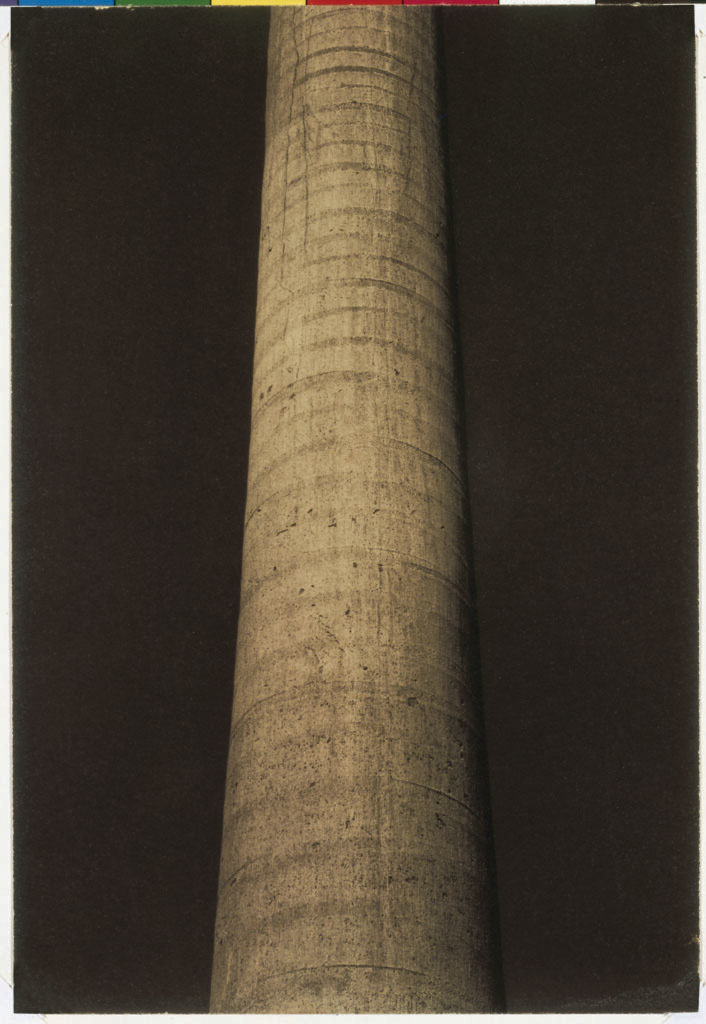
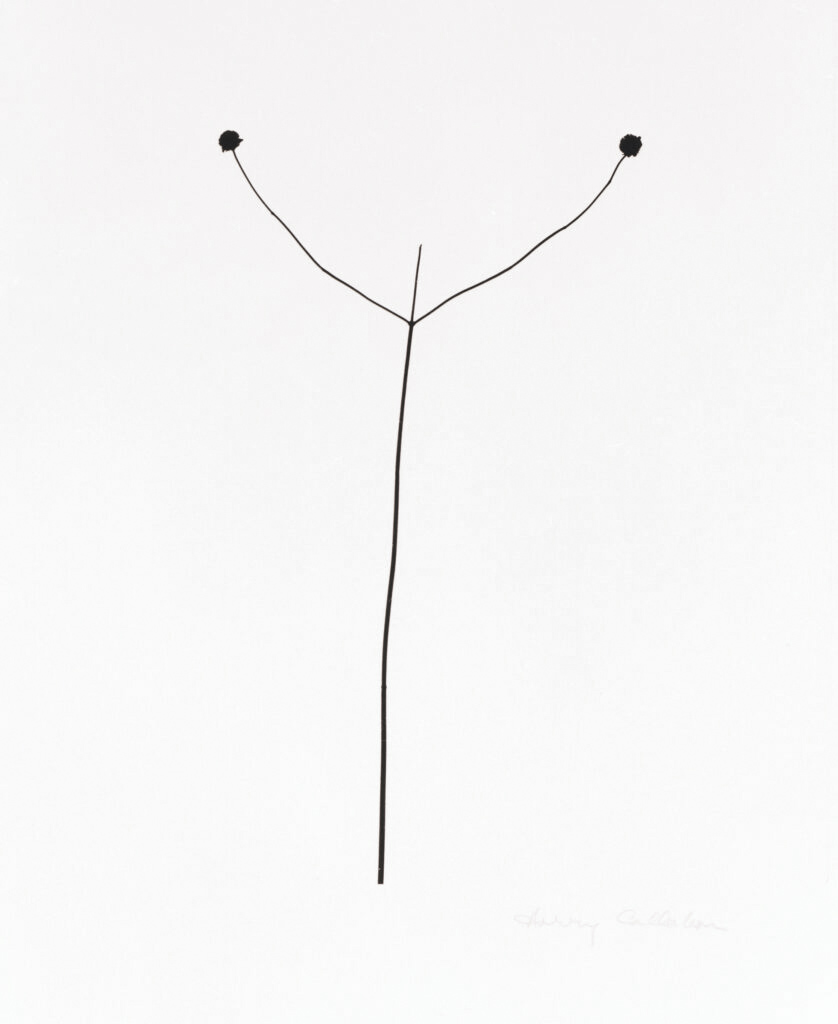
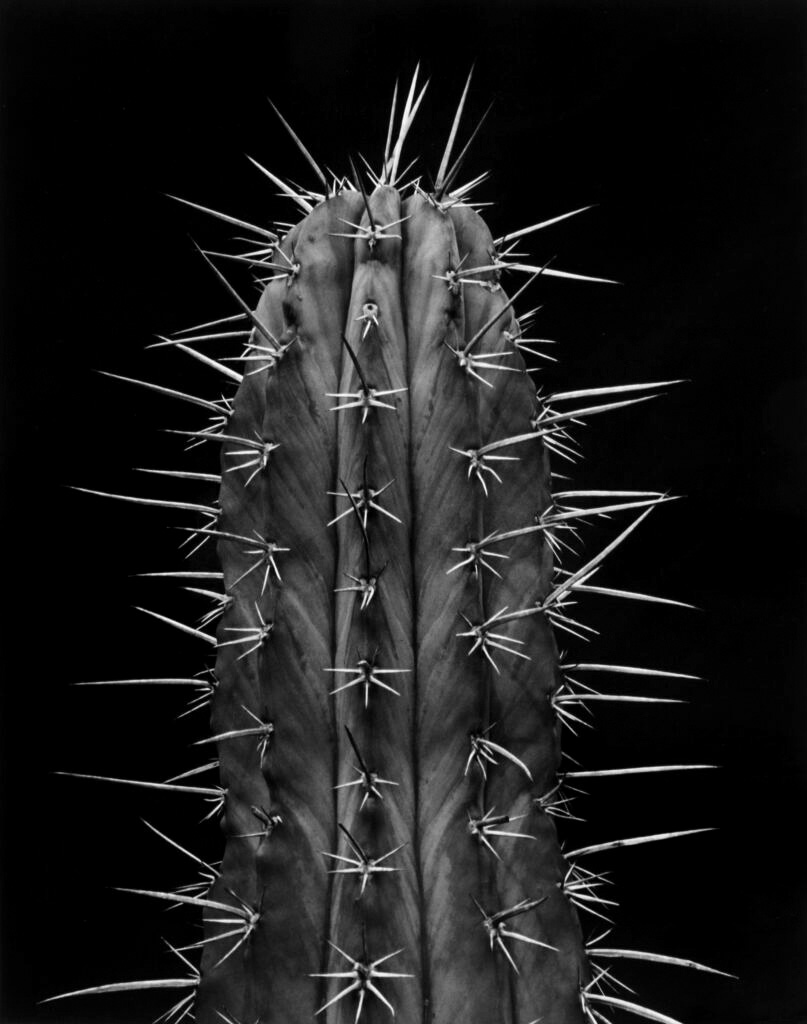
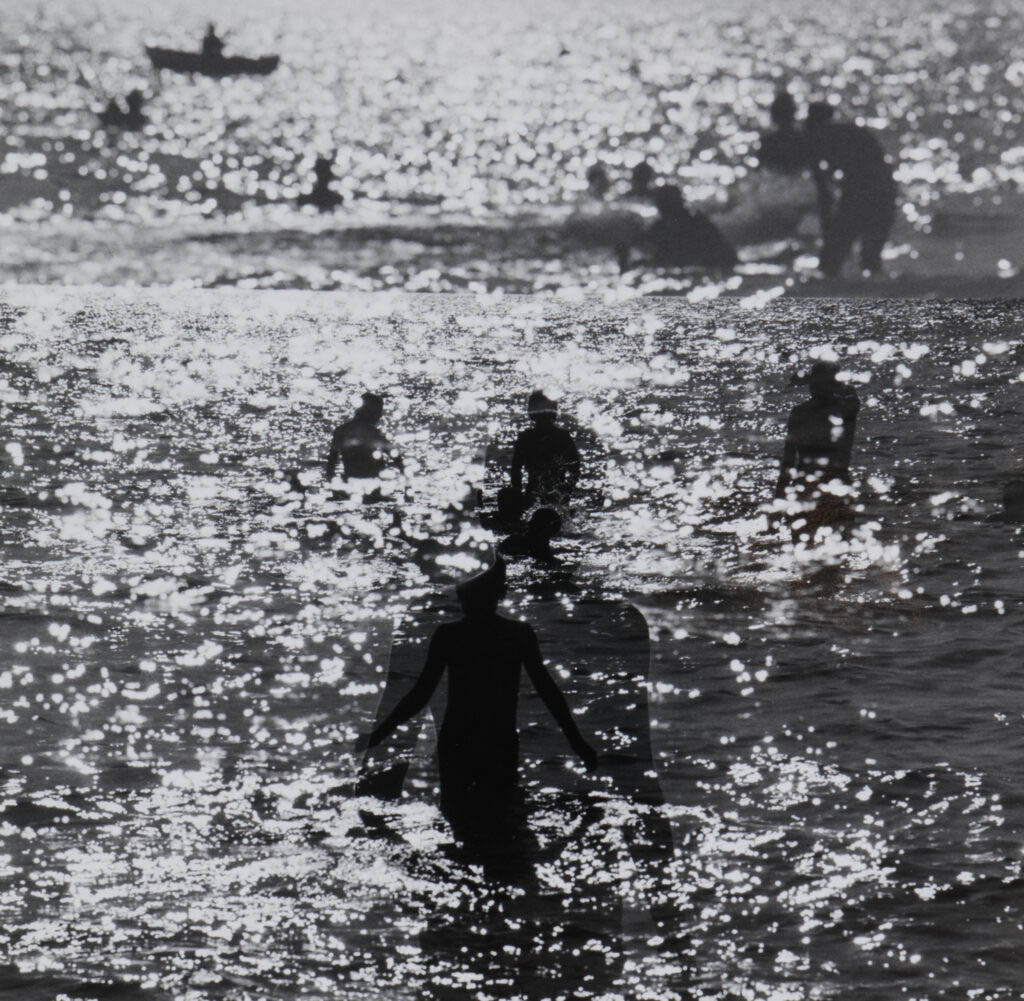
Exhibition: ‘Photography’s New Vision: Experiments in Seeing’ at the High Museum of Art, Atlanta

Exhibition dates: 13th June, 2025 – 4th January, 2026

Curator: Maria L. Kelly, High Museum of Art assistant curator of photography


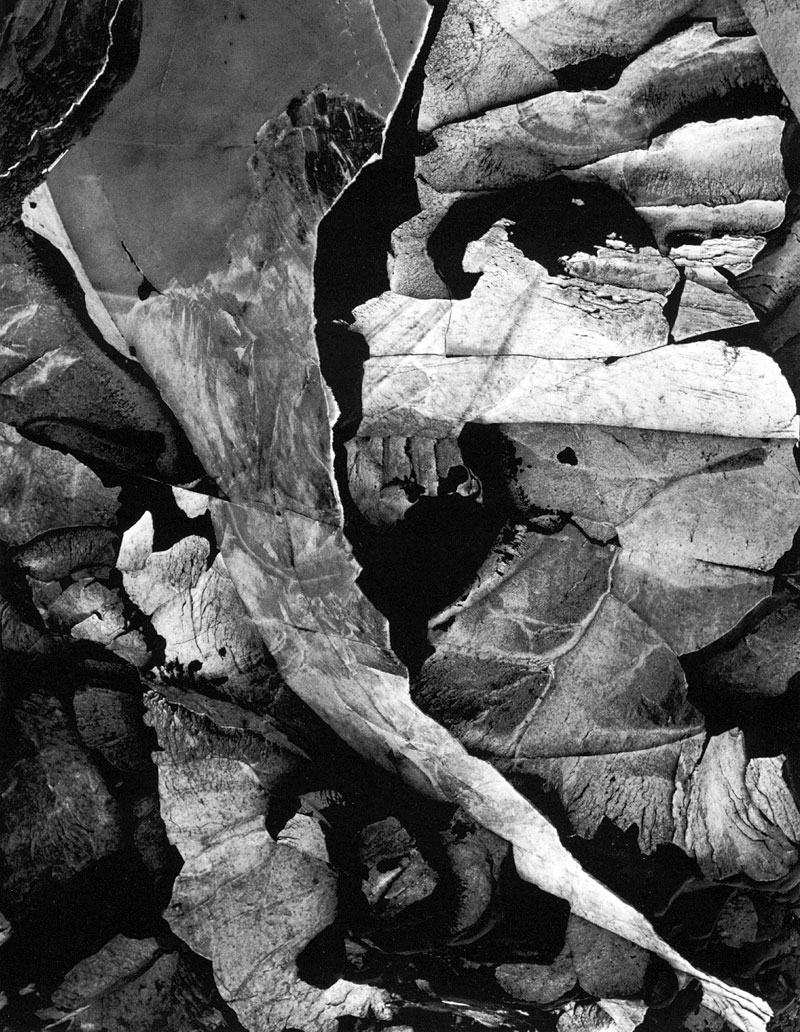
Aaron Siskind (American, 1903-1991) 'Pleasures and Terrors of Levitation #37' 1953


Aaron Siskind (American, 1903-1991)
Pleasures and Terrors of Levitation #37
1953
Gelatin silver print
High Museum of Art, Atlanta, gift of Adair and Joe B. Massey in honour of Gus Kayafas


Aaron Siskind was recognised for the ways he rendered his surroundings into often stark shapes and forms, which reflected his fascination with contemporary trends in abstract art. He was an influential teacher at Chicago’s Institute of Design, which was founded by László Moholy-Nagy as the New Bauhaus. This image of a person flying or falling comes from a series Siskind made of the contorted bodies of divers plunging into Lake Michigan. He masterfully created its disorienting effect through tight focus on the floating figure without contextual elements.

Text from the High Museum of Art website


While contemporarily AI-powered technologies are revolutionising the way we interact with and consume media, enabling us to “to process and analyse vast amounts of data quickly, making it easier to find and access the information we need” in the 1920s and 1930s there was also a revolution in the way artists (and their use of the camera) viewed and felt the world – one not based on information, image quality or duplicity in the veracity of the image but one based on the word, perspective – be that point of view, context, close ups, surreality, fragmentation, scale, concept, construction, colour, aesthetics, identity, gender, or radical experimentation.

In this departure from traditional photographic methods, “New Vision photographers foregrounded experimental techniques, including photograms, photomontages and compositions that favoured extreme angles and unusual viewpoints, and these extended to movements such as surrealism and constructivism.” (Press release)

To me, this New Vision is about experiencing different perspectives – experiencing, sensing, feeling and seeing the world in a new light. After the disasters and machine-ations, the destruction of a conservative way of life before the First World War, here was a way to grasp hold of (and picture) the speed of a new world order, the dreams of physiological analysis, the diversity of new identities, and the fluidity of rapidly evolving technological and social cultures.

While today this (r)evolution continues at an ever expanding pace with the consumption of huge amounts of information and images, I believe it may be advantageous to rest for a while on certain experiences and images … so that we let the daggers drop from our eyes, to ‘not make images’ in our minds eye but just to be present in the viewing of a photograph, so that we appreciate and understand every aspect of the great life spirit of this wondrous earth.

Then and now, new vision.

Dr Marcus Bunyan


Many thankx to the High Museum of Art for allowing me to publish the photographs in the posting. Please click on the photographs for a larger version of the image.


The New Vision movement of the 1920s and 1930s offered a revolutionary approach to seeing the world. It represented a rebellion against traditional photographic methods and an embrace of avant-garde experimentation and innovative techniques. László Moholy-Nagy, an artist and influential teacher at the Bauhaus in Germany, named this period of expansion the “New Vision.” Today, the term encompasses photographic developments that took place between the two World Wars in Europe, America, and beyond. New Vision photographers foregrounded inventive techniques, including photograms, photomontages, and light studies, and made photographs that favoured extreme angles and unusual viewpoints. These approaches – which also extended to more defined movements like Surrealism – spoke to a desire to find and see different perspectives in the wake of World War I.

Uniting more than one hundred works from the High’s photography collection, the exhibition traces the movement’s impact, from its origins in the 1920s to today, and demonstrates its long-standing effect on subsequent generations.

Text from the High Museum of Art website

Photography’s New Vision: Experiments in Seeing

Named by the influential German artist and teacher László Moholy-Nagy, the “New Vision” comprised an expansive variety of photographic exploration that took place in Europe, America, and beyond in the 1920s and 1930s. The movement was characterised by its departure from traditional photographic methods. New Vision photographers foregrounded experimental techniques, including photograms, photomontages, and light studies, and made photographs that favoured extreme angles and unusual viewpoints.

This exhibition, uniting more than one hundred works from the High’s robust photography collection, will trace the impact of the New Vision movement from its origins in the 1920s to today. Photographs from that era by Ilse Bing, Alexander Rodchenko, Imogen Cunningham, and Moholy-Nagy will be complemented by a multitude of works by modern and contemporary artists such as Barbara Kasten, Jerry Uelsmann, Hiroshi Sugimoto, and Abelardo Morell to demonstrate the long-standing impact of the movement on subsequent generations.

Text from the High Museum of Art website


Installation view of the exhibition 'Photography's New Vision: Experiments in Seeing' at the High Museum of Art, Atlanta, June 2025 - January 2026


Installation views of the exhibition Photography’s New Vision: Experiments in Seeing at the High Museum of Art, Atlanta, June 2025 – January 2026
Photos: Mike Jensen


The High Museum of Art presents “Photography’s New Vision: Experiments in Seeing” (June 13, 2025 – Jan. 4, 2026), an exhibition uniting more than 100 works from the High’s robust photography collection to trace the impact of the New Vision movement from its origins in the 1920s to today. Works include century-old photographs exemplifying themes from the movement and modern and contemporary images that emphasise the relevance of current artistic and social practices as a response to the technological and cultural changes that occurred in the early 20th century.

“This exhibition provides an opportunity to illuminate photographers’ creativity and innovative practices, all inspired by the progression of the medium in the 1920s and 30s,” said High Museum of Art Director Rand Suffolk. “Many of the works are rarely on view, so it will be an exciting experience for visitors to see them and learn about photographers’ abilities as they reflect reality while experimenting with technique and perspective.” Named by the influential German artist and teacher László Moholy-Nagy, the “New Vision” comprised an expansive variety of photographic exploration that took place in Europe, America and beyond in the 1920s and 1930s. The movement was characterised by its departure from traditional photographic methods. New Vision photographers foregrounded experimental techniques, including photograms, photomontages and compositions that favoured extreme angles and unusual viewpoints, and these extended to movements such as surrealism and constructivism.

“Experiments in Seeing” features nearly 100 photographers. It also demonstrates how the New Vision movement revolutionised the medium of photography in the early 20th century in response to the great societal, economic and technological shifts spurred by the upheaval of the two World Wars. Photographs from that era by Ilse Bing, Alexander Rodchenko, Imogen Cunningham and Moholy-Nagy have been complemented by a multitude of photographs by modern and contemporary artists such as Barbara Kasten, Jerry Uelsmann, Hiroshi Sugimoto and Abelardo Morell to demonstrate the long-standing impact of the movement on subsequent generations.

The first section of the exhibition delves into experimental techniques that foreground the light-sensitive aspects of photography, followed by works created through in-camera manipulations or additions to the surfaces of the prints. Subsequent sections explore inventive methods of capturing unexpected views of the world articulated with radical angles or detailed close-ups. Other works showcase surreal approaches to subjects such as humanlike forms and bodies, the use of mirrors and doubling, and everyday scenes heightened by uncanny moments or distorted through the interplay of light, shadow and water.

“Not only does the early 20th century and its art movements continue to be influential, but that time also echoes our current moment – one that feels similarly consequential and innovative with the development of new emerging technologies and methods of communicating,” said Maria L. Kelly, the High’s assistant curator of photography. “The movements and happenings of a century ago are akin to those of today and those shown in the exhibition. There remains a desire for alternative ways to see and approach the world through art, and particularly through photography.”

“Photography’s New Vision: Experiments in Seeing” is on view in the Lucinda W. Bunnen Galleries for Photography located on the Lower Level of the High’s Wieland Pavilion.

Press release from the High Museum of Art


“Light was considered the medium that permits photography. But for me it became the main subject: the protagonist of my photography.”


Ilse Bing, c. 1920s


Light Experimentation

After the trauma of World War I, many artists felt compelled to reconsider conventional art making methods to better reflect and engage with the world. Some photographers turned their attention to the essential element of photography: light. Through innovative visual investigations, cameraless photographs were produced, viewes of the world altered, and scientific discoveries made.

Experimentations with illumination and light-sensitive paper in the darkroom gave rise to photograms, enabling artists to pursue abstraction and to wield light as a sculptural element. The process of solarisation – reversing tones in a print using a flash of light during developing – provided an unconventional view of a subject. Early attempts to capture traces of light on film led to scientific innovations such as using strove lights to freeze movement, depicting magnetic fields, and tracing electrical currents on light sensitive paper.

These processes aim to reveal the invisible, with the elements of change as a constant companion. While artists can insert some control over the elements, the process ultimately shapes the final image. Many artworks in this section exist as unique prints, challenging the assumption of the reproducibility of photography, and emphasising the singularity of the creative moment.

Wall text from the exhibition


Francis Bruguière (American, 1879-1945) 'The Light That Never Was on Land or Sea' c. 1925


Francis Bruguière (American, 1879-1945)
The Light That Never Was on Land or Sea
c. 1925
Gelatin silver print
High Museum of Art, Atlanta, purchase with funds from Georgia-Pacific Corporation


Nathan Lerner (American, 1913-1977) 'Light Drawing #8 (Smoke)' 1938-1939


Nathan Lerner (American, 1913-1977)
Light Drawing #8 (Smoke)
1938-1939
Gelatin silver print
High Museum of Art, Atlanta, gift of Hilary Leff and Elliot Groffman


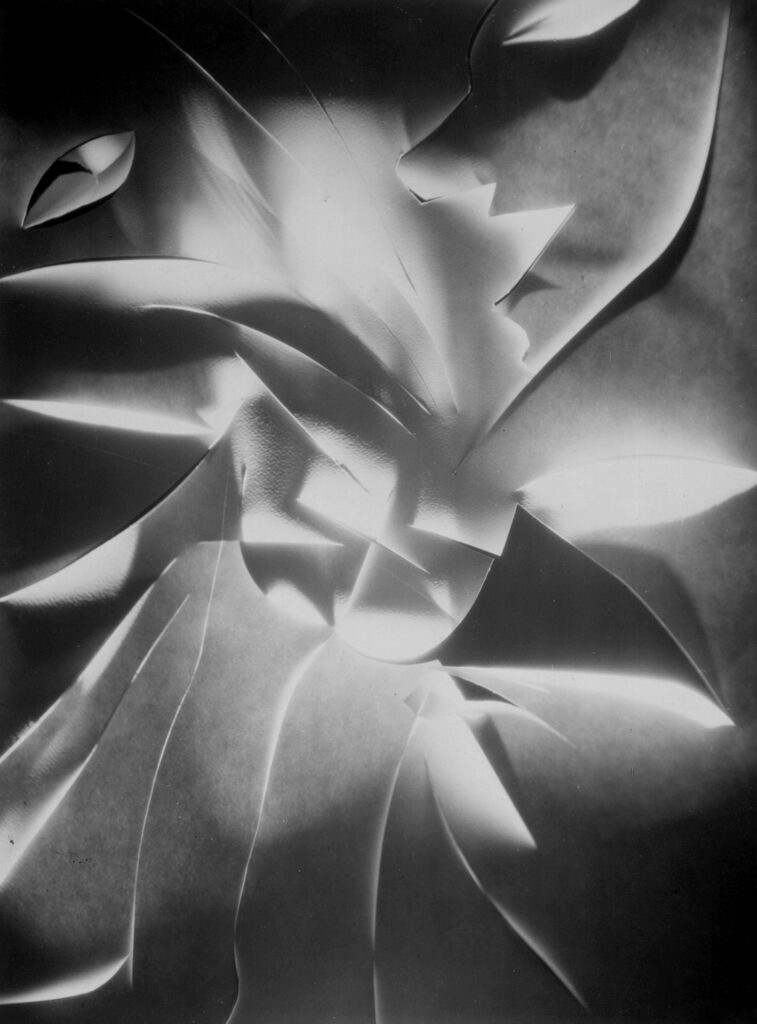
Ilse Bing (American born Germany, 1899-1998) 'Untitled [Seated Woman with Necklace, Solarized]' 1943


Ilse Bing (American born Germany, 1899-1998)
Untitled [Seated Woman with Necklace, Solarized]
1943
Gelatin silver print
High Museum of Art, Atlanta, gift of the Estate of Ilse Bing Wolff


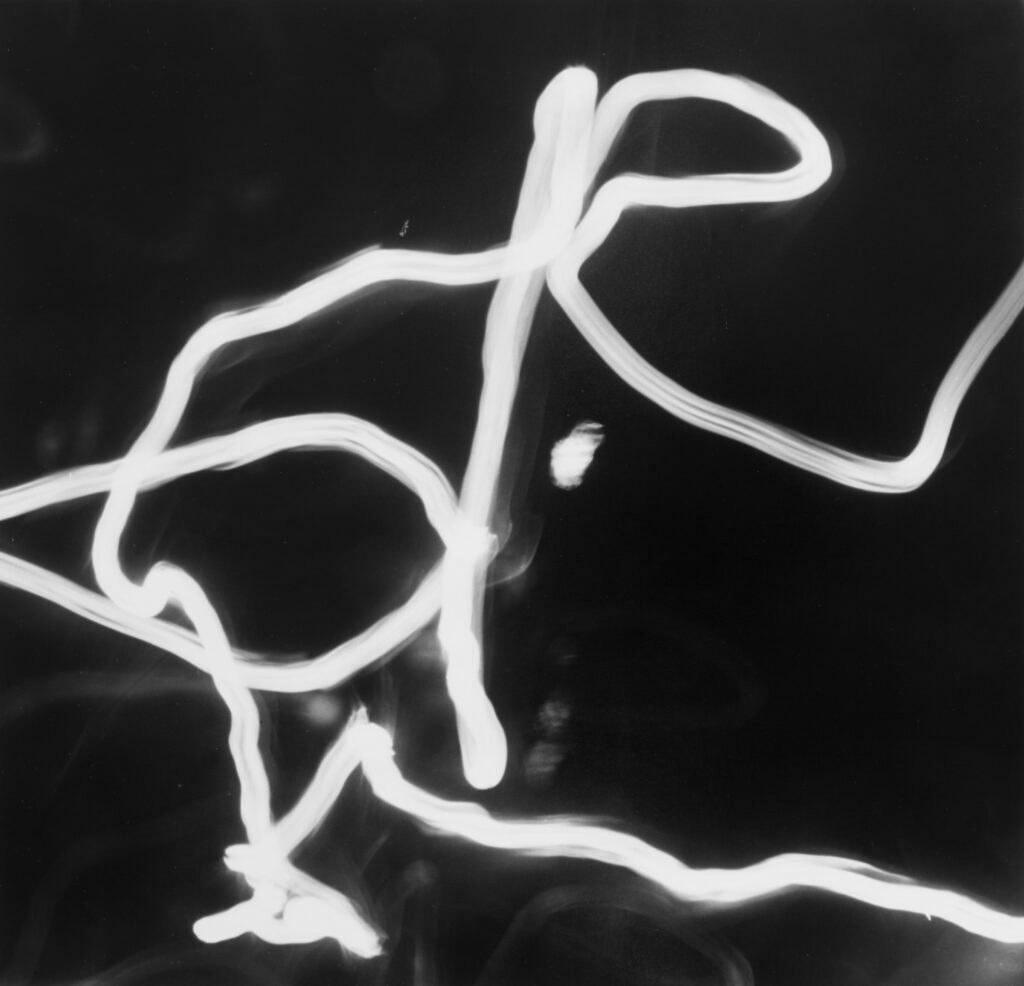
Harry Callahan (American, 1912-1999) 'Camera Movement on Flashlight, Chicago' c. 1949


Harry Callahan (American, 1912-1999)
Camera Movement on Flashlight, Chicago
c. 1949
Gelatin silver print
High Museum of Art, Atlanta, purchase with funds from the H. B. and Doris Massey Charitable Trust, Dr. Robert L. and Lucinda W. Bunnen, Collections Council Acquisition Fund, Jackson Fine Art, Powell, Goldstein, Frazer and Murphy, Jane and Clay Jackson, Beverly and John Baker, Roni and Sid Funk, Gloria and Paul Sternberg, and Jeffery L. Wigbels
© 2018 The Estate of Harry Callahan


Abelardo Morell (American born Cuba, b. 1948) 'Still Life with Wine Glass: Photogram on 20" x 24" Film' 2006


Abelardo Morell (American born Cuba, b. 1948)
Still Life with Wine Glass: Photogram on 20″ x 24″ Film
2006
Gelatin silver print
High Museum of Art, Atlanta, purchase with funds from the Friends of Photography
© Abelardo Morell


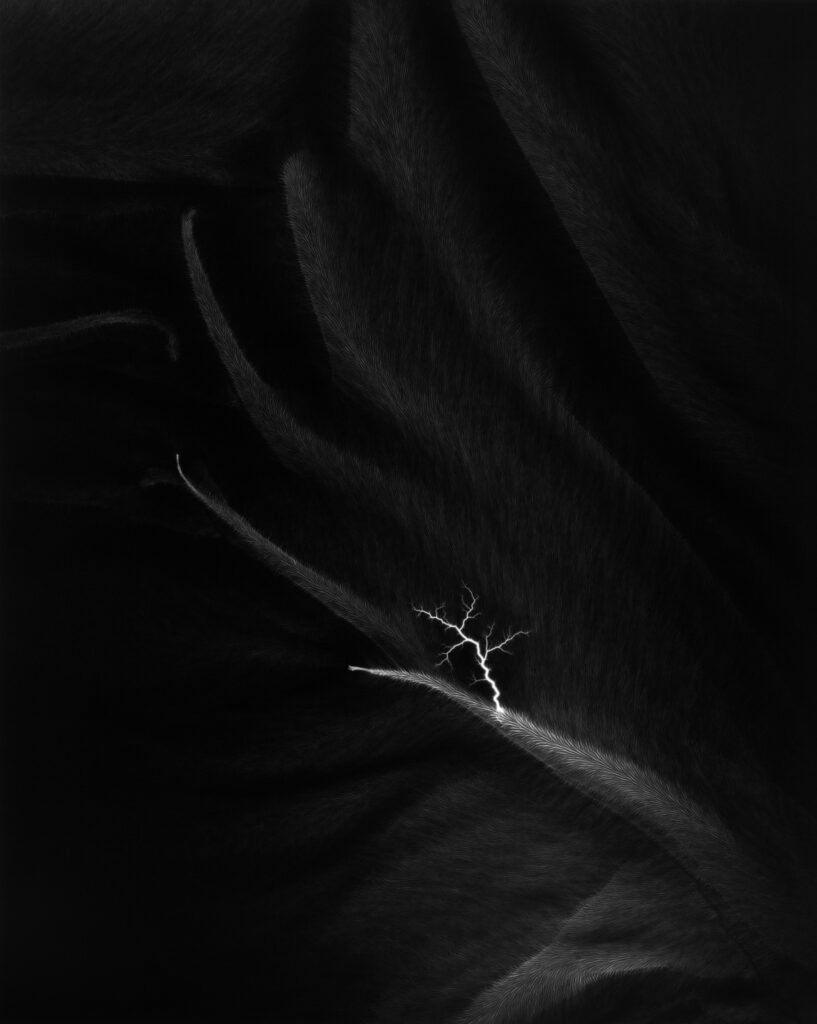
Hiroshi Sugimoto (Japanese, b. 1948) 'Lightning Fields 182' 2009


Hiroshi Sugimoto (Japanese, b. 1948)
Lightning Fields 182
2009
Gelatin silver print
High Museum of Art, Atlanta, purchase through funds provided by patrons of Collectors Evening 2012
© Hiroshi Sugimoto


Inspired by William Henry Fox Talbot, an inventor of photography who was fascinated with electromagnetic conduction, Hiroshi Sugimoto began applying charges of electricity directly to unexposed photographic film. After months of honing his technique in the darkroom, he managed to achieve remarkable results with a handheld wand charged by a generator. His Lightning Fields photographs are made without a camera or lens. Here, the abstract visual trace of an electric charge measuring over 400,000 volts sweeps across the composition, reading like the textures of a human hand, the upward tentacles of a fern, or the stark branches of a tree.

Text from the High Museum of Art website


Hans-Christian Schink (German, b. 1961) '2/26/2010, 7:54 am – 8:54 am, S36° 49.622' E 175° 47.340'' 2010


Hans-Christian Schink (German, b. 1961)
2/26/2010, 7:54 am – 8:54 am, S36° 49.622′ E 175° 47.340′
2010
From the series 1h
© Hans-Christian Schink


Abelardo Morell (American born Cuba, b. 1948) 'Camera Obscura: View of Philadelphia from Loews Hotel Room #3013 with Upside Down Bed, April 14th, 2014' 2014


Abelardo Morell (American born Cuba, b. 1948)
Camera Obscura: View of Philadelphia from Loews Hotel Room #3013 with Upside Down Bed, April 14th, 2014
2014
Pigmented inkjet print
High Museum of Art Atlanta, gift of Dr. Roger Hartl
© Abelardo Morell


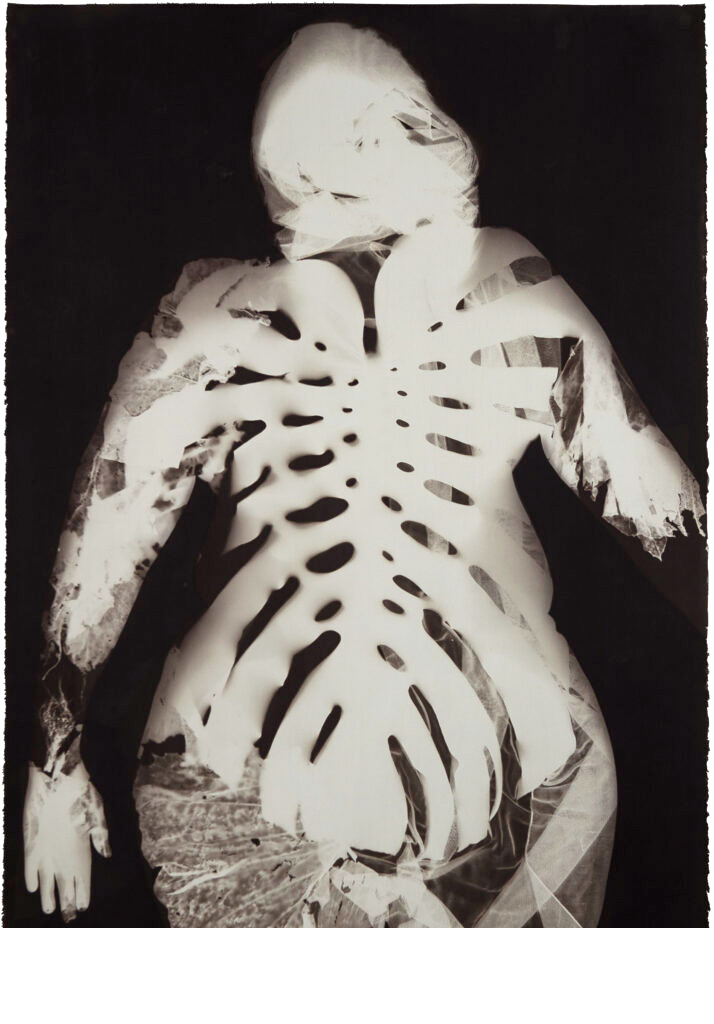
V. Elizabeth Turk (American, b. 1945) 'Calaeno' 2018


V. Elizabeth Turk (American, b. 1945)
Calaeno
2018
Van Dyke print
High Museum of Art, Atlanta, purchase with funds from Lucinda W. Bunnen for the Bunnen Collection
© Elizabeth Turk


V. Elizabeth Turk is an Atlanta-based photographer whose work explores the connections between the human body and the natural world. To make this print, Turk used an analog process from the 1800s that involves coating a large sheet of paper with light-sensitive chemicals. She then arranged her model on top of the sheet and exposed it to light, creating a ghostly silhouette, before repeating the exposure with plants. The resulting photogram is a unique image in which botanical forms intersect with the body, alluding to bones, veins, and skin and suggesting a visceral bond between humans and the environment. 

Text from the High Museum of Art website


“The limits of photography are incalculable; everything is so recent that even the mere act of searching may lead to creative results. […] The illiterate of the future will be the person ignorant of the use of the camera as well as of the pen.”


László Moholy-Nagy 1928


Radical Viewpoints

From photography’s inception in 1839, camera technology involved cumbersome equipment and time-consuming development processes until the advent of lightweight cameras in the 1920s. Photographers were then able to work more nimbly, transforming photography into a medium capable of capturing fleeting moments, unusual viewpoints, and multiple perspectives. The exploration of unexpected angles became a hallmark of New Vision photography. Sharp diagonals, extreme vantage points, and shortened perspectives opened novel pathways of perceiving otherwise commonplace environments.

Alexander Rodchenko, a pioneer in this method, championed the camera’s ability to reveal, stating, “in order to teach man to see from all viewpoints, it is necessary to photograph […] from completely unexpected viewpoints and in unexpected positions […] We don’t see what we are looking at. We don’t see marvellous perspectives.” This approach aimed to provide a fuller impression of subjects, prompting viewers to seek and appreciate what might otherwise be overlooked.

Though these early photographs may not appear groundbreaking today, their makers’ carefully considered methods transferred how photography is used. This is evident in photographers’ creative interpretations of their surroundings over the past century.

Wall text from the exhibition


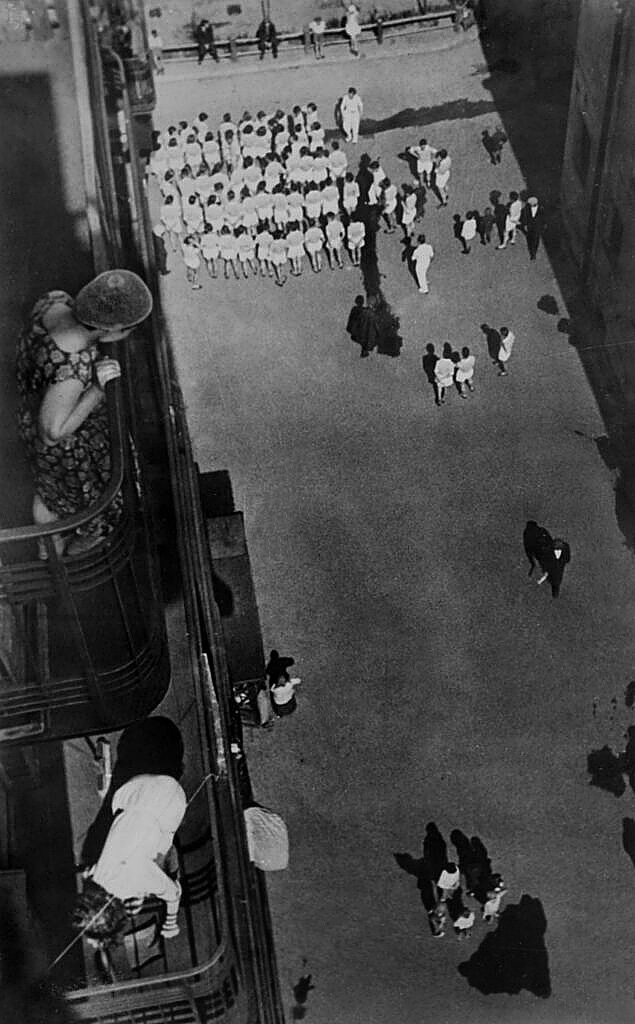
Alexander Rodchenko (Russian, 1891-1956) 'Sbor na demonstratsia' (Gathering for a Demonstration) 1928


Alexander Rodchenko (Russian, 1891-1956)
Sbor na demonstratsia (Gathering for a Demonstration)
1928
Gelatin silver print
High Museum of Art, Atlanta, gift of Joseph and Yolandra Alexander, Moscow/VAGA at Artists Rights Society (ARS), New York
© Estate of Alexander Rodchenko/RAO, Moscow/VAGA at Artists Rights Society (ARS), New York


Alexander Rodchenko was a key figure in the movements of New Vision and Constructivism – abstract and functional art that reflected an industrial society. Advocating “to achieve a revolution in our visual thought,” he explored various methods, such as photographing from unexpected angles, to capture dynamic views and expose new realities. With a new, lightweight 35 mm camera, he often photographed from his apartment balcony to create dramatic scenes of the street below. The perspective in this photograph flattens the building’s stories into one visual field, giving the image a theatrical quality as an onlooker peers over the railing.

Text from the High Museum of Art website


Walker Evans (American, 1903-1975) 'The Bridge' 1929


Walker Evans (American, 1903-1975)
The Bridge
1929
Gelatin silver print
High Museum of Art, Atlanta, gift of Arnold H. Crane
© Walker Evans Archive, The Metropolitan Museum of Art


A central figure among twentieth-century American photographers, Walker Evans created works in his early career that sample from the New Vision aesthetic, which he may have encountered while abroad in Paris in 1926. His photographs of New York City, made after he returned to the United States, feature dramatically angled or cropped scenes of architecture and city life. Evans made numerous photographic studies of the Brooklyn Bridge from both below and on the bridge, portraying it less as a recognisable landmark and more as a hulking expanse whose form fills each tight frame.

Text from the High Museum of Art website


László Moholy-Nagy (Hungarian 1895-1946) 'Stage Set for Madame Butterfly' 1931


László Moholy-Nagy (Hungarian 1895-1946)
Stage Set for Madame Butterfly
1931
Gelatin silver print
High Museum of Art, Atlanta, purchase with funds from Georgia-Pacific Corporation


Moholy-Nagy, a leader of the New Vision, had an expansive artistic practice that included painting, photography, sculpture, film, and more. As a teacher at the Bauhaus, which connected art and industry, he believed in technology’s potential to advance art and society. In 1929, he became set designer at the Kroll Opera House and created avant-garde sets with translucent and perforated materials, often making light itself a sculptural element. Lucia Moholy, a photographer, writer, teacher, and Moholy-Nagy’s first wife, was commissioned as Kroll’s stage photographer. In this image, which either artist may have made, the sharp angle shot from above complicates the set of Madame Butterfly, emphasising intersecting, moving elements and heightening areas of light and shadow.

Text from the High Museum of Art website


Lucas Foglia (American, b. 1983) 'Esme Swimming, Parkroyal on Pickering, Singapore' 2014


Lucas Foglia (American, b. 1983)
Esme Swimming, Parkroyal on Pickering, Singapore
2014
Pigmented inkjet print
High Museum of Art, Atlanta, gift of Irene Zhou
© Lucas Foglia


Close Ups

Similar to the practice of using unusual angles to offer unexpected perspectives, some photographers began capturing highly detailed, close-up views of objects. This approach affords a study of texture, pattern, and structure that may otherwise go unnoticed by the human eye. By eliminating surroundings that could offer a narrative, the physicality of the object becomes the primary focus, allowing it to transcend beyond its everyday existence.

Practitioners of straight photography in the United States and the concurrent New Objectivity movement in Germany shared a core desire to unearth a balance of the familiar and the foreign within intricate images of forms. While Imogen Cunningham and Edward Weston perfected carefully composed studies of plants and other natural matter, Albert Renger-Patzsch, Alexander Rodchenko, and Ralph Steiner explored scientific and industrial objects. Such images celebrated the technological advancements of the time and revealed how mechanical structures often mimic those found in nature, suggesting a shared framework, and a shared beauty, between humanmade and natural. The emphasis on detail and abstraction invites viewers to reconsider their perceptions of both the ordinary and the extraordinary in the world around them.

Wall text from the exhibition


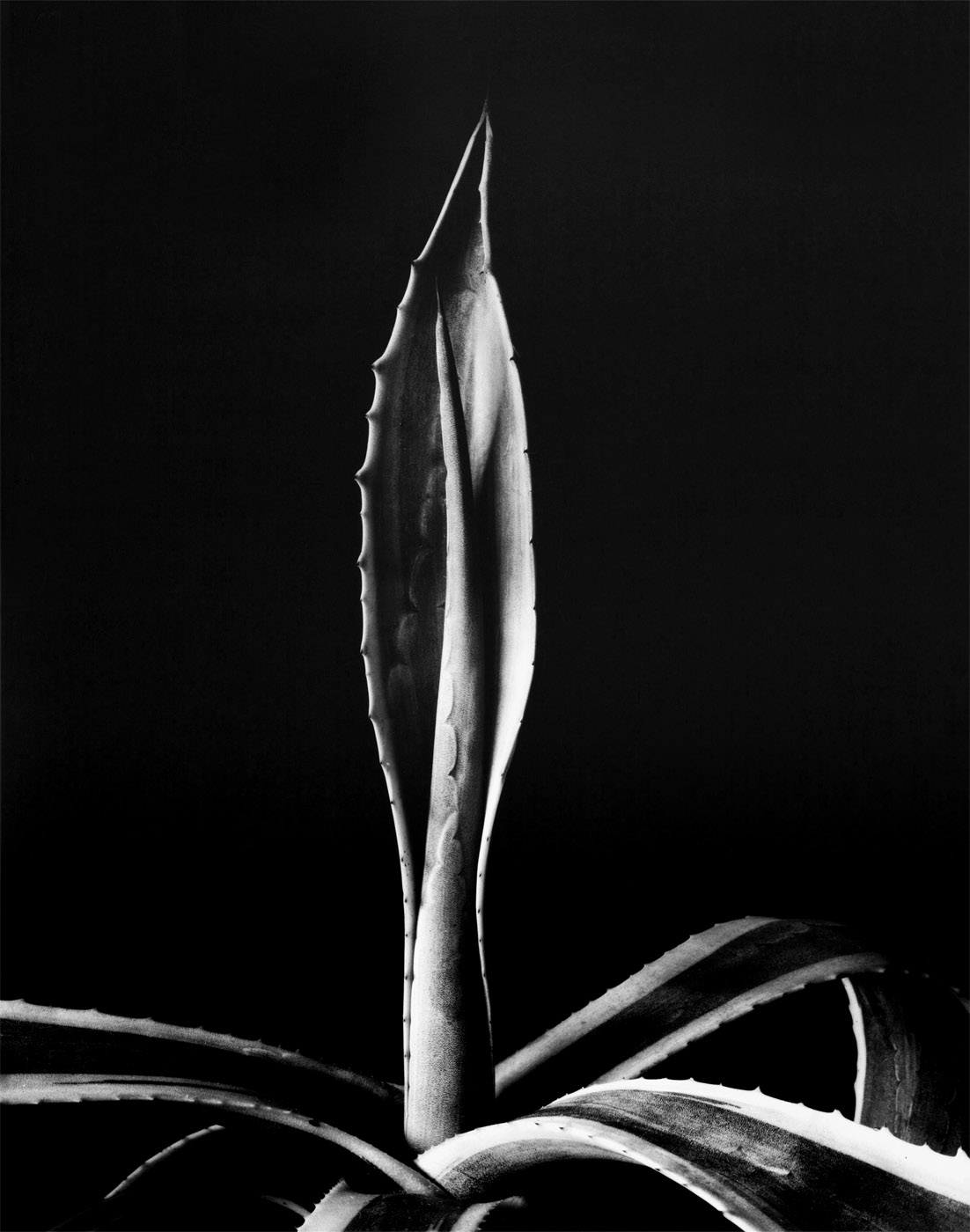
Imogen Cunningham (American, 1883-1976) 'Agave Americanus' 1929


Imogen Cunningham (American, 1883-1976)
Agave Americanus
1929
Gelatin silver print
High Museum of Art, Atlanta
© The Imogen Cunningham Trust


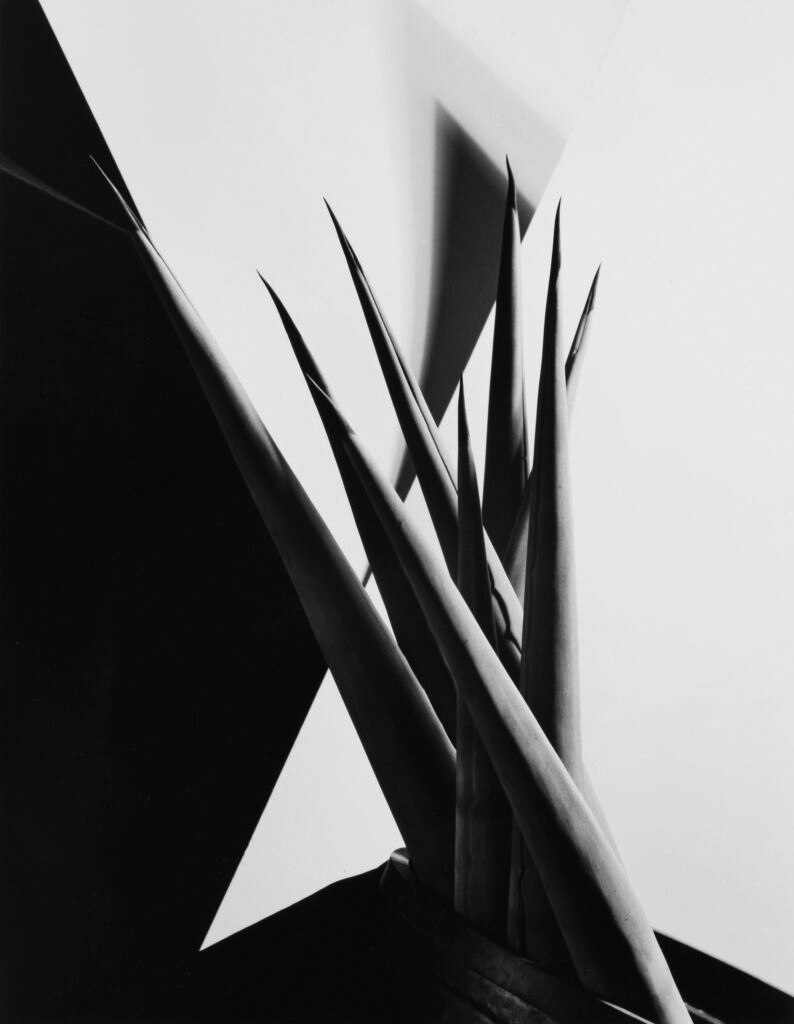
Imogen Cunningham (American, 1883-1976)
'Agave Design I' c. 1920


Imogen Cunningham (American, 1883-1976)
Agave Design I
c. 1920
Gelatin silver print
High Museum of Art, Atlanta, purchase with funds from Georgia-Pacific Corporation
© The Imogen Cunningham Trust


Edward Weston (American 1886-1958) 'Palma Cuernavaca II' 1925


Edward Weston (American 1886-1958)
Palma Cuernavaca II
1925
Palladium print
High Museum of Art, Atlanta, gift of Lucinda W. Bunnen for the Bunnen Collection to mark the retirement of Gudmund Vigtel
© Center for Creative Photography, Arizona Board of Regents


Ralph Steiner (American, 1899-1986) 'Electrical Switches' 1929


Ralph Steiner (American, 1899-1986)
Electrical Switches
1929
Gelatin silver print
8 x 10 5/16 inches
Purchase with funds from Georgia-Pacific Corporation


Harry Callahan (American, 1912-1999) 'Weed Against Sky, Detroit' 1948


Harry Callahan (American, 1912-1999)
Weed Against Sky, Detroit
1948
Gelatin silver print
High Museum of Art, Atlanta, gift of the Callahan and Hollinger Families
© 2018 The Estate of Harry Callahan


Eugenia de Olazabal (Mexican, b. 1936) 'Espinas' c. 1985


Eugenia de Olazabal (Mexican, b. 1936)
Espinas
c. 1985
Gelatin silver print
High Museum of Art, Atlanta, gift of the artist


“Surrealism lies at the heart of the photographic enterprise: in the very creation of a duplicate world, of a reality in the second degree, narrower but more dramatic than the one perceived by natural vision.”


Susan Sontag, 1973


Surreality

Surrealism emerged as an artistic movement in reaction to the horrors of World War I. The often disconcerting imagery and literature of the movement reflected a world that felt disorienting and chaotic and captured how the very foundations of reason and humanity were tested and questioned through the realities of war. In his Surrealist Manifesto (1924), French writer Andre Breton advocates for a rejection of rational ways of approaching the world in four of dreams and imagination as pathways to new creative expressions.

Photography played an important role in the Surrealist movement. Artists valued how the medium could capture spontaneous moments that reveal the unexpected, be manipulated to stage scenes, or be altered with darkroom processes. They harness photography in a multitude of ways to create dreamlike and unconscious associations with reality. In these galleries, artists explore uncanny moments and create links to the human psyche by focusing on humanlike forms and fragmented body parts, mirrored and doubled views, and the impact of light and shadows in space.

Wall text from the exhibition


Eugène Atget (French, 1857-1927) 'Men's Fashions (Avenue des Gobelins)' 1925, printed 1956


Eugène Atget (French, 1857-1927)
Men’s Fashions (Avenue des Gobelins)
1925, printed 1956
Gelatin silver print
Purchase


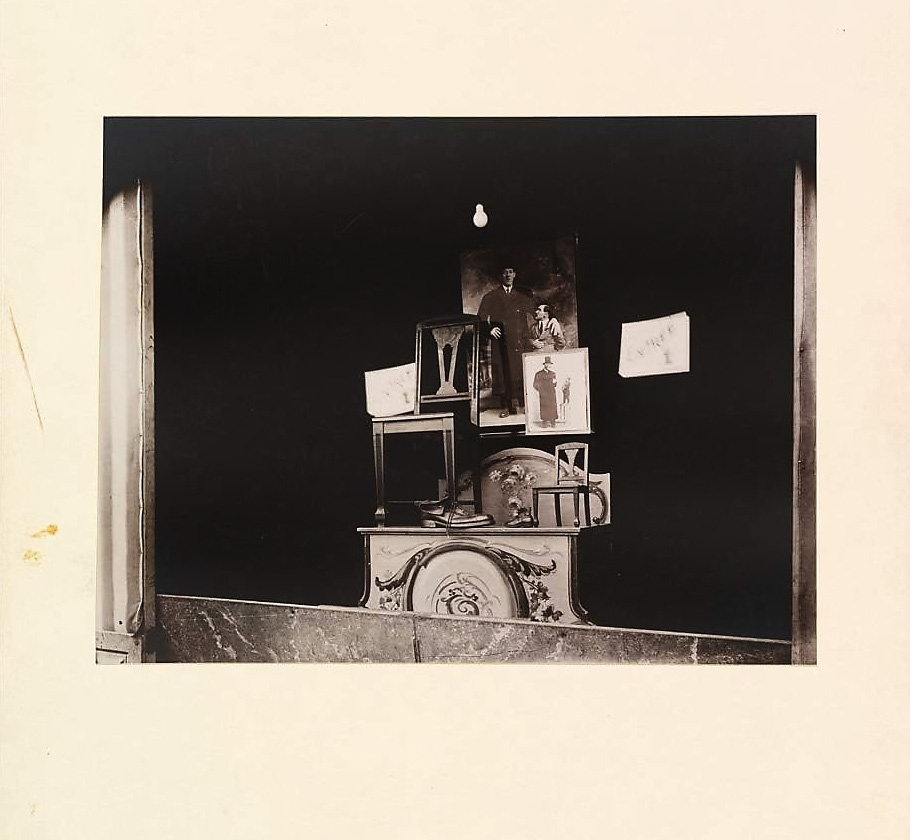
Eugène Atget was the great chronicler of Paris at the turn of the century. His vast photographic archive captures a city on the precipice of modernisation. Though his photographs of empty city streets were documentary in nature, the Surrealists admired their dreamlike quality and claimed Atget as one of their own despite his protestations. They believed any photograph could shed its original context and intent when viewed with a surrealist sensibility. Atget’s photograph of mannequins peering out of a shop window appealed to the movement by embodying the uncanny valley, where the human likeness of a nonhuman entity evokes both affinity and discomfort in viewers.

Text from the High Museum of Art website


Florence Henri (Swiss born United States, 1893-1982) 'Composition' 1932, printed 1972


Florence Henri (Swiss born United States, 1893-1982)
Composition
1932, printed 1972
Gelatin silver print
High Museum of Art, Atlanta, gift of Dr. Joe B. Massey in honor of Maria L. Kelly


Florence Henri is well known for her manipulations of light and form that create complex, surrealist scenes. She used angled mirrors to frame, obscure, and replicate portions of scenes to dissolve a sense of perspective and space, as seen in this still life comprising mirrors, pears, and an image of the sea. After only one semester studying under László Moholy-Nagy at the Bauhaus in 1927, Henri shifted her focus from painting to photography and began using various experimental techniques such as photomontage, multiple exposures, photograms, and negative printing.

Text from the High Museum of Art website


Barbara Kasten (American, b. 1936) 'Construct NYC' 1984


Barbara Kasten (American, b. 1936)
Construct NYC
1984
Dye destruction print
High Museum of Art, Atlanta, gift of Lucinda W. Bunnen for the Bunnen Collection
© Barbara Kasten


Barbara Kasten’s art is as much about the process of setting up innovative still life scenes as it is about the photographs she makes of them. Her Constructs series focuses on large-scale complex assemblages that she builds in her studio using a wide variety of materials, including painted wood, plaster, mirrors, screens, and fibers. Her work is not digitally altered; instead, she complicates the scene using mirrors and light, much in the tradition of Florence Henri, whose photograph is also on view in the exhibition.

Text from the High Museum of Art website


Manipulations

This final section features photographers from the New Vision period to the present day who experiment with physically manipulating photographs. Through approaches such as double exposure, photomontage, surface alteration, and multilayering, they challenge and expand our perceptions of reality. The artworks in this section prioritise the creative process through labour, intention, intervention, and theatricality.

Double exposures is the process of photographing multiple images with the same negative within the camera, resulting in layered images that often provide a frenetic, multifaceted view of a scene. In contrast to the in-camera process of double exposure, photomontage combines separate images in the darkroom to produce a final photograph that emphasises the image’s artifice and absurdity. Physically disrupting the surface of photographs with alterations such as adding unnatural colour, drawing connections, stitching into prints, or inscribing texts augments the visual experience and offers emotional and narrative depth. Finally, whether through ancient visual techniques like the camera obscure or new technologies like digital screens, these artists create enigmatic scenes by layering and physically transforming subject, composition, and image.

Wall text from the exhibition


Barbara Morgan (American, 1900-1992) 'Protest' 1940


Barbara Morgan (American, 1900-1992)
Protest
1940
Gelatin silver print
High Museum of Art, Atlanta, purchase


Charles Swedlund (American, b. 1935) '31 St. Beach' c. 1955


Charles Swedlund (American, b. 1935)
31 St. Beach
c. 1955
Gelatin silver print
High Museum of Art, Atlanta, gift of Steven Nordman
© Charles Swedlund


Jerry Uelsmann (American, 1934-2022) 'Untitled' 1964


Jerry Uelsmann (American, 1934-2022)
Untitled
1964
Gelatin silver print
High Museum of Art, Atlanta, purchase with funds from a friend of the Museum


Lucinda Bunnen (American, 1930-2022) 'Untitled' 1974


Lucinda Bunnen (American, 1930-2022)
Untitled
1974
Gelatin silver print
High Museum of Art, Atlanta, purchase with funds from the Lawrence and Alfred Fox Foundation for the Ralph K. Uhry Collection
© Lucinda Bunnen


Duane Michals (American, b. 1932)
'Untitled' 1989 From the 'Indomitable Spirit Portfolio'


Duane Michals (American, b. 1932)
Untitled
1989
From the Indomitable Spirit Portfolio
Gelatin silver print
High Museum of Art, Atlanta


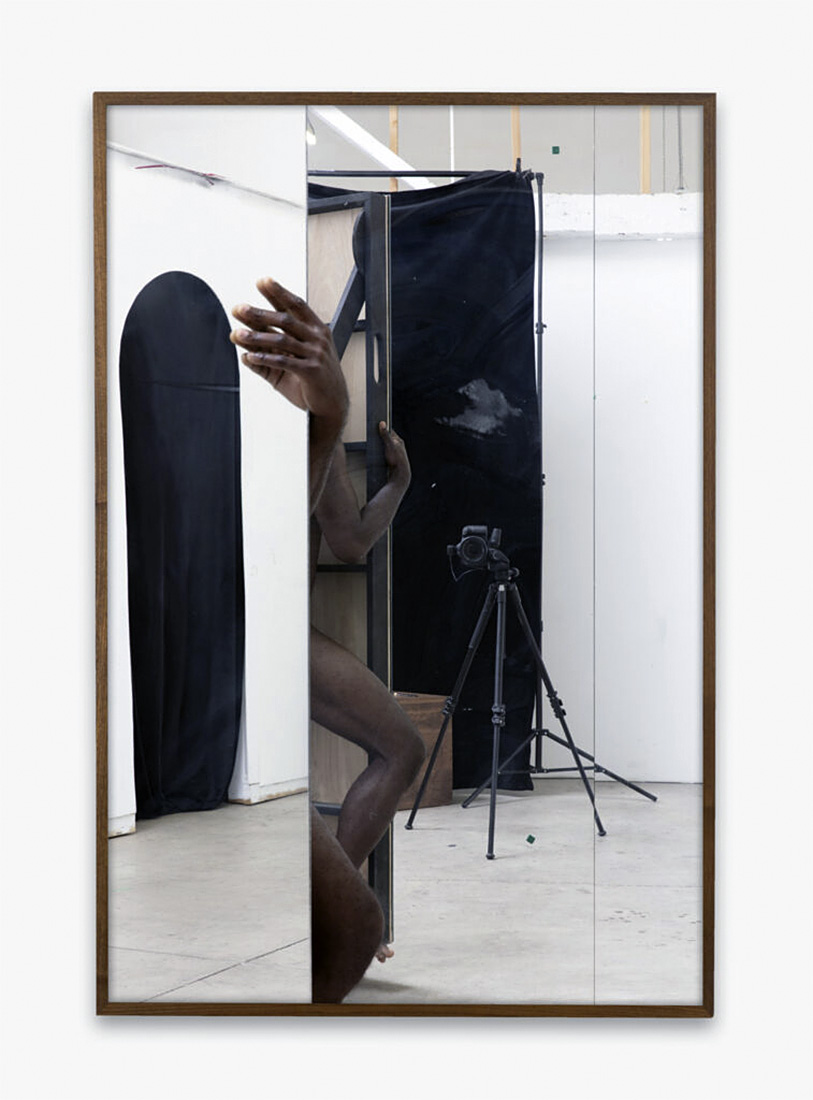
Paul Mpagi Sepuya (American, b. 1982) 'Studio (0X5A8180)' 2021


Paul Mpagi Sepuya (American, b. 1982)
Studio (0X5A8180)
2021
Archival pigment print
High Museum of Art, Atlanta, purchase with funds from the Donald and Marilyn Keough Family Foundation
© Paul Mpagi Sepuya


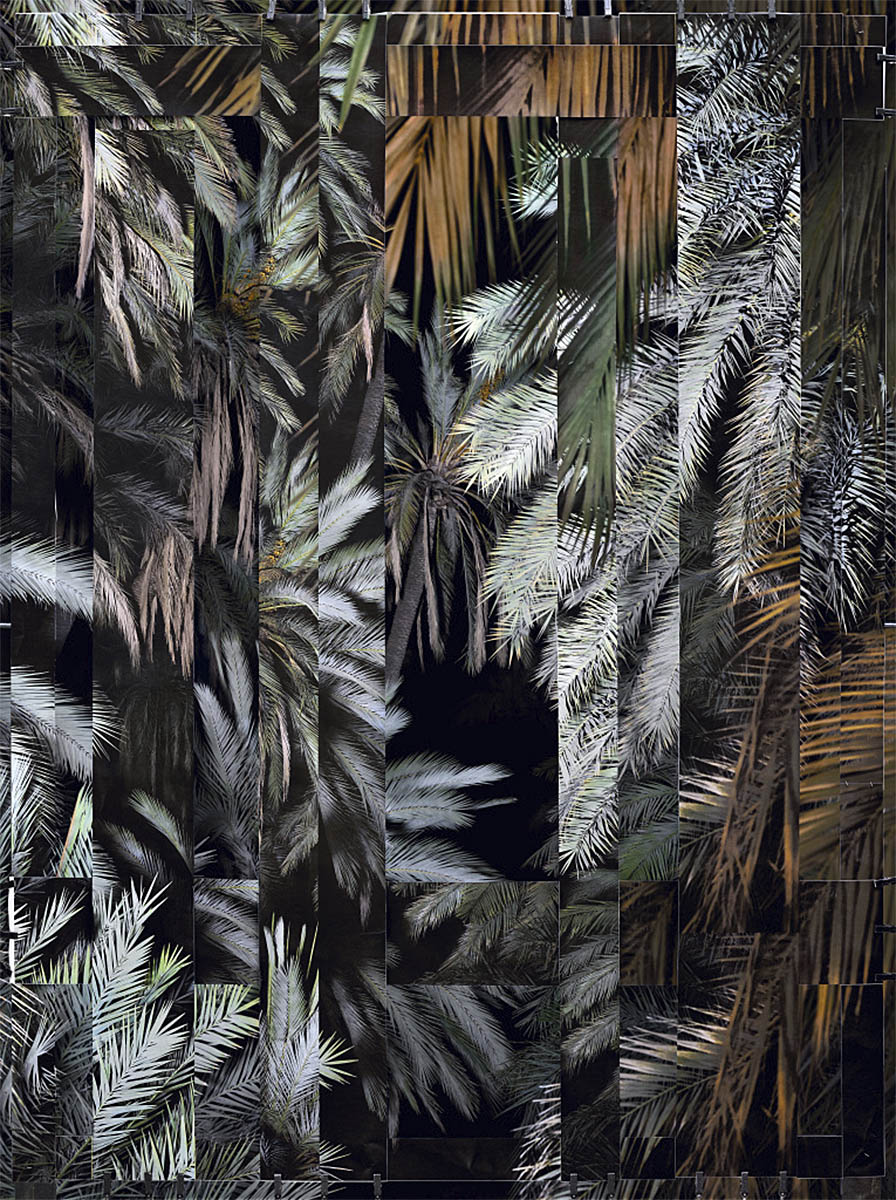
Noémie Goudal (French, b. 1984) 'Phoenix V' 2021


Noémie Goudal (French, b. 1984)
Phoenix V
2021
Dye coupler print
High Museum of Art, Atlanta, purchase through funds provided by patrons of Collectors Evening 2023


Noémie Goudal visualises “deep time” (geological history of the planet) and paleoclimatology (study of past climates) to challenge our perception of the world. Referring to the ancient continental split two billion years ago that formed South America and Africa, this image features the Phoenix atlantica, a palm tree that grows on both sides of the Atlantic. Goudal arranged strips of photographic prints of the palms made on one continent in front of the physical palms on the other and rephotographed the scene. The resulting image interweaves the two continents, creating a glitchy, kaleidoscopic view meant to unsettle our sense of stability and the constancy of the planet.

Text from the High Museum of Art website


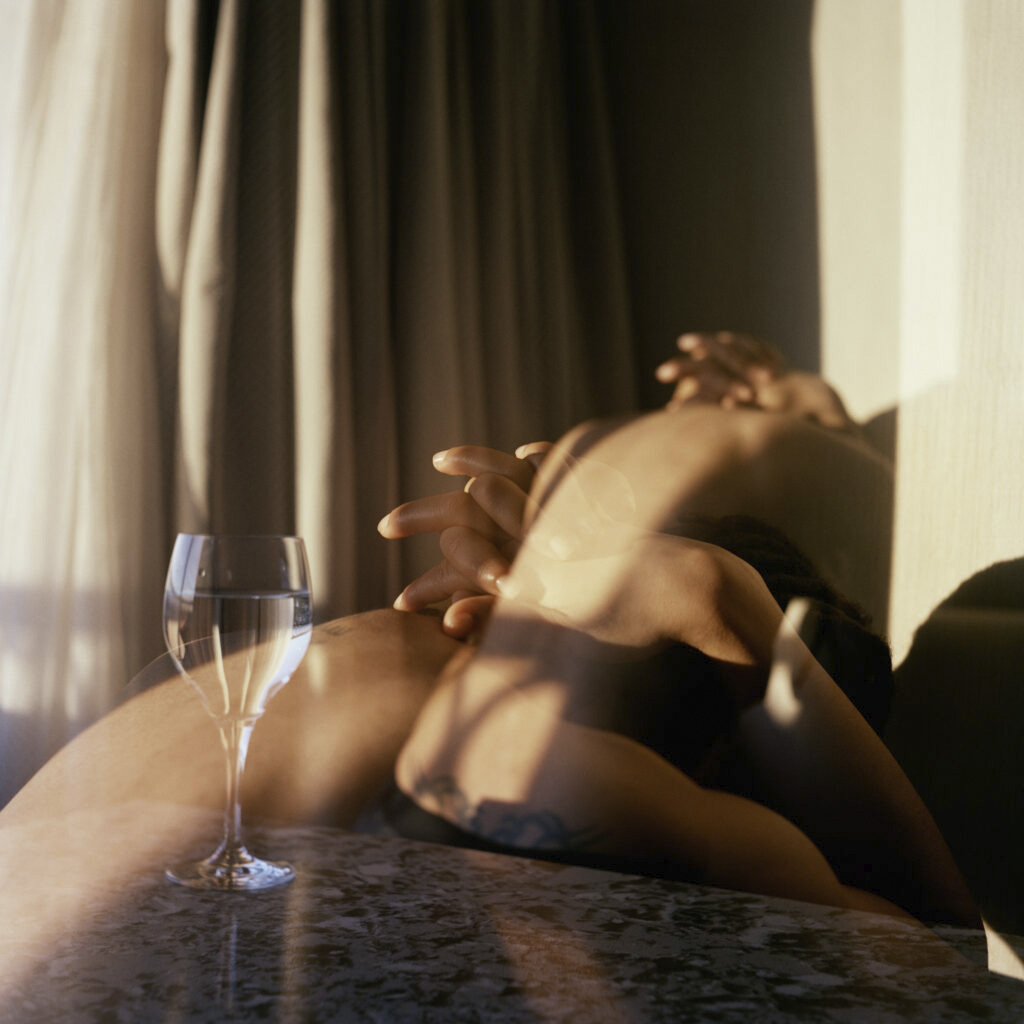
Naima Green (American, b. 1992) 'It Lingers Sweetly' 2022


Naima Green (American, b. 1992)
It Lingers Sweetly
2022
Pigmented inkjet print
High Museum of Art, Atlanta, purchase with funds from the LGBTQIA+ Photography Centennial Initiative


Naima Green’s practice centres connection and collaboration to cast a tender lens on her own queer community of colour. Her lyrical portraits take shape in intimate domestic spaces and airy outdoor environments that embody havens for the people in those spaces. Through double exposure and serial photographs, she provides what she calls “multiple entry points” into a moment in time, translating movements and emotions into a single image. She explains her interest in double exposure “as a means of capturing things that can’t be held in just one way … ,” allowing her to “play with loosening the narrative and letting go of some control.”

Text from the High Museum of Art website


The High Museum of Art
1280 Peachtree St NE
Atlanta, GA
30309

Opening hours:
Tuesday – Saturday 10am – 5pm
Sunday 12 – 5pm
Monday closed

The High Museum of Art website

LIKE ART BLART ON FACEBOOK

Back to top

Exhibition: ‘Photography: Real & Imagined’ at The Ian Potter Centre: NGV Australia, Melbourne Part 1

Exhibition dates: 13th October 2023 – 4th February 2024

Warning: Aboriginal and Torres Strait Islander readers should be aware that this posting contains images and names of people who may have since passed away.
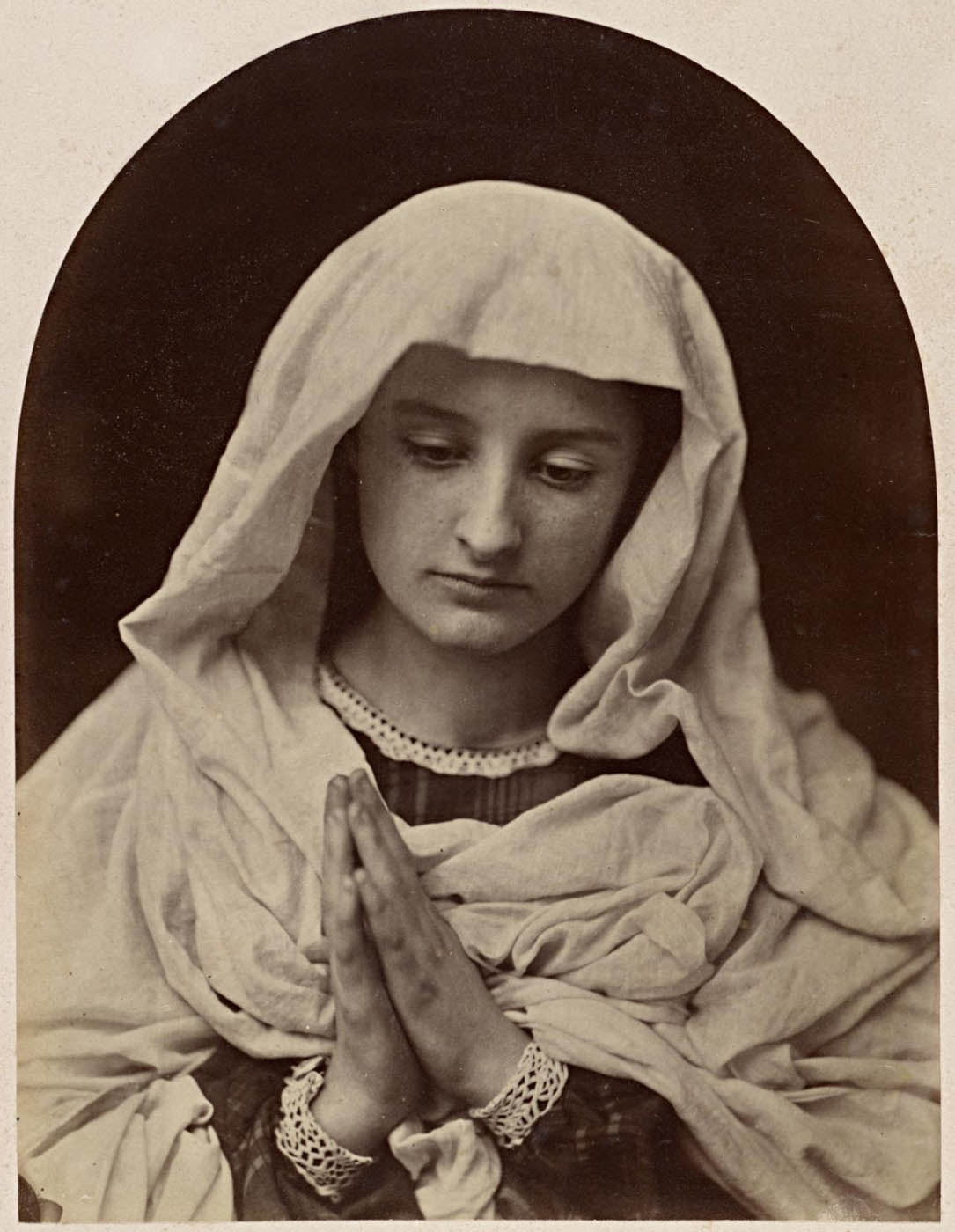
 

O. G. Rejlander (British born Sweden, 1813-1875) No title (The Virgin in prayer) c. 1858-1860


O. G. Rejlander (British born Sweden, 1813-1875)
No title (The Virgin in prayer)
c. 1858-1860
Albumen silver photograph
20.2 × 15.4cm irreg. (image and sheet)
National Gallery of Victoria, Melbourne
Purchased, 2002
Public domain


This is an ambitious, complex but flawed exhibition of photographic works from the NGV Collection. Further comment in Part 2 of the posting…

Dr Marcus Bunyan


Many thankx to the NGV for allowing me to publish the media images in the posting. Other photographs in the posting are public domain. All installation images are by Marcus Bunyan.


Photography: Real and Imagined examines two perspectives on photography; photography grounded in the real world, as a record, a document, a reflection of the world around us; and photography as the product of imagination, storytelling and illusion. On occasion, photography operates in both realms of the real and the imagined.

Highlighting major photographic works from the NGV Collection, including recent acquisitions on display for the very first time, Photography: Real and Imagined examines the complex, engaging and sometimes contradictory nature, of all things photographic. The NGV’s largest survey of the photography collection, the exhibition includes more than 300 works by Australian and international photographers and artists working with photo-media from the nineteenth, twentieth and twenty-first centuries.

Text from the NGV website
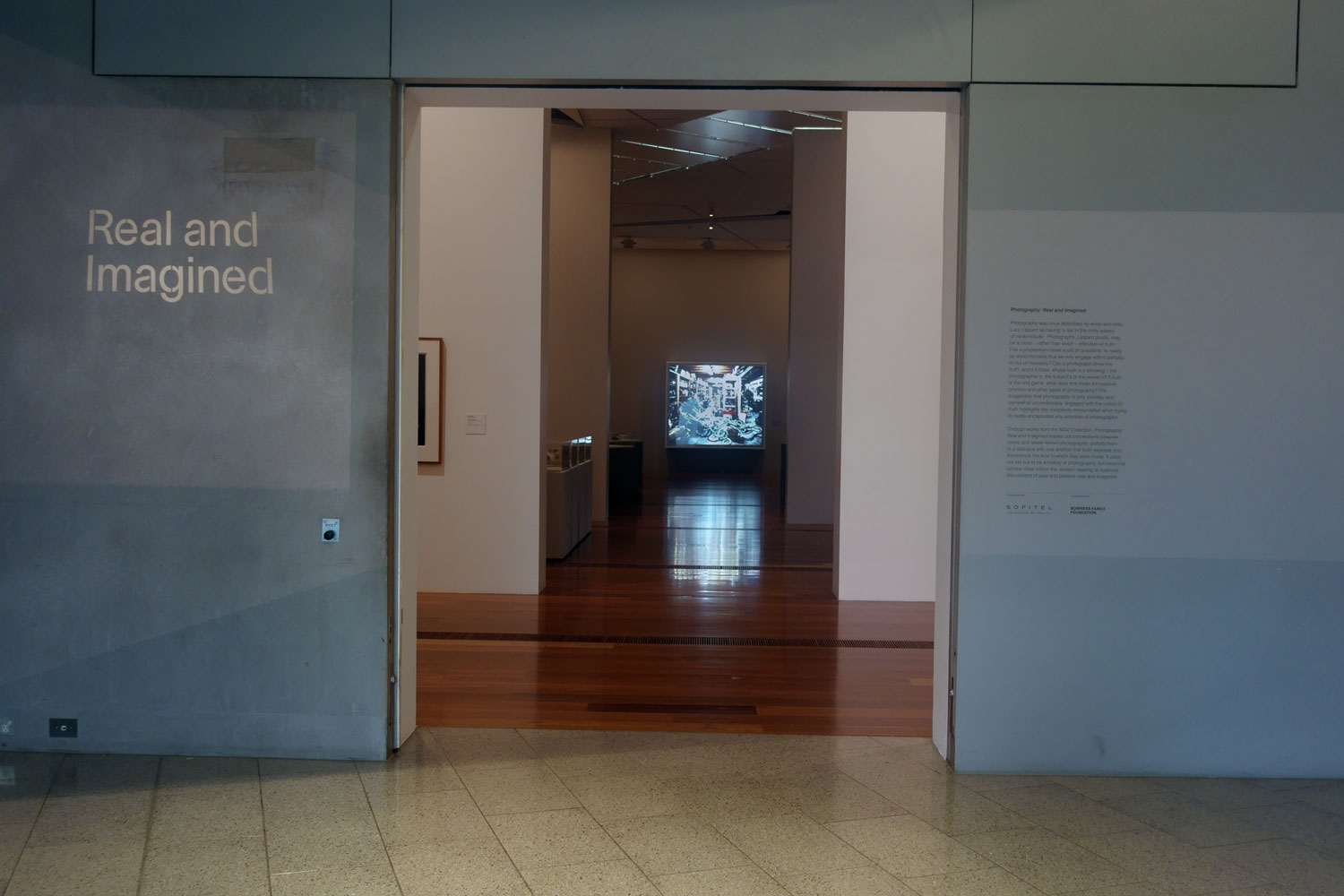
 

Installation view of the entrance to the exhibition 'Photography: Real & Imagined' at The Ian Potter Centre: NGV Australia, Melbourne


Installation view of the entrance to the exhibition Photography: Real & Imagined at The Ian Potter Centre: NGV Australia, Melbourne with introduction wall text to the right
Photo: Marcus Bunyan


Introduction

Photography was once described by writer and critic Lucy Lippard as having ‘a toe in the chilly waters of verisimilitude’. Photographs, Lippard posits, may be a close – rather than exact – reflection of truth. This proposition raises a raft of questions. Is reality so uncomfortable that we only engage with it partially, or out of necessity? Can a photograph show the truth, and if it does, whose truth is it showing – the photographer’s, the subject’s or the viewer’s? If truth is the end game, what does this mean for creative practice and other types of photography? The suggestion that photography is only partially, and somewhat uncomfortably, engaged with the notion of truth highlights the complexity encountered when trying to nearly encapsulate any selection of photographs.

Through works from the NGV Collection, Photography: Real and Imagined teases out connections between iconic and lesser known photographs, putting them in a dialogue with one another that both explores and transcends the time in which they were made. It dos not set out to be a history of photography, but historical context does inform the content, leading to nuanced discussions of past and present, real and imagined.

Introductory wall text from the exhibition


Installation view of the exhibition 'Photography: Real & Imagined' at The Ian Potter Centre: NGV Australia, Melbourne showing at right, Mike and Doug Starn's 'Invictus' (1992)


Installation view of the exhibition Photography: Real & Imagined at The Ian Potter Centre: NGV Australia, Melbourne showing at right, Mike and Doug Starn’s Invictus (1992); and at left works by John Kauffmann, Norman Deck and Edward Steichen (see below)
Photo: Marcus Bunyan


The sun was the light source that enabled the earliest photographs to be made in the 1830s. More than 150 years later the sun is the subject of this photographic sculpture by Mike and Doug Starn that embraces the possibilities of light and its potential effects on photography, in terms of both producing an image and as a force contributing to its irreparable damage. In the centre of their installation, the circular form of a sun seems to pulse and leach out of the layers of exposed orthographic film, which is stretched and layered across steel beams and held with pipe clamps and tape.

Wall text from the exhibition
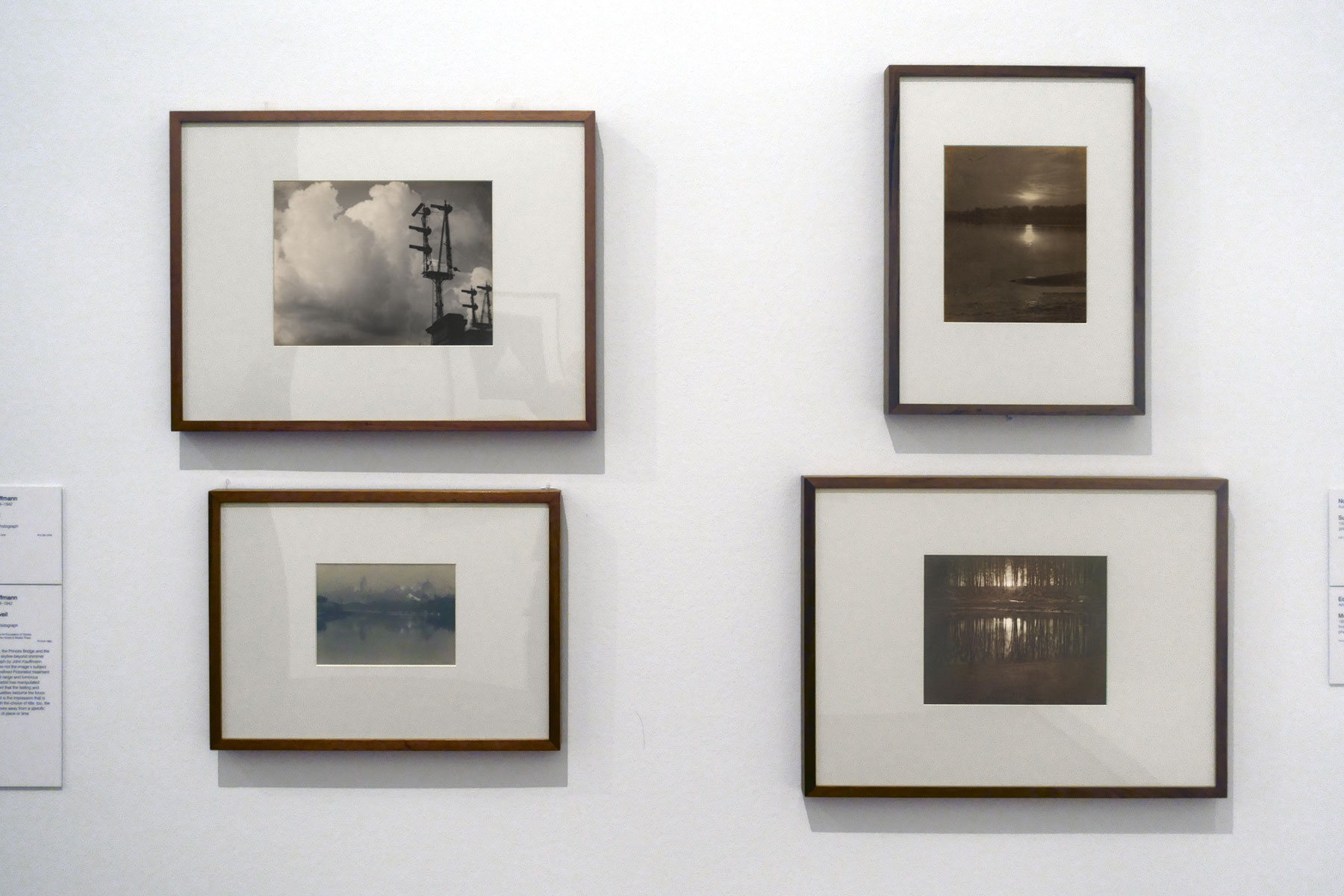
 

Installation view of the exhibition 'Photography: Real & Imagined' at The Ian Potter Centre: NGV Australia, Melbourne


Installation view of the exhibition Photography: Real & Imagined at The Ian Potter Centre: NGV Australia, Melbourne showing at top left, John Kauffmann’s The Cloud (c. 1905, below); at bottom left, Kauffmann’s The grey veil c. 1919; at top right, Norman Deck’s Sunset, Parramatta River (1909); and a bottom right, Edward Steichen’s Moonrise (1904)
Photo: Marcus Bunyan
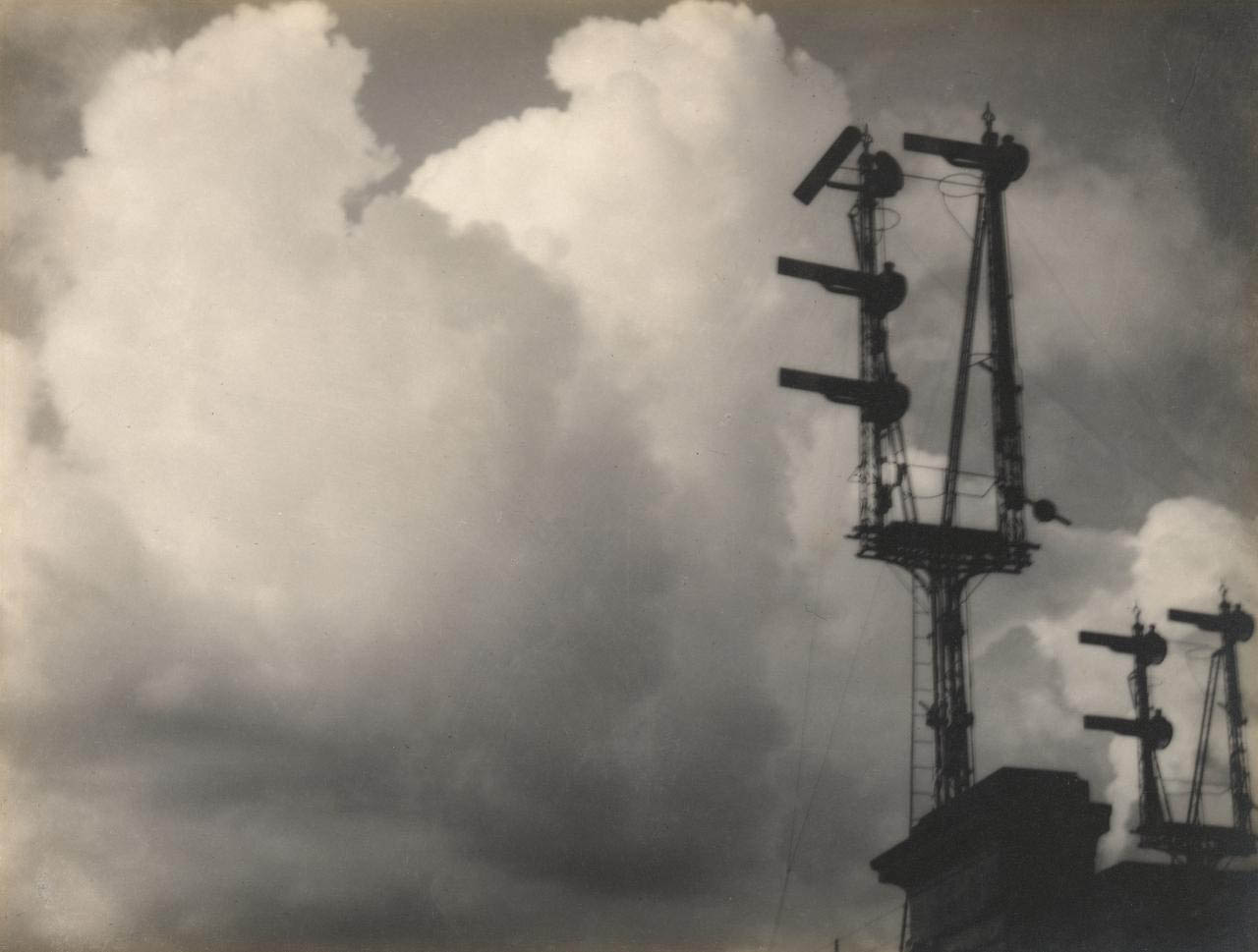
 

John Kauffmann (Australian, 1864-1942) 'The cloud' c. 1905


John Kauffmann (Australian, 1864-1942)
The cloud
c. 1905
Gelatin silver photograph
28.2 × 37.2cm
National Gallery of Victoria, Melbourne
Gift of Mr John Bilney, 1976
Public domain


John Kauffmann (Australian, 1864–1942) 'The grey veil' c. 1919


John Kauffmann (Australian, 1864-1942)
The grey veil
c. 1919
Gelatin silver photograph
National Gallery of Victoria, Melbourne
Purchased through The Art Foundation of Victoria with the assistance of the Herald & Weekly Times Limited, Fellow, 1990
Public domain


The Yarra River, the Princes Bridge and the Melbourne city skyline beyond shimmer in this photograph by John Kauffmann. And yet, they are not the image’s subject. Using a highly refined Pictorialist treatment, a reduced tonal range and luminous mid tones, the artist has manipulated light to the extent that the feeling and atmospheric qualities become the focus of the image – it is the impression that is paramount. With the choice of title, too, the photograph moves away from a specific documentation of place or time.

Wall text from the exhibition


Norman Deck (Australian 1882-1980) 'Sunset, Parramatta River' 1909


Norman Deck (Australian 1882-1980)
Sunset, Parramatta River
1909
Gelatin silver photograph
30.5 × 24.9cm
National Gallery of Victoria, Melbourne
Gift of Joyce Evans, 1993
Public domain
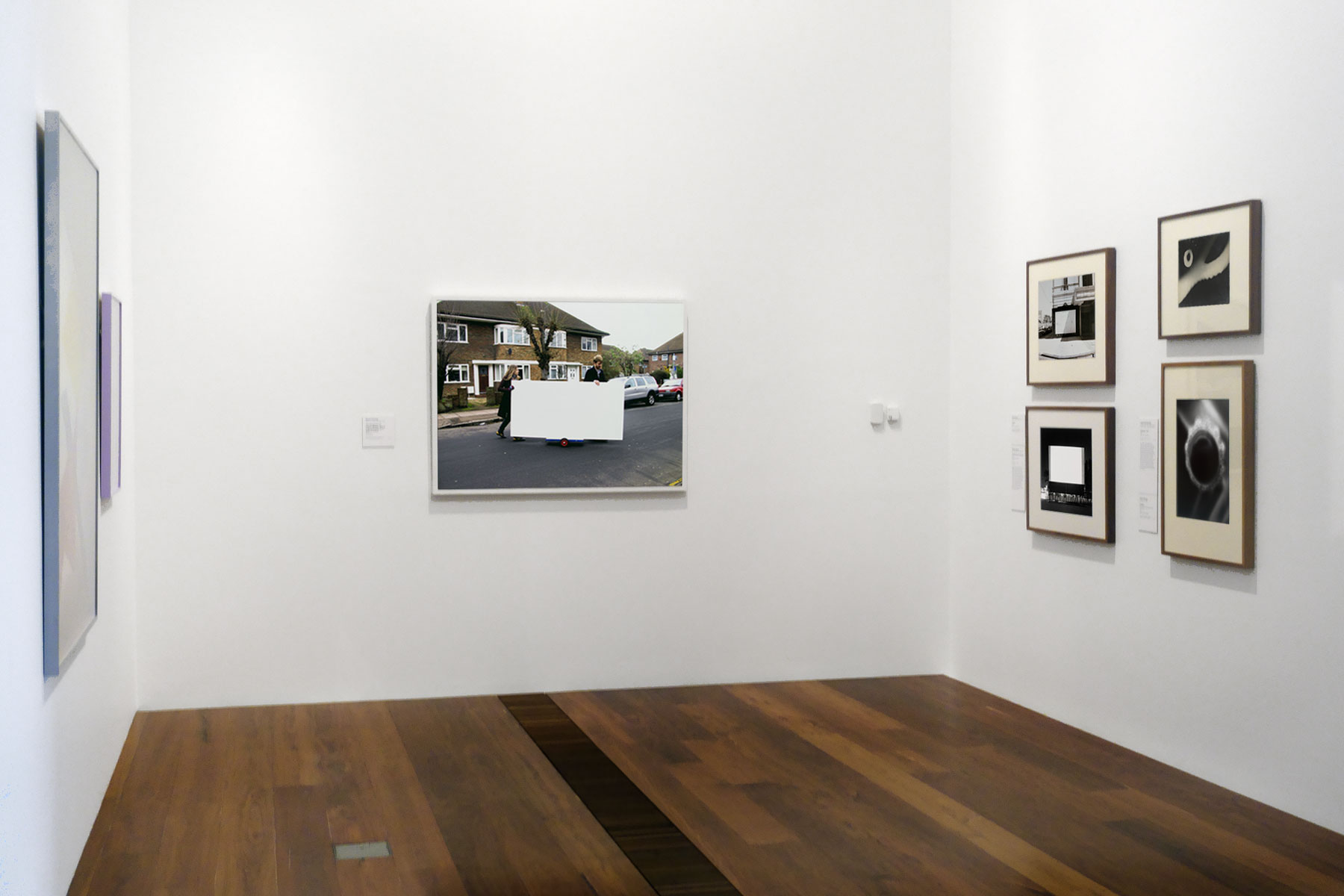
 

Installation view of the exhibition 'Photography: Real & Imagined' at The Ian Potter Centre: NGV Australia, Melbourne showing at centre, David Thomas' 'The Movement of Colour (White), Taking a Monochrome for a Walk (London)' (2010-2011)


Installation view of the exhibition Photography: Real & Imagined at The Ian Potter Centre: NGV Australia, Melbourne showing at centre, David Thomas’ The Movement of Colour (White), Taking a Monochrome for a Walk (London) (2010-2011), with at right works by David Noonan, Hiroshi Sugimoto, László Moholy-Nagy and Susan Fereday (see below)
Photo: Marcus Bunyan
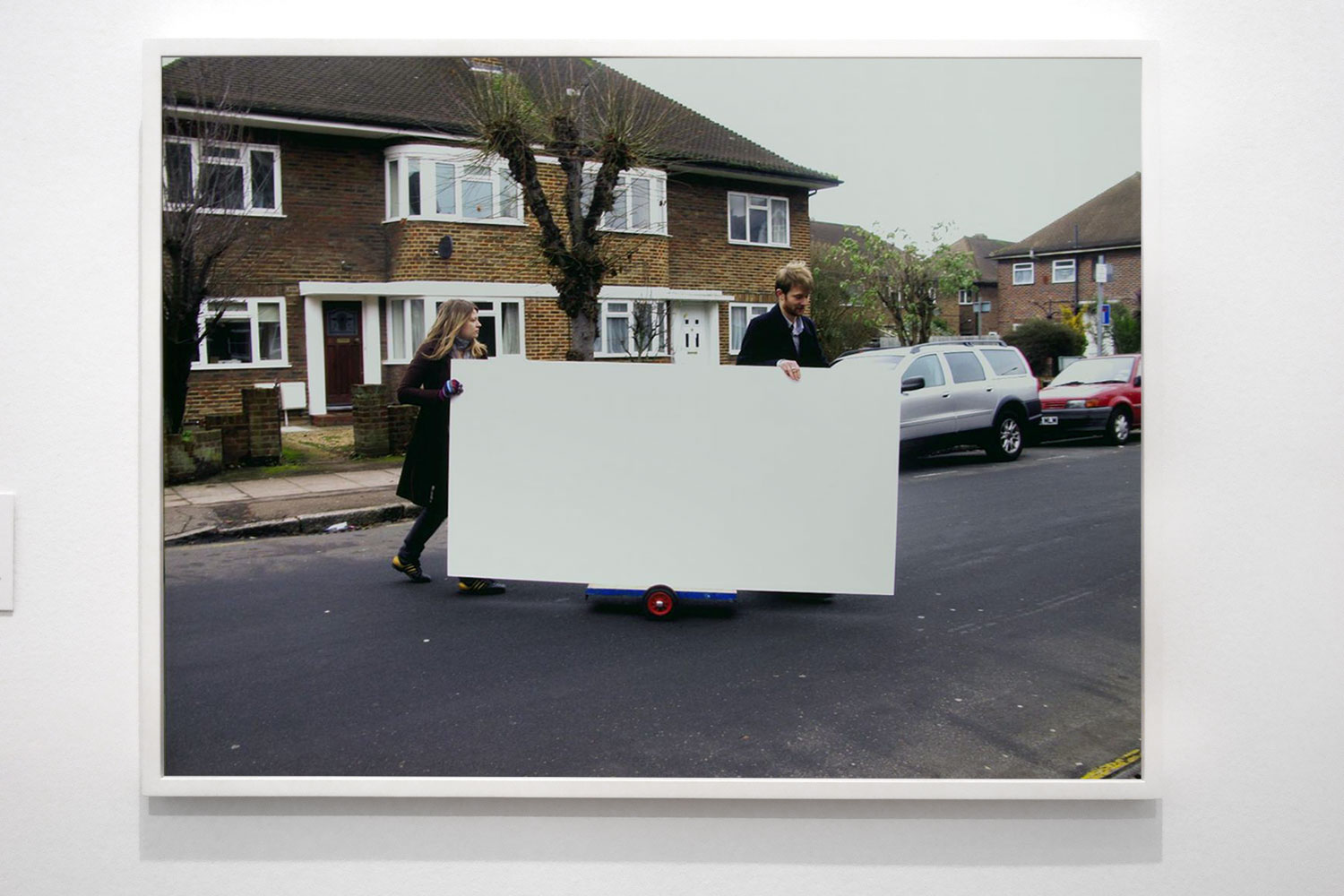
 

David Thomas (British, b. 1951, Australia 1958- ) 'The Movement of Colour (White), Taking a Monochrome for a Walk (London)' 2010-2011 (installation view)


David Thomas (British, b. 1951, Australia 1958- )
The Movement of Colour (White), Taking a Monochrome for a Walk (London) (installation view)
2010-2011
National Gallery of Victoria, Melbourne
Gift of an anonymous donor through the Australian Government’s Cultural Gifts Program 2015
Photo: Marcus Bunyan


“It was made during a residency at the Centre for Drawing Research at Wimbledon School of Art University of the Arts London… and plays on Paul Klee’s definition of drawing as taking a line for a walk on a page… this is taking a monochrome for a walk in the world where the monochrome becomes a key for seeing other colours… an interval in the world. It also suggests the ideas of movement in time and feelings of impermanence.”

~ David Thomas
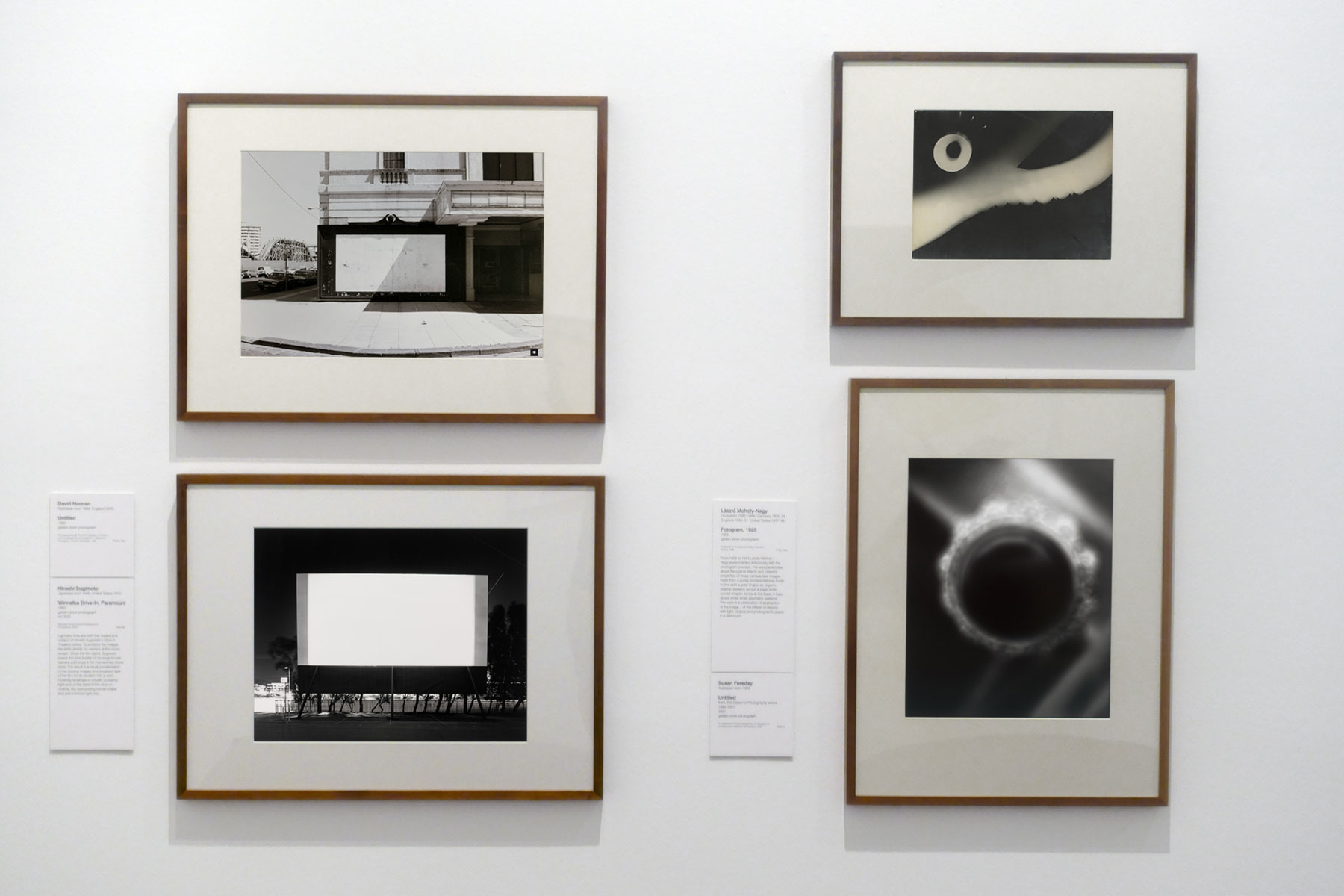
 

Installation view of the exhibition 'Photography: Real & Imagined' at The Ian Potter Centre: NGV Australia, Melbourne showing works by David Noonan, Hiroshi Sugimoto, Laslo Moholy-Nagy and Susan Fereday


Installation view of the exhibition Photography: Real & Imagined at The Ian Potter Centre: NGV Australia, Melbourne showing at top right, David Noonan’s Untitled (1992); at bottom left, Hiroshi Sugimoto’s Winnetka Drive-In, Paramount (1993); at top right, László Moholy-Nagy’s Fotogram, 1925 (1925); and at bottom right, Susan Fereday’s Untitled (2001)
Photo: Marcus Bunyan


Light and time are both the means and subject of Hiroshi Sugimoto’s Drive-In Theaters series. To produce the images, the artist directs his camera at the movie screen. Once the film starts, Sugimoto opens the lens shutter of his large-format camera and shuts it the moment the movie ends. The result is a visual condensation of the moving images and projected light of the film for its duration into a vivid, hovering rectangle of virtually pulsating light and, in the case of this drive-in cinema, the surrounding human-made and astronomical light, too.

Wall text from the exhibition
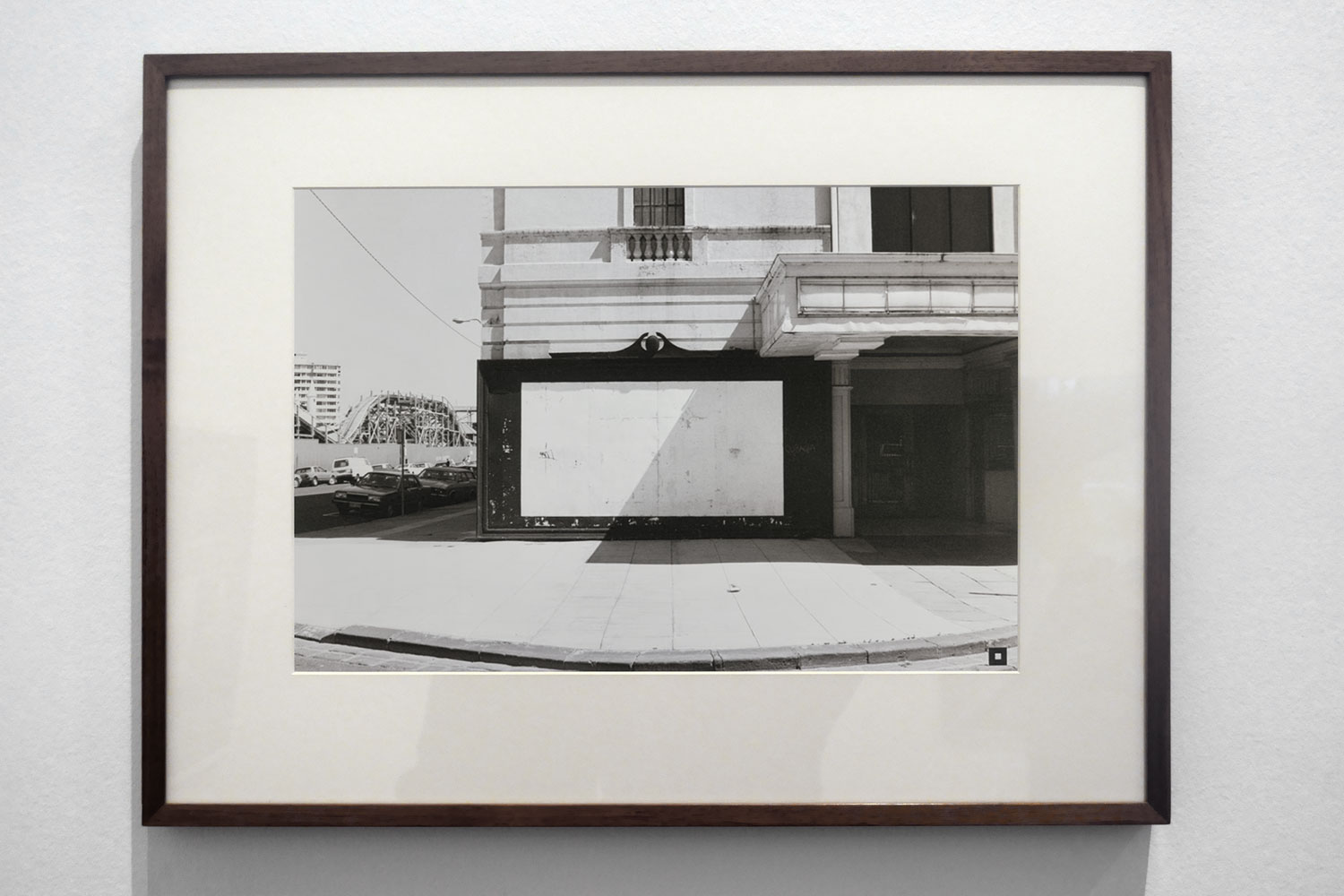
 

Installation view of the exhibition 'Photography: Real & Imagined' at The Ian Potter Centre: NGV Australia, Melbourne showing David Noonan's 'Untitled' (1992)


Installation view of the exhibition Photography: Real & Imagined at The Ian Potter Centre: NGV Australia, Melbourne showing David Noonan’s Untitled (1992)
Photo: Marcus Bunyan


László Moholy-Nagy (Hungarian 1895-1946, Germany 1920-1934, England 1935-1937, United States 1937-1946) 'Fotogram, 1925' 1925


László Moholy-Nagy (Hungarian 1895-1946, Germany 1920-1934, England 1935-1937, United States 1937-1946)
Fotogram, 1925
1925
Gelatin silver photograph
National Gallery of Victoria, Melbourne
Presented by the National Gallery Society of Victoria, 1985
Public domain


From 1922 to 1943 László Moholy-Nagy experimented extensively with the photogram process – he was passionate about the optical effects and inherent properties of these camera-less images freed from a purely representational mode. In this work a pale shape, an organic swathe, streams across a page while curved shapes dance at the base. A halo above emits small geometric patterns. The work is a celebration of abstraction of the image – of the effects of playing with light, objects and photographic paper in a darkroom.

Wall text from the exhibition


Installation view of the exhibition Photography: Real & Imagined at The Ian Potter Centre: NGV Australia, Melbourne showing at left, Barbara Kasten's Composition 8T (2018); and at right, Lydia Wegner's Purple square (2017)


Installation view of the exhibition Photography: Real & Imagined at The Ian Potter Centre: NGV Australia, Melbourne showing at left, Barbara Kasten’s Composition 8T (2018, below); and at right, Lydia Wegner’s Purple square (2017, below)
Photo: Marcus Bunyan
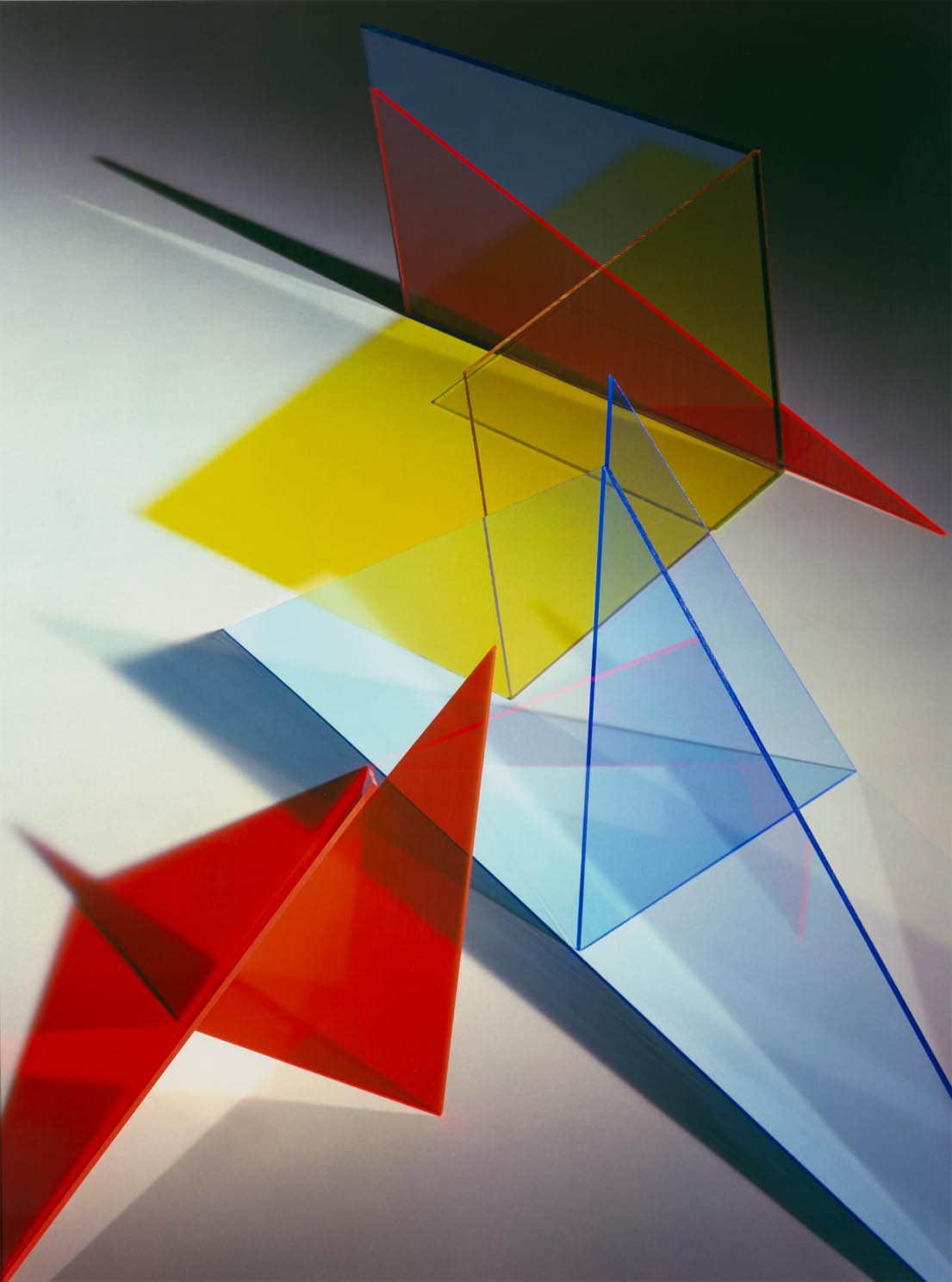
 

Barbara Kasten (American, b. 1936) 'Composition 8T' 2018


Barbara Kasten (American, b. 1936)
Composition 8T
2018
Digital type C print
160.0 x 121.9cm (image and sheet)
ed. 1/1
National Gallery of Victoria, Melbourne
Purchased NGV Foundation, 2018
© Barbara Kasten, courtesy Kadel Willborn, Düsseldorf


This photograph from Barbara Kasten’s Collisions/Compositions series continues her practice of creating architectural spaces in the studio using a range of materials, such as plexiglas and mirrors, which she lights and photographs at close range. Influenced by Constructivism and the teachings of the Bauhaus, specifically the work of László Moholy-Nagy, Kasten has experimented with the parameters of abstract photography for around five decades. She has written of her ongoing fascination with light in the creation and conceptual development of her photographs, saying, ‘The interdependency of shadow and light is the essence of photographic exploration and an inescapable part of the photographic process’.

Wall text from the exhibition


Installation view of the exhibition Photography: Real & Imagined at The Ian Potter Centre: NGV Australia, Melbourne showing Lydia Wegner's 'Purple square' (2017)


Installation view of the exhibition Photography: Real & Imagined at The Ian Potter Centre: NGV Australia, Melbourne showing Lydia Wegner’s Purple square (2017)
Photo: Marcus Bunyan


Installation view of the exhibition 'Photography: Real & Imagined' at The Ian Potter Centre: NGV Australia, Melbourne showing at left, Todd McMillan's 'Equivalent VIII' (2014); and at right, Sue Pedley's 'Sound of lotus 1' (2000)


Installation view of the exhibition Photography: Real & Imagined at The Ian Potter Centre: NGV Australia, Melbourne showing at left, Todd McMillan’s Equivalent VIII (2014); and at right, Sue Pedley’s Sound of lotus 1 (2000)
Photo: Marcus Bunyan


Installation view of the exhibition 'Photography: Real & Imagined' at The Ian Potter Centre: NGV Australia, Melbourne


Installation view of the exhibition Photography: Real & Imagined at The Ian Potter Centre: NGV Australia, Melbourne showing at back left, Thomas Ruff’s Portrait (V. Liebermann D) (1999); and at back second left, Ruff’s Portrait (A. Koschkarow) (2000)
Photo: Marcus Bunyan
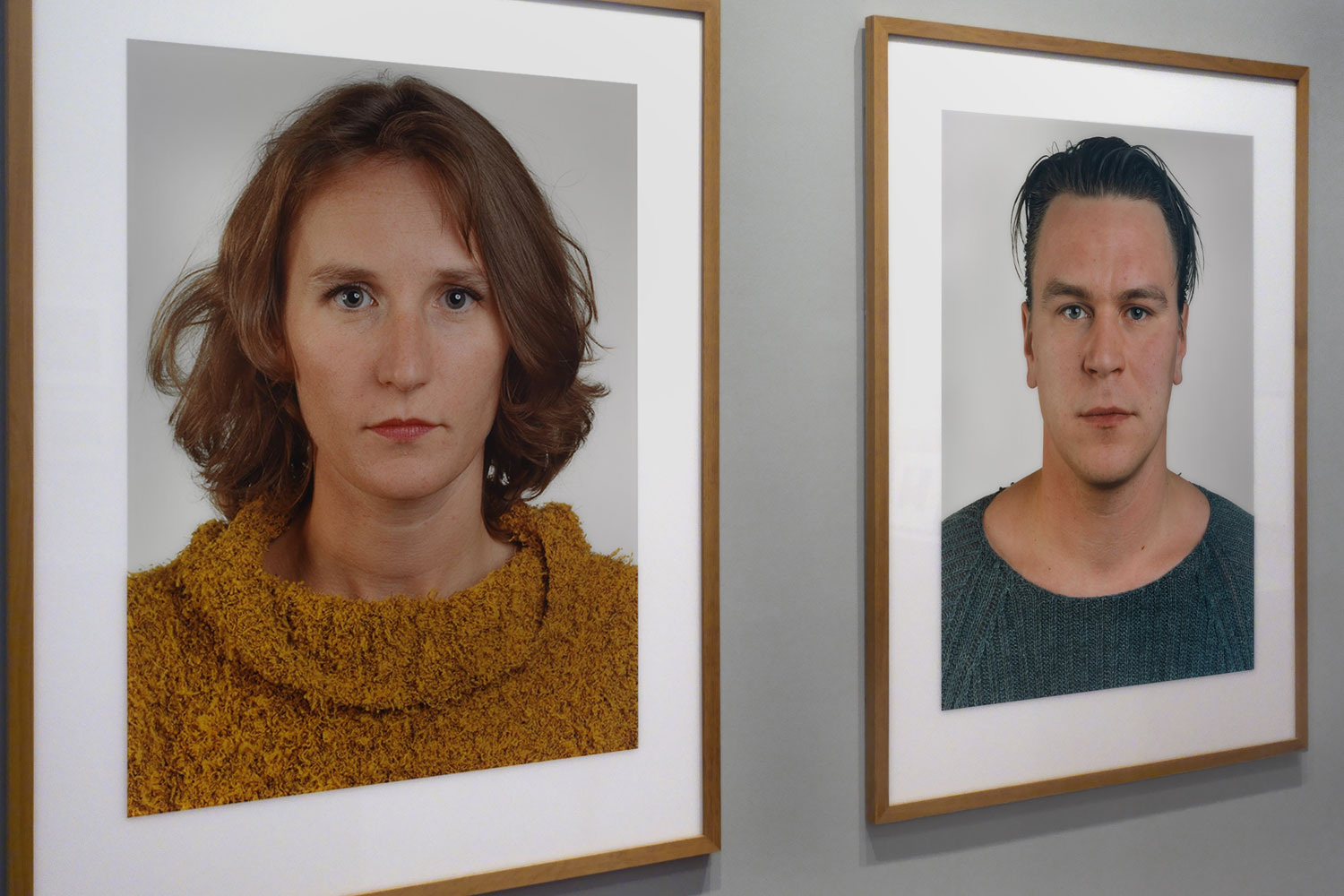
 

Installation view of the exhibition Photography: Real & Imagined at The Ian Potter Centre: NGV Australia, Melbourne showing at left, Thomas Ruff’s 'Portrait (V. Liebermann D)' (1999); and at right, Ruff's 'Portrait (A. Koschkarow)' (2000)


Installation view of the exhibition Photography: Real & Imagined at The Ian Potter Centre: NGV Australia, Melbourne showing at left, Thomas Ruff’s Portrait (V. Liebermann D) (1999); and at right, Ruff’s Portrait (A. Koschkarow) (2000)
Photo: Marcus Bunyan


The earnest gazes of the man and woman in these two monumental photographs by Thomas Ruff are so calm and serene that they bely the intense experience of viewing their enlarged faces. Applying a standardised approach – similar to a generic passport photograph – these portraits have a timeless quality that invites you to attempt to ‘read’ their faces and to search for clues as to the inner state of the person. Ruff, however, lets nothing slip. The faces are known to the artist but remain anonymous to the viewer.

Wall text from the exhibition


Installation view of the exhibition 'Photography: Real & Imagined' at The Ian Potter Centre: NGV Australia, Melbourne showing Robert Rooney's 'AM-PM: 2 Dec 1973-28 Feb 1974' (1973-1974) (detail)


Installation view of the exhibition Photography: Real & Imagined at The Ian Potter Centre: NGV Australia, Melbourne showing Robert Rooney’s AM-PM: 2 Dec 1973-28 Feb 1974 (1973-1974) (detail)
Photo: Marcus Bunyan


Featuring some of the most iconic photographs ever created alongside contemporary approaches to the photographic medium, Photography: Real & Imagined is the largest survey of the NGV’s Photography collection in the institution’s history and features more than 270 photographs by Australian and international practitioners.

Four years in the making, this landmark exhibition features photographs from across the 200-year period since the invention of photography in the 19th century, including work by leading international photographers including Man Ray, Cindy Sherman, Wolfgang Tillmans, Gilbert & George and Nan Goldin, alongside Australian photographers Max Dupain, Olive Cotton, Mervyn Bishop, Polly Borland, Destiny Deacon and Darren Sylvester.

Through twenty-one thematic sections, this large-scale exhibition explores the proposition that a photograph can be grounded in the real world, recording, documenting and reflecting the world around us; or be the product of imagination, storytelling and illusion; and on occasion operate in both realms. The thematic sections explore subject matter such as light, place and environment, consumption, conflict, community, and death.

Exhibition highlights include Mervyn Bishop’s important photograph of former Prime Minister of Australia, Gough Whitlam, pouring sand into the open palm of Gurindji Elder Vincent Lingiari. The 1975 image captures the historic meeting between these two figures where Lingiari received the crown lease of his ancestral lands. Also on display is Joe Rosenthal’s World War II photograph Raising the flag on Iwo Jima, 1945, in which American marines raise their country’s flag over the Japanese Island. Both Bishop and Rosenthal’s photographs were staged, or re-constructed for better pictorial effect, illustrating the fluid space between the real and imagined.

The exhibition also presents fashion and advertising photography, including key examples by Lilian Bassman, Athol Smith, Horst P. Horst and Dora Maar. These images showcase a world of designer fashion and high-end products, which set a standard in advertising that continues today. Ilse Bing’s Surrealist inspired photograph commissioned by Elsa Schiaparelli to launch her new perfume Salut in 1934 is a highlight of the exhibition.

Highlighting an area of focused collecting for the NGV, the exhibition recognises the work of women practicing in the early 20th century, including Barbara Morgan whose acclaimed photo montage City shell, 1938, shows an unexpected view of the then recently completed Empire State Building.

Through to the current day, Photography: Real & Imagined presents contemporary photographers of the 21st century including Zanele Muholi, Richard Mosse and Alex Prager. Highlights include Cindy Sherman’s celebrated self-portrait in the guise of Renaissance aristocrat. Also on display will be the oldest photographic work in the NGV Collection, an early 19th century portrait by Englishman William Henry Fox Talbot, one of the inventors of the medium, as well as examples of daguerreotypes, unique images on silver plated copper sheets that are amongst the earliest forms of photography.

The exhibition is accompanied by a major publication – the most ambitious book published on the NGV Photography Collection, generously supported by the Bowness Family Foundation. The publication comprises essays from NGV Senior Curator of Photography, Susan van Wyk, Susan Bright and David Campany; alongside texts by Curator of Photography, Maggie Finch and external authors from Australia, Europe, North America and Southeast Asia.

Regular introductory talks for students are held on weekdays during term times, and free drop-by guided tours each Thursday and Sunday at 10.30am during the exhibition period.

Tony Ellwood AM, Director, NGV, said: ‘This exhibition celebrates the collections and achievements of the NGV’s photography department, which has presented more than 180 exhibitions in its 55-year history. The exhibition is a testament to the strength of the NGV Collection, with so many key examples of the history of photography represented, from the earliest examples from the 19th century, through to contemporary images being produced right now in the twenty-first century. We are grateful for the support of the many donors and philanthropists, such as the Bowness Family Foundation, who have helped to grow and strengthen the NGV’s photography collection.’

Press release from the NGV


Installation view of the exhibition 'Photography: Real & Imagined' at The Ian Potter Centre: NGV Australia, Melbourne at top left, O. G. Rejlander's 'The Virgin in prayer' (c. 1858-1860); at bottom left, Henry Peach Robinson's 'Elaine watching the shield of Lancelot' (1859); at centre, Ruth Hollick's 'Thought' (1921); and at right Cindy Sherman's 'Untitled' (1988) from the 'History Portraits' series (1988-1990)


Installation view of the exhibition Photography: Real & Imagined at The Ian Potter Centre: NGV Australia, Melbourne at top left, O. G. Rejlander’s The Virgin in prayer (c. 1858-1860, below); at bottom left, Henry Peach Robinson’s Elaine watching the shield of Lancelot (1859); at centre, Ruth Hollick’s Thought (1921); and at right Cindy Sherman’s Untitled (1988) from the History Portraits series 1988-1990
Photo: Marcus Bunyan


Describing the complex conundrum presented by Cindy Sherman in this photograph, photographer and curator Patrick Pound once wrote: ‘Fake chested and with a face like a mask, here Cindy Sherman is costumed to the max. She stares out like a disapproving Renaissance figure who has just walked off set from a Peter Greenaway extravaganza. Here we have a photographer looking like a painting that walked out of a film. Sherman’s photographs speak of the fragilities of the visage in an image-saturated world where information and construction slip into foreplay. In Sherman’s photographic world gender and identity is a compilation album. There is a toughness to the excess that is all her own’.

Wall text from the exhibition
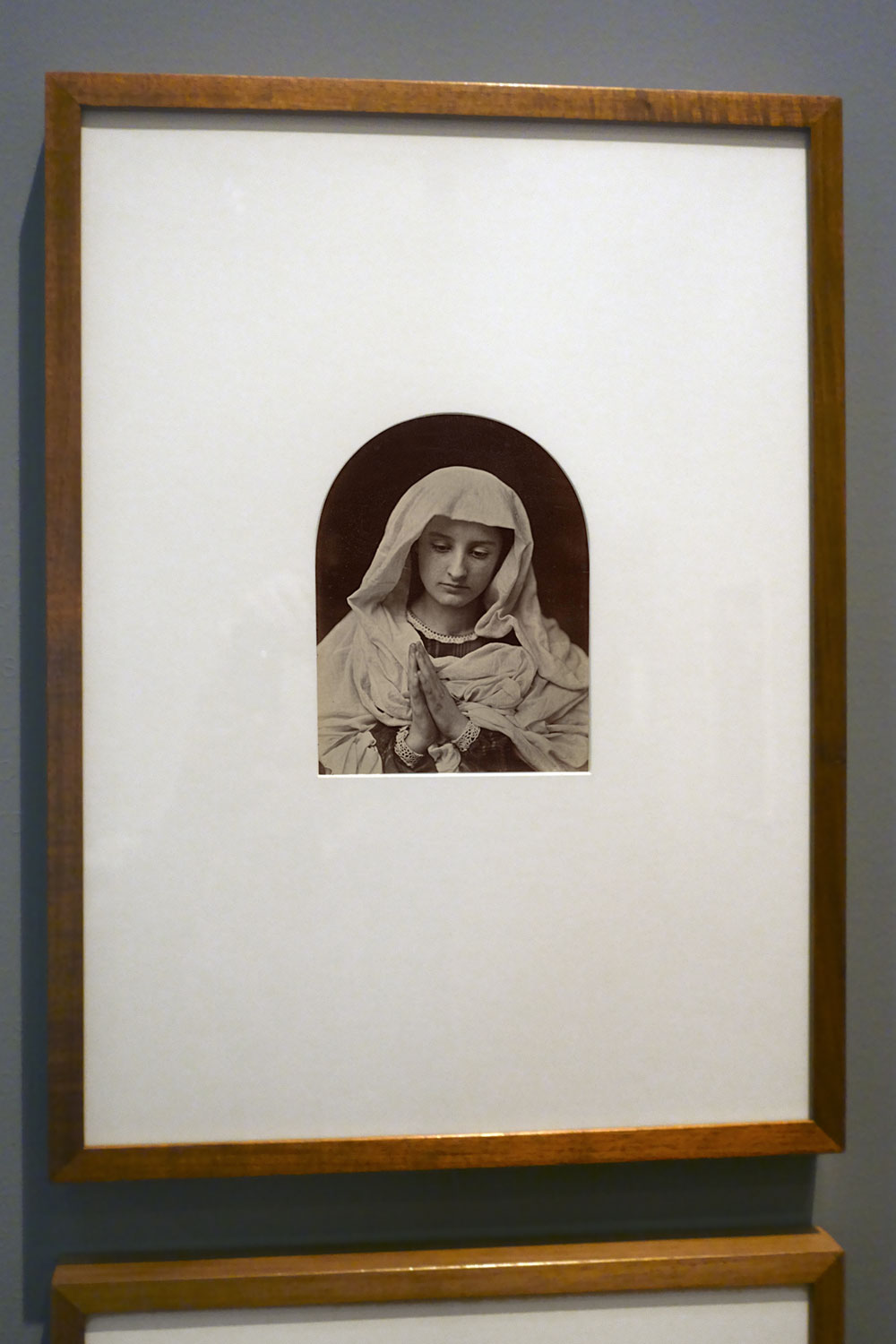
 

Installation view of the exhibition Photography: Real & Imagined at The Ian Potter Centre: NGV Australia, Melbourne showing O. G. Rejlander's 'The Virgin in prayer' (c. 1858-1860)


Installation view of the exhibition Photography: Real & Imagined at The Ian Potter Centre: NGV Australia, Melbourne showing O. G. Rejlander’s The Virgin in prayer (c. 1858-1860, below)
Photo: Marcus Bunyan
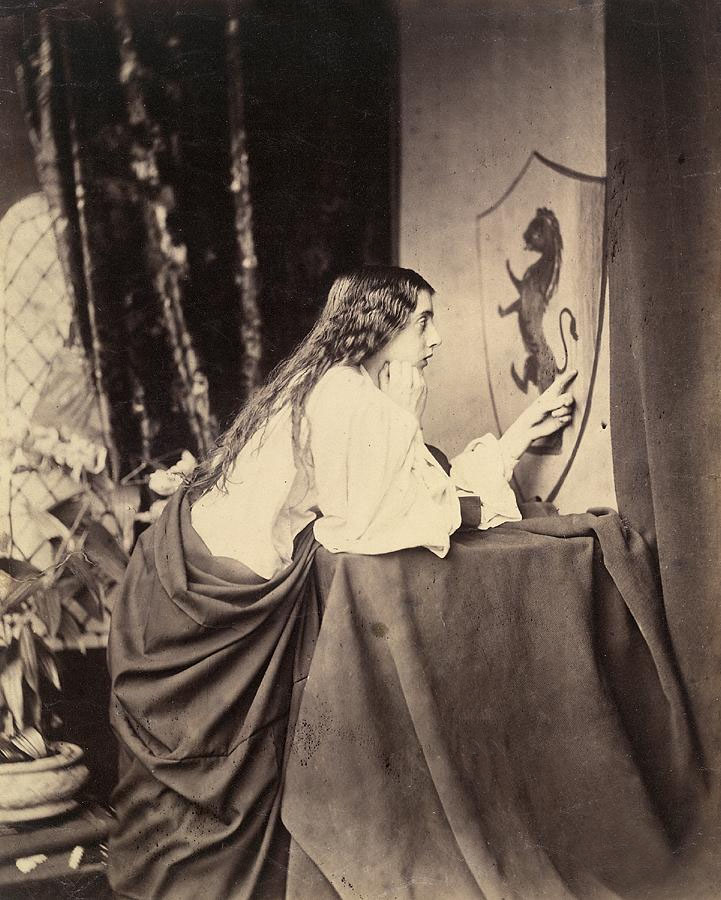
 

Henry Peach Robinson (English, 1830-1901) 'Elaine watching the shield of Lancelot' 1859


Henry Peach Robinson (English, 1830-1901)
Elaine watching the shield of Lancelot
1859
Albumen silver photograph
24.3 × 19.3cm (image and sheet)
National Gallery of Victoria, Melbourne
Purchased from Admission Funds, 1988
Public domain


In the 1850s Henry Peach Robinson was renowned for producing elaborately staged narrative images based on scenes from popular literary sources. He was particularly interested in Arthurian legends and drew upon these stories as inspiration for some of his most admired photographs. Elaine watching the shield of Lancelot is based on Alfred Tennyson’s version of the story of Lancelot and Elaine. Peach Robinson has recreated the scene in which the lovelorn Elaine gazes dreamily at the shield of Lancelot. She is shown as a woman who has shunned reason and propriety and abandoned herself to the intensity of her emotions, making this photograph both a tragic love story and a cautionary narrative.

Wall text from the exhibition
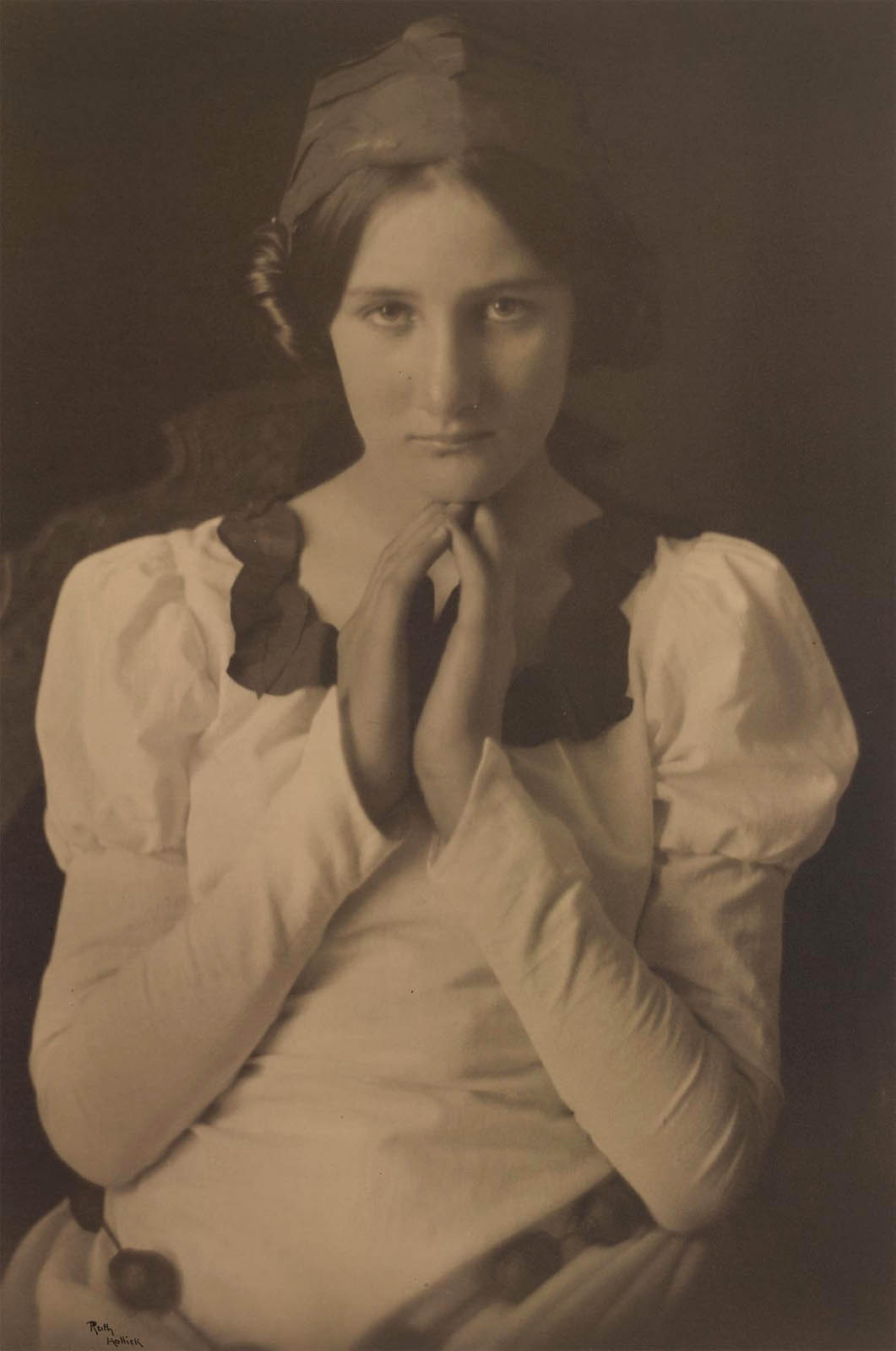
 

Ruth Hollick (Australian, 1883-1977) 'Thought' 1921


Ruth Hollick (Australian, 1883-1977)
Thought
1921
Gelatin silver photograph
37.4 × 25.3cm
National Gallery of Victoria, Melbourne
Presented through The Art Foundation of Victoria by Mrs Lucy Crosbie Morrison, Member, 1993
Public domain


Installation view of the exhibition 'Photography: Real & Imagined' at The Ian Potter Centre: NGV Australia, Melbourne


Installation view of the exhibition Photography: Real & Imagined at The Ian Potter Centre: NGV Australia, Melbourne
Photo: Marcus Bunyan
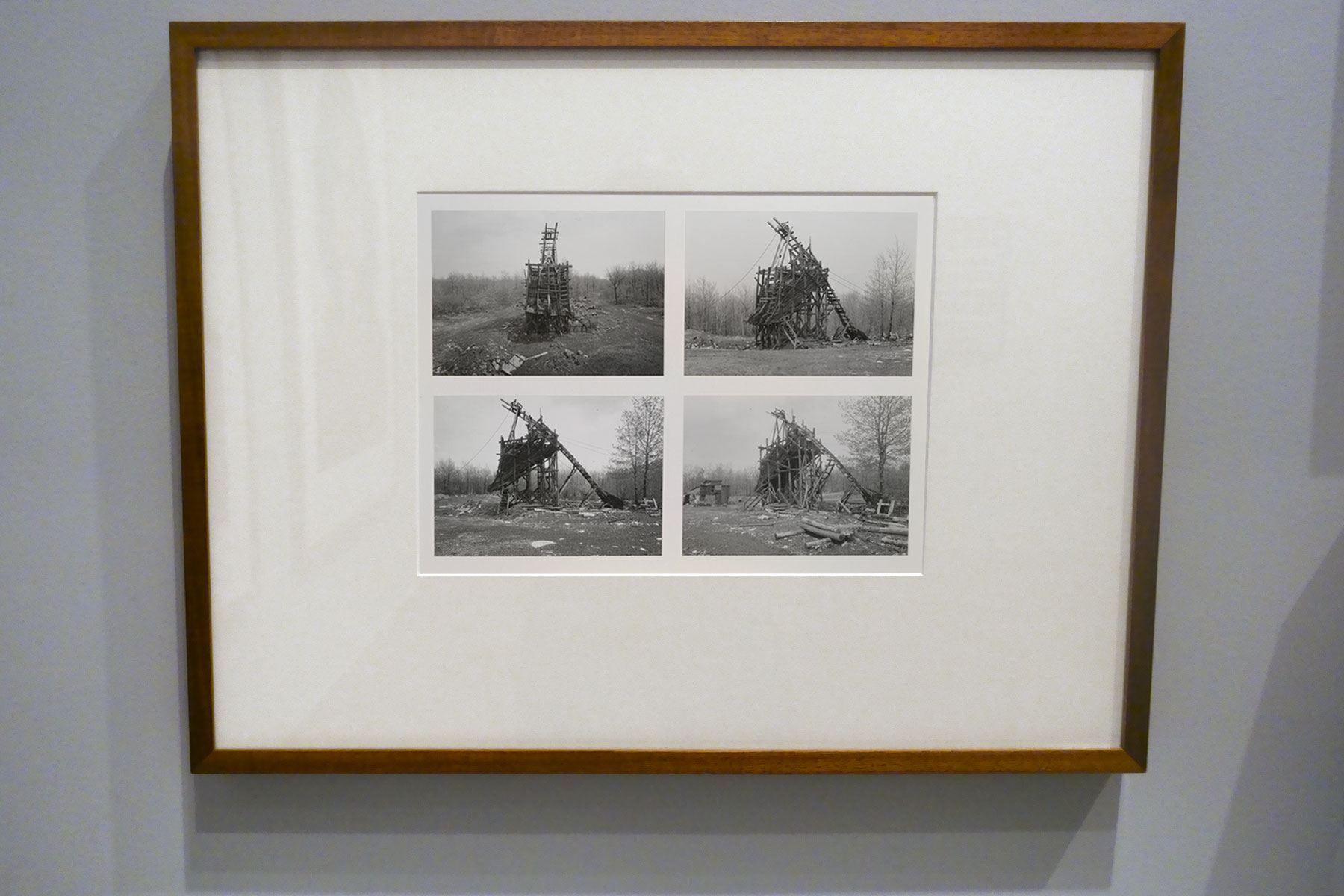
 

Installation view of the exhibition 'Photography: Real & Imagined' at The Ian Potter Centre: NGV Australia, Melbourne


Installation view of the exhibition Photography: Real & Imagined at The Ian Potter Centre: NGV Australia, Melbourne showing Bernd and Hilla Becher’s Coal tipple, Goodspring, Pennsylvania 1975 from the Artists and Photographs folio 1975
Photo: Marcus Bunyan


In 1959, German-born artists Bernd and Hilla Becher began travelling throughout Europe to create photographic typologies of vanishing industrial architecture (a practice they continued for more than four decades). While predominantly documenting German structures and landscapes, they occasionally worked overseas. This image, four views of a coal tipple, was taken on their first trip to North America in the mid 1970s. The Bechers constructed a system for comparing structures: photographed from a consistent angle, with virtually identical lighting conditions, printed at the same size and often displayed in grids.

Wall text from the exhibition
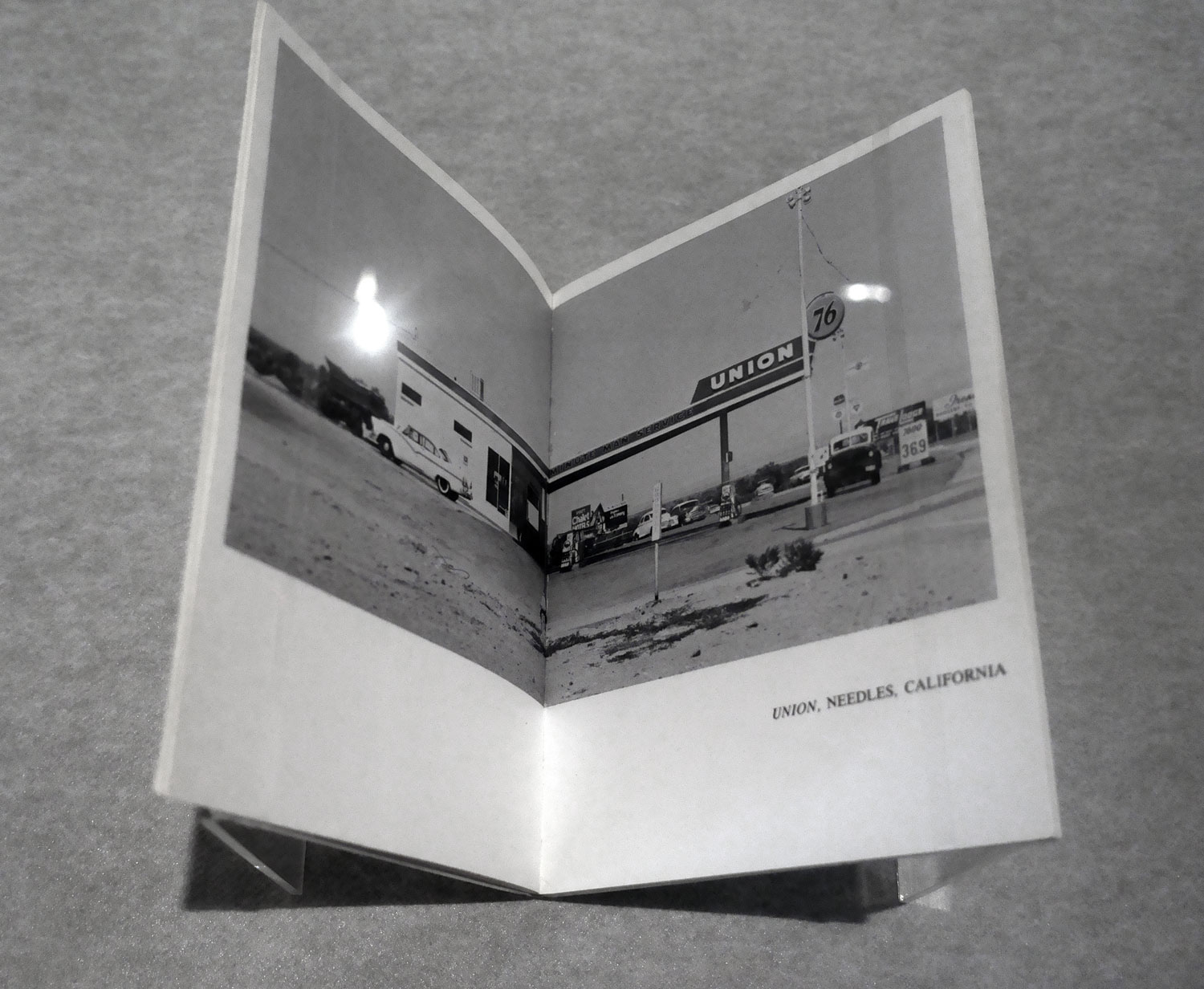
 

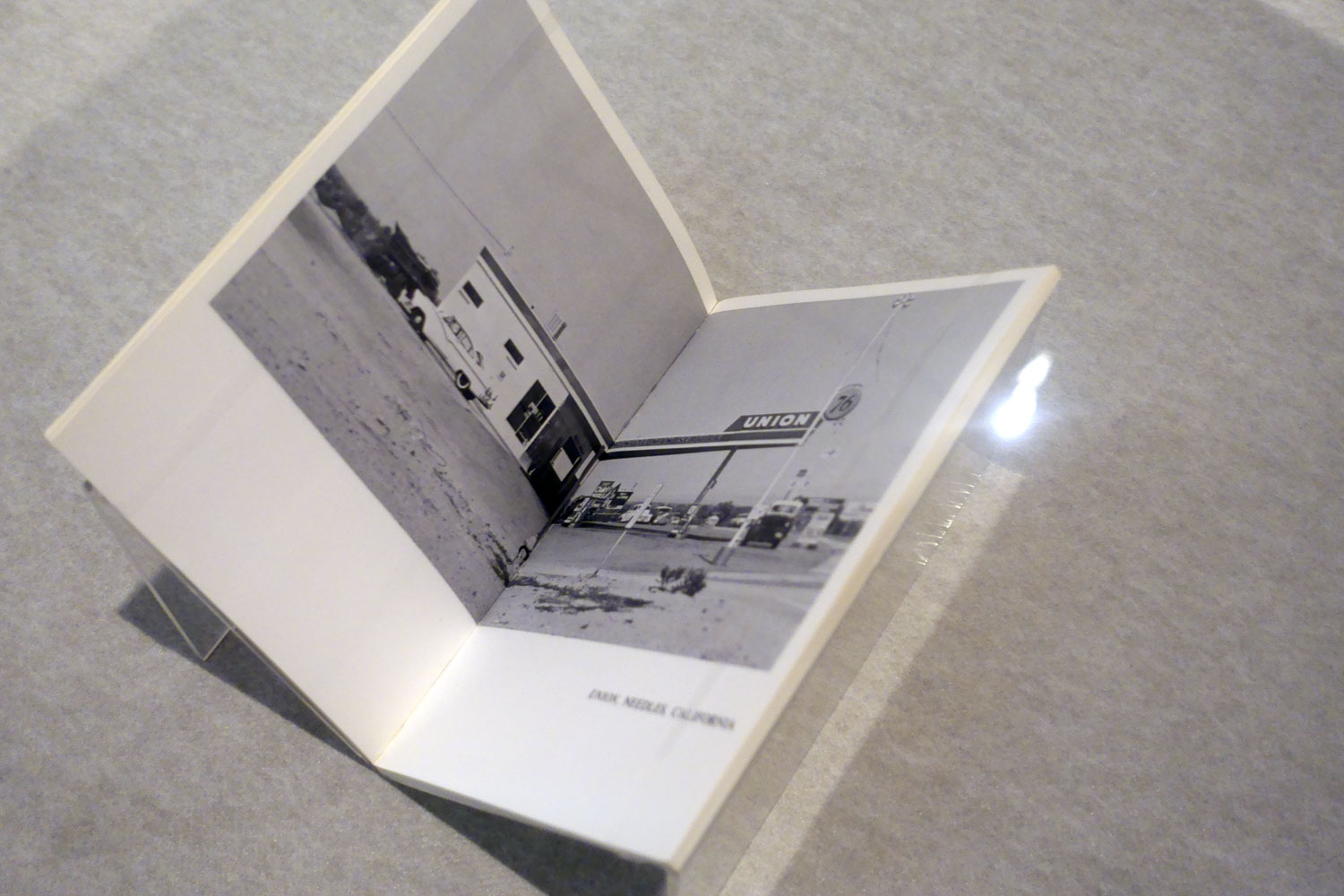
Edward Ruscha (American, b. 1937) 'Twentysix Gasoline Stations' 1963, published 1967 (installation view)

Edward Ruscha (American, b. 1937) 'Twentysix Gasoline Stations' 1963, published 1967 (installation view)


Edward Ruscha (American, b. 1937)
Twentysix Gasoline Stations (installation view)
1963, published 1967
Artist’s book: photo-offset lithograph and printed text, 48 pages, printed cover, glued binding
National Gallery of Victoria, Melbourne
Gift of Robert Rooney through the Australian Government’s Cultural Gifts Program, 2009
Photos: Marcus Bunyan


With the first publication of Twentysix Gasoline Stations, and his subsequent artist books, Edward Ruscha’s work was influential in initiating the widespread interest in photographic book publishing that continues today. Ruscha’s use of photographs as a means of recording – a seemingly unemotional, detached cataloguing of the world – and simply as a ‘device to complete the idea’ influenced the interest in serial imaging adopted by many conceptual artists. Ruscha’s use of the book format was also crucial, providing a transportable way of presenting art in varied contexts that existed as a type of ‘map’ to be read and interpreted, with the subject matter becoming less important than the documentation as a whole.

Wall text from the exhibition
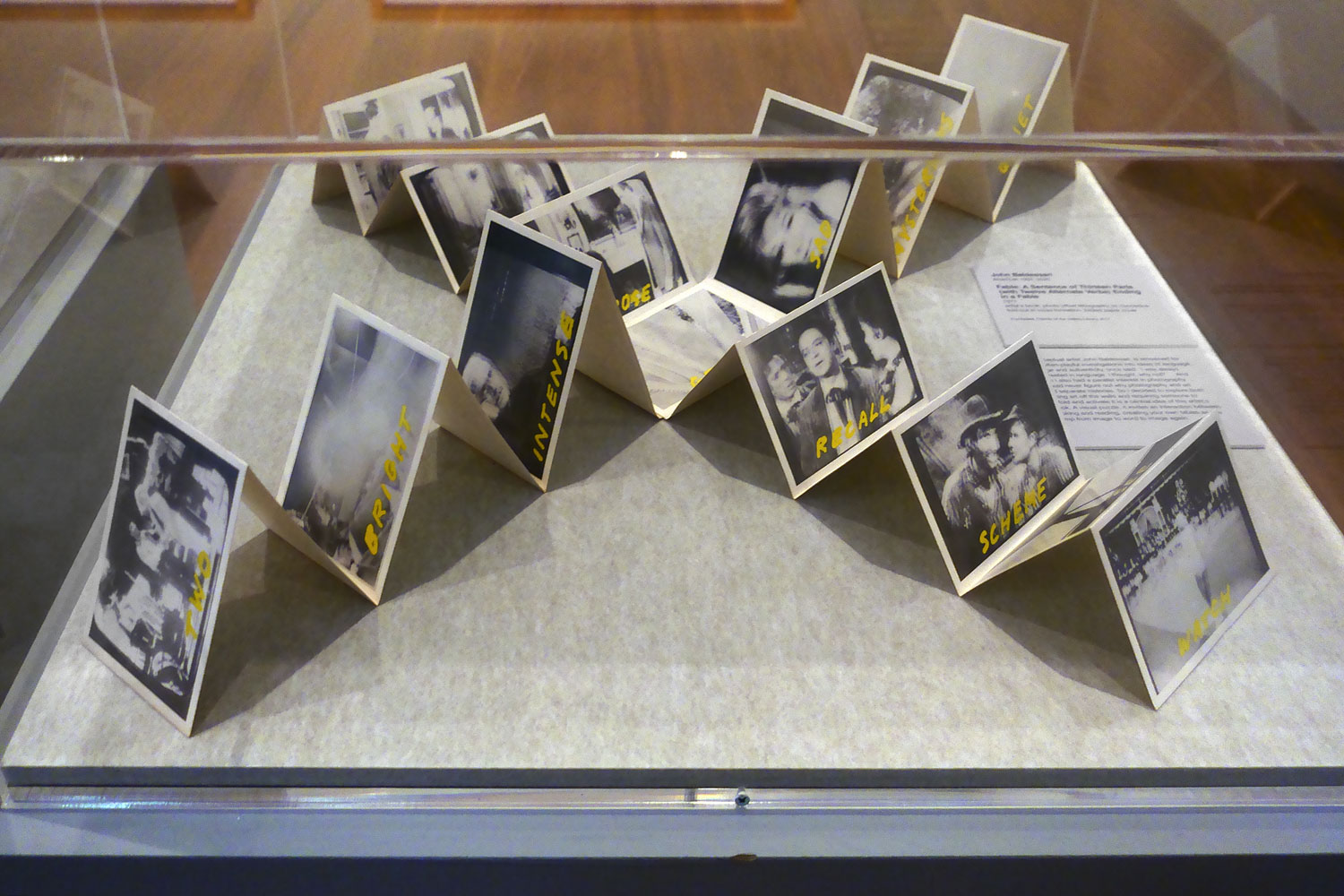
 

John Baldessari (American 1931-2020) ‘Fable: A Sentence of Thirteen Parts (with Twelve Alternate Verbs) Ending in a Fable’ 1977 (installation view)

John Baldessari (American 1931-2020) ‘Fable: A Sentence of Thirteen Parts (with Twelve Alternate Verbs) Ending in a Fable’ 1977 (installation view)


John Baldessari (American 1931-2020)
Fable: A Sentence of Thirteen Parts (with Twelve Alternate Verbs) Ending in a Fable (installation views)
1977
Artist’s book: photo-offset lithography on concertina fold-out in cross formation, folded paper cover
9.8 × 14.0 × 1.8cm (closed) 70.0 × 126.5cm approx. (overall, opened)
National Gallery of Victoria, Melbourne
Purchased, Friends of the Gallery Library, 2017
Photos: Marcus Bunyan


Conceptual artist John Baldessari, is renowned for his often-playful investigations into ideas of language, image and authenticity, once said: ‘I was always interested in language. I thought, why not? … And then I also had a parallel interest in photography … I could never figure out why photography and art had separate histories. So I decided to explore both’. Taking art off the walls and requiring someone to unfold and activate it is a central idea of this artist’s book. A visual puzzle, it invites an interaction between looking and reading, creating your own fables as you jump from image to word to image again.

Wall text from the exhibition
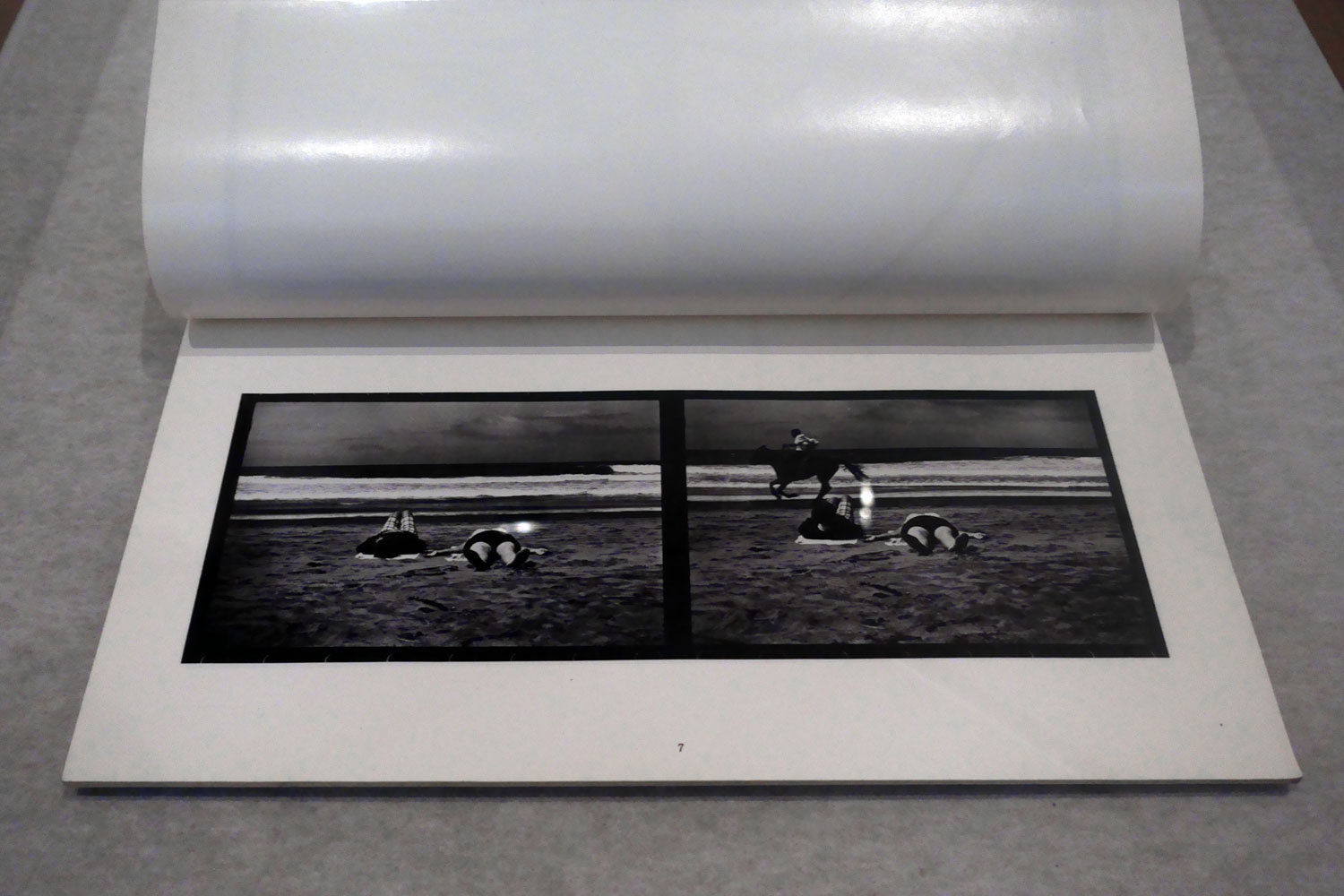
 

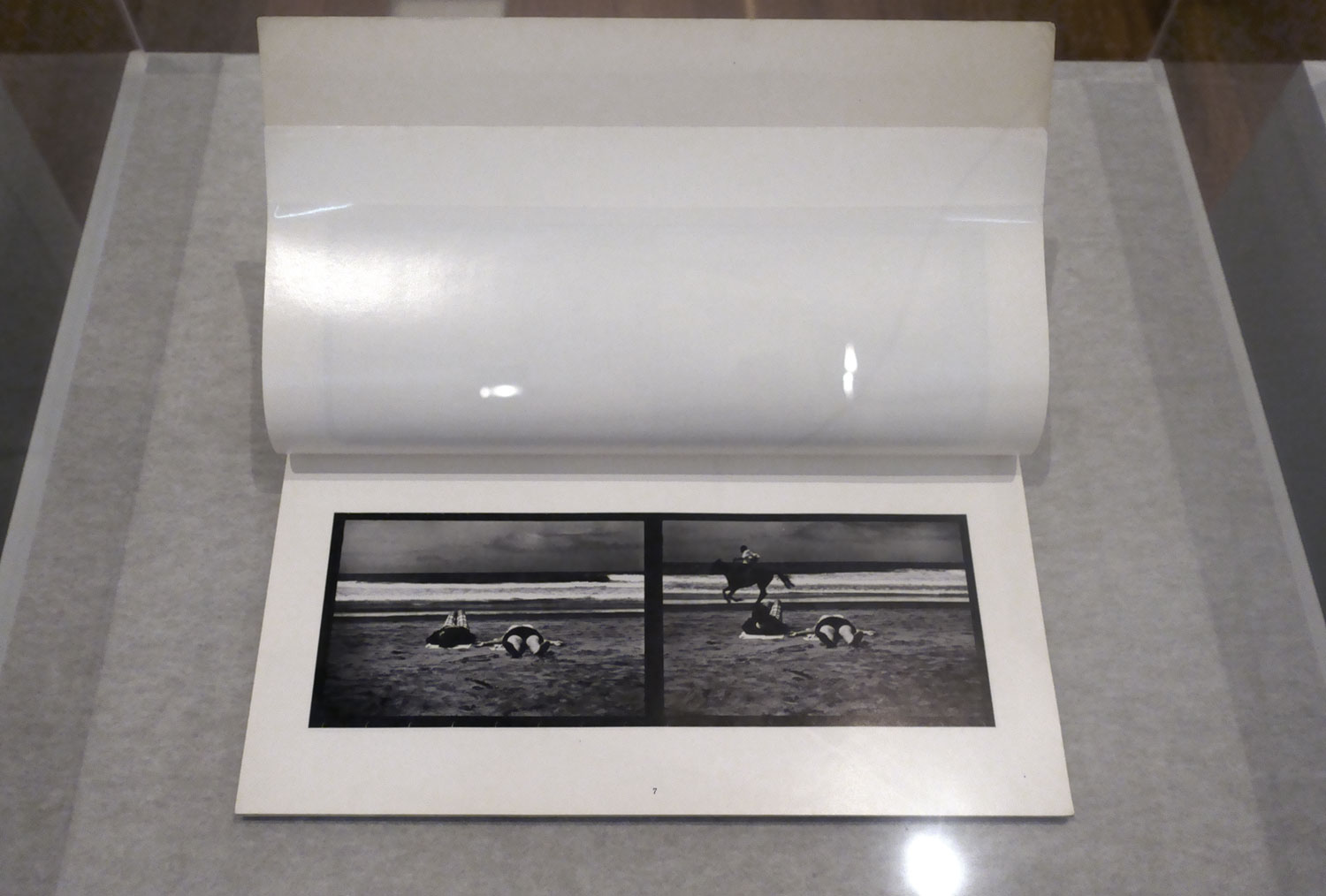
Eve Sonneman (American, b. 1946) 'Real time' 1968-1974 (installation view)

Eve Sonneman (American, b. 1946) 'Real time' 1968-1974 (installation view)


Eve Sonneman (American, b. 1946)
Real time (installation view)
1968-1974, published 1976
Artist’s book: photo-offset lithograph and printed text, 46 folios, printed paper cover, glued binding
National Gallery of Victoria, Melbourne
Purchased NGV Supporters of Photography, 2021
Photos: Marcus Bunyan


Eve Sonneman’s photobook Real time includes paired photographs, each separated by a black line border. The diptychs allow for the occurrence of movement and gestures and changes between the artist’s camera clicks. The ordered presentation, however, takes the images away from a straight documentary reading and to a consideration of their ‘objectness’. After first showing the photographs at MoMA, New York, then photography curator, John Szarkowski, set up a mentorship for Sonneman with the photographer Diane Arbus. As Sonneman recalled: ‘[Arbus] loved my pictures and we got along great. For two years she helped me edit’. Sonneman then published the images through the newly established Printed Matter in New York in 1976.

Wall text from the exhibition


Installation view of the exhibition 'Photography: Real & Imagined' at The Ian Potter Centre: NGV Australia, Melbourne showing at top left, Carol Jerrems and Virginia Fraser's book 'A Book About Australian Women' (1974);  at top centre, Nan Goldin's book 'The Ballad of Sexual Dependency' (1986); and at bottom left, Tracey Emin's 'Exploration of the Soul' (1994) 


Installation view of the exhibition Photography: Real & Imagined at The Ian Potter Centre: NGV Australia, Melbourne showing at top left, Carol Jerrems and Virginia Fraser’s book A Book About Australian Women (published 1974);  at top centre, Nan Goldin’s book The Ballad of Sexual Dependency (published 1986); and at bottom left, Tracey Emin’s Exploration of the Soul (published 1994)
Photo: Marcus Bunyan


Installation view of the exhibition 'Photography: Real & Imagined' at The Ian Potter Centre: NGV Australia, Melbourne showing at bottom left, Harold Cazneaux's book 'The Bridge Book' (published 1930); and at top right, Lee Friedlander's 'The American Monument' (published 1976)


Installation view of the exhibition Photography: Real & Imagined at The Ian Potter Centre: NGV Australia, Melbourne showing at bottom left, Harold Cazneaux’s book The Bridge Book (published 1930); and at top right, Lee Friedlander’s book The American Monument (published 1976)
Photo: Marcus Bunyan


Lee Friedlander (American, b. 1934) 'The American Monument' Published by The Eakins Press Foundation, New York, 1976 (installation view)


Lee Friedlander (American, b. 1934)
The American Monument (installation view)
Published by The Eakins Press Foundation, New York, 1976
Half-tone plate
Shaw Research Library, National Gallery of Victoria
Photo: Marcus Bunyan


Berenice Abbott (American 1898-1991, worked in France 1921-1929) 'Changing New York' Published by E. P. Dutton & Co, New York, 1939 (installation view)


Berenice Abbott (American 1898-1991, worked in France 1921-1929)
Changing New York (installation view)
Published by E. P. Dutton & Co, New York, 1939
Half-tone plate and letterpress text
National Gallery of Victoria, Melbourne
Purchased NGV Foundation, 2022
Photo: Marcus Bunyan


Installation view of the exhibition 'Photography: Real & Imagined' at The Ian Potter Centre: NGV Australia, Melbourne showing at top left, Man Ray's book 'Photographs by Man Ray Paris 1920-1934' (published 1934); at bottom left, Claude Cahun and Marcel Moore's book 'Aveux non Avenus' (Disavowals or Cancelled Confessions) (published 1930); at top right, Bill Brandt's book 'Perspective of Nudes' (published 1961); and at bottom right, Germaine Krull's book 'Nude studies' (Études de nu) (published 1930)


Installation view of the exhibition Photography: Real & Imagined at The Ian Potter Centre: NGV Australia, Melbourne showing at top left, Man Ray’s book Photographs by Man Ray Paris 1920-1934 (published 1934); at bottom left, Claude Cahun and Marcel Moore’s book Aveux non Avenus (Disavowals or Cancelled Confessions) (published 1930); at top right, Bill Brandt’s book Perspective of Nudes (published 1961); and at bottom right, Germaine Krull’s book Nude studies (Études de nu) (published 1930)
Photo: Marcus Bunyan


Photographs today are often viewed in galleries in frames, hung on walls. Many photographs, however, were originally created for display in combination with text and graphic design; to be laid out on a page and reproduced in different formats; to be held, worn on the body, published, and shared.

With recognition of these expanded histories of photography, and the contemporary resurgence in publishing, this exhibition includes artist books, magazines and photobooks that use the photographic image in print, publishing and design. These two cases include examples that show the influence of Surrealism, the New Objectivity and Constructivist graphic design in dynamic modern publications.

Artist and author Martin Parr has described the photobook as the ‘supreme platform’ for photographers to share the work with a broad audience. The 1920s to the 1970s were arguably the most important period for the publication of photobooks. These two cases include examples that show the influence of modernist, humanist and documentary photography traditions in innovative publications from this time. These include exhibition catalogues, examples of first edition books, publications published in larger un-editioned print runs and coveted collectable limited-edition books and portfolios.

Wall text from the exhibition


Installation view of the exhibition 'Photography: Real & Imagined' at The Ian Potter Centre: NGV Australia, Melbourne showing Man Ray’s book 'Photographs by Man Ray Paris 1920-1934' published 1934


Installation view of the exhibition Photography: Real & Imagined at The Ian Potter Centre: NGV Australia, Melbourne showing Man Ray’s book Photographs by Man Ray Paris 1920-1934 (published 1934) with at right, Man Ray’s Anatomies (1930, below)
Photo: Marcus Bunyan


Man Ray (1890-1976) 'Anatomies' 1930


Man Ray (Emmanuel Radnitzky) (American, 1890-1976)
Anatomies
1930
Gelatin silver photograph

Please note: this photograph is not in the exhibition
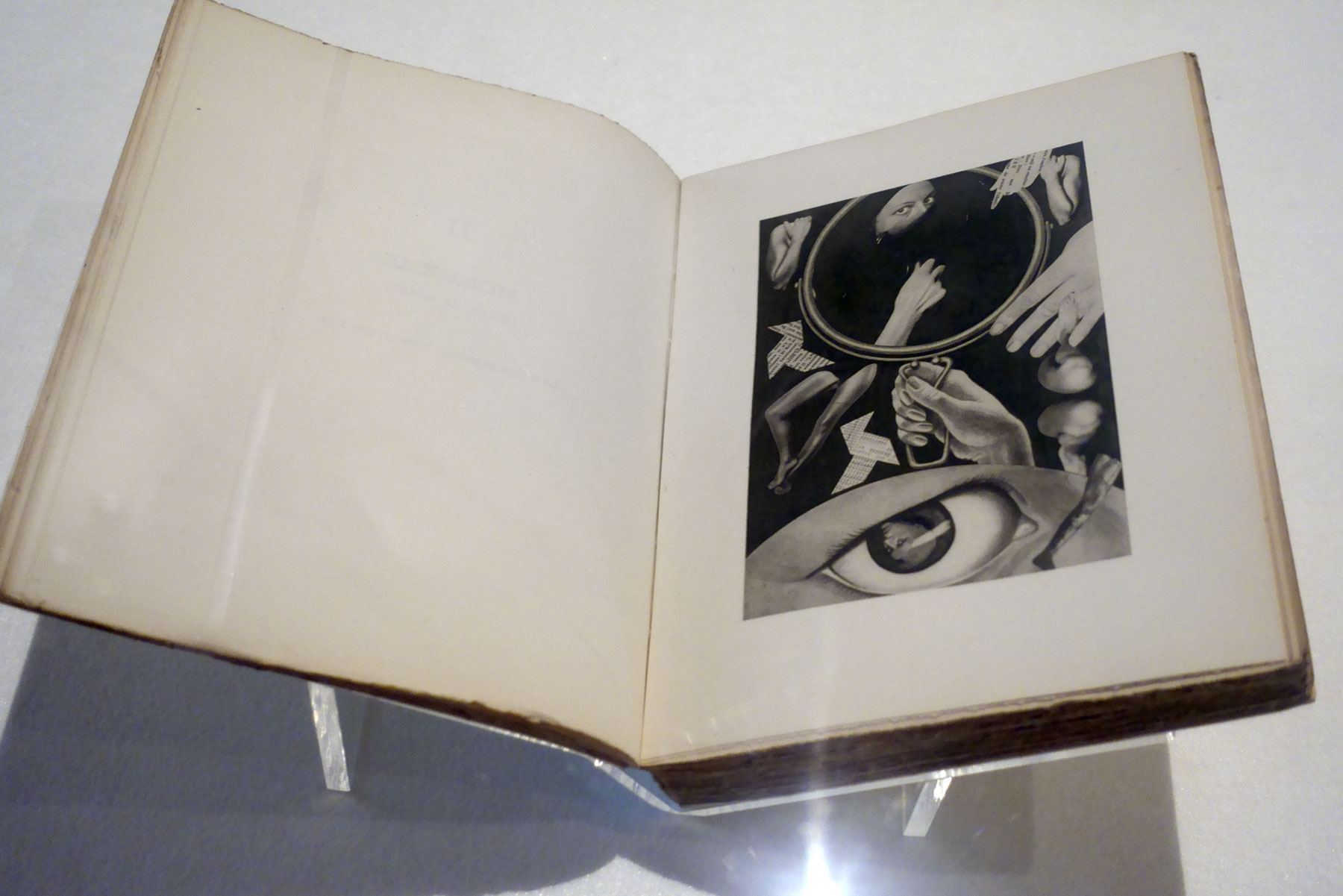
 

Claude Cahun (French, 1894-1954) Marcel Moore (French, 1892-1972) 'Aveux non Avenus' (Disavowals or Cancelled Confessions) Published by Éditions du Carrefour, Paris, 1930 (installation view)

Claude Cahun (French, 1894-1954) Marcel Moore (French, 1892-1972) 'Aveux non Avenus' (Disavowals or Cancelled Confessions) Published by Éditions du Carrefour, Paris, 1930 (installation view)


Claude Cahun (French, 1894-1954) Marcel Moore (French, 1892-1972)
Aveux non Avenus (Disavowals or Cancelled Confessions) (installation view)
Published by Éditions du Carrefour, Paris, 1930
Illustrated book: photogravure, letterpress text, 237 pages, 10 leaves of plates, paper cover, stitched binding
National Gallery of Victoria, Melbourne
Shaw Research Library, acquired through the Friends of the Gallery Library endowment, 2017
Photos: Marcus Bunyan


Aveux non Avenus, by the celebrated poet, writer, sculptor and photographer Claude Cahun, was published in 1930 by Éditions du Carrefour, Paris, in an edition of five hundred. The book comprises a series of texts in French: poems, literary aphorisms, recollections of dream sequences and philosophical thoughts, ideas and meanderings. Pierre Mac Orlan, a French novelist who wrote the preface to the book, described Mademoiselle Claude Cahun’s text as ‘de poèmes-essais et d’essais-poèmes’, or ‘poem-essays and essay-poems’, and said that overall ‘the book is virtually entirely dedicated to the word adventure’

The alliterative title presents a conundrum for English translation – ‘aveux’ meaning ‘avowals’ or ‘confessions’, and ‘non avenus’ meaning ‘voided’ – and is variously translated as Disavowals, Denials, and Unavowed confessions, among other things. Curator Jennifer Mundy has written that the title suggests ‘an affirmative expression immediately followed by some form of negation or retraction’.

Ambiguities around the title aside, there is a strong visual aspect to the book too. The texts are each demarcated with a complex and fantastical photogravure created by Cahun’s partner, Marcel Moore. These photogravure (where an image from the negative of a photograph is etched into a metal plate, similar to printmaking) are collages made up of photographic images of, and by, Cahun. Throughout the book, graphic devices of stars, eyes and lips are also used to separate sections of text. Aveux non Avenus, which has been described as an anti-realist or surrealist-autobiography of the multi-disciplinary Cahun, exists as a potential critique of the autobiography format altogether, is wonderfully irreducible.

Maggie Finch and Isobel Crombie. “Claude Cahun,” in the 2019 July/August edition of NGV Magazine on the NGV website 9th April 2020 [Online] Cited 28/01/2024


Claude Cahun (French, 1894-1954) and Marcel Moore (French, 1892-1972) 'Untitled' 1930


Claude Cahun (French, 1894-1954) and Marcel Moore (French, 1892-1972)
Untitled
1930
In Aveux non avenus 1930
published by Éditions du Carrefour, Paris
illustrated book: heliographs
National Gallery of Victoria, Melbourne
Shaw Research Library, acquired through the Friends of the Gallery Library endowment, 2017
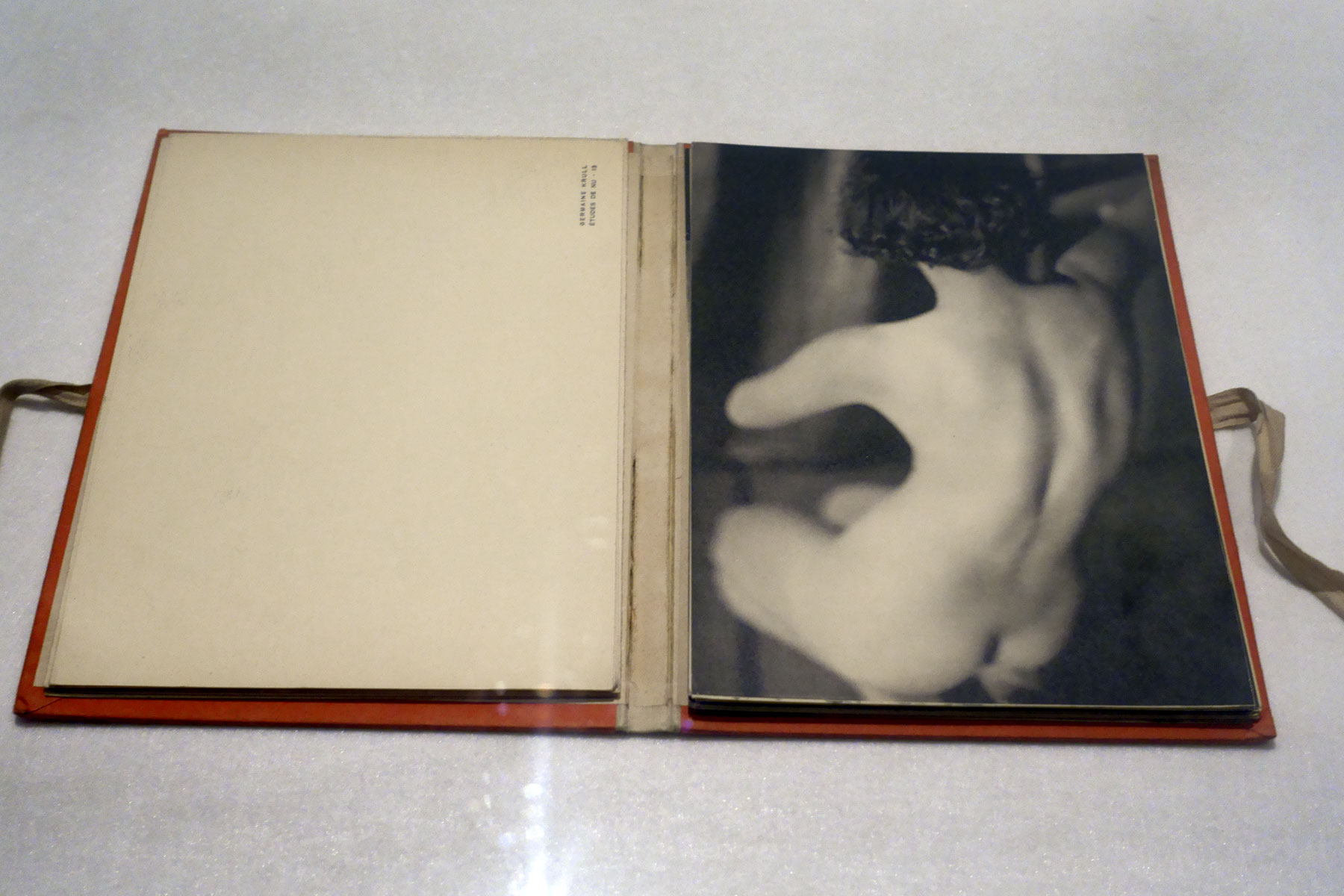
 

Germaine Krull (German, 1897-1985) 'Nude Studies' (Études de Nu) Published by Librarie des arts décoratifs, Paris, 1930 (installation view)


Germaine Krull (German, 1897-1985)
Nude Studies (Études de Nu) (installation view)
Published by Librarie des arts décoratifs, Paris, 1930
24 photogravures, letterpress on paper, white cloth-backed orange paper-covered board portfolio with ribbons
National Gallery of Victoria
Purchased, NGV Foundation, 2022
Photo: Marcus Bunyan


Bill Brandt (English born Germany, 1904-1983) 'Perspective of Nudes' Published Bodley Head, London, 1961 (installation view)


Bill Brandt (English born Germany, 1904-1983)
Perspective of Nudes (installation view)
Published Bodley Head, London, 1961
Half-tone plate
Shaw Research Library, National Gallery of Victoria
Photo: Marcus Bunyan
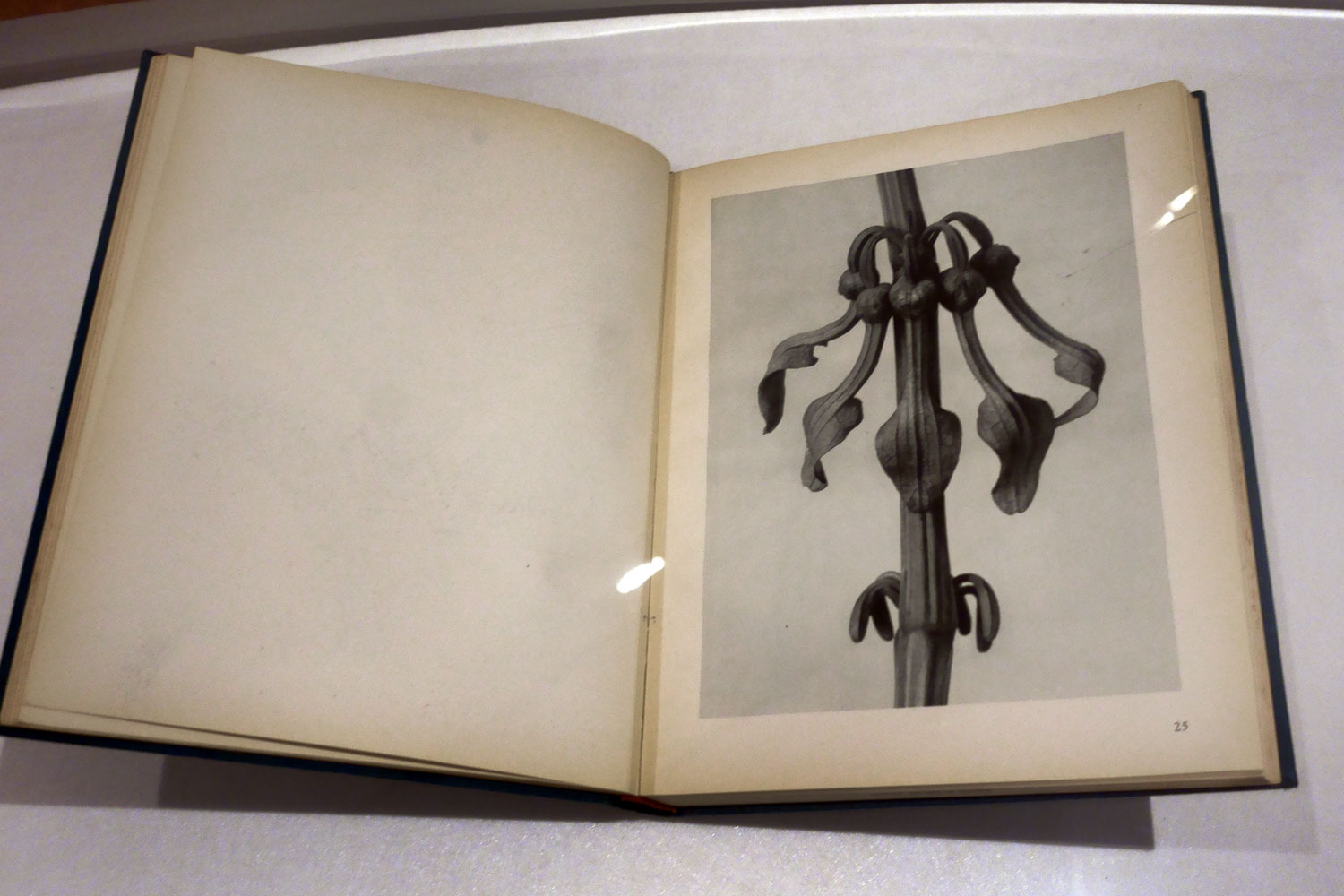
 

Karl Blossfeldt (German, 1865-1932) 'Art Forms in Nature: Examples from the Plant World Photographed Direct from Nature' Published by A. Zwemmer, London, 1929 (installation view)


Karl Blossfeldt (German, 1865-1932)
Art Forms in Nature: Examples from the Plant World Photographed Direct from Nature (installation view)
Published by A. Zwemmer, London, 1929
Half-tone plate
Shaw Research Library, National Gallery of Victoria
Photo: Marcus Bunyan


Karel Teige typographer (Czechoslovakia 1900-1951) Karel Paspa photographer (Czechoslovakia 1862-1936) 'ABECEDA (Alphabet)' Published by J. Otto, Prague, 1926 (installation view)


Karel Teige typographer (Czechoslovakia 1900-1951)
Karel Paspa photographer (Czechoslovakia 1862-1936)
ABECEDA (Alphabet) (installation view)
Published by J. Otto, Prague, 1926
Photomontage
National Gallery of Victoria
Shaw Research Library, acquired through the Friends of the Gallery Library endowment, 2017
Photo: Marcus Bunyan


Aleksandr Rodchenko (Russian, 1891-1958) Varvara Stepanova (Russian, 1894-1958) 'USSR in Construction, no. 12 (Parachute issue)' (URSS en Construction) 1935


Aleksandr Rodchenko (Russian, 1891-1958) and Varvara Stepanova (Russian, 1894-1958)
USSR in Construction, no. 12 (Parachute issue) (URSS en Construction) (installation view)
1935
Illustrated journal: colour rotogravure, 22 pages with fold-out inserts, lithographic cover
National Gallery of Victoria
Purchased, NGV Supporters of Prints and Drawings, 2019
Photo: Marcus Bunyan


Installation view of the exhibition 'Photography: Real & Imagined' at The Ian Potter Centre: NGV Australia, Melbourne showing at top left, Eliza Hutchinson's 'No. 9' (2010); at bottom left, Ewa Narkiewicz's 'Copper flax #4' (1999); at centre top, Harry Nankin's 'The first wave: fragment 2' (1996); at centre bottom, Peter Peryer's 'Seeing' (1989); and at right, Aaron Siskind's 'New York' (1950)


Installation view of the exhibition Photography: Real & Imagined at The Ian Potter Centre: NGV Australia, Melbourne showing at top left, Eliza Hutchinson’s No. 9 (2010); at bottom left, Ewa Narkiewicz’s Copper flax #4 (1999); at centre top, Harry Nankin’s The first wave: fragment 2 (1996); at centre bottom, Peter Peryer’s Seeing (1989); and at right, Aaron Siskind’s New York (1950)
Photo: Marcus Bunyan


In much the same way that tactile writing systems such as braille are impenetrable to those with vision, a photograph printed in two dimensions can be incomprehensible for people with vision impairment. Each system presents a conversion – of letters, texts and illustration – into raised dots on a page; of visible wavelengths of light into an image on a light-sensitive surface. Each relies on an irreversible alteration of the surface. Seeing, the title of this Peter Peryer photograph, infers an action – seeing something. Yet the conversion into a photographic image draws attention to the impenetrability of both acts.

Wall text from the exhibition


Installation view of the exhibition 'Photography: Real & Imagined' at The Ian Potter Centre: NGV Australia, Melbourne showing at left, Gregory Crewdson's 'Untitled' (1999) from the Twilight series (1998-2002); at centre, Malerie Marder's 'Untitled' (2001); and at right, Anne Zahalka's 'Sunday, 2:09pm' (1995) 


Installation view of the exhibition Photography: Real & Imagined at The Ian Potter Centre: NGV Australia, Melbourne showing at left, Gregory Crewdson’s Untitled (1999) from the Twilight series (1998-2002); at centre, Malerie Marder’s Untitled (2001); and at right, Anne Zahalka’s Sunday, 2:09pm (1995)
Photo: Marcus Bunyan
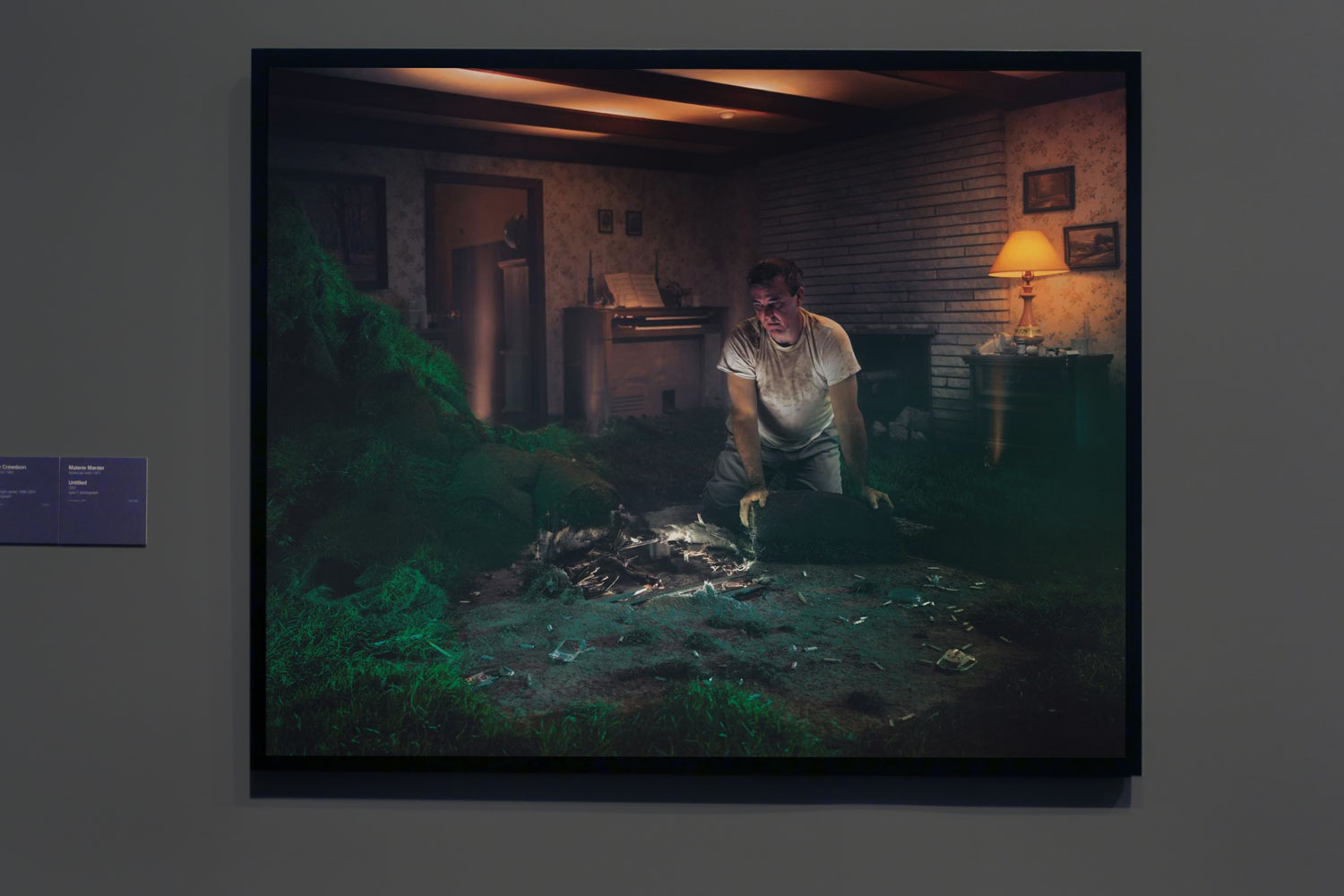
 

Gregory Crewdson (American, b. 1962) 'Untitled' 1999 (installation view)


Gregory Crewdson (American, b. 1962)
Untitled (installation view)
1999
From the Twilight series 1998-2002
Type C photograph
121.9 × 152.4cm
National Gallery of Victoria, Melbourne
Kaiser Bequest, 2000
Photo: Marcus Bunyan


Anne Zahalka (Australian, b. 1957) 'Sunday, 2:09pm' 1995, printed 2019 (installation view)


Anne Zahalka (Australian, b. 1957)
Sunday, 2:09pm
1995, printed 2019
From the Open House series 1995
Colour cibachrome transparency, light box
121.7 × 161.4cm
National Gallery of Victoria, Melbourne
Purchased, Victorian Foundation for Living Australian Artists, 2019
Photo: Marcus Bunyan
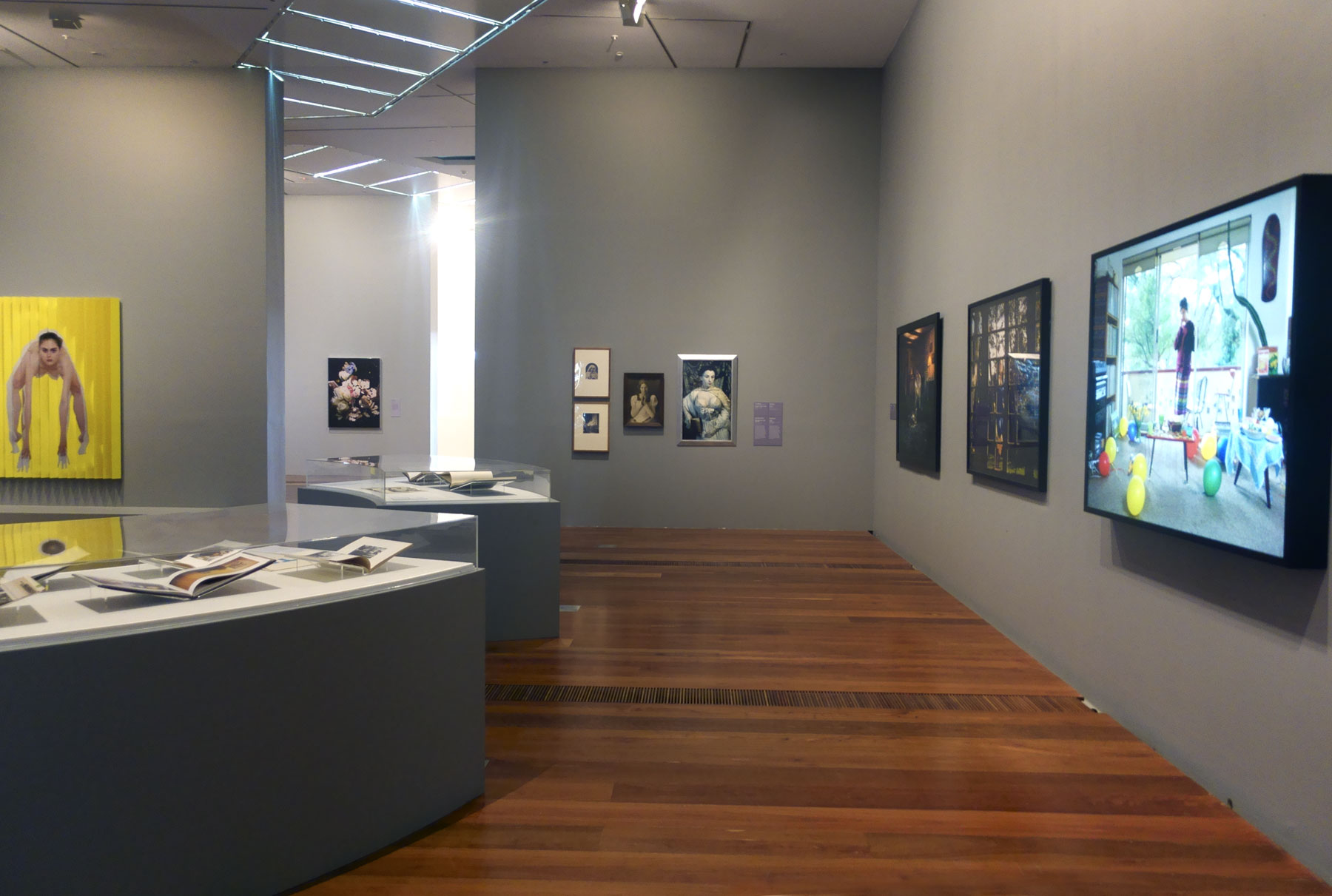
 

Installation view of the exhibition 'Photography: Real & Imagined' at The Ian Potter Centre: NGV Australia, Melbourne showing at left, Polly Borland's 'Untitled' (2018); and at right, Anne Zahalka's 'Sunday, 2:09pm' (1995)


Installation view of the exhibition Photography: Real & Imagined at The Ian Potter Centre: NGV Australia, Melbourne showing at left, Polly Borland’s Untitled (2018); and at right, Anne Zahalka’s Sunday, 2:09pm (1995)
Photo: Marcus Bunyan
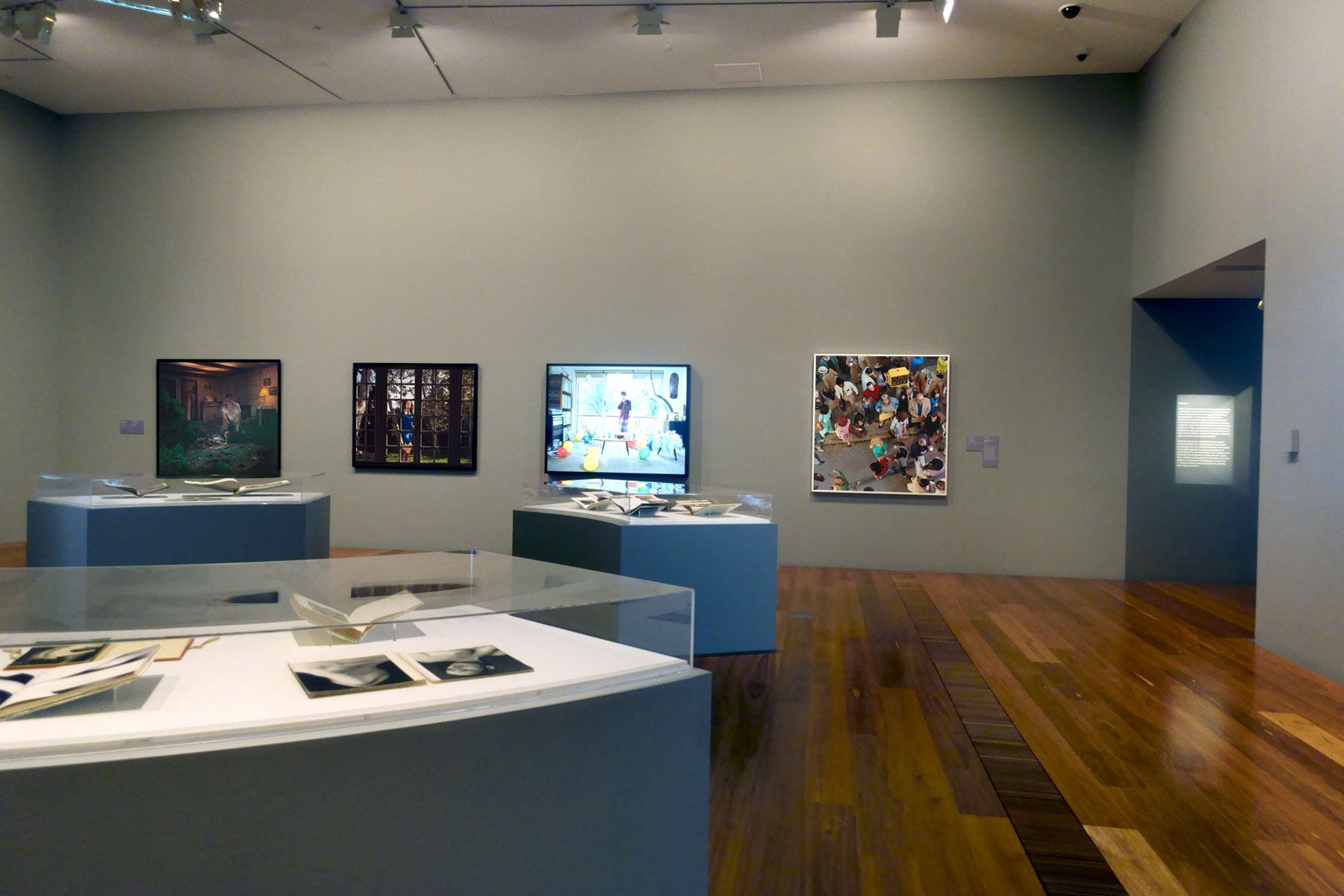
 

Installation view of the exhibition 'Photography: Real & Imagined' at The Ian Potter Centre: NGV Australia, Melbourne showing at rear from left to right, Gregory Crewdson's 'Untitled' (1999) from the 'Twilight' series (1998-2002); at second left, Malerie Marder's 'Untitled' (2001); and centre, Anne Zahalka's 'Sunday, 2:09pm' (1995); and at right, Alex Prager's 'Crowd #11 (Cedar and Broad Street)' (2013)


Installation view of the exhibition Photography: Real & Imagined at The Ian Potter Centre: NGV Australia, Melbourne showing at rear from left to right, Gregory Crewdson’s Untitled (1999) from the Twilight series (1998-2002); at second left, Malerie Marder’s Untitled (2001); and centre, Anne Zahalka’s Sunday, 2:09pm (1995); and at right, Alex Prager’s Crowd #11 (Cedar and Broad Street) (2013, below)
Photo: Marcus Bunyan


Installation view of the exhibition Photography: Real & Imagined at The Ian Potter Centre: NGV Australia, Melbourne showing Alex Prager's 'Crowd #11 (Cedar and Broad Street)' (2013)


Installation view of the exhibition Photography: Real & Imagined at The Ian Potter Centre: NGV Australia, Melbourne showing Alex Prager’s Crowd #11 (Cedar and Broad Street) (2013, below)
Photos: Marcus Bunyan


Alex Prager (American, b. 1979) 'Crowd #11 (Cedar and Broad Street)' 2013


Alex Prager (American, b. 1979)
Crowd #11 (Cedar and Broad Street)
2013
Inkjet print
149.7 × 142.0cm (image and sheet)
National Gallery of Victoria, Melbourne
Bowness Family Fund for Contemporary Photography, 2014


Alex Prager’s staged photographs openly reference the aesthetics of mid-twentieth century American cinema, fashion photography and the photographs of Cindy Sherman. Her images resemble film stills and are packed with emotion and human melodrama. Working with actors, directing their placement and interaction to create a hyperreal dramatisation of crowd behaviour, Prager’s narrative tableaux pair the banal and fantastic, the everyday and the theatrical, real life and cinematic representation. In this image we have a bird’s eye view of a mass of people crossing the road. We can see the patterns of movement, contact and avoidance and a suggestion of the narrative possibilities of the interacting crowd.

Wall text from the exhibition


Installation view of the exhibition 'Photography: Real & Imagined' at The Ian Potter Centre: NGV Australia, Melbourne showing at second right, Pat Brassington's 'Rosa' (2014); and at right, Yvonne Todd's 'Werta' (2005)


Installation view of the exhibition Photography: Real & Imagined at The Ian Potter Centre: NGV Australia, Melbourne showing at second right, Pat Brassington’s Rosa (2014); and at right, Yvonne Todd’s Werta (2005)
Photo: Marcus Bunyan
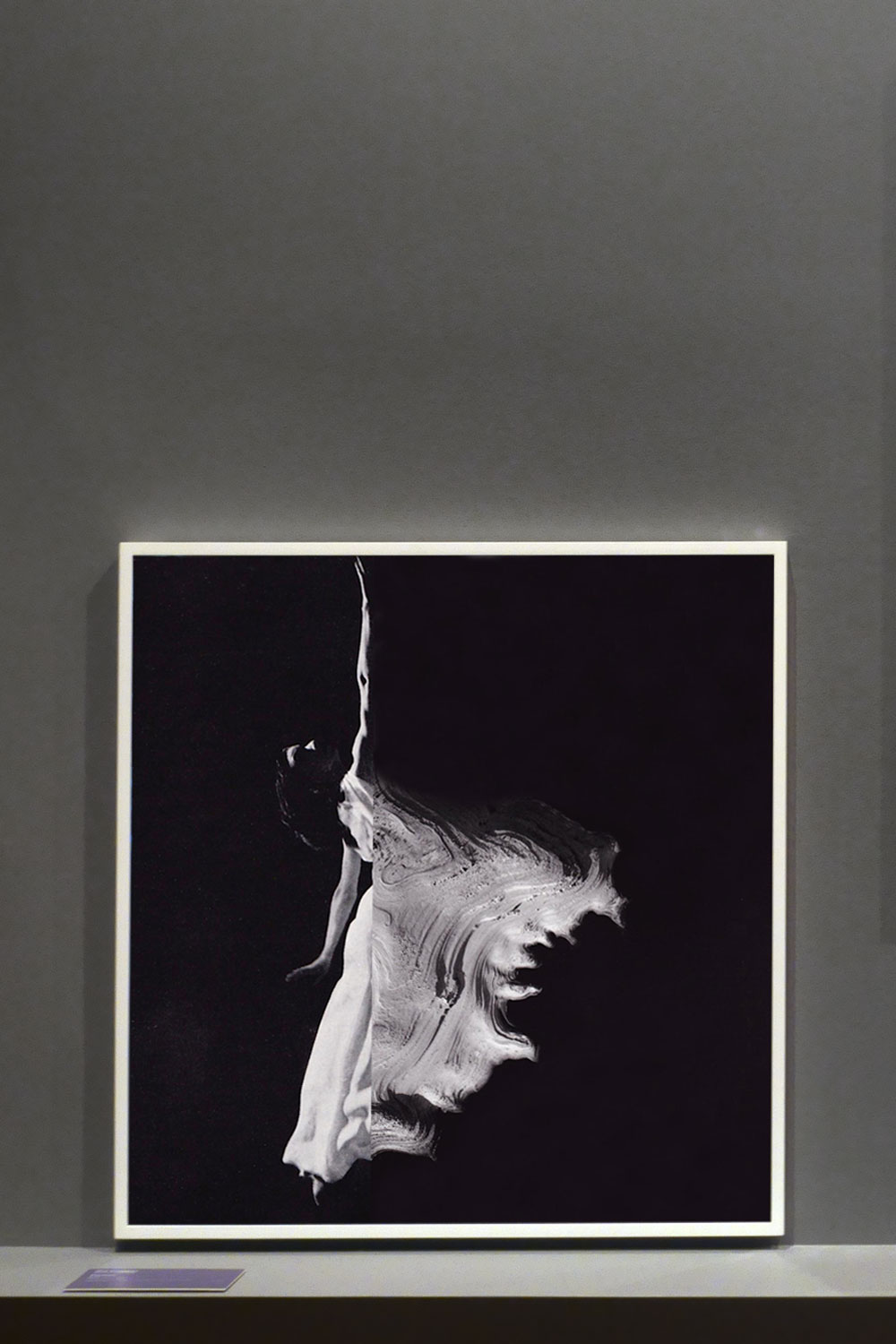
 

Zoë Croggon (Australian, b. 1989) 'Fonteyn' 2012 (installation view)


Zoë Croggon (Australian, b. 1989)
Fonteyn (installation view)
2012
Digital type C print
102.8 × 99.9cm
Purchased with funds arranged by Loti Smorgon for Contemporary Australian Photography, 2013
Photo: Marcus Bunyan
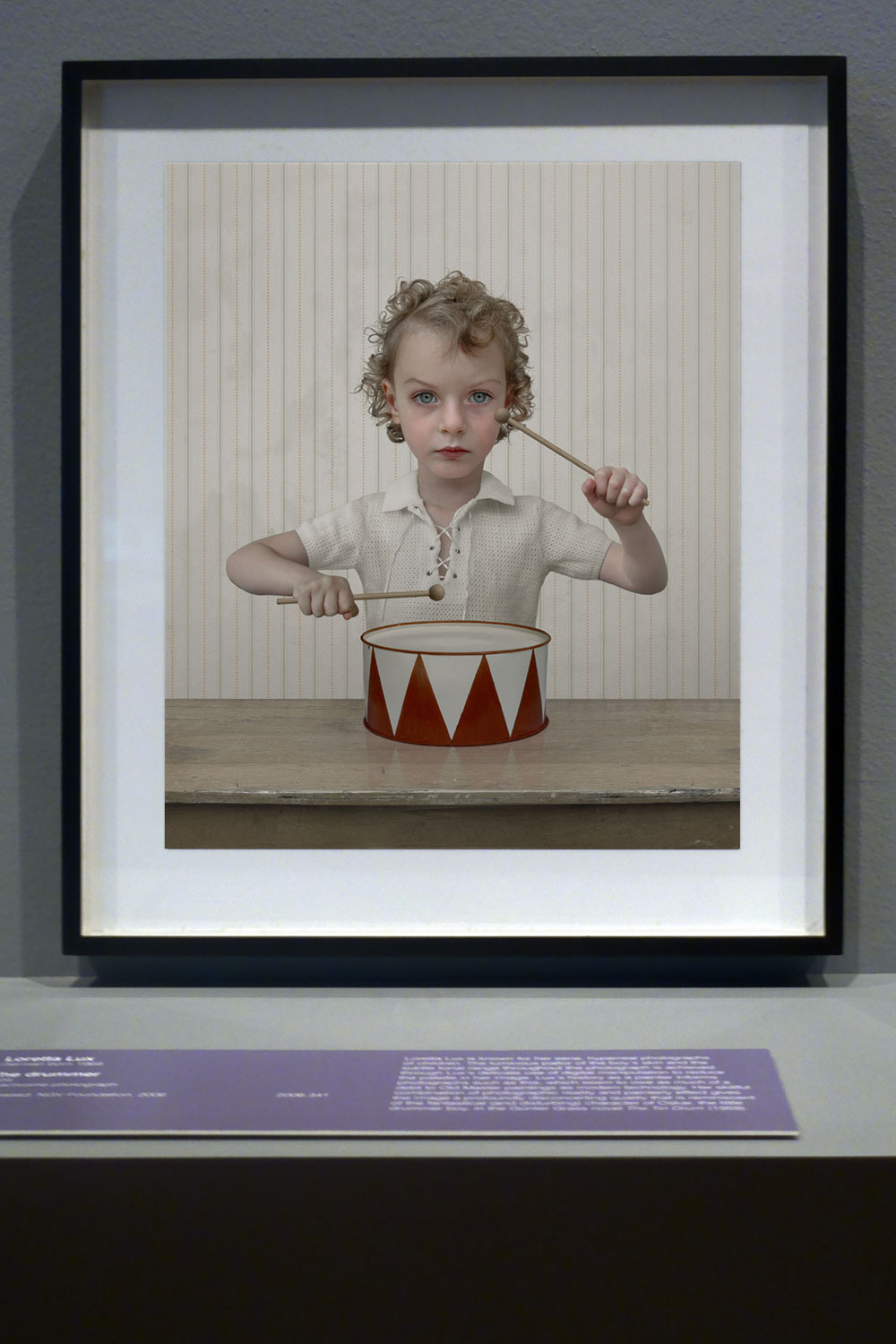
 

Installation view of the exhibition 'Photography: Real & Imagined' at The Ian Potter Centre: NGV Australia, Melbourne showing Loretta Lux's 'The Drummer' (2004)


Installation view of the exhibition Photography: Real & Imagined at The Ian Potter Centre: NGV Australia, Melbourne showing Loretta Lux’s The Drummer (2004, below)
Photo: Marcus Bunyan
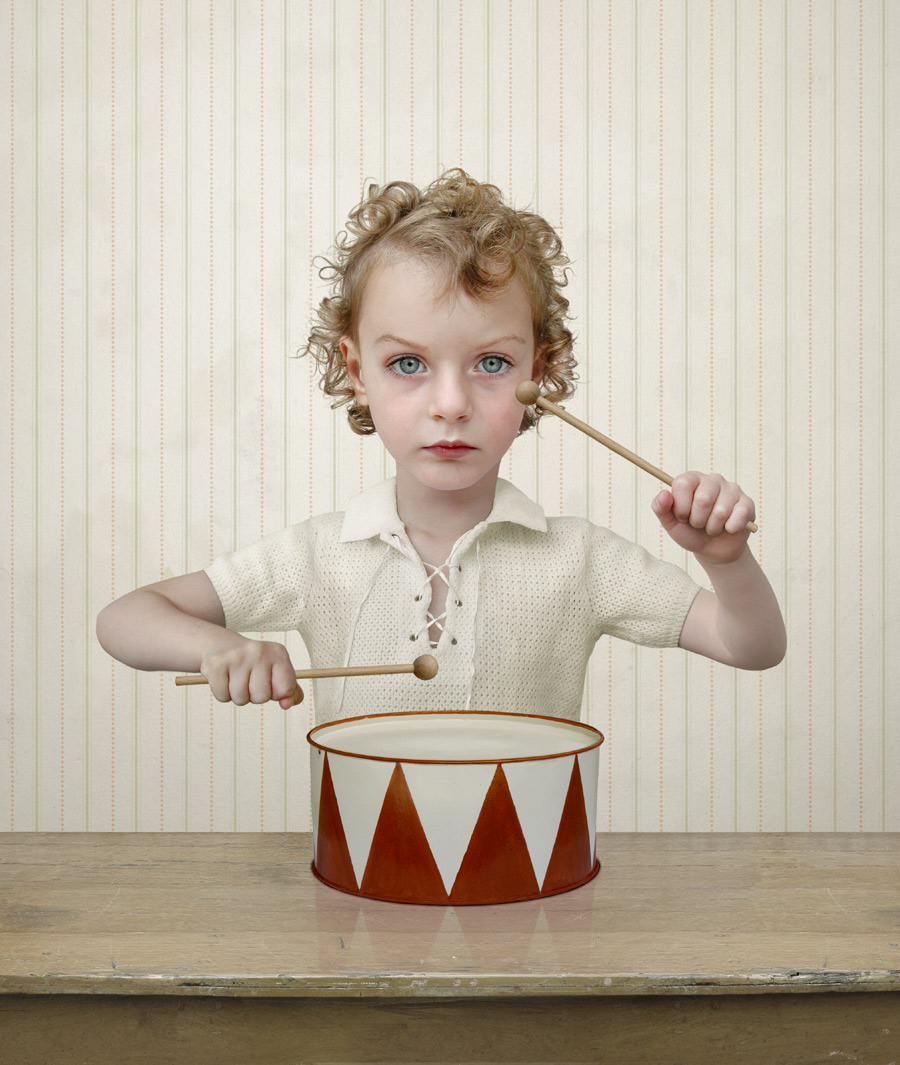
 

Loretta Lux (German, b. 1969) 'The drummer' 2004


Loretta Lux (German, b. 1969)
The drummer
2004
Cibachrome photograph
45.0 x 37.7cm
National Gallery of Victoria, Melbourne
Purchased, NGV Foundation, 2006
© Loretta Lux. VG Bild-Kunst/Copyright Agency, 2023


Loretta Lux is known for her eerie, hyperreal photographs of children. The luminous pallor of the boy’s skin and the subtle tonal range throughout the photograph is achieved through Lux’s delicate use of digital manipulation to reduce the palette in her image. Lux’s history as a painter informs photographs such as this, which seem to owe as much of a debt to Old Master paintings as modern technology. Her skilful combination of photographic reality and painterly effect gives the image a profoundly disconcerting quality that is reminiscent of the fantastical (and disturbing) character of Oskar, the little drummer boy, in the Günter Grass novel The Tin Drum (1959).

Wall text from the exhibition


Installation view of the exhibition 'Photography: Real & Imagined' at The Ian Potter Centre: NGV Australia, Melbourne showing at bottom left, Raoul Ubac's 'Penthésilée' (c. 1938, below); at top centre, André Kertész's Satiric Dancer, Paris (1926, below); and at right, Max Dupain's 'Impassioned clay' (1936, below)


Installation view of the exhibition Photography: Real & Imagined at The Ian Potter Centre: NGV Australia, Melbourne showing at bottom left, Raoul Ubac’s Penthésilée (c. 1938, below); at top centre, André Kertész’s Satiric Dancer, Paris (1926, below); and at right, Max Dupain’s Impassioned clay (1936, below)
Photo: Marcus Bunyan


Raoul Ubac (Belgian, 1909-1985) 'Penthésilée' c. 1938


Raoul Ubac (Belgian, 1909-1985)
Penthésilée
c. 1938
Gelatin silver photograph
31.0 × 41.5cm
National Gallery of Victoria, Melbourne
Purchased NGV Foundation, 2013


From the mid 1930s onwards Surrealist photographer Raoul Ubac experimented with collage, photomontage and solarisation. These processes disrupted the surface of his photographs, enabling him to create new and fantastic realities and introducing an element of chance into his image making. Penthésilée is from his most important series of photographs. The image is based on the story of Penthesilea, queen of the Amazons, who was killed by Achilles while fighting alongside the Trojans. To represent this mythic battle Ubac created this complex photomontage by cutting up, collaging, rephotographing and solarising photographs of nude female figures. The resulting image has an uncanny sense of movement suggesting the height of battle.

Wall text from the exhibition
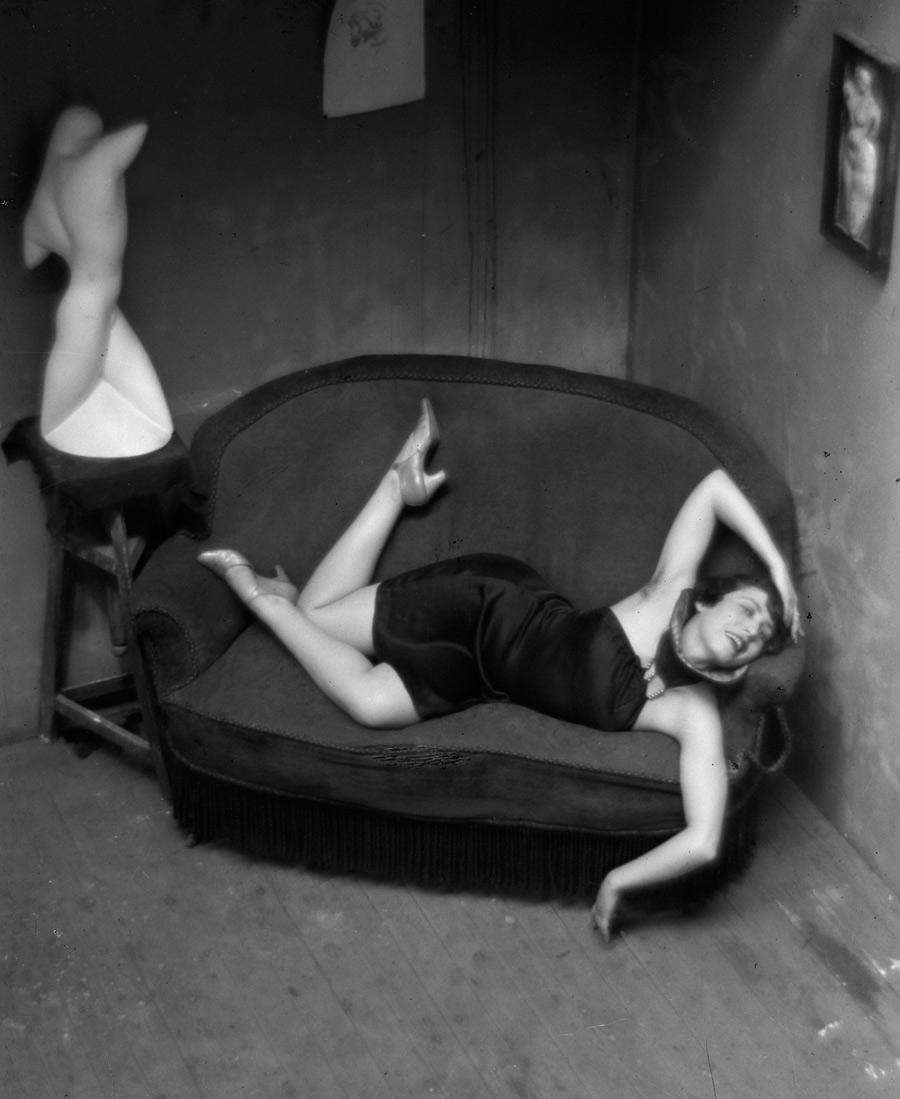
 

André Kertész. 'Satiric Dancer' 1926


André Kertész (Hungarian 1894-1985, France 1925-1936, United States 1936-1985)
Satiric Dancer, Paris
1926, printed c. 1972
Gelatin silver photograph
Purchased, 1973


Installation view of the exhibition 'Photography: Real & Imagined' at The Ian Potter Centre: NGV Australia, Melbourne showing Max Dupain's 'Impassioned clay' (1936)


Installation view of the exhibition Photography: Real & Imagined at The Ian Potter Centre: NGV Australia, Melbourne showing Max Dupain’s Impassioned clay (1936, below)
Photo: Marcus Bunyan


Max Dupain (Australian 1911-1992) 'Impassioned clay' 1936


Max Dupain (Australian 1911-1992)
Impassioned clay
1936
Gelatin silver photograph
50.4 × 36.7cm irreg.
National Gallery of Victoria, Melbourne
William Kimpton Bequest, 2016
Public domain


Installation view of the exhibition 'Photography: Real & Imagined' at The Ian Potter Centre: NGV Australia, Melbourne showing at left, Pat Brassington's 'Rosa' (2014); and at right, Yvonne Todd's 'Werta' (2005)


Installation view of the exhibition Photography: Real & Imagined at The Ian Potter Centre: NGV Australia, Melbourne showing at left, Pat Brassington’s Rosa (2014); and at right, Yvonne Todd’s Werta (2005)
Photo: Marcus Bunyan


Yvonne Todd selects her subjects, most often young women, from ‘call outs’ seeking certain types, people encountered on the street, or modelling agencies where she invariably chooses those with little or no industry experience. In her studio Todd uses costumes, heavy make-up and wigs to style her models. Costuming is an important aspect of Todd’s practice; her interest lies in in what she describes as, ‘the way they carry character and narrative connotations’. Todd’s finished photographs are heavily reworked using Photoshop so that they appear obviously artificial. This overt use of artifice shifts her images from simply being nostalgic recreations to being strangely familiar and undeniably creepy.

Wall text from the exhibition


Installation view of the exhibition 'Photography: Real & Imagined' at The Ian Potter Centre: NGV Australia, Melbourne showing at back left, Robyn Stacey's 'Nothing to see here' (2019) and at back centre, Polly Borland's 'Untitled' (2018)


Installation view of the exhibition Photography: Real & Imagined at The Ian Potter Centre: NGV Australia, Melbourne showing at back left, Robyn Stacey’s Nothing to see here (2019) and at back centre, Polly Borland’s Untitled (2018)
Photo: Marcus Bunyan


Robyn Stacey (Australian, b. 1952) 'Nothing to see here' 2019


Robyn Stacey (Australian, b. 1952)
Nothing to see here
2019
From the Nothing to See Here series 2019
Lenticular image
155.5 × 119cm
National Gallery of Victoria, Melbourne
Purchased, Victorian Foundation for Living Australian Artists, 2020


This large-scale lenticular photograph shows the face of a woman projected onto a curtain. The curtain suggests a hidden cinema screen; however, Robyn Stacey’s curtains cannot be pulled back. From one viewpoint a beautiful face with eyes softly closed as if in sleep appears, but as you move past the image you can only see the curtain. The curtain becomes what the artist described as ‘a membrane between reality and allegory’ and acts as the screen as the portrait appears and disappears.

Wall text from the exhibition
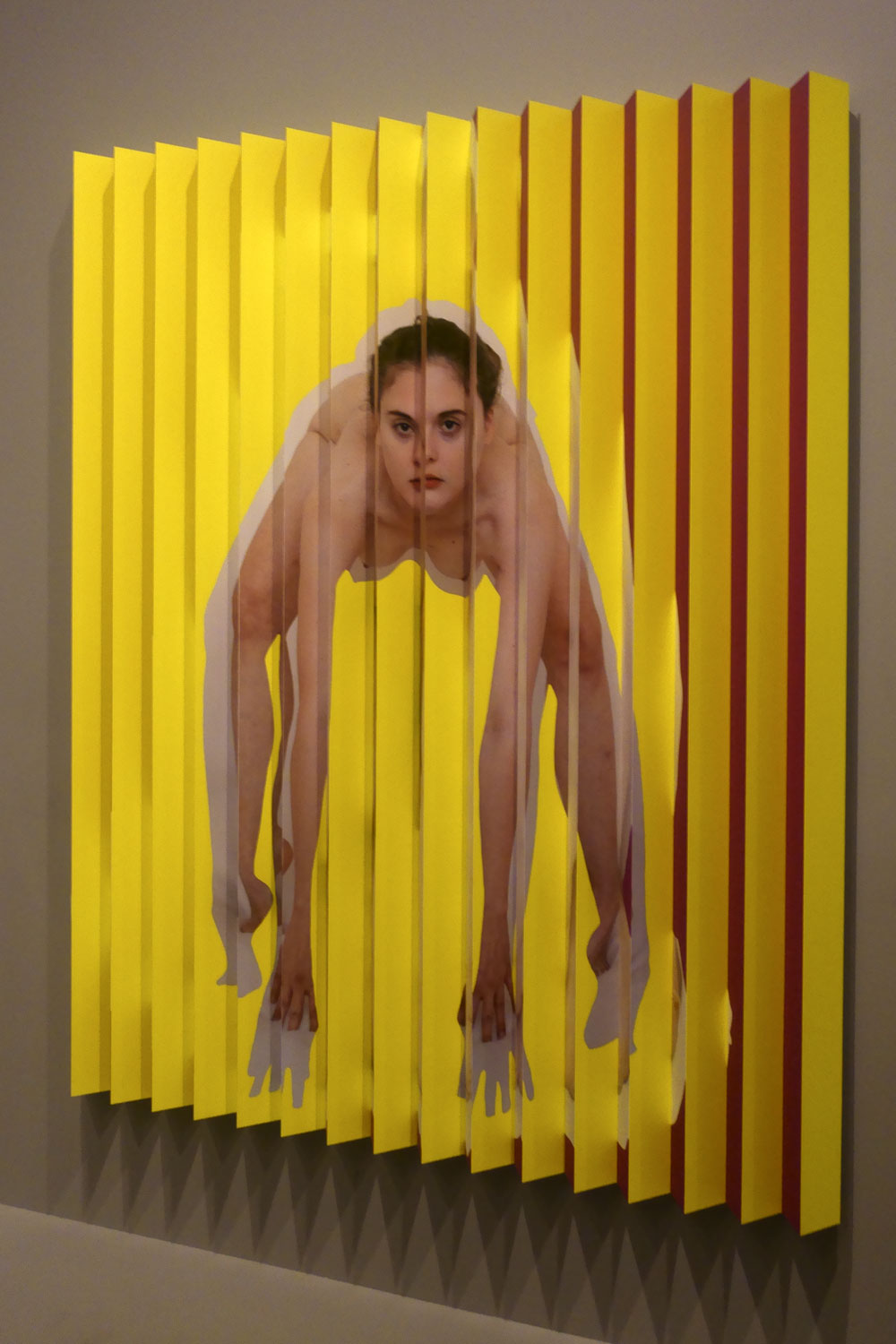
 

Installation view of the exhibition 'Photography: Real & Imagined' at The Ian Potter Centre: NGV Australia, Melbourne showing Polly Borland's lenticular photograph 'Untitled' (2018)

Installation view of the exhibition 'Photography: Real & Imagined' at The Ian Potter Centre: NGV Australia, Melbourne showing Polly Borland's lenticular photograph 'Untitled' (2018)

Installation view of the exhibition 'Photography: Real & Imagined' at The Ian Potter Centre: NGV Australia, Melbourne showing Polly Borland's lenticular photograph 'Untitled' (2018)


Installation views of the exhibition Photography: Real & Imagined at The Ian Potter Centre: NGV Australia, Melbourne showing Polly Borland’s lenticular photograph Untitled (2018) from the MORPH series
Photos: Marcus Bunyan
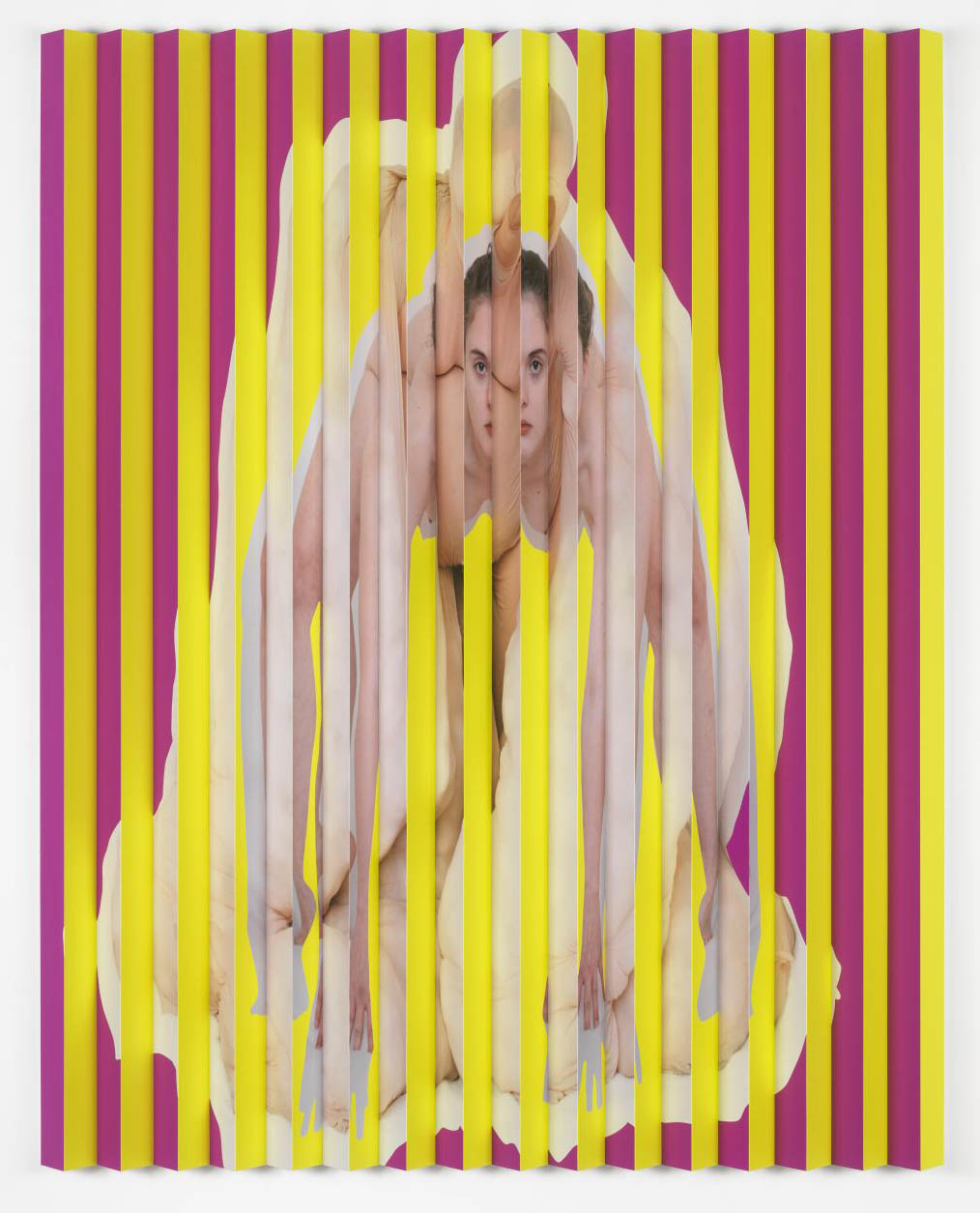
 

Polly Borland (Australia, b. 1959) 'Untitled' 2018


Polly Borland (Australia, b. 1959)
Untitled
2018
From MORPH series 2018
Inkjet print on rice paper on lenticular cardboard
216.0 × 172.7 × 13.0cm
National Gallery of Victoria, Melbourne
Purchased, Victorian Foundation for Living Australian Artists, 2019
© Polly Borland
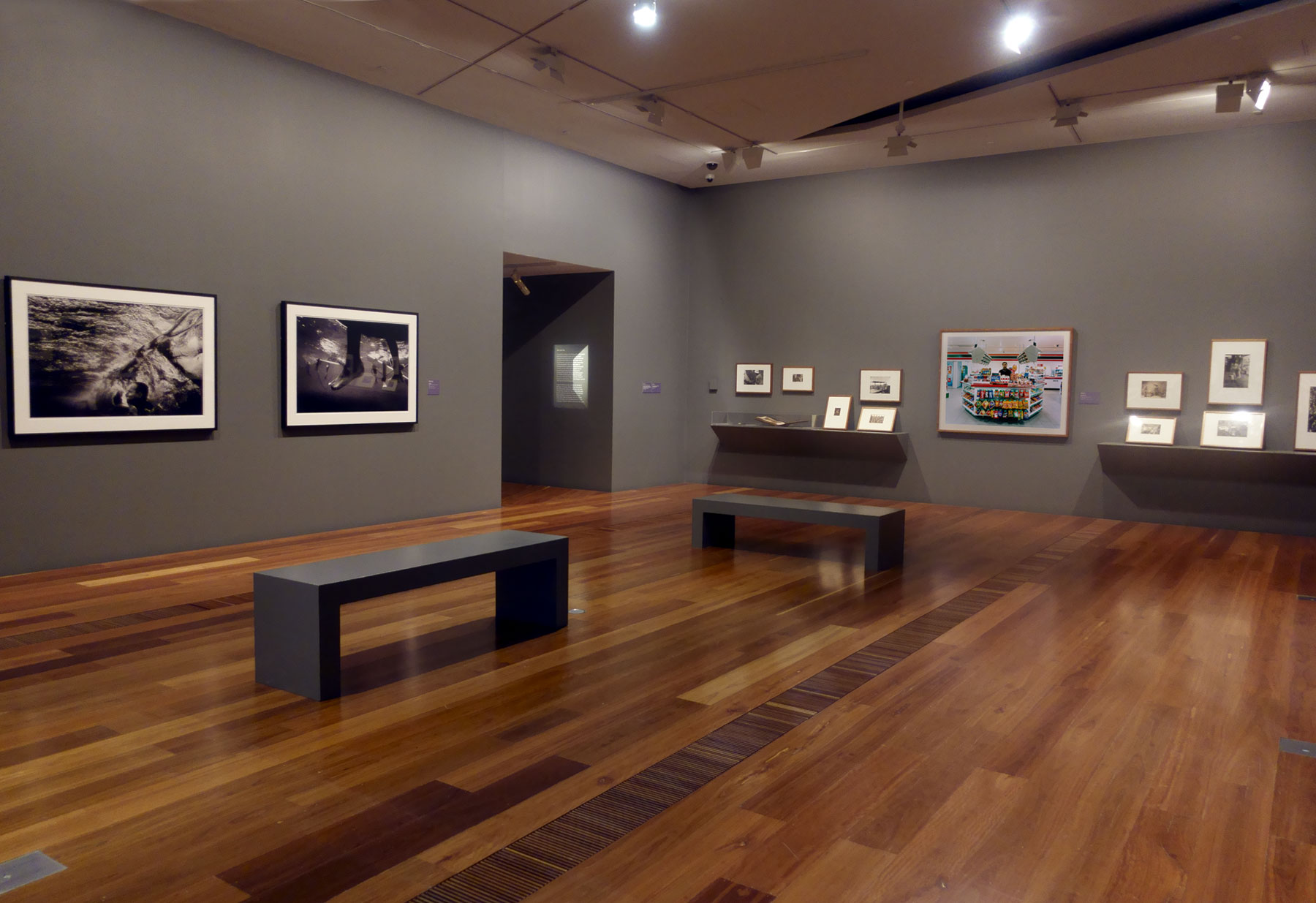
 

Installation view of the exhibition Photography: Real & Imagined at The Ian Potter Centre: NGV Australia, Melbourne showing at left, Narelle Autio's two photographs 'Untitled' from 'The Seventh Wave' series (1999-2000); and at right, Selina Ou's 'Convenience' (2001)


Installation view of the exhibition Photography: Real & Imagined at The Ian Potter Centre: NGV Australia, Melbourne showing at left, Narelle Autio’s two photographs Untitled from The Seventh Wave series (1999-2000); and at centre right, Selina Ou’s Convenience (2001)
Photo: Marcus Bunyan


Installation view of the exhibition Photography: Real & Imagined at The Ian Potter Centre: NGV Australia, Melbourne showing Narelle Autio's two photographs 'Untitled' from 'The Seventh Wave' series (1999-2000)


Installation view of the exhibition Photography: Real & Imagined at The Ian Potter Centre: NGV Australia, Melbourne showing Narelle Autio’s two photographs Untitled from The Seventh Wave series (1999-2000)
Photo: Marcus Bunyan


Narelle Autio (Australian, b. 1969) 'Untitled' 2000 (installation view)


Narelle Autio (Australian, b. 1969)
Untitled (installation view)
2000
From The Seventh Wave series 1999-2000
Gelatin silver photograph
90.0 × 134.1cm
National Gallery of Victoria, Melbourne
Purchased with funds arranged by Loti Smorgon for Contemporary Australian Photography, 2001
Photo: Marcus Bunyan


Installation view of the exhibition Photography: Real & Imagined at The Ian Potter Centre: NGV Australia, Melbourne showing at back centre, Selina Ou’s Convenience (2001); and at right, Rosemary Laing’s welcome to Australia (2004)
Photo: Marcus Bunyan
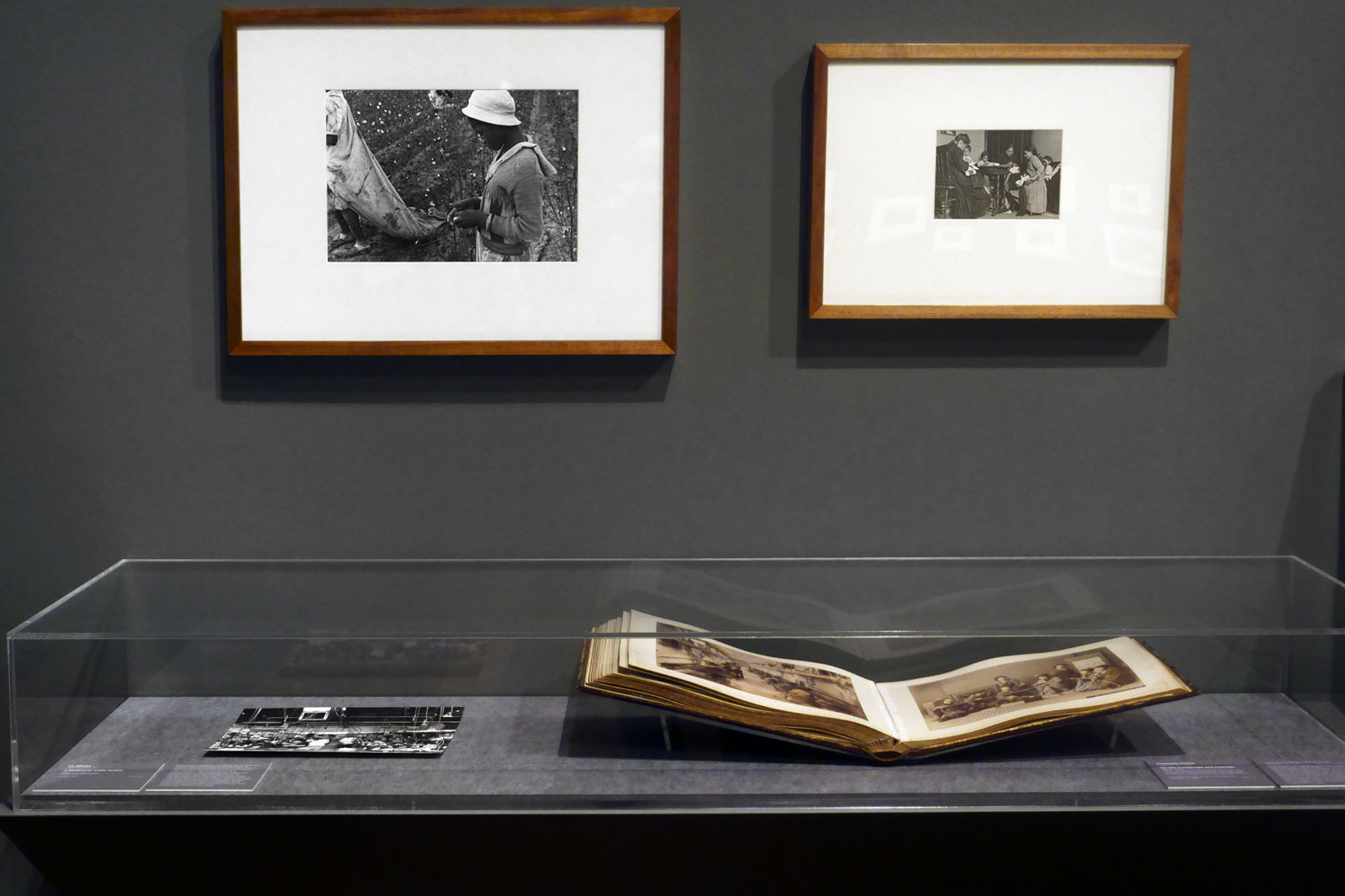
 

Installation view of the exhibition 'Photography: Real & Imagined' at The Ian Potter Centre: NGV Australia, Melbourne showing at back left, Ben Shahn's 'Young cotton picker, Pulaski County, Arkansas. Schools for coloured children do not open until January 1st so as not to interfere with cotton picking' 1935; and back right, Lewis Hine's 'Finishing garments, 10 Hanover Ave., Boston, Massachusetts' 1912; and at right in the cabinet, Kusakabe Kimbei's album '(Landscape and portraits)' (1880s-1910s) 


Installation view of the exhibition Photography: Real & Imagined at The Ian Potter Centre: NGV Australia, Melbourne showing at back left, Ben Shahn’s Young cotton picker, Pulaski County, Arkansas. Schools for coloured children do not open until January 1st so as not to interfere with cotton picking 1935; and back right, Lewis Hine’s Finishing garments, 10 Hanover Ave., Boston, Massachusetts 1912; and at right in the cabinet, Kusakabe Kimbei’s album (Landscape and portraits) (1880s-1910s)
Photo: Marcus Bunyan


Ben Shahn (Lithuanian 1898-1969, United States c. 1925-1969) 'Young cotton picker, Pulaski County, Arkansas. Schools for coloured children do not open until January 1st so as not to interfere with cotton picking' 1935, printed c. 1975 (installation view)


Ben Shahn (Lithuanian 1898-1969, United States c. 1925-1969)
Young cotton picker, Pulaski County, Arkansas. Schools for coloured children do not open until January 1st so as not to interfere with cotton picking (installation view)
1935, printed c. 1975
Gelatin silver photograph
21.7 × 32.8cm
National Gallery of Victoria, Melbourne
Purchased, 1975
Photo: Marcus Bunyan
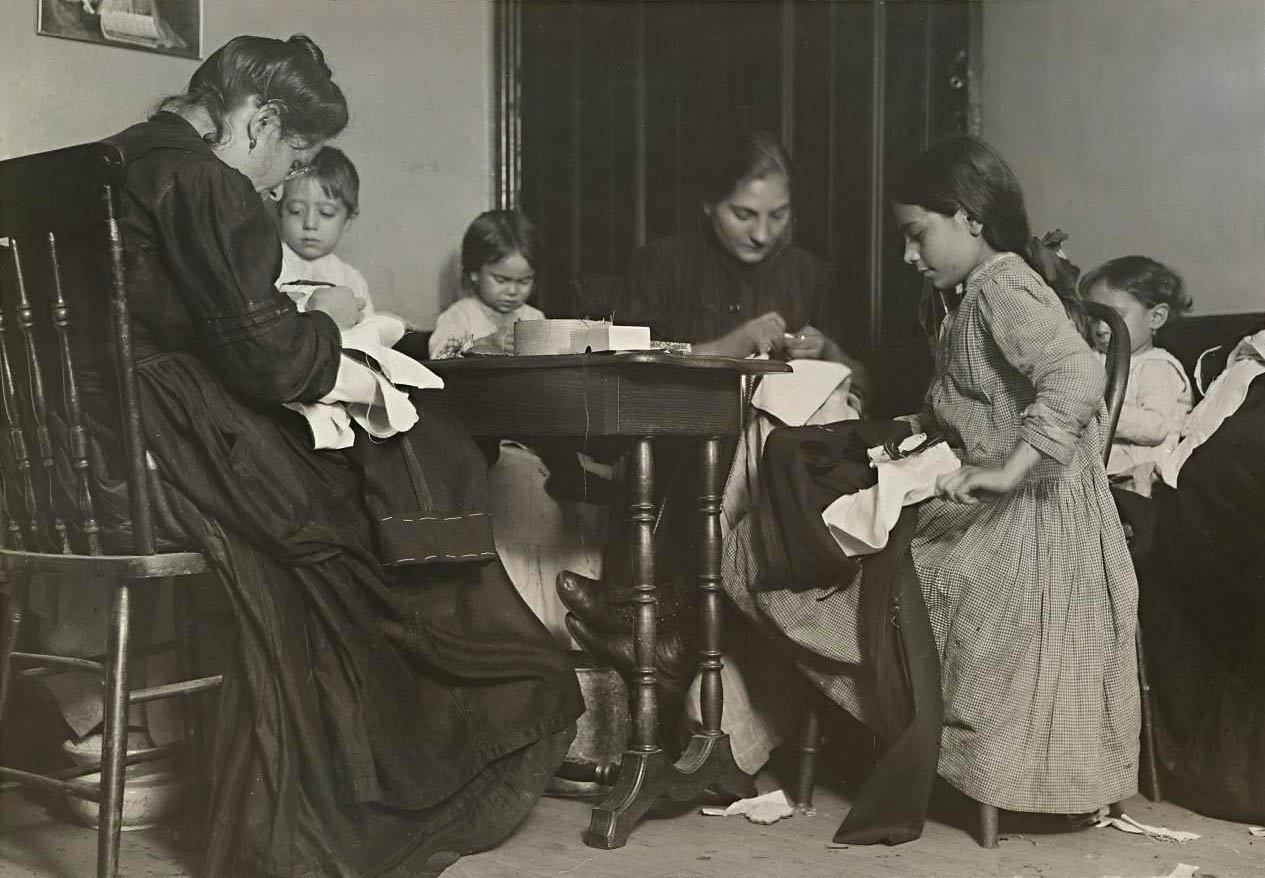
 

Lewis Hine (American, 1874-1940) 'Finishing garments, 10 Hanover Ave., Boston, Massachusetts' 1912


Lewis Hine (American, 1874-1940)
Finishing garments, 10 Hanover Ave., Boston, Massachusetts
1912
Gelatin silver photograph
11.4 × 16.4cm
National Gallery of Victoria, Melbourne
Purchased, 1980
Public domain


Installation view of the exhibition Photography: Real & Imagined at The Ian Potter Centre: NGV Australia, Melbourne showing Kusakabe Kimbei's album '(Landscape and portraits)' (1880s-1910s) 


Installation view of the exhibition Photography: Real & Imagined at The Ian Potter Centre: NGV Australia, Melbourne showing Kusakabe Kimbei’s album (Landscape and portraits) (1880s-1910s)
Photo: Marcus Bunyan
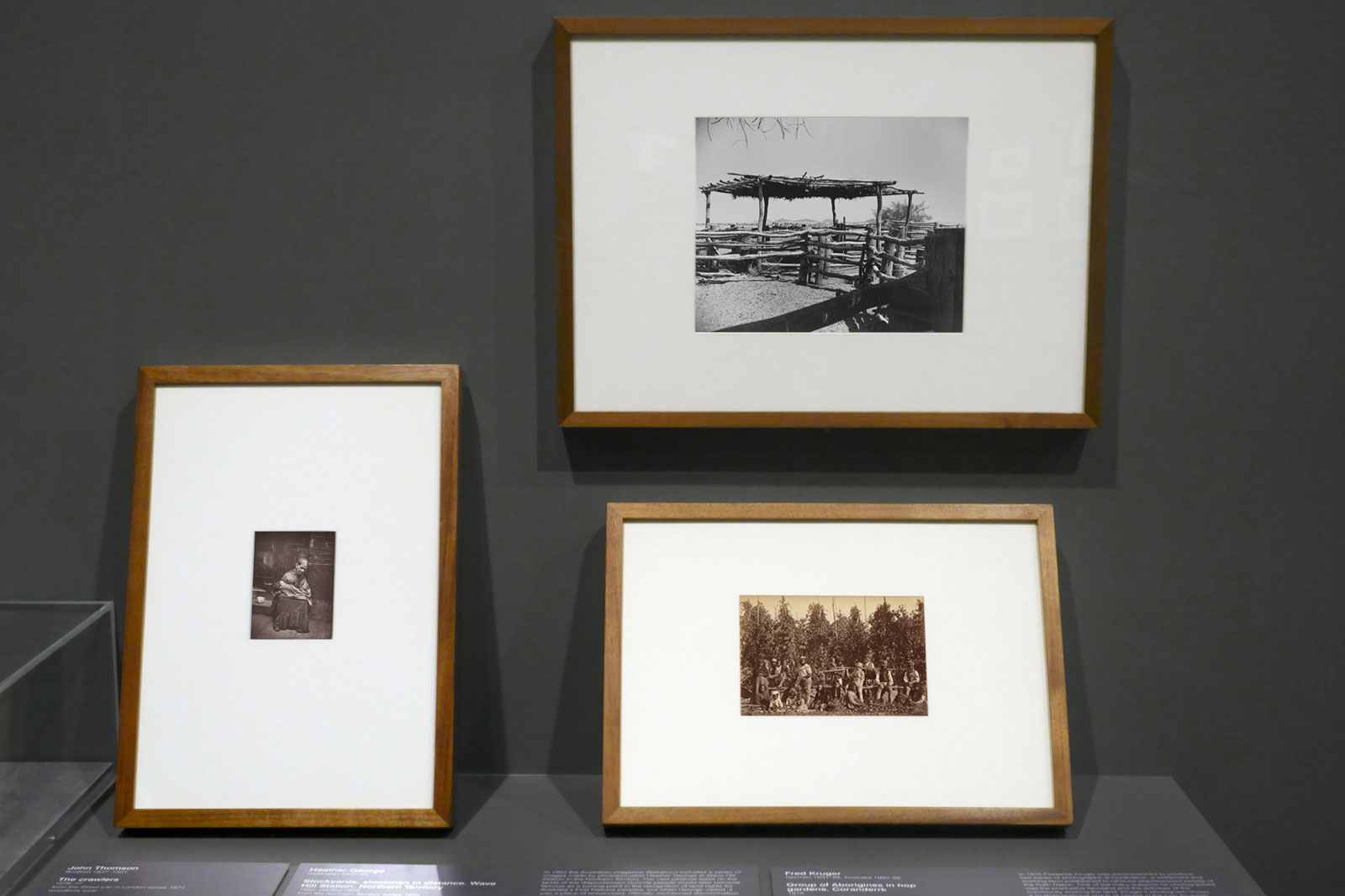
 

Installation view of the exhibition 'Photography: Real & Imagined' at The Ian Potter Centre: NGV Australia, Melbourne showing  at left, John Thomson's 'The crawlers' (1876-1877, below); at top right, Heather George's 'Stockyards, stockmen in distance. Wave Hill Station, Northern Territory' (1952); and at bottom right, Fred Kruger's 'Group of Aborigines in hop gardens, Coranderrk' (1876, below)


Installation view of the exhibition Photography: Real & Imagined at The Ian Potter Centre: NGV Australia, Melbourne showing  at left, John Thomson’s The crawlers (1876-1877, below); at top right, Heather George’s Stockyards, stockmen in distance. Wave Hill Station, Northern Territory (1952); and at bottom right, Fred Kruger’s Group of Aborigines in hop gardens, Coranderrk (1876, below)
Photo: Marcus Bunyan
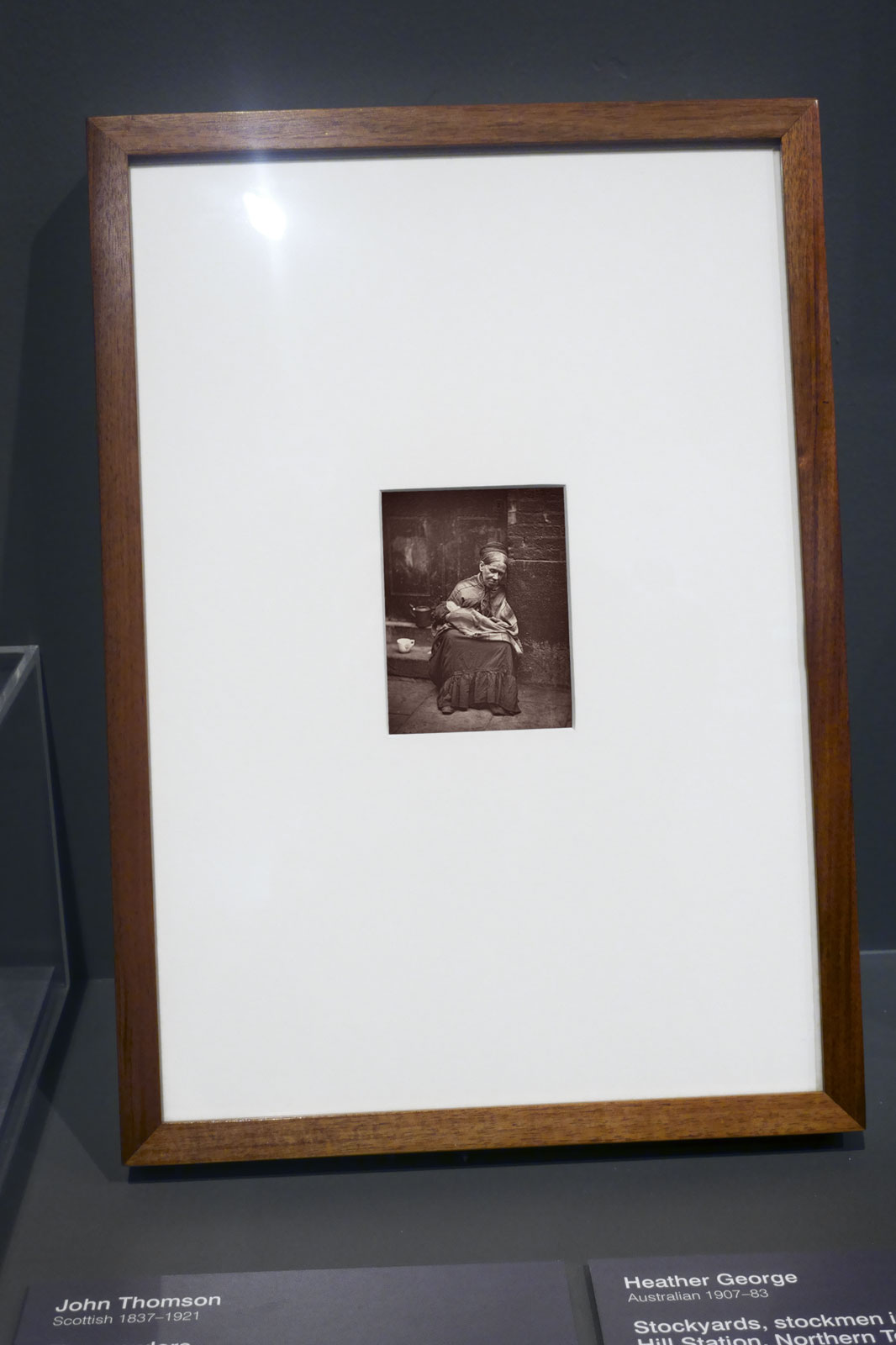
 

Installation view of the exhibition 'Photography: Real & Imagined' at The Ian Potter Centre: NGV Australia, Melbourne showing John Thomson's 'The crawlers' (1876-1877)


Installation view of the exhibition Photography: Real & Imagined at The Ian Potter Centre: NGV Australia, Melbourne showing John Thomson’s The crawlers (1876-1877, below)
Photo: Marcus Bunyan


John Thomson (Scottish 1837-1921) 'The crawlers' 1876-1877


John Thomson (Scottish 1837-1921)
The crawlers
1876-1877
From the Street Life in London series 1877
Woodbury type
11.5 × 8.7cm (image and sheet)
National Gallery of Victoria, Melbourne
Felton Bequest, 1977
Public Domain
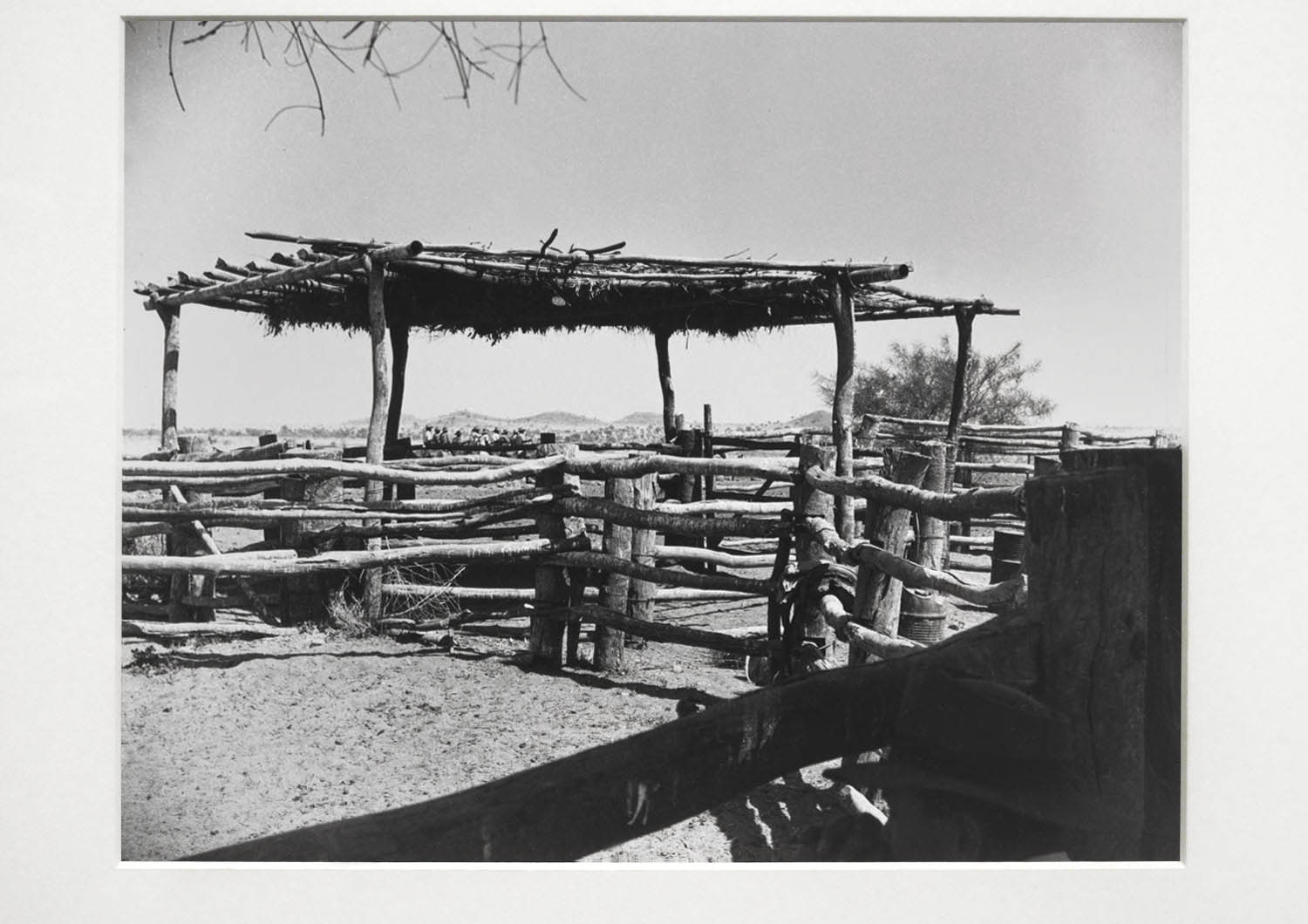
 

Heather George (Australian 1907-1983) 'Stockyards, stockmen in distance. Wave Hill Station, Northern Territory' 1952, printed 1978 (installation view)


Heather George (Australian 1907-1983)
Stockyards, stockmen in distance. Wave Hill Station, Northern Territory (installation view)
1952, printed 1978
From the Northern Territory series 1952
Gelatin silver photograph
Purchased, 1980
Photo: Marcus Bunyan


In 1952 the Australian magazine Walkabout included a series of images made by photojournalist Heather George at Wave Hill Station in the Northern Territory. The vast pastoral lease on the lands of the dispossessed Gurindji people would later become famous as a turning point in the recognition of land rights for Australia’s First Nations peoples, but when George visited, it was a place of entrenched, officially sanctioned discrimination. In George’s photograph, the Gurindji stockmen appear overshadowed by the stockyards in the foreground, perhaps reflecting the attitude of pastoralists who, having been granted leases, took advantage of people living on Country, exploiting them as an unpaid workforce.

Wall text from the exhibition


Fred Kruger (German 1831-1888, Australia 1860-1888) 'Group of Aborigines in hop gardens, Coranderrk' 1876


Fred Kruger (German 1831-1888, Australia 1860-1888)
Group of Aborigines in hop gardens, Coranderrk
1876
Albumen silver photograph
13.3 × 20.2cm
National Gallery of Victoria, Melbourne
Gift of Mrs Beryl M. Curl, 1979
Public domain


In 1876 Fred Kruger was commissioned to produce two series of photographs at Coranderrk, a settlement and working farm established to rehouse dispossessed people of the Kulin Nation. One of the many subjects he photographed was the productive farmland and the activities of the community working the land. Kruger’s photograph shows a multigenerational group of people in the lush Arcadian setting of the hop garden, but what it obscures is the reality of exploitation and poverty that afflicted First Nations people in this place. Kruger’s photographs met a brief to promote the so-called ‘civilising’ work of colonial authorities but in doing so represented a largely imagined reality and created an effective form of propaganda.

Wall text from the exhibition
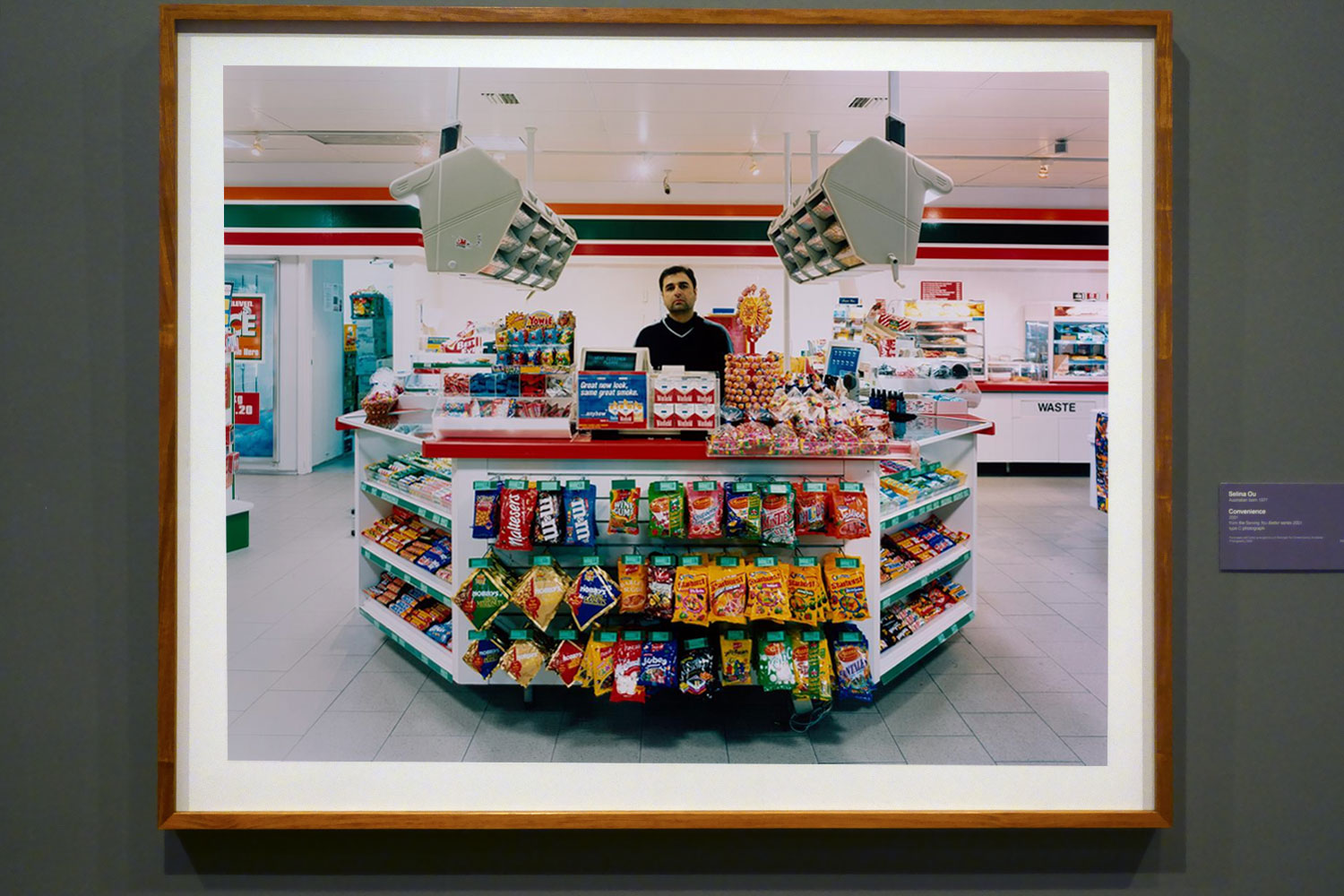
 

Selina Ou (Australian, b. 1977) 'Convenience' 2001 (installation view)


Selina Ou (Australian, b. 1977)
Convenience (installation view)
2001
From the Serving You Better series 2001
Type C photograph
National Gallery of Victoria, Melbourne
Purchased with funds arranged by Loti Smorgon for Contemporary Australian Photography, 2005
Photo: Marcus Bunyan


Installation view of the exhibition 'Photography: Real & Imagined' at The Ian Potter Centre: NGV Australia, Melbourne showing at top left, Kusakabe Kimbei's 'Vegetable peddler' (1880s, below); at bottom left, David Wadelton's 'Richmond hairdresser' (1979, below); at top centre, Rennie Ellis' 'Between strips, Kings Cross' (1970-1971, below); at bottom centre, Brassai's 'Washing up in a brothel, Rue Quincampoix (La Toilette, rue Quincampoix (Bidet))' (1932, below); and at right, Wolfgang Sievers' 'Shiftchange at Kelly and Lewis engineering works, Springvale, Melbourne' (1949, below)


Installation view of the exhibition Photography: Real & Imagined at The Ian Potter Centre: NGV Australia, Melbourne showing at top left, Kusakabe Kimbei’s Vegetable peddler (1880s, below); at bottom left, David Wadelton’s Richmond hairdresser (1979, below); at top centre, Rennie Ellis’ Between strips, Kings Cross (1970-1971, below); at bottom centre, Brassai’s Washing up in a brothel, Rue Quincampoix (La Toilette, rue Quincampoix (Bidet)) (1932, below); and at right, Wolfgang Sievers’ Shiftchange at Kelly and Lewis engineering works, Springvale, Melbourne (1949, below)
Photo: Marcus Bunyan
 

Kusakabe Kimbei (Japanese, 1841-1934) 'Vegetable peddler' 1880s


Kusakabe Kimbei (Japanese, 1841-1934)
Vegetable peddler
1880s
Albumen silver photograph, colour dyes
20.6 × 26.3cm (image and sheet)
National Gallery of Victoria, Melbourne
Gerstl Bequest, 2000
Public domain


Japanese photographer Kusakabe Kimbei established his studio in 1881, making photographs for the domestic and tourist markets. Most of the photographs in this elaborate album are conventional, staged domestic scenes; picturesque views of popular tourist attractions; and street scenes. This image, however, stands alone in the album as an unusual view of contemporary life. Despite the women weavers wearing traditional dress and working hand-operated looms, the factory in which they are working is lit by electric lights and they are supervised by men wearing European-style dress. Unlike its companion works in Kimbei’s album, this photograph speaks to the industrialisation that was part of the Meiji-era modernisation in Japan.

Wall text from the exhibition


Kusakabe Kimbei (Japanese, 1841-1934)

Kusakabe Kimbei (日下部 金兵衛; 1841-1934) was a Japanese photographer. He usually went by his given name, Kimbei, because his clientele, mostly non-Japanese-speaking foreign residents and visitors, found it easier to pronounce than his family name

Kusakabe Kimbei worked with Felice Beato and Baron Raimund von Stillfried as a photographic colourist and assistant. In 1881, Kimbei opened his own workshop in Yokohama, in the Benten-dōri quarter. From 1889, the studio operated in the Honmachi quarter. By 1893, his was one of the leading Japanese studios supplying art to Western customers. Many of the photographs in the studio’s catalogue featured depictions of Japanese women, which were popular with tourists of the time.  Kimbei preferred to portray female subjects in a traditional bijinga style, and hired geisha to pose for the photographs. Many of his albums are mounted in accordion fashion.

Around 1885, Kimbei acquired the negatives of Felice Beato and of Stillfried, as well as those of Uchida Kuichi. Kusakabe also acquired some of Ueno Hikoma’s negatives of Nagasaki. Kimbei retired as a photographer in 1914.

Text from the Wikipedia website
 

Installation view of the exhibition Photography: Real & Imagined at The Ian Potter Centre: NGV Australia, Melbourne showing David Wadelton's 'Richmond hairdresser' (1979) (installation view)


Installation view of the exhibition Photography: Real & Imagined at The Ian Potter Centre: NGV Australia, Melbourne showing David Wadelton’s Richmond hairdresser (1979, below)
Photo: Marcus Bunyan
 

David Wadelton (Australian, b. 1955) 'Richmond hairdresser' 1979


David Wadelton (Australian, b. 1955)
Richmond hairdresser
1979
Gelatin silver photograph
13.4 × 20.2cm
National Gallery of Victoria, Melbourne
Gift of David Wadelton through the Australian Government’s Cultural Gifts Program, 2015
© David Wadelton
 

Rennie Ellis (Australian, 1940-2003) 'Between strips, Kings Cross' 1970-1971


Rennie Ellis (Australian, 1940-2003)
Between strips, Kings Cross
1970-1971; 2000 {printed}
from the Kings Cross series 1971
gelatin silver photograph
37.1 x 24.1 cm (image) 40.3 x 30.4 cm (sheet)
National Gallery of Victoria, Melbourne
Purchased, 2005
© Rennie Ellis Photographic Archive


Installation view of the exhibition 'Photography: Real & Imagined' at The Ian Potter Centre: NGV Australia, Melbourne showing Brassaï's 'Washing up in a brothel, Rue Quincampoix (La Toilette, rue Quincampoix (Bidet))' (1932)


Installation view of the exhibition Photography: Real & Imagined at The Ian Potter Centre: NGV Australia, Melbourne showing Brassaï’s Washing up in a brothel, Rue Quincampoix (La Toilette, rue Quincampoix (Bidet)) (1932, below)
Photo: Marcus Bunyan
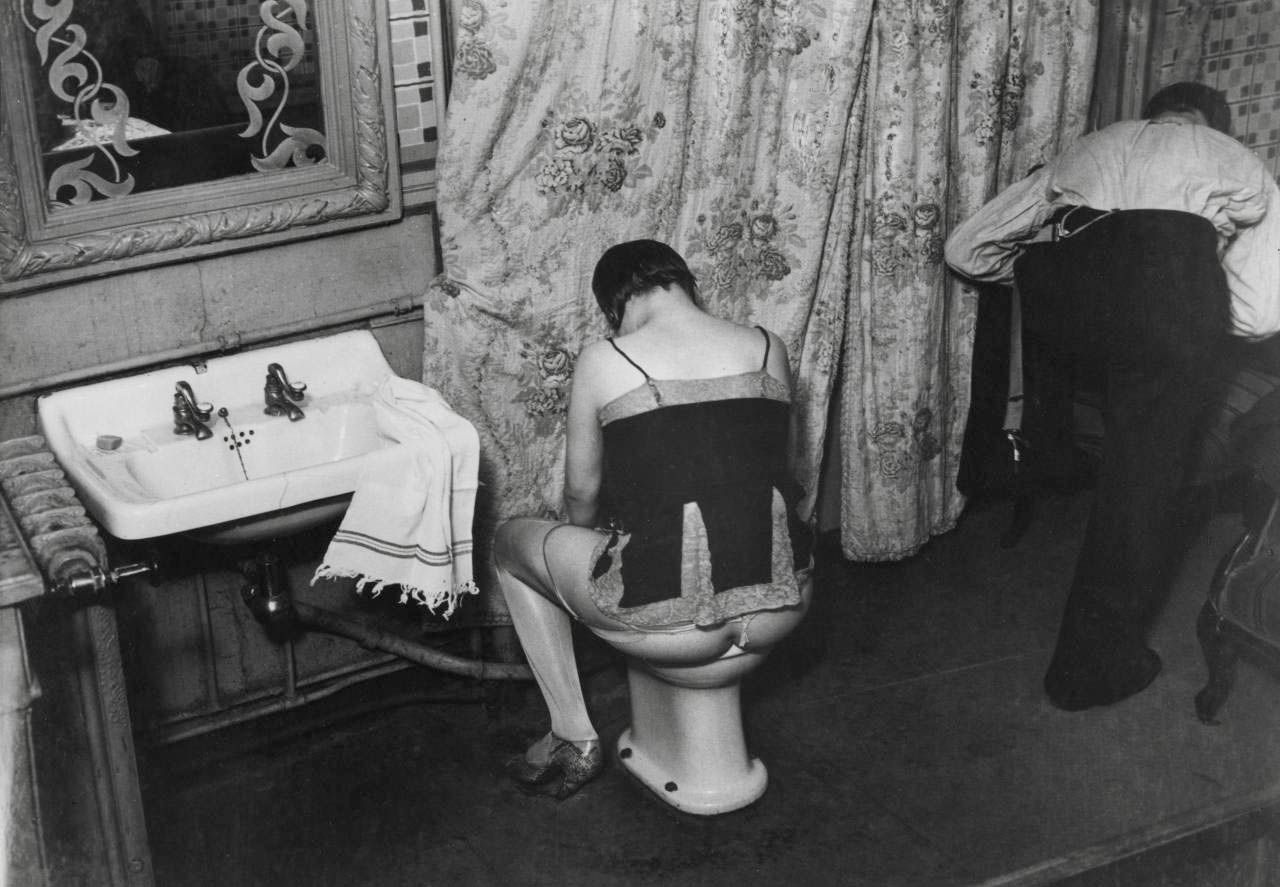
 

Brassaï (Hungarian-French, 1899-1984) 'Washing up in a brothel, Rue Quincampoix' (La Toilette, rue Quincampoix (Bidet)) 1932; printed c. 1979


Brassaï (Hungarian-French, 1899-1984)
Washing up in a brothel, Rue Quincampoix
(La Toilette, rue Quincampoix (Bidet))
1932; printed c. 1979
from The secret of Paris in the 30s series 1931–1935
Gelatin silver photograph
20.5 × 29.2cm (image and sheet)
National Gallery of Victoria, Melbourne
Purchased, 1980
Public Domain


In the 1930s Brassaï became well-known for his photographs of the nightlife of Paris, but it was the sex workers, along with other characters of the city’s underbelly, who excited his imagination. Reflecting on this time, he wrote, ‘Rightly or wrongly, I felt at that time that this underground world represented Paris at its least cosmopolitan, at its most alive, its most authentic, that in these colourful faces of its underworld there had been preserved, from age to age, almost without alteration, the folklore of its remote past’. This photograph presents a matter-of-fact view – there is nothing exotic or erotic about the woman washing herself as her client ties his shoes and prepares to leave.

Wall text from the exhibition
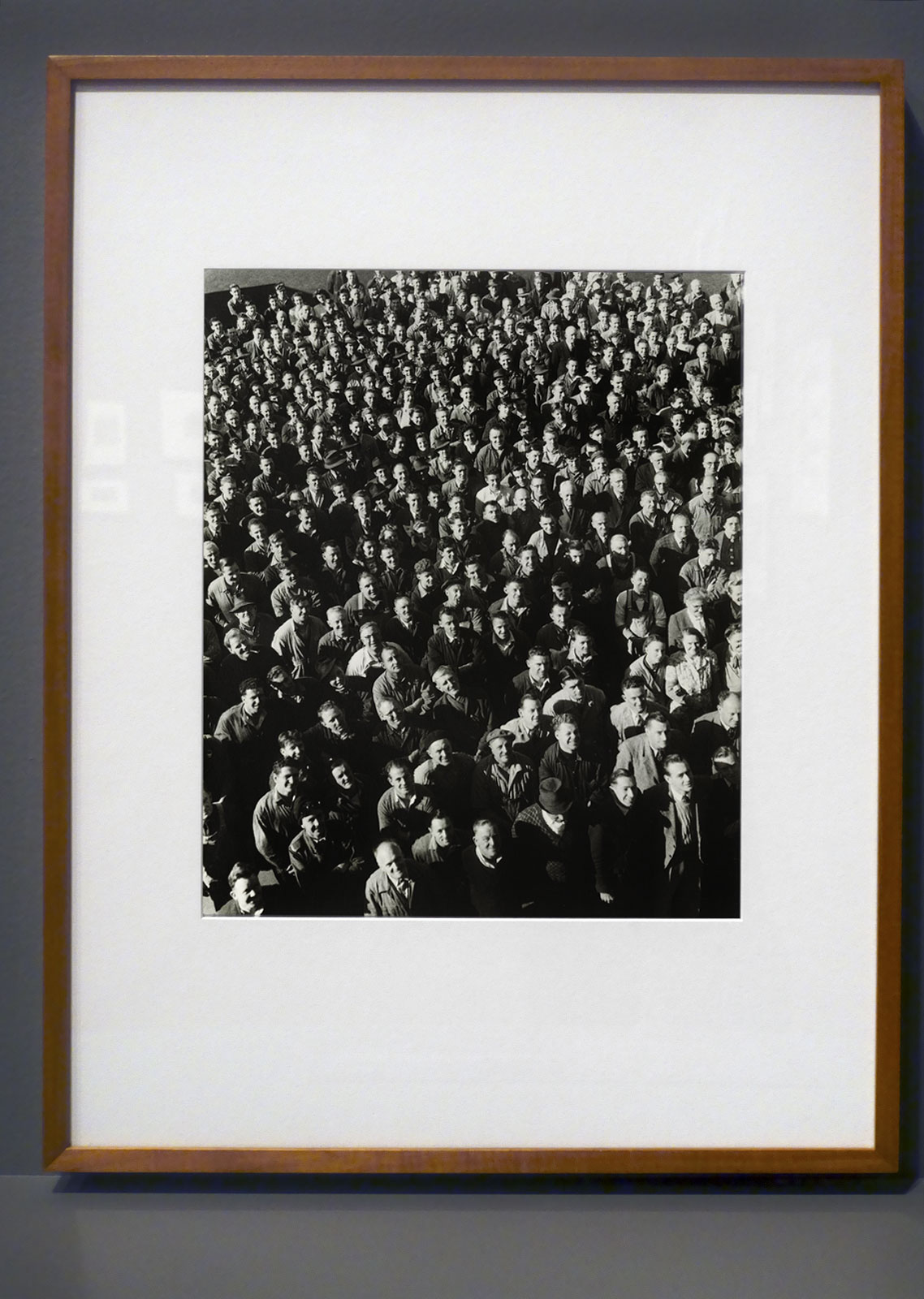
 

Installation view of the exhibition Photography: Real & Imagined at The Ian Potter Centre: NGV Australia, Melbourne showing Wolfgang Sievers' 'Shiftchange at Kelly and Lewis engineering works, Springvale, Melbourne' (1949)


Installation view of the exhibition Photography: Real & Imagined at The Ian Potter Centre: NGV Australia, Melbourne showing Wolfgang Sievers’ Shiftchange at Kelly and Lewis engineering works, Springvale, Melbourne (1949, below)
Photo: Marcus Bunyan


Wolfgang Sievers (Australian born Germany, 1913-2007) 'Shiftchange at Kelly and Lewis engineering works, Springvale, Melbourne' 1949; printed 1986


Wolfgang Sievers (Australian born Germany, 1913-2007)
Shiftchange at Kelly and Lewis engineering works, Springvale, Melbourne
1949; printed 1986
Gelatin silver photograph
49.4 × 40.5cm
National Gallery of Victoria, Melbourne
Purchased, 1986
© National Library of Australia


Wolfgang Sievers arrived in Australia in 1938, bringing photographic equipment, rigorous training in modernist photography, a firmly held belief in the union of art and industry, left-leaning political views, and the self-declared desire to ‘assist this country through my knowledge as thanks for the freedom I can enjoy here’. The human face of industrial Australia is captured in Sievers’s celebrated photograph of the change of shift at a Melbourne engineering works, showing a sea of men and women surging into work. The upturned, smiling faces of the masses speaking to Sievers’s firmly held belief in the dignity of work.

Wall text from the exhibition


Rosemary Laing (Australian, 1959-2024) 'welcome to Australia' 2004 (installation view)


Rosemary Laing (Australian, 1959-2024)
welcome to Australia (installation view)
2004
Type C photograph
110.8 × 224.4cm
National Gallery of Victoria, Melbourne
Purchased with funds from the Victorian Foundation for Living Australian Artists, 2005
Photo: Marcus Bunyan


This photograph by Rosemary Laing makes an obviously ironic statement, as curator Kyla MacFarlane notes: ‘The title and compositional beauty of this photograph … purposefully jar against its subject matter – the remote Woomera Immigration Detention and Processing Centre in South Australia. Photographing the site while the sun sits low in the sky, Laing observes the Centre’s mechanisms of containment and surveillance – a violent presence on the red dirt and gravel road, and sun-tinged, cloudless sky of its remote location’. The photograph’s formal emptiness reflects the lack of freedom imposed on those seeking asylum and the loss of their civil liberties once detained.

Wall text from the exhibition
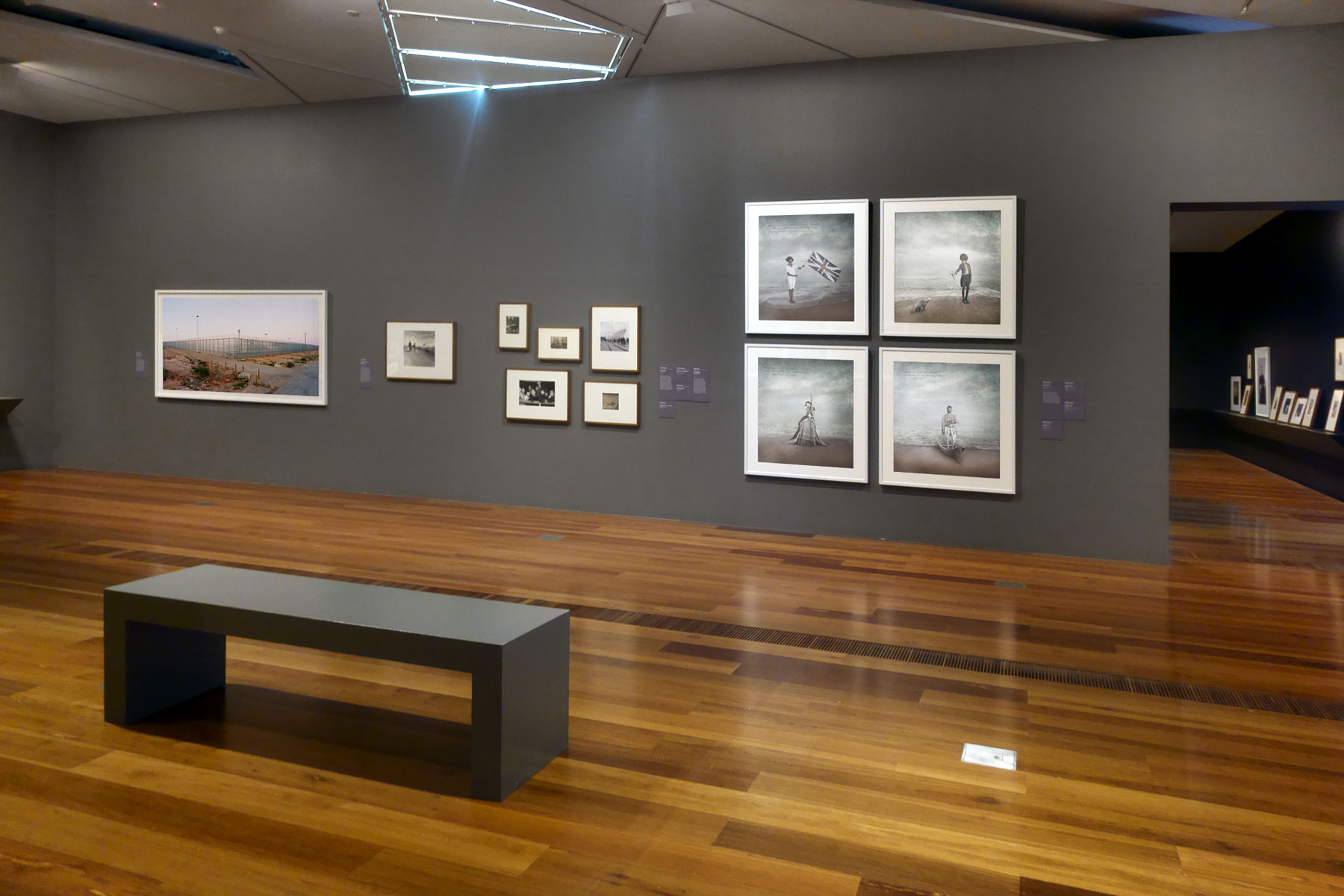
 

Installation view of the exhibition 'Photography: Real & Imagined' at The Ian Potter Centre: NGV Australia, Melbourne showing at left, Rosemary Laing's 'welcome to Australia' (2004, above); and at right, four photographs from Michael Cook's 'Civilised' series (2012)


Installation view of the exhibition Photography: Real & Imagined at The Ian Potter Centre: NGV Australia, Melbourne showing at left, Rosemary Laing’s welcome to Australia (2004, above); and at right, four photographs from Michael Cook’s Civilised series (2012)
Photo: Marcus Bunyan


Installation view of the exhibition 'Photography: Real & Imagined' at The Ian Potter Centre: NGV Australia, Melbourne showing Dorothea Lange's 'Towards Los Angeles, California' (1936)


Installation view of the exhibition Photography: Real & Imagined at The Ian Potter Centre: NGV Australia, Melbourne showing Dorothea Lange’s Towards Los Angeles, California (1936, below)
Photo: Marcus Bunyan
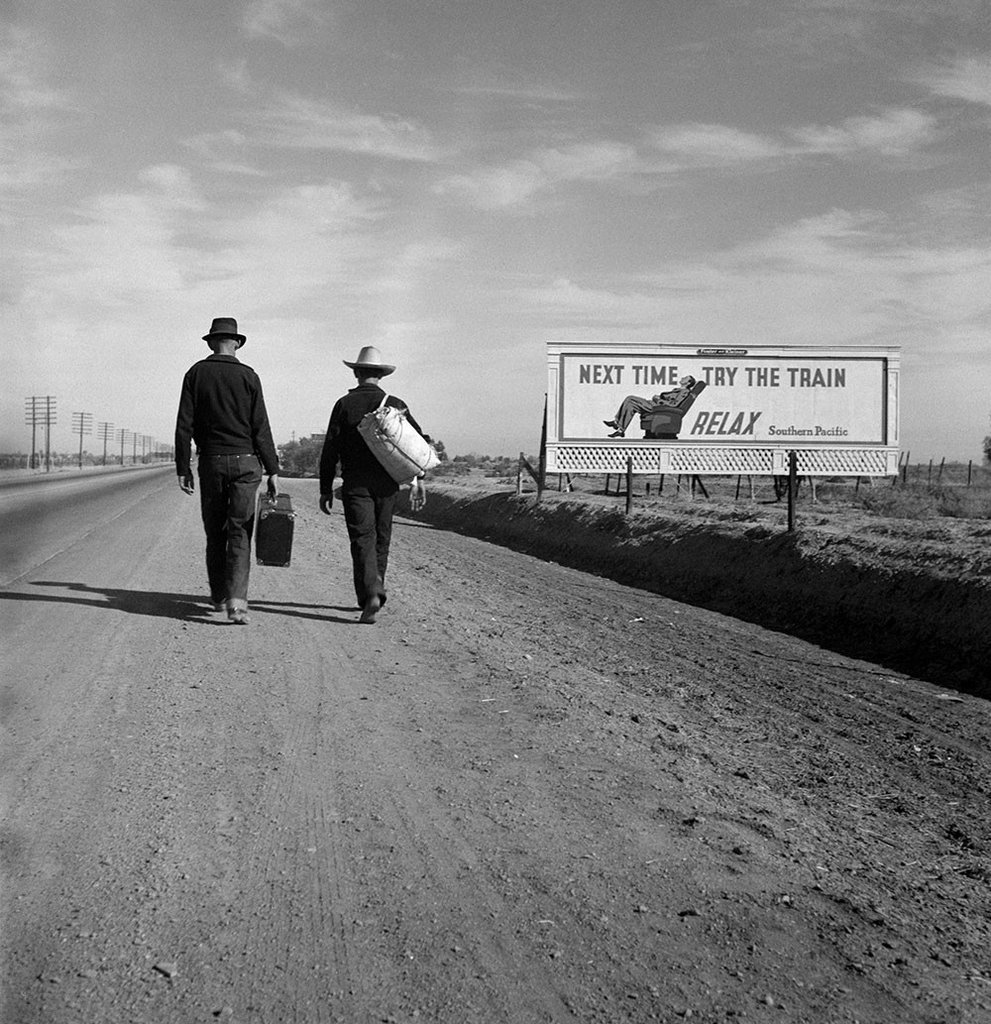
 

Dorothea Lange (United States 1895-1965) 'Towards Los Angeles, California' 1936, printed c. 1975


Dorothea Lange (United States 1895-1965)
Towards Los Angeles, California
1936; c. 1975 {printed}
Gelatin silver photograph
39.6 x 39.1cm
National Gallery of Victoria, Melbourne
Purchased, 1975


In this photograph Dorothea Lange has ironically juxtaposed the aspiration of clean, comfortable train travel with the exhausting reality of the unemployed traversing America in search of work in the 1930s. Renowned for making photographs that combine empathy and clear-eyed observation, Lange also believed that photographs and text should be presented together to amplify the messages carried in both mediums. She understood that captions ‘fortified’ her photographs and that they should ‘not only (carry) factual information, but also add clues to attitudes, relationships and meanings’. Although it doesn’t have a caption, the opportunistic combination of image and text in this image highlights the gulf between the haves and have nots.

Wall text from the exhibition


Installation view of the exhibition 'Photography: Real & Imagined' at The Ian Potter Centre: NGV Australia, Melbourne showing at top left, Alfred Stiegliz's 'The steerage' (1907); at bottom left, David Moore's 'Migrants arriving in Sydney' (1966); at centre, Charles Nettleton's 'Hobsons Bay railway pier' (1870s); at top right, Maggie Diaz's 'The Canberra, Port Melbourne' (1961-1967); and at bottom right, Paul Haviland's 'Passing steamer' (1910)


Installation view of the exhibition Photography: Real & Imagined at The Ian Potter Centre: NGV Australia, Melbourne showing at top left, Alfred Stiegliz’s The steerage (1907, below); at bottom left, David Moore’s Migrants arriving in Sydney (1966, below); at centre, Charles Nettleton’s Hobsons Bay railway pier (1870s, below); at top right, Maggie Diaz’s The Canberra, Port Melbourne (1961-1967); and at bottom right, Paul Haviland’s Passing steamer (1910)
Photo: Marcus Bunyan


Alfred Stiegitz (American, 1864-1946) 'The Steerage' 1907


Alfred Stieglitz (American 1864-1946, Germany 1881-1990)
The steerage
1907, printed 1911
Photogravure
National Gallery of Victoria, Melbourne
Purchased, 1979
Public domain


Alfred Stieglitz was a pioneering photographer, publisher and gallery director. The steerage, arguably his most important photograph, is regarded as his first great modernist work. The composition, with its compressed space, apparent lack of horizon and striking diagonal lines, is suggestive of avant-garde painting of the time. Showing the densely packed lower decks of the of the transatlantic steamer Kaiser Wilhelm II, Stieglitz’s oblique reference to the return movement of unsuccessful immigrants to America offers an insight into the social outcomes and complexities of mass global migration in the early twentieth century.

Wall text from the exhibition
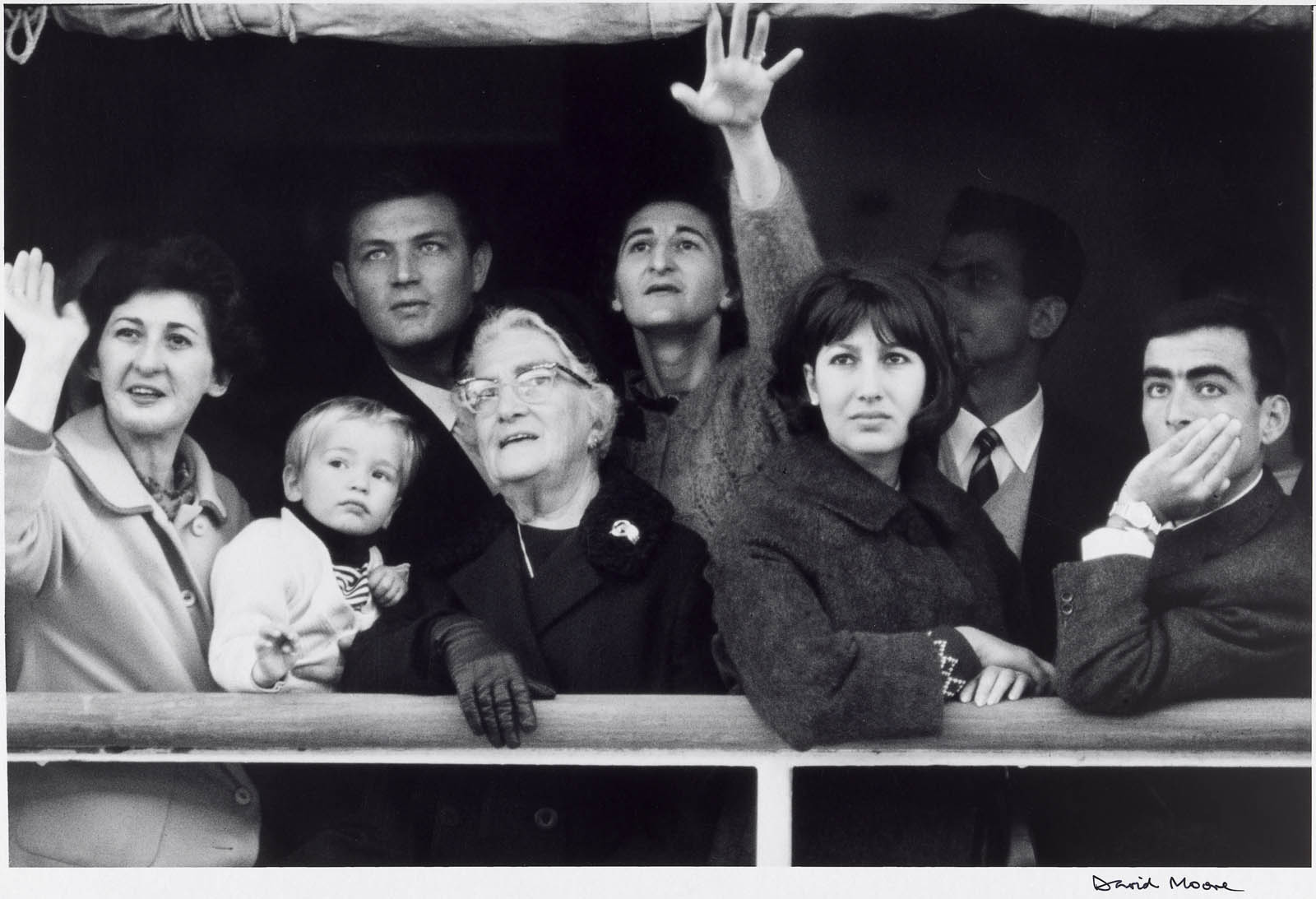
 

David Moore (Australia, 1927-2003) 'Migrants arriving in Sydney' 1966


David Moore (Australia, 1927-2003)
Migrants arriving in Sydney
1966
Gelatin silver photograph
26.7 × 40.4cm
National Gallery of Victoria, Melbourne
Purchased, 1991
© Estate of David Moore


David Moore was Australia’s pre-eminent photojournalist of the 1960s. His work was regularly seen in leading local and international magazines. Moore’s Migrants arriving in Sydney, was commissioned and published by National Geographic in 1966. This now iconic image shows the climactic moment when a ship carrying migrants to Australia docks at Sydney harbour. The tightly framed photograph reveals a range of emotions on the faces of a group of people about to disembark and begin a new life. “We must do more than record the sensational, the bizarre, and the tragic. The lens of the camera must probe, with absolute sincerity, deep into the lives of ordinary men and women and show how we work and play.” David Moore, 1953

Text from the National Gallery of Victoria website

THIS IS NOT CORRECT NGV!

In 2015, Judy Annear [Head of Photography at the Art Gallery of New South Wales] said of this famous photograph: “It’s great to consider that it’s not actually what it seems.” Years after the photo was published, it emerged that four of the passengers in it were not migrants but Sydneysiders returning home from holiday.
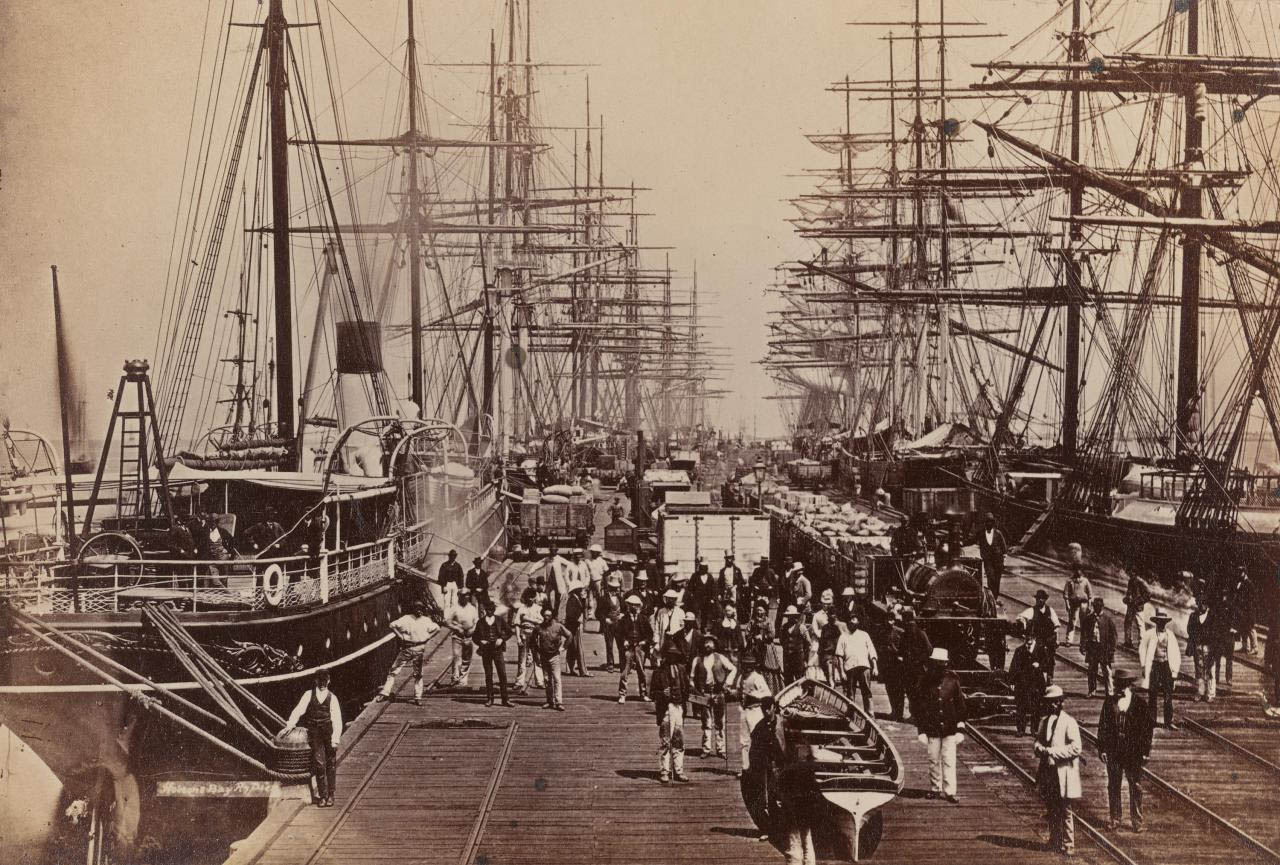
 

Charles Nettleton (English 1825-1902, Australia 1854-1902) 'Hobsons Bay railway pier' 1870s


Charles Nettleton (English 1825-1902, Australia 1854-1902)
Hobsons Bay railway pier
1870s
Albumen silver photograph
12.8 × 19.2cm
National Gallery of Victoria, Melbourne
Purchased, 1992
Public domain


Maggie Diaz (American, 1925-2016, Australia 1961-2016) 'The Canberra, Port Melbourne' 1961-1967, printed 2014


Maggie Diaz (American, 1925-2016, Australia 1961-2016)
The Canberra, Port Melbourne
1961-1967, printed 2014
Pigment print
National Gallery of Victoria, Melbourne
Purchased, Victorian Foundation for Living Australian Artists, 2015


As a young woman, Maggie Diaz had been fascinated by the work of French photographer Henri Cartier-Bresson. Her photographs are a ‘slice of life’ offering similar insights into the everyday experiences of people wherever she encountered them. The ship she photographed at Melbourne’s Station Pier in the 1960s was The Canberra, the largest of the passenger ships sailing between Britain and Australia at that time. Often bringing British migrants on assisted passages, the ship also held personal significance for Diaz: as a migrant from the United States, she travelled one-way from the US to Australia on The Canberra’s maiden voyage in 1961.

Wall text from the exhibition


Installation view of the exhibition 'Photography: Real & Imagined' at The Ian Potter Centre: NGV Australia, Melbourne showing four photographs from Michael Cook's 'Civilised' series (2012)


Installation view of the exhibition Photography: Real & Imagined at The Ian Potter Centre: NGV Australia, Melbourne showing four photographs from Michael Cook’s Civilised series (2012)
Photo: Marcus Bunyan


Michael Cook (Australian / Bidjara, b. 1968) 'Civilised #11' 2012


Michael Cook (Australian / Bidjara, b. 1968)
Civilised #11
2012
From the Civilised series 2012
Inkjet print
100.0 x 87.5cm
ed. 3/8
National Gallery of Victoria, Melbourne
Purchased NGV Foundation, 2013
© Michael Cook and Michael Reid Sydney + Berlin


Bidjara artist Michael Cook poses a question in his Civilised series: ‘What makes a person civilised?’ In these photographs he represents the ways Europeans – English, French, Portuguese and Spanish colonists – responded to First Nations people when they arrived on these shores. The artist asserts that his Civilised series ‘suggests how different history might have been if those Europeans had realised that the Aborigines were indeed civilised’.

Wall text from the exhibition


Installation view of the exhibition 'Photography: Real & Imagined' at The Ian Potter Centre: NGV Australia, Melbourne showing at right, Narelle Autio's two photographs 'Untitled' from 'The Seventh Wave' series (1999-2000)


Installation view of the exhibition Photography: Real & Imagined at The Ian Potter Centre: NGV Australia, Melbourne showing at right, Narelle Autio’s two photographs Untitled from The Seventh Wave series (1999-2000)
Photo: Marcus Bunyan
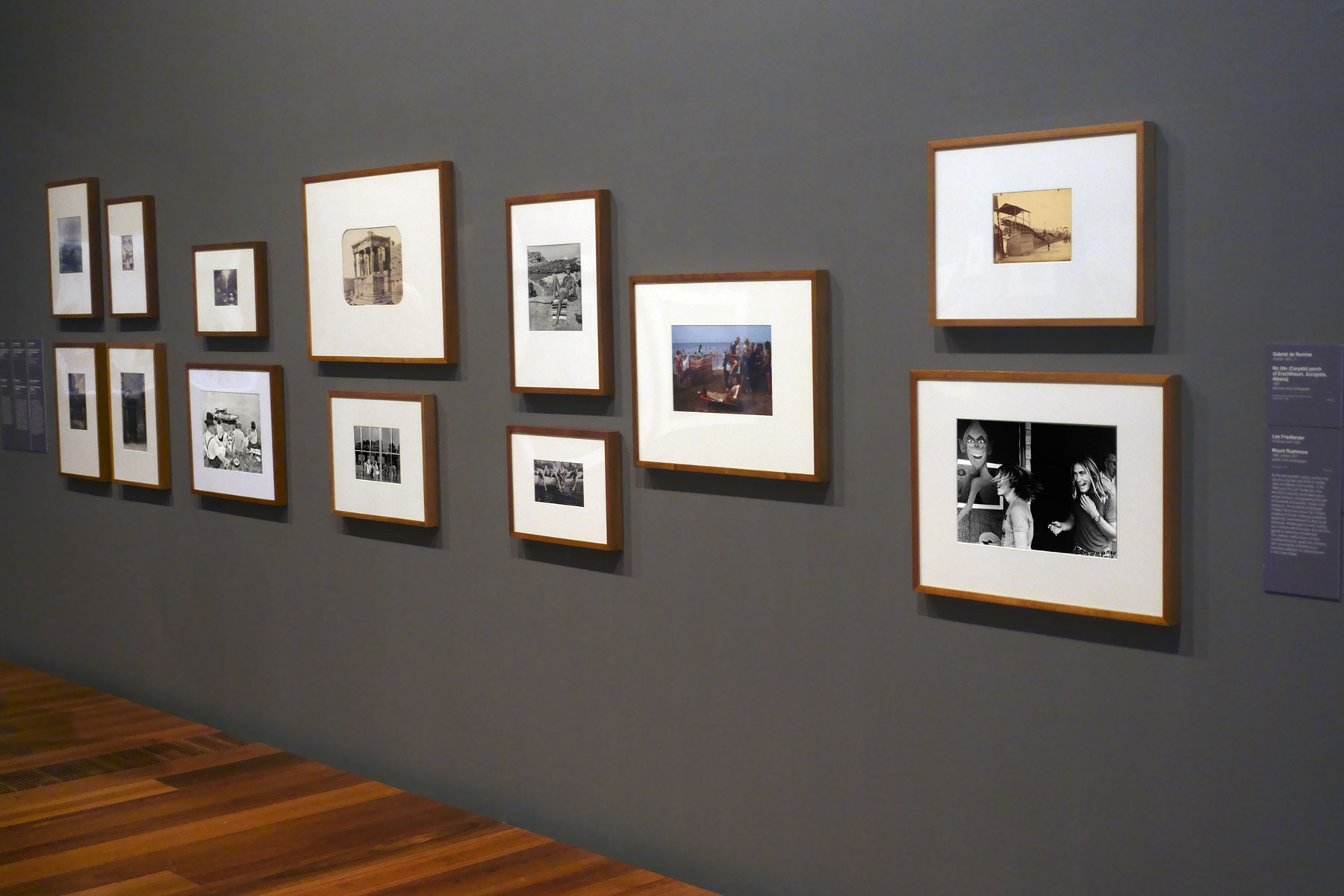
 

Installation view of the exhibition 'Photography: Real & Imagined' at The Ian Potter Centre: NGV Australia, Melbourne showing at third left bottom, Henri Cartier-Bresson's 'Sunday on the banks of the Marne' (1938, below); at fourth left top, Gabriel de Rumine’s 'Caryatid porch of Erechtheum, Acropolis, Athens' (1859, below); at fourth left bottom, Lee Friedlander's 'Mount Rushmore' (1969, below); at centre top, John Williams' 'Clovelly Beach, Sydney' (1969, below); at top right, Eugène Atget's 'The roller coaster, Invalides funfair (Montagnes russes, fête des Invalides)' (1898, below); and at bottom right, Roger Scott's 'Ghost train, Sydney Royal Easter Show' (1972? 1975? below)


Installation view of the exhibition Photography: Real & Imagined at The Ian Potter Centre: NGV Australia, Melbourne showing at third left bottom, Henri Cartier-Bresson’s Sunday on the banks of the Marne (1938, below); at fourth left top, Gabriel de Rumine’s Caryatid porch of Erechtheum, Acropolis, Athens (1859, below); at fourth left bottom, Lee Friedlander’s Mount Rushmore (1969, below); at centre top, John Williams’ Clovelly Beach, Sydney (1969, below); at top right, Eugène Atget’s The roller coaster, Invalides funfair (Montagnes russes, fête des Invalides) (1898, below); and at bottom right, Roger Scott’s Ghost train, Sydney Royal Easter Show (1972? 1975? below)
Photo: Marcus Bunyan


Installation view of the exhibition 'Photography: Real & Imagined' at The Ian Potter Centre: NGV Australia, Melbourne showing David Goldblatt's 'The playing fields of Tladi, Soweto, Johannesburg, August 1972'


Installation view of the exhibition Photography: Real & Imagined at The Ian Potter Centre: NGV Australia, Melbourne showing David Goldblatt’s The playing fields of Tladi, Soweto, Johannesburg, August 1972
Photo: Marcus Bunyan


Harold Cazneaux (Australian born New Zealand, 1878-1953) 'Fairy Lane steps' 1910


Harold Cazneaux (Australian born New Zealand, 1878-1953)
Fairy Lane steps
1910
Bromoil print
24.8 × 18.5cm
National Gallery of Victoria, Melbourne
Purchased, 1979
© The Cazneaux family


Harold Cazneaux was one of the most important and influential Australian photographers of the early twentieth century. He had a great love of the natural world but early in his career also found a rich subject in the inner-city streets of Sydney. Cazneaux made photographs that appear lively and spontaneous, although given the limitations of the equipment at the time they are almost certain to have been staged to a degree. His charming studies of children at play in city streets transformed the bleak, impoverished urban environments of inner-city Sydney into a wonderful playground.

Wall text from the exhibition


Installation view of the exhibition 'Photography: Real & Imagined' at The Ian Potter Centre: NGV Australia, Melbourne showing Helen Levitt's 'New York (Boys fighting on a pediment)' c. 1940


Installation view of the exhibition Photography: Real & Imagined at The Ian Potter Centre: NGV Australia, Melbourne showing Helen Levitt’s New York (Boys fighting on a pediment) c. 1940
Photo: Marcus Bunyan
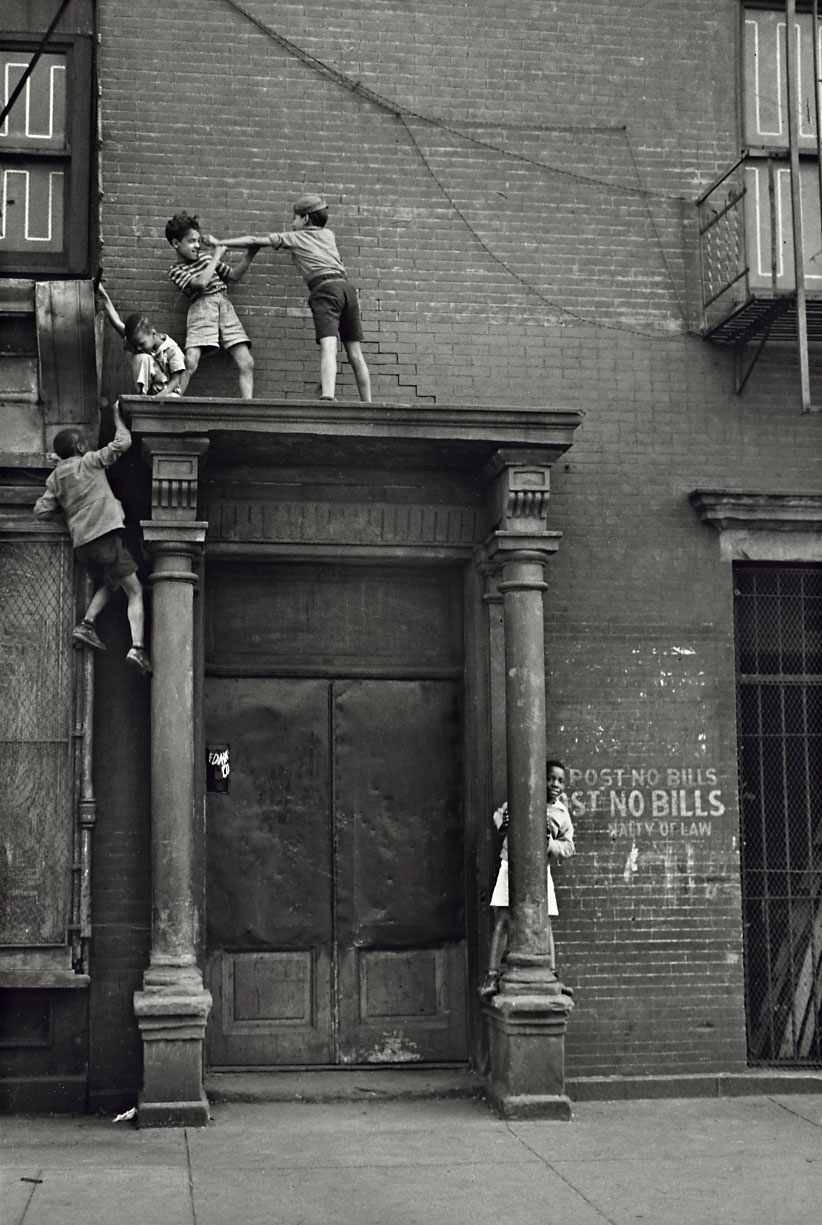
 

Helen Levitt (American, 1913-2009) 'New York (Boys fighting on a pediment)' c. 1940


Helen Levitt (American, 1913-2009)
New York (Boys fighting on a pediment)
c. 1940
Gelatin silver print
31.8 × 21.1cm
National Gallery of Victoria, Melbourne
Bowness Family Fund for Photography, 2022
Public domain
 

Francis Bedford (attributed to) (English, 1815-1894) 'Fairy Glen, Betws-y-Coed' (Ffos Noddyn, Betws-y-Coed) c. 1860


Francis Bedford (attributed to) (English, 1815-1894)
Fairy Glen, Betws-y-Coed
(Ffos Noddyn, Betws-y-Coed)
c. 1860
from the No title (Stephen Thompson album) (1859 – c. 1868)
Albumen silver photograph
13.7 × 17.8cm (image and sheet)
National Gallery of Victoria, Melbourne
Purchased from Admission Funds, 1988
Public domain
 

Henri Cartier-Bresson (French, 1908-2004) 'Sunday on the banks of the Marne, Juvisy, France' 1938


Henri Cartier-Bresson (French, 1908-2004)
Sunday on the banks of the Marne, Juvisy, France
1938; (1990s) {printed}
Gelatin silver photograph
29.1 x 43.9 cm (image)
National Gallery of Victoria, Melbourne
Purchased NGV Foundation, 2015
2015.566
© Fondation Henri Cartier-Bresson/Magnum Photos


In 1938 Henri Cartier-Bresson photographed a group of people picnicking on the banks of the river Marne. It is a celebratory image showing a quintessential aspect of everyday life in France: long Sunday lunches. But it also reveals something of the revolutionary politics of the period and their profound influence on Cartier-Bresson in the 1930s. In 1938 the left-wing Popular Front swept into power in France and the newly elected government mandated two weeks paid leave for all workers. At the time, Cartier-Bresson worked for the Paris-based communist press and was commissioned by Regards magazine to photograph an extended series that looked at the social impact of this initiative.

Wall text from the exhibition
 

Gabriel de Rumine (European, 1841-1871) 'No title (Caryatid porch of Erechtheum, Acropolis, Athens)' 1859


Gabriel de Rumine (European, 1841-1871)
No title (Caryatid porch of Erechtheum, Acropolis, Athens)
1859
Albumen silver photograph
25.7 × 35.8cm irreg. (image and sheet)
National Gallery of Victoria, Melbourne
Presented by the National Gallery Women’s Association, 1995
Public domain


Installation view of the exhibition 'Photography: Real & Imagined' at The Ian Potter Centre: NGV Australia, Melbourne showing Lee Friedlander's 'Mount Rushmore' (1969)


Installation view of the exhibition Photography: Real & Imagined at The Ian Potter Centre: NGV Australia, Melbourne showing Lee Friedlander’s Mount Rushmore (1969, below)
Photo: Marcus Bunyan


Lee Friedlander (United States, b.  1934) 'Mount Rushmore' 1969, printed c. 1977


Lee Friedlander (United States, b.  1934)
Mount Rushmore
1969; printed c. 1977
Gelatin silver print
18.3 × 27.5cm
National Gallery of Victoria, Melbourne
Purchased, 1977
© Lee Friedlander, courtesy Fraenkel Gallery, San Francisco and Luhring Augustine, New York

 

Installation view of the exhibition 'Photography: Real & Imagined' at The Ian Potter Centre: NGV Australia, Melbourne showing John Williams' 'Clovelly Beach, Sydney' (1969)

Installation view of the exhibition 'Photography: Real & Imagined' at The Ian Potter Centre: NGV Australia, Melbourne showing John Williams' 'Clovelly Beach, Sydney' (1969)


Installation views of the exhibition Photography: Real & Imagined at The Ian Potter Centre: NGV Australia, Melbourne showing John Williams’ Clovelly Beach, Sydney (1969, below)
Photos: Marcus Bunyan
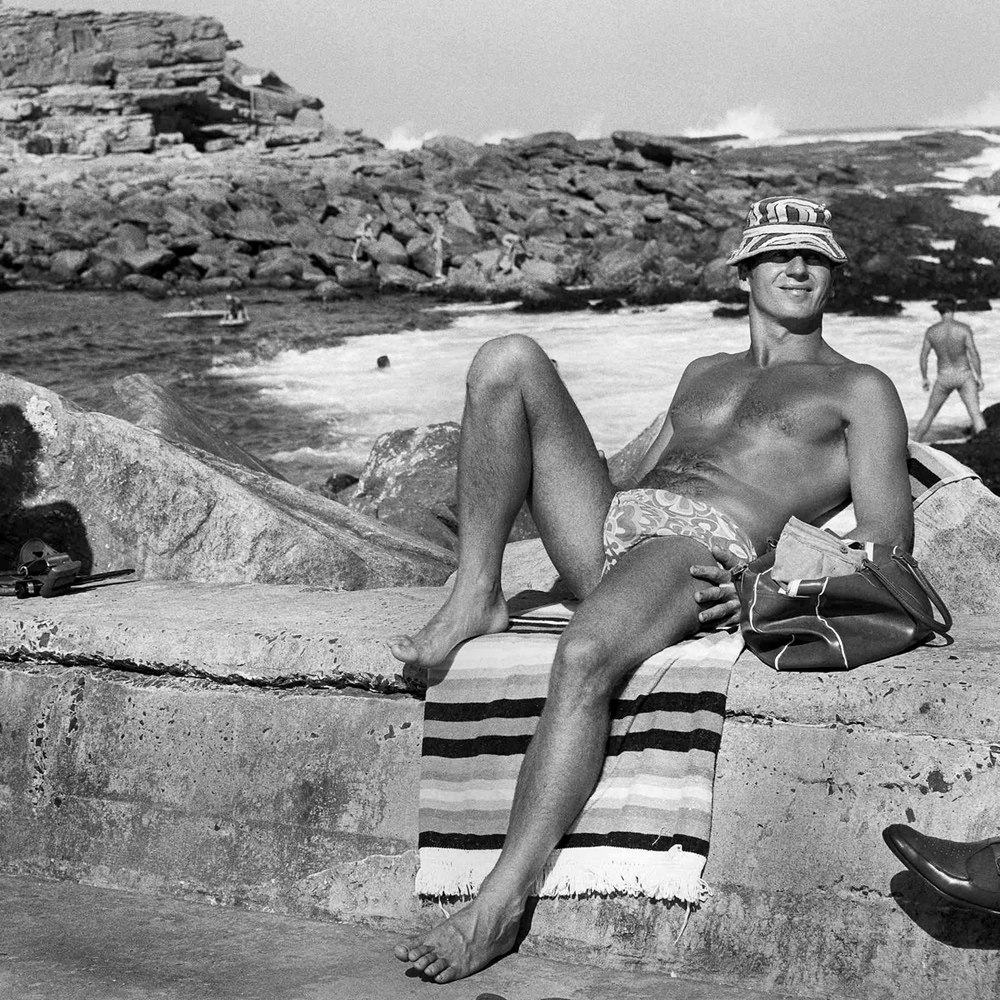
 

John Williams (1933- 2016) 'Clovelly Beach' 1964


John Williams (Australian, 1933-2016)
Clovelly Beach, Sydney
1969; printed 1988
Gelatin silver photograph
25.6 × 25.4cm
National Gallery of Victoria, Melbourne
Purchased, 1989
© John Williams
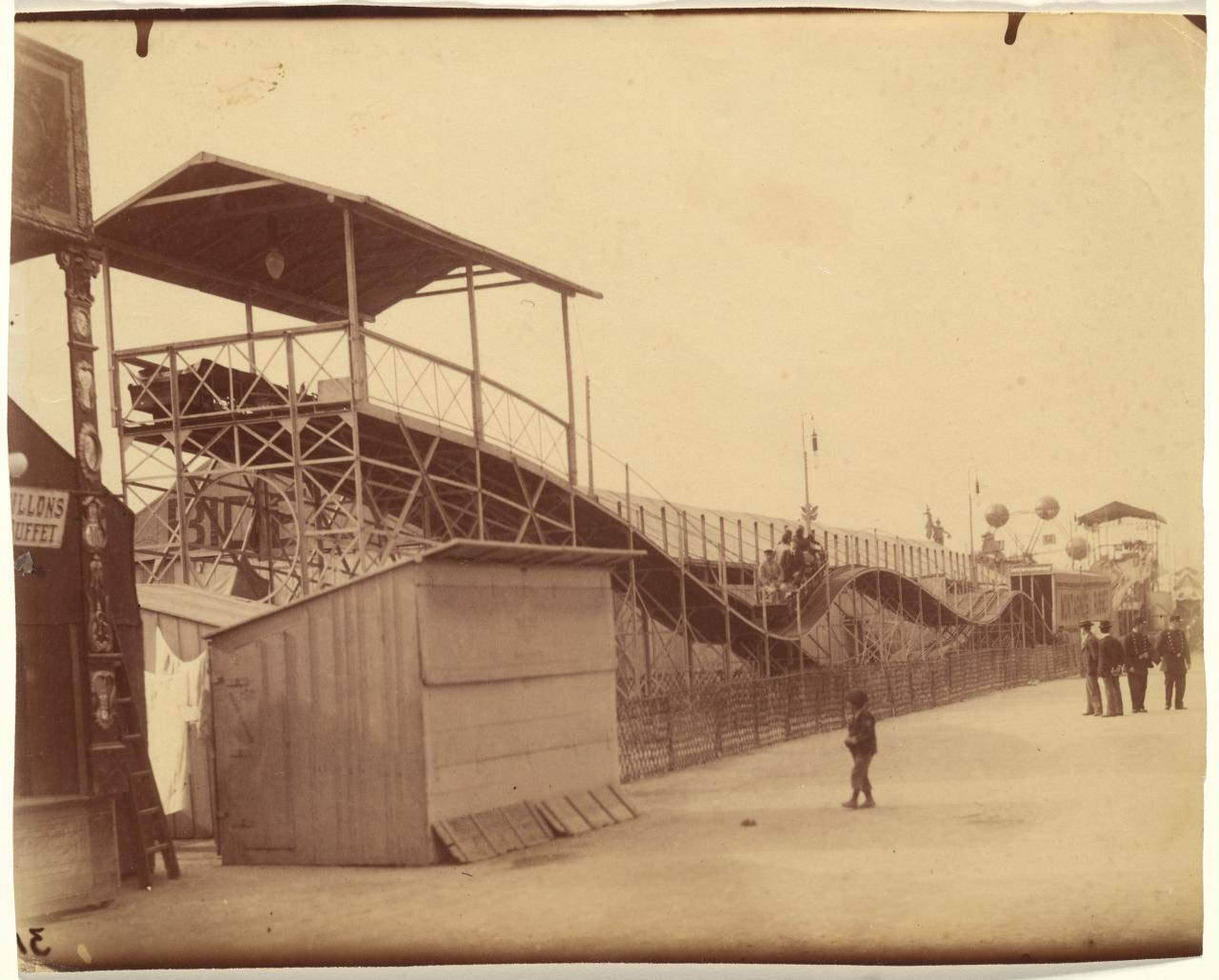
 

Eugène Atget (French, 1857-1927) 'The roller coaster, Invalides funfair (Montagnes russes, fête des Invalides)' 1898


Eugène Atget (French, 1857-1927)
The roller coaster, Invalides funfair (Montagnes russes, fête des Invalides)
1898
From the Festivals and Fairs series in the Art in Old Paris series 1898-1927
Albumen silver photograph
National Gallery of Victoria, Melbourne
Gift of Patrick Pound through the Australian Government’s Cultural Gifts Program, 2020
Public domain


Roger Scott. 'Ghost train, Sydney Royal Easter Show' 1972? 1975?


Roger Scott (Australian, b. 1944)
Ghost train, Sydney Royal Easter Show
1972? 1975?
Gelatin silver print
30.4 × 45.6cm
National Gallery of Victoria, Melbourne
Gift of Mr James Mollison, 1994
© Roger Scott


The Ian Potter Centre: NGV Australia
Federation Square
Corner of Russell and 
Flinders Streets, Melbourne

Opening hours:
Daily 10am – 5pm

National Gallery of Victoria website

LIKE ART BLART ON FACEBOOK

Back to top

Exhibition: ‘Noir & Blanc: une esthétique de la photographie’ at the Bibliothèque nationale de France (BnF), François-Mitterrand, Paris

Exhibition dates: 17th October 2023 – 21st January 2024


Benjamin Brecknell Turner (English, 1815-1894) 'North Side of Quadrangle, Arundel Castle' 1852-1854


Benjamin Brecknell Turner (English, 1815-1894)
North Side of Quadrangle, Arundel Castle
1852-1854
Negative photograph on paper
29.7 x 39.6cm
BnF, department of Prints and Photography, RES PHOTO EI-6-BOITE FOL B (n° 3)
Gift of André and Marie-Thérèse Jammes, 1960


What a lovely exhibition to start the year 2024 on Art Blart.

My favourite photographs in the posting: three beautiful fashion photographs by Frères Séeberger; a stunning late Atget Parc de Sceaux, Duchess Alley (between 1925 and 1927, below) in which you can feel the crispness in the air of the early winter morning; and the glorious seascapes of Gustave Le Gray, probably the best (and most atmospheric) photographer of the sea in all time.

In this posting we observe how black and white photographs are never just black and white but full of different hues and colours. These colour variations tell us a lot about the perception of the image.

As the exhibition text notes: “The strength of the blacks and whites, the variations of hues influence our perception of the image: the more contrasted it is, the more readable it is for our eye saturated with absolute blacks and whites; the more nuanced it is, the more sensitive the distance of time becomes.”

As we enter a new year, another year further away from the origin of the light captured in these photographs, the sensitivity of early photographers and their ability to displace time continues to entrance the viewer.

Dr Marcus Bunyan


Many thankx to the Bibliothèque nationale de France (BnF) for allowing me to publish the photographs in the posting. Please click on the photographs for a larger version of the image.


Noir & Blanc: Une esthétique de la photographie

Black and white is inseparable from the history of photography: its developments, from the end of the 19th century to today, have revealed its plastic force. While the use of colour intensified from the 1970s, black and white reinvented itself as a means of assertive aesthetic expression emphasising graphics and material. Black and white photography remains less expensive and simpler, but its persistence to this day can be explained above all by the fact that it has come to embody the very essence of photography. It appears to carry a universal, timeless, even memorial dimension, where colour would be the sole translation of the contemporary world.

The National Library of France holds one of the richest photographic collections in the world with some six million prints, these are particularly representative of this abundant history of black and white photography.


Benjamin Brecknell Turner (English, 1815-1894) 'Arbre le long d'une clotûre' (Tree along a fence) 1852-1854


Benjamin Brecknell Turner (English, 1815-1894)
Arbre le long d’une clotûre (Tree along a fence)
1852-1854
Negative photograph on paper
23.5 x 27.3cm
BnF, department of Prints and Photography, RES PHOTO EI-6-BOITE FOL B (n° 3)
Gift of André and Marie-Thérèse Jammes, 1960


Photography on paper, with its speed and precision, revolutionised image production in the mid-19th century. The prerequisite is the production of a negative then of the same size as the print. The first negatives are on paper. Reversing the values of blacks and whites, they offer an unknown vision of the world. These oppositions, inverted or not, are the basis of the aesthetics of photography.


One of the earliest British amateur photographers, Benjamin Brecknell Turner (1815-1894) was experimenting with photography barely ten years after the invention of the medium. He exhibited widely during his lifetime and is best known for his beautiful photographs of 19th-century England, picturesque ruins and rural scenes.

A founder member of the Photographic Society of London, Turner contributed to the rapid technical and aesthetic development of photography in the 1850s. Our collection includes a unique album compiled by Turner, ‘Photographic Views from Nature’, containing some of the earliest photographs made in and around the counties of Worcestershire, Surrey, Sussex, Kent and Yorkshire, alongside the radical modern architecture of the Crystal Palace in London’s Hyde Park.

Text from the V&A website


The origins of black and white

Before the invention of colour photography by the Lumière brothers in 1903, one might believe that all photography was black and white. The reality is more complex: the early days were more those of a varied range of values where pure blacks and whites were the exception and so-called sepia tones were the most common. The negative / positive process patented by the Englishman Fox Talbot in 1841 makes it possible to multiply the prints on paper and therefore to vary the shades.

Certain subjects play on oppositions: the mountain views of the Bisson brothers, the Great Wave by Gustave Le Gray, the portraits of the prolific amateur Blancard.


Désiré Charnay (French, 1828-1915) 'Chichen Itza: Bas-relief des Tigres, Palais du Cirque' (Chichen Itza: Bas-relief of the Tigers, Circus Palace) 1859-1861


Désiré Charnay (French, 1828-1915)
Chichen Itza: Bas-relief des Tigres, Palais du Cirque (Chichen Itza: Bas-relief of the Tigers, Circus Palace)
1859-1861
Print on gold-toned albumen paper from a collodion glass negative
BnF, Department of Prints and Photography, RES PHOTO VZ-940-FT4


In 1861, Charnay gave Napoleon III a copy of the album American Ruins composed for the Emperor of expensive proofs on albumen paper toned with gold, in an exceptional format, the miraculous result of his Mexican epic. The shift to gold accentuates the vigour of the contrasts and brings a cold tone to the blacks.


Désiré Charnay (French, 1828-1915) 'Uxmal: détail de la façade dite de la couleuvre' (Uxmal: detail of the so-called snake facade) 1859-1861


Désiré Charnay (French, 1828-1915)
Uxmal: détail de la façade dite de la couleuvre (Uxmal: detail of the so-called snake facade)
1859-1861
From the album American Ruins
Print on gold-toned albumen paper from a collodion glass negative
59 x 78.2cm
BnF, Department of Prints and Photography, RES PHOTO VZ-940-FT4


The forty-nine views of the ruins of Yucatan, Chiapas, Tabasco and the province of Oaxaca constitute the first set of photographs entered into the collections of the Geographical Society, in 1861. During the general assembly of November 29 , Charnay presents his collection of photographs exhibited in the meeting room. The same day, at the Academy of Inscriptions and Belles Lettres, Jomard returns to the quality of Charnay’s photographs, which allow us to conclude that American art – the Egyptologist’s supreme tribute – “deserves a place alongside Assyrian art, and even alongside the art of the Egyptians.”


Bisson frères. Louis-Auguste (French, 1814-1876) and Auguste-Rosalie (French, 1826-1900) 'La crevasse (départ) sur le chemin du grand plateau, ascension du Mont-Blanc' (The crevasse (departure) on the way to the grand plateau, ascent of Mont-Blanc) 1862


Bisson frères. Louis-Auguste (French, 1814-1876) and Auguste-Rosalie (French, 1826-1900)
La crevasse (départ) sur le chemin du grand plateau, ascension du Mont-Blanc (The crevasse (departure) on the way to the grand plateau, ascent of Mont-Blanc)
1862
Print on albumen paper from a wet collodion glass negative
BnF, Department of Prints and Photography, EO-14 (3)-FOL


In 1861, the Bisson brothers managed to hoist their photographic equipment to the summit of Mont Blanc. Mountaineering feat, photographic feat: in these extreme conditions, the plate must be sensitised just before use and developed as soon as possible. The violence of the contrasts, when the brightness of the snow juxtaposes the black of the rocks, redoubles this technical challenge. This conquest of the limit is crowned by the harmony of the print, carried by a site with spectacular aesthetic qualities.


This exhibition brings together black and white masterpieces from the photographic collections of the National Library of France. Nadar, Man Ray, Ansel Adams, Willy Ronis, Helmut Newton, Diane Arbus, Mario Giacomelli, Robert Frank, William Klein, Daido Moriyama, Valérie Belin…: the big names in French and international photography are brought together in a journey which presents approximately 300 prints and embraces 150 years of history of black and white photography, from its origins in the 19th century to contemporary creation.

Black and white is inseparable from the history of photography: its developments, from the end of the 19th century to today, have revealed its plastic force. While the use of colour intensified from the 1970s, black and white reinvented itself as a means of assertive aesthetic expression emphasising graphics and material. Black and white photography remains less expensive and simpler, but its persistence to this day can be explained above all by the fact that it has come to embody the very essence of photography. It appears to carry a universal, timeless, even memorial dimension, where colour would be the sole translation of the contemporary world.


The exhibition in brief

The exhibition addresses the question of black and white from an aesthetic, formal and sensitive angle, emphasising the modes of image creation: plastic and graphic effects of contrasts, play of shadows and lights, rendering of materials in all the palette of values from black to white. The emphasis was placed on photographers who concentrated and systematised their artistic creation in black and white, experimented with its possibilities and limits or made it the very subject of their photography such as Man Ray, Ansel Adams, Ralph Gibson, Mario Giacomelli or Valérie Belin. Particular attention was paid to the quality of the prints, the variety of techniques and photographic papers, but also to the printing of black and white, books and magazines having long been the main relay to the public for photographic creation .

The exhibition thus shows the richness and extent of the BnF’s photographic collections. Among the richest in the world with some six million prints, these are particularly representative of this abundant history of black and white photography.

Exhibition co-organised with the Réunion des Musées Nationaux – Grand Palais


Commissariat

Sylvie Aubenas, director of the Prints and Photography department, BnF
Héloïse Conésa, head of the photography department, responsible for contemporary photography at the Department of Prints and Photography, BnF
Flora Triebel, curator in charge of 19th century photography at the Department of Prints and Photography, BnF
Dominique Versavel, curator in charge of modern photography at the Department of Prints and Photography, BnF

Text from the Bibliothèque nationale de France (BnF)


Hippolyte Blancard (French, 1843-1924) 'Mademoiselle L. Vulliemin, à mi-corps, la tête couverte d’un chapeau' (Miss L. Vulliemin, half-length, head covered with a hat) 1889


Hippolyte Blancard (French, 1843-1924)
Mademoiselle L. Vulliemin, à mi-corps, la tête couverte d’un chapeau (Miss L. Vulliemin, half-length, head covered with a hat)
1889
Platinum print from a gelatin-silver bromide glass negative
BnF, Department of Prints and Photography, EO-508-PET FOL
Gift of print dealer Maurice Rousseau, 1944


Amateur photographer, wealthy pharmacist enriched by the sale of digestive pills, Blancard creates a prolific and picturesque work in a superb contrast of black and white thanks to the use of platinum. This expensive process, patented in 1873, ensures stable prints with marked contrasts which do not stifle the rendering of halftones.


Émile Zola (French, 1840-1902) 'Denise et Jacques, les enfants d'Émile Zola' (Denise and Jacques, the children of Émile Zola) 1898 or 1899


Émile Zola (French, 1840-1902)
Denise et Jacques, les enfants d’Émile Zola (Denise and Jacques, the children of Émile Zola)
1898 or 1899
Gelatin aristotype, gelatin aristotype on matte velvety paper with toning, cyanotype, silver print, gelatin aristotype toned with gold, collodion aristotype with toning
BnF, Department of Prints and Photography, NZ-214-8
Purchase at public sale, 2017


From 1894, the novelist devoted himself with passion to photography, in an intimate vein. Here he tests the effects of his shooting by varying the papers, the processes, the tones based on the same negative on a glass plate. We see that black and white is a monochromy among others (brown, orange, blue). Very few of these test prints created in the privacy of the photographer’s laboratory have reached us; the collection of these six prints is exceptional.


Frères Séeberger. Jules, Louis and Henri Séeberger (French, 1872-1932; 1874-1946; 1876-1956) 'Untitled' 1909-1912


Frères Séeberger. Jules, Louis and Henri Séeberger (French, 1872-1932; 1874-1946; 1876-1956)
Untitled
1909-1912
Silver print on baryta paper
BnF, Department of Prints and Photography, OA-38 (1)-BOITE FOL
Acquisition-donation from the family, 1976


Frères Séeberger. Jules, Louis and Henri Séeberger (French, 1872-1932; 1874-1946; 1876-1956) 'Untitled' 1909-1912


Frères Séeberger. Jules, Louis and Henri Séeberger (French, 1872-1932; 1874-1946; 1876-1956)
Untitled
1909-1912
Silver print on baryta paper
BnF, Department of Prints and Photography, OA-38 (1)-BOITE FOL
Acquisition-donation from the family, 1976


For almost half a century, the Séeberger brothers, specialising in fashion reporting, captured elegant women in their natural settings, racecourses, palaces, upscale beaches. The print on baryta paper, used here, marks a technical breakthrough. A layer of pure white barium sulfate is now interposed between the print support and the binder layer, where the image is formed. Manufactured industrially from the 1890s, chemically developed baryta papers and their characteristic cold tone would dominate silver production until the 1970s.


Frères Séeberger. Jules, Louis and Henri Séeberger (French, 1872-1932; 1874-1946; 1876-1956) 'Untitled' 1909-1912


Frères Séeberger. Jules, Louis and Henri Séeberger (French, 1872-1932; 1874-1946; 1876-1956)
Untitled
1909-1912
Silver print on baryta paper
BnF, Department of Prints and Photography, OA-38 (1)-BOITE FOL
Acquisition-donation from the family, 1976


In Black and White

Entirely designed from the Library’s rich collections, Black & White: An aesthetic of photography presents more than 300 works from the 19th century to the present day which bear witness to the use black and white from more than 200 photographers from around the world.

Considering black and white photographic creation from the 19th century to the most contemporary works, the exhibition presented at the François-Mitterrand affirms an ambition commensurate with the historical and geographical scope of the BnF’s collections and their immense variety technical and stylistic. The Department of Prints and photography has been a high place of conservation and emulation for monochrome photographic expression, under the impetus in particular of Jean-Claude Lemagny. Recently deceased, this very first curator of photography contemporary, in office from 1968 to 1996, was a fervent defender of black and white aesthetics.

In the 19th century, the powerlessness of photography to reproduce colours do not reduce it only to black and white and the tonal variations (blue, sepia, etc.) are in fact multiple. The exhibition opens with a spectacular monochrome of prints by Émile Zola, alongside luxurious prints by Gustave Le Gray, by Désiré Charnay and the Bisson brothers. It is at the turn of the 20th century that black and white became the tonality of photography par excellence, with the generalisation of the gelatin-silver bromide process.


An artistic and aesthetic approach

The rest of the journey deliberately interweaves creations of the 20th and 21st centuries, without chronological consideration. According to a primarily artistic and aesthetic approach to black and white, works of authors, decades, styles, schools and various origins interact, in order to highlight visual constants and graphics observable in use by black and white by photographers from 37 countries. That the photographers either suffered lack of colour or – from the 1950s-1970s – preferred to it, black and white is appreciated by artists for its numerous graphic, material and symbolic, which allow them to obtain certain effects features.


Write in black and white

These are these different ways of writing in black and white that the exhibition shows, starting with the contrasts: prints by Imogen Cunningham and André Kertész at the sculptural portraits of black women by Valérie Belin, in passing through the photograms of Man Ray, the books of William Klein or the fashion photographs of Helmut Newton, the contrast is deliberately sought by certain artists. By accentuating blacks and whites, or even making them disappear to any intermediate shade of grey, they bring out the essential lines of their subjects, retrace the design of the world,
gain visual and graphic expressiveness.

The play of shadows and light, at the origins of the photographic act, forms another part of the exhibition highlights. Bringing together the works of photographers as varied as Brassaï, Alexandre Rodtchenko, Henri CartierBresson, Willy Ronis, Flor Garduño, Daido Moriyama, Arthur Tress or Ann Mandelbaum, this part emphasises the dazzling effects or shadows cast, explored by these artists in their portrait practice, of the street snapshot, of the nocturnal shooting or in their laboratory experiments.

The exhibition continues with a chart of tests deployed in ribbon, from the blackest to the whitest. These prints signed Jun Shiraoka, Emmanuel Sougez, Edward Weston, Barbara Crane or Israel Ariño recall the ability of black and white to render effects of matter by its infinite variations of grey or, conversely, suggest the overflow or disappearance of all matter.


A sensory experience

The journey ends with a paradox with the works of photographers who, like Patrick Tosani, Marina Gadonneix or Laurent Cammal, disturbing the visitor’s perception by using colour processes to represent a black and white subject – an ultimate game with codes inherited from their art. Designed to show the historical depth and the richness of the BnF collections, this exhibition is intended to be educational and sensitive: emphasising certain technical aspects linked to printing practices, while insisting also on the irreducible material part of this art. By the high quality of prints presented, the exhibition offers to the public a sensory experience that will make them perceive the nuances hidden behind this apparently monolithic notion black and white.

Flora Triebel and Dominique Versavel. “En Noir et Blanc,” in Une saison en photographie, Chroniques No. 98, BnF, September – December 2023


Eugène Atget (French, 1857-1927) 'Parc de Sceaux, Duchess Alley' Between 1925 and 1927


Eugène Atget (French, 1857-1927)
Parc de Sceaux, Duchess Alley
Between 1925 and 1927
Print on matte albumen paper from gelatin-bromide glass negative
BnF, Department of Prints and Photography, EO-109 (16)-BOITE FOL B


Eugène Atget claimed a humble, artisanal practice of photography. He used the same old camera and printing paper for decades. Only the disappearance of his usual supplies forced him to change. There is therefore no aesthetic research, yet these colour variations tell us a lot about the perception of the image.

The photographer artist can choose the colours of his prints by playing on the chemistry of the fixing baths or on the nature of the papers.

Gold toning, known since the 1850s, produces deep blacks but is very expensive. Baryta or platinum papers appeared at the end of the century and made it possible to further accentuate contrasts.


Gustave Le Gray (French, 1820-1884) 'Plage de Sainte-Adresse avec les bains Dumont' (Sainte-Adresse beach with Dumont baths) 1856


Gustave Le Gray (French, 1820-1884)
Plage de Sainte-Adresse avec les bains Dumont (Sainte-Adresse beach with Dumont baths)
1856
Print on albumen paper from a collodion glass negative
31.3 x 41.3cm
Former Alfred Armand collection
BnF, Department of Prints and Photography, RESERVE FOL-EO-13 (3)


The strength of the blacks and whites, the variations of hues influence our perception of the image: the more contrasted it is, the more readable it is for our eye saturated with absolute blacks and whites; the more nuanced it is, the more sensitive the distance of time becomes.

Provenance

This article was designed as part of the exhibition “Black & White – An aesthetic of photography” presented at the BnF from October 17, 2023 to January 21, 2024.


The marines of Le Gray

Gustave Le Gray (1820-1884) is a central figure in 19th century photography. A contemporary of photographers like Nadar, Charles Nègre and Henri Le Secq, he began his career by training as a painter. With great mastery of photographic technique, he developed two major inventions, the collodion glass negative in 1850 and the dry wax paper negative in 1851.

Le Gray’s seascapes mark not only a milestone in the history of photography, but also its true intrusion into a pictorial genre characteristic of the English school. Fixing the movement of the waves while the snapshot is still stammering, combining two negatives, one for the sky and one for the sea, Le Gray plays like a virtuoso with a complex technique in the service of a lyrical vision, which prefigures marine studies by Courbet in the 1860s-1870s. The success was immense in France and England: these “enchanted paintings” were acquired by crowned heads, aristocrats, artists and art collectors.


Gustave Le Gray (French, 1820-1884) 'Vapeur' (Steam) 1856-1857


Gustave Le Gray (French, 1820-1884)
Vapeur (Steam)
1856-1857
Print on albumen paper from a collodion glass negative
31.3 x 37.2cm
BnF, Department of Prints and Photography, ESERVE FOL-EO-13 (3)


Gustave Le Gray (French, 1820-1884) 'Groupe de navires - Sète - Méditerranée - No. 10' (Group of ships - Sète - Mediterranean - No. 10) 1857


Gustave Le Gray (French, 1820-1884)
Groupe de navires – Sète – Méditerranée – No. 10 (Group of ships – Sète – Mediterranean – No. 10)
1857
Print on albumen paper from a collodion glass negative
29.9 x 41.2cm
Former Alfred Armand collection
BnF, Department of Prints and Photography, RESERVE FOL-EO-13 (3)


Gustave Le Gray (French, 1820-1884) 'La Vague brisée. Mer Méditerranée No. 15' (The Broken Wave. Mediterranean Sea No. 15) 1857


Gustave Le Gray (French, 1820-1884)
La Vague brisée. Mer Méditerranée No. 15 (The Broken Wave. Mediterranean Sea No. 15)
1857
Photograph, albumen paper, collodion glass negative
41.7 x 32.5cm
BnF, Department of Prints and Photography, RESERVE FOL-EO-13 (3)


Gustave Le Gray (French, 1820-1884) 'La Grande vague - Sète - N° 17' (The Great Wave) 1857


Gustave Le Gray (French, 1820-1884)
La Grande vague – Sète – N° 17 (The Great Wave)
1857
Photograph, albumen paper, collodion glass negative
35.7 x 41.9 cm
BnF, Department of Prints and Photography, RESERVE FOL-EO-13 (3)


Gustave Le Gray (French, 1820-1884) 'Flotte franco-anglaise en rade de Cherbourg' (Franco-English fleet in Cherbourg harbour) August 4-8, 1858


Gustave Le Gray (French, 1820-1884)
Flotte franco-anglaise en rade de Cherbourg (Franco-English fleet in Cherbourg harbour)
August 4-8, 1858
Print on albumen paper from a collodion glass negative
31 x 39.8cm
Former Alfred Armand collection
BnF, Department of Prints and Photography, RESERVE FOL-EO-13 (3)


Félix Nadar (French, 1820-1910) 'La Princesse Marie Cantacuzène' (The Princesse Marie Cantacuzène) around 1855-1860


Félix Nadar (French, 1820-1910)
La Princesse Marie Cantacuzène (The Princesse Marie Cantacuzène)
around 1855-1860
Varnished salted paper print from a collodion glass negative
20.8 × 15.3cm
BnF, Department of Prints and Photography, EO-15 (2)-PET FOL


Nadar created two portraits of this classically beautiful young woman. It indicates on the back of one of the proofs that it is the Romanian princess, Marie Cantacuzène.


The portrait by Félix Nadar

Until the beginning of the 1880s, Félix Nadar’s portraits were distinguished by their neutral backgrounds.

The merit of Mr. Nadar’s portraits does not consist only in the skill of the pose, which is entirely artistic, there is a learned and reasoned arrangement of the light, which attenuates or increases the daylight depending on the character of the head. and the operator’s instinct. We also find in the printing of the proofs a delicate search for harmony and slightly faded tones which soften the edges of the contours with their darkness.


Félix Nadar (French, 1820-1910) 'Bakounine' About 1862


Félix Nadar (French, 1820-1910)
Bakounine
About 1862
Silver print from the original negative on collodion glass
27.1 × 20.6cm
BnF, Department of Prints and Photography, EO-15 (4)-FOL


The revolutionary, philosopher and theoretician of socialism Mikhail Bakunin is one of the immense personalities that Nadar photographed during his career and offered to clients in his constantly enriched portrait gallery. We see here a print from 1862, contemporary with the shooting, but there is also a print made twenty years later and finally a print around 1900, brought up to date after heavy retouching. Thus until the end of the activity of the Nadar workshop, the oldest portraits of celebrities were always offered to customers.


Félix Nadar (French, 1820-1910) 'Jean Journet (1799-1861)' 1857


Félix Nadar (French, 1820-1910)
Jean Journet (1799-1861)
1857
Salted paper print from collodion glass negative
27.4 x 21.8cm
BnF, Department of Prints and Photography, EO-15 (9)-PET FOL


Jean Journet, nicknamed the Apostle, was a picturesque and eccentric Parisian figure, often ridiculed by his contemporaries. Former carbonaro, pharmacist in Limoux, he discovered the philosophy of Fourier and decided to spread his doctrine by abandoning his family and taking his pilgrim’s staff. His humanitarian evangelism, advocating fraternity and association, led him to write numerous pamphlets which he distributed in an untimely manner: by throwing them from “paradise” into theatres or by laying siege to famous writers and editorial offices. Interned several times in Bicêtre, Journet found upon his death a defender in Nadar who published an article in Le Figaro on October 27, 1861, concluding: “Ah my dear fools! that I love you much better than all these wise men.”

Nadar draws inspiration from Spanish painting from the Golden Age to render “this dazzling head of Saint Peter”.


Félix Nadar (French, 1820-1910) 'Charles Asselineau (1820-1874)' Between 1854 and 1870


Félix Nadar (French, 1820-1910)
Charles Asselineau (1820-1874)
Between 1854 and 1870
Print on albumen paper from a collodion glass negative
23.8 x 18.1cm
BnF, Department of Prints and Photography, EO-15 (1)-PET FOL


Charles Asselineau is one of Nadar’s oldest friends. They became friends at the Collège Bourbon and were both close friends of Baudelaire. A fine scholar and supernumerary librarian at Mazarine, Charles Asselineau, author of, among other things, Paradis des gens de lettres and L’Enfer du Bibliophile, was close to the publisher Poulet-Malassis, nicknamed by Baudelaire “Coco-mal-perché”. He collaborated with Nadar on two short stories published in April and August 1846: “The Healed Dead” and “The Found Paradise”, reprinted in When I Was a Student. He belonged to the small circle of editors who documented the Pantheon-Nadar to which biographies of each character were originally to be annexed.

He was Nadar’s best man at his wedding… warned, however, two weeks after the ceremony. The groom explained this in a letter: “It’s quite funny that my first witness learned of my marriage 15 days after the consummation and through an announcement letter. This, my good friend, will be explained to you by me on our first trip. I will limit myself to telling you for the present that I went to your house the day before, a Sunday and that on Monday morning at noon time fixed for the ceremony I did not know at 11 o’clock if I was getting married.” (NAF 25007, fol. 8).


Alexandre Rodtchenko (Russian, 1891-1956) 'Jeune fille au Leica' (Young girl with Leica) 1934


Alexandre Rodtchenko (Russian, 1891-1956)
Jeune fille au Leica (Young girl with Leica)
1934
BnF, prints and photography


Piergiorgio Branzi (Italian, 1928-2022) 'Bar sur la plage, Adriatique' (Beach bar, Adriatic) 1957


Piergiorgio Branzi (Italian, 1928-2022)
Bar sur la plage, Adriatique (Beach bar, Adriatic)
1957
BnF, prints and photography


Willy Ronis (French, 1910-2009) 'Venise' (Venice) 1959


Willy Ronis (French, 1910-2009)
Venise (Venice)
1959
BnF, prints and photography


Ray K. Metzker (American, 1931-2014) 'Kayak, Frankfurt' 1961, printed around 1970


Ray K. Metzker (American, 1931-2014)
Kayak, Frankfurt
1961, printed around 1970
Silver gelatin print
20 x 25.1cm
BnF, Department of Prints and Photography, EP-91 (1)-FOL
Purchase from the author, 1970
Courtesy Howard Greenberg Gallery, New York
© Estate of Ray K. Metzker


A student of Harry Callahan and Aaron Siskind at the Institute of Design in Chicago, Metzker sublimates the formal particularities of this school through exceptional mastery black and white: he excels at stylising reality by constructing his images in direct opposition to dark and light flat areas.


Mario Giacomelli (Italian, 1925-2000) 'Je n'ai pas de main qui me caresse le visage' (I have no Hands caress my face) 1961-1963


Mario Giacomelli (Italian, 1925-2000)
Je n’ai pas de main qui me caresse le visage (I have no Hands caress my face)
1961-1963
BnF, prints and photography


Daido Moriyama (Japanese, b. 1938) 'Portrait d'acteur' (Actor portrait) 1968


Daido Moriyama (Japanese, b. 1938)
Portrait d’acteur (Actor portrait)
1968
From the series Japanese theatre
BnF, prints and photography


André Kertész (Hungarian, 1894-1985) '1er janvier 1972 à la Martinique' (January 1, 1972 in Martinique) 1972


André Kertész (Hungarian, 1894-1985)
1er janvier 1972 à la Martinique (January 1, 1972 in Martinique)
1972
BnF, prints and photography


Bernard Plossu (French, b. 1945) 'Paris' 1973


Bernard Plossu (French, b. 1945)
Paris
1973
BnF, prints and photography


Mary Ellen Mark (American, 1940-2015) 'Immigrants, Istanbul, Turkey' c. 1977


Mary Ellen Mark (American, 1940-2015)
Immigrants, Istanbul, Turkey
c. 1977
BnF, prints and photography


Koichi Kurita (Japanese, b. 1962) 'Melting Snow on a Rock, Nagano, Japan' 1988


Koichi Kurita (Japanese, b. 1962)
Melting Snow on a Rock, Nagano, Japan
1988
BnF, prints and photography


Flor Garduño (Mexican, b. 1957) 'Canasta de Luz' (Corbeille de lumière)(Basket of Light) 1989


Flor Garduño (Mexican, b. 1957)
Canasta de Luz (Corbeille de lumière)(Basket of Light)
1989
BnF, prints and photography


Laurence Leblanc (French, b. 1967) 'Chéa, Cambodge' (Chéa, Cambodia) 2000


Laurence Leblanc (French, b. 1967)
Chéa, Cambodge (Chéa, Cambodia)
2000
From the series Rithy Chéa Kim Sour and the others
BnF, prints and photography


Bibliothèque François-Mitterrand
Quai François Mauriac, 75706 Paris Cedex 13
Phone: +33(0)1 53 79 59 59

Opening hours:
Monday: 2pm – 8pm
Tuesday, Wednesday, Thursday, Friday, Saturday: 9am – 8pm
Sunday: 1pm – 7pm

Bibliothèque François-Mitterrand website

LIKE ART BLART ON FACEBOOK

Back to top
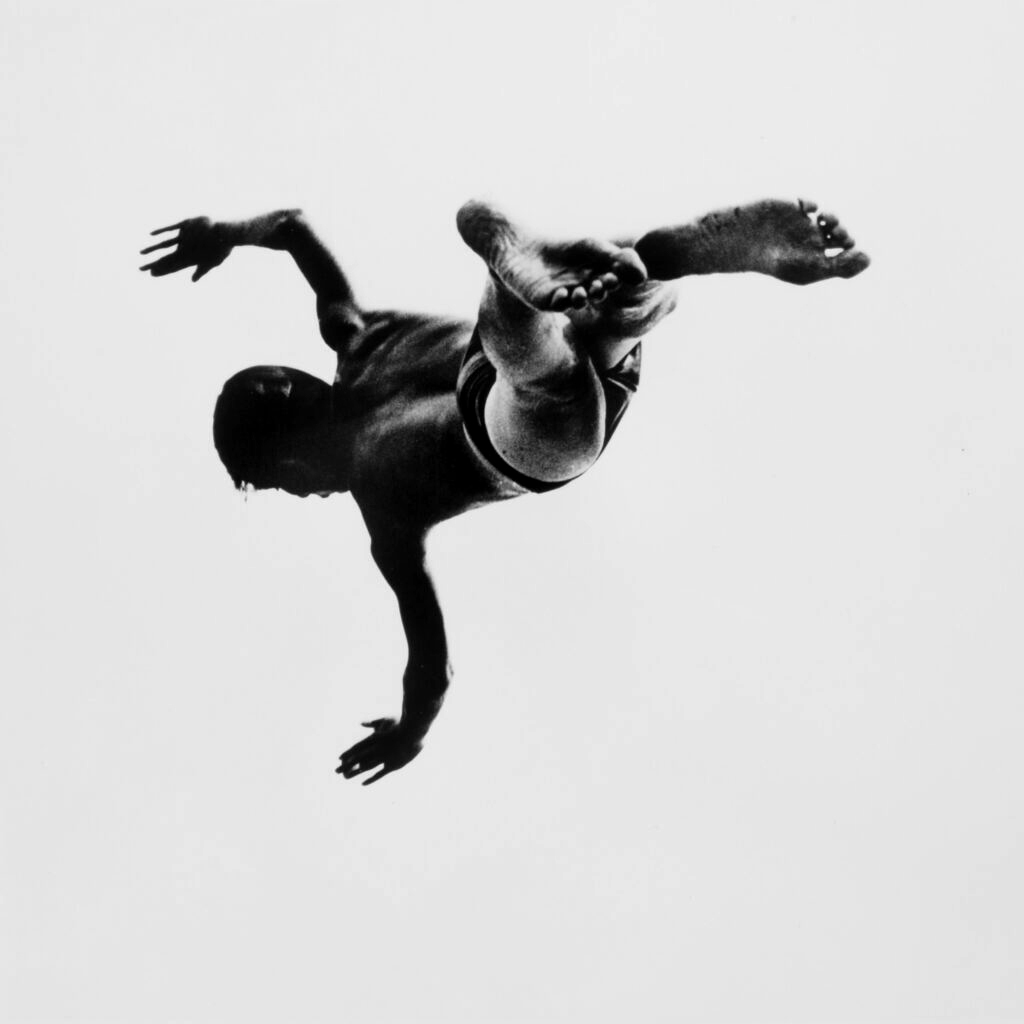
Vale Ian Lobb (1948-2023), photographer

December 2023


Marcus Bunyan (Australian, b. 1958) 'Ian Lobb, Station Street, Fairfield' 5 October 2022 


Marcus Bunyan (Australian, b. 1958)
Ian Lobb, Station Street, Fairfield
5 October 2022


The luminosity of Ian Lobb

These words are a celebration of the life of an extraordinary human, a heartfelt stream of consciousness text that touches on aspects of the life of Ian Lobb, photographer.

Ian Lobb was my friend. He was a poet, photographer, raconteur. He my first photographer lecturer at university who I could always rely on for advice on art, photography, writing and life. He was an audiophile and a lover of music, anything from classical to jazz to Nina Simone, Paul McCartney and Bob Dylan. He was a lover of women. He was dreamer and a philosopher. He adored the American artist Cy Twombly. He was a rabid Sydney Swans fan!

In the early 1990s monthly reviews of student photographic work at Phillip Institute of Technology (PIT, which later became part of RMIT University) with Ian and fellow lecturer Les Walkling were electric. Ideas and passion for the work abounded, discussions ran for hours on how to create work – with feeling and insight into the condition of image (and human) becoming. Here Ian introduced me to Tarkovsky, Eisenstein and Joseph Campbell, and the Marathon Monks of Mount Hiei, Kyoto, Japan. And of course he introduced me to the French photographer Eugène Atget – oh how we loved Atget, and Strand, Weston, Caponigro and Minor White. We could talk on any subject. Many years later, at our regular coffee catchups in Fairfield, I would take him new photography books that I had bought and recent object d’art purchases and, over lunch, the conversation would range far and wide about photography, art and life. He helped me sequence my work – have you thought about this pairing together, what about swapping this one over – and we drew inspiration from the sequences of Minor White and his use of “ice/fire”.

Ian was a storyteller. His photographs tell stories. From the teachings of Minor White (especially his “Three Canons”) there was an acknowledgement in his work of the spirit of the object he was photographing – a moment of revelation sought in the negative and subsequent print through a connection and circular transmission of energy between artist and object back through the camera and onto film (Zen)(for example see Eagles Nest, Cape Paterson 1975, below). A moment of revelation of spirit that was so important to Ian that this moment of “revelatio” can still be seen and felt in his recent mobile phone images.

Ian was aware, fully present. He was attuned to his surroundings like few people I have met for he was tremendously attentive, tremendously awake and sensitive to the environment and the vibrations of energy that emanated from the city, the land, the sky. Imagine travelling to a small patch of earth in the Black Ranges year after year to photograph in all seasons and in all weather something that he could see and feel in that land… something any other human would not even recognise, would walk past without a moments hesitation as though nothing was there, was of no import. But not Ian. He recognised and felt the energy of that place, space.

Talking to the wonderful Australian photographer David Tatnall who was also a friend of Ian’s we reminisced the other day. Ian had won an Australia Council grant and went to America on board a cargo ship teaching yoga on the way over, first going to South America and then on to America. There he visited Barbara, Wynn Bullock’s wife, and Ralph Gibson, Brett Weston, Harry Callahan and William Clift. He attended workshops with Ansel Adams and Paul Caponigro. He visited the Museum of Modern Art’s reading room and examined box after box of iconic prints by the masters, all jumbled together as he told me in folders with little order or care for their preservation. David told me he rocked up unannounced at Eliot Porter’s and said he was a visiting photographer from Australia, and while Eliot made a pot of tea he was left to go through boxes of dye transfer prints. Back then there was a camaraderie of photography very different from the present. Can you imagine doing that today!

He conversed with the masters. Like a pebble making ripples in a pond the energy of these photographers was transferred by osmosis through Ian to a wider network of artists. David and I remembered how Ian taught us to look at the print upside down in order to understand the balance of the print and develop an appreciation of its structure and the music inherent in it. Look at the image of Caponigro’s Reflecting Stream, Redding, CT (1968, below) – one of Ian’s favourites – and you just know that water has to be “wet” in that print, that the shadows of the trees on the water have to be (Ansel Adams) Zone 2, and that the Zone 7 patch of grey under the boulder in the centre of the image is critical to its music, its balance. Ian knew these things instinctively, intuitively. Ian also taught both of us how to make Ansel Adams’ “burning in” tool… three pieces of stiff black board (with the top two pieces secured by tape to make a hinges) with gradually larger holes in each board for use under the enlarger, so that you could easily flip the boards to a larger or smaller hole for “burning in” while making a print. We both still have these indispensable tools, passed down like an oral history from the master. On reflection, learning from Ian and Les during those early days printing black and white photographs in the basement darkroom at Phillip Institute of Technology (PIT) in Bundoora, Melbourne were some of the happiest days of my life.

With friend and fellow director William (Bill) Heimerman (1950-2017), The Photographers’ Gallery and Workshop, Melbourne brought to Australia some of the most respected master photographers from around the world: Wynn Bullock, Emmet Gowin, Eikoh Hosoe, William Clift, Harry Callahan, Paul Caponigro, William Eggleston, Ralph Gibson, Duane Michaels, Lisette Model, August Sander, Aaron Siskind among others … and promoted local Australian photographers such as John Cato, Carol Jerrems, Christopher Koller, Jeff Busby and more. I was privileged to have several solo exhibitions in the gallery space. For the opening of Carol Jerrems exhibition at the gallery, Ian asked her who she would most like to attend – and Carol said Ron Barassi, then the most popular sporting and cultural personality in Australia. And on the day of the opening who attended – the great man himself. I don’t know how Ian did it, but he did!

David Tatnall took Ian to Cape Paterson only a couple of weeks before his passing, the first time he had been there since his father’s death many years ago (see the photographs below). Ian took some photographs with camera on tripod and on the mobile phone and then sat down, sat down and just looked at things in that self deprecating way of his. He just looked at the rocks and the form and the light and soaked in the spirit of the place. The same with his favourite tree, his beloved lemon scented gum in the garden of his church in Fairfield. Much as the Black Range series many years earlier, he took thousands of photographs on his mobile phone of this tree in all weather conditions, at all times of the day and year. He saw and felt something there that he kept coming back too, searching for the answer to that one great question that he could never answer.

David said that he believed that he was only using the mobile phone as a visual notebook before he came back to the place to photograph with an SLR – but respectfully I must disagree. Increasingly in his later years Ian surrendered the use of his bigger digital cameras to the flexibility of his mobile phone camera, trading in their heft for the felt immediacy of the mobile phone image and his ability to study the results as he pleased. While many would dismiss these phones images as preludes to the finished work, Ian recognised (as do many artists) that these impressions, these deeply felt visual sketches, had become fully rendered works of art. He moved with the times. As he observed, “For the last 18 months I’ve been spending the first few hours of the day in the local church yard where I am photographing a lemon scented gum. I’m doing this with an iPhone as a way of exploring different ways of working that facilitates.” (Email for William Clift sent to Marcus Bunyan 22 January 2023)

Ian loved telling a story. And he was passionate about the Sydney Swans. He regaled me with the story of how he was so incensed by seeing photographers inside the circle of players celebrating in the rooms after a victory that he wrote to the club to explain that this space, this inner sanctum of celebration, should be a “sacred space” as he put it just for the players… and that photographers should not be allowed in to that space, but only be able to look in from the outside. He was special like that. He understood the significance of that circle and the energy that flowed across the space as players linked arms and belted out the club song. Nothing should disturb the sanctity of that space, much as nothing should disturb the energy of a rock face.

Ian was a (com)passionate man. He was a spiritual man. Throughout his life he had a deep abiding faith in Jesus and the benevolence and goodness of the Almighty. Now he is be gone but his energy still surrounds us. In his beloved lemon scented gum and in the many memorable ideas and images he shared with us.

Ian Lobb was my friend. I will miss his wise counsel.

God bless him xx

Dr Marcus Bunyan


PS. A very interesting analysis by Gary Sauer-Thompson on Ian Lobb’s Black Range series and new concepts in contemporary landscape photography can be found in the article “Ian Lobb + contemporary landscape photography” on the Thought Factory website January 28, 2024. Recommended reading.


Please click on the photographs for a larger version of the image. Many thankx to David Tatnall for allowing me to publish his images that are included in this posting.


“If you think of all the wonderful experiences of making images – and then sequencing them – really it is top of the world experience. If this then happens when society is particularly in flux – on spiritual and identity issues, and sequencing happens by someone who is sensitive to the time and the issues. And is sensitive to “image”. Then you really really hope that the book is well produced.”


Ian Lobb email to Marcus Bunyan, 29 May 2015


“In “LA Confidential” they give away their source by using the word “valediction”. A good name for a poem, maybe the best, but not an exhausted idea. Look out I have been inspired by genius. People say that they have to do something more difficult than they need. That’s ok. – there are angels to prevent that – but if you don’t want to go that way, most of them aren’t against us.”


Ian Lobb text to Marcus Bunyan, Monday 11 September 2023


“Marcus – can we be told how to love ? The first thought is no – but I’m not going to rush into an answer. Can we be told how to love a photograph or which photographs to love? I do know that my walk this morning has been recalling which photographs I have loved – and stopping on those where I have not lately dwelt. I didn’t get past the Paul Strand of the white picket fence. Sitting now on Station st as the coffee shops carry out their tables and seeing it.”


Ian Lobb text to Marcus Bunyan, Saturday, 16 September 2023


Ian Lobb speaking at a celebration of the life of William (Bill) Heimerman (1950-2017)

Windsor, Melbourne, Victoria, Australia, October 21, 2017.
Thank you to Peter Leiss for allowing me to publish this video.


Paul Strand (American, 1890 - 1976) 'White Fence, Port Kent, New York' 1916 (negative); 1945 (print)


Paul Strand (American, 1890 – 1976)
White Fence, Port Kent, New York
1916 (negative); 1945 (print)
Gelatin silver print


Paul Caponigro (American, 1932-2024) 'Reflecting Stream, Redding, CT' 1968


Paul Caponigro (American, 1932-2024)
Reflecting Stream, Redding, CT
1968
Gelatin silver print


During this particular workshop Caponigro was sometimes in a room where he could display several prints at once – he would never take them all down after talking, but move the first images away and attach new images to the right as he talked. The workshop was with the senior students of an Oregon art school, it can be dated because it was during the impeachment of Nixon.

~ Ian Lobb email to Marcus Bunyan, 6 January 2015


Minor White (American, 1908-1976) 'Point Lobos, California' 1948


Minor White (American, 1908-1976)
Point Lobos, California
1948
Gelatin silver print


Marcus, have you been to Point Lobos? I think you would find it a big experience if you were there at a quiet time. Imagine Minor White going to visit Weston on Wildcat Hill, and then the short drive down to Point Lobos – there would be some frisson in that car!! It’s not quite Nietzsche going to visit Wagner – but it’s not bad. For a lot of the year the day starts with fog and then the fog pulls back a little offshore and then comes back again. I think Weston’s Pelican would have been photographed in fog.

~ Ian Lobb email to Marcus Bunyan, 29 May 2015


Ansel Adams (American, 1902-1984) 'Merced River, Cliffs, Autumn' 1939


Ansel Adams (American, 1902-1984)
Merced River, Cliffs, Autumn
1939
Gelatin silver print


When talking to him [Ansel Adams] you can imagine the number of mediocre questions. While I was listening all of his answers were quotes from his books. There had to be an extraordinary move to get him to break ranks with this rule.

~ Ian Lobb text to Marcus Bunyan, Sunday, 5 March 2023


Black Range series


Ian Lobb (Australian, 1948-2023) 'Untitled' 1989 from the 'Black Range' series 1986-1989


Ian Lobb (Australian, 1948-2023)
Untitled
1989
from the Black Range series 1986-1989
36.9 × 36.7cm (image)
National Gallery of Victoria, Melbourne
Purchased with funds donated by Hallmark Cards Australia Pty Ltd, 1989
© Ian Lobb


Ian Lobb (Australian, 1948-2023) 'Untitled' 1989 from the 'Black Range' series 1986-1989


Ian Lobb (Australian, 1948-2023)
Untitled
1989
from the Black Range series 1986-1989
35.6 × 35.6cm (image)
National Gallery of Victoria, Melbourne
Purchased with funds donated by Hallmark Cards Australia Pty Ltd, 1989
© Ian Lobb


Ian Lobb (Australian, 1948-2023) 'Untitled' 1986, printed 1989 from the 'Black Range' series 1986-1989


Ian Lobb (Australian, 1948-2023)
Untitled
1986, printed 1989
from the Black Range series 1986-1989
26.4 × 26.4cm (image)
National Gallery of Victoria, Melbourne
Purchased with funds donated by Hallmark Cards Australia Pty Ltd, 1989
© Ian Lobb


Ian Lobb (Australian, 1948-2023) 'Untitled' 1989 from the 'Black Range' series 1986-1989


Ian Lobb (Australian, 1948-2023)
Untitled
1989
from the Black Range series 1986-1989
36.5 × 36.5cm (image)
National Gallery of Victoria, Melbourne
Purchased with funds donated by Hallmark Cards Australia Pty Ltd, 1989
© Ian Lobb


Ian Lobb (Australian, 1948-2023) 'No title (Soft focus landscape with branch detail in foreground)' 1989, printed 1998 from the 'Black Range' series 1986-1989


Ian Lobb (Australian, 1948-2023)
No title (Soft focus landscape with branch detail in foreground)
1989, printed 1998
from the Black Range series 1986-1989
38.2 × 38.4cm (image)
National Gallery of Victoria, Melbourne
Presented through The Art Foundation of Victoria by the artist, Fellow, 2000
© Ian Lobb


The Photographers’ Gallery and Workshop


Peter Leiss (Australian, b. 1951) 'Untitled [Bill Heimerman and Ian Lobb at the rear of the Photographers' Gallery]' c. 1975-1980


Peter Leiss (Australian, b. 1951)
Untitled [Bill Heimerman and Ian Lobb at the rear of the Photographers’ Gallery]
c. 1975-1980
Gelatin silver print


Eugène Atget (French, 1857-1927) 'Untitled [Atget's Work Room with Contact Printing Frames]' c. 1910


Eugène Atget (French, 1857-1927)
Untitled [Atget’s Work Room with Contact Printing Frames]
c. 1910


I am very familiar with the old suitcases under the desk – I think that only one – if any – is a suitcase.

This is typically how an exhibition would arrive at the Photographers’ Gallery – it would hold about 40 matted prints. Undo the strap and open the box to typically find 2 or 3 brown paper parcels. Maybe some archival tissue on the next layer down = sometimes not = and then about 20 mounted and matted prints sometimes face to face. This is the way Caponigro for example sent his prints – I’m trying to remember William Clift – Maybe one box like that and a handmade bigger one – or maybe 2 wooden boxes = but at least half  the exhibitions arrived in boxes like that.

But have a look to the left of those boxes –what are they? They look like old fashioned  double-darks – maybe for a quarter plate camera. The distance from the emulsion to the edge of the case was different for these compared to the last generation 5×4 double darks. People sometimes tried to make a way of putting the old film carriers onto 5×4″ cameras – but they would be focussing on the wrong spot by not making adjustments for the different positions of the emulsion.

To return to the boxes – they would be waiting for us at the airport, and we would have to spin a  yarn to the customs agents telling them that the prints were for “educational purposes only”. It was a great educational experience to unwrap some of the prints  when they came with a piece of tissue paper between the print and  the mat – you could see something of the image and then get to imagine it before removing the tissue.

Re Robert Frank – also note the size of the Lupe next to his hand. Ralph Gibson had Robert Franks Leica enlarger – For some reason it was in his “living room” – I have seen it!!!

~ Ian Lobb email to Marcus Bunyan 1 December, 2015


Carol Jerrems. 'Untitled [Bill Heimerman and Ian Lobb at the Dog Rocks near Geelong]' c. 1975-1980


Carol Jerrems (Australian, 1949-1980)
Untitled [Bill Heimerman and Ian Lobb at the Dog Rocks near Geelong]
c. 1975-1980
Gelatin silver print


Cape Liptrap and Cape Paterson


Ian Lobb (Australian, 1948-2023) 'Ocean (Cape Liptrap)' 1979


Ian Lobb (Australian, 1948-2023)
Ocean (Cape Liptrap)
1979
Gelatin silver photograph
17.3 × 22.5cm
National Gallery of Victoria, Melbourne
Purchased, 1980
© Ian Lobb


Ian Lobb (Australian, 1948-2023) 'No title (Black sand and rocks)' 1989; printed 1992


Ian Lobb (Australian, 1948-2023)
No title (Black sand and rocks)
1989; printed 1992
Gelatin silver photograph
34.3 × 34.3cm (image)
National Gallery of Victoria, Melbourne
Presented through The Art Foundation of Victoria by the artist, Fellow, 2000
© Ian Lobb


Ian Lobb (Australian, 1948-2023) 'Eagles Nest, Cape Paterson' 1975; printed 1979


Ian Lobb (Australian, 1948-2023)
Eagles Nest, Cape Paterson
1975; printed 1979
Gelatin silver photograph
17.6 × 17.4cm (image)
National Gallery of Victoria, Melbourne
Purchased, 1980
© Ian Lobb


David Tatnall (Australian, b. 1955) 'Ian at Eagles Nest, Cape Paterson' November 2023


David Tatnall (Australian, b. 1955)
Ian at Eagles Nest, Cape Paterson
November 2023


This was the first Ian time had returned to Cape Paterson since the death of his father many years ago.


David Tatnall (Australian, b. 1955) 'Ian at Eagles Nest, Cape Paterson' November 2023


David Tatnall (Australian, b. 1955)
Ian at Eagles Nest, Cape Paterson
November 2023


David Tatnall (Australian, b. 1955) 'Ian at Eagles Nest, Cape Paterson' November 2023


David Tatnall (Australian, b. 1955)
Ian at Eagles Nest, Cape Paterson
November 2023


Lemon scented gum, Fairfield


Marcus Bunyan (Australian, b. 1958) 'Ian Lobb, Fairfield' December 2021


Marcus Bunyan (Australian, b. 1958)
Ian Lobb, Fairfield
December 2021


Marcus Bunyan (Australian, b. 1958) 'Ian Lobb, Fairfield' December 2021


Marcus Bunyan (Australian, b. 1958)
Ian Lobb, Fairfield
December 2021


Marcus Bunyan (Australian, b. 1958) 'Ian Lobb, Fairfield' December 2021


Marcus Bunyan (Australian, b. 1958)
Ian Lobb, Fairfield
December 2021


Maxwell Allara (American born Italy, 1906-1981) 'Untitled (Minor White During a Workshop)' 1959


Maxwell Allara (American born Italy, 1906-1981)
Untitled (Minor White During a Workshop)
1959
Gelatin silver print


David Tatnall (Australian, b. 1955) 'Ian in front of his favourite tree, Fairfield' November 2021


David Tatnall (Australian, b. 1955)
Ian in front of his favourite tree, Fairfield
November 2021


Minor White (American, 1908-1976) 'Moencopi Strata, Capital Reef, Utah' 1962 


Minor White (American, 1908-1976)
Moencopi Strata, Capital Reef, Utah
1962
Gelatin silver print


Ian Lobb (Australian, 1948-2023) 'Lemon scented gum' 24 January 2023


Ian Lobb (Australian, 1948-2023)
Lemon scented gum
24 January 2023


Ian Lobb (Australian, 1948-2023) 'Lemon scented gum' 14 February 2023


Ian Lobb (Australian, 1948-2023)
Lemon scented gum
14 February 2023


“The light comes down the tree. But for some days it twists right to left and makes an early morning shadow.

~ Ian Lobb text to Marcus Bunyan, Monday 11 September 2023


Ian Lobb (Australian, 1948-2023) 'Lemon scented gum' 22 February 2023


Ian Lobb (Australian, 1948-2023)
Lemon scented gum
22 February 2023


Ian Lobb (Australian, 1948-2023) 'Lemon scented' gum 8 March 2023


Ian Lobb (Australian, 1948-2023)
Lemon scented gum
8 March 2023


Marcus – thanks for the mystic particles. After I have apple and rhubarb I’ll be walking to check on the tree in the church-garden. I’m interested in this, rather than my own garden. Who knows why I can’t photograph my own. Do you have a garden close by that you can walk through easily? I can’t wait for the sun to move a bit further and the light to come back on church gum. A few weeks.

~ Ian Lobb text to Marcus Bunyan, Wednesday 12 July 2023


Ian Lobb (Australian, 1948-2023) 'Lemon scented gum' 13 September 2023


Ian Lobb (Australian, 1948-2023)
Lemon scented gum
13 September 2023


Mobile phone photographs


Ian Lobb (Australian, 1948-2023) 'Untitled (Green woman)' 22 November 2022


Ian Lobb (Australian, 1948-2023)
Untitled (Green woman)
22 November 2022


Ian Lobb (Australian, 1948-2023) 'Alex' 21 December 2022


Ian Lobb (Australian, 1948-2023)
Alex
21 December 2022


Ian Lobb (Australian, 1948-2023) 'Untitled (pink and black)' 31 January 2023


Ian Lobb (Australian, 1948-2023)
Untitled (pink and black)
31 January 2023


Ian Lobb (Australian, 1948-2023) 'The path from the coffee shop' 4 February 2023


Ian Lobb (Australian, 1948-2023)
The path from the coffee shop
Fairfield, 4 February 2023


Ian Lobb (Australian, 1948-2023) 'The path to the coffee shop' Fairfield 4 February 2023


Ian Lobb (Australian, 1948-2023)
The path to the coffee shop
Fairfield, 4 February 2023


Ian Lobb (Australian, 1948-2023) 'Building his ying, Ignoring his yang' 21 February 2023


Ian Lobb (Australian, 1948-2023)
Building his ying, Ignoring his yang
21 February 2023


The First One

First one through the forest
First one on the beach
First one through the shallows
First one in the deep
Yes, first in the water
To swim out of reach
First one to belong
And then to be gone
First one to be gone too soon.

First foot off the platform
First step off the map
First one to learn
With nothing to teach
First one in this life
To whisper my name.
First one through my shallows
First one in my deep
First one to be gone too soon.

First winter field night
When the fires are lit
First soul at midnight
Watching burning trees twist.
At your back is the darkness
That turns you to see …
First one to the shadows
First one to the deep
First one to be gone too soon.

There’s a sound that’s so big
We can’t even hear
Not a murmur, a pulse
A note, nor a song
After midnight it wakes you
To its echoes and trace
First one to be swallowed
First one in the deep
First one to be gone too soon.

You’re the first, yes its true
On the roll call of friends
Now there’s spaces, not names
And you: you’re the worst.
You’re a very faint glow
On a very faint path
You were first through the shallows
First one in the deep
First one to be gone too soon.

Ian Lobb 28 August 2018


Ian Lobb (Australian, 1948-2023) 'A small moment with...' 25 February 2023


Ian Lobb (Australian, 1948-2023)
A small moment with…
25 February 2023


“If only the lens didn’t have anti flare – it would have been an Atget moment.”

~ Ian Lobb


Eugène Atget. 'Saint-Cloud' 1926


Eugène Atget (French, 1857-1927)
Saint-Cloud
1926
Albumen print


Ian Lobb (Australian, 1948-2023) 'Billiard' 2 March 2023


Ian Lobb (Australian, 1948-2023)
Billiard
2 March 2023


Ian: Please see full screen for pleasing puns

Marcus: Love how the graffiti imitates the shape of the wood in the trolley and how the triangle of white dots is a metaphor for the billiard triangle used to rack up the balls

Ian: Yes. And with the billiard signage I thought it was like a players gesture – towards the corner pocket

~ Ian Lobb text to Marcus Bunyan, Friday, 3 March 2023


Ian Lobb (Australian, 1948-2023) 'Untitled (Mother)' 30 April 2023


Ian Lobb (Australian, 1948-2023)
Untitled (Mother)
30 April 2023


Apart from the teenagers at church, the mention that you were talking to your mother, was one of the few mentions of that relationship since my mother had passed. One minute after that I took this on my way home.

~ Ian Lobb text to Marcus Bunyan, Sunday, 30 April 2023


Ian Lobb (Australian, 1948-2023) 'Untitled (black oblong)' Fairfield, 8 May 2023


Ian Lobb (Australian, 1948-2023)
Untitled (black oblong)
Fairfield, 8 May 2023


Ian Lobb (Australian, 1948-2023) Untitled (My walk this morning)' Fairfield, 11 May 2023


Ian Lobb (Australian, 1948-2023)
Untitled (My walk this morning)
Fairfield, 11 May 2023


On my second roll of HP4 were pictures of a young lady lying under clear sheets of curved 2mm plastic that I had sprayed with water (1968?). The attached is from my walk this morning. The similar mood is quite scary.

~ Ian Lobb text to Marcus Bunyan, Thursday, 11 May 2023


Ian Lobb (Australian, 1948-2023) 'mmmm, Pasta Poetry' Fairfield, 21 June 2023


Ian Lobb (Australian, 1948-2023)
mmmm, Pasta Poetry
Fairfield, 21 June 2023


Thinking about John Cato this morning. If you can google “the world is too much with us” – Wordsworth – and give a toast to John. Proteus!!!

~ Ian Lobb text to Marcus Bunyan, Wednesday, 5 July 2023


The world is too much with us

The world is too much with us; late and soon,
Getting and spending, we lay waste our powers;–
Little we see in Nature that is ours;
We have given our hearts away, a sordid boon!
This Sea that bares her bosom to the moon;
The winds that will be howling at all hours,
And are up-gathered now like sleeping flowers;
For this, for everything, we are out of tune;
It moves us not. Great God! I’d rather be
A Pagan suckled in a creed outworn;
So might I, standing on this pleasant lea,
Have glimpses that would make me less forlorn;
Have sight of Proteus rising from the sea;
Or hear old Triton blow his wreathèd horn.
William Wordsworth 1802


Cy Twombly. 'Coronation of Sesostris (Part III)' 2000


Cy Twombly (American, 1928-2011)
Coronation of Sesostris (Part III)
2000


Affirmation: When you Sing

(An affirmation from Cy Twombly’s Coronation of Sesostris)


If you sing, don’t let them hesitate
When you sing, don’t let them make signs of regret
When you sing, let them bear the loss of silence
When you sing, the lost gods are found
When you sing, the birds and trees love their shadows
Lying quietly on the ground
When you sing, the mark of nature and the mark of the mark rejoice
When you sing we trace to the source of trace – the realm.

Sing to the ghosts, sing to those to come
Flow over – into – flow over
Let the trees rise from the earth because you sing:
New sunlight on new leaves cutting into space
Write your name
with their scintilla through the air as you sing
Then each letter narrows, fades   white
Still unending trace as sing and sing as a lost god.
One majesty fades to another
Sing Osiris , sing that god into Orpheus

scribes
Porous sparse voice, could have been scattered
Empty surface – instead open sky
Bell
Nothing to shatter
Sing for the old rivers,
Sailors sink into sails,
The opposite bank still opposite
Take this – sing – most important , to the next life.
Like tall trees, rising from …

Gods cannot depart while love, I mean song, remains
Gods have not departed: it would have been heeded,
Reported as a hoax,
No arc of departure divulged
song, weightless
Gods have not departed – it is a drunken hoax, rumour.

Ian Lobb 30 August 2018


Cy Twombly. 'Coronation of Sesostris (Part V)' 2000


Cy Twombly (American, 1928-2011)
Coronation of Sesostris (Part V)
2000


Cy Twombly. 'Coronation of Sesostris (Part VI)' 2000


Cy Twombly (American, 1928-2011)
Coronation of Sesostris (Part VI)
2000


Last house

Are you travelling to this very last house
On the very last street of this town?
That I built here for you,
Where I wait for you
If you go round the back you’ll find wild flowers
That you could almost touch
And you would watch the clouds come down from the hills

Long ago I promised this to you
It became my story that you’d come
To the last street
And to the last house
I watch all the doors to see you enter
So that we would almost touch
And you could watch the rain come down from the hills

Yes, it’s true, the house backs onto darkness
I swear there’s really nothing out there
Beyond this last street
Beyond this last house
Nothing you could be sure to name
Nothing we can almost touch
And at night you could keep watch, from here to the hills

You can smell salt in the air from all of the rooms
And hear the wind in the waves
But out the back you’ll only find wildflowers.
Not those grey choppy waves
That we can almost touch
On this last street
In this last house.

Ian Lobb 29 August 2018


Flickerd (Australian)
Zac Foot of Sydney during the 2019 NEAFL round 14 match between NT Thunder and Sydney at TIO Stadium on Saturday, 6 July 2019 in Darwin, Northern Territory
2019
Creative Commons Attribution-Share Alike 4.0 International


LIKE ART BLART ON FACEBOOK

Back to top

Photographs: Eugène Atget (French, 1857-1927)

November 2023


Eugène Atget (French, 1857-1927) 'Rue Saint-Médard, 5e arrondissement' 1899-1900


Eugène Atget (French, 1857-1927)
Rue Saint-Médard, 5e arrondissement
1899-1900
Albumen print


I am devastated at news of the loss of my very close friend and photographer Ian Lobb today.

An intelligent, compassionate, creative and spiritual man who was a guiding light during the last 33 years of my life.

He said of Atget, “You always have a sense of feeling self surprised at where his camera is.”

Atget was always an inspiration to us both.

Bless him for his wise counsel all these years.

A tribute will appear at a later time.

Dr Marcus Bunyan


Please click on the photographs for a larger version of the image.


Again

Why are the waves,
Coming straight at me?
Fold upon fold
Waves in wind –
And why is the wind
Becoming my breath,
And my breath, the wind?

So now you
Beautiful friend
Breathe my friend
Jump the wave,
Jump up, laughing
The sun right above you,
Here on the coast
Among waves and trees.

Enter your home
Like a nest
Beautiful friend,
Dear friend,
Read till you sleep –
Your breath on the pages
That tell of the road and
On that road where you meet
Those twilight lit:
One, two,
Then three   again.

Ian Lobb


“His prints are direct and emotionally clean records of a rare and subtle perception, and represent perhaps the earliest expression of true photographic art.”


Ansel Adams


“There is nothing I could ask for better than to roll myself between sheets of Atgets, each new one I find (and there are thousands) is a revelation.”


Julien Levy


“In looking at the work of Eugène Atget, a new world is opened up in the world of creative expression.”


Berenice Abbott


Eugène Atget (French, 1857-1927) 'Soleil' c. 1896


Eugène Atget (French, 1857-1927)
Soleil
c. 1896


Eugène Atget (French, 1857-1927) 'Fontaine Jarente – impasse Jarente' 1898


Eugène Atget (French, 1857-1927)
Fontaine Jarente – impasse Jarente (Fountain Jarente – Jarente dead end)
1898
Albumen print


Eugène Atget (French, 1857-1927) 'Fontaine Minerve, Institut' 1899


Eugène Atget (French, 1857-1927)
Fontaine Minerve, Institut (Minerva Fountain, Institute)
1899
Albumen print


Eugène Atget (French, 1857-1927) 'Hôtel de la Comtess de Verrue, rue du Regard' 1899


Eugène Atget (French, 1857-1927)
Hôtel de la Comtess de Verrue, rue du Regard
1899
Albumen print


Eugène Atget (French, 1857-1927) 'Avenue de l'Observatoire' 1899-1900


Eugène Atget (French, 1857-1927)
Avenue de l’Observatoire
1899-1900
Albumen print


Eugène Atget (French, 1857-1927) 'Hôtel de Gouffier, rue de Varenne 56' 1899-1900


Eugène Atget (French, 1857-1927)
Hôtel de Gouffier, rue de Varenne 56
1899-1900
Albumen print


Eugène Atget (French, 1857-1927) 'Cactus [Nice]' before 1900


Eugène Atget (French, 1857-1927)
Cactus [Nice]
Before 1900
Albumen print


Eugène Atget (French, 1857-1927) 'Cour, rue Saint-Jacques 346, disparu, 5e arrondissement' 1900


Eugène Atget (French, 1857-1927)
Cour, rue Saint-Jacques 346, disparu, 5e arrondissement (Court, rue Saint-Jacques 346)
1900
Albumen print


Eugène Atget (French, 1857-1927) 'Hôtel d'Argouges de Lyon, rue Séguier 16' 1900


Eugène Atget (French, 1857-1927)
Hôtel d’Argouges de Lyon, rue Séguier 16
1900
Albumen print


Eugène Atget (French, 1857-1927) 'Presbytère de Saint-Sulpice, rue de Vaugirard 50' 1900


Eugène Atget (French, 1857-1927)
Presbytère de Saint-Sulpice, rue de Vaugirard 50 (Presbytery of Saint-Sulpice)
1900
Albumen print


Eugène Atget (French, 1857-1927) 'Marché aux fleurs' c. 1900s


Eugène Atget (French, 1857-1927)
Marché aux fleurs (Flower market)
c. 1900s
Albumen print


Eugène Atget (French, 1857-1927) 'Cours d'Honneur, Versailles' 1901


Eugène Atget (French, 1857-1927)
Cours d’Honneur, Versailles (Gentilly – old castle, Versailles)
1901
Albumen print


Eugène Atget (French, 1857-1927) 'Gentilly – ancien château' 1901


Eugène Atget (French, 1857-1927)
Gentilly – ancien château
1901
Albumen print


Eugène Atget (French, 1857-1927) 'Hôtel Beauffremont, rue de Grenelle 87' 1901


Eugène Atget (French, 1857-1927)
Hôtel Beauffremont, rue de Grenelle 87
1901
Albumen print


Eugène Atget (French, 1857-1927) 'Hôtel du Maréchal de Tallard, rue des Archives 78' 1901-1902


Eugène Atget (French, 1857-1927)
Hôtel du Maréchal de Tallard, rue des Archives 78
1901-1902
Albumen print


Eugène Atget (French, 1857-1927) 'Grand Trianon Le Buffet' 1902


Eugène Atget (French, 1857-1927)
Grand Trianon Le Buffet
1902
Albumen print


Eugène Atget (French, 1857-1927) 'La Vénus accroupie, par Coysevox (Versailles)' 1902


Eugène Atget (French, 1857-1927)
La Vénus accroupie, par Coysevox (Versailles) (The Crouching Venus, by Coysevox, (Versailles))
1902
Albumen print


Eugène Atget (French, 1857-1927) 'Versailles – l'Orangerie' 1903


Eugène Atget (French, 1857-1927)
Versailles – l’Orangerie
1903
Albumen print


Eugène Atget (French, 1857-1927) 'Oratoire Marie de Médicis, Petit Luxembourg' 1903


Eugène Atget (French, 1857-1927)
Oratoire Marie de Médicis, Petit Luxembourg (Marie de Medici Oratory)
1903
Albumen print


Eugène Atget (French, 1857-1927) 'Fontaine du Marché Saint-Honoré' 1903


Eugène Atget (French, 1857-1927)
Fontaine du Marché Saint-Honoré (Saint-Honoré Market Fountain)
1903
Albumen print


Atget used a view camera with a bellows placed on a tripod, typical of the second half of the 19th century. He worked with 18 × 24 cm negative glass plates, oriented to obtain either a vertical or horizontal photograph. A tilt-shift technique was used to make perspective corrections. This resulted in vignetting (a circular shadow around the edges of the image), a phenomenon seen in a number of Atget’s photographs.

Atget always used gelatin-silver negative glass plates, 1.5mm thick. The plate was held in the camera in a wooden frame by clips that left characteristic marks on many of the prints. A long exposure time resulted in numerous blurs caused by the presence of moving people or objects. Atget developed the negatives himself and wrote the negative number directly onto the gelatin with a pointed stiletto.

Atget made all of his own photographic prints using a technique in which light-sensitive paper, in contact with the glass negative, was printed-out in natural light (never developed). The printing-out process proceeded until Atget determined that the image had the proper density. The photograph was then washed, gold toned, fixed and washed again. Atget’s prints are never black-and-white; their tone varies from deep sepia to violet-brown. Atget was capable of producing high-quality prints but there is great variation in these today depending on his printing and toning techniques and the way his photographs were preserved and exhibited. He never enlarged his photographs.


Atget’s paper

Atget used three types of paper:

Albumen

The light-sensitive emulsion was formed by silver chloride introduced into an albumen binder (beaten egg whites). The majority of Atget’s prints were on albumen paper. He turned to other processes after the First World War, when such paper could no longer be found on the market.

Matt albumen

After the war Atget used another kind of industrially produced printing-out paper with a matt surface.

Aristotype

Atget chose a commercially manufactured printing-out paper made with gelatin. Aesthetically similar to albumen prints, although thicker and with a glossier surface, the process was the same for toning and printing. Some of these prints have yellow stains from sulphuration due to poor processing of the image (such as the use of an exhausted fixing bath or insufficient washing).

Anonymous. “Atget’s technique,” on the Art Gallery of New South Wales website Nd [Online] Cited 03/10/2023


Eugène Atget (French, 1857-1927) 'Fontaine, rue Geoffrey Saint-Hilaire' 1905


Eugène Atget (French, 1857-1927)
Fontaine, rue Geoffrey Saint-Hilaire
1905
Albumen print


Eugène Atget (French, 1857-1927) 'Grand Trianon (escalier)' 1905


Eugène Atget (French, 1857-1927)
Grand Trianon (escalier) (Grand Trianon (staircase))
1905
Albumen print


Eugène Atget (French, 1857-1927) 'Saint-Severin – rue Saint Séverin' 1905-1906


Eugène Atget (French, 1857-1927)
Saint-Severin – rue Saint Séverin
1905-1906
Albumen print


Eugène Atget (French, 1857-1927) 'Grand Trianon – le Buffet' 1906


Eugène Atget (French, 1857-1927)
Grand Trianon – le Buffet
1906
Albumen print


Eugène Atget (French, 1857-1927) 'Maison, rue Saint-Romain [Rouen]' 1907


Eugène Atget (French, 1857-1927)
Maison, rue Saint-Romain [Rouen]
1907
Albumen print


Eugène Atget (French, 1857-1927) 'Nantes – fontaine et Mairie' 1907


Eugène Atget (French, 1857-1927)
Nantes – fontaine et Mairie (Nantes – fountain and town hall)
1907
Albumen print


Eugène Atget (French, 1857-1927) 'Tuileries – Coureuse par Coustou' 1907


Eugène Atget (French, 1857-1927)
Tuileries – Coureuse par Coustou (Tuileries – Runner by Coustou)
1907
Albumen print


Eugène Atget (French, 1857-1927) 'Hôtel d'Imbercourt, 15 rue de l'Universite' 1909


Eugène Atget (French, 1857-1927)
Hôtel d’Imbercourt, 15 rue de l’Universite
1909
Albumen print


Eugène Atget (French, 1857-1927) 'Folie Thoinard, 9 rue Coq-Héron' 1909


Eugène Atget (French, 1857-1927)
Folie Thoinard, 9 rue Coq-Héron
1909
Albumen print


Eugène Atget (French, 1857-1927) 'Façade Saint-Lazare, faubourg Saint-Denis 107' 1909


Eugène Atget (French, 1857-1927)
Façade Saint-Lazare, faubourg Saint-Denis 107
1909
Albumen print


Eugène Atget (French, 1857-1927) 'Hôtel de Vendôme, rue Béranger 3' 1909


Eugène Atget (French, 1857-1927)
Hôtel de Vendôme, rue Béranger 3
1909
Albumen print


Eugène Atget (French, 1857-1927) 'Pommiers [et blés]' 1910 or earlier


Eugène Atget (French, 1857-1927)
Pommiers [et blés] (Apple trees [and wheat])
1910 or earlier
Albumen print


Eugène Atget (French, 1857-1927) 'Sapin ([Petit] Trianon)' 1910 or earlier


Eugène Atget (French, 1857-1927)
Sapin ([Petit] Trianon)
1910 or earlier
Albumen print


Eugène Atget (French, 1857-1927) 'Colonne Moris (Place Saint Sulpice)' 1910


Eugène Atget (French, 1857-1927)
Colonne Moris (Place Saint Sulpice) (Morris Column (Place Saint Sulpice))
1910
Albumen print


Eugène Atget (French, 1857-1927) 'Hôtel de Canhillac, place des Vosges 14' 1911-1912


Eugène Atget (French, 1857-1927)
Hôtel de Canhillac, place des Vosges 14
1911-1912
Albumen print


Eugène Atget (French, 1857-1927) 'Fontaine, faubourg Saint-Martin' 1912


Eugène Atget (French, 1857-1927)
Fontaine, faubourg Saint-Martin (Fountain, Saint-Martin suburb)
1912
Albumen print


Eugène Atget (French, 1857-1927) 'Balcon, [15] rue du Petit Pont' 1913


Eugène Atget (French, 1857-1927)
Balcon, [15] rue du Petit Pont
1913
Albumen print


Eugène Atget (French, 1857-1927) 'Pavilion du Hanovre, boulevard des Capucines 33' 1913


Eugène Atget (French, 1857-1927)
Pavilion du Hanovre, boulevard des Capucines 33
1913
Albumen print


Eugène Atget (French, 1857-1927) 'Fête du Trône' 1914


Eugène Atget (French, 1857-1927)
Fête du Trône
1914
Albumen print


“My excitement at seeing these few photographs would not let me rest. Who was this man? I learned that Atget lived up the street from where I worked – at 17 bis rue Campagne Premiere, and that his prints were for sale. Perhaps I could own some. I wanted to see more, and lost no time in seeking him out. I mounted the four flights to his fifth floor apartment. On the door was a modest handmade sign, “Documents pour Artistes”. He ushered me into a room approximately fifteen feet long, the ordinary room of a small apartment, sparsely and simply furnished. Atget, slightly stooped, impressed me as being tired, sad, remote, appealing. He was not talkative. He did not try to “sell” anything. He showed me some albums, which he had made himself, and I selected as many prints as I could afford to pay for from my meager wages as a photographer’s assistant. I returned many times, and we became more friendly.” Several years passed and Berenice Abbott became a portrait photographer. “By that time I had become a portrait photographer on my own, and I persuaded Atget to come to my studio at 44 rue du Bac to sit for his portrait. To my surprise he arrived in a handsome overcoat. I had always seen him in his patched work clothes. It would have been desirable to photograph him in these too, since they were exquisitely photogenic, but time is a fickle unpredictable master and did not permit another sitting. After developing the portraits she took the images to show Atget. Abbott missed the sign and made one more flight of stairs to find the concierge.” She asked about Atget and was shocked to hear that he had died. “Youth is little equipped to accept or even anticipate the fact of death. And I had just finished his portraits.” Inquiring about his collection of photographs, she found that they had been left to Andre Calmette. It took months of correspondence and convincing, but she eventually acquired Atget’s entire collection. Abbott also wrote a book about Atget and published many of his prints. Many critics have attacked Atget’s work, saying Atget was merely a disappointed painter or actor, and a little ashamed of his medium. Claims have been made that Atget did not really know what he was doing, that reflections in his shop front windows were accidents which he did not even see. Berenice Abbott fiercely defended Atget and his work. Goethe had said, “there is no variety of Art that should be looked upon lightly. Each has delights which great talent can bring to fulfillment.” If Atget had not had this talent he would have been just another record producer of the travel guide variety – tourist fare. I believe the photographer’s eye develops to a more intense awareness than other people’s, as a dancer develops his muscles and limbs, and a musician his ear. The photographer’s act is to see the outside world precisely, with intelligence as well as sensuous insight. This act of seeing sharpens the eye to an unprecedented acuteness. He often sees swiftly an entire scene that most people would pass unnoticed. Capturing the city of Paris and its people was the photographic art of Atget. How one becomes a photographer, well-schooled or self-taught, does not matter. Ultimately, it is the test of time. As with many of the world’s great photographer’s, their images are timeless and still have the appeal as when first developed. Not only did Atget document a city; he also captured its essence.

Lori Oden. “Eugène Atget,” on the International Photography Hall of Fame and Museum website Nd [Online] Cited 03/10/2023


 Eugène Atget (French, 1857-1927) 'Plessis Piquet [Entrée pittoresque, Châtillon]' 1921


Eugène Atget (French, 1857-1927)
Plessis Piquet [Entrée pittoresque, Châtillon]
1921
Albumen print


Eugène Atget (French, 1857-1927) 'Porte, avenue de Paris (Versailles)' 1922


Eugène Atget (French, 1857-1927)
Porte, avenue de Paris (Versailles)
1922
Albumen print


Eugène Atget (French, 1857-1927) 'Fontaine Jarente, rue Jarente' 1922


Eugène Atget (French, 1857-1927)
Fontaine Jarente, rue Jarente
1922
Albumen print


Eugène Atget (French, 1857-1927) 'Coin, rue Norvins et des Saules' 1925


Eugène Atget (French, 1857-1927)
Coin, rue Norvins et des Saules (Corner, rue Norvins et des Saules)
1925
Albumen print


Eugène Atget (French, 1857-1927) 'Parc de Sceaux' 1925


Eugène Atget (French, 1857-1927)
Parc de Sceaux
1925
Albumen print


Eugène Atget (French, 1857-1927) 'Moulin Rouge [86 boulevard de Clichy]' 1926


Eugène Atget (French, 1857-1927)
Moulin Rouge [86 boulevard de Clichy]
1926
Albumen print


Eugène Atget (French, 1857-1927) 'Rue Lanneau' 1925


Eugène Atget (French, 1857-1927)
Rue Lanneau
1925
Albumen print


Eugène Atget (French, 1857-1927) 'Passage Moret, ruelle des Gobelins' 1926


Eugène Atget (French, 1857-1927)
Passage Moret, ruelle des Gobelins
1926
Albumen print


Eugène Atget (French, 1857-1927) 'Rue des Gobelins' 1926


Eugène Atget (French, 1857-1927)
Rue des Gobelins
1926
Albumen print


Eugène Atget (French, 1857-1927) 'Rue des Prêtres Saint-Séverin, au fond rue Boutebrie' 1926


Eugène Atget (French, 1857-1927)
Rue des Prêtres Saint-Séverin, au fond rue Boutebrie
1926
Albumen print


Eugène Atget (French, 1857-1927) 'Saint-Médard' 1926


Eugène Atget (French, 1857-1927)
Saint-Médard
1926
Albumen print


Eugène Atget (French, 1857-1927) 'Square Notre-Dame' 1926


Eugène Atget (French, 1857-1927)
Square Notre-Dame
1926
Albumen print


Eugène Atget (French, 1857-1927) 'Ruelle des Reculettes, Gobelins' 1926


Eugène Atget (French, 1857-1927)
Ruelle des Reculettes, Gobelins
1926
Albumen print


Eugène Atget (French, 1857-1927) 'Saint-Cloud [19h matin, mars 1926]' 1926


Eugène Atget (French, 1857-1927)
Saint-Cloud [19h matin, mars 1926]
1926
Albumen print


LIKE ART BLART ON FACEBOOK

Back to top

Exhibition: ‘Berenice Abbott’s New York Album, 1929’ at the Metropolitan Museum of Art, New York

Exhibition dates: 2nd March – 4th September 2023


Walker Evans (American, 1903-1975) [Berenice Abbott] 1929-1930 from the exhibition 'Berenice Abbott's New York Album, 1929' at the Metropolitan Museum of Art, New York, March - Sept 2023


Walker Evans (American, 1903-1975)
[Berenice Abbott]
1929-1930
Gelatin silver print
16.9 x 11.8cm (6 5/8 x 4 5/8 in.)
Metropolitan Museum of Art
Purchase, The Horace W. Goldsmith Foundation Gift, through Joyce and Robert Menschel, 1997
© Walker Evans Archive, The Metropolitan Museum of Art


Abbott appraises the camera with cool assurance in this portrait, made just after her return from Paris to New York. Her gamine-short hair and bare face affect a chic nonchalance that intrigued Evans. Describing her to a friend after their first meeting, he wrote: “You would like Berenice Abbott, with her hair brushed forward and her woozy eyes.” Her work likewise impressed the young photographer, then finding his footing in the field. Evans’s picture betrays admiration for his new acquaintance, whose burgeoning career offered a model for his own.


American visionary

What a wonderful photographer Berenice Abbott developed into and what a debt of gratitude we owe her for saving the archive of French photographer Eugène Atget whose photographs initially influenced her urban(e) style.

“Abbott felt the changing city [New York] needed an equivalent to the French photographer Eugène Atget (1857-1927), who had documented Paris during a critical period of transition in the late 19th and early 20th centuries with what Abbott called “the shock of realism unadorned.””

It is interesting to analyse Abbott’s New York photographs in relation to Atget. In photographs such as the grouping on Album Page 9: Fulton Street Fish Market and Lower East Side, Manhattan (1929, below) there is an almost symbiotic relationship between Atget’s photographs of street Petits Métiers (trades and professions) and those of Abbott. “The subjects were not sensational, but nevertheless shocking in their very familiarity,” she said of seeing Atget’s photographs in Man Ray’s studio in 1926. Similarly, we can recognise in Abbott’s grouping in Album Page: City Hall Park and Brooklyn Bridge Vicinity, Manhattan (1929, below) and Pingpank Barbershop, 413 Bleecker Street, Manhattan (1938, below) an affinity with Atget’s photographs of architectural details of door handles and the front of shops.

A step away from Atget’s aesthetic are Abbott’s photographs such as Brooklyn Bridge, With Pier 21, Pennsylvania R.R. (1937, below), West Street (1936, below) and Henry Street from Market, Looking West, Manhattan (1935, below) where the foreground of each photograph mimics Atget’s photographs of Old Paris whilst the soaring background of skyscrapers and bridges is all modernist New York, the near / far of the picture plane becoming old / new. Abbott chronicled “the changing aspect of the world’s great metropolis. … Its hurrying tempo, its congested streets, the past jostling the present.”

Still further away from Atget’s aesthetic are Abbott’s photographs grouped in Album Page 1: Financial District, Broadway and Wall Street Vicinity, Manhattan (1929, below) where the artist uses with the chiaroscuro (the treatment of light and shade) within the canyons of skyscraper New York – and modernist almost constructivist photographs such as Canyon, Broadway and Exchange Place (1936, below) and Manhattan Bridge, Looking Up (1936, below) where the artist plays with pictorial perspective by pointing her camera skywards.

Finally, there are Abbott’s photographs that bear no relation to those of Atget, where Abbott as an artist has stepped out of the older artist’s shadow and developed her own artistic signature. Those wonderfully abstract and enigmatic photographs at lower left and right in Album Page 5: Pier 17, South Street Seaport, Manhattan push the boundaries of 1930s photographic language. In other glorious photographs such as The El at Columbus and Broadway (1929, below) and The El, 2nd and 3rd Avenue Lines, Bowery and Division Street, Manhattan (1936, below) Abbott captured the random disorder of urban activity with a focused intensity of vision that produces magical images… and by that I mean, images that transport you into other spaces, other states of being. Her dadaist poet Tristan Tzara put it this way: “We leave with those leaving arrive with those arriving / leave with those arriving arrive when the others leave.”

Dr Marcus Bunyan


Many thankx to the Metropolitan Museum of Art for allowing me to publish the photographs in the posting. Please click on the photographs for a larger version of the image.


In January 1929, after eight years in Europe, the American photographer Berenice Abbott (1898-1991) boarded an ocean liner to New York City for what was meant to be a short visit. Upon arrival, she found the city transformed and ripe with photographic potential. “When I saw New York again, and stood in the dirty slush, I felt that here was the thing I had been wanting to do all my life,” she recalled. With a handheld camera, Abbott traversed the city, photographing its skyscrapers, bridges, elevated trains, and neighbourhood street life. She pasted these “tiny photographic notes” into a standard black-page album, arranging them by subject and locale.

Consisting of 266 small black-and-white prints arranged on thirty-two pages, Abbott’s New York album marks a key turning point in her career – from her portrait work in Paris to the urban documentation that culminated in her federally funded project, Changing New York (1935-1939). Berenice Abbott’s New York Album, 1929 presents a selection of unbound pages from this unique album, shedding new light on the creative process of one of the great photographic artists of the twentieth century. For context, the exhibition also features views of Paris by Eugène Atget (French, 1857-1927), whose extensive photographic archive Abbott purchased and publicised; views of New York City by her contemporaries Walker Evans, Paul Grotz, and Margaret Bourke-White; and photographs from Changing New York. The exhibition is made possible by The Robert Mapplethorpe Foundation, Inc.

Text from the Metropolitan Museum of Art website


MAP


This map charts some of the locations across Manhattan that Berenice Abbott photographed in her New York Album (1929). As the album bears almost no notations, identifying the exact sites depicted in the photographs had to be done through visual recognition of streets, buildings, and other urban landmarks.

Some of the iconic places Abbott photographed, such as the main branch of the New York Public Library and Trinity Church on Wall Street, haven’t changed much since 1929. Others, such as the city’s four elevated train lines and Harlem’s famed Lafayette Theater, have vanished completely. Several sites have gone through multiple transformations within the past century. The National Winter Garden Theater on Houston Street and Second Avenue opened in 1912 as a cinema and vaudeville theatre. By the time Abbott photographed it in 1929, it had been converted to a burlesque house; today, it’s a Whole Foods. The map is an invitation to explore Abbott’s photographs beyond the confines of the Museum’s galleries, and, like the artist herself, to cherish New York as a vibrant metropolis that is, and always has been, defined by change.

For their invaluable help with the historical research, The Met is grateful to the Jones Family Research Collective: former Manhattan Borough Historian Celedonia “Cal” Jones; his daughter, Diane Jones Randall; and his son, Kenneth Jones. Explore Abbott’s 1929 images of New York here with images of each album page.


Berenice Abbott (American, 1898-1991) 'Eugène Atget' 1927


Berenice Abbott (American, 1898-1991)
Eugène Atget
1927
Gelatin silver print
4 3/8 × 3 5/16 in. (11.1 × 8.4cm)
Metropolitan Museum of Art
Gift of Maria Morris Hambourg, in honour of John Szarkowski, 2020
© Berenice Abbott / Commerce Graphics Ltd. Inc.


Born in Ohio, Berenice Abbott moved to Paris and in 1923 became Man Ray’s darkroom assistant. In 1927 she made this photograph of Atget, the renowned documentarian of the streets of Paris and an unwitting hero of the surrealists; when she returned to his apartment to deliver a print of her portrait, Abbott learned of the elderly artist’s death. The unfortunate circumstance put in motion a process that led to Abbott’s purchase of Atget’s archive of five thousand photographs and one thousand negatives, the first (1930) monograph on Atget (edited by Abbott), and the collection’s eventual acquisition by MoMA in 1968.

In the spring of 1927, Abbott invited Atget to sit for a portrait in her Paris studio. She made only three exposures that day: a standing pose, a frontal view, and this profile view. Unfortunately, Atget never saw the photographs. When Abbott arrived at his apartment a few months later to deliver the proofs, she found that the elderly photographer had died suddenly. This portrait was used as the frontispiece in the first book devoted to his work, Atget, Photographe de Paris (1930), displayed in the case nearby.


Berenice Abbott (American, 1898-1991) 'James Joyce' 1926 from the exhibition 'Berenice Abbott's New York Album, 1929' at the Metropolitan Museum of Art, New York, March - Sept 2023


Berenice Abbott (American, 1898-1991)
James Joyce
1926
Gelatin silver print
23.3 x 17.4cm (9 3/16 x 6 7/8in.)
Metropolitan Museum of Art
Gilman Collection, Purchase, Ann Tenenbaum and Thomas H. Lee Gift, 2005
© Berenice Abbott / Commerce Graphics Ltd. Inc.


Berenice Abbott opened a photographic portrait studio in Paris in 1926 after having worked for three years as an assistant to Man Ray, whom she had met in New York. Although her Paris portraits are indebted stylistically to Man Ray’s, she brought to them a sympathetic eye that was very much her own. Her portraits of women are notable for their empathic understanding of her subjects, but she reached a depth of expression in her photographs of James Joyce (1882-1941). Abbott photographed Joyce on two occasions, the first in 1926 at his home, the second in 1928 at her studio, as was her more customary practice. In spite of Abbott’s annotation on the back of the print, this portrait belongs to the earlier session, when Joyce was photographed both with and without the patch over his eye, worn because of his sadly degenerating sight. For this particular exposure Joyce removed the patch and held it, with his glasses, in his right hand; his forehead still bears the diagonal impression of the ribbon. This intimate portrait, with its softly diffused lighting, suggests the complex, introverted character of Joyce’s imagination. It is with good reason that Abbott’s are considered the definitive portraits of the author of “Ulysses” and “Finnegan’s Wake.”


Berenice Abbott (American, 1898-1991) 'Djuna Barnes' 1925 from the exhibition 'Berenice Abbott's New York Album, 1929' at the Metropolitan Museum of Art, New York, March - Sept 2023


Berenice Abbott (American, 1898-1991)
Djuna Barnes
1925
Gelatin silver print
22.6 x 17.1cm (8 7/8 x 6 3/4 in.)
Purchase, Joyce and Robert Menschel Gift, 1987


Abbott lived with the American writer Djuna Barnes when she moved from Ohio to Greenwich Village in 1918, and the two women remained friends, and occasional romantic rivals, throughout their lives. In this portrait, made in Man Ray’s Paris studio, Barnes is elegantly attired and addresses the camera with a smouldering gaze above a slight smile. A decade later, Barnes would publish Nightwood (1936), a classic of lesbian fiction inspired by her tormented affair with the American artist Thelma Wood (1901-1970), who also had a brief relationship with Abbott.


Berenice Abbott (American, 1898-1991) 'Buddy Gilmore, Paris' 1926-1927 from the exhibition 'Berenice Abbott's New York Album, 1929' at the Metropolitan Museum of Art, New York, March - Sept 2023


Berenice Abbott (American, 1898-1991)
Buddy Gilmore, Paris
1926-1927
Gelatin silver print
23.1 x 17.2cm (9 1/8 x 6 3/4 in.)
Purchase
Gift of the Polaroid Corporation and matching funds from the National Endowment for the Arts, 1981


Gilmore was an American jazz drummer known for his acrobatic dexterity and energetic solos. After seeing him perform at Zelli’s, a nightclub in Paris, Abbott invited him to her studio to pose for this action portrait with his drum set. “I was simply crazy about his playing,” she recalled.


Berenice Abbott (American, 1898-1991) 'Fifth Avenue, Nos. 4, 6, 8, Manhattan' March 20, 1936 from the exhibition 'Berenice Abbott's New York Album, 1929' at the Metropolitan Museum of Art, New York, March - Sept 2023


Berenice Abbott (American, 1898-1991)
Fifth Avenue, Nos. 4, 6, 8
1936
Gelatin silver print
19.2 x 24.4cm (7 9/16 x 9 5/8 in.)
Metropolitan Museum of Art
Ford Motor Company Collection, Gift of Ford Motor Company and John C. Waddell, 1987
© Berenice Abbott / Commerce Graphics Ltd. Inc.


In 1929, after eight years in Paris, Abbott returned to America, bringing with her an immense collection of photographs by Eugène Atget and the ideas of European modernist photographers. Her first pictures of New York show the modernist influence in the sharply angled viewpoints and tendency toward abstraction. By the mid-1930s, however, Atget emerged as the stronger influence, as Abbott’s style became more straightforward and documentary.

In 1935 Abbott embarked on a series documenting New York funded by the Federal Art Project, and during the next four years she made hundreds of images of the city’s monuments and architecture. Ninety-seven of these, including “Fifth Avenue, Nos. 4, 6, 8,” were published in “Changing New York” (1939). The caption for this picture informs us that “No. 8 was once the home of the art collection which formed a part of the original Metropolitan Museum of Art.” It was built in 1856 for John Taylor Johnston, president of the Central Railroad of New Jersey. A leading collector of American art, Johnston was a founder of The Met and was elected its first president in 1870.

The New York Album

Abbott sailed for New York in January 1929, hoping to find an American publisher for a proposed book of Atget’s photographs and to promote her own portrait work. She brought with her a new handheld Curt Bentzin camera, thinking she might make some views of the city to sell to publishers in Europe. Inspired by the towering skyscrapers that had reshaped the American metropolis in the 1920s, Abbott pointed her camera up, down, and at skewed angles, creating dynamic compositions with sharp contrasts of light and shadow. She wandered all over Manhattan, photographing storefronts in Harlem, construction sites in midtown, and street vendors and tenement buildings in Chinatown and on the Lower East Side. She paid special attention to the city’s transportation infrastructure: bridges, elevated train lines, railroad terminals, ships docked on the waterfront.

Without access to a darkroom, Abbott had her negatives processed and printed at local drug stores and commercial labs. She pasted the little prints onto the pages of a standard photo album, creating a kind of sketchbook of subjects and themes. When The Met acquired it between 1978 and 1984, the album had already been disbound. Abbott reconstructed the sequence of the first eleven pages displayed here for a publication in 2013; the order of the remaining pages is unknown.

Changing New York

Abbott’s New York album laid the groundwork for her ambitious documentary project Changing New York (1935-1939). Comprising more than 300 negatives and a wealth of research, the project was funded by the Federal Art Project of the Works Progress Administration, a government program dedicated to supporting unemployed artists during the Great Depression. Aided by a team of researchers, field assistants, and darkroom technicians, Abbott chronicled “the changing aspect of the world’s great metropolis. … Its hurrying tempo, its congested streets, the past jostling the present.” She returned to many of the locations she visited in 1929, but the new photographs, made with a large-format view camera like the one Atget used, are more straightforward and less influenced by the jazzy, sharp-angled style of European modernism. The project culminated in a book, published in 1939, featuring ninety-seven photographs with captions by Abbott’s companion, the art critic Elizabeth McCausland. The photographs were widely exhibited and complete sets of the final images were distributed to high schools, libraries, and other public institutions throughout the New York area.


Berenice Abbott (American, 1898-1991) [Album Page 1: Financial District, Broadway and Wall Street Vicinity, Manhattan] 1929


Berenice Abbott (American, 1898-1991)
[Album Page 1: Financial District, Broadway and Wall Street Vicinity, Manhattan]
1929
Gelatin silver prints
Images: approx. 2 1/4 × 3 1/4 in. (5.7 × 8.2cm), and the reverse
Album Page: 10 × 13 in. (25.4 × 33cm), irregular
Metropolitan Museum of Art
© Berenice Abbott / Commerce Graphics Ltd. Inc.
Gift of Emanuel Gerard, 1984


Berenice Abbott (American, 1898-1991) [Album Page 1: Financial District, Broadway and Wall Street Vicinity, Manhattan] 1929 (detail)


Berenice Abbott (American, 1898-1991)
[Album Page 1: Financial District, Broadway and Wall Street Vicinity, Manhattan] (detail)
1929
Gelatin silver prints
Images: approx. 2 1/4 × 3 1/4 in. (5.7 × 8.2cm), and the reverse
Album Page: 10 × 13 in. (25.4 × 33cm), irregular
Metropolitan Museum of Art
© Berenice Abbott / Commerce Graphics Ltd. Inc.
Gift of Emanuel Gerard, 1984


Berenice Abbott (American, 1898-1991) 'Page from New York Album' 1929-1930 (detail)

Berenice Abbott (American, 1898-1991) 'Page from New York Album' 1929-1930 (detail)

Berenice Abbott (American, 1898-1991) 'Page from New York Album' 1929-1930 (detail)

Berenice Abbott (American, 1898-1991) 'Page from New York Album' 1929-1930 (detail)

Berenice Abbott (American, 1898-1991) 'Page from New York Album' 1929-1930 (detail)


Berenice Abbott (American, 1898-1991)
[Album Page 1: Financial District, Broadway and Wall Street Vicinity, Manhattan] (details)
1929
Gelatin silver prints
Images: approx. 2 1/4 × 3 1/4 in. (5.7 × 8.2cm), and the reverse
Album Page: 10 × 13 in. (25.4 × 33cm), irregular
Metropolitan Museum of Art
© Berenice Abbott / Commerce Graphics Ltd. Inc.
Gift of Emanuel Gerard, 1984


If you were an American artist or writer in the 1920s, Paris was where you wanted to be. Springfield, Ohio-born photographer Berenice Abbott (1898-1991) arrived there in 1921 by way of New York, and by early 1929 she had managed to establish herself in the French capital’s flourishing interwar avant-garde scene – first working as an assistant to Man Ray and later taking her own celebrated portraits of luminaries such as James Joyce and Djuna Barnes. She even changed the spelling of her name from “Bernice” to the more Gallic “Berenice.”

Yet somehow this magnet for culturally minded expatriates lost its hold on Abbott the moment she set foot in Lower Manhattan – on a messy January day, no less – at the beginning of what was supposed to be a short trip back to the United States. She had lived in New York once, just eight years before, but in her absence the city had been scaled up: new skyscrapers were rising, the population was exploding, and every block, it seemed, was abuzz with commerce and construction. (The market crash of October 1929 was still many months away). Suddenly, Paris was passe. “When I saw New York again, and stood in the dirty slush,” she later recalled, “I felt that here was the thing I had been wanting to do all my life.”

“Berenice Abbott’s New York Album, 1929,” a small but inspiring show at the Metropolitan Museum, channels the exhilaration Abbott felt upon arriving in the city. The exhibition’s focus is a disbound scrapbook with seven to nine photographs per page, all taken over the course of that year, as Abbott paced the streets (and piers, bridges and train platforms) with a hand-held camera and a compulsion to capture New York’s unruly, cutthroat modernity.

With its 32 pages of small contact prints processed at drugstores and commercial labs (or as Abbott called them, “tiny photographic notes”), the album can be seen as a rough draft of her well-known Works Progress Administration project of the 1930s, “Changing New York.” (Several examples from this later series are in the Met show, including a disconcertingly ethereal view of Seventh Avenue taken from the top of a 46-story building in the garment district.) But Abbott’s “New York Album” is a fascinating artwork in its own right, an adrenalized and ambitious alignment of artist and subject.

Abbott felt the changing city needed an equivalent to the French photographer Eugène Atget (1857-1927), who had documented Paris during a critical period of transition in the late 19th and early 20th centuries with what Abbott called “the shock of realism unadorned.” She had come to New York as part of an impassioned effort to promote Atget’s oeuvre, one that included purchasing the photographer’s archive after his death and making her own prints from his glass-plate negatives; in the “New York Album” she goes further, becoming, in effect, his heir.

The Met’s exhibition incorporates several Atget photographs from the museum’s collection, including one that Abbott was known to admire; it shows an early automobile garage in the Fifth Arrondissement, with a Renault parked in a cobblestoned courtyard. A similar appreciation for the collision of the newfangled with the outmoded can be seen throughout Abbott’s “New York Album,” in shots of skyscrapers looming over rows of tenements and, in one more subtle and almost surreal case, an overhead view of an equine statue photographed from the Ninth Avenue El.

Although the album is not strictly organized by location, it has a distinct cartography. Abbott gravitated to certain neighborhoods that, for her, showed the face of the new city emerging. Many of them were in lower Manhattan; multiple pages are devoted to the Lower East Side, where she was drawn to storefronts and their simultaneously poetic and transactional signage, and the Financial District, where she often pointed her camera skyward to exaggerate the intimidating height of new corporate towers.

Unlike peers such as Walker Evans, she did not take much of an interest in the human subject – or, at least, in individuals. To her, the city was a human construction and humanity was implicit in every part of it. “You’re photographing people when you’re photographing a city,” she explained in a documentary film about her life. “You don’t have to have a person in it.”

As Abbott’s biographer has noted, she was influenced by the French literary movement of Unanimism, which emphasized collective consciousness and expression. You can sense this especially in her shots of the city’s elevated train system, which revel in the formal modernism of all that interlaced steel and cast iron without losing sight of its function of moving millions of people.

As an extension of the exhibition, the Met has created a helpful digital map that identifies some of the subjects in Abbott’s album and updates them with present-day photographs (a collaboration between the Met curator of photography who organized the exhibition, Mia Fineman, and the Jones Family Research Collective, led by the Manhattan borough historian emeritus, Celedonia Jones, until his death last April). It reveals, for example, that the site of a burlesque theater on Houston Street photographed by Abbott is now a Whole Foods.

Visitors to the exhibition can spend a lot of time testing their own knowledge of the city’s geography, but the pleasures of the show have more to do with the drive and dynamism behind the pictures. “Berenice Abbott’s New York Album, 1929” takes us back to an invigorating moment in the history of the metropolis, captured on the fly by an emergent modern artist.

During her upbringing in Ohio, Abbott had planned to be a journalist – she attended Ohio State University’s School of Journalism before turning to art – and it’s clear from her photography that she never lost that instinct for wanting to be where the story was. In those early months of 1929 she recognized that New York was the big story; looking at her “New York Album” gives us hope that it could be again.

Karen Rosenberg. “Berenice Abbott Captured Manhattan in the Throes of Heady Change,” on the New York Times website August 16, 2023 [Online] Cited 21/08/2023


Unanimism

Unanimism (French: Unanimisme) is a movement in French literature begun by Jules Romains in the early 1900s, with his first book, La vie unanime, published in 1904. It can be dated to a sudden conception Romains had in October 1903 of a ‘communal spirit’ or joint ‘psychic life’ in groups of people. It is based on ideas of collective consciousness and collective emotion, and on crowd behaviour, where members of a group do or think something simultaneously. Unanimism is about an artistic merger with these group phenomena, which transcend the consciousness of the individual. Harry Bergholz writes that “grossly generalising, one might describe its aim as the art of the psychology of human groups”. Because of this collective emphasis, common themes of unanimist writing include politics and friendship.

Text from the Wikipedia website


Berenice Abbott (American, 1898-1991) [Album Page: Madison Square Park, Third Avenue and Ninth Avenue Elevated Train Lines, Manhattan] 1929


Berenice Abbott (American, 1898-1991)
[Album Page: Madison Square Park, Third Avenue and Ninth Avenue Elevated Train Lines, Manhattan]
1929
Gelatin silver prints
Images: 5.3 x 7.8cm (2 1/16 x 3 1/16 in.)
Sheet: 6.4 x 8.7cm (2 1/2 x 3 7/16 in.)
Album Page: 25.4 x 30.3cm (10 x 11 15/16in.)
Metropolitan Museum of Art
© Berenice Abbott / Commerce Graphics Ltd. Inc.
Gift of Emanuel Gerard, 1978


In 1921 Ohio-native Abbott left New York to study in Paris. Returning to the city in 1929, she found it transformed and ripe with photographic potential. Following the model of the French photographer Eugène Atget, whose street views of Paris she admired, Abbott ventured around New York photographing seemingly incidental, but often profound, scenes that captured the city’s changing character. This page of small-scale photographs is one example of many of similar album pages in the Metropolitan’s collection. Assembled by Abbott, the album from which they derive comprised a kind of photographer’s sketchbook for subjects and themes.


Berenice Abbott (American, 1898-1991) [Album Page: City Hall Park and Brooklyn Bridge Vicinity, Manhattan] 1929


Berenice Abbott (American, 1898-1991)
[Album Page: City Hall Park and Brooklyn Bridge Vicinity, Manhattan]
1929
Gelatin silver print
Album Page: 25.4 x 33.2 cm (10 x 13 1/16 in.), irregular
Metropolitan Museum of Art
© Berenice Abbott / Commerce Graphics Ltd. Inc.
Gift of Emanuel Gerard, 1981


Berenice Abbott (American, 1898-1991) [Album Page 5: Pier 17, South Street Seaport, Manhattan] 1929


Berenice Abbott (American, 1898-1991)
[Album Page 5: Pier 17, South Street Seaport, Manhattan]
1929
Gelatin silver prints
Images: approx. 5.6 x 8.2cm (2 1/4 x 3 1/4 in.), and the reverse
Album Page: 25.3 x 30.5cm (9 15/16 x 12 in.), irregular
Metropolitan Museum of Art
© Berenice Abbott / Commerce Graphics Ltd. Inc.
Gift of Emanuel Gerard, 1982


Berenice Abbott (American, 1898-1991) [Album Page 9: Fulton Street Fish Market and Lower East Side, Manhattan] 1929


Berenice Abbott (American, 1898-1991)
[Album Page 9: Fulton Street Fish Market and Lower East Side, Manhattan]
1929
Gelatin silver print
Images: approx. 5.6 x 8.2cm (2 1/4 x 3 1/4 in.), and the reverse
Album Page: 25.3 x 30.5 cm (9 15/16 x 12 in.), irregular
Metropolitan Museum of Art
© Berenice Abbott / Commerce Graphics Ltd. Inc.
Gift of Emanuel Gerard, 1981


Berenice Abbott (American, 1898-1991) [Sumner Healy Antique Shop, 942 3rd Avenue near 57th Street, Manhattan] 1930s, printed 1936


Berenice Abbott (American, 1898-1991)
[Sumner Healy Antique Shop, 942 3rd Avenue near 57th Street, Manhattan]
1930s, printed 1936
Gelatin silver print
8 1/8 × 9 15/16 in. (20.6 × 25.2cm)
Metropolitan Museum of Art
Gift of Phyllis D. Massar, 1971
© Berenice Abbott / Commerce Graphics Ltd. Inc.


In 1935 Abbott embarked on a series of photographs documenting New York City. Funded by the Federal Art Project, during the next four years she made hundreds of images of the city’s monuments and architecture, including this one of Sumner Healey’s shop. Attracted to the “extraordinary montage of antiques” – anchored by a ten-foot-tall figurehead of Mars from an eighteenth-century battleship – Abbott also captured the owner’s cat, seemingly trapped on either side by the decorative dogs flanking the store’s entrance. Healey died soon after Abbott made this photograph, and the shop closed two years later.


Berenice Abbott (American, 1898-1991) 'Pingpank Barbershop, 413 Bleecker Street, Manhattan' 1938


Berenice Abbott (American, 1898-1991)
Pingpank Barbershop, 413 Bleecker Street, Manhattan
1938
Gelatin silver print
24.5 × 19.7cm (9 5/8 × 7 3/4 in.)
Twentieth Century Photography Fund, 2013


With its subtle interplay of reflection and interior, this slightly oblique view of a barbershop window reveals the influence of Atget’s photographs of Parisian storefronts. When Abbott made this image, August Pingpank was eighty-seven and was said to be the oldest barber in New York City. He lamented to Federal Art Project researchers that he would soon have to retire due to the invention of the safety razor: “It’s different now with men shaving themselves every morning at home.”


Berenice Abbott’s New York Album, 1929 presents selections from a unique unbound album of photographs of New York City created by American photographer Berenice Abbott (1898-1991), shedding light on the creative process of one of the great artists of the 20th century. Consisting of 266 small black-and-white prints arranged on 32 pages, the album is a kind of photographic sketchbook that offers a rare glimpse of an artist’s mind at work. In addition to some 25 framed album pages, the exhibition features photographs from The Met collection of Paris streets by Eugène Atget, whose archive Abbott purchased and promoted; views of New York by her contemporaries Walker Evans and Margaret Bourke-White; and selections from Abbott’s grand documentary project, Changing New York (1935-1939).

“Berenice Abbott’s groundbreaking work in photography continues to inspire and captivate audiences today, nearly a century after she first began documenting the world around her,” said Max Hollein, Marina Kellen French Director of The Met. “Abbott’s insightful and powerful images provide a window into the New York of the past, while also reminding us of the city’s enduring vitality and resilience.”

Born in Ohio, Abbott moved to New York City in 1918 and to Paris in 1921. She learned photography as a darkroom assistant in Man Ray’s studio and soon established herself as a prominent portraitist of the Parisian avant-garde. Through Man Ray, Abbott met the ageing French photographer Eugène Atget, whose documentation of Paris and its environs struck her as a model of modern photographic art. Following Atget’s sudden death in 1927, she purchased his archive of some 8,000 prints and 1,500 glass negatives and set about promoting his work through exhibitions and publications.

In January 1929, after eight years in Europe, Abbott boarded an ocean liner to New York City for what was intended to be a short visit. Upon arrival, she found the city transformed and ripe with photographic potential. “When I saw New York again, and stood in the dirty slush, I felt that here was the thing I had been wanting to do all my life,” she recalled. Inspired by Atget, Abbott traversed the city with a handheld camera, photographing its skyscrapers, storefronts, bridges, elevated trains, and neighbourhood street life. She pasted these “notes” into a standard black-page album, arranging them by subject and locale. As the immediate precursor to her 1930s WPA project, Changing New York, Abbott’s New York album marks a key moment of transition in her career: from Europe to America and from studio portraiture to urban documentation. The exhibition will be accompanied by an online feature that identifies, for the first time, the locations of many of the photographs in the album.

Berenice Abbott’s New York Album, 1929 is organised by Mia Fineman, Curator in the Department of Photographs, with assistance from Virginia McBride, Research Assistant in the Department of Photographs, both at The Met.

Press release from the Metropolitan Museum of Art


Berenice Abbott (American, 1898-1991) 'The El at Columbus and Broadway' 1929


Berenice Abbott (American, 1898-1991)
The El at Columbus and Broadway
1929
15.0 x 20.3cm (5 15/16 x 8 in.)
Metropolitan Museum of Art
Ford Motor Company Collection, Gift of Ford Motor Company and John C. Waddell, 1987
© Berenice Abbott / Commerce Graphics Ltd. Inc.


Following her eight years of expatriate life in Paris, Abbott saw New York with European eyes. In this view, made shortly after her return, she captured the random disorder of urban activity as handily as her friend the dadaist poet Tristan Tzara, who put it this way: “We leave with those leaving arrive with those arriving / leave with those arriving arrive when the others leave.”


Berenice Abbott (American, 1898-1991) [The El, 2nd and 3rd Avenue Lines, Bowery and Division Street, Manhattan] 1936


Berenice Abbott (American, 1898-1991)
[The El, 2nd and 3rd Avenue Lines, Bowery and Division Street, Manhattan]
1936
Gelatin silver print
Image: 9 11/16 × 7 5/8 in. (24.6 × 19.3cm)
Sheet: 9 7/8 × 7 15/16 in. (25.1 × 20.1cm)
Metropolitan Museum of Art
© Berenice Abbott / Commerce Graphics Ltd. Inc.
Gift of Phyllis D. Massar, 1971


Manhattan’s elevated (El) train lines fascinated Abbott when she first photographed the city in 1929. Seven years later, she used her large-format camera to capture this shadowed vista beneath the El in Chinatown. “I was right in the middle of the street on a little island,” she recalled. “This was one of the occasions when it was downright dangerous to document New York, with traffic whizzing by on both sides, but it was very important to get in exactly the right position to make the photograph work.”


Berenice Abbott (American, 1898-1991) [Manhattan Bridge] 1936


Berenice Abbott (American, 1898-1991)
[Manhattan Bridge]
1936
Gelatin silver print
Metropolitan Museum of Art
Gift of Phyllis D. Massar, 1971
© Berenice Abbott / Commerce Graphics Ltd. Inc.


The Brooklyn Bridge was New York’s first and most famous, but Abbott favoured the all-steel Manhattan Bridge, completed in 1909. She made this photograph on the southern pedestrian walkway; the vibrations of the suspension bridge required a fast shutter speed to avoid blur. “I seem to veer toward waterfronts,” she later said. “As Melville wrote in Moby Dick, the heart of a port city is around its waterfront, and by nature I seem to head right there. Perhaps I should have been a sailor – boats and bridges have always fascinated me.”


Berenice Abbott (American, 1898-1991) [Seventh Avenue Looking South from Thirty-fifth Street, New York] 1935


Berenice Abbott (American, 1898-1991)
[Seventh Avenue Looking South from Thirty-fifth Street, New York]
1935
Gelatin silver print
Metropolitan Museum of Art
Gift of Phyllis D. Massar, 1971
© Berenice Abbott / Commerce Graphics Ltd. Inc.


Abbott made this overhead view of skyscrapers in the garment district from atop the forty-six-story Nelson Tower on Seventh Avenue. The roof of the original Pennsylvania Station, demolished in 1962, can be seen in the lower right corner.


Berenice Abbott (American, 1898-1991) 'Canyon, Broadway and Exchange Place' 1936


Berenice Abbott (American, 1898-1991)
Canyon, Broadway and Exchange Place
1936
Gelatin silver print
23.8 x 19.3cm (9 3/8 x 7 5/8 in.)
Metropolitan Museum of Art
Gift of Joyce and Robert Menschel, 1991
© Berenice Abbott / Commerce Graphics Ltd. Inc.


Berenice Abbott (American, 1898-1991) 'Manhattan Bridge, Looking Up' 1936


Berenice Abbott (American, 1898-1991)
Manhattan Bridge, Looking Up
1936
Gelatin silver print
24.5 x 19.4cm (9 5/8 x 7 5/8 in.)
Metropolitan Museum of Art
Gift of Phyllis D. Massar, 1971
© Berenice Abbott / Commerce Graphics Ltd. Inc.


Berenice Abbott (American, 1898-1991) 'Brooklyn Bridge, With Pier 21, Pennsylvania R.R.' 1937


Berenice Abbott (American, 1898-1991)
Brooklyn Bridge, With Pier 21, Pennsylvania R.R.
1937
Gelatin silver print
19.4 x 24.4cm (7 5/8 x 9 5/8 in.)
Metropolitan Museum of Art
Gift of Joyce and Robert Menschel, 1991
© Berenice Abbott / Commerce Graphics Ltd. Inc.


Berenice Abbott (American, 1898-1991) 'West Street' 1936


Berenice Abbott (American, 1898-1991)
West Street
1936
Gelatin silver print
19.1 x 24cm (7 1/2 x 9 7/16 in. )
Metropolitan Museum of Art
Gift of Jane and Mark Ciabattari, 2000
© Berenice Abbott / Commerce Graphics Ltd. Inc.


Berenice Abbott (American, 1898-1991) 'Henry Street from Market, Looking West, Manhattan' 1935


Berenice Abbott (American, 1898-1991)
Henry Street from Market, Looking West, Manhattan
1935
Gelatin silver print
19.2 x 24.2cm (7 9/16 x 9 1/2 in.)
Metropolitan Museum of Art
Gift of Joyce F. Menschel, 2012
© Berenice Abbott / Commerce Graphics Ltd. Inc.


Berenice Abbott (American, 1898-1991) 'Automat, 977 Eighth Avenue, Manhattan' 1936


Berenice Abbott (American, 1898-1991)
Automat, 977 Eighth Avenue, Manhattan
1936
Gelatin silver print
Image: 19.4 x 24.6cm (7 5/8 x 9 11/16 in.)
Sheet: 22 x 25.3cm (8 11/16 x 9 15/16 in.)
Metropolitan Museum of Art
Gift of Joyce F. Menschel, 2011
© Berenice Abbott / Commerce Graphics Ltd. Inc.


During the Depression, Horn & Hardart’s chain of “waiterless restaurants” served as many as eight hundred thousand freshly prepared meals a day to customers in New York and Philadelphia. With its clean lines, polished chrome details, and mechanical efficiency, the Automat struck Abbott as “an extremely American artefact.” New York’s first Automat opened in Times Square in 1912, but Abbott chose to document the branch at Columbus Circle, popular as a nighttime gathering spot for musicians and cabaret patrons.


Eugène Atget (French, 1857-1927)


Eugène Atget (French, 1857-1927) Printer: Berenice Abbott (American, 1898-1991) 'Street Musicians' 1898-1999, printed 1956


Eugène Atget (French, 1857-1927)
Printer: Berenice Abbott (American, 1898-1991)
Street Musicians
1898-1999, printed 1956
Title page from the portfolio 20 Photographs by Eugène Atget (1856-1927), 1956
Published by Berenice Abbott, New York Gelatin silver print from glass negatives David Hunter McAlpin Fund, 1956


In 1956 Abbott produced a portfolio of twenty new prints from Atget’s glass-plate negatives and offered it by subscription to museums, libraries, and private collectors. This photograph of an organ grinder and exuberant female singer belongs to a series of photographs devoted to the rapidly vanishing street trades, or petits métiers, of Paris.


Eugène Atget (French, 1857-1927) [Atget's Work Room with Contact Printing Frames] c. 1910


Eugène Atget (French, 1857-1927)
[Atget’s Work Room with Contact Printing Frames]
c. 1910
Albumen silver print from glass negative
20.9 x 17.3cm (8 1/4 x 6 13/16 in.)
Metropolitan Museum of Art
Purchase, The Horace W. Goldsmith Foundation Gift, through Joyce and Robert Menschel, 1990


This straightforward study by Atget of his own work room offers a rare glimpse of the inner sanctum of an auteur éditeur, as he described his profession. On the table are the wooden frames the photographer used to contact print his glass negatives; at right are several bins of negatives stacked vertically; below the table are his chemical trays; on the shelves above are stacks of paper albums – a shelf label reads escaliers et grilles (staircases and grills). Atget used these homemade albums to organise his vast picture collection from which he sold views of old Paris to clients.


Eugène Atget (French, 1857-1927) '15, rue Maître-Albert' 1912


Eugène Atget (French, 1857-1927)
15, rue Maître-Albert
1912
Gelatin silver print from glass negative
23.2 x 17.6 cm (9 1/8 x 6 15/16 in.)
Metropolitan Museum of Art
Rogers Fund, 1991
Creative Commons CC0 1.0


Eloquent testimony to Atget’s keen regard for the expressions of common folk, this photograph was part of a self-assigned survey of storefronts and commercial signs. Atget ennobled the little grocery with its modest façade and rudimentary display (covered for lunch hour against the midday heat) and framed it simply, thus withdrawing it from the predictable realm of the picturesque.


Eugène Atget (French, 1857-1927) 'Courtyard, 7 Rue de Valence, 5th arr.' June 1922


Eugène Atget (French, 1857-1927)
Courtyard, 7 Rue de Valence, 5th arr.
1922
Gelatin silver print from glass negative
Image: 17.2 x 22.7cm (6 3/4 x 8 15/16 in.)
Mount: 36.7 x 28.7cm (14 7/16 x 11 5/16 in.)
Metropolitan Museum of Art
Gilman Collection, Purchase, Ann Tenenbaum and Thomas H. Lee Gift, 2005


Atget found his vocation in photography in 1897, at the age of forty, after having been a merchant seaman, an itinerant actor, and a painter. He became obsessed with making what he termed “documents” of Paris and its environs, and with compiling a visual compendium of the architecture, landscape, and artefacts that distinguish French culture and its history. By the end of his life, Atget had amassed an archive of over 8,000 negatives that he had organised into such categories as Parisian Interiors, Petits Métiers (trades and professions), and Vehicles in Paris.

The subject of this photograph is an early automobile garage occupying a timeworn courtyard near the intersection of rue Mouffetard and rue Monge in the fifth arrondissement. Although Atget’s interest was primarily in the texture of old Paris – not the city’s new promenades and modern monuments – he did make a few studies of automobiles, signs of modern times, beginning in 1922. Beside a pair of motorcycles rests an early-model Renault touring car, probably dating from 1908. It, too, may be a relic: its four-cylinder engine lies beside it.


Eugène Atget (French, 1857-1927) Printer: Berenice Abbott (American, 1898-1991) 'Fête du Trône' 1925, printed c. 1929


Eugène Atget (French, 1857-1927)
Printer: Berenice Abbott (American, 1898-1991)
Fête du Trône
1925, printed c. 1929
Matte gelatin silver print from glass negative
23.4 x 17cm (9 3/16 x 6 11/16 in.)
Metropolitan Museum of Art
Purchase, The Horace W. Goldsmith Foundation Gift, through Joyce and Robert Menschel, 1999


Abbott made new contact prints from Atget’s glass-plate negatives, experimenting with various photographic papers and processes to try to approximate the clarity and detail of Atget’s own prints. Sometime early in 1930, Walker Evans visited Abbott’s studio in New York’s Hotel des Artistes, where she stored her vast Atget archive. Deeply affected by the French photographer’s work, Evans left that day with four of Abbott’s Atget prints: this one, Boutique, Marché aux Halles (displayed to the right), and two others. Although Atget’s work was never exhibited during his lifetime, his soulful documentation of Paris had a profound impact on both Abbott and Evans, and contributed to the emergence of a documentary style in twentieth-century American art photography.

Learning from Atget

When Abbott met Eugène Atget in 1926, he had been photographing Paris for thirty years. Working with a large wooden-view camera, Atget made what he modestly called “documents” of the city, compiling a vast visual archive of Parisian streets, courtyards, gardens, shop windows, architectural details, apartment interiors, and tradespeople. Atget’s studio was on the same street in Montparnasse as that of Man Ray, who purchased several dozen of his photographs, publishing four of them in the journal La Révolution surréaliste. Abbott was instantly captivated by Atget’s photographs when she encountered them in Man Ray’s studio. “Their impact was immediate and tremendous,” she recalled. “There was a sudden flash of recognition – the shock of realism unadorned. The subjects were not sensational, but nevertheless shocking in their very familiarity.” In 1927 Abbott persuaded Atget to sit for a portrait in her own studio on the rue du Bac. Months later, following his sudden death at age seventy, she purchased his archive of some 8,000 prints and 1,500 glass negatives and set about promoting his work through exhibitions, publications, and sales of the prints, a selection of which are on display here. When she moved to New York in 1929, Abbott brought the archive with her, and eventually sold it to the Museum of Modern Art in 1968.


Eugène Atget (French, 1857-1927) Printer: Berenice Abbott (American, 1898-1991) 'Boutique, Marché aux Halles, Paris' 1925, printed c. 1929


Eugène Atget (French, 1857-1927)
Printer: Berenice Abbott (American, 1898-1991)
Boutique, Marché aux Halles, Paris
1925, printed c. 1929
Matte gelatin silver print from glass negative
23.1 x 17cm (9 1/8 x 6 11/16 in. )
Metropolitan Museum of Art
Purchase, The Horace W. Goldsmith Foundation Gift, through Joyce and Robert Menschel, 1999
Creative Commons CC0 1.0


Eugène Atget (French, 1857-1927) 'Rue Laplace and Rue Valette, Paris' 1926


Eugène Atget (French, 1857-1927)
Rue Laplace and Rue Valette, Paris
1926
Gelatin silver print from glass negative
Image: 22 x 17.6cm (8 11/16 x 6 15/16 in.)
Metropolitan Museum of Art
The Elisha Whittelsey Collection, The Elisha Whittelsey Fund, by exchange, 1970
Creative Commons CC0 1.0


Eugène Atget (French, 1857–1927) 'Avenue des Gobelins' 1927


Eugène Atget (French, 1857-1927)
Avenue des Gobelins
1927
Gelatin silver print from glass negative
36.8 x 28.6cm (14 1/2 x 11 1/4 in.)
Metropolitan Museum of Art
Purchase, Rogers Fund, and Joyce and Robert Menschel and Harriette and Noel Levine Gifts, 1994


In this headless mannequin, clothed in a simple white uniform, Atget recognised a modern version of the commedia dell’arte clown Gilles, depicted by the eighteenth-century painter Jean Antoine Watteau, for example. It was for the type of transforming vision seen in this picture, which is among the very last in Atget’s lifelong exploration of Paris, that the artist’s work was so enthusiastically embraced by the Surrealists.


The Metropolitan Museum of Art
1000 Fifth Avenue at 82nd Street
New York, New York 10028-0198
Phone: 212-535-7710

Opening hours:
Thursday – Tuesday 10am – 5pm
Closed Wednesday

The Metropolitan Museum of Art website

LIKE ART BLART ON FACEBOOK

Back to top

Exhibition: ‘Documentary Genealogies: Photography 1848-1917’ at the Museo Nacional Centro de Arte Reina Sofía, Madrid

Exhibition dates: 16th November, 2022 – 27th February, 2023


Eugène Atget (French, 1857-1927) 'Sur les quais – La sieste / Les p'tits métiers de Paris' c. 1898-1900 from the exhibition 'Documentary Genealogies: Photography 1848-1917' at the Museo Nacional Centro de Arte Reina Sofía, Madrid, Nov 2022 - Feb 2023


Eugène Atget (French, 1857-1927)
Sur les quais – La sieste / Les p’tits métiers de Paris
On the quays – The siesta / The little jobs in Paris 

c. 1898-1900, printed 1904
Collotype
8.8 x 13.7cm
Museo Nacional Centro de Arte Reina Sofía


“While human truth may be ephemeral qualities like justice are not; the struggle is to define justice and to live it. And for artists to display it.”


Dr Marcus Bunyan


Another fascinating exhibition that extends the remit of “documentary” photography back to the earliest days of the medium and the “the empire of photography”: the rise of a new visual regime that became an instrument for the system of bourgeois, industrial and colonial culture in the second half of the nineteenth century.

In other words in the hands of the powerful (both national and personal) photography became an instrument which reinforced the entitlement and social position of the privileged while depriving the disenfranchised of a visual voice, and thus legitimacy and recognition of their plight. Photography also became the means to form a taxonomic ordering of supposed genetic deficiencies, ethnicities, criminals, homosexuals and revolutionaries, amongst others.

“The democratic promise of photography was long unfulfilled and remained, for over almost a century, an instrument in the hands of bourgeois culture and its means of representation. Thus, the portraits of the working and subaltern classes were an accidental and marginal incursion, an involuntary presence inside pictures with another intention.” (Press release)

Here I would disagree with the assertion that portraits of the working classes were an accidental and marginal incursion, an involuntary presence inside pictures with another intention. “Incursion” means an invasion or attack. “Involuntary” means done without will or conscious control. So images of the poor appear, without any conscious control, as an attack inside / against images that reinforce their prerogative meaning?

Perhaps the poor are just human beings that lived and breathed the same air as the photographer, that perchance appeared through serendipity in the images with no ulterior motive attached to their being … other than those that have been attached to their representation at a later date. Interpretations of photographs change over time and we have to think how these photographs would have been read when they were first taken.

The terms accidental and marginal are critical. In the work of politically engaged now called social documentary photographers – for example Lewis Hine, Jacob Riis, John Thomson, Hill and Adamson, O.G. Rejlander and Paul Martin – these artists captured photographs of the working classes that are neither accidental nor marginal. They are deliberate and provocative photographs taken to raise awareness of social conditions and injustice in order to bring about a change in the law (such as the anti-slavery laws and child labor laws in the United States) or a change in social conditions of the poor such as the state of slum housing  or tenement house evils for example.

There is nothing marginal about these photographs, no margin in which to ostracise, nor any accident of inclusion, for the human beings in them are placed front and centre before the public ‘in order’ to expose an immorality or injustice that was supposed to be hidden from view.

Dr Marcus Bunyan


Many thankx to the Museo Nacional Centro de Arte Reina Sofía for allowing me to publish the photographs in the posting. Please click on the photographs for a larger version of the image.


“During the 1830s, a period covered by [the novel] Middlemarch, much was changing in terms of class/social structure. During the Victorian era, the rates of people living in poverty increased drastically. This is due to many factors, including low wages, the growth of cities (and general population growth), and lack of stable employment. The poor often lived in unsanitary conditions, in cramped and unclean houses, regardless of whether they lived in a modern city or a rural town. Victorian attitudes towards the poor were rather muddled. Some believed that the poor were facing their situations because they deserved it, either because of laziness or because they were simply not worthy of fortune. However, some believed it was up to personal circumstances. It is important to note that many charities have their roots from this era in English history, because of how overwhelming the issue of poverty became at this time.”


Anonymous. “The life of the poor in Victorian England,” on the Cove website Nd [Online] Cited 23/02/2023


Installation view of the exhibition 'Documentary Genealogies: Photography 1848-1917' at the Museo Nacional Centro de Arte Reina Sofía, Madrid showing at centre Lewis Hine exhibition panels 1913-1914

At centre, Lewis Hine exhibition panels 1913-1914 (see below)

Installation view of the exhibition 'Documentary Genealogies: Photography 1848-1917' at the Museo Nacional Centro de Arte Reina Sofía, Madrid

Installation view of the exhibition 'Documentary Genealogies: Photography 1848-1917' at the Museo Nacional Centro de Arte Reina Sofía, Madrid

Installation view of the exhibition 'Documentary Genealogies: Photography 1848-1917' at the Museo Nacional Centro de Arte Reina Sofía, Madrid showing at left rear, pages from Carl Dammann's '[Races of Mankind]: Ethnological Photographic Gallery of the Various Races of Men' 1876

At left rear, pages from Carl Dammann’s [Races of Mankind]: Ethnological Photographic Gallery of the Various Races of Men 1876 (see below)

Installation view of the exhibition 'Documentary Genealogies: Photography 1848-1917' at the Museo Nacional Centro de Arte Reina Sofía, Madrid

Installation view of the exhibition 'Documentary Genealogies: Photography 1848-1917' at the Museo Nacional Centro de Arte Reina Sofía, Madrid showing Wounded men from the American Civil War

Wounded men from the American Civil War

Installation view of the exhibition 'Documentary Genealogies: Photography 1848-1917' at the Museo Nacional Centro de Arte Reina Sofía, Madrid showing pages from the book 'Oriental and Occidental Northern and Southern Portrait Types of the Midway Plaisance' by N.D. Thompson Publishing Company, 1894, photographs by unknown artists, with at centre left an image of Bachibonzouk, a Greek wearing traditional Turkish needlework and embroidery reminiscent of the uniforms worn by the Sultan's officers, as seen at the World's Columbian Exposition in Chicago, Illinois, 1893

Pages from the book Oriental and Occidental Northern and Southern Portrait Types of the Midway Plaisance by N.D. Thompson Publishing Company, 1894, photographs by unknown artists, with at centre left an image of Bachibonzouk, a Greek wearing traditional Turkish needlework and embroidery reminiscent of the uniforms worn by the Sultan’s officers, as seen at the World’s Columbian Exposition in Chicago, Illinois, 1893 (see below)


Installation views of the exhibition Documentary Genealogies: Photography 1848-1917 at the Museo Nacional Centro de Arte Reina Sofía, Madrid


Documentary Genealogies. Photography 1848-1917 starts from Walter Benjamin’s remark in his essay The Work of Art in the Age of Its Technological Reproducibility (1936) on the parallel emergence of photography and of socialism. Following such parallel allows the hypothesis that the ideas and iconographies used to represent the everyday life of the working class – which is the constitutive impulse for the rise of documentary discourse and practices in the 1920s, as a specific form of filmic and photographic poetics – were already latent or active in 1840s visual culture. The seminal figure of the bootblack on Boulevard du Temple [Boulevard of the Temple, 1838], one of Louis Daguerre’s first daguerreotypes, is the first appearance of the worker in photography: the root of the historical narrative around class relations and conflicts, an axis for the documentary discourse to come.

This exhibition presents a cartography of practices related to the appearance and evolution of representations of subaltern identities – workers, servants, proletarians, beggars, the deprived – stretching from the rise of photography to the turn of the century (more specifically, between the European revolutionary cycle of 1848 and the Russian Revolution in 1917), and inside the framework termed by historian André Rouillé as “the empire of photography”: the rise of a new visual regime that became an instrument for the system of bourgeois, industrial and colonial culture in the second half of the nineteenth century. Such subaltern figures can also be understood as metaphors of Charles Baudelaire’s famous and seminal condemnation to photography which he consigned to a subordinate position, as “the servant of the arts”. The democratic promise of photography was long unfulfilled and remained, for over almost a century, an instrument in the hands of bourgeois culture and its means of representation. Thus, the portraits of the working and subaltern classes were an accidental and marginal incursion, an involuntary presence inside pictures with another intention.

Documentary Genealogies. Photography 1848-1917 closes a series that began in 2011 in the Museo Reina Sofía with the exhibitions A Hard, Merciless Light. The Worker Photography Movement, 1926-1939 and continued in 2015 with Not Yet. On the Reinvention of Documentary and the Critique of Modernism, both of which offered an alternative narrative of the rise and evolution of documentary discourse in the history of photography, based on case studies at key moments in the twentieth century. This final exhibition contributes to this narrative from a different, proto-historical perspective: an observation of the early promises and potential of photography contained in the fact that the documentary idea and function are as old as photography itself.

Text from the Museo Nacional Centro de Arte Reina Sofía website


Louis Daguerre (French, 1787-1851) 'Boulevard du Temple' Between 24 April 1838 and 4 May 1838


Louis Daguerre (French, 1787-1851)
Boulevard du Temple
Between 24 April 1838 and 4 May 1838
Daguerreotype
Public domain

This image is not in the exhibition


Boulevard du Temple, Paris, 3rd arrondissement, Daguerreotype. Made in 1838 by inventor Louis Daguerre, this is believed to be the earliest photograph showing a living person. It is a view of a busy street, but because the exposure lasted for 4 to 5 minutes (see shutter speed Daguerre photo explained) the moving traffic left no trace. Only the two men near the bottom left corner, one apparently having his boots polished by the other, stayed in one place long enough to be visible. As with most daguerreotypes, the image is a mirror image.

Text from the Wikipedia website


Unknown photographer. 'Rahlo Jammele. (Jewish Dancing Girl.)' c. 1894 from the exhibition 'Documentary Genealogies: Photography 1848-1917' at the Museo Nacional Centro de Arte Reina Sofía, Madrid, Nov 2022 - Feb 2023


Unknown photographer
Rahlo Jammele. (Jewish Dancing Girl.)
c. 1894
From the book Oriental and Occidental Northern and Southern Portrait Types of the Midway Plaisance
N.D. Thompson Publishing Company, 1894


Unknown photographer. 'Jeanette Le Barre. (French Peasant Girl.)' c. 1894


Unknown photographer
Jeanette Le Barre. (French Peasant Girl.)
c. 1894
From the book Oriental and Occidental Northern and Southern Portrait Types of the Midway Plaisance
N.D. Thompson Publishing Company, 1894


Unknown photographer. 'William. (Samoan.)' c. 1894


Unknown photographer
William. (Samoan.)
c. 1894
From the book Oriental and Occidental Northern and Southern Portrait Types of the Midway Plaisance
N.D. Thompson Publishing Company, 1894


Oriental and Occidental Northern and Southern Portrait Types of the Midway Plaisance

N.D. Thompson Publishing Company, 1894

Putnam, F. W. (Frederic Ward), 1839-1915/ Oriental and occidental, northern and southern portrait types of the Midway Plaisance: a collection of photographs of individual types of various nations from all parts of the world who represented, in the Department of Ethnology, the manners, customs, dress, religions, music and other distinctive traits and peculiarities of their race: with interesting and instructive descriptions accompanying each portrait, together with an introduction. St. Louis : N.D. Thompson, 1894.


Paul Strand (American 1890-1976) 'Blind woman, New York' 1916 from the exhibition 'Documentary Genealogies: Photography 1848-1917' at the Museo Nacional Centro de Arte Reina Sofía, Madrid, Nov 2022 - Feb 2023


Paul Strand (American, 1890-1976)
Blind Woman
Camera Work 49/50, July 1917
Photoengraving on paper
23.3 x 16.7cm
Museo Nacional Centro de Arte Reina Sofía


Lewis Hine (American, 1874-1940) 'Making Human Junk' 1913-1914 from the exhibition 'Documentary Genealogies: Photography 1848-1917' at the Museo Nacional Centro de Arte Reina Sofía, Madrid, Nov 2022 - Feb 2023


Lewis Hine (American, 1874-1940)
Making Human Junk
Exhibition panel from the National Child Labor Committee Facsimile reconstruction
1913-1914
Image courtesy of Prints & Photographs Division, Library of Congress, Washington D.C.


Lewis Hine (American, 1874-1940) 'Children's Rights vs States' Rights' 1913-1914


Lewis Hine (American, 1874-1940)
Children’s Rights vs States’ Rights
Exhibition panel from the National Child Labor Committee Facsimile reconstruction
1913-1914
Image courtesy of Prints & Photographs Division, Library of Congress, Washington D.C.


George Bretz (American, 1842-1895) Miner using coal auger, Kohinoor Colliery, Eastern Pennsylvania c. 1884


George Bretz (American, 1842-1895)
Miner using coal auger, Kohinoor Colliery, Eastern Pennsylvania
c. 1884
Albumen paper
19.5 x 23cm
Photography Collection, University of Maryland, Baltimore County


George M. Bretz (1842-1895) was an American photographer who is best known for his photographs of the Northeastern Pennsylvania Coal Region and its coal miners.

A collection of Bretz’s original glass plate negatives from the Kohinoor Mine at the Shenandoah Colliery were recently rediscovered at the National Museum of American History. Taken circa 1884, this was one of the earliest fully illuminated photo shoots in an underground mine. These photographs were displayed at the 1884 World Cotton Centennial in New Orleans, and again at the 1893 World’s Columbian Exposition in Chicago. Bretz is also known for his photos of alleged Molly Maguires, radical coal miners who fought against unfair labor practices in the coal fields. For the rest of his life, Bretz was considered an authority on coal mining, and articles about his photography were widely published.

Text from the Wikipedia website


Coal mining was central to the lives of the people in Eastern Pennsylvania especially during the era of 1870 to 1895 when photographer George M. Bretz (1842-1895) lived and worked in Pottsville, the gateway to the Anthracite Coal Mining Region. Bretz achieved distinction if not fame for his photographs related to coal mining and the people who depended upon coal for their livelihood.

Born in Carlisle, Pennsylvania, Bretz worked at local businesses in Carlisle before heading to New York City where he worked successively for two companies in 1859. Letters of reference indicated that he had become a fine young businessman. He worked briefly in 1862 for a photographer before receiving an appointment as a clerk in the quartermaster’s department of the Union Army in Tennessee during the Civil War. Although he was not on the front lines, he was close enough to the war that being captured was often on his mind. He even wrote a will describing the disposition of his body in case he was killed. Serious illness rather than capture or death took him away from the war in 1863. He was sent home to Carlisle to recuperate, and did not rejoin the service until the next year when he became a clerk in the provost marshal’s office, a job that he held until the end of the war.

Photography became Bretz’s focus after the war. He and a friend opened a studio in Newville, Pennsylvania, and continued in operation until 1867 when Bretz went to work in the studio of A.M. Allen in Pottsville. In 1870, Bretz opened his own studio in Pottsville, and made sculptures as well as photographic portraits and landscape views. Among the portraits that Bretz made were images of the alleged Molly Maguires, radical coal miners who turned to violence against unfair labor practices in the coal fields. Bretz made portraits of the alleged Mollies in 1877 on the day before the ten men were to be hanged. Such iconic photographs became the rule rather than the exception for Bretz. In 1884 at the request of the Smithsonian Institution, Bretz descended into a coal mine to photograph miners at work. Using a dynamo that had been set up in the mine, electric light was generated to provide illumination. One critic at the time wrote: “Even in direct sunshine one would hardly undertake to photograph a heap of anthracite coal.” So successful were Bretz’s photographs in the mines, that he gained notoriety for his accomplishment. The photographs were displayed at the New Orleans World’s Industrial and Cotton Centennial Exposition in 1884, and again with additional images at the 1893 World’s Columbian Exposition in Chicago. For the rest of his life, Bretz was considered an authority on coal mining and articles about him were periodically published in newspapers and photography magazines.

Anonymous. “George Bretz Collection,” on the University of Maryland, Baltimore County (UMBC) website Nd [Online] Cited 02/02/2023


Unknown photographer. 'Work scenes from the Krupp Works at Essen' Nd


Unknown photographer
Work scenes from the Krupp Works at Essen: wheel tire transport
Nd
Silver chloride gelatin
22 x 18cm
Historisches Archiv Krupp, Essen


This exhibition presents a specific cartography within the set of practices that André Rouillé termed “the empire of photography”: the new visual regime created by the rise of photography in the bourgeois, industrial, and colonial cultural system in the mid-nineteenth century. Within this new visual regime, the exhibit traces the appearance and early evolution of the representations of subaltern subjectivities: hired-hands, beggars, workers, the unemployed, slaves, prison inmates, the sick, the ill and so on. The representation of the working classes will be the emancipatory impulse for the rise of documentary discourse in the 1920s, but it appears early on as an accidental or marginal interruption, a presence running against the grain in images that have another intention altogether.

1848

The historical narrative begins with the earliest photographic images of a revolution, namely the European revolutionary cycle of 1848. Contemporary historiography cites this “Springtime of the Peoples” as the moment when the proletariat acquired class consciousness, and as the starting point of working-class political struggles. A contradictory starting point, indeed. In January 1848, Karl Marx and Friedrich Engels released The Communist Manifesto with the famous diagnosis that the specter of communism was haunting Europe – to be confirmed a month later with the uprisings in Paris. However, shortly after in The Eighteenth Brumaire of Louis Bonaparte (1852), Marx would offer a critical interpretation of 1848 as a parody of the 1789 French Revolution: great world-historic events happen twice, first as tragedy, then as farce.

Image of the People

Beginning in the 1850s, photographic campaigns documenting national monuments, such as the Heliographic Mission in France, were one of the defining drives behind the rise of the “empire of photography”. The Heliographic Mission is a paradigm of how the discourse of national historic monuments was instrumental for the ideology of the nation-state and for nationalist discourses throughout Europe. Several European countries launched their own such campaigns, the pioneer in Spain being Charles Clifford. Clifford retraced Queen Isabella II’s travels in album form, which constitute the earliest photographic statement on the Spanish nation and its heritage. However, the bourgeois nationalist ideology underlying these campaigns and albums was countered by the appearance of certain figures of alterity around the periphery of these images: servants in palaces, the Roma in the Alhambra, small trade and work scenes, beggars, and picturesque street characters who appear spontaneously alongside the architecture.

The Other Half

A second catalyst for the “empire of photography” was the spatial reorganisation of historic urban centres according to the logic and demands of industrialisation. The expansions and reforms, undertaken around 1860 in cities such as Paris, Vienna, Barcelona, and Madrid, gave rise to photography campaigns of both the old streets and medieval city walls that were being demolished, as well as of the new avenues and urban infrastructure. Most emblematic of this process was Charles Marville’s documentation of Georges-Eugène Haussmann’s renovation of Paris, which also included images of construction workers and labourers.

As a counterpoint to these photographs of grand urban redevelopments, we find the first images of the urban proletariat. In the New York of the 1880s, muckraking journalist Jacob Riis photographed the miserable conditions of the Lower East Side working-class tenements. He used the images as slides in his public lectures and published the foundational book How the Other Half Lives (1890). With a similar focus and use at public slide lectures, in 1904 Hermann Drawe photographed the Viennese underworld of vagrants and the poor, in collaboration with journalist Emil Kläger. Their reportage was also published as a book. The turn-of-the-century urban peripheries, the terrains vagues [The French term ‘terrain vague’ is used by architects and urban planners to describe forgotten spaces which are left behind as a result of post-industrial urbanisation] created by the razing of the old city walls, and their poor inhabitants, or subproletarians, were photographed by Eugène Atget in Paris, by Heinrich Zille in Berlin, and by Ferdinand Ritter von Staudenheim in Vienna.

Men at Work

The promotion of the new industrial processes, and the grand feats of engineering and infrastructure – another facet of the mid-nineteenth-century construction of the modern nation-state – were also the target of the nascent photographic visual regime. World’s fairs were the mass events that closely followed and helped spread industrialisation. They were also a means for photography to burst into the public sphere. The Great Exhibition of 1851 in London was, in this sense, a key moment. In Spain, Charles Clifford was once again a pioneer, documenting such works as the Isabella II Canal – inaugurated in 1858 to definitely solve the issue of Madrid’s water supply. It is also in this context that the first images of factory labor and industrial workers appeared. The 1890 photographic studies of workers and machinery in the Krupp steelworks in Essen are possibly the pioneering images of the kind. They laid the basis for the most influential iconographies of industrial labor of the twentieth century.

Forced labour was often employed in the grand infrastructure projects, which attests to how industrial capitalism prospered upon the radical exploitation of the working class. In fact, some images of public works and penal colonies may easily be mistaken for one another. In the daguerreotypes of the works led by engineer Lucio del Valle, a pioneer in Spain for photographic documentation of public works, we see prison labourers in chains. Convicts and enslaved labourers are to be found, as well, in images of railroad construction and other work sites during the Civil War period in the United States, and also at the turn of the century in the mines of the Russian penal colony on Sakhalin Island. As part of his production for the Fortieth Parallel Survey, Timothy O’Sullivan reported underground mining using an innovative system of lighting. It is interesting to relate these images to the enigmatic scenes of the Paris catacombs taken by Nadar, souvenirs from a hellish underworld.

The Body and the Archive

Another subtext in photography’s rise during the colonial era is its inscription in modern technologies of social discipline and governance. Photography as a technology of industrialisation was part of a new episteme in the natural and social sciences, and contributed to a new archival unconscious that was symptomatic of the hegemony of positivism. While photography in service of geological exploration had its early golden age in the surveys of the US Western territories that began in the late 1860s after the Civil War. The first such survey was of the Fortieth Parallel, led by geologist Clarence King, with Timothy O’Sullivan as lead photographer.

The immense encyclopaedic catalog of human races by German photographer Carl Dammann, published from 1874 onward, is one of the great monuments to the aspirations of positivism in the study of human diversity. Photography changed the methodology of the human sciences. Another example is the art historian Aby Warburg’s study of Hopi Indians in the US southwest in 1895, which he thought of as a journey into the ancient pagan world and led to a famous slide conference in 1923. The trip and conference were instrumental for the emergence of Warburg’s iconological method, which would change the historiography of art by introducing a cultural or anthropological approach. However, it was the work on the Trobriand Islands, by Bronisław Malinowski and his collaborators around 1900, when the use of photography in fieldwork would finally reach maturity. A series of the Trobriand people photographs would later be published, in 1922, in a book that would be essential for modern ethnography, Argonauts of the Western Pacific.

The expansion of anthropological uses of photography in the last decades of the nineteenth century ran parallel to its rise in the medical and judiciary practices. The Civil War in the US yielded a notable corpus of anatomical photographs and various catalogs of the wounded, amputees, and deceased. In Europe, Nadar had already carried out some photographic experiments on medical issues around 1860, such as his research on “hermaphroditism.” Yet the great pioneer of photography in medical experimentation would be neurologist Jean-Martin Charcot, who studied the then so-called hysteria in women and other neuropsychiatric pathologies in the Parisian Hospital de Pitié-Salpêtrière, beginning in the 1870s. His illustrated publications from the following decade had a huge influence on modern neurology. These practices emerged at the same time as the judiciary and police use of photography, and the standardisation of modern methods of photographic identification, based on the work of Alphonse Bertillon in France, Cesare Lombroso in Italy, and Francis Galton in England. Just as medical photography is inextricable from discourses on health versus pathology or on deviations from the norm, police photography produces typologies of criminal and deviant personalities.

Revolution

The 1871 Paris Commune stands as a foundational experiment in working class self-government. It would become a legendary reference for the political culture of the workers’ movement. The Commune was also the first event to generate an extensive photographic market of a revolution, one which grew from the seeds of the 1848 Parisian daguerreotypes. As a consequence, a visual grammar for the future of revolutionary iconography was set – even if the multiple images of the uprising, produced industrially as albums and souvenirs, had in fact a counterrevolutionary focus. The visual catalog of the barricades, the destruction of monuments such as the Vendôme Column, and the burning of major institutional buildings such as the Paris city hall creates a dystopian, undisciplined image of the city in ruins – as corresponds to the time of uncertainty following the dissolution of the established governmental order.

Social Photography

Following the different revolutionary outbursts and the organisation of the workers’ movement throughout the nineteenth century, some improvements in social rights came about, as well as new public policies to ease the living conditions of the working class within a fledgling welfare state. Lewis Hine was a pioneer in the articulation of photography and social reform politics. Begun in 1907, his photographic work for the National Child Labor Committee “(NCLC)” makes him a founding figure.

Lewis Hine was a professor of photography at the Ethical Culture School in New York City. One of his students was Paul Strand, rendered the founder of photographic modernism because of his work begun in 1916. Influenced by the reception in New York of the Paris pictorial avant-garde, Strand published two portfolios in the modernist magazine Camera Work (1916 and 1917), jointly shaping a sort of manifesto for the future of photography. The 1930s were a time of ideological awakening for Strand, and he would become involved with the Photo League, the New York branch of the international Worker’s Photography Movement. His role as a link between an era that was coming to an end and another that was about to begin make him both the symbol and the most significant symptom of the ambiguity between factuality and idealisation that the documentary idea will carry throughout twentieth-century photography.

Text from the Museo Nacional Centro de Arte Reina Sofía


Charles François Thibault (French) 'Barricade de la Rue de la Faubourg du Temple' 25 June 1848


Charles François Thibault (French)
Barricade de la Rue de la Faubourg du Temple
25 June 1848
Daguerreotype, facsimile copy (original from 1848)
Musée Carnavalet – Histoire de Paris
CCO Paris Musées / Musee Carnavalet – Histoire de Paris


This daguerreotype is part of a series of two exceptional views of the barricades taken during the popular insurrection of June 1848. Disseminated in the form of woodcuts in the newspaper L’Illustration at the beginning of the following July, these photographs were realised by an amateur named Thibault, from a point of view overlooking the Rue Saint-Maur-Popincourt, June 25 and 26, before and after the assault. The first photographs reproduced in the press, they show the value of proof given to the medium in the processing of information since the middle of the nineteenth century, well before the development of photomechanical reproduction techniques. The inaccuracies and ghostly traces caused by a long exposure time limit the accuracy lent to the medium. Also the engraver allowed himself to “rectify” the views for the newspaper, adding clouds here and there and specifying the posture or the detail of the silhouettes. The remarkable interest of these daguerreotypes, however, resides in their indeterminate aspect. In fact, they reveal the singular temporality of these events: both short (since each second counts during the confrontations) and at the same time extended (in the moments of preparation and waiting). The temporalities proper to events and photography are thus combined in order to offer the perennial image of an invisible uprising and therefore always in potentiality.

Text from the Jeu de Paume website translated by Google translate


The first photo of an insurrectionary barricade

This photo was taken by a young photographer, by the name of Charles-François Thibault, at the level of no. 92 of the current rue du Faubourg-du-Temple on the morning of Sunday June 25, 1848. The insurrection is coming to an end, and only the last defences of the working-class districts of eastern Paris resist.

Thibault used twice, probably between 7 am and 8 am, his daguerreotype, a primitive process of photography which fixed the image on a metal plate. These two pictures are visible in Parisian museums, the first at the Carnavalet museum, the second (featured image) at the Musée d’Orsay. One distinguishes there in particular a flag planted in the axle of a wheel on the first barricade (which according to the researches of Olivier Ilh [La Barricade reversed, history of a photograph, Paris 1848, Editions du Croquant, 2016] carried the inscription “Democratic and social Republic”) as well as silhouettes of back.

These are the first pictures showing an insurrection and complete barricades. This scene is also regarded as the first photographic illustration of a report in the newspapers, since it was published a few days later in the form of engraving (one could not reproduce at the time directly the daguerreotype in a printed document) in the newspaper L’Illustration, with the caption “The barricade on rue Saint-Maur Popincourt on Sunday morning, from a plate daguerreotyped by M.Thibault.”

Anonymous text. “The first photo of a barricade,” on the Un Jour de Plus a Paris website [Online] Cited 11/11/2021.


On the Rue du Faubourg du Temple in June 1848. The shot is said to be the first photographic illustration of a newspaper report. The scene captured by this famous daguerreotype is the Rue du Faubourg du Temple during the bloody days of June 1848. The picture shows a barricade on an empty street at 7.30am, Sunday 25 June. On the following 8 July the newspaper L’Illustration published two of these shots as woodcuts. Against the backdrop of insurrection, they celebrated the return to order. Yet even though two of Thibault’s plates have been kept at the Orsay Museum, and another at the Carnavalet Museum, little is known about their author. The plates are nevertheless considered to be one of the founding events of the history of photography. Manifestly, the place photographed, the operator’s identity, the motive behind the shot: everything here is indeed enigmatic.

Olivier Ihl. “In the Eye of The Daguerreotype. On the Rue du Faubourg-du-Temple in June 1848.” Abstract. August 2018 on the Researchgate website [Online] Cited 03/02/2023


Unknown photographer (French) 'Barricade de la Rue de la Roquette, Place de Bastille' 18 March 1871


Unknown photographer (French)
Barricade de la Rue de la Roquette, Place de Bastille
18 March 1871
Albumen print
Album de photographies et d’articles de journaux sur la guerre Franco-Prussienne et la Commune de Paris
Album of photographs and newspaper articles on the Franco-Prussian War and the Paris Commune
1870-1871
Musée Carnavalet – Histoire de Paris
CCO Paris Musées / Musee Carnavalet – Histoire de Paris


Commune of Paris

Commune of Paris, also called Paris Commune, French Commune de Paris, (1871), was an insurrection of Paris against the French government from March 18 to May 28, 1871. It occurred in the wake of France’s defeat in the Franco-German War and the collapse of Napoleon III’s Second Empire (1852-70).

The National Assembly, which was elected in February 1871 to conclude a peace with Germany, had a royalist majority, reflecting the conservative attitude of the provinces. The republican Parisians feared that the National Assembly meeting in Versailles would restore the monarchy.

To ensure order in Paris, Adolphe Thiers, executive head of the provisional national government, decided to disarm the National Guard (composed largely of workers who fought during the siege of Paris). On March 18 resistance broke out in Paris in response to an attempt to remove the cannons of the guard overlooking the city. Then, on March 26, municipal elections, organised by the central committee of the guard, resulted in victory for the revolutionaries, who formed the Commune government. Among those in the new government were the so-called Jacobins, who followed in the French Revolutionary tradition of 1793 and wanted the Paris Commune to control the Revolution; the Proudhonists, socialists who supported a federation of communes throughout the country; and the Blanquistes, socialists who demanded violent action. The program that the Commune adopted, despite its internal divisions, called for measures reminiscent of 1793 (end of support for religion, use of the Revolutionary calendar) and a limited number of social measures (10-hour workday, end of work at night for bakers).

With the quick suppression of communes that arose at Lyon, Saint-Étienne, Marseille, and Toulouse, the Commune of Paris alone faced the opposition of the Versailles government. But the Fédérés, as the insurgents were called, were unable to organize themselves militarily and take the offensive, and, on May 21, government troops entered an undefended section of Paris. During la semaine sanglante, or “bloody week,” that followed, the regular troops crushed the opposition of the Communards, who in their defense set up barricades in the streets and burned public buildings (among them the Tuileries Palace and the City Hall [Hôtel de Ville]). About 20,000 insurrectionists were killed, along with about 750 government troops. In the aftermath of the Commune, the government took harsh repressive action: about 38,000 were arrested and more than 7,000 were deported.

“Commune of Paris” 1871 on the Britannica website [Online] Cited 03/02/2023


Bronislaw Malinowski (Polish-British, 1884-1942) 'The tasasoria on the beach of Kaulukuba: stepping the masts and getting the sails for the run' 1915-1916


Bronislaw Malinowski (Polish-British, 1884-1942)
The tasasoria on the beach of Kaulukuba: stepping the masts and getting the sails for the run
Plate from the book Argonauts of the Western Pacific
1915-1916
Gelatin silver print
LSE Library, The British Library of Political and Economic Science


Frederic Ballell (Spanish, 1864-1951) 'La Rambla. Enllustrador de sabates' (La Rambla. Shoeshiner) 1907-1908


Frederic Ballell (Spanish born Puerto Rico, 1864-1951)
La Rambla. Enllustrador de sabates (La Rambla. Shoeshiner)
1907-1908
© Arxiu Fotogràfic de Barcelona


Federico Ballell Maymí (Spanish, 1864-1951)

Federico Ballell Maymí (Guayama, 1864 – Barcelona, ​​1951) was a Spanish photojournalist, born in Puerto Rico. …

Work

Photo of the Garcia-Bravo couple April 12, 1913 published in Mundo Gráfico on April 30, 1913 as an advertisement for Capilar Americano distributed at the American Clinic in Barcelona by Juan Garcia-Bravo Menéndez.

Ballell’s photographic work is important due to its volume, the quality of his photographs and the wide range of topics covered. He was one of the founding members of the Barcelona Daily Press Association, where he participated until 1940. The work he did after the 1920s is little known. Reliable information on Ballell is not available again until 1944, when he contacted the Barcelona City Council , concerned about the future of his collection of negatives, which, in July 1945, would end up in the Historical Archive of the City of Barcelona.

His work has been exhibited on various occasions: thus, in April 2000 his first anthology was presented with the title “Frederic Ballell, photojournalist” at the Palacio de la Virreina. The figure of the photographer was presented with a selection of copies of the time to show the different photographic procedures used, in addition a thematic selection was presented again in large enlargements, which allowed showing the great thematic diversity treated by the photographer throughout of his trajectory. The same year a part of his production related to marine disasters was exhibited in the exhibition hall of the Historical Archive of the City of Barcelona with the title “Disaster”, organised by the Photographic Archive of Barcelona. These exhibitions were later exhibited in other places outside of Barcelona.

In 2010, an exhibition of a unique set of photographs was held at the headquarters of the Barcelona Photographic Archive, entitled “Frederic Ballell. La Rambla 1907-1908”. In this exhibition it was possible to see more than one hundred original photographs that offered a vision of La Rambla and the different characters that made it up. In this set of images, Ballell captured the daily evolution of one of the most important communication centres of the early 20th century.

Photographic background

Frederic Ballell’s photographic collection contains a wealth of information on life in Barcelona, ​​mainly in the first quarter of the 20th century. His participation in the important public acts of the moment make him a faithful follower of the evolution of citizen events, both urban and social. His constant presence led him to generate a corpus of some 2,600 photographs published only in Ilustració Catalana and Feminal between 1903 and 1917. Also in the magazine Actualidades since its creation in 1908.

He was a correspondent for Blanco y Negro, Nuevo Mundo, 1 ​ABC and La Esfera, where we found many images also published in this period.

His collection was acquired between June and July 1945 and the set of negatives entered the Historical Archive of the City of Barcelona. Subsequently, a selection of negatives was made that was taken to be printed in Francisco Fazio’s photographic workshop and made available to the public, those that were not printed were stored in the Archive depository. In 2000, after documentary research and physical conditioning of the negatives and positives, the entire collection was left for public consultation at the Photographic Archive of Barcelona .

Text translated from the Spanish Wikipedia website by Google Translate


Carl Dammann (German, 1819-1874) publisher. 'Amazonenstrom-Gebiet' 1873-1876


Carl Dammann (German, 1819-1874) publisher
Amazonenstrom-Gebiet (Amazon River area)
1873-1876
From [Races of Mankind]: Ethnological Photographic Gallery of the Various Races of Men 1876
Albumen, paper, cardboard
Museo Nacional de Antropologia MNA FD 4325


Carl Dammann (German, 1819-1874) publisher. 'Australian' 1873-1876


Carl Dammann (German, 1819-1874) publisher
Australian
1873-1876
From [Races of Mankind]: Ethnological Photographic Gallery of the Various Races of Men 1876
Albumen, paper, cardboard
Museo Nacional de Antropologia MNA FD 4350


Carl Dammann (German, 1819-1874) publisher. 'Brazilian Neger' 1873-1876


Carl Dammann (German, 1819-1874) publisher
Brazilian Neger
1873-1876
From [Races of Mankind]: Ethnological Photographic Gallery of the Various Races of Men 1876
Albumen, paper, cardboard
Museo Nacional de Antropologia MNA FD 4324


Carl Dammann (German, 1819-1874) publisher. 'Indischer Archipel' 1873-1876


Carl Dammann (German, 1819-1874) publisher
Indischer Archipel (Indian archipelago)
1873-1876
From [Races of Mankind]: Ethnological Photographic Gallery of the Various Races of Men 1876
Albumen, paper, cardboard
Museo Nacional de Antropologia MNA FD 4340


Carl Dammann (German, 1819-1874) publisher. 'Kaukasien' 1873-1876


Carl Dammann (German, 1819-1874) publisher
Kaukasien (Caucasian)
1873-1876
From [Races of Mankind]: Ethnological Photographic Gallery of the Various Races of Men 1876
Albumen, paper, cardboard
Museo Nacional de Antropologia MNA FD 4344


Carl Dammann (German, 1819-1874) publisher. 'Malaischer Archipel' 1873-1876


Carl Dammann (German, 1819-1874) publisher
Malaischer Archipel (Malay Archipelago)
1873-1876
From [Races of Mankind]: Ethnological Photographic Gallery of the Various Races of Men 1876
Albumen, paper, cardboard
Museo Nacional de Antropologia MNA FD 4341


Carl Dammann (German, 1819-1874) publisher. 'Mittel-Aegypten' 1873-1876


Carl Dammann (German, 1819-1874) publisher
Mittel-Aegypten (Central Egypt)
1873-1876
From [Races of Mankind]: Ethnological Photographic Gallery of the Various Races of Men 1876
Albumen, paper, cardboard
Museo Nacional de Antropologia MNA FD 4310


Carl Dammann (German, 1819-1874) publisher. 'Ostkuste von Afrika' 1873-1876


Carl Dammann (German, 1819-1874) publisher
Ostkuste von Afrika (Eastern coast of Africa)
1873-1876
From [Races of Mankind]: Ethnological Photographic Gallery of the Various Races of Men 1876
Albumen, paper, cardboard
Museo Nacional de Antropologia MNA FD 4308


Carl Dammann

Photographer based in Hamburg
Author of “Ethnological photographic gallery of the various races of men.”

C. Dammann
F.W. Dammann

Collectors of anthropological photographs and some were published in C. & F.W. Dammann, 1876, [Races of Mankind]: Ethnological Photographic Gallery of the Various Races of Men, (London: Trubner).

24 pages of plates: illustrations, portraits; 32 x 43cm
Cover title: Races of mankind


Museo Nacional Centro de Arte Reina Sofía
Sabatini Building
Santa Isabel, 52
Nouvel Building
Ronda de Atocha (with plaza del Emperador Carlos V)
28012 Madrid
Phone: (34) 91 774 10 00

Opening hours:
Monday 10.00am – 9.00pm
Tuesday Closed
Wednesday – Saturday 10.00am – 9.00pm
Sunday 12.30am – 2.30pm

Museo Nacional Centro de Arte Reina Sofía website

LIKE ART BLART ON FACEBOOK

Back to top

Exhibition: ‘In Focus: Sound’ at the J. Paul Getty Museum, Los Angeles

Exhibition dates: 28th June – 2nd October, 2022

Curator: Karen Hellman, assistant curator in the Department of Photographs.


Maker unknown (American) 'Phonograph Demonstration' about 1900-1905 from the exhibition 'In Focus: Sound' at the J. Paul Getty Museum, Los Angeles, June-  Oct, 2022


Maker unknown (American)
Phonograph Demonstration
about 1900-1905
Gelatin silver print
27 × 37.1cm (10 5/8 × 14 5/8 in)
Getty Museum


“Sometimes theory leads to an over determination. Something is gained but at a price. Finding images that evoke a sound can only be saved by paying the higher price of remembering how images look when their sound is removed.”

~ Ian Lobb


From my knowledge of photography, I have added further images that I can hear … but not in the exhibition that I know of. You may like to recall other photographs that you could include in the exhibition.

Dr Marcus Bunyan


Many thankx to the J. Paul Getty Museum for allowing me to publish the photographs in the posting. Please click on the photographs for a larger version of the image.


Though photographs are silent, photographers have long conjured sound in their images. Whether depicting crowded urban spaces, musicians performing, people engaged in conversations, or even more abstract depictions of sound, the pictures in this exhibition show photography’s power to communicate beyond the visual. The images date from the 19th century to the recent past, and in each, the audible plays as much of a role as the visual. As you look at these photographs, you are invited to imagine what you might “hear” as well.

Text from the J. Paul Getty Museum website


Florence Henri (American, 1893-1982) 'Columbia Records' 1931 from the exhibition 'In Focus: Sound' at the J. Paul Getty Museum, Los Angeles, June-  Oct, 2022


Florence Henri (American, 1893-1982)
Columbia Records
1931
Gelatin silver print
24.8 × 39.1cm (9 3/4 × 15 3/8 in)
Getty Museum
© Martini & Ronchetti, courtesy Archives Florence Henri


Gjon Mili (American born Albania, 1904-1984) 'Tap Dancer, September 29, 1949' 1949 from the exhibition 'In Focus: Sound' at the J. Paul Getty Museum, Los Angeles, June-  Oct, 2022


Gjon Mili (American born Albania, 1904-1984)
Tap Dancer, September 29, 1949
1949
Gelatin silver print
33.8 × 26cm (13 5/16 × 10 1/4 in)
Getty Museum
© Gjon Mili / The LIFE Picture Collection / Shutterstock


Photographs may be silent, but photographers have long conjured sound in their images.

Whether depicting crowded urban spaces, musicians performing, or people engaged in conversation, the pictures in this exhibition prove photography’s power to communicate beyond the visual.

Drawn from Getty’s permanent collection, In Focus: Sound, on view June 28 through September 2, 2022, unites two sensory perceptions – sight and sound – in photographs that record the visual while also imitating the audible.

“Photography and sound have more in common than one might expect,” says Karen Hellman, curator of the exhibition. “Photographs can evoke a sensory perception that they cannot actually depict. Looking at photographs while thinking about sound could provide a new way of viewing and appreciating photography.”

The 19th century saw a keen scientific and philosophical interest in reproducing ephemeral phenomena. This led to the development of the photograph as well as the phonograph. This interlinked history perhaps explains photography’s connection to sound and why photographers, even subconsciously, have endeavoured to picture it. In each image in this exhibition, which date from the 19th century to the recent past, the audible plays as much of a role as the visual.

This exhibition includes works by known and lesser-known makers from the 19th century to the recent past, including Julia Margaret Cameron, Walker Evans, Man Ray, Graciela Iturbide, Marco Breuer, Naoya Hatakeyama, and Christian Marclay.

In Focus: Sound will be on view June 28 through September 2, 2022, at the Getty Center.

Text from the J. Paul Getty Museum website


Naoya Hatakeyama (Japanese, b. 1958) 'Blast #0608' 1995


Naoya Hatakeyama (Japanese, b. 1958)
Blast #0608
1995
Chromogenic print
Getty Museum
Gift of James N. and Susan A. Phillips
© Naoya Hatakeyama


Man Ray (American, 1890-1976) 'Record' 1933


Man Ray (American, 1890-1976)
Record
1933
Gelatin silver print
28.9 × 22.5cm (11 3/8 × 8 7/8 in)
Getty Museum
© Man Ray Trust ARS-ADAGP


Albert Harlingue (French, 1879-1963) 'Abbot Rousselot's Collection of Tuning Forks' about 1924


Albert Harlingue (French, 1879-1963)
Abbot Rousselot’s Collection of Tuning Forks
about 1924
Gelatin silver print
17.9 × 12.7cm (7 1/16 × 5 in)
Getty Museum


Julia Margaret Cameron (British born India, 1815-1879) 'The Echo' 1868


Julia Margaret Cameron (British born India, 1815-1879)
The Echo
1868
Albumen silver print
27.1 × 22.7cm (10 11/16 × 8 15/16 in)
Getty Museum


Milton Rogovin (American, 1909-2011) 'Storefront Churches' 1958-1961


Milton Rogovin (American, 1909-2011)
Storefront Churches
1958-1961
Gelatin silver print
12.5 × 12cm (4 15/16 × 4 3/4 in.)
Getty Museum
Gift of Dr. John V. and Laura M. Knaus
© Milton Rogovin


Carrie Mae Weems (American, b. 1953) 'Untitled (Musical Score of "God Bless the Child")' 1995


Carrie Mae Weems (American, b. 1953)
Untitled (Musical Score of “God Bless the Child”)
1995
From the series From Here I Saw What Happened and I Cried
Chromogenic print with sandblasted musical notations on frame glass
45.6 × 45.6cm (17 15/16 × 17 15/16 in)
Getty Museum
Gift of Mary and Dan Solomon in honour of Weston Naef
© Carrie Mae Weems


Will Connell (American, 1898-1961) 'Sound' 1936


Will Connell (American, 1898-1961)
Sound
1936
Gelatin silver print
34.2 × 26.7cm (13 7/16 × 10 1/2 in)
Getty Museum
Gift of Trish and Jan de Bont
© Will Connell


Lisette Model (American born Austria, 1901-1983) '[Singer, Sammy's Bar, New York]' about 1940-1944


Lisette Model (American born Austria, 1901-1983)
[Singer, Sammy’s Bar, New York]
about 1940-1944
Gelatin silver print
Getty Museum
© Estate of Lisette Model, courtesy of Baudoin Lebon/Keitelman


“Bowery old-timers claim her voice has had no match for power and ferocity since Maggie Cline used to stun with “Knock ‘Em Down McCloskey”.”

The uncredited text, referring to this photograph of the bar singer known as “Tillie,” accompanied a group of Lisette Model’s photographs made at Sammy’s Bar that were reproduced in the September 1994 Harper’s Bazaar magazine. Taken from below and at a slight diagonal angle, the image captures the vitality and vibrancy of the performer belting it out on the stage at Sammy’s, a local favourite in the Bowery district of New York, also visited by photographers Weegee and Diane Arbus. The angle from which the photograph was made also emphasises the gleaming microphone, which seem to rise up to meet the challenge of projecting Tillie’s already powerful voice.

Text from the J. Paul Getty app


Ralph Eugene Meatyard (American, 1925-1972) 'Untitled ("Motion-Sound" Landscape)' Negative 1969


Ralph Eugene Meatyard (American, 1925-1972)
Untitled (“Motion-Sound” Landscape)
Negative 1969, printed 1974
Gelatin silver print
Gift of Weston J. and Mary M. Naef
©  Estate of Ralph Eugene Meatyard


Christian Marclay (American-Swiss, b. 1955) 'Untitled (Death)' 2020


Christian Marclay (American-Swiss, b. 1955)
Untitled (Death)
2020
Chromogenic print
Courtesy of the artist, and Fraenkel Gallery, San Francisco
© Christian Marclay


Further images that I can hear … but not in the exhibition that I know of (from Marcus)


Tracey Moffatt (Australian, b. 1960) 'The Movie Star (David Gulpilil)' 1985


Tracey Moffatt (Australian, b. 1960)
The Movie Star (David Gulpilil)
1985
Type C photograph on paper
Image: 50.7 x 77.3cm
Frame: 74.5 x 99.0cm
Gift of the artist 1998. Donated through the Australian Government’s Cultural Gifts Program
Courtesy of the artist and Roslyn Oxley9 Gallery, Sydney
© Tracey Moffatt


Marion Kalter (Austrian, b. 1951) 'John Cage chez Dorothea Tanning, Paris' 1979


Marion Kalter (Austrian, b. 1951)
John Cage chez Dorothea Tanning, Paris


Larry Fink (American, 1941-2023) 'Studio 54' 1977


Larry Fink (American, 1941-2023)
Studio 54, New York City
May 1977
Silver gelatin print


Alfred Stieglitz (American, 1864-1946) 'Songs of the Sky' 1924


Alfred Stieglitz (American, 1864-1946)
Songs of the Sky
1924
Gelatin silver print


Alfred Stieglitz (American, 1864-1946) 'Songs of the Sky' 1924


Alfred Stieglitz (American, 1864-1946)
Songs of the Sky
1924
Gelatin silver print


Eva Besnyö (Dutch, 1910-2003) 'Boy With Cello, Balaton, Hungary' 1931


Eva Besnyö (Dutch, 1910-2003)
Boy With Cello, Balaton, Hungary
1931
Gelatin silver print
42.5 x 39.2cm (16.7 x 15.4 in)


Arnold Newman (American, 1918-2006) 'Igor Stravinsky' 1945


Arnold Newman (American, 1918-2006)
Igor Stravinsky
1945
Gelatin silver contact sheet


Santu Mofokeng (South African, b. 1956) 'Opening Song, Hand Clapping and Bells' 1986


Santu Mofokeng (South African, b. 1956)
Opening Song, Hand Clapping and Bells
1986
From the series Train Church
Gelatin silver print
Image: 19 x 28.5cm


Minor White (American, 1908-1976) 'The Sound of One Hand Clapping, Pultneyville, New York' 1957


Minor White (American, 1908-1976)
The Sound of One Hand Clapping, Pultneyville, New York
1957
Gelatin silver print
24.4 x 25.1cm (9 5/8 x 9 7/8 in.)
Purchased in part with funds provided by Daniel Greenberg, Susan Steinhauser, and the Greenberg Foundation
Reproduced with permission of the Minor White Archive, Princeton University Art Museum
© Trustees of Princeton University


Eugène Atget (French, 1857-1927) 'Street diversions (or B organ)' 1898-1899


Eugène Atget (French, 1857-1927)
Street diversions (or B organ)
1898-1899
Albumen print


Walker Evans. 'Church Organ and Pews' 1936


Walker Evans (Walker Evans, 1903-1975)
Church Organ and Pews
1936
Gelatin silver print


Robert Frank. 'Bar, Las Vegas' 1955-1956


Robert Frank (Swiss-American, 1924-2019)
Bar, Las Vegas
1955-1956
Gelatin silver print


Robert Frank (Swiss-American, 1924-2019) 'Political Rally, Chicago' 1956


Robert Frank (Swiss-American, 1924-2019)
Political Rally, Chicago
1956
Gelatin silver print
35.1 x 23.7cm (13 13/16 x 9 5/16 in)


André Kertész (Hungarian, 1894-1985) 'Cellist' 1916


André Kertész (Hungarian, 1894-1985)
Cellist
1916
Gelatin silver print


André Kertész (Hungarian, 1894-1985) 'Violoniste ambulant, Abony' (Traveling violinist, Abony) 1921


André Kertész (Hungarian, 1894-1985)
Violoniste ambulant, Abony
Traveling violinist, Abony
1921
Gelatin silver print


André Kertész (Hungarian, 1894-1985) 'Eiffel Tower, Summer Storm' 1927


André Kertész (Hungarian, 1894-1985)
Eiffel Tower, Summer Storm
1927
Gelatin silver print


Platt D Babbitt. 'Niagara Falls from the American side' whole plate daguerreotype c.1855


Platt D Babbitt (American, 1822-1879)
Niagara Falls from the American side
c. 1855
Whole plate daguerreotype


Platt D. Babbitt. '[Scene at Niagara Falls]' c. 1855


Platt D Babbitt (American, 1822-1879)
[Scene at Niagara Falls]
c. 1855
Daguerreotype


Platt D. Babbitt. 'Niagara Falls', c. 1860


Platt D Babbitt (American, 1822-1879)
Niagara Falls
c. 1860
Daguerreotype


Henri Huet (French, 1927-1971)/AP ''Life' magazine photographer Larry Burrows (far left) struggles through elephant grass and the rotor wash of an American evacuation helicopter as he helps GIs carry a wounded soldier on a stretcher from the jungle to the chopper in Mimot, Cambodia' 4 May 1970


Henri Huet (French, 1927-1971)/AP
‘Life’ magazine photographer Larry Burrows (far left) struggles through elephant grass and the rotor wash of an American evacuation helicopter as he helps GIs carry a wounded soldier on a stretcher from the jungle to the chopper in Mimot, Cambodia
4 May 1970
Gelatin silver print


Henri Huet, French (1927-1971) 'The body of an American paratrooper killed in action in the jungle near the Cambodian border is raised up to an evacuation helicopter, Vietnam' 1966


Henri Huet (French, 1927-1971)
The body of an American paratrooper killed in action in the jungle near the Cambodian border is raised up to an evacuation helicopter, Vietnam
1966
Gelatin silver print


James Barnor (Ghanian, b. 1929) 'E. K. Nyame, the legendary Ghanaian musician, photographed for a record cover, Accra' c. 1975


James Barnor (Ghanian, b. 1929)
E. K. Nyame, the legendary Ghanaian musician, photographed for a record cover, Accra
c. 1975
Gelatin silver print


Roger Scott (Australian, b. 1944) 'Ghost train' 1972


Roger Scott (Australian, b. 1944)
Ghost train
1972
Gelatin silver print


Diane Arbus. ‘The House of Horrors’ 1961


Diane Arbus (American, 1923-1971)
The House of Horrors
1961
Gelatin silver print


Diane Arbus (American, 1923-1971) 'A child crying, N.J.' 1967


Diane Arbus (American, 1923-1971)
A child crying, N.J.
1967
Gelatin silver print


Stephen Shore (American, b. 1947) 'Lookout Hotel, Ogunquit, Maine, July 16, 1974'


Stephen Shore (American, b. 1947)
Lookout Hotel, Ogunquit, Maine, July 16, 1974
1974
Chromogenic colour print, printed 2013
17 × 21 3/4 in. (43.2 × 55.2cm)
The Museum of Modern Art, New York
Acquired through the generosity of an anonymous donor
© 2017 Stephen Shore


Gordon Parks (American, 1912-2006) 'Shooting Victim in Cook County Morgue, Chicago, Illinois' 1957


Gordon Parks (American, 1912-2006)
Shooting Victim in Cook County Morgue, Chicago, Illinois
1957
Pigmented inkjet print, printed 2019
11 7/8 × 17 15/16″ (30.1 × 45.6cm)
The Museum of Modern Art, New York
The Family of Man Fund
© 2021 Gordon Parks Foundation


Robert H. Jackson (American, b. 1934) 'FATAL BULLET HITS OSWALD. Jack Ruby fires bullet point blank into the body of Lee Harvey Oswald at Dallas Police Station. Oswald grimaces in agony' November 24, 1963


Robert H. Jackson (American, b. 1934)
FATAL BULLET HITS OSWALD. Jack Ruby fires bullet point blank into the body of Lee Harvey Oswald at Dallas Police Station. Oswald grimaces in agony
November 24, 1963


Robert H. Jackson (American, b. 1934) 'Jack Ruby (52) shoots Lee Harvey Oswald (24) 24 November 1963' 1963


Robert H. Jackson (American, b. 1934)
Jack Ruby (52) shoots Lee Harvey Oswald (24)
24 November 1963


Originally published in the Dallas Times Herald, November 25, 1963. Cropped from the source image to the portion that was published in 1963. Winner of the 1964 Pulitzer Prize for Photography.


Unknown photographer. 'Survivors of the atomic bomb attack of Nagasaki walk through the destruction as fire rages in the background Aug. 9 1945'


Unknown photographer
Survivors of the atomic bomb attack of Nagasaki walk through the destruction as fire rages in the background Aug. 9 1945
1945


John Williams (1933- 2016) 'Open Air Shower, Bronte Beach' 1964


John Williams (Australian, 1933-2016)
Open Air Shower, Bronte Beach
1964
Gelatin silver print


Dorothea Lange (American, 1895-1965) 'Man Stepping from Cable Car, San Francisco' 1956


Dorothea Lange (American, 1895-1965)
Man Stepping from Cable Car, San Francisco
1956
Gelatin silver print


Ansel Adams (American, 1902-1984) 'Upper Yosemite Fall' 1946


Ansel Adams (American, 1902-1984)
Upper Yosemite Fall
1946
Gelatin silver print


Ansel Adams (American, 1902-1984) 'Nevada Fall Profile' 1946


Ansel Adams (American, 1902-1984)
Nevada Fall Profile
1946
Gelatin silver print


Kaho Yu (Australian) 'Untitled' from the series 'Infinitesimal Residual Vibration of An Unknown Sound' 2009-2011


Kaho Yu (Australian)
Untitled from the series Infinitesimal Residual Vibration of An Unknown Sound
2009-2011


Kaho Yu (Australian) 'Untitled' from the series 'Infinitesimal Residual Vibration of An Unknown Sound' 2009-2011


Kaho Yu (Australian)
Untitled from the series Infinitesimal Residual Vibration of An Unknown Sound
2009-2011


The photographs in this series were taken during a period when I was feeling existentially bored. Instead of distracting myself with activities and accumulating new sensations, I decided to “look” at boredom, to study, and perhaps to understand it. The most natural strategy was to observe the immediate environments where my daily activities take place – train stations, cubicles, copy machines room, etc. I carried a medium format camera on a tripod and spent the odd hours wandering alone through those familiar spaces.

My “study” did not lead me to any revelation or answer. Instead, I found myself spending a lot of time waiting in a long silence, between the opening and the closing of the camera shutter.

Charles Babbage, a scientist in 1837, postulated that every voice and sound, once imparted on the air particles, does not dissipate but remains in the diffused movements of all the particles in the atmosphere. Thus, there might one day come a person equipped with the right mathematical knowledge of these motions who will be able to capture the infinitesimal vibrations and to trace back to their ultimate source.

Taking a long exposure, letting the light slowly accumulate an image on the celluloid surface, to me, is not unlike a sound seeker searching in the air particles, for the tiny residual movements that have been conveyed through the history of mankind, from the beginning of time.

Kaho Yu artist statement


… i listen to the wind that obliterates my traces


… i listen to the wind that obliterates my traces brings together a collection of early photographs related to music, a group of 78rpm recordings, and short excerpts from various literary sources that are contemporary with the sound and images. It is a somewhat intuitive gathering, culled from artist Steve Roden’s collection of thousands of vernacular photographs related to music, sound, and listening. The subjects range from the PT Barnum-esque Professor McRea – “Ontario’s Musical Wonder” (pictured with his complex sculptural one man band contraption) – to anonymous African-American guitar players and images of early phonographs. The images range from professional portraits to ethereal, accidental, double exposures – and include a range of photographic print processes, such as tintypes, ambrotypes, cdvs, cabinet cards, real photo postcards, albumen prints, and turn-of-the-century snapshots.

The two CDs display a variety of recordings, including one-off amateur recordings, regular commercial releases, and early sound effects records. there is no narrative structure to the book, but the collision of literary quotes (Hamsun, Lagarkvist, Wordsworth, Nabokov, etc.). Recordings and images conspire towards a consistent mood that is anchored by the book’s title, which binds such disparate things as an early recording of an American cowboy ballad, a poem by a Swedish Nobel laureate, a recording of crickets created artificially, and an image of an itinerant anonymous woman sitting in a field, playing a guitar. The book also contains an essay by Roden.

Text from the Dust to Digital website Nd [Online] Cited 23/07/2022. Published by Dust-to-Digital, 2011. The book is out of stock but available on Abe.com website.


'... i listen to the wind that obliterates my traces' book cover (2011)


… i listen to the wind that obliterates my traces book cover (2011)


The J. Paul Getty Museum
1200 Getty Center Drive
Los Angeles, California 90049

Opening hours:
Daily 10am – 5pm

The J. Paul Getty Museum website

LIKE ART BLACK ON FACEBOOK

Back to top

Exhibition: ‘Image and Space. Candida Höfer in Dialogue with the Photography Collection of the Kunstbibliothek’ at the Museum für Fotografie, Berlin

Exhibition dates: 25th March – 28th August, 2022

Curators: Ludger Derenthal, Head of the Photography Collection of the Kunstbibliothek, and Ralph Goertz, IKS – Institut für Kun-stdokumentation

A special exhibition of the Kunstbibliothek – Staatliche Museen zu Berlin and the IKS – Institut für Kunstdokumentation


Candida Höfer (German, b. 1944) 'Liverpool IIA' 1968


Candida Höfer (German, b. 1944)
Liverpool IIA
1968
Gelatin silver print
35.5 x 35.5cm


Twist of life

I am always fascinated by the journey that artists travel with their practice: where, when and why they started (what was their jumping off point, or point of departure): what were their concerns when they first started making art, what was the path they took, and how did they are arrive at their mature style.

With its blend of old and new – historical photographs by other artists that relate to the German artist Candida Höfer’s mature practice, and photographs from zoological gardens and hitherto little-known series from Höfer’s early work (such as photographs from her Liverpool series) that are archaeological evidence on the path to her current photographs – this intelligently curated and beautifully displayed exhibition investigates the narrative trajectory of discovery that any artist worth their salt takes during the development of their practice.

In Höfer’s art, her earliest photographs are classic black and white socio-documentary, urban landscape images that seek to map out the relationship between human and city, the topographical lay of the land if you like. For example, Höfer’s intensely personal views of Liverpool are full of fractures and half-seen occurrences in the urban landscape, observed with swift assurance by an inquiring mind, caught on the run. A woman peers in the window of a shop (Liverpool IIA, 1968 above), people queue to board a bus (Liverpool VII, 1968 below), men chat in a dingy bar (Liverpool VI, 1968 below), and a man is caught mid-stride legging it across the road while others what not so patiently at a bus stop (Liverpool XXII, 1968 below). Moving closer to the same bus stop (the same buildings in the background), Höfer captures a man standing looking for his bus in the middle of the street oblivious of the photographer (Liverpool III, 1968 below). This documentation of a fractured society continues in her series Türken in Deutschland (Turks in Germany)(1972-1979).

“Images of Turks at work or leisure in the parks, homes, markets, shops, and bars of 1970s West German cities populate Candida Höfer’s large, multiformat series entitled Türken in Deutschland (Turks in Germany, 1972-79). Höfer’s interactions with minority subjects in these images – by turns genial, jarring, and solemn – illuminate the complicated social and cultural milieu of 1970s West Germany… in Türken in Deutschland, Höfer explores the presence of Turkish migrants in 1970s Germany and how that presence was alternately erased and revealed in relationships with the dominant German culture…

Höfer’s Türken in Deutschland defies neat categorization: the images do not gawk at squalid living conditions or exotic cultural practices, or even feature dramatic expressions of emotion that might make particular images appear to symbolize larger issues. Instead, they express the frankness and intimacy of family snapshots, as well as an interest in new aesthetic mediums of the postwar avant-garde.”1


While both bodies of work predate Höfer’s “participation in Bernd and Hilla Becher’s groundbreaking photography course at the Kunstakademie”2, Türken in Deutschland by four years, there are already hints of her later mature style in photographs such as Kino Weidengasse Köln I (1977, below) with its cool frontality and observational, emotional reticence. But what Höfer’s early work possesses – and what I like so much and what has been lost in her mature practice – is that subtle, ironic, twist of life, twist of the knife (point of view) in which the artist focuses on the story and experiences of people living their life in the city.

Höfer is justly famous for her impartial, immaculate and still, large-scale interior views of architectural buildings – the artist frequently focusing “on places that preserve and order knowledge and culture… interested in how humans influence architecture through their culture,” working with light and space to capture the atmosphere and aura of a space through a “consistently calm and questioning archival gaze” – but what happened to the people in these people-less places, what happened to the sideways glance at life that initially inspired the artist, that propelled her forward into the world, that now no longer exists in the cold void of the building. Do I feel the aura of the space as the artist wishes, or do I miss the rupture, the wound, the punctum of dis/order that is the essence of fragmented memory, the essentialness of pattern/randomness.

Dr Marcus Bunyan


1/ Amy A. DaPonte. “Candida Höfer’s Türken in Deutschland as “Counter-publicity”,” in Art Journal 75, no. 4 (Winter 2016) published online January 6, 2017 [Online] Cited 10/07/2022

2/ “In fact, Bernd Becher invited Höfer to join his course after seeing the Türken in Deutschland slide show at the spring 1976 student exhibition at the Kunstakademie. The common desire of scholars to see this project as a slavish pursuit of the Bechers’ methods is clear in Astrid Ihle’s writings. Ihle describes black-and-white prints from the Türken in Deutschland series as primarily occupied with photographing “the order of things” – that is, with the “detached, cool view of an ethnologist” that defines the Bechers’ photographic “objectivity.” Ihle thus bends history to make a cohesive set of pictures taken in 1974, 1975, and 1976 examples of a method Höfer would encounter after starting the Bechers’ first photography course in fall 1976. Ihle, “Photography as Contemporary Document: Comments on the Conceptions of the Documentary in Germany after 1945,” in Art of Two Germanys: Cold War Cultures, ed. Stephanie Barron and Sabine Eckmann, exh. cat. (New York: Abrams, 2009), 186-205.”

Footnote 7 in Amy A. DaPonte. “Candida Höfer’s Türken in Deutschland as “Counter-publicity”,” in Art Journal 75, no. 4 (Winter 2016) published online January 6, 2017 [Online] Cited 10/07/2022


Many thankx to the Museum für Fotografie for allowing me to publish the photographs in the posting. Please click on the photographs for a larger version of the image.


Candida Höfer (German, b. 1944) 'Liverpool XXII' 1968


Candida Höfer (German, b. 1944)
Liverpool XXII
1968
Gelatin silver print
35.5 x 35.5cm


Candida Höfer (German, b. 1944) 'Liverpool III' 1968


Candida Höfer (German, b. 1944)
Liverpool III
1968
Gelatin silver print
35.5 x 35.5cm


Candida Höfer explores built spaces in her photography. Her world-famous interiors focus on libraries, museums, restaurants, theatres, and other public spaces, allowing us to experience architecture in a new way. In comparison with photographic interiors from the Kunst-bibliothek’s Photography Collection, which is over 150 years old, a dialogue develops between applied photography and artistic work.

With approximately 90 works, the exhibition at Berlin’s Museum für Fotografie opens up a broad cross-section of Candida Höfer’s photographs from 1980 to the immediate present. The long tradition of her architectural photographs, however, also extends deep into the classical canon of this field of work. In dialogue with pendants and counter-images from the Kunstbibliothek’s Photography Collection, Höfer’s particular approach to her pictorial motifs is revealed in a particularly impressive way.

Communicative function of constructed spaces

Spaces with communicative functions are paradoxically shown without the people frequenting them: Candida Höfer demonstrates the qualities or deficiencies of the spaces that enable human exchange in terms of the architecture itself, in terms of the atmosphere she specifically captures in each case, in terms of the perspective and the framing she chooses. She does not focus on the thematic groups serially; the respective locations determine the image format as well as the size of the prints. Yet the compilation of the groups offers a variety of possibilities for comparison that impressively confirm the photographer’s longstanding and sustained interest in the specific locations.

Images in dialogue

Some thematic groups exemplify the visually stimulating dialogue of the images: Facades, windows and doors open and close the view into or out of rooms. The dialogue between the pictures unfolds in a particularly attractive way in the photographs of Berlin’s Museumsinsel. While the razor-sharp, large-format contact prints by the Königlich Preußische Messbildanstalt still show the monumental staircase with Wilhelm von Kaulbach’s frescoes, Ryuji Miyamoto in 2000 captures the transitory state of the still ruinous building before the start of interior construction, and Candida Höfer in 2009 shows its completion.

Previously unpublished are Höfer’s colour photographs from her Liverpool series of 1968, from which a thread of development can be drawn to her images of the guest rooms in cafés, hotels, spas, and waiting rooms after 1980. They are brought into conversation with the more journalistically conceived street scenes of Willy Römer and Bernard Larsson, Dirk Alvermann’s images of Spanish bar scenes from around 1960, and Helga Paris’s photographs of Berlin pubs from the mid-1970s from the Photography Collection.

The photographer Candida Höfer

Candida Höfer (b. 1944) has devoted herself ever more and more intensively to architectural photography since her studies with Bernd and Hilla Becher at the Düsseldorf Art Academy towards the end of the 1970s. She has concentrated on this important genre without, however, acting on behalf of architects and art historians as photographers of earlier generations did. She sees her work as artistic photography, and photographing interiors was self-determinedly chosen by her as her main field of activity. She herself set the framework for it: “I photograph in public and semi-public spaces from different eras. This are spaces that are accessible to everyone, places of encounter, communication, knowledge, relaxation, recreation. They are spas, hotels, waiting rooms, museums, libraries, universities, banks, churches and, since a few years, zoological gardens.”

Text from the Museum für Fotografie website Nd [Online] Cited 07/07/2022


Candida Höfer (German, b. 1944) 'Liverpool VI' 1968


Candida Höfer (German, b. 1944)
Liverpool VI
1968
Gelatin silver print
35.5 x 35.5cm


Candida Höfer (German, b. 1944) 'Liverpool VII' 1968


Candida Höfer (German, b. 1944)
Liverpool VII
1968
Gelatin silver print
35.5 x 35.5cm


Candida Höfer (German, b. 1944) 'Liverpool VIII' 1968


Candida Höfer (German, b. 1944)
Liverpool VIII
1968
Gelatin silver print
35.5 x 35.5cm


Candida Höfer (German, b. 1944) 'Liverpool XXVII' 1968


Candida Höfer (German, b. 1944)
Liverpool XXVII
1968
Gelatin silver print
35.5 x 35.5cm


Candida Höfer (German, b. 1944) 'Weidengasse Köln' 1975


Candida Höfer (German, b. 1944)
Weidengasse Köln
1975
From the Türken in Deutschland (Turks in Germany) series (1972-1979)
Gelatin silver print
36.7 x 42.6cm


Candida Höfer (German, b. 1944) 'Weidengasse Köln IV' 1978


Candida Höfer (German, b. 1944)
Weidengasse Köln IV
1978
From the Türken in Deutschland (Turks in Germany) series (1972-1979)
Gelatin silver print
36.2 x 44.1cm


Candida Höfer (German, b. 1944) 'Kino Weidengasse Köln I' 1977


Candida Höfer (German, b. 1944)
Kino Weidengasse Köln I
1977
From the Türken in Deutschland (Turks in Germany) series (1972-1979)
Gelatin silver print
43.2 x 36.9cm


Installation view of the exhibition 'Image and Space. Candida Höfer in Dialogue with the Photography Collection of the Kunstbibliothek' at the Museum für Fotografie, Berlin showing at left, Architectural Record 'Shoe shop, Milwaukee' (c. 1910); showing at centre back, Candida Höfer's 'Bolschoi Teatr Moskwa II' (2017); at third right, Reiner Leist's 'September 24, 1996' (1996); and at second right, Florence Henri's 'Parisian Window' (1929)


Installation view of the exhibition Image and Space. Candida Höfer in Dialogue with the Photography Collection of the Kunstbibliothek at the Museum für Fotografie, Berlin showing at left, Architectural Record Shoe shop, Milwaukee (c. 1910, below); showing at centre back, Candida Höfer’s Bolschoi Teatr Moskwa II (2017, below); at third right, Reiner Leist’s September 24, 1996 (1996, below); and at second right, Florence Henri’s Parisian Window (1929, below)


Architectural Record. 'Shoe shop, Milwaukee' c. 1910


Architectural Record
Shoe shop, Milwaukee
c. 1910
Gelatin silver paper
18.3 x 22.8 cm


Candida Höfer (German, b. 1944) 'Beinecke Rare Book and Manuscript Library New Haven CT I' 2002


Candida Höfer (German, b. 1944)
Beinecke Rare Book and Manuscript Library New Haven CT I
2002
Colour paper
155 x 189cm


Above all Candida Höfer is famous for her large-scale interior views of libraries devoid of people… The artist frequently focuses on places that preserve and order knowledge and culture. Apart from libraries she also worked on museums or operas. She is interested in how humans influence architecture through their culture. Her photos are always determined by a cool sobriety. This is what they have in common with the photographs of the Bechers. However, Höfer always works with the light and the space present in each situation. She strives to capture the atmosphere and aura of a space.

Anonymous text from the Becher Class at the Städel Museum website [Online] Cited 27/12/2021


Reiner Leist (German-American, b. 1964) 'September 24, 1996' 1996


Reiner Leist (German-American, b. 1964)
September 24, 1996
1996
Gelatin silver paper
161.5 x 121.5cm


Florence Henri (French born America, 1893-1982) 'Parisian Window' 1929


Florence Henri (French born America, 1893-1982)
Parisian Window
1929
Gelatin silver paper
37.3 x 27.5cm


Samuel Bourne (British, 1834-1912) 'Temple, Mount Abu, Rajasthan' c. 1875


Samuel Bourne (British, 1834-1912)
Temple, Mount Abu, Rajasthan
c. 1875
Albumen print
22.4 x 28.1cm


Fratelli Alinari (founded 1852) 'Statue Gallery, Vatican Museums' c. 1880


Fratelli Alinari (founded 1852)
Statue Gallery, Vatican Museums
c. 1880
Albumen print
32 x 41.6cm

This photograph is not in the exhibition, but two others from the series are… unfortunately no reproductions of those are available.


Eugène Atget (French, 1857-1927) '3 rue de L'Arbalète, Paris' 1901


Eugène Atget (French, 1857-1927)
3 rue de L’Arbalète, Paris
1901
Albumen print
21.7 x 17.4cm


Eugène Atget (French, 1857-1927) 'Boutique empire, 21 rue du Faubourg-Saint-Honoré, Paris' 1902


Eugène Atget (French, 1857-1927)
Boutique empire, 21 rue du Faubourg-Saint-Honoré, Paris
1902
Albumen print
21.8 x 17.6cm


Frederick Henry Evans (British, 1853-1943) 'An Open Door (Ely Cathedral)' c. 1903


Frederick Henry Evans (British, 1853-1943)
An Open Door (Ely Cathedral)
c. 1903
Platinum print
25.8 x 17.4cm


Frederick Henry Evans (British, 1853-1943) 'Westminster Abbey, London' 1911


Frederick Henry Evans (British, 1853-1943)
Westminster Abbey, London
1911
Platinum print
24.3 x 18.7cm


Bruno Reiffenstein (Austrian, 1869-1951) 'Villa colony' Wien-Grinzing c. 1913


Bruno Reiffenstein (Austrian, 1869-1951)
Villa colony
Wien-Grinzing c. 1913
Gelatin silver paper
16.2 x 21.7cm

This photograph is not in the exhibition, but two others from the series are… unfortunately no reproductions of those are available.


Candida Höfer (German, b. 1944) 'Kurmittelhaus Wenningstedt I' 1979


Candida Höfer (German, b. 1944)
Kurmittelhaus Wenningstedt I
1979
Colour paper
40 x 52.4cm


Dirk Alvermann (German, 1937-2013) 'Street café, Spain' 1957-1962


Dirk Alvermann (German, 1937-2013)
Street café, Spain
1957-1962
Gelatin silver paper
20.3 x 28.5cm


Candida Höfer (German, b. 1944) 'Wartesaal Düsseldorf III' 1981


Candida Höfer (German, b. 1944)
Wartesaal Düsseldorf III
1981
Colour paper
40 x 49.3cm


Candida Höfer (German, b. 1944) 'Cafe Seeterasse Bad Salzuflen III' 1981


Candida Höfer (German, b. 1944)
Cafe Seeterasse Bad Salzuflen III
1981
Colour paper
39.8 x 50.3cm


Samuel Bourne (British, 1834-1912) 'Inside view, Dilwara Temple, Mount Abu' 1870-1880


Samuel Bourne (British, 1834-1912)
Inside view, Dilwara Temple, Mount Abu
1870-1880
Albumen print
© Staatliche Museen zu Berlin, Kunstbibliothek


Candida Höfer (German, b. 1944) 'Museum A. Koenig Bonn IV' 1985


Candida Höfer (German, b. 1944)
Museum A. Koenig Bonn IV
1985
Colour paper
63 x 81cm


Candida Höfer (German, b. 1944) 'Institut für Versicherungsrecht der Universität zu Köln I' (Institute for Insurance Law at the University of Cologne I) 1989


Candida Höfer (German, b. 1944)
Institut für Versicherungsrecht der Universität zu Köln I
Institute for Insurance Law at the University of Cologne I
1989
Colour paper
63 x 81cm


Installation view of the exhibition 'Image and Space. Candida Höfer in Dialogue with the Photography Collection of the Kunstbibliothek' at the Museum für Fotografie, Berlin showing photographs from Höfer's 'Zoologischer Gärten' series

Installation view of the exhibition 'Image and Space. Candida Höfer in Dialogue with the Photography Collection of the Kunstbibliothek' at the Museum für Fotografie, Berlin showing photographs from Höfer's 'Zoologischer Gärten' series


Installation views of the exhibition Image and Space. Candida Höfer in Dialogue with the Photography Collection of the Kunstbibliothek at the Museum für Fotografie, Berlin showing photographs from Höfer’s Zoologischer Gärten series
© IKS-Medienarchiv


Candida Höfer (German, b. 1944) 'Zoologischer Garten London III' 1992


Candida Höfer (German, b. 1944)
Zoologischer Garten London III
1992
Colour paper
50 x 66.5cm


Unknown photographer. 'Hagenbecks Tierpark, Hamburg' 1906


Unknown photographer
Hagenbecks Tierpark, Hamburg
1906
Gelatine dry plate reprint
12.9 x 17.9cm


Candida Höfer (German, b. 1944) 'Zoologischer Garten Paris II' 1997


Candida Höfer (German, b. 1944)
Zoologischer Garten Paris II
1997
Colour paper
48 x 60cm


Candida Höfer (German, b. 1944) 'Zoologischer Garten Hannover IV' 1997


Candida Höfer (German, b. 1944)
Zoologischer Garten Hannover IV
1997
Colour paper
50 x 60cm


Candida Höfer explores built spaces in her photography. Her world-famous interiors focus on libraries, museums, restaurants, theatres, and other public spaces, allowing us to experience architecture in a new way. In comparison with photographic interiors from the Kunst-bibliothek’s Photography Collection, which is over 150 years old, a dialogue develops between applied photography and artistic work. The total of around 200 works – which also include photographs from zoological gardens and hitherto little-known series from Höfer’s early work, as well as their rarely or never before shown counterparts from the Photography Collection – invite visitors to take a new look at Höfer’s work and the Photography Collection, but also at the medium of photography itself.

Candida Höfer (b. 1944) has devoted herself ever more and more intensively to architectural photography since her studies with Bernd and Hilla Becher at the Düsseldorf Art Academy towards the end of the 1970s. She has concentrated on this important genre without, however, acting on be-half of architects and art historians as photographers of earlier generations did. She sees her work as artistic photography, and photographing interiors was self-determinedly chosen by her as her main field of activity. She herself set the framework for it: “I photograph in public and semi-public spaces from different eras. This are spaces that are accessible to everyone, places of encounter, communication, knowledge, relaxation, recreation. They are spas, hotels, waiting rooms, museums, libraries, universities, banks, churches and, since a few years, zoological gardens.”

This list does not claim to be exhaustive; it refers above all to the communicative functions of the spaces, which, however, are paradoxically shown without the people frequenting them: Candida Höfer demonstrates the qualities or deficiencies of the spaces that enable human exchange in terms of the architecture itself, in terms of the atmosphere she specifically captures in each case, in terms of the perspective and the framing she chooses. She does not focus on the thematic groups serially; the respective locations determine the image format as well as the size of the prints. Yet the compilation of the groups offers a variety of possibilities for comparison that impressively confirm the photographer’s longstanding and sustained interest in the specific locations.

With approximately 90 works, the exhibition at Berlin’s Museum für Fotografie opens up a broad cross-section of Candida Höfer’s photographs from 1980 to the immediate present. The long tradition of her architectural photographs, however, also extends deep into the classical canon of this field of work. In dialogue with pendants and counter-images from the Kunstbibliothek’s Photography Collection, Höfer’s particular approach to her pictorial motifs is revealed in a particularly impressive way.

For the Photography Collection, architectural photographs formed the basis of its collecting activities. Designed as an exemplary collection, it was intended to convey to a broad public the special structural qualities of cur-rent and historical architecture as precisely and vividly as possible in photographic images in large quantities. The names of the photographers are not known in most cases of the many tens of thousands of prints in the collection. However, inventories and image comparisons have made it possible to identify groups of works by important representatives of the field, such as Eugène Atget, Frank Cousins, Samuel Bourne, Fratelli Alinari, Max Krajewsky, Emil Leitner, Felix Alexander Oppenheim, Albert Renger-Patzsch and Karl Hugo Schmölz. In recent years, archives of the Schinkel and Stüler photographer Hillert Ibbeken, the Munich architectural photographer Sigrid Neubert and the Stuttgart industrial photographer Ludwig Windstosser have been added. The Museum für Fotografie dedicated comprehensive retrospectives to the latter two.

Some thematic groups exemplify the visually stimulating dialogue of the images: Facades, windows and doors open and close the view into or out of rooms. Candida Höfer presents the theme in an exemplary manner with two photographs of the Dutch embassy in Berlin. These are joined by a window picture of the classical avant-garde by Florence Henri or the large-format view from a high-rise onto the landscape of buildings of southern Manhattan by Reiner Leist from 1996. The dialogue between the pictures unfolds in a particularly attractive way in the photographs of Berlin’s Museumsinsel. While the razor-sharp, large-format contact prints by the Königlich Preußische Messbildanstalt still show the monumental stair-case with Wilhelm von Kaulbach’s frescoes, Ryuji Miyamoto in 2000 captures the transitory state of the still ruinous building before the start of interior construction, and Candida Höfer in 2009 shows its completion. Previously unpublished are Höfer’s colour photographs from her Liverpool series of 1968, from which a thread of development can be drawn to her images of the guest rooms in cafés, hotels, spas, and waiting rooms after 1980. They are brought into conversation with the more journalistically conceived street scenes of Willy Römer and Bernard Larsson, Dirk Alvermann’s images of Spanish bar scenes from around 1960, and Helga Paris’s photographs of Berlin pubs from the mid-1970s from the Photography Collection.

Press release from the Museum für Fotografie


Candida Höfer (German, b. 1944) 'Rodin Museum Philadelphia II' 2000


Candida Höfer (German, b. 1944)
Rodin Museum Philadelphia II
2000
Colour paper
88 x 88cm


Installation view of the exhibition 'Image and Space. Candida Höfer in Dialogue with the Photography Collection of the Kunstbibliothek' at the Museum für Fotografie, Berlin showing at right, Höfer's 'Teylers Museum Harlem II' (2003)


Installation view of the exhibition Image and Space. Candida Höfer in Dialogue with the Photography Collection of the Kunstbibliothek at the Museum für Fotografie, Berlin showing at right, Höfer’s Teylers Museum Harlem II (2003, below)
© IKS-Medienarchiv


Candida Höfer (German, b. 1944) 'Teylers Museum Haarlem II' 2003


Candida Höfer (German, b. 1944)
Teylers Museum Haarlem II
2003
Colour paper
186.3 x 155cm


Candida Höfer (German, b. 1944) 'Van Abbemuseum Eindhoven V' 2003


Candida Höfer (German, b. 1944)
Van Abbemuseum Eindhoven V
2003
Colour paper
103.5 x 87.7cm


Eugène Atget (French, 1857-1927) 'Hôtel du Marquis de Lagrange, 4 et 6 rue de Braque, Paris' 1901


Eugène Atget (French, 1857-1927)
Hôtel du Marquis de Lagrange, 4 et 6 rue de Braque, Paris
1901
Albumen print
21.4 x 16.2cm


Candida Höfer (German, b. 1944) 'Van Abbemuseum Eindhoven VI' 2003


Candida Höfer (German, b. 1944)
Van Abbemuseum Eindhoven VI
2003
Colour paper
103.5 x 87.7cm


Unknown photographer (Ernst Wasmuth Verlag) '12 rue de Turin, Brussels' 1899


Unknown photographer (Ernst Wasmuth Verlag)
12 rue de Turin, Brussels
1899
Albumen print
24.5 x 33.7cm


Sigrid Neubert (German, 1927-2018) 'Inner space, BMW Museum, Munich' 1972-1973


Sigrid Neubert (German, 1927-2018)
Inner space, BMW Museum, Munich
1972-1973
Gelatin silver paper
22.1 x 15.9cm


Candida Höfer (German, b. 1944) 'Palacio de Monserrat Sintra I' 2006


Candida Höfer (German, b. 1944)
Palacio de Monserrat Sintra I
2006
Colour paper
254.4 x 205cm


Installation view of the exhibition 'Image and Space. Candida Höfer in Dialogue with the Photography Collection of the Kunstbibliothek' at the Museum für Fotografie, Berlin showing at left, Höfer's 'Batalha Monastery I' (2006); and at second left, 'Palacio de Monserrat Sintra I' (2006)


Installation view of the exhibition Image and Space. Candida Höfer in Dialogue with the Photography Collection of the Kunstbibliothek at the Museum für Fotografie, Berlin showing at left, Höfer’s Batalha Monastery I (2006); and at second left, Palacio de Monserrat Sintra I (2006, above)
© IKS-Medienarchiv


Königlich Preußische Messbildanstalt (Royal Prussian Metrology Institute) 'Stair case, Berlin' c. 1890


Königlich Preußische Messbildanstalt (Royal Prussian Metrology Institute)
Stair case, Berlin
c. 1890
Gelatin silver paper
38.5 x 38.6cm


Candida Höfer (German, b. 1944) 'Rossiskaya gosudarstvennaya biblioteka Moskwa II' (Russian State Library Moscow II) 2017


Candida Höfer (German, b. 1944)
Rossiskaya gosudarstvennaya biblioteka Moskwa II
Russian State Library Moscow II
2017
Colour paper
184 x 216.5cm


Installation view of the exhibition 'Image and Space. Candida Höfer in Dialogue with the Photography Collection of the Kunstbibliothek' at the Museum für Fotografie, Berlin showing at centre, Höfer's 'Bolshoi Teatr Moskwa II' (2017)


Installation view of the exhibition Image and Space. Candida Höfer in Dialogue with the Photography Collection of the Kunstbibliothek at the Museum für Fotografie, Berlin showing at centre, Höfer’s Bolshoi Teatr Moskwa II (2017, below)
© IKS-Medienarchiv


Installation view of the exhibition 'Image and Space. Candida Höfer in Dialogue with the Photography Collection of the Kunstbibliothek' at the Museum für Fotografie, Berlin showing at centre, Höfer's 'Bolshoi Teatr Moskwa II' (2017); and at right, Höfer's 'Malkasten Düsseldorf I' (2011)

Installation view of the exhibition 'Image and Space. Candida Höfer in Dialogue with the Photography Collection of the Kunstbibliothek' at the Museum für Fotografie, Berlin showing at centre, Höfer's 'Bolshoi Teatr Moskwa II' (2017); and at right, Höfer's 'Malkasten Düsseldorf I' (2011)


Installation view of the exhibition Image and Space. Candida Höfer in Dialogue with the Photography Collection of the Kunstbibliothek at the Museum für Fotografie, Berlin showing at centre, Höfer’s Bolshoi Teatr Moskwa II (2017, below); and at right, Höfer’s Malkasten Düsseldorf I (2011)
© IKS-Medienarchiv


Albert Vennemann (1885-1965) 'Auditorium, Capitol cinema, Berlin' 1926


Albert Vennemann (1885-1965)
Auditorium, Capitol cinema, Berlin
1926
Gelatin silver print
© Staatliche Museen zu Berlin, Kunstbibliothek


Hillert Ibbeken (German, 1935-2021) 'Rotunda, Altes Museum, Berlin' 1999


Hillert Ibbeken (German, 1935-2021)
Rotunda, Altes Museum, Berlin
1999
Gelatin silver paper
23.9 x 30.3cm


Hillert Ibbeken (German, 1935-2021) 'Rotunda, Altes Museum, Berlin' 1998


Hillert Ibbeken (German, 1935-2021)
Rotunda, Altes Museum, Berlin
1998
Gelatin silver paper
23.9 x 30.3cm


Hillert Ibbeken (German, 1935-2021) 'Rotunda, Altes Museum, Berlin' 1998


Hillert Ibbeken (German, 1935-2021)
Rotunda, Altes Museum, Berlin
1998
Gelatin silver paper
30.3 x 23.9cm


Candida Höfer (German, b. 1944) 'Bolshoi Teatr Moskwa II' 2017


Candida Höfer (German, b. 1944)
Bolshoi Teatr Moskwa II
2017
Colour paper
180 x 261cm


Installation view of the exhibition 'Image and Space. Candida Höfer in Dialogue with the Photography Collection of the Kunstbibliothek' at the Museum für Fotografie, Berlin showing at left, Höfer's 'Neues Museum Berlin XL' (2009)


Installation view of the exhibition Image and Space. Candida Höfer in Dialogue with the Photography Collection of the Kunstbibliothek at the Museum für Fotografie, Berlin showing at left, Höfer’s Neues Museum Berlin XL (2009)
© IKS-Medienarchiv


Candida Höfer, Portrait, © IKS-Medienarchiv


Candida Höfer, Portrait, © IKS-Medienarchiv


Museum für Fotografie
Jebensstraße 2, 10623 Berlin

Opening hours:
Tuesday + Wednesday 11am – 7pm
Thursday 11am – 8pm
Friday – Sunday 11am – 7pm

Museum für Fotografie website

LIKE ART BLART ON FACEBOOK

Back to top

Exhibition: ‘Eugène Atget, Voir Paris’ at the Fondation Henri Cartier-Bresson, Paris

Exhibition dates: 3rd June – 19th September, 2021

Curators: Anne de Mondenard, Head of the Photography and Digital Images Department, musée Carnavalet – Histoire de Paris Agnès Sire, Artistic director, Fondation HCB


Eugène Atget (French, 1857-1927) 'Parc Delessert, XVIe' 1914 from the exhibition 'Eugène Atget, Voir Paris' at the Fondation Henri Cartier-Bresson, Paris, June - Sept, 2021


Eugène Atget (French, 1857-1927)
Parc Delessert, XVIe
1914
Albumen print
© Paris Musées / musée Carnavalet – Histoire de Paris


The power of imagination


“Imagination is more important than knowledge. For knowledge is limited to all we know and understand, while imagination embraces the entire world, and all there ever will be to know and understand.”


Albert Einstein


Imagination, or Visualisation, may be simply defined as the formation of mental images or pictures. It helps us form images of the world – in the case of Atget, images of Old Paris – in which the viewer can value the experience of walking in the city, Paris, walking in the footsteps of history through the gaze of the artist, our gaze.

If we exercise our imagination we can resist, and subvert, our presumed reality – undermining the so-called reality of the world, a world in which we are rationally and relationally forced to understand how things are and how they work.

This is what artists do… they undermine the logic of the world through being exposed to the qualities instantiated in the physical world, and by then stepping aside from that world they exercise their imagination to create, to imagine, to expose themselves (much like a photographic plate) to the perceptions of an external physical world viewed from multiple perspectives.

Thus, “Imagination … plays a central role in empirical cognition by serving as the basis for both memory and the creative arts. In addition it also plays a kind of mediating role between the faculties of sensibility and understanding. Kant calls this mediating role a “transcendental function” of the imagination. It mediates and transcends by being tied in its functioning to both faculties. On one hand, it produces sensible representations, and is thus connected to sensibility. On the other hand, it is not a purely passive faculty but rather engages in the activity of bringing together various representations, as does memory, for example. Kant explicitly connects understanding with this kind of active mental processing.”1

How appropriate for the visualisations of Atget, purported documents for artists but in an alternative reality, poetic concepts (of his imagination) in which he “invites us to exercise our gaze, to consider the complexity of the world as the source of our faculty of imagination.”

You only have to look at one image to imagine Atget lugging his large plate camera to the Place du Tertre, Montmartre in 1922 (below); scouting the square in the 18th arrondissement of Paris near the Basilica of the Sacré Cœur; setting up the camera on its heavy tripod, throwing the dark cloth over his head and then focusing the composition on the ground glass – to then place a tree dissected by another tree directly in your eye line, and starting half way up the tree.2 Who would do that!

It gives you the shivers… the scene is just a little too real. It appears from the transcendental function of the imagination as surrealist “other”. It is un/real. Super real.

Dr Marcus Bunyan


1/ Colin McLear. “Kant: Philosophy of Mind,” on the Internet Encyclopaedia of Philosophy website [Online] Cited 20/06/2021.

2/ Also note how far the camera front has moved beyond the circle of light from the lens – so vertical parallels stay parallel.


Many thankx to the Fondation HCB for allowing me to publish the photographs in the posting. Please click on the photographs for a larger version of the image.


Eugène Atget gave up a career as an actor in order to pursue a relatively new art: photographic recording. From the most classical architecture to the most remote courtyards, Atget, more interested in the city, obsessively depicted a Paris marked by history, offering his prints to painters and libraries. Characters that show up in the frame blend into the background.

Atget said little to nothing about his own work. Reported statements served to define his project as essentially documentary, but it was his direct, poetic approach that fascinated many of his contemporaries. This produced contradictory commentary on his unusual oeuvre. He was fundamentally independent, a bit austere, and fostered neither intellectual concepts nor artistic principles as foundations from which to value experience. He invites us to exercise our gaze, to consider the complexity of the world as the source of our faculty of imagination.


Interview des commissaires de l’exposition Eugène Atget – Voir Paris


Eugène Atget (French, 1857-1927) 'Église Saint-Médard, Ve' 1900-1901 from the exhibition 'Eugène Atget, Voir Paris' at the Fondation Henri Cartier-Bresson, Paris, June - Sept, 2021


Eugène Atget (French, 1857-1927)
Église Saint-Médard, Ve (Church of Saint-Médard, Ve)
1900-1901
Albumen print
© Paris Musées / musée Carnavalet – Histoire de Paris


Eugène Atget (French, 1857-1927) 'Ambassade d'Autriche, 57, rue de Varenne, VIIe' 1905


Eugène Atget (French, 1857-1927)
Ambassade d’Autriche, 57, rue de Varenne, VIIe (Austrian embassy, 57, rue de Varenne, VIIe)
1905
Albumen print
© Paris Musées / musée Carnavalet – Histoire de Paris


Eugène Atget (French, 1857-1927) 'Un coin de l'entrepôt de Bercy, rue Léopold, XIIe' 1913


Eugène Atget (French, 1857-1927)
Un coin de l’entrepôt de Bercy, rue Léopold, XIIe (A corner of the Bercy warehouse, rue Léopold, XIIe)
1913
Albumen print
© Paris Musées / musée Carnavalet – Histoire de Paris


Eugène Atget (French, 1857-1927) 'Maison de Balzac, 24, rue Berton, XVIe' 1913


Eugène Atget (French, 1857-1927)
Maison de Balzac, 24, rue Berton, XVIe
1913
Albumen print
© Paris Musées / musée Carnavalet – Histoire de Paris


Eugène Atget (French, 1857-1927) 'Place du Tertre, Montmartre, XVIIIe' 1922


Eugène Atget (French, 1857-1927)
Place du Tertre, Montmartre, XVIIIe
1922
Albumen print
© Paris Musées / musée Carnavalet – Histoire de Paris


Eugène Atget (French, 1857-1927) 'Fortifications, porte de Sèvres, XVe' 1923


Eugène Atget (French, 1857-1927)
Fortifications, porte de Sèvres, XVe
1923
Albumen print
© Paris Musées / musée Carnavalet – Histoire de Paris


This exhibition, presented at the Fondation HCB, is the fruit of long research efforts jointly undertaken by the two institutions throughout the musée Carnavalet – Histoire de Paris’ collections. The result is an outstanding presentation of the oeuvre of Eugène Atget (1857-1927), a unique figure and photography pioneer. Above all an artisan, Atget’s prolific output of photographs was intended for artists and lovers of the old Paris; he rose to fame posthumously. A forerunner of modernity is seen in his work by art critics and photographers, among them Henri Cartier-Bresson, whose early work sought to imitate Atget. Paris’ place within the oeuvre of Cartier-Bresson is also the subject of an exhibition at the musée Carnavalet from June 15 to October 31, a project in partnership with the Fondation HCB.

First acknowledged in the United States and by the French surrealist scene before finding acclaim with succeeding generations of photographers, Atget still exerts unprecedented influence in the 21st century, though reception of his work remains mixed. Bearing a view camera and glass plates, he often captured his subject at dawn. For almost thirty years, he sought to make a collection of the Paris of his time. He also explored city limits, what is known as “the zone”. Today, his images of nearly‑deserted streets, store fronts, and courtyards evidence urban change at the turn of the 20th century.

Beyond its documentary aspects, Atget’s photography expresses a deep aesthetic sensibility, illustrating the incalculable contribution he made to the medium. As Paris changed, Atget’s work method evolved accordingly, becoming more and more sensitive to the light and to atmospheric effects. This devotion to detail (using a modest subject matter), in contrast to the triumphant pictorialism of the time, is also singularly modern, allowing a notion of pleasure to surface – one which is rarely mentioned in reference to Atget. The exhibition and its accompanying publication propose sharing this pleasure.

The exhibition is organised by the musée Carnavalet – Histoire de Paris, Paris-Musées and the Fondation Henri Cartier-Bresson. The musée Carnavalet – Histoire de Paris houses a collection of over 9,000 prints by Atget, the largest archive on the photographer. The exhibition Eugène Atget – Voir Paris presents a selection of around 150 of the artist’s original prints.

Biography

Eugène Atget was born in Libourne, France in 1857. He gave up a career as an actor and took up photography starting in 1888. He was self-taught. In 1890, he began producing material for use by artists: shots of plants, landscapes and diverse objects. In 1897, he started to take photographs of the Paris of his time systematically, attentive to scenes of urban life, architectural detail and the capital’s topography. Towards the end of his life, he met Man Ray’s assistant, Berenice Abbott, who took two portraits of him. He died in Paris in 1927. Abbott learned of his death just as she was planning to offer him the portraits. Along with gallerist Julien Levy and Atget’s executor, André Calmettes, Abbott aided in rescuing Atget’s studio archive, the recognition of his work through various publications, and the admission of the Abbott / Levy collection to the New York Museum of Modern Art’s collection in 1968.


Eugène Atget (French, 1857-1927) 'Cabaret de l'Homme armé, 25, rue des Blancs-Manteaux, IVe' September 1900


Eugène Atget (French, 1857-1927)
Cabaret de l’Homme armé, 25, rue des Blancs-Manteaux, IVe
September 1900
Albumen print
© Paris Musées / musée Carnavalet – Histoire de Paris


Eugène Atget (French, 1857-1927) 'Ancien hôtel Sully-Charost, 11, rue du Cherche-Midi, VIe' 1904


Eugène Atget (French, 1857-1927)
Ancien hôtel Sully-Charost, 11, rue du Cherche-Midi, VIe (Former Sully-Charost hotel, 11, rue du Cherche-Midi, VIe)
1904
Albumen print
© Paris Musées / musée Carnavalet – Histoire de Paris


Eugène Atget (French, 1857-1927) 'Vieille maison, 6, rue de Fourcy, IVe' 1910


Eugène Atget (French, 1857-1927)
Vieille maison, 6, rue de Fourcy, IVe (Old house, 6, rue de Fourcy, IVe)
1910
Albumen print
© Paris Musées / musée Carnavalet – Histoire de Paris


Eugène Atget (French, 1857-1927) 'Fontaine du passage des Singes, 6, rue des Guillemites, IVe' 1911


Eugène Atget (French, 1857-1927)
Fontaine du passage des Singes, 6, rue des Guillemites, IVe
1911
Albumen print
© Paris Musées / musée Carnavalet – Histoire de Paris


Eugène Atget (French, 1857-1927) 'Coin de la place Saint-André-des-Arts et de la rue Hautefeuille, VIe' 1912


Eugène Atget (French, 1857-1927)
Coin de la place Saint-André-des-Arts et de la rue Hautefeuille, VIe (Corner of Place Saint-André-des-Arts and Rue Hautefeuille, VIe)
1912
Albumen print
© Paris Musées / musée Carnavalet – Histoire de Paris


Eugène Atget (French, 1857-1927) 'Un coin du pont Marie, IVe' 1921


Eugène Atget (French, 1857-1927)
Un coin du pont Marie, IVe (A corner of Marie bridge, IVe)
1921
Albumen print
© Paris Musées / musée Carnavalet – Histoire de Paris


Eugène Atget (French, 1857-1927) 'Rue des Chantres, IVe' 1923


Eugène Atget (French, 1857-1927)
Rue des Chantres, IVe
1923
Albumen print
© Paris Musées / musée Carnavalet – Histoire de Paris


Fondation Henri Cartier-Bresson
79 rue des Archives
75003 Paris

Opening hours:
Tuesday – Sunday
11am – 7pm
Closed on Mondays

Fondation Henri Cartier-Bresson website

LIKE ART BLART ON FACEBOOK

Back to top