Exhibition: ‘Man Ray. Liberating Photography’ at the Photo Elysee, Lausanne

Exhibition dates: 29th March – 4th August, 2024

Curator: Nathalie Herschdorfer, Director of Photo Elysée, with contributions from independent scholar Wendy A. Grossman


Man Ray (American, 1890-1976) 'Dora Maar' 1936 from the exhibition Exhibition: 'Man Ray. Liberating Photography' at the Photo Elysee, Lausanne, March - August, 2024


Man Ray (American, 1890-1976)
Dora Maar
1936
Gelatin silver print
© Man Ray 2015 Trust / 2024, ProLitteris, Zurich. All rights reserved
Without permission from ProLitteris, the reproduction or any use of the individual and private consultation are prohibited


Henriette Theodora Markovitch (22 November 1907 – 16 July 1997), known as Dora Maar, was a French photographer, painter, and poet. Maar is very well known for her role as Picasso’s lover, subject, and muse. He abused her. Maar photographed the successive stages of the creation of Guernica. It is the gelatin silver works of the surrealist period that remain the most sought after by admirers: Portrait of Ubu (1936), 29 rue d’Astorg, black and white, collages, photomontages or superimpositions.


Man Ray is hailed as one of the greatest photographers of the 20th century, but I admit I have no real liking for most of his work.

I remember seeing the first large-scale exhibition of Man Ray’s photography to have been presented in Australia at the National Gallery of Victoria in 2004. In text about the exhibition the NGV states, “Man Ray produced some of the most iconic photographs of the 20th century: eloquent portraits, dreamy solarised nudes, divine fashion photography and enigmatic images that continue to delight and astonish… A superb technician and a highly inventive artist, Man Ray always denied that he had any ability with the camera or in the darkroom. However, as the exhibition reveals, this is clearly not the case. The exhibition emphasises Man Ray’s techniques of framing, cropping, solarising and use of the photogram to present a new ‘surreal’ way of seeing, which continues to fascinate audiences today.”1

I came away from that exhibition thinking what a great technician Man Ray was, almost like a photographic scientist, an alchemist from another world conjuring small, intense images of clinical focus, but where was the emotional power of the images, where was their … what am I trying to enunciate … where was their vibrational energy. They were ice cold.2

I feel that Man Ray’s greatest artistic expression, his greatest music, were his photograms, “which he coined “rayographs” after himself. He explained that working with light in the darkroom allowed him to free himself from painting.” (Press release) As Man Ray himself said of his rayographs, “Like the undisturbed ashes of an object consumed by flames these images are oxidised residues fixed by light and chemical elements of an experience, an adventure, not an experiment. They are the result of curiosity, inspiration, and these words do not pretend to convey any information.”3

“What the rayographs do not deny, however, is the subjectivity of the artist, his skill at placing the objects on the photographic paper, expressed in their dream-like nature, both a subjective ephemerality (because they could only be produced once) and an ephemeral subjectivity (because they were expressions of Man Ray’s fantasies, and therefore had little substance). Through an alchemical process the latent images emerge from the photographic paper, representations of Man Ray’s fantasies as embodied in the ‘presence’ of the objects themselves, in the surface of the paper.”4

(See a section of my paper “The Delicious Fields: Exploring Man Ray’s Rayographs in a Digital Future” (2004) below in the posting).

On a final note, while it is fantastic to see such a large group of Man Ray’s photographs together in one space I am amazed, flabbergasted even, at the blue and yellow colour scheme on the floor of the gallery. What were they thinking? How can you appreciate black and white images, which are never actually black and white but always have subtle colours of either brown and blue, warm and cool, which need to be appreciated in a neutral colour space … when throughout the gallery your eye is constantly overwhelmed (by reflection from the gallery lights or subconsciously, even) by a sea of blue and yellow tiles. It makes no sense aesthetically, empirically or emotionally.

Dr Marcus Bunyan


1/ Anonymous. “Man Ray,” on the National Gallery of Victoria website Nd [Online] Cited 18/07/2024

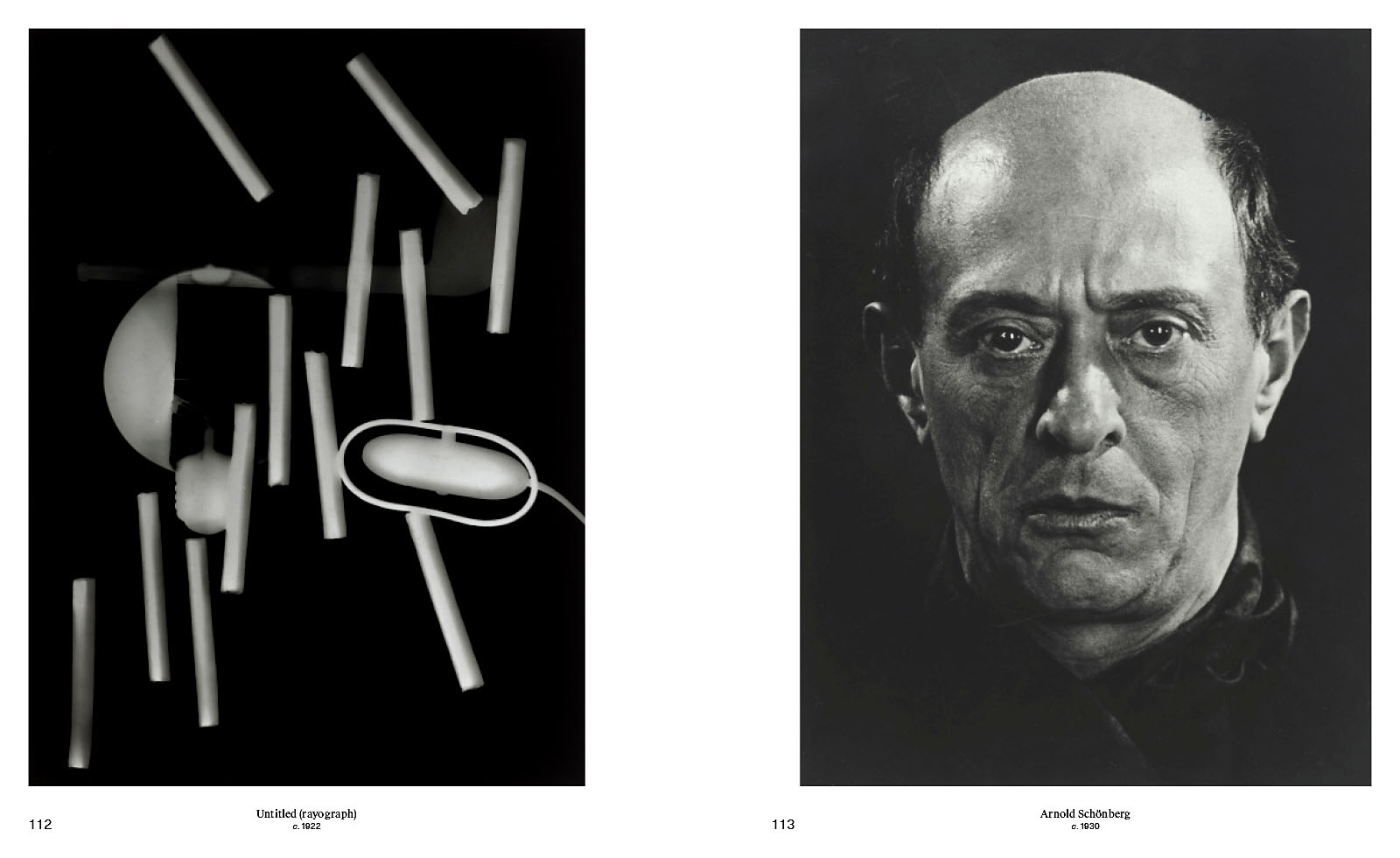
2/ This coldness can be seen in the photographs from the book at the bottom of the posting, where borders frame faces and are inverted, where objects in rayographs are paired opposite objective portraits, surface representations and human visage.

3/ Man Ray quoted in Janus (trans. Murtha Baca). Man Ray: The Photographic Image (London: Gordon Fraser, 1980), 213 quoted in Marcus Bunyan. “The Delicious Fields: Exploring Man Ray’s Rayographs in a Digital Future,” published in The University of Queensland Vanguard Magazine: ‘Man Ray: Life, Work and Themes’, 2004, Triad series #2, pp. 40-46. ISBN 0-9756043-0-9

4/ Bunyan, op cit.,


Many thankx to the Photo Elysee for allowing me to publish the photographs in the posting. Please click on the photographs for a larger version of the image.


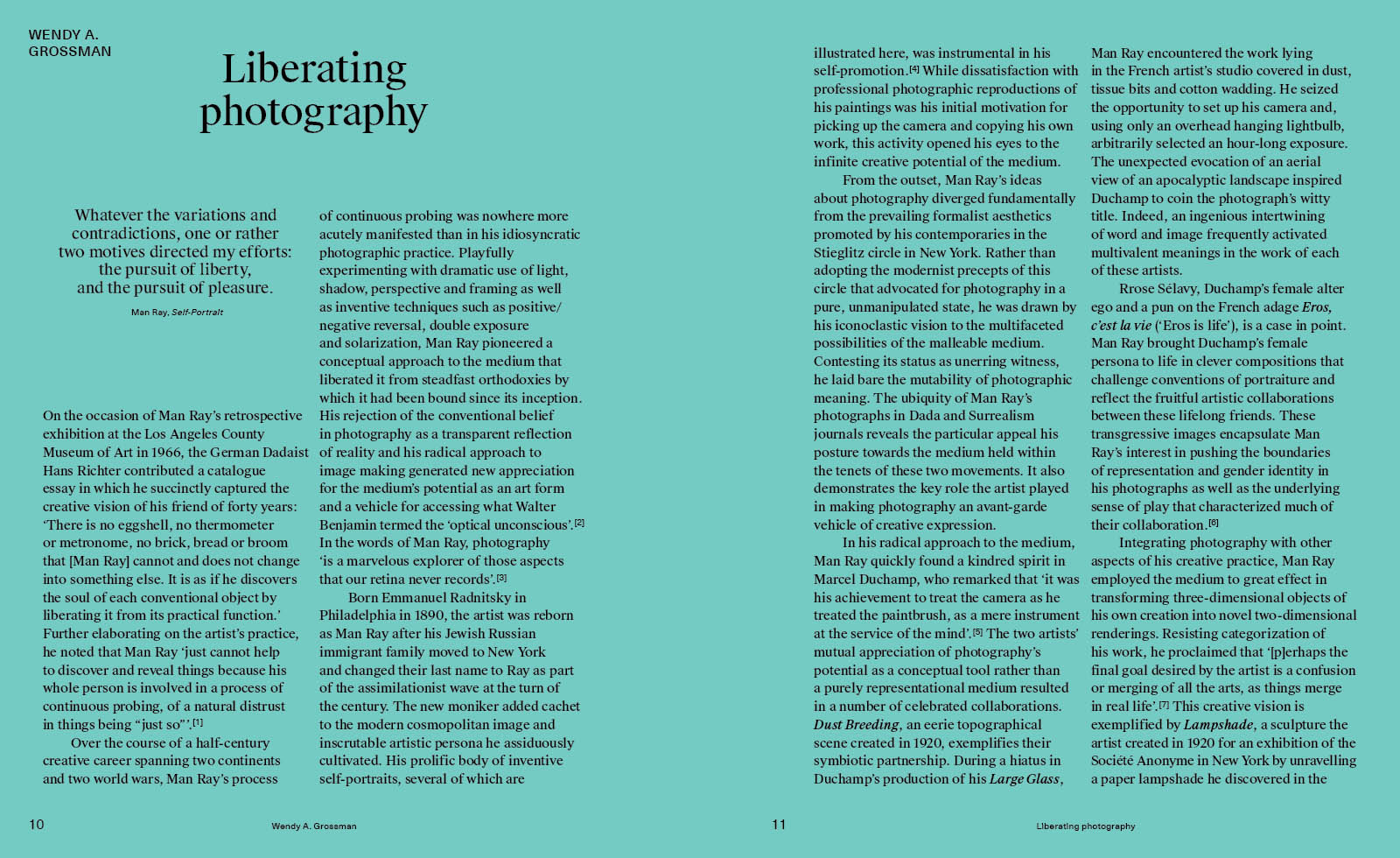
“There is no eggshell, no thermometer or metronome, no brick, bread or broom that [Man Ray] cannot and does not change into something else. It is as if he discovers the soul of each conventional object by liberating it from its practical function…. [Man Ray] just cannot help to discover and reveal things because his whole person is involved in a process of continuous probing, of a natural distrust in things being “just so”.”


Hans Richter 1966


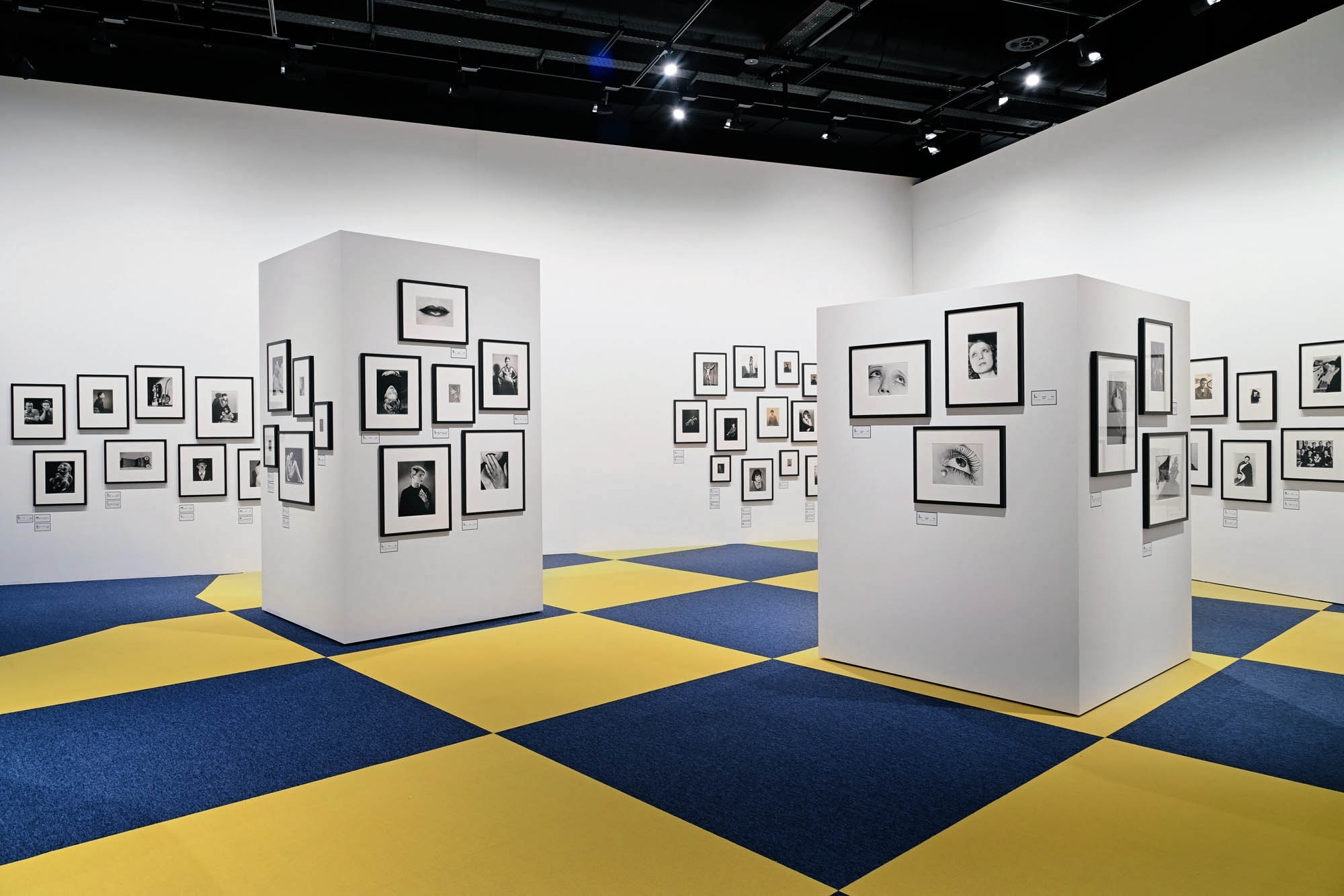
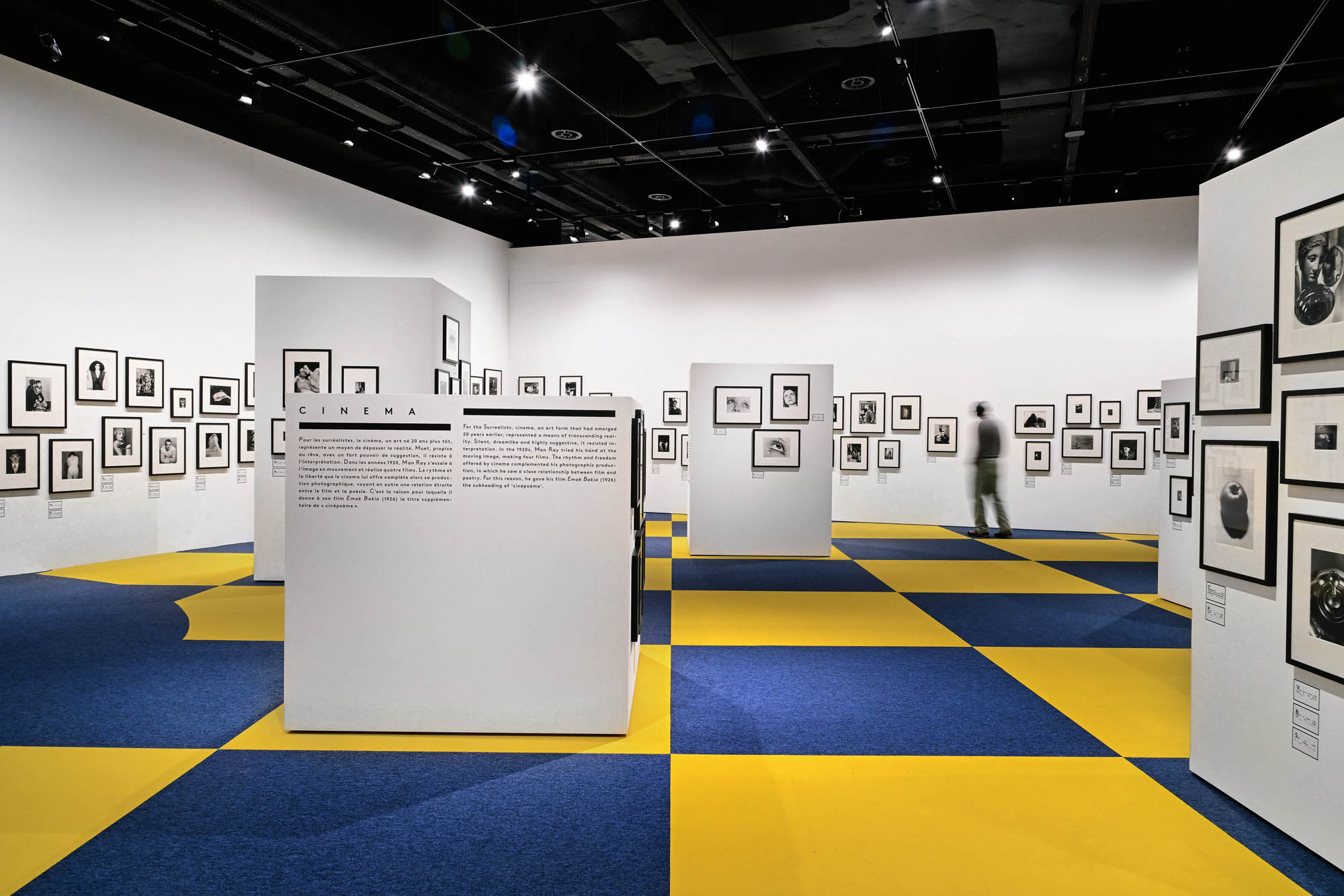
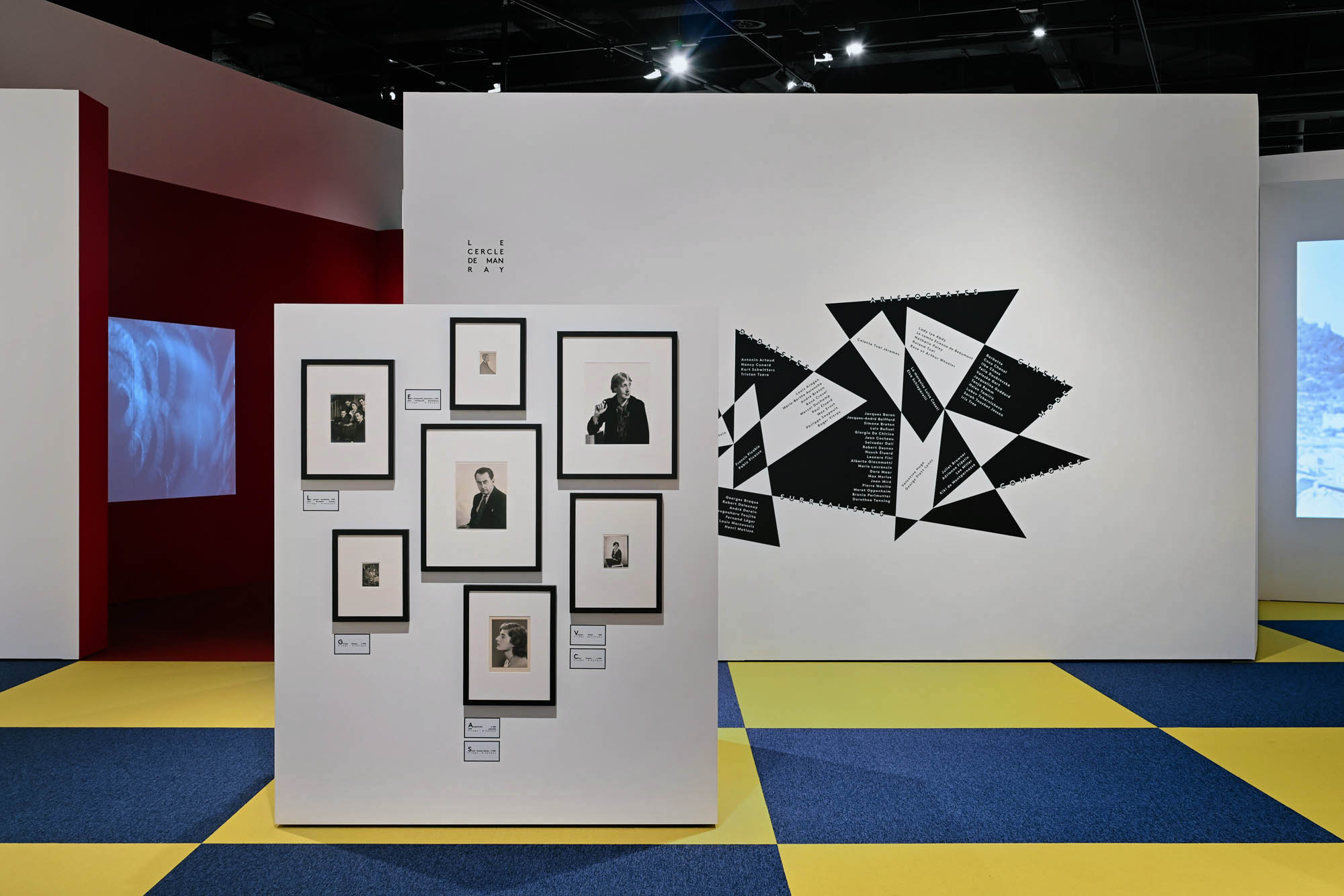
Installation view of the exhibition 'Man Ray. Liberating Photography' at the Photo Elysee, Lausanne

Installation view of the exhibition 'Man Ray. Liberating Photography' at the Photo Elysee, Lausanne
Installation view of the exhibition 'Man Ray. Liberating Photography' at the Photo Elysee, Lausanne showing at right, Man Ray's 'Nude, Kiki de Montparnasse' 1927; 'Artichokes in Bloom' 1934; and 'Still life Plaster Venus with Fruit' c. 1936


Installation views of the exhibition Man Ray. Liberating Photography at the Photo Elysee, Lausanne, showing in the bottom image at right, Man Ray’s Nude, Kiki de Montparnasse 1927; Artichokes in Bloom 1934; and Still life Plaster Venus with Fruit c. 1936
© Khashayar Javanmardi and Photo Elyse Plateforme


“To be totally liberated from painting and its aesthetic implications” was the first avowed aim of Man Ray (United States, 1890-1976), who began his career as a painter. Photography was one of the major breakthroughs of modern art and led to a rethinking of notions of representation. In the 1920s and 30s, the photographic medium came to the forefront of the avant-garde movement, and Man Ray soon made a name for himself with his virtuosity. As a studio portraitist and fashion photographer, but also as an experimental artist who explored the potential of photography with the people around him, Man Ray was a multi-faceted figure. Considered one of the 20th century’s major artists, close to Dada and then Surrealism, he photographed Paris’ artistic milieu between the wars.

Exhibition

Curated from a private collection, the exhibition explores the artist’s extensive social contacts while presenting some of his most iconic works. In addition to providing a dazzling who’s who of the Parisian avant-garde, the works also highlight the innovations in photography made by Man Ray in Paris in the 1920s and 30s.

Artist

He took his first photographs in New York in the 1910s, but it was in Paris that his career took off. Even before opening his studio in Montparnasse in 1922, Man Ray worked for a year in his hotel room. The photographer’s reputation grew, and before long, the artist’s studio was flourishing. Fashion photographs alternated with portraits of the artistic figures of the day who had made Paris’ notoriety: Marcel Duchamp, whom he met in New York in 1915 and who introduced him to the Parisian artistic elite, as well as Robert Delaunay, Georges Braque, Alberto Giacometti and Pablo Picasso, among others, who posed for the photographer. His portraits also included Ballets Russes dancers and guests at the Count de Beaumont’s ball.

As soon as he arrived in Paris in the summer of 1921, Man Ray immediately became part of the Parisian intelligentsia of the Roaring Twenties. He met Jean Cocteau, who was himself a fixture of the Parisian art scene, André Breton, Francis Picabia, Joan Miró, Salvador Dalí, Henri Matisse and Max Ernst. He also met Gertrude Stein, Virginia Woolf, Igor Stravinsky, Ernest Hemingway, Arnold Schoenberg and James Joyce, whom he photographed for the Anglo-American bookshop Shakespeare and Company. But Man Ray was not merely content to have celebrities pose in his studio or to explore the female nude genre by working with those he considered his muses, such as Lee Miller, Kiki de Montparnasse, Meret Oppenheim and Adrienne Fidelin.

Creative Process

Man Ray also experimented in the darkroom, transforming the photographic medium into a powerful tool of artistic expression, even going so far as to do away with the camera when, in 1921-1922, he began creating photograms, which he coined “rayographs” after himself. He explained that working with light in the darkroom allowed him to free himself from painting, so convinced was he of the visual power of his experiments. Also in the 1920s, he experimented with the moving image and produced four films. The rhythm and freedom offered by the cinema complemented his photographic work, in which he saw a close relationship between film and poetry. This is why he gave his film Emak Bakia (1926) the subheading of “cinépoème”. Without ever abandoning portraiture, he experimented with other techniques in the 1930s: solarisation, overprinting and other distortions.

From the outset, photography has been more than a simple process of reproduction. For him, images were not taken fleetingly, but meticulously realised indoors. Unlike Henri Cartier-Bresson who opted for the spontaneous gesture and saw the street as a privileged playground, Man Ray composed and staged his photographs. The studio provided him with a space in which to explore his imagination. Some of the themes dear to the Surrealists can be found in his work: femininity, sexuality, strangeness, the boundary between dream and reality. His nude studies were part of his artistic research, which he developed in close collaboration with his companions who were part of the Parisian art scene. Kiki de Montparnasse – the woman with the f-holes of a violin on her back – whose real name was Alice Prin, was a dancer, singer, actress and painter who posed for artists such as Chaïm Soutine and Kees van Dongen. Lee Miller, a fellow New Yorker like him, had begun a modelling career in the United States but wanted to move to the other side of the camera. She met the photographer in Paris in 1929 when she was 22-years old, and became active in the Surrealist movement. More than a muse, she became his collaborator, learning photography at his side. Together, they discovered the technique of solarisation. Another artist with whom Man Ray had a professional and romantic relationship was the Swiss artist Meret Oppenheim, who was close to the Surrealist scene before pursuing an independent career as an artist.

Man Ray loved the freedom his photographic creations afforded him, and portraits and fashion photography enabled him to earn a living. It was in his studio that he embarked on a series of visual experiments. His portraits, which are relatively classical in style, testify not only to his commercial success, but also to his great sociability. Artists from Montparnasse, Surrealists, fashion and nightlife celebrities, patrons of the arts, Americans in Paris – the entire artistic elite – passed through his studio, as was the case with Nadar in the 19th century. Almost 50 years after Man Ray’s death, his photographs continue to fascinate us. His impact on the history of the medium is undeniable, and he served as an inspiration to photographers of the caliber of Berenice Abbott, Bill Brandt and Lee Miller. Man Ray remains one of the most famous photographers of the 20th century. He never stopped creating, without prejudice or constraint.

Press release from the Photo Elysee


Man Ray (American, 1890-1976) 'Noire et blanche' 1926 from the exhibition Exhibition: 'Man Ray. Liberating Photography' at the Photo Elysee, Lausanne, March - August, 2024


Man Ray (American, 1890-1976)
Black and White
1926
Gelatin silver print
© Man Ray 2015 Trust / 2024, ProLitteris, Zurich. All rights reserved
Without permission from ProLitteris, the reproduction or any use of the individual and private consultation are prohibited


Man Ray (American, 1890-1976) 'Larmes' (Tears) 1930


Man Ray (American, 1890-1976)
Larmes (Tears)
1930
Gelatin silver print
© Man Ray 2015 Trust / 2024, ProLitteris, Zurich. All rights reserved
Without permission from ProLitteris, the reproduction or any use of the individual and private consultation are prohibited


Man Ray (American, 1890-1976) 'Head, New York' 1920


Man Ray (American, 1890-1976)
Head, New York
1920
Gelatin silver print
© Man Ray 2015 Trust / 2024, ProLitteris, Zurich. All rights reserved
Without permission from ProLitteris, the reproduction or any use of the individual and private consultation are prohibited


Man Ray (American, 1890-1976) 'Alice Prin, known as Kiki de Montparnasse' Around 1925


Man Ray (American, 1890-1976)
Alice Prin, known as Kiki de Montparnasse
Around 1925
Gelatin silver print
© Man Ray 2015 Trust / 2024, ProLitteris, Zurich. All rights reserved
Without permission from ProLitteris, the reproduction or any use of the individual and private consultation are prohibited
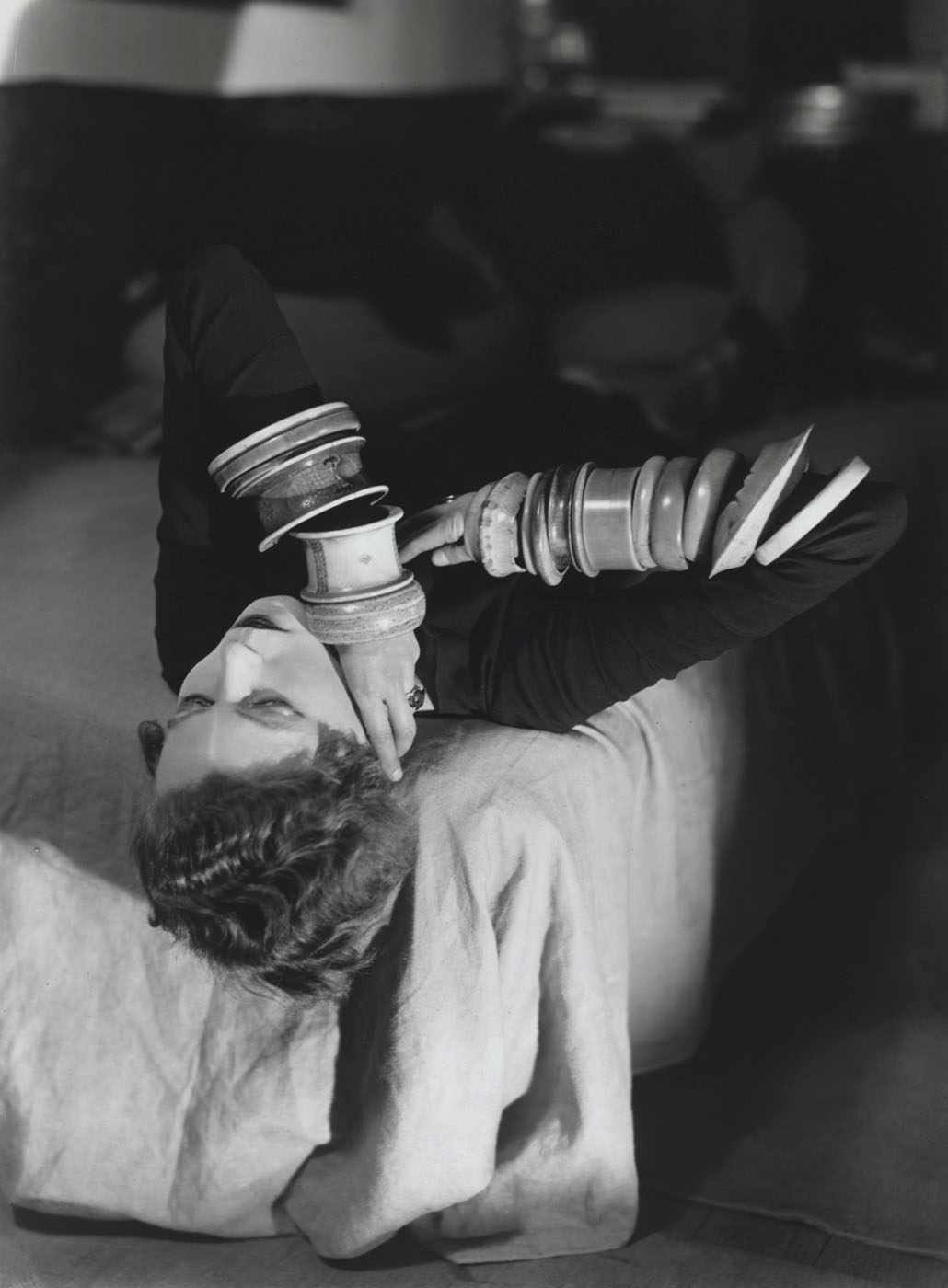
 

Man Ray (American, 1890-1976) 'Nancy Cunard' c. 1925


Man Ray (American, 1890-1976)
Nancy Cunard
c. 1925
Gelatin silver print
© Man Ray 2015 Trust / 2024, ProLitteris, Zurich. All rights reserved
Without permission from ProLitteris, the reproduction or any use of the individual and private consultation are prohibited


Nancy Clara Cunard (10 March 1896 – 17 March 1965) was a British writer, heiress and political activist. She was born into the British upper class, and devoted much of her life to fighting racism and fascism. She became a muse to some of the 20th century’s most distinguished writers and artists, including Wyndham Lewis, Aldous Huxley, Tristan Tzara, Ezra Pound and Louis Aragon – who were among her lovers – as well as Ernest Hemingway, James Joyce, Constantin BrâncuÈ™i, Langston Hughes, Man Ray and William Carlos Williams. MI5 documents reveal that she was involved with Indian diplomat, orator, and statesman V. K. Krishna Menon.

Text from the Wikipedia website


Man Ray (American, 1890-1976) 'Jacqueline Goddard' c. 1932


Man Ray (American, 1890-1976)
Jacqueline Goddard
c. 1932
Solarised gelatin silver print
© Man Ray 2015 Trust / 2024, ProLitteris, Zurich. All rights reserved
Without permission from ProLitteris, the reproduction or any use of the individual and private consultation are prohibited


Jacqueline Goddard (French, 1912-2003)

Jacqueline Goddard, née Barsotti (1912-2003), was a favourite model of the Surrealist artist and photographer Man Ray in Paris during the 1930s.

As Jacqueline Barsotti, she had arrived in Montparnasse at the age of 17, a tall beauty with unruly fair hair. She was soon frequenting La Coupole and other haunts of the fashionable artists of the day. Many years later, by which time she was living on the Isle of Wight, she wrote a personal memoir in which she recalled her experiences and offered some piquant observations about the personalities she had come to know. …

Jacqueline Barsotti became a close friend of Man Ray, and of his former mistress, Kiki de Montparnasse. Of Man Ray she reported, “He was not handsome, his nose had no opinion and went all over the place. He always seemed to be meditating, and was seldom light-hearted. It was a great pity that he did not smile a lot. That little grin of his changed him altogether.” Kiki, without makeup, “looked like a potato”.

Another of Man Ray’s mistresses was the American photographer, Lee Miller. On the night that Lee Miller left Man Ray, Jacqueline Barsotti walked with him in the rain through Montparnasse cemetery before they returned to his studio, where he arranged a table with a bottle of poison, a gun and a rope. Then, as Man Ray sat at the table, Jacqueline herself took the picture of the artist contemplating suicide.

When Man Ray presented her with a book of his photographs, he proposed the inscription, “To the most beautiful girl I have ever photographed”; she demurred. So he suggested, “To the only one I did not sleep with”; Jacqueline Barsotti said that this would compromise his other models. Likewise, she rejected “To the most inspiring one” as “a compliment for me, but rude to others”. In the end he had to settle for “With all my love, Man Ray”.

She insisted that she and Man Ray were never lovers: “He was 50 when I was merely 17. I was tall, he was short. I was supposed to be very nice to look at, he was not.” After his death, Man Ray’s wife Juliette gave Jacqueline a lithograph of his self-portrait, inscribing it, “To Jacqueline that did not”.

Anonymous. “Jacqueline Goddard,” obituary on The Telegraph website, 25 July 2003 [Online] Cited 01/05/2026. Used under fair use conditions for the purposes of education and research


Man Ray (American, 1890-1976) 'Paul Eluard and André Breton' 1939


Man Ray (American, 1890-1976)
Paul Eluard and André Breton
1939
Gelatin silver print
© Man Ray 2015 Trust / 2024, ProLitteris, Zurich. All rights reserved
Without permission from ProLitteris, the reproduction or any use of the individual and private consultation are prohibited


Few names in the history of photography are as illustrious at that of Man Ray, born Emmanuel Radnitzsky (1890-1976) in the United States. Studio portraitist, fashion photographer and experimental artist, he explored the many potentialities of photography at a time when the medium was asserting itself as the very expression of modernity. Mingling with the Paris art scene of the early 20th century, and a close friend of Marcel Duchamp and André Breton, he was one of the few photographers to be mentioned among the Dada artists and Surrealists.

When Man Ray decided to become a professional photographer, it was primarily because he saw it as a way to earn a living. His studio rapidly became a gathering place for the entire Parisian art scene of its day: Henri Matisse, Pablo Picasso, Robert Delaunay, Alberto Giacometti, Salvador Dalí and Max Ernst, among others. His work includes portraits of the artists, writers and intellectuals in his circle, including Coco Chanel, Paul Éluard, James Joyce, Elsa Schiaparelli, Igor Stravinsky and Virginia Woolf. Not just content to have celebrities pose in his studio, he tried his hand at staging and photographing his female models – Lee Miller, Kiki de Montparnasse and Meret Oppenheim – in a variety of different settings. Following his encounter with the famous fashion designer Paul Poiret, Man Ray also worked as a fashion photographer for French and American Vogue, as well as for Harper’s Bazaar.

Man Ray, whose career spanned more than 60 years, saw the medium as a creative tool that would allow him to go beyond the representation of reality. While always exploring abstraction, he also made relatively traditional portraits of the artists who surrounded him – a circle to which he was introduced by Marcel Duchamp just after he arrived in Paris. He is the creator of Violon d’Ingres [Ingres’s Violin] – the iconic photograph taken in 1924 that can be found in every art history book published in the 20th century. Man Ray remains an important name in the worlds of art, fashion and pop culture, with so many artists referring to the photographs of this iconic figure of modern art.

Curated from a private collection, the exhibition explores the artist’s extensive social contacts while presenting some of his most iconic works.

1. PROOF AND PRINT, A QUESTION OF VOCABULARY

The question of Man Ray’s prints has remained a source of fascination throughout the history of photography. His work went through a series of successive generations of prints over the course of the 20th century, starting with prints made shortly after the photograph was taken: contact prints and more refined prints that highlight his artistic choices. From the 1950s onwards, Man Ray reinterpreted certain photographs to produce new prints, sometimes changing the framing. He also enlisted the services of various photographic laboratories such as Picto, and, in particular, the renowned printer Pierre Gassman, whose lab produced many posthumous prints.

The prolific nature of Man Ray’s work is reflected by some 12,000 negatives from his studio archive that were added to the collections of the Centre Pompidou in Paris. The experimental and pioneering nature of Man Ray’s work raises a number of particular questions, especially in relation to the photograms that he produced and reproduced, contradicting their primary characteristics as unique works. All these elements make it more difficult to determine the artist’s intention as well as the aesthetic and historical value of his works, compared to other, more linear authors. The way we refer to Man Ray’s photographs is therefore important, and the notions of proof, print and original are paramount.

Proof

A term from the world of printmaking and sculpture, it was adopted at the birth of photography by François Arago in his 1839 lecture. It designates the object obtained from a matrix, in photography, from a negative.

Original proof

Any copy made under the control of the artist or the holders of his or her moral rights and whose history can be traced. In the absence of this relationship, the object is considered a reproduction and not an original work.

Contact print

A print obtained by placing the negative directly on photosensitive paper. It is generally for the photographer’s use only and is used as a reference for an archiving system and as a tool to read newly printed photographs for the first time. A distinction must be made between contact prints, which are the same size as the negative and on which Man Ray generally cropped his photographs, and contact sheets, which allow the viewer to see the entire photographic film.

Vintage print

A print made during the period when the photograph was taken, and whose formal characteristics (format, tonality, contrast, inscriptions) reflect the artist’s intention. Sometimes, authors – as in the case of Man Ray – revisit their archives and produce new prints from an old negative, years after it was produced. This is known as a late print, or even a posthumous print when made by the artist’s beneficiaries after his or her death. All the posthumous prints in this exhibition are by Pierre Gassman.

Countertype

Countertype is obtained by re-photographing a photographic image. Man Ray often countertyped his original photograms for distribution and even sale.

2. STUDIO

‘To be totally liberated from painting and its aesthetic implications’ was the first avowed aim of Man Ray, who began his career as a painter.

Photography was one of the major breakthroughs of modern art and led to a rethinking of representation. In the 1920s and 30s, the photographic medium came to the forefront of the avant-garde movement, and Man Ray soon made a name for himself with his virtuosity. His photographs were not taken fleetingly, but rather meticulously produced in the studio. Unlike some photographers who see the street as a privileged playground, Man Ray composed and staged his photographs. The studio provided him with a space in which to explore his imagination.

3. ELITE

From the moment he arrived in Paris in the summer of 1921, Man Ray was part of the Parisian intelligentsia of the Roaring Twenties. Even before opening his studio in Montparnasse in 1922, he worked from his hotel room. His reputation as a photographer grew rapidly. He photographed Marcel Duchamp, whom he had met in New York in 1915, and who introduced him to the Parisian artistic elite and to many other painters such as Robert Delaunay, Georges Braque, Alberto Giacometti and Pablo Picasso. He met Jean Cocteau, who was himself a fixture of the Parisian art scene, as well as André Breton, Francis Picabia, Joan Miró, Salvador Dalí, Henri Matisse and Max Ernst, plus many intellectual figures of his day, including Gertrude Stein, Virginia Woolf, Igor Stravinsky, Ernest Hemingway, Arnold Schönberg and James Joyce.

4. MUSES

Through photography, a medium with multiple possibilities, the Surrealists sought not to reproduce reality, but to sublimate it. Love, as seen primarily by men, was an example of this idea of transformation. An essential notion for Luis Buñuel and Paul Éluard, love was a means of escaping reality and evoking the extraordinary. Femininity, sexuality and the fine line between dream and reality were dominant themes in Man Ray’s work when he was exploring the female nude, having those he considered to be his muses pose for his camera. He photographed Lee Miller, a fellow New Yorker who had begun a career as a model but wanted to move to the other side of the camera; Alice Prin, known as Kiki de Montparnasse, the woman with the fholes of a violin on her back, dancer, singer, actress and painter; and the Swiss artist Meret Oppenheim, who was close to the Surrealist scene before pursuing an independent career as an artist, and with whom he also had a professional and romantic relationship. In the late 1930s, Man Ray had his partner, Adrienne Fidelin, known as Ady, a dancer from Guadeloupe, pose for him.

5. EXPERIMENTATIONS

Man Ray also experimented in the darkroom, transforming the photographic medium into a powerful tool of artistic expression, even going so far as to do away with the camera when, in 1921-1922, he began creating photograms, which he coined ‘rayographs’ after himself. He described this darkroom work as a way of freeing himself from painting, so convinced was he of the visual power of his experiments. By placing objects directly onto photosensitive paper, he could play with shadows and light, fascinated by the abstractions created by this technique and that produced a unique work of art. He experimented with other techniques in the 1930s: solarisation, double exposures and different forms of distortion.

6. CINEMA

For the Surrealists, cinema, an art form that had emerged 20 years earlier, represented a means of transcending reality. Silent, dreamlike and highly suggestive, it resisted interpretation. In the 1920s, Man Ray tried his hand at the moving image, making four films. The rhythm and freedom offered by cinema complemented his photographic production, in which he saw a close relationship between film and poetry. For this reason, he gave his film Emak Bakia (1926) the subheading of ‘cinépoème’.

Texts: Nathalie Herschdorfer, Sarah Bourget and Wendy A. Grossman
English translation: Gail Wagman
Proofreading: Hannah Pröbsting

Exhibition texts from the Photo Elysee
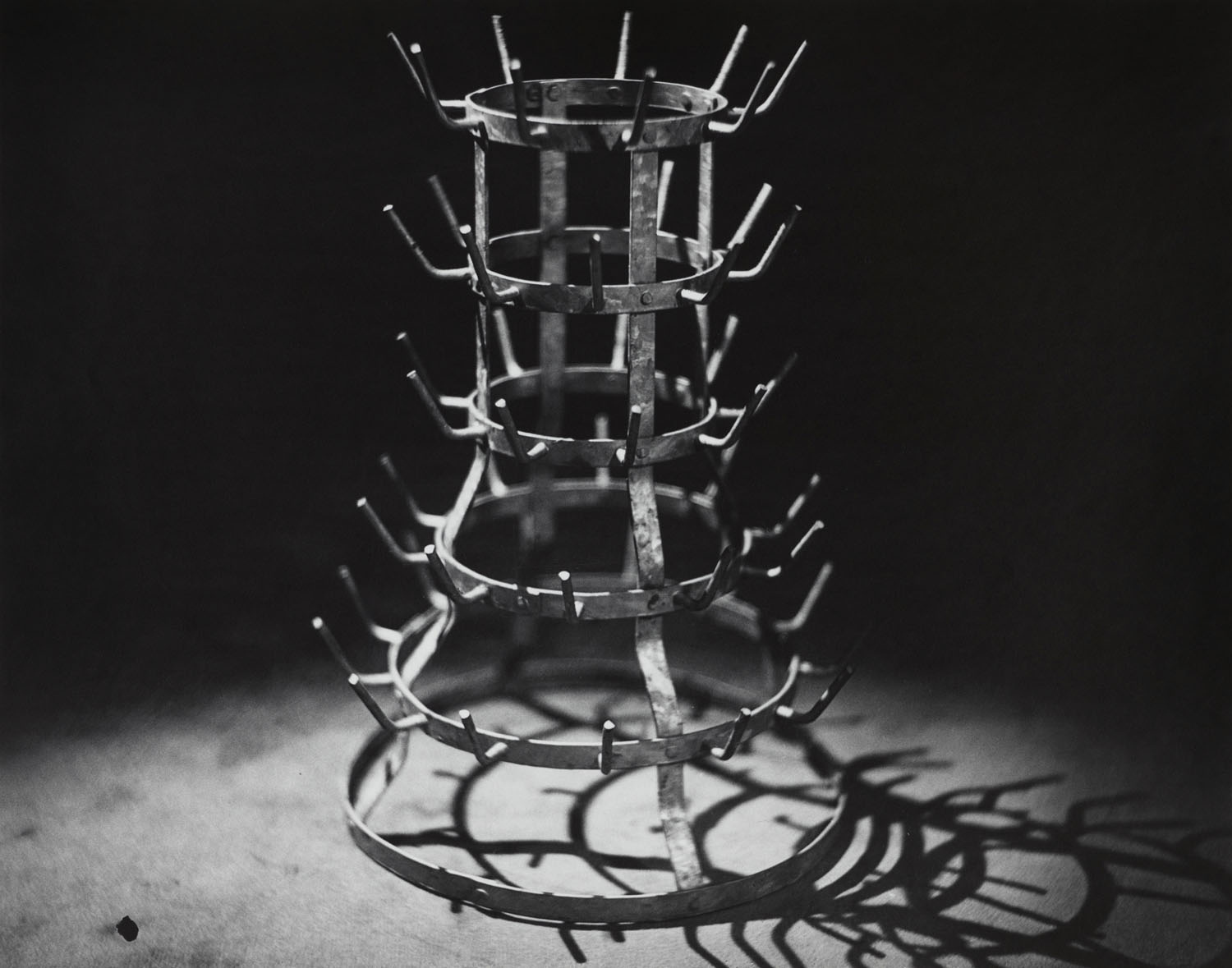
 

Man Ray (American, 1890-1976) 'Bottle-holder by Marcel Duchamp' c. 1920


Man Ray (American, 1890-1976)
Bottle-holder by Marcel Duchamp
c. 1920
Gelatin silver print
© Man Ray 2015 Trust / 2024, ProLitteris, Zurich. All rights reserved
Without permission from ProLitteris, the reproduction or any use of the individual and private consultation are prohibited


Man Ray (American, 1890-1976) 'Flowers' 1925


Man Ray (American, 1890-1976)
Flowers
1925
Gelatin silver print
© Man Ray 2015 Trust / 2024, ProLitteris, Zurich. All rights reserved
Without permission from ProLitteris, the reproduction or any use of the individual and private consultation are prohibited


In my early paper titled “The Delicious Fields: Exploring Man Ray’s ‘Rayographs’ in a Digital Future” published in The University of Queensland Vanguard magazine special edition ‘Man Ray: Life, Work & Themes’ (2004) I wrote:

The rayographs

After his arrival in Paris Man Ray started experimenting in his darkroom and discovered the technique for his rayographs by accident. With the help of his friend the Surrealist poet Tristan Tzara, he published a portfolio of twelve rayographs in 1922 called ‘Les champs délicieux’ (The delicious fields). “This title is a reference to ‘Les champs magnétiques’, a collection of writings by André Breton and Philippe Soupault composed from purportedly random thought fragments recorded by the two authors.”1 The rayographs are visual representations of random thought fragments, “photographic equivalents for the Surrealist sensibility that glorified randomness and disjunction.”2 Man Ray, “denied the camera its simplest joy: the ability to capture everything, all the distant details, all the ephemeral lights and shadows of the world”3 but, paradoxically, the rayographs are the most ephemeral of creatures, only being able to be created once, the result not being known until after the photographic paper has been developed. In fact, for Man Ray to create his portfolio ‘Les champs délicieux’ (The delicious fields), he had to rephotograph the rayographs in order to make multiple copies.4

Man Ray “insisted in nearly every interview that the rayograph was not a photogram in the traditional sense. He did something that a photogram didn’t; he introduced depth into the images,”5 which denied the images their photographic objectivity by depicting an internal landscape rather than an external one.6 What the rayographs do not deny, however, is the subjectivity of the artist, his skill at placing the objects on the photographic paper, expressed in their dream-like nature, both a subjective ephemerality (because they could only be produced once) and an ephemeral subjectivity (because they were expressions of Man Ray’s fantasies, and therefore had little substance). Through an alchemical process the latent images emerge from the photographic paper, representations of Man Ray’s fantasies as embodied in the ‘presence’ of the objects themselves, in the surface of the paper. …

Finally, within their depth of field the rayographs can be seen as both dangerous and delicious, for somehow they are both beautiful and unsettling at one and the same time. As Surrealism revels in randomness and chance these images enact the titles of other Man Ray photographs: ‘Danger-Dancer’, ‘Anxiety’, ‘Dust Raising’, ‘Distorted House’. The rayographs revel in chance and risk; Man Ray brings his fantasies to the surface, an interior landscape represented externally that can be (re)produced only once – those dangerous delicious fields.7

Marcus Bunyan. “The Delicious Fields: Exploring Man Ray’s Rayographs in a Digital Future,” in The University of Queensland Vanguard Magazine: ‘Man Ray: Life, Work and Themes’, 2004, Triad series #2, pp. 40-46. ISBN 0-9756043-0-9
 

Footnotes

1/ Greenberg, Mark (ed.,). In Focus: Man Ray: Photographs from the J. Paul Getty Museum. Los Angeles: The J. Paul Getty Museum, 1998, p. 28 quoted in Bunyan, op cit.,

2/ Perl, Jed (ed.,). Man Ray: Aperture Masters of Photography. New York: Aperture, 1997, pp. 11-12 quoted in Bunyan, op cit.,

3/ Ibid., pp. 5-6 quoted in Bunyan, op cit.,

4/ Greenberg, Mark (ed.,). In Focus: Man Ray: Photographs from the J. Paul Getty Museum. Los Angeles: The J. Paul Getty Museum, 1998, p. 28 quoted in Bunyan, op cit.,

5/ Ibid., p. 112 quoted in Bunyan, op cit.,

6/ Ibid., p. 28 quoted in Bunyan, op cit.,

7/ Marcus Bunyan. “The Delicious Fields: Exploring Man Ray’s Rayographs in a Digital Future,” in The University of Queensland Vanguard Magazine: ‘Man Ray: Life, Work and Themes’, 2004, Triad series #2, pp. 40-46. ISBN 0-9756043-0-9


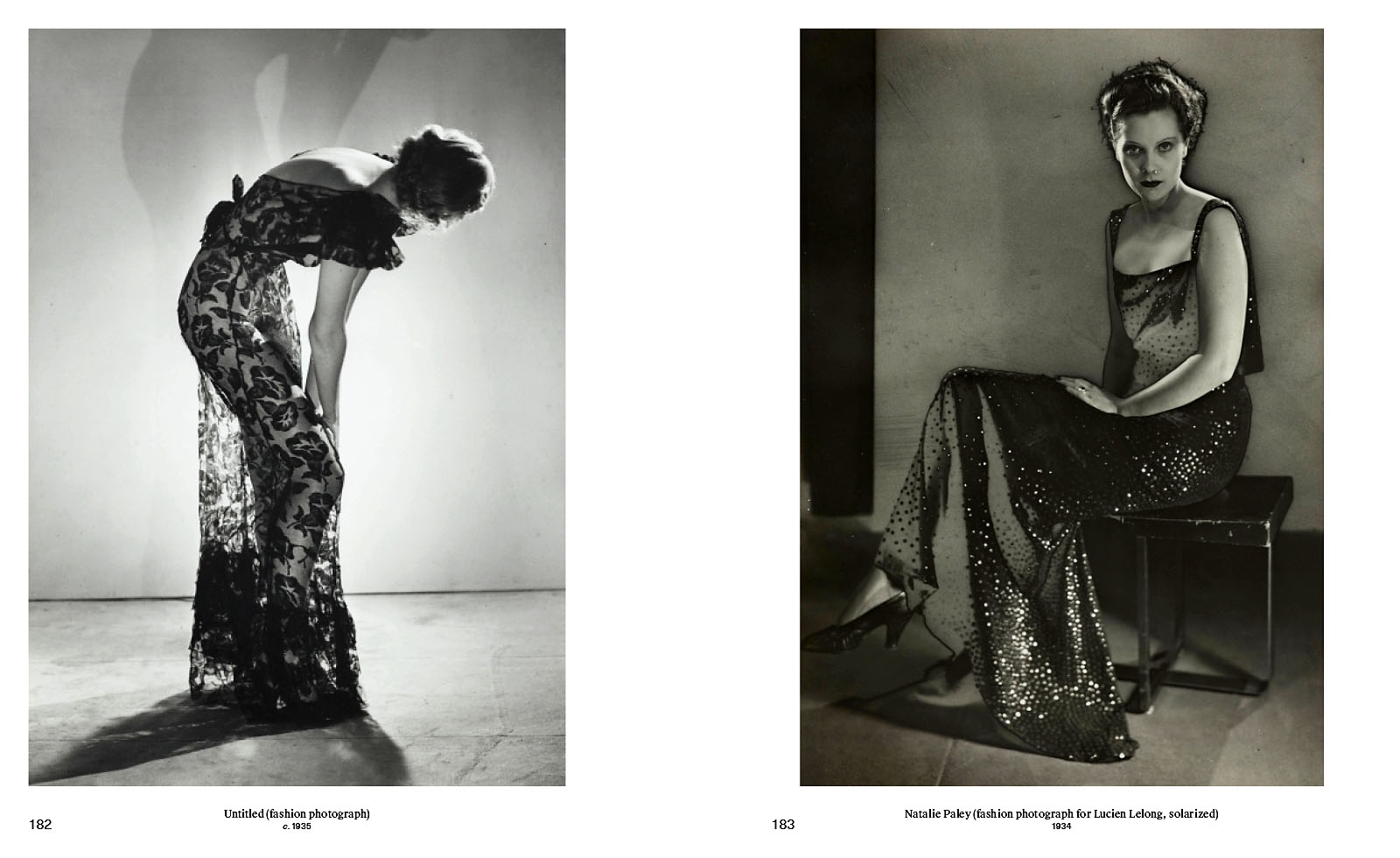
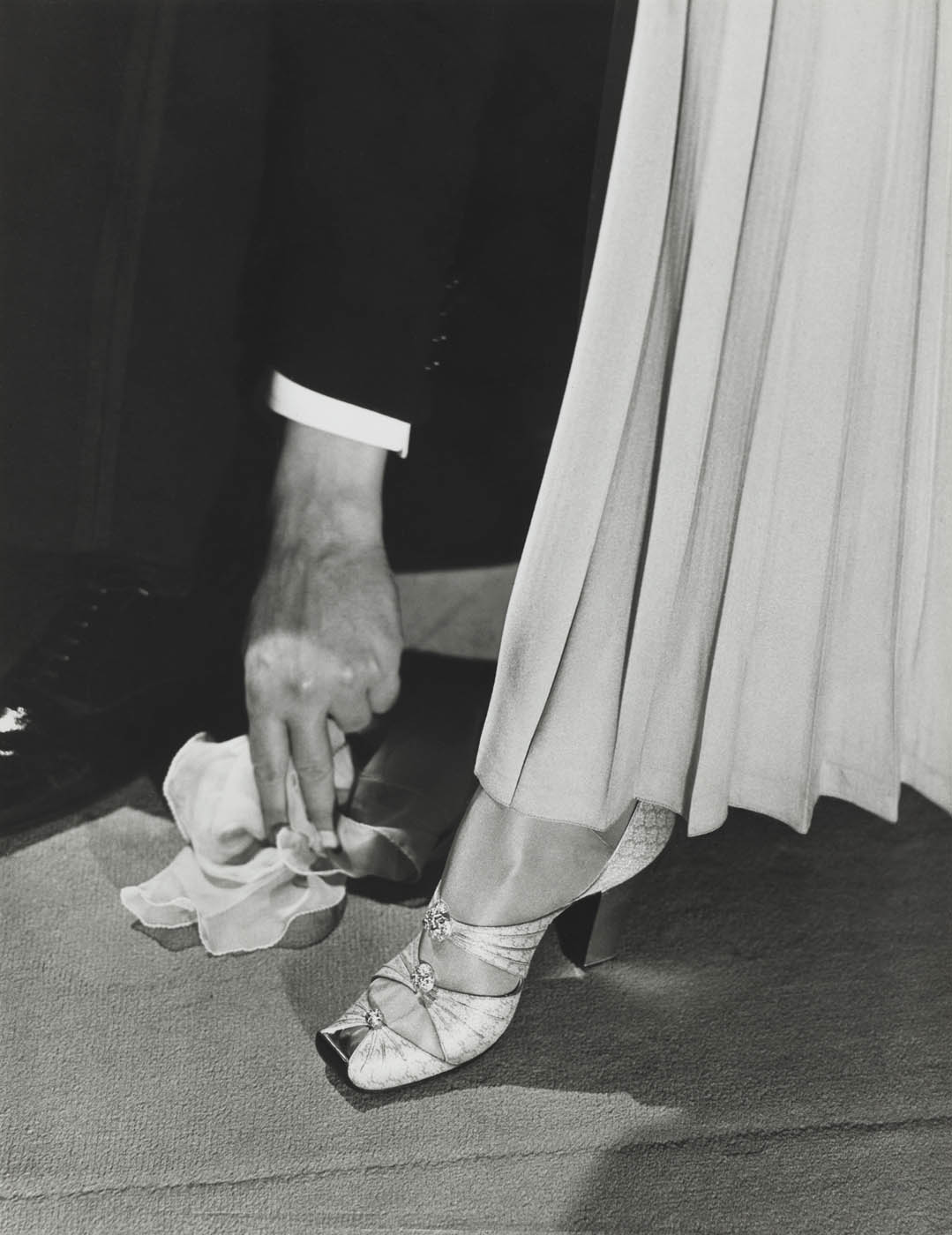
Man Ray (American, 1890-1976) 'Fashion photograph' c. 1935


Man Ray (American, 1890-1976)
Fashion photograph
c. 1935
Gelatin silver print
© Man Ray 2015 Trust / 2024, ProLitteris, Zurich. All rights reserved
Without permission from ProLitteris, the reproduction or any use of the individual and private consultation are prohibited
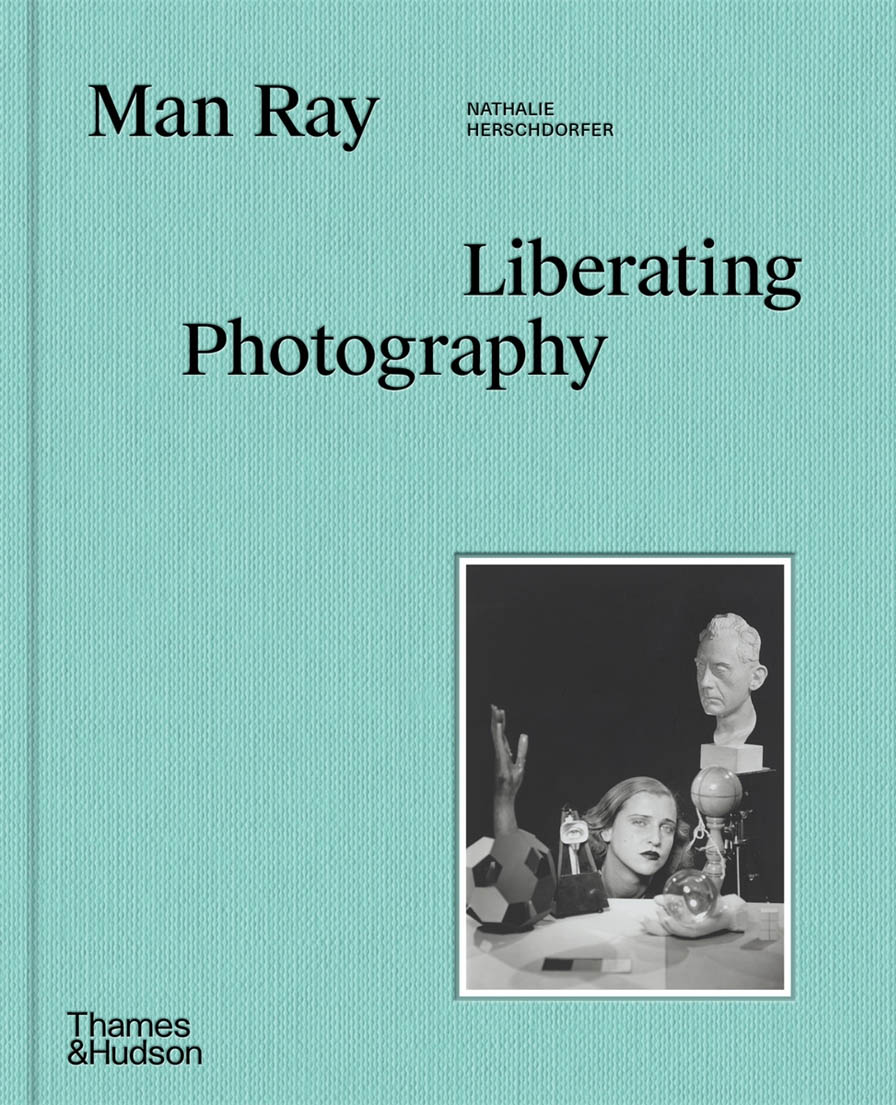
 

'Man Ray. Liberating Photography' book cover


Man Ray. Liberating Photography book cover


Man Ray. Liberating Photography

Nathalie Herschdorfer, Wendy Grossman

Published in connection with an exhibition opening at Photo Elysée in spring 2024, this book presents more than one hundred and fifty of Man Ray’s portraits, primarily from the 1920s and ’30s.

Man Ray (1890-1976) was a man both of and ahead of his time. With his conceptual approach and innovative techniques, he liberated photography from previous constraints and opened the floodgates to new ways of thinking about the medium.

A close friend of Marcel Duchamp and André Breton, he was one of the few photographers to be mentioned among the Dada artists and surrealists. He also worked as a fashion photographer, first for Vogue and later for Harper’s Bazaar and Vanity Fair. Renowned as the creator of Ingres’s Violin – a photograph from 1924 that broke records when it was sold for $12.4 million in 2022 – Man Ray remains an influential figure in the worlds of art, fashion, and pop culture, with many other artists referencing his work.

Published in connection with an exhibition at Photo Elysée and in the centennial year of the publication of André Breton’s Surrealist Manifesto, Man Ray presents more than one hundred and fifty of Man Ray’s portraits, primarily from the 1920s and ’30s. It includes portraits of the leading lights of the Paris art scene, among them Marcel Duchamp, Robert Delaunay, Georges Braque, Alberto Giacometti, and Pablo Picasso, as well as a selection of his fashion work. As an innovator of photographic techniques and compositional form, Man Ray found the studio portrait – be it of the artists and writers with whom he had longstanding friendships or of the objects and sculptures he collected – to be the playground in which he could express the visual wit and experimentation for which he is renowned.

Format: Hardcover
Pages: 224
Artwork: 153 black-and-white illustrations
Size: 7.75 in x 9.5 in
Forthcoming: September 10th, 2024
ISBN-10: 0500028117
ISBN-13: 9780500028117
Buy the book now


'Man Ray. Liberating Photography'

'Man Ray. Liberating Photography'

'Man Ray. Liberating Photography'

'Man Ray. Liberating Photography'

'Man Ray. Liberating Photography'

'Man Ray. Liberating Photography'

'Man Ray. Liberating Photography'

'Man Ray. Liberating Photography'


Man Ray. Liberating Photography book pages


Photo Elysee
Place de la Gare 17
CH-1003 Lausanne
+41 21 318 44 00

Opening hours:
Monday : 10am – 6pm
Tuesday : closed (MCBA open)
Wednesday : 10am – 6pm
Thursday : 10am – 8pm
Friday : 10am – 6pm
Saturday : 10am – 6pm
Sunday : 10am – 6pm

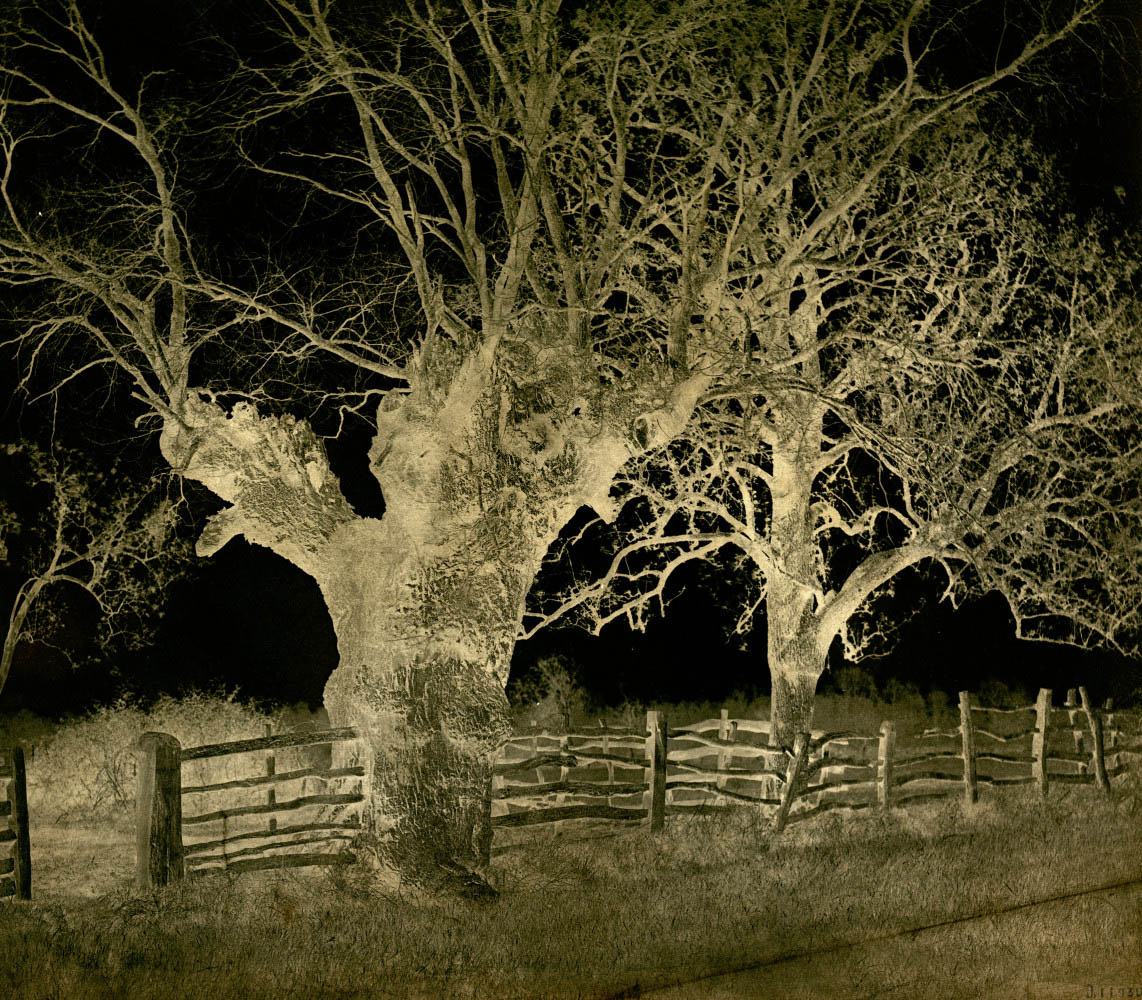
Photo Elysee website

LIKE ART BLART ON FACEBOOK

Back to top

Exhibition: ‘Noir & Blanc: une esthétique de la photographie’ at the Bibliothèque nationale de France (BnF), François-Mitterrand, Paris

Exhibition dates: 17th October 2023 – 21st January 2024


Benjamin Brecknell Turner (English, 1815-1894) 'North Side of Quadrangle, Arundel Castle' 1852-1854


Benjamin Brecknell Turner (English, 1815-1894)
North Side of Quadrangle, Arundel Castle
1852-1854
Negative photograph on paper
29.7 x 39.6cm
BnF, department of Prints and Photography, RES PHOTO EI-6-BOITE FOL B (n° 3)
Gift of André and Marie-Thérèse Jammes, 1960


What a lovely exhibition to start the year 2024 on Art Blart.

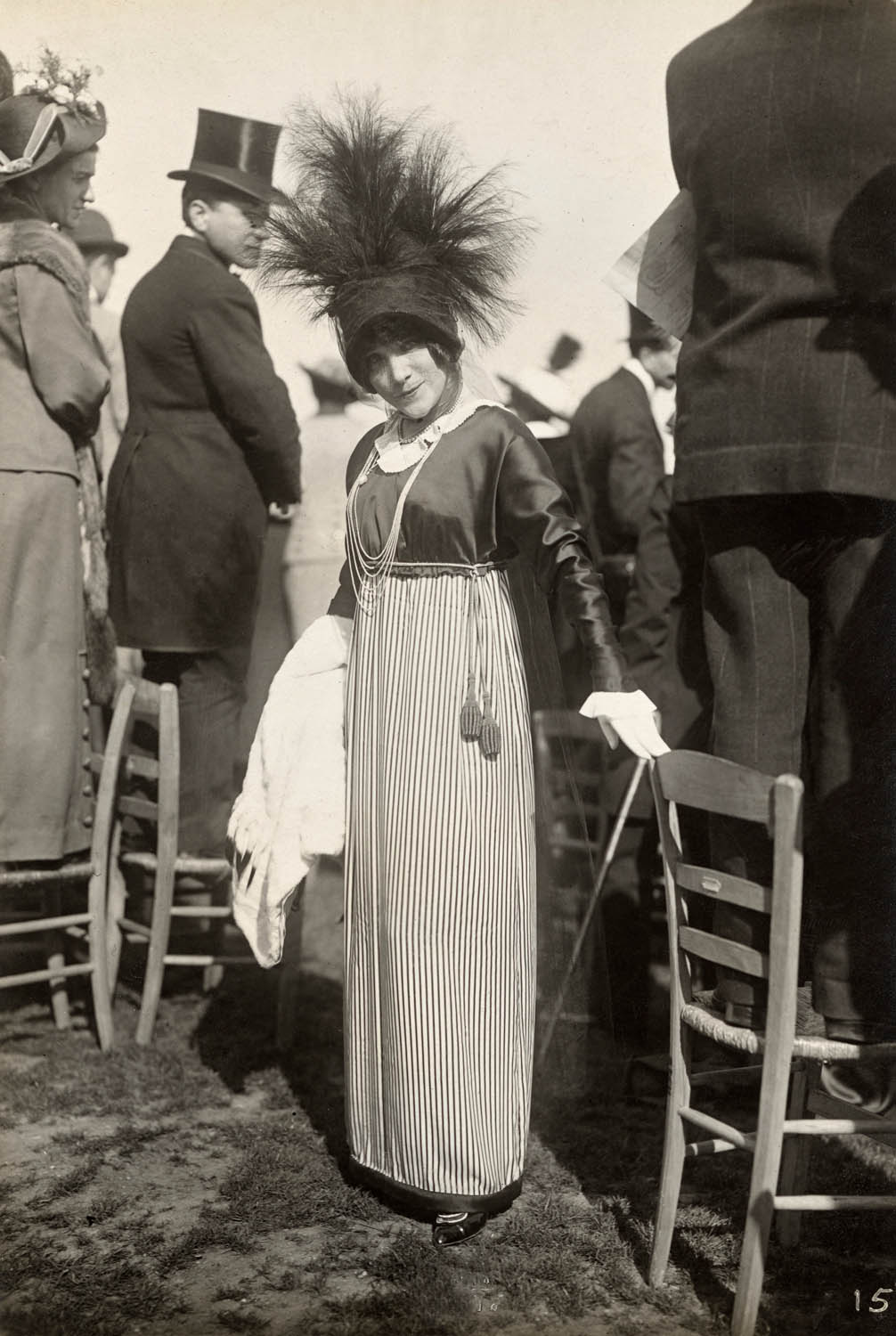
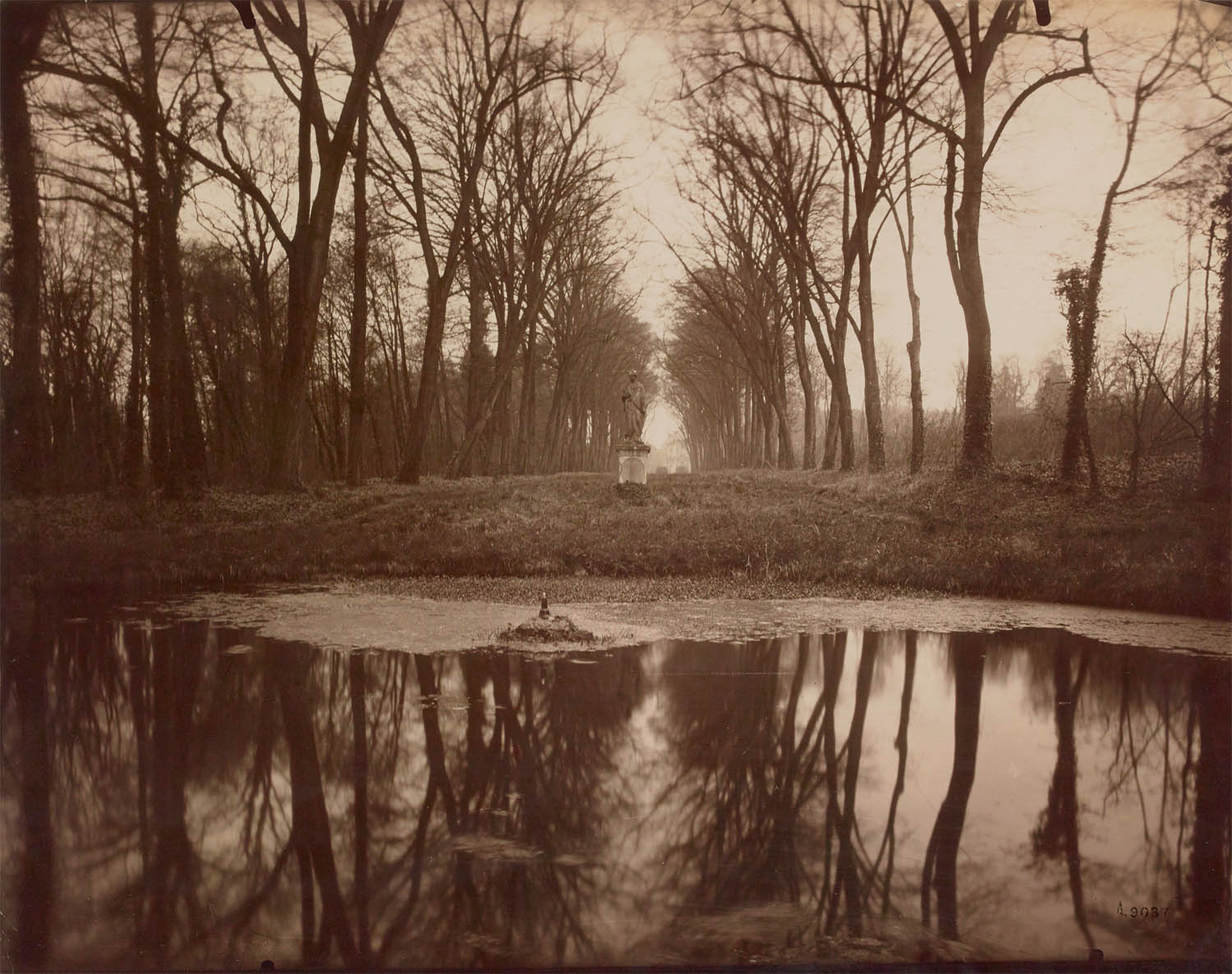
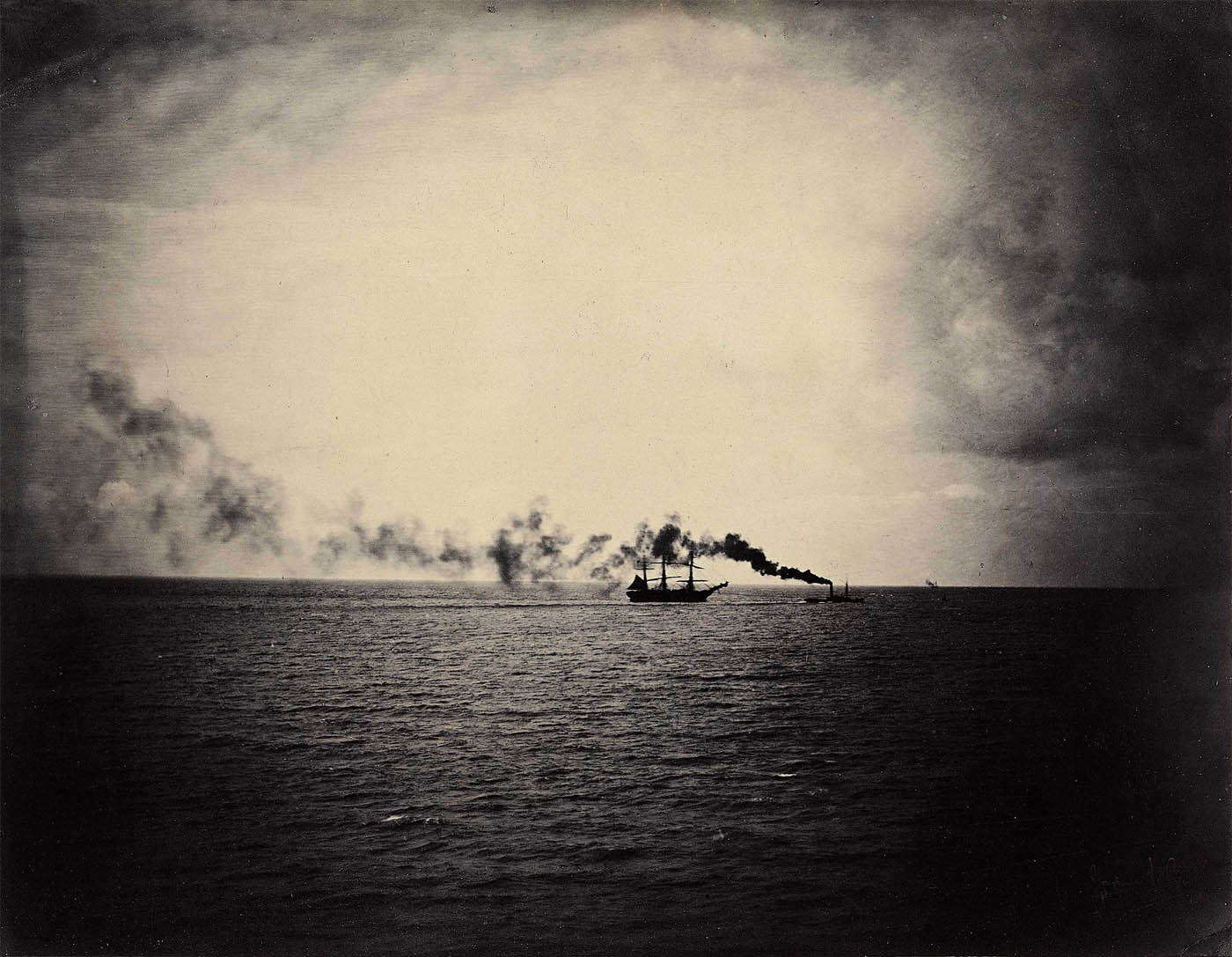
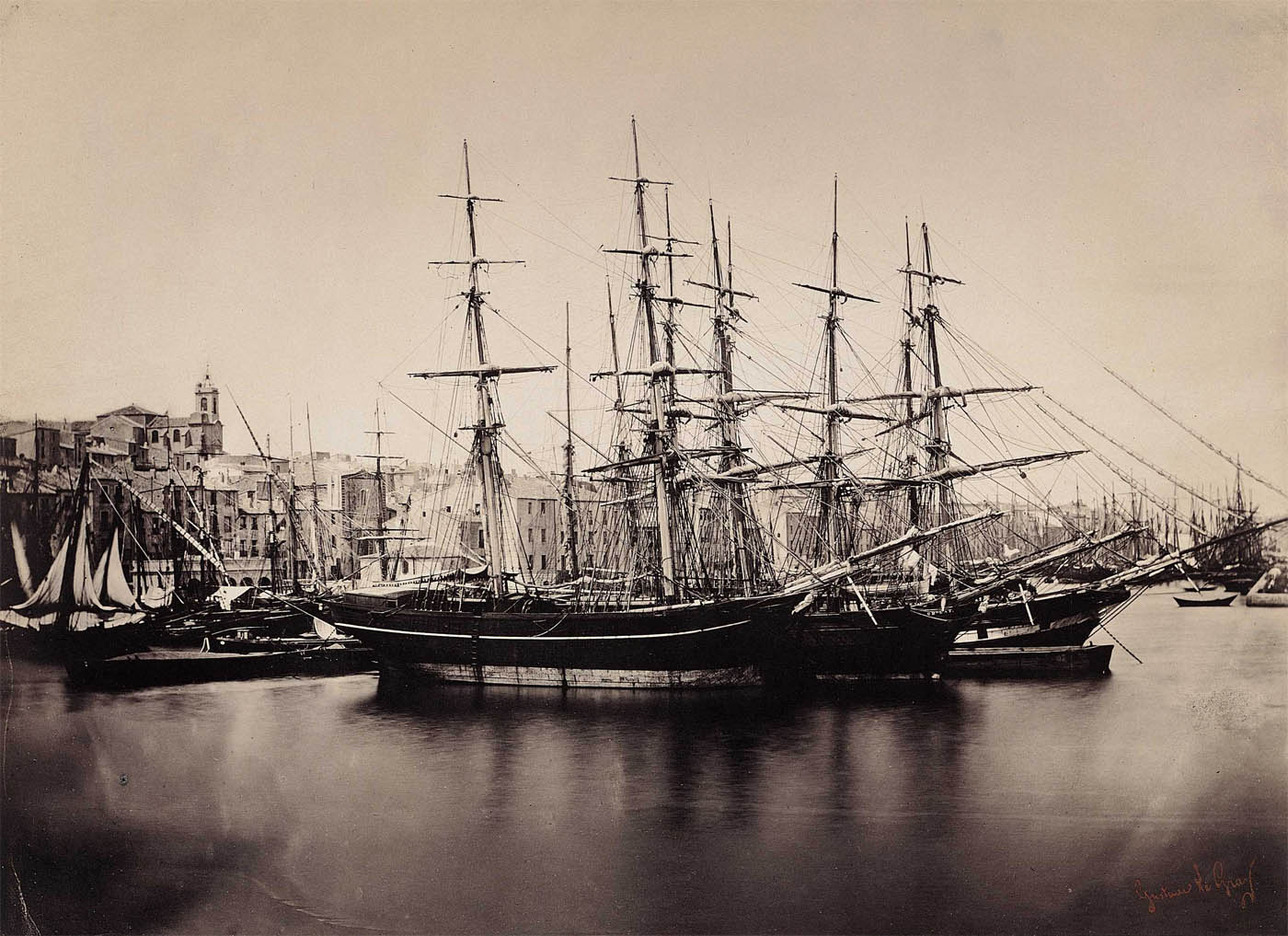
My favourite photographs in the posting: three beautiful fashion photographs by Frères Séeberger; a stunning late Atget Parc de Sceaux, Duchess Alley (between 1925 and 1927, below) in which you can feel the crispness in the air of the early winter morning; and the glorious seascapes of Gustave Le Gray, probably the best (and most atmospheric) photographer of the sea in all time.

In this posting we observe how black and white photographs are never just black and white but full of different hues and colours. These colour variations tell us a lot about the perception of the image.

As the exhibition text notes: “The strength of the blacks and whites, the variations of hues influence our perception of the image: the more contrasted it is, the more readable it is for our eye saturated with absolute blacks and whites; the more nuanced it is, the more sensitive the distance of time becomes.”

As we enter a new year, another year further away from the origin of the light captured in these photographs, the sensitivity of early photographers and their ability to displace time continues to entrance the viewer.

Dr Marcus Bunyan


Many thankx to the Bibliothèque nationale de France (BnF) for allowing me to publish the photographs in the posting. Please click on the photographs for a larger version of the image.


Noir & Blanc: Une esthétique de la photographie

Black and white is inseparable from the history of photography: its developments, from the end of the 19th century to today, have revealed its plastic force. While the use of colour intensified from the 1970s, black and white reinvented itself as a means of assertive aesthetic expression emphasising graphics and material. Black and white photography remains less expensive and simpler, but its persistence to this day can be explained above all by the fact that it has come to embody the very essence of photography. It appears to carry a universal, timeless, even memorial dimension, where colour would be the sole translation of the contemporary world.

The National Library of France holds one of the richest photographic collections in the world with some six million prints, these are particularly representative of this abundant history of black and white photography.


Benjamin Brecknell Turner (English, 1815-1894) 'Arbre le long d'une clotûre' (Tree along a fence) 1852-1854


Benjamin Brecknell Turner (English, 1815-1894)
Arbre le long d’une clotûre (Tree along a fence)
1852-1854
Negative photograph on paper
23.5 x 27.3cm
BnF, department of Prints and Photography, RES PHOTO EI-6-BOITE FOL B (n° 3)
Gift of André and Marie-Thérèse Jammes, 1960


Photography on paper, with its speed and precision, revolutionised image production in the mid-19th century. The prerequisite is the production of a negative then of the same size as the print. The first negatives are on paper. Reversing the values of blacks and whites, they offer an unknown vision of the world. These oppositions, inverted or not, are the basis of the aesthetics of photography.


One of the earliest British amateur photographers, Benjamin Brecknell Turner (1815-1894) was experimenting with photography barely ten years after the invention of the medium. He exhibited widely during his lifetime and is best known for his beautiful photographs of 19th-century England, picturesque ruins and rural scenes.

A founder member of the Photographic Society of London, Turner contributed to the rapid technical and aesthetic development of photography in the 1850s. Our collection includes a unique album compiled by Turner, ‘Photographic Views from Nature’, containing some of the earliest photographs made in and around the counties of Worcestershire, Surrey, Sussex, Kent and Yorkshire, alongside the radical modern architecture of the Crystal Palace in London’s Hyde Park.

Text from the V&A website


The origins of black and white

Before the invention of colour photography by the Lumière brothers in 1903, one might believe that all photography was black and white. The reality is more complex: the early days were more those of a varied range of values where pure blacks and whites were the exception and so-called sepia tones were the most common. The negative / positive process patented by the Englishman Fox Talbot in 1841 makes it possible to multiply the prints on paper and therefore to vary the shades.

Certain subjects play on oppositions: the mountain views of the Bisson brothers, the Great Wave by Gustave Le Gray, the portraits of the prolific amateur Blancard.


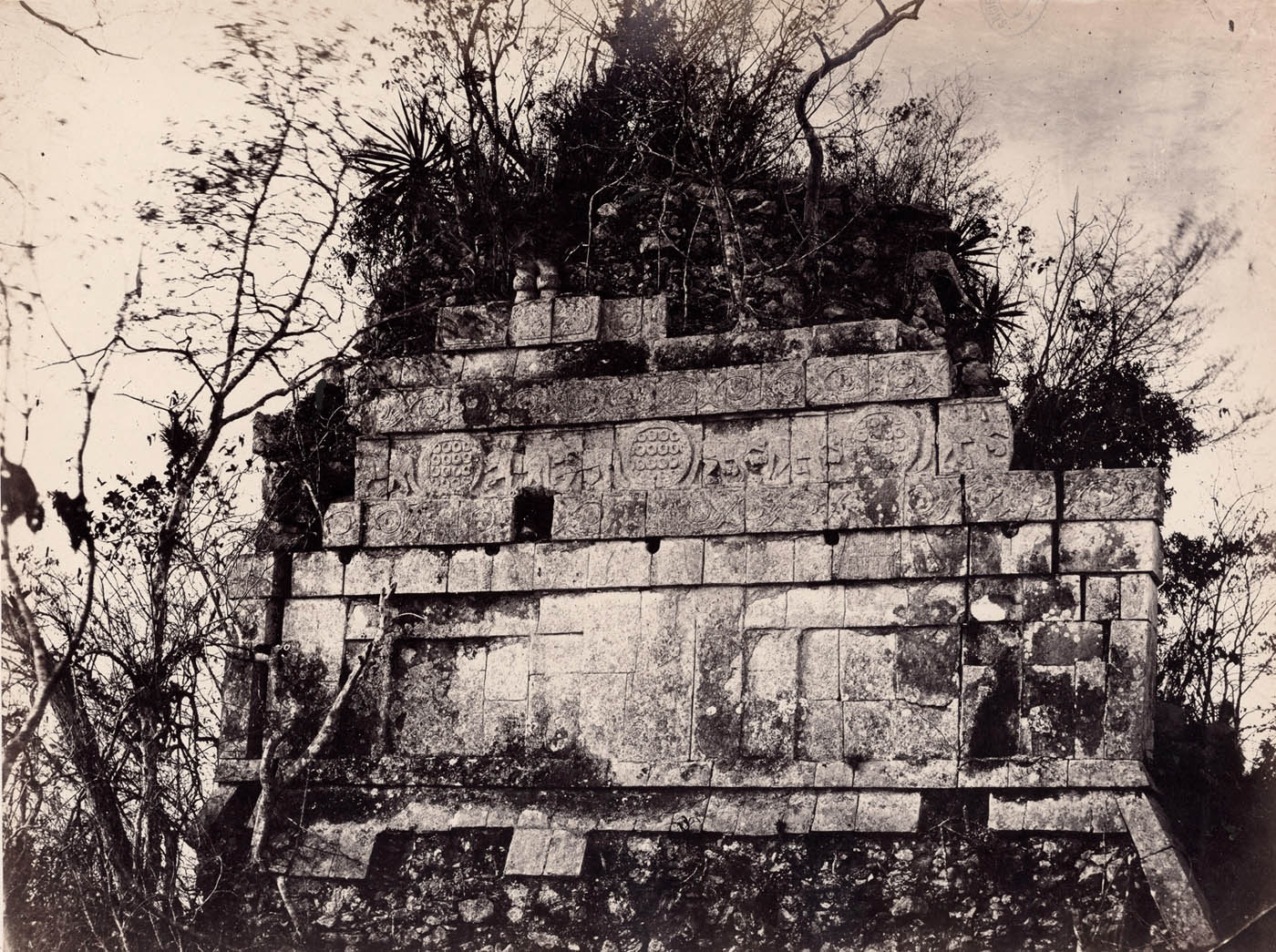
Désiré Charnay (French, 1828-1915) 'Chichen Itza: Bas-relief des Tigres, Palais du Cirque' (Chichen Itza: Bas-relief of the Tigers, Circus Palace) 1859-1861


Désiré Charnay (French, 1828-1915)
Chichen Itza: Bas-relief des Tigres, Palais du Cirque (Chichen Itza: Bas-relief of the Tigers, Circus Palace)
1859-1861
Print on gold-toned albumen paper from a collodion glass negative
BnF, Department of Prints and Photography, RES PHOTO VZ-940-FT4


In 1861, Charnay gave Napoleon III a copy of the album American Ruins composed for the Emperor of expensive proofs on albumen paper toned with gold, in an exceptional format, the miraculous result of his Mexican epic. The shift to gold accentuates the vigour of the contrasts and brings a cold tone to the blacks.


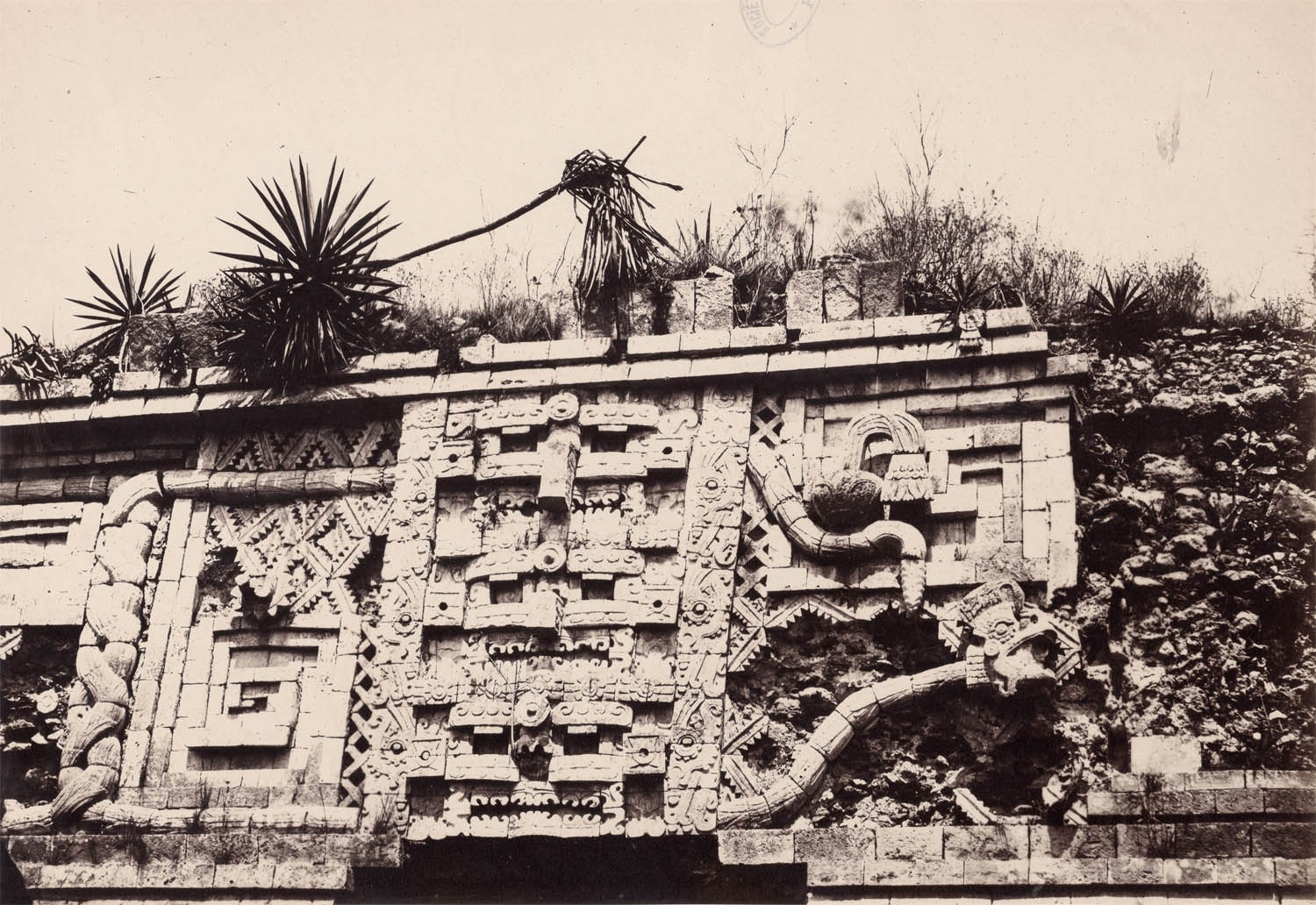
Désiré Charnay (French, 1828-1915) 'Uxmal: détail de la façade dite de la couleuvre' (Uxmal: detail of the so-called snake facade) 1859-1861


Désiré Charnay (French, 1828-1915)
Uxmal: détail de la façade dite de la couleuvre (Uxmal: detail of the so-called snake facade)
1859-1861
From the album American Ruins
Print on gold-toned albumen paper from a collodion glass negative
59 x 78.2cm
BnF, Department of Prints and Photography, RES PHOTO VZ-940-FT4


The forty-nine views of the ruins of Yucatan, Chiapas, Tabasco and the province of Oaxaca constitute the first set of photographs entered into the collections of the Geographical Society, in 1861. During the general assembly of November 29 , Charnay presents his collection of photographs exhibited in the meeting room. The same day, at the Academy of Inscriptions and Belles Lettres, Jomard returns to the quality of Charnay’s photographs, which allow us to conclude that American art – the Egyptologist’s supreme tribute – “deserves a place alongside Assyrian art, and even alongside the art of the Egyptians.”


Bisson frères. Louis-Auguste (French, 1814-1876) and Auguste-Rosalie (French, 1826-1900) 'La crevasse (départ) sur le chemin du grand plateau, ascension du Mont-Blanc' (The crevasse (departure) on the way to the grand plateau, ascent of Mont-Blanc) 1862


Bisson frères. Louis-Auguste (French, 1814-1876) and Auguste-Rosalie (French, 1826-1900)
La crevasse (départ) sur le chemin du grand plateau, ascension du Mont-Blanc (The crevasse (departure) on the way to the grand plateau, ascent of Mont-Blanc)
1862
Print on albumen paper from a wet collodion glass negative
BnF, Department of Prints and Photography, EO-14 (3)-FOL


In 1861, the Bisson brothers managed to hoist their photographic equipment to the summit of Mont Blanc. Mountaineering feat, photographic feat: in these extreme conditions, the plate must be sensitised just before use and developed as soon as possible. The violence of the contrasts, when the brightness of the snow juxtaposes the black of the rocks, redoubles this technical challenge. This conquest of the limit is crowned by the harmony of the print, carried by a site with spectacular aesthetic qualities.


This exhibition brings together black and white masterpieces from the photographic collections of the National Library of France. Nadar, Man Ray, Ansel Adams, Willy Ronis, Helmut Newton, Diane Arbus, Mario Giacomelli, Robert Frank, William Klein, Daido Moriyama, Valérie Belin…: the big names in French and international photography are brought together in a journey which presents approximately 300 prints and embraces 150 years of history of black and white photography, from its origins in the 19th century to contemporary creation.

Black and white is inseparable from the history of photography: its developments, from the end of the 19th century to today, have revealed its plastic force. While the use of colour intensified from the 1970s, black and white reinvented itself as a means of assertive aesthetic expression emphasising graphics and material. Black and white photography remains less expensive and simpler, but its persistence to this day can be explained above all by the fact that it has come to embody the very essence of photography. It appears to carry a universal, timeless, even memorial dimension, where colour would be the sole translation of the contemporary world.


The exhibition in brief

The exhibition addresses the question of black and white from an aesthetic, formal and sensitive angle, emphasising the modes of image creation: plastic and graphic effects of contrasts, play of shadows and lights, rendering of materials in all the palette of values from black to white. The emphasis was placed on photographers who concentrated and systematised their artistic creation in black and white, experimented with its possibilities and limits or made it the very subject of their photography such as Man Ray, Ansel Adams, Ralph Gibson, Mario Giacomelli or Valérie Belin. Particular attention was paid to the quality of the prints, the variety of techniques and photographic papers, but also to the printing of black and white, books and magazines having long been the main relay to the public for photographic creation .

The exhibition thus shows the richness and extent of the BnF’s photographic collections. Among the richest in the world with some six million prints, these are particularly representative of this abundant history of black and white photography.

Exhibition co-organised with the Réunion des Musées Nationaux – Grand Palais


Commissariat

Sylvie Aubenas, director of the Prints and Photography department, BnF
Héloïse Conésa, head of the photography department, responsible for contemporary photography at the Department of Prints and Photography, BnF
Flora Triebel, curator in charge of 19th century photography at the Department of Prints and Photography, BnF
Dominique Versavel, curator in charge of modern photography at the Department of Prints and Photography, BnF

Text from the Bibliothèque nationale de France (BnF)


Hippolyte Blancard (French, 1843-1924) 'Mademoiselle L. Vulliemin, à mi-corps, la tête couverte d’un chapeau' (Miss L. Vulliemin, half-length, head covered with a hat) 1889


Hippolyte Blancard (French, 1843-1924)
Mademoiselle L. Vulliemin, à mi-corps, la tête couverte d’un chapeau (Miss L. Vulliemin, half-length, head covered with a hat)
1889
Platinum print from a gelatin-silver bromide glass negative
BnF, Department of Prints and Photography, EO-508-PET FOL
Gift of print dealer Maurice Rousseau, 1944


Amateur photographer, wealthy pharmacist enriched by the sale of digestive pills, Blancard creates a prolific and picturesque work in a superb contrast of black and white thanks to the use of platinum. This expensive process, patented in 1873, ensures stable prints with marked contrasts which do not stifle the rendering of halftones.


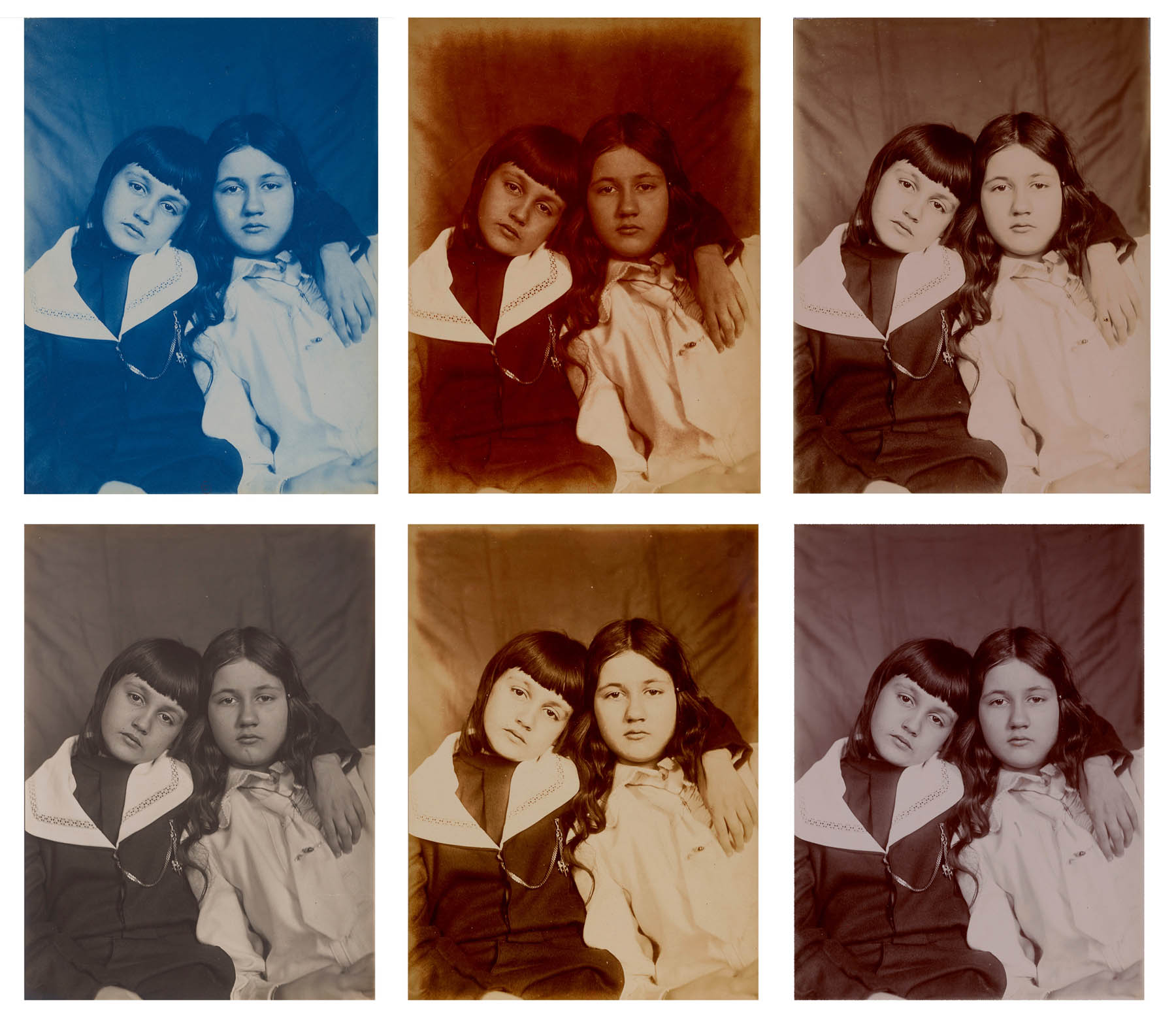
Émile Zola (French, 1840-1902) 'Denise et Jacques, les enfants d'Émile Zola' (Denise and Jacques, the children of Émile Zola) 1898 or 1899


Émile Zola (French, 1840-1902)
Denise et Jacques, les enfants d’Émile Zola (Denise and Jacques, the children of Émile Zola)
1898 or 1899
Gelatin aristotype, gelatin aristotype on matte velvety paper with toning, cyanotype, silver print, gelatin aristotype toned with gold, collodion aristotype with toning
BnF, Department of Prints and Photography, NZ-214-8
Purchase at public sale, 2017


From 1894, the novelist devoted himself with passion to photography, in an intimate vein. Here he tests the effects of his shooting by varying the papers, the processes, the tones based on the same negative on a glass plate. We see that black and white is a monochromy among others (brown, orange, blue). Very few of these test prints created in the privacy of the photographer’s laboratory have reached us; the collection of these six prints is exceptional.


Frères Séeberger. Jules, Louis and Henri Séeberger (French, 1872-1932; 1874-1946; 1876-1956) 'Untitled' 1909-1912


Frères Séeberger. Jules, Louis and Henri Séeberger (French, 1872-1932; 1874-1946; 1876-1956)
Untitled
1909-1912
Silver print on baryta paper
BnF, Department of Prints and Photography, OA-38 (1)-BOITE FOL
Acquisition-donation from the family, 1976


Frères Séeberger. Jules, Louis and Henri Séeberger (French, 1872-1932; 1874-1946; 1876-1956) 'Untitled' 1909-1912


Frères Séeberger. Jules, Louis and Henri Séeberger (French, 1872-1932; 1874-1946; 1876-1956)
Untitled
1909-1912
Silver print on baryta paper
BnF, Department of Prints and Photography, OA-38 (1)-BOITE FOL
Acquisition-donation from the family, 1976


For almost half a century, the Séeberger brothers, specialising in fashion reporting, captured elegant women in their natural settings, racecourses, palaces, upscale beaches. The print on baryta paper, used here, marks a technical breakthrough. A layer of pure white barium sulfate is now interposed between the print support and the binder layer, where the image is formed. Manufactured industrially from the 1890s, chemically developed baryta papers and their characteristic cold tone would dominate silver production until the 1970s.


Frères Séeberger. Jules, Louis and Henri Séeberger (French, 1872-1932; 1874-1946; 1876-1956) 'Untitled' 1909-1912


Frères Séeberger. Jules, Louis and Henri Séeberger (French, 1872-1932; 1874-1946; 1876-1956)
Untitled
1909-1912
Silver print on baryta paper
BnF, Department of Prints and Photography, OA-38 (1)-BOITE FOL
Acquisition-donation from the family, 1976


In Black and White

Entirely designed from the Library’s rich collections, Black & White: An aesthetic of photography presents more than 300 works from the 19th century to the present day which bear witness to the use black and white from more than 200 photographers from around the world.

Considering black and white photographic creation from the 19th century to the most contemporary works, the exhibition presented at the François-Mitterrand affirms an ambition commensurate with the historical and geographical scope of the BnF’s collections and their immense variety technical and stylistic. The Department of Prints and photography has been a high place of conservation and emulation for monochrome photographic expression, under the impetus in particular of Jean-Claude Lemagny. Recently deceased, this very first curator of photography contemporary, in office from 1968 to 1996, was a fervent defender of black and white aesthetics.

In the 19th century, the powerlessness of photography to reproduce colours do not reduce it only to black and white and the tonal variations (blue, sepia, etc.) are in fact multiple. The exhibition opens with a spectacular monochrome of prints by Émile Zola, alongside luxurious prints by Gustave Le Gray, by Désiré Charnay and the Bisson brothers. It is at the turn of the 20th century that black and white became the tonality of photography par excellence, with the generalisation of the gelatin-silver bromide process.


An artistic and aesthetic approach

The rest of the journey deliberately interweaves creations of the 20th and 21st centuries, without chronological consideration. According to a primarily artistic and aesthetic approach to black and white, works of authors, decades, styles, schools and various origins interact, in order to highlight visual constants and graphics observable in use by black and white by photographers from 37 countries. That the photographers either suffered lack of colour or – from the 1950s-1970s – preferred to it, black and white is appreciated by artists for its numerous graphic, material and symbolic, which allow them to obtain certain effects features.


Write in black and white

These are these different ways of writing in black and white that the exhibition shows, starting with the contrasts: prints by Imogen Cunningham and André Kertész at the sculptural portraits of black women by Valérie Belin, in passing through the photograms of Man Ray, the books of William Klein or the fashion photographs of Helmut Newton, the contrast is deliberately sought by certain artists. By accentuating blacks and whites, or even making them disappear to any intermediate shade of grey, they bring out the essential lines of their subjects, retrace the design of the world,
gain visual and graphic expressiveness.

The play of shadows and light, at the origins of the photographic act, forms another part of the exhibition highlights. Bringing together the works of photographers as varied as Brassaï, Alexandre Rodtchenko, Henri CartierBresson, Willy Ronis, Flor Garduño, Daido Moriyama, Arthur Tress or Ann Mandelbaum, this part emphasises the dazzling effects or shadows cast, explored by these artists in their portrait practice, of the street snapshot, of the nocturnal shooting or in their laboratory experiments.

The exhibition continues with a chart of tests deployed in ribbon, from the blackest to the whitest. These prints signed Jun Shiraoka, Emmanuel Sougez, Edward Weston, Barbara Crane or Israel Ariño recall the ability of black and white to render effects of matter by its infinite variations of grey or, conversely, suggest the overflow or disappearance of all matter.


A sensory experience

The journey ends with a paradox with the works of photographers who, like Patrick Tosani, Marina Gadonneix or Laurent Cammal, disturbing the visitor’s perception by using colour processes to represent a black and white subject – an ultimate game with codes inherited from their art. Designed to show the historical depth and the richness of the BnF collections, this exhibition is intended to be educational and sensitive: emphasising certain technical aspects linked to printing practices, while insisting also on the irreducible material part of this art. By the high quality of prints presented, the exhibition offers to the public a sensory experience that will make them perceive the nuances hidden behind this apparently monolithic notion black and white.

Flora Triebel and Dominique Versavel. “En Noir et Blanc,” in Une saison en photographie, Chroniques No. 98, BnF, September – December 2023


Eugène Atget (French, 1857-1927) 'Parc de Sceaux, Duchess Alley' Between 1925 and 1927


Eugène Atget (French, 1857-1927)
Parc de Sceaux, Duchess Alley
Between 1925 and 1927
Print on matte albumen paper from gelatin-bromide glass negative
BnF, Department of Prints and Photography, EO-109 (16)-BOITE FOL B


Eugène Atget claimed a humble, artisanal practice of photography. He used the same old camera and printing paper for decades. Only the disappearance of his usual supplies forced him to change. There is therefore no aesthetic research, yet these colour variations tell us a lot about the perception of the image.

The photographer artist can choose the colours of his prints by playing on the chemistry of the fixing baths or on the nature of the papers.

Gold toning, known since the 1850s, produces deep blacks but is very expensive. Baryta or platinum papers appeared at the end of the century and made it possible to further accentuate contrasts.


Gustave Le Gray (French, 1820-1884) 'Plage de Sainte-Adresse avec les bains Dumont' (Sainte-Adresse beach with Dumont baths) 1856


Gustave Le Gray (French, 1820-1884)
Plage de Sainte-Adresse avec les bains Dumont (Sainte-Adresse beach with Dumont baths)
1856
Print on albumen paper from a collodion glass negative
31.3 x 41.3cm
Former Alfred Armand collection
BnF, Department of Prints and Photography, RESERVE FOL-EO-13 (3)


The strength of the blacks and whites, the variations of hues influence our perception of the image: the more contrasted it is, the more readable it is for our eye saturated with absolute blacks and whites; the more nuanced it is, the more sensitive the distance of time becomes.

Provenance

This article was designed as part of the exhibition “Black & White – An aesthetic of photography” presented at the BnF from October 17, 2023 to January 21, 2024.


The marines of Le Gray

Gustave Le Gray (1820-1884) is a central figure in 19th century photography. A contemporary of photographers like Nadar, Charles Nègre and Henri Le Secq, he began his career by training as a painter. With great mastery of photographic technique, he developed two major inventions, the collodion glass negative in 1850 and the dry wax paper negative in 1851.

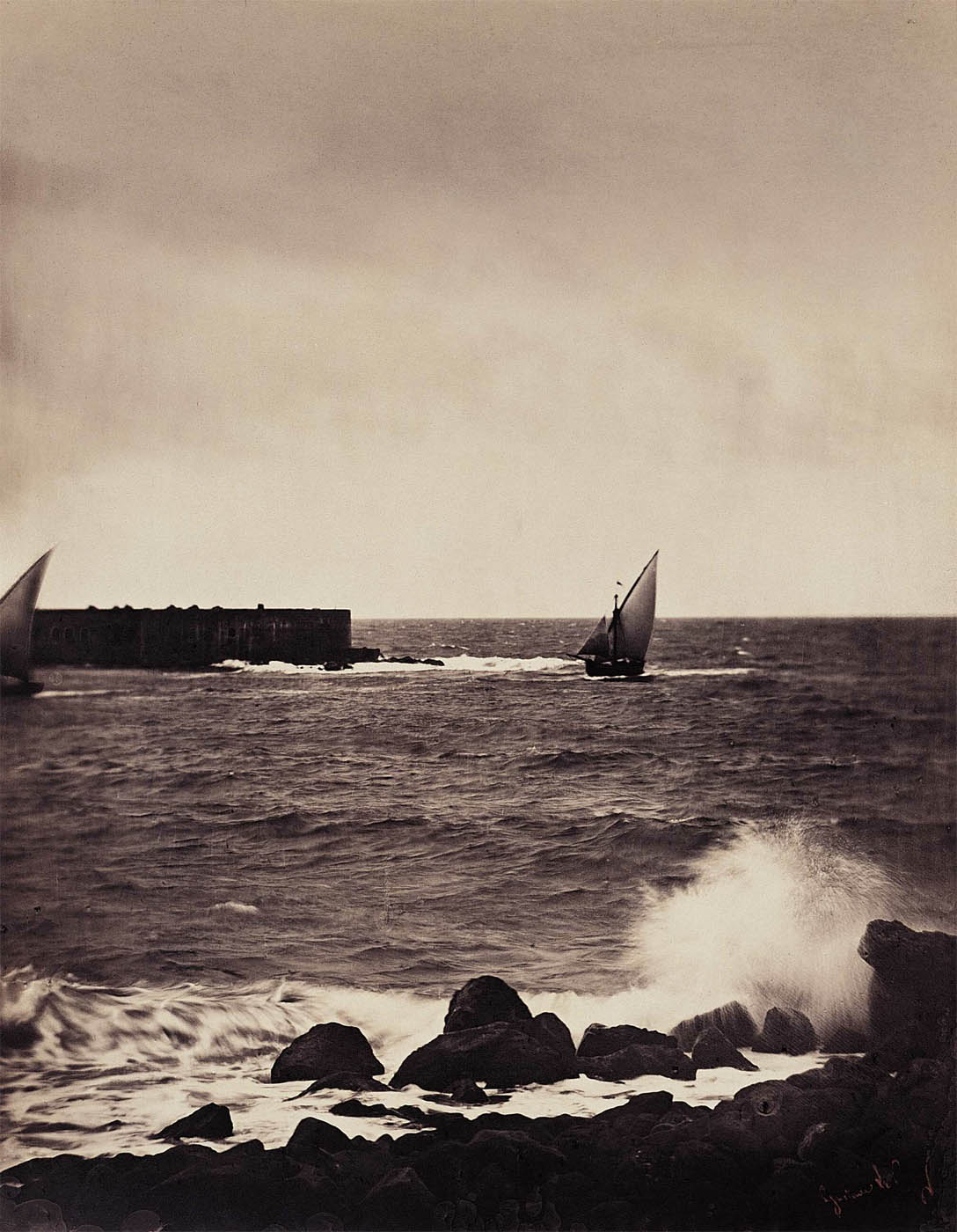
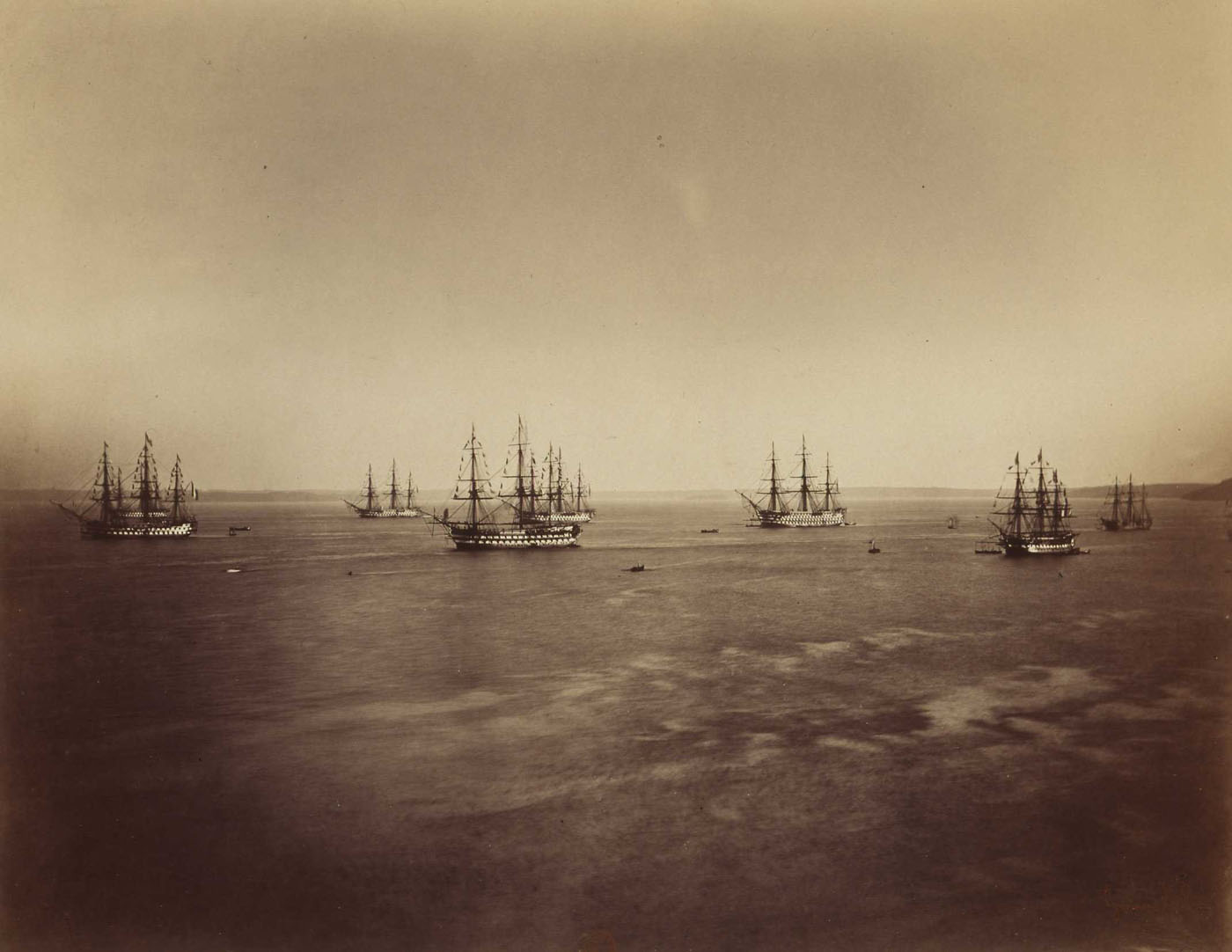
Le Gray’s seascapes mark not only a milestone in the history of photography, but also its true intrusion into a pictorial genre characteristic of the English school. Fixing the movement of the waves while the snapshot is still stammering, combining two negatives, one for the sky and one for the sea, Le Gray plays like a virtuoso with a complex technique in the service of a lyrical vision, which prefigures marine studies by Courbet in the 1860s-1870s. The success was immense in France and England: these “enchanted paintings” were acquired by crowned heads, aristocrats, artists and art collectors.


Gustave Le Gray (French, 1820-1884) 'Vapeur' (Steam) 1856-1857


Gustave Le Gray (French, 1820-1884)
Vapeur (Steam)
1856-1857
Print on albumen paper from a collodion glass negative
31.3 x 37.2cm
BnF, Department of Prints and Photography, ESERVE FOL-EO-13 (3)


Gustave Le Gray (French, 1820-1884) 'Groupe de navires - Sète - Méditerranée - No. 10' (Group of ships - Sète - Mediterranean - No. 10) 1857


Gustave Le Gray (French, 1820-1884)
Groupe de navires – Sète – Méditerranée – No. 10 (Group of ships – Sète – Mediterranean – No. 10)
1857
Print on albumen paper from a collodion glass negative
29.9 x 41.2cm
Former Alfred Armand collection
BnF, Department of Prints and Photography, RESERVE FOL-EO-13 (3)


Gustave Le Gray (French, 1820-1884) 'La Vague brisée. Mer Méditerranée No. 15' (The Broken Wave. Mediterranean Sea No. 15) 1857


Gustave Le Gray (French, 1820-1884)
La Vague brisée. Mer Méditerranée No. 15 (The Broken Wave. Mediterranean Sea No. 15)
1857
Photograph, albumen paper, collodion glass negative
41.7 x 32.5cm
BnF, Department of Prints and Photography, RESERVE FOL-EO-13 (3)


Gustave Le Gray (French, 1820-1884) 'La Grande vague - Sète - N° 17' (The Great Wave) 1857


Gustave Le Gray (French, 1820-1884)
La Grande vague – Sète – N° 17 (The Great Wave)
1857
Photograph, albumen paper, collodion glass negative
35.7 x 41.9 cm
BnF, Department of Prints and Photography, RESERVE FOL-EO-13 (3)


Gustave Le Gray (French, 1820-1884) 'Flotte franco-anglaise en rade de Cherbourg' (Franco-English fleet in Cherbourg harbour) August 4-8, 1858


Gustave Le Gray (French, 1820-1884)
Flotte franco-anglaise en rade de Cherbourg (Franco-English fleet in Cherbourg harbour)
August 4-8, 1858
Print on albumen paper from a collodion glass negative
31 x 39.8cm
Former Alfred Armand collection
BnF, Department of Prints and Photography, RESERVE FOL-EO-13 (3)


Félix Nadar (French, 1820-1910) 'La Princesse Marie Cantacuzène' (The Princesse Marie Cantacuzène) around 1855-1860


Félix Nadar (French, 1820-1910)
La Princesse Marie Cantacuzène (The Princesse Marie Cantacuzène)
around 1855-1860
Varnished salted paper print from a collodion glass negative
20.8 × 15.3cm
BnF, Department of Prints and Photography, EO-15 (2)-PET FOL


Nadar created two portraits of this classically beautiful young woman. It indicates on the back of one of the proofs that it is the Romanian princess, Marie Cantacuzène.


The portrait by Félix Nadar

Until the beginning of the 1880s, Félix Nadar’s portraits were distinguished by their neutral backgrounds.

The merit of Mr. Nadar’s portraits does not consist only in the skill of the pose, which is entirely artistic, there is a learned and reasoned arrangement of the light, which attenuates or increases the daylight depending on the character of the head. and the operator’s instinct. We also find in the printing of the proofs a delicate search for harmony and slightly faded tones which soften the edges of the contours with their darkness.


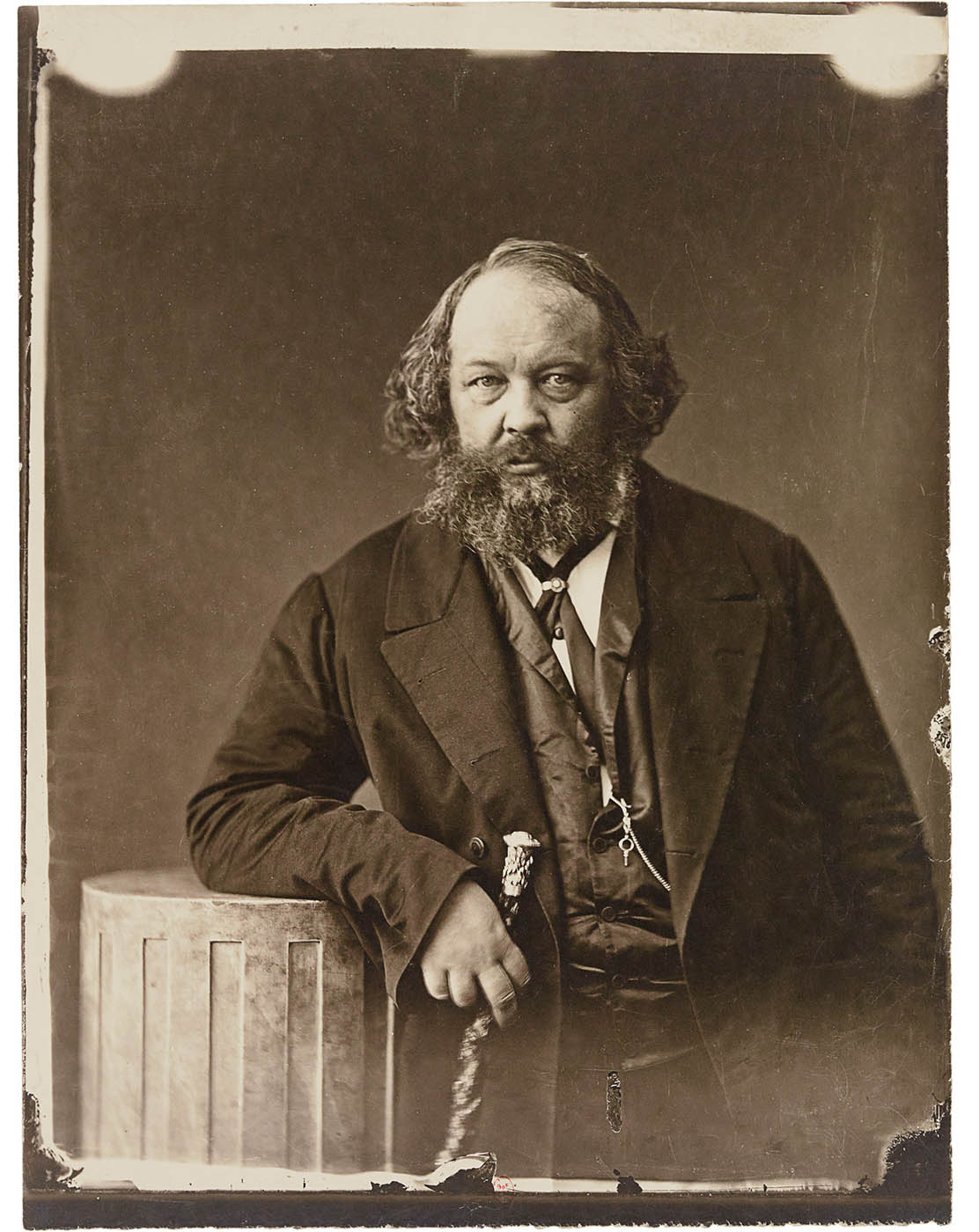
Félix Nadar (French, 1820-1910) 'Bakounine' About 1862


Félix Nadar (French, 1820-1910)
Bakounine
About 1862
Silver print from the original negative on collodion glass
27.1 × 20.6cm
BnF, Department of Prints and Photography, EO-15 (4)-FOL


The revolutionary, philosopher and theoretician of socialism Mikhail Bakunin is one of the immense personalities that Nadar photographed during his career and offered to clients in his constantly enriched portrait gallery. We see here a print from 1862, contemporary with the shooting, but there is also a print made twenty years later and finally a print around 1900, brought up to date after heavy retouching. Thus until the end of the activity of the Nadar workshop, the oldest portraits of celebrities were always offered to customers.


Félix Nadar (French, 1820-1910) 'Jean Journet (1799-1861)' 1857


Félix Nadar (French, 1820-1910)
Jean Journet (1799-1861)
1857
Salted paper print from collodion glass negative
27.4 x 21.8cm
BnF, Department of Prints and Photography, EO-15 (9)-PET FOL


Jean Journet, nicknamed the Apostle, was a picturesque and eccentric Parisian figure, often ridiculed by his contemporaries. Former carbonaro, pharmacist in Limoux, he discovered the philosophy of Fourier and decided to spread his doctrine by abandoning his family and taking his pilgrim’s staff. His humanitarian evangelism, advocating fraternity and association, led him to write numerous pamphlets which he distributed in an untimely manner: by throwing them from “paradise” into theatres or by laying siege to famous writers and editorial offices. Interned several times in Bicêtre, Journet found upon his death a defender in Nadar who published an article in Le Figaro on October 27, 1861, concluding: “Ah my dear fools! that I love you much better than all these wise men.”

Nadar draws inspiration from Spanish painting from the Golden Age to render “this dazzling head of Saint Peter”.


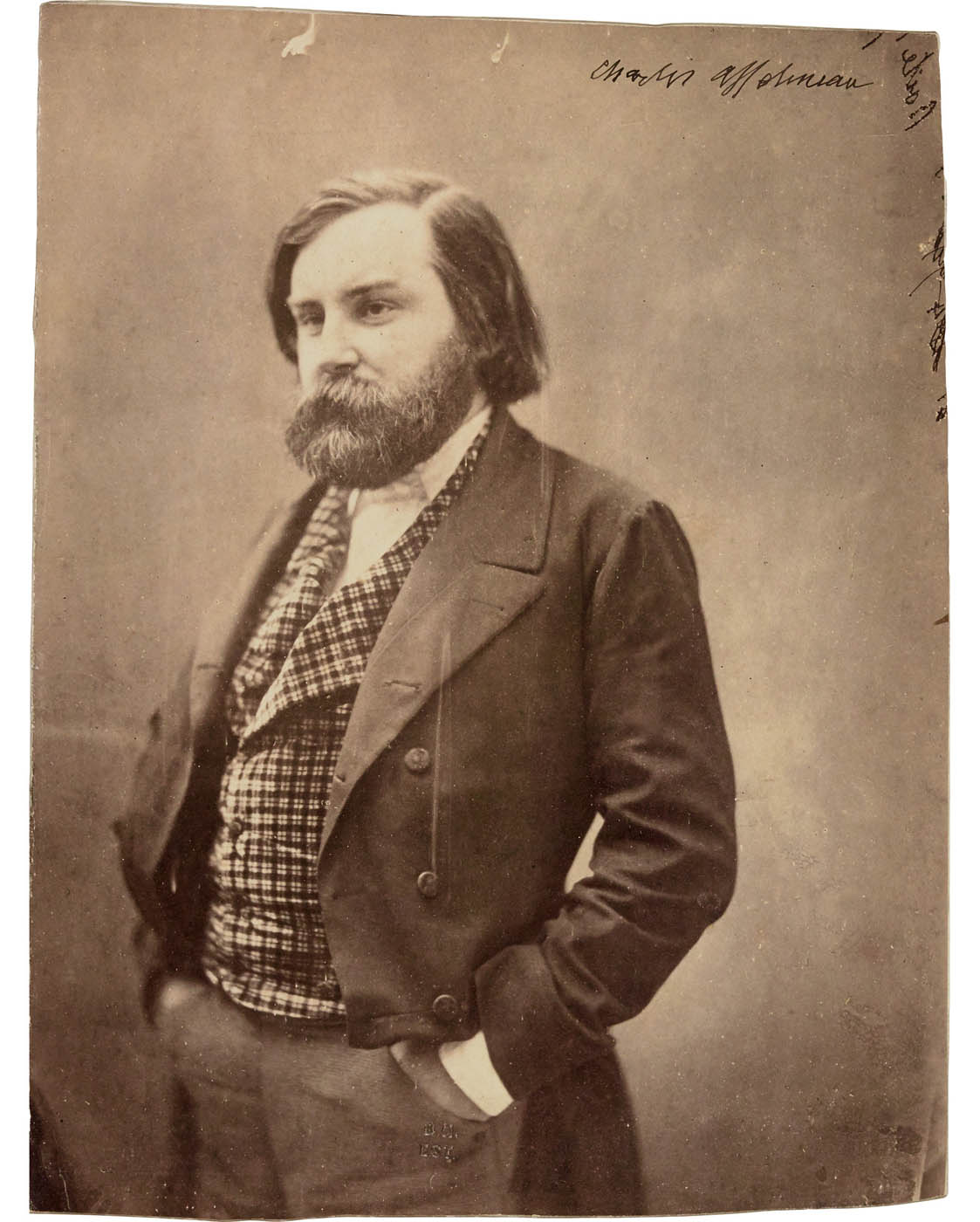
Félix Nadar (French, 1820-1910) 'Charles Asselineau (1820-1874)' Between 1854 and 1870


Félix Nadar (French, 1820-1910)
Charles Asselineau (1820-1874)
Between 1854 and 1870
Print on albumen paper from a collodion glass negative
23.8 x 18.1cm
BnF, Department of Prints and Photography, EO-15 (1)-PET FOL


Charles Asselineau is one of Nadar’s oldest friends. They became friends at the Collège Bourbon and were both close friends of Baudelaire. A fine scholar and supernumerary librarian at Mazarine, Charles Asselineau, author of, among other things, Paradis des gens de lettres and L’Enfer du Bibliophile, was close to the publisher Poulet-Malassis, nicknamed by Baudelaire “Coco-mal-perché”. He collaborated with Nadar on two short stories published in April and August 1846: “The Healed Dead” and “The Found Paradise”, reprinted in When I Was a Student. He belonged to the small circle of editors who documented the Pantheon-Nadar to which biographies of each character were originally to be annexed.

He was Nadar’s best man at his wedding… warned, however, two weeks after the ceremony. The groom explained this in a letter: “It’s quite funny that my first witness learned of my marriage 15 days after the consummation and through an announcement letter. This, my good friend, will be explained to you by me on our first trip. I will limit myself to telling you for the present that I went to your house the day before, a Sunday and that on Monday morning at noon time fixed for the ceremony I did not know at 11 o’clock if I was getting married.” (NAF 25007, fol. 8).


Alexandre Rodtchenko (Russian, 1891-1956) 'Jeune fille au Leica' (Young girl with Leica) 1934


Alexandre Rodtchenko (Russian, 1891-1956)
Jeune fille au Leica (Young girl with Leica)
1934
BnF, prints and photography


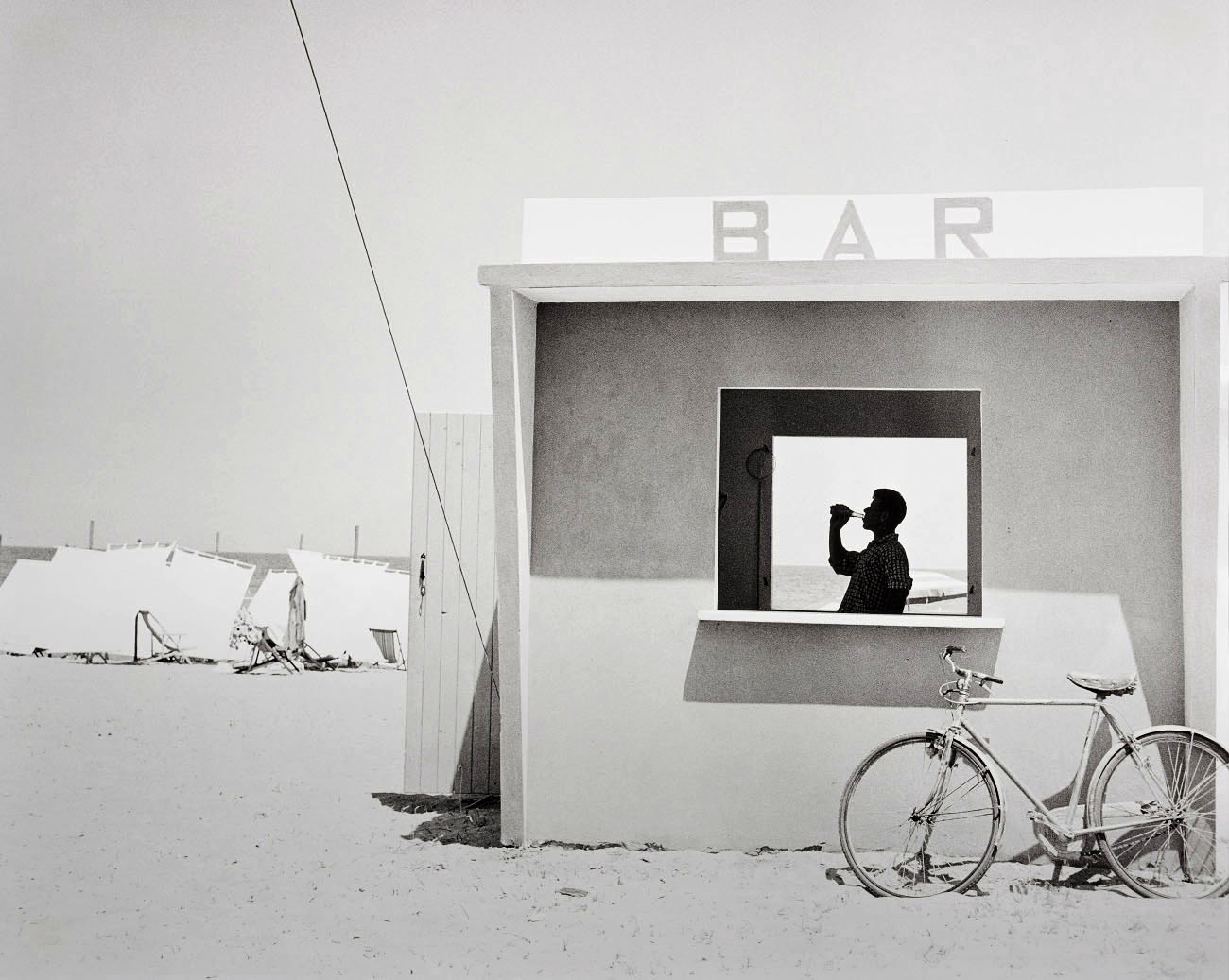
Piergiorgio Branzi (Italian, 1928-2022) 'Bar sur la plage, Adriatique' (Beach bar, Adriatic) 1957


Piergiorgio Branzi (Italian, 1928-2022)
Bar sur la plage, Adriatique (Beach bar, Adriatic)
1957
BnF, prints and photography


Willy Ronis (French, 1910-2009) 'Venise' (Venice) 1959


Willy Ronis (French, 1910-2009)
Venise (Venice)
1959
BnF, prints and photography


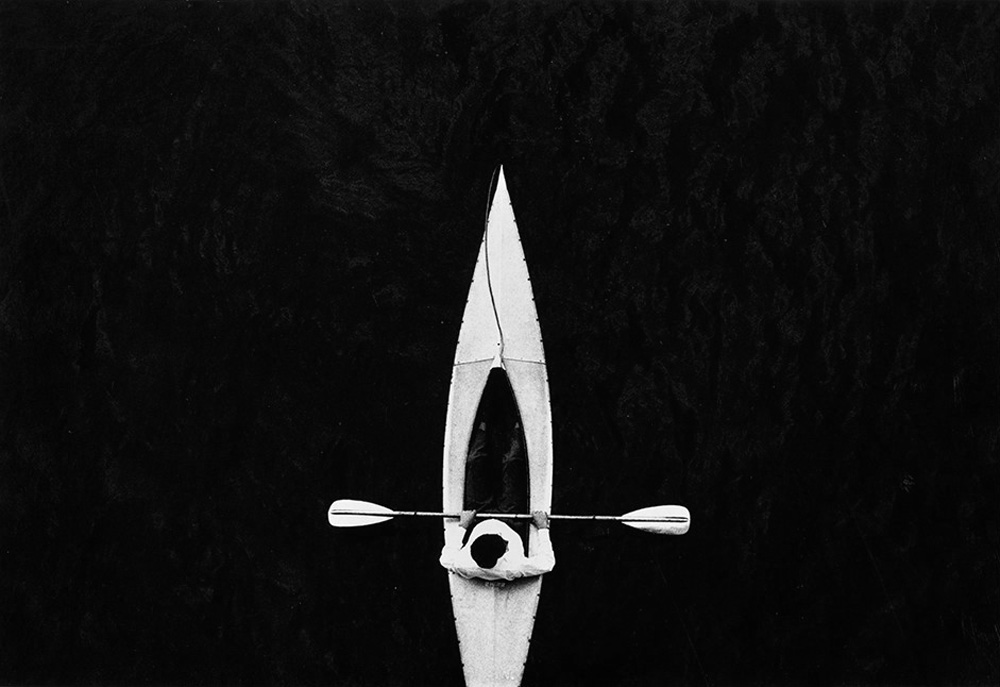
Ray K. Metzker (American, 1931-2014) 'Kayak, Frankfurt' 1961, printed around 1970


Ray K. Metzker (American, 1931-2014)
Kayak, Frankfurt
1961, printed around 1970
Silver gelatin print
20 x 25.1cm
BnF, Department of Prints and Photography, EP-91 (1)-FOL
Purchase from the author, 1970
Courtesy Howard Greenberg Gallery, New York
© Estate of Ray K. Metzker


A student of Harry Callahan and Aaron Siskind at the Institute of Design in Chicago, Metzker sublimates the formal particularities of this school through exceptional mastery black and white: he excels at stylising reality by constructing his images in direct opposition to dark and light flat areas.


Mario Giacomelli (Italian, 1925-2000) 'Je n'ai pas de main qui me caresse le visage' (I have no Hands caress my face) 1961-1963


Mario Giacomelli (Italian, 1925-2000)
Je n’ai pas de main qui me caresse le visage (I have no Hands caress my face)
1961-1963
BnF, prints and photography


Daido Moriyama (Japanese, b. 1938) 'Portrait d'acteur' (Actor portrait) 1968


Daido Moriyama (Japanese, b. 1938)
Portrait d’acteur (Actor portrait)
1968
From the series Japanese theatre
BnF, prints and photography


André Kertész (Hungarian, 1894-1985) '1er janvier 1972 à la Martinique' (January 1, 1972 in Martinique) 1972


André Kertész (Hungarian, 1894-1985)
1er janvier 1972 à la Martinique (January 1, 1972 in Martinique)
1972
BnF, prints and photography


Bernard Plossu (French, b. 1945) 'Paris' 1973


Bernard Plossu (French, b. 1945)
Paris
1973
BnF, prints and photography


Mary Ellen Mark (American, 1940-2015) 'Immigrants, Istanbul, Turkey' c. 1977


Mary Ellen Mark (American, 1940-2015)
Immigrants, Istanbul, Turkey
c. 1977
BnF, prints and photography


Koichi Kurita (Japanese, b. 1962) 'Melting Snow on a Rock, Nagano, Japan' 1988


Koichi Kurita (Japanese, b. 1962)
Melting Snow on a Rock, Nagano, Japan
1988
BnF, prints and photography


Flor Garduño (Mexican, b. 1957) 'Canasta de Luz' (Corbeille de lumière)(Basket of Light) 1989


Flor Garduño (Mexican, b. 1957)
Canasta de Luz (Corbeille de lumière)(Basket of Light)
1989
BnF, prints and photography


Laurence Leblanc (French, b. 1967) 'Chéa, Cambodge' (Chéa, Cambodia) 2000


Laurence Leblanc (French, b. 1967)
Chéa, Cambodge (Chéa, Cambodia)
2000
From the series Rithy Chéa Kim Sour and the others
BnF, prints and photography


Bibliothèque François-Mitterrand
Quai François Mauriac, 75706 Paris Cedex 13
Phone: +33(0)1 53 79 59 59

Opening hours:
Monday: 2pm – 8pm
Tuesday, Wednesday, Thursday, Friday, Saturday: 9am – 8pm
Sunday: 1pm – 7pm

Bibliothèque François-Mitterrand website

LIKE ART BLART ON FACEBOOK

Back to top