Exhibition: ‘Man Ray. Liberating Photography’ at the Photo Elysee, Lausanne

Exhibition dates: 29th March – 4th August, 2024

Curator: Nathalie Herschdorfer, Director of Photo Elysée, with contributions from independent scholar Wendy A. Grossman


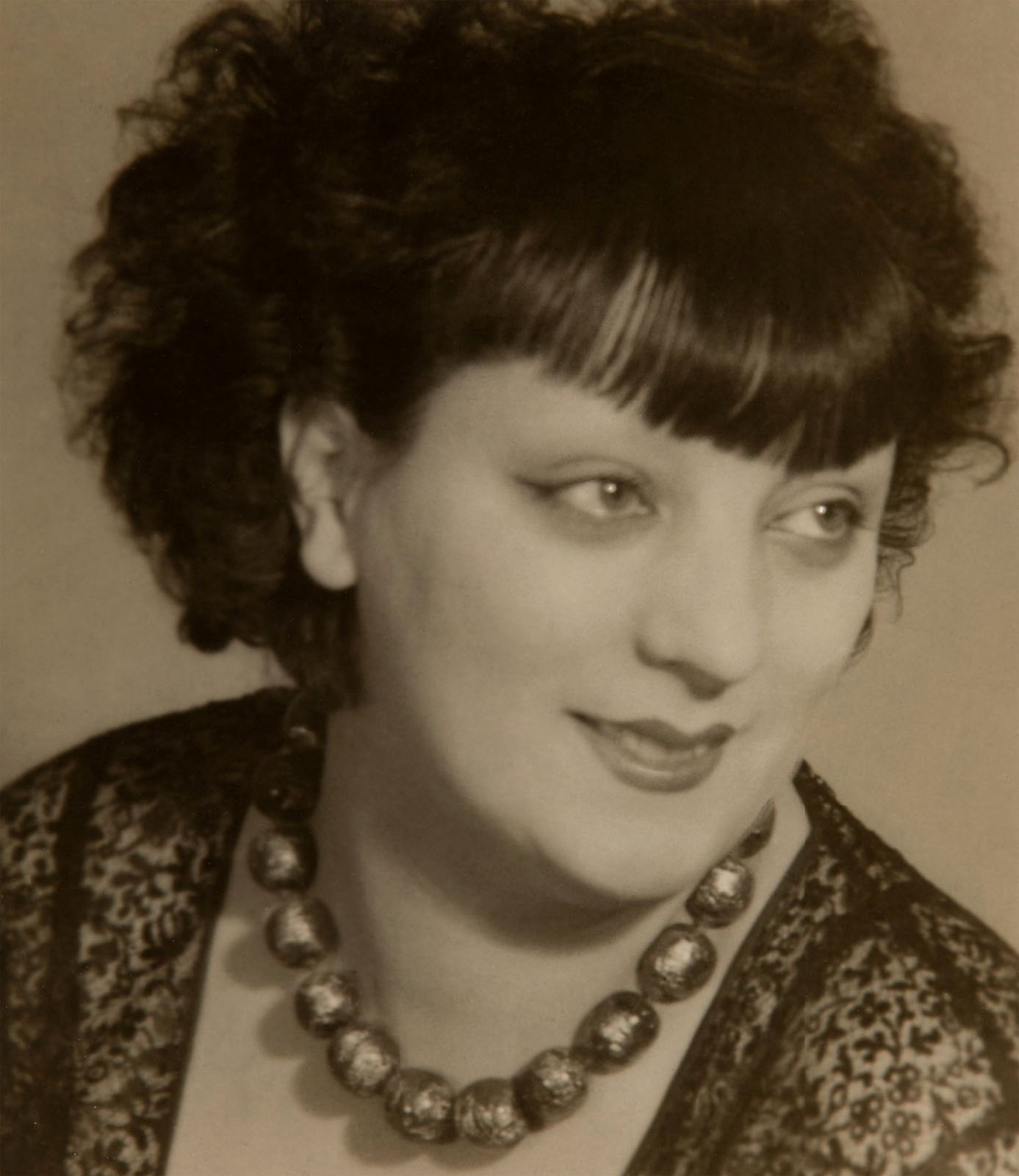
Man Ray (American, 1890-1976) 'Dora Maar' 1936 from the exhibition Exhibition: 'Man Ray. Liberating Photography' at the Photo Elysee, Lausanne, March - August, 2024


Man Ray (American, 1890-1976)
Dora Maar
1936
Gelatin silver print
© Man Ray 2015 Trust / 2024, ProLitteris, Zurich. All rights reserved
Without permission from ProLitteris, the reproduction or any use of the individual and private consultation are prohibited


Henriette Theodora Markovitch (22 November 1907 – 16 July 1997), known as Dora Maar, was a French photographer, painter, and poet. Maar is very well known for her role as Picasso’s lover, subject, and muse. He abused her. Maar photographed the successive stages of the creation of Guernica. It is the gelatin silver works of the surrealist period that remain the most sought after by admirers: Portrait of Ubu (1936), 29 rue d’Astorg, black and white, collages, photomontages or superimpositions.


Man Ray is hailed as one of the greatest photographers of the 20th century, but I admit I have no real liking for most of his work.

I remember seeing the first large-scale exhibition of Man Ray’s photography to have been presented in Australia at the National Gallery of Victoria in 2004. In text about the exhibition the NGV states, “Man Ray produced some of the most iconic photographs of the 20th century: eloquent portraits, dreamy solarised nudes, divine fashion photography and enigmatic images that continue to delight and astonish… A superb technician and a highly inventive artist, Man Ray always denied that he had any ability with the camera or in the darkroom. However, as the exhibition reveals, this is clearly not the case. The exhibition emphasises Man Ray’s techniques of framing, cropping, solarising and use of the photogram to present a new ‘surreal’ way of seeing, which continues to fascinate audiences today.”1

I came away from that exhibition thinking what a great technician Man Ray was, almost like a photographic scientist, an alchemist from another world conjuring small, intense images of clinical focus, but where was the emotional power of the images, where was their … what am I trying to enunciate … where was their vibrational energy. They were ice cold.2

I feel that Man Ray’s greatest artistic expression, his greatest music, were his photograms, “which he coined “rayographs” after himself. He explained that working with light in the darkroom allowed him to free himself from painting.” (Press release) As Man Ray himself said of his rayographs, “Like the undisturbed ashes of an object consumed by flames these images are oxidised residues fixed by light and chemical elements of an experience, an adventure, not an experiment. They are the result of curiosity, inspiration, and these words do not pretend to convey any information.”3

“What the rayographs do not deny, however, is the subjectivity of the artist, his skill at placing the objects on the photographic paper, expressed in their dream-like nature, both a subjective ephemerality (because they could only be produced once) and an ephemeral subjectivity (because they were expressions of Man Ray’s fantasies, and therefore had little substance). Through an alchemical process the latent images emerge from the photographic paper, representations of Man Ray’s fantasies as embodied in the ‘presence’ of the objects themselves, in the surface of the paper.”4

(See a section of my paper “The Delicious Fields: Exploring Man Ray’s Rayographs in a Digital Future” (2004) below in the posting).

On a final note, while it is fantastic to see such a large group of Man Ray’s photographs together in one space I am amazed, flabbergasted even, at the blue and yellow colour scheme on the floor of the gallery. What were they thinking? How can you appreciate black and white images, which are never actually black and white but always have subtle colours of either brown and blue, warm and cool, which need to be appreciated in a neutral colour space … when throughout the gallery your eye is constantly overwhelmed (by reflection from the gallery lights or subconsciously, even) by a sea of blue and yellow tiles. It makes no sense aesthetically, empirically or emotionally.

Dr Marcus Bunyan


1/ Anonymous. “Man Ray,” on the National Gallery of Victoria website Nd [Online] Cited 18/07/2024

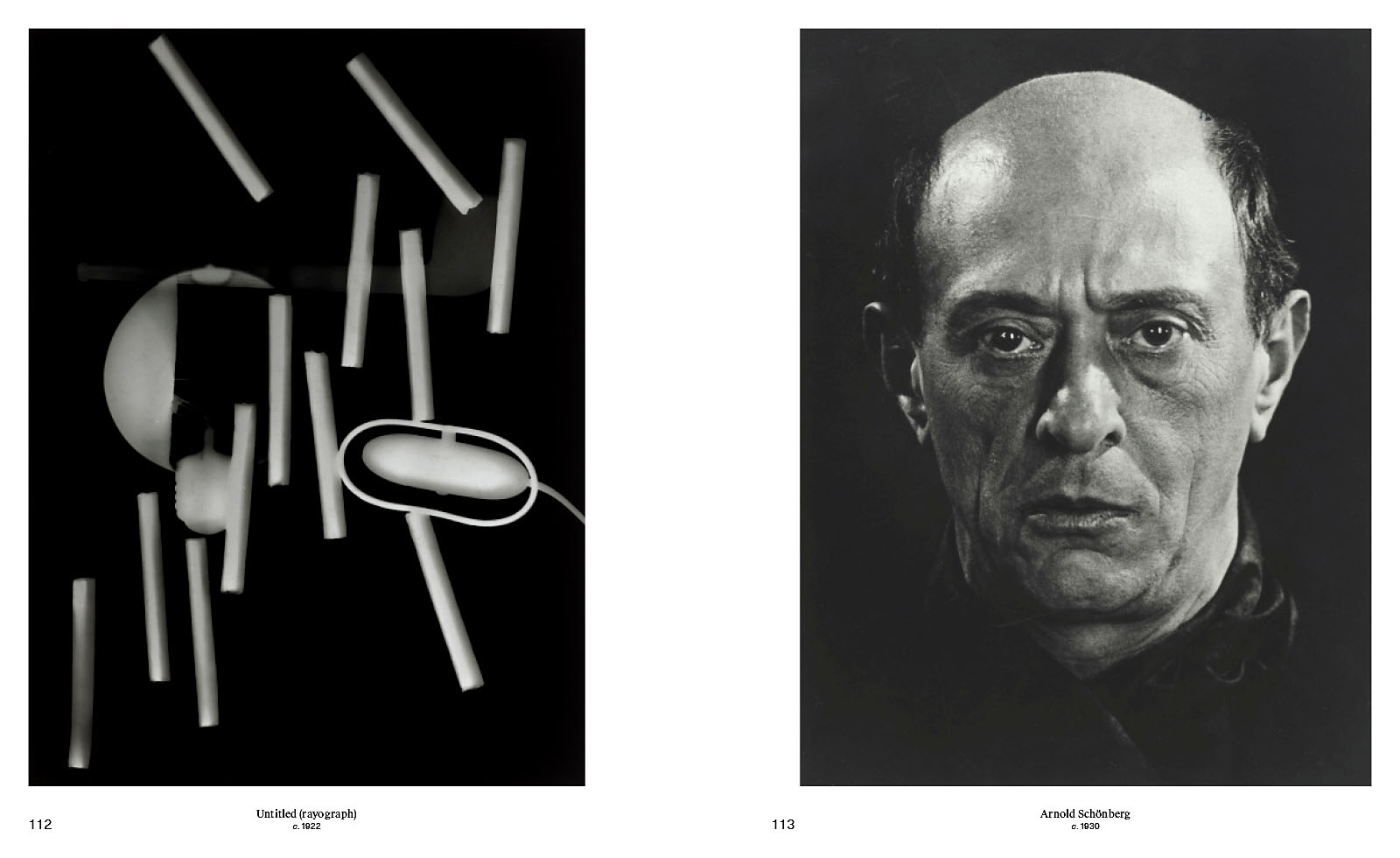
2/ This coldness can be seen in the photographs from the book at the bottom of the posting, where borders frame faces and are inverted, where objects in rayographs are paired opposite objective portraits, surface representations and human visage.

3/ Man Ray quoted in Janus (trans. Murtha Baca). Man Ray: The Photographic Image (London: Gordon Fraser, 1980), 213 quoted in Marcus Bunyan. “The Delicious Fields: Exploring Man Ray’s Rayographs in a Digital Future,” published in The University of Queensland Vanguard Magazine: ‘Man Ray: Life, Work and Themes’, 2004, Triad series #2, pp. 40-46. ISBN 0-9756043-0-9

4/ Bunyan, op cit.,


Many thankx to the Photo Elysee for allowing me to publish the photographs in the posting. Please click on the photographs for a larger version of the image.


“There is no eggshell, no thermometer or metronome, no brick, bread or broom that [Man Ray] cannot and does not change into something else. It is as if he discovers the soul of each conventional object by liberating it from its practical function…. [Man Ray] just cannot help to discover and reveal things because his whole person is involved in a process of continuous probing, of a natural distrust in things being “just so”.”


Hans Richter 1966


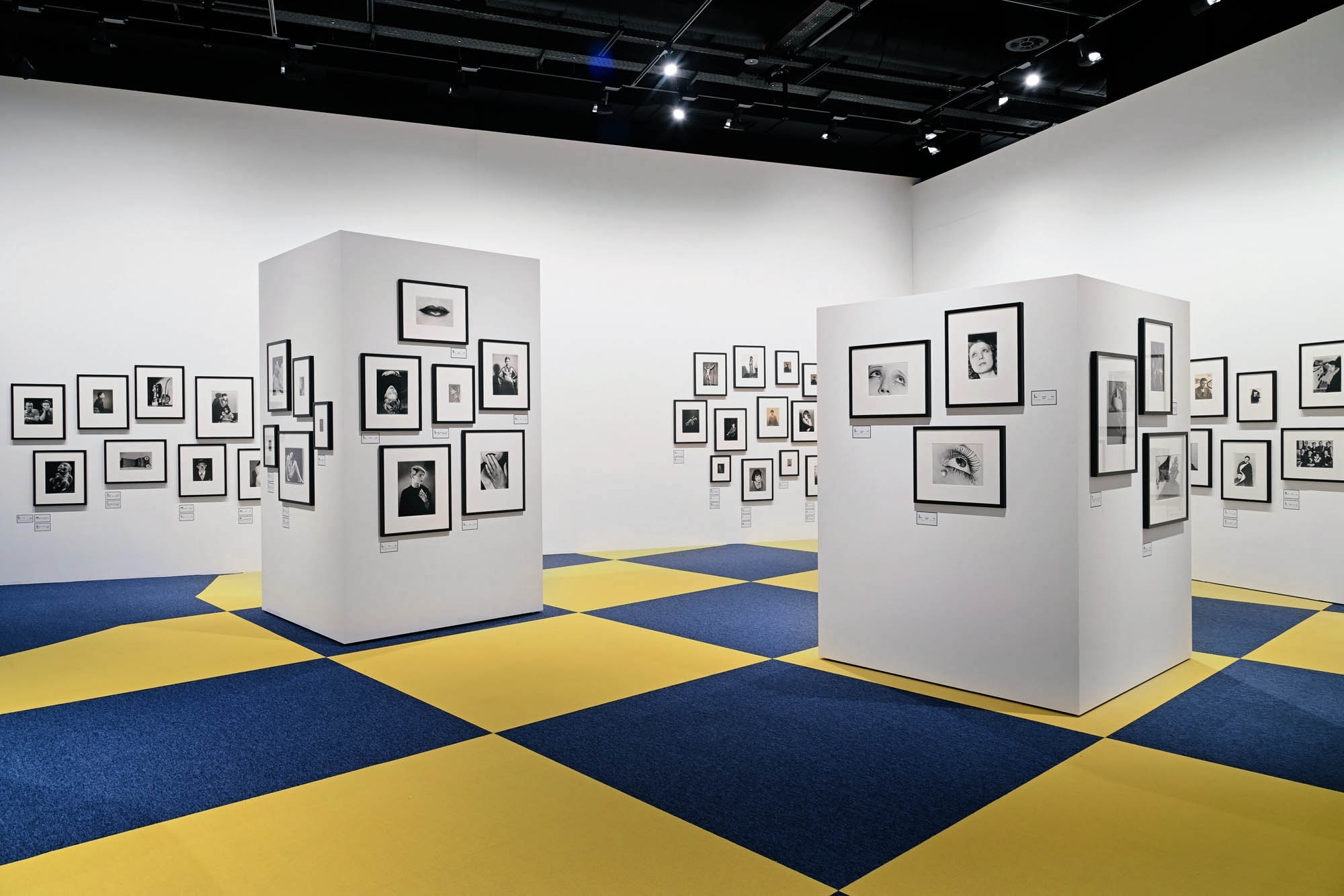
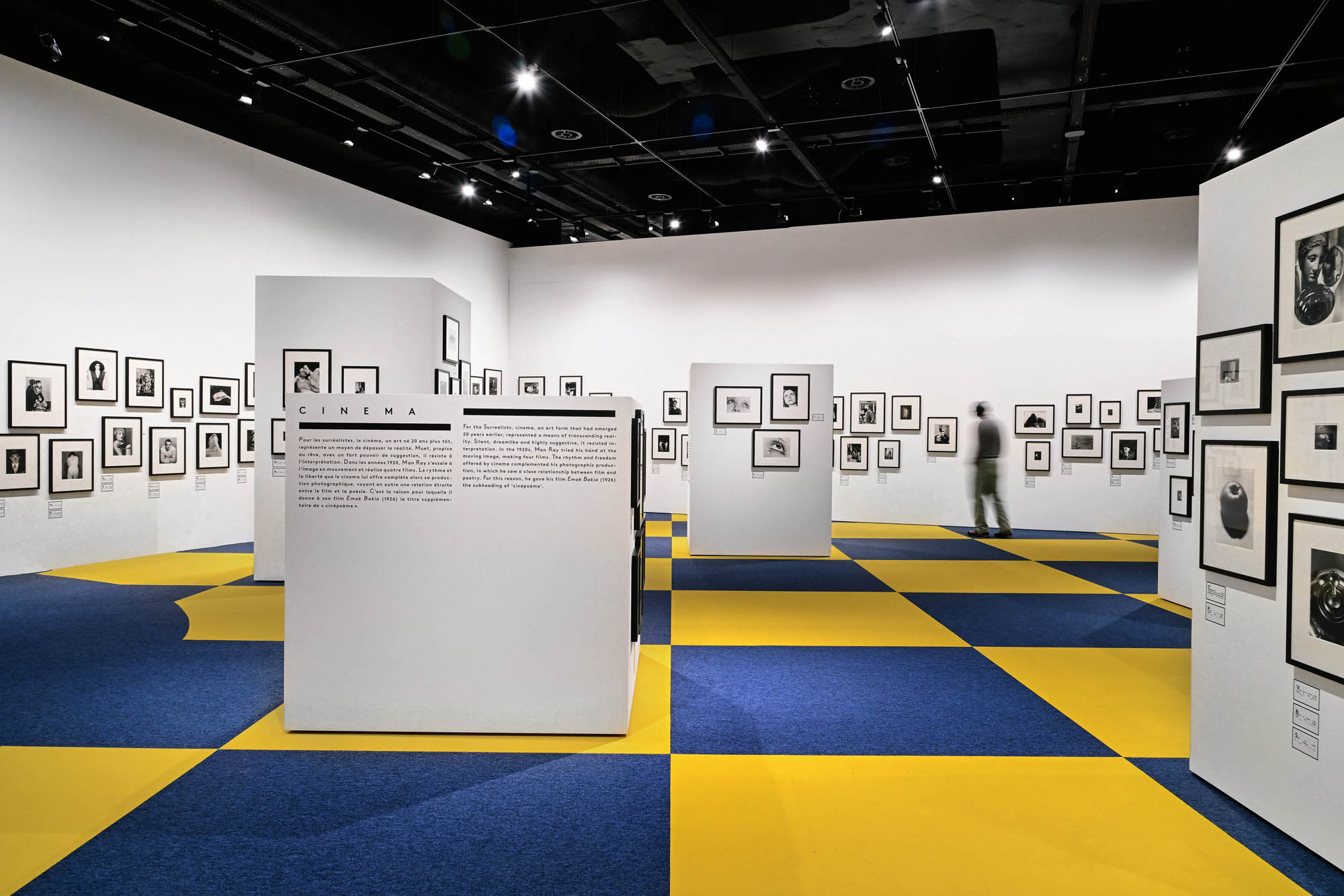
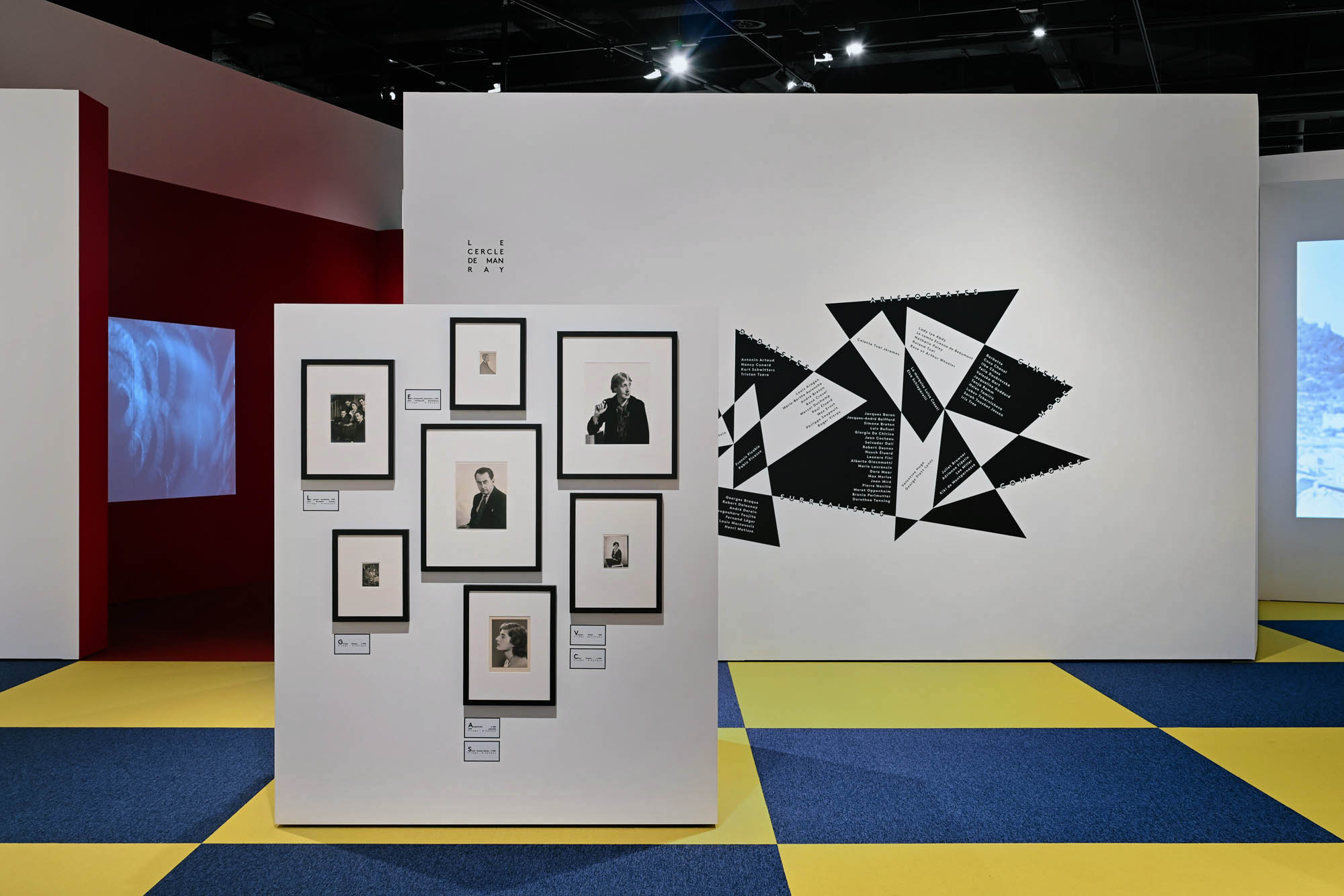
Installation view of the exhibition 'Man Ray. Liberating Photography' at the Photo Elysee, Lausanne

Installation view of the exhibition 'Man Ray. Liberating Photography' at the Photo Elysee, Lausanne
Installation view of the exhibition 'Man Ray. Liberating Photography' at the Photo Elysee, Lausanne showing at right, Man Ray's 'Nude, Kiki de Montparnasse' 1927; 'Artichokes in Bloom' 1934; and 'Still life Plaster Venus with Fruit' c. 1936


Installation views of the exhibition Man Ray. Liberating Photography at the Photo Elysee, Lausanne, showing in the bottom image at right, Man Ray’s Nude, Kiki de Montparnasse 1927; Artichokes in Bloom 1934; and Still life Plaster Venus with Fruit c. 1936
© Khashayar Javanmardi and Photo Elyse Plateforme


“To be totally liberated from painting and its aesthetic implications” was the first avowed aim of Man Ray (United States, 1890-1976), who began his career as a painter. Photography was one of the major breakthroughs of modern art and led to a rethinking of notions of representation. In the 1920s and 30s, the photographic medium came to the forefront of the avant-garde movement, and Man Ray soon made a name for himself with his virtuosity. As a studio portraitist and fashion photographer, but also as an experimental artist who explored the potential of photography with the people around him, Man Ray was a multi-faceted figure. Considered one of the 20th century’s major artists, close to Dada and then Surrealism, he photographed Paris’ artistic milieu between the wars.

Exhibition

Curated from a private collection, the exhibition explores the artist’s extensive social contacts while presenting some of his most iconic works. In addition to providing a dazzling who’s who of the Parisian avant-garde, the works also highlight the innovations in photography made by Man Ray in Paris in the 1920s and 30s.

Artist

He took his first photographs in New York in the 1910s, but it was in Paris that his career took off. Even before opening his studio in Montparnasse in 1922, Man Ray worked for a year in his hotel room. The photographer’s reputation grew, and before long, the artist’s studio was flourishing. Fashion photographs alternated with portraits of the artistic figures of the day who had made Paris’ notoriety: Marcel Duchamp, whom he met in New York in 1915 and who introduced him to the Parisian artistic elite, as well as Robert Delaunay, Georges Braque, Alberto Giacometti and Pablo Picasso, among others, who posed for the photographer. His portraits also included Ballets Russes dancers and guests at the Count de Beaumont’s ball.

As soon as he arrived in Paris in the summer of 1921, Man Ray immediately became part of the Parisian intelligentsia of the Roaring Twenties. He met Jean Cocteau, who was himself a fixture of the Parisian art scene, André Breton, Francis Picabia, Joan Miró, Salvador Dalí, Henri Matisse and Max Ernst. He also met Gertrude Stein, Virginia Woolf, Igor Stravinsky, Ernest Hemingway, Arnold Schoenberg and James Joyce, whom he photographed for the Anglo-American bookshop Shakespeare and Company. But Man Ray was not merely content to have celebrities pose in his studio or to explore the female nude genre by working with those he considered his muses, such as Lee Miller, Kiki de Montparnasse, Meret Oppenheim and Adrienne Fidelin.

Creative Process

Man Ray also experimented in the darkroom, transforming the photographic medium into a powerful tool of artistic expression, even going so far as to do away with the camera when, in 1921-1922, he began creating photograms, which he coined “rayographs” after himself. He explained that working with light in the darkroom allowed him to free himself from painting, so convinced was he of the visual power of his experiments. Also in the 1920s, he experimented with the moving image and produced four films. The rhythm and freedom offered by the cinema complemented his photographic work, in which he saw a close relationship between film and poetry. This is why he gave his film Emak Bakia (1926) the subheading of “cinépoème”. Without ever abandoning portraiture, he experimented with other techniques in the 1930s: solarisation, overprinting and other distortions.

From the outset, photography has been more than a simple process of reproduction. For him, images were not taken fleetingly, but meticulously realised indoors. Unlike Henri Cartier-Bresson who opted for the spontaneous gesture and saw the street as a privileged playground, Man Ray composed and staged his photographs. The studio provided him with a space in which to explore his imagination. Some of the themes dear to the Surrealists can be found in his work: femininity, sexuality, strangeness, the boundary between dream and reality. His nude studies were part of his artistic research, which he developed in close collaboration with his companions who were part of the Parisian art scene. Kiki de Montparnasse – the woman with the f-holes of a violin on her back – whose real name was Alice Prin, was a dancer, singer, actress and painter who posed for artists such as Chaïm Soutine and Kees van Dongen. Lee Miller, a fellow New Yorker like him, had begun a modelling career in the United States but wanted to move to the other side of the camera. She met the photographer in Paris in 1929 when she was 22-years old, and became active in the Surrealist movement. More than a muse, she became his collaborator, learning photography at his side. Together, they discovered the technique of solarisation. Another artist with whom Man Ray had a professional and romantic relationship was the Swiss artist Meret Oppenheim, who was close to the Surrealist scene before pursuing an independent career as an artist.

Man Ray loved the freedom his photographic creations afforded him, and portraits and fashion photography enabled him to earn a living. It was in his studio that he embarked on a series of visual experiments. His portraits, which are relatively classical in style, testify not only to his commercial success, but also to his great sociability. Artists from Montparnasse, Surrealists, fashion and nightlife celebrities, patrons of the arts, Americans in Paris – the entire artistic elite – passed through his studio, as was the case with Nadar in the 19th century. Almost 50 years after Man Ray’s death, his photographs continue to fascinate us. His impact on the history of the medium is undeniable, and he served as an inspiration to photographers of the caliber of Berenice Abbott, Bill Brandt and Lee Miller. Man Ray remains one of the most famous photographers of the 20th century. He never stopped creating, without prejudice or constraint.

Press release from the Photo Elysee


Man Ray (American, 1890-1976) 'Noire et blanche' 1926 from the exhibition Exhibition: 'Man Ray. Liberating Photography' at the Photo Elysee, Lausanne, March - August, 2024


Man Ray (American, 1890-1976)
Black and White
1926
Gelatin silver print
© Man Ray 2015 Trust / 2024, ProLitteris, Zurich. All rights reserved
Without permission from ProLitteris, the reproduction or any use of the individual and private consultation are prohibited


Man Ray (American, 1890-1976) 'Larmes' (Tears) 1930


Man Ray (American, 1890-1976)
Larmes (Tears)
1930
Gelatin silver print
© Man Ray 2015 Trust / 2024, ProLitteris, Zurich. All rights reserved
Without permission from ProLitteris, the reproduction or any use of the individual and private consultation are prohibited


Man Ray (American, 1890-1976) 'Head, New York' 1920


Man Ray (American, 1890-1976)
Head, New York
1920
Gelatin silver print
© Man Ray 2015 Trust / 2024, ProLitteris, Zurich. All rights reserved
Without permission from ProLitteris, the reproduction or any use of the individual and private consultation are prohibited


Man Ray (American, 1890-1976) 'Alice Prin, known as Kiki de Montparnasse' Around 1925


Man Ray (American, 1890-1976)
Alice Prin, known as Kiki de Montparnasse
Around 1925
Gelatin silver print
© Man Ray 2015 Trust / 2024, ProLitteris, Zurich. All rights reserved
Without permission from ProLitteris, the reproduction or any use of the individual and private consultation are prohibited
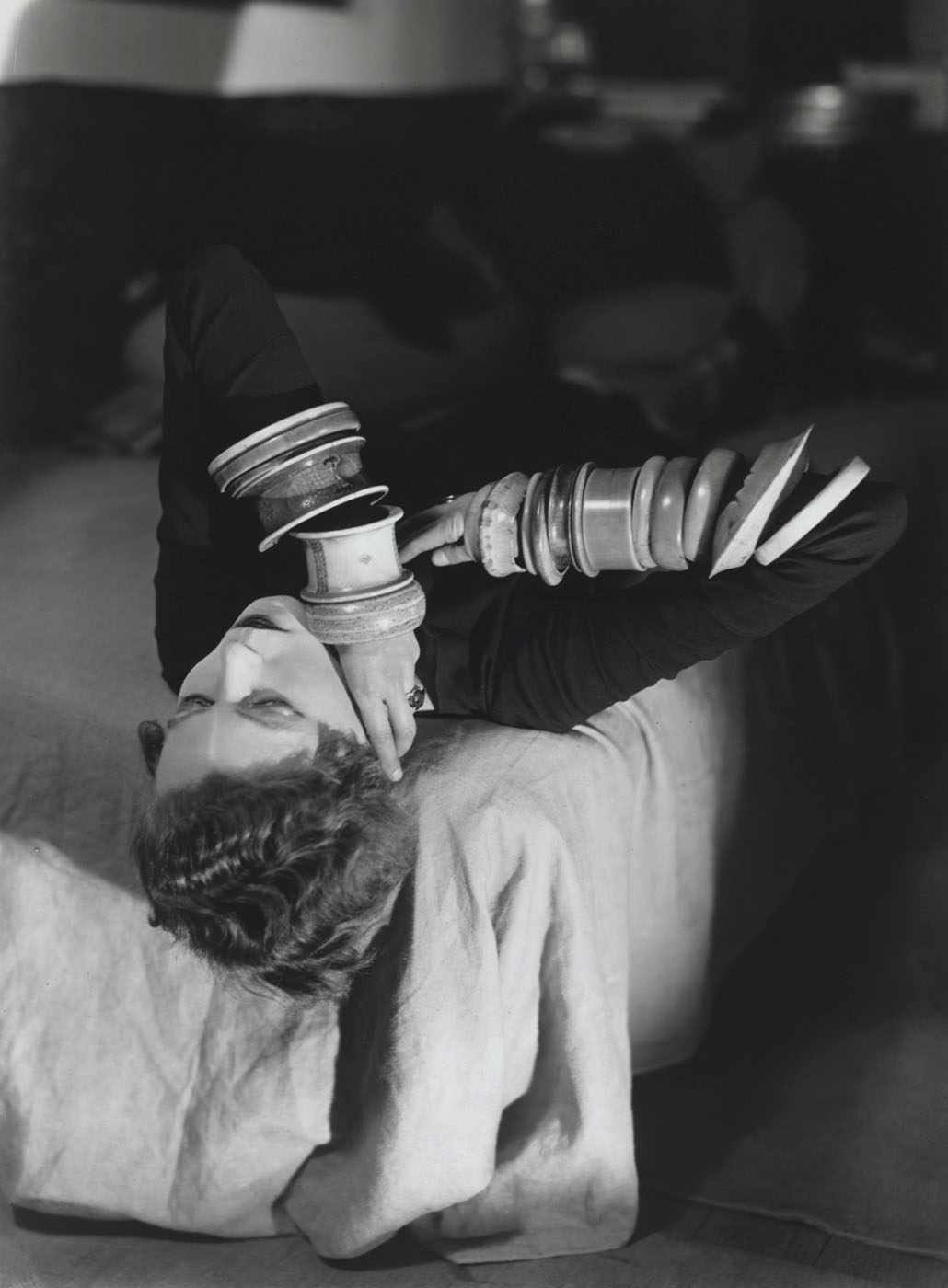
 

Man Ray (American, 1890-1976) 'Nancy Cunard' c. 1925


Man Ray (American, 1890-1976)
Nancy Cunard
c. 1925
Gelatin silver print
© Man Ray 2015 Trust / 2024, ProLitteris, Zurich. All rights reserved
Without permission from ProLitteris, the reproduction or any use of the individual and private consultation are prohibited


Nancy Clara Cunard (10 March 1896 – 17 March 1965) was a British writer, heiress and political activist. She was born into the British upper class, and devoted much of her life to fighting racism and fascism. She became a muse to some of the 20th century’s most distinguished writers and artists, including Wyndham Lewis, Aldous Huxley, Tristan Tzara, Ezra Pound and Louis Aragon – who were among her lovers – as well as Ernest Hemingway, James Joyce, Constantin Brâncuși, Langston Hughes, Man Ray and William Carlos Williams. MI5 documents reveal that she was involved with Indian diplomat, orator, and statesman V. K. Krishna Menon.

Text from the Wikipedia website


Man Ray (American, 1890-1976) 'Jacqueline Goddard' c. 1932


Man Ray (American, 1890-1976)
Jacqueline Goddard
c. 1932
Solarised gelatin silver print
© Man Ray 2015 Trust / 2024, ProLitteris, Zurich. All rights reserved
Without permission from ProLitteris, the reproduction or any use of the individual and private consultation are prohibited


Jacqueline Goddard (French, 1912-2003)

Jacqueline Goddard, née Barsotti (1912-2003), was a favourite model of the Surrealist artist and photographer Man Ray in Paris during the 1930s.

As Jacqueline Barsotti, she had arrived in Montparnasse at the age of 17, a tall beauty with unruly fair hair. She was soon frequenting La Coupole and other haunts of the fashionable artists of the day. Many years later, by which time she was living on the Isle of Wight, she wrote a personal memoir in which she recalled her experiences and offered some piquant observations about the personalities she had come to know. …

Jacqueline Barsotti became a close friend of Man Ray, and of his former mistress, Kiki de Montparnasse. Of Man Ray she reported, “He was not handsome, his nose had no opinion and went all over the place. He always seemed to be meditating, and was seldom light-hearted. It was a great pity that he did not smile a lot. That little grin of his changed him altogether.” Kiki, without makeup, “looked like a potato”.

Another of Man Ray’s mistresses was the American photographer, Lee Miller. On the night that Lee Miller left Man Ray, Jacqueline Barsotti walked with him in the rain through Montparnasse cemetery before they returned to his studio, where he arranged a table with a bottle of poison, a gun and a rope. Then, as Man Ray sat at the table, Jacqueline herself took the picture of the artist contemplating suicide.

When Man Ray presented her with a book of his photographs, he proposed the inscription, “To the most beautiful girl I have ever photographed”; she demurred. So he suggested, “To the only one I did not sleep with”; Jacqueline Barsotti said that this would compromise his other models. Likewise, she rejected “To the most inspiring one” as “a compliment for me, but rude to others”. In the end he had to settle for “With all my love, Man Ray”.

She insisted that she and Man Ray were never lovers: “He was 50 when I was merely 17. I was tall, he was short. I was supposed to be very nice to look at, he was not.” After his death, Man Ray’s wife Juliette gave Jacqueline a lithograph of his self-portrait, inscribing it, “To Jacqueline that did not”.

Anonymous. “Jacqueline Goddard,” obituary on The Telegraph website, 25 July 2003 [Online] Cited 01/05/2026. Used under fair use conditions for the purposes of education and research


Man Ray (American, 1890-1976) 'Paul Eluard and André Breton' 1939


Man Ray (American, 1890-1976)
Paul Eluard and André Breton
1939
Gelatin silver print
© Man Ray 2015 Trust / 2024, ProLitteris, Zurich. All rights reserved
Without permission from ProLitteris, the reproduction or any use of the individual and private consultation are prohibited


Few names in the history of photography are as illustrious at that of Man Ray, born Emmanuel Radnitzsky (1890-1976) in the United States. Studio portraitist, fashion photographer and experimental artist, he explored the many potentialities of photography at a time when the medium was asserting itself as the very expression of modernity. Mingling with the Paris art scene of the early 20th century, and a close friend of Marcel Duchamp and André Breton, he was one of the few photographers to be mentioned among the Dada artists and Surrealists.

When Man Ray decided to become a professional photographer, it was primarily because he saw it as a way to earn a living. His studio rapidly became a gathering place for the entire Parisian art scene of its day: Henri Matisse, Pablo Picasso, Robert Delaunay, Alberto Giacometti, Salvador Dalí and Max Ernst, among others. His work includes portraits of the artists, writers and intellectuals in his circle, including Coco Chanel, Paul Éluard, James Joyce, Elsa Schiaparelli, Igor Stravinsky and Virginia Woolf. Not just content to have celebrities pose in his studio, he tried his hand at staging and photographing his female models – Lee Miller, Kiki de Montparnasse and Meret Oppenheim – in a variety of different settings. Following his encounter with the famous fashion designer Paul Poiret, Man Ray also worked as a fashion photographer for French and American Vogue, as well as for Harper’s Bazaar.

Man Ray, whose career spanned more than 60 years, saw the medium as a creative tool that would allow him to go beyond the representation of reality. While always exploring abstraction, he also made relatively traditional portraits of the artists who surrounded him – a circle to which he was introduced by Marcel Duchamp just after he arrived in Paris. He is the creator of Violon d’Ingres [Ingres’s Violin] – the iconic photograph taken in 1924 that can be found in every art history book published in the 20th century. Man Ray remains an important name in the worlds of art, fashion and pop culture, with so many artists referring to the photographs of this iconic figure of modern art.

Curated from a private collection, the exhibition explores the artist’s extensive social contacts while presenting some of his most iconic works.

1. PROOF AND PRINT, A QUESTION OF VOCABULARY

The question of Man Ray’s prints has remained a source of fascination throughout the history of photography. His work went through a series of successive generations of prints over the course of the 20th century, starting with prints made shortly after the photograph was taken: contact prints and more refined prints that highlight his artistic choices. From the 1950s onwards, Man Ray reinterpreted certain photographs to produce new prints, sometimes changing the framing. He also enlisted the services of various photographic laboratories such as Picto, and, in particular, the renowned printer Pierre Gassman, whose lab produced many posthumous prints.

The prolific nature of Man Ray’s work is reflected by some 12,000 negatives from his studio archive that were added to the collections of the Centre Pompidou in Paris. The experimental and pioneering nature of Man Ray’s work raises a number of particular questions, especially in relation to the photograms that he produced and reproduced, contradicting their primary characteristics as unique works. All these elements make it more difficult to determine the artist’s intention as well as the aesthetic and historical value of his works, compared to other, more linear authors. The way we refer to Man Ray’s photographs is therefore important, and the notions of proof, print and original are paramount.

Proof

A term from the world of printmaking and sculpture, it was adopted at the birth of photography by François Arago in his 1839 lecture. It designates the object obtained from a matrix, in photography, from a negative.

Original proof

Any copy made under the control of the artist or the holders of his or her moral rights and whose history can be traced. In the absence of this relationship, the object is considered a reproduction and not an original work.

Contact print

A print obtained by placing the negative directly on photosensitive paper. It is generally for the photographer’s use only and is used as a reference for an archiving system and as a tool to read newly printed photographs for the first time. A distinction must be made between contact prints, which are the same size as the negative and on which Man Ray generally cropped his photographs, and contact sheets, which allow the viewer to see the entire photographic film.

Vintage print

A print made during the period when the photograph was taken, and whose formal characteristics (format, tonality, contrast, inscriptions) reflect the artist’s intention. Sometimes, authors – as in the case of Man Ray – revisit their archives and produce new prints from an old negative, years after it was produced. This is known as a late print, or even a posthumous print when made by the artist’s beneficiaries after his or her death. All the posthumous prints in this exhibition are by Pierre Gassman.

Countertype

Countertype is obtained by re-photographing a photographic image. Man Ray often countertyped his original photograms for distribution and even sale.

2. STUDIO

‘To be totally liberated from painting and its aesthetic implications’ was the first avowed aim of Man Ray, who began his career as a painter.

Photography was one of the major breakthroughs of modern art and led to a rethinking of representation. In the 1920s and 30s, the photographic medium came to the forefront of the avant-garde movement, and Man Ray soon made a name for himself with his virtuosity. His photographs were not taken fleetingly, but rather meticulously produced in the studio. Unlike some photographers who see the street as a privileged playground, Man Ray composed and staged his photographs. The studio provided him with a space in which to explore his imagination.

3. ELITE

From the moment he arrived in Paris in the summer of 1921, Man Ray was part of the Parisian intelligentsia of the Roaring Twenties. Even before opening his studio in Montparnasse in 1922, he worked from his hotel room. His reputation as a photographer grew rapidly. He photographed Marcel Duchamp, whom he had met in New York in 1915, and who introduced him to the Parisian artistic elite and to many other painters such as Robert Delaunay, Georges Braque, Alberto Giacometti and Pablo Picasso. He met Jean Cocteau, who was himself a fixture of the Parisian art scene, as well as André Breton, Francis Picabia, Joan Miró, Salvador Dalí, Henri Matisse and Max Ernst, plus many intellectual figures of his day, including Gertrude Stein, Virginia Woolf, Igor Stravinsky, Ernest Hemingway, Arnold Schönberg and James Joyce.

4. MUSES

Through photography, a medium with multiple possibilities, the Surrealists sought not to reproduce reality, but to sublimate it. Love, as seen primarily by men, was an example of this idea of transformation. An essential notion for Luis Buñuel and Paul Éluard, love was a means of escaping reality and evoking the extraordinary. Femininity, sexuality and the fine line between dream and reality were dominant themes in Man Ray’s work when he was exploring the female nude, having those he considered to be his muses pose for his camera. He photographed Lee Miller, a fellow New Yorker who had begun a career as a model but wanted to move to the other side of the camera; Alice Prin, known as Kiki de Montparnasse, the woman with the fholes of a violin on her back, dancer, singer, actress and painter; and the Swiss artist Meret Oppenheim, who was close to the Surrealist scene before pursuing an independent career as an artist, and with whom he also had a professional and romantic relationship. In the late 1930s, Man Ray had his partner, Adrienne Fidelin, known as Ady, a dancer from Guadeloupe, pose for him.

5. EXPERIMENTATIONS

Man Ray also experimented in the darkroom, transforming the photographic medium into a powerful tool of artistic expression, even going so far as to do away with the camera when, in 1921-1922, he began creating photograms, which he coined ‘rayographs’ after himself. He described this darkroom work as a way of freeing himself from painting, so convinced was he of the visual power of his experiments. By placing objects directly onto photosensitive paper, he could play with shadows and light, fascinated by the abstractions created by this technique and that produced a unique work of art. He experimented with other techniques in the 1930s: solarisation, double exposures and different forms of distortion.

6. CINEMA

For the Surrealists, cinema, an art form that had emerged 20 years earlier, represented a means of transcending reality. Silent, dreamlike and highly suggestive, it resisted interpretation. In the 1920s, Man Ray tried his hand at the moving image, making four films. The rhythm and freedom offered by cinema complemented his photographic production, in which he saw a close relationship between film and poetry. For this reason, he gave his film Emak Bakia (1926) the subheading of ‘cinépoème’.

Texts: Nathalie Herschdorfer, Sarah Bourget and Wendy A. Grossman
English translation: Gail Wagman
Proofreading: Hannah Pröbsting

Exhibition texts from the Photo Elysee
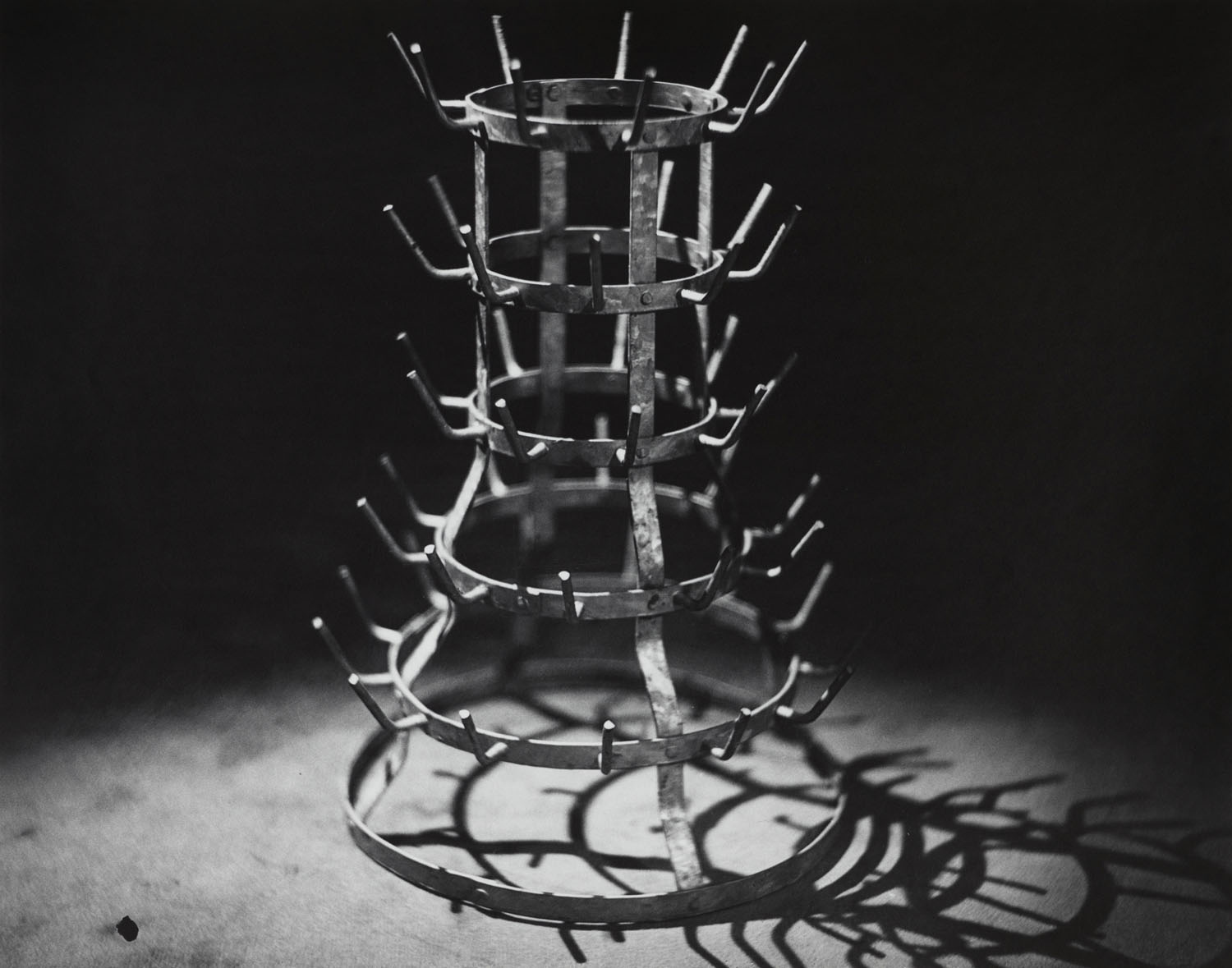
 

Man Ray (American, 1890-1976) 'Bottle-holder by Marcel Duchamp' c. 1920


Man Ray (American, 1890-1976)
Bottle-holder by Marcel Duchamp
c. 1920
Gelatin silver print
© Man Ray 2015 Trust / 2024, ProLitteris, Zurich. All rights reserved
Without permission from ProLitteris, the reproduction or any use of the individual and private consultation are prohibited


Man Ray (American, 1890-1976) 'Flowers' 1925


Man Ray (American, 1890-1976)
Flowers
1925
Gelatin silver print
© Man Ray 2015 Trust / 2024, ProLitteris, Zurich. All rights reserved
Without permission from ProLitteris, the reproduction or any use of the individual and private consultation are prohibited


In my early paper titled “The Delicious Fields: Exploring Man Ray’s ‘Rayographs’ in a Digital Future” published in The University of Queensland Vanguard magazine special edition ‘Man Ray: Life, Work & Themes’ (2004) I wrote:

The rayographs

After his arrival in Paris Man Ray started experimenting in his darkroom and discovered the technique for his rayographs by accident. With the help of his friend the Surrealist poet Tristan Tzara, he published a portfolio of twelve rayographs in 1922 called ‘Les champs délicieux’ (The delicious fields). “This title is a reference to ‘Les champs magnétiques’, a collection of writings by André Breton and Philippe Soupault composed from purportedly random thought fragments recorded by the two authors.”1 The rayographs are visual representations of random thought fragments, “photographic equivalents for the Surrealist sensibility that glorified randomness and disjunction.”2 Man Ray, “denied the camera its simplest joy: the ability to capture everything, all the distant details, all the ephemeral lights and shadows of the world”3 but, paradoxically, the rayographs are the most ephemeral of creatures, only being able to be created once, the result not being known until after the photographic paper has been developed. In fact, for Man Ray to create his portfolio ‘Les champs délicieux’ (The delicious fields), he had to rephotograph the rayographs in order to make multiple copies.4

Man Ray “insisted in nearly every interview that the rayograph was not a photogram in the traditional sense. He did something that a photogram didn’t; he introduced depth into the images,”5 which denied the images their photographic objectivity by depicting an internal landscape rather than an external one.6 What the rayographs do not deny, however, is the subjectivity of the artist, his skill at placing the objects on the photographic paper, expressed in their dream-like nature, both a subjective ephemerality (because they could only be produced once) and an ephemeral subjectivity (because they were expressions of Man Ray’s fantasies, and therefore had little substance). Through an alchemical process the latent images emerge from the photographic paper, representations of Man Ray’s fantasies as embodied in the ‘presence’ of the objects themselves, in the surface of the paper. …

Finally, within their depth of field the rayographs can be seen as both dangerous and delicious, for somehow they are both beautiful and unsettling at one and the same time. As Surrealism revels in randomness and chance these images enact the titles of other Man Ray photographs: ‘Danger-Dancer’, ‘Anxiety’, ‘Dust Raising’, ‘Distorted House’. The rayographs revel in chance and risk; Man Ray brings his fantasies to the surface, an interior landscape represented externally that can be (re)produced only once – those dangerous delicious fields.7

Marcus Bunyan. “The Delicious Fields: Exploring Man Ray’s Rayographs in a Digital Future,” in The University of Queensland Vanguard Magazine: ‘Man Ray: Life, Work and Themes’, 2004, Triad series #2, pp. 40-46. ISBN 0-9756043-0-9
 

Footnotes

1/ Greenberg, Mark (ed.,). In Focus: Man Ray: Photographs from the J. Paul Getty Museum. Los Angeles: The J. Paul Getty Museum, 1998, p. 28 quoted in Bunyan, op cit.,

2/ Perl, Jed (ed.,). Man Ray: Aperture Masters of Photography. New York: Aperture, 1997, pp. 11-12 quoted in Bunyan, op cit.,

3/ Ibid., pp. 5-6 quoted in Bunyan, op cit.,

4/ Greenberg, Mark (ed.,). In Focus: Man Ray: Photographs from the J. Paul Getty Museum. Los Angeles: The J. Paul Getty Museum, 1998, p. 28 quoted in Bunyan, op cit.,

5/ Ibid., p. 112 quoted in Bunyan, op cit.,

6/ Ibid., p. 28 quoted in Bunyan, op cit.,

7/ Marcus Bunyan. “The Delicious Fields: Exploring Man Ray’s Rayographs in a Digital Future,” in The University of Queensland Vanguard Magazine: ‘Man Ray: Life, Work and Themes’, 2004, Triad series #2, pp. 40-46. ISBN 0-9756043-0-9


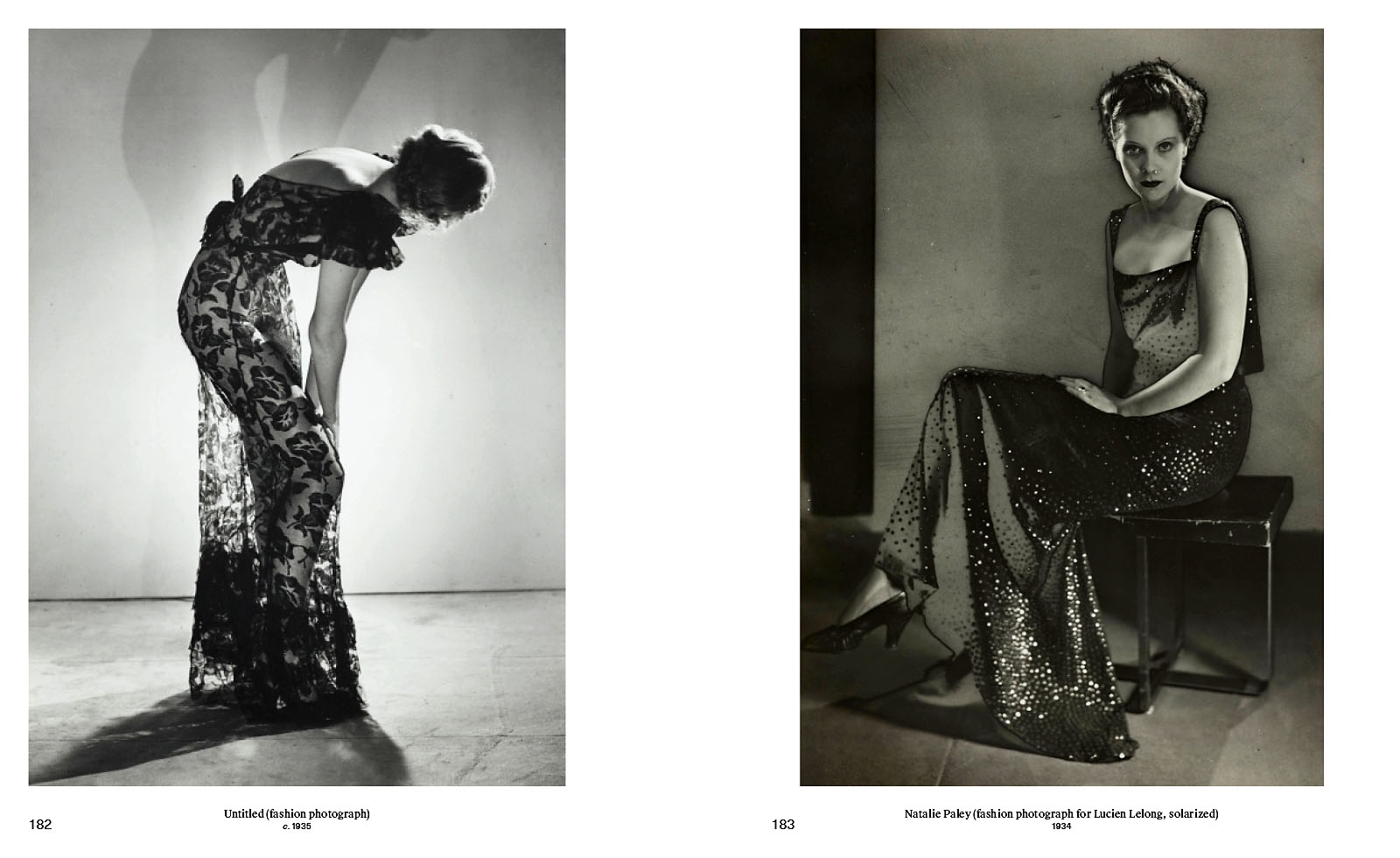
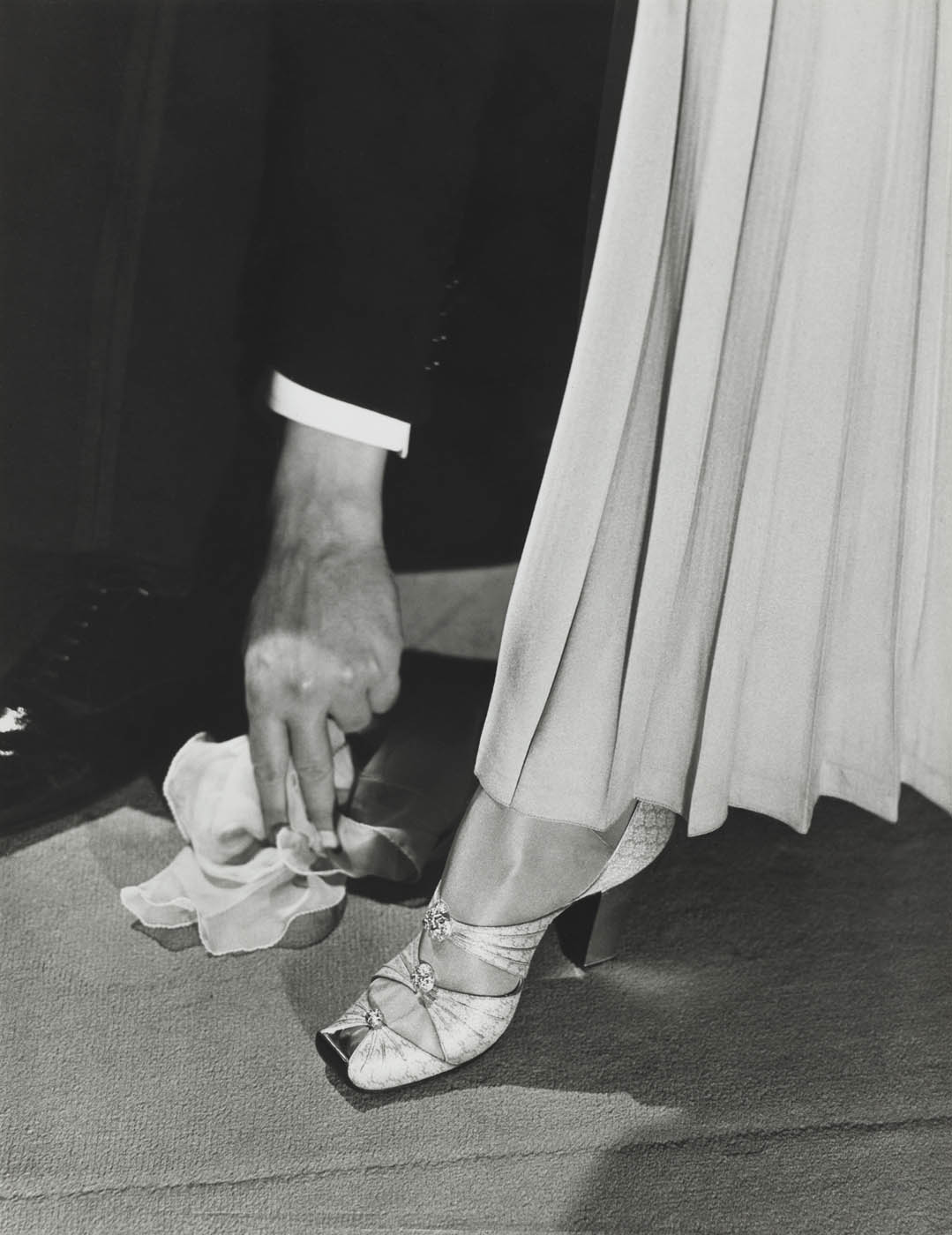
Man Ray (American, 1890-1976) 'Fashion photograph' c. 1935


Man Ray (American, 1890-1976)
Fashion photograph
c. 1935
Gelatin silver print
© Man Ray 2015 Trust / 2024, ProLitteris, Zurich. All rights reserved
Without permission from ProLitteris, the reproduction or any use of the individual and private consultation are prohibited
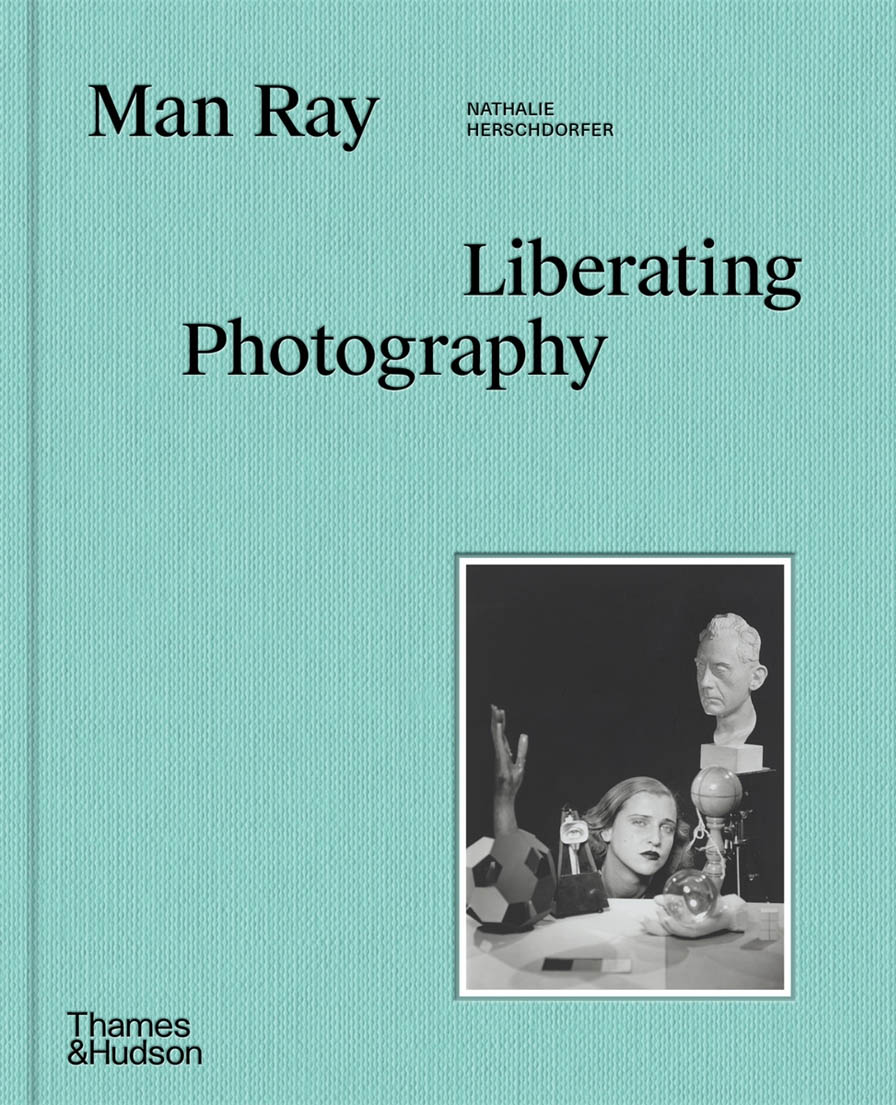
 

'Man Ray. Liberating Photography' book cover


Man Ray. Liberating Photography book cover


Man Ray. Liberating Photography

Nathalie Herschdorfer, Wendy Grossman

Published in connection with an exhibition opening at Photo Elysée in spring 2024, this book presents more than one hundred and fifty of Man Ray’s portraits, primarily from the 1920s and ’30s.

Man Ray (1890-1976) was a man both of and ahead of his time. With his conceptual approach and innovative techniques, he liberated photography from previous constraints and opened the floodgates to new ways of thinking about the medium.

A close friend of Marcel Duchamp and André Breton, he was one of the few photographers to be mentioned among the Dada artists and surrealists. He also worked as a fashion photographer, first for Vogue and later for Harper’s Bazaar and Vanity Fair. Renowned as the creator of Ingres’s Violin – a photograph from 1924 that broke records when it was sold for $12.4 million in 2022 – Man Ray remains an influential figure in the worlds of art, fashion, and pop culture, with many other artists referencing his work.

Published in connection with an exhibition at Photo Elysée and in the centennial year of the publication of André Breton’s Surrealist Manifesto, Man Ray presents more than one hundred and fifty of Man Ray’s portraits, primarily from the 1920s and ’30s. It includes portraits of the leading lights of the Paris art scene, among them Marcel Duchamp, Robert Delaunay, Georges Braque, Alberto Giacometti, and Pablo Picasso, as well as a selection of his fashion work. As an innovator of photographic techniques and compositional form, Man Ray found the studio portrait – be it of the artists and writers with whom he had longstanding friendships or of the objects and sculptures he collected – to be the playground in which he could express the visual wit and experimentation for which he is renowned.

Format: Hardcover
Pages: 224
Artwork: 153 black-and-white illustrations
Size: 7.75 in x 9.5 in
Forthcoming: September 10th, 2024
ISBN-10: 0500028117
ISBN-13: 9780500028117
Buy the book now


'Man Ray. Liberating Photography'

'Man Ray. Liberating Photography'

'Man Ray. Liberating Photography'

'Man Ray. Liberating Photography'

'Man Ray. Liberating Photography'

'Man Ray. Liberating Photography'

'Man Ray. Liberating Photography'

'Man Ray. Liberating Photography'


Man Ray. Liberating Photography book pages


Photo Elysee
Place de la Gare 17
CH-1003 Lausanne
+41 21 318 44 00

Opening hours:
Monday : 10am – 6pm
Tuesday : closed (MCBA open)
Wednesday : 10am – 6pm
Thursday : 10am – 8pm
Friday : 10am – 6pm
Saturday : 10am – 6pm
Sunday : 10am – 6pm

Photo Elysee website

LIKE ART BLART ON FACEBOOK

Back to top

Exhibition: ‘Man Ray: The Paris Years’ at the Virginia Museum of Fine Arts, Richmond, Virginia

Exhibition dates: 30th October, 2021 – 20th February, 2022

Curator: Dr. Michael Taylor, VMFA’s Chief Curator and Deputy Director for Art and Education


Man Ray (American, 1890-1976) 'Self-Portrait with Camera' 1930 from the exhibition 'Man Ray: The Paris Years' at the Virginia Museum of Fine Arts, Richmond, Virginia, Oct 2021 - Feb 2022


Man Ray (American, 1890-1976)
Self-Portrait with Camera
1930
Solarised gelatin silver print
The Jewish Museum, New York, Photography Acquisitions Committee Fund, Horace W. Goldsmith Fund, and Judith and Jack Stern Gift
© Man Ray 2015 Trust/Artists Rights Society (ARS), NY/ADAGP, Paris 2021


I remember many many years ago (2004) the National Gallery of Victoria held a major exhibition of the work of Man Ray, the first large-scale exhibition of Man Ray’s photography to have been presented in Australia. The exhibition was organised by the Art Gallery of New South Wales where it set an attendance record for photography exhibitions, with over 52,000 visitors, before travelling to Brisbane and Melbourne – which exhibitions did in those days between state capitals, alas no longer.

All these years later I still remember being impressed by the technical, almost scientific element – and elemental – aspect of Man Ray’s photography, the sheer intensity of his images, and their small, jewel-like size. I was less impressed by the lack of feeling the photographs gave me, as though the photographs were scientific experiments which emphasised “his techniques of framing, cropping, solarising and use of the photogram in order to present a new, ‘surreal’ way of seeing” and which, to my young photographic eyes, saw their lush and enigmatic beauty subsumed in an unemotional technical exercise.

Concentrating on his portrait photographs during his Paris years, this exhibition includes more than 100 portrait photographs made by the artist in Paris between 1921 and 1940. “In choosing portraits for the exhibit, the curator’s objective was to present the complete picture of Man Ray’s pantheon of cultural luminaries… “Since this exhibition is all about storytelling, we wanted to highlight the femme moderne and tell the public of their fierce individuality and creativity,” [Michael] Taylor says, explaining that the women’s inclusion makes for a more dynamic and meaningful exhibition. “These are musicians, models and performers whose contributions have been marginalized due to the legacy of colonialism and racism.” … The portraits chosen for “Man Ray: the Paris Years” reflect not only the staggering range of techniques Ray employed during his Parisian years, but also the fascinating people who inhabited his world. “Innovative, groundbreaking, experimental and completely original, Ray’s portraits are unlike the work of any of his contemporaries,” Taylor says.”1

But to my mind Man Ray’s other photography during this period, such as his 1922 album Champs Délicieux which contained 12 Dada inspired Rayographs (some of his first), his surreal photographic solarisations and his portfolio, Électricité (Electricity) (1931) are more expressive and revolutionary avant-garde statements of the creative power of photography than ever his portraits are.

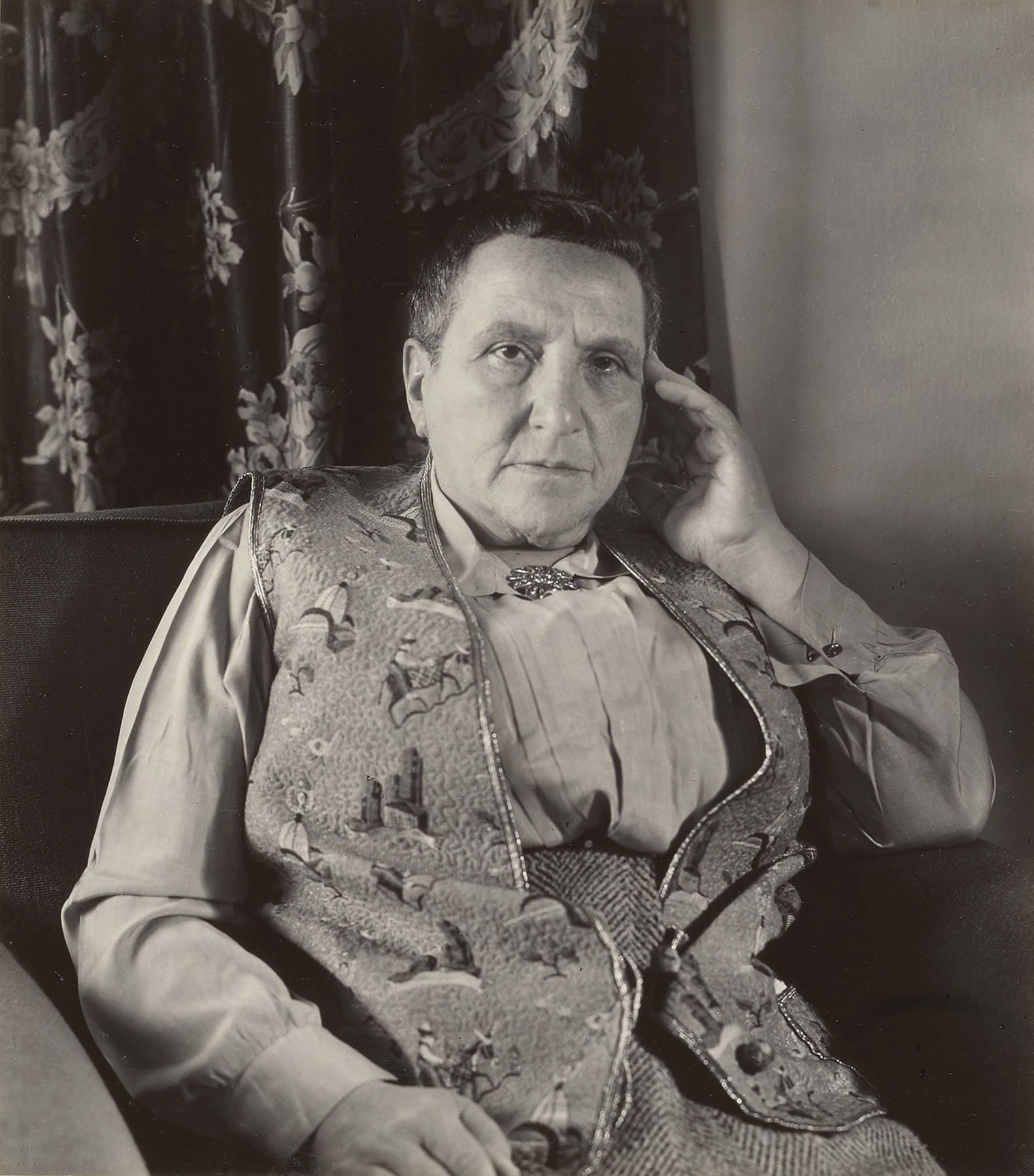
And while his portrait photographs may be experimental and groundbreaking – all about technique – are they good portraits? That’s the key question. To my eyes his portraits have a “lumpy” quality to them, a kind of enigmatic blankness that never reveals much of the sitters personality. The doll-like beauty of Kiki de Montparnasse (c. 1924, below) becomes a later abstract wistfulness both photographs revealing nothing; a tough, shielded Gertrude Stein (at Home) (1922, below) is not a patch on Imogen Cunningham’s engaging, challenging portrait of 1934; and the portrait of Elsie Houston (1933, below) is just plain uncomfortable in its placement of the bandaged head and hand in the pictorial frame.

Apparently, Man Ray “was in league with the surrealists and, in even his most classical-seeming portraits, revealed a predilection for unexpected juxtapositions, visual rhymes and piercing expressions that can transport you instantaneously to the lip of a volcanic unconscious.” Allegedly.

A volcanic unconscious. Who writes this stuff? I often feel I am looking at different photographs than the ones other people are writing about. Again, “Man Ray’s photography doesn’t simply capture the image of a person, or the ghost that inhabits them. It captures the whole of creative expression – the surreal and sorrowful, the conflict and music, the desperation and freedom that comprise the human narrative.” No it doesn’t… I don’t even think he is a very good portrait photographer! Compared to a Weston, Sander or Lange, a Stieglitz, Arbus or Julia Margaret Cameron, Man Ray’s portraits are modestly proficient evocations at best.

“To be ‘done’ by Man Ray and Berenice Abbott meant that you rated as somebody,” wrote Sylvia Beach, owner of Shakespeare and Company, the legendary bookstore and lending library established in Paris after World War I by the American expatriate. You had made it… immortalised in the negative, promoted in the positive. There is the key. To be worthy, to be “fashion” able. After all, Man Ray was running a commercial photographic studio with Berenice Abbott as his assistant in order to make a living. After Man Ray fired her in 1926 Abbott set up her own studio and they became business rivals.

The two most enticing portrait photographs in the posting are both wistful visages of the female: the slightly out of focus, low depth of field beauty of the direct Lee Miller, an ex-lover of Man Ray, staring down the desiring male gaze, like the most glamorous and scientifically symmetrically perfect “mug shot” you have ever seen; and the soft sfumato (which translated literally from Italian means “vanished or evaporated”) background to the contemporary Mona Lisa that is the vulnerable, tender Berenice Abbott surrounded by vanished shadows and evaporated space. “Leonardo has studied the sky, the elements, the atmosphere, and the light. He takes the approach of a scientist, but translates it into the painting with superb delicacy and finesse. For him the painting doesn’t count. What counts is the knowledge,” observes Louvre Curator Jean-Pierre Cuzin.2

Science, knowledge and atmosphere. Only in this portrait of Berenice Abbott does Man Ray take his love of science and knowledge and approach what Preston Duncan observes: “It is through this aperture that we find the abiding sense that, in all the weight, the struggle, the limitations of our physical form, is an ongoing moment of release.”

A final thought emerges in my consciousness. I wondered whether there is a photograph of Man Ray by Berenice Abbott? Not that I can find…

Dr Marcus Bunyan


1/ Karen Newton. “Storytelling Portraits,” on the Style Weekly website August 31, 2021 [Online] Cited 20/02/2022

2/ Anonymous text. “…Leonardo’s masterful technique,” on the PBS Treasures of the World website [Online] Cited 20/02/2022


Many thankx to the Virginia Museum of Fine Arts for allowing me to publish the photographs in the posting. Please click on the photographs for a larger version of the image.


“The story of Man Ray and Paris has been told, but it’s usually been told through the lens – pardon the pun, it’s a photography show – of Man Ray’s innovations; the Rayograph, Solarization, his friendships, and his network. But what about the subjects?” says Chief Curator, Dr. Michael Taylor. “We took inspiration from the photograph on the cover of this show. It’s the first work you see in the exhibition. This is actually Man Ray taking your portrait. In other words, […] even though it’s called a self-portrait, a camera is photographing him, but he is looking at you with his camera. So we started to think about not just telling Man Ray’s story, which is fascinating, but the story of the sitters, the subjects, the models. …

While the primary focus of the exhibit is on portraiture and the radical expressiveness of his subjects – from the vanguards of femme moderne culture to aerialists in drag – there are some detours into avant-garde Rayography and cinema. This diversity of expression is resonant with Man Ray’s professional dedication to dismantling boundaries – those of gender, race, and national identity, as well as artistic traditionalism and aesthetic philosophy. …

Man Ray’s photography doesn’t simply capture the image of a person, or the ghost that inhabits them. It captures the whole of creative expression – the surreal and sorrowful, the conflict and music, the desperation and freedom that comprise the human narrative. It is through this aperture that we find the abiding sense that, in all the weight, the struggle, the limitations of our physical form, is an ongoing moment of release. It confronts us with the fact we are all winging this strange dance, contributing our solitary note to an overture that is entirely improvised, sharing in the simple hope that we may, for an instant, hear the enormity of the score.”


Preston Duncan. “The View From Paris,” on the RVA website November 3, 2021 [Online] Cited 02/02/2022


All the men of the age are there: Igor Stravinsky, James Joyce, Andre Breton, Picasso and Braque. Equally present are the era’s modern women, including Bernice Abbott, the rarely-as-well-photographed Gertrude Stein, Lee Miller and Virginia Woolf. The real stars, however, are the unknowns. Or rather, those unknown-to-us. “Man Ray used photography to challenge the artistic traditions and break boundaries, including fixed gender roles and racial barriers,” says Michael Taylor, the museum’s chief curator, who conceived the exhibition.


Daniel Cassady. “‘Paris’s glowing milieu spills onto every corner’: Virginia show theatrically tells the story of Man Ray’s fruitful time in the City of Lights,” on The Art Newspaper website 11 November 2021 [Online] Cited 03/02/2022


Man Ray (American, 1890-1976) 'Kiki de Montparnasse' c. 1924 from the exhibition 'Man Ray: The Paris Years' at the Virginia Museum of Fine Arts, Richmond, Virginia, Oct 2021 - Feb 2022


Man Ray (American, 1890-1976)
Kiki de Montparnasse
c. 1924
Gelatin silver print
Francis M. Naumann Fine Art, New York
© Man Ray 2015 Trust/Artists Rights Society (ARS), NY/ADAGP, Paris 2021


Man Ray (American, 1890-1976) 'Kiki de Montparnasse' c. 1929


Man Ray (American, 1890-1976)
Kiki de Montparnasse
c. 1929
Gelatin silver print
© Man Ray 2015 Trust/Artists Rights Society (ARS), NY/ADAGP, Paris 2021


Alice Ernestine Prin (French, 1901-1953)

Alice Ernestine Prin (2 October 1901 – 29 April 1953), nicknamed the Queen of Montparnasse, and often known as Kiki de Montparnasse, was a French artist’s model, literary muse, nightclub singer, actress, memoirist and painter. She flourished in, and helped define, the liberated culture of Paris in the 1920s.

Alice Prin was born in Châtillon-sur-Seine, Côte d’Or. An illegitimate child, she was raised in abject poverty by her grandmother. At age twelve, she was sent to live with her mother in Paris in order to find work. She first worked in shops and bakeries, but by the age of fourteen, she was posing nude for sculptors, which created discord with her mother.

Adopting a single name, “Kiki”, she became a fixture in the Montparnasse social scene and a popular artist’s model, posing for dozens of artists, including Sanyu, Chaïm Soutine, Julian Mandel, Tsuguharu Foujita, Constant Detré, Francis Picabia, Jean Cocteau, Arno Breker, Alexander Calder, Per Krohg, Hermine David, Pablo Gargallo, Mayo, and Tono Salazar. Moïse Kisling painted a portrait of Kiki titled Nu assis, one of his best known.

Her companion for most of the 1920s was Man Ray, who made hundreds of portraits of her. She can be considered his muse at the time and the subject of some of his best-known images, including the surrealist image Le violon d’Ingres and Noire et blanche (see below).

She appeared in nine short and frequently experimental films, including Fernand Léger’s Ballet mécanique without any credit.

A painter in her own right, in 1927 Prin had a sold-out exhibition of her paintings at the Galerie au Sacre du Printemps in Paris. Signing her work with her chosen single name, Kiki, she usually noted the year. Her drawings and paintings comprise portraits, self-portraits, social activities, fanciful animals, and dreamy landscapes composed in a light, slightly uneven, expressionist style that is a reflection of her easy-going manner and boundless optimism. …

A symbol of bohemian and creative Paris and of the possibility of being a woman and finding an artistic place, at the age of twenty-eight she was declared the Queen of Montparnasse. Even during difficult times, she maintained her positive attitude, saying “all I need is an onion, a bit of bread, and a bottle of red [wine]; and I will always find somebody to offer me that.”

She left Paris to avoid the occupying German army during World War II, which entered the city in June 1940. …

Prin died in 1953 after collapsing outside her flat in Montparnasse, at the age of fifty-one, apparently of complications of alcoholism or drug dependence. A large crowd of artists and fans attended her Paris funeral and followed the procession to her interment in the Cimetière parisien de Thiais. Her tomb identifies her as “Kiki, 1901-1953, singer, actress, painter, Queen of Montparnasse.” Tsuguharu Foujita has said that, with Kiki, the glorious days of Montparnasse were buried forever.

Long after her death, Prin remains the embodiment of the outspokenness, audacity, and creativity that marked that period of life in Montparnasse. She represents a strong artistic force in her own right as a woman. In 1989, biographers Billy Klüver and Julie Martin called her “one of the century’s first truly independent women.” In her honour, a daylily has been named Kiki de Montparnasse.

Text from the Wikipedia website


Man Ray (American, 1890-1976) 'Noire et Blanche' 1926


Man Ray (American, 1890-1976)
Noire et Blanche
1926
Gelatin silver print
6 7/8 x 8 1/4 in. (17.5 x 21cm)
© Man Ray 2015 Trust/Artists Rights Society (ARS), NY/ADAGP, Paris 2021

As far as I know this photograph is NOT in the exhibition


Man Ray (American, 1890-1976) 'Gertrude Stein (at Home)' 1922


Man Ray (American, 1890-1976)
Gertrude Stein (at Home)
1922
Gelatin silver print
7 15/16”H × 6 1/16”W (20.16 × 15.4cm)
Virginia Museum of Fine Arts, Arthur and Margaret Glasgow Endowment
© Man Ray 2015 Trust/Artists Rights Society (ARS), NY/ADAGP, Paris 2021


Imogen Cunningham (American, 1883-1976) 'Gertrude Stein, Writer' 1934


Imogen Cunningham (American, 1883-1976)
Gertrude Stein, Writer
1934
Gelatin silver print
Image: 7 9/16 × 6 11/16 in.
Frame: 22 5/8 x 16 5/8 x 1 3/8 in.
The J. Paul Getty Museum, Los Angeles


Man Ray (American, 1890-1976) 'Berenice Abbott' 1921, printed later


Man Ray (American, 1890-1976)
Berenice Abbott
1921, printed later
Gelatin silver print
Virginia Museum of Fine Arts, Arthur and Margaret Glasgow Endowment
© Man Ray 2015 Trust/Artists Rights Society (ARS), NY/ADAGP, Paris 2021


In 1926 Peggy Guggenheim, who often lent her financial support to the Paris colony of artists and writers, telephoned Man Ray to arrange a studio appointment to have her portrait taken, not by Man Ray himself, but by Berenice. Afterwards Man Ray was livid, he now realised that Berenice had become a serious business rival, and the next day he fired her. Berenice immediately made plans to have a studio of her own and friends of Berenice stepped forward to help her. When she made arrangements to purchase a view camera – Peggy Guggenheim lent her the money to pay for it. As partial repayment, Berenice later photographed Peggy’s children. In 1926, she had her first solo exhibition (in the gallery “Au Sacre du Printemps”) and started her own studio on the rue du Bac.


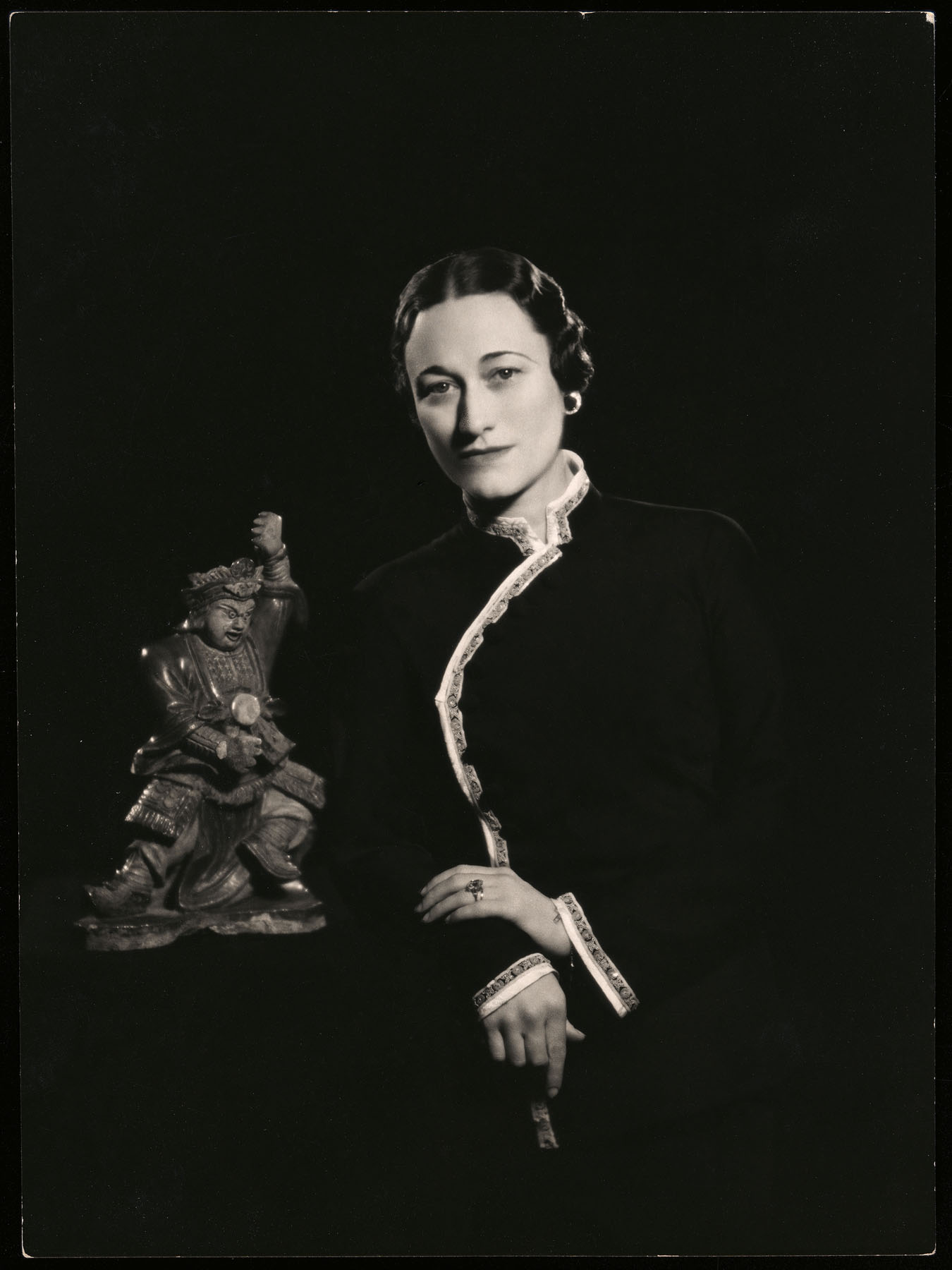
Man Ray (American, 1890-1976) 'Wallis Simpson with Chinese Sculpture' 1936


Man Ray (American, 1890-1976)
Wallis Simpson with Chinese Sculpture
1936
Gelatin silver print
Virginia Museum of Fine Arts, Arthur and Margaret Glasgow Endowment
© Man Ray 2015 Trust/Artists Rights Society (ARS), NY/ADAGP, Paris 2021


Photographed during the year in which her liaison with Edward VIII became public and he abdicated the throne of the British Empire.


The Virginia Museum of Fine Arts announces its upcoming exhibition, Man Ray: The Paris Years, on view in Richmond from October 30, 2021, through February 21, 2022. Organised by Dr. Michael Taylor, VMFA’s Chief Curator and Deputy Director for Art and Education, the exhibition includes more than 100 compelling portrait photographs made by the artist in Paris between 1921 and 1940, featuring cultural luminaries such as Barbette, André Breton, Jean Cocteau, Marcel Duchamp, Ernest Hemingway, Miriam Hopkins, James Joyce, Henri Matisse, Méret Oppenheim, Alice Prin (Kiki de Montparnasse), Elsa Schiaparelli, Erik Satie, Wallis Simpson and Gertrude Stein.

The son of Russian-Jewish immigrants, Emmanuel “Manny” Radnitzky grew up in New York and adopted the pseudonym Man Ray around 1912. A timely sale of paintings to Ferdinand Howald, an art collector from Columbus, Ohio, provided Man Ray with funds for a trip to Paris, and he arrived in the French capital on July 22, 1921. Although the artist worked in a variety of media over the next two decades, including assemblage, film, sculpture and painting, photography would be his primary means of artistic expression in Paris.

Shortly after moving to France, Man Ray embarked on a sustained campaign to document the international avant-garde in a series of remarkable portraits that established his reputation as one of the leading photographers of his era. Man Ray’s portraits often reflect a dialogue or negotiation between the artist’s vision and the self-fashioning of his subjects. Whether they had their portrait taken to promote their work, affirm their self-image, project their desires, fulfil their dreams or create a new identity, Man Ray’s sitters were not inanimate objects, like blocks of marble to be shaped and coerced, but were instead highly creative cultural and thought leaders who were active participants in the creative act. By telling the stories of his respective sitters and the innovative techniques he used to create their portraits, Man Ray: The Paris Years empowers the subjects portrayed in these photographs and gives them an agency and voice that is not typically realised in monographic accounts of modern artists.

“Timed to coincide with the 100th anniversary of the artist’s arrival in the French capital and, coincidentally, the near-centennial anniversary of the Spanish flu pandemic, Man Ray: The Paris Years will prove to be a visually provocative and especially relevant exhibition,” said Alex Nyerges, VMFA’s Director and CEO. “This is an opportunity to better understand the lives of his subjects and see Man Ray in a different light.”

“Man Ray used photography to challenge artistic traditions and break boundaries, including fixed gender roles and racial barriers,” said Taylor. “His portraits went beyond recording the mere outward appearance of the person depicted and aimed instead to capture the essence of his sitters as creative individuals, as well as the collective nature and character of Les Années folles (the crazy years) of Paris between the two world wars.”

Man Ray’s radical portraits also capture an important constituency of the avant-garde at this time, namely the femme moderne (modern woman). Adventurous, ambitious, assertive, daring, enterprising and self-assured modern women like American photographers Berenice Abbott and Lee Miller, French artist Suzanne Duchamp and American sculptor Janet Scudder took full advantage of their unprecedented freedom and access to educational and professional opportunities to participate as equals to their male counterparts in the Parisian avant-garde. Although these women came from different classes and economic backgrounds, they shared a collective goal in the 1920s and 1930s to be creatively, financially and intellectually independent.

“Rejecting traditional gender roles and expectations, modern women were interested in erasing sexual differences,” said Taylor. “They often embraced the symbolic trappings and autonomy of their male counterparts including wearing men’s clothes, driving fast cars, smoking cigarettes and sporting tightly cropped ‘bobbed’ haircuts.”

The exhibition also tells the important stories of Black subjects such as Henry Crowder, Adrienne Fidelin and Ruby Richards, whose contributions have often been unfairly relegated to the margins of modernism due to the legacy of colonialism and racism. The artist’s series of portraits of the dancer and singer Ruby Richards, who was born in St. Kitts in the British West Indies and grew up in Harlem, New York, brings to light an important performer whose work with Man Ray has never been acknowledged in previous accounts of his work. Richards moved to Paris in 1938 to replace the legendary African American performer Josephine Baker as the star attraction at the Folies Bergère, and the famous cabaret music hall commissioned Man Ray to help introduce her to French audiences through his portrait photographs.

Many of the subjects portrayed in Man Ray’s photographs were born in Spanish-speaking countries such as Argentina, El Salvador, Peru and Spain, including famous modern artists like Salvador Dalí and Pablo Picasso, as well as the flamenco dancer Prou del Pilar and the pianist Ricardo Viñes. As a state art museum that has free general admission and is open 365 days a year, VMFA is committed to representing the cultural and linguistic diversity of our community. According to recent data from the U.S. Census Bureau, more than 7 percent of Virginia’s 8.5 million residents speak Spanish at home. This data has informed the museum’s decision to incorporate dual-language labels throughout the Man Ray: The Paris Years exhibition, as well as the audio tour and gallery guide. Recognising that English is not the native language of everyone who visits the exhibition, VMFA is offering content in both Spanish and English to create a more accessible, inclusive and welcoming experience for all of our visitors.

Informed by extensive archival research, this exhibition and accompanying catalogue offers a more complete account of Man Ray’s Paris years by focusing not just on his achievement as a photographer and his superb gifts as a portraitist, but also on the friendships and exchange of ideas that took place between the artist and his subjects in Paris between the two world wars.

Press release from VMFA


Man Ray (American, 1890-1976) 'Nusch Éluard and Sonia Mossé' 1937


Man Ray (American, 1890-1976)
Nusch Éluard and Sonia Mossé
1937
Gelatin silver print
© Man Ray 2015 Trust/Artists Rights Society (ARS), NY/ADAGP, Paris 2021


Mossé was a surrealist artist and performer in a lesbian cabaret.


Ray’s double portraits are among his most spellbinding. Two feature Nusch Éluard, the actress, acrobat and hypnotist’s assistant who married the surrealist poet Paul Éluard. One shows Nusch with the openly bisexual actress, singer, surrealist and model Sonia Mossé. Taken in 1937, the photograph trembles with the intimacy and uncanniness of the culminating scenes in Ingmar Bergman’s “Persona,” where the face of Bibi Andersson begins to merge with that of Liv Ullmann. …

To try to square Man Ray’s magical, tender double portrait with Mossé’s subsequent life, as sketched in by Taylor in the catalogue, is to feel the 20th century – stretched to breaking point by the contrary forces of personal liberation and vicious repression – suddenly snap, like the shutter of a camera taking a photograph no one can bear to look at.

Mossé, writes Taylor, was romantically involved with the French dramatist Antonin Artaud. Best known for conceptualising the Theater of Cruelty movement, Artaud had tried to break off their relationship in 1939 “via handwritten malediction” (a letter in which he wrote curses – e.g., “You will live dead” – in an envelope containing drawings and burned holes).

But Mossé would never receive it. War had broken out. And on Feb. 11, 1943, Mossé and her stepsister Esther were denounced as Jews to the Gestapo. They were taken to the Drancy internment camp in a northeastern suburb of Paris and then to the Sobibór extermination camp in occupied Poland, where Mossé was murdered in a gas chamber.

Sebastian Smee. “Glamour, gossip, sex, scandal: Man Ray’s portraits captured Paris between the wars,” on The Washington Post website November 9, 2021 [Online] Cited 03/02/2022


Man Ray (American, 1890-1976) 'Igor Stravinsky' 1925


Man Ray (American, 1890-1976)
Igor Stravinsky
1925
Gelatin silver print
© Man Ray 2015 Trust/Artists Rights Society (ARS), NY/ADAGP, Paris 2021


Man Ray (American, 1890-1976) 'Picasso in His Studio on the rue de La Boëtie, Paris' 1922


Man Ray (American, 1890-1976)
Picasso in His Studio on the rue de La Boëtie, Paris
1922
Gelatin silver print
© Man Ray 2015 Trust/Artists Rights Society (ARS), NY/ADAGP, Paris 2021


The American Surrealist Man Ray made a number of portraits of Picasso over the years, beginning with this photograph that appeared in the July 1922 issue of Vanity Fair. It was taken on the second floor of Picasso’s apartment at 23 rue de La Boëtie in Paris, where he established a studio in November 1918 and completed many of the Cubist paintings that form the background of this portrait. Man Ray’s portrait brilliantly captures both sides of Picasso’s personality at this time, since the proud and successful artist is also shown to be emotionally distant and seemingly uncomfortable with his newfound wealth and fame.

Text from the Philadelphia Museum of Art website


Man Ray (American, 1890-1976) 'Constantin Brancusi' 1925


Man Ray (American, 1890-1976)
Constantin Brancusi
1925
Gelatin silver print
9 1/4 x 10 1/4″ (23.5 x 26cm)
© Man Ray 2015 Trust/Artists Rights Society (ARS), New York/ADAGP, Paris


Man Ray (American, 1890-1976) 'Ruby Richards with Feathers' 1938


Man Ray (American, 1890-1976)
Ruby Richards with Feathers (installation view)
1938
Gelatin silver print


Ruby Richards (aka The Black Pearl) was a singer and dancer born in Saint Christopher Island (Saint Kitts) in the West Indies.

In 1938 the dancer and singer moved to Paris to replace Josephine Baker as the star attraction at the Folies Bergère. The famous cabaret music hall commissioned Man Ray to help introduce Richards to French audiences through his innovative portrait photographs.


Louis Jordan Soundie: Fuzzy Wuzzy

Featuring Louis Jordan and His Tympany Band with dancer Ruby Richards (recorded on New Year’s Eve 1942).


Man Ray (American, 1890-1976) 'Ruby Richards' 1938


Man Ray (American, 1890-1976)
Ruby Richards (installation view)
1938
Gelatin silver print


Man Ray (American, 1890-1976) 'Ruby Richards with Diamonds' c. 1938


Man Ray (American, 1890-1976)
Ruby Richards with Diamonds
c. 1938
Gelatin silver print
Collection of Michael and Jacky Ferro, Miami
© Man Ray 2015 Trust/Artists Rights Society (ARS), NY/ADAGP, Paris 2021)


Man Ray (American, 1890-1976) 'Self-Portrait With Adrienne Fidelin' 1937


Man Ray (American, 1890-1976)
Self-Portrait With Adrienne Fidelin
1937
Virginia Museum of Fine Arts
© Man Ray 2015 Trust/Artists Rights Society, New York/ADAGP, Paris 2021


He called her his “little black sun.” Born in Guadeloupe, Adrienne Fidelin was the American artist’s partner in Paris before World War II tore them apart. She appears in almost 400 of the renowned artist’s photographs, and in 1937 became the first Black model to be featured in a leading U.S. fashion magazine. However, she was pushed to the sidelines of history. …

Man Ray himself only mentions Fidelin fleetingly in his autobiography. This marginalisation continues today, despite current efforts to recognise the stories of people of colour throughout history…

Adrienne Fidelin was born on March 4, 1915, in Pointe-à-Pitre. At the age of 13, she lost her mother in a hurricane that devastated Guadeloupe, and her father died a few years later. The orphaned teenager joined other members of her family living in Paris in the early 1930s. At the time, the French capital was under the thrall of the Colonial Exposition and obsessed with France’s far-flung colonies. At the Bal Blomet, a cabaret in the 15th arrondissement, the West Indian diaspora and the artistic avant-garde partied to the sounds of Creole biguine music, and Fidelin joined a Guadeloupean dance company.

This is most likely where she and Man Ray first set eyes on each other. She was 19, he was 44. In a diary entry dated December 29, 1934, the artist simply wrote “Ady.” Wendy Grossman discovered this valuable evidence of their first meeting in the Man Ray archives at the Getty Center in Los Angeles. The following year, he wrote down her number (“Odéon 79-95”) and photographed her wearing a simple white tank top. The artist and the dancer were inseparable. On May 13, 1937, Man Ray combined their names in a tender Surrealist pairing, writing “Manady” and “Adyman” in his diary. …

On September 15, 1937, a full-page portrait photo of Fidelin taken by Man Ray was published in the U.S. magazine Harper’s Bazaar – a first in segregated America. However, captured “wearing a tiger-tooth necklace, an ivory arm bracelet, and a Belgian Congo headdress, and adopting a seductive pose, Fidelin was presumed to represent the sensual African ‘native’ identified in the article’s title,” writes Wendy Grossman. “The article shows how the Surrealist movement exoticised ‘the other.'”

Man Ray found a partner in Fidelin, but their relationship was asymmetrical. “She stops me from sinking into pessimism,” he wrote. “She does everything: shining my shoes, making me breakfast, and painting the backdrops on my large canvases.” Fidelin also danced in the “negro clubs” on the Champs-Elysées and worked with photographers and directors looking for “exotic girls.” …

The couple was torn apart when the Wehrmacht entered Paris in June 1940. After trying – and failing – to flee to the Côte d’Azur together, Man Ray returned to the United States alone. The lovers continued writing each other for a few months, but the war severely impacted the postal service and Man Ray soon fell in love with another dancer in Hollywood. Fidelin remained in Paris, married another man in 1957, and died in a retirement home a few miles outside Albi in Southern France [February 5, 2004].

Clément Thiery. “Adrienne Fidelin, Man Ray’s Forgotten Muse,” on the Fance-Amérique website February 2, 2022 [Online] Cited 03/02/2022


Man Ray (American, 1890-1976) 'Adrienne Fidelin with washboard' 1937


Man Ray (American, 1890-1976)
Adrienne Fidelin with washboard
1937
Gelatin silver print
29.8 x 23cm
Collection Musée Picasso
© Man Ray 2015 Trust / Artists Rights Society (ARS), New York

As far as I know this photograph is NOT in the exhibition


Man Ray (American, 1890-1976) 'James Joyce' 1922


Man Ray (American, 1890-1976)
James Joyce
1922
Gelatin silver print
Virginia Museum of Fine Arts, Arthur and Margaret Glasgow Endowment
© Man Ray 2015 Trust/Artists Rights Society (ARS), NY/ADAGP, Paris 2021


Man Ray (American, 1890-1976) 'James Joyce' (portrait for "Ulysses") 1922


Man Ray (American, 1890-1976)
James Joyce (portrait for “Ulysses”)
1922
Gelatin silver print
Virginia Museum of Fine Arts, Arthur and Margaret Glasgow Endowment
© Man Ray 2015 Trust/Artists Rights Society (ARS), NY/ADAGP, Paris 2021


If, in the early 1920s, you happened to walk into Shakespeare and Company, the legendary bookstore and lending library established in Paris after World War I by the American expatriate Sylvia Beach, you would have noticed that the walls were covered with photographic portraits by Man Ray and Berenice Abbott.

“To be ‘done’ by Man Ray and Berenice Abbott meant that you rated as somebody,” wrote Beach. The habitues of Shakespeare and Company famously included such somebodies as Ernest Hemingway, Gertrude Stein, Djuna Barnes, T.S. Eliot, Ezra Pound, Hilda Doolittle and F. Scott Fitzgerald.

In 1922, Beach commissioned Ray (1890-1976) to make a publicity photograph of James Joyce, the Irish novelist whose book “Ulysses” she was about to publish (to her everlasting glory). That same year, Ray photographed Marcel Proust on his deathbed (below).

Sebastian Smee. “Glamour, gossip, sex, scandal: Man Ray’s portraits captured Paris between the wars,” on The Washington Post website November 9, 2021 [Online] Cited 03/02/2022


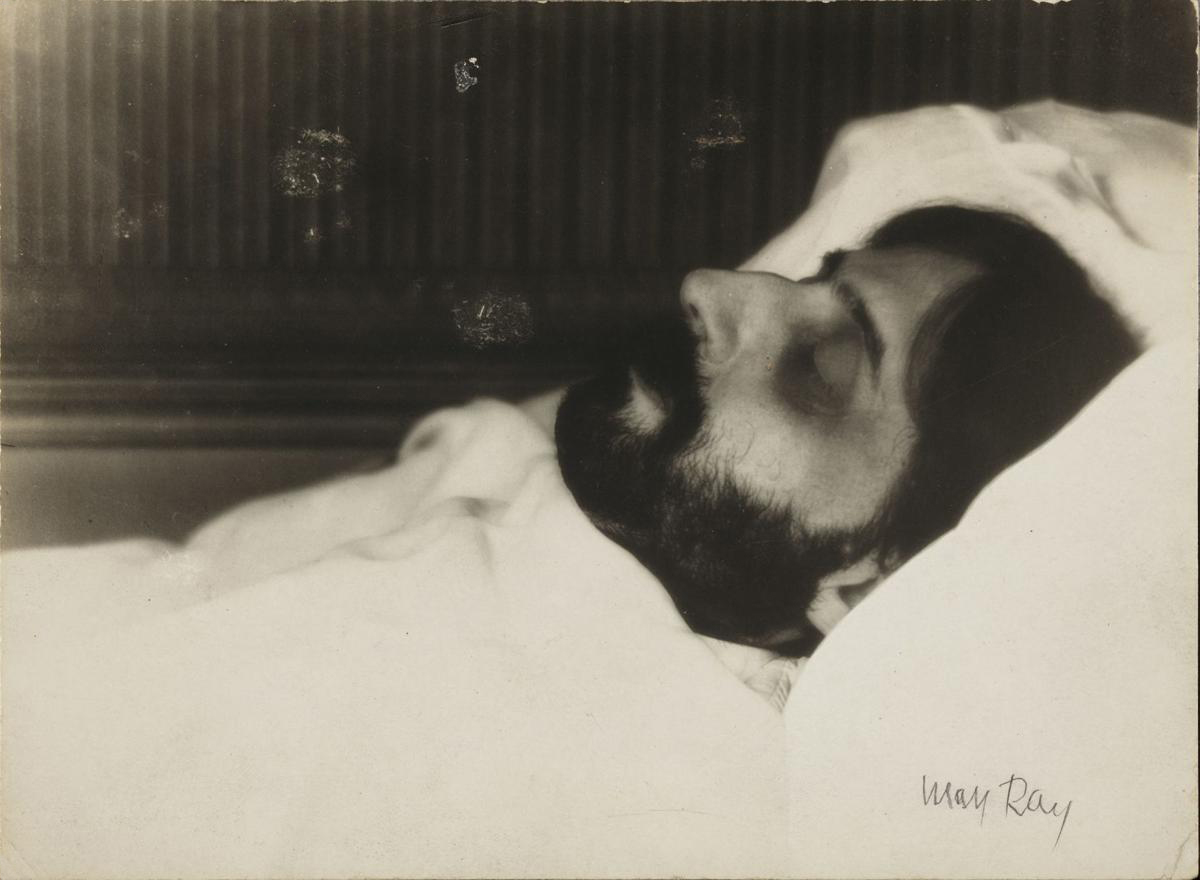
Man Ray (American, 1890-1976) 'Marcel Proust on His Deathbed' 1922


Man Ray (American, 1890-1976)
Marcel Proust on His Deathbed
1922
Gelatin silver print
Mark Kelman, New York
© Man Ray 2015 Trust/Artists Rights Society (ARS), NY/ADAGP, Paris 2021


“It comes so soon, the moment when there is nothing left to wait for.”

~ Marcel Proust


Ravaged by bronchitis and pneumonia, Marcel Proust spent the last night of his life dictating manuscript changes for a section of his famous novel Remembrance of Things Past.

Man Ray did not know Proust, but he had become such an important photographer that mutual friends dispatched him to the celebrated French author’s bedside to make a final portrait two days after his death. The side view associates Man Ray’s photograph with a tradition of postmortem photography dating back to the inception of the medium.

Text from the J. Paul Getty Museum website


At the urging of his friend Jean Cocteau, Man Ray rushed to photograph the author of Remembrance of Things Past on his deathbed. In the October / November issue of Les Nouvelles Littéraires, Cocteau wrote:

Those who have seen this profile of calm, of order, of plenitude, will never forget the spectacle of an unbelievable recording device come to a stop, becoming an art object: a masterpiece of repose next to a heap of notebooks where our friend’s genius continues to live on like the wristwatch of a dead soldier.

Text from the Metropolitan Museum of Art website


Man Ray (American, 1890-1976) 'Elsie Houston' 1933


Man Ray (American, 1890-1976)
Elsie Houston
1933
Gelatin silver print
Virginia Museum of Fine Arts, Arthur and Margaret Glasgow Endowment
© Man Ray 2015 Trust/Artists Rights Society (ARS), NY/ADAGP, Paris 2021


“Houston sang Brazilian folk songs by candlelight in Paris. She moved to New York in 1939, where she performed as a possessed woman muttering “voodoo” incantations and playing the drums. She died in her home in 1943, an empty vial of sleeping pills by her bedside. In Ray’s photograph, her smile is soft. Her head tilts in line with her elongated hand. That hand is adorned with a piece of jewellery in the shape of a spotted disc, which rhymes with her hoop earring and the arches of her eyebrows. The cool, clean contrasts of her white turban and dark clothes make the portrait one of Ray’s finest.”

Sebastian Smee. “Glamour, gossip, sex, scandal: Man Ray’s portraits captured Paris between the wars,” on The Washington Post website November 9, 2021 [Online] Cited 03/02/2022


Elsie Houston (Brazilian, 1902-1943)

Elsie Houston (22 April 1902 – 20 February 1943) was a Brazilian singer.

Houston figured in the Brazilian literary/art/music scene during a critical time in its history. It was an era of tremendous creative energy. In addition to Mário de Andrade and Pagu, Houston knew others famous members of this artists movement, including the composer Heitor Villa-Lobos, the painters Flavio de Carvalho, Anita Malfatti and Tarsila do Amaral, and the leader of Brazilian modernism, Oswald de Andrade.

Houston moved to Germany and studied with Lilli Lehmann a renowned voice teacher. She then studied with another famed soprano, Ninon Vallin, first in Argentina and then in Paris. Houston’s relationship with Heitor Villa Lobos began in her teens. Houston was definitely a soloist at Villa Lobos’s 1927 Paris concerts. In 1928 she married Benjamin Péret, French surrealist poet, with whom she lived in Brazil from 1929 to 1931. Their son, Geyser, was born in Rio de Janeiro in 1931.

By the late 1930s, Houston had moved to New York City. She was a brilliant singer, particularly skilled in the interpretation of Brazilian songs. The New York Times during this era praised for her performances. She was also an active supporter of young Latin American composers, performing early pieces by composers such as Jayme Ovalle and Camargo Guarnieri.

She died in 1943. Her death was listed as an apparent suicide.

Text from the Wikipedia website


Ravel – Sur l’herbe – Elsie Houston (1930s)


Man Ray (American, 1890-1976) 'Lee Miller' 1929


Man Ray (American, 1890-1976)
Lee Miller
1929
Gelatin silver print
Virginia Museum of Fine Arts, Arthur and Margaret Glasgow Endowment
© Man Ray 2015 Trust/Artists Rights Society (ARS), NY/ADAGP, Paris 2021


Ray learned from the history of painting as much as from other photographers. He borrowed from Rembrandt’s tenebrism (his dramatic use of engulfing shadow), the slanting light and perspectival structure in Vermeer’s interiors, and the directness of Hans Holbein (strong light on the face, minimal backgrounds). But of course, he was in league with the surrealists and, in even his most classical-seeming portraits, revealed a predilection for unexpected juxtapositions, visual rhymes and piercing expressions that can transport you instantaneously to the lip of a volcanic unconscious.

Ray’s 1929 portrait of Lee Miller is a good example – surely one of the most mesmerising photographic portraits ever taken. What is the source of its uncanny power? It’s not just that Miller – herself a great photographer who for several years was Ray’s lover – is so beautiful; or that her direct gaze is simultaneously so trusting and challenging; or even that her unblemished skin and the symmetry of the whole composition suggest something impossibly pristine and inviolate. It’s because the image is slightly out of focus. The effect of the blur is to slow one’s response, as smoke rings slow the mind – and to trigger a dream state.

Sebastian Smee. “Glamour, gossip, sex, scandal: Man Ray’s portraits captured Paris between the wars,” on The Washington Post website November 9, 2021 [Online] Cited 03/02/2022


Man Ray (American, 1890-1976)
Emak Bakia (Leave Me Alone)
1926


But you may be less familiar with some of Ray’s other subjects, including Germaine Tailleferre, the female composer who changed her name from Taillefesse, Taylor writes, “partly to spite her father, who refused to support her musical studies, but also because she disliked the connotations of the name Taillefesse, which translates as buttock in English”; Janet Scudder, an American sculptor, whose partner was the children’s author and suffragist Marion Cothren; and Barbette (below), the high-wire performer who presented as a graceful woman, but at the end of her act removed her wig and revealed herself as a man.

Personae like these – and Ray’s always inventive approach to their portraits – make this show more than just a roll call of famous names. They make it revelatory. The show is further enhanced by the inclusion of Ray’s wonderful 1926 film, “Emak-Bakia” (he called it a “cinépoème”), and a portfolio of semiabstract photographs he made for a Paris Electricity Co. marketing campaign. Both are remarkable.

Sebastian Smee. “Glamour, gossip, sex, scandal: Man Ray’s portraits captured Paris between the wars,” on The Washington Post website November 9, 2021 [Online] Cited 03/02/2022


Man Ray (American, 1890-1976) 'Barbette' 1926


Man Ray (American, 1890-1976)
Barbette
1926
Gelatin silver print
Virginia Museum of Fine Arts, Arthur and Margaret Glasgow Endowment
© Man Ray 2015 Trust/Artists Rights Society


Vander Clyde Broadway (American, 1899-1973)

Vander Clyde Broadway (December 19, 1899 – August 5, 1973), stage name Barbette, was an American female impersonator, high-wire performer, and trapeze artist born in Texas. Barbette attained great popularity throughout the United States but his greatest fame came in Europe and especially Paris, in the 1920s and 1930s.

Barbette began performing as an aerialist at around the age of 14 as one-half of a circus act called The Alfaretta Sisters. After a few years of circus work, Barbette went solo and adopted his exotic-sounding pseudonym. He performed in full drag, revealing himself as male only at the end of his act.

Following a career-ending illness or injury (the sources disagree on the cause), which left him in constant pain, Barbette returned to Texas but continued to work as a consultant for motion pictures as well as training and choreographing aerial acts for a number of circuses. After years of dealing with chronic pain, Barbette committed suicide on August 5, 1973. Both in life and following his death, Barbette served as an inspiration to a number of artists, including Jean Cocteau and Man Ray. …

“Barbette,” writes Cocteau,

“transforms effortlessly back and forth between man and woman. His female glamour and elegance Cocteau likens to a cloud of dust thrown into the eyes of the audience, blinding it to the masculinity of the movements he needs to perform his acrobatics. That blindness is so complete that at the end of his act, Barbette does not simply remove his wig but instead plays the part of a man. He rolls his shoulders, stretches his hands, swells his muscles… And after the fifteenth or so curtain call, he gives a mischievous wink, shifts from foot to foot, mimes a bit of an apology, and does a shuffling little street urchin dance – all of it to erase the fabulous, dying-swan impression left by the act.”


Cocteau calls upon his fellow artists to incorporate deliberately this effect that he believes for Barbette is instinctive.

Cocteau commissioned a series of photographs of Barbette by the Surrealist artist Man Ray, which captured not only aspects of Barbette’s performance but also his process of transformation into his female persona.

Text from the Wikipedia website


Man Ray (American, 1890-1976) 'Ernest Hemingway' 1928


Man Ray (American, 1890-1976)
Ernest Hemingway
1928
Gelatin silver print
National Portrait Gallery, Smithsonian Institution
© Man Ray 2015 Trust/Artists Rights Society (ARS), NY/ADAGP, Paris 2021


Man Ray (American, 1890-1976) 'Aldous Huxley' 1934


Man Ray (American, 1890-1976)
Aldous Huxley
1934
Gelatin silver print
© Man Ray 2015 Trust/Artists Rights Society (ARS), NY/ADAGP, Paris 2021


This photograph was taken two years after the publication of Huxley’s novel Brave New World, a nightmarish vision of the future.


Man Ray (American, 1890-1976) 'La Ville' (The City) 1931


Man Ray (American, 1890-1976)
La Ville (The City)
1931
From the portfolio Èlectricité
Photogravure, printed 1931
© Man Ray 2015 Trust/Artists Rights Society (ARS), NY/ADAGP, Paris 2021


In 1931, Man Ray was commissioned by the Compagnie Parisienne de Distribution d’Electricite (CPDE) to produce a series of pictures promoting the private consumption of electricity. The resulting portfolio, Électricité (Electricity), comprises rayographs reproduced as photogravures. Le Monde (The World), a picture of the moon above an electrical cord, suggests that even celestial bodies rely on the CPDE for their illumination; the photogravure Électricité equates the electric charge of the electron with the erotic beauty of a nude female figure; and Le Souffle (Breeze) combines spinning fan blades with the weblike stimuli of electrical current.

Gallery label from The Shaping of New Visions: Photography, Film, Photobook, April 16, 2012 – April 29, 2013 on the MoMA website [Online] Cited 03/02/2022


Man Ray. 'Électricité' 1931


Man Ray (American, 1890-1976)
Électricité
1931
From the portfolio Èlectricité
Photogravure, printed 1931
© Man Ray 2015 Trust/Artists Rights Society (ARS), NY/ADAGP, Paris 2021


Man Ray’s innovations are not excluded. A whole section of the exhibition is devoted to his light-bending portfolio Électricité (1931), a commercial project commissioned by the Paris Electric Company to promote the use of electrically powered household appliances. Comprised of ten “Rayographs” (another name for photograms), the portfolio pulses with kinetic energy. Fans spin with an otherworldly force, a fowl is perfectly cooked as by magic rays, and the Eiffel Tower swims in hi-wattage advertisements.

Daniel Cassady. “‘Paris’s glowing milieu spills onto every corner’: Virginia show theatrically tells the story of Man Ray’s fruitful time in the City of Lights,” on The Art Newspaper website 11 November 2021 [Online] Cited 03/02/2022


Man Ray (American, 1890-1976) 'Le Souffle' (Breeze) 1931


Man Ray (American, 1890-1976)
Le Souffle (Breeze)
1931
From the portfolio Èlectricité
Photogravure, printed 1931
© Man Ray 2015 Trust/Artists Rights Society (ARS), NY/ADAGP, Paris 2021


Man Ray (American, 1890-1976) 'Le Monde' (The World) 1931


Man Ray (American, 1890-1976)
Le Monde (The World)
1931
From the portfolio Èlectricité
Photogravure, printed 1931
© Man Ray 2015 Trust/Artists Rights Society (ARS), NY/ADAGP, Paris 2021


Virginia Museum of Fine Arts
200 N. Boulevard
Richmond, Virginia USA

Opening hours:
Daily 10am – 5pm and until 9 pm Wed, Thu, Fri
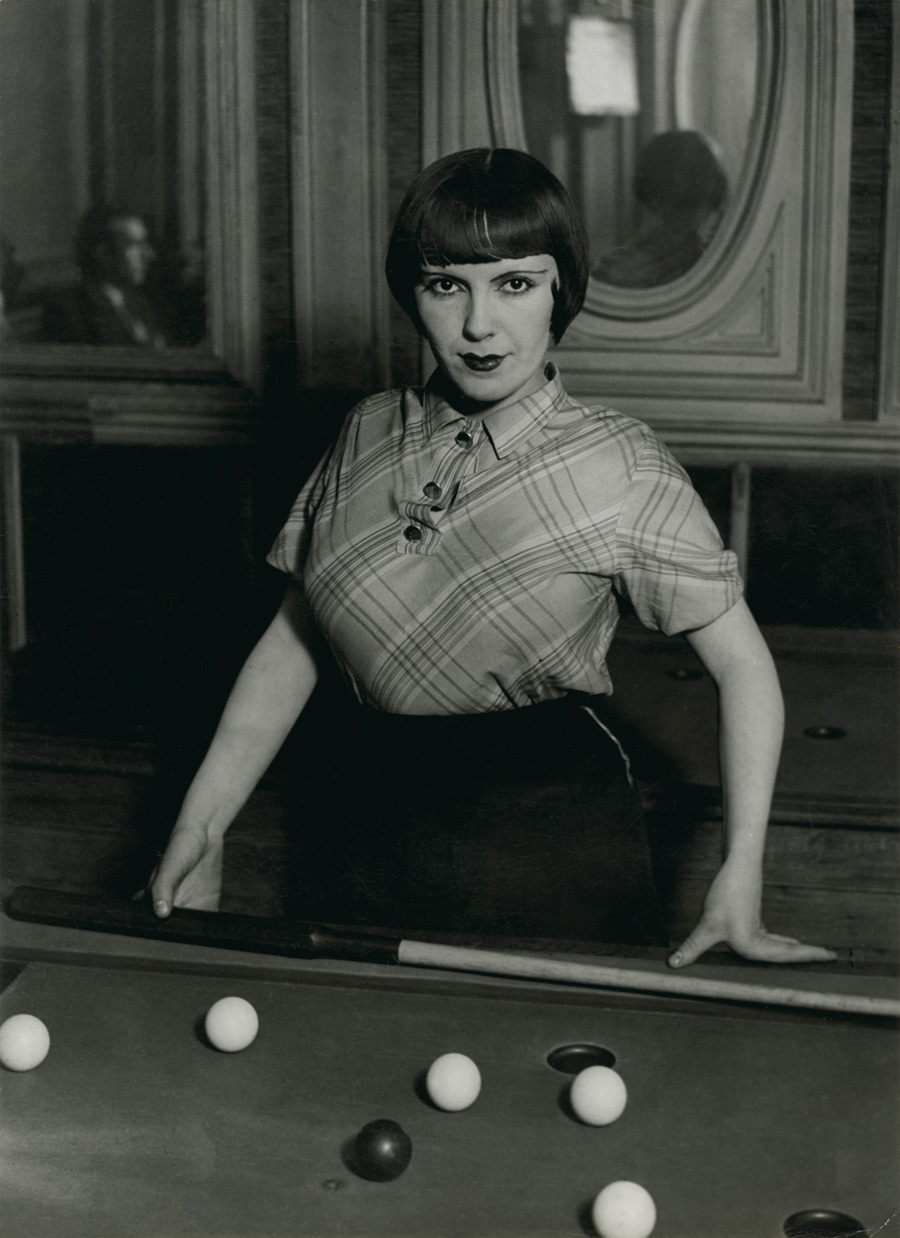
Virginia Museum of Fine Arts website

LIKE ART BLART ON FACEBOOK

Back to top

Exhibition: ‘French Twist: Masterworks of Photography from Atget to Man Ray’ at the Delaware Art Museum, Wilmington, DE

Exhibition dates: 29th June – 15th September, 2013

Curator: Heather Campbell Coyle


Ilse Bing (German, 1899-1998) 'Cancan Dancers' Moulin Rouge 1931


Ilse Bing (German, 1899-1998)
Cancan Dancers
Moulin Rouge 1931
Gelatin silver print
6 1/4 × 9 in. (15.9 × 22.9cm)
Collection of Michael Mattis and Judith Hochberg
© Estate of Ilse Bing. Courtesy Edwynn Houk Gallery, New York


C’est magnifique!

Dr Marcus Bunyan


Many thankx to the Delaware Art Museum for allowing me to publish the photographs in the posting. Please click on the photographs for a larger version of the image.


Ilse Bing (German, 1899-1998) 'Champ-de-Mars from the Eiffel Tower' 1931


Ilse Bing (German, 1899-1998)
Champ-de-Mars from the Eiffel Tower
1931
7 1/2 x 11 inches
Collection of Michael Mattis and Judith Hochberg
© Estate of Ilse Bing, Courtesy Edwynn Houk Gallery, New York


Ilse Bing (German, 1899-1998) 'Boarding House for Young Women, Tours' 1935


Ilse Bing (German, 1899-1998)
Boarding House for Young Women, Tours
1935
Gelatin silver print
11 1/8 × 7 1/2 in. (28.3 × 19.1cm)
Collection of Michael Mattis and Judith Hochberg
© Estate of Ilse Bing. Courtesy Edwynn Houk Gallery, New York


Ilse Bing (German, 1899-1998) 'Lovers, Bal Musette des Quatre Saisons, rue de Lappe' c. 1932


Brassaï (French, 1899-1984)
Lovers, Bal Musette des Quatre Saisons, rue de Lappe
c. 1932
9 3/8 x 7 inches
Collection of Michael Mattis and Judith Hochberg
© The Brassaï Estate-RMN


In the early 20th century, between the two world wars, Paris saw a fervour of change. From 1910 to 1940, the city became a creative epicentre for artistic exploration, attracting international avant-garde artists – including photographers experimenting with Surrealism, Modernism, and the new reportage. French Twist: Masterworks of Photography from Atget to Man Ray, on view at the Delaware Art Museum from June 29, 2013 through September 15, 2013, features 100 vintage prints from this golden age of French photography and explores the variety and inventiveness of native and immigrant photographers working in France in the early 20th century.

This exhibition presents a number of themes that capture the flavour and nightlife of Paris at this exciting moment. “Life of the Streets,” “Diversions,” and “Paris by Night” are just some of the topics that these masterful photographs explore. Visitors will experience Eugène Atget‘s lyrical views of Paris streets and gardens, Man Ray‘s surrealist experiments, and Henri Cartier-Bresson‘s pioneering photojournalism, as well as works by Ilse Bing, Brassaï, Jacques-Henri Lartigue, André Kertész, and Dora Maar. Many of these artists settled in France for life, while others, fleeing the Nazis, brought their Paris‐trained sensibilities and influences to America.

Eugène Atget

The exhibition opens with one of the most significant figures in the history of photography, Eugène Atget, whose work influenced a range of artists from Surrealists to documentary photographers. This selection encompasses pictures of city streets, architectural details, and the gardens at Versailles and includes one of his most famous photographs, Boulevard de Strasbourg, Corsets (1912).

La vie de la rue (Life of the Street)

This section includes images of the streets and buildings of Paris – of the bustling Champ-de-Mars and the deserted Avenue du Maine – and features a large selection of photographs by Ilse Bing. In her modernist views of urban architecture, Bing provides a modern take on the old city through unexpected angles and dramatic cropping.

Divertissement (Diversions)

Divertissement focuses on the myriad amusements available in the City of Lights. Lartigue provides an insider’s view of upper-class life in the Belle Epoque, while Bing and Brassaï chronicle the attractions of the dance hall, the theatre, and the street.

Henri Cartier-Bresson

The master of the “decisive moment” and one of the most significant photojournalists of the 20th century, Henri Cartier-Bresson is featured along with 17 famous photographs from his travels around the world. This section includes his stellar images of the Spanish Second Republic and his iconic view of the coronation of George VI in London.

Les basses classes (The Lower Classes)

Between the wars, photographers from Ilse Bing to Andre Kertész to Brassaï chronicled lives of poor Parisians, often bringing a Modernist sensibility, rather than a reformer’s eye, to scenes of urban poverty.

Paris de nuit (Paris by Night) 

In 1933 Brassaï released his photo book Paris by Night, which chronicled the city’s streets and amusements after dark. The book became an immediate success and Brassaï became famous as the foremost photographer of the city’s bars and brothels, performers, and prostitutes.

L’art pour l’art (Art for Art’s Sake)

This section focuses on the technical experimentation and virtuoso technique of photographers including Pierre Dubreuil, Edward Steichen, and Pal Funk Angelo. It features examples of unusual techniques like cliché-verre, solarisation, and oil printing.

Cliché verre is a combination of art and photography. In brief, it is a method of either etching, painting or drawing on a transparent surface, such as glass, thin paper or film and printing the resulting image on a light sensitive paper in a photographic darkroom. It is a process first practiced by a number of French painters during the early 19th century. The French landscape painter Jean-Baptiste-Camille Corot was the best known of these. Some contemporary artists have developed techniques for achieving a variety of line, tone, texture and colour by experimenting with film, frosted Mylar, paint and inks and a wide assortment of tools for painting, etching, scratching, rubbing and daubing.

Andre Kertész, Dora Maar, Man Ray

These three important photographers – all immigrants to Paris between the Wars and all involved in Surrealist movement – are featured in individual sections that highlight their most famous works. Kertész is represented by his photographs of the painter Piet Mondrian’s studio. Maar’s Surrealist street photographs capture her dark humor, and a full complement of Man Ray’s experimental and psychologically charged images summarize his photographic interests.

La figure (Portraits and Nudes)

La Figure showcases experimental approaches to the classic subject of the female nude, including a cameraless photograph and a solarisation by Man Ray and a distortion created with fun-house-type mirrors by Kertész.

Ilse Bing (German, 1899-1998), nicknamed the “Queen of the Leica” after her camera of choice, moved to Paris in 1930 and immersed herself in its cultural milieu, interacting with painters like Pavel Tchelitchev and fashionistas Elsa Schiaparelli and Carmel Snow. The decade she spent in France is considered the high point of her artistic career.

Dora Maar (French, 1907-1997) created startlingly imaginative Surrealist photographs under the tutelage of Man Ray. However, she is best known as Picasso’s lover, muse, and “Weeping Woman” from 1936 to 1943. Her photographs documenting Picasso’s creation of Guernica hang alongside the painting in the Reina Sofía museum in Madrid.

Jacques‐Henri Lartigue (French, 1894-1986), considered by many to be a child prodigy, received his first camera as a gift when he was six years old and immediately set to work documenting the activities of his energetic family and circle of friends. Lartigue’s light‐hearted snapshots capture the essence of France’s Belle Époque, the halcyon period before World War I when it seemed that modernity would bring nothing but progress and delight.

Text from the Delaware Art Museum


Eugène Atget (French, 1857-1927) 'Boulevard de Strasbourg Corsets' 1912


Eugène Atget (French, 1857-1927)
Boulevard de Strasbourg Corsets
1912
Printing-out paper
8 3/4 x 7 inches
Collection of Michael Mattis and Judith Hochberg


Eugène Atget (French, 1857-1927) 'Rue Egynard' 1901


Eugène Atget (French, 1857-1927)
Rue Egynard
1901
Albumen print
8 1/4 × 7 in. (21 × 17.8cm)
Collection of Michael Mattis and Judith Hochberg


Man Ray (American, 1890-1976) 'Solarized nude' 1930


Man Ray (American, 1890-1976)
Solarized nude
1930
11 5/8 x 8 7/8 inches
Collection of Michael Mattis and Judith Hochberg
© 2013 Man Ray Trust / Artists Rights Society (ARS), NY / ADAGP, Paris


Edward Steichen (American, 1879-1973) 'Three Pears and an Apple, Voulangis, France' 1921


Edward Steichen (American, 1879-1973)
Three Pears and an Apple, Voulangis, France
1921
Gelatin silver print
14 x 11 inches
Collection of Michael Mattis and Judith Hochberg


Man Ray (American, 1890-1976) 'Kiki de Montparnasse' 1923


Man Ray (American, 1890-1976)
Kiki de Montparnasse
1923
11 x 8 3/4 inches
Collection of Michael Mattis and Judith Hochberg
© 2013 Man Ray Trust / Artists Rights Society (ARS), NY / ADAGP, Paris


Brassaï (French, 1899-1984) 'Fille de Montmartre playing Russian billiards, Blvd Rochechouart' 1932-33


Brassaï (French, 1899-1984)
Fille de Montmartre playing Russian billiards, Blvd Rochechouart
1932-1933
11 1/4 x 8 1/4 inches
Collection of Michael Mattis and Judith Hochberg
© The Brassaï Estate-RMN


Delaware Art Museum
2301 Kentmere Parkway
Wilmington, DE 19806

Opening hours:
Wednesday – Sunday 10am – 4pm
Closed Monday and Tuesday

Delaware Art Museum website

LIKE ART BLART ON FACBEOOK

Back to top