Exhibition: ‘Art of Another Kind: International Abstraction and the Guggenheim, 1949-1960’ at the Guggenheim Museum, New York

Exhibition dates: 8th June – 12th September 2012
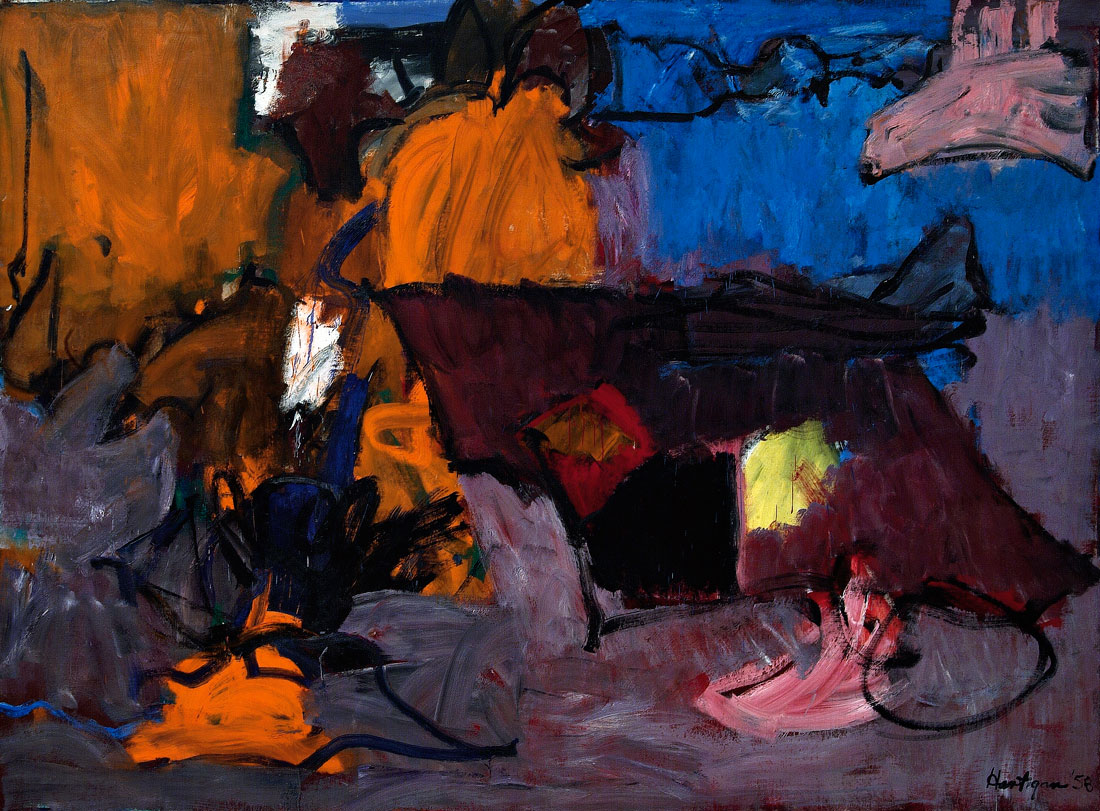
 

Grace Hartigan
 (American, 1922-2008)
 'Ireland' 1958


Grace Hartigan
 (American, 1922-2008)
Ireland
1958
Oil on canvas
200 x 271cm
The Solomon R. Guggenheim Foundation, Peggy Guggenheim Collection, Venice
© Grace Hartigan Estate


This is pure indulgence. These paintings are so delicious I couldn’t resist a posting. Just imagine having ANY of them (especially the Hartigan, de Kooning or the Soulanges) on your wall at home… oh my!

Marcus


Many thankx to the Guggenheim Museum for allowing me to publish the pictures in the posting. Please click on the pictures to see a larger version of the image.


Art of Another Kind: International Abstraction and the Guggenheim, 1949-1960

Curators Tracey Bashkoff and Megan Fontanella discuss the initial apprehensions toward and eventual return to international exchange and experimentalism that defined the postwar art world.
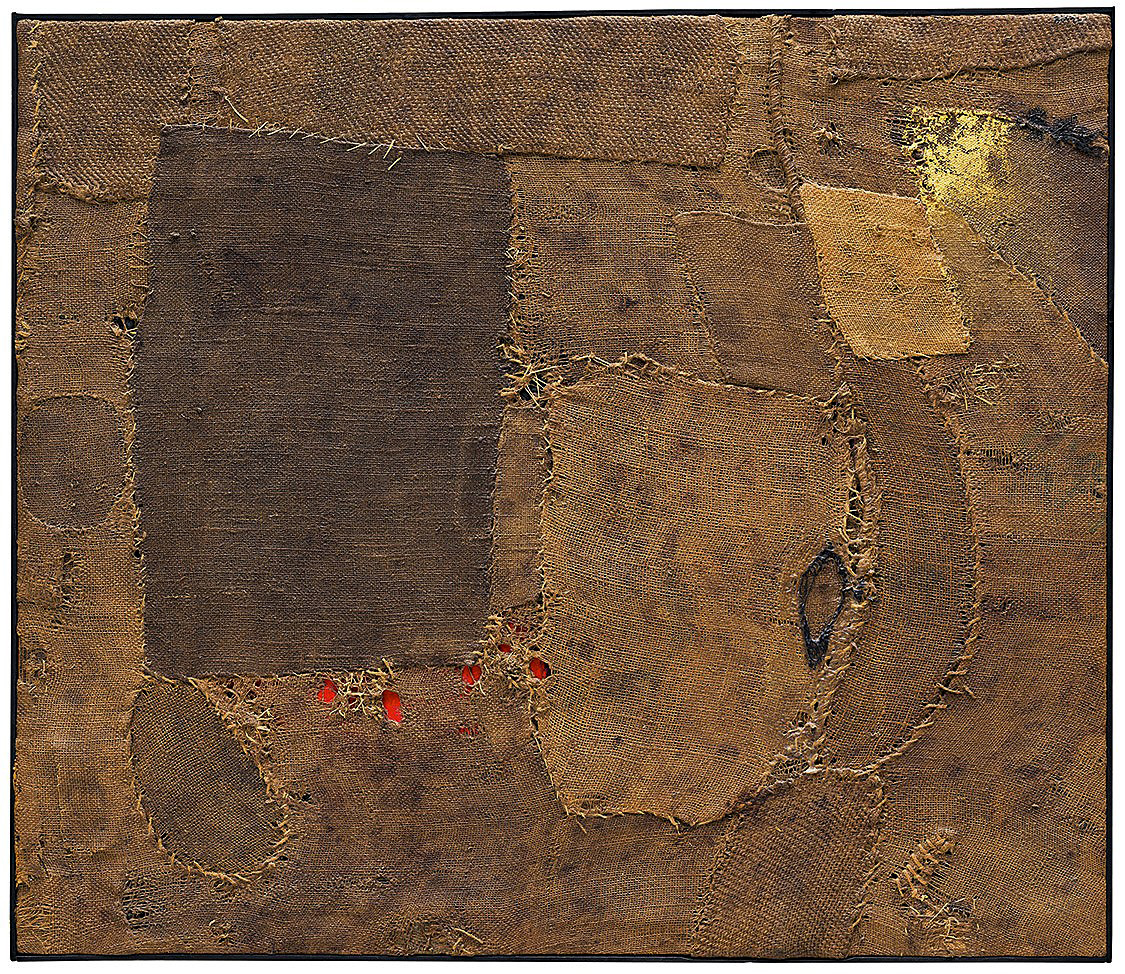
 

Alberto Burri (Italian, 1915-1995) 'Composition' 1953


Alberto Burri (Italian, 1915-1995)
Composition
1953
Burlap, thread, synthetic polymer paint, gold leaf, and PVA on black fabric
86 x 100.4cm
Solomon R. Guggenheim Museum, New York
© Fondazione Palazzo Albizzini Collezione Burri, Città di Castello/2018 Artist Rights Society (ARS), New York/SIAE, Rome


In 1943 Alberto Burri, a doctor in the Italian army, was captured by the British and sat out the remainder of World War II in a Texas POW camp. He began to paint there, covering his stretchers with burlap when other materials were unavailable. Upon his return to Italy in 1946 Burri renounced his original profession and dedicated himself to making art.

Composition is one of his Sacchi (sacks), a group of collage constructions made from burlap bags mounted on stretchers, which the artist began making in 1949. One of Burri’s first series employing nontraditional mediums, the Sacchi were initially considered assaults against the established aesthetic canon. His use of the humble bags may be seen as a declaration of the inherent beauty of natural, ephemeral materials, in contradistinction to traditional “high” art mediums, which are respected for their ostentation and permanence. Early commentators suggested that the patchwork surfaces of the Sacchi metaphorically signified living flesh violated during warfare – the stitching was linked to the artist’s practice as a physician. Others suggested that the hardships of life in postwar Italy predicated the artist’s redeployment of the sacks in which relief supplies were sent to the country.

Yet Burri maintained that his use of materials was determined purely by the formal demands of his constructions. “If I don’t have one material, I use another. It is all the same,” he said in 1976. “I choose to use poor materials to prove that they could still be useful. The poorness of a medium is not a symbol: it is a device for painting.” The title Composition emphasises the artist’s professed concern with issues of construction, not metaphor. Underlying the work is a rigorous compositional structure that belies the mundane impermanence of his chosen mediums and points to art-historical influences. The Sacchi rely on lessons learned from the Cubist- and Dada-inspired constructions of Kurt Schwitters.

Despite Burri’s cool public stance, the Sacchi are examples of the Expressionism widely practiced in postwar Europe, where such work was called Art Informel (in the U.S. it was called Abstract Expressionism). Artists used powerfully rendered gestures and accommodated chance occurrences to express the existential angst characteristic of the period.

Jennifer Blessing

Text from the Guggenheim website


Antoni Tàpies (Spanish, 1923-2012) 'Great Painting' 1958


Antoni Tàpies (Spanish, 1923-2012)
Great Painting
1958
Oil with marble dust and sand on canvas
79 x 103 1/2 inches (200.7 x 262.9cm)
Solomon R. Guggenheim Museum, New York
© 2018 Fundació Antoni Tàpies/Artists Rights Society (ARS), New York/VEGAP, Madrid


In the years after World War II, both Europe and America saw the rise of predominantly abstract painting concerned with materials and the expression of gesture and marking. New Yorkers dubbed the development in the United States Abstract Expressionism, while the French named the pan-European phenomenon of gestural painting Art Informel. A variety of the latter was Tachisme, from the French word tache, meaning blot or stain. Antoni Tàpies was among the artists to receive the label Tachiste because of the rich texture and pooled colour that seemed to occur accidentally on his canvases.

Tàpies reevaluated humble materials, things of the earth such as sand – which he used in Great Painting (Gran pintura, 1958) – and straw as well as the refuse of humanity such as string and bits of fabric. By calling attention to this seemingly inconsequential matter, he suggested that beauty can be found in unlikely places. Tàpies saw his works as objects of meditation that every viewer will interpret according to personal experience; he sought to inspire a contemplative reaction to reality through the integration of materials unexpected in fine art.

These images often resemble walls that have been scuffed and marred by human intervention and the passage of time. In Great Painting, an ocher skin appears to hang off the surface of the canvas; violence is suggested by the gouge and puncture marks in the dense stratum. These markings recall the scribbling of graffiti, perhaps referring to the public walls covered with slogans and images of protest that the artist saw as a youth in Catalonia – a region in Spain that experienced the harshest repression under dictator Francisco Franco. Tàpies called walls the “witnesses of the martyrdoms and inhuman sufferings inflicted on our people.”1 Great Painting suggests the artist’s poetic memorial to those who have perished and those who have endured.

Jennifer Blessing

1/ Antoni Tàpies, La pratique de l’art (Paris: Gallimard, 1974), p. 59.

Text from the Guggenheim website


Kenzo Okada (Japanese, 1902-1982) 'Decision' 1956


Kenzo Okada (Japanese, 1902-1982)
Decision
1956
Oil on canvas
67 3/4 x 80 inches (172.8 x 203.2cm)
Solomon R. Guggenheim Museum, New York Gift, Susan Morse Hilles, 1981
© Kenzo Okada


After Kenzo Okada relocated from Tokyo to New York in 1950, his work came to represent a melding of Japanese traditions and American abstract trends. Rather than striving for pure abstraction, his work from the 1950s could be called “semi-abstract,” evoking the natural world through carefully composed form and a decidedly muted palette. These works are subtle, quiet, and poetic – more meditative in nature than the energetic gestural abstractions of some of his American-born counterparts. The composition of Decision (1956) is also organised to suggest natural topography. Blocky, softly defined shapes organically arrange the canvas into rough horizontal registers, creating a panoramic quality reminiscent of landscape painting. Meanwhile, small, irregular shapes hover and tumble rhythmically across the stable ground. Okada thus seeks a balance between heavy and delicate, tangible and abstract.

Text from the Guggenheim website


José Guerrero (Spanish, 1914-1991) 'Signs and Portents' 1956


José Guerrero (Spanish, 1914-1991)
Signs and Portents
1956
Oil on canvas
175.9 x 250.2cm
Solomon R. Guggenheim Museum, New York
© 2012 Artists Rights Society (ARS), New York/VEGAP, Madrid
© The Solomon R. Guggenheim Foundation
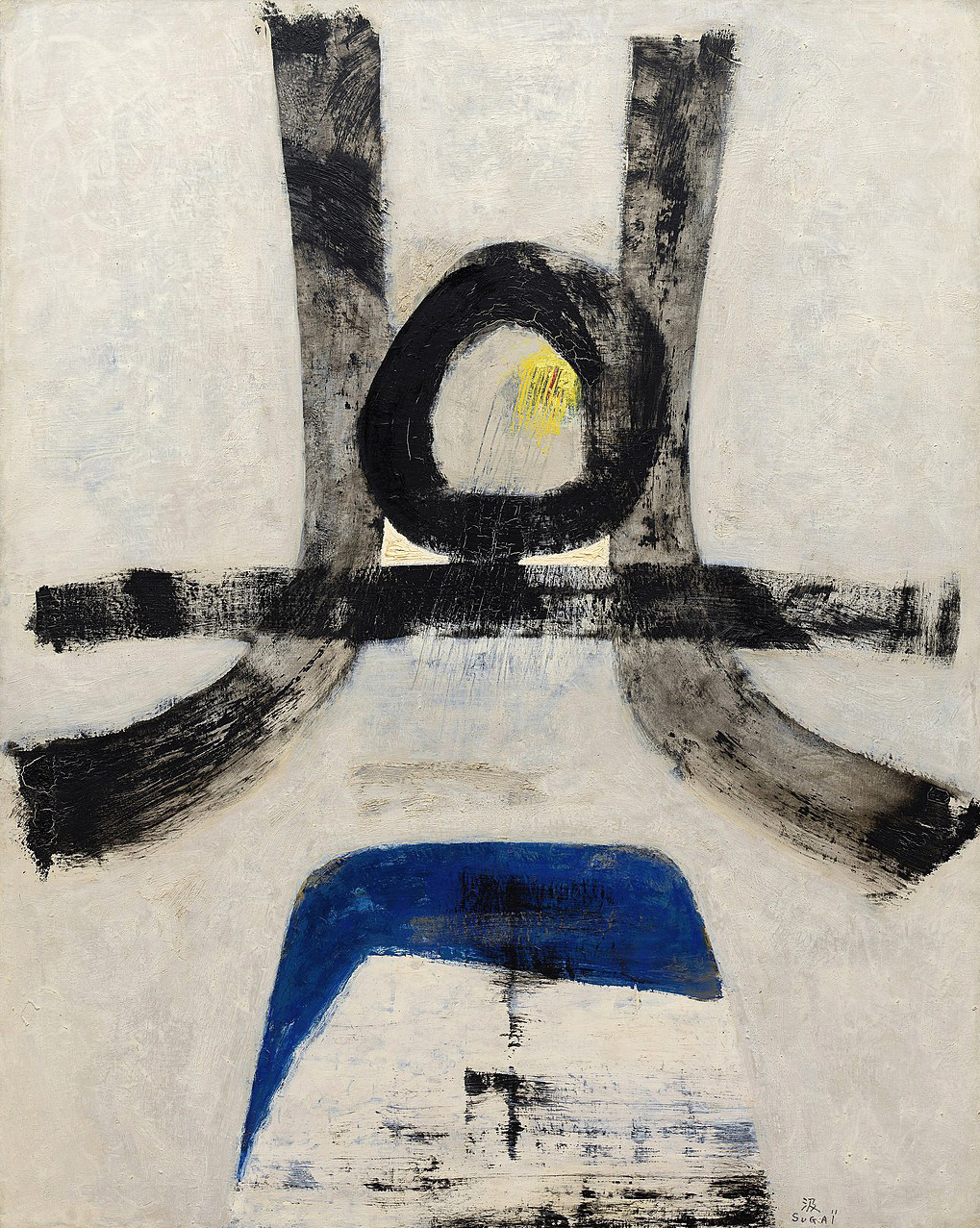
 

Kumi Sugaï (Japan, 1919-1996) 'Shiro' June 1957


Kumi Sugaï (Japan, 1919-1996)
Shiro
June 1957
Oil on canvas
63 5/8 x 51 inches (161.6 x 129.5 cm)
Solomon R. Guggenheim Museum, New York
© Kumi Sugaï


Kumi Sugaï lived and worked in Paris from 1952 until his death. Revered both in his native Japan and France, he used his early fascination with modern typography and his knowledge of East Asian calligraphy in his work. Combining and reinventing traditional aesthetics and contemporary forms, Sugaï reveals his syncretic approach to abstract painting in Shiro (June 1957). Here, his palette is restricted essentially to black, white, and blue, and the composition is at once spare and dynamic. The painting’s title is a reference to its central black form, the ideogram shiro, which means white. He has enlarged the character to occupy the entire composition and placed this abstract form on a white ground, both evoking and distorting its original calligraphic source.

Text from the Guggenheim website


Giuseppe Capogrossi (Italian, 1900-1972) 'Surface 210' 1957


Giuseppe Capogrossi (Italian, 1900-1972)
Surface 210
1957
Oil on canvas
81 1/4 x 63 inches (206.4 x 160cm)
Solomon R. Guggenheim Museum, New York
© 2018 Artists Rights Society (ARS), New York / SIAE, Rome


A decisive shift in Giuseppe Capogrossi’s career took place in 1949, when he moved away from figurative, tonal painting and experimented with an abstract geometric style that led to the development of a vocabulary of irregular comb- or fork-shaped signs. With no allegorical, psychological, or symbolic meaning, these structural elements could be assembled and connected in countless variations. Intricate and insistent, Capogrossi’s signs determined the construction of the pictorial surface. Similar to mysterious lists or sequences, his paintings were immediate in their appeal yet remained hard to decode, a quality he shared with other Art Informel practitioners. These abstract comb-sign paintings, known simply as Surfaces (Superficies, 1949-1972), were first exhibited at the Galleria del secolo, Rome, in 1950. The comb sign dominated his oeuvre until the end of his career.

Text from the Guggenheim website


Takeo Yamaguchi
 (Japanese, 1902-1983)
 'Work – Yellow (Unstable Square [Fuantei shikaku])' 1958


Takeo Yamaguchi
 (Japanese, 1902-1983)
Work – Yellow (Unstable Square [Fuantei shikaku])
1958
Oil on plywood
182.6 x 182.6cm
Solomon R. Guggenheim Museum, New York
© Takeo Yamaguchi


In his native Japan, Takeo Yamaguchi was a pioneer of modern abstract painting. This focus led him to spend time in France, where he was much influenced by the work of Cubist practitioners in Paris, until he returned to Japan in 1931. In the 1950s, Yamaguchi began executing works consisting of simple, geometric forms – largely yellow, ochre, or russet in color – painted on a black background. His thick pigments added texture to the monochromatic compositions, and as seen in Work – Yellow (Unstable Square [Fuantei shikaku], 1958), Yamaguchi’s abstract shapes increasingly dominated the canvas. It is noteworthy that the painting was prominently displayed on the ground floor of the Guggenheim’s rotunda during the 1959 inaugural exhibition, attesting to then-director James Johnson Sweeney’s keen interest in Yamaguchi’s work.

Text from the Guggenheim website


Pierre Soulages
 (French, b. 1919) 'Painting, November 20, 1956 (Peinture, 20 novembre 1956)' 1956


Pierre Soulages
 (French, b. 1919)
Painting, November 20, 1956 (Peinture, 20 novembre 1956)
1956
Oil on canvas
195 x 130.2cm
Solomon R. Guggenheim Museum, New York
© 2012 Artists Rights Society (ARS), New York/ADAGP, Paris


Pierre Soulages, a leading proponent of Tachisme (from the French word tache, meaning blot or stain), maintained that he decided to become a painter while inside the church of Sainte-Foy in Conques-en-Rouergue, near his birthplace in the South of France. The impressions of monumentality, stability, primitive force, and clearly organised volumes characteristic of the Romanesque style, as well as the mystery and sobriety of dark church interiors, were metaphorically transmitted in his mature style. Early on he was also drawn to the work of Claude Lorraine and Rembrandt van Rijn, whose rendering of light had an impact on his development. In 1938 he moved to Paris to prepare for the entrance exam to the École nationale supérieure des beaux-arts, but he soon abandoned his traditional studies at the school as a result of seeing exhibitions of the work of Paul Cézanne and Pablo Picasso and visiting the Louvre.

In his earliest work Soulages took leafless winter trees as his point of departure. Their essential, reduced network of branches – which Soulages regarded as abstract sculpture – provided him with an ideal vehicle for the exploration of structure and variation. During the German occupation of France, he met Sonia Delaunay, who introduced him to abstract art and set him on a new path. By the mid 1950s, Soulages had switched from a small brush, with which he had painted abstract calligraphic patterns, to palette knives, straightedges, and large house-painting brushes. These tools afforded him a greater range of motion in his wrist, allowing him to produce bold, dynamic strokes that resulted in a more gestural surface. Throughout his career, Soulages painted in a predominately black palette in order to explore the contrasts of light and shade, which endowed his paintings both an architectonic and a sculptural quality. In Painting, November 20, 1956 (Peinture, 20 novembre 1956, 1956), Soulages divided his canvas into three horizontal registers, articulating each with a repetition of slab-like black shapes that reveal a variety of red and brown nuances, as well as a certain luminosity.

Text from the Guggenheim website


From June 8 to September 12, 2012, the Solomon R. Guggenheim Museum presents Art of Another Kind: International Abstraction and the Guggenheim, 1949-1960. Comprising approximately 100 works by nearly 70 artists, the exhibition explores international trends in abstraction in the decade before the Guggenheim’s iconic Frank Lloyd Wright-designed building opened in October 1959, when vanguard artists working in the United States and Europe pioneered such influential art forms as Abstract Expressionism, Cobra, and Art Informel. In the 1950s, many countries ended their postwar isolationism and entered a phase of cultural openness and internationalism. The prominent French art critic Michel Tapié declared the existence of un art autre (art of another kind), a term embracing a mosaic of styles, but essentially signifying an avant-garde art that rejected a connection with any tradition or past idiom. With works by Karel Appel, Louise Bourgeois, Alberto Burri, Eduardo Chillida, Lucio Fontana, Grace Hartigan, Asger Jorn, Yves Klein, Willem de Kooning, Georges Mathieu, Isamu Noguchi, Kenzo Okada, Jackson Pollock, Pierre Soulages, Antoni Tàpies, Maria Helena Vieira da Silva, Takeo Yamaguchi, and Zao Wou-Ki, among others, the exhibition considers the artistic developments of the post-World War II period and draws greater attention to lesser-known artists in the museum?s collection alongside those long since canonised.

Abstract Expressionism encompasses a diverse range of postwar American painting that challenged the tradition of vertical easel painting. Beginning in the late 1940s, Pollock placed his canvases on the floor to pour, drip, and splatter paint onto them. This gestural act, with variations practiced by William Baziotes, De Kooning, Adolph Gottlieb, and others, was termed “Action painting” by American critic Harold Rosenberg, who considered it a product of the artist’s unconscious outpouring or the enactment of some personal drama. The New York school, as these artists were called due to the city’s postwar transformation into an international nexus for vanguard art, expanded in the 1950s with the unique contributions of such painters as James Brooks and Hartigan, as well as energetic collagist-assemblers Conrad Marca-Relli and Robert Rauschenberg. Other painters eliminated the gestural stroke altogether. Mark Rothko used large planes of colour, often to express universal human emotions and inspire a sense of awe for a secular world. Welder-sculptors such as Herbert Ferber and Theodore Roszak are also counted among the decade’s pioneering artists.

The postwar European avant-garde in many ways paralleled the expressive tendencies and untraditional methods of their transatlantic counterparts, though their cultural contexts differed. For artists in Spain, abstract art signified political liberation. Dissenting Italian artists correspondingly turned to abstraction against the renewed popularity of politicised realism. French artist Jean Dubuffet’s spontaneous approach, Art Brut (Raw art), retained figurative elements but radically opposed official culture, instead favouring the spontaneous and direct works of untrained individuals. His work influenced the Cobra group (1948-1951), which was founded by Appel, Jorn, and other artists from Copenhagen, Brussels, and Amsterdam. The Cobra artists preferred thickly painted surfaces that married realism to lively colour and expressive line in a new form of primitivism.

Eventually taking root in France, Germany, Italy, Japan, and Spain, Art Informel refers to the anti-geometric, anti-naturalistic, and nonfigurative formal preoccupations of many European avant-garde artists, and their pursuit of spontaneity, looseness of form, and the irrational. Art Informel is alternatively known by several French terms: Abstraction lyrique (Lyrical Abstraction), Art autre (Art of another kind), matiérisme (matter art), and Tachisme (from tache, meaning blot or stain). The movement includes the work of Burri and Tàpies, who employed unorthodox materials like burlap or sand and focused on the transformative qualities of matter. Asian émigré artists Kumi Sugaï and Zao were likewise central to the postwar École de Paris (School of Paris) and melded their native traditions with modern painting styles. By the end of the 1950s, artists such as Lucio Fontana, Klein, and Piero Manzoni were exploring scientific, objective, and interactive approaches, and introduced pure monochrome surfaces. Other abstractionists engaged viewers’ senses and explored dematerialisation, focusing on optical transformations as opposed to the art object itself, and investigating the effects of motion, light, and colour.

Through the presentation of these varied styles and innovative developments in the post-World War II years, Art of Another Kind especially highlights paintings and sculptures that entered the Guggenheim collection under James Johnson Sweeney, the museum’s second director (1952-1960). Following Solomon R. Guggenheim’s death in 1949 and the end of founding director and curator Hilla Rebay’s tenure in 1952, Sweeney championed emerging avant-garde artists and augmented the museum’s existing modern holdings with new works. Sweeney had stated, “I do not believe in the so-called ‘tastemakers,’ … but in what I would call ‘tastebreakers,’ the people who break open and enlarge our artistic frontiers.” His program of exhibitions and acquisitions considerably broadened the museum’s scope, and his vision included reconsidering the founding collection assembled by Solomon and Irene Guggenheim under Rebay’s guidance by uniting the abstract works by Vasily Kandinsky and other modernists with rarely seen representational works for a more complex perspective of the avant-garde in the first half of the twentieth century. Recently, the Guggenheim Museum highlighted his contributions to the institution in The Sweeney Decade: Acquisitions at the 1959 Inaugural, an exhibition featuring a selection of works that were first unveiled at the 1959 show in the museum’s new Wright building. On view in 2009 as part of the museum’s 50th-anniversary celebrations, The Sweeney Decade featured 24 paintings and sculptures from the 1950s collected under his leadership. Art of Another Kind offers a more comprehensive elaboration of his vision along with works that were added to the collection after his tenure.

Exhibition installation

While the exhibition explores individual styles, diversity within abstraction, and artists often working independently of established groups or affiliations, works are loosely organised according to artists’ locus of activity and stylistic trends: New York school; Art Brut and Cobra; School of Paris; Spanish and Italian Informalism; Kinetic art; and, finally, late 1950s experiments with matiérisme, performance-based painting, and the monochrome. Highlights within the installation include Outburst (Éclatement, 1956) by Judit Reigl, newly acquired in 2012, and Alexander Calder’s Red Lily Pads (Nénuphars rouges, 1956), suspended in the upper ramps and visible from the rotunda floor below. The exhibition also includes the work of 11 living artists.

Visitors will have the opportunity to browse through historic exhibition catalogues produced by the first full-time publications department established during Sweeney’s tenure. Designed by the Swiss-born typographer and designer Herbert Matter, catalogues from the era helped shape the museum’s visual identity and chronicle the development of the art championed by the Guggenheim under Sweeney in the 1950s. Selected books will be available in the museum at iPad stations and online at https://www.guggenheim.org/publications

Extensive content related to the exhibition will be available on the Guggenheim’s website, which features a selection of supporting materials from the museum’s archives, including letters between artists and director James Johnson Sweeney, invitations to exhibitions, and historic photos of Guggenheim exhibitions. In addition, 20 works and several exhibition themes will be explored through short texts. Multimedia content including video footage and interviews with the curators will be added to the site once the exhibition opens to the public.

Press release from the Guggenheim Museum website


Mark Rothko
 (American, 1903-1970)
 'Untitled (Violet, Black, Orange, Yellow on White and Red)' 1949


Mark Rothko
 (American, 1903-1970)
Untitled (Violet, Black, Orange, Yellow on White and Red)
1949
Oil on canvas
207 x 167.6cm
Solomon R. Guggenheim Museum, New York
Gift, Elane and Werner Dannheisser and The Dannheisser Foundation
© 2012 Kate Rothko Prizel & Christopher Rothko/Artists Rights Society (ARS), New York


Jackson Pollock (American, 1912-1956) 'Untitled (Green Silver)' c. 1949


Jackson Pollock (American, 1912-1956)
Untitled (Green Silver)
c. 1949
Enamel and aluminum paint on paper, mounted to canvas
22 3/4 x 30 3/4 inches (57.8 x 78.1cm)
Solomon R. Guggenheim Museum, New York Gift, Sylvia and Joseph Slifka, 2004
© 2018 The Pollock-Krasner Foundation/Artists Rights Society (ARS), New York


In the decades following World War II, a new artistic vanguard emerged, particularly in New York, that introduced radical new directions in art. The war and its aftermath were at the underpinnings of the movement that became known as Abstract Expressionism. These artists, anxiously aware of human irrationality and vulnerability, expressed their concerns in an abstract art that chronicled the ardor and exigencies of modern life. Their heroic aspirations are most evident in Jackson Pollock’s innovative “drip” paintings that forever altered the course of American art.

Arriving in New York in 1930 from the West Coast, Pollock began working with figuration of both human and imaginary beings. Most of this imagery was connected to that of American Indian sand painting and the Mexican muralists he saw as a youth and that reemerged through psychoanalysis to treat his lifelong alcoholism. His first fully mature works – dating between 1942 and 1947 – use an idiosyncratic iconography he developed in part as a response to Surrealism, popular in New York with its numerous European exiles from World War II. Employing mythical subject matter, calligraphic markings, and a vibrant and distinctive colour palette, Pollock produced emotionally charged works that retain figurative subject matter yet emphasise abstract qualities. Arising from this confluence of abstraction and figuration are Pollock’s breakthrough works, commonly perceived as pure abstraction and made over the course of an explosive period between late 1947 and 1950 as represented by Untitled (Green Silver). At the time, he also broke free from the standard use of implements, usually abandoning their direct contact with the surface. Working from above the picture plane, he dripped and poured enamel paints on canvases and papers, a method that more precisely controlled the application of line. His preference for the technique of fluid paint spilling from the can or drizzling from the tips of sticks or trowels was heralded by critic Harold Rosenberg as “action painting.” These unconventional working methods and his own physical presence while creating these works have assumed epic proportions. In the last four years of his life – he died in an automobile accident on August 11, 1956 – he produced significantly fewer works, with each further refining his pouring method. Compositionally, they hark back to his earlier style through the reintroduction of figurative elements as in Ocean Greyness, which also addresses his allover abstract technique. Its dramatic, swirling forms set against a dark ground recall Pollock’s Eyes in the Heat (1946).

Text from the Guggenheim website
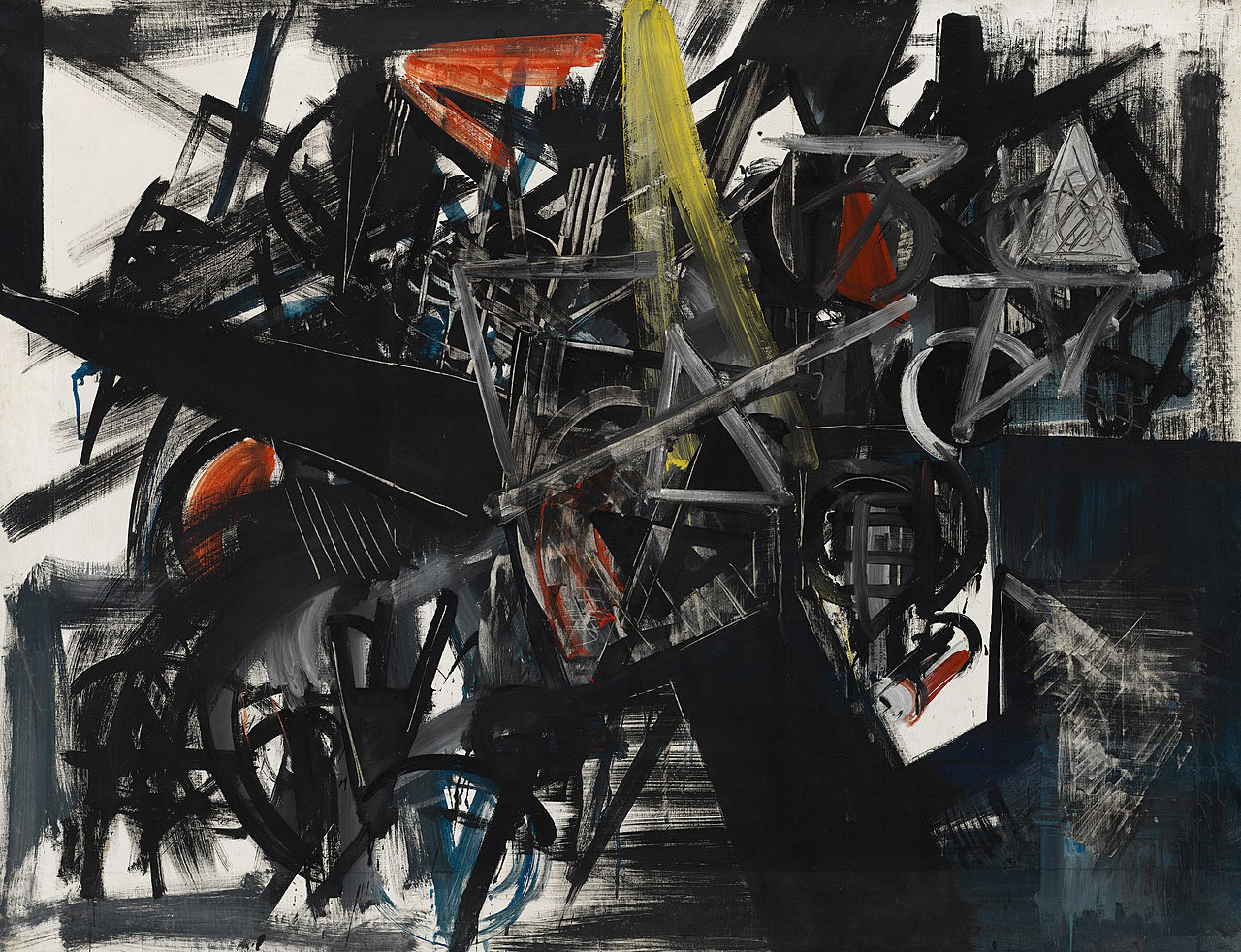
 

Emilio Vedova (Italian, 1919-2006) 'Image of Time (Barrier)' 1951


Emilio Vedova (Italian, 1919-2006)
Image of Time (Barrier)
1951
Egg tempera on canvas
51 3/8 x 67 1/8 inches (130.5 x 170.4cm)
The Solomon R. Guggenheim Foundation Peggy Guggenheim Collection, Venice, 1976
© Emilio Vedova


Emilio Vedova produced art in response to contemporary social upheavals, however his political position was contrary to that of his early modern counterparts, the Italian Futurists, who coalesced as a group in the years preceding World War I. While the Futurists romantically celebrated the aggressive energies inherent in societal conflict and technological advancement, Vedova’s feverish, violent canvases convey – in abstract terms – his horror and moral protestation in the face of man’s assault on his own kind.

Vedova expressed a political consciousness in his work for the first time during the late 1930s, when his works were inspired by the Spanish Civil War. His continuing commitment to social issues gave rise to series such as Cycle of Protest (Ciclo della protesta, 1956) and Image of Time (Immagine del tempo, 1946-1959). Although the motivation behind Image of Time (Barrier) (Sbarramento) is political, its formal preoccupations parallel those of the American Abstract Expressionists, namely Franz Kline. The drama of the angular, graphic slashes of black on white is heightened with accents of orange-red. Occupying a shallow space, pictorial elements are locked together in formal combat and emotional turmoil.

Text from the Guggenheim website
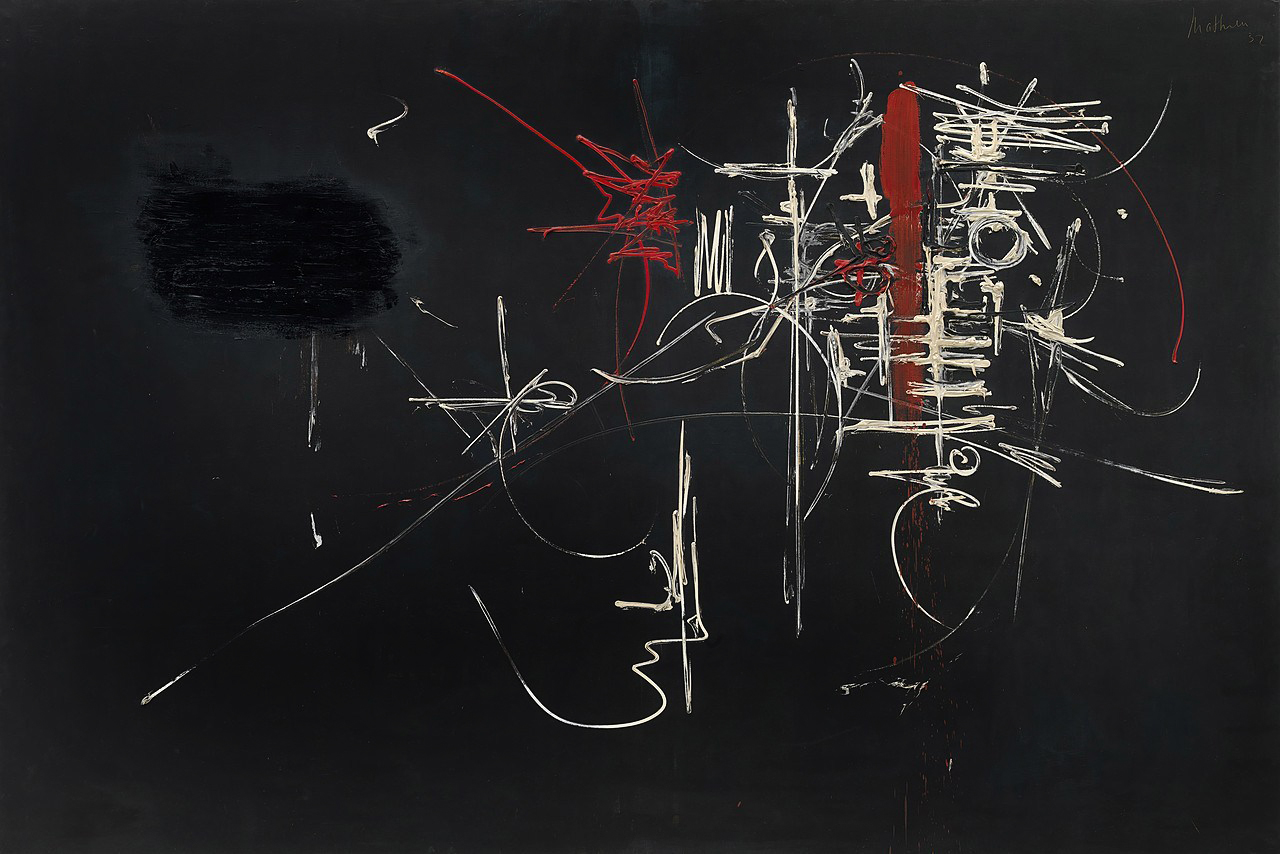
 

Georges Mathieu (French, 1921-2012) 'Painting' 1952


Georges Mathieu (French, 1921-2012)
Painting
1952
Oil on canvas
78 3/4 x 118 inches (200 x 299.7cm)
Solomon R. Guggenheim Museum, New York
© 2018 Artists Rights Society (ARS), New York / ADAGP, Paris


A key figure of the postwar art scene in Paris as well as a champion – and competitor – of the burgeoning movement of Abstract Expressionist painters in New York, Georges Mathieu practiced a mode of gestural abstraction that was decidedly calligraphic. His paintings were executed with controlled force, resulting in a matrix of lines bursting from a single point and thrusting outward in every direction, as seen in Painting (Peinture, 1952). The artist often squeezed paint directly from tubes onto the canvas and emphasised the necessity of rapid application in order to harness an intuitive expression. Mathieu also occasionally introduced a performative dimension to his painting in the 1950s, executing large canvases before audiences. This merger of painting and performance anticipated the work of Yves Klein and others in the late 1950s and 1960s.

Text from the Guggenheim website
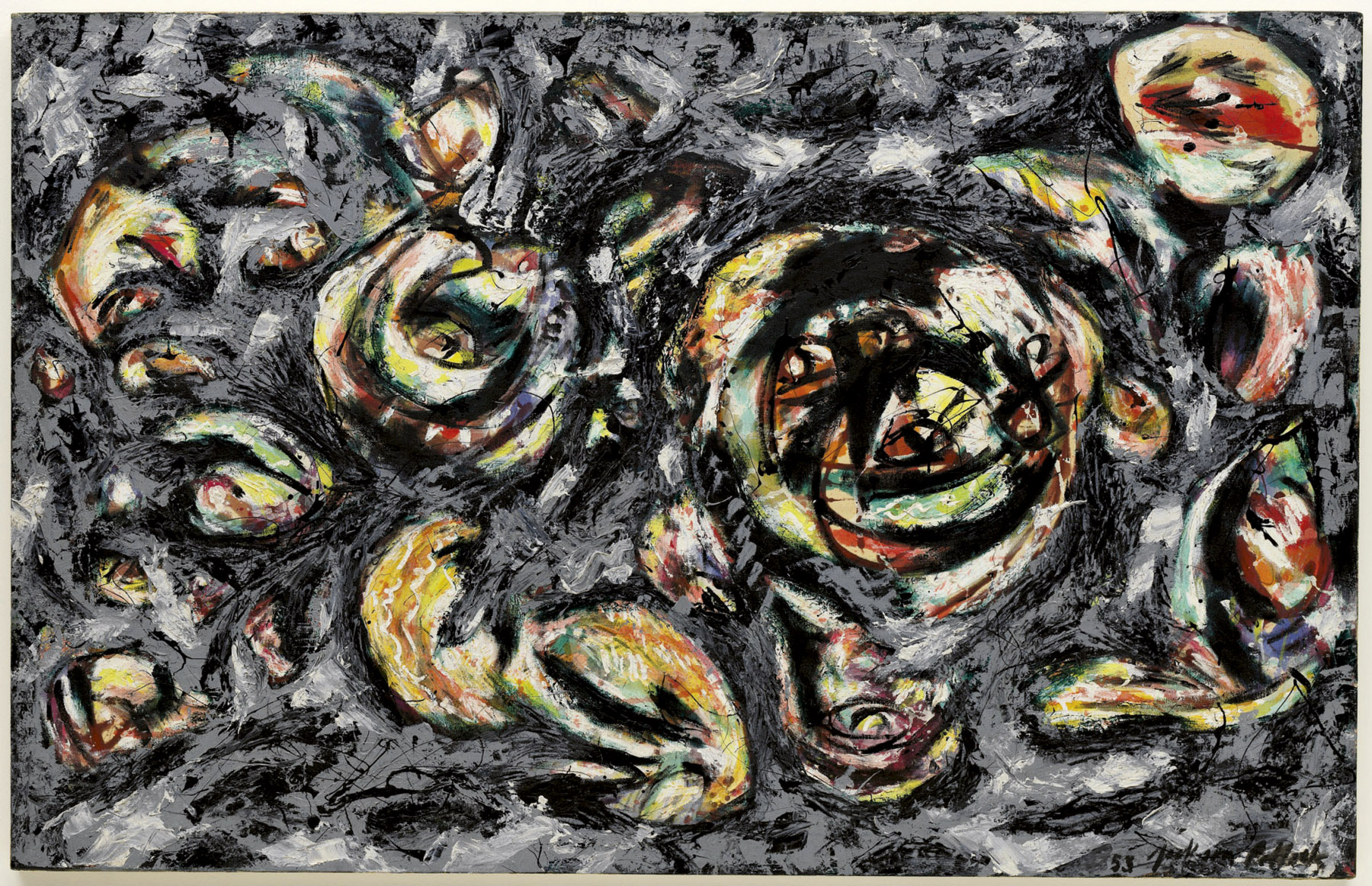
 

Jackson Pollock (American, 1912-1956) 'Ocean Greyness' 1953


Jackson Pollock (American, 1912-1956)
Ocean Greyness
1953
Oil on canvas
57 3/4 x 90 1/8 inches (146.7 x 229cm)
Solomon R. Guggenheim Museum, New York
© 2016 The Pollock-Krasner Foundation/Artists Rights Society (ARS), New York


The critical debate that surrounded Abstract Expressionism during the late 1940s was embodied in the work of Jackson Pollock. Clement Greenberg, a leading critic and Pollock’s champion, professed that each discrete art form should, above all else, aspire to a demonstration of its own intrinsic properties and not encroach on the domains of other art forms. A successful painting, he believed, affirmed its inherent two-dimensionality and aimed toward complete abstraction. At the same time, however, the critic Harold Rosenberg was extolling the subjective quality of art; fervent brushstrokes were construed as expressions of an artist’s inner self, and the abstract canvas became a gestural theater of private passions. Pollock’s art – from the early, Surrealist-inspired figurative canvases and those invoking “primitive” archetypes to the later labyrinthine webs of poured paint – elicited both readings. Pollock’s reluctance to discuss his subject matter and his emphasis on the immediacy of the visual image contributed to shifting and, ultimately, dialectic views of his work.

In 1951, at the height of the artist’s career, Vogue magazine published fashion photographs by Cecil Beaton of models posing in front of Pollock’s drip paintings. Although this commercial recognition signalled public acceptance – and was symptomatic of mass culture’s inevitable expropriation of the avant-garde – Pollock continuously questioned the direction and reception of his art. His ambivalence about abstract painting, marked by a fear of being considered merely a “decorative” artist, was exacerbated, and it was around this time that he reintroduced to his paintings the quasi-figurative elements that he had abandoned when concentrating on the poured canvases. Ocean Greyness, one of Pollock’s last great works, depicts several disembodied eyes hidden within the swirling coloured fragments that materialise from the dense, scumbled gray ground. “When you are painting out of your unconscious,” he claimed, “figures are bound to emerge.” Manifest in this painting is a dynamic tension between representation and abstraction that, finally, constitutes the core of Pollock’s multileveled oeuvre.

Nancy Spector

Text from the Guggenheim website
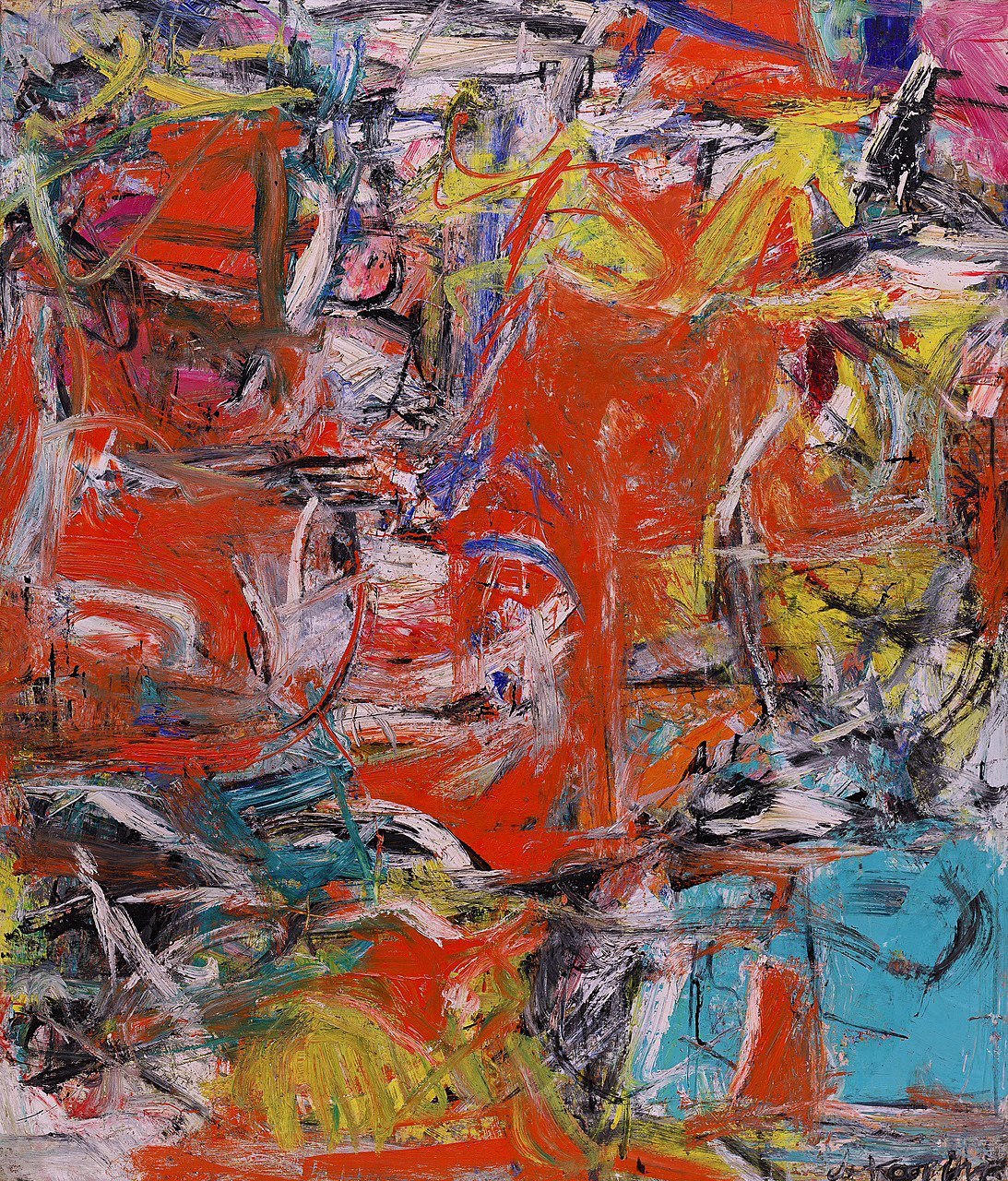
 

Willem de Kooning (American, 1904-1997) 'Composition' 1955


Willem de Kooning (American, 1904-1997)
Composition
1955
Oil, enamel, and charcoal on canvas
201 x 175.6cm
Solomon R. Guggenheim Museum, New York
© 2012 The Willem de Kooning Foundation/Artists Rights Society (ARS), New York


Although often cited as the originator of Action Painting, an abstract, purely formal and intuitive means of expression, Willem de Kooning most often worked from observable reality, primarily from figures and the landscape. From 1950 to 1955, de Kooning completed his famous Women series, integrating the human form with the aggressive paint application, bold colours, and sweeping strokes of Abstract Expressionism. These female “portraits” provoked not only with their vulgar carnality and garish colours, but also because of their embrace of figural representation, a choice deemed regressive by many of de Kooning’s Abstract Expressionist contemporaries, but one to which he consistently returned for many decades.

Composition serves as a bridge between the Women and de Kooning’s next series of work, classified by critic Thomas Hess as the Abstract Urban Landscapes (1955-1958). According to the artist, “the landscape is in the Woman and there is Woman in the landscapes.” Indeed, Composition reads as a Woman obfuscated by de Kooning’s agitated brushwork, clashing colours, and allover composition with no fixed viewpoint. Completed while the artist had a studio in downtown New York, Composition’s energised dashes of red, turquoise, and chrome yellow suggest the frenetic pace of city life, without representing any identifiable urban inhabitants or forms.

Painted 20 years later, after de Kooning moved to East Hampton, New York, seeking to work in greater peace and isolation, … Whose Name Was Writ in Water takes nature as its theme. Water was a favourite subject of the artist, and he devised a rapid, slippery technique of broad impasto strokes with frayed edges, speckled with drips, to convey its fluidity and breaking movement. The title, taken from an epigraph on Keats’s tomb, which de Kooning had seen on a trip to Rome in 1960, is, according to critic Harold Rosenberg, “the closest de Kooning can come to saluting overtly the impermanence of existence, and things in a state of disappearance.” Always aiming to reinforce the content of his work with his technique, de Kooning reworked his canvases over and over again, making each painting a composite of evanescent visual traces. The scrambled pictorial vocabulary and condensed space of the urban landscapes was gradually diffused in de Kooning’s later work. More open compositions, a less cluttered palette, and looser, liquid brushstrokes reveal a painter relieved of the nervous, claustrophobic atmosphere of city life and newly at peace with his rural surroundings.

Bridget Alsdorf

Text from the Guggenheim website


Pierre Alechinsky (Belgium, b. 1927) 'Vanish' 1959


Pierre Alechinsky (Belgium, b. 1927)
Vanish
1959
Oil on canvas
78 3/4 x 110 1/4 inches (200 x 280cm)
Solomon R. Guggenheim Museum, New York Gift, Julian and Jean Aberbach, 1967
© 2018 Artists Rights Society (ARS), New York / ADAGP, Paris


Pierre Alechinsky was a central figure in Cobra, a European artists’ group that emphasised material and its spontaneous application. The abstract and concrete often merge in his work; in Vanish (Disparaître, 1959), Alechinsky focused on the appearance and disappearance of a female figure in the centre of the canvas. This emergent shape and the background coalesce into a vigorously brushed surface that is distinguished by thickly impastoed white pigment and a network of predominantly blue lines. There are still traces of the allover patterning that characterises the artist’s watercolours and earlier canvases such as The Ant Hill (La fourmilière, 1954). His work likewise exhibits a fluidity and vitality that points to the artist’s fascination with Japanese calligraphy, which he observed during his travels to Japan in 1955.

Text from the Guggenheim website
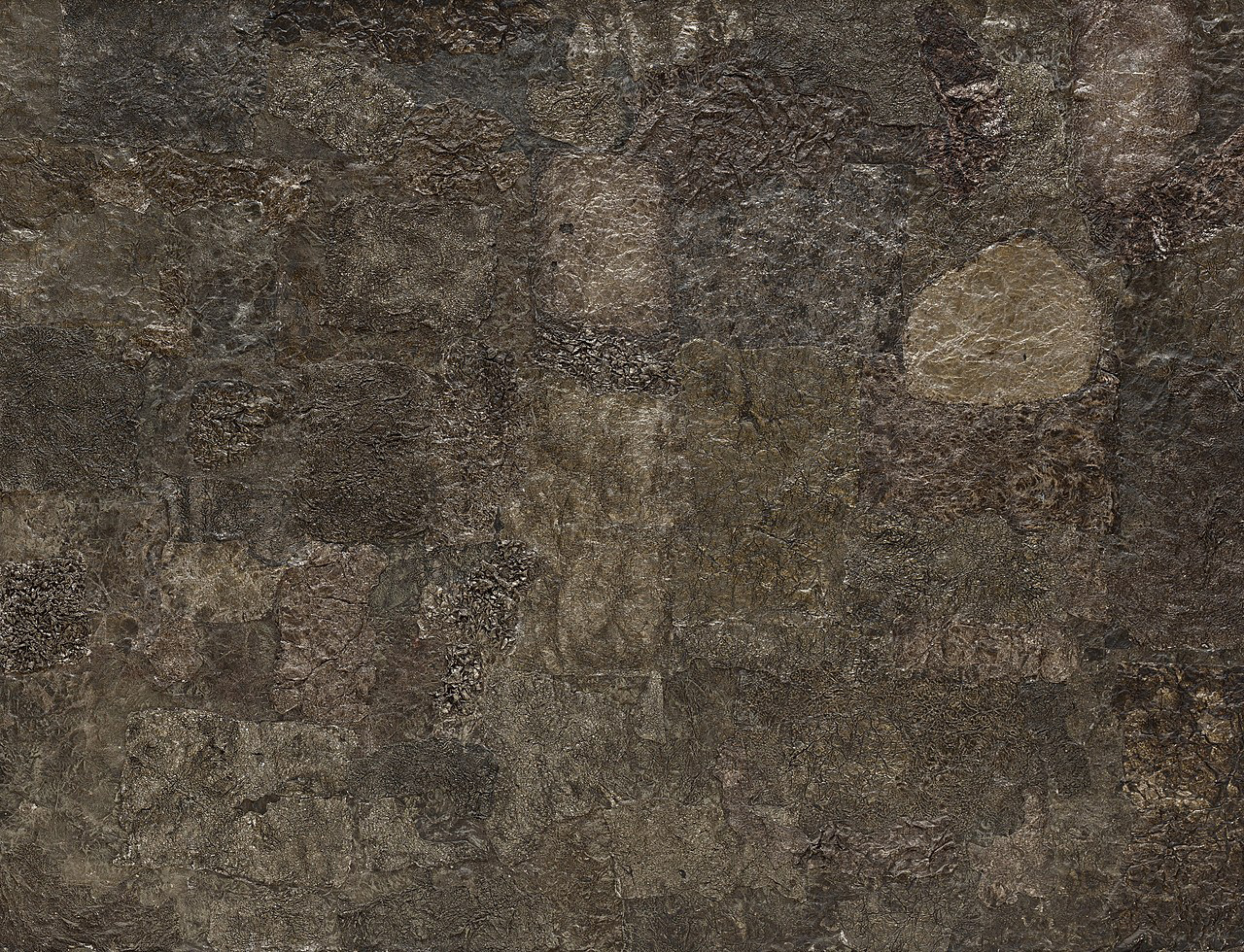
 

Jean Dubuffet (French, 1901-1985) 'The Substance of Stars' December 1959


Jean Dubuffet (French, 1901-1985)
The Substance of Stars
December 1959
Metal foil on Masonite
59 x 76 3/4 inches (150 x 195cm)
Solomon R. Guggenheim Museum, New York
© 2018 Artists Rights Society (ARS), New York / ADAGP, Paris


In Jean Dubuffet’s Matériologies series (1959-1960), of which The Substance of Stars (Substance d’astre, December 1959) is an example, form is subverted by an emphasis on materials, meant to stimulate mental responses and associations in the viewer. Far from being an abstraction in the usual sense, this and other such works suggest concern with topographical reality – the earth, water and sky, and the stars. These elements are not conveyed through descriptive images or through the use of materials identical with a natural substance, but through evocative effects of their artificial counterparts, here black, gray, and silver metal foil. Nature, although closely observed, is thus rendered through artifice, and reality conjured up through elaborate illusion.

Text from the Guggenheim website


Karel Appel
 (Dutch, 1921-2006) 'The Crying Crocodile Tries to Catch the Sun' 1956


Karel Appel
 (Dutch, 1921-2006)
The Crying Crocodile Tries to Catch the Sun
1956
Oil on canvas
145.5 x 113.1cm
The Solomon R. Guggenheim Foundation, Peggy Guggenheim Collection, Venice, 1976
© 2012 Karel Appel Foundation/Artists Rights Society (ARS), New York


Karel Appel, like Asger Jorn, was a member of the Cobra group, which emphasised material and its spontaneous application. Although the group was short-lived, its concerns have endured in his work. The single standing figures of humans or animals he developed during the 1950s are rendered in a deliberately awkward, naive way, with no attempt at modelling or perspectival illusionism. Thus, the crocodile in this painting is presented as a flat and immobile form, contoured with heavy black lines in the manner of a child’s drawing.

Appel’s paint handling activates a frenzy of rhythmic movement in The Crying Crocodile Tries to Catch the Sun (1956), despite the static monumentality of the subject. Drips and smears are interspersed with veritable stalactites of brilliant, unmodulated colour that buckle, ooze, slash, wither, and thread their way over the surface. The physicality of the impasto and its topographic variety allow it to reflect light and cast shadows dramatically, increasing the emotional intensity of violent colour contrasts. In 1956 Appel summarised the genesis of his work: “I never try to make a painting; it is a howl, it is naked, it is like a child, it is a caged tiger… My tube is like a rocket writing its own space.”1

Lucy Flint

1/ Karel Appel, quoted in Alfred Frankenstein, ed., Karel Appel (New York: Harry N. Abrams, 1980), p. 52.

Text from the Guggenheim website
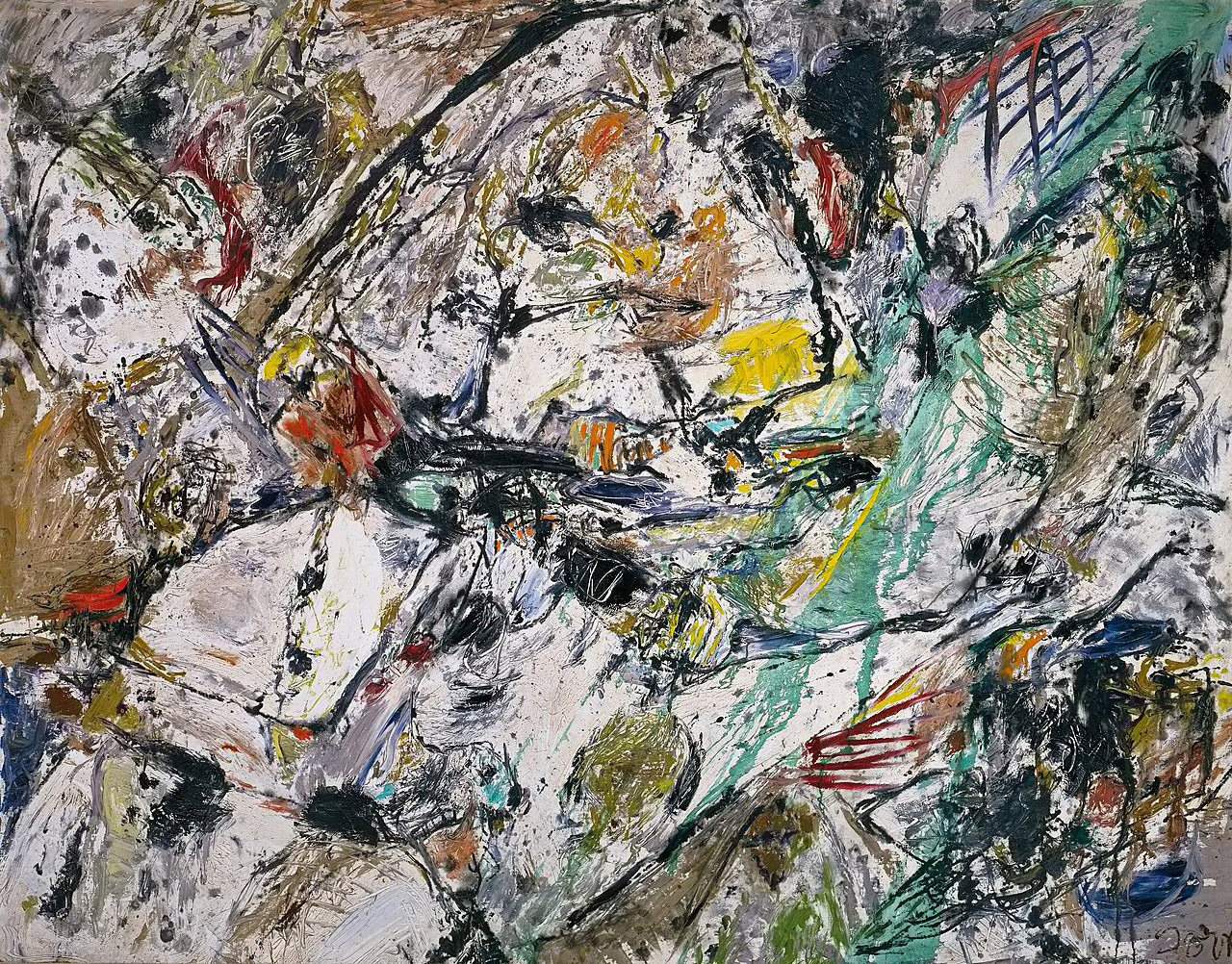
 

Asger Jorn (Danish, 1914-1973) 'A Soul for Sale (Ausverkauf einer Seele)' 1958-1959


Asger Jorn (Danish, 1914-1973)
A Soul for Sale (Ausverkauf einer Seele)
1958-1959
Oil with sand on canvas
200 x 250cm
Solomon R. Guggenheim Museum, New York
Purchased with funds contributed by the Evelyn Sharp Foundation, 1983
© 2012 Donation Jorn, Silkeborg / Artists Rights Society (ARS), New York/COPY-DAN, Copenhagen


Asger Jorn’s career began in 1936 when he ventured from Copenhagen to Paris with the goal of apprenticing under the legendary painter Vasily Kandinsky. On his arrival, however, Jorn promptly learned that Kandinsky did not operate his own academy. Instead, the young artist enrolled in Fernand Léger’s Académie contemporaine and worked with Le Corbusier on his Pavillon des temps nouveaux at the World Exhibition of 1937, experiencing firsthand the formal restraint and balance that characterised the art and architecture of Le Corbusier’s Purism – a movement dedicated to highly rationalised geometric forms.

But Jorn preferred methods rooted in spontaneity and would ultimately reject the techniques of his teachers in favour of a life of art, writing, and activism that amounted to an assault on rationality in all its guises – painterly, architectural, and social. In 1948 Jorn and others, including Karel Appel, founded Cobra, an international collection of like-minded experimental artists. Indebted to the style of Jorn’s friend Jean Dubuffet – whose Art Brut looked to traditions of art making commonly considered debased or vulgar by the art establishment – Cobra art combined Surrealist automatism with the materiality of gestural mark making. Many of Jorn’s early paintings exist on the boundary between abstraction and figuration, aligning his practice with that of American contemporaries including Willem de Kooning and Jackson Pollock.

In 1957 Jorn merged his anti-Bauhaus group, the Mouvement internationale pour un Bauhaus imaginiste (International movement for an imaginist Bauhaus, founded in 1954), with Guy Debord’s Lettrist International, to form the Internationale Situationiste (Situationist International, SI), a Marxist, activist group of writers, artists, and theorists who sought to destabilise societal practices and structures ranging from urban planning to the art establishment. Jorn continued to exhibit an anarchic spirit even after he left the SI in 1961. As an act of rebellion against the concept of art prizes, for instance, he refused to accept the Guggenheim Museum’s 1964 International Award for his painting Dead Drunk Danes (Døddrukne Danskere, 1960), stating in a telegram that he wanted no part of the museum’s “ridiculous game.”

During his SI period Jorn focused great effort on a series of “modification” paintings, which utilised other paintings as pre-existing supports on which to produce new images or marks, but he also continued to work within his Cobra aesthetic, making paintings such as A Soul for Sale (Ausverkauf einer Seele, 1958-59). In both its use of expressive brushwork and its collapsing of foreground and background, figuration and abstraction, A Soul for Sale articulates some of Jorn’s most significant interrogations of the precepts of geometric abstraction and rationalised art making. Barely discernible amid a field of gestural marks, the work’s central figure – demarcated by fragmented contour lines that seem to merge with the abstract ground even as they define the figure’s form – appears on the verge of disappearing. Jorn seems to deny his subject even as he represents it. In a similar fashion, rational strategies of delineating form or representing depth, seen in the contour drawing or in the crosshatching at the top right of the painting, are overcome by strikingly crude or naive methods of mark making, such as scattered soil or paint smudges – techniques Jorn first developed early on as a Cobra artist.

Text from the Guggenheim website


Yves Klein (French, 1928-1962) 'Large Blue Anthropometry (ANT 105) [La Grande Anthropométrie Bleue (ANT 105)]' c. 1960


Yves Klein (French, 1928-1962)
Large Blue Anthropometry (ANT 105) [La Grande Anthropométrie Bleue (ANT 105)]
c. 1960
Blue pigment and synthetic resin on paper on canvas
280 x 428cm
Guggenheim Museum Bilbao


Yves Klein’s first passion in life was judo. In 1952 he moved to Tokyo and studied at the Ko-do-kan Judo Institute, where he earned a black belt. When he returned to Paris in 1955 and discovered to his dismay that the Fédération Française de Judo did not extol him as a star, he shifted his attentions and pursued a secondary interest – a career in the arts. During the ensuing seven years Klein assembled a multifarious and critically complex body of work ranging from monochrome canvases and wall reliefs to paintings made with fire. He is renowned for his almost exclusive use of a strikingly resonant, powdery ultramarine pigment, which he patented under the name “International Klein Blue,” claiming that it represented the physical manifestation of cosmic energy that, otherwise invisible, floats freely in the air. In addition to monochrome paintings, Klein applied this pigment to sponges, which he attached to canvases as relief elements or positioned on wire stands to create biomorphic or anthropomorphic sculptures. First exhibited in Paris in 1959, the sponge sculptures – all essentially alike, yet ultimately all different – formed a forest of discrete objects surrounding the gallery visitors. About these works Klein explained, “Thanks to the sponges – raw living matter – I was going to be able to make portraits of the observers of my monochromes, who … after having voyaged in the blue of my pictures, return totally impregnated in sensibility, as are the sponges.”1

For his Anthropométries series, Klein famously used nude female models drenched in paint as “brushes.” His system of pressing bodies against the paper support (which was later mounted on canvas) rejected any illusion of a third dimension in the pictorial space. In these works, the subject, object, and medium become confused with one another to produce a trace of the body’s presence. Klein’s unconventional activities also included releasing thousands of blue balloons into the sky, and exhibiting an empty, white-walled room and then selling portions of the interior air, which he called “zones” of “immaterial pictorial sensibility.” His intentions remain perplexing thirty years after his sudden death. Whether Klein truly believed in the mystical capacity of the artist to capture cosmic particles in paint and to create aesthetic experiences out of thin air and then apportion them at whim is difficult to determine. The argument has also been made that he was essentially a parodist who mocked the metaphysical inclinations of many modern painters, while making a travesty of the art market.

Nancy Spector

1/ Yves Klein, “Remarques sur quelques oeuvres exposées chez Colette ‘Allendy’,” 1958, Klein archive, quoted in Nan Rosenthal, “Assisted Levitation: The Art of Yves Klein,” in Yves Klein 1928-1962: A Retrospective, exh. cat. (Houston: Institute for the Arts, Rice University, 1982), p. 111.

Text from the Guggenheim website


Solomon R. Guggenheim Museum
1071 5th Avenue (at 89th Street)
New York

Opening hours:
Sunday – Monday, 11am – 6pm
Wednesday – Friday 11am – 6pm
Saturday 11am – 8pm
Closed Tuesday

Solomon R. Guggenheim Museum website

LIKE ART BLART ON FACEBOOK

Back to top

Exhibition: ‘Weegee: Murder Is My Business’ at the International Center of Photography, New York

Exhibition dates: 20th January – 2nd September 2012


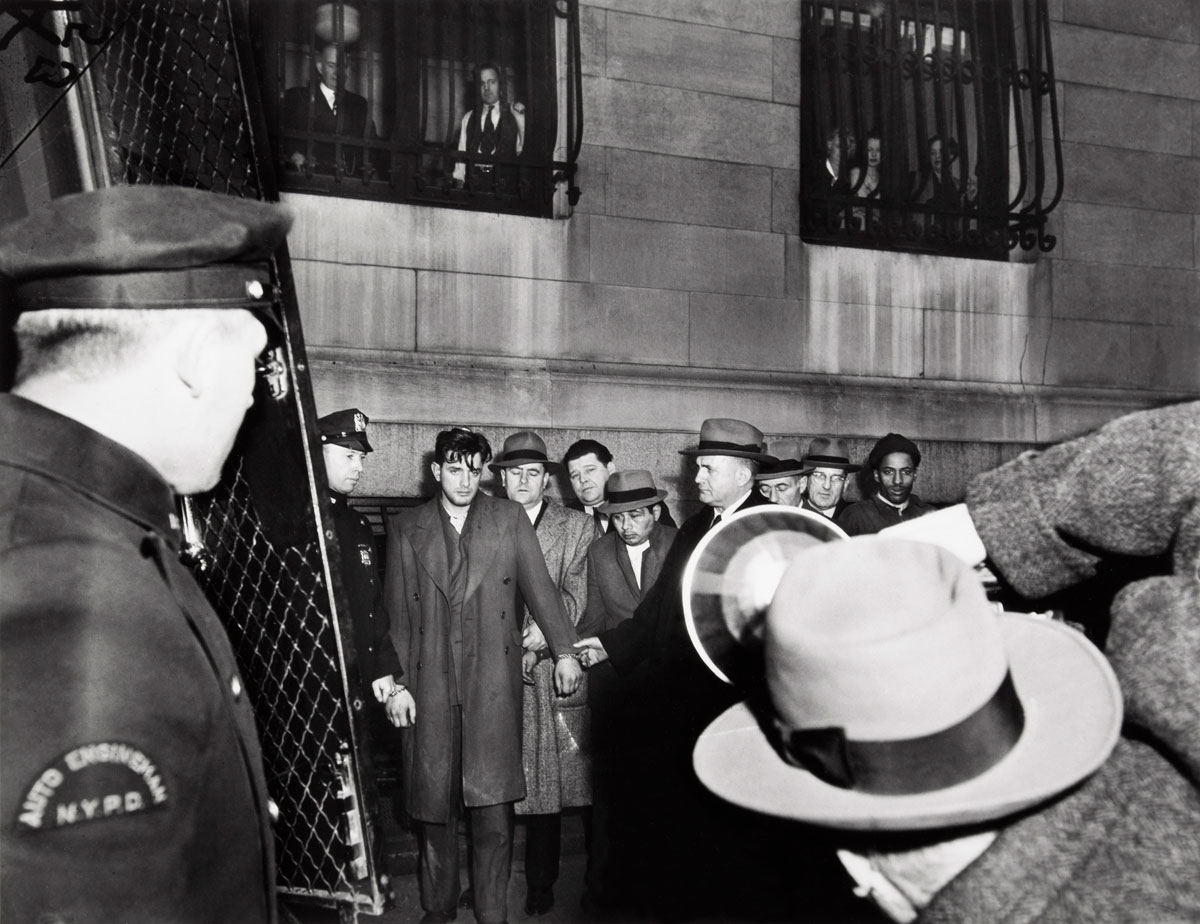
Weegee (Arthur Fellig) (American, 1899-1968) 'Untitled [Anthony Esposito, booked on suspicion of killing a policeman, New York]' January 16, 1941


Weegee (Arthur Fellig) (American, 1899-1968)
Untitled [Anthony Esposito, booked on suspicion of killing a policeman, New York]
January 16, 1941
Silver gelatin photograph
© Weegee/International Center of Photography


If you want a good read about the life and times of Weegee then Mark Svetov’s ‘Life and Death (Mostly Death) in the Streets’ (2010) on American Suburb X website is the way to go. I can’t really add much to this excellent piece of writing in terms of the history of the man and the social milieu in which he surrounded himself. What I can comment on are my personal feelings about his photographs.

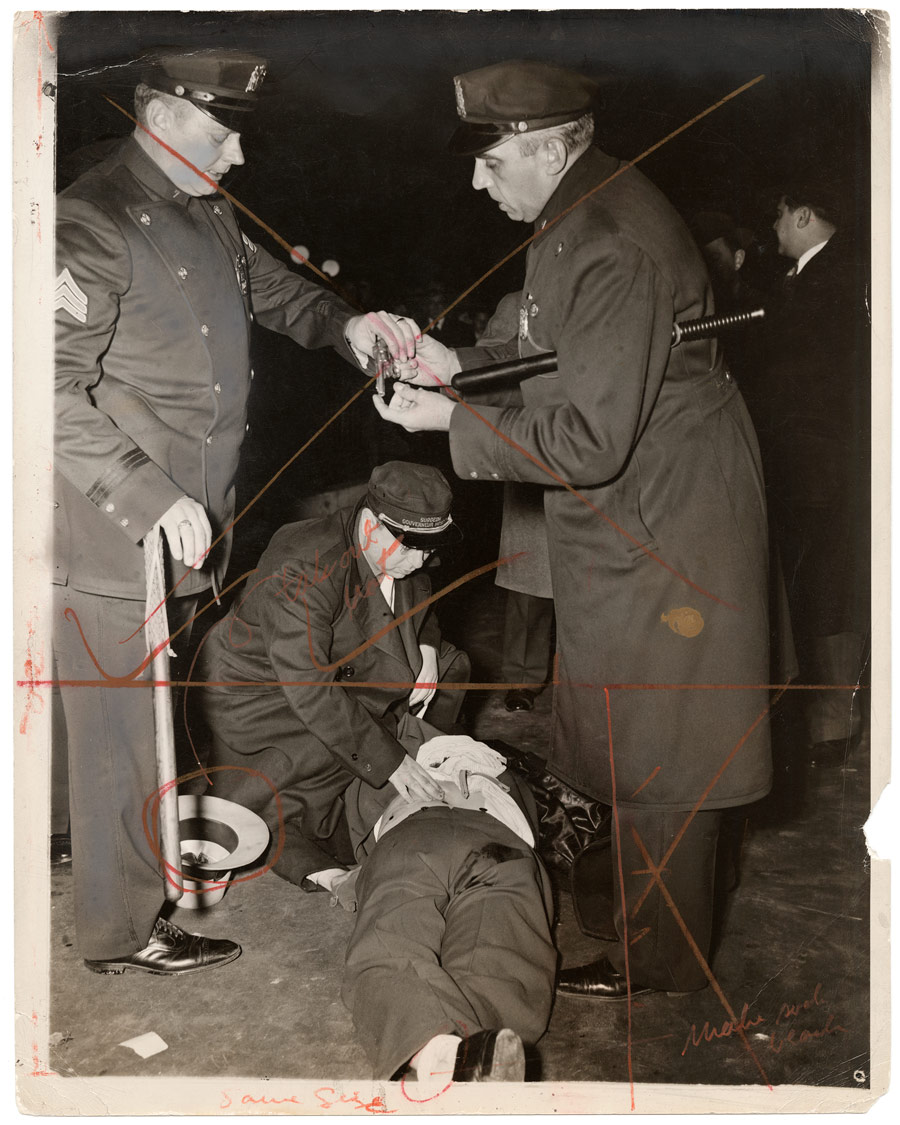
Weegee’s photographs are no masterpiece of fine art printing, they are rough and direct, and I love them all the more for this quality. Their roughness – all sellotaped over, edges cut at odd angles, drawn and written on – only adds to their power and immediacy. If you can call photographs of dead bodies in the street vibrant and alive, then these photographs are just that. Svetov sees Weegee as the quintessential noir photographer; I see him not so much as that but as a sensitive, formalist photographer, a wonderful collagist and an artist who is a precursor to the pop art of the mid-late 1950s (think Warhol’s screen prints of the electric chair, or his mangled car crash series).

In the installation photographs of the exhibition Weegee: Murder Is My Business at the Photo League, New York (1941, see below) you get a sense of this master of assemblage, the animator and promoter (another pop trait!) at work. The large prints are casually pinned to the back board, surrounded by drawings of guns with smoke emanating from their barrels, cause of death certificates, photographs of Weegee himself “On the Spot”, Weegee’s press pass, newspaper clippings about the man and his work (including a photograph of his tiny bedroom) where Weegee “introduces” himself to his audience. The photographs flow around the room, from Faces, to Murder and Society. People are drawn into the aura of these photographs, you can see them leaning forward to take in every detail. They peer intently at the them trying to decipher every nuance of the narrative being told (the frequent hats lying about, the discarded pistols, the hand emerging from underneath the draped sheet).

As Svetov notes, Weegee’s news pictures were never haphazard snapshots, for they always seem perfectly arranged. Underneath the spontaneity and the humanism imparted by the artist is that fact that Weegee is a master of formalism. He knows exactly how to structure the picture plane as a classical pianist knows how to bring alive the themes of a Mozart sonata. Usually arriving before any other photographer because he lived opposite the police station and had a police radio in his car, Weegee “cased the joint” as I would put it, prowling quickly around the scene to get the best angle, the best shot before other photographers arrived or the scene was closed off by police. This instinctive framing only comes through having a good eye and training that eye so that what to shoot and how to crop the scene “in camera” becomes second nature.

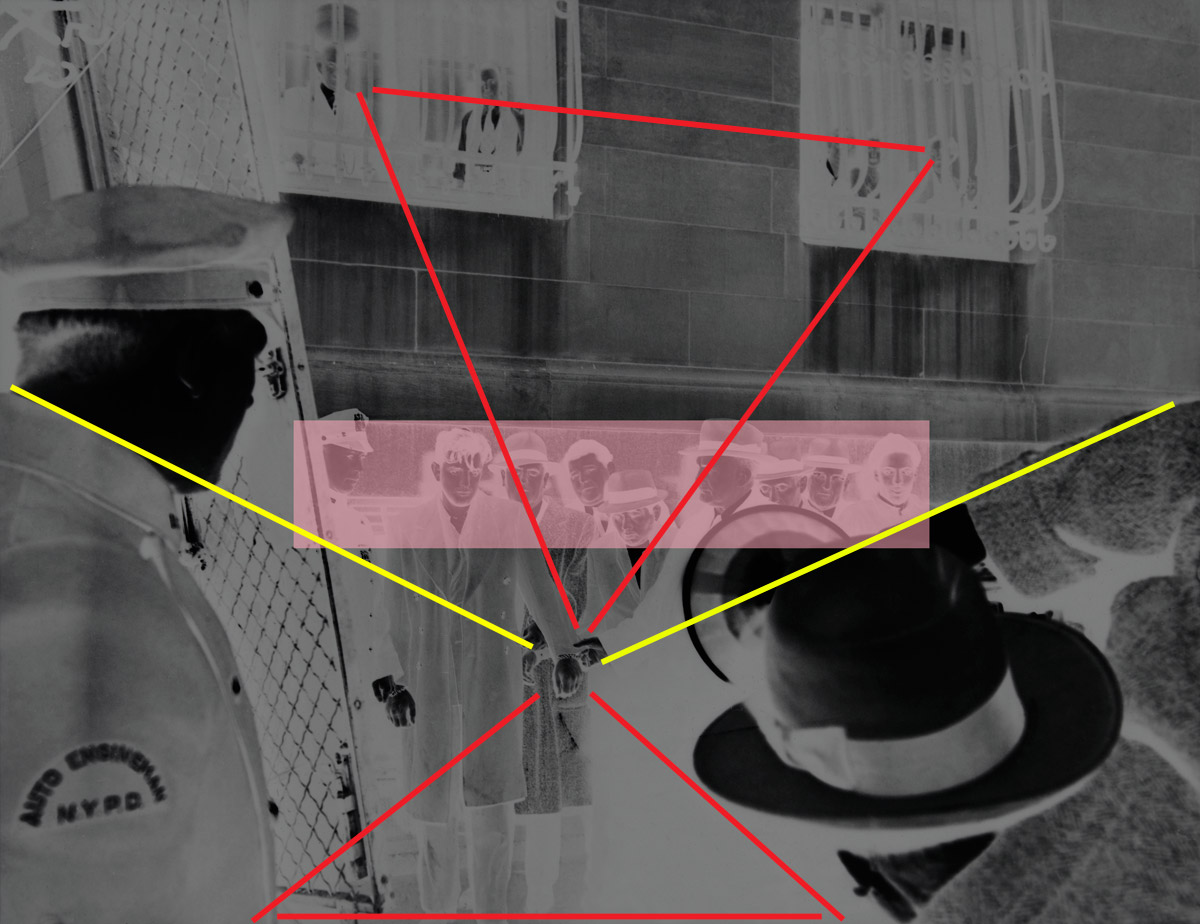
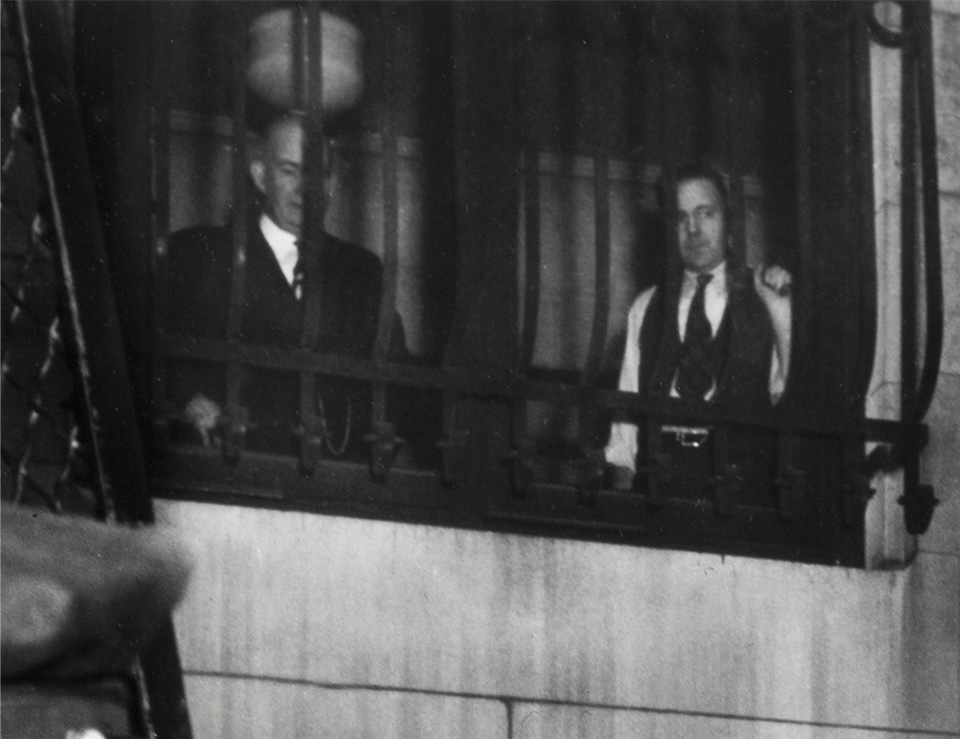
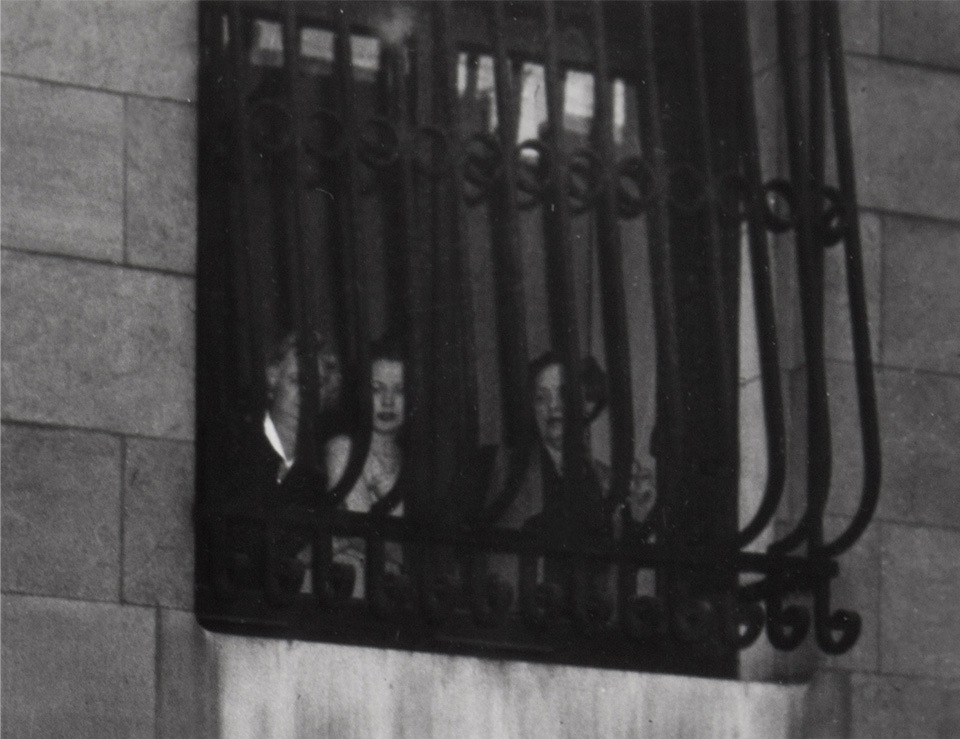
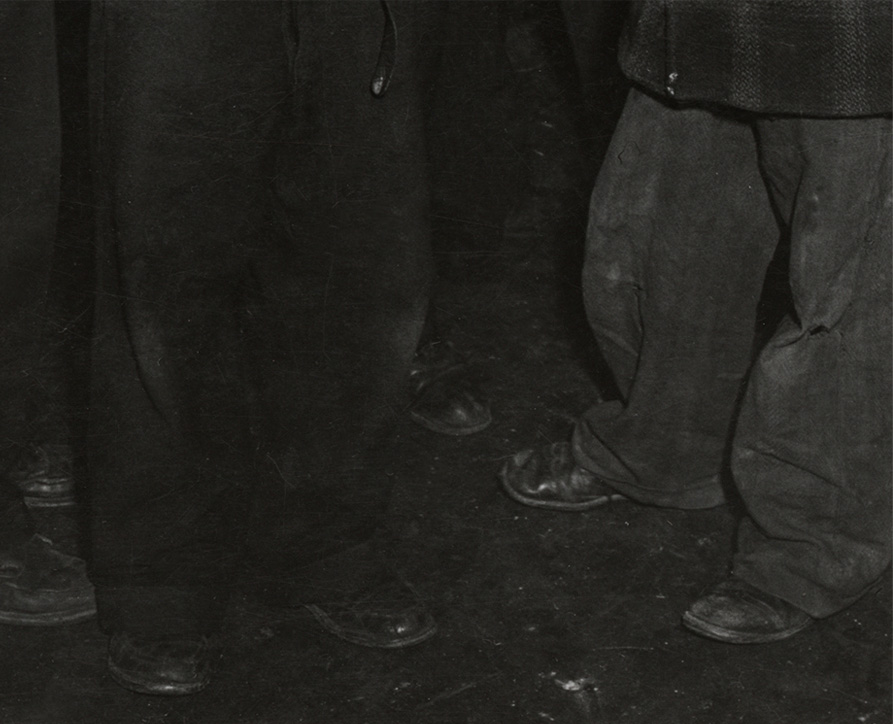
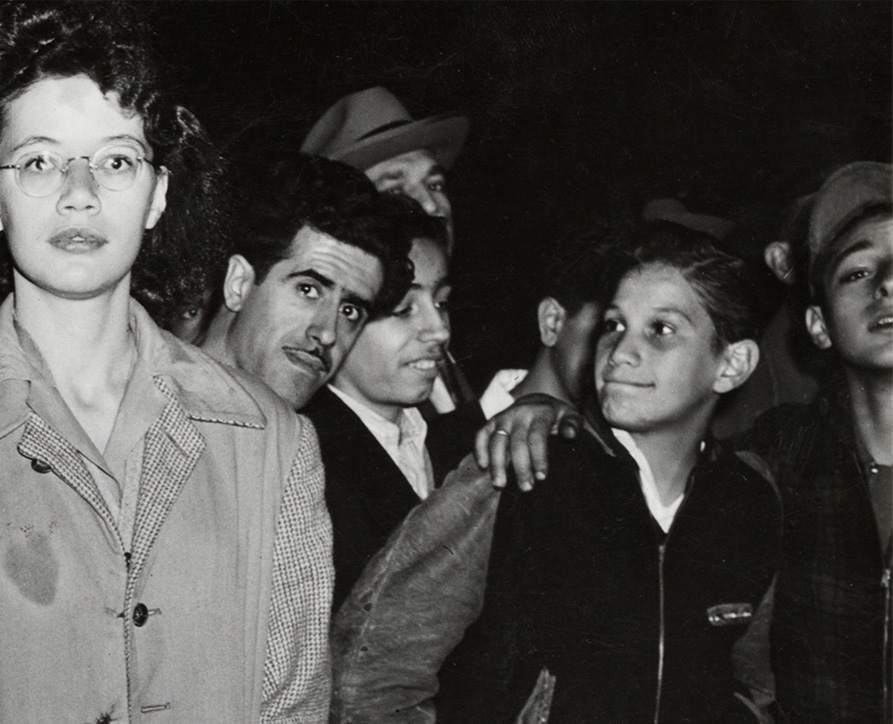
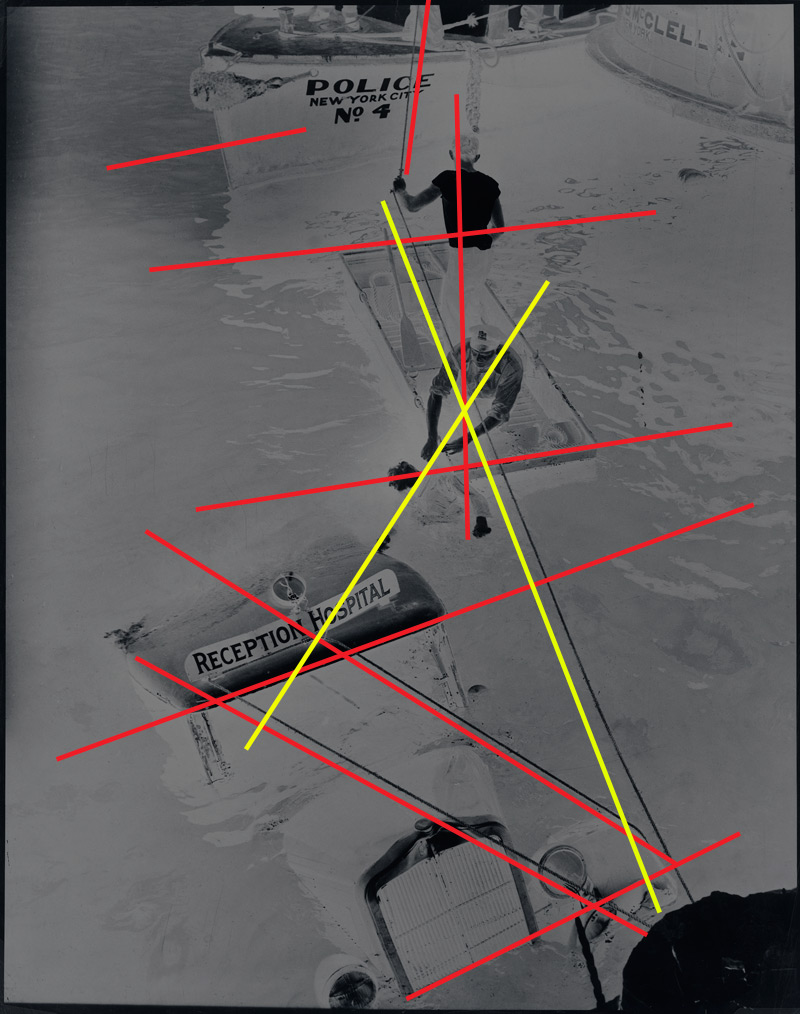
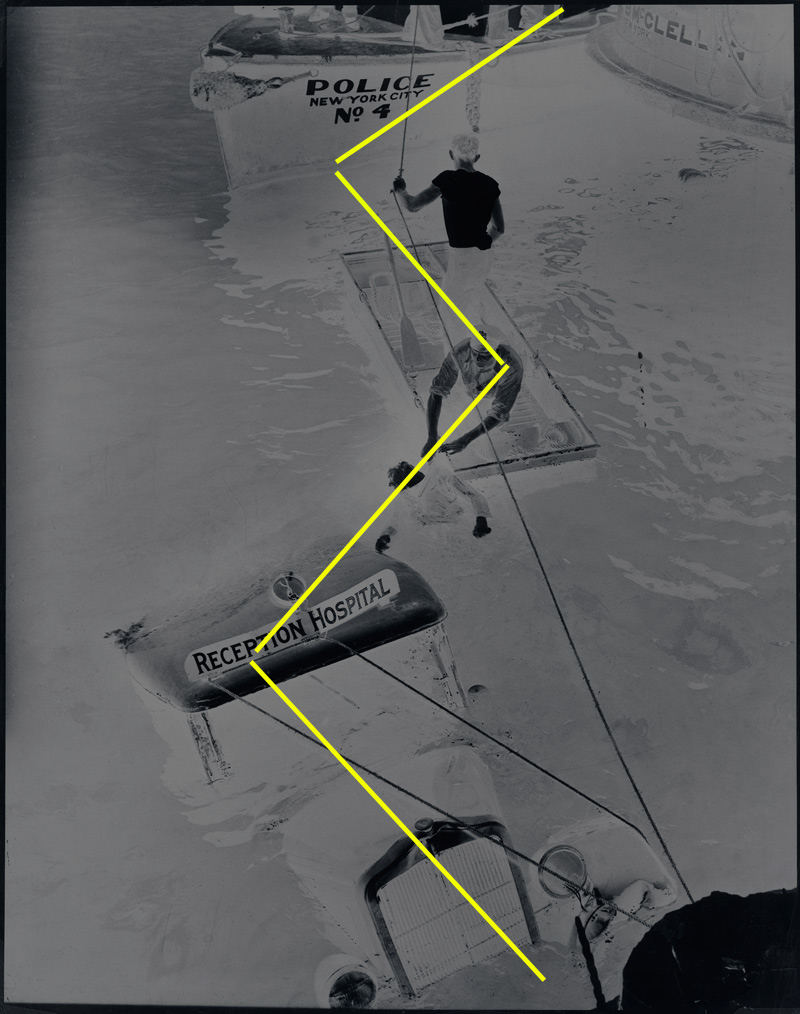
Evidence of the formal structure implicit in Weegee’s photographs can be seen in my analysis of two photographs Line-Up for Night Court (c. 1941, below) and Police officer and assistant removing body of Reception Hospital ambulance driver Morris Linker from East River, New York (August 24, 1943, below). In the first image the epicentre (or the enigma if you like) of the photograph is the dance of hands at the lower centre of the image, formed by two triangles and emphasised by two radial diagonals. The top points of the upper triangle are anchored by the men and women at both windows (see detail photographs), the patriarchal men in suit and tie at one window – a detective, a chief of police? – separated from the woman at another. Weegee’s splits this triangle with his frieze of faces showing the depths of human despair, despondency and ambivalence.

The second image has a much more complicated structure. In the first analysis we observe the different horizontal, vertical and diagonal planes as they march up the photograph. The “heart” of this image, where the yellow lines cross, is actually a point of absence. Look at the real photograph: it is the heart shaped empty space between the man’s outstretched hands that form the emotional centre of the image. In the second analysis we can simplify this down into a zigzagging line that passes directly through this point. To see this, to assess this and visualise the flowing movement in a split second is in any visual language outstanding. Weegee wasn’t averse to manipulating his images to achieve the desired result. The photograph Hold up man killed (November 24, 1941, below) shows his notations over the top of the image, the crop he envisaged and the words “Take out hat” and “Make sock black” so that he achieved the desired dynamic within the photograph.

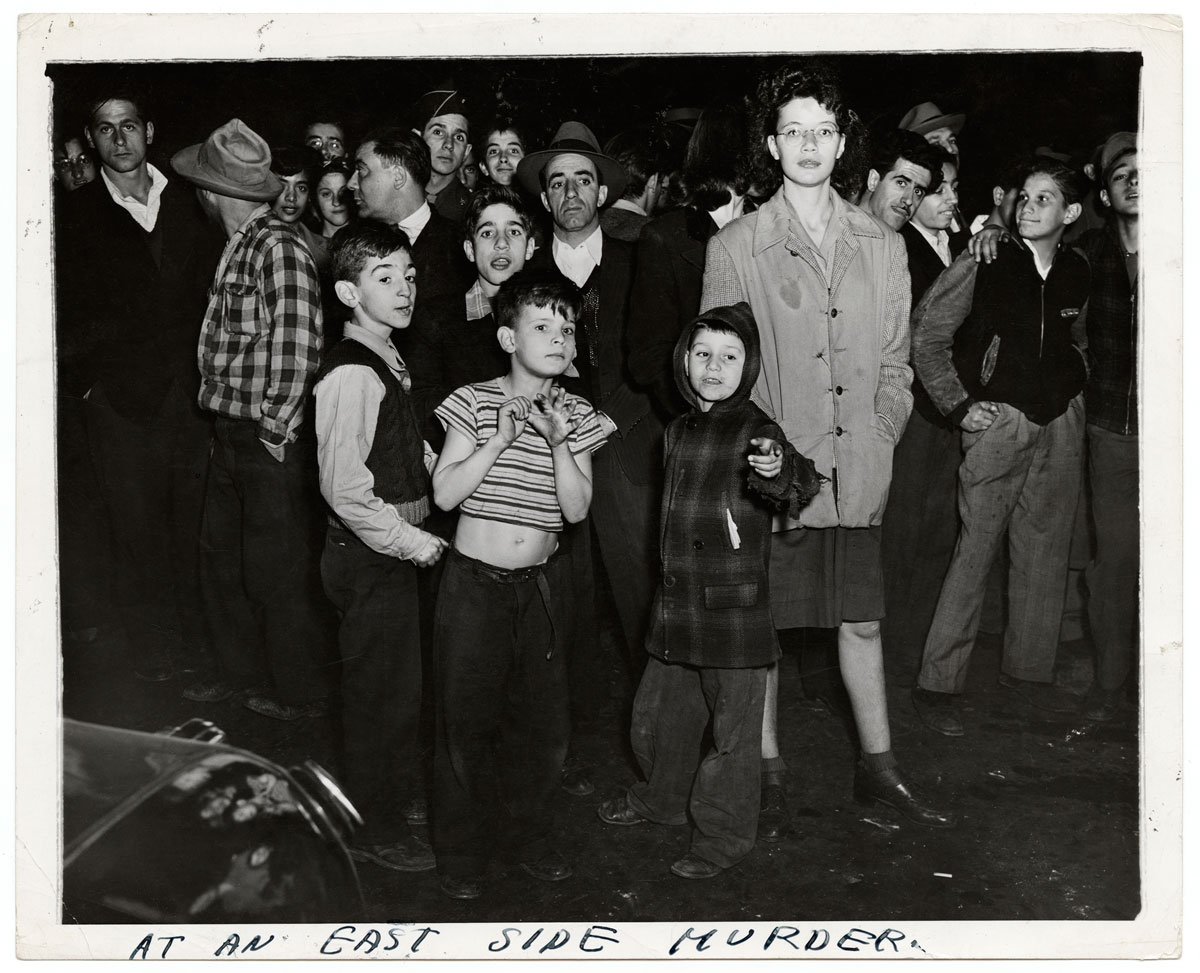
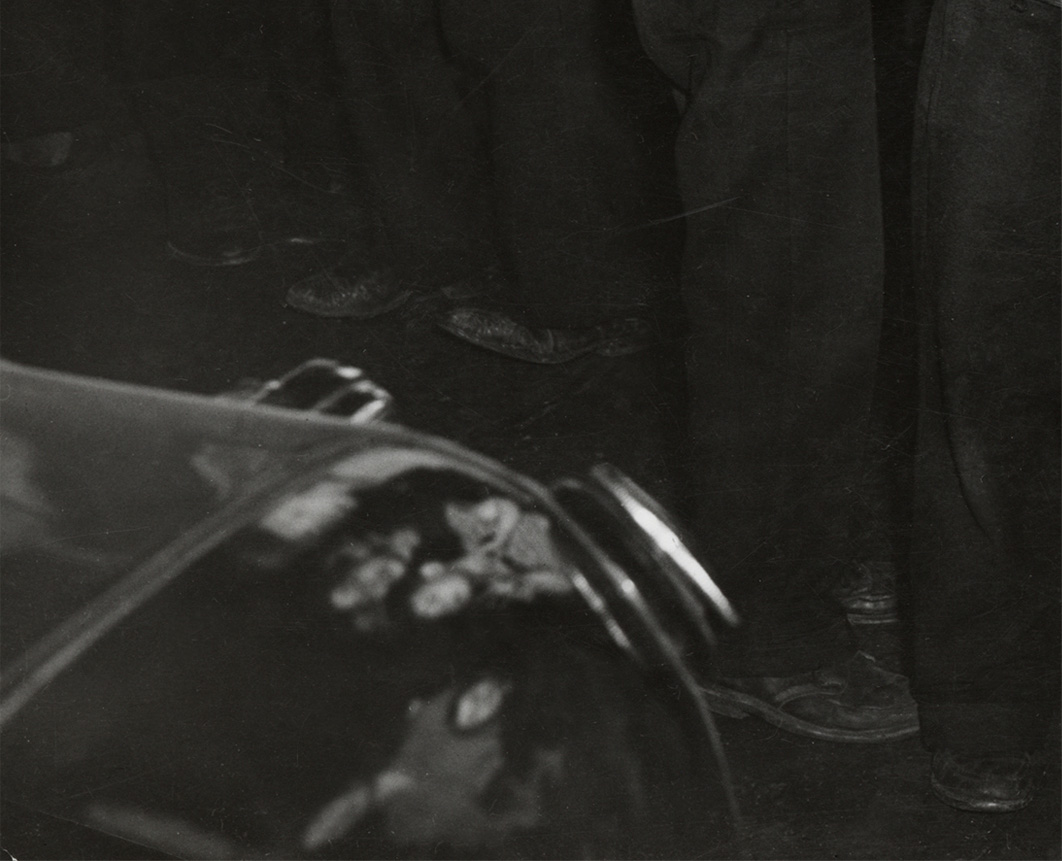
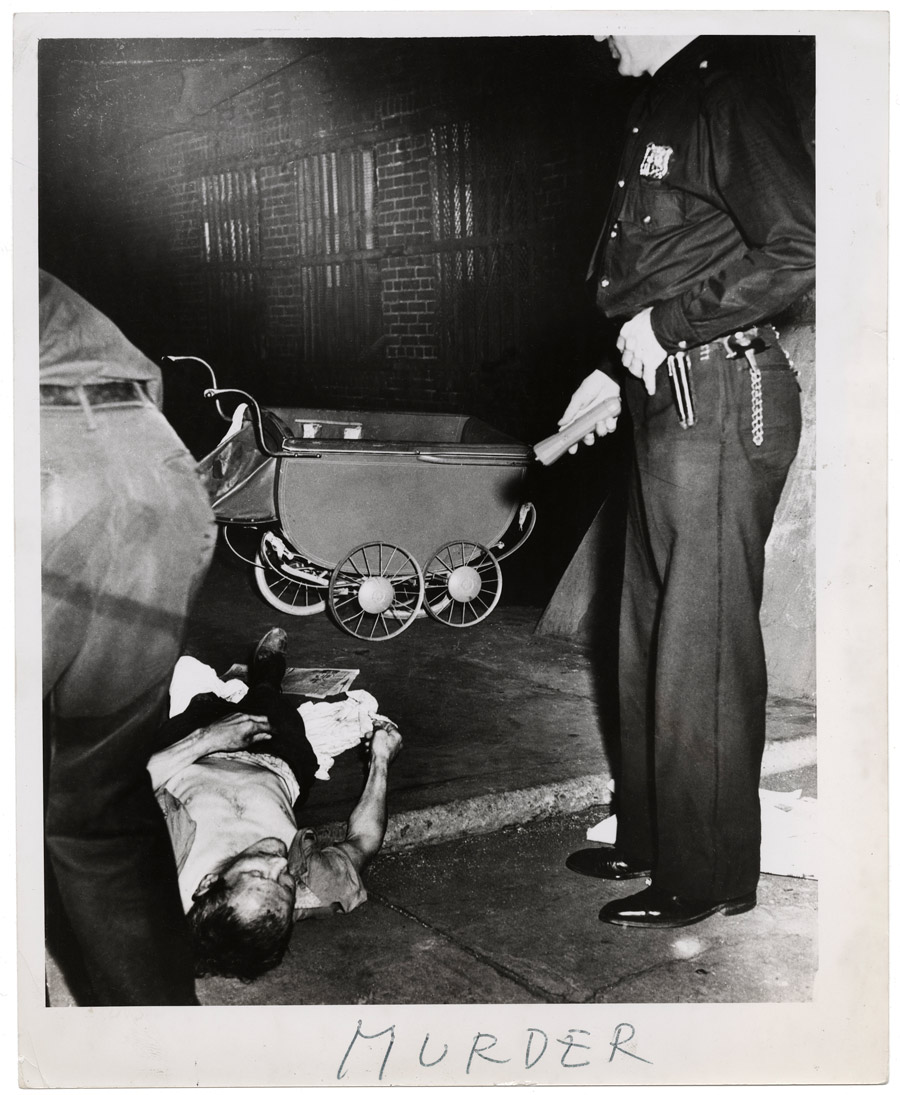
Weegee was a master of flash and the use of foreshortening – to create atmosphere in the first instance and used as a visual entre into the photographs in the second. Sometimes he combines both. The policeman at left in Line-Up for Night Court is both out of focus and the highlights (his face) are blown out by the flash. Does this matter: not one iota, for the policeman “grounds” the whole left hand side of the image. Again, in Murder (c. 1940, below) the backside of the policeman is blown out by the flash but this only leads the eye of the viewer to the foreshortened body of the murder victim nestled in the crook of his knee and then onto the starkly lit pram, beyond. Finally, in Hold up man killed (November 24, 1941, below) the feet of the hold up man actually lead the viewer into the space between the two policeman’s shoes were the Surgeon from Gouverneur Hospital crouches over the body. Weegee also loved to weave detail into his images, so that even though the story is about human content, as Svetov observes, it is just as much about human materiality as well: notice the reflection of people in the car bonnet in At an East Side Murder (1943, below) at lower left and then the procession of worn shoes and the bagginess of the trousers – I didn’t realised they wore their trousers so baggy in the 1940s!

Svetlov sees Weegee’s photographs as containing an almost sacred squalor, a brash but anguished cry in an endless nightscape with nothing judgemental or distanced about them. I concur with the last part for Weegee was a man of the people whom he photographed. On the other points I am less sure: to me they are about light not darkness. They are about the aftermath of atrocity, of living, human beings dealing with death and its consequences. I see nothing sacred about this squalor. The photographs are about shining a light into darkness, the darkness that every human being must confront: the fact that we all have to die, somewhere, sometime, in the end.

Dr Marcus Bunyan


Many thankx to the International Center of Photography for allowing me to publish the photographs in the posting. Please click on the photographs for a larger version of the image.


“People are so wonderful that a photographer has only to wait for that breathless moment to capture what he wants on film… and when that split second of time is gone, it’s dead and can never be brought back.”

“For the pictures… I was on the scene; sometimes drawn there by some power I can’t explain, and I caught the New Yorkers with their masks off… not afraid to Laugh, Cry, or Make Love. What I felt I photographed, laughing and crying with them.”


Arthur Fellig (aka Weegee, 1899-1968)


“Weegee’s work is connected by an umbilical cord to darkness; his images emerged from Gotham City’s nocturnal penumbra, spectrally streaked by streetlights, lit brightly only where there was a human focus, a tabloid John Alton at work.

Weegee called it his “Rembrandt light” as he caught the human protagonists in the white glare of his photo flash, the scene otherwise enveloped in darkness. Weegee’s news pictures were never haphazard snapshots, albeit they were taken by a man who had happenstance and chance as his helpmates; he and his camera, with its flash, seem to have a fateful meeting with his human subjects; pictures seem perfectly arranged, and what we focus on is their human content. Weegee is the quintessential noir photographer.”


Mark Svetov. “Life and Death (Mostly Death) in the Streets (2010)” on American Suburb X website May 2012 [Online] Cited 28/08/2012


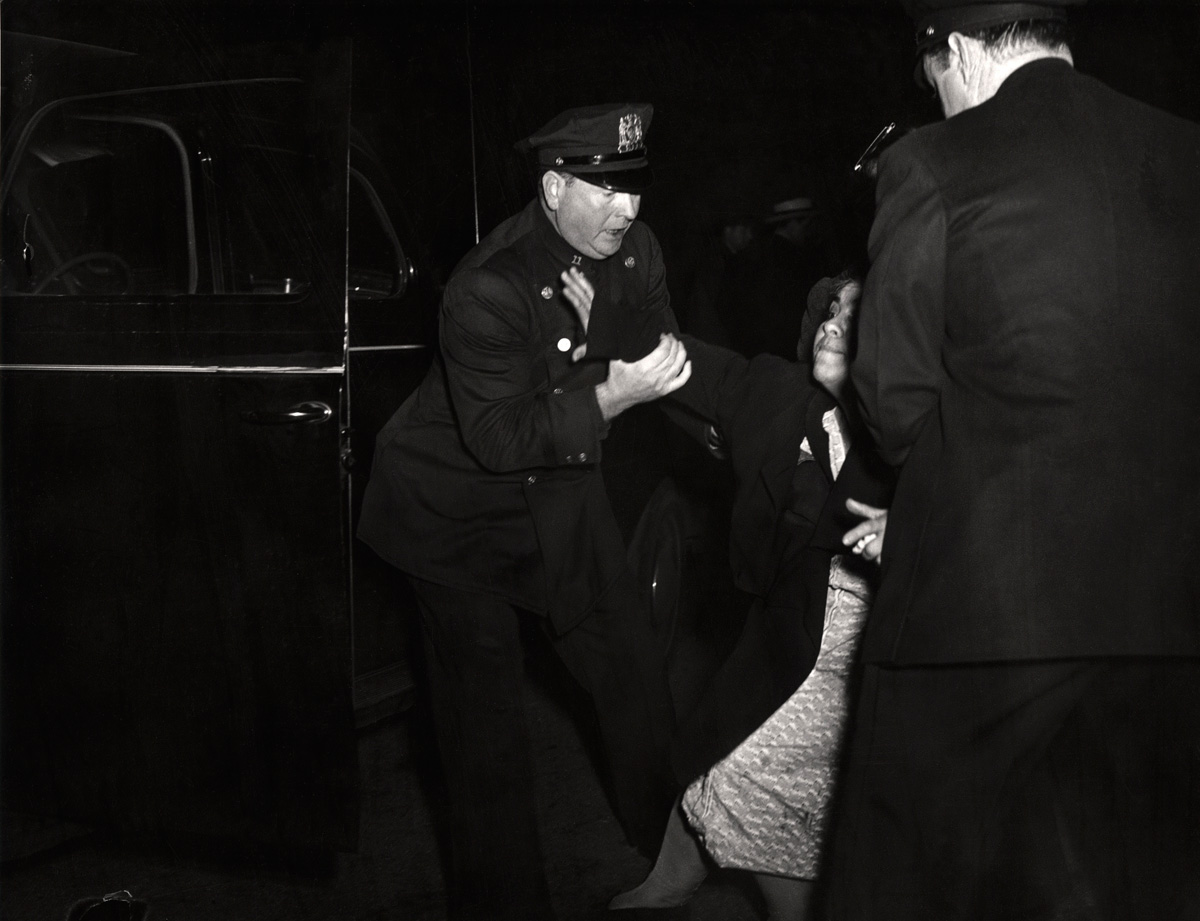
Weegee (Arthur Fellig) (American, 1899-1968) 'The dead man's wife arrived... and then she collapsed' c. 1940


Weegee (Arthur Fellig) (American, 1899-1968)
The dead man’s wife arrived… and then she collapsed
c. 1940
Silver gelatin photograph
© Weegee/International Center of Photography


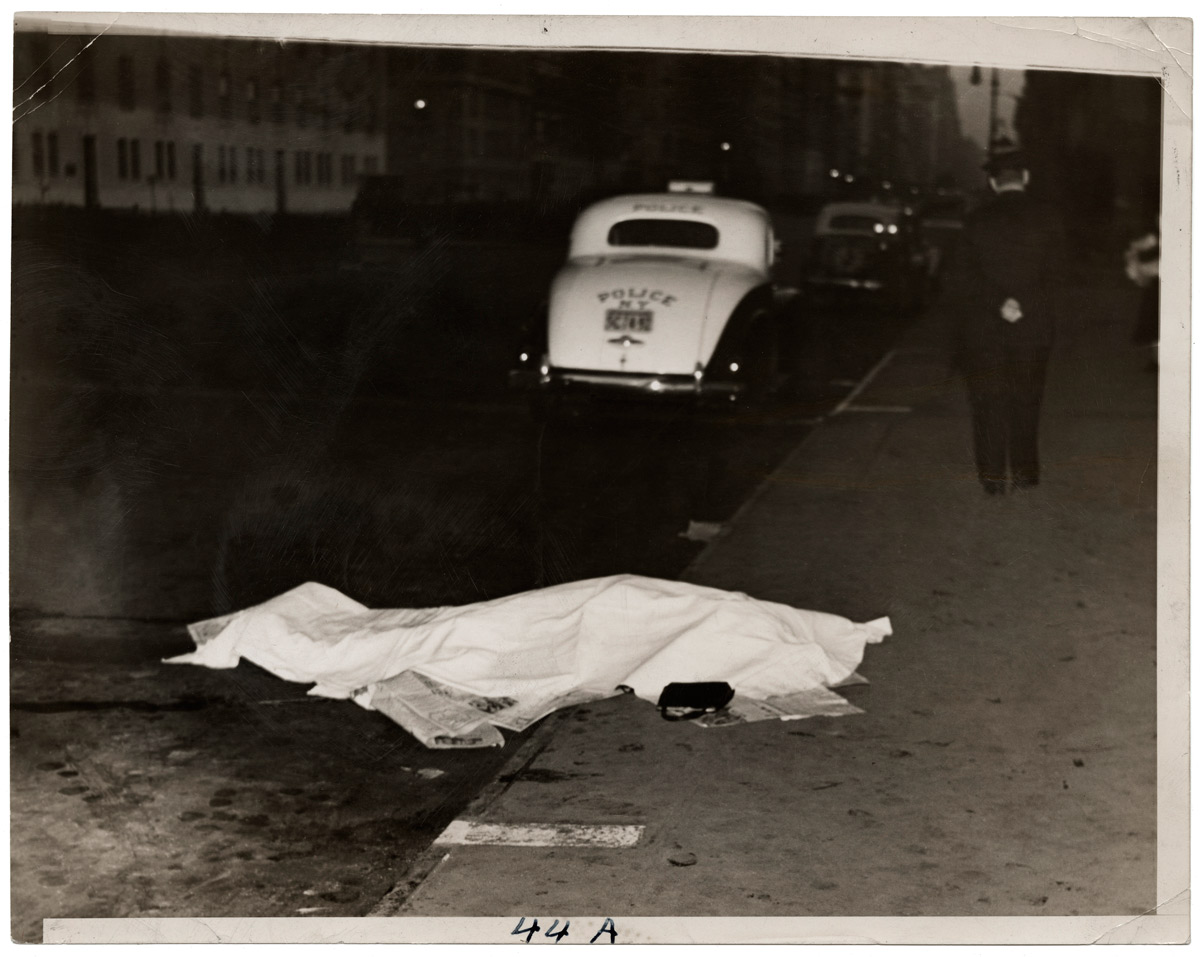
Weegee (Arthur Fellig) (American, 1899-1968) 'Girl jumped out of car, and was killed, on Park Ave.,' c. 1938


Weegee (Arthur Fellig) (American, 1899-1968)
Girl jumped out of car, and was killed, on Park Ave.,
c. 1938
Silver gelatin photograph
© Weegee/International Center of Photography


Weegee (Arthur Fellig) (American, 1899-1968) 'Untitled [Installation view of "Weegee: Murder Is My Business" at the Photo League, New York]' 1941

Weegee (Arthur Fellig) (American, 1899-1968) 'Untitled [Installation view of "Weegee: Murder Is My Business" at the Photo League, New York]' 1941

Weegee (Arthur Fellig) (American, 1899-1968) 'Untitled [Installation view of "Weegee: Murder Is My Business" at the Photo League, New York]' 1941

Weegee (Arthur Fellig) (American, 1899-1968) 'Untitled [Installation view of "Weegee: Murder Is My Business" at the Photo League, New York]' 1941


Weegee (Arthur Fellig) (American, 1899-1968)
Untitled [Installation view of “Weegee: Murder Is My Business” at the Photo League, New York]
1941
Silver gelatin photographs
© Weegee/International Center of Photography


Text and captions from the original Murder Is My Business exhibition:

~ “Introducing Weegee”
~ “Due to an increase in MURDERS The Photo League presents 2nd Edition of “MURDER IS MY BUSNESS” by Weegee”
~ “Weegee Lives For His Work And Thinks Before Shooting” (newspaper headline on the “Weegee” board at left)
~ “This space reserved for the latest muders”
~ “MURDER Manhattan bloodbath”
~ “Arthur Fellig Photographer / Do not disturbe / Except in case of Fire, Murder or Snow Storm” (caption underneath photograph)
~ “Why did you kill your Sweetie”?  (caption underneath photograph)
~ “HUMAN BODY MINUS HEAD FOUND ON STREET” (caption underneath photograph)
~ “Cop & human head in package” (caption underneath photograph)
~ “Killed her husband after drinking brawl” (caption underneath photograph)
~ “Just a cheap murder” (caption underneath photograph)
~ “My man” (caption underneath photograph)
~ “Who done that” (caption underneath photograph)


“Weegee’s captions provided a visceral vernacular for the almost-sacred squalor of his imagery (see “Weegee’s Words” for a sampling). Taken together, they packed more than a mere punch; they were a brash but anguished cry in an endless nightscape. More than mere documents of a violent era, they also exuded a humanity that could only come from the photographer himself. There was nothing judgmental or distanced in Weegee’s work; he was the antithesis of the “slickers” who worked for glossy magazines. He remained a man essentially from the same New York working-class as the people he chose to photograph.”


Mark Svetov. “Life and Death (Mostly Death) in the Streets (2010)” on American Suburb X website May 2012 [Online] Cited 28/08/2012


Weegee (Arthur Fellig) (American, 1899-1968) 'Untitled ["Ruth Snyder Murder" wax display, Eden Musée, Coney Island, New York]' c. 1941


Weegee (Arthur Fellig) (American, 1899-1968)
Untitled [“Ruth Snyder Murder” wax display, Eden Musée, Coney Island, New York]
c. 1941
Silver gelatin photograph
© Weegee/International Center of Photography


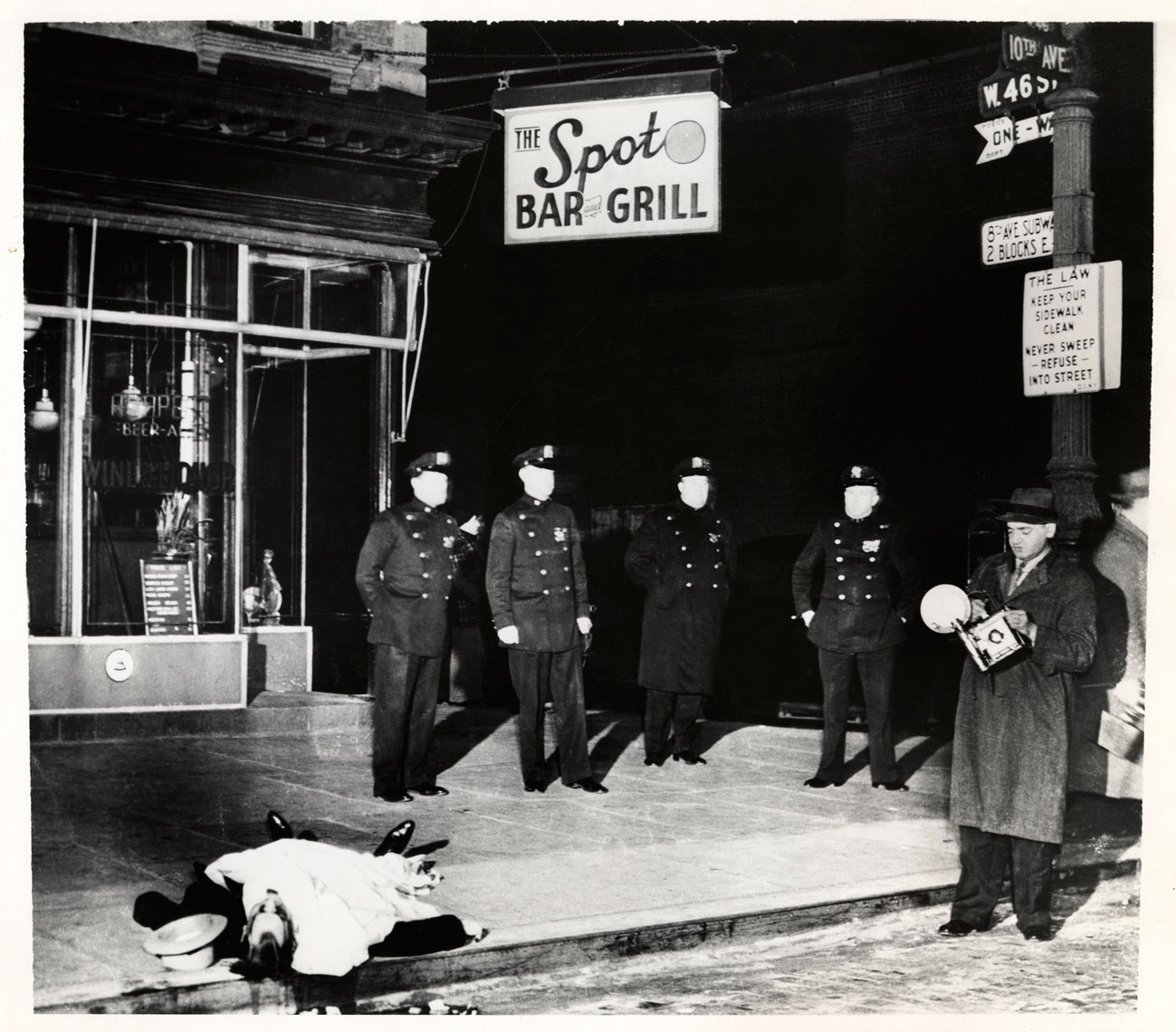
Unidentified Photographer. 'On the Spot' December 9, 1939


Unidentified Photographer
On the Spot
December 9, 1939
© Weegee/International Center of Photography


Weegee (Arthur Fellig) (American, 1899-1968) 'Line-Up for Night Court' c. 1941


Weegee (Arthur Fellig) (American, 1899-1968)
Line-Up for Night Court
c. 1941
Silver gelatin photograph
© Weegee/International Center of Photography


Construction of the pictorial plane in 'Line-Up for Night Court'


Construction of the pictorial plane in Line-Up for Night Court


Weegee (Arthur Fellig) (American, 1899-1968) 'Line-Up for Night Court' c. 1941 (detail)

Weegee (Arthur Fellig) (American, 1899-1968) 'Line-Up for Night Court' c. 1941 (detail)


Weegee (Arthur Fellig) (American, 1899-1968)
Line-Up for Night Court (details)
c. 1941
Silver gelatin photograph
© Weegee/International Center of Photography


Weegee (Arthur Fellig) (American, 1899-1968) 'At an East Side Murder' 1943


Weegee (Arthur Fellig) (American, 1899-1968)
At an East Side Murder
1943
Silver gelatin photograph
© Weegee/International Center of Photography


Weegee (Arthur Fellig) (American, 1899-1968) 'At an East Side Murder' 1943 (detail)

Weegee (Arthur Fellig) (American, 1899-1968) 'At an East Side Murder' 1943 (detail)

Weegee (Arthur Fellig) (American, 1899-1968) 'At an East Side Murder' 1943 (detail)


Weegee (Arthur Fellig) (American, 1899-1968)
At an East Side Murder (details)
1943
Silver gelatin photograph
© Weegee/International Center of Photography


Weegee (Arthur Fellig) (American, 1899-1968) 'Untitled [Hats in a pool room, Mulberry Street, New York]' c. 1943


Weegee (Arthur Fellig) (American, 1899-1968)
Untitled [Hats in a pool room, Mulberry Street, New York]
c. 1943
© Weegee/International Center of Photography


Gangland murders, gruesome car crashes, and perilous tenement fires were for the photographer Weegee (1899-1968) the staples of his flashlit black-and-white work as a freelance photojournalist in the mid­-1930s. Such graphically dramatic and sometimes sensationalistic photographs of New York crimes and news events set the standard for what has since become known as tabloid journalism. In fact, for one intense decade, between 1935 and 1946, Weegee was perhaps the most relentlessly inventive figure in American photography. A surprising new exhibition at the International Center of Photography (1133 Avenue of the Americas at 43rd Street), titled Weegee: Murder Is My Business and organised by ICP Chief Curator Brian Wallis, will present some rare examples of Weegee’s most famous and iconic images, and will consider his early work in the context of its original presentation in historical newspapers and exhibitions, as well as Weegee’s own books and films.

Taking its title from Weegee’s self-curated exhibition at the Photo League in 1941, Murder Is My Business looks at the urban violence and mayhem that was the focus of his early work. As a freelance photographer at a time when New York City had at least eight daily newspapers and when wire services were just beginning to handle photos, Weegee was challenged to capture unique images of newsworthy events and distribute them quickly. He worked almost exclusively at night, setting out from his small apartment across from police headquarters when news of a new crime came chattering across his police-band radio receiver. Often arriving before the police themselves, Weegee carefully cased each scene to discover the best angle. Murders, he claimed, were the easiest to photograph because the subjects never moved or got temperamental.

Weegee’s rising career as a news photographer in the 1930s coincided with the heyday of Murder Inc., the Jewish gang from Brownsville who served as paid hitmen for The Syndicate, a confederation of mostly Italian crime bosses in New York. As a wave of governmental and legal crackdowns swept the city between 1935 and 1941, the rate of organised murders of small-time wiseguys and potential stool pigeons increased dramatically. Weegee often worked closely with the police but also befriended high-profile criminals like Bugsy Siegel, Lucky Luciano, and Legs Diamond. Weegee called himself the “official photographer for Murder Inc.” and claimed to have covered 5,000 murders, a count that is perhaps only slightly exaggerated. In asserting the true nature of his business, Weegee proudly displayed his check stub from LIFE magazine that paid him $35 for two murders, slightly more, he said, for the one that used more bullets.

Selling his photographs to a variety of New York newspapers in the 1930s, and later working as a stringer for the short-lived daily newspaper PM (1940-1948), Weegee established a highly subjective approach to both photographs and texts that was distinctly different from that promoted in most dailies and picture magazines. Utilising other distribution venues, Weegee also wrote extensively (including his autobiographical Naked City, published in 1945) and organised his own exhibitions at the Photo League, the influential photographic organisation that promoted politically committed pictures, particularly of the working classes. In 1941, Weegee installed two back-to-back exhibitions in the League’s headquarters. This visibility helped promote Weegee’s growing reputation as a news photographer, and he began stamping his prints “Weegee the Famous.” The general acceptance of his punchy photographic style, which did not shy away from lower-class subjects and humanistic narratives, led to the acquisition of his work by the Museum of Modern Art and inclusion in two group shows there, in 1943 and 1945.

“Weegee has often been dismissed as an aberration or as a naive photographer, but he was in fact one of the most original and enterprising photojournalists of the 1930s and ’40s. His best photographs combine wit, daring, and surprisingly original points of view, particularly when considered in light of contemporaneous press photos and documentary photography. He favoured unabashedly low-culture or tabloid subjects and approaches, but his Depression-era New York photographs need to be considered seriously alongside other key documentarians of the thirties, such as Dorothea Lange, Robert Capa, Walker Evans, and Berenice Abbott,” said Wallis.

The exhibition will feature over 100 original photographs, drawn primarily from the comprehensive Weegee Archive of over 20,000 prints at ICP, as well as period newspapers, magazines, and films. It will also include partial reconstructions of Weegee’s studio and his Photo League exhibition. The four galleries will each feature a touch-screen monitor allowing visitors to explore further details regarding the images and artefacts in that room.

Press release from the ICP


Weegee (Arthur Fellig) (American, 1899-1968) 'Untitled [Body of Dominick Didato, Elizabeth Street, New York]' August 7, 1936


Weegee (Arthur Fellig) (American, 1899-1968)
Untitled [Body of Dominick Didato, Elizabeth Street, New York]
August 7, 1936
Silver gelatin photograph
© Weegee/International Center of Photography


Weegee (Arthur Fellig) (American, 1899-1968) 'Murder' c. 1940


Weegee (Arthur Fellig) (American, 1899-1968)
Murder
c. 1940
Silver gelatin photograph
© Weegee/International Center of Photography


Weegee (Arthur Fellig) (American, 1899-1968) 'Untitled [Police officer and lodge member looking at blanket-covered body of woman trampled to death in excursion-ship stampede, New York]' August 18, 1941


Weegee (Arthur Fellig) (American, 1899-1968)
Untitled [Police officer and lodge member looking at blanket-covered body of woman trampled to death in excursion-ship stampede, New York]
August 18, 1941
Silver gelatin photograph
© Weegee/International Center of Photography


Weegee (Arthur Fellig) (American, 1899-1968) 'Hold up man killed' November 24, 1941


Weegee (Arthur Fellig) (American, 1899-1968)
Hold up man killed
November 24, 1941
Silver gelatin photograph
© Weegee/International Center of Photography


Weegee (Arthur Fellig) (American, 1899-1968) 'Untitled [Police officer and assistant removing body of Reception Hospital ambulance driver Morris Linker from East River, New York]' August 24, 1943


Weegee (Arthur Fellig) (American, 1899-1968)
Untitled [Police officer and assistant removing body of Reception Hospital ambulance driver Morris Linker from East River, New York]
August 24, 1943
Silver gelatin photograph
© Weegee/International Center of Photography


Pictorial construction of Police officer and assistant removing body of Reception Hospital ambulance driver Morris

Pictorial construction of Police officer and assistant removing body of Reception Hospital ambulance driver Morris


Pictorial construction of Police officer and assistant removing body of Reception Hospital ambulance driver Morris


International Center of Photography
79 Essex Street, New York, NY 10002
between Delancey Street and Broome Street

Opening hours:
Wednesday – Monday 11am – 7pm
Tuesday closed

International Center of Photography website

LIKE ART BLART ON FACEBOOK

Back to top

Exhibition: ‘Painting in Photography. Strategies of Appropriation’ at the Städel Museum, Frankfurt

Exhibition dates: 27th June – 23rd September 2012


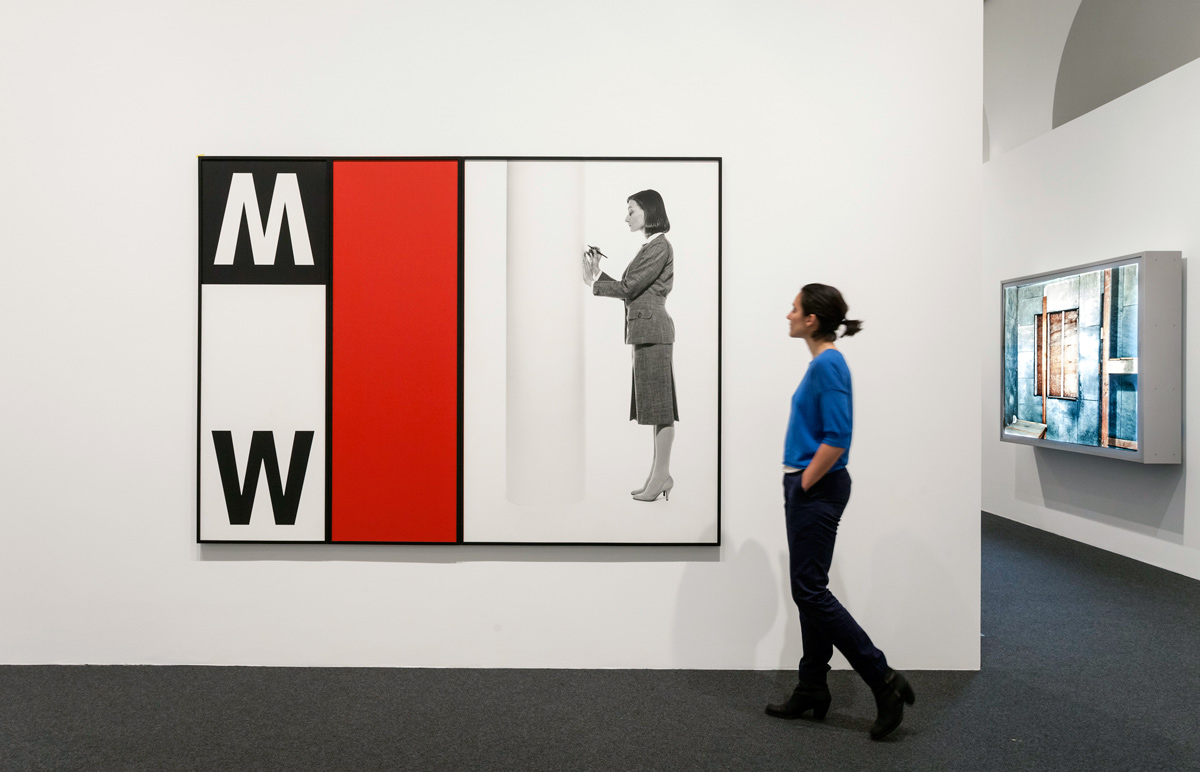
Installation view of the exhibition 'Painting in Photography. Strategies of Appropriation' at the Städel Museum, Frankfurt showing Victor Burgin's 'Office at Night (Red)' 1985


Installation view of the exhibition Painting in Photography. Strategies of Appropriation at the Städel Museum, Frankfurt showing Victor Burgin’s Office at Night (Red), 1985 (below)


“To understand the production of art at the end of tradition, which in our lifetime means art at the end of modernism, requires, as the postmodern debate has shown, a careful consideration of the idea of history and the notion of ending. Rather than just thinking ending as the arrival of the finality of a fixed chronological moment, it can also be thought as a slow and indecisive process of internal decomposition that leaves in place numerous deposits of us, in us and with us – all with a considerable and complex afterlife. In this context all figuration is prefigured. This is to say that the design element of the production of a work of art, the compositional, now exists prior to the management of form of, and on, the picture plane. Techniques of assemblage, like montage and collage – which not only juxtaposed different aesthetics but also different historical moments, were the precursors of what is now the general condition of production.”


“Art Byting the Dust” Tony Fry 1990 1


They said that photography would be the death of painting. It never happened. Recently they thought that digital photography would be the death of analogue photography. It hasn’t happened for there are people who care enough about analogue photography to keep it going, no matter what. As the quotation astutely observes, the digital age has changed the conditions of production updating the techniques of montage and collage for the 21st century. Now through assemblage the composition may be prefigured but that does not mean that there are not echoes, traces and deposits of other technologies, other processes that are not evidenced in contemporary photography.

As photography influenced painting when it first appeared and vice versa (photography went through a period known as Pictorialism where where it imitated Impressionist painting), this exhibition highlights the influence of painting on later photography. Whatever process it takes photography has always been about painting with light – through a pinhole, through a microscope, through a camera lens; using light directly onto photographic paper, using the light of the scanner or the computer screen. As Paul Virilio observes, no longer is there a horizon line but the horizon square of the computer screen, still a picture plane that evidences the history of art and life. Vestiges of time and technology are somehow always present not matter what medium an artist chooses. They always have a complex afterlife and afterimage.

Dr Marcus Bunyan

PS. I really don’t think it is a decomposition, more like a re/composition or reanimation.
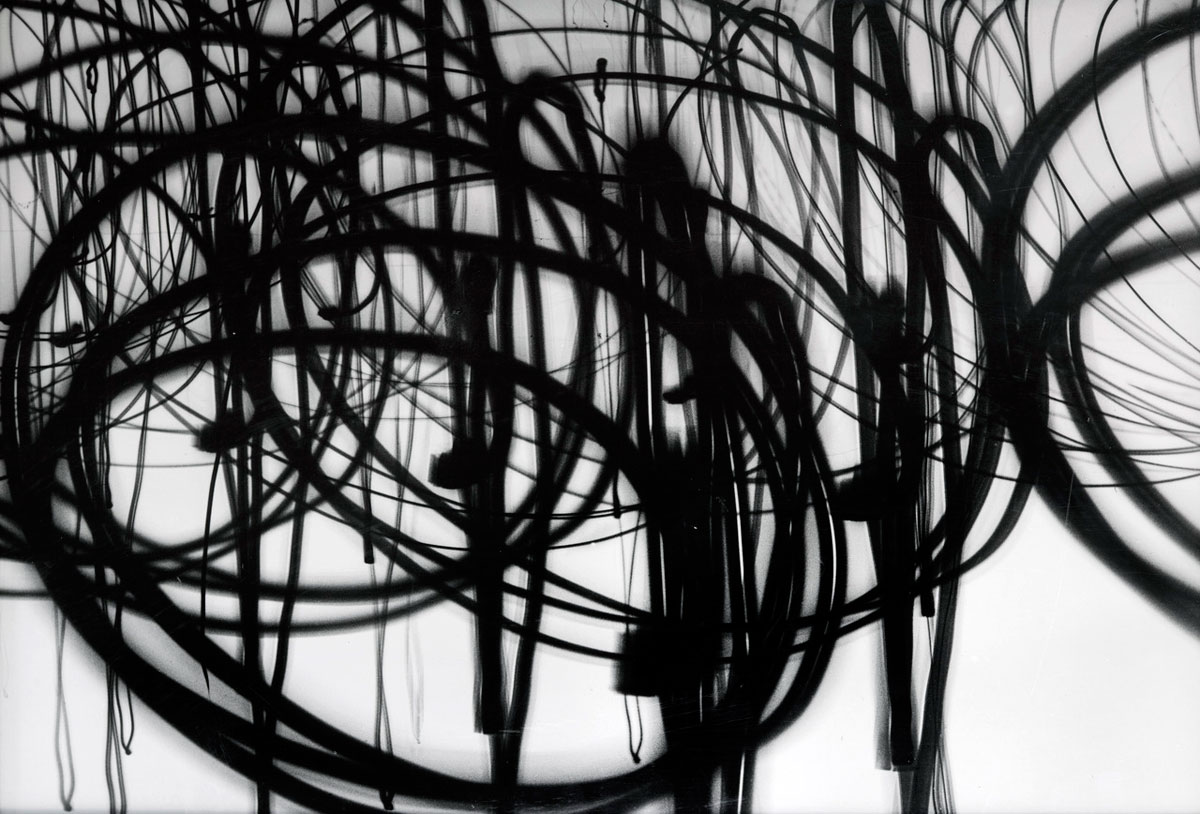
PPS. Notice how Otto Steinert’s Luminogramm (1952, below), is eerily similar to some of Pierre Soulages paintings.


1/ Fry, Tony. “Art Byting the Dust,” in Hayward, Phillip. Culture, Technology and Creativity in the Late Twentieth Century. London: John Libbey and Company, 1990, pp. 169-170

Many thankx to the Städel Musuem for allowing me to publish the photographs in the posting. Please click on the photographs for a larger version of the image.


Victor Burgin (British, b. 1941) 'Office at Night (Red)' 1985


Victor Burgin (British, b. 1941)
Office at Night (Red)
1985


In a conceptual, analytical visual language, Burgin, who originally started out as a painter, refers to Edward Hopper’s painting “Office at Night” from 1940. It shows a New York office at night, in which the boss and secretary are still at work and alone. Burgin’s picture is part of a series about this depiction of a couple by Hopper (and the special role of the female motif in his work). Burgin’s picture consists of three panels, each of which uses a fictional register: letters (word), color (red is traditionally the color for lust and love) and photographic image (secretary).

Anonymous. “Victor Burgin” in the pdf “WONDERFULLY FEMININE! Interrogations of the feminine,” on the Kunst Stiftung DZ Bank website 2009 [Online] Cited 11/09/2024. Translated from the German by Google Translate


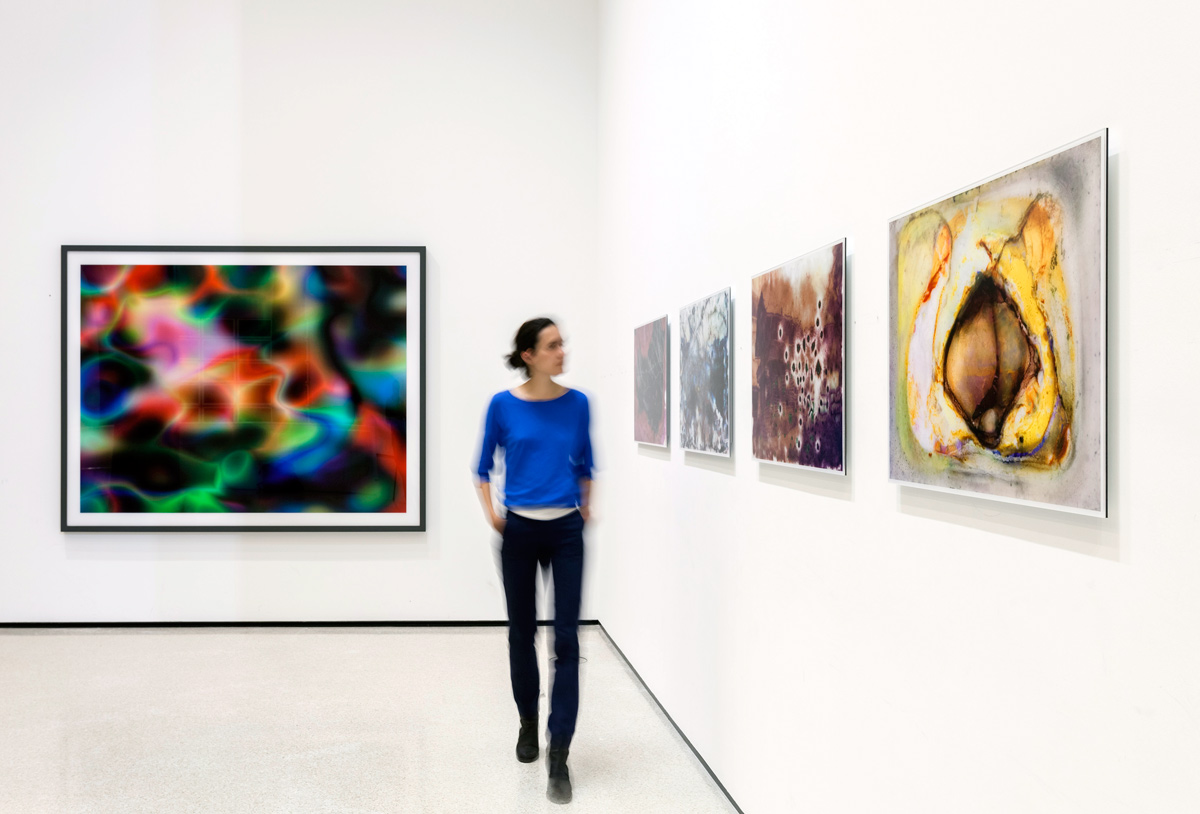
Installation view of the exhibition 'Painting in Photography. Strategies of Appropriation' at the Städel Museum, Frankfurt showing at left, Thomas Ruff's 'Substrat 10' (2002)


Installation view of the exhibition Painting in Photography. Strategies of Appropriation at the Städel Museum, Frankfurt showing at left, Thomas Ruff’s Substrat 10 (2002, below)


Thomas Ruff (German, b. 1958) 'Substrat 10' 2002


Thomas Ruff (German, b. 1958)
Substrat 10
2002
C-type print
186 x 238cm
DZ BANK Kunstsammlung
© VG Bild-Kunst, Bonn 2012


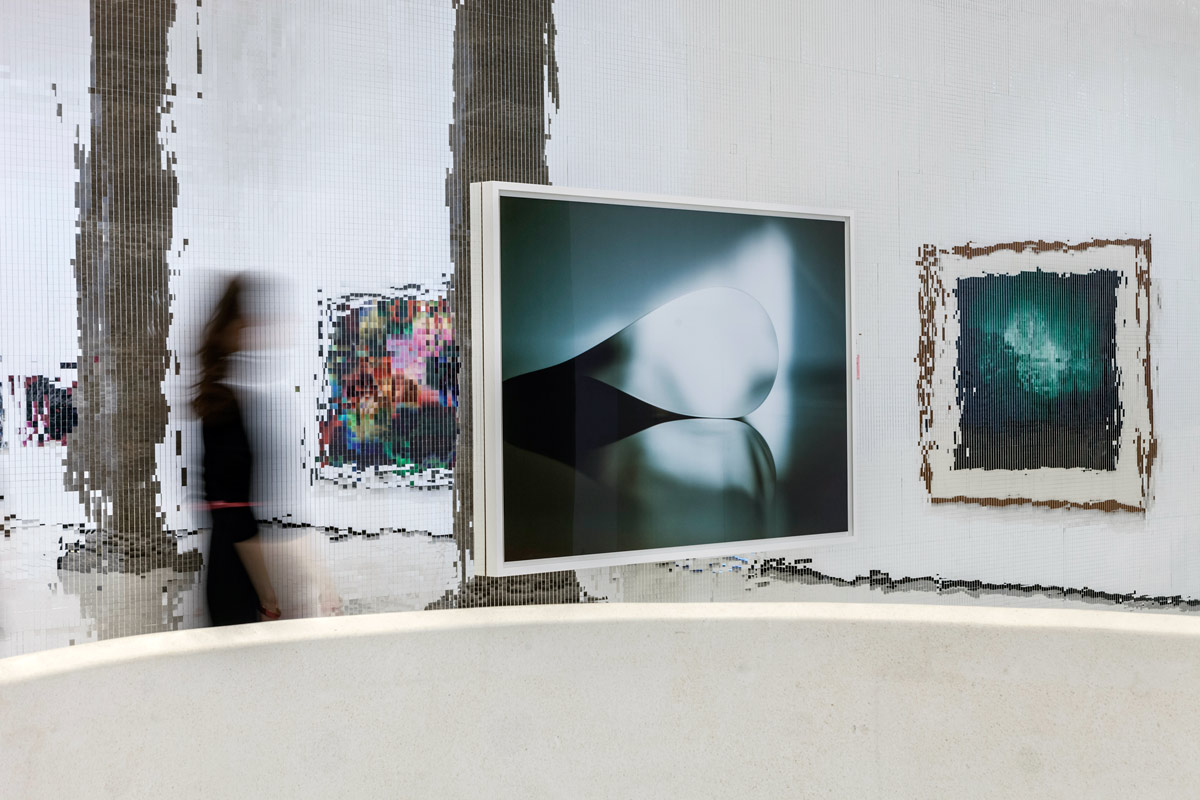
Installation view of the exhibition 'Painting in Photography. Strategies of Appropriation' at the Städel Museum, Frankfurt showing at centre, Wolfgang Tillmans 'Paper drop (window)' (2006)


Installation view of the exhibition Painting in Photography. Strategies of Appropriation at the Städel Museum, Frankfurt showing at centre, Wolfgang Tillmans Paper drop (window) (2006, below)


Wolfgang Tillmans (German, b. 1968) 'Paper drop (window)' 2006


Wolfgang Tillmans (German, b. 1968)
paper drop (window)
2006
C-type print in artists frame
145 x 200cm
Property of Städelscher Museums-Verein e.V.
© Courtesy Galerie Buchholz, Köln / Berlin
Städel Museum, Frankfurt am Main
Acquired in 2008 with funds from the Städelkomitee 21. Jahrhundert


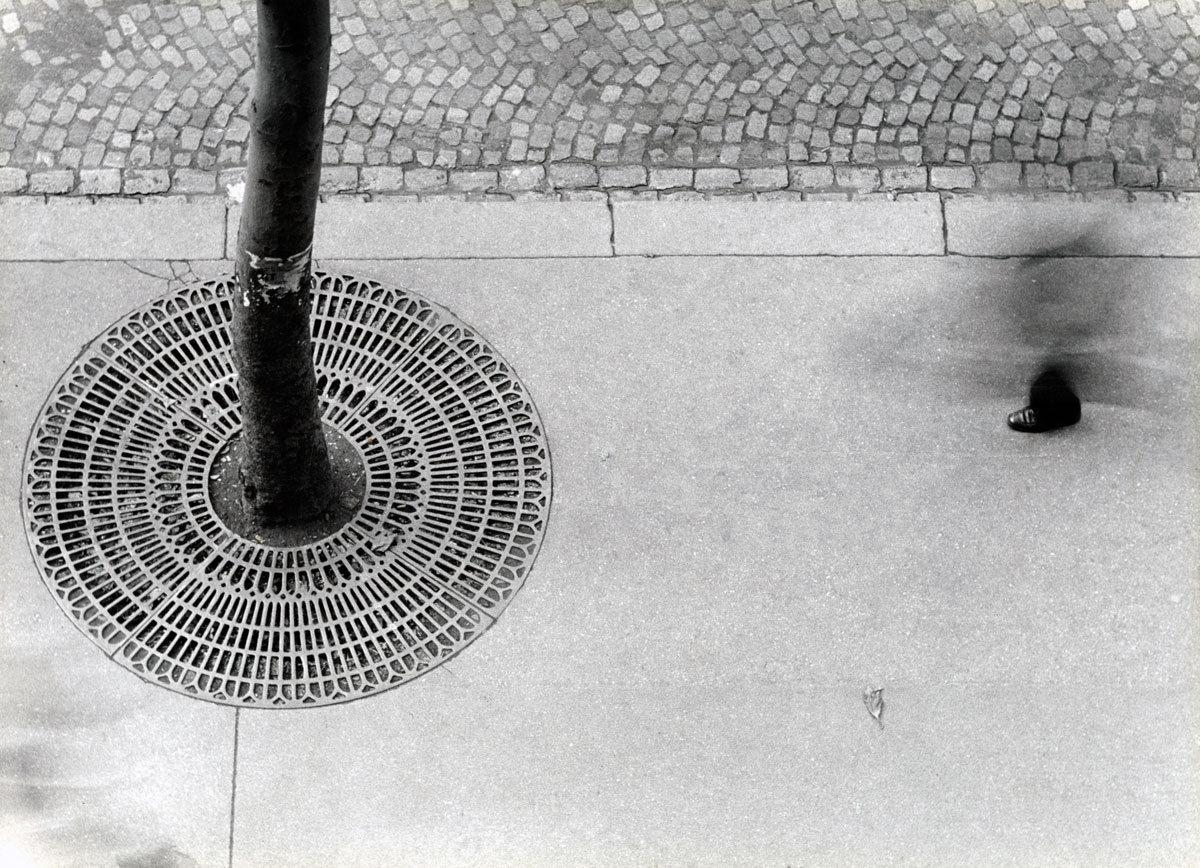
Otto Steinert (German, 1915-1978) 'Ein-Fuß-Gänger' 1950


Otto Steinert (German, 1915-1978)
Ein-Fuß-Gänger
1950
Gelatin silver print
28.5 x 39cm
Courtesy Galerie Kicken Berlin
© Nachlass Otto Steinert, Museum Folkwang, Essen


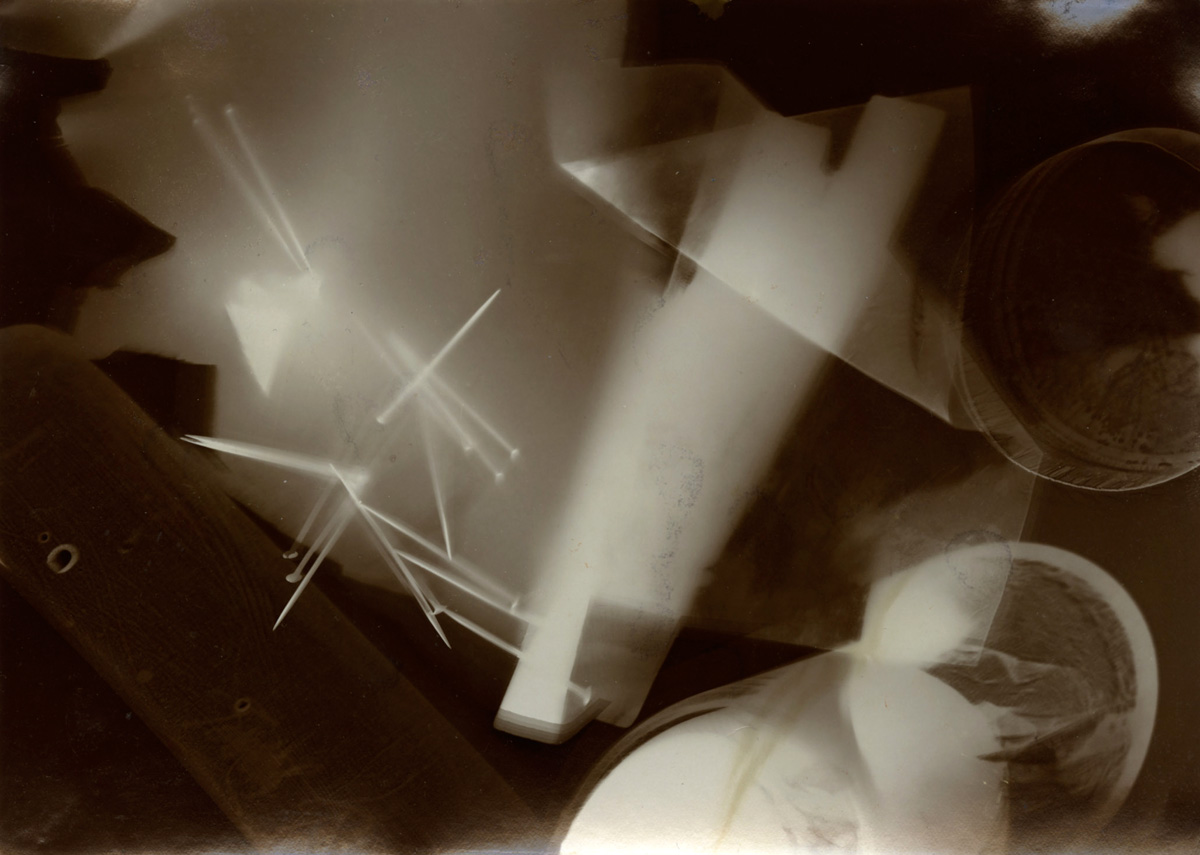
Laszlo Moholy-Nagy (Hungarian, 1895-1946) 'Photogram' c. 1923-1925


Laszlo Moholy-Nagy (Hungarian, 1895-1946)
Photogram
c. 1923-1925
Unique photogram, toned printing-out paper
12.6 x 17.6cm
Courtesy Galerie Kicken Berlin
© Hattula Moholy-Nagy / VG Bild-Kunst, Bonn


Robert Rauschenberg (American, 1925-2008) '10-80-C-17 (NYC)' 1980


Robert Rauschenberg (American, 1925-2008)
10-80-C-17 (NYC)
1980
From the series: In + Out of City Limits: New York / Boston
Gelatin silver print on fibre-based paper
58 x 73cm
DZ BANK Kunstsammlung at the Städel Museum
© Estate of Robert Rauschenberg / VG Bild-Kunst, Bonn 2012


Hiroshi Sugimoto (Japanese, b. 1948) 'Sam Eric, Pennsylvania' 1978


Hiroshi Sugimoto (Japanese, b. 1948)
Sam Eric, Pennsylvania
1978
Gelatin silver print
42.5 x 54.5cm
Private collection, Frankfurt
© Hiroshi Sugimoto / Courtesy The Pace Gallery


Otto Steinert (German, 1915-1978) 'Luminogramm' 1952


Otto Steinert (German, 1915-1978)
Luminogramm
1952, printed c. 1952
Gelatin silver print
41.5 x 60cm
Courtesy Galerie Kicken Berlin
© Nachlass Otto Steinert, Museum Folkwang, Essen


From 27 June to 23 September 2012, the Städel Museum will show the exhibition “Painting in Photography. Strategies of Appropriation.” The comprehensive presentation will highlight the influence of painting on the imagery produced by contemporary photographic art. Based on the museum’s own collection and including important loans from the DZ Bank Kunstsammlung as well as international private collections and galleries, the exhibition at the Städel will centre on about 60 examples, among them major works by László Moholy-Nagy, Hiroshi Sugimoto, Wolfgang Tillmans, Thomas Ruff, Jeff Wall, and Amelie von Wulffen. Whereas the influence of the medium of photography on the “classic genres of art” has already been the subject of analysis in numerous exhibitions and publications, less attention has been paid to the impact of painting on contemporary photography to date. The show at the Städel explores the reflection of painting in the photographic image by pursuing various artistic strategies of appropriation which have one thing in common: they reject the general expectation held about photography that it will document reality in an authentic way.

The key significance of photography within contemporary art and its incorporation into the collection of the Städel Museum offer an occasion to fathom the relationship between painting and photography in an exhibition. While painting dealt with the use of photography in the mass media in the 1960s, today’s photographic art shows itself seriously concerned with the conditions of painting. Again and again, photography reflects, thematises, or represents the traditional pictorial medium, maintaining an ambivalent relationship between appropriation and detachment.

Numerous works presented in the Städel’s exhibition return to the painterly abstractions of the prewar and postwar avant-gardes, translate them into the medium of photography, and thus avoid a reproduction of reality. Early examples for the adaption of techniques of painting in photography are László Moholy-Nagy’s (1895-1946) photograms dating from the 1920s. For his photographs shot without a camera, the Hungarian artist and Bauhaus teacher arranged objects on a sensitised paper; these objects left concrete marks as supposedly abstract forms under the influence of direct sunlight. In Otto Steinert’s (1915-1978) non-representational light drawings or “luminigrams,” the photographer’s movement inscribed itself directly into the sensitised film. The pictures correlate with the gestural painting of Jackson Pollock’s Abstract Expressionism. A product of random operations during the exposure and development of the photographic paper, Wolfgang Tillmans’ (b. 1968) work “Freischwimmer 54” (2004) is equally far from representing the external world. It is the pictures’ fictitious depth, transparency, and dynamics that lend Thomas Ruff’s photographic series “Substrat” its extraordinary painterly quality recalling colour field paintings or Informel works. For his series “Seascapes” the Japanese artist Hiroshi Sugimoto (b. 1948) seems to have “emptied” the motif through a long exposure time: the sublime pictures of the surface of the sea and the sky – which either blur or are set off against each other – seem to transcend time and space.

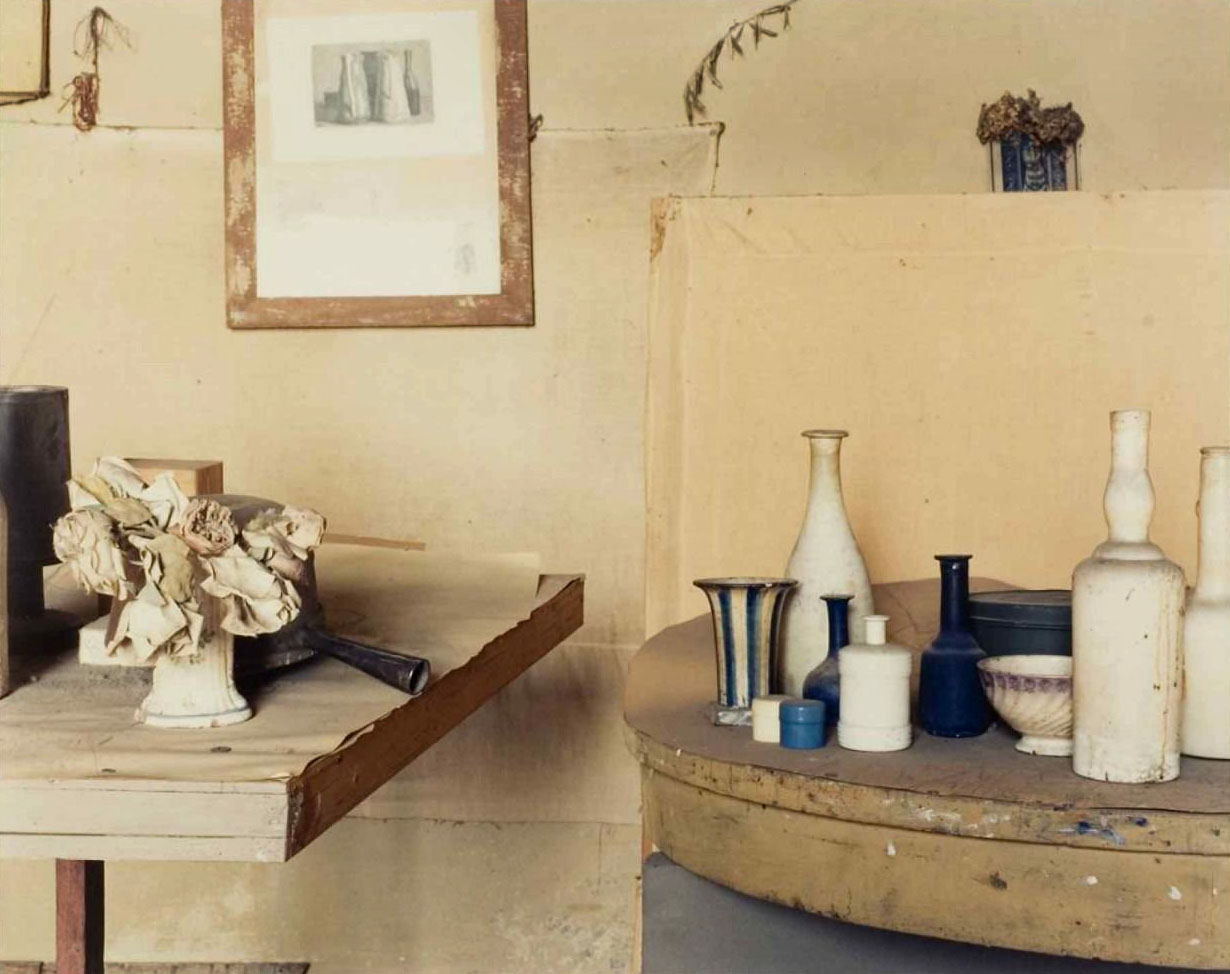
In addition to the photographs mentioned, the exhibition “Painting in Photography” includes works by artists who directly draw on the history of painting in their choice of motifs. The mise-en-scène piece “Picture for Women” (1979) by the Canadian photo artist Jeff Wall (b. 1946), which relates to Édouard Manet’s famous painting “Un Bar aux Folies-Bergère” from 1882, may be cited as an example for this approach. The camera positioned in the centre of the picture reveals the mirrored scene and turns into the eye of the beholder. The fictitious landscape pictures by Beate Gütschow (b. 1970), which consist of digitally assembled fragments, recall ideal Arcadian sceneries of the seventeenth and eighteenth centuries. The photographs taken by Italian Luigi Ghirri (1943-1992) in the studio of Giorgio Morandi (1890-1964) “copy” Morandi’s still lifes by representing the real objects in the painter’s studio instead of his paintings.

Another appropriative strategy sees the artist actually becoming active as a painter, transforming either the object he has photographed or its photographic representation. Oliver Boberg’s, Richard Hamilton’s, Georges Rousse’s and Amelie von Wulffen’s works rank in this category. For her series “Stadtcollagen” (1998-1999) Amelie von Wulffen (b. 1966) assembled drawing, photography, and painting to arrive at the montage of a new reality. The artist’s recollections merge with imaginary spaces offering the viewer’s fantasy an opportunity for his or her own associations.

The exhibition also encompasses positions of photography for which painting is the object represented in the picture. The most prominent examples in this section come from Sherrie Levine (b. 1947) and Louise Lawler (b. 1947), both representatives of US Appropriation Art. From the late 1970s on, Levine and Lawler have photographically appropriated originals from art history. Levine uses reproductions of paintings from a catalogue published in the 1920s: she photographs them and makes lithographs of her pictures. Lawler photographs works of art in private rooms, museums, and galleries and thus rather elucidates the works’ art world context than the works as such.

Press release from the Städel Museum website


Sherrie Levine (American, b. 1947) 'After Edgar Degas' 1987 (detail)


Sherrie Levine (American, b. 1947)
After Edgar Degas (detail)
1987
5 lithographs on hand-made paper
69 x 56cm
DZ BANK Kunstsammlung im Städel Museum, Frankfurt
© Sherrie Levine / Courtesy Jablonka Galerie, Köln


Beate Gütschow (German, b. 1970) 'PN #1' 2000


Beate Gütschow (German, b. 1970)
PN #1
2000
C-Print, mounted on aluminium dibond
Acquired in 2013, property of Städelscher Museums-Verein e.V.
Städel Museum, Frankfurt am Main, Eigentum des Städelschen Museums-Vereins e.V.


… these images do not evoke a sense of the sublime. On closer inspection, not only is the virginity of nature lost forever, but the innocence of perception is also denied. The natural realms presented here are simply too beautiful to be true. The beauty, wildness, and potentially threatening aspects of nature have been skillfully merged into a decorative whole, as they were in landscape painting from the 17th through to the 19th century. Beate Gütschow’s photographic works reproduce traditional patterns of depiction, incorporating landscape elements that recall compositions by Nicolas Poussin (1594-1665), Jacob van Ruisdael (1628-1682), Claude Lorrain (1600-1682), John Constable (1776-1837), and Philipp Otto Runge (1777-1810). The subjects portrayed by these landscape painters were based on an idealised worldview, the construction of which reflected the dominant philosophical ethos of their time. The artists themselves, however, presented this ideal in a manner bordering on the absolute. …

Beate Gütschow photographs landscapes with a medium-format analog camera, then converts the images into digital files. From this archived material she then constructs new landscapes in Photoshop, basing their spatial arrangements and compositional structures on the principles of landscape painting. As part of this subsequent editing process, she adjusts the light and colours in the images, applying lighting techniques from the realm of painting to her photographs. Because Gütschow uses only the retouching tool and other traditional darkroom techniques offered by Photoshop, not its painting tools, the photographic surface is preserved and the joins between the component parts are not immediately visible. These digital tools make it possible to employ a painterly method without the resulting picture being a painting. The viewer is given the impression that this is a completely normal photograph. When, however, an ideal landscape is presented in the form of a photograph, it appears more unnatural than the painted version of the same view. In this way, Gütschow’s work explores concepts of representation, colour, and light – the formal attributes of painting and photography – as well as the distinctions between documentation and staging.

Extract from Gebbers, Anna-Catharina. “Larger than Life,” in Beate Gütschow: ZISLS. Heidelberg, 2016, pp. 8-17. Translated by Jacqueline Todd [Online] Cited 23/08/2022


Luigi Ghirri (Italian, 1943-1992) 'L'atelier de Giorgio Morandi, Bologne' 1989


Luigi Ghirri (Italian, 1943-1992)
L’atelier de Giorgio Morandi, Bologne
1989


Luigi Ghirri (5 January 1943 – 14 February 1992) was an Italian artist and photographer who gained a far-reaching reputation as a pioneer and master of contemporary photography, with particular reference to its relationship between fiction and reality.


Amelie von Wulffen (German, b. 1966) 'Untitled (City Collages, VIII)' 1998


Amelie von Wulffen (German, b. 1966)
Untitled (City Collages, VIII)
1998
Oil paint, photographs on paper
42 x 59.7cm
Acquired in 2009 with funds from the Städelkomitee 21. Jahrhundert, property of Städelscher Museums-Verein e.V.
Städel Museum, Frankfurt am Main, Eigentum des Städelschen Museums-Vereins e.V.


The starting point for Amelie von Wulffen’s city collages is the urban architecture which she has photographed herself. These photographs are affixed to a surface and then processed pictorially: the artist alienates the perspective, adds abstract patterns and confronts the scene with quirky objects. The painted forms and unreal connections intervene in the relationship to reality of the supposedly objective photograph. The combination of photograph and painting is accompanied by a reflection on the characteristics of the medium concerned. The photographic reproduction of a situation which has been experienced may adequately record the place but not necessarily the memory. With this in mind, the artist sees painting as a suitable medium to equip photography with an authentic means of expression. During the chemical process of photography, real objects are registered on the light-sensitive material, just as the mood of the place and the memory of the artist are translated into the painting process. With regard to form, Wulffen reveals a wealth of references to Constructivism, Surrealism and Dadaism.

Text from the Städel Museum website


Art after 1945: Amelie von Wulffen

In our “Art after 1945” series, artists introduce their artworks in the Städel collection. In this episode Amelie von Wulffen explains her series “Stadtcollagen”.


Jeff Wall (Canadian, b. 1946) 'Picture for Women' 1979


Jeff Wall (Canadian, b. 1946)
Picture for Women
1979
Cibachrome transparency in lightbox
204.5 × 142.5cm (80.5 in × 56.1 in)


Picture for Women is a photographic work by Canadian artist Jeff Wall. Produced in 1979, Picture for Women is a key early work in Wall’s career and exemplifies a number of conceptual, material and visual concerns found in his art throughout the 1980s and 1990s. An influential photographic work, Picture for Women is a response to Édouard Manet’s Un bar aux Folies Bergère and is a key photograph in the shift from small-scale black and white photographs to large-scale colour that took place in the 1980s in art photography and museum exhibitions. …

Picture for Women is a 142.5 by 204.5 cm Cibachrome transparency mounted on a lightbox. Along with The Destroyed Room (1978), Wall considers Picture for Women to be his first success in challenging photographic tradition. According to Tate Modern, this success allows Wall to reference “both popular culture (the illuminated signs of cinema and advertising hoardings) and the sense of scale he admires in classical painting. As three-dimensional objects, the lightboxes take on a sculptural presence, impacting on the viewer’s physical sense of orientation in relationship to the work.”

Text from the Wikipedia website


Louise Lawler (American, b. 1947) 'It Could Be Elvis' 1994


Louise Lawler (American, b. 1947)
It Could Be Elvis
1994
Cibachrome, varnished with shellac
74.5 x 91cm
DZ BANK Kunstsammlung at the Städel Museum
© Courtesy of the artist and Metro Pictures, New York


Oliver Boberg (German, b. 1965) 'Unterführung' [Underpass] 1997


Oliver Boberg (German, b. 1965)
Unterführung [Underpass]
1997
C-type print
75 x 84cm
DZ BANK Kunstsammlung
© Oliver Boberg / Courtesy L.A. Galerie – Lothar Albrecht, Frankfurt


Richard Hamilton (English, 1922-2011) 'Eight-Self-Portraits' 1994 (detail)


Richard Hamilton (English, 1922-2011)
Eight-Self-Portraits (detail)
1994
Thermal dye sublimation prints
40 x 35cm
DZ BANK Kunstsammlung
© VG Bild-Kunst, Bonn 2012


Wolfgang Tillmans (German, b. 1968) 'Freischwimmer 54' 2004


Wolfgang Tillmans (German, b. 1968)
Freischwimmer 54
2004
C-type in artists frame
237 x 181 x 6cm
Städel Museum, Frankfurt am Main
© Courtesy Galerie Buchholz, Köln / Berlin
Acquired in 2008 with funds from the Städelkomitee 21. Jahrhundert
Property of Städelscher Museums-Verein e.V.


Städel Museum
Schaumainkai 63
60596 Frankfurt

Opening hours:
Tuesday – Sunday 10am – 6pm
Closed Mondays

Städel Museum website

LIKE ART BLART ON FACEBOOK

Back to top

Review: ‘Jacqui Stockdale: The Quiet Wild’ at Helen Gory Galerie, Melbourne

Exhibition dates: 18th April – 19th May 2012


Jacqui Stockdale. 'Rama-Jaara the Royal Shepherdess' 2012


Jacqui Stockdale (Australian, b. 1968)
Rama-Jaara the Royal Shepherdess
2012
Type C Print
100 x 78cm


After a slow start to the season there has be a veritable feast of excellent photography exhibitions in Melbourne over the last month or so, including John Gollings and Jane Brown at Edmund Pearce Gallery, the Fred Kruger and Light Works exhibitions (at NGVA and NGVI respectively), Littoral by Kristian Laemmle-Ruff at Colour Factory (the next local review after this one) and this exhibition, The Quiet Wild by Jacqui Stockdale at Helen Gory Galerie.

This is a very strong exhibition by Jacqui Stockdale, the metre tall colour prints (printed by the Colour Factory) displaying magnificently in the large gallery at Helen Gory. The photographs remind me of a perverse take on the ethnographic Cartes de visite that were produced during the colonial Victorian era in Australia, images of native peoples taken in studios with painted backdrops together with their cultural artefacts (which, coincidentally, can be seen in great detail and sadness in the Fred Kruger exhibition at NGVA). Drawing on personal places and stories, Mexican carnival and wrestlers masks, Indian masks, Aboriginal names and locations, Velasquez’s Las Meninas, the ghost of Frida Kahlo, rituals, gods (such as Rama) and deities, Australian scenery, performance (the process of painting the models and the outcome of this interaction), Stockdale creates a wonderful melange of archetypal characters that subvert traditional identities and narratives. Her creations “shape-shift” and frustrate attempts at categorization and assimilation.

Stockdale’s performative tactics and multiple modes of address, her polyvocal subject if you like, may be said to be an effect of textuality: “a conscious recognition and pursuit of an altogether different set of values and historical and cultural trajectories.”1 Undeniably this performative act (this “ritual spectacle”2) has links to the Bakhtin’s idea of the carnivalesque and the carnival paradigm, which accords to certain patterns of play. Stockdale inverts cultural stereotypes (which embody elements of fixity, repetition, and ambivalence) located within the realms of the fetish, the scopic, and the Imaginary in order to subvert the collective memory of viewers that have been inscribed with a stereotypical collective vernacular: her work transgresses the fantasy that plays a formative role in colonial exercises of power.3

Bakhtin likens the carnivalesque in literature to the type of activity that often takes place in the carnivals of popular culture. In the carnival… social hierarchies of everyday life – their solemnities and pieties and etiquettes, as well as all ready-made truths – are profaned and overturned by normally suppressed voices and energies. Thus, fools become wise, kings become beggars; opposites are mingled (fact and fantasy, heaven and hell).”4

In Stockdale’s world, a “world upside-down” (quite appropriate for Australia), “Each new identity is one of inversion; man becomes woman, child becomes adult, animals transform into humans and vice-versa. Another example of this inversion can be seen in the “branding” of her photographs. In colonial Cartes de visite the sitter is, more often than not, unknown – unless it is an important person. It is the photographer’s name which is printed on the front and back of the card. In these photographs the photographers name is an illegible signature at bottom left, while the title of the person in the photograph is stamped into the work at bottom right. Here Stockdale again inverts traditional textual readings, the titles of her “photographic portraits that embody a world of mystical characters in masquerade” indecipherable to the uninitiated: a coded language of identity and place – Lagunta ManEl Gato, Les Jumeaux, Dogboy of Gondwanan, Infanta Shamanta and Rama Jaara, The Royal Shepherdess. ‘Lagunta’ is Aboriginal for Tasmanian Tiger and ‘Leeawuleena’ for the land around Cradle Mountain. ‘El Gato’ is the cat, ‘Jaara’ being the Aboriginal name for the Long Gully region and ‘Gondwanan’ the name for the southernmost of two supercontinents (the other being Laurasia) before the world split apart into the structure that we known today.

These are incredibly humorous, magical and symbolic photographs. A thought came into my mind when I was in the gallery surrounded by the work: for me they represented a vision of the Major Arcana of the Tarot (for example Jaguar Hombre could be seen as an inverted version of the Hanged Man with his foot in a figure four, the Hanged Man symbolising the need to just be in the world, yielding his mind and body to the Universal flow). The Major Arcana deal with the human condition, each card representing the joys and sorrows every man and woman can experience in a lifetime. In a way Stockdale offers us her own set of subversive Major Arcana, images that transgress the boundaries of the colonial vernacular, offering the viewer a chance to explore the heart of the quiet wild.

Dr Marcus Bunyan


1/ Fisher, Jean. “Witness for the Prosecution: The Writings of Coco Fusco,” in Fusco, Coco. The Bodies That Were Not Ours. London: Routledge, 2001, pp. 227-228

2/ Bakhtin, Mikhail. Rabelais and His World (trans. Helene Iswolsky). Cambridge: MIT Press, 1968, p. 5

3/ “According to Bhabha, stereotypes are located within the realms of the fetish, the scopic, and the Imaginary. He suggests that fantasy plays a formative role in colonial exercises of power. Bhabha describes the mechanism of cultural stereotypes as embodying elements of fixity, repetition, fantasy, and ambivalence, and suggests that if certain types of images are constantly presented in a range of different contexts, they will become imprinted onto the collective memory of viewers and inscribed within a collective vernacular.”
Vercoe, Caroline. “Agency and Ambivalence: A Reading of Works by Coco Fusco,” in Fusco, Coco. The Bodies That Were Not Ours. London: Routledge, 2001, p. 240

4/ Anon. “Carnivalesque,” on Wikipedia. [Online] Cited 13/05/2012


Many thankx to Helen Gory Galerie for allowing me to publish the photographs in the posting. Please click on the photographs for a larger version of the image.


Jacqui Stockdale. 'Les Jumeaux' 2012


Jacqui Stockdale (Australian, b. 1968)
Les Jumeaux
2012
Type C Print
100 x 78cm


Jacqui Stockdale (Australian, b. 1968) 'Crudellia de Mon Botanica' 2012


Jacqui Stockdale (Australian, b. 1968)
Crudellia de Mon Botanica
2012
Type C Print
100 x 78cm


Jacqui Stockdale (Australian, b. 1968) 'Carnivale of the Night' 2012


Jacqui Stockdale (Australian, b. 1968)
Carnivale of the Night
2012
Type C Print
100 x 78cm


In this modern world of distractions there is a wild nature that stirs inside of us. A desire for transcendence, to become someone else, dance part naked and chant our lost songs so that they can be heard above the sounds of cities and mobile ring tones.

The Quiet Wild is a series of photographic portraits that embodies a world of mystical characters in masquerade set against hand-painted landscapes. The portraits playfully mimic the genre of exotic postcards and historical paintings where a fanciful subject is formally positioned within a make-believe landscape. The hand-painted settings in my photographs feature Australian scenery from places around Australia that have meaning to me including my mother’s property in Bendigo, the Melbourne Botanical Gardens and Lake Saint Claire in Tasmania.

I paint the models bodies and combine costumes and props including my own collection of rare masks originally used in dances of Mexican Carnival. This new work responds to established portrayals of human identity and masquerade informed by my research into different aspects of folk Carnivals where the masquerades are a fusion of clandestine voodoo, ancestral memory and personal revelation ritual and performance. Performance also plays a part in my photographic process where I interact with the models and allow the process to greatly determine the outcome. Each new identity is one of inversion; man becomes woman, child becomes adult, animals transform into humans and vice-versa.

The difference between painting the human subject and taking their portrait with a camera it is that during a photo shoot there is more of an element of performance. The subject, over a period of many hours often becomes a new character, extending a side of them that is not prevalent in daily life or invents a new identity. This is brought about by what I dress them in and how I direct them, provoking certain ideas, strengths about an animal power or super natural deity. I begin with an idea of character and a selection of costumes and them work intuitively as though in the dark or with eyes part open. I rarely end up with what I first imagined and revel in the surprise or discovery of a combined effort.

The inspiration for this series of work has come from a unique, rich and beautiful form of human expression that is found in the ritual side of folk art in the cultures around the world but mostly in Mexico. The traditional dances of Mexican Carnival provide an opportunity to revive the primeval gods from the depths of our communal memory, since dance constitutes our remotest language and most primitive sacred offering. The masks I have used in this series are from these types of ritual dance. They are recontextualised and worn in the works Lagunta Man and El Gato, Les Jumeaux, Dogboy of Gonwanan, Infanta Shamanta and Carnival of the Night. Other influences come from images of Exotic Postcards, regarding the formal presentation of the models, the constructed settings and the borders and way of labelling the image. Luchadora Botanica was influenced by a Goya Painting, Negro Returno – I wanted to bring one of my recent collages to life, See ‘to return’.

What I have done is imagined my own family as part ritualistic characters, setting in them in a landscape that I have visited.”

Artist statement by Jacqui Stockdale 2012


Jacqui Stockdale. 'Jaguar Hombre' 2012


Jacqui Stockdale (Australian, b. 1968)
Jaguar Hombre
2012
Type C Print
100 x 78cm


Jacqui Stockdale. 'Lagunta Man, Leeawuleena' 2012


Jacqui Stockdale (Australian, b. 1968)
Lagunta Man, Leeawuleena
2012
Type C Print
100 x 78cm


Jacqui Stockdale (Australian, b. 1968) 'El Gato, Leeawuleena' 2012


Jacqui Stockdale (Australian, b. 1968)
El Gato, Leeawuleena
2012
Type C Print
100 x 78cm


Jacqui Stockdale (Australian, b. 1968) 'Araneus' 2012


Jacqui Stockdale (Australian, b. 1968)
Araneus
2012
Type C Print
100 x 78cm


Jacqui Stockdale (Australian, b. 1968) 'Princess Eucalypt' 2012


Jacqui Stockdale (Australian, b. 1968)
Princess Eucalypt
2012
Type C Print
100 x 78cm


Jacqui Stockdale (Australian, b. 1968) 'Infanta Shamanta' 2012


Jacqui Stockdale (Australian, b. 1968)
Infanta Shamanta
2012
Type C Print
100 x 78cm


The ghost of Frida Kahlo is a haunting one that permeates many artists consciousness bringing with it not just a tragic story but intoxicating aromas of Mexican exotic, masks, Voo-Doo, bloody Mayan rituals and Catholicism gone troppo.

This is clearly evidenced in Jacqui Stockdale’s latest exhibition at Helen Gory Galerie in works such as Negro-Returno, Long Gully. The white lacy heart-shaped overlay of ghostly trees conceals a part-portrait of Frida here depicted in front of Long Gully Bendigo, the Stockdale property, after the Black Saturday bush fire three years ago. This haunting shadowy backdrop appears again in Rama Jaara, The Royal Shepherdess, ‘Jaara’ being the Aboriginal name for the Long Gully region. It is a personal aside of something that obviously touched this artist deeply, one to which she has bought her troupe of tableau vivant players to. Here, a Mauritian girl called Mimi, standing at attention, arms akimbo, dressed in remnants of regal colonial attire. The pose reminiscent of that of the Infanta Margarita in Velasquez’s Las Meninas. The dog has moved from bottom right to bottom left, here a small spotted Chinese Joss paper effigy made for the journey to the afterlife, rather than a great bounding Spanish mastiff. Our young self-possessed Mimi stares directly out of the picture space not as an Infanta, but as one of nature’s children, a shepherdess, her hairstyle resembling a ram’s head, informing that part of the title, ‘Rama’ a play on words.

Both the artists brothers are also players in this tableau: the younger as Lagunta Man, Leeawuleena and the artist’s twin as El Gato, van Diemonia. ‘Lagunta’ is Aboriginal for Tasmanian Tiger and ‘Leeawuleena’ for the land around Cradle Mountain. ‘El Gato’ is the cat, and both carrying a filmic reference to the recent movie The Hunter, filmed around Cradle Mt in Northern Tasmania. While the compositional phrasing has more than a nostalgic whiff of 19th century still studio photography, seen here such staged manners marry well to popular cinematic culture.

As this exhibition unfolds certain characterising concerns appear and reappear. Decapitation, and cross-cultural iconography make this a lavish art dining at the high table of pictorial fusion cuisine. Mexican masks, Joss paper, skulls, rites of passage tit-bits mix it with popular culture on the shag pile to produce a totally new hybrid. Folk memories merge with diaristic experiences, found objects flirt with finely painted trompe-oeil effects in an almost self-regulating metamorphosis.

In this Stockdale becomes a sort of gatekeeper, a ring master choreographer who will both mystify and amaze you with her family carnivale. Picture by picture, costume by costume, the staged imagined and the real, combine into a most fascinating enticement I find impossible to resist.

Catalogue essay by Jeff Makin, 2012


Jacqui Stockdale (Australian, b. 1968) 'Bala Opuntia' 2012


Jacqui Stockdale (Australian, b. 1968)
Bala Opuntia
2012
Type C Print
100 x 78cm


Jacqui Stockdale. 'Dogboy of Gondwanan' 2012


Jacqui Stockdale (Australian, b. 1968)
Dogboy of Gondwanan
2012
Type C Print
100 x 78cm


Jacqui Stockdale. 'Negro Returno, Long Gully' 2012


Jacqui Stockdale (Australian, b. 1968)
Negro Returno, Long Gully
2012
Type C Print
100 x 78cm


Jacqui Stockdale. 'Luchadora Botanica' 2012


Jacqui Stockdale (Australian, b. 1968)
Luchadora Botanica
2012
Type C Print
100 x 78cm


Helen Gory Galerie

This gallery has now closed.

LIKE ART BLART ON FACEBOOK

Back to top

Exhibition: ‘Twombly and Poussin: Arcadian Painters’ at the Dulwich Picture Gallery, London

Exhibition dates: 29th June – 25th September 2011

Curator: Dr Nicholas Cullinan, Curator of International Modern Art at Tate Modern.


Many thankx to the Dulwich Picture Gallery for allowing me to publish the images in the posting. Please click on them for a larger version of the image.


Robert Rauschenberg (American, 1925-2008) 'Cy and Relics' 1952


Robert Rauschenberg (American, 1925-2008)
Cy and Relics
1952
Photograph
© The Rauschenberg Foundation


Nicolas Poussin (French, 1594-1665) 'The Triumph of Pan' c. 1636


Nicolas Poussin (French, 1594-1665)
The Triumph of Pan
c. 1636
Pen and ink with wash over stylus and black chalk
581 x 410 x 29 mm
Lent by Her Majesty the Queen. The Royal Collection
© 2011 Her Majesty Queen Elizabeth II


Cy Twombly (American, 1928-2011) 'Bacchanalia-Fall (5 Days in November) Blatt 4, InvNr. UAB 457' 1977


Cy Twombly (American, 1928-2011)
Bacchanalia-Fall (5 Days in November) Blatt 4, InvNr. UAB 457
1977
Collage, oil, chalk, gouache, on fabriano paper, graph paper
101.2 x 150.5cm
Bayerische Staatsgemäldesammlungen – Museum Brandhorst, München
Leihgeber: Udo Brandhorst
© Cy Twombly


Cy Twombly (American, 1928-2011) 'Pan' 1975


Cy Twombly (American, 1928-2011)
Pan
1975
148 x 100cm
Private Collection
© Cy Twombly, Courtesy: Cy Twombly Archive


Nicolas Poussin (French, 1594-1665) 'The Triumph of David' 1628-1631


Nicolas Poussin (French, 1594-1665)
The Triumph of David
1628-1631
Oil on canvas
Height: 1,184 mm (46.61 in)
Width: 1,483 mm (58.38 in)
Dulwich Picture Gallery
© By permission of the Trustees of Dulwich Picture Gallery


Cy Twombly (American, 1928-2011) 'Hero and Leandro' 1985


Cy Twombly (American, 1928-2011)
Hero and Leandro
1985
202 x 254cm
Private Collection, Courtesy Thomas Ammann Fine Art AG, Zurich
© Cy Twombly


“I would’ve liked to have been Poussin, if I’d had a choice, in another time.”


Cy Twombly


Dulwich Picture Gallery is proud to announce a revelatory exhibition of the work of Cy Twombly and Nicolas Poussin. Organised to celebrate the Bicentenary of the Gallery, this major show will explore, for the first time, the unexpected yet numerous parallels and affinities between the two artists. The exhibition will draw upon the world-class permanent collection of works at Dulwich Picture Gallery by Nicolas Poussin, alongside other works from major collections around the world by both Poussin and Twombly.

In 1624 and 1957, the two artists, aged around thirty, moved to Rome. Nicolas Poussin and Cy Twombly subsequently spent the majority of their lives in the Eternal City, and went on to become the pre-eminent painters of their day. Rather than recent exhibitions that have sought to compare and contrast old masters with contemporary artists through superficial visual appearances, this groundbreaking show will instead juxtapose works which may seem radically disparate in terms of style, yet ones that share deep and timeless interests. Both Poussin and Twombly were artists of prodigious talent who found in the classical heritage of Rome a life-long subject. Both spent their lives studying, revivifying and making newly relevant for their own eras antiquity, ancient history, classical mythology, Renaissance painting, poetry and the imaginary, idealised realm of Arcadia.

Curated by Dr. Nicholas Cullinan, Curator of International Modern Art at Tate Modern, the exhibition examines how Twombly and Poussin, although separated by three centuries, nonetheless engaged with the same sources and will explore the overlapping subjects that the two artists have shared. It will consist of around thirty carefully-chosen paintings, drawings and sculptures, structured thematically around six sections devoted to key shared themes, from both artists’ early fascinations with Arcadia and the pastoral when they first moved to Rome, Venus and Eros, Anxiety and Theatricality, Apollo, Parnassus and Poetry, Pan and the Bacchanalia, through to the theme of The Four Seasons.

The exhibition will be accompanied by the British premiere of Tacita Dean’s new 16mm film portrait of Cy Twombly, Edwin Parker (2011). The film documents Twombly in his studio in Lexington, Virginia, and follows on from Dean’s series of filmed depictions of subjects such as the choreographer Merce Cunningham, the poet Michael Hamburger and the artist Mario Merz, where the inner life of the sitter is implied through their physical demeanour and surroundings. A series of talks will also accompany the exhibition, including Sir Nicholas Serota, Director of Tate, in conversation with Dr. Nicholas Cullinan on the topic of curating Twombly, and Malcolm Bull (Ruskin School of Drawing, University of Oxford) and T. J. Clark (Professor Emeritus of Modern Art at the University of California, Berkeley; and Visiting Professor, University of York) who will discuss the work of Poussin and Twombly and the themes raised by the exhibition.

Ian Dejardin, Director of Dulwich Picture Gallery explains that the exhibition “fits in with a philosophy I have pursued here – that exhibitions can conduct a dialogue with the permanent collection. In the past Howard Hodgkin, Lucian Freud and Paula Rego have all hung their paintings within the collection, so Poussin and Twombly seemed like a natural extension of those experiments.”

The exhibition has received enthusiastic support and loans from major private and public collections around the world, including The National Gallery and Tate in London; The Royal Collection; The Duke of Devonshire; The Fitzwilliam Museum, Cambridge; Museo del Prado, Madrid; The Brandhorst Museum, Munich and The Art Institute of Chicago. The exhibition has been developed in close collaboration with Cy Twombly himself, and will include works that have never been exhibited before.

Press release from the Dulwich Picture Gallery


Nicolas Poussin (French, 1594-1665) 'Rinaldo and Armida' c. 1630


Nicolas Poussin (French, 1594-1665)
Rinaldo and Armida
c. 1630
Oil on canvas
Height: 822 mm (32.36 in)
Width: 1,092 mm (42.99 in)
Dulwich Picture Gallery
© By permission of the Trustees of Dulwich Picture Gallery


Nicolas Poussin (French, 1594-1665) 'The Nurture of Jupiter' mid 1630s


Nicolas Poussin (French, 1594-1665)
The Nurture of Jupiter
mid 1630s
Oil on canvas
Height: 965 mm (37.99 in)
Width: 1,210 mm (47.63 in)
Dulwich Picture Gallery
© By permission of the Trustees of Dulwich Picture Gallery


Cy Twombly (American, 1928-2011) 'Quattro Stagioni: Primavera' 1993-5


Cy Twombly (American, 1928-2011)
Quattro Stagioni: Primavera
1993-1995
Acrylic, oil, crayon and pencil on canvas
3230 x 1996 x 67 mm
Tate: Purchased with assistance from the American Fund for the Tate Gallery and Tate Members 2002
© Tate, London, 2010, © Cy Twombly


Cy Twombly (American, 1928-2011) 'Quattro Stagioni: Estate' 1993-5


Cy Twombly (American, 1928-2011)
Quattro Stagioni: Estate
1993-1995
Acrylic and pencil on canvas
3241 x 2250 x 67 mm
Tate: Purchased with assistance from the American Fund for the Tate Gallery and Tate Members 2002
© Tate, London, 2010, © Cy Twombly


Nicolas Poussin (French, 1594-1665) 'Venus and Mercury' c. 1627/1629


Nicolas Poussin (French, 1594-1665)
Venus and Mercury
c. 1627/1629
© By permission of the Trustees of Dulwich Picture Gallery


Cy Twombly (American, 1928-2011) 'Quattro Stagioni: Autunno' 1993-5


Cy Twombly (American, 1928-2011)
Quattro Stagioni: Autunno
1993-1995
Acrylic, oil, crayon and pencil on canvas
3230 x 2254 x 67 mm
Tate: Purchased with assistance from the American Fund for the Tate Gallery and Tate Members 2002
© Tate, London, 2010, © Cy Twombly


Cy Twombly (American, 1928-2011) 'Quattro Stagioni: Inverno' 1993-5


Cy Twombly (American, 1928-2011)
Quattro Stagioni: Inverno
1993-1995
Acrylic, oil and pencil on canvas
3229 x 2300 x 67mm
Tate: Purchased with assistance from the American Fund for the Tate Gallery and Tate Members 2002
© Tate, London, 2010, © Cy Twombly


Dulwich Picture Gallery
Gallery Road, London, SE21 7AD

Opening hours:
Tuesday – Sunday, 10am – 5pm
Closed Mondays except Bank Holidays

Dulwich Picture Gallery website

LIKE ART BLART ON FACEBOOK

Back to top

Exhibition: ‘Kurt Kranz: Programming of Beauty’ at the Bauhaus Dessau, Berlin

Exhibition marking the 100th birthday of Kurt Kranz
19th November 2010 – 29th May 2011


Kurt Kranz (German, 1910-1997) 'Perspective' 1931


Kurt Kranz (German, 1910-1997)
Perspective
1931
Ingrid Kranz / Stiftung Bauhaus Dessau
Foto: Lars Lohrisch / Abdruck mit Genehmigung der Kunsthalle


One of the great pleasures of publishing this archive is that I get to research the life of an artist whose work I never knew before. Kurt Kranz is one such artist.

Dr Marcus Bunyan


Many thankx to the the Bauhaus Dessau for allowing me to publish the photographs in the posting. Please click on the photograph for a larger version of the image.


Kurt Kranz (German, 1910-1997) 'Vereinsamung' Dessau 1930


Kurt Kranz (German, 1910-1997)
Vereinsamung (Isolation)
Dessau
1930
Ingrid Kranz / Stiftung Bauhaus Dessau
Leihgeber: Kunsthalle Bremen


Installation photograph of 'Programming of Beauty' by Kurt Kranz at the Bauhaus Dessau


Installation photograph of Programming of Beauty by Kurt Kranz at the Bauhaus Dessau


Kurt Kranz (German, 1910-1997) 'Versinkende' (Sinking one) 1931


Kurt Kranz (German, 1910-1997)
Versinkende (Sinking one)
1931
Ingrid Kranz / Stiftung Bauhaus Dessau


Kurt Kranz (German, 1910-1997) 'Persischer Garten' (Persian garden) 1970


Kurt Kranz (German, 1910-1997)
Persischer Garten (Persian garden)
1970
Ingrid Kranz / Stiftung Bauhaus Dessau
Foto: Uwe Jacobshagen


The Bauhaus Dessau dedicates a comprehensive exhibition to the painter, graphic designer and photographer Kurt Kranz to mark his 100th birthday. In 1930, the then twenty-year-old lithographer came from Bielefeld to study at the Bauhaus Dessau, where he soon established himself as a pioneer of serial and generative methods. With his avant-garde work, Kranz’s methods anticipated those of later generations.

Inspired by a lecture by László Moholy-Nagy, Kurt Kranz came to the Bauhaus Dessau in April 1930. In Walter Peterhans’s photography class, Kranz began to experiment with photographic techniques and created some of the most striking abstract picture series to emerge from the Bauhaus. Alienated and abstracted faces and hands appear repeatedly in his dynamic picture series. These show Kranz’s early affinity for film as, page for page, the abstract forms interact with one another. Kranz drafted his first concepts for abstract films at the Bauhaus, although he was first able to realise these decades later in 1972.

The exhibition to mark the artist’s 100th birthday shows works from Kranz’s Bauhaus years and his later work as an advertising graphic designer, and focuses on a selection of his large picture cycles. Strikingly diverse leporellos dating from the 1960s onwards take centre stage, as do the so-called “Matrix-und Schiebebilder”

Text from the Bauhaus Dessau website


Kurt Kranz (German, 1910-1997) 'Selbstporträt en face (objektives Foto)' (Self-portrait with face (objective photo)) 1931


Kurt Kranz (German, 1910-1997)
Selbstporträt en face (objektives Foto) (Self-portrait with face (objective photo))
1931
Ingrid Kranz / Stiftung Bauhaus Dessau


Kurt Kranz (German, 1910-1997) 'Rasterfoto' (Raster photograph) 1932


Kurt Kranz (German, 1910-1997)
Rasterfoto (Raster photograph)
1932
Ingrid Kranz / Stiftung Bauhaus Dessau


Kurt Kranz (German, 1910-1997) 'Schwarz : Weiß' (Black: White) 1928-29


Kurt Kranz (German, 1910-1997)
Schwarz: Weiß (Black: White)
1928-1929
Ingrid Kranz / Stiftung Bauhaus Dessau
Privatbesitz


Kurt Kranz (German, 1910-1997) 'Schwarz : Weiß' (Black: White) 1928-29


Kurt Kranz (German, 1910-1997)
Schwarz: Weiß (Black: White)
1928-1929
Ingrid Kranz / Stiftung Bauhaus Dessau
Privatbesitz


Kurt Kranz (German, 1910-1997) 'Schwarz : Weiß' (Black: White) 1928-29


Kurt Kranz (German, 1910-1997)
Schwarz: Weiß (Black: White)
1928-1929
Ingrid Kranz / Stiftung Bauhaus Dessau
Privatbesitz


Kurt Kranz (German, 1910-1997) 'Schrift Entwurf aus Satzmaterial' (Writing draft from sentence material) Dessau 1931


Kurt Kranz (German, 1910-1997)
Schrift Entwurf aus Satzmaterial (Writing draft from sentence material)
Dessau
1931
Ingrid Kranz / Stiftung Bauhaus Dessau


Kurt Kranz (German, 1910-1997) Aus der Serie "Sieben Schritte zum symmetrischen Oval"' (From the series "Seven steps to the symmetrical Oval") 1982
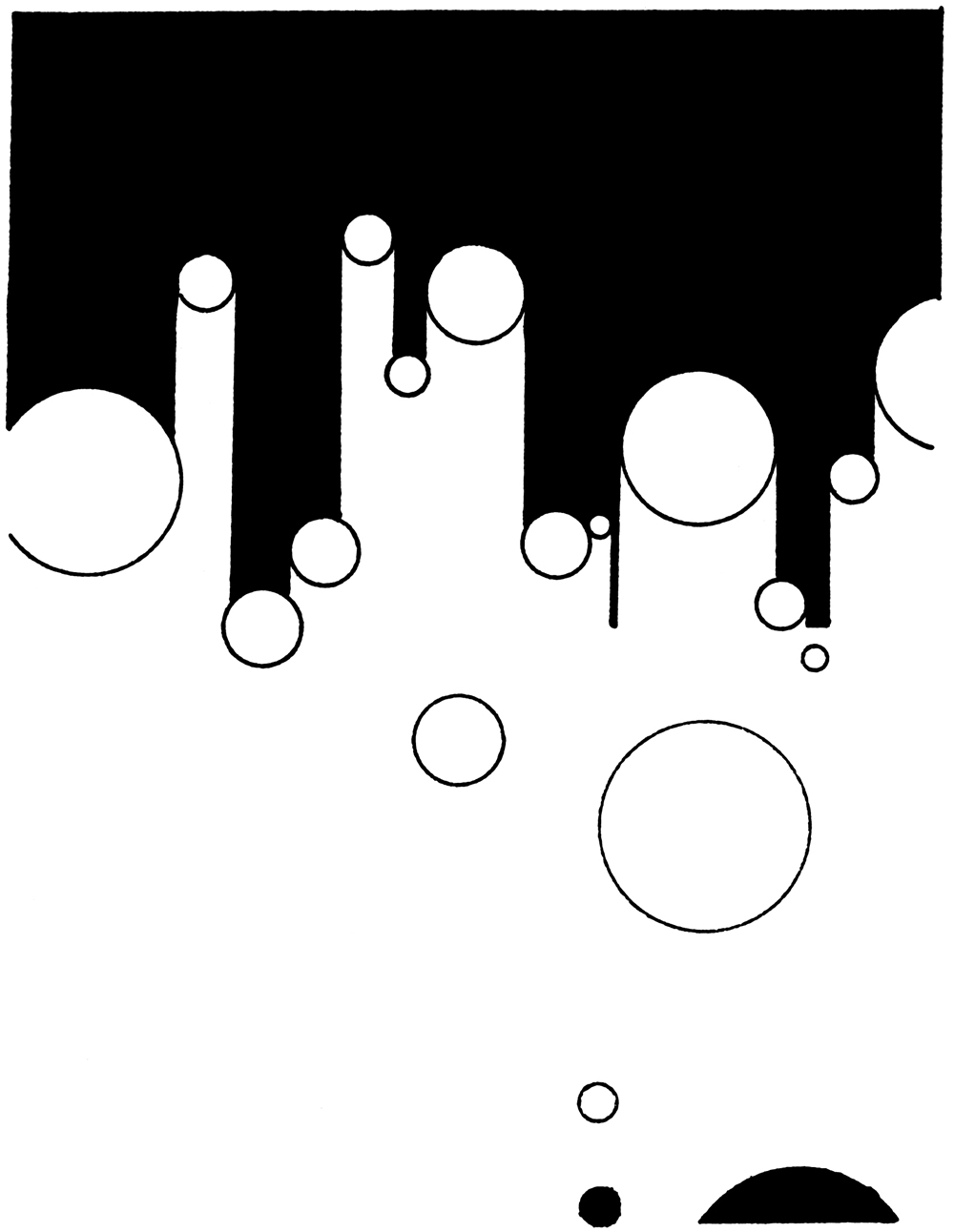
 

Kurt Kranz (German, 1910-1997)
Aus der Serie “Sieben Schritte zum symmetrischen Oval” (From the series “Seven steps to the symmetrical Oval”)
1982
Ingrid Kranz / Stiftung Bauhaus Dessau
Foto: Uwe Jacobshagen


Kurt Kranz (German, 1910-1997) 'Augenreihe' (Eye rows) 1931


Kurt Kranz (German, 1910-1997)
Augenreihe (Eye rows)
1931 (montiert 1981) (1931 (1981 install))
Ingrid Kranz / Stiftung Bauhaus Dessau
Leihgeber: Kunsthalle Bremen


Kurt Kranz (German, 1910-1997) 'Mund-Reihen' (Mouth rows) 1931


Kurt Kranz (German, 1910-1997)
Mund-Reihen (Mouth rows)
1931
Ingrid Kranz / Stiftung Bauhaus Dessau
Leihgeber: Kunsthalle Bremen
Foto: Ingrid Kranz, Wedel


Bauhaus Dessau
Gropiusalle 38, Dessau, Germany

Opening hours:
Tue – Sun 10am – 6pm

Bauhaus Dessau website

LIKE ART BLART ON FACEBOOK

Back to top

Alan Constable and the highlights of the Melbourne Art Fair 2010

August 2010


Alan Constable (Australian, b. 1956)
'Untitled (Hasselblad)' 2008


Alan Constable (Australian, b. 1956)
Untitled (Hasselblad)
2008
Clay, glaze


I finally succumbed and bought myself a wonderful Alan Constable ceramic camera from the Arts Project Australia stand at the Melbourne Art Fair on Saturday (see photographs below – click on the photographs for a larger version of the image). I first saw Alan’s ceramic work at his solo exhibition called Clay Cameras at Helen Gorie Galerie in August 2009 (see photographs from the exhibition) and was instantly attracted to the tactility and beauty of the work. Months later I saw more of his cameras at Sophie Gannon Gallery in Richmond and now at the Art Fair. Third time lucky, I found a stunning medium format Hasselblad in a beautiful two tone glaze that really spoke to me in terms of it’s form and aesthetic appeal. Constable’s work has really impinged on my consciousness and the piece has a special resonance for me.

“Constable’s ceramic works reflect a life-long fascination with old cameras, which began with his making replicas from cardboard cereal boxes at the age of eight. The sculptures are lyrical interpretations of technical instruments, and the artist’s finger marks can be seen clearly on the clay surface like traces of humanity. In this way, Alan Constable cameras can be viewed as extensions of the body, as much as sculptural representations of an object.” (Arts Project Australia text)


Highlights of the Art Fair were the outstanding paintings of Juan Ford at Dianne Tanzer Gallery, the mesmeric video work of Daniel Crooks at Anna Schwartz Gallery (who I think is one of the best artists in the country – see more images of his work from his Intersection exhibition), the delicately layered and outrageously beautiful collage work of Peter Madden at Ryan Renshaw Gallery, the layered transcapes of Janet Lawrence at Arc One Gallery and the cosmological paintings of Lara Merrett at Karen Woodbury Gallery. Brickbats for the most overblown presentation must go to Danie Mellor at Michael Reid for a truly over the top performance that just left one speechless.

It was a real pleasure to meet so many gallery directors and managers face to face including Gina Lee at Niagara Galleries, James Makin at James Makin Gallery, Matt Glen at Martin Browne Fine Art, Sydney, Paul Greenway from Gagprojects, Berlin and Ken Fehily from Fehily Contemporary, Melbourne.

Finally, I visited the Notfair 2010 exhibition in Richmond, a disappointing group exhibition of 30 artists selected from over 300 artists suggested by curators from around the country. As with many group exhibitions that lack thematic development the work was all over the place, in every media imaginable. The absolute standout work were the two antique stereoscopic cabinet and LED light animations of Chris Henschke from the duo Topologies. While the idea for the exhibition is to be applauded (that of presenting an exhibition of unknown or little known artists that may or may not be represented by a gallery) perhaps the next exhibition should have fewer artists to give the work chance to speak for the artist instead of just being a token gesture.

Dr Marcus Bunyan


Alan Constable (Australian, b. 1956)
'Untitled (Hasselblad)' 2008

Alan Constable (Australian, b. 1956)
'Untitled (Hasselblad)' 2008


Alan Constable (Australian, b. 1956)
Untitled (Hasselblad)
2008
Clay, glaze


LIKE ART BLART ON FACEBOOK

Back to top

Exhibition: ‘Playing with Pictures: The Art of Victorian Photocollage’ at The Metropolitan Museum of Art, New York

Exhibition dates: 2nd February – 9th May, 2010


Many thankx to the Metropolitan Museum of Art for allowing me to publish the images in this posting. Please click on the photographs for more information about the images from the Metropolitan Museum of Art.

Dr Marcus Bunyan


Kate Edith Gough (English, 1856-1948) 'Untitled page from the Gough Album' late 1870s from the exhibition 'Playing with Pictures: The Art of Victorian Photocollage' at The Metropolitan Museum of Art, New York, February - May, 2010


Kate Edith Gough (English, 1856-1948)
Untitled page from the Gough Album
Late 1870s
Collage of watercolour and albumen silver prints
14 5/8 x 11 5/8 in. (37 x 29.5cm)
V&A Images / Victoria and Albert Museum, London


Kate Gough was one of fourteen children born to the wealthy businessman Thomas Rolls Hoare and his wife, Emma. Although the Hoares possessed neither title nor land, their vast accumulated fortune allowed them to emulate the aristocratic lifestyle, renting a Sussex estate and dividing their time between the country and the city, where they enjoyed a variety of cultural amusements. Kate read widely, from Charles Dickens to Punch magazine, while also learning such feminine accomplishments as sketching and china painting. In 1878 she met Hugh Gough, a lieutenant in the Royal Navy. The couple married in January 1879 and lived the peripatetic life that Lieutenant Gough’s service and their lack of children enabled. Gough probably assembled her album during her courtship and early years of marriage.

A remarkable number of images found in photocollage albums combine humans and animals in fantastical ways; the temptation to cut out a photographed head and place it atop a painted animal seems to have been irresistible. This composition of ducks bearing ladies’ faces – one of them Kate herself, or her identical twin sister, Grace – may have been inspired by Charles Darwin’s new theories of evolution or by political cartoons from magazines such as Punch. On other pages of the Gough Album as well, an irreverent humor, disorienting scale shifts, mischievous visual puns, and whimsical fantasies reveal a sophisticated mind and very accomplished hand.

Text from The Metropolitan Museum of Art website


Frances Elizabeth, Viscountess Jocelyn (English, 1820-1880) 'Diamond Shape with Nine Studio Portraits of the Palmerston Family and a Painted Cherry Blossom Surround from the 'Jocelyn Album'' 1860s from the exhibition 'Playing with Pictures: The Art of Victorian Photocollage' at The Metropolitan Museum of Art, New York, February - May, 2010


Frances Elizabeth, Viscountess Jocelyn (English, 1820-1880)
Diamond Shape with Nine Studio Portraits of the Palmerston Family and a Painted Cherry Blossom Surround from the Jocelyn Album
1860s
Collage of watercolour and albumen silver prints
11 x 9 1/8 in. (28 x 23.2cm)
National Gallery of Australia, Canberra


The daughter of the exceedingly wealthy Peter Clovering-Cowper, Earl Cowper, and the legendary society hostess Emily Lamb, Countess Cowper, Viscountess Jocelyn was born into a life of privilege and social connections. When her mother remarried after her father died, Frances (known as Fanny) became the stepdaughter of Henry Temple, Viscount Palmerston, who would become the prime minister in 1855. Fanny also garnered the favor of Queen Victoria, serving as a bridesmaid at her wedding to Prince Albert and later as a Lady of the Bedchamber. In 1841 she wed Robert, Viscount Jocelyn, and bore six children over the next decade. Her husband died in 1854, and she lost each of her children to illness before her own death in 1880.

Unlike the other album makers in this exhibition, Jocelyn practiced amateur photography, using the wet-collodion process, a cumbersome technique that required time, money, education, and skill. A separate section of this album, entitled The Bygone Hours of the Viscountess Jocelyn, features nine photographs that she made of herself and her children in the garden of their estate. Most of the pages in the album, however, are photocollages employing amateur photographs and commercial cartes de visite in highly skilled watercolour designs that honour her aristocratic lifestyle, depicting family and friends, the estates they owned or visited, the jewellery and finery they wore, and the various pastimes they enjoyed.

Text from The Metropolitan Museum of Art website

The Johnstone Album represents the appropriation by the commercial printing press of an activity that was originally aristocratic and handmade. Here the grids are commercially printed and the collage maker need only paste within the shapes, offering the opportunity for those with less leisure time to create similar family albums.


Maria Harriet Elizabeth Cator (English, d. 1881) 'Untitled page from the 'Cator' Album' late 1860s/70s from the exhibition 'Playing with Pictures: The Art of Victorian Photocollage' at The Metropolitan Museum of Art, New York, February - May, 2010


Maria Harriet Elizabeth Cator (English, d. 1881)
Untitled page from the Cator Album
Late 1860s/1870s
Collage of watercolour and albumen silver prints
10 7/8 x 8 1/2 in. (27.7 x 21.7cm)
Hans P. Kraus, Jr., New York


Maria Harriet Elizabeth Cator, the likely maker of this album, filled its pages in the 1860s and 1870s with scenes of her childhood home, portraits of family members, and commemorative collages memorializing her father, who died in 1864, and a young niece who died as a child in 1866. Family mottoes and photographs of country seats belonging to relatives appear throughout the album, suggesting that it was intended more for family than for society. Set among all this seriousness, this image of a playful jester carelessly strewing photographs on the ground is surprising. Instead of serving as mementos of a loved one or records of an ancestral home, the jester’s photographs are stripped of symbolic meaning and used in the service of a lighthearted composition.

Text from The Metropolitan Museum of Art website


Viscount Jocelyn (Great Britain, 1820-1880) attributed to. 'Circular design containing five male studio portraits and two ships' c. 1860 from the exhibition 'Playing with Pictures: The Art of Victorian Photocollage' at The Metropolitan Museum of Art, New York, February - May, 2010


Viscount Jocelyn (Great Britain, 1820-1880) attributed to
Circular design containing five male studio portraits and two ships
c. 1860
Leaf 3 from an Untitled Album
Collage (albumen silver photographs, water colour, pencil)
Printed image
28.0 h x 23.2 w cm
Purchased 1985
National Gallery of Canberra


Eva Macdonald (English, 1846/50-?) "What Are Trumps?," from the 'Westmorland Album' 1869 Collage of watercolour and albumen prints The J. Paul Getty Museum, Los Angeles


Eva Macdonald (English, 1846/1850-?)
“What Are Trumps?,” from the Westmorland Album
1869
Collage of watercolour and albumen prints
The J. Paul Getty Museum, Los Angeles


A common leisure pastime in Victorian high society, card playing provided opportunities for socializing and flirting. Compositions involving cards are commonly found in photocollage albums, as if to emphasise the playfulness of the process of making such images. In many of these collages, photographic portraits replace the heads of kings and queens, elevating the subjects in rank and giving new meaning to the term “face cards.”

Text from The Metropolitan Museum of Art website


Elizabeth Pleydell-Bouverie (English, died 1889) and Jane Pleydell-Bouverie (English, died 1903) or Ellen Pleydell-Bouverie (English, 1849-?) and Janet Pleydell-Bouverie (English, 1850-1906) Untitled page from the 'Bouverie Album' 1872/77


Elizabeth Pleydell-Bouverie (English, d. 1889) and Jane Pleydell-Bouverie (English, d. 1903) or Ellen Pleydell-Bouverie (English, 1849-?) and Janet Pleydell-Bouverie (English, 1850-1906)
Untitled page from the Bouverie Album
1872/1877
Collage of watercolour and albumen prints
Courtesy of George Eastman House, International Museum of Photography and Film


Popular children’s tales by the Brothers Grimm, Hans Christian Anderson, and Lewis Carroll became fertile material for photocollages, including this one, which appears to relate the story of Thumbelina. Although the identity of the maker of this collection remains a mystery, the initials E.P.B. and J.P.B and the name Bouverie on various pieces suggest that it belonged to the Pleydell-Bouverie family.

Text from The Metropolitan Museum of Art website


In the 1860s and 1870s, long before the embrace of collage techniques by avant-garde artists of the early 20th century, aristocratic Victorian women were experimenting with photocollage. Playing with Pictures: The Art of Victorian Photocollage, on view at The Metropolitan Museum of Art February 2 – May 9, 2010, is the first exhibition to comprehensively examine this little-known phenomenon. Whimsical and fantastical Victorian photocollages, created using a combination of watercolour drawings and cut-and-pasted photographs, reveal the educated minds as well as accomplished hands of their makers. With subjects as varied as new theories of evolution, the changing role of photography, and the strict conventions of aristocratic society, the photocollages frequently debunked stuffy Victorian clichés with surreal, subversive, and funny images. Featuring 48 works from public and private collections – including many that have rarely or never been exhibited before – Playing with Pictures will provide a fascinating window into the creative possibilities of photography in the 19th century.

“In other recent exhibitions at the Metropolitan, we’ve shown masterpieces of 19th-century British photography by the period’s most prominent professionals and serious amateurs (almost always men), whose works were often displayed at the annual salons of the photographic societies and sold by printsellers throughout England and Europe,” commented Malcolm Daniel, Curator in Charge of the Department of Photographs. “What is so exciting about this exhibition is that we see a different type of artist – almost exclusively aristocratic women – using photography in highly imaginative ways, and creating pictures meant for private pleasure rather than public consumption. It is an aspect of photography’s history that has rarely been seen or written about.”

In England in the 1850s and 1860s, photography became remarkably popular and accessible as people posed for studio portraits and exchanged these pictures on a vast scale. The craze for cartes de visite – photographic portraits the size of a visiting card – led to the widespread hobby of collecting small photographs of family, friends, acquaintances, and celebrities in scrapbooks. Rather than simply gathering such portraits in the standard albums manufactured to hold cartes de visite, the amateur women artists who made the photocollages displayed in Playing with Pictures cut up these photographic portraits and placed them in elaborate watercolour designs in their personal albums.

With sharp wit and dramatic shifts of scale akin to those Alice experienced in Wonderland, Victorian photocollages stand the rather serious conventions of early photography on their heads. Often, the combination of photographs with painted settings inspired dreamlike and even bizarre results: placing human heads on animal bodies; situating people in imaginary landscapes; and morphing faces into common household objects and fashionable accessories. Such albums advertised the artistic accomplishments of the aristocratic women who made them, while also serving as a form of parlour entertainment and an opportunity for conversation and flirtation with the opposite sex.

Playing with Pictures showcases the best Victorian photocollage albums and loose pages of the 1860s and 1870s, on loan from collections across the United States, Europe, and Australia, including the Princess Alexandra Album lent by Her Majesty Queen Elizabeth II. Thirty-four photocollage album pages will be shown in frames on the wall and 11 separate albums will be displayed in cases, open to a single page. These works will be accompanied by “virtual albums” on computer monitors that allow visitors to see the full contents of the albums displayed nearby. As an introduction, the exhibition also includes two carte-de-visite albums of the period and a rare uncut sheet of carte-de-visite portraits from 1859.

Playing with Pictures: The Art of Victorian Photocollage is curated by Elizabeth Siegel, Associate Curator of Photography at The Art Institute of Chicago. The exhibition is organised at the Metropolitan Museum by Malcolm Daniel.

Press release from the Metropolitan Museum of Art website [Online] Cited 05/06/2010


Women’s Work: Albums and Their Makers

Ann Bermingham, professor, Department of the History of Art and Architecture, University of California, Santa Barbara

Sixty years before the embrace of collage techniques by avant-garde artists of the early twentieth century, aristocratic Victorian women were already experimenting with photocollage. The compositions they made with photographs and watercolours are whimsical and fantastical, combining human heads and animal bodies, placing people into imaginary landscapes, and morphing faces into common household objects. Such images, often made for albums, reveal the educated minds as well as the accomplished hands of their makers. With sharp wit and dramatic shifts of scale akin to those Alice experienced in Wonderland, these images stand the rather serious conventions of early photography on their heads. The exhibition features forty-eight works from the 1860s and 1870s, from public and private collections.

Text from the YouTube website


Society Cut-ups: Victorians and the Art of Photocollage

Elizabeth Siegel, Associate Curator of Photography, The Art Institute of Chicago

Sixty years before the embrace of collage techniques by avant-garde artists of the early twentieth century, aristocratic Victorian women were already experimenting with photocollage. The compositions they made with photographs and watercolors are whimsical and fantastical, combining human heads and animal bodies, placing people into imaginary landscapes, and morphing faces into common household objects. Such images, often made for albums, reveal the educated minds as well as the accomplished hands of their makers. With sharp wit and dramatic shifts of scale akin to those Alice experienced in Wonderland, these images stand the rather serious conventions of early photography on their heads. The exhibition features forty-eight works from the 1860s and 1870s, from public and private collections.

Text from the YouTube website


Marie-Blanche-Hennelle Fournier (French, 1831-1906) Untitled page from the 'Madame B Album' 1870s


Marie-Blanche-Hennelle Fournier (French, 1831-1906)
Untitled page from the Madame B Album
1870s
Collage of watercolour, ink, and albumen silver prints
11 1/2 x 16 1/2 in. (29.2 x 41.9cm)
The Art Institute of Chicago, Mary and Leigh Block Endowment


Marie-Blanche-Hennelle Fournier probably made the album from which this page was taken. Known as Blanche, she was the second wife of the career diplomat Hugues-Marie-Henri Fournier, who was posted in Stockholm and then in Rome during the years the album was made. Among the clues to the maker’s identity are the large painted B that graces the opening page, the many diplomats and Swedish figures and sites that fill the album, and the frequent depictions of the Fourniers and their daughter, Pauline (born 1855).

Because photocollage albums were almost exclusively made by upper-class English women, this album, with its French maker, is a rare exception. Fournier, however, likely was exposed to English diplomats in the international circles in which she traveled, and she may have been inspired to create her own album after seeing other examples or learning of the practice from her English acquaintances. As the second wife of a diplomat, Fournier may have used her album to help establish herself and her family within a specific social set or to demonstrate her role as a new wife. The album may also have functioned as a sort of travelogue, depicting places she visited or was stationed with her husband. The painted elements reveal that the maker of the album was knowledgeable about the artistic styles of various cultures and skilled in botanical and zoological drawing. Together, the photographs and watercolors often combine to create daring and fantastic compositions, transcending the simple recording of friends, family, and sites.

In the accomplished depiction of a peacock butterfly seen here, the “eye” spots on the wings have been replaced with portraits. Such a composition allowed Fournier to exhibit her artistic talents and her knowledge of natural history.

Text from The Metropolitan Museum of Art website


Georgina Berkeley (English, 1831-1919) Untitled page from the 'Berkeley Album' 1867/71


Georgina Berkeley (English, 1831-1919)
Untitled page from the Berkeley Album
1867/71
Collage of watercolour and albumen silver prints
10 x 12 5/8 in. (25.5 x 32cm)
Musée d’Orsay, Paris
Photo credit: Réunion des Musées Nationaux / Art Resource, NY


Despite her lack of title or inheritance, Georgina Berkeley maintained the sophisticated lifestyle that her ancestry provided. Her collages reveal her fascination with London’s urban pastimes as well as her cutting social commentary.

Text from The Metropolitan Museum of Art website


Georgina Berkeley (English, 1831-1919) Untitled page from the 'Berkeley Album' 1867/71


Georgina Berkeley (English, 1831-1919)
Untitled page from the Berkeley Album
1867/71
Collage of watercolour and albumen silver prints
10 x 12 5/8 in. (25.5 x 32cm)
Musée d’Orsay, Paris
Photo credit: Réunion des Musées Nationaux / Art Resource, NY


As the great-granddaughter of the 4th Earl of Berkeley, Georgina Louisa Berkeley occupied the lower echelon of aristocratic society. Despite her lack of title or inheritance, she maintained the sophisticated lifestyle that her ancestry provided. Georgina and her older sister, Alice, participated in the country-house party circuit, enjoying the hospitality of their many landed and titled relatives. Their home in London’s prestigious Belgravia district also offered them access to the city’s cultural amenities. At age forty-six, Berkeley married a man seven years her junior, Sydney Kerr Buller Atherley, the grandson of the 5th Marquess of Lothian. Sadly, Atherley died just ten months after the wedding. Rather than move back to the home of her father and sister, Georgina upheld her independence, keeping her own household and traveling with or visiting her relatives until her death in 1919.

Berkeley began to assemble the album from which this page is drawn about a decade before her marriage, when she was in her mid-thirties. In her designs, Berkeley constructed a vision of modern life far removed from the secluded domesticity of women that was idealised by middle-class Victorian culture. Many of the pages convey a fascination with London’s cosmopolitan pastimes, depicting bustling streets, theatrical entertainments, and various modes of travel. Berkeley’s photocollages reveal how this particularly modern medium enabled upper-class album makers to represent themselves as independent, urban women.

Text from The Metropolitan Museum of Art website


Mary Georgiana Caroline, Lady Filmer (English, 1838-1903) Untitled loose page from the 'Filmer Album' mid-1860s


Mary Georgiana Caroline, Lady Filmer (English, 1838-1903)
Untitled loose page from the Filmer Album
mid-1860s
Collage of watercolour and albumen silver prints
8 3/4 x 11 1/4 in. (22.2 x 28.6cm)
Paul F. Walter


Constance Sackville-West (English, 1846-1929) or Amy Augusta Frederica Annabella Cochrane Baillie (English, 1853-1913) Untitled page from the 'Sackville-West Album' 1867/73


Constance Sackville-West (English, 1846-1929) or Amy Augusta Frederica Annabella Cochrane Baillie (English, 1853-1913)
Untitled page from the Sackville-West Album
1867/73
Collage of watercolour and albumen silver prints
9 5/8 x 11 13/16 in. (24.5 x 30cm)
Courtesy of George Eastman House, International Museum of Photography and Film


This album’s scenes of country-house life and London cosmopolitanism provide tongue-in-cheek commentary regarding the aristocratic society in which the Cochrane-Baille sisters grew up. The album contains a variety of styles suggesting more than one artist. Constance Sackville-West or Amy Augusta Frederica Annabella Cochrane-Baillie.

Text from The Metropolitan Museum of Art website


Metropolitan Museum of Art
1000 Fifth Avenue at 82nd Street
New York, New York 10028-0198
Information: 212-535-7710

Opening hours:
Sunday – Tuesday and Thursday: 10am – 5pm
Friday and Saturday: 10am – 9pm
Closed Wednesday

Metropolitan Museum of Art website

LIKE ART BLART ON FACEBOOK

Back to top

Exhibition: ‘Paste Up’ by Barbara Kruger at Sprüth Magers London

Exhibition dates: 21st November, 2009 – 23rd January, 2010


Many thankx to Sprüth Magers London for allowing me to publish the photographs in the posting. Please click on the photographs for a larger version of the image.


Barbara Kruger (American, b. 1945) 'Untitled (Money can buy you love)' 1983 from the exhibition Exhibition: 'Paste Up' by Barbara Kruger at Sprüth Magers London, Nov 2009 - Jan 2010


Barbara Kruger (American, b. 1945)
Untitled (Money can buy you love)
1983
Collage
19.5 x 17.5cm
Courtesy of the artist and Sprüth Magers London Berlin


Barbara Kruger (American, b. 1945) 'Untitled (Your misery loves company)' 1985 from the exhibition Exhibition: 'Paste Up' by Barbara Kruger at Sprüth Magers London, Nov 2009 - Jan 2010


Barbara Kruger (American, b. 1945)
Untitled (Your misery loves company)
1985
Collage
18 x 17.3cm
Courtesy of the artist and Sprüth Magers London Berlin


Barbara Kruger (American, b. 1945) 'Untitled (Our prices are insane!)' 1987 from the exhibition Exhibition: 'Paste Up' by Barbara Kruger at Sprüth Magers London, Nov 2009 - Jan 2010


Barbara Kruger (American, b. 1945)
Untitled (Our prices are insane!)
1987
Collage
Courtesy of the artist and Sprüth Magers London Berlin


Barbara Kruger (American, b. 1945) 'Untitled (We will no longer be seen and not heard)' 1985


Barbara Kruger (American, b. 1945)
Untitled (We will no longer be seen and not heard)
1985
17.8 x 18.5cm
Courtesy of the artist and Sprüth Magers London Berlin


Sprüth Magers London is delighted to present a survey of early work by acclaimed American artist Barbara Kruger. Using contrasting layers of text and image, Kruger’s work has for almost three decades probed the nature of a media-saturated society in late capitalism, and the significance of highly evolved cultures of consumerism and mass politics to the experience and making of social identities. In addition to offering acute, indeed often piquant cultural insights, Kruger’s work also presents a serious conceptual exploration into the relationship between language and image, and their dynamics as collaborators and antagonists in the bearing of meaning. The artist’s unique blend of conceptual sophistication and wry social commentary has made Kruger one of the most respected and admired artists of her generation, and this timely reappraisal of her early practice reveals the ingenuity and precision of her craft.

The early monochrome pre-digital works assembled in the exhibition, known professionally as ‘paste ups’, reveal the influence of the artist’s experience as a magazine editorial designer during her early career. These small scale works, the largest of which is 11 x 13 inches, are composed of altered found images, and texts either culled from the media or invented by the artist. A negative of each work was then produced and used to make enlarged versions of these initial ‘paste ups’. The influence of Kruger’s magazine publishing training extends far beyond technique however. The linguistic and typographic conventions of consumer culture, and an understanding of the inherent potential of a single image, are appropriated and subverted by Kruger, as the artist explores the power of the soundbite and the slogan, and the method and impact of ‘direct address’ on the consumer/viewer.

Although Kruger’s practice is embedded in the visual and political culture of mass media and advertising, the work moves beyond simple appropriation and the ironic meditation on consumerism which animated earlier movements such as Pop art. The emblazoned slogans are often slightly yet meaningfully adjusted clichés of common parlance and the commercial world, and are overlaid on contrasting images which range from the grotesque to the banal. The juxtaposition of pictorial and linguistic modes of communication on the same plane thereby begs conceptual questions of human understanding, and the means by which messages are transmitted and distorted, recognised and received.

Barbara Kruger was born in Newark, New Jersey in 1945. She currently lives in both Los Angeles, California and New York and teaches at the University of California, Los Angeles. She has been the subject of many one-person exhibitions, including a comprehensive retrospective at the Museum of Contemporary Art in Los Angeles in 1999, which travelled to The Whitney Museum of American Art, New York in 2000. More recently, she has exhibited large-scale installations at the Moderna Museet in Stockholm, Tramway in Glasgow, Scotland, the Australian Centre for Contemporary Art in Melbourne, Australia, and at BCAM at the Los Angeles County Museum of Art, among others. She was honoured with the “Golden Lion” award for Lifetime Achievement at the Venice Biennale in 2005.

Press release from the Sprüth Magers London website [Online] Cited 25/05/2019 no longer available online


Barbara Kruger (American, b. 1945)
'Untitled (We won't be our own best enemy)' 1986


Barbara Kruger (American, b. 1945)
Untitled (We won’t be our own best enemy)
1986
Collage
18 x 22cm
Courtesy of the artist and Sprüth Magers London Berlin


Barbara Kruger (American, b. 1945) 'Untitled (Surveillance is their busywork)' 1988


Barbara Kruger (American, b. 1945)
Untitled (Surveillance is their busywork)
1988
Collage
11.1 x 22cm
Courtesy of the artist and Sprüth Magers London Berlin


Barbara Kruger (American, b. 1945) 'Untitled (You are a very special person)' 1995


Barbara Kruger (American, b. 1945)
Untitled (You are a very special person)
1995
Collage (colour)
13.6 x 19.1cm
Courtesy of the artist and Sprüth Magers London Berlin


Barbara Kruger (American, b. 1945) 'Don't be a jerk' 1984


Barbara Kruger (American, b. 1945)
Don’t be a jerk
1984
Screenprint on vinyl
250 x 388.5cm
Courtesy of the artist and Sprüth Magers London Berlin


Sprüth Magers London
7A Grafton Street,
London, W1S 4EJ
Phone: +44 (0)20 7408 1613

Opening hours:
Tuesday – Saturday 10am – 6pm

Sprüth Magers website

LIKE ART BLART ON FACEBOOK

Back to top

Exhibition: ‘A Few Frames: Photography and the Contact Sheet’ at Whitney Museum of American Art, New York

Exhibition dates: 25th September, 2009 – 3rd January, 2010


David Wojnarowicz (American, 1954-1992) 'Untitled' 1988


David Wojnarowicz (American, 1954-1992)
Untitled
1988
Synthetic polymer on two chromogenic prints
11 x 13 1/4 in. (27.9 x 33.7cm)
Whitney Museum of American Art, New York
Purchase with funds from the Photography Committee
Courtesy of The Estate of David Wojnarowicz and P.P.O.W. Gallery, New York, NY


I gently massaged more photographs of the work in the exhibition from the Whitney press office after initially only being able to download one press image! Many thankx to the Whitney for supplying more images.

As the press release mentions them by name, presumably there will be some of the Robert Frank contact sheets which you can see at the posting Looking In: Robert Frank’s The Americans and the water towers of Bernd and Hilla Becher two photographs of which can be seen at the posting Notes on a conversation with Mari Funaki.

In case you don’t know the work of artist David Wojnarowicz he was a gay man who died of HIV/AIDS aged 37 in 1992: I believe he was one of the most talented and subversive artists of his generation and his powerful images of identity, sexuality, power and death remain seared in my memory. Unfortunately there are not many good images to be found online but there is an excellent Aperture book, Aperture 137 Fall 1994 (David Wojnarowicz: Brush Fires in the Social Landscape) available from Amazon.

Dr Marcus Bunyan


Many thankx to the Whitney Museum of American Art for allowing me to publish the photographs in the posting. Please click on the photographs in the posting for a larger version of the image.


Rachel Harrison (American, b. 1966) 'Contact Sheet (should home windows...)' 1996


Rachel Harrison (American, b. 1966)
Contact Sheet (should home windows…)
1996
Chromogenic print on fibreboard
20 x 16 in.
Collection of the artist 
courtesy Greene Naftali, New York
© 2009 Rachel Harrison


In this selection of works drawn principally from the Whitney’s permanent collection, the repetitive image of the proof sheet is the leitmotif in a variety of works spanning the range of the museum’s photography collection, including the works of Paul McCarthy, Robert Frank, Ed Ruscha, and Andy Warhol. The exhibition is co-curated by Elisabeth Sussman, Whitney Curator and Sondra Gilman Curator of Photography, and Tina Kukielski, Senior Curatorial Assistant. A Few Frames opens on September 25, 2009 in the Sondra Gilman Gallery and runs through January 3, 2010.

Decisions about which photograph to exhibit or print are frequently the end result of an editing process in which the artist views all of the exposures he or she has made on a contact sheet – a photographic proof showing strips or series of film negatives – and then selects individual frames to print or enlarge. Repetition, seriality, and sequencing – inherited from the contact sheet – are evident in all of the works on view. As co-curator Tina Kukielski notes, “this presentation includes a variety of photographs that build on the formal, thematic, and technical logic of the editing process.”

The exhibition includes photo-based works from sixteen featured artists in the Whitney’s collection. The work of David Wojnarowicz and Paul McCarthy present the contact sheet as a work of art, while those of artists such as Andy Warhol, Harold Edgerton, and Robert Frank play with its repeating forms. Other works call to mind the format of the contact sheet, such as Bernd and Hilla Becher’s typological study of industrial water towers and Silvia Kolbowski’s grid of appropriated images of female fashion models.

Works by contemporary artists such as Rachel Harrison and Collier Schorr in their continued interest in the contact sheet, despite perhaps growing trends toward digital photography, reveal the residual and sustained effects of this process.

Press release from the Whitney Museum of American Art website [Online] Cited 01/11/2009 no longer available online


Collier Schorr (American, b. 1963) 'Day Dream (Sky)' 2007


Collier Schorr (American, b. 1963)
Day Dream (Sky)
2007
Collage
48 x 43 in. (121.9 x 109.2cm)
Courtesy 303 Gallery, New York


Andy Warhol (American, 1928-1987) 'Untitled (Cyclist)' 
c. 1976


Andy Warhol (American, 1928-1987)
Untitled (Cyclist)
c. 1976
Four gelatin silver prints stitched with thread
27 3/8 x 21 5/8 in. (69.5 x 54.9cm) overall
Unique Whitney Museum of American Art, New York
Gift of The Andy Warhol Foundation for the Visual Arts and purchase with funds from the Photography Committee
© 2009 The Andy Warhol Foundation for the Visual Arts, Inc. /Artists Rights Society (ARS), New York


Ellen Gallagher (American, b. 1965) 'Bouffant Pride' 2003


Ellen Gallagher (American, b. 1965)
Bouffant Pride
2003
Layered photogravure, cut-outs, collage, acrylic, plasticine, and toy eyes
Overall: 13 1/2 × 10 1/2 × 3/16in. (34.3 × 26.7 × 0.5cm)
Sheet: 13 1/2 × 10 1/2in. (34.3 × 26.7cm)
Whitney Museum of American Art, New York; purchase, with funds from the Print Committee


Duane Michals (American, b. 1932) 'Things are Queer' 1973

Duane Michals (American, b. 1932) 'Things are Queer' 1973

Duane Michals (American, b. 1932) 'Things are Queer' 1973

Duane Michals (American, b. 1932) 'Things are Queer' 1973

Duane Michals (American, b. 1932) 'Things are Queer' 1973

Duane Michals (American, b. 1932) 'Things are Queer' 1973

Duane Michals (American, b. 1932) 'Things are Queer' 1973

Duane Michals (American, b. 1932) 'Things are Queer' 1973

Duane Michals (American, b. 1932) 'Things are Queer' 1973


Duane Michals (American, b. 1932)
Things are Queer
1973
Nine silver gelatin prints
Whitney Museum of American Art, New York; gift of David Kezur


Edward Ruscha (American, b. 1937)
'[A Few Palm Trees Contact Sheet]'
1971


Edward Ruscha (American, b. 1937)
[A Few Palm Trees Contact Sheet]
1971
Gelatin silver print, tracing paper and crayon
Sheet: 10 × 8 1/16in. (25.4 × 20.5cm)
Overall (overlay): 9 3/4 × 8 3/16in. (24.8 × 20.8cm)
Whitney Museum of American Art, New York
Purchase, with funds from The Leonard and Evelyn Lauder Foundation, and Diane and Thomas Tuft
© Ed Ruscha


Edward Ruscha (American, b. 1937)
'[A Few Palm Trees Contact Sheet]'
1971


Edward Ruscha (American, b. 1937)
[A Few Palm Trees Contact Sheet]
1971
Gelatin silver print, tracing paper and crayon
Sheet: 10 × 8 1/16in. (25.4 × 20.5cm)
Overall (overlay): 9 3/4 × 8 3/16in. (24.8 × 20.8cm)
Whitney Museum of American Art, New York
Purchase, with funds from The Leonard and Evelyn Lauder Foundation, and Diane and Thomas Tuft
© Ed Ruscha


Edward Ruscha (American, b. 1937) 'Mock Up #19 (South West Corner of Graciosa Drive and Beachwood Drive)' 1971


Edward Ruscha (American, b. 1937)
Mock Up #19 (South West Corner of Graciosa Drive and Beachwood Drive)
1971
Gelatin silver print, tracing paper, pigment, pencil, and ink on board,
Image: 7 × 5in. (17.8 × 12.7cm)
Overall (overlay): 8 1/8 × 5 1/2in. (20.6 × 14cm)
Mount (board): 11 × 8in. (27.9 × 20.3cm)
Whitney Museum of American Art, New York
Purchase, with funds from The Leonard and Evelyn Lauder Foundation, and Diane and Thomas Tuft
© Ed Ruscha


Robert Frank (Swiss-American, 1924-2019) 'Mabou Winter Footage' 1977


Robert Frank (Swiss-American, 1924-2019)
Mabou Winter Footage
1977
Gelatin silver print
23 11/16 × 14 3/4″ (60.1 × 37.5cm)


Whitney Museum of American Art
945 Madison Avenue at 75th Street
New York, NY 10021
General Information: (212) 570-3600

Opening Hours:
Sunday – Monday, Wednesday – Thursday 10.30am – 6pm
Friday and Saturday 10.30am – 10pm
Closed Tuesday

Whitney Museum of American Art website

LIKE ART BLART ON FACEBOOK

Back to top