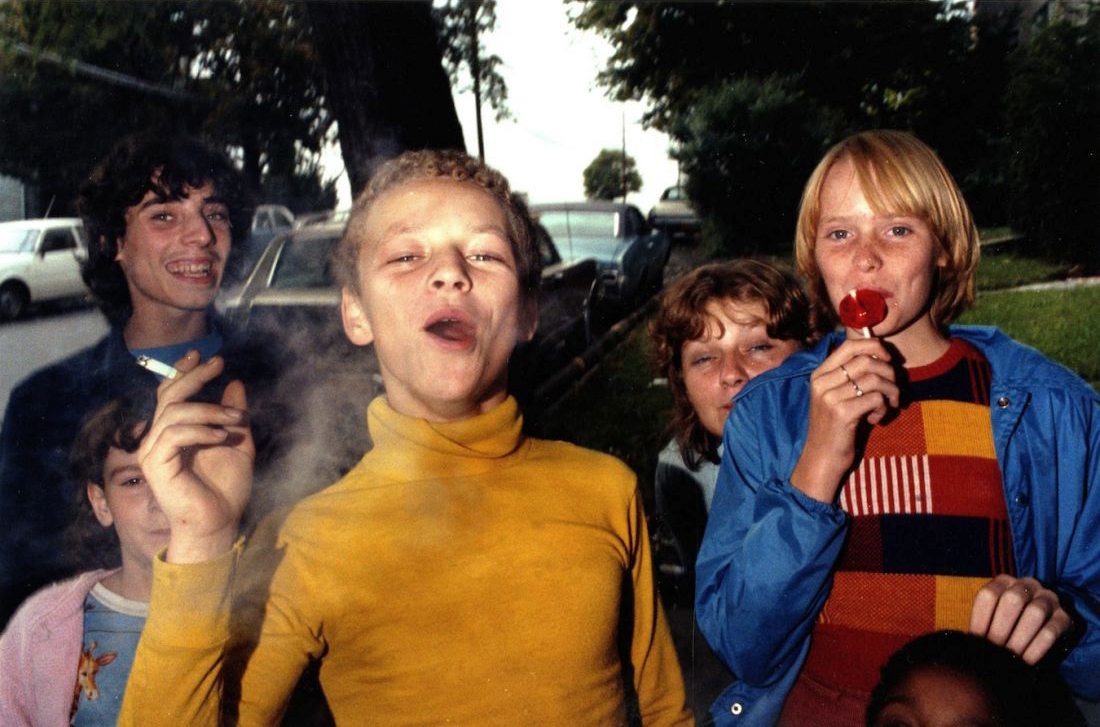
Exhibition: ‘Photo-Secession: Painterly Masterworks of Turn-of-the-Century Photography’ at the Utah Museum of Fine Arts, Salt Lake City

Exhibition dates: 24th August – 29th December 2024


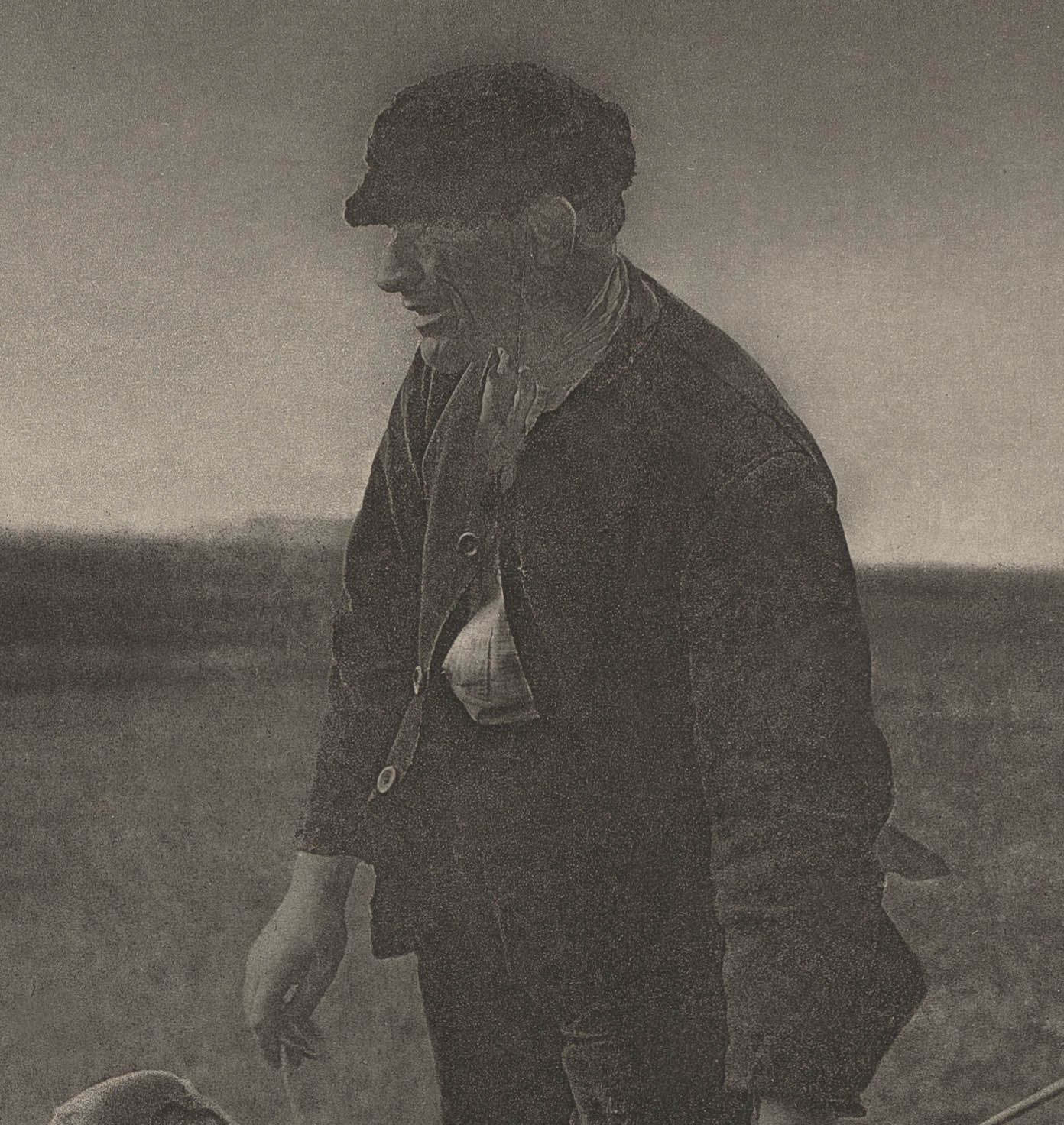
Peter Henry Emerson (British born Cuba, 1856-1936) 'Poling the Marsh Hay' c. 1885 from the exhibition 'Photo-Secession: Painterly Masterworks of Turn-of-the-Century Photography' at the Utah Museum of Fine Arts, Salt Lake City, August - December 2024


Peter Henry Emerson (British born Cuba, 1856-1936)
Poling the Marsh Hay
c. 1885
Platinum print on paper


Id est / that is

Voluptuous = relating to or characterised by luxury or sensual pleasure

Sensual = late Middle English (in the sense ‘sensory’): from late Latin sensualis, from sensus (see sense)

Sense = various; including:

~ a reasonable or comprehensible rationale i.e. the latent and emerging Modernism inherent in Photo-Secession photographs

~ the way in which a situation [in this case the “reading” of a photograph] can be interpreted i.e. the interpretation of Photo-Secession photographs as either Pictorialist, Modernist or a combination of both

~ a keen intuitive awareness of or sensitivity to the presence or importance of something i.e. the feeling of the photographer towards the object of their attention, revealed in the print, whether that be a nude, a building, pears and an apple or the side of a white barn

~ to be aware of (something) without being able to define exactly how one knows i.e. to be able to detect, recognise, and feel that ineffable “something” that emanates from the object of (y)our attention… in the act of creativity, in the act of seeing

Bringing something to our senses

Thus, the older I get the more I appreciate the faculty of feeling, thought and meaning that is revealed in these revolutionary photographs.

Dr Marcus Bunyan


Many thankx to the Utah Museum of Fine Arts for allowing me to publish the photographs in the posting. Please click on the photographs for a larger version of the image.


Quotes on Walls

“Why, Mr. Stieglitz, you won’t insist that a photograph can possibly be a work of art – you are a fanatic!”


Luigi Palma de Cesnola, Director of the Metropolitan Museum of Art, reportedly said to Alfred Stieglitz, 1902


“The painter need not always paint with brushes, he can paint with light itself. Modern photography has brought light under control and made it as truly art-material as pigment or clay. … The photographer has demonstrated that his work need not be mechanical imitation. He can control the quality of his lines, the spacing of his masses, the depth of his tones and the harmony of his gradations. He can eliminate detail, keeping only the significant. More than this, he can reveal the secrets of personality. What is this but Art?”


Arthur Wesley Dow, 1921


“The photographer’s problem therefore, is to see clearly the limitations and at the same time the potential qualities of his medium… without tricks of process or manipulation, through the use of straight photographic methods. … Photography is only a new road from a different direction but moving toward the common goal, which is Life.”


Paul Strand, 1917


“Pictorial photography owes its birth to the universal dissatisfaction of artist photographers in front of the photographic errors of the straight print. Its false values, its lack of accents, its equal delineation of things important and useless, were universally recognised and deplored by a host of malcontents… I consider that, from an art point of view, the straight print of today is not a whit better than the straight print of fifteen years ago. If it was faulty then it is still faulty now.”


Robert Demachy, 1907


“Gum, diffused lenses, (ultra) glycerining, were of experimental interest once. … Most of these are of more value historically than artistically. The prints are neither painting (or its equivalents) nor photographs. Let the photographer make a perfect photograph. It will be straight and beautiful – a true photograph.”


Alfred Stieglitz, 1919


Photo-Secession: Painterly Masterworks of Turn-of-the-Century Photography celebrates an intrepid group of photographers, led by preeminent photographer Alfred Stieglitz, who fought to establish photography as fine art, coequal with painting and sculpture at the turn of the 20th century. The Photo-Secession movement took cues from European modernists – who seceded from centuries-old academic traditions – to demonstrate photographic pictures’ aesthetic, creative, and skilful value as art. An homage to Stieglitz, Photo-Secession includes some of the very images that established the appreciation of photography’s artistic merits.

The UMFA will present this exhibition concurrently with Blue Grass, Green Skies: American Impressionism and Realism from the Los Angeles County Museum of Art to draw attention to the cyclical dialogue between painting and photography in the late 19th and early 20th centuries. During this period, photographers manipulated their images at various stages of production to imitate painterly effects, while painters worked and reworked their oils to imitate the immediacy of photography, demonstrating a remarkable reciprocity between these two art forms.

Text from the Utah Museum of Fine Arts website


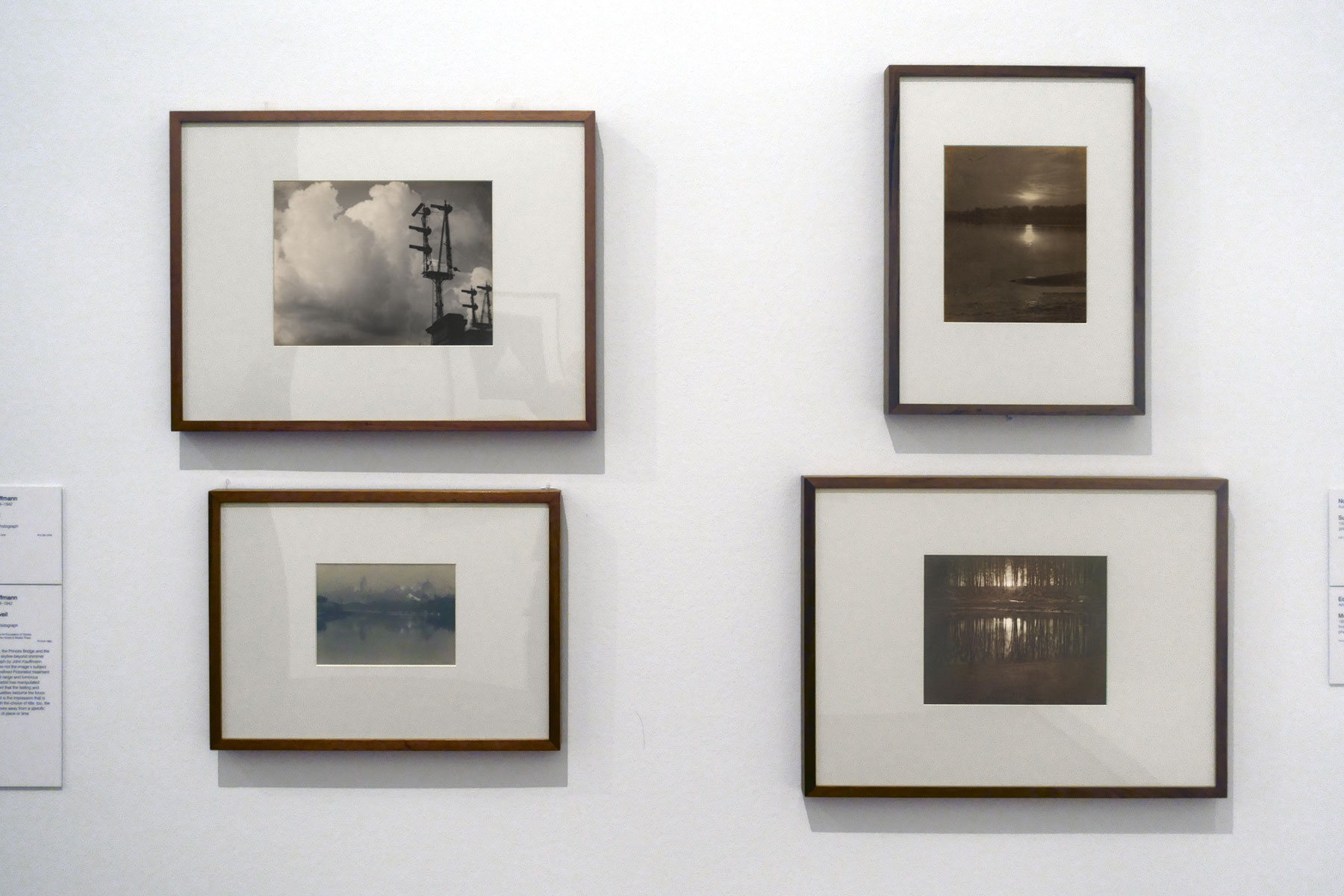
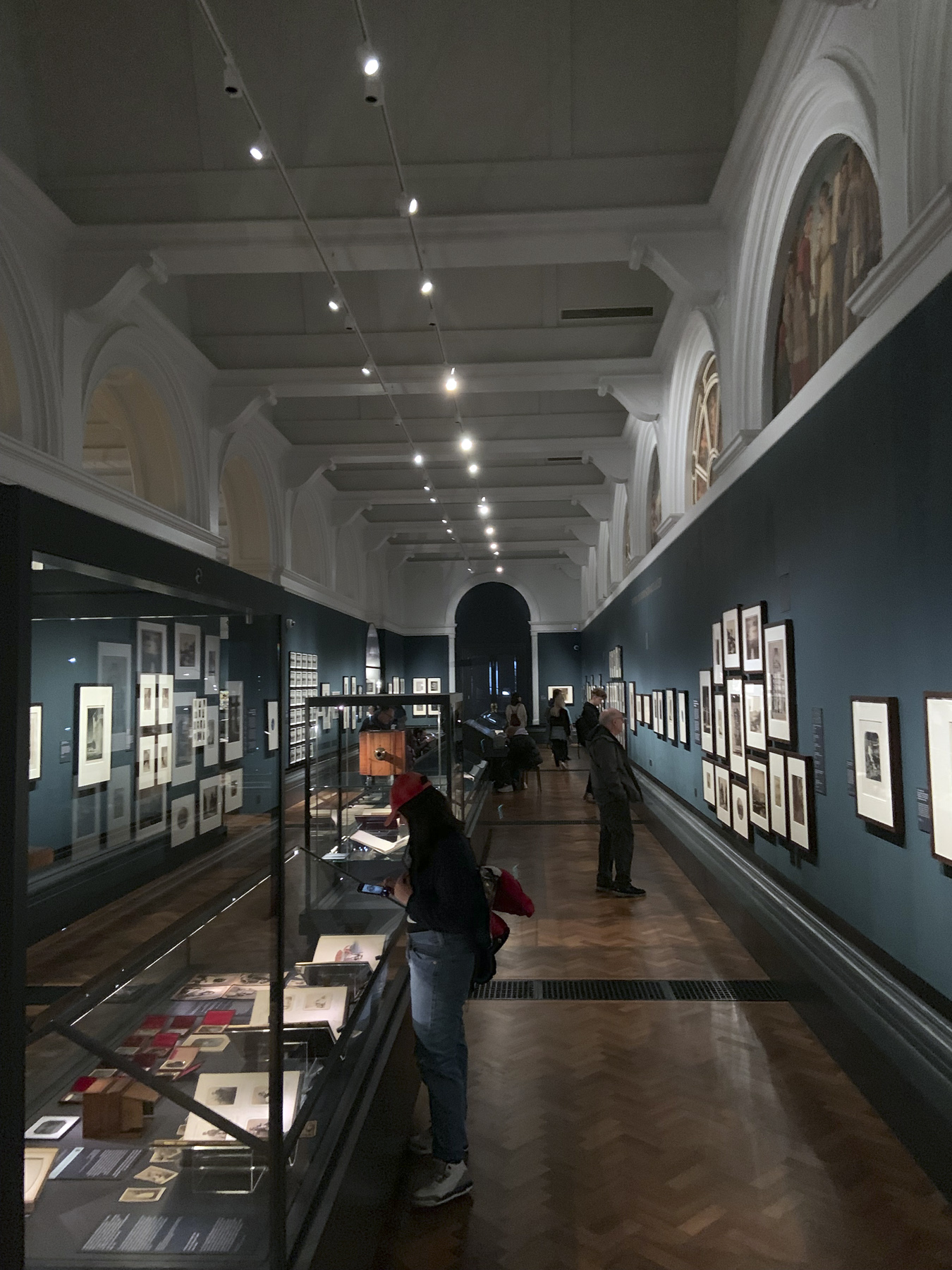
Installation view of the exhibition 'Photo-Secession: Painterly Masterworks of Turn-of-the-Century Photography' at the Utah Museum of Fine Arts showing the work of Heinrich Kühn

Installation view of the exhibition 'Photo-Secession: Painterly Masterworks of Turn-of-the-Century Photography' at the Utah Museum of Fine Arts showing the work of Heinrich Kühn


Installation view of the exhibition Photo-Secession: Painterly Masterworks of Turn-of-the-Century Photography at the Utah Museum of Fine Arts showing the work of Heinrich Kühn
Image courtesy of the Utah Museum of Fine Arts


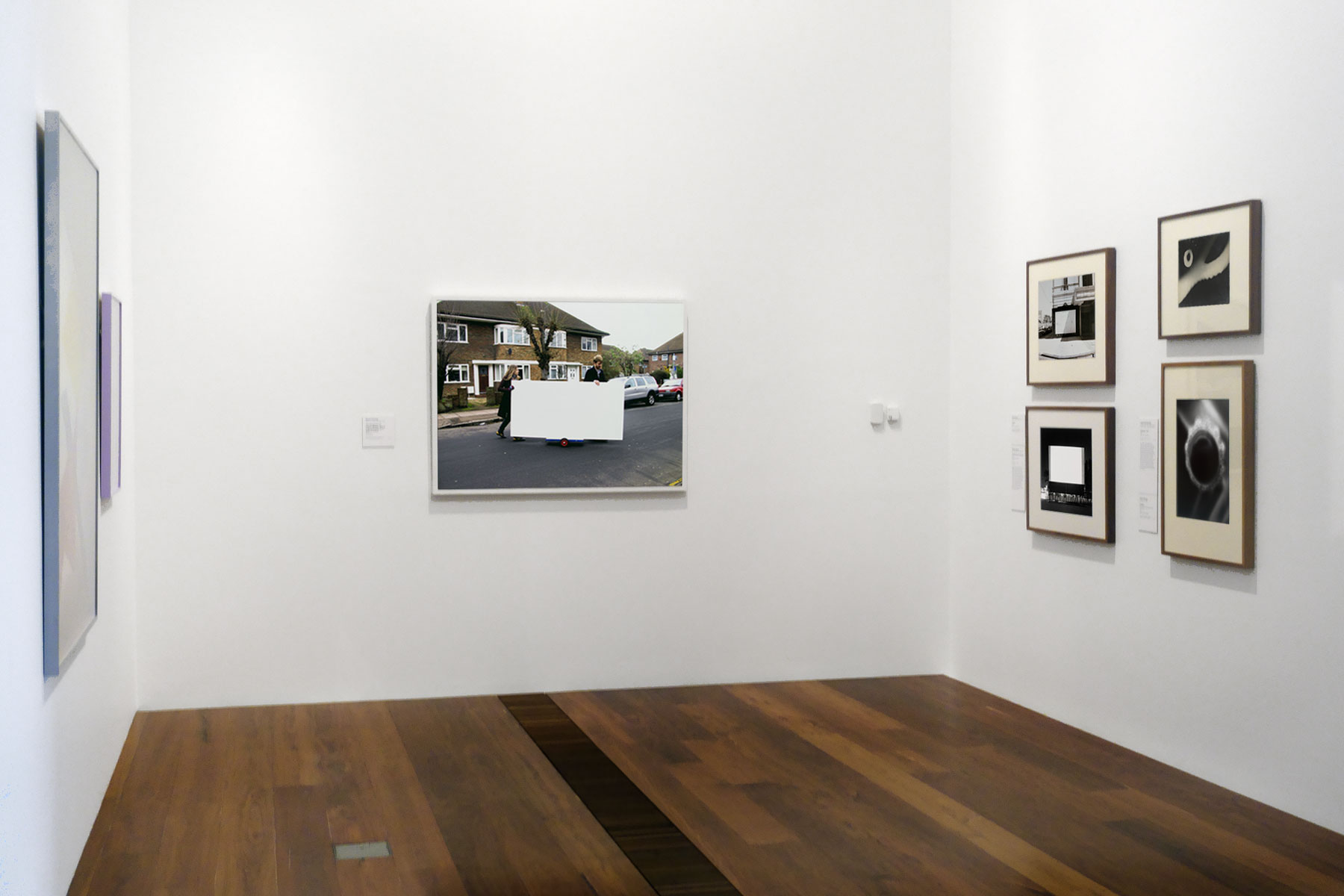
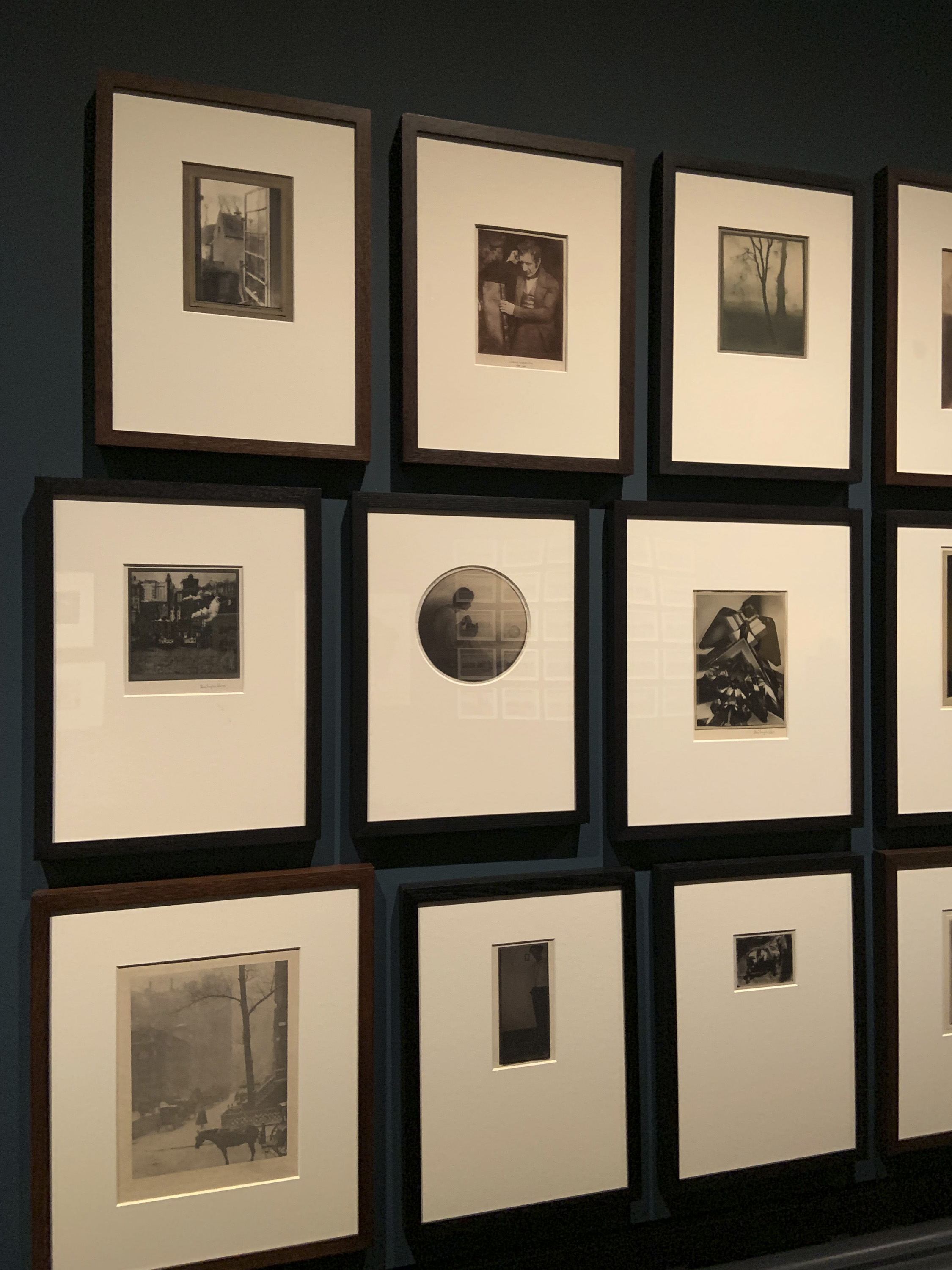
Installation view of the exhibition 'Photo-Secession: Painterly Masterworks of Turn-of-the-Century Photography' at the Utah Museum of Fine Arts showing at centre from left to right, Bernard Shea Horne 'Doorway Abstraction'; Drahomir Josef Ruzicka 'The Arch, Pennysylvannia Station' c. 1920; Arnold Genthe 'Acoma Pueblo, New Mexico' c. 1920; William E. Dassonville 'The Great Highway, San Francisco' c. 1905


Installation view of the exhibition Photo-Secession: Painterly Masterworks of Turn-of-the-Century Photography at the Utah Museum of Fine Arts showing at centre from left to right, Bernard Shea Horne Doorway Abstraction; Drahomir Josef Ruzicka The Arch, Pennysylvannia Station c. 1920; Arnold Genthe Acoma Pueblo, New Mexico c. 1920; William E. Dassonville The Great Highway, San Francisco c. 1905


Installation view of the exhibition 'Photo-Secession: Painterly Masterworks of Turn-of-the-Century Photography' at the Utah Museum of Fine Arts showing from top left to right, Edward Steichen 'Lotus, Mount Kisco' 1915; Edward Steichen 'Calla Lily' c. 1921; Edward Steichen 'Three pears and an apple' c. 1921; Edward Steichen 'Blossom of White Fingers' c. 1923


Installation view of the exhibition Photo-Secession: Painterly Masterworks of Turn-of-the-Century Photography at the Utah Museum of Fine Arts showing from top left to right, Edward Steichen Lotus, Mount Kisco 1915; Edward Steichen Calla Lily c. 1921; Edward Steichen Three pears and an apple c. 1921; Edward Steichen Blossom of White Fingers c. 1923


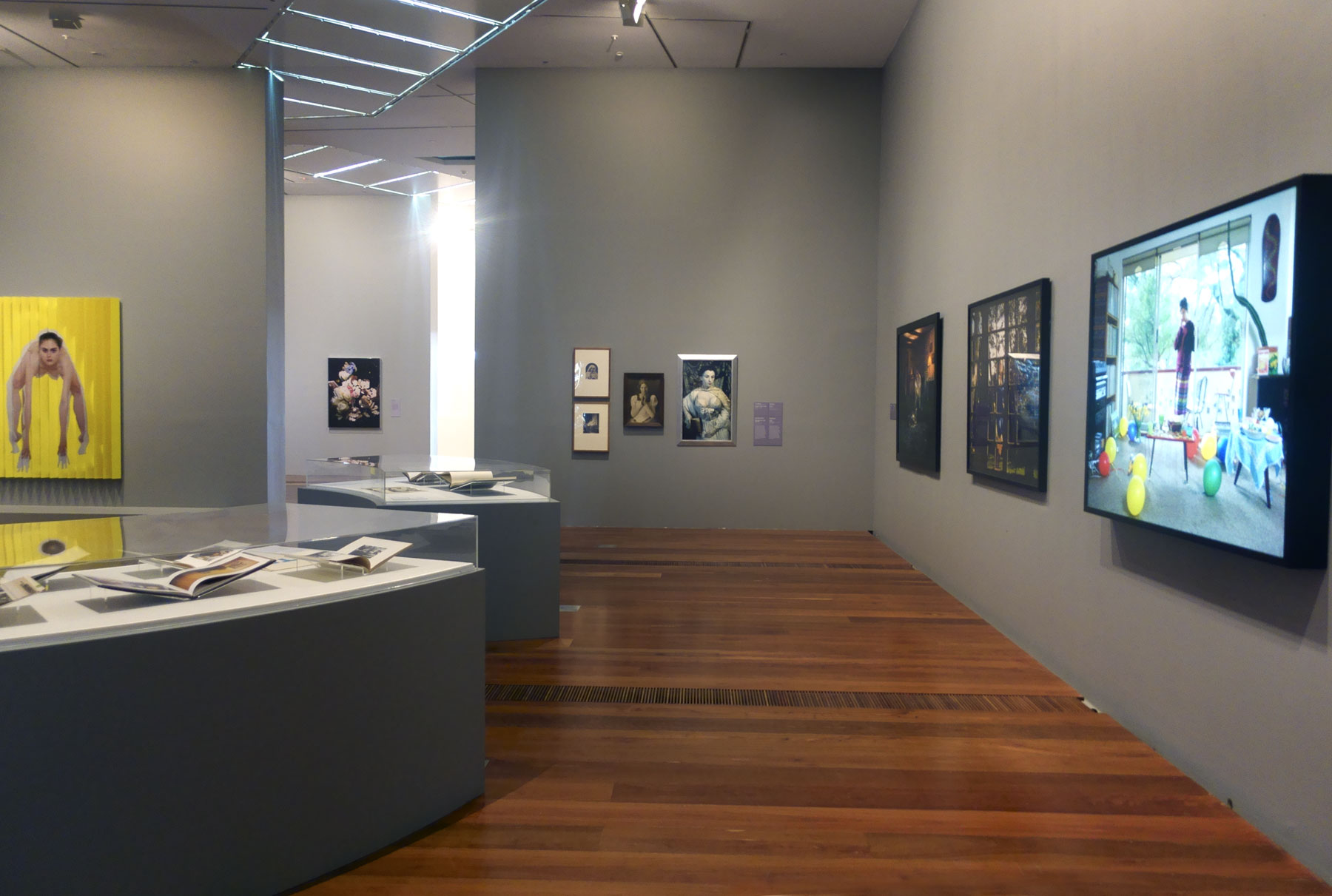
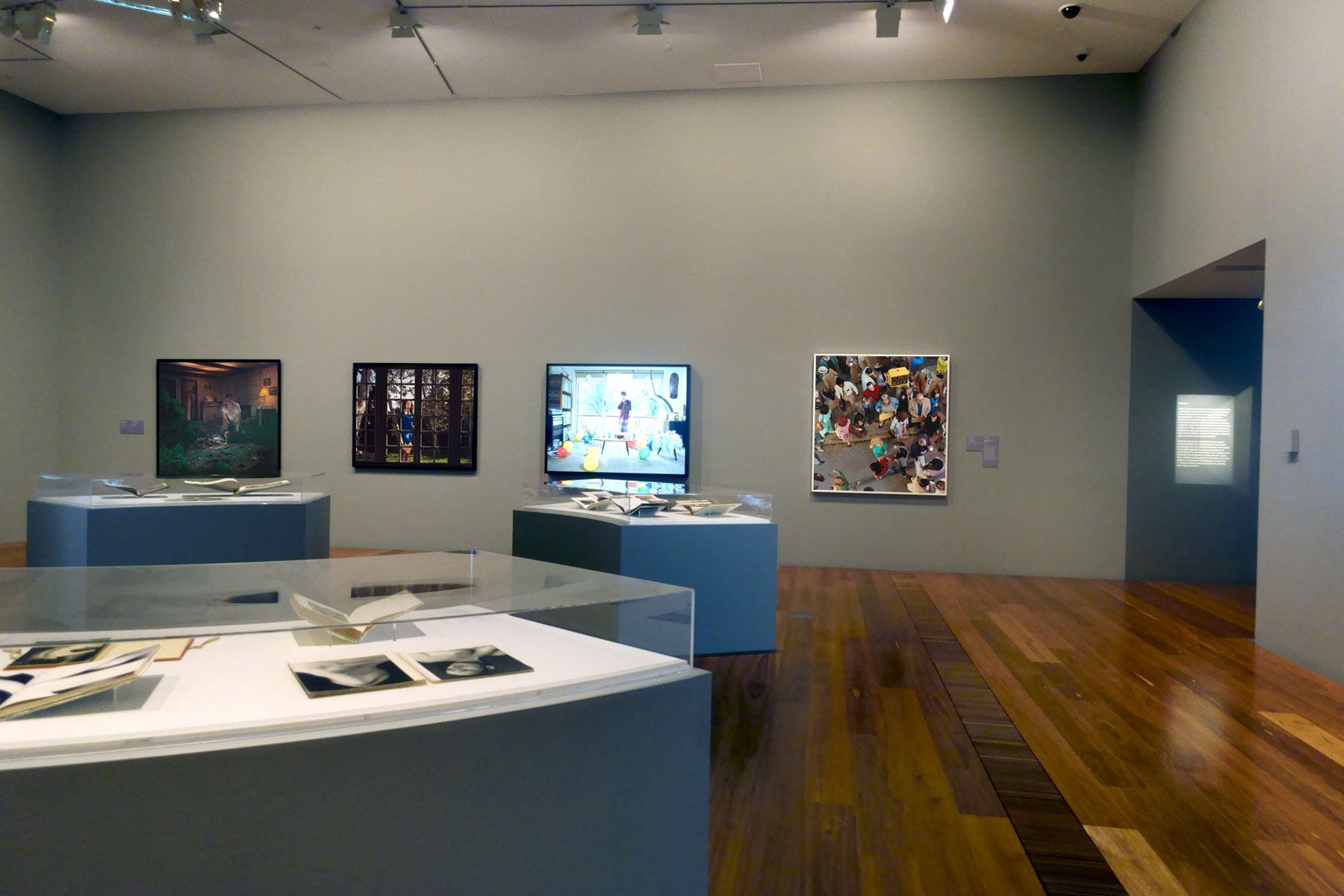
Installation view of the exhibition 'Photo-Secession: Painterly Masterworks of Turn-of-the-Century Photography' at the Utah Museum of Fine Arts

Installation view of the exhibition 'Photo-Secession: Painterly Masterworks of Turn-of-the-Century Photography' at the Utah Museum of Fine Arts


Installation view of the exhibition Photo-Secession: Painterly Masterworks of Turn-of-the-Century Photography at the Utah Museum of Fine Arts


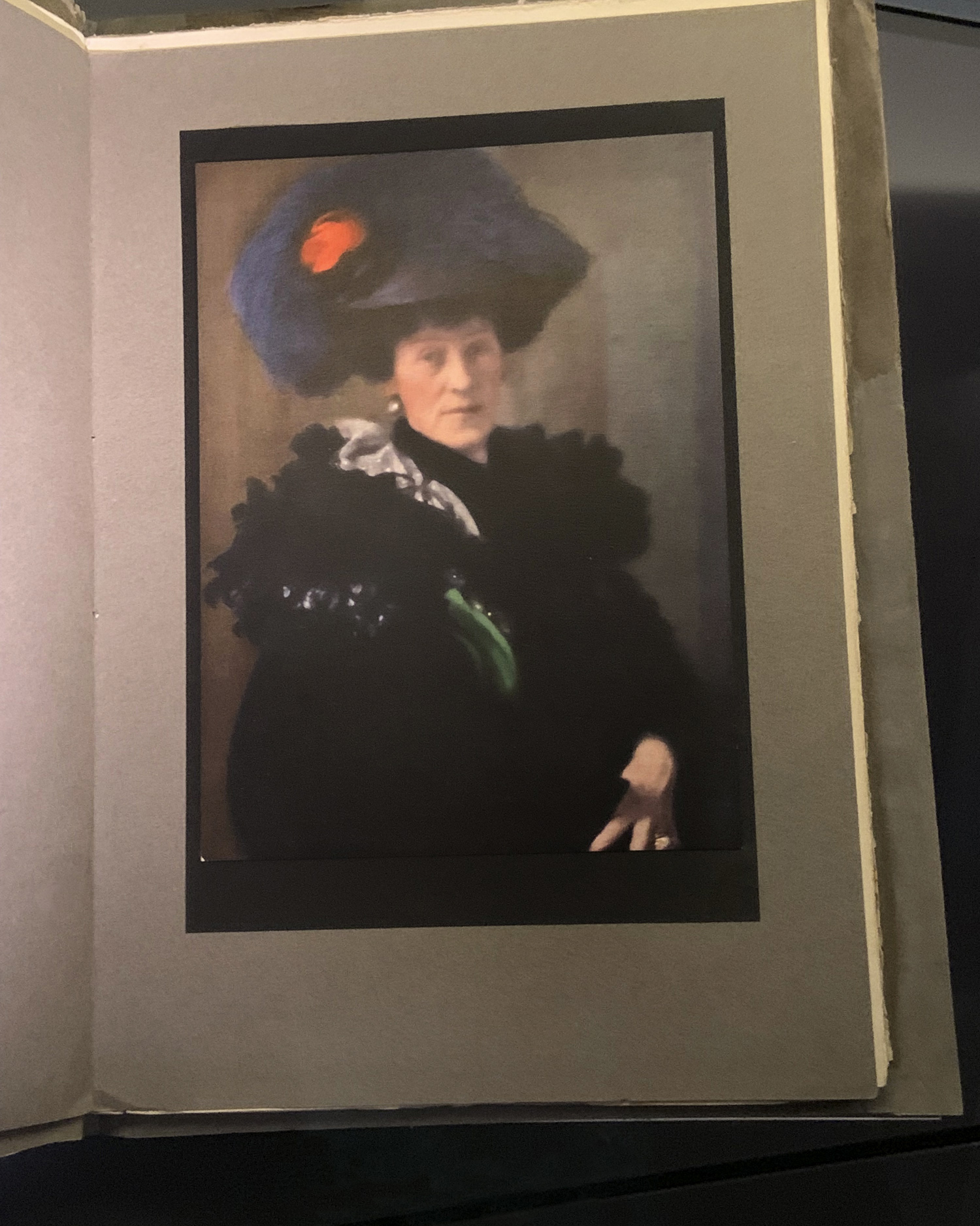
Installation view of the exhibition 'Photo-Secession: Painterly Masterworks of Turn-of-the-Century Photography' at the Utah Museum of Fine Arts showing in the display cabinet issues of the magazine 'Camera Work', 1903-1917. Edited by Alfred Stieglitz and Edward Steichen


Installation view of the exhibition Photo-Secession: Painterly Masterworks of Turn-of-the-Century Photography at the Utah Museum of Fine Arts showing in the display cabinet issues of the magazine Camera Work, 1903-1917. Edited by Alfred Stieglitz and Edward Steichen


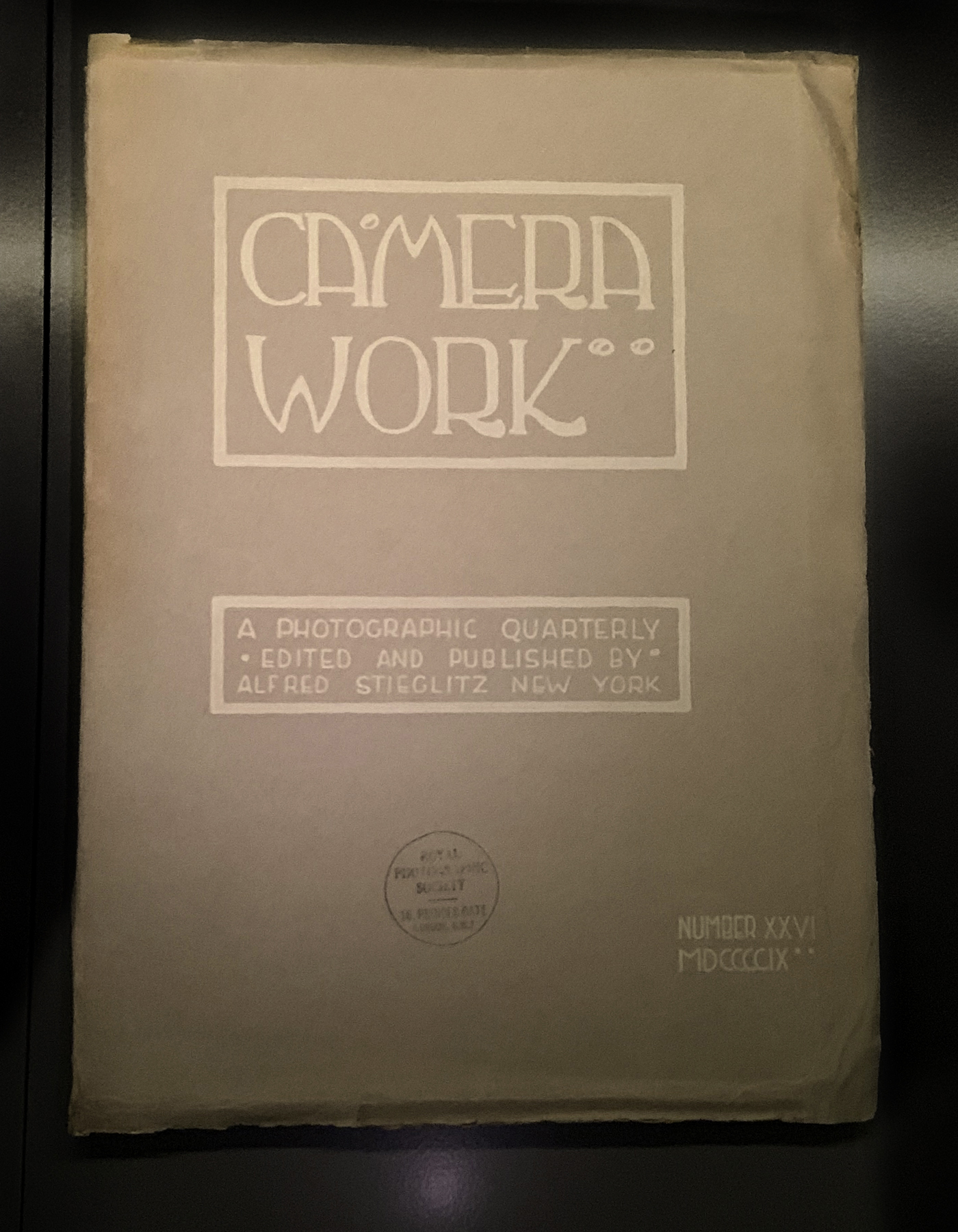
The Role of Camera Work

One of the key platforms for the Photo-Secession movement was the influential journal Camera Work, edited by Stieglitz and Steichen. Published from 1903 to 1917, Camera Work featured the work of Photo-Secessionists alongside essays and critiques that championed the artistic potential of photography. The journal played a crucial role in shaping public and critical perceptions of photography, providing a space for photographers to showcase their work and engage in intellectual discourse.

Adelaide Ryder. “The Photo-Secession Movement: Pioneering Artistry in Early Photography,” on the UMFA website Nd [Online] Cited 22/10/2024


Introduction

This exhibition celebrates 26 intrepid artists at the turn of the 20th century who sought to establish photography as a fine art equal to long-established media like painting, sculpture, drawing, and printmaking. This movement in the United States centred on the group dubbed the Photo-Secession. While each of the Photo-Secessionists had their distinctive approaches, their works are hand-crafted photographic prints of traditional artistic subjects, such as landscape, portraiture, figure study, and still life. This combination of painterly imagery and printmaking is also known as Pictorialism.

The passionate leader and tenacious advocate of the Photo-Secession was Alfred Stieglitz, who advanced the visions of the most ambitious photographers of the time, including Heinrich Kühn, Gertrude Käsebier, Edward Steichen, Paul Strand, and Clarence White. Stieglitz tirelessly promoted art photography through his exhibition space in New York City – the Little Galleries of the Photo-Secession and later called simply 291 – as well as through the journals he edited – Camera Notes (1897-1903) and Camera Work (1903-1917).

This exhibition also covers the breakup of the Photo-Secession, as some photographers rejected Pictorialism while others remained staunchly committed to it. The Photo-Secession itself irrevocably split apart around 1917. Artists led by Stieglitz, Steichen, and Strand switched to Straight Photography, an approach involving sharp focus and direct printing of the original shot. Artists led by Käsebier and White continued to innovate through painterly approaches using soft focus and manipulated prints.

The works in this exhibition represent some of the most influential artists and iconic images of the period as well as superb examples of a variety of photographic printing techniques, including platinum, gum-bichromate, carbon, cyanotype, and bromoil.

All works of art this exhibition are from the private collection of Michael Mattis and Judith Hochberg. This exhibition is organised by art2art Circulating Exhibitions.

The Rebirth of Art Photography in Europe

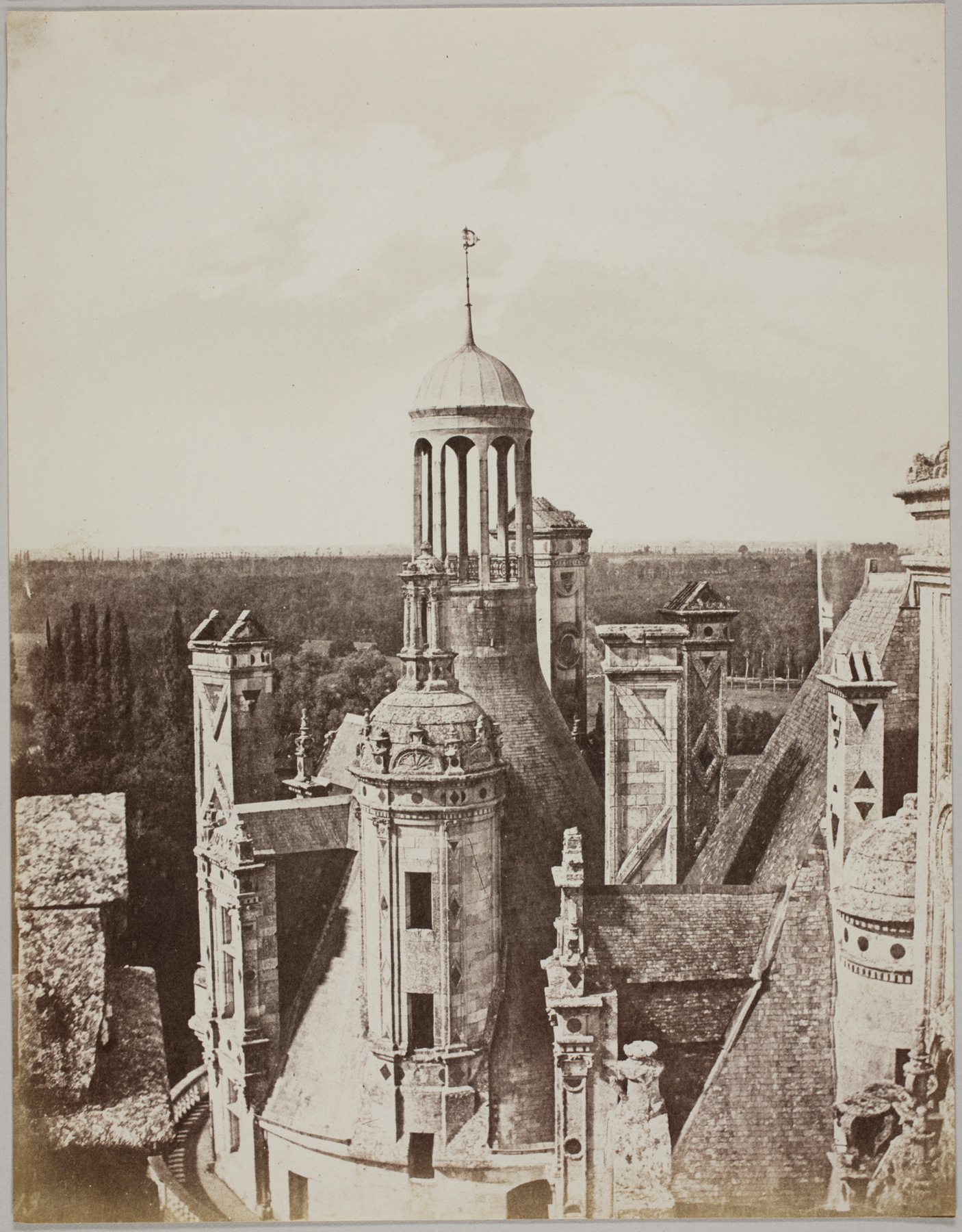
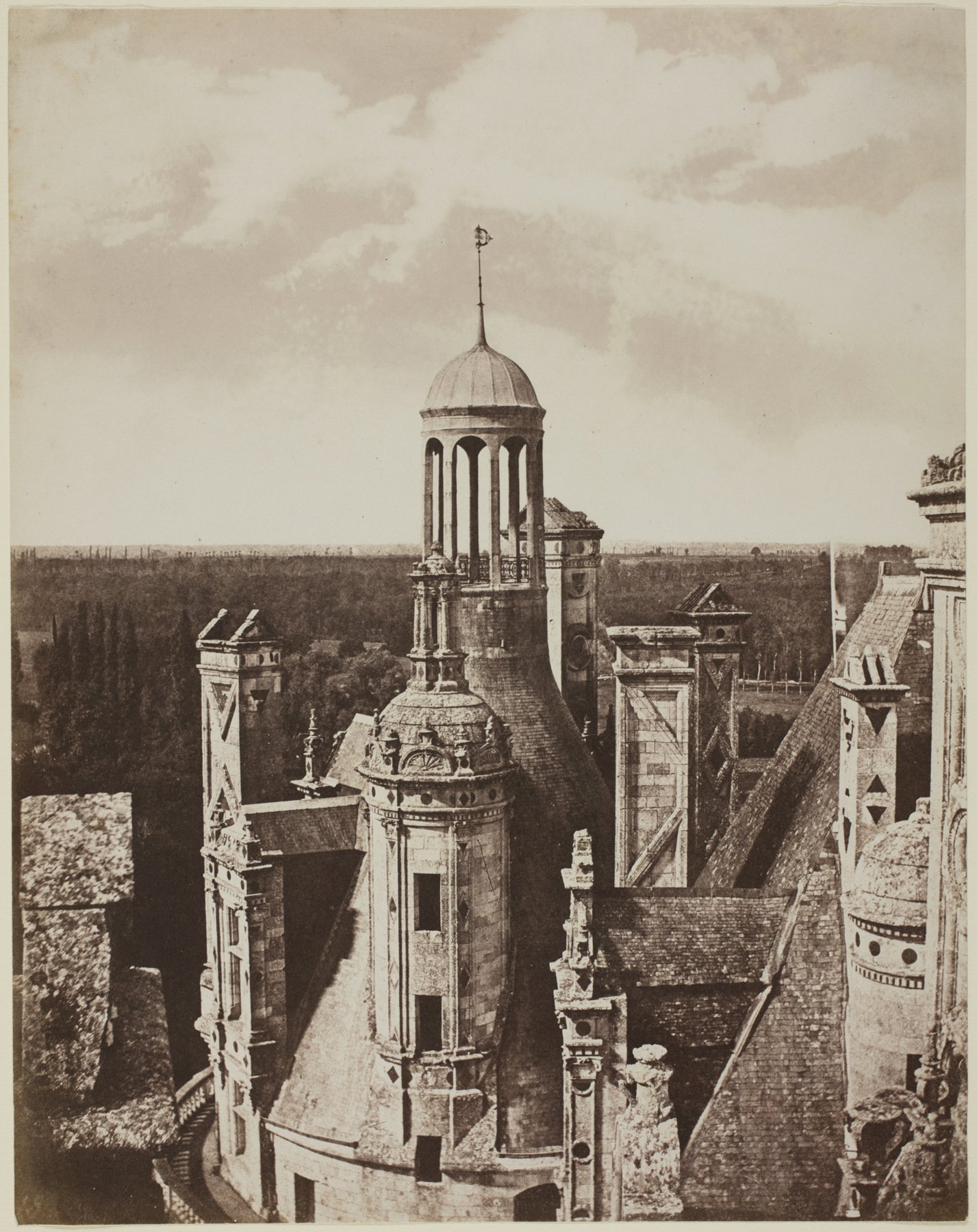
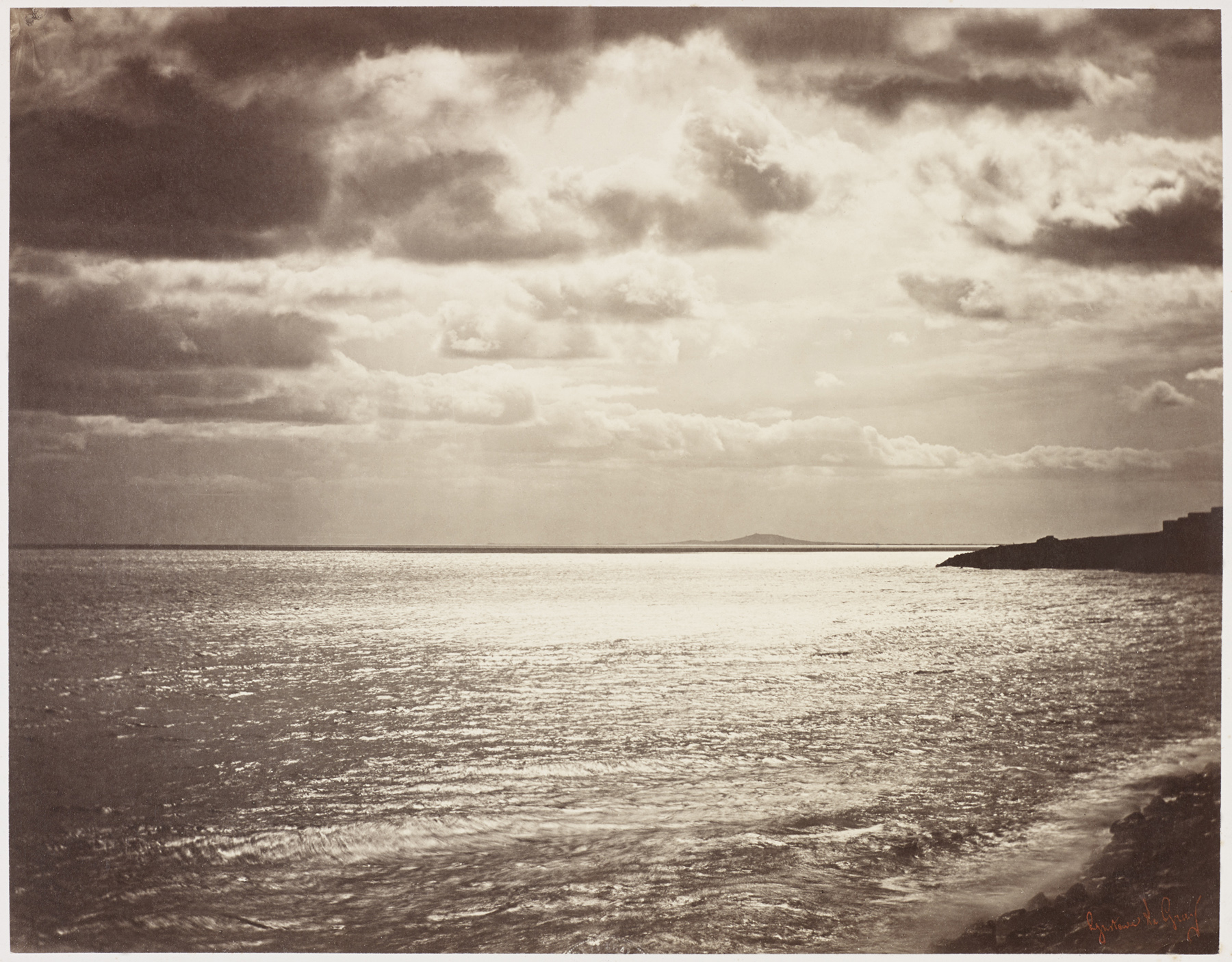
In the first few decades after the invention of photography in 1839, painters played an instrumental role in the development of this new medium. Artist-photographers like D.O. Hill in Edinburgh and Gustave Le Gray in Paris exhibited their photographs alongside paintings, drawings, and prints. The novelty of the photograph led to the proliferation of portrait studios and mass-produced views of famous monuments or exotic locales for the tourist trade. By the 1860s photography was considered a bourgeois technical profession. The Kodak camera, first issued in 1888, further popularised photography with its roll film, simple controls, and reasonable cost of one dollar (about $33 today).

Even as more and more individuals could access the means to make photos, artist-photographers advocated for the status of their medium and demanded a differentiation between their work and the products of point-and-shoot cameras. In 1889 Peter Henry Emerson published the book Naturalistic Photography for Students of the Art, which proposed a role for landscape photographers equal to esteemed painters like Camille Corot and Jean-François Millet. Emerson’s publication was a clarion call for a new generation of artistic photographers, and Pictorialism was born.

Pictorialist photographers enthusiastically pursued their new movement, pioneering soft-focus lenses and manipulatable printing methods. Soon they were forming regional clubs across Europe and resumed exhibiting their prints as art. The photographers that formed the t in London were particularly active and influential, and Pictorialism spread to other cultural centres like Paris, Berlin, and Vienna.

Alfred Stieglitz and the American Pictorialist Movement

Born in Hoboken, New Jersey, but educated largely in Germany, Alfred Stieglitz (1864-1946) watched the flowering of European Pictorialism with a mixture of aesthetic appreciation and fierce competitiveness, writing in 1892:

“Every unbiased critic will grant that we [American photographers] are still many lengths in the rear, apparently content to remain there, inasmuch as we seem to lack the energy to strive forward – to push ahead with that American will-power which is so greatly admired by the whole civilised world.”

Energised by European Pictorialism, Stieglitz championed juried photographic salons in Boston, New York, and Philadelphia. He also edited a series of increasingly ambitious journals about Pictorialist photography, starting with The American Amateur Photographer in 1893, then Camera Notes in 1897, and finally Camera Work starting in 1903. He inaugurated and named the Photo-Secession movement through the landmark exhibition he curated in 1903 at the National Arts Club in New York, which comprised 162 works by 32 artists. The name “Photo-Secession” referred to European avant-garde artistic movements, and in his own words, “Photo-Secession actually means a seceding from the accepted idea of what constitutes a photograph.” Eventually European artists would also be invited to join the Photo-Secession.

In 1905 Stieglitz opened a space at 291 Fifth Avenue in New York, the Little Galleries of the Photo-Secession, later simply called 291. It was the first retail gallery devoted to photography. He supported the venture with his own resources and generous assistance from others, and Edward Steichen was his steadfast associate. By 1915 Stieglitz was also showing avant-garde painting and sculpture at 291, including works by Pablo Picasso, Henri Matisse, and Constantin Brâncuși. Thus, he sought to demonstrate the idea that all art forms were on par with and informed one another.

Close Collaborations and the Sudden End of the Photo-Secession

From 1907 to 1910 Alfred Stieglitz and Clarence White closely collaborated on photographs and a landmark photography exhibition. In 1907 they made a series of 60 nudes, Stieglitz posing the models and White focusing the camera and making most of the prints. The following year, Stieglitz devoted an entire issue of Camera Work to White. In 1910 Stieglitz and White co-curated the International Exhibition of Pictorial Photography at Buffalo’s Albright Gallery (now Albright Knox Gallery). This historic project that included over 600 prints is now regarded as the apex of the Photo-Secession. It was also the final monument of the movement, as each of the major Pictorialists, White included, broke away from Stieglitz in the years that followed.

Significant reasons for the end of the Photo-Secession were Stieglitz’s authoritarian personality and disdain for photographers who needed to earn a living rather than exclusively pursue art for art’s sake. Philosophical differences also explain the rupture. Stieglitz had come to believe that Pictorialism had run its course. The irony was that the Photo-Secession had established photography as fine art through images that imitated other art forms by manipulation at every stage of the process – from lens to negative to print. Their pictures to varying degrees used methods that denied the very essence of photography. Stieglitz asserted that it was time to abandon the “painterly photograph” and to champion photography as fine art with compelling pictures that were truly photographic.

Late Pictorialism and the Clarence White School

As the artist Georgia O’Keeffe, Alfred Stieglitz’s partner for 30 years, acknowledged, “He was either loved or hated – there wasn’t much in between.” For reasons both personal and professional, most of the leading Photo-Secessionists chose not to follow Stieglitz and Paul Strand into Straight Photography. Many clustered instead around Clarence White, who in his gentle and encouraging manner was the antithesis of Stieglitz. In 1914 White founded the Clarence White School of Photography in New York City. In 1916 White along with Gertrude Käsebier and Alvin Langdon Coburn co-founded Pictorial Photographers of America; this new society welcomed members of all backgrounds and published the new journal Photo-Graphic Art.

The Clarence White School continued to be a locus for the training of new photographers until 1940, under the guidance of White’s widow Jane White after his death in 1925. Among the most prominent students of Clarence White are Karl Struss, Anne Brigman, Laura Gilpin, and Doris Ulmann, all of whom are represented in this exhibition. Other notable pupils of White include Margaret Bourke-White, Anton Bruehl, Paul Outerbridge, and Dorothea Lange.

Straight Photography, Edward Steichen, and Paul Strand

The final section of this exhibition focuses on Straight Photography and two of Alfred Stieglitz’s most notable protégés, Edward Steichen and Paul Strand. Between them, they pioneered leading branches of 20th-century American photography.

With the entry of the United States into World War I, both Steichen and Strand were drafted into the U.S. Army. Steichen was a photographer for the Army Air Service Signal Corps in Europe, and Strand was an X-ray technician in the Army Medical Corps. In the years immediately after WWI, they each turned their attention to photographing the natural world: flowers and fruit in Steichen’s case, and toadstools, grasses, and ferns in Strand’s. Both would return to photographing their gardens in the final years of their lives.

Outside the naturalist realm, Steichen and Strand’s paths diverged.

Steichen, an extrovert, pioneered modern fashion and advertising photography for the Condé Nast magazines Vogue and Vanity Fair. Later he was named Director of the Department of Photography at the Museum of Modern Art in New York, where he organised the landmark exhibition, Family of Man, which traveled to 37 countries on six continents and was seen by an estimated nine million people.

Strand, an introvert, traveled to remote places around the world, documenting the landscape, architecture, and people, his work exuding a respect for the dignity of the labouring class, which he absorbed from his mentor, Lewis Hine. Overall, Strand’s profoundly humanist scenes of everyday life influenced a generation of socially conscious photographers who documented the 20th-century crises of the Dust Bowl, the Great Depression, World War II, and more.

Heinrich Kühn

In the late 19th century, European Pictorialism was divided into two camps. On the one side were the purist photographers who, aside from a softening of the lens, opposed extensive manipulation of the negative or the print for artistic effect. On the other side were those who derided “button-pushers” and viewed the “straight” photograph as merely the raw material from which to create an artistic print through elaborate handiwork.

The leader of this latter camp was Heinrich Kühn (1866-1944). Eschewing Modernist tendencies, he chose traditional subject matter of painting from the 17th through 19th centuries: still life, figural studies, and genre scenes. His preference for gum-bichromate and bromoil printmaking techniques, which allowed for extensive manipulation, were intended to provoke the reaction in the viewer: is that really a photograph?

Born in Dresden, Kühn moved to Innsbruck, Austria, after youthful studies in science and medicine. Thanks to a sizeable inheritance, he could devote himself to artistic photography, joining both the Linked Ring in London and Stieglitz’s Photo-Secession in the United States. A trans-Atlantic correspondence with Stieglitz began in 1899 and lasted three decades. They congratulated one another on their latest triumphs and encouraged each other through professional and personal disappointments. In 1909, with Stieglitz’s assistance, Kühn organised the International Photographic Exhibition in Dresden, one of the high points of Pictorialism.

Later in life, Kühn filed multiple patents in photochemistry and camera technology related to Pictorialist photography, but none earned him any money. Tastes had changed, and the painterly photograph had become a quaint curiosity.

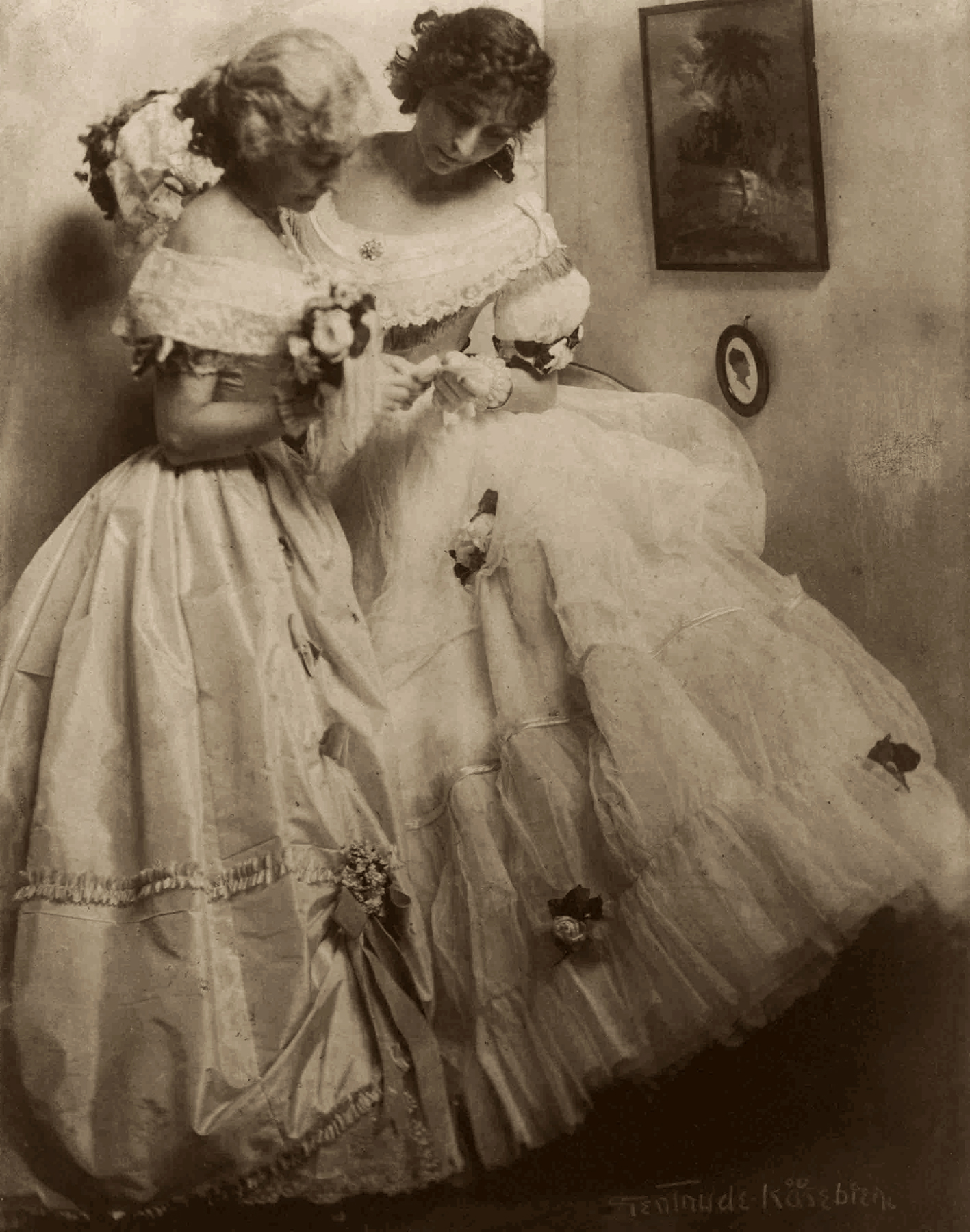
Gertrude Käsebier

Gertrude Käsebier (1852-1934) was 37 years old, married, and had three children by the time she began studying art at the Pratt Institute. She had originally purchased a camera to make portraits of her children, but Pratt encouraged its women students to earn a living in the arts. By 1897 she opened a one-room commercial portrait studio in New York City. Her ambition was to make “not maps of faces, but likenesses that are biographies, to bring out in each photograph the essential personality that is variously called temperament, soul, humanity.”

Recognition for Käsebier’s talent and ability came swiftly. In 1898 the painter William Merritt Chase, judging the Philadelphia Photographic Salon, called her work “as fine as anything that [Anthony] Van Dyck has ever done.” For Stieglitz, who organised her first solo show in 1899 at the Camera Club of New York, Käsebier was “beyond dispute the leading portrait photographer in this country.” That year, she sold one of her photographs for the unheard-of sum of $100 (almost $3,800 today).

However, by the time that the Brooklyn Museum honoured Käsebier with a career retrospective in 1929, Pictorialist photography had fallen so far out of fashion that the exhibition was not even reviewed in major journals.

Clarence Hudson White

Clarence Hudson White (1871-1925) was a modest, soft-spoken, entirely self-taught genius from America’s heartland. Raised in the small town of Newark, Ohio, he eked out a living as a bookkeeper for a wholesale grocer; each week he saved enough to purchase two glass plates for his camera. He specialised in gorgeously back-lit domestic interior scenes featuring his friends and members of his close-knit extended family.

White’s contributions to the 1898 Philadelphia Photographic Salon were so highly praised that, like Gertrude Käsebier, he was appointed a judge for the following year. The annual salons of the Newark Camera Club that he organised featured the nation’s preeminent Pictorialists and were the direct precursor to Stieglitz’s Photo-Secession. Indeed, the 1900 salon featured his friend and latest discovery, Edward Steichen of Milwaukee.

From 1907 onwards, both in New York City and during summers in rural Maine, White was also America’s foremost teacher of photography. Many of the leading American photographers of the 20th century studied at the Clarence White School.

Paul Strand

In 1915 Alfred Stieglitz found in the young Paul Strand (1890-1976) the leader of a remarkable new direction in photography. Strand had been a senior at the Ethical Culture High School in 1907 when he first visited Gallery 291 on a class trip with his photography teacher, Lewis Hine, whose poignant documents of immigrants and child labor were staples of the Progressive Movement. Eight years later, after thousands of hours in the darkroom at the New York Camera Club, Strand returned to 291 with a portfolio of platinum prints that pointed the way to a new era. Stieglitz deemed them “brutally direct, devoid of all flim-flam, devoid of trickery and of any ‘ism’. These photographs are the direct expression of today.” Stieglitz not only offered Strand an exhibition at 291, but also devoted the final two issues of Camera Work exclusively to him.

What was so compelling and inspiring to Stieglitz in Strand’s photography? His portfolio contained pictures of urban street life and architecture, as well as powerful close-ups of weathered New York faces (influenced by Lewis Hine), boldly composed still lifes, and shadow abstractions taken on a porch in Twin Lakes, Connecticut.

As for photography’s future, Strand and Stieglitz saw eye to eye. In his essay in Camera Work, Strand called for the universal adoption of Straight Photography “without tricks of process or manipulation.” In a provocative lecture at the Clarence White School, Strand condemned “this so-called pictorial photography, which is nothing but an evasion of everything photographic.”


Works by Emerson, Post, Evans, and Sutcliffe
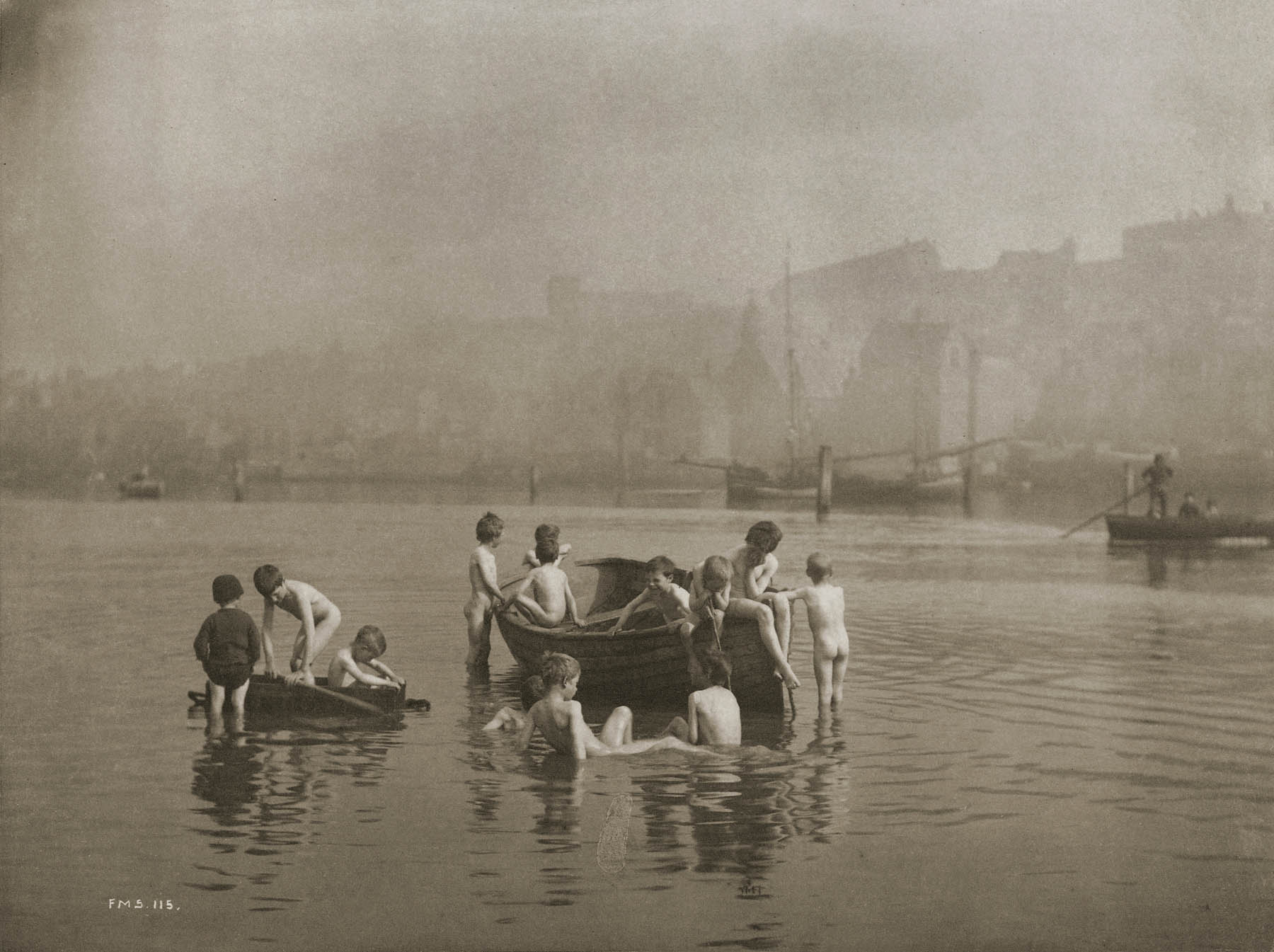
 

Frank Meadow Sutcliffe (British, 1853-1941) 'The Water Rats' 1886 from the exhibition 'Photo-Secession: Painterly Masterworks of Turn-of-the-Century Photography' at the Utah Museum of Fine Arts, Salt Lake City, August - December 2024


Frank Meadow Sutcliffe (British, 1853-1941)
The Water Rats
1886
Platinum print on paper


Sutcliffe was a member of the British photographic society the Linked Ring, which sought to make their work recognised as fine art. He operated a portrait studio in the seaside town of Whitby in North Yorkshire but is remembered for his charming, naturalistic depictions of local life. This photograph resulted in his excommunication by local clergy for its “corrupting” effects. Today this is his best-known photograph, regarded as a study of pure childhood joy.
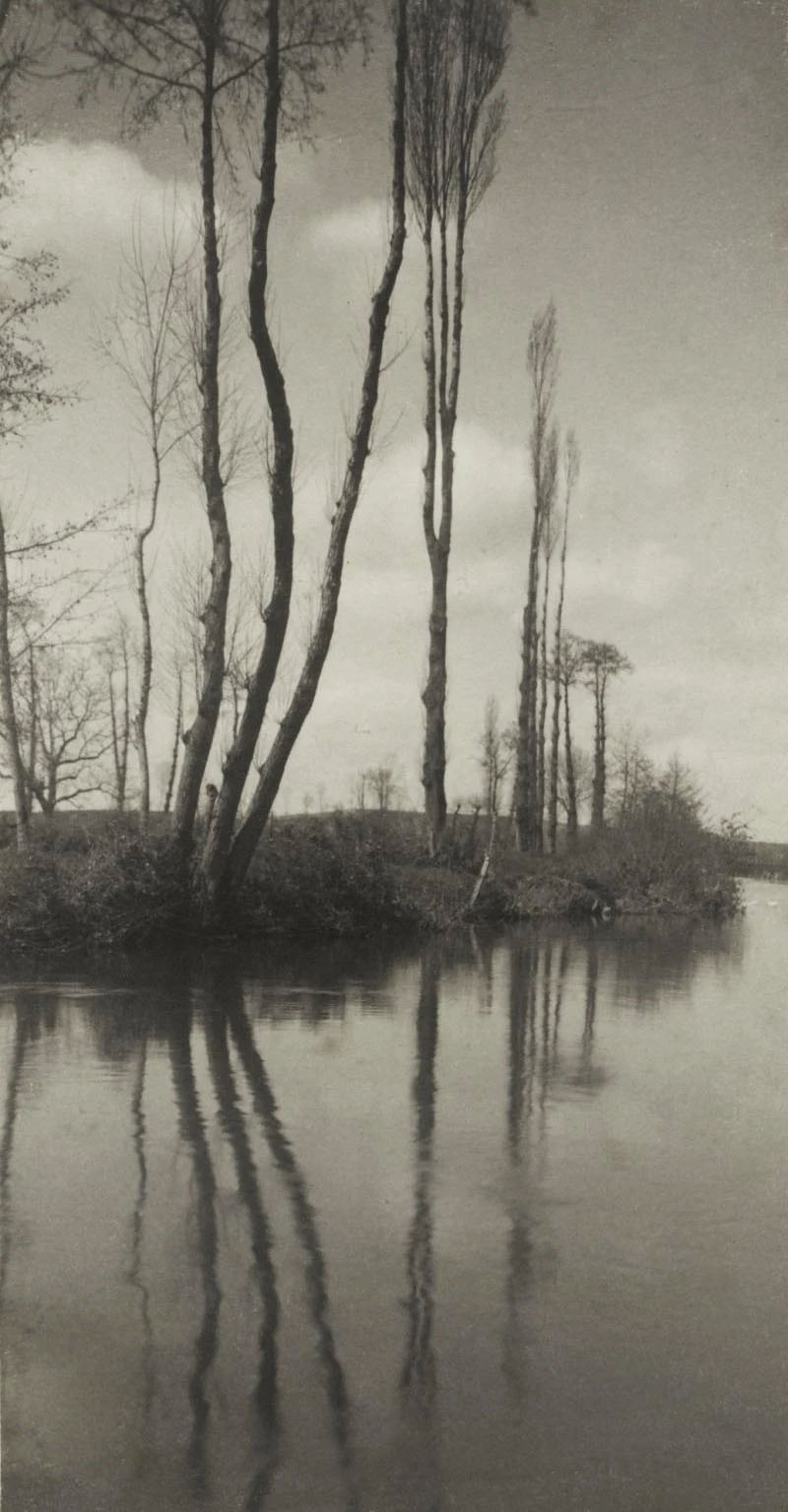
 

Frederick H. Evans (British, 1853-1943) 'Poplars on a French River' c. 1900


Frederick H. Evans (British, 1853-1943)
Poplars on a French River
c. 1900
Platinum print on paper
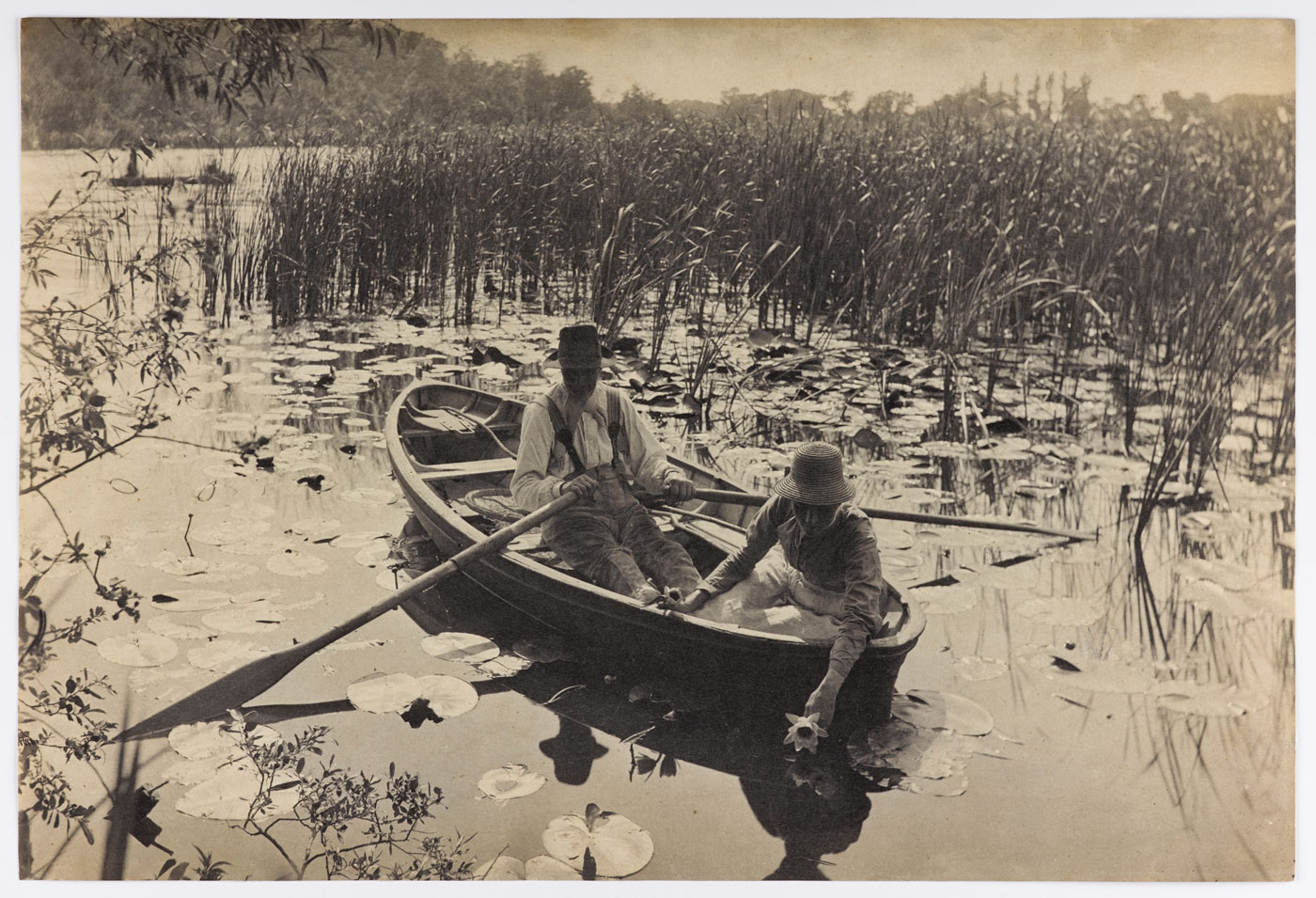
 

Peter Henry Emerson (British born Cuba, 1856-1936) 'Gathering Water Lilies' c. 1885


Peter Henry Emerson (British born Cuba, 1856-1936)
Gathering Water Lilies
c. 1885
Platinum print on paper


In addition to his photographic work, Emerson wrote persuasively that photography could match – and even surpass – painting as an emotive art form. His writings were influential to the young Alfred Stieglitz, with whom he corresponded over four decades.

All from the Collection of Michael Mattis and Judith Hochberg


Works by Thiollier
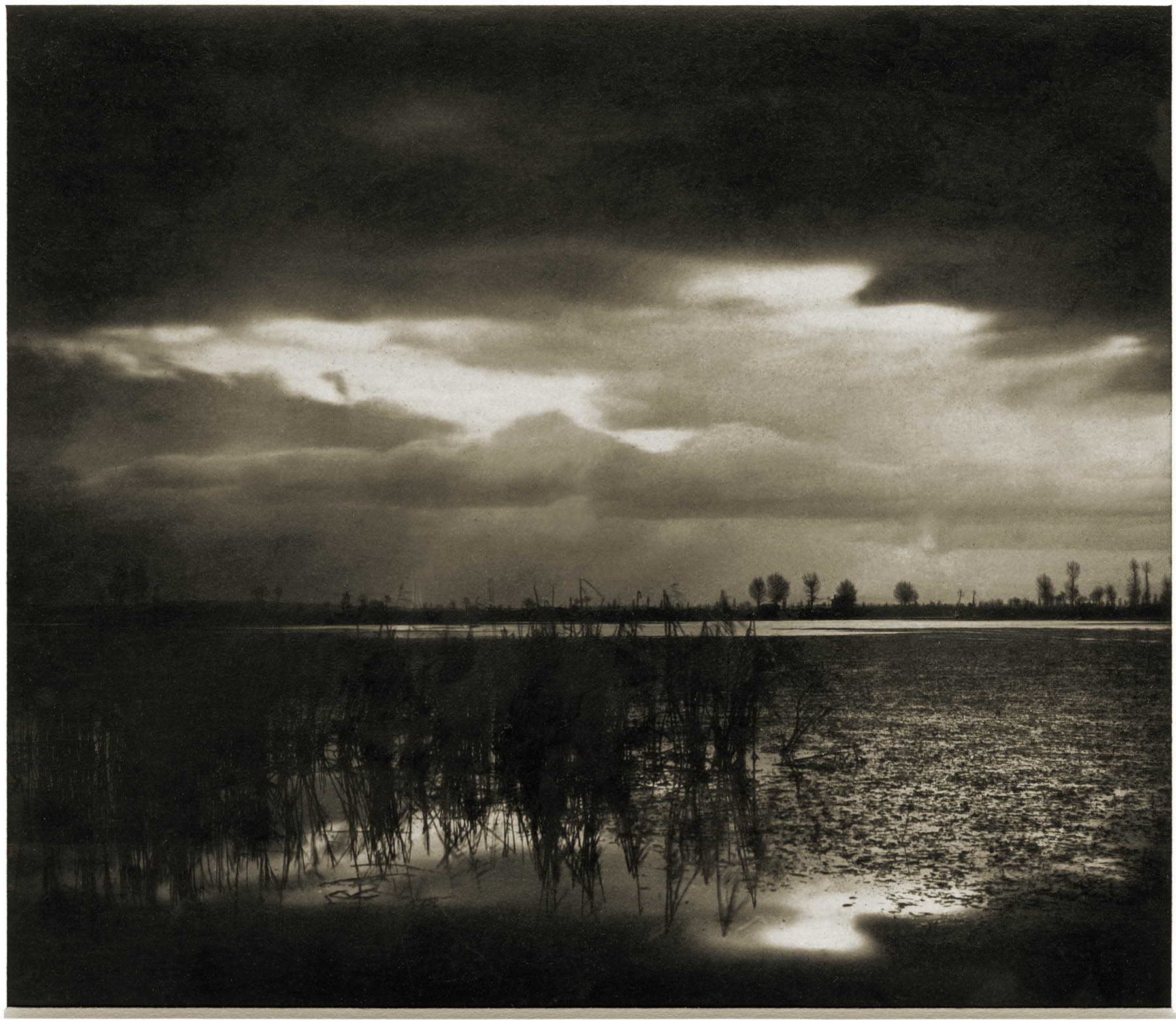
 

Félix Thiollier (French, 1842-1914) 'Landscape in Bugey' c. 1885


Félix Thiollier (French, 1842-1914)
Landscape in Bugey
c. 1885
Carbon print on paper


Thiollier’s photographic career is a fairly recent discovery, highlighted in the first ever retrospective of his career at the Musée d’Orsay in Paris in 2012.

From the Collection of Michael Mattis and Judith Hochberg


Works by Kühn


Heinrich Kühn (Austrian born Germany, 1866-1944) 'Nude in Morning Sun' c. 1920


Heinrich Kühn (Austrian born Germany, 1866-1944)
Nude in Morning Sun
c. 1920
Multiple bromoil transfer print on Japanese tissue paper


Heinrich Kühn (Austrian born Germany, 1866-1944) 'Female torso in sunlight' c. 1920


Heinrich Kühn (Austrian born Germany, 1866-1944)
Female torso in sunlight
c. 1920
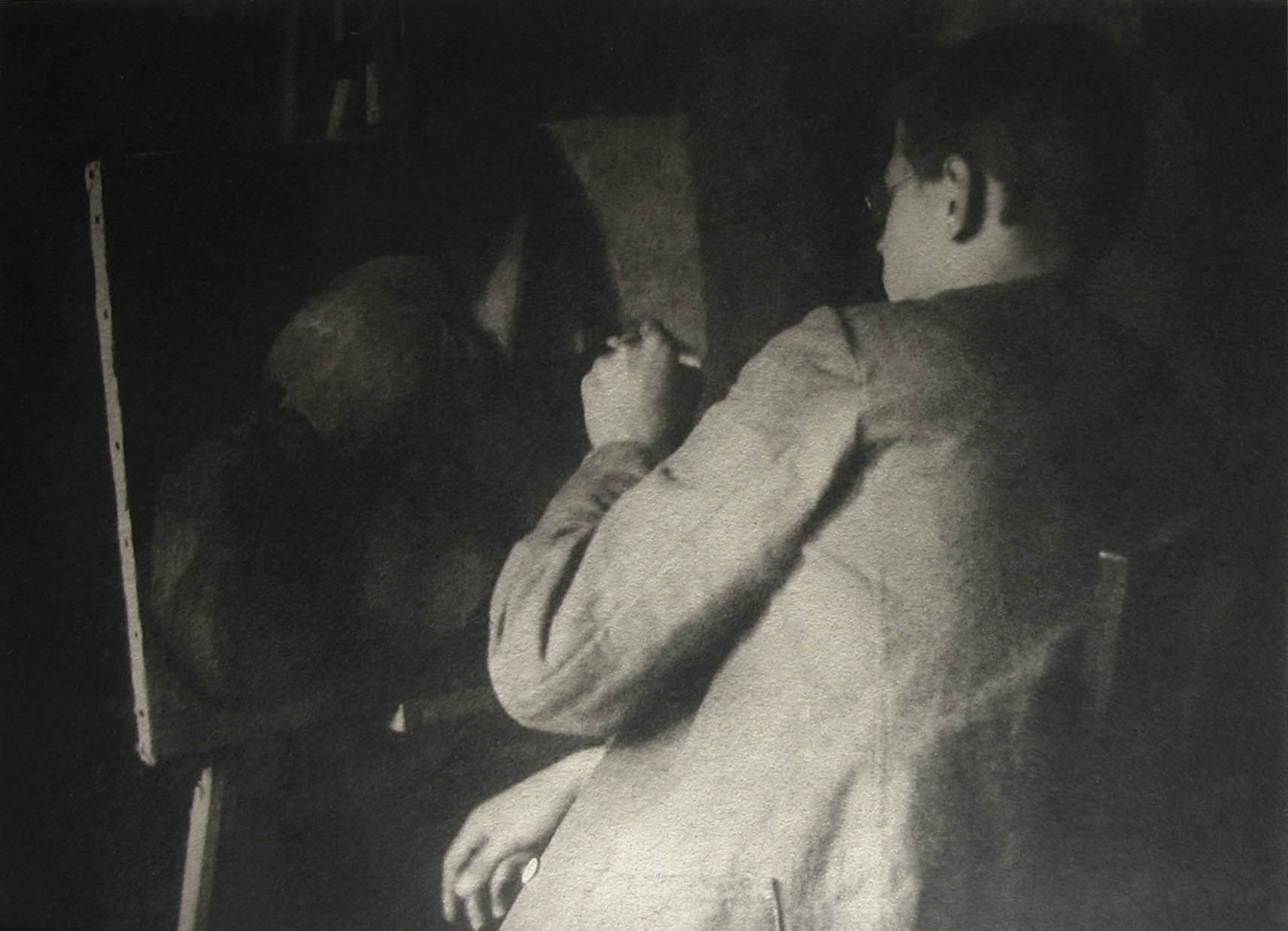
 

Heinrich Kühn (Austrian born Germany, 1866-1944) 'Walter at Easel' c. 1909


Heinrich Kühn (Austrian born Germany, 1866-1944)
Walter at Easel
c. 1909
Gum-bichromate print on paper


Heinrich Kühn (Austrian born Germany, 1866-1944) 'Still Life with Fruit and Pottery' c. 1896


Heinrich Kühn (Austrian born Germany, 1866-1944)
Still Life with Fruit and Pottery
c. 1896
Gum-bichromate print on paper with an applied watercolour wash


Kühn’s still lifes deliberately recall paintings from earlier centuries. This scene – his first published image – contains similar elements to 17th-century still-life compositions. He even included insects, which are traditional references to mortality called memento mori (reminders of death). Can you spot the housefly?

All from the Collection of Michael Mattis and Judith Hochberg


Portraits by Steichen


Edward Steichen (American born Luxembourg, 1879-1973) 'George Frederic Watts, London' 1901


Edward Steichen (American born Luxembourg, 1879-1973)
George Frederic Watts, London
1901
Varnished platinum print on paper


This dramatic profile portrait of the English Pre-Raphaelite painter was the first in what Steichen termed his “Great Men” series. Steichen wrote about his approach to portraiture, “I aim for the expression of something psychological. I am not satisfied with the mere reproduction of features and expression.”

Published in Camera Work, 14, 1906
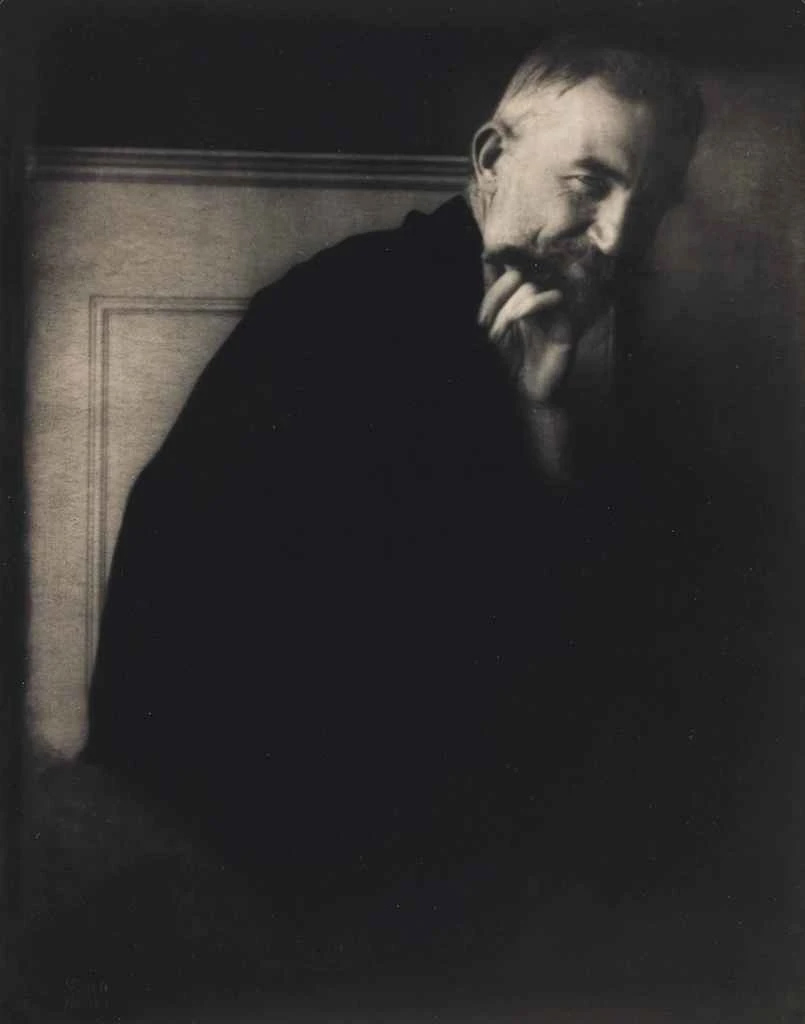
 

Edward Steichen (American born Luxembourg, 1879-1973) 'The Photographer's Best Model: George Bernard Shaw, London' 1907


Edward Steichen (American born Luxembourg, 1879-1973)
The Photographer’s Best Model: George Bernard Shaw, London
1907
Platinum print on paper


Steichen was elated after his photographic sitting with Shaw, writing to Stieglitz: “Well I’ve seen and done Shaw (photographically of course). He’s the nicest kind of fellow imaginable – genial and boyish – there is a little of the sardonic about him as you see him but when you get the camera at him you are tempted with possibilities in that way. He seems to know a lot about photography and certainly skilfully bluffs you into believing he knows it all.”

Published in Camera Work, 42/43, 1913

All from the Collection of Michael Mattis and Judith Hochberg


Glossary of Photographic Printing Methods and Terms from the History of Photography

Gelatin Silver Print

For over a century, from the 1880s until the digital era, the gelatin silver print was the most common technique for producing black-and-white photographs. The paper is coated with a binder layer of gelatin incorporating light-sensitive silver chloride or silver bromide. The paper is exposed under a negative, either by contact-printing or through an enlarger, then chemically developed, stopped, fixed, and dried. In the process, the silver salts are reduced to metallic silver, which carries the image. The overall color of the print can be altered through toning.

Cyanotype

A sheet of paper is sensitised in a solution of potassium ferricyanide and ferric ammonium citrate. After contact-printing under a negative, the iron compounds form an insoluble blue (“cyan”) dye known as Prussian blue. Apart from its occasional artistic use, the only regular use of the cyanotype was in copying architectural plans, thus called “blueprints.”

Platinum or Palladium Print

A platinum print is produced by sensitising a sheet of paper with platinum and iron salts. The sheet is then contact-printed under a negative until a faint image is visible. The print is developed in a potassium oxalate solution that dissolves unexposed iron salts and transforms the platinum salts into metallic platinum, which intensifies the image. Mercury chloride can be added to the solution to give a warmer tone. Unlike a silver print, where the image lives in a gelatin binder layer on top of the paper (akin to a watercolour), the image in a platinum print is embedded in the paper fibres (akin to an oil painting). The rich mid-tone range and matte surface made the platinum print the favoured medium for the Pictorialist photographers, from P.H. Emerson onward. When the price of platinum spiked during World War I, palladium was introduced as a more affordable (and generally warmer-toned) substitute.

Pigment Prints

The following processes are known as pigment prints, because the photographic image is carried by inks or pigments, rather than by metallic particles like silver, iron, or platinum.

Gum Bichromate Print

A sheet of paper is coated with diluted gum-arabic mixed with coloured pigment and light-sensitive potassium bichromate. During exposure under a negative, the bichromate causes the coloured gum-arabic to harden in proportion to the amount of light received. The areas not exposed to light remain soluble in water, and the print is developed by washing away the soluble areas, leaving a positive image on the paper. The prints can be exposed and reprinted numerous times with different coloured pigments, as well as manipulated by brushing away more pigmented gum during the washing stage.

Bromoil (Transfer) Print

This process does not begin with a negative, but rather with a gelatin silver print that is bleached in a solution of potassium bromide. The bleaching removes the silver-based image and selectively hardens the underlying gelatin in proportion to the image density. The sheet is then hand-coloured with an oil-based ink, which is selectively absorbed depending on the hardness of the gelatin: the softer areas contain more water, which repels the oil-based ink. An inked print is sometimes used as a kind of printing plate for transferring the image to another sheet of paper (a bromoil transfer print).

Photogravure

This is a sophisticated photomechanical process used for reproducing photographs in ink in a large edition. It is a form of intaglio printing, in which a photographic image is acid-etched into a copper plate. The relief image is then inked and printed. Alfred Stieglitz’s magazine Camera Work was largely printed in photogravure.

The Photo-Secession

This was the brief but influential artistic movement led by American Alfred Stieglitz during the years 1902–1915 that championed photography as an art form that was as aesthetic, creative, and skilful as traditional media like painting, drawing, watercolour, and printmaking. The European artistic movement Secessionism inspired the name Photo-Secession, and both movements were committed to Modernism by seceding from centuries-old academic traditions.

Pictorialism / Pictorialist

The approach to photography in which artists sought to make images that imitated the tradition of paintings through photographic prints. Pictorialist photographers used soft focus lenses and manipulated both their negatives and printing media to create their prints.

The Linked Ring

Also known as the Brotherhood of the Linked Ring, this photographic society founded in 1892 in London promoted photography as a form of art and was influential for the American society of the Photo-Secession.

Straight Photography

The approach to photography in which artists use sharp focus and print directly from their negatives with minimal or no manipulation.

Camera Notes

Camera Notes was the journal of the Camera Club of New York, edited by Alfred Stieglitz from 1897 to 1902. Under Stieglitz’s editorship, the purposes of Camera Notes were “to take cognisance also of what is going on in the photographic world at large, to review new processes and consider new instruments and agents as they come into notice; in short to keep our members in touch with everything connected with the progress and elevation of photography.”

Camera Work

Camera Work was the journal about contemporary photography that Alfred Stieglitz edited and published with the assistance of Edward Steichen from 1903 to 1917. The goal of this journal “devoted largely to the interests of pictorial photography” was “to issue quarterly an illustrated publication which will appeal to the ever-increasing ranks of those who have faith in photography as a medium of individual expression, and, in addition, to make converts of many at present ignorant of its possibilities.”

This glossary has been edited from primary sources and text by Ina Schmidt-Runke, Meike Harder, and Andreas Gruber.


The Photo-Secession Movement: Pioneering Artistry in Early Photography

By Adelaide Ryder, head photographer and digital assets manager at the UMFA

The Birth of the Photo-Secession Movement

This fall the Utah Museum of Fine Arts will exhibit Photo-Secession: Painterly Masterworks of Turn-of-the-Century Photography. This exhibition of art photography from the early 20th century will be on view from August 24 to December 29, 2024. Who were the Photo-Secessionists and why was their work so pivotal to the advancement of photography as an art form?

In the mid-19th century photography was regarded as a complex technical field that only a trained professional could do. By the 1880s, however, the hand-held camera had become affordable and easy to use, and the “snapshot” became commonplace. Smaller, easier-to-use cameras and the ability to send the film off to a lab for development gave the public accessibility to the medium in a new way. This technological advancement greatly affected the professional photography business, as people began to question the skills needed to make a photograph when “anyone could push a button.”

How did photographers respond to this shift in aesthetics and business? Many searched for ways to use photography to express abstract ideas or subjective points of view, shifting from using photography to document objective likeness to illustrating subjective conditions or the subject’s inner state. This helped elevate the photographer’s status, as the expressive ability of the person behind the camera became as important as the subject. Photographers embraced symbolism and started printing with complex techniques like gum bichromate to elevate their craft above the basic snapshot. Two significant movements were born from this struggle to gain recognition as a legitimate form of artistic expression rather than simply a means of mechanical documentation: Pictorialism and the Photo-Secession.

The camera was seen as a tool, and many felt that photographs visually lacked the “artist’s hand,” an essential factor in calling something “art.” The Photo-Secession movement, founded by Alfred Stieglitz in 1902, aimed to change this perception. Stieglitz and his contemporaries believed photography deserved the same artistic consideration as painting and sculpture. They aimed to elevate photography to fine art, emphasizing the photographer’s vision and creativity over mere technical skill. Stieglitz said the Photo-Secession was founded “loosely to hold together those Americans devoted to pictorial photography in their endeavour to compel its recognition, not as a handmaiden of art, but as a distinctive medium of individual expression.” (Camera Work, no. 6, April 1904.)

The Photo-Secession movement emerged from the broader Pictorialist movement, which dominated photographic art in the late 19th and early 20th centuries. While both movements sought to establish photography as an art form, the Photo-Secessionists emerged with their own philosophy.

Similarities

Artistic Expression: The Photo-Secession and Pictorialism emphasized the photographer’s role as an artist rather than a mere technician. They believed that photography should convey the photographer’s vision and emotional intent.

Aesthetic Quality: Both movements valued the aesthetic quality of photographs. They often employed techniques like soft focus, manipulation of light, and careful composition to create visually striking images.

Influence of Painting: Both were heavily influenced by the aesthetics of painting, particularly Impressionism and Symbolism. They sought to create images that were painterly in style, blurring the lines between photography and traditional fine arts.

Differences

Philosophical Focus: Pictorialism focused on creating images that looked like paintings, often using elaborate darkroom techniques to achieve a painterly effect. Photo-Secession, while also influenced by painting, emphasised the photographer’s personal expression and the inherent qualities of the photographic medium, sometimes even embracing the “snapshot” aesthetic if it helped to illustrate more hidden ideas and thoughts.

Technical Innovation: The Photo-Secessionists were more open to embracing the amateur artist and experimentation in techniques and technologies, whereas the Pictorialists held on to the traditional hierarchy of the European artistic schools of the time. Photo-Secessionists saw innovation as a means to expand photography’s artistic potential.

Subject Matter: Pictorialists focused on romanticized and idealized subjects, such as landscapes, portraits, and allegorical scenes. The Photo-Secessionists, on the other hand, explored a wider range of subjects, including urban scenes, modern life, and abstract forms. They embraced art movements like Cubism and Futurism, reflecting a broader and more progressive vision of art.

Exhibition and Display: The Photo-Secessionists were disenchanted with the outdated salons and gate-keeping ways of many photo schools commonly practiced in Europe. They began publications like The American Amateur Photographer, Camera Notes, and Camera Work to help give a platform to young photographers and people practicing these new ways of image making.

Adelaide Ryder. “The Photo-Secession Movement: Pioneering Artistry in Early Photography,” on the UMFA website Nd [Online] Cited 22/10/2024
 

Who were the Photo-Secessionists?

Works by Stieglitz

Alfred Stieglitz: The Visionary Leader

Alfred Stieglitz was a driving force behind the Photo-Secession movement. His passion for photography galvanized his dedication to promoting it as an art form. He saw photography as a means of personal expression. He helped catapult the idea that image-making can happen in the darkroom, during the printing process, as much as in the camera.

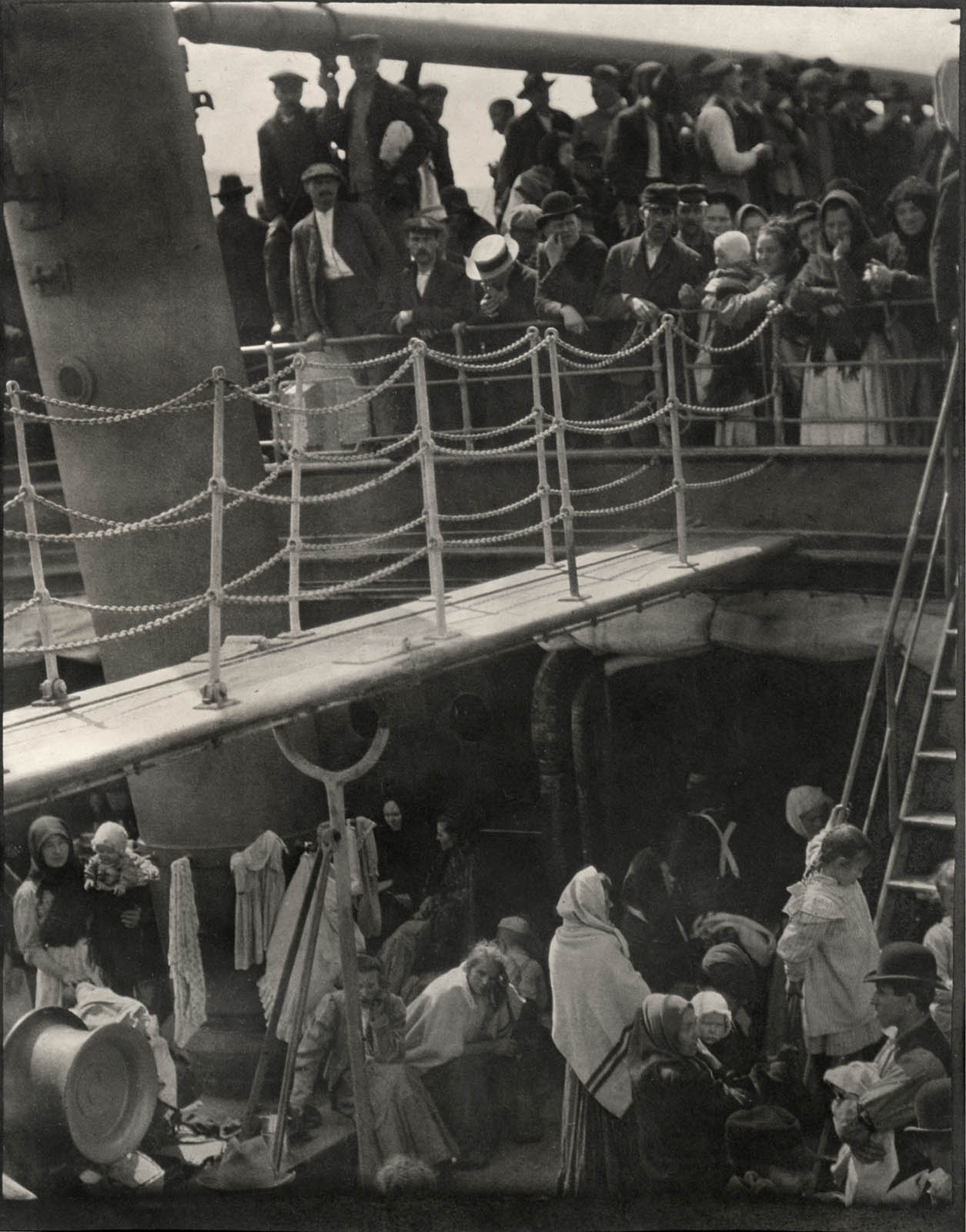
Stieglitz’s photograph The Steerage (1907, below) is one of the most iconic images in the history of photography. This powerful image captures the crowded lower deck of a transatlantic steamer, where people traveled in steerage class, the part of the ship with accommodations for those with the cheapest tickets. The Steerage is celebrated for its striking composition, which combines geometric shapes and human forms to create a dynamic and balanced visual narrative. Stieglitz considered this photograph one of his most outstanding achievements, as it encapsulated his transition to straight photography, which embraced photographs looking like photographs rather than the painterly qualities of Pictorialism. This photograph shows his ability to convey the complexity and depth of human experience through a single image. The photograph is a masterpiece of visual artistry and a compelling social document, reflecting the conditions and aspirations of early 20th century immigrants.

Adelaide Ryder. “The Photo-Secession Movement: Pioneering Artistry in Early Photography,” on the UMFA website Nd [Online] Cited 22/10/2024


Alfred Stieglitz (American, 1864-1946) 'The Steerage' 1907


Alfred Stieglitz (American, 1864-1946)
The Steerage
1907
Hand-pulled photogravure on paper


This photograph has become the iconic image of the Photo-Secession and has legendary status. In June 1907 he sailed to Europe to visit family and booked a first-class cabin. On a stroll around the ship, he encountered a bustling scene of labourers and their families traveling in steerage class, the part of the ship with accommodations for those with the cheapest tickets. With a single four-by-five-inch glass plate left in his camera, Stieglitz shot what would be regarded as a definitive masterpiece of both photography and Modernism.

About making this picture Stieglitz recalled: “There were men and women and children on the lower deck of the steerage. There was a narrow stairway leading to the upper deck of the steerage, a small deck right on the bow of the steamer. To the left was an inclining funnel and from the upper steerage deck there was fastened a gangway bridge that was glistening in its freshly painted state. It was rather long, white, and during the trip remained untouched by anyone. On the upper deck, looking over the railing, there was a young man with a straw hat. The shape of the hat was round. He was watching the men and women and children on the lower steerage deck. A round straw hat, the funnel leaning left, the stairway leaning right, the white drawbridge with its railing made of circular chains – white suspenders crossing on the back of a man in the steerage below, round shapes of iron machinery, a mast cutting into the sky, making a triangular shape. I saw shapes related to each other. I saw a picture of shapes and underlying that the feeling I had about life.”


Alfred Stieglitz (American, 1864-1946) 'The Hand of Man' 1902


Alfred Stieglitz (American, 1864-1946)
The Hand of Man
1902
Hand-pulled photogravure on paper

All from the Collection of Michael Mattis and Judith Hochberg


Works by Käsebier

Gertrude Käsebier: The Master of Portraiture

Gertrude Käsebier was known for her compelling portraits and allegorical imagery. Käsebier’s work transcended traditional portrait photography by infusing her images with a deep sense of intimacy and character. She believed that a photograph should reveal the inner essence of its subject, and her portraits are renowned for capturing the personality and spirit of the people she photographed.

Käsebier’s approach to portraiture was both innovative and empathetic. This image from the UMFA’s permanent collection is a perfect example of how she photographed women and children, presenting them with dignity and respect at a time when they were not the usual subjects of portraiture. Her work challenged conventional representations and highlighted her subjects’ emotional depth and individuality.

Adelaide Ryder. “The Photo-Secession Movement: Pioneering Artistry in Early Photography,” on the UMFA website Nd [Online] Cited 22/10/2024
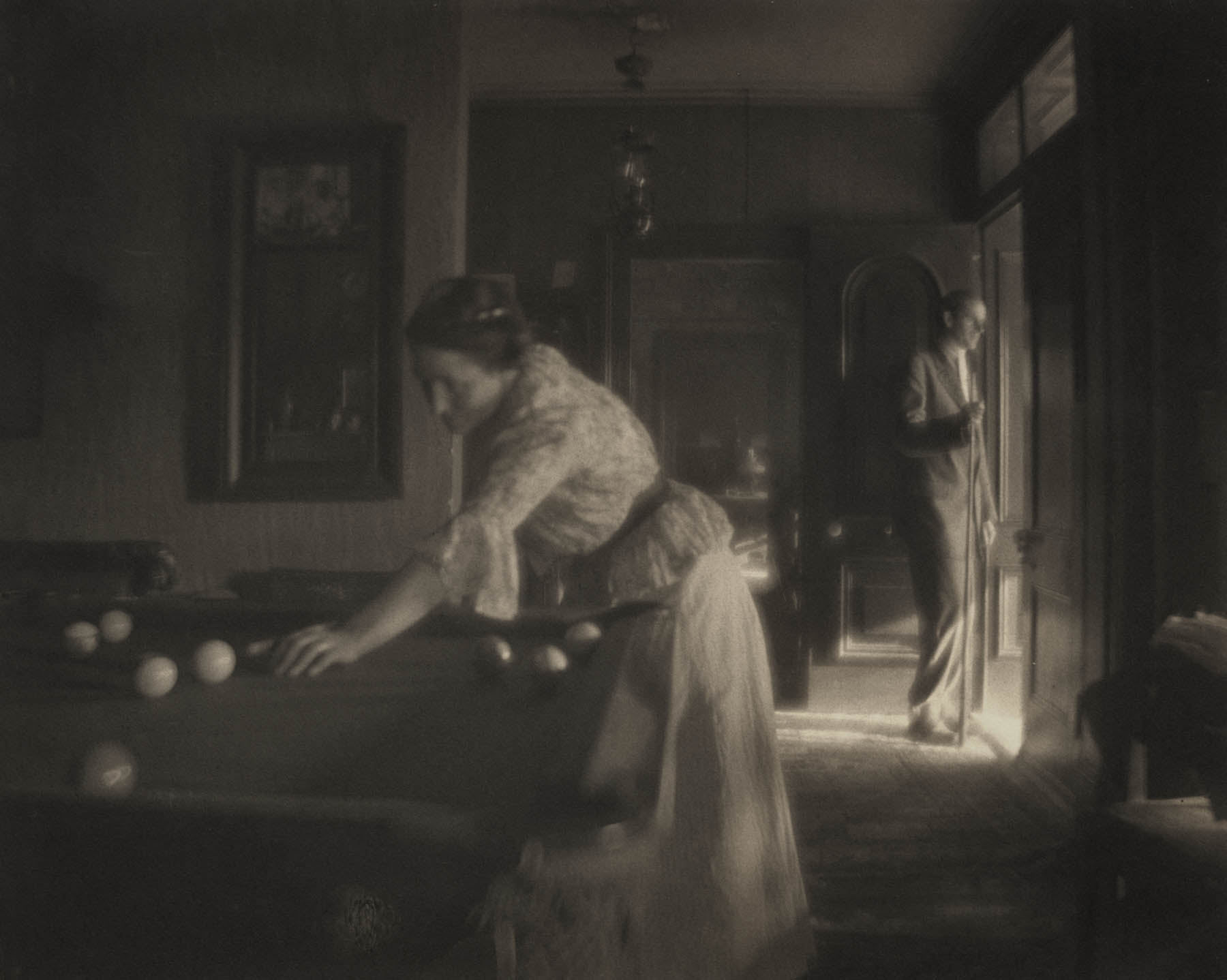
 

Gertrude Käsebier (American, 1852-1934) 'Untitled (Billiard Game)' c. 1909


Gertrude Käsebier (American, 1852-1934)
Untitled (Billiard Game)
c. 1909
Platinum print on paper
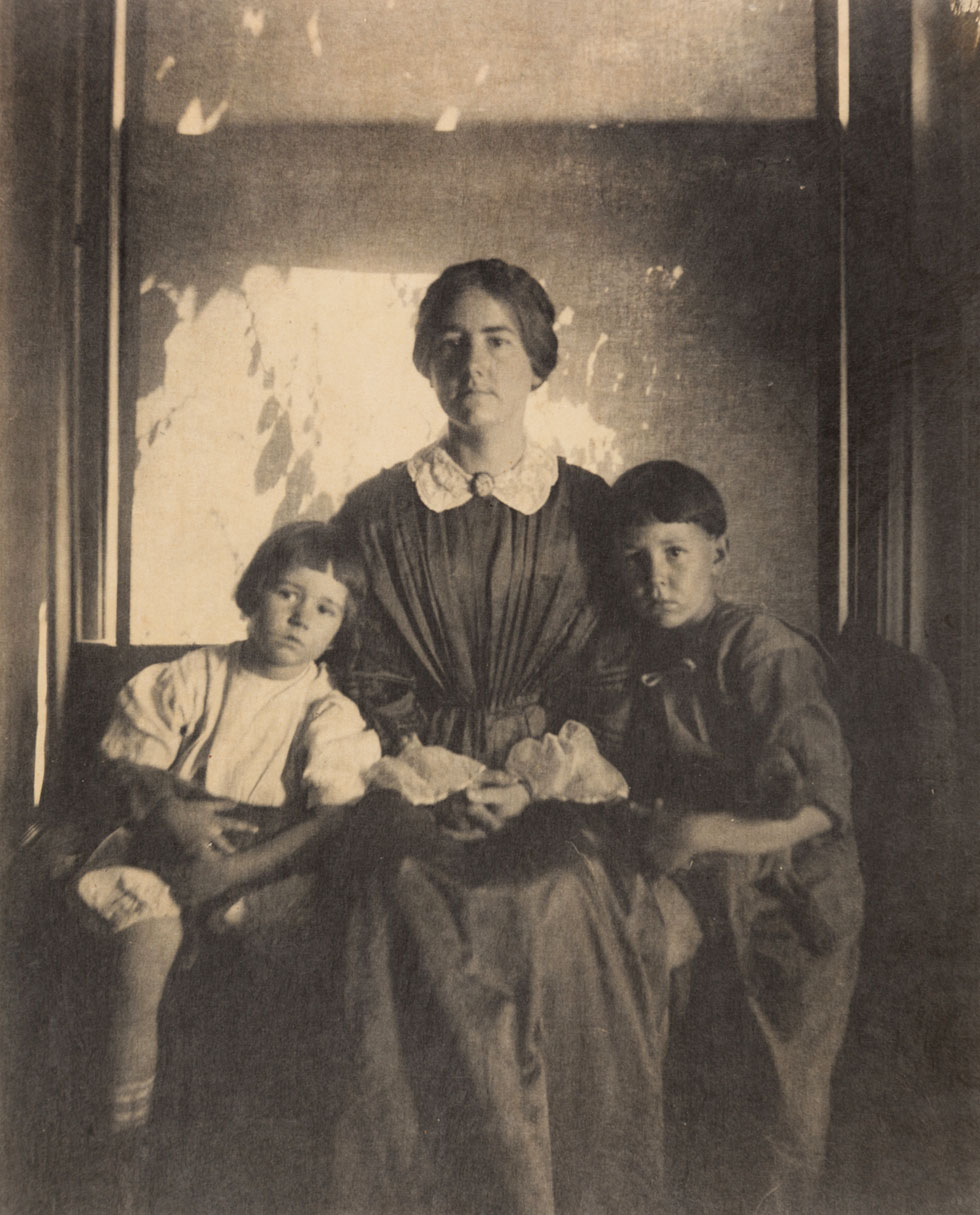
 

Gertrude Käsebier (American, 1852-1934) 'Mother and Two Children' 1899


Gertrude Käsebier (American, 1852-1934)
Mother and Two Children
1899
Platinum print on paper


Gertrude Käsebier (American, 1852-1934) 'Serbonne (A Day in France)' 1901


Gertrude Käsebier (American, 1852-1934)
Serbonne (A Day in France)
1901
Platinum print on paper


Both Pumpkin Pie, Voulangis and Serbonne (A Day in France) were set in France in 1901, when the artist was chaperoning art students. The young man in both scenes is Edward Steichen at age 22, whose interest in photography was then budding.

Serbonne is Käsebier’s chaste reference to Édouard Manet’s famous painting Le Déjeuner sur l’herbe (The Luncheon on the Grass) of 1863. An example of ultra-soft focus, this photo was reproduced in the inaugural issue of Camera Work, which was devoted to Käsebier.

Published in Camera Work, 1, 1903
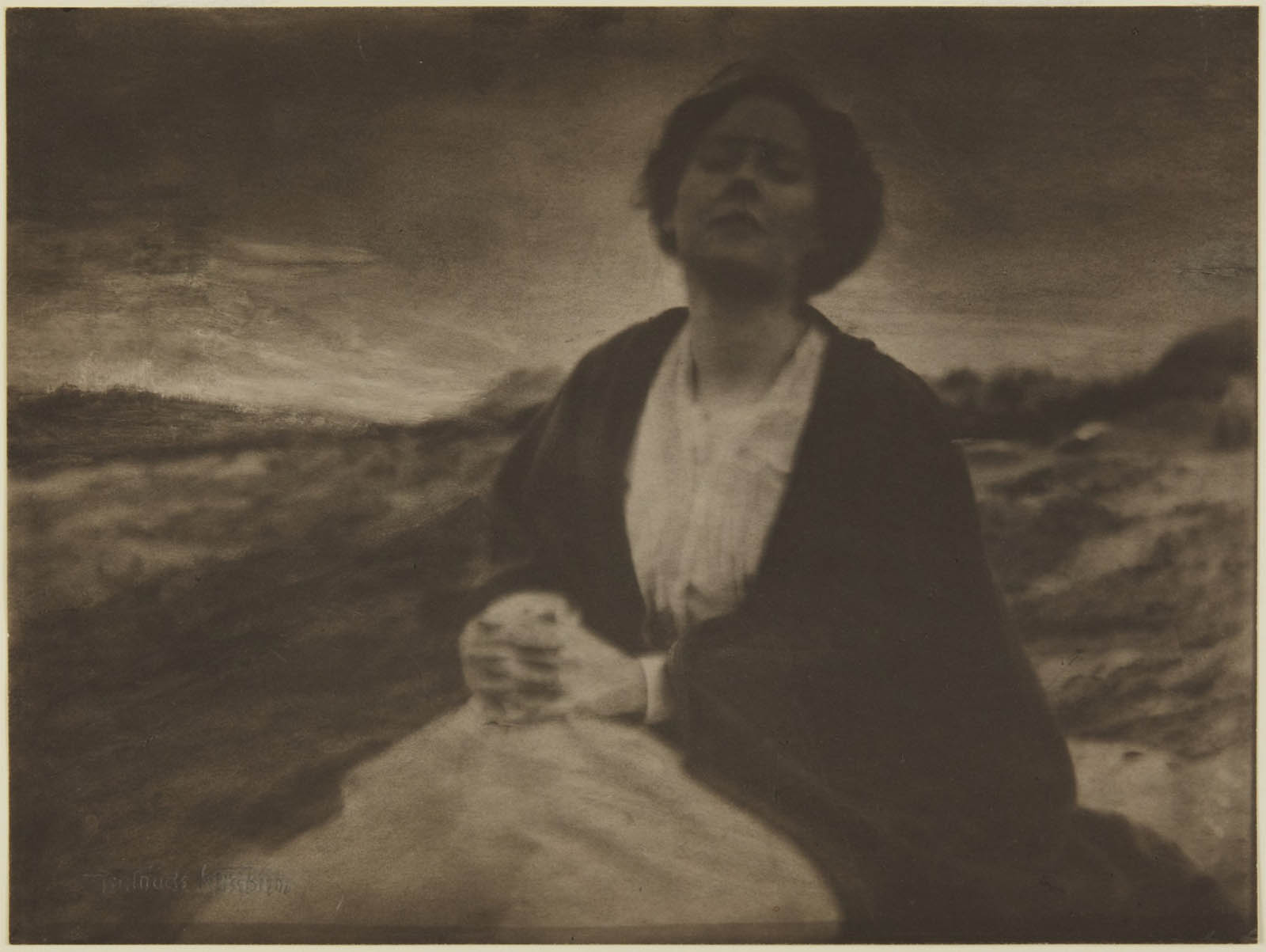
 

Gertrude Käsebier (American, 1852-1934) 'The Heritage of Motherhood' 1904


Gertrude Käsebier (American, 1852-1934)
The Heritage of Motherhood
1904
Gum-bichromate print on paper


This portrays the children’s book author Agnes Rand Lee in mourning after the sudden death of her daughter from illness. A contemporary photographer and critic deemed this image “one of the strongest things that Käsebier has ever done, and one of the saddest and most touching that I have ever seen.” Käsebier extensively manipulated the gum-bichromate process to make this print appear like a charcoal drawing.
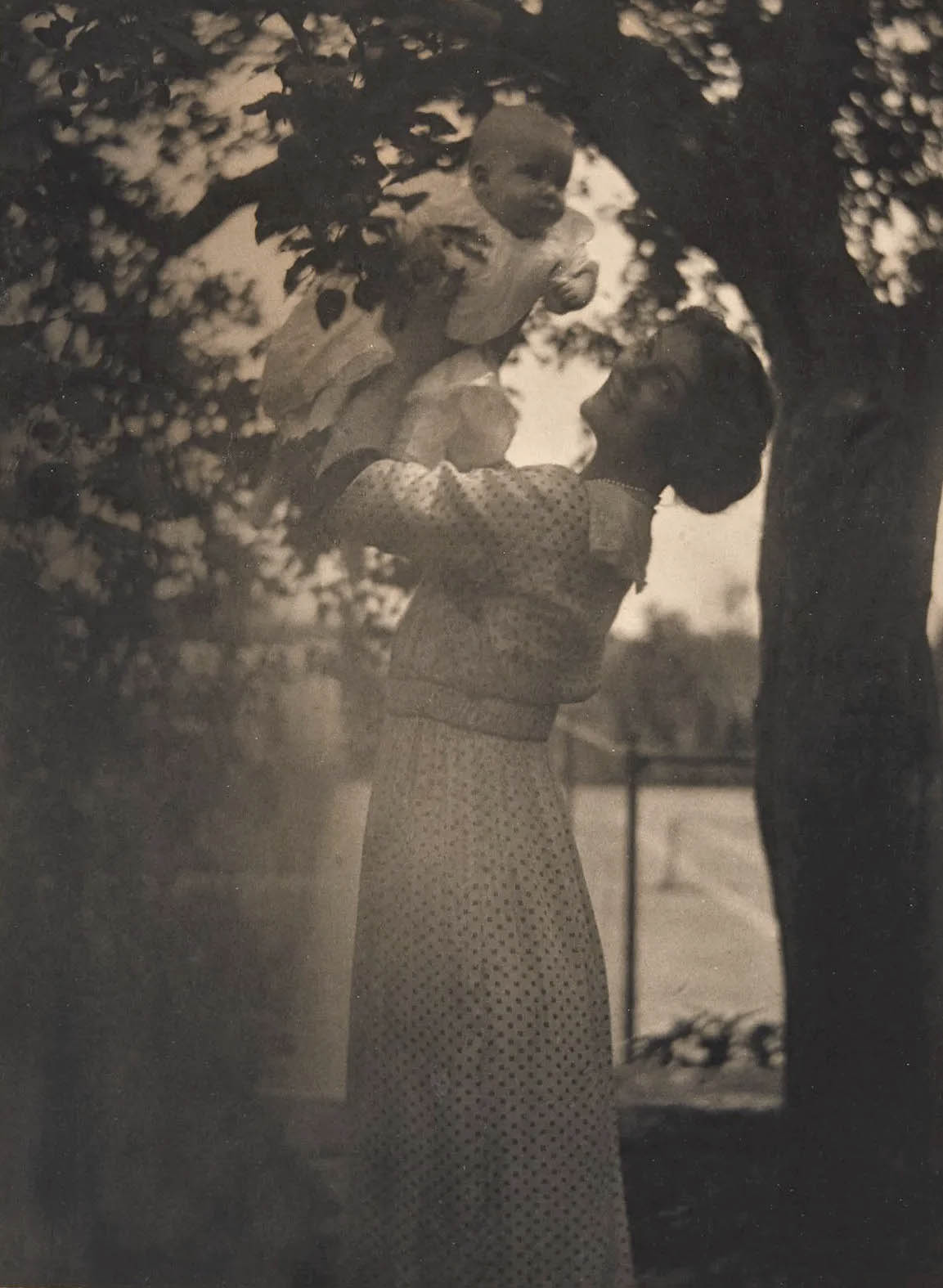
 

Gertrude Käsebier (American, 1852-1934) 'Mother and Child' c. 1900


Gertrude Käsebier (American, 1852-1934)
Mother and Child
c. 1900
Multiple gum-bichromate print on paper


The subject of mother and child was a frequent one for Pictorialists, especially Käsebier and Clarence White. The contrast between the tiny infant and the mighty tree gives this image additional symbolic meaning.


Gertrude Käsebier (American, 1852-1934) 'The Picture Book' 1903


Gertrude Käsebier (American, 1852-1934)
The Picture Book
1903
Platinum print on paper


Alfred Stieglitz had a print of this photograph in his personal collection, which he bequeathed to the Metropolitan Museum of Art in New York.

Published in Camera Work, 10, 1905

All from the Collection of Michael Mattis and Judith Hochberg


Works by Evans


Frederick Evans (British, 1853-1943) 'Aubrey Beardsley' 1893


Frederick H. Evans (British, 1853-1943)
Aubrey Beardsley
1893
Platinum print on paper


Evans, a member of the British art photography group the Linked Ring, was close friends with prominent authors and artists, such as George Bernard Shaw and Aubrey Beardsley. Portrayed here around age 20, Beardsley was a talented artist, designer, and illustrator, whose promising career was cut short by tuberculosis just five years after this photo was made.
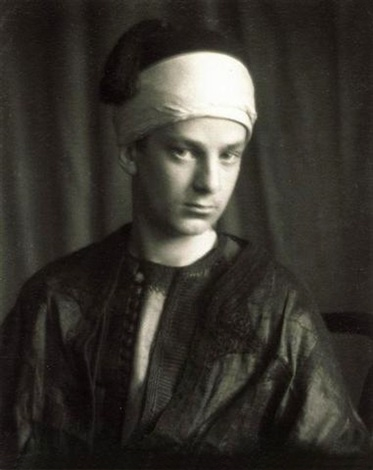
 

Frederick H. Evans (British, 1853-1943) 'Alvin Langdon Coburn in Eastern Clothing' 1901


Frederick H. Evans (British, 1853-1943)
Alvin Langdon Coburn in Eastern Clothing
1901
Platinum print on paper


Coburn was a precocious young American artist. An eighth birthday gift of a Kodak camera sparked his interest in photography. By age 16 Coburn had moved to London to work with his cousin the photographer F. Holland Day, whose portrait by Gertrude Käsebier is in this exhibition. After being included in a landmark exhibition at the Royal Photographic Society, Coburn returned to New York and apprenticed with Käsebier. By the tender age of 20, he became a founding member of the Photo-Secession and launched an international career dividing his time between New York, London, and Paris.

All from the Collection of Michael Mattis and Judith Hochberg


Works by Dow


Arthur Wesley Dow (American, 1857-1922) 'Silhouetted Trees' c. 1910


Arthur Wesley Dow (American, 1857-1922)
Silhouetted Trees
c. 1910
Cyanotype print on paper


A painter, printmaker, and photographer, Dow is mainly remembered today as a pioneering educator who taught in New York at the Pratt Institute, Art Students League, and Teacher’s College of Columbia University. Among Dow’s students were Gertrude Käsebier, Alvin Langdon Coburn, Charles Sheeler, and Georgia O’Keeffe. Dow also hired Clarence White to teach photography at Columbia, thereby launching White’s important teaching career.

From the Collection of Michael Mattis and Judith Hochberg


Works by Haviland
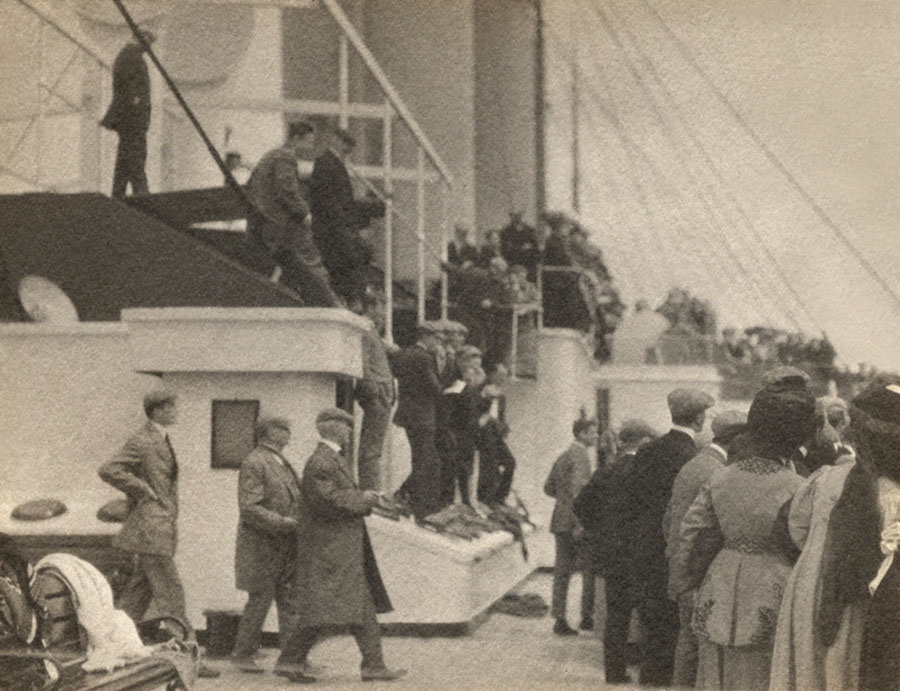
 

Paul Burty Haviland (American, 1880-1950) 'Ship Deck' 1910


Paul Burty Haviland (American, 1880-1950)
Ship Deck
1910
Platinum print on paper


Haviland was an amateur photographer from a young age and grew up immersed in the arts. His grandfather was an early photography critic in Paris, and his father owned Haviland porcelain factory in Limoges, France. As the New York representative of the family business, Haviland happened to meet Alfred Stieglitz in 1908. Just two years later he became associate editor of Camera Work and helped financially support Stieglitz’s gallery 291.

All from the Collection of Michael Mattis and Judith Hochberg


Works by Struss
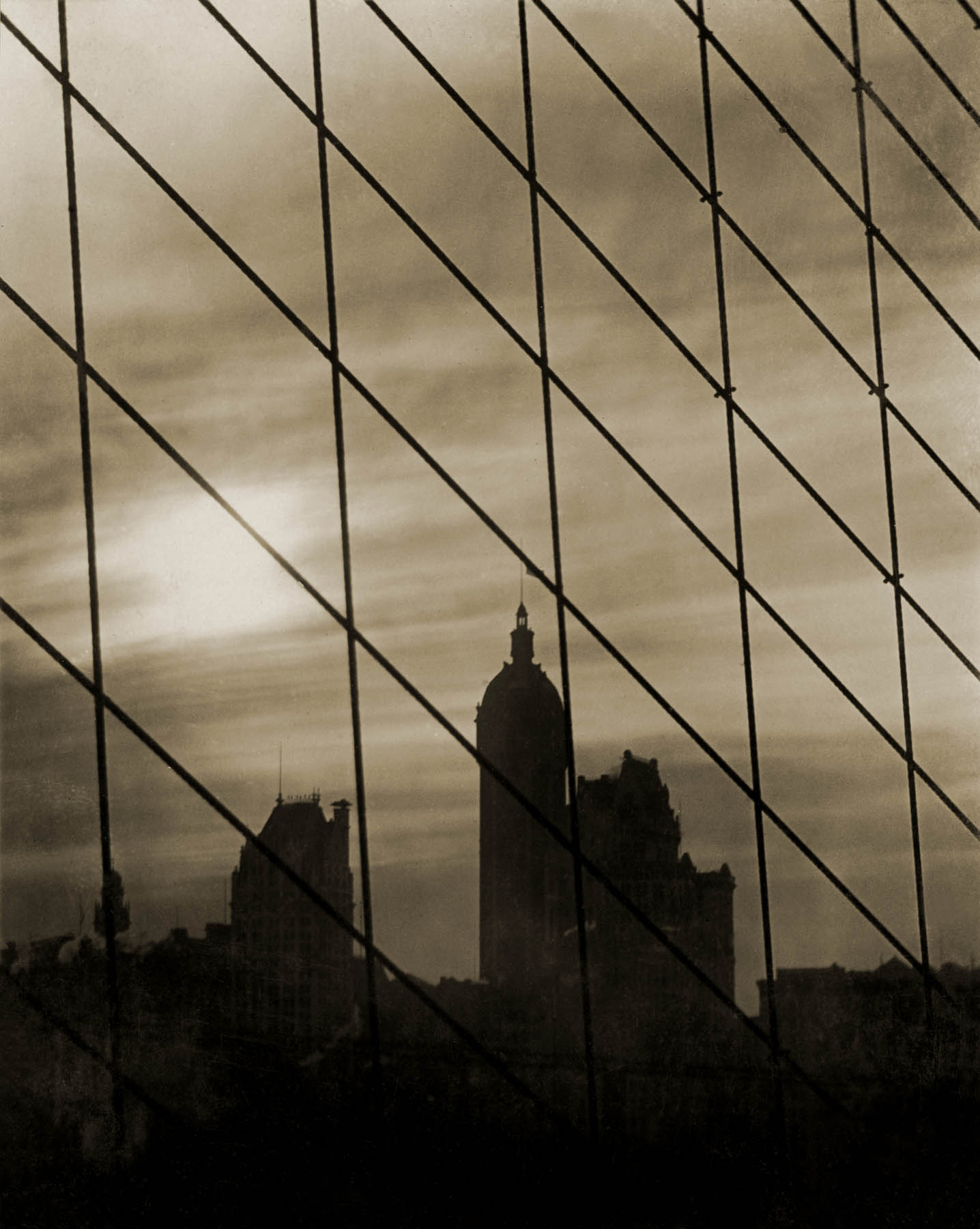
 

Karl Struss (American, 1886-1981) 'Cables' 1912


Karl Struss (American, 1886-1981)
Cables
1912
Gelatin silver print on paper


Struss was a star pupil of Clarence White and became a favourite of Alfred Stieglitz and the youngest member of the Photo-Secession. He is best known for his compelling cityscapes of New York, including the view of the Singer Building through the cables of the Brooklyn Bridge and the dramatic Flatiron Building, Twilight.


Karl Struss (American, 1886-1981) 'Flatiron Building, Twilight' c. 1915


Karl Struss (American, 1886-1981)
Flatiron Building, Twilight
c. 1915
Gelatin silver print on paper


Struss eventually broke away from Stieglitz and cofounded the society of the Pictorial Photographers of America along with Clarence White and Gertrude Käsebier in 1916. He … accepted a job as a cameraman for filmmaker Cecil B. DeMille. Struss would become one of the most prolific Hollywood cinematographers with 150 films, an Academy Award, and three Academy nominations to his credit.

All from the Collection of Michael Mattis and Judith Hochberg


Nudes by Stieglitz and White


Clarence Hudson White (American, 1871-1925) 'Reflected Nude' 1909


Clarence Hudson White (American, 1871-1925)
Reflected Nude
1909
Platinum print on paper
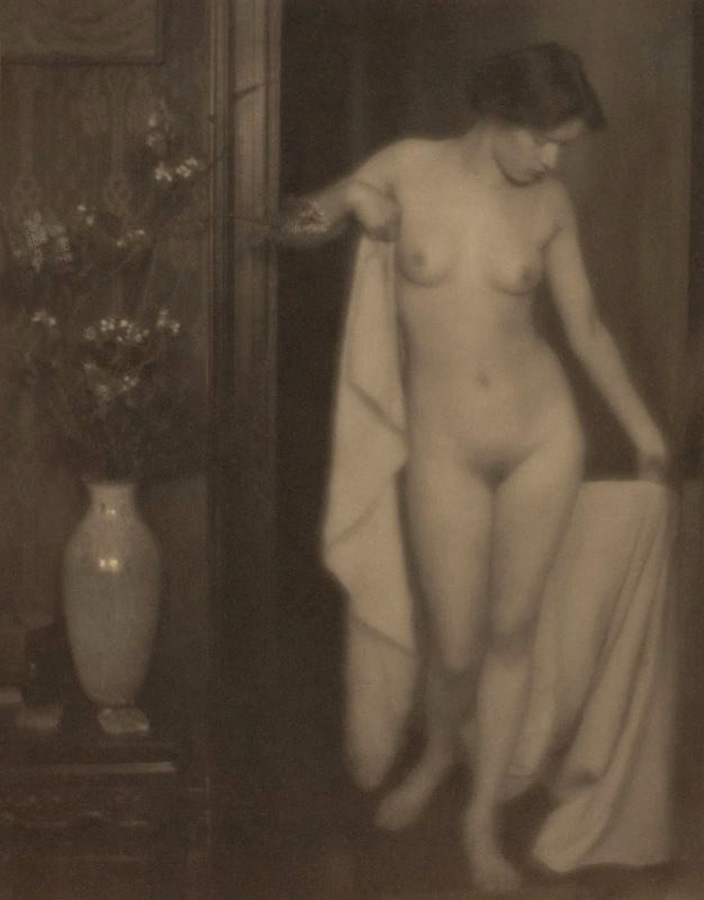
 

Alfred Stieglitz (American, 1864-1946) and Clarence Hudson White (American, 1871-1925) 'Nude Posed in Doorway (Miss Thompson)' 1907


Alfred Stieglitz (American, 1864-1946) and Clarence Hudson White (American, 1871-1925)
Nude Posed in Doorway (Miss Thompson)
1907
Platinum print on paper


Alfred Stieglitz (American, 1864-1946) and Clarence Hudson White (American, 1871-1925) 'The Torso' 1907


Alfred Stieglitz (American, 1864-1946) and Clarence Hudson White (American, 1871-1925)
The Torso
1907
Palladium print on paper


This is likely the most widely reproduced nude by Photo-Secession artists.

After their personal and professional rupture, Stieglitz wrote White a letter that specifically referred to their collaboration in 1907. Stieglitz insisted “that my name be not mentioned by you in connection with either the prints or the negatives” and further instructed White to erase his name from any prints they had jointly signed. Despite this vitriol, Stieglitz retained in his personal collection two prints of The Torso, one of them jointly signed in pencil.

Published in Camera Work, 27, 1909

All from the Collection of Michael Mattis and Judith Hochberg


Images of O’Keeffe by Stieglitz
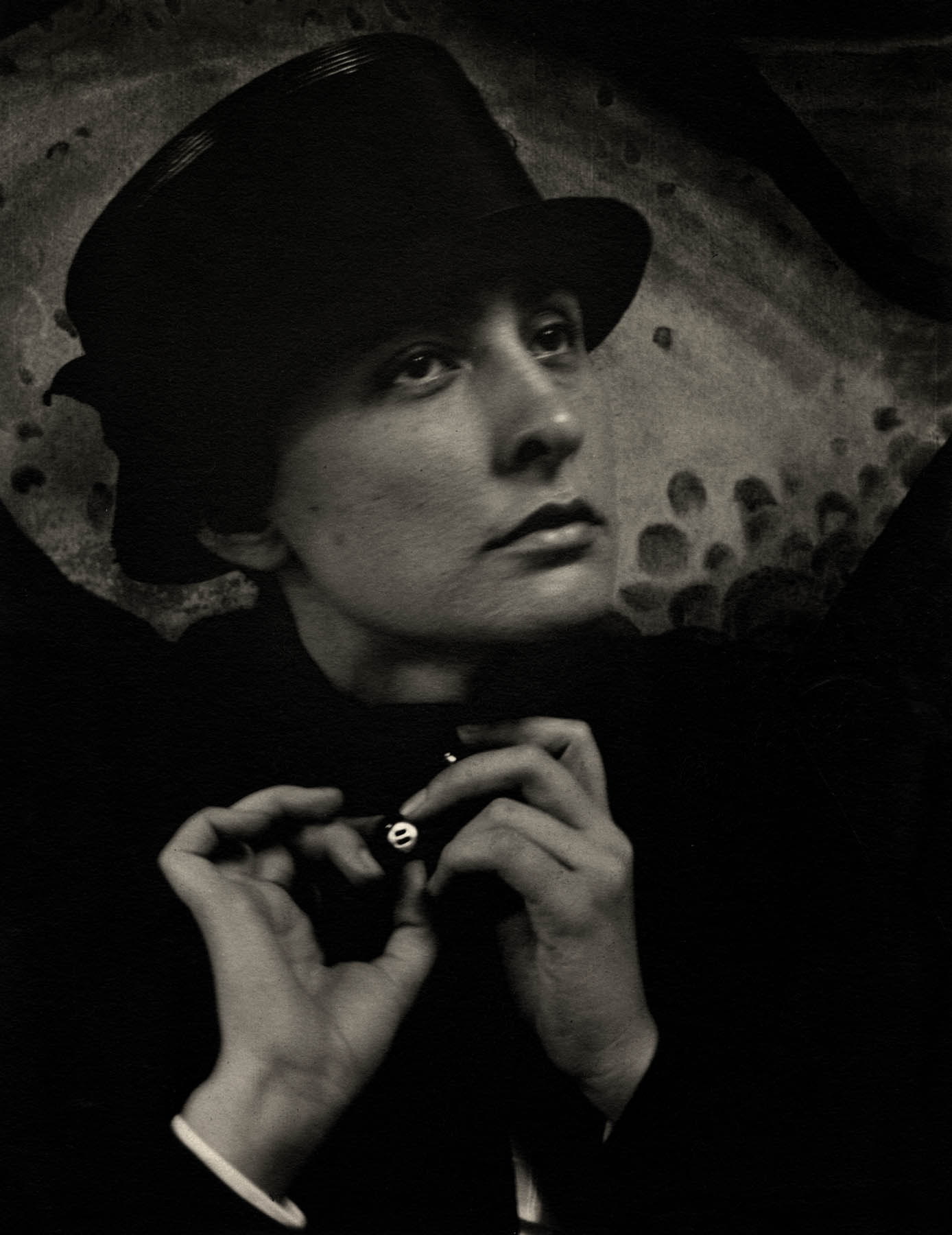
 

Alfred Stieglitz (American, 1864-1946) 'Georgia O'Keeffe' 1918


Alfred Stieglitz (American, 1864-1946)
Georgia O’Keeffe
1918
Palladium print on paper
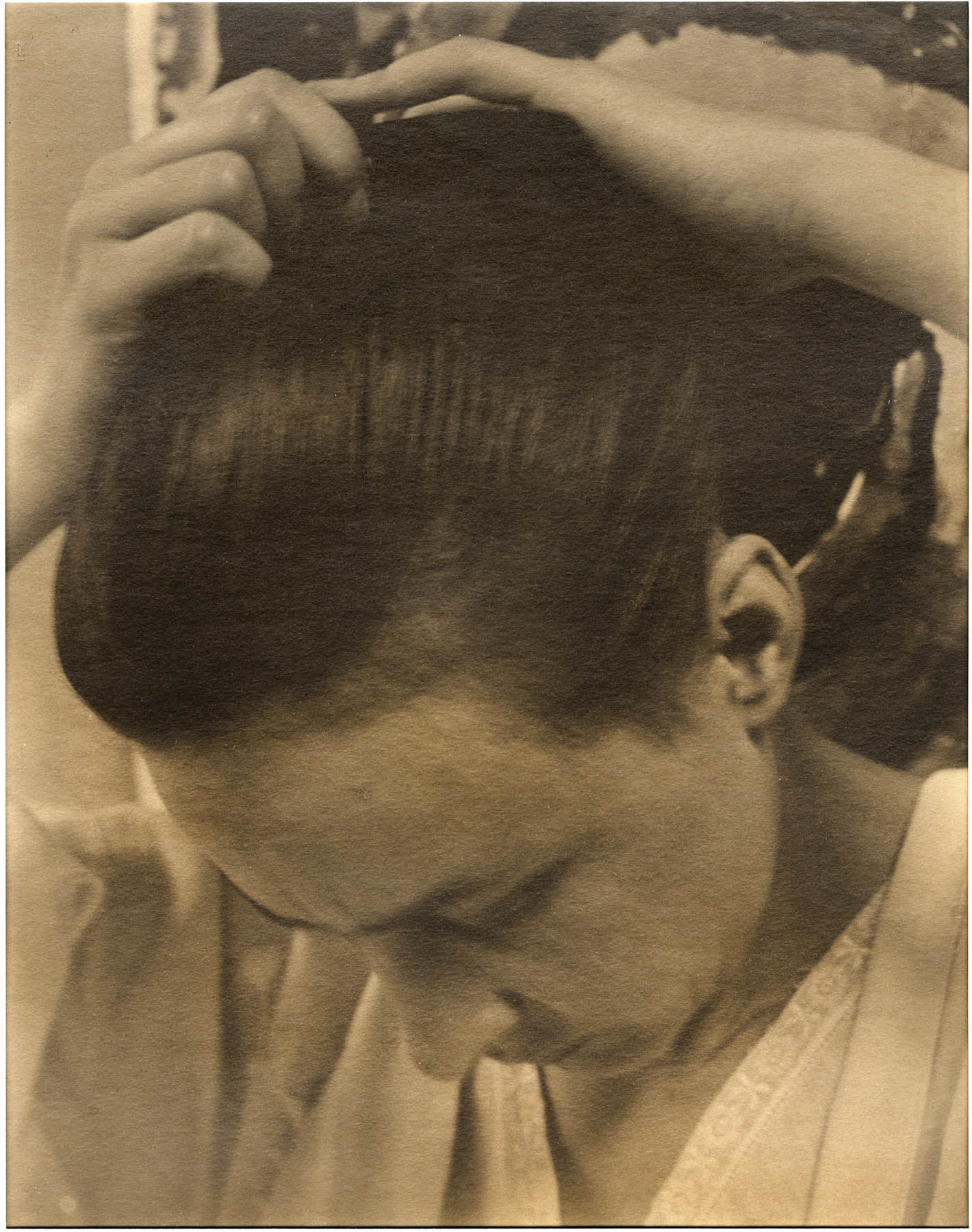
 

Alfred Stieglitz (American, 1864-1946) 'Georgia O'Keeffe (Fixing Hair)' 1919-1921


Alfred Stieglitz (American, 1864-1946)
Georgia O’Keeffe (Fixing Hair)
1919-1921
Palladium print on paper


Over two decades, Stieglitz made over 300 photos of O’Keeffe, producing an extraordinary and candid portrait of the artist. She recalled, “I was photographed with a kind of heat and excitement and in a way wondered what it was all about.” The directness and intimacy of this series of photos differ from the idealised nudes that Stieglitz and White made together during the heyday of the Photo-Secession.

All from the Collection of Michael Mattis and Judith Hochberg


Works by White

Clarence Hudson White: The Romantic

Clarence Hudson White was celebrated for his romanticised and intimate approach to photography. His 1904 image The Kiss perfectly illustrates his unique style. This platinum print on paper captures a tender moment with a soft focus and gentle lighting. The Kiss portrays an intimate scene imbued with a sense of emotional depth. White’s use of the platinum printing process, which provides a broad tonal range and exquisite detail, enhances the image’s delicate and dreamlike quality. His work reflects the movement’s early emphasis on creating photographs that evoke the emotional and aesthetic qualities of fine art while also paving the way for future explorations in photographic expression.

Adelaide Ryder. “The Photo-Secession Movement: Pioneering Artistry in Early Photography,” on the UMFA website Nd [Online] Cited 22/10/2024


Clarence H. White (American, 1871-1925) 'The Bubble' 1898, printed 1905


Clarence Hudson White (American, 1871-1925)
The Bubble
1898
Platinum print on paper


This image was exhibited at the 1898 Philadelphia Photographic Salon to great acclaim. Fellow photographer and critic Joseph Keiley commented, “Like most of Mr. White’s pictures, it is a well nigh perfect piece of composition whose subject with subtle poetry stimulates and leaves much to the imagination.”


Clarence Hudson White (American, 1871-1925) 'The Mirror' 1912


Clarence Hudson White (American, 1871-1925)
The Mirror
1912
Platinum print on paper
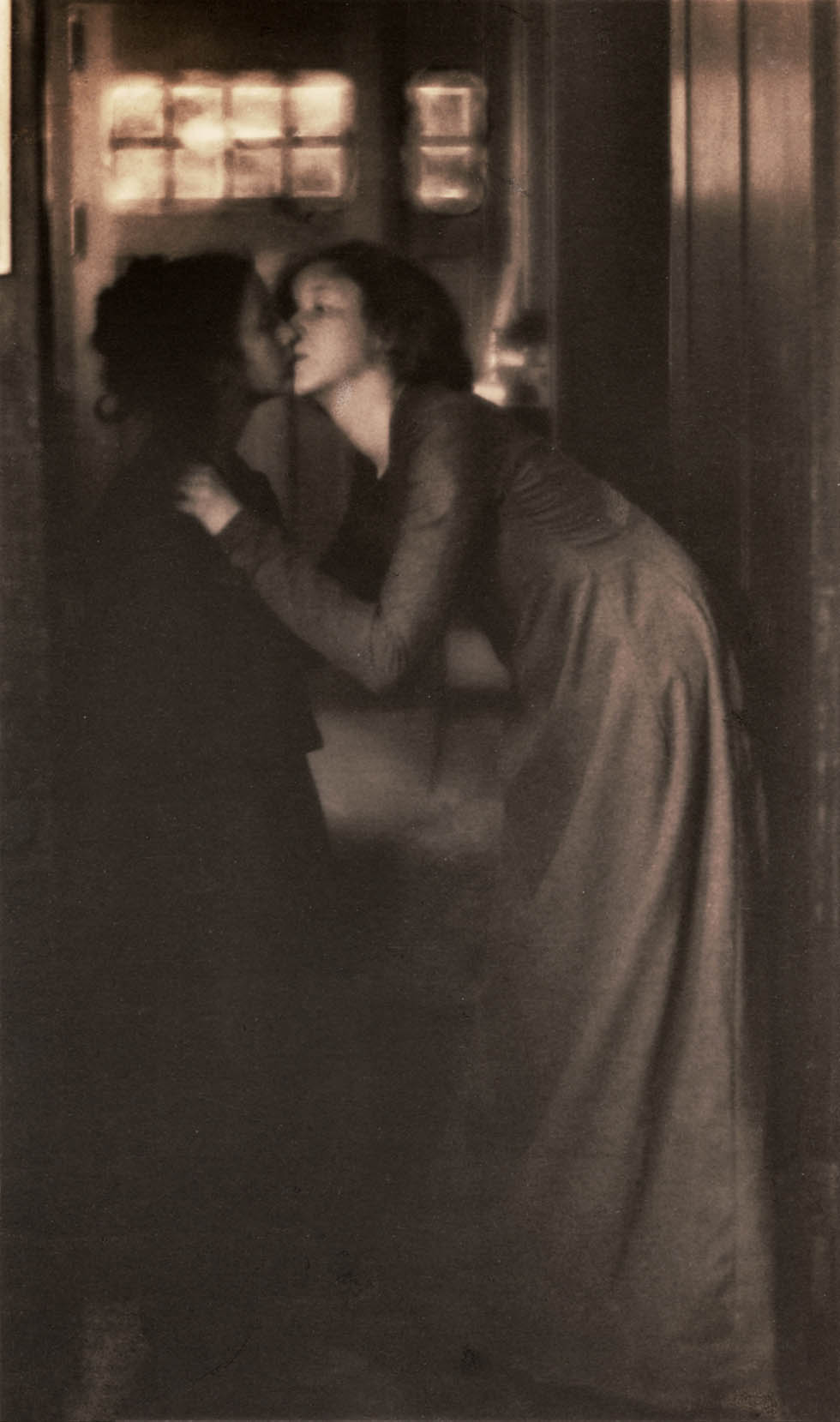
 

Clarence Hudson White (American, 1871-1925) 'The Kiss' 1904


Clarence Hudson White (American, 1871-1925)
The Kiss
1904
Platinum print on paper


This is one of White’s best known photographs. Despite his separation from White, Stieglitz kept prints of both The Kiss and The Bubble in his personal collection throughout his life.

All from the Collection of Michael Mattis and Judith Hochberg


Works by followers of White

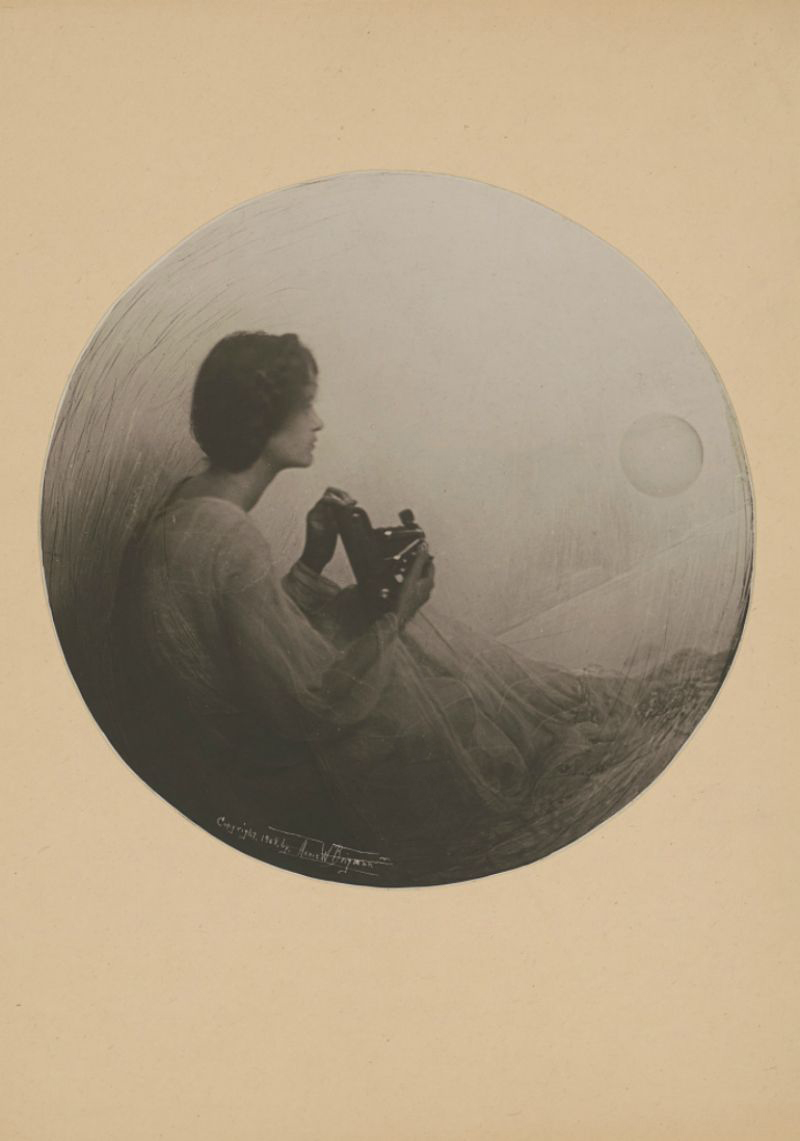
Anne Brigman: The Feminine Mystic of Photo-Secession

Anne Brigman was known for her evocative and mystical imagery. She often placed herself within her compositions, challenging traditional gender roles and expectations. Her connection to the Photo-Secession movement was cemented through her association with Alfred Stieglitz, who published her work in Camera Work and admired her innovative spirit.

Brigman’s 1911 photograph The Pine Sprite exemplifies her distinctive style. The image features a nude female figure intertwined with the natural landscape, blending the human form seamlessly with the rugged environment. This work reflects Brigman’s themes of femininity, nature, and freedom, aligning with the Photo-Secessionist emphasis on personal expression and artistic experimentation. Brigman’s contributions highlighted the movement’s inclusive spirit, showcasing how female photographers could assert their voices and artistic visions in a male-dominated field.

Adelaide Ryder. “The Photo-Secession Movement: Pioneering Artistry in Early Photography,” on the UMFA website Nd [Online] Cited 22/10/2024
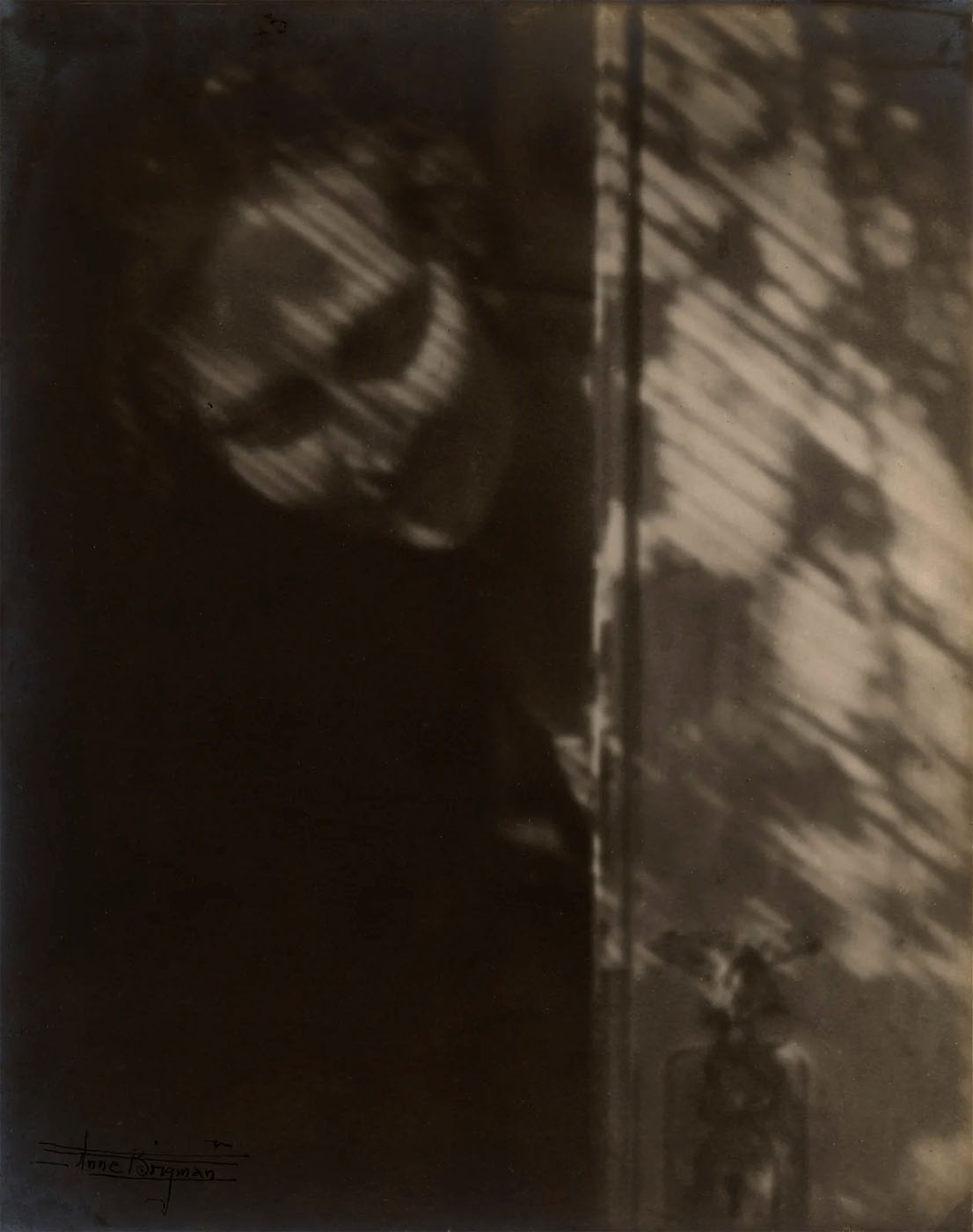
 

Anne Brigman (American, 1869-1950) 'The Shadow on My Door (Self Portrait)' 1921


Anne Brigman (American, 1869-1950)
The Shadow on My Door (Self Portrait)
1921
Gelatin silver print on paper
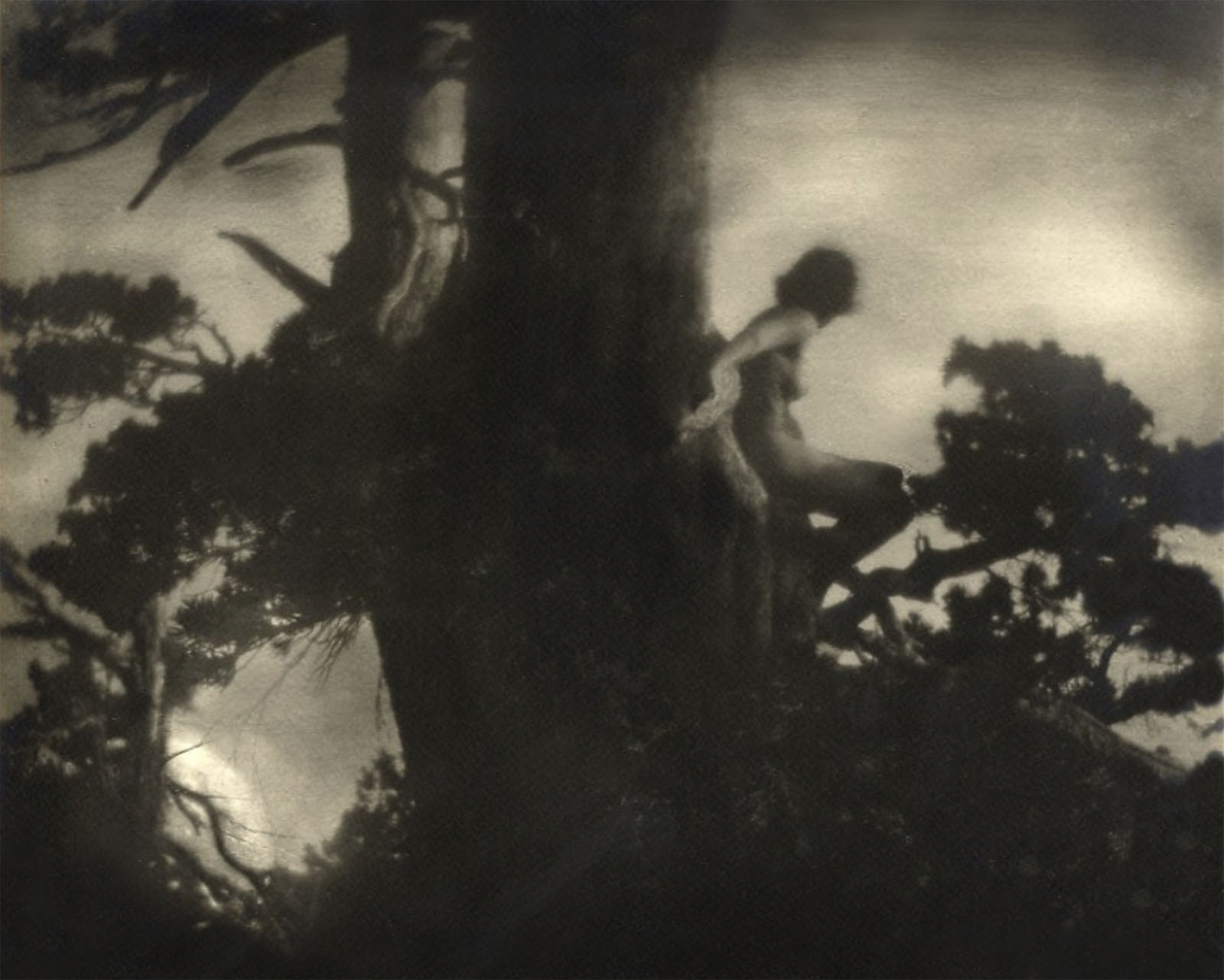
 

Anne Brigman (American, 1869-1950) 'The Pine Sprite' 1911 from the exhibition 'Photo-Secession: Painterly Masterworks of Turn-of-the-Century Photography' at the Utah Museum of Fine Arts, Salt Lake City, August - December 2024


Anne Brigman (American, 1869-1950)
The Pine Sprite
1911
Gelatin silver print on paper


Brigman was for a long time the only Californian member of the Photo-Secession. She was a free spirit and pagan whose woodsy nudes inspired by fantasy and folklore were frequently reproduced in Camera Work.


Laura Gilpin (American, 1891-1979) 'Ghost Rock, Garden of the Gods, Colorado' 1919


Laura Gilpin (American, 1891-1979)
Ghost Rock, Garden of the Gods, Colorado
1919
Palladium print on paper


An amateur photographer from Colorado Springs, Gilpin moved to New York to study with Clarence White in 1916. This photograph was one of Gilpin’s first successes after returning home in 1919, the beginning of her decades-long career as one of the most notable photographers of the West and Southwest.

All from the Collection of Michael Mattis and Judith Hochberg


In 1916 Gilpin enrolled at the Clarence H. White School of Photography in New York. Two years later, she returned to her native Colorado Springs and became one of the few women to pursue landscape photography.

This is her depiction of the Garden of the Gods, a scenic rock formation in Colorado Springs. It captures the stillness and otherworldly quality of the area. The photograph also reflects an emphasis on the evocation of mood rather than on descriptive detail.

Text from the National Gallery of Art Facebook page


Edward Steichen

Edward J. Steichen: The Innovator

Edward J. Steichen, a close associate of Stieglitz, brought a unique perspective to the Photo-Secession movement. Steichen was not only a photographer but also a painter, which influenced his photographic style. He experimented with various techniques, including soft focus and manipulation of light, to create both ethereal and visually striking images.

An avid gardener, Steichen propagated and grew a bountiful garden at his French country house. This image of a calla lily is rendered with exquisite detail and tonal richness. Steichen’s botanical images showcase his ability to find harmony between nature and art. His meticulous composition and sensitivity to light transform a simple flower into a work of art, reflecting his painterly approach to photography. His botanical works contributed to the Photo-Secession movement by highlighting the artistic potential of natural forms.

Adelaide Ryder. “The Photo-Secession Movement: Pioneering Artistry in Early Photography,” on the UMFA website Nd [Online] Cited 22/10/2024
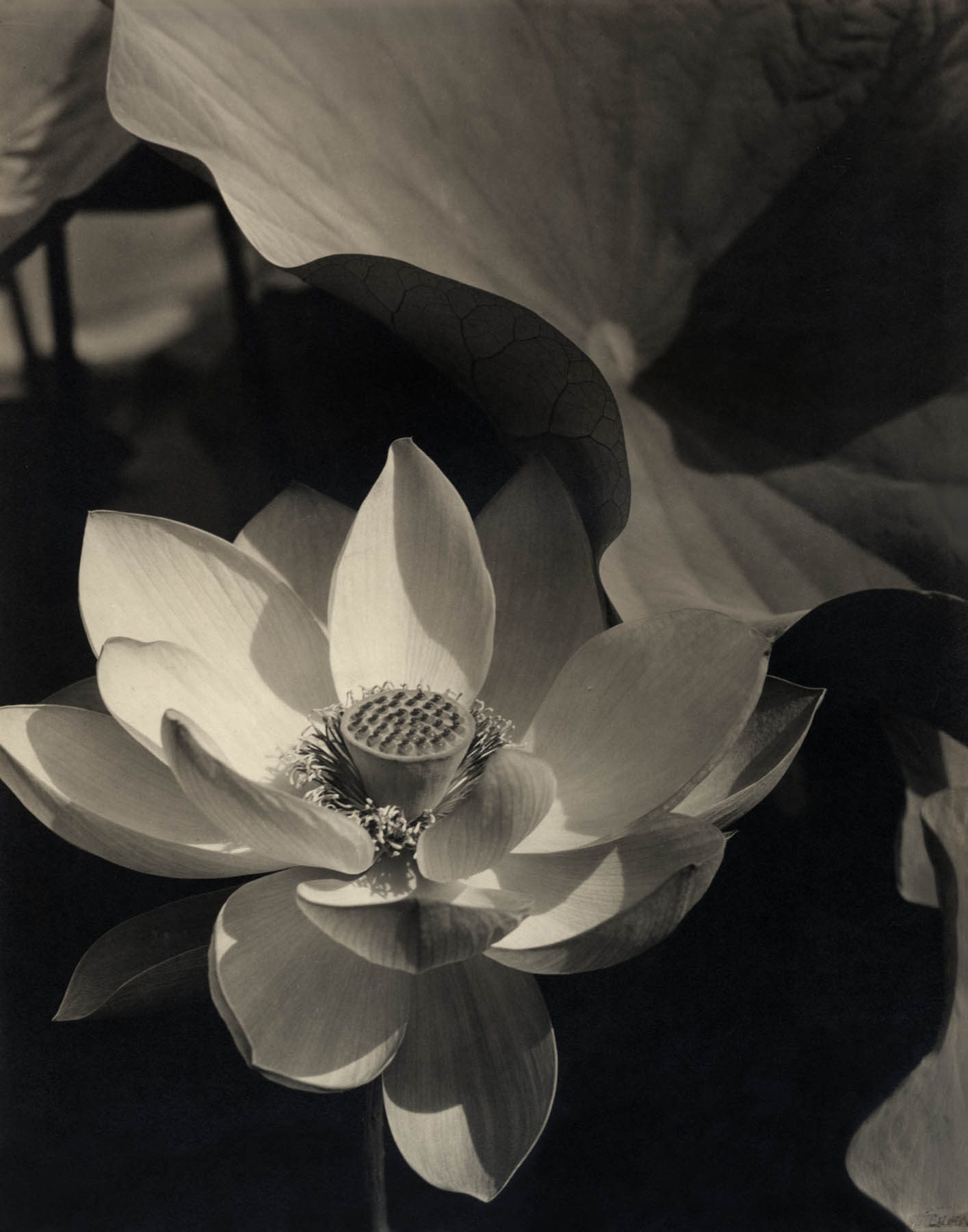
 

Edward Steichen (American born Luxembourg, 1879-1973) 'Lotus, Mount Kisco' 1915 from the exhibition 'Photo-Secession: Painterly Masterworks of Turn-of-the-Century Photography' at the Utah Museum of Fine Arts, Salt Lake City, August - December 2024


Edward Steichen (American born Luxembourg, 1879-1973)
Lotus, Mount Kisco
1915
Gelatin silver print on paper


Edward Steichen (American born Luxembourg, 1879-1973) 'Calla Lily' c. 1921


Edward Steichen (American born Luxembourg, 1879-1973)
Calla Lily
c. 1921
Platinum print on paper


Steichen had previously photographed flowers in compositions that placed delicate floral arrangements next to women figured as ideals of feminine beauty. In contrast, here he presents the lotus and calla lily in sharp focus and as singular subjects without overt metaphorical meaning.


Edward Steichen (American born Luxembourg, 1879-1973) 'Three Pears and an Apple' 1921


Edward Steichen (American born Luxembourg, 1879-1973)
Three Pears and an Apple
1921
Gelatin silver print on paper


On making this picture Steichen wrote: “I was particularly interested in a method of representing volume, scale, and a sense of weight. In my small greenhouse I constructed a tent of opaque blankets. From a tiny opening, I directed light against one side of the covering blanket, and this light, reflected from the blanket, was all. I made a series of exposures that lasted more than two days and one night. As the nights were cool, everything, including the camera, contracted and the next day expanded. Instead of producing one meticulously sharp picture, the infinitesimal movement produced a succession of slightly different sharp images, which optically fused as one. Here for the first time in a photograph, I was able to sense volume as well as form.”


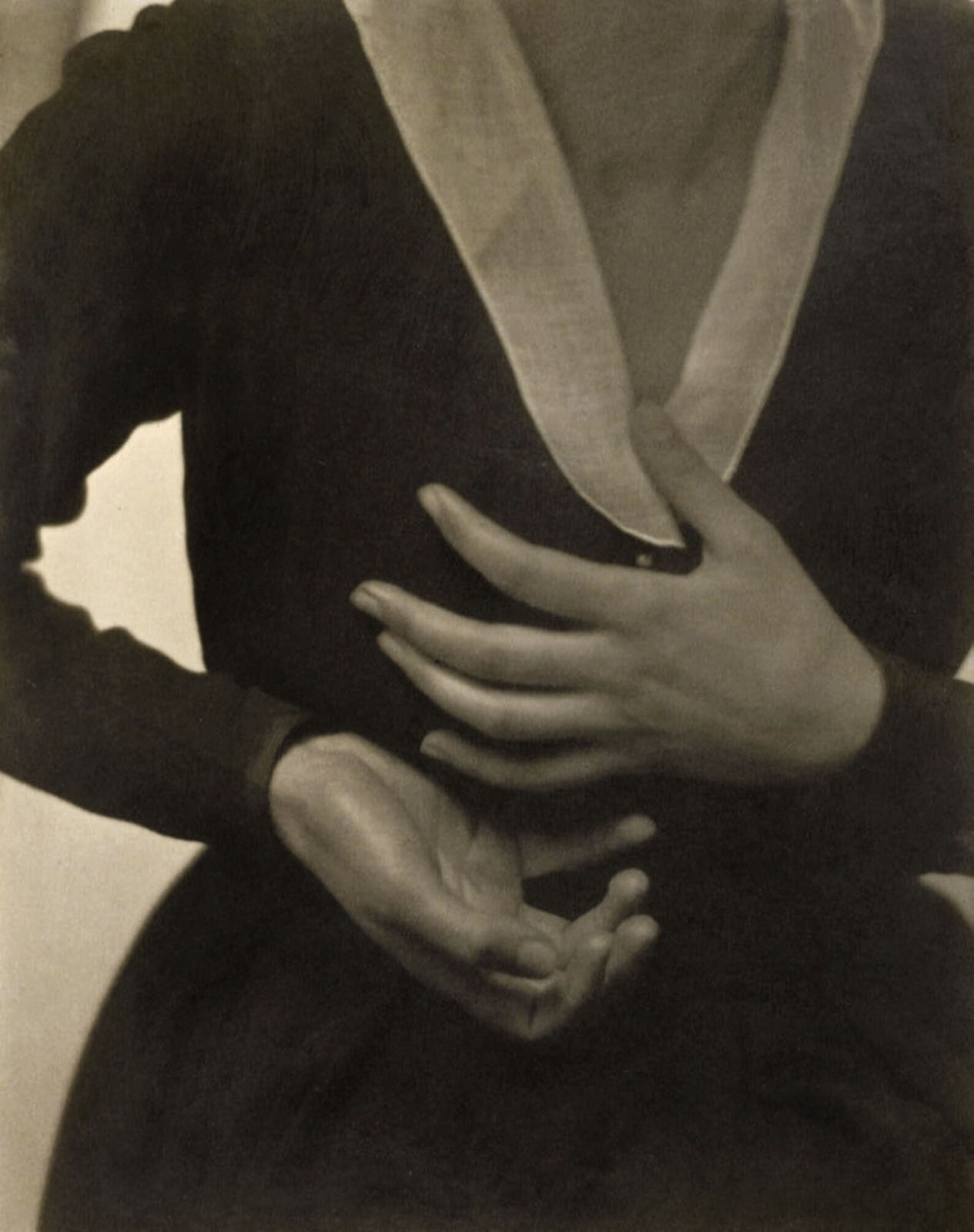
Edward Steichen (American born Luxembourg, 1879-1973) 'Blossom of White Fingers' c. 1923


Edward Steichen (American born Luxembourg, 1879-1973)
Blossom of White Fingers
c. 1923
Gold-toned gelatin silver print on paper


This study of the graceful hands of Steichen’s wife with ultra-soft focus and high-key lighting and printed on gold-toned gelatin paper is one of the rare instances of Steichen using Pictorialist methods after the end of the Photo-Secession.
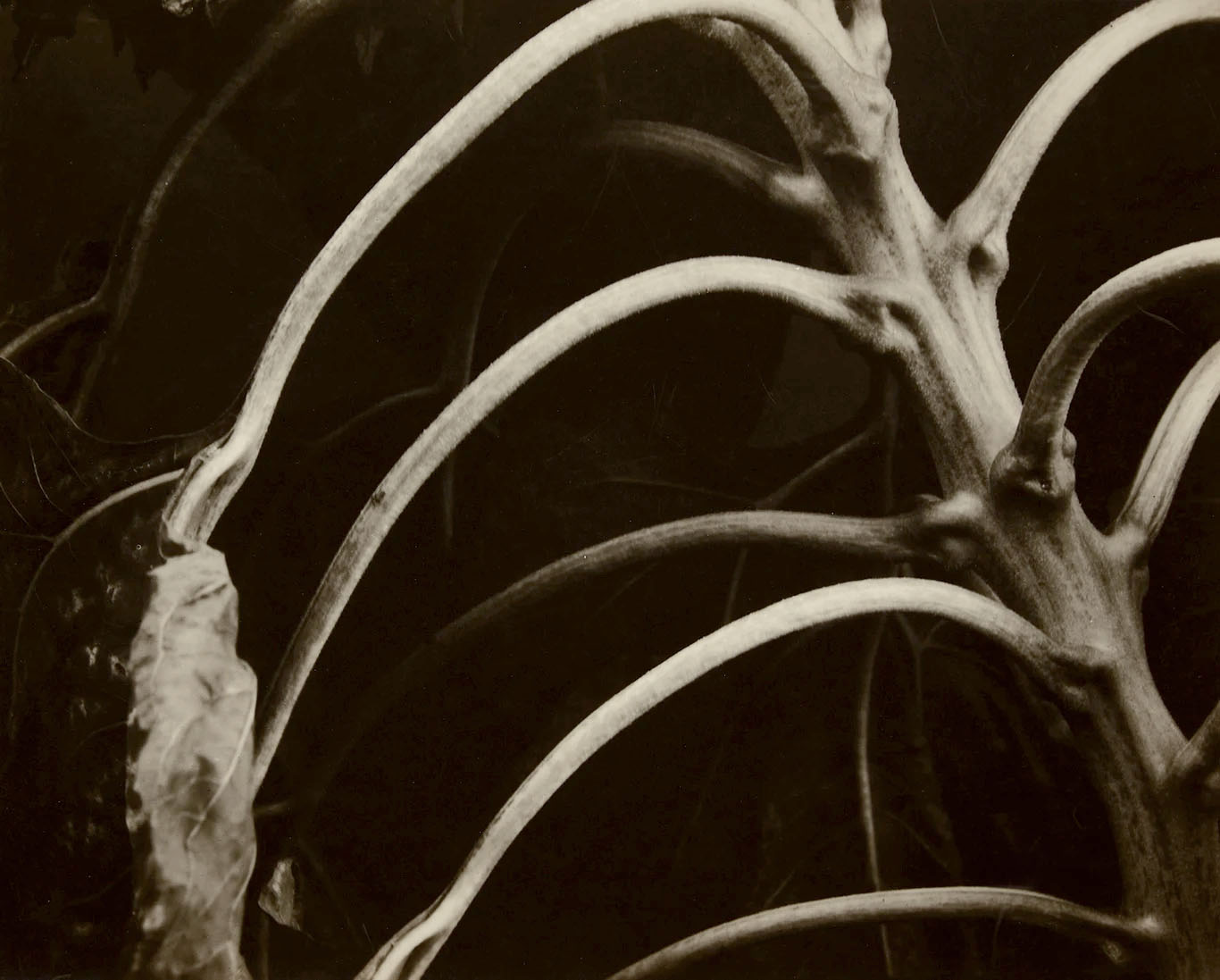
 

Edward Steichen (American born Luxembourg, 1879-1973) 'Backbone and Ribs of a Sunflower' c. 1920


Edward Steichen (American born Luxembourg, 1879-1973)
Backbone and Ribs of a Sunflower
c. 1920
Gelatin silver print on paper


Steichen was a knowledgeable botanist and spent five decades photographing the life cycle of sunflowers. This is one of his earliest studies of the plant. He became fascinated with spirals in nature, writing, “I found some form of the spiral in most succulent plants and in certain flowers, particularly in the seed pods of the sunflower.”


Edward Steichen (American born Luxembourg, 1879-1973) 'Advertising Study for Coty Lipstick' 1929


Edward Steichen (American born Luxembourg, 1879-1973)
Advertising Study for Coty Lipstick
1929
Gelatin silver print on paper


Steichen is credited as a founding figure of modern advertising and fashion photography. From 1923 to 1938, he served as chief photographer for the Condé Nast magazines Vogue and Vanity Fair. He had extensive experience in graphic design and advertising from his youth and earlier career. He had designed posters as a young man for a lithographic printer in Milwaukee. As Alfred Stieglitz’s associate on Camera Work from 1903 to 1917, Steichen produced the logo, typeface, and page layouts.

All from the Collection of Michael Mattis and Judith Hochberg


Works by Strand
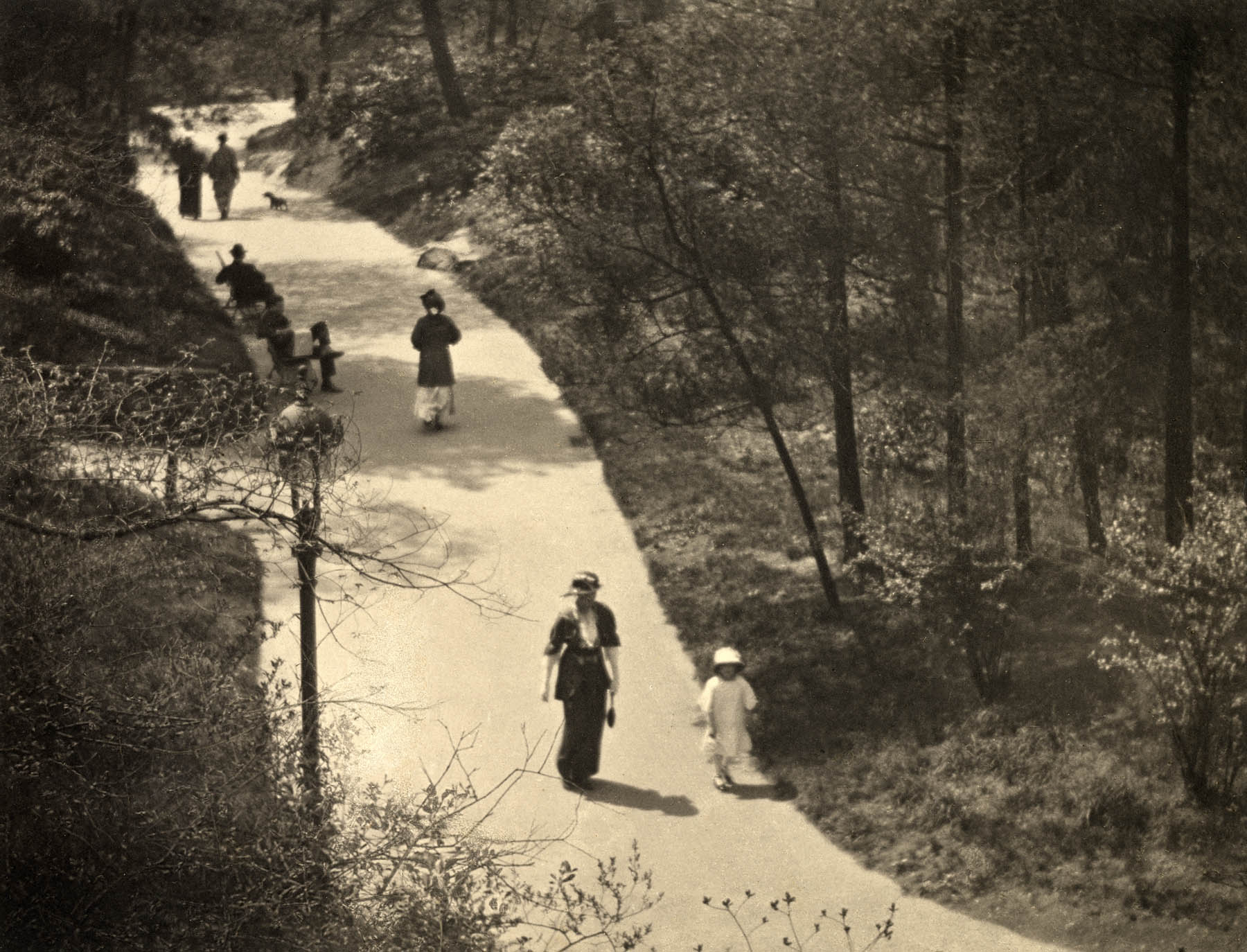
 

Paul Strand (American, 1890-1976) 'Central Park' 1915-1916 from the exhibition 'Photo-Secession: Painterly Masterworks of Turn-of-the-Century Photography' at the Utah Museum of Fine Arts, Salt Lake City, August - December 2024


Paul Strand (American, 1890-1976)
Central Park
1915-1916
Platinum print on paper


Urban life preoccupied Strand and in the 1920s would become a central subject of Modernist photographers around the world. From a Central Park overpass Strand identified this interesting composition with the bright, sinuous path dividing the picture plane. The decisive moment to snap the shutter occurred with the appearance of the two advancing figures and their angular shadows.
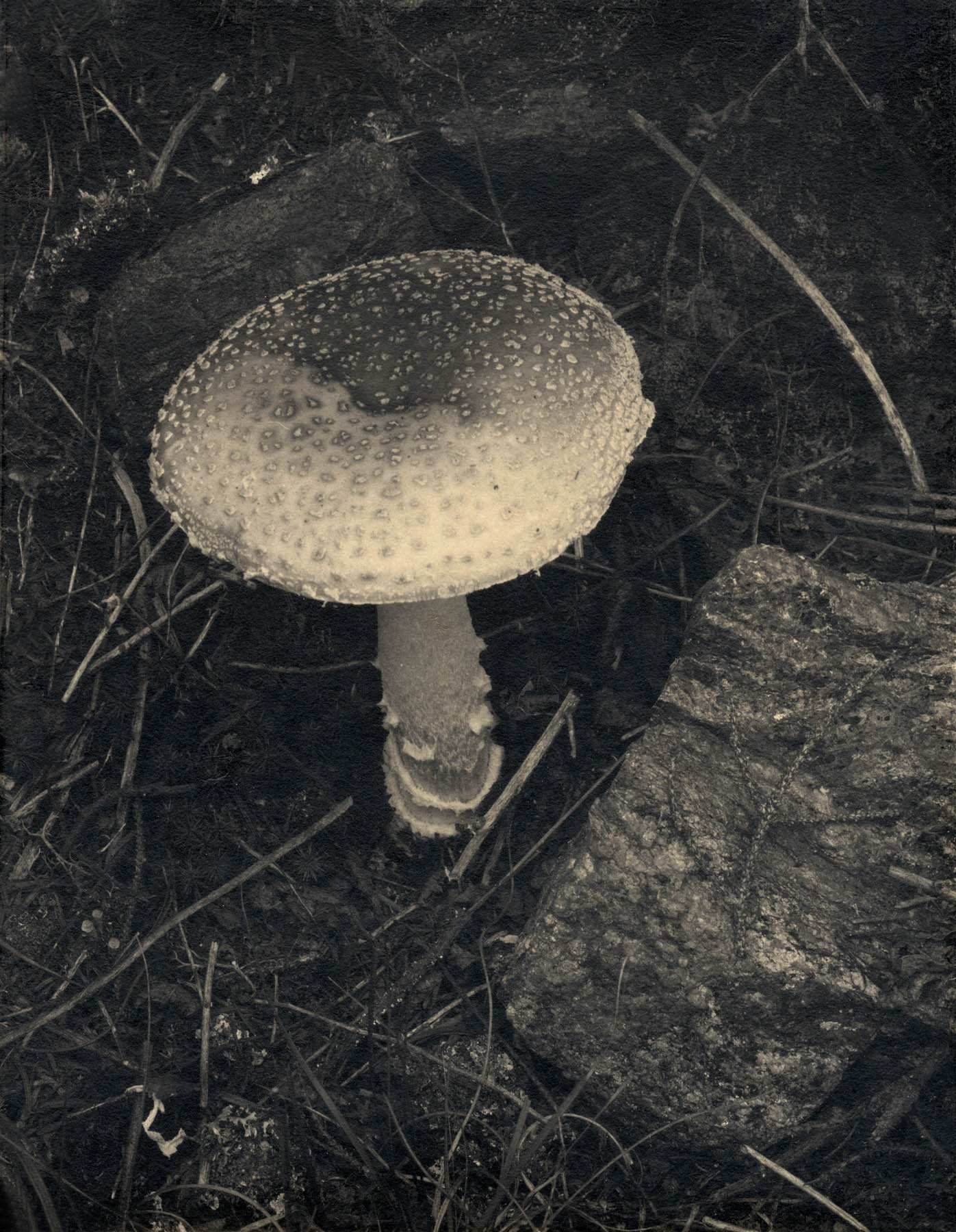
 

Paul Strand (American, 1890-1976) 'Speckled Toadstool, Georgetown, Maine' 1927


Paul Strand (American, 1890-1976)
Speckled Toadstool, Georgetown, Maine
1927
Waxed platinum print on paper


Strand continued to use platinum printing long after most other photographers adopted gelatin silver papers, which were more efficient and versatile and had a glossier surface. His prints in platinum are highly regarded for capturing minute detail and a wide range of tonal values.
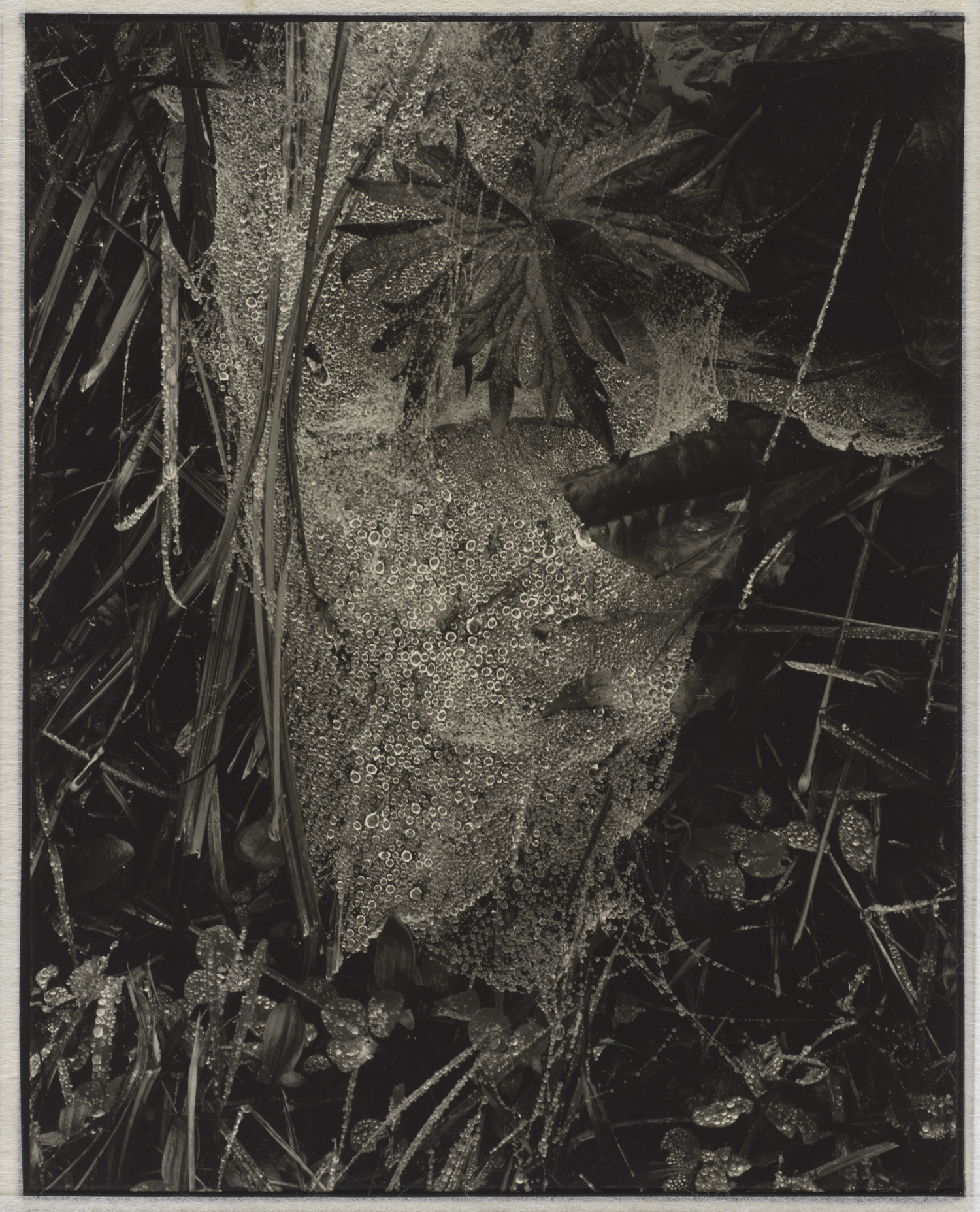
 

Paul Strand (American, 1890-1976) 'Cobweb in the Rain, Georgetown, Maine' 1928


Paul Strand (American, 1890-1976)
Cobweb in the Rain, Georgetown, Maine
1928
Gelatin silver print on paper

All from the Collection of Michael Mattis and Judith Hochberg


Works of Straight photography
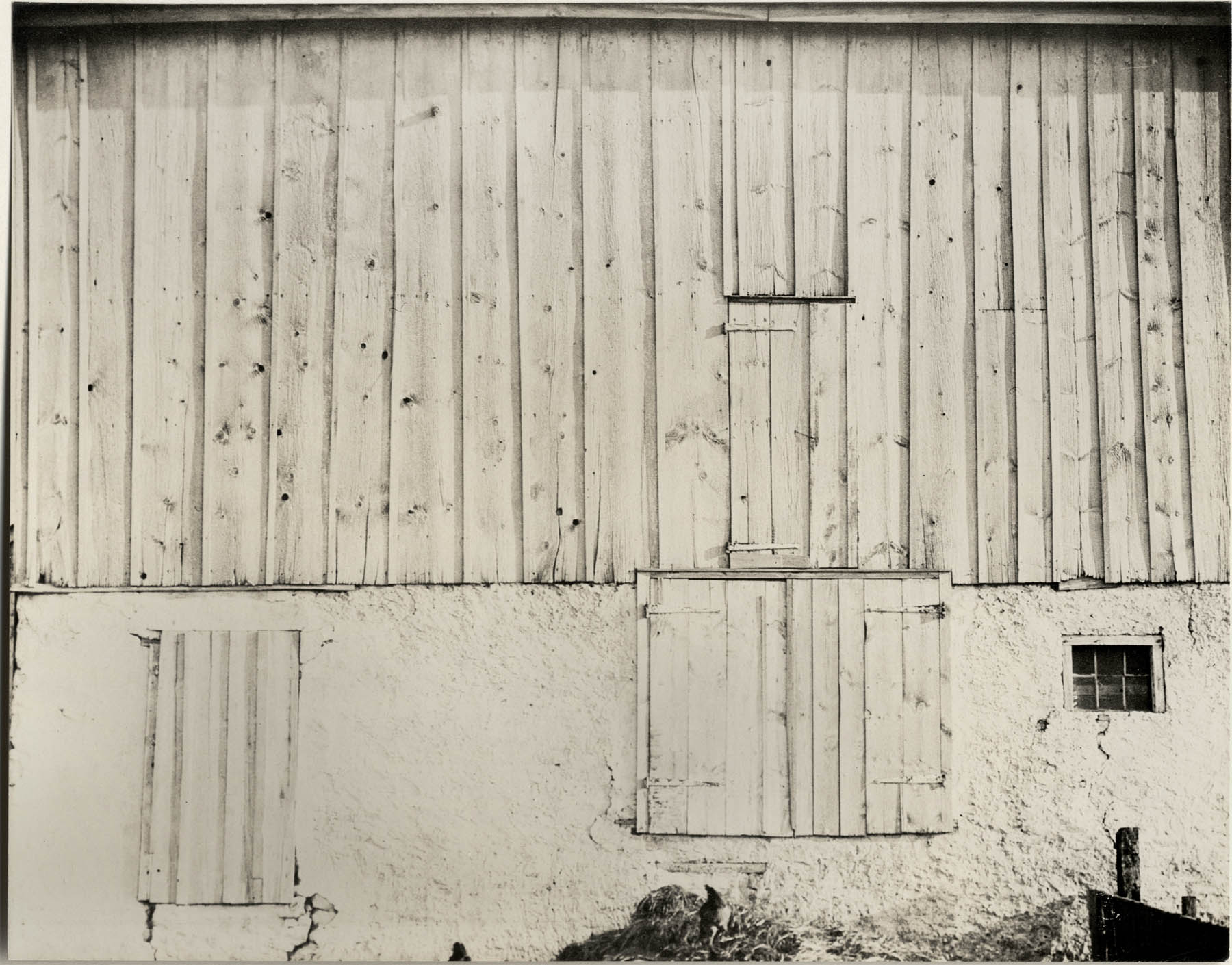
 

Charles Sheeler (American, 1883-1965) 'Side of White Barn, Bucks County' 1917


Charles Sheeler (American, 1883-1965)
Side of White Barn, Bucks County
1917
Gelatin silver print on paper


A painter and photographer, Sheeler became a close friend of Alfred Stieglitz as the Photo-Secession dissolved. This photographic study of line, shape, and tone recalls the hard-edged style of Sheeler’s paintings. Only the chickens appearing at the bottom edge give a sense of scale to the barn.


Alvin Langdon Coburn: The Avant-Garde Creator

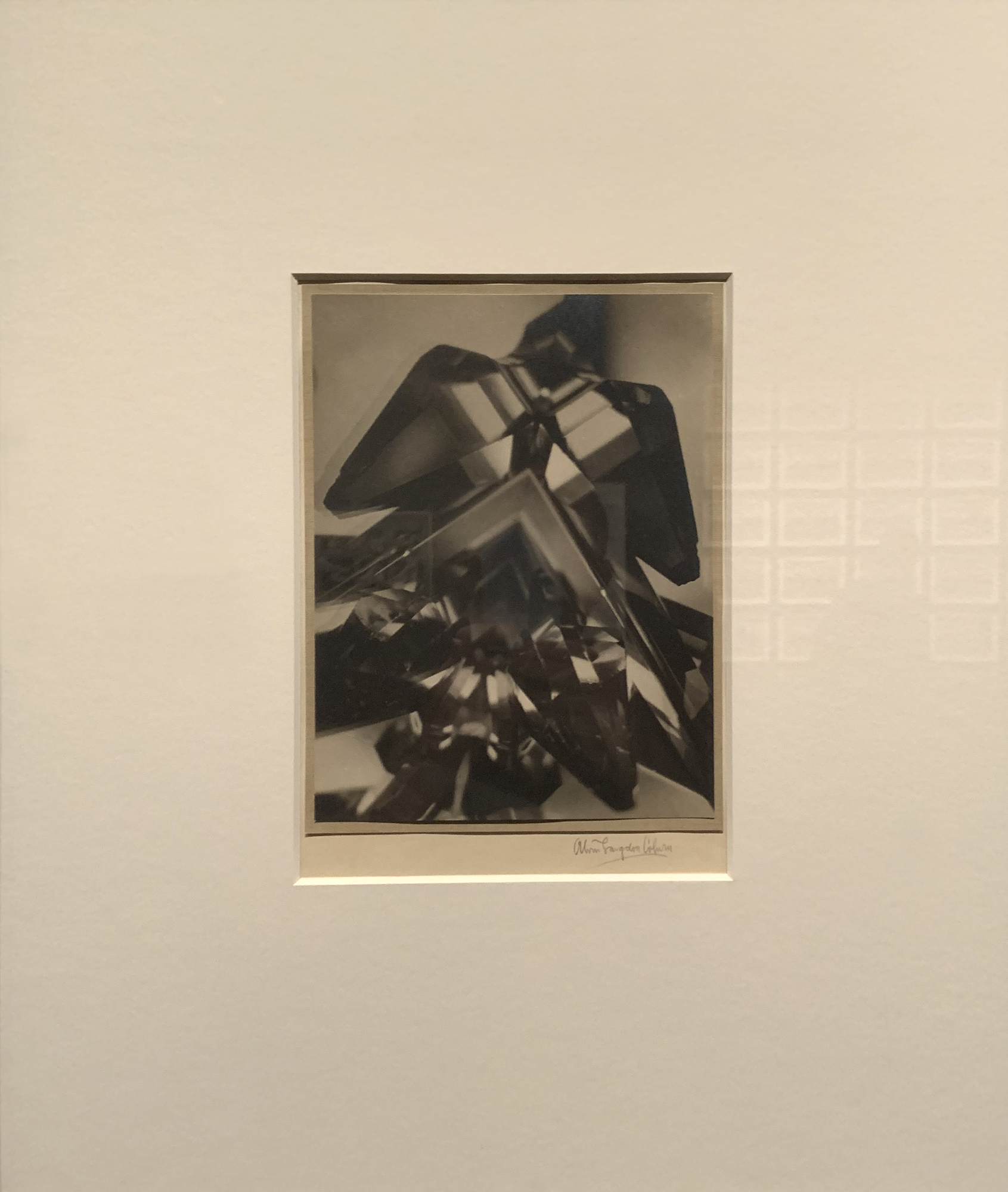
Alvin Langdon Coburn pushed the boundaries of photography with his innovative Vortographs, created in 1916-1917. These images are considered some of the first abstract photographs, born from Coburn’s desire to create art that combined the physical with the spiritual. By placing a vortoscope, a triangular arrangement of mirrors and prisms, over a camera’s lens, Coburn created complex images of kaleidoscopic and geometric patterns that simplify the photograph to the essential elements of light and form. This technique broke away from traditional photographic representation, emphasising form, structure, and abstraction. The Vortographs were influenced by the Vorticist movement, which celebrated dynamic and abstract art. Coburn’s pioneering work with these images marked a significant departure from Pictorialism, embracing modernist principles and demonstrating the artistic potential of photography beyond mere depiction. The Vortographs stand as a testament to Coburn’s visionary approach and contributions to the evolution of photographic art.

Adelaide Ryder. “The Photo-Secession Movement: Pioneering Artistry in Early Photography,” on the UMFA website Nd [Online] Cited 22/10/2024
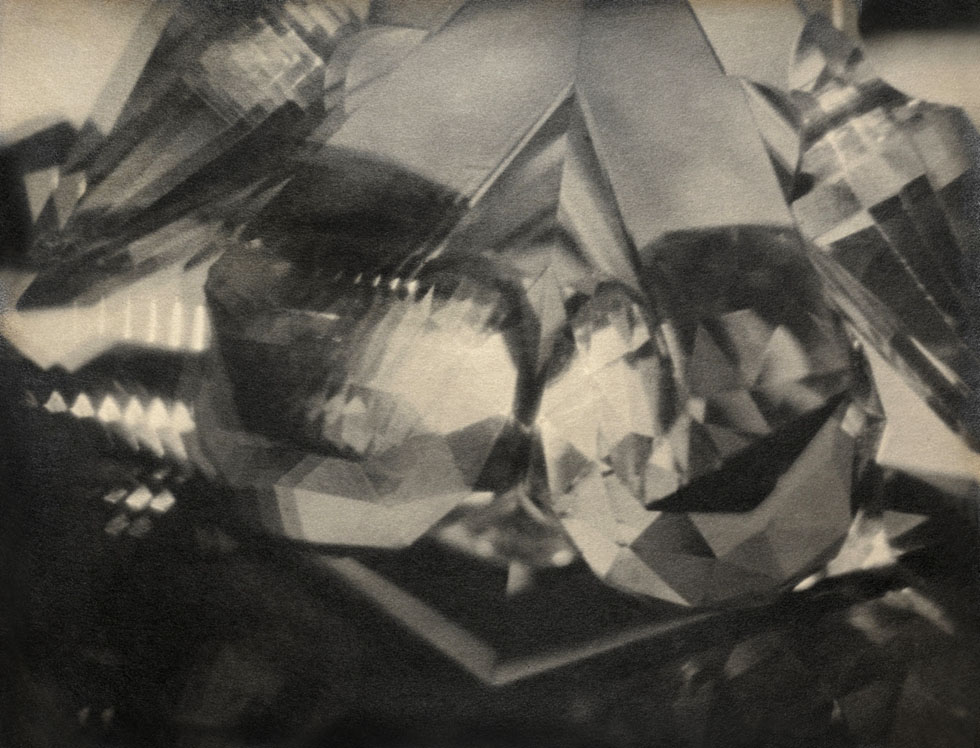
 

Alvin Langdon Coburn (British American, 1882-1966) 'Vortograph' 1917


Alvin Langdon Coburn (British American, 1882-1966)
Vortograph
1917
Gelatin silver print on paper


Coburn was one of the Photo-Secessionists who rejected Pictorialism. In his 1916 essay “The Future of Pictorial Photography,” he called for abstraction in photography, concluding, “it is my hope that photography may fall in line with all the other arts, and with her infinite possibilities, do things stranger and more fascinating than the most fantastic dreams.” Coburn created vortographs like this by placing a devise with three mirrors between his camera and subject. When he exhibited them to great fanfare in London in 1917, Ezra Pound proclaimed: “The Camera is freed from Reality!”

All from the Collection of Michael Mattis and Judith Hochberg


Utah Museum of Fine Arts
University of Utah campus
Marcia and John Price Museum Building
410 Campus Center Drive

Opening hours:
Tuesday – Sunday 10am – 5pm
Closed Mondays

Utah Museum of Fine Arts website

LIKE ART BLART ON FACEBOOK

Back to top

Exhibition: ‘Dorothea Lange: Seeing People’ at the National Gallery of Art, Washington Part 1

Exhibition dates: 5th November 2023 – 31st March 2024


Dorothea Lange (American, 1895-1965) 'Child of Impoverished Black Tenant Family Working on Farm, Alabama' July 1936


Dorothea Lange (American, 1895-1965)
Child of Impoverished Black Tenant Family Working on Farm, Alabama
July 1936
Gelatin silver print
Image: 20 x 19.2cm (7 7/8 x 7 9/16 in.)
Sheet: 25.4 x 20.2cm (10 x 7 15/16 in.)
Mat: 14 x 14 in.
Frame (outside): 15 x 15 in.
National Gallery of Art, Washington, Gift of Daniel Greenberg and Susan Steinhauser


A humungous two-part posting on the work of American photographer Dorothea Lange (1895-1965) which features over 110 of her photographs many of which were unknown to me.

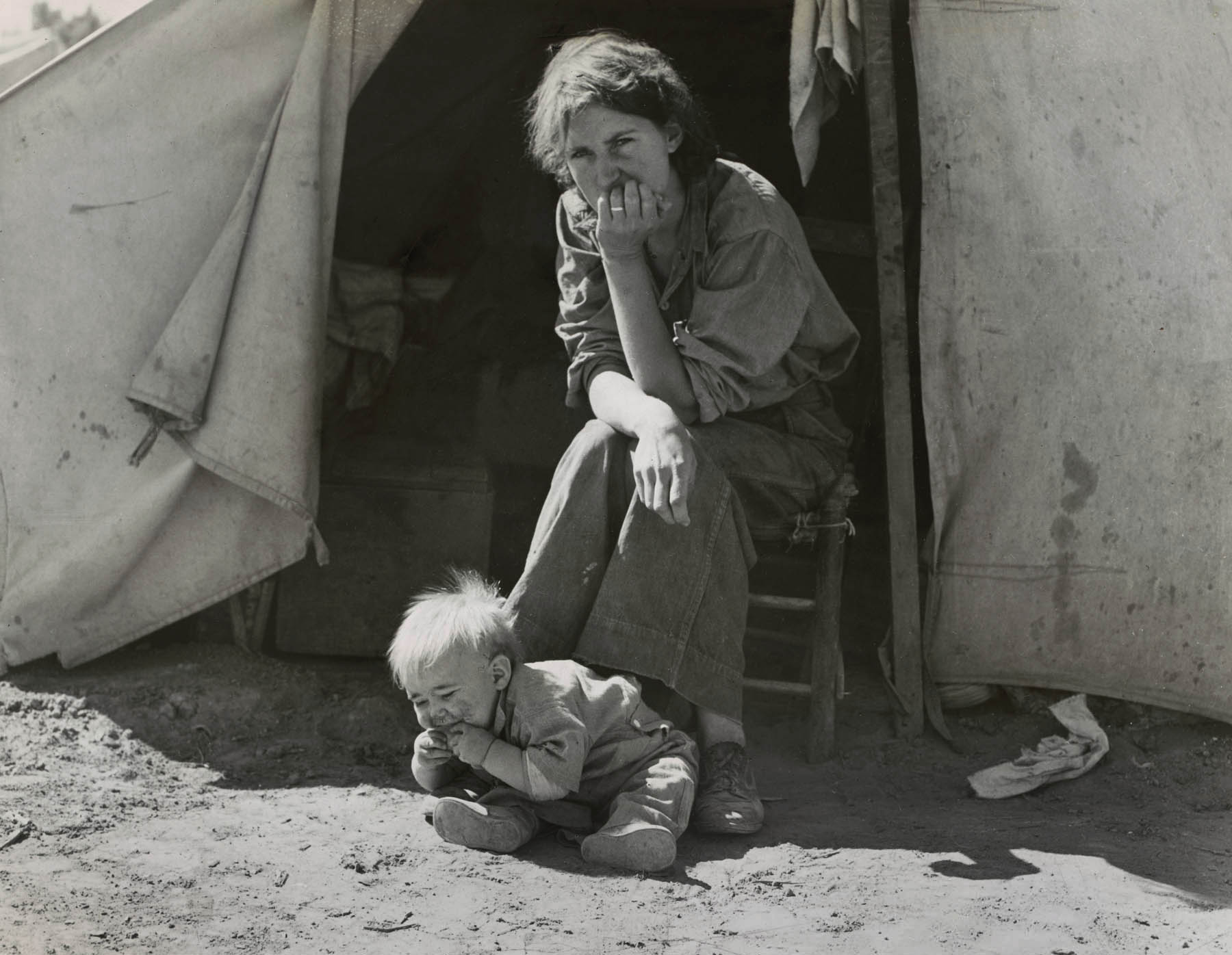
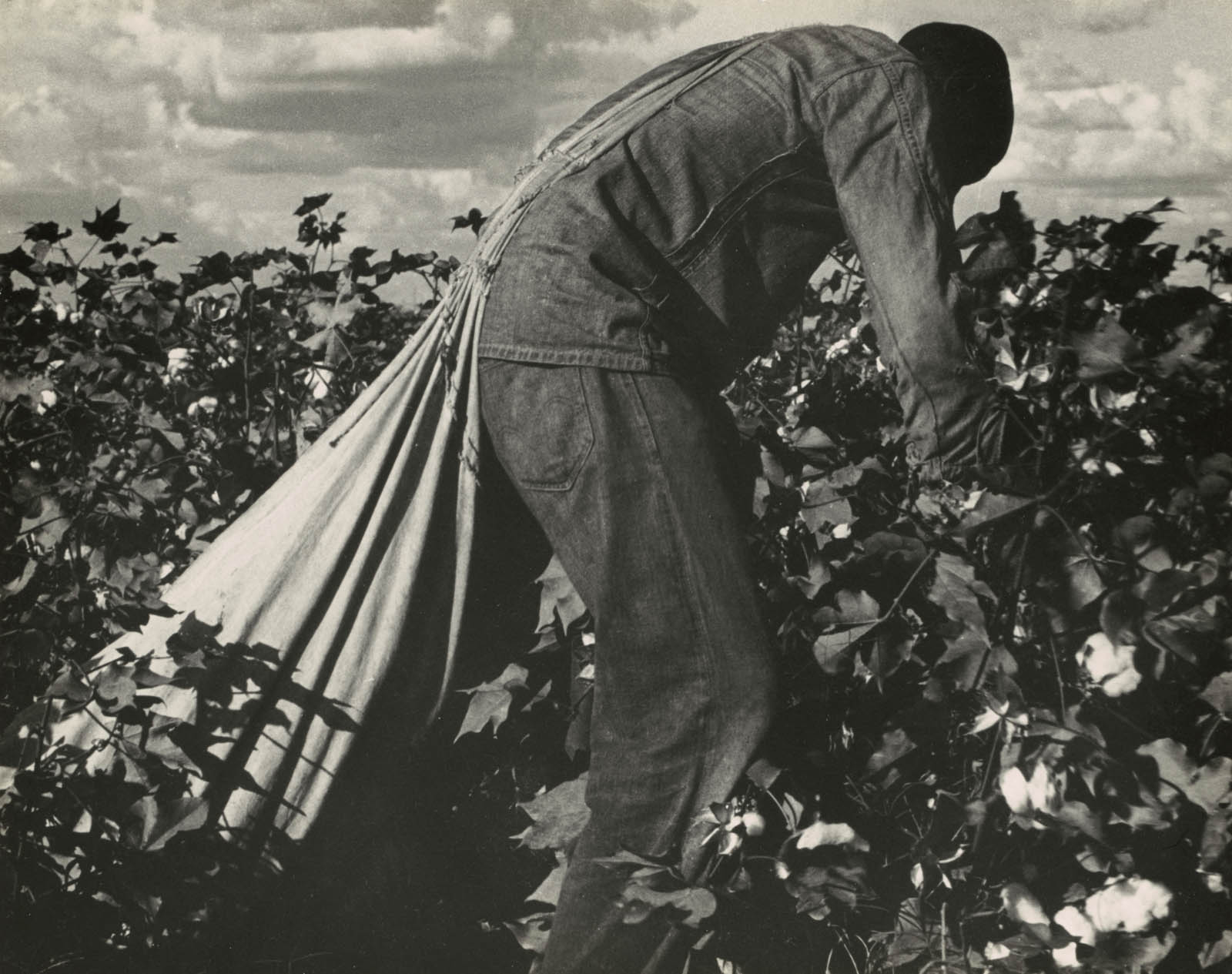
Of course, the posting features the photographs for which she is rightly famous (Migrant Mother; White Angel Breadline; Nettie Featherston; Migratory cotton picker with his cotton sack slung over his shoulder rests at the scales before returning to work in the field; Once a Missouri farmer, now a Migratory Farm Laborer) but others are a surprise for the senses, especially the Irish portrait photographs.

See my comment on the photographs in Part 2 of the posting.

Dr Marcus Bunyan


Many thankx to the National Gallery of Art for allowing me to publish the photographs in the posting. Please click on the photographs for a larger version of the image.


During her long, prolific, and groundbreaking career, the American photographer Dorothea Lange made some of the most iconic portraits of the 20th century. Dorothea Lange: Seeing People reframes Lange’s work through the lens of portraiture, highlighting her unique ability to discover and reveal the character and resilience of those she photographed.

Featuring some 100 photographs, the exhibition addresses her innovative approaches to picturing people, emphasising her work on social issues including economic disparity, migration, poverty, and racism.


“The portrait is made more meaningful by intimacy – an intimacy shared not only by the photographer with his subject but by the audience.”


Dorothea Lange


“The power of her pictures – their ability to speak to the character and resilience of those she photographed – lies not only in her desire to effect social change, but also in her deep humanism, her abiding interest in people, and the skills and insights she learned as a portrait photographer.”


Sarah Greenough


Dorothea Lange (American, 1895-1965) 'White Angel Breadline, San Francisco, California' 1933


Dorothea Lange (American, 1895-1965)
White Angel Breadline, San Francisco, California
1933
Gelatin silver print
Image/sheet: 34 x 26.5cm (13 3/8 x 10 7/16 in.)
Mat: 20 x 16 in.
Frame (outside): 21 x 17 in.
National Gallery of Art, Washington, Gift of Daniel Greenberg and Susan Steinhauser
© The Dorothea Lange Collection, Oakland Museum of California, City of Oakland. Gift of Paul S. Taylor


A growing desire to capture the Depression’s impact drew Lange to the White Angel Jungle, a San Francisco soup kitchen run by Lois Jordan, the “White Angel.” There Lange photographed this downtrodden man leaning on a barricade, his jaw clenched, shoulders hunched, back to the crowd, and eyes covered by the brim of his hat. Though anonymous, he drew Lange’s sympathetic eye and became a symbol of the nameless masses who faced economic hardship as the United States plunged deep into financial crisis.

Label text from the exhibition


Dorothea Lange (American, 1895-1965) 'Street Demonstration, San Francisco' 1934


Dorothea Lange (American, 1895-1965)
Street Demonstration, San Francisco
1934
Gelatin silver print
Image: 24.4 x 19.1cm (9 5/8 x 7 1/2 in.)
Mount: 27.9 x 20.2cm (11 x 7 15/16 in.)
Mat: 20 x 16 in.
Frame (outside): 21 x 17 in.
National Gallery of Art, Washington, Diana and Mallory Walker Fund and Robert Menschel and the Vital Projects Fund, in Honor of the 25th Anniversary of Photography at the National Gallery of Art
© The Dorothea Lange Collection, Oakland Museum of California, City of Oakland. Gift of Paul S. Taylor


In spring and summer 1934, a longshoremen’s strike gripped San Francisco and demonstrations took place throughout the city. Protesters also advocated for Japanese unions, which were being threatened by anti-labor forces in Japan. Lange wrote in her notes, “This was just before the New Deal during a time when Communists were very active. A few blocks away … soup was being distributed daily to the unemployed.”

Lange focused on a lone policeman standing before a crowd of protesters holding placards in English and Japanese. The policeman projects authority through his firm stance, crisp uniform, and shiny badge, creating a barrier between the photographer and the crowd.

Label text from the exhibition


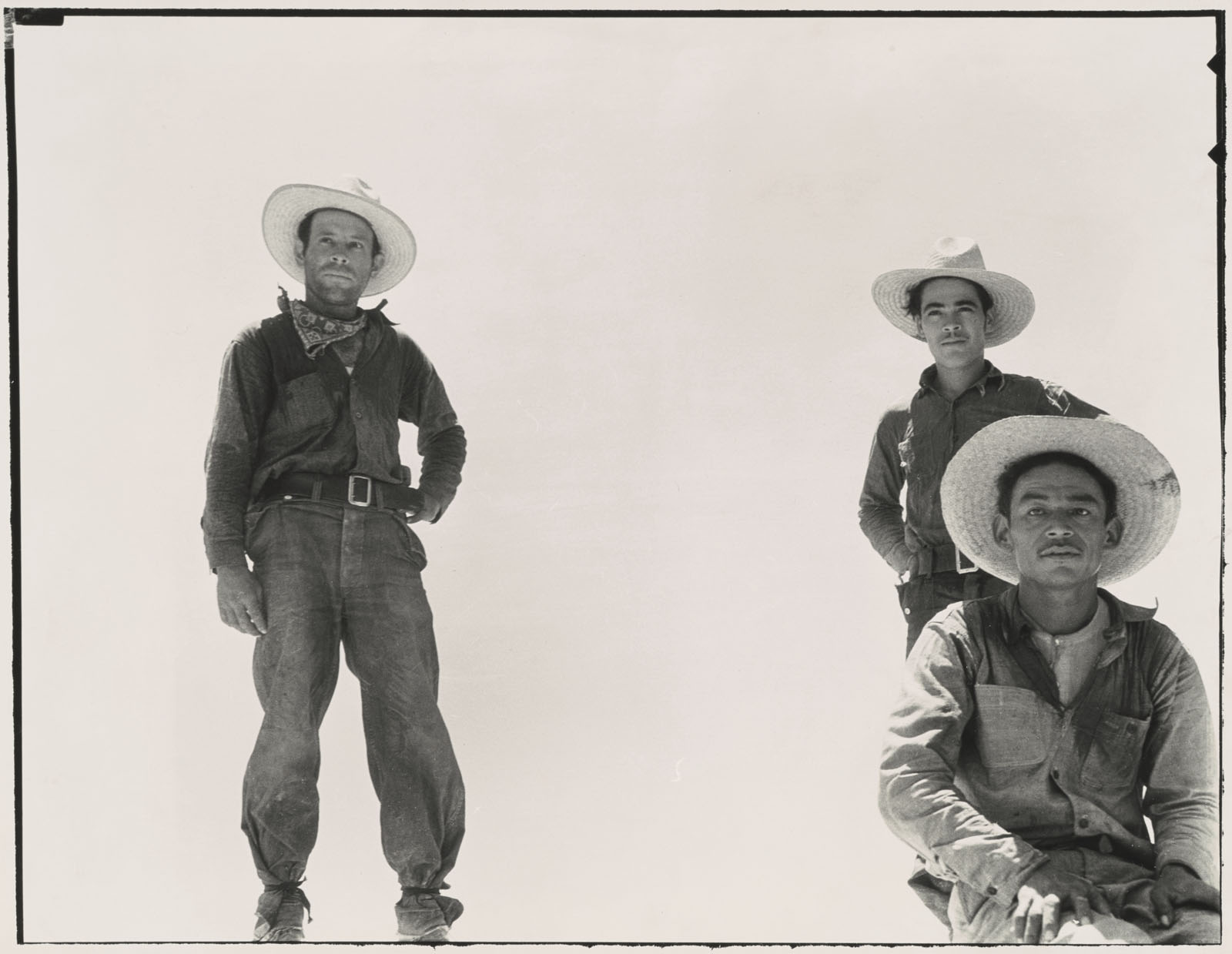
Dorothea Lange (American, 1895-1965) 'Mexican Workers Leaving for Melon Fields, Imperial Valley, California' June 1935, printed 1940s


Dorothea Lange (American, 1895-1965)
Mexican Workers Leaving for Melon Fields, Imperial Valley, California
June 1935, printed 1940s
Gelatin silver print
Image: 45 x 58cm (17 11/16 x 22 13/16 in.)
Sheet: 50.2 x 67.5cm (19 3/4 x 26 9/16 in.)
Mat: 24 x 28 in.
Frame (outside): 25 x 29 in.
National Gallery of Art, Washington, Gift of Daniel Greenberg and Susan Steinhauser
© The Dorothea Lange Collection, Oakland Museum of California, City of Oakland. Gift of Paul S. Taylor


In the summer of 1935, Lange traveled with Paul Taylor, working with his research team on a study of migrant labourers funded by California’s State Emergency Relief Administration. Mexican farm labourers, like this trio of cantaloupe harvesters, saw wages plummet during the Depression as thousands of westbound American migrants flooded the labour market. Angling her camera upward, Lange silhouetted the workers against a hazy sky, producing a striking group portrait. Working together solidified Lange and Taylor’s professional relationship, which developed into a romantic partnership and marriage later that same year.

Label text from the exhibition


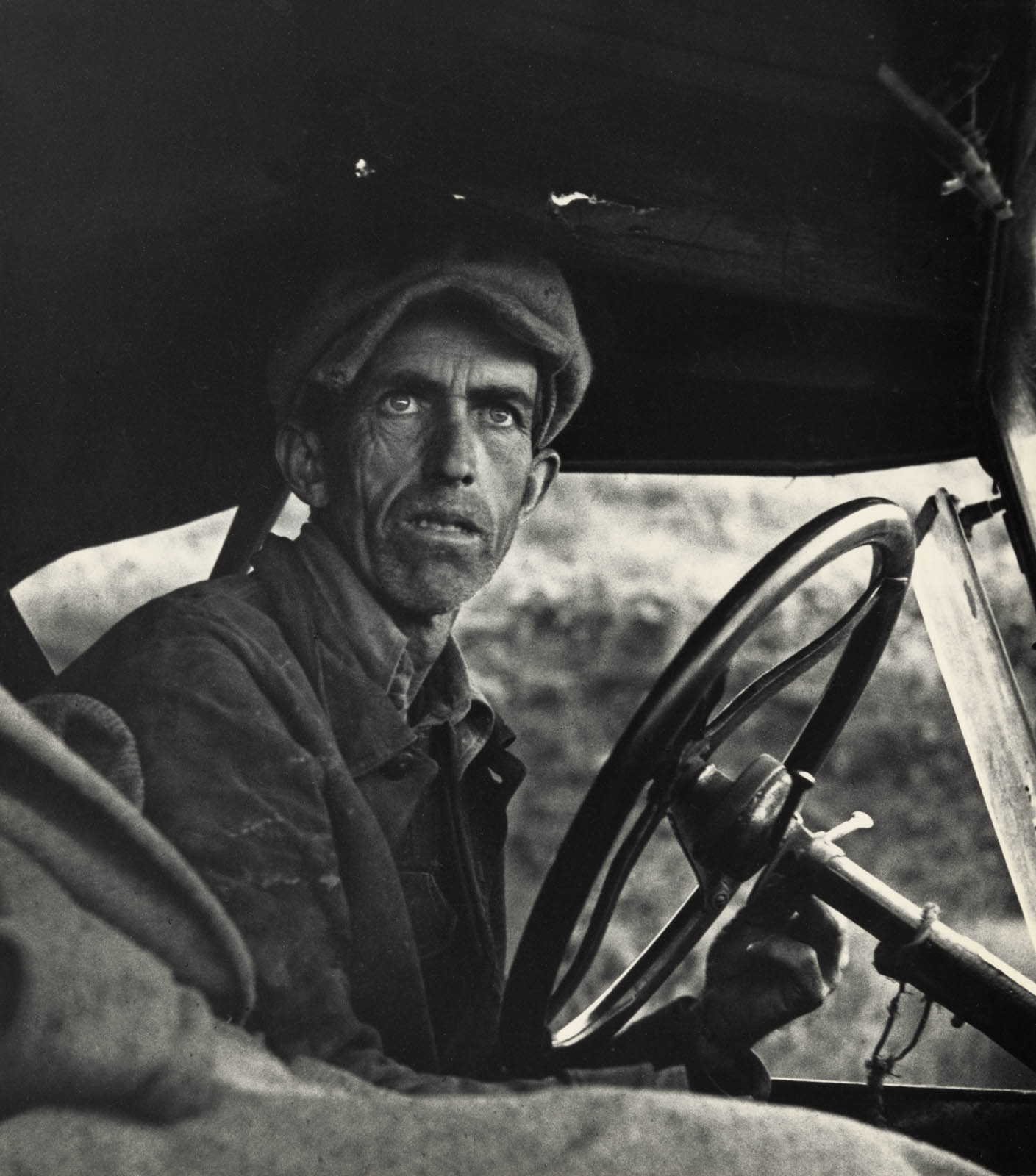
Dorothea Lange (American, 1895-1965) 'Once a Missouri farmer, now a Migratory Farm Laborer. San Joaquin Valley, California' February 1936, printed c. 1965


Dorothea Lange (American, 1895-1965)
Once a Missouri farmer, now a Migratory Farm Laborer. San Joaquin Valley, California
February 1936, printed c. 1965
Gelatin silver print
Image/sheet: 44.6 x 39.5cm (17 9/16 x 15 9/16 in.)
Mat: 26 x 22 in.
Frame (outside): 27 x 23 in.
National Gallery of Art, Washington, Gift of Daniel Greenberg and Susan Steinhauser


Although this farm labourer from Missouri seems to be alone behind the wheel of his car, he is actually seated beside his wife, in the passenger seat. Her overcoat and right arm are easily overlooked at the bottom left. By focusing only on the driver, with his gaunt features and intense gaze, Lange heightens our sense of his isolation to create an evocative portrait of a man grappling with the consequences of dislocation. The photograph also calls attention to the automobile as a means of transport and escape for some Depression-era migrants.

Label text from the exhibition


Dorothea Lange (American, 1895-1965) 'Former Tenant Farmer on Relief Grant in the Imperial Valley, California' March 1937


Dorothea Lange (American, 1895-1965)
Former Tenant Farmer on Relief Grant in the Imperial Valley, California
March 1937
Gelatin silver print
Image/sheet: 9.5 x 9cm (3 3/4 x 3 9/16 in.)
Mat: 14 x 11 in.
Frame (outside): 15 x 12 3/4 in.
National Gallery of Art, Washington, Gift of Daniel Greenberg and Susan Steinhauser


Dorothea Lange (American, 1895-1965) 'Eighteen-Year-Old Mother from Oklahoma, now a California Migrant' March 1937


Dorothea Lange (American, 1895-1965)
Eighteen-Year-Old Mother from Oklahoma, now a California Migrant
March 1937
Gelatin silver print
Image: 18.9 x 24.5cm (7 7/16 x 9 5/8 in.)
Sheet: 20.6 x 25.5cm (8 1/8 x 10 1/16 in.)
Mat: 13 x 16 in.
Frame (outside): 14 x 17 in.
National Gallery of Art, Washington, Gift of Daniel Greenberg and Susan Steinhauser


Dorothea Lange (American, 1895-1965) 'Displaced Tenant Farmers, Goodlett, Hardeman County, Texas' July 1937, printed 1950s


Dorothea Lange (American, 1895-1965)
Displaced Tenant Farmers, Goodlett, Hardeman County, Texas
July 1937, printed 1950s
Gelatin silver print
Image: 19 x 24 cm (7 1/2 x 9 7/16 in.)
Sheet: 20.3 x 25.2 cm (8 x 9 15/16 in.)
Mat: 14 x 16 in.
Frame (outside): 15 x 17 in.
National Gallery of Art, Washington, Gift of Daniel Greenberg and Susan Steinhauser


During the 1930s, machines began to replace people in some cotton-growing regions like Hardeman County in Northeast Texas; consequently, many tenant farmers were evicted from their land. Already reckoning with severe drought and economic depression, these “tractored out” farmers were forced to seek work as day labourers, a precarious livelihood offering little security. In this picture, five displaced tenant farmers congregate outside the screened porch of a small house. Although they are united by a common plight, each man seems utterly alone, unable to find solace or support within an eroding agricultural system.

Label text from the exhibition


Dorothea Lange (American, 1895-1965) 'Nettie Featherston, Wife of a Migratory Laborer with Three Children, near Childress, Texas, from The American Country Woman' June 1938


Dorothea Lange (American, 1895-1965)
Nettie Featherston, Wife of a Migratory Laborer with Three Children, near Childress, Texas, from The American Country Woman
June 1938
Gelatin silver print
Image: 34 x 26.8cm (13 3/8 x 10 9/16 in.)
Sheet: 35.2 x 28cm (13 7/8 x 11 in.)
Mount: 45.4 x 38.3cm (17 7/8 x 15 1/16 in.)
Mat: 22 x 18 in.
Frame (outside): 23 x 19 in.
National Gallery of Art, Washington, Gift of Daniel Greenberg and Susan Steinhauser
© The Dorothea Lange Collection, Oakland Museum of California, City of Oakland. Gift of Paul S. Taylor


When Lange photographed her on a North Texas farm, 40-year-old Nettie Featherston was accustomed to a life of hard labor and poverty. She and her family had left Oklahoma seeking work in California when they ran out of money in Texas and found work picking cotton. Lange’s portrait reveals a gaunt survivor of the Dust Bowl, her right arm echoing the shape of the storm cloud behind her – a symbol of the difficult road ahead for migrant families looking for work. Reflecting on the photograph of herself years later, Featherston said, “It seems like … I have too much on my mind. I can just be burdened so bad, awful burdens they’ll be.”

Label text from the exhibition


Nettie Featherston

Lange met Nettie Featherston while working on that same FSA project. Like Turpen, Featherston’s family had been forced off their farm in Oklahoma. On their way to California to find work, they ran out of money and found themselves stranded in Childress, Texas.

The Featherstons sold their car for money to buy food. That left them with no way out of the dry and dusty landscape we seen behind Featherston. She looks desperate and distraught. “This county’s a hard county. They won’t help bury you here. If you die, you’re dead, that’s all,” she told Lange.

Decades later photographer and author Bill Ganzel tracked down Featherston. Then in her 80s, she still remembered how difficult that time had been. “Your kids would cry for something to eat, and you couldn’t give it. We cooked with black-eyed peas until I never wanted to ever see another black-eyed pea.”

Anonymous. “The Real Lives of People in Dorothea Lange’s Portraits,” on the National Gallery of Art website November 03, 2023 [Online] Cited 25/02/2024


Dorothea Lange (American, 1895-1965) 'Arkansas mother come to California for a new start, with husband and eleven children. Now a rural rehabilitation client. Tulare County, California, from The American Country Woman' November 1938, printed 1965


Dorothea Lange (American, 1895-1965)
Arkansas mother come to California for a new start, with husband and eleven children. Now a rural rehabilitation client. Tulare County, California, from The American Country Woman
November 1938, printed 1965
Gelatin silver print
Image/sheet: 35.5 x 27.9cm (14 x 11 in.)
Mat: 20 x 16 in.
Frame (outside): 21 x 17 in.
National Gallery of Art, Washington, Gift of Daniel Greenberg and Susan Steinhauser


Dorothea Lange (American, 1895-1965) 'On the Plains a Hat Is More Than a Covering' 1938, printed c. 1965


Dorothea Lange (American, 1895-1965)
On the Plains a Hat Is More Than a Covering
1938, printed c. 1965
Gelatin silver print
Image/sheet: 32 x 26.3cm (12 5/8 x 10 3/8 in.)
Mat: 20 x 18 in.
Frame (outside): 21 x 19 in.
National Gallery of Art, Washington, Gift of Daniel Greenberg and Susan Steinhauser


Lange wrote in her field notes that a “hat is more than a covering against sun and wind … it is a badge of service … linking past and present.” This artfully cropped photograph of James Abner Turpen, a 70-year-old Texas tenant farmer, focuses on Turpen’s hand as his fingers curl around the brim of a hat. Both hand and hat are weathered, aged by time and work, and portray Turpen without showing his face.

Label text from the exhibition


James Abner Turpen

From 1936 to 1939, Lange worked for the Resettlement Administration (which later became the Farm Security Administration). In Texas she documented the impacts of mechanisation on farmers. In the town of Goodlett she met James Abner Turpen, a 70-year-old tenant farmer who was about to be “tractored out” of his farm. Realising that agricultural machines like tractors could replace many farmers, landowners would evict their tenant farmers.

Turpen’s sons had already been tractored out. In her caption, Lange recorded his distress. “What are my boys going to do?” he asked. He believed the government was partly to blame. “They’re not any up there in Congress but what are big landowners and they’re going to see that the program is in their interest.”

Lange cropped one image to focus on Turpen’s weathered hand grasping his hat. The photograph is titled On the Plains a Hat Is More Than a Covering. But curator Philip Brookman inspected the image closely and compared it with others to confirm that Turpen is the subject.

Anonymous. “The Real Lives of People in Dorothea Lange’s Portraits,” on the National Gallery of Art website November 03, 2023 [Online] Cited 25/02/2024


Dorothea Lange (American, 1895-1965) 'Migratory Field Worker Picking Cotton in San Joaquin Valley, California' from 'An American Exodus' November 1938, printed later


Dorothea Lange (American, 1895-1965)
Migratory Field Worker Picking Cotton in San Joaquin Valley, California from An American Exodus
November 1938, printed later
Gelatin silver print
Image/sheet: 19 x 24cm (7 1/2 x 9 7/16 in.)
Mat: 14 x 18 in.
Frame (outside): 15 x 19 in.
National Gallery of Art, Washington, Gift of Daniel Greenberg and Susan Steinhauser


This photograph of hard stoop labor appeared in Lange and Paul Taylor’s 1939 book An American Exodus. According to Taylor’s field notes, “These pickers are paid seventy-five cents per hundred pounds of picked cotton. Strikers organising under CIO union (Congress of Industrial Organizations) are demanding one dollar. A good male picker, in good cotton, under favourable weather conditions, can pick about two hundred pounds in a day’s work.”

Label text from the exhibition


Dorothea Lange (American, 1895-1965) 'Cotton Pickers and Farm Owners, Bakersfield, California' 1938, printed c. 1950s


Dorothea Lange (American, 1895-1965)
Cotton Pickers and Farm Owners, Bakersfield, California
1938, printed c. 1950s
Gelatin silver print
Image: 19 x 24cm (7 1/2 x 9 7/16 in.)
Sheet: 20.32 x 25.4cm (8 x 10 in.)
Mat: 13 x 16 in.
Frame (outside): 14 x 17 in.
National Gallery of Art, Washington, Gift of Daniel Greenberg and Susan Steinhauser


Dorothea Lange (American, 1895-1965) 'Yazoo Delta, Mississippi' from 'An American Exodus' 1938, printed 1965


Dorothea Lange (American, 1895-1965)
Yazoo Delta, Mississippi from An American Exodus
1938, printed 1965
Gelatin silver print
Image/sheet: 34.2 x 44.7cm (13 7/16 x 17 5/8 in.)
Mat: 20 x 24 in.
Frame (outside): 21 x 25 in.
National Gallery of Art, Washington, Gift of Daniel Greenberg and Susan Steinhauser


Dorothea Lange (American, 1895-1965) 'Edison, Kern County, California. Young migratory mother, originally from Texas. On the day before the photograph was made, she and her husband traveled 35 miles each way to pick peas. They worked 5 hours each and together earned $2.25. They have two young children... Live in auto camp' April 11, 1940, printed 1950s


Dorothea Lange (American, 1895-1965)
Edison, Kern County, California. Young migratory mother, originally from Texas. On the day before the photograph was made, she and her husband traveled 35 miles each way to pick peas. They worked 5 hours each and together earned $2.25. They have two young children… Live in auto camp.
April 11, 1940, printed 1950s
Gelatin silver print
Image/sheet: 30.1 x 24cm (11 7/8 x 9 7/16 in.)
Mount: 30.8 x 24 cm (12 1/8 x 9 7/16 in.)
Mat: 20 x 16 in.
Frame (outside): 21 x 17 in.
National Gallery of Art, Washington, Gift of Daniel Greenberg and Susan Steinhauser


Dorothea Lange (American, 1895-1965) 'Children of the Weill Public School Shown in a Flag Pledge Ceremony, San Francisco, California' April 1942, printed c. 1965


Dorothea Lange (American, 1895-1965)
Children of the Weill Public School Shown in a Flag Pledge Ceremony, San Francisco, California
April 1942, printed c. 1965
Gelatin silver print
Image: 23.5 x 17.4 cm (9 1/4 x 6 7/8 in.)
Mat: 18 x 14 in.
Frame (outside): 19 x 15 in.
National Gallery of Art, Washington, Gift of Daniel Greenberg and Susan Steinhauser


Dorothea Lange (American, 1895-1965) 'End of Shift, 3:30, Shipyard Construction Workers, Richmond, California' September 1943


Dorothea Lange (American, 1895-1965)
End of Shift, 3:30, Shipyard Construction Workers, Richmond, California
September 1943
Gelatin silver print
Image: 24 x 19 cm (9 7/16 x 7 1/2 in.)
Sheet: 25.4 x 20.32 cm (10 x 8 in.)
Mat: 18 x 14 in.
Frame (outside): 19 x 15 in.
National Gallery of Art, Washington, Gift of Daniel Greenberg and Susan Steinhauser
© The Dorothea Lange Collection, Oakland Museum of California, City of Oakland. Gift of Paul S. Taylor


Fortune magazine commissioned Lange to document the bustling shipyards in Richmond, north of Oakland, where newly desegregated defence firms were rapidly constructing transport, cargo, and warships for the United States Navy. With its tight cropping and dynamic configuration, End of Shift focuses on the rushing legs and torsos of shipbuilders leaving a wartime facility. Lange expressed the urgency of their work in defence production without showing their individual features. The angled composition and complex interplay of light and shadow demonstrate Lange’s understanding of how modern design techniques could convey the force and energy of a group working together on a project critical to the nation’s defence.

Label text from the exhibition


Dorothea Lange (American, 1895-1965) 'War Babies, Richmond, California' 1944, printed c. 1965


Dorothea Lange (American, 1895-1965)
War Babies, Richmond, California
1944, printed c. 1965
Gelatin silver print
Image/sheet: 26.4 x 25.6cm (10 3/8 x 10 1/16 in.)
Mat: 18 x 18 in.
Frame (outside): 19 x 19 in.
National Gallery of Art, Washington, Gift of Daniel Greenberg and Susan Steinhauser
© The Dorothea Lange Collection, Oakland Museum of California, City of Oakland. Gift of Paul S. Taylor


While in Richmond, Lange photographed not only shipyard workers but also local people on the street, such as this pair of young mothers. Cradling swaddled infants, with a knee-high toddler between them, the two women personify the prosperity and growth generated by the wartime boom, which brought renewed economic stability to many Californians. Lange’s pictures from Richmond capitalise on the symbolism presented by the backdrop of expanding production. In this photograph, for example, cruciform utility poles seem to watch over the women and children like industrial guards, symbolically guiding them away from the poverty of the Depression years.

Label text from the exhibition


Dorothea Lange (American, 1895-1965) 'Lyde Wall, friend and neighbor, who makes "the world's best apple pie," and knows everything going on for miles around, Berkeley, California' from 'The American Country Woman' 1944


Dorothea Lange (American, 1895-1965)
Lyde Wall, friend and neighbor, who makes “the world’s best apple pie,” and knows everything going on for miles around, Berkeley, California, from The American Country Woman
1944
Gelatin silver print
Image/sheet: 35.1 x 27.9cm (13 13/16 x 11 in.)
Mount: 35.2 x 28 cm (13 7/8 x 11 in.)
Mat: 22 x 18 in.
Frame (outside): 23 x 19 in.
National Gallery of Art, Washington, Gift of Daniel Greenberg and Susan Steinhauser
© The Dorothea Lange Collection, Oakland Museum of California, City of Oakland. Gift of Paul S. Taylor


During her prolific and groundbreaking career, the American photographer Dorothea Lange (1895-1965) made some of the most iconic portraits of the 20th century. Dorothea Lange: Seeing People examines Lange’s decades-long investigation into how portrait photography could embody the humanity of the people she depicted. It demonstrates how her photographs helped shape contemporary documentary practice by connecting everyday people with moments of history – from the Great Depression through the mid-1960s – that still resonate with our lives in the 21st century. Featuring 101 photographs, the exhibition addresses her innovative approaches to picturing people, emphasising her work on various social issues including economic disparity, migration, poverty, and racism. The exhibition is on view from November 5, 2023, through March 31, 2024, in the West Building of the National Gallery of Art.

“Throughout the course of her 50-year career, Lange created an intensely humanistic body of work that sought to transform how we see and understand people,” said Kaywin Feldman, director of the National Gallery of Art. “Merging her skills as a portrait artist, a social documentary photographer, and a storyteller, she helped redefine photography through images that emphasise social issues.”


About the Exhibition

Dorothea Lange: Seeing People examines how Lange’s portraits have shaped our contemporary understanding of documentary photography as well as its importance to her vision and creative practice. Divided into six thematic sections, the exhibition features portraits ranging from her early career as a San Francisco studio photographer – the earliest work is from 1919 – and her powerful coverage of the Great Depression through expressive photographs of everyday people and communities during the 1950s and early 1960s.

Among the works on view are portraits of Indigenous people in Arizona and New Mexico from the 1920s and early 1930s; later depictions of striking labourers, migrant farmworkers, rural African Americans during the Jim Crow era, Japanese Americans denied their civil rights during World War II, and postwar baby boomers; and portraits of people in Ireland, Korea, Vietnam, Egypt, and Venezuela that Lange made in the decade before her death in 1965.

Lange began her career as a commercial studio photographer in San Francisco in 1918. Her studio became a gathering spot for artists who had serious discussions about photography and art. In 1920 she married Maynard Dixon, a painter of western subjects, who encouraged Lange to take her photography outside. She accompanied him on trips through the American Southwest, photographing rural landscapes and Dixon at work, along with the Indigenous communities he was portraying.

She started to work in the streets of San Francisco in 1933, making photographs such as White Angel Breadline, San Francisco, California (1933) that capture the effects of the Great Depression and the plight of the city’s dispossessed men and women. Lange also photographed labor organisers and protesters at May Day events around San Francisco’s Civic Center Plaza: she focused on the protesters speaking, listening, or holding signs, and vowed to produce prints within 24 hours, as in May Day, San Francisco, California (1934). She also documented ensuing strikes, creating portraits of speakers and demonstrators with placards as well as photographs of the police presence in works such as Street Demonstration, San Francisco (1934). When she met the labor economist Paul Schuster Taylor in 1934, Lange began to photograph the plight of migrant farmers who had moved to California from the South and Midwest seeking new livelihoods.

From 1935 to 1943, while working for the for the US Resettlement Administration, Farm Security Administration, and War Relocation Authority, Lange focused on the resilience of Depression-era families, farmworkers, rural cooperative communities, migrant camps, and the forced incarceration of Japanese Americans in the early days of World War II. The resulting images illustrate the human and economic impact wrought across the United States by farm tenancy, racism, the legacy of slavery, climate change, and migrations. These portraits, sometimes combined with interviews, added a personal element to Lange’s stark pictures of makeshift housing and agricultural fields and cemented her documentary style.

During World War II Lange produced one of her most powerful series for the War Relocation Authority, depicting the forced incarceration of California’s Japanese Americans at Manzanar, in works on view such as Grandfather and Grandson of Japanese Ancestry at a War Relocation Authority Center, Manzanar, California (July 1942). She also photographed the shifts in California’s social fabric as its rising economy – sparked by growing defence industries – drew African Americans from the South and women into previously male-dominated and segregated businesses such as shipbuilding. In the 1950s, Lange continued to pursue stories about people and their communities for personal projects, as well as for Life magazine, that include her first photographs from Europe. Asia, South America, and North Africa.


Exhibition Publication

Published by the National Gallery of Art and distributed by Yale University Press, this 208-page illustrated volume explores Dorothea Lange’s decades-long investigation of how photography, through articulating people’s core values and their sense of self, helped to expand our current understanding of portraiture and the meaning of documentary practice. Lange’s sensitive, humane portraits of often-marginalised people galvanised public understanding of important social problems in the 20th century.

Compassion guided Lange’s early portraits of Indigenous people in Arizona and New Mexico from the 1920s and 1930s, as well as her depictions of striking workers, migrant farmers, rural African Americans during the Jim Crow era, Japanese Americans in internment camps, and the people she met while traveling in Europe, Asia, Venezuela, and Egypt. Drawing on new research, Philip Brookman, Sarah Greenough, Andrea Nelson, and Laura Wexler, examine Lange’s roots in studio portraiture and demonstrate how her influential and widely seen photographs addressed issues of identity as well as social, economic, and racial inequalities – topics that remain as relevant for our times as they were for hers.

Press release from the National Gallery of Art


Dorothea Lange (American, 1895-1965) 'Mexican American Child, San Francisco' 1928


Dorothea Lange (American, 1895-1965)
Mexican American Child, San Francisco
1928
Gelatin silver print
Image/sheet: 34 x 29.8cm (13 3/8 x 11 3/4 in.)
Mat: 16 x 20 in.
Frame (outside): 16 1/2 x 16 1/4 in.
National Gallery of Art, Washington, Gift of Daniel Greenberg and Susan Steinhauser
© The Dorothea Lange Collection, Oakland Museum of California, City of Oakland. Gift of Paul S. Taylor


Dorothea Lange (American, 1895-1965) 'Maynard and Dan Dixon' 1930, printed c. 1960s


Dorothea Lange (American, 1895-1965)
Maynard and Dan Dixon
1930, printed c. 1960s
Gelatin silver print
Image: 19 x 24cm (7 1/2 x 9 7/16 in.)
Sheet: 20.32 x 25.4 cm (8 x 10 in.)
Mat: 14 x 17 in.
Frame (outside): 15 1/4 x 18 1/4 in.
National Gallery of Art, Washington, Gift of Daniel Greenberg and Susan Steinhauser
© The Dorothea Lange Collection, Oakland Museum of California, City of Oakland. Gift of Paul S. Taylor


In fall 1919 Lange met Maynard Dixon, a painter and illustrator of western subjects and one of the best-known artists in California. Early the following year, Lange and Dixon were married. Their first son, Daniel, was born in 1925 and their second, John, in 1928. This intimate portrait presents a close-up view of Dixon’s hands holding Dan in a gentle embrace, with the boy’s tiny fingers quietly resting on top of his father’s. Here Lange directed their pose to express both character and personal narrative, which recalls her training in New York portrait studios, as well as Alfred Stieglitz’s “portraits” of Georgia O’Keeffe that focused on her hands to convey her personality.

Label text from the exhibition


Alfred Stieglitz (American, 1864-1946) 'Georgia O'Keeffe – Hands' 1917


Alfred Stieglitz (American, 1864-1946)
Georgia O’Keeffe – Hands
1917
Silver-platinum print
National Gallery of Art, Alfred Stieglitz Collection


Dorothea Lange (American, 1895-1965) 'Mary Ann Savage, a Faithful Mormon All Her Life, Toquerville, Utah' 1931, printed c. 1950


Dorothea Lange (American, 1895-1965)
Mary Ann Savage, a Faithful Mormon All Her Life, Toquerville, Utah
1931, printed c. 1950
Gelatin silver print
Image/sheet: 35.2 x 27.9cm (13 7/8 x 11 in.)
Mount: 38.2 x 28cm (15 1/16 x 11 in.)
Mat: 22 x 18 in.
Frame (outside): 23 x 19 in.
National Gallery of Art, Washington, Gift of Daniel Greenberg and Susan Steinhauser
© The Dorothea Lange Collection, Oakland Museum of California, City of Oakland. Gift of Paul S. Taylor


Mary Ann Savage
was a faithful Mormon all her life.
She was a plural wife.
She was a pioneer.
She crossed the plains in 1856
with her family
when she was six years old.
Her mother
pushed her little children
across plain and desert
in a hand-cart.
A sister died along the way.
“My mother wrapped her in a blanket
and put her to one side.”

From Dorothea Lange Looks at the American Country Woman

Label text from the exhibition


Dorothea Lange (American, 1895-1965) 'San Francisco Waterfront' 1934


Dorothea Lange (American, 1895-1965)
San Francisco Waterfront
1934
Gelatin silver print
Image/sheet: 11.8 x 9.1cm (4 5/8 x 3 9/16 in.)
Mat: 14 x 11 in.
Frame (outside): 15 x 12 in.
National Gallery of Art, Washington, Gift of Daniel Greenberg and Susan Steinhauser
© The Dorothea Lange Collection, Oakland Museum of California, City of Oakland. Gift of Paul S. Taylor


Dorothea Lange (American, 1895-1965) 'May Day, San Francisco, California' 1934, printed c. 1960s


Dorothea Lange (American, 1895-1965)
May Day, San Francisco, California
1934, printed c. 1960s
Gelatin silver print
Image: 24 x 19 cm (9 7/16 x 7 1/2 in.)
Sheet: 25.4 x 20.32 cm (10 x 8 in.)
Mat: 16 x 14 in.
Frame (outside): 17 x 15 in.
National Gallery of Art, Washington, Gift of Daniel Greenberg and Susan Steinhauser
© The Dorothea Lange Collection, Oakland Museum of California, City of Oakland. Gift of Paul S. Taylor


Dorothea Lange (American, 1895-1965) 'Dispossessed Arkansas farmers. These people are resettling themselves on the dump outside of Bakersfield, California' from 'An American Exodus' 1935


Dorothea Lange (American, 1895-1965)
Dispossessed Arkansas farmers. These people are resettling themselves on the dump outside of Bakersfield, California from An American Exodus
1935
Gelatin silver print
Image: 24.1 x 18.8cm (9 1/2 x 7 3/8 in.)
Sheet: 25.3 x 20.7cm (9 15/16 x 8 1/8 in.)
Mat: 16 x 14 in.
Frame (outside): 17 x 15 in.
National Gallery of Art, Washington, Gift of Daniel Greenberg and Susan Steinhauser


Dorothea Lange (American, 1895-1965) 'Black Woman Working in Field near Eutaw, Alabama' 1936


Dorothea Lange (American, 1895-1965)
Black Woman Working in Field near Eutaw, Alabama
1936
Gelatin silver print
Image/sheet: 20.5 x 13.8cm (8 1/16 x 5 7/16 in.)
Mount: 21.2 x 14.5 cm (8 3/8 x 5 11/16 in.)
Mat: 15 x 12 in.
Frame (outside): 16 x 13 in.
National Gallery of Art, Washington, Gift of Daniel Greenberg and Susan Steinhauser


Dorothea Lange (American, 1895-1965) 'Calipatria (vicinity), California. Native of Indiana in a migratory labor contractor's camp. "It's root hog or die for us folks."' February 1937


Dorothea Lange (American, 1895-1965)
Calipatria (vicinity), California. Native of Indiana in a migratory labor contractor’s camp. “It’s root hog or die for us folks.”
February 1937
Gelatin silver print
Image/sheet: 24.1 x 19.1 cm (9 1/2 x 7 1/2 in.)
Mat: 16 x 14 in.
Frame (outside): 17 x 15 in.
National Gallery of Art, Washington, Gift of Daniel Greenberg and Susan Steinhauser


Dorothea Lange (American, 1895-1965) 'Line of men inside a division office of the State Employment Service office at San Francisco, California, waiting to register for unemployment benefits January' 1938, printed c. 1960s


Dorothea Lange (American, 1895-1965)
Line of men inside a division office of the State Employment Service office at San Francisco, California, waiting to register for unemployment benefits
January 1938, printed c. 1960s
Gelatin silver print
Image: 19 x 24cm (7 1/2 x 9 7/16 in.)
Sheet: 25.08 x 20.32cm (9 7/8 x 8 in.)
Mat: 14 x 17 in.
Frame (outside): 15 x 18 in.
National Gallery of Art, Washington, Gift of Daniel Greenberg and Susan Steinhauser


Dorothea Lange (American, 1895-1965) 'Funeral Cortege, San Joaquin Valley, California' 1938, printed early 1950s


Dorothea Lange (American, 1895-1965)
Funeral Cortege, San Joaquin Valley, California
1938, printed early 1950s
Gelatin silver print
Image: 20 x 19 cm (7 7/8 x 7 1/2 in.)
Sheet: 25.08 x 20.32 cm (9 7/8 x 8 in.)
Mat: 16 x 14 in.
Frame (outside): 17 x 15 in.
National Gallery of Art, Washington, Gift of Daniel Greenberg and Susan Steinhauser


Dorothea Lange (American, 1895-1965) 'Hitch-hiking from Joplin, Missouri, to a sawmill job in Arizona. On U.S. 66 near Weatherford, western Oklahoma' August 12, 1938, printed c. 1960s


Dorothea Lange (American, 1895-1965)
Hitch-hiking from Joplin, Missouri, to a sawmill job in Arizona. On U.S. 66 near Weatherford, western Oklahoma
August 12, 1938, printed c. 1960s
Gelatin silver print
Image: 24 x 19.5cm (9 7/16 x 7 11/16 in.)
Sheet: 25.4 x 20.32cm (10 x 8 in.)
Mat: 16 x 13 in.
Frame (outside): 17 x 14 in.
National Gallery of Art, Washington, Gift of Daniel Greenberg and Susan Steinhauser


Dorothea Lange (American, 1895-1965) 'Formerly Enslaved Woman, Alabama' from 'The American Country Woman' 1938, printed 1950s


Dorothea Lange (American, 1895-1965)
Formerly Enslaved Woman, Alabama from The American Country Woman
1938, printed 1950s
Gelatin silver print
Image/sheet: 20.3 x 27.9cm (8 x 11 in.)
Mat: 14 x 18 in.
Frame (outside): 15 x 19 in.
National Gallery of Art, Washington, Gift of Daniel Greenberg and Susan Steinhauser


This formerly enslaved woman, whom Lange does not name, would have witnessed several events that transformed the nation. She would have experienced the tragedy of chattel slavery in the United States and the victory for enslaved people in the South through Emancipation, as well as the ups and downs of Reconstruction, the passage of Jim Crow laws that permitted segregation, and the Great Depression. The dilapidated home, falling and standing simultaneously, suggests her own perseverance amid a lifetime of racial, gender, and class oppression.

Label text from the exhibition


Dorothea Lange (American, 1895-1965) 'Formerly Enslaved Woman, Alabama' from 'The American Country Woman' 1938, printed c. 1955


Dorothea Lange (American, 1895-1965)
Formerly Enslaved Woman, Alabama from The American Country Woman
1938, printed c. 1955
Gelatin silver print
Image: 24 x 19cm (9 7/16 x 7 1/2 in.)
Sheet: 25 x 20cm (9 13/16 x 7 7/8 in.)
Mat: 16 x 13 in.
Frame (outside): 17 x 14 in.
National Gallery of Art, Washington, Gift of Daniel Greenberg and Susan Steinhauser


Lange’s portraits of Depression-era people have inspired other artists, such as Elizabeth Catlett, to remember that time. In Survivor, Catlett translated the power of Lange’s photograph of a formerly enslaved woman into a linocut, an image cut into a linoleum block, inked, and then pressed onto paper, which prints it in reverse from the original.

Label text from the exhibition


Elizabeth Catlett (American, 1915-2012) 'Survivor' 1983


Elizabeth Catlett (American, 1915-2012)
Survivor
1983
Linocut
National Gallery of Art
Purchased as the Gift of the Roy Lichtenstein Foundation in Honor of Mary Lee Corlett


Dorothea Lange (American, 1895-1965) 'Member of the congregation of Wheeley's church who is called "Queen." She is wearing the old-fashioned type of sunbonnet. Her dress and apron were made at home. Near Gordonton, North Carolina' from 'The American Country Woman' July 1939, printed no later than 1965


Dorothea Lange (American, 1895-1965)
Member of the congregation of Wheeley’s church who is called “Queen.” She is wearing the old-fashioned type of sunbonnet. Her dress and apron were made at home. Near Gordonton, North Carolina from The American Country Woman
July 1939, printed no later than 1965
Gelatin silver print
Image: 38.7 x 31.9cm (15 1/4 x 12 9/16 in.)
Sheet: 39.5 x 34.1cm (15 9/16 x 13 7/16 in.)
Mat: 20 x 18 in.
Frame (outside): 21 x 19 in.
National Gallery of Art, Washington, Gift of Daniel Greenberg and Susan Steinhauser
© The Dorothea Lange Collection, Oakland Museum of California, City of Oakland. Gift of Paul S. Taylor


Wheeley’s Church was a congregation of Primitive Baptists, conservative practitioners located primarily in the South. Lange had a knack for building rapport with people from various religious communities and worked to gain their trust and respect to make photographs. This portrait features one church member, “Queen” Bowes, a devout widow shaded by her elaborate sunbonnet. Lange captured her stern expression, with piercing eyes and a tightly closed mouth that hid her false teeth.

Label text from the exhibition


Dorothea Lange (American, 1895-1965) 'Scandinavian Homesteader, Great Plains, South Dakota' from 'The American Country Woman' 1939, printed 1950s


Dorothea Lange (American, 1895-1965)
Scandinavian Homesteader, Great Plains, South Dakota from The American Country Woman
1939, printed 1950s
Gelatin silver print
Image/sheet: 25.9 x 26.6cm (10 3/16 x 10 1/2 in.)
Mat: 18 x 18 in.
Frame (outside): 19 x 19 in.
National Gallery of Art, Washington, Gift of Daniel Greenberg and Susan Steinhauser


Dorothea Lange (American, 1895-1965) 'Near Coolidge, Arizona. Migratory cotton picker with his cotton sack slung over his shoulder rests at the scales before returning to work in the field' November 1940, printed c. 1965


Dorothea Lange (American, 1895-1965)
Near Coolidge, Arizona. Migratory cotton picker with his cotton sack slung over his shoulder rests at the scales before returning to work in the field
November 1940, printed c. 1965
Gelatin silver print
Image/sheet: 31.5 x 41cm (12 3/8 x 16 1/8 in.)
Mat: 24 x 20 in.
Frame (outside): 21 x 25 in.
National Gallery of Art, Washington, Gift of Daniel Greenberg and Susan Steinhauser


Dorothea Lange (American, 1895-1965) 'Edison, Kern County, California. Young girl looks up from her work. She picks and sacks potatoes on large-scale ranch' April 11, 1940


Dorothea Lange (American, 1895-1965)
Edison, Kern County, California. Young girl looks up from her work. She picks and sacks potatoes on large-scale ranch
April 11, 1940
Gelatin silver print
Image: 18.7 x 24cm (7 3/8 x 9 7/16 in.)
Sheet: 20.2 x 25.3 cm (7 15/16 x 9 15/16 in.)
Mat: 13 x 16 in.
Frame (outside): 14 x 17 in.
National Gallery of Art, Washington, Gift of Daniel Greenberg and Susan Steinhauser


Dorothea Lange (American, 1895-1965) 'Riley Savage, Toquerville, Utah' 1953, printed c. 1965


Dorothea Lange (American, 1895-1965)
Riley Savage, Toquerville, Utah
1953, printed c. 1965
Gelatin silver print
Image/sheet: 27.9 x 21.5cm (11 x 8 1/2 in.)
Mat: 18 x 14 in.
Frame (outside): 19 x 15 in.
National Gallery of Art, Washington, Gift of Daniel Greenberg and Susan Steinhauser
© The Dorothea Lange Collection, Oakland Museum of California, City of Oakland. Gift of Paul S. Taylor


Riley Savage, son of Mary Ann Savage (pictured in the photograph nearby), was a third-generation Mormon settler whose grandmother had crossed the plains to the Utah Territory in 1856.

Label text from the exhibition


Dorothea Lange (American, 1895-1965) 'Man Walking Down a Country Road from the Kenneally Family Farm, County Clare, Ireland' from 'The Irish Countryman' 1954


Dorothea Lange (American, 1895-1965)
Man Walking Down a Country Road from the Kenneally Family Farm, County Clare, Ireland from The Irish Countryman
1954
Gelatin silver print
Image/sheet: 31.2 x 26cm (12 5/16 x 10 1/4 in.)
Mat: 19 x 17 in.
Frame (outside): 20 x 18 in.
National Gallery of Art, Washington, Gift of Daniel Greenberg and Susan Steinhauser
© The Dorothea Lange Collection, Oakland Museum of California, City of Oakland. Gift of Paul S. Taylor


Dorothea Lange (American, 1895-1965) 'Man Walking Down a Country Road from the Kenneally Family Farm, County Clare, Ireland' from 'The Irish Countryman' 1954


Dorothea Lange (American, 1895-1965)
Man Walking Down a Country Road from the Kenneally Family Farm, County Clare, Ireland from The Irish Countryman
1954
Gelatin silver print
Image/sheet: 26.5 x 21.5cm (10 7/16 x 8 7/16 in.)
Mat: 18 x 16 in.
Frame (outside): 19 x 17 in.
National Gallery of Art, Washington, Gift of Daniel Greenberg and Susan Steinhauser
© The Dorothea Lange Collection, Oakland Museum of California, City of Oakland. Gift of Paul S. Taylor


Dorothea Lange (American, 1895-1965) 'Nora Kenneally, Widow, County Clare, Ireland' from 'The Irish Countryman' 1954


Dorothea Lange (American, 1895-1965)
Nora Kenneally, Widow, County Clare, Ireland from The Irish Countryman
1954
Gelatin silver print
Image/sheet: 22.6 x 28.5cm (8 7/8 x 11 1/4 in.)
Mount: 47.8 x 37.8cm (18 13/16 x 14 7/8 in.)
Mat: 22 x 18 in.
Frame (outside): 23 x 19 in.
National Gallery of Art, Washington, Gift of Daniel Greenberg and Susan Steinhauser
© The Dorothea Lange Collection, Oakland Museum of California, City of Oakland. Gift of Paul S. Taylor


Dorothea Lange (American, 1895-1965) 'Patrick Flanagan on Tubber Green, County Galway, Ireland' from 'The Irish Countryman' 1954, printed no later than 1965


Dorothea Lange (American, 1895-1965)
Patrick Flanagan on Tubber Green, County Galway, Ireland from The Irish Countryman
1954, printed no later than 1965
Gelatin silver print
Image/sheet: 30.7 x 28.4cm (12 1/16 x 11 3/16 in.)
Mat: 19 x 18 in.
Frame (outside): 20 x 19 in.
National Gallery of Art, Washington, Gift of Daniel Greenberg and Susan Steinhauser
© The Dorothea Lange Collection, Oakland Museum of California, City of Oakland. Gift of Paul S. Taylor


Dorothea Lange (American, 1895-1965) 'Irish Child, County Clare, Ireland' from 'The Irish Countryman' 1954


Dorothea Lange (American, 1895-1965)
Irish Child, County Clare, Ireland from The Irish Countryman
1954
Gelatin silver print
Image: 25.4 x 25.4cm (10 x 10 in.)
Sheet: 35.2 x 27.9 cm (13 7/8 x 11 in.)
Mat: 16 x 18 in.
Frame (outside): 17 x 19 in.
National Gallery of Art, Washington, Gift of Daniel Greenberg and Susan Steinhauser
© The Dorothea Lange Collection, Oakland Museum of California, City of Oakland. Gift of Paul S. Taylor


On assignment for Life magazine in 1954, Lange spent six weeks in Ireland with her son, Dan Dixon – her first time overseas. They stayed in Ennis, a small town in County Clare, and traveled extensively; Lange took some 2,400 photographs. Twenty-two of these were featured in Life the following year. Lange enjoyed working in Ireland and was particularly fond of this portrait of a smiling girl in a rain bonnet, which she pinned to a corkboard in her home kitchen. “Isn’t that a beautiful face?” she declared. “That’s pure Ireland.”

Label text from the exhibition


Dorothea Lange (American, 1895-1965) 'A Young Girl in Ennis, County Clare, Ireland' from 'The Irish Countryman' 1954, printed c. 1965


Dorothea Lange (American, 1895-1965)
A Young Girl in Ennis, County Clare, Ireland from The Irish Countryman
1954, printed c. 1965
Gelatin silver print
Image: 30.9 x 29cm (12 3/16 x 11 7/16 in.)
Sheet: 34.1 x 29.3cm (13 7/16 x 11 9/16 in.)
Mount: 35 x 29.7cm (13 3/4 x 11 11/16 in.)
Mat: 19 x 17 in.
Frame (outside): 20 x 18 in.
National Gallery of Art, Washington, Gift of Daniel Greenberg and Susan Steinhauser
© The Dorothea Lange Collection, Oakland Museum of California, City of Oakland. Gift of Paul S. Taylor


Dorothea Lange (American, 1895-1965) 'Rebecca Dixon Chambers, Sausalito, California' from 'The American Country Woman' 1954


Dorothea Lange (American, 1895-1965)
Rebecca Dixon Chambers, Sausalito, California from The American Country Woman
1954
Gelatin silver print
Image: 22 x 29.6cm (8 11/16 x 11 5/8 in.)
Mount: 47.7 x 37.5cm (18 3/4 x 14 3/4 in.)
Mat: 20 x 18 in.
Frame (outside): 21 x 19 in.
National Gallery of Art, Washington, Gift of Daniel Greenberg and Susan Steinhauser
© The Dorothea Lange Collection, Oakland Museum of California, City of Oakland. Gift of Paul S. Taylor


Dorothea Lange (American, 1895-1965) 'Hand of Dancer, Java, Indonesia' 1958


Dorothea Lange (American, 1895-1965)
Hand of Dancer, Java, Indonesia
1958
Gelatin silver print
Image: 34 x 26.5cm (13 3/8 x 10 7/16 in.)
Sheet: 35.2 x 27.9 cm (13 7/8 x 11 in.)
Mat: 20 x 16 in.
Frame (outside): 21 x 17 in.
National Gallery of Art, Washington, Gift of Daniel Greenberg and Susan Steinhauser
© The Dorothea Lange Collection, Oakland Museum of California, City of Oakland. Gift of Paul S. Taylor


During a 1958 trip to Indonesia with Paul Taylor, Lange observed a practice session of traditional gamelan music and Javanese dance. In this photograph, she focused on a gesture known as Ngrayung / Nangreu. Although such gestures can carry different meanings depending on the choreography, each highly controlled movement is believed to embody an expression of the soul and requires deep concentration.

Label text from the exhibition


Dorothea Lange (American, 1895-1965) 'Vietnam' 1958


Dorothea Lange (American, 1895-1965)
Vietnam
1958
Gelatin silver print
Image/sheet: 26.3 x 31cm (10 3/8 x 12 3/16 in.)
Mat: 16 x 20 in.
Frame (outside): 17 x 21 in.
National Gallery of Art, Washington, Gift of Daniel Greenberg and Susan Steinhauser
© The Dorothea Lange Collection, Oakland Museum of California, City of Oakland. Gift of Paul S. Taylor


Dorothea Lange (American, 1895-1965) 'Venezuela' 1960


Dorothea Lange (American, 1895-1965)
Venezuela
1960
Gelatin silver print
Image/sheet: 35.5 x 23.4cm (14 x 9 3/16 in.)
Mat: 20 x 16 in.
Frame (outside): 21 x 17 in.
National Gallery of Art, Washington, Gift of Daniel Greenberg and Susan Steinhauser
© The Dorothea Lange Collection, Oakland Museum of California, City of Oakland. Gift of Paul S. Taylor


Lange joined Taylor on a trip to Venezuela, where he was consulting on agrarian reform. Here, she captured a man holding an axe in one hand and a machete in the other – blades used to clear corn stalks in the field. The presence of these sharp tools, along with the man’s torn clothing and bare feet, hint at the physical and economic vulnerability of farm labourers working on the land.

Label text from the exhibition


Dorothea Lange (American, 1895-1965) 'Egypt' 1963


Dorothea Lange (American, 1895-1965)
Egypt
1963
Gelatin silver print
Image: 30.2 x 19.6cm (11 7/8 x 7 11/16 in.)
Mat: 18 x 14 in.
Frame (outside): 19 x 15 in.
National Gallery of Art, Washington, Gift of Daniel Greenberg and Susan Steinhauser
© The Dorothea Lange Collection, Oakland Museum of California, City of Oakland. Gift of Paul S. Taylor


Dorothea Lange (American, 1895-1965) 'Egypt' 1963


Dorothea Lange (American, 1895-1965)
Egypt
1963
Gelatin silver print
Image: 23.1 x 33.9cm (9 1/8 x 13 3/8 in.)
Mat: 18 x 14
Frame (outside): 19 x 15 in.
National Gallery of Art, Washington, Gift of Daniel Greenberg and Susan Steinhauser
© The Dorothea Lange Collection, Oakland Museum of California, City of Oakland. Gift of Paul S. Taylor


National Gallery of Art
National Mall between 3rd and 7th Streets
Constitution Avenue NW, Washington

Opening hours:
Daily 10am – 5pm

National Gallery of Art website

LIKE ART BLART ON FACEBOOK

Back to top

Exhibition: ‘Photography: Real & Imagined’ at The Ian Potter Centre: NGV Australia, Melbourne Part 1

Exhibition dates: 13th October 2023 – 4th February 2024

Warning: Aboriginal and Torres Strait Islander readers should be aware that this posting contains images and names of people who may have since passed away.


O. G. Rejlander (British born Sweden, 1813-1875) No title (The Virgin in prayer) c. 1858-1860


O. G. Rejlander (British born Sweden, 1813-1875)
No title (The Virgin in prayer)
c. 1858-1860
Albumen silver photograph
20.2 × 15.4cm irreg. (image and sheet)
National Gallery of Victoria, Melbourne
Purchased, 2002
Public domain


This is an ambitious, complex but flawed exhibition of photographic works from the NGV Collection. Further comment in Part 2 of the posting…

Dr Marcus Bunyan


Many thankx to the NGV for allowing me to publish the media images in the posting. Other photographs in the posting are public domain. All installation images are by Marcus Bunyan.


Photography: Real and Imagined examines two perspectives on photography; photography grounded in the real world, as a record, a document, a reflection of the world around us; and photography as the product of imagination, storytelling and illusion. On occasion, photography operates in both realms of the real and the imagined.

Highlighting major photographic works from the NGV Collection, including recent acquisitions on display for the very first time, Photography: Real and Imagined examines the complex, engaging and sometimes contradictory nature, of all things photographic. The NGV’s largest survey of the photography collection, the exhibition includes more than 300 works by Australian and international photographers and artists working with photo-media from the nineteenth, twentieth and twenty-first centuries.

Text from the NGV website


Installation view of the entrance to the exhibition 'Photography: Real & Imagined' at The Ian Potter Centre: NGV Australia, Melbourne


Installation view of the entrance to the exhibition Photography: Real & Imagined at The Ian Potter Centre: NGV Australia, Melbourne with introduction wall text to the right
Photo: Marcus Bunyan


Introduction

Photography was once described by writer and critic Lucy Lippard as having ‘a toe in the chilly waters of verisimilitude’. Photographs, Lippard posits, may be a close – rather than exact – reflection of truth. This proposition raises a raft of questions. Is reality so uncomfortable that we only engage with it partially, or out of necessity? Can a photograph show the truth, and if it does, whose truth is it showing – the photographer’s, the subject’s or the viewer’s? If truth is the end game, what does this mean for creative practice and other types of photography? The suggestion that photography is only partially, and somewhat uncomfortably, engaged with the notion of truth highlights the complexity encountered when trying to nearly encapsulate any selection of photographs.

Through works from the NGV Collection, Photography: Real and Imagined teases out connections between iconic and lesser known photographs, putting them in a dialogue with one another that both explores and transcends the time in which they were made. It dos not set out to be a history of photography, but historical context does inform the content, leading to nuanced discussions of past and present, real and imagined.

Introductory wall text from the exhibition


Installation view of the exhibition 'Photography: Real & Imagined' at The Ian Potter Centre: NGV Australia, Melbourne showing at right, Mike and Doug Starn's 'Invictus' (1992)


Installation view of the exhibition Photography: Real & Imagined at The Ian Potter Centre: NGV Australia, Melbourne showing at right, Mike and Doug Starn’s Invictus (1992); and at left works by John Kauffmann, Norman Deck and Edward Steichen (see below)
Photo: Marcus Bunyan


The sun was the light source that enabled the earliest photographs to be made in the 1830s. More than 150 years later the sun is the subject of this photographic sculpture by Mike and Doug Starn that embraces the possibilities of light and its potential effects on photography, in terms of both producing an image and as a force contributing to its irreparable damage. In the centre of their installation, the circular form of a sun seems to pulse and leach out of the layers of exposed orthographic film, which is stretched and layered across steel beams and held with pipe clamps and tape.

Wall text from the exhibition


Installation view of the exhibition 'Photography: Real & Imagined' at The Ian Potter Centre: NGV Australia, Melbourne


Installation view of the exhibition Photography: Real & Imagined at The Ian Potter Centre: NGV Australia, Melbourne showing at top left, John Kauffmann’s The Cloud (c. 1905, below); at bottom left, Kauffmann’s The grey veil c. 1919; at top right, Norman Deck’s Sunset, Parramatta River (1909); and a bottom right, Edward Steichen’s Moonrise (1904)
Photo: Marcus Bunyan


John Kauffmann (Australian, 1864-1942) 'The cloud' c. 1905


John Kauffmann (Australian, 1864-1942)
The cloud
c. 1905
Gelatin silver photograph
28.2 × 37.2cm
National Gallery of Victoria, Melbourne
Gift of Mr John Bilney, 1976
Public domain


John Kauffmann (Australian, 1864–1942) 'The grey veil' c. 1919


John Kauffmann (Australian, 1864-1942)
The grey veil
c. 1919
Gelatin silver photograph
National Gallery of Victoria, Melbourne
Purchased through The Art Foundation of Victoria with the assistance of the Herald & Weekly Times Limited, Fellow, 1990
Public domain


The Yarra River, the Princes Bridge and the Melbourne city skyline beyond shimmer in this photograph by John Kauffmann. And yet, they are not the image’s subject. Using a highly refined Pictorialist treatment, a reduced tonal range and luminous mid tones, the artist has manipulated light to the extent that the feeling and atmospheric qualities become the focus of the image – it is the impression that is paramount. With the choice of title, too, the photograph moves away from a specific documentation of place or time.

Wall text from the exhibition


Norman Deck (Australian 1882-1980) 'Sunset, Parramatta River' 1909


Norman Deck (Australian 1882-1980)
Sunset, Parramatta River
1909
Gelatin silver photograph
30.5 × 24.9cm
National Gallery of Victoria, Melbourne
Gift of Joyce Evans, 1993
Public domain


Installation view of the exhibition 'Photography: Real & Imagined' at The Ian Potter Centre: NGV Australia, Melbourne showing at centre, David Thomas' 'The Movement of Colour (White), Taking a Monochrome for a Walk (London)' (2010-2011)


Installation view of the exhibition Photography: Real & Imagined at The Ian Potter Centre: NGV Australia, Melbourne showing at centre, David Thomas’ The Movement of Colour (White), Taking a Monochrome for a Walk (London) (2010-2011), with at right works by David Noonan, Hiroshi Sugimoto, László Moholy-Nagy and Susan Fereday (see below)
Photo: Marcus Bunyan


David Thomas (British, b. 1951, Australia 1958- ) 'The Movement of Colour (White), Taking a Monochrome for a Walk (London)' 2010-2011 (installation view)


David Thomas (British, b. 1951, Australia 1958- )
The Movement of Colour (White), Taking a Monochrome for a Walk (London) (installation view)
2010-2011
National Gallery of Victoria, Melbourne
Gift of an anonymous donor through the Australian Government’s Cultural Gifts Program 2015
Photo: Marcus Bunyan


“It was made during a residency at the Centre for Drawing Research at Wimbledon School of Art University of the Arts London… and plays on Paul Klee’s definition of drawing as taking a line for a walk on a page… this is taking a monochrome for a walk in the world where the monochrome becomes a key for seeing other colours… an interval in the world. It also suggests the ideas of movement in time and feelings of impermanence.”

~ David Thomas


Installation view of the exhibition 'Photography: Real & Imagined' at The Ian Potter Centre: NGV Australia, Melbourne showing works by David Noonan, Hiroshi Sugimoto, Laslo Moholy-Nagy and Susan Fereday


Installation view of the exhibition Photography: Real & Imagined at The Ian Potter Centre: NGV Australia, Melbourne showing at top right, David Noonan’s Untitled (1992); at bottom left, Hiroshi Sugimoto’s Winnetka Drive-In, Paramount (1993); at top right, László Moholy-Nagy’s Fotogram, 1925 (1925); and at bottom right, Susan Fereday’s Untitled (2001)
Photo: Marcus Bunyan


Light and time are both the means and subject of Hiroshi Sugimoto’s Drive-In Theaters series. To produce the images, the artist directs his camera at the movie screen. Once the film starts, Sugimoto opens the lens shutter of his large-format camera and shuts it the moment the movie ends. The result is a visual condensation of the moving images and projected light of the film for its duration into a vivid, hovering rectangle of virtually pulsating light and, in the case of this drive-in cinema, the surrounding human-made and astronomical light, too.

Wall text from the exhibition


Installation view of the exhibition 'Photography: Real & Imagined' at The Ian Potter Centre: NGV Australia, Melbourne showing David Noonan's 'Untitled' (1992)


Installation view of the exhibition Photography: Real & Imagined at The Ian Potter Centre: NGV Australia, Melbourne showing David Noonan’s Untitled (1992)
Photo: Marcus Bunyan


László Moholy-Nagy (Hungarian 1895-1946, Germany 1920-1934, England 1935-1937, United States 1937-1946) 'Fotogram, 1925' 1925


László Moholy-Nagy (Hungarian 1895-1946, Germany 1920-1934, England 1935-1937, United States 1937-1946)
Fotogram, 1925
1925
Gelatin silver photograph
National Gallery of Victoria, Melbourne
Presented by the National Gallery Society of Victoria, 1985
Public domain


From 1922 to 1943 László Moholy-Nagy experimented extensively with the photogram process – he was passionate about the optical effects and inherent properties of these camera-less images freed from a purely representational mode. In this work a pale shape, an organic swathe, streams across a page while curved shapes dance at the base. A halo above emits small geometric patterns. The work is a celebration of abstraction of the image – of the effects of playing with light, objects and photographic paper in a darkroom.

Wall text from the exhibition


Installation view of the exhibition Photography: Real & Imagined at The Ian Potter Centre: NGV Australia, Melbourne showing at left, Barbara Kasten's Composition 8T (2018); and at right, Lydia Wegner's Purple square (2017)


Installation view of the exhibition Photography: Real & Imagined at The Ian Potter Centre: NGV Australia, Melbourne showing at left, Barbara Kasten’s Composition 8T (2018, below); and at right, Lydia Wegner’s Purple square (2017, below)
Photo: Marcus Bunyan


Barbara Kasten (American, b. 1936) 'Composition 8T' 2018


Barbara Kasten (American, b. 1936)
Composition 8T
2018
Digital type C print
160.0 x 121.9cm (image and sheet)
ed. 1/1
National Gallery of Victoria, Melbourne
Purchased NGV Foundation, 2018
© Barbara Kasten, courtesy Kadel Willborn, Düsseldorf


This photograph from Barbara Kasten’s Collisions/Compositions series continues her practice of creating architectural spaces in the studio using a range of materials, such as plexiglas and mirrors, which she lights and photographs at close range. Influenced by Constructivism and the teachings of the Bauhaus, specifically the work of László Moholy-Nagy, Kasten has experimented with the parameters of abstract photography for around five decades. She has written of her ongoing fascination with light in the creation and conceptual development of her photographs, saying, ‘The interdependency of shadow and light is the essence of photographic exploration and an inescapable part of the photographic process’.

Wall text from the exhibition


Installation view of the exhibition Photography: Real & Imagined at The Ian Potter Centre: NGV Australia, Melbourne showing Lydia Wegner's 'Purple square' (2017)


Installation view of the exhibition Photography: Real & Imagined at The Ian Potter Centre: NGV Australia, Melbourne showing Lydia Wegner’s Purple square (2017)
Photo: Marcus Bunyan


Installation view of the exhibition 'Photography: Real & Imagined' at The Ian Potter Centre: NGV Australia, Melbourne showing at left, Todd McMillan's 'Equivalent VIII' (2014); and at right, Sue Pedley's 'Sound of lotus 1' (2000)


Installation view of the exhibition Photography: Real & Imagined at The Ian Potter Centre: NGV Australia, Melbourne showing at left, Todd McMillan’s Equivalent VIII (2014); and at right, Sue Pedley’s Sound of lotus 1 (2000)
Photo: Marcus Bunyan


Installation view of the exhibition 'Photography: Real & Imagined' at The Ian Potter Centre: NGV Australia, Melbourne


Installation view of the exhibition Photography: Real & Imagined at The Ian Potter Centre: NGV Australia, Melbourne showing at back left, Thomas Ruff’s Portrait (V. Liebermann D) (1999); and at back second left, Ruff’s Portrait (A. Koschkarow) (2000)
Photo: Marcus Bunyan


Installation view of the exhibition Photography: Real & Imagined at The Ian Potter Centre: NGV Australia, Melbourne showing at left, Thomas Ruff’s 'Portrait (V. Liebermann D)' (1999); and at right, Ruff's 'Portrait (A. Koschkarow)' (2000)


Installation view of the exhibition Photography: Real & Imagined at The Ian Potter Centre: NGV Australia, Melbourne showing at left, Thomas Ruff’s Portrait (V. Liebermann D) (1999); and at right, Ruff’s Portrait (A. Koschkarow) (2000)
Photo: Marcus Bunyan


The earnest gazes of the man and woman in these two monumental photographs by Thomas Ruff are so calm and serene that they bely the intense experience of viewing their enlarged faces. Applying a standardised approach – similar to a generic passport photograph – these portraits have a timeless quality that invites you to attempt to ‘read’ their faces and to search for clues as to the inner state of the person. Ruff, however, lets nothing slip. The faces are known to the artist but remain anonymous to the viewer.

Wall text from the exhibition


Installation view of the exhibition 'Photography: Real & Imagined' at The Ian Potter Centre: NGV Australia, Melbourne showing Robert Rooney's 'AM-PM: 2 Dec 1973-28 Feb 1974' (1973-1974) (detail)


Installation view of the exhibition Photography: Real & Imagined at The Ian Potter Centre: NGV Australia, Melbourne showing Robert Rooney’s AM-PM: 2 Dec 1973-28 Feb 1974 (1973-1974) (detail)
Photo: Marcus Bunyan


Featuring some of the most iconic photographs ever created alongside contemporary approaches to the photographic medium, Photography: Real & Imagined is the largest survey of the NGV’s Photography collection in the institution’s history and features more than 270 photographs by Australian and international practitioners.

Four years in the making, this landmark exhibition features photographs from across the 200-year period since the invention of photography in the 19th century, including work by leading international photographers including Man Ray, Cindy Sherman, Wolfgang Tillmans, Gilbert & George and Nan Goldin, alongside Australian photographers Max Dupain, Olive Cotton, Mervyn Bishop, Polly Borland, Destiny Deacon and Darren Sylvester.

Through twenty-one thematic sections, this large-scale exhibition explores the proposition that a photograph can be grounded in the real world, recording, documenting and reflecting the world around us; or be the product of imagination, storytelling and illusion; and on occasion operate in both realms. The thematic sections explore subject matter such as light, place and environment, consumption, conflict, community, and death.

Exhibition highlights include Mervyn Bishop’s important photograph of former Prime Minister of Australia, Gough Whitlam, pouring sand into the open palm of Gurindji Elder Vincent Lingiari. The 1975 image captures the historic meeting between these two figures where Lingiari received the crown lease of his ancestral lands. Also on display is Joe Rosenthal’s World War II photograph Raising the flag on Iwo Jima, 1945, in which American marines raise their country’s flag over the Japanese Island. Both Bishop and Rosenthal’s photographs were staged, or re-constructed for better pictorial effect, illustrating the fluid space between the real and imagined.

The exhibition also presents fashion and advertising photography, including key examples by Lilian Bassman, Athol Smith, Horst P. Horst and Dora Maar. These images showcase a world of designer fashion and high-end products, which set a standard in advertising that continues today. Ilse Bing’s Surrealist inspired photograph commissioned by Elsa Schiaparelli to launch her new perfume Salut in 1934 is a highlight of the exhibition.

Highlighting an area of focused collecting for the NGV, the exhibition recognises the work of women practicing in the early 20th century, including Barbara Morgan whose acclaimed photo montage City shell, 1938, shows an unexpected view of the then recently completed Empire State Building.

Through to the current day, Photography: Real & Imagined presents contemporary photographers of the 21st century including Zanele Muholi, Richard Mosse and Alex Prager. Highlights include Cindy Sherman’s celebrated self-portrait in the guise of Renaissance aristocrat. Also on display will be the oldest photographic work in the NGV Collection, an early 19th century portrait by Englishman William Henry Fox Talbot, one of the inventors of the medium, as well as examples of daguerreotypes, unique images on silver plated copper sheets that are amongst the earliest forms of photography.

The exhibition is accompanied by a major publication – the most ambitious book published on the NGV Photography Collection, generously supported by the Bowness Family Foundation. The publication comprises essays from NGV Senior Curator of Photography, Susan van Wyk, Susan Bright and David Campany; alongside texts by Curator of Photography, Maggie Finch and external authors from Australia, Europe, North America and Southeast Asia.

Regular introductory talks for students are held on weekdays during term times, and free drop-by guided tours each Thursday and Sunday at 10.30am during the exhibition period.

Tony Ellwood AM, Director, NGV, said: ‘This exhibition celebrates the collections and achievements of the NGV’s photography department, which has presented more than 180 exhibitions in its 55-year history. The exhibition is a testament to the strength of the NGV Collection, with so many key examples of the history of photography represented, from the earliest examples from the 19th century, through to contemporary images being produced right now in the twenty-first century. We are grateful for the support of the many donors and philanthropists, such as the Bowness Family Foundation, who have helped to grow and strengthen the NGV’s photography collection.’

Press release from the NGV


Installation view of the exhibition 'Photography: Real & Imagined' at The Ian Potter Centre: NGV Australia, Melbourne at top left, O. G. Rejlander's 'The Virgin in prayer' (c. 1858-1860); at bottom left, Henry Peach Robinson's 'Elaine watching the shield of Lancelot' (1859); at centre, Ruth Hollick's 'Thought' (1921); and at right Cindy Sherman's 'Untitled' (1988) from the 'History Portraits' series (1988-1990)


Installation view of the exhibition Photography: Real & Imagined at The Ian Potter Centre: NGV Australia, Melbourne at top left, O. G. Rejlander’s The Virgin in prayer (c. 1858-1860, below); at bottom left, Henry Peach Robinson’s Elaine watching the shield of Lancelot (1859); at centre, Ruth Hollick’s Thought (1921); and at right Cindy Sherman’s Untitled (1988) from the History Portraits series 1988-1990
Photo: Marcus Bunyan


Describing the complex conundrum presented by Cindy Sherman in this photograph, photographer and curator Patrick Pound once wrote: ‘Fake chested and with a face like a mask, here Cindy Sherman is costumed to the max. She stares out like a disapproving Renaissance figure who has just walked off set from a Peter Greenaway extravaganza. Here we have a photographer looking like a painting that walked out of a film. Sherman’s photographs speak of the fragilities of the visage in an image-saturated world where information and construction slip into foreplay. In Sherman’s photographic world gender and identity is a compilation album. There is a toughness to the excess that is all her own’.

Wall text from the exhibition


Installation view of the exhibition Photography: Real & Imagined at The Ian Potter Centre: NGV Australia, Melbourne showing O. G. Rejlander's 'The Virgin in prayer' (c. 1858-1860)


Installation view of the exhibition Photography: Real & Imagined at The Ian Potter Centre: NGV Australia, Melbourne showing O. G. Rejlander’s The Virgin in prayer (c. 1858-1860, below)
Photo: Marcus Bunyan


Henry Peach Robinson (English, 1830-1901) 'Elaine watching the shield of Lancelot' 1859


Henry Peach Robinson (English, 1830-1901)
Elaine watching the shield of Lancelot
1859
Albumen silver photograph
24.3 × 19.3cm (image and sheet)
National Gallery of Victoria, Melbourne
Purchased from Admission Funds, 1988
Public domain


In the 1850s Henry Peach Robinson was renowned for producing elaborately staged narrative images based on scenes from popular literary sources. He was particularly interested in Arthurian legends and drew upon these stories as inspiration for some of his most admired photographs. Elaine watching the shield of Lancelot is based on Alfred Tennyson’s version of the story of Lancelot and Elaine. Peach Robinson has recreated the scene in which the lovelorn Elaine gazes dreamily at the shield of Lancelot. She is shown as a woman who has shunned reason and propriety and abandoned herself to the intensity of her emotions, making this photograph both a tragic love story and a cautionary narrative.

Wall text from the exhibition


Ruth Hollick (Australian, 1883-1977) 'Thought' 1921


Ruth Hollick (Australian, 1883-1977)
Thought
1921
Gelatin silver photograph
37.4 × 25.3cm
National Gallery of Victoria, Melbourne
Presented through The Art Foundation of Victoria by Mrs Lucy Crosbie Morrison, Member, 1993
Public domain


Installation view of the exhibition 'Photography: Real & Imagined' at The Ian Potter Centre: NGV Australia, Melbourne


Installation view of the exhibition Photography: Real & Imagined at The Ian Potter Centre: NGV Australia, Melbourne
Photo: Marcus Bunyan


Installation view of the exhibition 'Photography: Real & Imagined' at The Ian Potter Centre: NGV Australia, Melbourne


Installation view of the exhibition Photography: Real & Imagined at The Ian Potter Centre: NGV Australia, Melbourne showing Bernd and Hilla Becher’s Coal tipple, Goodspring, Pennsylvania 1975 from the Artists and Photographs folio 1975
Photo: Marcus Bunyan


In 1959, German-born artists Bernd and Hilla Becher began travelling throughout Europe to create photographic typologies of vanishing industrial architecture (a practice they continued for more than four decades). While predominantly documenting German structures and landscapes, they occasionally worked overseas. This image, four views of a coal tipple, was taken on their first trip to North America in the mid 1970s. The Bechers constructed a system for comparing structures: photographed from a consistent angle, with virtually identical lighting conditions, printed at the same size and often displayed in grids.

Wall text from the exhibition


Edward Ruscha (American, b. 1937) 'Twentysix Gasoline Stations' 1963, published 1967 (installation view)

Edward Ruscha (American, b. 1937) 'Twentysix Gasoline Stations' 1963, published 1967 (installation view)


Edward Ruscha (American, b. 1937)
Twentysix Gasoline Stations (installation view)
1963, published 1967
Artist’s book: photo-offset lithograph and printed text, 48 pages, printed cover, glued binding
National Gallery of Victoria, Melbourne
Gift of Robert Rooney through the Australian Government’s Cultural Gifts Program, 2009
Photos: Marcus Bunyan


With the first publication of Twentysix Gasoline Stations, and his subsequent artist books, Edward Ruscha’s work was influential in initiating the widespread interest in photographic book publishing that continues today. Ruscha’s use of photographs as a means of recording – a seemingly unemotional, detached cataloguing of the world – and simply as a ‘device to complete the idea’ influenced the interest in serial imaging adopted by many conceptual artists. Ruscha’s use of the book format was also crucial, providing a transportable way of presenting art in varied contexts that existed as a type of ‘map’ to be read and interpreted, with the subject matter becoming less important than the documentation as a whole.

Wall text from the exhibition


John Baldessari (American 1931-2020) ‘Fable: A Sentence of Thirteen Parts (with Twelve Alternate Verbs) Ending in a Fable’ 1977 (installation view)

John Baldessari (American 1931-2020) ‘Fable: A Sentence of Thirteen Parts (with Twelve Alternate Verbs) Ending in a Fable’ 1977 (installation view)


John Baldessari (American 1931-2020)
Fable: A Sentence of Thirteen Parts (with Twelve Alternate Verbs) Ending in a Fable (installation views)
1977
Artist’s book: photo-offset lithography on concertina fold-out in cross formation, folded paper cover
9.8 × 14.0 × 1.8cm (closed) 70.0 × 126.5cm approx. (overall, opened)
National Gallery of Victoria, Melbourne
Purchased, Friends of the Gallery Library, 2017
Photos: Marcus Bunyan


Conceptual artist John Baldessari, is renowned for his often-playful investigations into ideas of language, image and authenticity, once said: ‘I was always interested in language. I thought, why not? … And then I also had a parallel interest in photography … I could never figure out why photography and art had separate histories. So I decided to explore both’. Taking art off the walls and requiring someone to unfold and activate it is a central idea of this artist’s book. A visual puzzle, it invites an interaction between looking and reading, creating your own fables as you jump from image to word to image again.

Wall text from the exhibition


Eve Sonneman (American, b. 1946) 'Real time' 1968-1974 (installation view)

Eve Sonneman (American, b. 1946) 'Real time' 1968-1974 (installation view)


Eve Sonneman (American, b. 1946)
Real time (installation view)
1968-1974, published 1976
Artist’s book: photo-offset lithograph and printed text, 46 folios, printed paper cover, glued binding
National Gallery of Victoria, Melbourne
Purchased NGV Supporters of Photography, 2021
Photos: Marcus Bunyan


Eve Sonneman’s photobook Real time includes paired photographs, each separated by a black line border. The diptychs allow for the occurrence of movement and gestures and changes between the artist’s camera clicks. The ordered presentation, however, takes the images away from a straight documentary reading and to a consideration of their ‘objectness’. After first showing the photographs at MoMA, New York, then photography curator, John Szarkowski, set up a mentorship for Sonneman with the photographer Diane Arbus. As Sonneman recalled: ‘[Arbus] loved my pictures and we got along great. For two years she helped me edit’. Sonneman then published the images through the newly established Printed Matter in New York in 1976.

Wall text from the exhibition


Installation view of the exhibition 'Photography: Real & Imagined' at The Ian Potter Centre: NGV Australia, Melbourne showing at top left, Carol Jerrems and Virginia Fraser's book 'A Book About Australian Women' (1974);  at top centre, Nan Goldin's book 'The Ballad of Sexual Dependency' (1986); and at bottom left, Tracey Emin's 'Exploration of the Soul' (1994) 


Installation view of the exhibition Photography: Real & Imagined at The Ian Potter Centre: NGV Australia, Melbourne showing at top left, Carol Jerrems and Virginia Fraser’s book A Book About Australian Women (published 1974);  at top centre, Nan Goldin’s book The Ballad of Sexual Dependency (published 1986); and at bottom left, Tracey Emin’s Exploration of the Soul (published 1994)
Photo: Marcus Bunyan


Installation view of the exhibition 'Photography: Real & Imagined' at The Ian Potter Centre: NGV Australia, Melbourne showing at bottom left, Harold Cazneaux's book 'The Bridge Book' (published 1930); and at top right, Lee Friedlander's 'The American Monument' (published 1976)


Installation view of the exhibition Photography: Real & Imagined at The Ian Potter Centre: NGV Australia, Melbourne showing at bottom left, Harold Cazneaux’s book The Bridge Book (published 1930); and at top right, Lee Friedlander’s book The American Monument (published 1976)
Photo: Marcus Bunyan


Lee Friedlander (American, b. 1934) 'The American Monument' Published by The Eakins Press Foundation, New York, 1976 (installation view)


Lee Friedlander (American, b. 1934)
The American Monument (installation view)
Published by The Eakins Press Foundation, New York, 1976
Half-tone plate
Shaw Research Library, National Gallery of Victoria
Photo: Marcus Bunyan


Berenice Abbott (American 1898-1991, worked in France 1921-1929) 'Changing New York' Published by E. P. Dutton & Co, New York, 1939 (installation view)


Berenice Abbott (American 1898-1991, worked in France 1921-1929)
Changing New York (installation view)
Published by E. P. Dutton & Co, New York, 1939
Half-tone plate and letterpress text
National Gallery of Victoria, Melbourne
Purchased NGV Foundation, 2022
Photo: Marcus Bunyan


Installation view of the exhibition 'Photography: Real & Imagined' at The Ian Potter Centre: NGV Australia, Melbourne showing at top left, Man Ray's book 'Photographs by Man Ray Paris 1920-1934' (published 1934); at bottom left, Claude Cahun and Marcel Moore's book 'Aveux non Avenus' (Disavowals or Cancelled Confessions) (published 1930); at top right, Bill Brandt's book 'Perspective of Nudes' (published 1961); and at bottom right, Germaine Krull's book 'Nude studies' (Études de nu) (published 1930)


Installation view of the exhibition Photography: Real & Imagined at The Ian Potter Centre: NGV Australia, Melbourne showing at top left, Man Ray’s book Photographs by Man Ray Paris 1920-1934 (published 1934); at bottom left, Claude Cahun and Marcel Moore’s book Aveux non Avenus (Disavowals or Cancelled Confessions) (published 1930); at top right, Bill Brandt’s book Perspective of Nudes (published 1961); and at bottom right, Germaine Krull’s book Nude studies (Études de nu) (published 1930)
Photo: Marcus Bunyan


Photographs today are often viewed in galleries in frames, hung on walls. Many photographs, however, were originally created for display in combination with text and graphic design; to be laid out on a page and reproduced in different formats; to be held, worn on the body, published, and shared.

With recognition of these expanded histories of photography, and the contemporary resurgence in publishing, this exhibition includes artist books, magazines and photobooks that use the photographic image in print, publishing and design. These two cases include examples that show the influence of Surrealism, the New Objectivity and Constructivist graphic design in dynamic modern publications.

Artist and author Martin Parr has described the photobook as the ‘supreme platform’ for photographers to share the work with a broad audience. The 1920s to the 1970s were arguably the most important period for the publication of photobooks. These two cases include examples that show the influence of modernist, humanist and documentary photography traditions in innovative publications from this time. These include exhibition catalogues, examples of first edition books, publications published in larger un-editioned print runs and coveted collectable limited-edition books and portfolios.

Wall text from the exhibition


Installation view of the exhibition 'Photography: Real & Imagined' at The Ian Potter Centre: NGV Australia, Melbourne showing Man Ray’s book 'Photographs by Man Ray Paris 1920-1934' published 1934


Installation view of the exhibition Photography: Real & Imagined at The Ian Potter Centre: NGV Australia, Melbourne showing Man Ray’s book Photographs by Man Ray Paris 1920-1934 (published 1934) with at right, Man Ray’s Anatomies (1930, below)
Photo: Marcus Bunyan


Man Ray (1890-1976) 'Anatomies' 1930


Man Ray (Emmanuel Radnitzky) (American, 1890-1976)
Anatomies
1930
Gelatin silver photograph

Please note: this photograph is not in the exhibition


Claude Cahun (French, 1894-1954) Marcel Moore (French, 1892-1972) 'Aveux non Avenus' (Disavowals or Cancelled Confessions) Published by Éditions du Carrefour, Paris, 1930 (installation view)

Claude Cahun (French, 1894-1954) Marcel Moore (French, 1892-1972) 'Aveux non Avenus' (Disavowals or Cancelled Confessions) Published by Éditions du Carrefour, Paris, 1930 (installation view)


Claude Cahun (French, 1894-1954) Marcel Moore (French, 1892-1972)
Aveux non Avenus (Disavowals or Cancelled Confessions) (installation view)
Published by Éditions du Carrefour, Paris, 1930
Illustrated book: photogravure, letterpress text, 237 pages, 10 leaves of plates, paper cover, stitched binding
National Gallery of Victoria, Melbourne
Shaw Research Library, acquired through the Friends of the Gallery Library endowment, 2017
Photos: Marcus Bunyan


Aveux non Avenus, by the celebrated poet, writer, sculptor and photographer Claude Cahun, was published in 1930 by Éditions du Carrefour, Paris, in an edition of five hundred. The book comprises a series of texts in French: poems, literary aphorisms, recollections of dream sequences and philosophical thoughts, ideas and meanderings. Pierre Mac Orlan, a French novelist who wrote the preface to the book, described Mademoiselle Claude Cahun’s text as ‘de poèmes-essais et d’essais-poèmes’, or ‘poem-essays and essay-poems’, and said that overall ‘the book is virtually entirely dedicated to the word adventure’

The alliterative title presents a conundrum for English translation – ‘aveux’ meaning ‘avowals’ or ‘confessions’, and ‘non avenus’ meaning ‘voided’ – and is variously translated as Disavowals, Denials, and Unavowed confessions, among other things. Curator Jennifer Mundy has written that the title suggests ‘an affirmative expression immediately followed by some form of negation or retraction’.

Ambiguities around the title aside, there is a strong visual aspect to the book too. The texts are each demarcated with a complex and fantastical photogravure created by Cahun’s partner, Marcel Moore. These photogravure (where an image from the negative of a photograph is etched into a metal plate, similar to printmaking) are collages made up of photographic images of, and by, Cahun. Throughout the book, graphic devices of stars, eyes and lips are also used to separate sections of text. Aveux non Avenus, which has been described as an anti-realist or surrealist-autobiography of the multi-disciplinary Cahun, exists as a potential critique of the autobiography format altogether, is wonderfully irreducible.

Maggie Finch and Isobel Crombie. “Claude Cahun,” in the 2019 July/August edition of NGV Magazine on the NGV website 9th April 2020 [Online] Cited 28/01/2024


Claude Cahun (French, 1894-1954) and Marcel Moore (French, 1892-1972) 'Untitled' 1930


Claude Cahun (French, 1894-1954) and Marcel Moore (French, 1892-1972)
Untitled
1930
In Aveux non avenus 1930
published by Éditions du Carrefour, Paris
illustrated book: heliographs
National Gallery of Victoria, Melbourne
Shaw Research Library, acquired through the Friends of the Gallery Library endowment, 2017


Germaine Krull (German, 1897-1985) 'Nude Studies' (Études de Nu) Published by Librarie des arts décoratifs, Paris, 1930 (installation view)


Germaine Krull (German, 1897-1985)
Nude Studies (Études de Nu) (installation view)
Published by Librarie des arts décoratifs, Paris, 1930
24 photogravures, letterpress on paper, white cloth-backed orange paper-covered board portfolio with ribbons
National Gallery of Victoria
Purchased, NGV Foundation, 2022
Photo: Marcus Bunyan


Bill Brandt (English born Germany, 1904-1983) 'Perspective of Nudes' Published Bodley Head, London, 1961 (installation view)


Bill Brandt (English born Germany, 1904-1983)
Perspective of Nudes (installation view)
Published Bodley Head, London, 1961
Half-tone plate
Shaw Research Library, National Gallery of Victoria
Photo: Marcus Bunyan


Karl Blossfeldt (German, 1865-1932) 'Art Forms in Nature: Examples from the Plant World Photographed Direct from Nature' Published by A. Zwemmer, London, 1929 (installation view)


Karl Blossfeldt (German, 1865-1932)
Art Forms in Nature: Examples from the Plant World Photographed Direct from Nature (installation view)
Published by A. Zwemmer, London, 1929
Half-tone plate
Shaw Research Library, National Gallery of Victoria
Photo: Marcus Bunyan


Karel Teige typographer (Czechoslovakia 1900-1951) Karel Paspa photographer (Czechoslovakia 1862-1936) 'ABECEDA (Alphabet)' Published by J. Otto, Prague, 1926 (installation view)


Karel Teige typographer (Czechoslovakia 1900-1951)
Karel Paspa photographer (Czechoslovakia 1862-1936)
ABECEDA (Alphabet) (installation view)
Published by J. Otto, Prague, 1926
Photomontage
National Gallery of Victoria
Shaw Research Library, acquired through the Friends of the Gallery Library endowment, 2017
Photo: Marcus Bunyan


Aleksandr Rodchenko (Russian, 1891-1958) Varvara Stepanova (Russian, 1894-1958) 'USSR in Construction, no. 12 (Parachute issue)' (URSS en Construction) 1935


Aleksandr Rodchenko (Russian, 1891-1958) and Varvara Stepanova (Russian, 1894-1958)
USSR in Construction, no. 12 (Parachute issue) (URSS en Construction) (installation view)
1935
Illustrated journal: colour rotogravure, 22 pages with fold-out inserts, lithographic cover
National Gallery of Victoria
Purchased, NGV Supporters of Prints and Drawings, 2019
Photo: Marcus Bunyan


Installation view of the exhibition 'Photography: Real & Imagined' at The Ian Potter Centre: NGV Australia, Melbourne showing at top left, Eliza Hutchinson's 'No. 9' (2010); at bottom left, Ewa Narkiewicz's 'Copper flax #4' (1999); at centre top, Harry Nankin's 'The first wave: fragment 2' (1996); at centre bottom, Peter Peryer's 'Seeing' (1989); and at right, Aaron Siskind's 'New York' (1950)


Installation view of the exhibition Photography: Real & Imagined at The Ian Potter Centre: NGV Australia, Melbourne showing at top left, Eliza Hutchinson’s No. 9 (2010); at bottom left, Ewa Narkiewicz’s Copper flax #4 (1999); at centre top, Harry Nankin’s The first wave: fragment 2 (1996); at centre bottom, Peter Peryer’s Seeing (1989); and at right, Aaron Siskind’s New York (1950)
Photo: Marcus Bunyan


In much the same way that tactile writing systems such as braille are impenetrable to those with vision, a photograph printed in two dimensions can be incomprehensible for people with vision impairment. Each system presents a conversion – of letters, texts and illustration – into raised dots on a page; of visible wavelengths of light into an image on a light-sensitive surface. Each relies on an irreversible alteration of the surface. Seeing, the title of this Peter Peryer photograph, infers an action – seeing something. Yet the conversion into a photographic image draws attention to the impenetrability of both acts.

Wall text from the exhibition


Installation view of the exhibition 'Photography: Real & Imagined' at The Ian Potter Centre: NGV Australia, Melbourne showing at left, Gregory Crewdson's 'Untitled' (1999) from the Twilight series (1998-2002); at centre, Malerie Marder's 'Untitled' (2001); and at right, Anne Zahalka's 'Sunday, 2:09pm' (1995) 


Installation view of the exhibition Photography: Real & Imagined at The Ian Potter Centre: NGV Australia, Melbourne showing at left, Gregory Crewdson’s Untitled (1999) from the Twilight series (1998-2002); at centre, Malerie Marder’s Untitled (2001); and at right, Anne Zahalka’s Sunday, 2:09pm (1995)
Photo: Marcus Bunyan


Gregory Crewdson (American, b. 1962) 'Untitled' 1999 (installation view)


Gregory Crewdson (American, b. 1962)
Untitled (installation view)
1999
From the Twilight series 1998-2002
Type C photograph
121.9 × 152.4cm
National Gallery of Victoria, Melbourne
Kaiser Bequest, 2000
Photo: Marcus Bunyan


Anne Zahalka (Australian, b. 1957) 'Sunday, 2:09pm' 1995, printed 2019 (installation view)


Anne Zahalka (Australian, b. 1957)
Sunday, 2:09pm
1995, printed 2019
From the Open House series 1995
Colour cibachrome transparency, light box
121.7 × 161.4cm
National Gallery of Victoria, Melbourne
Purchased, Victorian Foundation for Living Australian Artists, 2019
Photo: Marcus Bunyan


Installation view of the exhibition 'Photography: Real & Imagined' at The Ian Potter Centre: NGV Australia, Melbourne showing at left, Polly Borland's 'Untitled' (2018); and at right, Anne Zahalka's 'Sunday, 2:09pm' (1995)


Installation view of the exhibition Photography: Real & Imagined at The Ian Potter Centre: NGV Australia, Melbourne showing at left, Polly Borland’s Untitled (2018); and at right, Anne Zahalka’s Sunday, 2:09pm (1995)
Photo: Marcus Bunyan


Installation view of the exhibition 'Photography: Real & Imagined' at The Ian Potter Centre: NGV Australia, Melbourne showing at rear from left to right, Gregory Crewdson's 'Untitled' (1999) from the 'Twilight' series (1998-2002); at second left, Malerie Marder's 'Untitled' (2001); and centre, Anne Zahalka's 'Sunday, 2:09pm' (1995); and at right, Alex Prager's 'Crowd #11 (Cedar and Broad Street)' (2013)


Installation view of the exhibition Photography: Real & Imagined at The Ian Potter Centre: NGV Australia, Melbourne showing at rear from left to right, Gregory Crewdson’s Untitled (1999) from the Twilight series (1998-2002); at second left, Malerie Marder’s Untitled (2001); and centre, Anne Zahalka’s Sunday, 2:09pm (1995); and at right, Alex Prager’s Crowd #11 (Cedar and Broad Street) (2013, below)
Photo: Marcus Bunyan


Installation view of the exhibition Photography: Real & Imagined at The Ian Potter Centre: NGV Australia, Melbourne showing Alex Prager's 'Crowd #11 (Cedar and Broad Street)' (2013)


Installation view of the exhibition Photography: Real & Imagined at The Ian Potter Centre: NGV Australia, Melbourne showing Alex Prager’s Crowd #11 (Cedar and Broad Street) (2013, below)
Photos: Marcus Bunyan


Alex Prager (American, b. 1979) 'Crowd #11 (Cedar and Broad Street)' 2013


Alex Prager (American, b. 1979)
Crowd #11 (Cedar and Broad Street)
2013
Inkjet print
149.7 × 142.0cm (image and sheet)
National Gallery of Victoria, Melbourne
Bowness Family Fund for Contemporary Photography, 2014


Alex Prager’s staged photographs openly reference the aesthetics of mid-twentieth century American cinema, fashion photography and the photographs of Cindy Sherman. Her images resemble film stills and are packed with emotion and human melodrama. Working with actors, directing their placement and interaction to create a hyperreal dramatisation of crowd behaviour, Prager’s narrative tableaux pair the banal and fantastic, the everyday and the theatrical, real life and cinematic representation. In this image we have a bird’s eye view of a mass of people crossing the road. We can see the patterns of movement, contact and avoidance and a suggestion of the narrative possibilities of the interacting crowd.

Wall text from the exhibition


Installation view of the exhibition 'Photography: Real & Imagined' at The Ian Potter Centre: NGV Australia, Melbourne showing at second right, Pat Brassington's 'Rosa' (2014); and at right, Yvonne Todd's 'Werta' (2005)


Installation view of the exhibition Photography: Real & Imagined at The Ian Potter Centre: NGV Australia, Melbourne showing at second right, Pat Brassington’s Rosa (2014); and at right, Yvonne Todd’s Werta (2005)
Photo: Marcus Bunyan


Zoë Croggon (Australian, b. 1989) 'Fonteyn' 2012 (installation view)


Zoë Croggon (Australian, b. 1989)
Fonteyn (installation view)
2012
Digital type C print
102.8 × 99.9cm
Purchased with funds arranged by Loti Smorgon for Contemporary Australian Photography, 2013
Photo: Marcus Bunyan


Installation view of the exhibition 'Photography: Real & Imagined' at The Ian Potter Centre: NGV Australia, Melbourne showing Loretta Lux's 'The Drummer' (2004)


Installation view of the exhibition Photography: Real & Imagined at The Ian Potter Centre: NGV Australia, Melbourne showing Loretta Lux’s The Drummer (2004, below)
Photo: Marcus Bunyan


Loretta Lux (German, b. 1969) 'The drummer' 2004


Loretta Lux (German, b. 1969)
The drummer
2004
Cibachrome photograph
45.0 x 37.7cm
National Gallery of Victoria, Melbourne
Purchased, NGV Foundation, 2006
© Loretta Lux. VG Bild-Kunst/Copyright Agency, 2023


Loretta Lux is known for her eerie, hyperreal photographs of children. The luminous pallor of the boy’s skin and the subtle tonal range throughout the photograph is achieved through Lux’s delicate use of digital manipulation to reduce the palette in her image. Lux’s history as a painter informs photographs such as this, which seem to owe as much of a debt to Old Master paintings as modern technology. Her skilful combination of photographic reality and painterly effect gives the image a profoundly disconcerting quality that is reminiscent of the fantastical (and disturbing) character of Oskar, the little drummer boy, in the Günter Grass novel The Tin Drum (1959).

Wall text from the exhibition


Installation view of the exhibition 'Photography: Real & Imagined' at The Ian Potter Centre: NGV Australia, Melbourne showing at bottom left, Raoul Ubac's 'Penthésilée' (c. 1938, below); at top centre, André Kertész's Satiric Dancer, Paris (1926, below); and at right, Max Dupain's 'Impassioned clay' (1936, below)


Installation view of the exhibition Photography: Real & Imagined at The Ian Potter Centre: NGV Australia, Melbourne showing at bottom left, Raoul Ubac’s Penthésilée (c. 1938, below); at top centre, André Kertész’s Satiric Dancer, Paris (1926, below); and at right, Max Dupain’s Impassioned clay (1936, below)
Photo: Marcus Bunyan


Raoul Ubac (Belgian, 1909-1985) 'Penthésilée' c. 1938


Raoul Ubac (Belgian, 1909-1985)
Penthésilée
c. 1938
Gelatin silver photograph
31.0 × 41.5cm
National Gallery of Victoria, Melbourne
Purchased NGV Foundation, 2013


From the mid 1930s onwards Surrealist photographer Raoul Ubac experimented with collage, photomontage and solarisation. These processes disrupted the surface of his photographs, enabling him to create new and fantastic realities and introducing an element of chance into his image making. Penthésilée is from his most important series of photographs. The image is based on the story of Penthesilea, queen of the Amazons, who was killed by Achilles while fighting alongside the Trojans. To represent this mythic battle Ubac created this complex photomontage by cutting up, collaging, rephotographing and solarising photographs of nude female figures. The resulting image has an uncanny sense of movement suggesting the height of battle.

Wall text from the exhibition


André Kertész. 'Satiric Dancer' 1926


André Kertész (Hungarian 1894-1985, France 1925-1936, United States 1936-1985)
Satiric Dancer, Paris
1926, printed c. 1972
Gelatin silver photograph
Purchased, 1973


Installation view of the exhibition 'Photography: Real & Imagined' at The Ian Potter Centre: NGV Australia, Melbourne showing Max Dupain's 'Impassioned clay' (1936)


Installation view of the exhibition Photography: Real & Imagined at The Ian Potter Centre: NGV Australia, Melbourne showing Max Dupain’s Impassioned clay (1936, below)
Photo: Marcus Bunyan


Max Dupain (Australian 1911-1992) 'Impassioned clay' 1936


Max Dupain (Australian 1911-1992)
Impassioned clay
1936
Gelatin silver photograph
50.4 × 36.7cm irreg.
National Gallery of Victoria, Melbourne
William Kimpton Bequest, 2016
Public domain


Installation view of the exhibition 'Photography: Real & Imagined' at The Ian Potter Centre: NGV Australia, Melbourne showing at left, Pat Brassington's 'Rosa' (2014); and at right, Yvonne Todd's 'Werta' (2005)


Installation view of the exhibition Photography: Real & Imagined at The Ian Potter Centre: NGV Australia, Melbourne showing at left, Pat Brassington’s Rosa (2014); and at right, Yvonne Todd’s Werta (2005)
Photo: Marcus Bunyan


Yvonne Todd selects her subjects, most often young women, from ‘call outs’ seeking certain types, people encountered on the street, or modelling agencies where she invariably chooses those with little or no industry experience. In her studio Todd uses costumes, heavy make-up and wigs to style her models. Costuming is an important aspect of Todd’s practice; her interest lies in in what she describes as, ‘the way they carry character and narrative connotations’. Todd’s finished photographs are heavily reworked using Photoshop so that they appear obviously artificial. This overt use of artifice shifts her images from simply being nostalgic recreations to being strangely familiar and undeniably creepy.

Wall text from the exhibition


Installation view of the exhibition 'Photography: Real & Imagined' at The Ian Potter Centre: NGV Australia, Melbourne showing at back left, Robyn Stacey's 'Nothing to see here' (2019) and at back centre, Polly Borland's 'Untitled' (2018)


Installation view of the exhibition Photography: Real & Imagined at The Ian Potter Centre: NGV Australia, Melbourne showing at back left, Robyn Stacey’s Nothing to see here (2019) and at back centre, Polly Borland’s Untitled (2018)
Photo: Marcus Bunyan


Robyn Stacey (Australian, b. 1952) 'Nothing to see here' 2019


Robyn Stacey (Australian, b. 1952)
Nothing to see here
2019
From the Nothing to See Here series 2019
Lenticular image
155.5 × 119cm
National Gallery of Victoria, Melbourne
Purchased, Victorian Foundation for Living Australian Artists, 2020


This large-scale lenticular photograph shows the face of a woman projected onto a curtain. The curtain suggests a hidden cinema screen; however, Robyn Stacey’s curtains cannot be pulled back. From one viewpoint a beautiful face with eyes softly closed as if in sleep appears, but as you move past the image you can only see the curtain. The curtain becomes what the artist described as ‘a membrane between reality and allegory’ and acts as the screen as the portrait appears and disappears.

Wall text from the exhibition


Installation view of the exhibition 'Photography: Real & Imagined' at The Ian Potter Centre: NGV Australia, Melbourne showing Polly Borland's lenticular photograph 'Untitled' (2018)

Installation view of the exhibition 'Photography: Real & Imagined' at The Ian Potter Centre: NGV Australia, Melbourne showing Polly Borland's lenticular photograph 'Untitled' (2018)

Installation view of the exhibition 'Photography: Real & Imagined' at The Ian Potter Centre: NGV Australia, Melbourne showing Polly Borland's lenticular photograph 'Untitled' (2018)


Installation views of the exhibition Photography: Real & Imagined at The Ian Potter Centre: NGV Australia, Melbourne showing Polly Borland’s lenticular photograph Untitled (2018) from the MORPH series
Photos: Marcus Bunyan


Polly Borland (Australia, b. 1959) 'Untitled' 2018


Polly Borland (Australia, b. 1959)
Untitled
2018
From MORPH series 2018
Inkjet print on rice paper on lenticular cardboard
216.0 × 172.7 × 13.0cm
National Gallery of Victoria, Melbourne
Purchased, Victorian Foundation for Living Australian Artists, 2019
© Polly Borland


Installation view of the exhibition Photography: Real & Imagined at The Ian Potter Centre: NGV Australia, Melbourne showing at left, Narelle Autio's two photographs 'Untitled' from 'The Seventh Wave' series (1999-2000); and at right, Selina Ou's 'Convenience' (2001)


Installation view of the exhibition Photography: Real & Imagined at The Ian Potter Centre: NGV Australia, Melbourne showing at left, Narelle Autio’s two photographs Untitled from The Seventh Wave series (1999-2000); and at centre right, Selina Ou’s Convenience (2001)
Photo: Marcus Bunyan


Installation view of the exhibition Photography: Real & Imagined at The Ian Potter Centre: NGV Australia, Melbourne showing Narelle Autio's two photographs 'Untitled' from 'The Seventh Wave' series (1999-2000)


Installation view of the exhibition Photography: Real & Imagined at The Ian Potter Centre: NGV Australia, Melbourne showing Narelle Autio’s two photographs Untitled from The Seventh Wave series (1999-2000)
Photo: Marcus Bunyan


Narelle Autio (Australian, b. 1969) 'Untitled' 2000 (installation view)


Narelle Autio (Australian, b. 1969)
Untitled (installation view)
2000
From The Seventh Wave series 1999-2000
Gelatin silver photograph
90.0 × 134.1cm
National Gallery of Victoria, Melbourne
Purchased with funds arranged by Loti Smorgon for Contemporary Australian Photography, 2001
Photo: Marcus Bunyan


Installation view of the exhibition Photography: Real & Imagined at The Ian Potter Centre: NGV Australia, Melbourne showing at back centre, Selina Ou’s Convenience (2001); and at right, Rosemary Laing’s welcome to Australia (2004)
Photo: Marcus Bunyan


Installation view of the exhibition 'Photography: Real & Imagined' at The Ian Potter Centre: NGV Australia, Melbourne showing at back left, Ben Shahn's 'Young cotton picker, Pulaski County, Arkansas. Schools for coloured children do not open until January 1st so as not to interfere with cotton picking' 1935; and back right, Lewis Hine's 'Finishing garments, 10 Hanover Ave., Boston, Massachusetts' 1912; and at right in the cabinet, Kusakabe Kimbei's album '(Landscape and portraits)' (1880s-1910s) 


Installation view of the exhibition Photography: Real & Imagined at The Ian Potter Centre: NGV Australia, Melbourne showing at back left, Ben Shahn’s Young cotton picker, Pulaski County, Arkansas. Schools for coloured children do not open until January 1st so as not to interfere with cotton picking 1935; and back right, Lewis Hine’s Finishing garments, 10 Hanover Ave., Boston, Massachusetts 1912; and at right in the cabinet, Kusakabe Kimbei’s album (Landscape and portraits) (1880s-1910s)
Photo: Marcus Bunyan


Ben Shahn (Lithuanian 1898-1969, United States c. 1925-1969) 'Young cotton picker, Pulaski County, Arkansas. Schools for coloured children do not open until January 1st so as not to interfere with cotton picking' 1935, printed c. 1975 (installation view)


Ben Shahn (Lithuanian 1898-1969, United States c. 1925-1969)
Young cotton picker, Pulaski County, Arkansas. Schools for coloured children do not open until January 1st so as not to interfere with cotton picking (installation view)
1935, printed c. 1975
Gelatin silver photograph
21.7 × 32.8cm
National Gallery of Victoria, Melbourne
Purchased, 1975
Photo: Marcus Bunyan


Lewis Hine (American, 1874-1940) 'Finishing garments, 10 Hanover Ave., Boston, Massachusetts' 1912


Lewis Hine (American, 1874-1940)
Finishing garments, 10 Hanover Ave., Boston, Massachusetts
1912
Gelatin silver photograph
11.4 × 16.4cm
National Gallery of Victoria, Melbourne
Purchased, 1980
Public domain


Installation view of the exhibition Photography: Real & Imagined at The Ian Potter Centre: NGV Australia, Melbourne showing Kusakabe Kimbei's album '(Landscape and portraits)' (1880s-1910s) 


Installation view of the exhibition Photography: Real & Imagined at The Ian Potter Centre: NGV Australia, Melbourne showing Kusakabe Kimbei’s album (Landscape and portraits) (1880s-1910s)
Photo: Marcus Bunyan


Installation view of the exhibition 'Photography: Real & Imagined' at The Ian Potter Centre: NGV Australia, Melbourne showing  at left, John Thomson's 'The crawlers' (1876-1877, below); at top right, Heather George's 'Stockyards, stockmen in distance. Wave Hill Station, Northern Territory' (1952); and at bottom right, Fred Kruger's 'Group of Aborigines in hop gardens, Coranderrk' (1876, below)


Installation view of the exhibition Photography: Real & Imagined at The Ian Potter Centre: NGV Australia, Melbourne showing  at left, John Thomson’s The crawlers (1876-1877, below); at top right, Heather George’s Stockyards, stockmen in distance. Wave Hill Station, Northern Territory (1952); and at bottom right, Fred Kruger’s Group of Aborigines in hop gardens, Coranderrk (1876, below)
Photo: Marcus Bunyan


Installation view of the exhibition 'Photography: Real & Imagined' at The Ian Potter Centre: NGV Australia, Melbourne showing John Thomson's 'The crawlers' (1876-1877)


Installation view of the exhibition Photography: Real & Imagined at The Ian Potter Centre: NGV Australia, Melbourne showing John Thomson’s The crawlers (1876-1877, below)
Photo: Marcus Bunyan


John Thomson (Scottish 1837-1921) 'The crawlers' 1876-1877


John Thomson (Scottish 1837-1921)
The crawlers
1876-1877
From the Street Life in London series 1877
Woodbury type
11.5 × 8.7cm (image and sheet)
National Gallery of Victoria, Melbourne
Felton Bequest, 1977
Public Domain


Heather George (Australian 1907-1983) 'Stockyards, stockmen in distance. Wave Hill Station, Northern Territory' 1952, printed 1978 (installation view)


Heather George (Australian 1907-1983)
Stockyards, stockmen in distance. Wave Hill Station, Northern Territory (installation view)
1952, printed 1978
From the Northern Territory series 1952
Gelatin silver photograph
Purchased, 1980
Photo: Marcus Bunyan


In 1952 the Australian magazine Walkabout included a series of images made by photojournalist Heather George at Wave Hill Station in the Northern Territory. The vast pastoral lease on the lands of the dispossessed Gurindji people would later become famous as a turning point in the recognition of land rights for Australia’s First Nations peoples, but when George visited, it was a place of entrenched, officially sanctioned discrimination. In George’s photograph, the Gurindji stockmen appear overshadowed by the stockyards in the foreground, perhaps reflecting the attitude of pastoralists who, having been granted leases, took advantage of people living on Country, exploiting them as an unpaid workforce.

Wall text from the exhibition


Fred Kruger (German 1831-1888, Australia 1860-1888) 'Group of Aborigines in hop gardens, Coranderrk' 1876


Fred Kruger (German 1831-1888, Australia 1860-1888)
Group of Aborigines in hop gardens, Coranderrk
1876
Albumen silver photograph
13.3 × 20.2cm
National Gallery of Victoria, Melbourne
Gift of Mrs Beryl M. Curl, 1979
Public domain


In 1876 Fred Kruger was commissioned to produce two series of photographs at Coranderrk, a settlement and working farm established to rehouse dispossessed people of the Kulin Nation. One of the many subjects he photographed was the productive farmland and the activities of the community working the land. Kruger’s photograph shows a multigenerational group of people in the lush Arcadian setting of the hop garden, but what it obscures is the reality of exploitation and poverty that afflicted First Nations people in this place. Kruger’s photographs met a brief to promote the so-called ‘civilising’ work of colonial authorities but in doing so represented a largely imagined reality and created an effective form of propaganda.

Wall text from the exhibition


Selina Ou (Australian, b. 1977) 'Convenience' 2001 (installation view)


Selina Ou (Australian, b. 1977)
Convenience (installation view)
2001
From the Serving You Better series 2001
Type C photograph
National Gallery of Victoria, Melbourne
Purchased with funds arranged by Loti Smorgon for Contemporary Australian Photography, 2005
Photo: Marcus Bunyan


Installation view of the exhibition 'Photography: Real & Imagined' at The Ian Potter Centre: NGV Australia, Melbourne showing at top left, Kusakabe Kimbei's 'Vegetable peddler' (1880s, below); at bottom left, David Wadelton's 'Richmond hairdresser' (1979, below); at top centre, Rennie Ellis' 'Between strips, Kings Cross' (1970-1971, below); at bottom centre, Brassai's 'Washing up in a brothel, Rue Quincampoix (La Toilette, rue Quincampoix (Bidet))' (1932, below); and at right, Wolfgang Sievers' 'Shiftchange at Kelly and Lewis engineering works, Springvale, Melbourne' (1949, below)


Installation view of the exhibition Photography: Real & Imagined at The Ian Potter Centre: NGV Australia, Melbourne showing at top left, Kusakabe Kimbei’s Vegetable peddler (1880s, below); at bottom left, David Wadelton’s Richmond hairdresser (1979, below); at top centre, Rennie Ellis’ Between strips, Kings Cross (1970-1971, below); at bottom centre, Brassai’s Washing up in a brothel, Rue Quincampoix (La Toilette, rue Quincampoix (Bidet)) (1932, below); and at right, Wolfgang Sievers’ Shiftchange at Kelly and Lewis engineering works, Springvale, Melbourne (1949, below)
Photo: Marcus Bunyan


Kusakabe Kimbei (Japanese, 1841-1934) 'Vegetable peddler' 1880s


Kusakabe Kimbei (Japanese, 1841-1934)
Vegetable peddler
1880s
Albumen silver photograph, colour dyes
20.6 × 26.3cm (image and sheet)
National Gallery of Victoria, Melbourne
Gerstl Bequest, 2000
Public domain


Japanese photographer Kusakabe Kimbei established his studio in 1881, making photographs for the domestic and tourist markets. Most of the photographs in this elaborate album are conventional, staged domestic scenes; picturesque views of popular tourist attractions; and street scenes. This image, however, stands alone in the album as an unusual view of contemporary life. Despite the women weavers wearing traditional dress and working hand-operated looms, the factory in which they are working is lit by electric lights and they are supervised by men wearing European-style dress. Unlike its companion works in Kimbei’s album, this photograph speaks to the industrialisation that was part of the Meiji-era modernisation in Japan.

Wall text from the exhibition


Kusakabe Kimbei (Japanese, 1841-1934)

Kusakabe Kimbei (日下部 金兵衛; 1841-1934) was a Japanese photographer. He usually went by his given name, Kimbei, because his clientele, mostly non-Japanese-speaking foreign residents and visitors, found it easier to pronounce than his family name

Kusakabe Kimbei worked with Felice Beato and Baron Raimund von Stillfried as a photographic colourist and assistant. In 1881, Kimbei opened his own workshop in Yokohama, in the Benten-dōri quarter. From 1889, the studio operated in the Honmachi quarter. By 1893, his was one of the leading Japanese studios supplying art to Western customers. Many of the photographs in the studio’s catalogue featured depictions of Japanese women, which were popular with tourists of the time.  Kimbei preferred to portray female subjects in a traditional bijinga style, and hired geisha to pose for the photographs. Many of his albums are mounted in accordion fashion.

Around 1885, Kimbei acquired the negatives of Felice Beato and of Stillfried, as well as those of Uchida Kuichi. Kusakabe also acquired some of Ueno Hikoma’s negatives of Nagasaki. Kimbei retired as a photographer in 1914.

Text from the Wikipedia website


Installation view of the exhibition Photography: Real & Imagined at The Ian Potter Centre: NGV Australia, Melbourne showing David Wadelton's 'Richmond hairdresser' (1979) (installation view)


Installation view of the exhibition Photography: Real & Imagined at The Ian Potter Centre: NGV Australia, Melbourne showing David Wadelton’s Richmond hairdresser (1979, below)
Photo: Marcus Bunyan


David Wadelton (Australian, b. 1955) 'Richmond hairdresser' 1979


David Wadelton (Australian, b. 1955)
Richmond hairdresser
1979
Gelatin silver photograph
13.4 × 20.2cm
National Gallery of Victoria, Melbourne
Gift of David Wadelton through the Australian Government’s Cultural Gifts Program, 2015
© David Wadelton


Rennie Ellis (Australian, 1940-2003) 'Between strips, Kings Cross' 1970-1971


Rennie Ellis (Australian, 1940-2003)
Between strips, Kings Cross
1970-1971; 2000 {printed}
from the Kings Cross series 1971
gelatin silver photograph
37.1 x 24.1 cm (image) 40.3 x 30.4 cm (sheet)
National Gallery of Victoria, Melbourne
Purchased, 2005
© Rennie Ellis Photographic Archive


Installation view of the exhibition 'Photography: Real & Imagined' at The Ian Potter Centre: NGV Australia, Melbourne showing Brassaï's 'Washing up in a brothel, Rue Quincampoix (La Toilette, rue Quincampoix (Bidet))' (1932)


Installation view of the exhibition Photography: Real & Imagined at The Ian Potter Centre: NGV Australia, Melbourne showing Brassaï’s Washing up in a brothel, Rue Quincampoix (La Toilette, rue Quincampoix (Bidet)) (1932, below)
Photo: Marcus Bunyan


Brassaï (Hungarian-French, 1899-1984) 'Washing up in a brothel, Rue Quincampoix' (La Toilette, rue Quincampoix (Bidet)) 1932; printed c. 1979


Brassaï (Hungarian-French, 1899-1984)
Washing up in a brothel, Rue Quincampoix
(La Toilette, rue Quincampoix (Bidet))
1932; printed c. 1979
from The secret of Paris in the 30s series 1931–1935
Gelatin silver photograph
20.5 × 29.2cm (image and sheet)
National Gallery of Victoria, Melbourne
Purchased, 1980
Public Domain


In the 1930s Brassaï became well-known for his photographs of the nightlife of Paris, but it was the sex workers, along with other characters of the city’s underbelly, who excited his imagination. Reflecting on this time, he wrote, ‘Rightly or wrongly, I felt at that time that this underground world represented Paris at its least cosmopolitan, at its most alive, its most authentic, that in these colourful faces of its underworld there had been preserved, from age to age, almost without alteration, the folklore of its remote past’. This photograph presents a matter-of-fact view – there is nothing exotic or erotic about the woman washing herself as her client ties his shoes and prepares to leave.

Wall text from the exhibition


Installation view of the exhibition Photography: Real & Imagined at The Ian Potter Centre: NGV Australia, Melbourne showing Wolfgang Sievers' 'Shiftchange at Kelly and Lewis engineering works, Springvale, Melbourne' (1949)


Installation view of the exhibition Photography: Real & Imagined at The Ian Potter Centre: NGV Australia, Melbourne showing Wolfgang Sievers’ Shiftchange at Kelly and Lewis engineering works, Springvale, Melbourne (1949, below)
Photo: Marcus Bunyan


Wolfgang Sievers (Australian born Germany, 1913-2007) 'Shiftchange at Kelly and Lewis engineering works, Springvale, Melbourne' 1949; printed 1986


Wolfgang Sievers (Australian born Germany, 1913-2007)
Shiftchange at Kelly and Lewis engineering works, Springvale, Melbourne
1949; printed 1986
Gelatin silver photograph
49.4 × 40.5cm
National Gallery of Victoria, Melbourne
Purchased, 1986
© National Library of Australia


Wolfgang Sievers arrived in Australia in 1938, bringing photographic equipment, rigorous training in modernist photography, a firmly held belief in the union of art and industry, left-leaning political views, and the self-declared desire to ‘assist this country through my knowledge as thanks for the freedom I can enjoy here’. The human face of industrial Australia is captured in Sievers’s celebrated photograph of the change of shift at a Melbourne engineering works, showing a sea of men and women surging into work. The upturned, smiling faces of the masses speaking to Sievers’s firmly held belief in the dignity of work.

Wall text from the exhibition


Rosemary Laing (Australian, 1959-2024) 'welcome to Australia' 2004 (installation view)


Rosemary Laing (Australian, 1959-2024)
welcome to Australia (installation view)
2004
Type C photograph
110.8 × 224.4cm
National Gallery of Victoria, Melbourne
Purchased with funds from the Victorian Foundation for Living Australian Artists, 2005
Photo: Marcus Bunyan


This photograph by Rosemary Laing makes an obviously ironic statement, as curator Kyla MacFarlane notes: ‘The title and compositional beauty of this photograph … purposefully jar against its subject matter – the remote Woomera Immigration Detention and Processing Centre in South Australia. Photographing the site while the sun sits low in the sky, Laing observes the Centre’s mechanisms of containment and surveillance – a violent presence on the red dirt and gravel road, and sun-tinged, cloudless sky of its remote location’. The photograph’s formal emptiness reflects the lack of freedom imposed on those seeking asylum and the loss of their civil liberties once detained.

Wall text from the exhibition


Installation view of the exhibition 'Photography: Real & Imagined' at The Ian Potter Centre: NGV Australia, Melbourne showing at left, Rosemary Laing's 'welcome to Australia' (2004, above); and at right, four photographs from Michael Cook's 'Civilised' series (2012)


Installation view of the exhibition Photography: Real & Imagined at The Ian Potter Centre: NGV Australia, Melbourne showing at left, Rosemary Laing’s welcome to Australia (2004, above); and at right, four photographs from Michael Cook’s Civilised series (2012)
Photo: Marcus Bunyan


Installation view of the exhibition 'Photography: Real & Imagined' at The Ian Potter Centre: NGV Australia, Melbourne showing Dorothea Lange's 'Towards Los Angeles, California' (1936)


Installation view of the exhibition Photography: Real & Imagined at The Ian Potter Centre: NGV Australia, Melbourne showing Dorothea Lange’s Towards Los Angeles, California (1936, below)
Photo: Marcus Bunyan


Dorothea Lange (United States 1895-1965) 'Towards Los Angeles, California' 1936, printed c. 1975


Dorothea Lange (United States 1895-1965)
Towards Los Angeles, California
1936; c. 1975 {printed}
Gelatin silver photograph
39.6 x 39.1cm
National Gallery of Victoria, Melbourne
Purchased, 1975


In this photograph Dorothea Lange has ironically juxtaposed the aspiration of clean, comfortable train travel with the exhausting reality of the unemployed traversing America in search of work in the 1930s. Renowned for making photographs that combine empathy and clear-eyed observation, Lange also believed that photographs and text should be presented together to amplify the messages carried in both mediums. She understood that captions ‘fortified’ her photographs and that they should ‘not only (carry) factual information, but also add clues to attitudes, relationships and meanings’. Although it doesn’t have a caption, the opportunistic combination of image and text in this image highlights the gulf between the haves and have nots.

Wall text from the exhibition


Installation view of the exhibition 'Photography: Real & Imagined' at The Ian Potter Centre: NGV Australia, Melbourne showing at top left, Alfred Stiegliz's 'The steerage' (1907); at bottom left, David Moore's 'Migrants arriving in Sydney' (1966); at centre, Charles Nettleton's 'Hobsons Bay railway pier' (1870s); at top right, Maggie Diaz's 'The Canberra, Port Melbourne' (1961-1967); and at bottom right, Paul Haviland's 'Passing steamer' (1910)


Installation view of the exhibition Photography: Real & Imagined at The Ian Potter Centre: NGV Australia, Melbourne showing at top left, Alfred Stiegliz’s The steerage (1907, below); at bottom left, David Moore’s Migrants arriving in Sydney (1966, below); at centre, Charles Nettleton’s Hobsons Bay railway pier (1870s, below); at top right, Maggie Diaz’s The Canberra, Port Melbourne (1961-1967); and at bottom right, Paul Haviland’s Passing steamer (1910)
Photo: Marcus Bunyan


Alfred Stiegitz (American, 1864-1946) 'The Steerage' 1907


Alfred Stieglitz (American 1864-1946, Germany 1881-1990)
The steerage
1907, printed 1911
Photogravure
National Gallery of Victoria, Melbourne
Purchased, 1979
Public domain


Alfred Stieglitz was a pioneering photographer, publisher and gallery director. The steerage, arguably his most important photograph, is regarded as his first great modernist work. The composition, with its compressed space, apparent lack of horizon and striking diagonal lines, is suggestive of avant-garde painting of the time. Showing the densely packed lower decks of the of the transatlantic steamer Kaiser Wilhelm II, Stieglitz’s oblique reference to the return movement of unsuccessful immigrants to America offers an insight into the social outcomes and complexities of mass global migration in the early twentieth century.

Wall text from the exhibition


David Moore (Australia, 1927-2003) 'Migrants arriving in Sydney' 1966


David Moore (Australia, 1927-2003)
Migrants arriving in Sydney
1966
Gelatin silver photograph
26.7 × 40.4cm
National Gallery of Victoria, Melbourne
Purchased, 1991
© Estate of David Moore


David Moore was Australia’s pre-eminent photojournalist of the 1960s. His work was regularly seen in leading local and international magazines. Moore’s Migrants arriving in Sydney, was commissioned and published by National Geographic in 1966. This now iconic image shows the climactic moment when a ship carrying migrants to Australia docks at Sydney harbour. The tightly framed photograph reveals a range of emotions on the faces of a group of people about to disembark and begin a new life. “We must do more than record the sensational, the bizarre, and the tragic. The lens of the camera must probe, with absolute sincerity, deep into the lives of ordinary men and women and show how we work and play.” David Moore, 1953

Text from the National Gallery of Victoria website

THIS IS NOT CORRECT NGV!

In 2015, Judy Annear [Head of Photography at the Art Gallery of New South Wales] said of this famous photograph: “It’s great to consider that it’s not actually what it seems.” Years after the photo was published, it emerged that four of the passengers in it were not migrants but Sydneysiders returning home from holiday.


Charles Nettleton (English 1825-1902, Australia 1854-1902) 'Hobsons Bay railway pier' 1870s


Charles Nettleton (English 1825-1902, Australia 1854-1902)
Hobsons Bay railway pier
1870s
Albumen silver photograph
12.8 × 19.2cm
National Gallery of Victoria, Melbourne
Purchased, 1992
Public domain


Maggie Diaz (American, 1925-2016, Australia 1961-2016) 'The Canberra, Port Melbourne' 1961-1967, printed 2014


Maggie Diaz (American, 1925-2016, Australia 1961-2016)
The Canberra, Port Melbourne
1961-1967, printed 2014
Pigment print
National Gallery of Victoria, Melbourne
Purchased, Victorian Foundation for Living Australian Artists, 2015


As a young woman, Maggie Diaz had been fascinated by the work of French photographer Henri Cartier-Bresson. Her photographs are a ‘slice of life’ offering similar insights into the everyday experiences of people wherever she encountered them. The ship she photographed at Melbourne’s Station Pier in the 1960s was The Canberra, the largest of the passenger ships sailing between Britain and Australia at that time. Often bringing British migrants on assisted passages, the ship also held personal significance for Diaz: as a migrant from the United States, she travelled one-way from the US to Australia on The Canberra’s maiden voyage in 1961.

Wall text from the exhibition


Installation view of the exhibition 'Photography: Real & Imagined' at The Ian Potter Centre: NGV Australia, Melbourne showing four photographs from Michael Cook's 'Civilised' series (2012)


Installation view of the exhibition Photography: Real & Imagined at The Ian Potter Centre: NGV Australia, Melbourne showing four photographs from Michael Cook’s Civilised series (2012)
Photo: Marcus Bunyan


Michael Cook (Australian / Bidjara, b. 1968) 'Civilised #11' 2012


Michael Cook (Australian / Bidjara, b. 1968)
Civilised #11
2012
From the Civilised series 2012
Inkjet print
100.0 x 87.5cm
ed. 3/8
National Gallery of Victoria, Melbourne
Purchased NGV Foundation, 2013
© Michael Cook and Michael Reid Sydney + Berlin


Bidjara artist Michael Cook poses a question in his Civilised series: ‘What makes a person civilised?’ In these photographs he represents the ways Europeans – English, French, Portuguese and Spanish colonists – responded to First Nations people when they arrived on these shores. The artist asserts that his Civilised series ‘suggests how different history might have been if those Europeans had realised that the Aborigines were indeed civilised’.

Wall text from the exhibition


Installation view of the exhibition 'Photography: Real & Imagined' at The Ian Potter Centre: NGV Australia, Melbourne showing at right, Narelle Autio's two photographs 'Untitled' from 'The Seventh Wave' series (1999-2000)


Installation view of the exhibition Photography: Real & Imagined at The Ian Potter Centre: NGV Australia, Melbourne showing at right, Narelle Autio’s two photographs Untitled from The Seventh Wave series (1999-2000)
Photo: Marcus Bunyan


Installation view of the exhibition 'Photography: Real & Imagined' at The Ian Potter Centre: NGV Australia, Melbourne showing at third left bottom, Henri Cartier-Bresson's 'Sunday on the banks of the Marne' (1938, below); at fourth left top, Gabriel de Rumine’s 'Caryatid porch of Erechtheum, Acropolis, Athens' (1859, below); at fourth left bottom, Lee Friedlander's 'Mount Rushmore' (1969, below); at centre top, John Williams' 'Clovelly Beach, Sydney' (1969, below); at top right, Eugène Atget's 'The roller coaster, Invalides funfair (Montagnes russes, fête des Invalides)' (1898, below); and at bottom right, Roger Scott's 'Ghost train, Sydney Royal Easter Show' (1972? 1975? below)


Installation view of the exhibition Photography: Real & Imagined at The Ian Potter Centre: NGV Australia, Melbourne showing at third left bottom, Henri Cartier-Bresson’s Sunday on the banks of the Marne (1938, below); at fourth left top, Gabriel de Rumine’s Caryatid porch of Erechtheum, Acropolis, Athens (1859, below); at fourth left bottom, Lee Friedlander’s Mount Rushmore (1969, below); at centre top, John Williams’ Clovelly Beach, Sydney (1969, below); at top right, Eugène Atget’s The roller coaster, Invalides funfair (Montagnes russes, fête des Invalides) (1898, below); and at bottom right, Roger Scott’s Ghost train, Sydney Royal Easter Show (1972? 1975? below)
Photo: Marcus Bunyan


Installation view of the exhibition 'Photography: Real & Imagined' at The Ian Potter Centre: NGV Australia, Melbourne showing David Goldblatt's 'The playing fields of Tladi, Soweto, Johannesburg, August 1972'


Installation view of the exhibition Photography: Real & Imagined at The Ian Potter Centre: NGV Australia, Melbourne showing David Goldblatt’s The playing fields of Tladi, Soweto, Johannesburg, August 1972
Photo: Marcus Bunyan


Harold Cazneaux (Australian born New Zealand, 1878-1953) 'Fairy Lane steps' 1910


Harold Cazneaux (Australian born New Zealand, 1878-1953)
Fairy Lane steps
1910
Bromoil print
24.8 × 18.5cm
National Gallery of Victoria, Melbourne
Purchased, 1979
© The Cazneaux family


Harold Cazneaux was one of the most important and influential Australian photographers of the early twentieth century. He had a great love of the natural world but early in his career also found a rich subject in the inner-city streets of Sydney. Cazneaux made photographs that appear lively and spontaneous, although given the limitations of the equipment at the time they are almost certain to have been staged to a degree. His charming studies of children at play in city streets transformed the bleak, impoverished urban environments of inner-city Sydney into a wonderful playground.

Wall text from the exhibition


Installation view of the exhibition 'Photography: Real & Imagined' at The Ian Potter Centre: NGV Australia, Melbourne showing Helen Levitt's 'New York (Boys fighting on a pediment)' c. 1940


Installation view of the exhibition Photography: Real & Imagined at The Ian Potter Centre: NGV Australia, Melbourne showing Helen Levitt’s New York (Boys fighting on a pediment) c. 1940
Photo: Marcus Bunyan


Helen Levitt (American, 1913-2009) 'New York (Boys fighting on a pediment)' c. 1940


Helen Levitt (American, 1913-2009)
New York (Boys fighting on a pediment)
c. 1940
Gelatin silver print
31.8 × 21.1cm
National Gallery of Victoria, Melbourne
Bowness Family Fund for Photography, 2022
Public domain


Francis Bedford (attributed to) (English, 1815-1894) 'Fairy Glen, Betws-y-Coed' (Ffos Noddyn, Betws-y-Coed) c. 1860


Francis Bedford (attributed to) (English, 1815-1894)
Fairy Glen, Betws-y-Coed
(Ffos Noddyn, Betws-y-Coed)
c. 1860
from the No title (Stephen Thompson album) (1859 – c. 1868)
Albumen silver photograph
13.7 × 17.8cm (image and sheet)
National Gallery of Victoria, Melbourne
Purchased from Admission Funds, 1988
Public domain


Henri Cartier-Bresson (French, 1908-2004) 'Sunday on the banks of the Marne, Juvisy, France' 1938


Henri Cartier-Bresson (French, 1908-2004)
Sunday on the banks of the Marne, Juvisy, France
1938; (1990s) {printed}
Gelatin silver photograph
29.1 x 43.9 cm (image)
National Gallery of Victoria, Melbourne
Purchased NGV Foundation, 2015
2015.566
© Fondation Henri Cartier-Bresson/Magnum Photos


In 1938 Henri Cartier-Bresson photographed a group of people picnicking on the banks of the river Marne. It is a celebratory image showing a quintessential aspect of everyday life in France: long Sunday lunches. But it also reveals something of the revolutionary politics of the period and their profound influence on Cartier-Bresson in the 1930s. In 1938 the left-wing Popular Front swept into power in France and the newly elected government mandated two weeks paid leave for all workers. At the time, Cartier-Bresson worked for the Paris-based communist press and was commissioned by Regards magazine to photograph an extended series that looked at the social impact of this initiative.

Wall text from the exhibition


Gabriel de Rumine (European, 1841-1871) 'No title (Caryatid porch of Erechtheum, Acropolis, Athens)' 1859


Gabriel de Rumine (European, 1841-1871)
No title (Caryatid porch of Erechtheum, Acropolis, Athens)
1859
Albumen silver photograph
25.7 × 35.8cm irreg. (image and sheet)
National Gallery of Victoria, Melbourne
Presented by the National Gallery Women’s Association, 1995
Public domain


Installation view of the exhibition 'Photography: Real & Imagined' at The Ian Potter Centre: NGV Australia, Melbourne showing Lee Friedlander's 'Mount Rushmore' (1969)


Installation view of the exhibition Photography: Real & Imagined at The Ian Potter Centre: NGV Australia, Melbourne showing Lee Friedlander’s Mount Rushmore (1969, below)
Photo: Marcus Bunyan


Lee Friedlander (United States, b.  1934) 'Mount Rushmore' 1969, printed c. 1977


Lee Friedlander (United States, b.  1934)
Mount Rushmore
1969; printed c. 1977
Gelatin silver print
18.3 × 27.5cm
National Gallery of Victoria, Melbourne
Purchased, 1977
© Lee Friedlander, courtesy Fraenkel Gallery, San Francisco and Luhring Augustine, New York


Installation view of the exhibition 'Photography: Real & Imagined' at The Ian Potter Centre: NGV Australia, Melbourne showing John Williams' 'Clovelly Beach, Sydney' (1969)

Installation view of the exhibition 'Photography: Real & Imagined' at The Ian Potter Centre: NGV Australia, Melbourne showing John Williams' 'Clovelly Beach, Sydney' (1969)


Installation views of the exhibition Photography: Real & Imagined at The Ian Potter Centre: NGV Australia, Melbourne showing John Williams’ Clovelly Beach, Sydney (1969, below)
Photos: Marcus Bunyan


John Williams (1933- 2016) 'Clovelly Beach' 1964


John Williams (Australian, 1933-2016)
Clovelly Beach, Sydney
1969; printed 1988
Gelatin silver photograph
25.6 × 25.4cm
National Gallery of Victoria, Melbourne
Purchased, 1989
© John Williams


Eugène Atget (French, 1857-1927) 'The roller coaster, Invalides funfair (Montagnes russes, fête des Invalides)' 1898


Eugène Atget (French, 1857-1927)
The roller coaster, Invalides funfair (Montagnes russes, fête des Invalides)
1898
From the Festivals and Fairs series in the Art in Old Paris series 1898-1927
Albumen silver photograph
National Gallery of Victoria, Melbourne
Gift of Patrick Pound through the Australian Government’s Cultural Gifts Program, 2020
Public domain


Roger Scott. 'Ghost train, Sydney Royal Easter Show' 1972? 1975?


Roger Scott (Australian, b. 1944)
Ghost train, Sydney Royal Easter Show
1972? 1975?
Gelatin silver print
30.4 × 45.6cm
National Gallery of Victoria, Melbourne
Gift of Mr James Mollison, 1994
© Roger Scott


The Ian Potter Centre: NGV Australia
Federation Square
Corner of Russell and 
Flinders Streets, Melbourne

Opening hours:
Daily 10am – 5pm

National Gallery of Victoria website

LIKE ART BLART ON FACEBOOK

Back to top

Exhibition: ‘Etched by Light: Photogravures from the Collection, 1840-1940’ at the National Gallery of Art, Washington

Exhibition dates: 15th October, 2023 – 4th February, 2024

Curators: The exhibition is curated by Sarah Greenough, senior curator and head of the department of photographs, with Andrea Coffman, collection manager in the department of photographs, both at the National Gallery of Art.


Charles Nègre (French, 1820-1880) 'Cathédrale de Chartres – Portique du Midi XIIe Siècle' c. 1854, printed c. 1857


Charles Nègre (French, 1820-1880)
Cathédrale de Chartres – Portique du Midi XIIe Siècle
c. 1854, printed c. 1857
Photogravure
Image: 53 x 73cm (20 7/8 x 28 3/4 in.)
Sheet: 59.3 x 80cm (23 3/8 x 31 1/2 in.)
National Gallery of Art, Washington, The Sarah and William L Walton Fund


The under appreciated photogravure process, which prints photographs in ink on paper, produces images of luscious lucidity.

In the “photomechanical process, which came to be called photogravure, a photographic image is etched into a printmaking plate, ink is rubbed into the etched surface, a damp sheet of paper is laid on top of the plate, and both are put through a printing press to transfer the ink to paper.” (Press release)

The prints are tonally rich and have a smooth, continuous tonal range and, depending on the choice of paper and inks, can be produced in a variety of colours and textures. While the process is time-consuming and labour-intensive nothing – except perhaps a platinum print developed in Amidol or alike whose negative has been developed in Pyro developer – comes close to the beauty and tonality of the gravure. “This intricate, painstaking and time-consuming method produces images with rich tones and a sense of light, depth, and realism.”

“The process offers the most sophisticated photomechanical means to reproduce large editions while still retaining the warm blacks and subtle shades of gray. It thrived into the 1930s, but World War II brought an end to its popularity due to costs and availability. As the spirit of hands-on experimentation returned to photography in the 1960s, Jon Goodman (b. 1953) is credited with its revival, and is lauded for creating sumptuous portfolios of the works of famed photographers Paul Strand (1890-1976) and Edward Steichen (1879-1973).”1


Some of the most beautiful photographs ever made are printed in the photogravure process. Alfred Stieglitz (American, 1864-1946), that pioneering artist, publisher and teacher, used them extensively in his influential quarterly photographic journal Camera Work (1903-1917).

One of my favourite photographs of all time, Paul Strand’s Wall Street (1915) is known only in two vintage platinum palladium prints, but is more commonly seen in reproduction as a photogravure print, notably in Stieglitz’s Camera Work Number 48 October 1916 (see below). “Wall Street became one of his most famous images because of his willingness to reproduce it in various photographic media and at different periods throughout his career.” (Philadelphia Museum of Art website)

Thus the reproducibility of the photogravure process led to the wider distribution of beautiful photographs. Crucially these hand printed photomechanical prints still retain an aura – of reality, presence and the hand of the artist, spirit if you like – unlike many reproductions in later photography books.

Dr Marcus Bunyan


1/ Robin O’Dell. “The Photogravure Process,” on the Florida Museum of Photographic Arts website Nov 15, 2020 [Online] Cited 26/01/2024


Many thankx to the National Gallery of Art for allowing me to publish the photographs in the posting. Please click on the photographs for a larger version of the image.


Paul Strand (American, 1890-1976) 'New York [Wall Street]' Negative 1915; print 1916 Photogravure

Paul Strand (American, 1890-1976) 'New York [Wall Street]' Negative 1915; print 1916 Photogravure


Paul Strand (American, 1890-1976)
New York [Wall Street]
Negative 1915; print 1916
Photogravure
From Camera Work. Number 48. Alfred Stieglitz (American, 1864-1946) publisher
Image: 13 × 16.2 cm (5 1/8 × 6 3/8 in.)
Sheet: 27.8 × 19.7 cm (10 15/16 × 7 3/4 in.)
The J. Paul Getty Museum, Los Angeles
Public domain

Please note: As far as I know, this photograph is not in the exhibition.


Discover an intriguing chapter in the history of photography, as innovative practitioners searched for and perfected a method to produce identical photographic prints in ink. The process, which came to be called photogravure, yielded some of the most beautiful photographs ever made – featuring delicate highlights, lush blacks, a remarkably rich tonal range, and a velvety matte surface. Etched by Light: Photogravures from the Collection, 1840-1940 tells the story of the first 100 years of this process. Artists and scientists working across Europe from the 1840s through the 1870s were dismayed to discover that identical silver-based photographic prints were not only difficult to make but also faded quickly. Building on one another’s discoveries, innovators such as William Henry Fox Talbot, Hippolyte Fizeau, and Charles Nègre perfected a way to etch a photographic image into a copperplate and print it in ink. In the late 19th and early 20th centuries, photographers such as James Craig Annan and Peter Henry Emerson utilised this process to demonstrate the artistic nature of photography while somewhat later photographers such as Alfred Stieglitz, Man Ray, and Laure Albin-Guillot used the technique to create large, bold pictures that they disseminated widely. Including 46 photogravures and 5 bound volumes illustrated with photogravures, many never before exhibited, Etched by Light shows how these works, through their proliferation, have helped shape our collective visual experience.


Bisson Frères. Louis-Auguste Bisson (French, 1814-1876) and Auguste-Rosalie Bisson (French, 1826-1900) 'Notre-Dame' 1850s


Bisson Frères. Louis-Auguste Bisson (French, 1814-1876) and Auguste-Rosalie Bisson (French, 1826-1900)
Notre-Dame
1850s
Heliogravure on chine colle
Sheet: 35.7 x 27.3cm (14 1/16 x 10 3/4 in.)
National Gallery of Art, Washington, Alfred H. Moses and Fern M. Schad Fund
Public domain


Joseph Cundall (British, 1818-1895) and Robert Howlett (British, 1831-1858) 'Crimean Braves – Men of the Trenches and Battlefields in the Crimea' 1856


Joseph Cundall (British, 1818-1895) and Robert Howlett (British, 1831-1858)
Crimean Braves – Men of the Trenches and Battlefields in the Crimea
1856
Photogalvanograph proof on chine collé
Plate: 31 x 25cm (12 3/16 x 9 13/16 in.)
Sheet: 55.8 x 38cm (21 15/16 x 14 15/16 in.)
National Gallery of Art, Washington, Alfred H. Moses and Fern M. Schad Fund
Public domain


Peter Henry Emerson (British, 1856-1936) 'A Winter's Morning' 1887


Peter Henry Emerson (British, 1856-1936)
A Winter’s Morning
1887
Photogravure
Image: 17.7 x 28.7cm (6 15/16 x 11 5/16 in.)
Sheet: 21.5 x 32.4cm (8 7/16 x 12 3/4 in.)
Mount: 40 x 50.8cm (15 3/4 x 20 in.)
National Gallery of Art, Washington, Carolyn Brody Fund and Robert B. Menschel and the Vital Projects


Peter Henry Emerson (British born Cuba, 1856-1936) 'The Poacher – A Hare in View' 1888


Peter Henry Emerson (British born Cuba, 1856-1936)
The Poacher – A Hare in View
1888
Photogravure
Image: 28.5 x 23.7cm (11 1/4 x 9 5/16 in.)
Sheet: 30.5 x 25.7cm (12 x 10 1/8 in.)
National Gallery of Art
Gift of Mary and Dan Solomon and Patrons’ Permanent Fund
Public domain


Peter Henry Emerson (British born Cuba, 1856-1936) 'The Poacher – A Hare in View' 1888 (detail)


Peter Henry Emerson (British born Cuba, 1856-1936)
The Poacher – A Hare in View (detail)
1888
Photogravure
Image: 28.5 x 23.7cm (11 1/4 x 9 5/16 in.)
Sheet: 30.5 x 25.7cm (12 x 10 1/8 in.)
National Gallery of Art
Gift of Mary and Dan Solomon and Patrons’ Permanent Fund
Public domain


James Craig Annan (British, 1864-1946) 'A Black Canal' 1894


James Craig Annan (British, 1864-1946)
A Black Canal
1894
Photogravure
Image: 9.1 x 12.6cm (3 9/16 x 4 15/16 in.)
Sheet: 9.6 x 12.8cm (3 3/4 x 5 1/16 in.)
National Gallery of Art
Pepita Milmore Memorial Fund and Robert B. Menschel and the Vital Projects Fund


Peter Henry Emerson (British born Cuba, 1856-1936) 'Marsh Leaves' Published 1895


Peter Henry Emerson (British born Cuba, 1856-1936)
Marsh Leaves
Published 1895
1 vol: ill: 16 photogravures on wove paper
Page size: 28.4 x 18.4cm (11 3/16 x 7 1/4 in.)
National Gallery of Art, Washington, Gift of Harvey S. Shipley Miller and J. Randall Plummer, in Honor of the 50th Anniversary of the National Gallery of Art


Clarence H. White (American, 1871-1925) 'Spring' 1899


Clarence H. White (American, 1871-1925)
Spring
1899
Photogravure overmatted and mounted on gray wove paper
Image (sight): 12.9 x 13cm (5 1/16 x 5 1/8 in.)
Mat: 28.5 x 19.5cm (11 1/4 x 7 11/16 in.)
Mount: 38 x 27.8cm (14 15/16 x 10 15/16 in.)
National Gallery of Art, Washington, Anonymous Gift
Public domain


Mathilde Weil (American, 1872-1942) 'Beatrice' 1899


Mathilde Weil (American, 1872-1942)
Beatrice
1899
Photogravure in sepia on chine collé mounted on cream wove paper
Image: 16.7 x 9cm (6 9/16 x 3 9/16 in.)
Sheet: 18.8 x 10.4cm (7 3/8 x 4 1/8 in.)
Mount: 37.8 x 27.8cm (14 7/8 x 10 15/16 in.)
National Gallery of Art, Washington, Anonymous Gift


Clarence H. White (American, 1871-1925) 'Edge of the Woods, Evening' 1900


Clarence H. White (American, 1871-1925)
Edge of the Woods, Evening
1900
Photogravure
Image: 14.5 x 10.1cm (5 11/16 x 4 in.)
Sheet: 28.5 x 19.8cm (11 1/4 x 7 13/16 in.)
National Gallery of Art
Robert B. Menschel and the Vital Projects Fund
Public domain


Clarence H. White (American, 1871-1925) 'Morning' 1905


Clarence H. White (American, 1871-1925)
Morning
c. 1905
Photogravure
Image: 20.2 x 15.5cm (7 15/16 x 6 1/8 in.)
Mount: 20.7 x 16.2cm (8 1/8 x 6 3/8 in.)
National Gallery of Art Washington, Robert B. Menschel and the Vital Projects Fund
Public domain


Etched by Light: Photogravures from the Collection, 1840-1940 tells the fascinating story of the search to find and perfect a way to print photographs in ink. The process, which came to be called photogravure, resulted in some of the most beautiful photographs ever made – featuring delicate highlights, lush blacks, a remarkably rich tonal range, and a velvety matte surface. Presenting 40 photogravures and 4 bound volumes illustrated with them (many recently acquired and exhibited here for the first time), Etched by Light shows how this process enabled photographs to circulate widely and help shape our collective visual experience. The exhibition is on view from October 15, 2023, through February 4, 2024, in the West Building of the National Gallery of Art.

“Discover an intriguing chapter in the history of photography, as innovative practitioners developed a method to produce photographic prints in ink,” said Sarah Greenough, senior curator and head of the department of photographs at the National Gallery of Art. “Including photogravures from the National Gallery’s collection, this exhibition shows the pivotal role photogravures played in the history of photography by enabling the creation and widespread dissemination of tonally rich and lasting prints.”


About the Exhibition

From its very beginnings, photography revolutionised the way pictures were made and knowledge about the visual world was disseminated. But in the early 1840s, artists and scientists working across Europe discovered that it had drawbacks. The daguerreotype process, developed by Louis-Jacques-Mandé Daguerre, created astonishingly vivid images, but each one was unique and could only be copied by making another photograph. William Henry Fox Talbot’s negative / positive process held more promise, but his silver-chloride prints faded when exposed to light. Early practitioners also learned that it was hard to make numerous identical prints that could be tipped into books or journals, owing to variabilities in the paper and chemicals that were used to make prints. Such obstacles, at least initially, frustrated their hopes of fully realising the potential of this new medium.

Divided into three sections, Etched by Light traces the search – unfolding across 100 years – for a process to print photographs in ink, which were more stable than traditional silver-based photographic prints. It moves from the experiments in the 1840s and 1850s by French and British photographers such as Armand-Hippolyte-Louis Fizeau, Charles Nègre, and Talbot, who discovered the chemical and technical components necessary to print photographs in ink, to the successful solution invented by Talbot in the 1850s and perfected by Karl Klíč in 1879. In their photomechanical process, which came to be called photogravure, a photographic image is etched into a printmaking plate, ink is rubbed into the etched surface, a damp sheet of paper is laid on top of the plate, and both are put through a printing press to transfer the ink to paper. Favoured from the mid-1880s through the 1930s, revived in the 1980s and 1990s, and still popular today, photogravures have a smooth, continuous tonal range, although an extremely fine grain is evident under magnification.

The exhibition also shows how photographers working in the late 19th and early 20th centuries, including Peter Henry Emerson and Alfred Stieglitz, exploited the photogravure process for its artistic potential. They highlighted the individuality of their pictures through their choice of paper and inks, and even manipulated the photographic image itself. They also utilised the reproducibility of the process, inserting their photogravures into limited edition books, portfolios, and journals that they circulated in an effort to prove the artistic merit of photography.

The exhibition concludes with the work of modernist photographers, such as Alvin Langdon Coburn, Laure Albin Guillot, Man Ray, and Margaret Bourke-White, who used the process to enlarge small negatives, creating big, bold, and sometimes colourful photogravures. Circulating their photogravures widely in books and portfolios, as well as commercial advertisements, these artists demonstrated that photography could tackle new subjects, revitalising our view of life, art, and science, and in the process revealing critical new insights about the world around us.

The exhibition is organised by the National Gallery of Art, Washington

Press release from the National Gallery of Art


Alvin Langdon Coburn (British born United States, 1882-1966) 'Trafalgar Square' 1909


Alvin Langdon Coburn (British born United States, 1882-1966)
Trafalgar Square
1909
Photogravure
Image: 21.2 x 16.2cm (8 3/8 x 6 3/8 in.)
Sheet: 21.7 x 16.7cm (8 9/16 x 6 9/16 in.)
National Gallery of Art
Robert B. Menschel and the Vital Projects Fund


Alvin Langdon Coburn (British born United States, 1882-1966) 'Brooklyn Bridge' c. 1910


Alvin Langdon Coburn (British born United States, 1882-1966)
Brooklyn Bridge
c. 1910
Photogravure
Image: 19.9 x 14.7cm (7 13/16 x 5 13/16 in.)
Sheet: 21.2 x 15.3cm (8 3/8 x 6 in.)
National Gallery of Art
Robert B. Menschel and the Vital Projects Fund


Alvin Langdon Coburn (British born United States, 1882-1966) 'The Battery' c. 1909


Alvin Langdon Coburn (British born United States, 1882-1966)
The Battery
c. 1909
Photogravure
Image: 16 x 15.56cm (6 5/16 x 6 1/8 in.)
Sheet: 17.3 x 16.4cm (6 13/16 x 6 7/16 in.)
National Gallery of Art
Robert B. Menschel and the Vital Projects Fund


Alfred Stieglitz (American, 1864-1946) 'The Street - Design for a Poster / The Street – Fifth Avenue' 1896? / 1901-1902?, printed 1903


Alfred Stieglitz (American, 1864-1946)
The Street – Design for a Poster / The Street – Fifth Avenue
1896? / 1901-1902?, printed 1903
Photogravure
National Gallery of Art
Public domain


Alfred Stiegitz (American, 1864-1946) 'The Steerage' 1907


Alfred Stieglitz (American, 1864-1946)
The Steerage
1907, printed in or before 1913
Photogravure on cream moderately thick smooth wove Japanese paper
Image: 33.2 x 26.4cm (13 1/16 x 10 3/8 in.)
Sheet: 46.3 x 31.9cm (18 1/4 x 12 9/16 in.)
National Gallery of Art
Alfred Stieglitz Collection


Alfred Stieglitz (American, 1864-1946) 'Old and New New York' 1910, printed in or before 1913


Alfred Stieglitz (American, 1864-1946)
Old and New New York
1910, printed in or before 1913
Photogravure on beige thin slightly textured laid Japanese paper
Image: 33.3 x 25.7cm (13 1/8 x 10 1/8 in.)
Sheet: 40.3 x 28.3cm (15 7/8 x 11 1/8 in.)
National Gallery of Art
Alfred Stieglitz Collection


Alfred Stieglitz (American, 1864-1946) 'After Working Hours – The Ferry Boat' 1910, printed in or before 1913


Alfred Stieglitz (American, 1864-1946)
After Working Hours – The Ferry Boat
1910, printed in or before 1913
Photogravure
Image: 33.6 x 25.9cm (13 1/4 x 10 3/16 in.)
Sheet: 40.4 x 28.1cm (15 7/8 x 11 1/16 in.)
National Gallery of Art
Alfred Stieglitz Collection


Alfred Stieglitz (American, 1864-1946) 'The City of Ambition' 1910, printed in or before 1913


Alfred Stieglitz (American, 1864-1946)
The City of Ambition
1910, printed in or before 1913
Photogravure on beige thin slightly textured laid Japanese paper
Sheet (trimmed to image): 34 x 26cm (13 3/8 x 10 1/4 in.)
Mount: 43.3 x 32 cm (17 1/16 x 12 5/8 in.)
National Gallery of Art, Washington, Alfred Stieglitz Collection


Anne Brigman (American, 1859-1960) 'The Cleft of the Rock' 1912


Anne Brigman (American, 1859-1960)
The Cleft of the Rock
1912
Photogravure
Image: 21 x 16cm (8 1/4 x 6 5/16 in.)
National Gallery of Art, Washington, Gift of Mark Katzman and Hilary Skirboll


Alvin Langdon Coburn (British born United States, 1882-1966) 'The Tunnel Builders' 1913


Alvin Langdon Coburn (British born United States, 1882-1966)
The Tunnel Builders
1913
Photogravure
Image: 21 x 17cm (8 1/4 x 6 11/16 in.)
National Gallery of Art, Washington, Gift of Funds from John S. Parsley and Nancy Nolan Parsley


Man Ray (American, 1890-1976) 'Électricité' 1931


Man Ray (American, 1890-1976)
Électricité
1931
Photogravure
Image: 26 x 20.5cm (10 1/4 x 8 1/16 in.)
Mount: 37.5 x 27.5cm (14 3/4 x 10 13/16 in.)
National Gallery of Art, Washington, Gift of Robert B. Menschel


Man Ray (American, 1890-1976) 'Le Monde' 1931


Man Ray (American, 1890-1976)
Le Monde
1931
Photogravure
Image: 26 x 20.5cm (10 1/4 x 8 1/16 in.)
Mount: 37.5 x 27.5cm (14 3/4 x 10 13/16 in.)
National Gallery of Art, Washington, Gift of Robert B. Menschel


Man Ray (American, 1890-1976) 'The City' (Èlectricité - La Ville) 1931


Man Ray (American, 1890-1976)
La Ville (The City)
1931
Photogravure
Image: 26 x 20.5cm (10 1/4 x 8 1/16 in.)
Mount: 37.5 x 27.5cm (14 3/4 x 10 13/16 in.)
National Gallery of Art, Washington, Gift of Robert B. Menschel


Man Ray (American, 1890-1976) 'Le Souffle' (Breeze) 1931


Man Ray (American, 1890-1976)
Le Souffle (Breeze)
1931
Photogravure
Image: 26 x 20.2cm (10 1/4 x 7 15/16 in.)
Mount: 37.5 x 27.5cm (14 3/4 x 10 13/16 in.)
National Gallery of Art, Washington, Gift of Robert B. Menschel


Paul Strand (American, 1890-1976) 'Virgin San Felipe, Oaxaca, Mexico' (Virgen San Felipe, Oaxaca, Mexico) 1933


Paul Strand (American, 1890-1976)
Virgin, Sand Felipe, Oaxaca
1933, printed 1940
Photogravure
Image: 26.4 x 20.7cm (10 3/8 x 8 1/8 in.)
Sheet: 40.4 x 31.7cm (15 7/8 x 12 1/2 in.)
National Gallery of Art, Washington, Alfred H. Moses and Fern M. Schad Fund


Paul Strand. 'Men of Santa Ana, Lake Patzcuaro, Michoacan' 1933


Paul Strand (American, 1890-1976)
Men of Santa Anna, Michoacan
1933, printed 1940
Photogravure
Image: 16.1 x 12.7cm (6 5/16 x 5 in.)
Sheet: 40.4 x 31.7cm (15 7/8 x 12 1/2 in.)
National Gallery of Art, Washington, Alfred H. Moses and Fern M. Schad Fund


Paul Strand (American, 1890-1976) 'Boy, Uruapan, Michoacán, Mexico' (Niño, Uruapan, Michoacán, México) 1933


Paul Strand (American, 1890-1976)
Boy, Uruapan
1933, printed 1940
Photogravure
Image: 25.7 x 20.5cm (10 1/8 x 8 1/16 in.)
Sheet: 40.4 x 31.7cm (15 7/8 x 12 1/2 in.)
National Gallery of Art, Washington, Alfred H. Moses and Fern M. Schad Fund


Paul Strand. 'Cristo - Oaxaca' 1933


Paul Strand (American, 1890-1976)
Cristo, Tiacochoaya, Oaxaca
1933, printed 1940
Photogravure
Image: 26 x 20.4cm (10 1/4 x 8 1/16 in.)
Sheet: 40.4 x 31.7cm (15 7/8 x 12 1/2 in.)
National Gallery of Art, Washington, Alfred H. Moses and Fern M. Schad Fund


Paul Strand (American, 1890-1976) 'Cristo with Thorns, Huexotla' 1933, printed 1940


Paul Strand (American, 1890-1976)
Cristo with Thorns, Huexotla
1933, printed 1940
Photogravure
Image: 26 x 20.5cm (10 1/4 x 8 1/16 in.)
Sheet: 40.4 x 31.7cm (15 7/8 x 12 1/2 in.)
National Gallery of Art, Washington, Alfred H. Moses and Fern M. Schad Fund


Paul Strand (American, 1890-1976) 'Church, Coapiaxtla' 1933, printed 1940


Paul Strand (American, 1890-1976)
Church, Coapiaxtla
1933, printed 1940
Photogravure
Image: 16.2 x 12.7cm (6 3/8 x 5 in.)
Sheet: 40.4 x 31.7cm (15 7/8 x 12 1/2 in.)
National Gallery of Art, Washington, Alfred H. Moses and Fern M. Schad Fund


Doris Ulmann (American, 1882-1934) 'Plate 35' 1933


Doris Ulmann (American, 1882-1934)
Plate 35
1933
Photogravure
Image: 21 x 16cm (8 1/4 x 6 5/16 in.)
National Gallery of Art, Washington, Gift of Mary and Dan Solomon


Doris Ulmann (American, 1882-1934) 'Plate 47' 1933


Doris Ulmann (American, 1882-1934)
Plate 47
1933
Photogravure
Image: 16 x 21cm (6 5/16 x 8 1/4 in.)
National Gallery of Art, Washington, Pepita Milmore Memorial Fund


National Gallery of Art
National Mall between 3rd and 7th Streets
Constitution Avenue NW, Washington

Opening hours:
Daily 10am – 5pm

National Gallery of Art website

LIKE ART BLART ON FACEBOOK

Back to top

Exhibition: ‘In Focus: Sound’ at the J. Paul Getty Museum, Los Angeles

Exhibition dates: 28th June – 2nd October, 2022

Curator: Karen Hellman, assistant curator in the Department of Photographs.


Maker unknown (American) 'Phonograph Demonstration' about 1900-1905 from the exhibition 'In Focus: Sound' at the J. Paul Getty Museum, Los Angeles, June-  Oct, 2022


Maker unknown (American)
Phonograph Demonstration
about 1900-1905
Gelatin silver print
27 × 37.1cm (10 5/8 × 14 5/8 in)
Getty Museum


“Sometimes theory leads to an over determination. Something is gained but at a price. Finding images that evoke a sound can only be saved by paying the higher price of remembering how images look when their sound is removed.”

~ Ian Lobb


From my knowledge of photography, I have added further images that I can hear … but not in the exhibition that I know of. You may like to recall other photographs that you could include in the exhibition.

Dr Marcus Bunyan


Many thankx to the J. Paul Getty Museum for allowing me to publish the photographs in the posting. Please click on the photographs for a larger version of the image.


Though photographs are silent, photographers have long conjured sound in their images. Whether depicting crowded urban spaces, musicians performing, people engaged in conversations, or even more abstract depictions of sound, the pictures in this exhibition show photography’s power to communicate beyond the visual. The images date from the 19th century to the recent past, and in each, the audible plays as much of a role as the visual. As you look at these photographs, you are invited to imagine what you might “hear” as well.

Text from the J. Paul Getty Museum website


Florence Henri (American, 1893-1982) 'Columbia Records' 1931 from the exhibition 'In Focus: Sound' at the J. Paul Getty Museum, Los Angeles, June-  Oct, 2022


Florence Henri (American, 1893-1982)
Columbia Records
1931
Gelatin silver print
24.8 × 39.1cm (9 3/4 × 15 3/8 in)
Getty Museum
© Martini & Ronchetti, courtesy Archives Florence Henri


Gjon Mili (American born Albania, 1904-1984) 'Tap Dancer, September 29, 1949' 1949 from the exhibition 'In Focus: Sound' at the J. Paul Getty Museum, Los Angeles, June-  Oct, 2022


Gjon Mili (American born Albania, 1904-1984)
Tap Dancer, September 29, 1949
1949
Gelatin silver print
33.8 × 26cm (13 5/16 × 10 1/4 in)
Getty Museum
© Gjon Mili / The LIFE Picture Collection / Shutterstock


Photographs may be silent, but photographers have long conjured sound in their images.

Whether depicting crowded urban spaces, musicians performing, or people engaged in conversation, the pictures in this exhibition prove photography’s power to communicate beyond the visual.

Drawn from Getty’s permanent collection, In Focus: Sound, on view June 28 through September 2, 2022, unites two sensory perceptions – sight and sound – in photographs that record the visual while also imitating the audible.

“Photography and sound have more in common than one might expect,” says Karen Hellman, curator of the exhibition. “Photographs can evoke a sensory perception that they cannot actually depict. Looking at photographs while thinking about sound could provide a new way of viewing and appreciating photography.”

The 19th century saw a keen scientific and philosophical interest in reproducing ephemeral phenomena. This led to the development of the photograph as well as the phonograph. This interlinked history perhaps explains photography’s connection to sound and why photographers, even subconsciously, have endeavoured to picture it. In each image in this exhibition, which date from the 19th century to the recent past, the audible plays as much of a role as the visual.

This exhibition includes works by known and lesser-known makers from the 19th century to the recent past, including Julia Margaret Cameron, Walker Evans, Man Ray, Graciela Iturbide, Marco Breuer, Naoya Hatakeyama, and Christian Marclay.

In Focus: Sound will be on view June 28 through September 2, 2022, at the Getty Center.

Text from the J. Paul Getty Museum website


Naoya Hatakeyama (Japanese, b. 1958) 'Blast #0608' 1995


Naoya Hatakeyama (Japanese, b. 1958)
Blast #0608
1995
Chromogenic print
Getty Museum
Gift of James N. and Susan A. Phillips
© Naoya Hatakeyama


Man Ray (American, 1890-1976) 'Record' 1933


Man Ray (American, 1890-1976)
Record
1933
Gelatin silver print
28.9 × 22.5cm (11 3/8 × 8 7/8 in)
Getty Museum
© Man Ray Trust ARS-ADAGP


Albert Harlingue (French, 1879-1963) 'Abbot Rousselot's Collection of Tuning Forks' about 1924


Albert Harlingue (French, 1879-1963)
Abbot Rousselot’s Collection of Tuning Forks
about 1924
Gelatin silver print
17.9 × 12.7cm (7 1/16 × 5 in)
Getty Museum


Julia Margaret Cameron (British born India, 1815-1879) 'The Echo' 1868


Julia Margaret Cameron (British born India, 1815-1879)
The Echo
1868
Albumen silver print
27.1 × 22.7cm (10 11/16 × 8 15/16 in)
Getty Museum


Milton Rogovin (American, 1909-2011) 'Storefront Churches' 1958-1961


Milton Rogovin (American, 1909-2011)
Storefront Churches
1958-1961
Gelatin silver print
12.5 × 12cm (4 15/16 × 4 3/4 in.)
Getty Museum
Gift of Dr. John V. and Laura M. Knaus
© Milton Rogovin


Carrie Mae Weems (American, b. 1953) 'Untitled (Musical Score of "God Bless the Child")' 1995


Carrie Mae Weems (American, b. 1953)
Untitled (Musical Score of “God Bless the Child”)
1995
From the series From Here I Saw What Happened and I Cried
Chromogenic print with sandblasted musical notations on frame glass
45.6 × 45.6cm (17 15/16 × 17 15/16 in)
Getty Museum
Gift of Mary and Dan Solomon in honour of Weston Naef
© Carrie Mae Weems


Will Connell (American, 1898-1961) 'Sound' 1936


Will Connell (American, 1898-1961)
Sound
1936
Gelatin silver print
34.2 × 26.7cm (13 7/16 × 10 1/2 in)
Getty Museum
Gift of Trish and Jan de Bont
© Will Connell


Lisette Model (American born Austria, 1901-1983) '[Singer, Sammy's Bar, New York]' about 1940-1944


Lisette Model (American born Austria, 1901-1983)
[Singer, Sammy’s Bar, New York]
about 1940-1944
Gelatin silver print
Getty Museum
© Estate of Lisette Model, courtesy of Baudoin Lebon/Keitelman


“Bowery old-timers claim her voice has had no match for power and ferocity since Maggie Cline used to stun with “Knock ‘Em Down McCloskey”.”

The uncredited text, referring to this photograph of the bar singer known as “Tillie,” accompanied a group of Lisette Model’s photographs made at Sammy’s Bar that were reproduced in the September 1994 Harper’s Bazaar magazine. Taken from below and at a slight diagonal angle, the image captures the vitality and vibrancy of the performer belting it out on the stage at Sammy’s, a local favourite in the Bowery district of New York, also visited by photographers Weegee and Diane Arbus. The angle from which the photograph was made also emphasises the gleaming microphone, which seem to rise up to meet the challenge of projecting Tillie’s already powerful voice.

Text from the J. Paul Getty app


Ralph Eugene Meatyard (American, 1925-1972) 'Untitled ("Motion-Sound" Landscape)' Negative 1969


Ralph Eugene Meatyard (American, 1925-1972)
Untitled (“Motion-Sound” Landscape)
Negative 1969, printed 1974
Gelatin silver print
Gift of Weston J. and Mary M. Naef
©  Estate of Ralph Eugene Meatyard


Christian Marclay (American-Swiss, b. 1955) 'Untitled (Death)' 2020


Christian Marclay (American-Swiss, b. 1955)
Untitled (Death)
2020
Chromogenic print
Courtesy of the artist, and Fraenkel Gallery, San Francisco
© Christian Marclay


Further images that I can hear … but not in the exhibition that I know of (from Marcus)


Tracey Moffatt (Australian, b. 1960) 'The Movie Star (David Gulpilil)' 1985


Tracey Moffatt (Australian, b. 1960)
The Movie Star (David Gulpilil)
1985
Type C photograph on paper
Image: 50.7 x 77.3cm
Frame: 74.5 x 99.0cm
Gift of the artist 1998. Donated through the Australian Government’s Cultural Gifts Program
Courtesy of the artist and Roslyn Oxley9 Gallery, Sydney
© Tracey Moffatt


Marion Kalter (Austrian, b. 1951) 'John Cage chez Dorothea Tanning, Paris' 1979


Marion Kalter (Austrian, b. 1951)
John Cage chez Dorothea Tanning, Paris


Larry Fink (American, 1941-2023) 'Studio 54' 1977


Larry Fink (American, 1941-2023)
Studio 54, New York City
May 1977
Silver gelatin print


Alfred Stieglitz (American, 1864-1946) 'Songs of the Sky' 1924


Alfred Stieglitz (American, 1864-1946)
Songs of the Sky
1924
Gelatin silver print


Alfred Stieglitz (American, 1864-1946) 'Songs of the Sky' 1924


Alfred Stieglitz (American, 1864-1946)
Songs of the Sky
1924
Gelatin silver print


Eva Besnyö (Dutch, 1910-2003) 'Boy With Cello, Balaton, Hungary' 1931


Eva Besnyö (Dutch, 1910-2003)
Boy With Cello, Balaton, Hungary
1931
Gelatin silver print
42.5 x 39.2cm (16.7 x 15.4 in)


Arnold Newman (American, 1918-2006) 'Igor Stravinsky' 1945


Arnold Newman (American, 1918-2006)
Igor Stravinsky
1945
Gelatin silver contact sheet


Santu Mofokeng (South African, b. 1956) 'Opening Song, Hand Clapping and Bells' 1986


Santu Mofokeng (South African, b. 1956)
Opening Song, Hand Clapping and Bells
1986
From the series Train Church
Gelatin silver print
Image: 19 x 28.5cm


Minor White (American, 1908-1976) 'The Sound of One Hand Clapping, Pultneyville, New York' 1957


Minor White (American, 1908-1976)
The Sound of One Hand Clapping, Pultneyville, New York
1957
Gelatin silver print
24.4 x 25.1cm (9 5/8 x 9 7/8 in.)
Purchased in part with funds provided by Daniel Greenberg, Susan Steinhauser, and the Greenberg Foundation
Reproduced with permission of the Minor White Archive, Princeton University Art Museum
© Trustees of Princeton University


Eugène Atget (French, 1857-1927) 'Street diversions (or B organ)' 1898-1899


Eugène Atget (French, 1857-1927)
Street diversions (or B organ)
1898-1899
Albumen print


Walker Evans. 'Church Organ and Pews' 1936


Walker Evans (Walker Evans, 1903-1975)
Church Organ and Pews
1936
Gelatin silver print


Robert Frank. 'Bar, Las Vegas' 1955-1956


Robert Frank (Swiss-American, 1924-2019)
Bar, Las Vegas
1955-1956
Gelatin silver print


Robert Frank (Swiss-American, 1924-2019) 'Political Rally, Chicago' 1956


Robert Frank (Swiss-American, 1924-2019)
Political Rally, Chicago
1956
Gelatin silver print
35.1 x 23.7cm (13 13/16 x 9 5/16 in)


André Kertész (Hungarian, 1894-1985) 'Cellist' 1916


André Kertész (Hungarian, 1894-1985)
Cellist
1916
Gelatin silver print


André Kertész (Hungarian, 1894-1985) 'Violoniste ambulant, Abony' (Traveling violinist, Abony) 1921


André Kertész (Hungarian, 1894-1985)
Violoniste ambulant, Abony
Traveling violinist, Abony
1921
Gelatin silver print


André Kertész (Hungarian, 1894-1985) 'Eiffel Tower, Summer Storm' 1927


André Kertész (Hungarian, 1894-1985)
Eiffel Tower, Summer Storm
1927
Gelatin silver print


Platt D Babbitt. 'Niagara Falls from the American side' whole plate daguerreotype c.1855


Platt D Babbitt (American, 1822-1879)
Niagara Falls from the American side
c. 1855
Whole plate daguerreotype


Platt D. Babbitt. '[Scene at Niagara Falls]' c. 1855


Platt D Babbitt (American, 1822-1879)
[Scene at Niagara Falls]
c. 1855
Daguerreotype


Platt D. Babbitt. 'Niagara Falls', c. 1860


Platt D Babbitt (American, 1822-1879)
Niagara Falls
c. 1860
Daguerreotype


Henri Huet (French, 1927-1971)/AP ''Life' magazine photographer Larry Burrows (far left) struggles through elephant grass and the rotor wash of an American evacuation helicopter as he helps GIs carry a wounded soldier on a stretcher from the jungle to the chopper in Mimot, Cambodia' 4 May 1970


Henri Huet (French, 1927-1971)/AP
‘Life’ magazine photographer Larry Burrows (far left) struggles through elephant grass and the rotor wash of an American evacuation helicopter as he helps GIs carry a wounded soldier on a stretcher from the jungle to the chopper in Mimot, Cambodia
4 May 1970
Gelatin silver print


Henri Huet, French (1927-1971) 'The body of an American paratrooper killed in action in the jungle near the Cambodian border is raised up to an evacuation helicopter, Vietnam' 1966


Henri Huet (French, 1927-1971)
The body of an American paratrooper killed in action in the jungle near the Cambodian border is raised up to an evacuation helicopter, Vietnam
1966
Gelatin silver print


James Barnor (Ghanian, b. 1929) 'E. K. Nyame, the legendary Ghanaian musician, photographed for a record cover, Accra' c. 1975


James Barnor (Ghanian, b. 1929)
E. K. Nyame, the legendary Ghanaian musician, photographed for a record cover, Accra
c. 1975
Gelatin silver print


Roger Scott (Australian, b. 1944) 'Ghost train' 1972


Roger Scott (Australian, b. 1944)
Ghost train
1972
Gelatin silver print


Diane Arbus. ‘The House of Horrors’ 1961


Diane Arbus (American, 1923-1971)
The House of Horrors
1961
Gelatin silver print


Diane Arbus (American, 1923-1971) 'A child crying, N.J.' 1967


Diane Arbus (American, 1923-1971)
A child crying, N.J.
1967
Gelatin silver print


Stephen Shore (American, b. 1947) 'Lookout Hotel, Ogunquit, Maine, July 16, 1974'


Stephen Shore (American, b. 1947)
Lookout Hotel, Ogunquit, Maine, July 16, 1974
1974
Chromogenic colour print, printed 2013
17 × 21 3/4 in. (43.2 × 55.2cm)
The Museum of Modern Art, New York
Acquired through the generosity of an anonymous donor
© 2017 Stephen Shore


Gordon Parks (American, 1912-2006) 'Shooting Victim in Cook County Morgue, Chicago, Illinois' 1957


Gordon Parks (American, 1912-2006)
Shooting Victim in Cook County Morgue, Chicago, Illinois
1957
Pigmented inkjet print, printed 2019
11 7/8 × 17 15/16″ (30.1 × 45.6cm)
The Museum of Modern Art, New York
The Family of Man Fund
© 2021 Gordon Parks Foundation


Robert H. Jackson (American, b. 1934) 'FATAL BULLET HITS OSWALD. Jack Ruby fires bullet point blank into the body of Lee Harvey Oswald at Dallas Police Station. Oswald grimaces in agony' November 24, 1963


Robert H. Jackson (American, b. 1934)
FATAL BULLET HITS OSWALD. Jack Ruby fires bullet point blank into the body of Lee Harvey Oswald at Dallas Police Station. Oswald grimaces in agony
November 24, 1963


Robert H. Jackson (American, b. 1934) 'Jack Ruby (52) shoots Lee Harvey Oswald (24) 24 November 1963' 1963


Robert H. Jackson (American, b. 1934)
Jack Ruby (52) shoots Lee Harvey Oswald (24)
24 November 1963


Originally published in the Dallas Times Herald, November 25, 1963. Cropped from the source image to the portion that was published in 1963. Winner of the 1964 Pulitzer Prize for Photography.


Unknown photographer. 'Survivors of the atomic bomb attack of Nagasaki walk through the destruction as fire rages in the background Aug. 9 1945'


Unknown photographer
Survivors of the atomic bomb attack of Nagasaki walk through the destruction as fire rages in the background Aug. 9 1945
1945


John Williams (1933- 2016) 'Open Air Shower, Bronte Beach' 1964


John Williams (Australian, 1933-2016)
Open Air Shower, Bronte Beach
1964
Gelatin silver print


Dorothea Lange (American, 1895-1965) 'Man Stepping from Cable Car, San Francisco' 1956


Dorothea Lange (American, 1895-1965)
Man Stepping from Cable Car, San Francisco
1956
Gelatin silver print


Ansel Adams (American, 1902-1984) 'Upper Yosemite Fall' 1946


Ansel Adams (American, 1902-1984)
Upper Yosemite Fall
1946
Gelatin silver print


Ansel Adams (American, 1902-1984) 'Nevada Fall Profile' 1946


Ansel Adams (American, 1902-1984)
Nevada Fall Profile
1946
Gelatin silver print


Kaho Yu (Australian) 'Untitled' from the series 'Infinitesimal Residual Vibration of An Unknown Sound' 2009-2011


Kaho Yu (Australian)
Untitled from the series Infinitesimal Residual Vibration of An Unknown Sound
2009-2011


Kaho Yu (Australian) 'Untitled' from the series 'Infinitesimal Residual Vibration of An Unknown Sound' 2009-2011


Kaho Yu (Australian)
Untitled from the series Infinitesimal Residual Vibration of An Unknown Sound
2009-2011


The photographs in this series were taken during a period when I was feeling existentially bored. Instead of distracting myself with activities and accumulating new sensations, I decided to “look” at boredom, to study, and perhaps to understand it. The most natural strategy was to observe the immediate environments where my daily activities take place – train stations, cubicles, copy machines room, etc. I carried a medium format camera on a tripod and spent the odd hours wandering alone through those familiar spaces.

My “study” did not lead me to any revelation or answer. Instead, I found myself spending a lot of time waiting in a long silence, between the opening and the closing of the camera shutter.

Charles Babbage, a scientist in 1837, postulated that every voice and sound, once imparted on the air particles, does not dissipate but remains in the diffused movements of all the particles in the atmosphere. Thus, there might one day come a person equipped with the right mathematical knowledge of these motions who will be able to capture the infinitesimal vibrations and to trace back to their ultimate source.

Taking a long exposure, letting the light slowly accumulate an image on the celluloid surface, to me, is not unlike a sound seeker searching in the air particles, for the tiny residual movements that have been conveyed through the history of mankind, from the beginning of time.

Kaho Yu artist statement


… i listen to the wind that obliterates my traces


… i listen to the wind that obliterates my traces brings together a collection of early photographs related to music, a group of 78rpm recordings, and short excerpts from various literary sources that are contemporary with the sound and images. It is a somewhat intuitive gathering, culled from artist Steve Roden’s collection of thousands of vernacular photographs related to music, sound, and listening. The subjects range from the PT Barnum-esque Professor McRea – “Ontario’s Musical Wonder” (pictured with his complex sculptural one man band contraption) – to anonymous African-American guitar players and images of early phonographs. The images range from professional portraits to ethereal, accidental, double exposures – and include a range of photographic print processes, such as tintypes, ambrotypes, cdvs, cabinet cards, real photo postcards, albumen prints, and turn-of-the-century snapshots.

The two CDs display a variety of recordings, including one-off amateur recordings, regular commercial releases, and early sound effects records. there is no narrative structure to the book, but the collision of literary quotes (Hamsun, Lagarkvist, Wordsworth, Nabokov, etc.). Recordings and images conspire towards a consistent mood that is anchored by the book’s title, which binds such disparate things as an early recording of an American cowboy ballad, a poem by a Swedish Nobel laureate, a recording of crickets created artificially, and an image of an itinerant anonymous woman sitting in a field, playing a guitar. The book also contains an essay by Roden.

Text from the Dust to Digital website Nd [Online] Cited 23/07/2022. Published by Dust-to-Digital, 2011. The book is out of stock but available on Abe.com website.


'... i listen to the wind that obliterates my traces' book cover (2011)


… i listen to the wind that obliterates my traces book cover (2011)


The J. Paul Getty Museum
1200 Getty Center Drive
Los Angeles, California 90049

Opening hours:
Daily 10am – 5pm

The J. Paul Getty Museum website

LIKE ART BLACK ON FACEBOOK

Back to top

Exhibition: ‘George Tice Lifework: A Tribute, Photographs 1953-2013’ at Joseph Bellows Gallery, La Jolla, California

Exhibition dates: 21st June – 30th July, 2022


George Tice (American, b. 1938) 'Petit's Mobil Station, Cherry Hill, New Jersey' 1974


George Tice (American, b. 1938)
Petit’s Mobil Station, Cherry Hill, New Jersey
1974
Gelatin silver print
8 x 10 inches


I have always loved the work of George Tice. I have one of his photographs in my collection. I think his work is very underrated.

Tice’s consumate control of the construction of the image plane never gets in the way of the elemental, eternal, and magical aspects of the photograph.

Photographers such as Tice, and Atget, have an innate ability to place the camera in such as position as to reveal the subject matter in a new light. More intuitive, more sensitive to other ways of seeing, these great photographers look at the world from a different point of view.

In this posting, the hovering spaceship that is Petit’s Mobil Station, Cherry Hill, New Jersey (1974, above) is a superb example of this … almost hallucinatory feeling in the image. Other mesmerising photographs include the Cubist Houses and Water Towers, Moorestown, New Jersey (1973, below) and Industrial Landscape, Kearny, New Jersey (1973, below) with its acknowledgment of Alfred Stieglitz’s The Hand of Man (1902, below). Notice how Tice lowers the level of his camera when compared to Stieglitz’s photograph, thus raising the horizon line, so we now follow the bare, ascending train tracks to the massed stacks of the barren industrial landscape instead of looking down on the scene as in The Hand of Man. Here is a master of previsualisation at work.

Other photographs have already been seen in postings on Art Blart, but it is always a pleasure to look at George Tice’s work – especially his dusk and night time photographs such as New International Cinema, New Brunswick, New Jersey (1974, below), Steve’s Diner, Route 130, North Brunswick, New Jersey (1974, below) and Ideal Diner, Perth Amboy, New Jersey (1980, below). There are hints of the intimacies of Walker Evans and the clinical observations of Bernd and Hiller Becker in Tice’s work, but somehow he always makes images which possess his own signature, his own creative writing.

Following on from last week’s posting where I was banging on about the “spiritual” in contemporary photography (and by “spiritual” I mean an energy and feeling for subject matter captured in the negative and then revealed in the image), the photographs I have presented by Tice in this posting are a perfect example of this alternate perspective. As he observes, “The great difficulty of what I attempt is seeing beyond the moment; the everydayness of life gets in the way of the eternal.”

Dr Marcus Bunyan


Many thankx to Joseph Bellows Gallery for allowing me to publish the photograph in the posting. Please click on the photographs for a larger version of the image.


“It takes the passage of time before an image of a commonplace subject can be assessed. The great difficulty of what I attempt is seeing beyond the moment; the everydayness of life gets in the way of the eternal.”


George Tice


George Tice (American, b. 1938) 'Houses and Water Towers, Moorestown, New Jersey' 1973


George Tice (American, b. 1938)
Houses and Water Towers, Moorestown, New Jersey
1973
Gelatin silver print
11 x 14 inches


George Tice (American, b. 1938) 'Industrial Landscape, Kearny, New Jersey' 1973


George Tice (American, b. 1938)
Industrial Landscape, Kearny, New Jersey
1973
Gelatin silver print
8 x 10 inches


Alfred Stieglitz (American, 1864-1946) 'The Hand of Man' 1902


Alfred Stieglitz (American, 1864-1946)
The Hand of Man
1902
Photogravure
24.1 × 31.8cm (9 1/2 × 12 1/2 in.)
The J. Paul Getty Museum, Los Angeles


A locomotive engine steams toward the camera on its barely visible tracks, wearing a billowing black cloud of smoke like a plumed hat. The criss-crossing lines of tracks beside it snake off toward the horizon, and the telephone poles at the left appear to be making the same march. Alfred Stieglitz’s composition is a treatise on the importance of the machine in the modern Industrial Age. The title of the photograph, The Hand of Man, sets up a comparison between the machine that is depicted and the human artistic impulse that created the image. Stieglitz reproduced this photograph in the January 1903 issue of Camera Work, a journal that he both founded and edited. In the early 1930s he returned to the image and printed additional photographs.

Text from the Google Arts and Culture website


George Tice (American, b. 1938) 'Railroad Bridge, High Bridge, New Jersey' 1974


George Tice (American, b. 1938)
Railroad Bridge, High Bridge, New Jersey
1974
Gelatin silver print
8 x 10 inches


George Tice (American, b. 1938) 'Rooftops, 21st and King Street, Paterson, New Jersey' 1969


George Tice (American, b. 1938)
Rooftops, 21st and King Street, Paterson, New Jersey
1969
Vintage gelatin silver print
16 x 20 inches


George Tice (American, b. 1938) 'Tenement Rooftops, Hoboken, New Jersey' 1974


George Tice (American, b. 1938)
Tenement Rooftops, Hoboken, New Jersey
1974
Vintage gelatin silver print
8 x 10 inches


George Tice (American, b. 1938) 'Pulaski Skyway, Jersey City, New Jersey' 1974


George Tice (American, b. 1938)
Pulaski Skyway, Jersey City, New Jersey
1974
Vintage gelatin silver print
8 x 10 inches


George Tice (American, b. 1938) 'Drawbridge, Morgan, New Jersey' 1973


George Tice (American, b. 1938)
Drawbridge, Morgan, New Jersey
1973
Vintage gelatin silver print
8 x 10 inches


The gallery’s current exhibition is a tribute to the lifework of George Tice, including many vintage prints of both famous and lesser-known images. Signed copies of his new book, Lifework, 1953-2013, are also available.

Tice is drawn to vestiges of American culture on the verge of extinction – from people in rural or small-town communities to suburban buildings and neighbourhoods that are often in decline. Although he has photographed throughout the Northwestern United States, he is best known for pictures of his native New Jersey, and the impeccable quality of his black-and-white prints.

Tice was born and raised in Newark, New Jersey – the state in which his ancestors had settled generations earlier. At fourteen, he joined a camera club. A turning point in his self-training happened two years later when a professional photographer critiquing club members’ work praised his picture of an alleyway. Tice briefly studied commercial photography at Newark Vocational and Technical High School; he then joined the Navy. A published image he made of an explosion aboard an American ship caught the eye of photographer Edward Steichen, who purchased it for The Museum of Modern Art. For about a decade, Tice worked as a portrait photographer and helped establish a gallery. That success enabled him to concentrate on personal projects.

In the 1960s, Tice shifted from smaller camera formats to larger ones, which enabled him to craft carefully toned and detailed prints. He portrayed traditional Amish and Shaker communities, as well as the hard lives of fishermen in Maine. In the 1970s, Tice began exploring his home state. Those photographs formed the beginnings of his Urban Landscapes series, which he worked on until the year 2000.

Text from the Joseph Bellows Gallery website


George Tice (American, b. 1938) 'Strand Theater, Keyport, New Jersey' 1973


George Tice (American, b. 1938)
Strand Theater, Keyport, New Jersey
1973
Gelatin silver print
16 x 20 inches


George Tice (American, b. 1938) 'New International Cinema, New Brunswick, New Jersey' 1974


George Tice (American, b. 1938)
New International Cinema, New Brunswick, New Jersey
1974
Vintage gelatin silver print
8 x 10 inches


George Tice (American, b. 1938) 'Ideal Diner, Perth Amboy, New Jersey' 1980


George Tice (American, b. 1938)
Ideal Diner, Perth Amboy, New Jersey
1980
Gelatin silver print
11 x 14 inches


George Tice (American, b. 1938) 'Steve's Diner, Route 130, North Brunswick, New Jersey' 1974


George Tice (American, b. 1938)
Steve’s Diner, Route 130, North Brunswick, New Jersey
1974
Vintage gelatin silver print
16 x 20 inches


George Tice (American, b. 1938) 'Palace Funhouse, Ashbury Park, New Jersey' 1995


George Tice (American, b. 1938)
Palace Funhouse, Ashbury Park, New Jersey
1995
Gelatin silver print
16 x 20 inches


George Tice (American, b. 1938) 'Lexington Avenue, Passaic, New Jersey' 1973


George Tice (American, b. 1938)
Lexington Avenue, Passaic, New Jersey
1973
Vintage gelatin silver print
8 x 10 inches


George Tice (American, b. 1938) 'Goldy Pharmacy, Mount Holly, New Jersey' 1974


George Tice (American, b. 1938)
Goldy Pharmacy, Mount Holly, New Jersey
1974
vintage gelatin silver print
8 x 10 inches


George Tice (American, b. 1938) 'Gar's Bakery and Leisure Laundry, Newark, New Jersey' 1974


George Tice (American, b. 1938)
Gar’s Bakery and Leisure Laundry, Newark, New Jersey
1974
Vintage gelatin silver print
8 x 10 inches


George Tice (American, b. 1938) 'Dari O' Lite, Wood Avenue, Linden, New Jersey' 1973


George Tice (American, b. 1938)
Dari O’ Lite, Wood Avenue, Linden, New Jersey
1973
Vintage gelatin silver print
8 x 10 inches


George Tice (American, b. 1938) 'Jimmy's Bar and Grill, Newark, New Jersey' 1973


George Tice (American, b. 1938)
Jimmy’s Bar and Grill, Newark, New Jersey
1973
Gelatin silver print
8 x 10 inches


George Tice (American, b. 1938) 'Hudson's Fish Market, Atlantic City, New Jersey' 1973


George Tice (American, b. 1938)
Hudson’s Fish Market, Atlantic City, New Jersey
1973
Vintage gelatin silver print
8 x 10 inches


George Tice (American, b. 1938) 'Houses, Ocean Grove, New Jersey' 1974


George Tice (American, b. 1938)
Houses, Ocean Grove, New Jersey
1974
Vintage gelatin silver print
8 x 10 inches


George Tice (American, b. 1938) 'Dorn's Photoshop, Red Bank, New Jersey' 1999


George Tice (American, b. 1938)
Dorn’s Photoshop, Red Bank, New Jersey
1999
Gelatin silver print
16 x 20 inches


Joseph Bellows Gallery
7661 Girrard Avenue
La Jolla, California
Phone: 858 456 5620

Opening hours:
Tuesday – Saturday 11am – 5pm and by appointment

Joseph Bellows Gallery website

LIKE ART BLART ON FACEBOOK

Back to top

Exhibition: ‘Photography Is Art’ at the Amon Carter Museum of American Art, Fort Worth, Texas

Exhibition dates: 18th April – 8th August, 2021


Timothy H. O'Sullivan (American, 1840-1882) 'Entrance to Black Cañon, Colorado River, from Above' 1871 from the exhibition 'Photography Is Art' at the Amon Carter Museum of American Art, Fort Worth, Texas, April - August, 2021


Timothy H. O’Sullivan (American, 1840-1882)
Entrance to Black Cañon, Colorado River, from Above
1871
Albumen silver print
Amon Carter Museum of American Art, Fort Worth, Texas


A quick posting as I am not feeling that well.

This exhibition drags up that perennial favourite, is photography art? by addressing it in the affirmative ‘Photography Is Art’.

While historically the statement has had to be fought for, even having to make that statement today in the title of exhibition implies – through its very existence – that there still exists an opposite, that photography is not art. Surely a more apposite title could have been found, especially as over half the media images are from a period when photography was collected by major galleries and museums around the world.

Highlights for me are the O’Sullivan, Stieglitz, Clarence H. White and the Gordon Parks.

Let the photographs speak for themselves (now there’s a good title: ‘Speaking for themselves’).
They need no justification.

Dr Marcus Bunyan


Many thankx to the Amon Carter Museum of American Art for allowing me to publish the art work in the posting. Please click on the photographs for a larger version of the image.


Has photography always been considered art? Though widely accepted today as a medium in its own right, art museums have not always embraced photography. In fact, it wasn’t until the late 1970s and early 1980s that many museums began actively collecting and displaying photographs. Photography Is Art tells the story of American photographers’ efforts, from the late 19th century on, to explore and proclaim photography’s artfulness. Drawn from the Carter’s expansive and renowned photography collection, this exhibition reveals how artists shaped their medium’s artistic language.

Text from the Amon Carter Museum of American Art website


Alfred Stieglitz (American, 1864-1946) 'A Wet Day on the Boulevard, Paris' 1894 from Above' 1871 from the exhibition 'Photography Is Art' at the Amon Carter Museum of American Art, Fort Worth, Texas, April - August, 2021


Alfred Stieglitz (American, 1864-1946)
A Wet Day on the Boulevard, Paris
1894
Photogravure
Amon Carter Museum of American Art, Fort Worth, Texas
Gift of Doris Bry


Clarence H. White (American, 1871–1925) 'Nude' c. 1900


Clarence H. White (American, 1871-1925)
Nude
c. 1900
Platinum print
Amon Carter Museum of American Art; Fort Worth, Texas
Bequest of the Artist


Carlotta Corpron (American, 1901-1988) 'A Walk in Fair Park, Dallas' c. 1943


Carlotta Corpron (American, 1901-1988)
A Walk in Fair Park, Dallas
c. 1943
Gelatin silver print
Amon Carter Museum of American Art, Fort Worth, Texas, Gift of the artist
© 1988 Amon Carter Museum of American Art


Carlotta Corpron was born in Blue Earth, Minnesota, but spent fifteen years of her youth in India. She returned to the United States in 1920 to earn degrees in art education at Michigan State Normal College and Columbia University, and was first introduced to photography in 1933. Her interest grew out of her desire to create close-up images of natural forms for use in art and design courses, and her vision was influenced by László Moholy-Nagy, and further shaped by her friendship with Gyorgy Kepes, who included her in his book The Language of Vision (1944). Of particular note are Corpron’s early light drawings, made by tracking moving light at amusement parks – radiant images of wild edges and rhythmic lines – and her “space compositions,” which employed eggs and shells, although their real subject is the constructed space in which they exist. This space, achieved by the use of light-reflecting surfaces, often seems to reproduce the perceptual distortions of underwater realms. Corpron also made “fluid light designs” examining reflections on plastic materials; “light follows form” studies of sculpture; abstractions of light flowing through glass; and solarisations of flowers and portraits. She retired from teaching in 1968 but continued printing her earlier work. Corpron’s photographs were shown at the Museum of Modern Art and the Art Institute of Chicago, and were included in the 1979 ICP exhibition Recollections: Ten Women in Photography.

Corpron’s experiments with light are among the most intriguing abstract photographic works from her day, sharing as they do the concerns of her predecessors Moholy-Nagy, Man Ray, and Alvin Langdon Coburn. Her work is significant for its inventive and resolutely independent exploration of the aesthetic possibilities of light and space. Wrought from simple materials and the free play of imagination, Corpron’s light abstractions are increasingly admired.
Cynthia Fredette

Handy et al. Reflections in a Glass Eye: Works from the International Center of Photography Collection, New York: Bulfinch Press in association with the International Center of Photography, 1999, p. 212 on the International Centre of Photography website [Online] Cited 18/04/2021.


Gordon Parks (American, 1912-2006) 'Leonard "Red" Jackson (standing, right) supervises painting of bicycles belonging to members of his Harlem gang. In foreground is "Brother" Price, Red's cousin and assistant gang leader 1948' Oct. 8, 1948


Gordon Parks (American, 1912-2006)
Leonard “Red” Jackson (standing, right) supervises painting of bicycles belonging to members of his Harlem gang. In foreground is “Brother” Price, Red’s cousin and assistant gang leader 1948
Oct. 8, 1948
Gelatin silver print
Amon Carter Museum of American Art, Fort Worth, Texas


Barbara Crane (American, 1928-2019) 'NS-015-1969' 1969


Barbara Crane (American, 1928-2019)
NS-015-1969
1969
Gelatin silver print
Amon Carter Museum of American Art, Fort Worth, Texas
Gift of Elizabeth, Jennifer, and Bruce Crane


Richard Avedon (American, 1923-2004) 'Clyde Corley, Rancher, Belgrade, Montana, 8/26/79' 1979


Richard Avedon (American, 1923-2004)
Clyde Corley, Rancher, Belgrade, Montana, 8/26/79
1979
Gelatin silver print
Amon Carter Museum of American Art, Fort Worth, Texas


Ellen Carey (American, b. 1952) 'Self-portrait' 1984


Ellen Carey (American, b. 1952)
Self-portrait
1984
Dye diffusion transfer print
Amon Carter Museum of American Art, Fort Worth, Texas
© 1984 Ellen Carey


Justine Kurland (American, b. 1969) 'The Wall' 2000


Justine Kurland (American, b. 1969)
The Wall
2000
Inkjet print
Amon Carter Museum of American Art, Fort Worth, Texas
© Justine Kurland / Courtesy of the artist and Mitchell-Innes & Nash, New York


Sharon Core (American, b. 1965) 'Peaches and Blackberries' 2008


Sharon Core (American, b. 1965)
Peaches and Blackberries
2008
Dye coupler print
Amon Carter Museum of American Art, Fort Worth, Texas
Purchase with funds provided by Nenetta C. Tatum and Stephen L. Tatum


Alex Prager (American, b. 1979) 'Crowd #1 (Stan Douglas)' 2010


Alex Prager (American, b. 1979)
Crowd #1 (Stan Douglas)
2010
Dye coupler print
Amon Carter Museum of American Art, Fort Worth, Texas


Amon Carter Museum of American Art
3501 Camp Bowie Boulevard
Fort Worth, TX 76107-2695

Opening hours:
Tuesday, Wednesday, Friday, Saturday:
 10am – 5pm
Thursday: 10am – 8pm
Sunday: 12am – 5pm
Closed Mondays and major holidays

Amon Carter Museum of American Art website

LIKE ART BLART ON FACEBOOK

Back to top

Exhibition: ‘Photography’s Last Century: The Ann Tenenbaum and Thomas H. Lee Collection’ at the Metropolitan Museum of Art, New York

Exhibition dates: 10th March – 30th November, 2020

Curator: Jeff L. Rosenheim, Joyce Frank Menschel Curator in Charge of the Department of Photographs


André Kertész (Hungarian, 1894-1985) 'Underwater Swimmer, Esztergom, Hungary' 1917 from the exhibition 'Photography's Last Century: The Ann Tenenbaum and Thomas H. Lee Collection' at the Metropolitan Museum of Art, New York, March - Nov, 2020


André Kertész (Hungarian, 1894-1985)
Underwater Swimmer, Esztergom, Hungary
1917
Gelatin silver print
1 1/2 in. × 2 in. (3.8 × 5.1cm)
Promised Gift of Ann Tenenbaum and Thomas H. Lee, in celebration of the Museum’s 150th Anniversary
The Metropolitan Museum of Art
© 2020 Estate of André Kertész/Higher Pictures


This tiny but iconic masterpiece of twentieth-century photography is the second earliest work in the exhibition, and a gem in the Tenenbaum and Lee collection. Made while André Kertész was convalescing from a gunshot wound received while serving in the Austro-Hungarian army during World War I, it prefigures by some fifteen years his renowned mirror distortions produced in Paris. Displaying both Cubist and Surrealist influences, the photograph reveals the artist’s commitment to the spontaneous yet analytic observation of fleeting commonplace occurrences – one of the essential and most idiosyncratic qualities of the medium.


It’s a mystery

There are some eclectic photographs in this posting, many of which have remained un/seen to me before.

I have never seen the above version of Kertész’s Underwater Swimmer, Esztergom, Hungary (1917), with wall, decoration and water flowing into the pool at left. The usual image crops these features out, focusing on the distortion of the body in the water, and the lengthening of the figure diagonally across the picture frame. That both images are from the same negative can be affirmed if one looks at the patterning of the water. Even as the exhibition of Kertész’s work at Jeu de Paume at the Château de Tours that I saw last year stated that their version was a contact original… this is not possible unless the image has been cropped.

Other images by Alfred Stieglitz, Paul Outerbridge Jr., Eugène Atget, Walker Evans, Pierre Dubreuil, Ilse Bing, Bill Brandt, Dora Maar, Joseph Cornell, Nan Goldin, Laurie Simmons, Robert Gober, Rachel Whiteread, Zanele Muholi have eluded my consciousness until now.

What I can say after viewing them is this.

I am forever amazed at how deep the spirit, and the medium, of photography is… if you give the photograph a chance. A friend asked me the other day whether photographs had any meaning anymore, as people glance for a nano-second at images on Instagram, and pass on. We live in a world of instant gratification was my answer to him. But the choice is yours if you take / time with a photograph, if it possesses the POSSIBILITY of a meditation from its being. If it intrigues or excites, or stimulates, makes you reflect, cry – that is when the photographs pre/essence, its embedded spirit, can make us attest to the experience of its will, its language, its desire. In our presence.

The more I learn about photography, the less I find I know. The lake (archive) is deep – full of serendipity, full of memories, stagings, concepts and realities. Full of nuances and light, crevices and dark passages. To understand photography is a life-long study. To an inquiring mind, even then, you may only – scratch the surface to reveal – a sort of epiphany, a revelation, unknown to others. Every viewing is unique, every interpretation different, every context unknowable (possible).

Dr Marcus Bunyan

PS. When Minor White was asked, what about photography when he dies? When he is no longer there to influence it? And he simply says – photography will do what it wants to do. This is a magnificent statement, and it shows an egoless freedom on Minor White’s part. It is profound knowledge about photography, about its freedom to change.


Many thankx to the Metropolitan Museum of Art for allowing me to publish the photographs in the posting. Please click on the photographs for a larger version of the image.


This exhibition will celebrate the remarkable ascendancy of photography in the last century, and Ann Tenenbaum and Thomas H. Lee’s magnificent promised gift of over sixty extraordinary photographs in honour of The Met’s 150th anniversary in 2020. The exhibition will include masterpieces by the medium’s greatest practitioners, including works by Paul Strand, Dora Maar, Man Ray, and László Moholy-Nagy; Edward Weston, Walker Evans, and Joseph Cornell; Diane Arbus, Andy Warhol, Sigmar Polke, and Cindy Sherman.

The collection is particularly notable for its breadth and depth of works by women artists, its sustained interest in the nude, and its focus on artists’ beginnings. Strand’s 1916 view from the viaduct confirms his break with the Pictorialist past and establishes the artist’s way forward as a cutting-edge modernist; Walker Evans’s shadow self-portraits from 1927 mark the first inkling of a young writer’s commitment to visual culture; and Cindy Sherman’s intimate nine-part portrait series from 1976 predates her renowned series of “film stills” and confirms her striking ambition and stunning mastery of the medium at the age of twenty-two.

Text from the Metropolitan Museum of Art website


Alfred Stieglitz (American, 1864-1946) 'Georgia O'Keeffe' 1918 from the exhibition 'Photography's Last Century: The Ann Tenenbaum and Thomas H. Lee Collection' at the Metropolitan Museum of Art, New York, March - Nov, 2020


Alfred Stieglitz (American, 1864-1946)
Georgia O’Keeffe
1918
Platinum print
9 1/2 × 7 1/2 in. (24.1 × 19.1cm)
Ann Tenenbaum and Thomas H. Lee Collection
The Metropolitan Museum of Art


This photograph marks the beginning of the romantic relationship between Alfred Stieglitz and Georgia O’Keeffe, which transformed each of their lives and the story of American art. The two met when Stieglitz included O’Keeffe, a then-unknown painter, in her first group show at his gallery 291 in May 1916. A year later, O’Keeffe had her first solo show at the gallery and exhibited her abstract charcoal No. 15 Special, seen in the background here. In the coming months and years, O’Keeffe collaborated with Stieglitz on some three hundred portrait studies. In its physical scope, primal sensuality, and psychological power, Stieglitz’s serial portrait of O’Keeffe has no equal in American art.


Paul Outerbridge Jr. (American, 1896-1958) 'Telephone' 1922 from the exhibition 'Photography's Last Century: The Ann Tenenbaum and Thomas H. Lee Collection' at the Metropolitan Museum of Art, New York, March - Nov, 2020


Paul Outerbridge Jr. (American, 1896-1958)
Telephone
1922
Platinum print
4 1/2 × 3 3/8 in. (11.4 × 8.5cm)
Promised Gift of Ann Tenenbaum and Thomas H. Lee, in celebration of the Museum’s 150th Anniversary
The Metropolitan Museum of Art


A well-paid advertising photographer working in New York in the 1930s, Paul Outerbridge Jr. was trained as a painter and set designer. Highly influenced by Cubism, he was a devoted advocate of the platinum-print process, which he used to create nearly abstract still lifes of commonplace subjects such as cracker boxes, wine glasses, and men’s collars. With their extended mid-tones and velvety blacks, platinum papers were relatively expensive and primarily used by fine-art photographers like Paul Strand, Edward Steichen, and Alfred Stieglitz. This modernist study of a Western Electric “candlestick” telephone attests to Outerbridge’s talent for transforming banal, utilitarian objects into small, but powerful sculptures with formal rigour and startling beauty.


Edward Weston. 'Anita ("Pear-Shaped Nude")' 1925


Edward Weston (American, 1886-1958)
Nude
1925, printed 1930s
Gelatin silver print
8 1/2 × 7 1/2 in. (21.6 × 19cm)
Promised Gift of Ann Tenenbaum and Thomas H. Lee, in celebration of the Museum’s 150th Anniversary
The Metropolitan Museum of Art
© Center for Creative Photography, Arizona Board of Regents


Edward Weston moved from Los Angeles to Mexico City in 1923 with Tina Modotti, an Italian actress and nascent photographer. They were each influenced by, and in turn helped shape, the larger community of artists among whom they lived and worked, which included Diego Rivera, Jean Charlot, and many other members of the Mexican Renaissance. In fall 1925 Weston made a remarkable series of nudes of the art critic, journalist, and historian Anita Brenner. Depicting her body as a pear-like shape floating in a dark void, the photographs evoke the hermetic simplicity of a sculpture by Constantin Brancusi. Brenner’s form becomes elemental, female and male, embryonic, tightly furled but ready to blossom.


Eugène Atget (French, 1857-1927) 'Boulevard de Strasbourg' 1926


Eugène Atget (French, 1857-1927)
Boulevard de Strasbourg
1926
Gelatin silver print
8 7/8 in. × 7 in. (22.5 × 17.8cm)
Ann Tenenbaum and Thomas H. Lee Collection
The Metropolitan Museum of Art


Eugène Atget became the darling of the French Surrealists in the mid-1920s courtesy of Man Ray, his neighbour in Paris, who admired the older artist’s seemingly straight forward documentation of the city. Another American photographer, Walker Evans, also credited Atget with inspiring his earliest experiments with the camera. A talented writer, Evans penned a famous critique of his progenitor in 1930: “[Atget’s] general note is a lyrical understanding of the street, trained observation of it, special feeling for patina, eye for revealing detail, over all of which is thrown a poetry which is not ‘the poetry of the street’ or ‘the poetry of Paris,’ but the projection of Atget’s person.”


Walker Evans (American, 1903-1975) 'Self-portrait, Juan-les-Pins, France, January 1927' 1927


Walker Evans (American, 1903-1975)
Self-portrait, Juan-les-Pins, France, January 1927
1927
Promised Gift of Ann Tenenbaum and Thomas H. Lee, in celebration of the Museum’s 150th Anniversary
The Metropolitan Museum of Art


Walker Evans (American, 1903-1975) 'Shadow, Self-Portrait (Right Profile, Wearing Hat), Juan-les-Pins, France, January 1927' 1927


Walker Evans (American, 1903-1975)
Shadow, Self-Portrait (Right Profile, Wearing Hat), Juan-les-Pins, France, January 1927
1927
Film negative
Promised Gift of Ann Tenenbaum and Thomas H. Lee, in celebration of the Museum’s 150th Anniversary
The Metropolitan Museum of Art, New York


Pierre Dubreuil (French, 1872-1944) 'The Woman Driver' 1928


Pierre Dubreuil (French, 1872-1944)
The Woman Driver
1928
Bromoil print
9 7/16 × 7 5/8 in. (24 × 19.3cm)
Promised Gift of Ann Tenenbaum and Thomas H. Lee, in celebration of the Museum’s 150th Anniversary
The Metropolitan Museum of Art
© 2019 Artists Rights Society (ARS), New York / ADAGP, Paris


Like many other European and American photographers, Pierre Dubreuil was indifferent to the industrialisation of photography that followed the invention and immediate global success of the Kodak camera in the late 1880s. A wealthy member of an international community of photographers loosely known as Pictorialists, he spurned most aspects of modernism. Instead, he advocated painterly effects such as those offered by the bromoil printing process seen here. What makes this photograph exceptional, however, is the modern subject and the work’s title, The Woman Driver. Dubreuil’s wife, Josephine Vanassche, grasps the steering wheel of their open-air car and stares straight ahead, ignoring the attention of her conservative husband and his intrusive camera.


Florence Henri (French, born America 1893-1982) 'Windows' 1929


Florence Henri (French, born America 1893-1982)
Windows
1929
Gelatin silver print
14 1/2 × 10 1/4 in. (36.8 × 26cm)
Promised Gift of Ann Tenenbaum and Thomas H. Lee, in celebration of the Museum’s 150th Anniversary
The Metropolitan Museum of Art


A peripatetic French American painter and photographer, Florence Henri studied with László Moholy-Nagy at the Bauhaus in Germany in summer 1927. Impressed by her natural talent, he wrote a glowing commentary on the artist for a small Amsterdam journal: “With Florence Henri’s photos, photographic practice enters a new phase, the scope of which would have been unimaginable before today… Reflections and spatial relationships, superposition and intersections are just some of the areas explored from a totally new perspective and viewpoint.” Despite the high regard for her paintings and photographs in the 1920s, Henri remains largely under appreciated.


Ilse Bing (German, 1899-1998) '[Rue de Valois, Paris]' 1932


Ilse Bing (German, 1899-1998)
[Rue de Valois, Paris]
1932
Gelatin silver print
11 1/8 × 8 3/4 in. (28.3 × 22.2cm)
Ann Tenenbaum and Thomas H. Lee Collection
The Metropolitan Museum of Art
© Estate of Ilse Bing


Ilse Bing trained as an art historian in Germany and learned photography in 1928 to make illustrations for her dissertation on neoclassical architecture. In 1930 she moved to Paris, supporting herself as a freelance photographer for French and German newspapers and fashion magazines. Known in the early 1930s as the “Queen of the Leica” due to her mastery of the handheld 35 mm camera, Bing found the old cobblestone streets of Paris a rich subject to explore, often from eccentric perspectives as seen here. She moved to New York in 1941 after the German occupation of Paris and remained here until her death at age ninety-eight.


Bill Brandt (British, 1904-1983) 'Soho Bedroom' 1932


Bill Brandt (British, 1904-1983)
Soho Bedroom
1932
Gelatin silver print
8 7/16 × 7 5/16 in. (21.4 × 18.5cm)
Ann Tenenbaum and Thomas H. Lee Collection
The Metropolitan Museum of Art


Bill Brandt challenged the standard tenets of documentary practice by frequently staging scenes for the camera and recruiting family and friends as models. In this intimate study of a couple embracing, the male figure is believed to be either a friend or the artist’s younger brother; the female figure is an acquaintance, “Bird,” known for her beautiful hands. The photograph appears with a different title, Top Floor, along with sixty-three others in Brandt’s second book, A Night in London (1938). After the book’s publication, Brandt changed the work’s title to Soho Bedroom to reference London’s notorious Red Light district and add a hint of salaciousness to the kiss.


Dora Maar (French, 1907-1997) '[Woman and Child in Window, Barcelona]' 1932-1934


Dora Maar (French, 1907-1997)
[Woman and Child in Window, Barcelona]
1932-1934
Gelatin silver print
11 1/8 × 8 3/8 in. (28.2 × 21.2cm)
Promised Gift of Ann Tenenbaum and Thomas H. Lee, in celebration of the Museum’s 150th Anniversary
The Metropolitan Museum of Art
© 2020 Artists Rights Society (ARS), New York / ADAGP, Paris


When Dora Maar first traveled to Barcelona in 1932 to record the effects of the global economic crisis, she was twenty-five and still finding her footing as a photographer. To sustain her practice, she opened a joint studio with the film designer Pierre Kéfer. Working out of his parents’ villa in a Parisian suburb, he and Maar produced mostly commercial photographs for fashion and advertising – projects that funded Maar’s travel to Spain. With an empathetic eye, she documents a mother and her child peering out of a makeshift shelter. Adapting an avant-garde strategy, she chose a lateral angle to monumentalise her subjects.


Edward Weston (American, 1886-1958) 'Nude' 1934


Edward Weston (American, 1886-1958)
Nude
1934
Gelatin silver print
3 5/8 in. (9.2cm)
Promised Gift of Ann Tenenbaum and Thomas H. Lee, in celebration of the Museum’s 150th Anniversary
The Metropolitan Museum of Art
© Center for Creative Photography, Arizona Board of Regents


The nude as a subject for the camera would occupy Edward Weston’s attention for four decades, and it is a defining characteristic of his achievement and legacy. This physically small but forceful, closely cropped photograph is a study of the writer Charis Wilson. Although presented headless and legless, Wilson tightly crosses her arms in a bold power pose. Weston was so stunned by Wilson when they first met that he ceased writing in his diary the day after he made this photograph: “April 22 [1934], a day to always remember. I knew now what was coming; eyes don’t lie and she wore no mask… I was lost and have been ever since.” Wilson and Weston immediately moved in together and married five years later.


The exhibition Photography’s Last Century: The Ann Tenenbaum and Thomas H. Lee Collection celebrates the remarkable ascendancy of photography in the last hundred years through the magnificent promised gift to The Met of more than 60 extraordinary photographs from Museum Trustee Ann Tenenbaum and her husband, Thomas H. Lee, in honour of the Museum’s 150th anniversary in 2020. The exhibition will feature masterpieces by a wide range of the medium’s greatest practitioners, including Diane Arbus, Richard Avedon, Ilse Bing, Joseph Cornell, Walker Evans, Robert Frank, Andreas Gursky, Helen Levitt, Dora Maar, László Moholy-Nagy, Jack Pierson, Sigmar Polke, Man Ray, Laurie Simmons, Alfred Stieglitz, Paul Strand, Cindy Sherman, Andy Warhol, Edward Weston, and Rachel Whiteread.

The exhibition is made possible by Joyce Frank Menschel and the Alfred Stieglitz Society.

Max Hollein, Director of The Met, said, “Ann Tenenbaum brilliantly assembled an outstanding and very personal collection of 20th-century photographs, and this extraordinary gift will bring a hugely important group of works to The Met’s holdings and to the public’s eye. From works by celebrated masters to lesser-known artists, this collection encourages a deeper understanding of the formative years of photography, and significantly enhances our holdings of key works by women, broadening the stories we can tell in our galleries and allowing us to celebrate a whole range of crucial artists at The Met. We are extremely grateful to Ann and Tom for their generosity in making this promised gift to The Met, especially as we celebrate the Museum’s 150th anniversary. It will be an honour to share these remarkable works with our visitors.”

“Early on, Ann recognised the camera as one of the most creative and democratic instruments of contemporary human expression,” said Jeff Rosenheim, Joyce Frank Menschel Curator in Charge of the Department of Photographs. “Her collecting journey through the last century of picture-making has been guided by her versatility and open-mindedness, and the result is a collection that is both personal and dynamic.”

The Tenenbaum Collection is particularly notable for its focus on artists’ beginnings, for a sustained interest in the nude, and for the breadth and depth of works by women artists. Paul Strand’s 1916 view from the viaduct confirms his break with the Pictorialist past and establishes the artist’s way forward as a cutting-edge modernist; Walker Evans’s shadow self-portraits from 1927 mark the first inkling of a young writer’s commitment to visual culture; and Cindy Sherman’s intimate nine-part portrait series from 1976 predates her renowned series of “film stills” and confirms her striking ambition and stunning mastery of the medium at the age of 22.

Ms. Tenenbaum commented, “Photographs are mirrors and windows not only onto the world but also into deeply personal experience. Tom and I are proud to support the Museum’s Department of Photographs and thrilled to be able to share our collection with the public.”

The exhibition will feature a diverse range of styles and photographic practices, combining small-scale and large-format works in both black and white and colour. The presentation will integrate early modernist photographs, including superb examples by avant-garde American and European artists, together with work from the postwar period, the 1960s, and the medium’s boom in the late 1970s and early 1980s, and extend up to the present moment.

Photography’s Last Century: The Ann Tenenbaum and Thomas H. Lee Collection is curated by The Met’s Jeff L. Rosenheim, Joyce Frank Menschel Curator in Charge of the Department of Photographs.

Press release from the Metropolitan Museum of Art


Joseph Cornell (American, 1903-1972) 'Tamara Toumanova (Daguerreotype-Object)' October 1941


Joseph Cornell (American, 1903-1972)
Tamara Toumanova (Daguerreotype-Object)
October 1941
Construction with photomechanical reproduction, mirror, rhinestones or sequins, and tinted glass in artist’s frame
Dimensions: 5 1/8 × 4 3/16 in. (13 × 10.6cm)
Frame: 9 3/4 × 8 3/4 × 1 7/8 in. (24.8 × 22.2 × 4.8cm)
Promised Gift of Ann Tenenbaum and Thomas H. Lee, in celebration of the Museum’s 150th Anniversary
The Metropolitan Museum of Art
© 2020 The Joseph and Robert Cornell Memorial Foundation / Licensed by VAGA at Artists Rights Society (ARS), NY


Joseph Cornell is celebrated for his meticulously constructed, magical shadow boxes that teem with celestial charts, ballet stars, parrots, mirrors, and marbles. Into these tiny theatres he decanted his dreams, obsessions, and unfulfilled desires. Here, his subject is the Russian prima ballerina Tamara Toumanova. Known for her virtuosity and beauty, the dancer captivated Cornell, who met her backstage at the Metropolitan Opera and thereafter saw her as his personal Snow Queen and muse.


Tamara Toumanova (Georgian 2 March 1919 – 29 May 1996) was a Georgian-American prima ballerina and actress. A child of exiles in Paris after the Russian Revolution of 1917, she made her debut at the age of 10 at the children’s ballet of the Paris Opera.

She became known internationally as one of the Baby Ballerinas of the Ballet Russe de Monte Carlo after being discovered by her fellow émigré, balletmaster and choreographer George Balanchine. She was featured in numerous ballets in Europe. Balanchine featured her in his productions at Ballet Theatre, New York, making her the star of his performances in the United States. While most of Toumanova’s career was dedicated to ballet, she appeared as a ballet dancer in several films, beginning in 1944. She became a naturalised United States citizen in 1943 in Los Angeles, California.

Text from the Wikipedia website


Richard Avedon (American, 1923-2004) 'Noto, Sicily, September 5, 1947' September 5, 1947


Richard Avedon (American, 1923-2004)
Noto, Sicily, September 5, 1947
September 5, 1947
Gelatin silver print
6 × 6 in. (15.2 × 15.2cm)
Promised Gift of Ann Tenenbaum and Thomas H. Lee, in celebration of the Museum’s 150th Anniversary
The Metropolitan Museum of Art


Richard Avedon believed this early street portrait of a young boy in Sicily was the genesis of his long fashion and portrait career. On the occasion of The Met’s groundbreaking 2002 exhibition on the artist, curators Maria Morris Hambourg and Mia Fineman described the work as “a kind of projected self-portrait” in which “a boy stands there, pushing forward to the front of the picture. … He is smiling wildly, ready to race into the future. And there, hovering behind him like a mushroom cloud, is the past in the form of a single, strange tree – a reminder of the horror that split the century into a before and after, a symbol of destruction but also of regeneration.”


Lee Friedlander (American, b. 1934) 'Philadelphia' 1961


Lee Friedlander (American, b. 1934)
Philadelphia
1961
Gelatin silver print
12 1/16 × 17 15/16 in. (30.7 × 45.5cm)
Promised Gift of Ann Tenenbaum and Thomas H. Lee, in celebration of the Museum’s 150th Anniversary
The Metropolitan Museum of Art


Philadelphia is the earliest dated photograph from a celebrated series of television sets beaming images into seemingly empty rooms that Lee Friedlander made between 1961 and 1970. The pictures provided a prophetic commentary on the new medium to which Americans had quickly become addicted. Walker Evans published a suite of Friedlander’s TV photographs in Harper’s Bazaar in 1963 and noted: “The pictures on these pages are in effect deft, witty, spanking little poems of hate… Taken out of context as they are here, that baby might be selling skin rash, the careful, good-looking woman might be categorically unselling marriage and the home and total daintiness. Here, then, from an expert-hand, is a pictorial account of what TV-screen light does to rooms and to the things in them.”


Edward Ruscha (American, b. 1937) 'Self-Service – Milan, New Mexico' 1962


Edward Ruscha (American, b. 1937)
Self-Service – Milan, New Mexico
1962
Gelatin silver print
4 11/16 × 4 11/16 in. (11.9 × 11.9cm)
Promised Gift of Ann Tenenbaum and Thomas H. Lee, in celebration of the Museum’s 150th Anniversary
The Metropolitan Museum of Art
© Ed Ruscha


This intentionally mundane work by the Los Angeles–based painter and printmaker, Ed Ruscha, appears in Twentysix Gasoline Stations (1963), the first of sixteen landmark photographic books he published between 1963 and 1978. The volume established the artist’s reputation as a conceptual minimalist with a mastery of typography, an appreciation for seriality and documentary practice, and a deadpan sense of humour. Early on, he was influenced by the photographs of Walker Evans. “What I was after,” said Ruscha, “was no-style or a non-statement with a no-style.”


Nan Goldin (American, b. 1953) 'Ivy in the Boston Garden: Back' 1973


Nan Goldin (American, b. 1953)
Ivy in the Boston Garden: Back
1973
Gelatin silver print
Sheet: 20 × 16 in. (50.8 × 40.6cm)
Ann Tenenbaum and Thomas H. Lee Collection
The Metropolitan Museum of Art
Courtesy of the artist and Marian Goodman Gallery
© Nan Goldin


While still in college, Nan Goldin spent two years recording performers at the Other Side, a Boston drag bar that hosted beauty pageants on Monday nights. This black-and-white study of Ivy, Goldin’s friend from the bar, walking alone through the Boston Common is one of the artist’s earliest photographs. The portrait evokes the glamorous world of fashion photography and hints at its loneliness. In all of her photographs, Goldin explores the natural twinning of fantasy and reality; it is the source of their pathos and rhythmic emotional beat. A decade after this elegiac photograph, she conceived the first iteration of her 1985 breakthrough colour series, The Ballad of Sexual Dependency, which was presented as an ever-changing visual diary using a slide projector and synchronised music.


Laurie Simmons (American, b. 1949) 'Woman/Interior I' 1976


Laurie Simmons (American, b. 1949)
Woman/Interior I
1976
Gelatin silver print
5 3/4 × 7 1/2 in. (14.6 × 19.1cm)
Promised Gift of Ann Tenenbaum and Thomas H. Lee, in celebration of the Museum’s 150th Anniversary
The Metropolitan Museum of Art
© 2020 Laurie Simmons
Courtesy of the artist and Salon 94, New York


Laurie Simmons began her career in 1976 with a series of enchantingly melancholic photographs of toy dolls set up in her apartment. The accessible mix of desire and anxiety in these early photographs resonates with, and provides a useful counterpoint to, Cindy Sherman’s contemporaneous “film stills” such as Untitled Film Still #48 seen nearby. Simmons and Sherman were foundational members of one of the most vibrant and productive communities of artists to emerge in the late twentieth century. Although they did not all see themselves as feminists or even as a unified group of “women artists,” each used the camera to examine the prescribed roles of women, especially in the workplace, and in advertising, politics, literature, and film.


Cindy Sherman (American, b. 1954) 'Untitled Film Still #48' 1979


Cindy Sherman (American, b. 1954)
Untitled Film Still #48
1979
Gelatin silver print
6 15/16 × 9 3/8 in. (17.6 × 23.8cm)
Promised Gift of Ann Tenenbaum and Thomas H. Lee, in celebration of the Museum’s 150th Anniversary
The Metropolitan Museum of Art


A lone woman on an empty highway peers around the corner of a rocky outcrop. She waits and waits below the dramatic sky. Is it fear or self-reliance that challenges the unnamed traveler? Does she dread the future, the past, or just the present? So thorough and sophisticated is Cindy Sherman’s capacity for filmic detail and nuance that many viewers (encouraged by the titles) mistakenly believe that the photographs in the series are reenactments of films. Rather, they are an unsettling yet deeply satisfying synthesis of film and narrative painting, a shrewdly composed remaking not of the “real” world but of the mediated landscape.


Robert Mapplethorpe (American, 1946 - 1989) 'Coral Sea' 1983


Robert Mapplethorpe (American, 1946-1989)
Coral Sea
1983
Platinum print
23 1/8 × 19 1/2 in. (58.8 × 49.5cm)
Promised Gift of Ann Tenenbaum and Thomas H. Lee, in celebration of the Museum’s 150th Anniversary
The Metropolitan Museum of Art


This study of a Midway-class aircraft carrier shows a massive warship not actually floating on the ocean’s surface but seemingly sunken beneath it. The rather minimal photograph is among the rarest and least representative works by Robert Mapplethorpe, who is known mostly for his uncompromising sexual portraits and saturated flower studies, as well as for his mastery of the photographic print tradition. Here, he chose platinum materials to explore the subtle beauty of the medium’s extended mid-grey tones. By rendering prints using the more tactile platinum process, Mapplethorpe hoped to transcend the medium; as he said it is “no longer a photograph first, [but] firstly a statement that happens to be a photograph.”


Robert Gober (American, b. 1954) 'Untitled' 1988 (detail)


Robert Gober (American, b. 1954)
Untitled (detail)
1988
Gelatin silver print
6 1/2 × 9 7/16 in. (16.5 × 24cm)
Promised Gift of Ann Tenenbaum and Thomas H. Lee, in celebration of the Museum’s 150th Anniversary
The Metropolitan Museum of Art
© Robert Gober, Courtesy Matthew Marks Gallery


Although Robert Gober is not often thought of as a photographer, his conceptual practice has long depended on a camera. From the time of his first solo show in 1984 Gober has documented temporal projects in hundreds of photographs, and today many of his site-specific installations survive as images. His photography resists classification, seeming to split the difference between archival record and independent artwork. Here, across three frames, flimsy white dresses advance and recede into a deserted wood. Gober sewed the garments from fabric printed by the painter Christopher Wool in the course of a related collaboration. Seen together, Gober’s staged photographs record an ephemeral intervention in an unwelcoming, almost fairy-tale landscape.


Hiroshi Sugimoto (Japanese, b. 1948) 'Imperial Montreal' 1995


Hiroshi Sugimoto (Japanese, b. 1948)
Imperial Montreal
1995
Gelatin silver print
20 × 24 in. (50.8 × 61cm)
Ann Tenenbaum and Thomas H. Lee Collection
The Metropolitan Museum of Art


A self-taught expert on the history of photography and Zen Buddhism, Hiroshi Sugimoto posed a question to himself in 1976: what would be the effect on a single sheet of film if it was exposed to all 172,800 photographic frames in a feature-length movie? To visualise the answer, he hid a large-format camera in the last row of seats at St. Marks Cinema in Manhattan’s East Village and opened the shutter when the film started; an hour and a half later, when the movie ended, he closed it. The series (now forty years in the making) of ethereal photographs of darkened rooms filled with gleaming white screens presents a perfect example of yin and yang, the classic concept of opposites in ancient Chinese philosophy.


Andreas Gursky (German, b. 1955) 'Prada II' 1996


Andreas Gursky (German, b. 1955)
Prada II
1996
Chromogenic print
65 in. × 10 ft. 4 13/16 in. (165.1 × 317cm)
Promised Gift of Ann Tenenbaum and Thomas H. Lee, in celebration of the Museum’s 150th Anniversary
The Metropolitan Museum of Art
© Andreas Gursky / Courtesy Sprüth Magers / Artists Rights Society (ARS), New York


To produce this quasi-architectural study of a barren luxury store display, Andreas Gursky used newly available software both to artificially stretch the underlying chemical image and to digitally generate the billboard-size print. At ten feet wide, the work is a Frankensteinian glimpse of what would transform the medium of photography over the next two decades. Gursky seems to have fully understood the Pandora’s box he had opened by using digital tools to manipulate his pictures, which put into question their essential realism: “I have a weakness for paradox. For me… the photogenic allows a picture to develop a life of its own, on a two-dimensional surface, which doesn’t exactly reflect the real object.”


Rachel Whiteread (English, b. 1963) 'Watertower Project' 1998


Rachel Whiteread (English, b. 1963)
Watertower Project
1998
Screenprint with applied acrylic resin and graphite
20 in. × 15 15/16 in. (50.8 × 40.5cm)
Promised Gift of Ann Tenenbaum and Thomas H. Lee, in celebration of the Museum’s 150th Anniversary
The Metropolitan Museum of Art
© Rachel Whiteread


How might one solidify water other than by freezing it? In New York in June 1998, a translucent 12 x 9-foot, 4 1/2-ton sculpture created by Rachel Whiteread landed like a UFO atop a roof at the corner of West Broadway and Grand Street. The artist described the work – a resin cast of the interior of one of the city’s landmark wooden water tanks – as a “jewel in the Manhattan skyline.” This print is a poetic trace of the massive sculpture, which was commissioned by the Public Art Fund. The original work of art holds and refracts light just like the acrylic resin applied to the surface of this print.


Gregory Crewdson (American, b. 1962) 'Untitled' 2005


Gregory Crewdson (American, b. 1962)
Untitled
2005
Chromogenic print
57 × 88 in. (144.8 × 223.5cm)
Promised Gift of Ann Tenenbaum and Thomas H. Lee, in celebration of the Museum’s 150th Anniversary
The Metropolitan Museum of Art


Gregory Crewdson describes his highly scripted photographs as single-frame movies; to produce them, he engages teams of riggers, grips, lighting specialists, and actors. The story lines in most of his photographs centre on suburban anxiety, disorientation, fear, loss, and longing, but the final meaning almost always remains elusive, the narrative unfinished. In this photograph something terrible has happened, is happening, and will likely happen again. A woman in a nightgown sits in crisis on the edge of her bed with the remains of a rosebush on the sheets beside her. The journey from the garden was not an easy one, as evidenced by the trail of petals, thorns, and dirt. Even so, the protagonist cradles the plant’s roots with tender regard.


Catherine Opie (American, b. 1961) 'Football Landscape #8 (Crenshaw vs. Jefferson, Los Angeles, CA)' 2007


Catherine Opie (American, b. 1961)
Football Landscape #8 (Crenshaw vs. Jefferson, Los Angeles, CA)
2007
Chromogenic print
48 × 64 in. (121.9 × 162.6cm)
Ann Tenenbaum and Thomas H. Lee Collection
The Metropolitan Museum of Art


High school football is not a conventional subject for contemporary artists in any medium. Neither are freeways nor surfers, each of which are series by the artist Catherine Opie. A professor of photography at the University of California, Los Angeles, Opie spent several years traveling across the United States making close-up portraits of adolescent gladiators as well as seductive, large-scale landscape views of the game itself. Poignant studies of group behaviour and American masculinity on the cusp of adulthood, the photographs can be seen as an extension of the artist’s diverse body of work related to gender performance in the queer communities in Los Angeles and San Francisco.


Zanele Muholi (South African, b. 1972) 'Vukani II (Paris)' 2014


Zanele Muholi (South African, b. 1972)
Vukani II (Paris)
2014
Gelatin silver print
23 1/2 in. × 13 in. (59.7 × 33cm)
Promised Gift of Ann Tenenbaum and Thomas H. Lee, in celebration of the Museum’s 150th Anniversary
The Metropolitan Museum of Art


The South African photographer Zanele Muholi is a self-described visual activist and cultural archivist. In the artist’s hands, the camera is a potent tool of self-representation and self-definition for communities at risk of violence. Muholi has chosen the nearly archaic black-and-white process for most of their portraits “to create a sense of timelessness – a sense that we’ve been here before, but we’re looking at human beings who have never before had an opportunity to be seen.” Challenging the immateriality of our digital age, Muholi has restated the importance of the physical print and connected their work to that of their progenitors. In this recent self-portrait, Muholi sits on a bed, sharing a quiet moment of reflection and self-observation. The title, in the artist’s native Zulu, translates loosely as “wake up.”


The Metropolitan Museum of Art
1000 Fifth Avenue at 82nd Street
New York, New York 10028-0198
Phone: 212-535-7710

Opening hours:
Thursday – Tuesday 10am – 5pm
Closed Wednesday

The Metropolitan Museum of Art website

LIKE ART BLART ON FACEBOOK

Back to top

Exhibition: ‘Gathering Clouds: Photographs from the Nineteenth Century and Today’ at George Eastman Museum, Rochester, NY

Exhibition dates: 26th July, 2020 – 3rd January, 2021


John Shaw Smith (British, 1811-1873) 'The Mosque of Omar, Jerusalem' April 1852 from the exhibition 'Gathering Clouds: Photographs from the Nineteenth Century and Today' at George Eastman Museum, Rochester, NY, July 2020 - Jan 2021


John Shaw Smith (British, 1811-1873)
The Mosque of Omar, Jerusalem
April 1852
Albumen silver print, printed c. 1855
George Eastman Museum, gift of Alden Scott Boyer
Courtesy of the George Eastman Museum


From December 1850 to September 1852, John Shaw Smith travelled throughout the Mediterranean with a camera. He used the paper negative process that William Henry Fox Talbot patented in 1841. Shaw Smith masked out uneven tonality or aberrations in the sky with India ink, a common practice at the time, and he introduced clouds into his prints through combination printing. Rather than a cloud negative made from life, however, his second paper negative consisted of clouds hand-drawn with charcoal.


John Shaw Smith (British, 1811-1873) 'The Mosque of Omar, Jerusalem' April 1852 from the exhibition 'Gathering Clouds: Photographs from the Nineteenth Century and Today' at George Eastman Museum, Rochester, NY, July 2020 - Jan 2021


John Shaw Smith (British, 1811-1873)
The Mosque of Omar, Jerusalem
April 1852
Calotype negative
George Eastman Museum, gift of Alden Scott Boyer
Courtesy of the George Eastman Museum


Completing a triumvirate of postings about aeroplanes, air, and sky … we finish with a posting on a small but perfectly formed exhibition, Gathering Clouds: Photographs from the Nineteenth Century and Today at George Eastman Museum.

The technical competence of the early photographers, and the sheer beauty of their images, is mesmerising. To overcome the technical deficiencies of early photographic processes – where the dynamic tonal range between shadows and highlights was difficult to capture on one negative – the artists used painted clouds, hand-drawn clouds, and combination prints with cloud negatives made from life. You name it, they could do it to fill a sky!

My particular favourites in this elevated selection, these songs of the earth and sky, are three. Firstly, that most divine of daguerreotypes, a woman by Southworth & Hawes c. 1850 (below). “The heavenly realm had long been represented by clouds in Western art.” Secondly, and always a desire of mine, are the seascapes of Gustave Le Gray. There is something so spatial, so serene about his images. One day I know I will own one. And finally, the surprise that is that most beautiful of images, Marsh at Dawn 1906 (below). You could have knocked me over with a feather when I found out it was by that doyen of modernist photography, Imogen Cunningham, a member of the California-based Group f/64, known for its dedication to the sharp-focus rendition of simple subjects. How an artist evolves over the life time of their career.

I have added text to some of the images from the George Eastman Museum virtual tour, and also added further biographical notes on the artists below some of the photographs. I do hope you enjoy the magic of these accumulated – a cumulus related images.

Dr Marcus Bunyan


Many thankx to George Eastman Museum for allowing me to publish the photographs in the posting. Please click on the photographs for a larger version of the image.


Gathering Clouds traces the complex history of photography’s relationship with clouds from the medium’s invention to Alfred Stieglitz’s Equivalents. The exhibition demonstrates that clouds played a seminal role in the development and subsequent reception of photography in the nineteenth century. At the same time, with Equivalents serving as a connection between past and present, the exhibition features contemporary works that forge new aesthetic paths while responding in various ways to the history of cloud photography.

Clouds and the Limitations of Photography

In the nineteenth century, clouds were technically difficult to photograph. As early as the 1830s, the medium’s inventors observe that photographic plates were more sensitive to violet and blue wavelengths of light and less sensitive to warm greens, yellows, oranges and reds. In order to record grass and trees in a landscape, photographers had to expose the plate to light longer, which left the sky overexposed; if they times their exposure to record the sky properly, the grass and trees were underexposed. Furthermore, clouds disappeared from even properly exposed skies because blue and white registered the same tonal value  on the plate. Pink and orange skies created enough contrast for photographers to capture clouds, but the yellow hue of the late-day sun made it a challenge to record the browns and greens of the landscape. Cloudless skies are therefore a common feature of nineteenth-century photographs.


Clouds & Combination Printing


Painted Clouds and Combination Prints with Hand-Drawn Clouds


Southworth & Hawes (Albert Sands Southworth, American, 1811-1894; Josiah Johnson Hawes, American, 1808-1901) 'Woman' c. 1850


Southworth & Hawes (Albert Sands Southworth, American, 1811-1894; Josiah Johnson Hawes, American, 1808-1901)
Woman
c. 1850
Daguerreotype
George Eastman Museum, gift of Alden Scott Boyer
Courtesy of the George Eastman Museum


Around 1850, Southworth & Hawes began adding hand-painted clouds to select portraits of women. This was undoubtedly an aesthetic decision, but the association of women with clouds also corresponds with mid-nineteenth-century views of white women and their role in American society. At the time, piety was seen as a virtue bestowed on women by God – a strength upon which men were to draw. The heavenly realm had long been represented by clouds in Western art.


Southworth & Hawes (Albert Sands Southworth, American, 1811-1894; Josiah Johnson Hawes, American, 1808-1901) 'Woman' c. 1850 (detail)


Southworth & Hawes (Albert Sands Southworth, American, 1811-1894; Josiah Johnson Hawes, American, 1808-1901)
Woman (detail)
c. 1850
Daguerreotype
George Eastman Museum, gift of Alden Scott Boyer
Courtesy of the George Eastman Museum


Count Camille Bernard Baillieu d'Avrincourt (French, 1824-1862) 'Château de Chambord' c. 1855


Count Camille Bernard Baillieu d’Avrincourt (French, 1824-1862)
Château de Chambord
c. 1855
Salted paper print
George Eastman Museum, gift of Kodak-Pathé
Courtesy of the George Eastman Museum


Count Camille Bernard Baillieu d’Avrincourt received praise from his peers for his technical skill and artistic sentiment. The clouds in Baillieu d’Avrincourt’s photographs of the Château de Chambord demonstrate his commitment to both. Perhaps dissatisfied with the relationship of clouds to the tower, he used combination printing to alter the placement of the cloud formation between the two prints.


Count Camille Bernard Baillieu d'Avrincourt (French, 1824-1862) 'Château de Chambord' c. 1855


Count Camille Bernard Baillieu d’Avrincourt (French, 1824-1862)
Château de Chambord
c. 1855
Salted paper print
George Eastman Museum, gift of Kodak-Pathé
Courtesy of the George Eastman Museum


“We have the sky always before us, therefore we do not recognise how beautiful it is. It is very rare to see anybody go into raptures over the wonders of the sky, yet of all that goes on in the whole world there is nothing to approach it for variety, beauty, grandeur, and serenity.”


H. P. Robinson, ‘The Elements of a Pictorial Photograph’, 1896


At the end of the nineteenth century, Henry Peach Robinson (British, 1830–1901) emphasised the significance of the sky in landscape photography. “The artistic possibilities of clouds,” he further noted, “are infinite.” Robinson’s plea to photographers to attend to the clouds was not new. From photography’s beginnings, clouds had been central to aesthetic and technological debates in photographic circles. Moreover, they featured in discussions about the nature of the medium itself. Gathering Clouds demonstrates that clouds played a key role in the development and reception of photography from the medium’s invention (1839) to World War I (1914-1918). Through the juxtaposition of nineteenth-century and contemporary works, the exhibition further considers the longstanding metaphorical relationship between clouds and photography. Conceptions of both are dependent on oppositions, such as transience versus fixity, reflection versus projection, and nature versus culture.

Gathering Clouds includes cloud photographs made by prominent figures such as Anne Brigman (American, 1869-1950), Alvin Langdon Coburn (British, 1882-1966), Peter Henry Emerson (British, 1856-1936), Gustave Le Gray (French, 1820-1884), Eadweard Muybridge (British, 1830-1904), Henry Peach RobinsonSouthworth & Hawes (American, active 1843-1863), and Adam Clark Vroman (American, 1856-1916). Selections from the group of photographs that Alfred Stieglitz (American, 1864-1946) titled Equivalents (1923-34) serve as a link between past and present. The featured contemporary artists are Alejandro Cartagena (Mexican, b. Dominican Republic, 1977), John Chiara (American, b. 1971), Sharon Harper (American, b. 1966), Nick Marshall (American, b. 1984), Joshua Rashaad McFadden (American, b. 1990), Sean McFarland (American, b. 1976), Abelardo Morell (American, b. Cuba, 1948), Vik Muniz (Brazilian, b. 1961), Trevor Paglen (American, b. 1974), Bruno V. Roels (Belgian, b. 1976), Berndnaut Smilde (Dutch, b. 1978), James Tylor (Kaurna, Māori & Australian, b. 1986), Carrie Mae Weems (American, b. 1953), Will Wilson (American, Navajo, b. 1969), Byron Wolfe (American, b. 1967), Penelope Umbrico (American, b. 1957), and Daisuke Yokota (Japanese, b. 1983).

Text from the George Eastman House website


Combination Prints with Cloud Negatives Made from Life


Gustave Le Gray (French, 1820-1884) 'Mediterranean with Mount Agde' 1857


Gustave Le Gray (French, 1820-1884)
Mediterranean with Mount Agde
1857
Albumen silver print
George Eastman Museum, gift of Eastman Kodak Company, ex-collection Gabriel Cromer
Courtesy of the George Eastman Museum


The seascapes that Gustave Le Gray made between 1856 and 1858 were both praised and panned by his contemporaries. Some faulted the clouds for being too luminous in relation to the sea. One critic maintained that in Le Gray’s photographs, the clouds and the landscape – made on two separate negatives and combined during printing – were untrue to the laws of nature.


Combination Prints with Cloud Negatives Made from Life


Gioacchino Altobelli (Italian, 1825-1878) 'The Colosseum' c. 1865


Gioacchino Altobelli (Italian, 1825-1878)
The Colosseum
c. 1865
Albumen silver print
George Eastman Museum, purchase
Courtesy of the George Eastman Museum


Gioacchino Altobelli used combination printing to achieve a “moonlight effect,” made by photographing the sun (not the moon) behind clouds. Altobelli likely made such photographs with foreign travellers in mind. Inspired by Romantic poets like Johann Wolfgang von Goethe and Lord Byron, tourists to Rome often visited the Colosseum by moonlight.


At the end of 1865 the two painter-photographers divided and Gioacchino Altobelli moved to a studio at Passeggiata di Ripetta n.16 that had been used by the photographer Michele Petagna. A new company was formed “Photographic Establishment Altobelli & Co.” which leads us to assume that Atobelli was working in conjunction with other photographers probably including Enrico Verzaschi.

In the beginning of 1866 Altobelli asked for a declaration of ownership (a brevet) to the Department of Commerce in Rome for his invention of the application of color to photographic images (a union of photography with chrome-lithography). The manager of the Pontifical Chrome-Lithography strongly opposed his application as they are already using such an invention from his own Company. Few months later Altobelli asked for another brevet that is granted him this time, “to perform in photograph the views of the monuments with effect of sky”. His method, similar if not identical to that of Gustave Le Gray, consisted in taking a first photograph of a monument where the exposure was adjusted to highlight the architectural characteristics sought. Subsequently Altobelli took at another time one or more additional photographs exposed to capture strong sky and cloud contrasts. In the dark room Altobelli captured on photographic paper the double exposure of the two perfectly aligned plates – this resulted in a well illuminated monument contrasted with a strong sky that gave the feeling of “claire de lune”. In November 1866 Altobelli obtained the brevet for 6 years. It is probable that he didn’t know that in Venice the photographers Carlo Ponti and Carlo Naya were already using the “claire de lune” technique – moreover they tinted them with aniline giving their prints a beautiful blue tone as if the water of the lagoon was illuminated at night by the moon. However the brevet allowed the painter-photographer Gioacchino Altobelli to have great notoriety in Rome and this helped him to increase his work as a portraitist.

Text from the Luminous-Lint website [Online] Cited 21/08/2020


George N. Barnard (American, 1819-1902) 'Rebel Works in Front of Atlanta, Ga. No. 1' 1866


George N. Barnard (American, 1819-1902)
Rebel Works in Front of Atlanta, Ga. No. 1
1866
Albumen silver print
George Eastman Museum, purchase, ex-collection Philip Medicus
Courtesy of the George Eastman Museum


Within one copy of Photographic Views of Sherman’s Campaign (1866), George N. Barnard sometimes used the same cloud negative to print in cloudscapes to two different scenes, such as in the example shown here. Moreover, between two copies of the album, he is also known to have used different cloud negatives to reproduce the same scene. In reviews of the album, the cloudscapes received particular attention. One reviewer claimed that the pictures’ clouds conveyed “a fine idea of the effects of light and shade in the sunny clime in which the scenes are laid.” In part because of Barnard’s practice of re-using cloud negatives, however, it is impossible to know whether Barnard even photographed the clouds while in the South.


George N. Barnard (American, 1819-1902) 'Rebel Works in Front of Atlanta, Ga. No. 1' 1866 (detail)


George N. Barnard (American, 1819-1902)
Rebel Works in Front of Atlanta, Ga. No. 1 (detail)
1866
Albumen silver print
George Eastman Museum, purchase, ex-collection Philip Medicus
Courtesy of the George Eastman Museum


One of the first persons to open a daguerreotype studio in the United States, George Barnard set up shop in Oswego, New York. In 1854 he moved his operation to Syracuse, New York, and began using the collodion process, a negative / positive process that allowed for multiple prints, unlike the unique daguerreotype.

Along with Timothy O’Sullivan, John Reekie, and Alexander Gardner, Barnard worked for the Mathew Brady studio and is best known for his photo-documentation of the American Civil War. In 1864 he was made the official photographer for the United States Army, Chief Engineer’s Office, Division of the Mississippi. He followed Union General William Tecumseh Sherman’s infamous march to the sea and in 1866 published an album of sixty-one photographs, Photographic Views of Sherman’s Campaign. After the war he continued primarily as a portrait photographer in Ohio, Chicago, Charleston, South Carolina, and Rochester, New York, where he briefly worked with George Eastman, the founder of the Eastman Kodak Company.

Text from the J. Paul Getty website [Online] Cited 21/08/2020


Combination Prints with Cloud Negatives Made from Life


Carleton E. Watkins (American, 1829-1916) 'Cape Horn, Columbia River, Oregon' 1867


Carleton E. Watkins (American, 1829-1916)
Cape Horn, Columbia River, Oregon
1867
Albumen silver print
George Eastman Museum, museum accession
Courtesy of the George Eastman Museum


In 1867, Carleton E. Watkins travelled to Oregon for two purposes; to photograph the state’s geological features, and to document the sites and scenes along the Oregon Steam Navigation Company’s steamboat and portage railway route. This photograph was circulated with and without clouds, suggesting a third function for his Oregon views. The introduction of clouds into the prints staked a claim for the photograph’s artistic potential, in addition to its original scientific and commercial goals.


Clouds and Landscape on a Single Negative


Eadweard J. Muybridge (English, 1830-1904) 'Clouds' 1868-1872


Eadweard J. Muybridge (English, 1830-1904)
Clouds
1868-1872
From the series Great Geyser Springs
Albumen silver print
George Eastman Museum, museum accession
Courtesy of the George Eastman Museum


Painted Clouds and Combination Prints with Hand-Drawn Clouds


Unidentified maker. 'Mount Fuji' c. 1870


Unidentified maker
Mount Fuji
c. 1870
Albumen silver print with applied colour
George Eastman Museum, gift of University of Rochester
Courtesy of the George Eastman Museum


Hand-painted Japanese photographs made for Western tourists often played to their prospective consumers’ assumptions and desires. Near the port city of Yokohama, Mount Fuji was readily accessible to foreign travellers, and photographs of the mountain were common. Guidebooks primed visitors to delight in the clouds surrounding the mountain, an expectation to which this photograph – with its hand-painted clouds – caters.


Henry Peach Robinson (British, 1830-1901) 'Evening on Culverden Down' c. 1870


Henry Peach Robinson (British, 1830-1901)
Evening on Culverden Down
c. 1870
Albumen silver print
Lent by Patrick Montgomery


An influential practitioner of combination printing, H.P. Robinson argued that printing in clouds was essential to the photographer’s endeavour to interpret nature. A “properly selected cloud,” he wrote, allowed the photographer to control the composition, thereby rescuing the “art form from the machine.”


Clouds and Landscape on a Single Negative


Charles Victor Tillot (French, 1825-1895) 'Vues instantannées, effets de nuages, Barbizon' 'Instant views, cloud effects, Barbizon' 1874


Charles Victor Tillot (French, 1825-1895)
Vues instantannées, effets de nuages, Barbizon
Instant views, cloud effects, Barbizon

1874
Albumen silver print
Lent by Patrick Montgomery


Charles Victor Tillot’s instantaneous views were criticised for being to dark. In addition to practicing photography, Tillot was a painter and exhibited with the Impressionists, whose central concerns were the effects of light and the truthfulness to nature. As a photographer, Tillot was attentive to the play of light both on the clouds – the most fleeting aspect of the scene – and in unaltered photographs.


Lala Deen Dayal (Indian, 1844-1905) 'Jahaz Mahal' between 1879 and 1881


Lala Deen Dayal (Indian, 1844-1905)
Jahaz Mahal
between 1879 and 1881
Albumen silver print
George Eastman Museum, gift of University of Rochester Library
Courtesy of the George Eastman Museum


Lala Deen Dayal (Hindi: लाला दीन दयाल) 1844 – 1905; (also written as ‘Din Dyal’ and ‘Diyal’ in his early years) famously known as Raja Deen Dayal) was an Indian photographer. His career began in the mid-1870s as a commissioned photographer; eventually he set up studios in Indore, Mumbai and Hyderabad. He became the court photographer to the sixth Nizam of Hyderabad, Mahbub Ali Khan, Asif Jah VI, who awarded him the title Raja Bahadur Musavvir Jung Bahadur, and he was appointed as the photographer to the Viceroy of India in 1885.

In the early 1880s he travelled with Sir Lepel Griffin through Bundelkhand, photographing the ancient architecture of the region. Griffin commissioned him to do archaeological photographs: The result was a portfolio of 86 photographs, known as “Famous Monuments of Central India”.

Text from the Wikipedia website [Online] Cited 21/08/2020


Photograph of the Jahaz Mahal at Mandu in Madhya Pradesh, taken by [Indian photographer] Lala Deen Dayal in the 1870s. The Jahaz Mahal or Ship Palace is part of the Royal Enclave in northern Mandu and dates from the late 15th century. It is a long, narrow, two-storey arcaded range crowned with roof-top pavilions and kiosks, built between two artificial lakes, the Munj Talao and Kapur Sagar. It was so named because from a distance in this setting it resembled a ship. Conceived as a pleasure palace, it housed the harem of Ghiyath Shah Khalji, a Sultan of Malwa who ruled between 1469 and 1500. This is a perspective view of the façade taken from one end, showing a flight of steps ascending to the roof terrace at left and rubble in the foreground. The palace is one of several at Mandu, a historic ruined hill fortress which first came to prominence under the Paramara dynasty at the end of the 10th century. It was state capital of the Sultans of Malwa between 1401 and 1531, who renamed the fort ‘Shadiabad’ (City of Joy) and built palaces, mosques and tombs amid the gardens, lakes and woodland within its walls. Most of the remaining buildings date from this period and were originally decorated with glazed tiles and inlaid coloured stone. They constitute an important provincial style of Islamic architecture characterised by an elegant and powerful simplicity that is believed to have influenced later Mughal architecture at Agra and Delhi.

Text from the British Library website [Online] Cited 21/08/2020


Painted Clouds and Combination Prints with Hand-Drawn Clouds


Unidentified maker. 'The Roman Forum' c. 1885


Unidentified maker
The Roman Forum
c. 1885
Albumen silver print
George Eastman Museum, gift of George C. Pratt


Painted Clouds and Combination Prints with Hand-Drawn Clouds


William Henry Jackson (American, 1843-1942) 'Mt. Hood from Lost Lake' c. 1890


William Henry Jackson (American, 1843-1942)
Mt. Hood from Lost Lake
c. 1890
Albumen silver print
George Eastman Museum, gift of Harvard University
Courtesy of the George Eastman Museum


Writing in 1883, the poet Joaquin Miller declared that the constantly moving cloud effects around Mount Hood added “most of all to the beauty and sublimity of the mount scenery.” Perhaps Miller’s description of the clouds elucidates William Henry Jackson’s decision to print clouds from drawn – as opposed to photographed – negatives. Jackson might have lacked cloud negatives that communicated motion and vigour and felt compelled to draw them himself.


William Henry Jackson (April 4, 1843 – June 30, 1942) was an American painter, Civil War veteran, geological survey photographer and an explorer famous for his images of the American West. He was a great-great nephew of Samuel Wilson, the progenitor of America’s national symbol Uncle Sam. …

The American photographer along with painter Thomas Moran are credited with inspiring the first national park at Yellowstone, thanks to the images they carried back to legislators in Washington, D.C. America’s great, open spaces lured these artists, who delivered proof of the natural jewels that sparkled on the other side of the country.

From 1890 to 1892 Jackson produced photographs for several railroad lines (including the Baltimore and Ohio (B&O) and the New York Central) using 18 x 22-inch glass plate negatives. The B&O used his photographs in their exhibit at the World’s Columbian Exposition.

Text from the Wikipedia website


Unidentified maker. 'Plate V' 1896


Unidentified maker
Plate V
1896
Chromolithograph
From the International Cloud-Atlas, edited by Hugo Hildebrand Hildebrandsson (Swedish, 1838-1925), Albert Riggenbach (Swiss, 1854-1921), and Léon Philippe Teisserenc de Bort (French, 1855-1913), published by Gauthier-Villars et Fils (Paris)
George Eastman Museum, purchase with funds from the Horace W. Goldsmith Foundation
Courtesy of the George Eastman Museum


Published in 1896, the International Cloud-Atlas standardised the definitions and descriptions of cloud formations and outlined instructions for cloud observations so that scientists could communicate dependable data across borders. The atlas was illustrated with chromolithographs made after photographs. Photography thus played a central role in overcoming the difficulty of applying language to ever-changing cloud formations. To cloud scientists, photograph was valued not for its perceived objectivity but for its ability to capture minute details in a sea of infinite and transient forms. Photographs helped ensure that cloudspotters everywhere could use a standard vocabulary to describe their observations.


Unidentified maker. 'Plate III' 1896 From the 'International Cloud-Atlas'


Unidentified maker
Plate III
1896
Chromolithograph
From the International Cloud-Atlas, edited by Hugo Hildebrand Hildebrandsson (Swedish, 1838-1925), Albert Riggenbach (Swiss, 1854-1921), and Léon Philippe Teisserenc de Bort (French, 1855-1913), published by Gauthier-Villars et Fils (Paris)
George Eastman Museum, purchase with funds from the Horace W. Goldsmith Foundation
Courtesy of the George Eastman Museum


Unidentified maker. 'Plate IV' 1896 From the 'International Cloud-Atlas'


Unidentified maker
Plate IV
1896
Chromolithograph
From the International Cloud-Atlas, edited by Hugo Hildebrand Hildebrandsson (Swedish, 1838-1925), Albert Riggenbach (Swiss, 1854-1921), and Léon Philippe Teisserenc de Bort (French, 1855-1913), published by Gauthier-Villars et Fils (Paris)
George Eastman Museum, purchase with funds from the Horace W. Goldsmith Foundation
Courtesy of the George Eastman Museum


Alfred Horsley Hinton (English, 1863-1908) 'Day's Awakening' 1896


Alfred Horsley Hinton (English, 1863-1908)
Day’s Awakening
1896
Platinum print
George Eastman Museum, gift of the 3M Foundation, ex-collection Louis Walton Sipley. Courtesy of the George Eastman Museum


“In the photographic rendering of clouds, not as atmospheric phenomena, but as vehicles of beautiful thought, we have to-day something of an indication of how much superior the photograph may be wen made and controlled by an artist mind.” ~ A. Horsely Hinton, 1897


Alfred Horsley Hinton (1863 – 25 February 1908) was an English landscape photographer, best known for his work in the Pictorialist movement in the 1890s and early 1900s. As an original member of the Linked Ring and editor of The Amateur Photographer, he was one of the movement’s staunchest advocates. Hinton wrote nearly a dozen books on photographic technique, and his photographs were exhibited at expositions throughout Europe and North America. …

Hinton’s landscape photographs tend to be characterised by prominent foregrounds and dramatic cloud formations, often in a vertical format. He typically used sepia platinotype and gum bichromate printing processes. Unlike many Pictorialists, Hinton preferred sharp focus to soft focus lenses. He occasionally cropped and mixed cloud scenes and foregrounds from different photographs, and was known to rearrange the foregrounds of his subjects to make them more pleasing. His favourite topic was the English countryside, especially the Essex mud flats and Yorkshire moors.

Text from the Wikipedia website [Online] Cited 21/08/2020


Combination Prints with Cloud Negatives Made from Life


Osborne I. Yellott (American, b. 1871 - d. unknown) 'Winter Evening' 1898


Osborne I. Yellott (American, b. 1871 – d. unknown)
Winter Evening
1898
Albumen silver print
George Eastman Museum
Courtesy of the George Eastman Museum


“Before printing a cloud negative into any view the worked should always ask himself whether those particular clouds are properly appropriate to the scene, or whether they lend expression to the scene.” ~ Osborne I. Yellott, 1901

Yellott distinguished between two branches of cloud photograph: clouds for their own sake and clouds for printing in. The first he identified as a “delightful hobby,” the pursuit of which would lead to a collection of “pleasing or unusual” cloud formations to be viewed as lantern-slide projections or as cyanotypes in an album. The second, practiced by Yellott himself, required more discrimination: the photographer must carefully select their clouds and camera position.


Osborne I. Yellott (American, b. 1871 - d. unknown) 'Winter Evening' 1898 (detail)


Osborne I. Yellott (American, b. 1871 – d. unknown)
Winter Evening (detail)
1898
Albumen silver print
George Eastman Museum
Courtesy of the George Eastman Museum


Clouds and Landscape on a Single Negative


Adam Clark Vroman (American, 1856-1916) 'Cibollita Mesa (South from top of Mesa)' 1899


Adam Clark Vroman (American, 1856-1916)
Cibollita Mesa (South from top of Mesa)
1899
Platinum palladium print
George Eastman Museum, purchase with funds from the Charina Foundation
Courtesy of the George Eastman Museum


“… if fortune favours you, you may find a background of such beautiful clouds as only the light clear air of the south-west can produce. All day long these fleecy rolls of cotton-like vapour have tempted you, until you are in danger of using up all your… plates the first day out. You think there never can be such clouds again – but keep a few for tomorrow, they are a regular thing in this land of surprises.”


Vroman, 1901


Vroman never used combination printing to add cloud effects to his celebrated photographs of the SW landscape. Rather, the Pasadena bookstore owner capture both cloudscapes and landscapes on an orthochromatic plate and made prints from this single negative. By the mid-1880s, orthochromatic plates were available and made the photography of clouds and landscape easier.


Adam Clark Vroman (1856-1916), a native of LaSalle, Illinois, moved to Pasadena, California, in 1892. He was an amateur field photographer who worked primarily with glass plate photography and was the founder of Vroman’s Bookstore located in Pasadena. His impressive body of photographic work from the late 1890s and early 1900s documents his multiple expeditions to the pueblos and mesas of Arizona, Colorado, New Mexico, and Utah, several of these trips alongside Dr Frederick Webb Hodge with the Bureau of American Ethnology. Vroman’s close friendship with the natives, notably the Zuni, Hopi, and Navajo, allowed him to capture intimate images of their daily lives and customs as well as the lands that they inhabited. These photographs provide a stark contrast from common depictions of the time period that portrayed American Indian peoples as either exotic subjects or as savages.

His work during this period also reflects his extreme fondness of the glowing, superior quality of light found in the Southwest region. During these expeditions he worked primarily with a 6 1/2″ x 8 1/2″ view camera as well as with 4″ x 5″ and 5″ x 7″ cameras. Between 1895 and 1905, Vroman documented the interiors and exteriors of the Spanish missions in California prior to the restoration of the buildings. He photographed areas in California such as Pasadena, Yosemite National Park, as well as the eastern region of the United States, including Illinois, Pennsylvania, and Washington, D.C. Vroman was also an avid art collector with an interest in the crafts of Native Americans and treasures from Japan and the Far East. He spent the last years of his life traveling to the East Coast and Canada, as well as to Japan and to countries in Europe. He died in Altadena, California, in 1916 of intestinal cancer.

Text from the Online Archive of California website [Online] Cited 21/08/2020


Combination Prints with Cloud Negatives Made from Life


Gertrude Käsebier (American, 1852-1934) 'The Sketch (Beatrice Baxter)' 1903


Gertrude Käsebier (American, 1852-1934)
The Sketch (Beatrice Baxter)
1903
Platinum print
George Eastman Museum, gift of Hermine Turner


Gertrude Käsebier’s addition of clouds, which are absent from the original negative, gives this photograph a meditative quality that parallels the subject’s contemplative state. As a leading Pictorialist, Käsebier viewed photographs as an art form and drew inspiration from the work of famous painters. Perhaps, then, she was aware of painter Joghn Constable’s belief that the sky as the “chief organ of sentiment” in a picture.


Gertrude Käsebier (American, 1852-1934) 'The Sketch (Beatrice Baxter)' 1903 (detail)


Gertrude Käsebier (American, 1852-1934)
The Sketch (Beatrice Baxter) (detail)
1903
Platinum print
George Eastman Museum, gift of Hermine Turner


Clouds and Landscape on a Single Negative


Imogen Cunningham (American, 1883-1976) 'Marsh at Dawn' 1906


Imogen Cunningham (American, 1883-1976)
Marsh at Dawn
1906
Platinum print, printed 1910
George Eastman Museum, purchase
© The Imogen Cunningham Trust. All Right Reserved


Alvin Langdon Coburn (British, b. United States, 1882-1966) 'Clouds in the Canyon' 1911


Alvin Langdon Coburn (British, b. United States, 1882-1966)
Clouds in the Canyon
1911
Gum bichromate over platinum print
George Eastman Museum, bequest of the photographer


Unidentified maker (French) 'Cumulus' c. 1918


Unidentified maker (French)
Cumulus
c. 1918
Gelatin silver print
George Eastman Museum, purchase
Courtesy of the George Eastman Museum


Unidentified maker (French) 'Mer de nuages' (Sea of ​​clouds) c. 1918


Unidentified maker (French)
Mer de nuages (Sea of ​​clouds)
c. 1918
Gelatin silver print
George Eastman Museum, purchase
Courtesy of the George Eastman Museum


Alfred Stieglitz (American, 1864-1946) 'Equivalent' 1925


Alfred Stieglitz (American, 1864-1946)
Equivalent
1925
Gelatin silver print
George Eastman Museum, purchase and gift of Georgia O’Keeffe
Courtesy of the George Eastman Museum


Alfred Stieglitz (American, 1864-1946) 'Equivalent' probably 1926


Alfred Stieglitz (American, 1864-1946)
Equivalent
probably 1926
Gelatin silver print
George Eastman Museum, purchase and gift of Georgia O’Keeffe
Courtesy of the George Eastman Museum


Vik Muniz (Brazilian, b. 1961) 'Reclining Girl and Dog Cloud' 1993


Vik Muniz (Brazilian, b. 1961)
Reclining Girl and Dog Cloud
1993
Gelatin silver print
George Eastman Museum, purchase with funds from the Charina Foundation
Courtesy of the George Eastman Museum
© 2020 Vik Muniz / Licensed by VAGA at Artists Rights Society (ARS), NY


Sometimes we see a cloud that’s dragonish;
A vapour sometime like a bear or lion,
A tower’d citadel, a pendent rock,
A forked mountain, or blue promontory
With trees upon’t, that nod unto the world,
And mock our eyes with air.

Shakespeare, “Antony and Cleopatra”, (IV, xii, 2-7)


Trevor Paglen (American, b. 1974) 'Untitled (Reaper Drone)' 2013


Trevor Paglen (American, b. 1974)
Untitled (Reaper Drone)
2013
Chromogenic development print
Courtesy of the Artist and Altman Siegel, San Francisco
© Trevor Paglen


Trevor Paglen’s artwork draws on his long-time interest in investigative journalism and the social sciences, as well as his training as a geographer. His work seeks to show the hidden aesthetics of American surveillance and military systems, touching on espionage, the digital circulation of images, government development of weaponry, and secretly funded military projects. …

Since the 1990s, Paglen has photographed isolated military air bases located in Nevada and Utah using a telescopic camera lens. Untitled (Reaper Drone) reveals a miniature drone mid-flight against a luminous morning skyscape. The drone is nearly imperceptible, suggested only as a small black speck [in] the image. The artist’s photographs are taken at such a distance that they abstract the scene and distort our capacity to make sense of the image. His work both exposes hidden secrets and challenges assumptions about what can be seen and fully understood.

Text from the Institute of Contemporary Art / Boston website [Online] Cited 21/08/2020


Abelardo Morell (American, b. Cuba 1948) 'Rapidly Moving Clouds over Field, Flatford, England, #1' 2017


Abelardo Morell (American, b. Cuba 1948)
Rapidly Moving Clouds over Field, Flatford, England, #1
2017
From After Constable
Inkjet print
Courtesy of Edwynn Houk Gallery
© Abelardo Morell


After Constable, [is] a series of unique visions of the landscape of Hamstead Heath by Abelardo Morell.

In June of 2017, the photographer Abelardo Morell took a pilgrimage to England, visiting the landscape of nineteenth-century Romantic painter John Constable. In the hopes of capturing the spirit of Constable’s work, Morell pitched a tent in the middle of London’s Hampstead Heath. This tent, a constructed camera obscura, projected the surrounding landscape onto the earthen ground through a small aperture at the tent’s top. Describing his camera obscura, Morell stated, “I invented a device – part tent, part periscope – to show how the immediacy of the ground we walk on enhances our understanding of the panorama, the larger world it helps to form.”

Photographing the ground below him, Morell captured both the texture of the earth as well as its vast surrounding landscape: both macro- and micro-visions of Constable’s surroundings, caught in harmony on one plane. With this layering, the photographs blend both image and texture. Always drawn to the dimension of a painting’s surface, Morell sought to emulate texture in his own photographs. In Constable’s romantic visions of Hampstead Heath from the early nineteenth century, the painter captured the english landscape in gestures of tactile, thick paint. With the roughness of the ground underneath the projected sky, each photograph’s plane echoes a painting’s surface.

Text from the Rosegallery website [Online] Cited 21/08/2020


James Tylor (Kaurna, Māori and Australian, b. 1986) 'Turalayinthi Yarta (Wirramumiyu)' 2017


James Tylor (Kaurna, Māori and Australian, b. 1986)
Turalayinthi Yarta (Wirramumiyu)
2017
Inkjet print with ochre
George Eastman Museum, purchase with funds from the Charina Foundation
Courtesy of the George Eastman Museum
© James Tylor


This series explores my connection with Kaurna yarta (Kaurna land) through learning, researching, documenting and traveling on country. Turalayinthi Yarta* is a Kaurna phrase “to see yourself in the landscape” or “landscape photography”. In a two year period I travelled over 300 km of the southern part of the Hans Heysen trail that runs parallel along the Kaurna nation boundary line in the Mount Lofty ranges. Combining photographs and traditional Nunga** designs to represent my connection with this Kaurna region of South Australia.

*Yarta means Land, Country and Nation in Kaurna language
**Nunga means South Australian Aboriginal people or person (Nunga language)

Text from the James Tylor website [Online] Cited 21/08/2020


John Chiara (American, b. 1971) 'Old River Road: Stovall Road: Oakhurst Road' 2018


John Chiara (American, b. 1971)
Old River Road: Stovall Road: Oakhurst Road
2018
Silver dye bleach print
Courtesy of ROSEGALLERY
© John Chiara


John Chiara is an experimental photographer who makes unique works by directly manipulating photosensitive paper. Chiara always believed that too much was lost in the final photograph because of the enlargement processes in the darkroom. In 1995, he was working primarily with making contact prints with large-format negatives, but in subsequent years he developed equipment and processes that allowed him to make large-scale, colour, positive photographic images without the use of film. The largest of his devices is a field camera that is large enough for Chiara to enter; he attaches the paper to this camera’s back wall and uses his hands and body to burn and dodge the image instinctively. Chiara’s developing process often leaves anomalies in the resulting images, which he embraces.

Text from the Artsy website [Online] Cited 21/08/2020


George Eastman Museum
900 East Ave, Rochester, NY 14607, USA

Opening hours:
Wednesday – Saturday 10am – 5pm
Sunday 11am – 5pm
Closed Mondays and Tuesdays

George Eastman House website

LIKE ART BLART ON FACEBOOK

Back to top

European photographic research tour: V&A Photography Centre, London

Visited October 2019 posted May 2020


Unknown photographer. 'Photograph of Allied War exhibition, Serbian Section, V&A' 1917 (installation view)


Unknown photographer
Photograph of Allied War exhibition, Serbian Section, V&A (installation view)
1917
Gelatin silver print
The Royal Photographic Society Collection at the V&A Museum
Photo: Marcus Bunyan


The older I grow, the more exponentially I appreciate and love these early photographs. Imagine having a collection like this!

Wonderful to see Edward Steichen’s Portrait – Lady H (1908, below) as I have a copy of Camera Work 22 in my collection.

Dr Marcus Bunyan


All iPhone images © Dr Marcus Bunyan. Please click on the photographs for a larger version of the image.


The V&A has been collecting photographs since 1856, the year the Museum was founded, and it was one of the first museums to present photography exhibitions. Since then the collection has grown to be one of the largest and most important in the world, comprising around 500,000 images. The V&A is now honoured to have added the Royal Photographic Society (RPS) collection to its holdings, which contains around 270,000 photographs, an extensive library, and 6,000 cameras and pieces of equipment associated with leading artists and photographic pioneers.

Take a behind-the-scenes look at our world class photography collection following the transfer of the Royal Photographic Society (RPS) Collection, which has enabled a dramatic reimagining of the way photography is presented at the V&A. The photographs curators introduce a series of five highlights that are on display in the new Photography Centre, which opened on 12th October 2018. The first phase of the centre will more than double the space dedicated to photography at the Museum.

Text from the V&A and YouTube websites


Unknown photographer. 'Photograph of Allied War exhibition, Serbian Section, V&A' 1917


Unknown photographer
Photograph of Allied War exhibition, Serbian Section, V&A (installation view)
1917
Gelatin silver print
The Royal Photographic Society Collection at the V&A Museum
Photo: Marcus Bunyan


The V&A has been collecting and exhibiting photographs since the 1850s. This image shows part o a photographic exhibition held over 100 years ago in the same galleries you are standing in today. The exhibition presented a densely packed display of images depicting the Allied Powers during the First World War.


Installation view of the V&A Photography Centre, London

Installation view of the V&A Photography Centre, London

Installation view of the V&A Photography Centre, London

Installation view of the V&A Photography Centre, London

Wall text from the V&A Photography Centre, London

Installation view of the V&A Photography Centre, London


Installation views of the V&A Photography Centre, London
Photos: Marcus Bunyan


Joseph Nicéphore Niépce (French, 1765-1833) 'Christ Carrying his Cross' 1827 (installation view)

Joseph Nicéphore Niépce (French, 1765-1833) 'Christ Carrying his Cross' 1827 (installation view)


Joseph Nicéphore Niépce (French, 1765-1833)
Christ Carrying his Cross (installation views)
1827
Heliograph on pewter plate
The Royal Photographic Society Collection at the V&A Museum
Photos: Marcus Bunyan


The French inventor Niépce made the earliest surviving photographic images, which he called ‘heliographs’ or ‘sun-writing’. Only 16 are thought to still exist. Although Niépce experimented with light-sensitive plates inside a camera, he made most of his images, including this one, by placing engravings of works by other artists directly onto a metal plate. He would probably have had the resulting heliographs coated in ink and printed.


Joseph Nicéphore Niépce (French, 1765-1833) 'Christ Carrying his Cross' 1827 (installation view)


Joseph Nicéphore Niépce (French, 1765-1833)
Christ Carrying his Cross (installation view)
1827
Heliograph on pewter plate
The Royal Photographic Society Collection at the V&A Museum
Photo: Marcus Bunyan


David Octavius Hill (Scottish, 1802-70) and Robert Adamson (Scottish, 1821-48) 'The Adamson Family' 1843-1845 (installation view)


David Octavius Hill (Scottish, 1802-1870) and Robert Adamson (Scottish, 1821-1848)
The Adamson Family (installation view)
1843-1845
Salted paper print
The Royal Photographic Society Collection at the V&A Museum
Photo: Marcus Bunyan


The partnership between Scottish painter Hill and chemist Adamson merged the art and science of photography. The pair initially intended to create preliminary studies for Hill’s paintings, but soon recognised photography’s artistic potential. With Hill’s knowledge of composition and lighting, and Adamson’s considerable sensitivity and dexterity in handling the camera, together they produced some of the most accomplished photographic portraits of their time.


William Henry Fox Talbot (British, 1800-77) 'The Haystack' 1844 from  the V&A Photography Centre, London 2019


William Henry Fox Talbot (British, 1800-1877)
The Haystack
1844
From The Pencil of Nature
Salted paper print
The Royal Photographic Society Collection at the V&A Museum


Benjamin Brecknell Turner (British, 1815-94) 'Hedgerow Trees, Clerkenleap' 1852-1854 (installation view)

Benjamin Brecknell Turner (British, 1815-94) 'Hedgerow Trees, Clerkenleap' 1852-1854 (installation view)


Benjamin Brecknell Turner (British, 1815-1894)
Hedgerow Trees, Clerkenleap (installation views)
1852-1854
Albumen print; Calotype negative
The Royal Photographic Society Collection at the V&A Museum
Photos: Marcus Bunyan


Turner took out a licence to practice ‘calotype’ photography from Talbot in 1848. He contact-printed positive images from paper negatives. The negative (below) and its corresponding positive (above) are reunited here to illustrate this process, but the pairing as you see them would not have been the photographer’s original intention for display. Although unique negatives were sometimes exhibited in their own right, only showing positive prints was the norm.


Benjamin Brecknell Turner (British, 1815-94) 'Hedgerow Trees, Clerkenleap' 1852-1854 (installation view)


Benjamin Brecknell Turner (British, 1815-1894)
Hedgerow Trees, Clerkenleap (installation view)
1852-1854
Albumen print; Calotype negative
The Royal Photographic Society Collection at the V&A Museum
Photo: Marcus Bunyan


Gustave Le Gray (French, 1820-84) 'The Road to Chailly, Forest of Fontainebleau' 1852 (installation view)


Gustave Le Gray (French, 1820-1884)
The Road to Chailly, Forest of Fontainebleau (installation view)
1852
Albumen print from a collodion glass negative
Bequeathed to the V&A by Chauncey Hare Townshend
Photo: Marcus Bunyan


Installation view of the V&A Photography Centre, London

Installation view of the V&A Photography Centre, London

Wall text from the V&A Photography Centre, London


Installation views of the V&A Photography Centre, London
Photos: Marcus Bunyan


Gustave Le Gray (French, 1820-84) 'The Marseillaise (The Departure of the Volunteers of 1792), by Francois Rude, 1833-35, Arc de Triomphe de l’Etoile, Paris' 1852 (installation view)


Gustave Le Gray (French, 1820-1884)
The Marseillaise (The Departure of the Volunteers of 1792), by Francois Rude, 1833-35, Arc de Triomphe de l’Etoile, Paris (installation view)
1852
Albumen print
Bequeathed to the V&A by Chauncey Hare Townshend
Photo: Marcus Bunyan


Gustave Le Gray (French, 1820-1884) 'The Marseillaise (The Departure of the Volunteers of 1792), by Francois Rude, 1833-1835, Arc de Triomphe de l’Etoile, Paris' 1852 (installation view)


Gustave Le Gray (French, 1820-1884)
The Marseillaise (The Departure of the Volunteers of 1792), by Francois Rude, 1833-35, Arc de Triomphe de l’Etoile, Paris (installation view)
1852
Albumen print
Bequeathed to the V&A by Chauncey Hare Townshend
Photo: Marcus Bunyan


Roger Fenton (British, 1819-1869) 'Parian Vase, Grapes and Silver Cup' 1860 (installation view)


Roger Fenton (British, 1819-1869)
Parian Vase, Grapes and Silver Cup (installation view)
1860
Albumen print
The Royal Photographic Society Collection at the V&A Museum
Photo: Marcus Bunyan


Fenton was one of the most versatile and technically brilliant photographers of the 19th century. He excelled at many subjects, including war photography, portraiture, architecture and landscape. He also made a series of lush still lives. Here, grapes, plums and peaches are rendered in exquisite detail, and the silver cup on the right reflects a camera tripod.


Roger Fenton (British, 1819-1869) 'Parian Vase, Grapes and Silver Cup' 1860 (installation view)


Roger Fenton (British, 1819-1869)
Parian Vase, Grapes and Silver Cup (installation view)
1860
Albumen print
The Royal Photographic Society Collection at the V&A Museum
Photo: Marcus Bunyan


Roger Fenton (British, 1819-1869) 'Parian Vase, Grapes and Silver Cup' 1860 (installation view)


Roger Fenton (British, 1819-1869)
Parian Vase, Grapes and Silver Cup (installation view)
1860
Albumen print
The Royal Photographic Society Collection at the V&A Museum
Photo: Marcus Bunyan


Roger Fenton (British, 1819-1869) 'Parian Vase, Grapes and Silver Cup' 1860 (installation view detail)


Roger Fenton (British, 1819-1869)
Parian Vase, Grapes and Silver Cup (installation view detail)
1860
Albumen print
The Royal Photographic Society Collection at the V&A Museum
Photo: Marcus Bunyan


Roger Fenton (British, 1819-1869) 'Still Life with Fruit and Decanter' 1860 from the V&A Photography Centre, London 2019


Roger Fenton (British, 1819-1869)
Still Life with Fruit and Decanter
1860
Albumen print
The Royal Photographic Society Collection at the V&A Museum


Oscar Gustaf Rejlander (British born Sweden, 1813-1875) 'Head of St John the Baptist on a Charger' c. 1856 (installation view)


Oscar Gustaf Rejlander (British born Sweden, 1813-1875)
Head of St John the Baptist on a Charger (installation view)
c. 1856
Albumen print
The Royal Photographic Society Collection at the V&A Museum
Photo: Marcus Bunyan


Rejlander probably intended this photograph to be part of a larger composition telling the biblical story of Salome, in which the severed head of John the Baptist was presented to her on a plate. Rejlander never made the full picture, however, and instead produced multiple prints of the head alone.


Oscar Gustaf Rejlander (British born Sweden, 1813-75) 'Head of St John the Baptist on a Charger' c. 1856 (installation view)


Oscar Gustaf Rejlander (British born Sweden, 1813-1875)
Head of St John the Baptist on a Charger (installation view)
c. 1856
Albumen print
The Royal Photographic Society Collection at the V&A Museum


Francis Frith (British, 1822-1898) 'Th', from Egypt, Sinai, and Jerusalem: A Series of Twenty Photographic Views by Francis Frith 1858 (published 1860 or 1862) (installation view)


Francis Frith (British, 1822-1898)
The Pyramids of Dahshoor [Dahshur], from the East, from Egypt, Sinai, and Jerusalem: A Series of Twenty Photographic Views by Francis Frith (installation view)
1858 (published 1860 or 1862)
Albumen print
The Royal Photographic Society Collection at the V&A Museum
Photo: Marcus Bunyan


Frith’s photographs were popular and circulated widely, both because of their architectural interest and because they often featured sites mentioned in the Bible. Photographs of places described in biblical stories brought a new level of realism to a Christian Victorian audience, previously only available through the interpretations of a painter or illustrator.


Francis Frith (British, 1822-1898) 'Th', from Egypt, Sinai, and Jerusalem: A Series of Twenty Photographic Views by Francis Frith 1858 (published 1860 or 1862) (installation view)


Francis Frith (British, 1822-1898)
The Pyramids of Dahshoor [Dahshur], from the East, from Egypt, Sinai, and Jerusalem: A Series of Twenty Photographic Views by Francis Frith (installation view)
1858 (published 1860 or 1862)
Albumen print
The Royal Photographic Society Collection at the V&A Museum
Photo: Marcus Bunyan


Francis Frith (British, 1822-98) 'The Pyramids of Dahshoor [Dahshur], from the East, from Egypt, Sinai, and Jerusalem: A Series of Twenty Photographic Views by Francis Frith' 1858 (published 1860 or 1862) from the V&A Photography Centre, London 2019


Francis Frith (British, 1822-1898)
The Pyramids of Dahshoor [Dahshur], from the East, from Egypt, Sinai, and Jerusalem: A Series of Twenty Photographic Views by Francis Frith
1858 (published 1860 or 1862)
Albumen print
The Royal Photographic Society Collection at the V&A Museum
Photo: Marcus Bunyan


Installation view of the V&A Photography Centre, London


Installation view of the V&A Photography Centre, London
Photo: Marcus Bunyan


Gustave Le Gray (French, 1820-1884) 'Solar Effect in the Clouds – Ocean' 1856-1859 (installation view)


Gustave Le Gray (French, 1820-1884)
Solar Effect in the Clouds – Ocean (installation view)
1856-1859
Albumen Print
Bequeathed to the V&A by Chauncey Hare Townshend
Photo: Marcus Bunyan


Gustave Le Gray (French, 1820-1884) 'Solar Effect in the Clouds – Ocean' 1856-1859


Gustave Le Gray (French, 1820-1884)
Solar Effect in the Clouds – Ocean
1856-1859
Albumen Print
Art Institute of Chicago
Creative Commons Zero (CC0)


Gustave Le Gray (French, 1820-1884) 'The Imperial Yacht, La Reine Hortense, Le Havre' 1856-1857 (installation view)


Gustave Le Gray (French, 1820-1884)
The Imperial Yacht, La Reine Hortense, Le Havre (installation view)
1856-1857
Albumen print
Bequeathed to the V&A by Chauncey Hare Townshend
Photo: Marcus Bunyan


Gustave Le Gray (French, 1820-1884) 'The Imperial Yacht, La Reine Hortense, Le Havre' 1856-1857 (installation view)


Gustave Le Gray (French, 1820-1884)
The Imperial Yacht, La Reine Hortense, Le Havre (installation view)
1856-1857
Albumen print
Bequeathed to the V&A by Chauncey Hare Townshend
Photo: Marcus Bunyan


Gustave Le Gray (French, 1820-1884) 'The Imperial Yacht, La Reine Hortense, Le Havre' 1856-1857


Gustave Le Gray (French, 1820-1884)
The Imperial Yacht, La Reine Hortense, Le Havre
1856-1857
Albumen print
The Metropolitan Museum of Art
Public domain


Gustave Le Gray (French, 1820-1884) 'Pavilion Richelieu, Louvre, Paris' 1857-1859 (installation view)


Gustave Le Gray (French, 1820-1884)
Pavilion Richelieu, Louvre, Paris (installation view)
1857-1859
Albumen print
Bequeathed to the V&A by Chauncey Hare Townshend
Photo: Marcus Bunyan


Gustave Le Gray (French, 1820-1884) 'Pavilion Richelieu, Louvre, Paris' 1857-1859 (installation view)


Gustave Le Gray (French, 1820-1884)
Pavilion Richelieu, Louvre, Paris (installation view)
1857-1859
Albumen print
Bequeathed to the V&A by Chauncey Hare Townshend
Photo: Marcus Bunyan


Roger Fenton (British, 1819-1869) 'Balaclava from Guard’s Hill, the Crimea' 1855 (installation view)


Roger Fenton (British, 1819-1869)
Balaclava from Guard’s Hill, the Crimea (installation view)
1855
Albumen print
Bequeathed to the V&A by Chauncey Hare Townshend
Photo: Marcus Bunyan


Roger Fenton (British, 1819-1869) 'Balaclava from Guard’s Hill, the Crimea' 1855 (installation view)


Roger Fenton (British, 1819-69)
Balaclava from Guard’s Hill, the Crimea (installation view)
1855
Albumen print
Bequeathed to the V&A by Chauncey Hare Townshend
Photo: Marcus Bunyan


Julia Margaret Cameron (British born India, 1815-1879) 'Lucia' 1864-1865 (installation view)


Julia Margaret Cameron (British, born India, 1815-1879)
Lucia (installation view)
1864-1865
Albumen print
The Royal Photographic Society Collection at the V&A Museum
Photo: Marcus Bunyan


Charles Lutwide Dodgson (also known as Lewis Carroll)(British, 1832-1898) 'Tea Merchant (On Duty)' and 'Tea Merchant (Off Duty)' 1873 (installation view)


Charles Lutwide Dodgson (also known as Lewis Carroll)(British, 1832-1898)
Tea Merchant (On Duty) and Tea Merchant (Off Duty) (installation view)
1873
Albumen prints
The Royal Photographic Society Collection at the V&A Museum
Photo: Marcus Bunyan


Lewis Carroll is best known as the author of Alice’s Adventures in Wonderland, but he was also an accomplished amateur photographer. Approximately half of his photographs are portraits of children, sometimes wearing foreign costumes or acting out scenes. Here, Alexandra ‘Xie’ Kitchen, his most frequent child sitter, poses in Chinese dress on a stack of tea chests.


Charles Lutwide Dodgson (also known as Lewis Carroll)(British, 1832-1898) 'Tea Merchant (On Duty)' 1873 (installation view)


Charles Lutwide Dodgson (also known as Lewis Carroll)(British, 1832-1898)
Tea Merchant (On Duty) (installation view)
1873
Albumen prints
The Royal Photographic Society Collection at the V&A Museum
Photo: Marcus Bunyan


Charles Lutwide Dodgson (also known as Lewis Carroll)(British, 1832-1898) 'Tea Merchant (Off Duty)' 1873 (installation view)


Charles Lutwide Dodgson (also known as Lewis Carroll)(British, 1832-1898)
Tea Merchant (Off Duty) (installation view)
1873
Albumen prints
The Royal Photographic Society Collection at the V&A Museum
Photo: Marcus Bunyan


Julia Margaret Cameron (British, born India, 1815-1879) 'Pomona' 1887 (installation view)


Julia Margaret Cameron (British, born India, 1815-1879)
Pomona (installation view)
1887
Albumen print
The Royal Photographic Society Collection at the V&A Museum
Photo: Marcus Bunyan


The South Kensington museum (now the V&A) was the only museum to collect and exhibit Julia Margaret Cameron’s during her lifetime. This is one of several studies she made of Alice Liddell, who as a child had modelled for the author and photographer Lewis Carroll and inspired his novel Alice’s Adventures in Wonderland. Cameron, Carroll and Liddell moved in overlapping artistic and intellectual circles. Here, surrounded by foliage, a grown-up Alice poses as the Roman goddess of orchards and gardens.


Julia Margaret Cameron (British, born India, 1815-1879) 'Pomona' 1887 (installation view)


Julia Margaret Cameron (British, born India, 1815-1879)
Pomona (installation view)
1887
Albumen print
The Royal Photographic Society Collection at the V&A Museum
Photo: Marcus Bunyan


Installation view of the V&A Photography Centre, London


Installation view of the V&A Photography Centre, London
Photo: Marcus Bunyan


Alvin Langdon Coburn (American 1882-1966) 'Frederick Holland Day' 1900 (installation view)


Alvin Langdon Coburn (American 1882-1966)
Frederick Holland Day (installation view)
1900
Gum platinum print
The Royal Photographic Society Collection at the V&A Museum
Photo: Marcus Bunyan


The British-American photographer Alvin Langdon Coburn enjoyed success on both sides of the Atlantic. Active in the early 20th century, he gained recognition from a young age as a talented photographer. His style ranged from the painterly softness of Pictorialism to the unusual vantage points and abstraction of Modernism. As well as being a practising photographer, Coburn was an avid collector. In 1930 he donated over 600 photographs to the Royal Photographic Society. The gift included examples of Coburn’s own work alongside that of his contemporaries, many of whom are now considered to be the most influential of their generation. Coburn also collected historic photographs, and was among the first in his time to rediscover and appreciate the work of 19th-century masters like Julia Margaret Cameron and Hill and Adamson.


Fredrick Holland Day (American, 1864-1933) 'Head of a Girl, Hampton, Virginia' 1905 (installation view)


Fredrick Holland Day (American, 1864-1933)
Head of a Girl, Hampton, Virginia (installation view)
1905
Gum platinum print
The Royal Photographic Society Collection at the V&A Museum
Photo: Marcus Bunyan


Day made this portrait when he visited the Hampton Institute in Virginia, which was founded after the American Civil War as a teacher-training school for freed slaves. The institute’s camera club invited Day to visit the school and critique the work of its students. Day’s friend and fellow photographer, Frederick Evans, donated this strikingly modern composition to the Royal Photographic Society in 1937.


Fredrick Holland Day (American, 1864-1933) 'Head of a Girl, Hampton, Virginia' 1905 (installation view)


Fredrick Holland Day (American, 1864-1933)
Head of a Girl, Hampton, Virginia (installation view)
1905
Gum platinum print
The Royal Photographic Society Collection at the V&A Museum
Photo: Marcus Bunyan


Fredrick Holland Day (American, 1864-1933) 'Head of a Girl, Hampton, Virginia' 1905 (installation view)


Fredrick Holland Day (American, 1864-1933)
Head of a Girl, Hampton, Virginia (installation view)
1905
Gum platinum print
The Royal Photographic Society Collection at the V&A Museum
Photo: Marcus Bunyan


Fredrick Holland Day (American, 1864-1933) 'Head of a Girl, Hampton, Virginia' 1905


Fredrick Holland Day (American, 1864-1933)
Head of a Girl, Hampton, Virginia
1905
Gum platinum print
The Royal Photographic Society Collection at the V&A Museum


Gertrude Käsebier (American, 1852-1934) 'The Letter' 1906


Gertrude Käsebier (American, 1852-1934)
The Letter
1906
Platinum print
The Royal Photographic Society Collection at the V&A Museum


Käsebier studied painting before opening a photography studio in New York. Her Pictorialist photographs often combine soft focus with experimental printing techniques. These sisters were dressed in historic costume for a ball, but their pose transforms a society portrait into a narrative picture. In a variant image, they turn to look at the framed silhouette on the wall.


Installation view of the V&A Photography Centre, London

Wall text from the V&A Photography Centre, London


Installation views of the V&A Photography Centre, London
Photo: Marcus Bunyan


Francis James Mortimer (British, 1874-1944) 'Alvin Langdon Coburn at the Opening of His One-Man Exhibition the Royal Photographic Society, London' 1906 (installation view)


Francis James Mortimer (British, 1874-1944)
Alvin Langdon Coburn at the Opening of His One-Man Exhibition the Royal Photographic Society, London (installation view)
1906
Carbon print
The Royal Photographic Society Collection at the V&A Museum
Photo: Marcus Bunyan


Annie Wardrope Brigman (American, 1869-1950) 'The Spirit of Photography' c. 1908


Annie Wardrope Brigman (American, 1869-1950)
The Spirit of Photography
c. 1908
Platinum print
The Royal Photographic Society Collection at the V&A Museum


Alvin Langdon Coburn (American 1882-1966) 'Kensington Gardens' 1910 (installation view)


Alvin Langdon Coburn (American 1882-1966)
Kensington Gardens (installation view)
1910
Platinum print
The Royal Photographic Society Collection at the V&A Museum
Photo: Marcus Bunyan


Cover of 'Camera Work'


Cover of Camera Work Number XXVI (installation view)
Photo: Marcus Bunyan


Edward Steichen (American, 1879-1973) 'Portrait – Lady H' 1908 from 'Camerwork 22'


Edward Steichen (American, 1879-1973)
Portrait – Lady H (installation view)
1908
Camera Work 22
1908
Photogravure
The Royal Photographic Society Collection at the V&A Museum
Photo: Marcus Bunyan


Edward Steichen (American, 1879-1973) 'Portrait – Lady H' 1908 from 'Camerwork 22'


Edward Steichen (American, 1879-1973)
Portrait – Lady H
1908
Camera Work 22
1908
Photogravure
The Royal Photographic Society Collection at the V&A Museum


Paul Strand (American, 1890-1976) 'New York' 1916 from 'Camerwork 48' (installation view)


Paul Strand (American, 1890-1976)
New York (installation view)
1916
Camera Work 48
1916
Photogravure
The Royal Photographic Society Collection at the V&A Museum
Photo: Marcus Bunyan


Alfred Stieglitz (American, 1864-1946) was an American photographer, publisher, writer and gallery owner. From 1903-1917, he published the quarterly journal Camera Work, which featured portfolios of exquisitely printed photogravures (a type of photograph printed in ink), alongside essays and reviews. Camera Work promoted photography as an art form, publishing the work of Pictorialist photographers who drew inspiration from painting, and reproducing 19th-century photographs. It also helped to introduce modern art to American audiences, including works by radical European painters such as Matisse and Picasso.


Alvin Langdon Coburn (American 1882-1966) 'Vortograph' 1917 (installation view)


Alvin Langdon Coburn (American 1882-1966)
Vortograph (installation view)
1917
Bromide print
The Royal Photographic Society Collection at the V&A Museum
Photo: Marcus Bunyan


Rudolph Koppitz. 'Movement Study' 1925


Rudolph Koppitz (American, 1884-1936)
Bewegungsstudie (Movement Study)
1926
Carbon print
The Royal Photographic Society Collection at the V&A Museum


Koppitz was a leading art photographer in Vienna between the two World Wars, as well as a master of complex printing processes, including the pigment, gum and broccoli process of transfer printing. Tis dynamic and sensual composition captures dancers from the Vienna State Opera Ballet frozen mid-movement.


Herbert Bayer (Austrian American, 1900-1985) 'Shortly Before Dawn' 1932-1939 (installation view)


Herbert Bayer (Austrian American, 1900-85)
Shortly Before Dawn (installation view)
1932-39
Gelatin silver print
The Royal Photographic Society Collection at the V&A Museum
Photo: Marcus Bunyan


Bayer had a varied and influential career as a designer, painter, photographer, sculptor, art director and architect. He taught at the Bauhaus school in Dessau, Germany, and later began to use photomontage, both in his artistic and advertising work. Using this process, he combined his photographs with found imagery, producing surreal or dreamlike pictures.


Herbert Bayer (Austrian American, 1900-1985) 'Shortly Before Dawn' 1932-1939 (installation view)


Herbert Bayer (Austrian American, 1900-85)
Shortly Before Dawn (installation view)
1932-39
Gelatin silver print
The Royal Photographic Society Collection at the V&A Museum
Photo: Marcus Bunyan


Bernard Eilers (Dutch, 1878-1951) 'Reguliersbreestraat, Amsterdam' 1934 (installation view)


Bernard Eilers (Dutch, 1878-1951)
Reguliersbreestraat, Amsterdam (installation view)
1934
Foto-choma Eilers
Given by Joan Luckhurst Eilers
Photo: Marcus Bunyan


In the 1930s, the Dutch photographer Bernard Eilers developed an experimental new photographic colour separation process known as ‘Foto-chroma Eilers’. Although the process was short-lived, Eilers successfully used this technique to produce prints like this of great intensity and depth of colour. Here, the misty reflections and neon lights create an atmospheric but modern view of a rain-soaked Amsterdam at night.


Bernard Eilers (Dutch, 1878-1951) 'Reguliersbreestraat, Amsterdam' 1934 (installation view)


Bernard Eilers (Dutch, 1878-1951)
Reguliersbreestraat, Amsterdam (installation view)
1934
Foto-choma Eilers
Given by Joan Luckhurst Eilers
Photo: Marcus Bunyan


Edward Weston (American, 1886-1958) 'Valentine to Charis' 1935 (installation view)


Edward Weston (American, 1886-1958)
Valentine to Charis (installation view)
1935
Gelatin silver print
The Royal Photographic Society Collection at the V&A Museum
Photo: Marcus Bunyan


When Weston met the model and writer Charis Wilson in 1934, he was immediately besotted. This valentine to her contains a cluster of objects arranged as a still life, including the photographer’s camera lens and spectacles. Some of the objects seem to hold a special significance that only the lovers could understand. The numbers on the right possibly refer to their ages – there were almost thirty years between them.


Horst P. Horst (German-American, 1906-1999) 'Portrait of Gabrielle ('Coco') Chanel' 1937 (installation view)


Horst P. Horst (German-American, 1906-1999)
Portrait of Gabrielle (‘Coco’) Chanel
1937
Gelatin silver print
The Royal Photographic Society Collection at the V&A Museum

Variant, American Vogue, 1 December 1937, p. 86: ‘Fashion: Mid-Season Prophecies’

Caption reads: Chanel in her fitted, three-quarters coat / Mademoiselle Chanel, in one of her new coats that are making the news – a three quarters coat buttoned tightly and trimmed with astrakham like her cap. 01/12/1937


Nickolas Muray (American, 1892-1965) 'Women with headscarf, 'McCall’s' Cover, July 1938' 1938 (installation view)


Nickolas Muray (American, 1892-1965)
Women with headscarf, McCall’s Cover, July 1938 (installation view)
1938
Tricolour carbro print
The Royal Photographic Society Collection at the V&A Museum


Berenice Abbott (American, 1898-1991) 'Hardware Store' 1938 (installation view)


Berenice Abbott (American, 1898-1991)
Hardware Store (installation view)
1938
Gelatin silver print
The Royal Photographic Society Collection at the V&A Museum
Photo: Marcus Bunyan


Between 1935 and 1939, the Federal Art Project emptied Abbott to make a series of photographs entitled Changing New York, documenting the rapid development and urban transformation of the city. This picture shows the facade of a downtown hardware store, its wares arranged in a densely-packed window display with extend onto the pavement.


Berenice Abbott (American, 1898-1991) 'Hardware Store' 1938 (installation view)


Berenice Abbott (American, 1898-1991)
Hardware Store (installation view)
1938
Gelatin silver print
The Royal Photographic Society Collection at the V&A Museum
Photo: Marcus Bunyan


Berenice Abbott (American, 1898-1991) 'Hardware Store' 1938


Berenice Abbott (American, 1898-1991)
Hardware Store
1938
Gelatin silver print
The Royal Photographic Society Collection at the V&A Museum


Walker Evans (American, 1903-1975) 'Photographs of African masks, from an exhibition entitled African Negro Art at the Museum of Modern Art, New York' 1935 (installation view)


Walker Evans (American, 1903-75)
Photographs of African masks, from an exhibition entitled African Negro Art at the Museum of Modern Art, New York (installation view)
1935
Gelatin silver prints
The Royal Photographic Society Collection at the V&A Museum
Photo: Marcus Bunyan


In 1935, the Museum of Modern Art commissioned Evans to photograph objects in its major exhibition of African art. Using his 8 x 10 inch view camera, he highlighted the artistry and detail of the objects, alternating between front, side and rear views. In total, Evans produced 477 images, and 17 complete sets of them were printed. Several of these sets were donated to colleges and libraries in America, and the V&A bought one set in 1936 to better represent African art in its collection.

The term ‘negro’ is given here in its original historical context.


Walker Evans (American, 1903-1975) 'Photograph of African mask, from an exhibition entitled African Negro Art at the Museum of Modern Art, New York' 1935 (installation view)


Walker Evans (American, 1903-75)
Photograph of African mask, from an exhibition entitled African Negro Art at the Museum of Modern Art, New York (installation view)
1935
Gelatin silver prints
The Royal Photographic Society Collection at the V&A Museum
Photo: Marcus Bunyan


Walker Evans (American, 1903-1975) 'Photograph of African mask, from an exhibition entitled African Negro Art at the Museum of Modern Art, New York' 1935 (installation view)


Walker Evans (American, 1903-75)
Photograph of African mask, from an exhibition entitled African Negro Art at the Museum of Modern Art, New York (installation view)
1935
Gelatin silver prints
The Royal Photographic Society Collection at the V&A Museum
Photo: Marcus Bunyan


Walker Evans (American, 1903-1975) 'Photograph of African mask, from an exhibition entitled African Negro Art at the Museum of Modern Art, New York' 1935 (installation view)


Walker Evans (American, 1903-75)
Photograph of African mask, from an exhibition entitled African Negro Art at the Museum of Modern Art, New York (installation view)
1935
Gelatin silver prints
The Royal Photographic Society Collection at the V&A Museum
Photo: Marcus Bunyan


Bill Brandt (British, 1904-1983) 'Dubuffet’s Right Eye, Alberto Giacometti’s Left Eye, Louise Nevelson’s Eye, Max Ernst’s Left Eye' 1960-1963 (installation view)


Bill Brandt (British, 1904-1983)
Dubuffet’s Right Eye
Alberto Giacometti’s Left Eye
Louise Nevelson’s Eye
Max Ernst’s Left Eye (installation view)
1960-1963
Gelatin silver print
The Royal Photographic Society Collection at the V&A Museum
Photo: Marcus Bunyan


Bill Brandt (British, 1904-1983) 'Dubuffet’s Right Eye' 1960-1963 (installation view)


Bill Brandt (British, 1904-83)
Dubuffet’s Right Eye (installation view)
1960-1963
Gelatin silver print
The Royal Photographic Society Collection at the V&A Museum
Photo: Marcus Bunyan


German-born Brandt moved to London in the 1930s. In his long and varied career, he made many compelling portraits of people including Ezra Pound, Dylan Thomas, the Sitwell family, Robert Graves and E.M. Forster. For this series he photographed the eyes of well-known artists over several years, creating a substantial collection of intense and unique portraits. The pictures play upon ideas of artistic vision and the camera lens, which acts as a photographer’s ‘mechanical eye’.


Josef Sudek (Czech, 1896-1976) 'Simple Still Life, Egg' 1950 (installation view)


Josef Sudek (Czech, 1896-1976)
Simple Still Life, Egg (installation view)
1950
Gelatin silver print
The Royal Photographic Society Collection at the V&A Museum
Photo: Marcus Bunyan


Throughout his career, Sudek used various photographic styles but always conveyed an intensely lyrical vision of the world. Here, his formal approach to a simple still life presents a poetic statement, and evokes an atmosphere of contemplation. Sudek’s motto and advice to his students – ‘hurry slowly’ – encapsulates his legendary patience and the sense of meditative stillness in his photographs.


Otto Steiner (German, 1915-1978) 'Luminogram' 1952 (installation view)
 

Otto Steiner (German, 1915-1978)
Luminogram (installation view)
1952
Gelatin silver print
The Royal Photographic Society Collection at the V&A Museum
Photo: Marcus Bunyan


Otto Steiner (German, 1915-1978) 'Luminogram' 1952 (installation view)


Otto Steiner (German, 1915-1978)
Luminogram (installation view)
1952
Gelatin silver print
The Royal Photographic Society Collection at the V&A Museum
Photo: Marcus Bunyan


Mark Cohen (American, b. 1943) 'True Color' 1974-1987 (installation view)

Mark Cohen (American, b. 1943) 'True Color' 1974-1987 (installation view)


Mark Cohen (American, b. 1943)
True Color (installation views)
1974-1987
Portfolio of thirty dye transfer prints, printed in 2007
American Friends of the V&A through the generosity of The Michael G. and C. Jane Wilson 2007 Trust
Photos: Marcus Bunyan


Known for his dynamic street photography, Cohen’s work presents a fragmented, sensory image of his hometown of Wiles-Barre, Pennsylvania. This set of pictures was taken at a time when colour photography was just beginning to be recognised as a fine art. Until the 1970s, colour had largely been associated with other advertising or family snapshots, and was not thought of as a legitimate medium for artists. Cohen and other photographers like William Eggleston transferred this perception using the dye-transfer printing process. Although complicated and time-consuming, the technique results in vibrant and high quality colour prints.


Mark Cohen (American, b. 1943) 'True Color' 1974-1987 (installation view detail)


Mark Cohen (American, b. 1943)
True Color (installation view detail)
1974-1987
Portfolio of thirty dye transfer prints, printed in 2007
American Friends of the V&A through the generosity of The Michael G. and C. Jane Wilson 2007 Trust
Photo: Marcus Bunyan


Mark Cohen (American, b. 1943) 'True Color' 1974-1987 (installation view detail)


Mark Cohen (American, b. 1943)
True Color (installation view detail)
1974-1987
Portfolio of thirty dye transfer prints, printed in 2007
American Friends of the V&A through the generosity of The Michael G. and C. Jane Wilson 2007 Trust
Photo: Marcus Bunyan


Graham Smith (British, b. 1947) 'What she wanted & who she got' 1982  (installation view)


Graham Smith (British, b. 1947)
What she wanted & who she got (installation view)
1982
Gelatin silver print
The Royal Photographic Society Collection at the V&A Museum
Photo: Marcus Bunyan


Since the 1980s, Graham Smith has been photographing his hometown of South Bank near Middlesbrough. His images convey his deep sensitivity towards the effects of changing working conditions on the former industrial north-east. In this photograph, despite the suggested humour of the title, we are left wondering who the couple are and what the nature of their relationship might be.


Jan Kempenaers (b. 1968) 'Spomenik #3' 2006


Jan Kempenaers (Belgian, b. 1968)
Spomenik #3
2006
C-type print


The Kosmaj monument in Serbia is dedicated to soldiers of the Kosmaj Partisan detachment from World War II.


Jan Kempenaers (b. 1968) 'Spomenik #4' 2007


Jan Kempenaers (Belgian, b. 1968)
Spomenik #4
2007
C-type print


This monument, authored by sculptor Miodrag Živković, commemorates the Battle of Sutjeska, one of the bloodiest battles of World War II in the former Yugoslavia.


Kempenaers toured the balkans photographing ‘Spomeniks’ – monuments built in former Yugoslavia in the 1960s and ’70s on the sites of Second World War battles and concentration camps. Some have been vandalised in outpourings of anger against the former regime, while others are well maintained. In Kempenaers’ photographs, the monuments appear otherworldly, as if dropped from outer space into a pristine landscape.


Installation view of the V&A Photography Centre, London


Installation view of the V&A Photography Centre, London
Photo: Marcus Bunyan


Victoria and Albert Museum
Cromwell Road
London
SW7 2RL
Phone: +44 (0)20 7942 2000

Opening hours:
Daily 10.00 – 17.45
Friday 10.00 – 22.00

V&A website

V&A Photography Centre website

LIKE ART BLART ON FACEBOOK

Back to top