Exhibition: ‘Hans Richter: Encounters – “From Dada till today”‘ at Martin-Gropius-Bau, Berlin

Exhibition dates: 27th March – 30th June, 2014

Curator: Timothy Benson


Hans Richter (German, 1888-1976) 'Blue Man' 1917 from the exhibition 'Hans Richter: Encounters – "From Dada till today"' at Martin-Gropius-Bau, Berlin, March - June, 2014


Hans Richter (German, 1888-1976)
Blue Man
1917
Oil on canvas
61 x 48.5cm
© Kunsthaus Zürich, Geschenk Frida Richter, 1977
© Estate Hans Richter


Many thankx to Martin-Gropius-Bau, Berlin for allowing me to publish the art work in the posting. Please click on the photographs for a larger version of the image.

Marcus


“One can also pursue politics with art.
Everything that intervenes in the processes of life, and transforms them, is politics.”


Hans Richter


The oeuvre of Hans Richter (1888-1976) spanned nearly seven decades. Born in Berlin, he was one of the most significant champions of modernism. Berlin, Paris, Munich, Zurich, Moscow and New York were the major stations of his life. He was a painter and draughtsman, a Dadaist and a Constructivist, a film maker and a theoretician, as well as a great teacher. His great scroll collages remain icons of art history to this day. His work is characterised by a virtually unparalleled interpenetration of different artistic disciplines. The link between film and art was his major theme. Many of the most famous artists of the first half of the twentieth century were among his friends.


Hans Richter (German, 1888-1976) 'Ghosts Before Breakfast' 1928


Hans Richter (German, 1888-1976)
Ghosts Before Breakfast (Vormittagsspuk)
1928
B/W, 35mm
Approx. 7 minutes
© Estate Hans Richter


Hans Richter Ghosts Before Breakfast – 1929 German DaDa silent film

Hans Richter created the film Ghosts Before Breakfast (Vormittagsspuk) in 1928. This was a silent experimental avant-garde film and it was the fifth film that he had made. The film is considered to be one of the first surrealist films ever made. Richter’s interest in Dadaism is shown directly in this work as he challenges the art standards of the time by presenting a theme of obscurity and fantasy. Clocks, legs, ladders, hats, and people undergo total irrational happenings in unusual settings. Men have beards magically appear and disappear before the viewer’s eyes. All strange manner of things are brought together by associative logic. The flying hats perform this function by continually reappearing in the sequence of shots to tie the film together. Richter tries to increase the viewer’s knowledge of reality of showing them surrealist fantasy. He accomplished this through his use of rhythm, and his use of the camera.

Rhythm is a very important element in all of Richter’s works. In this film rhythm is shown in the use of movement in the characters. All of the characters seem to move at the same space distance from one another and at the same speed. This clarifies a sense of rhythm and intensifies a sense of stability within the frame. The same number of characters or items also seems to preserve rhythm… if there are three hats then in the next shot there are three men. The numbers do fluctuate, but a number would remain constant throughout a couple of shots. Shapes in the film also preserve rhythm. This can be seen in Richter’s bulls-eye scene, where the circles of the bulls-eye fill the screen and are spaced equally apart from one another. The target then breaks up and the circles the spread out in the frame to relocate in different areas continuing the rhythm.

The original score, attributed to Paul Hindemith, was destroyed in the Nazi purge of ‘degenerate art’.


Unknown artist. 'Hans Richter, Sergei Eisenstein and Man Ray, Paris' 1929 from the exhibition 'Hans Richter: Encounters – "From Dada till today"' at Martin-Gropius-Bau, Berlin, March - June, 2014


Unknown artist
Hans Richter, Sergei Eisenstein and Man Ray, Paris
1929
© Estate Hans Richter
© 2013 Man Ray Trust / Artists Rights Society (ARS), New York / ADAGP, Paris


Dreams That Money Can Buy 1947 (Fantasy Film) Hans Richter, Max Ernst, Marcel Duchamp, Man Ray

A young man discovers he can create dreams and sells them to others. The film as a whole is an exploration of the subconscious mind and the interplay between dreams and reality. This frame story serves as a link between several dream sequences created by leading visual artists. An attempt to bring the work of surrealist artists to a wider public. The avant-garde / surrealism / dadaism artists who contributed to the film include Max Ernst, Marcel Duchamp, Man Ray, Alexander Calder, Fernand Léger, and Richter himself.

Text from the YouTube website


Dreams That Money Can Buy excerpt – John Cage dream sequence 

Joe/Narcissus (Jack Bittner) is an ordinary man who has recently signed a complicated lease on a room. As he wonders how to pay the rent, he discovers that he can see the contents of his mind unfolding whilst looking into his eyes in the mirror. He realises that he can apply his gift to others (“If you can look inside yourself, you can look inside anyone!”), and sets up a business in his room, selling tailor-made dreams to a variety of frustrated and neurotic clients. Each of the seven surreal dream sequences in the diegesis is in fact the creation of a contemporary avant-garde and / or surrealist artist (such as Marcel Duchamp, Alexander Calder, Max Ernst et al). Joe’s waiting room is full within minutes of his first day of operation, “the first instalment of the 2 billion clients” according to the male narrator in voiceover, whose voice is the only one we hear in the non-dream sequences.


Hans Richter (German, 1888-1976) 'Dreams That Money Can Buy' 1944-1947


Hans Richter (German, 1888-1976)
Dreams That Money Can Buy
1944-1947
Color, 16mm
Approx. 83 minutes
© Estate Hans Richter


HR Productions. Production still of 'Dreams That Money Can Buy' 1944-1947


HR Productions
Production still of Dreams That Money Can Buy
1944-1947
Left: Jack Bittner, Middle: Hans Richter
© Estate Hans Richter
Foto: HR Productions


Hans Richter (1888-1976) life’s work spans nearly 70 years. Born in Berlin, he is one of the most important protagonists of modernity. Berlin, Paris, Munich, Zurich, Moscow and New York are stages of his life. He was a painter and draftsman, Dadaist and Constructivist, filmmakers and theorists, and also a great teacher. His great scroll collages remain icons of art history to this day. His work is characterised by a virtually unparalleled interpenetration of different artistic disciplines. The link between film and art was his major theme. Many of the most famous artists of the first half of the 20th Century were his friends.

Hans Richter: Encounters from Dada to the Present is the title of one of his books, published in the 1970s. By that time in the West in postwar Germany there had been a rediscovery of this important artist, outlawed by the Nazis, whose work was shown in 1937 in the infamous exhibition “Degenerate Art”. For the first time since the 1980s, this big Berlin artist has a dedicated exhibition in his home town, with over 140 works, including his important films and about 50 works of those artists who were influenced by Hans Richter. Hans Richter worked with multimedia in an era when this term hadn’t even been invented. The movie he saw as part of Modern Art: “Film absolutely opens your eyes to what the camera is and what it can and wants to do.”

The Los Angeles County Museum of Art has developed the exhibition with the Martin-Gropius-Bau and the Centre Pompidou Metz. Timothy Benson has curated it. The program explains how Richter understood his cross-disciplinary work and what effect his work had on the art of the 20th century. In ten chapters, the exhibition describes the extensive work of the artist: Early Portraits / War and Revolution / Dada / Richter and Eggeling / Magazine “G” / Malevich and Richter / Film and Photo (FIFO) / Painting / Series / Confronting the Object. Important works of the avant-garde as well as films, photographs, and extensive documentary material make this exhibition an important artistic event.

Hans Richter was active in the broad field of the European avant-garde beginning in the 1910s. Not only art, but also the new medium of film interested him from the very start of his artistic career. In 1908 Hans Richter began his studies at the School of Fine Arts in Berlin. He switched to Weimar the following year. In 1910 he studied at the Académie Julian in Paris. Starting in 1913 he was associated with Herwarth Walden’s gallery Der Sturm and became acquainted with the artists of the “Brücke” and the “Blauer Reiter”. He distributed Marinetti’s “Futurist Manifesto” to hackney drivers in Berlin. In 1914 he also drew for Franz Pfemfert’s magazine Die Aktion and was called up to military service in the summer of that year. In 1916, having suffered severe wounds, he travelled to Zurich (“an island in a sea of fire, steel and blood”) where, together with Tristan Tzara, Hugo Ball and others, he founded the Dada movement, about which he would one day write: ” … it was a storm that broke over the art of that time just as the war broke over the peoples.”

In 1918 he met Viking Eggeling, with whom he conducted his first film experiments as precursors of “abstract film”. Both dreamt of discovering a universal language within film which could promote peace among human beings. In 1919 Richter served as chairman of the “Action Committee for Revolutionary Artists” in the Munich Soviet Republic. He was arrested shortly after the entry of Reichswehr troops. His mother Ida secured his release.

Richter’s first film, Rythmus 21 in 1921 [see below], was a scandal – the audience attempted to beat up the pianist. Moholy-Nagy regarded it as “an approach to the visual realisation of a light-space-continuum in the movement thesis”. The film, which is now recognised as a classic, also attracted the attention of Theo van Doesburg, who invited Richter to work on his magazine De Stijl. In 1922 Richter attended two famous congresses where many of the most significant avant-gardists of the era assembled: The Congress of International Progressive Artists in Düsseldorf and the International Congress of Constructivists and Dadaists – the Dada movement was dismissed on this occasion. In 1923 Richter and other artists founded the short-lived but celebrated Magazine G: Material zur Elementaren Gestaltung (G: Materials for Elemental Form-Creation) (G for “Gestaltung”, i.e. design), which sought to build a bridge between Dadaism and Constructivism. Prominent contributors included Arp, Malevich, El Lissitzky, Mies van der Rohe, Schwitters and van Doesburg.

In 1927 Richter worked with Malevich, who was then visiting Berlin for his first large exhibition, on a – naturally, “suprematist” – film, which, however, was never completed due to the political situation.

Text from Martin-Gropius-Bau website


Rhythmus 21 (1921) | MoMA

Hans Richter was convinced that he invented abstract cinema with Rhythmus 21. He didn’t, but he was an important early figure who quickly became one of the biggest names among the avant-garde, producing an impressive body of work that continuously pushed the boundaries of cinema for more than 40 years. Richter believed that film appealed more to the sense of sight than painting could, and he used his roots as a Cubist painter to explode the rectangle of the film frame.

The first in Richter’s series of animated “rhythm” shorts, Rhythmus 21 plays with form and depth, as squares and rectangles pulse and change size in comparison both to one another and to the film frame itself. Animated completely by hand, the work sets the stage for Richter’s subsequent explorations of the time-based medium of film – and for the burgeoning field of experimental animation and the artists who would come after him, such as Len Lye, Oskar Fischinger, and John and Faith Hubley. Additionally, Richter’s creative, radical use of light, shadow, and shape were a markedly different viewing experience for 1910s and ’20s audiences accustomed to seeing newsreels, serials, and narrative films, and whose exposure to animation would likely have been limited to nickelodeons and cartoons based on comic strips, like Gertie the Dinosaur. Richter embraced the Dadaist ethos of collaboration and worked with many Dada artists – most famously with Marcel Duchamp, Max Ernst, Fernand Léger, and Man Ray in Dreams That Money Can Buy – while inspiring younger experimental filmmakers like Shirley Clarke.

Text from the YouTube website


Hans Richter’s first truly surrealist film was Rhythmus 21. Richter broke from conventions of the time when rather than attempting to visually orchestrate formal patterns, he focused instead on the temporality of the cinematic viewing experience. He emphasised movement and the shifting relationship of form elements in time. His major creative breakthrough, in other words, was the discovery of cinematic rhythm…

For Richter, rhythm, “as the essence of emotional expression”, was connected to a Bergsonian life force:

Rhythm expresses something different from thought. The meaning of both is incommensurable. Rhythm cannot be explained completely by thought nor can thought be put in terms of rhythm, or converted or reproduced. They both find their connection and identity in common and universal human life, the life principle, from which they spring and upon which they can build further. (Richter, Hans. “Rhythm,” in Little Review, Winter 1926, p. 21)

Completed by using stop motion and forward and backward printing in addition to an animation table, the film consists of a continuous flow of rectangular and square shapes that “move” forward, backward, vertically, and horizontally across the screen (Gideon Bachmann and Jonas Mekas. “From Interviews With Hans Richter during the Last Ten Years,” in Film Culture, No. 31, Winter 1963-1964, p. 29). Syncopated by an uneven rhythm, forms grow, break apart and are fused together in a variety of configurations for just over three minutes (at silent speed). The constantly shifting forms render the spatial situation of the film ambivalent, an idea that is reinforced when Richter reverses the figure-background relationship by switching, on two occasions, from positive to negative film. In so doing, Richter draws attention to the flat rectangular surface of the screen, destroying the perspectival spatial illusion assumed to be integral to film’s photographic base, and emphasising instead the kinetic play of contrasts of position, proportion and light distribution. By restricting himself to the use of square shapes and thus simplifying his compositions, Richter was able to concentrate on the arrangement of the essential elements of cinema: movement, time and light. Disavowing the beauty of “form” for its own sake, Rhythmus ’21 instead expresses emotional content through the mutual interaction of forms moving in contrast and relation to one another. Nowhere is this more evident than in the final “crescendo” of the film, in which all of the disparate shapes of the film briefly coalesce into a Mondrian-like spatial grid before decomposing into a field of pure light.

Suchenski, Richard. “Hans Richter” on the Senses of Cinema website [Online] Cited 19/06/2014. Used under fair use conditions for the purposes of education and research


Hans Richter (German, 1888-1976) 'Neither Hand nor Foot' 1955/56


Hans Richter (German, 1888-1976)
Neither Hand nor Foot
1955-1956
Paint and collages on board (with doorbell)
16 1/2 x 18 1/4 in. (41.9 x 46.4cm)
Private collection
© Estate Hans Richter
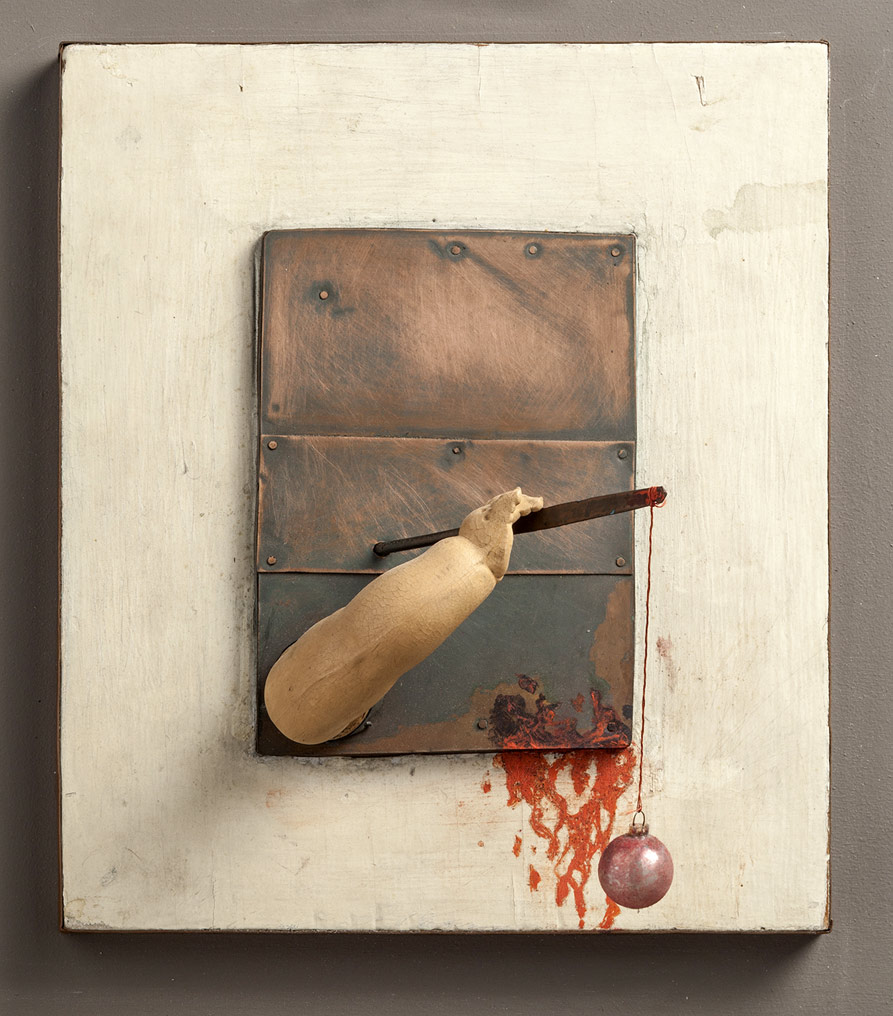
 

Hans Richter (German, 1888-1976) 'Justitia Minor' 1917/1960s


Hans Richter (German, 1888-1976)
Justitia Minor
1917/1960s
Assemblage (wood, copper, plastic, iron file and string, Christmas decoration)
24 x 18 x 10 in (61 x 45.7 x 25.4cm)
Private Collection
© Estate Hans Richter
Foto © 2013 Museum Associates/LACMA


Hans Richter (German, 1888-1976) 'Houses' 1917


Hans Richter (German, 1888-1976)
Houses
1917
Ink wash on paper
8 1/4 x 6 1/2 in. (20.9 x 16.5cm)
Private collection
© Estate Hans Richter Foto
Foto © 2013 Museum Associates/LACMA


“Influenced by cubism and its search for structure, but not satisfied with what it offered, I found myself between 1913-1918 increasingly faced with the conflict of suppressing spontaneous expression in order to gain an objective understanding of a fundamental principle with which I could control the ‘heap of fragments’ inherited from the cubists. Thus I gradually lost interest in the subject – in any subject – and focused instead on the positive-negative (white-black) opposition, which at least gave me a working hypothesis whereby I could organise the relationship of one part of a painting to the other.”

Richter, Hans. “Easel-Scroll-Film,” in Magazine of Art, No. 45 (February 1952), p. 82.


Unknown artist. 'Hans Arp, Tristan Tzara and Hans Richter, Zurich' 1918


Unknown artist
Hans Arp, Tristan Tzara and Hans Richter, Zurich
1918
© Estate Hans Richter


In 1929 Richter curated the film section of the famous FiFo exhibition (Film und Foto), a milestone in the history of the cinematic and photographic arts. More than 1,000 photos were presented – curated by, among others, Edward Weston and Edward Steichen for the USA and El Lissitzky for the USSR. More than sixty silent films were shown, including works by Duchamp, Egeling, Léger, Man Ray and Chaplin. This important exhibition, initiated by the German Werkbund (which was founded in 1907), was also shown in the Martin-Gropius-Bau, which in those days was called “the former Museum of Applied Arts” – a fact that is rarely mentioned in current photographic histories. On this occasion, Richter published his first film book: Film Enemies of Today, Film Friends of Tomorrow.

That same year, the first Congress of Independent Film was held in the remote Swiss castle of “La Sarraz”: Hans Richter was invited along with Sergei Eisenstein, Bela Balazs, Walter Ruttmann and others. He made a film with Eisenstein, which has since been lost. The Congress is still regarded as the first festival dedicated solely to film. Back then, the still young art of film-making had to struggle for recognition. Also in 1929 the SA (“Sturmabteilung” or Nazi “Brown Shirts”) declares him the first time a “Kulturbolschewisten” – a “cultural Bolshevik”.

In 1930 he travelled to Moscow to make the film Metal. But objections by the Soviet government prevented its completion. In 1933, when the Nazis seized power and Richter was living in Moscow, storm troopers sacked his Berlin flat and made off with his art collection. Fearing for his life, he was soon forced to flee Moscow without a penny to his name. In the Netherlands he made advertising films for Philips. He also worked for a number of chemical companies that were eager to invest in film as an advertising medium. He sought permanent residency in France and Switzerland. In Switzerland, he and Anna Seghers cooperated on a script, and in 1939 Jean Renoir arranged for him to create a major film project in Paris. But the outbreak of war prevented this film as well.

When the Swiss Foreign Police ask him to leave the country he succeeds in 1941, with emigration to the United States. Hilla Rebay, artist and once a member of Ricther’s famous Berlin “November Group” is at this time advisor to the New York art patron Solomon Guggenheim. With his help they can implement their idea of ​​a “Temple of Non-Objectivity” – the Museum of Non-Objective Painting (1939), later the Guggenheim. The museum provided Richter with the necessary invitation and a Jewish support fund for refugees sponsored his long journey. In 1942 Richter became a teacher for film – and later director – at the Institute of Film Techniques at the College of the City of New York. Until 1956 he trained students who were later counted among the great figures of American independent film, including Stan Brackhage, Shirley Clarke, Maya Deren and Jonas Mekas.

In 1940s America, after a fifteen-year pause, Richter began painting again. In 1943/44 he created his great scroll paintings and collages about the war: Stalingrad, Invasion and Liberation of Paris. After the war he made the episodic film Dreams That Money Can Buy, working alongside five of the most famous artists of the twentieth century: Léger, Ernst, Calder, Ray and Duchamp. In 1946 he presented his first great American art exhibition in Peggy Guggenheim’s Art of This Century gallery.

In the 1950s, Richter returned to Europe for the first time following his emigration to deliver lectures. Portions of his art collection, which he had left behind in Germany following his move to Moscow, were returned to him. Numerous exhibitions led to the rediscovery of Hans Richter’s works in Western Europe as well. He worked in Connecticut during the summers and spent his winters in Ascona near his artist friends. Richter experienced an extraordinarily prolific creative phase during which – after he set aside his painting utensils in the late 1960s – many works appeared using special collage techniques. In 1971 he became a member of the Berlin Academy of the Arts. By the time of his death in Switzerland in 1976, his work was shown and appreciated in many exhibitions in Western Europe. Now, for the first time in over thirty years, Hans Richter can be rediscovered in an exhibition from Los Angeles.

Press release from the Martin-Gropius-Bau website


Hans Richter (German, 1888-1976) 'Visionary Portrait' 1917


Hans Richter (German, 1888-1976)
Visionary Portrait
1917
Oil on canvas
53 x 38cm
© Estate Hans Richter
Foto: Galerie Berinson


Hans Richter (German, 1888-1976) 'Triptych in Gray, Red, and Green' 1959 (detail)


Hans Richter (German, 1888-1976)
Triptych in Gray, Red, and Green (detail)
1959
Oil on canvas on boards
Three parts, each: 15 1/2 x 19 1/2 in. (39.4 x 49.5cm); all: 20 1/2 x 49 1/2 in. (52 x 125.7cm)
Private collection
© Estate Hans Richter
Foto © 2013 Museum Associates/LACMA


Hans Richter (German, 1888-1976) 'Dragonfly (Counterpoint in Red, Black,Gray, and White)' 1943


Hans Richter (German, 1888-1976)
Dragonfly (Counterpoint in Red, Black,Gray, and White)
1943
Oil on canvas
29 1/2 x 15 1/2 in. (74.9 x 39.4cm)
Private collection
© Estate Hans Richter
Foto © 2013 Museum Associates/LACMA
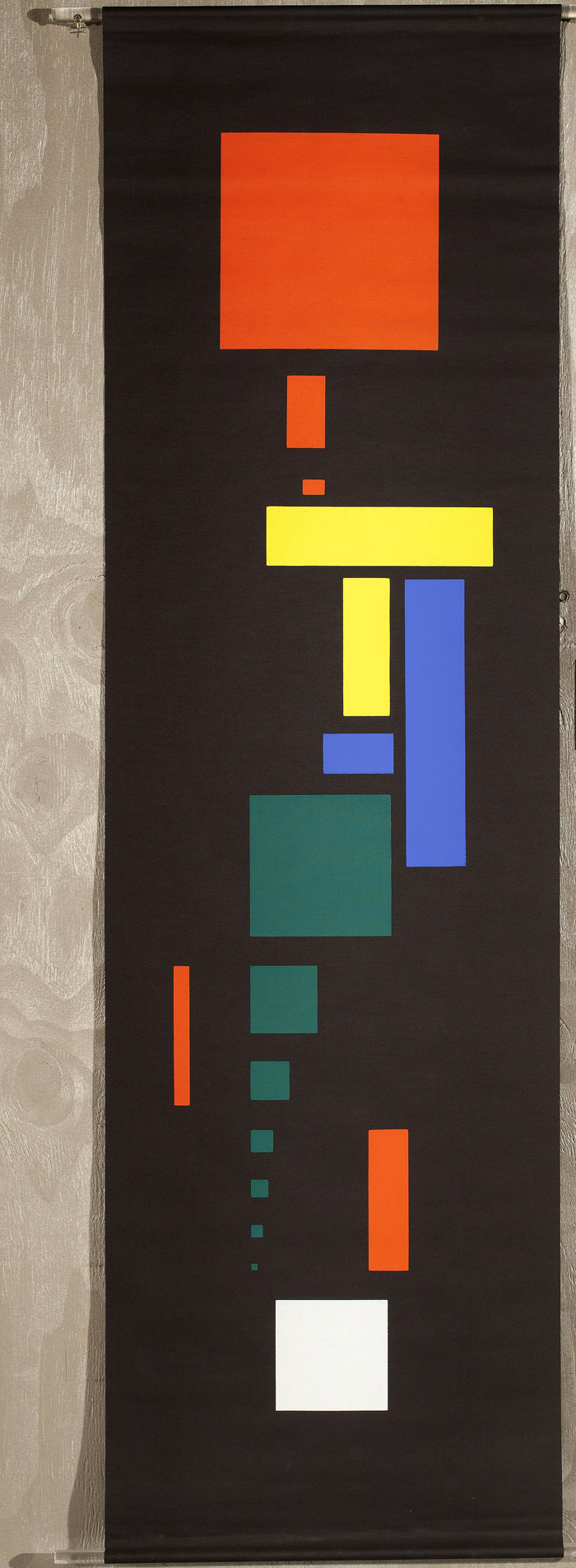
 

Hans Richter (German, 1888-1976) 'Orchestration of Colors' 1923/1970


Hans Richter (German, 1888-1976)
Orchestration of Colors
1923/1970
Serigraph on linen
54 x 16 in. (137.2 x 40.6cm)
Private collection
© Estate Hans Richter Foto
Foto © 2013 Museum Associates/LACMA


Martin-Gropius-Bau Berlin
Niederkirchnerstraße 7
Corner Stresemannstr. 110
10963 Berlin
Phone: +49 (0)30 254 86-0

Opening hours:
Wednesday to Monday 10 – 19 hrs
Tuesday closed
Martin-Gropius-Bau website

LIKE ART BLART ON FACEBOOK

Back to top

Exhibition: ‘Garden of the East: Photography in Indonesia 1850s-1940s’ at the National Gallery of Australia, Canberra

Exhibition dates: 21st February – 22nd June, 2014

Curator: Gael Newton, Senior Curator of Photography at the NGA


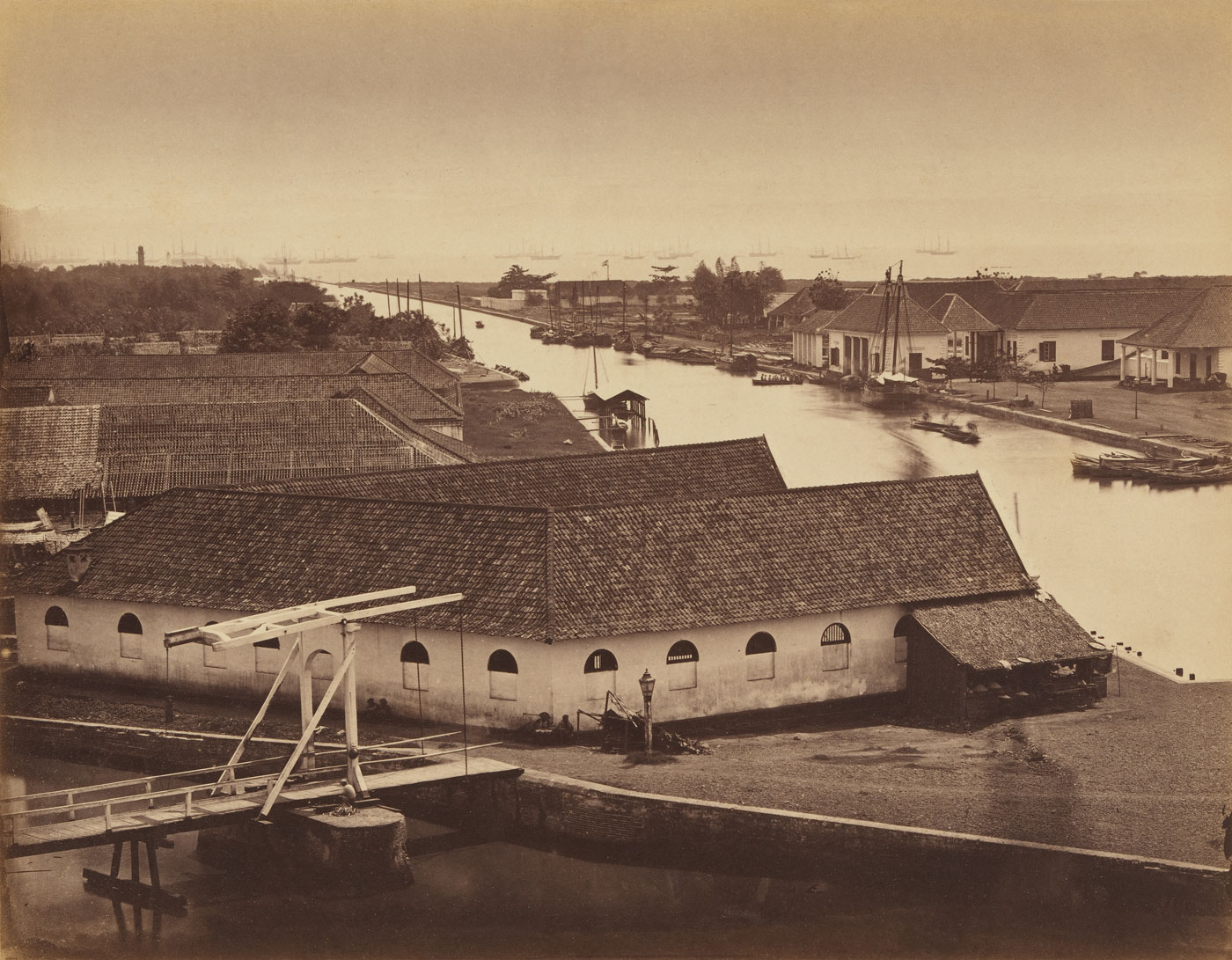
Woodbury & Page (established Jakarta 1857-1900) 'Batavia roadstead' c. 1865 from the exhibition 'Garden of the East: Photography in Indonesia 1850s-1940s' at the National Gallery of Australia, Canberra, February - June, 2014


Woodbury & Page (established Jakarta 1857-1900)
Batavia roadstead
c. 1865
Albumen silver photograph
19.4 x 24.5cm
Collection National Gallery of Australia


Dutch East Indies and Indonesian photography, and more broadly Asia-Pacific photography, has been a burgeoning area of interest, research and collecting for some time now. Although this is far from my area of expertise, with the quality of the work shown in this posting, you can understand why. Since 2005, “the National Gallery of Australia’s Asian photographs collection has grown to nearly 8000 and in excess of 6500 prints are from Indonesia.”

Absolutely beautiful tonality to the prints. They seem to have a wonderful stillness to them as well.

On a personal note, Gael Newton, Senior Curator, Photography at the National Gallery of Australia is retiring. I would like to thank her for promoting, researching and writing about all forms of photography over the years and to congratulate her on significantly extending the NGA’s photography collection. A job well done.

Dr Marcus Bunyan


Many thankx to Gael Newton and the National Gallery of Australia for allowing me to publish the photographs in the posting. Please click on the photographs for a larger version of the image.


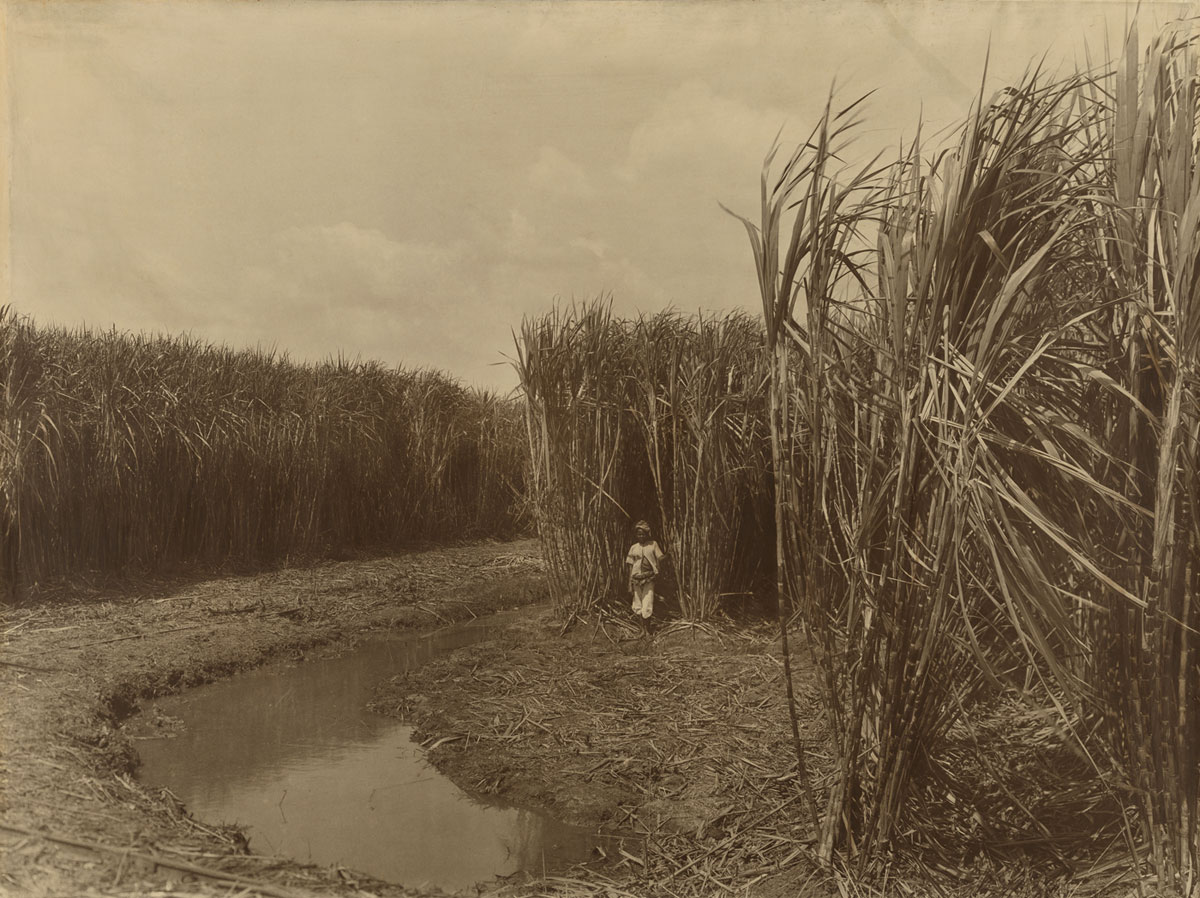
Dirk Huppe (Indonesia, 1867-1931) O Kurkdjian & Co (Established Surabaya, Java 1903-1935) 'Mature canes, fertilized with artificial guano Java Fertilizer Co.,' Semarang 1914 from the exhibition 'Garden of the East: Photography in Indonesia 1850s-1940s' at the National Gallery of Australia, Canberra, February - June, 2014


Dirk Huppe (Indonesia, 1867-1931)
O Kurkdjian & Co (Established Surabaya, Java 1903-1935)
Mature canes, fertilised with artificial guano, Java Fertilizer Co.,
Semarang 1914
Carbon print photograph
74.6 x 99.6cm
Collection National Gallery of Australia


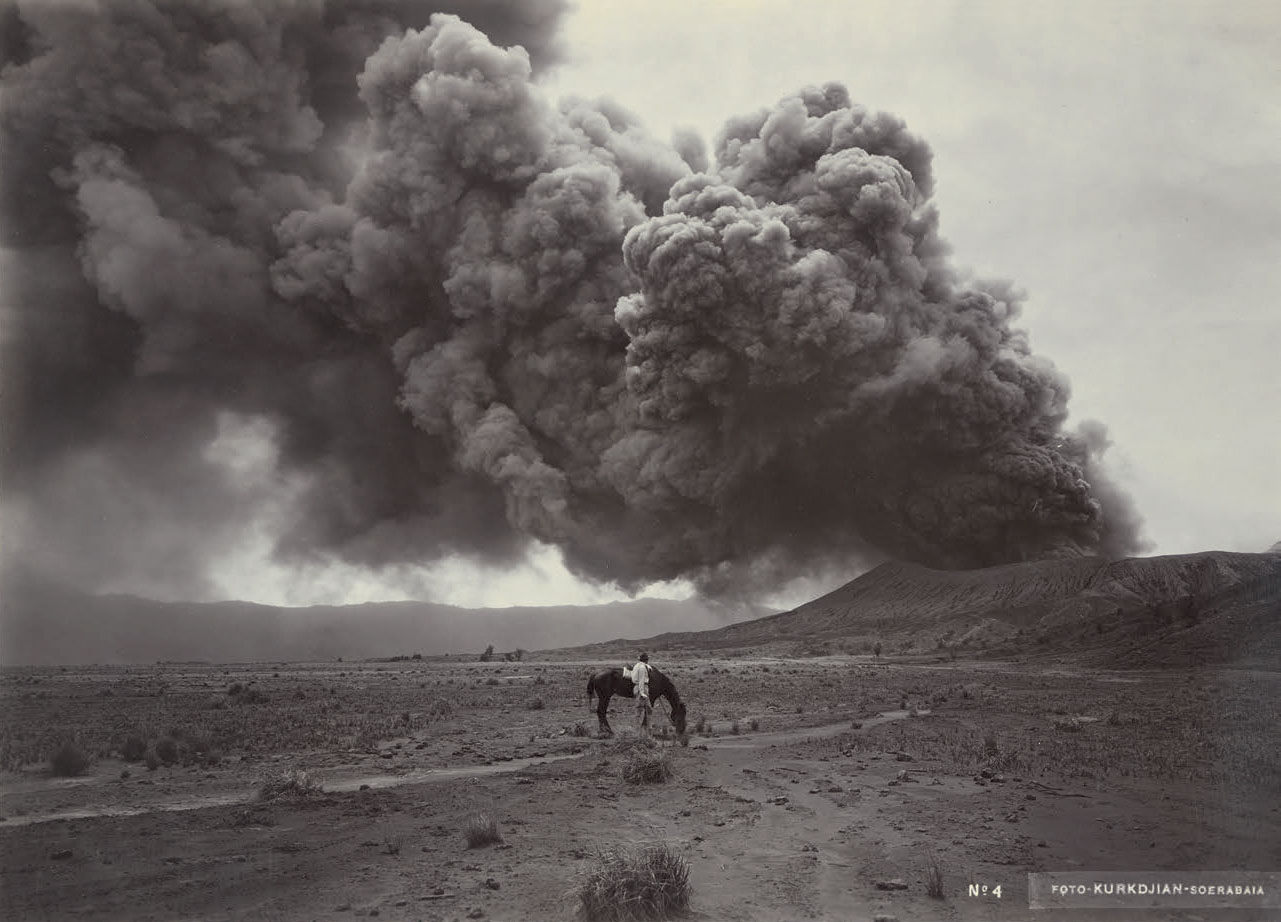
Atelier O Kurkdjian & Co (Established Surabaya, Java 1903-1935) 'Bromo eruption of December' 1915


Atelier O Kurkdjian & Co (Established Surabaya, Java 1903-1935)
Bromo eruption of December
1915
Gelatin silver photograph
17.7 x 24cm
Collection National Gallery of Australia
Purchased 2007


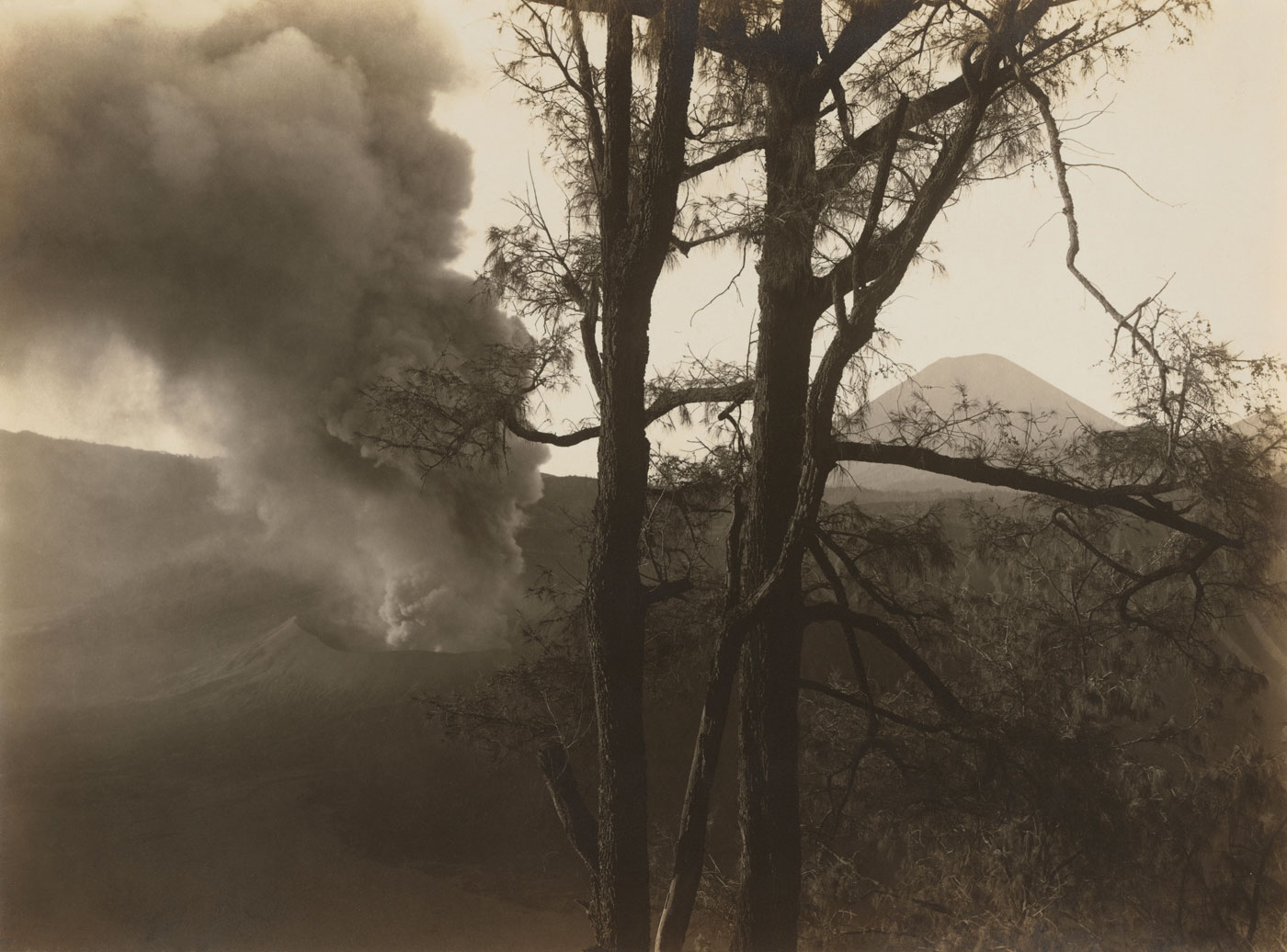
S. Satake (Japanese, working Indonesia 1902 - c. 1937) 'Eruption' Java c. 1930


S. Satake (Japanese, working Indonesia 1902 – c. 1937)
Eruption
Java c. 1930
Gelatin silver photograph
16.2 x 21.8cm
Collection National Gallery of Australia


While Indonesia might be the second most popular destination for outbound Aussies, the history of the Indonesian archipelago’s diverse peoples and the colonial era Dutch East Indies, remains unfamiliar. In particular the rich heritage of photographic images made by the nearly 500 listed photographers at work across the archipelago in the mid 19th – mid 20th century, is poorly known, both in the region and internationally.

The Gallery began building its Indonesian photographic collection in 2006. It is unique in the region: the largest and most comprehensive collection excluding the archives of the Dutch East Indies in the Netherlands. It was not until the late 1850s with the arrival of photographs printed on paper from a master glass negative, that images of Indonesia – the origin of nutmeg, pepper and cloves, much desired in the West – began circulating worldwide.

Australia had a minor role in the history of photography in Indonesia. A pair of young British photographers, Walter Woodbury and James Page (operators of the Woodbury & Page studios located in the Victorian goldfields and Melbourne) arrived in Jakarta in 1857. From around 1900 a trend toward more picturesque views and sympathetic portrayals of indigenous people appeared. Old images were given new life as souvenir prints and sold through hotels and resorts or used for cruise ship brochures.

A particular feature of Garden of the East is the display of family albums. Both amateur and professional images in the Indies were bound in distinctive Japanese or Batik-patterned cloth boards as records of a colonial lifestyle. Hundreds of these once-treasured narratives of now lost people ended up in the Netherlands in the 1970s and 80s in estate sales of former Dutch colonial and Indo (mixed race) family members who had returned or immigrated after the establishment of the Republic of Indonesia in 1945.

Text from the National Gallery of Australia website


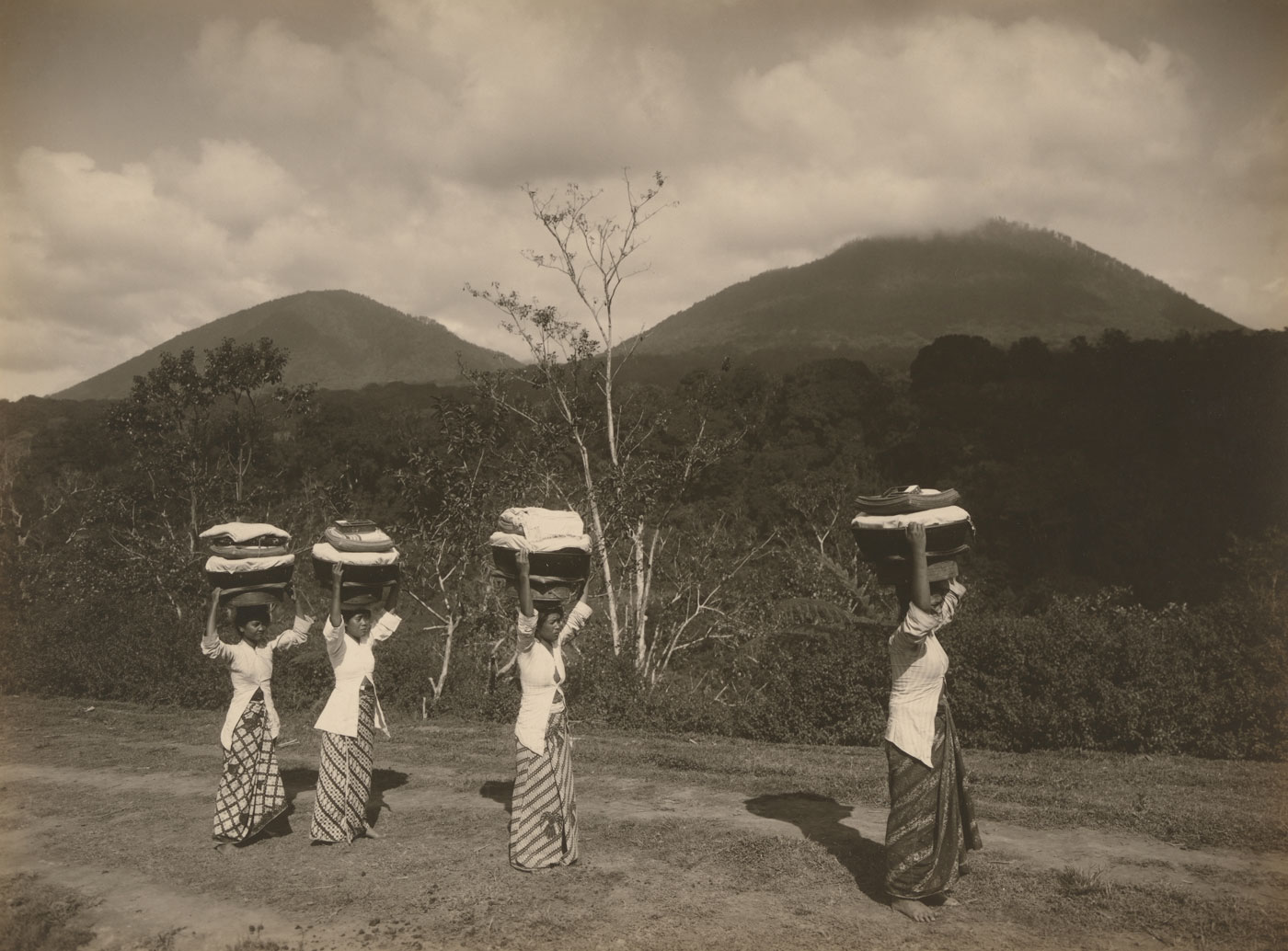
S. Satake (Japanese, working Indonesia 1902 - c. 1937) 'Women on road to Buleleng Bali' c. 1928


S. Satake (Japanese, working Indonesia 1902 – c. 1937)
Women on road to Buleleng
Bali c. 1928
Gelatin silver photograph
16.2 x 22.0cm
Collection National Gallery of Australia


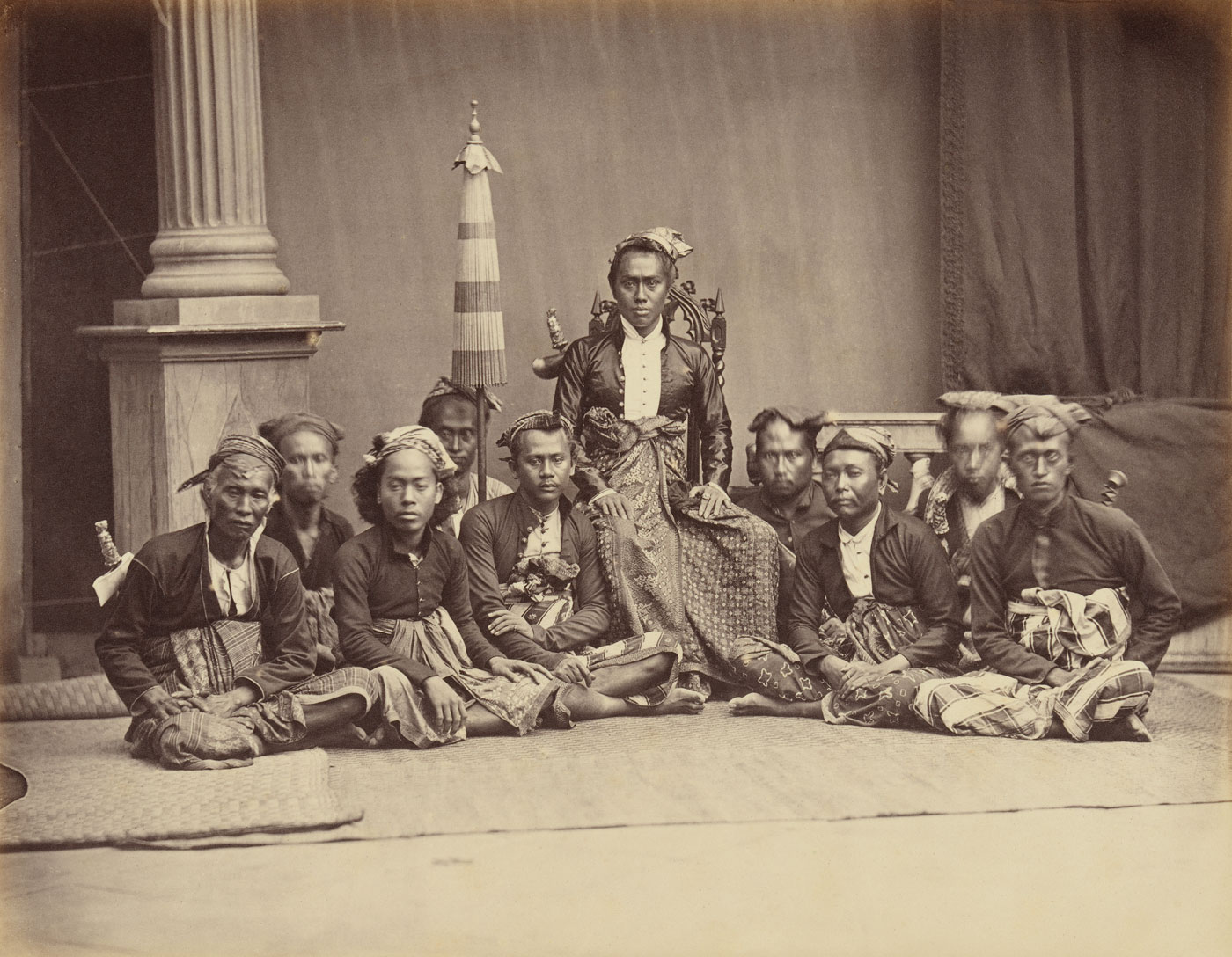
Woodbury & Page (established Jakarta 1857-1900) 'Gusti Ngurah Ketut Jelantik, Prince of Buleleng with his entourage in Jakarta in 1864 on the visit of Governor-General LAJW Sloet van de Beele' 1864


Woodbury & Page (established Jakarta 1857-1900)
Gusti Ngurah Ketut Jelantik, Prince of Buleleng with his entourage in Jakarta in 1864 on the visit of Governor-General LAJW Sloet van de Beele
1864
Albumen silver photograph
Collection National Gallery of Australia


Garden of the East: Photography in Indonesia 1850s-1940s is the first major survey in the southern hemisphere of the photographic art from the period spanning the last century of colonial rule until just prior to the establishment of the Republic of Indonesia in 1945. The exhibition provides the opportunity to view over two hundred and fifty photographs, albums and illustrated books of the photography of this era and provides a unique insight into the people, life and culture of Indonesia. The exhibition and accompanying catalogue reveals much new research and information regarding the rich photographic history of Indonesia. Garden of the East is on display in Canberra only.

The exhibition is comprised of images created by more than one hundred photographers and the majority have never been exhibited publicly before. The works were captured by photographers of all races, making images of the beauty, bounty, antiquities and elaborate cultures of the diverse lands and peoples of the former Dutch East Indies. Among these photographers is the Javanese artist Kassian Céphas, whose genius as a photographer is not widely known at this time, a situation which the National Gallery of Australia hopes to address by growing the collection of holdings from this period and by continuing to stage focused exhibitions such as Garden of the East.

As was the case in other Southeast Asian ports, the most prominent professional photographers at work in colonial Indonesia came from a wide range of European backgrounds until the 1890s, when Chinese photography studios began to dominate. The exhibition focuses on the leading foreign studios of the time, in particular Walter B Woodbury, one of the earliest photographers at work in Australia in the 1850s as well as the Dutch East Indies. However Garden of the East also includes images created by lesser known figures whose work embraced the new art photography styles of the early twentieth century including: George Lewis, the British chief photographer at the Surabaya studio founded by Armenian Ohannes Kurkdjian, the remarkable German amateur photographer Dr Gregor Krause; American adventurer and filmmaker André Roosevelt; and the only woman professional known to have  worked in the period, Thilly Weissenborn, whose works were intertwined with the tourist promotion of Java and Bali in the 1930s. Chinese studios are well-represented, although little is known of their founders and many employed foreign photographers.

Frank Hurley is the sole Australian photographer represented in the exhibition. Hurley is noted as the only Australian known to have worked in Indonesia before the Second World War and toured Java in mid-1913, on commission to promote tourist cruises from Australia to the Indies for the Royal Packet Navigation Company.

“We are delighted to host this exhibition and believe that Australia’s geographic, political and cultural position in the Asia-Pacific region makes it very appropriate that the National Gallery of Australia should celebrate the rich and diverse arts of our region,” said Ron Radford AM, Director, National Gallery of Australia. “A dedicated Asia-Pacific focused policy has been long-held by the Gallery, but it was not until 2005 that we focused on early photographic art of the region. Progress, however, has been rapid and all the photographs in Garden of the East have been recently acquired for the National Gallery’s permanent collection,” he said.

“From a small holding in 2005 of less than two hundred photographs from anywhere in Asia, of which only half a dozen were by any Asian-born photographers, the National Gallery of Australia’s Asian photographs collection has grown to nearly 8000 and in excess of 6500 prints are from Indonesia,” Ron Radford said.

Garden of the East presents images, both historic and homely and is a ‘time travel’ opportunity to visit the Indies through more than two hundred and fifty works on show, made by both professional and amateur family photographers. Images as diverse as the Indonesian archipelago itself, which was once described by nineteenth century travel writers as the Garden of the East,” said Gael Newton, Senior Curator of Photography, National Gallery of Australia and exhibition Curator.

Garden of the East: Photography in Indonesia 1850s-1940s follows the large 2008 survey exhibition Picture Paradise: Asia-Pacific photography 1840s-1940s. This was the first of the new Asia-Pacific collection focus exhibitions. In 2010, the Gallery staged an early photographic portrait exhibition to coincide with a conference hosted in partnership with the Australian National University entitled Facing Asia. A number of other small Asian collection shows have also been held since 2011.

The National Gallery of Australia is delighted to stage this exhibition to coincide with the Focus Country Program, an initiative organised by the Australian Government’s key cultural diplomacy body, the Australia International Cultural Council. The AICC has chosen Indonesia as its Focus Country for 2014 and will organise a series of events across the Indonesian archipelago to promote Australian arts and culture, as well as our credentials in sport, science, education and industry. This exhibition will also mark the 40th anniversary of dialogue relations between Australia and the Association of South East Asian Nations. The National Gallery of Australia is proud to be presenting an exhibition of Indonesian photography in celebration of Australia’s close cultural relations with Indonesia and the Asia-Pacific region.

Press release from the National Gallery of Australia website


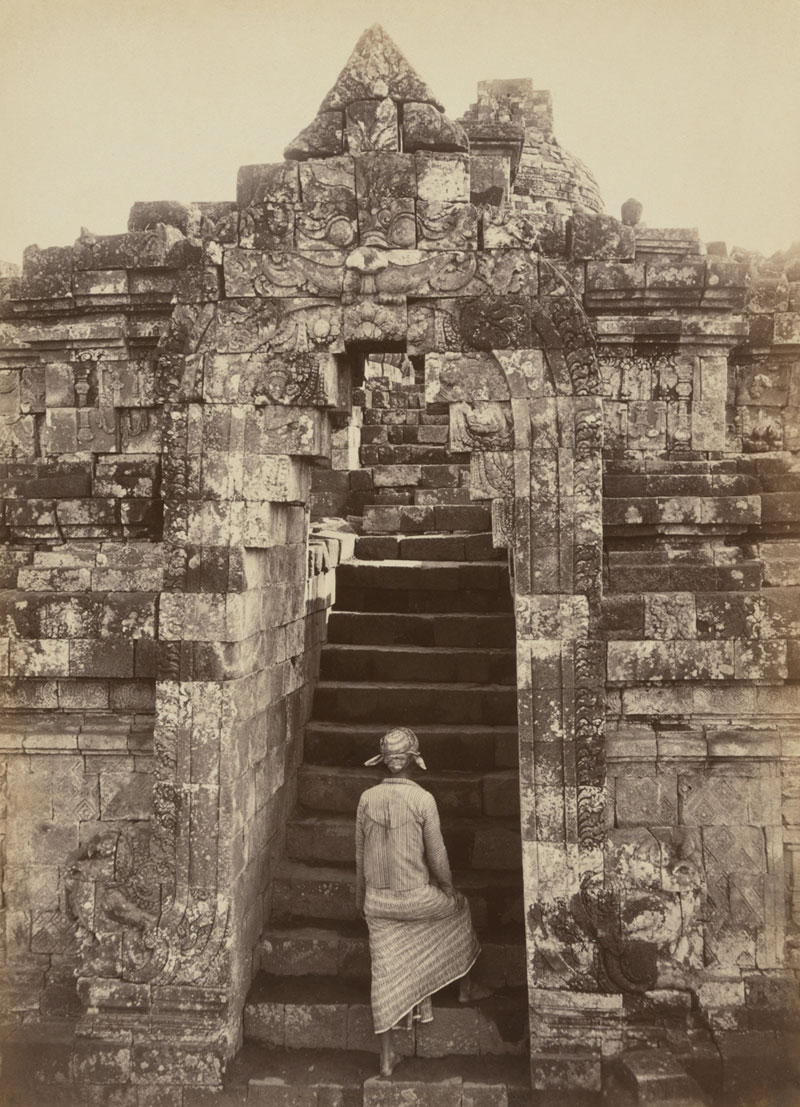
Kassian Céphas (Javanese, 1845-1912) 'Man climbing the front entrance to Borobudur' Central Java 1872


Kassian Céphas (Javanese, 1845-1912)
Man climbing the front entrance to Borobudur
Central Java 1872
Albumen silver photograph
22.2 x 16.1cm
Collection National Gallery of Australia


Kassian Cephas or Kassian Céphas was a Javanese photographer of the court of the Yogyakarta Sultanate. He was the first indigenous person from Indonesia to become a professional photographer and was trained at the request of Sultan Hamengkubuwana VI. After becoming a court photographer in as early 1871, he began working on portrait photography for members of the royal family, as well as documentary work for the Dutch Archaeological Union. Cephas was recognised for his contributions to preserving Java’s cultural heritage through membership in the Royal Netherlands Institute of Southeast Asian and Caribbean Studies and an honorary gold medal of the Order of Orange-Nassau. Cephas and his wife Dina Rakijah raised four children. Their eldest son Sem Cephas continued the family’s photography business until his own death in 1918.

Text from the Wikipedia website


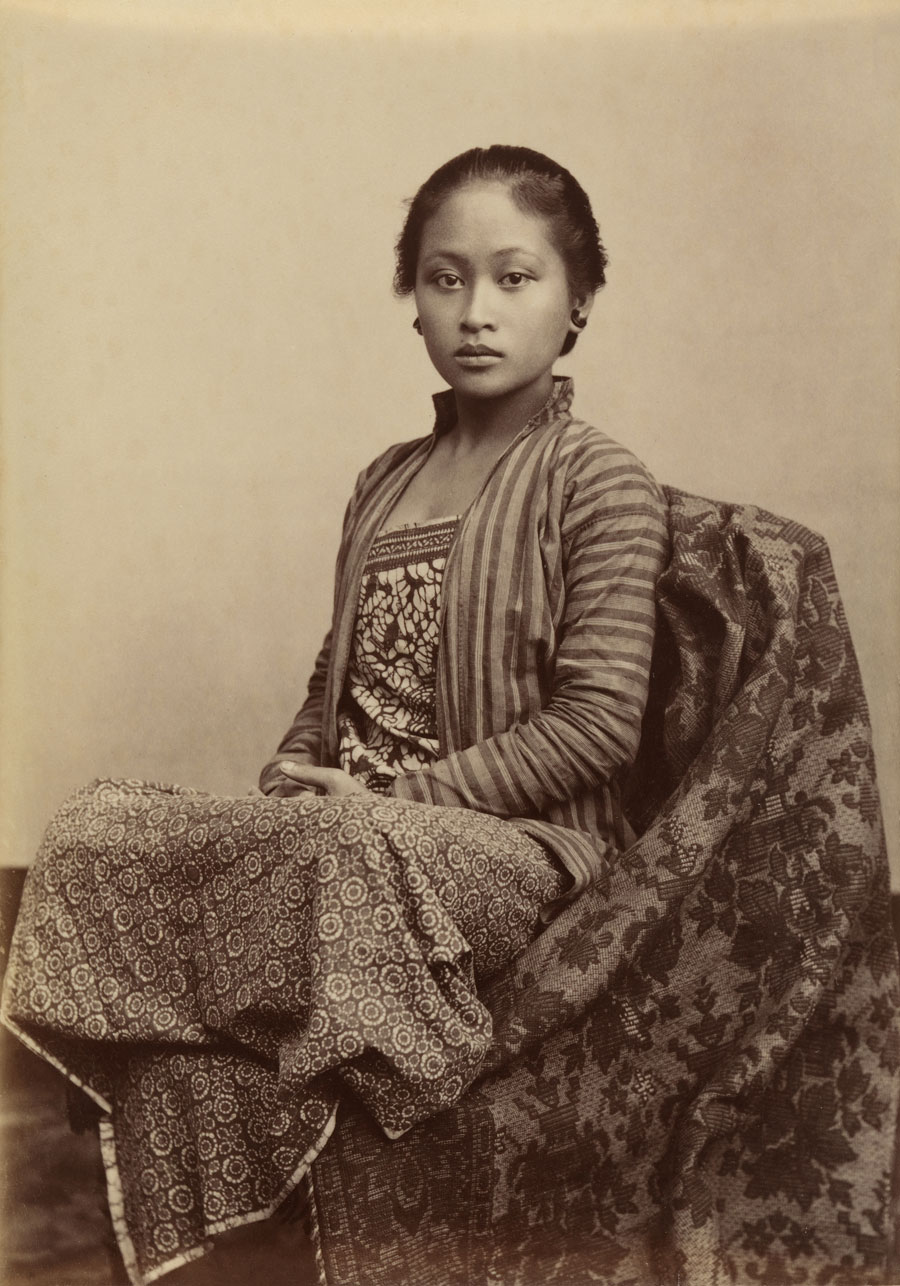
Kassian Céphas (Javanese, 1845-1912) 'Young Javanese woman' c. 1885


Kassian Céphas (Javanese, 1845-1912)
Young Javanese woman
c. 1885
Albumen silver photograph
13.7 x 9.8cm
Collection National Gallery of Australia


Garden of the East: photography in Indonesia 1850s-1940s offers the chance to see images from the last century of colonial rule in the former Dutch East Indies. It includes over two hundred photographs, albums and illustrated books from the Gallery’s extensive collection of photographic art from our nearest Asian neighbour.

Most of the daguerreotype images from the 1840s, the first decade of photography in Indonesia, are lost and can only be glimpsed in reproductions in books and magazines of the mid nineteenth century. It was not until the late 1850s that photographic images of Indonesia – famed origin of exotic spices much desired in the West – began circulating worldwide. British photographers Walter Woodbury and James Page, who arrived in Batavia (Jakarta) from Australia in 1857, established the first studio to disseminate large numbers of views of the country’s lush tropical landscapes and fruits, bustling port cities, indigenous people, exotic dancers, sultans and the then still poorly known Buddhist and Hindu Javanese antiquities of Central Java.

The studios established in the 1870s tended to offer a similar inventory of products, mostly for the resident Europeans, tourists and international markets. The only Javanese photographer of note was Kassian Céphas who began work for the Sultan in Yogyakarta in the early 1870s. In late life, Céphas was widely honoured for his record of Javanese antiquities and Kraton performances, and his full genius can be seen in Garden of the East.

Most of the best known studios at the turn of the century, including those of Armenian O Kurkdjian and German CJ Kleingrothe, were owned and run by Europeans. Chinese-run studios appeared in the 1890s but concentrated on portraiture. Curiously, relatively few photographers in Indonesia were Dutch. From the 1890s onward, the largest studios increasingly served corporate customers in documenting the massive scale of agribusiness, particularly in the golden economic years of the Indies in the early to mid twentieth century. From around 1900, a trend toward more picturesque views and sympathetic portrayals of indigenous people appeared. This was intimately linked to a government sponsored tourist bureau and to styles of Pictorialist art photography that had just emerged as an international movement in Europe and America. As photographic studios passed from owner to owner, old images were given new life as souvenir prints sold at hotels and resorts and as reproductions in cruise-ship brochures.

Amateur camera clubs and Pictorialist photography salons common in Western countries by the 1920s were slower to develop in Asia and largely date to the postwar era. Locals, however, took up elements of art photography. Professionals George Lewis and Thilly Weissenborn (the only woman known from the period) and amateurs Dr Gregor Krause and Arthur de Carvalho put their names on their prints and employed the moody effects and storytelling scenarios of Pictorialist photography. Krause was one of the most influential photographers. He extensively published his 1912 Bali and Borneo images in magazines and in two books in the 1920s and 1930s, inspiring interest in the indigenous life and landscape as well as the sensuous physical beauty of the Balinese people.

Postwar artists and celebrities – including American André Roosevelt, who used smaller handheld cameras – flocked to the country to capture spontaneity and daily life around them, to affirm their view of Bali as a ‘last paradise’ , where art and life were one. In 1941, Gotthard Schuh published Inseln der Götter (Islands of the gods), the first modern large-format photo-essay on Indonesia. While romantic, the collage of images and text in Schuh’s book presented a vital image of the diverse islands, peoples and cultures that were to be united under the flag of the Republic of Indonesia in 1949.

A particular feature of Garden of the East is a selection of family albums bound in distinctive Japanese or Batik patterned cloth boards as records of a colonial lifestyle (for the affluent) in the Indies. Hundreds of these once treasured narratives of now lost people ended up in the Netherlands in the 1970s and 1980s in estate sales of former Dutch colonial and Indo (mixed race) family members who had returned or immigrated after the establishment of the Republic of Indonesia.

Gael Newton. “Princes, Portraits and Panoramas,” in the National Gallery of Australia Artonview 76 Summer 2013, pp. 20-22 [Online] Cited 12/06/2014. Used under fair use conditions for the purposes of education and research


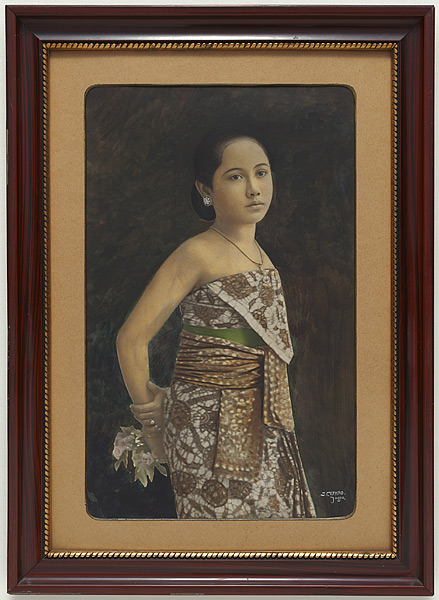
Sem Céphas (Indonesia, 1870-1918) 'Portrait of a Javanese woman' c. 1900


Sem Céphas (Indonesia, 1870-1918)
Portrait of a Javanese woman
c. 1900
Gelatin silver photograph, colour pigment hand painted photograph
image
38.5 x 23.8cm
Purchased 2007
National Gallery of Australia, Canberra


Gotthard Schuh (Swiss, 1897-1969) 'Inseln der Götter' (Islands of the gods) [book cover] 1941


Gotthard Schuh (Swiss, 1897-1969)
Inseln der Götter (Islands of the gods) [book cover]
1941
Hardcover w/dust jacket
154pp, text in German
Plates in photogravure
28.5 x 22.5cm


Gotthard Schuh (Swiss, 1897-1969)

Gotthard Schuh (December 22, 1897 in Schöneberg near Berlin – December 29, 1969 in Küsnacht, Zurich) was a Swiss photographer, painter and graphic artist.

Photographer

In 1931 his first photos were published in a Zurich magazine and in 1932 he held a photography exhibition in Paris, where he met Picasso, Léger and Braque.

From 1932 he joined the Zürcher Illustrierte under Arnold Kübler, working with Hans Staub and Paul Senn, and until 1937 Schuh also worked freelance for Berliner Illustrirte Zeitung, Paris Match and Life. His assignments during 1938/1939 took him all over Europe and to Indonesia. He and Marga divorced in 1939.

After about ten years as a reporter he became the first picture editor for the Neue Zürcher Zeitung. He and Edwin Arnet created the NZZ supplement Das Wochenende, which showcased Swiss and international photography in addition to his own reportage.

From this period a significant part of his own photographic work illustrated books, of which the most successful was Inseln der Götter published in 1941, the result of his almost 11-month journey through Singapore, Java, Sumatra and Bali, undertaken just before the war. It was a mixture of reportage and self-reflection, with a poetic quality that, though individual images may be read either way, Schuh sometimes valued over documentary authenticity:

“Everyone just depicts what he sees, and everyone just sees what corresponds to his being.”

This is evident in the book Begegnungen which Schuh published in 1956, in which he combined older and more recent images in free association, in accord with the objectives of the ‘Kollegium Schweizerischer Photographen’, the Academy of Swiss Photographers which he founded together with Paul Senn, Walter Läubli, Werner Bischof and Jakob Tuggener, a loose group that promoted an ‘auteur’ emphasis. Their first exhibition in 1951 marked a renewal of photography in Switzerland after the conservatism and nationalism of the war years. Critic Edwin Arnet identified the ethos of the group:

“Their photography has abandoned the sphere of technical experimentation … , the abstract and the avant-garde. It has become more wholesome, concentrating again more on the poetry of real things.”

In 1955 Edward Steichen selected two of Schuh’s photographs for the world-touring Museum of Modern Art exhibition The Family of Man seen by an audience of 9 million. One, taken in Italy, is a stolen image of lovers resting beside their discarded bicycles amongst long summer grass in an olive grove, while the other, taken in Java, shows a boy stretching balletically across the pavement as he plays marbles.

Text from the Wikipedia website


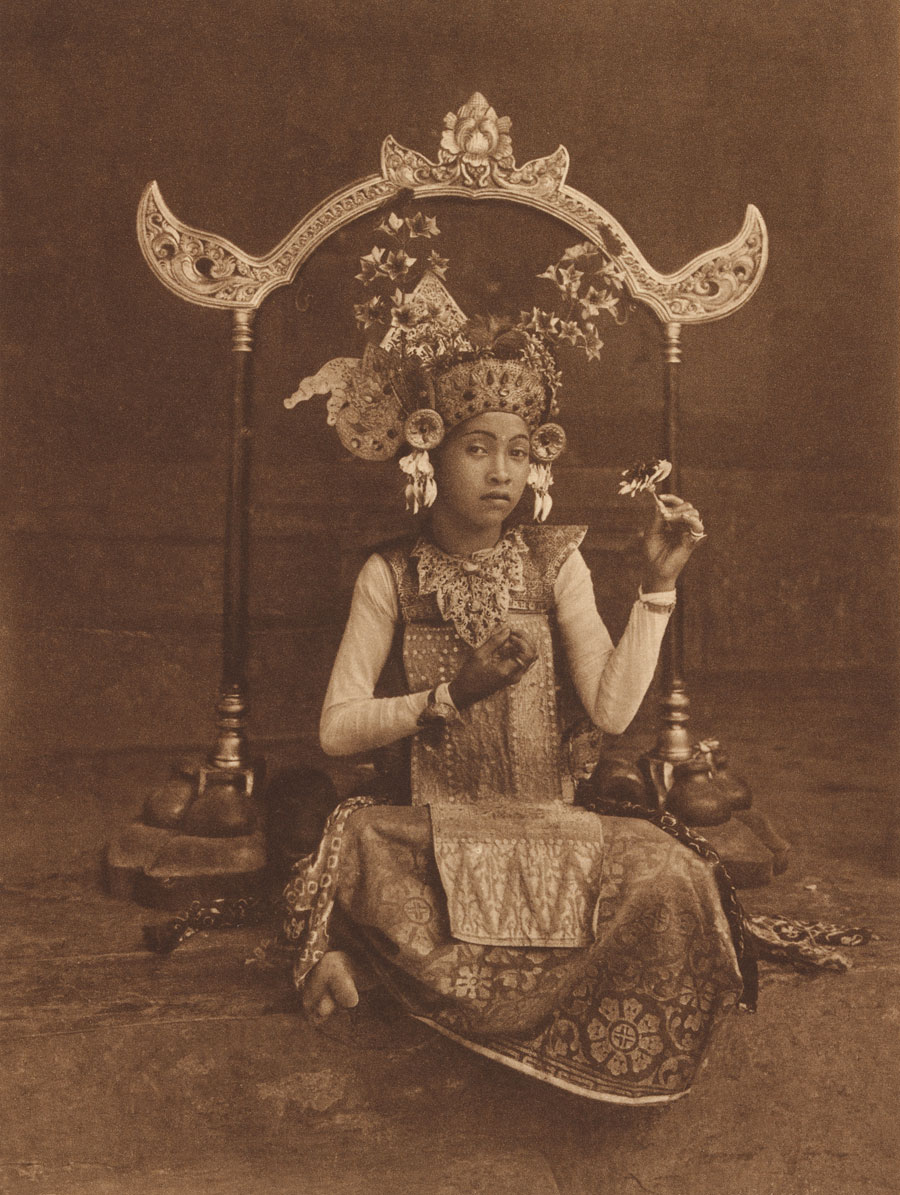
Thilly Weissenborn (Javanese / Indonesian, 1883-1964) 'A dancing-girl of Bali, resting' c. 1925


Thilly Weissenborn (Javanese / Indonesian, 1883-1964)
Indonesia 1902 – Netherlands 1964
A dancing-girl of Bali, resting
c. 1925
Photogravure
21.1 x 15.9cm
Collection National Gallery of Australia


Thilly Weissenborn (Javanese / Indonesian, 1883-1964)

Thilly Weissenborn (1883-1964) was the first professional woman photographer of the former Dutch East Indies and one of the few photographers working in the early 20th century in the area who were Indonesian born. Her works were widely used to expand the newly developed tourism industry of the East Indies.

Early life

Margarethe Mathilde Weissenborn was born on 22 March 1883 or 1889, to Cornelia Emma Angely Lina da Paula (née Roessner) and Hermann Theodor Weissenborn in either Surabaya, or Kediri, on East Java of the Dutch East Indies (now Indonesia). Her parents were German-born, naturalized Dutch citizens and operated a coffee plantation in Kediri. In 1892, her mother returned with Thilly and her siblings to the Netherlands and took up residence in The Hague. They were joined by their father the following year. After five years, the oldest son and the father left for Tanganyika in German East Africa to become planters there. Else, one of Thilly’s older sisters, who had studied photography in Paris, opened a photographic studio in The Hague in 1903, where Thilly began working. In 1912, she left the Netherlands and returned to Java, in the company of her brother Theo to join their brother Oscar, who was living in Bandung.

Career

In 1913, Weissenborn found employment in a prestigious photographic studio in Surabaya which was founded by Onnes Kurkdjian, an Armenian, called Atelier Kurkdjian. The studio was the only agent for Kodak in East Java. Kurkdjian had died by the time Weissenborn arrived and the studio, which employed thirty photographers, was managed by an Englishman, GP Lewis. Weissenborn honed her craft under Lewis’ tutelage learning both photographic and retouching techniques. In 1917, she moved to Garut in West Java and managed a photographic studio GAH Lux in the Garoetsche Apotheek en Handelsvereeniging Company, a pharmacy owned by Denis G. Mulder. Mulder moved to Bandung in 1920 and turned over his property to Weissenborn, who changed the firm name to Foto Lux. In 1930, she established Lux Fotograaf Atelier NV, which she operated for a decade in Garut.

Weissenborn became the first significant woman photographer in Indonesia and was one of the few photographers working in the era who were Indonesian-born. Her works were marked by a lyrical quality and her attempt to capture the idyllic nature of the landscape. She is most known for her photographs of architectural interiors, landscapes, and portraits, which were produced for the burgeoning tourist industry. Some of her works were featured in Dutch tourism guide published in 1922, as Come to Java. Her photographs also made up the majority of the images in Louis Couperus’ work Oostwaarts (Eastward, 1923). Weissenborn travelled throughout the East Indies, and particularly worked in Bali, trying to capture the exotic nature of the islands, while at the same time, retaining the dignity of locals she photographed. Ironically, her images were at times appropriated and used in prurient manners, such as a photograph of two women on a road carrying water, one who has a pot on her head, which was used for a French novel titled L’Île des seins nus (Island of Bare Breasts). In time, her portrait images changed from partially-clad images to the more artistic images of dancing girls. These were featured in such magazines as Inter-Ocean, Sluyter’s Monthly and Tropical Netherlands, which marketed a more civilised Bali to international tourists.

Later life

During World War II, the 16th Army of Japan landed in West Java at the end of February, 1942. After subduing the population, around 30,000 American, Australian, British, Dutch, and Indo-European civilians were transported to civilian internment camps. In 1943, Weissenborn was interned in the Japanese prisoner of war camp Kareës in Bandung. Women and children were kept in the camp until 1945. The town of Garut was destroyed by fire and then in the aftermath of the Indonesian National Revolution, Weissenborn’s studio was completely destroyed and all of her glass negatives were lost in 1947. That same year, she married Nico Wijnmalen and the couple moved to Bandung.

In 1956, the Indonesian government repudiated the remaining terms of the Hague Round Table Conference forcing Weissenborn and Wijnmalen to return to Holland. Weissenborn died 28 October 1964 at Baarn, in Utrecht Province, The Netherlands and is buried in the Baarn New General Cemetery.

Text from the Wikipedia website


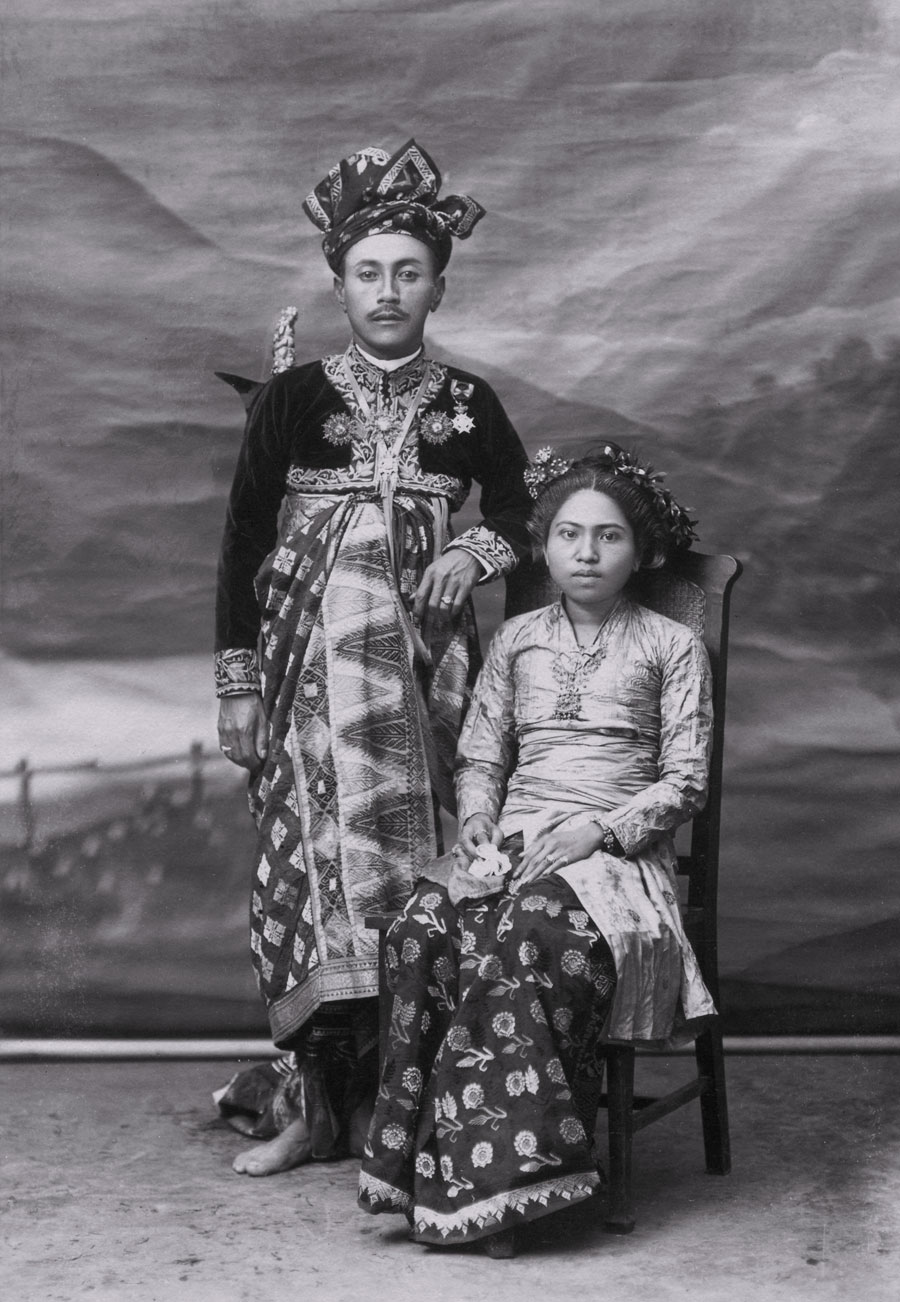
Thilly Weissenborn (Javanese / Indonesian, 1883-1964) (attributed to) 'I Goesti Agoeng Bagoes Djelantik, Anakagoeng Agoeng Negara, Karang Asem' 1931


Thilly Weissenborn (Javanese / Indonesian, 1883-1964) (attributed to)
I Goesti Agoeng Bagoes Djelantik, Anakagoeng Agoeng Negara, Karang Asem
1931
Gelatin silver photograph
14 x 9.7cm
Collection National Gallery of Australia
Purchased 2006


Unknown photographer. Working Bali 1930s. 'I Goesti Agoeng Bagoes Djelantik, Anakagoeng Agoeng Negara, Karang Asem' Bali 1931


Unknown photographer
Working Bali 1930s
I Goesti Agoeng Bagoes Djelantik, Anakagoeng Agoeng Negara, Karang Asem
Bali 1931
Gelatin silver photograph
14.0 x 9.7cm
Collection National Gallery of Australia


National Gallery of Australia
Parkes Place, Canberra
Australian Capital Territory 2600
Phone: (02) 6240 6411

Opening hours:
Open daily 10.00 am – 5.00 pm
(closed Christmas day)

National Gallery of Australia website

LIKE ART BLART ON FACEBOOK

Back to top

Video: ‘Tom Butler: Concealment, barriers and masks’

Published 30th April 2014


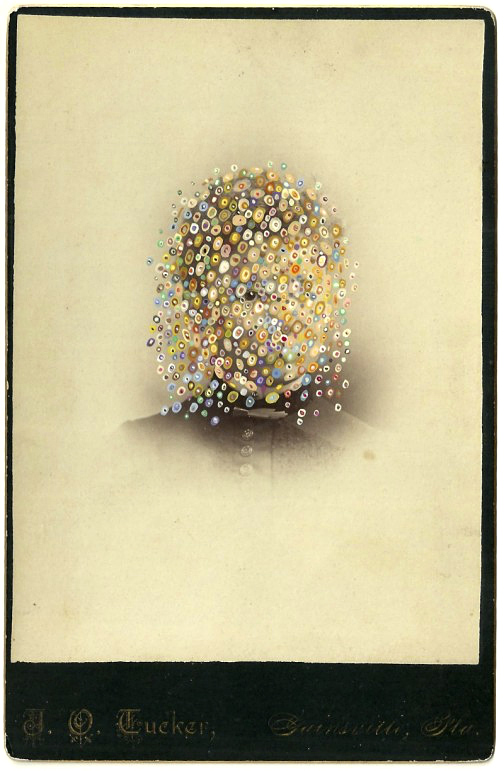
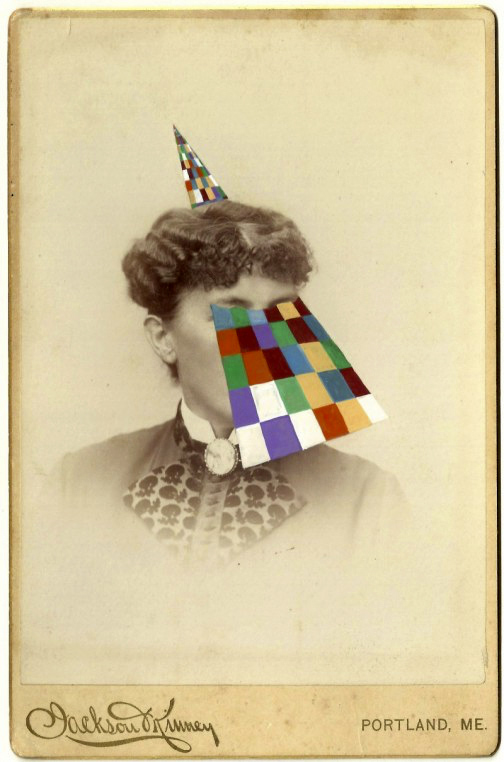
Tom Butler. 'Tucker' 2014


Tom Butler
Tucker
2014
Gouache on albumen print / Cabinet card
16.5 x 10.5cm


Phenomenal, wondrous!

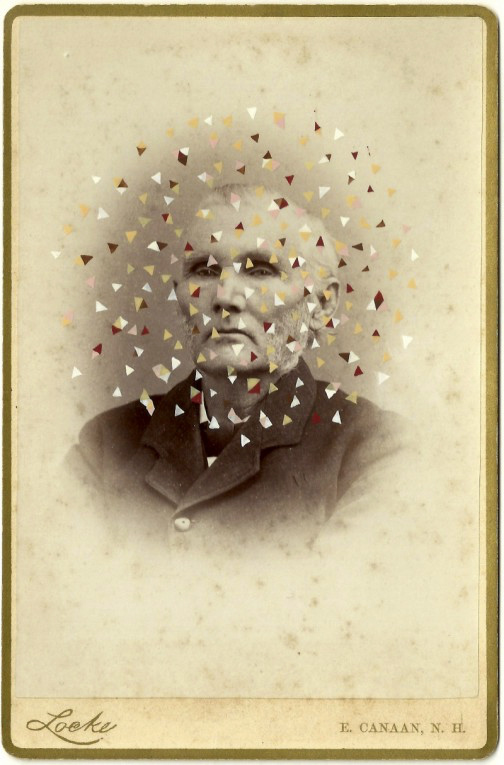
The original video from The Photographers’ Gallery that was in this posting is unfortunately no longer available. I have replaced it with a few images of hand-painted cabinet cards by Tom Butler from 2014, examples of which were in the missing video.

Dr Marcus Bunyan


Tom Butler. 'Locke' 2014


Tom Butler
Locke
2014
Gouache on albumen print / Cabinet card
16.5 x 10.5cm


Tom Butler. 'Jackson' 2014


Tom Butler
Jackson
2014
Gouache on albumen print / Cabinet card
16.5 x 10.5cm


The Photographers’ Gallery
16-18 Ramillies Street,
London W1F7Lw

Opening hours:
Monday – Saturday 10.00 – 18.00
Thursday 10.00 – 20.00
Sunday 11.30 – 18.00

The Photographers’ Gallery website

LIKE ART BLART ON FACEBOOK

Back to top

Exhibition: ‘Hiroshi Sugimoto: Past Tense’ at the J. Paul Getty Museum, Getty Center, Los Angeles

Exhibition dates: 4th February – 8th June, 2014

Curator: Arpad Kovacs, assistant curator in the Department of Photographs at the J. Paul Getty Museum


Hiroshi Sugimoto (Japanese, b. 1948) 'Sam Eric, Pennsylvania' 1978


Hiroshi Sugimoto (Japanese, b. 1948)
Sam Eric, Pennsylvania
1978
Gelatin silver print
42.5 x 54.5cm
Private collection, Frankfurt
© Hiroshi Sugimoto / Courtesy The Pace Gallery


I loved Sugimoto’s time lapse movie screens, where the exact length of a movie was captured by the open lens of the camera, the substance of time and space evidenced by a seemingly empty screen. There was something wonderfully poetic and transformational about that gesture, about the notion of compressing the narrative, reality and action of a movie into a single frame of light: “the ‘annihilation of time and space’ as a particular moment in a dynamic cycle of rupture and recuperation enables a deliberate focus on the process of transition.”1 The process of transition in the flow of space and time.

Sugimoto’s art since that ground breaking body of work has been a bit of a let down. Where the movie theatres photographs were transubstantiationalist, the three series presented here – Dioramas (1975-1994), Portraits (1999) and his newest series, Photogenic Drawings (2008-present) play, if that is the right word, with the re/animation of death. The stuffed animals, the wax figures, the redrawing of William Henry Fox Talbot photogenic drawings, the redrawing of a light already past, just seem DEAD to me – a kind of double death or even triple death – the death of the animal / the death of the photograph, the unreality (the undead) of the wax figures and their death in the photograph, the death of the plant, their capture not once but twice by the death of the photograph. We know exactly what Sugimoto is doing, but the images are stilted and lifeless and I am not convinced by them.

The diorama images are just OK – almost good undergraduate work but nothing more. My problem with the waxworks images and the pencil of nature is “other images”. We all know Cindy Sherman and her images of historical figures, and we know the work of William Henry Fox Talbot. Somehow these earlier images crowd Sugimoto’s work in a way that doesn’t often happen. Winogrand never crowded Friedlander or vice versa – and you can think of many other examples where comparing is actually beneficial… but not here.

I’m not saying Sugimoto is derivative but because of these other works, they don’t have much room to move. Indeed, they hardly move at all. They are so frozen in attitude that all the daring transcendence of light, the light! of space time travel, the transition from one state to another, has been lost. The Flame of Recognition (Edward Weston) – has gone.

Dr Marcus Bunyan


1/ McQuire, Scott. The Media City. London: Sage Publications, 2008, p. 14.


Many thankx to the J. Paul Getty Museum for allowing me to publish the photographs in the posting. Please click on the photographs for a larger version of the image.


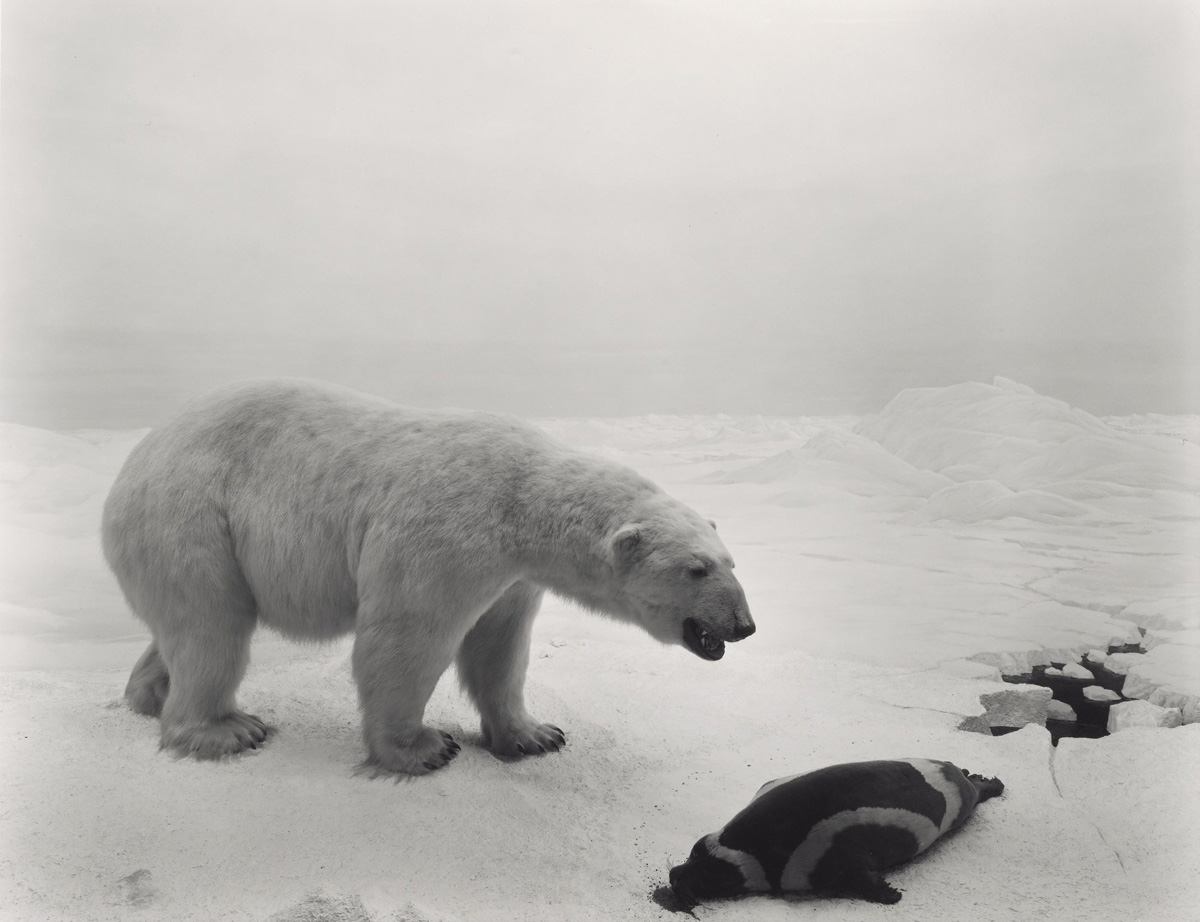
Hiroshi Sugimoto (Japanese, b. 1948) 'Polar Bear' 1976 from the exhibition 'Hiroshi Sugimoto: Past Tense' at the J. Paul Getty Museum, Getty Center, Los Angeles, February - June, 2014


Hiroshi Sugimoto (Japanese, b. 1948)
Polar Bear
1976
Gelatin silver print
42.1 x 54.6cm (16 9/16 x 21 1/2 in.)
The J. Paul Getty Museum, Los Angeles, Purchased with funds provided by the Photographs Council
© Hiroshi Sugimoto


Hiroshi Sugimoto (Japanese, b. 1948) 'Wapiti' 1980


Hiroshi Sugimoto (Japanese, b. 1948)
Wapiti
1980
Gelatin silver print
34.9 x 58.7cm (13 3/4 x 23 1/8 in.)
The J. Paul Getty Museum, Los Angeles, Purchased with funds provided by the Photographs Council
© Hiroshi Sugimoto


Hiroshi Sugimoto (Japanese, b. 1948) 'Sable Antelope' 1994


Hiroshi Sugimoto (Japanese, b. 1948)
Sable Antelope
1994
Gelatin silver print
42.4 x 54.1cm (16 11/16 x 21 5/16 in.)
The J. Paul Getty Museum, Los Angeles, Purchased with funds provided by the Photographs Council
© Hiroshi Sugimoto


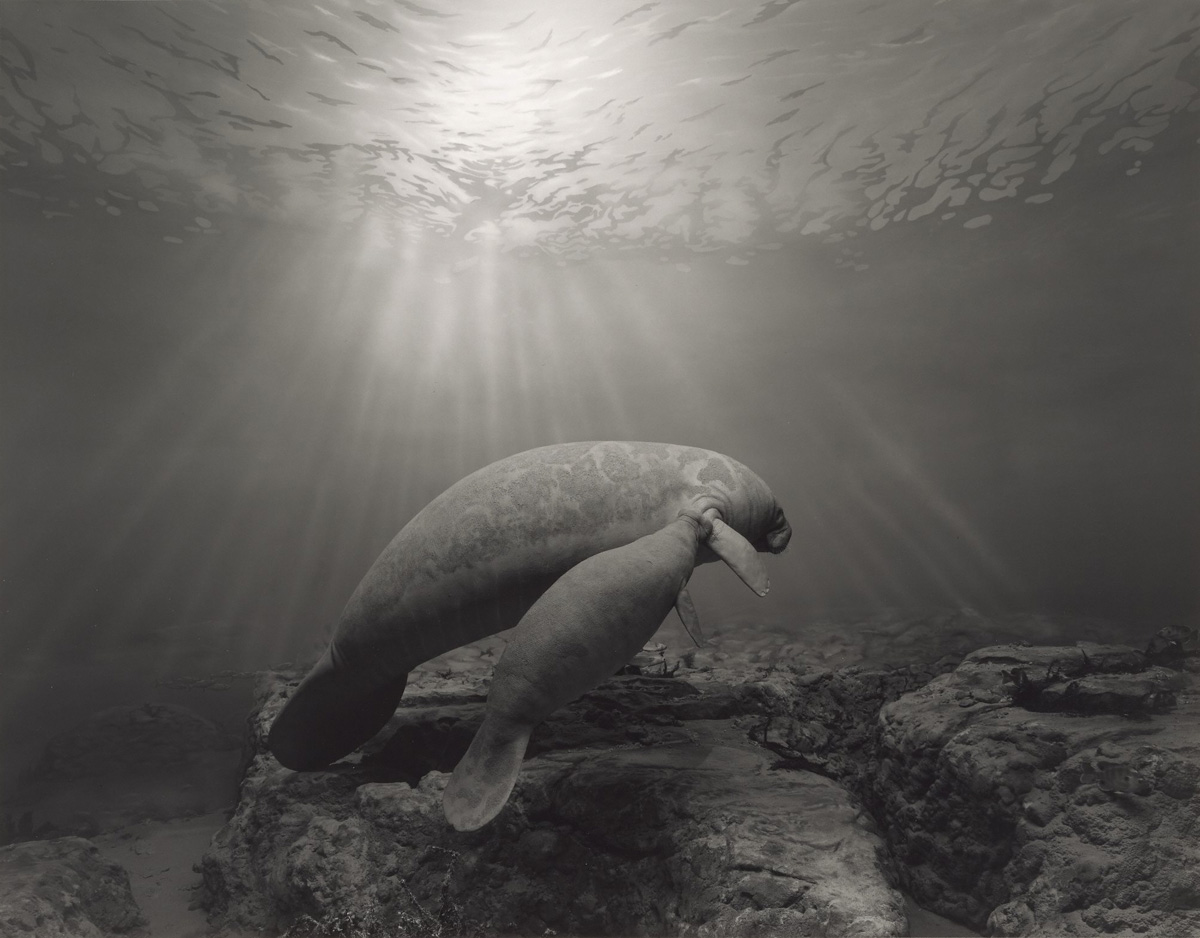
Hiroshi Sugimoto (Japanese, b. 1948) 'Manatee' 1994


Hiroshi Sugimoto (Japanese, b. 1948)
Manatee
1994
Gelatin silver print
42.2 x 54.1cm (16 5/8 x 21 5/16 in.)
The J. Paul Getty Museum, Los Angeles, Purchased with funds provided by the Photographs Council
© Hiroshi Sugimoto


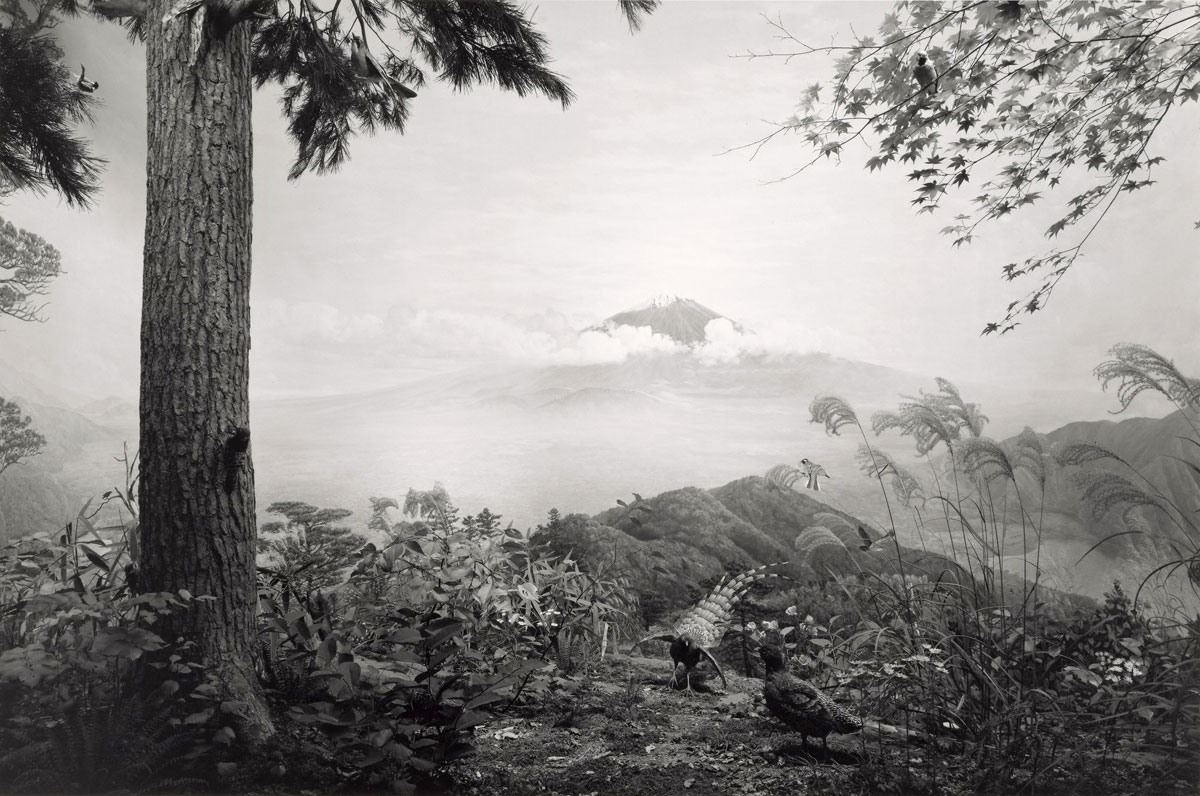
Hiroshi Sugimoto (Japanese, b. 1948) 'Birds of Japan' 1994


Hiroshi Sugimoto (Japanese, b. 1948)
Birds of Japan
1994
Gelatin silver print
38.7 x 58.4cm (15 1/4 x 23 in.)
The J. Paul Getty Museum, Los Angeles, Purchased with funds provided by the Photographs Council
© Hiroshi Sugimoto


Hiroshi Sugimoto (Japanese, b. 1948) 'Cheetah' 1980


Hiroshi Sugimoto (Japanese, b. 1948)
Cheetah
1980
Gelatin silver print
36.5 x 58.7cm (14 3/8 x 23 1/8 in.)
Courtesy Fraenkel Gallery, San Francisco
© Hiroshi Sugimoto


Hiroshi Sugimoto (Japanese, b. 1948) 'White Rhinoceros' 1980


Hiroshi Sugimoto (Japanese, b. 1948)
White Rhinoceros
1980
Gelatin Silver Print
34.1 x 58.6cm (13 7/16 x 23 1/16 in.)
Courtesy Fraenkel Gallery, San Francisco
© Hiroshi Sugimoto


Since the mid-1970s, Hiroshi Sugimoto (Japanese, born 1948) has used photography to investigate how history pervades the present. Featuring photographs of habitat dioramas, wax portraits, and early photographic negatives, Hiroshi Sugimoto: Past Tense, on view February 4 – June 8, 2014 at the J. Paul Getty Museum, Getty Center, brings together three separate bodies of work that present objects of historical and cultural significance in the collections of various museums. By photographing subjects that reimagine or replicate moments from the distant past and diverse geographical locations, Sugimoto critiques the medium’s presumed capacity to portray history with accuracy.

“This exhibition presents work that inventively reframes objects from the collections of a variety of museums, including from our extensive holdings of prints from the early days of photography,” explains Timothy Potts, director of the J. Paul Getty Museum. “Mr. Sugimoto has generously donated eighteen prints from his recent Photogenic Drawings series, which reprise a selection of important experiments by William Henry Fox Talbot that are in the Getty Museum’s collection.”

Sugimoto’s meticulously crafted prints are the result of a rigorous working method that includes extensive preparatory research, the use of a large-format view camera, and long exposures. Each of his projects is rooted in a sustained exploration of a singular motif and often carried out over many years. The exhibition will present a selection of prints from three bodies of work, Dioramas (1975-1994), Portraits (1999) and, his newest series, Photogenic Drawings (2008-present).

Dioramas

The diorama was first introduced in Paris in 1822 by the stage designer Jacques Louis Mandé Daguerre (French, 1787-1851), who later developed the daguerreotype photographic process. Situated in a darkened room, the first diorama consisted of a large painted scene on a semi-transparent curtain that was illuminated by the opening and closing of skylights and the constant shifting or dimming of lamps to create the impression of movement. In the early 20th century, habitat dioramas in natural history museums became popular, staging creatures in their faithfully replicated “natural” environments.

Sugimoto first encountered elaborate animal dioramas at the American Museum of Natural History after moving to New York in 1974, and began to focus his camera on individual scenes shortly thereafter. Omitting the educational text surrounding each display, the works heighten the illusion that animals such as manatees, wapiti, and sea lions were photographed in their natural habitats. While each photograph appears to be a candid moment captured by an experienced nature photographer, the subjects are – in actuality – depicted in poses they hold indefinitely.

Wax Portraits

While waxworks have a long history, contemporary wax museums can be traced to the French sculptor Marie Grosholz (French, 1761-1850), who achieved success in the Parisian entertainment market by creating waxworks of popular politicians and cultural figures. After moving to London in 1802, she established a commercial enterprise under the name Madame Tussaud, specialising in the production and display of full-length wax figures modelled after commissioned portraits.

Posed against pitch-black backdrops and framed by the camera in a manner suggesting old master portrait-painting traditions, each of Sugimoto’s subjects was captured with a nine-minute exposure that illuminates the finely modelled expressions and the sumptuous costumes. These life-size photographs record likenesses that have been distilled through multiple reproductions of the original sitter. The source material for the wax figures of Henry VIII and his wives is based on 16th-century panel paintings, while the portrait of Queen Victoria’s likeness is taken from a photograph of her from the 1890s, around the time of her Diamond Jubilee celebration.

“Hiroshi Sugimoto’s photographic practice is deeply rooted in a tradition of image making that was developed and perfected during the 19th century,” explains Arpad Kovacs, assistant curator in the Department of Photographs at the J. Paul Getty Museum and curator of the exhibition. “By employing century-old techniques and turning his lens to subjects and compositions that recreate or simulate moments from the past, Sugimoto intimately connects himself to the historical moments depicted.”

Photogenic Drawings

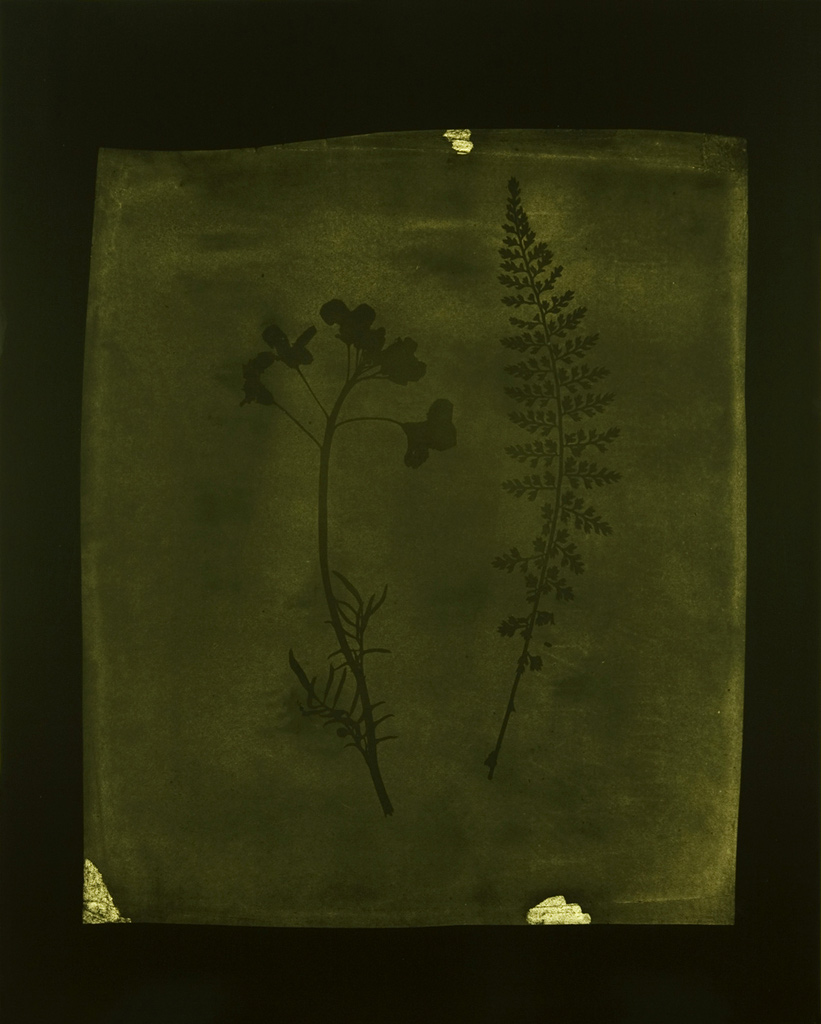
In the early 1830s, William Henry Fox Talbot (English, 1800-1877) began trying to create pictures without the aid of a pencil. After coating small pieces of writing paper with a salt solution and silver nitrate, he successfully captured the outlines of leaves and lace placed on the paper and exposed to sunlight. He continued his experiments with a camera obscura, placing a sheet of paper in this precursor to the camera to produce the first negatives, with highlights and shadows reversed. Talbot called the results of these experiments photogenic drawings.

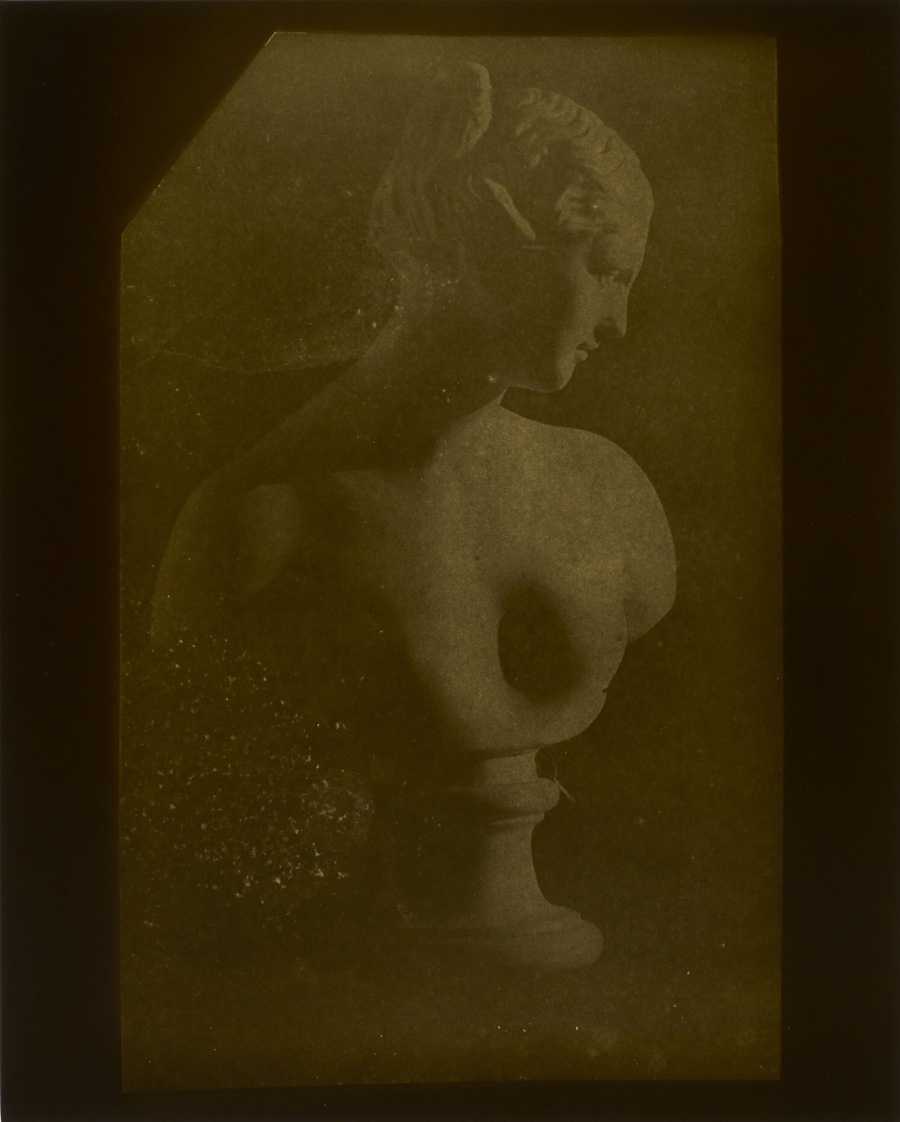
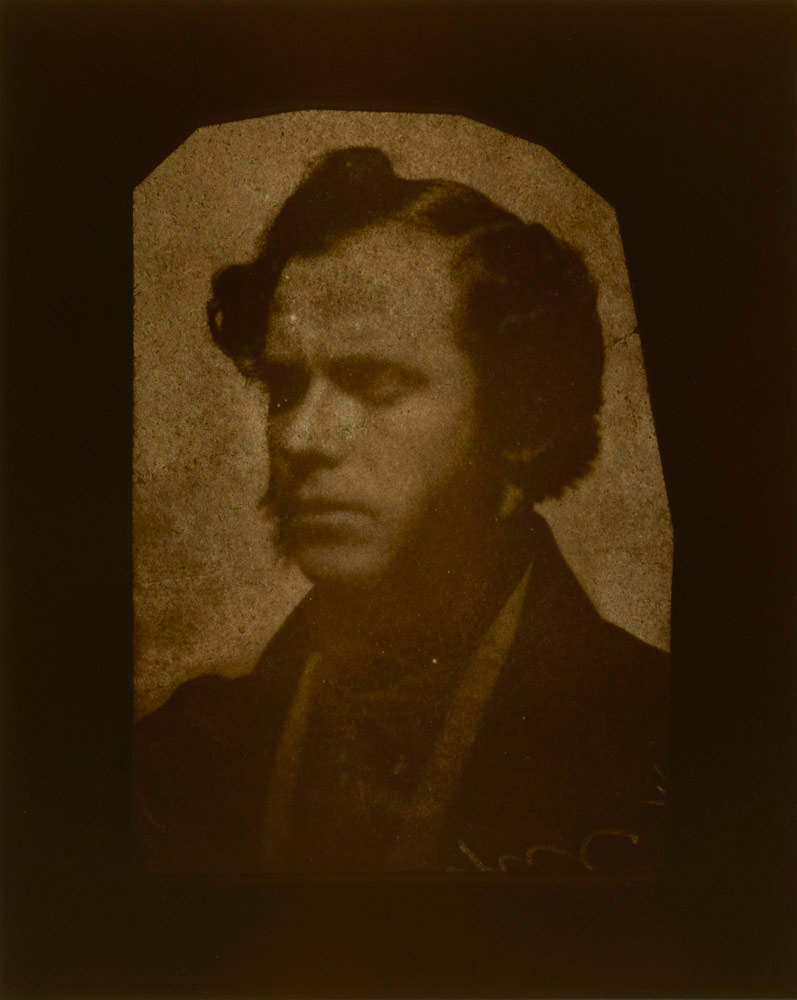
In 2007, Hiroshi Sugimoto visited the J. Paul Getty Museum to study the earliest photographs in the collection. After photographing some of Talbot’s photogenic drawing negatives, he produced large-scale prints and coloured them with toning agents during the processing to replicate the often-bright hues of the original sheets. The scale of the enlarged prints reveals the fibres of the original writing paper, which create subtle and delicate patterns embedded in the images.

The artist’s gift of eighteen gelatin silver prints from his Photogenic Drawings series significantly enhances the Museum’s holdings of work by Sugimoto. His photographic practice, rooted in a serial approach and primarily concerned with the medium’s relationship to the passage of time, has long been an important source of influence for a younger generation of artists. The prints greatly enhance the Getty Museum’s growing collection of contemporary photographs.

Hiroshi Sugimoto: Past Tense is on view February 4 – June 8, 2014 at the J. Paul Getty Museum, Getty Center. The exhibition will run concurrently in the Center for Photographs with A Royal Passion: Queen Victoria and Photography, an exhibition featuring rare private and public photographs from the Victoria era.

Press release from the J. Paul Getty Museum website


Hiroshi Sugimoto (Japanese, b. 1948) 'Henry VIII' 1999 from the exhibition 'Hiroshi Sugimoto: Past Tense' at the J. Paul Getty Museum, Getty Center, Los Angeles, February - June, 2014


Hiroshi Sugimoto (Japanese, b. 1948)
Henry VIII
1999
Gelatin silver print
148.9 x 119.1cm (58 5/8 x 46 7/8 in.)
Solomon R. Guggenheim Museum, New York, Commissioned by Deutsche Bank AG in consultation with the Solomon R. Guggenheim Foundation for the Deutsche Guggenheim, Berlin
© Hiroshi Sugimoto


Hiroshi Sugimoto (Japanese, b. 1948) 'Queen Victoria' 1999


Hiroshi Sugimoto (Japanese, b. 1948)
Queen Victoria
1999
Gelatin silver print
148.9 x 119.1cm (58 5/8 x 46 7/8 in.)
Fraenkel Gallery, San Francisco
© Hiroshi Sugimoto


Hiroshi Sugimoto (Japanese, b. 1948) 'Anne Boleyn' 1999


Hiroshi Sugimoto (Japanese, b. 1948)
Anne Boleyn
1999
Gelatin silver print
148.9 x 119.1cm (58 5/8 x 46 7/8 in.)
Solomon R. Guggenheim Museum, New York, Commissioned by Deutsche Bank AG in consultation with the Solomon R. Guggenheim Foundation for the Deutsche Guggenheim, Berlin
© Hiroshi Sugimoto


Hiroshi Sugimoto (Japanese, b. 1948) 'Asplenium Halleri, Grande Chartreuse 1821 - Cardamine Pratensis, April 1839' 2008


Hiroshi Sugimoto (Japanese, b. 1948)
Asplenium Halleri, Grande Chartreuse 1821 – Cardamine Pratensis, April 1839
2008
Toned gelatin silver print
93.7 x 74.9cm (36 7/8 x 29 1/2 in.)
The J. Paul Getty Museum, Los Angeles,
Gift of the Artist
© Hiroshi Sugimoto


Hiroshi Sugimoto (Japanese, b. 1948) 'Roofline of Lacock Abbey, circa 1835-1839' 2008


Hiroshi Sugimoto (Japanese, b. 1948)
Roofline of Lacock Abbey, circa 1835-1839
2008
Gelatin silver print
93.7 x 74.9cm (36 7/8 x 29 1/2 in.)
The J. Paul Getty Museum, Los Angeles, Gift of the Artist
© Hiroshi Sugimoto


Hiroshi Sugimoto (Japanese, b. 1948) 'Bust of Venus, November 26, 1840' 2009


Hiroshi Sugimoto (Japanese, b. 1948)
Bust of Venus, November 26, 1840
2009
Gelatin silver print
93.7 x 74.9cm (36 7/8 x 29 1/2 in.)
The J. Paul Getty Museum, Los Angeles, Gift of the Artist
© Hiroshi Sugimoto


Hiroshi Sugimoto (Japanese, b. 1948) 'A Stem of Delicate Leaves of an Umbrellifer, circa 1843-1846' 2009


Hiroshi Sugimoto (Japanese, b. 1948)
A Stem of Delicate Leaves of an Umbrellifer, circa 1843-1846
2009
Gelatin silver print
93.7 x 74.9cm (36 7/8 x 29 1/2 in.)
The J. Paul Getty Museum, Los Angeles, Gift of the Artist
© Hiroshi Sugimoto


Hiroshi Sugimoto (Japanese, b. 1948) 'Arrangement of Botanical Specimens, 1839' 2008


Hiroshi Sugimoto (Japanese, b. 1948)
Arrangement of Botanical Specimens, 1839
2008
Toned gelatin silver print
93.7 x 74.9cm (36 7/8 x 29 1/2 in.)
The J. Paul Getty Museum, Los Angeles, Gift of the Artist
© Hiroshi Sugimoto


Hiroshi Sugimoto (Japanese, b. 1948) 'Nicolaas Henneman, circa 1841' 2008


Hiroshi Sugimoto (Japanese, b. 1948)
Nicolaas Henneman, circa 1841
2008
Toned gelatin silver print
93.7 x 74.9cm (36 7/8 x 29 1/2 in.)
The J. Paul Getty Museum, Los Angeles, Gift of the Artist
© Hiroshi Sugimoto


Hiroshi Sugimoto (Japanese, b. 1948) 'Bust of Patroclus, September 8, 1841' 2009


Hiroshi Sugimoto (Japanese, b. 1948)
Bust of Patroclus, September 8, 1841
2009
Toned gelatin silver print
93.7 x 74.9cm (36 7/8 x 29 1/2 in.)
The J. Paul Getty Museum, Los Angeles, Gift of the Artist
© Hiroshi Sugimoto


The J. Paul Getty Museum
1200 Getty Center Drive
Los Angeles, California 90049

Opening hours:
Tuesday – Friday, Sunday 10am – 5.30pm
Saturday 10am – 8pm
Monday Closed

The J. Paul Getty Museum website

LIKE ART BLART ON FACEBOOK

Back to top

Exhibition: ‘A Royal Passion: Queen Victoria and Photography’ at The J. Paul Getty Museum, Getty Center, Los Angeles

Exhibition dates: 4th February – 8th June, 2014

Exhibition includes major loans from Royal Collection Trust

Curator: Anne M. Lyden, international photography curator at the National Galleries of Scotland and former Associate Curator of Photographs at The J. Paul Getty Museum


Roger Fenton (English, 1819-1869) 'Buckingham Palace' about 1858 from the exhibition 'A Royal Passion: Queen Victoria and Photography' at The J. Paul Getty Museum, February - June, 2014


Roger Fenton (English, 1819-1869)
Buckingham Palace
About 1858
Albumen silver print
32.2 x 43.3cm (12 11/16 x 17 1/16 in.)
Royal Collection Trust / © Her Majesty Queen Elizabeth II 2013


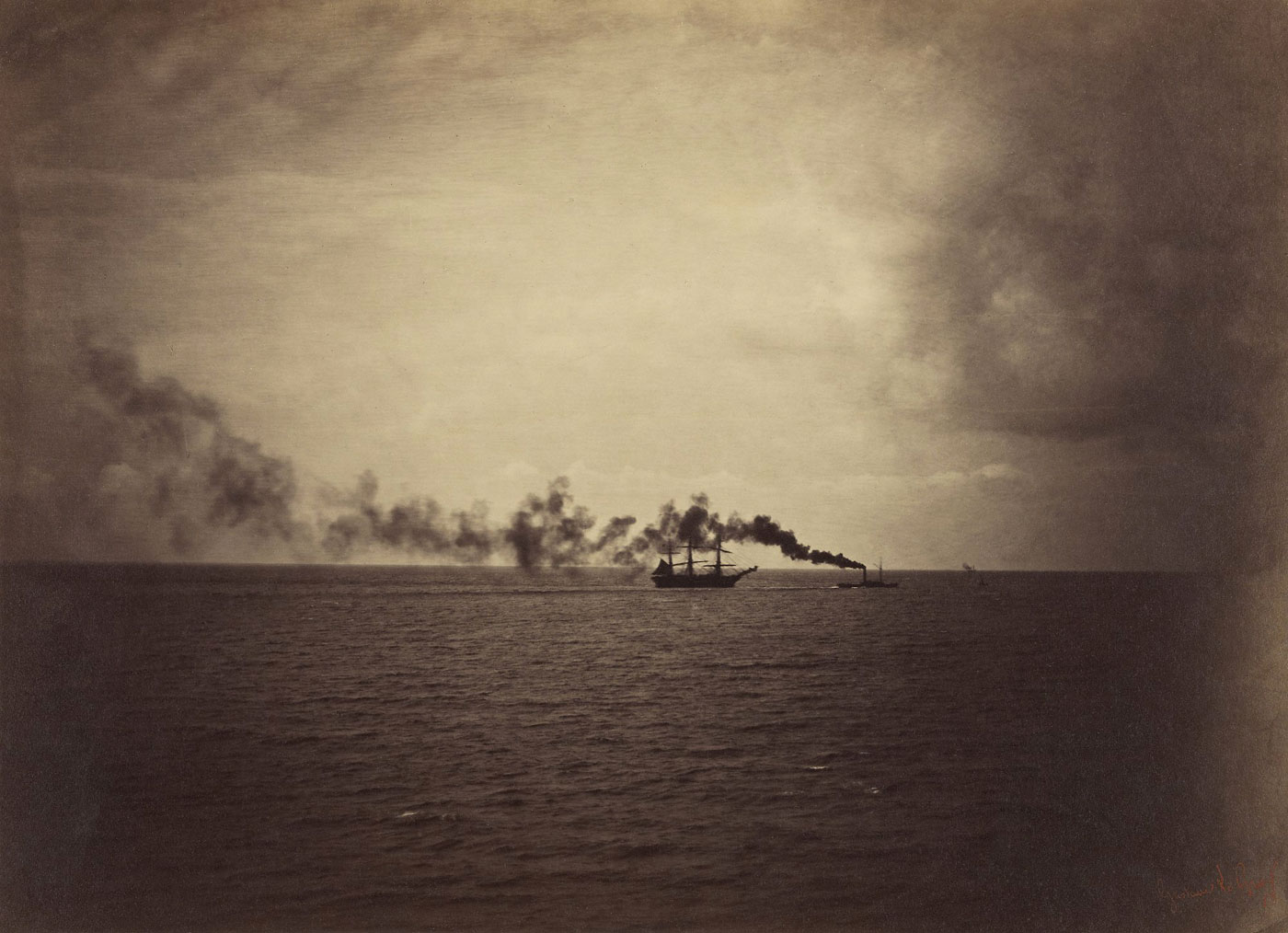
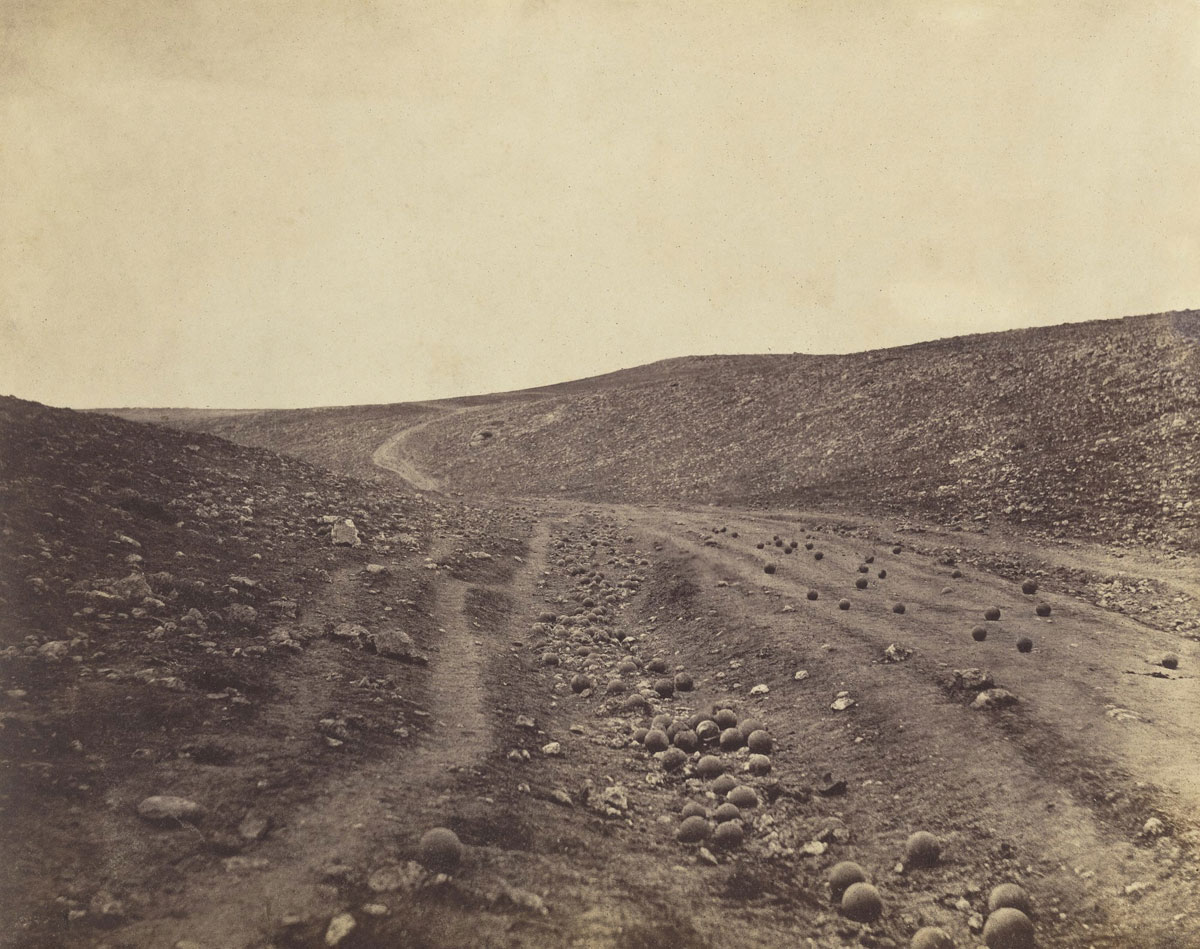
There are some glorious photographs in this posting. The serene Buckingham Palace with open gates; Crystal Palace with enclosed tree and ghostly figures; Nelson’s Column with wooden scaffolding and posters (nothing changes – a shop is knocked down in Chapel Street and within half a day the hoarding is covered in posters); atmospheric tugboat by Gustave Le Gray; the very famous, staged, Valley of the Shadow of Death by Roger Fenton; the “attitude” of the melange of men (if you like) in their stovepipe hats in I.K. Brunel and Others Observing by Robert Howlett, with everyone looking in different directions; and the serenity, beauty, grandeur and suppressed sense of power in Queen Victoria Diamond Jubilee Portrait by W. & D. Downey. To name but a few.

Dr Marcus Bunyan


Many thankx to the J. Paul Getty Museum for allowing me to publish the photographs in the posting. Please click on the photographs for a larger version of the image.


William Henry Fox Talbot (English, 1800-1877) 'Nelson's Column under Construction in Trafalgar Square, London' April 1844 from the exhibition 'A Royal Passion: Queen Victoria and Photography' at The J. Paul Getty Museum, February - June, 2014


William Henry Fox Talbot (English, 1800-1877)
Nelson’s Column under Construction in Trafalgar Square, London
April 1844
Salted paper print from a paper negative
17.1 x 21.1cm (6 3/4 x 8 5/16 in.)
The J. Paul Getty Museum, Los Angeles


Roger Fenton (English, 1819-1869) 'Manchester Art Treasures' 1857


Roger Fenton (English, 1819-1869)
Manchester Art Treasures
1857
Albumen silver print
18.6 x 24.4cm (7 5/16 x 9 5/8 in.)
The J. Paul Getty Museum, Los Angeles


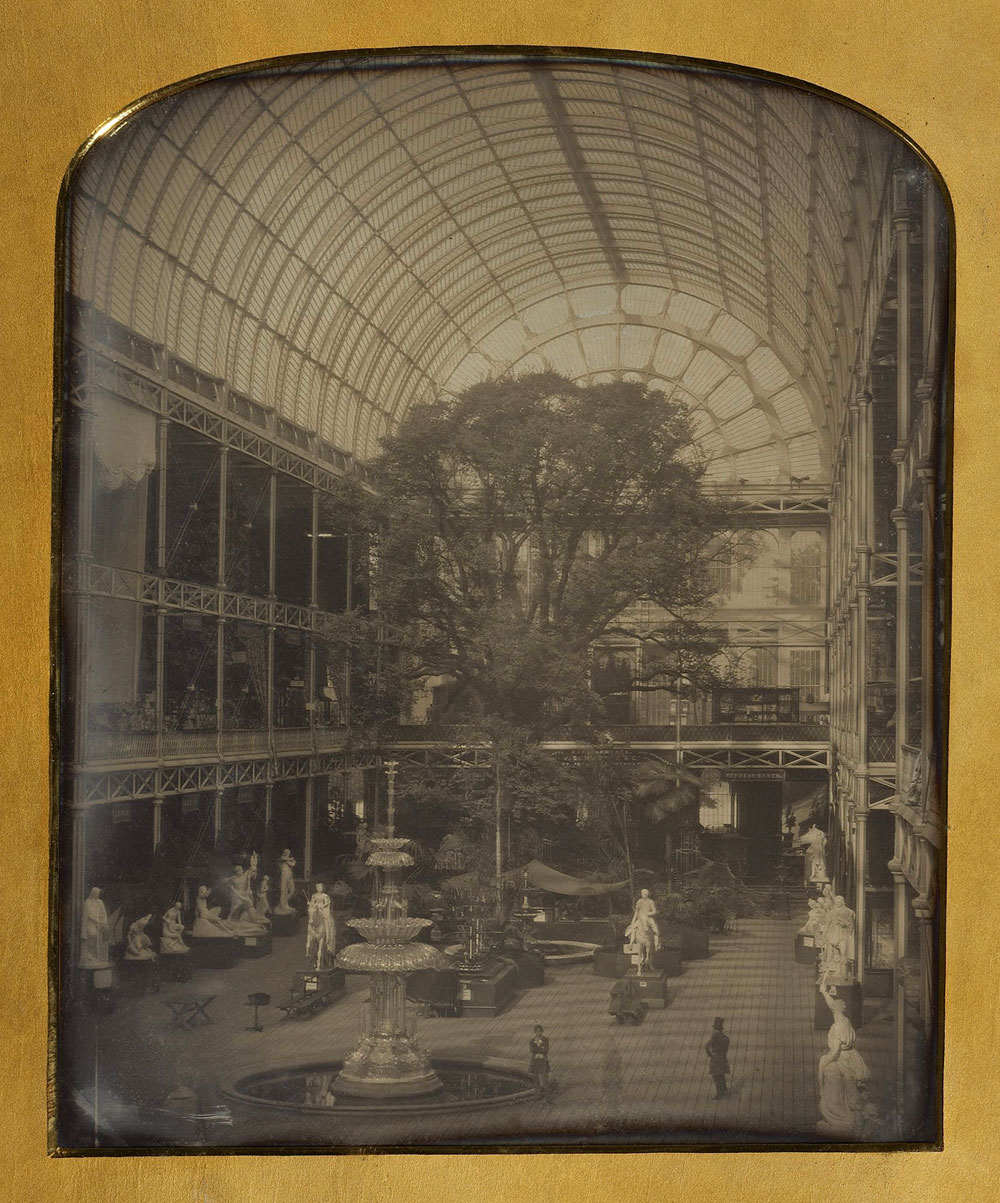
John Jabez Edwin Mayall (British, 1810-1901) 'The Crystal Palace at Hyde Park, London' 1851


John Jabez Edwin Mayall (British, 1810-1901)
The Crystal Palace at Hyde Park, London
1851
Daguerreotype
Image: 30.5 x 24.6cm (12 x 9 11/16 in.)
The J. Paul Getty Museum, Los Angeles


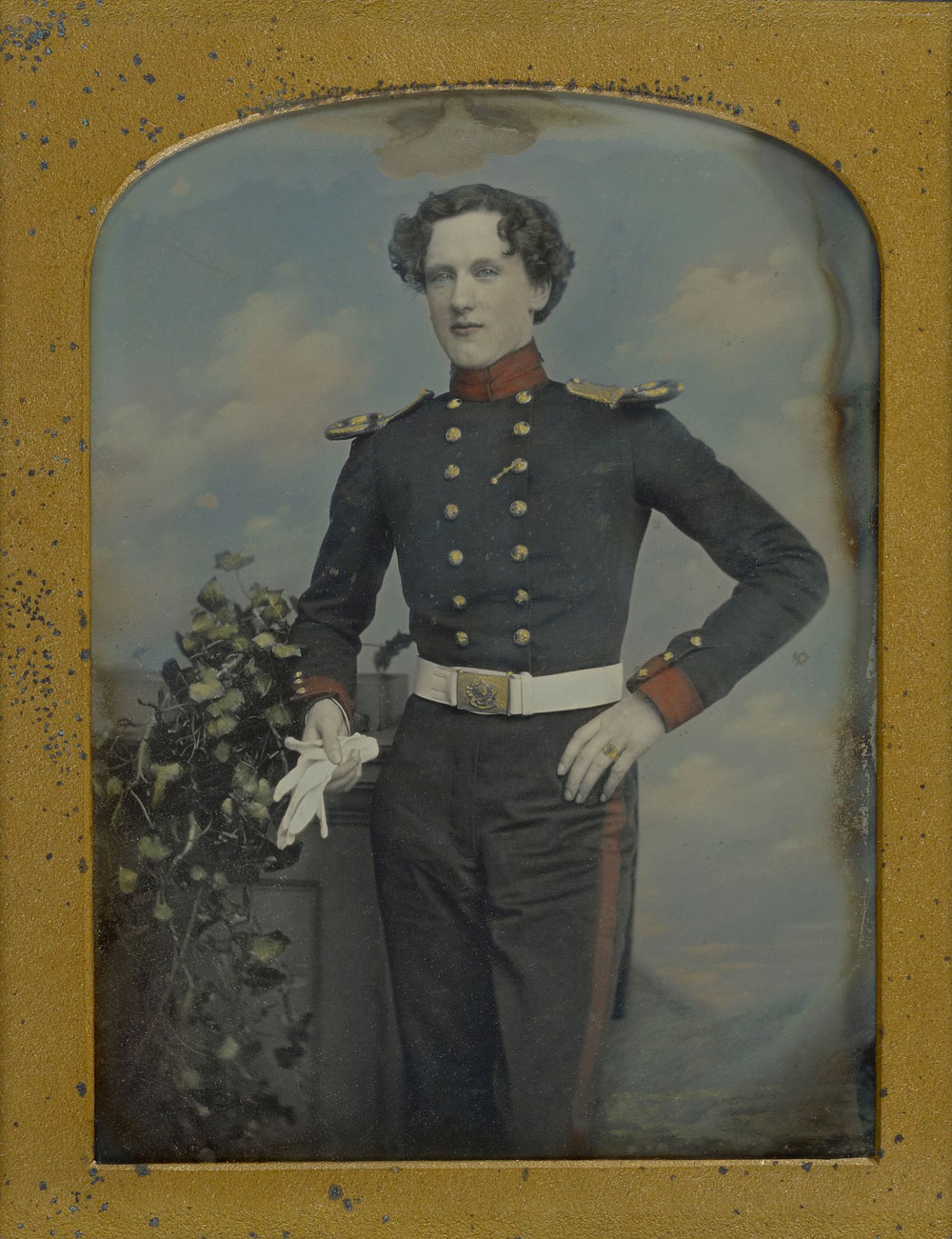
William Edward Kilburn (English, 1818-1891) 'Portrait of Lt. Robert Horsely Cockerell' 1852-1855


William Edward Kilburn (English, 1818-1891)
Portrait of Lt. Robert Horsely Cockerell
1852-1855
Daguerreotype, hand-coloured
8.9 x 6.5cm (3 1/2 x 2 9/16 in.)
The J. Paul Getty Museum, Los Angeles


Gustave Le Gray (French, 1820-1884) 'The Tugboat' 1857


Gustave Le Gray (French, 1820-1884)
The Tugboat
1857
Albumen silver print
Image: 30 x 41.3cm (11 13/16 x 16 1/4 in.)
The J. Paul Getty Museum, Los Angeles


Roger Fenton (English, 1819-1869) 'Valley of the Shadow of Death' April 23, 1855


Roger Fenton (English, 1819-1869)
Valley of the Shadow of Death
April 23, 1855
Salted paper print
27.6 x 34.9cm (10 7/8 x 13 3/4 in.)
The J. Paul Getty Museum, Los Angeles


Leonida Caldesi (Italian, 1823-1891) 'Royal Family' May 27, 1857


Leonida Caldesi (Italian, 1823-1891)
Royal Family
May 27, 1857
Albumen silver print
Royal Collection Trust / © Her Majesty Queen Elizabeth II 2013


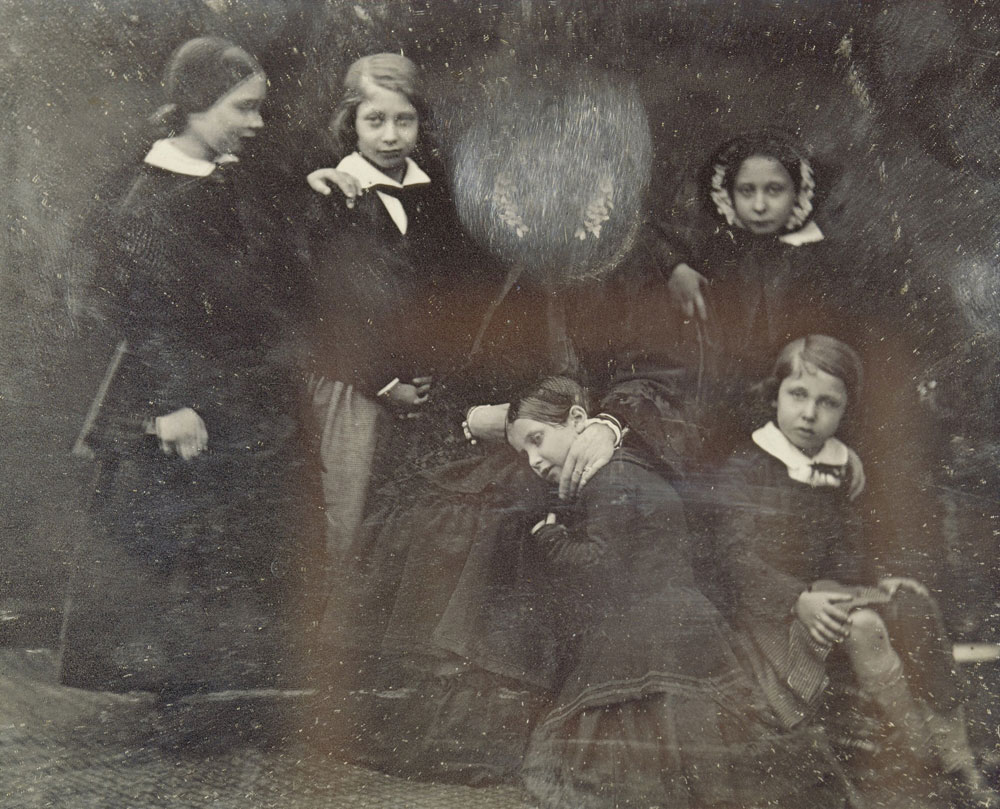
William Edward Kilburn (English, 1818-1891) 'Queen Victoria, the Princess Royal, the Prince of Wales, Princess Alice, Princess Helena, Prince Alfred' January 17, 1852


William Edward Kilburn (English, 1818-1891)
Queen Victoria, the Princess Royal, the Prince of Wales, Princess Alice, Princess Helena, Prince Alfred
January 17, 1852
Daguerreotype
9.1 x 11.5cm (3 9/16 x 4 1/2 in.)
Royal Collection Trust / © Her Majesty Queen Elizabeth II 2013


Queen Victoria’s devotion to photography will be on display in A Royal Passion: Queen Victoria and Photography, February 4 – June 8, 2014 at the J. Paul Getty Museum, Getty Center. With important loans held in the Royal Collection, generously lent by Her Majesty The Queen, shown alongside masterpieces from the Getty Museum, the exhibition displays rare daguerreotypes, private portraits of the royal family, and a selection of prints by early masters such as William Henry Fox Talbot, Roger Fenton, and Julia Margaret Cameron.

At the age of 18, Queen Victoria (1819-1901) ascended the throne of Great Britain and Ireland and was about to turn 20 when the invention of photography was announced – first in Paris, then in London – at the beginning of 1839. The queen and her husband Prince Albert fully embraced the new medium early on, and by 1842 the royal family was collecting photographs. Through their patronage and support, they contributed to the dialogue on photography and were integral to its rise in popularity.

“As the first British monarch to have her life fully recorded by the camera, Victoria’s image became synonymous with an entire age,” explains Timothy Potts, director of the J. Paul Getty Museum. “Now, 175 years later, we take this opportunity to celebrate both the anniversary of photography and the queen’s relationship with it, through a rich collection of images that portray both the evolution of the medium and the monarchy.”

Birth of Photography and Royal Patronage

Queen Victoria and Prince Albert took an interest in photography in the 1840s, which is remarkable given its limited application and dissemination at the time. The first royal photographic portrait – of Albert – was made by William Constable in 1842. While Victoria enjoyed seeing Albert photographed, she was initially apprehensive about being photographed herself. A pair of key images in the exhibition feature Victoria with her children in 1852, sitting for photographer William Edward Kilburn. In the first portrait, the long exposure time created an image in which Victoria’s eyes were closed. Writing in her diary entry for that day, she described her image as “horrid.” She disliked the portrait so much that she scratched the daguerreotype to remove her face. However two days later the queen repeated the exercise and sat before Kilburn’s camera again, only this time she chose to sit in profile wearing a large brimmed bonnet to hide her face.

For many people, the first opportunity of viewing an actual photograph took place in 1851 at the Great Exhibition of the Industry of Works of All Nations, which opened in London at an event presided over by Queen Victoria and Prince Albert. Among its 13,000 exhibits were 700 photographs housed in a massive iron and glass structure in Hyde Park. The Crystal Palace, as it was known, was documented in a series of daguerreotypes by John Jabez Edwin Mayall. The royal family would continue to support similar displays of photography that took place during the 1850s; in addition, they became patrons of the Photographic Society of London. Queen Victoria’s interest in the medium was effectively a royal seal of approval and her interest facilitated its growing popularity.

During her reign, a number of conflicts were also captured on camera, including the Crimean War and Sepoy Rebellion. The camera, although unable to record live battle, was able to record the before and after effects of conflict, and its images revealed both the tedium and horrors of war in these far off lands. Roger Fenton’s Valley of the Shadow of Death (1855) shows a stretch of land that was frequently attacked by the Russian Army, strewn with cannonballs. Formal military portraits, such as William Edward Kilburn’s Portrait of Lt. Robert Horsely Cockerell (1854) took on a memorial quality for families who lost loved ones.

As the application of photography developed through the course of the 19th century, so too did the medium itself. Many photographic innovations and experimentations occurred, particularly in the first thirty years. From early daguerreotypes and paper negatives, to the popular carte de visite and stereoscopic photography, the latter a technique that gave photographs the illusion of depth through binocular vision, the exhibition surveys these many innovations and accomplishments. Visitors will be able to look through reproductions of stereoscopic devices in the exhibition.

Private Photographs of the Royal Family

Victoria and Albert shared their passion for photography, not only in exchanging gifts at birthdays and Christmas, but in collecting, organising, and mounting the family portraits in albums, and would frequently spend evenings working together on assembling these volumes. Victoria would often bring albums and small framed portraits of her family along on her travels. The Getty will display a custom-made bracelet she wore that features photographs of her grandchildren.

“As the medium of photography evolved over the years, so did Victoria’s photographic image: she was the camera-shy young mother before she became an internationally recognisable sovereign,” explains Anne Lyden, curator of the exhibition.

In a rare glimpse of these private photographs, the exhibition includes scenes of young royals at play and images in which the royal family appears informal and almost middle-class in their appearance. In an 1854 portrait by Roger Fenton, the casual attire of the queen is disarming. She is wrapped in a tartan shawl and surrounded by four of her children (she would bear nine children in the span of seventeen years). This is not the image of a bejewelled monarch reigning over her empire, but an intimate view of family life. A pair of scissors and a key visible on the chain on her chatelaine suggests practicality and hints at routine household rituals.

Public Photographs, Public Mourning, and State Portraits

Public photographs of the royal family were incredibly popular – the majority of the population would never see a royal in person, and photographs offered a connection to nobility. However, it was not until 1860 that such photographs were available to the public, when John Jabez Edwin Mayall made the first photograph of the queen available for purchase. The event coincided with the rise in popularity of cartes de visite, thin paper photographs mounted on a thick paper card, which, given their small size, were popular for trading and were easily transported. Within days of Mayall’s portrait being issued, over 60,000 orders had been placed, as people were eager to have a glimpse into the private life of the sovereign. Interest in the royal family extended to views of their various royal residences, such as Buckingham Palace, Windsor Castle, Balmoral Castle, and Osborne House, which will also be included in the exhibition.

When Albert died suddenly on December 14, 1861, Victoria became a widow at the age of 42 and was in deep mourning for the rest of her life. While she retreated from public life, photographs of her as the bereaved wife were widely available, becoming in effect the queen’s public presence. While the tableau of a grieving widow remained prevalent for the remainder of Victoria’s reign, in the 1870s and 1880s she sat for a number of extremely popular state portraits that preserved her powerful position as monarch. The exhibition includes portraits taken by W. & D. Downey and Gunn & Stewart on the occasion of her Diamond Jubilee in 1897, as well as other portraits in which she is seen in full regal attire, complete with royal jewels and crown.

A Royal Passion: Queen Victoria and Photography, is on view February 4 – June 8, 2014 at the J. Paul Getty Museum, Getty Center. The exhibition was curated by Anne Lyden, international photography curator at the National Galleries of Scotland and former associate curator of photographs at the J. Paul Getty Museum. Getty Publications will issue the accompanying book A Royal Passion: Queen Victoria and Photography by Anne Lyden. Concurrently on view in the Center for Photographs is Hiroshi Sugimoto: Past Tense, which includes Sugimoto’s wax figure portrait of Queen Victoria.”

Press release from the J. Paul Getty Museum website


Robert Howlett (British, 1831-1858) 'I.K. Brunel and Others Observing the "Great Eastern" Launch Attempt' November 1857


Robert Howlett (British, 1831-1858)
I.K. Brunel and Others Observing the “Great Eastern” Launch Attempt
November 1857
Albumen silver print
Image (arched top): 24.8 x 21.4cm (9 3/4 x 8 7/16 in.)
The J. Paul Getty Museum, Los Angeles


Bryan Edward Duppa (English, 1804-1866) Gustav William Henry Mullins (English, 1854-1921) 'Portrait of Queen Victoria Holding Portrait of Prince Albert' Negative, July 1854; print, 1889


Bryan Edward Duppa (English, 1804-1866)
Gustav William Henry Mullins (English, 1854-1921)
Portrait of Queen Victoria Holding Portrait of Prince Albert
Negative, July 1854; print, 1889
Carbon print
21.8 x 16.6cm (8 9/16 x 6 9/16 in.)
Royal Collection Trust / © Her Majesty Queen Elizabeth II 2013


Roger Fenton (English, 1819-1869) 'The Prince of Wales, the Princess Royal, Princess Alice, the Queen, Prince Alfred' Negative February 8, 1854


Roger Fenton (English, 1819-1869)
The Prince of Wales, the Princess Royal, Princess Alice, the Queen, Prince Alfred
Negative February 8, 1854; print later
Carbon print
22 x 19.7cm (8 11/16 x 7 3/4 in.)
Royal Collection Trust / © Her Majesty Queen Elizabeth II 2013


Roger Fenton (English, 1819-1869) 'Princesses Helena and Louise' 1856


Roger Fenton (English, 1819-1869)
Princesses Helena and Louise
1856
Salted paper print
33 x 29.2cm (13 x 11 1/2 in.)
Repro Credit: © Royal Photographic Society/NMEM / SSPL


William Edward Kilburn (English, 1818-1891) 'Prince Albert' 1848


William Edward Kilburn (English, 1818-1891)
Prince Albert
1848
Daguerreotype, hand-coloured
8.6 x 6.3cm (3 3/8 x 2 1/2 in.)
Royal Collection Trust / © Her Majesty Queen Elizabeth II 2013


Roger Fenton (English, 1819-1869) 'Queen Victoria' June 30, 1854


Roger Fenton (English, 1819-1869)
Queen Victoria
June 30, 1854
Salted paper print, hand-coloured
19.1 x 15.6cm (7 1/2 x 6 1/8 in.)
The J. Paul Getty Museum, Los Angeles


Roger Fenton (English, 1819-1869) 'The Queen and Prince Albert' May 11, 1854


Roger Fenton (English, 1819-1869)
The Queen and Prince Albert
May 11, 1854
Albumen silver print
20.4 x 16.2cm (8 1/16 x 6 3/8 in.)
Royal Collection Trust / © Her Majesty Queen Elizabeth II 2013


W. & D. Downey (British, active 1860-1920s) 'Queen Victoria Diamond Jubilee Portrait' July 1893


W. & D. Downey (British, active 1860-1920s)
Queen Victoria Diamond Jubilee Portrait
July 1893
Carbon print
Image: 37.7 x 25.4cm (14 13/16 x 10 in.)
Royal Collection Trust / © Her Majesty Queen Elizabeth II 2013


Ghémar Frères. 'Portrait of Queen Victoria Seated, Gazing at a Photograph of Prince Albert' about 1862


Ghémar Frères
Portrait of Queen Victoria Seated, Gazing at a Photograph of Prince Albert
About 1862
Albumen silver print
8.4 x 5.4cm (3 5/16 x 2 1/8 in.)
The J. Paul Getty Museum, Los Angeles


Alexander Bassano (British born Italy, 1829-1913) 'Queen Victoria' April 1882


Alexander Bassano (British born Italy, 1829-1913)
Queen Victoria
April 1882
Carbon print
30.9 x 19.1cm (12 3/16 x 7 1/2 in.)
Royal Collection Trust / © Her Majesty Queen Elizabeth II 2013


The J. Paul Getty Museum
1200 Getty Center Drive
Los Angeles, California 90049

Opening hours:
Tuesday – Friday, Sunday 10am – 5.30pm
Saturday 10am – 8pm
Monday Closed

The J. Paul Getty Museum website

LIKE ART BLART ON FACEBOOK

Back to top

Exhibition: ‘Frank Lloyd Wright and the City: Density vs. Dispersal’ at The Museum of Modern Art (MoMA), New York

Exhibition dates: 1st February – 1st June 2014

Curators: Organised by Barry Bergdoll (Acting Chief Curator of Architecture and Design, MoMA) and Carole Ann Fabian (Director, Avery Architectural and Fine Arts Library), with Janet Parks (Curator of Drawings & Archives, Avery) and Phoebe Springstubb (Curatorial Assistant, MoMA)


Frank Lloyd Wright (American, 1867-1959) 'Grouped Towers, Chicago Project' 1930 from the exhibition 'Frank Lloyd Wright and the City: Density vs. Dispersal' at The Museum of Modern Art, February - June, 2014


Frank Lloyd Wright (American, 1867-1959)
Grouped Towers, Chicago Project
1930
Perspective
Pencil on tracing paper
19 x 28 1/4″ (48.3 x 71.8cm)
The Frank Lloyd Wright Foundation Archives (The Museum of Modern Art | Avery Architectural & Fine Arts Library, Columbia University, New York)


A change of pace now… some exquisite drawings in this posting about the work of Frank Lloyd Wright. It’s a pity they can’t build a skyscraper such as the beautiful Mile High in Melbourne, instead of all the non-descript towers that are going up all over the place. At least we would then have a masterpiece on our hands.

Dr Marcus Bunyan


Many thankx to MoMA for allowing me to publish the art work and photographs in the posting. Please click on the photographs for a larger version of the image.


Frank Lloyd Wright (American, 1867-1959) 'Grouped Towers, Chicago Project' 1930


Frank Lloyd Wright (American, 1867-1959)
Grouped Towers, Chicago Project
1930
Plan of the five towers and shared pedestal
Pencil on tracing paper
13 3/4 x 35 3/8″ (34.9 x 89.9cm)
The Frank Lloyd Wright Foundation Archives (The Museum of Modern Art | Avery Architectural & Fine Arts Library, Columbia University, New York)


Frank Lloyd Wright (American, 1867-1959) 'Broadacre City Project' 1934-1935


Frank Lloyd Wright (American, 1867-1959)
Broadacre City Project
1934-1935
Study for a plan of a highway interchange
Pencil and coloured pencil on tracing paper
22 x 35″ (55.9 x 88.9cm)
The Frank Lloyd Wright Foundation Archives (The Museum of Modern Art | Avery Architectural & Fine Arts Library, Columbia University, New York)


Installation view of the exhibition 'Frank Lloyd Wright and the City: Density vs. Dispersal' at MoMA

Installation view of the exhibition 'Frank Lloyd Wright and the City: Density vs. Dispersal' at MoMA


Installation views of the exhibition Frank Lloyd Wright and the City: Density vs. Dispersal at The Museum of Modern Art, New York
February 1 – June 1, 2014
© 2014 The Museum of Modern Art, New York
Photos: Thomas Griesel


Frank Lloyd Wright and the City: Density vs. Dispersal celebrates the recent joint acquisition of Frank Lloyd Wright’s extensive archive by MoMA and Columbia University’s Avery Architectural and Fine Arts Library. Through an initial selection of drawings, films, and large-scale architectural models, the exhibition examines the tension in Wright’s thinking about the growing American city in the 1920s and 1930s, when he worked simultaneously on radical new forms for the skyscraper and on a comprehensive plan for the urbanisation of the American landscape titled “Broadacre City.” Visitors encounter the spectacular 12-foot-by-12-foot model of this plan, which merges one of the earliest schemes for a highway flyover with an expansive, agrarian domain.

Promoted and updated throughout Wright’s life, the model toured the country for several years in the 1930s, beginning with a display at Rockefeller Center. This dispersed vision is paired with Wright’s innovative structural experiments for building the vertical city. Projects, from the early San Francisco Call Building (1912), to Manhattan’s St. Mark’s-in-the-Bouwerie Towers (1927-1931), to a polemical mile-high skyscraper, engage questions of urban density and seek to bring light and landscape to the tall building. Highlighting Wright’s complex relationship to the city, the material reveals Wright as a compelling theorist of both its horizontal and vertical aspects. His work, in this way, is not only of historic importance but of remarkable relevance to current debates on urban concentration.

Text from the MoMA website


Frank Lloyd Wright and his assistant Eugene Masselink installing the exhibition 'Frank Lloyd Wright: American Architect' at The Museum of Modern Art, November 13, 1940-January 5, 1941


Frank Lloyd Wright and his assistant Eugene Masselink installing the exhibition Frank Lloyd Wright: American Architect at The Museum of Modern Art, November 13, 1940 – January 5, 1941. Photographic Archive. The Museum of Modern Art Archives, New York
Photo: Soichi Sunami


Frank Lloyd Wright (American, 1867-1959) 'Broadacre City Project' 1934-1935 from the exhibition 'Frank Lloyd Wright and the City: Density vs. Dispersal' at The Museum of Modern Art, February - June, 2014


Frank Lloyd Wright (American, 1867-1959)
Broadacre City Project
1934-1935
Model under construction in Chandler, Arizona, 1935
Gelatin silver print on paper
4 1/4 x 6 5/8″ (10.8 x 16.8cm)
The Frank Lloyd Wright Foundation Archives (The Museum of Modern Art | Avery Architectural & Fine Arts Library, Columbia University, New York)
Photo: Roy E. Peterson


Frank Lloyd Wright (American, 1867-1959) 'Broadacre City Project' 1934-1935


Frank Lloyd Wright (American, 1867-1959)
Broadacre City Project
1934-1935
Taliesin fellows working on the model. Chandler, Arizona, 1935
Gelatin silver print on paper
9 9/16 x 7″ (24.3 x 17.8cm)
The Frank Lloyd Wright Foundation Archives (The Museum of Modern Art | Avery Architectural & Fine Arts Library, Columbia University, New York)


Frank Lloyd Wright (American, 1867-1959) 'Broadacre City Project' 1934-1935


Frank Lloyd Wright (American, 1867-1959)
Broadacre City Project
1934-1935
Model in four sections
Painted wood, cardboard, and paper
152 x 152″ (386.1 x 386.1cm)
The Frank Lloyd Wright Foundation Archives (The Museum of Modern Art | Avery Architectural & Fine Arts Library, Columbia University, New York)


Frank Lloyd Wright (American, 1867-1959) 'H. C. Price Company Tower, Bartlesville, Oklahoma' 1952-1956


Frank Lloyd Wright (American, 1867-1959)
H. C. Price Company Tower, Bartlesville, Oklahoma
1952-1956
Apprentices working on the model in the Taliesin drafting room. Spring Green, Wisconsin, c. 1952
Gelatin silver print on paper
7 3/4 x 9 1/2″ (19.7 x 24.1cm)
The Frank Lloyd Wright Foundation Archives (The Museum of Modern Art | Avery Architectural & Fine Arts Library, Columbia University, New York)


The Museum of Modern Art presents Frank Lloyd Wright and the City: Density vs. Dispersal, which celebrates the recent joint acquisition of Frank Lloyd Wright’s extensive archive by MoMA and Columbia University’s Avery Architectural and Fine Arts Library, on view from February 1 to June 1, 2014. Frank Lloyd Wright (1867- 1959) – perhaps the most influential American architect of the 20th century – was deeply ambivalent about cities. For decades, Wright was seen as the prophet of America’s post–World War II suburban sprawl, yet the dispersed cities that he envisaged were also carefully planned – quite distinct from the disorganised landscapes that often developed instead. Paradoxically, Wright was also a lifelong prophet of the race for height that has played out around the world. Through an initial selection of drawings, films, and large-scale architectural models, the exhibition examines the tension in Wright’s thinking about the growing American city from the 1920s to the 1950s, when he worked simultaneously on radical new forms for the skyscraper and on a comprehensive plan for the urbanisation of the American landscape titled “Broadacre City.” The exhibition is organised by Barry Bergdoll, Acting Chief Curator of Architecture and Design, MoMA, and Carole Ann Fabian, Director, Avery Architectural and Fine Arts Library, with Janet Parks, Curator of Drawings & Archives, Avery Architectural and Fine Arts Library, and Phoebe Springstubb, Curatorial Assistant, Department of Architecture and Design, MoMA.

On view is Wright’s 1934-35 manifesto project, for what he called “Broadacre City,” which embodied his quest for a city of private houses set in nature and spread across the countryside. He believed that advances in technology had rendered obsolete the dense cities created by industry and immigration in the late 19th and early 20th centuries. Distributed along a rectilinear grid, these one-acre homesteads were to be combined with small-scale manufacturing, community centers, and local farming, and interspersed with parklands to form a carpet-like pattern of urbanisation. Visitors encounter the spectacular 12-foot-by-12-foot model of this plan, which merges one of the earliest schemes for a highway flyover with an expansive, agrarian domain. Promoted and updated throughout Wright’s life, the model toured the country for several years in the 1930s, beginning with a display at New York City’s Rockefeller Center. It is juxtaposed with the monumental models and drawings produced of his skyscraper visions: the six-foot tall model of his 1913 San Francisco Call Building; the model of his only built residential tower, the Price Tower, in Bartlesville, Oklahoma of 1952-56; and the eight-foot drawings of the Mile High tower project.

This dispersed vision is paired with Wright’s innovative structural experiments for building the vertical city, which engaged questions of urban density and sought to bring light and landscape settings to tall buildings. His ambitions grew from a 24-story design for the offices of the San Francisco Call newspaper (1913) to the 548-story, mile-high tower he envisioned in Chicago (1956) – a building large enough to house the entire population of Broadacre City. Wright’s proposal for the San Francisco Call Building celebrates verticality: repeated piers emphasise the height, drawing the eye up to a startlingly cantilevered cornice pierced with slots that frame the sky and allow daylight to wash the facades for dramatic effect. His design for the National Life Insurance Company Building (1924-1925) features a tower clad entirely in glass, setting aside the load-bearing frame of the Call Building to experiment with the curtain wall and other new building technologies. The project reveals Wright as a key participant in international debates on the possibility of cladding a tall building with a transparent glass facade, rather than cladding it in ornamental masonry for decorative effect.

An unregulated building boom in the 1920s in New York and Chicago resulted in an unprecedented urban density that Wright described as “congestion.” In response, he devised the Skyscraper Regulation – a set of design rules governing the lateral and vertical growth of American cities. By regulating the location and height of tall buildings, Wright sought to optimise light and views and to minimise the effects of closely spaced tall buildings that were turning urban streets into shadowy canyons. Wright’s Skyscraper Regulation was his last attempt to address the inherited city. He would turn instead to devising a set of regulations for an entirely new and dispersed urban fabric (Broadacre City), in which the unit of the city block was exchanged for the farmed acre.

In 1927, Wright’s design for the financially troubled Church of St. Mark’s-in-the-Bowery dramatically transformed the building by having the floors project outward from a single central core plunged deep into the ground. The concrete floors tapered toward the periphery, which he compared to the structural concept of the “taproot” of a tree. This “taproot” structure was finally tested in built form in the S.C. Johnson & Son Research Laboratory Tower (1943-1950) in Racine, Wisconsin. In 1956, Wright unveiled a 26-foot-tall rendering of a gleaming, vertiginously tapered skyscraper – which he said would house 100,000 employees of the state of Illinois. The mile-high tower adopts the “taproot” structure he had articulated 30 years before, in which a skyscraper’s vertical ascent is stabilised by a foundation plunged deep into the ground. Both a polemic and a rationalised proposal for the future of tall buildings, the Mile High marks the definitive return of Wright’s tower to the city. The Mile High embodies Wright’s paradoxical attitude toward the American city: meant to condense the experience of urban life and work within a single telescoping form, freeing the ground for the realisation of Broadacre, holding in tension two idealized images of the city – its extraordinary vertical reach and its extreme horizontal extension.

Press release from the MoMA website


Frank Lloyd Wright (American, 1867-1959) 'National Life Insurance Company Building, Chicago Project' 1924-1925


Frank Lloyd Wright (American, 1867-1959)
National Life Insurance Company Building, Chicago Project
1924-1925
Axonometric view
Coloured pencil on tracing paper
40 x 24″ (101.6 x 61cm)
The Frank Lloyd Wright Foundation Archives (The Museum of Modern Art | Avery Architectural & Fine Arts Library, Columbia University, New York)


Frank Lloyd Wright (American, 1867-1959) 'S.C. Johnson & Son Inc. Research Laboratory Tower, Racine, Wisconsin' 1943-1950


Frank Lloyd Wright (American, 1867-1959)
S.C. Johnson & Son Inc. Research Laboratory Tower, Racine, Wisconsin
1943-1950
Section
Pencil, coloured pencil, and ink on tracing paper
35 1/8 x 20″ (89.2 x 50.8cm)
The Frank Lloyd Wright Foundation Archives (The Museum of Modern Art | Avery Architectural & Fine Arts Library, Columbia University, New York)


Frank Lloyd Wright (American, 1867-1959) 'St. Mark’s-in-the-Bouwerie Towers, New York Project' 1927-1931


Frank Lloyd Wright (American, 1867-1959)
St. Mark’s-in-the-Bouwerie Towers, New York Project
1927-1931
Aerial perspective
Pencil and coloured pencil on tracing paper
23 3/4 x 15″ (60.3 x 38.1cm)
The Museum of Modern Art, New York. Jeffrey P. Klein Purchase Fund, Barbara Pine Purchase Fund, and Frederieke Taylor Purchase Fund


Frank Lloyd Wright (American, 1867-1959) 'St. Mark's-in-the-Bouwerie Tower, New York Project' 1927-1931


Frank Lloyd Wright (American, 1867-1959)
St. Mark’s-in-the-Bouwerie Tower, New York Project
1927-1931
Perspective, 1928
Pencil and coloured pencil on tracing paper
28 1/4 x 10 1/8″ (71.8 x 25.7cm)
The Frank Lloyd Wright Foundation Archives (The Museum of Modern Art | Avery Architectural & Fine Arts Library, Columbia University, New York)


Frank Lloyd Wright (American, 1867-1959) 'St. Mark's-in-the-Bouwerie Tower, New York Project' 1927-1931


Frank Lloyd Wright (American, 1867-1959)
St. Mark’s-in-the-Bouwerie Tower, New York Project
1927-1931
Section and perspective cutaway of a duplex apartment with balcony and living-room floor plans, 1929
Ink, pencil, and coloured pencil on linen window shade
47 x 35″ (119.4 x 88.9cm)
The Frank Lloyd Wright Foundation Archives (The Museum of Modern Art | Avery Architectural & Fine Arts Library, Columbia University, New York)


Frank Lloyd Wright (American, 1867-1959) 'The San Francisco Call Building Project' 1913


Frank Lloyd Wright (American, 1867-1959)
The San Francisco Call Building Project
1913
Preliminary perspective
Pencil, coloured pencil, and cut-and-pasted tracing paper on paper
47 3/4 x 23 7/8″ (121.3 x 60.6cm)
The Frank Lloyd Wright Foundation Archives (The Museum of Modern Art | Avery Architectural & Fine Arts Library, Columbia University, New York)


Frank Lloyd Wright (American, 1867-1959) 'The Mile High Illinois, Chicago Project' 1956


Frank Lloyd Wright (American, 1867-1959)
The Mile High Illinois, Chicago Project
1956
Perspective with Wright’s Golden Beacon Apartment Building project (1956-1957)
Pencil, coloured pencil, ink, and gold ink on tracing paper
105 x 30″ (266.7 x 76.2cm)
The Frank Lloyd Wright Foundation Archives (The Museum of Modern Art | Avery Architectural & Fine Arts Library, Columbia University, New York)


The Museum of Modern Art
11 West 53 Street
New York, NY 10019
Phone: (212) 708-9400

Opening hours:
10.30 am – 5.30 pm
Open seven days a week

MoMA website

LIKE ART BLART ON FACEBOOK

Back to top

Exhibition: ‘Wols Photographer. The Guarded Look’ at Martin-Gropius-Bau, Berlin

Exhibition dates: 15th March – 22nd June, 2014

Curator: Kupferstich-Kabinett, Staatliche Kunstsammlungen Dresden


Wols (German, 1913-1951) 'Untitled [Still life - dining table]' 1937 from the exhibition 'Wols Photographer. The Guarded Look' at Martin-Gropius-Bau, Berlin, March - June, 2014


Wols (German, 1913-1951)
Untitled [Still life – dining table]
1937
© VG Bild-Kunst, Bonn 2014


Some familiar images that were also seen in the posting Wols’ Photography: Images Regained are complimented by 5 new ones. The two portraits of the artist Max Ernst are eerie (is that a suitable word for a portrait that is strong and unsettling?) and perceptive, Wols responsive to the status of his sitter as a pioneer of the Dada movement and Surrealism.

Dr Marcus Bunyan


Many thankx to the Martin-Gropius-Bau for allowing me to publish the photographs in the posting. Please click on the photographs for a larger version of the image.


Wols (German, 1913-1951) 'Nicole Bouban' Autumn 1932 - October 1933 / January 1935 to 1937 from the exhibition 'Wols Photographer. The Guarded Look' at Martin-Gropius-Bau, Berlin, March - June, 2014


Wols (German, 1913-1951)
Nicole Bouban
Autumn 1932 – October 1933 / January 1935 to 1937
© Kunst, Bonn 2014


Art Informel

The term Art Informel was originated by the French critic Michel Tapié and popularised in his 1952 book Un Art autre (Another art). A Parisian counterpart of Abstract Expressionism, Art Informel emphasised intuition and spontaneity over the Cubist tradition that had dominated School of Paris painting. The resulting abstractions took a variety of forms. For instance, Pierre Soulages’s black-on-black paintings composed of slashing strokes of velvety paint suggest the nocturnal mood of Europe immediately after the war.


Wols (German, 1913-1951) 'Untitled [Pavilion de l'Elegance - Creating a home with Alix (Germaine Krebs)]' 1937


Wols (German, 1913-1951)
Untitled [Pavilion de l’Elegance – Creating a home with Alix (Germaine Krebs)]
1937
© VG Bild-Kunst, Bonn 2014


Germaine Émilie Krebs (French, 1903-1993)

Germaine Émilie Krebs (1903-1993), known as Alix Barton and later as “Madame Grès”, relaunched her design house under the name Grès in Paris in 1942. Prior to this, she worked as “Alix” or “Alix Grès” during the 1930s. Formally trained as a sculptress, she produced haute couture designs for an array of fashionable women, including the Duchess of Windsor, Marlene Dietrich, Greta Garbo, Jacqueline Kennedy, and Dolores del Río. Her signature was cut-outs on gowns that made exposed skin part of the design, yet still had a classical, sophisticated feel. She was renowned for being the last of the haute couture houses to establish a ready-to-wear line, which she called a “prostitution”.

The name Grès was a partial anagram of her husband’s first name and alias. He was Serge Czerefkov, a Russian painter, who left her soon after the house’s creation. Grès enjoyed years of critical successes but, after Grès herself sold the business in the 1980s to Yagi Tsucho, a Japanese company, it faltered. In 2012, the last Grès store in Paris was closed.

Text from Wikipedia website


Wols (German, 1913-1951) 'Untitled [Swiss Pavilion - Wire Figure]' 1937


Wols (German, 1913-1951)
Untitled [Swiss Pavilion – Wire Figure]
1937
© VG Bild-Kunst, Bonn 2014


Wolfgang Schulze, known as Wols, was born in Berlin in 1913. As a painter and graphic artist he is considered to have been an important trailblazer of Art Informel. For the first time the Martin-Gropius-Bau in Berlin is presenting the largely unknown photographic oeuvre of Wols. These works foreshadow his development in the direction of non-representational art.

Wols grew up in Dresden, where he had an early encounter with photography as a profession through his attendance at a course in the studio of the Dresden photographer Genja Jonas. In 1932, after a brief sojourn in the milieu of the Berlin Bauhaus – then in the process of breaking up – the young Wols set off for Paris to realise his artistic ambitions.

Soon he was involved with the local Surrealists and made the acquaintance of other personalities in the theatrical, literary and art scenes. In this period Wols was mainly active as a photographer. In 1937 his works were exhibited for the first time in the prestigious Parisian Galérie de la Pléiade, which established his reputation as a photographer. It was at this time that he adopted the pseudonym Wols. One of his commissions was to document the Pavillon de l’Elégance at the 1937 World Exhibition in Paris.

At the same time he produced striking multiple black-and-white portraits of personalities such as Max Ernst, Nicole Boubant or Roger Blin. Over the years Wols’ imagery became increasingly radical. The representational motifs gradually acquired a more abstract dimension and forced the viewer to see the objects represented in a new light. In particular, an extraordinary set of photograms confirms his interest in replacing representational motifs with non-representational ones. Transferred to painting, this trend would later make him a pioneer of Art Informel.

Immediately after the outbreak of the Second World War Wols spent over a year in various internment camps in the south of France. In this period he turned more to watercolours, most of which were lost while he was fleeing from the Nazis.

Living in straitened circumstances Wols fought a losing battle with alcoholism and poor health. In 1951, as a result of his weakened physical condition, he died of food poisoning in Paris at the early age of 38. After his death, Wols’ work was displayed at the first three documenta exhibitions in Kassel (1955, 1959, 1964) and, in 1958, at the Venice Biennale. On 27 May 2014 he would have been 101.

The show covers all of his photographic work, including multiple portraits of famous artists, actors and writers, photographs of the “Pavillon de l’Élégance”, numerous still lifes, and many hitherto unknown motifs. The exhibition has been curated by the Kupferstich-Kabinett, Staatliche Kunstsammlungen Dresden, where this unique collection will be kept and systematically catalogued.

Press release from Martin-Gropius-Bau website


Wols (German, 1913-1951) 'Max Ernst' Fall 1932 - October / January 1935 to 1936


Wols (German, 1913-1951)
Max Ernst
Fall 1932 – October / January 1935 to 1936
© VG Bild-Kunst, Bonn 2014


Wols (German, 1913-1951) 'Max Ernst' Fall 1932 - October / January 1935 to 1936


Wols (German, 1913-1951)
Max Ernst
Fall 1932 – October / January 1935 to 1936
© VG Bild-Kunst, Bonn 2014


Wols permanently settled in Paris in 1933, producing his first paintings but also working as a photographer. His photographic work of this period showed the clear influence of Surrealism. In 1936, he received official permission to live in Paris with the help of Fernand Léger; as an army deserter, Schulze had to report to the Paris police on a monthly basis. In 1937, the year in which he adopted his pseudonym WOLS, his photographs began to appear in fashion magazines such as Harper’s Bazaar, Vogue, Femina as well as Revue de l’art. Many of these photographs anticipate the displays at the Exposition Internationale du Surréalisme held in Paris in the following year, in which much use was made of mannequins.

At the outbreak of World War II Wols, as a German citizen, was interned for 14 months in the notorious Les Milles camp – together with some 3500 other artists and intellectuals. He was not released until late 1940. After his release Wols moved for two years to Cassis, near Marseille, where he struggled to earn a living. The occupation of Southern France by the Germans in 1942 forced him to flee to Dieulefit, near Montélimar, where he met the writer Henri-Pierre Roché, one of his earliest collectors. He spent most of the war trying to emigrate to the United States, an unsuccessful and costly enterprise that may have driven him to alcoholism.

After the war Wols returned to Paris where he met Jean-Paul Sartre, Tristan Tzara and Jean Paulhan. He started to paint in oils in 1946 at the suggestion of the dealer René Drouin, who showed 40 of his paintings at his gallery in 1947. The same year Wols began to work on a number of illustrations for books by Paulhan, Sartre, Franz Kafka and Antonin Artaud. He fell ill but lacked the money to go to hospital, and throughout 1948 he worked largely in bed on these illustrations. In 1949 he took part in the exhibition Huit oeuvres nouvelles at the Galerie Drouin, along with Jean Dubuffet, Roberto Matta, Henri Michaux and other artists with whom he had a stylistic affinity.

Undergoing treatment for alcoholism, he moved to the country at Champigny-sur-Marne in June 1951. His early death later that year from food poisoning helped foster the legendary reputation that grew up around him soon afterwards. His paintings helped pioneer Art informel and Tachism, which dominated European art during and after the 1950s as a European counterpart to American Abstract Expressionism. Influenced by the writings of the philosopher Lao Tzu throughout his life, Wols also wrote poems and aphorisms that expressed his aesthetic and philosophical ideas.”

Text from the Weimar blog 2010


Wols (German, 1913-1951) 'Untitled [Paris - Flea Market]' Autumn 1932 - October 1933 / January 1935 to 1936


Wols (German, 1913-1951)
Untitled [Paris – Flea Market]
Autumn 1932 – October 1933 / January 1935 to 1936
© VG Bild-Kunst, Bonn 2014


Wols (German, 1913-1951) 'Untitled [Paris - Palisade]' Fall 1932 - October 1933 / January 1935 - August 1939


Wols (German, 1913-1951)
Untitled [Paris – Palisade]
Fall 1932 – October 1933 / January 1935 – August 1939
© VG Bild-Kunst, Bonn 2014


Wols (German, 1913-1951) 'Untitled [Paris - Eiffel Tower]' 1937


Wols (German, 1913-1951)
Untitled [Paris – Eiffel Tower]
1937
© VG Bild-Kunst, Bonn 2014


Wols (German, 1913-1951) 'Untitled [Still Life - Grapefruit]' 1938 - August 1939


Wols (German, 1913-1951)
Untitled [Still Life – Grapefruit]
1938 – August 1939
© VG Bild-Kunst, Bonn 2014


Wols (German, 1913-1951) 'Self Portrait with Hat' 1937-1938


Wols (German, 1913-1951)
Self Portrait with Hat
1937-1938
© VG Bild-Kunst, Bonn 2014


Martin-Gropius-Bau Berlin
Niederkirchnerstraße 7
Corner Stresemannstr. 110
10963 Berlin
Phone: +49 (0)30 254 86-0

Opening hours:
Wednesday to Monday 10 – 20 hrs
Tuesday closed

Martin-Gropius-Bau website

LIKE ART BLART ON FACEBOOK

Back to top

Exhibition: ‘Wols: Cosmos and Street’ at the Museo Nacional Centro de Arte Reina Sofía, Madrid

Exhibition dates: 14th February – 26th May, 2014

Curator: Guy Brett


Wols (German, 1913-1951) 'Untitled' 1932-1941 from the exhibition 'Wols: Cosmos and Street' at the Museo Nacional Centro de Arte Reina Sofía, Madrid, February - May, 2014


Wols (German, 1913-1951)
Untitled
1932-1941
Silver gelatin print
14.9 x 18.2cm
Kunsthaus Zurich


How lucky we are!

Two consecutive postings on the German artist Wols (a pseudonym for Alfred Otto Wolfgang Schulze May 27, 1913, Berlin – September 1, 1951, Paris), who is today considered a pioneer of Lyrical Abstraction – a type of abstract painting related to Abstract Expressionism undertaken in the post-war years by mainly French artists. He is also considered to be one of the most influential artists of the Art Informel and Tachisme movements. Both movements were opposed not only to Cubist and Surrealist movements that preceded it, but also to geometric abstraction (or “cold abstraction”).

Lyrical abstraction represented an opening to personal expression: Wols was not only a painter and photographer but he also wrote poems and aphorisms and studied the philosophy of Lao Tzu. This fascinating exhibition connects Wols’s photography, drawing and painting, and argues that his art forms (in)formed each other. The number of artists that have successfully worked in both mediums is limited, but as Wols shows they are not, and never have been, mutually exclusive.

The great sadness is that Wols was another talented artist who died young, at the age of just 38 – collateral damage of the conflagration that was the Second World War. He was an army deserter when he moved to Paris and was interned for 14 months at the start of the war, only to be released to live near Marseilles in 1940. The occupation of Southern France by the Germans in 1942 forced him to flee and he spent most of the rest of the war trying unsuccessfully to escape to America. During this time his alcoholism developed, an addiction that caused poor health and which, along with food poisoning, was ultimately to cost him his life.

His photographs have a chthonic darkness. They inhabit a tenebrous reality, a shadowy underworld. Just look at Untitled (Cobblestone) (1932-1942, below) and observe how the dampness of the water seems to have the viscosity of congealed blood. During his internment he produced, as the press release states, “some of the strangest, most intricate and beautiful drawings of modern times.” They possess a certain, undefinable magic, filled as they are with amorphous animals and plants, filled with amour, a secret love. And finally his paintings – shattering, disturbing, bloody, hairy, earthbound and cerebral, homologous to wiring looms of the mind and/or the molecular structure of atoms – circling and popping and fizzing and scrapping their way into existence… creating an expanded conception of space and time that is both micro (cellular) and macro (celestial).

Wols has to be one of the most interesting artists of the 20th century and, elementally, one of its greatest. Such a pity that he died so young.

Dr Marcus Bunyan


Many thankx to the Museo Nacional Centro de Arte Reina Sofía for allowing me to publish the photographs and art work in the posting. Please click on the photographs for a larger version of the image


Wols (German, 1913-1951) 'Untitled' Nd / 1976


Wols (German, 1913-1951)
Untitled
Nd / 1976
Silver gelatin print
18.7 x 24cm
Institute for Foreign Cultural Relations, Stuttgart


Wols (German, 1913-1951) 'Pepona doll on the cobbles' 1938-1939 from the exhibition 'Wols: Cosmos and Street' at the Museo Nacional Centro de Arte Reina Sofía, Madrid, February - May, 2014


Wols (German, 1913-1951)
Pepona doll on the cobbles
1938-1939
Silver gelatin print
23 x 17cm
Acquisition 2004
Centre Pompidou, Paris
National Museum of Modern Art/Centre for Industrial Creation


Wols (German, 1913-1951) 'Untitled (Cobblestone)' 1932-1942 / 1976


Wols (German, 1913-1951)
Untitled (Cobblestone)
1932-1942 / 1976
Gelatin silver print
18.7 x 24 cm
Institute for Foreign Cultural Relations, Stuttgart
© VEGAP, Madrid, 2014


Wols is one of the most intriguing figures in 20th-century art. Born Otto Wolfgang Schulze into an upper middle class family in Berlin, he broke with Germany as the Nazis were coming to power, changed his name to Wols, and lived the rest of his life in France. During the 1930s he was best known as a photographer. The outbreak of the Second World War changed everything. As the citizen of a hostile country, Wols was continuously displaced from one French domicile, prison or internment camp to another. In these precarious conditions he started to draw in earnest, often by candlelight, lying on his bunk. In the harshness of the camps he developed the alcohol-dependency which contributed to his early death in 1951. At the same time he produced some of the strangest, most intricate and beautiful drawings of modern times.

Wols: Cosmos and Street does not attempt a survey of Wols’s work, nor a retrospective with a chronological structure. A significant aspect of Wols’s practice was that he did not title or date his works. Titles, somewhat over-poetic, were added later by his wife Gréty, and by friends such as the writer Henri-Pierre Roché. Instead, the exhibition presents his work in terms of two distinct kinds of ‘graphism’: one of the light (photography) and one of the line (drawing). It is true that in chronological terms photography came earlier in Wols’s life and was adopted partly for contingent reasons of making a living. He was intermittently a professional photographer but remained always a ‘poetic’ photographer with a inimitable eye.

In the exhibition title, “Street” stands for the everyday, earthbound, nitty-gritty human world revealed in Wols’s photographs. “Cosmos” stands for Wols’s exquisite drawings creating a vision of universal energy expressed in fluid constructs of biological and organic forms. The public is invited to come very close to Wols’s pictures, to peer into them and savour the details of their forms, the refined articulation of even the minutest mark.

During and after the Second World War Wols’s graphic work became increasingly abstract. Its difference from the crystalline and geometric end of the spectrum of abstraction, which is often identified with cosmological speculation, and informed much of kinetic art, could hardly be more marked. Wols’s creations are earthbound, biological, hairy and visceral, but they are no less a model of the universe. Tendencies in art which may have been mutually hostile at the time of their inception can now be seen to be two streams which converging in the desire to find a visual language which could encompass the hugely expanded conception of space and time that has come with the discoveries of modern science.

In its immediate context Wols’s work represents the turning of the Parisian surrealism of the 1930s towards the existentialism of the postwar years, towards l’art brut, l’art informel, and to artists like Fautrier, Dubuffet, Giacometti, and eventually Tinguely and Takis. A new conception of space is struggling to be born among those artists, which was in some ways foreseen in Wols’s works of the 1940s, where a gradual transformation takes place of a terrestrial into a cosmic space.

In 1945 the Parisian art dealer, René Drouin, proposed to Wols that he experiment with painting in oils on canvas. Drouin provided the necessary materials, encouraging Wols to work on a larger scale than he could achieve with watercolour on paper. Wols was philosophically and constitutionally against Drouin’s idea. Paintings in oil on canvas, he would say, “involve too much ambition and gymnastics. I am opposed to both.” Nevertheless, he began to produce oil paintings in 1947. It is as if Wols made paintings by attacking painting itself, an intensely individual position that artist Georges Mathieu at the time described as “shattering, disturbing and bloody.”

It is impossible to ignore the impression of ferocity that Wols’s oil paintings produce at their most audacious. Yet it was not through a simplistic ‘attack’ that Wols achieved this intensity since in these oil paintings passages of uncouth daubing alternate with passages of great delicacy.

Taking into account the contingencies that have helped shape it at distinct moments, and its abiding concerns and sensibilities, Wols’s work can be seen as a continuous play between abstraction and figuration. One of its special features is that it encompasses both photography and painting. In one sense, and allowing for the different technical procedures, the degree of abstraction in the ‘figurative’ photographs just about equals the degree of figuration in the ‘abstract’ drawings, watercolours and etchings. They take part in one another while remaining distinct. A fluid area is created, an area of transition conceived as something vast and tiny at the same time. It is in the creation of this uncertain, ‘unnamable’ but energised space that the insight and wit of Wols’s work really lies.

Press release from the Museo Nacional Centro de Arte Reina Sofía website


Installation view of the exhibition 'Wols: Cosmos and Street' at the Museo Nacional Centro de Arte Reina Sofía, Madrid 2014

Installation views of the exhibition 'Wols: Cosmos and Street' at the Museo Nacional Centro de Arte Reina Sofía, Madrid 2014

Installation views of the exhibition 'Wols: Cosmos and Street' at the Museo Nacional Centro de Arte Reina Sofía, Madrid 2014

Installation views of the exhibition 'Wols: Cosmos and Street' at the Museo Nacional Centro de Arte Reina Sofía, Madrid 2014


Installation views of the exhibition Wols: Cosmos and Street at the Museo Nacional Centro de Arte Reina Sofía, Madrid 2014


Wols (German, 1913-1951) 'Untitled (Green Composition)' c. 1942


Wols (German, 1913-1951)
Untitled (Green Composition)

c. 1942
Pen and ink, watercolour, white zinc and scraping on paper
23.3 x 27cm
Karin and Uwe Hollweg Stiftung, Bremen


Wols was the pseudonym of Alfred Otto Wolfgang Schulze (27 May 1913, Berlin – 1 September 1951, Paris), a German painter and photographer predominantly active in France. Though broadly unrecognised in his lifetime, he is considered a pioneer of lyrical abstraction, one of the most influential artists of the Tachisme movement. He is the author of a book on art theory entitled Aphorismes de Wols.

Tachisme (alternative spelling: Tachism, derived from the French word tache, stain) is a French style of abstract painting popular in the 1940s and 1950s. The term is said to have been first used with regards to the movement in 1951. It is often considered to be the European equivalent to abstract expressionism, although there are stylistic differences (American abstract expressionism tended to be more “aggressively raw” than tachisme). It was part of a larger postwar movement known as Art Informel (or Informel), which abandoned geometric abstraction in favour of a more intuitive form of expression, similar to action painting. Another name for Tachism is Abstraction lyrique (related to American Lyrical Abstraction). COBRA is also related to Tachisme, as is Japan’s Gutai group.

Texts from the Wikipedia website


Wols (German, 1913-1951 'Composition' 1941-1942


Wols (German, 1913-1951)
Composition
1941-1942
Pen, coloured ink on paper
20 x 12.8cm
The Menil Collection, Houston


Wols (German, 1913-1951) 'Slice of liver-cello' c. 1944


Wols (German, 1913-1951)
Slice of liver-cello
c. 1944
Pen and ink, watercolour and zinc white
18.3 x 13.2cm
Private collection


Wols (German, 1913-1951) 'Untitle'; also known as 'It's All Over The City' 1946-1947


Wols (German, 1913-1951)
Untitled; also known as It’s All Over The City
1946-1947
Oil on canvas
81 x 81cm
The Menil Collection, Houston


Wols (German, 1913-1951) 'The bird' 1949


Wols (German, 1913-1951)
The bird
1949
Oil on canvas
92.1 x 65.1cm
The Menil Collection, Houston


Wols (German, 1913-1951) 'Untitled' 1946-1947


Wols (German, 1913-1951)
Untitled
1946-1947
Oil on canvas


Museo Nacional Centro de Arte Reina Sofía
Sabatini Building
Santa Isabel, 52
Nouvel Building
Ronda de Atocha (with plaza del Emperador Carlos V)
28012 Madrid
Phone: (34) 91 774 10 00

Opening hours:
Monday 10.00am – 9.00pm
Tuesday Closed
Wednesday – Saturday 10.00am – 9.00pm
Sunday 10.00am – 14.30am

Museo Nacional Centro de Arte Reina Sofía website

LIKE ART BLART ON FACEBOOK

Back to top

Review: ‘Standing Stone’ by Catherine Evans at BLINDSIDE, Melbourne

Exhibition dates: 30th April – 17th May, 2014

Catalogue essay: Laura Skerlj


Catherine Evans (Australian) 'Standing Stone' 2014


Catherine Evans (Australian)
Standing Stone
2014
Aluminium, steel, volcanic rocks, sticky tape
7 x 3m
© Catherine Evans
Photo: Matthew Stanton, 2014


I like this exhibition, I like it a lot.

The premise, spelt out in the intelligent and articulate catalogue essay by Laura Skerlj (below), is the holistic connection between an Aboriginal stone circle of the Western Victorian Volcanic Plains used for astronomy > the moles on the artists back as lexias or nodal points of energy > and the energy of celestial bodies in the cosmic sky, arranged by humans into pictures.

Evans precariously suspends pieces of rock (taken from near the site of the Aboriginal stone circle) in the air on the end of long poles in the position of the moles on her back – and then maps out the energy lines between them, connecting them with translucent Sellotape on the gallery wall. These lines become a trans/figured form of ley line, those lines of energy that exist within the earth that link spiritual places together. The lines could also be linked to reflexology, chakras, the positioning of stones on the body in reiki healing and Kundalini: a form of feminine shakti or “corporeal energy”, an unconscious, instinctive or libidinal force.

As the press release notes, “Standing Stone encompasses both the geographic and the corporeal time scales in order to examine the latent histories of these materials – that traverse the mineral to organic, the human and geologic, the infinite to the micro. At once personal and universal, Standing Stone opens up compelling new dialogues about the body and materiality.”

The work traverses both time and space, macro and micro. It undermines dichotomies and makes liminal connections which allows the viewer to embrace a quality of ambiguity or disorientation. Ultimately this lets them see the world and the cosmos from different, multiple perspectives via new associations and energies.

There are a couple of missed steps. The colour pink (associated with the flesh of the body) on the poles did not really work for me. It was too didactic. Better some translucent perspex rods that would have continued the theme of the Sellotape and would have made the rocks seem to float in the air more, made the balancing more ambiguous. Both the press release (“the raw materials of photography, such as unprocessed photographic paper exposed to ambient light”) and the catalogue essay (“Flesh-pink geometric shapes, made from unprocessed (and still-processing) photographic paper, provide platforms for rock-relics: two materials accumulating time at vastly different rates”) make reference to elements that were not in the exhibition. Flesh pink geometric shapes were to be placed under rocks on the ground and this would have made the flesh pink rods seem more logical and tied the exhibition together… but they were not necessary. While the installation of such a work is always going to be a fluid process, and the pared down version is ultimately a lot better, it is unfortunate that the catalogue had been printed and the press release not amended to reflect the changes. Such is energy and life.

The other element that envisioned a jarring note was the image of the bruise on the thigh of the artist (which I initially thought was an elbow). A beautifully ambiguous image in its own right I can see why Catherine included it in the exhibition (as it links specifically to the energy of the moles on her back), but it brought to my mind issues of domestic violence, control and power, and I don’t know whether these additional thoughts needed to be placed in the mind of the viewer. I loved the image, I liked some of its energies but others, not so much.

Having said all that, this is a fascinating, intelligent, thoughtful and beautiful installation. Like the artist herself, it has great energy and presence. I really enjoyed spending time with both.

Dr Marcus Bunyan


Many thankx to Catherine Evans for allowing me to publish the photographs in the posting and to Laura Skerlj for allowing me to publish the catalogue essay. Please click on the photographs for a larger version of the image. All artworks courtesy of the artist, installation documentation by Matthew Stanton, 2014


Catherine Evans (Australian) 'Constellation II' 2014


Catherine Evans (Australian)
Constellation II
2014
Ballpoint pen on photographic paper
21 x 30cm
© Catherine Evans


Standing Stone is an exhibition of photographs and sculpture that transposes the marks on our own bodies into a large-scale map using basalt boulders, sticky tape and the raw materials of photography, such as unprocessed photographic paper exposed to ambient light.

In this exhibition the artist will create a large-scale constellation where precariously suspended volcanic rocks collected from the Western Victorian Volcanic Plains mark the positions of moles on the artist’s own back. With reference to the Indigenous stone arrangement, Wurdi Youang,* that is situated on these plains, Standing Stone encompasses both the geographic and the corporeal time scales in order to examine the latent histories of these materials – that traverse the mineral to organic, the human and geologic, the infinite to the micro. At once personal and universal, Standing Stone opens up compelling new dialogues about the body and materiality.

This exhibition is the outcome of a mentorship with artist Susan Jacobs, supported by the Victorian College of the Arts and Arts Victoria through its Graduate Mentorship program. Accompanying the exhibition will be an essay by Laura Skerlj.

About the artist

Catherine Evans is a Melbourne-based artist who incorporates photography, video and sculpture to explore the latent history of materials. Often working with volcanic rocks and the raw materials of photography, she juxtaposes and isolates them against images of the body, testing the limits of scale and gravity.

Since completing first class Honours at the Victorian College of the Arts in 2011, Catherine has participated in many group and solo exhibitions. She is a current recipient of the inaugural VCA Graduate Mentorship (2013-2014) and was selected as a finalist in the Substation Contemporary Art Prize (2013 and 2011). Grants include an Australia Council ArtStart grant (2012) and a National Gallery of Victoria Trustee Award (2010).

Press release from Blindside


This exhibition and research took place on the lands of both the Wurundjeri and Wathaurong people who have been the traditional custodians of these lands for thousands of years, and whose sovereignty was never ceded. This exhibition is supported by the Victorian College of the Arts and Arts Victoria through its Graduate Mentorship program.

*The Wurdi Youang stone arrangement in Victoria was built by the Wathaurung people before European settlement, but all records of its use have now disappeared. This egg-shaped ring of stones, about 50m in diameter, has its major axis almost exactly East-West. In a paper published in May 2013 in Rock Art Research, Ray Norris and his colleagues confirm a suggestion (originally made by John Morieson) that some outlying stones seem to indicate the setting positions of the Sun at the equinoxes and solstices, and have shown that these same astronomically significant directions are built into the shape of the main ring. They also show, using a Monte Carlo statistical test, that this is unlikely to have occurred by chance, but instead the builders of this stone ring intentionally aligned it on the setting Sun on these astronomically significant dates.

More information…


Installation view of 'Standing Stone' by Catherine Evans at BLINDSIDE, Melbourne 2014


Installation view of Standing Stone by Catherine Evans at BLINDSIDE, Melbourne
2014
© Catherine Evans
Photo: Matthew Stanton, 2014


Installation view of 'Standing Stone' by Catherine Evans at BLINDSIDE, Melbourne 2014 (detail)


Installation view of Standing Stone by Catherine Evans at BLINDSIDE, Melbourne (detail)
2014
© Catherine Evans
Photo: Matthew Stanton, 2014


With the Universe at Our Backs

We have long looked skyward, consumed by a desire to arrange celestial bodies into pictures. Sometimes these formations are difficult to see amid the city’s night-haze of light and pollution. Yet, on a drive out of town, these cosmic arrangements come into view. Constellations describe a visual relationship between groups of stars, which, over time, become culturally recognisable. To make a constellation, a dreamer must draw a line from one bright body to the next: the stars implicated in this formation need not be close to one another in reality, but merely form a visual engagement when viewed from an Earthly vantage point. For millennia, ancient cultures have made these connections, constructing apparitions in the ether that recall existential stories. However, these cosmic sketches have also served as insightful gauges of time.

In the volcanic plains of Western Victoria – the third largest of its kind in the world – lies a geological constellation. It is an Indigenous ‘map’ made of ancient stones, named by the Wathaurong people as Wurdi Youang. This egg-shaped arrangement is relatively humble in size, and up until recently was thought to be an initiation site. However, Wurdi Youang is now being considered a geological record of equinoxes and solstices, with each stone set at a considered angle, marking the movements of the sun over time.1 For artist Catherine Evans, this cosmic calendar held within it a latent agency that was both intimate and expansive. Through its very construction, the Indigenous peoples of the area had used a prehistoric material to articulate a schema that connected themselves, and their activities, with the unreachable workings of the universe: “I find the contrast in time scales at this site fascinating – that on the one hand we have an ancient time scale of the land (geologic), and on the other the human time scale, which in comparison is only a blip.”2

In Evans’ current exhibition, Standing Stone, the artist has used rocks from the plains nearby Wurdi Youang to recreate a constellation of markings found on her own body. The layout for these marks was initially realised on an inverted black and white photograph Evans took of her back: in this image, her usually pale skin appears darker than its illuminated blemishes. Using a biro and ruler, moles and freckles were connected with diagrammatic lines, just as planets, stars and dark nebula are drawn to one another in astronomical illustrations. In the exhibition, this exact configuration of blemishes is re-presented using volcanic rocks in a sculptural installation. Across the walls and floor, each point is connected with a gleaming line of transparent cello-tape.

Here, two seemingly opposing containers of time – the body and the universe – are depicted as insulated, yet reflexive, systems. Just as skin imperfections are reminders of age, trauma, exposure and adaptation, the individual rocks at Wurdi Youang are conscious notations of the sun’s movements in the sky. Each rock or blemish represents a passed event that, in conjunction, forms the schema for a cosmos. Although more commonly understood as the extraterrestrial zone outside the Earth’s atmosphere (and therefore, outside of ourselves), the etymology of ‘cosmos’ is derived from the less-boastful ‘ornament’: a sphere seen as ultimately expansive is reined into a handheld trinket. This oscillation becomes an underlying consideration in Evans’ new work, as temporality swings between what is known, even embodied, and what is all encompassing.

In understanding these holistic systems, we can draw on biosemiotician Jakob von Uexküll’s concept of ‘umwelt’. Umwelt describes the ‘phenomenal world’ or ‘self world’ of an animal, as shaped by a series of functions necessary for survival. These sets of functions are programmed to suit each specific organism, creating a harmonious motion, or pattern, for existence. In consequence, all animals, from the simplest to the most complex, are fitted into their unique worlds with equal completeness: “A simple world corresponds to a simple animal, a well-articulated world to a complex one.”3 From this theory, both the humble body and the celestial sphere could be seen to exist within an umwelt, or environment, tuned to its innate processes.

In Evans’ work, it is the configuration of a constellation that represents these sets of motions as markers on a temporal scale. For example, the blemishes found on our bodies, or the rocks moved by Indigenous people at Wurdi Youang thousands of years ago, exist in perfect accord with each organism, or system’s, relative lifespan. That could be a sunspot the artist developed one summer, 17 years into her life, or the fusion of gases that combined to form a star 13 billion years ago in the Milky Way’s galactic halo. As Uexküll explains, the animal or subject creates time through its own set of harmonious processes, no matter how simple or complex: “Instead of saying… that without time, there can be no living subject, we shall now have to say that without a living subject, there can be no time.”4

The visualisation of these essential movements is euphonious. Feminist and cultural theorist Elizabeth Grosz articulated Uexküll’s umwelt as nature set to counterpoint.5 In her interpretation, the environment works in a similar way to a musical melody, following a set of instructions that can be syncopated with another. She recalls one of Uexküll’s most examined specimens, the tick, describing the way in which it “lives in a simplified world, a harmonic world of its own rhythms and melody.”6 This melody, according to Grosz, is composed of the animal’s umwelt, as the conjunction of its three most vital processes: moving up a twig following the warmth of the sun; smelling the butyric acid expelled from the sweat of an animal; dropping onto the animal to suck its blood. In turn, the tick becomes what she describes as “a connective, an instrument.”7

This musicality is innate within Evans’ new work. Here, rocks intonate the room, propped at varied heights like notes on musical score, while reflective tape connects the specimens to one another in directional locomotion. Flesh-pink geometric shapes, made from unprocessed (and still-processing) photographic paper, provide platforms for rock-relics: two materials accumulating time at vastly different rates. Just as the vision of celestial space seen at night expands our image of the natural world, the constellation found on the artist’s back is magnified out into the gallery as an assemblage that connects ancient time with personal time. It is within this singular temporal frame that the intimate (that nebula-birthmark on your wrist) is a reflection of the processes that, even now, evade us (tangible stars imagined into dream shapes).

Consequently, Standing Stone envisions landscape as a phenomenological site, where the body and the universe share the same harmonic processes. As British archaeologist Chris Tilley explains, to perceive landscape as phenomenological resists any precise topographical boundary: as we have seen, landscape in its holistic form – as a cosmos – can transcend terrestrial limitations. Instead, he perceives landscape as “embodied sets of relationships between places, a structure of human feeling, emotion, dwelling, movement and practical activity.”8 In this way, Evans presents a landscape that is both intimate and expansive. Just as the celestial exterior looks down upon us, it shifts into us, reflecting back the documents we make. These documents are many, printed on our bodies and arranged in sophisticated groupings in the environment. The constellation, therefore, flips and folds, not just across a horizontal plane, but vertically, between what is cast in the night sky and its earthen recollection.”

Laura Skerlj is a Melbourne-based artist and writer

Laura Skerlj website


Installation view of 'Standing Stone' by Catherine Evans at BLINDSIDE, Melbourne 2014 (detail)

Installation view of 'Standing Stone' by Catherine Evans at BLINDSIDE, Melbourne 2014 (detail)


Installation views of Standing Stone by Catherine Evans at BLINDSIDE, Melbourne (detail)
2014
© Catherine Evans
Photos: Matthew Stanton, 2014


Catherine Evans (Australian) 'Bruise II' 2014


Catherine Evans (Australian)
Bruise II
2014
Framed photograph
51 x 76cm
© Catherine Evans
Photo: Matthew Stanton, 2014


BLINDSIDE
Room 14, Level 7
Nicholas Building,
37 Swanston Street,
Melbourne VIC 3000

Opening hours:
Wednesday – Saturday, 12 – 6pm

BLINDSIDE website

Laura Skerlj website

LIKE ART BLART ON FACEBOOK

Back to top

Text / exhibition: ‘Australian vernacular photography’ at the Art Gallery of New South Wales (AGNSW), Sydney

Exhibition dates: 8th February – 18th May, 2014

Curators: Senior Curator of Photographs Judy Annear and Assistant Curator Eleanor Weber


John F Williams (Australian, 1933-2016) 'The Rocks, Sydney' 1973 from the exhibition 'Australian vernacular photography' at the Art Gallery of New South Wales (AGNSW), Sydney, February - May, 2014


John F Williams (Australian, 1933-2016)
The Rocks, Sydney
1973
Gelatin silver photograph
22.6 x 34.1cm
Purchased 1989
© John F Williams


Australian vernacular photography. Such a large subject. Such a small exhibition.

With only 27 photographs from various artists (18 of which are shown in this posting), this exhibition can only ever be seen as the runt of the litter. I would have thought such a large area of photographic investigation needed a more expansive exposition than is offered here. There are no photobook, photo booth, Aboriginal, anonymous, authorless, family, gay or marginalised cultural photographs / snapshots. There are no light leaks, blur, fingers obstructing lenses, double exposures – all examples of serendipity and happenstance which could enter into an aesthetic arena.

Vernacular photography1 can be defined as the “creation of photographs, usually by amateur or unknown photographers both professional and amateur, who take everyday life and common things as subjects… Examples of vernacular photographs include travel and vacation photos, family snapshots, photos of friends, class portraits, identification photographs, and photo-booth images. Vernacular photographs are types of accidental art, in that they often are unintentionally artistic.”2 ‘Found photography’ is the recovery of a lost, unclaimed, or discarded vernacular photograph or snapshot.

While all of the photographs in the exhibition are unique images, some are definitely not vernacular in their construction – they are planned and staged photographs, what I would call planned happenstance (after John Krumboltz’s theory of career development). A perfect example of this are the photographs by Sue Ford (Sue Pike, 1963, printed 1988, below), Anne Zahalka (The girls #2, Cronulla beach, 2007, below) and Fiona Hall (Bondi Beach, Sydney, Australia, October 1975, below) which have an air of ceremonial seriousness that belies their classification as part of this exhibition. My favourites are the fantastic images by Glen Sloggett – witty, colourful, humorous with the photographer “acutely aware of the photographer and photograph’s role in pointedly constructing a narrative around Australian identity and history” – they are nevertheless self-deprecating enough that this does not impact on their innate “found” quality, as though the artist had just wandered along and captured the shot.

The route that the AGNSW has taken is similar to that of MoMA. Residing in the collection and shot by artists, these “vernacular” photographs are placed in a high art context. Their status as amateur or “authorless” photographs is undermined. This exhibit does not present vernacular photographs as just that. As the article on the One Street blog notes, what is being exhibited is as much about what has been collected by the AGNSW, its methodical and historicising classification, as it is about vernacular photographic form: chance, mistake and miscalculation. It is about creating a cliché from which to describe an ideal Australian identity, be it the beach, larrikinism, or the ANZAC / sporting “warrior”, and not about a true emotional resonance in the image that is created by, or come upon by, chance.

Dr Marcus Bunyan


Many thankx to the Art Gallery of New South Wales for allowing me to publish the photographs in the posting. Please click on the photographs for a larger version of the image.


1/ “What is vernacular photography? Too broad to be understood as a genre per se, it can encompass anonymous snapshots, industrial photography, scientific photography, “authorless” photography, advertising, smut, as well as work that might be perceived as “other” than any of this random list. It could be understood as an oppositional photography – outside technical or artistic histories, yet, especially with the snapshot, it could also be entirely conventionalised, a manifestation of visual banalities, or an image so enigmatic that its meaning or genesis is entirely obscured. It is mistakes & failures as much as it may not be, & how we understand the images may or may not be separate from their initial intents. Is this a category we are making up?

The idea of the vernacular in photography is also an indication of photography as a medium informing the everyday, prevalent, “naturalised.””

One Way Street. “Vernacular photography,” on One Way Street blog 20th October 2007 [Online] Cited 11/05/2014

2/ Szarkowski, John. “INTERVIEW: “Eyes Wide Open: Interview with John Szarkowski” (2006)” by Mark Durden, Art in America, May, 2006, cited in “Vernacular photography,” on the Wikipedia website [Online] Cited 11/05/2014. No longer available online. Used under fair use conditions for the purposes of education and research


Ed Douglas (United States of America, Australia, b. 6 May 1943) 'City-spaces #28, (John Williams), Sydney' 1976 printed 2012 from the exhibition 'Australian vernacular photography' at the Art Gallery of New South Wales (AGNSW), Sydney, February - May, 2014


Ed Douglas (United States of America, Australia, b. 6 May 1943)
City-spaces #28, (John Williams), Sydney
1976 printed 2012
From the series City-spaces 1975-78
Purchased with funds provided by the Photography Collection Benefactors’ Program 2012
© Ed Douglas


Words and Photos: Geoffrey Batchen’s Writing About Vernacular Photography

“At first, I was simply interested in bringing attention to a diverse range of photographic objects and practices that had not been much written about. But I soon recognised that these objects represented a significant challenge to the predominant history of photography. This history, dominated by the values ​​and tropes of art history, was not well-equipped to talk about photographs that were openly commercial, hybrid and mundane. Ie: the history of photography ignores most types of photography. My interest, therefore, has become more methodological and theoretical, in an effort to establish new ways to think of photography that could address the medium as a whole. I suggest that any substantial inclusion of vernacular photographs into a general history of photography will require a total transformation of the character of that history…

I suggest that any inclusion of vernacular photography in the larger story, will require a complete transformation of the character of that story; it will require a new kind of history altogether. My writings may have encouraged this idea, but I am just one of many scholars who have been pursuing this goal. Indeed, I would say that this idea is now the norm. The next step is to look beyond this and engage other parts of the history of photography that have been similarly neglected. For example, there are many researchers at the moment that are examining the photographs produced outside Europe and the United States, such as China, Indonesia, and Africa…

Snapshots are complicated objects. They are unique to each maker and almost always completely generic. They happily adopt the visual economy that mediates most photographic practices: same but different. You might say that every snapshot is an authentic copy of a prescribed set of middle-class values and familiar pictorial clichés. That does not make them any less fascinating, especially for people who treasure them. But it does make them difficult to write about…

It is certainly possible to recognise the existence of regional practices of photography. I wrote, for example, about the making of fotoescultura in Mexico, and about a specific form of ambrotype in Japan. No doubt one could claim to see some regional aspects of snapshots made in the United States that distinguish them from ones made in Australia or, say, Indonesia. But the more challenging task is to talk about those things that can’t be seen. For example, snapshots made in Australia and China may look exactly the same to my eye, but it stands to reason that they don’t mean the same thing (after all, access to the camera for personal photos is a fairly recent phenomenon in China). We must learn how to write these kind of differences.”

Interview by LG. “Words and Photos: Geoffrey Batchen’s Writing About Vernacular Photography,” on the LesPHOTOGRAPHES.com website Nd (translated from the French) [Online] Cited 04/05/2014. No longer available online. Used under fair use conditions for the purposes of education and research


Ed Douglas (United States of America, Australia, b. 6 May 1943) 'City-spaces #40, Sydney' 1976 printed 2012


Ed Douglas (United States of America, Australia, b. 6 May 1943)
City-spaces #40, Sydney
1976 printed 2012
From the series City-spaces 1975-78
Gelatin silver photograph
23.6 x 30.7cm image
Purchased with funds provided by the Photography Collection Benefactors’ Program 2012
© Ed Douglas


After relocating from USA to Australia in 1973, Ed Douglas spent a few years living in the country prior to taking on a teaching position at Sydney College for the Arts in 1976. The series City-spaces was commenced in Sydney and then developed further when Douglas moved to Adelaide in 1977. Having been schooled in the formal traditions of American documentary photography, Douglas’s images appear like notations of an urban explorer attempting to locate himself in a new country. Seemingly fragmentary, they look at the specificities of the mundane and the ordinary. Close acquaintances such as photographers Ingeborg Tyssen and John F. Williams appear in City spaces #29 and City spaces #28, indicating the personal nature of the series.

Intimately scaled and tonally rich, the black and white images exalt the formal beauty which can be found in the random textures of daily existence. They are also permeated with gentle humour and a sense of quiet drama that unfolds in the strangely misplaced confluences of objects, figures and spaces. Douglas’s interest in the formal and emotional qualities of topography was emblematic of new approaches in documentary photography of the time. His 1983 series of colour photographs depicting the gypsum mine on Kangaroo Island (collection of AGNSW) developed this trajectory further by fusing the aesthetics of abstraction and objective documentation.


Gerrit Fokkema (Papua New Guinea, Australia, b. 1954) 'Woman hosing, Canberra' 1979 from the exhibition 'Australian vernacular photography' at the Art Gallery of New South Wales (AGNSW), Sydney, February - May, 2014


Gerrit Fokkema (Papua New Guinea, Australia, b. 1954)
Woman hosing, Canberra
1979
Gelatin silver photograph
34.9 x 46.5 cm image
© Gerrit Fokkema


Gerrit Fokkema’s photographs of everyday Sydney and Canberra in the early 1980s are examples of Australian photography becoming more self-aware. These decisive snapshots of suburban life reveal an irony and conjure Fokkema’s own history growing up in Queanbeyan. Though captured in seemingly banal settings, the images intrigue, pointing to issues beyond what is represented in the frame. The housewife watering the road and a young tattooed man in front of a car are both depicted alone within a sprawling suburban landscape, suggesting the isolation and boredom in the Australian dream of home ownership. The sense of strangeness in these images is consciously sought by Fokkema, aided by his embrace of the glaring and unforgiving ‘natural’ Australian light.

Gerrit Fokkema’s Woman hosing, Canberra is an affectionate and gently ironic portrait of suburban life in Canberra. Fokkema was familiar with his subject matter, raised as he was in the nearby township of Queanbeyan. After studying photography at Canberra Technical College 1974-77 he became the staff photographer for the Canberra Times in 1975. He held his first exhibition in the same year at the Australian Centre for Photography, Sydney. His career as a photo-journalist lead him to work with the Sydney Morning Herald in 1980 and participation with several international Day in the life of…. projects between 1986 and 1989.

Fokkema uses the ‘decisive moment’ of photo-journalism to reveal the incidental quirks of ordinary life in this image. The bland uniformity of the streetscape, with its identical archways and mundanely shuttered doors, is punctuated by the absurd proposition of a woman watering the street rather than the adjacent grass. Her presence is the only sign of life in an otherwise inanimate scene, and her actions suggest a kind of strangeness that lies within the normality of suburbia. Many of Fokkema’s images play with such chance incidences and odd juxtapositions, revealing his interest in surrealism and the notion of automatism. Indeed, the repeated archways and the lone figure inhabiting otherwise empty urban space of Woman hosing, Canberra recall the proto-typical surrealist painting, Mystery and melancholy of a street 1914, by Giorgio de Chirico. Fokkema’s image is, however, very much a product of Australia – of its bright ‘available’ light and of the dream of home-ownership. Fokkema has continued to document the Australian way of life. In 1986 he left newspapers to freelance as a commercial photographer and published Wilcannia, portrait of an Australian town. He has since exhibited works based on tender observations of his family members and of family life.

© Art Gallery of New South Wales Photography Collection Handbook, 2007


Gerrit Fokkema (Papua New Guinea, Australia, b. 1954) 'Blacktown man' 1983


Gerrit Fokkema (Papua New Guinea, Australia, b. 1954)
Blacktown man
1983
Gelatin silver photograph
30.6 x 40.6cm image
© Gerrit Fokkema


The work of Gerrit Fokkema exhibits a particular sensitivity to the uneasiness of people in Australian landscapes, both urban and rural. Fokkema was born in New Guinea in 1954, but raised in Canberra and worked as a press photographer before freelancing from 1986. Although his photographs demonstrate an interest in the formal qualities of landscape, the sense of rhythm his compositions generate also evoke the monotony of Australian space – sweeping terracotta roofs and long straight paths. This monotony is only interrupted by the presence of the human figure, usually isolated, alone and awkwardly out of place. In Blacktown Man 1983, the flat image of the man appears dramatically superimposed on the land and sky of the suburban street. By reminding us of our sometimes uncomfortable relationship with the spaces we inhabit, Fokkema’s work rejects any attempt to romanticise Australian life.


Trent Parke (Australian, b. 1971) 'Backyard swing set, QLD' 2003


Trent Parke (Australian, b. 1971)
Backyard swing set, QLD
2003
From the series Minutes to midnight
Type C photograph
109.9 x 164cm
Gift of Albie Thoms in memory of Linda Slutzkin, former Head of Public Programmes, Art Gallery of New South Wales 2006
© Trent Parke


Australian vernacular photography traces developments in photographic practice from the postwar period through to the present day, with images ranging from documentary or ‘straight’ photography (where the subjects are usually unaware of the camera), through to those that look self-reflexively at the constructed nature of the medium.

The increasing role of photography in the latter part of the 20th century attests to the rising need Australians felt to apprehend the nation, personal identity and society through images. Many of these photographs offer frank perspectives on Australian culture without the romanticising tendencies of earlier photographers. Photographing the everyday became a way of understanding how Australia saw (and sees) itself, with recurrent themes such as beach culture, suburbia, race relations, protest and the role of women among the central concerns of image-makers then and now.

By the 1960s Australian photographers were comparing their work with international peers, thanks to photographic publications and the watershed 1959 tour of The family of man exhibition organised by the Museum of Modern Art, New York. Institutional support for photography didn’t come until the 1970s; however those committed to the medium forged on, intent on capturing their visions of Australia photographically. The family of man exhibition toured Australia in 1959 and was enormously influential, with its themes of birth, love and death common to all humanity. However, possibilities for Australian photographers to be noticed were rare until the 1970s due to the lack of institutional support. Nonetheless, photographers from David Moore and Robert McFarlane to the young Sue Ford forged on, trying to find their own vision of Australian life and how it could be represented photographically. This exhibition looks at some of the photographers from then as well as those working more recently – such as Anne Zahalka, Trent Parke and Glenn Sloggett – to consider their various approaches to the depiction of modern Australian life.

In the Australian Photography Annual of 1947, photographer and director of the Art Gallery of NSW Hal Missingham wrote: “In a country supposedly occupied by people indulging in a vigorous outdoor life, where are the [photographic] records of beach and sport… where are the photographs of the four millions of people who live and work in our cities? What are they like – what do they do – what do they wear, and think?”

Text from the AGNSW website


Jeff Carter (Australia, 05 Aug 1928 - Oct 2010) 'The Sunbather' 1966


Jeff Carter (Australia, 05 Aug 1928 – Oct 2010)
The Sunbather
1966
Gelatin silver photograph
39.1 x 27.6cm image
© Jeff Carter


“I don’t regard photography as an art form, although I know it can be for others… To me the camera is simply an unrivalled reporter’s tool. It is an aid to getting the story “properly true,”” Jeff Carter said in 2006. Working mainly as a photojournalist, Carter wanted to make images that depicted social reality. He aimed to show the ‘unknown’, those people who are rarely seen. His approach resulted in frank, arguably even unflattering, images of Australian life, such as this of a beach-goer in the 1960s, heralding the changing social mores of the time.


John F. Williams (Australia, 1933-2016) 'Sydney' 1964, printed later


John F Williams (Australia, 1933-2016)
Sydney
1964, printed later
Gelatin silver photograph
24.3 x 24.3 cm image
© John F Williams


Sydney photographer, lecturer and historian John F. Williams has a long and personal interest in the ramifications of the Allies’ commitment to and sacrifice in the First World War which he later explored in his 1985 series From the flatlands. Williams became an amateur street photographer, inspired by Henri Cartier-Bresson and the photojournalist W. Eugene Smith. He read The family of man catalogue and saw the exhibition in 1959 but he rejected its “saccharine humanism and deliberate ahistoricism” choosing instead to socially document the raw character of Australia.1

When interviewed in 1994 Williams said: “After the [First World War] you had a range of societies which were pretty much exhausted, and they tended to turn inwards. In a society like Australia which had a poorly formed image of itself, where there was no intellectual underpinning, the image of the soldier replaced everything else as a national identity.”2

Sydney expresses the ‘Anzac spirit’ born in the battlefields of Gallipoli, the Somme and Flanders, a character study of an independent, introspective soldier. With an air of grit, determinedly smoking and wearing his badge, ribbons and rosemary as remembrance, Sydney stands apart from the crowd, not marching with his regiment. Williams embraced the ‘element of chance’ or the ‘decisive moment’ as he documented the soldier in a public place observing the procession. Taken from a low angle and very close up the man is unaware of the photographer at the moment the shot was taken, apparently lost in his own memories. The old soldier represents a generation now lost to history but portraits such as these continue to reinforce the myth of national identity.

1/ Jolly, M. “Faith sustained,” in Art Monthly, September 1989, pp. 18-19
2/ “John Williams – photographer and historian: profile,” in Sirius, winter, Macquarie University, Sydney, 1994, p. 5

© Art Gallery of New South Wales Photography Collection Handbook, 2007


Robert McFarlane (Australia, b. 1942) 'Happening Centennial Park, Sydney' c. 1968


Robert McFarlane (Australia, b. 1942)
Happening Centennial Park, Sydney
c. 1968
Gelatin silver photograph
25.9 x 17.6cm image
© Robert McFarlane


Hal Missingham (Australia, 08 Dec 1906 - 07 Apr 1994) 'Surf carnival, Cronulla' 1968, printed 1978


Hal Missingham (Australia, 08 Dec 1906 – 07 Apr 1994)
Surf carnival, Cronulla
1968, printed 1978
Media category
Gelatin silver photograph
38.1 x 26.3cm image
© Hal Missingham Estate


Photographer and former Art Gallery of NSW director, Hal Missingham wrote in the 1947 Australian Photography annual: “In a country supposedly occupied by people indulging in a vigorous outdoor life, where are the [photographic] records of beach and sport…? Where are the photographs of the four millions of people who live and work in our cities? What are they like – What do they do – What do they wear, and think?” This image points to Missingham’s own attempts to answer that question. An interesting counterpoint to the images taken at Cronulla around 40 years later, here Missingham shows a group of young women standing behind a fence watching as young men train to be lifesavers.

Hal Missingham often holidayed at his beach house at Garie in the Royal National Park south of Sydney, not far from Cronulla. In 1970 he published Close focus a book of photographic details of rocks, pools, sand and driftwood. As a beachcomber and observer of beach culture Missingham delighted in his immediate environment. Surf carnival, Cronulla is a quintessential Australian scene, one that frames an important aspect of national identity and culture. As passive observers, the 1960s was a time when many girls were still ‘minding the towels’ for the boys who surfed or competed in carnivals. Barricaded from the beach and its male activity the young women in bikinis are oblivious to the photographer who has foregrounded their relaxed tanned bodies behind the wire as they in turn observe and discuss the surf lifesavers in formation at the water’s edge. Although a beach is accessible for the majority of Australians and is now an accepted egalitarian space where women bodysurf, ride surfboards and compete along with beachgoers from diverse ethnic backgrounds, Surf carnival, Cronulla suggests a specific demography.

© Art Gallery of New South Wales Photography Collection Handbook, 2007


Fiona Hall (Australia, b. 1953) 'Bondi Beach, Sydney, Australia, October 1975' 1975


Fiona Hall (Australia, b. 1953)
Bondi Beach, Sydney, Australia, October 1975
1975
Gelatin silver photograph
28.2 x 27.9cm image
Hallmark Cards Australian Photography Collection Fund 1987
© Fiona Hall


Australian vernacular photography considers how photographers have used their cameras to depict Australian life, and how ideas of the nation have been constructed through photographic images.

Sixteen Australian photographers are represented by some 27 photographs taken from the 1960s to the 2000s. The photographs range from the more conventionally photo-documentary through to later works by photographers positioned more consciously in an art context. A selection of photography books of the period are also on display.

Artists include: Jeff Carter, Ed Douglas, Peter Elliston, Gerrit Fokkema, Sue Ford, Fiona Hall, Robert McFarlane, Hal Missingham, David Moore, Trent Parke, Roger Scott, Glenn Sloggett, Ingeborg Tyssen, John F Williams, William Yang and Anne Zahalka. Each of these artists in their own way interweave personal, documentary and fictional aspects through their images.

The works in Australian vernacular photography expose the sense of humour or larrikinism often seen as typical to Australia through showing aspects of beach and urban culture that hadn’t been imaged so bluntly before the 1960s. The characters that emerge range from leathery sunbathers, beer-drinking blokes and hippies, to beach babes, student protesters and suburban housewives, shedding light on the sense of liberation and self-recognition that arose during this period.

As photography struggled to gain recognition as an art form in the mid 20th century, the influence of exhibitions such as the Museum of Modern Art, New York’s Family of Man, which toured Australia in 1959, was vital in allowing Australian photographers to compare their work to that of their international peers.

Throughout the 1960s and ’70s, photographers such as Jeff Carter, Sue Ford, David Moore, Roger Scott and John F Williams worked in a photo-documentary mode that was less about staging a shot or creating formal harmony within the frame than about capturing a moment of lived reality. To this end, such photographs involved minimal intervention from the photographer, both before and after the shutter release. Subjects were often unaware of being photographed and extensive darkroom manipulation was frowned upon, the rawness of prints was supposed to signal authenticity.

This approach resulted in images that seemed to offer a frank perspective on Australian culture, without the romanticising tendencies of earlier photography, which had sought to construct ideals rather than document what was actually there. As artists began to realise what they could do with the camera, so too did the images evolve. By the 1980s and ’90s photographers were making images that showed the subject’s awareness of being photographed, as with Gerrit Fokkema, or presented a harsh, even aggressive perspective on the depicted situations by removing people altogether, as with Peter Elliston. This signalled the increasingly self-conscious role of photographers themselves in the equation, suggesting the influence of post-modern theories of subjectivity and their effect on the images produced.

By the time we reach the 2000s, artists such as William Yang, Anne Zahalka and Trent Parke are acutely aware of the photographer and photograph’s role in pointedly constructing a narrative around Australian identity and history. The exhibition maps out this history and offers unexpected insight into the construction of a particularly Australian vernacular within photographic practice.

Press release from the AGNSW


Sue Ford (Australia, 1943 - 06 Nov 2009) 'Sue Pike' 1963, printed 1988


Sue Ford (Australia, 1943 – 06 Nov 2009)
Sue Pike
1963, printed 1988
Media category
Gelatin silver photograph
34.2 x 34.2cm image
Gift of Tim Storrier 1989
© Estate of Sue Ford


Sue Ford’s photograph of her friend Sue Pike blow-drying her hair in the kitchen captures the young woman preparing for a night out. Ford often photographed those close to her as well as continually making self-portraits throughout her career. The photograph is domestic and intimate, showing a common aspect of life for young women in the 1960s. It suggests the procedure of preening necessary to go out and find ‘marriage and children’, while the alcohol and cigarette indicates the emerging movement for women’s liberation.

“My earliest “studio portraits” … were of my friends from school … These photo sessions were approached with a ceremonial seriousness, My friends usually brought different clothes with them and during the sessions we would change clothes and hairstyles.” Sue Ford 1987 1

Sue Ford took the majority of her photographs at this time with the camera set on a 1/60th of a second at f/11, a ‘recipe’ she wrote which had more chance of success. Poetic, fragmentary text relating to Ford’s 1961 photo-essay in “A sixtieth of a second: portraits of women 1961-1981” identify the young women’s recipe for flirtatious endeavour – ‘gossamer hairspray’, ‘peroxide’, ‘plucked eyebrows’, ‘big hair rollers to achieve “La Bouffant”‘, ‘Saturday nite’ and ‘Jive’. Sue Pike exemplifies the era of girls preparing for a night out with the boys in their ‘FJ Holdens and Hot Rods’. Staged in the kitchen, probably on a Saturday afternoon, Sue Pike, in a padded brunch coat with hair in rollers plugged into a portable hair dryer, will be a part of the action, the gossip and camaraderie. A further portrait taken in the same year shows Sue Pike metamorphosed as a beautiful bride, carefully coifed ash blonde hair under a white net veil, eyes momentarily shut, traditionally decorated with pearls and posy. Ford suggests in her prose and portraits that there are choices to be made – ‘marriage and children’ or mini-skirts and the Pill, as her old school friends go in different directions.

1/ Ford. S. “A sixtieth of a second: portraits of women 1961-1981,” Experimental Art Foundation, Adelaide, 1987, p. 4

© Art Gallery of New South Wales Photography Collection Handbook, 2007


Anne Zahalka (Australia, b. 1957) 'The girls #2, Cronulla beach' 2007


Anne Zahalka (Australia, b. 1957)
The girls #2, Cronulla beach
2007
Type C photograph
72.5 x 89.5cm image
Gift of the artist 2011. Donated through the Australian Government’s CulturalGifts Program
© Anne Zahalka. Licensed by Viscopy, Sydney


As part of a generation of Australian women artists who came to the fore in the early 1980s, Anne Zahalka’s practice has always been concerned with questioning dominant myths and cultural constructs. The broad sweep of Zahalka’s oeuvre has often been underpinned by a common strategy: the world in her images appears as theatre where place, gender and national identity are questioned.

Many of Zahalka’s more recent works are located outside the studio though the natural environment can be seen to be equally constructed. In The girls #2, Cronulla beach, the photographer has returned to the seaside, which was the setting for one of her most iconic series, Bondi: playground of the Pacific 1989. The girls was made as a response to the Cronulla riots and after an introduction to Aheda Zanetti, the designer of the burqini. Zahalka “also knew of a documentary film being made following the recruiting of Lebanese men and women into the lifesaving club. It seemed like there was change adrift on the beachfront.”1 The permutations and post-modern anxiety about what constitutes Australian identity seen in the Bondi… series, have spilled out into the real world. But the image of these young Muslim women lifeguards seems to celebrate the potential to transgress accepted value systems.

Anne Zahalka said in 1995: “I am primarily concerned with… representations to do with place, identity and culture. Through the appropriation and reworking of familiar icons and styles I seek to question (and understand) their influence, meaning and value.” Twelve years later, Zahalka continues this line of inquiry with the series Scenes from the Shire. In this image, three Muslim girls wearing Burqinis (swimwear made for Muslim women conceived by Lebanese-Australian designer Aheda Zanetti) are standing cross-armed on Cronulla beach, a lifesaving raft is in the background. Zahalka made this work in response to the Cronulla riots of 2005. The image juxtaposes Muslim tradition with the Australian icon of the lifesaver, suggesting cultural overlap and changing national identity.

1/ A. Zahalka et al, “Hall of mirrors: Anne Zahalka portraits 1987-2007,” Australian centre of photography, Sydney 2007, p. 43


William Yang (Australia, b. 1943) 'Ruby's kitchen Enngonia' 2000, printed 2002


William Yang (Australia, b. 1943)
Ruby’s kitchen Enngonia
2000, printed 2002
From the series miscellaneous obsessions
Type C photograph
35.5 x 53.5cm image
© William Yang


William Yang was born in North Queensland, a third generation Chinese-Australian. He is known both as a photographer and for his monologues with slides which he has presented around the world to great acclaim. One of these, Sadness 1992, was adapted for the screen by Tony Ayres and won AWGIEs amongst other awards. A major retrospective of Yang’s work, Diaries, was held at the State Library of NSW in 1998. Through April 24 – June 1, 2003 Yang presented all his monologues at Belvoir St Theatre, Sydney.

Yang has documented various subcultures over the last 30 years and this is reflected in his photographs as well as his monologues. A remarkable storyteller with a unique style, his current work is a synthesis of his ongoing concerns. While these concerns spring very much from his experiences growing up with a Chinese background in far north Queensland, through to his exploration of the gay community in Sydney, the work transcends the personal and becomes a meditation on the subtleties of the ordinary and everyday.

This series of images reflects Yang’s current life of travel and contact with his far flung friends and extended family. Though the subject, at its most superficial, is food, where, when and who is there at the time is of equal importance. Consequently each photograph in the series presents a web of connections and is underpinned with similar intentions to Yang’s other work, regardless of the subject.

“I don’t think I have a great technical attitude but I am interested in people,” William Yang said in 1998. Yang is known for his candid photographs of friends and situations he encounters. The images are usually accompanied by a story about his life, sometimes handwritten on the print itself, sometimes spoken aloud in performative contexts. He uses narrative as a way of locating his images in a particular moment in his personal history as well as social history at large. Yang explores themes around Australian and gay identity in a way that is frank and sometimes confronting. In this work, from a series about food, a chunk of kangaroo meat sits casually atop a laminate bench; other Australian icons such as Wonder White and Weet-Bix are also visible. The work allows for a multiplicity of signs to coexist: the slaughtered Australian mascot, the drab generic kitchen, the processed ‘white’ bread, with the Chinese-Australian photographer observing it all.


Glenn Sloggett (Australia, b. 1964) 'Cheaper & deeper' 1996


Glenn Sloggett (Australia, b. 1964)
Cheaper & deeper
1996
From the series Cheaper & deeper
Type C photograph
80.0 x 79.9cm image
Gift of Amanda Love 2011. Donated through the Australian Government’s Cultural Gifts Program
© Glenn Sloggett


Based in Melbourne, Glen Sloggett has exhibited extensively across Australia, including a touring exhibition with the Australian Centre for Photography, New Australiana 2001. Internationally, his work was included in the 11th Asian Art Biennale in Bangladesh, 2004 and the 9th Mois de la Photo ‘Image and Imagination’ in Montreal 2005.

Sloggett’s work depicts scenes from Australian suburbia with a startling mix of warmth and melancholy. Devoid of people, his photographs reflect the isolation and abandonment that afflicts the fringes of Australian urban centres. His images don’t flinch from the ugly, kitsch, and bleak. Sloggett says, “No matter where I go, I always find places and environments that are in the process of falling down. These are the images of Australia that resonate most strongly for me as an artist. I want to capture the last signs of optimism before inevitable disrepair.” (Glen Sloggett, quoted in A. Foster. Cheaper and deeper, ex. Bro. ACP 2005) His images of disrepair are infused with black humour and at the same time, affection for Australian suburbia.

From dumpy derelict flats to pavements graffitied with the words ‘mum killers’, Sloggett’s photographs capture an atmosphere of neglect. One classic image depicts a pink hearse, with the slogan Budget burials cheaper & deeper!! stencilled in vinyl on the side window. Another image shows an industrial barrel, on which is scrawled the evocative word ‘Empty’. In a third image, a dog rests on the pavement outside ‘Kong’s 1 hour dry cleaning’ – the bold red and yellow lettering on its window in stark contrast to the cracked paint of the exterior wall, and half-clean sheet that forms a makeshift curtain. These images have a profundity that is at once touching and surprising; as Alasdair Foster has commented, “In a world of rabid materialism and shallow sentiment, Sloggett’s photographs show us that life really is much cheaper and deeper.”

These five works by Glenn Sloggett serve as forms of photographic black humour. Devoid of people and always in colour, his photographs often take mundane elements from the world and make us notice their tragicomedy. This group is rooted in a play with text, where the tension between what is written and what we see is paramount. Sloggett makes comment on Australian life and culture, showing how the fringes of towns and the paraphernalia of the everyday give insight into the Australian psyche.


Glenn Sloggett (Australia, b. 1964) 'Hope Street' 2000


Glenn Sloggett (Australia, b. 1964)
Hope Street
2000
From the series Cheaper & deeper
Type C photograph
80.4 x 80.6cm image
Gift of Amanda Love 2011. Donated through the Australian Government’s Cultural Gifts Program
© Glenn Sloggett


Glenn Sloggett (Australia, b. 1964) 'Empty' 2000


Glenn Sloggett (Australia, b. 1964)
Empty
2000
From the series Cheaper & deeper
Type C photograph
80.4 x 80.6cm image
Gift of Amanda Love 2011. Donated through the Australian Government’s Cultural Gifts Program
© Glenn Sloggett


Glenn Sloggett (Australia, b. 1964) 'Kong's 1 hour dry cleaning' 1998


Glenn Sloggett (Australia, b. 1964)
Kong’s 1 hour dry cleaning
1998
From the series Cheaper & deeper
Type C photograph
80.2 x 80.0cm image
Gift of Amanda Love 2011. Donated through the Australian Government’s Cultural Gifts Program
© Glenn Sloggett


Art Gallery of New South Wales
Art Gallery Road, The Domain
Sydney NSW 2000, Australia

Opening hours:
Open every day 10am – 5pm
except Christmas Day and Good Friday

Art Gallery of New South Wales website

LIKE ART BLART ON FACEBOOK

Back to top