Exhibition: ‘Monet’ at the Fondation Beyeler, Riehen, Switzerland

Exhibition dates: 22nd January – 28th May, 2017


Claude Monet (French, 1840-1926) 'The Customhouse' 1882 from the exhibition 'Monet' at the Fondation Beyeler, Riehen, Switzerland, Jan - May, 2017


Claude Monet (French, 1840-1926)
The Customhouse
1882
Oil on canvas
61 x 75cm
Harvard Art Museums/Fogg Museum, Bequest of Annie Swan Coburn, 1934
Photo: Imaging Department © President and Fellows of Harvard College


Underlying these “impressions” of light, shadow and reflection is structure. Perceiving the spaces in between things as things… means that you need to define the original things as a first point of call. Order / chaos, pattern / randomness, harmony / discord. One does not exist without the other.

Grounding all of Monet’s work is an intrinsic understanding of the structure of the world.

Dr Marcus Bunyan


Many thankx to the Fondation Beyeler for allowing me to publish the images in the posting. Please click on the images for a larger version of the art.


“The world’s appearance would be shaken if we succeeded in perceiving the spaces in between things as things.”


Maurice Merleau-Ponty


Claude Monet (French, 1840-1926) 'The Customhouse' 1882 'View of Bordighera' 1884 from the exhibition 'Monet' at the Fondation Beyeler, Riehen, Switzerland, Jan - May, 2017


Claude Monet (French, 1840-1926)
View of Bordighera
1884
Oil on canvas
66 x 81.8cm
The Armand Hammer Collection, Schenkung der Armand Hammer Foundation, Hammer Museum, Los Angeles


Claude Monet (French, 1840-1926) 'Vagues a la Manneporte' c. 1885


Claude Monet (French, 1840-1926)
Vagues a la Manneporte (Waves at Manneporte)
c. 1885
Oil on canvas


Claude Monet (French, 1840-1926) 'Rocks at Belle-Île, Port-Domois' 1886


Claude Monet (French, 1840-1926)
Rocks at Belle-Île, Port-Domois
1886
Oil on canvas
81.3 x 64.8cm
Cincinnati Art Museum, Fanny Bryce Lehmer Endowment and The Edwin and Virginia Irwin Memorial, 1985
Photo: Bridgeman Images


In the year of its 20th birthday, the Fondation Beyeler is devoting an exhibition to Claude Monet, one of the most important artists in its collection. Selected aspects of Monet’s oeuvre will be presented in a distilled overview. By concentrating on his work between 1880 and the beginning of the 20th century, with a forward gaze to his late paintings, the show will reveal a fresh and sometimes unexpected facet of the pictorial magician, who still influences our visual experiencing of nature and landscape today. The leitmotif of the “Monet” exhibition will be light, shadow, and reflection as well as the constantly evolving way in which Monet treated them. It will be a celebration of light and colours. Monet’s famed pictorial worlds – his Mediterranean landscapes, wild Atlantic coastal scenes, various locations places along the course of the River Seine, his flower meadows, haystacks, cathedrals and fog-shrouded bridges – are the exhibition’s focal points.

In his paintings, Monet experimented with the changing play of light and colours in the course of the day and the seasons. He conjured up magical moods through reflections and shade. Claude Monet was a great pioneer, who found the key to the secret garden of modern painting, and opened everyone’s eyes to a new way of seeing the world. The exhibition will show 62 paintings from leading museums in Europe, the USA and Japan, including the Musée d’Orsay, Paris; the Metropolitan Museum, New York; the Museum of Modern Art, New York; the Museum of Fine Art, Boston and the Tate, London. 15 paintings from various private collections that are seen extremely rarely and that have not been shown in the context of a Monet exhibition for many years will be special highlights of the show.

Light, shadow, and reflection

Following the death of his wife in 1879, Monet embarked on a phase of reorientation. His time as a pioneer of Impressionism was over; while by no means generally acknowledged as an artist, he was beginning to become more independent financially thanks to the help of his dealer, as is documented by his frequent journeys. Through them, he was, for example, first able to concern himself with Mediterranean light, which provided new impulses for his paintings. His art became more personal, moving away from a strictly Impressionist style.

Above all, however, Monet seems to have increasingly turned painting itself into the theme of his paintings. His comment, as passed down by his stepson Jean Hoschedé, that, for him, the motif was of secondary importance to what happened between him and the motif, should be seen in this light. Monet’s reflections on paintings should be interpreted in two ways. The repetition of his motifs through reflections, which reach their zenith and conclusion in his paintings of the reflections in his water-lily ponds, can also be seen as a continuous reflecting on the potential of painting, which is conveyed through the representation and repetition of a motif on a canvas.

Monet’s representations of shade are another way in which he represented the potential of painting. They are both the imitation and the reverse side of the motif, and their abstract form gives the painting a structure that seems to question the mere copying of the motif. This led to the situation in which Wassily Kandinsky, on the occasion of his famous encounter with Monet’s painting of a haystack seen against the light (Kunsthaus Zurich and in the exhibition), did not recognise the subject for what it was: the painting itself had taken on far greater meaning that the representation of a traditional motif.

Monet’s Pictorial Worlds

The exhibition is a journey through Monet’s pictorial worlds. It is arranged according to different themes. The large first room in the exhibition is devoted to Monet’s numerous and diverse representations of the River Seine. One of the most notable exhibits is his rarely shown portrait of his partner and subsequent wife Alice Hoschedé, sitting in the garden in Vetheuil directly on the Seine.

The next room celebrates Monet’s representation of trees: a subtle tribute to Ernst Beyeler, who devoted an entire exhibition to the theme of trees in 1998. Inspired by coloured Japanese woodcuts, Monet repeatedly returned to the motif of trees in different lights, their form, and the shade they cast. Trees often give his paintings a geometric structure, as is particularly obvious in his series.

The luminous colours of the Mediterranean are conveyed by a group of canvases Monet painted in the 1880s. In a letter written at that time, he spoke of the “fairytale light” he had discovered in the South.

In 1886 Monet wrote to Alice Hoschedé that he was “crazy about the sea”. A large section of the exhibition is devoted to the coasts of Normandy and the island Belle-Île as well as to the ever-changing light by the sea. It includes a fascinating sequence of different views of a customs official’s cottage on a cliff that lies in brilliant sunlight at times and in the shade at others. On closer examination, the shade seems to have been created out of myriad colours.

Monet’s paintings of early-morning views of the Seine radiate contemplative peace: the painted motif is repeated as a painted reflection in such a way that the distinction between painted reality and its painted reflection seems to disappear in the rising mist. The entire motif is repeated as a reflection. There is no longer any clear-cut differentiation between the top and bottom parts of the painting, which could equally well be hung upside down. In other words, the convention about how paintings ought to be viewed is abandoned and viewers are left to make their own decision. It is as if Monet sought to convey the constant flux (panta rhei) that is such a fundamental characteristic of nature, capturing not only the way light changes from night to day but also the constant merging of two water courses.

Monet loved London. He sought refuge in the city during the Franco-Prussian War of 1870/1871. As a successful and already well known painter, he went back there at the turn of the century, painting famous views of Waterloo and Charing Cross Bridge as well as of the Houses of Parliament in different lights, particularly in the fog, which turns all forms into mysterious silhouettes. A tribute not only Monet’s famous hero / forerunner William Turner, but also to the world power of Great Britain with its Parliament and the bridges it built through trade.

Monet’s late work consists almost exclusively of paintings of his garden and the reflections in his waterlily ponds, of which the Beyeler Collection owns some outstanding examples. The exhibition’s last room contains a selection of paintings of Monet’s garden in Giverny.

Press release from the Fondation Beyeler


Claude Monet (French, 1840-1926) 'The Terrace at Vétheuil' 1881


Claude Monet (French, 1840-1926)
The Terrace at Vétheuil
1881
Oil on canvas
81 x 65cm
Private Collection
Photo: Robert Bayer


Claude Monet (French, 1840-1926) 'In the "Norvégienne"' 1887


Claude Monet (French, 1840-1926)
In the “Norvégienne”
1887
Oil on canvas
97.5 x 130.5cm
Musée d’Orsay, Paris, legacy of Princesse Edmond de Polignac, 1947
Photo: © RMN-Grand Palais (Musée d’Orsay) / Hervé Lewandowski


Claude Monet (French, 1840-1926) 'Jean-Pierre Hoschedé and Michel Monet on the Banks of the Epte' c. 1887-1890


Claude Monet (French, 1840-1926)
Jean-Pierre Hoschedé and Michel Monet on the Banks of the Epte
c. 1887-1890
Oil on canvas
76 x 96.5cm
National Gallery of Canada, Ottawa, Gift of the Saidye Bronfman Foundation, 1995
Photo: © National Gallery of Canada


Theodore Robinson (American, 1852-1896) 'Portrait of Monet' c. 1888-1890


Theodore Robinson (American, 1852-1896)
Portrait of Monet
c. 1888-1890
Cyanotype
24 x 16.8cm
Terra Foundation for American Art, Chicago, gift of Mr. Ira Spanierman, 1985
Photo: © Terra Foundation for American Art, Chicago / Art Ressource, NY


Theodore Robinson (1852-1896) was an American painter best known for his Impressionist landscapes. He was one of the first american artists to take up impressionism in the late 1880s, visiting Giverny and developing a close friendship with Claude Monet. Several of his works are considered masterpieces of American Impressionism.

An early exponent of American Impressionism, Theodore Robinson made a number of visits to France, between the years 1876 and 1892, and became a close friend of Claude Monet, whom he visited at Giverny. Paradoxically, despite his willingness to explore a new type of modern art, his particular style of Impressionism was relatively conservative. Even so, several of his paintings are considered to be masterpieces of American art in the Impressionist style. Best known for his landscape painting, he was also noted for his genre painting of village and farm life, as well as his Connecticut boat scenes. His famous works include: By the River (1887, Private Collection), La Vachere (1888, Smithsonian American Art Museum), La Debacle (1892, Scripps College, Claremont) and Union Square (1895, New Britain Museum of American Art, Conn). Shortly before his premature death from an acute asthma attack, he wrote in-depth articles on the Barbizon painter Camille Corot (1796-1875) and his friend Claude Monet (1840-1926).


Unknown photographer. 'Portrait of Theodore Robinson' Nd


Unknown photographer
Portrait of Theodore Robinson
Nd


Claude Monet (French, 1840-1926) 'Poplars on the Banks of the Epte' 1891


Claude Monet (French, 1840-1926)
Poplars on the Banks of the Epte
1891
Oil on canvas
92,4 x 73.7 cm
Tate, Presented by the Art Fund 1926
Photo: © Tate, London 2016


The Travels of Monsieur Monet: A Geographical Survey

Hannah Rocchi

Le Havre

Oscar-Claude Monet was born in Paris on November 14, 1840, the son of Claude-Alphonse, a commercial officer, and Louise-Justine Aubrée. From 1845 on he grew up in the port city of Le Havre in Normandy, his father having found employment in the trading house of his brother-in-law, Jacques Lecadre. The Lecadres owned a house three kilometres away in the little fishing village of Sainte-Adresse, which as a burgeoning bathing resort was much loved by the Monets. Claude attended the local high school beginning in 1851 and there received his first drawing lessons. His earliest surviving sketches dating from 1856 show caricatures of his teachers and the landscapes of Le Havre. When Monet’s mother died, in 1857, Claude and his elder brother, Léon, moved in with their aunt, Marie-Jeanne Lecadre, who would become very important to him and support him in his pursuit of an artistic career. As an amateur painter with a studio of her own, she had connections to local artists and made sure that her nephew could continue his drawing lessons in Le Havre. Monet’s caricatures soon attracted notice and were exhibited at the local stationer’s, Gravier, who also sold paints and frames. This brought his work to the attention of Eugène Boudin, a former partner in the business, who became Monet’s new teacher.

Boudin invited the young Monet to join him on plein air painting expeditions around Le Havre, an experience that made a lasting impression on his pupil. Monet twice applied for a municipal scholarship, but was turned down both times. Despite moving to Paris to take painting lessons there in 1859, Monet repeatedly returned to Le Havre, including in 1862, when after a year of military service in Algeria he had to return to France on grounds of poor health. Later that year he was discharged from military service thanks to the replacement fee paid by his aunt. It was in the summer of that year that he met the Dutch painter Johan Barthold Jongkind and claimed to have found in him his “true teacher.” He also spent the months May to November 1864 painting landscapes in and around Le Havre. His lover and future wife, Camille Doncieux, gave birth to their first child, Jean-Armand- Claude Monet, in Paris in 1867; yet, urged by his father, who was against the relationship, to leave Paris, the painter spent the summer without them, painting seascapes, gardens, figural compositions, and regattas in Sainte-Adresse. A year later he won a silver medal at the Le Havre art show. After the death of his aunt, in 1870, followed by that of his father just a year later, his visits to Le Havre became less frequent. At the same time, he was drawn more to the towns further up the Normandy coast, to Étretat, Fécamp, and Pourville, where he found even more impressive subjects for paintings.

Paris

Monet, who was born in Paris, returned to the capital in the spring of 1859 to visit the Salon and take painting lessons. During his stays in “chaotic Paris” he incurred numerous expenses, which he was able to defray thanks only to the support of his father and his aunt. Instead of enrolling at the atelier of the painter Thomas Couture for the preparatory course for admission to the École des Beaux-Arts, he chose the academy of Charles Suisse, where he probably met Camille Pissarro. After his discharge from the army in 1862, Monet returned to Paris and there joined the studio of the Swiss history painter Charles Gleyre, where he made the acquaintance of Alfred Sisley, Frédéric Bazille, and Pierre-Auguste Renoir. Two years later, when Gleyre ran into financial difficulties and had to close his studio, Monet’s father provided him with the funds he needed to rent a studio together with Bazille on the rue de Furstenberg. Renoir, Sisley, Pissarro, and even Paul Cézanne were all regular visitors there. Monet was experimenting with figural paintings at the time, including his large Déjeuner sur l’herbe (1865-66). When their money troubles came to a head in January 1866, Monet and Bazille had no choice but to relinquish their shared space. Monet then rented a small studio of his own on the place Pigalle, and it was there that he engaged Camille Doncieux, the woman he would marry in 1870, to sit for him. His painting of the nineteen-year-old Camille (Camille, or La Femme à la robe verte, 1866), was accepted for the Salon and not only won fulsome praise from the critic Émile Zola, but also aroused the interest of Édouard Manet.

Together with other Impressionists, Monet founded the Société anonyme coopérative des artistes peintres, sculpteurs, graveurs, etc., whose first group show was held in the studio of the photographer Nadar on the boulevard des Capucines in Paris in 1874. Among the works exhibited was Monet’s work Impression, soleil levant, painted in Le Havre in 1872. The show was savaged by the critics, who in a play on the title of Monet’s painting derided it as an “exhibition of impressionists.” Monet tended to find his subjects in the suburbs of Paris rather than in the capital itself, one exception being Saint-Lazare railway station, which he captured on several canvases in 1877. When Monet moved to Vétheuil, in 1878, he held onto a small studio in Paris, even if he used it mainly as a showroom for art dealers and potential collectors. When Monet’s patron Ernest Hoschedé declared bankruptcy, in 1877, he had no choice but to sell his large collection of works by the Impressionists a year later. It was through the sale of Hoschedé’s paintings that Monet met the collector and gallerist Georges Petit, who in the world of Impressionism would soon come to rival the art dealer Paul Durand-Ruel. In 1882 Durand-Ruel himself commissioned Monet with several still lifes for his home on the rue de Rome. In 1914, in Giverny, Monet began work on his last major project, the famous Grandes Décorations, and after his death, in 1927, twenty-two of these large-format paintings of water lilies were installed in the Musée de l’Orangerie in Paris.

The Normandy coast

Although his career necessitated ever more frequent trips to Paris, in 1868 Monet wanted to make a home for himself, his partner Camille Doncieux, and their son, Jean, in Normandy. He wrote to Bazille that he could not imagine spending longer than a month at a time in Paris and that whatever he might paint on the coast of Normandy would be very different from anything produced in the French capital. The cliffs near Fécamp that he painted in early 1881 show how his style of painting was already beginning to change, how his once idyllic landscapes were becoming wilder. Monet spent a few months in Poissy near Paris beginning in December of that year, but found the village uninspiring and returned to the coast, this time to the fishing village of Pourville. This was a landscape of rugged cliffs with several subjects of interest to him, among them the customs officer’s house near Varengeville. Furthermore, the beaches were deserted in the winter months, making them ideal for painting. Monet began several new series, sometimes working on eight canvases at once so that he needed help transporting his equipment and canvases from one place to another.

In the 1880s, when sales of his paintings began to pick up and his financial situation became less dire, Monet was at last able to rent a holiday home in Pourville. His new partner, Alice Hoschedé, and her daughter Blanche, who also painted, often accompanied him on his painting expeditions there, and he received visits from both Durand-Ruel and Renoir. In January 1883 Monet visited the village of Étretat, famed for its precipitous cliffs and arches, and there found several motifs right in front of the hotel. He also sought out remote beaches with views of the Manneporte Arch, which he proceeded to paint in different light conditions, often working on several canvases at once. While painting on a secluded beach on November 27, 1885, Monet miscalculated the incoming tide and was hurled against the face of a cliff by a wave. He told Alice that his brush and painting equipment had fallen into the sea, but that what annoyed him most was that the wave had washed away the canvas he was working on. Monet finished all of his over fifty paintings of Étretat in his studio in Giverny, which by then had become his permanent home.

On the Seine: Argenteuil, Vétheuil, and Poissy

On December 21, 1871, Monet rented a house in Argenteuil, a suburb northwest of Paris that allowed him to live in the country but remain within easy reach of the city. Thanks to the sale of several paintings as well as Camille s dowry and inheritance, the Monets were able to employ three servants and Monet himself bought a boat that he converted into a floating studio. Argenteuil became an important center for the Impressionists; Cézanne, Manet, Pissarro, Sisley, and Renoir all visited Monet there. In 1873 Monet met Gustave Caillebotte. One motif that Monet found especially interesting was the railway bridge of Argenteuil. It was destroyed in the Franco-Prussian War but rebuilt soon afterward, making it a symbol of French resilience – and further evidence of Monet’s general interest in bridges. In 1878 the Monets moved to Vétheuil, a little village on the Seine, some sixty kilometers away from Paris. As Monet’s patron Hoschedé was undergoing financial difficulties at the time, he and his wife, Alice, and their six children shared a house with the Monets. Monet’s wife, Camille, had just given birth to their second son, Michel, but was already ill with cervical cancer.

Their financial situation had deteriorated and they were no longer able to pay their servants. As a devout Christian, Alice Hoschedé took it upon herself to ensure that the Monets, who had married in a civil ceremony only, received the blessing of the Church for their union and that Camille Monet was given the last rites. Camille died on September 5, 1879, in Vétheuil and was buried in the cemetery there. The winter of 1879-1880 was exceptionally cold and the Seine froze over. On January 5, 1880, the Hoschedé-Monet family awoke to the sound of the ice breaking apart, and Monet spent the next few days painting dozens of impressions of this spectacle. As Ernest Hoschedé mainly resided in Paris and visited his family only occasionally, Monet and Alice lived more or less alone with their children in Vétheuil, and before long they were rumoured to be having an affair. In 1881 they decided to move again. Monet had been unable to find a suitable school for his son Jean, and Alice was considering whether to return to Ernest in Paris with the children. In the end, however, both Monet and Alice moved to Poissy in December of that year. When Poissy proved uninspiring, however, the two families resumed their quest for the perfect home, which they would find in Giverny in 1883, some seventy kilometers northeast of Paris.

On the Mediterranean

In December 1883 Monet accompanied Renoir on a short trip to the Mediterranean. They traveled from Marseille to Genoa and visited Cézanne in L’Estaque. Monet was especially taken with the little town of Bordighera on the Ligurian Riviera and vowed to return there in January 1884, this time without Renoir, in order to paint in peace. The three-week stay originally planned eventually turned into three months, during which Monet explored the region, visited several mountain villages, and admired the wonderful gardens of Francesco Moreno, where to his great delight he was able to paint palms. The colours and new motifs brought Monet close to despair, and he complained to Alice of how difficult it was to paint the landscape as it really looked. Visibly fascinated by the warm light of the Mediterranean, he declared that he would need a palette of diamonds and jewels to capture its féerique (magical) atmosphere. Although in her replies Alice made no secret of her displeasure at the painter’s constant absences, Monet chose to linger in the south and continued the series he had just begun. He also traveled to Cap Martin and to Monte Carlo, painting as he went. In January 1888 he painted several views of Antibes.

In late September 1908 he visited Venice – one of only a few trips undertaken together with Alice – where he was especially impressed by the Grand Canal, the Doge’s Palace, and the church of San Giorgio Maggiore. When the pair left Venice again, in December 1908, Monet consoled himself with the thought that he would return there the following year, although he already had an inkling that that was “a forlorn hope.” Even so, the 1912 Claude Monet: Venise exhibition, comprising twenty-nine views of Venice and held at the Galerie Bernheim-Jeune, was a great success.

Rouen

Léon Monet, who ran the Rouen branch of a Swiss chemical company, was on good terms with his younger brother, Claude. Jean, the elder of Monet’s two sons, would later work for Léon, providing the painter with another good reason for visiting Rouen. It was probably at his brother’s instigation that Monet took part in the 23ème Exposition municipale des Beaux-Arts, in Rouen in March 1872. Monet discovered his fascination with the Gothic towers of Notre-Dame de l’Assomption, the cathedral in Rouen, which would become such a major preoccupation of his later years. He had planned to return to Rouen for longer painting projects as early as the spring of 1891, but in the end was too busy expanding his garden in Giverny to leave. In February 1892, however, he was offered the use of an empty apartment that looked out onto the cathedral’s west façade. In March of that year he took lodgings above a boutique that offered a similar view but from a slightly different angle. While in Rouen he worked on nine canvases at the same time, painting from early morning to late evening. The intensity was not without consequences, and Monet was afflicted by nightmares in which the cathedral – “it seemed to be blue, pink, or yellow” – came crashing down on top of him. The constantly changing light drove Monet almost to despair, and by 1893 he was working on up to fourteen canvases at once. In early 1894 he began preparing an exhibition of his cathedral paintings, but was plagued by doubts over whether he was up to the task. Twenty paintings in the series were to be exhibited as a solo show at the gallery of his art dealer, Durand-Ruel, in 1895. Believing that this might be an opportunity to raise his market value, he decided to demand 15,000 francs per painting. Durand-Ruel was so appalled that he refused to be involved in the actual sales and left the negotiations to the painter himself. Most of the works were well received in the press and would meet with acclaim in other exhibitions, too. Although Monet never received 15,000 francs for his cathedrals during his lifetime, the French state did at least pay 10,500 francs for the one that it bought for the Musée du Luxembourg in Paris in 1907.

London

On July 19, 1870, Napoléon III declared war on Prussia. Fearful of being conscripted, Monet fled to London at the beginning of October that year, taking Camille and their son Jean with him. There he met Paul Durand-Ruel, who was likewise a refugee and would become Monet’s most important art dealer. Durand-Ruel’s first documented sale of a Monet work was in May 1871. Together with Pissarro, Monet visited London’s many museums and there admired the works of Joseph Mallord William Turner and John Constable. When the war ended in late May 1871, Monet returned to France via the Netherlands. Although he would return to London on several occasions in the following years, his stays would invariably be brief and motivated mainly by visits to fellow painters. His desire to paint various views of the Thames swathed in fog nevertheless comes up in several letters. When his youngest son, Michel, went to London to study, Monet, Alice, and Alice’s daughter Germaine paid him a visit there in September 1899. They stayed at the luxurious Savoy Hotel, which has excellent views of the Thames. Monet was thus able to spend a whole month painting Charing Cross Bridge to excess, dedicating himself intensively to Waterloo Bridge later on.

He would return to London in the next two years, and in 1900 set up his easel in a room in St. Thomas’ Hospital that commanded an especially fine view of Westminster. While there, Monet received a visit from Georges Clemenceau, a personal friend of his and later an important French statesman, through whose good offices he was granted permission to paint in the Tower of London – a dispensation he never made use of. The thick fog that he woke up to toward the end of his stay in 1901 was grounds enough for him to postpone his departure. Many of the canvases begun in London were actually finished back in Monet’s studio in Giverny. There he also began to destroy some of them, admitting to Durand-Ruel that “my mistake is to try to improve them.” An exhibition of selected London paintings held in Paris at Durand-Ruel’s in May 1904 met with great acclaim.

Giverny

Monet signed a lease for a house with a plot of land in Giverny and moved in on April 29, 1883, bought it in 1890, and lived there until his death, for over forty years all told. Alice and her children moved in the very next day after the lease was signed. The village near the Seine is not far from Vernon, which is where the older children went to school. The two-story house was big enough to accommodate the large family, and the barn was readily converted into a painting studio. In the first summer there, Monet built a boathouse so that he could explore his environs in search of suitable motifs by boat. He also began planting a garden, which soon became an enduring passion. He painted views of the church of Vernon as well as his first fields with grain stacks. It was on the tiny Île aux Orties, which Monet bought as a place to moor his boats, that he painted Alice’s daughter Suzanne with a parasol (Essai de figure en plein-air: Femme à l’obrelle, 1886). Apart from his French painter friends, he was visited by both the American painter John Singer Sargent (in 1885 and 1887) and Georges Clemenceau, the former of whom painted both Monet and Blanche Hoschedé at work. The first grain stacks began to appear in late 1888. Monet traveled much less after 1890 and tended to confine himself to just a few motifs that he painted in series. He clearly felt at home in Giverny and lavished a great amount of time (and money) on the cultivation of his garden there, which became a favourite preoccupation. Many of his motifs were now to be found on his doorstep, among them the aforementioned grain stacks, which in 1890-1891 he painted no fewer than twenty-five times in varying light. Ernest Hoschedé died in Paris in 1891 with his wife, Alice, at his side. He was buried in Giverny. In the spring of 1891 Monet began painting a series of a row of poplars on the Epte River two kilometres away from his home, which he visited in his studio boat. When the poplars came up for auction in August of that year, he paid the timber merchant to leave them standing until he had finished painting them.

A little less than a year later Monet and Alice married in Giverny. Work on their property continued, and in early 1893 Monet purchased the adjoining plot with the aim of creating a water lily pond. In the summer of 1896 Monet began work on his Matinée sur la Seine series, for which he set off for work in his boat at half past three in the morning. In 1899 he had a second studio built specifically for the purpose of finishing paintings begun en plein air, while the first studio, being larger, would henceforth serve mainly as a showroom. Water lilies were becoming an increasingly important subject by now, and in 1901 he purchased land again, to enlarge his pond. He also had a third studio built to allow him to commence work on the monumental water lily wall panels (the Grandes Décorations). From 1909 on, Monet’s sight deteriorated to such an extent that he had to undergo various operations, notwithstanding his fears that these might change his perception of colour. Alice fell ill with a rare form of leukaemia and died in 1911, with a distraught Monet by her side. Following the death of his son Jean, in 1914, Blanche, who was both Monet’s stepdaughter and daughter-in-law, moved into the house at Giverny and cared for the deeply grieved artist. Yet he continued painting, right to the end of his days, finding most of his motifs in his own garden. It was also in Giverny that Monet, who died of lung cancer on December 5, 1926, would find his final resting place. He was buried in the same grave as his son Jean (1914), his wife Alice (1911), her first husband, Ernest Hoschedé (1891), and their daughters Suzanne (1899) and Marthe (1925).


The present chronology is based on the accounts provided in Charles F. Stuckey, “Chronology,” in Claude Monet 1840-1926, exh. cat. The Art Institute of Chicago (London and Chicago, 1995), pp. 185-266; and quotations cited from the artist’s letters published in Daniel Wildenstein, Claude Monet: Biographie et catalogue raisonné (Paris and Lausanne, 1974-1991), vols. 1-5.


Claude Monet (French, 1840-1926) 'Sunset on the Seine in Winter' 1880


Claude Monet (French, 1840-1926)
Sunset on the Seine in Winter
1880
Oil on canvas
60.6 x 81.1cm
Pola Museum of Art, Pola Art Foundation


Claude Monet (French, 1840-1926) 'Morning on the Seine' 1897


Claude Monet (French, 1840-1926)
Morning on the Seine
1897
Oil on canvas
89.9 x 92.7cm
The Art Institute of Chicago, Mr and Mrs Martin A. Ryerson Collection, 1933
Photo: © The Art Institute of Chicago / Art Resource, NY / Scala, Florence


Claude Monet (French, 1840-1926) 'Charing Cross Bridge: Fog on the Thames' 1903


Claude Monet (French, 1840-1926)
Charing Cross Bridge: Fog on the Thames
1903
Oil on canvas
73.7 x 92.4cm
Harvard Art Museums / Fogg Museum, Donation of Mrs Henry Lyman, 1979
Photo: Imaging Department © President and Fellows of Harvard College


Claude Monet (French, 1840-1926) 'Houses of Parliament, Stormy Sky' 1904


Claude Monet (French, 1840-1926)
Houses of Parliament, Stormy Sky
1904
Oil on canvas
81 x 92cm
Palais des Beaux-Arts de Lille, legs de Maurice Masson, 1949
Photo: © RMN-Grand Palais / René-Gabriel Ojéda


Claude Monet (French, 1840-1926) 'Île aux Orties near Vernon' 1897


Claude Monet (French, 1840-1926)
Île aux Orties near Vernon
1897
Oil on canvas
73.3 x 92.7cm
The Metropolitan Museum of Art, Gift of Mr. and Mrs. Charles S. McVeigh, 1960
Photo: © bpk / The Metropolitan Museum of Art


Claude Monet (French, 1840-1926) 'Meadow at Giverny, Autumn Effect' 1886


Claude Monet (French, 1840-1926)
Meadow at Giverny, Autumn Effect
1886
Oil on canvas
92.1 x 81.6cm
Museum of Fine Arts, Boston, Juliana Cheney Edwards Collection
Photo: © 2017 Museum of Fine Arts, Boston


Claude Monet (French, 1840-1926) 'Water-Lilies' 1916-1919


Claude Monet (French, 1840-1926)
Water-Lilies
1916-1919
Oil on canvas
200 x 180cm
Fondation Beyeler, Riehen / Basel, Beyeler Collection
Photo: Robert Bayer
The restoration of this art work is supported by the BNP Paribas Swiss Fondation


Fondation Beyeler
Beyeler Museum AG
Baselstrasse 77, CH-4125
Riehen, Switzerland

Opening hours:
10am – 6pm daily, Wednesdays until 8pm

Fondation Beyeler website

LIKE ART BLART ON FACEBOOK

Back to top

Exhibition: ‘Tom Goldner: Passage’ at The Fox Darkroom & Gallery, Kensington, Melbourne

Exhibition dates: 5th May – 21st May, 2017


Tom Goldner (Australian, b. 1984) 'Valley' 2015-2016 from the exhibition 'Tom Goldner: Passage' at The Fox Darkroom & Gallery, Kensington, Melbourne, May 2017


Tom Goldner (Australian, b. 1984)
Valley
2015-2016
Silver gelatin print


It is such a pleasure to be able to walk into a gallery – in this case, one located in the recently restored Young Husband Wool Store in Kensington: a building originally built in the late 1800s which is now home to a vibrant community of artists, musicians, designers and makers – to view strong, fibre-based analogue black and white photographs printed by the artist from medium format negatives. No worrying about crappy, digital ink-jet prints which don’t do the tableau justice. Just the pure pleasure of looking at the wondrous landscape.

Goldner is working in the formalist way of modernist photographers and in a long tradition of mountain photography – a combination of travel, mountaineering and fine-art photography. As the text from the recent exhibition at the Musée de l’Elysée Vertical No Limit: Mountain Photography observes: “… photography invented the mountain landscape by revealing it to the eyes of the world. Photography is heir to a certain idea of the mountains and of the sublime, closely linked to pictorial romanticism.” In Goldner’s work, this romanticism is subdued but still present: reflection in lake, mist over treetop, and the capture of human figures in the landscape to give scale to the great beyond, a feature of Victorian landscape photography, mountain or otherwise.

However, the photographs contain a certain innocence: not the romantic, isn’t the world grand BUT this is the world. Goldner celebrates photography by allowing the camera to do what it does best – capture reality. He takes things as they are. There is no waiting for a particularly dramatic sky, the artist just takes what he sees. In this sense his everyday skies undercut the dramatic romanticism of place by allowing the possibility that these images (or variations of them) could be taken day after day, year after year. This is the natural state of being of these places and he pushes no further.

This is where the title of the exhibition and words supporting it are confusing. There is nothing transitional, transnational, or transient about these images – no movement from one state to another as in a “passage” – and certainly no discernible difference from one year to the next. Goldner’s photographs show the everyday, just how it is. That is their glorious strength: their clarity of vision, their ability to celebrate the here and now, which can be witnessed every day in the passes and peaks around the Mont Blanc regions of France, Italy and Switzerland. And then I ask, is that innocence enough?

Dr Marcus Bunyan


Many thankx to Tom Goldner for allowing me to publish the photographs in the posting. Please click on the photographs for a larger version of the image.


Tom Goldner (Australian, b. 1984) 'Passage' 2015-2016 from the exhibition 'Tom Goldner: Passage' at The Fox Darkroom & Gallery, Kensington, Melbourne, May 2017


Tom Goldner (Australian, b. 1984)
Passage
2015-2016
Silver gelatin print


Tom Goldner (Australian, b. 1984) 'Lake' 2015-2016


Tom Goldner (Australian, b. 1984)
Lake
2015-2016
Silver gelatin print


The world around us is perpetually changing – ice melts, glaciers shift, weather changes and time passes. Nowhere stays the same, and neither do we.

Passage captures a transitional time in Tom Goldner’s photography practice. In 2015 and 2016, Tom made two physical expeditions around the Mont Blanc regions of France, Italy and Switzerland. Ever-conscious of the changing nature of the landscape – the fact that you could stand in the same spot one year later and find everything had changed – he shot fleeting moments on medium format film.

Back in Melbourne, Tom painstakingly developed and printed each photograph by hand in his darkroom. The experience reawakened his love of manual photography, and he saw parallels between the physical exertion of actually taking the pictures and the intense concentration needed in producing the series of atmospheric silver gelatin prints.

Artist’s statement


Tom Goldner (Australian, b. 1984) 'Pines' 2015-2016


Tom Goldner (Australian, b. 1984)
Pines
2015-2016
Silver gelatin print


Tom Goldner (Australian, b. 1984) 'Rocks' 2015-2016


Tom Goldner (Australian, b. 1984)
Rocks
2015-2016
Silver gelatin print


Tom Goldner (Australian, b. 1984) 'Window (a)' 2015-2016


Tom Goldner (Australian, b. 1984)
Window (a)
2015-2016
Silver gelatin print


Tom Goldner (Australian, b. 1984) 'Window (b)' 2015-2016


Tom Goldner (Australian, b. 1984)
Window (b)
2015-2016
Silver gelatin print


Tom Goldner (Australian, b. 1984) 'Hill' 2015-2016


Tom Goldner (Australian, b. 1984)
Hill
2015-2016
Silver gelatin print


Tom Goldner (Australian, b. 1984) 'Col de la Seigne' 2015-2016


Tom Goldner (Australian, b. 1984)
Col de la Seigne
2015-2016
Silver gelatin print


Tom Goldner (Australian, b. 1984) 'Aiguille du Midi' 2015-2016


Tom Goldner (Australian, b. 1984)
Aiguille du Midi
2015-2016
Silver gelatin print


The Fox Darkroom

The Fox Darkroom & Gallery website

LIKE ART BLART ON FACEBOOK

Back to top

Exhibition: ‘Political Acts: Pioneers of Performance Art in Southeast Asia’ at the Arts Centre Melbourne

Exhibition dates: 11th February – 21st May 2017

Curator: Dr Steven Tonkin


Melati Suryodarmo (Surakarta, Central Java, Indonesia, b. 1969) 'Sweet Dreams Sweet' 2013 from the exhibition 'Political Acts: Pioneers of Performance Art in Southeast Asia' at the Arts Centre Melbourne, Feb - May, 2017


Melati Suryodarmo (Surakarta, Central Java, Indonesia, b. 1969)
Sweet Dreams Sweet
2013
Courtesy the artist


Just a quick comment on this exhibition as I’m not feeling very well with my ongoing hand issues.

This is one of the best exhibitions I have seen this year in Melbourne.

All of the works, whether video or photographic, are conceptually engaging, intellectually stimulating and visually powerful. I spent a couple of hours over two visits soaking in the narratives and mise-en-scène of every performance. I was totally immersed in the stories the artists were telling. As with all good art, the works engage the viewer and challenge our point of view in the most profound and complex ways.

While the works may be “political” “acts” the performances act on the viewer at a deeper existential level: what are we doing to the world, our only planet, and the people that live on it. What is the cost of rampant capitalism and consumerism in social, political and environmental terms. Every single work in this exhibition is grounded in these concerns. Unlike a lot of contemporary art which is all about surface and as deep as a peanut, this conceptual art is based on the fundamental building blocks of humanity – our connection to earth and to one another – often expressed through aesthetically beautiful images manifested in the physical body.

Favourites are the mesmerising 12-hour performance of Melati Suryodarmo I’m a Ghost in My Own House (2012) where the artist’s “methodical grinding of charcoal briquettes to dust can be seen as a metaphor for the crushing of the human spirit by the pressures of life”; the powerful dancing and mechanical digger in Khvay Samnang’s Where is my Land? (2014); and the beautiful face pictures in Moe Satt’s F ‘n’ F (Face and Fingers) (2009). I could watch the latter over and over again, so archetypal and elemental does the androgynous face of the artist become.

But really, every piece in this exhibition is worthy of contemplation. Not to be missed.

Dr Marcus Bunyan


Please click on the photographs for a larger version of the image.


Performance art is one of the driving forces in contemporary art across Southeast Asia. It is an art form that acknowledges the cultural traditions of performance within the region, while also providing avant-garde artists with a creative means to critically explore social, political and environmental issues.

The exhibition Political Acts will present a selection of artists’ films, photographs and installations by some of the innovative pioneers of performance art in Southeast Asia.

Artists represented are Dadang Christanto (Indonesia/Australia), Lee Wen (Singapore), Liew Teck Leong (Malaysia), Khvay Samnang (Cambodia), Moe Satt (Myanmar), Melati Suryodarmo (Indonesia) and Tran Luong (Vietnam).


Melati Suryodarmo (Born 1969, Surakarta, Central Java, Indonesia)
I’m a Ghost in My Own House (extract)
2012
Single channel video installation
Duration: 30.30 mins

12-hour performance at Lawangwangi Foundation, Bandung, Indonesia, in 2012


Melati Suryodarmo‘s practice encompasses live art performances which are then presented through films, photography and installations. A film of her renowned 12-hour durational work of I’m a Ghost in My Own House (2012), is shown in this exhibition. In this work the artist’s methodical grinding of charcoal briquettes to dust can be seen as a metaphor for the crushing of the human spirit by the pressures of life.

The artist says that “talking about politics, society or psychology is meaningless unless it can be manifested in the physical body.” This is exemplified by Sweet Dreams Sweet, a group performance choreographed by Suryodarmo in Jakarta in 2013. It involved a group of 30 young female performers, all identically dressed to conceal their individuality. This work questions the impact of the political and cultural hegemony in Indonesian society.


Khvay Samnang (Cambodian, b. 1982) 'Rubber Man #3' 2014 from the exhibition 'Political Acts: Pioneers of Performance Art in Southeast Asia' at the Arts Centre Melbourne, Feb - May, 2017


Khvay Samnang (Cambodian, b. 1982)
Rubber Man #3
2014
Courtesy the artist and SA SA BASSAC, Phnom Penh


Since 2011 Khvay Samnang has used sand as a material for social and political commentary. In Where is my Land? (2014) he critiques the unstoppable momentum of urban development around Phnom Penh, which has resulted in the infilling of traditional lakes and the forced removal of local residents.

In his recent and widely celebrated Rubber Man series from 2014, Khvay poured pristine white rubber over his naked and partially obscured body. He draws attention to the devastating environmental impact of large-scale, foreign-owned rubber plantations on the once remote and previously pristine rainforests of northeast Cambodia.


Khvay Samnang (Cambodian, b. 1982)
Where is my Land? (extract)
2014
Single channel video installation
Duration: 13.30 mins


Lee Wen (Singapore, 1957-2019) 'Splash! #7' 2003


Lee Wen (Singapore, 1957-2019)
Splash! #7
2003
Courtesy the artist and iPreciation, Singapore


A driving force in contemporary art across Southeast Asia, performance art will be the focus of a new free exhibition at Arts Centre Melbourne in Political Acts: Pioneers of Performance Art in Southeast Asia, presented as part of the inaugural Asia TOPA: Asia-Pacific Triennial of Performing Arts in Gallery 1 from 11 February 2017…

“In the last decade performance art and performative practices have taken centre stage within the global contemporary art world,” says Curator, Dr Steven Tonkin. “The seven artists in Political Acts are ground-breaking practitioners of performance art. As individuals, they offer personal viewpoints on their respective national and regional cultures. As a collective, they illustrate interesting commonalities in artistic strategies and approaches.”

“Most importantly, these provocative contemporary artists highlight the major political, social, economic and environmental issues confronted and critiqued through performance art in Southeast Asia today.”

Dadang Christanto is an internationally acclaimed artist. Born in central Java in 1957, Christanto moved to Australia in 1999. He exhibits and performs regularly in both Australia and Indonesia and has spent his artistic life commemorating the victims of political violence and crimes against humanity.

Singaporean performance artist Lee Wen explores social identity and is best known for his Yellow Man performances. Painting his own body with bright yellow poster paint, he expresses an exaggerated symbol of his ethnic identity. He received the prestigious Cultural Medallion for his contribution to visual art in Singapore.

Born in Kuala Lumpur in 1970, Liew Teck Leong studied Fine Art at the Malaysian Institute of Art in the early 1990s, initially becoming an expressionist painter. In the 2000s his practice changed direction to incorporate installation, photography and public art performances, when he became an active member of the artists’ collective Rumah Air Panas / RAP Art Society.

Born in 1982, Khvay Samnang studied painting and graduated from the Royal University of Fine Arts, Phnom Penh, in 2006. He now works across performance, photography, video and installation. Khvay was one of the co-founders of the artists’ collective known as Stiev Selepak (or Art Rebels), and was involved in establishing the artist-run space Sa Sa Art Projects in Phnom Penh’s historic White Building. He is one of the leading Cambodian artists to have come to international attention over the last decade.

Born in Yangon in 1983, Moe Satt is one of the cohort of young artists who have begun to transform the contemporary art scene in Myanmar. Principally self taught, Moe Satt uses his body as the primary vehicle for his art, although his practice now also encompasses photography, film and installations. His artistic career mirrors the wider socio-political changes that have occurred in Myanmar over the last decade, from isolation under military rule to the current democratic reforms.

Born in 1969 in Surakarta (or Solo), Central Java, Indonesia, Melati Suryodarmo grew up in the creative environment provided by her father Suprapto, founder of Amerta – an exploratory free-form dance movement. Suryodarmo sees her art practice as opening the door to new perceptions, traversing traditional cultural and political boundaries ‘in an effort to find [one’s] identity’.

Born in Hanoi in 1960, Tran Luong trained as a painter at the Hanoi University of Fine Arts. He achieved recognition as a member of the ‘Gang of Five’, a group of artists whose works were a catalyst for contemporary art in Vietnam from the late 1980s. A widely respected multidisciplinary artist, curator and mentor for the next generation of contemporary Vietnamese artists, his collaborative approach to art-making involves local communities.

“The inaugural Asia TOPA: Asia-Pacific Triennial of Performing Arts is an artistic celebration of our relationship with contemporary Asia,” says Arts Centre Melbourne CEO, Claire Spencer. “Vital, fresh and always unpredictable, Asia TOPA offers a city-wide window onto the creative imaginations fuelling the many cultures of our region.”

“Cultural engagement is key to expressing who we are, where we have come from, and how we connect with each other across the Asia-Pacific region. The dazzling array of artists featured in Asia TOPA will provide new ways of understanding the deep connections that run between us all.”

Press release from the Arts Centre Melbourne


Dadang Christanto (Central Java, Indonesia, b. 1957) 'Tooth Brushing' 1979-2015-2017


Dadang Christanto (Central Java, Indonesia, b. 1957)
Tooth Brushing
1979-2015-2017
Courtesy the artist, Gallerysmith, and 4A Centre for Contemporary Asian Art


Dadang Christanto (Central Java, Indonesia, b. 1957)
Tooth Brushing (extract)
2017
Single channel video installation
Duration: 6.00 mins

Performance in Political Acts: Pioneers of Performance Art in Southeast Asia at the Arts Centre Melbourne on 10 February 2017


Moe Satt (Yangon, Myanmar, b. 1983)
F ‘n’ F (Face and Fingers) (extract)
2009
Single channel video
Duration: 12.00 mins


Moe Satt‘s early performance piece, F ‘n’ F (Face and Fingers) from 2008-2009, is simple in conception but complex in the multiple meanings that can be read into the choreographed combinations of hand and facial gestures. Among the artist’s favourites are a universal ‘Thumbs Up’ and the potent symbol of a ‘Gun’ pressed to his temples.

In his The Bicycle-Tyre-Rolling Event from Yangon the artist re-enacts a childhood game of racing discarded rubber bicycle tyres with friends. In this series of photographs the public places and monuments he rolls the tyre past present a performative narrative of his country’s history. For example, the beautiful vistas of Yangon’s two large man-made lakes belie their entwined histories of demonstrations and death.


Installation view of Moe Satt's 'The Bicycle-Tyre-Rolling Event from Yangon' (2013)


Installation view of Moe Satt’s The Bicycle-Tyre-Rolling Event from Yangon (2013)
Photo: Marcus Bunyan


Tran Luong (Hanoi, Vietnam, b. 1960)
Steam Rice Man (extract)
2001
Single channel video
Duration: 5.00 mins

Performance at the Mao Khe Coal Mine, Quang Ninh Province, Vietnam in 2001


Tran Luong (Hanoi, Vietnam, b. 1960)
Lap Lòe (extract)
2012
Three channel video and sound installation
Duration: 5.00 mins


Tran Luong‘s collaborative approach to art-making often involves working with local communities, such as rural coal miners in northern Vietnam in 2001. During that time he created his early performance art work Steam Rice Man.

Tran Luong weaves his personal experiences with concerns for the wider socio-political situation in Vietnam. One influential moment was seeing his son arrive home from school wearing a red scarf around his neck. It reminded the artist of the communist red scarf he had to wear as a boy.

In Lap Lòe (or ‘flicker’), the three channel video installation in this exhibition, a red scarf has become aesthetically abstracted for the screen – blowing like a flag in the wind, snapping hypnotically and painfully across the artist’s body, and falling gracefully through the area. The red scarf is a powerful symbol for personal and collective memory.


Tran Luong (Hanoi, Vietnam, b. 1960) 'Coc Cach' 2013-2016


Tran Luong (Hanoi, Vietnam, b. 1960)
Coc Cach
2013-2016
Courtesy the artist


Liew Teck Leong (Kuala Lumpur, Malaysia, b. 1970) 'Body+Dots+Politics (Yellow)' 2016


Liew Teck Leong (Kuala Lumpur, Malaysia, b. 1970)
Body+Dots+Politics (Yellow)
2016
Courtesy the artist


Arts Centre Melbourne
Gallery 1, Theatres Building
100 St Kilda Road, Melbourne VIC 3004

Arts Centre Melbourne website

LIKE ART BLART ON FACEBOOK

Back to top

Exhibition: ‘The Unsettled Lens’ at the Oklahoma City Museum of Art

Exhibition dates: 18th February – 14th May, 2017


Edward J. Steichen (American born Luxembourg, 1879-1973) 'Moonrise, Mamaroneck, New York' 1904, printed 1981 from the exhibition Exhibition: 'The Unsettled Lens' at the Oklahoma City Museum of Art, Feb - May, 2017


Edward J. Steichen (American born Luxembourg, 1879-1973)
Moonrise, Mamaroneck, New York
1904, printed 1981
Photogravure
Oklahoma City Museum of Art
Museum purchase with funds provided by Ms. Frances Kerr


Not a great selection of media images… I would have liked to have seen more photographs from what is an interesting premise for an exhibition: the idea of the uncanny as a sense of displacement, as a difficulty in reconciling the familiar with the unknown.

The three haunting – to haunt, to be persistently and disturbingly present in (the mind) – images by Wyn Bullock are my favourites in the posting.

Dr Marcus Bunyan


Many thankx to the Oklahoma City Museum of Art for allowing me to publish the the photographs in the posting. Please click on the photographs for a larger version of the image.


The Unsettled Lens


William A. Garnett (American, 1916-2006) 'Sand Bars, Colorado River, Near Needles, California' 1954 from the exhibition Exhibition: 'The Unsettled Lens' at the Oklahoma City Museum of Art, Feb - May, 2017


William A. Garnett (American, 1916-2006)
Sand Bars, Colorado River, Near Needles, California
1954
Silver gelatin print
Oklahoma City Museum of Art


Since the early twentieth-century, photographers have crafted images that hinge on the idea of the uncanny, a psychological phenomenon existing, according to psychoanalysis, at the intersection between the reassuring and the threatening, the familiar and the new. The photographs in this exhibition build subtle tensions based on the idea of the uncanny as a sense of displacement, as a difficulty in reconciling the familiar with the unknown. By converting nature into unrecognisable abstract impressions of reality, by intruding on moments of intimacy, by weaving enigmatic narratives, and by challenging notions of time and memory, these images elicit unsettling sensations and challenge our intellectual mastery of the new. This exhibition showcases new acquisitions in photography and photographs from the permanent collection, stretching from the early twentieth-century to the year 2000.

Text from the Oklahoma City Museum of Art website


Elliott Erwitt (American, 1928-2023) 'Cracked Glass with Boy, Colorado' 1955, printed 1980


Elliott Erwitt (American, 1928-2023)
Cracked Glass with Boy, Colorado
1955, printed 1980
Gelatin silver print
Oklahoma City Museum of Art
Gift of Raymond W. Merritt


Wynn Bullock (American, 1902–1975) 'Navigation Without Numbers' 1957


Wynn Bullock (American, 1902-1975)
Navigation Without Numbers
1957
Gelatin silver print
Collection of Mr. and Mrs. Nicholas V. Duncan


In “Navigation Without Numbers,” photographer Wynn Bullock comments on life’s dualities and contradictions through imagery and textures: the soft, inviting bed and the rough, rugged walls; the bond of mother and child, and the exhaustion and isolation of motherhood; and the illuminated bodies set against the surrounding darkness. The book on the right shelf is a 1956 guide on how to pilot a ship without using mathematics. Its title, Navigation Without Numbers, recalls the hardship and confusion of navigating through the dark, disorienting waters of early motherhood.


Wynn Bullock (American, 1902–1975) 'Child in Forest' 1951


Wynn Bullock (American, 1902-1975)
Child in Forest
1951
Gelatin silver print
Collection of Mr. and Mrs. Nicholas V. Duncan


Wynn Bullock (American, 1902-1975) 'Child on Forest Road' 1958, printed 1973


Wynn Bullock (American, 1902-1975)
Child on Forest Road
1958, printed 1973
Gelatin silver print
Oklahoma City Museum of Art
Lent by Mr. and Mrs. Nicholas V. Duncan


“Child on Forest Road,” which features the artist’s daughter, brings together a series of dualities or oppositions in a single image: ancient forest and young child, soft flesh and rough wood, darkness and light, safe haven and vulnerability, communion with nature and seclusion. In so doing, Bullock reflects on his own attempt to relate to nature and to the strange world implied by Einstein’s newly theorised structure of the universe.


Ruth Bernhard (American born Germany, 1905-2006) 'In the Box – Horizontal' 1962


Ruth Bernhard (American born Germany, 1905-2006)
In the Box – Horizontal
1962
Gelatin silver print
Oklahoma City Museum of Art
Museum purchase


Brett Weston (American, 1911-1993) 'Untitled [dead bird and sand]' 1967


Brett Weston (American, 1911-1993)
Untitled (dead bird and sand)
1967
Gelatin silver print
Oklahoma City Museum of Art
Gift of the Christian Keesee Collection


Edward J. Steichen (American born Luxembourg, 1879-1973) 'Balzac, The Open Sky - 11 P.M.' 1908


Edward J. Steichen (American born Luxembourg, 1879-1973)
Balzac, The Open Sky – 11 P.M.
1908
Photogravure
Oklahoma City Museum of Art
Museum purchase with funds provided by Ms. Frances Kerr


Edward Steichen, who shared similar artistic ambitions with Symbolist sculptor, Auguste Rodin, presented Rodin’s Balzac as barely decipherable and as an ominous silhouette in the shadows. In Steichen’s photograph, Balzac is a pensive man contemplating human nature and tragedy, a “Christ walking in the desert,” as Rodin himself admiringly described it. Both Rodin and Steichen chose Balzac as their subject due to the French writer’s similar interest in psychological introspection.


Ralph Gibson (American, b. 1939) 'Untitled (Woman with statue)' 1974, printed 1981


Ralph Gibson (American, b. 1939)
Untitled (Woman with statue)
1974, printed 1981
Gelatin silver print
Oklahoma City Museum of Art
Gift of Carol and Ray Merritt


William A. Garnett (American, 1916-2006) 'Two Trees on Hill with Shadow, Paso Robles, CA' 1974


William A. Garnett (American, 1916-2006)
Two Trees on Hill with Shadow, Paso Robles, CA
1974
Silver gelatin print
Oklahoma City Museum of Art


Thomas Harding (American, 1911-2002) 'Barbed Wire and Tree' 1987


Thomas Harding (American, 1911-2002)
Barbed Wire and Tree
1987
Platinum print
Oklahoma City Museum of Art
Museum purchase with funds provided by Mr. Jack Coleman


Zeke Berman (American, b. 1951) 'Untitled (Web 2)' 1988


Zeke Berman (American, b. 1951)
Untitled (Web 2)
1988
Gelatin silver print
Oklahoma City Museum of Art
Museum purchase


In “Untitled,” New York sculptor and photographer Zeke Berman sets up a still life in the Dutch tradition – the artist presents a plane in foreshortened perspective, sumptuous fabric, and carefully balanced objects – only to dismantle it, and reduce it to a semi-abandoned stage. Spider webs act as memento mori (visual reminders of the finitude of life), while the objects, seemingly unrelated to each other and peculiarly positioned, function as deliberately enigmatic signs.


Stan Douglas (Canadian, b. 1960) 'Roof of the Ruskin Plant' 1992


Stan Douglas (Canadian, b. 1960)
Roof of the Ruskin Plant
1992
Chromogenic print
Oklahoma City Museum of Art
Gift of the Christian Keesee Collection


Oklahoma City Museum of Art
415 Couch Drive
Oklahoma City, OK 73102

Opening hours:
Wednesday – Saturday: 10am – 5pm
Thursday: 10am – 8pm
Sunday: noon – 5pm
Closed: Monday, Tuesday and Major Holidays

Oklahoma City Museum of Art website

LIKE ART BLART ON FACEBOOK

Back to top

Exhibition: ‘The Radical Eye: Modernist Photography from the Sir Elton John Collection’ at Tate Modern, London

Exhibition dates: 10th November, 2016 – 7th May, 2017

Curators: Shoair Mavlian with Simon Baker and Newell Harbin, Director of The Sir Elton John Photography Collection


Paul Strand (American, 1890-1976) 'Wall Street, New York' 1915 from the exhibition 'The Radical Eye: Modernist Photography from the Sir Elton John Collection' at Tate Modern, London, Nov 2016 - May 2017


Paul Strand (American, 1890-1976)
Wall Street, New York
1915
Silver gelatin print
The Sir Elton John Photographic Collection


Many thankx to Tate Modern for allowing me to publish the photographs in the posting. Please click on the photographs for a larger version of the image.

“This is a once-in-a-lifetime chance to see one of the world’s greatest private collections of photography, drawn from the classic modernist period of the 1920s-50s. An incredible group of Man Ray portraits are exhibited together for the first time, having been brought together by Sir Elton John over the past twenty-five years, including portraits of Matisse, Picasso, and Breton. With over 70 artists and nearly 150 rare vintage prints on show from seminal figures including Brassai, Imogen Cunningham, André Kertész, Dorothea Lange, Tina Modotti, and Aleksandr Rodchenko, this is a chance to take a peek inside Elton John’s home and delight in seeing such masterpieces of photography.”

Text from the Tate Modern website


Edward Weston (American, 1886-1958) 'White Door, Hornitos, California' 1940 from the exhibition 'The Radical Eye: Modernist Photography from the Sir Elton John Collection' at Tate Modern, London, Nov 2016 - May 2017


Edward Weston (American, 1886-1958)
White Door, Hornitos, California
1940
Silver gelatin print
The Sir Elton John Photographic Collection


Tate Modern presents a major new exhibition, The Radical Eye: Modernist Photography from the Sir Elton John Collection, drawn from one of the world’s greatest private collections of photography. This unrivalled selection of classic modernist images from the 1920s to the 1950s features almost 200 works from more than 60 artists, including seminal figures such as Berenice Abbott, André Kertész, Man Ray, Alexandr Rodchenko and Edward Steichen among many others. The exhibition consists entirely of rare vintage prints, all created by the artists themselves, offering a unique opportunity to see remarkable works up close. The quality and depth of the collection allows the exhibition to tell the story of modernist photography in this way for the first time in the UK. It also marks the beginning of a long term relationship between Tate and The Sir Elton John Collection, as part of which Sir Elton and David Furnish have agreed to give important works to the nation.

The Radical Eye introduces a crucial moment in the history of photography – an exciting rupture often referred to as the ‘coming of age’ of the medium, when artists used photography as a tool through which they could redefine and transform visions of the modern world. Technological advancements gave artists the freedom to experiment and test the limits of the medium and present the world through a new, distinctly modern visual language. This exhibition reveals how the timeless genres of the portrait, nude and still life were reimagined through the camera during this period, also exploring photography’s unique ability to capture street life and architecture from a new perspective.

Featuring portraits of great cultural figures of the 20th century, including Georgia O’Keeffe by Alfred Stieglitz, Edward Weston by Tina Modotti, Jean Cocteau by Berenice Abbott and Igor Stravinsky by Edward Weston, the exhibition gives insight into the relationships and inner circles of the avant-garde. An incredible group of Man Ray portraits are exhibited together for the first time, having been brought together by Sir Elton John over the past twenty-five years, depicting key surrealist figures such as Andre Breton and Max Ernst alongside artists including Henri Matisse, Pablo Picasso and Dora Maar. Ground-breaking experimentation both in the darkroom and on the surface of the print, such as Herbert Bayer’s photomontage and Maurice Tabard’s solarisation, examine how artists pushed the accepted conventions of portraiture.

As life underwent rapid changes in the 20th century, photography offered a new means to communicate and represent the world. Alexandr Rodchenko, László Moholy-Nagy and Margaret Bourke-White employed the ‘worm’s eye’ and ‘bird’s eye’ views to create new perspectives of the modern metropolis – techniques associated with constructivism and the Bauhaus. The move towards abstraction is also explored, from isolated architectural elements to camera-less photography such as Man Ray’s rayographs and Harry Callahan’s light abstractions.

A dedicated section of the exhibition looks at the new approaches that emerged in capturing the human form, highlighted in rare masterpieces such as André Kertész’s Underwater Swimmer, Hungary 1917, while Imogen Cunningham’s Magnolia Blossom, Tower of Jewels 1925 and Tina Modotti’s Bandelier, Corn and Sickle 1927 feature in a large presentation dedicated to the Still Life. The important role of documentary photography as a tool of mass communication is demonstrated in Dorothea Lange’s Migrant Mother 1936 and Walker Evans’ Floyde Burroughs, Hale County, Alabama 1936, from the Farm Security Administration project.

The Radical Eye: Modernist Photography from the Sir Elton John Collection is at Tate Modern from 10 November 2016 until 7 May 2017. It is curated by Shoair Mavlian with Simon Baker and Newell Harbin, Director of The Sir Elton John Photography Collection. The exhibition is accompanied by an exclusive audio tour of the exhibition featuring commentary from Sir Elton John, and a major new catalogue from Tate Publishing including an interview with Sir Elton John by Jane Jackson.

Press release from Tate Modern


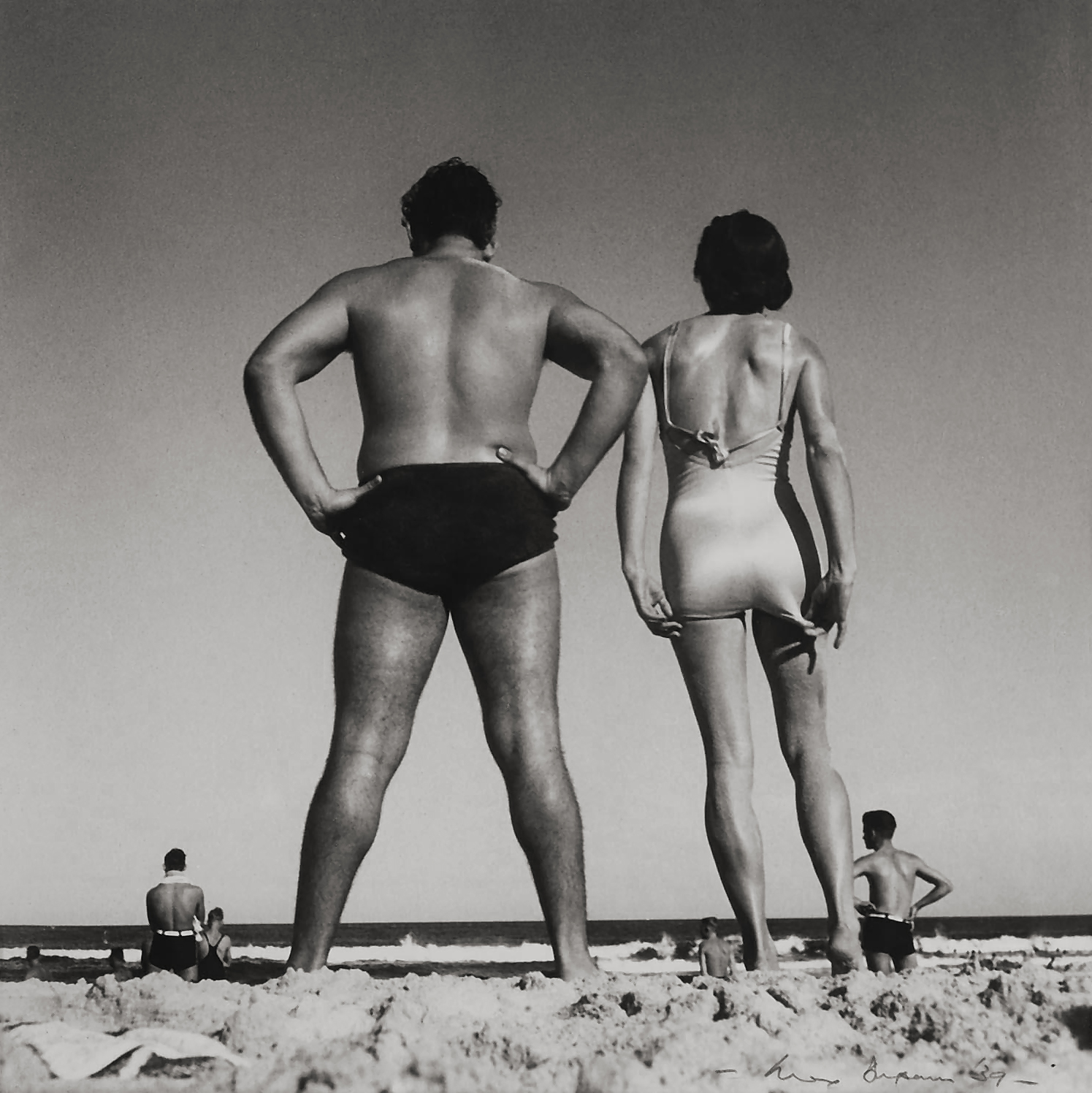
Max Dupain (Australian, 1911-1992) 'Sunbaker' 1937


Max Dupain (Australian, 1911-1992)
Sunbaker
1937
Silver gelatin print
The Sir Elton John Photographic Collection


“We possess an extraordinary instrument for reproduction. But photography is much more than that. Today it is … bringing something entirely new into the world.”


László Moholy-Nagy, 1932


Artists in the modernist period explored what the camera could do that the human eye alone could not, and how this could be harnessed to present a new modern perspective on the world. Artist and theorist László Moholy-Nagy proclaimed that photography could radically change not just what, but how we see. He called this the ‘new vision’. Rather than emulating other art forms, photography began to embrace qualities unique to itself, from its ability to reproduce the world in sharp detail to its capacity to create new realities through the manipulation of light, chemicals and paper.

This re-evaluation of photography coincided with a period of upheaval. War, revolution and economic depression led to mass movements of people and great social change. The idea of the avant-garde took hold and dada and surrealism emerged, challenging both the art and social norms that had come before. At the same time, new art schools such as the Bauhaus in Germany and Vkhutemas in Russia fostered the role of the professional artist and challenged divisions between art and design.

The Radical Eye is arranged thematically and charts a changing emphasis from the subject of an image to the visual qualities of the photograph itself, irrespective of what it represents. The many vintage prints in this exhibition – made soon after the photographs were taken – give a rare insight into the artists’ processes and creative decisions, and foreground the photograph as a physical object. All works are shown in the frames in which they are displayed in the home of Sir Elton John and David Furnish.

Together, the works in this exhibition show how photography pushed the boundaries of the possible, changing the world through the ways in which it was seen and understood. ‘Knowledge of photography is just as important as that of the alphabet. The illiterates of the future will be ignorant of the use of camera and pen alike,’ wrote Moholy-Nagy in 1927, foreseeing the cultural dominance of the photographic image. This extraordinary period still impacts how we, the photo-literate future, read and create images today.


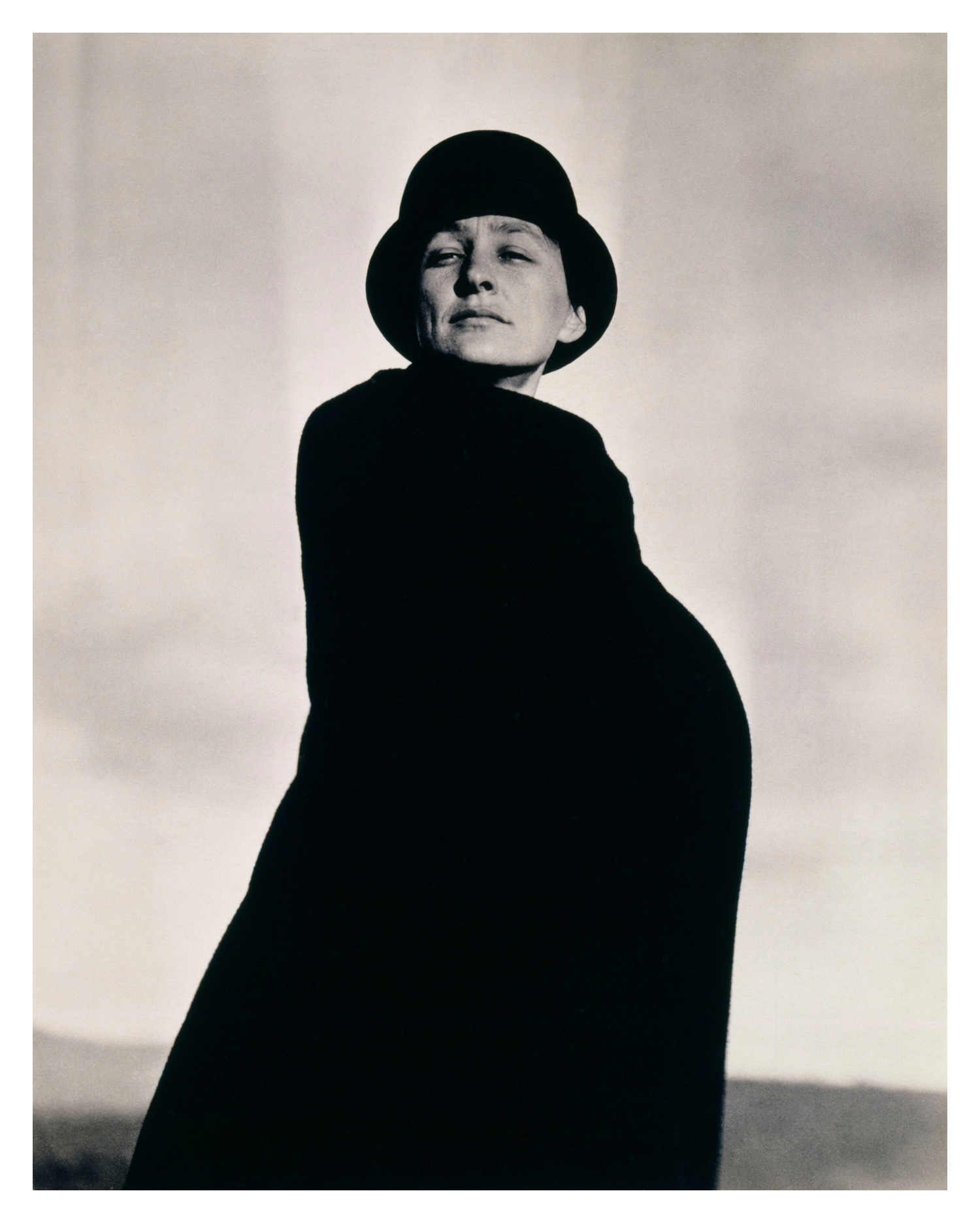
Alfred Stieglitz (American, 1864-1946) 'Georgia O'Keeffe' 1922


Alfred Stieglitz (American, 1864-1946)
Georgia O’Keeffe
1922
Silver gelatin print
The Sir Elton John Photographic Collection


“They collect themselves. Carefully, as if tying a cravat, they compose their features. Insolent, serious and conscious of their looks they turn around to face the world.”

From ‘Men before the Mirror’, published alongside portraits by Man Ray, 1934


Portraits

Modernist portraiture harnessed photography’s capacity to render an accurate likeness in clear, sharp focus and detail. But at the same time, artists and sitters pushed the conventions of portraiture with innovations in pose, composition and cropping.

Many of the portraits in this room are of artists, writers and musicians, giving a cross section of key cultural players of the time. Issues of control and collaboration arise particularly when the subject is an artist, raising the question of who is responsible for conveying the sitter’s persona. The modernist period also saw a boom of the illustrated press. Magazines reproduced photographic portraits of well-known figures which were instrumental in shaping their public images.


Man Ray (American, 1890-1976) 'Nusch Éluard' 1928


Man Ray (American, 1890-1976)
Nusch Éluard
1928
Silver gelatin print
The Sir Elton John Photography Collection
Photograph: Man Ray Trust/ADAGP, Paris and DACS, London 2016


Nusch Éluard (born Maria Benz; June 21, 1906 – November 28, 1946) was a French performer, model and surrealist artist…

Nusch arrived in France as a stage performer, variously described as a small-time actress, a traveling acrobat, and a “hypnotist’s stooge”. She met Paul Éluard in 1930 working as a model, married him in 1934, produced surrealist photomontage and other work, and is the subject of “Facile,” a collection of Éluard’s poetry published as a photogravure book, illustrated with Man Ray’s nude photographs of her.

She was also the subject of several cubist portraits and sketches by Pablo Picasso in the late 1930s, and is said to have had an affair with him. Nusch worked for the French Resistance during the Nazi occupation of France during World War II. She died in 1946 in Paris, collapsing in the street due to a massive stroke.

Text from the Wikipedia website


Edward Steichen (American 1879-1973, emigrated to United States 1881, worked in France 1906-23) 'Actress Gloria Swanson' 1924


Edward Steichen (American 1879-1973, emigrated to United States 1881, worked in France 1906-1923)
Actress Gloria Swanson
1924
Silver gelatin print
The Sir Elton John Photography Collection
© 1924 Condé Nast Publications


Adolph de Meyer (European / American, 1868-1946) 'For Elizabeth Arden (The Wax Head)' 1931


Adolph de Meyer (European / American, 1868-1946)
For Elizabeth Arden (The Wax Head)
1931
Silver gelatin print
The Sir Elton John Photography Collection


Edward Weston (American, 1886-1958) 'Igor Stravinsky' 1935


Edward Weston (American, 1886-1958)
Igor Stravinsky
1935
Silver gelatin print
© 1981 Center for Creative Photography


George Platt Lynes (American, 1907-1955) 'A Forgotten Model' c. 1937


George Platt Lynes (American, 1907-1955)
A Forgotten Model
c. 1937
Silver gelatin print
The Sir Elton John Photography Collection


Man Ray (American, 1890-1976) 'Juliet and Margaret Nieman in Papier-Mâché Masks' c. 1945


Man Ray (American, 1890-1976)
Juliet and Margaret Nieman in Papier-Mâché Masks
c. 1945
Gelatin silver print
The Sir Elton John Photography Collection
Photograph: © Man Ray Trust/ADAGP, Paris and DACS, London 2016


Irving Penn (American, 1917-2009) 'Salvador Dali in New York' 1947


Irving Penn (American, 1917-2009)
Salvador Dali in New York
1947
Silver gelatin print
The Sir Elton John Photography Collection
Photograph: The Irving Penn Foundation


“The enemy of photography is convention, the fixed rules ‘how to do’. The salvation of photography comes from the experiment.”


László Moholy-Nagy, c. 1940


Experiments

This was not a period of discovery but of rediscovery. Artists were rewriting the preceding century’s rules of photographic technique, harnessing ‘mistakes’ such as distortions and double exposures, or physically manipulating the printed image, cutting, marking and recombining photographs. These interventions could occur at any point in the process, from taking the image to the final print.

Used in portraiture, such experiments allowed for more psychologically charged representations. However, the transformative power of a particular technique often becomes much more important than the particular subject of the image. Above all, the rich creative possibilities of the photographic process come to the fore. While artists were seriously investigating the medium, the results are often surprising and playful.


Herbert Bayer (American born Austria, 1900-1985) 'Self-Portrait' 1932


Herbert Bayer (American born Austria, 1900-1985)
Self-Portrait
1932
Silver gelatin print
The Sir Elton John Photographic Collection
© DACS 2016


Otto Umbehr (German, 1902-1980) "Katz" – Cat 1927


Otto Umbehr (German, 1902-1980)
“Katz” – Cat
1927
Silver gelatin print
The Sir Elton John Photographic Collection
© Phyllis Umbehr/Galerie Kicken Berlin/DACS 2016


Josef Breitenbach (German, 1896-1984) 'Patricia, New York' c. 1942


Josef Breitenbach (German, 1896-1984)
Patricia, New York
c. 1942
Silver gelatin print
The Sir Elton John Photography Collection
Photograph: Josef and Yaye Breitenbach Charitable Foundation, Courtesy Gitterman Gallery


“The camera should be used for a recording of life, for rendering the very substance and quintessence of the thing itself, whether it be polished steel or palpitating flesh.”


Edward Weston, 1924


Bodies

Experimental approaches to shooting, cropping and framing could transform the human body into something unfamiliar. Photographers started to focus on individual parts of the body, their unconventional crops drawing attention to shape and form, accentuating curves and angles. Fragmented limbs and flesh were depersonalised and could be treated like a landscape or still life, dissolving distinctions between different genres. Thanks to faster shutter speeds and new celluloid roll film, photographers could also freeze the body in motion outside of the studio for the first time, capturing dancers and swimmers with a clarity impossible for the naked eye.


André Kertész (Hungarian, 1894-1985) 'Underwater Swimmer, Esztergom, Hungary, 30 June 1917' 1917


André Kertész (Hungarian, 1894-1985)
Underwater Swimmer, Esztergom, Hungary, 30 June 1917
1917
The Sir Elton John Photography Collection
© Estate of André Kertész/Higher Pictures


Rudolph Koppitz (Austrian, 1884-1936) 'Movement Study' 1925


Rudolph Koppitz (Austrian, 1884-1936)
Movement Study
1925
Gelatin silver print
The Sir Elton John Photography Collection
Photograph: ADAGP, Paris and DACS London 2016


Man Ray (American, 1890-1976) 'Noire et Blanche' 1926


Man Ray (American, 1890-1976)
Noire et Blanche
1926
Silver gelatin print
The Sir Elton John Photography Collection
Photograph: Man Ray Trust/ADAGP, Paris and DACS, London 2016


Man Ray (American, 1890-1976) 'Glass Tears (Les Larmes)' 1932


Man Ray (American, 1890-1976)
Glass Tears (Les Larmes)
1932
Gelatin silver print on paper
229 x 298 mm
Collection Elton John
© Man Ray Trust/ADAGP, Paris and DACS, London 2016


Edward Weston (American, 1886-1958) 'Nude' 1936


Edward Weston (American, 1886-1958)
Nude
1936
Silver gelatin print
The Sir Elton John Photography Collection
Photograph: 1981 Center for Creative Photography, Arizona Board of Regents


Man Ray (American, 1890-1976) 'Dora Maar' 1936


Man Ray (American, 1890-1976)
Dora Maar
1936
Silver gelatin print
The Sir Elton John Photography Collection
Photograph: Man Ray Trust/ADAGP, Paris and DACS, London 2016


Nino Migliori (Italian, b. 1926) 'Il Tuffatore' (The Diver) 1951


Nino Migliori (Italian, b. 1926)
Il Tuffatore (The Diver)
1951
Silver gelatin print
The Sir Elton John Photography Collection


“The documentary photographer is trying to speak to you in terms of everyone’s experience.”


Dorothea Lange, 1934


Documents

During the 1930s, photographers refined the formula for what we now know as social documentary. To compel the public to look at less palatable aspects of contemporary society they married creative manipulation with an appeal to viewers’ trust in the photograph as an objective visual record. This combination proved itself uniquely capable of eliciting empathy but is fraught with artistic and ethical complexity. These works highlight the vexed position of documentary photographs: historical evidence, instruments of propaganda and, latterly, works of art.

The development of new technology – particularly the portable camera and roll film – allowed photographers to capture spontaneous moments unfolding in the everyday world. Taking viewers into neighbourhoods where they might never set foot, street photography and documentary opened up new perspectives socially as much as visually.


Dorothea Lange (American, 1895-1965) 'Migrant Mother' 1936


Dorothea Lange (American, 1895-1965)
Migrant Mother
1936
Silver gelatin print
The Sir Elton John Photographic Collection


Walker Evans (American, 1903-1975) 'Floyde Burroughs, a cotton sharecropper, Hale County, Alabama' 1936


Walker Evans (American, 1903-1975)
Floyde Burroughs, a cotton sharecropper, Hale County, Alabama
1936
Silver gelatin print
The Sir Elton John Photography Collection


Dorothea Lange (American, 1895-1965) 'A young girl living in a shack town near Oklahoma City, Oklahoma' 1936


Dorothea Lange (American, 1895-1965)
A young girl living in a shack town near Oklahoma City, Oklahoma
1936
Silver gelatin print
The Sir Elton John Photography Collection


Walker Evans (American, 1903-1975) 'Christ or Chaos?' 1946


Walker Evans (American, 1903-1975)
Christ or Chaos?
1946
Gelatin silver print
The Sir Elton John Photography Collection
Photograph: Walker Evans Archives, The Metropolitan Museum of Art


“Contradictions of perspective. Contrasts of light. Contrasts of form. Points of view impossible to achieve in drawing and painting.”


Aleksandr Rodchenko, 1920s


Objects, Perspectives, Abstractions

The subjects and approaches of modernist photography vary widely, but are united by a fascination with the medium itself. Every image asks what photography is capable of and how it can be pushed further. This final room brings together three interlinked approaches. It shows the still life genre reimagined by photographers who used the technical capabilities of the camera to reveal the beauty of everyday things. Objects captured at unconventional angles or extreme close-up become strange, even unrecognisable.

A similar effect of defamiliarisation was accomplished by taking photographs from radically new perspectives, positioning a camera at the point of view of the ‘worm’s eye’ or ‘bird’s eye’. This created extreme foreshortening that transformed photographs from descriptive images of things into energetic compositions hovering between abstraction and representation.

Abstraction pushes against photography’s innate ability to record objectively. Radical techniques such as cameraless image-making simplified the medium to the point of capturing the play of light on photosensitive paper. By stripping it back to its most basic components, artists celebrated photography, not as a tool for reproduction, but as a creative medium capable of producing new imagery.


Alexander Rodchenko (Russian, 1891-1956) 'Shukov Tower' 1920


Alexander Rodchenko (Russian, 1891-1956)
Shukov Tower
1920
Silver gelatin print
The Sir Elton John Photographic Collection
© A. Rodchenko & V. Stepanova Archive, DACS, RAO 2016


Edward Steichen (American, 1879-1973) 'A Bee on a Sunflower' c. 1920


Edward Steichen (American, 1879-1973)
A Bee on a Sunflower
c. 1920
Gelatin silver print
The Sir Elton John Photography Collection


Man Ray (American, 1890-1976) "Rayograph" 1923


Man Ray (American, 1890-1976)
“Rayograph”
1923
Silver gelatin print
The Sir Elton John Photography Collection
Photograph: Man Ray Trust/ADAGP, Paris and DACS, London 2016


André Kertész (Hungarian, 1894-1985) 'Mondrian's Glasses and Pipe' 1926


André Kertész (Hungarian, 1894-1985)
Mondrian’s Glasses and Pipe
1926
Gelatin silver print
The Sir Elton John Photography Collection
© Estate of André Kertész/Higher Pictures


Tina Modotti (Italian American, 1896-1942) 'Bandelier, Corn and Sickle' 1927


Tina Modotti (Italian American, 1896-1942)
Bandelier, Corn and Sickle
1927
Silver gelatin print
The Sir Elton John Photographic Collection


Werner Mantz. 'Staircase Ursuliner Lyzeum Cologne 1928'


Werner Mantz (German, 1901-1983)
Staircase Ursuliner Lyzeum Cologne 1928
1928
Silver gelatin print
The Sir Elton John Photography Collection


Margaret Bourke-White (American, 1904-1971) 'George Washington Bridge' 1933


Margaret Bourke-White (American, 1904-1971)
George Washington Bridge
1933
Silver gelatin print
The Sir Elton John Photography Collection


László Moholy-Nagy (Hungarian, 1895-1946) 'View from the Berlin tower' 1928


László Moholy-Nagy (Hungarian, 1895-1946)
View from the Berlin tower
1928
Silver gelatin print
The Sir Elton John Photographic Collection


Margaret de Patta (American, 1903-1964) 'Ice Cube Tray with Marbles and Rice' 1939


Margaret de Patta (American, 1903-1964)
Ice Cube Tray with Marbles and Rice
1939
The Sir Elton John Photographic Collection
© Estate of Margaret de Patta


Tate Modern
Bankside
London SE1 9TG
United Kingdom

Opening hours:
Sunday – Thursday 10.00 – 18.00
Friday – Saturday 10.00 – 22.00

Tate Modern website

LIKE ART BLART ON FACEBOOK

Back to top

Exhibition: ‘Peter Hujar: Speed of Life’ at Fundación MAPFRE, Barcelona

Exhibition dates: 27th January – 30th April, 2017

Curator: Joel Smith, “Richard L. Menschel Curator” and Director of the Department of Photography at the Morgan Library & Museum

Peter Hujar: Speed of Life has been organised by Fundación MAPFRE, Barcelona, and The Morgan Library & Museum, New York. The exhibition and its travelling schedule have been made possible by the Terra Foundation for American Art.


Peter Hujar (American, 1934-1987) 'Horse in West Virginia Mountains' 1969 from the exhibition 'Peter Hujar: Speed of Life' at Fundación MAPFRE, Barcelona, Jan - April, 2017


Peter Hujar (American, 1934-1987)
Horse in West Virginia Mountains
1969
Gelatina de plata
Colección de Richard y Ronay Menschel
© The Peter Hujar Archive, LLC. Cortesía Pace/MacGill Gallery, Nueva York, and Fraenkel Gallery, San Francisco


A love letter to Peter Hujar


You jumped so high

the boy on a raft

saluting the sky

absorbed in his craft


Of rhythm and eros

you offer no excess

just intimacy, connection

a timeless … transience


The line of skyscrapers, the lines of a thinker

the gaze of a baby, the eyes of a dreamer

two cows look direct, as direct as can be

and chrysanthemums and roses lay death near thee


Contortions and compression

of time and space

the twist of a wrist, the surge of a river

a certain, poignant – tenderness


In love with photography

and the stories it tells

A troubled man

brought out of his shell


You left us too soon

you beautiful spirit

your portraits of life

loved, immortal – never finished


Dr Marcus Bunyan


Many thankx to Fundación MAPFRE for allowing me to publish the photographs in the posting. Please click on the photographs for a larger version of the image.

See more Peter Hujar images on The Guardian website.


I want you to talk about me in a low voice. When people talk about me, I want them to do it by whispering.


Peter Hujar


He was charismatic and complicated and, it turned out, deeply insecure, with a damaging family history he kept mostly to himself… Peter was, in a way, at his most moving when taking photographs. He was so absorbed by it. Peter was in many ways a very tortured man, and I felt like when he was taking photographs, he wasn’t. I had other friends who were photographers, but not like Peter. Peter was so profoundly absorbed and engaged by it. He was never not a photographer.


Vince Aletti


Installation view of 'Peter Hujar: Speed of Life' at Fundación MAPFRE, Barcelona

Installation view of 'Peter Hujar: Speed of Life' at Fundación MAPFRE, Barcelona

Installation view of 'Peter Hujar: Speed of Life' at Fundación MAPFRE, Barcelona

Installation view of 'Peter Hujar: Speed of Life' at Fundación MAPFRE, Barcelona

Installation view of 'Peter Hujar: Speed of Life' at Fundación MAPFRE, Barcelona

Installation view of 'Peter Hujar: Speed of Life' at Fundación MAPFRE, Barcelona

Installation view of 'Peter Hujar: Speed of Life' at Fundación MAPFRE, Barcelona

Installation view of 'Peter Hujar: Speed of Life' at Fundación MAPFRE, Barcelona

Installation view of 'Peter Hujar: Speed of Life' at Fundación MAPFRE, Barcelona

Installation view of 'Peter Hujar: Speed of Life' at Fundación MAPFRE, Barcelona

Installation view of 'Peter Hujar: Speed of Life' at Fundación MAPFRE, Barcelona


Installation views of Peter Hujar: Speed of Life at Fundación MAPFRE, Barcelona


Fundación MAPFRE is delighted to be presenting Peter Hujar: Speed of Life, a retrospective exhibition on the American photographer Peter Hujar. Offering the most detailed account of the artist’s work to date, from the 1950s to his death in New York in 1987, it will be on display between January 27 and April 30, 2017 at the Fundación MAPFRE’s Casa Garriga i Nogués exhibition space (Calle Diputació, 250) in Barcelona.

Hujar was a portraitist in everything he did. Regardless of the subject of the work – a lover, an underground theatre actor, a goose, the surface of the Hudson River, or the placid features of his own face – what moved and motivated him was the spark of encounter and exchange between artist and other. Hujar’s serene, meditative, square-format photographs confer gravity on the object of his attention, granting it an eternal moment’s pause within the rush of passing time.

Little recognised during his own lifetime, Hujar published only one book of photographs, Portraits in Life and Death, but his output is today recognised as distinctive. His portraits combine disclosure and secrecy, ferocity and peace. Hujar’s career involved both a quest for recognition in the world of fashion photography – the photographers he admired most were Irving Penn and Richard Avedon – and a more solitary, almost completely uncompensated body of work in which he depicted the creative and intellectual New York that he knew and admired.

The present exhibition follows Peter Hujar’s method of presenting his work. Rather than show his photographs in isolation or in an linear or chronological arrangements, he preferred to present them in dynamic, surprising and sometimes disconcerting juxtapositions.

Press release from Fundación MAPFRE


Four keys

Peter Hujar’s work falls within the photographic tradition of portraiture: he was a portraitist in everything he did. Whatever the subject – a lover, an actor, a horse, the surface of the Hudson River, or the gentle features of his own face – what moved and motivated Hujar was the spark in the encounter and the exchange between the artist and his subject, establishing a direct relationship with whatever he portrayed thereby revealing its true nature.

One of the themes reflected in Hujar’s work is homosexuality. These were the years of the first Gay Liberation movements and the famous Stonewall riots. Hujar lived close to the Stonewall Inn, and his partner at the time, Jim Fouratt, came onto the scene the night of the police raid and founded the Gay Liberation Front. Hujar was not an activist, though he attended the group’s first meeting and contributed his well-known photograph which would become the image for the Gay Liberation Front Poster, 1970.

The route followed by the exhibition reflects the preferences of the artist, who systematically chose to present his photographs in vibrant, surprising and sometimes disturbing Most of the photographs are grouped into sets, some of which reflect the artist’s recurrent concerns, while others exemplify his interest in emphasising diversity and the internal contradictions in his work.

A distinguishing feature of his art is the invisibility of technique in his photographs and yet simultaneously his preoccupation with and care over it. Hujar produced his own copies and was also considered a good printer.

Text from the Fundación MAPFRE website


Peter Hujar (American, 1934-1987) 'La Marchesa Fioravanti' 1958 from the exhibition 'Peter Hujar: Speed of Life' at Fundación MAPFRE, Barcelona, Jan - April, 2017


Peter Hujar (American, 1934-1987)
La Marchesa Fioravanti
1958
Gelatina de plata
The Peter Hujar Archive
© The Peter Hujar Archive, LLC. Cortesía Pace/MacGill Gallery, Nueva York, and Fraenkel Gallery, San Francisco


Peter Hujar (American, 1934-1987) 'Stromboli' 1963


Peter Hujar (American, 1934-1987)
Stromboli
1963
Gelatina de plata
The Morgan Library & Museum, The Peter Hujar Collection
Adquirida gracias a The Charina Endowment Fund
© The Peter Hujar Archive, LLC. Cortesía Pace/MacGill Gallery, Nueva York, and Fraenkel Gallery, San Francisco


Peter Hujar (American, 1934-1987) 'Palermo Catacombs (11)' 1963


Peter Hujar (American, 1934-1987)
Palermo Catacombs (11)
1963
Gelatina de plata
Colección de Allen Adler and Frances Beatty Adler
© The Peter Hujar Archive, LLC. Cortesía Pace/MacGill Gallery, Nueva York, and Fraenkel Gallery, San Francisco


Peter Hujar (American, 1934-1987) 'St. Patrick's, Easter Sunday' 1976


Peter Hujar (American, 1934-1987)
St. Patrick’s, Easter Sunday
1976
Gelatina de plata
The Morgan Library & Museum, The Peter Hujar Collection
Adquirida gracias a The Charina Endowment Fund
© The Peter Hujar Archive, LLC. Cortesía Pace/MacGill Gallery, Nueva York, and Fraenkel Gallery, San Francisco


Artist biography

Peter Hujar was born in Trenton, New Jersey, in 1934 and grew up in the countryside with his Polish immigrant grandparents. When he was eleven his mother, a waitress, brought him to live with her in Manhattan.

Interested in photography from childhood, after graduating from high school in 1953 Hujar worked as an assistant in the studios of magazine professionals and aspired to work in fashion like his idols Lisette Model, Irving Penn, and Richard Avedon.

Between 1958 and 1963 Hujar lived mainly in Italy with two successive partners, artists Joseph Raffael and Paul Thek. After studying for a year at a filmmaking school in Rome he returned to Manhattan, where he moved in the circles of writer Susan Sontag and Andy Warhol’s Factory. From 1968 to 1972 he pursued a freelance career in fashion photography, publishing over a dozen features in Harper’s Bazaar and GQ before concluding that the hustle of magazine work “wasn’t right for me.”

In 1973 Hujar definitively renounced his professional aspirations for a life of creative poverty in New York’s East Village. Living in a loft above a theatre at Twelfth Street and Second Avenue, he took paying jobs only when necessary in order to focus on the work that truly motivated him. He photographed the artists he knew and respected, animals, the nude body, and New York as he knew it, a city then in serious economic decline. In his book Portraits in Life and Death (1976) he combined intimate studies of his rarefied downtown coterie (painters, performers, choreographers, and writers such as Sontag and William S. Burroughs) with portraits  of mummies in the Palermo Catacombs that he had made during a visit with Thek thirteen years earlier. His focus on mortality would intensify and find its purpose in the 1980s, when the AIDS epidemic ravaged gay populations in New York and worldwide.

Briefly a lover and subsequently a mentor to the young artist David Wojnarowicz, in his last seven years Hujar continued chronicling a creative downtown subculture that was fast becoming unsustainable in the context of the increasing power of money. His most frequent subject in these years was his neighbour and friend Ethyl Eichelberger, a drag performer whom he called “the greatest actor in America.” With Wojnarowicz, Hujar made expeditions to the depressed areas around New York, photographing industrial ruins in Queens, neighbourhoods of Newark, New Jersey, that had been destroyed in the riots of the late 1960s, and the abandoned Hudson River piers of lower Manhattan, sites of sexual exploits by night and guerilla art installations by day. Hujar died in New York on Thanksgiving Day, 1987, around eleven months after being diagnosed with AIDS.

Throughout his life Hujar stubbornly aligned himself with what he called the “All-In people”: artists committed to a creative course all their own, unconcerned with mass-market acclaim. At the same time he both disdained and bitterly wished for public recognition such as that achieved by his famous contemporaries Diane Arbus – eleven years his senior and respected by him – and Robert Mapplethorpe, who was twelve years younger and whom he considered a facile operator. During the thirty years since Hujar’s death the highly localised downtown public that knew his work has all but completely passed into history, while a vastly expanded photography audience around the world has become familiar with specific facets of his work, such as his indelible 1973 image Candy Darling on her Deathbed, and his soulful portraits of animals. In Peter Hujar: Speed of Life what comes to light is a broader assessment of his unique oeuvre, which was diverse and enduring. Many of the subjects populating this retrospective are familiar, even iconic faces of their era, but what can be seen more clearly today is the vision of the artist who unites them, himself a great and singular talent of the post-war decades in American art.


Peter Hujar (American, 1934-1987) 'Cindy Luba as Queen Victoria' 1973


Peter Hujar (American, 1934-1987)
Cindy Luba as Queen Victoria
1973
Gelatina de plata
The Morgan Library & Museum, The Peter Hujar Collection
© The Peter Hujar Archive, LLC. Cortesía Pace/MacGill Gallery, Nueva York, and Fraenkel Gallery, San Francisco


Peter Hujar (American, 1934-1987) 'David Warrilow (1)' 1985


Peter Hujar (American, 1934-1987)
David Warrilow (1)
1985
Gelatina de plata
The Morgan Library & Museum, The Peter Hujar Collection
© The Peter Hujar Archive, LLC. Cortesía Pace/MacGill Gallery, Nueva York, and Fraenkel Gallery, San Francisco


Peter Hujar (American, 1934-1987) 'Flowers for the Dead, Mazatlán, Mexico (2)' 1977


Peter Hujar (American, 1934-1987)
Flowers for the Dead, Mazatlán, Mexico (2)
1977
Gelatina de plata
The Morgan Library & Museum, The Peter Hujar Collection
© The Peter Hujar Archive, LLC. Cortesía Pace/MacGill Gallery, Nueva York, and Fraenkel Gallery, San Francisco


Peter Hujar (American, 1934-1987) 'Pascal Imbert Scarred Abdomen' 1980


Peter Hujar (American, 1934-1987)
Pascal Imbert Scarred Abdomen
1980
Gelatina de plata
The Morgan Library & Museum, The Peter Hujar Collection
© The Peter Hujar Archive, LLC. Cortesía Pace/MacGill Gallery, Nueva York, and Fraenkel Gallery, San Francisco


Peter Hujar (American, 1934-1987) 'Grass, Port Jefferson, New York' 1984


Peter Hujar (American, 1934-1987)
Grass, Port Jefferson, New York
1984
Gelatina de plata
The Morgan Library & Museum, The Peter Hujar Collection
© The Peter Hujar Archive, LLC. Cortesía Pace/MacGill Gallery, Nueva York, and Fraenkel Gallery, San Francisco


Peter Hujar (American, 1934-1987) 'Paul Hudson (Leg)' 1979


Peter Hujar (American, 1934-1987)
Paul Hudson (Leg)
1979
Gelatina de plata
The Morgan Library & Museum, The Peter Hujar Collection
© The Peter Hujar Archive, LLC. Cortesía Pace/MacGill Gallery, Nueva York, and Fraenkel Gallery, San Francisco


Peter Hujar (American, 1934-1987) 'Robyn Brentano (1)' 1975


Peter Hujar (American, 1934-1987)
Robyn Brentano (1)
1975
Gelatina de plata
The Morgan Library & Museum, The Peter Hujar Collection
© The Peter Hujar Archive, LLC. Cortesía Pace/MacGill Gallery, Nueva York, and Fraenkel Gallery, San Francisco


Structure of the exhibition

The exhibition includes 160 photographs that offer an exploration of the career of this American photographer, with works loaned from the collection of the Morgan Library & Museum and nine other collections. The result is the most detailed account of Peter Hujar’s work presented to date.

In its structure the exhibition takes account of Hujar’s preference for presenting his photographs in vivid, startling, and even puzzling juxtapositions. Although following a broadly chronological order, with formative work from the 1950s and 1960s concentrated in the first half and later photographs at the end, the visual and creative continuities that spanned the duration of Hujar’s artistic life are emphasised as the visitor follows the sequence of works.

Most of the photographs are presented in groups of three to eight images, some of which showcase enduring preoccupations of the artist while others exemplify his desire to stress the diversity and internal contradictions of his work.

Thus, for the final exhibition of his life, held at the Gracie Mansion Gallery in the East Village in January 1986, Hujar spent several days arranging seventy photographs into thirty-five tightly spaced vertical pairs, taking care not to let any single genre of image appear twice in a row. At the start of the present exhibition, a six-photograph grid pays homage to this method by presenting a checkerboard-format conversation between three images made in controlled indoor conditions and three exterior views. The subjects, in order, are: a man’s bare leg with the foot planted firmly on the studio floor; waves rolling in on an ocean beach; a portrait of an unidentified young man; the World Trade Center at sunset; Ethyl Eichelberger applying makeup before a performance; and a dark burned-out hallway in the ruins of the Canal Street pier.

The catalogue

The catalogue that accompanies the exhibition includes texts by its curator Joel Smith and by Philip Gefter and Steve Turtell, making it a reference work for a detailed knowledge of Peter Hujar’s work from the 1950s until his death in 1987.


Peter Hujar (American, 1934-1987) 'Peggy Lee' 1974


Peter Hujar (American, 1934-1987)
Peggy Lee
1974
Gelatina de plata
The Peter Hujar Archive
© The Peter Hujar Archive, LLC. Cortesía Pace/MacGill Gallery, Nueva York, and Fraenkel Gallery, San Francisco


Peter Hujar (American, 1934-1987) 'Hudson River' 1975


Peter Hujar (American, 1934-1987)
Hudson River
1975
Gelatina de plata
The Morgan Library & Museum, The Peter Hujar Collection
Adquirida gracias a The Charina Endowment Fund
© The Peter Hujar Archive, LLC. Cortesía Pace/MacGill Gallery, Nueva York, and Fraenkel Gallery, San Francisco


Peter Hujar (American, 1934-1987) 'Mural at Piers' 1983


Peter Hujar (American, 1934-1987)
Mural at Piers
1983
Gelatina de plata
The Peter Hujar Archive
© The Peter Hujar Archive, LLC. Cortesía Pace/MacGill Gallery, Nueva York, and Fraenkel Gallery, San Francisco


Peter Hujar (American, 1934-1987) 'Ethyl Eichelberger as Minnie the Maid' 1981


Peter Hujar (American, 1934-1987)
Ethyl Eichelberger as Minnie the Maid
1981
Gelatina de plata
The Morgan Library & Museum, The Peter Hujar Collection
Adquirida gracias a The Charina Endowment Fund
© The Peter Hujar Archive, LLC. Cortesía Pace/MacGill Gallery, Nueva York, and Fraenkel Gallery, San Francisco


Peter Hujar (American, 1934-1987) 'Steel Ruins 13' 1976


Peter Hujar (American, 1934-1987)
Steel Ruins 13
1976
Gelatina de plata
The Morgan Library & Museum, The Peter Hujar Collection
Adquirida gracias a The Charina Endowment Fund
© The Peter Hujar Archive, LLC. Cortesía Pace/MacGill Gallery, Nueva York, and Fraenkel Gallery, San Francisco


Peter Hujar (American, 1934-1987) 'Gary in Contortion (1)' 1979


Peter Hujar (American, 1934-1987)
Gary in Contortion (1)
1979
Gelatina de plata
The Morgan Library & Museum, The Peter Hujar Collection
Adquirida gracias a The Charina Endowment Fund
© The Peter Hujar Archive, LLC. Cortesía Pace/MacGill Gallery, Nueva York, and Fraenkel Gallery, San Francisco


Peter Hujar (American, 1934-1987) 'Self-Portrait Jumping (1)' 1974


Peter Hujar (American, 1934-1987)
Self-Portrait Jumping (1)
1974
Gelatina de plata
The Morgan Library & Museum, The Peter Hujar Collection
Adquirida gracias a The Charina Endowment Fund
© The Peter Hujar Archive, LLC. Cortesía Pace/MacGill Gallery, Nueva York, and Fraenkel Gallery, San Francisco


Peter Hujar (American, 1934-1987) 'Candy Darling on Her Deathbed' 1973


Peter Hujar (American, 1934-1987)
Candy Darling on Her Deathbed
1973
Gelatina de plata
Colección de Richard and Ronay Menschel
© The Peter Hujar Archive, LLC. Cortesía Pace/MacGill Gallery, Nueva York, and Fraenkel Gallery, San Francisco


Peter Hujar (American, 1934-1987) 'Chloe Finch' 1981


Peter Hujar (American, 1934-1987)
Chloe Finch
1981
Gelatina de plata
The Morgan Library & Museum, The Peter Hujar Collection
Adquirida gracias a The Charina Endowment Fund
© The Peter Hujar Archive, LLC. Cortesía Pace/MacGill Gallery, Nueva York, and Fraenkel Gallery, San Francisco


Peter Hujar (American, 1934-1987) 'Butch and Buster' 1978


Peter Hujar (American, 1934-1987)
Butch and Buster
1978
Gelatina de Plata
Colección de John Erdman and Gary Schneider
© The Peter Hujar Archive, LLC. Cortesía Pace/MacGill Gallery, Nueva York, and Fraenkel Gallery, San Francisco


Peter Hujar (American, 1934-1987) 'David Wojnarowcz Reclining (2)' 1981


Peter Hujar (American, 1934-1987)
David Wojnarowcz Reclining (2)
1981
Gelatina de plata
The Morgan Library & Museum, The Peter Hujar Collection
Adquirida gracias a The Charina Endowment Fund
© The Peter Hujar Archive, LLC. Cortesía Pace/MacGill Gallery, Nueva York, and Fraenkel Gallery, San Francisco


Peter Hujar (American, 1934-1987) 'John McClellan' 1981


Peter Hujar (American, 1934-1987)
John McClellan
1981
Gelatina de plata
The Morgan Library & Museum, The Peter Hujar Collection
Adquirida gracias a The Charina Endowment Fund
© The Peter Hujar Archive, LLC. Cortesía Pace/MacGill Gallery, Nueva York, and Fraenkel Gallery, San Francisco


Peter Hujar (American, 1934-1987) 'Susan Sontag' 1975


Peter Hujar (American, 1934-1987)
Susan Sontag
1975
Gelatina de plata
The Morgan Library & Museum, The Peter Hujar Collection
Adquirida gracias a The Charina Endowment Fund
© The Peter Hujar Archive, LLC. Cortesía Pace/MacGill Gallery, Nueva York, and Fraenkel Gallery, San Francisco


Peter Hujar (American, 1934-1987) 'New York: Sixth Avenue (1)' 1976


Peter Hujar (American, 1934-1987)
New York: Sixth Avenue (1)
1976
Gelatina de plata
The Morgan Library & Museum, The Peter Hujar Collection
Adquirida gracias a The Charina Endowment Fund
© The Peter Hujar Archive, LLC. Cortesía Pace/MacGill Gallery, Nueva York, and Fraenkel Gallery, San Francisco


Peter Hujar (American, 1934-1987) 'Boy on Raft' 1978


Peter Hujar (American, 1934-1987)
Boy on Raft
1978
Gelatina de plata
The Morgan Library & Museum, The Peter Hujar Collection
© The Peter Hujar Archive, LLC. Cortesía Pace/MacGill Gallery, Nueva York, and Fraenkel Gallery, San Francisco


Cover of the catalogue for the exhibition 'Peter Hujar: Speed of Life' at Fundación MAPFRE, Barcelona featuring the Peter Hujar image 'Boy on Raft' (1978)


Cover of the catalogue for the exhibition Peter Hujar: Speed of Life at Fundación MAPFRE, Barcelona featuring the Peter Hujar image Boy on Raft (1978)


Fundación MAPFRE – Instituto de Cultura
Casa Garriga i Nogués exhibition space
Calle Diputació, 250
Barcelona

Opening hours:
Tuesday to Sundays (and holidays): 11am – 7pm
Closed Mondays

Fundación MAPFRE website

The Peter Hujar Archive

LIKE ART BLART ON FACEBOOK

Back to top

Exhibition: ‘The Shape of Things: Photographs from Robert B. Menschel’ at The Museum of Modern Art (MoMA), New York

Exhibition dates: 29th October, 2016 – 7th May, 2017

Curators: Quentin Bajac, the Joel and Anne Ehrenkranz Chief Curator of Photography, with Katerina Stathopoulou, Curatorial Assistant, Department of Photography, MoMA


Roger Fenton (British, 1819-1869) 'Greek Hero' c. 1857 from the exhibition 'The Shape of Things: Photographs from Robert B. Menschel' at The Museum of Modern Art (MoMA), New York, Oct 2016 - May 2017


Roger Fenton (British, 1819-1869)
Greek Hero
c. 1857
Salted-paper print from a wet-collodion glass negative
13 7/16 × 10 3/16″ (34.2 × 25.8cm)
The Museum of Modern Art, New York
Robert and Joyce Menschel Fund


Photography is … a language for asking questions about the world. The Shape of Things imbues this aphorism with a linear taxonomy in its written material (while the installation “occasionally diverges from a strict chronological progression”), no matter that each “moment” in the history of photography – historical, modern, contemporary – is never self contained or self sufficient, that each overlaps and informs one another, in a nexus of interweaving threads.

Charles Harry Jones’ Peapods (c. 1900) are as modern as Bernd and Hilla Becher’s Cooling Towers (1973); Margaret Watkins’ Design Angles (1919) are as directorial as Jan Groover’s Untitled (1983) or Charles Harry Jones’ Onions (c. 1900). And so it goes…

The ideation “the shape of things” is rather a bald fundamental statement in relation to how we imagine and encounter the marvellous. No matter the era, the country or the person who makes them; no matter the meanings readable in photographs or their specific use value in a particular context – the photograph is still the footprint of an idea and, as John Berger asks, a trace naturally left by something that has past? That flicker of imagination in the mind’s eye which has no time.

As Sartre says in Being and Nothingness, “Temporality is only a tool of vision.”

Dr Marcus Bunyan


Many thankx to MoMA for allowing me to publish the photographs in posting. Please click on the photographs for a larger version of the image.


The Shape of Things presents a compact and non-comprehensive history of photography, from its inception to the early twenty-first century, in one hundred images. The exhibition is drawn entirely from the 504 photographs that have entered The Museum of Modern Art’s collection with the support of Robert B. Menschel over the past forty years, including a notable selection of works from his personal collection that were given in 2016 and are being shown here for the first time.

“Photography is less and less a cognitive process, in the traditional sense of the term, or an affirmative one, offering answers, but rather a language for asking questions about the world,” wrote the Italian photographer and critic Luigi Ghirri in 1989. Echoing these words, the exhibition presents the history of the medium in three parts, emphasising the strengths of Menschel’s collection and mirroring his equal interest in historical, modern, and contemporary photography. Each section focuses on a moment in photography’s history and the conceptions of the medium that were dominant then: informational and documentary in the nineteenth and early twentieth centuries, more formal and subjective in the immediate postwar era, and questioning and self-referential from the 1970s onward. The installation occasionally diverges from a strict chronological progression, fuelled by the conviction that works from different periods, rather than being antagonistic, correspond with and enrich each other.


Installation view of 'The Shape of Things: Photographs from Robert B. Menschel' at The Museum of Modern Art, New York, October 29, 2016 - May 7, 2017

Installation view of 'The Shape of Things: Photographs from Robert B. Menschel' at The Museum of Modern Art, New York, October 29, 2016 - May 7, 2017

Installation view of 'The Shape of Things: Photographs from Robert B. Menschel' at The Museum of Modern Art, New York, October 29, 2016 - May 7, 2017

Installation view of 'The Shape of Things: Photographs from Robert B. Menschel' at The Museum of Modern Art, New York, October 29, 2016 - May 7, 2017

Installation view of 'The Shape of Things: Photographs from Robert B. Menschel' at The Museum of Modern Art, New York, October 29, 2016 - May 7, 2017


Installation views of The Shape of Things: Photographs from Robert B. Menschel at The Museum of Modern Art, New York, October 29, 2016 – May 7, 2017
© 2016 The Museum of Modern Art
Photo: John Wronn


The exhibition The Shape of Things: Photographs from Robert B. Menschel presents a compact history of photography, from its inception to the early 21st century, in 100 images. On view from October 29, 2016, through May 7, 2017, the exhibition is drawn entirely from the 504 photographs that have entered The Museum of Modern Art’s collection over the past 40 years with the support of longtime Museum trustee Robert B. Menschel. It includes a notable selection of works from his personal collection that were given in 2016 and are being shown here for the first time. The Shape of Things is organised by Quentin Bajac, the Joel and Anne Ehrenkranz Chief Curator of Photography, with Katerina Stathopoulou, Curatorial Assistant, Department of Photography, MoMA.

Borrowing its title from the eponymous work by Carrie Mae Weems (American, b. 1953), the exhibition presents the history of the medium in three parts, emphasising the strengths of Menschel’s collection and mirroring his equal interest in historical, modern, and contemporary photography. Each section focuses on a moment in photography’s history and the conceptions of the medium that were dominant then: informational and documentary in the 19th and early 20th centuries, more formal and subjective in the immediate postwar era, and questioning and self-referential from the 1970s onward. The installation occasionally diverges from a strict chronological progression, fuelled by the conviction that works from different periods, rather than being antagonistic, correspond with and enrich each other.

Historical

From 1840 to 1900, in photography’s infancy as a medium, artists principally sought to depict truthful representations of their surrounding environments. This primal stage is distinguished by a debate on the artistic-versus-scientific nature of the invention. Photographers engaged with the aesthetic and technical qualities of the medium, experimenting with tone, texture, and printing processes. The exhibition begins with seminal photographs such as William Henry Talbot Fox’s (British, 1800-1877) 1843 picture Rue Basse des Remparts, Paris, taken from the windows of the Hôtel de Douvres. Also on view is the astronomer Jules Janssen’s (French, 1824-1907) masterpiece L’Atlas de photographies solaires (Atlas of solar photographs), published in 1903. Summing up a quarter-century of daily photography at Janssen’s observatory in Meudon, France, the volume on view contains 30 images of the photosphere, demonstrating photography’s instrumental role in advancing the study of science. Other artists included in this section are Louis-August and Auguste-Rosalie Bisson (Bisson brothers), Eugène Cuvelier, Roger Fenton, Hugh W. Diamond, Charles Marville, and Henri Le Secq.

Modern

As photographers grappled with war and its aftermath, they began to turn their focus away from documenting the world around them and toward capturing their own personal experiences in a more formal, subjective way. A selection of works from 1940 to 1960 explores this theme, including works by two artists whose images Menschel collected extensively: Harry Callahan (American, 1912-1999) and Aaron Siskind (American, 1903-1991). A selection from Callahan’s quintessential photographs of urban environments – from Chicago and New York to Aix-en Provence and Cuzco, Peru – double exposures of city views, and portraits of his wife Eleanor and daughter Barbara, underscore the breadth of his oeuvre. In the summer of 1951, while teaching alongside Callahan at Black Mountain College in North Carolina, Siskind began the series of pictures of the surfaces of walls for which he is best known. One of the early works in the series on view, North Carolina 30 (1951), shows the bare legs of a woman framed by the words “IN” and”AND” amid layers of peeling layers of posters. In their planarity and graphic quality, these pictures also have a kinship with paintings by the Abstract Expressionists, alongside whom Siskind began exhibiting in the late 1940s. Other artists in this section include Berenice Abbott, Robert Frank, Lee Friedlander, John Gossage, André Kertész, Clarence John Laughlin, and Dora Maar.

Contemporary

From the 1970s onward, photographers began working in what A. D. Coleman defined as “The Directorial Mode,” wherein the photographer consciously creates events for the sole purpose of making images. John Coplans (British, 1920-2003) took his own body, naked and with the head invisible, as the subject of his work – both carrying on and contradicting the tradition of the self-portrait centred on the face – as seen in Self-Portrait (Back with Arms Above) (1984). Joan Fontcuberta’s (Spanish, b. 1955) series Herbarium appears at first glance to be a collection of botanical studies, depicting plants with new and distinctive contours and rigorously scientific names. However, as revealed by his fictional character Dr Hortensio Verdeprado (“green pasture” in Spanish), the “plants” are actually carefully composed by the photographer using scrap picked up in industrial areas around Barcelona. Made of bits of paper and plastic, small animal bones, and other detritus, these forms are not only non-vegetal – there is almost nothing natural about them at all. Fontcuberta is interested in the way data assumes meaning through its presentation and in the acceptance of the photographic image as evidence of truth. Other artists in this section include Jan Groover, David Levinthal, An-My Lê, Michael Spano, JoAnn Verburg, and William Wegman.

Press release from the Museum of Modern Art


Hugh W. Diamond (British, 1809-1886) 'Untitled' c. 1852-1855 from the exhibition 'The Shape of Things: Photographs from Robert B. Menschel' at The Museum of Modern Art (MoMA), New York, Oct 2016 - May 2017


Hugh W. Diamond (British, 1809-1886)
Untitled
c. 1852-55
Albumen silver print from a glass negative
6 1/2 x 5 5/16″ (16.6 x 13.5cm)
Horace W. Goldsmith Fund through Robert B. Menschel


William Henry Fox Talbot (British, 1800-1877) 'Rue Basse des Remparts, Paris' May 1843


William Henry Fox Talbot (British, 1800-1877)
Rue Basse des Remparts, Paris
May 1843
Salted paper print
6 11/16 × 6 3/4″ (17 × 17.2cm)
Promised gift of Robert B. Menschel


Charles Marville (French, 1816-1879) 'Pont Neuf' 1870s


Charles Marville (French, 1816-1879)
Pont Neuf
1870s
Albumen silver print
14 1/8 x 8 1/4″ (36 x 23.5cm)
Horace W. Goldsmith Fund through Robert B. Menschel


Charles Marville (French, 1816-1879) 'Rue des Prêtres-Saint-Germain-l'Auxerrois' c. 1866


Charles Marville (French, 1816-1879)
Rue des Prêtres-Saint-Germain-l’Auxerrois
c. 1866
Albumen silver print
11 13/16 × 10 1/2″ (30 × 26.6cm)
Promised gift of Robert B. Menschel


Charles Marville (French, 1816-1879) 'Rue du Cygne' c. 1865


Charles Marville (French, 1816-1879)
Rue du Cygne
c. 1865
Albumen silver print from a glass negative
11 3/4 x 10 9/16″ (29.9 x 26.9cm)
Horace W. Goldsmith Fund through Robert B. Menschel


Alfred Stieglitz (American, 1864-1946) 'The Terminal' 1893


Alfred Stieglitz (American, 1864-1946)
The Terminal
1893
Photogravure mounted to board
10 × 13 3/16″ (25.4 × 33.5cm)
Promised gift of Robert B. Menschel


Truthful representations, 1840-1930

“One advantage of the discovery of the Photographic Art will be, that it will enable us to introduce into our pictures a multitude of minute details which add to the truth and reality of the representation, but which no artist would take the trouble to copy faithfully from nature.

Contenting himself with a general effect, he would probably deem it beneath his genius to copy every accident of light and shade; nor could he do so indeed, without a disproportionate expenditure of time and trouble, which might be otherwise much better employed.

Nevertheless, it is well to have the means at our disposal of introducing these minutiae without any additional trouble, for they will sometimes be found to give an air of variety beyond expectation to the scene represented.”

William Henry Fox Talbot, The Pencil of Nature, 1844-1846


“I was interested in a straightforward 19th-century way of photographing an object. To photograph things frontally creates the strongest presence and you can eliminate the possibilities of being too obviously subjective. If you photograph an octopus, you have to work out which approach will show the most typical character of the animal. But first you have to learn about the octopus. Does it have six legs or eight? You have to be able to understand the subject visually, through its visual appearance. You need clarity and not sentimentality.”

Hilla Becher, in “The Music of the Blast Furnaces: Bernhard and Hilla Becher in Conversation with James Lingwood,” Art Press, no. 209 (1996)


Charles Harry Jones (British, 1866-1959) 'Peapods' c. 1900


Charles Harry Jones (British, 1866-1959)
Peapods
c. 1900
Gelatin silver printing-out-paper print
6 5/16 x 8 1/4″ (16 x 20.9cm)
Promised gift of Robert B. Menschel


Bernd Becher (German, 1931-2007), Hilla Becher (German, 1934-2015) 'Cooling Towers' 1973


Bernd Becher (German, 1931-2007), Hilla Becher (German, 1934-2015)
Cooling Towers
1973
Gelatin silver prints
Each 15 3/4 × 11 13/16″ (40 × 30cm)
The Museum of Modern Art, New York
Promised gift of Robert B. Menschel
© 2016 Estate Bernd and Hilla Becher


Berenice Abbott (American, 1898-1991) 'George Washington Bridge, Riverside Drive and West 179th Street, Manhattan' January 17, 1936


Berenice Abbott (American, 1898-1991)
George Washington Bridge, Riverside Drive and West 179th Street, Manhattan
January 17, 1936
Gelatin silver print
9 9/16 x 7 5/8″ (24.3 x 19.3cm)
The Museum of Modern Art, New York
Promised gift of Robert B. Menschel
© 2016 Berenice Abbott/Commerce Graphics


Berenice Abbott (American, 1898-1991) 'Gunsmith, 6 Centre Market Place, Manhattan' February 4, 1937


Berenice Abbott (American, 1898-1991)
Gunsmith, 6 Centre Market Place, Manhattan
February 4, 1937
Gelatin silver print
9 5/8 x 7 9/16″ (24.4 x 19.1cm)
Gift of the Robert and Joyce Menschel Foundation


Bernd Becher (German, 1931-2007), Hilla Becher (German, 1934-2015) 'Hannover Mine 1/2/5, Bochum-Hordel, Ruhr Region, Germany' 1973


Bernd Becher (German, 1931-2007), Hilla Becher (German, 1934-2015)
Hannover Mine 1/2/5, Bochum-Hordel, Ruhr Region, Germany
1973
Gelatin silver print
18 7/16 x 22 11/16″ (46.9 x 57.6cm)
Horace W. Goldsmith Fund through Robert B. Menschel


Bernd Becher (German, 1931-2007), Hilla Becher (German, 1934-2015) 'Duisburg-Bruckhausen, Ruhr Region, Germany' 1999


Bernd Becher (German, 1931-2007), Hilla Becher (German, 1934-2015)
Duisburg-Bruckhausen, Ruhr Region, Germany
1999
Gelatin silver print
19 5/16 x 24″ (49.1 x 60.9cm)
Horace W. Goldsmith Fund through Robert B. Menschel


Louis-Auguste Bisson (French, 1814-1876) 'Cathedral of Notre Dame, Paris (detail of facade)' c. 1853


Louis-Auguste Bisson (French, 1814-1876)
Cathedral of Notre Dame, Paris (detail of facade)
c. 1853
Albumen silver print from a glass negative
14 7/16 x 17 13/16″ (36.6 x 45.3cm)
Acquired through the generosity of Robert B. Menschel


Germaine Krull (Dutch, born Germany. 1897-1985) 'Rails' c. 1927


Germaine Krull (Dutch born Germany, 1897-1985)
Rails
c. 1927
Gelatin silver print
15 7/16 x 10 3/8″ (39.2 x 26.3cm)
Horace W. Goldsmith Fund through Robert B. Menschel


Germaine Krull (Dutch born Germany. 1897-1985) 'Le Metal Inspirateur d'Art (Metal Inspiration of Art)' 1930


Germaine Krull (Dutch born Germany, 1897-1985)
Le Metal Inspirateur d’Art (Metal Inspiration of Art)
1930
Gelatin silver print
6 5/8 x 8 7/16″ (16.8 x 21.5cm)
Promised gift of Robert B. Menschel


Personal experiences, 1940-1960

“As photographers, we must learn to relax our beliefs. Move on objects with your eye straight on, to the left, around on the right. Watch them grow large as you approach, group and regroup themselves as you shift your position. Relationships gradually emerge, and sometimes assert themselves with finality. And that’s your picture.

What I have just described is an emotional experience. It is utterly personal: no one else can ever see quite what you have seen, and the picture that emerges is unique, never made and never to be repeated. The picture – and this is fundamental – has the unity of an organism. Its elements were not put together, with whatever skill or taste or ingenuity. It came into being as an instant act of sight.”

Aaron Siskind, “The Drama of Objects,” Minicam Photography 8, no. 9 (1945)


“The business of making a photograph may be said in simple terms to consist of three elements: the objective world (whose permanent condition is change and disorder), the sheet of paper on which the picture will be realised, and the experience which brings them together. First, and emphatically, I accept the flat plane of the picture surface as the primary frame of reference of the picture. The experience itself may be described as one of total absorption in the object. But the object serves only a personal need and the requirements of the picture. Thus rocks are sculptured forms; a section of common decorated ironwork, springing rhythmic shapes; fragments of paper sticking to a wall, a conversation piece. And these forms, totems, masks, figures, shapes, images must finally take their place in the tonal field of the picture and strictly conform to their space environment. The object has entered the picture in a sense; it has been photographed directly. But it is often unrecognisable; for it has been removed from its usual context, disassociated from its customary neighbours and forced into new relationships.”

Aaron Siskind, “Credo,” Spectrum 6, No. 2 (1956)


Weegee (Arthur Fellig) (American born Austria, 1899-1968) 'The Gay Deceiver' c. 1939


Weegee (Arthur Fellig) (American born Austria, 1899-1968)
The Gay Deceiver
c. 1939
Gelatin silver print
13 x 10 1/4″ (33 x 26cm)
Promised gift of Robert B. Menschel


Harry Callahan (American, 1912-1999) 'Chicago' 1951


Harry Callahan (American, 1912-1999)
Chicago
1951
Dye transfer print
10 5/16 x 15 11/16″ (26.2 x 39.9cm)
Promised gift of Robert B. Menschel


Clarence John Laughlin (American, 1905-1985) 'Spectre of Coca-Cola' 1962


Clarence John Laughlin (American, 1905-1985)
Spectre of Coca-Cola
1962
Gelatin silver print, printed 1981
13 1/4 x 10 3/8″ (33.6 x 26.4cm)
Robert B. Menschel Fund


Harry Callahan (American, 1912-1999) 'Siena' 1968


Harry Callahan (American, 1912-1999)
Siena
1968
Gelatin silver print
9 × 8 7/8″ (22.9 × 22.5cm)
Promised gift of Robert B. Menschel


Harry Callahan (American, 1912-1999) 'Chicago' c. 1952


Harry Callahan (American, 1912-1999)
Chicago
c. 1952
Dye transfer print
8 3/4 × 13 7/16″ (22.3 × 34.1cm)
Promised gift of Robert B. Menschel


Harry Callahan (American, 1912-1999) 'Chicago' c. 1949


Harry Callahan (American, 1912-1999)
Chicago
c. 1949
Gelatin silver print
7 11/16 x 9 9/16″ (19.5 x 24.3cm)
Gift of Robert and Joyce Menschel


Harry Callahan (American, 1912-1999) 'Eleanor and Barbara, Chicago' 1953


Harry Callahan (American, 1912-1999)
Eleanor and Barbara, Chicago
1953
Gelatin silver print
7 11/16 x 9 11/16″ (19.5 x 24.6cm)
Gift of Robert and Joyce Menschel


Harry Callahan (American, 1912-1999) 'Providence' 1974


Harry Callahan (American, 1912-1999)
Providence
1974
Gelatin silver print
6 9/16 × 6 7/16″ (16.6 × 16.3cm)
Promised gift of Robert B. Menschel


André Kertész (American born Hungary, 1894-1985) 'New York' August 10, 1969


André Kertész (American born Hungary, 1894-1985)
New York
August 10, 1969
Gelatin silver print
13 11/16 x 9 3/4″ (34.7 x 24.7cm)
Promised gift of Robert B. Menschel


Directorial modes, 1970s and beyond

“Here the photographer consciously and intentionally creates events for the express purpose of making images thereof. This may be achieved by intervening in ongoing ‘real’ events or by staging tableaux – in either case, by causing something to take place which would not have occurred had the photographer not made it happen.

Here the authenticity of the original event is not an issue, nor the photographer’s fidelity to it, and the viewer would be expected to raise those questions only ironically. Such images use photography’s overt veracity by evoking it for events and relationships generated by the photographer’s deliberate structuring of what takes place in front of the lens as well as of the resulting image. There is an inherent ambiguity at work in such images, for even though what they purport to describe as ‘slices of life’ would not have occurred except for the photographer’s instigation, nonetheless those events (or a reasonable facsimile thereof) did actually take place, as the photographs demonstrate.

… This mode I would define as the directorial.”

A. D. Coleman, “The Directorial Mode: Notes Towards a Definition,” Artforum 15, No. 1 (1976)


Aaron Siskind (American, 1903-1991) 'Chicago 30' 1949


Aaron Siskind (American, 1903-1991)
Chicago 30
1949
Gelatin silver print
14 x 17 13/16″ (35.6 x 45.3cm)
Gift of Robert and Joyce Menschel


Aaron Siskind (American, 1903-1991) 'North Carolina 30' 1951


Aaron Siskind (American, 1903-1991)
North Carolina 30
1951
Gelatin silver print
13 1/16 × 9 11/16″ (33.2 × 24.6cm)
Promised gift of Robert B. Menschel


Lee Friedlander (American, b. 1934) 'Glenwood Springs, Colorado' 1981


Lee Friedlander (American, born 1934)
Glenwood Springs, Colorado
1981
Gelatin silver print
8 5/8 x 12 15/16″ (21.9 x 32.8cm)
Horace W. Goldsmith Fund through Robert B. Menschel


Jan Groover (American, 1943-2012) 'Untitled' 1983


Jan Groover (American, 1943-2012)
Untitled
1983
Gelatin silver print
10 3/16 x 13 1/2″ (25.9 x 34.3cm)
Promised gift of Robert B. Menschel


Margaret Watkins (Canadian, 1884-1969) 'Design Angles' 1919


Margaret Watkins (Canadian, 1884-1969)
Design Angles
1919
Gelatin silver print
8 5/16 x 6 3/8″ (21.1 x 16.2cm)
Acquired through the generosity of Robert B. Menschel


Charles Harry Jones (British, 1866-1959) 'Onions' c. 1900


Charles Harry Jones (British, 1866-1959)
Onions
c. 1900
Gelatin silver printing-out-paper print
5 7/8 x 8 1/4″ (15 x 21cm)
Promised gift of Robert B. Menschel


Aaron Siskind (American, 1903-1991) 'Jalapa 30 (Homage to Franz Kline)' 1973


Aaron Siskind (American, 1903-1991)
Jalapa 30 (Homage to Franz Kline)
1973
Gelatin silver print
9 1/2 x 9 15/16″ (24.1 x 23.6cm)
Gift of Robert and Joyce Menschel


Aaron Siskind (American, 1903-1991) 'Jalapa 38 (Homage to Franz Kline)' 1973


Aaron Siskind (American, 1903-1991)
Jalapa 38 (Homage to Franz Kline)
1973
Gelatin silver print
9 1/2 x 8 15/16″ (24.1 x 22.8cm)
Gift of Robert and Joyce Menschel


Aaron Siskind (American, 1903-1991) 'Lima 89 (Homage to Franz Klein)' 1975


Aaron Siskind (American, 1903-1991)
Lima 89 (Homage to Franz Klein)
1975
Gelatin silver print
10 3/16 × 9 5/8″ (25.9 × 24.4cm)
Promised gift of Robert B. Menschel


John Gossage (American, b. 1946) 'Monumentenbricke' 1982


John Gossage (American, b. 1946)
Monumentenbricke
1982
Gelatin silver print
12 3/16 x 9 11/16″ (30.9 x 24.6cm)
Promised gift of Robert B. Menschel


Val Telberg (American born Russia, 1910-1995) 'Exhibition of the Witch' c. 1948


Val Telberg (American born Russia, 1910-1995)
Exhibition of the Witch
c. 1948
Gelatin silver print
10 15/16 × 13 3/4″ (27.8 × 35cm)
The Museum of Modern Art, New York
Promised gift of Robert B. Menschel
© 2016 Estate of Val Telberg


Frederick Sommer (American born Italy, 1905-1999) 'I Adore You' 1947


Frederick Sommer (American born Italy, 1905-1999)
I Adore You
1947
Gelatin silver print
7 9/16 × 9 1/2″ (19.2 × 24.1 cm)
The Museum of Modern Art, New York
Promised gift of Robert B. Menschel


John Coplans (British, 1920-2003) 'Self-Portrait (Back with Arms Above)' 1984


John Coplans (British, 1920-2003)
Self-Portrait (Back with Arms Above)
1984
Gelatin silver print
19 13/16 × 15″ (50.4 × 38.1cm)
Promised gift of Robert B. Menschel


Joan Fontcuberta (Spanish, b. 1955) 'Giliandria Escoliforcia' 1983


Joan Fontcuberta (Spanish, b. 1955)
Giliandria Escoliforcia
1983
Gelatin silver print
10 9/16 x 8 1/2″ (26.8 x 21.5cm)
Robert and Joyce Menschel Fund


Joan Fontcuberta (Spanish, b. 1955) 'Mullerpolis Plunfis' 1983


Joan Fontcuberta (Spanish, b. 1955)
Mullerpolis Plunfis
1983
Gelatin silver print
10 9/16 x 8 1/2″ (26.8 x 21.5cm)
Robert and Joyce Menschel Fund


An-My Lê (American born Vietnam, b. 1960) '29 Palms: Mortar Impact' 2003-2004


An-My Lê (American born Vietnam, b. 1960)
29 Palms: Mortar Impact
2003-2004
Gelatin silver print
26 1/2 × 38 1/16″ (67.3 × 96.7cm)
The Museum of Modern Art, New York
Robert B. Menschel Fund
© 2016 An-My Lê


An-My Lê (American born Vietnam, b. 1960) '29 Palms: Infantry Platoon (Machine Gunners)' 2003-2004


An-My Lê (American born Vietnam, b. 1960)
29 Palms: Infantry Platoon (Machine Gunners)
2003-2004
Gelatin silver print
26 1/2 × 38 1/16″ (67.3 × 96.7cm)
The Museum of Modern Art, New York
Robert B. Menschel Fund
© 2016 An-My Lê


David Levinthal (American, b. 1949) 'Hitler Moves East' 1977


David Levinthal (American, b. 1949)
Untitled from the series Hitler Moves East
1975
Gelatin silver print
10 9/16 x 13 7/16″ (26.8 x 34.1cm)
The Fellows of Photography Fund and Horace W. Goldsmith Fund through Robert B. Menschel


William Wegman (American, b. 1943) 'Contemplating the Bust of Man Ray from the portfolio Man Ray' 1976


William Wegman (American, b. 1943)
Contemplating the Bust of Man Ray from the portfolio Man Ray
1976
Gelatin silver print
7 5/16 × 6 7/8″ (18.5 × 17.5cm)
Promised gift of Robert B. Menschel


Michael Spano (American, b. 1949) 'Photogram-Michael Spano' 1983


Michael Spano (American, b. 1949)
Photogram-Michael Spano
1983
Gelatin silver print
57 7/8 x 23 15/16″ (145.2 x 60.8cm) (irregular)
Robert B. Menschel Fund


Carrie Mae Weems (American, b. 1953) 'The Shape of Things' 1993


Carrie Mae Weems (American, b. 1953)
The Shape of Things
1993
Gelatin silver prints
a) 26 7/8 x 26 15/16″ (68.2 x 68.4 cm) b) 26 15/16 x 26 7/8″ (68.5 x 68.3 cm)
Gift of Robert B. Menschel


The Museum of Modern Art
11 West 53 Street
New York, NY 10019
Phone: (212) 708-9400

Opening hours:
10.30am – 5.30pm
Open seven days a week

MoMA website

LIKE ART BLART ON FACEBOOK

Back to top

Exhibition: ‘Tattooed New York’ at the New-York Historical Society, New York

Exhibition dates: 3rd February – 30th April, 2017

Curator: Cristian Petru Panaite, Assistant Curator of Exhibitions at the New-York Historical Society


Thomas Edison (American, 1847-1931) 'Electric pen' 1876 from the exhibition 'Tattooed New York' at the New-York Historical Society, New York, Feb - April, 2017


Thomas Edison (American, 1847-1931)
Electric pen
1876
Nickel-plated flywheel, cast iron, steel stylus, and electric motor
Collection of Brad Fink, Daredevil Tattoo NYC


The first of two postings on the history of tattooing and tattoo artists of New York (the second posting being on the exhibition The Original Gus Wagner: The Maritime Roots of Modern Tattoo).

“The exhibition focuses special attention on women and tattoos, from the sideshow era through today. Photographs capture famous sideshow tattooed stars, including Nora Hildebrandt, “the first professional tattooed lady;” La Belle Irene, “the original tattooed lady;” and Lady Viola, “the most beautiful tattooed lady in the world.” A painting by tattoo artist Ace Harlyn depicting famed Bowery tattooer Charlie Wagner tattooing Mildred Hull – the “first and only tattooist woman on the Bowery” – shows some of the 300+ tattoos she created on herself. The exhibition also addresses tattooing as an art form that enabled women to challenge gender roles and turn tattoos into signs of empowerment.”

This posting includes extra information on the people featured and a wonderful song about Charlie Wagner’s tattoos – the Bowery neighbourhood, where his studio was located, being “a hotbed of tattoo culture in the 1920s-30s.”

Enjoy!

Dr Marcus Bunyan


Many thankx to the New-York Historical Society for allowing me to publish the art work in the posting. Please click on the photographs for a larger version of the image.


John Simon (English, c. 1675-1751) after John Verelst (Dutch, 1648-1734) 'Sa Ga Yeath Qua Pieth Tow, King of the Maquas' 1710 from the exhibition 'Tattooed New York' at the New-York Historical Society, New York, Feb - April, 2017


John Simon (English, c. 1675-1751) after John Verelst (Dutch, 1648-1734)
Sa Ga Yeath Qua Pieth Tow, King of the Maquas
1710
Mezzotint
New-York Historical Society Library


A new exhibition at the New-York Historical Society will examine three centuries of tattooing in New York, including the city’s central role in the development of modern tattooing and the successive waves of trend and taboo surrounding the practice. Tattooed New York, on view February 3 – April 30, 2017, will feature more than 250 works dating from the early 1700s to today – exploring Native American body art, tattoo craft practiced by visiting sailors, sideshow culture, the 1961 ban that drove tattooing underground for three decades, and the post-ban artistic renaissance.

“We are proud to present Tattooed New York and offer our visitors an immersive look into the little-known history of modern tattooing,” said Dr. Louise Mirrer, president and CEO of the New-York Historical Society. “At the convergence of history and pop culture, the exhibition will track the evolution of this fascinating form of self-expression and the city’s influence on the phenomenon.”

Tattooed New York will explore early communities of body art aficionados – such as Native Americans, sailors and soldiers, society women, and “tattooed ladies” – as well as examine how identity is expressed through tattoos today. It will follow the evolution of tattoo technology, from pricking and poking techniques to machines; track the rise of New York City’s Bowery neighbourhood as a hotbed of tattoo culture in the 1920s-30s; share the creative and secretive ways that tattooing continued during the ban; and feature artwork by some of the finest New York tattoo artists working today. Tattooed New York is curated by Cristian Petru Panaite, Assistant Curator of Exhibitions at the New-York Historical Society.

Text from the New-York Historical Society


Installation view of the exhibition 'Tattooed New York' at the New-York Historical Society, New York

Installation view of the exhibition 'Tattooed New York' at the New-York Historical Society, New York

Installation view of the exhibition 'Tattooed New York' at the New-York Historical Society, New York

Installation view of the exhibition 'Tattooed New York' at the New-York Historical Society, New York

Installation view of the exhibition 'Tattooed New York' at the New-York Historical Society, New York

Installation view of the exhibition 'Tattooed New York' at the New-York Historical Society, New York

Installation view of the exhibition 'Tattooed New York' at the New-York Historical Society, New York

Installation view of the exhibition 'Tattooed New York' at the New-York Historical Society, New York

Installation view of the exhibition 'Tattooed New York' at the New-York Historical Society, New York

Installation view of the exhibition 'Tattooed New York' at the New-York Historical Society, New York

Installation view of the exhibition 'Tattooed New York' at the New-York Historical Society, New York

Installation view of the exhibition 'Tattooed New York' at the New-York Historical Society, New York

Installation view of the exhibition 'Tattooed New York' at the New-York Historical Society, New York

Installation view of the exhibition 'Tattooed New York' at the New-York Historical Society, New York

Installation view of the exhibition 'Tattooed New York' at the New-York Historical Society, New York

Installation view of the exhibition 'Tattooed New York' at the New-York Historical Society, New York

Installation view of the exhibition 'Tattooed New York' at the New-York Historical Society, New York

Installation view of the exhibition 'Tattooed New York' at the New-York Historical Society, New York

Installation view of the exhibition 'Tattooed New York' at the New-York Historical Society, New York

Installation view of the exhibition 'Tattooed New York' at the New-York Historical Society, New York


Installation views of the exhibition Tattooed New York at the New-York Historical Society, New York
Photos: Glenn Castellano, New-York Historical Society


Exhibition highlights

Among the earliest items in the exhibition are the New-York Historical Society’s Four Indian Kings mezzotints from 1710, featuring portraits of Mohawk and Mohican tribal kings who traveled to London seeking military aid against the French and their Ojibwe allies. The King of the Maquas (or Mohawk tribe) is depicted with black linear patterns covering his chest and lower face. Also on view is a 1706 pictograph by a Seneca trader that represents his distinctive serpent and bird tattoos as his personal signature, one of the earliest recorded in Western accounts. Tattooed New York also features a Native American tattooing kit used for medicinal purposes and a mid-18th century Ojibwe ball club with carvings suggestive of tattoo patterns that likely adorned the warrior’s body.

As soldiers and sailors traveled the world in the early 19th century, tattoos served as mementos of faraway lands, good luck charms, and protection against induction into the British Royal Navy. Passing through New York, seamen also earned extra money by showing off their tattoos in pop-up sideshows. An early Protection Certificate and a manual tattooing kit belonging to a sailor are featured in the exhibit, along with examples of patriotic and religious art that inspired tattoo designs.

The exhibition charts the evolution of advances in the art of tattooing, many of them pioneered in New York. Martin Hildebrandt, often credited as the first professional tattoo artist in New York City, set up a permanent tattoo business in Lower Manhattan as early as 1859. The trade was revolutionised by Samuel O’Reilly’s invention of the electric tattoo machine on the Bowery in 1891. O’Reilly’s machine was based on Thomas Edison’s Electric Autographic Pen, an example of which is on view. The invention instantly made tattooing cheaper, faster, and more widely available. New York tattooers also changed the way designs were drawn, marketed, and sold. Flash – the sample tattoo drawings that still adorn many studios today – was developed and popularised by Lew Alberts, whose drawings are displayed along with work by Bob Wicks, Ed Smith, and the legendary Moskowitz Brothers.

The exhibition focuses special attention on women and tattoos, from the sideshow era through today. Photographs capture famous sideshow tattooed stars, including Nora Hildebrandt, “the first professional tattooed lady;” La Belle Irene, “the original tattooed lady;” and Lady Viola, “the most beautiful tattooed lady in the world.” A painting by tattoo artist Ace Harlyn depicting famed Bowery tattooer Charlie Wagner tattooing Mildred Hull – the “first and only tattooist woman on the Bowery” – shows some of the 300+ tattoos she created on herself. The exhibition also addresses tattooing as an art form that enabled women to challenge gender roles and turn tattoos into signs of empowerment.

In 1961, New York City’s Health Department declared it was “unlawful for any person to tattoo a human being,” citing Hepatitis B as a concern. The ban sent tattoo artists underground and many continued working quietly from their homes, often taking clients at odd hours of the night. The exhibition features photographs from the apartment studios of Thom deVita and Mike Bakaty and tattoo designs from the era, including some made to be quickly concealed in case of random police raids. The work of fine artists who began to explore tattooing during the ban years will also be on display, including Ruth Marten, Mike Bakaty, and Spider Webb.

The tattoo ban was lifted in February 1997. Today, more than 270 tattoo studios are flourishing across the five boroughs. Footage of tattooing, filmed for the exhibition in several New York studios, demystifies the process. An audio tour invites visitors to listen to the voices of legendary tattoo artists who worked in New York City during the late 20th century. The international reach of New York’s influence on the art world today is demonstrated in works by tattoo artists from Denmark, Japan, Mexico, China, Brazil, the UK, and Italy.

The exhibition closes by depicting some of the ways in which New Yorkers today use tattoos for self-expression and empowerment. Tattoos covering mastectomy scars, for instance, represent a new beginning for breast cancer survivors. Commemorative tattoos worn by survivors of 9/11 are a permanent reminder to “never forget.”

Press release from the New-York Historical Society


Charles Eisenmann (American born Germany, 1855-1927) 'Nora Hildebrandt' c. 1880


Charles Eisenmann (American born Germany, 1855-1927)
Nora Hildebrandt
c. 1880
Albumen photograph
Collection of Adam Woodward


“Then I begin talking about Nora Hildebrandt, the first “official” tattooed woman. She had a short-lived career at Barnum & Bailey’s circus, where she’d show off her tattoos on stage. But a woman named Irene Woodward quickly replaced Nora because she was considered more attractive. This ties into the present – how many of the most famous tattoo artists are heavily sexualised – and it relates to how men fetishise the female body. In the 19th century, people who visited the freak shows could buy cabinet cards – photographs – of these women and bring them home as souvenirs. People would collect them. It was like their version of Instagram followers. Both practices relate to the female body being “circulated” and “owned”.”

Anni Irish quoted in Zach Sokol. “The History of Tattooed Ladies from Freakshows to Reality TV,” on the Vice website 14th May 2015 [Online] Cited 09/12/2021


Unknown photographer. 'La Belle Irene' c. 1880s


Unknown photographer
La Belle Irene
c. 1880s

This photograph is not in the exhibition but is used under fair use conditions for the purposes of education and research.


'La Belle Irene French postcard' 1890


La Belle Irene French postcard
1890

This postcard is not in the exhibition but is used under fair use conditions for the purposes of education and research.


Unknown photographer. 'La Belle Irene' c. 1880s


Unknown photographer
La Belle Irene
c. 1880s

This photograph is not in the exhibition but is used under fair use conditions for the purposes of education and research.


Samuel O'Reilly (American, 1854-1909) 'Eagle and shield' c. 1875-1905


Samuel O’Reilly (American, 1854-1909)
Eagle and shield
c. 1875-1905
Watercolour, ink, and pencil on paper
Collection of Lift Trucks Project


O’Reilly was a New York tattoo artist, who patented the first electric tattoo machine on December 8, 1891. He began tattooing in New York around the mid-1880s. O’Reilly’s machine was based on the rotary technology of Thomas Edison’s autographic printing pen. Although O’Reilly held the first patent for an electric tattoo machine, tattoo artists had been experimenting with and modifying a variety of different machines prior to the issuance of the patent. O’Reilly’s first pre-patent tattoo machine was a modified dental plugger, which he used to tattoo several dime museum attractions for exhibition between the years 1889 and 1891. From the late 1880s on, tattoo machines continually evolved into what we now consider a modern tattoo machine. O’Reilly first owned a shop at #5 Chatham Square on the New York Bowery. In 1904, he moved to #11 Chatham Square when the previous tenant, tattoo artist Elmer Getchell, left the city. Charles Wagner was allegedly apprenticed to O’Reilly and later assumed ownership of his #11 Chatham Square shop. On April 29, 1909, Samuel O’Reilly fell while painting his house and died. He is buried in the Cemetery of the Holy Cross, Section: St. Michaels, Range: 22, Grave: 209 Brooklyn, Kings, NY.

Text from the Wikipedia website


The tattoo industry was “revolutionized overnight,” according to Steve Gilbert’s Tattoo History: A Source Book, which adds that, “O’Reilly was swamped with orders and made a small fortune within a few years.” His electric machine was capable of making many more punctures per minute, and its puncturing was more precise – resulting in more accurate tattoos and less bleeding for the recipient.

Not only was he an innovative craftsman, but Prof. O’Reilly also would become the leading tattoo artist of his era. Perhaps the ultimate confirmation of his talents was that even circus tattoo-freaks sought out his services so they could revivify their illustrated bodies. But as tattoos became more popular, these circus tattoo-freaks were losing business, as their ink-laden bodies were no longer that rare.

O’Reilly’s steadiest source of clientele was the U.S. Navy. In his view, an American sailor without a tattoo was “not seaworthy,” according to Albert Parry’s Tattoo: Secrets of a Strange Art. The inventor’s studio often was packed with young men looking to be “seaworthy.” A shrewd marketer, O’Reilly circulated a pamphlet about tattooed U.S. military members fighting in the Spanish-American War. Part of this pamphlet reads: “Brave fellows! Little fear had they of shot and shell amid the smoke of battle, and after the scrub down they gloried in their tattoos.”

Ray Cavanaugh. “O’Reilly’s Tattoo Machine: Fine Art for the Masses,” on the Irish America website April/May 2016 [Online] Cited 09/12/2021


'Lady Viola the most beautiful TATTOOED WOMAN in the world' c. 1920s


Lady Viola the most beautiful TATTOOED WOMAN in the world
c. 1920s

This photograph is not in the exhibition but is used under fair use conditions for the purposes of education and research.


Lady Viola was born March 27, 1898 in Covington, Kentucky, and her real name Ethel Martin Vangi. She was tattooed in 1920 by Frank Graf and soon became known as “the most beautiful tattooed woman in the world.” Lady Viola worked in museums and participated in the Thomas Joyland Show until 73 years old.

Read more on the Tattoo History A-Z website


Unknown photographer. 'Lady Viola (Ethel Vangi)' c. 1920s


Unknown photographer
Lady Viola (Ethel Vangi)
c. 1920s

This photograph is not in the exhibition but is used under fair use conditions for the purposes of education and research.


Ed Smith (American, 1868-1930, active c. 1900-1930) 'Self-portrait showing Rock of Ages back piece' c. 1920


Ed Smith (American, 1868-1930, active c. 1900-1930)
Self-portrait showing Rock of Ages back piece
c. 1920
Ink on paper
Collection of Adam Woodward


Charles Edward Smith aka Ed Smith was an early Boston tattooer, active from the early 1900s until his death in 1930. Not to be confused with New York Bowery tattoo artist, Denver Ed Smith.


Unidentified Maker and Charlie Wagner (American, 1873-1953) 'Statue from Charlie Wagner's tattoo shop at 11 Chatham Square' c. 1930


Unidentified Maker and Charlie Wagner (American, 1873-1953)
Statue from Charlie Wagner’s tattoo shop at 11 Chatham Square
c. 1930
Polychromed papier-mâché and linen on wood turned base
Collection of Adam Woodward


Bob Wicks (American, 1902-1990) 'Flash sheet #36' c. 1930


Bob Wicks (American, 1902-1990)
Flash sheet #36
c. 1930
Pen and watercolour on art board
Collection of Ohio Tattoo Museum


Eli Jacobi (American born Russia, 1898-1984) 'Tattoo Artist' c. 1935


Eli Jacobi (American born Russia, 1898-1984)
Tattoo Artist
c. 1935
Lithograph
New-York Historical Society Library


Ace Harlyn (American, active c. 1930-1940) 'Charlie Wagner tattooing Millie Hull' 1939


Ace Harlyn (American, active c. 1930-1940)
Charlie Wagner tattooing Millie Hull
1939
Oil on canvas
Collection of Brad Fink, Daredevil Tattoo NYC


Mildred Hull, the mother of modern tattooing during the height of the city’s tattoo boom in the early 20th century, was a woman of many talents. Born in 1897, Hull dropped out of school when she was just 13 years old according to The Tattoo Archive, later on joining the circus [before becoming an exotic dancer] …

According to Untapped Cities, by 1939 Hull had left the circus and had begun to put ink to skin with a little help from her long time tattoo artist, Charlie Wagner. In the following years, Hull elevated her tiny studio, aptly named The Tattoo Emporium, to one of the most renowned tattoo shops anywhere along that infamous stretch of seedy land…

In 1936 Hull graced the cover of Family Circle – tattoos and all – in what became an unprecedented, monumental moment in history, one that until now has gone widely overlooked. It’s important to note that at the time, the magazine’s main mission was to provide women with home economic tips.

Alex Wikoff. “Flash from the Past: Millie Hull,” on the Tattoodoo website Nd [Online] Cited 09/12/2021. No longer available online


Unknown photographer. 'Untitled [Millie Hull tattooing in her studio]' Nd


Unknown photographer
Untitled [Millie Hull tattooing in her studio]
Nd

This photograph is not in the exhibition but is used under fair use conditions for the purposes of education and research.


The intersection of Bowery, Chatham Square, and Division Street in what is now New York’s Chinatown has seen a lot of changes in the past century or so, but none were as influential to the history of the city than what happened on those streets at the turn of the century – the birth of modern tattooing. The Bowery was home to a whole host of influential artists whom would later come to be known as the founding fathers of the tattoo community, but among them was a diamond in the rough, “New York’s only lady tattooer,” Millie Hull. “Millie Hull learned how to tattoo from Charlie Wagner on the Bowery,” explains Michelle Myles, artist and co-owner of Daredevil Tattoo and Museum. “I mean, can you imagine what a tough broad she must have been?”

Alex Wikoff. “Flash from the Past: Millie Hull,” on the Tattoodoo website Nd [Online] Cited 09/12/2021. No longer available online


Capt. Don Leslie – Wagner’s Tattooed Lady

I first met her on the Bow’ry at a place called Chatham Square.
It was not her eyes that drew me near, her lips or pretty hair.
It was not her dress of velvet or her patent leather shoes,
But on her hide she wore with pride Charlie Wagner’s tattoos.

Chorus:

Well, red roses she wore on her breast; what a sight!
Oh the colour so vivid, so vivid and bright!
And the blues notes danced ’round about her pretty blouse.
Some say it was a waltz, like Johann Strauss.

I swear on my child and the gold in my teeth
That the memory of that tattooed queen still lingers sweet.
Oh, she came down to Charlie there at Chatham Square
To get tattooed by the master there.

Well, I left the Bowery in ’42,
Stopped my gamblin’ and runnin’ hooch,
But I always dreamed of that tattooed queen
And Charlie Wagner’s fascinating tattoo machines.

Chorus:

Well, red roses she wore on her breast; what a sight!
Oh the colour so vivid, so vivid and bright!
And the blues notes danced ’round about her pretty blouse.
Some say it was a waltz, like Johann Strauss.

I’ve seen beautiful designs like “Duel in the Sun,”
“Rock of Ages,” battleships and military guns.
Well, they all have their place, like a heart with “Mom,”
But Charlie Wagner’s tattooed lady’s still Number One.

They preachers all say, “There’s a land so fair.”
Some folks call it “heaven” or the “golden stair.”
Well, some call it “paradise,” and I really do not care,
For I’d rather be down in Chatham Square.
And, to the right of the throne, are a chosen few:
Picasso, Rembrandt and Michelangelo too.
Hey, let me name them all for you,
And don’t you forget Professor Wagner too.
Some painted on canvas and some on chapel walls.
Their art’s worth millions for fame and all.
But Charlie Wagner’s the king of this man’s dreams,
For he painted the beautiful tattooed queen.

Chorus:

Well, red roses she wore on her breast; what a sight!
Oh the colour so vivid, so vivid and bright!
And the blues notes danced ’round about her pretty blouse.
Some say it was a waltz, like Johann Strauss.

Charlie Wagner, you’re the greatest and there ain’t no doubt.


Unknown photographer. 'Untitled [Charlie Wagner tattooing in his studio]' Nd


Unknown photographer
Untitled [Charlie Wagner tattooing in his studio]
Nd

This photograph is not in the exhibition but is used under fair use conditions for the purposes of education and research.


Unknown photographer. '"Painless" Jack Tyron tattooed by Charlie Wagner and Lewis (Lew) Alberts' Nd


Unknown photographer
“Painless” Jack Tyron tattooed by Charlie Wagner and Lewis (Lew) Alberts
Nd

This photograph is not in the exhibition but is used under fair use conditions for the purposes of education and research.


Painless Jack Tryon, also sometimes known as “Three Star Jack”, was often billed as the “World’s Most Handsomely Tattooed Man.” Charlie Wagner and Lew Alberts tattooed him around the turn of the 20th century.

Tryon worked as an attraction. Little is known where Tryon learned the art of tattooing, but by early 1910 he was making a name for himself as a tattooist. He was a man of many talents. Bob Shaw remembered Tryon as a magician, wirewalker, a hand balancer and fire-eater. Jack’s wife was a snake handler and often worked with him. Tyron also worked as a boss canvas man on railroad shows like Sells-Floto in 1923.

While in the United States Air Force in the late 1940s Col. William Todd was stationed at San Antonio, Texas. He recalls that there were “lots of tattoo shops in San Antonio. On the weekends I would visit the tattoo shops and get a little piece of work from a gentleman by the name of Painless Jack Tyron. I got to talking with Jack and wanted to buy a machine. He fixed me up with a little machine, a bottle of colour and 4 or 5 stencils of Air Force wings and such. I took it back to the base, we only got off Sunday, so Saturday I was tattooing a bunch of my buddies. I did this for about three weeks. One day the Officer of the Watch came in and made me wrap my stuff up, and he took it to the Orderly Room and confiscated it from me. I wanted my machine and stuff back but I was afraid to say anything. I left there and never heard any more about it”.

Just a few years later, Tryon played a part in Bob Shaw’s tattoo career. At that time, Bob was working for Bert Grimm in St. Louis. “By the Fall of ’48 business was just so slow. Bert contacted an old circus friend who was in San Antonio, Painless Jack Tryon, and he gave me a job. I went to San Antonio in May of 1949.”

It is interesting that Jack Tryon had an affect on both Bob Shaw and Col. Todd early in their tattoo careers. Shaw and Todd went on to work together in Clarksville, Tennessee in the 1950s, at Long Beach, California in the 1960s, and owned a shop together in Portland, Oregon in the 1970s. Tex Rowe drifted through San Antonio in the 1940s and remembered Tryon as “a tattooed man covered by Wagner and Albert, and an old-time circus tattooer who worked out of an antique circus wagon. Staked me to my first square meal in days and let me sit-in for a while to make a little ‘walking around’ money.”

Originally published by the Tattoo Archive © 2003 Updated 2017

Anonymous text. “”Painless” Jack Tryon,” on the Tattoo Archive website [Online] Cited 09/12/2021


Irving Herzberg (American, 1915-1992) 'Tattoo shop of "Coney Island Freddie" just prior to New York City's ban on tattooing' 1961


Irving Herzberg (American, 1915-1992)
Tattoo shop of “Coney Island Freddie” just prior to New York City’s ban on tattooing
1961
Digital print
Brooklyn Public Library


“A Jewish tattoo artist, Fred Grossman (aka Coney Island Freddie) sued the city for illegitimately crushing his business. (Mike Bakaty, the founder of Fineline Tattoo and an East Village tattoo legend, who died last year, told a journalist that Grossman felt that the Health Department’s motive was to “clean up the city” before showing it off at the 1964 World’s Fair.) Grossman lost, then lost again on appeal. State appellate judge Aron Steuer (the son of Max Steuer, my husband’s cousin who defended the Triangle Factory owners – the New York Steuers were clearly charming people) ruled that the city had the right to decide what was healthy behaviour and what wasn’t. And furthermore, he noted, “the decoration, so-called, of the human body by tattoo designs is, in our culture, a barbaric survival, often associated with a morbid or abnormal personality.” (Another Jewish judge, Samuel Rabin, dissented, saying that “the testimony of the defendants’ medical experts indicates that the practice of tattooing can be safe, if properly conducted in accordance with appropriate principles of asepsis. That being so, I am of the opinion that the outright prohibition of the practice of tattooing is an unwarranted extension of the police power and therefore is invalid.” Medically correct, but societally unpopular.)”

Marjorie Ingall. “Jews and Tattoos: A New York Story,” on the Tablet website [Online] Cited 15/04/2017. No longer available online


Tony D'Annessa (b. 1935) 'Window shade with flash designs from Tony D'Annessa's tattoo shop on W. 48th Street' c. 1962


Tony D’Annessa (b. 1935)
Window shade with flash designs from Tony D’Annessa’s tattoo shop on W. 48th Street
c. 1962
Ink outline with markers coloring on vinyl
Collection of Tony D’Annessa and Dave Cummings, PSC Tattoo, Montreal


Tattoo Tony: 83-year-old artist keeps old-school style alive

Tony D’Annessa just might be Canada’s oldest tattoo artist. Although he is now located in Montreal’s Pointe-Sainte-Charles neighbourhood, Tony started tattooing in New York City way back in the 1950s.


John Wyatt (American, b. 1942) 'Thom de Vita and client in his studio at 326 E 4th Street' 1976


John Wyatt (American, b. 1942)
Thom de Vita and client in his studio at 326 E 4th Street
1976
Gelatin silver print
Courtesy of the artist


Ruth Marten (American, b. 1949) 'Marquesan Heads' 1977


Ruth Marten (American, b. 1949)
Marquesan Heads
1977
Enamel paint on masonite
Collection of the artist


Ruth Marten’s drawings occupy and enact upon the historical spaces of vintage prints by detourning them with the precision of the tattoo artist. Delicate, controlled and highly illusionistic, they utilise the trope of the visual malaprop to create an imaginary third space in which surreal and subversive narratives are entwined. Central to Marten’s work is the idea that the visual classificatory systems and conventions of natural history and encyclopaedic illustrations are inherently partial and unstable, and she exploits this knowledge to create a surreal and subversive world in which hip-hop Phoenicians can co-exist with hirsute Counts.

In Marten’s indelible vision, tables are tapped by snakes, picnic baskets and bizarre forms of horticulture, whilst a priapic primate supports a giant wig on the back of a marmoset. Her drawings map these fantastical spaces with a technical subtlety that makes them appear quasi-scientific: like rogue illustrations from a Raymond Roussel novel, or key evidence in a pataphysical court of enquiry. In fusing the historical aspects of her chosen prints with contemporary concerns, Marten’s work speak to us across time and, in doing so, it take the weights, measures and protocols of the taxonomic process to forge a magical world that is distinctly her own.

“Born and living in N.Y., Ruth Marten has worn several hats, in spite of the hair. From 1972 to 1980 she was an important figure in the tattoo underground and, as one of the few women practicing the craft, influenced people’s ideas about body decoration. Working during the disco and punk era, she also tattooed in the Musée D’Art Moderne de La Ville de Paris during the 10th Biennale de Paris in 1977.

Hired by Jean-Paul Goude for her first illustration (and for 30 years after) she illustrated books, albums and magazines and is most associated with the “Year in Provence” books of Peter Mayle, art-directed for A.A.Knopf by Carol Devine Carson. That love of the printed image informs her newest interest: changing, through over-drawing and collage, the configuration and content of 18th century engravings.”

Anonymous text from the LittleJohn Contemporary website [Online] Cited 13/12/2021


Maury Englander (b. 1943) 'Tattooed family at the first New York City Tattoo Convention' 1998


Maury Englander (b. 1943)
Tattooed family at the first New York City Tattoo Convention
1998
Digital print
© Maury Englander, All Rights Reserved


New-York Historical Society
170 Central Park West
at Richard Gilder Way (77th Street)
New York, NY 10024
Phone: (212) 873-3400

Opening hours:
Monday CLOSED
Tuesday – Thursday 11am – 5pm
Friday 11am – 8pm
Saturday – Sunday 11am – 5pm

New-York Historical Society website

LIKE ART BLART ON FACEBOOK

Back to top

Exhibition: ‘Cy Twombly’ at the Centre Pompidou, Paris

Exhibition dates: 30th November, 2016 – 24th April, 2017

Curator: Jonas Storsve


Cy Twombly (American, 1928-2011) 'Untitled (Lexington)' 1951 from the exhibition 'Cy Twombly' at the Centre Pompidou, Paris, Nov 2016 - April 2017


Cy Twombly (American, 1928-2011)
Untitled (Lexington)
1951
Oil-based house paint on canvas
101.6 x 121.9cm
Cy Twombly Foundation
© Cy Twombly Foundation, courtesy Archives Nicola Del Roscio


This posting is for my friend Ian Lobb who is a great Twombly fan.

Of the installation photograph of the series Nine Discourses on Commodus (1963, below) he observes:

“Quite an amazing installation… who would have thought #6 being placed there.
The text(?) which replaces the position of the “main” elements in #4, #5 sets the position of #6 – what a choice!
And it all had to be on one wall apparently – it looks tight, yet it is a success.”

The exhibition text states, “Roland Barthes famously wrote of Twombly: ‘His work is based not upon concept (the trace) but rather upon an activity (tracing)’. In Twombly’s graphic art, the trace is the record of a gesture. Barthes again: ‘line is action become visible’. Like Olson, Twombly connects heart to line via the body.”

It would take years to understand the intricacies of Twombly’s work, but the main archetypes that we can all interpret are there: themes such as love, war, death and night.

This is a visceral art of smudges, smears, and inscriptions. It is art that tells a story, an art that emotes? evokes deep inward feelings while challenging the intellect.

Dr Marcus Bunyan


Many thankx to the Centre Pompidou for allowing me to publish the artwork in the posting. Please click on the art work for a larger version of the image.


“To explore Twombly’s work with the eyes and the lips is therefore to continuously dash the expectations inspired by ‘what it looks like’.”


Roland Barthes in Yvon Lambert, ed., Cy Twombly: Catalogue raisonné des oeuvres sur papier (Multhipla Edizioni, Milan, 1979) Éditions du Seuil, 1995


“My line is childlike but not childish. It is very difficult to fake… to get that quality you need to project yourself into the child’s line. It has to be felt.”


Cy Twombly


“Each line now is the actual experience with its own innate history. It does not illustrate – it is the sensation of its own realisation. The imagery is one of the private or separate indulgences rather than an abstract totality of visual perception.”


Cy Twombly, L’Esperienza moderna, no. 2 (1957)


Cy Twombly (American, 1928-2011) 'Volublis' 1953 from the exhibition 'Cy Twombly' at the Centre Pompidou, Paris, Nov 2016 - April 2017


Cy Twombly (American, 1928-2011)
Volubilis
1953
White lead pencil, oil-based house paint, wax crayon on canvas
139.7 x 193cm
Cy Twombly Foundation, on deposit at the Menil Collection, Houston
© Cy Twombly Foundation, courtesy The Menil Collection


The Centre Pompidou is presenting a major retrospective of the work of American artist Cy Twombly. A key event of the fall 2016, this exceptionally vast exhibition will only be shown in Paris, and will feature remarkable loans from private and public collections from all over the world.

Organised around three major cycles – Nine Discourses on Commodus (1963), Fifty Days at Iliam (1978) and Coronation of Sesostris (2000) – this retrospective covers the artist’s entire career in a chronological circuit of some 140 paintings, sculptures, drawings and photographs, providing a clear picture of an extraordinarily rich body of work which is both intellectual and sensual. The selection includes many of Twombly’s iconic works, several of them never previously exhibited in France.

Born in 1928 in Lexington, Virginia, Cy Twombly died in 2011 at the age of 83 in Rome, where he spent a large part of his life. Unanimously acclaimed as one of the greatest painters of the second half of the 20th century, Twombly, who began dividing his life between Italy and America in the late Fifties, merged the legacy of American abstract expressionism with the origins of Mediterranean culture. From his first works in the early Fifties (marked by the so-called primitive arts, graffiti and writing) to his last paintings with their exuberant colour schemes, by way of the highly carnal compositions of the early Sixties and his response to minimalist and conceptual art during the Seventies, this retrospective emphasises the importance of cycles and series for Twombly, in which he reinvented great history painting. The exhibition is also the occasion to highlight the artist’s close relationship with Paris. The Centre Pompidou had devoted a first substantial retrospective to him as early as 1988.

Press release from the Centre Pompidou


“The exhibition is deployed around three Cycles: Nine Discourses on Commodus, 1963, Fifty Days at Iliam, 1978, and Coronation of Sesostris, 2000. Each of them reinterprets an antique tradition by addressing themes such as love, war, death and night. Next to these exceptional series are exhibited magnificent works in which the artist confronts abstraction and figuration while exploring psychoanalysis, primitivism, writing and painting. The works incorporate names of gods, lyric heroes of Homer and Virgil and confirms his fascination for Classical authors, cosmogony, Greece, Rome and Egypt. Mysterious, obscene, crude, this exhibition confirms that Twombly was one the most original and unexpected of artists of the twentieth century.”

Mercedes Lambarri
Cataloguer, Contemporary art


Cy Twombly (American, 1928-2011) 'Still Life, Black Mountain College I' 1951

Cy Twombly (American, 1928-2011) 'Still Life, Black Mountain College II' 1951

Cy Twombly (American, 1928-2011) 'Still Life, Black Mountain College III' 1951


Cy Twombly (American, 1928-2011)
Still Life, Black Mountain College I, II and III
1951
Dry print on cardboard
43,1 x 27.9cm
Fondazione Nicola Del Roscio collection
© Fondazione Nicola Del Roscio, courtesy Archives Nicola Del Roscio


Cy Twombly (American, 1928-2011) 'Untitled (Grottaferrata) III' 1957

Cy Twombly (American, 1928-2011) 'Untitled (Grottaferrata) IV' 1957

Cy Twombly (American, 1928-2011) 'Untitled (Grottaferrata) V' 1957

Cy Twombly (American, 1928-2011) 'Untitled (Grottaferrata) VI' 1957

Cy Twombly (American, 1928-2011) 'Untitled (Grottaferrata) VII' 1957 from the exhibition 'Cy Twombly' at the Centre Pompidou, Paris, Nov 2016 - April 2017


Cy Twombly (American, 1928-2011)
Untitled (Grottaferrata) (No’s 3-7)
1957
Wax crayon and lead pencil on squared paper
7 drawings: 21.6 x 29.9cm (each)
Private Collection
© Cy Twombly Foundation, courtesy Galerie Karsten Greve, St.


“Resisting the term ‘graffiti’ (‘naughty or aggressive’ protest) that is often applied to his work, Twombly says that, ‘it’s more lyrical … in the totality of the painting, feeling and content are more complicated, or more elaborate than say just graffiti.’ Barthes suggests that Twombly’s impossible calligraphy invokes ‘what one might call writing’s field of allusions’ – a cultural field as well as feeling and content; a long way from a fine hand. His writing is also epigraphic, in the double sense of alluding to the object or surface on which it is written, and requiring to be deciphered like an ancient inscription. Twombly’s illegible scrawls and polyglot, non-standardised capitals, his interweaving of phrases from high modernist European poets and names from the Graeco-Roman tradition, evoke the longue durée of a commemorative culture that reaches back to Egypt and beyond: cult as well as culture.”

Mary Jacobus. “Time-Lines: Rilke and Twombly on the Nile,” in Tate Papers no. 10 [Online] Cited 09/12/2021. No longer available online


Cy Twombly (American, 1928-2011) 'Sperlonga Collage' 1959


Cy Twombly (American, 1928-2011)
Sperlonga Collage
1959
Pieces of semi-transparent cristal paper, oil-based house paint on paper
85 x 62cm
Cy Twombly Foundation
© Cy Twombly Foundation, courtesy Archives Nicola Del Roscio


ROOM 1

The 1950s saw Twombly evidence a precocious maturity. After leaving Black Mountain College – the experimental liberal arts college in North Carolina where he encountered the crème de la crème of the US avant-garde – the 24-year-old painter from Lexington, Virginia, set off on a trip to Europe and North Africa in the company of Robert Rauschenberg. On returning to New York in late spring 1953, he produced his first major works, the sounds of their titles recalling villages and archaeological sites of Morocco. These were followed by white canvases covered in script – Twombly disliked the term “graffiti” employed by many of the critics – and its suggestion of triviality. The masterpiece of the decade is undoubtedly the series of white paintings done at Lexington in 1959, which Leo Castelli however refused to show. The austerity of their pictorial language makes outstanding works, economy of means being pushed to an extreme in the combination of white house paint and pencil.

ROOM 2

In the summer of 1957, Cy Twombly returned to Italy to visit his friend Betty Stokes, who was married to Venetian aristocrat Alvise Di Robilant and had just given birth to their first child. The Robilants were then living at Grottaferrata, where Twombly took several photographs of Betty. During his stay, he also made a series of eight wax crayons drawings, which he presented to her. One of these has since been separated from the group, leaving only seven, outstanding in their vigorous hand and lively colour.


Cy Twombly (American, 1928-2011) 'School of Athens' 1961


Cy Twombly (American, 1928-2011)
School of Athens
1961
Oil, oil-based house paint, coloured pencil and lead pencil on canvas
190.3 x 200.5cm
Private Collection
© Cy Twombly Foundation, courtesy Archives Nicola Del Roscio


Cy Twombly (American, 1928-2011) 'Achilles Mourning the Death of Patroclus' 1962


Cy Twombly (American, 1928-2011)
Achilles Mourning the Death of Patroclus
1962
259 x 302cm
Oil, lead pencil on canvas
Collection Centre Pompidou, Paris
© Cy Twombly Foundation


Describing space in Twombly’s work, Barthes uses the term ‘rare’ (Latin, rarus): ‘that which has gaps or interstices, sparse, porous, scattered’.


Cy Twombly (American, 1928-2011) 'The Vengeance of Achilles' 1962


Cy Twombly (American, 1928-2011)
The Vengeance of Achilles
1962
Oil, lead pencil on canvas
300 x 175cm
Kunsthaus Zürich, Zurich
© Cy Twombly Foundation, courtesy Kunsthaus Zürich, Zürich


Roland Barthes famously wrote of Twombly: ‘His work is based not upon concept (the trace) but rather upon an activity (tracing)’. In Twombly’s graphic art, the trace is the record of a gesture. Barthes again: ‘line is action become visible’. Like Olson, Twombly connects heart to line via the body.


Cy Twombly (American, 1928-2011) View of the series 'Nine Discourses on Commodus' 1963


Cy Twombly (American, 1928-2011)
View of the series Nine Discourses on Commodus
1963
Guggenheim Bilbao Museo, Bilbao
© Cy Twombly Foundation


ROOM 4

After Twombly’s marriage to Italian aristocrat Luisa Tatiana Franchetti, celebrated in New York on 20 April 1959, the couple settled in Rome, living in a palazzo on the Via di Monserrato, in a quarter known for its intellectual life. Twombly had just given up using his fluid and viscous house paint for oil paint in tubes with precisely the opposite properties. Between 1960 and 1962 he produced some of his most sexual paintings, Empire of Flora being an evocative example. Partial glimpses of body parts, male and female, are scattered over canvases that seem to preserve the sensual memory of hot Roman nights.

ROOM 5

In late 1963, when John F. Kennedy was assassinated in Dallas, Cy Twombly devoted a cycle of nine paintings to the Roman emperor Commodus (161-192), son of Marcus Aurelius and remembered as a cruel and bloodthirsty ruler. In these he conveys the climate of violence that prevailed during his reign, marked by executions and terror. Shown at Leo Castelli’s in New York in the spring of 1964, the paintings were roundly condemned by the critics. Won to the newly emergent Minimalism, the New York public was unable to grasp Twombly’s painterly gifts and his ability to render on canvas the complex psychological phases informing the life and death of the emperor. At the close of the exhibition, Twombly recovered the paintings, which would be sold to an Italian industrialist before being acquired in 2007 by the Guggenheim Museum, Bilbao.

ROOM6

Having painted a series under the sign of Eros in the very early part of the decade, in 1962 Twombly turned to Thanatos, death, a theme that finds paroxysmal expression in his first two meditations on the Trojan War, Achilles Mourning the Death of Patroclus and Vengeance of Achilles. In these two paintings, brought together for this exhibition, Twombly gives form to Achilles’ sorrow and fury on the death of his friend. The Ilium triptych, for its part, was broken up at an unknown date, the first panel joining the Eli and Edythe Broad collection in Los Angeles. In the early 2000s, Twombly painted a new version of that panel to recreate the triptych, then owned by collector François Pinault.


Cy Twombly (American, 1928-2011) 'Alessandro Twombly' 1965


Cy Twombly (American, 1928-2011)
Alessandro Twombly
1965
Dry print on cardboard
43.2 x 28cm
Cy Twombly Foundation
© Fondazione Nicola Del Roscio


Cy Twombly (American, 1928-2011) 'Night Watch' 1966


Cy Twombly (American, 1928-2011)
Night Watch
1966
Oil-based house paint, wax crayon on canvas
190 x 200cm
Private Collection
Courtesy Jeffrey Hoffeld Fine Arts, Inc.
© Cy Twombly Foundation, courtesy Cheim & Read


Cy Twombly (American, 1928-2011) 'Pan' 1975


Cy Twombly (American, 1928-2011)
Pan
1975
Oil pastel and collage on paper
148 x 100cm
Cy Twombly Foundation
© Cy Twombly Foundation, courtesy Archives
Nicola Del Roscio


Cy Twombly (American, 1928-2011) 'Apollo' 1975


Cy Twombly (American, 1928-2011)
Apollo
1975
Oil pastel and lead pencil on paper
150 x 134cm
Cy Twombly Foundation
© Cy Twombly Foundation, courtesy
Archives Nicola Del Roscio


Cy Twombly (American, 1928-2011) 'Venus' 1975


Cy Twombly (American, 1928-2011)
Venus
1975
Oil Pastel, lead pencil and collage on paper
150 x 137cm
Cy Twombly Foundation
© Cy Twombly Foundation, courtesy Archives Nicola
Del Roscio


Walter Benjamin’s 1917 essay, ‘Painting, or Signs and Marks’, argues that, ‘The graphic line is defined by its contrast to area’ as opposed to the mark (‘Mal’) and painting (‘Malerei’): ‘the realm of the mark is a medium.’ His distinction between line and mark, drawing and painting, is especially hard to maintain in relation to Cy Twombly: the scribbled pencilling, the smudges and smears, are the marks of an affective body used as a writing instrument. Where Benjamin speaks proleptically to Twombly is in the decisive role he gives to writing, inscription, and naming, along with the spatial marks on monuments and gravestones. ‘[T]he linguistic word’, he writes, ‘lodges in the medium of the language of painting.’ With its collage of quotations, inscriptions, and names, Twombly’s entire oeuvre could be read as a retrospective commentary on this early Benjamin essay.

Walter Benjamin: Selected Writings, Vol.1, 19131926, ed. Marcus Bullock and Michael W. Jennings, Cambridge, MA: Harvard University Press, 1996, pp. 84-85 quoted in Mary Jacobus. “Time-Lines: Rilke and Twombly on the Nile,” in Tate Papers no. 10 [Online] Cited 09/12/2021


Cy Twombly (American, 1928-2011) 'Fifty Days at Iliam Shield of Achilles (Part 1)' 1978


Cy Twombly (American, 1928-2011)
Fifty Days at Iliam Shield of Achilles (Part I)
1978
Oil, oil stick, lead pencil on canvas
191.8 x 170.2cm
Philadelphia Museum of Art, Philadelphia, gift (by exchange) of Samuel S.White 3rd and Vera White 1989-90-1
© Cy Twombly Foundation, courtesy of Philadelphia Museum of Art, Philadelphie


Cy Twombly (American, 1928-2011) 'Fifty Days at Iliam Shades of Achilles, Patroclus and Hector (Part VI)' 1978


Cy Twombly (American, 1928-2011)
Fifty Days at Iliam Shades of Achilles, Patroclus and Hector (Part VI)
1978
Oil, Oil Pencil, lead pencil on canvas
299.7 x 491.5cm
Philadelphia Museum of Art, Philadelphie, gift (by exchange) of Samuel S.White 3rd and Vera White, 1989-90-6
© Cy Twombly Foundation, courtesy of Philadelphia Museum of Art, Philadelphie


ROOM 9

Reacting to the Minimalism and Conceptualism that emerged in the United States in the 1960s, in 1966 Twombly, then living in Rome, embarked on a new series of remarkably austere paintings, with backgrounds of grey or black inscribed with simple forms or script-like loops in white wax crayon. He showed these at the Galleria Notizie, Turin, in early 1967. In the autumn, Leo Castelli in New York exhibited a second series, painted in January in a Canal Street loft made available to the painter by curator and collector David Whitney. Among the works shown was Untitled (New York City) (1967, cat. No. 75), which Twombly would later exchange with Andy Warhol for one of his Tuna Fish Disasters.

ROOM 11

Twombly’s sculptures might be described as “assemblages” or “hybridisations”, in that they consist of disparate elements. These combinations of found materials (pieces of wood, electrical plugs, cardboard boxes, scraps of metal, dried or artificial flowers) are unified by a thin coat of plaster. The white in which they are roughly painted catches the light, bringing out subtle nuances in the surface and giving them a spectral appearance. As Twombly explained in an interview with art critic David Sylvester, “White paint is my marble”. Sometimes later cast in bronze, these sculptures suggest myths, symbolic objects, archaeological finds, as in Winter’s Passage Luxor (Porto Ercole) (1985). “Cy Twombly’s sculpture,” wrote Edmund de Waal, “seems more archaic than archaizing, as if the impulse behind its creation were ancient itself.”

ROOM 12

In 1975, Cy Twombly bought a 16th-century house at Bassano in Teverina, north of Rome, and after basic renovations he established his summer studio there. Inspired by Homer’s Iliad, read in Alexander Pope’s 18th-century English translation, he embarked in 1977 on the major cycle “Fifty Days at Iliam,” whose ten paintings were completed over two successive summers. In the word “Ilium”, one of the ancient names for Troy, Twombly replaced the U with an A, preferring the sound. For him, the letter A evoked Achilles, the Greek hero to whom he had devoted two paintings in 1962. After being shown in 1978 at the Lone Star Foundation (now Dia Art Foundation) in New York, the work remained boxed up for 10 years, to be seen again only upon its purchase in 1989 by the Philadelphia Museum of Art, where it is on permanent exhibition in a room devoted to Cy Twombly. This exhibition marks the first time it has been shown in Europe.


Cy Twombly (American, 1928-2011) 'Untitled (Formia)' 1981


Cy Twombly (American, 1928-2011)
Untitled (Formia)
1981
Wood, iron wire, nails, string, white paint
152 x 88.5 x 33.5cm
Cy Twombly Foundation
© Cy Twombly Foundation, courtesy Foundazione
Nicola Del Roscio


Cy Twombly (American, 1928-2011) 'Untitled (Lexington)' 2004


Cy Twombly (American, 1928-2011)
Untitled (Lexington)
2004
Wood , screw, rope, scakcloth, plaster, synthetic resin paint
206.5 x 44.5 x 45cm
Cy Twombly Foundation
© Cy Twombly Foundation, courtesy Sammlung Udo and Anette Brandhorst


Cy Twombly (American, 1928-2011) 'Untitled (Bassano in Teverina)' 1985


Cy Twombly (American, 1928-2011)
Untitled (Bassano in Teverina)
1985
Oil, acrylic on wooden panel
181.7 x 181.7cm
Cy Twombly Foundation
© Cy Twombly Foundation, courtesy Archives Nicola Del Roscio


Cy Twombly (American, 1928-2011) 'Wilder Shores of Love' 1985


Cy Twombly (American, 1928-2011)
Wilder Shores of Love
1985
Oil-based house paint , oil (oil paint stick), coloured pencil, lead pencil on wooden panel
140 x 120cm
Private Collection
© Cy Twombly Foundation


Cy Twombly (American, 1928-2011) 'Summer Madness' 1990


Cy Twombly (American, 1928-2011)
Summer Madness
1990
Acrylic, oil, coloured pencil, lead
Pencil on paper mounted on wooden panels
150 x 126cm
Udo and Anette Brandhorst Collection
© Cy Twombly Foundation


Cy Twombly (American, 1928-2011) 'Quattro Stagioni: Primavera' 1993-1995


Cy Twombly (American, 1928-2011)
Quattro Stagioni: Primavera
1993-1995
Acrylic, oil, coloured pencil and et lead pencil on canvas
313.2 x 189.5cm
Tate, London
© Cy Twombly Foundation, courtesy Tate, London 2016


ROOM 15

“Coronation of Sesostris” is one of the major painting cycles that punctuate Cy Twombly’s career, differing from the purely abstract series in their incorporation of narrative elements. Inspired by the example of the god Râ, whose sun-boat traverses the heavens from dawn to dusk to the end of night, Twombly opens the series with luminous canvasses dominated by sunny yellow and red to close it in black and white with an evocation of Eros from a poem of Sappho’s: “Eros weaver of Myth / Eros, sweet and bitter / Eros, bringer of pain.” Twombly combines fragmentary references to Sesostris I, to ancient Greek poets Sappho and Alcman, and to the contemporary poet Patricia Waters. Begun at Twombly’s house in Bassano, this cycle was completed after the canvases were shipped to Lexington. Sally Mann’s photographs show canvases of different sizes tacked to the walls of the little studio, showing that they were stretched only when finished.

ROOM 17

For the Bacchus series, painted at Twombly’s Gaeta studio in early 2005, in the midst of the Iraq War, the artist remembered again Homer’s Iliad and returned to the very characteristic writing he had explored in the “Black Paintings” of the late 1960s. Here, however, he replaced the white wax crayon with red paint evocative of both blood and wine, allowed to run freely across the vast beige canvases. The first series consisted of eight monumental paintings that were shown in late 2005 at the Gagosian Gallery on Madison Avenue in New York. Between 2006 and 2008, Twombly produced another series on the theme of Bacchus, some of these paintings being even larger in format. The two works here are from the first series.

Twombly took up photography at Black Mountain College in North Carolina and never afterwards gave it up. Studying under American photographer Hazel-Frieda Larsen, in 1951 he produced a series of still lifes with bottles and other glass vessels that recall the memory of the work of the Italian painter Giorgio  Morandi. In Morocco in 1953, on his first trans-Atlantic travels, he attentively studied the chairs and draped tablecloths of a Tetouan restaurant. But it was only later, on discovering the square format of the Polaroid, that he discovered his own photographic identity. Reflecting his taste for the blurred, for colours sometimes pastel and sometimes stridently saturated, the dry-printed enlargements evoke a world of contemplation. The photographs evoke the places he lived and his interest in sculpture, flowers and plants. When a friend brought him citrons, Buddha’s hands and other citrus fruits, he captured their sculptural and sensual aspect in a series of Polaroids. Distant from the photographic conventions of the time, Twombly’s images are “succinct and discreet poems.”


Cy Twombly (American, 1928-2011) 'Lemons (VI)' (Gaète) (detail) 1998


Cy Twombly (American, 1928-2011)
Lemons (VI) (Gaète) (detail)
1998
Dry print on cardboard
43.1 x 27.9cm
Fondazione Nicola del Roscio collection
© Fondazione Nicola Del Roscio, courtesy Archives Nicola Del Roscio


Cy Twombly (American, 1928-2011) 'Coronation of Sesostris (Part III)' 2000


Cy Twombly (American, 1928-2011)
Coronation of Sesostris (Part III)
2000
Acrylic, wax crayon, lead pencil on canvas
206.1 x 136.5cm
Pinault Collection
© Cy Twombly Foundation, courtesy Pinault Collection


Cy Twombly’s remark that ‘lines have a great effect on painting’ resonates not only with his graphic practice but with his relation to poetry. The importance of the modern German poet Rainer Maria Rilke to Twombly includes the figure of the Orphic poet and their shared interest in the ancient River Nile. Twombly’s Egyptian series, Coronation of Sesostris, 2000, represents a late flowering of his remarkable graphic inventiveness…

Twombly’s ten-part Coronation of Sesostris, 2000, is the culminating synthesis of his ship ideographs and whirling expeditionary chariots: a blazing, triumphal departure that burns itself out on the far side of the Nile. Begun in Gaeta and completed in Virginia, it combines deceptive simplicity with painterly sophistication and poetic adaptation. Twombly calls this multi-media series (drawn, written, painted) one of his favourite sets and ‘very personal’. It incorporates a poem of 1996 by the Southern poet Patricia Waters, not a translation this time, although its title (‘Now is the Drinking’) translates Nunc est bibendum. With a few strokes and deletions, Twombly ‘interprets’ the poem to create his own reticent version:


When they leave,
Do you think they hesitate,
Turn and make a farewell sign,
Some gesture of regret?

When they leave,
the music is loudest,
the sun high,

and you, dizzy with wine
befuddled with well-being,
sink into your body
as though it were real,
as if yours to keep.

You neither see their going,
nor hear their silence.


Either side of this ambiguous celebration of bodily oblivion, Twombly’s sequence tracks the energetic course of the Pharaonic conquerer, Sesostris II.

Mary Jacobus. “Time-Lines: Rilke and Twombly on the Nile,” in Tate Papers no. 10 [Online] Cited 09/12/2021. No longer available online


Cy Twombly (American, 1928-2011) 'Coronation of Sesostris (Part V)' 2000


Cy Twombly (American, 1928-2011)
Coronation of Sesostris (Part V)
2000
Acrylic, wax crayon, lead pencil on canvas
206.1 x 156.5cm
Pinault Collection
© Cy Twombly Foundation, courtesy Pinault Collection


Cy Twombly (American, 1928-2011) 'Coronation of Sesostris (Part VI)' 2000


Cy Twombly (American, 1928-2011)
Coronation of Sesostris (Part VI)
2000
Acrylic, wax crayon, lead pencil on canvas
203.7 x 155.6cm
Pinault Collection
© Cy Twombly Foundation, courtesy Pinault Collection


Jonas Storsve: Curator’s point of view

Rich and complex, the work of Cy Twombly, who passed away in 2011, spans a period of some sixty years without ever losing any of its force, even in the very last years of the artist’s life. One of the most productive in recent history, Twombly’s career links the culture of post-war America, dominated artistically by Abstract Expressionism, and the Classical Mediterranean culture that he discovered as a young man and made his own. The artist would remain very close to the world of his birth, that of the Southern United States, better known in Europe for its literature, with William Faulkner, Carson McCullers, Flannery O’Connor, Truman Capote and more.

From his childhood and youth in Lexington, Virginia, where he grew up under the attentive eye of his African-American nanny, Lula Bell Watts, he retained the characteristic and sometimes difficult-to-understand accent of the South. The boy’s family environment seems to have stimulated his intellectual curiosity, cultivated his sensibility and encouraged an interest in painting. When in 1952, at the age of 24, he applied for a grant to travel to Europe, he said he wanted “to study the prehistoric cave drawings of Lascaux.” He also planned to view French, Italian and Dutch museums, Gothic and Baroque architecture, and Roman ruins. He also declared himself to be “drawn to the primitive, the ritual and fetishistic elements, to the symmetrical visual order.” Once he had his grant, he invited the artist Robert Rauschenberg, whom he met in New York two years earlier, to accompany him. They took a ship for Naples on 20 August 1952. The rich and original culture that he acquired would nourish his work. His readings were also voyages – Goethe, Homer, Horace, Herodotus, Keats, Mallarmé, Ovid, Rilke, Sappho, Virgil – on which he would draw for his creation. He found inspiration too in less well-known authors, among them Lesley Blanch, Robert Burton, George Gissing and 13th-century Persian poet and mystic Jalāl ad-Dīn Muhammad Rūmī. This uncommonly refined sensibility found an expressive outlet in his painting.

Yet while Twombly was indeed a highly cultivated and well-read painter, this was only one aspect of his complex personality. The sophistication of his work is accompanied by a constant attention to vernacular realities, visible to varying degrees but always present. Endowed with a rare wit and humour, Twombly could be deliciously irreverent and even dirty-minded when he wanted. In front of his painting Apollo (1963), he remarked laconically to Paul Winkler, who used to be director of the Menil Collection in Houston: “Rachel and I used to love to go dancing at the Apollo Theater in Harlem”. And in a whole series of drawings from 1981-1982, he wrote the phrase “Private Ejaculations”, in the knowledge that in the 17th century it referred to short, intense prayer at regular intervals.

We know today, too, that photography played an important role in Twombly’s work and life. A private, even secretive man, he nonetheless regularly allowed himself to be photographed. Some of the most famous pictures of the artist were taken by Horst P. Horst for Vogue magazine, illustrating an article by Valentine Lawford entitled “Roman Classic Surprise” published in the November 1966 issue. Taken in Twombly’s apartment in the Via Monserrato in Rome, the photographs reveal a dandy living in palatial accommodations. This appearance in Vogue did little to improve his relationship with the United States, at a low ebb since the controversy of the Nine Discourses on Commodus shown at Leo Castelli’s in New York. It was considered too smart and sophisticated: too distant, in brief, from the American idea of an American artist.

Twelve years later, in 1978, Heiner Bastian published the first monograph on Twombly’s painting, for which the artist took care to present himself differently. The cover picture shows him dressed in jeans and pull-over, boots on his feet, sitting on the ground beneath a tree, with sheep close by – an image intended to communicate an idea of an artist close to the earth, living a healthy and simple life. Twombly indeed was probably both, dandy and Roman shepherd.

Sally Mann, a friend from Lexington, often photographed Twombly and his studio toward the end of his life. Thanks to her we have photos that document the development of the Coronation of Sesostris series, which he finished in the city of his birth. Among the most beautiful of the images are those of the studio, empty of work, with just traces of paint on the walls. From some of these ghostly images of a whole phase of Twombly’s work, of his place of work and creation, Mann assembled an album, recently published as Remembered Light.

The Centre Pompidou is staging the first comprehensive retrospective of Cy Twombly’s work in Europe. Unprecedented in scope, bringing together works from public and private collections the whole world over, the exhibition will be shown only in Paris. Organised around three great series – Nine Discourses on Commodus (1963), Fifty Days at Iliam (1978) and Coronation of Sesostris (2000) – it offers a chronological survey of the whole of the artist’s career, the 140 paintings, drawings and photographs affording an insight into the complexity of his work as a whole, simultaneously scholarly and sensual. Among the works shown are some of his best-known ones, many never exhibited in France before. Polyphonic in conception, the accompanying catalogue proposes a multiplicity of approaches, with essays on different aspects and periods of Twombly’s career. It also includes reflections and personal impressions by other artists, and accounts of the formation of the two great collections of Twombly’s work – the Brandhorsts’ and Yvon Lambert’s – as well as recollections by his son Alessandro Twombly. The catalogue closes on a lively and joyful portrait of Twombly from the pen of Nicola Del Roscio. Through this varied testimony, readers will discover not only the artist, but also the man, seemingly returned to life before our eyes.”

Jonas Storsve in Code Couleur, no. 26, September – December 2016, pp. 18-23.


Cy Twombly (American, 1928-2011) 'Blooming' 2001-2008


Cy Twombly (American, 1928-2011)
Blooming
2001-2008
Acrylic, wax crayon on 10 wooden panels
250 x 500cm
Private collection
© Cy Twombly Foundation, courtesy Archives Fondazione Nicola Del Roscio


Cy Twombly (American, 1928-2011) 'Untitled, (A Gathering of Time)' 2003


Cy Twombly (American, 1928-2011)
Untitled, (A Gathering of Time)
2003
Acrylic on canvas
215.9 x 267.3cm
Udo and Anette Brandhorst Collection
© Cy Twombly Foundation


Cy Twombly (American, 1928-2011) 'Untitled (Bacchus)' 2005


Cy Twombly (American, 1928-2011)
Untitled (Bacchus)
2005
Acrylic on canvas
317.5 x 417.8cm
Udo and Anette Brandhorst Collection
© Cy Twombly Foundation


Cy Twombly (American, 1928-2011) 'Sans titre' (Gaète) 2007


Cy Twombly (American, 1928-2011)
Sans titre (Gaète)
2007
Acrylic, wax crayon on wooden panel
252 x 552cm
Museum Brandhorst, Munich
Udo and Anette Brandhorst Collection
© Cy Twombly Foundation


Cy Twombly (American, 1928-2011) 'Camino Real (V)' 2010


Cy Twombly (American, 1928-2011)
Camino Real (V),
2010
Acrylic on wood panel
252.4 x 185.1cm
Louis Vuitton Foundation
© Cy Twombly Foundation, courtesy Gagosian Gallery


Centre Pompidou 
75191 Paris cedex 04
Phone: 00 33 (0)1 44 78 12 33

Opening hours:
Exhibition open every day from 11am – 9pm except on Tuesday
Closed on May 1st

Centre Pompidou website

LIKE ART BLART ON FACEBOOK

Back to top

Exhibition: ‘Images à la Sauvette’ at the Fondation Henri Cartier-Bresson, Paris

Exhibition dates: 11th January – 23rd April, 2017


Henri Cartier-Bresson (French, 1908-2004) 'Seville, Spain, 1933' from 'Images à la Sauvette' (Verve, 1952), p. 27-28 from the exhibition 'Images à la Sauvette' at the Fondation Henri Cartier-Bresson, Paris, Jan - April, 2017


Henri Cartier-Bresson (French, 1908-2004)
Seville, Spain, 1933
From Images à la Sauvette (Verve, 1952), pp. 27-28
© Henri Cartier-Bresson / Magnum Photos


No more, decisive moment

Following the relatively unknown photocollages of Josef Albers, a posting on one of the most famous artist books in the world, Images à la Sauvette (Images on the fly, Images on the run) – the American publishers Simon and Schuster choosing the punchier The Decisive Moment as the title of the American version.

While individual images are interesting, it is “the unique narrative form and the emphasis on the photographer’s text” in terms of the image layout and composition of the book that is so groundbreaking an aspect of the work. Cartier-Bresson sought not to capture one reality – the “decisive moment” – but a poetic reality based on the “impulsiveness of a desire, the personal anxiety in face of a moment to preserve.” It was his almost uncanny ability to pre-visualise the desire for a poetic moment (to visualise its emergence), and then translate that desire into images, that makes him such a great artist.

Agnès Sire observes in her text “De l’errance de l’oeil au moment qui s’impose, quelques pistes pour mieux voir,” (From the wandering of the eye to the right moment, a few ways to see better):

“In 1974, Cartier-Bresson would admit: “For me, the Leica is a sketchbook, a psychoanalyst’s couch, a machine gun, a big, hot kiss, an electromagnet, a memory, the mirror of memory.” There is no trace here of any supposed record of a reality, but rather, of memory (and thus the past), the psychoanalyst’s couch (to make the past re-emerge) and the mirror of memory (the image of the past). Clearly, this poetic accident does not lie within everyone’s reach but, through the camera, it presents itself to some, provided they are good at passing it on. And this is something which, according to Walker Evans, left no room for doubt in Cartier-Bresson’s case: “Cartier has always been a kind of spirit medium: poetry sometimes speaks through his camera.””

Thus the past, the image of the past and the transcendence of the past merge in the photography of Cartier-Bresson. In one image, and in the combination of images (much like the photocollages of Josef Albers), he lays out before us, “the significance of an event as well as of a precise organisation of forms which give that event its proper expression.” Instructive to this aim are the page layouts of the book at the bottom of the posting. Pages are divided into three or fours spaces. In the first layout you look down, you are drawn into, you move horizontally across; human figures are isolated, silhouetted with shadow, in shadow, against form.

In the second layout the shapes and emotions form a complex relationship: movement across with thick vibration of energy behind the ecstatic child (top left); a child’s eye view of the world with a constellation of stars behind (top right); a picture frame on a fragmented world (Seville, 1933, bottom left); and the tethered beasts and stick-like children (bottom right). Now squint your eyes and move them from one quadrant to another.

This is complex and thoughtful image making, on both a human and poetic scale. If the photographic lens let Cartier-Bresson “look into the rubble of the unconscious and of chance,” then it took an informed and intelligent mind to understand what the lens was seeing, even before the images were made evident, and to then give those events proper expression.

Dr Marcus Bunyan


Many thankx to the Fondation HCB for allowing me to publish the photographs in the posting. Please click on the photographs for a larger version of the image.


Magazines end up wrapping french fries, while books remain.


Henri Cartier-Bresson


André Breton taught me to let the photographic lens look into the rubble of the unconscious and of chance.


Henri Cartier-Bresson, 1995


“To me, photography is the simultaneous recognition, in a fraction of a second, of the significance of an event as well as of a precise organisation of forms which give that event its proper expression.”


Extract from the text by Henri Cartier-Bresson, The Decisive Moment, Simon and Schuster, 1952


Cover by Henri Matisse of Henri Cartier-Bresson's 'Images à la Sauvette' (Verve, 1952)


Henri Cartier-Bresson (French, 1908-2004)
Images à la Sauvette (Verve, 1952)
Cover by Henri Matisse
© Henri Cartier-Bresson / Magnum Photos


Installation view of the exhibition 'Images à la Sauvette' at the Fondation Henri Cartier-Bresson, Paris

Installation view of the exhibition 'Images à la Sauvette' at the Fondation Henri Cartier-Bresson, Paris


Installation views of the exhibition Images à la Sauvette at the Fondation Henri Cartier-Bresson, Paris


From January 11 to April 23, 2017, the Foundation devotes an exhibition to Cartier-Bresson’s famous publication Images à la Sauvette. Initated by the French publisher Tériade, the project is finally achieved on October 1952 as a French-American co-edition, with the contribution of Matisse and the American publishers Simon and Schuster. The latter chose “The Decisive Moment” as the title of the American version, and unintentionally imposed the motto which would define Cartier-Bresson’s work. Since its publication in 1952, Images à la Sauvette has received an overwhelming success. It is considered as “a Bible for photographers” according to Robert Capa’s words. The innovative design of the publication struck the art world with its refined format, the heliogravure quality and the strength of the image sequences. The publication reveals the inherent duality of Cartier-Bresson’s work; between the photographer’s intimate interpretation and his documentary approach.

Images à la Sauvette is the fruit of joined efforts of a famous art publisher, Tériade, a talented photographer, a painter at the peak of his career, Matisse, and two American publishers, Simon and Schuster. From his beginnings, Cartier‑Bresson considers the book as the outcome of his work. In the thirties, he met the publisher of Verve, Tériade, who he would later likely acknowledge to be his mentor. They plan, at the time, to carry out a book project on large cities rough areas together with Eli Lotar, Bill Brandt and Brassaï, but this ambitious project will never see the light of day.

Twenty years later and after a trip of three years in Asia, the Images à la Sauvette project finally began to materialise. The French title has been thoroughly thought out with his brother-in-law and cinema historian Georges Sadoul and evokes the snatchers or street peddlers.

Cartier‑Bresson attested that the meaning of this idiomatic expression, the street vendors ready to run at the first request for a license, is very akin to his way of capturing images. Tériade would then prompt the Cardinal de Retz quote, the epigraph to Henri Cartier‑Bresson’s introductory text: “There is nothing in this world which does not have its decisive moment”. The American publisher hesitated to use a translation of the original French title and opted for something punchier, The Decisive Moment.

Images à la Sauvette established itself as an extremely pioneering work by its wish to claim the images strength as the unique narrative form and the emphasis on the photographer’s text. It proposes a daring purity, allowing the 24 x 36 to spread out on its very large format pages. A model of its kind with the heliogravure printing by the best craftsmen of the era, the Draeger brothers, and the splendid Matisse cover has been called “a Bible for photographers” by Robert Capa. In Spring 1951, Cartier-Bresson explains, “While our prints are beautiful and perfectly composed (as they should be), they are not photographs for salons […] In the end, our final image is the printed one.” This affirmation definitely proclaims Images à la Sauvette as an artist’s book.

Yet paradoxically, the book confirms a turning point in the life of the photographer who has co-founded Magnum Photos a few years earlier, in 1947, and which has contributed to guarantee the photographers authorship. The choice to separated the image portfolio before and after 1947 certifies this shift to the documentary. The significant size of the Reportage chapter in his introduction, as well as the recurrence of the plural pronoun evoking the cooperative, demonstrate this important change. The book structure in two definite parts reveals the inherent duality in Cartier‑Bresson’s work. Images à la Sauvette brings to light the photographer’s vision, which we thought to be torn between a very intimate interpretation of the inner world and, since the creation of Magnum, a more observational approach of the external world. Cartier-Bresson was fully aware of this coexistence and advocated a balance: “there is a reciprocal reaction between both these worlds which in the long run form only one. It would be a most dangerous over-simplification to stress the importance of one at the cost of the other in that constant dialogue.”

The exhibition presents a selection of vintage prints as well as numerous archival documents to recount the history of this publication, until its facsimile reprint by Steidl Verlag, in 2014. This edition comes with an additional booklet containing an essay by Clément Chéroux.

Text from Fondation HCB


Henri Cartier-Bresson (French, 1908-2004) 'Tehuantepec, Mexique, 1934' from the exhibition 'Images à la Sauvette' at the Fondation Henri Cartier-Bresson, Paris, Jan - April, 2017


Henri Cartier-Bresson (French, 1908-2004)
Tehuantepec, Mexique, 1934
MEXICO. State of Oaxaca. Tehuantepec. 1934

From Images à la Sauvette (Verve, 1952), p. 34
© Henri Cartier-Bresson / Magnum Photos


Henri Cartier-Bresson (French, 1908-2004) 'Boston, United States, 1947'


Henri Cartier-Bresson (French, 1908-2004)
Boston, United States, 1947
USA. Massachusetts. Boston. 1947.

From Images à la Sauvette (Verve, 1952), pp. 59-60
© Henri Cartier-Bresson / Magnum Photos


Henri Cartier-Bresson (French, 1908-2004) 'Truman Capote, New Orleans, United States, July 1946'


Henri Cartier-Bresson (French, 1908-2004)
Truman Capote, New Orleans, United States, July 1946
USA. Louisiana. New Orleans. US writer, Truman Capote. 1947.

From Images à la Sauvette (Verve, 1952), p. 68
© Henri Cartier-Bresson / Magnum Photos


The great Henri Cartier-Bresson perfectly captured this decisive moment of petulant ingenue, Truman Capote. This photo was taken almost a year before Truman would publish his first novel, Other Voices, Other Rooms to great acclaim – a beautifully written story which is also partly autobiographical. He is about 22 years of age in this photo.

The unlikely couple met when contracted by Fortune Magazine to embark on a road trip together to the Deep South. Capote remembers Cartier-Bresson as… “dancing along the pavement like an agitated dragonfly, three Leicas winging from straps around his neck, a fourth one hugged to his eye … clicking away with a joyous intensity, a religious absorption.”

Text by John Rendell


Henri Cartier-Bresson (French, 1908-2004) 'es derniers jours de Kuomintang, Shanghai, Chine, décembre 1948 - janvier 1949'


Henri Cartier-Bresson (French, 1908-2004)
es derniers jours de Kuomintang, Shanghai, Chine, décembre 1948 – janvier 1949
Last days of Kuomintang, Shanghai, China, December 1948 – January 1949
From Images à la Sauvette (Verve, 1952), pp. 127-128
© Henri Cartier-Bresson / Magnum Photos


CHINA. Shanghai. December 1948-January 1949. As the value of the paper money sank, the Kuomintang decided to distribute 40 grams of gold per person. With the gold rush, in December, thousands came out and waited in line for hours. The police, equipped with the remnants of the armies of the International Concession, made only a gesture toward maintaining order. Ten people were crushed to death.


Extract from The Decisive Moment

I, like many another boy, burst into the world of photography with a Box Brownie, which I used for taking holiday snapshots. Even as a child, I had a passion for painting, which I  “did” on Thursdays and Sundays, the days when French school children don’t have to go to school. Gradually, I set myself to try to discover the various ways in which I could play with a camera. From the moment that I began to use the camera and to think about it, however, there was an end to holiday snaps and silly pictures of my friends. I became serious. I was on the scent of something, and I was busy smelling it out.

Then there were the movies. From some of the great films, I learned to look, and to see. “Mysteries of New York, with Pearl White; the great films of D. W. Griffith – “Broken Blossoms”; the first films of Stroheim – “Greed”, Eisenstein’s “Potemkin”; and Dreyer’s “Jeanne d’Arc” – there were some of the things that impressed me deeply. Later I met photographers who had some of Atget’s prints. These I considered remarkable and, accordingly, I bought myself a tripod, a black cloth and a polished walnut camera three by four inches. The camera was fitted with – instead of a shutter – a lens-cap, which one took off and then put on to make the exposure. This last detail, of course, confined my challenge to the static world. Other photographic subjects seemed to me to be too complicated, or else to be “amateur stuff.” And by this time I fancied that by disregarding them, I was dedicating myself to Art with a capital “A.” Next I took to developing this Art of mine in my washbasin. I found the business of being a photographic Jack-of-All-Trades quite entertaining. […]

I had just discovered the Leica. It became the extension of my eye, and I have never been separated from it since I found it. I prowled the streets all day, feeling very strung-up and ready to pounce, determined to “trap” life – we preserve life in the act of living. Above all, I craved to seize the whole essence, in the confines of one single photograph, of some situation that was in the process of unrolling itself before my eyes. The idea of making a photographic reportage, that is to say, of telling a story in a sequence of pictures, was something which never entered my head at that time. I began to understand more about it later, as a result of looking at the work of my colleagues and at the illustrated magazines. In fact, it was only in the process of working for them that I eventually learned – bit by bit – how to make a reportage with a camera, how we make a picture-story.

I have travelled a good deal, though I don’t really know how to travel. I like to take my time about it, leaving between one country and the next an interval in which to digest what I’ve seen. Once I have arrived in a new country, I have an almost desire to settle down there, so as to live on proper terms with the country. I could never be a globe-trotter. […]

To me, photography is the simultaneous recognition, in a fraction of a second, of the significance of an event as well as of a precise organization of forms which give that event its proper expression.

I believe that, through the act of living, the discovery of oneself is made concurrently with the discovery of the world around us which can mould us, but which can also be affected by us. A balance must be established between these two worlds – the one inside us and the one outside us. As the result of a constant reciprocal process, both these worlds come to form a single one. And it is this world that we must communicate.

But this takes care only of the content of the picture. For me, content cannot be separated from form. By form, I mean a rigorous organization of the interplay of surfaces, lines, and values. It is in this organization alone that our conceptions and emotions become concrete and communicable. In photography, visual organization can stem only from a developed instinct.

Extract from the text by Henri Cartier-Bresson, in The Decisive Moment, Simon and Schuster, 1952.


Henri Cartier-Bresson (French, 1908-2004) '"Chez Gégène", Joinville-le-Pont, France, 1938'


Henri Cartier-Bresson (French, 1908-2004)
“Chez Gégène”, Joinville-le-Pont, France, 1938
From Images à la Sauvette (Verve, 1952), p. 16
© Henri Cartier-Bresson / Magnum Photos


FRANCE. The Val de Marne ‘departement’. Joinville-le-Pont, near Paris. 1938. “A newly-wed bride and groom at an outdoor café on the Marne. The couple were here for the entire afternoon with a full wedding party which included uncles, aunts and small children of the family.”


Henri Cartier-Bresson (French, 1908-2004) 'Henri Matisse and his model Micaela Avogadro, Vence, France, 1944'


Henri Cartier-Bresson (French, 1908-2004)
Henri Matisse and his model Micaela Avogadro, Vence, France, 1944
From Images à la Sauvette (Verve, 1952), p. 69
© Henri Cartier-Bresson / Magnum Photos


FRANCE. Nice. Cimiez district. February 1944. French painter Henri Matisse, with his model Micaela Avogadro.


The Decisive Moment: Trap or acme?

“There is nothing in this world which does not have its decisive moment.” This phrase, which comes from the memoirs of Cardinal de Retz first published in 1717, appears as the epigraph to Henri Cartier-Bresson’s introductory text for his first major book of photographs, Images à la Sauvette. It was his publisher, Tériade, the creator of the legendary Verve collection, who suggested using the quotation in 1952. At the time, Cartier-Bresson had no idea how important it would become. In fact, the book’s co-publisher in the United States, Richard Simon, from Simon & Schuster, hesitated to use a translation of the original French title – although this would have been quite possible – and sought something more impactful. In the end, Cartier-Bresson accepted The Decisive Moment, which would thus be handwritten by Matisse at the bottom of the paper cut-out the artist had created for the cover.

And so it is why, since that time, the concept of the “decisive moment” has practically always been associated with the name of Henri Cartier-Bresson. The expression gained such a following that it became a kind of definition of the photographic act for certain photographers, and one which would absolutely have to be overthrown afterwards. In the 1980s, the concept of the ‘decisive moment’ was contrasted with that of the “slack time” (temps faible), as brilliantly developed by French critic Alain Bergala in his essay accompanying Raymond Depardon’s Correspondance New-Yorkaise.

The error, the misunderstanding concerning this ‘decisive moment’ attached to the name of Henri Cartier-Bresson is that it has become a kind of standard, as if there were only one right moment, the one where everything falls into place in a geometric way. Many photographers have gone astray by attempting to imitate that balance; what often gets lost is the impulsiveness of a desire, the personal anxiety in face of a moment to preserve. The “decisive moment” has imposed itself and somewhat distorted, or in any case simplified, the way Cartier-Bresson’s work is seen, like a tree hiding the forest.

In 1974, Cartier-Bresson would admit: “For me, the Leica is a sketchbook, a psychoanalyst’s couch, a machine gun, a big, hot kiss, an electromagnet, a memory, the mirror of memory.” There is no trace here of any supposed record of a reality, but rather, of memory (and thus the past), the psychoanalyst’s couch (to make the past re-emerge) and the mirror of memory (the image of the past). Clearly, this poetic accident does not lie within everyone’s reach but, through the camera, it presents itself to some, provided they are good at passing it on. And this is something which, according to Walker Evans, left no room for doubt in Cartier-Bresson’s case: “Cartier has always been a kind of spirit medium: poetry sometimes speaks through his camera.”

Wouldn’t the ‘decisive moment’ be rather an ‘art of poetic accident’, knowing how to capture it in order to avoid the eternally ‘lost moment’: a mirror of memory, a moment saved by the artifice of the film’s light-sensitive surface?”

Extract from “De l’errance de l’oeil au moment qui s’impose, quelques pistes pour mieux voir,” (From the wandering of the eye to the right moment, a few ways to see better) Agnès Sire, Revoir Henri Cartier-Bresson, Textuel, 2009


Henri Cartier-Bresson (French, 1908-2004) 'Italy, 1933'


Henri Cartier-Bresson (French, 1908-2004)
Italy, 1933
From Images à la Sauvette (Verve, 1952), pp. 25-26
© Henri Cartier-Bresson / Magnum Photos


Henri Cartier-Bresson (French, 1908-2004) 'Italy, 1933' (detail)


Henri Cartier-Bresson (French, 1908-2004)
Italy, 1933 (detail)
From Images à la Sauvette (Verve, 1952), p. 25-26
© Henri Cartier-Bresson / Magnum Photos


Henri Cartier-Bresson (French, 1908-2004) 'Italy, 1933' (detail)


Henri Cartier-Bresson (French, 1908-2004)
Italy, 1933 (detail)
From Images à la Sauvette (Verve, 1952), p. 25-26
© Henri Cartier-Bresson / Magnum Photos


Henri Cartier-Bresson (French, 1908-2004) 'Italy, 1933' (detail)


Henri Cartier-Bresson (French, 1908-2004)
Italy, 1933 (detail)
From Images à la Sauvette (Verve, 1952), p. 25-26
© Henri Cartier-Bresson / Magnum Photos


Henri Cartier-Bresson (French, 1908-2004) 'Spain and Spanish Morocco, 1933'


Henri Cartier-Bresson (French, 1908-2004)
Spain and Spanish Morocco, 1933
From Images à la Sauvette (Verve, 1952), pp. 29-30
© Henri Cartier-Bresson / Magnum Photos


Henri Cartier-Bresson (French, 1908-2004) 'Spain and Spanish Morocco, 1933' (detail)


Henri Cartier-Bresson (French, 1908-2004)
Spain and Spanish Morocco, 1933 (detail)
From Images à la Sauvette (Verve, 1952), p. 29-30
© Henri Cartier-Bresson / Magnum Photos


Henri Cartier-Bresson (French, 1908-2004) 'Spain and Spanish Morocco, 1933' (detail)


Henri Cartier-Bresson (French, 1908-2004)
Spain and Spanish Morocco, 1933 (detail)
From Images à la Sauvette (Verve, 1952), p. 29-30
© Henri Cartier-Bresson / Magnum Photos


Henri Cartier-Bresson (French, 1908-2004) 'Gandhi’s funeral, Delhi, India, 1948'


Henri Cartier-Bresson (French, 1908-2004)
Gandhi’s funeral, Delhi, India, 1948
From Images à la Sauvette (Verve, 1952), pp. 99-100
© Henri Cartier-Bresson / Magnum Photos


Henri Cartier-Bresson (French, 1908-2004) 'Gandhi’s funeral, Delhi, India, 1948' (detail)


Henri Cartier-Bresson (French, 1908-2004)
Gandhi’s funeral, Delhi, India, 1948 (detail)
From Images à la Sauvette (Verve, 1952), pp. 99-100
© Henri Cartier-Bresson / Magnum Photos


Fondation Henri Cartier-Bresson
79 rue des Archives
75003 Paris

Opening hours:
Tuesday – Sunday
11am – 7pm
Closed on Mondays

Fondation Henri Cartier-Bresson website

LIKE ART BLART ON FACEBOOK

Back to top