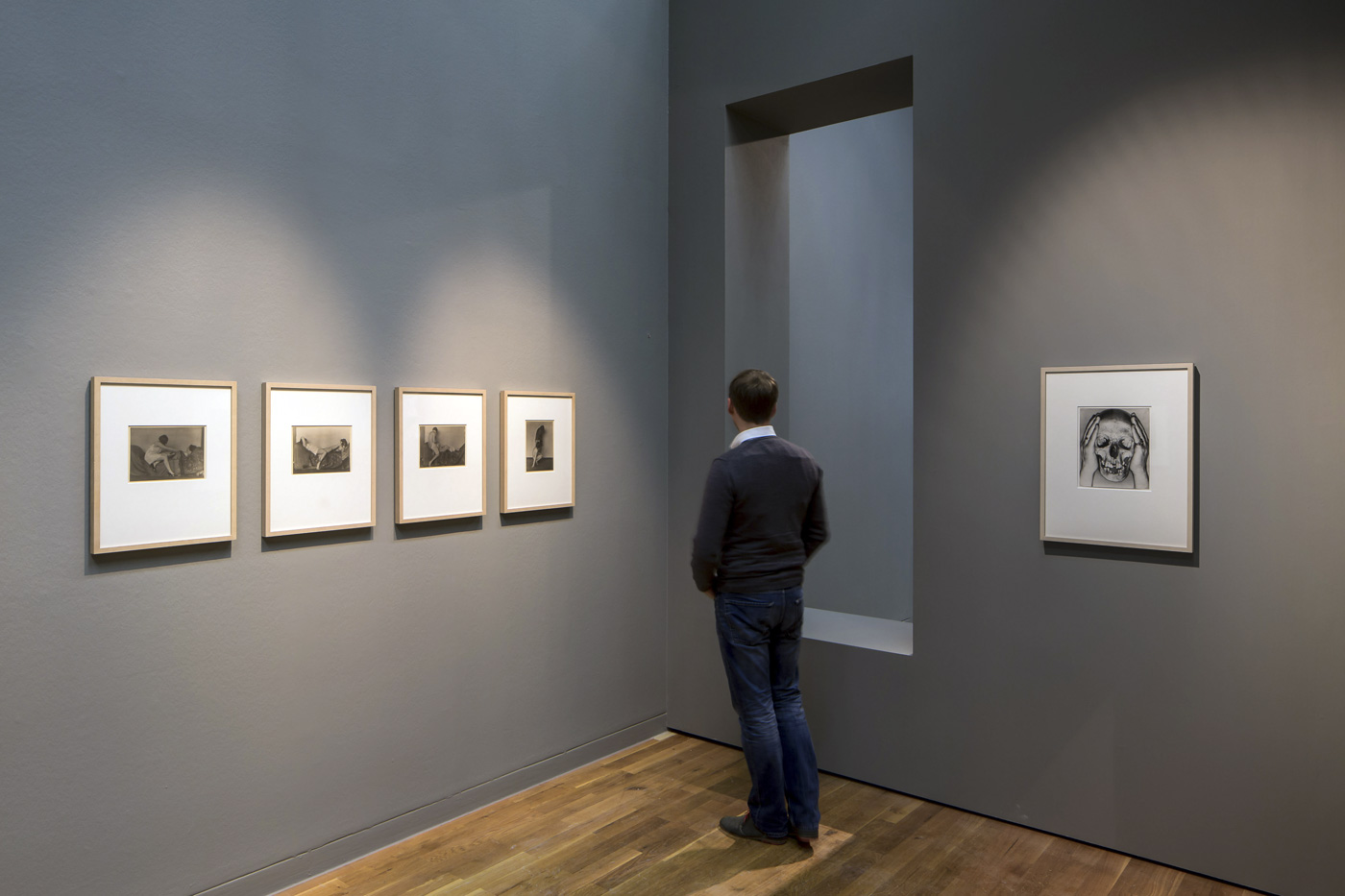
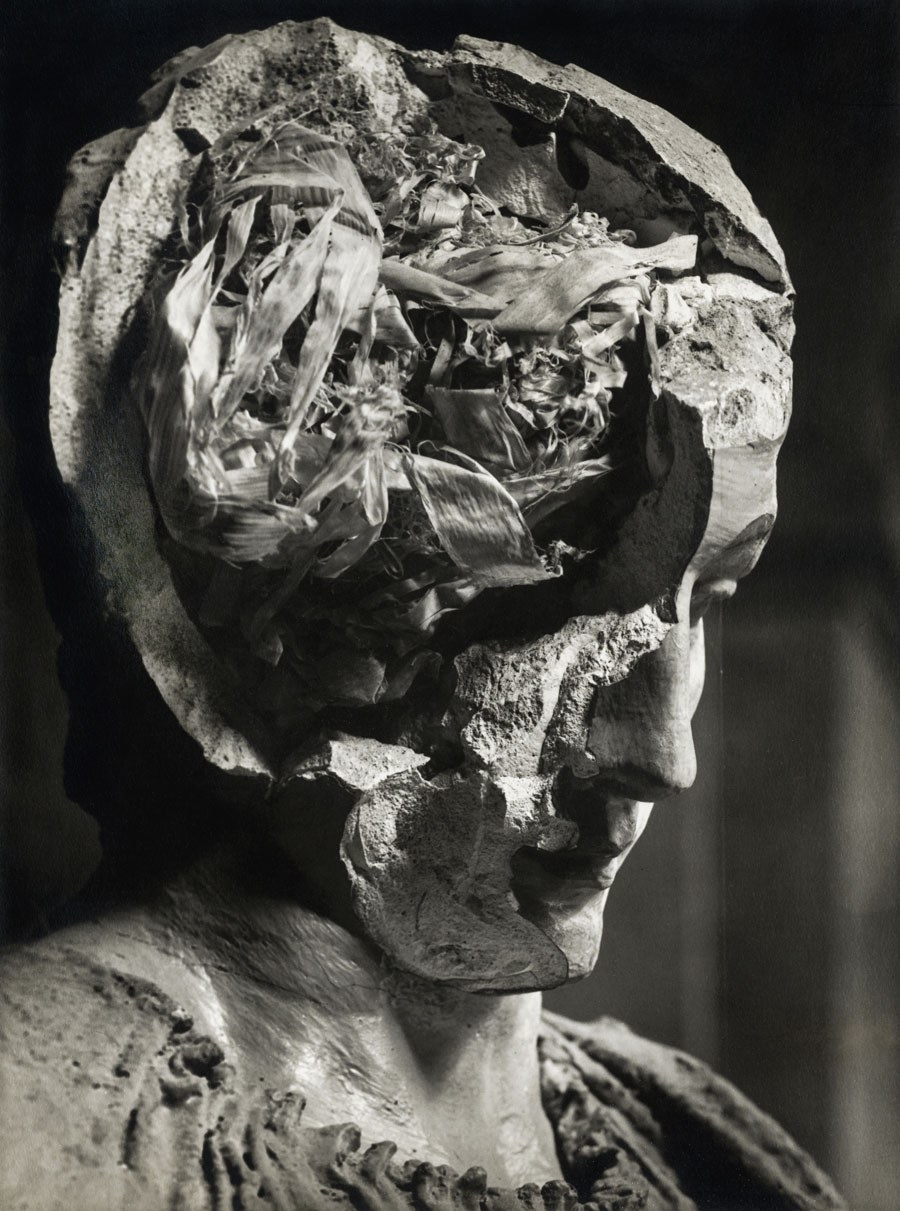
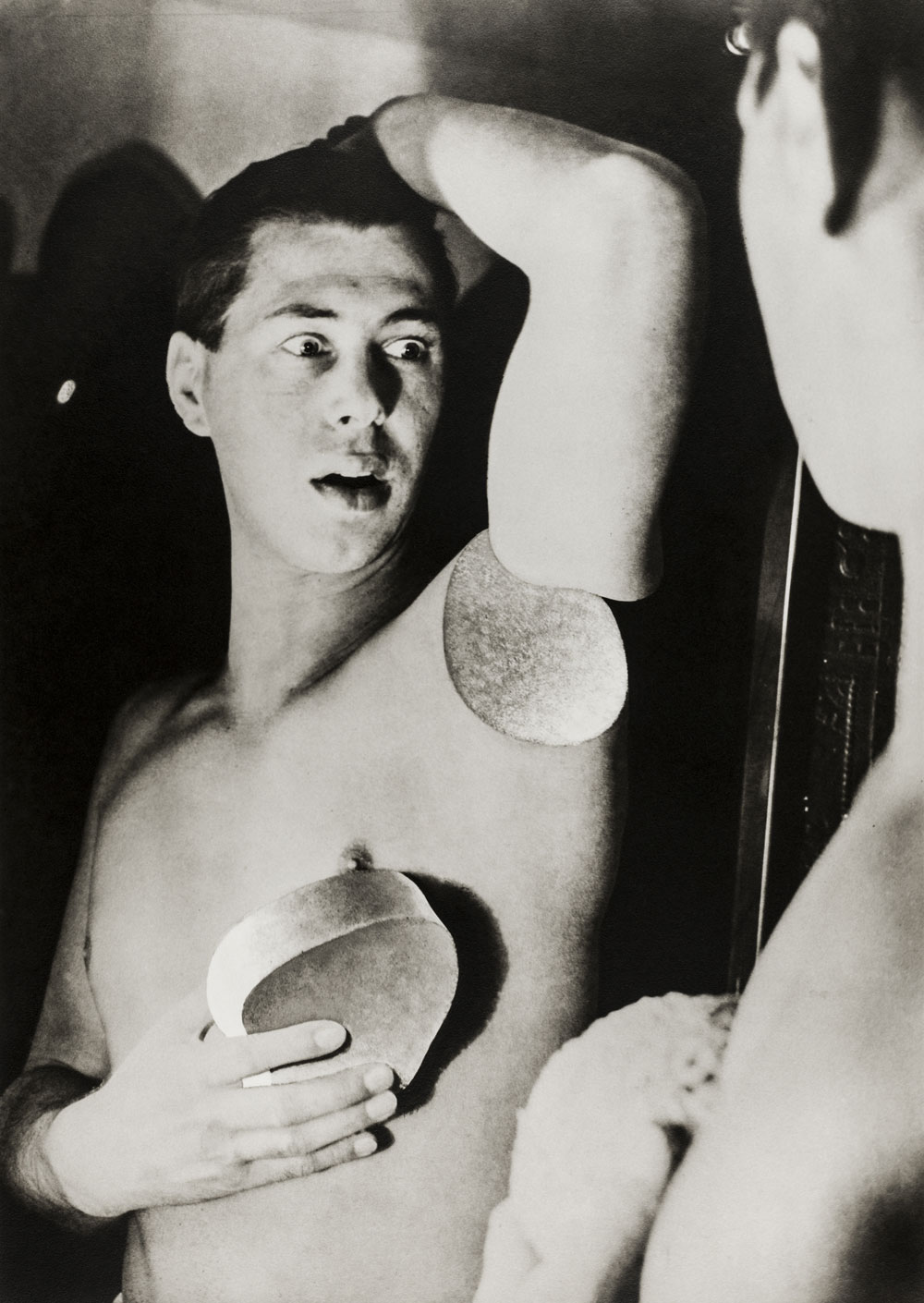
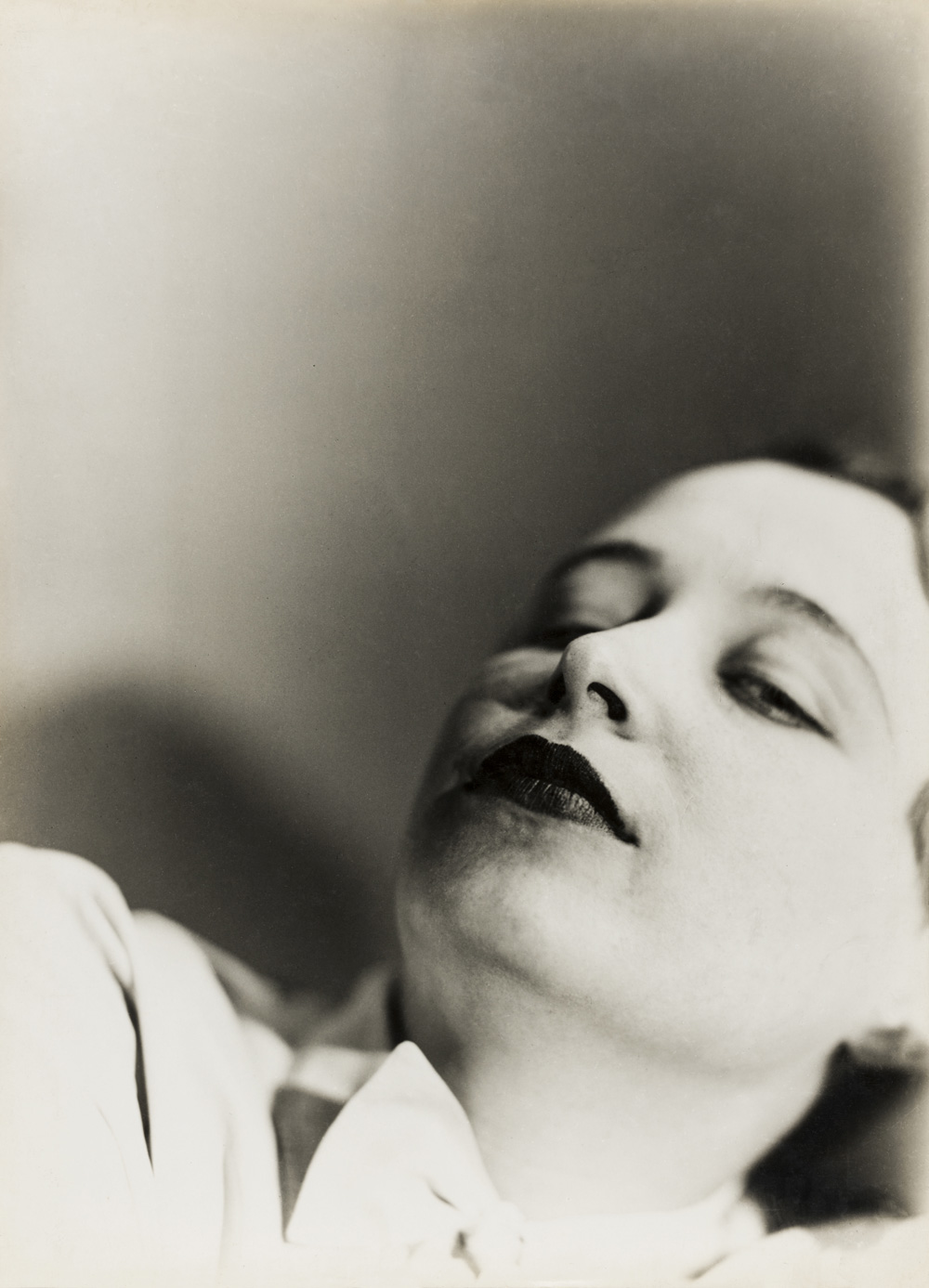
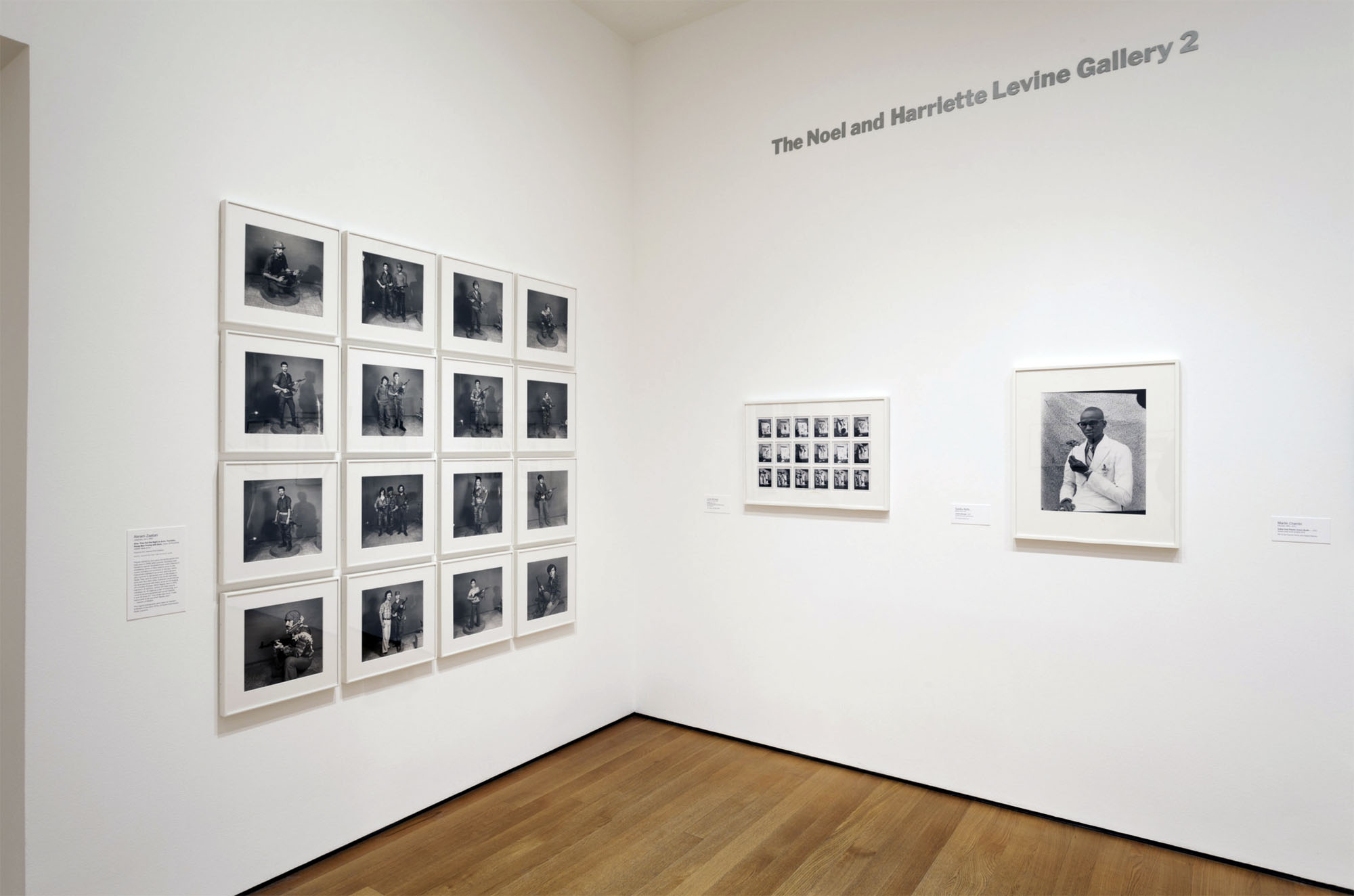
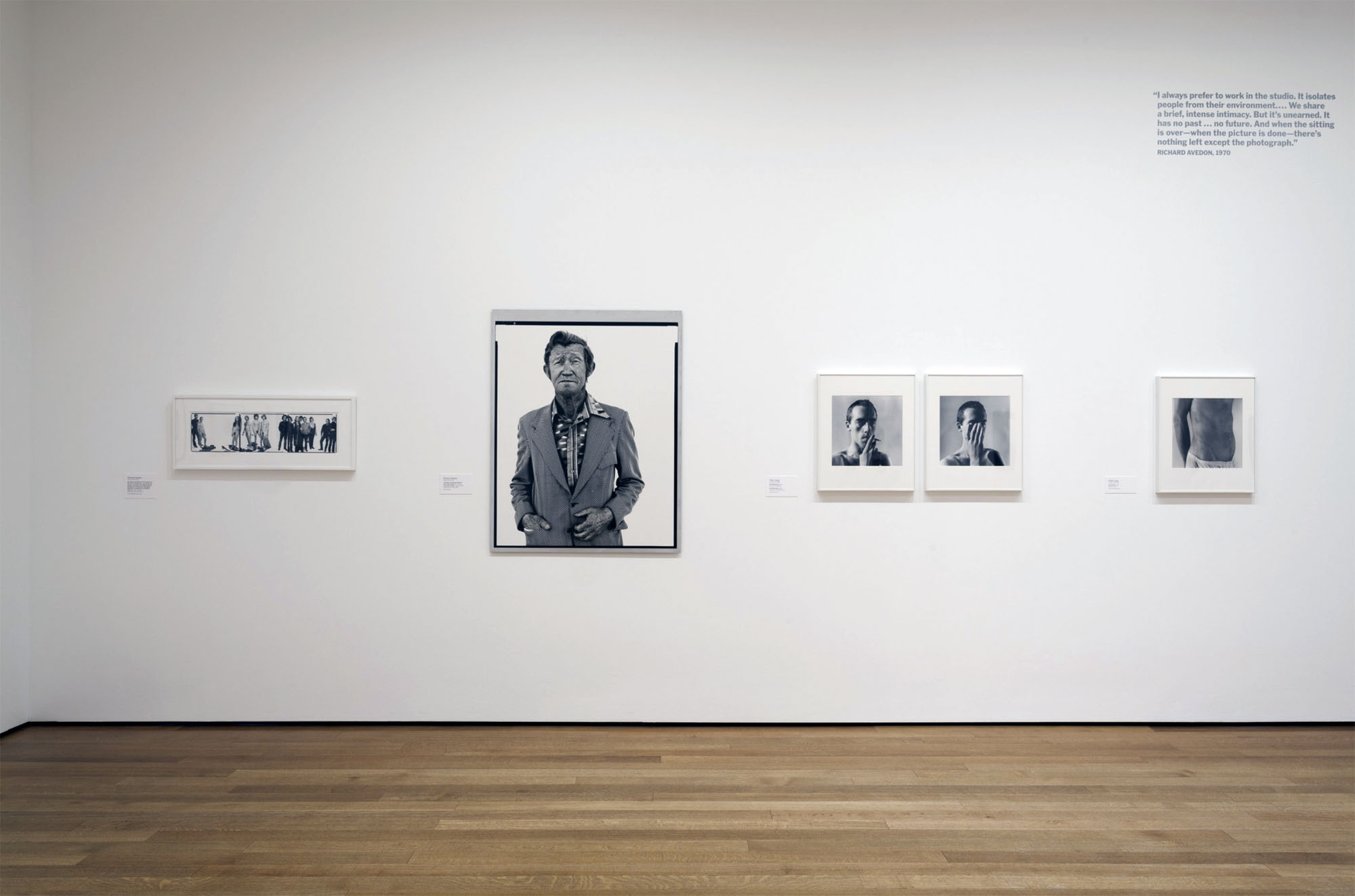
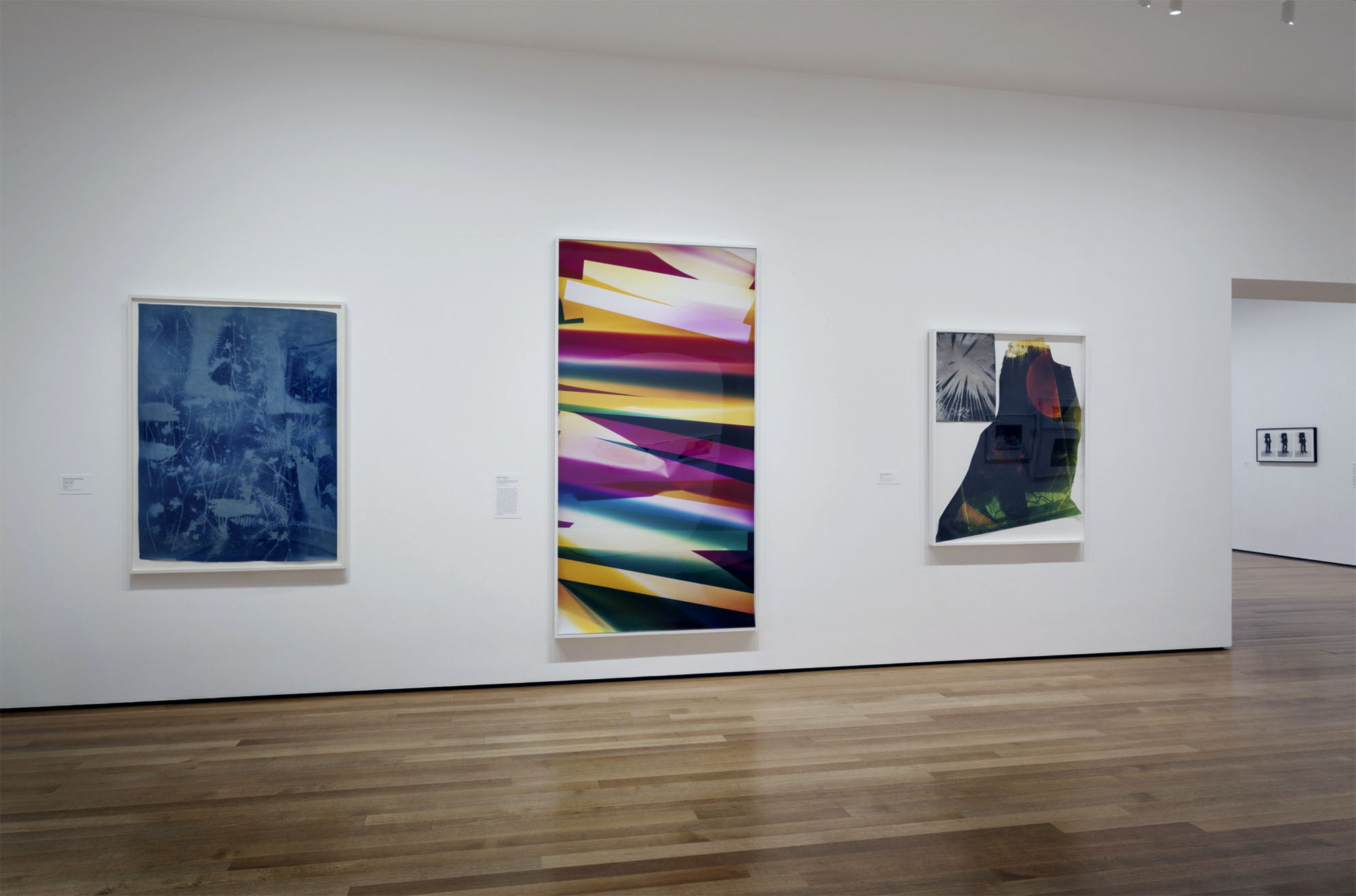
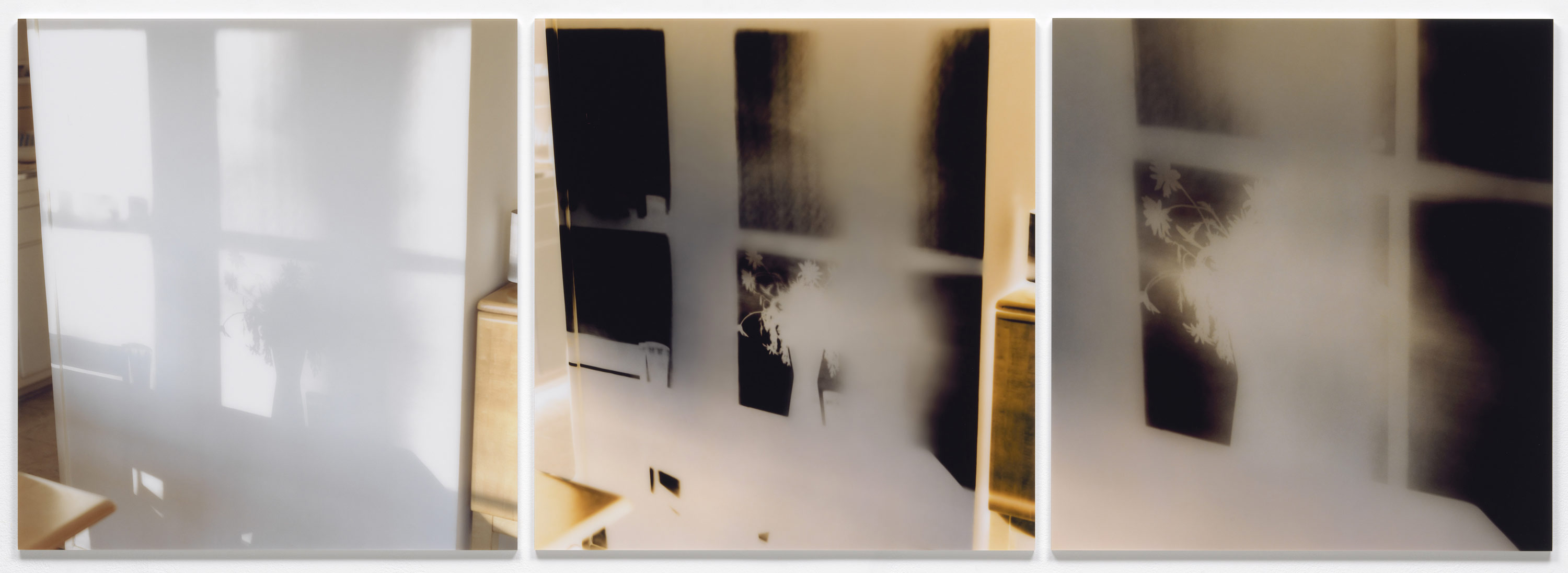
Exhibition: ‘Bohemian Melbourne’ at the State Library of Victoria, Melbourne

Exhibition dates: 12th December, 2014 – 22nd February, 2015

Curator: Clare Williamson, with specialist advice from historian Dr. Tony Moore
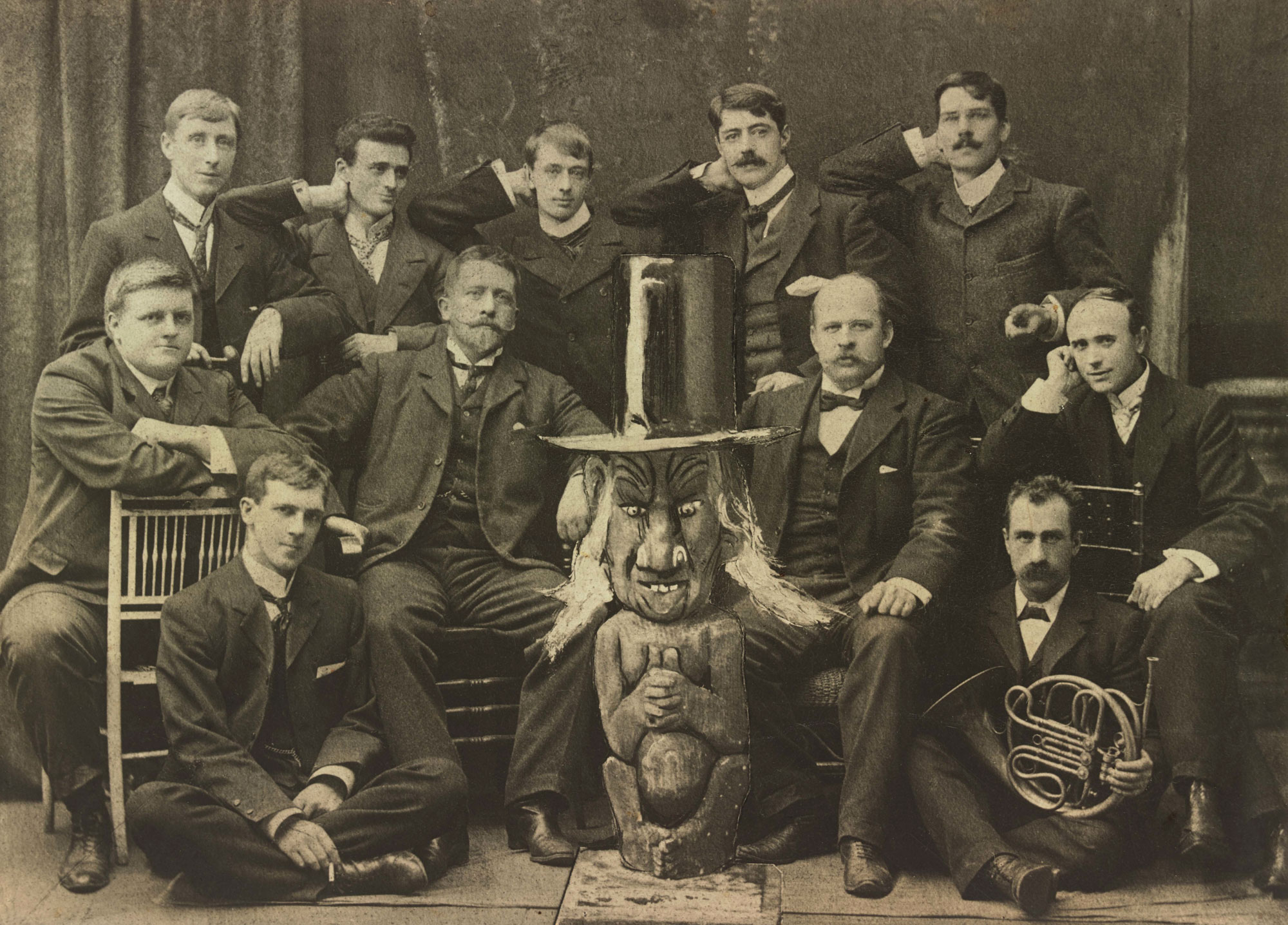
 

Unknown photographer. 'Members of the Ishmael Club' c. 1900 from the exhibition 'Bohemian Melbourne' at the State Library of Victoria, Melbourne, December 2014 - February 2015


Unknown photographer
Members of the Ishmael Club
c. 1900
Gelatin silver photograph
State Library Victoria


Definition

Bohemianism is the practice of an unconventional lifestyle, often in the company of like-minded people, with few permanent ties, involving musical, artistic, or literary pursuits. In this context, Bohemians may be wanderers, adventurers, or vagabonds. (Wikipedia)

A Bohemian is a person, as an artist or writer, who lives and acts free of regard for conventional rules and practices.


This is a fantastic exhibition at the State Library of Victoria, one of the best I have seen so far in Melbourne this year. I have seen it three times and each time it has been a thoroughly rewarding experience.

~ Visually and intellectually stimulating, with a plethora of artefacts, texts and photographs

~ Excellent curatorship, with the exhibition logically structured in order to cohesively display the history, characters and stories, and strands of creativity and rebellious spirit that make up Melbourne’s cultural life

~ A great hang, with disparate elements and mediums all informing each other, pithy quotes, unique film footage, video, music

~ Not too big, just the right size to indulge your senses and brain power


One downside was that the exhibition needed a book or exhibition catalogue to flesh out the themes. Hopefully this will eventuate down the track. Also, it would have been nice to see more of what I would call ‘vernacular bohemianism’ – not just the famous people in each era, but the people that lived the life out on the streets, that supported the subcultures that sprung up from the 1950s onwards, but in a small exhibition it is understandable that there was not enough space.

Another perspective is that, in ordering such a diverse group of people who don’t want to be classified, who lived on the edge of society – you remove their cultural and historical ability to be transgressive, to cross moral and social taboos. By naming them as “bohemian” you seek to classify and order their existence and bring them within a frame of reference that is about control, power and visibility. This disciplinary power, Michel Foucault maintains, relies on surveillance to transform the subjects and the exhibition taxonomy is just that… a form of surveillance of the subject as well as a form of ordering it. Under this phenomena of power, dissonance / dissidence is neutralised and human beings are made subjects: through ‘the systematic linking of the categories of power and knowledge to form a hybrid, power-knowledge.’ (Hirst, 1992, “Foucault and Architecture,” in AA Files, No. 26, Autumn, pp. 52-60)

As John Tagg notes in his book The Burden of Representation (and this is what this exhibition does, it ‘represents’ a particular construction of identity as seen from the viewpoint of the establishment, the institution), “when Foucault examines power he is not just examining a negative force operating through a series of prohibitions … We must cease once and for all to describe the effects of power in negative terms – as exclusion, censorship, concealment, eradication. In fact, power produces. It produces reality. It produces domains of objects, institutions of language, rituals of truth.” (Tagg, John. The Burden of Representation: Essays on Photographies and Histories. Basingstoke: Macmillan, 1988, p. 87)

Ultimately, that is what this exhibition does, it produces a reality that many of these bohemians would not have bought into, for they lived outside the fold. It produces domains of objects, institutions of language, rituals of truth that, through their naming, seek to classify and negate the transgressive and subversive nature of many of these people and groups. These people lived in opposition to the tenants and morals of everyday society and that is why we still love them – for their creativity, their individuality, their thoughts and above all their panache, stepping outside the orthodoxies and regi/mentality of everyday life. Against the system, for life.

Dr Marcus Bunyan


Many thankx to the State Library of Victoria for allowing me to publish the photographs in the posting. Installation photographs © Marcus Bunyan and the State Library of Victoria. Please click on the photographs for a larger version of the image.


“The mania of young artists to
wish to live outside of their time,
with other ideas and other customs,
isolate them from the world,
render them strange and bizarre,
puts them outside the law, banished
from society. These are today’s
bohemians.”


Félix Pyat (French, 1810-1889)


Artist, rebel, hippie, hipster?

Revealing Melbourne’s enduring counter-cultures, Bohemian Melbourne celebrates a who’s who of creative free spirits through their art and the bohemian legacy that has shaped the character of this city. The exhibition shines a light on Melbourne’s cultural bohemians from 1860 to today, tracing individuals who have pushed against convention in their lives and art, from Marcus Clarke, Albert Tucker and Mirka Mora to Barry Humphries, Vali Myers and Nick Cave.

Venture into history’s backstreets and smoky salons to discover the stories of the daring poets, artists, visionaries, rebels and rock stars who changed Melbourne forever.

Text from the State Library of Victoria website


Marcus Clarke: “A Punk in the Age of Steam”

Marcus Clarke, writer, journalist and later a librarian at the Melbourne Public Library, is generally celebrated as the father of Bohemian Melbourne – although he was more its wild child. After a privileged start in a wealthy English family, which allowed him to cultivate the life of a young dandy and to indulge his passion for the writings of Honoré de Balzac and others, a 16-year-old Clarke suddenly found himself in colonial Melbourne in 1863, thanks to a turn in the family fortune.

Determined to maintain a semblance of the life to which he had become accustomed, Clarke was soon to be found strolling the streets of Melbourne as a flâneur, an observer of the city spectacle. A short-lived post as a bank clerk was followed by a stint on the land as a jackaroo, but by the age of 21 he was back in Melbourne and working as a journalist for the Argus newspaper.

Clarke’s bohemian ways soon attracted other young journalists and writers, and they began to congregate at various Melbourne watering holes, in particular the Cafe de Paris establishing the Yorick Club, the early members of which included fellow writers Henry Rendall, George Gordon McCrae and Adam Lindsay Gordon. The Yorick had a human skull for a mascot and rules that parodied the gentleman’s clubs of establishment Melbourne. Its members gathered in rooms adjoining the office of Melbourne Punch to smoke clay pipes, drink from pewter mugs, recite poetry and generally engage in horseplay. Bohemian society had found a Melbourne home and a creative community was born.

Wall text from exhibition


Unknown photographer. 'Marcus Clarke' 1866 from the exhibition 'Bohemian Melbourne' at the State Library of Victoria, Melbourne, December 2014 - February 2015


Unknown photographer
Marcus Clarke
1866
Albumen silver photograph
State Library Victoria


Bohemian culture in marvellous Melbourne

Marvellous Melbourne, which arose out of the egalitarianism of the gold rushes, gave birth to a strong bohemian culture. Marcus Clarke, the London-born journalist, writer, librarian and professional bohemian, joined the Athenaeum Club and founded in 1868 the Yorrick Club, Australia’s first bohemian club, which became a magnet for men of letters.

He was a dressed-up dandy, a flâneur and a heavy drinker, but had a touch of genius with his novel, For the Term of His Natural Life (1874/75), one of the classics of Australian colonial literature. He was dead by the age of 35, with suicide rumoured but rejected by his actress wife, Marian Dunn, the mother of his six children. Clarke in his behaviour and creative achievement became a model for other Australian bohemians to follow.

Extract from Professor Sasha Grishin. “Celebrating Melbourne bohemians at the State Library of Victoria,” on The Conversation website, 16 January 2015 [Online] Cited 03/02/2015. Used under fair use conditions for the purposes of education and research


Unknown photographer. 'Marcus Clarke'1866 (detail)


Unknown photographer
Marcus Clarke (detail)
1866
Albumen silver photograph
State Library Victoria


In 1863, when the young Marcus Clarke arrived in Melbourne, he could have slipped easily into what passed for mannered society in the booming gold-rush city. His uncle was a County Court judge, his cousin a politician, and Clarke himself was granted honorary membership of the elite Melbourne Club. But he chose to turn his back on the bunyip aristocracy. “I am a bohemian,” declared the man who would go on to write the first great Australian novel. “I live, I walk, I eat, drink and philosophise.”

All of which sounds perfectly normal – except, perhaps, for the philosophising – but in reality, Marcus Clarke’s life was far from average. He became a celebrated satirist of Marvellous Melbourne, by turns outraging and titillating 19th-century sensibilities in Australia’s modern metropolis. He befriended fellow intellectuals and bon vivants to form underground literary clubs that didn’t so much turn their backs on as raise an insulting finger to colonial mores. He was a poet and a playwright, a journalist and a novelist, a jackaroo, a wastrel and, above all, quite the tremendous wit.

Clarke’s most enduring gift is his writing, particularly the classic convict novel For The Term Of His Natural Life. But a new exhibition at the State Library of Victoria pays tribute to his other major legacy – that of Australia’s first bona fide bohemian.

“Clarke was an iconoclast, dangerous to know and a dandy about town,” explains historian Dr Tony Moore, author of Dancing With Empty Pockets: Australia’s Bohemians

“Most people think of him as a venerable old Victorian gentleman, but I characterise him as a punk in the age of steam.” [Marcus: I don’t know why a venerable old Victorian gentleman – he was dead at 35]

Moore, who is a Monash University academic and passionate chronicler of unconventional Australians, was an adviser to the exhibition and worked alongside curator Clare Williamson to create this retrospective of radicals. Melbourne’s roaming free spirits have been corralled together for the first time using material – some of it never previously displayed in public – drawn from State Library archives and borrowed from public and private collections. Viewed en masse, they comprise a rogues’ gallery of some of the country’s most indelible cultural icons…

His [Clarke’s] image adorns the exhibition posters, a larger-than-life bohemian in breeches and knee-high boots with a cabbage-tree hat perched jauntily above his broad, handsome face. Melbourne’s original radical would be thrilled to see that his notoriety lives on, more than a century after his death.

Extract from Kendall Hill. “Bohemian Melbourne: Exhibition” on the Qantas Travel Insider website [Online] Cited 03/02/2015. No longer available online. Used under fair use conditions for the purposes of education and research


Installation view of the exhibition 'Bohemian Melbourne' at the State Library of Victoria, Melbourne

Installation view of the exhibition 'Bohemian Melbourne' at the State Library of Victoria, Melbourne


Installation views of the exhibition Bohemian Melbourne at the State Library of Victoria, Melbourne
Photos: Marcus Bunyan


Wall text 'Bohemians of the Bush' from the exhibition 'Bohemian Melbourne' at the State Library of Victoria, Melbourne


Wall text from the exhibition Bohemian Melbourne at the State Library of Victoria, Melbourne
Photo: Marcus Bunyan


Justus Jörgensen (Australian, 1893-1975) 'Fifteen of the Founders' 1944 (installation view)


Justus Jörgensen (Australian, 1893-1975)
Fifteen of the Founders (installation view)
1944
Oil on canvas and gauze mounted on panel
Collection of the Montsalvat Trust
Photo: Marcus Bunyan


Montsalvat is the result of Justus Jörgensen’s vision for a collective experience of art and life. Jörgensen had trained in architecture and then in painting with earlier bohemian Max Meldrum. His studio in Queen Street, the Mitre Tavern and the Latin and Chung Wah restaurants were sites for lively discussions in which Jörgensen put forward his philosophies of art, the revival of medieval craftsmanship and communal living. This vision began to take shape in 1934 when he and his wife, Lily, brought land at Eltham; with the assistance of friends and followers, he built Montsalvat, an artists’ colony of studios, workshops and the communal Great Hall.

While Justus Jörgensen rarely exhibited, his great love was painting. This multi-panelled work comprises portraits by Jörgensen of 15 significant figures from the early years of Montsalvat. They are, from top to bottom, left to right:

Ian Robertson – student of Jorgensen who also ran an antiques shop
Leo Brierley – businessman and backer of Mervyn Skipper’s Pandemonium journal
Helen (Nell) Lempriere – niece of Dame Nellie Melba, painter, sculptor, and an earl student of Jorgensen
Norman Porter – friend and student of Jorgensen and lecturer in philosophy
Mervyn Skipper – author, journalist and Melbourne editor of the Bulletin
Helen Skipper – Mervyn’s first daughter, Jorgensen’s partner for many years, and mother of Sebastian and Sigmund Jorgensen
Justus Jorgensen – founder and architect of Montsalvat, painter, assistant to artist Max Meldrum and teacher.
Sonia Skipper – second daughter of Mervyn Skipper, and painter and teacher
Arthur Munday – law student, sculptor and stonemason trained by Jorgensen
William (Bill) Cook – teacher, philosophy and president of the Victorian Rationalist Society
Norman Radcliffe – student and friend of Jorgensen, and philosopher
Ray Grant – student of Jorgensen and philosopher
Edward Goll – internationally renowned pianist and teacher at Melbourne Conservatorium of Music
Arthur (George) Chalmers – pharmacist, student of Jorgensen, stonemason and carver, who also planted the first vineyard at Montsalvat

(Label texts)


Montsalvat is an artist colony in Eltham, Victoria, Australia, established by Justus Jörgensen in 1934. It is home to over a dozen buildings, houses and halls set amongst richly established gardens on 48,562 m2 (12 acres) of land. The colony of Montsalvat has a detailed history that reflects the life of Jörgensen and his friends and family; there is also a legend behind its name, while its buildings and gardens are steeped in the art and culture of Melbourne and its surroundings.

Visitors can pay a small fee to walk throughout the colony’s historical gardens, artists’ houses/workshops and explore the surrounding buildings. All of the buildings on the site were designed and built by residents with locally available materials, from various sources. The Great Hall offers an extensive network of spaces from extravagant halls and vast exhibition spaces, to small corridors and tiny balconies overlooking the gardens.

Text from the Wikipedia website


Percy Grainger (Australian, 1882-1961) Ella Grainger (Australian, 1889-1979) 'Towelling tunic, shirt, leggings, belt, shoes worn by Percy Grainger' c. 1934 (installation view)


Percy Grainger (Australian, 1882-1961)
Ella Grainger (Australian, 1889-1979)
Towelling tunic, shirt, leggings, belt, shoes worn by Percy Grainger (installation view)
c. 1934
Cotton bath towels, plastic, leather and metal
Grainger Museum collection, University of Melbourne
Photo: Marcus Bunyan


“In 1932 or 1933 my wife and I took up again this idea of clothing made of towelling and when in Australia in 1934 and 1935 we were amazed by the beauty of the bath towels on sale in Australia – some imported from England, Czechoslovakia and America, but most of them (and among them the most beautiful ones) manufactured in Australia. Here was a chance to show what could be done with the beauty born of machinery – a beauty as rich and subtle, in its own way, as anything made by hand or loom.”

Percy Grainger, c. 1955-1956


Unknown photographer, New York. 'Percy Grainger wearing a towelling clothes outfit at his home in White Plains' 1936


Unknown photographer, New York
Percy Grainger wearing a towelling clothes outfit at his home in White Plains
1936
Silver gelatin print
Grainger Museum collection, University of Melbourne


Installation photograph of the exhibition 'Bohemian Melbourne' at the State Library of Victoria February 2015, including at left Albert Tucker, 'Self-portrait with Joy Hester', 1939


Installation photograph of the exhibition Bohemian Melbourne at the State Library of Victoria February 2015, including at left Albert Tucker, Self-portrait with Joy Hester, 1939 (see below)
Photo: Marcus Bunyan


Albert Tucker (Australian, 1914-1999) 'Self-portrait with Joy Hester' 1939


Albert Tucker (Australian, 1914-1999)
Self-portrait with Joy Hester
1939
Gelatin silver photograph
State Library Victoria


Albert Tucker Interview with an Australian Artist – Heide Museum

An Interview with Albert Tucker conducted by Justin O’Brien in 1997.

Albert expands on his many insights,during the time he spent with John and Sunday Reed and other artists at Heide during the1940’s. An intimate insight into a unique man.


Unknown photographer. 'Opening of Mirka Café' 1954


Unknown photographer
Opening of Mirka Café
1954
Gelatin silver photograph
Courtesy of Heide Museum of Modern Art and William Mora Galleries


Unknown photographer. 'Opening of Mirka Café' 1954 (detail)


Unknown photographer
Opening of Mirka Café (detail)
1954
Gelatin silver photograph
Courtesy of Heide Museum of Modern Art and William Mora Galleries


These clips features home movie footage taken by Gertie Anschel (c. 1953-1954) with audio commentary by film director Philippe Mora.

Part 1 of 3 features scenes of Melbourne, The Mirka Café and Joy Hester and Gray Smith’s property. Philippe reflects on his childhood and identifies key figures of the Melbourne art scene.


Part 2 of 3 features the property of Roger de Stoop, artist friends and Arthur Boyd at work on his 1956 Melbourne Olympic statue. Philippe reflects on his childhood identifies key figures of the Melbourne art scene.


Part 3 of 3 features the Moras, the art gang at a balcony party and late American actor Melvyn Douglas. Philippe reflects on his childhood, parents and identifies key figures of the Melbourne art scene.


Making Your Own Fun in the 50s

On the surface at least, Melbourne in the 1950s was a rather dour affair. For some non-conformists, such as Vali Myers and Barry Humphries, it was a place to escape rather than a place to be. For others, however, it was a site for creating underground cultures that were largely invisible to the mainstream.

This was no more so than in the case of gay and lesbian, or ‘camp’, culture, as it was known at the time. Homosexuality was illegal in Victoria until 1960, and in the 1950s it was sensationalised in the tabloid press as a subject for mockery if not horror. As a result, homosexual men and women developed alternative bohemian cultures and communities, with their own covert venues, house parties, secret languages and dress codes.

The gala costume arts balls that raised money for mainstream theatre and other arts charities were grand exceptions to the generally underground clubs and private parties. They offered rare moments in which camp culture could be expressed in public without fear for reprisal. Theatres and dance companies provided employment for many, and bars, such as the one nicknamed the Snake Pit at the Hotel Australia, and restaurants such as Val’s Coffee Lounge, provided opportunities for the camp community to meet and to mix with others who were outside the establishment.


Norman Ikin (Australian, 1925-1962) 'Vali Myers' c. 1949


Norman Ikin (Australian, 1925-1962)
Vali Myers
c. 1949
Gelatin silver photograph
State Library Victoria
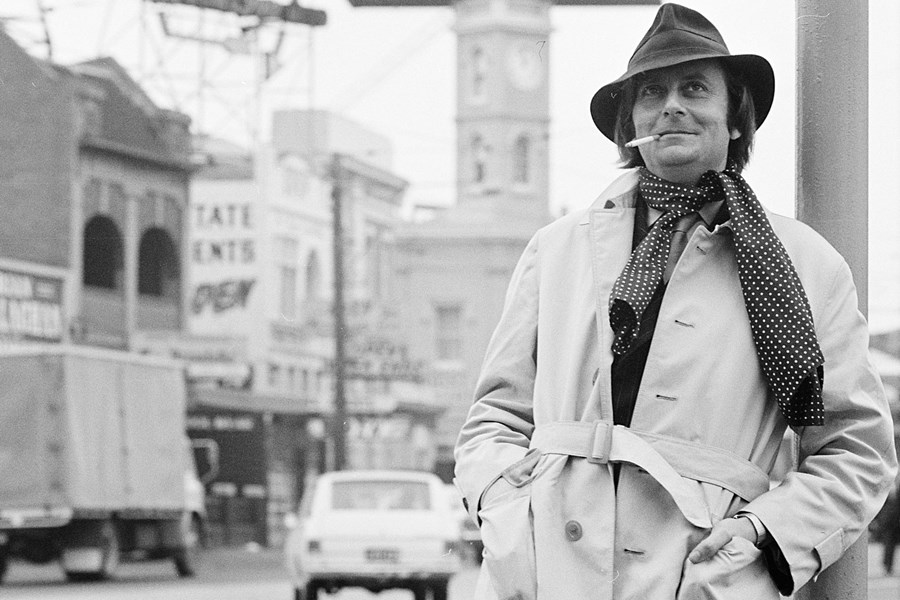
 

Mark Strizic (Australian, 1928-2012) 'Barry Humphries in Melbourne' 1969


Mark Strizic (Australian, 1928-2012)
Barry Humphries in Melbourne
1969
Exhibition print from flexible-base negative
State Library of Victoria
Courtesy of the Estate of the artist


A never seen on broadcast TV programme with Barry Humphries as Dame Edna Everage made in 1975. Barry Humphries was promoting his film ‘Barry McKenzie holds his own’. Films clips were provided officially by EMI. The interviewer trying to hold things together is Mark Caldwell. The programme was made in black and white.


Wall text 'North of the River' from the exhibition Bohemian Melbourne at the State Library of Victoria, Melbourne


Wall text from the exhibition Bohemian Melbourne at the State Library of Victoria, Melbourne
Photo: Marcus Bunyan
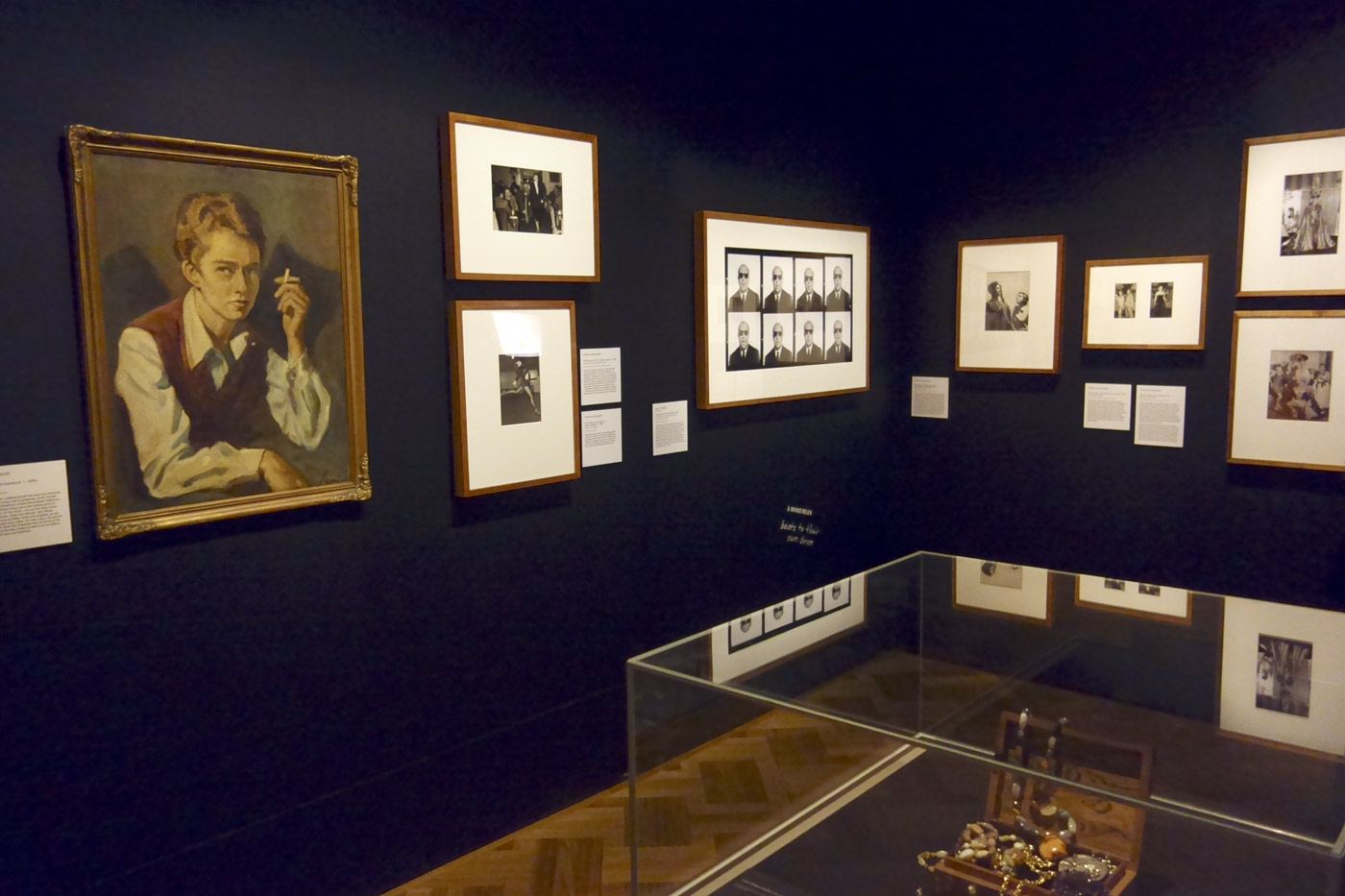
 

Installation photograph of the exhibition 'Bohemian Melbourne' at the State Library of Victoria February 2015 with, in the distance, Henry Talbot 'Portraits of actor Frank Thring' 1963, with Thring's jewellery box and contents in the foreground


Installation photograph of the exhibition Bohemian Melbourne at the State Library of Victoria February 2015 with, in the distance, Henry Talbot Portraits of actor Frank Thring 1963, with Thring’s jewellery box and contents in the foreground
Photo: Marcus Bunyan


It has been said of Frank Thring that he could make most stages or foyers seem small. His larger-than-life personality was almost matched by his frame, often decked out in imposing black and with flamboyant jewellery. Son of Frank Thring snr, founder of Efftee Films and 3XY Radio, Thring jnr earned fame as an actor in London’s West End and in Hollywood films such as Ben Hur, often playing sinister or decadent characters. In the 1950s, he would recite poems laden with innuendo and hold court at the ‘head table’ at Val’s Coffee Lounge. To be welcome at his table was a sign one was part of the ‘in’ crowd.

Label text


Unknown photographer. 'Arts Ball, Palais de Danse - John Anderson as Sun God' c. 1963-1964


Unknown photographer
Arts Ball, Palais de Danse – John Anderson as Sun God
c. 1963-1964
Gelatin silver photograph
Australian Lesbian and Gay Archives


John Anderson was first-prize winner at a number of arts balls in the 1960s. His costume shown here reflects the creativity and effort that many put into their outfits. Costumes and headdresses were sometimes so large that Anderson and others regularly hired furniture vans to take them to the ball. One year the van that was transporting Anderson broke down and he completed the journey strapped upright on the back of a ute. His Sun  God costume wowed new audiences when he was invited to take part in a pageant on ice base on the theme of The Kind and I – with Anderson as the King – at the Southland shopping centre ice rink around 1970.

Label text

But you will go to the ball, you will sweetie!


Richard Walsh (editor) 'The Review', Vol. 22, No. 22 Melbourne incorporated Newsagencies Co., March 1972


Richard Walsh (editor)
The Review, Vol. 22, No. 22
Melbourne incorporated Newsagencies Co.,
March 1972
State Library of Victoria
Photo: Marcus Bunyan


Before editing the irreverent Melbourne weekly The Review (Nation Review from July 1972, Richard Walsh edited counter-cultural Oz magazine with Richard Neville and Martin Sharp. Contributors to Nation Review included Max Harris, Bob Ellis, Phillip Adams, Michael Leunig and Germaine Greer. Greer had been part of the Drift in Melbourne, a loose association of artists, students and graduates. Enrolling in a Masters degree at Sydney University, in 1962 she becomes a leading light in the Sydney libertarian Push, an intellectual bohemia of larrikin anarchists. Gaining her PhD at Cambridge University, Greer then published her groundbreaking book The Female Eunuch.

Label text


Ashley Mackevicius (Australian, b. 1958) 'Nick Cave' 1973


Ashley Mackevicius (Australian, b. 1958)
Nick Cave
1973
Gelatin silver photograph
National Portrait Gallery, Canberra
Gift of the artist 2006


Ponch Hawkes (Australian, b. 1946) 'Soapbox Circus – The Fabulous Spagoni Family' c. 1977


Ponch Hawkes (Australian, b. 1946)
Soapbox Circus – The Fabulous Spagoni Family
c. 1977
Gelatin silver photograph
State Library Victoria
© the artist


Ponch Hawkes (Australian, b. 1946) 'Melantroppos, Circus Oz, Princes Park' 1979


Ponch Hawkes (Australian, b. 1946)
Melantroppos, Circus Oz, Princes Park
1979
Gelatin silver photograph
State Library Victoria
© the artist


Installation photograph of the exhibition 'Bohemian Melbourne' at the State Library of Victoria February 2015 with artist Ponch Hawkes' work at right


Installation photograph of the exhibition Bohemian Melbourne at the State Library of Victoria February 2015 with artist Ponch Hawkes’ work at right
Photo: Marcus Bunyan


Rennie Ellis (Australian, 1940-2003) 'Mirka Mora in her studio' 1978


Rennie Ellis (Australian, 1940-2003)
Mirka Mora in her studio
1978
Colour transparency
State Library Victoria
© Rennie Ellis Photographic Archive


For more information see the Rennie Ellis Archive website.


Vali Myers (Australian, 1930-2003) 'Passions' 1981-1982


Vali Myers (Australian, 1930-2003)
Passions
1981-1982
Pen, black ink, sepia, burnt sienna and watercolour
Vali Myers Art Gallery Trust


Vali Myers discovered a love of drawing at an early age. Over the years it became her primary mode of artistic expression in place of contemporary dance. She dedicated her life to her art and would spend up to two years creating each of her intricately drawn artworks. Passions contains many elements that symbolically represent aspects of Vali Myers’ art and life. These include a fox (referencing her pet Foxy), ravens (Edgar Allan Poe’s The Raven being one of her favourite poems, a gypsy-like figure playing a violin and, at the centre of it all, a woman with flaming red hair.

Label text


Liz Ham (Australian born England, b. 1975) 'Vali Myers in her studio in the Nicholas Building' 1997


Liz Ham (Australian born England, b. 1975)
Vali Myers in her studio in the Nicholas Building
1997
Gelatin silver photograph
State Library Victoria


Ed van der Elsken “Vali” 1972

Australian artist Vali Myers moved to Paris from Australia at age 19 where she lived on the streets, danced in cafes, met Satre, Cocteau, Genet and Django Reinhardt. She moved to New York, tattooed Patti Smith’s knee, befriended Salvador Dali and met Andy Warhol and Tennessee Williams.

Vali was a great influence on lots of famous people Tennessee Williams, Jean Cocteau, Mick Jagger, Marianne Faithfull, Debbie Harry, Patti Smith, Jean Genet and Kate Bush.


Installation photograph of the exhibition 'Bohemian Melbourne' at the State Library of Victoria February 2015


Installation photograph of the exhibition Bohemian Melbourne at the State Library of Victoria February 2015
Photo: Marcus Bunyan


Howard Arkley

Australian artist Howard Arkley interviewed by ABC television shortly before his untimely death in 1999.
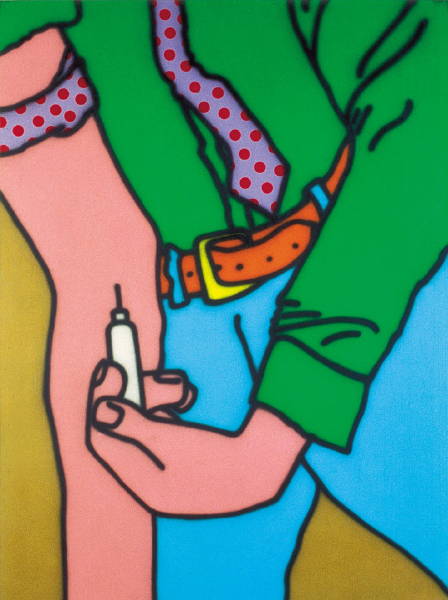
 

Howard Arkley (Australian, 1951-1999) 'The Ritual' 1986


Howard Arkley (Australian, 1951-1999)
The Ritual
1986
Synthetic polymer paint on canvas
State Library of Victoria


Howard Arkley is recognised as one of Australia’s most significant 20th-century artists. He is unique in embracing not only urban culture but also life in suburbia, a space generally shunned or scorned by bohemians, with exception of that other flaneur of suburbia, Barry Humphries. Like many bohemians before him, Arkley lived on the edge and experimented with mind-altering substances, and, like a good proportion of them, his life was tragically cut short as a result. Despite its large scale, comic-book style and pop colours, The Ritual is as much a cool and judgment-free study in composition and the human form as it is in the rituals or ‘habits’ associated with drug use.

Label text


State Library of Victoria
328 Swanston St,
Melbourne VIC 3000
Phone: (03) 8664 7000

Opening hours:
Daily 10am – 6pm
State Library of Victoria website

LIKE ART BLART ON FACEBOOK

Back to top

Exhibition: ‘Storyteller: The Photographs of Duane Michals’ at Carnegie Museum of Art, Pittsburgh

Exhibition dates: 1st November, 2014 – 16th February, 2015

Curator: Linda Benedict-Jones, Curator of Photography at the Carnegie Museum of Art


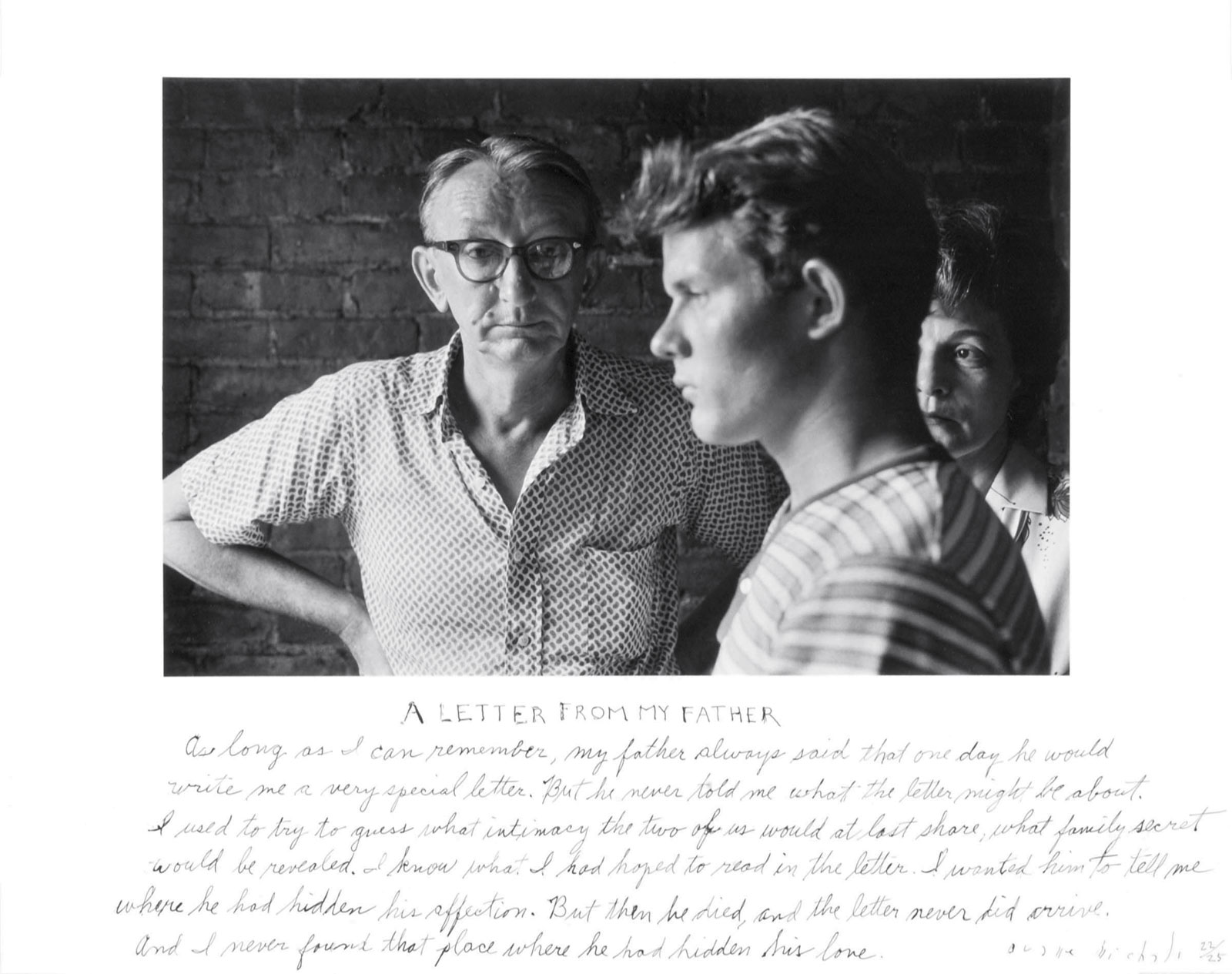
Duane Michals (American, 1932-2026) 'A Letter from My Father' 1960/1975 from the exhibition 'Storyteller: The Photographs of Duane Michals' at Carnegie Museum of Art, Pittsburgh, November 2014 - February 2015


Duane Michals (American, 1932-2026)
A Letter from My Father
1960/1975
Gelatin silver print with hand-applied text
Carnegie Museum of Art, Pittsburgh
Courtesy of the Artist and DC Moore Gallery


Exposing your/self


Viva Michals! Viva Michals!

Magician, poet, storyteller, philosopher and dreamer.

Not for him the overblown statement (huge prints the size of billboards) but small, dark, rough prints assembled in photo-sequences, often incorporating text, that examine the human condition in every aspect. This is emotional work and Michals has a unique style and voice as an artist. You always know that you are looking at a sequence by Michals, for his signature is that distinctive.

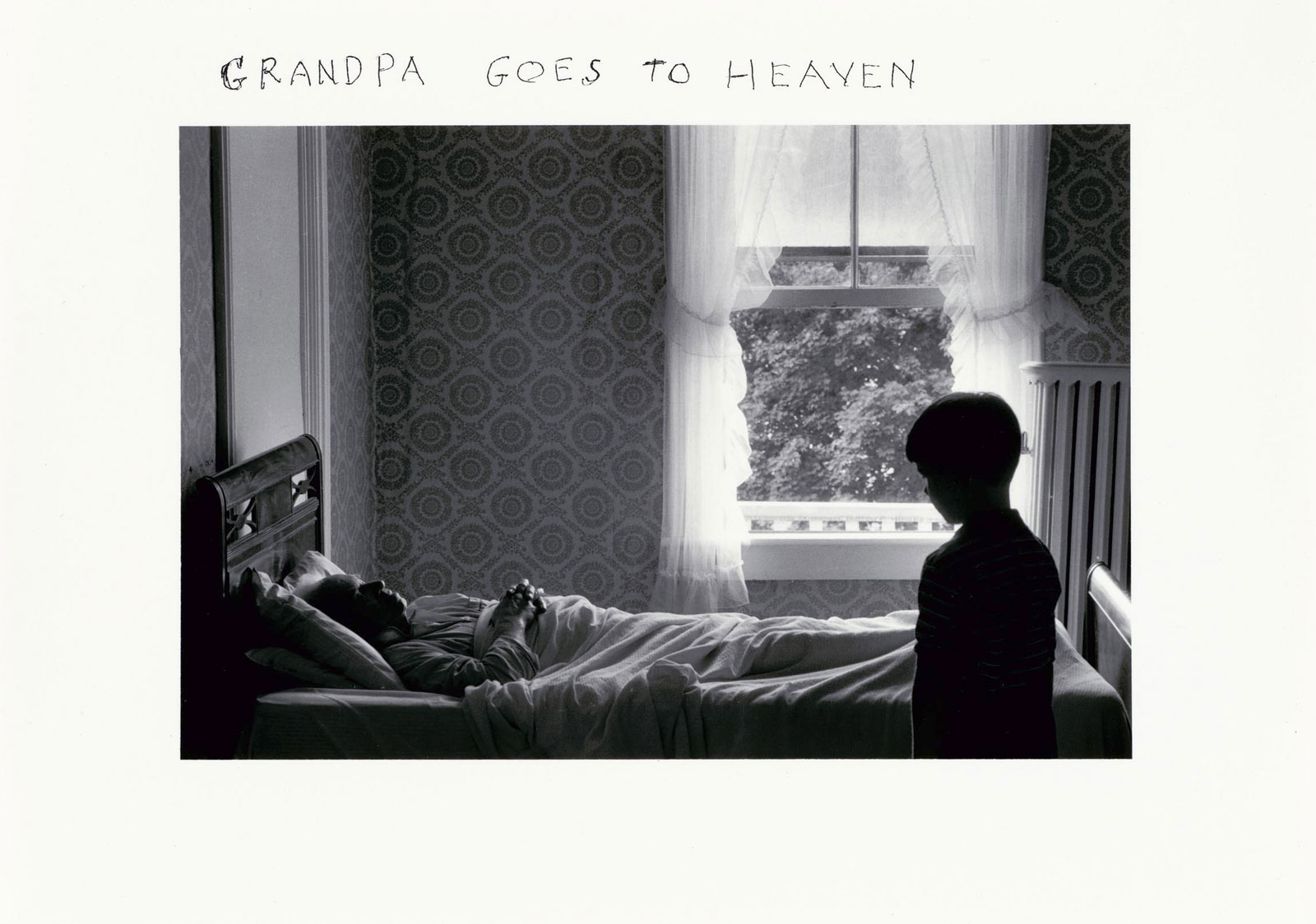
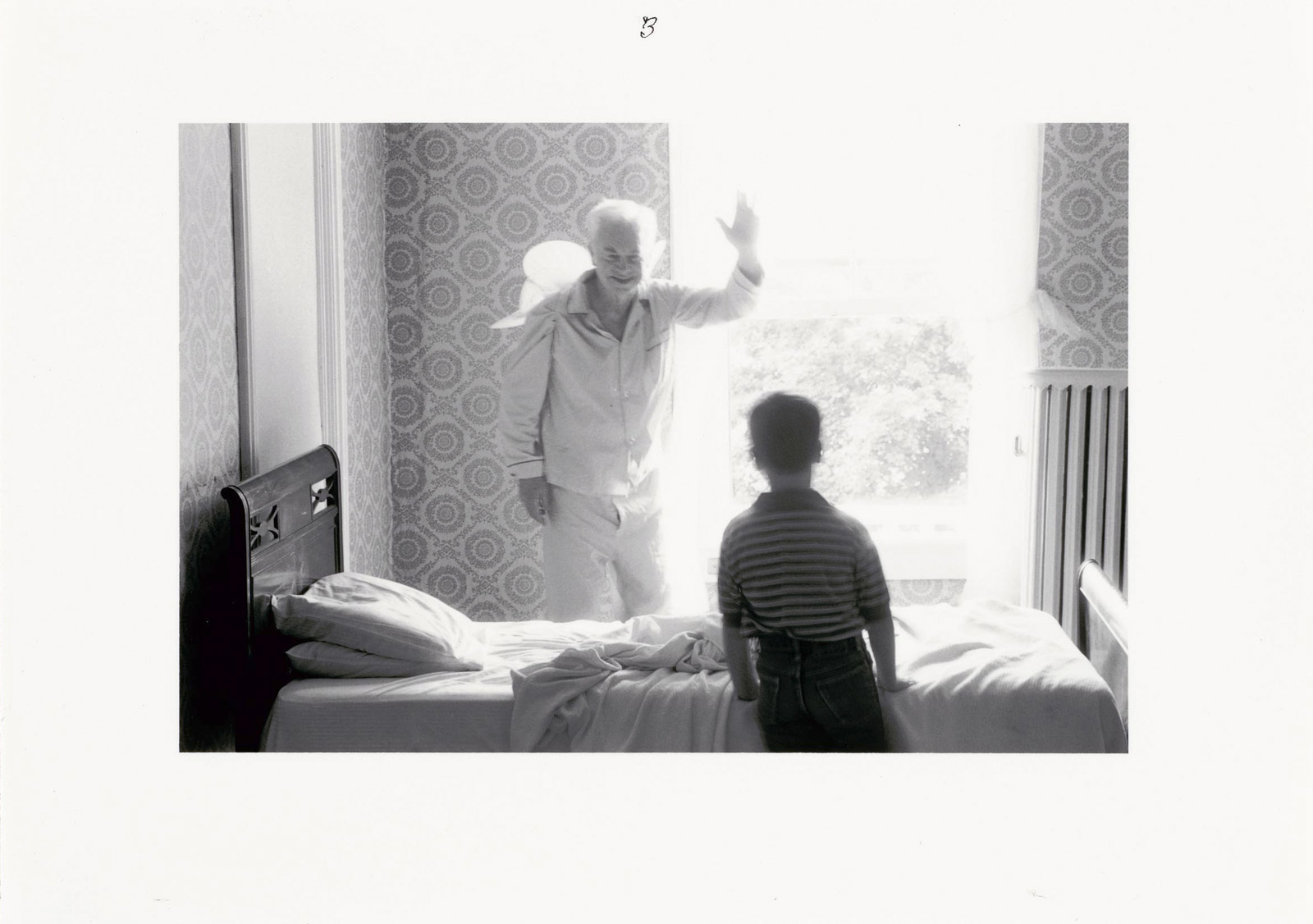
As he says, his work goes beyond description, beyond surfaces, to reveal the subject – not as it looks but as it feels. In his sequences he usually achieves this by posing a question that has no answer, a question that is like a Zen koan… what is the sound of one hand clapping? The grandfather ascends smilingly to heaven with little wings on his back as the child waves goodbye (if youth knew, if age could); the man as human condition turns into a galaxy; and the spirit leaves the body as it was left before.

Various Michals sequences, such as The Spirit Leaves The Body (1968, below), have a circular construction. Another sequence, Things are Queer (1973, below) is also a circular spatio-temporal enigma where instead of moving forward, the camera and the viewer are pulled backwards in a space-time continuum… where Michals forces you to question what reality really is. These two sequences are my personal favourites, and I had to scour the internet to find images for them as you rarely see them online.

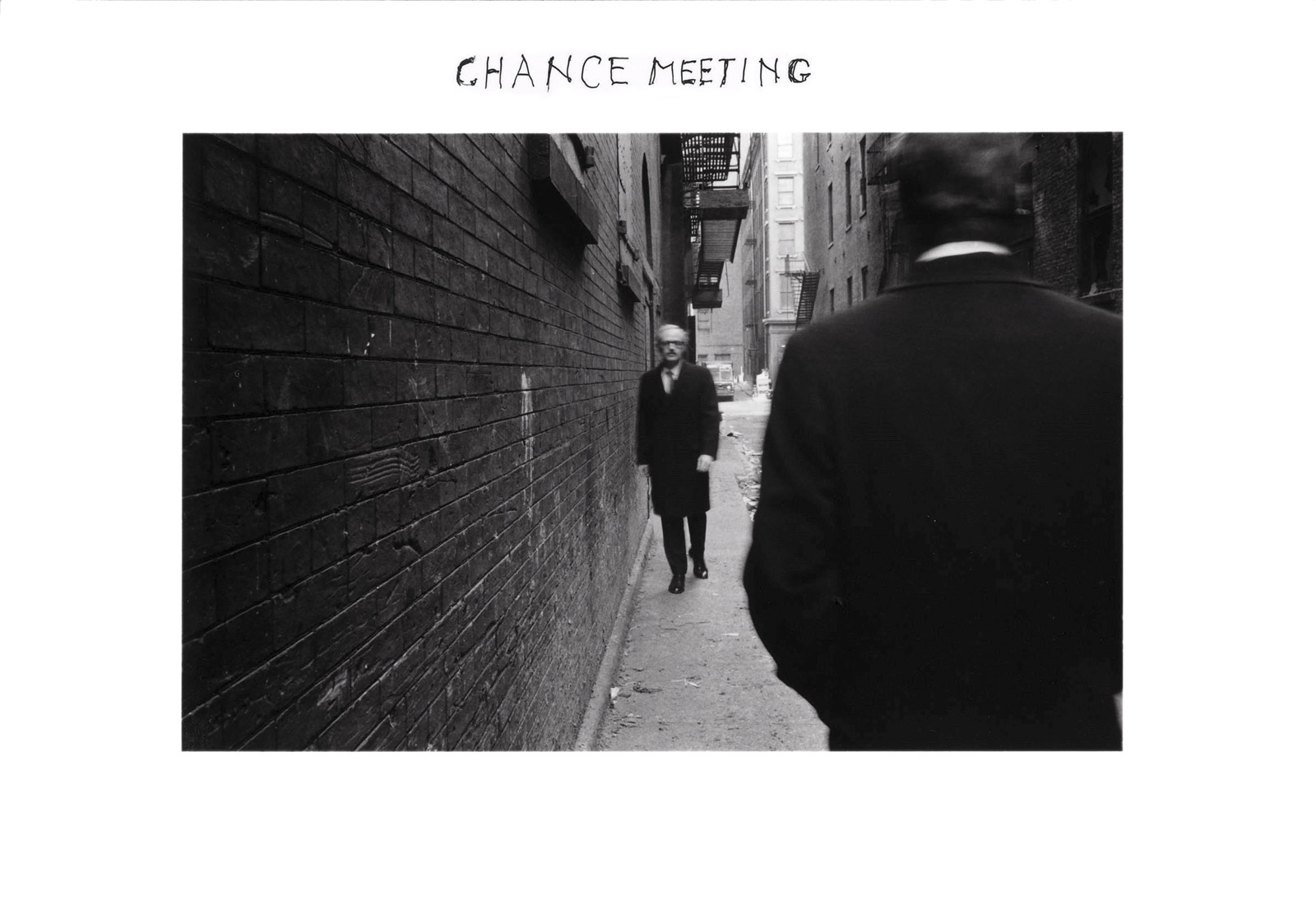
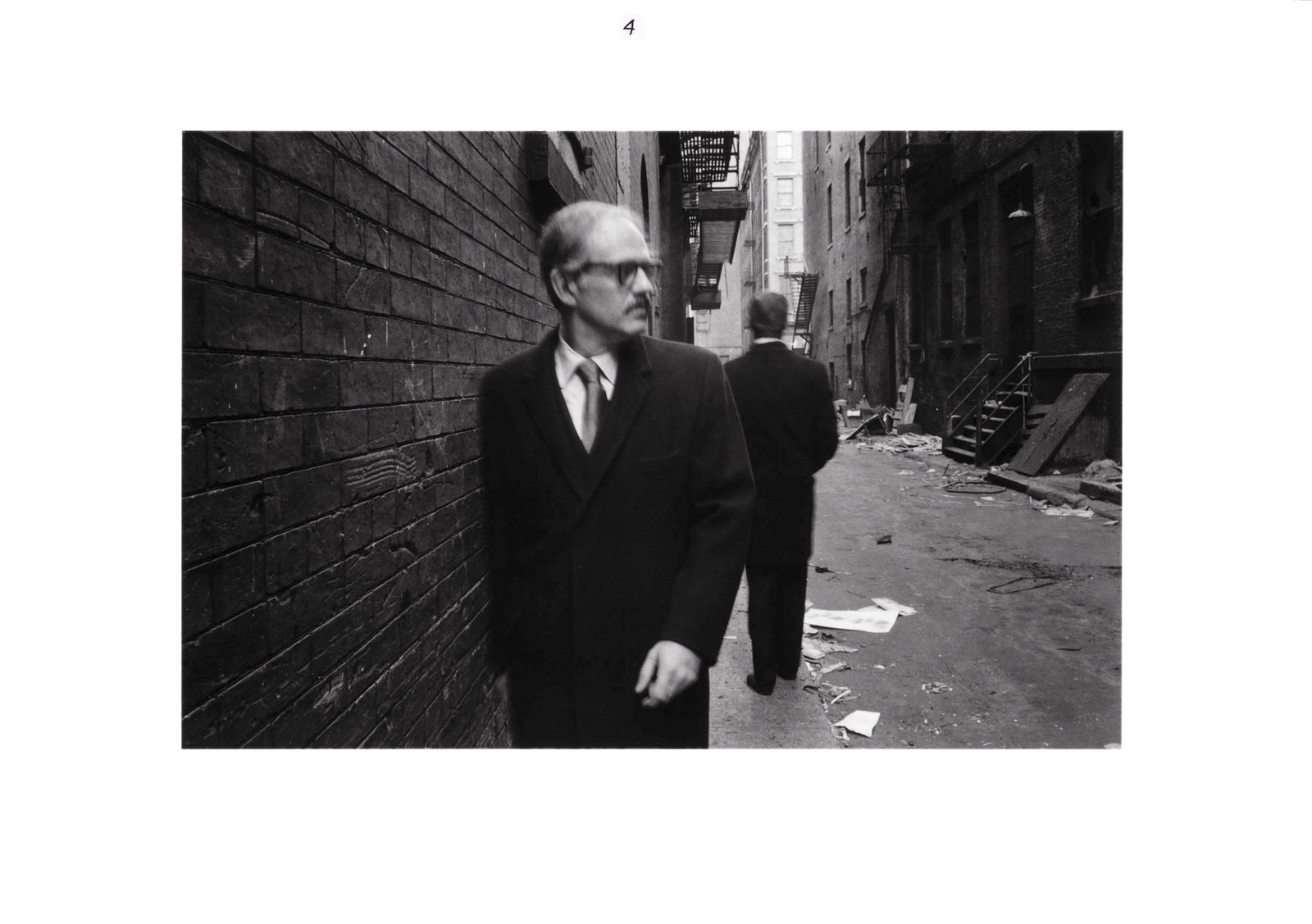
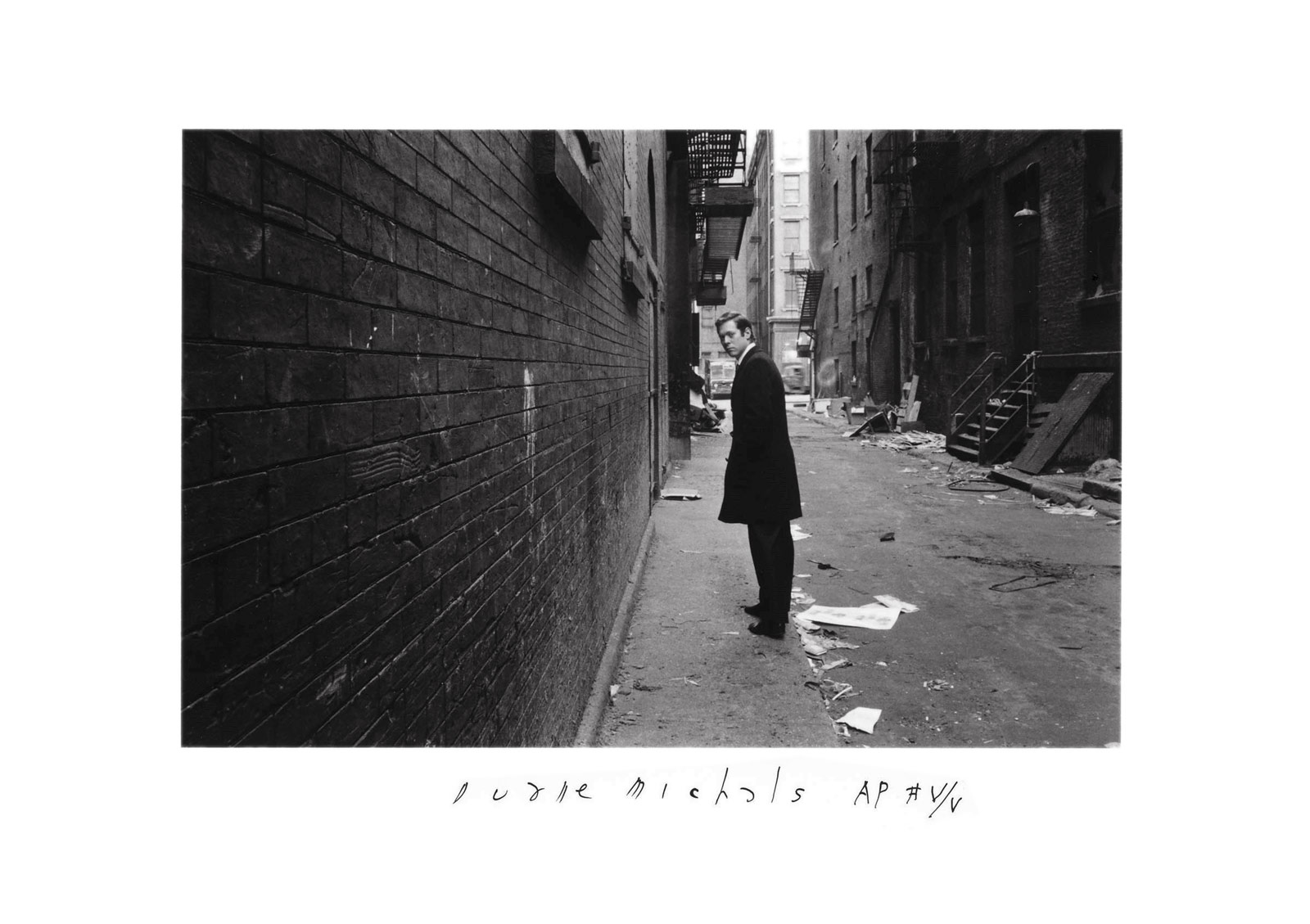
His most famous sequence, the one that you see most often, is Chance Meeting (1970, below) – again an open-ended, intimate but puzzling encounter with a reflection of the self. Michals sequences are full of ghosts, uncommon intimacies, nubile females and delicious males (Michals is gay and has just celebrated his 54th anniversary with his partner). Dealing “with topics such as death, desire, and the passage of time” his work peers inward to examine “his own thoughts and dreams, to blur the lines between photography and philosophy.”

All is not sunshine and light, and I feel that there is a nebulous, obsidian energy hovering not too far below the surface. The photographs have high contrast and the subjects are very closely framed, giving the sequences an almost claustrophobic quality, as though you are having the life, the energy gently yet forcibly manipulated around you. The photographs rarely breathe freely and you feel as though you are almost trapped within their spaces.

Then there is the text. Never used to excess in the sequences (the title does that job alone), the singular images are extended into a longer narrative by biting, poignant words – sentences that utter harsh truths and tell it how it really is. I can’t look at the image and read that text from A Letter from My Father (1960 / 1975, above) without thinking of my abusive father and wondering what happened to his love – whether he hadn’t hidden it, he just didn’t have any to start with. For any child inside an adult who has been abused, the image cuts to the bone.

Michals staged, narrative scenes take us on a journey into his reality, one which “has entered a realm beyond observation.” He poses difficult questions that force us to examine ideas beyond the world of phenomena, beyond the world of surfaces. He challenges our repressed inner lives and our idealised image of ourselves, disturbing the boundaries of personality, ego, and identity.1 He wrestles with Sartre’s noumenal world (the world of the subconscious, dreams), the “being-in-itself” or sometimes simply “the in-itself,” as Sartre calls it (what Kant called the noumenal world), where Sartre does not see man comfortably installed in the world.

“All of us, says Sartre, have a “pre-ontological comprehension” of being-in-itself, that is to say, an opaque, inarticulate, but very real sense of its presence and nature. The world is but a “varnish” on the surface of the being-in-itself; or, changing the metaphor, the world is but a “thin crust” of meaning which we impose upon being-in-itself. Ordinarily this thin crust of meaning conceals the in-itself and obscures our awareness of it, but the anguish of being is always there just below the surface of daily consciousness, and from time to time it breaks through to the surface, presenting being-in-itself without disguise.”2


This is what Michals attunes himself to, an examination of the in-itself, one that impacts on our internal poetic understandings of space and time. In his malleable daydreams Michals proffers a ‘releasement toward things’, the glimpsing of a coexistence between a conscious and unconscious way of perceiving which enables the seeing of the ‘Thing Itself’. As Heidegger observes,

“We stand at once within the realm of that which hides itself from us, and hides itself just in approaching us. That which shows itself and at the same time withdraws is the essential trait of what we call the mystery… Releasement towards things and openness to the mystery belong together. They grant us the possibility of dwelling in the world in a totally different way…”3


It is Michals great skill as an artist and a human being that enables us the possibility of accessing some aspect of the mystery of our existence.

Dr Marcus Bunyan


Footnotes

1/ As discussed in Magee, Bryan. Confessions of a Philosopher. London: Weidenfeld and Nicolson, 1997, pp. 405-406

2/ Olsen, Robert. An Introduction to Existentialism. Dover Publications, New York, 1962, p. 39

3/ Heidegger, Martin. Discourse on Thinking. New York: Harper & Row, 1966, pp. 55-56 quoted in Baracco, Mauro. “Completed Yet Unconcluded: The Poetic Resistance of Some Melbourne Architecture,” in van Schaik, Leon (ed.,). Architectural Design Vol. 72, No. 2 (‘Poetics in Architecture’). London: John Wiley and Sons, 2002, p. 74. Footnote 6.


Many thankx to the Carnegie Museum of Art for allowing me to publish the photographs in the posting. Please click on the photographs for a larger version of the image.


“Who gives a fuck about what he had for breakfast? These are stylistic ticks. The digital has changed the paradigms of photography. I had an opening in Boston and this woman had a little camera with her and kept exclaiming, ‘Everything is a photograph!’ That’s the problem. The bar has been lowered so much in photography now…”


“Photographers tend not to photograph what they can’t see, which is the very reason one should try to attempt it. Otherwise we’re going to go on forever just photographing more faces and more rooms and more places. Photography has to transcend description. It has to go beyond description to bring insight into the subject, or reveal the subject, not as it looks, but how does it feel?”


“I don’t trust reality. So all of the writing on and painting on the photographs is born out of the frustration to express what you do not see.”


Duane Michals


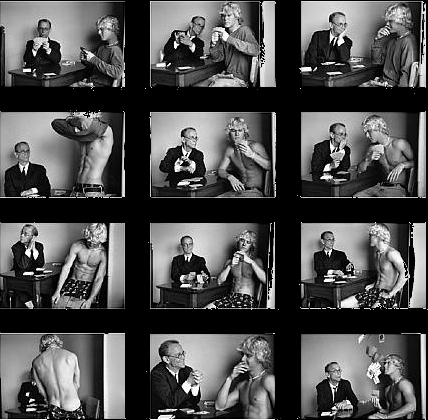
Duane Michals (American, 1932-2026) 'Cavafy Cheats Playing Strip Poker' 2004


Duane Michals (American, b. 1932)
Cavafy Cheats Playing Strip Poker
2004
12 Gelatin silver prints with hand applied text
5″ x 7″ each


This series of photographs was inspired by the poem The Windows by Constantine Cavafy:

In these dark rooms where I live out empty days,

I wander round and round trying to find the windows.

But the windows are not to be found – 
or at least I can’t find them.
And perhaps
 it is better that way.

Perhaps the light will prove another tyranny.

Who knows what new things it will expose?


Duane Michals (American, 1932-2026) 'Chance Meeting' 1970 from the exhibition 'Storyteller: The Photographs of Duane Michals' at Carnegie Museum of Art, Pittsburgh, November 2014 - February 2015

Duane Michals (American, 1932-2026) 'Chance Meeting' 1970

Duane Michals (American, 1932-2026) 'Chance Meeting' 1970

Duane Michals (American, 1932-2026) 'Chance Meeting' 1970

Duane Michals (American, 1932-2026) 'Chance Meeting' 1970

Duane Michals (American, 1932-2026) 'Chance Meeting' 1970


Duane Michals (American, 1932-2026)
Chance Meeting
1970
Six gelatin silver prints
Carnegie Museum of Art, Pittsburgh
Courtesy of the Artist and DC Moore Gallery


Duane Michals (American, 1932-2026) 'Things are Queer' 1973 from the exhibition 'Storyteller: The Photographs of Duane Michals' at Carnegie Museum of Art, Pittsburgh, November 2014 - February 2015

Duane Michals (American, 1932-2026) 'Things are Queer' 1973

Duane Michals (American, 1932-2026) 'Things are Queer' 1973

Duane Michals (American, 1932-2026) 'Things are Queer' 1973

Duane Michals (American, 1932-2026) 'Things are Queer' 1973

Duane Michals (American, 1932-2026) 'Things are Queer' 1973

Duane Michals (American, 1932-2026) 'Things are Queer' 1973

Duane Michals (American, 1932-2026) 'Things are Queer' 1973

Duane Michals (American, 1932-2026) 'Things are Queer' 1973


Duane Michals (American, 1932-2026)
Things are Queer
1973
Nine gelatin silver prints
Carnegie Museum of Art, Pittsburgh
Courtesy of the Artist and DC Moore Gallery


Duane Michals (American, 1932-2026) 'Grandpa Goes to Heaven' 1989

Duane Michals (American, 1932-2026) 'Grandpa Goes to Heaven' 1989

Duane Michals (American, 1932-2026) 'Grandpa Goes to Heaven' 1989

Duane Michals (American, 1932-2026) 'Grandpa Goes to Heaven' 1989

Duane Michals (American, 1932-2026) 'Grandpa Goes to Heaven' 1989


Duane Michals (American, 1932-2026)
Grandpa Goes to Heaven
1989
Five gelatin silver prints with hand applied text
Carnegie Museum of Art, Pittsburgh
Courtesy of the Artist and DC


“The best part of us is not what we see, it’s what we feel. We are what we feel. We are not what we look at… We’re not our eyeballs, we’re our mind. People believe their eyeballs and they’re totally wrong… That’s why I consider most photographs extremely boring – just like Muzak, inoffensive, charming, another waterfall, another sunset. This time, colours have been added to protect the innocent. It’s just boring. But that whole arena of one’s experience – grief, loneliness – how do you photograph lust? I mean, how do you deal with these things? This is what you are, not what you see. It’s all sitting up here. I could do all my work sitting in my room. I don’t have to go anywhere.”


Duane Michals


Opening November 1, 2014, at Carnegie Museum of Art (CMOA), Storyteller: The Photographs of Duane Michals is the definitive retrospective and the largest-ever presentation of this innovative artist’s work. Drawing from select loans and the museum’s holdings, which constitute the largest single collection of Michals’s output, and spanning six decades, the works in Storyteller include classic sequences from the early 1970s as well as rarely seen images from later in his career.

Born in 1932 and raised in a steelworker family in McKeesport, Pennsylvania, Michals broke away from established traditions of documentary and fine art photography in the 1960s when he added handwritten messages and poems to prints, produced multi-image narrative sequences, and experimented with double- and triple-exposures. His work was poignant and unabashedly sentimental, flying in the face of the dominant photographic aesthetics of the time.

Storyteller unfolds in thematic groupings that range from portraiture to meditations on the mind’s interior world; from childhood and imagination to desire and death. Michals’s love of two very different cities, Pittsburgh and Paris, is evident in sections exploring the beauty, quirks, and particularities of these places. He has riffed on, critiqued, and crossed paths with countless artists, including René Magritte, Cindy Sherman, Joseph Cornell, Robert Frank, Andreas Gursky, Andy Warhol, and others, and a section of the exhibition brings to light the admiration and acerbic wit in Michals’s engagements with other creative minds.

“The exhibition is designed to acquaint the visitor with the many themes that Michals explored over more than half a century,” says curator of photography Linda Benedict-Jones. “Well known sequences such as Paradise Regained and Chance Meeting greet the viewer first, followed by engaging and sometimes surprising Children’s Stories. A section called The Mind’s Eye shows Michals’s absorption with photographing things that cannot actually be seen, such as A Man Going to Heaven or The Human Condition. We could not present Storyteller chronologically, because Michals revisits themes often. One theme, Painted Expression, shows how, in two distinct periods of his life – in the early 1980s and again in 2012 – Michals has picked up a brush to apply oil paint to both black-and-white photographic prints as well as most recently to 19th century tintypes, resulting in unique, one-of-a-kind photographic works. His creative energy is boundless and readily apparent when seen in a large retrospective display.”

“I’m a storyteller,” he often states as he begins a talk in public – equally interested in the moments before and after the “decisive moment” (a term coined by famed photographer Henri Cartier-Bresson). “When I began to do sequences, it wasn’t because I thought it was cool and the latest thing. I did it out of frustration with the still photograph.” He has observed that his practice aims to transcend mere appearances: “I’m not interested in what something looks like, I want to know what it feels like… My reality has entered a realm beyond observation.” This approach can be seen throughout his career, from early, carefully staged sequences, to hand-painted gelatin silver prints and tintypes, revealing the artist’s hand at work long after the image is captured.

According to curator of photography Linda Benedict-Jones, who organised Storyteller, “Duane Michals is a sensitive and provocative artist who has followed his own unique path. His way of staging narrative scenes, then recording them with a 35mm camera, represented a fresh approach to the medium. This, combined with an uncommon intimacy when dealing with topics such as death, desire, and the passage of time, set him apart as an image-maker.”

Storyteller also touches upon Michals’s extensive portfolio of commercial photography and portraiture, which spans several decades, and includes assignments for Neiman Marcus, Esquire, Vogue, and Gap, as well as commissioned portraits of such figures as Nancy Reagan, Sting, and Willem de Kooning.

CMOA, a fixture in Michals’s artistic upbringing, has acquired 139 of his works, ranging from his earliest images made in Russia in 1958 to hand-painted tintypes that he began creating in 2012. Michals, in turn, has always felt an attachment to Pittsburgh, a subject of many of his photographs, and of two books, the sequence The House I Once Called Home (2003) and poetry collection A Pittsburgh Poem (2013). Lending institutions to Storyteller include Musée d’Art Moderne de la Ville de Paris, Museum of Fine Arts (Houston), Musée des Beaux Arts (Montreal), High Museum of Art (Atlanta), and Museum of Modern Art (New York). Even longtime admirers of the artist may be unfamiliar with several of his bodies of work, and an examination of this full range is long overdue: while Michals has been championed in several solo exhibitions throughout Europe in the past decade, this is his first major museum exhibition in North America since 1998.

Presented alongside Storyteller will be the exhibition Duane Michals: Collector, which highlights works from Michals’s private art collection that are promised gifts to the museum. The eclectic array of objects, ranging from 1799 to 1999, and from Francisco de Goya to André Kertész to Mark Tansey, will be united by Michals’s unique take on the artists, the artworks, and their influence on his own practice. Organised by associate curator of fine arts Amanda Zehnder, Duane Michals: Collector will further contextualise his work from an unusually personal perspective.

Storyteller: The Photographs of Duane Michals represents a refreshing, much-needed reexamination of a historically significant photographer. Michals’s pioneering photography infused the medium with a personal, critical approach that translates universally. In an art world that feels at times jaded and detached, his images retain the same moving, affecting impact that they commanded decades ago.

Press release from the Carnegie Museum of Art


Photographer Duane Michals Talks About His Career

Internationally-renowned photographer Duane Michals discusses his eight-decade life and career as a self-described “expressionist.” His work is known for its innovative narrative sequencing and iconic use of text and image. During a period when photography looked out to the world around us, Michals redefined the medium by peering inward to his own thoughts and dreams to blur the lines between photography and philosophy.


Duane Michals (American, 1932-2026) 'The Spirit Leaves The Body' 1968

Duane Michals (American, 1932-2026) 'The Spirit Leaves The Body' 1968

Duane Michals (American, 1932-2026) 'The Spirit Leaves The Body' 1968

Duane Michals (American, 1932-2026) 'The Spirit Leaves The Body' 1968

Duane Michals (American, 1932-2026) 'The Spirit Leaves The Body' 1968

Duane Michals (American, 1932-2026) 'The Spirit Leaves The Body' 1968

Duane Michals (American, 1932-2026) 'The Spirit Leaves The Body' 1968


Duane Michals (American, 1932-2026)
The Spirit Leaves The Body
1968
Seven gelatin silver prints with hand applied text
Carnegie Museum of Art, Pittsburgh
Courtesy of the Artist and DC Moore Gallery


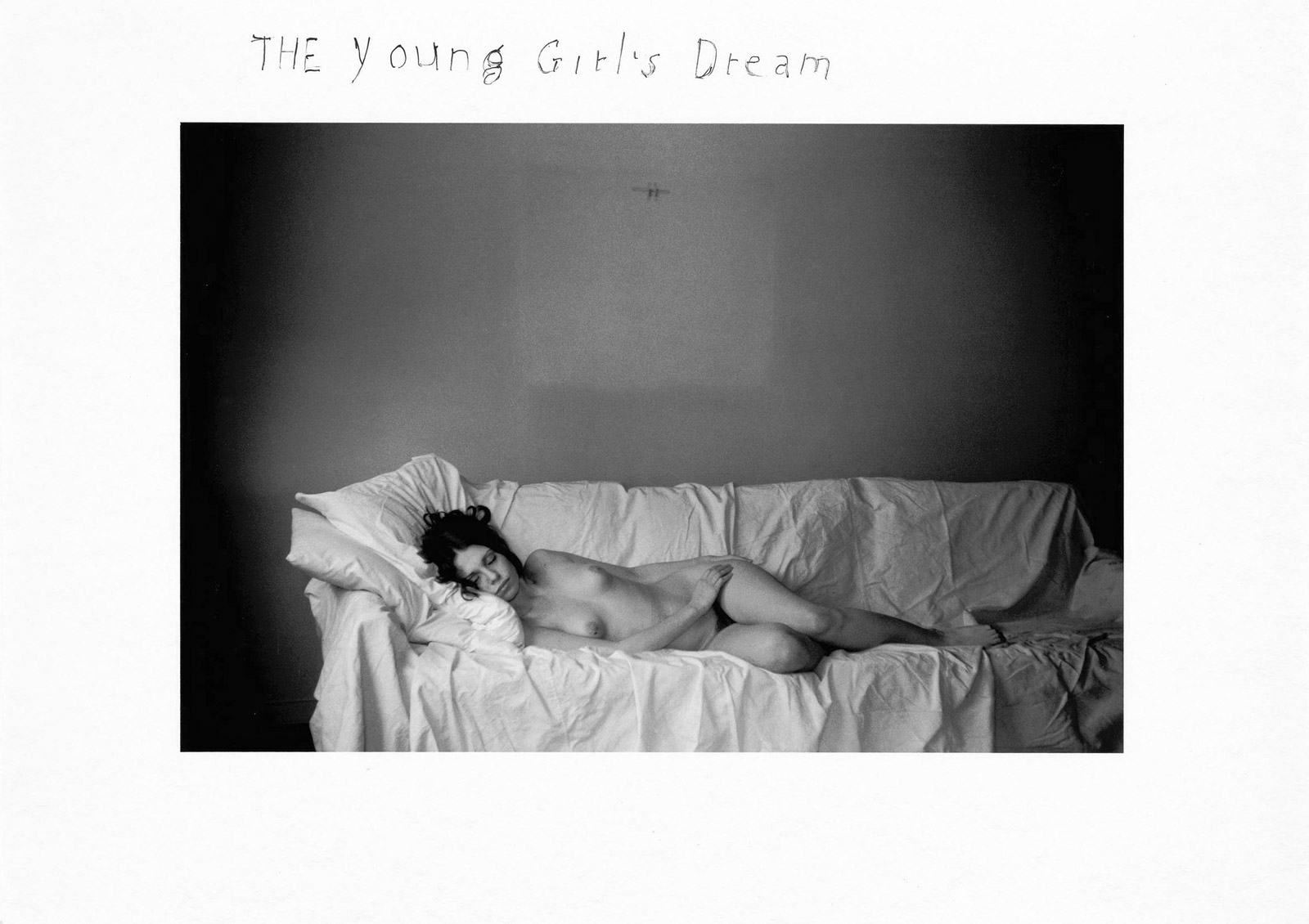
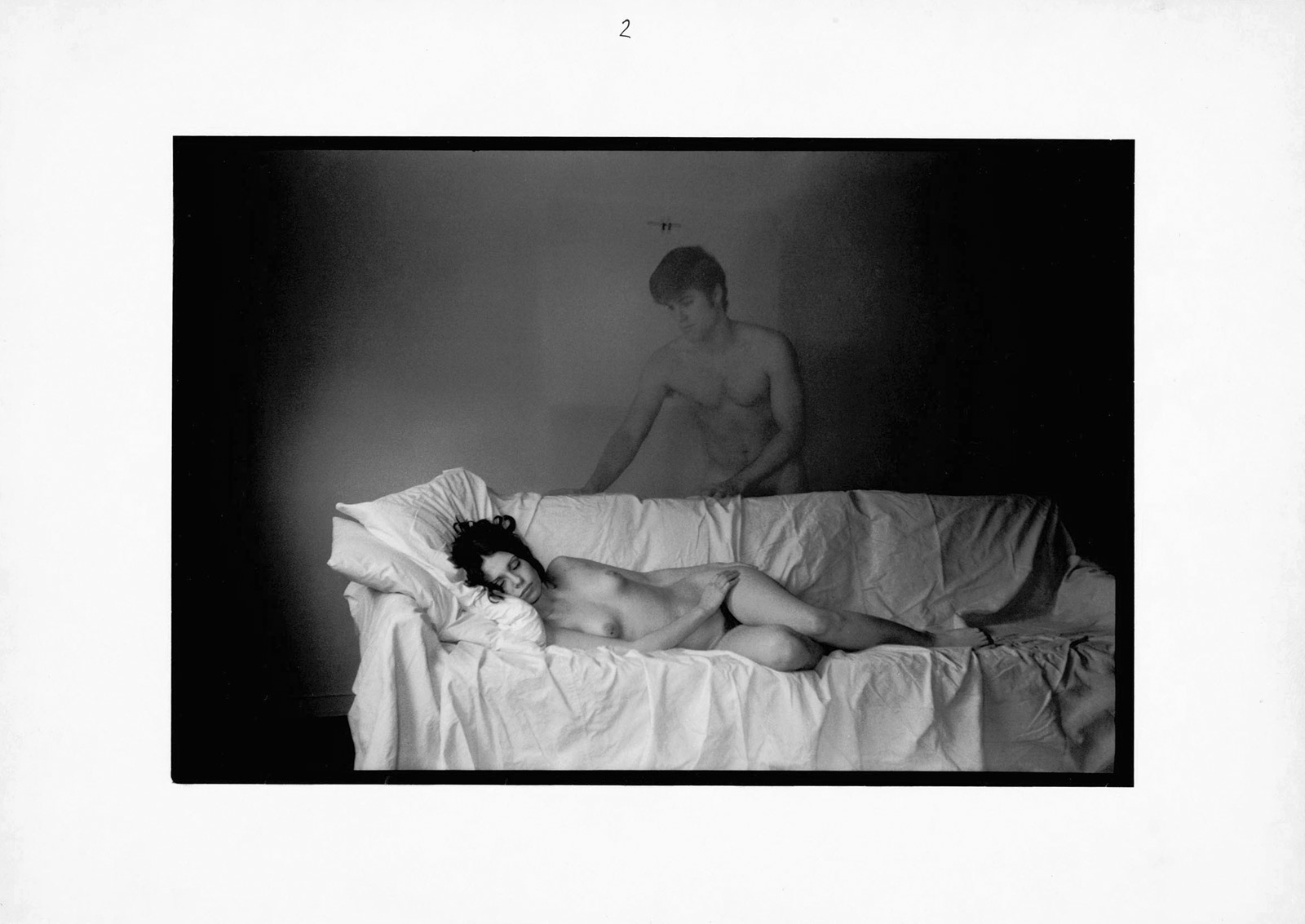
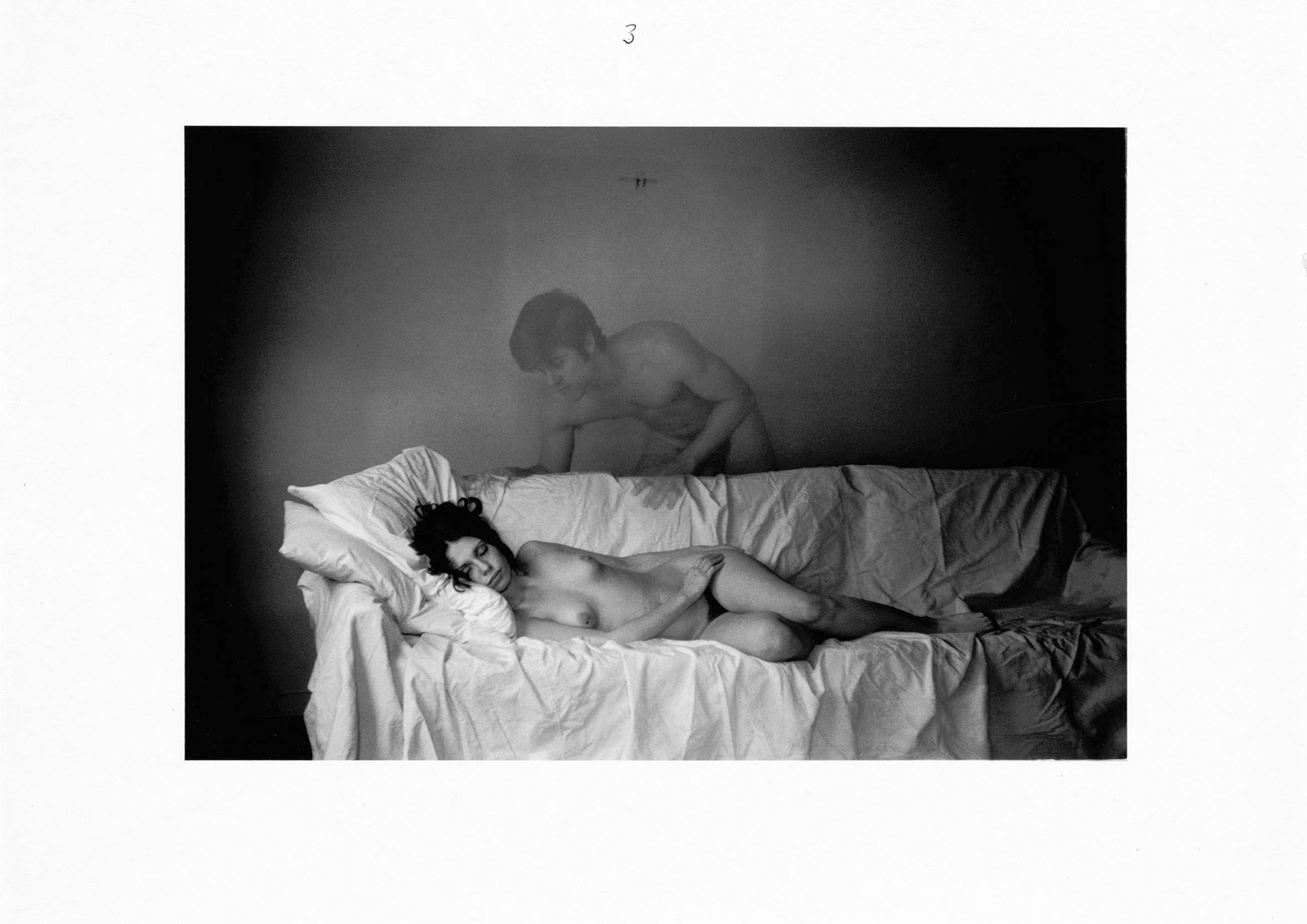
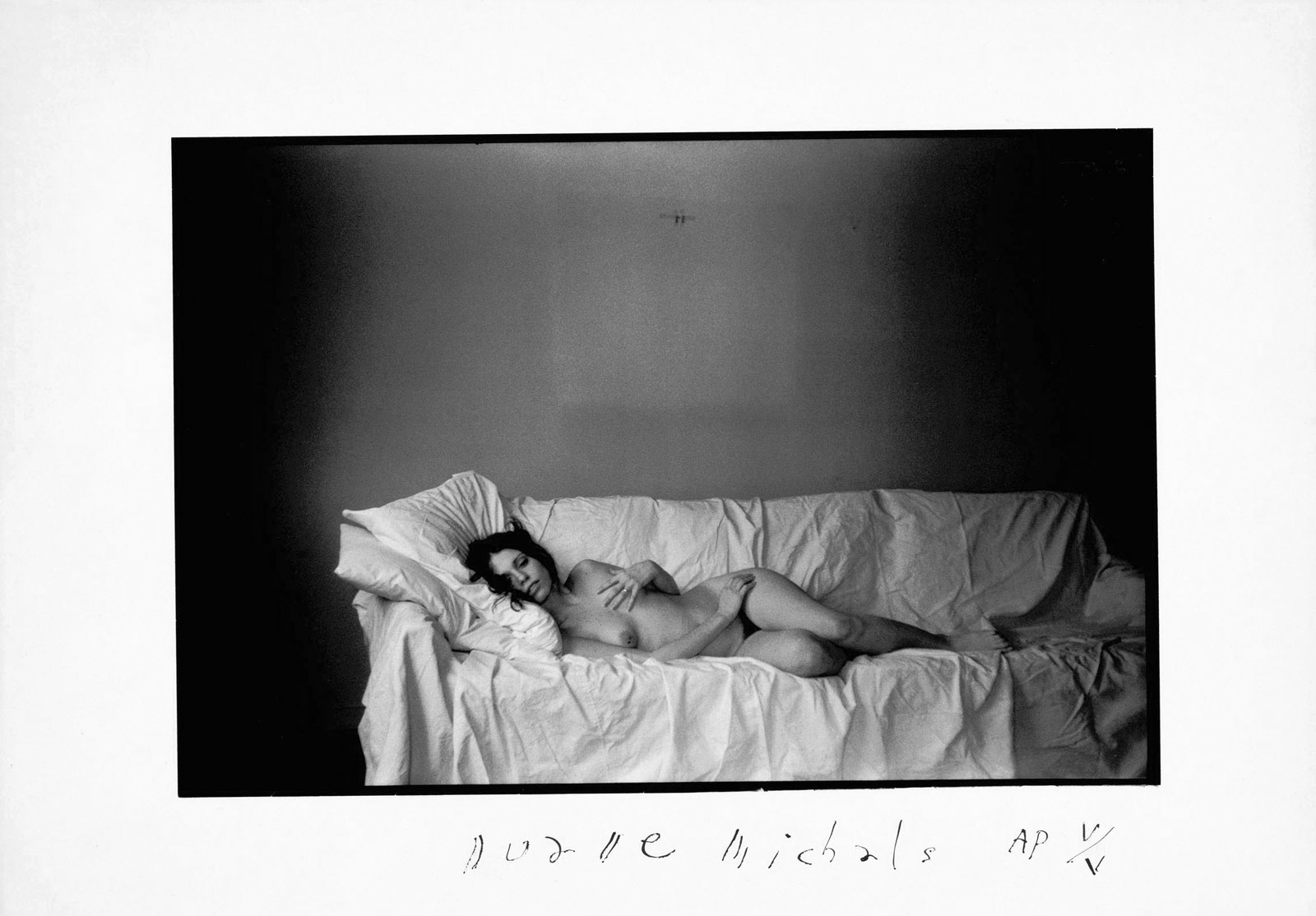
Duane Michals (American, 1932-2026) 'The Young Girl’s Dream' 1969

Duane Michals (American, 1932-2026) 'The Young Girl’s Dream' 1969

Duane Michals (American, 1932-2026) 'The Young Girl’s Dream' 1969

Duane Michals (American, 1932-2026) 'The Young Girl’s Dream' 1969

Duane Michals (American, 1932-2026) 'The Young Girl’s Dream' 1969


Duane Michals (American, 1932-2026)
The Young Girl’s Dream
1969
Five gelatin silver prints with hand applied text
Carnegie Museum of Art, Pittsburgh
Courtesy of the Artist and DC Moore Gallery


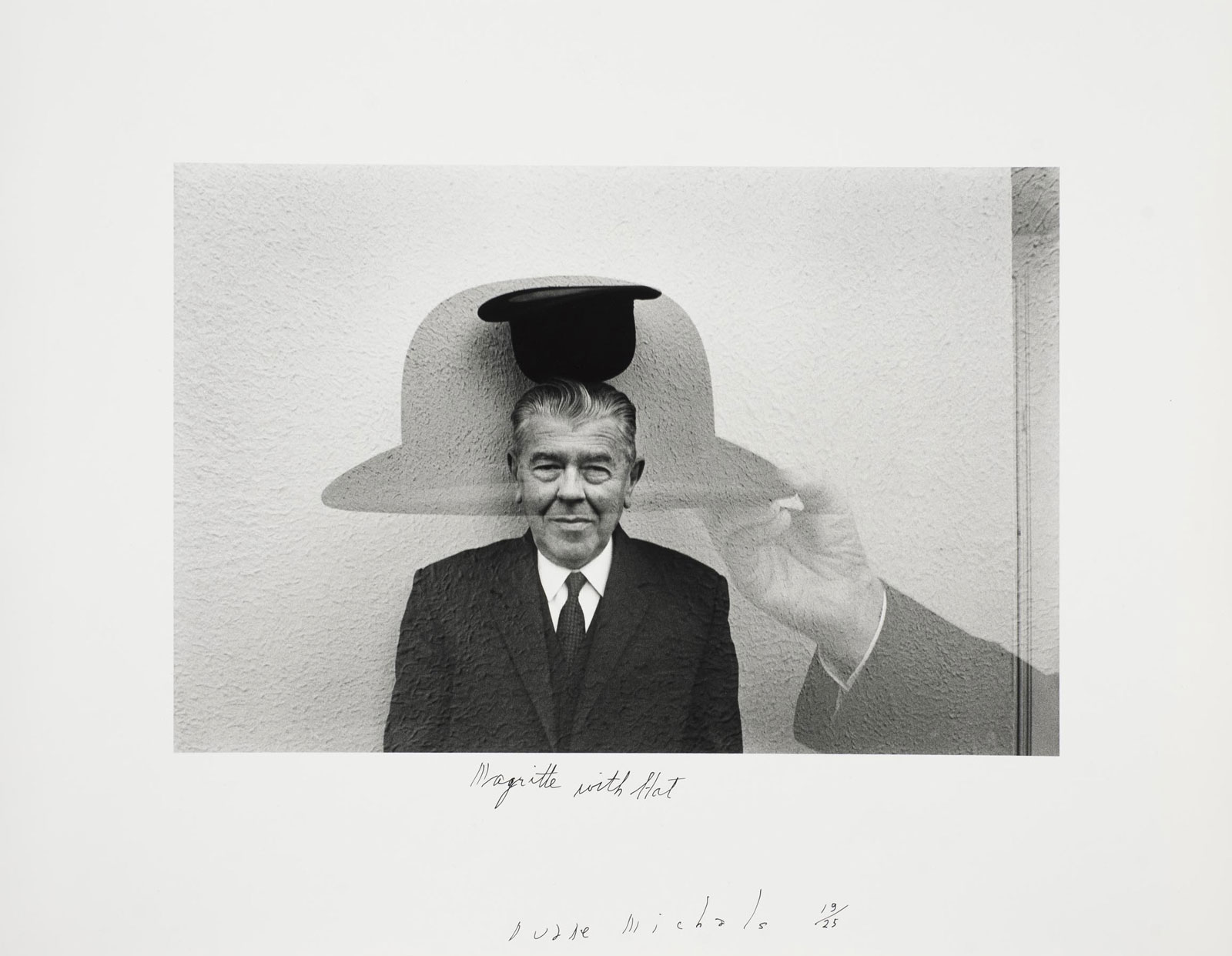
Duane Michals (American, 1932-2026) 'Magritte with Hat' 1965


Duane Michals (American, 1932-2026)
Magritte with Hat
1965
Gelatin silver print with hand applied text
Carnegie Museum of Art, Pittsburgh
Courtesy of the Artist and DC Moore Gallery


Duane Michals (American, 1932-2026) 'Magritte with Hat' 1965 (detail)


Duane Michals (American, 1932-2026)
Magritte with Hat (detail)
1965
Gelatin silver print with hand applied text
Carnegie Museum of Art, Pittsburgh
Courtesy of the Artist and DC Moore Gallery


Duane Michals (American, 1932-2026) 'This Photograph Is My Proof' 1967


Duane Michals (American, 1932-2026)
This Photograph Is My Proof
1967
Gelatin silver print with hand-applied text
The Henry L. Hillman Fund, Carnegie Museum of Art, Pittsburgh
Courtesy of the Artist and DC Moore Gallery


Duane Michals (American, 1932-2026) 'Young Soldiers Dream in the Garden of the Dead with Flowers Growing from Their Heads' 1995


Duane Michals (American, 1932-2026)
Young Soldiers Dream in the Garden of the Dead with Flowers Growing from Their Heads
1995
From the series Salute, Walt Whitman
Gelatin silver print
The Henry L. Hillman Fund
Courtesy of Carnegie Museum of Art, Pittsburgh


Duane Michals (American, 1932-2026) 'The Human Condition' 1969


Duane Michals (American, 1932-2026)
The Human Condition
1969
Six gelatin silver prints with hand applied text
Carnegie Museum of Art, Pittsburgh
Courtesy of the Artist and DC Moore Gallery


Duane Michals (American, 1932-2026) 'Rigamarole' 2012


Duane Michals (American, 1932-2026)
Rigamarole
2012
Tintype with oil paint
The William T. Hillman Fund for Photography
Carnegie Museum of Art,Pittsburgh
Courtesy of the Artist and DC Moore Gallery


Carnegie Museum of Art
4400 Forbes Avenue
Pittsburgh, PA 15213

Opening hours:
Monday: 10am – 5pm
Tuesday: Closed
Wednesday: 10am – 5pm
Thursday: 10am – 8pm
Friday: 10am – 5pm
Saturday: 10am – 5pm
Sunday: noon – 5pm

Carnegie Museum of Art website

LIKE ART BLART ON FACEBOOK

Back to top

Exhibition: ‘Marc Chagall – A Retrospective 1908-1985’ at the Palazzo Reale, Milan

Exhibition dates: 17th September, 2014 – 1st February, 2015

Curators: Claudia Zevi and Meret Meyer (Chagall’s granddaughter)


Marc Chagall (French born Russia, 1887-1985) 'Figura davanti alla volta blu' 1911 from the exhibition 'Marc Chagall – A Retrospective 1908-1985' at the Palazzo Reale, Milan, September 2014 - February 2015


Marc Chagall (French born Russia, 1887-1985)
Figura davanti alla volta blu
1911
Gouache on paper


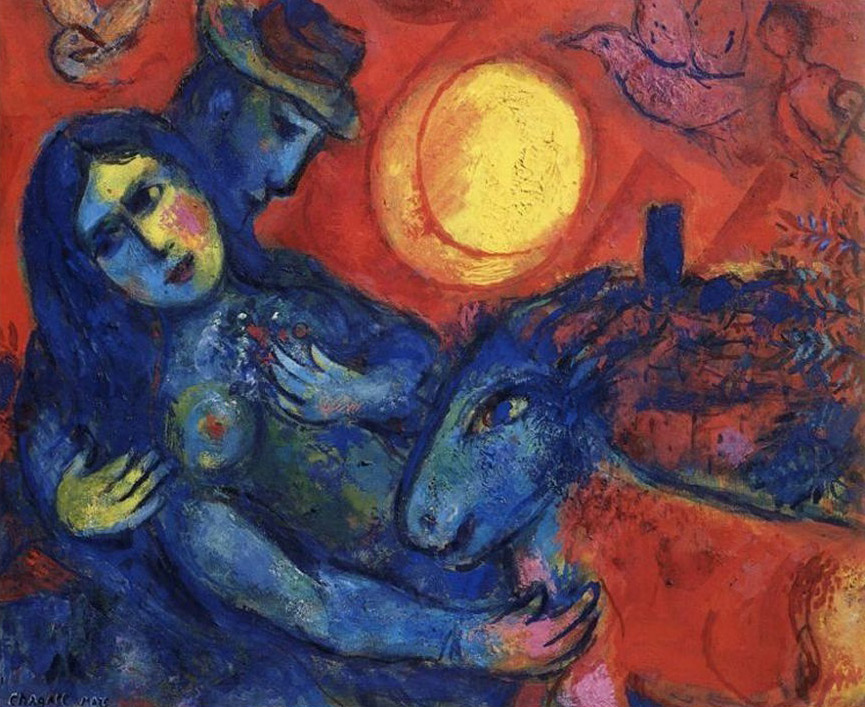
A bumper posting on this glorious artist – another who, too late, realised the threat of Nazi Germany and only survived deportation and death by the skin of his teeth. It would have been a sad loss, for he possesses an unbridled passion for life. Social conscience, mythology, iconography, place, identity, race, religion, beauty, war and tragedy. And the exemplary use of colour in his metaphysical, fantastical scenes. But above all…. MAGIC!

Marcus


Many thankx to the Palazzo Reale for allowing me to publish the photographs in the posting. Please click on the photographs for a larger version of the image.


“If I create from the heart, nearly everything works; if from the head, almost nothing.”


Marc Chagall


“Chagall a pioneer of modern art and one of its greatest figurative painters… [who] invented a visual language that recorded the thrill and terror of the twentieth century…

On his canvases we read the triumph of modernism, the breakthrough in art to an expression of inner life that … is one of the last century’s signal legacies. At the same time Chagall was personally swept up in the horrors of European history between 1914 and 1945: world wars, revolution, ethnic persecution, the murder and exile of millions. In an age when many major artists fled reality for abstraction, he distilled his experiences of suffering and tragedy into images at once immediate, simple, and symbolic to which everyone could respond.”


Wullschlager, Jackie. Chagall: A Biography. Knopf, 2008. p. 4


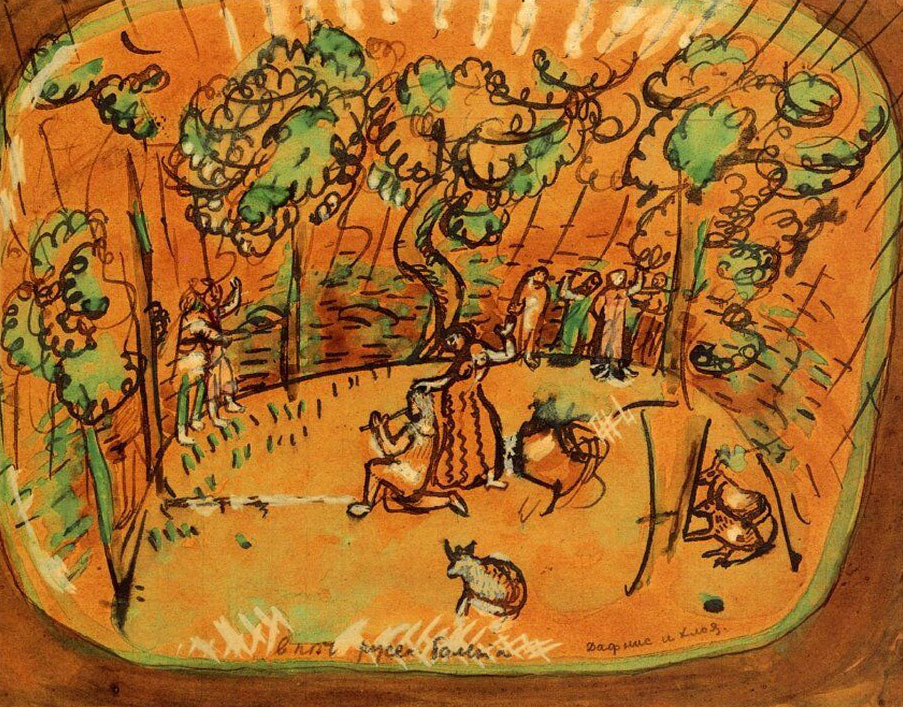
Marc Chagall (French born Russia, 1887-1985) 'Daphnis and Cloe' 1911 from the exhibition 'Marc Chagall – A Retrospective 1908-1985' at the Palazzo Reale, Milan, September 2014 - February 2015


Marc Chagall (French born Russia, 1887-1985)
Daphnis and Cloe
1911
Watercolour
16.5 x 21cm
Private collection


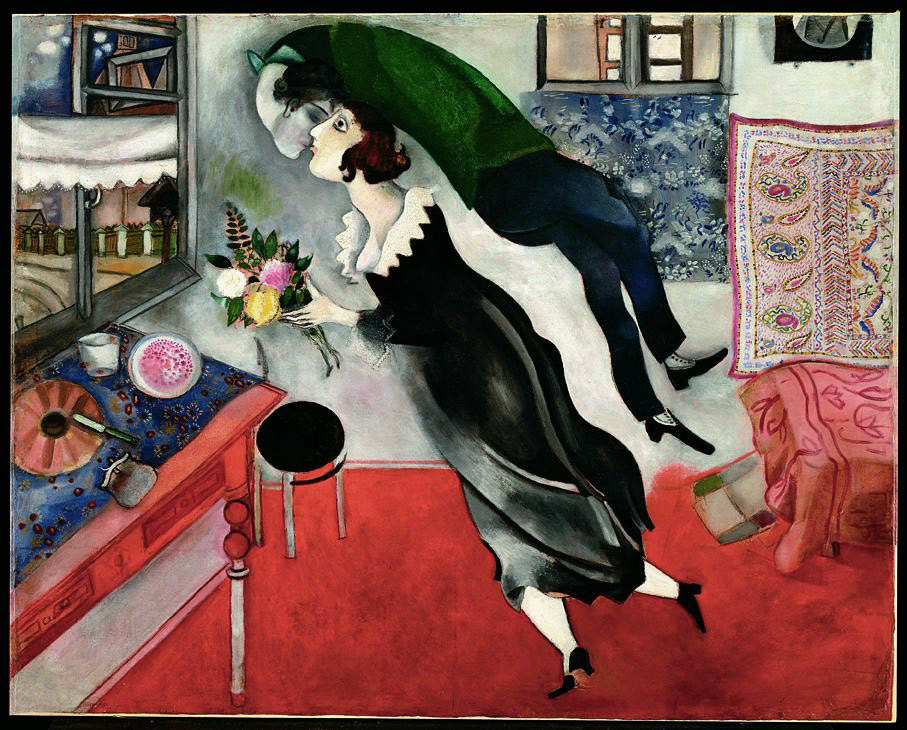
Marc Chagall (French born Russia, 1887-1985) 'Il compleanno' 1915


Marc Chagall (French born Russia, 1887-1985)
Il compleanno (Birthday)
1915
Oil on cardboard
The Museum of Modern Art, New York. Acquired through the Lillie P. Bliss Bequest, 1949
© 2014 Digital image, The Museum of Modern Art, New York/Scala, Firenze © Chagall ® by SIAE 2014


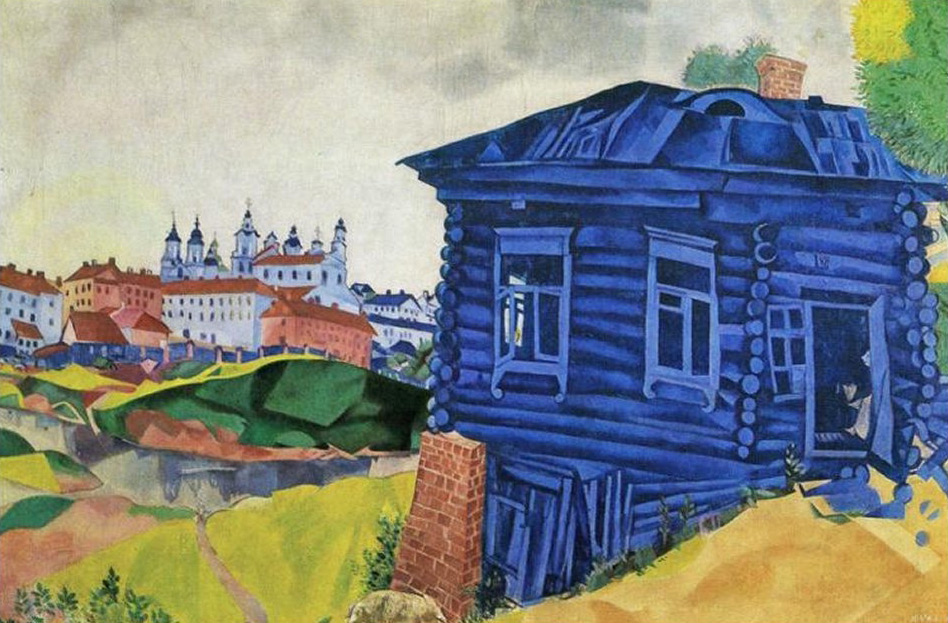
Marc Chagall (French born Russia, 1887-1985) 'The Blue House' 1917


Marc Chagall (French born Russia, 1887-1985)
The Blue House
1917
Oil on canvas
66 x 96.8cm
Musée des Beaux-Arts, Liège, France


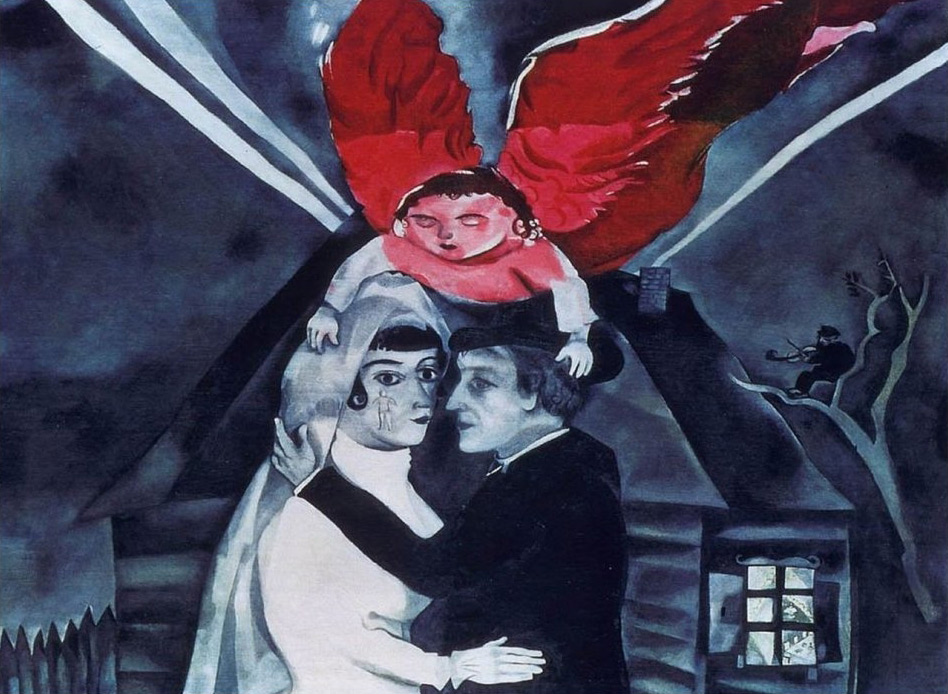
Marc Chagall (French born Russia, 1887-1985) 'Matrimonio' (Wedding) 1918


Marc Chagall (French born Russia, 1887-1985)
Matrimonio (Wedding)
1918
Oil on canvas
100 x 119cm
Tretyakov Gallery, Moscow, Russia


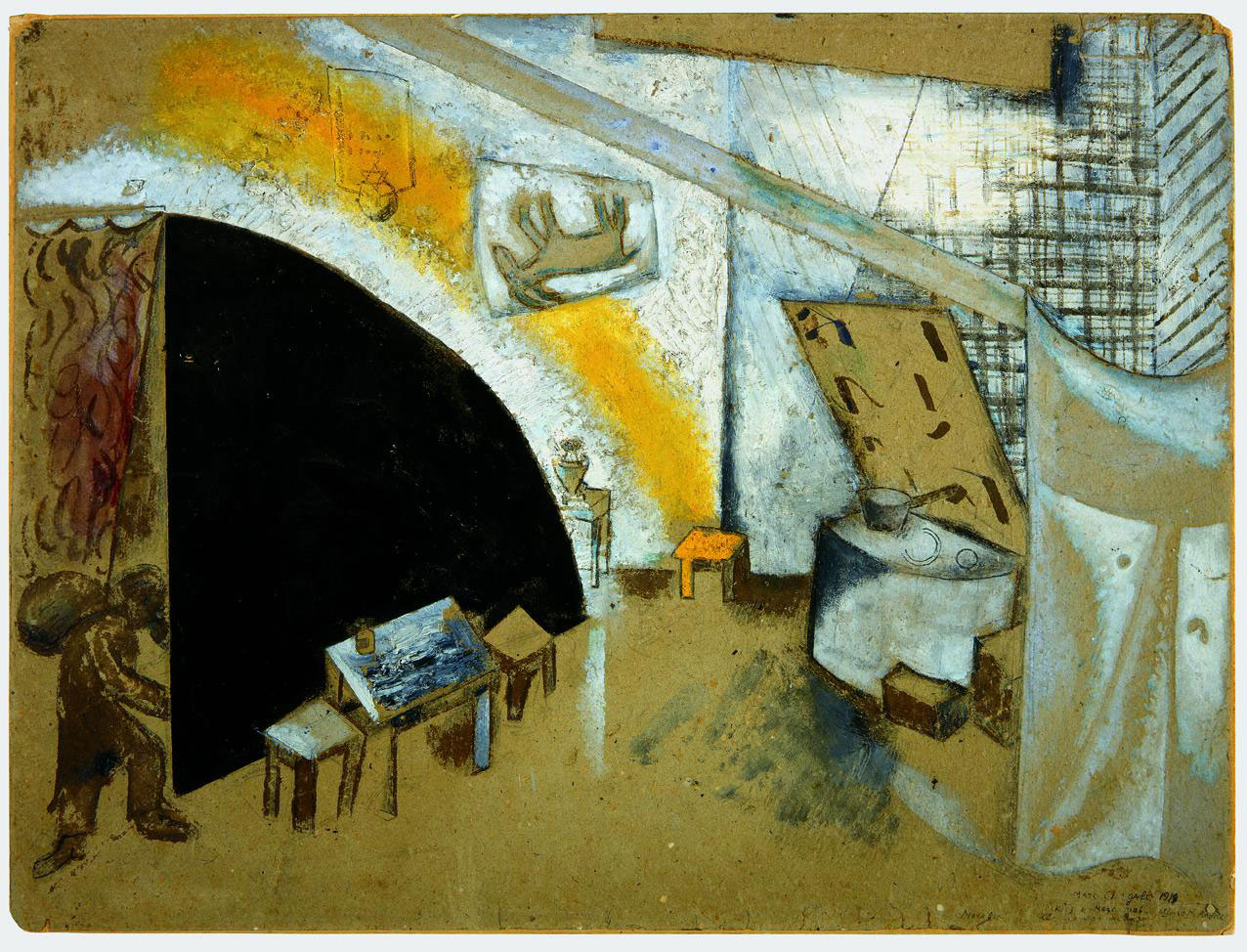
Marc Chagall (French born Russia, 1887-1985) 'Model of great scene for "Mazeltov" Scholem Aleichem' 1919


Marc Chagall (French born Russia, 1887-1985)
Modello di grande scena per “Mazeltov” di Scholem Aleichem (Model of great scene for “Mazeltov” Scholem Aleichem)
1919
Oil and black pencil on paper pasted on cardboard
Private Collection


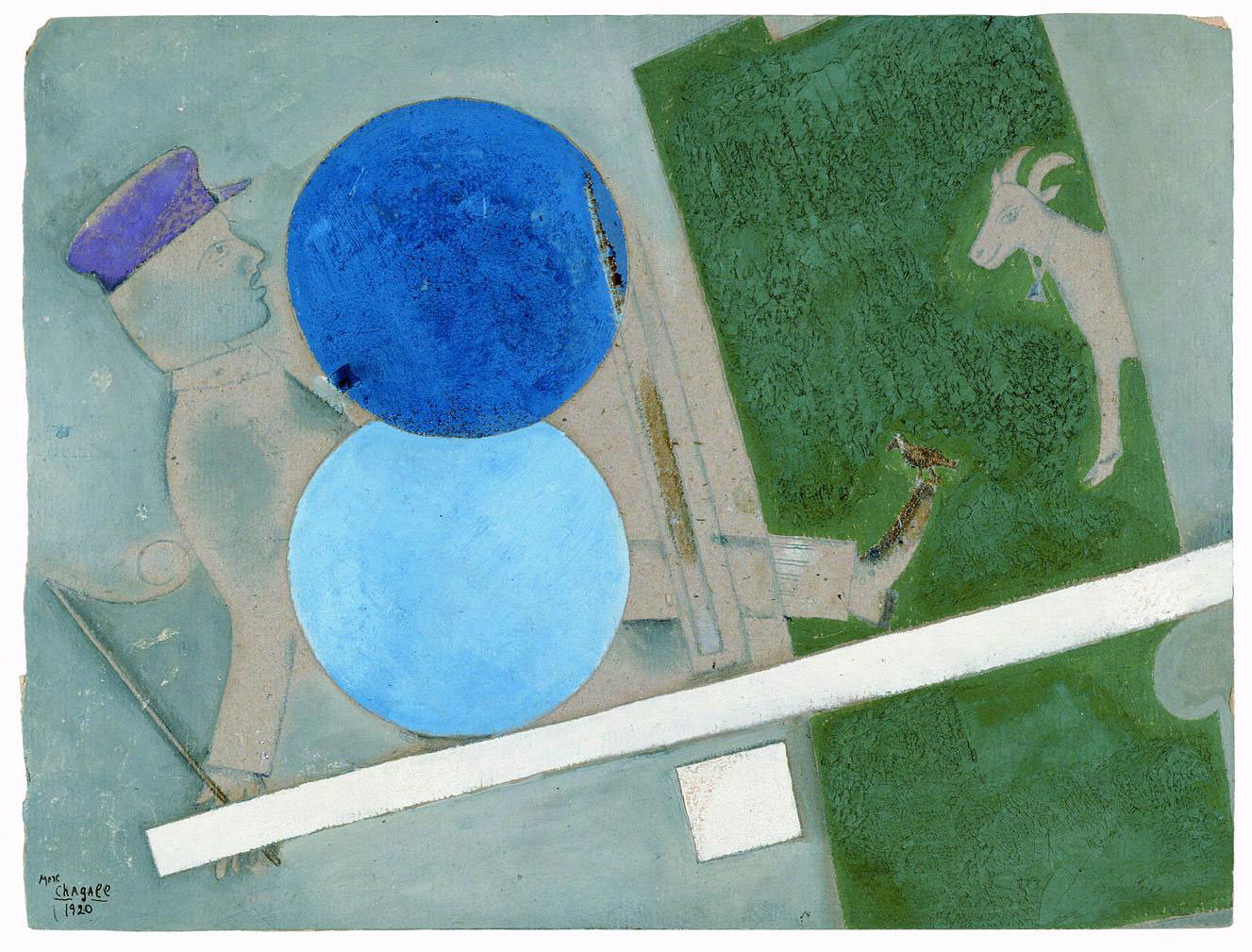
Marc Chagall (French born Russia, 1887-1985) 'Composition with circles and goat (Jewish Theatre Art)' 1920


Marc Chagall (French born Russia, 1887-1985)
Composizione con cerchi e capra (Teatro d’arte ebraica) (Composition with circles and goat (Jewish Theatre Art))
1920
Oil on cardboard laid on wood agglomerate
Private Collection


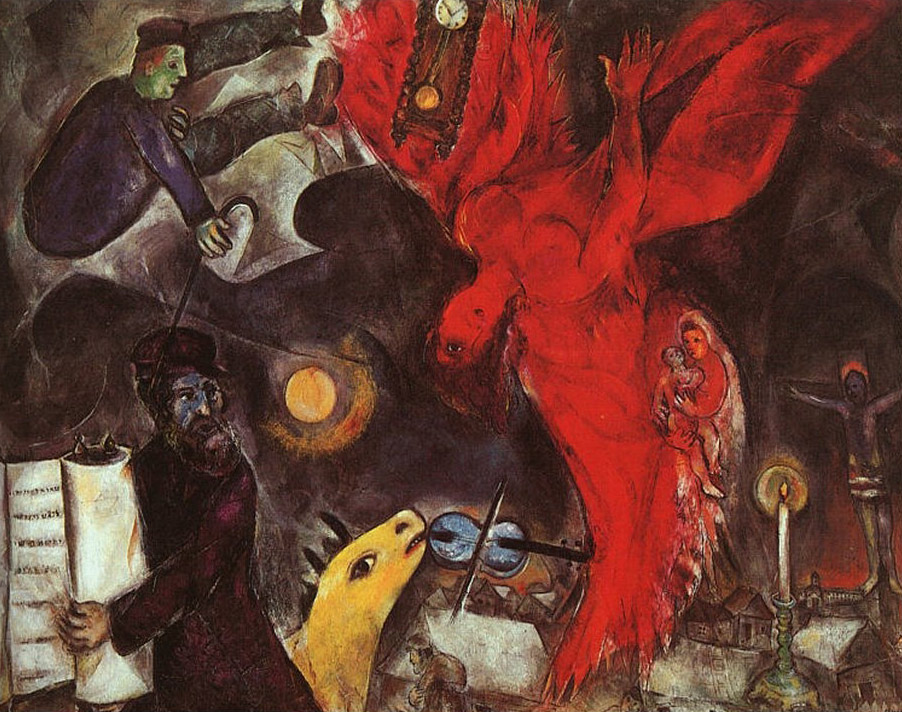
Marc Chagall (French born Russia, 1887-1985) 'Angelo cadente' (The Falling Angel) 1923


Marc Chagall (French born Russia, 1887-1985)
Angelo cadente (The Falling Angel)
1923
Oil on canvas
148 x 189cm
Private collection


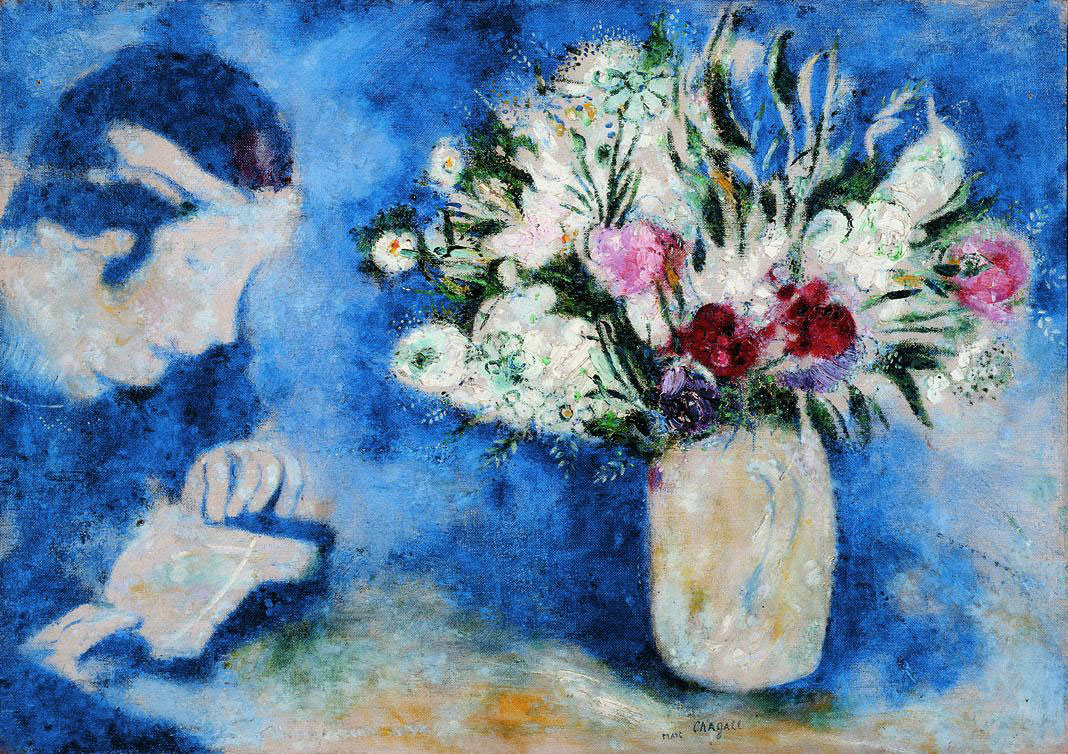
Marc Chagall (French born Russia, 1887-1985) 'Bella con un libro e un vaso di fiori (o Bella a Mourillon)' 1926


Marc Chagall (French born Russia, 1887-1985)
Bella con un libro e un vaso di fiori (o Bella a Mourillon) (Beauty with a book and a vase of flowers (or Bella in Mourillon))
1926
Oil on canvas
Credits: Collezione Privata
© Chagall ® by SIAE 2014


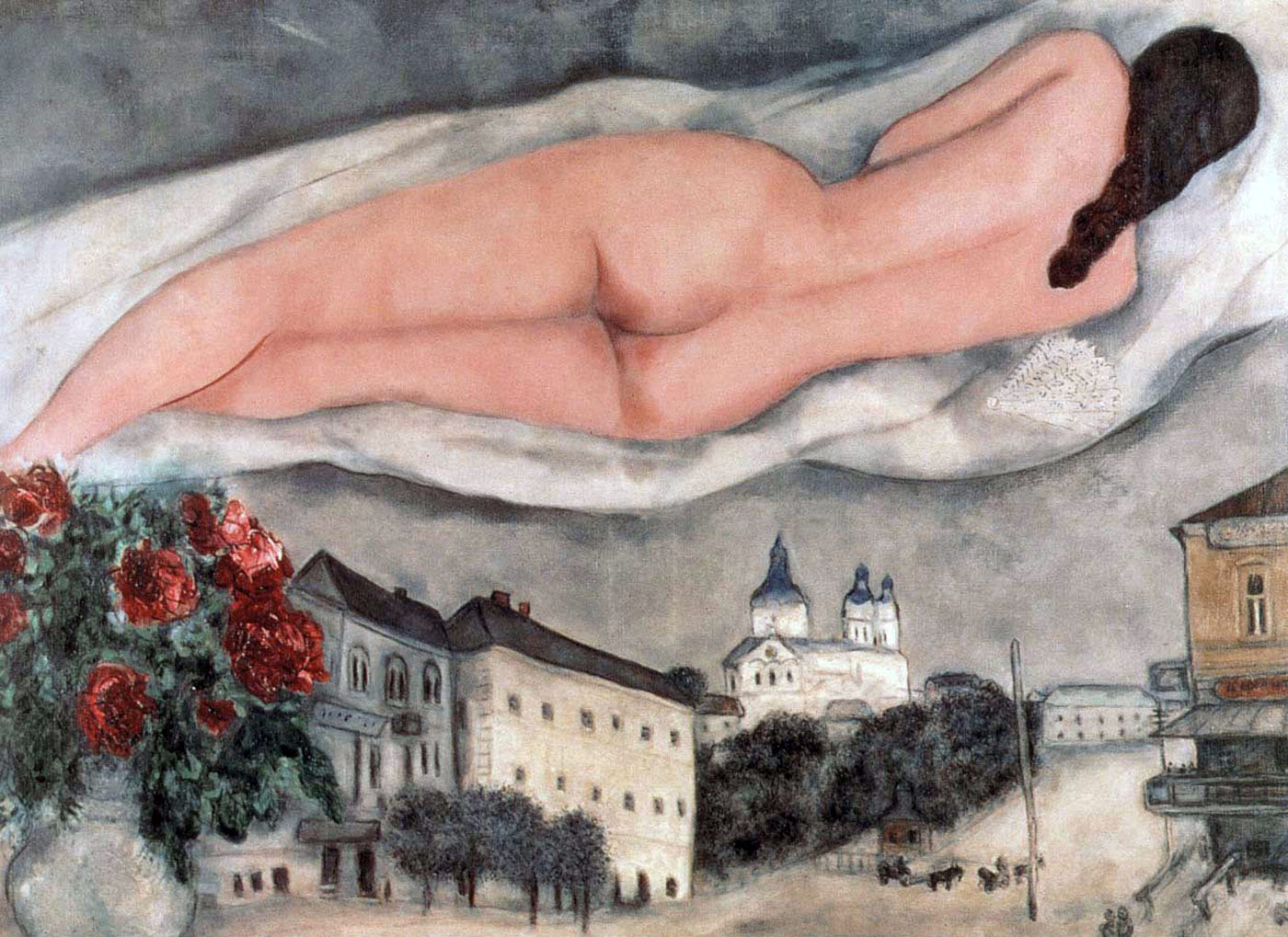
Marc Chagall (French born Russia, 1887-1985) 'Nude above Vitebsk' 1933


Marc Chagall (French born Russia, 1887-1985)
Nude above Vitebsk
1933
Oil on canvas
Private collection
© Chagall ® by SIAE 2014


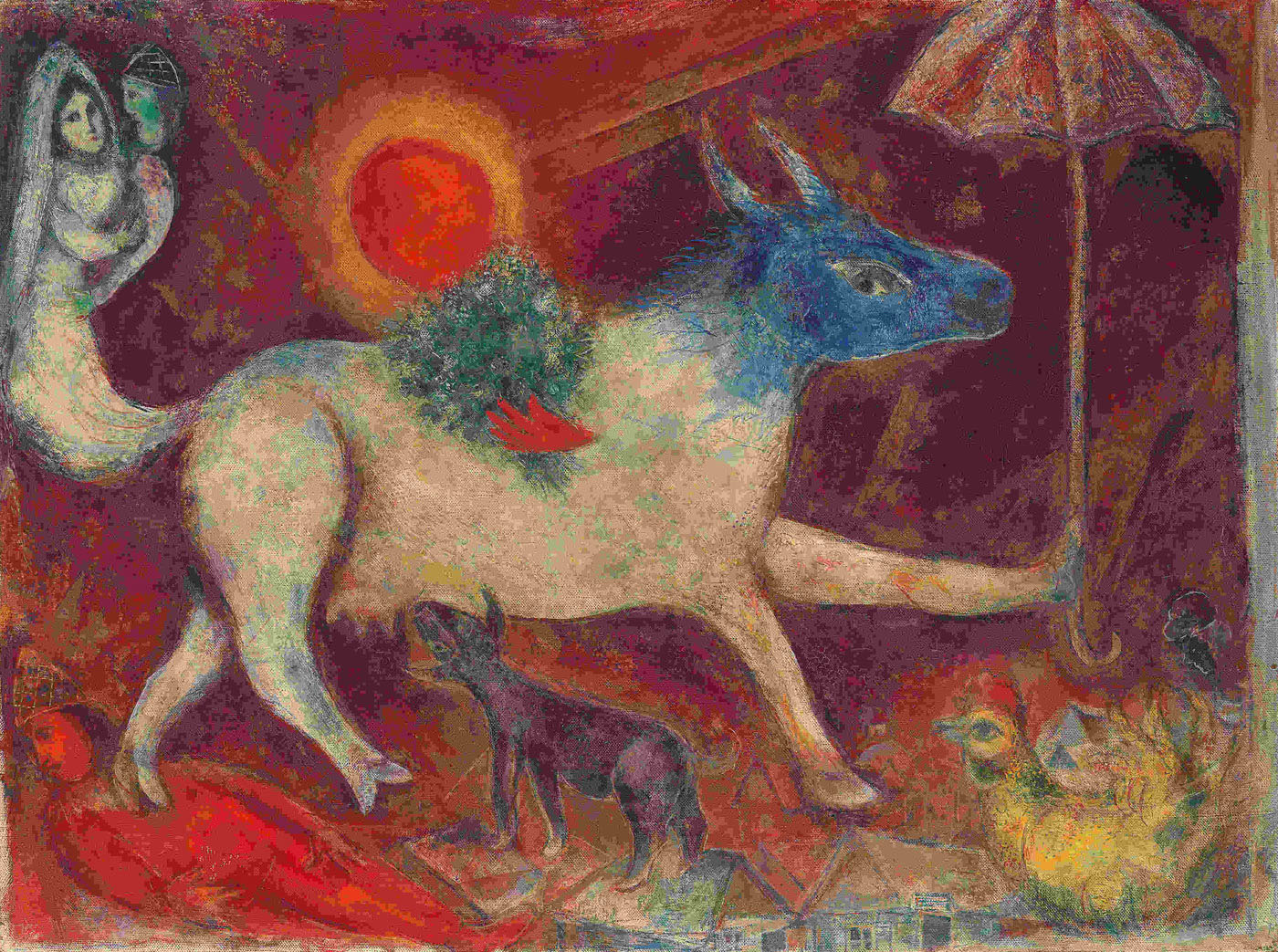
Marc Chagall (French born Russia, 1887-1985) 'Cow with Parasol' 1946


Marc Chagall (French born Russia, 1887-1985)
La mucca con l’ombrello (Cow with Parasol)
1946
Oil on canvas
New York, The Metropolitan Museum of Art, Bequest of Richard S. Zeisler, 2007
© Chagall ®, by SIAE 2014


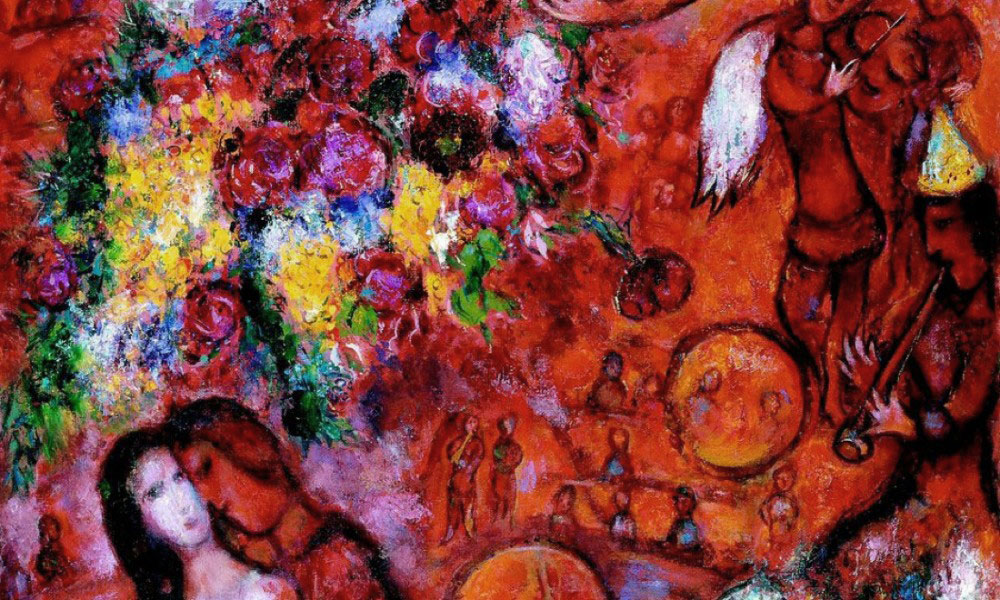
Marc Chagall (French born Russia, 1887-1985) 'The Red Circus' 1956-1960


Marc Chagall (French born Russia, 1887-1985)
The Red Circus
1956-1960
Oil on canvas


Marc Chagall (French born Russia, 1887-1985) 'Big Sun' 1958


Marc Chagall (French born Russia, 1887-1985)
Big Sun
1958
Oil on canvas


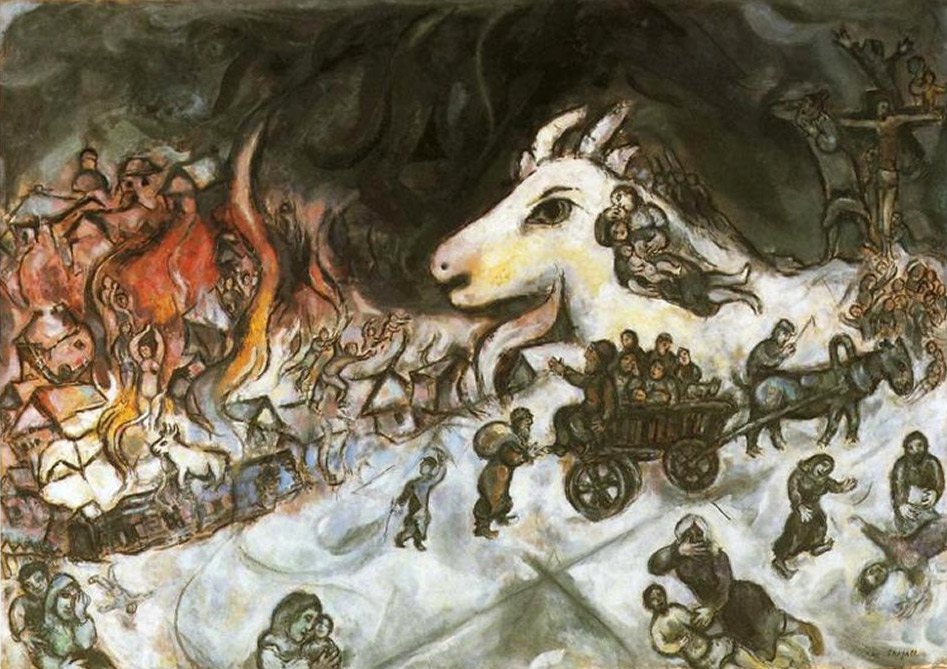
Marc Chagall (French born Russia, 1887-1985) 'War' 1964


Marc Chagall (French born Russia, 1887-1985)
War (Guerra)
1964
Oil on canvas
163 x 231cm
Kunsthaus Zürich, Zürich, Switzerland


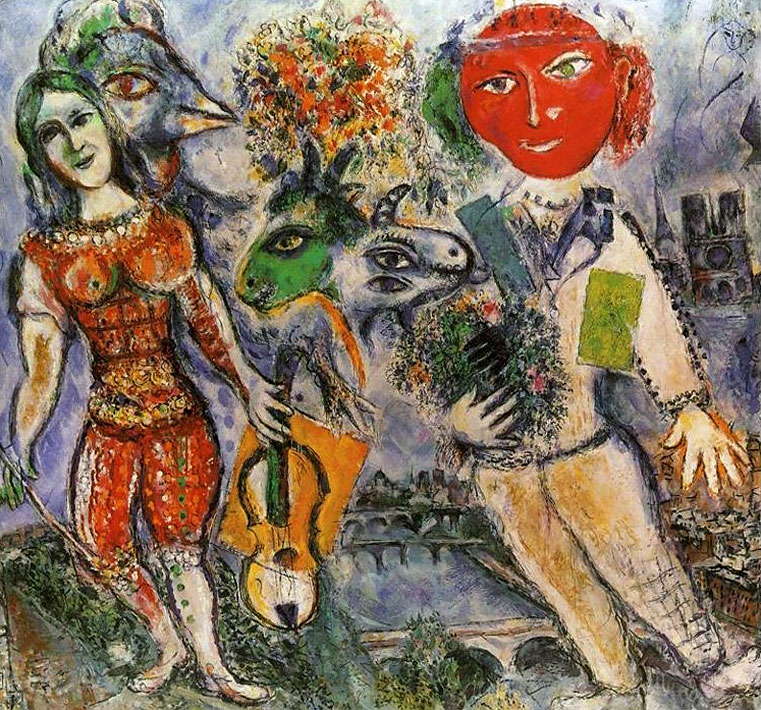
Marc Chagall (French born Russia, 1887-1985) 'The Players' (i giocatori) 1968


Marc Chagall (French born Russia, 1887-1985)
The Players (i giocatori)
1968
Oil no canvas
150 x 160cm
Private collection


Marc Chagall (French born Russia, 1887-1985) 'The Grand Parade' 1979


Marc Chagall (French born Russia, 1887-1985)
The Grand Parade
1979
Oil on canvas
119 x 132cm
Private collection


“Will the hurried men of today be able to penetrate her work, her world?” is the question asked by Marc Chagall in 1947 in the postface to the memoirs of his wife Bella, who left him “in the shadows” following her sudden death three years earlier. However, this question could also be asked about his own work, the work of an artist who speaks such a universal language that he is loved by everyone alike, both young and old, men and women, scholars and men on the street. Chagall is an artist who is known and recognised by everyone and, out of all the 20th-century artists, was one of the few to remain faithful to himself despite living through a century of wars, catastrophes, political and technological upheavals.

The exhibition narrative has arisen from a question and a need: on the one hand, the attempt to understand the strength that an enabled an artist who experimented with the styles of all the avant-garde movements, to remain so consistent to himself, always curious about the world around him, developing a style that can be recognised immediately by people of any age and any social status; on the other, the need to study Chagall’s work in order to identify the secret behind the poetry of this fragile man who was yet able to keep faith with his traditions and with his humanity, despite living in a world shaken to the core by indescribable and until then unimaginable catastrophes.

The exhibition opened on 17 September at the Palazzo Reale in Milan and is the biggest retrospective ever devoted to Marc Chagall in the last 50 years in Italy, with over two hundred and twenty works – mainly paintings from 1908 onwards, when Chagall painted his first work Le Petit Salon, right up to his final, monumental works of the 1980s – which guide visitors through the artistic career of Marc Chagall. Works from the collections of his heirs, some of which have not been exhibited to the public before, feature alongside masterpieces from the world’s most important museums, including the MoMA, the Metropolitan Museum in New York, the National Gallery in Washington, the State Russian Museum in St Petersburg, the Centre Pompidou, and over fifty public and private collections that have so generously collaborated. The exhibition theme therefore focuses on a new interpretation of the language of Chagall, whose poetic vein developed throughout the 20th century out of a blend of the best western European traditions: from his original Jewish culture to the Russian culture and his encounter with French avant-garde painting.

“The exhibition features a comprehensive chronological narrative, which is divided into sections, starting with his earliest works painted in Russia; his first visit to France and his subsequent return to Russia where he stayed until 1921; the second period of his exile, opened by the autobiography written by Chagall when he left Russia forever, living firstly in France and then, in the 1940s running away from Nazism, in America where he endured the tragedy of the death of his beloved wife Bella; his return to France and his decision to settle permanently on the Cote d’Azur, where Chagall rediscovered his most relaxed poetic language, calmed by the colours and atmosphere of the south.

The exhibition provides visitors with an understanding of how, despite living in perennial exile, Chagall never lost hold of the thread that kept the child he used to be in his heart; how, over the years and throughout the terrible events that marred his existence, he succeeded in preserving his sense of amazement, joy and wonder inspired by nature and humanity, as well as his strong faith that led him to believe in the possibility of a better world and seek to build it in all possible ways. Visitors will also discover his highly original poetic language, born out of the assimilation of the three cultures to which he belonged: Jewish culture (the visual tradition of its ornate manuscripts inspired the expressive, non-perspectival and sometimes mystic elements of his work); Russian culture (evident both in the folk images of the luboks and the religious images of the icons); western culture (in which he assimilates the great artists of tradition, from Rembrandt to the avant-garde artists whom he frequented so assiduously). They will also observe his sense of wonder at nature and the amazement inspired by living creatures that places him closer to mediaeval sources than 20th-century ones.

Flowers and animals are a constant presence in his paintings, enabling him on the one hand to overcome the Jewish interdiction of human depiction, while on the other becoming metaphors for a possible world in which all living beings can live in peace as in Russian mediaeval culture. In the words of Giovanni Arpino: “The soul of Chagall is a bleating soul, as mild as it is invincible because it escapes the horrors, the snares, the outrages … His paradise is an earthly Otherworld that encompasses the simulacra of life, a physical place that becomes metaphysical precisely because we have all killed it during daily life.” His art constitutes a sort of metissage [mix] between cultures and traditions. The fundamental key to his modernity lies in his desire to transform contamination into a value, a work of art into a language able to ask questions that have as yet been left unanswered by mankind.

After Milan the exhibition will travel to the prestigious Musees royaux des Beaux-Arts de Belgique / Koninklike Musea voor Schone Kunsten van Belgie, Bruxelles.

Press release from the Palazzo Reale website


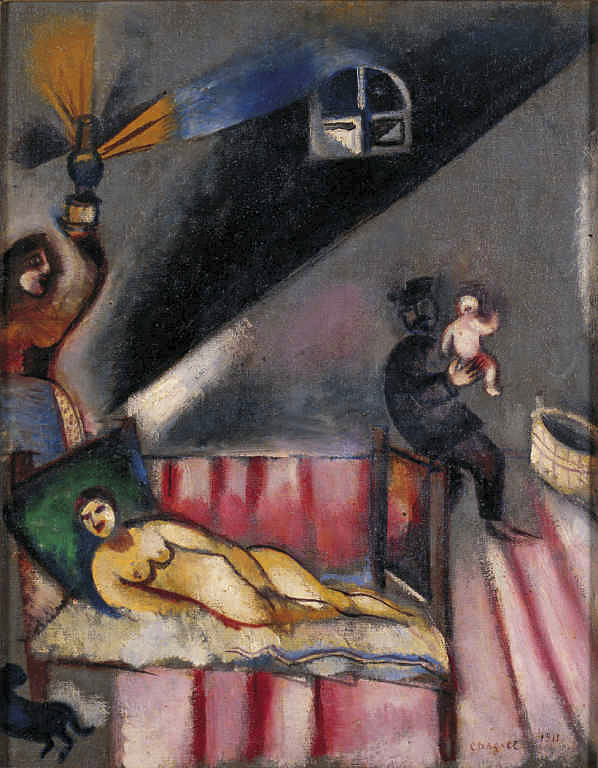
Marc Chagall (French born Russia, 1887-1985) 'La nascita' (The birth) 1911


Marc Chagall (French born Russia, 1887-1985)
La nascita (The birth)
1911
Oil on canvas original pasted on wood (plywood)
Private collection
© Chagall ® by SIAE 2014


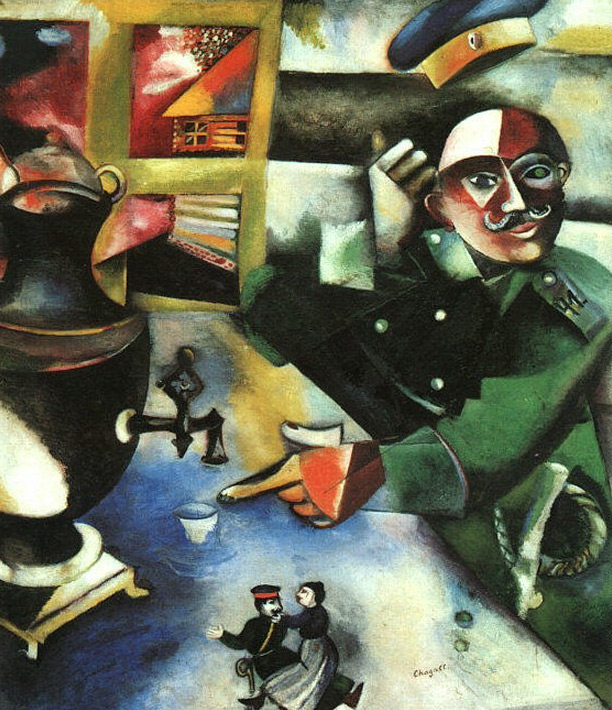
Marc Chagall (French born Russia, 1887-1985) 'The Soldier Drinks' 1911


Marc Chagall (French born Russia, 1887-1985)
The Soldier Drinks (Soldato che beve)
1911
Oil on canvas
109.8 x 94.7cm
Solomon R. Guggenheim Museum, New York


Marc Chagall (French born Russia, 1887-1985) 'Bride with Fan' 1911


Marc Chagall (French born Russia, 1887-1985)
Bride with fan (Sposa con ventaglio)
1911
Oil on canvas
Private Collection


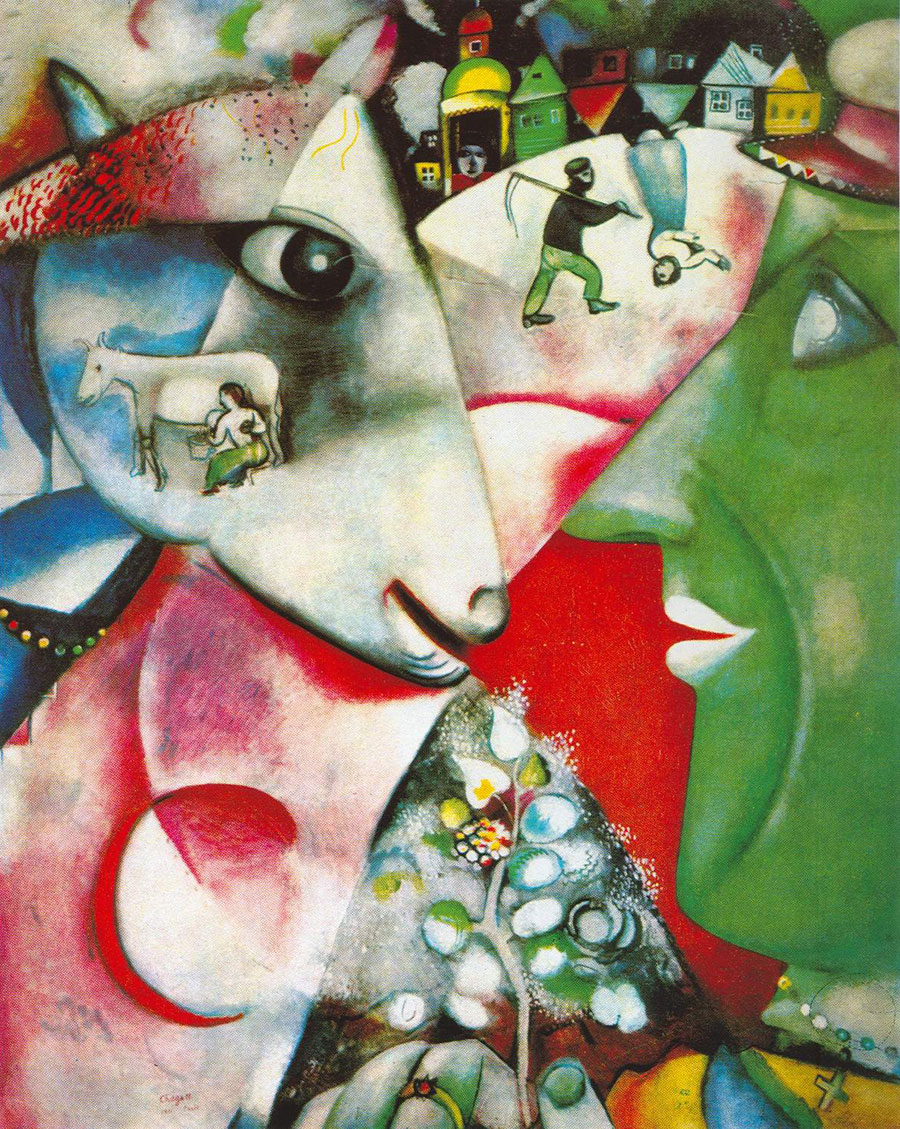
Marc Chagall (French born Russia, 1887-1985) 'I and the village' 1911


Marc Chagall (French born Russia, 1887-1985)
I and the Village
1911
Oil on canvas
192.1 x 151.4cm
Museum of Modern Art, New York


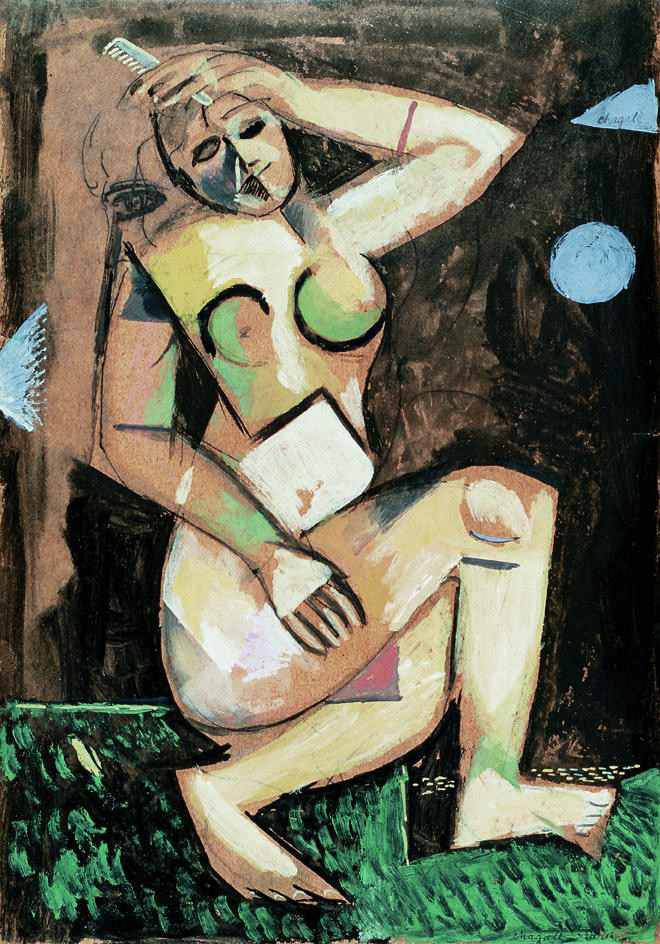
Marc Chagall (French born Russia, 1887-1985) 'Nude with comb' 1911-1912


Marc Chagall (French born Russia, 1887-1985)
Nude with comb (Nuda con pettine)
1911-1912
Black ink and gouache on paper


Marc Chagall (French born Russia, 1887-1985) 'The Fiddler' 1912


Marc Chagall (French born Russia, 1887-1985)
The Fiddler
1912
Oil on canvas
188 x 158cm
Stedelijk Museum, Amsterdam


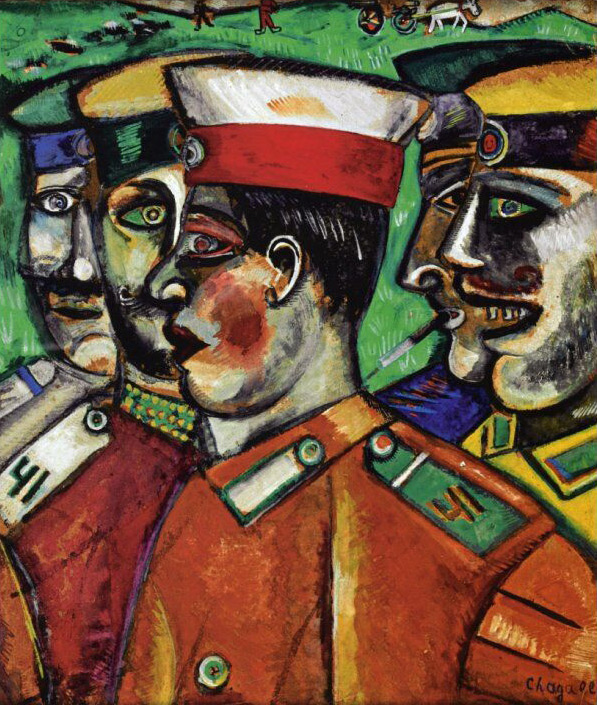
Marc Chagall (French born Russia, 1887-1985) 'Soldiers' 1912


Marc Chagall (French born Russia, 1887-1985)
Soldiers
1912
Private collection
38.1 x 32.4cm


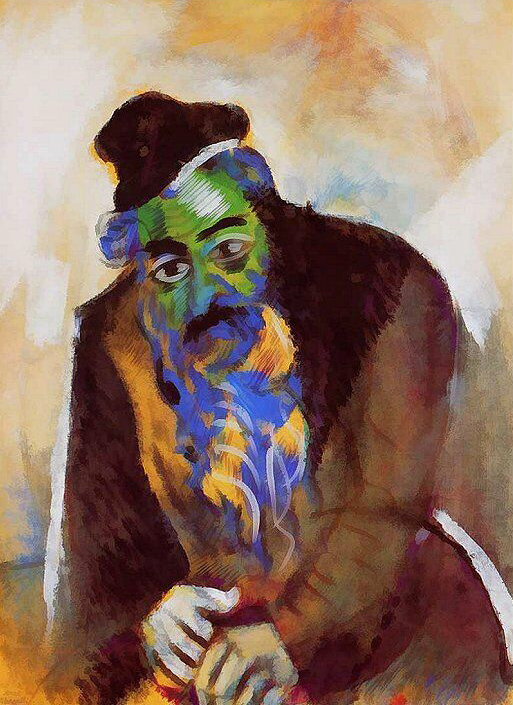
Marc Chagall (French born Russia, 1887-1985) 'The Old Jew' (il vecchio ebreo) 1912


Marc Chagall (French born Russia, 1887-1985)
The Old Jew (il vecchio ebreo)
1912
Oil on canvas


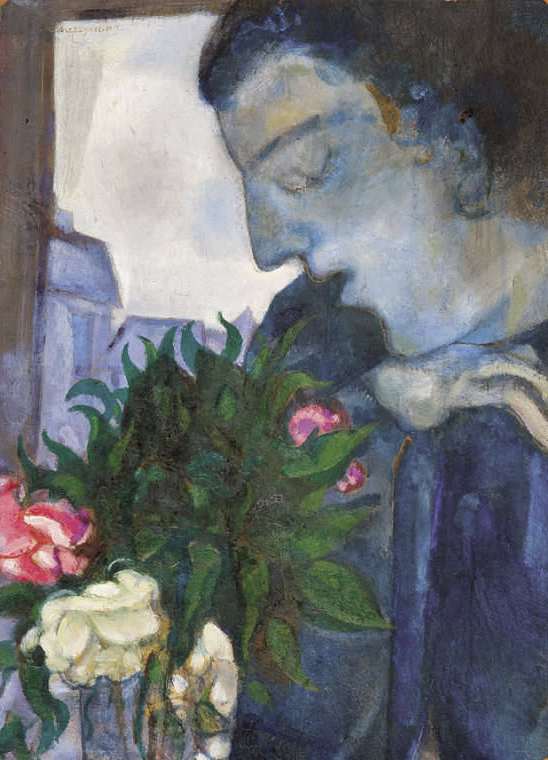
Marc Chagall (French born Russia, 1887-1985) 'Self-portrait in profile' 1914


Marc Chagall (French born Russia, 1887-1985)
Self-portrait in profile
1914
Oil on cardboard
34 x 27.9cm
Private collection


Marc Chagall (French born Russia, 1887-1985) 'Blue Lovers' 1914


Marc Chagall (French born Russia, 1887-1985)
Blue Lovers
1914
Tempera on paper pasted on cardboard
49 x 44cm
Private collection


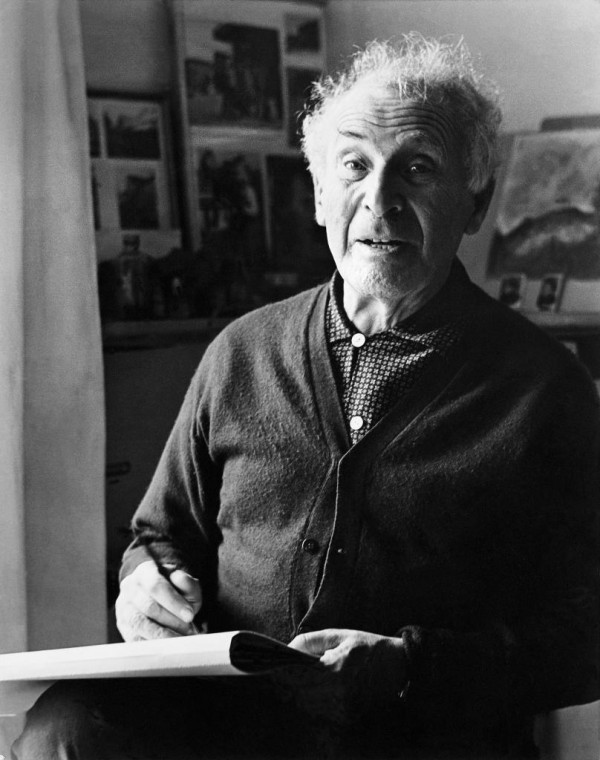
Marc Chagall in his studio of Saint-Paul de Vence


Marc Chagall in his studio of Saint-Paul de Vence
Nd


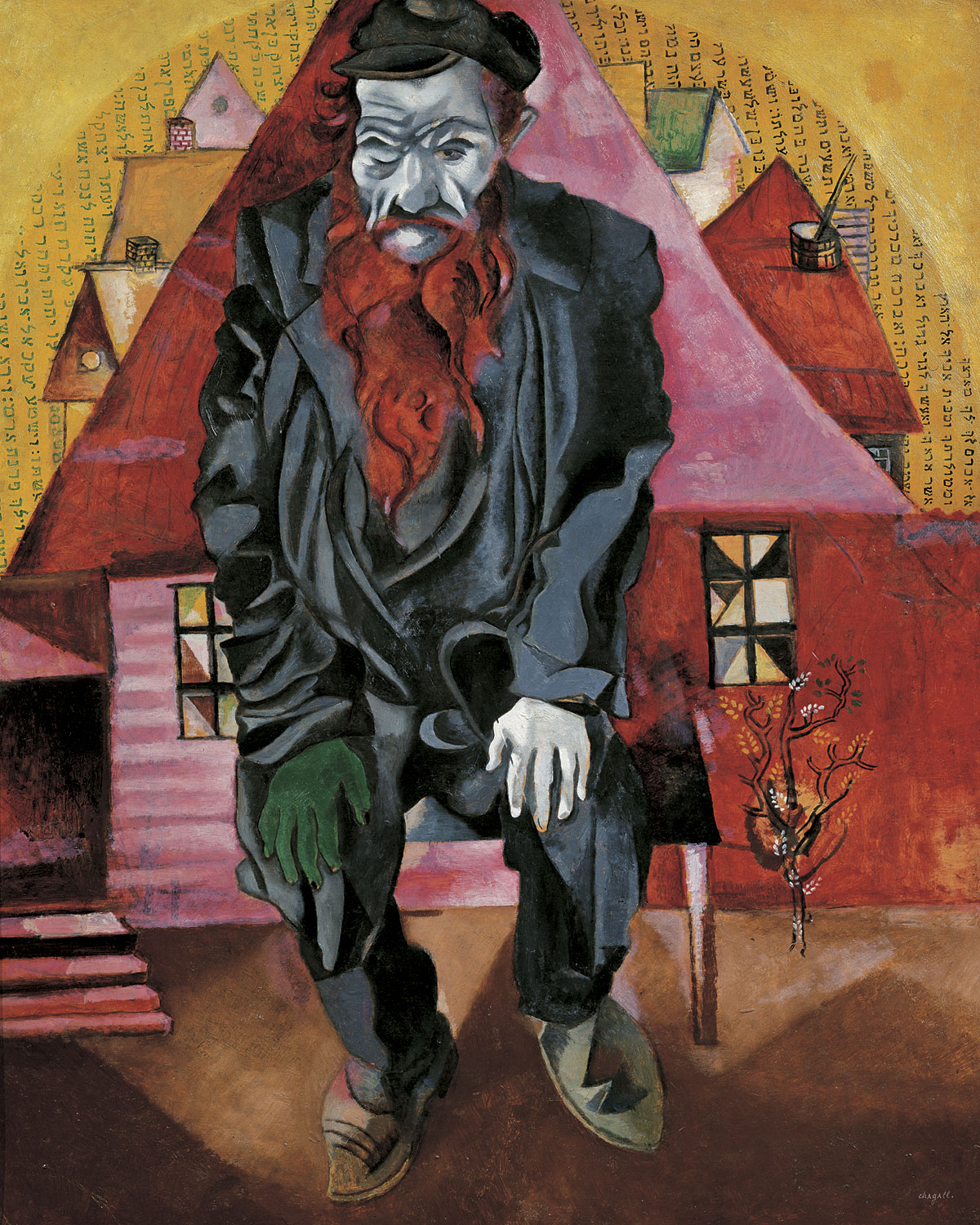
Marc Chagall (French born Russia, 1887-1985) 'Red Jew' 1915


Marc Chagall (French born Russia, 1887-1985)
Red Jew
1915
Oil on cardboard
Russian Museum, St. Petersburg, Russia


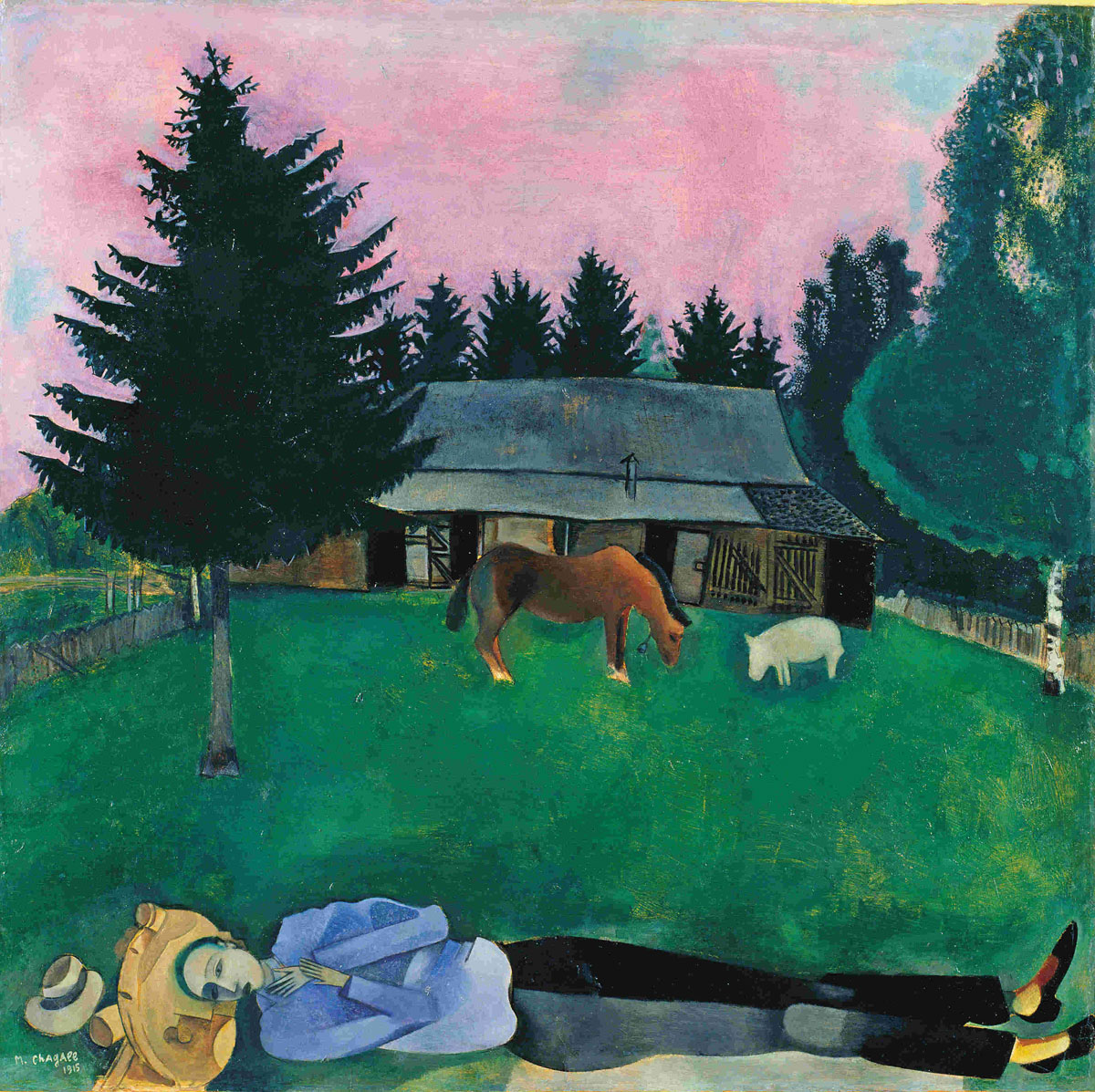
Marc Chagall (French born Russia, 1887-1985) 'The Poet Reclining' 1915


Marc Chagall (French born Russia, 1887-1985)
The Poet Reclining (Il poeta giacente)
1915
Oil on board
Support: 772 x 775mm
Frame: 953 x 960 x 91mm
© Tate, London 2014 © Chagall ® by SIAE 2014


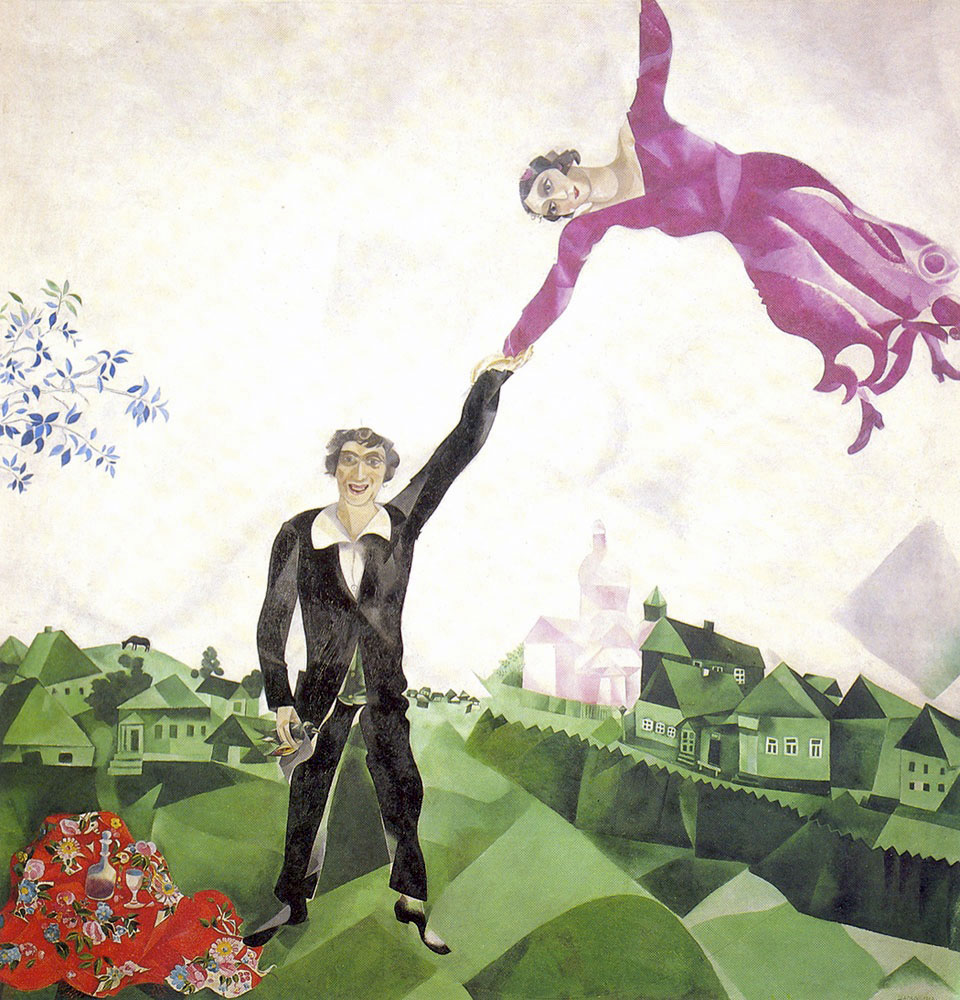
Marc Chagall (French born Russia, 1887-1985) 'La passeggiata' (The walk) 1917-1918


Marc Chagall (French born Russia, 1887-1985)
La passeggiata (The walk)
1917-1918
Oil on canvas
Russian State  Museum, St. Petersburg
© Chagall ® by SIAE 2014


Marc Chagall (French born Russia, 1887-1985) 'Al Cavalletto (tavola 18 di "Ma Vie")' 1922


Marc Chagall (French born Russia, 1887-1985)
Al Cavalletto (tavola 18 di “Ma Vie”)
1922
Etching and drypoint on Japanese paper
Private collection
© Chagall ® by SIAE 2014


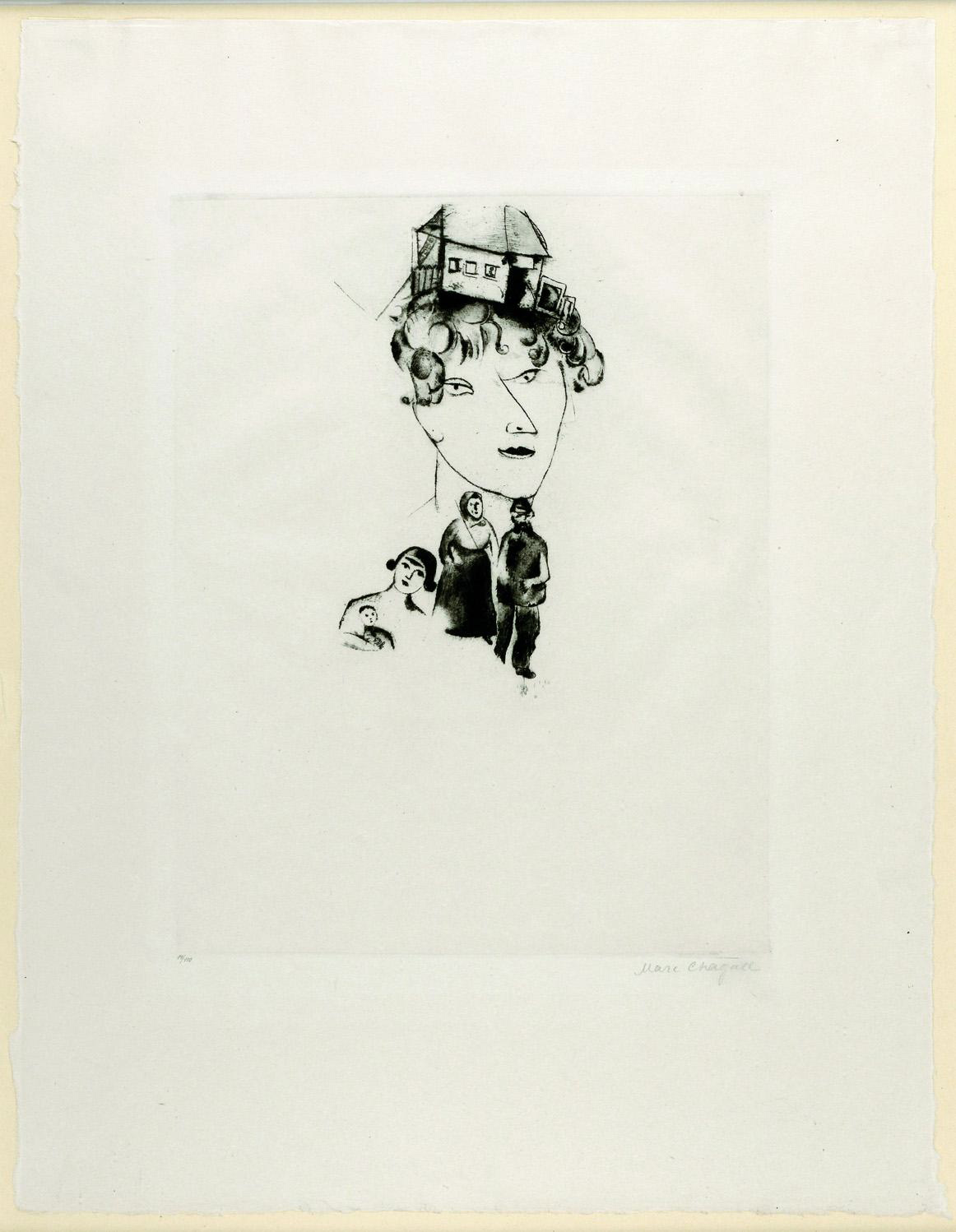
Marc Chagall (French born Russia, 1887-1985) 'Autoritratto (tavola 17 di "Ma Vie")' 1922


Marc Chagall (French born Russia, 1887-1985)
Autoritratto (tavola 17 di “Ma Vie”) (Self-portrait)
1922
Etching and drypoint on Japanese paper
Private collection
© Chagall ® by SIAE 2014


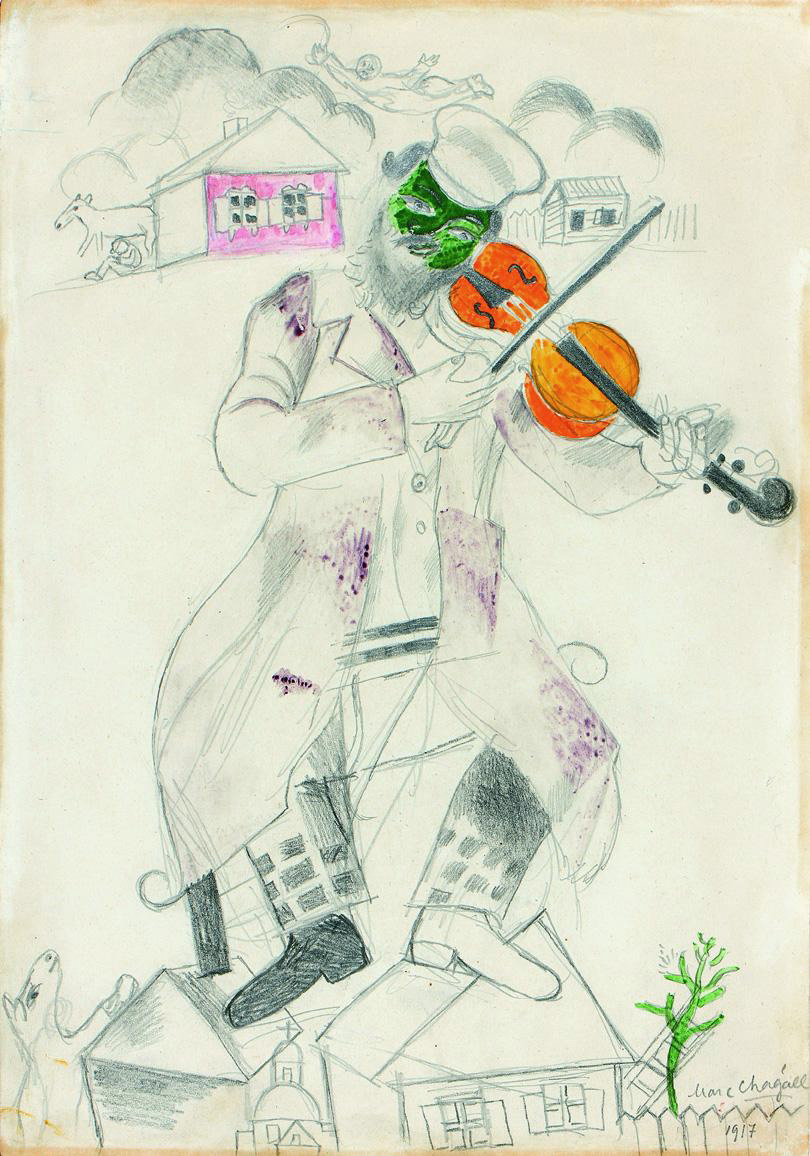
Marc Chagall (French born Russia, 1887-1985) 'Study for The green violinist' 1917


Marc Chagall (French born Russia, 1887-1985)
Study for The green violinist (studio violinista verde)
1917


Marc Chagall (French born Russia, 1887-1985) 'Two pigeons' 1925


Marc Chagall (French born Russia, 1887-1985)
Two pigeons
1925
Gouache, ink and blue ink on coloured paper
Private collection


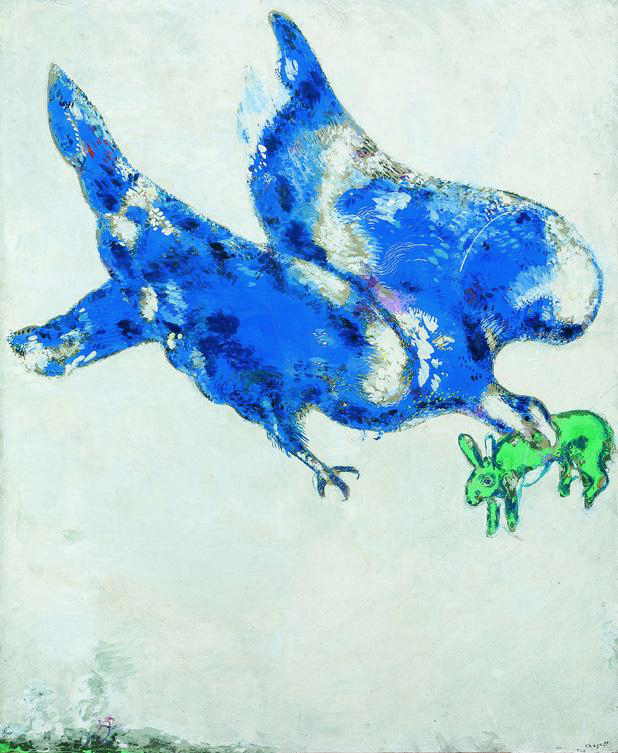
Marc Chagall (French born Russia, 1887-1985) 'L'aquila e lo scarabeo' 1926


Marc Chagall (French born Russia, 1887-1985)
L’aquila e lo scarabeo
1926
Gouache on paper pasted on wooden panel
Private collection
© Chagall ® by SIAE 2014


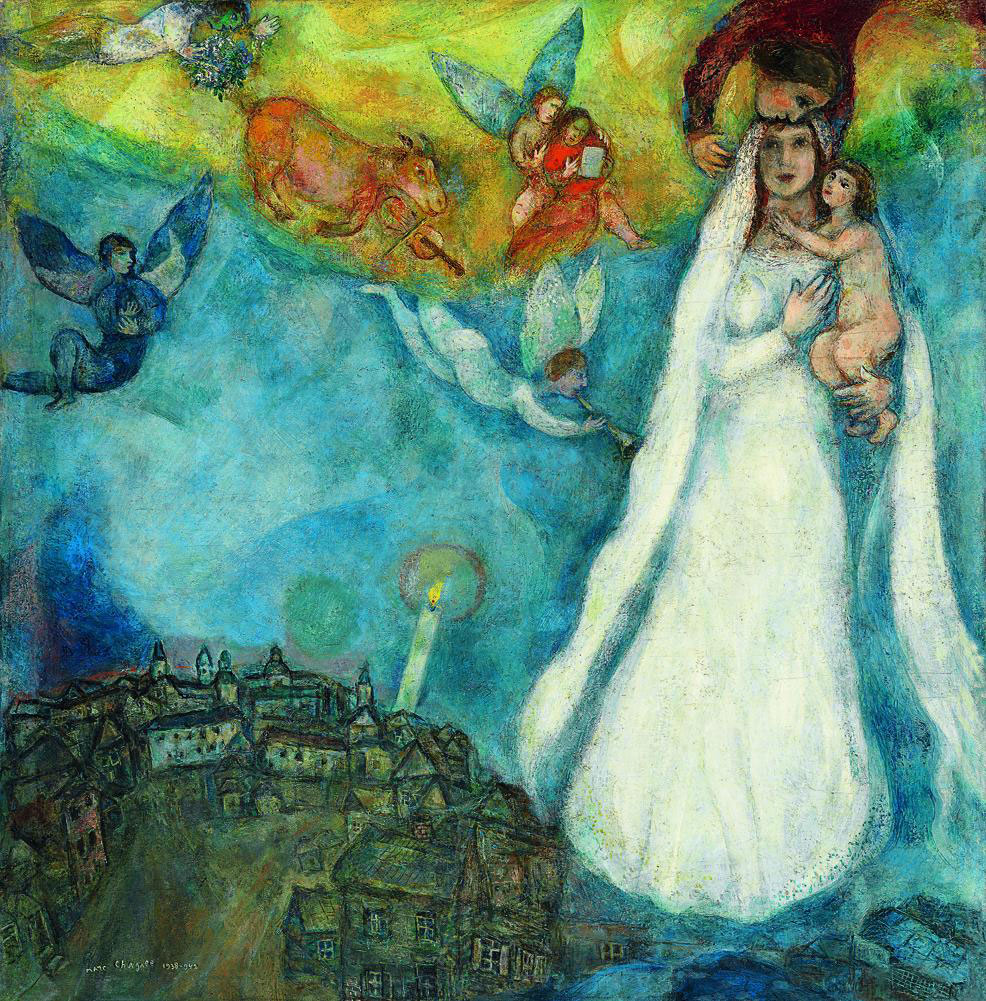
Marc Chagall (French born Russia, 1887-1985) 'The Madonna of the Village' 1938-1942


Marc Chagall (French born Russia, 1887-1985)
The Madonna of the Village
1938-1942
Oil on canvas
Thyssen-Bornemisza Museum, Madrid
© Chagall ® by SIAE 2014


Marc Chagall (French born Russia, 1887-1985) 'Mondo rosso e nero o Sole rosso' (Red and black world) 1951


Marc Chagall (French born Russia, 1887-1985)
Mondo rosso e nero o Sole rosso (Red and black world)
1951
Gouache, watercolour, pastel on paper pasted on canvas
Private collection


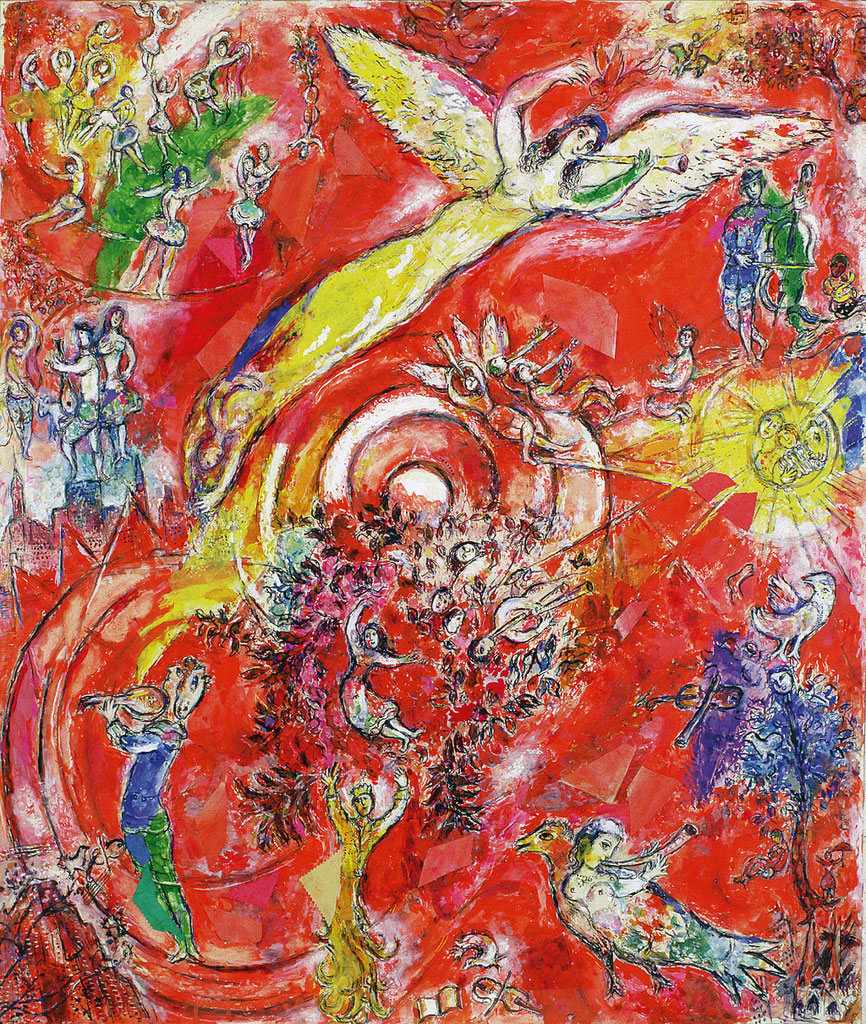
Marc Chagall (French born Russia, 1887-1985) 'Il trionfo della musica - Maquette per il murale Metropolitan Opera, Lincoln Art Center, New York' 1966


Marc Chagall (French born Russia, 1887-1985)
Il trionfo della musica – Maquette per il murale Metropolitan Opera, Lincoln Art Center, New York (The triumph of music – Maquette for the mural Metropolitan Opera, Lincoln Art Center, New York)
1966
Tempera, gouache and collage on paper
Private collection


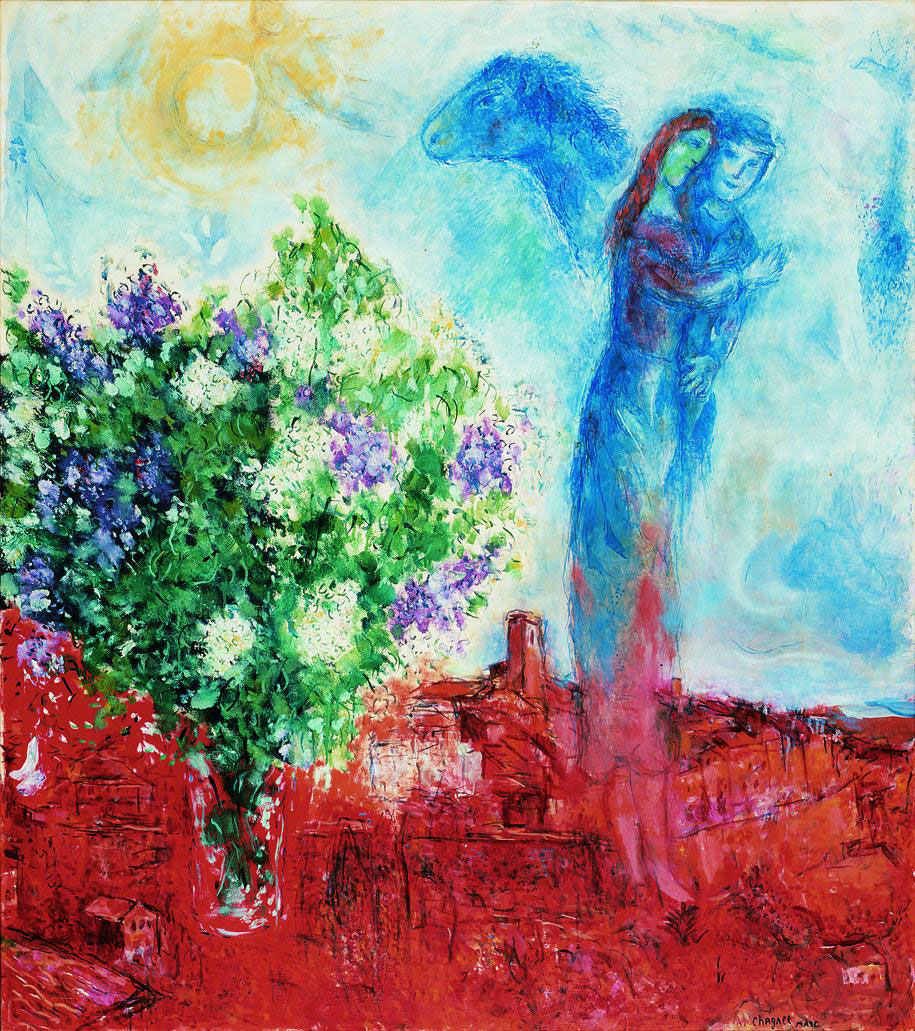
Marc Chagall (French born Russia, 1887-1985) 'Lovers over Saint-Paul' 1968


Marc Chagall (French born Russia, 1887-1985)
Lovers over Saint-Paul
1968
Oil, tempera and sawdust on canvas
145 x 130cm
Private collection
© Chagall ® by SIAE 2014


Palazzo Reale
Piazza del Duomo 12
Milan, Italy

Opening times:
Tuesday – Sunday 10 – 19.30

Palazzo Reale website

LIKE ART BLART ON FACEBOOK

Back to top

Exhibition: ‘Robert Gober: The Heart Is Not a Metaphor’ at the Museum of Modern Art (MoMA), New York

Exhibition dates: 4th October, 2014 – 18th January, 2015

Curators: Ann Temkin, The Marie-Josée and Henry Kravis Chief Curator of Painting and Sculpture, and Paulina Pobocha, Assistant Curator, Department of Painting and Sculpture


Many thankx to MoMA for allowing me to publish the photographs in the posting. Please click on the photographs for a larger version of the image.


Robert Gober (American, b. 1954)
 'X Playpen' 1987 from the exhibition 'Robert Gober: The Heart Is Not a Metaphor' at the Museum of Modern Art (MoMA), New York, October 2014 - January 2015


Robert Gober (American, b. 1954)
X Playpen
1987
Wood and enamel paint
27 x 37 x 37″ (68.6 x 94 x 94cm)
Batsheva and Ronald Ostrow
Image credit: D. James Dee, courtesy the artist and Paula Cooper Gallery
© 2014 Robert Gober


“Begun in 1984, the sink series appeared during the darkest period of the AIDS epidemic. Gober, who is gay, responded to the tragedy with poetic indirection: the sinks’ cold air of clinical hygiene. The Times critic John Russell nailed the artistic effect: “Minimal forms with maximum content.” The fact that the content must be intuited by the viewer, who is free to regard the sinks as just cleverly manufactured found objects, typifies Gober’s circumspection. His works are enigmatic but not coy, morally driven but not aggrieved. They radiate a quality that is as rare in life as it is in art: character. …

The heart is an excitable physical organ that registers sensations of fight or flight and of love or aversion: the first and last unimpeachable witness to what can’t help but matter, for good and for ill, in every life.”


Peter Schjeldahl. “Found Meanings: A Robert Gober Retrospective,” October 6, 2014 in ‘The Art World’ October 13, 2014 Issue on ‘The New Yorker’ website [Online] Cited 09/07/2021. Used under fair use conditions for the purposes of education and research


Robert Gober (American, b. 1954)
 'The Ascending Sink' 1985 from the exhibition 'Robert Gober: The Heart Is Not a Metaphor' at the Museum of Modern Art (MoMA), New York, October 2014 - January 2015


Robert Gober (American, b. 1954)
The Ascending Sink
1985
Plaster, wood, steel, wire lath, and semi-gloss enamel paint
Two components, each: 30 x 33 x 27″ (76.2 x 83.8 x 68.6cm); floor to top: 92″ (233.7cm)
Installed in the artist’s studio on Mulberry Street in Little Italy, Manhattan
Collection of Thea Westreich Wagner and Ethan Wagner, New York
Promised gift to the Whitney Museum of American Art
Image credit: John Kramer, courtesy the artist
© 2014 Robert Gober


Robert Gober (American, b. 1954) 'Untitled' 1984


Robert Gober (American, b. 1954)
Untitled
1984
Plaster, wood, wire lath, aluminium, watercolour, semi-gloss enamel paint
28 x 33 x 22 1/2″ (71.1 x 83.8 x 57.2cm)
Rubell Family Collection
Courtesy the artist and Matthew Marks Gallery
© 2014 Robert Gober


Robert Gober (American, b. 1954) 'Two Partially Buried Sinks' 1986-1987


Robert Gober (American, b. 1954)
Two Partially Buried Sinks
1986-1987
Cast iron and enamel paint
Right: 39 x 25 1/2 x 2 1/2″ (99.1 x 64.8 x 6.4cm)
Left: 39 x 24 1/2 x 2 3/4″ (99.1 x 62.2 x 7cm)
Private collection
Image credit: Andrew Moore, courtesy the artist
© 2014 Robert Gober


Robert Gober (American, b. 1954)
 '
Untitled Closet' 1989


Robert Gober (American, b. 1954)
Untitled Closet
1989
Wood, plaster, enamel paint
84 x 52 x 28″ (213.4 x 132.1 x 71.1cm)
Private collection
Courtesy the artist and Matthew Marks Gallery
© 2014 Robert Gober


Robert Gober (American, b. 1954)
 'Untitled' 1991


Robert Gober (American, b. 1954)
Untitled
1991
Wood, beeswax, human hair, fabric, paint, shoes
9 x 16 1/2 x 45″ (22.9 x 41.9 x 114.3cm)
Collection the artist
Image credit: Andrew Moore, courtesy the artist
© 2014 Robert Gober


Robert Gober (American, b. 1954)
 'Untitled' 1994-1995


Robert Gober (American, b. 1954)
Untitled
1994-1995
Wood, beeswax, brick, plaster, plastic, leather, iron, charcoal, cotton socks, electric light and motor
47 3/8 × 47 × 34″ (120.3 × 119.4 × 86.4cm)
Emanuel Hoffmann Foundation, on permanent loan to the Öffentliche Kunstsammlung Basel
Image credit: D. James Dee, courtesy the artist and Matthew Marks Gallery
© 2014 Robert Gober


Chronicling a 40-year career, Robert Gober: The Heart Is Not a Metaphor is the first large-scale survey of Robert Gober’s (American, b. 1954) work to take place in the United States. The exhibition is on view from October 4, 2014 to January 18, 2015, and features approximately 130 works across several mediums, including individual sculptures, immersive sculptural environments, and a distinctive selection of drawings and prints. Robert Gober: The Heart Is Not a Metaphor is organised by Ann Temkin, The Marie-Josée and Henry Kravis Chief Curator, and Paulina Pobocha, Assistant Curator, Department of Painting and Sculpture, MoMA, working in close collaboration with the artist.

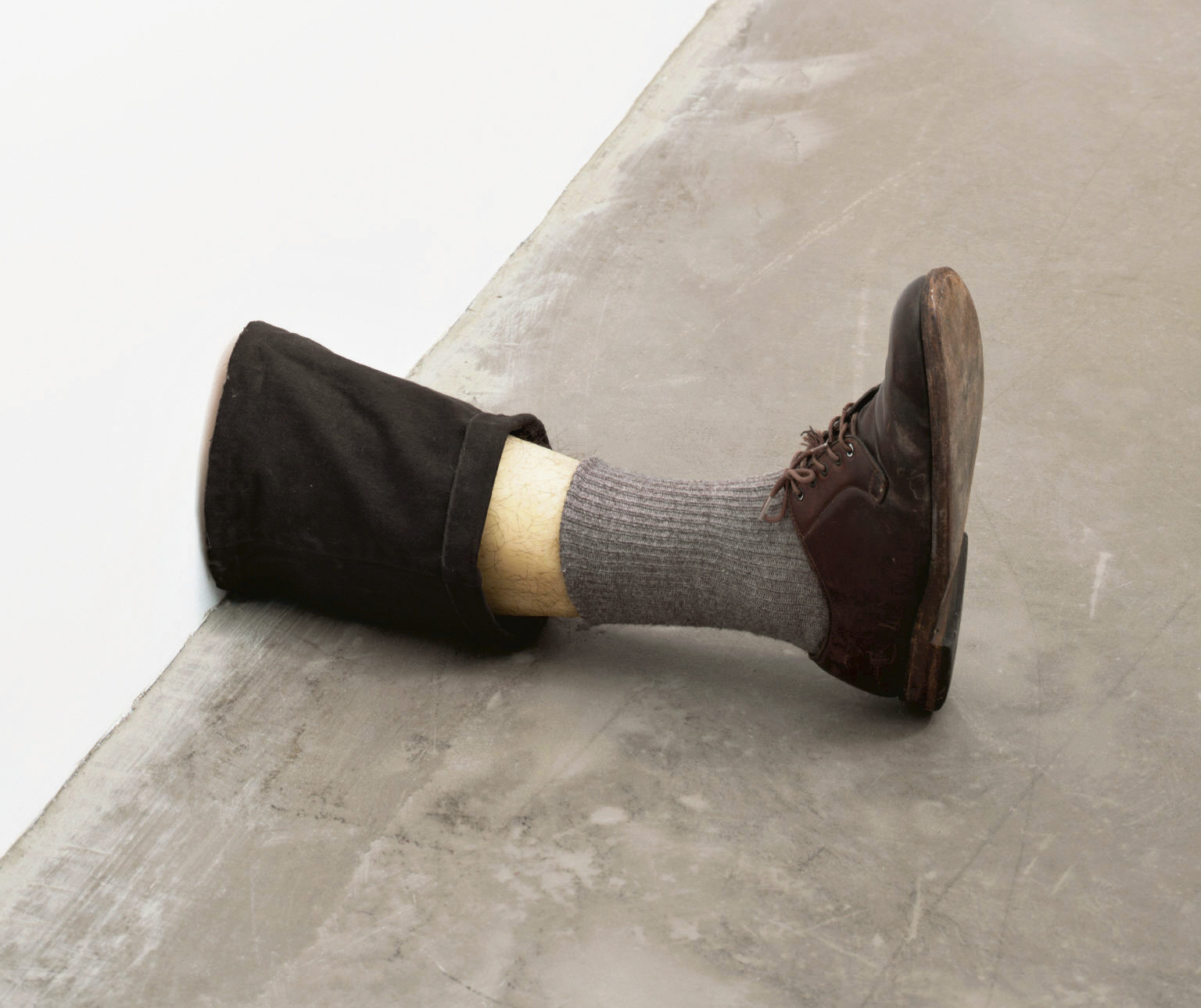
Early on, Gober’s sculptures declared themselves an indispensable part of the landscape of late-twentieth century art; since then they have continued to evolve while remaining tightly bound to the principles outlined by the artist almost four decades ago. Gober places narrative at the centre of his endeavour, embedding themes of sexuality, religion, and politics into work drawn from everyday life. Spare in its use of images and motifs while protean in its capacity to generate meaning, Gober’s work is an art of contradictions: intimate yet assertive, straightforward yet enigmatic. Taking imagery familiar to anyone – doors, sinks, legs – Gober dislocates, alters, and estranges what we think we know. Although a first glance might suggest otherwise, all of Gober’s objects are entirely handmade, by the artist and by collaborators with the necessary expertise.

The earliest works in the exhibition date from the mid-to-late 1970s when Gober was largely working in two dimensions. A painting of the house he grew up in Connecticut hangs at the entrance to the galleries. The first room of the exhibition offers an introduction to Gober’s career, as told through five works: a sculpture of a paint can, a man’s leg, and a closet, as well as a drawing and a small print.

Between 1983 and 1986, Gober created more than 50 sculptures of sinks and scores of related drawings. Based on real sinks, including one in the artist’s childhood home, Gober built them from wood, plaster, and wire lath, and finished them with multiple coats of paint to mimic the appearance of enamel. But, crucially, they lack faucets and plumbing. The sinks’ appearance coincided with the early years of the AIDS epidemic, and their uselessness spoke to the impossibility of cleansing oneself. The sculptures on view in the second gallery of the exhibition were featured in Gober’s first show of sinks, held at the Daniel Weinberg Gallery, Los Angeles, in 1985.

Gober’s early and straightforward sink sculptures gave way in 1985 to a group of distorted sinks whose bodies are variably stretched, bent, multiplied, and divided. The evolution of form registers in the works’ titles: self-evident descriptions become increasingly expressive (eg. The Sink Inside of Me). By the mid-1980s, the artist’s preoccupation with domestic objects expanded to include sculptures of furniture such as beds and playpens, as well as an armchair, on view in the third gallery. Between 1986 and 1987, Gober created Two-Partially Buried Sinks, among the last sink sculptures of the decade. This work is positioned outside the walls of the Museum on a scaffold, and can be viewed through the gallery’s window.

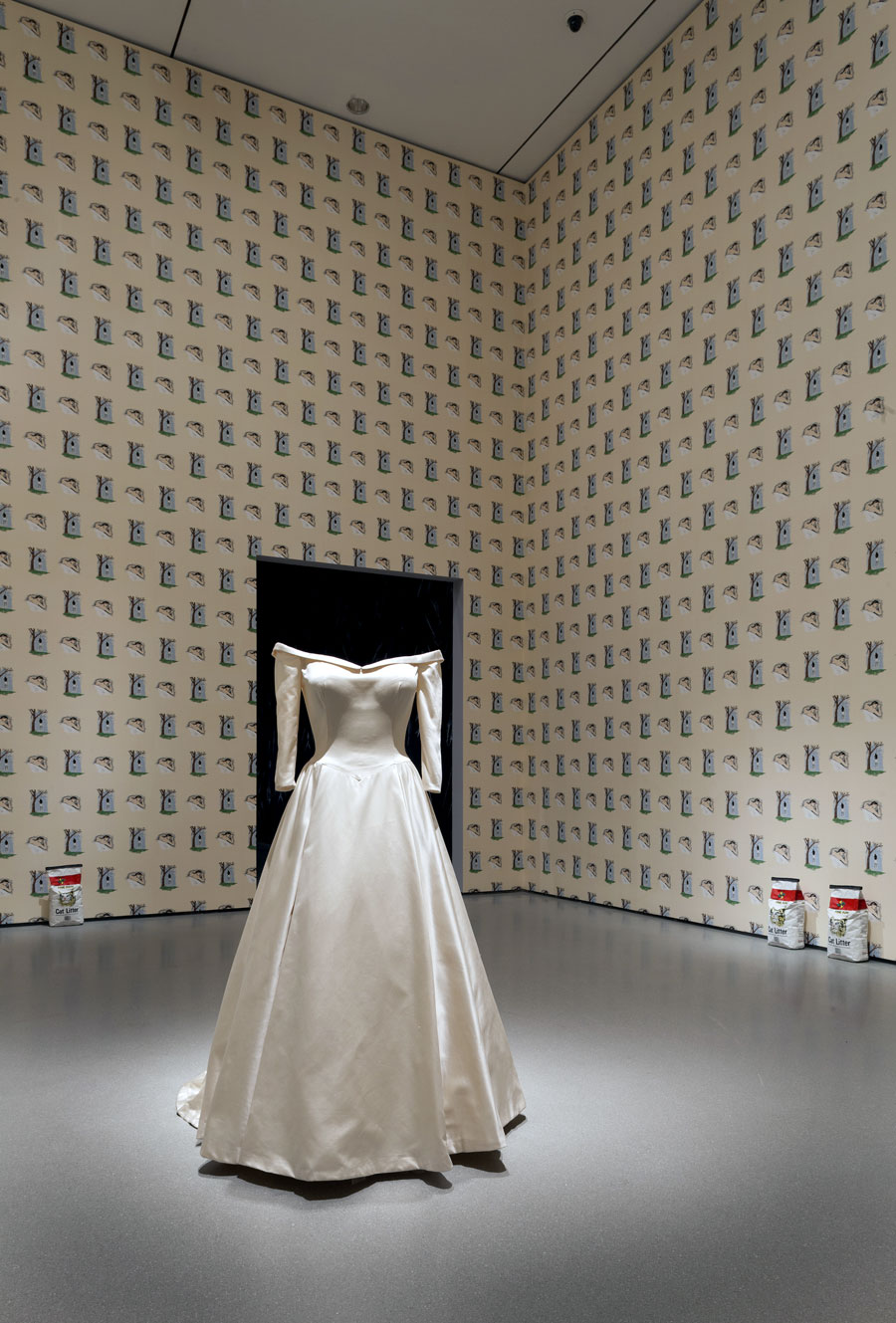
In 1989 at the Paula Cooper Gallery, Gober exhibited his first room-sized installations. Each is framed by wallpapers: a pattern pairing a sleeping white man and a lynched black man in one, and line drawings of male and female genitalia in the other, both of which are on view in the following galleries. These backdrops powerfully inflect the sculptures contained within: a freestanding bridal gown and hand-painted plaster cat litter bags in the first room and a bag of donuts with cast-pewter drains inset into the walls in the second. With characteristic concision, Gober sets off a complex swirl of questions about the unease surrounding issues to everyday life in America.

Gober made Slides of a Changing Painting between 1982 and 1983. During this year, he painted on a small Masonite board and photographed the imagery as it changed over time. Eventually, he had accumulated more than 1,000 slides, which he edited down and organised into a slide projection that he showed in 1984. After the exhibition, Gober put the slides away. When he revisited the project around 1990, he realised that he had unknowingly employed many of the same images in his subsequent sculptures. Slides of a Changing Painting has continued to be generative; it provides a nearly complete index of Gober’s visual themes and vocabulary. The work is on view in a gallery centrally located within the exhibition.

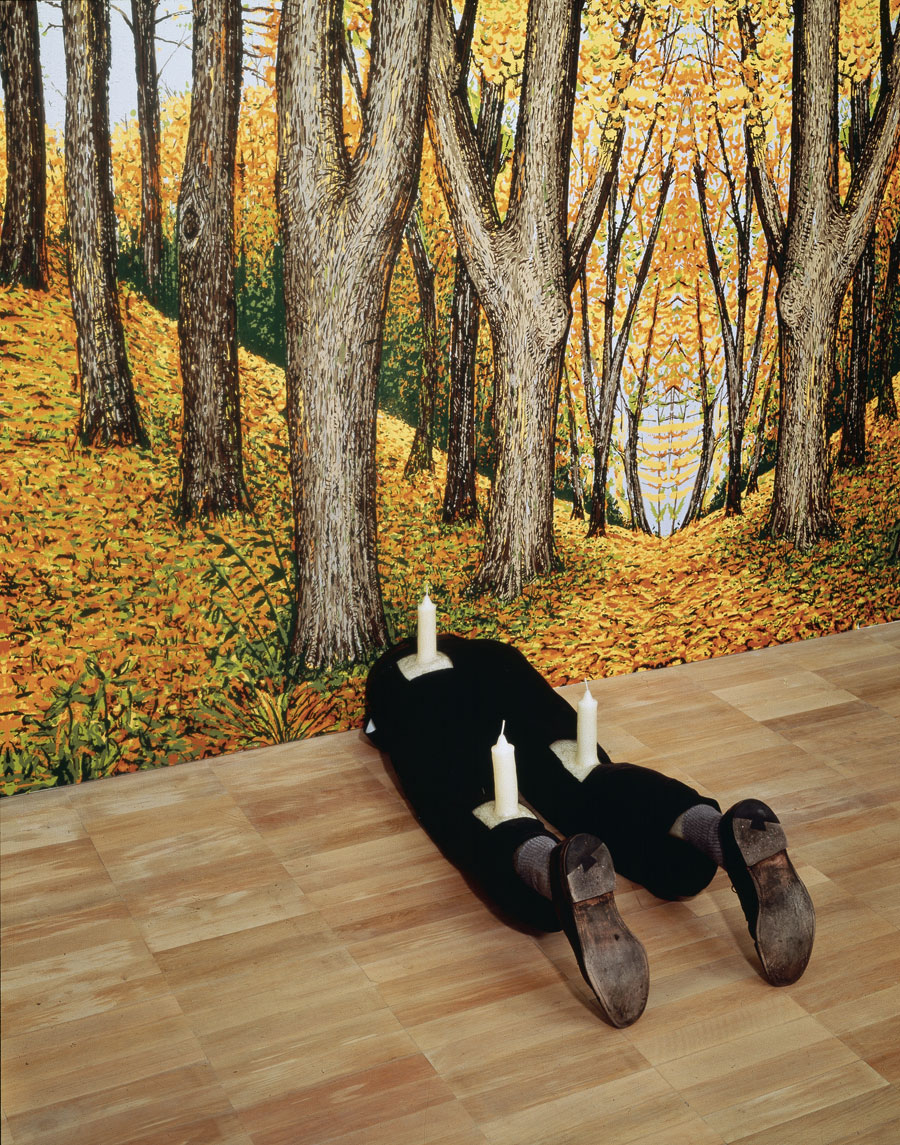
The human figure was absent from Gober’s sculptural repertoire until 1989, when he made his first sculpture of a man’s leg, a breakthrough that ushered in many related works. Single legs wearing trousers and shoes and truncated at mid-shin were followed by pairs of legs that Gober left whole to the waist. He showed these surreal sculptures in a 1991 exhibition in Paris, recreated in the following gallery. Three pairs of legs, augmented by candles, drains, and a musical score, are positioned around the perimeter of a room wallpapered with a kaleidoscopic landscape of a beech forest in autumn. In the centre of the gallery sits a human-sized cigar composed of tobacco sheafs purchased from a Pennsylvania supplier. To learn how to preserve this organic material as it aged, Gober consulted an expert at the American Museum of Natural History. Seeking out specialists’ advice on complicated projects is a hallmark of the artist’s craft based practice.

The works on view in the following gallery were made by artists Anni Albers, Robert Beck, Cady Noland, and Joan Semmel; photographs by Nancy Shaver hang in the adjoining space. Gober brought these objects together for the first time in an exhibition he organised at the Matthew Marks Gallery, New York in 1999. Gober has been curating exhibitions since the mid-1980s, most recently focusing on monographic presentations of the works by American artists Charles Burchfield and Forrest Bess. The contemporary artists included in this gallery share with Gober daring approaches to the representation of sexuality, violence, and American culture.

The immersive installation Gober conceived for a 1992 exhibition at the Dia Center for the Arts, New York is on view nearby. All three rooms of that original presentation are reconstructed: an antechamber, a central gallery, and a dark cul-de-sac. The main space features a hand-painted mural, executed in a paint-by-number method by scenic painters, depicting a forest inspired by the landscape of Long Island’s North Fork. Barred prison windows, through which a blue sky is visible, interrupt the verdant panorama. Placed throughout the gallery are hand-painted plaster sculptures of boxes of rat bait and bundles of newspapers – actually photolithographic facsimiles of newspapers featuring real and invented content. After a six-year absence from Gober’s work, sinks reappeared in the installation at Dia, water now running freely from their faucets.

Following the introduction of mens’ legs into his sculptural vocabulary, Gober cast the leg of a young boy and used that mould as the basis for several subsequent works, including a fireplace where legs take the place of firewood, a vision invoking childhood nightmares and uncensored fairy tales. Also on view is a sculpture of a suitcase that occupies space below ground as well as above. Its lid opens to reveal a sewer grate and a brick shaft that leads to a subterranean tidal pool complete with seaweed, mussel shells, and starfish. Visible through the depths of the water, amid the marine life, are the legs of a man and baby, one holding the other in a manner suggestive of baptism. While primarily a sculptor, Gober has worked across a range of media throughout his career including drawing and printmaking. Drawings sit the closest to his work in three dimensions; most of his sculptures and installations are preceded by preparatory drawings. A selection of Gober’s works on paper is also on view in this gallery.

The final installation included in the exhibition was made in response to the attacks of September 11, 2001, and results from Gober’s desire to create a space of refuge and reflection. The overall structure evokes the interior of a church: a central aisle separating rows of pews leads to an altar-like area flanked by two chapels. From the nipples of a headless Christ, regenerative “living water” flows into a large hole jackhammered into the floor. In the pastel drawings hanging on the side walls, the power of human embrace confronts the harrowing news contained within the photo-lithographed pages of the September 12, 2001, issue of The New York Times. In this installation, the overt references to Catholicism explore the vitality of such symbolism in the wake of contemporary tragedy.

Over the past decade, Gober’s sculptures have become increasingly complex, both technically and iconographically. The artist sometimes uses casts of existing sculptures and combines them to create hybrid objects, as in the conjunction of a chest, a stool, and a twisted network of children’s legs. Elsewhere, Gober pushes recognisable imagery into unpredictable terrain: a sink’s backsplash morphs into gnarled planks of wood interwoven with casts of fragmented arms. New motifs, such as a surrealistically melting rifle, also have entered the artist’s visual universe. The strangeness of these new sculptures is presaged by Prayers Are Answered (1980-1981), an early work loosely based on a Catholic church on 7th Street and Avenue B in the East Village. Rather than the traditional religious scenes to be found in paintings lining the walls, Gober has furnished the church with murals depicting the harshness of daily life in the city.

The exhibition’s final gallery presents works made as early as 1979 and as recently as this past spring. Images of domestic objects and architecture and themes of childhood and the body reverberates across the decades. The dollhouse placed on the floor is one of several that Gober designed and built during his first years in New York City, as one way of earning a living. The sculpture and installations that would follow may be considered life-size realisations of the imaginative potential contained within these small structures.

Published in conjunction with the exhibition and prepared in close collaboration with the artist, Robert Gober: The Heart Is Not a Metaphor traces the development of his work, highlighting themes and motifs to which he has returned throughout the decades. The book features an essay by Hilton Als – a text both wide-ranging and personal – and an in-depth narrative of Gober’s life. The rich selection of images illustrates every phase of the artist’s career, and includes previously unpublished photographs from his own archive. Hardcover. 6.5″w x 9.75″h; 272 pages; 169 illustrations. ISBN: 978-0-87070-946-3. $45.

Ann Temkin

The Marie-Josée and Henry Kravis Chief Curator of Painting and Sculpture
The Museum of Modern Art

Ms. Temkin assumed the role of Chief Curator of Painting and Sculpture in 2008, after joining The Museum of Modern Art in 2003 as Curator. During her tenure, Ms. Temkin has worked extensively with her colleagues on reimagining the Painting and Sculpture collection galleries at the Museum. Along with Robert Gober: The Heart Is Not A Metaphor, her exhibitions at MoMA include Ileana Sonnabend: Ambassador for the New (2013); Abstract Expressionist New York (2010); Gabriel Orozco (2009); and Color Chart: Reinventing Color, 1950 to Today (2008). Prior to MoMA, Ms. Temkin was the curator of modern and contemporary art at the Philadelphia Museum of Art from 1990 to 2003, where she organised such exhibitions as Barnett Newman (2002), Constantin Brancusi (1995), and Thinking is Form: The Drawings of Joseph Beuys (1994).

Paulina Pobocha

Assistant Curator, Department of Painting and Sculpture
The Museum of Modern Art

Ms. Pobocha is an assistant curator in the Department of Painting and Sculpture at The Museum of Modern Art. She joined the Museum in 2008 and has worked on the exhibitions Gabriel Orozco (2009) and Abstract Expressionist New York (2010). In 2013 she co-organised Claes Oldenburg: The Street and The Store. She has also worked extensively with the Museum’s collection. Prior to MoMA, Ms. Pobocha was a Joan Tisch Fellow at the Whitney Museum of American Art, where she lectured on a broad range of subjects in contemporary and modern art. In 2011, she was appointed Critic at the Yale University School of Art.

Press release from the MoMA website


Installation view of 'Robert Gober: The Heart Is Not a Metaphor', The Museum of Modern Art, October 4, 2014 - January 18, 2015


Robert Gober (American, b. 1954)
X Pipe Playpen
2013-14
Wood and bronze
26 1/8 x 55 x 55″ (66.4 x 139.7 x 139.7cm)
Collection the artist


Installation view of 'Robert Gober: The Heart Is Not a Metaphor', The Museum of Modern Art, October 4, 2014 - January 18, 2015 showing Gober's 'Untitled' 1989-1996


Robert Gober (American, b. 1954)
Untitled
 (installation view)
1989-1996
Silk satin, muslin, linen, tulle, welded steel, hand-printed silkscreen on paper, cast hydrostone plaster, vinyl acrylic paint, ink, and graphite
Dimensions variable, approximately 800 square feet installed
The Art Institute of Chicago, restricted gift of Stefan T. Edlis and H. Gael Neeson Foundation; through prior gifts of Mr. and Mrs. Joel Starrels and Fowler McCormick
© 2014 Robert Gober


Robert Gober (American, b. 1954) 'Bag of Donuts' 1989


Robert Gober (American, b. 1954)
Bag of Donuts
1989
paper, dough and rhoplex (12 donuts)
© 2014 Robert Gober


Robert Gober (American, b. 1954)
 'Untitled Leg' 1989-1990


Robert Gober (American, b. 1954)
Untitled Leg
1989-1990
Beeswax, cotton, wood, leather, human hair
11 3/8 x 7 3/4 x 20″ (28.9 x 19.7 x 50.8 cm)
The Museum of Modern Art, New York. Gift of the Dannheisser Foundation
© 2014 Robert Gober


Installation view of 'Robert Gober: The Heart Is Not a Metaphor', The Museum of Modern Art, October 4, 2014 - January 18, 2015 showing on the floor, Gober's 'Cigar' 1991


Robert Gober (American, b. 1954)
Cigar (installation view)
1991
Wood, paint, paper, tobacco
15 3/4 x 15 3/4 x 70 7/8″ (40 x 40 x 180cm)
The Museum of Contemporary Art, Los Angeles. Purchased with funds provided by the Collectors Committee in honour of Marcia Simon Weisman
© 2014 Robert Gober

Robert Gober (American, b. 1954)
Forest
1991
Hand-printed silkscreen on paper
180″ x 124″ (457.2 x 315cm)
Courtesy the artist
© 2014 Robert Gober


Robert Gober (American, b. 1954) '
Untitled' 1991


Robert Gober (American, b. 1954)
Untitled
1991
Wood, beeswax, leather, fabric, and human hair
13 1/4 x 16 1/2 x 46 1/8″ (33.6 x 41.9 x 117.2cm)
The Museum of Modern Art, New York. Gift of Werner and Elaine Dannheisser
Background: Forest, 1991
Hand-painted silkscreen on paper
Image credit: K. Ignatiadis, courtesy the artist and Matthew Marks Gallery
© 2014 Robert Gober


Installation view of 'Robert Gober: The Heart Is Not a Metaphor', The Museum of Modern Art, October 4, 2014 - January 18, 2015 showing Gober's 'Untitled' 1992


Robert Gober (American, b. 1954)
Untitled (installation view)
1992
Paper, twine, metal, light bulbs, cast plaster with casein and silkscreen ink, stainless steel, painted cast bronze and water, plywood, forged iron, plaster, latex paint and lights, photolithography on archival (Mohawk Superfine) paper, twine, hand-painted forest mural
511 3/4 × 363 3/16 × 177 3/16″ (1300 × 922.5 × 450.1cm)
Glenstone
© 2014 Robert Gober


Robert Gober (American, b. 1954) '
Untitled' 1992


Robert Gober (American, b. 1954)
Untitled
1992
Paper, twine, metal, light bulbs, cast plaster with casein and silkscreen ink, stainless steel, painted cast bronze and water, plywood, forged iron, plaster, latex paint and lights, photolithography on archival (Mohawk Superfine) paper, twine, hand-painted forest mural
511 3/4 × 363 3/16 × 177 3/16″ (1300 × 922.5 × 450.1cm)
Glenstone
Image credit: Russell Kaye, courtesy the artist and Matthew Marks Gallery
© 2014 Robert Gober


Robert Gober (American, b. 1954) 'Untitled' 2003-2005


Robert Gober (American, b. 1954)
Untitled
2003-2005
Courtesy MoMA and Matthew Marks Gallery
Image credit: Russel Kaye
© 2014 Robert Gober


Installation view of 'Robert Gober: The Heart Is Not a Metaphor', The Museum of Modern Art, October 4, 2014 - January 18, 2015 showing Gober's 'Untitled' 2003-2005 (detail)


Robert Gober (American, b. 1954)
Untitled (detail)
2003-2005
© 2014 Robert Gober


Robert Gober (American, b. 1954) 'Untitled' 1980-1981


Robert Gober (American, b. 1954)
Untitled
1980-1981
Oil on wood panel
8 x 5 3/4″ (20.3 x 14.6cm)
Collection the artist
Image credit: Ron Amstutz, courtesy the artist and Matthew Marks Gallery
© 2014 Robert Gober


Robert Gober (American, b. 1954) '
Slip Covered Armchair' 1986-1987


Robert Gober (American, b. 1954)
Slip Covered Armchair
1986-1987
Plaster, wood, linen, and fabric paint
31 1/2 x 30 1/2 x 29″ (80 x 77.5 x 73.7cm)
Collection the artist
Image credit: D. James Dee, courtesy the artist
© 2014 Robert Gober


Installation view of 'Robert Gober: The Heart Is Not a Metaphor', The Museum of Modern Art, October 4, 2014 - January 18, 2015 showing Gober's 'Untitled Door and Door Frame' 1987-1988


Robert Gober (American, b. 1954)
Untitled Door and Door Frame (installation view)
1987-1988
Wood, enamel paint
Door: 84 x 34 x 1 1/2″ (213.4 x 86.4 x 3.8cm)
Doorframe: 90 x 43 x 5 1/2″ (228.6 x 109.2 x 14cm)
Collection Walker Art Center, Minneapolis. Gift of the John and Mary Pappajohn Art Foundation, 2004
© 2014 Robert Gober

Installation views of Robert Gober: The Heart Is Not a Metaphor, The Museum of Modern Art, October 4, 2014 – January 18, 2015
All works by Robert Gober © 2014 Robert Gober © 2014 The Museum of Modern Art
Photos: Jonathan Muzikar


Robert Gober (American, b. 1954) 'Untitled' 2005-2006


Robert Gober (American, b. 1954)
Untitled
2005-2006
Aluminium-leaf, oil and enamel paint on cast lead crystal
4 3/4″ high × 4 1/4″ diameter (12.1 × 10.8cm)
Collection the artist
Image credit: Bill Orcutt, courtesy the artist and Matthew Marks Gallery
© 2014 Robert Gober


Robert Gober (American, b. 1954) '
Untitled' 2008


Robert Gober (American, b. 1954)
Untitled
2008
Cast gypsum polymer
14 1/2 x 10 3/4 x 6″ (36.8 x 27.3 x 15.2cm)
Edition of 4, with 1 AP
Collection the artist
Image credit: Fredrik Nilsen, courtesy the artist and Matthew Marks Gallery
© 2014 Robert Gober


Robert Gober (American, b. 1954) 'Leg with Anchor' 2008


Robert Gober (American, b. 1954)
Leg with Anchor
2008
Forged iron and steel, beeswax, cotton, leather, and human hair
28 × 18 × 20″ (71.1 × 45.7 × 50.8cm)
Glenstone
Image credit: Bill Orcutt, courtesy the artist and Matthew Marks Gallery
© 2014 Robert Gober


The Museum of Modern Art
11 West 53 Street
New York, NY 10019
Phone: (212) 708-9400

Opening hours:
10.30 am – 5.30 pm
Open seven days a week

MoMA website

LIKE ART BLART ON FACEBOOK

Back to top

Exhibition: ‘Eyes Wide Open: 100 Years of Leica Photography’ at Deichtorhallen Hamburg

Exhibition dates: 24th October, 2014 – 11th January, 2015

Curator: Hans-Michael Koetzle


Oskar Barnack (Germany, 1879-1936) 'Wetzlar Eisenmarkt' 1913 from the exhibition 'Eyes Wide Open: 100 Years of Leica Photography' at Deichtorhallen Hamburg, October 2014 - January 2015


Oskar Barnack (Germany, 1879-1936)
Wetzlar Eisenmarkt
1913
© Leica Camera AG


A photographic revolution. So much more than just photojournalism… and it has a nice sound as well.

“Indiscreet discretion” as the photographer F. C. Gundlach puts it.

There are some memorable photographs here.

Dr Marcus Bunyan


Many thankx to the Deichtorhallen Hamburg for allowing me to publish the photographs in the posting. Please click on the photographs for a larger version of the image.


Ernst Leitz (German, 1843-1920) 'New York II' 1914 from the exhibition 'Eyes Wide Open: 100 Years of Leica Photography' at Deichtorhallen Hamburg, October 2014 - January 2015


Ernst Leitz (German, 1843-1920)
New York II
1914
© Leica Camera AG


Just a few months before the outbreak of the First World War, Ernst Leitz II travelled to the USA. While there, he was able to capture photos, using a second model of the “Liliput” camera developed by Oskar Barnack, which most certainly would be found in a history of street photography.


Oskar Barnack (Germany, 1879-1936) 'Flood in Wetzlar' 1920


Oskar Barnack (Germany, 1879-1936)
Flood in Wetzlar
1920
© Leica Camera AG


From around the time of 1914, Oskar Barnack must have carried a prototype camera with him, particularly during his travels – the camera first received the name Leica in 1925. Perhaps his most famous sequence of images, because it has been shown continually since, is the striking series of the floods in Wetzlar, Germany, in 1920


'Ur-Leica' 1914


Ur-Leica
1914
© Leica Camera AG


Oskar Barnack invents the Ur-Leica

Designed by Oskar Barnack, the first functional prototype of a new camera for 35 mm perforated cinema film stock was completed in March 1914. The camera consisted of a metal housing, had a retractable lens and a focal plane shutter, which is not overlapped, however. A bolt-on lens cap that was swivelled during film transport, prevented incidental light. For the first time film advance and shutter cocking were connected to a camera – double exposures were excluded. The camera has gone down in the history of photography under the name Ur-Leica.


Ilse Bing (German, 1899-1998) 'Self-portrait in Spiegeln' 1931


Ilse Bing (German, 1899-1998)
Self-portrait in Spiegeln
1931
© Leica Camera AG


Anton Stankowski (German, 1906-1998) 'Greeting, Zurich, Rüdenplatz' 1932


Anton Stankowski (German, 1906-1998)
Greeting, Zurich, Rüdenplatz
1932
© Stankowski-Stiftung


Henri Cartier-Bresson (French, 1908-2004) 'Behind the Gare Saint-Lazare, Paris' 1932


Henri Cartier-Bresson (French, 1908-2004)
Behind the Gare Saint-Lazare, Paris
1932
Gelatin silver print


Alexander Rodchenko (Russian, 1891-1956) 'Girl with Leica' 1934


Alexander Rodchenko (Russian, 1891-1956)
Girl with Leica
1934
Gelatin silver print


Jewgenija Lemberg, shown here, was a lover of the photographer Alexander Rodchenko for quite some time. In 1992, a print of this photo brought in a tremendous 115,000 British pounds at a Christie’s auction in London. Alexander Rodchenko was continually capturing Jewgenija Lemberg in new, surprising and bold poses – until her death in a train accident. 


Heinrich Heidersberger (German, 1906-2006) 'Laederstraede, Copenhagen' 1935


Heinrich Heidersberger (German, 1906-2006)
Laederstraede, Copenhagen
1935
Gelatin silver print
© Institut Heidersberger


Robert Capa (Hungarian-American, 1913-1954) 'Loyalist Militiaman at the Moment of Death, Cerro Muriano, September 5, 1936' 1936


Robert Capa (Hungarian-American, 1913-1954)
Loyalist Militiaman at the Moment of Death, Cerro Muriano, September 5, 1936
1936
Gelatin silver print


At the age of 23 and equipped with his Leica, Robert Capa embedded himself in the Spanish Civil War while on assignment for the French press. On 5 September 1936, he managed to capture the perhaps most well-known war photo of the 20th century. 


Henri Cartier-Bresson (French, 1908-2004) 'Sunday on the banks of the River Marne' Juvisy France 1938


Henri Cartier-Bresson (French, 1908-2004)
Sunday on the banks of the River Marne
Juvisy, France 1938
Gelatin silver print


This photo was taken two years after the large-scale strikes that ultimately led to a fundamental improvement in social conditions. Against this backdrop, the picnic in nature is also, above all, a political message – convincing in a formal, aesthetic way, and inherently consistent and suggestive at the same time.


Evgeny Khaldey (Russian, 1917-1997) 'The Flag of Victory' 1945


Evgeny Khaldey (Russian, 1917-1997)
The Flag of Victory
1945
Gelatin silver print
© Collection Ernst Volland and Heinz Krimmer, Leica Camera AG


Although this scene was staged, it loses none of its impact as an image and in no way hampers the resounding global response that it has achieved. The Red Army prevailed – there’s nothing more to convey in such a harmonious picture.


Alfred Eisenstaedt (American, born Germany 1898-1995) 'VJ Day, Times Square, NY, 14. August 1945' 1945


Alfred Eisenstaedt (American, born Germany 1898-1995)
VJ Day, Times Square, NY, 14. August 1945
1945
Gelatin silver print
© Alfred Eisenstaedt, 2014


This photo appeared on the cover of Life magazine and grew to become one of Alfred Eisenstaedt’s most well-known images. “People tell me,” he once said, “that when I am in heaven they will remember this picture.”


W. Eugene Smith (American, 1918-1978) 'Guardia Civil, Spain' 1950


W. Eugene Smith (American, 1918-1978)
Guardia Civil, Spain
1950
Gelatin silver print
25.1 x 32.1 cm


W. Eugene Smith’s image of Guardia Civil is also a symbol of an imperious, backward Spain under the rule of Franco. For two months, W. Eugene Smith went scouting for a village and photographed it with the residents’ consent. What he shows us is a strange world: rural, archaic, as if on another planet. 


Inge Morath (American born Austria, 1923-2002) 'London' 1950


Inge Morath (American born Austria, 1923-2002)
London
1950
Gelatin silver print


Inge Morath’s photo titled “London” is well spotted, clearly composed and yet complicated in its arrangement. It also tells of a structure of domination, of hierarchies and traditions which certainly were more stable in England than in other European countries. 


Franz Hubmann (Austrian, 1914-2007) 'Regular guest at the Café Hawelka, Vienna' 1956/1957


Franz Hubmann (Austrian, 1914-2007)
Regular guest at the Café Hawelka, Vienna
1956/1957
Gelatin silver print
© Franz Hubmann. Leica Camera AG


We shall never discover who the man is in this photo. Franz Hubmann, more or less while walking by the table, captured the guest gently balancing a cup with the tips of his fingers – viewed from above without the use of flash, without any hectic movement, and not at all staged.


Frank Horvat (French, 1928-2020) 'Givenchy Hat For Jardin des Modes, Paris' 1958


Frank Horvat (French, 1928-2020)
Givenchy Hat For Jardin des Modes, Paris
1958
Gelatin silver print
Abzug 1995 / Haus der Photographie / Sammlung F.C. Gundlach Hamburg


F.C. Gundlach (German, 1926-2021) 'Fashion reportage for 'Nino', Port of Hamburg' 1958


F.C. Gundlach (German, 1926-2021)
Fashion reportage for ‘Nino’, Port of Hamburg
1958
Gelatin silver print
© F.C. Gundlach


Hans Silvester (German, b. 1938) 'Steel frame assembly' about the end of the 1950s


Hans Silvester (German, b. 1938)
Steel frame assembly
about the end of the 1950s
Silver gelatin, vintage print
© Hans Silvester / Leica AG


100 Years of Leica Photography | Euromaxx


The exhibition EYES WIDE OPEN: 100 YEARS OF LEICA PHOTOGRAPHY illuminates across fourteen chapters various aspects of recent small-format photography, from journalistic strategies to documentary approaches and free artistic positions, spanning fourteen chapters. Among the artists whose work will be shown are Alexander Rodchenko, Henri Cartier-Bresson, Robert Capa, Christer Strömholm, Robert Frank, Bruce Davidson, William Klein, William Eggleston, René Burri, Thomas Hoepker and Bruce Gilden. Following its premiere in the House of Photography at the Deichtorhallen Hamburg, the exhibition will travel to Frankfurt, Berlin, Vienna and Munich.

Some 500 photographs, supplemented by documentary material, including journals, magazines, books, advertisements, brochures, camera prototypes and films, will recount the history of small-format photography from its beginnings to the present day. The exhibition, which is curated by Hans-Michael Koetzle, follows the course of technological change and photographic history.

According to an entry in the workshop records, by March 1914 at the latest, Oskar Barnack, who worked as an industrial designer at Ernst Leitz in Wetzlar, completed the first functional model of a small-format camera for 35mm cinema film. The introduction of the Leica (a combination of “Leitz” and “Camera”) which was delayed until 1925 due to the war, was not merely the invention of a new camera; the small, reliable and always-ready Leica, equipped with a high-performance lens specially engineered by Max Berek, marked a paradigm shift in photography. Not only did it offer amateur photographers, newcomers and emancipated women greater access to photography; the Leica, which could be easily carried in a coat pocket, also became a ubiquitous part of everyday life. The comparatively affordable small-format camera stimulated photographic experimentation and opened up new perspectives. In general, visual strategies for representing the world became more innovative, bold and dynamic. Without question, the Leica developed by Oskar Barnack and introduced by Ernst Leitz II in 1924 was something like photography’s answer to the phenomenological needs of a new, high-speed era.

The exhibition EYES WIDE OPEN: 100 YEARS OF LEICA PHOTOGRAPHY will attempt for the first time to offer a comprehensive overview of the change in photography brought about by the invention and introduction of the Leica. Rather than isolating the history of the camera or considering it for its own sake, it will examine the visual revolution sparked by the technological innovation of the Leica. The exhibition will take an art- and cultural-historical perspective in pursuit of the question of how the photographic gaze changed as a result of the Leica and the small-format picture, and what effects the miniaturisation of photography had on the work of amateurs, artists and photojournalists. Not least, it will also seek to determine what new subjects the camera addressed with its wide range of interchangeable lenses, and how these subjects were seen in a new light: a new way of perceiving the world through the Leica viewfinder.

Among the featured photographers are those who are internationally known for their work with Leica cameras as well as amateurs and artists who have not yet been widely associated with small-format photography, including Ilja Ehrenburg, Alfons Walde, Ben Shahn and George Grosz. Important loans, some of which have never been shown before, come from the factory archives of Leica Camera AG in Wetzlar, international collections and museums, as well as private lenders (Sammlung F. C. Gundlach, Sammlung Skrein, Sammlung WestLicht).

Press release from the Deichtorhallen Hamburg website


Robert Lebeck (German, 1929-2014) 'The stolen sword, Belgian Congo Leopoldville' 1960


Robert Lebeck (German, 1929-2014)
The stolen sword, Belgian Congo Leopoldville
1960
Gelatin silver print
© Robert Lebeck/ Leica Camera AG


When a young Congolese man grabs the king’s sword from the backseat of an open-top car on 29 June 1960, Robert Lebeck manages to capture the image of his life. The photo became a metaphor for the end of the descending dominance by Europeans on the African continent. 


Christer Strömholm (Swedish, 1918-2002) 'Nana, Place Blanche, Paris' 1961


Christer Strömholm (Swedish, 1918-2002)
Nana, Place Blanche, Paris
1961
Gelatin silver print
© Christer Strömholm/Strömholm Estate, 2014


Ulrich Mack (German, 1934-2024) 'Wild horses in Kenya' 1964


Ulrich Mack (German, 1934-2024)
Wild horses in Kenya
1964
Gelatin silver print
© Ulrich Mack, Hamburg / Leica Camera AG


Ulrich Mack travelled to Africa to discover the continent as a reporter – a continent that had been battered by warmongers and massacres. But all this changed: as if in a state of ecstasy, Ulrich Mack photographed a herd of wild horses, virtually throwing himself down under the animals


Claude Dityvon (French, 1937-2008) '"L'homme à la chaise", Bd St. Michel, 21 May 1968' 1968 [The main the chair]


Claude Dityvon (French, 1937-2008)
“L’homme à la chaise”, Bd St. Michel, 21 May 1968 [The man in the chair]
1968
Gelatin silver print
© Chris Dityvon, Paris


Fred Herzog (German, 1930-2019) 'Man with Bandage' 1968


Fred Herzog (German, 1930-2019)
Man with Bandage
1968
Courtesy of Equinox Gallery, Vancouver
© Fred Herzog, 2014


Lee Friedlander (American, b. 1934) 'Mount Rushmore, South Dakota' 1969


Lee Friedlander (American, b. 1934)
Mount Rushmore, South Dakota
1969
Gelatin silver print
Haus der Photographie / Sammlung F.C. Gundlach Hamburg


Nick Út (Vietnamese-American, b. 1951) / Associated Press. 'Napalm attack in Vietnam' 1972


Nick Út (Vietnamese-American, b. 1951) / Associated Press
Napalm attack in Vietnam
1972
Gelatin silver print
© Nick Út/AP/ Leica Camera AG


Elliott Erwitt (American, 1928-2023) 'Felix, Gladys and Rover' New York City, 1974


Elliott Erwitt (American, 1928-2023)
Felix, Gladys and Rover
New York City, 1974
Gelatin silver print


Elliott Erwitt’s passion focused on dogs – for him, they were the incarnation of human beings, with fur and a tail. His photo titled “New York City” was taken for a shoe manufacturer. 


René Burri (Swiss, 1933-2014) 'San-Cristobál' 1976


René Burri (Swiss, 1933-2014)
San-Cristobál
1976


Martine Franck (British-Belgian, 1938-2012) 'Swimming pool designed by Alain Capeilières' 1976


Martine Franck (British-Belgian, 1938-2012)
Swimming pool designed by Alain Capeilières
1976
Gelatin silver print


Wilfried Bauer (German, 1944-2005) From the series 'Hong Kong' 1985


Wilfried Bauer (German, 1944-2005)
From the series Hong Kong
1985
Gelatin silver print
Originally published in the Frankfurter Allgemeine Zeitung # 307, 17.01.1986
© Nachlass Wilfried Bauer/Stiftung F.C. Gundlach


Rudi Meisel (German, b. 1949) 'Leningrad' 1987


Rudi Meisel (German, b. 1949)
Leningrad
1987
Gelatin silver print


Jeff Mermelstein (American, b. 1957) 'Sidewalk' 1995


Jeff Mermelstein (American, b. 1957)
Sidewalk
1995
© Jeff Mermelstein


Michael von Graffenried (Swiss, b. 1957) From the series 'Night in Paradise', Thielle (Switzerland) 1998


Michael von Graffenried (Swiss, b. 1957)
From the series Night in Paradise, Thielle (Switzerland)
1998
Gelatin silver print
© Michael von Graffenried


Bruce Gilden (American, b. 1946) 'Untitled', from the series "GO" 2001


Bruce Gilden (American, b. 1946)
Untitled, from the series “GO”
2001
Gelatin silver print
© Bruce Gilden 2014/Magnum Photos


Bruce Gilden is an avid portrait photographer, without his photos ever appearing posed or staged. His image of humanity arises from the flow of life, the hectic everyday goings-on or – like in “Go” – the deep pit of violence, the Mafia and corruption. 


François Fontaine (French, b. 1968) 'Vertigo' from the 'Silenzio!' series 2012


François Fontaine (French, b. 1968)
Vertigo from the Silenzio! series
2012


Julia Baier (German, b. 1971) From the series 'Geschwebe' 2014


Julia Baier (German, b. 1971)
From the series Geschwebe
2014
Gelatin silver print
© Julia Baier


Deichtorhallen Hamburg
House of Photography
Deichtorstr. 1-2
D – 20095 Hamburg

Opening hours:
Tuesday – Sunday 11am – 6pm
Every first Thursday of the month 11am – 9pm

Deichtorhallen Hamburg website

LIKE ART BLART ON FACEBOOK

Back to top

Exhibition: ‘Forbidden Games: Surrealist and Modernist Photography’ at the Cleveland Museum of Art

Exhibition dates: 19th October, 2014 – 11th January, 2015

Curator: Barbara Tannenbaum, Curator of Photography at the Cleveland Museum of Art


Anton Stankowski (German, 1906-1998) 'Photo Eye' (Foto-Auge) 1927, printed 1938-1940 from the exhibition 'Forbidden Games: Surrealist and Modernist Photography' at the Cleveland Museum of Art, October 2014 - January 2015


Anton Stankowski (German, 1906-1998)
Photo Eye (Foto-Auge)
1927, printed 1938-1940
Gelatin silver print, montage, from negatives with handwork
10.9 x 14.5cm
The Cleveland Museum of Art, John L. Severance Fund
© Stankowski-Stiftung


Love this period in photographic history and this type of work, love them all. Dora Maar your a star!

Dr Marcus Bunyan


Many thankx to the Cleveland Museum of Art for allowing me to publish the photographs in the posting. Please click on the photographs for a larger version of the image.


“Often wild and recalcitrant, the images presented in Forbidden Games have been somewhat bridled by the curators who present them in broadly structured theme-based spaces. These categories include Advertising and the Picture Magazine, Collage, City, Natural World, Body, Mannequin, Night Life, and Abstraction. The curatorial rubrics guide the visitor through the exhibition and ease the appreciation of “the eye in its wild state” (l’oeil à l’état sauvage), the museum’s declared leitmotif for the show. Three additional spaces highlight the work of individual artists Marcel Lefranq (1916-1974), Georges Hugnet (1906-1974), and Dora Maar (1907-1997) …

It is not difficult to engage in a personal way with a number of photographs in this exhibition. In sharp contrast to the monumental scale of many late twentieth-century and millennial museum photographs, which often seem designed to engulf and visually overwhelm the viewer, these comparatively ‘small scale’ works radiate a quiet integrity often lacking in the former. The photographs on view are powerful, yet neither dominate the room nor repel the viewer. Instead, and refreshingly so, they are the whispered testimonial of artists who practiced unhurried looking and seeing. These images must be approached without haste; only then, do they yield their subtle beauty and secrets.”


Julie Nero, from her excellent review “Forbidden Games: Surrealist and Modern Photography” on the ArtHopper website [Online] Cited 02/01/2015. No longer available online


Jacques-Henri Lartigue (French, 1894-1986) 'The Crystal Ball' (La Boule de Verre) 1931 from the exhibition 'Forbidden Games: Surrealist and Modernist Photography' at the Cleveland Museum of Art, October 2014 - January 2015


Jacques-Henri Lartigue (French, 1894-1986)
The Crystal Ball (La Boule de Verre)
1931
Gelatin silver print, toned
23.7 x 29.9cm
The Cleveland Museum of Art, John L. Severance Fund
© Ministère de la Culture – France / AAJHL


Raoul Ubac (Belgian, 1910-1985) 'The Battle of the Penthesilea' (Le Combat des Penthésiliées) 1937


Raoul Ubac (Belgian, 1910-1985)
The Battle of the Penthesilea (Le Combat des Penthésiliées)
1937
Gelatin silver print
16.9 x 22.8cm
The Cleveland Museum of Art, John L. Severance Fund
© 2013 Artists Rights Society (ARS), New York / ADAGP, Paris


Man Ray (French born America, 1890-1976)
Emak Bakia
1926


Photo of collector, David Raymond


Photo of collector, David Raymond
Photo credit: Elena Dorfman


The Cleveland Museum of Art presents Forbidden Games: Surrealist and Modernist Photography, a fascinatingly varied group of over 160 surrealist and modernist photographs from the 1920s through the 1940s. The exhibition and accompanying catalogue of the extraordinary vintage prints, acquired by the museum in 2007-2008 from the renowned collection of filmmaker David Raymond, represent the collection’s first appearance in print or at a museum. The exhibition will also include six short films and two books. Forbidden Games will be on view at the Cleveland Museum of Art from October 19, 2014, through January 11, 2015.

Through 167 photographs and illustrated books, the Raymond collection tells two stories: one of a radical moment in early twentieth-century art and the other of an impassioned collector whose adventurous spirit and vision harmonised perfectly with his subject. Beginning in the 1990s, art collector and filmmaker David Raymond judiciously sought out vintage prints from the 1920s through the 1940s that reflect “the eye in its wild state” (l’oeil a l’état sauvage), remaining true to the spirit of André Breton, a founder of surrealism. Raymond’s holdings of surrealist and modernist photography were distinguished by their quality, breadth, and rarity of subject matter. In 2007, the Cleveland Museum of Art made a major, transformative acquisition by procuring that collection, one of the most important holdings of twentieth-century surrealist photography that remained in private hands.

Vertiginous camera angles, odd croppings, and exaggerated tones and perspectives are hallmarks of the two principal photographic movements of the period, surrealism and modernism. As with surrealist efforts in other media, artists making photographs also aimed to explore the irrational and the chance encounter – magic and the mundane – filtered through the unconscious defined by Sigmund Freud. Eventually, photography became a preeminent tool of surrealist visual culture.

Artists from fourteen countries, representing diverse artistic pathways and divergent attitudes toward photography, come together in this collection. Many of the photographs reflect Parisian circles, with masterful works by Man Ray, Brassaï, Maurice Tabard, and Roger Parry. Soviet Russia is represented by Alexander Rodchenko and El Lissitzky; Germany by László Moholy-Nagy and Erwin Blumenfeld, among others. In addition to these notable artists, the collection features many photographers whose work is not as well known in the United States, including Horacio Coppola of Argentina, Emiel van Moerkerken of Holland, and Marcel-G. Lefrancq of Belgium. A highlight of the collection is a grouping of 23 works by Dora Maar, a female photographer with a strong voice in surrealist Paris.

“We are proud to celebrate this important acquisition with the first in-depth examination of a segment of our increasingly important collection of photography,” said Dr. William M. Griswold, museum director. “David Raymond is a judicious and passionate collector who assembled his collection with astute judgment and connoisseurship, seeking out works that reflect l’oeil à l’état sauvage – the eye in its wild state, a tenet of surrealism supplied by André Breton, founder of the first surrealist group in Paris.”

“The Cleveland Museum of Art made a major, transformative acquisition by procuring the David Raymond collection, one of the most important holdings of twentieth-century surrealist photography that remained in private hands,” said Barbara Tannenbaum, the museum’s curator of photography. “Forbidden Games offers the public its first chance to view Raymond’s collection and through it, to vicariously experience an exhilarating, sometimes harrowing period of revolutionary social and cultural change.”

Forbidden Games is accompanied by a 240-page catalogue by Tom Hinson, curator emeritus, who tells the story of how the collection came to the museum and discusses the philosophy and the psychology behind Raymond’s collecting style; photo historian Ian Walker of the University of South Wales, who sets the photographs into historical and historiographic contexts; and independent curator Lisa Kurzner, who delves into topics of special interest ranging from examinations of techniques such as photograms and photo collage to explications of the symbolism of the mannequin and biographical studies of Maar and Hugnet. The catalogue, distributed by Yale University Press (Hard cover / $39.95, soft cover / $29.95.)

This exhibition is supported by a grant from the Robert Mapplethorpe Foundation and was developed in part through the generosity of Mark Schwartz and Bettina Katz. The Cleveland Museum of Art is generously funded by Cuyahoga County residents through Cuyahoga Arts and Culture. The Ohio Arts Council helped fund this exhibition with state tax dollars to encourage economic growth, educational excellence, and cultural enrichment for all Ohioans.

Text from the Cleveland Museum of Art website


Raoul Ubac (French, 1910-1985) 'Mannequin d'Andre Masson' 1938


Raoul Ubac (French, 1910-1985)
Mannequin d’Andre Masson
1938


Photographed by Raoul Ubac, André Masson’s Mannequin (1938) was one of sixteen artist-decorated dress-shop dummies on view at the 1938 Paris Exposition Internationale du Surréalisme. Probably the most well-known mannequin of the infamous installation, the head of Masson’s dummy is framed in a wicker bird-cage. Nearby, in the same area devoted to the “Mannequin,” a theme addressed ubiquitously in countless surrealist works, Hans Bellmer’s dismembered Poupée (1936, below) is on view. While both works symbolically objectify and victimise the female ‘body,’ Bellmer’s disturbing Poupée, unlike Masson’s somewhat playful Mannequin, darkly insinuates sexual torture and murder.

Text by Julie Nero


Hans Bellmer (German, 1902-1975) 'The Doll' (La Poupée) 1936


Hans Bellmer (German, 1902-1975)
The Doll (La Poupée)
1936
Gelatin silver print
11.7 x 7.8 cm
The Cleveland Museum of Art,  John L. Severance Fund
© 2013 Artists Rights Society (ARS), New York / ADAGP, Paris


Erwin Blumenfeld (American, 1897-1969) 'Boxers over New York' 1920


Erwin Blumenfeld (American, 1897-1969)
Boxers over New York
1920
Photomontage


A 1920 photo-collage of boxers fighting over New York, an aerial shot of the city overlaid with silver print cut-outs of Jack Johnson and Jim Jeffries, the Great White Hope, duking it out like gods in the sky. It was made by Erwin Blumenfeld, who signed the work Blumenfeldada. (Many of these artists cut and pasted their names as readily as they cut and pasted images.)

Text by Sarah Boxer (NY Times)


François Kollar (Slovak, 1904-1979) 'Wood-Milne' 1930


François Kollar (Slovak, 1904-1979)
Wood-Milne
1930
Gelatin silver print, montage
37.5 x 28.1cm
The Cleveland Museum of Art, John L. Severance Fund
© Ministère de la Culture / Médiathèque du Patrimoine, Dist. RMN


Edward Quigley (American, 1898-1977) 'Photogram (Number 9)' 1931


Edward Quigley (American, 1898-1977)
Photogram (Number 9)
1931
Gelatin silver print, photogram
20.7 x 16.6cm
The Cleveland Museum of Art, John L. Severance Fund


Thurman Rotan (American, 1903-1991) 'New York Montage' 1928


Thurman Rotan (American, 1903-1991)
New York Montage
1928
Gelatin silver print, montage
11.5 x 8.2cm
The Cleveland Museum of Art, John L. Severance Fund


Dora Maar (French, 1907-1997) 'Double Portrait with Hat' c. 1936-1937


Dora Maar (French, 1907-1997)
Double Portrait with Hat
c. 1936-1937
Gelatin silver print, montage, from negatives with handwork
29.7 x 23.8cm
The Cleveland Museum of Art, Gift of David Raymond
© 2013 Artists Rights Society (ARS), New York/ADAGP


In Double Portrait with Hat (1936-1937), Dora Maar radically altered and reconfigured photographic materials to generate an image. In her quietly gripping self-portrait, Maar cut and scraped directly into two negatives to create a heavy and forbidding halo above a torn and divided self. Works such as these… explore the formal definition and limits of photographic ‘content’ and anticipate the experiments of non-narrative filmmakers Stan Brakhage and Jonas Mekas of the 1960s and 1970s.

Text by Julie Nero


Dora Maar (French, 1907-1997) 'Mendiant aveugle' (Blind Beggar) 1934


Dora Maar (French, 1907-1997)
Mendiant aveugle (Blind Beggar)
1934
Vintage gelatin silver print
30 x 23.9cm


The Second Spanish Republic fascinated many of the photographers active in the international context during the first half of the 20th century, such as Henri Cartier-Bresson, Man Ray and Dora Maar. The latter travelled to Barcelona in the summer of 1933; there, imbued with the spirit of the flâneur (Baudelaire’s stroller looking for chance encounters), she wandered through the city taking photographs of anonymous characters. In Mendiant aveugle (Blind Beggar), Dora Maar felt drawn to blindness, a motif that had been recurrent in photography from its very beginnings, because of the paradox of capturing the image of someone who cannot see. Dora Maar plays a game that is both conceptual and aesthetic, by combining elements that seek symbolic efficacy, in harmony with the interests of Surrealism: the subject’s open eyes, which preserve the gesture of seeing but not the sense of sight, the mysterious wrapped object the beggar is holding in his lap (probably a stringed instrument) and the lowered metallic blinds that serve as a backdrop to the character’s drama. This image is evidence of the affinity that Dora Maar felt with the surrealist group; in the opinion of its early theorists, André Breton and Paul Éluard, artists should “train one’s eyes by closing them” in order to shape their gaze and direct it towards the alternative reality associated with the unconscious mind.

Text by Almudena Cruz Yábar


Dora Maar (French, 1907-1997) 'Jeux interdits' (Forbidden Games) 1935


Dora Maar (French, 1907-1997)
Jeux interdits (Forbidden Games)
1935
Photomontage


Brassaï (French, 1899-1984) 'Young Couple Wearing a Two-in-One Suit at the Bal de la Montagne Sainte-Geneviève' 1931


Brassaï (French, 1899-1984)
Young Couple Wearing a Two-in-One Suit at the Bal de la Montagne Sainte-Geneviève
1931
Gelatin silver print, ferrotyped
29.8 x 22cm
The Cleveland Museum of Art, John L. Severance Fund
© The Brassaï Estate – RMN


Georges Hugnet (French, 1906-1974) 'The Architect of Magus' 1935


Georges Hugnet (French, 1906-1974)
The Architect of Magus
1935
Collage; photomechanical reproductions on drawing (graphite, watercolour, black pen, and ink)
31.3 x 22.7cm
The Cleveland Museum of Art, John L. Severance Fund
© 2013 Artists Rights Society (ARS), New York / ADAGP, Paris


Cleveland Museum of Art
11150 East Boulevard
Cleveland, Ohio 44106

Opening hours:
Tuesdays, Thursdays, Saturdays, Sundays 10.00am – 5.00pm
Wednesdays, Fridays 10.00am – 9.00pm
Closed Mondays

Cleveland Museum of Art website

LIKE ART BLART ON FACEBOOK

Back to top

Exhibition: ‘Horst: Photographer of Style’ at the Victoria & Albert Museum, London

Exhibition dates: 6th September, 2014 – 4th January, 2015

Curator: Susanna Brown, Curator of Photographs at the V&A


Installation image of 'Horst - Photographer of Style' at the V&A


Installation image of Horst – Photographer of Style at the V&A
© Victoria and Albert Museum, London


Steichen, Penn, Avedon, Newman – and then there is Horst, master of them all. Style, elegance, lighting, framing, colour but above all panache – the guts and talent to push it just that little bit further.

Dr Marcus Bunyan


Many thankx to the Victoria & Albert Museum for allowing me to publish the photographs in the posting. Please click on the photographs for a larger version of the image.


“Fashion is an expression of the times. Elegance is something else again.”


Horst, 1984


Installation image of 'Horst - Photographer of Style' at the V&A

Installation image of 'Horst - Photographer of Style' at the V&A

Installation image of 'Horst - Photographer of Style' at the V&A

Installation image of 'Horst - Photographer of Style' at the V&A

Installation image of 'Horst - Photographer of Style' at the V&A


Installation images of Horst – Photographer of Style at the V&A
© Victoria and Albert Museum, London


This autumn, the V&A will present the definitive retrospective exhibition of the work of master photographer Horst P. Horst (1906-1999) – one of the leading photographers of the 20th century. In his illustrious 60-year career, German-born Horst worked predominantly in Paris and New York and creatively traversed the worlds of photography, art, fashion, design, theatre and high society.

Horst: Photographer of Style will display 250 photographs, alongside haute couture garments, magazines, film footage and ephemera. The exhibition explores Horst’s collaborations and friendships with leading couturiers such as Coco Chanel and Elsa Schiaparelli in Paris; stars including Marlene Dietrich and Noël Coward; and artists and designers such as Salvador Dalí and Jean-Michel Frank. Highlights of the exhibition include photographs recently donated to the V&A by Gert Elfering, art collector and owner of the Horst Estate, previously unpublished vintage prints, and more than 90 Vogue covers by Horst.

The exhibition will also reveal lesser-known aspects of Horst’s work: nude studies, travel photographs from the Middle East and patterns created from natural forms. The creative process behind some of his most famous photographs, such as the Mainbocher Corset, will be revealed through the inclusion of original contact sheets, sketches and cameras. The many sources that influenced Horst – from ancient Classical art to Bauhaus ideals of modern design and Surrealism in 1930s Paris – will be explored.

Martin Roth, Director of the V&A said: “Horst was one of the greatest photographers of fashion and society and produced some of the most famous and evocative images of the 20th century. This exhibition will shine a light on all aspects of his long and distinguished career. Horst’s legacy and influence, which has been seen in work by artists, designers and performers including Herb Ritts, Robert Mapplethorpe, Bruce Weber and Madonna, continues today.”

Horst’s career straddled the opulence of pre-war Parisian haute couture and the rise of ready-to-wear in post-war New York and his style developed from lavish studio set-ups to a more austere approach in the latter half of the 20th century. The exhibition will begin in the 1930s with Horst’s move to Paris and his early experiments in the Vogue studio. Among his first models and muses were Lisa Fonssagrives, Helen Bennett and Lyla Zelensky. Vintage black and white photographs from the archive of Paris Vogue will be displayed alongside garments in shades of black, white, silver and gold by Parisian couturiers such as Chanel, Lanvin, Molyneux and Vionnet.

The exhibition will then focus on Horst’s Surreal-inspired studies and collaborations with Salvador Dalí and Elsa Schiaparelli. Fashion photographs will be shown with trompe l’oeil portraits and haunting still life. Horst excelled at portraiture and in the 1930s he captured some of Hollywood’s brightest stars: Rita Hayworth, Bette Davis, Vivien Leigh, Noël Coward, Ginger Rogers, Marlene Dietrich and Joan Crawford, to name a few.

Horst travelled widely throughout the 1940s and 1950s to Israel, Iran, Syria, Italy and Morocco. An escape from the world of fashion and city environs, his little-known travel photographs reveal a fascination for ancient cultures, landscapes and architecture. On display will be works taken in Iran such as the Persepolis Bull, Horst’s powerful image of a vast sculpture head amidst the ruins of a once magnificent palace, and images documenting the annual migration of the nomadic Qashqai clan.

Detailed studies of natural forms such as flowers, minerals, shells and butterfly wings from the project Patterns From Nature, will be shown alongside a series of kaleidoscopic collages made by arranging photographs in simple repeat; his intention was that these dynamic patterns could be used as designs for textiles, wallpaper, carpets, plastics and glass.

Horst was admired for his dramatic lighting and became one of the first photographers to perfect the new colour techniques of the 1930s. A short film of him at work in the Vogue studios during the 1940s will be shown with an introduction to his peers including Lee Miller, Cecil Beaton and Irving Penn. The advent of colour enabled a fresh approach and Horst went on to create more than 90 Vogue covers and countless pages in vivid colour. A selection of 25 large colour photographs, newly printed from the original transparencies from the Condé Nast Archive, will demonstrate Horst’s exceptional skill as a colourist. These prints feature Horst’s favourite models from the 1940s and 50s, such as Carmen Dell’Orefice, Muriel Maxwell and Dorian Leigh, and will be shown together with preparatory sketches, which have never previously been exhibited.

In the early 1950s, Horst created a series of male nudes for an exhibition in Paris for which the models were carefully posed and dramatically lit to accentuate their musculature. The series evokes the classical sculpture that Horst so admired throughout his career. During the 1960s and 1970s, Horst photographed some of the world’s most beautiful and luxurious homes for House and Garden and Vogue under the editorship of his friend Diana Vreeland. A three-sided projection and interactive screens will present these colourful studies. Among the most memorable are the Art Deco apartment of Karl Lagerfeld, the three lavish dwellings of Yves Saint Laurent and the Roman palazzo of artist Cy Twombly.

In the latter years of Horst’s life, his early aesthetic experienced a renaissance. The period also witnessed a flurry of new books, exhibitions, and television documentaries celebrating his work. Horst produced new, lavish prints in platinum-palladium for museums and the collector’s market, selecting emblematic works from every decade of his career, which will be showcased as the finale to the exhibition.

Press release from the V&A


Horst P. Horst (German-American, 1906-1999) 'Chanel, Vogue France' 1935


Horst P. Horst (German-American, 1906-1999)
Chanel, Vogue France
1935
© Condé Nast/Horst Estate


A fore-runner of the timeless look of Chanel, here in brown and white check rayon with collar, cuffs and lapels in white piquè that matches the buttoned top.


Horst P. Horst (German-American, 1906-1999) 'Hat and coat-dress by Bergdorf Goodman, modelled by Estrella Boissevain' 1938


Horst P. Horst (German-American, 1906-1999)
Hat and coat-dress by Bergdorf Goodman, modelled by Estrella Boissevain
1938
© Conde Nast / Horst Estate


Horst P. Horst (German-American, 1906-1999) 'Corset by Detolle for Mainbocher' 1939


Horst P. Horst (German-American, 1906-1999)
Corset by Detolle for Mainbocher
1939
© Conde Nast / Horst Estate


Horst P. Horst (German-American, 1906-1999) 'Lisa with Turban, New York' 1940


Horst P. Horst (German-American, 1906-1999)
Lisa with Turban, New York
1940
© Conde Nast / Horst Estate


Horst P. Horst (German-American, 1906-1999) 'Gertrude Stein at Balmain Fashion Show' 1946


Horst P. Horst (German-American, 1906-1999)
Gertrude Stein at Balmain Fashion Show
1946
© Conde Nast / Horst Estate


Horst P. Horst (German-American, 1906-1999) 'Birthday Gloves, New York' 1947


Horst P. Horst (German-American, 1906-1999)
Birthday Gloves, New York
1947
© Condé Nast/Horst Estate


Horst P. Horst (German-American, 1906-1999) 'Lillian Marcuson in Dior's belted two-piece suit in black rustic wool, called 'Milieu du Siècle'' 1949


Horst P. Horst (German-American, 1906-1999)
Lillian Marcuson in Dior’s belted two-piece suit in black rustic wool, called ‘Milieu du Siècle’
1949
© Condé Nast/Horst Estate


Horst P. Horst (German-American, 1906-1999) 'Nina de Voe' 1951


Horst P. Horst (German-American, 1906-1999)
Nina de Voe
1951
© Condé Nast/Horst Estate


Horst P. Horst (German-American, 1906-1999) 'Lillian Marcuson, New York' 1950


Horst P. Horst (German-American, 1906-1999)
Lillian Marcuson, New York
1950
© Condé Nast/Horst Estate


Horst P. Horst (German-American, 1906-1999) 'Outfit by Tina Leser' Vogue, April 1950


Horst P. Horst (German-American, 1906-1999)
Outfit by Tina Leser
Vogue, April 1950
© Condé Nast/Horst Estate


Horst P. Horst (German-American, 1906-1999) 'Bombay Bathing Fashion' 1950


Horst P. Horst (German-American, 1906-1999)
Bombay Bathing Fashion
1950
© Condé Nast/Horst Estate


Model (unidentified) and Dorian Leigh (r) in bathing suit and sleeveless shirt cover-up by Carolyn Schnurer 1951 Vogue


Haute Couture

When Horst joined Vogue in 1931, Paris was still the world’s undisputed centre of high fashion. Photography had begun to eclipse graphic illustration in fashion magazines and the publisher Condé Montrose Nast devoted large sums to improving the quality of image reproduction. He insisted that Vogue photographers work with a large format camera, which produced richly detailed negatives measuring ten by eight inches.

The creation of a Horst photograph was a collaborative process, involving the talents of the photographer and model, the art director, fashion editor, studio assistants and set technicians. The modelling profession was still in its infancy in the 1930s and many of those who posed under the hot studio lights were stylish friends of the magazine’s staff, often actresses or aristocrats.

By the mid 1930s, Horst had superseded his mentor George Hoyningen-Huene as Paris Vogue‘s primary photographer. His images frequently appeared in the French, British and American editions of the magazine. Many of the photographs on display in the exhibition are vintage prints from the company’s archive.


Horst P. Horst (German-American, 1906-1999) 'Dress by Hattie Carnegie' 1939


Horst P. Horst (German-American, 1906-1999)
Dress by Hattie Carnegie
1939
© Conde Nast / Horst Estate


Horst P. Horst (German-American, 1906-1999) 'Dress by Hattie Carnegie' 1939


Horst P. Horst (German-American, 1906-1999)
Dress by Hattie Carnegie
1939
© Conde Nast / Horst Estate


Horst P. Horst (German-American, 1906-1999) 'Muriel Maxwell, American Vogue' 1939


Horst P. Horst (German-American, 1906-1999)
Muriel Maxwell, American Vogue
1939
© Conde Nast / Horst Estate


Horst P. Horst (German-American, 1906-1999) 'Summer Fashions, American Vogue cover' 1941


Horst P. Horst (German-American, 1906-1999)
Summer Fashions, American Vogue cover
1941
© Conde Nast / Horst Estate


Horst P. Horst (German-American, 1906-1999) 'Dinner suit and headdress by Schiaparelli' 1947


Horst P. Horst (German-American, 1906-1999)
Dinner suit and headdress by Schiaparelli
1947
© Conde Nast / Horst Estate


Horst P. Horst (German-American, 1906-1999) 'Dinner suit and headdress by Schiaparelli' 1947 'Millicent Rogers in a Charles James gown and a gold necklace of her own design' Vogue, February 1, 1949


Horst P. Horst (German-American, 1906-1999)
Millicent Rogers in a Charles James gown and a gold necklace of her own design Vogue,
February 1, 1949
© Conde Nast / Horst Estate


Horst in Colour from Victoria and Albert Museum


This film reveals the process of creating new colour prints for the exhibition Horst: Photographer of Style. Horst was quick to master new colour processes, introduced in the late 1930s, and he created hundreds of vibrant fashion photographs for Vogue.

The V&A team worked closely with specialists at the Condé Nast Archive and expert printer Ken Allen to select and print from Horst’s early transparencies, which date from the 1930s to the 1950s. The film includes insights into Horst’s dynamic approach from model Carmen Dell’Orefice and Vogue‘s International Editor at Large, Hamish Bowles.​


Fashion in Colour

The 1930s ushered in huge technical advancements in colour photography. Horst adapted quickly to a new visual vocabulary, creating some of Vogue‘s most dazzling colour images. In 1935 he photographed the Russian Princess Nadejda Sherbatow in a red velveteen jacket for the first of his many Vogue cover pictures.

The occupation of Paris transformed the world of fashion. The majority of French ateliers closed and many couturiers and buyers left the country. Remaining businesses struggled with extreme shortages of cloth and other supplies. The scarcity of French fashions in America, however, enabled American designers to come into their own.

Horst’s colour photographs are rarely exhibited because few vintage prints exist. Colour capture took place on a transparency which could be reproduced on the magazine page without the need to create a photographic print. The size of the new prints displayed in this room of the exhibition echoes the large scale of a group of Horst images printed in 1938 at the Condé Nast press.


Horst P. Horst (German-American, 1906-1999) 'Marlene Dietrich, New York' 1942


Horst P. Horst (German-American, 1906-1999)
Marlene Dietrich, New York
1942
© Conde Nast / Horst Estate


Horst P. Horst (German-American, 1906-1999) 'Gloria Vanderbilt age 17 wearing a dress by Howard Greer, New York' 1941


Horst P. Horst (German-American, 1906-1999)
Gloria Vanderbilt age 17 wearing a dress by Howard Greer, New York
1941
© Conde Nast / Horst Estate


At 17, in Beverly Hills wearing a tabletop dress by Howard Greer. Tabletop dresses looked good from the waist up when stars were photographed sitting in restaurants and nightclub.


Stage and Screen

Horst’s portraits spanned a wide cross-section of subjects, from artists and writers to presidents and royalty. In the 1930s, he became aware of a new focus for his work. As he later noted in his book Salute to the Thirties (1971), glamorous Hollywood movie stars were imperceptibly assuming the place left vacant by Europe’s vanishing royal families. With the approach of the Second World War, the escapism offered by theatre and cinema gained in popularity. Horst began to photograph these new, classless celebrities, both in costume and as themselves.

The first well-known star Horst photographed was the English performer Gertrude Lawrence, then appearing in Ronald Jeans’ play Can the Leopard…? at the Theatre Royal, Haymarket. Horst’s first portrait of a Hollywood actress, Bette Davis, appeared in Vogue‘s sister magazine Vanity Fair in 1932.


Horst P. Horst (German-American, 1906-1999) 'Round the Clock, New York' 1987


Horst P. Horst (German-American, 1906-1999)
Round the Clock, New York
1987
© Conde Nast / Horst Estate


Platinum

The 1980s witnessed a flurry of new books, exhibitions and television documentaries about Horst. He produced new prints for museums and the collector’s market, selecting emblematic works from every decade of his career to be reprinted in platinum-palladium, sometimes with new titles. This was a complex and expensive technique, employing metals more expensive than gold. Failing eyesight finally forced him to stop working in 1992.

Horst’s platinum-palladium prints are treasured for their nuanced tones, surface quality and permanence. His style had experienced a renaissance in 1978 when Francine Crescent, French Vogue‘s editor in chief, had invited him to photograph the Paris collections. Horst’s work for her echoed his atmospheric, spot-lit studies of the 1930s. His use of the platinum process for creating new and reproducing early works ensured his mastery of light, mood and composition would be enjoyed by a new audience.


Horst P. Horst (German-American, 1906-1999) 'Male Nude #3' 1952, printed 1980s


Horst P. Horst (German-American, 1906-1999)
Male Nude #3
1952, printed 1980s
© Conde Nast / Horst Estate


Horst P. Horst (German-American, 1906-1999) 'Still Life' Nd


Horst P. Horst (German-American, 1906-1999)
Still Life
Nd
© Conde Nast / Horst Estate


Horst P. Horst (German-American, 1906-1999) 'Male Nude' 1952


Horst P. Horst (German-American, 1906-1999)
Male Nude
1952
© Conde Nast / Horst Estate


Male Nudes

In the early 1950s Horst produced a set of distinctive photographs unlike much of his previous output. These male figure studies were exhibited for the first time in Paris in 1953 and reprinted using the platinum-palladium process in the 1980s. The studies exemplify Horst’s sense of form. All emphasis is on the idealised human body, expressive light and shadow. Monumental and anonymous nudes resemble classical sculptures. As Mehemed Agha (1929-78), art director of American Vogue, commented:

“Horst takes the inert clay of human flesh and models it into the decorative shapes of his own devising. Every gesture of his models is planned, every line controlled and coordinated to the whole of the picture. Some gestures look natural and careless, because carefully rehearsed; the others, like Voltaire’s god, were invented by the artist because they did not exist.”


Horst P. Horst (German-American, 1906-1999) 'Salvador Dali's costumes for Leonid Massine's ballet 'Bacchanale'' 1939


Horst P. Horst (German-American, 1906-1999)
Salvador Dali’s costumes for Leonid Massine’s ballet Bacchanale
1939
© Conde Nast / Horst Estate


Horst P. Horst (German-American, 1906-1999) 'Lisa Fonssagrives hands, New York' 1941


Horst P. Horst (German-American, 1906-1999)
Lisa Fonssagrives hands, New York
1941
© Conde Nast / Horst Estate


Horst P. Horst (German-American, 1906-1999) 'Odalisque I' 1943


Horst P. Horst (German-American, 1906-1999)
Odalisque I
1943
© Conde Nast / Horst Estate


Horst P. Horst (German-American, 1906-1999) 'Bunny Hartley' Vogue, 1938


Horst P. Horst (German-American, 1906-1999)
Bunny Hartley, Vogue

1938
© Conde Nast / Horst Estate


Horst P. Horst (German-American, 1906-1999) 'Lisa Fonssagrives "I Love You"' 1937


Horst P. Horst (German-American, 1906-1999)
Lisa Fonssagrives “I Love You”
1937
© Conde Nast / Horst Estate


Surrealism

The Surrealist art movement explored unique ways of interpreting the world, turning to dreams and the unconscious for inspiration. During the 1930s Surrealism escaped its radical avant-garde roots and transformed design, fashion, advertising, theatre and film. Horst’s photographs of this period feature mysterious, whimsical and surreal elements combined with his classical aesthetic. He created trompe l’oeil still life, photographed the surreal-infused dress designs of his friend Elsa Schiaparelli and collaborated with the artist Salvador Dalí. He shared with the Surrealists a fascination with the representation of the female body, often fragmenting and eroticising the human form in his images.

His most celebrated photograph of the era is Mainbocher Corset (1939). Decades after the photograph was made, Main Bocher himself expressed his admiration for Horst’s virtuosity, writing,

“Your photographs are sheer genius and delight my soul … each one is perfect by itself.”


Horst P. Horst (German-American, 1906-1999) 'Patterns from Nature Photographic Collage' 1945


Horst P. Horst (German-American, 1906-1999)
Patterns from Nature Photographic Collage
1945
© Conde Nast / Horst Estate


Patterns from Nature

Horst’s second book, Patterns from Nature (1946), and the photographs from which it originated, are a surprising diversion from the high glamour of his fashion and celebrity photographs. These close-up, black and white images of plants, shells and minerals were taken in New York’s Botanical Gardens, in the forests of New England, in Mexico, and along the Atlantic and Pacific coasts.

This personal project was partly inspired by photographs of plants by Karl Blossfeldt (1865-1932). Horst was struck by “their revelation of the similarity of vegetable forms to art forms like wrought iron and Gothic architecture.” Horst’s interest was also linked to the technical purity of ‘photographic seeing’, a philosophy associated with the New Objectivity movement of the 1920s and ’30s. Practitioners took natural forms out of their contexts and examined them with such close attention that they became unfamiliar and revelatory.


Horst P. Horst (German-American, 1906-1999) 'View of ruins at the palace of Persepolis, Persia' 1949


Horst P. Horst (German-American, 1906-1999)
View of ruins at the palace of Persepolis, Persia
1949
© Conde Nast / Horst Estate


Travel

In the summer of 1949, Horst journeyed to the Middle East with his partner Valentine Lawford, then political counsellor at the British Embassy in Tehran. They travelled by road from Beirut to Persepolis, where Horst was able to photograph parts of the ancient Persian city that had only recently been uncovered. Afterwards, Horst visited the newly established State of Israel on a photographic assignment for Vogue.

The trip left a strong impression on Horst and he returned in the spring of 1950. He spent a week with Lawford at the relatively remote south-eastern shore of the Caspian Sea, before documenting the annual migration of the Qashqa’i clan. Horst and Lawford were invited by Malik Mansur Khan Qashqa’i to spend ten days with his tribe as they travelled by camel and horse, in search of vegetation for their flocks.


Horst P. Horst (German-American, 1906-1999) 'Yves Saint Laurent poses in the apartment's grand salon for a November 1971 'Vogue' photo spread' 1971


Horst P. Horst (German-American, 1906-1999)
Yves Saint Laurent poses in the apartment’s grand salon for a November 1971 ‘Vogue’ photo spread
1971
© Conde Nast / Horst Estate


Living in Style

In 1947 Horst acquired five acres of land in Oyster Bay Cove, Long Island, part of the estate once owned by the designer Louis Comfort Tiffany. On the land he described as ‘everything I had ever dreamed of’, Horst built a unique house and landscaped garden. British diplomat Valentine Lawford visited for the first time in 1947, with Noël Coward, Christopher Isherwood, and Greta Garbo. It was the beginning of a relationship with Horst that would last until Lawford’s death in 1991.

They welcomed many friends and visitors to Long Island, including the dynamic editor Diana Vreeland. She left Harper’s Bazaar for Vogue in 1962 and soon put the couple to work on Vogue‘s ‘Fashions in Living’ pages. The homes and tastes of everyone from Jackie Onassis to the Duke and Duchess of Windsor, Andy Warhol and Karl Lagerfeld featured in their articles. Horst’s creative chemistry with Vreeland brought him a new lease of life.


Roy Stevens (American, b. 1916) 'Horst directing fashion shoot with Lisa Fonssagrives' 15 May 1941


Roy Stevens (American, b. 1916)
Horst directing fashion shoot with Lisa Fonssagrives
15 May 1941
© Time & Life Pictures / Getty Images


In the Studio

During the 1940s Horst worked primarily in the Condé Nast studio on the 19th floor of the Graybar Building, an Art Deco skyscraper on Manhattan’s Lexington Avenue. The busy studio was well equipped with a variety of lights and props and Horst worked closely with talented art director Alexander Liberman. Like Horst, he had found refuge in the artistic circles of Paris and New York, and enjoyed a long career with Condé Nast.

By 1946 dressing the American woman had become one of the country’s largest industries, grossing over six billion dollars a year. The staff of Vogue expanded accordingly. In 1951 Horst found a studio of his own, the former penthouse apartment of artist Pavel Tchelitchew, with high ceilings and a spectacular view over the river. Horst developed a new approach to photography in response to the abundance of daylight and for a time his famous atmospheric shadows disappeared.


Victoria and Albert Museum
Cromwell Road, London SW7 2RL

Opening hours:
The V&A is open daily from 10.00 to 17.45 and until 22.00 on Fridays

Victoria and Albert Museum website

LIKE ART BLART ON FACEBOOK

Back to top

Exhibition: ‘RealSurreal. Masterpieces of Avant-Garde Photography Das Neue Sehen 1920-1950. Siegert Collection’ at the Kunstmuseum Wolfsburg

Exhibition dates: 15th November, 2014 – 6th April, 2015

The artists: Eugène Atget – Herbert Bayer – Hans Bellmer – Aenne Biermann – Brassaï – František Drtikol – Jaromír Funke – Florence Henri – André Kertész – Germaine Krull – Herbert List – Man Ray – László Moholy-Nagy – Albert Renger-Patzsch – August Sander – Josef Sudek – Maurice Tabard – Raoul Ubac – Umbo – Wols – and others


Albert Renger-Patzsch (German, 1897-1966) 'Self-Portrait' 1926/1927 from the exhibition 'RealSurreal. Masterpieces of Avant-Garde Photography Das Neue Sehen 1920-1950. Siegert Collection' at the Kunstmuseum Wolfsburg, November 2014 - April 2015


Albert Renger-Patzsch (German, 1897-1966)
Self-Portrait
1926/1927
Gelatin silver paper
16.9 x 22.8cm
Photo: Christian P. Schmider, Munich
© Albert Renger-Patzsch Archiv / Ann and Jürgen Wilde / VG Bild-Kunst, Bonn 2014


Thought photography

Here are some names to conjure with.

And what an appropriate word “conjure” is to illuminate these images :

: to charge or entreat earnestly or solemnly

: to summon by or as if by invocation or incantation

: to affect or effect by or as if by magic

: to practice magical arts

: to use a conjurer’s tricks

: to make you think of (something)

: to create or imagine (something)


For what is photography, if not magic?

These images are conjured from both the imagination of the artist… and reality itself. One cannot live, be magical, without the other.

“Beneath the surface of visible things the irrational, the magical, and the contradictory could be discovered and explored.”

Still waters run deep.

Dr Marcus Bunyan


Many thankx to the Kunstmuseum Wolfsburg for allowing me to publish the photographs in the posting. Please click on the photographs for a larger version of the image.


Brassaï (Hungarian-French, 1899-1984) 'Occasional Magic (Sprouting Potato)' 1931 from the exhibition 'RealSurreal. Masterpieces of Avant-Garde Photography Das Neue Sehen 1920-1950. Siegert Collection' at the Kunstmuseum Wolfsburg, November 2014 - April 2015


Brassaï (Hungarian-French, 1899-1984)
Occasional Magic (Sprouting Potato)
1931
Gelatin silver paper
28.8 x 23cm
Photo: Christian P. Schmider, Munich
© ESTATE BRASSAÏ – RMN


František Drtikol (Czech, 1883-1961) 'Circular Segment (Arc)' 1928


František Drtikol (Czech, 1883-1961)
Circular Segment (Arc)
1928
Carbon print
21.3 x 28.7cm
Photo: Christian P. Schmieder, Munich
© František Drtikol – heirs, 2014


Hans Bellmer (German, 1902-1975) 'The Doll' 1935


Hans Bellmer (German, 1902-1975)
The Doll
1935
Gelatin silver paper
17.4 x 17.9cm
Photo: Christian P. Schmieder, Munich
© VG Bild-Kunst, Bonn 2014


Grete Stern (German-Argentine, 1904-1999) 'The Eternal Eye' c. 1950


Grete Stern (German-Argentine, 1904-1999)
The Eternal Eye
c. 1950
Photomontage on gelatin silver paper
39.5 x 39.5cm
Photo: Christian P. Schmieder, Munich
© Estate of Grete Stern courtesy Galería Jorge Mara – La Ruche, Buenos Aires, 2014


Installation view of the exhibition 'RealSurreal' at the Kunstmuseum Wolfsburg

Installation view of the exhibition 'RealSurreal' at the Kunstmuseum Wolfsburg

Installation view of the exhibition 'RealSurreal' at the Kunstmuseum Wolfsburg

Installation view of the exhibition 'RealSurreal' at the Kunstmuseum Wolfsburg


Installation views of the exhibition RealSurreal at the Kunstmuseum Wolfsburg showing at bottom right in the bottom image, Erwin Blumenfeld’s Skull 1932/1933


Is a photograph a true-to-life reproduction of reality, or is it merely a staged image? This year – the 175th anniversary of the invention of photography – the Kunstmuseum Wolfsburg responds to this question with a comprehensive survey of avant-garde photography between 1920 and 1950. The exhibition RealSurreal presents around 200 masterpieces from the eminent Siegert Collection in Munich. This collection, which has never been shown in its entirety, contains photographs from the Neues Sehen (New Vision) movement, covering everything from New Objectivity to Surrealism in Germany, France, and Czechoslovakia.

Das Neue Sehen (New Vision)

Notions about photography’s visual veracity are as old as the art itself. As early as the nineteenth century there were arguments as to whether or not photography – with its mechanical ability to record ‘reality’ – was better suited to portray life more comprehensively and truthfully than other visual arts of the period. An inevitable reaction to what were considered photography’s shortcomings was Pictorialism, which approached photography according to the conventions of painting, in an attempt to lend it more artistic credibility. But around 1920 a new generation of international photographers began reconsidering the specific characteristics of photography as tools for developing it into a more modern method of appropriating reality. Rapid progress in technologising modern society affected the adoption of and attitudes toward photography: convenient cameras that used rolls of film came onto the market in greater numbers, making it easy for even the greenest of amateurs to take photographs. Photographs were increasingly used as illustrations in mass media, and in advertising, leading to a rising demand for accomplished images and professional image makers. These developments also changed the public’s visual habits, so that the New Vision arose as an expression of the perception of this new media-fabricated reality. Positions ranged from the precise recordings of what was seen in portrait and industrial photography, via the use of new framings and perspectives at the Bauhaus, all the way to the photomontage and technical experiments such as the photogram and solarisation, as well as Surrealism’s staged images.

The Mechanical Eye

Photographers of the Neue Sachlichkeit (New Objectivity) movement wanted to show the world as it was. For Albert Renger-Patzsch, photography was the “most dependable tool” for objectively reproducing the visible things of this world, especially the results of modern technology, and in this respect, it was superior to the subjective perception of the human eye. László Moholy-Nagy went a step further, with his famous verdict that “the illiterate of the future will be the person ignorant of the use of the camera as well as the pen.” To the camera he attributed the crucial function of technically expanding human perception. Whilst adequately depicting machines, mass society, and modern metropolitan life: “the photographic apparatus can perfect or supplement our Photographs were increasingly used as illustrations in mass media.” Unusual aspects and viewpoints led to striking images. From a bird’s-eye perspective, buildings and streets became compositions made up of lines and planes, while a low-angle shot could create an unforeseen dynamic and greatly enlarging an object resulted in magical dissociations.

The Real and the Surreal

Ultimately, the Surrealists identified in the “realistic” recording tool of photography yet another artistic means of “écriture automatique,” which André Breton also described as “thought photography.” Beneath the surface of visible things the irrational, the magical, and the contradictory could be discovered and explored. Documentary photographers such as Eugène Atget and Karl Blossfeldt became inspirational figures in this movement. Their work was printed in the Surrealist magazines, because a plant, staged and isolated in a photograph, could trigger all kinds of magical associations beyond its botanical context. Meanwhile manipulated and staged photographs benefitted from the truthfulness of “this is the way it was,” since they could only reinforce their mysterious statements. One of Surrealism’s most important artistic means – the combinatory creation (including, of course, the photomontage) – was particularly effective because heterogeneous visual elements were joined to form new, surprising contexts of meaning. Like Brassaï’s photographs of a nocturnal Paris, Karel Teige’s collages have a surreal quality which can also be found in a different form in Man Ray’s dreamlike photograms. Both staged photography and – with many experiments with photographic techniques, such as multiple exposures, negative printing, and solarisation – strove to achieve the melding of dream and reality, a goal postulated by Breton in his first Surrealist manifesto. In New Vision photography this could generally result in images that could “go either way,” depending on the viewpoint of the real/surreal photographer and observer; they could be seen as sober, objective reproductions of the visible world, or as imaginary, subjective reflections of reality.

The exhibition RealSurreal leads the visitor through Neues Sehen in Germany, Surrealism in Paris, and the avant-garde in Prague, alongside themes such as portraits, nudes, objects, architecture, and experimental. Opening with a prologue of exemplary nineteenth-century photographs which are compared and contrasted with Neues Sehen, one can literally experience the Neues Sehen in the Kunstmuseum Wolfsburg via rare original prints by notable photographers, while rediscovering the broad spectrum and complexity of photographs from real to surreal. Besides approximately 200 photographs, the exhibition contains historical photography books and magazines, as well as rare artists’ books and examples of avant-garde cover design, making it possible to experience this new view of the world.

RealSurreal also features several famous clips from key films by Luis Buñuel, László Moholy-Nagy, Hans Richter, and others, shown continuously in a 45-minute loop, which highlight the fruitful interplay between avant-garde photography and the-then contemporary cinema. Important photographs and photo installations by Nobuyoshi Araki, Gilbert & George, Paul Graham, Andreas Gursky, Cindy Sherman, Jeff Wall, and James Welling, from the Kunstmuseum Wolfsburg’s collection, will also demonstrate that the artistic questions posed by Neues Sehen are still relevant today.

Press release from the Kunstmuseum Wolfsburg website


Erwin Blumenfeld (American born Germany, 1897-1969) 'Skull' 1932/33


Erwin Blumenfeld (American born Germany, 1897-1969)
Skull
1932/1933
Solarisation on gelatin silver paper
29.6 x 24cm
Photo: Christian P. Schmieder, Munich
© The Estate of Erwin Blumenfeld


Josef Sudek (Czech. 1896-1976) 'Plaster Head' c. 1947


Josef Sudek (Czech. 1896-1976)
Plaster Head
c. 1947
Gelatin silver paper
23.5 x 17.5cm
Photo: Christian P. Schmieder, Munich
© Estate of Josef Sudek


Herbert Bayer (Austrian, 1900-1985) 'Lonely Metropolitan' 1932/1969


Herbert Bayer (Austrian, 1900-1985)
Lonely Metropolitan
1932/1969
Photomontage on gelatin silver paper
35.3 x 28cm
Photo: Christian P. Schmieder, Munich
© VG Bild-Kunst, Bonn 2014


Herbert Bayer (Austrian, 1900-1985) 'Self-Portrait' 1932


Herbert Bayer (Austrian, 1900-1985)
Self-Portrait
1932
Photomontage on gelatin silver paper
35.3 x 27.9cm
Photo: Christian P. Schmieder, Munich
© VG Bild-Kunst, Bonn, 2014


Man Ray (American, 1890-1976) 'Electricity' 1931


Man Ray (American, 1890-1976)
Electricity
1931
Photogravure
26 x 20.6cm
Photo: Christian P. Schmieder, Munich
© Man Ray Trust, Paris/ VG Bild-Kunst, Bonn 2014


Man Ray (American, 1890-1976) 'Rayography (spiral)' 1923


Man Ray (American, 1890-1976)
Rayography (spiral)
1923
Photogram on gelatin silver paper
26.6. x 21.4cm
Photo: Christian P. Schmieder, München
© Man Ray Trust, Paris/ VG Bild-Kunst, Bonn 2014


Florence Henri (European born America, 1893-1982) 'Portrait Composition (Erica Brausen)' 1931


Florence Henri (European born America, 1893-1982)
Portrait Composition (Erica Brausen)
1931
Gelatin silver paper
39.9 x 29cm
Photo: Christian P. Schmieder, Munich
© Galleria Martini & Ronchetti, Genova, Italy


Atelier Manassé. 'My Little Bird' c. 1928


Atelier Manassé
My Little Bird
c. 1928
Gelatin silver paper
21 x 16cm
Photo: Christian P. Schmieder, Munich
© IMAGNO/Austrian Archives


Genia Rubin (Russian, 1906-2001) 'Lisa Fonssagives. Gown: Alix (Madame Grès)' 1937


Genia Rubin (Russian, 1906-2001)
Lisa Fonssagives. Gown: Alix (Madame Grès)
1937
Gelatin silver paper
30.3 x 21.5cm
Photo: Christian P. Schmieder / Siegert Collection, Munich
© Sheherazade Ter-Abramoff, Paris


Kunstmuseum Wolfsburg
Abteilung Kommunikation
Hollerplatz 1 38440
Wolfsburg
Phone: +49 (0)5361 2669 69

Opening hours:
Tuesday – Sunday 11am – 6pm
Monday closed

Kunstmuseum Wolfsburg website

LIKE ART BLART ON FACEBOOK

Back to top

Exhibition: ‘Paul Martial’s World Of Ordinary Things’ at Kunstmuseum Basel Museum für Gegenwartskunst

Exhibition dates: 5th July – 19th October, 2014

Curator: Anita Haldemann


Éditions Paul Martial, Paris. 'Sliced ​​mattress' c. 1928-1929 from the exhibition 'Paul Martial's World Of Ordinary Things' at Kunstmuseum Basel Museum für Gegenwartskunst, July - October, 2014


Éditions Paul Martial, Paris
Sliced ​​mattress
c. 1928-1929
Gelatin silver print
17.9 x 23.9cm
Kunstmuseum Basel, Prints and Drawings
Donation by Ruth and Peter Herzog, Basel
© Kunstmuseum Basel


My god, how can a dryer hood or a pine cone become so sensual?

It should have been Paul-Martial’s World of Extra-Ordinary Things!

Marcus


Many thankx to the Kunstmuseum Basel for allowing me to publish the photographs in the posting. Please click on the photographs for a larger version of the image.

Download the exhibition brochure (in German) (570kb pdf) with contributions by Anne-Céline Callens, Anita Haldemann, and Peter Herzog.


Éditions Paul Martial, Paris. 'Front view of a Citroën automobile' c. 1927-1928 from the exhibition 'Paul Martial's World Of Ordinary Things' at Kunstmuseum Basel Museum für Gegenwartskunst, July - October, 2014


Éditions Paul Martial, Paris
Front view of a Citroën automobile
c. 1927-1928
Gelatin silver print
17.8 x 23.7cm
Kunstmuseum Basel, Prints and Drawings
Donation by Ruth and Peter Herzog, Basel
© Kunstmuseum Basel


Éditions Paul Martial, Paris. 'Pine cone' c. 1931-1932


Éditions Paul Martial, Paris
Pine cone
c. 1931-1932
Gelatin silver print
17.6 x 23.8cm
Kunstmuseum Basel, Prints and Drawings
Purchase from the Herzog Collection, Basel
© Kunstmuseum Basel


Éditions Paul Martial, Paris. 'Young woman with leather handbag and gloves posing; Set with leather handbag and gloves' August 1935


Éditions Paul Martial, Paris
Young woman with leather handbag and gloves posing; Set with leather handbag and gloves
August 1935
Gelatin silver print
17.9 x 23.9cm
Kunstmuseum Basel, Prints and Drawings
Purchase from the Herzog Collection, Basel
© Kunstmuseum Basel


Éditions Paul Martial, Paris. 'Eiffel tower, tank and rail bridge' c. 1930-1931


Éditions Paul Martial, Paris
Eiffel tower, tank and rail bridge
c. 1930-1931
Gelatin silver print
17.9 x 23.9cm
Kunstmuseum Basel, Prints and Drawings
Donation by Ruth and Peter Herzog, Basel
© Kunstmuseum Basel


On July 5, 2014, the Kunstmuseum Basel opens a new exhibition presenting a selection of one hundred photographs from the archives of the Paris-based advertising agency Éditions Paul-Martial. The black-and-white pictures formed the basis for posters, newspaper advertisements, and brochures and show ordinary things: buildings, cars, typewriters, radiators, mannequins. What was unusual and novel, however, were the composition, lighting, and exposure of the pictures. In today’s perspective, the collection reflects the multifaceted evolution of photography from the 1920s onward. At the same time, it is an invaluable source for historians, documenting early forms of the carefully designed presentation of commodities and strategies designed to lure the consumer. The photographs are part of a collection newly acquired from the Herzog Collection and have never been on public display.

Cans make it possible to preserve food for the long term; zippers allow bags and pockets to be securely closed; rubber soles protect the walker from slipping; car jacks make it easier to change a tire: the advertising photographs produced by Éditions Paul-Martial tell stories about everyday life and how products like radiators, boilers, and cooking stoves help make it more pleasant. This renders the collection an extraordinarily valuable resource for historians: it illustrates the early history of the staging of consumer goods and the strategies employed to seduce the viewer. Beyond consumer products, the agency’s photographers also captured the new worlds of work in factories and offices and the rise of modern travel and communication technologies. For the time being, most of the photographs’ creators remained anonymous; in the business perspective, individual authorship was obviously a secondary concern, especially since the majority of the pictures were a sort of intermediate product to be used by graphic artists in the design of brochures and posters.

New Objectivity and Neues Sehen

The historic photographs also reflect the multifaceted evolution of photography as an art in its own right from the 1920s onward. Pictures of buildings, machines, and selected products hew to the sober aesthetic of the New Objectivity, which took hold after the Great War. Photographs of transformer stations and bridges point to the Neues Sehen (New Vision) of the Bauhaus photographers and the works of the Russian avant-garde, which emphasised diagonal lines to heighten the dynamic quality of the picture – this influence is also evident in techniques such as photomontage and double exposures. In isolated objects and enigmatic motifs such as a pinecone, the surreal, mysterious, and sometimes also absurd infiltrate the world of ordinary things.

The photographers’ love of experimentation is palpable throughout: they often created small series in which they tried different lighting effects and unusual angles of view. The selection of a hundred photographs is drawn from a larger collection the museum acquired from the collection of Peter and Ruth Herzog, Basel, in 2012 through a combined purchase-and-donation agreement. The exhibition was designed in close collaboration between the curator, Anita Haldemann, and the photography collector and expert Peter Herzog.

The Fonds Paul-Martial – considerable parts of its inventory have also gone to the Musée d’Art Moderne de Saint-Étienne Métropole, the department of prints and photography at the Bibliothèque nationale de France, and the collection of Marc Pagneux, France – is still widely unknown, and the work of exploring this exceptionally rich archive, which promises important insights into the history of photography and especially of contemporary art, has only just begun.

Press release from the Kunstmuseum Basel website


Éditions Paul Martial, Paris. 'Working with metal working parts in the factory Fillod in Florange (Moselle)' August 1931


Éditions Paul Martial, Paris
Working with metal working parts in the factory Fillod in Florange (Moselle)
August 1931
Gelatin silver print
23.8 x 17.8cm
Kunstmuseum Basel, Prints and Drawings
Purchase from the Herzog Collection, Basel
© Kunstmuseum Basel


Éditions Paul Martial, Paris. 'Car Headlights "Marchal"' c. 1929-1930


Éditions Paul Martial, Paris
Car Headlights “Marchal”
c. 1929-1930
Gelatin silver print
23.7 x 17.8cm
Kunstmuseum Basel, Prints and Drawings
Purchase from the Herzog Collection, Basel
© Kunstmuseum Basel


Éditions Paul Martial, Paris. 'Cocktail "Gratte-Ciel" Cointreau, advertising design' June 1931


Éditions Paul Martial, Paris
Cocktail “Gratte-Ciel” Cointreau, advertising design
June 1931
Gelatin silver print
23.8 x 17.9cm
Kunstmuseum Basel, Prints and Drawings
Donation by Ruth and Peter Herzog, Basel
© Kunstmuseum Basel


Éditions Paul Martial, Paris. 'Typewriter "Hermes 2000"' November 1933


Éditions Paul Martial, Paris
Typewriter “Hermes 2000”
November 1933
Gelatin silver print
23.8 x 17.9cm
Kunstmuseum Basel, Prints and Drawings
Donation by Ruth and Peter Herzog, Basel
© Kunstmuseum Basel


Éditions Paul Martial, Paris. 'Dryer hood "Hollywood"' June 1937


Éditions Paul Martial, Paris
Dryer hood “Hollywood”
June 1937
Gelatin silver print
23.8 x 17.9cm
Kunstmuseum Basel, Prints and Drawings
Purchase from the Herzog Collection, Basel
© Kunstmuseum Basel


Éditions Paul Martial, Paris. 'Welding women in factory hall' c. 1940-1945


Éditions Paul Martial, Paris
Welding women in factory hall
c. 1940-1945
Gelatin silver print
23 x 17.2cm
Kunstmuseum Basel, Prints and Drawings
Purchase from the Herzog Collection, Basel
© Kunstmuseum Basel


Éditions Paul Martial, Paris. 'Woman posing next to radiator, advertising photography for "Gaz et Eaux"' April 1936


Éditions Paul Martial, Paris
Woman posing next to radiator, advertising photography for “Gaz et Eaux”
April 1936
Gelatin silver print
23.9 x 17.9cm
Kunstmuseum Basel, Prints and Drawings
Purchase from the Herzog Collection, Basel
© Kunstmuseum Basel


Éditions Paul Martial, Paris. 'Standing young woman in corset, advertising photography for PMH' September 1932


Éditions Paul Martial, Paris
Standing young woman in corset, advertising photography for PMH
September 1932
Gelatin silver print
23.8 x 18cm
Kunstmuseum Basel, Prints and Drawings
Purchase from the Herzog Collection, Basel
© Kunstmuseum Basel


Kunstmuseum Basel
St. Alban-Graben 16
CH-4010 Basel
Phone: +41 61 206 62 62

Opening hours:
Tuesday – Sunday 10am – 6pm
Closed on Monday

Kunstmuseum Basel website

LIKE ART BLART ON FACEBOOK

Back to top

Exhibition: ‘A World of Its Own: Photographic Practices in the Studio’ at the Museum of Modern Art (MoMA), New York Part 1

Exhibition dates: 8th February – 2nd November, 2014

The Edward Steichen Photography Galleries, third floor

Curators: Organised by Quentin Bajac, The Joel and Anne Ehrenkranz Chief Curator, with Lucy Gallun, Assistant Curator, Department of Photography


Bruce Nauman (American, b. 1941) 'Composite Photo of Two Messes on the Studio Floor' 1967 from the exhibition 'A World of Its Own: Photographic Practices in the Studio' at the Museum of Modern Art (MoMA), New York, February - November, 2014


Bruce Nauman (American, b. 1941)
Composite Photo of Two Messes on the Studio Floor 
1967
Gelatin silver print
40 1/2″ x 10′ 3″ (102.9 x 312.4cm)
Gift of Philip Johnson
Museum of Modern Art Collection


A bumper two part posting on this fascinating, multi-dimensional subject: photographic practices in the studio, which may be a stage, a laboratory, or a playground. The exhibition occupies all MoMA’s six photography galleries, each gallery with its own sub theme, namely, Surveying the Studio, The Studio as Stage, The Studio as Set, A Neutral Space, Virtual Spaces and The Studio, from Laboratory to Playground. See Part 2 of the posting.

The review of this exhibition “When a Form Is Given Its Room to Play” by Roberta Smith on the New York Times website (6th February 2014) damns with faint praise. The show is a “fabulous yet irritating survey” which “dazzles but often seems slow and repetitive.” Smith then goes on to list the usual suspects: “And so we get professional portraitists, commercial photographers, lovers of still life, darkroom experimenters, artists documenting performances and a few generations of postmodernists, dead and alive, known and not so, exploring the ways and means of the medium. This adds up to plenty to see: around 180 images from the 1850s to the present by some 90 photographers and artists. The usual suspects here range from Julia Margaret Cameron to Thomas Ruff, with Laszlo Moholy-Nagy, Lucas Samaras, John Divola and Barbara Kasten in between.” There are a few less familiar and postmodern artists thrown in for good measure, but all is “dominated by black-and-white images in an age when colour reigns.”

The reviewer then rightly notes the paucity of “postmodern photography of the 1980s, much of it made by women, that did a lot to reorient contemporary photo artists to the studio. It is a little startling for an exhibition that includes so many younger artists dealing with the artifice of the photograph (Ms. Belin, for example) to represent the Pictures Generation artists with only Cindy Sherman, James Casebere and (in collaboration with Allan McCollum) Laurie Simmons” before finishing on a positive note (I think!), noting that the curators “had aimed for a satisfying viewing experience, which, these days, is something to be grateful for.”


SOMETHING TO BE GRATEFUL FOR… OH, TO BE SO LUCKY IN AUSTRALIA!

Just to have the opportunity to view an exhibition of this quality, depth and breadth of concept would be an amazing thing. Even a third of the number of photographs (say 60 works) that address this subject at any one of the major institutions around Australia would be fantastic but, of that, there is not a hope in hell.

Think Marcus, think… when was the last major exhibition, I mean LARGE exhibition, at a public institution in Australia that actually addressed specific ISSUES and CONCEPTS in photography (such as this), not just putting on monocular exhibitions about an artists work or exhibitions about a regions photographs?

Ah, well… you know, I can’t really remember.

Perhaps the American Dreams exhibition at Bendigo Art Gallery, but that was a GENERAL exhibition about 20th century photography with no strong investigative conceptual theme and it was imported from George Eastman House.

Here in Australia, all we can do is look from afar, purchase the catalogue and wonder wistfully what the exhibition actually looks like and what we are missing out on. MoMA sent me just 10 images media images. I have spent hours scouring the Internet for other images to fill the void of knowledge and vision (and then cleaning those sometimes degraded images), so that those of us not privileged enough to be able to visit New York may gain a more comprehensive understanding of what this exhibition, and this multi-faceted dimension of photography, is all about.

It’s a pity that our venerable Australian institutions and the photography curators in them seem to have had a paucity of ideas when it comes to expounding interesting critiques of the medium over the last twenty years or so. What a missed opportunity.

Dr Marcus Bunyan


Many thankx to MoMA for allowing me to publish six of the photographs in the posting. The rest of the images were sourced from the Internet. Please click on the photographs for a larger version of the image.


Installation view of the exhibition 'A World of Its Own: Photographic Practices in the Studio' at the Museum of Modern Art (MoMA), New York


Installation view of the exhibition A World of Its Own: Photographic Practices in the Studio at the Museum of Modern Art (MoMA), New York, February – November, 2014


Installation view of the exhibition 'A World of Its Own: Photographic Practices in the Studio' at the Museum of Modern Art (MoMA), New York, February - November, 2014


Installation view of the exhibition A World of Its Own: Photographic Practices in the Studio at the Museum of Modern Art (MoMA), New York, February – November, 2014


Installation view of the exhibition 'A World of Its Own: Photographic Practices in the Studio' at the Museum of Modern Art (MoMA), New York, February - November, 2014 showing at right, Seydou Keïta's 'Untitled' 1959


Installation view of the exhibition A World of Its Own: Photographic Practices in the Studio at the Museum of Modern Art (MoMA), New York, February – November, 2014 showing at right, Seydou Keïta’s Untitled 1959


Installation view of the exhibition 'A World of Its Own: Photographic Practices in the Studio' at the Museum of Modern Art (MoMA), New York, February - November, 2014 showing at left and centre the work of Richard Avedon including 'Carl Hoefert, unemployed blackjack dealer, Reno, Nevada', from the series 'In the American West' August 30, 1983; and at right, the work of Peter Hujar including at second and third right, 'David Wojnarowicz' both 1981, and at right, 'Pascal (Paris)' 1980


Installation view of the exhibition A World of Its Own: Photographic Practices in the Studio at the Museum of Modern Art (MoMA), New York, February – November, 2014 showing at left and centre the work of Richard Avedon including Carl Hoefert, unemployed blackjack dealer, Reno, Nevada, from the series In the American West August 30, 1983; and at right, the work of Peter Hujar including at second and third right, David Wojnarowicz both 1981, and at right, Pascal (Paris) 1980


Installation view of the exhibition 'A World of Its Own: Photographic Practices in the Studio' at the Museum of Modern Art (MoMA), New York, February - November, 2014


Installation view of the exhibition A World of Its Own: Photographic Practices in the Studio at the Museum of Modern Art (MoMA), New York, February – November, 2014


Surveying the Studio


Uta Barth (American, b. 1958) 'Sundial (07.13)' 2007 from the exhibition 'A World of Its Own: Photographic Practices in the Studio' at the Museum of Modern Art (MoMA), New York, February - November, 2014


Uta Barth (American, b. 1958)
Sundial (07.13)
2007
Chromogenic colour prints
each 30 x 28 1/4″ (76.2 x 71.8cm)
The Photography Council Fund
Museum of Modern Art Collection


Geta Brâtescu (Romanian, 1926-2018) 'The Studio. Invocation of the Drawing' (L'Atelier. Invocarea desenului) 1979


Geta Brâtescu (Romanian, 1926-2018)
The Studio. Invocation of the Drawing (L’Atelier. Invocarea desenului)
1979
Gelatin silver prints with tempera on paper
33 1/16 x 27 9/16″ (84 x 70cm)
Modern Women’s Fund
Museum of Modern Art Collection


Geta Brătescu was a Romanian visual artist with works in drawing, collage, photography, performance, illustration and film. In 2008, Brătescu received an honorary doctorate from the Bucharest National University of Arts for “her outstanding contributions to the development of contemporary Romanian art”. Brătescu was artistic director of literature and art magazine Secolul 21. A major retrospective of her work was held at the National Museum of Art of Romania in December 1999. In 2015 Brătescu’s first UK solo exhibition was held at the Tate Liverpool. In 2017, she was selected to represent Romania at the 57th Venice Biennale.


Man Ray (American, 1890-1976) 'Laboratory of the Future' 1935


Man Ray (American, 1890-1976)
Laboratory of the Future
1935
Gelatin silver print
9 1/16 x 7″ (23.1 x 17.8cm)
Gift of James Johnson Sweeney
Museum of Modern Art Collection


Charles Sheeler (American, 1883-1965) 'Cactus and Photographer's Lamp, New York' 1931


Charles Sheeler (American, 1883-1965)
Cactus and Photographer’s Lamp, New York
1931
Gelatin silver print
9 1/2 x 6 5/8″ (23.5 x 16.6cm)
Gift of Samuel M. Kootz
Museum of Modern Art Collection


Bringing together photographs, films, videos, and works in other mediums, A World of Its Own: Photographic Practices in the Studio examines the ways in which photographers and artists using photography have worked and experimented within the four walls of the studio space, from photography’s inception to today. Featuring both new acquisitions and works from the Museum’s collection that have not been on view in recent years, A World of Its Own includes approximately 180 works, by approximately 90 artists, such as Berenice Abbott, Uta Barth, Zeke Berman, Karl Blossfeldt, Constantin Brancusi, Geta Brătescu, Harry Callahan, Robert Frank, Jan Groover, Barbara Kasten, Man Ray, Bruce Nauman, Paul Outerbridge, Irving Penn, Adrian Piper, Edward Steichen, William Wegman, and Edward Weston.

The exhibition considers the various roles played by the photographer’s studio as an autonomous space; depending on the time period, context, and the individual motivations (commercial, artistic, scientific) and sensibilities of the photographer, the studio may be a stage, a laboratory, or a playground. Organised thematically, the display unfolds in multiple chapters. Throughout the 20th century, artists have explored their studio spaces using photography, from the use of composed theatrical tableaux (in photographs by Julia Margaret Cameron or Cindy Sherman) to neutral, blank backdrops (Richard Avedon, Robert Mapplethorpe); from the construction of architectural sets within the studio space (Francis Bruguière, Thomas Demand) to chemical procedures conducted within the darkroom (Walead Beshty, Christian Marclay); and from precise recordings of time and motion (Eadweard Muybridge, Dr. Harold E. Edgerton) to amateurish or playful experimentation (Roman Signer, Peter Fischli / David Weiss). A World of Its Own offers another history of photography, a photography created within the walls of the studio, and yet as groundbreaking and inventive as its seemingly more extroverted counterpart, street photography.”

Text from the MoMA website


The exhibition is divided into 6 themes each with its own gallery space:

1/ Surveying the Studio
2/ The Studio as Stage
3/ The Studio as Set
4/ A Neutral Space
5/ Virtual Spaces
6/ The Studio, from Laboratory to Playground


The Studio as Stage


Unidentified photographer (French?) 'Untitled' c. 1855


Unidentified photographer (French?)
Untitled
c. 1855
Albumen silver print from a wet-collodion glass negative
9 3/16 × 6 1/8″ (23.4 × 15.5cm)
Gift of Paul F. Walter
Museum of Modern Art Collection


Cecil Beaton (British, 1904-1980) 'Edith Sitwell' 1927


Cecil Beaton (British, 1904-1980)
Edith Sitwell
1927
Gelatin silver print
11 1/2 × 9 5/8″ (29.3 × 24.5 cm)
Gift of Paul F. Walter
Museum of Modern Art Collection
© 2022 Estate of Cecil Beaton


George Platt Lynes (American, 1907-1955) 'Untitled' 1941


George Platt Lynes (American, 1907-1955)
Untitled
1941
Gelatin silver print
7 5/8 x 9 5/8″ (19.2 x 24.4cm)
Anonymous gift
Museum of Modern Art Collection


Lucas Samaras (American, 1936-2024) 'Auto Polaroid' 1969-1971


Lucas Samaras (American born Greece, 1936-2024)
Auto Polaroid
1969-1971
Eighteen black-and-white instant prints (Polapan), with hand-applied ink
Each 3 3/4 x 2 15/16″ (9.5 x 7.4cm)
Overall 14 5/8 x 24″ (37.2 x 61cm)
Gift of Robert and Gayle Greenhill
Museum of Modern Art Collection


Working in the digital realm long before it was associated with fine art, Samaras pioneered radical new modes of image making throughout his storied career, pushing and redefining the boundaries of portraiture and self-portraiture over the course of seven decades. Centering on the body and the psyche, Samaras’s autobiographical work across photography, painting, installation, assemblage, drawing, textile, and sculpture often meditates on the malleable, shapeshifting nature of selfhood. “I like remaking myself in photography,” the artist once said. …

In the late 1960s, Samaras began working with a Polaroid 360 camera, creating his iconic Auto Polaroids by altering hundreds of images, mostly self-portraits, with applications of ink by his own hand. In 1973, using a Polaroid SX-70, he took this collagist approach further by manipulating the wet emulsion of the film with a stylus or his fingertip before the chemicals set. The resulting distortions in his Photo-Transformations series took on abstract, otherworldly effects, which he would continue exploring amid the rise of other image making technologies in the following decades.

Anonymous. “Remembering Lucas Samaras,” on the Pace Gallery website Mar 7, 2024 [Online] Cited 06/06/2024


Lucas Samaras (American, 1936-2024) 'Auto Polaroid' 1969-1971 (detail)

Lucas Samaras (American, 1936-2024) 'Auto Polaroid' 1969-1971 (detail)

Lucas Samaras (American, 1936-2024) 'Auto Polaroid' 1969-1971 (detail)


Lucas Samaras (American, 1936-2024)
Auto Polaroid (details)
1969-1971
Eighteen black-and-white instant prints (Polapan), with hand-applied ink
Each 3 3/4 x 2 15/16″ (9.5 x 7.4cm)
Overall 14 5/8 x 24″ (37.2 x 61cm)
Gift of Robert and Gayle Greenhill
Museum of Modern Art Collection


Julia Margaret Cameron (British, 1815-1879) 'Madonna with Children' 1864


Julia Margaret Cameron (British, 1815-1879)
Madonna with Children
1864
Albumen silver print
10 1/2 x 8 5/8″ (26.7 x 21.9cm)
Gift of Shirley C. Burden
Museum of Modern Art Collection


Julia Margaret Cameron (British, 1815-1879) 'Untitled (Mary Ryan?)' c. 1867


Julia Margaret Cameron (British, 1815-1879)
Untitled (Mary Ryan?)
c. 1867
Albumen silver print
13 3/16 x 11″ (33.5 x 27.9cm)
Gift of Shirley C. Burden
Museum of Modern Art Collection


Nadar (Gaspard-Félix Tournachon) (French, 1820-1910) Adrien Tournachon (French, 1825-1903) 'Pierrot Surprised' 1854-1855


Nadar (Gaspard-Félix Tournachon) (French, 1820-1910)
Adrien Tournachon (French, 1825-1903)
Pierrot Surprised
1854-1855
Albumen silver print
11 1/4 x 8 3/16″ (28.6 x 20.8cm)
Suzanne Winsberg Collection. Gift of Suzanne Winsberg
Museum of Modern Art Collection


Maurice Tabard (French, 1897-1984) 'Untitled' 1929


Maurice Tabard (French, 1897-1984)
Untitled
1929
Gelatin silver print
6 9/16 x 6 1/2″ (16.7 x 16.5cm)
Gift of Robert Shapazian
Museum of Modern Art Collection


Edward Steichen (American born Luxembourg, 1879-1973) 'Anna May Wong' 1930


Edward Steichen (American born Luxembourg, 1879-1973)
Anna May Wong
1930
Gelatin silver print
16 9/16 x 13 7/16″ (42.1 x 34.1cm)
Gift of the artist
Museum of Modern Art Collection


“Taking people away from their natural circumstances and putting them into the studio in front of a camera did not simply isolate them, it transformed them. Sometimes the change was subtle; sometimes it was great enough to be almost shocking. But always there was transformation.”

~ Irving Penn 1974


Cindy Sherman (American, b. 1954) 'Untitled #131' 1983


Cindy Sherman (American, b. 1954)
Untitled #131
1983
Chromogenic colour print
35 x 16 1/2″ (89 x 41.9cm)
Joel and Anne Ehrenkranz Fund
Museum of Modern Art Collection


The Studio as Set


Barbara Kasten (American, b. 1936) 'Construct I-F' 1979


Barbara Kasten (American, b. 1936)
Construct I-F
1979
Colour instant print (Polaroid Polacolor)
9 1/2 x 7 1/2″ (24.0 x 19.0cm)
Acquired through the generosity of Wendy Larsen
Museum of Modern Art Collection


Barbara Kasten (American, b. 1936) 'Construct NYC 17' 1984


Barbara Kasten (American, b. 1936)
Construct NYC 17
1984
Silver dye bleach print
29 3/8 x 37 1/16″ (74.7 x 94.1cm)
Gift of Foster Goldstrom
Museum of Modern Art Collection


James Casebere (American, b. 1953) 'Subdivision with Spotlight' 1982


James Casebere (American, b. 1953)
Subdivision with Spotlight
1982
Gelatin silver print
14 13/16 x 18 15/16″ (37.6 x 48.1cm)
Purchase
Museum of Modern Art Collection


Francis Bruguière (American, 1879-1945) 'Light Abstraction' c. 1925


Francis Bruguière (American, 1879-1945)
Light Abstraction
c. 1925
Gelatin silver print
9 15/16 x 7 15/16″ (25.2 x 20.2cm)
Gift of Arnold Newman
Museum of Modern Art Collection


Francis Joseph Bruguière (15 October 1879 – 8 May 1945) was an American photographer.

Francis Bruguière was born in San Francisco, California, to Emile Antoine Bruguière (1849-1900) and Josephine Frederikke (Sather) Bruguière (1845-1915). He was the youngest of four sons born into a wealthy banking family and was privately educated. His brothers were painter and physician Peder Sather Bruguière (1874-1967), Emile Antoine Bruguiere Jr. (1877-1935), and Louis Sather Bruguière (1882-1954), who married wealthy heiress Margaret Post Van Alen. He was also a grandson of banker Peder Sather. His mother died in the 1915 sinking of the British ocean liner SS Arabic by a German submarine.

In 1905, having studied painting in Europe, Bruguière became acquainted with photographer and modern art promoter Alfred Stieglitz (who accepted him as a Fellow of the Photo-secession), and set up a studio in San Francisco, recording in a Pictorialist style images of the city after the earthquake and fire; some of them were reproduced in a book called San Francisco in 1918. He co-curated the photographic exhibition at the 1915 Panama-California Exposition in San Diego, and nine of his photographs were included in The Evanescent City (1916) by George Sterling.

In 1918, following the decline of the family fortune, he moved to New York City where he made his living by photographing for Vanity Fair, Vogue, and Harper’s Bazaar. Soon he was appointed the official photographer of the New York Theatre Guild. In this role he photographed the British stage actress Rosalinde Fuller, who was debuting in What’s in a Name? (1920), and she partnered him for the rest of his life.

Throughout his life, Bruguière experimented with multiple-exposure, solarization (years ahead of Man Ray), original processes, abstracts, photograms, and the response of commercially available film to light of various wavelengths. Until his one-man show at the Art Centre of New York in 1927, he showed this work only to friends. In the mid-1920s, he planned to make a film called The Way, depicting stages in a man’s life, to be played by Sebastian Droste with Rosalinde doing all the female parts. To obtain funding, Bruguière took photographs of projected scenes, but Droste died before filming started; so we are left with only the still pictures.

In 1927 they moved to London, where Bruguière co-created the first British abstract film, Light Rhythms, with Oswell Blakeston. Long thought to have been lost, it has now been recovered. During World War II, he returned to painting.

Text from the Wikipedia website


Jaromír Funke (Czech, 1896-1945) 'Composition' c. 1925


Jaromír Funke (Czech, 1896-1945)
Composition
c. 1925
Gelatin silver print
9 1/4 × 11 9/16″ (23.4 × 29.3cm)
Acquired through the generosity of Blanchette Hooker Rockefeller
Museum of Modern Art Collection
© 2022 Miloslava Rupešová


Jaromír Funke (1 August 1896 – 22 March 1945) was a leading Czech photographer during the 1920s and 1930s.

Funke was recognised for his “photographic games” using mirrors, lights, and insignificant objects, such as plates, bottles, or glasses, to create unique works. In his still life imagery he created abstracts of forms and shadows reminiscent of photograms. His work was regarded as logical, original and expressive in nature. A typical feature of Funke’s work would be the “dynamic diagonal.”

Text from the Wikipedia website


Paul Outerbridge (American, 1896-1958) 'Images de Deauville' 1936


Paul Outerbridge (American, 1896-1958)
Images de Deauville
1936
Tri-colour carbro print
15 3/4 x 12 1/4″ (40 x 31.1cm)
Gift of Mrs. Ralph Seward Allen
Museum of Modern Art Collection


Shozo Kitadai, Kiyoji Otsuji. 'Untitled' from the portfolio 'APN (Asahi Picture News)' 1953-1954


Shozo Kitadai, Kiyoji Otsuji
Untitled from the portfolio APN (Asahi Picture News)
1953-1954
Gelatin silver print, printed 2003
7 1/2 × 5 9/16″ (19 × 14.2cm)
Gift of Shigeru Yokota
Museum of Modern Art Collection
© 2022 Seiko Otsuji


Irving Penn (American, 1917-2009) 'Three Steel Blocks, New York' 1980


Irving Penn (American, 1917-2009)
Three Steel Blocks, New York
1980
Platinum/palladium print
13 1/4 × 20 11/16″ (33.6 × 52.5cm)
Acquired through the generosity of Lily Auchincloss
Museum of Modern Art Collection
© The Irving Penn Foundation


Elad Lassry (Israeli, b. 1977) 'Nailpolish' 2009


Elad Lassry (Israeli, b. 1977)
Nailpolish
2009
Chromogenic colour print
14 1/2 x 11 1/2″ (36.8 x 29.2cm)
Fund for the Twenty-First Century
Museum of Modern Art Collection


The Museum of Modern Art
11 West 53 Street
New York, NY 10019
Phone: (212) 708-9400

Opening hours:
10.30am – 5.30pm
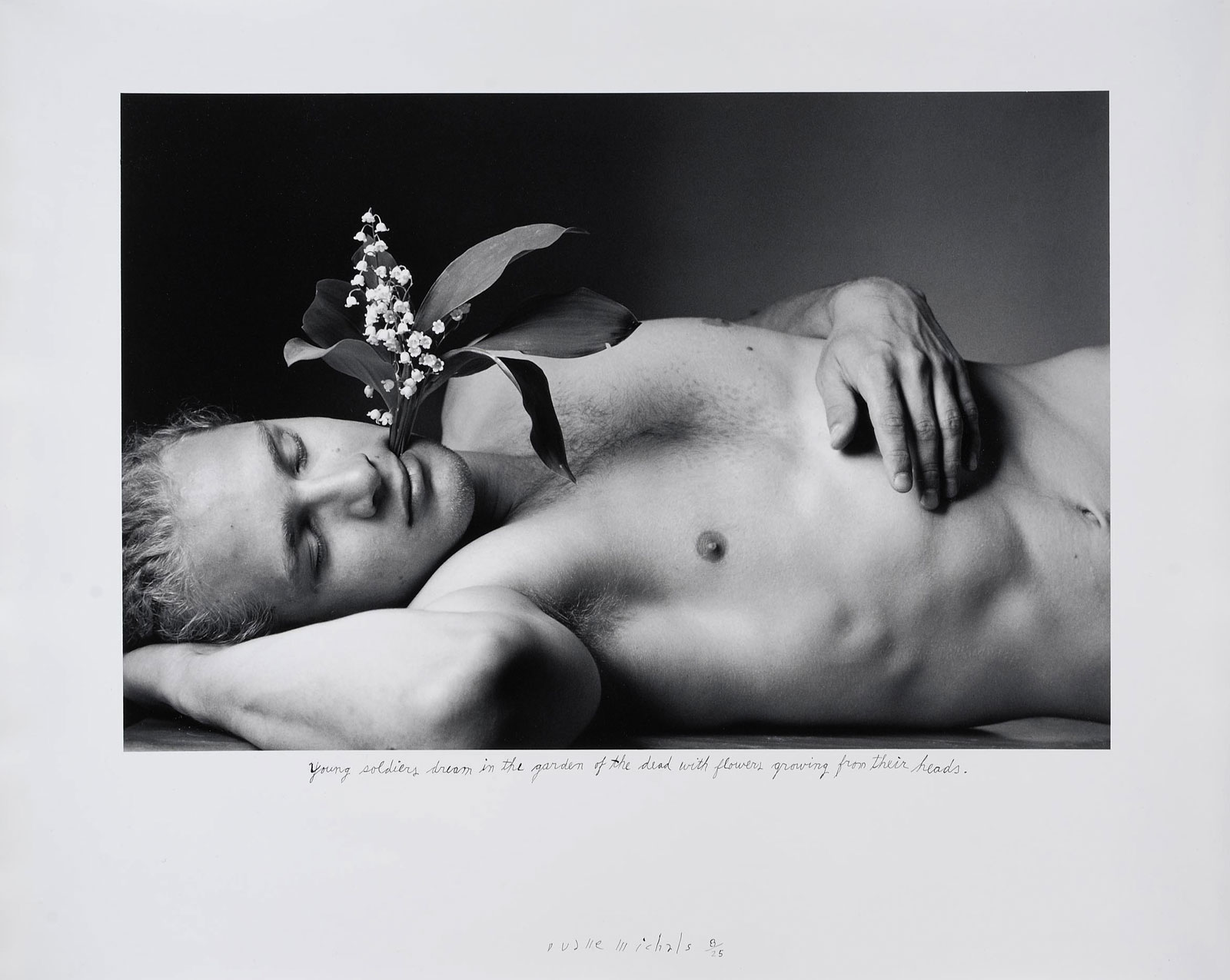
Open seven days a week

MoMA website

LIKE ART BLART ON FACEBOOK

Back to top