
Exhibition dates: 4th April – 24th August, 2014
Curator: Maya Benton, adjunct curator at the International Center of Photography

Roman Vishniac (Russian-American, 1897-1990)
Recalcitrance, Berlin (detail)
1926
© Mara Vishniac Kohn, courtesy International Center of Photography
It takes guts and moral fortitude to continue photographing the city that you live in even as the state that controls that city (and country) conspires against you. It takes talent to produce memorable images of urban poverty, to record for posterity communities that would soon vanish forever under the weight of a malignant form of madness, of genocide.
Vishniac was the only one not concerned with ego. He went out there and got the job done where no one else did. He produced thoroughly modern images of an ancient culture on the verge of destruction. He knew the danger and yet he still took the photos. Courage and fortitude, and in the end the luck to escape the Holocaust himself.
You can’t look at these images without a sense of regret and sadness – at the stupidity of humanity, of the egos of men, and the waste of millions of lives. One name says it all: Ernst Kaufmann. Standing on a pile of rocks, wearing wooden clogs, this man with the wavy hair looks down into the camera and he will ever be thus – young, handsome, alive in the moment that the photograph was taken.
Ernst Kaufmann was born in Krefeld, Germany, in 1911. He was arrested in June 1941 and killed in August of that year in the Mauthausen concentration camp in Austria.
Dr Marcus Bunyan
Many thankx to the Jewish Historical Museum for allowing me to publish the photographs in the posting. Please click on the photographs for a larger version of the image. Lots more images can be found on the excellent Roman Vishniac Archive website.
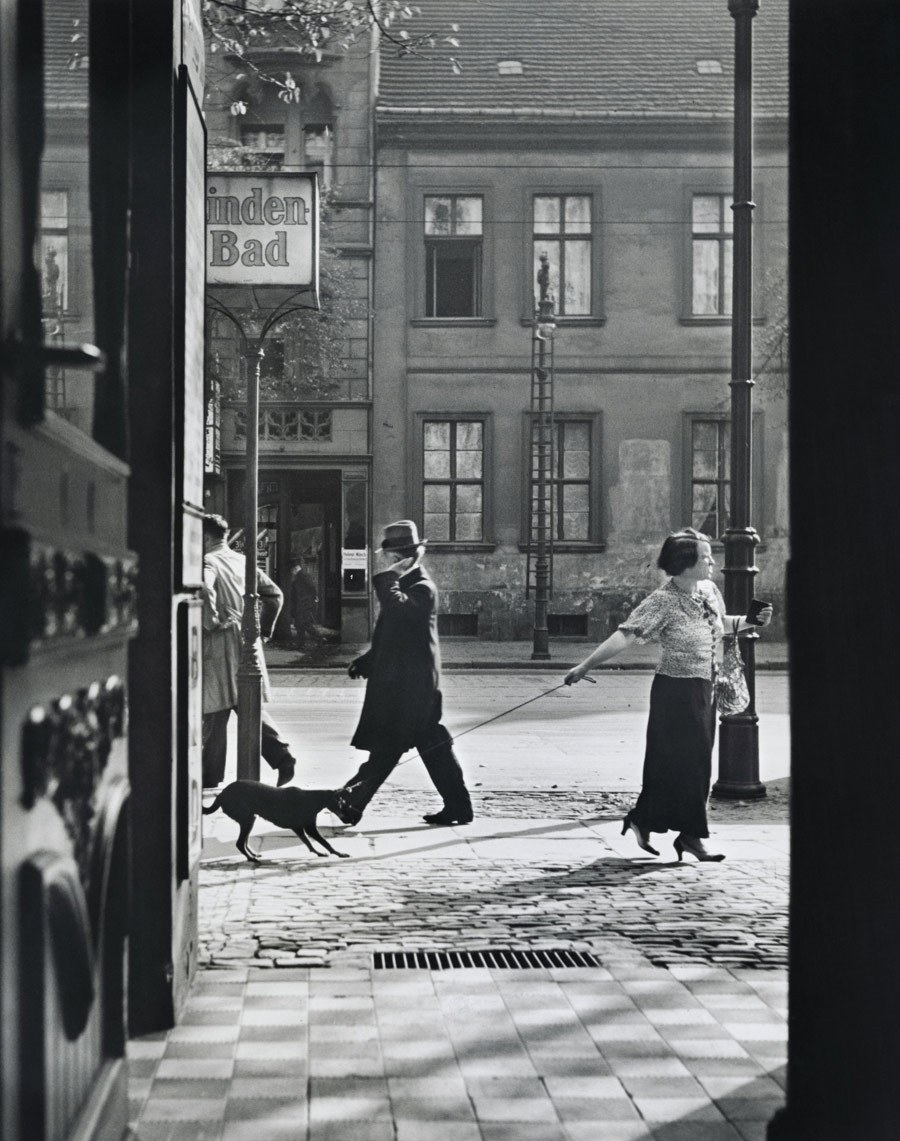
Roman Vishniac (Russian-American, 1897-1990)
Recalcitrance, Berlin
1926
© Mara Vishniac Kohn, courtesy International Center of Photography
![Roman Vishniac (Russian-American, 1897-1990) '[Interior of the Anhalter Bahnhof railway terminus near Potsdamer Platz, Berlin]' late 1920s - early 1930s from the exhibition 'Roman Vishniac Rediscovered' at the Jewish Historical Museum, Amsterdam, April- August, 2014](https://artblart.com/wp-content/uploads/2014/08/icp_vishniac_pressimage_2-web.jpg "Roman Vishniac (Russian-American, 1897-1990) '[Interior of the Anhalter Bahnhof railway terminus near Potsdamer Platz, Berlin]' late 1920s - early 1930s from the exhibition 'Roman Vishniac Rediscovered' at the Jewish Historical Museum, Amsterdam, April- August, 2014")
Roman Vishniac (Russian-American, 1897-1990)
[Interior of the Anhalter Bahnhof railway terminus near Potsdamer Platz, Berlin]
Late 1920s – early 1930s
© Mara Vishniac Kohn, courtesy International Center of Photography
Roman Vishniac Rediscovered brings together four decades of work by an extraordinarily versatile and innovative photographer for the first time. Vishniac (1897-1990) created the most widely recognised and reproduced photographic record of Jewish life in Eastern Europe between the two World Wars. These celebrated photographs were taken on assignment for the American Jewish Joint Distribution Committee, the world’s largest Jewish relief organisation, from 1935-1938, yet this exhibition follows the photographer’s long and accomplished career from the early 1920s through the 1950s. Roman Vishniac Rediscovered introduces a radically diverse body of work – much of it only recently discovered – and repositions Vishniac’s iconic photographs of Eastern European Jewry within a broader tradition of 1930s social documentary photography.
More than any other photographer, Roman Vishniac’s images have profoundly influenced contemporary notions of Jewish life in Eastern Europe. Vishniac created the most widely recognised and reproduced photographic record of that world on the eve of its annihilation, yet only a small fraction of his work was published or printed during his lifetime. Known primarily for this poignant record, Vishniac was in fact a remarkably versatile and innovative photographer. His body of work spans more than five decades, ranging from early engagements with European modernism in the 1920s to highly inventive colour photomicroscopy in the 1950s and ’60s.
Born in 1897 to an affluent Russian-Jewish family, Vishniac was raised in Moscow, where he studied zoology and biology. He immigrated to Berlin in 1920 in the aftermath of the Bolshevik Revolution. As an amateur photographer he took to the streets, offering witty and wry visual commentary on his adopted city while experimenting with new approaches to framing and composition. As Vishniac documented the Nazi rise to power, foreboding signs of oppression soon became a focal point of his work. In 1935, he was commissioned by the European headquarters of the American Jewish Joint Distribution Committee (AJDC) – the world’s largest Jewish relief organisation – to photograph impoverished Jewish communities in Eastern Europe. Vishniac’s four years of work on the project yielded the celebrated images that have largely defined his photographic legacy.
Arriving in New York on New Year’s Day 1941, Vishniac opened a portrait studio, working to make ends meet by documenting American Jewish communal and immigrant life, while establishing himself as a pioneer in the field of photomicroscopy. In 1947, he returned to Europe and documented Jewish Displaced Persons’ Camps, the efforts of Holocaust survivors to rebuild their lives, emigration and relief efforts, and the ruins of Berlin.
Roman Vishniac Rediscovered is a comprehensive reappraisal of Vishniac’s total photographic output, from his early years in Berlin through the postwar period in America. The exhibition is drawn from the Roman Vishniac archive at ICP and serves as an introduction to this vast assemblage comprising more than 30,000 objects, including recently discovered vintage prints, rare moving film footage, contact sheets, personal correspondence, and exhibition prints made from his recently digitised negatives.
Berlin Street Photography, 1920s-1930s
Vishniac immigrated to Berlin in 1920, shortly after the formation of the Weimar Republic. He and his wife Luta settled in the Wilmersdorf district, home to a large community of affluent Russian-Jewish expatriates. Berlin in the 1920s was the epitome of a modern city: cosmopolitan, loud, vibrant, diverse, and full of recent immigrants. Already an accomplished amateur photographer, Vishniac joined several of the city’s ubiquitous camera clubs. Armed with his Rolleiflex and Leica, he took to the streets, creating astute, often humorous observations of his adopted city.
Vishniac’s interest in photography had begun during his childhood in Russia; many Russian Jews owned photography shops and studios, and Vishniac’s family encouraged his pursuits. In Berlin, his perspective as an outsider contributed to his inventive and dynamic images of life in the city, and marked his transformation from amateur hobbyist to accomplished street photographer. His best, most intimate photographs were often taken in his own neighbourhood, where he built a fully equipped photo-processing lab in his apartment.
Vishniac took full advantage of the city’s manifold resources, improving his technique and experimenting with modernist and avant-garde approaches to framing and composition – hallmarks of Weimar Berlin. This prodigious body of early work became increasingly influenced by European modernism as he captured the buzzing day-to-day life of the city: streetcar drivers, municipal workers and day labourers, marching students and children at play, bucolic park scenes and the intellectual café life of the bustling metropolis that was, in Vishniac’s words, “the world’s center of music, books, and science.”
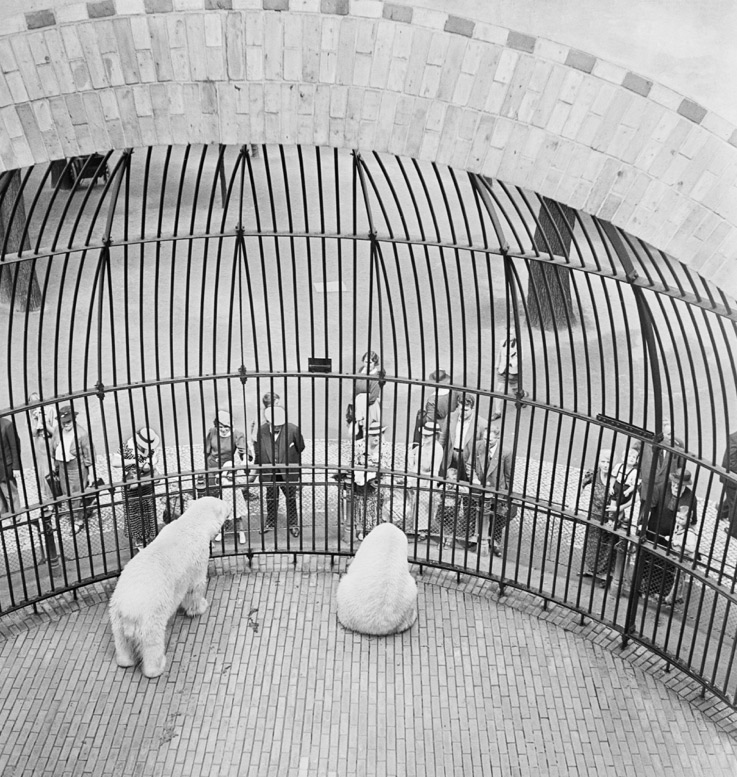
Roman Vishniac (Russian-American, 1897-1990)
People behind bars, Berlin Zoo
Early 1930s (printed 2012)
© Mara Vishniac Kohn, courtesy International Center of Photography
The oldest and most renowned zoo in Germany, the Zoologische Garten was a popular gathering place for Berlin’s middle- and upper-class Jewish community before World War II. Many affluent Jewish families, including the Vishniacs, were shareholders. Beginning in 1933, the zoo began to force out Jewish board members. In 1938, a sign reading “Juden unerwünscht” (Jews Unwanted) was displayed at the entrance to the zoo and in early 1939 Jews were denied entry entirely. In Vishniac’s photograph of the zoo’s famous polar bears, it appears that the visitors, and not the animals, are in a cage.
![Roman Vishniac (Russian-American, 1897-1990) '[Boys admiring a motorcycle, Brandenburg, outskirts of Berlin]' 1929 - early 1930s (printed 2012)](https://artblart.com/wp-content/uploads/2014/08/vishniac-boys-admiring-a-motorbike.jpg "Roman Vishniac (Russian-American, 1897-1990) '[Boys admiring a motorcycle, Brandenburg, outskirts of Berlin]' 1929 - early 1930s (printed 2012)")
Roman Vishniac (Russian-American, 1897-1990)
[Boys admiring a motorcycle, Brandenburg, outskirts of Berlin]
1929 – early 1930s (printed 2012)
© Mara Vishniac Kohn, courtesy International Center of Photography
Nazi Rise to Power in Germany, 1933-1938
“I grew up in Berlin with a pervasive sense of danger and dread combined with a perceived obligation not to show fear. I was aware of personal danger and knew that whatever happened to me, my parents could offer no protection or help. That was everyday life.”
Mara Vishniac Kohn
Vishniac’s development as a professional photographer coincided with the Nazi rise to power and the establishment of the Third Reich. Widespread antisemitism and the implementation of increasingly restrictive measures against Jews became daily realities. Vishniac documented the ominous changes he encountered, photographing campaign posters, swastika banners, phrenology shops, and marching Nazi soldiers. Following Hitler’s appointment as chancellor in 1933, the government relentlessly pursued those artists and intellectuals not in line with the Reich’s values. Berlin’s cosmopolitan vivacity was soon drained of its intellectual and cultural capital. Once-vibrant neighbourhoods became ruled by fear; anyone considered an opponent of the Nazi government could be sent to Dachau, a concentration camp established in 1933 outside Munich.
Many photographers suffered from the Nazi policies; the Schriftgesetz (Editorial Act) of November 1933 forced anyone working in publishing – photographers included – to provide proof of Aryan heritage. In 1934, the Deutsche Presse (German Press) published a list of authorised Aryan photographers whose work aligned with the Nazi party. Jews were forbidden to take photographs on the street. In spite of these restrictions, Vishniac tenaciously documented Berlin’s rapid acclimation to Nazi policy. To avoid suspicion, he often used his young daughter Mara as a prop, snapping seemingly innocuous pictures of her in front of advertising columns and shop windows festooned with Nazi propaganda.
These symbols of oppression formed the quotidian backdrop of Vishniac’s Germany, a fact to which the ubiquity of Nazi flags, banners, and posters in his later Berlin photographs testify. Capturing the spread of Nazi ideology on Berlin’s streets, Vishniac’s images embodied his own marginalisation – and endangerment – as both a photographer and a Jew.
![Roman Vishniac (Russian-American, 1897-1990) '[Vishniac's daughter Mara posing in front of an election poster for Hindenburg and Hitler that reads "The Marshal and the Corporal: Fight with Us for Peace and Equal Rights," Wilmersdorf, Berlin]' 1933](https://artblart.com/wp-content/uploads/2014/08/icp_vishniac_pressimage_3-web.jpg "Roman Vishniac (Russian-American, 1897-1990) '[Vishniac's daughter Mara posing in front of an election poster for Hindenburg and Hitler that reads \"The Marshal and the Corporal: Fight with Us for Peace and Equal Rights,\" Wilmersdorf, Berlin]' 1933")
Roman Vishniac (Russian-American, 1897-1990)
[Vishniac’s daughter Mara posing in front of an election poster for Hindenburg and Hitler that reads “The Marshal and the Corporal: Fight with Us for Peace and Equal Rights,” Wilmersdorf, Berlin]
1933
© Mara Vishniac Kohn, courtesy International Center of Photography
![Roman Vishniac (Russian-American, 1897-1990) '[Street scene with a swastika flag on a storefront (at left), Berlin]' c. 1935-1936 (printed 2012)](https://artblart.com/wp-content/uploads/2014/08/vishniac-street-scene.jpg "Roman Vishniac (Russian-American, 1897-1990) '[Street scene with a swastika flag on a storefront (at left), Berlin]' c. 1935-1936 (printed 2012)")
Roman Vishniac (Russian-American, 1897-1990)
[Street scene with a swastika flag on a storefront (at left), Berlin]
c. 1935-1936 (printed 2012)
© Mara Vishniac Kohn, courtesy International Center of Photography
Vishniac often positioned himself in doorways or building foyers in his Berlin street photography, documenting daily life as a removed observer. This image reveals multiple layers of time in one shot: the car positioned alongside the horse-drawn wagon, bicyclists speeding by as pedestrians young and old navigate the cobblestones and pavement, against the backdrop of a rapidly modernising metropolis. Only upon closer examination do our eyes move to a swastika flag blowing in the wind above the horses, a common site on most Berlin streets by 1935.
German-Jewish Relief and Community Organizations, Berlin, mid- to late 1930s
Prior to Hitler’s assumption of power in 1933, Jewish social service organisations in Germany primarily served Eastern European Jews, the majority of whom were less cosmopolitan, assimilated, and affluent than their German-born coreligionists. The Nazi regime recognised no such distinction, however, and their rise to power drastically affected almost every Jew living in Germany. As Germany’s Jewish population was gradually excluded from both social and economic life, many came to depend upon a Jewish social structure that was originally intended to look outward but quickly expanded to serve the growing needs of the community.
In 1933, German-Jewish groups unified into the Reichsvertretung der Deutschen Juden (Central Organization of German Jews), an umbrella organisation intended to ameliorate the effects of Nazi racial policy. Between 1933 and 1938, subsidiary and affiliate organisations created Jewish education and healthcare systems and instituted a welfare system for Jews facing impoverishment. Zionist and other youth organisations flourished under the exclusionary policies of the Nazis, helping would-be émigrés learn the agricultural and vocational skills needed to build new lives in Palestine and elsewhere. The Jüdischer Kulturbund (Jewish Cultural Association) was established in response to restrictions placed on Jewish artists. Vishniac and his family were among its 70,000 members and regularly attended lectures and performances. Vishniac was also a member of T’munah, a Jewish photographic group founded in 1934 in response to the exclusionary policies of “Aryan” camera clubs.
As restrictions on photographers increased, Vishniac was commissioned to document the work of several Jewish community and social service organisations in Berlin. This fascinating body of work is largely unknown, but it helped establish his reputation in Jewish philanthropic circles, leading to major commissions from a wide range of Jewish relief and community organisations from the mid-1930s to the mid-1950s.
![Roman Vishniac (Russian-American, 1897-1990) '[Drawer of freshly farmed eggs, Gut Winkel, a training farm for German-Jewish youth hoping to emigrate to Palestine, Spreenhagen in der Mark, Brandenburg, Germany]' c. 1938](https://artblart.com/wp-content/uploads/2014/08/icp_vishniac_pressimage_5-web.jpg "Roman Vishniac (Russian-American, 1897-1990) '[Drawer of freshly farmed eggs, Gut Winkel, a training farm for German-Jewish youth hoping to emigrate to Palestine, Spreenhagen in der Mark, Brandenburg, Germany]' c. 1938")
Roman Vishniac (Russian-American, 1897-1990)
[Drawer of freshly farmed eggs, Gut Winkel, a training farm for German-Jewish youth hoping to emigrate to Palestine, Spreenhagen in der Mark, Brandenburg, Germany]
c. 1938
© Mara Vishniac Kohn, courtesy International Center of Photography
![Roman Vishniac (Russian-American, 1897-1990) '[Preparing food in a Jewish soup kitchen, Berlin]' mid- to late 1930s](https://artblart.com/wp-content/uploads/2014/08/icp_vishniac_pressimage_4-web.jpg "Roman Vishniac (Russian-American, 1897-1990) '[Preparing food in a Jewish soup kitchen, Berlin]' mid- to late 1930s")
Roman Vishniac (Russian-American, 1897-1990)
[Preparing food in a Jewish soup kitchen, Berlin]
mid- to late 1930s
© Mara Vishniac Kohn, courtesy International Center of Photography
Jewish Life in Eastern Europe, c. 1935-1938
In 1935, Roman Vishniac was hired by the European headquarters of the American Jewish Joint Distribution Committee (AJDC) to document impoverished Jewish communities in Eastern Europe. Photographic images offered limitless, affordable reproducibility, and could be used in slide lectures, brochures, appeals, and annual reports throughout America and Western Europe. Vishniac’s images played a crucial role in communicating the AJDC’s message, and they would ultimately become the last extensive photographic record by a single photographer of Jewish communities that had existed for centuries.
The majority of Vishniac’s published photographs of Eastern Europe depict privation. Many others illustrate the philanthropic activities of the AJDC such as children’s camps, free loan societies, soup kitchens, schools, and health organisations. And while Vishniac is often associated with images of rural villages and small towns, or shtetlach, most of his photographs record urban poverty in major cities like Warsaw, Krakow, and Lodz. His work for the AJDC echoes the contemporaneous projects of American photographers like Dorothea Lange, Ben Shahn, Arthur Rothstein, and Walker Evans. In the same years that the Farm Security Administration sent photographers to the American South and West to document those affected by drought, depression, and migration, Vishniac was sent east by the AJDC. Today, his work stands alongside the best social-documentary photographers of his era. His unpublished work imparts a much more complex and nuanced perspective on Eastern European Jewish life, and reveals a much more versatile – and modern – artist.
That Vishniac was commissioned to document the most impoverished Jews is significant, as is the fact that he often chose the most traditional and observant Jews as subjects, to amplify the contrast between Ostjuden, or Eastern Jews, and the more assimilated Western Jews who would be viewing the images. It was only after the Holocaust, when the communities he had so poignantly depicted were annihilated, that his body of work came to symbolise the vanished world of Eastern Jewry.

Roman Vishniac (Russian-American, 1897-1990)
Villagers in the Carpathian Mountains
c. 1935-38
© Mara Vishniac Kohn, courtesy International Center of Photography
![Roman Vishniac (Russian-American, 1897-1990) '[Jewish schoolchildren, Mukacevo]' c. 1935-1938](https://artblart.com/wp-content/uploads/2014/08/icp_vishniac_pressimage_10-web.jpg "Roman Vishniac (Russian-American, 1897-1990) '[Jewish schoolchildren, Mukacevo]' c. 1935-1938")
Roman Vishniac (Russian-American, 1897-1990)
[Jewish schoolchildren, Mukacevo]
c. 1935-1938
© Mara Vishniac Kohn, courtesy International Center of Photography
![Roman Vishniac (Russian-American, 1897-1990) '[Inside the Jewish quarter, Bratislava]' c. 1935-1938](https://artblart.com/wp-content/uploads/2014/08/icp_vishniac_pressimage_11-web.jpg "Roman Vishniac (Russian-American, 1897-1990) '[Inside the Jewish quarter, Bratislava]' c. 1935-1938")
Roman Vishniac (Russian-American, 1897-1990)
[Inside the Jewish quarter, Bratislava]
c. 1935-1938
© Mara Vishniac Kohn, courtesy International Center of Photography
![Roman Vishniac (Russian-American, 1897-1990) '[Eastern Europe]' c. 1935-1938](https://artblart.com/wp-content/uploads/2014/08/icp_vishniac_pressimage_12-web.jpg "Roman Vishniac (Russian-American, 1897-1990) '[Eastern Europe]' c. 1935-1938")
Roman Vishniac (Russian-American, 1897-1990)
[Eastern Europe]
c. 1935-1938
© Mara Vishniac Kohn, courtesy International Center of Photography
![Roman Vishniac (Russian-American, 1897-1990) '[Eastern Europe]' (detail) c. 1935-1938](https://artblart.com/wp-content/uploads/2014/08/icp_vishniac_pressimage_12-detail.jpg "Roman Vishniac (Russian-American, 1897-1990) '[Eastern Europe]' (detail) c. 1935-1938")
Roman Vishniac (Russian-American, 1897-1990)
[Eastern Europe] (detail)
c. 1935-1938
© Mara Vishniac Kohn, courtesy International Center of Photography
![Roman Vishniac (Russian-American, 1897-1990) '[Boy with kindling in a basement dwelling, Krochmalna Street, Warsaw]' c. 1935-1938](https://artblart.com/wp-content/uploads/2014/08/icp_vishniac_pressimage_6-web.jpg "Roman Vishniac (Russian-American, 1897-1990) '[Boy with kindling in a basement dwelling, Krochmalna Street, Warsaw]' c. 1935-1938")
Roman Vishniac (Russian-American, 1897-1990)
[Boy with kindling in a basement dwelling, Krochmalna Street, Warsaw]
c. 1935-1938
© Mara Vishniac Kohn, courtesy International Center of Photography
![Roman Vishniac (Russian-American, 1897-1990) '[David Eckstein, seven years old, and classmates in cheder (Jewish elementary school), Brod]' c. 1935-1938](https://artblart.com/wp-content/uploads/2014/08/icp_vishniac_pressimage_8-web.jpg "Roman Vishniac (Russian-American, 1897-1990) '[David Eckstein, seven years old, and classmates in cheder (Jewish elementary school), Brod]' c. 1935-1938")
Roman Vishniac (Russian-American, 1897-1990)
[David Eckstein, seven years old, and classmates in cheder (Jewish elementary school), Brod]
c. 1935-1938
© Mara Vishniac Kohn, courtesy International Center of Photography
![Roman Vishniac (Russian-American, 1897-1990) '[Sara, sitting in bed in a basement dwelling, with stenciled flowers above her head, Warsaw]' c. 1935-1937](https://artblart.com/wp-content/uploads/2014/08/icp_vishniac_pressimage_9-web.jpg "Roman Vishniac (Russian-American, 1897-1990) '[Sara, sitting in bed in a basement dwelling, with stenciled flowers above her head, Warsaw]' c. 1935-1937")
Roman Vishniac (Russian-American, 1897-1990)
[Sara, sitting in bed in a basement dwelling, with stenciled flowers above her head, Warsaw]
c. 1935-1937
© Mara Vishniac Kohn, courtesy International Center of Photography
Werkdorp Nieuwesluis Agrarian Training Camp, Wieringermeer, The Netherlands, 1939
As the plight of German Jews became increasingly dire throughout the 1930s and many Jewish families attempted to send their children to safety in neutral countries, many young German Jews, including Vishniac’s children Wolf and Mara, joined a large number of Zionist organisations. With the British government maintaining strict immigration quotas, hundreds of young German Jews planning to go to Palestine and waiting to obtain visas were sent to the Werkdorp Nieuwesluis, a Zionist agrarian youth training complex, or hachschara, in the Netherlands. Established in 1934 by the Foundation for Jewish Labor on land donated by the Dutch government, the Werkdorp taught young, urban Jews farming, animal husbandry, construction, and other unfamiliar skills they would need as pioneers in Palestine.
In 1939, Vishniac was sent by the American Jewish Joint Distribution Committee (AJDC) to document the Werkdorp’s activities. Vishniac photographed the capable young men and women as idealised, heroic Zionist pioneers, lifting heavy stones, constructing scaffolding, and tugging on rope. The images bear a striking resemblance to heavily circulated halutz (Zionist pioneer) photography made in Palestine in the 1930s, and demonstrate Vishniac’s versatility: here is an ambitious, accomplished series in a style that is radically different from his earlier work, and perfectly suited to his athletic, industrious subjects. Shot from a low vantage point, the Werkdorp images juxtapose clear skies and strong silhouettes to form vigorous, balanced compositions. Young, healthy bodies play off the clean, rhythmic geometry of the construction sites in a manner that is also reminiscent of the Russian Constructivist photographer Rodchenko, whose work would certainly have been familiar to Vishniac.
In March 1941, Nazi SS officers ordered the evacuation of the camp, and most of its inhabitants were sent to transit camps, including Westerbork. Out of 315 Werkdorp residents in May 1940, 175 were killed in concentration camps in the east.
![Roman Vishniac (Russian-American, 1897-1990) '[Zionist youth building a school and foundry while learning construction techniques, Werkdorp Nieuwesluis, Wieringermeer, The Netherlands]' 1939](https://artblart.com/wp-content/uploads/2014/08/icp_vishniac_pressimage_13-web.jpg "Roman Vishniac (Russian-American, 1897-1990) '[Zionist youth building a school and foundry while learning construction techniques, Werkdorp Nieuwesluis, Wieringermeer, The Netherlands]' 1939")
Roman Vishniac (Russian-American, 1897-1990)
[Zionist youth building a school and foundry while learning construction techniques, Werkdorp Nieuwesluis, Wieringermeer, The Netherlands]
1939
© Mara Vishniac Kohn, courtesy International Center of Photography
![Roman Vishniac (Russian-American, 1897-1990) '[Ernst Kaufmann, center, and unidentified Zionist youth, wearing clogs while learning construction techniques in a quarry, Werkdorp Nieuwesluis, Wieringermeer, The Netherlands]' 1939](https://artblart.com/wp-content/uploads/2014/08/icp_vishniac_pressimage_14-web.jpg "Roman Vishniac (Russian-American, 1897-1990) '[Ernst Kaufmann, center, and unidentified Zionist youth, wearing clogs while learning construction techniques in a quarry, Werkdorp Nieuwesluis, Wieringermeer, The Netherlands]' 1939")
Roman Vishniac (Russian-American, 1897-1990)
[Ernst Kaufmann, centre, and unidentified Zionist youth, wearing clogs while learning construction techniques in a quarry, Werkdorp Nieuwesluis, Wieringermeer, The Netherlands]
1939
© Mara Vishniac Kohn, courtesy International Center of Photography
Vishniac’s Werkdorp images did not include any caption information on the few existing prints of the work, and were thus difficult to identify. A small, 2 1/4-inch-square contact print of three young men wearing wooden clogs provided a vital clue that facilitated the attribution of this larger body of Werkdorp material, with the assistance of curators at the Jewish Historical Museum in Amsterdam. This is the only known example of a professional photographer documenting this Dutch Zionist agrarian training camp.
Ernst Kaufmann was born in Krefeld, Germany, in 1911. He was arrested in June 1941 and killed in August of that year in the Mauthausen concentration camp in Austria.
![Roman Vishniac (Russian-American, 1897-1990) '[Willy Lefkowitz and Martin Grünpeter constructing a foundry, Werkdorp Nieuwesluis, Wieringermeer, The Netherlands]' 1939 (printed 2012)](https://artblart.com/wp-content/uploads/2014/08/vishniac-willy-lefkowitz.jpg "Roman Vishniac (Russian-American, 1897-1990) '[Willy Lefkowitz and Martin Grünpeter constructing a foundry, Werkdorp Nieuwesluis, Wieringermeer, The Netherlands]' 1939 (printed 2012)")
Roman Vishniac (Russian-American, 1897-1990)
[Willy Lefkowitz and Martin Grünpeter constructing a foundry, Werkdorp Nieuwesluis, Wieringermeer, The Netherlands]
1939 (printed 2012)
© Mara Vishniac Kohn, courtesy International Center of Photography
Willy Lefkowitz, left, was forcibly removed from the Werkdorp when it was closed by the Nazis in 1941. Lefkowitz, along with the majority of the Werkdorp’s remaining inhabitants, was sent to the Westerbork Transit Camp in northeastern Netherlands, a site where Dutch Jews and Roma were assembled during World War II prior to their deportation to Nazi extermination camps in the east. Of the 107,000 people who passed through Westerbork – among them Anne Frank and her family – only 5,200 survived, including Lefkowitz, who immigrated to the United States. He is believed to have died in Brooklyn in 2001. Martin Grünpeter, right, a German Jew born in 1914, survived World War II and immigrated to Palestine.
Travel, Refuge, and Internment in France: Paris, Nice, and Marseille, c. 1939
From April to September 1939, Vishniac worked as a freelance photographer based in France while his family struggled to secure exit visas to the U.S. (his children had been sent to safety in Sweden). In the interwar years, France had welcomed Jews from across Europe. By 1939, as Jews fleeing Nazi rule brought the Jewish population in France to over 300,000, an increasingly conservative and nationalist government sought to limit immigration. Detention camps for Jews were established in southern France.
During this time, Vishniac was commissioned by the American Jewish Joint Distribution Committee (AJDC) and the Society for Trades and Agricultural Labor (ORT) to photograph and film an ORT vocational training school for Jewish refugees near Marseille. Vishniac’s parents had relocated to Nice in 1937, and while visiting them, he took playful, spontaneous photographs of Riviera beach life, a stark contrast to the intense and machine-focused ORT images that were to be his final photographic assignment for the AJDC until his return to Europe in 1947.
In late 1939, after entrusting a large selection of his negatives to his friend Walter Bierer in Paris, Vishniac was arrested and imprisoned at the Camp du Ruchard internment camp. Held for three months, he wrote desperate letters to family, friends, and the staff of the AJDC, describing the dismal conditions and pleading for assistance. Following his release, secured through the efforts of his wife, Vishniac waited in France while his family worked to obtain exit visas, with assistance from the AJDC. Vishniac reunited with Luta, Wolf, and Mara in Lisbon, and the family sailed for America on the S.S. Siboney in December 1940, arriving in America on New Year’s Day 1941.
![Roman Vishniac (Russian-American, 1897-1990) '[Beachgoers in the afternoon, Nice, France]' c. 1939](https://artblart.com/wp-content/uploads/2014/08/icp_vishniac_pressimage_15-web.jpg "Roman Vishniac (Russian-American, 1897-1990) '[Beachgoers in the afternoon, Nice, France]' c. 1939")
Roman Vishniac (Russian-American, 1897-1990)
[Beachgoers in the afternoon, Nice, France]
c. 1939
© Mara Vishniac Kohn, courtesy International Center of Photography
![Roman Vishniac (Russian-American, 1897-1990) '[Students learning metalwork techniques, Society for Trades and Agricultural Labor (ORT), Marseille]' 1939](https://artblart.com/wp-content/uploads/2014/08/icp_vishniac_pressimage_16-web.jpg "Roman Vishniac (Russian-American, 1897-1990) '[Students learning metalwork techniques, Society for Trades and Agricultural Labor (ORT), Marseille]' 1939")
Roman Vishniac (Russian-American, 1897-1990)
[Students learning metalwork techniques, Society for Trades and Agricultural Labor (ORT), Marseille]
1939
© Mara Vishniac Kohn, courtesy International Center of Photography
YIVO Exhibitions in New York, January 1944 and January 1945
In 1944 and 1945, as World War II raged in Europe, Vishniac staged two large exhibitions at YIVO Institute for Jewish Research in New York, presenting his commissioned work from Eastern Europe to an American audience.
Founded in 1925 as the Yiddish Scientific Institute in Wilno, Poland, YIVO was created to preserve, research, and promote Eastern European Jewish culture and history during a period of rapid modernisation and immigration. After the German invasion of Poland in 1939, the organisation was reestablished in New York in 1940 as the YIVO Institute for Jewish Research, at 55 West 123rd Street, while a group of brave and dedicated archivists in Wilno worked to rescue precious material in defiance of Nazi orders.
Vishniac’s first exhibition at YIVO, Pictures of Jewish Life in Prewar Poland, opened in January 1944 and focused on urban Jewish life, with a large selection of images from Lublin, Warsaw, and Wilno. The second exhibition, Jewish Life in the Carpathians, opened in January 1945, and featured photographs of Jewish farming communities in the Carpathian Mountains, and yeshivas and religious life in Galicia.
The largely Yiddish-speaking audience in New York viewed images of their communities of origin just as those communities were being destroyed, a fate the viewers were virtually powerless to stop. As word of the destruction of Eastern European Jews spread across the Atlantic, Vishniac’s photographs – originally intended to call attention to the privation of living Eastern European Jews – began to be seen as “documents of a lost epoch,” as phrased in the exhibition text at YIVO. These exhibitions signalled the first major shift in the contextualisation of Vishniac’s work: from documentary assignments to bolster relief efforts in the late 1930s to images capturing a world on the brink of annihilation.
The YIVO exhibition boards, labeled in both English and Yiddish utilising an innovative, Bauhaus-inspired typography that originated in interwar Wilno, are now in the collection of ICP and are being displayed as a group for the first time since the original exhibitions.
Today, YIVO continues to advance the study of Eastern European Jewish cultural heritage, and houses an archive of more than 24 million artefacts.
“The Face of America at War”: New York, 1941-1944
The recent discovery of Vishniac’s unsuccessful 1944 application for a Guggenheim Fellowship sheds new light on a group of more than 200 negatives from the early 1940s that had previously appeared to be unrelated. Printed and exhibited here for the first time, these images show the impact of war rationing on shoppers at the Washington Market, the war relief efforts of New York’s Chinese-American community, women’s entrance into the industrial workforce and the military, the carousing of off-duty soldiers in Central Park, and the impact of war on the lives of New Yorkers. Vishniac’s Guggenheim proposal described a “photographic series portraying the face of America at war,” and this diverse yet cohesive group of images was likely submitted as a sample portfolio with his application, the beginnings of a project never completed for want of funding. His extraordinary, extensive series on Chinatown, reminiscent of his photographs of urban Jewish communities in Eastern Europe, depicts a neighbourhood that is both separated from and integrated into the fabric of the larger city, reflective of Vishniac’s own efforts to navigate yet another new, adopted home as an outsider. The images capture the “objectivity” of “un-posed” journalistic photography, in the words of one recommender, and have a great deal in common with fellow Jewish émigré Robert Frank’s Guggenheim-funded project, The Americans, made a decade later.
![Roman Vishniac (Russian-American, 1897-1990) '[Sisters Marion, Renate, and Karen Gumprecht, refugees assisted by the National Refugee Service (NRS) and Hebrew Immigrant Aid Society (HIAS), shortly after their arrival in the United States, Central Park, New York]' 1941](https://artblart.com/wp-content/uploads/2014/08/vishniac21-web.jpg "Roman Vishniac (Russian-American, 1897-1990) '[Sisters Marion, Renate, and Karen Gumprecht, refugees assisted by the National Refugee Service (NRS) and Hebrew Immigrant Aid Society (HIAS), shortly after their arrival in the United States, Central Park, New York]' 1941")
Roman Vishniac (Russian-American, 1897-1990)
[Sisters Marion, Renate, and Karen Gumprecht, refugees assisted by the National Refugee Service (NRS) and Hebrew Immigrant Aid Society (HIAS), shortly after their arrival in the United States, Central Park, New York]
1941
© Mara Vishniac Kohn, courtesy International Center of Photography
![Roman Vishniac (Russian-American, 1897-1990) '[Customers waiting in line at a butcher's counter during wartime rationing, Washington Market, New York]' 1941-1944](https://artblart.com/wp-content/uploads/2014/08/icp_vishniac_pressimage_22-web.jpg "Roman Vishniac (Russian-American, 1897-1990) '[Customers waiting in line at a butcher's counter during wartime rationing, Washington Market, New York]' 1941-1944")
Roman Vishniac (Russian-American, 1897-1990)
[Customers waiting in line at a butcher’s counter during wartime rationing, Washington Market, New York]
1941-1944
© Mara Vishniac Kohn, courtesy International Center of Photography
![Roman Vishniac (Russian-American, 1897-1990) '[Boys exercising in the gymnasium of the Jewish Community House of Bensonhurst, Brooklyn]' 1949](https://artblart.com/wp-content/uploads/2014/08/icp_vishniac_pressimage_23-web.jpg "Roman Vishniac (Russian-American, 1897-1990) '[Boys exercising in the gymnasium of the Jewish Community House of Bensonhurst, Brooklyn]' 1949")
Roman Vishniac (Russian-American, 1897-1990)
[Boys exercising in the gymnasium of the Jewish Community House of Bensonhurst, Brooklyn]
1949
© Mara Vishniac Kohn, courtesy International Center of Photography
Berlin in Ruins, 1947
In 1947, Vishniac returned to Europe as an American citizen, hired by the American Jewish Joint Distribution Committee (AJDC) and United Jewish Appeal (UJA) to document relief efforts in Jewish Displaced Persons’ Camps. While on assignment, Vishniac visited Berlin, where he created a bleak and poignant record of the destroyed city that had been his home for twenty years. Focusing on West Berlin, he took intimate photographs of his former Wilmersdorf neighbourhood, now reduced to ruins. The same locations that had thrummed with life in his street photography from the Weimar era are suffused with a haunting silence in his 1947 photographs. One photograph reveals the crumbling and mangled platform that had once been Vishniac’s living room. Other images capture the tentative steps of a city emerging from devastation: children walking hand-in-hand and playing amidst the ruins, flowers growing through the rubble, and hairdressers once more advertising their services. Together, these pictures, which have not been previously printed or exhibited, constitute a unique and highly personal contribution to the documentation of postwar life in Berlin.
![Roman Vishniac (Russian-American, 1897-1990) '[Boy standing on a mountain of rubble, Berlin]' 1947](https://artblart.com/wp-content/uploads/2014/08/icp_vishniac_pressimage_17-web.jpg "Roman Vishniac (Russian-American, 1897-1990) '[Boy standing on a mountain of rubble, Berlin]' 1947")
Roman Vishniac (Russian-American, 1897-1990)
[Boy standing on a mountain of rubble, Berlin]
1947
© Mara Vishniac Kohn, courtesy International Center of Photography

Roman Vishniac (Russian-American, 1897-1990)
The streets are free of brown battalions!, Berlin
1947
© Mara Vishniac Kohn, courtesy International Center of Photography
Refugees and Displaced Persons’ Camps, Germany and France, 1947
In the aftermath of World War II, the Allied nations had initially expected the repatriation of displaced refugees to take six months. Most Jewish refugees, however, no longer had communities or family to which they could return, presenting a unique challenge. Following the 1945 Harrison Report, the Allies considered Jewish survivors a distinct group, to be housed in exclusively Jewish camps and aided in eventual emigration. By mid-1947, 250,000 Jews lived in Displaced Persons’ Camps in Germany, Austria, and Italy. Officially administered by the United Nations, the primary aid, support, and administration for the DP Camps came from Jewish charitable organisations, most notably the American Jewish Joint Distribution Committee (AJDC). In France, Jewish organisations ran DP Camps privately, housing nearly 40,000 refugees. Despite difficult conditions and profound trauma, Jewish life soon flourished in the camps, as families reunited and formed anew.
Commissioned by the AJDC and the United Jewish Appeal (UJA), Vishniac traveled to various DP Camps in 1947, documenting a broad range of relief programs, including food distribution centres, visa application lines, occupational training, and health services. Other images record children’s camps, religious and cultural events, and refugee reunions. Wired back to America, Vishniac’s images helped publicise the plight of homeless and stateless Jewish refugees, raising funds and increasing the pressure on Britain and the U.S. to open their doors to survivors.
Spurred by these cultural and educational programs and the emerging Zionist youth movement, survivors soon rallied against British restrictions on immigration to Palestine. Following the Declaration of the State of Israel in 1948, and the American Displaced Persons Act of 1948, most Jews left DP Camps for Israel or the United States. By 1952, almost all DP Camps had closed.
Maya Benton, Curator at the International Center of Photography
![Roman Vishniac (Russian-American, 1897-1990) '[Holocaust survivors and American relief worker, probably Schlachtensee Displaced Persons' Camp, Zehlendorf, Berlin]' 1947](https://artblart.com/wp-content/uploads/2014/08/icp_vishniac_pressimage_19-web.jpg "Roman Vishniac (Russian-American, 1897-1990) '[Holocaust survivors and American relief worker, probably Schlachtensee Displaced Persons' Camp, Zehlendorf, Berlin]' 1947")
Roman Vishniac (Russian-American, 1897-1990)
[Holocaust survivors and American relief worker, probably Schlachtensee Displaced Persons’ Camp, Zehlendorf, Berlin]
1947
© Mara Vishniac Kohn, courtesy International Center of Photography
![Roman Vishniac (Russian-American, 1897-1990) '[Holocaust survivors gathering outside a building where matzoh is being made in preparation for the Passover holiday, Hénonville Displaced Persons' Camp, Picardy, France]' 1947](https://artblart.com/wp-content/uploads/2014/08/icp_vishniac_pressimage_20-web.jpg "Roman Vishniac (Russian-American, 1897-1990) '[Holocaust survivors gathering outside a building where matzoh is being made in preparation for the Passover holiday, Hénonville Displaced Persons' Camp, Picardy, France]' 1947")
Roman Vishniac (Russian-American, 1897-1990)
[Holocaust survivors gathering outside a building where matzoh is being made in preparation for the Passover holiday, Hénonville Displaced Persons’ Camp, Picardy, France]
1947
© Mara Vishniac Kohn, courtesy International Center of Photography
Jewish Historical Museum
Nieuwe Amstelstraat 1
1011 PL Amsterdam
Opening hours:
Daily 10am – 5pm












![Neo Rauch (German, b. 1960) 'Goldgrube' [Goldmine] 2007](https://artblart.com/wp-content/uploads/2014/07/22_neo_rauch_goldgrube-web.jpg "Neo Rauch (German, b. 1960) 'Goldgrube' [Goldmine] 2007")
![Rembrandt Harmenszoon van Rijn (Dutch, 1606-1669) 'Sogenannter Faust' [Allegedly Faust] c. 1651‑1653](https://artblart.com/wp-content/uploads/2014/07/12_rembrandt_sogenannter_faust-web.jpg "Rembrandt Harmenszoon van Rijn (Dutch, 1606-1669) 'Sogenannter Faust' [Allegedly Faust] c. 1651‑1653")
![Yves Klein (French, 1928-1962) 'Relief éponge bleu (RE 18)' (blue sponge relief [re 18]) 1960](https://artblart.com/wp-content/uploads/2014/07/16_klein_schwammrelief-web.jpg "Yves Klein (French, 1928-1962) 'Relief éponge bleu (RE 18)' (blue sponge relief [re 18]) 1960")






































 Art Blart _ art and cultural memory archive
You must be logged in to post a comment.