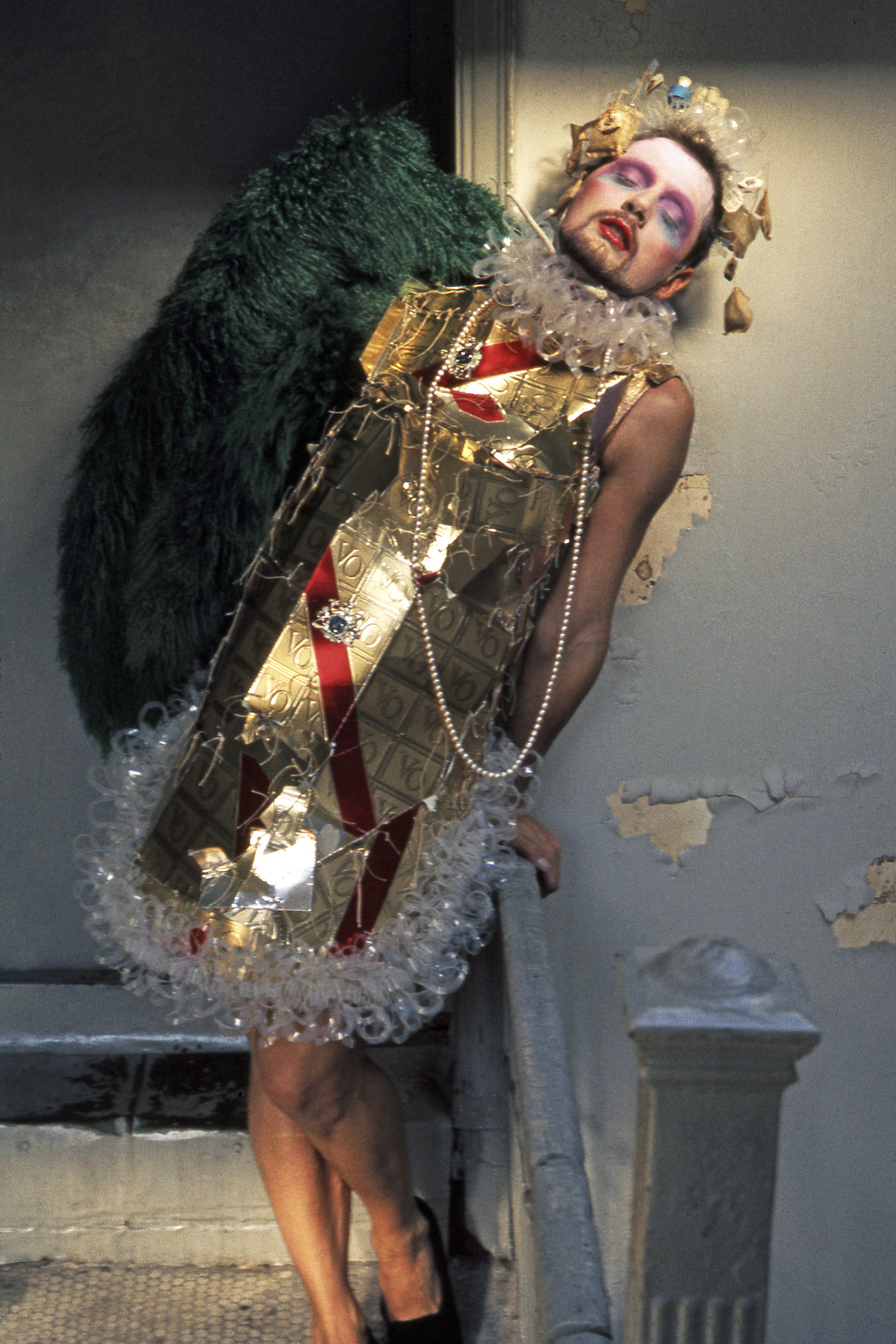
“Varble’s total irreverence is no more evident than in his willingness to “cross party lines,” as he did when he wore his Suit of Armor, constructed with gold VO labels from Seagram’s boxes, to both the 1975 Easter Parade and to West Village leather bars! He was an equal opportunity offender, rubbing up against conformity in all forms.”
Bob Nickas. “Stephen Varble: Now More Than Ever,” on the Affidavit website [Online] Cited 10/04/2019
Confusing queen reigns, on parade
I love doing these posts on artists that certainly I, and I suspect a lot of the readers of this website, would have never have heard of. Artists full of spunk, full of daring-do, artists who rise to challenge the patrons of patriarchy, and the colluders of capitalism (Varble became ever-more critical of commodification and capitalism). Artists who declaim the value of the individual, who shine a light on the plight of the downtrodden and those discriminated against. Can you not once bring yourself to utter the word “AIDS” you bigoted president?
In an era of reactionary religious and right wing hypocrisy – Christian sleaze and paedophilia anyone, anti-Muslim and anti-gay Facebook posts in the Australian election, murderous right wing rampage in New Zealand – now more than ever, we need artists like Stephen Varble (American, 1946-1984). Human beings that speak up and speak out against bigotry, discrimination, and awful men in high places.
“Varble made the recombination of signs for gender a central theme in his increasingly outrageous costumes and performances… [He] sought to make a place for himself outside of art’s institutions and mainstream cultures all the while critiquing them both.” Australian artists such as Leigh Bowery and Brenton Heath-Kerr have a lot to thank Varble for.
He might have risen from the gutter, but his intentions were full of stars.
Dr Marcus Bunyan
Many thankx to the ONE Gallery for allowing me to publish the photographs in the posting. Please click on the photographs for a larger version of the image.
Varble’s work wasn’t drag in the conventional cross-dressing sense, or “gay art,” which was often defined from a predominantly masculine perspective in the immediate post-Stonewall years. His intention was to stretch and break down the very idea of binary identities, confuse the concept of gender, leave it optional. And this goal puts him well in the framework of queer and transgender thinking now. …
For a series of mid-1970s performances he called “Gutter Art,” he would arrive, elaborately dressed, by limousine (paid for by a Japanese patron, Miyazaki Morihiro) in front of luxury stores on the Upper East Side. Once parked, he unloaded old kitchen utensils from the trunk and started washing them with black ink, as if referring to the domestic life of sweatshop labor. He soon gained notoriety as a kind of cultural terrorist. (Tiffany’s hired guards to keep him out.) He turned up, uninvited, at red carpet events – film premieres, the Met’s Costume Institute gala – to dazzle and deride the guests.
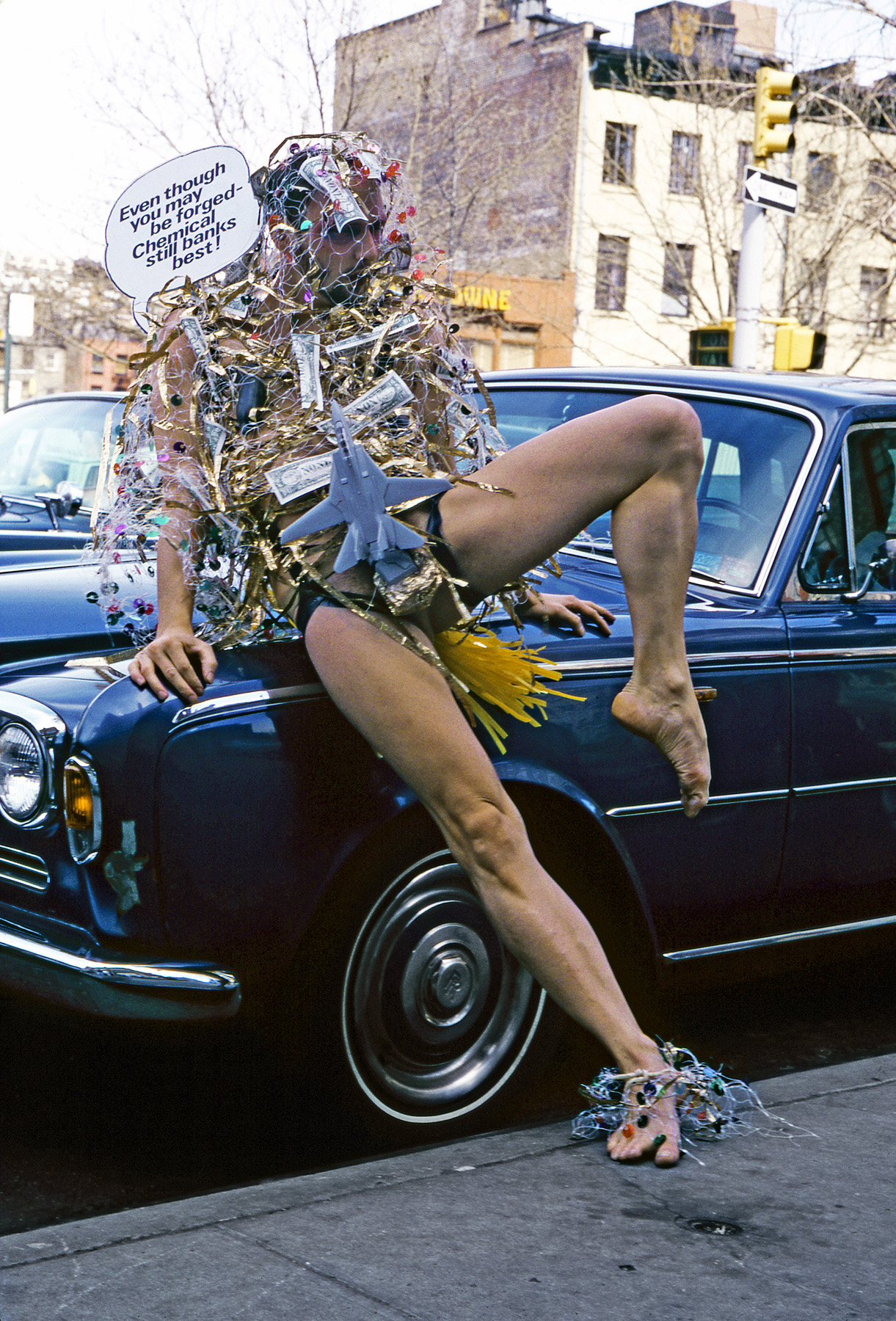
“A chauffeured Rolls Royce glides glacially to the curb in front of the Chemical Bank at New York’s Sheridan Square. The uniformed driver, out in an instant, holds open the passenger door. Rather than a well-heeled person to which such a car would belong, a more hallucinatory sight will emerge, equally glamorous and ridiculous. Two legs appear, only one of which has a shoe. The full length of the body gradually appears, improbably covered in netting and not much else, the entwined nets adorned with crumpled bills. What seem to be bare breasts droop from the chest of a figure of otherwise unidentifiable gender, further confused by a toy fighter jet, poised for takeoff, at crotch level. While no words are spoken, a cartoon speech bubble overhead proclaims, cheerily but with a disgruntled undertow: Even Though You May Be Forged, Chemical Still Banks Best!”
Bob Nickas. “Stephen Varble: Now More Than Ever,” on the Affidavit website [Online] Cited 10/04/2019
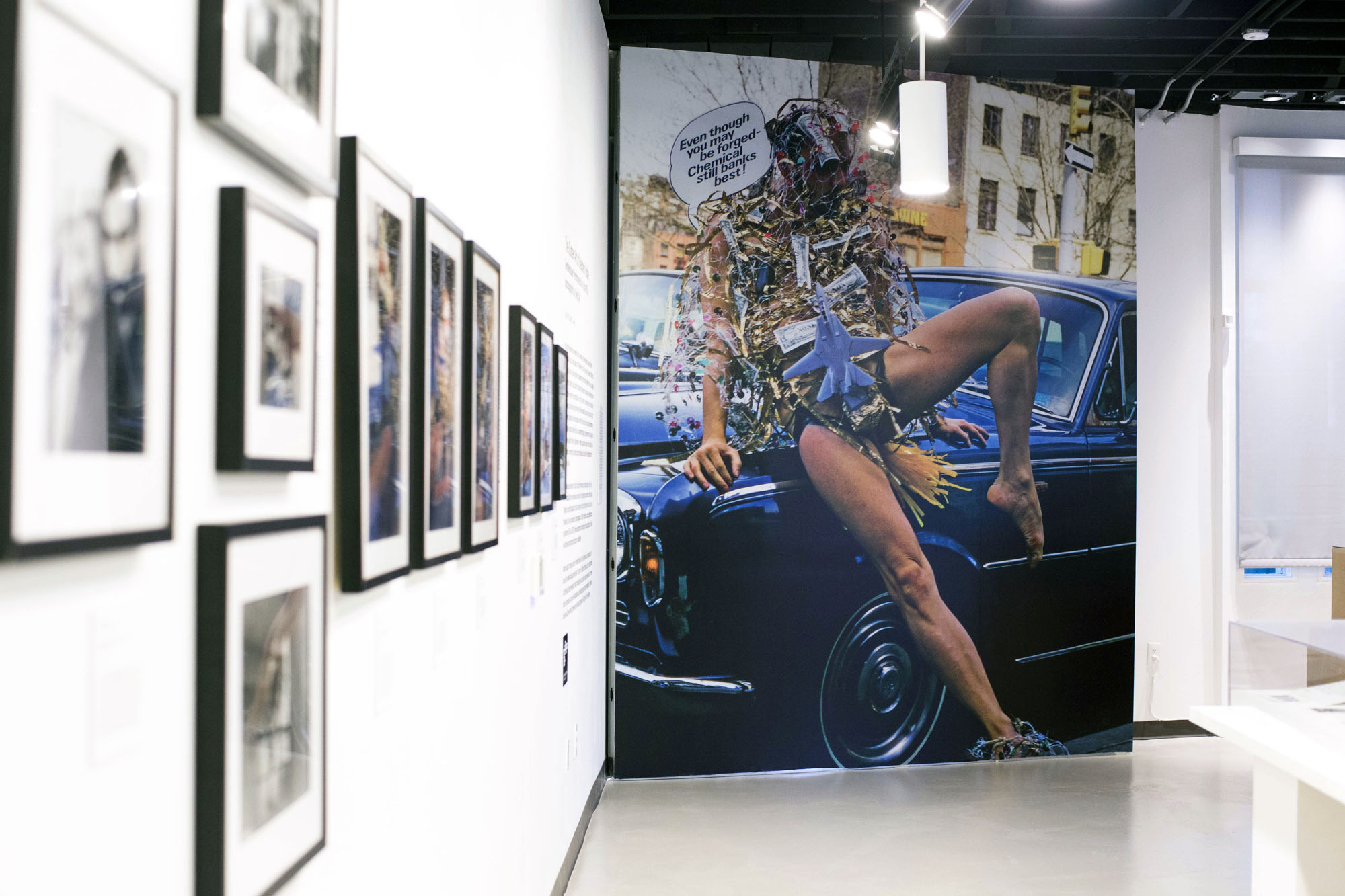
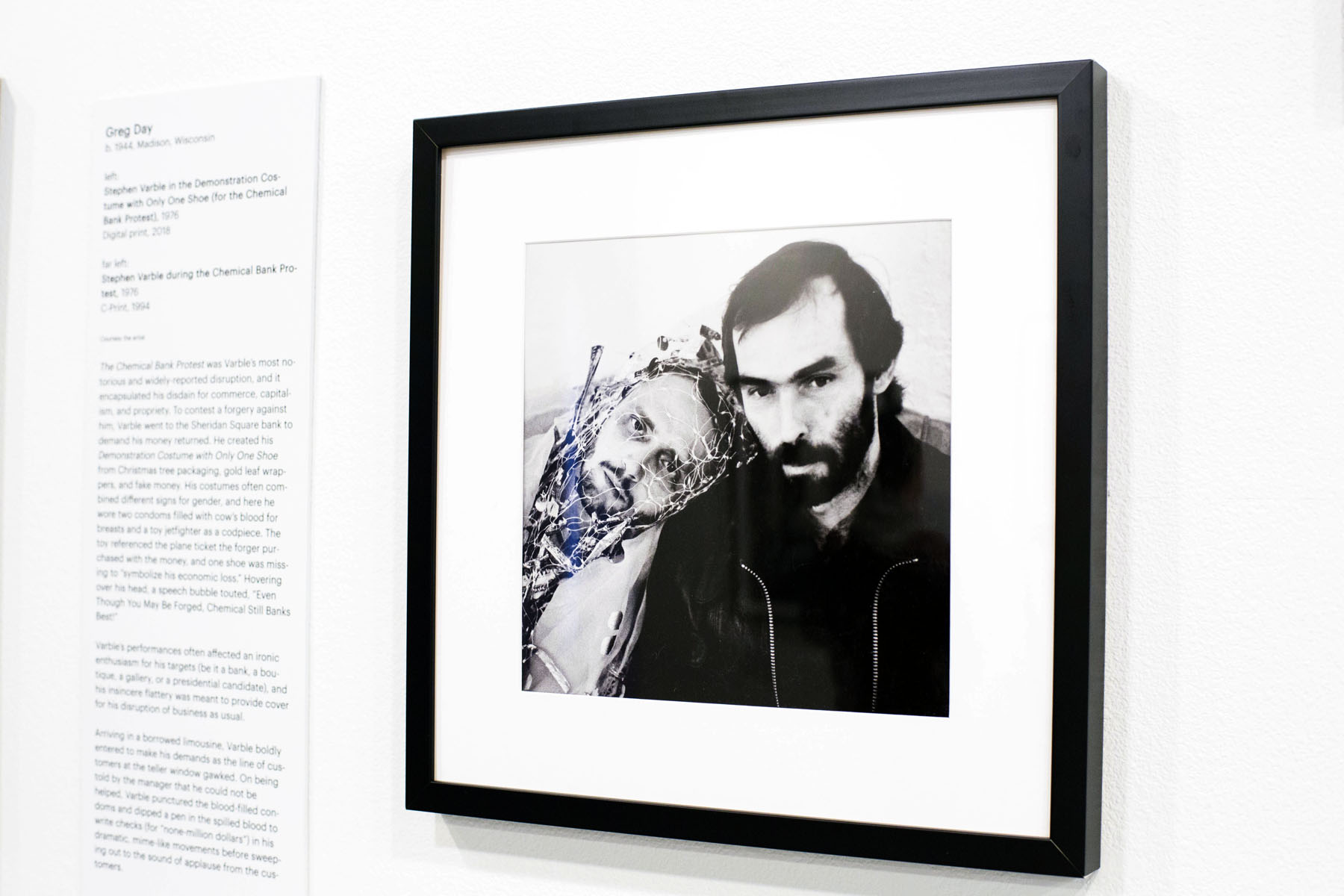
The Chemical Bank Protest was Varble’s most notorious and widely reported disruption, and it encapsulated his disdain for commerce, capitalism, and propriety. To contest a forgery against him, Varble went to the Sheridan Square bank to demand his money returned. He created his Demonstration Costume with Only One Shoe from Christmas tree packaging, gold leaf wrappers, and fake money. His costumes often combined different signs of gender, and here he wore tow condoms filled with cow’s blood for breasts and a toy jet fighter as a codpiece. The toy referenced the plane ticket the forger purchase with the money, and one shoe was missing to “symbolise his economic loss.” Hovering over his head, a speech bubble touted, “Even Though You May Be Forged, Chemical Still Banks Best!”
Varble’s performances often affected an ironic enthusiasms for his targets (be it a bank, a boutique, a gallery, or a presidential candidate), and his insincere flattery was meant to provide cover for his disruption of business as usual.
Arriving in a borrowed limousine, Varble boldly entered to make his demands as the line of customers at the teller window gawked. On being told by the manager that he could not be helped, Varble punctured the blood-filled condoms and dipped a pen in the spilled blood to write checks (for “none-million dollars”) in his dramatic, mime-like movements before sweeping out to the sound of applause from the customers.
Wall text from the exhibition
“Varble began to truly set himself apart from other gender-focused 1970s performance artists with his outré 1976 performance at Chemical Bank in Sheridan Square. After hearing that someone had forged his signature and emptied out his bank account, Varble walked into the bank dressed in fake money, with breasts made out of condoms and filled with cow’s blood. He demanded his money back. When the bank teller could not comply, Varble punctured his condom-breasts, spilling blood all over the floor, and wrote checks in blood for “none-million dollars,” which he addressed to his companion at the bank, Peter Hujar. The exhibition includes a photograph Hujar took that day, evoking a time when the lax security in banks allowed artists to perform and express themselves, however outrageously (although Varble was then escorted out of the cow’s blood-filled bank by security).”
Installation views of the exhibition The Gutter Art of Stephen Varble: Genderqueer Performance Art in the 1970s, photographs by Greg Day at ONE Gallery
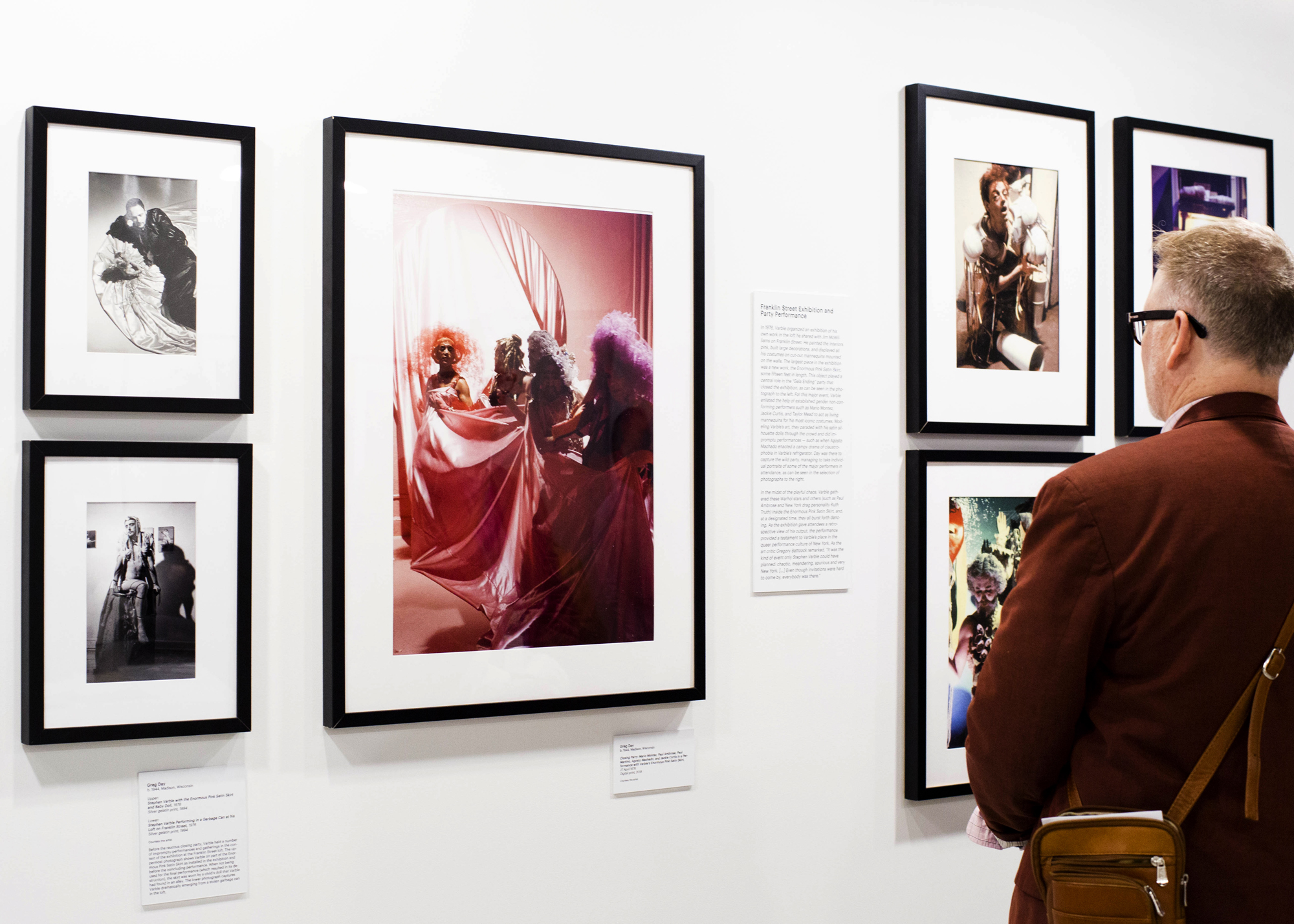
Installation view of the exhibition The Gutter Art of Stephen Varble: Genderqueer Performance Art in the 1970s, photographs by Greg Day at ONE Gallery showing, at left top, Greg Day’s Stephen Varble with the Enormous Pink Satin and baby Doll (1975); left below Stephen Varble Performing in a Garbage Can at his Loft on Franklin Street (1975); and at centre, Closing Party with Varble’s Enormous Pink Satin Skirt (1975)
Franklin Street Exhibition and Party Performance
in 1976, Varble organised an exhibition of his own work in the loft her share with Jim McWilliams on Franklin Street. He painted the interiors pink, built large decorations, and displayed all his costumes on cut-out mannequins mounted on the walls. The largest piece in the exhibition was a new work the Enormous Pink Satin Skirt, some fifteen feet in length. The object played a central role in the “Gala Ending” party that closed the exhibition, as can be seen in the photograph (main above). For this major event Varble enlisted the help of established gender non-conforming performers such as Mario Montez, Jackie Curtis, and Taylor Mead to act as living mannequins for his most iconic costumes. Modelling Varble’s art they paraded with his satin silhouette dolls through the crowd and did impromptu performances – such as when Agusta Machado enacted a campy drama of claustrophobia in Varble’s refrigerator. Day was there to capture the wild party, managing to take individual portraits of some of the major performers in attendance…
In the midst of the playful chaos, Varble gathered these Warhol stars and others (such as Paul Ambrose and New York drag personality Ruth Truth) inside the Enormous Pink Satin Skirt, and at a designated time they al burst forth dancing. As the exhibition gave attendees a retrospective view of his output the performance provided a testament to Varble’s place in the queer performance culture of New York. As the art critic Gregory Battock remarked, “It was the kind of event only Stephen Varble could have planned: chaotic, meandering, spurious and very New York […] Even though invitations were hard to come by, everybody was there.”
Wall text from the exhibition
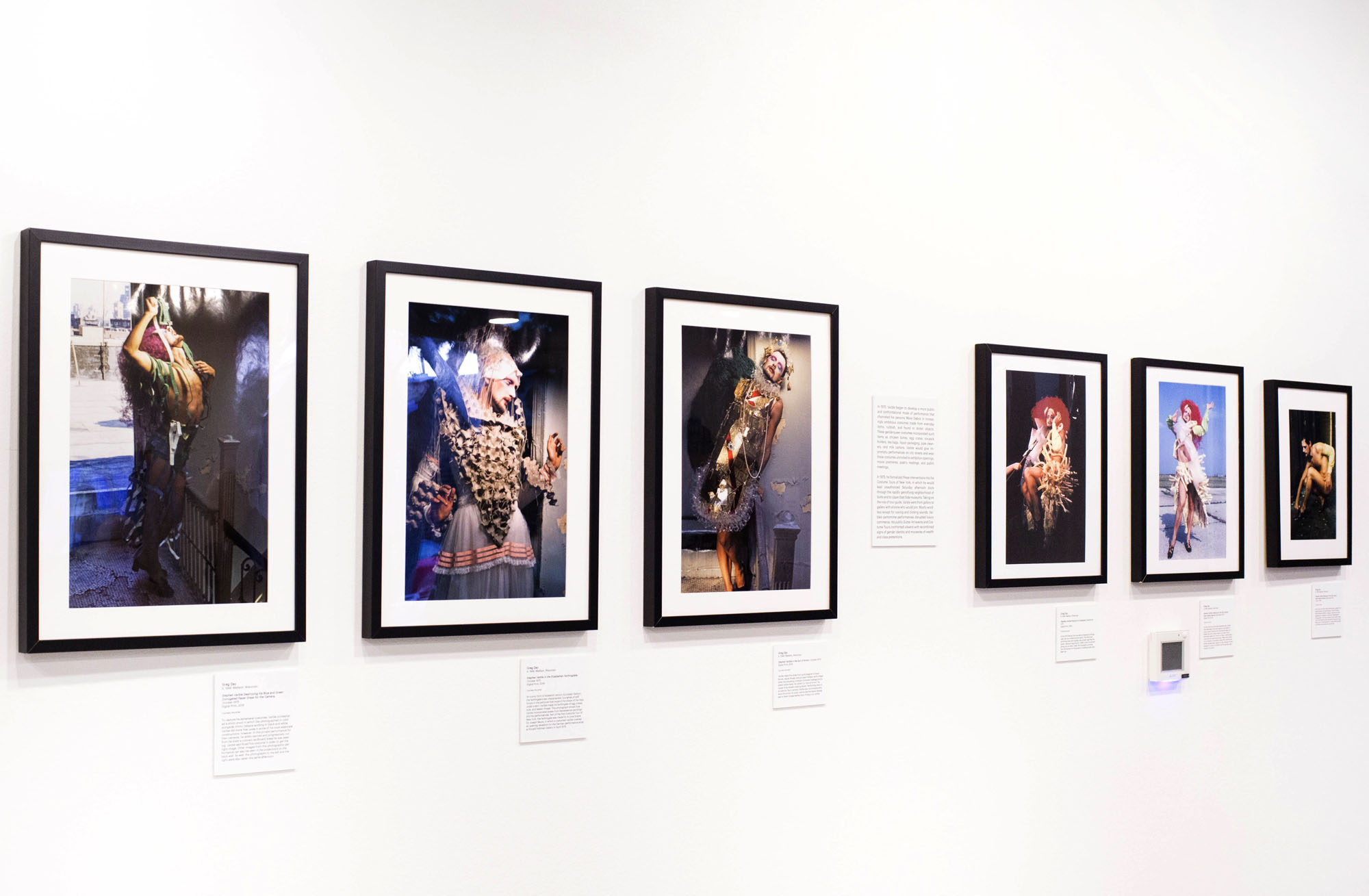
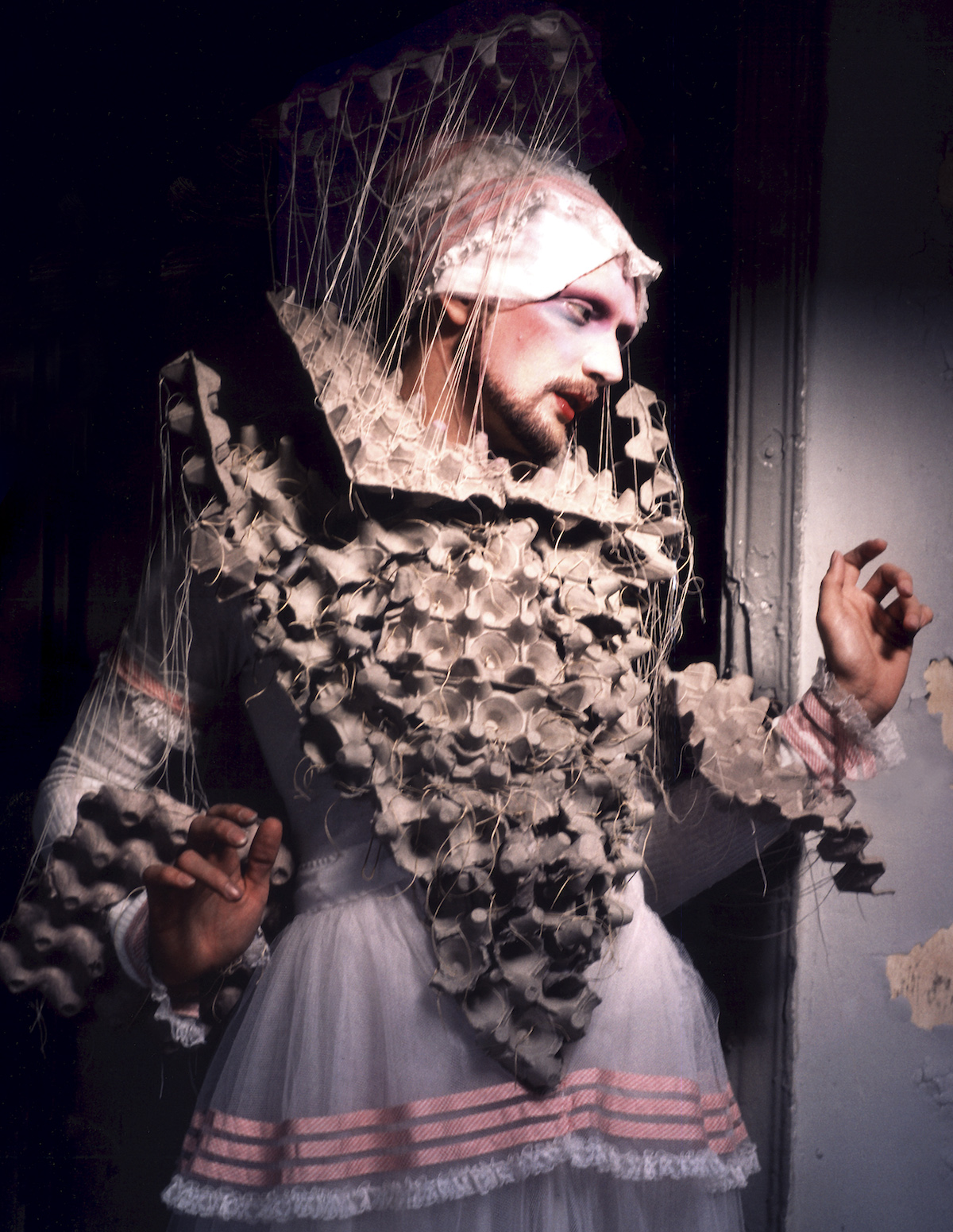
Installation view of the exhibition The Gutter Art of Stephen Varble: Genderqueer Performance Art in the 1970s, photographs by Greg Day at ONE Gallery with, at left, Greg Day’s Stephen Varble Destroying his Blue and Green Corrugated Paper Dress from the Camera (October 1975); at second left, Stephen Varble in the Elizabethan Farthingale; and at third left, Stephen Varble in the Suit of Armor (October 1975)
Installation view of the exhibition The Gutter Art of Stephen Varble: Genderqueer Performance Art in the 1970s, photographs by Greg Day at ONE Gallery
Stephen Varble, Gutter Art flyer [recto] 1975 Xerographic print on paper Courtesy Greg Day and the Leslie-Lohman Museum Photo: Courtesy Greg Day and the Leslie-Lohman Museum
Installation view of the exhibition The Gutter Art of Stephen Varble: Genderqueer Performance Art in the 1970s, photographs by Greg Day at ONE Gallery
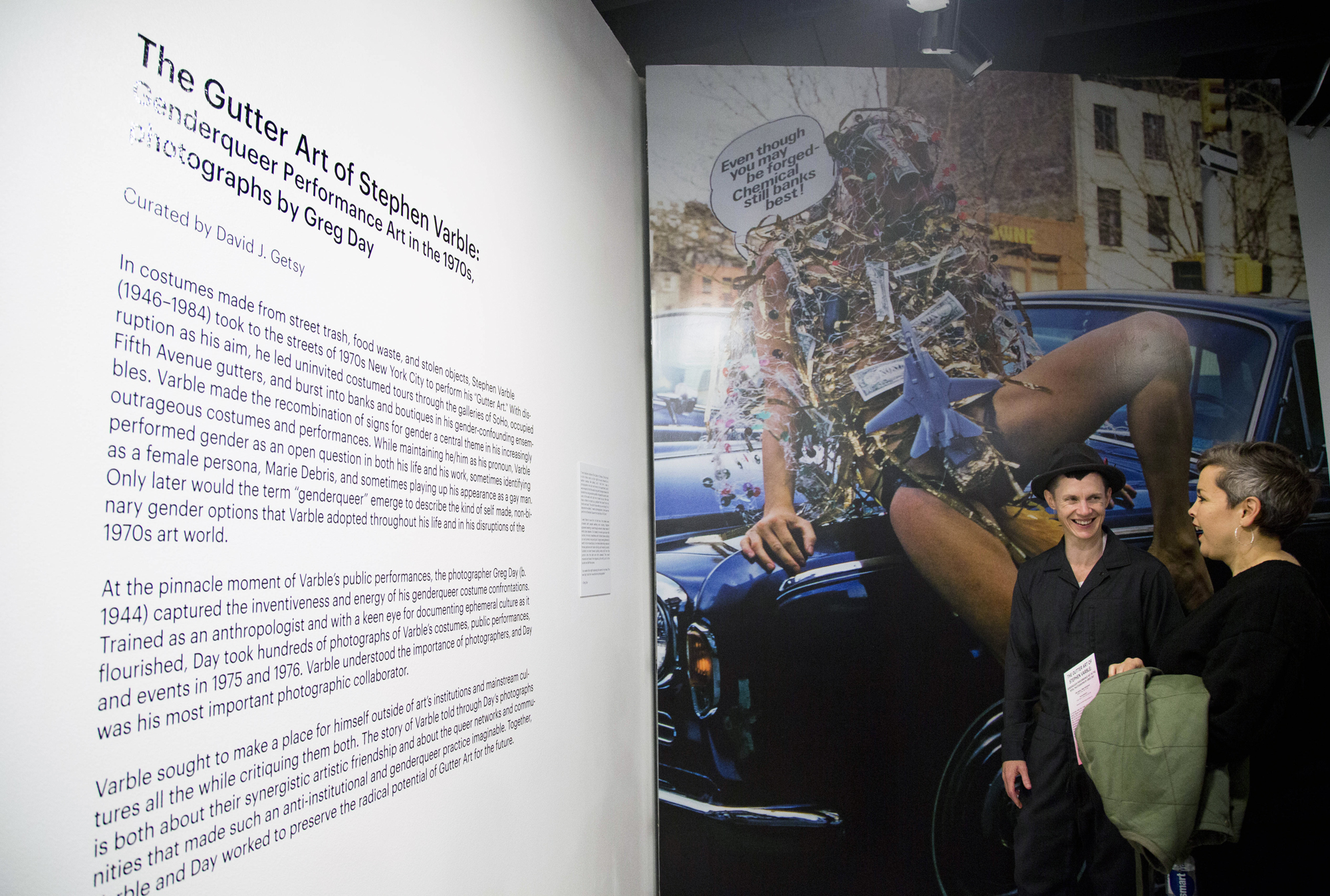
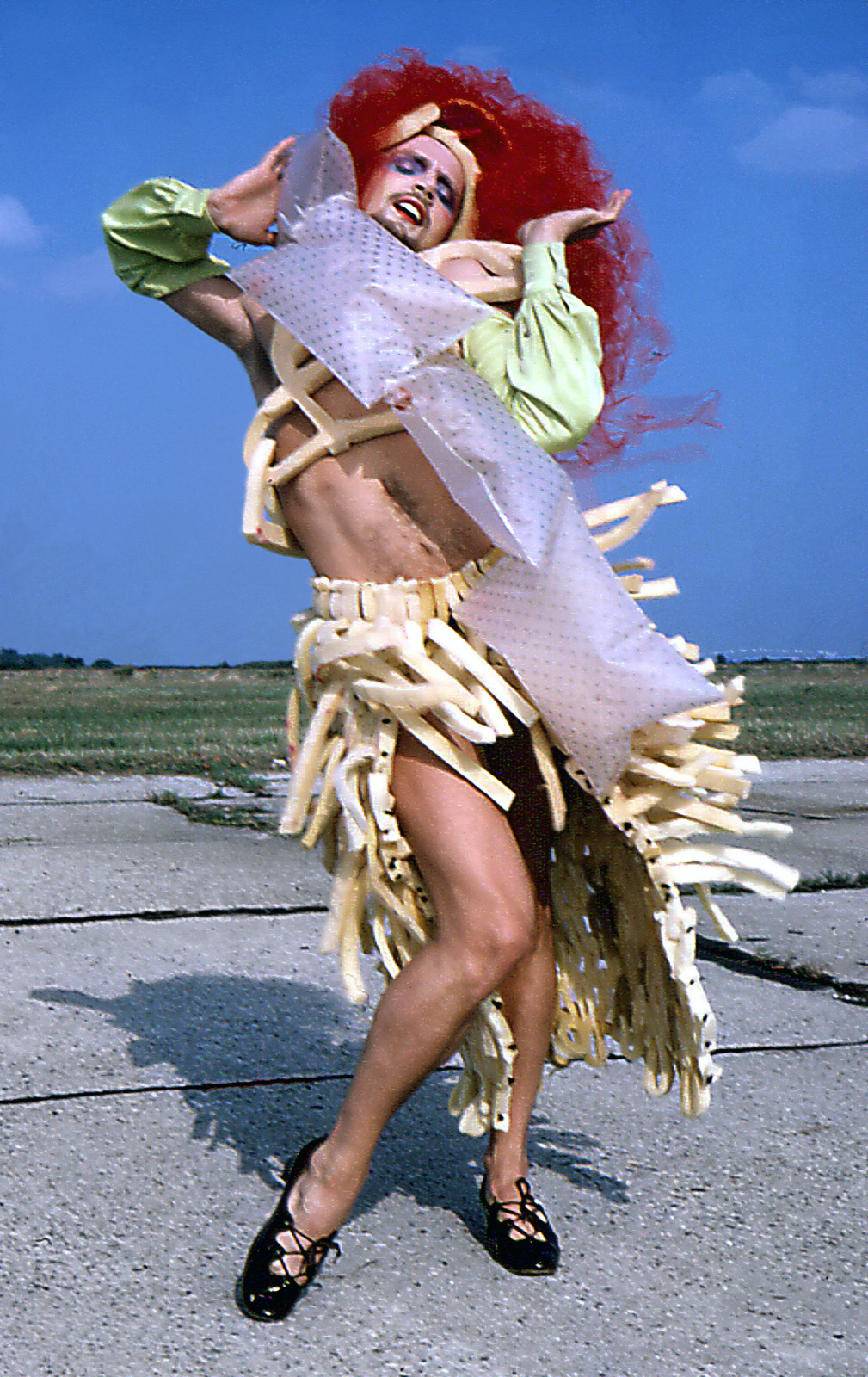
In costumes made from street trash, food waste, and stolen objects, Stephen Varble (1946-1984) took to the streets of 1970s New York City to perform his “Gutter Art.” With disruption as his aim, he led uninvited costumed tours through the galleries of SoHo, occupied Fifth Avenue gutters, and burst into banks and boutiques in his gender-confounding ensembles. Varble made the recombination of signs for gender a central theme in his increasingly outrageous costumes and performances. While maintaining he/him as his pronouns, Varble performed gender as an open question in both his life and his work, sometimes identifying as a female persona, Marie Debris, and sometimes playing up his appearance as a gay man. Only later would the term “genderqueer” emerge to describe the kind of self-made, non-binary gender options that Varble adopted throughout his life and in his disruptions of the 1970s art world.
At the pinnacle moment of Varble’s public performances, the photographer Greg Day (b. 1944) captured the inventiveness and energy of his genderqueer costume confrontations. Trained as an artist and anthropologist and with a keen eye for documenting ephemeral culture as it flourished, Day took hundreds of photographs of Varble’s trash couture, public performances, and events in 1975 and 1976. Varble understood the importance of photographers, and Day was his most important photographic collaborator. This exhibition brings together a selection of Day’s photographs of Varble performing his costume works and also includes Day’s photographs of Varble’s friends and collaborators such as Peter Hujar, Jimmy DeSana, Shibata Atsuko, Agosto Machado, and Warhol stars Jackie Curtis, Taylor Mead, and Mario Montez.
Varble sought to make a place for himself outside of art’s institutions and mainstream cultures all the while critiquing them both. The story of Varble told through Day’s photographs is both about their synergistic artistic friendship and about the queer networks and communities that made such an anti-institutional and genderqueer practice imaginable. Together, Varble and Day worked to preserve the radical potential of Gutter Art for the future.
The Gutter Art of Stephen Varble builds upon the 2018 retrospective exhibition of Stephen Varble’s work at the Leslie-Lohman Museum of Gay and Lesbian Art, New York, titled Rubbish and Dreams: The Genderqueer Performance Art of Stephen Varble, as featured in the New York Times on January 11, 2019. The new ONE Gallery exhibition, with its focus on the collaboration of Varble with the photographer Greg Day, will explore the ways in which Varble’s disruptive guerrilla performance art has lived on primarily through vibrant photographs that captured his inventive costumes, transformed trash, and public confrontations.
The Gutter Art of Stephen Varble: Genderqueer Performance Art in the 1970s photographs by Greg Day is curated by David J. Getsy, Goldabelle McComb Finn Distinguished Professor of Art History at the School of the Art Institute of Chicago. The Gutter Art of Stephen Varble is organised by the ONE Archives Foundation, Inc. Generous support is provided by the City of West Hollywood.
About the ONE Archives Foundation, Inc.
The ONE Archives Foundation, Inc. is an independent 501(c)(3) dedicated to telling the accurate and authentic stories of LGBTQ people, history and culture through public exhibitions, educational projects and trainings, and community outreach programs. Our exhibitions, school programs, and community outreach programs are free. We depend entirely on members of the public and private foundations for support.
Press release from the ONE Gallery [Online] Cited 10/04/2019
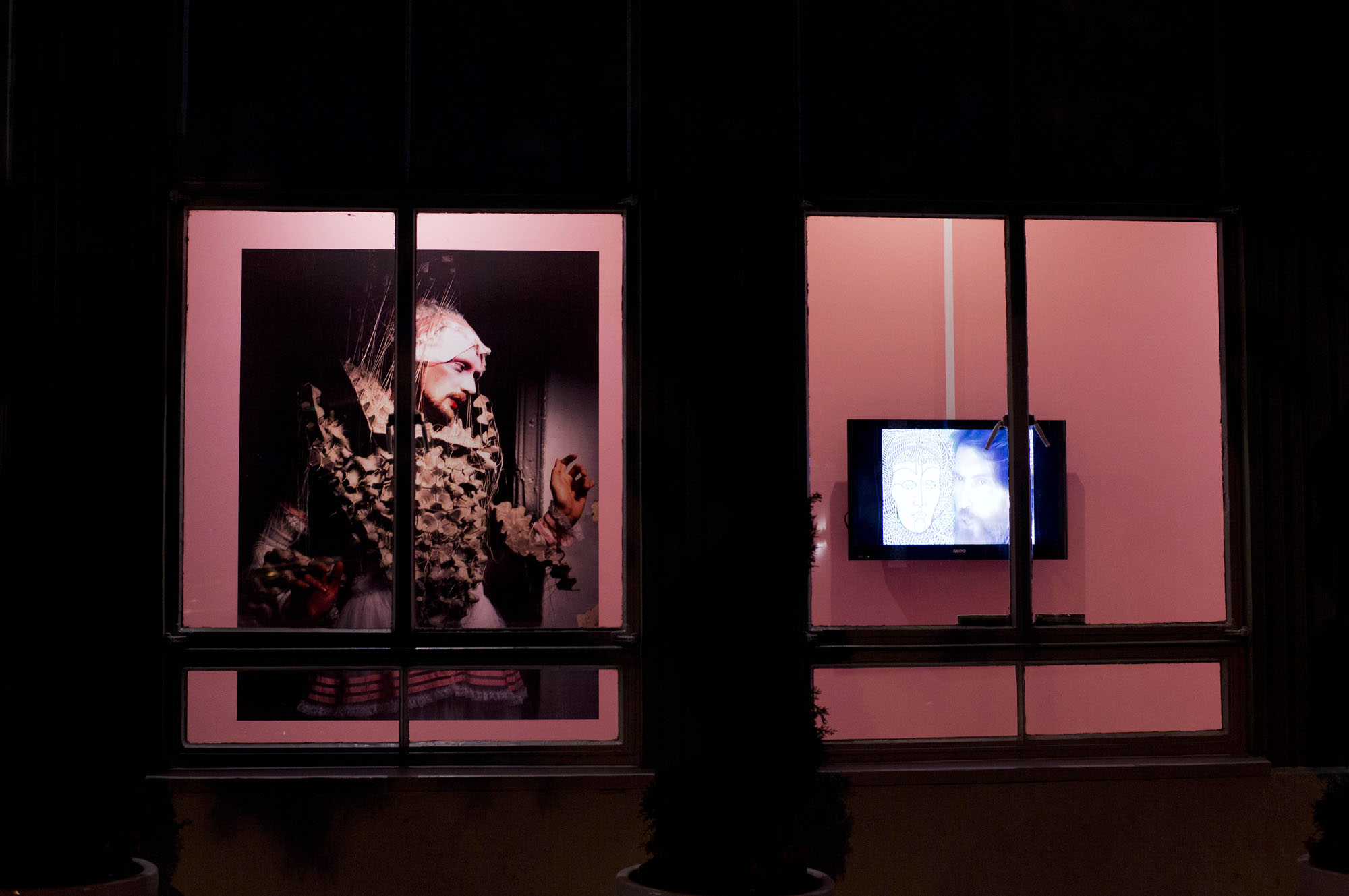
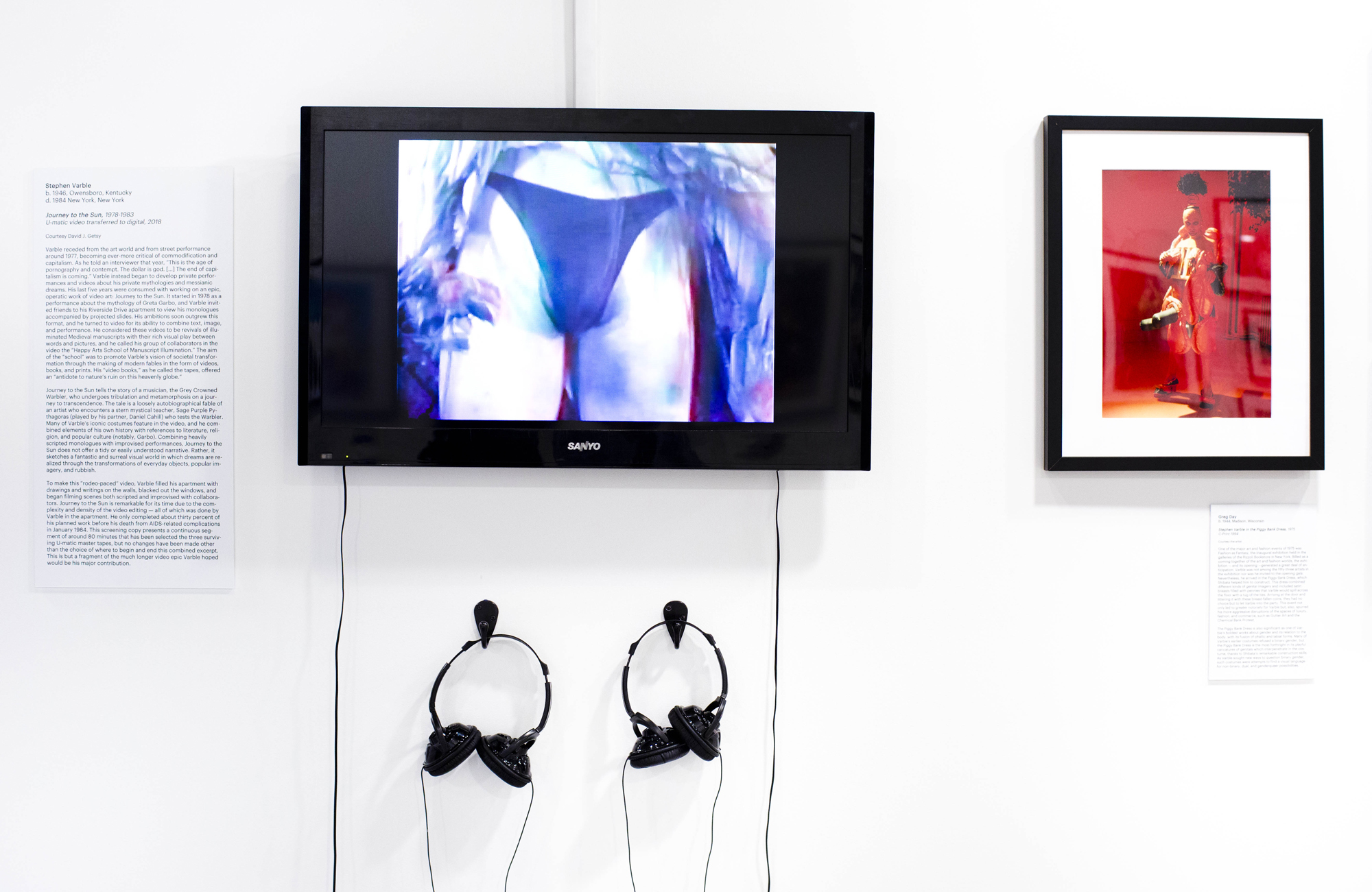
Installation view of the exhibition The Gutter Art of Stephen Varble: Genderqueer Performance Art in the 1970s, photographs by Greg Day at ONE Gallery showing, at left, a still from Stephen Varble’s video Journey to the Sun (1978-1983); and at right Greg Day’s Stephen Varble in the Piggy Bank Dress (1975)
Stephen Varble (American, 1946-1984) Journey to the Sun 1978-1983 U-matic video transferred to digital, 2018 Courtesy David J. Getsy
Varble receded from the art world and from street performance around 1977, becoming ever-more critical of commodification and capitalism. As he told an interviewer that year, “This is the age of pornography and contempt. The dollar is good. […] The end of capitalism is coming.” Varble instead began to develop private performances and videos about his private mythologies and messianic dreams. His last five years were consumed with working on an epic, operatic work of video art: Journey to the Sun. It started in 1978 as a performance about the mythology of Greta Garbo, and Varble invited friends to his Riverside Drive apartment to view his monologues accompanied by project slides. His ambitions soon outgrew this format, and he turned to video for its ability to combine text, image and performance. He considered these videos to be revivals of illuminated Medieval manuscripts with their rich visual play between words and pictures, and he called his group of collaborators in the video the “Happy Arts School of Manuscript Illumination.” The aim of the “school” was to promote Varble’s vision of societal transformation through the making of modern fables in the form of videos, books, and prints. His “video books,” as he called the tapes, offered an “antidote to nature’s ruin on this heavenly globe.”
Journey to the Sun tells the story of a musician, the Grey Crowned Warbler, who undergoes tribulation and metamorphosis on a journey to transcendence. The tale is a loosely autobiographical fable of an artist who encounters a stern mystical teacher, Sage Purple Pythagoras (played by his partner, Daniel Cahill) who tests the Warbler. Many of Varble’s iconic costumes feature in the video, and he combined elements of his own history with references to literature, religion, and popular culture (notably, Garbo). Combining heavily scripted monologues with improvised performances. Journey to the Sun does not offer a tidy or easily understood narrative. Rather, it sketches a fantastic and surreal visual world in which dreams are realised through the transformations of everyday objects, popular imagery, and rubbish.
To make this “rodeo-paced” video, Varble filled his apartment with drawings and writings on the walls, blacked out the windows, and began filming scenes both scripted and improvised with collaborators. Journey to the Sun is remarkable for its time due to the complexity and density of the video editing – all of which was done by Varble in his apartment. He only completed about thirty percent of his planned work before his death from AIDS-related complications in January 1984. This screening copy presents a continuous segment of around 80 minutes that has been selected from the three surviving U-matic master tapes, but no changes have been made other than the choice of where to begin and end this combined excerpt. This is but a fragment of the much longer video epic Varble hoped would be his major contribution.
Wall text from the exhibition
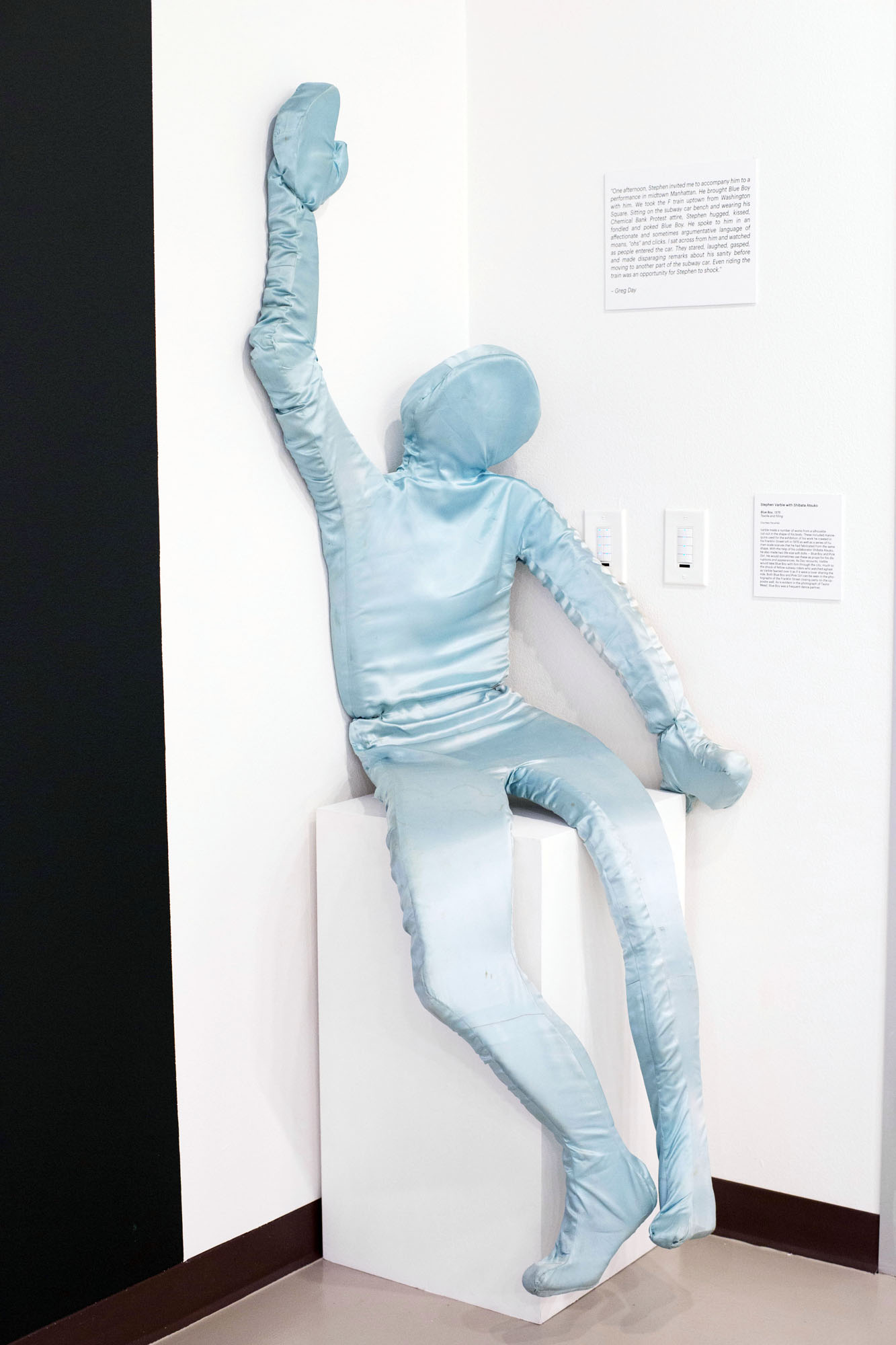
Installation view of the exhibition The Gutter Art of Stephen Varble: Genderqueer Performance Art in the 1970s, photographs by Greg Day at ONE Gallery showing Stephen Varble’s Blue Boy
“One afternoon, Stephen invited me to accompany him to a performance in midtown Manhattan. He bought Blue Boy with him. We took the F train uptown from Washington Square. Sitting on the subway car bench and wearing his Chemical Bank Protest attire. Stephen hugged, kissed, fondled and poked Blue Boy. He spoke to him in an affectionate and sometimes argumentative language of moans, “ohs” and clicks. I sat across from him and watched as people entered the car. They stared, laughed, gasped, and made disparaging remarks about his sanity before moving to another part of the subway car. Even riding the train was an opportunity for Stephen to shock.”
There’s something consistently awesome about Mexican photography that is so grounded, so essential, and yet at the same time so spiritual.
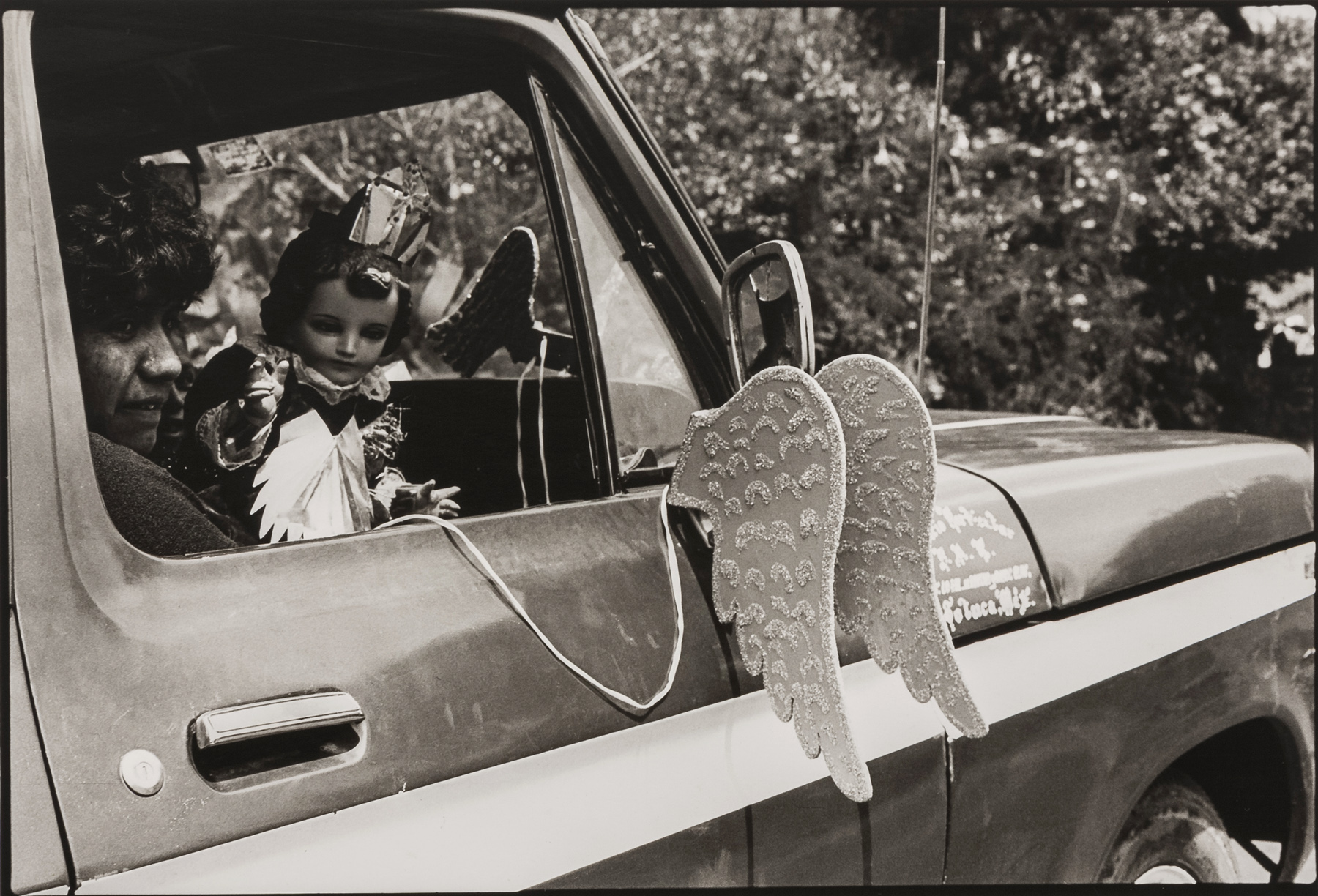
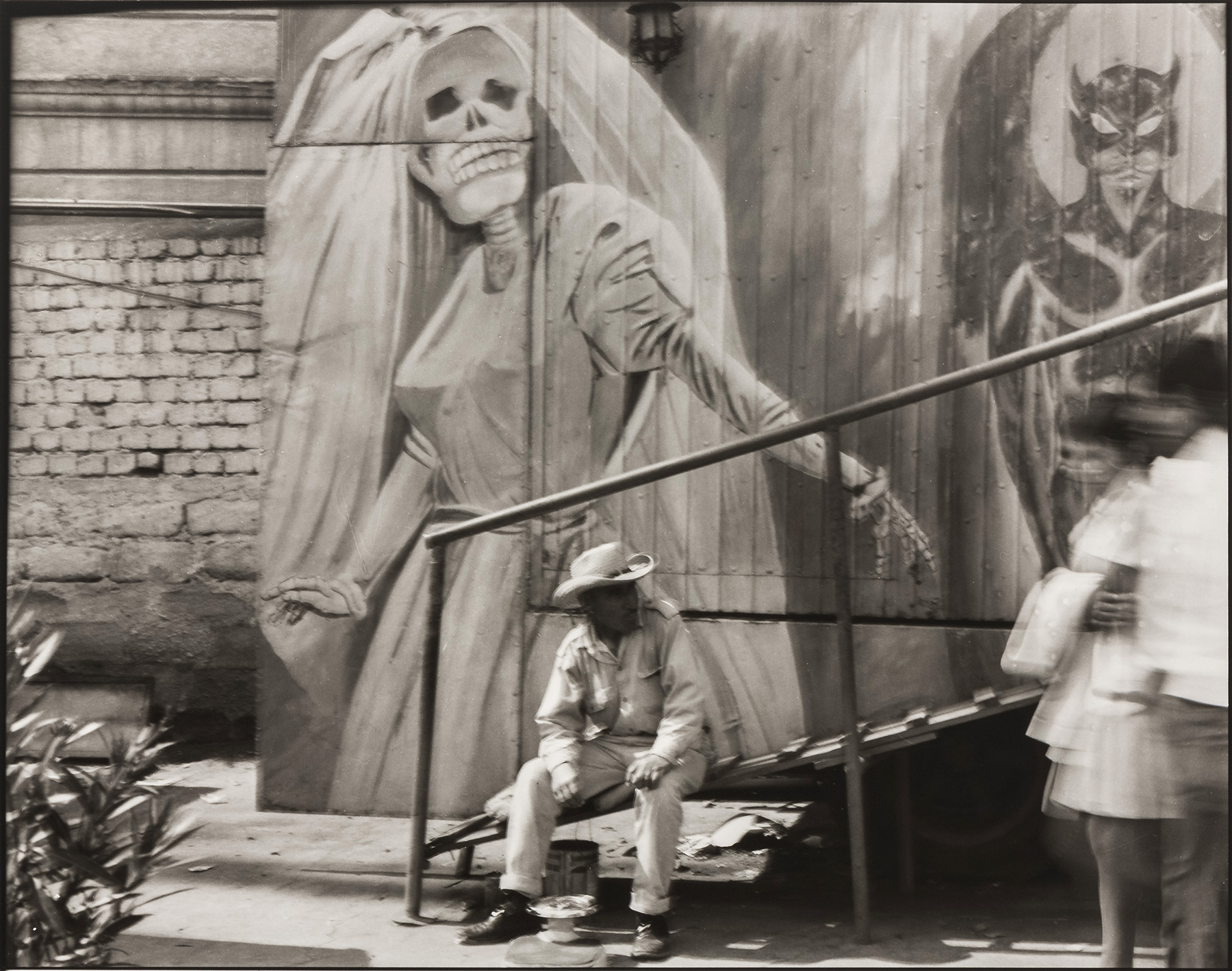
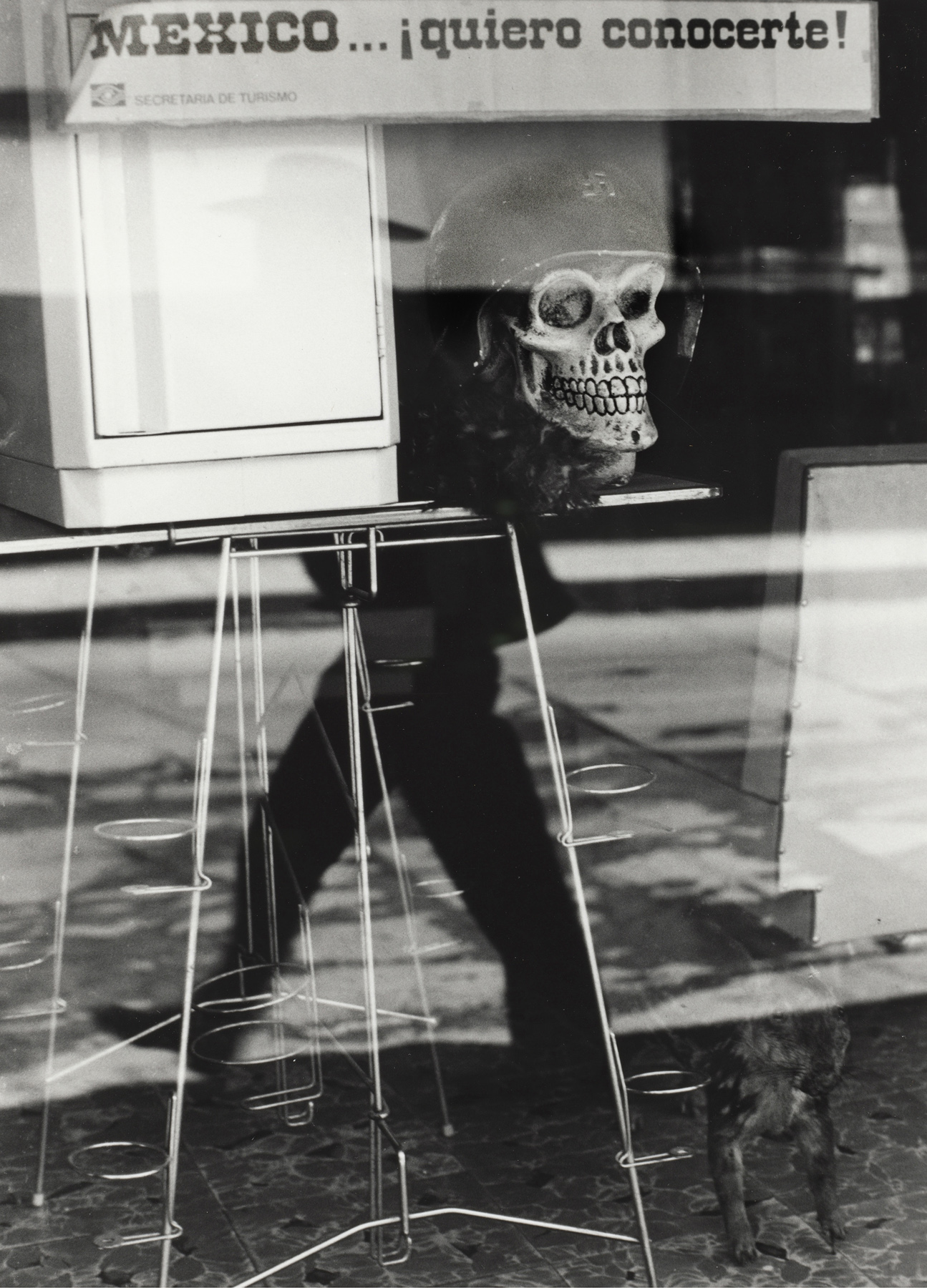
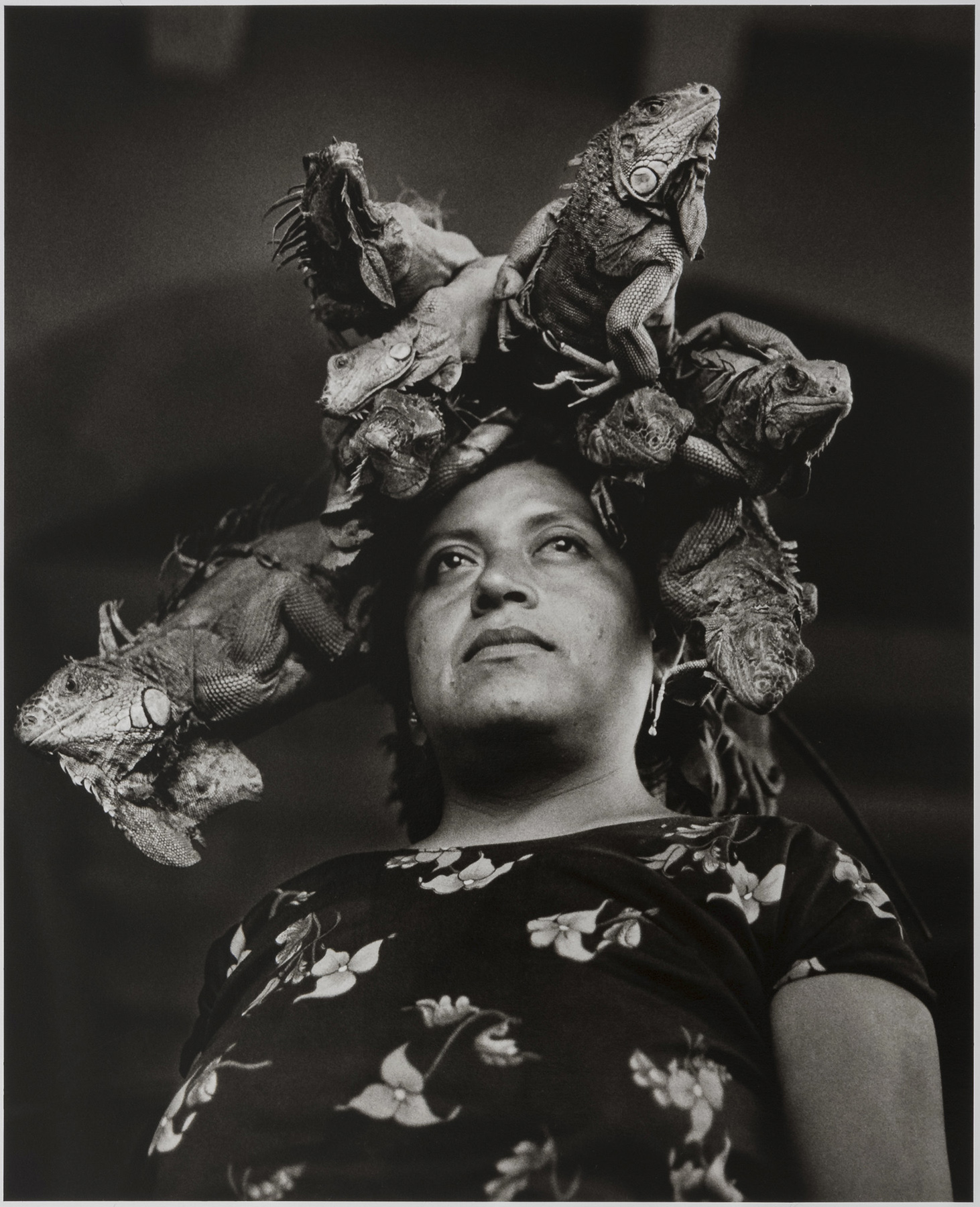
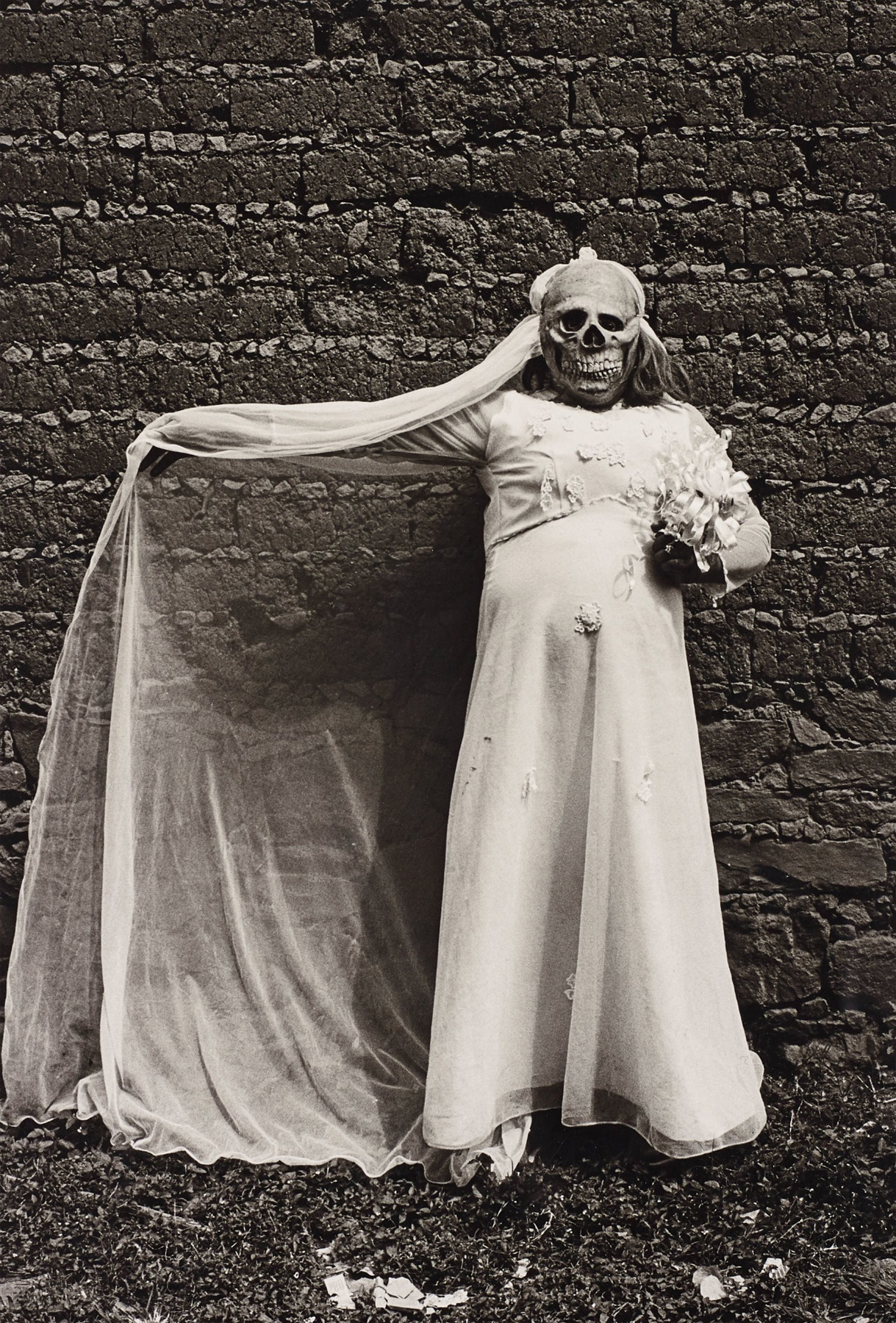
One of my favourite photographic artists of all time is Manuel Alvarez Bravo, he of the lyrical narrative, the sensual body, the assassinated worker. Iturbide seems to be cut from the same cloth – she was his assistant for two years; he her teacher about photography and life – and his influence is telling in Iturbide’s imaginative and sometimes incongruous images, such as the skull in Mexico… I want to get to know you! (1975, below) or Our Lady of the Iguanas, Juchitán, Mexico (1979, below).
Life, death, violence, sacrifice, beauty, identity and place, mixed with daubs of Surrealism, are constant themes of Mexican photography and this symbology can be seen in Iturbide’s unusual urban geometries and her eye for the unexpected. She is a visionary ethnographer who paints in black and white a story of magical literary realism… seeing through her camera something different than she sees with her eyes directly. She sees, and then feels, a different world.
Octavio Paz, the great Mexican poet, writing about the great Mexican photographer Manuel Alvarez Bravo, said that, “Reality exists, but it is more real in black and white.” And so here. Iturbide feels that black and white is more real than colour – and that reality is in black and white. It is in this tonal space that Graciela Iturbide’s Mexico pictures a place of beauty and contradiction, a place of transformations and interstitial spaces (intermediate, indeterminate spaces), an amalgamation of Indigenous and Spanish traditions. “I always shoot what surprises me,” she says. “My eyes see them, and my heart shoots them.”
Gracia Graciela, oh Graceful Beauty, for your gift to us.
Dr Marcus Bunyan
Many thankx to the Museum of Fine Arts Boston for allowing me to publish the photographs in the posting. Please click on the photographs for a larger version of the image.
“Photography is also like life, right? … I think in my case, taking photos as therapy has a lot to do with death with everything I do, with Frida Kahlo, because I like to photograph things in therapy, things that are healing, which is powerful, right?”
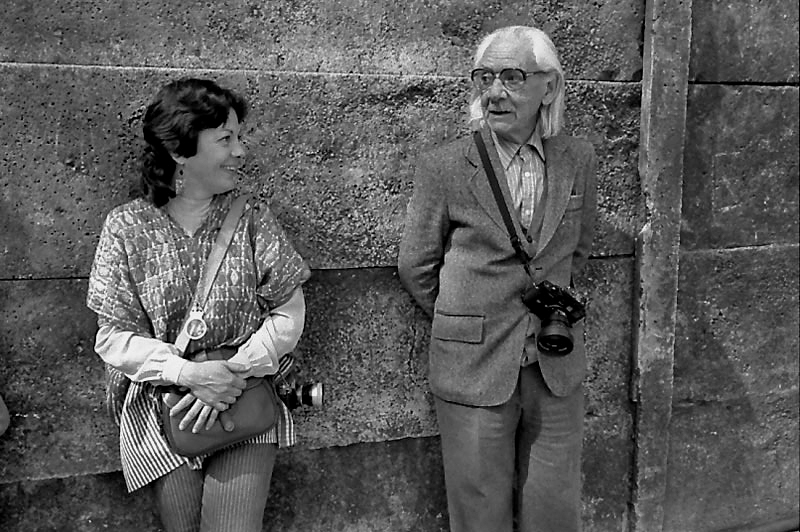
Pedro Meyer (Spanish, b. 1935) Manuel Álvarez Bravo and Graciela Iturbide, Coyoacán (Mexico) 1983 Gelatin silver print
When I went to study at the university he was teaching at the university as well and I attended one of his courses; that’s how I got to know him. Then, after a couple of weeks I became his assistant. At that time he was not that famous in Mexico, he was very famous in Europe and the United States. He was known in Mexico but he was not really a big star. So, what I really need to make clear is that he was not just a teacher of photography; he was a teacher about life for me. Because he taught me about everything, he talked about literature, cinematography… so he was more of a teacher of life… he never said this picture is good or this picture is bad, he would never say that flat out. Instead, he would always say something to guide you in the right direction. Yet he would never say, “This is good or this is bad”.
With Álvarez I went to certain little towns but I was only his assistant for two years. After that I made the decision to cut the umbilical cord and make my own way.
Extract from Munem Wasif. “An Interview with Graciela Iturbide,” on the Chobi Mela website, November 24, 2014 [Online] Cited 06/04/2019
The photographs of Graciela Iturbide not only bear witness to Mexican society but express an intense personal and poetic lyricism about her native country. One of the most influential photographers active in Latin America today, Iturbide captures everyday life and its cultures, rituals, and religions, while also raising questions about paradoxes and social injustice in Mexican society. Her photographs tell a visual story of Mexico since the late 1970s – a country in constant transition, defined by the coexistence of the historical and modern as a result of the culture’s rich amalgamation of cultures. For Iturbide, photography is a way of life and a way of seeing and understanding Mexico and its beauty, challenges, and contradictions.
This is the first major East Coast presentation of Iturbide’s work, featuring approximately 125 photographs that span her five-decade-long career. Organised into nine sections, the exhibition opens with early photographs, followed by three series focused on three of Mexico’s many indigenous cultures: Juchitán captures the essential role of women in Zapotec culture; Los que viven en la arena (Those Who Live in the Sand) concentrates on the Seri people living in the Sonoran Desert; and La Mixteca documents elaborate goat-slaughtering rituals in Oaxaca, serving as critical commentary on the exploitation of workers. Thematic groupings highlight Iturbide’s explorations of various aspects of Mexican culture, including fiestas, death and mortality, and birds and their symbolism. Her more recent work is presented in two series related to Mexico’s cultural and artistic heritage, featuring plants – mainly cacti – in “intensive care” at the Oaxaca Ethnobotanical Gardens, as well as El baño de Frida (Frida’s Bathroom), depicting personal belongings in Frida Kahlo’s bathroom at the Casa Azul that had been locked away for 50 years after the artist’s death.
Iturbide’s powerful and provocative photographs are anti-picturesque, anti-folkloric. Her work embodies her empathetic approach to photography and her deep connection with her subjects, asking questions through its capacity for imaginary associations. Drawn primarily from Iturbide’s own collection, “Graciela Iturbide’s Mexico” also includes the Museum’s recent acquisition of 37 works by the artist, as well as loans from museums and private collections throughout the US and Mexico. The exhibition is accompanied by an illustrated catalogue produced by MFA Publications.
Text from the Museum of Fine Arts, Boston website [Online] Cited 05/04/2019
Nearly 140 Images in Graciela Iturbide’s Mexico Portray Photographer’s Native Country through Her Eyes
Throughout a five-decade-long career, photographer Graciela Iturbide (born 1942) has focused on capturing and understanding the beauty, rituals, challenges and contradictions of her native Mexico. Graciela Iturbide’s Mexico is the first major East Coast presentation of the artist’s work, featuring nearly 140 photographs that tell the visual story of her country since the late 1970s. Going beyond documentary photography, Iturbide’s work reveals Mexico’s complexities through her personal explorations. Focused on the tensions between urban and rural life, human presence and nature, and indigenous and Spanish cultures, her photographs have contributed to Mexico’s visual identity while calling attention to the rich syncretism, diversity and inequalities of Mexican society. The exhibition is drawn primarily from Iturbide’s own collection and also highlights a recent acquisition of her photographs, the first major group of works by the artist to enter the Museum’s collection – 35 purchased by the MFA and two donated by Iturbide. Loans from museums and private collections throughout the U.S., Mexico and France are also included. On view from January 19 through May 12, 2019 in the Henry and Lois Foster Gallery, the exhibition features interpretation in English and Spanish, as well as a documentary video of the artist, produced by the Museum and shot at Iturbide’s studio in Mexico City. Graciela Iturbide’s Mexico is accompanied by an illustrated catalogue produced by MFA Publications, which features more than 100 striking tritone reproductions of evocative photographs alongside essays that invite readers to share in Iturbide’s personal artistic journey. This beautiful volume with a three-piece cloth and printed binding with foil stamping teases out key ideas and visual relationships across different moments in the photographer’s storied career. The exhibition is supported by the Leigh and Stephen Braude Fund for Latin American Art, The Bruce and Laura Monrad Fund for Exhibitions, and the Diane Krane Family and Jonathan and Gina Krane Family Fund. Generous support for the publication was provided by the Andrew W. Mellon Publications Fund.
“I am thrilled to present Graciela’s groundbreaking images to our global audiences, and it has been a pleasure and honour to work closely with her in preparation for this exhibition,” said Kristen Gresh, Estrellita and Yousuf Karsh Curator of Photographs. “Her work has successfully and beautifully brought to the forefront the many untold stories of Mexican culture and history – from the eyes of an insider.”
The exhibition is organised thematically into nine sections and opens with early photographs. One of her first works, Zihuatanejo, México (1969, Collection of Les and Sandy Nanberg), is a pensive portrait of a young girl that marks the beginning of Iturbide’s forays into photographing the diverse peoples of Mexico. Shot during the same year, Mexico City (1969, Collection of Daniel Greenberg and Susan Steinhauser) portrays a sex worker in what appears to be a cantina or pulquería. In fact, the subject is a figure in a wax museum. The photograph’s graphic background – a mural of a large skull painted on a wall – alludes to both Mexico’s long history of muralism and the country’s fascination with death. Works such as Little Bull / Torito (1982, Collection of Galeria Lopez Quiroga) and Juchitán (1975, MFA) reveal Iturbide’s attraction to unusual urban geometries and her eye for the unexpected. Together, these early images attest to the photographer’s keen observation of Mexican contemporary culture in the 1970s and early 1980s.
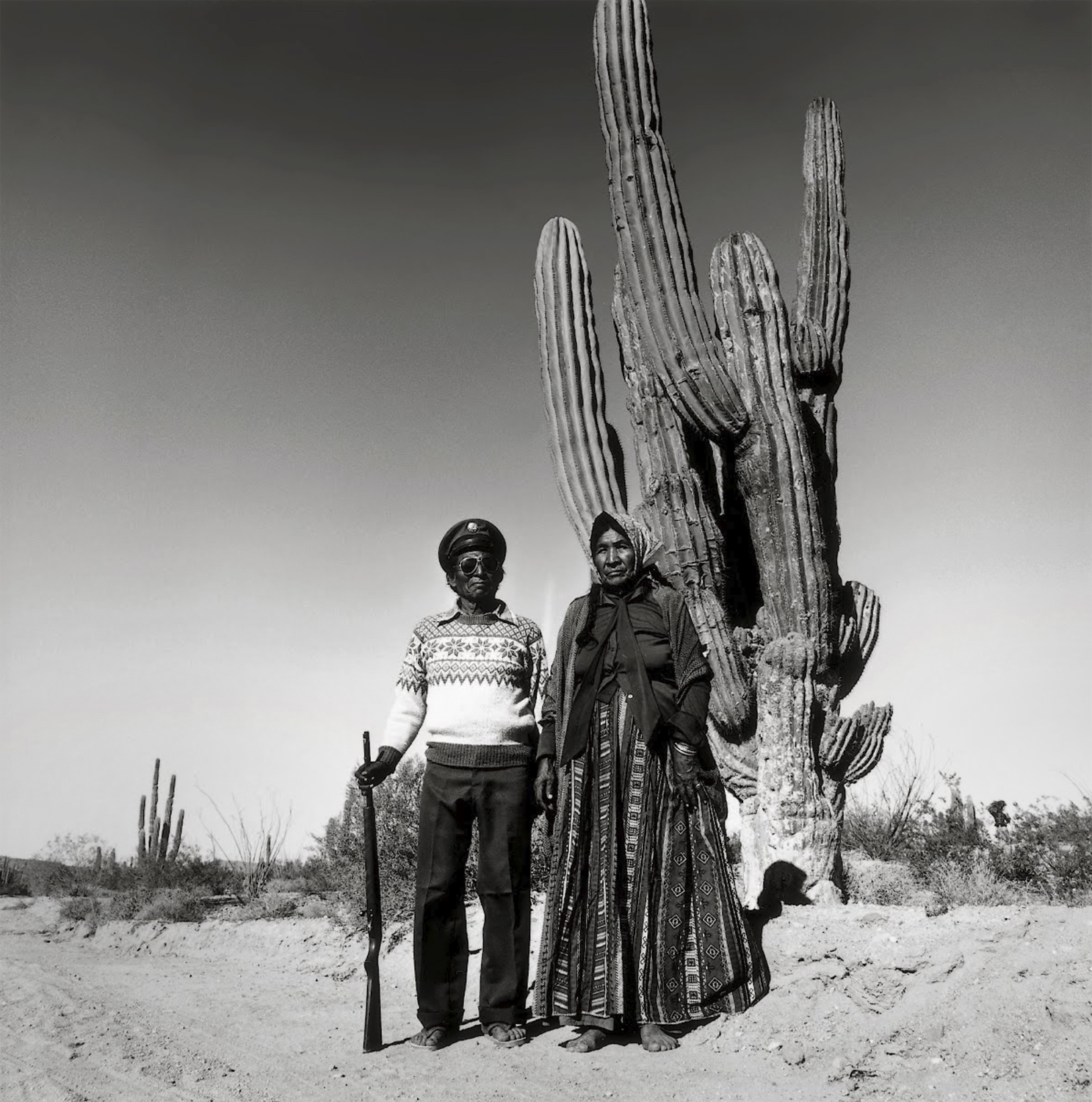
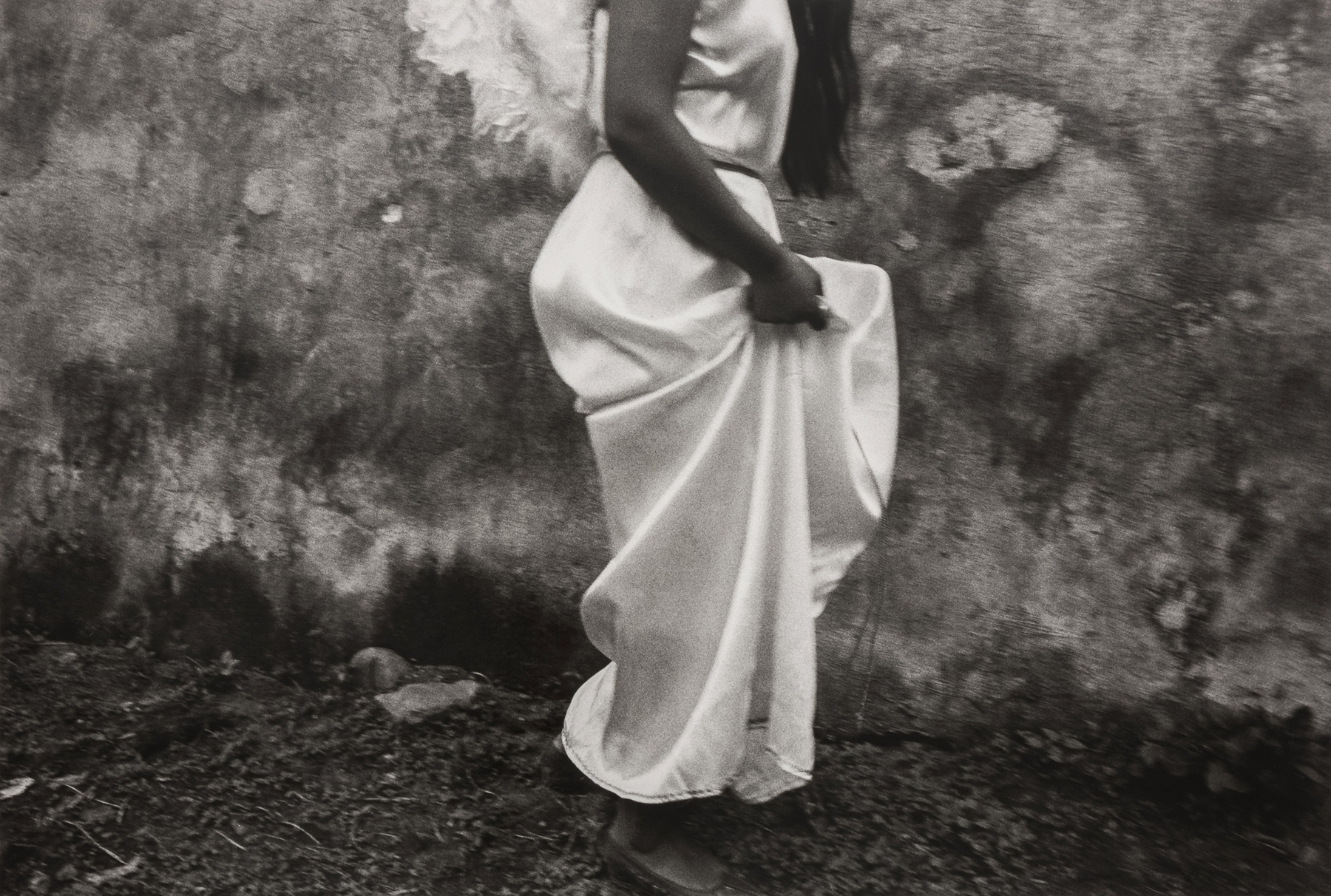
The next three sections of the exhibition focus on Iturbide’s deep commitment to photographing different populations throughout Mexico. One of her early projects was to document the way of life of the Seri Indians, a formerly nomadic group of fisherfolk living in the Sonoran Desert in northwestern Mexico. In 1978, Iturbide and anthropologist Luis Barjau immersed themselves within the community, staying for a month and a half on their first trip and another month on the second. The result of their collaboration was the 1981 book Los que viven en la arena ( Those Who Live in the Sand) and a selection of additional photographs that Iturbide printed and exhibited years later. The exhibition features two prints of one of Iturbide’s most well-known works, Angel Woman / Mujer ángel (1979, Collection of Elizabeth and Michael Marcus and Collection of Galeria Lopez Quiroga ), an ethereal image that captures a woman in traditional dress carrying a boom box as she heads down to the empty desert plain. The photograph exemplifies a theme running through the series: the impact of capitalism on the Seri people’s otherwise minimalist culture. This early project confirmed Iturbide’s interests in working thematically, raising her awareness of Mexico’s diversity and building close relationships with her subjects.
Over the course of a decade beginning in 1979, Iturbide traveled regularly to Juchitán, a city in southern Oaxaca. Juchitán is home to the Zapotec culture, in which women are known for their economic, political and sexual independence. Iturbide’s iconic photograph Our Lady of the Iguanas / Nuestra Señora de las Iguanas (1979, Brooklyn Museum) portrays a woman, Zobeida Diaz, wearing a wreath of iguanas on her head as she makes her way to sell them at the market. The iguana has historical importance in Zapotec society, both as a gastronomic delicacy and as an animal believed to have healing properties. Our Lady of the Iguanas, reproduced today on everything from municipal offices to highway signs and murals, has become a symbol for the community of Juchitán and for Zapotec womanhood. Original contact sheets displayed alongside the photograph show a cinematic sequence of Diaz interacting with Iturbide as she poses for the camera. She appears to be overtaken by laughter at certain points – an indication of the artist’s empathetic way of connecting with her subjects. Yellow grease-pencil marks also reveal Iturbide’s working method and creative process, highlighting the image she had chosen to print and how she envisioned cropping it. In her final selection, the iguanas themselves appear to be posing for the camera – an idea that corresponds to Iturbide’s search for the unexpected and the symbolic.
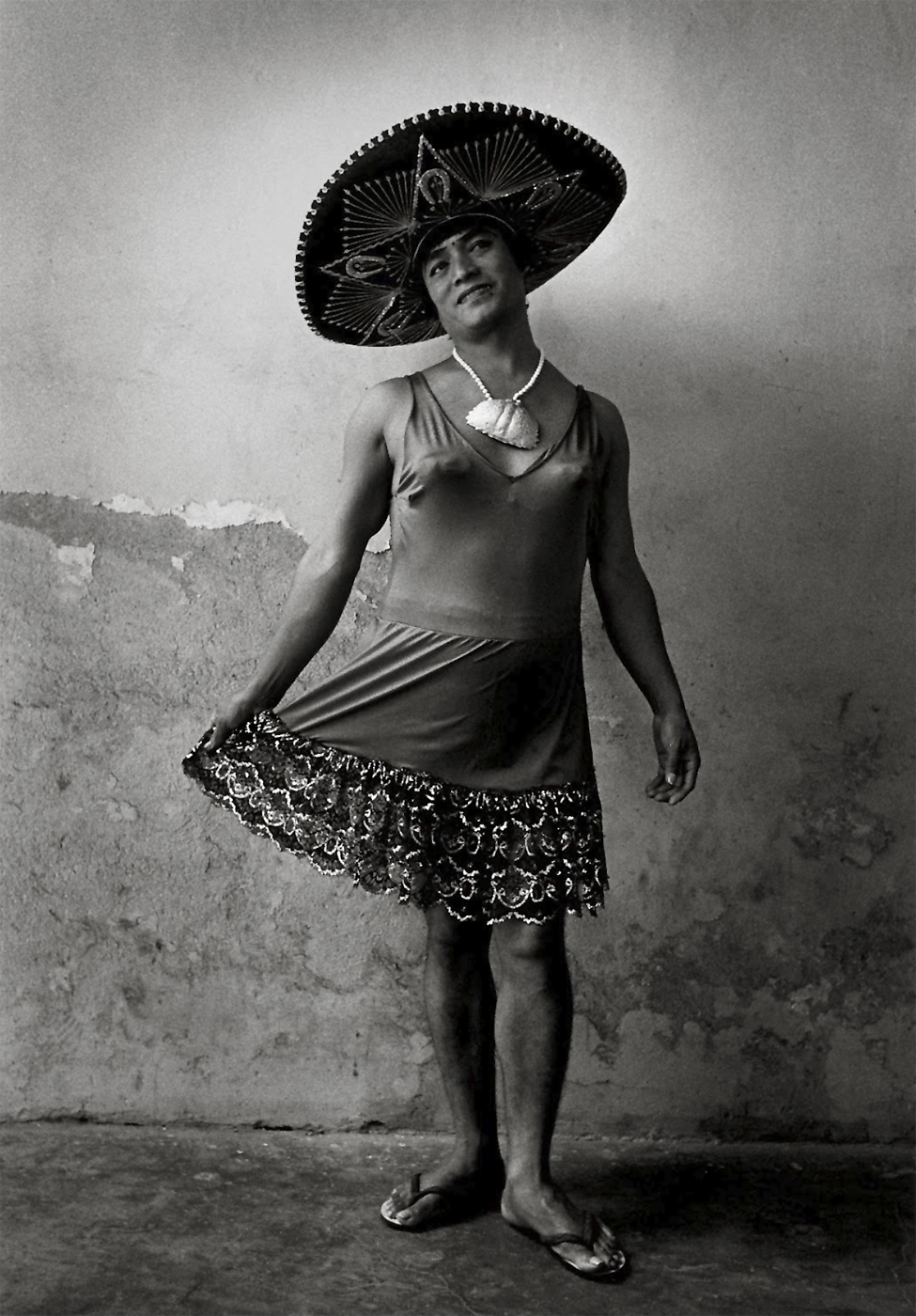
In addition to highlighting the importance of women in Juchitán, Iturbide also captured the society’s openness to muxes – men who dress as women, sometimes referred to as a Zapotec third gender. Her photographs of a muxe named Magnolia – Magnolia with Mirror / Magnolia con espejo (1986, J. Paul Getty Museum) and Magnolia with Sombrero / Magnolia con sombrero (1986, MFA) – demonstrate her ability to connect intimately with the community. Immersing herself in Zapotec culture, Iturbide also recorded the enduring legacy of native traditions – from an annual two-day festival and pilgrimage celebrating an alligator deity to el rapto, a premarital ritual practiced by those in lower and middle classes. Her strong and poetic images of Juchitán not only gained her international recognition, but also became a point of departure for a new vision of Juchitec society that has since been integrated into Mexico’s identity.
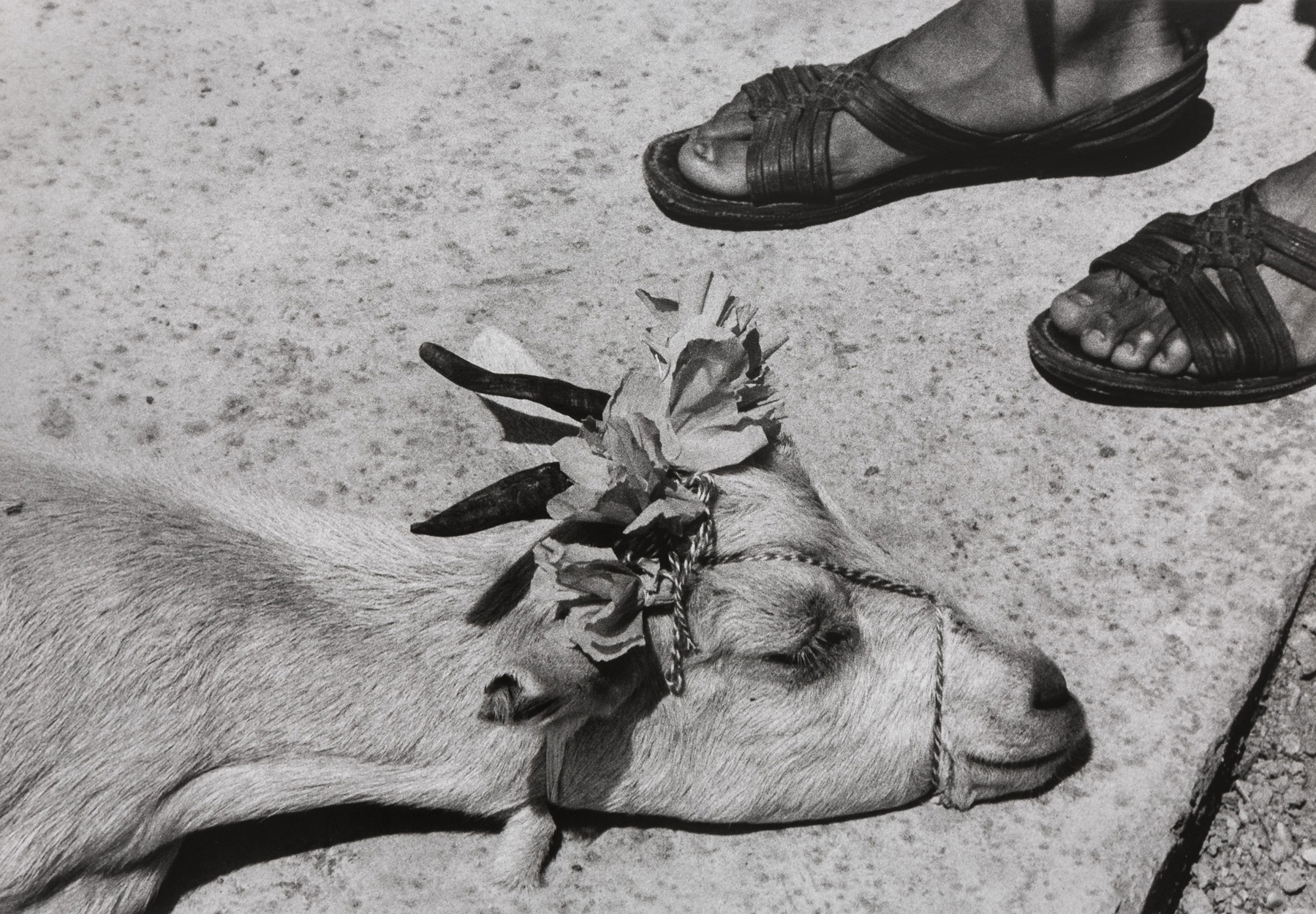
Following the Juchitán section are Iturbide’s photographs of the annual goat-slaughtering ritual in the Oaxacan region of La Mixteca, in south-central Mexico. The tradition dates back to colonial times, when Spanish landowners contracted Mixtec workers to butcher animals for sale, and carries on today. Tens of thousands of goats are killed during the month-long festival, which involves ritualistic aspects such as saving a lone animal every year as an act of repentance before the slaughter. Iturbide’s photographs from this series also highlight the exploitation of workers in one of Mexico’s poorest regions, who have created a ritual out of their harsh working conditions as a way of coping with the violence and pain. This experience had a tremendous impact on Iturbide, marking a personal turning point. Her wrenching experience in La Mixteca became the last time she spent extended amounts of time with an indigenous community.
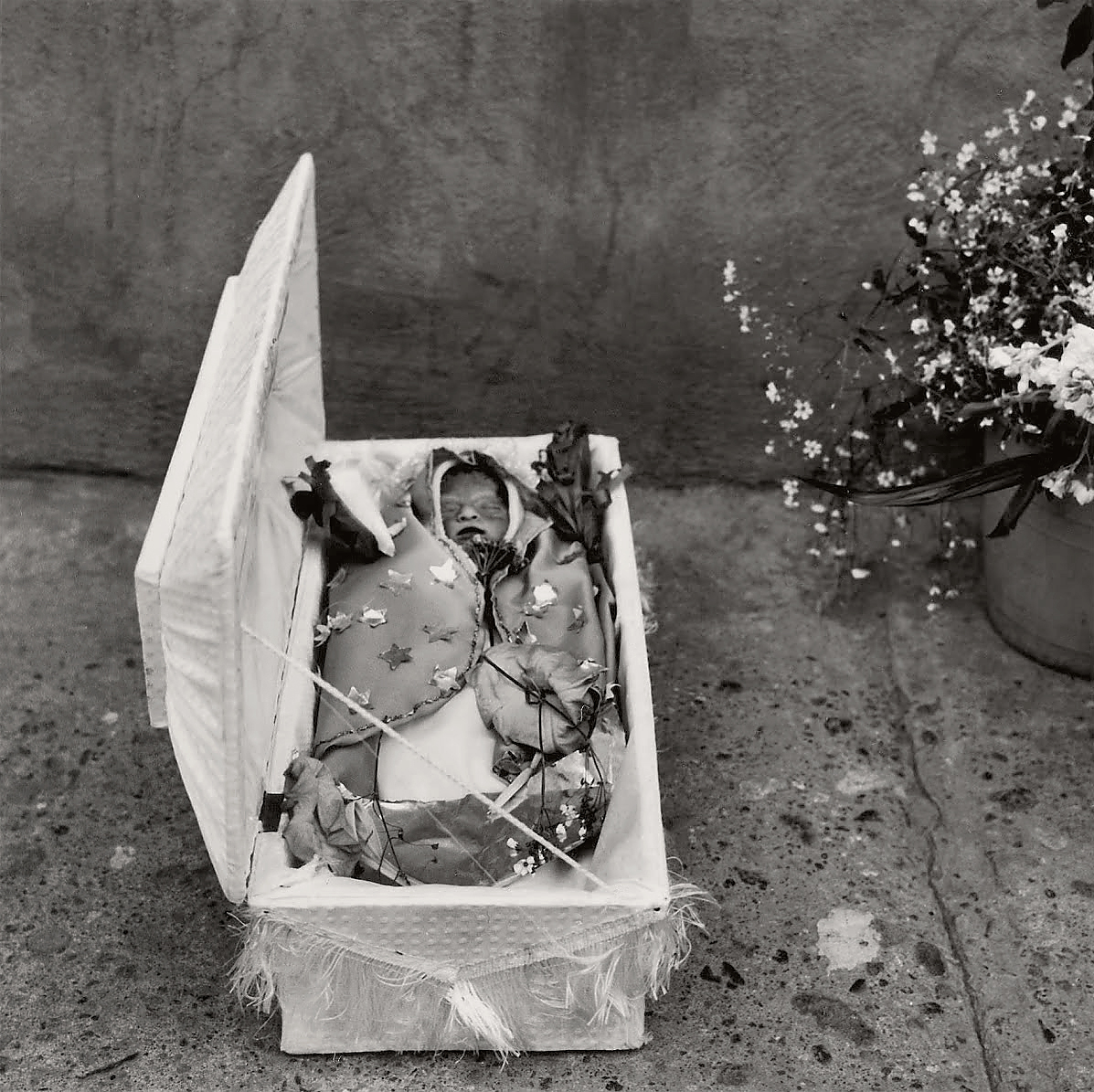
The next three sections focus on themes that recur throughout Iturbide’s oeuvre: fiestas, death and birds. Since the mid-1970s, Iturbide has traveled throughout the country, including Chalma, Oaxaca and Tlaxcala, to observe and record a variety of fiestas – lavish and visually stimulating celebrations, which often include elaborate costumes or disguises. Death is another dominant element of Mexican culture, and Iturbide’s photographs related to the subject reflect both a personal experience and larger cultural manifestations. Her works range from depictions of signs of mortality in everyday life, as seen in the early photograph Mexico… I want to get to know you! / México… Quiero Conocerte! (1975, MFA), to representations of surreal-like funerary rituals and celebrations like the annual Día de los Muertos (Day of the Dead). Iturbide’s fascination with birds is intimately linked to her own emotional journey toward overcoming a personal loss. Her photographs of the subject – ranging from spectacular and sublime skies full of birds to close-up portraits of birds in trees and even self-portraits with birds – show her interest in the rites and cycles of the natural world, while also evoking the spiritual world.
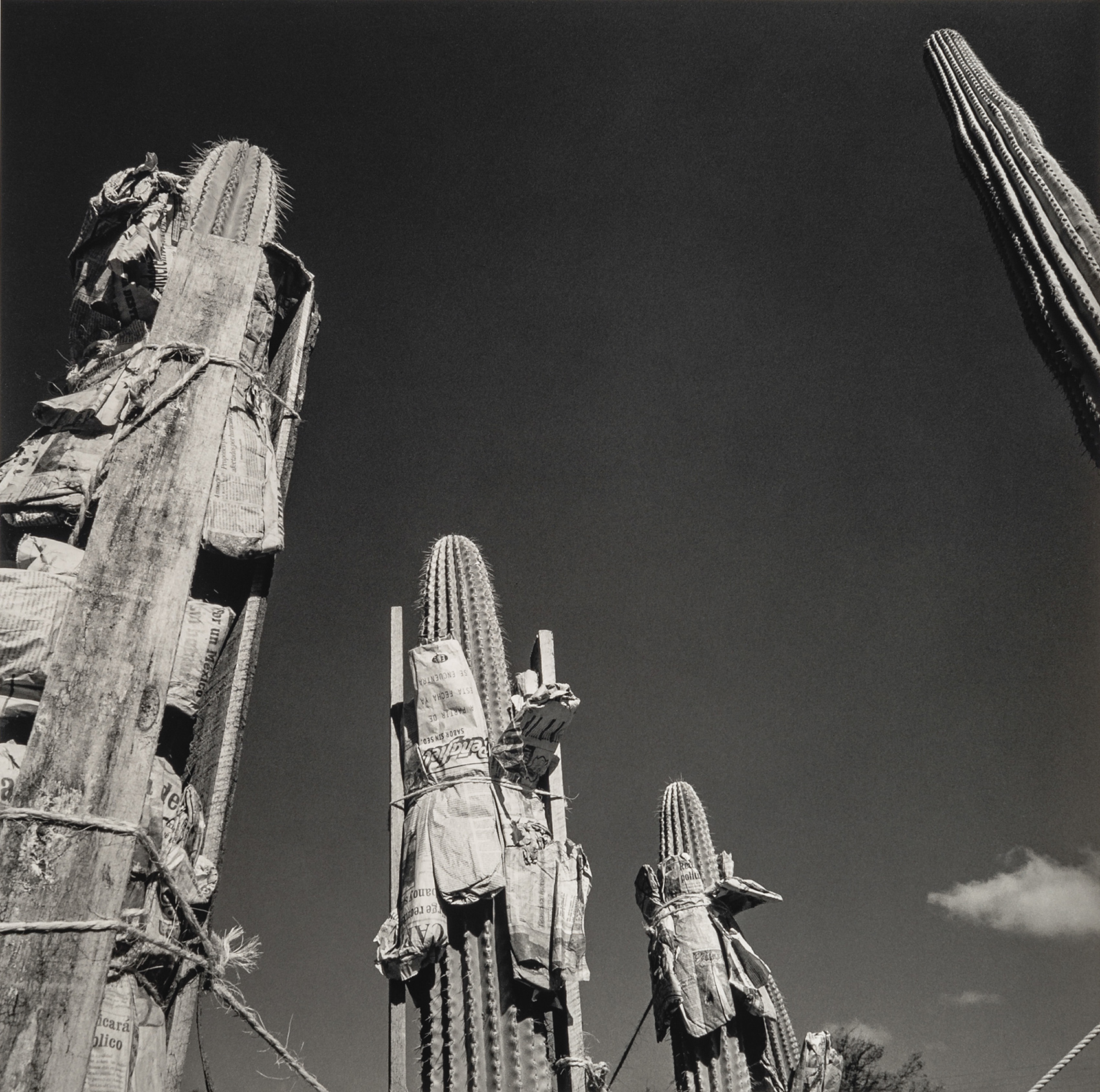
In 1998, Iturbide was invited by Francisco Toledo to photograph the newly opened Ethnobotanical Garden of Oaxaca. By design, the garden tells the story of the relationship between the people of Oaxaca and their native plants, which are arranged by ecological and cultural themes. The next section of the exhibition presents these photographs, particularly of cacti undergoing therapeutic treatment. The images, published in her 2004 book Naturata, reflect the caretaking aspect of the garden. A startling view of the tops of several columnar cacti in Botanical Garden / Jardín Botánico (1998-1999) shows them with bundles of newspaper padding and wooden boards as splints, all bound around the plants with rope. In another photograph, Botanical Garden / Jardín Botánico (2002) a thorny treelike plant receives an intravenous treatment as two bags of a cream-coloured liquid drip into lines connected to its limbs.
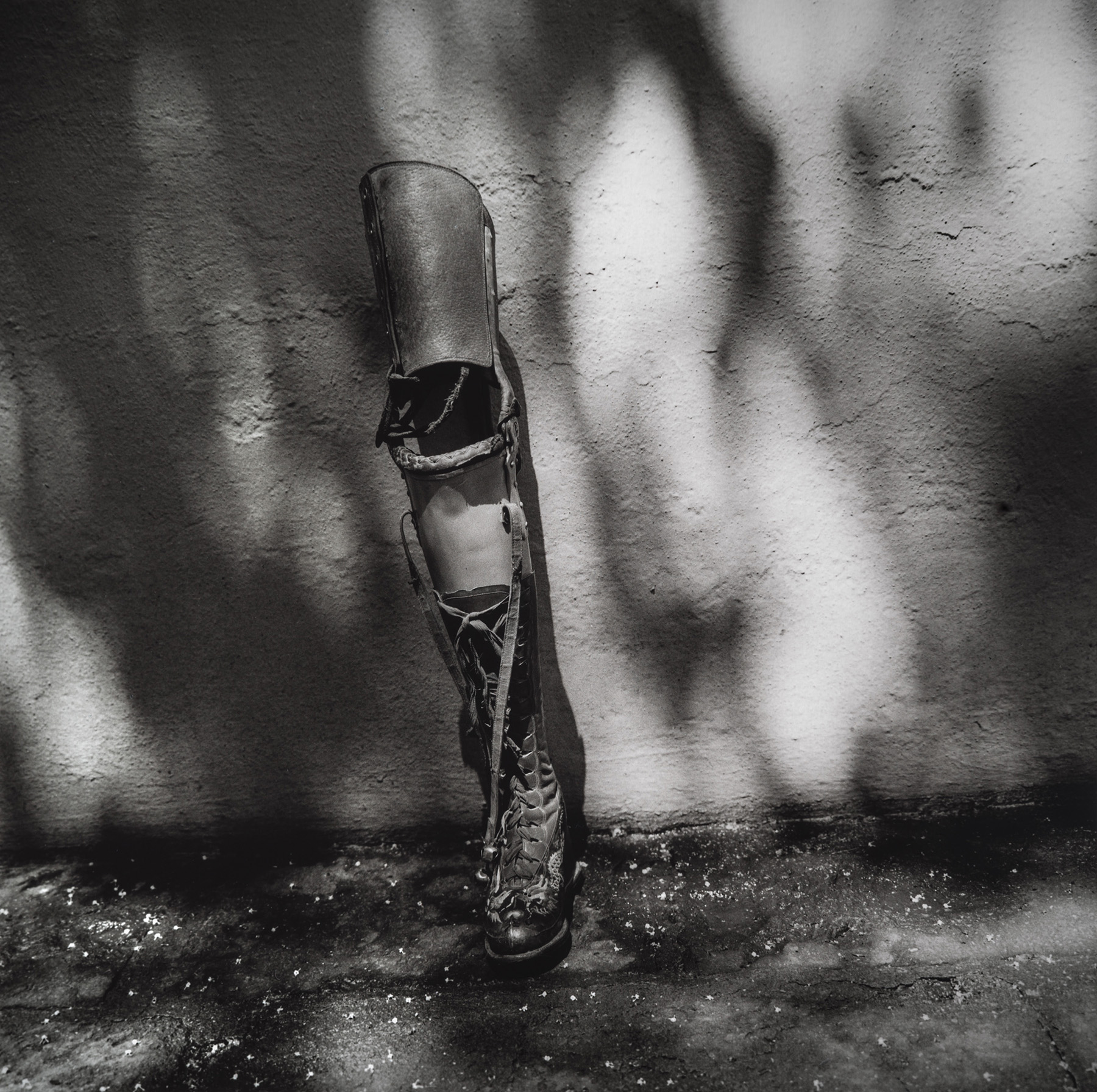
The final section features the most recent series in the exhibition, El baño de Frida (Frida’s Bathroom), which will be on view from February 27, 2019 through June 16, 2019 in the Museum’s Art of the Americas Wing, alongside another MFA exhibition, Frida Kahlo and Arte Popular. In 2005, Iturbide was commissioned to photograph personal belongings in Frida Kahlo’s bathroom at the Casa Azul, which had been locked away for 50 years following the artist’s death. Iturbide’s stark images provide an emotional narrative about the intimate space within the “Blue House,” where Kahlo was born and died, and the mystery of the objects. Iturbide’s photographs focus primarily on objects related to Kahlo’s pain – from a box of Demerol, an opioid pain medication, to a prosthetic leg. In one photograph, a hospital gown – stained by blood or paint – hangs ominously against the tiled wall, serving as a reminder of Kahlo’s many operations. In another, a self-portrait that depicts Iturbide’s bare feet in Kahlo’s bathtub, the photographer puts herself in the artist’s place and evokes one of Kahlo’s famous paintings, What the Water Gave Me (1938). Iturbide’s images reveal a side of Kahlo that is dramatically different from the colourful magical realist portrayed by her clothes and paintings. In photographing Kahlo’s private space, Iturbide grapples not only with the cultural and symbolic legacy of the painter, but with her own legacy as well. The series reveals a silent dialogue between the two women, two artists of Mexico, who have seen their art as a form of therapy and escape from everyday life.
About Graciela Iturbide
Iturbide was born in 1942 in Mexico City. In 1969, at the age of 27, she enrolled at the film school Centro de Estudios Cinematográficos at the Universidad Nacional Autónoma de México to become a film director. However, she was soon drawn to the art of still photography as practiced by the Mexican modernist master Manuel Álvarez Bravo, who was teaching at the University. From 1970 to 1971 she worked as Bravo’s assistant, accompanying him on various photographic journeys throughout Mexico. In the early half of the 1970s, Iturbide traveled widely across Latin America – in particular to Cuba and Panama. In 1978, she was commissioned by the Ethnographic Archive of the National Indigenous Institute of Mexico to photograph Mexico’s indigenous population. Iturbide decided to document and record the way of life of the Seri people along the country’s border with Arizona. In 1979, she was invited by the artist Francisco Toledo to photograph the Juchitán people who form part of the Zapotec culture native to Oaxaca in southern Mexico. This series resulted in the publication of her book Juchitán de las Mujeres in 1989. Between 1980 and 2000, Iturbide was invited to work in Cuba, Germany, India, Madagascar, Hungary, France and the U.S., producing a number of important projects. She has enjoyed solo exhibitions at the Centre Pompidou (1982), San Francisco Museum of Modern Art (1990), J. Paul Getty Museum (2007), MAPFRE Foudation, Madrid (2009), Photography Museum Winterthur (2009) and Barbican Art Gallery (2012), among others. Iturbide is the recipient of the W. Eugene Smith Memorial Foundation Award (1987); the Grand Prize Mois de la Photo, Paris (1988); a Guggenheim Fellowship for the project Fiesta y Muerte (1988); the Hugo Erfurth Award, Leverkusen, Germany (1989); the International Grand Prize, Hokkaido, Japan (1990); the Rencontres Internationales de la Photographie Award, Arles (1991); the Hasselblad Award (2008); the National Prize of Sciences and Arts in Mexico City (2008); an Honorary Degree in photography from Columbia College Chicago (2008); and an Honorary Doctorate of Arts from the San Francisco Art Institute (2009).
Press release from the Museum of Fine Arts, Boston website [Online] Cited 05/04/2019
“For her, the camera is an instrument of sharing, making visible what, to many, is invisible,” Ms. Gresh said. Ms. Iturbide’s photos, she added, provide “a poetic vision of contemporary culture informed by a sense of life’s surprises and mysteries.”
“The dark ballast of Iturbide’s photography is a deep knowledge of predation: how humans prey on animals; how multinational corporations subsume developing economies; how modern industry exploits a largely indigenous underclass; how artists wrangle life from their subjects in the name of creation. In one haunting early photograph, a young Cuna woman walks through an open field in Panama, Pepsi-Cola’s logo embroidered on her shirt. The pernicious creep of capitalism, yes, but also its corollary: a vivid reminder that indigenous people, often relegated to an imagined antiquity, are full participants in contemporary life. …
In 1979, the painter Francisco Toledo invited Iturbide to visit his native Juchitán, in southeastern Oaxaca, a town known for its fierce independence and long-standing leftist sympathies. She returned frequently over the next decade, chronicling the public and private life of its largely Zapotec population. As a perpetual guest, Iturbide became a master of the threshold, of doorways and frames, storefront windows and cemeteries, masks and carnival, of the moments preceding and following transformation. …
Contact sheets enclosed in glass vitrines accompany select images, often annotated with grease pencil. According to Iturbide, there are – pace Cartier-Bresson – two “decisive moments” in photography: “One, when you take the photo; and two, when you discover it in the contact sheet, because you often think you took one photo, and another comes out.” In the sheet for Magnolia with Mirror (1986, above), a livewire thread of intimacy is palpable in the sense of giddy experimentation between artist and subject. In the proofs for Our Lady of the Iguanas, Zobeida Díaz shakes the hand of a passerby, adjusts her crown of iguanas, suppresses laughter. The sheets underscore the contingency and providence of any image’s origins, how a slightly upturned lip or shifted frame catapults one into the pantheon while another slips into obscurity.”
Extract from Christopher Alessandrini. “Graciela Iturbide, Visionary Ethnographer,” on The New York Review of Books website [Online] Cited 06/04/2019
Iturbide studied photography at universities in Mexico, where she met her mentor, the teacher, cinematographer, and photographer Manuel Álvarez Bravo. Inspired by Bravo, she developed her particular interest in the daily life of Mexico’s indigenous cultures. Iturbide has photographed things and people found in Mexico City, in her native Juchitán, in Oaxaca, and on the Mexico-U.S. border. Her camera lens often traces Mexico’s rich life of religion and rituals. Torito represents an assemblage of a bicycle frame and a cow’s skull and horn, found in Mexico City, and shows the photographer’s exploration of the relationship between the individual and the broader culture.
Museum of Fine Arts, Boston Avenue of the Arts 465 Huntington Avenue Boston, Massachusetts
Curators: Wim van Sinderen with the assistance of Hanneke Mantel (both of Gemeentemuseum Den Haag and The Hague Museum of Photography)
Erwin Olaf (Netherlands, 1959-2023) Squares, Joy 1985 Gelatin silver print
As a storyteller, Erwin Olaf is a contemporary photographer whose work addresses most current concerns of the world – discrimination, gender, sexuality, taboo, climate change, reality, equality, power, racism, freedom of expression and democracy – through staged studio and outdoor photographs of incredible technical and visual skill.
The key to his work is the twist that he gives his cinematic, perfect worlds – the hidden crack in the facade, the unhinging of the link between reality and representation. These not so perfect worlds are often inspired by stories of the past, whether those stories may be present in the works of Vermeer, the still lives of the Dutch painters of the 16th and 17th century, Caravaggio, the Olympic Games of 1936, Norman Rockwell paintings, film noir, or clothes of the 1950s and 1960s.
The stillness and silence of the photographs subjects let the viewer examine the details of the mise en scène… the perfectly placed Coke bottle and apple, the shredded American flag in Palm Springs, The Kite (2018); the bandaged knee, the dripping ice cream in Rain, The Ice Cream Parlour (2004); and also admire the beautiful textures and lighting of the finished “product”, for Olaf’s aesthetic riffs on subverting theatrical performances and magazine fashion shoots.
Olaf let’s the viewer’s eye move without restraint across the terrain of the photographs, letting them soak up the atmosphere of his hyperreal tableau vivant. Both seductive and disturbing, his photographs challenge us to interrogate our own story – who are we, what do we really believe in, and what can we do to change prejudice and bigotry in a hostile world.
Dr Marcus Bunyan
Many thankx to the Gemeentemuseum den Haag for allowing me to publish the photographs in the posting. Please click on the photographs for a larger version of the image.
“What I want to show most of all is a perfect world with a crack in it. I want to make the picture seductive enough to draw people into the narrative, and then deal the blow.”
Erwin Olaf
“In 1982, I saw an exhibition of Robert Mapplethorpe in Amsterdam that blew me off the socks. I just had a Hasselblad, I was inspired by his craftsmanship and the beautiful prints, and I thought: this is what I want too. In the series ‘Squares’ (1983-1993) you clearly see his influence. I started asking people that I knew from the nightlife if they wanted to pose for me in my studio, which I had decorated in a squat of a friend. For example, the boy with the champagne bottle worked in the wardrobe of my favourite disco.”
Erwin Olaf (excerpt from the book ‘Erwin Olaf – I am’)
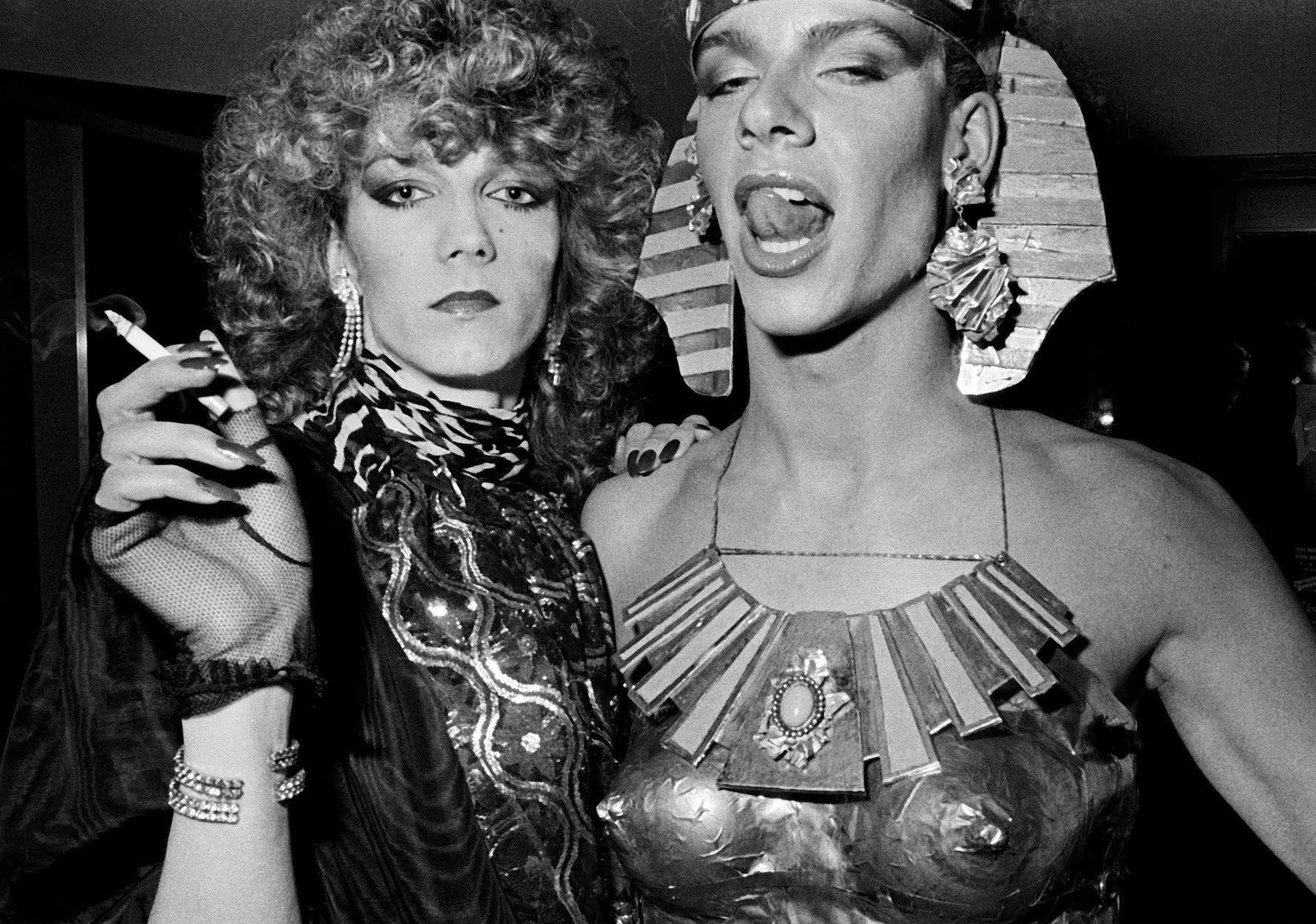
“My earliest work reflects my life in that time. I was a moth – I really loved the nightlife. In the late seventies, the early eighties was a hedonistic period: Disco and the beginning of the punk, the sexual revolution. I loved watching people play with gender, the theatrical of the nightlife, all the roles they could take.”
Erwin Olaf
“The camera offered me a possibility to enter a world that was not mine. I was able to hide behind the camera, but also be part of what I saw. As a photographer, you can look at people. You’re observing. I wanted to focus my gaze on groups that were outside the ‘normal’ society. One of my first photography assignments for school had as a theme ‘what’s normal?’. I still ask myself that.”
Erwin Olaf (excerpt from the book ‘Erwin Olaf – I am’)
Gemeentemuseum Den Haag and The Hague Museum of Photography are to honour one of the Netherlands’ most famous photographers, Erwin Olaf (b. 1959), with a double exhibition. Olaf, whose recent portraits of the royal family drew widespread admiration, will turn sixty this year – a good moment to stage a major retrospective. The Hague Museum of Photography will focus on Olaf’s love of his craft and his transition from analogue photojournalist to digital image-maker and storyteller. Olaf will himself bring together some twenty photographs by famous photographers of the past who have been a vital source of inspiration to him. Gemeente Museum Den Haag will show non-commissioned work by Olaf from 2000 to his most recent series, including the work he produced in Shanghai and his most recent series Palm Springs, on display for the first time. Olaf will be showing his photography in the form of installations, in combination with film, sound and sculpture.
Erwin Olaf – Palm Springs: behind the scenes
Erwin Olaf (Netherlands, 1959-2023) First Aids Benefit Club Flora Palace Amsterdam, I 1983 Gelatin silver print
Erwin Olaf (Netherlands, 1959-2023) First Aids Benefit Club Flora Palace Amsterdam, II 1983 Gelatin silver print
Erwin Olaf (Netherlands, 1959-2023) Squares, Pearls 1986 Gelatin silver print
“Chessmen was inspired by a chance meeting with my former photography teacher at the School for Journalism. A few years after I graduated there, I met him on the street. When I showed him my work in my studio, he said, “Say, would you like to publish a book?” He had recently taken over a publishing house for a pittance. The only problem was that I didn’t have enough work for a book. “Oh,” he said, “you only need sixty-four pages. And if you leave a page white next to each photo, you will need thirty-two photos. “At home I thought about it while listening to the radio – a chess program was just going on. At one point the presenter said: “This is an attacking game with thirty-two pieces. A war game. “I knew immediately: I’m going to make chess pieces. Those few words on the radio were all I needed; I had a clear picture in mind. Earlier I had been thinking about how I could do something with the theme of power. Power is something weird. Why do people abuse their power? Or why do you want it? Why do some people allow others to exercise power over them? From those questions came the idea of a power game and the people who play it. “
Erwin Olaf (excerpt from the book Erwin Olaf – I Am)
“The Blacks series is largely inspired by Janet Jackson’s album Rhythm Nation 1814. In one song, she sings: “In complete darkness we are all the same / It is only our knowledge and wisdom that separates us / Don’t let your eyes deceive you.” A few years earlier I had been hitchhiking to Paris and southern France, together with a friend with an Indonesian background. I was admitted without problems in all kinds of clubs, but they refused him at the door. At that time I became much more aware of the fact that the amount of pigment in your skin can have serious consequences. So when I heard Janet Jackson sing, I thought: this is my theme. I can create a group of people where everyone is equal.”
Erwin Olaf (excerpt from the book Erwin Olaf – I Am)
Journalistic training
Erwin Olaf was studying journalism in Utrecht in the 1980s when, having noticed that he was unhappy, one of his lecturers pressed a camera into his hands. ‘I loved the thing right from the word go,’ says Olaf, ‘the weight, the cool metal in my hand. It felt so natural. And when I took my first photographs, I knew I had found my calling.’ Olaf began taking journalistic photographs of theatre performances, worked for progressive magazines and volunteered for COC Nederland (which represents LGBTI interests). In his early work Olaf often depicted the human body quite graphically, breaching the restrictions on sexuality, the body and gender. He describes himself at that time as an angry adolescent, though his taboo-breaking work was highly significant in terms of visual freedom in the Netherlands.
Early work at The Hague Museum of Photography
The exhibition at The Hague Museum of Photography will start with his early work. Chessmen (1987-1988) was one of Olaf’s first non-commissioned series, which came about when he was given the opportunity to produce a photobook. He had to fill 32 pages and he wanted to focus on the theme of power. He had heard an item on the radio about chess, a game of war consisting of 32 pieces. Olaf portrayed the game in a series of provocative images, featuring visible genitals, small half-naked people with kinky attributes, and extremely fat women in bondage outfits. The series did not go unnoticed. He received criticism for it, but also the Young European Photographers Prize.
Skill
Another early series shows the engagement that has remained important throughout Olaf’s career. Blacks (1990) is based on a song by Janet Jackson with the line, ‘In complete darkness we are all the same. It is only our knowledge and wisdom that separates us’. The series reflects Olaf’s battle for equality, and also his technical skill. In these baroque portraits, literally everything is black as coal, yet Olaf managed to give the images a rich tonality, both with his camera and in the developing process. A self-taught photographer, he has shown himself to be a master, not only of old-fashioned darkroom processes, but also of new techniques that have emerged in rapid succession since the digital revolution. He did pioneering work with Photoshop in the famous series Royal Blood (2000). Thanks to this new technique, he is even better able to experiment to his heart’s delight in his staged photography.
Sources of inspiration
Besides his own work, at The Hague Museum of Photography Erwin Olaf will be bringing together some twenty photographs by photographers who are his most important sources of inspiration, ranging from a vintage still life with roses by the late nineteenth-century photographer Bernard Eilers to self-portraits by Robert Mapplethorpe and Rineke Dijkstra. The work of these photographers inspired him, made him look in a different way at his own artistic practice, or pushed his photography in a new direction. By showing these pictures alongside his early work, which is imbued with his love of his craft, Olaf will give visitors to the Museum of Photography an idea of what has shaped him as a photographer.
Gemeentemuseum Den Haag
The exhibition at the Gemeentemuseum will begin, even before the entrance to the galleries, with the life-sized installation Keyhole (2012). The exterior has two long walls with panelling above which framed photographs hang, as in a classic interior. But visitors can watch two films through the keyhole in the doors on either side of the installation. It will be immediately apparent that the Gemeentemuseum is highlighting a new development in the work of Erwin Olaf. Here, he is going one step further, presenting his photography in exciting combinations of film, sound and sculpture.
Social engagement
Erwin Olaf’s work has always been highly personal and socially engaged. The clearest influence on the development of his work has been the events surrounding 9/11. Since then, the bombastic, baroque staging of his previous work has made way for more vulnerability and serenity. This has produced images that are very popular with the public: highly stylised film scenes staged perfectly down to the smallest detail, often bathed in light as if they were paintings, with an uncomfortable underlying message. As in the series Rain (2004), which appears to capture the moment between action and reaction after a shocking event. The series Grief (2007), shot in a 1960s setting, is about the first moment of response, the first tear.
Recent events are also reflected in Olaf’s work. He made the Tamed & Anger self-portraits (2015) in response to the Charlie Hebdo attack. In other works he addresses issues like the position of the individual in a globalising world, the exclusion and stereotyping of certain groups of people, and taboos associated with gender and nudity. The exhibition at the Gemeentemuseum will thus afford a glimpse inside Olaf’s turbulent and sometimes dark mind. A visit to the exhibition will be like wandering through his head.
Palm Springs: final part of a triptych
Erwin Olaf’s most recent series, Palm Springs (2018), will premiere at the exhibition in the Gemeentemuseum. It is part of a triptych about cities undergoing change, the other two parts being Berlin (2012) and Shanghai (2017). The Berlin series was produced in a period when dark clouds were gathering above Europe. It highlights Olaf’s concerns about freedom of expression and democracy, and the transfer of power from an older to a new generation. Shanghai is a hypermodern metropolis in China with a population of 24 million. The series made in this city explores what happens to the individual in an environment like this. In Palm Springs, Olaf again focuses on topical issues. One of the key themes is climate change, though at the same time the images also recall the America of the 1960s. In a beautiful series of portraits, landscapes – this was the first time Olaf had photographed landscapes – still lifes and filmic scenes he refers to issues like teenage pregnancy, discrimination, religious abuses and polarisation. The series tells the story of people withdrawing into gated communities as reality invades their paradise.
Photographs of royal family
A very special addition to the double exhibition will be Erwin Olaf’s photographs of the Dutch royal family. As part of the exhibition at the Gemeentemuseum he will bring together many of the photographs that the Government Information Service commissioned him to take of the royal family. He also took the picture that the family used as a Christmas greeting last December. ‘I’m proud of the royal family,’ says Olaf, ‘because they are a binding factor in a democracy that is sometimes very divided. I’m happy to be able to contribute to that.’
Successful artist
The double exhibition will show how Erwin Olaf has developed from angry provocateur to one of the Netherland’s most famous and popular photographers. His work now features in the collections and exhibitions of museums the world over, including China, Russia, The United States of America and Brazil. In 2008 The Hague Museum of Photography showed his Rain, Hope, Grief and Fall series. In 2011 he won the prestigious Johannes Vermeer Prize, and in 2018 the Rijksmuseum purchased almost 500 photographs and videos by Erwin Olaf.
Biggest retrospective to date
Together, the exhibitions at the Gemeentemuseum and the Museum of Photography will constitute the biggest retrospective of Olaf’s work ever staged, spanning the period from the early 1980s to his most recent work. In the words of Erwin Olaf: celebrating 40 years of visual freedom.
The double exhibition has been curated by Wim van Sinderen with the assistance of Hanneke Mantel (both of Gemeentemuseum Den Haag and The Hague Museum of Photography), and has come about in close collaboration with Erwin Olaf and his studio.
Press release from the Gemeentemuseum Den Haag website [Online] Cited 04/05/2019
“I made the Royal Blood series to celebrate Photoshop as the new craft. I wanted to make something that was clearly fiction and would be impossible without Photoshop. A theme that was in the air at the time was that violence was suddenly identified with glamor. I never understood why criminals, even murderers, have fans. People worship them! And every cinema is chock full of people watching violence every week. I wanted to expose the attraction of blood, violence and celebrity – that live fast, that young ideal. Now I could no longer do this type of work. The emotion behind it has disappeared – I have already told that story. But it remains an important part of my legacy.”
Erwin Olaf (excerpt from the book Erwin Olaf – I am)
Marcus Bunyan (Australian born England, b. 1958) Untitled 2019 From the series Oblique Digital colour photograph
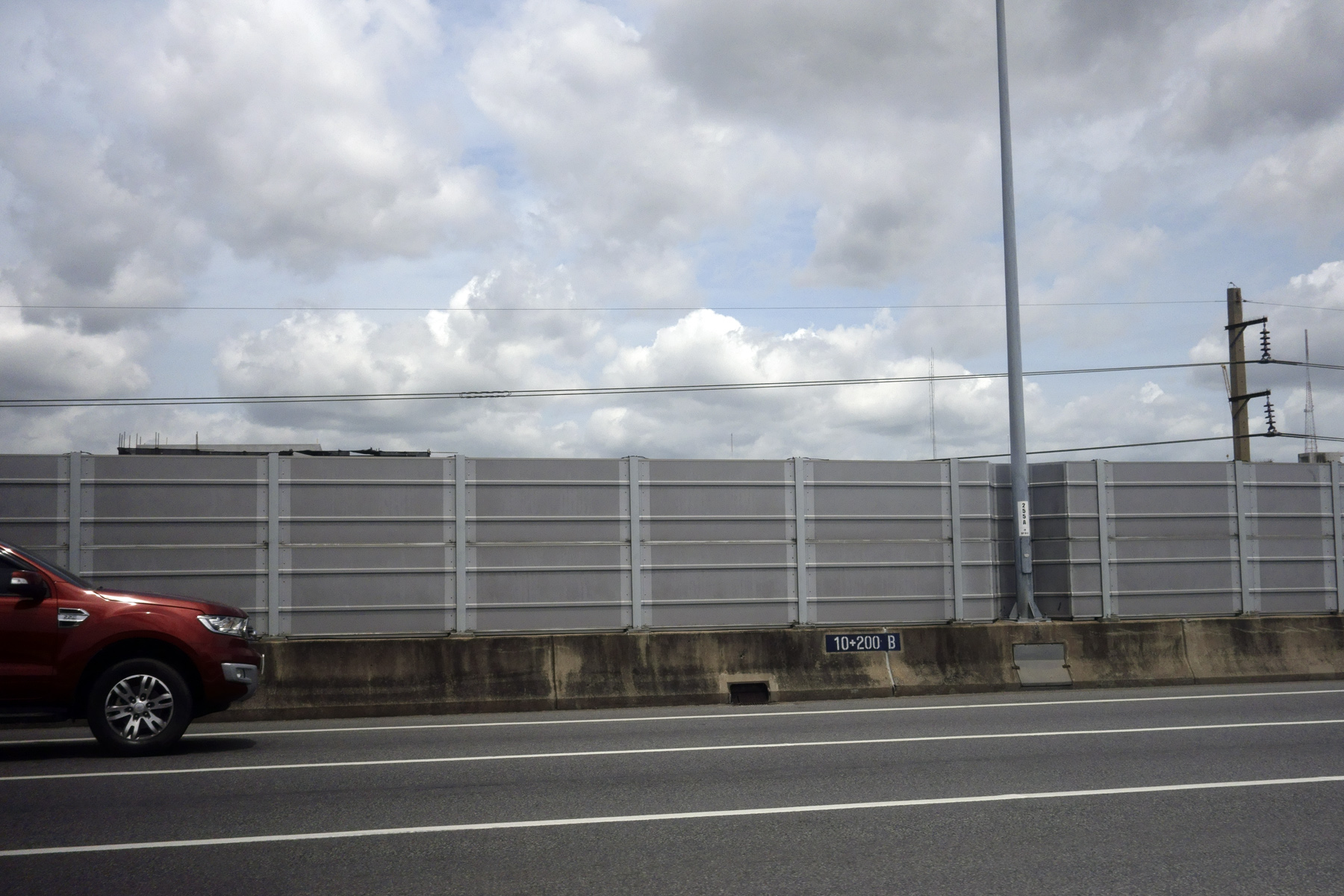
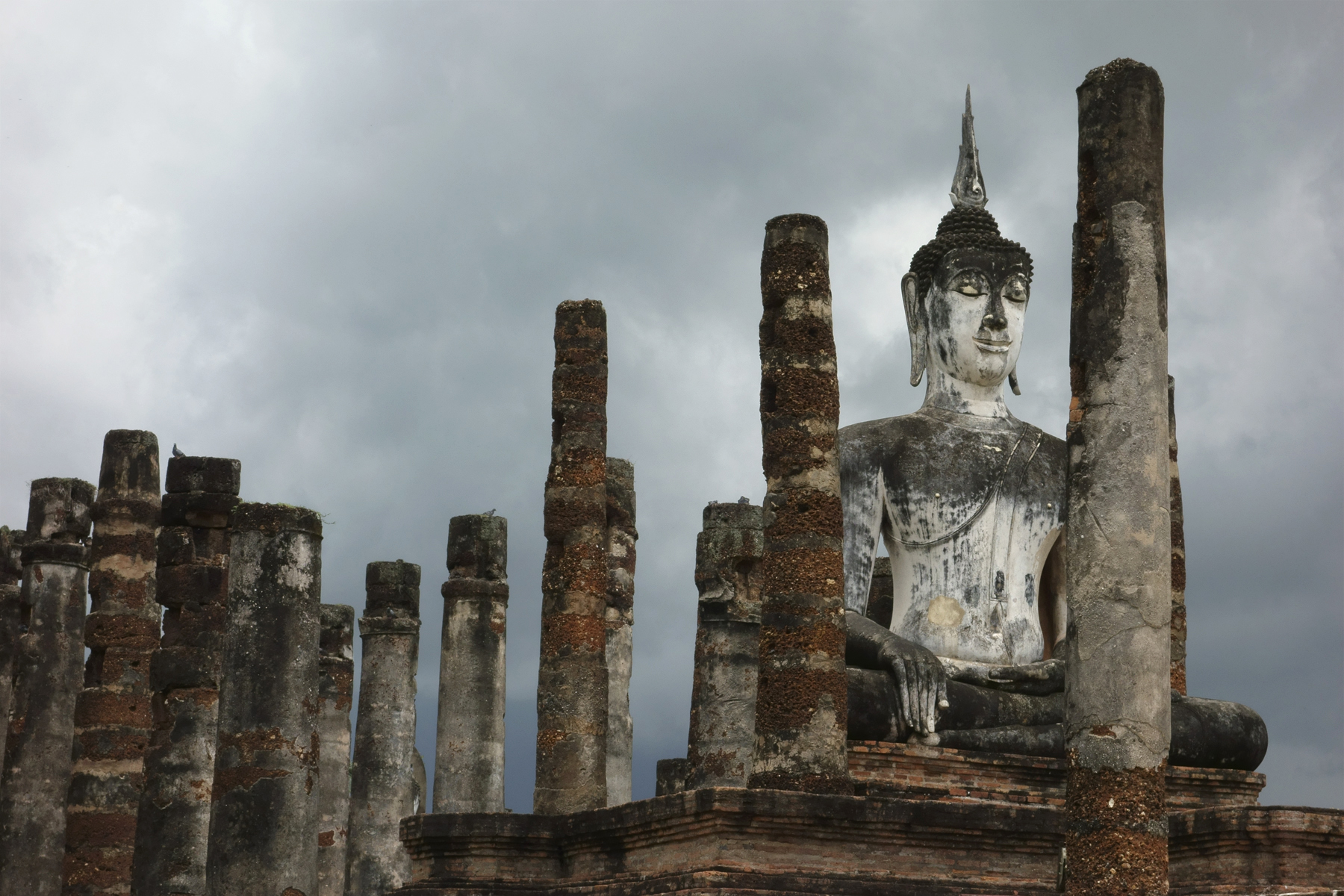
Here is a body of work shot mainly from moving taxi windows in Bangkok and surrounds, interspersed with still, Zen-like images.
With the moving images, you have to anticipate by a couple of seconds the movement of the taxi and the release of the shutter so you have no idea what the image will actually be. Your sense of previsualisation is completed on feel and instinct. You trust the world to provide the image which you are looking for. I enjoy them, they give me pleasure and contentment in their creation.
Oblique
In terms of defining the concept of the oblique we can say that: “The oblique is fundamentally interested in how a body physically experiences a space.”
In this case, both physically and spiritually.
The series investigates the concept through images of movement and stillness, fleeting glimpses of urban life intertwined with Zen-like images. The series is constructed not as a sequence, but as a “volume” where there is no beginning, no middle and no end. It is like a jewel that can be turned around and looked at from different perspectives, where no one perspective is the correct interpretation. Each volume has its own validity, its own uniqueness.
The images can also be read as a protest against death – no beginning, no middle, no end – where everything is connected to everything else. As Goethe observes in his Conversations with Eckermarm (5 June 1825):
“In nature we never see anything isolated, but everything in connection with something else which is before it, beside it, under it, and over it.”
Please note: the series is best viewed on a desktop computer with a large screen. Please click on the photographs to see a larger version of the image.
Photographs are available from this series for purchase. As a guide, a digital colour 16″ x 20″ costs $1000 plus tracked and insured shipping. For more information please see my Store web page.
The 66 images of Oblique (2019). Please click on the photograph to see a larger version of the work
Marcus Bunyan (Australian born England, b. 1958) Untitled 2019 From the series Oblique Digital colour photograph
Artists: Eero Aarnio | Jefferson Airplane | Michelangelo Antonioni | Richard Avedon | Günter Beltzig | Wolf Biermann | Big Brother and the Holding Company | Roman Brodmann | Pierre Cardin | Joe Colombo | Gerd Conradt | André Courrèges | Harun Farocki | Rainer Werner Fassbinder | Peter Handke | Haus-Rucker-Co | Jimi Hendrix | Helmut Herbst | Dennis Hopper | Theo Gallehr | Rudi Gernreich | Jean-Luc Godard | Gerhard von Graevenitz | F.C. Gundlach | Jasper Johns | Günther Kieser | Alexander Kluge | Yves Saint Laurent | Scott McKenzie | Egon Monk | Werner Nekes & Dore O. | Verner Panton | D.A. Pennebaker | Gaetano Pesce | Rosa von Praunheim | Paco Rabanne | Otis Redding | Kurt Rosenthal | Helke Sander | Ettore Sottsass | The Mamas & the Papas | The Who | Thomas Struck | Bernd Upnmoor | Roger Vadim | Valie Export | Agnès Varda | Wolf Vostell | Andy Warhol | Peter Weiss | Hans-Jürgen Wendt | Charles Wilp et al.
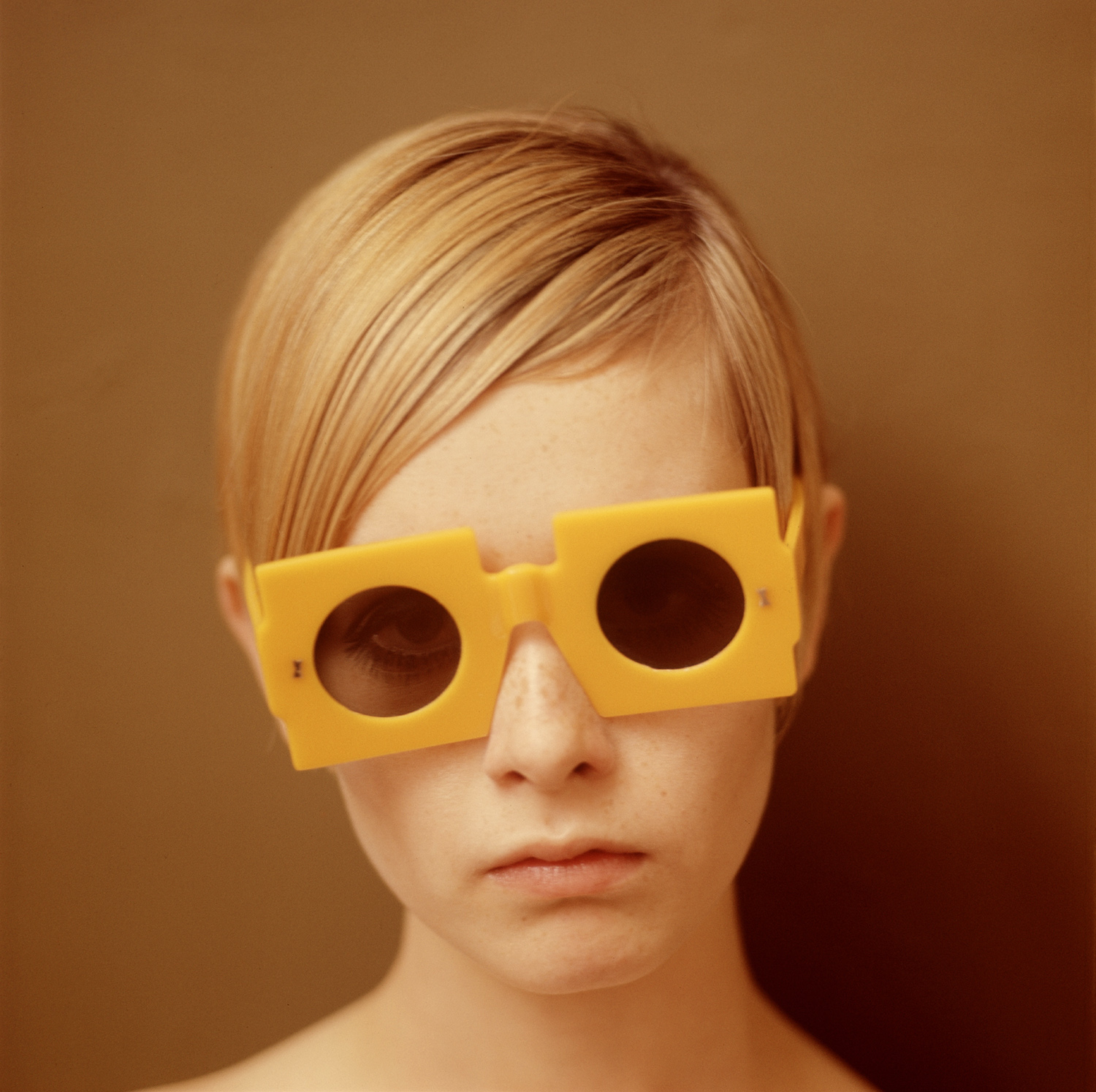
Ronald Traeger (American, 1936-1968) ‘Twiggy’ June 1966
Animation of Ronald Traeger’s photographs of Twiggy taken in June 1966 from the exhibition 68. Pop and Protest at the Museum für Kunst und Gewerbe Hamburg (MKG) 18th October 2018 – 17th March 2019
1968: the year that changed the world through radical action
From a posting about one revolutionary year in the 20th century (1918/19), we move 50 years in time to a another revolutionary year in that century: 1968.
I had wanted to do a posting on this exhibition and the 1968: Changing Times exhibition at the National Library of Australia (1st March 2018 – 12th August 2018) to compare and contrast what was happening in Australia and around the world in this most revolutionary year. But the six crappy press images that the National Library of Australia supplied were not worthy of a posting. Australian galleries in general and those in Canberra more particularly (I’m talking about you National Gallery of Australia!), really need to lift their game supplying media images. They are way behind the times in terms of understanding the importance of good media images to independent writers and critics.
In Australia, Prime Minister Harold Holt disappeared in the surf at Cheviot Beach, Victoria, presumed drowned in December 1967. A new prime minister, John Gorton, was sworn in in January 1968. Australians were dying in greater numbers in Vietnam; Aboriginal land rights issues vexed the Australian cabinet; and the White Australia policy of Old Australia, soon to be swept away in 1973, was still in full force. “Billy Snedden, the Minister for Immigration, said that Australians, and certainly the government, did not want a multiracial society. Sir Horace Petty, the Victorian Agent-General in London, explained that ‘the trouble comes when a black man marries a white woman. No one worries if a white man is silly enough to marry a black woman’.” (Text from the National Archives of Australia website [Online] Cited 01/03/2019. No longer available online)
Around the world, 1968 seemed to be the year where all the stars aligned in terms of protest against hegemonic masculinity, racism, war and social inequality.
1/ The assassinations of Martin Luther King Jr (civil rights movement) and Robert F. Kennedy (engagement with youth, social change, civil rights) shocked the world. Race riots rock America including the Orangeburg massacre, and riots in Baltimore, Washington, New York City, Chicago, Detroit, Louisville, Pittsburgh and Miami. U.S. President Lyndon B. Johnson signs the Civil Rights Act of 1968
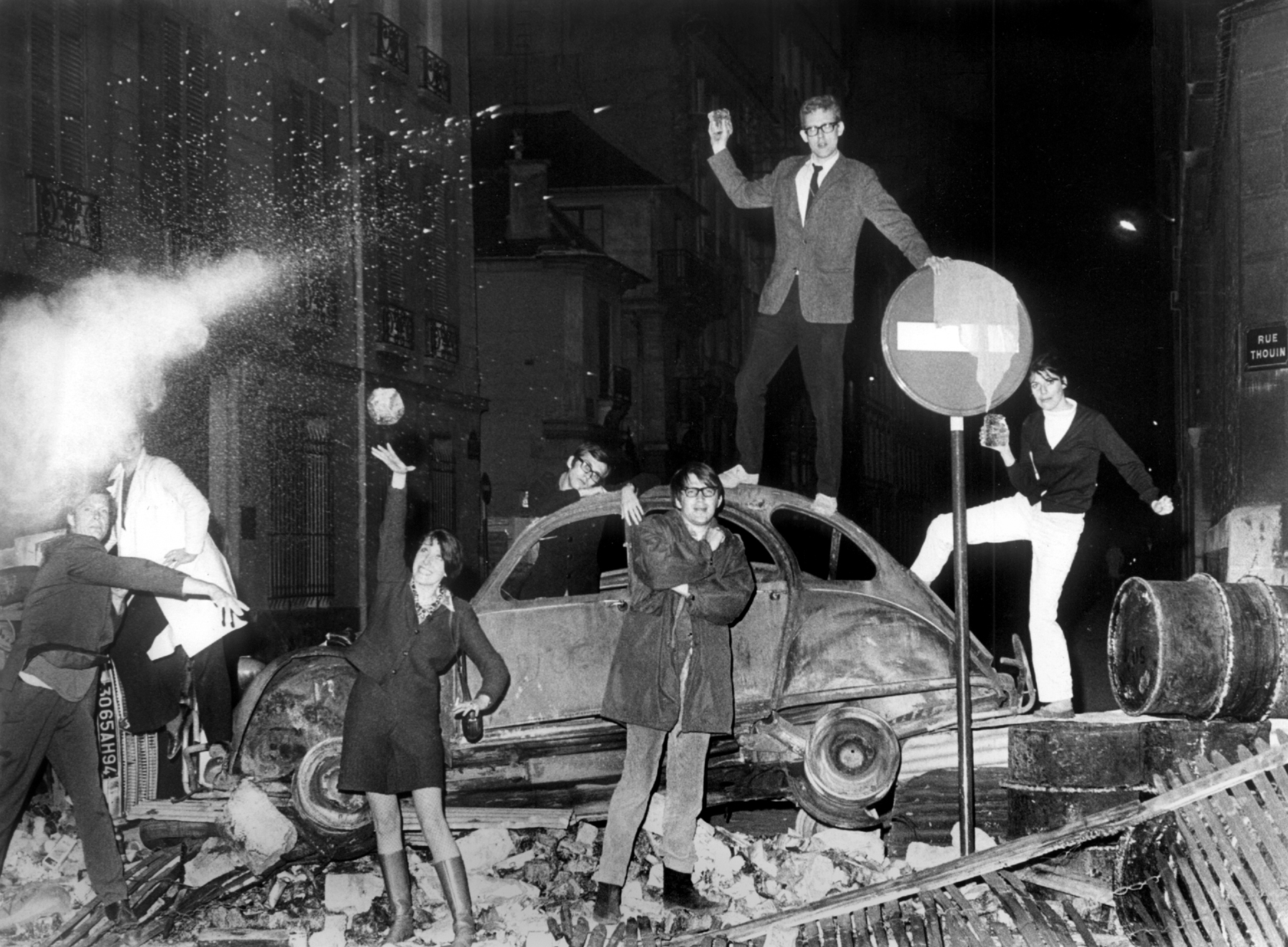
2/ The frustrations of youth boiled over in the Paris student riots of 1968 (protests against capitalism, consumerism, American imperialism and traditional institutions, values and order), leading to a “volatile period of civil unrest in France during May 1968 was punctuated by demonstrations and major general strikes as well as the occupation of universities and factories across France”
3/ The Chinese Cultural Revolution of 1968 called for revolutionary committees to be established to help preserve the ideological purity of the Chinese Revolution
4/ Muhammad Ali toured American student campuses giving hundreds of anti-Vietnam war speeches; protestors massed outside the White House at all hours. Eventually 4 students were killed at the Kent State Shootings by the U.S. National Guard during a demonstration on 4 May 1970
6/ The Polish 1968 political crisis, also known in Poland as March 1968 or March events pertains to a series of major student, intellectual and other protests against the government of the Polish People’s Republic. Student protests also start in Belgrade, Yugoslavia
7/ The Prague Spring was a period of political liberalisation and mass protest in Czechoslovakia as a Communist state after World War II. It began on 5 January 1968, when reformist Alexander Dubček was elected First Secretary of the Communist Party of Czechoslovakia (KSČ), and continued until 21 August 1968, when the Soviet Union and other members of the Warsaw Pact invaded the country to suppress the reforms during the Warsaw Pact invasion of Czechoslovakia
8/ In the following year, the Stonewall riots took place, a series of spontaneous, violent demonstrations by members of the gay (LGBT) community against a police raid that took place in the early morning hours of June 28, 1969, at the Stonewall Inn in the Greenwich Village neighbourhood of Manhattan, New York City. They are widely considered to constitute the most important event leading to the gay liberation movement and the modern fight for LGBT rights in the United States, the official starting point of gay liberation, a movement that had been building momentum since the 1950s
(R)evolution was in the air.
Dr Marcus Bunyan
Many thankx to Museum für Kunst und Gewerbe Hamburg for allowing me to publish the photographs in the posting. Please click on the photographs for a larger version of the image.
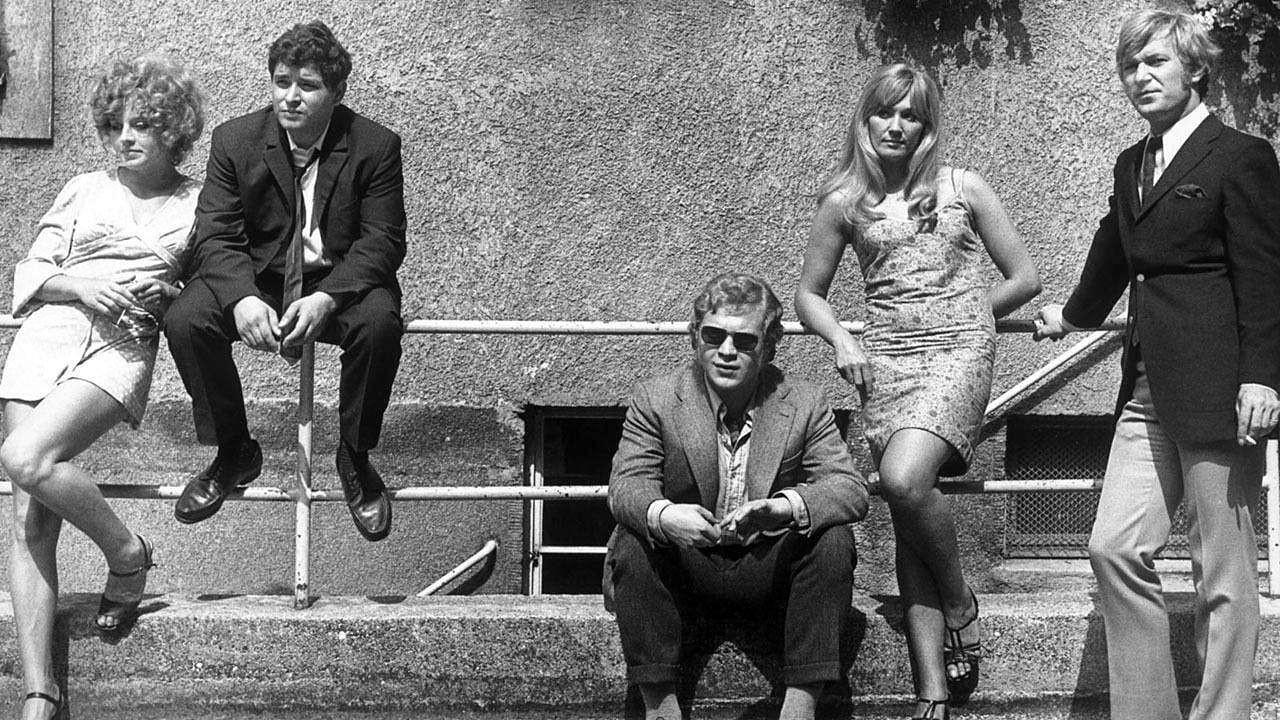
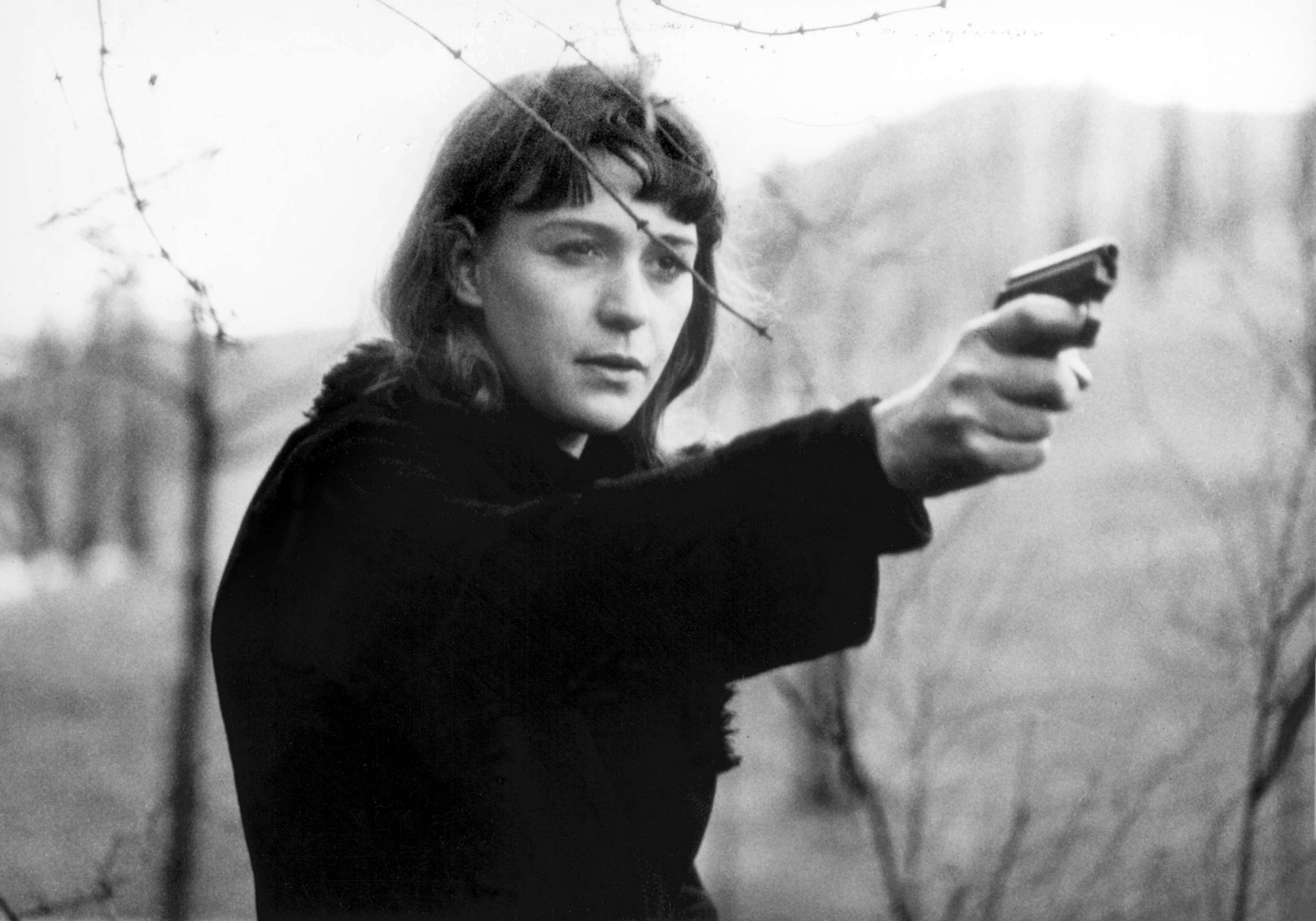
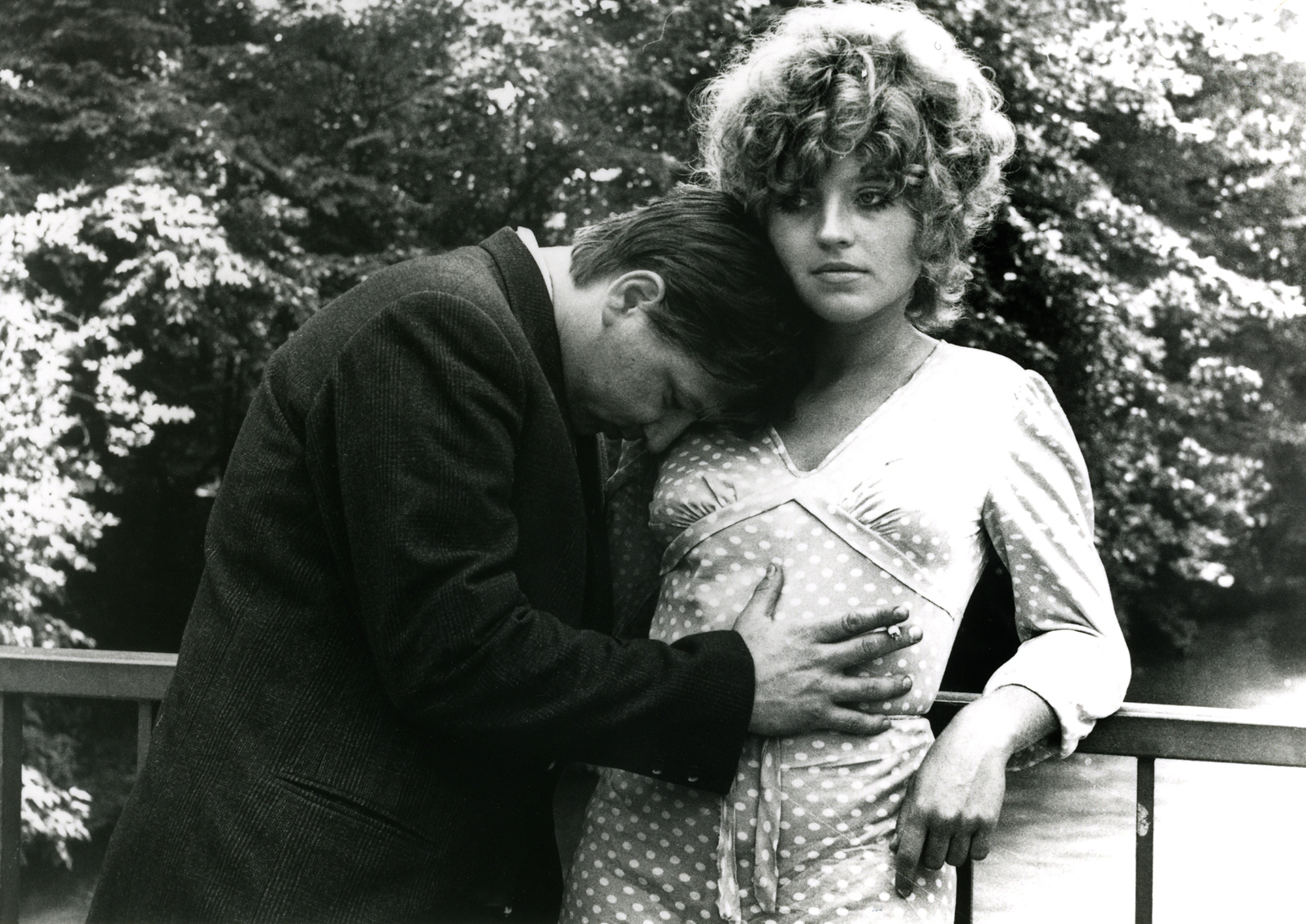
Katzelmacher is a 1969 West German film directed by Rainer Werner Fassbinder. The film centres on an aimless group of friends whose lives are shaken up by the arrival of an immigrant Greek worker, Jorgos (played by Fassbinder himself, in an uncredited role).
In this unflinching German drama by Rainer Werner Fassbinder, a group of young slackers, including the couple Erich (Hans Hirschmuller) and Marie (Hanna Schygulla), spend most of their time hanging out in front of a Munich apartment building. When a Greek immigrant named Jorgos (played by Fassbinder), moves in, however, their aimless lives are shaken up. Soon new tensions arise both within the group and with Jorgos, particularly when Marie threatens to leave Erich for the outsider.
Katzelmacher | A Greek from Greece | 1969 | Dir. R. W. Fassbinder
Katzelmacher is a 1969 West German film directed by Rainer Werner Fassbinder. The film centres on an aimless group of friends whose lives are shaken up by the arrival of an immigrant Greek worker, Jorgos played by Fassbinder himself, in an uncredited role.
Rainer Werner Fassbinder directs and stars in this film, impersonating Jorgos, a Greek man who immigrated to a small German town to work. However, when he arrives, he is faced with the local residents, who find his status as a foreigner strange, as well as his communist conviction. Jorgos tries to please his new neighbours, thereby arousing the interest of some women in the city and achieving relative success with the beauties. Consequently, he provokes more hostile behaviour in the men of the city. Greeted and reviled in Germany upon its release, Katzelmacher helped the controversial Fassbinder gain international prominence with a strong, provocative and controversial film.
What is a “Katzelmacher”?
“Katzelmacher” is a Bavarian slang term, meaning vaguely “troublemaker,” though a monograph from New York’s Museum of Modern Art insists on a more literal meaning: “cat-screwer”.
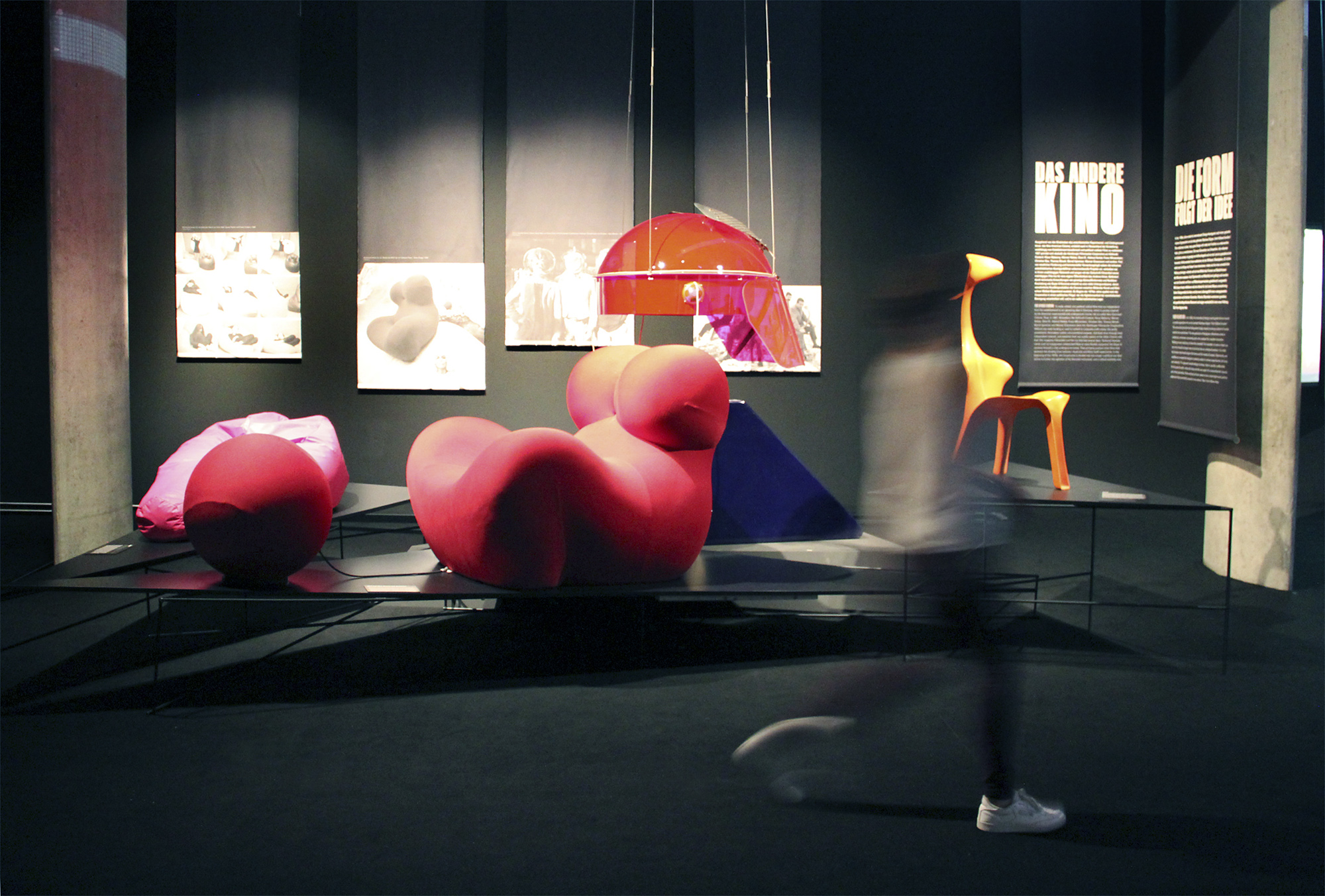
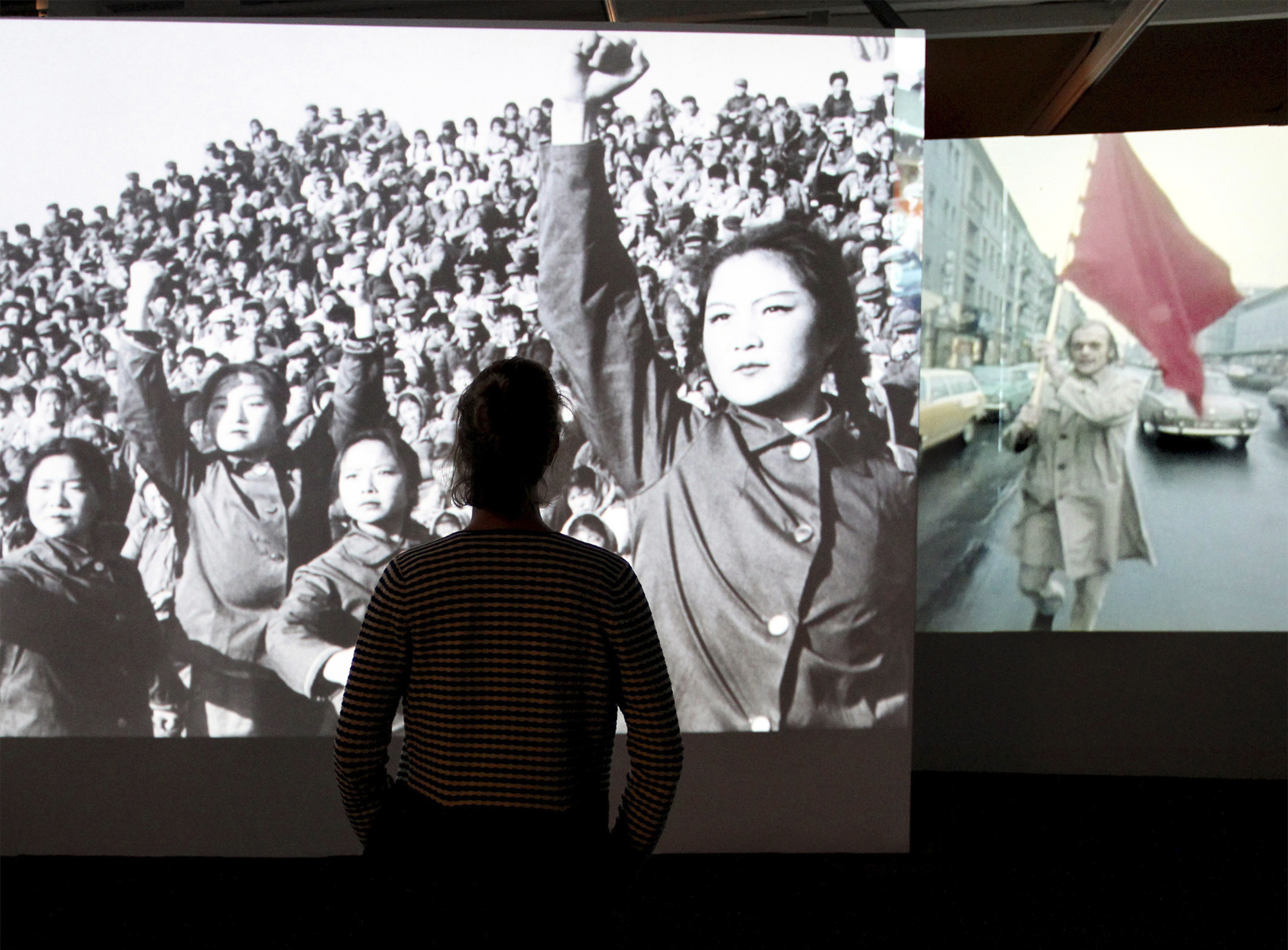
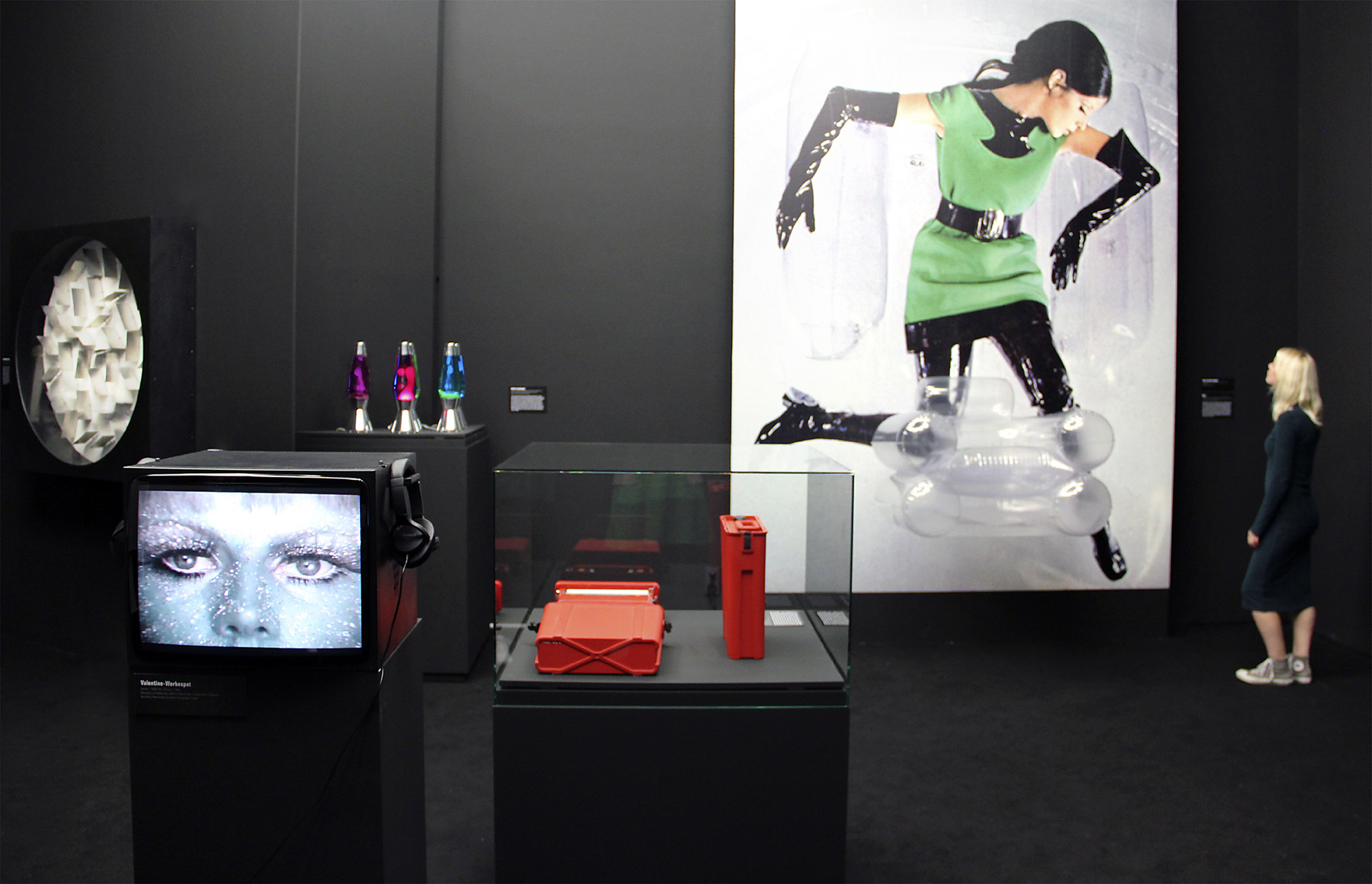
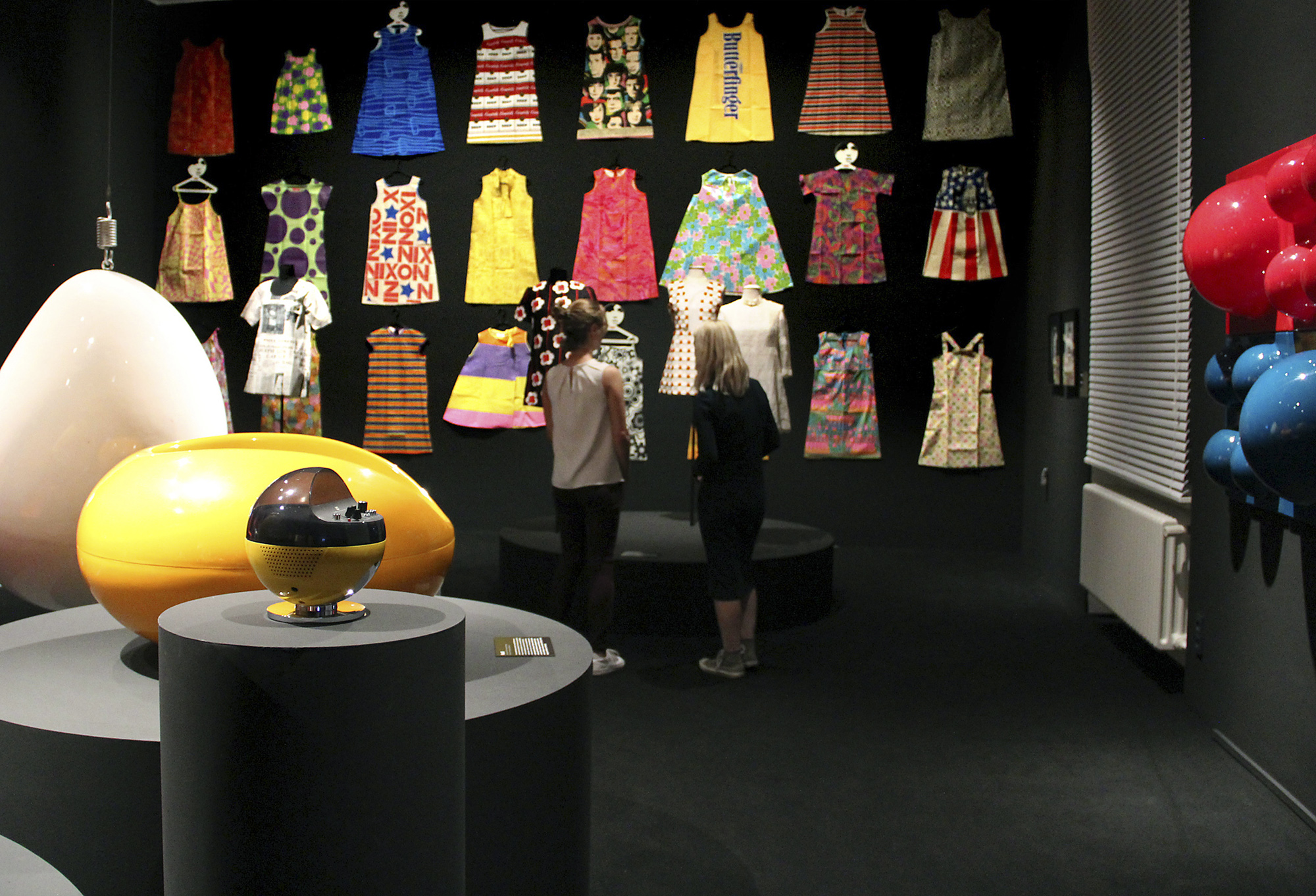
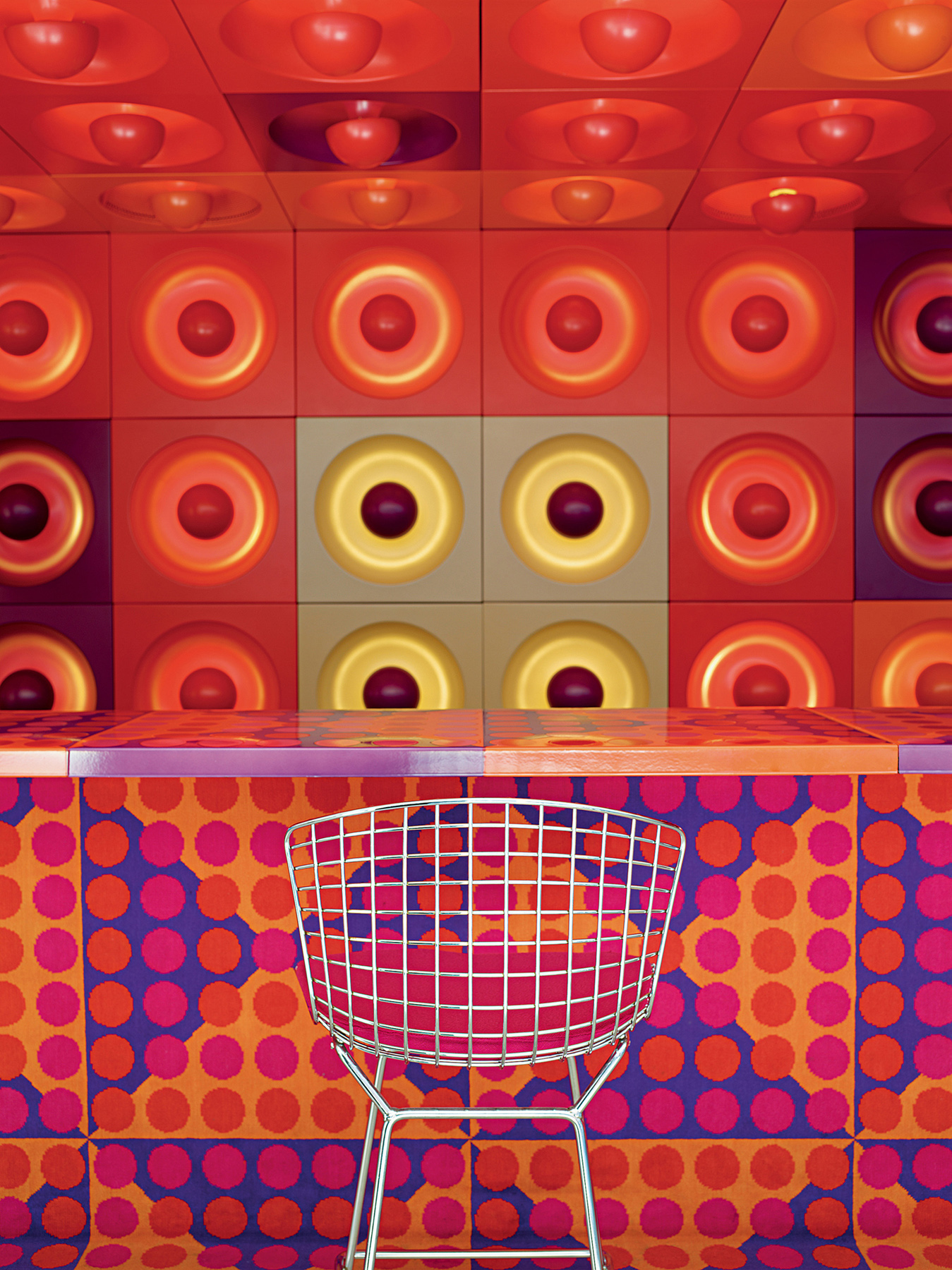
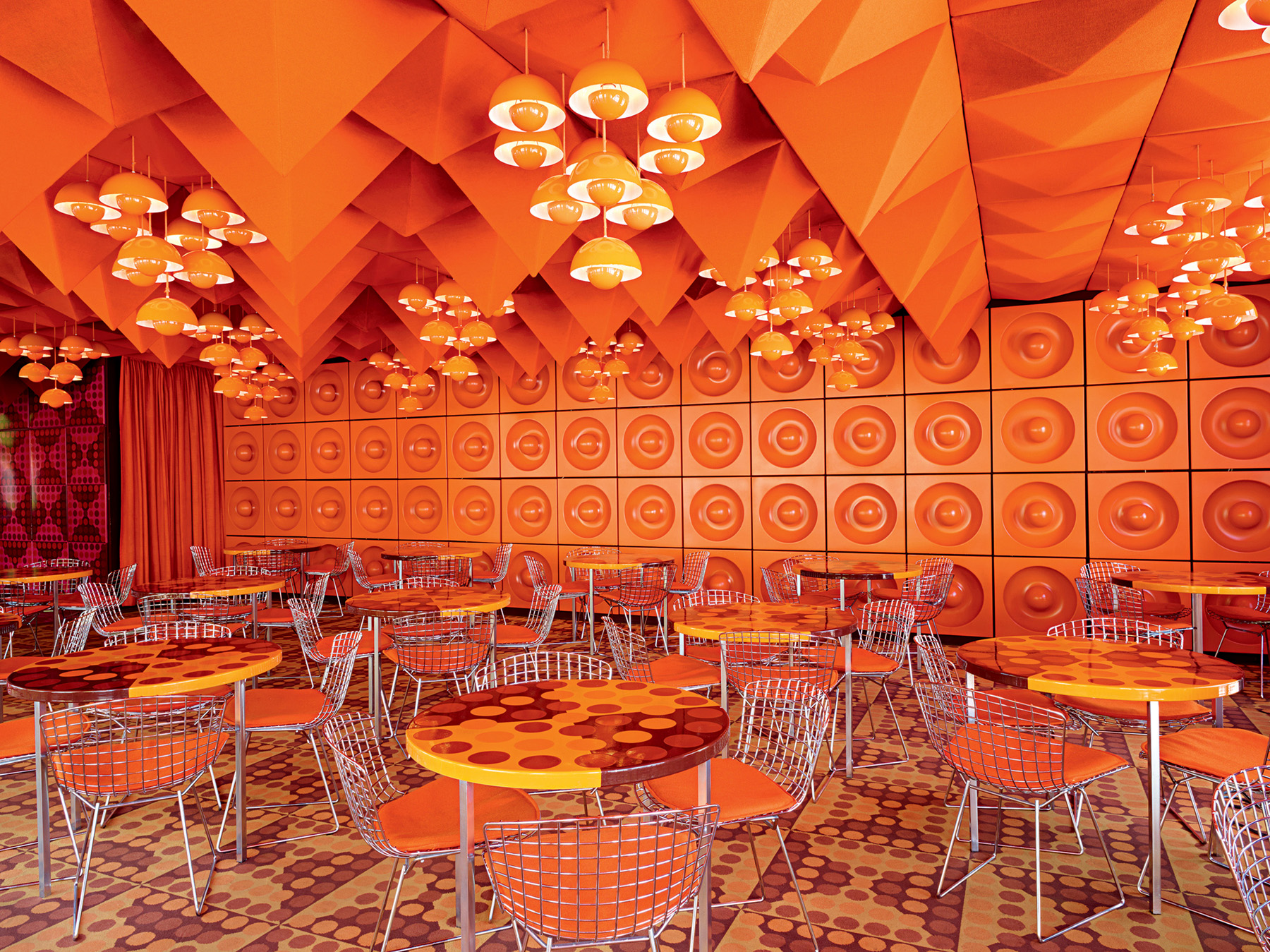
The exhibition 68. Pop and Protest brings together all the defining pictures, movies, texts and sounds of this era forming a complex atmospheric picture. The Museum für Kunst und Gewerbe Hamburg (MKG) will display about 200 objects including music installations, fashion, movies, photos, posters, design objects, historical documents and spatial ensembles such as Verner Panton’s Spiegel canteen, which show what moved and motivated people in 1968 – in Hamburg, Germany and the rest of the world: awareness of their own rights, and the possibility to advocate their opinions publically through protest and revolt.
The year 1968 is shaken by dramatic events which lead to protests, and promote revolutionary ideas. At the same time, a global cultural revolution is initiated that imaginatively revolts against conservative authoritarian structures, propagates sexual freedom, and demands equality for all people. Various avant-garde forms of expression in all artistic departments are the non-violent weapons of the time: progressive music, unconventional styles, bold designs, contentious theatre, and socio-critical cinema d’auteur.
Furthermore, there is an unprecedented desire for critical discourse, public discussion, and civil disobedience. A common thread is hope; hope that the world will turn into a fairer place, that society will get more just, and that people will become better; hope that political suppression will stop, that borders will be overcome, walls will get torn down, and that sexuality will be non-exploitative.
It is more important than ever to once again consolidate these ideas of freedom and self-determination in our collective memory. Current events show that central aspects of a free and democratic way of life are at stake (again): individual development of the self, fundamental rights such as freedom of speech and freedom of the press, democratic participation, and first and foremost open-mindedness towards what and whom we don’t know.
Text from the Museum für Kunst und Gewerbe Hamburg [Online] Cited 11/02/2019
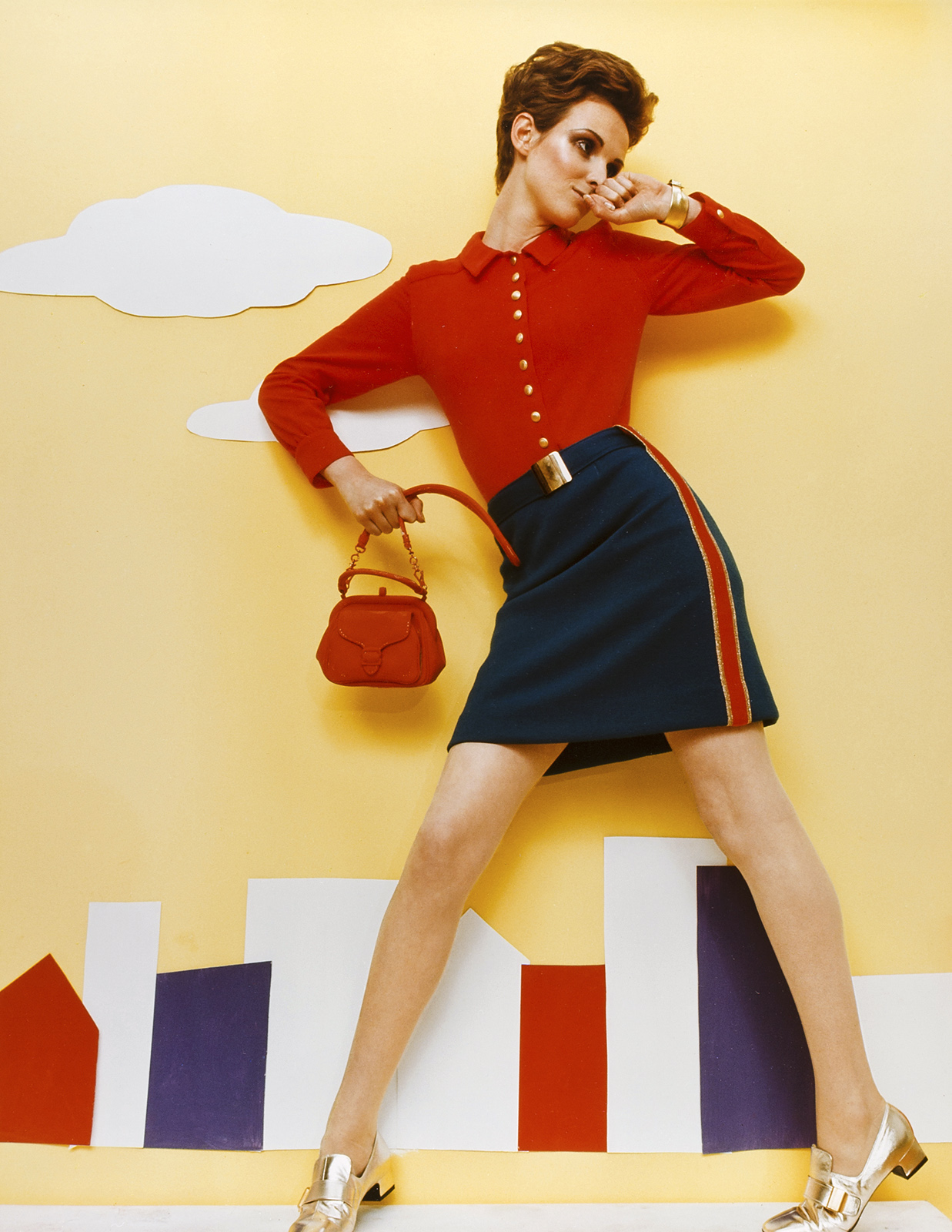
When maladjusted outfits become consumer society, materialism and conventionality are put to the test. After short time, the looks can be found in the department stores: the protest mode is moving from subculture to mainstream. In haute couture, designs are related to the changing society set, in which gender assignments stumble and a relaxed handling of physicality and sexuality is propagated.
Installation views of the exhibition 68. Pop and Protest at the Museum für Kunst und Gewerbe Hamburg (MKG) Photos: Michaela Hille
The exhibition 68. Pop and Protest brings together all the defining pictures, movies, texts and sounds of this era forming a complex atmospheric picture. The Museum für Kunst und Gewerbe Hamburg (MKG) will display about 200 objects including music installations, fashion, movies, photos, posters, design objects, historical documents and spatial ensembles such as Verner Panton’s Spiegel canteen, which show what moved and motivated people in 1968 – in Hamburg, Germany and the rest of the world: awareness of their own rights, and the possibility to advocate their opinions publically through protest and revolt.
The year 1968 is shaken by dramatic events which lead to protests, and promote revolutionary ideas. At the same time, a global cultural revolution is initiated that imaginatively revolts against conservative authoritarian structures, propagates sexual freedom, and demands equality for all people. Various avant-garde forms of expression in all artistic departments are the non-violent weapons of the time: progressive music, unconventional styles, bold designs, contentious theatre, and socio-critical cinema d’auteur.
Furthermore, there is an unprecedented desire for critical discourse, public discussion, and civil disobedience. A common thread is hope; hope that the world will turn into a fairer place, that society will get more just, and that people will become better; hope that political suppression will stop, that borders will be overcome, walls will get torn down, and that sexuality will be non-exploitative.
It is more important than ever to once again consolidate these ideas of freedom and self-determination in our collective memory. Current events show that central aspects of a free and democratic way of life are at stake (again): individual development of the self, fundamental rights such as freedom of speech and freedom of the press, democratic participation, and first and foremost open-mindedness towards what and whom we don’t know.
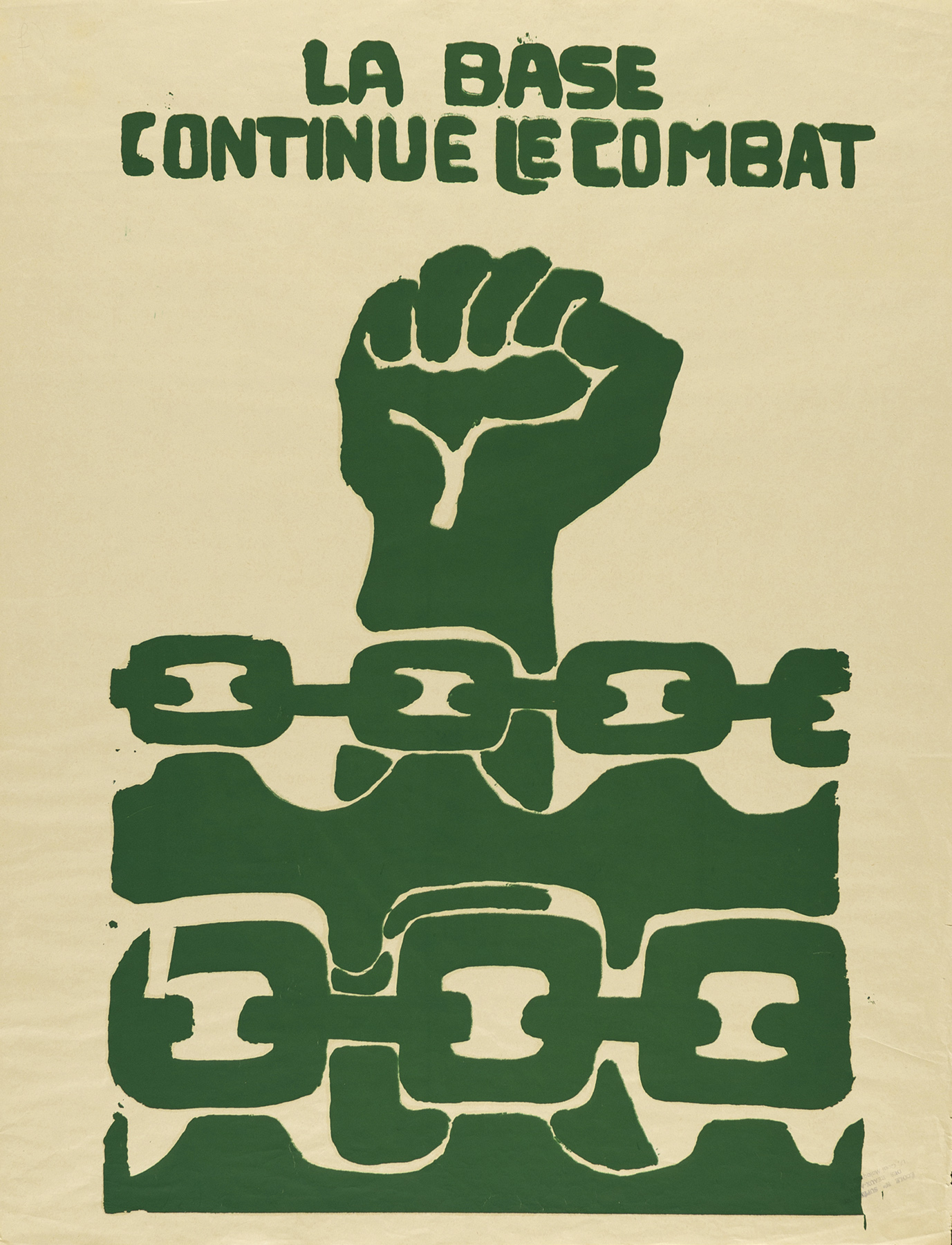
Atelier Populaire La base continue le combat 1968 Silk screen 65.4 x 50cm Museum für Kunst und Gewerbe Hamburg
La révolution est dans la rue – The revolution is on the street
In 1968, France is experiencing serious unrest, with a general strike. In the democratically organised Atelier Populaire, rehearsing artists and workers have productive co-operation: hundreds of protest motifs are printed in their thousands as posters, which create and shape the Parisian cityscape. La beauté est dans la rue – not only the revolution, but also the beauty of the road reached.
Public space becomes a central place of expression, the protesters getting their messages to the mass media and conveyed to the general public. But strong pictures are needed: the political actions offer in their skilful staging, great visual attraction potential. All means of expression unites an understanding of democracy, the current rules and power structures in the (media) public, performatively questioned.
Street as Mass Medium
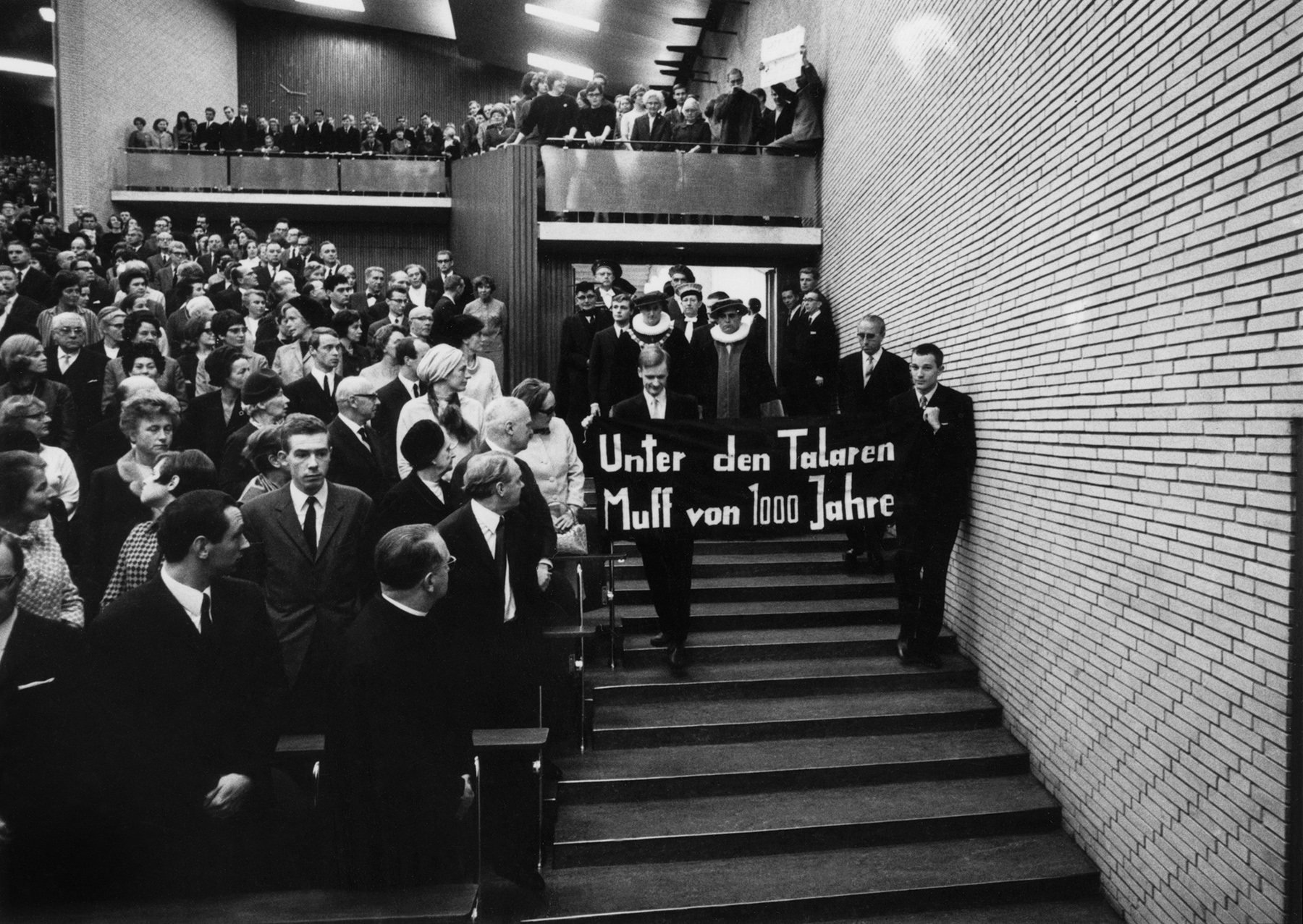
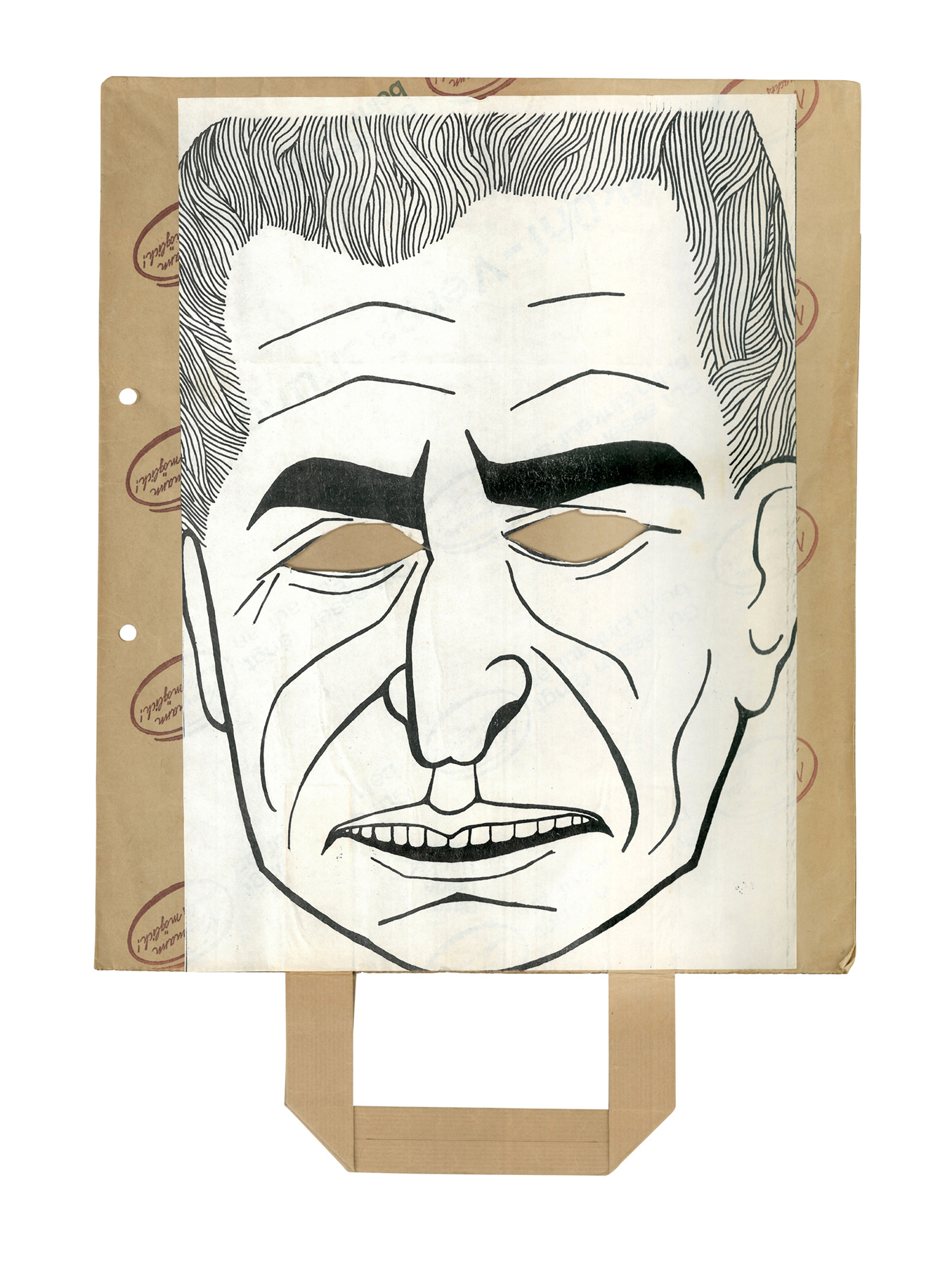
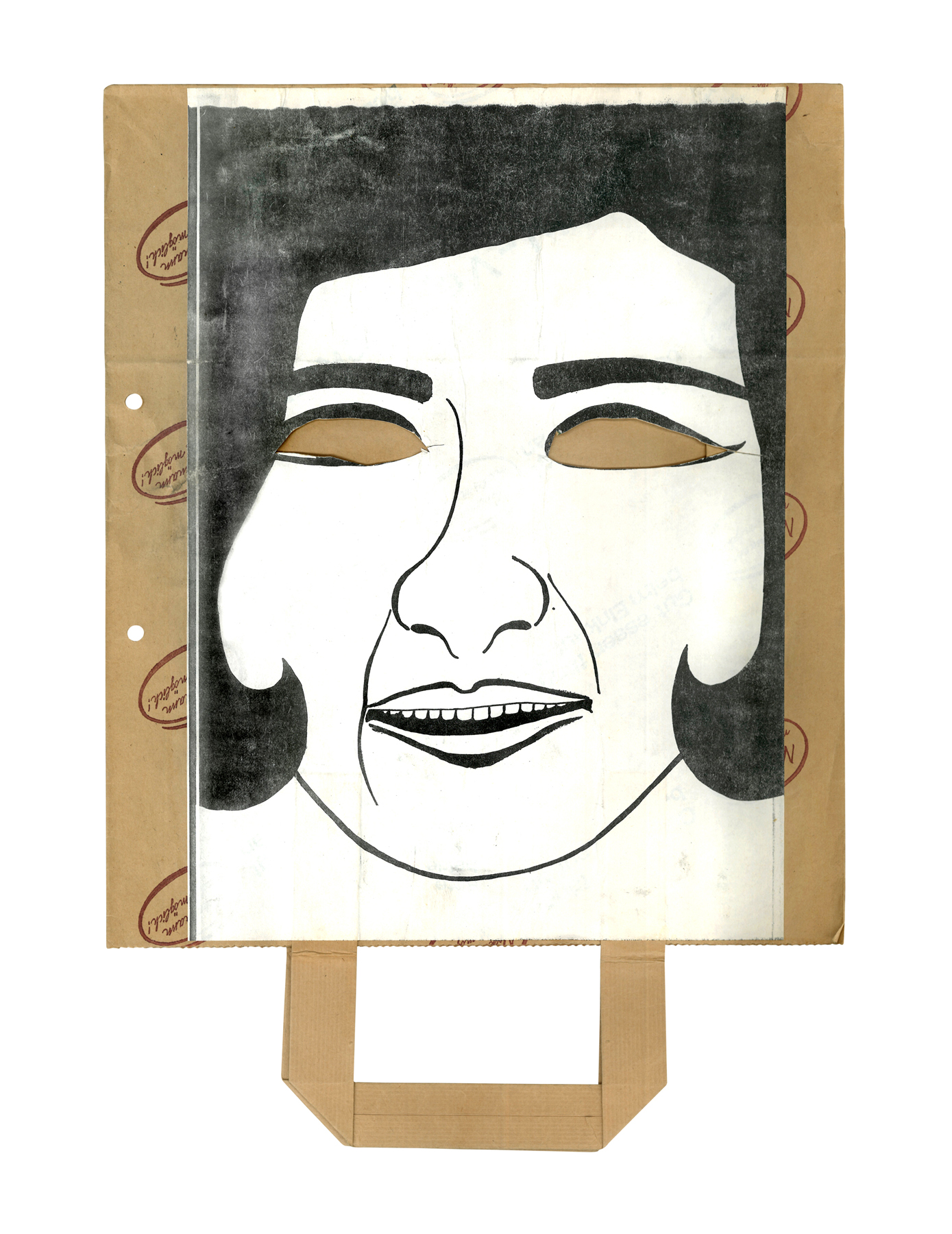
In May 1968, France experiences severe riots. Students and workers take a stand for mutual political demands for reforms as well as for cries for international solidarity which leads to a “wild general strike”: They occupy factories and public facilities such as faculties of Paris’ art college Ecole des Beaux-Arts. The printing workshop is opened as an Atelier Populaire to give everyone the chance to publically express their own views by creating posters. Artists and workers productively collaborate in this democratically structured space: the community collectively consults about how the protest messages should look like, and everyone can be a printer. Within a few weeks, hundreds of protest pictures – printed thousand fold – are spread across the city and can be seen everywhere. Universities are breeding grounds for protests; this is also true for the Federal Republic of Germany. Here, students discuss controversial opinions in an academic discourse, and organise resistance. In the light of global protests against the Vietnam War and Western economic colonialism, they express basic criticism of the political landscape. Their criticism also addresses education policy, elitist structures, emergency laws, and the German media landscape. The street is the place for the non-parliamentary opposition to utter their opinions. In the fight for political recognition and public attention, performative actions are more and more successful. Sit-ins, teach-ins, rallies, happenings and demonstrations offer creative provocation, and civil disobedience in combination with well-known forms of protest such as flyers and posters, all of which arouses high visual sensations and great media response. These different forms of action range from giving out paper bags with caricatures depicting the ruling Persian couple, which Kommune 1 does in 1967 at a demonstration against their visit in Berlin, to the famous banner saying “Unter den Talaren – Muff von 1000 Jahren” (“underneath their robes – fustiness of a thousand years”), with which undergraduates demand university reforms on the 9th November in 1967 at the University of Hamburg; these protests also include knocking down the monument of colonial civil servant Hermann von Wissmann in Hamburg as a statement against the “ongoing exploitation of the Third World.”
The universities are the germ cells of the protest: right and left groups claim the opinion of (academic) youth and the interests of society for themselves. Each as truth, propagated views are sometimes radically represented. In the fight for attention and political perception, actions are used that are between creation and provocation and cause civil disobedience.
Rainer Hachfeld (German, b. 1939) Distribution: Kommune 1 Karikatur / caricature: Schah-Masken (Mohammad Reza Pahlavi, Farah Pahlavi) / Shah masks 1967 Paper Hamburger Institut für Sozialforschung Photo: MKG
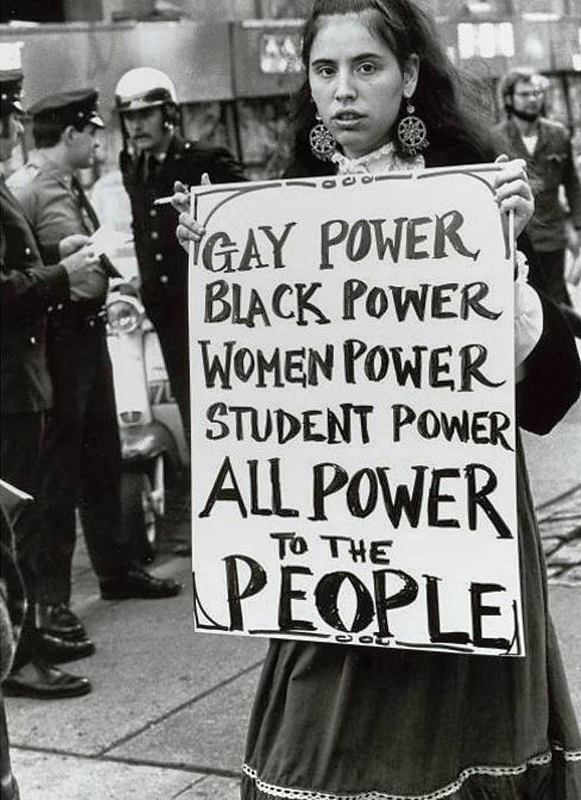
The social discourse is characterised by civil rights movements, including feminist groups, the gay movement and the Civil Rights Movement of the African American population in the US. Racism, intolerance and discrimination are systematically and openly denounced. The means of protest range from demonstrations and information campaigns about civil disobedience to partly artistic, partly militant actions up to armed resistance.
Talking ’bout my Generation
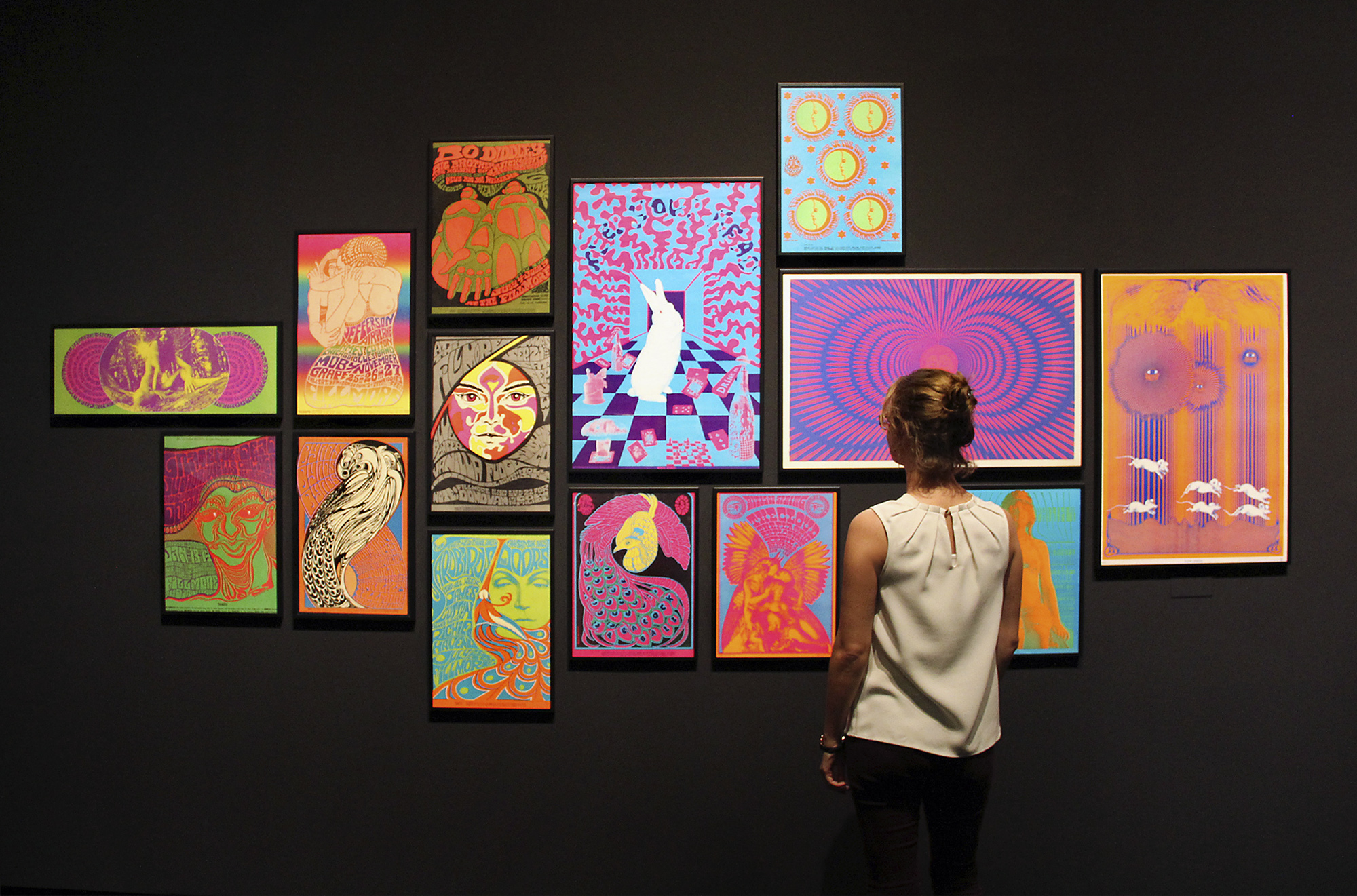
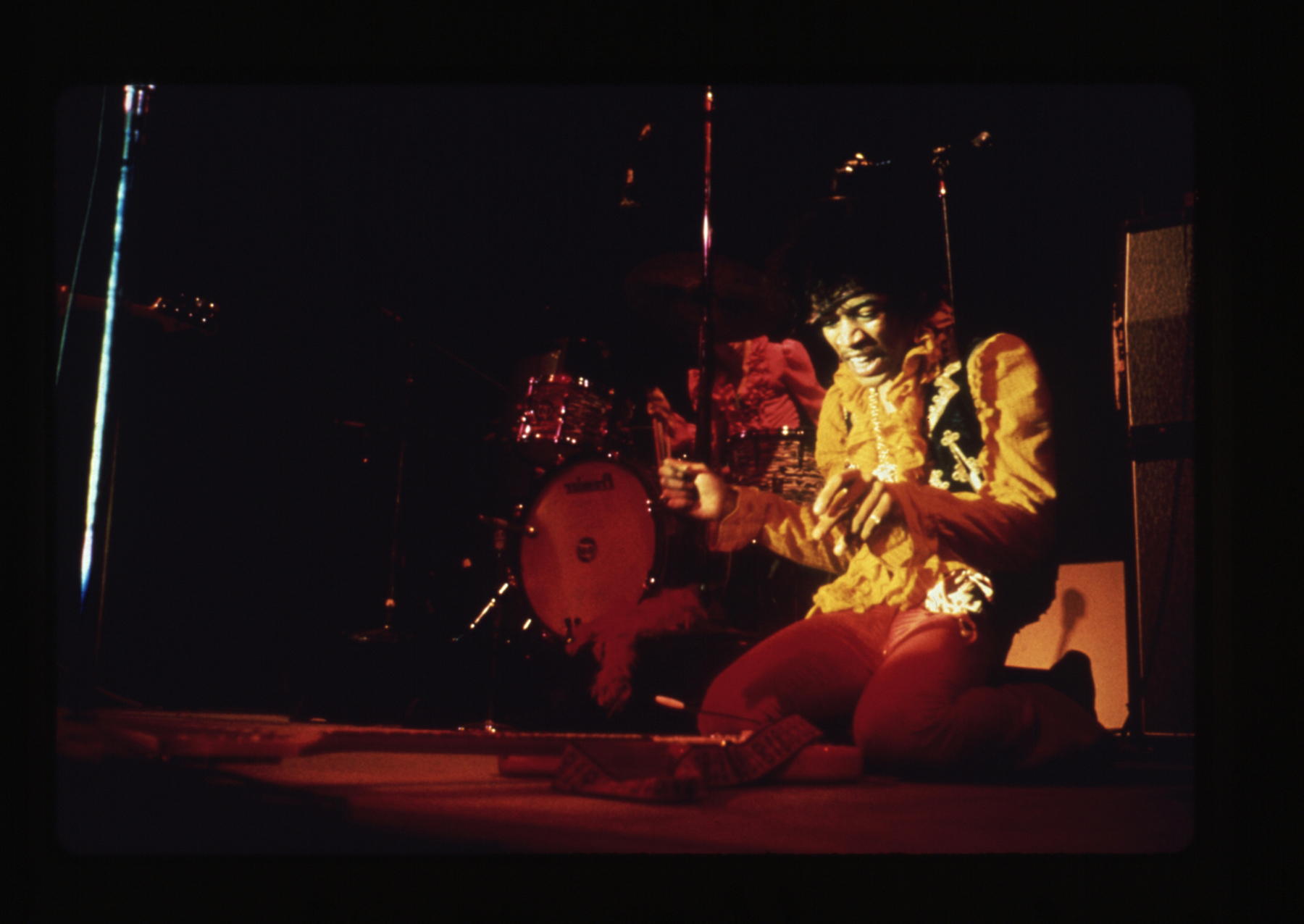
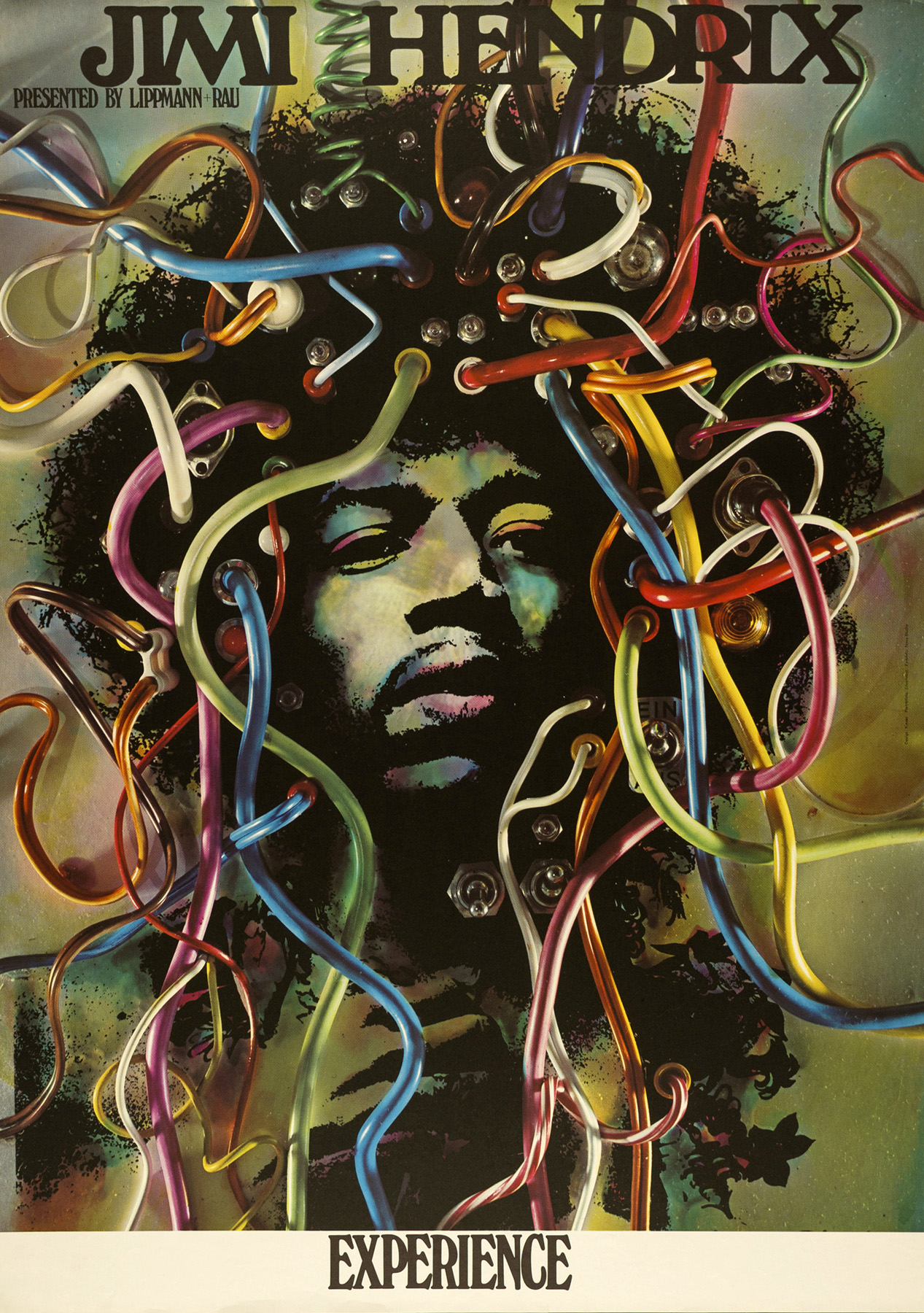
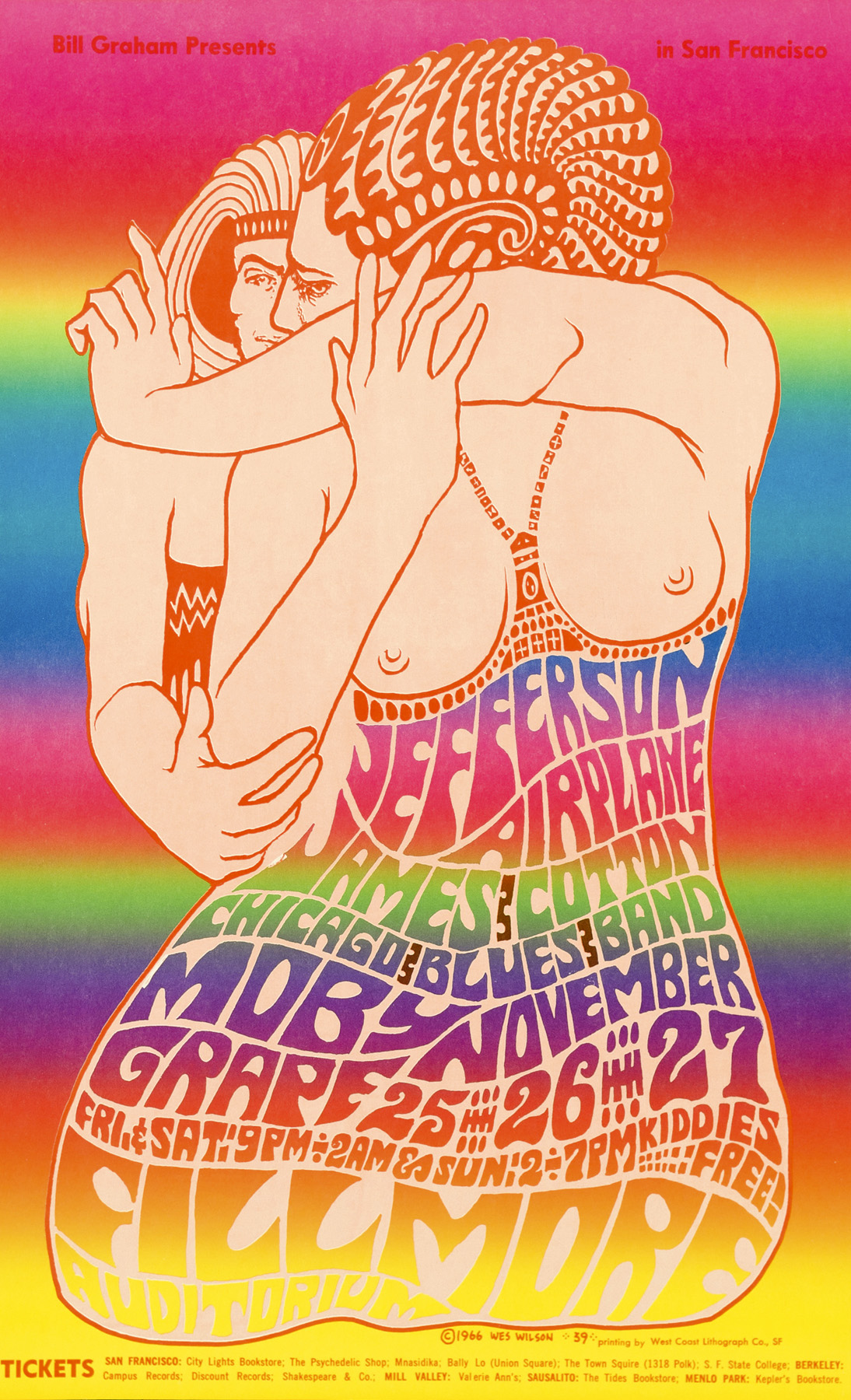
In the 1960s, a pop revolution conquers the Western hemisphere, starting in Great Britain and the USA which conclusively establishes rock music as a generation-defining phenomenon and expression of an international way of life. This marks a paradigm shift in entertainment music that defines rock and pop as an essential part of youth and subculture with an existential identity-establishing function. For adolescents, English music also means separating themselves from the generation of their parents and the (fake) bourgeois Schlager music idyll. In only a short time, bands rise from playing in underground clubs to performing on big stages. One of the reasons is the growing festival scene that starts in 1967 with the Monterey Pop Festival and peaks in 1969 with Woodstock. The exhibition will feature the concert movie Monterey Pop that shows ground breaking performances by Jimi Hendrix, as he sets his guitar on fire, Jefferson Airplane, The Who, The Mamas & the Papas and more, which will give visitors the chance to dive into the festival atmosphere of the time. Concert posters, record covers and audio stations with the most famous songs bring the world of 68 to life. Already established musical genres are mixed, psychedelic rock captures the hippies‘ drug influenced style of life, experimental arrangements and instrumentation produce completely new electronically amplified and distorted sounds. Records are conceptualised as complete art works. As a consequence, a visual cross-media language evolves that includes psychedelic poster or album cover designs and extravagant style presentations of the rock stars themselves. Pop culture becomes the international language of an entire generation.
Rock music finally establishes itself as generation-determining phenomenon and an expression of an international lifestyle. This is accompanied by a cross-media visual language, from psychedelic poster and cover design to extravagant fashion staging of the rock stars. Pop Culture becomes the international language of a whole generation, that is in turn incorporated by the cultural industry.
Monterey Pop Official Trailer
The Monterey Pop Festival ran for three days in June 1967. For most of the five shows, the arena was jammed to bursting with perhaps as many as 10,000 people. The live performances were spectacularly successful. Janis Joplin, who was singing with Big Brother and the Holding Company, pulled out all the stops with a raw, powerful performance that helped establish her as the preeminent female rock singer of her day.
The Who climaxed a brilliant set by smashing their equipment at the conclusion of “My Generation”. Jimi Hendrix (in the American debut of the Jimi Hendrix Experience) offered an awesome display of his virtuosity as a guitarist and as a showman, humping his Marshall amplifiers and then setting his Stratocaster ablaze. Another highlight was Ravi Shankar’s meditative afternoon of Indian ragas. And then there was Otis Redding, the dynamic soul man turned in what many present believe was the festival’s best performance. ABC offered $400,000 for network rights to Pennebaker’s film (which was released in theatres after ABC decided it was too far out for the TV audience).
Karl Georg Günther Kieser (born March 24, 1930 in Kronberg im Taunus; † March 22 , 2023 in Offenbach) was a German graphic designer and sculptor.
Since the 1960s, he has been particularly well-known for his poster design for the German Jazz Festival in Frankfurt and his posters for events organised by the Lippmann + Rau concert agency, and is considered one of the most important German designers of jazz and rock posters. He also worked for the jazz label Blue Note.
Stages of Revolt
The performing arts are said to have a great political clout, and the stage becomes the place for social debates. Classical plays are reviewed regarding its political messages, and newly written plays accuse the bourgeois establishment. The shrine-like status of museums is challenged by wearing jeans to openings, no evening dresses, no champagne. The theatre leaves established institutions behind; companies are formed that take their messages to the streets. They no longer respect the division between actor/actress and spectator, exaggerated in Peter Handke’s Publikumsbeschimpfung (1966, Offending the Audience), or in Hans Werner Henze’s oratory Floß der Medusa (The raft of the Medusa) in which he criticises “the authority of humans over humans”. For its premiere with the NDR radio symphony orchestra, Henze puts a portrait of Che Guevara and a red flag on stage. Actors / actresses exit erratically, there is tumult, cries for Ho Chi Minh, an overwhelming police presence, and arrests – the show is stopped eventually. Art and life merge into each other, as can be seen in collectives like Rainer Werner Fassbinder’s antiteater in Munich. Such creative communities see themselves as antitheses to the middle-class, which could never give birth to any relevant art, because of its saturated complacency.
Filmstill from Publikumsbeschimpfung, premiere in Frankfurt am Main, 1966 Director: Claus Peymann , Aufzeichnung des HR
Bühnen der Revolte – Stages of revolt
The performing arts have major political clout and the stage becomes more about sociable Debates. The theatre leaves the institution, new pieces emerge and bring charges against the educated middle class Establishment. The border between actor and spectator is no longer respected, the audience is called to action. Art and life merge into collectives like Fassbinders antiteater and Steins Schaubühne.
Publikumsbeschimpfung (Offending the Audience) A speech piece by Peter Handke World premiere in the Frankfurt Theater am Turm 1966 Director: Claus Peymann Sprecher: Michael Gruner, Ulrich Hase, Claus-Dieter Reents, Rüdiger Vogler
Hans Werner Henze (1926-2012) Das Floß der Medusa (1968) The Raft of the Frigate “Medusa”
Abschied von gestern (Yesterday Girl), Alexander Kluge, 1966
The Old Film is Dead
In 1962, a young generation of filmmakers demands the aesthetic, thematic and economical reorientation of the German cinematic landscape, as expressed in their Oberhausener Manifest. The economic crisis of the film industry in the 1960s and international innovative movements like the Nouvelle Vague, lead them to clearly distance themselves from both the NS history and sentimental films with regional background (Heimatfilm) as well as the Karl May and Edgar Wallace franchise and the like. The 26 signers seek intellectual liberation through radically turning to film d’auteur and to independent productions apart from already established studio business. These filmmakers reject the conventional uplifting entertainment conventions of the time, and like to provoke the audience – impressively shown in Alexander Kluge’s Abschied von gestern (Yesterday Girl). Thus, the critical avant-garde of the Neuer Deutscher Film, including the works of Rainer Werner Fassbinder and others, is internationally successful. In 1967, in the wake of the American experimental and underground cinema, the Hamburger Filmmacher Cooperative is founded. Without any state funding or need to submit to corporate profit values, the partly autodidactic filmmakers realize unconventional projects, distribute them through their independent network, and establish their own public sphere of the Andere Kino (Other Cinema) with their several days long film-ins. Inexpensive substandard films and super 8 cameras forward a vital underground scene, which primarily produces short films that fathom the dividing lines between visual arts and filmic experiments.
Alexander Kluge (German, b. 1932) Abschied von gestern (Yesterday Girl) (videostill) 1966 Black and White film, 88 min. Courtesy/Copyright: Alexander Kluge
Der alte Film ist tot – The old film is dead
1962 calls a young generation of filmmakers with the Oberhausen Manifesto the aesthetic, content and economic realignment of German film. The collective project borders on the Nazi-film-burdened past and the presence marked by Heimatfilm. Many of the films refuse entertainment conventions, but provoke the emotional and sociopolitical reflection in the audience.
Gerd Conradt (born May 14, 1941 in Schwiebus) is a German cameraman, director, author and lecturer in video practice. His films and video programs are mostly portraits – conceptually designed time pictures, often as long-term documentaries.
Dore O. was born on 9 August 1946 in Mülheim an der Ruhr, Germany. She was a director and actress, known for Kaskara (1974), Blonde Barbarei (1972) and Alaska (1969).
Born Dore Oberloskammp in 1946, Dore O. was a painter before turning to film in the late ’60s, a not uncommon shift for young West German artists at the time, swept up as many of them were by the anti-imperialist and anti-fascist ideals of the New Left. The medium’s powers of documentation were considered key in the struggle against the prevailing social order, inspiring a rethinking of the means of artistic production and distribution that resulted in the proliferation of film collectives across the country. …
Dore often collaborated with her husband, the artist Werner Nekes; the two codirected Dore’s first film, the 1968 short Jüm-Jüm – a percussive concatenation of stationary shots that show a woman swinging in front of a large painting of a phallus – and they shared an affinity for vintage optical devices (Nekes was a collector). Their work both relied on an inventive manipulation of celluloid film, though Dore in particular used techniques like double exposure, rear projections, and superimposition to get at a new kind of language, a way of seeing whose logic was related more to the intuitively expressive powers of music than any rational principle. Dore’s fascination with the parameters of perception – how film can disrupt and expand them – is perhaps most obviously apparent in Kaskara (1974), composed almost entirely of the passageways (doors, windows, mirrors) that recur throughout Dore’s oeuvre, and which are here multiplied and dense with reflective layers. Shot in the couple’s summer cottage in Sweden, the film finds a man, Nekes, floating in and around the house, with superimpositions dissolving the boundaries between the landscape and the rooms, collapsing exterior and interior into one unified reality.
“As usual, the film is ‘shown’ in the dark. But the cinema has shrunk somewhat – only two hands fit inside it. To see (i.e. feel, touch) the film, the viewer (user) has to stretch his hands through the entrance to the cinema. At last, the curtain which formerly rose only for the eyes now rises for both hands. The tactile reception is the opposite of the deceit of voyeurism. For as long as the citizen is satisfied with the reproduced copy of sexual freedom, the state is spared the sexual revolution. Tap and Touch Cinema is an example of how re-interpretation can activate the public.”
Valie Export
This outdoor action on Munich’s Stachus square translates the concept of expanded cinema and the cinema’s fairground roots into the ‘first immediate women’s film’, as the artist describes her ‘Tap and Touch Cinema’. ‘Public’ accessibility – restricted to 30 seconds per person – is noisily proclaimed by Peter Weibel. A direct demonstration of cinema as a projection space for male fantasies, this still ironic transgression of the border between art and life is an early indication of Valie Export’s often risky, but always resolute, deployment of her own body in later works.
Text by Martina Boero from the YouTube website [Online] Cited 01/03/2019. No longer available online
At age twenty-eight, Waltraud Hollinger changed her name to VALIE EXPORT, in all uppercase letters, to announce her presence in the Viennese art scene. Eager to counter the male-dominated group of artists known as the Vienna Actionists including Günter Brus, Otto Mühl, Hermann Nitsch, and Rudolf Schwarzkogler she sought a new identity that was not bound by her father’s name (Lehner) or her former husband’s name (Hollinger). Export was the name of a popular cigarette brand. This act of provocation would characterise her future performances, especially TAPP und TASTKINO (TOUCH and TAP Cinema) and Aktionhose: Genitalpanik (Action Pants: Genital Panic). Challenging the public to engage with a real woman instead of with images on a screen, in these works she illustrated her notion of “expanded cinema,” in which film is produced without celluloid; instead the artist’s body activates the live context of watching. Born of the 1968 revolt against modern consumer and technical society, her defiant feminist action was memorialised in a picture taken the following year by the photographer Peter Hassmann in Vienna. VALIE EXPORT had the image screen printed in a large edition and fly-posted it in public spaces.
Text from the MoMA website, gallery label from Transmissions: Art in Eastern Europe and Latin America, 1960-1980, September 5, 2015 – January 3, 2016 [Online] Cited 12/02/2019
The design scene responds to the urge for freedom with a colourful drive during 1968. Right angles, hard edges and solid colour do not fit the modern attitude to life. Individual home accessories solve the interior design problem, from the assembly line. Furniture is no longer made for eternity; uncomplicated and practical is the new design ethos and above all, it is mobile. Design is no longer used for status determination; this also applies to fashion. Originality is more important than noble material and refined cuts.
Fashion as a Statement
The different clothing styles of the generation of 1968 express more than a mere taste of fashion. Fashion becomes a political statement. Elements of hippie and ethnic looks, pieces of uniforms, or uncommon revealing styles challenge society’s conventions. In many families, the generation conflict shows itself in arguments about the mini skirt, ascribed to fashion designer Mary Quant. While parents are worried about indecent provocation and for their daughters to carelessly sexualise themselves, for adolescents, the mini skirt expresses their desire for autonomy and a form-fitting style of clothes. Soon, these outfits can also be found in the shop windows of department stores: Protest fashion finds its way from subculture into mainstream. Originally designed as a promotional tool for the paper industry, the paper dress achieves an enthusiastic success in 1966 in the USA and Europe. Women’s magazines distribute these inexpensive A-line mini dresses which are used as a vehicle for advertising in electoral campaigns throughout the USA in 1968. Designed as Poster Dresses by graphic designer Harry Gordon, they represent the new and fast-paced fashion world showing the growing impact of pop art and pop culture. All-over prints range from everyday motifs to poems by leftist writer Allen Ginsberg, and even the portrait of Bob Dylan – the voice of a young critically thinking generation. The fashion avant-garde is interested in the social function of fashion and its normative effects. Designs such as the business pants suit for women by Yves Saint Laurent and Rudi Gernreich’s unisex bathing suit reflect a changing society, question gender norms, and propagate a free approach to body and sexuality.
Paper Dress “Campaign Dress” 1966-1968 Cellulose/Nylon non-woven Acquired with funds of the Campe’schen Historischen Stiftung Museum für Kunst und Gewerbe Hamburg
Paper Dress “Big Ones for 68” 1966-1968 Cellulose/Nylon non-woven Acquired with funds of the Campe’schen Historischen Stiftung Museum für Kunst und Gewerbe Hamburg
Paper Dress 1966-1968 Cellulose/Nylon non-woven Acquired with funds of the Campe’schen Historischen Stiftung Museum für Kunst und Gewerbe Hamburg
Art: Up against the Wall!
Global mass protests also mobilise visual artists. Andy Warhol, Wolf Vostell, Jasper Johns and others use posters, the artistic mass medium of the time, to criticise world events. Their poster aesthetics reflect contemporary artistic trends such as pop art and Fluxus, drawing on an unlimited repertoire of forms of expression: They use montages, collages, photography and xylography; a multifacetedness that matches their diverse voices and their political agendas.
The political trouble spots find global resonance and motivate prominent artists to political opinions. Posters, the artistic mass medium of the time, articulate a critical attitude. The aesthetics includes different expressions: from montages and collages via photographic cut-up to woodcut techniques. This multifariousness, artistic practice corresponds to the polyphony of the actors and their political concerns.
Wolf Vostell
Wolf Vostell (14 October 1932 – 3 April 1998) was a German painter and sculptor, considered one of the early adopters of video art and installation art and pioneer of Happening and Fluxus. Techniques such as blurring and Dé-coll/age are characteristic of his work, as is embedding objects in concrete and the use of television sets in his works.
Wolf Vostell was born in Leverkusen, Germany, and put his artistic ideas into practice from 1950 onwards. In 1953, he began an apprenticeship as a lithographer and studied at the Academy of Applied Art in Wuppertal. Vostell created his first Dé-collage in 1954. In 1955-1956, he studied at the École Nationale Superieur des Beaux Arts in Paris and in 1957 he attended the Düsseldorf Academy of Arts. Vostell’s philosophy was built around the idea that destruction is all around us and it runs through all of the twentieth century. He used the term Dé-coll/age, (in connection with a plane crash) in 1954 to refer to the process of tearing down posters, and for the use of mobile fragments of reality. Vostell’s working concept of décollage is as a visual force that breaks down outworn values and replaces them with thinking as a function distanced from media.
His first Happening, Theater is in the Street, took place in Paris in 1958, and incorporated auto parts and a TV. In 1958, he took part in the first European Happening in Paris and he produced his first objects with television sets and car parts. He was impressed by the work of Karlheinz Stockhausen, which he encountered in 1964 in the electronic studios of the German radio station WDR, and in 1959 he created his electronic TV Dé-coll/age. It marked the beginning of his dedication to the Fluxus Movement, which he co-founded in the early 1960s. Vostell was behind many Happenings in New York, Berlin, Cologne, Wuppertal and Ulm among others. In 1962, he participated in the Festum Fluxorum, an international event in Wiesbaden together with Nam June Paik, George Maciunas. In 1963 Wolf Vostell became a pioneer of Video art and Installation with his work 6 TV Dé-coll/age shown at the Smolin Gallery in New York, and now in the collection of the Museo Reina Sofía in Madrid. The Smolin Gallery sponsored two innovative Wolf Vostell events on TV; the first, Wolf Vostell and Television Decollage, featured visitors to the gallery who were encouraged to create poster art on the walls. In 1967 his Happening Miss Vietnam dealt with the subject of the Vietnam war. In 1968, he founded Labor e.V., a group that was to investigate acoustic and visual events, together with Mauricio Kagel, and others.
Wolf Vostell was the first artist in art history to integrate a television set into a work of art. This installation was created in 1958 under the title The black room is now part of the collection of the art museum Berlinische Galerie in Berlin. Early works with television sets are Transmigracion I-III from 1958 and Elektronischer Dé-coll/age Happening Raum (Electronic Dé-coll/age Happening Room) an Installation from 1968.
Robert Wesley Wilson (July 15, 1937 – January 24, 2020) was an American artist and one of the leading designers of psychedelic posters. Best known for designing posters for Bill Graham of The Fillmore in San Francisco, he invented a style that is now synonymous with the peace movement, the psychedelic era and the 1960s. In particular, he was known for inventing and popularizing a “psychedelic” font around 1966 that made the letters look like they were moving or melting.
His style was heavily influenced by the Art Nouveau movement. Wilson was considered to be one of “The Big Five” San Francisco poster artists, along with Alton Kelley, Victor Moscoso, Rick Griffin, and Stanley Mouse.
Günter Beltzig (German designer, 1941-2022) Brüder Beltzig, Wuppertal (manufacturer) Floris 1967 Polyester Photo: Museum für Kunst und Gewerbe Hamburg
The international design avant-garde aspires to revolutionise the established Bauhaus guiding principle “form follows function”. The spirit of departure and the desire for creative innovation characterise the new generation of designers, often in artistic collective works. Nothing is more wrong than a standstill. Some seating furniture almost appears as socio-political statement and proverbially shows a new attitude. Form now follows the idea.
Form follows idea
In the 1960s, the international design avant-garde strives towards an opposition to the so far prevalent Bauhaus dogma “form follows function”. This new generation oftentimes works in artistic collectives with passion for creative innovation. Objects to sit on should no longer mean that people are forced into an unnatural posture, it is rather the furniture such as the slack beanbag chair Sacco by Piero Gatti, Cesare Paolini and Franco Teodoro, or the unconventional chair Floris by Günter Beltzig that should adapt to forms and needs of people. These new approaches in product design show ideas and a new attitude towards life of a nonconformist, dynamic and critical generation. Some seating furniture seems to be a downright socio-political statement that proverbially presents a new stance. Now, form follows idea. In 1968, the publishing house Spiegel entrusts Danish architect and designer Verner Panton with the design of the interior of their new building in Hamburg. For every story, he uses a different colour of the rainbow, consistently designing everything in one tone – from the colour of the wall to the ashtray – and creates a pop art icon. In the course of the years, the colours of the offices get whitewashed. Only the red-orange-purple Spiegel canteen has survived unaltered, since 2011 it is located in the MKG as a Period Room.
Joe Colombo (Italian, 1930-1971) (designer) Elda 1963/1964 Museum of Arts and Crafts Hamburg
Günter F. Ris (German, 1928-2005) (designer) and Herbert Selldorf (German, 1929-2012) (designer) Rosenthal Möbel (manufacturer) Armchair “Sunball” 1969-1971 Polyester, Aluminium, polyurethane foam, cotton cord, synthetics Property of the Stiftung Hamburger Kunstsammlungen Photo: Hersteller
Gaetano Pesce (Italian, 1939-2024) (designer) Fa. Cassina and Busnelli (manufacturer) Armchair Donna UP5 with Bambino UP6 1969 Polyurethane foam and Nylon-jersey Photo: Hersteller
Gaetano Pesce is an Italian architect and a design pioneer of the 20th century. Pesce was born in La Spezia in 1939, and he grew up in Padua and Florence. During his 50-year career, Pesce has worked as an architect, urban planner, and industrial designer. His outlook is considered broad and humanistic, and his work is characterised by an inventive use of color and materials, asserting connections between the individual and society, through art, architecture, and design to reappraise mid-twentieth-century modern life.
Piero Gatti (Italian, 1940-2017), Cesare Paolini (Italian, 1937-1983) and Franco Teodoro (Italian, 1939-2005) (designers) Fa. Zanotta, Milan (manufacturer) Italien Sacco 1968 PVC and Polystyrene Photo: Museum für Kunst und Gewerbe Hamburg
Between Consumption Binge and Space Age
While in the 1950s in the beginning of the Miracle on the Rhine, it was most important for the population to cover the basic needs, the following decades are characterised by a consumption binge. Growing prosperity and a rapidly expanding choice of goods increases the desire for more and more consumer items and luxuries. Changing life styles challenge the commodity producing and the advertising industry. Zeitgeist aspects such as mobility, belief in progress, emancipation, individualism, and cult of the body gain in importance, also in terms of consumer behaviour. Desires are pre-formulated by an advertising industry which has a broad audience across all media with its TV ads, press advertising, and poster campaigns. They draw a picture of a hedonistic society between materialism and alleged expansion of consciousness that ultimately combines lifestyle aspects of youth culture with contemporary product design. Advertisements for items such as Afri-Cola or the Astro-Lavalampe (Astro lava lamp) by Edward Craven-Walker promise ecstatic sensory impressions without the use of drugs. The lava lamp, inspired by the science fiction movie Barbarella, becomes a popular accessory in clubs and living rooms; and to this day, it is representative for the psychedelic look of the time.
The 1960s are characterised by technophilia and optimistic belief in progress. The “Race to the Moon” is a battle between the political system of the United States of America and communist Russia. The era of space travel influences futuristic aesthetics, produces innovative materials, thus, inspiring new consumerist ideas. Furniture, electronic devices, everyday objects and fashion use the Space Age look, and define a creative Zeitgeist. Paco Rabanne is the futuristic designer of the 1960s. The trained architect frees himself of the traditions of haute couture and uses unusual materials. His martial mini dress (1966) has no threads at all: metal rings link aluminium plates and only allow minimal flexibility for the wearer. André Courrèges’ space collection from 1964 to 1965 shows girls from the moon in angular clothes with helmet-like hats and glasses made out of plastic with curved eye-slits as a stylish protection against space radiation.
In 1968 on Christmas Eve, NASA’s snapshot of the earth forever changes the way we see her. For the first time, a world audience views an “Earthrise” over the horizon of the moon through the eyes of the Apollo 8 astronauts. The iconic picture is henceforth symbolic of the preciousness of planet earth and the uniqueness of earthly life; and it makes people think about how to responsibly treat this world that seems to be so small and fragile from a distance.
Press release from the Museum für Kunst und Gewerbe Hamburg Cited 11/02/2019
Paco Rabanne (Spanish, 1934-2023) Minidress 1966 Aluminium, metal rings, metal studs L 74cm Museum für Kunst und Gewerbe Photo: Maria Thrun/MKG
Francisco Rabaneda Cuervo (18 February 1934 – 3 February 2023), more commonly known under the pseudonym of Paco Rabanne (French: [pako ʁaban]; Spanish: [ˈpako raˈβan]), was a Spanish fashion designer.
Rabanne rose to prominence as an enfant terrible of the fashion world in the 1960s with his use of unconventional materials such as metal and plastic in his clothing, and for his incorporation of futuristic elements in his designs, gaining notoriety for his space-age style. He collaborated with a range of iconic fashion houses and designed costumes for films, such as Barbarella. Rabanne was also the recipient of several awards, including the Legion of Honour, which recognised his contributions to the arts and fashion.
In addition to his fashion work, Rabanne was known for his fragrances. He created a number of highly successful scents, including 1 Million and Lady Million.
Von “Rauschhülle” bis Filmkulisse – From “noise cover” to film set
In 1968, Spiegel-Verlag commissioned the Danish architect and designer Verner Panton with the interior design of the new publishing house in Hamburg. He declines the colour gamut of the rainbow – consistently he designs everything uniformly in one tone. But taste changes and the rooms are painted white. The canteen alone remains spared and is now a listed building. Since the move the publisher is in the Museum of Arts and Crafts Hamburg.
Verner Panton (13 February 1926 – 5 September 1998) is considered one of Denmark’s most influential 20th-century furniture and interior designers. During his career, he created innovative and futuristic designs in a variety of materials, especially plastics, and in vibrant and exotic colours. His style was very “1960s” but regained popularity at the end of the 20th century; as of 2004, Panton’s most well-known furniture models are still in production (at Vitra, among others).
Museum für Kunst und Gewerbe Hamburg Steintorplatz, 20099 Hamburg
Today, revolution is in the air around the world, just like it was in 1968 (a posting on this year to follow soon) and in 1918. I hope this wonderful posting of photographs, posters, films, murders, bombings, funerals, detailed close ups of the barricades and the people manning them gives you some of the flavour of the times. This was the order of the day in Berlin in 1918/19. Revolution.
What we must not forget is out of this revolution, out of this ferment of creativity, uncertainty, “liberal” democracy and militaristic society emerged the seeds of its downfall: the beginnings of the National Socialist Party (the Nazis).
“In July 1919 Hitler was appointed Verbindungsmann (intelligence agent) of an Aufklärungskommando (reconnaissance unit) of the Reichswehr, assigned to influence other soldiers and to infiltrate the German Workers’ Party (DAP). At a DAP meeting on 12 September 1919, Party Chairman Anton Drexler was impressed with Hitler’s oratorical skills. He gave him a copy of his pamphlet My Political Awakening, which contained anti-Semitic, nationalist, anti-capitalist, and anti-Marxist ideas. On the orders of his army superiors, Hitler applied to join the party, and within a week was accepted as party member 555 (the party began counting membership at 500 to give the impression they were a much larger party). …
At the DAP, Hitler met Dietrich Eckart, one of the party’s founders and a member of the occult Thule Society. Eckart became Hitler’s mentor, exchanging ideas with him and introducing him to a wide range of Munich society. To increase its appeal, the DAP changed its name to the Nationalsozialistische Deutsche Arbeiterpartei (National Socialist German Workers Party; NSDAP). Hitler designed the party’s banner of a swastika in a white circle on a red background.” (Text from the Wikipedia website)
Rising to prominence through his demagogic beer hall speeches on populist themes, Hitler would attempt a coup known as the “Beer Hall Putsch” in 1923, a stepping stone on his rise to becoming the dictator of Nazi Germany.
The flowering of German Expressionism (modern art labelled by Hitler Entartete Kunst or “Degenerate Art” in the 1920s) and a society which proposed the first advocacy for homosexual and transgender rights, were both positives of the interwar period. A prominent advocate for sexual minorities was the German sexologist Magnus Hirschfeld.
“In 1920, Hirschfeld was very badly beaten up by a group of völkisch activists who attacked him on the street; he was initially declared dead when the police arrived. In 1921, Hirschfeld organised the First Congress for Sexual Reform, which led to the formation of the World League for Sexual Reform. Congresses were held in Copenhagen (1928), London (1929), Vienna (1930), and Brno (1932)… Hirschfeld co-wrote and acted in the 1919 film Anders als die Andern (“Different From the Others”) [see below], in which Conrad Veidt played one of the first homosexual characters ever written for cinema. The film had a specific gay rights law reform agenda; after Veidt’s character is blackmailed by a male prostitute, he eventually comes out rather than continuing to make the blackmail payments. His career is destroyed and he is driven to suicide.” (Text from the Wikipedia website)
Of course these small, hard won freedoms, this cabaret of life, and the more liberal atmosphere of the newly founded Weimar Republic were all swept away by the Nazis in the 1930s.
How quickly it can turn. Today, as then, we must be ever vigilant to guard our freedom against the power of conservative forces that seek to do us harm. Brothers, never again!
Dr Marcus Bunyan
Many thankx to the Museum of Photography, Berlin for allowing me to publish the photographs in the posting. All the photographs have been digitally cleaned. Please click on the photographs for a larger version of the image.
In November 1918, exactly 100 years ago, the old regime of Kaiser Wilhelm II was swept away by a revolution. It ended the First World War and led to the establishment of democracy in Germany. The Weimar Republic was born out of the struggle for a new social order and political system. The upheavals that occurred in 1918/19 were captured on camera, sometimes by renowned press photographers such as Willy Römer; their works are crucial for historians today. For the first time ever, this book investigates the role of film and entertainment in the Weimar Republic and includes it in the historical analysis. What do the street fights in the first months following the First World War have in common with the people’s recreational pleasures? How did photographers record the political turmoil, the demonstrations, strikes, shootings, and fights for control of the palace and the newspaper district? And, at the same time, what distractions were offered in Berlin’s cinemas and revue shows? How did the entertainment industry react to the revolution? Examining photos, films, and poster art, this book presents a dense and previously unseen portrait of German history.
Text from the catalogue
“So ends this first day of the revolution, which in just a few hours has witnessed the downfall of the House of Hohenzollern, the dissolution of the German army, and the demise of the old German social order. One of the most memorable and dreadful days in German history.”
Harry Graf Kessler, diary entry from November 9, 1918
“The Christmas fair carries on blithely throughout all of these bloody events. Hurdy-gurdies play on Friedrichstraße, street vendors peddle indoor fireworks, gingerbread, and silver tinsel, the jewellery shops on Unter den Linden remain unheedingly open, their brightly lit display windows glittering. On Leipziger Strasse, the usual Christmas crowds throng toward Wertheim, Kayser, and the other big stores. It is safe to say that in thousands of homes, Christmas trees are lit and children are playing around them with presents from Daddy, Mummy and dear Aunty. The dead lie in the royal stables, and on Holy Night, the wounds freshly inflicted on the palace and on Germany gape wide.”
Harry Graf Kessler, diary entry, December 24, 1918
“I cannot get out of head the execution of 24 sailors on Französische Strasse, where during all of these days, there has been no trouble. It is one of the most abominable civil war crimes I know of in history. This evening I tried to watch Reinhardt’s production of ‘As You Like It’, but was not in the mood. I cannot stop thinking about these murders and shootings, which are the order of the day in Berlin.”
The revolution in winter and spring 1918/19 was decided in the streets of the imperial capital, Berlin. Berliners celebrated the abdication of the German Emperor with demonstrations in front of the Reichstag and the palace on November 9th, 1918, in the newspaper quarter in January 1919 rolls of printing paper were used by the Spartacists to erect barricades against approaching government troops, after fighting had ceased, a large funeral procession crossed Frankfurter Allee to the cemetery in Friedrichsfelde. Press photographers were omnipresent with their big plate cameras, taking shots of orators in the crowd, soldiers behind machine-guns, vehicles carrying party posters in the National Assembly election campaign, and destroyed buildings and ravaged squares. At the same time, everyday life in the city went on. People went to the numerous cinemas with their expanding repertoire of films, enjoyed themselves at revues and cabarets, and danced the two-step and the foxtrot. The exhibition in the Museum für Fotografie shows both a photographic visual history of the revolution in Berlin and a panorama of the entertainment culture of those months.
The brothers Otto and Georg Haeckel were the most important press photographers during the first days of the revolution. As experienced war reporters, they reacted quickly to cover the spontaneous rallies on Unter den Linden and in front of the palace. The photographers worked without assignment and offered their images to publishers like Mosse or Ullstein. There are few visual records of the fighting itself. Rather, photographers took advantage of breaks in the fighting to recreate scenes on the barricades or with soldiers with readied weapons. The largest group of photos of the revolution of which the original contact prints survive is by Willy Römer. One of his photographs was even taken immediately before his own arrest by a troop of Spartacists.
Weekly newsreels in cinemas across Germany reported on the rallies and demonstrations in Berlin, showed film portraits of the ministers of the new imperial government, and confirmed the restoration of order by showing scenes from everyday life in the streets of the capital. At the same time, they solicited votes for the National Assembly. Given lengthy production times, the feature films of winter 1918/19 do not yet reflect the revolution in any way. But the suspension of censorship enabled the production of new, more daring films, which, for example, opposed the criminal persecution of homosexuals.
As a reaction to the end of the war and without as yet reckoning with the dangers of the revolution and its fighting, an unprecedented desire for pleasure-seeking reigned in Berlin during the winter and spring of 1918/19. Besides opera houses and straight theatres, Berliners frequented the popular operetta and revue theatres, as well as cinemas; they also went to ballrooms and drinking holes to dance. Some revues reacted to current issues like the housing shortage and the strikes. The poverty of war invalids was also a subject of popular music. The song ‘Bein ist Trumpf’ from 1919 alludes to the fate of four men maimed in the war: the dance with a wooden leg or prosthesis amid the workings of a world-apparatus that turns and turns without end.
Anonymous text from the Museum of Photography, Berlin website [Online] Cited 08/02/2019
Karl Paul August Friedrich Liebknecht (German 13 August 1871 – 15 January 1919) was a German socialist, originally in the Social Democrat (SPD) and later a co-founder with Rosa Luxemburg of the Spartacist League and the Communist Party of Germany which split way from the SPD. He is best known for his opposition to World War I in the Reichstag and his role in the Spartacist uprising of 1919. The uprising was crushed by the Social Democrat government and the Freikorps (paramilitary units formed of World War I veterans). Liebknecht and Luxemburg were executed.
After their deaths, Karl Liebknecht and Rosa Luxemburg became martyrs for Socialists. According to the Federal Office for the Protection of the Constitution, commemoration of Liebknecht and Luxemburg continues to play an important role among the German left, including Die Linke (The Left). …
Revolution and death
Liebknecht was released again in October 1918, when Prince Maximilian of Baden granted an amnesty to all political prisoners. Upon his return to Berlin on 23 October he was escorted to the Soviet embassy by a crowd of workers. Following the outbreak of the German Revolution, Liebknecht carried on his activities in the Spartacist League. He resumed leadership of the group together with Luxemburg and published its party organ, Die Rote Fahne (The Red Flag).
On 9 November, Liebknecht declared the formation of a Freie Sozialistische Republik (Free Socialist Republic) from a balcony of the Berliner Stadtschloss, two hours after Philipp Scheidemann’s declaration of a German Republic from a balcony of the Reichstag. On 31 December 1918/1 January 1919, Liebknecht was involved in the founding of the Communist Party of Germany (KPD). Together with Luxemburg, Jogiches and Zetkin, Liebknecht was also instrumental in the January 1919 Spartacist uprising in Berlin. Initially he and Luxemburg opposed the revolt, but they joined it after it had begun. The uprising was brutally opposed by the new German government under Friedrich Ebert with the help of the remnants of the Imperial German Army and militias called the Freikorps. By 13 January, the uprising had been extinguished. Liebknecht and Luxemburg were captured by Freikorps troops on 15 January 1919 and brought to the Eden Hotel in Berlin, where they were tortured and interrogated for several hours. Following this, Luxemburg was beaten with rifle butts and afterwards shot, and her corpse thrown into the Landwehr Canal, while Liebknecht was forced to step out of the car in which he was being transported, and he was then shot in the back. Official declarations said he had been shot in an attempt to escape. Although the circumstances were disputed by the perpetrators at the time, the Freikorps commander, Captain Waldemar Pabst, later claimed, “I had them executed”.
“The new flu is here – and it is not Spanish, but English in origin, and it is known as “the new popular dance” […]. In Berlin, “Fox Trot steps” are applied to any old melody […]. Outside, they are banging away at the Palace […]. Machine-gun fire rattles around the advertising pillars, whose colourful posters bear invitations to Fox Trot teas.”
F.W. Koebner, in: Der Roland von Berlin, 1919
Film
In the years 1918 and 1919, the German film industry experienced pronounced growth tendencies. Among the most successful production firms of the era alongside Universum Film AG (Ufa), established in 1917 as a propaganda establishment by the Supreme Army Command, were the Projektions-AG Union (PAGU), the Decla-Film-Gesellschaft-Holz & Co. (later Decla-Bioskop), and the Deutsche Lichtspiel-Gesellschaft (Deulig, DLG). Alongside new, advantageous financing possibilities, it was the announcement of the abolition of film censorship in November of 1918 that inaugurated rising production figures. At the same time, lowered admission prices allowed cinema to become a leisure activity for broad social strata.
More than in any other German city, these developments were observable in Berlin: the greater part of the film industry was headquartered here, and accordingly, this continuously growing metropolis, with approximately 200 cinemas, became a centre of attraction for representatives of all cinematic branches.
Immediately after November 9, 1918, the revolution played virtually no role in the city’s multifarious cinematic program – primarily responsible for this was production scheduling for most films, which usually entailed intervals of many months. In the course of 1919, the film industry responded emphatically to current political events, releasing a series of feature films that either thematised the revolutionary goings-on explicitly or at least alluded to them.
Newsreel 1918/19
With their compilations of up-to-date documentary film footage, the Wochenschauen (weekly newsreels) were able to convey impressions of revolutionary events in Berlin to a contemporary public more quickly than other film genres. Launched during World War I, this format – which was screened in cinemas before main features – soon became the most important medium of information for large segments of the population.
Only a portion of the newsreel editions produced by German firms and pertaining to the revolutionary events of 1918-19 in Berlin have survived, and in many instances only as fragments. Among them are numbered editions of the Messter-Woche, named for their initiator, the film pioneer Oskar Messter. With the aid of these 5-15-minute short films, produced under time pressure and with minimal technical expenditures or design features, it becomes possible to reconstruct central stages of the revolution – and the perspectives of contemporary film journalists of these events.
Joe May
Among the most productive directors in Berlin at the time was the Austrian Joe May, who – like the majority of participants in Berlin’s film world – observed the revolutionary events in the city only from a distance. In his monumental films, his wife Mia May played the main role. Veritas vincit, premiered in April of 1919, is an elaborately outfitted historical film whose episodic plot revolves around the transmigration of souls. During 1919, Joe May intensified his cinematic approach, oriented toward spectacular entertainments, with the production of an eight-part adventure film entitled The Mistress of the World, outfitted with an exotic flair.
A member of a group of German radical socialists formed in 1916 and in 1919 becoming the German Communist Party, led by Karl Liebknecht and Rosa Luxemburg. In December 1918, some of the Spartacists – including Luxemburg and Liebknecht – founded the German Communist Party. Luxemburg had written numerous pamphlets about Lenin and how his leadership of theRussian Revolution would be of such great value to Russia.
While her political philosophy may well have merited such pamphlets, many Germans (and Europeans in general) were terrified of the ‘Red Plague’ in Russia and the adoption of the name ‘communist’ was fraught with danger. Many soldiers had returned from the war fronts massively disillusioned with the German government and hugely suspicious of anything that smacked of left-wing political beliefs. Many who had quit the German Army joined the right wing Free Corps (Freikorps). These would have been battle-hardened men who had been subjected to military discipline.
In January 1919, the Communists rose up in revolt in Berlin. In every sense it was a futile gesture against the government. Ebert withdrew his government to the safety of Weimar and allowed the Freikorps and what remained of the regular army to bring peace and stability back to Berlin once again. No mercy was shown to the Spartacists / Communists whose leaders were murdered after being arrested. The Freikorps was better organised and armed – they also had a military background. The majority of the Spartacists were civilians. No-one doubted who would win.
C. N. Trueman. “The Spartacists,” on The History Learning Site, 22 May 2015 [Online] Cited 09/02/2019
Spartacist uprising
The Spartacist uprising (German: Spartakusaufstand), also known as the January uprising (Januaraufstand), was a general strike (and the armed battles accompanying it) in Germany from 5 to 12 January 1919. Germany was in the middle of a post-war revolution, and two of the perceived paths forward were either social democracy or a council republic similar to the one which had been established by the Bolsheviks in Russia. The uprising was primarily a power struggle between the moderate Social Democratic Party of Germany (SPD) led by Friedrich Ebert, and the radical communists of the Communist Party of Germany (KPD), led by Karl Liebknecht and Rosa Luxemburg, who had previously founded and led the Spartacist League (Spartakusbund). This power struggle was the result of the abdication of Kaiser Wilhelm II and the resignation of Chancellor Max von Baden, who had passed power to Ebert, as the leader of the largest party in the German parliament. Similar uprisings occurred and were suppressed in Bremen, the Ruhr, Rhineland, Saxony, Hamburg, Thuringia and Bavaria, and another round of even bloodier street battles occurred in Berlin in March, which led to popular disillusionment with the Weimar Government.
With more than 300 photographs, postcards, posters, sheet music, newspapers and magazines, film clips, newsreels and audio stations, the exhibition at the Museum of Photography shows a photographic picture of the 1918-19 revolution in Berlin as a panorama of the entertainment culture of these troubled months.
The revolution in the winter and spring of 1918-1919 and thus the struggle for the construction of the first German republic decided in the streets of the capital Berlin. Berliners celebrated the abdication of the Emperor on November 9, 2018 with demonstrations in front of the Reichstag and the castle. In January 1919, in the newspaper district, barricades of the Spartacists were erected from printing paper rolls against the advancing government troops. After the end of the fighting, the great funeral procession moved to the cemetery in Friedrichsfelde via Frankfurter Allee.
There were always press photographers recording the speakers in the crowd, the soldiers behind the machine guns, the parties’ party wagons for the National Assembly elections and the ruined houses and devastated squares. But at the same time, everyday life in the city continued, people visited the many cinemas with their expanding film offering, amused themselves in revues and cabarets, danced One-Step, Two-Step and Foxtrot.
The photographers did not provide an objective picture of the story. They could not work all focal points, so their cameras judged the events according to subjective criteria and they determined with the image what should be handed down. And yet their recordings bring the events back to life. For example, the photographs help with the reconstruction of dramatic episodes such as the Christmas battles for the castle and the stables between the Volksmarine Division and government troops.
They show the huge number of mourners around Karl Liebknecht and Rosa Luxemburg and exemplify the involvement of actress Senta Söneland as election campaign speaker for the National Assembly. The press photos also allow critical inquiries into the history of the revolution: the clothes of the demonstrators and the fighters suggest that by no means only workers and soldiers, but also employees and commoners engaged politically.
In the first days of the revolution, the brothers Otto and Georg Haeckel were the most important press photographers. As experienced war reporters, they were quick to accompany the spontaneous rallies at Unter den Linden and in front of the castle. They worked without a commission and offered publishers such as Mosse or Ullstein their photographs as contact prints in the format 13 x 18 cm for the weekly picture supplements of the daily newspapers (eg for the “Zeitbilder” of the “Vossische Zeitung”) or magazines (eg the “Berliner Illustrirte Newspaper”).
There are few photographs as evidence of the fighting itself. Rather, the photographers used the breaks in fighting to recreate scenes of soldiers with shot-guns or at the barricades. From Willy Römer most of the images of the revolution in original contact prints are handed down. One of his photographs was even made immediately before his own arrest by a squad of Spartacists. Romans had a keen eye for the special situations of everyday life, when he photographed the unusual means of transportation of the Berliners during the general strike in January.
In the cinemas, the newsreels throughout Germany reported on the rallies and demonstrations in Berlin, produced film portraits of the ministers of the new Reich government and, as proof of the restored order, showed everyday scenes from the streets of the capital. At the same time, they campaigned for the National Assembly. The humorous short film “Anna Müller-Lincke kandidiert” (“Anna Müller-Lincke is a candidate”) presented the colourful range of candidates and challenged the population to make their own electoral decision. Due to the longer production processes, the feature films offered no reflection on the revolution in the winter of 1918-1919. However, the lifting of censorship enabled the production of new, daring films that were directed against the criminal prosecution of homosexuals. Immediately after the revolutionary event in Berlin, Richard Oswald‘s work “Anders als die Andern” (“Different from the Others”) began, the first film explicitly referring to Paragraph 175.
One of the most significant feature films on the revolution and at the same time a representative example of the socio-democratic values supported by the film industry is “Die entfesselte Menschheit” (“Unleashed humanity”) by Joseph Delmont, which was released in cinemas in 1920. Willy Römer was a press photographer during filming of barricades in Kreuzberg in autumn. His photographs are more dramatic than many photographs of the revolution the year before.
In response to the end of the war and without first taking into account the dangers of the revolutionary struggles, an unprecedented desire for pleasure prevailed in Berlin during the winter and spring of 1918-1919. In addition to opera houses and straight theatres, the Berliners frequented the more popular operetta and revue theatres, the cinemas, as well as ballrooms and Kaschemmen (bars) to dance there. Operettas like “Schwarzwaldmädel” (“Black forest girl”) in the Komische Oper (Comic Opera) were supposed to transport the audience into an ideal world and distract them from the everyday life of war and revolution.
But there were also revues that responded daily to topics such as the housing problem and the strikes like “Halloh! Halloh!” by Rudolf Nelson (music) and Fritz Grünbaum (text). The misery of war invalids was also a subject of popular music. In the song “Bein ist Trumpf” from the year 1919, the fate of many war-injured men is addressed: the dance with the wooden leg or the prosthesis in the transmission of an ever-rotating world structure. At the same time, the footage of the press photographers showed them with crutches and tied to wheelchairs and their protests against the insufficient supply.
The exhibition in the Museum of Photography is essentially based on the archive of Willy Römers, which is preserved in the Photography Collection of the Art Library – National Museums in Berlin. The comprehensive holdings of the bpk-Bildagentur and ullstein bild offer valuable additions. For the field of film and entertainment culture, exhibits from the graphic design collection of the Art Library have be used. Important loans come from the Music Department of the National Museums in Berlin, from the Deutsche Kinemathek Foundation, the Falkensee Museum and Gallery, and from private collections.
Press release from the Museum of Photography, Berlin translated from the German by Google Translate Cited 08/02/2019
With more than 300 photographs, postcards, posters, sheet music, newspapers and magazines, film clips, newsreels and audio stations, the exhibition at Museum für Fotografie shows both a photographic history of the 1918-19 revolution in Berlin as a panorama of the entertainment culture of these troubled months.
The revolution in winter and spring 1918/19 was decided in the streets of the imperial capital, Berlin. Berliners celebrated the abdication of the German Emperor with demonstrations in front of the Reichstag and the palace on November 9th, 1918, in the newspaper quarter in January 1919 rolls of printing paper were used by the Spartacists to erect barricades against approaching government troops, after fighting had ceased, a large funeral procession crossed Frankfurter Allee to the cemetery in Friedrichsfelde. Press photographers were omnipresent with their big plate cameras, taking shots of orators in the crowd, soldiers behind machine-guns, vehicles carrying party posters in the National Assembly election campaign, and destroyed buildings and ravaged squares. At the same time, everyday life in the city went on. People went to the numerous cinemas with their expanding repertoire of films, enjoyed themselves at revues and cabarets, and danced the two-step and the foxtrot. The exhibition in the Museum für Fotografie shows both a photographic visual history of the revolution in Berlin and a panorama of the entertainment culture of those months.
The brothers Otto and Georg Haeckel were the most important press photographers during the first days of the revolution. As experienced war reporters, they reacted quickly to cover the spontaneous rallies on Unter den Linden and in front of the palace. The photographers worked without assignment and offered their images to publishers like Mosse or Ullstein. There are few visual records of the fighting itself. Rather, photographers took advantage of breaks in the fighting to recreate scenes on the barricades or with soldiers with readied weapons. The largest group of photos of the revolution of which the original contact prints survive is by Willy Römer. One of his photographs was even taken immediately before his own arrest by a troop of Spartacists.
Weekly newsreels in cinemas across Germany reported on the rallies and demonstrations in Berlin, showed film portraits of the ministers of the new imperial government, and confirmed the restoration of order by showing scenes from everyday life in the streets of the capital. At the same time, they solicited votes for the National Assembly. Given lengthy production times, the feature films of winter 1918/19 do not yet reflect the revolution in any way. But the suspension of censorship enabled the production of new, more daring films, which, for example, opposed the criminal persecution of homosexuals.
As a reaction to the end of the war and without as yet reckoning with the dangers of the revolution and its fighting, an unprecedented desire for pleasure-seeking reigned in Berlin during the winter and spring of 1918/19. Besides opera houses and straight theatres, Berliners frequent-ed the popular operetta and revue theatres, as well as cinemas; they also went to ballrooms and drinking holes to dance. Some revues reacted to current issues like the housing shortage and the strikes. The poverty of war invalids was also a subject of popular music. The song ‘Bein ist Trumpf’ from 1919 alludes to the fate of four men maimed in the war: the dance with a wooden leg or prosthesis amid the workings of a world-apparatus that turns and turns without end.
Press release from the Museum of Photography, Berlin in English [Online] Cited 08/02/2019
Senta Söneland (née Werder) was born in 1882 the daughter of a Prussian officer. She attended a higher girls’ school and then a teacher seminar, but also took additional training courses at the Berlin Schiller Theater.
In 1910 she received her first engagement at the Hoftheater Meiningen. In 1912 she returned to Berlin and in the following years appeared on various stages such as the Komödienhaus, the Theater am Kurfürstendamm and the Metropol-Theater. As at the beginning of the war in 1914, when theatre life was severely impaired, she sought like many other actors of the time their chance in film.
Söneland was known primarily as a comedian in film comedies. After a long absence from the screen in the 1920s, she had many performances as a supporting actress at the beginning of the sound film era after 1930. She also participated in entertainment evenings on the radio. So she was heard in the program Kunterbunt with the Berlin Radio Chapel.
The artist was politically involved in women’s suffrage, and her fiery speech on 19 January 1919 at the Berlin Zoo Station on the occasion of the election to the National Assembly (see photograph above) is remembered above all.
After the sudden death of her husband, Söneland said goodbye in 1934 and took her own life a little later. She was buried in the cemetery Wilmersdorf in Berlin.
Unknown photographer Hoardings with SPD election posters before 19.1.1919 Old contact print Gelatin silver print bpk
Anders als die Andern(Different from the Others) 1919 Homosexuality Advocacy Film
Different from the Others (German: Anders als die Andern, literally ‘Other than the Others’) is a German film produced during the Weimar Republic. It was first released in 1919 and stars Conrad Veidt and Reinhold Schünzel. The story was co-written by Richard Oswald and Magnus Hirschfeld, who also had a small part in the film and partially funded the production through his Institute for Sexual Science. The film was intended as a polemic against the then-current laws under Germany’s Paragraph 175, which made homosexuality a criminal offence. It is believed to be the first pro-gay film in the world.
The cinematography was by Max Fassbender, who two years previously had worked on Das Bildnis des Dorian Gray, one of the earliest cinematic treatments of Oscar Wilde’s The Picture of Dorian Gray. Director Richard Oswald later became a director of more mainstream films, as did his son Gerd. Veidt became a major film star the year after Anders was released, in The Cabinet of Dr. Caligari.
Anders als die Andern is one of the first sympathetic portrayals of homosexuals in the cinema. The film’s basic plot was used again in the 1961 UK film, Victim, starring Dirk Bogarde. Censorship laws enacted in reaction to films like Anders als die Andern eventually restricted viewing of this movie to doctors and medical researchers, and prints of the film were among the many “decadent” works burned by the Nazis after they came to power in 1933.
Paragraph 175 (known formally as §175 StGB; also known as Section 175 in English) was a provision of the German Criminal Code from 15 May 1871 to 10 March 1994. It made homosexual acts between males a crime, and in early revisions the provision also criminalised bestiality as well as forms of prostitution and underage sexual abuse. All in all, around 140,000 men were convicted under the law.
The statute drew legal influence from previous measures, including those undertaken by the Holy Roman Empire and Prussian states. It was amended several times. The Nazis broadened the law in 1935; in the prosecutions that followed, thousands died in concentration camps as a widespread social persecution of homosexuals took place.
The director and producer Richard Oswald (1880-1863) is regarded as the founder of the so-called Sitten – or Aufklärungsfilm (i.e. a film concerned with public morals or sex education) – a genre that took up socially taboo themes such as the spread of sexually transmitted diseases, drug consumption, or topics such as abortion and homosexuality, activities still subject to criminal prosecution at that time. The production of such films, propelled by an educational impetus, was intimately bound up with the abolition of censor-ship in Germany, announced in November of 1918. For Anders als die Andern (Different from the Others), the first film to take an explicit stand against Paragraph 175, which made homosexual acts between males a crime, Oswald called upon the expertise of the sexologist Magnus Hirschfeld as his advisor.
The film narrates the story of the violinist Paul Körner, who is blackmailed by a male prostitute who threatens to reveal his homosexuality, and is finally charged with violating Paragraph 175. In a central scene of the film, Magnus Hirschfeld – who plays himself – delivers a plea for tolerance of homosexuals. To be sure, the blackmailer is condemned, but so too is Körner, found guilty of infringing Paragraph 175. In despair over the social ruin brought about by the verdict, he commits suicide.
Folkets Ven, Die entfesselte Menschheit, and Irrwahn (Mania)
The Danish film Folkets Ven arrived in German cinemas in December of 1918 under the distribution title Söhne des Volkes (Sons of the People). In Berlin, the production of films about the political upheavals had just be-gun, necessitating a recourse to import films in order to entertain – and to influence – Berlin cinema-goers. In the magazine Der Kinematograph, the film was promoted as “a new film for a new time” with the message: “For the unification of the socialist groups, against Bolshevism.”
One of the most important feature films dating from around the time of the revolution, and at the same time a typical document of the (social) democratic values reinforced by the film industry, is Die entfesselte Menschheit (Humanity Unchained). Narrated in this “key work of anti-Bolshevist film” is the story of a group of German prisoners of war who return to a Berlin that has been convulsed by Spartacist battles, and are steered toward participation in a bloody civil war by the Bolshevist fanatic Karenow. Approximately 17,000 extras took part in this ambitious undertaking, part of it filmed on Am Tempelhofer Berg, a street in Kreuzberg.
Along with their anti-Bolshevist tendencies, the principal characteristic of the “political problem films” produced around 1919 and 1922, with their references to the revolution, was a deliberate renunciation of any explicit identification of the location of the events. In Irrwahn (Mania), filmed in Berlin in 1919 and heralded in the press as a “socialist-revolutionary drama,” the director Hans Werckmeister maintains a certain ambiguity about whether the events are taking place in Germany, Russia, or in some imaginary fantasy land.
Nerven (Nerves)
Robert Reinert’s influential silent film drama Nerven (Nerves) had only a brief reception among the contemporary cinema public: after its premiere in December of 1919, a number of spectators are said to have developed symptoms of madness. As a consequence, the censors resolved upon radical interventions which left the film in an utterly mutilated state. The story of Roloff, a wealthy factory owner who loses his faith in technological progress during the revolutionary turmoil occurring at the end of World War I, his sister Marja, who is committed to armed struggle against the ruling powers, and the teacher Johannes, who calls for social reforms at the people’s assembly, offers a multifaceted description of the traumatic impact of war and revolution on the psychological states of human individuals. Observable in Nerven are design elements that are immediately reminiscent of Expressionism: close-up shots of faces registering intense emotion, gloomy, oversized buildings, dissolves suggestive of menace, as well as striking effects of light and shadow. This fateful historic document has now been successfully reconstructed from fragments.
Wall texts
Nerves (Germany, 1919)
The films tells the political disputes of an ultraconservative factory owner Herr Roloff and Teacher John, who feels a compulsive but secret love for Roloff’s sister, a left-wing radical. They are all driven psychologically and morally to the borderline, tormented souls living their lives in a tormented country.
Duration: 110 Minutes Director, Producer, Screenplay: Robert Reinert Starring: Eduard von Winterstein, Lia Borré, Erna Morena, Paul Bender, Lili Dominici, Rio Ellbon, Margarete Tondeur, Paul Burgen Reconstruction Producer: Stefan Drössler Cinematography: Helmar Lerski
During the revolutionary period of 1918-19, artistic or expressive dance – whose best-known exponent, Mary Wigman, was accorded considerable acclaim even before World War I – was characterised by heightened variety and intensity. The aim of the tendency was to generate a new conception of humanity through the unity of music, movement, costume, and stage design. Expressive rhythm and a natural approach to bodily experience harmonised well with the expressive forms of the artistic avant-gardes, in particular Expressionist painting. The search for modern expressive resources that were remote from classical balletic conventions was spearheaded by renowned dance reformers. Among them were Valeska Gert, with her grotesque caricature dances, Anita Berber, with her eccentric and erotic performances, and Gret Palucca, with her powerful leaps. But Hannelore Ziegler – no longer a familiar figure today – too numbered among the representatives of these new, contemporary dance forms.
Erna Offeney
Erna Offeney (1888-1977), one of the less-known erotic dancers and ballet mistresses, who is presented here in a larger context for the first time, headed her own touring ballet company, with up to 150 ensemble members, which made acclaimed guest performances throughout Germany and Switzerland, as well as Vienna. In a way that is characteristic of the pre-revolutionary era, she wrote in her diary: “It was 1918, the final year of the war, the theatre was full of soldiers on leave who wanted to forget the miseries of war during this brief intermezzo, and were delighted with every diversion and pleasure. Most were invalids, cripples who had been obliged to sacrifice arms or legs for the Fatherland. They were scattered throughout every town, and nearly every family lamented the presence of a member in such a state, and depending upon temperament, those affected – or those who were more foreseeing – were suffused with hate or gloomy resignation […] And then came the applause, which never seemed to end. In the orchestra area, I saw two soldiers, each one-armed, slapping their single hands together in order to applaud. Seeing this, I nearly wept.”
‘Nude’ and Erotic Dance
During the revolutionary period of 1918/1919, ‘nude’ dance, erotic ballet, and erotic dance enjoyed a decided popularity. At the same time, the war wounded and war cripples filled the streets of Berlin. “The sheer profusion of erotic dance performances – appearing in every cabaret, in every better dance club, in every bar that offered the public music and entertainment, were nude dancers or groups of dancers – this mass phenomenon only became possible after the war,” wrote Hans Ostwald in 1931. “Favouring the movement was a lust for life that sprang from sheer misery, and the greater general freedom.” But the abolition of censorship also promoted the proliferation of such offerings. Although the dancers were for the most part clad in gossamer fabrics, with breasts and privates veiled, they appeared to be naked. Performances by dancers such as Olga Desmond and Celly de Rheydt belonged in the context of the movement toward naturism and nudism.
Ballroom Dancing
The great dance wave, the dance frenzy, the dance craze – all referred to the mass phenomenon of dance as a form of participatory entertainment among the populace of Berlin after World War I. This form of enjoyment was ubiquitous, with each dancer dancing for a different reason: for one, dancing compensated for the general misery. Another enjoyed the license to dance when and where it pleased – a freedom that accompanied the demise of the Wilhelminian moral codex. Depending upon the financial resources available, people met in the elegant dance clubs in the city centre, or instead shook a leg in dives found in the northern and eastern districts of Berlin. The new popular dances – ragtime, jazz, the Boston waltz, the shimmy, but first and foremost the foxtrot – found their ways into dance clubs, dance halls and ballrooms, dance floors, and hotel lobbies, and were an essential component of the amusement and entertainment industry that expanded explosively after the war. The rapidly growing number of performances of operettas and revues meant that a public hungry for diversion was continuously exposed to new hit tunes. Thus primed, they spread out onto the dance floor, with dance bands providing the requisite atmosphere of exuberance.
Sheet Music Cover Pages
Originally, sheet music cover pages were little more than decorative ‘accessories’ accompanying printed music. At the same time, they mirror contemporary social and political life. Observable around 1918/19 are topical foci such as emancipation and the pleasures of dance, eroticism, fashion, beauty, and film. In some instances, sheet music cover pages were furnished with portraits of interpreters whose names were familiar through the advertisements that appeared in the daily press. Like the artist’s postcards so widely disseminated at the time, these images allowed the public to see the stars at least in picture form – not everyone could afford tickets to live operetta or revue appearances.
Domestic music-making, including light music, was widespread. Inseparable from such activities were the countless popular dance forms. And all of this required accessible sheet music. With the growing vogue for revues, operettas, film operettas, and burlesques after the end of World War I, the circulation figures of printed music rose quickly. After the recent horrors, there title motifs satisfied a yearning for togetherness, harmony, happiness, and a peaceful life.
Places of Entertainment and Amusement
In 1918/19, entertainment was of paramount importance. As much can be gathered from numerous travel guides intended for visitors to Berlin, such as those by Grieben. These supplied tips for performances of operettas, burlesques, revues, promoted information on which cabarets and coffee-houses provide live music, recommended dance halls, and offered general information on other entertainment options. Providing guidance is well were the advertising pages of daily newspapers such as the Vossische Zeitung, the Berliner Tageblatt, and the Berliner Volkszeitung. Found in particular on Friedrichstraße, Behrensstraße, and Jägerstraße alongside theatres and operetta stages were ballrooms, dance clubs, dance cafés, concert houses, cabarets, and coffeehouses. Advertised as well were summer theatre performances and garden concerts where military bands supplied the music. With seating for up to 3000 people, they were frequented by numerous visitors. In the working class district of Prenzlauer Berg, there was the Prater Summer Garden; in Treptow, the Zenner Beer Garden – every urban district had its entertainment establishments featuring concert and dance. And all promoted themselves through specially printed postcards, so that today, we have a detailed picture of the sheer variety that prevailed at the time.
I have always loved the ordered forms, the elegiac simplicity of Clement Meadmore’s designs. Therefore, I very much looked forward to seeing this exhibition. Unfortunately, the installation left me feeling a little alienated both towards the objects themselves but more importantly, the artist and designer.
Simply put, the installation of the works was too clinical and cold, the designs either raised on white boxes or enclosed in metal frames… or both. If their presentation was to engender the idea that this was “art” – the art of mid-century design – by placing them in a “white cube”, isolating them from their functional context (in modernist homes, cafés and restaurants), then I was not buying what the exhibition was selling. The metal frames reminded me of the frame that surrounds some of Francis Bacon’s painting series, Study after Velázquez’s Portrait of Pope Innocent X (1946-mid-1960s), making this viewer want to scream at the museum control evidenced here.
The use of black and white walls didn’t help. In a jazz age (Meadmore was the most ardent admirer of jazz music) of music, colour and movement, and when Meadmore painted one of the interiors of his café in bold primary colours, the use of such bland colours seemed puzzling. Both I and my esteemed friend Joyce Evans, who knew Meadmore in New York and often went to the jazz clubs with him there, felt that the exhibition failed to capture the spirit of the artist, his wonderful personality – or the spirit of the age. The closest that the exhibition comes to that spirit, that sense of joie de vivre after the privations of the Second World War, are not works by Meadmore at all, but paintings that appeared on the wall of the Legend Expresso and Milk Bar interior c. 1956 by Leonard French titled The Legend of Sinbad the Sailor (1956, below). Here is a cacophony of sound, colour and movement redolent of the era.
Other things rankle. The importance of his contribution to the changing nature of the Melbourne art scene, and the Australian art scene in general, cannot be underestimated. Joyce Evans said to me that, as director of Gallery A, Meadmore’s influence on the direction of contemporary art in Melbourne was incredible, his influence in this sphere much more important than any of the designs he ever made. Other than a brief paragraph of wall text (below), there is little investigation into this aspect of Meadmore’s career in Australia. This is not the thrust of this exhibition as shown by its title, but to ignore his curatorial influence on contemporary art in Melbourne is, I believe, a mistake.
Further, while his groundbreaking designs are now presented as “art” – the hypothesis for the exhibition – at the time Meadmore’s sculpture was his art, his passion; his furniture and lighting was his business. What he did to pay the bills. Two facts are pertinent here: the fact that Meadmore did move to New York in 1963 to achieve international prominence as a sculptor, and the fact that after he moved to America he never made another chair. It says a lot about where his passion really lay.
Looking beyond all of these comments, it was absolutely fantastic to see the ordered forms, the simple functionality and elegant design of Meadmore’s objects, with his use of basic, everyday materials such as steel rod and cord to make his now iconic designs. Two things stood out for me. The ingenious sculptural steel base that enables the Calyx lamps to rest in two positions; and the most beautiful and sophisticated design and construction of the structure under a coffee table. The exhibition is worth visiting just to see these two design elements alone. But the work that most captures the spirit of the man better than anything else in this exhibition, and not the “art” on a pedestal, is that of a small welded steel and brass sculpture called The Trumpeter from 1957 (below). This is the man, the artist, in all his effervescence and gregariousness. It’s a pity the exhibition didn’t capture this spirit.
“Space should reveal itself to the wandering eye. Furniture should enhance a feeling of space by its non-obstructing presence.”
Clement Meadmore
Gallery 1
Installation views of Gallery 1 of the exhibition Clement Meadmore: The art of mid-century design at the Ian Potter Museum of Art, Melbourne Photos: Marcus Bunyan
Clement Meadmore: The art of mid-century design is the first major survey to focus on the industrial design practice of one of Australia’s most internationally successful artists. Curated by Dean Keep and Jeromie Maver, the exhibition charts the evolution of Clement Meadmore’s design aesthetic in the 1950s and early 60s, before he shifted his focus to sculpture, and highlights the role Meadmore played alongside Australia’s most innovative and progressive designers of the mid-century period.
The exhibition sheds light on a time when mid-century tastemakers sought to shape post-war Melbourne into a thriving and cosmopolitan city that, through the intersection of art, design and architecture, embodied the ideals and principles of the modernist aesthetic. Meadmore’s first furniture design, a steel rod and corded dining chair created in 1951, became an instant hit, catching the attention of the highly influential modernist architect Robin Boyd and receiving the Good Design Award from the Society of Interior Designers of Australia (SIDA). The chair would later form part of the iconic thirteen-piece series known as the Meadmore Originals.
For just over a decade, Meadmore produced a small range of innovative furniture and lighting designs, popular with architects, artists and designers of the period. The ground-breaking modern homes designed by architects such as Robin Boyd, Neil Clerehan and Peter McIntyre were not complete without Meadmore furniture or lighting, often placed alongside pieces by Frances Burke, Grant Featherston, Fred Lowen and Douglas Snelling. Meadmore’s furniture and designs were regularly featured in journals such as Australian Home Beautiful and Architecture and Arts, and sold at Marion Hall Best’s showrooms in Sydney and Frances Burke’s New Design store in Melbourne.
In 1955, prior to the 1956 Melbourne Olympics, Meadmore was commissioned by Ion Nicolades to design the interiors of the Legend Espresso and Milk Bar and the Teahouse, both in Melbourne. Drawing upon international modernism and a new-found passion for Italian culture, the Legend Espresso and Milk Bar is arguably one of Meadmore’s greatest achievements and became a touchstone for many young creatives in 1950s Melbourne.
In the latter part of the 1950s, Meadmore’s attention increasingly shifted to his sculptural practice and the gallery scene, whilst maintaining his industrial design practice. He would also play a pivotal role in establishing and managing Max Hutchinson’s Gallery A. Known as the Little Bauhaus, the gallery championed non-figurative art and industrial design, with Meadmore responsible for designing the gallery’s line of contract furniture.
The result of 10 years research, Clement Meadmore: The art of mid-century design presents many pieces for the first time, alongside newly discovered Meadmore designs. The exhibition also presents a rare opportunity to see original furniture and lighting designed by Meadmore for the modernist interiors of the Legend Espresso and Milk Bar and the Teahouse. The iconic designs in this exhibition – including chairs, tables, light fixtures, and graphics – are enlivened by archival images and documents, alongside interviews with the artist’s family and colleagues connected to the Melbourne art, jazz and design scenes of the 1950s. Clement Meadmore: The art of mid-century design showcases Meadmore’s rich design practice and shines a light on the important cultural shifts that shaped mid-century Melbourne.
Anonymous text from the Ian Potter Museum of Art website [Online] Cited 10/02/2019. No longer available online
Installation view of Gallery 1 of the exhibition Clement Meadmore: The art of mid-century design at the Ian Potter Museum of Art, Melbourne Photo: Marcus Bunyan
Installation views of Gallery 1 of the exhibition Clement Meadmore: The art of mid-century design at the Ian Potter Museum of Art, Melbourne Photos: Marcus Bunyan
GALLERY 2
Installation views of Gallery 2 of the exhibition Clement Meadmore: The art of mid-century design at the Ian Potter Museum of Art, Melbourne Photos: Marcus Bunyan
On the wall at rear is Erica McGilchrist (1926-2014) Frigidity from the series Moods 1954 and Clement Meadmore’s custom made frame. Pen and ink on paper; steel rod and hardwood (frame) Heide Museum of Modern Art, gift of Erica McGilchrist
Installation views of Gallery 2 of the exhibition Clement Meadmore: The art of mid-century design at the Ian Potter Museum of Art, Melbourne Photos: Marcus Bunyan
Calyx Lighting
The Calyx lighting range takes design cues from Meadmore’s interest in international modernism, and represents an important shift in his practice. A distinctive feature of the Calyx range is the ingenious sculptural steel base, that enables the lamp to rest in two positions.
Using low-cost materials, readily available from local suppliers, the lamps required no welding and were designed to be easily manufactured and assembled in the workshop. Aluminium shades were hand-painted in a range of matt enamel colours, then baked in a beehive kiln in the backyard of Meadmore’s Burwood Road shop. All components were cut to size by Meadmore for quick assembly: the shade was easily fixed to the metal bracket using two metal pins and tap washers, then with the addition of a length of electrical flex, the finished product was ready or sale. The Calyx range was featured at the Anderson’s Furniture stand (also designed by Meadmore) at the Homes Exhibition in 1954.
Wall text from the exhibition
Installation view of Gallery 2 of the exhibition Clement Meadmore: The art of mid-century design at the Ian Potter Museum of Art, Melbourne showing Calyx lighting design detail Photo: Marcus Bunyan
Clement Meadmore (Australian, 1929-2005) Calyx pendant lamp 1954 Steel, enamel paint on aluminium, steel Harris/Atkins Collection
Installation views of Gallery 2 the exhibition Clement Meadmore: The art of mid-century design at the Ian Potter Museum of Art, Melbourne Photos: Marcus Bunyan
The work of Clement Meadmore (1929-2005), one of Australia’s most innovative and progressive designers from the mid-century period, will be on display at the Ian Potter Museum of Art from 20 November. This will be the first major survey of the influential industrial design work Meadmore undertook in Australia, before he moved to New York in 1963 and achieved international prominence as a sculptor.
The exhibition focuses on the crossover of art, design and architecture, featuring Meadmore’s iconic designs including chairs, tables and light fixtures. Rare archival images and documents, and interviews with the artist’s family and colleagues connected to the Melbourne art, jazz and design scenes of the 1950s will be on display alongside sculptures and structures.
Curated by Dean Keep and Jeromie Maver, the exhibition shines a light on Meadmore’s rich design practice and the important cultural shifts that shaped mid-century Melbourne. The display charts the evolution of the artist’s design aesthetic in the 1950s and early 1960s, cementing the role he played with the Australian design scene of this time.
Curator Dean Keep said, “The exhibition is an important retrospective showing a snapshot of time when mid-century tastemakers sought to turn Melbourne into a thriving and cosmopolitan city.”
It was in 1951 that Meadmore designed his first piece of furniture; a steel rod and corded dining chair which would form part of the iconic thirteen-piece series known as Meadmore Originals. This chair design became an instant hit, catching the attention of the highly influential modernist architect Robin Boyd.
For the next ten years, Meadmore produced a range of innovative furniture and lighting designs, popular with architects, artists and designers of the period. The ground-breaking modern homes designed by architects such as Robin Boyd, Neil Clerehan and Peter McIntyre were not complete without Meadmore furniture.
In the mid-1950s, Meadmore was commissioned to design the interiors of the Legend Espresso and Milk Bar in Melbourne, opening for the 1956 Melbourne Olympics. Before shifting towards sculpture in the late 1950s, Meadmore’s designs were regularly featured in popular lifestyle magazines and sold in designer department stores in Sydney and Melbourne.
Clement Meadmore: The art of mid-century design is on at Ian Potter Museum of Art, The University of Melbourne from 20 November 2018 to 3 March 2019.
This project has been assisted by a State Library Victoria Creative Fellowship.
Press release from the Ian Potter Museum of Art
GALLERY 3
Installation views of Gallery 3 of the exhibition Clement Meadmore: The art of mid-century design at the Ian Potter Museum of Art, Melbourne Photos: Marcus Bunyan
Clement Meadmore (Australian, 1929-2005) Model for a six-hundered foot skyscraper 1978 Wood, gesso and paint Collection of Rosalind Meadmore Photo: Marcus Bunyan
Installation views of Gallery 3 of the exhibition Clement Meadmore: The art of mid-century design at the Ian Potter Museum of Art, Melbourne Photos: Marcus Bunyan
Michael Hirst
The three tables presented here pose interesting questions about the business and design arrangements between Clement Meadmore and Michael Hirst, and ambiguous boundaries between authorship and attribution in some of the Hirst manufactured furniture.
The two tiled occasional tables, traditionally attributed to Hirst, were both made by Clement Meadmore and were presented by he designer as gifts to the Dallwitz family in Adelaide. Meadmore considered the tables as prototypes for a new design, sharing with the Dallwitz family his process of making them: first, the glass tiles were laid out to form a pattern, then affixed to adhesive paper and turned upside down. A square structure could then be built around them to hold the wet plaster or cement until it had set hard.
The Dining Table (c. 1959) manufactured by Hirst, was originally owned by the Rippin family, friends of both Hirst and Meadmore. Ailsa Rippin maintained throughout her life that the table was designed by Meadmore, an assertion supported by the aesthetic and structural similarities it shares with a coffee table Meadmore designed for Violet Dulieu and with one of his earliest welded sculptures (c. 1954).
Wall text from the exhibition
Installation views of Gallery 3 the exhibition Clement Meadmore: The art of mid-century design at the Ian Potter Museum of Art, Melbourne Photo: Marcus Bunyan
GALLERY 4
At left: Clement Meadmore. Door handle (from Thomas’ music store) c. 1959 welded steel Collection of Ken Neale At right: Clement Meadmore. Untitled c. 1962 welded steel Private collection, Melbourne
Installation views of Gallery 3 the exhibition Clement Meadmore: The art of mid-century design at the Ian Potter Museum of Art, Melbourne Photos: Marcus Bunyan
Clement Meadmore (Australian, 1929-2005) The Trumpeter (installation view) 1957 Welded steel, brass Private collection, Canberra Photo: Marcus Bunyan
Installation views of Gallery 4 the exhibition Clement Meadmore: The art of mid-century design at the Ian Potter Museum of Art, Melbourne Photos: Marcus Bunyan
GALLERY 5
Photograph at rear is of the Teahouse interior c. 1958
Artefacts relating to the Legend Expresso and Milk Bar including building application (1955), menu book and cups and saucers
Photograph at rear is of the Legend Expresso and Milk Bar interior c. 1956, 239 Bourke Street, Melbourne Victoria, with Leonard French’s painting The Legend of Sinbad the Sailor (1956, below) on the wall behind the counter. Courtesy of I. A. Nicolades and L. French. Credit: Leonard Janiszewski and Effy Alexakis. In Their Own Image: Greek-Australians; and chair for Legend Expresso and Milk Bar c. 1956, steel, brass, Collection of Mr John and Ms Dora Dallwitz
Installation views of Gallery 5 of the exhibition Clement Meadmore: The art of mid-century design at the Ian Potter Museum of Art, Melbourne Photos: Marcus Bunyan
Café culture: the Legend and the Tea House
A time of great cultural shifts, the 1950s saw Melbourne evolve into a multi-cultural city enriched by the contributions of post-war migrants. The introduction of European café culture at this time had an enduring influence on the character of the city, as did the preparations for the 1956 Olympic Games, which prompted a major program of rebuilding and revitalisation, providing Clement Meadmore with the opportunity to create two of the most imaginative and original interiors in Melbourne.
Ion Nicolades was one of many business owners to remodel their premises in anticipation of the number of visitors soon to descend upon the city. Owner of the Anglo-American Café, a Melbourne institution which had operated on the same site since 1904, Nicolades approached Meadmore with the idea of transforming his business into a contemporary café, renamed the Legend Expresso and Milk Bar. Located in the heart of the city on Bourke Street, the space was divided by an internal wall, with the café to the left, and milk bar to the right – and ideal mix that would capitalise on its proximity to nearby offices and cinemas.
Noted on the plans as the ‘superintending architect’, Meadmore designed every aspect of the Legend, from structural elements through to interior design. From the stools, tables and steel rod chairs, through to the black metal pendant lights. Meadmore crafted an interior that embodied a playful mix of European modernism and contemporary styling. The refurbished Legend quickly became a hub for the young art and design crowd.
Nicolades soon commissioned Meadmore for a second project, the Tea House (also known as the T House). In contrast to the Italophile interiors of the Legend, this project blended British culture and Asian aesthetics with motifs from the botanical world. Meadmore’s subtle inclusion of visual metaphors can be seen in the shape of the chair backs, which reference tea leaves, and in the shape of his lighting: an allusion to the hats worn by plantation workers who picked the tea [see last installation photograph below]. Meadmore’s passion for geometry informed both the design and spatial arrangement of the interior and furnishings, creating a striking display of ordered forms. The rows of simple steel rod tables and chairs, enveloped by curtained walls that draw the eye deep into the room, demonstrate his ability to minimise visual weight and create a sense of light and space.
Wall text from the exhibition
Leonard French (Australian, 1928-2017) The Legend of Sinbad the Sailor (installation view) 1956 Duco and enamel on board La Trobe University Art Collection Donated under the Australian Government Cultural Gifts Program by Mr Ion Nicolades 1999 Photos: Marcus Bunyan
Gallery A
Gallery A was an art gallery in Melbourne’s Flinders Lane, established in 1959 by Max Hutchinson and Clement Meadmore, who took the role of gallery director. The inaugural exhibition included work b the Italian abstract expressionist Franco Meneguzzo (Italian, b. 1924), who Meadmore had met in Milan six years earlier, alongside a group of Australia abstract painters, such as Meadmore’s housemate Peter Upward (Australian, 1932-1983). In a climate of conservatism within the Australian art scene, Gallery A was unapologetically progressive, showcasing non-figurative and abstract art alongside design. An exhibition featuring the work of Ludwig Hirschfield-Mack (1893-1965, German 1893-1939, arrived Australia 1940) in 1961 helped earn Gallery A the title of ‘Little Bauhaus’. In keeping with the Bauhaus principle of bridging the gap between art and industry, Gallery A’s activities extended beyond the exhibition of art and design to the production of a range of furniture, designed by Meadmore and manufactured by Hutchison’s company Adroit Manufacturing. Described as ‘contract furniture’, these designs were intended for commercial projects and were advertised in the gallery’s brochures.
Wall text from the exhibition
Installation views of Gallery 5 the exhibition Clement Meadmore: The art of mid-century design at the Ian Potter Museum of Art, Melbourne Photo: Marcus Bunyan
The Ian Potter Museum of Art
The University of Melbourne,
Corner Swanston Street and Masson Road
Parkville, Victoria 3010
Warning: Aboriginal and Torres Strait Islander readers should be aware that this posting contains images and names of people who may have since passed away.
Anonymous photographer Parlour, Broken Hill, New South Wales 1895 Gelatin silver print
A German Rönisch piano with a copy of “A Country Girl” above the keyboard (I can’t find any reference online to this song?). To the right, a two-panel screen with Christmas cards, one with the words “Hearty Greetings” and another with the date “1895”.
The last posting for 2018 features a selection of Australian black and white photographs that belong to a friend of mine, who has kindly allowed me to scan and publish them. The images have been digitally cleaned after scanning. The titles of the photographs are annotated on the back of the images.
The photographs are mainly of pastoral, colonial, outback, station, homestead and mining life, and picture the remoteness of these properties and towns c. 1910s-1950s. They also evidence the nature of white, colonial, patriarchal society much in evidence on pastoral stations during this time period. Hardly a women appears in these photographs, and Indigenous Australians usually only appear as stockmen or trackers.
Of most interest to me are the photographs of Poolamacca Station, c. 1910.
In the first photograph, Christmas Day, Poolamacca Station, north of Broken Hill, New South Wales (below) what is going on in the photograph remains a bit of a mystery. A man lies, apparently comatose, on a mattress outside, on the ground, in the strong midday sun (note the short length of the shadows). The man to the right reaches forward to clasp his hand, while other men around clasp each other’s hands to form a circle around the body. Some men look down at the body on the mattress, others stare straight at the camera, smoking cigars. A handsome man with a moustache, on bended knee and wearing a waistcoat, third from left, smiles broadly at the camera. A man at the back of the group rests his head against the stone of the building, eyes closed, as though he is drunk. The length of the exposure can be judged by the several blurred figures, particularly of the man standing and the head of the man at right rear.
Several scenarios are possible: is the man lying on the mattress really ill? Is it some kind of religious play being performed on Christmas Day? Are they all drunk and mucking about? And/or is it some kind of game, a charade? The circle of hands suggests to me it is a type of friendship game for the person lying on the mattress, a bond between them all, a supposition reinforced by the handsome man smiling at the camera. If the situation were serious, he would not be smiling. The second photograph, taken at the same time (before or afterwards?), features the men now accompanied by women, piled high on a cart pulled by four horses. At left behind the front horses can be seen what I believe is the same corrugated iron and building that appears at left in the first image. We can only guess the narrative in the first photograph because we do not have enough clues. Nevertheless, the photograph and its story remain a fascinating mystery.
The third and fourth photographs also tell an enigmatic story. Again, they have both been taken at the same time, as can be seen by the same riveted water tank behind each group in the photographs. The same fair-haired child also appears at right in the first photograph and sitting in his mother’s lap in the second photograph. From the length of his white apron, the white man in the photograph is possibly a cook or butcher at Poolamacca Station. The photographs also put lie to George Dutton’s claim that “in 1910 there was only two boys left” at Poolamacca Station (see extract from The Mutawintji research project report below).
What we have here is, possibly, an interracial marriage or partnership, a frontier marriage? whose Australian
“… boundary-crossing lovers are still omitted from the historical memory of the nation. Despite their long-term, cross-generational legacies, these unions virtually became a secret of state. …
These lovers generated families at the core of the cultural and historical interface that became the Australian nation. However, the young coloniser state did not like it.
From the coming of Federation until the 1960s, love affairs between Aboriginal people and others were severely restricted across all of northern Australia. Queensland moved rapidly to curb courtship and marriage between white Australian men and Aboriginal women. Western Australia and the Northern Territory followed. That didn’t mean that relationships stopped. Love often prevailed. …
Police and missionary enforcers placed white working class men living with Aboriginal women under sexual surveillance, forcing them to either apply for permits or be arrested. Many were fined or jailed. The Chief Protectors, who had the power to decide who could marry whom, regularly refused their written requests to marry.
Although largely untouched by the new laws, magistrates, pastoralists, police and missionaries also fell in love with Aboriginal women. It was not uncommon for cattle station owners and managers to practice a form of cross-frontier polygamy, sustaining relationships with both a white wife and an Aboriginal woman. …
Australian lovers who were willing to cross these punitive marriage bars showed an uncommon courage. Out of this “illicit love” came new generations who carry on the battles for their ancestors and their communities. Some are the very same people who are required today to justify their Aboriginality because of mixed descent. They have to keep explaining who they are and why they are speaking out.”1
What these rare photographs speak of is a love, an intimacy, and affection within a family unit. Just look at the gentleness as the man holds the child’s hands and the smile on the mother’s face. It is just a gorgeous photograph of love and happiness between white and black, of a smiling women with her children. Passed down through time, it is a privilege to be able to look, to understand, to feel the power of this relationship all of these years later.
Dr Marcus Bunyan
All of these photographs have been digitally cleaned. Many thankx to my friend Daniel for allowing me to publish the photographs in the posting. Please click on the photographs for a larger version of the image.
Anonymous photographer Christmas Day, Poolamacca Station, north of Broken Hill, New South Wales c. 1910 Gelatin silver print
Anonymous photographer Christmas Day, Poolamacca Station, north of Broken Hill, New South Wales (detail) c. 1910 Gelatin silver print
Anonymous photographer Christmas guests, Poolamacca Station, north of Broken Hill, New South Wales c. 1910 Gelatin silver print
Poolamacca Station
It is situated about 50 kilometres (31 mi) north of Broken Hill and 174 kilometres (108 mi) north east of Mannahill at the eastern end of the Barrier Range adjoining Sturts Meadows. The station currently occupies an area of 40,000 acres (16,187 ha). The abandoned township of Tarrawingee is situated within the boundaries of the station.
The property was established in the 1860s with the first owners of the run being Messrs Jones and Goode. In 1867 a shepherd staged a hoax with a white quartz gold find that lead to an aborted gold rush to the area. The first property in the area was Mount Gipps Station In 1865 with Corona, Mundi Mundi and Poolamacca being established shortly afterward. Sidney Kidman worked at Poolamacca during the 1870s as a boundary rider and stockman.
In 1877 the property was put up for auction by the trustees of the estate of Messrs E. M. Bagot and G. Bennett. At this stage the property was approximately 900 square miles (2,331 km2) in size along with a flock of 34,906 sheep. The property comprised ten separate runs including the 64,000 acre Bijerkerno run to the 25,000 acre Torrowangee run.
John Brougham acquired a half share in Poolamacca in 1889 and later secured the lease outright. Brougham remained at Poolamacca until 1915 when he moved to Adelaide. In 1892 approximately 50 Aboriginal people, were moved to Poolamacca station which under the regime of the late owner, Mr J. Brougham, constituted a sanctuary for the last remaining Aboriginal inhabitants of the Barrier Ranges and adjacent areas.
The lease was later split into two properties: Poolamacca and Wilangee in the 1920s. Moss Smith sold the property in 1927 to the Pastoral company of Adelaide following the death of his daughter whose body was found buried in a warren in Poolamacca late the year before after she had gone missing for four months.
In 2002 the property was acquired by the Indigenous Land Corporation with the title holders being the Wilyakali Aboriginal Corporation when the property occupied an area of 507 square kilometres (196 sq mi).
Sydney to Poolamacca map, New South Wales, Australia
Anonymous photographer Poolamacca Station, north of Broken Hill, New South Wales c. 1910 Gelatin silver print
Anonymous photographer Poolamacca Station, north of Broken Hill, New South Wales (detail) c. 1910 Gelatin silver print
Anonymous photographer Poolamacca Station, north of Broken Hill, New South Wales c. 1910 Gelatin silver print
Anonymous photographer Poolamacca Station, north of Broken Hill, New South Wales (detail) c. 1910 Gelatin silver print
Extracts from The Mutawintji research project
Keith Brougham, the son of John Brougham, the owner of Poolamacca (and brother of John Brougham Jnr of Gnalta station, now part of Mutawintji National Park), describes how the first pastoralists mapped out their original station boundaries by including the best waterholes:
“The wild aborigines were a help by following their tracks, as they knew of any existing water away from the river… One old aborigine who claims to be from one of the wild tribes told me the walkabout was a good sign to watch for – at that time a mob were having a hunt for a new hunting ground and had camped about midday. While they were stopped a pregnant woman had a baby there. Next day they were off again, mother and child and went straight to a waterhole, which the white people found by following their tracks” (Brougham, K.W.C. 1920, West of the Darling, MS, State Library of South Australia, p. 14)
… In 1862, the area north-west of Mt Murchison on the Darling River near present day Wilcannia was still frontier country. Mt Gipps station7, set up in 1865 (Kearns 1982), was the first station in the Broken Hill area. It included the country to the north of Broken Hill and the hill that was to become the Broken Hill mine and city. Mt Gipps was followed soon after by Poolamacca, Corona and Mundi Mundi.
No actual descriptions of the annexation of Mutawintji by pastoralists have been found so far, but as permanent waterholes are few to the north-west of the Darling River, descriptions of the annexure of other important water sources such as Yancannia in the mid 1860s suggest that there was likely to have been conflict. Yancannia station, to the north of Mutawintji, had been established by 1865 and contemporary accounts describe conflict with the local Aboriginal people. By 1872 the Aboriginal people of Yancannia gave the owners “very little trouble” and “a few of them [were] very useful” (Reid in Shaw, M.T. 1987, Yancannia Creek, Melbourne University Press, Melbourne, p. 104).
Dr Jeremy Beckett, Dr Luise Hercus, Dr Sarah Martin (edited by Claire Colyer). The Mutawintji research project report. MUTAWINTJI: Aboriginal Cultural Association with Mutawintji National Park. Published in 2008 by the Office of the Registrar, Aboriginal Land Rights Act 1983 (NSW), pp. 9-10.
It is clear from the Bonney records that people moved backwards and forwards between Yancannia, Momba, Tarella, Wonnaminta, Poolamacca and Gnalta/Mootwingee stations from the 1860s and through the 1880s. Bonney lists about 44 people as living at Momba and Tarella around 1881; some of the people from Momba have been traced and the descendents of some of the people Bonney described are Aboriginal owners of Mutawintji National Park. …
In 1892 about 50 Aboriginal people, including Outalpa George, were camped near Olary. At about this time they moved to Poolamacca station which “under the regime of the late owner, Mr J. Brougham, constituted a sanctuary for the last remaining Aboriginal inhabitants of the Barrier Ranges and adjacent areas” (Mawson, D. and Hossfeld, P.S. 1926, ‘Relics of Aboriginal Occupation in the Olary District’, Transactions of the Royal Society of South Australia, 50, pp. 17-25).
Keith Brougham, the son of John Brougham, writes about the 1890s:
“[in] 1892 [at] Poolamacca … we were amazed by the number of Aboriginals that were there… I had a boy mate staying with me and about two hundred blacks were camped in a sort of inlet in the hills of Silverton Hill, as it was called west of the homestead … The Aboriginals were practically in their wild state and did not speak our language” (Brougham MS n.d, p.1)
“… cotton dresses, high coloured and a great favourite of the [women] went as soon as they were landed, and olive oil for the [women’s] hair, always in demand” (Brougham MS n.d, p.2).
“[the Aboriginal people] were very handy in the woolshed at shearing time. The [women] did all the piece picking and men on the tables and picking up. The pickers were excellent at their job and all had a good eye, male and female” (Brougham MS n.d, p.3)
“… At Poolamacca my mother … employed a … girl who was neat and tidy, an extra good worker, and in 1896 she was really good” (Brougham MS n.d, p.12)
“… [at] Euriowie we had a lot of aboriginals working in the creeks surrounding this country picking up slugs of pure tin and bagging it” (Brougham MS n.d, p.23).
The APB [Aboriginal Protection Board] minutes recorded between 1890 and 1901 seldom mention the Mutawintji area. The only stations in the far north-west that received help from the APB were Poolamacca, occasionally Sturts Meadows, and the fringe camps at Milparinka, Tibooburra, Wanaaring and Wilcannia. The only station that consistently received rations throughout 1890-1901 was Poolamacca. Sturts Meadows (just to the west of Mutawintji) received rations in 1893, 1897 and 1898. Most stations either managed to fully employ the Aboriginal people living there or provided food and clothing of some sort without asking for compensation. …
During John Brougham’s time at Poolamacca during the 1890s and early 1900s, the station was something of a sanctuary for Aboriginal people but many had moved on by the time the Brougham family left. Some followed the Broughams to Gnalta station (now part of Mutawintji National Park) while others went to stations like Yancannia, where a large number of Aboriginal people lived and worked (Shaw, M.T. 1987, Yancannia Creek, Melbourne University Press, Melbourne). …
According to George Dutton, who was born on Yancannia station, there was a sizeable Aboriginal population at Poolamacca until about 1910, but almost none thereafter. George Dutton told Jeremy Beckett:
“At Poolamacca in 1901 there was a big mob of blackfellas, two hundred men without the women and kids. When I went back in 1910 there was only two boys left and graves all round” (Beckett, J. 1978, ‘George Dutton’s Country: Portrait of an Aboriginal Drover’, Aboriginal History, vol. 2 (1), pp. 19).
Dr Jeremy Beckett, Dr Luise Hercus, Dr Sarah Martin (edited by Claire Colyer). The Mutawintji research project report. MUTAWINTJI: Aboriginal Cultural Association with Mutawintji National Park. Published in 2008 by the Office of the Registrar, Aboriginal Land Rights Act 1983 (NSW), pp. 14-16.
Anonymous photographer Banjo playing in the garden, Broken Hill, far west of outback New South Wales c. 1910-1920 Gelatin silver print
Anonymous photographer Banjo playing in the garden, Broken Hill, far west of outback New South Wales (detail) c. 1910-1920 Gelatin silver print
Anonymous photographer Dr Tham?, Wagga Wagga, New South Wales c. 1900-1910 Gelatin silver print
Anonymous photographer Dr Tham?, Wagga Wagga, New South Wales (detail) c. 1900-1910 Gelatin silver print
Anonymous photographer Horse and trap, Wagga Wagga, New South Wales c. 1910 Gelatin silver print
Anonymous photographer Largs Pier Hotel, North-western suburb of Adelaide, South Australia c. 1910 Gelatin silver print
Largs Pier Hotel
Largs Pier Hotel is located on the corner of The Esplanade and Jetty Road in Largs Bay, South Australia.
The Largs Pier Hotel opened in 1882 on the same day as the Largs Bay Railway and Pier. Believed to be 23rd of December according to The Port Adelaide Historical Society. From 1882 till around 1892 the Largs Pier was the primary port of call for New Australians travelling from Europe. Many of these immigrants spent their first nights in Australia at the hotel.
Gold was discovered in the Tanami Desert by Alan Davidson. He arrived in the area in 1898 prospecting until 1901. He took the name Tanami for the region from local Aboriginal people who visited his camp. “On inquiry [he] learned that the native name of the rockholes (from [which the party obtained water] was Tanami, and that they “never died,” he said. Davidson showed the gold specimens to these Aboriginal people, who recognised it and described “mobs of similar stone to the east, together with a large creek containing plenty of water and fish. This they said was “two days’ sleep to the south of east”.
Anonymous photographer At the Granites (detail) c. 1930 Gelatin silver print
Note the man crouching at left holding a Kodak box camera, and the folding camera (most probably a Kodak as well) at the feet of the man third from right.
Anonymous photographer At the Granites (detail) c. 1930 Gelatin silver print
1950s Australia
Anonymous photographer Roy Hill Homestead, Pilbara region of Western Australia c. 1950 Gelatin silver print
Anonymous photographer Roy Hill Homestead, Pilbara region of Western Australia (detail) c. 1950 Gelatin silver print
Roy Hill Homestead
Statement of significance
Roy Hill Station has strong heritage significance as it has aesthetic, historical, scientific, and social values. It represents more than a hundred years of life on a Pilbara station, and its buildings and structures, reflect an evolutionary pattern of development. Roy Hill Station was the home of Alexander Langdon (Alex) Spring who made an enormous contribution to local government in the region between 1940-1970. He was a Councillor for 31 years, and was the first President of the East Pilbara Shire in 1972. He was made a Freeman of the Shire of East Pilbara in 1973. becoming the 13th Freeman in Western Australia.
Roy Hill continues to have significance as a large pastoral station, representing some of the other stations which owners did not want included in the Shire of East Pilbara Heritage Inventory.
History
Nat Cooke, the owner of Mallina Station near Port Hedland, founded Roy Hill Station in 1886 after searching for new pastures when Mallina had suffered a number of years of drought. With gold on his mind Cooke was always looking for gold bearing ore in his search for new grazing land. He was successful in bringing gold rock specimens to the authorities in 1886 though he had to accept a share with two other prospectors in the reward for the first gold found in the district. Despite his gold mining efforts around Nullagine, Nat Cooke started a going concern on Roy Hill Station which is situated on the headwaters of the Fortescue River. The first official lease of 20.000 acres was granted to D McKay in January 1890.
H L Spring was one of a consortium who established Roy Hill Pastoral Company in 1919 with Jim Smith as Manager. Mount Fraser. an adjoining station, was incorporated in 1919. bringing the lease up to approx. one million acres. Initially the property was set up as a cattle station. By 1925 there were 11,500 head of cattle. In 1928 sheep were introduced and the sheep numbers built up to 46.000 by the mid 1960s. At the same time 5,000-7,000 cattle were maintained. Roy Hill Station was one of the first in Australia to transport large numbers of cattle by truck from about 1925.
As Roy Hill was centrally located in relation to the other stations, it became a natural meeting point for a range of activities, particularly the meetings of the Nullagine Road Board. Roy Hill still remained an isolated station which greatly benefited from the introduction of the Flying Doctor Service and the School of the Air. Oral history collected from past employees of Roy Hill Station highlights the contribution made by the Aboriginal stockman to the running of the station. About 20 Aboriginal stockmen were employed during the 1930s.
The Spring family was associated with Roy Hill Station for many decades. It was managed after 1938 by Alex Spring who later became the first Shire President of the East Pilbara Shire, formed in 1972. The large, once gracious homestead had wide verandahs shading the windows. Surrounding the homestead were vegetable gardens and large flower beds, along with alfalfa for the milking cows and working horses, irrigated by water pumped from the river.
Evidence of the importance of Roy Hill’s central position in the district is found in the old Post Office and General Store situated next to the homestead. The old iron building still shows signs of its years of service as some furniture and shelving remain in the Post Office and Store. The main road used to lead people right past the Roy Hill Store and Post Office, but has since been realigned. The Post Office played a vital role for the people of the isolated Nullagine district, maintaining its own postcode for a number of years. The Post Office and Store closed in 1971.
Physical description
Roy Hill Homestead is situated 1km off the main road halfway between Newman and Nullagine. Roy Hill Station consists of a large number of buildings which demonstrate the dynamic process of running a pastoral station over a period of more than a century. There are a number of corrugated iron sheds built at different times for mechanical work and storage of station equipment. Close by is the aircraft directional beacon available for the nearby airstrip if a plane was lost. The original airstrip was approx. 6 miles from the homestead. Part of the very old cattle stockyards still stand next to a disused cattle killing hoist, reflecting a time when pastoralists regularly butchered cattle for their home consumption. The yards were the main trucking yards and general handling yards.
The large main house is one of a number of buildings that have been erected on the station since the turn of the century. It has cement block walls with a corrugated iron roof. Surrounding the large and once gracious home is a wide verandah. The house originally consisted of three bedrooms, a living room, guest room, dining room and school room. Nearby the house is a cluster of older buildings including a ‘Nissan hut’ shaped kitchen and dining room for workers and the old Post Office. Office and General Store.
The Post Office, Office and General Store has corrugated iron walls and a gabled tin roof. Inside the Post Office are the pigeon holes and other associated post office fittings. The service hatch for the Post Office is still visible from the outside. The General Store (to the rear of the Post Office) still has its shelves in place and much of the old equipment that has been collected there over the years gives a feeling of stepping back into another time. In the immediate vicinity of the homestead property are other remnants from the past.
Concrete pads found amongst the grass are the remains of Aboriginal stockmens quarters and the many rainwater tanks are reminders of the need to collect and store all water needed for consumption. A light aircraft parked near the airstrip is an important vehicle for transport and for mustering. Today the house stands unoccupied and the owner and any employees live in transportable homes near the old house.
Anonymous photographer Mundiwindi Station, Pilbara region of Western Australia c. 1950 Gelatin silver print
Mundiwindi
Mundiwindi just off the Jigalong Mission Road in Western Australia is a locality about 1000km north-northeast of Perth. Mundiwindi is at an altitude of about 575m above sea level. The nearest ocean is the Indian Ocean about 410km north-northwest of Mundiwindi. The nearest more populous place is the town of Newman which is 71km away with a population of around 3,500.
Mundiwindi is a ghost town in the Pilbara region of Western Australia. The town is around 1,150 kilometres (710 mi) north east of Perth and 124 kilometres (77 mi) south east of Newman, along the Jigalong Mission road. The town was established in 1914 as a telegraph station. The station was closed in 1977. The telegraph station was a link on the Australian Overland Telegraph Line linking the settled regions of Australia to the submarine cable at Broome. A weather station operated at the site between 1915 and 1981.
Anonymous photographer Mundiwindi Station, Pilbara region of Western Australia (detail) c. 1950 Gelatin silver print
Anonymous photographer Cardawan Station, central Western Australia c. 1950 Gelatin silver print
Stockman (Australia)
In Australia a stockman (plural stockmen) is a person who looks after the livestock on a large property known as a station, which is owned by a grazier or a grazing company. A stockman may also be employed at an abattoir, feedlot, on a livestock export ship, or with a stock and station agency. …
History
The role of the mounted stockmen came into being early in the 19th century, when in 1813 the Blue Mountains separating the coastal plain of the Sydney region from the interior of the continent was crossed. The town of Bathurst was founded shortly after, and potential farmers moved westward, and settled on the land, many of them as squatters. The rolling country, ideal for sheep and the large, often unfenced, properties necessitated the role of the shepherd to tend the flocks.
Early stockmen were specially selected, highly regarded men owing to the high value and importance of early livestock. All stockmen need to be interested in animals, able to handle them with confidence and patience, able to make accurate observations about them and enjoy working outdoors.
Australian Aborigines were good stockmen who played a large part in the successful running of many stations. With their intimate bonds to their tribal places, and local knowledge they also took considerable pride in their work. After the gold rushes white labour was expensive and difficult to retain. Aboriginal women also worked with cattle on the northern stations after this practice developed in northern Queensland during the 1880s. A Native administration Act later stopped the employment of women in the cattle camps. Aborigines and their families received the regular provision of food and clothing to retain their labour, but were paid only a small wage.
For more information on the role and conditions of Aboriginal stockmen, please see the book Aborigines in the Northern Territory Cattle Industry by Dr Frank Stevens, Australian National University Press, 1974.
“Perhaps nowhere in Australia have working and living conditions for Aborigines been so bad as on Northern Territory cattle stations. Though the Aborigines’ skill in handling cattle is acknowledged by their white employers, rarely have they gained recognition in any material way. None were paid full wages, many were fortunate if they received any cash wages at all, almost all lived in appalling conditions, and many were subjected to physical violence.
These facts emerge clearly from Dr Stevens’s thorough research into the conditions obtaining on Territory pastoral properties in the 1960s. During surveys in 1965 followed up in 1967, Dr Stevens questioned employers and both black and white workers in the industry, eliciting some revealing replies. It was apparent that the Aboriginal workers were fully aware of their degraded position and the way in which they were exploited.
Where possible Dr Stevens visited the Aboriginal station ‘camps’, though he met with opposition from some station owners, reluctant to allow him free access. In almost all of them the living conditions were primitive, the best of accommodation being little more than a corrugated iron hut. Few camps had running water or cooking facilities.
In the growing awareness of the Aborigines’ plight in Australia, this book is an important testimony of the conditions in which many lived and worked, conditions that must no longer be allowed to exist.”
Book jacket
Anonymous photographer Cardawan Station, central Western Australia (detail) c. 1950 Gelatin silver print
Anonymous photographer Railway Hotel, Lake Austin township, Murchison region of Western Australia c. 1950 Gelatin silver print
Austin, Western Australia
Austin is an abandoned town in the Murchison region of Western Australia. The town is located south of Cue on an island in Lake Austin and for this reason was also known as Lake Austin and The Island Lake Austin.
The lake and the town are both named after surveyor Robert Austin, who was the first European to explore and chart the area. Austin initially named the lake the Great Inland Marsh but the name was later changed to Lake Austin. The townsite was gazetted in 1895. When Austin travelled through the area he described it as very indifferent but also added the geological features indicate rich goldfields.
A further posting on this exhibition, now showing at Jeu de Paume in Paris.
Eleven new media images, two videos, a selection of quotes from Dorothea Lange, and text from the exhibition curator Pia Viewing.
The most interesting of the images is the wide shot Migrant Mother, Nipomo, California (1936, above), part of a series of six that Lange took of Florence Owens Thompson and her children, the last image of which was to become the iconic image (see text below). The story of that image is fascinating and is told in detail in text from Wikipedia and other sources below.
It would seem that Lange was mistaken or made up the story to fill in the blanks; and that the image was at first a curse (ashamed that the world could see how poor they were) and now a source of pride, to the Thompson family. As the text pertinently notes, “The photograph’s fame caused distress for Thompson and her children and raised ethical concerns about turning individuals into symbols.”
Dr Marcus Bunyan
Many thankx to Jeu de Paume for allowing me to publish the photographs in the posting. Please click on the photographs for a larger version of the image.
Dorothea Lange (American, 1895-1966) Destitute pea pickers in California. Mother of seven children. Age thirty-two. Nipomo, California [original title, thumb removed; digital file, post-conservation] 1936 Gelatin silver print Library of Congress
Digital file was made from the original nitrate negative for “Migrant Mother” (LC-USF34-009058-C). The negative was retouched in the 1930s to erase the thumb holding a tent pole in lower right hand corner.
Title from caption card for negative. Title on print: “Destitute pea pickers in California. A 32 year old mother of seven children.”
Destitute pea pickers in California. Mother of seven children. Age thirty-two. Nipomo, California. In the 1930s, the FSA employed several photographers to document the effects of the Great Depression on Americans. Many of the photographs can also be seen as propaganda images to support the U.S. government’s policy distributing support to the worst affected, poorer areas of the country. Dorothea Lange’s image of a migrant pea picker, Florence Owens Thompson, and her family has become an icon of resilience in the face of adversity. Lange actually took six images that day, the last being the famous “Migrant Mother”. This is a montage of the other five pictures. Persons in picture (left to right) are: Viola (Pete) in rocker, age 14, standing inside tent; Ruby, age 5; Katherine, age 4, seated on box; Florence, age 32, and infant Norma, age 1 year, being held by Florence. Pete has moved inside the tent, and away from Lange, in hopes her photo can not be taken. Katherine stands next to her mother. Florence is talking to Ruby, who is hiding behind her mother, as Lange took the picture. Florence is nursing Norma. Katherine has moved back from her mother as Lange approached to take this shot. Ruby is still hiding behind her mother. Left to right are Florence, Ruby and baby Norma. Florence stopped nursing Norma and Ruby has come out from behind her. This photograph was the one used by the newspapers the following day to report the story of the migrants. Portrait shows Florence Owens Thompson with several of her children in a photograph known as “Migrant Mother”.
1/ Persons in picture (left to right) are: Viola (Pete) in rocker, age 14; standing inside tent, Ruby, age 5; Katherine, age 4; seated on box, Florence, age 32, and infant Norma, age 1 year, being held by Florence
2/ Viola has moved inside the tent. Katherine stands next to her mother. Florence is talking to Ruby, who is behind her mother
3/ Florence is nursing Norma. Katherine has moved back from her mother. Ruby is still behind her mother
4/ Left to right are Florence, Ruby and baby Norma
5/ Florence stopped nursing Norma. Ruby is still next to her mother. This photograph was the one used by the newspapers the following day to report the story of the starving migrants
“We do not know the order in which these photographs were taken, since they are 4″ x 5” individual negatives rather than 35mm film strips, which provide a record of the sequence of continuous exposures. However, Lange indicates in the above statement she moved closer as she continued to photograph. If that is true, then we have a good idea of the general order. We do know that one was selected, likely as a joint decision between Lange and representatives of the Resettlement Administration.
While “Migrant Mother” is well known, what is far less known is that Lange took six or seven pictures, five of which still exist. Lange posed Ms. Florence Thompson in different positions and used some of her seven children to create a series of compelling images. She asked Thompson to shift the position of the child in her arms to get the greatest emotional effect. Linda Gordon’s biography of Lange describes this as follows:
Lange asked the mother and children to move into several different positions. She began with a mid-distance shot. Then she backed up for one shot, then came closer for others. She moved aside a pile of dirty clothes (she would never embarrass her subjects). She then moved closer yet, focusing on three younger children and sidelining the teenage daughter out of the later pictures altogether… she offered the photographs to the press. The San Francisco News published two of them on March 10, 1936. In response, contributions of $200,000 poured in for the destitute farmworkers stuck in Nipomo. (Gordon, 2009, p. 237)
One was eventually selected to represent this scene to the nation.”
Anonymous. “The Great Depression, the Dust Bowl, and the New Deal,” on the Annenberg Learner website [Online] Cited 16/12/2018. No longer available online
Iconic photo
In March 1936, after picking beets in the Imperial Valley, Florence and her family were traveling on U.S. Highway 101 towards Watsonville “where they had hoped to find work in the lettuce fields of the Pajaro Valley.” On the road, the car’s timing chain snapped and they coasted to a stop just inside a pea-pickers‘ camp on Nipomo Mesa. They were shocked to find so many people camping there – as many as 2,500 to 3,500. A notice had been sent out for pickers, but the crops had been destroyed by freezing rain, leaving them without work or pay. Years later Florence told an interviewer that when she cooked food for her children that day little children appeared from the pea pickers’ camp asking, “Can I have a bite?”
While Jim Hill, her husband, and two of Florence’s sons went into town to get the car’s damaged radiator repaired, Florence and some of the children set up a temporary camp. As Florence waited, photographer Dorothea Lange, working for the Resettlement Administration, drove up and started taking photos of Florence and her family. She took six images in the course of ten minutes.
Lange’s field notes of the images read:
“Seven hungry children. Father is native Californian. Destitute in pea pickers’ camp … because of failure of the early pea crop. These people had just sold their tires to buy food.”
Lange later wrote of the encounter with Thompson:
“I did not ask her name or her history. She told me her age, that she was 32. She said that they had been living on frozen vegetables from the surrounding fields and birds that the children killed. She had just sold the tires from her car to buy food.”
Thompson claimed that Lange never asked her any questions and got many of the details incorrect. Troy Owens recounted:
“There’s no way we sold our tires, because we didn’t have any to sell. The only ones we had were on the Hudson and we drove off in them. I don’t believe Dorothea Lange was lying, I just think she had one story mixed up with another. Or she was borrowing to fill in what she didn’t have.”
In many ways, Migrant Mother is not typical of Lange’s careful method of interacting with her subject. Exhausted after a long road-trip, she did not talk much to the migrant woman, Florence Thompson, and didn’t record her information accurately. Although Thompson became a famous symbol of White motherhood, her heritage is Native American. The photograph’s fame caused distress for Thompson and her children and raised ethical concerns about turning individuals into symbols.
According to Thompson, Lange promised the photos would never be published, but Lange sent them to the San Francisco News as well as to the Resettlement Administration in Washington, D.C. The News ran the pictures almost immediately and reported that 2,500 to 3,500 migrant workers were starving in Nipomo, California. Within days, the pea-picker camp received 20,000 pounds (9,100 kg) of food from the federal government. Thompson and her family had moved on by the time the food arrived and were working near Watsonville, California.
While Thompson’s identity was not known for over 40 years after the photos were taken, the images became famous. The sixth image, especially, which later became known as Migrant Mother, “has achieved near mythical status, symbolising, if not defining, an entire era in United States history.” Roy Stryker called Migrant Mother the “ultimate” photo of the Depression Era: “[Lange] never surpassed it. To me, it was the picture … . The others were marvellous, but that was special … . She is immortal.” As a whole, the photographs taken for the Resettlement Administration “have been widely heralded as the epitome of documentary photography.” Edward Steichen described them as “the most remarkable human documents ever rendered in pictures.”
Thompson’s identity was discovered in the late 1970s. In 1978, acting on a tip, Modesto Bee reporter Emmett Corrigan located Thompson at her mobile home in Space 24 of the Modesto Mobile Village and recognised her from the 40-year-old photograph. A letter Thompson wrote was published in The Modesto Bee and the Associated Press distributed a story headlined “Woman Fighting Mad Over Famous Depression Photo.” Florence was quoted as saying “I wish she [Lange] hadn’t taken my picture. I can’t get a penny out of it. She didn’t ask my name. She said she wouldn’t sell the pictures. She said she’d send me a copy. She never did.”
Lange was funded by the federal government when she took the picture, so the image was in the public domain and Lange never directly received any royalties. However, the picture did help make Lange a celebrity and earned her “respect from her colleagues.”
In a 2008 interview with CNN, Thompson’s daughter Katherine McIntosh recalled how her mother was a “very strong lady”, and “the backbone of our family”. She said: “We never had a lot, but she always made sure we had something. She didn’t eat sometimes, but she made sure us children ate. That’s one thing she did do.”
Later life, death, and aftermath
Though Thompson’s 10 children bought her a house in Modesto, California, in the 1970s, Thompson found she preferred living in a mobile home and moved back into one.
Thompson was hospitalised and her family appealed for financial help in late August 1983. By September, the family had collected $35,000 in donations to pay for her medical care. Florence died of “stroke, cancer and heart problems” at Scotts Valley, California, on September 16, 1983. She was buried in Lakewood Memorial Park, in Hughson, California, and her gravestone reads: “FLORENCE LEONA THOMPSON Migrant Mother – A Legend of the Strength of American Motherhood.”
Daughter Katherine McIntosh told CNN that the photo’s fame had made the family feel both ashamed and determined never to be as poor again. Son Troy Owens said that more than 2,000 letters received along with donations for his mother’s medical fund led to a re-appraisal of the photo: “For Mama and us, the photo had always been a bit of [a] curse. After all those letters came in, I think it gave us a sense of pride.”
“One should really use the camera as though tomorrow you’d be stricken blind. To live a visual life is an enormous undertaking, practically unattainable, but when the great photographs are produced, it will be down that road. I have only touched it, just touched it.”
“On the Bowery I knew how to step over drunken men … I knew how to keep an expression of face that would draw no attention, so no one would look at me. I have used that my whole life in photographing.”
Interview with Lange, in Dorothea Lange, Part II : The Closer For Me, film produced by KQED for National Educational Television (NET), USA, 1965
“I never steal a photograph. Never. All photographs are made in collaboration, as part of their thinking as well as mine.”
“Often it’s just sticking around and being there, remaining there, not swopping in and swopping out in a cloud of dust; sitting down on the ground with people, letting the children look at your camera with their dirty, grimy little hands, and putting their fingers on the lens, and you let them, because you know that if you will behave in a generous manner, you’re very apt to receive it.”
Anne Whiston, Spirn, Daring to Look, p. 23-24
“My own approach is based upon three considerations. First – hands off! Whatever I photograph I do not molest or tamper with or arrange. Second – a sense of place. Whatever I photograph, I try to picture as part of its surroundings, as having roots. Third – a sense of time. Whatever I photograph, I try to show as having its position in the past or in the present.”
Beaumont and Nancy Newhall, Masters Of Photography, New York Castle Books, 1958, p. 140
“The good photograph is not the object, the consequences of the photograph are the objects.”
“I believe that the camera is a powerful medium for communication and I believe that the camera is a valuable tool for social research which has not been developed to its capacity.”
Dorothea Lange, quoted in Karen Tsujimoto, Dorothea Lange : Archive of an Artist, Oakland, Oakland Museum, 1995, p. 23
“Everything is propaganda for what you believe in, actually, isn’t it? … I don’t see that it could be otherwise. The harder and the more deeply you believe in anything, the more in a sense you’re a propagandist. Conviction, propaganda, faith. I don’t know, I never have been able to come to the conclusion that that’s a bad word […] But at any rate, that’s what the Office of War Information work was.”
“There is a sharp difference, a gulf. The woman’s position is immeasurably more complicated. There are not very many first class woman producers, not many. That is, producers of outside things. They produce in other ways. Where they can do both, it’s a conflict. I would like to try. I would like to have one year. I’d like to take one year, almost ask it of myself, ‘Could I have one year?’ Just one, when I would not have to take into account anything but my own inner demands. Maybe everybody would like that … but I can’t.”
Suzanne Riess, “Dorothea Lange: The Making of a documentary Photographer,” October 1960-August 1961, p. 181; 219-220
The Politics of Seeing features major works by the world famous American photographer Dorothea Lange (1895, Hoboken, New Jersey-1966, San Francisco, California), some of which have never before been exhibited in France. The exhibition focuses on the extraordinary emotional power of Dorothea Lange’s work and on the context of her documentary practice. It features five specific series: the Depression period (1933-1934), a selection of works from the Farm Security Administration (1935-1939), the Japanese American internment (1942), the Richmond shipyards (1942-1944) and a series on a Public defender (1955-1957). Over one hundred splendid vintage prints taken between 1933 and 1957 are enhanced by the presence of documents and screenings broadening the scope of an oeuvre often familiar to the public through images such as White Angel Breadline (1933) and Migrant Mother (1936), which are icons of photographic history. The majority of prints in this exhibition belong to the Oakland Museum of California, where Lange’s considerable archive, donated to the museum after her death by her husband Paul Shuster Taylor, is conserved.
Like John Steinbeck’s famous novel The Grapes of Wrath, Dorothea Lange’s oeuvre has helped shape our conception of the interwar years in America and contributed to our knowledge of this period. However, this exhibition also introduces other aspects of Dorothea Lange’s practice, which she herself considered archival. By placing the photographic work in the context of her anthropological approach, it enables viewers to appreciate how its power also lies in her capacity to interact with her subjects, evident in her captions to the images. She thereby considerably enriched the informative quality of the visual archive and produced a form of oral history for future generations.
In 1932, during the Great Depression that began in 1929, Lange observed the unemployed homeless people in the streets of San Francisco and decided to drop her studio portrait work because she felt that it was no longer adequate. During a two-year period that marked a turning point in her life, she took photographs of urban situations that portrayed the social impact of the recession. This new work became known in artistic circles and attracted the attention of Paul Schuster Taylor, professor of economics at the University of California, Berkeley. Taylor was a specialist in agricultural conflicts of the 1930s, and in particular Mexican migrant workers. He began using Lange’s photographs to illustrate his articles and in 1935 they started working together for the government agencies of the New Deal. Their collaboration lasted for over thirty years.
During the Second World War, Lange continued to practise photography and to document the major issues of the day, including the internment of Japanese-American families during the war; the economic and social development due to industries engaged in the war effort; and the criminal justice system through the work of a county public defence lawyer.
Dorothea Lange’s iconic images of the Great Depression are well known, but her photographs of Japanese-Americans interned during the Second World War were only published in 2006. Shown here for the first time in France, they illustrate perfectly how Dorothea Lange created intimate and poignant images throughout her career in order to denounce injustices and change public opinion. In addition to the prints, a selection of personal items, including contact sheets, field notes and publications allow the public to situate her work within the context of this troubled period.
The exhibition at the Jeu de Paume offers a new perspective on the work of this renowned American artist, whose legacy continues to be felt today. Highlighting the artistic qualities and the strength of the artist’s political convictions, this exhibition encourages the public to rediscover the importance of Dorothea Lange’s work as a landmark in the history of documentary photography.
A large sign reading “I am an American” placed in the window of a store, at 401-403 Eight and Franklin streets, on December 8, the day after Pearl Harbor. The store was closed following orders to persons of Japanese descent to evacuate from certain West Coast areas. The owner, a University of California graduate, will be housed with hundreds of evacuees in War Relocation Authority centers for the duration of the war.
Dorothea Nutzhorn (1895-1965), who took up photography at the age of eighteen, was born in Hoboken, New Jersey. The daughter of second-generation German immigrants, she adopted her mother’s maiden name, Lange, when she opened a portrait studio in San Francisco in 1918. In 1932, during the Great Depression, Lange shifted her focus from studio portraits to scenes showing the impact of the recession and the social unrest in the streets of San Francisco. This two-year period marked a turning point in her life. Paul Schuster Taylor, professor of economics at the University of California, and a specialist in agricultural conflicts, who later became her second husband, began using her photographs to illustrate his articles in 1934. They worked together for over thirty years. Co-authors of the famous book An American Exodus (1939), they were active in circulating images about social conditions in rural states.
Lange created some of the iconic images of the Great Depression, but this exhibition presents other aspects of her practice, which she herself considered archival. By placing her photographic work in the context of her anthropological approach, it reveals how her images were also rooted in her ability to connect with her subjects, evident in her captions to the images. She thus considerably enriched the informative quality of the visual archive and produced a form of oral history for future generations. Her work for government institutions and the publication of her images in the illustrated press enabled her to denounce injustice and change public opinion.
Her efforts to connect with her subjects can be seen in the five specific series featured in this exhibition: the Depression period (1932-1934), a selection of works from the Farm Security Administration (1935-1941), the Richmond shipyards (1942-1944), the Japanese American internment (1942) and a series on a public defender (1955-1957). By introducing contextual information and important archive material, the Jeu de Paume’s exhibition Dorothea Lange: Politics of Seeing endeavours to situate her majestic works within the social documentary context specific to the 1930s and 1940s, highlighting the artistic qualities of her work and the strength of her political convictions.
1. “The people that my life touched”, 1932-1934
In 1929 America’s urban and rural populations were hard hit by the Great Depression. Leading up to the stock market crash there had been a boom in agricultural production. However, by the late 1920s production was exceeding consumption, causing a drop in prices that had severe consequences for farmers. The textile and coal industries suffered sharp declines in wages and employment. In the 1930s, the oil, transportation and construction sectors declined at an even faster rate than agriculture, causing urban unemployment to rise above that of the rural states. In March 1933, in the midst of this crisis, Franklin D. Roosevelt was elected president.
This context of considerable social unrest prompted a change in direction in Lange’s engagement with photography. From 1932 to 1934, she captured demonstrations and homeless people in the streets of San Francisco. Urban portraits like White Angel Breadline (1933) later became iconic images of the period. Her work from this period was recognised in artistic circles and Paul Shuster Taylor used one of her photographs of the May Day demonstrations to illustrate his article about the longest, largest maritime strike in the history of the USA, which was published in the progressive social welfare journal Survey Graphic in September 1934.
2. The documentary survey – the narration of migration, 1935-1941
In 1935, Lange accompanied Taylor on several field trips to study people migrating to rural California from the Midwest. Taylor used Lange’s images to illustrate the articles as well as his federal reports. Such was the impact of Lange’s powerful images that the authorities built the first migrant camps for agricultural workers as part of Roosevelt’s New Deal policy. The latter consisted of numerous programmes intended to combat the devastating effects of the Depression in all areas of life across the country. One such programme was the Farm Security Administration (FSA), which led to the creation of the largest American photographic archive ever, containing over 130,000 negatives documenting how the New Deal helped to relieve poverty in rural areas.
Lange, who worked in twenty-two different states, was given two contracts, one running from 1935 to 1937 and the other from 1938 to the closure of the programme in January 1941. Her photographs highlighted the plight of people who were caught up in the complex economic web of industrial farming, victims of the failure of the American dream. The images and the transcriptions of oral testimonies that Lange made were personal and intimate recollections of a history that became a cause of significant public concern in the late 1930s.
3. “A two-ocean war” – Kaiser Shipyards, Richmond, 1942-1944
During the early 1940s, Lange was interested in a new form of internal migration caused by the rapid expansion of industries, naval training programmes and military defence organisations in the Bay Area, California. Here part of the once scorned and rejected “Okie” population (migrant farm workers) moved to urban districts, where they proudly contributed to the war effort. In 1944, Lange was commissioned by Fortune magazine to photograph the Kaiser Shipyard in Richmond. This young corporation, established to help with the war effort, employed nearly 100,000 unskilled workers thanks to new techniques of manufacture and assembly. Lange captured the changing of shifts and the intensity of the shipyard’s activity, the diversity of the workforce, intimate details of their living conditions, and the isolation and loneliness of the newcomers, and in particular African Americans, who were excluded from the local community. She was also interested in the unions’ unsuccessful efforts to cope with this large, diverse workforce and in women’s new status in the industrial sector.
4. The internment of American citizens of Japanese descent, 1942
Lange’s various series reflect many aspects of America’s cultural geography. Her desire to portray the dignity of people enduring hardship and the complexity of their situations, coupled with the need to produce a historical document, enabled Lange to produce work of universal scope.
In March 1942, in the wake of the Japanese attack on the American naval base at Pearl Harbor, Hawaii, on 7 December 1941, the US government ordered the internment of over 110,000 Americans of Japanese descent from the Pacific Coast military zones, crowning a century of racism against Asian immigrants. Executive Order 9066 targeted three generations of Japanese Americans, who were “relocated” to ten remote and intemperate camps in California, Arizona, Utah, Idaho, Colorado, Arkansas and Wyoming.
Lange was commissioned by the War Relocation Authority to cover the procedure from March to July 1942. Her sensitivity to the identity of cultural minorities was already evident in her photographs for the FSA commission. A decade later she captured the evacuation and incarceration of Japanese Americans, which lasted for over 18 months. These images belonged to a “military record” and were only released for publication in 2006.
5. The public defender, 1955-1957
A system of public defence for persons in need of legal support in court cases began in California in 1914 and by the 1950s had been introduced in many states throughout the country. Lange supported the idea of justice for all and was given an assignment by Life magazine to cover the subject at the Alameda County Court house, Oakland, to be published in May 1956 to mark Law Day. Lange was given permission to photograph in prison cells, as well as in and around the law court, taking over 450 images. She worked in conjunction with Martin Pulich, an American lawyer of Yugoslav descent, who recognised in Lange’s approach a social and political stance that mirrored his own commitment as a public defender. In this photographic essay she was able to pinpoint issues concerning racial prejudice that were omnipresent in the Bay Area at the time. The assignment did not appear in Life, but it was published in many newspapers, even internationally, and was also used by the national Legal Aid Society of New York to develop public services in the legal system.
Germaine Krull (European, 1897-1985) (photographer) Cover design by M. Tchimoukow (Louis Bonin) (French, 1906-1979) MÉTAL cover 1928 Librairie des Arts décoratifs A. Calavas, Editeur
Portfolio comprising a title page, a preface by Florent Fels and sixty four (64) loose photogravures, each mentioning the photographer’s name, titled ‘MÉTAL’, plate number and publisher’s name. Original dust jacket.
Folio: 30 x 23.5cm; 11 3/4 x 9 1/4 in. Plate: 29.2 x 22.5cm; 11 1/2 x 8 3/4 in. Image: 23.6 x 17.1cm; 9 1/4 x 6 1/2 in.
“Dans toute sa force” (In full force)
For my new body of work I have been researching the concept of The Oblique Function which was first developed in the 1960’s by Architecture Principe (Claude Parent and Paul Virilio). “The idea was to tilt the ground in order to revolutionise the old paradigm of the vertical wall. In fact, being inclined, the wall becomes experienceable and so are the cities imagined by the two French architects. The oblique is fundamentally interested in how a body physically experiences a space. The slope implies an effort to climb up and a speed to climb down; this way the body cannot abstract itself from the space and feel the degrees of inclination.”1
The key to the concept is: The oblique is fundamentally interested in how a body physically experiences a space.
Perhaps we can transfer this concept to the portfolio MÉTAL by Germaine Krull, one of the most important photobooks every produced … and ask how does Krull, her camera, and by extension the viewer, inhabit the spaces she creates.
In this portfolio Krull, through “extreme angles, producing dizzying compositions of overlapping and intersecting details”, one upside down image and two multiple exposures, “one showing two overlapped power generators and the other several layered bicycle parts printed at right angles to one another to create an effect of circular motion”2 – produces and directs (Krull was also an avant-garde filmmaker) the creation of a molecular structure – both grand and intimate, macro and micro at one and the same time. Probing further, we can link her filmic structure, this oblique mass of machines and images, to Eisenstein’s dynamic comprehension of a work of art, that is, “The logic of organic form vs. the logic of rational form [which] yields, in collision, the dialectic of the art-form.”3
This dialectic (the tension that exists between two conflicting or interacting forces, elements, or ideas; and, the process, in Hegelian and Marxist thought, in which two apparently opposed ideas, the thesis and antithesis, become combined in a unified whole, the synthesis) rests on Eisenstein’s definition of the organic form as “the passive principle of being”, defining its limit to be nature, and his definition of the rational form as “the active principle of production”, defining its limit to be industry, with art falling where nature and industry intersects.4 How these two forces interact “produces and determines Dynamism”, in which:
The spatial form of this dynamism is expression. The phases of its tension: rhythm.5
These new concepts and viewpoints are the result of a constantly dynamic evolution from old perceptions to new perceptions which produce contradictions within the spectator’s mind. Eisenstein observes, “That which is not slightly distorted lacks sensible appeal; from which it follows that irregularity – that is to say, the unexpected, surprise and astonishment, are an essential part and characteristic of beauty.”6 “And Baudelaire wrote in his journal: That which is not slightly distorted lacks sensible appeal; from which it follows that irregularity-that is to say, the unexpected, surprise and astonishment, are an essential part and characteristic of beauty. Upon closer examination of the particular beauty of irregularity as employed in painting, whether by Grünewald or by Renoir, it will be seen that it is a disproportion in the relation of a detail in one dimension to another detail in a different dimension. The spatial development of the relative size of one detail in correspondence with another, and the consequent collision between the proportions designed by the artist for that purpose, result in a characterisation – a definition of the represented matter.”7
What could be more appropriate for Krull’s multi-layered, distorted, scaled, twisted representations of the new temples of industry than this definition of represented matter – a symbiosis between nature and industry, acknowledging, through emotion, beauty in the nature of industry, and landscapes of plenty in a people-less world?
An anonymous author on the Cinema Confessions blog comments, “Any art form ought to be understood as a communicative medium in which the thing being communicated is not an idea, but an emotion. Language communicates intellect, whereas art communicates sensation. The two are certainly compatible, as in poetry, but also just as certainly inimitably unique. And as communication requires the process of a message being sent and received, we must acknowledge that distinct communication is impossible without the process of time. Thus, as words in a sentence are given meaning through context of contiguous words in the same sentence, and sentences are given sub-textual meaning through context of other sentences within a conversation, given shots within a scene will conform to an over-tonal meaning intrinsically contextualised by other shots within the same scene, and in a broader sense, other scenes throughout the film.”
They continue: “In the essay The Filmic Fourth Dimension, Eisenstein compares film to music thusly, “There, along with the vibration of a basic dominant tone, comes a whole series of similar vibrations … Their impacts against each other … envelop the basic tone in a whole host of secondary vibrations … We find the same thing in optics, as well. All sorts of aberrations, distortions, and other defects, which can be remedied by systems of lenses, can also be taken into account compositionally, providing a whole series of definite compositional effects.” To simplify, he is describing the methods by which musicians and filmmakers are capable of manipulating audience emotion.”8
Thus, through Krull’s definitive compositional effects, her tonal montages capture more than just linear time, construct more than the spectator’s eye directed along the lines of some immobile object … for her holistic movement of the piece is perceived in a wider sense: where the “montage is based on the characteristic emotional sound of the piece – of its dominant. The general tone of the piece… I do not mean to say that the emotional sound of the piece is to be measured “impressionistically.” The piece’s characteristics in this respect can be measured with as much exactitude as in the most elementary case of “by the ruler” measurement in metrical montage. But the units of measurement differ. And the amounts to be measured are different.”9
This is the key to the effective nature of Krull’s portfolio, the power of the emotional sound of the piece: her understanding of the compositional effects of tonal montage as a piece of theatre measured in a different unit – through rhythm, through the interruption of sequences, through the distortion of spaces – to create a single unit of sensory and emotional experience. As Eisenstein notes, “In the Kabuki … a single monistic sensation of theatrical “provocation” takes place. The Japanese regards each theatrical element, not as an incommensurable unit among the various categories of affect (on the various sense-organs), but as a single unit of theatre. … Directing himself to the various organs of sensation, he builds his summation [of individual “pieces”] to a grand total provocation of the human brain, without taking any notice which of these several paths he is following.”10
Pace Krull. Her holistic compositions are intertextual and multi-faceted at a time when “straight” photography and even avant-garde photography could not string an adequate sentence together, let alone a multi-dimensional visual, sensual and emotional narrative. This is why Krull’s portfolio is so revolutionary for its time. And just to reinforce this shock of the new, of surprise and astonishment, Krull gets the writer Florent Fels – a traditionalist who by this time (1928) did not like contemporary art – to write a romantic eulogy of an introduction to the new gods of the sky, an introduction which gives the reader a sense of the soaring romanticism which is ascribed to these machinic megaliths. Citing Dostoyevsky, Rousseau and Cocteau, Fels’ florid fornications are, just like Krull’s stunning images, a joy for the senses:
“The trains break the horizon with a deafening roar. They leave the ground and glide there on the ether into the inevitable advance of progress, dragging the living with wonder towards the astral stations.
The strong and soft movement of the hammer softens the ingots like lead elephants. And see the Eiffel Tower, now a bell tower of acoustic waves, its improper monstrosity has provided for surprise and confusion. Now lovers are treated there, three hundred metres above the ground, to a rendezvous with the birds. And the poets, from the old Douanier Rousseau to Jean Cocteau, claim that on beautiful spring evenings fairies ride tobogan on its wing.
This giant was missing a heavenly glow: One has been given to it. The luminous progress of industry is evident in every majestic metre of its height.
Aeroplane, elevator and wheel, with which some humans soar up to the kingdom of the birds, are suddenly transformed into elements of our nature.”11
Dr Marcus Bunyan
Word count: 1,438
All of the photographs in this posting are published under “fair use” conditions for the purpose of educational research and academic comment. Please click on the photographs for a larger version of the image.
1/ “# Great Speculations /// The Oblique Functon by Claude Parent and Pau Virilio” on The Funambulist website [Online] Cited 09/12/2018. No longer available online 2/ Kim Sichel. “Contortions of Technique: Germaine Krull’s Experimental Photography,” on the MoMA website [Online] Cited 09/12/2018 3/ Sergei Eisenstein. Film Form: Essay in Film Theory. Edited and translated by Jay Leyda. New York and London: A Harvest / HBJ Book, 1949, p. 46 4/ Ibid., 5/ Ibid., p. 47 6/ Charles Baudelaire, Intimate Journals (13 May 1 856), translated by Christopher Isherwood. New York, Random House, 1930, quoted in Sergei Eisenstein. Film Form: Essay in Film Theory. Edited and translated by Jay Leyda. New York and London: A Harvest/HBJ Book, 1949, p. 51 7/ Anonymous. “Film as Language: The Method and Form of Sergei Eisenstein,” on the Cinema Confessions blog 05/05/2011 [Online] Cited 09/12/2018. No longer available online 8/ Eisenstein op. cit., p. 51 9/ Ibid., p. 75 10/ Ibid., p. 64 11/ Extract of the Preface from Florent Fels to the first edition of MÉTAL. Librairie des Arts décoratifs, A. Calavas, Editeur, 68, Rue la Fayette, Paris, 1928
I did not have a special intention or design when I took the Iron photographs. I wanted to show what I see, exactly as the eye sees it. ‘MÉTAL’ is a collection of photographs from the time. ‘MÉTAL’ initiated a new visual era and open the way or a new concept of photography. ‘MÉTAL’ was the starting point which allowed photography to become an artisanal trade and which made an artist of the photographer, because it was part of this new movement, of this new era which touched all art.
Germaine Krull. Extract from the Preface to the 1976 edition of ‘MÉTAL’
Roland Barthes was skeptical of Krull’s experimental photographs. In his famous 1980 meditation on photography, ‘Camera Lucida’, he wrote: “There are moments when I detest Photographs: what have I to do with Atget’s old tree trunks, with Pierre Boucher’s nudes, with Germaine Krull’s double exposures (to cite only the old names).”3 Barthes discounts what he calls photographic “contortions of technique: superimpressions, anamorphoses, deliberate exploitation of certain defects (blurring, deceptive perspectives, trick framing),” and comments that “great photographers (Germaine Krull, Kertész, William Klein) have played on these surprises, without convincing me, if I understand their subversive bearing.”4 But while such photographs are sometimes subversive, to be sure, they are often celebratory in tone. Krull and her colleagues carried out their “contortions of technique” to produce metaphors for the swirling, confusing, exhilarating urban life in their post-World War I decade.
Roland Barthes. Camera Lucida, p. 33 quoted in Kim Sichel. “Contortions of Technique: Germaine Krull’s Experimental Photography,” on the MoMA website [Online] Cited 25/11/2018
Krull’s most renowned photographs are not street scenes but abstracted views of the Eiffel Tower, and three of these images, accompanied by a short text by Florent Fels and laid out in overlapping fashion, appeared in a ‘Vu’ article titled “Dans toute sa force” (In full force) published in May 1928, just before the tower’s fortieth birthday (fig. 8).19 According to Krull’s memoirs, Vogel told her, “Go and photograph the Eiffel Tower, Germaine. Photograph it as you really see it, and make sure that you don’t bring me a postcard view.”20 As Krull wrote, she did not see much in the “dead old form” until she began climbing the staircases and experiencing the tower from various vantage points. Some of the resultant images – vertiginous views of the wrought iron structure – appeared in the German magazine ‘UHU’ and Philippe Lamour’s journal ‘Grand’route’ as well as in ‘Vu’, and others (eleven in all) grace the pages of ‘Métal’.21
“Protest gegen ein unmögliches Bauwerk,” ‘UHU’ 4 (December 1927): 106-11; Eric Hurel, “La Confusion des arts,” ‘Grand’route’ 1, no. 3 (May 1930): pp. 71-74; and Krull, ‘Métal’, cover and pls. 2, 11, 19, 26, 28, 33, 37, 50, 54, 57. Footnote 21 in Kim Sichel. “Contortions of Technique: Germaine Krull’s Experimental Photography,” on the MoMA website [Online] Cited 25/11/2018
Germaine Krull (European, 1897-1985) In the port of Amsterdam 1924 Image from the portfolio MÉTAL 1928 Collotype
Germaine Krull (European, 1897-1985) Museum of Technology, Paris 1925 Image from the portfolio MÉTAL 1928 Collotype
Although a portfolio, rather than a book, MÉTAL is widely considered to be among the most important photographic publications of the 1920s. Not only was Krull able to create work that stood the test of time, but she managed it in a profession dominated by men. It is interesting that with MÉTAL, she embraces a clearly masculine theme.
Krull’s photographs, whether of bridges, cranes, or the Eiffel Tower, tend towards the unconventional. It seems as if her initial approach is quite conservative, but then she questions common rules of composition, avoiding the more obvious ways her subjects would have been photographed at the time. Krull consequently avoids implementing a strict visual language. Instead of striving for a “realistic” documentation of her subject in her photographs she chooses her angles instinctively, cropping the images tightly, or even reversing them. It is exactly this unexpected approach that makes MÉTAL stand out. …
The photographs were taken in Paris, Amsterdam, Rotterdam, Marseille and Saint-Malo.
Curiously the cover image of the portfolio (also plate 37) is actually presented upside down. This decision was presumably taken by M. Tchimoukow (real name Louis Bonin), the designer of the portfolio’s cover. There appear to have been at least two versions of the portfolio. One with a black spine and band, and one with a brown spine and band. The brown cloth version (shown below) seems to be the rarer of the two. The portfolio consists of 64 plates with images printed on one side, and two folded sheets unbound resulting in 8 pages which include a two and a half page text by Florent Fels in French and a short explanatory text by Germaine Krull.
Anonymous text. “MÉTAL,” on the achtung.photography website Nd [Online] Cited 07/12/2018
Germaine Krull (European, 1897-1985) Antwerp 1924 Image from the portfolio MÉTAL 1928 Collotype
Preface from Florent Fels to the first edition of MÉTAL
The industrial activity of our times spreads a spectacle before our eyes, to which they have not yet become accustomed. Its newness captures and frightens us like that of a large natural phenomenon. In turn it expresses an attitude of mind, to which painters and poets are among those who devote themselves.
Europe’s cities appear to us as outdated and anachronistic. The provincial towns with their promenades, pleasant fountains and music pavilion suddenly become somewhat old fashioned, whilst the lyricism of our time succeeds in writing itself in concrete and steel cathedrals. Yet we are witness to the paradoxical fact, that the largest enterprises serve as forms of progress with exception of those who can contribute to an improvement in human dwellings. Except for a privileged few the accommodation of our contemporaries shows a similarity with that of our forebears at the time of Richelieu and Cromwell. The people of the cities succumb to the push of commercial practises. We demand houses with windows, which give a free view of the garden. Modern housing for modern people in which the sun and the fresh air find an unhindered inlet. Concrete and steel are their most important constituents: Ten years after the end of the war steel will at last serve a noble purpose, it will perhaps be rehabilitated.
Steel changes our landscape. Forests of masts replacing trees centuries old. Blast furnaces replacing hills.
From this new expression of the world some aspects have no been captured by beautiful photographs representative of a new romanticism.
Germaine Krull is the Marceline Desbores-Valmore of this lyricism and her photographs are sonnets of shining, piercing verse. Like an orchid is the driving force of Farcot and like frightening insects are the cogs.
Double exposure lends to the finest mechanisms a fantastic appearance and in considering a milling machine covered in muddy oil and detritus and from water dripping, one thinks of Dostoyevsky. In the halo that surrounds them the powerful, noiseless and quietly working dynamos seem to radiate luminous vibrations, and whose chimneys ring out whose fanfare tones to the heavens, these new godly concepts laid out before us. The bridges penetrate into the space. The trains break the horizon with a deafening roar. They leave the ground and glide there on the ether into the inevitable advance of progress, dragging the living with wonder towards the astral stations.
The strong and soft movement of the hammer softens the ingots like lead elephants. And see the Eiffel Tower, now a bell tower of acoustic waves, its improper monstrosity has provided for surprise and confusion. Now lovers are treated there, three hundred metres above the ground, to a rendezvous with the birds. And the poets, from the old Douanier Rousseau to Jean Cocteau, claim that on beautiful spring evenings fairies ride tobogan on its wing.
This giant was missing a heavenly glow: One has been given to it. The luminous progress of industry is evident in every majestic metre of its height.
Aeroplane, elevator and wheel, with which some humans soar up to the kingdom of the birds, are suddenly transformed into elements of our nature.
The Tower is and remains the highest symbol of the modern age. As he left New York and its vapour crowned palaces it was the Eiffel Tower, this beacon of the air, which Lindbergh envisaged, in order to reach Paris in the sentimental heart of the modern world.
Florent Fels.
The Eiffel Tower, the cranes and bridges of Amsterdam, Rotterdam, Marseille and Saint-Malo provided me with the material for a number of plates which form this album. I am indebted to others for the extreme kindness with which I was welcomed, by the Director of the Conservatoire des Arts-et-Métiers to his museum, by the Director of the CPDE at the Saint-Quen Power Station, and by M. André Citroën in his factories.
The cover of the book is a composition by M. Tchimoukow.
Germaine Krull Cover design by M. Tchimoukow
Librairie des Arts décoratifs, A. Calavas, Editeur, 68, Rue la Fayette, Paris, 1928 Portfolio
23.5 x 29.9cm (Portfolio) 22.5 x 29cm (Plates)
64 plates and 2 leaves
Marceline Desbores-Valmore
Marceline Desbordes-Valmore (20 June 1786 – 23 July 1859) was a French poet and novelist…
She published Élégies et Romances, her first poetic work, in 1819. Her melancholy, elegiacal poems are admired for their grace and profound emotion. In 1821 she published the narrative work Veillées des Antilles. It includes the novella Sarah, an important contribution to the genre of slave stories in France…
The publication of her innovative volume of elegies in 1819 marks her as one of the founders of French romantic poetry. Her poetry is also known for taking on dark and depressing themes, which reflects her troubled life. She is the only female writer included in the famous Les Poètes maudits anthology published by Paul Verlaine in 1884. A volume of her poetry was among the books in Friedrich Nietzsche’s library.
Germaine Krull (European, 1897-1985) Eiffel Tower 1927 Image from the portfolio MÉTAL 1928 Collotype
Germaine Krull (European, 1897-1985) Railway lifting bridge, Rotterdam 1923-1924 Image from the portfolio MÉTAL 1928 Collotype
Germaine Krull (European, 1897-1985) Factory in Rotterdam 1923 Image from the portfolio MÉTAL 1928 Collotype
Florent Fels
Ferdinand Florent Fels (1891-1977) was a French journalist, publisher and author prominent in discussing art in France. He often used the pseudonym Felsenberg. Fels launched the art magazine Action: Cahiers individualistes de philosophie et d’art in 1919. Here he expressed his individualist anarchist philosophy. (Text from Wikipedia)
Fels as an art critic before 1925
I now feel the need to make a step back on Fels. Born in 1891, he was recruited as a soldier-interpreter in the First World War thanks to his knowledge of English, and here became an anti-militaristic minded person. His experience at the front was quite parallel to that of Georg Grosz, the only German artist in his anthology, whose sad pages on the role of artists and critics during World War I corresponded largely to the thoughts of the French author. The experience of war convinced the young Fels of the need to overcome the traditional aesthetic models, linked to symbolism, but also of the emptiness of contemporary art, which had propagated or somehow supported the war effort. It is no coincidence that his friend de Vlaminck – in the Propos dedicated to him – used disdainful words on the role of Cubism in the years leading up to the war. According to Fels, the only art that, after the slaughter at the front, could still be trusted was the Dada movement, born in Zurich in 1916 and spread rapidly in Europe (it is also what can be read in the pages of Grosz, an artist about whom Fels published – in addition to the pages in the anthology – several other articles in the French world [14]).
Returning from the war front, in 1919, the twenty-eighty year old Fels launched with Robert Mortier (painter and poet) and Marcel Sauvage (poet) the journal Action. Cahiers individualistes de philosophie et d’art (Action. Individualist Notebooks on Philosophy and Art), which would have a short life (the last issue was 1922). The editors were young ex-soldiers who invested the money they had got from the state at the time they left the army, to launch the new journal. The founders of Action attempted to both awake and open the French culture. In the field of literature, Action hosted a series of poets, writers and literary critics such as Andre Malraux, Max Jacob, Jean Cocteau and Antonin Artaud; in the area of art, the journal liaised with all contemporary avant-garde movements (dada, fauves, cubists), discussed and exalted the production of the greatest artists (Claude Monet, Picasso, Matisse, Henri Rousseau Le Douanier) and gave great emphasis to African art. Looking at the journal’s issues, all available on the Internet [15], it is also easy to find that Action also housed reproductions of paintings and prints by many of the painters who later on were included in Propos d’Artistes: Derain, Kisling, Léger, Lhote, Pascin, Utrillo, Vlaminck. There were also art criticism articles of Duret and poems by Vlaminck.
Within Dadaism, Action preached a ‘subjectivist’, or individualist, version of vanguard aesthetics. It did not propagate revolutions, but proclaimed the need for the absolute freedom of the artists. Fels’ points of reference were in fact the individualistic anarchist movements inspired by Rousseau and Proudhon; in March 1920, he held a conference on “Les Classiques de l’Esprit nouveau” and published the text in the journal L’un [16]: he rejected the traditional Dadaist attitude of total destruction of the past and identified the new classics (Monet, Cézanne, Renoir, Van Gogh) that were due to be the basis of the new art. Fels took distance from the anti-social attitudes typical of Dadaism, and animated a controversy over the direction of new art movements: for him, everyone should make his personal revolution, without destroying any social foundations. At the root of Fels’s aesthetic theory there was “the enhancement of individual psychologies, the free but orderly expression of the heart, the sense of art, inspiration, and individuality”[17].
In 1922, Action‘s experience ended: money was over and the attempt to counter the revolutionary drift within Dadaism had failed. Starting with 1924, André Breton imposed surrealism, inspired by a much more corrosive aesthetic and social criticism. Fels condemned it.
Florent Fels between 1923 and 1925
Once the experience of Action was concluded in 1922, Fels joined in 1923 the editorial staff of Les Nouvelles Littéraires. There he dealt not only with contemporary art, but with reviews of exhibitions of all kinds (from Renaissance to Art of Polynesia). Often, his articles updated the public on the developments of decorative arts (in those years, he published his already mentioned essay on French tapestries and carpets).
I already mentioned that Fels stated in the postscript of the anthology: “I wanted to produce a document dated 1925″[18]. The idea was therefore to offer the reader almost an instant book. In fact, as we have already said, the book gave readers a real-time image of the art discussion in 1923-1924. 1925 was however a very important year for Fels. In addition to the anthology, he published a monograph on Claude Monet with Gallimard and became chief editor of the new art journal “L’Art Vivant“, founded by Jacques Guenne (1896-1945) and Maurice Martin du Gard (1896-1970), i.e. the two directors of “Les Nouvelles Littéraires“. The new publication was in fact presented as the artistic attachment (complément artistique) to the literary weekly. Art Vivant. It was published by the house Larousse since January 1925.
As previously mentioned, Fels’s aesthetic taste (think again that only a few years before he had been forced to finance his own publication with the liquidation of the time spent in war as a simple soldier) was becoming closer to those of the great French progressive publishing companies (Gallimard, Larousse). In other words, he was taking on more and more classic aesthetic orientations. The Art Vivant magazine (which will have long life: Fels was his chief editor until 1939, when the magazine closed its doors in the wake of the war) became therefore one of the favourite targets of the communist intellectual and surrealist leader Louis Aragon (1897-1982), who called Fels “Paysan de Paris“, the peasant of Paris. From Aragon’s perspective, the only veritable surrealist anthology of art literature with a Marxist orientation will be published twenty years later by Paul Éluard.
Germaine Krull (European, 1897-1985) Electricity France, Paris 1925 Image from the portfolio MÉTAL 1928 Negative collotype print
Detail of a centrifugal speed governor?
Germaine Krull (European, 1897-1985) Technical Museum, Paris 1926 Image from the portfolio MÉTAL 1928 Collotype
Germaine Krull (European, 1897-1985) Motor industry Citreon, Paris 1926-1927 Image from the portfolio MÉTAL 1928 Collotype
Germaine Krull (European, 1897-1985) Technical Museum, Paris 1926 Image from the portfolio MÉTAL 1928 Collotype
Her book MÉTAL contains only two multiple exposures, one showing two overlapped power generators and the other several layered bicycle parts printed at right angles to one another to create an effect of circular motion.
Germaine Krull (European, 1897-1985)
Germaine Luise Krull (20 November 1897 – 31 July 1985) was a photographer, political activist, and hotel owner. Her nationality has been categorised as German, French, and Dutch, but she spent years in Brazil, Republic of the Congo, Thailand, and India. Described as “an especially outspoken example” of a group of early 20th-century female photographers who “could lead lives free from convention”, she is best known for photographically-illustrated books such as her 1928 portfolio MÉTAL.
Krull was born in Posen-Wilda, a district of Posen (then in Germany; now Poznań, Poland), of an affluent German family. In her early years, the family moved around Europe frequently; she did not receive a formal education, but instead received homeschooling from her father, an accomplished engineer and a free thinker (whom some characterised as a “ne’er-do-well”). Her father let her dress as a boy when she was young, which may have contributed to her ideas about women’s roles later in her life.[6] In addition, her father’s views on social justice “seem to have predisposed her to involvement with radical politics.”
Between 1915 and 1917 or 1918 she attended the Lehr- und Versuchsanstalt für Photographie, a photography school in Munich, Germany, at which Frank Eugene’s teaching of pictorialism in 1907-1913 had been influential. She opened a studio in Munich in approximately 1918, took portraits of Kurt Eisner and others, and befriended prominent people such as Rainer Maria Rilke, Friedrich Pollock, and Max Horkheimer.
Krull was politically active between 1918 and 1921. In 1919 she switched from the Independent Socialist Party of Bavaria to the Communist Party of Germany, and was arrested and imprisoned for assisting a Bolshevik emissary’s attempted escape to Austria. She was expelled from Bavaria in 1920 for her Communist activities, and traveled to Russia with lover Samuel Levit. After Levit abandoned her in 1921, Krull was imprisoned as an “anti-Bolshevik” and expelled from Russia.
She lived in Berlin between 1922 and 1925 where she resumed her photographic career. She and Kurt Hübschmann (later to be known as Kurt Hutton) worked together in a Berlin studio between 1922 and 1924. Among other photographs Krull produced in Berlin were a series of nudes (recently disparaged by an unimpressed 21st-century critic as “almost like satires of lesbian pornography”).
Having met Dutch filmmaker and communist Joris Ivens in 1923, she moved to Amsterdam in 1925. After Krull returned to Paris in 1926, Ivens and Krull entered into a marriage of convenience between 1927 and 1943 so that Krull could hold a Dutch passport and could have a “veneer of married respectability without sacrificing her autonomy.”
In Paris between 1926 and 1928, Krull became friends with Sonia Delaunay, Robert Delaunay, Eli Lotar, André Malraux, Colette, Jean Cocteau, André Gide and others; her commercial work consisted of fashion photography, nudes, and portraits. During this period she published the portfolio MÉTAL (1928) which concerned “the essentially masculine subject of the industrial landscape.” Krull shot the portfolio’s 64 black-and-white photographs in Paris, Marseille, and Holland during approximately the same period as Ivens was creating his film De Brug (“The Bridge”) in Rotterdam, and the two artists may have influenced each other. The portfolio’s subjects range from bridges, buildings (e.g., the Eiffel Tower), and ships to bicycle wheels; it can be read as either a celebration of machines or a criticism of them. Many of the photographs were taken from dramatic angles, and overall the work has been compared to that of László Moholy-Nagy and Alexander Rodchenko. In 1999-2004 the portfolio was selected as one of the most important photobooks in history.
By 1928 Krull was considered one of the best photographers in Paris, along with André Kertész and Man Ray. Between 1928 and 1933, her photographic work consisted primarily of photojournalism, such as her photographs for Vu, a French magazine. Also in the early 1930s, she also made a pioneering study of employment black spots in Britain for Weekly Illustrated (most of her ground-breaking reportage work from this period remains immured in press archives and she has never received the credit which is her due for this work). Her book Études de Nu (“Studies of Nudes”) published in 1930 is still well-known today. Between 1930 and 1935 she contributed photographs for a number of travel and detective fiction books.
In 1935-1940, Krull lived in Monte Carlo where she had a photographic studio. Among her subjects during this period were buildings (such as casinos and palaces), automobiles, celebrities, and common people. She may have been a member of the Black Star photojournalism agency which had been founded in 1935, but “no trace of her work appears in the press with that label.”
In World War II, she became disenchanted with the Vichy France government, and sought to join the Free French Forces in Africa. Due to her Dutch passport and her need to obtain proper visas, her journey to Africa included over a year (1941-1942) in Brazil where she photographed the city of Ouro Preto. Between 1942 and 1944 she was in Brazzaville in French Equatorial Africa, after which she spent several months in Algiers and then returned to France.
After World War II, she traveled to Southeast Asia as a war correspondent, but by 1946 had become a co-owner of the Oriental Hotel in Bangkok, Thailand, a role that she undertook until 1966. She published three books with photographs during this period, and also collaborated with Malraux on a project concerning the sculpture and architecture of Southeast Asia.
After retiring from the hotel business in 1966, she briefly lived near Paris, then moved to Northern India and converted to the Sakya school of Tibetan Buddhism. Her final major photographic project was the publication of a 1968 book Tibetans in India that included a portrait of the Dalai Lama. After a stroke, she moved to a nursing home in Wetzlar, Germany, where she died in 1985.
Germaine Krull (European, 1897-1985) Eiffel Tower, Paris 1927 Image from the portfolio MÉTAL 1928 Collotype
Germaine Krull (European, 1897-1985) Railway lifting bridge, Rotterdam 1923-1924 Image from the portfolio MÉTAL 1928 Collotype
Germaine Krull (European, 1897-1985) Eiffel Tower, Paris 1927 Image from the portfolio MÉTAL 1928 Collotype
Curiously the cover image of the portfolio (also plate 37) is actually presented upside down. This decision was presumably taken by M. Tchimoukow (real name Louis Bonin), the designer of the portfolio’s cover.
Germaine Krull
Germaine Krull was a pioneer in the fields of avant-garde photomontage, the photographic book, and photojournalism, and she embraced both commercial and artistic loyalties. Born in Wilda-Poznań, East Prussia, in 1897, Krull lived an extraordinary life lasting nine decades on four continents – she was the prototype of the edgy, sexually liberated Neue Frau (New Woman), considered an icon of modernity and a close cousin of the French garçonne and the American flapper. She had a peripatetic childhood before her family settled in Munich in 1912. She studied photography from 1916 to 1918 at Bayerische Staatslehranstalt für Lichtbildwesen (Instructional and Research Institute for Photography), and in 1919 opened her own portrait studio. Her early engagement with left-wing political activism led to her expulsion from Munich. Then, on a visit to Russia in 1921, she was incarcerated for her counterrevolutionary support of the Free French cause against Hitler. In 1926, she settled in Paris, where she became friends with artists Sonia and Robert Delaunay and intellectuals André Malraux, Jean Cocteau, Colette, and André Gide, who were also subjects of her photographic portraits.
Krull’s artistic breakthrough began in 1928, when she was hired by the nascent VU magazine,the first major French illustrated weekly. Along with photographers André Kertész and Éli Lotar, she developed a new form of reportage rooted in a freedom of expression and closeness to her subjects that resulted in intimate close-ups, all facilitated by her small-format Icarette, a portable, folding bed camera. During this period, she published the portfolio, Metal(MÉTAL)(1928), a collection of 64 pictures of modernist iron giants, including cranes, railways, power generators, the Rotterdam transporter bridge, and the Eiffel Tower, shot in muscular close-ups and from vertiginous angles. Krull participated in the influential Film und Foto, or Fifo, exhibition (1929-1930), which was accompanied by two books, Franz Roh’s and Jan Tschichold’s Foto-Auge(Photo-Eye) and Werner Gräff’s Es kommt der neue Fotograf!(Here Comes the New Photographer!). Fifo marked the emergence of a new critical theory of photography that placed Krull at the forefront of Neues Sehen or Neue Optik (New Vision) photography, a new direction rooted in exploring fully the technical possibilities of the photographic medium through a profusion of unconventional lens-based and darkroom techniques. After the end of World War II, she traveled to Southeast Asia, and then moved to India, where, after a lifetime dedicated to recording some of the major upheavals of the twentieth century, she decided to live as a recluse among Tibetan monks.
Introduction by Roxana Marcoci, Senior Curator, Department of Photography, 2016 on the MoMA website [Online] Cited 25/11/2018
Métal and Filmic Montage
For Krull, metal was the most powerful metaphor for the modern world, and her book Métal includes many of the industrial forms she saw in Europe. It features both multiple exposures and straight images, and the entire volume is structured according to the principles of film montage. As noted earlier, Krull was a member of the Dutch avant-garde film collective Filmliga, which was cofounded by Joris Ivens, who in 1927 became her husband. Both of them published work in Arthur Lehning’s related avant-garde journal i10.
They saw screenings of Soviet avant-garde films by Vsevolod Pudovkin and Sergei Eisenstein, and Krull made a portrait of Eisenstein when he visited Paris in 1930. Eisenstein’s theories of montage were particularly important to the couple, and Krull’s Métal serves to demonstrate them. She actively adopted the Soviet filmmaker’s ideas of rupture and “visual counterpoint,” involving graphic, planar, volumetric, and spatial conflicts.26
The book is technically an album, with sixty-four numbered but unbound collotype reproductions that can ostensibly be rearranged at will. There are no captions and no identifying markers, and the images include both vertical and horizontal compositions. In a brief note beneath an introductory text by Florent Fels, Krull tells us that these photographs include a lifting bridge over the Meuse River in Rotterdam (also the subject of Ivens’s renowned avant-garde montage film, The Bridge [De Brug], from that same year); the cranes in the Amsterdam port; the Eiffel Tower; Marseille’s transporter bridge; and other industrial forms she found.27 But it would be difficult to decipher these subjects from the photographs themselves. Although there are eleven Eiffel Tower images in the book, for example, they are often so abstracted that the subject is unidentifiable, and none are on contiguous pages. …
Scholars have often read Métal as a purely formal experiment, but Krull used it as a commentary on contemporary life, producing the kind of montage that her friend Walter Benjamin championed, in which “the superimposed element disrupts the context in which it is inserted. … The discovery is accomplished by means of the interruption of sequences. Only interruption here has not the character of a stimulant but an energizing function.”29 The quality of interruption, according to Benjamin, differentiates truly revolutionary work from the mere aping of the modern world, an approach that he scornfully attributes to the work of Albert Renger-Patzsch.30 For Krull, interruption could occur in a multiple exposure, as in the aforementioned Métal image depicting overlapping views of bicycle parts. Or interruption can be found while turning a book’s pages, moving from a drive-belt detail to ominously large-scale cargo cranes, or from the Rotterdam Bridge over the Meuse to a detail of a centrifugal speed governor. Whether portraying a roller coaster, documenting the Eiffel Tower, or creating her book of industrial fragments, Krull engaged the decade’s cacophony and used provocative experimental techniques to capture its allure.
Kim Sichel. “Contortions of Technique: Germaine Krull’s Experimental Photography,” p. 7 on the MoMA website [Online] Cited 25/11/2018.
Kim Sichel. “Contortions of Technique: Germaine Krull’s Experimental Photography,” in Mitra Abbaspour, Lee Ann Daffner and Maria Morris Hambourg (eds). Object: Photo. Modern Photographs: The Thomas Walther Collection 1909-1949. An Online Project of The Museum of Modern Art. New York: The Museum of Modern Art, 2014.
27. Sergei Eisenstein, “A Dialectic Approach to Film Form” (1929), in Jay Leyda, ed., Film Form: Essays in Film Theory (New York: Harcourt, Brace, 1949), pp. 52-54 29. Walter Benjamin, “The Author as Producer” (1934), in Reflections: Essays, Aphorisms, Autobiographical Writings (New York: Schocken Books, 1986), pp. 234-235 30. Benjamin, “The Author as Producer,” p. 230
You must be logged in to post a comment.