Review / Text: ‘Edward Steichen & Art Deco Fashion’ at the National Gallery of Victoria, Melbourne

Exhibition dates: 18th October 2013 – 2nd March 2014


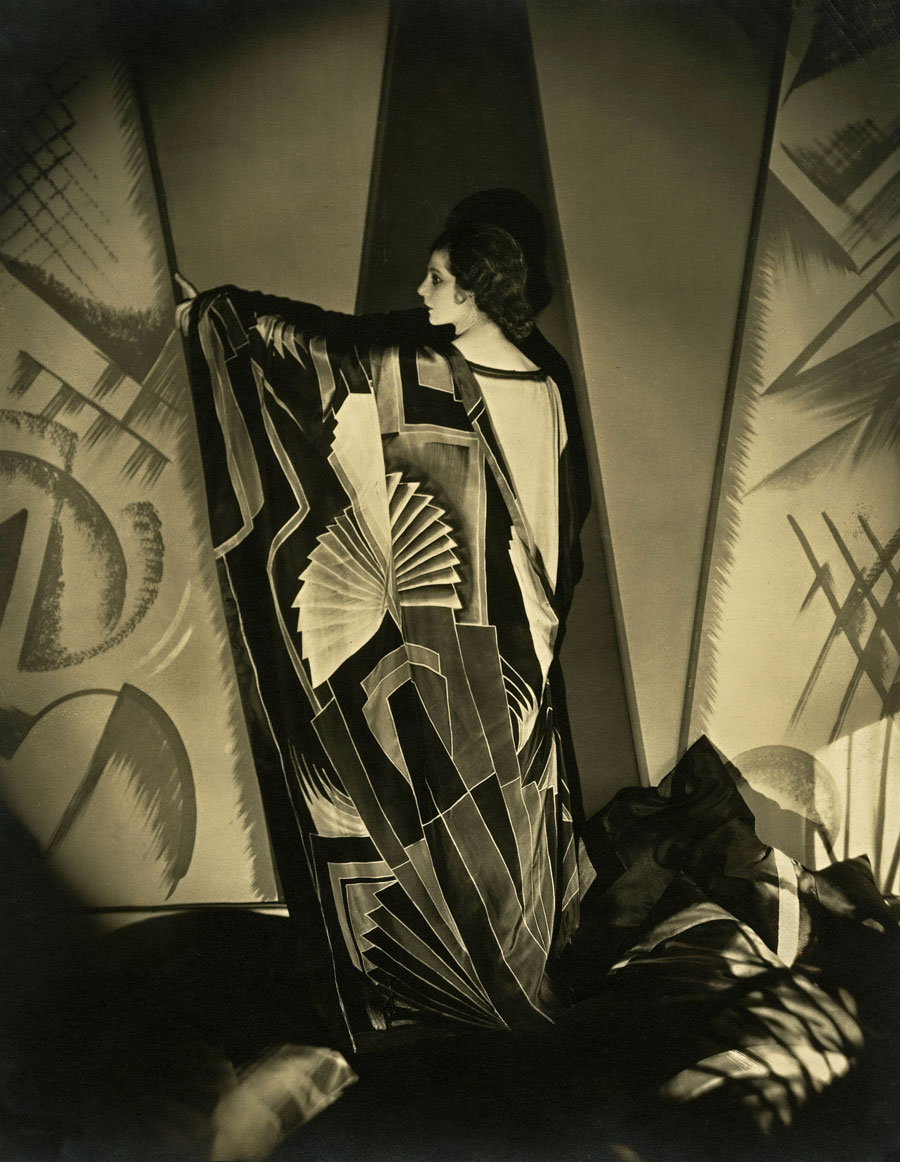
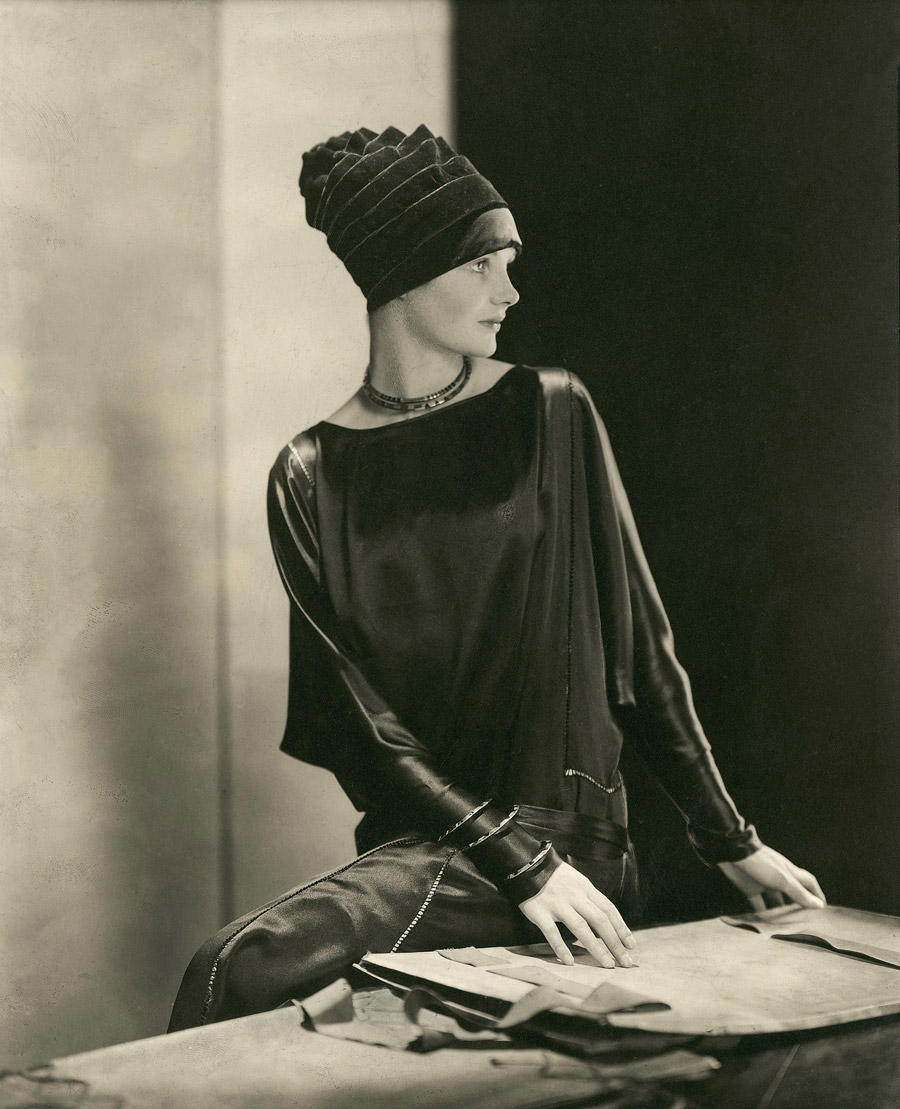
Edward Steichen (American, 1879-1973) 'Model Dinarzade in a Dress by Poiret' 1924


Edward Steichen (American, 1879-1973)
Model Dinarzade in a Dress by Poiret
1924
Gelatin silver photograph

Image used under fair use for the purpose of art criticism


This is a sublime exhibition, teaming with fabulous frocks and beautiful, classical, evanescent photographs. The exhibition was in my top nine magnificent Melbourne exhibitions that featured on Art Blart last year. Elegant, sophisticated and oozing quality, this exhibition has been a sure fire winner for the NGV. This review will concentrate on the photographs by Edward Steichen. See my previous posting on the exhibition including installation photographs.

High Society

Edward Steichen (1879-1973) was a painter and champion of art photography who initially worked in the soft focus, Pictorialist style prevalent at the beginning of the 20th century. He was an artist who worked closely with Alfred Stieglitz on the influential quarterly art journal Camera Work, designing the cover and the Art Nouveau-style typeface especially for the internationally focused publication. Stieglitz, and by extension Camera Work, lived to promote photography as an art form and to challenge the norms of how art may be defined.1 In the early years Camera Work only published photography, but in later years the journal increasingly featured reproductions of and articles on modern painting, drawing and aesthetics.

“This change was brought about by a similar transformation at Stieglitz’s New York gallery, which had been known as the Little Galleries of the Photo-Secession until 1908. That year he changed the name of the gallery to “291”, and he began showing avant-garde modern artists such as Auguste Rodin and Henri Matisse along with photographers. The positive responses he received at the gallery encouraged Stieglitz to broaden the scope of Camera Work as well, although he decided against any name change for the journal.”2

Steichen was heavily associated with Gallery 291 (291 Fifth Avenue, New York City) which ran from 1905 to 1917. The gallery exhibited European artists such as Braque, Picasso, Matisse, Brancussi, Cézanne and Rodin and soon to be famous American artists such as John MarinMax WeberArthur DoveMarsden Hartley and Georgia O’Keeffe. Virtually no other gallery in the United States was showing modern art works with such abstract and dynamic content at this time.3 Both the gallery and the journal ran hand in hand; both closed in 1917. The journal closed due to a downturn in interest in Pictorial photography, a lack of subscribers, cultural changes and the economic effects of the First World War, which saw both the costs and even the availability of the paper on which it was printed become challenging.4 In the penultimate issue 48 (October 1916) Stieglitz,

” …introduced the work of a young photographer, Paul Strand, whose photographic vision was indicative of the aesthetic changes now at the heart of Camera Work’s demise. Strand shunned the soft focus and symbolic content of the Pictorialists and instead strived to create a new vision that found beauty in the clear lines and forms of ordinary objects. By publishing Strand’s work Stieglitz was hastening the end of the aesthetic vision he had championed for so long. Nine months later, in June 1917, what was to be the final issue of Camera Work appeared. It was devoted almost entirely to Strand’s photographs.”5


Edward Steichen felt the change in the air. When he accepted the job as chief photographer for Condé Nast publications in 1923 his early fashion photographs for Vogue and Vanity Fair were seen as innovative and ground breaking, even as his former art colleagues saw shooting fashion and celebrities was a way of selling-out. Steichen bought to fashion and portrait photography an aesthetic of clear lines and forms that simply had not been present before, coupled with a Pictorialist sensibility for light and the use of low depth of field. John McDonald in his excellent review of the exhibition observes, “Steichen has claims to having invented fashion photography with a series of pictures he took in Paris in 1911, for couturier, Paul Poiret; but the genre had found its first true professional in Baron Adolphe de Meyer, who left Vogue for Harper’s Bazaar, opening the door for Steichen’s appointment. De Meyer was an incurable mannerist who remained true to the Pictorialist aesthetic, but his successor would prove himself an innovator.”6

Steichen’s photographs from 1923-1924 are pared back, Modernist photographs that evidence the beginning of his later photographic style. Madame Nadine Vera wearing a crêpe evening gown by Chanel (1924) has a plain background of some wooden studio panels; Model Dinarzade in a Dress by Poiret (1924, above) has fabric hanging behind while Crêpe de chine dress by Lanvin (1924) has three doors casually put together to form the backdrop to the model. All three photographs show beautiful tonality and lighting in the full length capture of the models with hints of browns and yellows in the prints. The figure is isolated in the studio space simply and elegantly. The model is being studied. Steichen’s models are immersed in suffused light but the form of the photograph is different from that of Pictorialism, for the models themselves are pin sharp, as though stepping out into the world. These early photographs are fascinating to study, for they lay the ground work for what is to follow. These three images inform the viewer as to the experimentation that Steichen was undertaking to get to a starting point for the complex and atmospheric studio lighting that he would later employ.

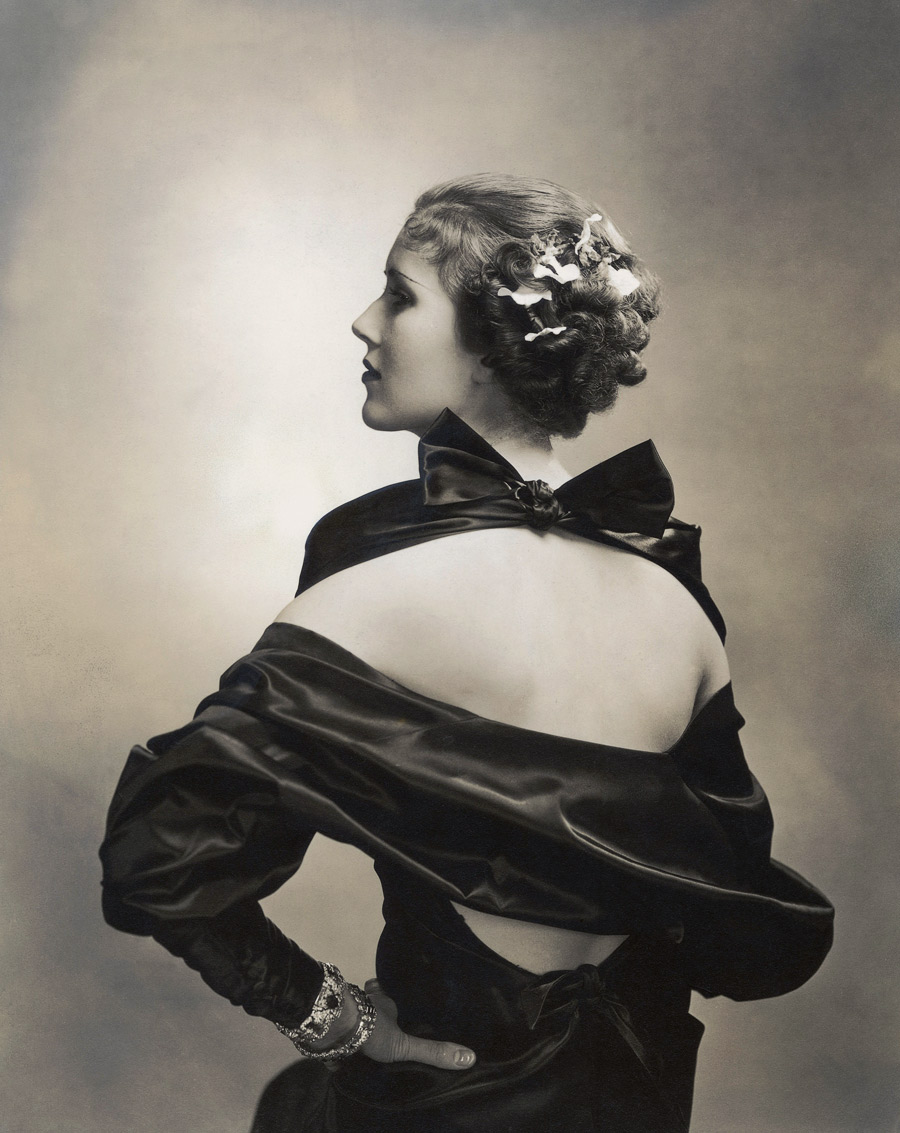
Gradually, Steichen’s images become more confident and assured and take on a patina of beauty, style and grace. In his close-up portraits there is an isolation of the face against out of focus backgrounds with the use of profiles, arms and elbows as framing devices, for example Actress Sylvia Sidney (1929) and Actress Clara Bow (1928, above). In his longer-length portraits there is an isolation of figures against a white or black ground, as in Marion Morehouse in a dress by Louise Boulanger (1929) and Actresses Norma and Constance Talmadge (1927). Males usually have a heavy darkness to them while the females are more luminously lit. In the male portraits the hands dominate. The hands in the male photographs belong to the male as part of the portrait whereas in the early photographs of women they are only models, there at his command, and the hands are almost invisible. Only in the later photographs of high society women are the hands of females fully represented. What can be observed is that the figure is usually isolated against an out of focus background, with deep, dark shadows and soft luxurious light, low depth of field and feminine profiles.

In commercial terms (and we must remember that this is how the artist made his living for these photographs were seen as his commercial work at the time), Steichen’s photographs fulfilled his brief: the portrayal of shimmer and sparkle, geometric Art Deco style, the drama and theatrical lighting of the talkies, and the spectacle of the liberated modern women. She in turn was influenced by the prevalent cultural conditions: smoking, jazz, prohibition, automobiles, trains, dancing, fast living, gold (King Tuts tomb was discovered in 1922) and African and Japanese art. Appealing to the new leisure classes, publications such as Vogue and Vanity Fair offered a glimpse of a longed for paradise to the burgeoning middle-classes with their photographs of the rich and famous, the glamour and the costumes – the social groups that hold the most power actually exposing their own status on paper through these magazines.

As John McDonald notes, “Steichen uses every trick at his disposal to convey a particular kind of image,”7 an image that uses increasingly elaborate studio lighting and disparate indoor and outdoor locations. But by the early 1930s the work becomes quite formulaic with its use of low depth of field, profiles, angles of arms or chairs and geometric shapes. The figure is tightly controlled – either cropped close in or set amongst ambiguously filled sets and shaped backgrounds. There is a sameness and repetitiveness about the work as one image bleeds into another. In fact, after that early period of experimentation, there is basically no change to his mature style from the years 1925-1937 and this makes for a long twelve years for an artist of his talent. He found his mother load and he stuck to it.

Steichen’s photographs of the rich and famous are “pictures” taken by one who mingled with the elite, one who enjoyed the trappings of fame and high society. As Robert Nelson notes in his review of the exhibition, “Steichen’s talents were never incompatible with the conspicuous snobbery of his age, for which it would never have occurred to him to proffer an apology. Having arrived himself, he naturally admires gentry-by-ambition and crowns it with the smugness that it enjoys.”8 Ouch! Nelson goes on to observe, “Much of the work is statuesque and formidable in its composition, lighting and symbolic rigour,” while at the same time portraying a world that is completely artificial in which nothing is real and everything is a pose.9 And we, the viewer and reader, are voyeurs of this hedonistic world.

On close reading, the photographs flatten out into a studied set of stylistic manoeuvres, a form where style stands in for a quality of visual perception.10 As Steichen seeks to “clinch the image” the syntax of his photographs (the system of organisation used in putting lines together to form pictures) becomes imitative. This leads to evanescent photographs, images that soon pass out of sight, memory, or existence; images that slip for the mind as quickly as one sees them. There is little sense of dislocation in the images, only “in his ability to distance himself from a subject, analysing his or her foibles with a cool, practiced eye,”11 and in the distance of the scene from the reality of everyday life. Each photograph becomes a microcosm of vanity, celebrity and fashion. Steichen ticks all the boxes (and he made all the boxes that he ticked) but the photographs usually don’t fulfil any new demands that the situation generates. He restricts his field of view to one that he creates and controls within certain narrowly defined boundaries, usually using passive people who are at his command. In his orientation to the world the photographs are not ‘things as they are’ but things as they are constructed to be (seen) – a form of social capital, social fascism, even.12

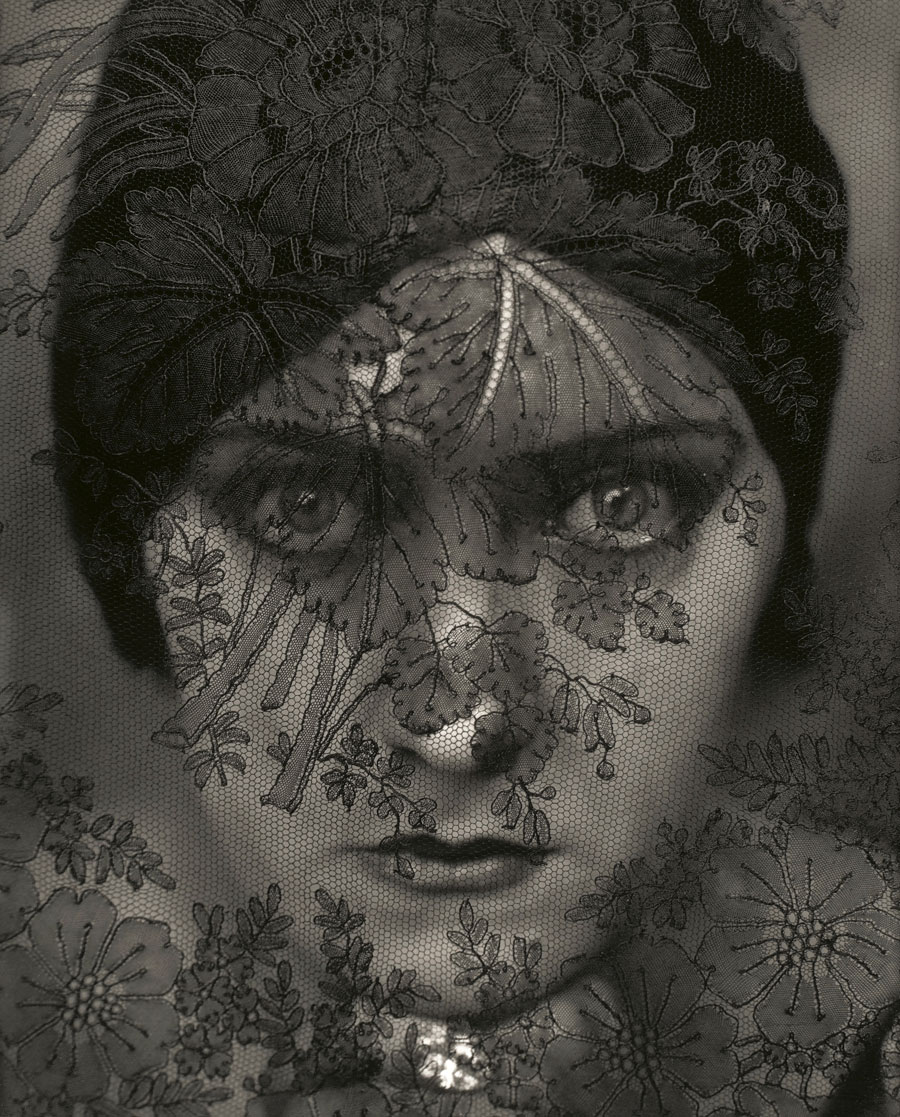
Only when Steichen is challenged by an active “personality” does he raise his game. This is when the modernist, emotive, visually rhapsodic AND MEMORABLE photographs take hold in this exhibition. The great breakthrough with Greta Garbo (1929, below), mass of black with face surmounting, hair pulled back by hands “the woman came out full beauty on her magnificent face” Steichen said; Actress Gloria Swanson (1924, below) like some prowling, wide-eyed animal hidden behind a black lace veil, “a predatory femme fatale concealing her ambitions behind a mask of beauty”13; Marlene Dietrich (1934, below) nestled into the glorious curve of an armchair, lace-covered hand open, inviting; and Actress Loretta Young (1931) active, not passive, in which Steichen humanises his sitter. For me, these are the glorious images – not the men, not the fashion photographs, but these strong, independent women.

“An interested image-maker takes available resources for meaning (visual grammars, fabrication techniques and focal points of attention), undertakes an act of designing (the process of image-making), and in so doing re-images the world in a way that it has never quite been seen before.”14 Initially, in the early experimentation, this is what Steichen did; he achieves it again in the photographs of Garbo, Swanson, Dietrich and Young. As for the other photographs we feel an overall suffused glow of beauty and glamour – we admire their scale and intensity, the deep blacks and velvety whites, and wonder at the light and assemblage of elements – but they do not have the power and engagement of the best, most challenging work. In these photographs of vibrant women the viewer finally starts to feel the spirit of the face, the spirit of the person captured in an instant. And that is a rare and beautiful thing.

Dr Marcus Bunyan

Word count: 1,883


Footnotes

1/ Whelan, Richard. Alfred Stieglitz: A Biography. NY: Little, Brown, 1995, pp. 189-223
2/ Anon. “Camera Work,” on Wikipedia website [Online] Cited 15/02/2014
3/ Anon. “291,” on Wikipedia website [Online] Cited 15/02/2014
4/ “Camera Work,” op. cit.,
5/ Hoffman, Katherine. Stieglitz : A Beginning Light. New Haven: Yale University Press Studio, 2004,  pp. 213–222 cited in “Camera Work,” op. cit.,
6/ McDonald, John. “Edward Steichen & Art Deco Fashion” on John McDonald website February 1, 2014 [Online] Cited 15/02/2014
7/ Ibid.,
8/ Nelson, Robert. “An age of elegance captured forever,” in The Age newspaper Wednesday November 6th, 2013, p. 54
9/ Ibid.,
10/ Rewording of a sentence by Sleigh, Tom. “Too Much of the Air: Tomas Tranströmer,” 2005, on the Poets.org website [Online] Cited 15/02/2014. No longer available online
11/ McDonald, op. cit.,
12/ “In sociology, social capital is the expected collective or economic benefits derived from the preferential treatment and cooperation between individuals and groups. Although different social sciences emphasise different aspects of social capital, they tend to share the core idea “that social networks have value”.”
Anon. “Social capital,” on Wikipedia website [Online] Cited 15/02/2014
“Social fascism was a theory supported by the Communist International (Comintern) during the early 1930s, which held that social democracy was a variant of fascism because, in addition to a shared corporatist economic model, it stood in the way of a complete and final transition to communism.”
Anon. “Social fascism,” on Wikipedia website [Online] Cited 15/02/2014
13/ McDonald, op. cit.,
14/ Anon. “The Image of Transformation: Properties of Consequence,” on The Image website [Online] Cited 15/02/2014. No longer available online


Many thankx to the National Gallery of Victoria for allowing me to publish the photographs in the posting. Please click on the photographs for a larger version of the image.


Edward Steichen (American, 1879-1973) 'Actress Clara Bow for Vanity Fair' 1928


Edward Steichen (American, 1879-1973)
Actress Clara Bow for Vanity Fair
1928
Vintage silver gelatin print
Block Museum, Gift of the Hollander Family in Honor of Morton and Mimi Schapiro
Steichen / Condé Nast Archive; © Condé Nast

Image used under fair use for the purpose of art criticism


Edward Steichen (American 1879-1973, emigrated to United States 1881, worked in France 1906-23) Actress 'Gloria Swanson' 1924


Edward Steichen (American 1879-1973, emigrated to United States 1881, worked in France 1906-1923)
Actress Gloria Swanson
1924
Gelatin silver photograph
Courtesy Condé Nast Archive
© 1924 Condé Nast Publications


Steichen’s portrait of Gloria Swanson has taken on iconic masterpiece status overtime. Created in 1924, just as the first feature-length sound movies were emerging – effectively truncating the actress’s brilliant silent-film career – this image caught the essential Gloria Swanson: haunting and inscrutable, forever veiled in the whisper of a distant era. Steichen’s photograph has elements of turn-of-the-century Pictorialism (moody and delicate, the subject seeming to peer from the darkness, as if from jungle foliage), yet it also projects modernist boldness, with its pin-sharp precision and graphic severity.

Anonymous. “Gloria Swanson by Edward Steichen,” on the Iconic Photos website October 5th, 2009 [Online] Cited 11/02/2021


Edward Steichen (American 1879-1973, emigrated to United States 1881, worked in France 1906-23) 'Dancers Leonore Hughes and Maurice Mouvet' 1924


Edward Steichen (American 1879-1973, emigrated to United States 1881, worked in France 1906-1923)
Dancers Leonore Hughes and Maurice Mouvet
1924
Gelatin silver photograph
Courtesy Condé Nast Archive
© 1924 Condé Nast Publications


Maurice Mouvet was one of the most famous and successful dance teams around the early 1910’s and lead the way for many performers that would follow… Maurice was born in New York but as a young lad moved to Paris with his father and knew he wanted to be a dancer as a young boy. He had his first professional dance at the Noveau Cirque in Paris, France at age 15. Mouvet’s best partners were Florence Walton and Leonora (Leona) Hughes.


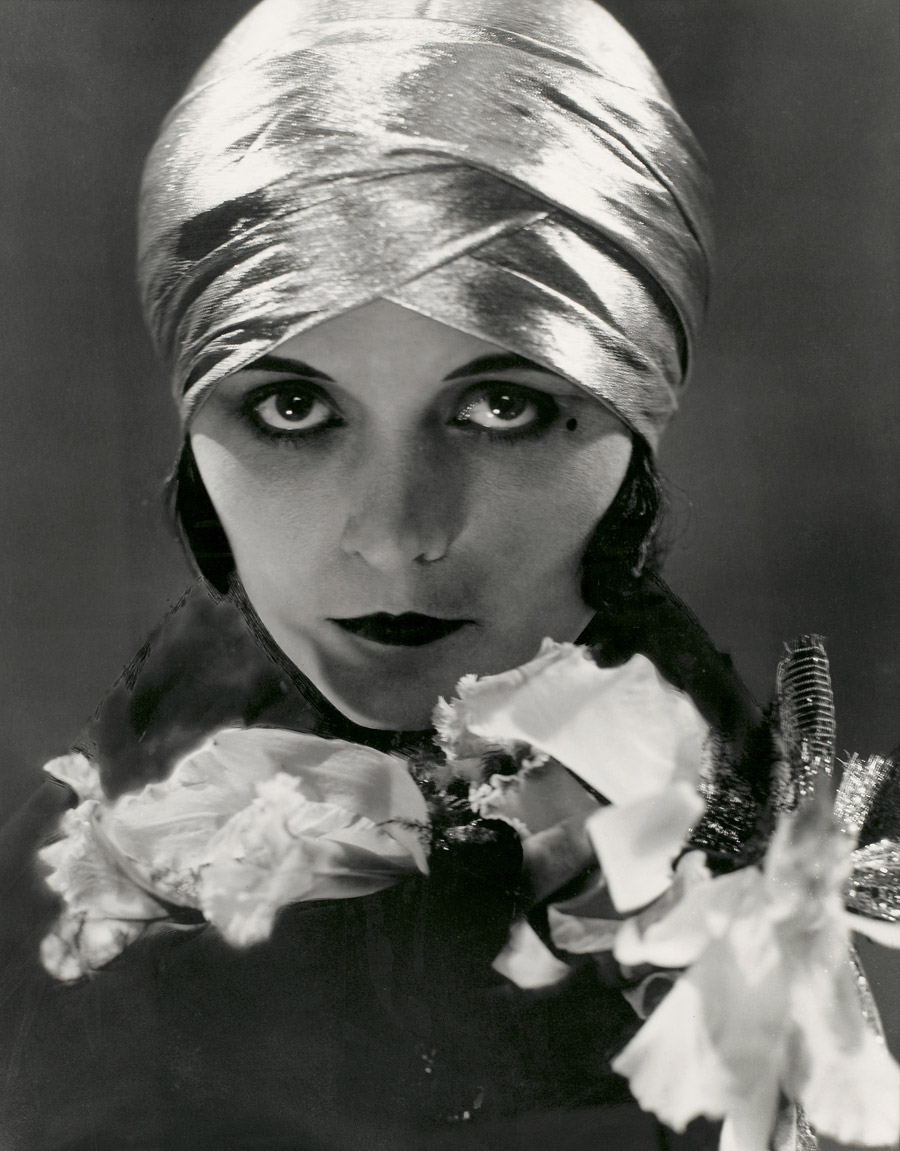
Edward Steichen (American 1879-1973, emigrated to United States 1881, worked in France 1906-23) 'Actress Paula Negri' 1925


Edward Steichen (American 1879-1973, emigrated to United States 1881, worked in France 1906-1923)
Actress Paula Negri
1925
Gelatin silver photograph
Courtesy Condé Nast Archive
© 1924 Condé Nast Publications


Pola Negri (née Apolonia Chałupiec, January 3, 1897 – 1 August 1987) was a Polish stage and film actress who achieved worldwide fame during the silent and golden eras of Hollywood and European film for her tragedienne and femme fatale roles. She was the first European film star to be invited to Hollywood, and become one of the most popular actresses in American silent film. She also started several important women’s fashion trends that are still staples of the women’s fashion industry. Her varied career included work as an actress in theatre and vaudeville; as a singer and recording artist; as an author; and as a ballerina.

Text from the Wikipedia website


Edward Steichen (American 1879-1973, emigrated to United States 1881, worked in France 1906-23) 'Tamaris with a large Art Deco scarf' 1925


Edward Steichen (American 1879-1973, emigrated to United States 1881, worked in France 1906-1923)
Tamaris with a large Art Deco scarf
1925
Gelatin silver photograph
Courtesy Condé Nast Archive
© 1924 Condé Nast Publications


Edward Steichen (American 1879-1973, emigrated to United States 1881, worked in France 1906-23) 'Model wearing a black tulle headdress by Suzanne Talbot and a brocade coat with black fox collar' 1925


Edward Steichen (American 1879-1973, emigrated to United States 1881, worked in France 1906-1923)
Model wearing a black tulle headdress by Suzanne Talbot and a brocade coat with black fox collar
1925
Gelatin silver photograph
Courtesy Condé Nast Archive
© 1924 Condé Nast Publications


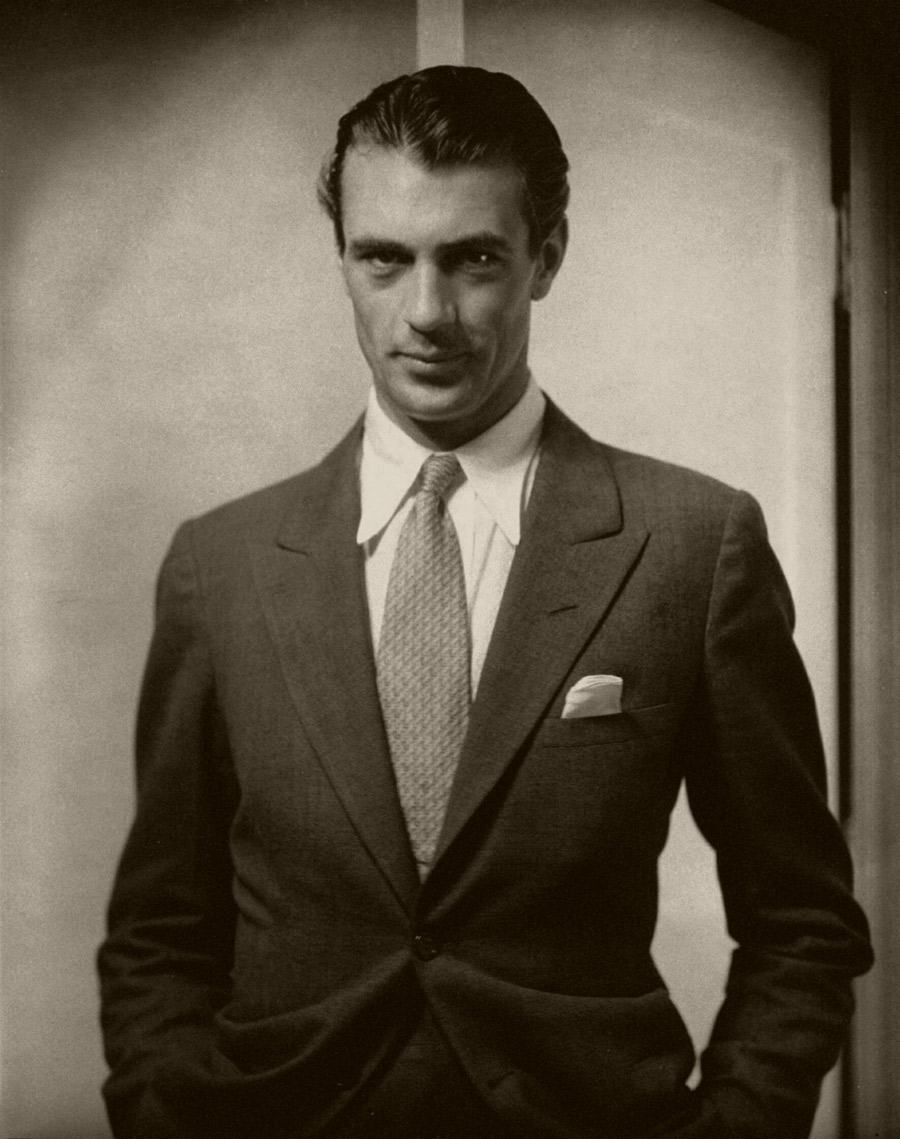
Edward Steichen (American 1879-1973, emigrated to United States 1881, worked in France 1906-23) 'Actor Gary Cooper' 1930


Edward Steichen (American 1879-1973, emigrated to United States 1881, worked in France 1906-1923)
Actor Gary Cooper
1930
Gelatin silver photograph
Courtesy Condé Nast Archive
© 1924 Condé Nast Publications


Edward Steichen (American 1879-1973, emigrated to United States 1881, worked in France 1906-23) 'Marion Morehouse and unidentified model wearing dresses by Vionnet' 1930


Edward Steichen (American 1879-1973, emigrated to United States 1881, worked in France 1906-1923)
Marion Morehouse and unidentified model wearing dresses by Vionnet
1930
Gelatin silver photograph
Courtesy Condé Nast Archive
© 1924 Condé Nast Publications


Marion Morehouse (1906-1969), was a fashion model who rose to prominence in the late 20s and early 30s, sitting for Vanity Fair and Vogue photographer Edward Steichen. The pair created some strikingly modernist photographs. According to Steichen Morehouse was:

“The greatest fashion model I ever photographed … When she put on the clothes that were to be photographed, she transformed herself into a woman who really would wear that gown … whatever the outfit was.”

She was also a favourite of Cecil Beaton and French Vogue’s Baron George Hoyningen-Huene. Morehouse was of Choctaw Indian ancestry, with brown eyes and an angular frame. After her modelling career ended, she took up photography herself. Later she became the third wife of author and painter E.E Cummings. When Cummings met Marion Morehouse in 1932, he was in the middle of a painful split from his second wife, Anne Barton. Although it is not clear whether the two were ever formally married, Morehouse lived with Cummings in a common-law marriage until his death in 1962. Morehouse died on May 18, 1969.

Text from the Photographs, film, literature & quotes from the bygone era website [Online] Cited 10/02/2014. No longer available online


Edward Steichen (American 1879-1973, emigrated to United States 1881, worked in France 1906-23) 'Olympic diver Katherine Rawls' 1931


Edward Steichen (American 1879-1973, emigrated to United States 1881, worked in France 1906-1923)
Olympic diver Katherine Rawls
1931
Gelatin silver photograph
Courtesy Condé Nast Archive
© 1924 Condé Nast Publications


Katherine Louise Rawls (June 14, 1917 – April 8, 1982) was a multiple United States national champion in swimming and diving in the 1930s.


Edward Steichen (American 1879-1973, emigrated to United States 1881, worked in France 1906-23) Model 'Dorothy Smart wearing a black velvet hat by Madame Agnès' 1926


Edward Steichen (American 1879-1973, emigrated to United States 1881, worked in France 1906-1923)
Model Dorothy Smart wearing a black velvet hat by Madame Agnès
1926
Gelatin silver photograph
Courtesy Condé Nast Archive
© 1924 Condé Nast Publications


France’s most popular milliner Madame Agnes was born in France in the late 1800’s, she retired in 1949, and died a short while later. She was famous for cutting the brims of her hats while they were worn by her customers. Madame Agnes styled hats which were both abstract and unique. An illustration from 1927 depicts Madame Agnes’ Congo inspired hats with a model wearing a slave collar. As the 20’s moved into the 30’s, the hats became smaller and away from the face. In December 1935 she introduced hats with large straw brims which were mounted on flowered madras handkerchiefs. Madame Agnes was inspired by a matador’s hat when she created a small dinner hat for Spring 1936. It was sewn of black maline with heavy white silk fringe. The fringe was mounted on each side of the hat’s top. In mid-1946 she created a soft beige beret of felt which featured a line that was broken just above the right eyebrow, where a soft quill was inserted.

Text from the Photographs, film, literature & quotes from the bygone era website [Online] Cited 10/02/2014. No longer available online


Edward Steichen (American 1879-1973, emigrated to United States 1881, worked in France 1906-23) 'On George Baher's yacht' 1928


Edward Steichen (American 1879-1973, emigrated to United States 1881, worked in France 1906-1923)
On George Baher’s yacht. June Cox wearing unidentified fashion; E. Vogt wearing fashion by Chanel and a hat by Reboux; Lee Miller wearing a dress by Mae and Hattie Green and a scarf by Chanel; Hanna-Lee Sherman wearing unidentified fashion
1928
Gelatin silver photograph
Courtesy Condé Nast Archive
© 1924 Condé Nast Publications


Elizabeth “Lee” Miller, Lady Penrose (April 23, 1907 – July 21, 1977) was an American photographer. Born in Poughkeepsie, New York, in 1907, she was a successful fashion model in New York City in the 1920s before going to Paris, where she became an established fashion and fine art photographer. During the Second World War, she became an acclaimed war correspondent for Vogue, covering events such as the London Blitz, the liberation of Paris, and the concentration camps at Buchenwald and Dachau.


Edward Steichen (American 1879-1973, emigrated to United States 1881, worked in France 1906-23) 'Marlene Dietrich' 1934


Edward Steichen (American 1879-1973, emigrated to United States 1881, worked in France 1906-1923)
Marlene Dietrich
1934
Gelatin silver photograph
Courtesy Condé Nast Archive
© 1924 Condé Nast Publications


Edward Steichen (American 1879-1973, emigrated to United States 1881, worked in France 1906-23) 'Greta Garbo' 1929


Edward Steichen (American 1879-1973, emigrated to United States 1881, worked in France 1906-1923)
Greta Garbo
1929
Gelatin silver photograph
Courtesy Condé Nast Archive
© 1924 Condé Nast Publications


Edward Steichen (American 1879-1973, emigrated to United States 1881, worked in France 1906-23) Actress 'Joan Crawford in a dress by Schiaparelli' 1932


Edward Steichen (American 1879-1973, emigrated to United States 1881, worked in France 1906-1923)
Actress Joan Crawford in a dress by Schiaparelli
1932
Gelatin silver photograph
Courtesy Condé Nast Archive
© 1924 Condé Nast Publications


Elsa Schiaparelli (1890-1973) was an Italian fashion designer. Along with Coco Chanel, her greatest rival, she is regarded as one of the most prominent figures in fashion between the two World Wars. Starting with knitwear, Schiaparelli’s designs were heavily influenced by Surrealists like her collaborators Salvador Dalí and Alberto Giacometti. Her clients included the heiress Daisy Fellowes and actress Mae West.

Perhaps Schiaparelli’s most important legacy was in bringing to fashion the playfulness and sense of “anything goes” of the Dada and Surrealist movements. She loved to play with juxtapositions of colours, shapes and textures, and embraced the new technologies and materials of the time. With Charles Colcombet she experimented with acrylic, cellophane, a rayon jersey called “Jersela” and a rayon with metal threads called “Fildifer” – the first time synthetic materials were used in couture. Some of these innovations were not pursued further, like her 1934 “glass” cape made from Rhodophane, a transparent plastic related to cellophane. But there were more lasting innovations; Schiaparelli created wraparound dresses decades before Diane von Furstenberg and crumpled up rayon 50 years before Issey Miyake’s pleats and crinkles. In 1930 alone she created the first evening-dress with a jacket, and the first clothes with visible zippers. In fact fastenings were something of a speciality, from a jacket buttoned with silver tambourines to one with silk-covered carrots and cauliflowers. Schiaparelli did not adapt to the changes in fashion following World War II and her business closed in 1954.

Text from the Wikipedia website


Edward Steichen (American 1879-1973, emigrated to United States 1881, worked in France 1906-23) 'White (center Gwili André)' 1935


Edward Steichen (American 1879-1973, emigrated to United States 1881, worked in France 1906-1923)
White (center Gwili André)
1935
Gelatin silver photograph
Courtesy Condé Nast Archive
© 1924 Condé Nast Publications


Gwili Andre (4 February 1908 – 5 February 1959) was a Danish actress who had a brief career in Hollywood films. Andre came to Hollywood in the early 1930s with the intention of establishing herself as a film star. She appeared in the 1932 RKO Studio films Roar of the Dragon and Secrets of the French Police and began to attract attention for her striking good looks. These films provided her with starring roles playing against such established actors as Richard Dix, ZaSu Pitts and Frank Morgan, and RKO began using her glamorous looks to promote her.

A widespread publicity campaign ensured that her name and face became well known to the American public, but her next role in No Other Woman (1933), opposite Irene Dunne, was not the success the studio expected. Over the next few years she was relegated to supporting roles which included the Joan Crawford picture A Woman’s Face (1941). Her final role was a minor part in one of the popular Falcon series, The Falcon’s Brother in 1942.

Text from the Wikipedia website


Edward Steichen (American 1879-1973, emigrated to United States 1881, worked in France 1906-23) 'Actress Mary Heberden' 1935


Edward Steichen (American 1879-1973, emigrated to United States 1881, worked in France 1906-1923)
Actress Mary Heberden
1935
Gelatin silver photograph
Courtesy Condé Nast Archive
© 1924 Condé Nast Publications


American actress Mary Heberden made her first New York stage appearance in 1925 and performed regularly on Broadway in the 1930s.


Edward Steichen (American 1879-1973, emigrated to United States 1881, worked in France 1906-23) 'Charlie Chaplin' 1934


Edward Steichen (American 1879-1973, emigrated to United States 1881, worked in France 1906-1923)
Charlie Chaplin
1934
Gelatin silver photograph
Courtesy Condé Nast Archive
© 1924 Condé Nast Publications


NGV International
180 St Kilda Road

Opening hours
Daily 10am – 5pm

National Gallery of Victoria website

LIKE ART BLART ON FACEBOOK

Back to top

New photographic prize: The Prix Elysée with the support of Parmigiani Fleurier

Applications open: 3rd February 2014
Applications close: 25th April 2014


The Prix Elysée with the support of Parmigiani Fleurier


About the Prix Elysée

At the Musée de l’Elysée, we think that supporting photographers in the evolution of their career is as important as preserving their art for future generations. It is in a shared commitment to foster creativity and support the production of new work that the Musée de l’Elysée enters into a partnership with Parmigiani Fleurier to launch the Prix Elysée.

Who can apply

The prize is open to promising photographers or artists using photography, of all nationalities, who have already enjoyed their first exhibitions and publications. There is no imposed theme or preference for any particular photographic genre or technique. Applications are open from February 3 to April 25, 2014.

What can you win?

The winner and nominees of the Prix Elysée will all benefit from important exposure and the Museum’s expert guidance. The winner is invited to produce an original and new project as well as its related book. Both the project and book will be presented at one of the Musée de l’Elysée’s most important events, the Nuit des images.

How to apply

Photographers must be recommended by a reputed professional in the fields of photography, cinema, fashion, journalism, publishing or contemporary art. The Musée de l’Elysée will select eight nominees based upon their entry portfolios. Each will receive a contribution of CHF 5’000 towards the initial presentation of their project in a dedicated edition of the Prix Elysée magazine. This magazine will accompany the nominees’ complete portfolios in the final consideration before the jury of experts. The winner will receive CHF 80’000 to be divided between the completion of the proposed project and the publication of the accompanying book within one year. A curator from the Musée de l’Elysée will advise the winner throughout this process.

The call for applications will take place biennially. The first edition of the Prix Elysée is launched in February 2014 and concludes in June 2016.

Applicants may download the official rules for le Prix Elysée at www.prixelysee.ch.


Yves André. 'Musée de l'Elysée' Nd


Yves André
Musée de l’Elysée
Nd
© Yves André


Musée de l'Elysée logo

Musée de l’Elysée
Avenue de l’Elysée 18
CH-1014 Lausanne
Phone: +41 21 316 99 27

Musée de l’Elysée website

LIKE ART BLART ON FACEBOOK

Back to top

Exhibition: ‘A Democracy of Images: Photographs from the Smithsonian American Art Museum’ at the Smithsonian American Art Museum, Washington DC

Exhibition dates: 28th June 2013 – 5th January 2014
1st floor West, American Art Museum (8th and F Streets, N.W.)

Browse the exhibition and related works on the exhibition website


Unidentified artist. '[Bird in Basin with Thread Spool and Patterned Cloth]' c. 1855


Unidentified artist
[Bird in Basin with Thread Spool and Patterned Cloth]
c. 1855
Daguerreotype
Plate: 2 3/4 x 3 1/4 in. (6.9 x 8.2cm)
Smithsonian American Art Museum
Museum purchase from the Charles Isaacs Collection made possible in part by the Luisita L. and Franz H. Denghausen Endowment


The next two weeks sees a lot of exhibitions finish their run on the 5th January 2014.

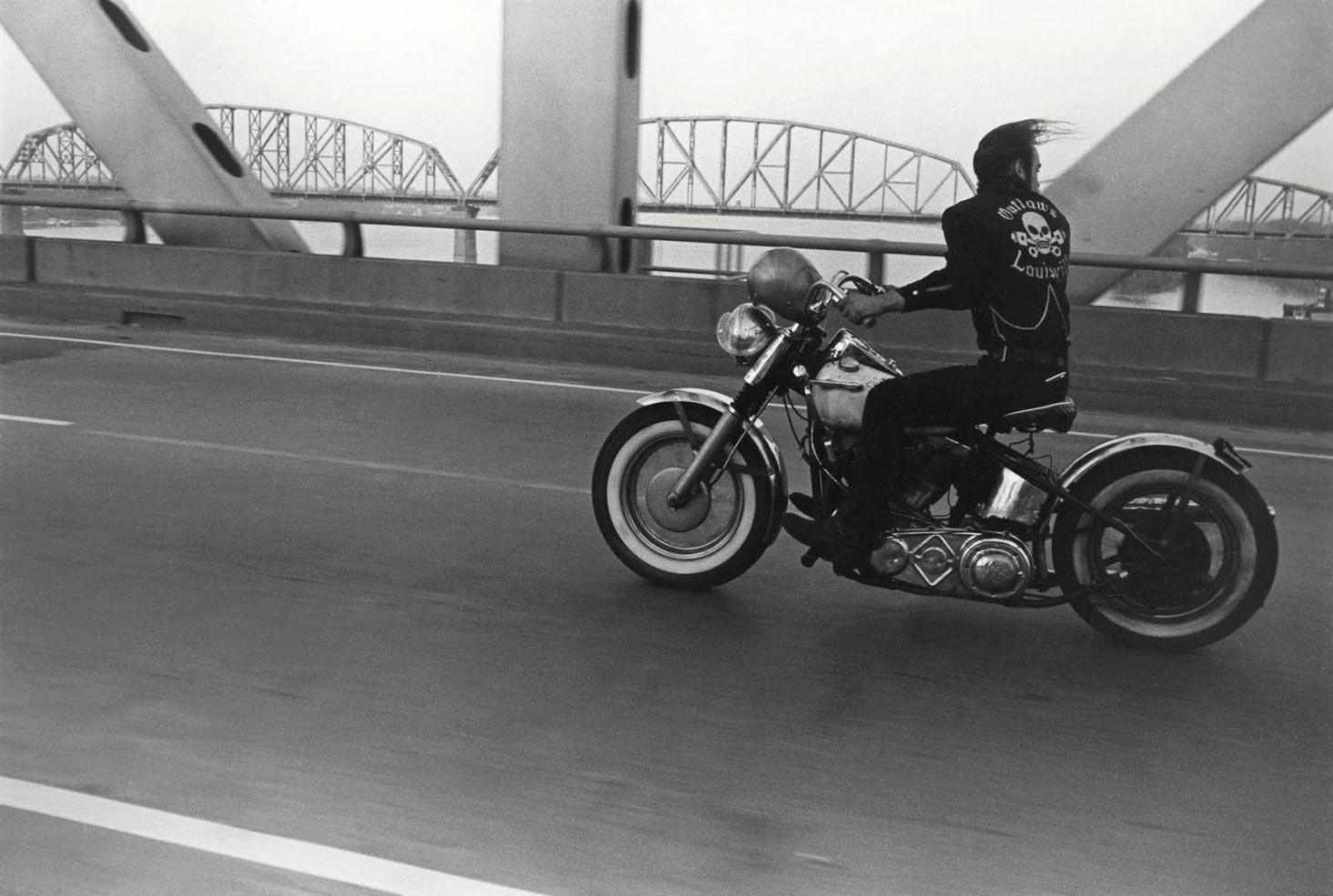
Here is a bumper posting which contains one of my favourite photographs of all time: Danny Lyon’s Crossing the Ohio River, Louisville (1966, below). From a distance, this looks to be a very interesting exhibition on a large topic, delineated for the viewer into four main sections. The task of the curator cannot have been easy, picking 113 images to represent a “democracy” of images out of a collection of over 7,000 images. Of course there can never be a true “democracy” of images as some will always be more valued within our culture than others. There is a meritocracy in this exhibition which features images by masters of the medium but this is balanced by the inclusion of images by anonymous photographers, little known photographers and vernacular and street photography.

What is most impressive is the specially developed website which includes many images from the different sections of the exhibition. These images are of good quality and, along with relevant text, help the viewer place the images in context. Related content is also suggested from the full photographic collection at The Smithsonian which has been placed online with good image quality. This is a far cry from many exhibitions at state galleries in Australia where there are hardly any dedicated exhibition websites. Most of the photographic collection from these galleries is not available online and if it has been scanned, the image quality is generally poor. How many times have I searched a state gallery or library collection and come up with the answer: “Image not available” ?

Dr Marcus Bunyan


Many thankx to the Smithsonian American Art Museum for allowing me to publish the photographs and text in the posting. Please click on the photographs for a larger version of the image.


“More often, though, the moments, places, people and views that have been collected here feel offhand and stumbled upon, telling a fragmentary, incomplete tale. Sometimes it’s literally a glance, as in “Girl Holding Popsicle,” a 1972 image by Mark Cohen, who rarely even looked through his viewfinder. Other times, it’s more like a long stare, as in William Christenberry’s 1979 “China Grove Church – Hale County, Alabama,” a locale that the Washington-based artist and Alabama native returned to again and again. These 113 pictures are, at the same time, quietly telling, revealing bits of America in oblique, prismatic ways.”


Part of Michael O’Sullivan’s review of the exhibition in The Washington Post.


American Characters

Photographers have captured the texture of everyday life since the medium’s arrival in the United States in 1839. Photographic portraits have made both the iconic and the commonplace serve as stand-ins for all of us, forging a shared language of political and social understanding. In charting the passing parade of history – the faces of the anonymous and the famous; evolving stories of immigration, disenfranchisement, and assimilation; as well as emblematic objects and celebrated landmarks lodged within our collective memory – photographs reveal the complexities of America.


Larry Sultan (American, 1946-2009) 'Portrait of My Father with Newspaper' 1988


Larry Sultan (American, 1946-2009)
Portrait of My Father with Newspaper
1988
Chromogenic print
Image: 28 5/8 x 34 5/8 in. (72.7 x 87.9cm)
Smithsonian American Art Museum
Gift of Nan Tucker McEvoy
© 1988, Larry Sultan


In Portrait of My Father with Newspaper, Irving Sultan reads the Los Angeles Times as light pours in behind him. This carefully composed portrait reveals the artist’s father almost entirely through reflections and shadows. Thin newsprint shields his body from the camera, while only a vague profile of his face is discernible on the right half of the spread. Prompted by the discovery of a box of home movies, Larry Sultan embarked on an eight-year enquiry into his parents’ lives. He stayed in their home for weeks at a time, interviewing them about their marriage and photographing their domestic activities.


Eugene Richards (American, b. 1944) 'First Communion (Dorchester, Mass.)' 1976


Eugene Richards (American, b. 1944)
First Communion (Dorchester, Mass.)
1976
Gelatin silver print
Image: 8 x 12 in. (20.3 x 30.5cm)
Sheet: 11 x 14 in. (27.9 x 35.6cm)
Smithsonian American Art Museum
Transfer from the National Endowment for the Arts
© 1974, Eugene Richards


Mark Cohen (American, b. 1943) 'Girl Holding Popsicle' 1972, printed 1983


Mark Cohen (American, b. 1943)
Girl Holding Popsicle
1972, printed 1983
Gelatin silver print
Sheet: 14 x 17 in. (35.5 x 43.2cm)
Smithsonian American Art Museum
Gift of Dene and Mel Garbow
© 1972, Mark Cohen


In Girl Holding Popsicle a young girl twists shyly as she poses before a graffiti-inscribed brick wall. Mark Cohen took this photograph spontaneously as he passed through a back alley. Cohen does not hesitate to get assertively close to the strangers he meets in his hometown of Wilkes-Barre, Pennsylvania. Many of his photographs are made without looking through a viewfinder, and so remain a mystery even to Cohen until they are developed.


Unidentified artist. '[Gold Nugget]' c. 1860s


Unidentified artist
[Gold Nugget]
c. 1860s
Albumen silver print
Image: 2 1/8 x 3 5/8 in. (5.4 x 9.2cm)
Sheet: 2 3/8 x 3 7/8 in. (6.1 x 9.8cm) irregular
Smithsonian American Art Museum
Gift of Charles Isaacs and Carol Nigro


Mathew B. Brady (American, 1823-1896) 'Reviewing Stand in Front of the Executive Mansion, Washington, D.C., May, 1865' 1865, printed early 1880s


Mathew B. Brady (American, 1823-1896)
Reviewing Stand in Front of the Executive Mansion, Washington, D.C., May, 1865
1865, printed early 1880s
Albumen silver print
Sheet and image: 6 1/2 x 9 in. (16.5 x 22.9cm)
Smithsonian American Art Museum
Museum purchase through the Julia D. Strong Endowment


Kevin Bubriski (American, b. 1954) 'World Trade Center Series, New York City' 2001


Kevin Bubriski (American, b. 1954)
World Trade Center Series, New York City
2001
Gelatin silver print
Image: 18 x 18 in. (45.7 x 45.7cm)
Smithsonian American Art Museum
Gift of the Consolidated Natural Gas Company Foundation
© 2001, Kevin Bubriski


In the weeks and months following the World Trade Center attacks on September 11, 2001, Kevin Bubriski photographed people who gathered at Ground Zero. Frozen in awe, struck with disbelief, and overcome with loss, people stood before the destroyed building site to confront the horrible tragedy. More than ten years later, Bubriski’s photographs preserve the emotional impact of this infamous day through images of those who witnessed its aftermath first-hand.


Deborah Luster (American, b. 1951) '01-26 Location. 1800 Leonidas Street (Carrollton) Date(s). July 14, 2009 7:55 a.m. Name(s). Brian Christopher Smith (22) Notes. Face up with multiple gunshot wounds' 2008-2012


Deborah Luster (American, b. 1951)
01-26 Location. 1800 Leonidas Street (Carrollton) Date(s). July 14, 2009 7:55 a.m. Name(s). Brian Christopher Smith (22) Notes. Face up with multiple gunshot wounds
2008-2012
Gelatin silver print
55 x 55 in. (139.7 x 139.7cm)
Smithsonian American Art Museum
Museum purchase through the Luisita L. and Franz H. Denghausen Endowment
© 2010, Deborah Luster


This photograph, from a series that documents contemporary and historical homicide sites in New Orleans, presents Deborah Luster’s interpretation of the last view of the crime victim lying face up on the ground. The title is the entry from the New Orleans Police blotter, but the photograph is Luster’s meditation on looking, seeing, and the power of images to haunt our imagination.


Unidentified artist. '[Two Workmen Polishing a Stove]' c. 1865


Unidentified artist
[Two Workmen Polishing a Stove]
c. 1865
Albumen silver print
Sheet and image: 14 1/8 x 11 in. (35.9 x 28cm)
Smithsonian American Art Museum
Museum purchase from the Charles Isaacs Collection made possible in part by the Luisita L. and Franz H. Denghausen Endowment


Anthony Barboza (American, b. 1944) '"Marvelous" Marvin Hagler, boxer' 1981


Anthony Barboza (American, b. 1944)
“Marvelous” Marvin Hagler, boxer
1981
Gelatin silver print
Image: 13 7/8 x 13 7/8 in. (35.2 x 35.2cm)
Smithsonian American Art Museum
Gift of Kenneth B. Pearl
© 1981, Anthony Barboza


Edward S. Curtis (American, 1868-1952) 'Girl and Jar – San Ildefonso' 1905


Edward S. Curtis (American, 1868-1952)
Girl and Jar – San Ildefonso
1905
Photogravure
16 5/8 x 12 1/4 in. (12.3 x 31.1cm)
Smithsonian American Art Museum
Transfer from the United States Marshal Service of the U.S. Department of Justice


Between 1900 and 1930, Edward S. Curtis traveled across the continent photographing more than seventy Native American tribes. The photographs, compiled into twenty volumes, presented daily activities, customs, and religions of a people he called “a vanishing race.” Curtis hoped to preserve the legacy of Native peoples in lasting images. To this end, Curtis often costumed his subjects and set up scenes, mixing tribal artefacts and traditions to match his romantic vision of the people he studied. In this intimate portrait, a young Tewa woman named Povi-Tamu (“Flower Morning”) balances a large jug with help from a hidden fiber ring. She is from the San Ildefonso Pueblo of New Mexico, which is famed for its rich tradition of fine pottery. Curtis associated the serpentine design of the vessel with the serpent cult, which he noted was central to Tewa life.


Oliver H. Willard (American, active 1850s-1870s, died 1875) 'Portrait of a Young Woman' c. 1857


Oliver H. Willard (American, active 1850s-1870s, died 1875)
Portrait of a Young Woman
c. 1857
Salted paper print
8 7/8 x 6 3/4 in. (22.5 x 17.1cm)
Smithsonian American Art Museum
Museum purchase through the Horace W. Goldsmith Foundation, 1999.29.1


Spiritual Frontier

The earliest photographs made in America describe an awesome land blessed with such an abundance of natural beauty that it seemed heaven sent. Images of waterfalls, mountains, and vast open spaces conveyed the beauty, the grandeur, the sublimity, and dynamics of a great spiritual endeavour. In the nineteenth century photographers pictured wilderness landscapes that symbolised American greatness. More recently, photographers have described a landscape no less romantic, but now recalibrated to account for the interaction of nature and culture.


Eadweard Muybridge (English, 1830-1904) 'Valley of the Yosemite from Union Point' 1872


Eadweard Muybridge (English, 1830-1904)
Valley of the Yosemite from Union Point
1872
Albumen silver print
Sheet: 17 x 21 1/2 in. (43.2 x 54.6cm)
Smithsonian American Art Museum
Gift of Dr. and Mrs. Charles T. Isaacs


Eadweard Muybridge went to great lengths to photograph the best possible views of the West. He chopped down trees if they obstructed his camera, and ventured to “points where his packers refused to follow him.” Muybridge was determined to produce the most comprehensive photographs ever made of Yosemite and the surrounding region. His views were sold widely in both large-format prints and stereograph cards, which are viewed through a device that creates the illusion of three-dimensional space. This allowed Muybridge to transport his audience, if just for a moment, to a faraway place caught on film.


Robert Frank (Swiss, 1924-2019) 'Butte, Montana' 1956, printed 1973


Robert Frank (Swiss, 1924-2019)
Butte, Montana
1956, printed 1973
Gelatin silver print
Image: 8 3/4 x 13 in. (22.2 x 33cm)
Smithsonian American Art Museum
Museum purchase


Robert Adams (American, b. 1937) 'New Housing, Longmont, Colorado' 1973


Robert Adams (American, b. 1937)
New Housing, Longmont, Colorado
1973
Gelatin silver print
Sheet: 6 x 7 5/8 in. (15.1 x 19.3cm)
Smithsonian American Art Museum
Transfer from the National Endowment for the Arts
© 1973, Robert Adams


As both a photographer and writer, Robert Adams is committed to describing the western American landscape as both awe-inspiring and scarred by man. In New Housing, Longmont Colorado, Adams contrasted the vast space of the distant landscape view with a foreground image of the wall of a newly constructed suburban tract house. Adams invites a consideration of the balance between myth and reality and the land as home as well as scenic backdrop.


Charles L. Weed (American, 1824-1903) 'Mirror Lake and Reflections, Yosemite Valley, Mariposa County, California' 1865


Charles L. Weed (American, 1824-1903)
Mirror Lake and Reflections, Yosemite Valley, Mariposa County, California
1865
Albumen silver print
Sheet and image: 15 1/2 x 20 1/4 in. (39.4 x 51.4cm)
Smithsonian American Art Museum
Gift of Dr. and Mrs. Charles T. Isaacs


Like Carleton Watkins, his better-known competitor, Charles Weed recognised the pictorial dividend to be gained by showing Yosemite’s glorious geological features in duplicate, using the valley’s lakes as reflecting ponds. Weed first traveled to what was then known as “Yo-Semite,” in 1859, but with a relatively small camera; he returned in 1865 with a larger model capable of using what were called mammoth plates. Like Watkins, he sold his prints to buyers eager to own a photograph of majestic natural beauty.


Ansel Adams (American, 1902-1984) 'Monolith: The Face of Half Dome, Yosemite Valley' 1926-1927, printed 1927


Ansel Adams (American, 1902-1984)
Monolith: The Face of Half Dome, Yosemite Valley
1926-1927, printed 1927
Gelatin silver print
Sheet: 11 7/8 x 9 7/8 in. (30.2 x 25.1cm)
Smithsonian American Art Museum
Museum purchase
© 2013 The Ansel Adams Publishing Rights Trust


At just over 4,700 feet above the valley, Half Dome is the most iconic rock formation in Yosemite National Park. Adams squeezed the monolith into the frame to emphasise the majesty of its scale and the drama of its cliff. As it thrusts out of the brilliant white snow, Half Dome stands as a symbol of the unspoiled western landscape. Ansel Adams made his first trip to the Sierra Nevada mountain range when he was fourteen years old, and he returned every year until the end of his life, often for month-long stretches. Throughout his career Adams traveled widely – from Hawaii to Maine – to photograph the most picturesque vistas in America. After his death in 1984, a section of the Sierra Nevada was named the Ansel Adams Wilderness in his honour.


John Pfahl (American, 1939-2020) 'Goodyear #5, Niagara Falls, New York' 1989


John Pfahl (American, 1939-2020)
Goodyear #5, Niagara Falls, New York
1989
Chromogenic print
Sheet: 20 x 24 in. (50.8 x 61.0cm)
Smithsonian American Art Museum
Gift of the Consolidated Natural Gas Company Foundation
© 1989, John Pfahl


John Pfahl’s photographs embody the conflict between progress and preservation. Throughout the 1980s he focused on oil refineries and power plants. He chose the sites strategically based on their location in picturesque landscapes, where he observed a “transcendental” connection between industry and nature. In Goodyear #5 a nuclear power plant occupies the horizon. The setting sun provides a romantic colour palette as light filters through clouds of billowing steam. The landscape is reduced to an abstract composition that celebrates colour and texture. Pfahl’s intention with this series, titled Smoke, was to “make photographs whose very ambiguity provokes thought.” This photograph complicates popular notions of power plants by revealing an uncommonly beautiful view of a controversial structure.


A Democracy of Images: Photographs from the Smithsonian American Art Museum celebrates the numerous ways in which photography, from early daguerreotypes to contemporary digital works, has captured the American experience. The photographs presented here are selected from the approximately 7,000 images collected since the museum’s photography program began thirty years ago, in 1983. Ranging from daguerreotype to digital, they depict the American experience and are loosely grouped around four ideas: American Characters, Spiritual Frontier, America Inhabited, and Imagination at Work.

The exhibition’s title is inspired by American poet Walt Whitman’s belief that photography provided America with a new, democratic art form that matched the spirit of the young country and his belief that photography was a quintessentially American activity, rooted in everyday people and ordinary things and presented in a straightforward way. Known as the “poet of democracy,” Whitman wrote after visiting a daguerreotype studio in 1846: “You will see more life there – more variety, more human nature, more artistic beauty… than in any spot we know.” At the time of Whitman’s death, in 1892, George Eastman had just introduced mass market photography when he put an affordable box camera into the hands of thousands of Americans. The ability to capture an instant of lasting importance and fundamental truth mesmerised Americans then and continues to inspire photographers working today. Marking the thirtieth anniversary of the establishment of the museum’s pioneering photography collection, the exhibition examines photography’s evolution in the United States from a documentary medium to a full-fledged artistic genre and showcases the numerous ways in which it has distilled our evolving idea of “America.”

The exhibition features 113 photographs selected from the museum’s permanent collection, including works by Edward S. Curtis, Timothy H. O’SullivanBerenice AbbottDiane ArbusRoy DeCaravaWalker Evans,Irving PennTrevor Paglen, among others, as well as vernacular works by unknown artists. A number of recent acquisitions are featured, including works by Ellen CareyMitch EpsteinMuriel HasbunAlfredo Jaar, Annie Leibovitz, Deborah Luster, and Sally Mann. Landscapes, portraits, documentary-style works from the New York Photo League and images from surveying expeditions sent westward after the Civil War are among the images on display, and explore how photographs have been used to record and catalogue, to impart knowledge, to project social commentary, and as instruments of self-expression.

Photography’s arrival in the United States in 1840 allowed ordinary people to make and own images in a way that had not been previously possible. Photographers immediately became engaged with the life of the emerging nation, the activity of new urban centers, and the possibilities of unprecedented access to the vast western frontier. From the nineteenth to the twentieth century, photography not only captured the country’s changing cultural and physical landscape, but also developed its own language and layers of meaning.

A Democracy of Images: Photographs from the Smithsonian American Art Museum is organised around four major themes that defined American photography. “American Characters” examines the ways in which photographs of individuals, places, and objects become a catalogue of our collective memory and have contributed to the ever-evolving idea of the American character. “Spiritual Frontier” investigates early ideas of a vast, inexhaustible wilderness that symbolised American greatness. “America Inhabited” traces the nation’s rapid industrialisation and urbanisation through images of speed, change, progress, immigration, and contemporary rural, urban, and suburban landscapes. “Imagination at Work” demonstrates how photography’s role of spontaneous witness gradually gave way to contrived arrangement and artistic invention. The exhibition is organised by Merry Foresta, guest curator and independent consultant for the arts. She was the museum’s curator of photography from 1983 to 1999.

Connecting online

A complementary website designed for viewing on tablets includes photographs on view in the exhibition, an expanded selection of works from the museum’s collection and a timeline of American photography. It is available through tablet stations in the exhibition galleries, online, and on mobile devices.”

Press release from the Smithsonian American Art Museum website


America Inhabited

Photography’s early presence in America coincided with the rise of an industrial economy, the growth of major urban population centers, and the fulfilling of what some saw as the Manifest Destiny of spanning the continent from sea to sea. Images of progress and industry, as well as of city and suburbs, quickly added themselves to photography’s catalogue of places and people. Some of these images reflect idealistically, and at times nostalgically, on the beauty and humanity of our own backyards. Others stand as social documents that can be seen as critical and ironic, inviting outrage as well as compassion about the way we now live our lives.


Helen Levitt (American, 1913-2009) 'New York' c. 1942, printed later


Helen Levitt (American, 1913-2009)
New York
c. 1942, printed later
Gelatin silver print
Image: 7 1/8 x 10 1/2 in. (18.1 x 26.6cm)
Smithsonian American Art Museum
Museum purchase
© 1981, Helen Levitt


Caught before they run off into the streets, three masked youngsters pause on their front stoop. Expressive postures and mysterious disguises give this trio a theatrical quality. Helen Levitt, who found poetry in the uninhibited gestures of children, used a right-angle viewfinder to capture boys and girls roaming freely and playing with found objects. Working in New York City during the years surrounding World War II, her photographs show the drama of life that unfolded on the sidewalks of poor and working-class neighbourhoods.


Louis Faurer (American, 1916-2001) 'Broadway, New York, N.Y.' 1949-1950, printed 1980-1981


Louis Faurer (American, 1916-2001)
Broadway, New York, N.Y.
1949-1950, printed 1980-1981
Gelatin silver print
Image: 8 3/8 x 12 9/16 in. (21.3 x 32cm)
Smithsonian American Art Museum
Gift of David L. Davies and John D. Weeden and museum purchase
© Estate of Louis Faurer


Danny Lyon (American, b. 1942) 'Crossing the Ohio River, Louisville' 1966, printed 1985


Danny Lyon (American, b. 1942)
Crossing the Ohio River, Louisville
1966, printed 1985
Gelatin silver print
Image: 8 3/4 x 12 7/8 in. (22.2 x 32.7cm)
Smithsonian American Art Museum
Museum purchase made possible by Mrs. Marshall Langhorne
Photo courtesy Edwynn Houk Gallery


William Eggleston (America, born July 27, 1939) 'Memphis' c. 1970


William Eggleston (American, b. 1939)
Tricycle (Memphis)
about 1975, printed 1980
Dye transfer print
Smithsonian American Art Museum, Gift of Amy Loeserman Klein


An ordinary tricycle is made monumental in this playful colour photograph. Taken from below, it suggests a child’s perspective – elevating this rusty tricycle to a symbol of innocence and freedom. The quiet Memphis suburb in the background typifies the safe neighbourhoods where children could spend hours playing after school. This print was made with the expensive and exacting dye imbibition process, which was typically used for fashion and advertising at the time. Eggleston began experimenting with colour photography in the mid-1960s. Inspired by trips to a commercial photography lab, he developed an approach that imitates the random, imperfect style of amateur snapshots to describe his immediate surroundings combined with a keen interest in the effects of colour.


Tina Barney (American, b. 1945) 'Marina's Room' 1987


Tina Barney (American, b. 1945)
Marina’s Room
1987
Chromogenic print
Sheet: 48 x 60 in. (121.9 x 52.3cm)
Smithsonian American Art Museum
Museum purchase
© 1987, Tina Barney, Courtesy Janet Borden, Inc.


Aaron Siskind (American, 1903-1991) 'Untitled' 1937, printed later


Aaron Siskind (American, 1903-1991)
Untitled
1937, printed later
Gelatin silver print
Sheet: 10 x 14 in. (25.4 x 35.5cm)
Smithsonian American Art Museum
Gift of Tennyson and Fern Schad, courtesy of Light Gallery
© 1940, Aaron Siskind


In this untitled photograph Aaron Siskind focused on the regular grid of boarded-up windows on a derelict tenement building. Once portals into intimate domestic spaces, the windows represent loss in a community plagued by poverty, unemployment, and racial discrimination. Building upon the traditions of social documentary photographers before him, Siskind used his camera to raise public awareness of Harlem’s struggle, even as he created a modernist work of art.


Walker Evans (American, 1903-1975) 'Kitchen Wall, Alabama Farmstead' 1936, printed 1974


Walker Evans (American, 1903-1975)
Kitchen Wall, Alabama Farmstead
1936, printed 1974
Gelatin silver print
Sheet and image: 9 3/8 x 12 in. (23.9 x 30.5cm)
Smithsonian American Art Museum
Gift of Lee and Maria Friedlander


During the summer of 1936, Walker Evans joined writer James Agee in rural Alabama to work on a magazine assignment on cotton farming. Evans and Agee met with three tenant farm families and documented every detail of their experiences. The result, which the magazine declined to publish, was released as the book Let Us Now Praise Famous Men in 1941. It contains some of the most iconic and contentious photographs to document the Great Depression. Kitchen Wall, Alabama Farmstead reads like a modern novel. Every crack in the wood, every speck of paint tells part of the story. Evans drew special attention to the scarcity of cooking tools at the family’s disposal. These everyday utensils illustrate a metaphor for the struggle to meet basic needs.


Judy Fiskin (American, b. 1945) 'Long Beach Pike (broken fence)', from the 'Long Beach, California Documentary Survey Project' 1980


Judy Fiskin (American, b. 1945)
Long Beach Pike (broken fence), from the Long Beach, California Documentary Survey Project
1980
Gelatin silver print
Image: 2 1/2 x 2 1/2 in. (6.2 x 6.2cm)
Smithsonian American Art Museum
Transfer from the National Endowment for the Arts
© 1980, Judy Fiskin


For this series, sponsored by the National Endowment of the Art’s Long Beach Documentary Survey Project, Judy Fiskin focused on the Long Beach Pike, an amusement park that was demolished soon after she made the photographs. By printing in high contrast and restricting the scale of her prints, Fiskin reduced form to its bare essentials. Devoid of superfluous detail, these photographs appear more like conjured images than documents of reality. Judy Fiskin systematically catalogues the world of architecture and design in order to study variations of historical styles. Her series carefully investigate esoteric subjects such as military base architecture, “dingbat” style houses in southern California, and the art of flower arranging.


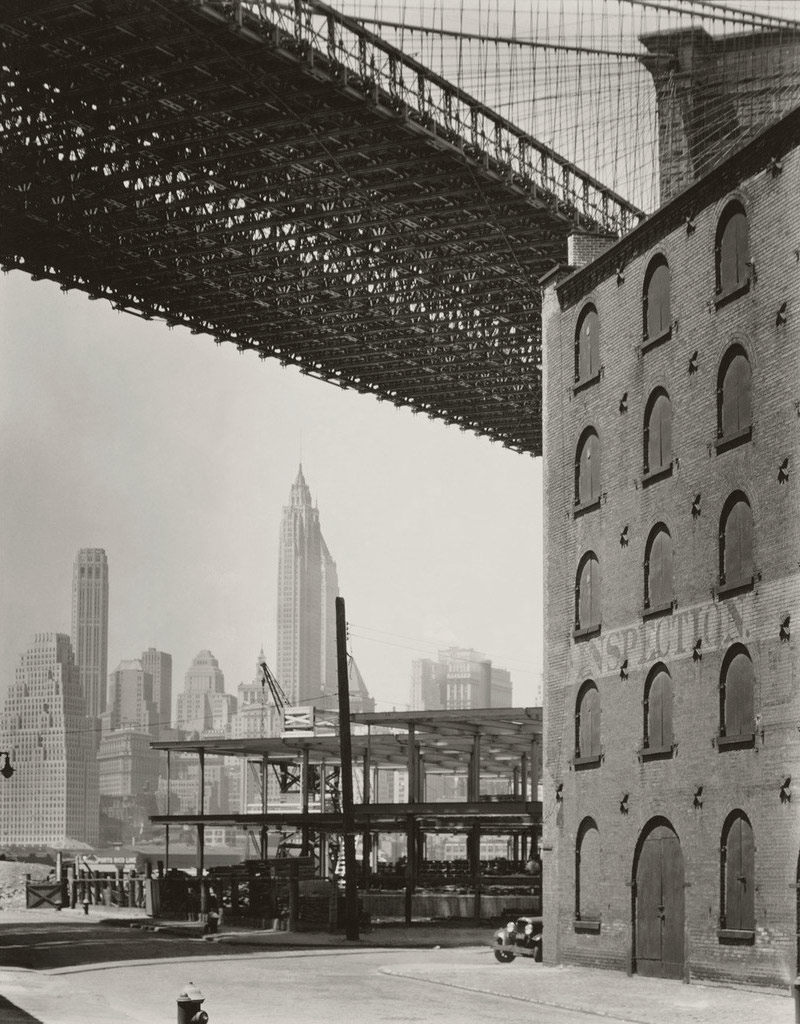
Berenice Abbott (American, 1898-1991) 'Brooklyn Bridge, Water and Dock Streets, Brooklyn' 1936


Berenice Abbott (American, 1898-1991)
Brooklyn Bridge, Water and Dock Streets, Brooklyn
1936
Gelatin silver print
Sheet: 18 x 14 3/8 in. (45.7 x 36.6cm)
Smithsonian American Art Museum
Transfer from the Evander Childs High School, Bronx, New York through the General Services Administration


Berenice Abbott returned home in 1929 after nearly eight years abroad and found herself fascinated by the rapid growth of New York City. She saw the city as bristling with new buildings and structures which seemed to her as solid and as permanent as a mountain range. Aiming to capture “the past jostling the present,” Abbott spent the next five years on a project she called Changing New York. In Brooklyn Bridge, Water and Dock Streets, Brooklyn, Abbott presented a century of history in a single image. The Brooklyn Bridge, once a marvel of modern engineering, seems dark and heavy compared with the skeletal structure beneath it. The construction site at center suggests the never-ending cycle of death and regeneration. And the Manhattan skyline, veiled and weightless, hangs just out of reach, its shape accommodating the ambitious spirit of American modernism.


Robert Disraeli (American, 1905-1987) 'Cold Day on Cherry Street' 1932


Robert Disraeli (American, 1905-1987)
Cold Day on Cherry Street
1932
Gelatin silver print
Image and sheet: 14 x 11 in. (35.5 x 28cm)
Smithsonian American Art Museum
Museum purchase made possible by Mr. and Mrs. G. Howland Chase, Mrs. James S. Harlan (Adeline M. Noble Collection), Lucie Louise Fery, Berthe Girardet, and Mrs. George M. McClellan
© 1932, Robert Disraeli


Imagination at Work

Nineteenth-century French commentator Alexis de Tocqueville observed that in America, nothing is ever quite what it seems. Yet the idea that “seeing is believing” is deeply ingrained in the American character. By yoking together style and subject under the guise of the real, today’s photographers borrow from photography’s rich past while embracing the conceptual framework of contemporary art. They read reality as something on the surface of a picture or, more complexly, as something located in the mind of its beholder.


Sonya Noskowiak (American born Germany, 1900-1975) 'Calla Lily' c. 1930s


Sonya Noskowiak (American born Germany, 1900-1975)
Calla Lily
c. 1930s
Gelatin silver print
Sheet: 7 3/8 x 9 3/4 in. (18.8 x 24.7cm)
Smithsonian American Art Museum
Museum purchase made possible through Deaccession Funds


Ray K. Metzker (American, 1931-2014) 'Composites: Philadelphia (Car and Street Lamp)' 1966


Ray K. Metzker (American, 1931-2014)
Composites: Philadelphia (Car and Street Lamp)
1966
Gelatin silver prints
Image: 25 3/8 x 17 3/4 in. (64.5 x 45cm)
Smithsonian American Art Museum
Museum purchase
© 1966, Ray K. Metzker


Ray Metzker’s Composites series, begun in 1964, connected in a dramatic fashion his interests in contrasts of light and shadow, his strong sense of design, and his earlier explorations of the multiple image. Metzker studied at Chicago’s Institute of Design, where a rigorously formal, problem-solving approach to photography was taught. For this series he assembled grids of individual photographs to create complex image-fields. When viewed from a distance, this work reads as an abstract, rhythmic pattern of light and dark. On closer inspection, however, many crisply descriptive images are revealed. The Composites function somewhat like short filmstrips. The mystery of these brief narratives is exaggerated by the repetitive design and provides a unique opportunity, in Metzker’s words, “to deal with complexity of succession and simultaneity, of collected and related moments.”


Irving Penn (American, 1917-2009) 'Mud Glove – New York' 1975, printed 1976


Irving Penn (American, 1917-2009)
Mud Glove – New York
1975, printed 1976
Platinum-palladium print
Sheet and image: 29 3/4 x 22 1/4 in. (75.5 x 56.5cm)
Smithsonian American Art Museum
Gift of the artist


Irving Penn was one of the most important and influential photographers of the twentieth century. In a career that spanned almost seventy years, Penn worked across multiple genres, from celebrity portraits to fashion, from still lives to images of native cultures in remote places of the world. Throughout his career Penn also worked on a series of photographs of discarded objects: things that had been lost, neglected, or misused. Printed in platinum, these detailed photographs of objects such as a lost glove found in the gutter, are Penn’s photographic memento mori, offering beauty compromised by age or disuse.


Edward Weston (American, 1886-1958) 'Pepper no. 30' 1930


Edward Weston (American, 1886-1958)
Pepper no. 30
1930
Gelatin silver print
Sheet: 9 1/2 x 7 1/2 in. (24.3 x 19.2cm)
Smithsonian American Art Museum
Museum purchase


Imogen Cunningham (American, 1883-1976) 'Auragia' 1953, printed c. 1960s


Imogen Cunningham (American, 1883-1976)
Auragia
1953, printed c. 1960s
Gelatin silver print
Sheet and image: 11 1/8 x 8 3/4 in. (28.3 x 22.2cm)
Smithsonian American Art Museum
Gift of Charles Isaacs and Carol Nigro


Ellen Carey (American, b. 1952) 'Dings and Shadows' 2012


Ellen Carey (American, b. 1952)
Dings and Shadows
2012
Chromogenic print
Sheet and image: 40 x 30 in. (101.6 x 76.2cm)
Smithsonian American Art Museum
Gift of Linda Cheverton Wick and Walter Wick
© 2012, Ellen Carey


Ellen Carey created the series she calls Dings and Shadows by exposing photosensitive paper to light projected through primary and complementary colour filters. The artist first folds and crushes paper; then after exposing the paper to light from a colour enlarger, flattens it out again for processing. In doing so, Carey dissects the process of developing film, and evokes the hand-crafted nature of early photographic techniques.


Some images from the Timeline on the website

1843

Daguerreotypists Albert S. Southworth and Josiah Johnson Hawes begin a partnership, establishing Southworth & Hawes as the most highly regarded portrait studio in Boston, Mass. The studio caters to the city’s elite, and is visited by Charles Dickens, Ralph Waldo Emerson, and Oliver Wendell Holmes, among many other influential people of the time.


Albert Sands Southworth (American, 1811-1894) and Josiah Johnson Hawes (American, 1808-1901) 'A Bride and Her Bridesmaids' 1851


Albert Sands Southworth (American, 1811-1894) and Josiah Johnson Hawes (American, 1808-1901)
A Bride and Her Bridesmaids
1851
Daguerreotype
Smithsonian American Art Museum
Museum purchase made possible by Walter Beck


1853

The New York Daily Tribune estimates that in the United States, three million daguerreotypes are being produced annually.


Unidentified artist. 'Mother and Son' c. 1855


Unidentified artist
Mother and Son
c. 1855
Daguerreotype with applied colour
Smithsonian American Art Museum
Museum purchase from the Charles Isaacs Collection made possible in part by the Luisita L. and Franz H. Denghausen Endowment


1857

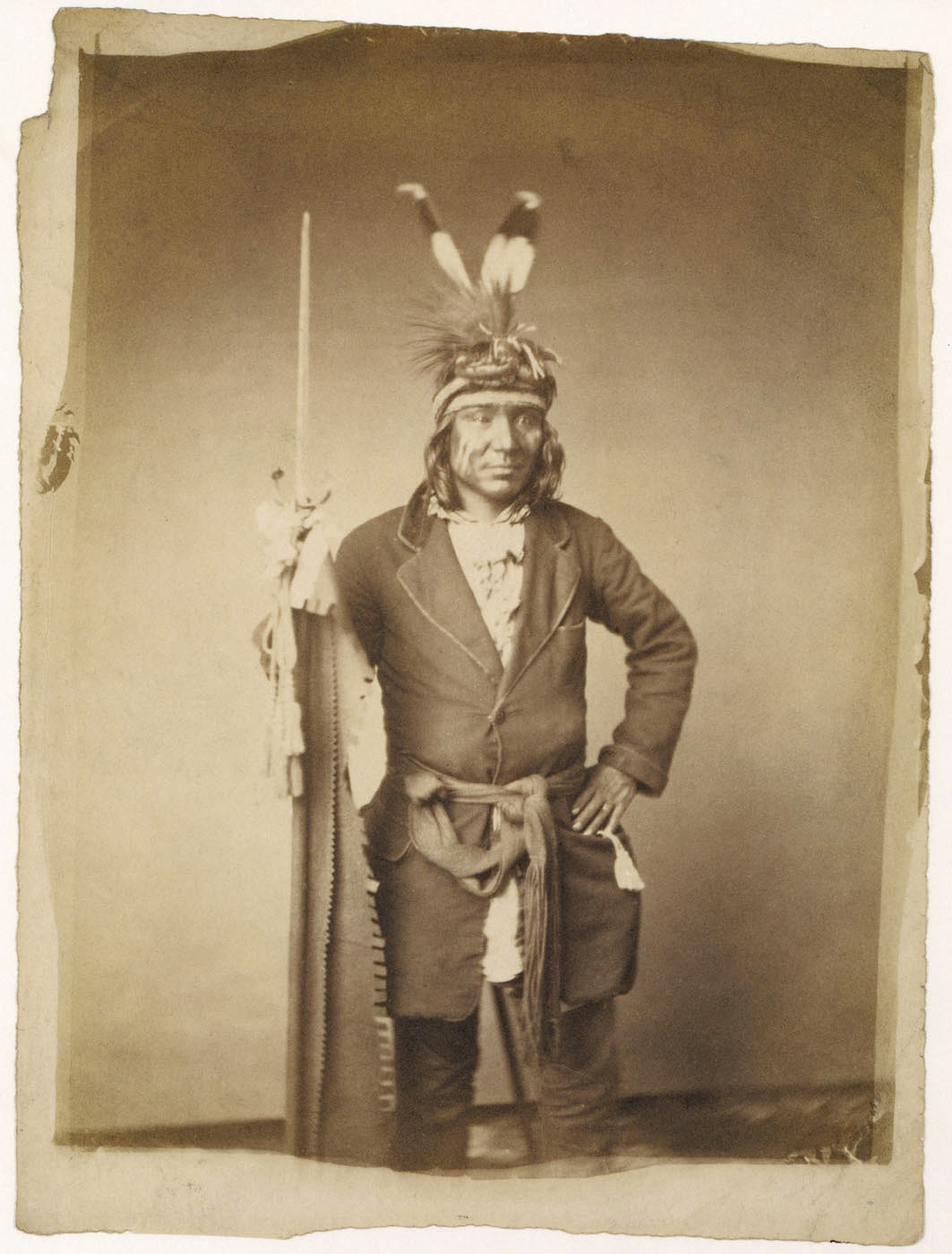
Julian Vannerson and Samuel Cohner make the first systematic photographs of Native American delegations to visit Washington, D.C. They photograph ninety delegates representing thirteen tribes who conduct treaty and other negotiations with government officials.


Julian Vannerson (American, 1827-1875) 'Shining Metal' 1858


Julian Vannerson (American, 1827-1875)
Shining Metal
1858
Salted paper print
Smithsonian American Art Museum
Museum purchase from the Charles Isaacs Collection made possible in part by the Luisita L. and Franz H. Denghausen Endowment


1861

American Civil War begins with shots fired on Fort Sumter by Confederate troops. Portrait photographer Mathew Brady is given permission by President Abraham Lincoln to photograph the First Battle of Bull Run, but comes so close to the battle that he narrowly avoids capture. Using paid assistants Alexander Gardner, Timothy O’Sullivan, George N. Barnard, and others, Brady’s studio makes thousands of photos of the sites, material, and people of the war. Civilian free-lance photographer Egbert Guy Fowx sells numerous negatives to Brady’s studio, which publishes and copyrights many of them. Many other images are credited to Fowx, including this group of Union officers.


Egbert Guy Fowx (American, 1821-1889) 'New York 7th Regiment Officers' c. 1863


Egbert Guy Fowx (American, 1821-1889)
New York 7th Regiment Officers
c. 1863
Salted paper print
Smithsonian American Art Museum
Museum purchase from the Charles Isaacs Collection made possible in part by the Luisita L. and Franz H. Denghausen Endowment


1867

Eadweard Muybridge begins trip to photograph in Yosemite Valley. He publishes his photographs under the name “Helios,” which is also the name of his San Francisco studio. An exhibition of more than 300 photographic portraits of Native American delegates to Washington, D.C., opens in the Smithsonian Castle. Clarence R. King begins direction of the U.S. Geological Expedition of the Fortieth Parallel, appointing Timothy O’Sullivan as the official photographer. Photographer Carleton Watkins joins the survey in 1871.


Timothy H. O'Sullivan  (American born Ireland, 1840-1882) 'Tufa Domes, Pyramid Lake, Nevada' 1867


Timothy H. O’Sullivan  (American born Ireland, 1840-1882)
Tufa Domes, Pyramid Lake, Nevada
1867
Albumen silver print
Smithsonian American Art Museum
Museum purchase from the Charles Isaacs Collection made possible in part by the Luisita L. and Franz H. Denghausen Endowment


1869

Andrew J. Russell’s album, The Great West Illustrated in a Series of Photographic Views across the Continent; Taken along the Line of the Union Pacific Railroad from Omaha, Nebraska, Volume I, is published. George M. Wheeler begins direction of the United States Geological Surveys West of the 100th Meridian for the U.S. Army Corps of Engineers. Wheeler makes fourteen trips to the West over the next eight years. Photographer Timothy O’Sullivan accompanies him in 1871, 1873, and 1874.


Andrew Joseph Russell (American, 1829-1902) 'Sphinx of the Valley' 1869


Andrew Joseph Russell (American, 1829-1902)
Sphinx of the Valley
1869
Albumen silver print
Smithsonian American Art Museum
Museum purchase from the Charles Isaacs Collection made possible in part by the Luisita L. and Franz H. Denghausen Endowment


1967

The Friends of Photography is founded in Carmel, California, by Ansel Adams, Beaumont and Nancy Newhall, Brett Weston, and others, with the aim of promoting creative photography and supporting its practitioners. It remains in existence until 2001.


Brett Weston (American, 1911-1993) 'Untitled (Snow Covered Mountains)' 1973


Brett Weston (American, 1911-1993)
Untitled (Snow Covered Mountains)
1973
Gelatin silver print
Smithsonian American Art Museum
Transfer from the National Endowment for the Arts
© 1973, Brett Weston


1975

New Topographics: Photographs of a Man-Altered Landscape opens at the International Museum of Photography in Rochester, N.Y. It includes photographs by Robert Adams, Lewis Baltz, Bernd and Hilla Becher, Joe Deal, Frank Gohlke, Nicholas Nixon, John Schott, Stephen Shore, and Henry Wessel Jr.


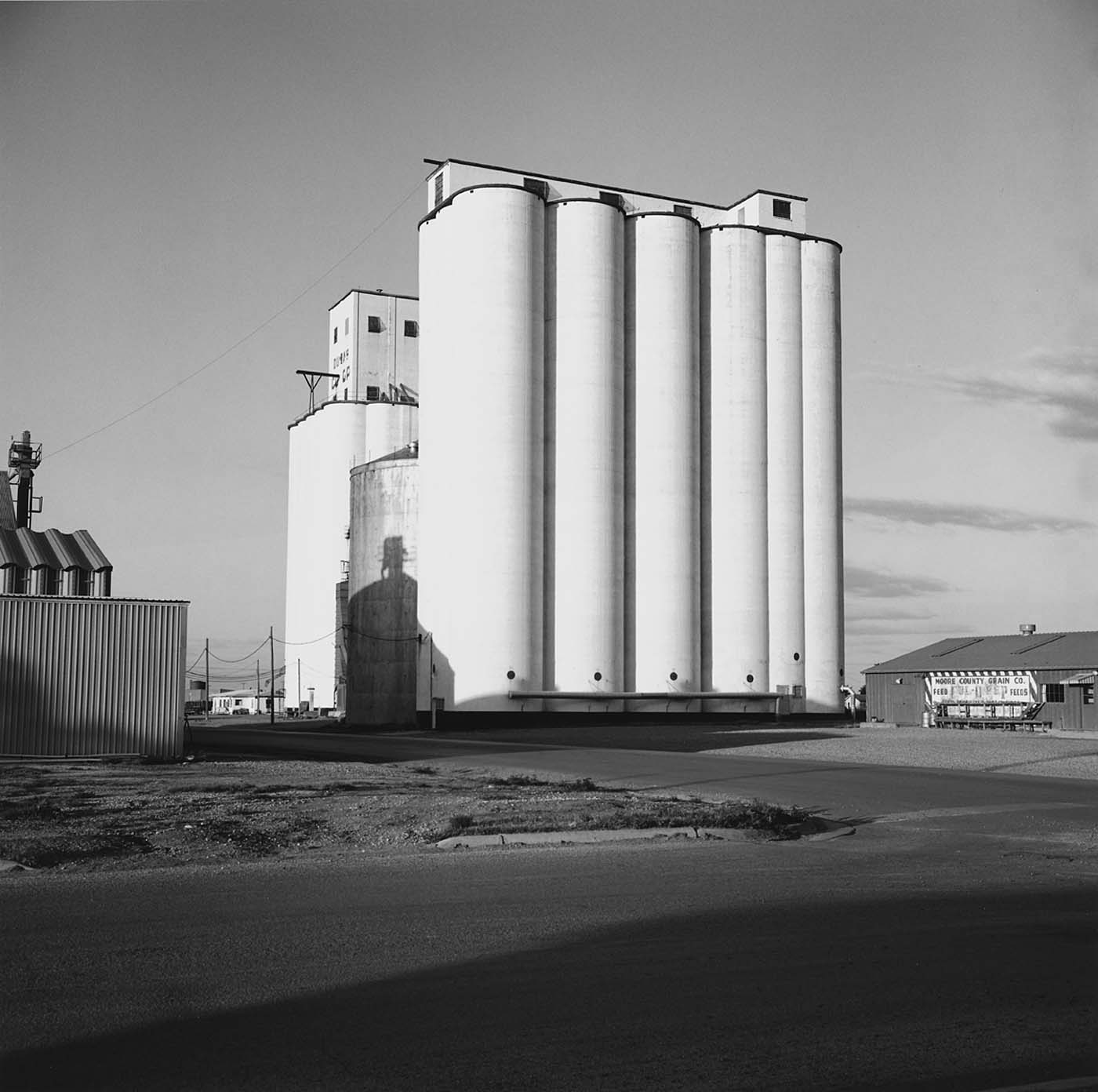
Frank Gohlke (American, b. 1942) 'Grain Elevator, Dumas, Texas, 1973' 1973, printed 1994


Frank Gohlke (American, b. 1942)
Grain Elevator, Dumas, Texas, 1973
1973, printed 1994
Gelatin silver print
Smithsonian American Art Museum, Museum purchase through the Luisita L. and Franz H. Denghausen Endowment
© 1973, Frank Gohlke


Smithsonian American Art Museum
8th and F Streets, N.W.
Washington, D.C. 20004

Opening hours:
11.30am – 7.00pm daily

Smithsonian American Art Museum website

A Democracy of Images website

LIKE ART BLART ON FACEBOOK

Back to top

Exhibition: ‘Edward Steichen & Art Deco Fashion’ at NGV International, Melbourne

Exhibition dates: 18th October 2013 – 2nd March 2014


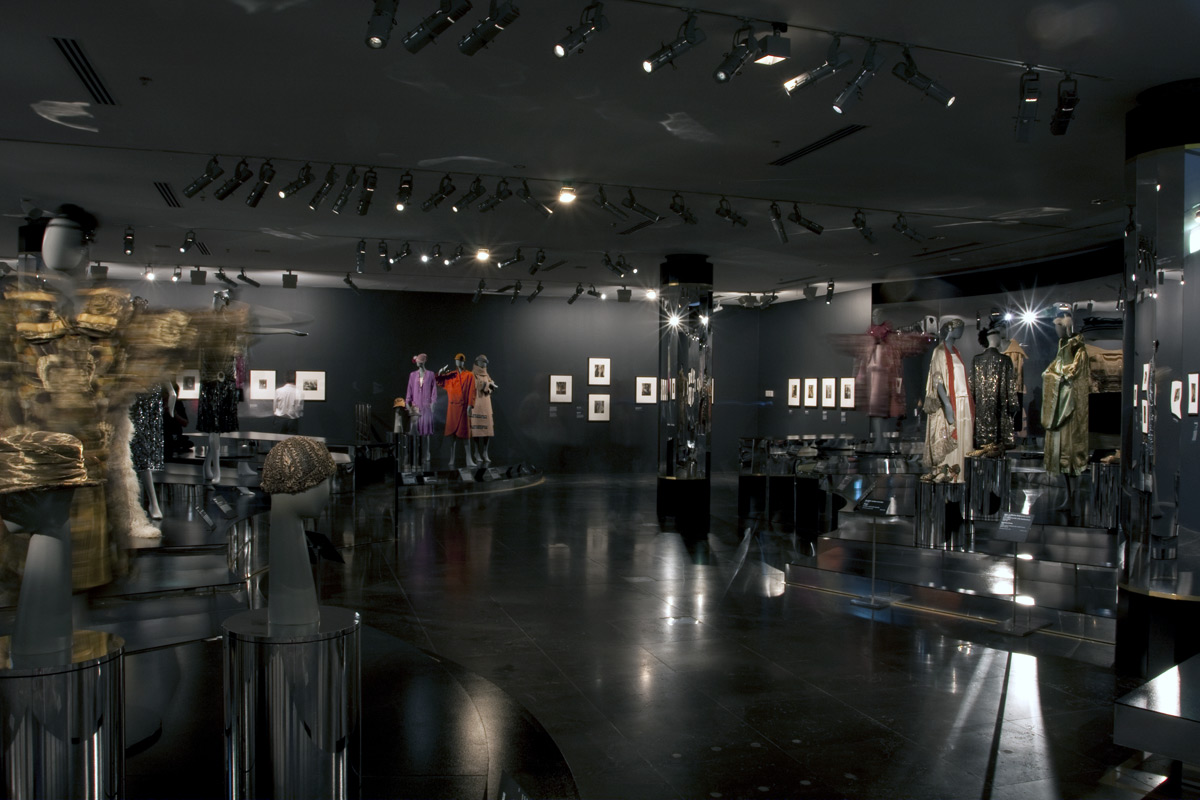
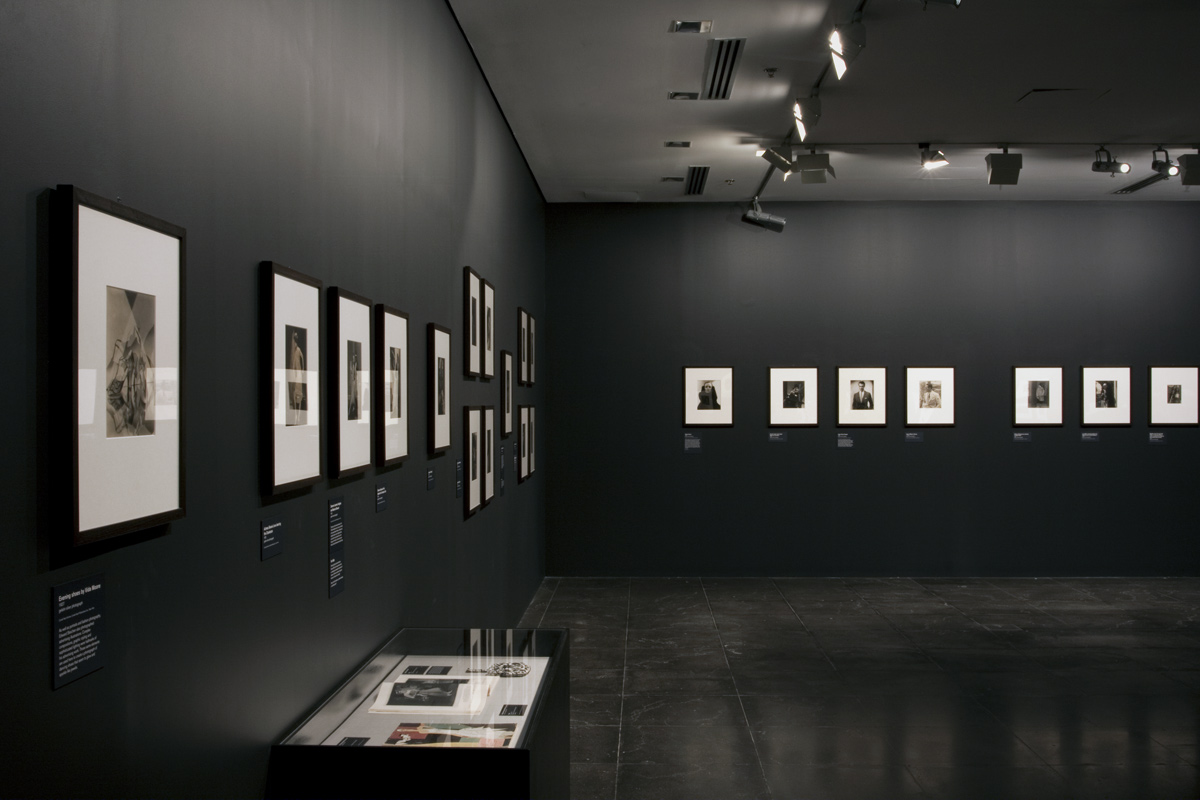
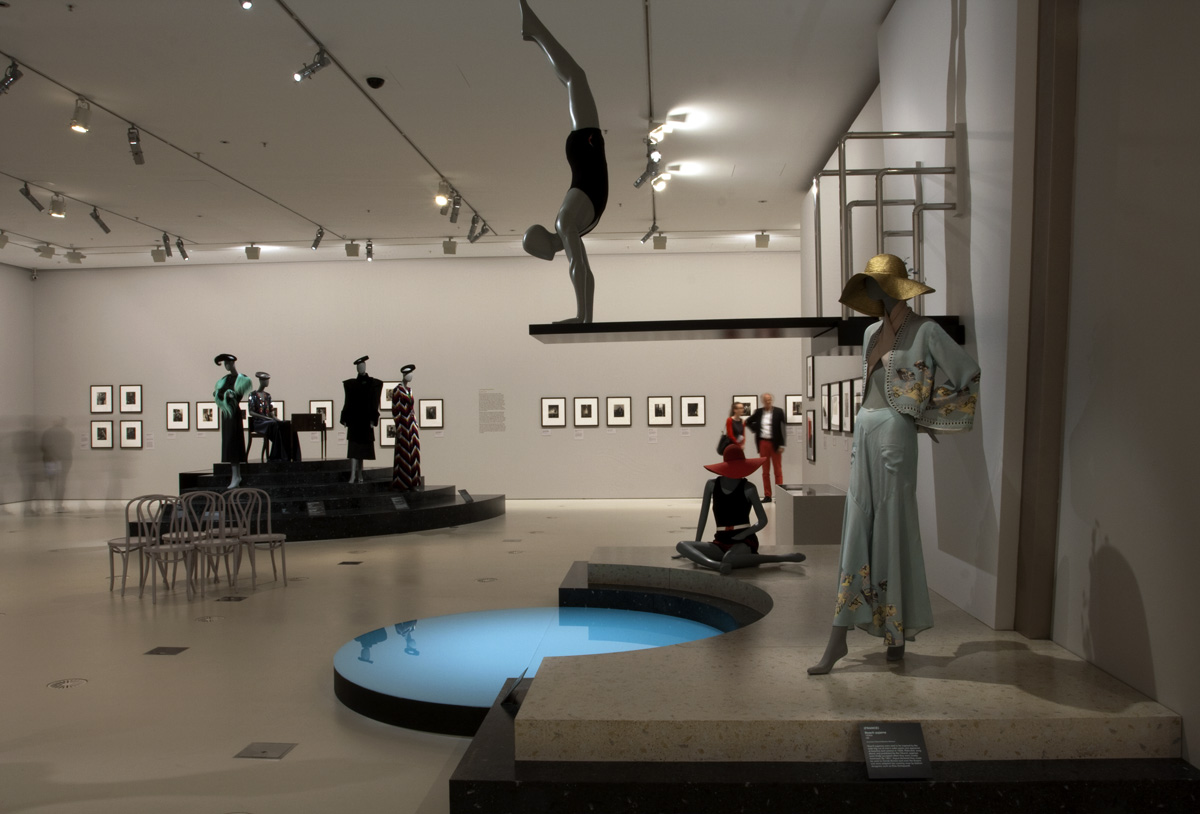
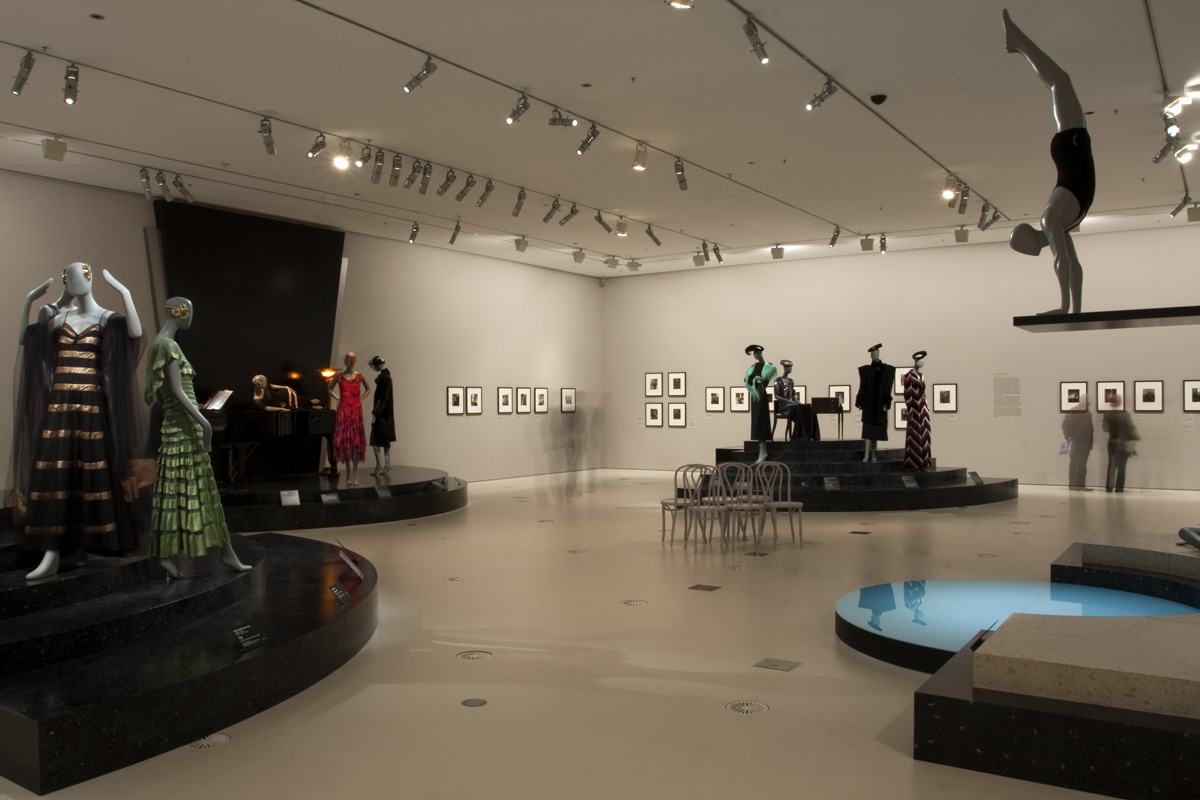
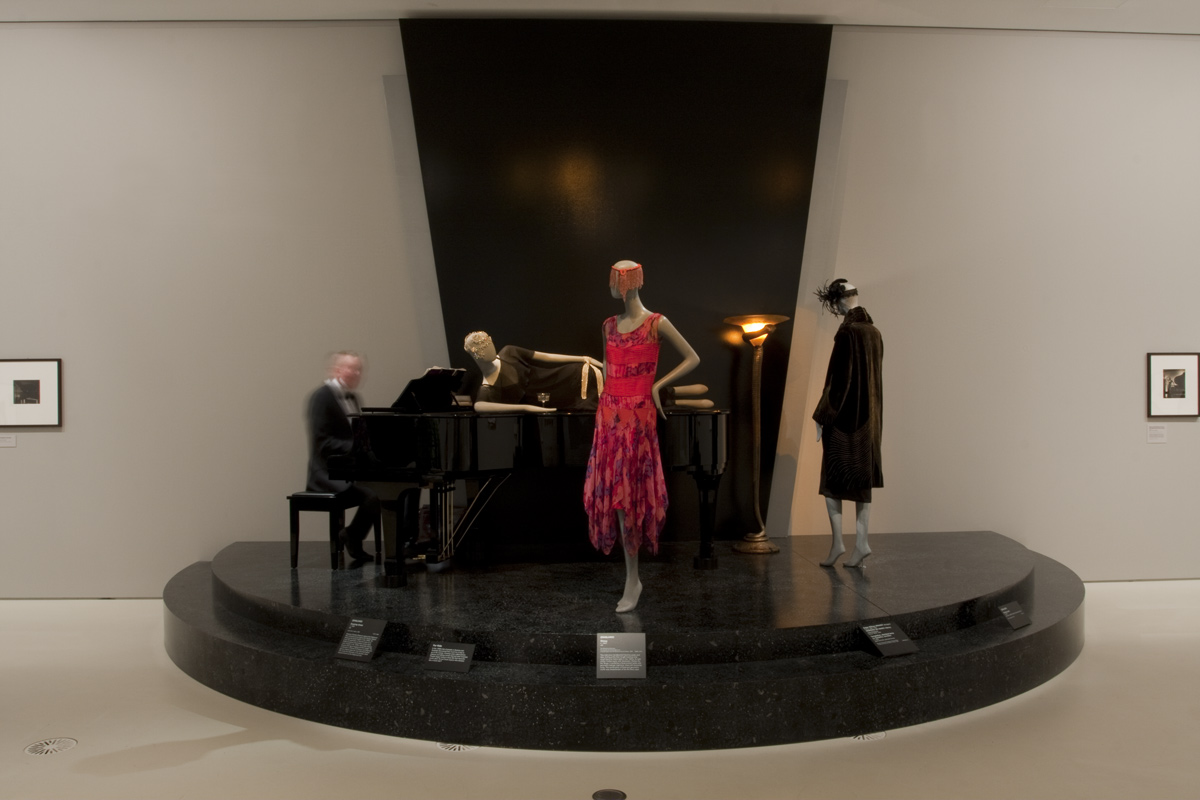
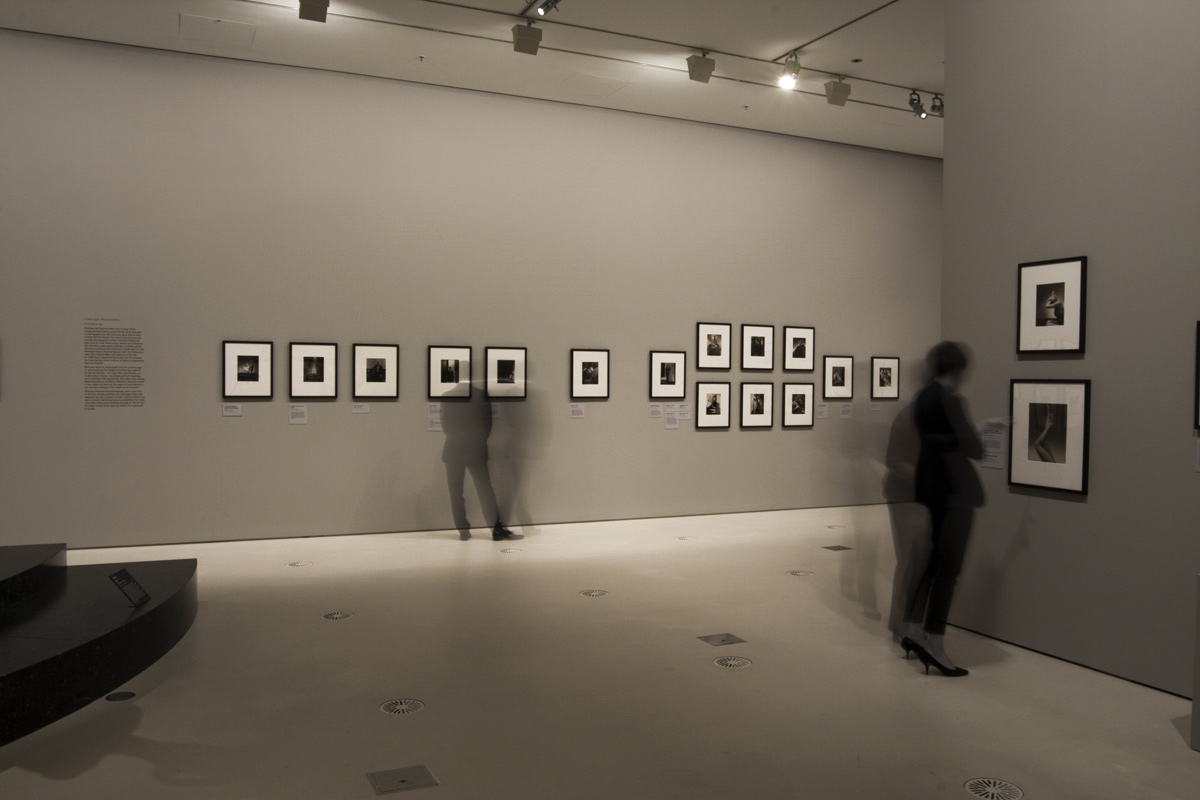
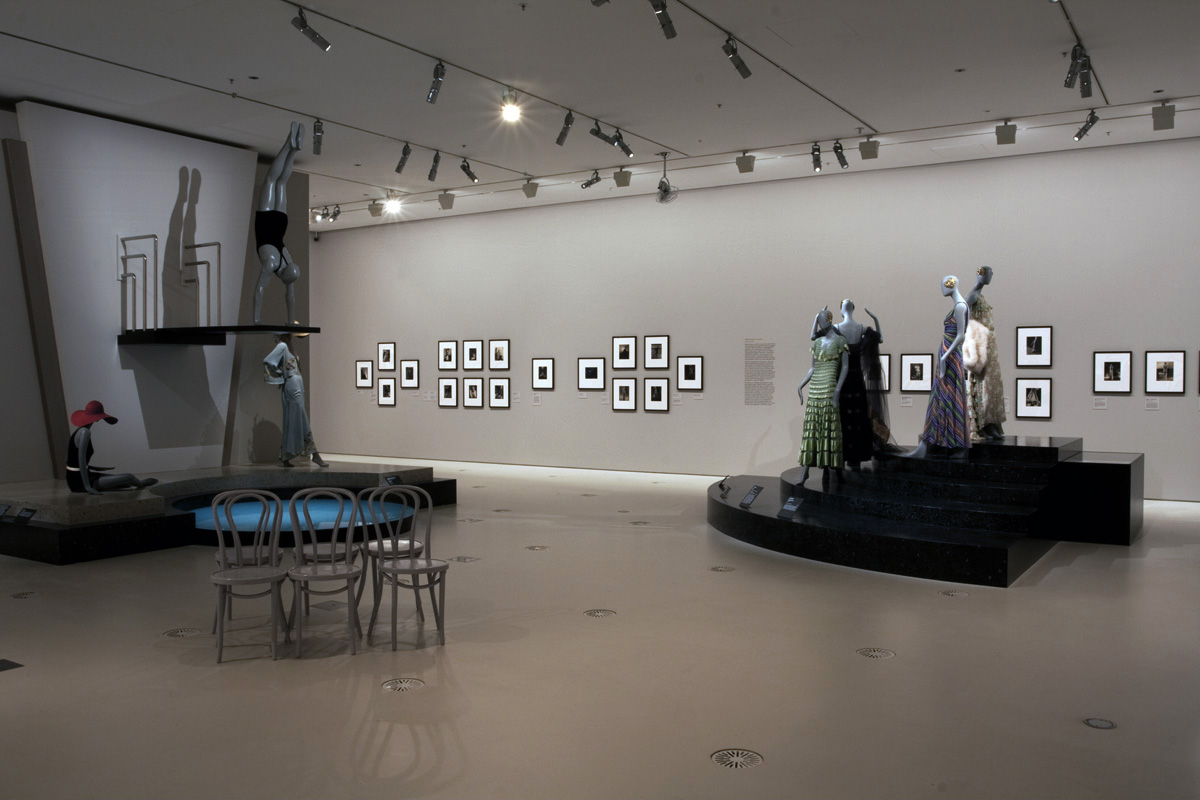
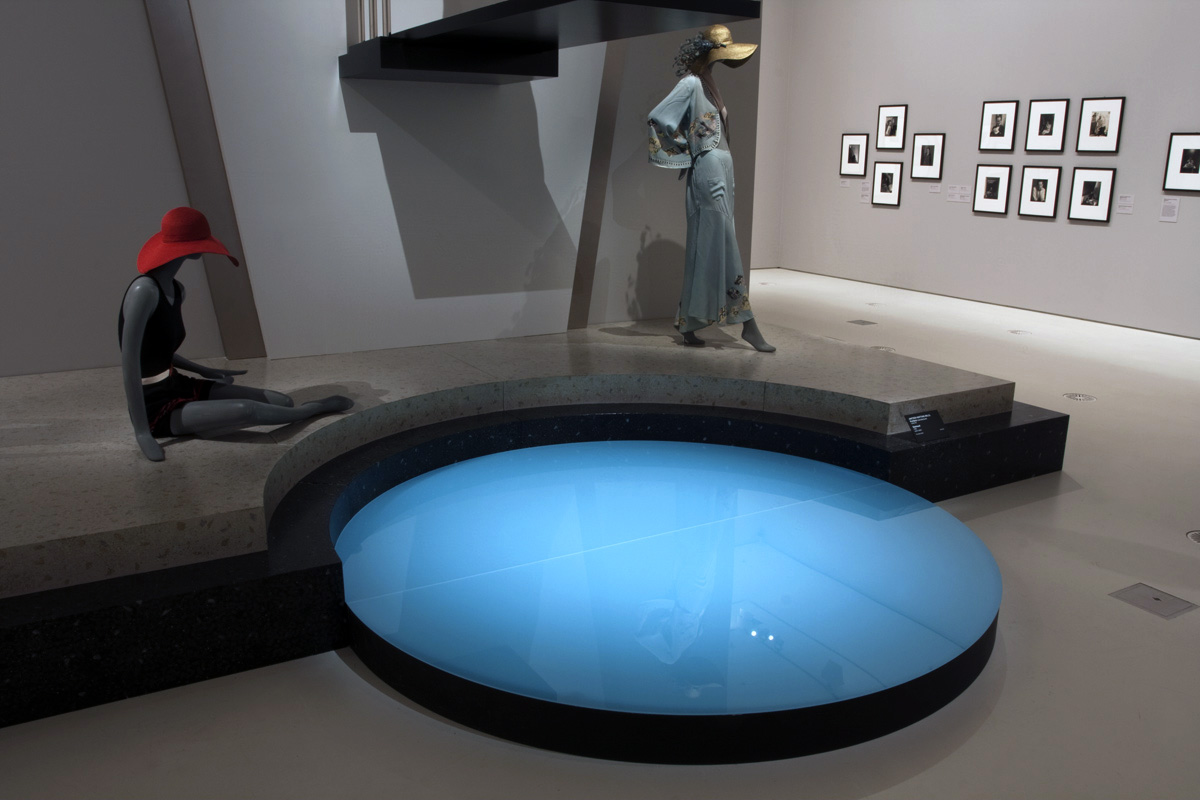
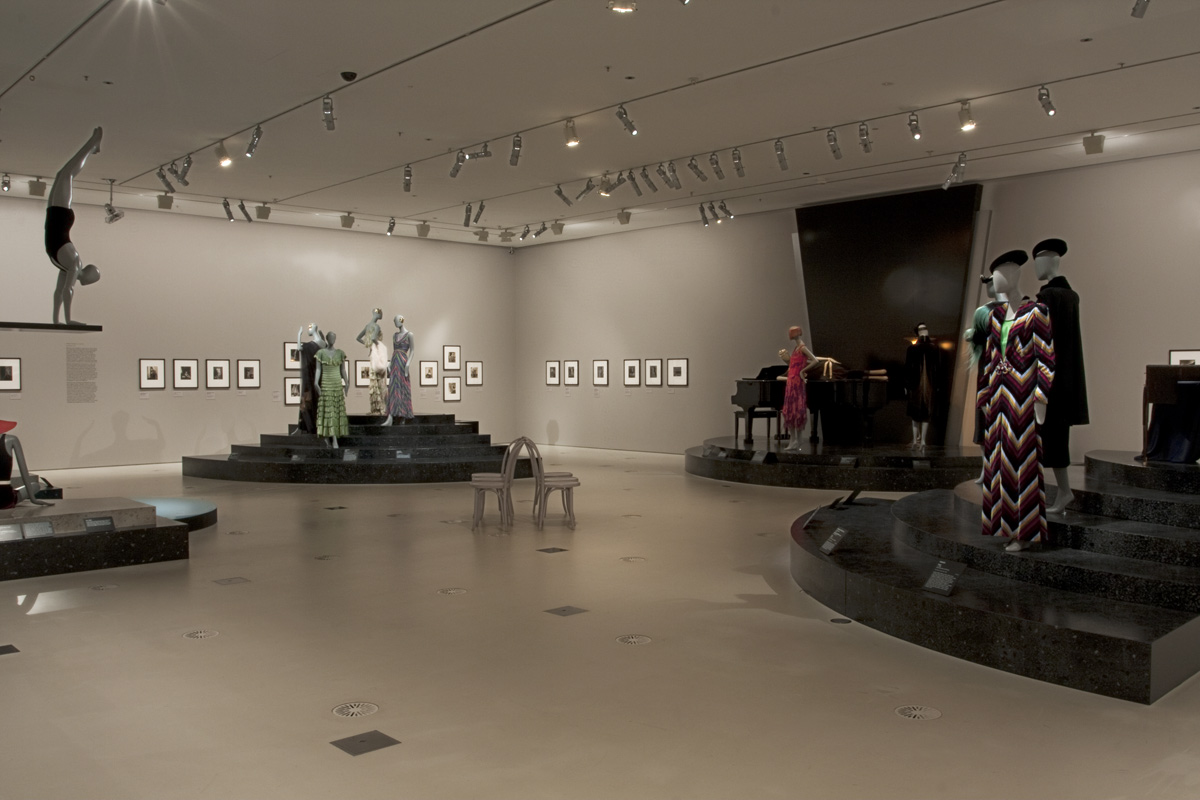
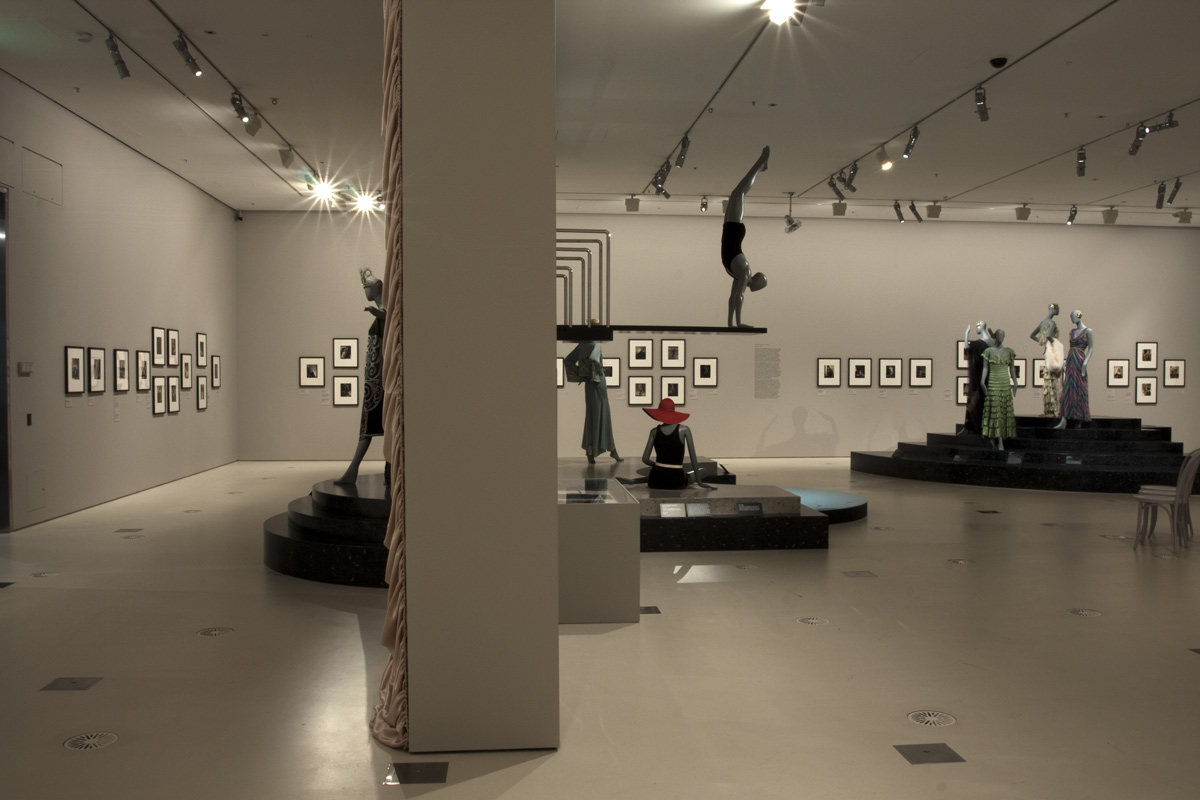
Installation photograph of the exhibition 'Edward Steichen & Art Deco Fashion' at NGV International


Installation photograph of the exhibition Edward Steichen & Art Deco Fashion at NGV International
Photo: Marcus Bunyan


You saw it here first on Art Blart!

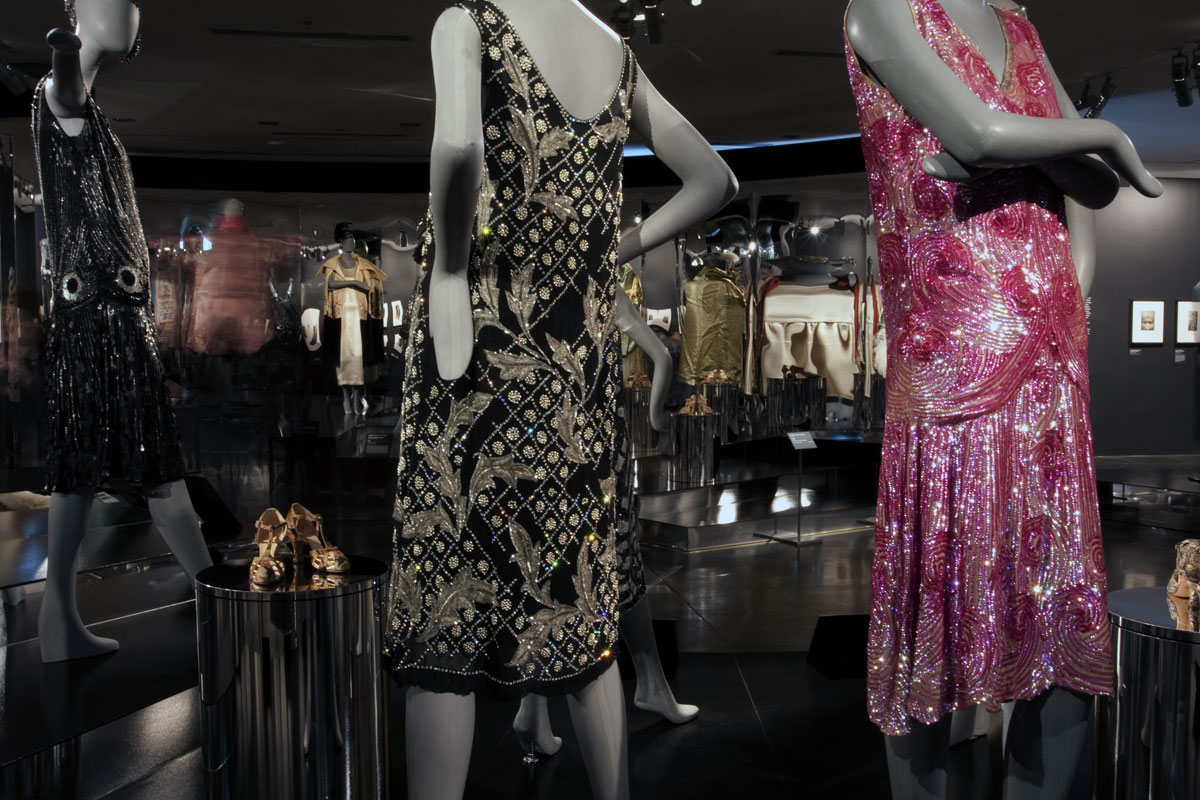
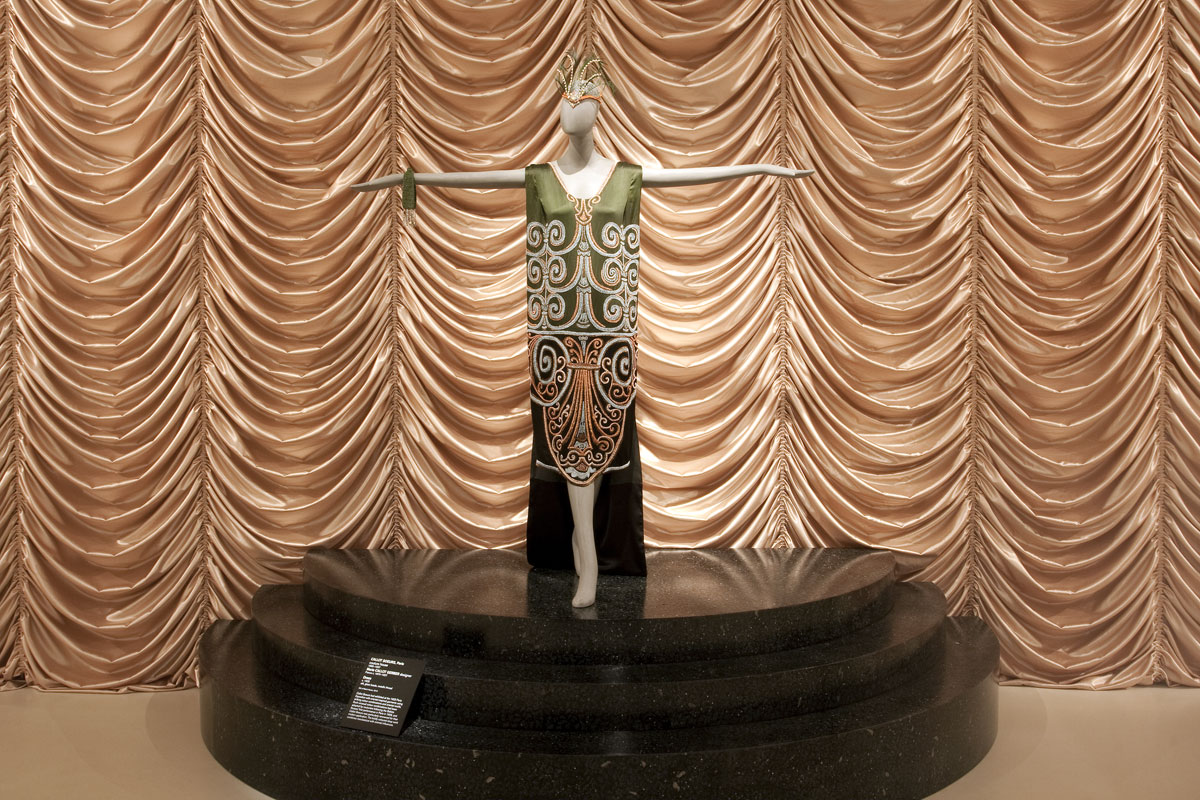
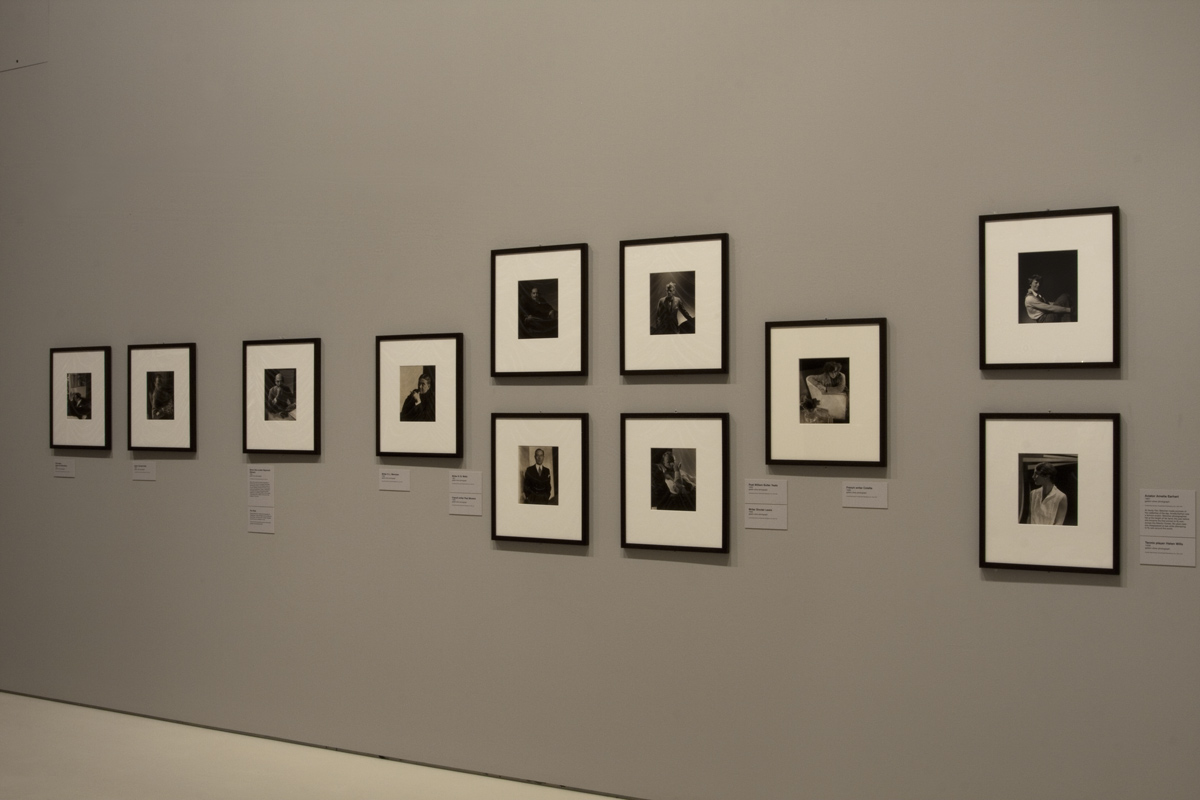
What a gorgeous exhibition. It’s about time Melbourne had a bit of style put back into the National Gallery of Victoria, and this exhibition hits it out of the park. Not only are the photographs absolutely fabulous but the frocks are absolutely frocking as well. Well done to the NGV for teaming the photographs with the fashion and for a great install (makes a change to see 2D and 3D done so well together). Elegant, sophisticated and oozing quality, this is a sure fire winner…. Review of the photographs to follow.

Dr Marcus Bunyan


Many thankx to the NGV for allowing me to take and publish the photographs. Please click on the photographs for a larger version of the image. All photographs © Marcus Bunyan and the National Gallery of Victoria. May be used freely if permission is sought and proper accreditation given.


Room 1

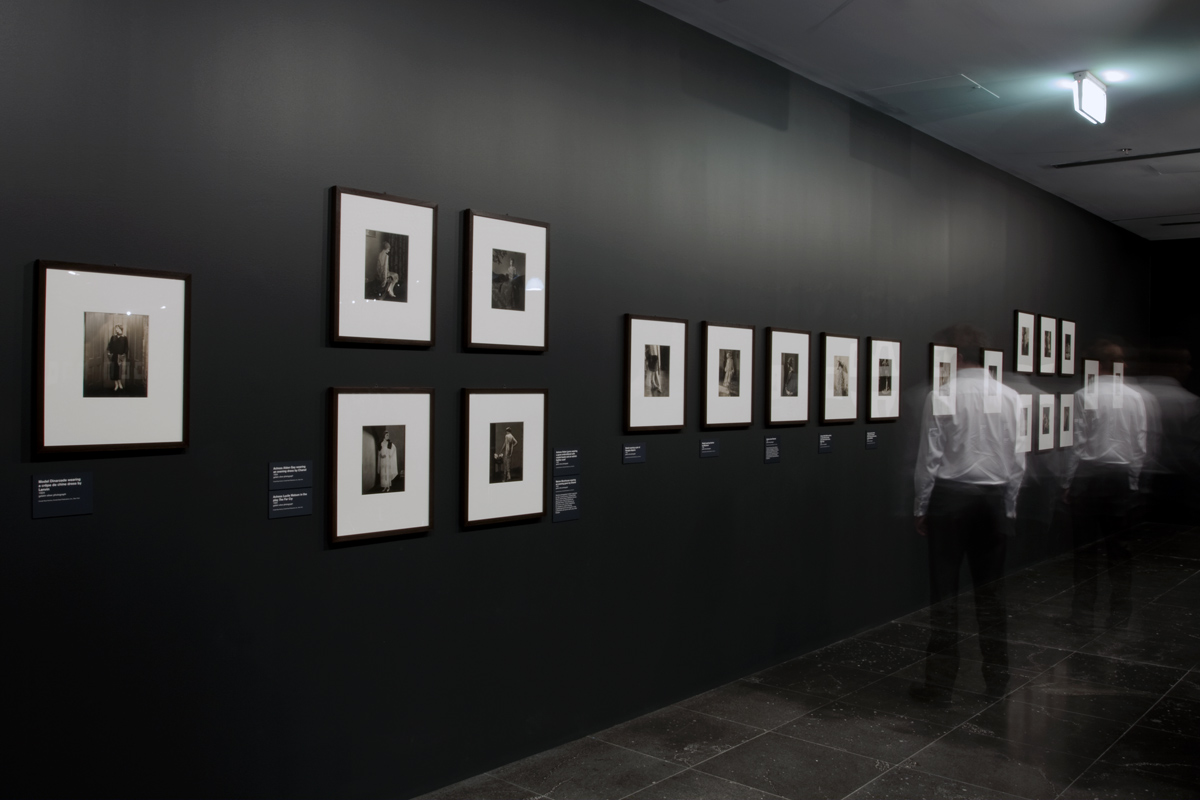
Installation photograph of the exhibition 'Edward Steichen & Art Deco Fashion' at NGV International

Installation photograph of the exhibition 'Edward Steichen & Art Deco Fashion' at NGV International

Installation photograph of the exhibition 'Edward Steichen & Art Deco Fashion' at NGV International

Installation photograph of the exhibition 'Edward Steichen & Art Deco Fashion' at NGV International

Installation photograph of the exhibition 'Edward Steichen & Art Deco Fashion' at NGV International


Installation photographs of the exhibition Edward Steichen & Art Deco Fashion at NGV International
Photos: Marcus Bunyan


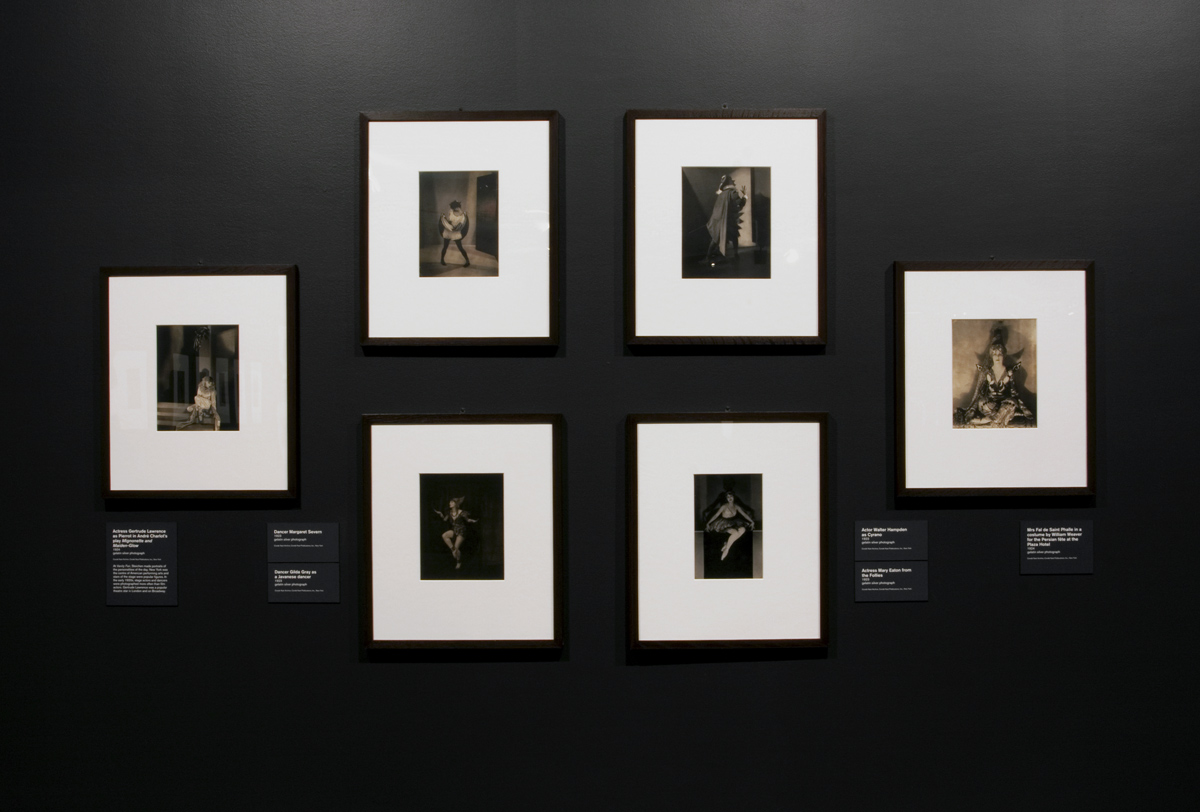
Installation photograph of the exhibition 'Edward Steichen & Art Deco Fashion' at NGV International


(L-R) Vogue March First 1926; Vogue November 15, 1925; and Vanity Fair June 1926
Photo: Marcus Bunyan


Installation photograph of the exhibition 'Edward Steichen & Art Deco Fashion' at NGV International

Installation photograph of the exhibition 'Edward Steichen & Art Deco Fashion' at NGV International

Installation photograph of the exhibition 'Edward Steichen & Art Deco Fashion' at NGV International

Installation photograph of the exhibition 'Edward Steichen & Art Deco Fashion' at NGV International


Installation photographs of the exhibition Edward Steichen & Art Deco Fashion at NGV International
Photos: Marcus Bunyan


The National Gallery of Victoria will showcase the glamour and modernity of the Art Deco period through the work of fashion’s most influential photographer, Edward Steichen, and stunning Art Deco fashion garments and accessories. The exhibition Edward Steichen & Art Deco Fashion is the first Australian survey of Steichen, widely considered to have created the first modern fashion photo. The exhibition features almost 200 of Steichen’s original vintage photographs, drawn from the vast archives of Condé Nast where he was chief photographer for their most prestigious magazines Vanity Fair and Vogue during the 1920s and 30s, alongside more than forty exquisite Art Deco fashion items from the NGV Collection and select private collections.

Tony Ellwood, Director, NGV, said that Edward Steichen & Art Deco Fashion is the first major Australian retrospective dedicated to Steichen’s iconic Condé Nast work.

“Steichen’s evocative images are regarded as among the most striking in early-to-mid-20th century photography and his fashion work in particular revolutionised the genre of fashion photography. This exhibition provides a rare opportunity to view such a large body of his work and to see up close the intricate details of outstanding Art Deco fashion items that highlight the interplay between fashion and photography,” said Mr Ellwood.

The exhibition presents Steichen’s pioneering modernist fashion photography and celebrity portraiture, produced during his fifteen year career as chief photographer for esteemed Condé Nast publications Vanity Fair and Vogue. During this period he put his exceptional talents and prodigious energy to work, creating a legacy of unequalled brilliance as he photographed the world of high fashion and stars of contemporary popular culture including Marlene Dietrich, Joan Crawford, Charlie Chaplin, Katherine Hepburn, Clara Bow, Louise Brooks, Greta Garbo, Gary Cooper, Winston Churchill and George Gershwin. Steichen’s images transformed fashion photography and influenced generations of photographers, capturing the sophistication of the newly liberated ‘modern woman’ and encapsulating the chic beauty and avant-garde style of the Art Deco movement. Renowned as an innovator and master of lighting, his practice bridged the transition from photography’s early soft-focus, pictorialist style to clean, crisp modernism.

Echoing the aesthetics of Steichen’s photographs, this exhibition will also celebrate the fashion borne of the period with over forty exquisite Art Deco garments and accessories by leading designers of the day including Chanel, Lanvin, Madeleine Vionnet, Madame Paquin and Callot Soeurs. The elegance of old Hollywood glamour and high end fashion will be seen through a range of pieces – including swimsuits, coats, evening gowns, beach pyjamas, dresses, hats, bags and shoes, as well as an early example of Chanel’s little black dress. Art Deco style developed in response to changing lifestyles and ideals following the First World War. Typically characterised by sleek, geometric lines, rich colours and luxurious adornments, these new forms represented a shift away from traditional values; in fashion, hemlines rose and hairstyles became shorter, culminating in the infamous mid-twenties flapper style.

Edward Steichen & Art Deco Fashion also displays rare copies of Vogue and Vanity Fair that demonstrate the way Steichen’s photographs appeared on the magazine page. Two catalogues accompany the exhibition: Art Deco Fashion, a magazine-style volume that charts the development of the modern silhouette and highlights some of the leading designers of the period, and Edward Steichen: In High Fashion – The Condé Nast Years, 1923-1937, a lavishly illustrated 288 page publication that focuses on Steichen’s legendary Vogue and Vanity Fair work.

Press release from the National Gallery of Victoria


Room Two

CALLOT SOUERS, Paris couture hours 1925-1937 Marie CALLOT GERBER designer France c. 1870-1927 'Dress' c. 1925


Callot Souers, Paris
Couture house (1925-1937)
Marie Callot Gerber designer
France c. 1870-1927
Dress
c. 1925
Silk, glass beads, metallic thread


Installation photograph of the exhibition 'Edward Steichen & Art Deco Fashion' at NGV International

Installation photograph of the exhibition 'Edward Steichen & Art Deco Fashion' at NGV International

Installation photograph of the exhibition 'Edward Steichen & Art Deco Fashion' at NGV International

Installation photograph of the exhibition 'Edward Steichen & Art Deco Fashion' at NGV International

Installation photograph of the exhibition 'Edward Steichen & Art Deco Fashion' at NGV International

Installation photograph of the exhibition 'Edward Steichen & Art Deco Fashion' at NGV International

Installation photograph of the exhibition 'Edward Steichen & Art Deco Fashion' at NGV International

Installation photograph of the exhibition 'Edward Steichen & Art Deco Fashion' at NGV International

Installation photograph of the exhibition 'Edward Steichen & Art Deco Fashion' at NGV International

Installation photograph of the exhibition 'Edward Steichen & Art Deco Fashion' at NGV International

Installation photograph of the exhibition 'Edward Steichen & Art Deco Fashion' at NGV International


Installation photographs of the exhibition Edward Steichen & Art Deco Fashion at NGV International
Photos: Marcus Bunyan


NGV International
180 St Kilda Road

Opening hours
Daily 10am – 5pm

National Gallery of Victoria website

LIKE ART BLART ON FACEBOOK

Back to top

Exhibition: ‘The Gender Show’ at George Eastman House, Rochester, New York

Exhibition dates: 15th June – 13th October 2013


Vincent Cianni (American, b. 1952) 'Anthony hitting on Giselle, Vivien waiting, Lorimer Street, Williamsburg, Brooklyn' From the series 'We Skate Hardcore' 1996


Vincent Cianni (American, b. 1952)
Anthony hitting on Giselle, Vivien waiting, Lorimer Street, Williamsburg, Brooklyn
1996
From the series We Skate Hardcore
Gelatin silver print
Purchased with funds from Mary Cianni
© Vincent Cianni


I am so sick of museums and art galleries not allowing me to publish photographs that I collect freely available elsewhere on the web to illustrate their exhibitions.

1/ I am promoting the exhibition free for them to over 9,000 people over 3 days
2/ The images are freely available elsewhere on the web
3/ I am promoting artists so that the work is more widely known, and that can only be a positive for the artist (and the price of their art through greater recognition)
4/ The images are 72dpi jpg – what do they think, that people are going to rip them off. They are such low quality anyway who cares!


If artist’s are so precious about their work, even when someone is trying to promote it, then perhaps they should stop making art. Or perhaps it’s the archives and institutions, the patriarchies, that are just too protective of their precious mother-load.

Photography and photographs are ubiquitous. They are taken in the world and live in that world, not stuffed in some curators drawer or surrounded by a circle under the letter ©


This exhibition seems to have a finger in every gender pie without going hard core or in depth at anything. There seems to be no rhyme or reason, no catalogue to the exhibition (as far as I can ascertain), and no indication on how the exhibition is structured, even in the press release. How you would hope to cover such a broad topic in one exhibition is beyond me. That given, there are some fascinating photographs from the exhibition in this posting. My personal favourites in the posting are:

~ Donald York, Jr. standing beside his father’s wrecker, Millerton, New York by Mark Goodman (1974, below). Ah, the jouissance of youth (jouissance means enjoyment, in terms both of rights and property, and of sexual orgasm). Here “junior” is possessing the masculinity of his father’s truck while at the same time emphasising his youthful sexuality with short shorts, naked body, tilt of the hips, pose of the arm and slight cock of the head replete with hair falling over the eyes. There is a certain prepossession about this Donald York, a sexual knowing as he flirts with the camera. Beautiful image

~ Greta Garbo by Edward Steichen (1928, below). My god, how would you be as a photographer looking in the ground glass to see this visage staring back at you. Strength of character, vulnerability and eyes that seem to bore right through you. Face framed with black surmounted by pensive hands. A masterpiece

~ Ophelia Study No. 2 by Julia Margaret Cameron (1867, below). What an impression. Wistful, delicate, a ghostly slightly mad presence with hardly an existence but oh so memorable (Ophelia is a fictional character in the play Hamlet by William Shakespeare that suffers from “erotomania, a malady conceived in biological and emotional terms which is a type of delusion in which the affected person believes that another person, usually a stranger, high-status or famous person, is in love with him or her.”(Wikipedia)) Madness and sexuality. The divine Miss Julia does it again…

Dr Marcus Bunyan


Please click on the photographs for a larger version of the image.


Mark Goodman (American b. 1946) 'Donald York, Jr. standing beside his father's wrecker, Millerton, New York' 1974


Mark Goodman (American, b. 1946)
Donald York, Jr. standing beside his father’s wrecker, Millerton, New York
1974
Gelatin silver print
Gift of Dr and Mrs Maurice Miller
© Mark Goodman


Elias Goldensky (American born Russia, 1867-1943) 'Head and shoulders study' c. 1920


Elias Goldensky (American born Russia, 1867-1943)
Head and shoulders study
c. 1920
Gelatin silver print
Gift of 3M Company
Ex-collection of Louis Walton Sipley


Lewis W. Hine (American, 1874-1940) 'Greek Wrestling Club' c. 1910


Lewis W. Hine (American, 1874-1940)
Greek Wrestling Club
c. 1910
From the series Hull House, Chicago
Gelatin silver print
Transfer from Photo League Lewis Hine Memorial Committee; ex-collection of Corydon Hine


Nickolas Muray (American born Hungary, 1892-1965) 'Douglas Fairbanks, Jr. & Joan Crawford' c. 1930


Nickolas Muray (American born Hungary, 1892-1965)
Douglas Fairbanks, Jr. & Joan Crawford
c. 1930
Gelatin silver print
Gift of Mrs. Nickolas Muray
© Nickolas Muray Archives


Victor Keppler (American, 1904-1987) 'First Hair Cut' 1943


Victor Keppler (American, 1904-1987)
First Hair Cut
1943
Gelatin silver print
Gift of the photographer


Unidentified Photographer. 'Two women fencing' June 16, 1891


Unidentified Photographer
Two women fencing
June 16, 1891
Tintype
Museum Collection


Lewis W. Hine (American, 1874-1940) 'The boys learn to cook' c. 1935


Lewis W. Hine (American, 1874-1940)
The boys learn to cook
c. 1935
From the series The Ethical Culture Schools NYC
Gelatin silver print
Transfer from Photo League Lewis Hine Memorial Committee
Ex-collection of Corydon Hine


Mary Ellen Mark (American, 1940-2015) 'Hispanic Girl with Her Brother, Dallas, Texas' 1987


Mary Ellen Mark (American, 1940-2015)
Hispanic Girl with Her Brother, Dallas, Texas
1987, print c. 1991 by Sarah Jenkins
From the series Urban Poverty
Gelatin silver print
Gift of the photographer
© Mary Ellen Mark


In common use, the word gender may refer to biological sex, self-identity, perceived identity, or imposed identity. Gender can be both fluid and ambiguous. Many of the ways we express and identify gender are based on visual clues. George Eastman House is proud to present The Gender Show, an exhibition that explores ways gender has been presented in photographs, ranging from archetypal to non-traditional to subversive representations, with a special emphasis on the performances that photography can encourage or capture.

With a collection that spans over 170 years of photography, Eastman House is uniquely able to thoughtfully examine our changing cultural and social landscape, in which evolving ideas of gender are framed as photographic images. The Gender Show offers the opportunity to see important photographs from our collection in a new context. The Gender Show sets the stage for a lively discussion of both photographic and cultural conventions and can be enjoyed by a variety of audiences for both its subject matter and content. Those interested in material, visual, and popular culture; gender, identity, and equality; and photographic history will find this exhibition captivating.

George Eastman House’s exhibition The Gender Show will explore how photographs, from the mid-19th century to today, have portrayed gender – from archetypal to non-traditional to subversive representations – with a special emphasis on the performances that the act of photographing or being photographed can encourage or capture. The Gender Show, presenting over 200 works, draws primarily from the Eastman House collection, which spans more than 170 years, and also features contemporary art photographs and videos on loan from artists and private collectors. The exhibition will be on view from June 15 through October 13, 2013.

The Gender Show is the first major Eastman House exhibition organised under the direction of Dr. Bruce Barnes, who assumed the role of Ron and Donna Fielding Director last October. “This exhibition is an extraordinary survey of how photographers and their subjects have presented gender over the course of more than 150 years,” said Barnes. “George Eastman House is uniquely able to review the ever-changing cultural and social landscape through depictions of gender ranging from innocent assertion to elaborate masquerade.”

From the Eastman House collection are photographs by many of the biggest names in the history of the medium – including Julia Margaret Cameron, August Sander, Edward Steichen, Nickolas Muray, Brassaï, Robert Frank, Andy Warhol, Barbara Norfleet, Mary Ellen Mark, Cindy Sherman, and Chuck Samuels – as well as rarely seen vernacular photographs, in the form of cabinet cards depicting early vaudeville and music-hall stars. The exhibition will also present works by contemporary artists, including photographs by Janine Antoni, Rineke Dijkstra, Debbie Grossman, Catherine Opie, and Gillian Wearing, and videos by artists Jen DeNike, Kalup Linzy, and Martha Rosler.

“Since before Duchamp photographed Rrose Sélavy, his female alter-ego, artists have used photography to explore issues of identity, sex and gender,” said Barnes. “In recent decades, the artist’s identity and gender have been an increasingly prominent theme within photography. This exhibition offers a unique opportunity to see works by leading contemporary artists in the context of photographs from our world-class collection.”

Included in The Gender Show are tintypes and daguerreotypes by unknown artists; advertising images; self-portraits by artists, sometimes in disguise; and portraits of celebrities who in their time were a paragon of their own gender or of androgyny. Subjects include Sarah Bernhardt, Joan Crawford and Douglas Fairbanks Jr., Marlene Dietrich, Greta Garbo, Marilyn Monroe, Paul Newman, and Arnold Schwarzenegger. Additional famous subjects presented in the show include Frida Kahlo, Auguste Rodin, Franklin Roosevelt with Winston Churchill and Joseph Stalin, and Andy Warhol.

Press release from the George Eastman House website


B. J. Falk (American, 1853-1925) 'Verona Jarbeau' c. 1885


B. J. Falk (American, 1853-1925)
Verona Jarbeau
c. 1885
Albumen print
Museum Collection


Cabinet card of 19th century burlesque artist Verona Jarbeau. Comedienne Verona Jarbeau dressed in masculine costume, and carrying a big stick.


Nickolas Muray (American born Hungary, 1892-1965) 'Gloria De Haven' 1947


Nickolas Muray (American born Hungary, 1892-1965)
Gloria De Haven
1947
Carbro print
Gift of Mrs. Nickolas Muray
© Nickolas Muray Archives


Nickolas Muray (American born Hungary, 1892-1965) 'Torso' c. 1927


Nickolas Muray (American born Hungary, 1892-1965)
Torso
c. 1927
Descriptive Title: Torso, Hubert Julian Stowitts
Gelatin silver print
Gift of Mrs. Nickolas Muray
© Nickolas Muray Archives


Lewis W. Hine (American, 1874-1940) 'Guiding a beam' From the series 'Empire State building' c. 1931


Lewis W. Hine (American, 1874-1940)
Guiding a beam
From the series Empire State building
c. 1931
Gelatin silver print
Transfer from Photo League Lewis Hine Memorial Committee
Ex-collection of Corydon Hine


Debbie Grossman (American, b. 1977) 'Jessie Evans-Whinery, homesteader, with her wife Edith Evans-Whinery and their baby' From the series 'My Pie Town'


Debbie Grossman (American, b. 1977)
Jessie Evans-Whinery, homesteader, with her wife Edith Evans-Whinery and their baby
Nd
From the series My Pie Town
Collection of the Artist, courtesy of Julie Saul Gallery
© Debbie Grossman


Debbie Grossman’s series My Pie Town reworks and re-imagines a body of images of Pie Town, New Mexico, originally photographed by Russell Lee for the United States Farm Security Administration in 1940. Using Photoshop to modify Lee’s pictures, Debbie Grossman has created an imaginary, parallel world – a Pie Town populated exclusively by women.


Jessica Todd Harper (American, b. 1976) 'Self-Portrait With Christopher and My Future In-Laws' 2001, print 2013


Jessica Todd Harper (American, b. 1976)
Self-Portrait With Christopher and My Future In-Laws
2001, print 2013
Inkjet print
Gift of the photographer
© Jessica Todd Harper


Lejaren à Hiller (American, 1880-1969) 'Men posed in front of backdrop with ship' c. 1950


Lejaren à Hiller (American, 1880-1969)
Men posed in front of backdrop with ship
c. 1950
Carbro print
Gift of 3M Company, ex-collection Louis Walton Sipley
© Visual Studies Workshop


Melissa Ann Pinney (American, b. 1953) 'Bat Mitzvah Dance, Knickerbocker Hotel, Chicago' 1991, print 2003


Melissa Ann Pinney (American, b. 1953)
Bat Mitzvah Dance, Knickerbocker Hotel, Chicago
1991, print 2003
Chromogenic print
Gift of Richard S. Press
© Melissa Ann Pinney


Cig Harvey (British, b. 1973) 'Gingham Dress with Apple' c. 2003


Cig Harvey (British, b. 1973)
Gingham Dress with Apple
c. 2003
Chromogenic print
Gift of the photographer
© Cig Harvey


Victor Keppler (American, 1904-1987) 'Housewife in Kitchen' 1939


Victor Keppler (American, 1904-1987)
Housewife in Kitchen
1939
Digital Inkjet reproduction, 2012


Julia Margaret Cameron (British, 1815-1879) 'Ophelia Study No. 2' 1867


Julia Margaret Cameron (British, 1815-1879)
Ophelia Study No. 2
1867
Albumen print
Gift of Eastman Kodak Company
Ex-collection Gabriel Cromer


James Jowers (American, 1938-2009) 'New Orleans' 1970


James Jowers (American, 1938-2009)
New Orleans
1970
Gelatin silver print
Gift of the photographer
© George Eastman House


William Mortensen (American, 1897-1965) 'Preparing for the Sabbot' c. 1926


William Mortensen (American, 1897-1965)
Preparing for the Sabbot
c. 1926
Gelatin silver print
Gift of Dr. C.E.K. Mees


B. J. Falk (American, 1853-1925) 'Sandow' c. 1895


B. J. Falk (American, 1853-1925)
Sandow
c. 1895
Albumen print
Gift of Charles Carruth


Baron Wilhelm von Gloeden (German, 1856-1931) 'Youth with wreath on head' c. 1900


Baron Wilhelm von Gloeden (German, 1856-1931)
Youth with wreath on head
c. 1900
Albumen print
Anonymous gift


William Mortensen (American, 1897-1965) 'The Kiss' From the portfolio 'Pictorial Photography' c. 1930


William Mortensen (American, 1897-1965)
The Kiss
c. 1930
From the portfolio Pictorial Photography
Gelatin silver print
Gift of Dr. C.E.K. Mees


Anne Noggle (American, 1922-2005) 'Lois Hollingsworth Zilner, Woman Air force Service Pilot, WWII' 1984, print 1986


Anne Noggle (American, 1922-2005)
Lois Hollingsworth Zilner, Woman Air force Service Pilot, WWII
1984, print 1986
Gelatin silver print
Purchased with funds from Charina Foundation
© Anne Noggle


Edward Steichen (American born Luxembourg, 1879-1973) 'Marlene Dietrich, The Teuton Siren' 1931


Edward Steichen (American born Luxembourg, 1879-1973)
Marlene Dietrich, The Teuton Siren
1931
Gelatin silver contact print
Bequest of Edward Steichen by direction of Joanna T. Steichen
© Estate of Edward Steichen


Nickolas Muray (American born Hungary, 1892-1965) 'Marilyn Monroe .... Actress' 1952


Nickolas Muray (American born Hungary, 1892-1965)
Marilyn Monroe … Actress
1952
Carbro print
Gift of Michael Brooke Muray, Nickolas Christopher Muray, and Gustav Schwab
© Nickolas Muray Archives


George Eastman House
900 East Avenue
Rochester, NY 14607

Opening hours:
Tues – Sat 10am – 5pm
Sunday 11am – 5pm
Closed Mondays

George Eastman House website

LIKE ART BLART ON FACEBOOK

Back to top

Exhibition: ‘Laure Albin Guillot (1879-1962), The Question of Classicism’ at The Musée de l’Elysée, Lausanne

Exhibition dates: 5th June – 1st September 2013


Laure Albin Guillot (French, 1879-1962) 'Nude Study' c. 1940


Laure Albin Guillot (French, 1879-1962)
Nude Study
c. 1940
Collections Roger-Viollet / Parisienne de Photographie
© Laure Albin Guillot / Roger-Viollet


Six new images in this posting that I have not published before in a previous posting on this exhibition, at a different venue. I love her style and sensuality!

Marcus


Many thankx to The Musée de l’Elysée for allowing me to publish the photographs in the posting. Please click on the photographs for a larger version of the image.


Laure Albin Guillot (French, 1879-1962) 'Louis Jouvet' c. 1925


Laure Albin Guillot (French, 1879-1962)
Louis Jouvet
c. 1925
Collections Roger-Viollet / Parisienne de Photographie
© Laure Albin Guillot / Roger-Viollet


Louis Jouvet (24 December 1887 – 16 August 1951) was a renowned French actor, director, and theatre director.

Overcoming speech impediments and sometimes paralysing stage fright as a young man, Jouvet’s first important association was with Jacques Copeau’s Théâtre du Vieux-Colombier, beginning in 1913. Copeau’s training included a varied and demanding schedule, regular exercise for agility and stamina, and pressing his cast and crew to invent theatrical effects in a bare-bones space. It was there Jouvet developed his considerable stagecraft skills, particularly makeup and lighting (he developed a kind of accent light named the jouvet). These years included a successful tour to the United States.

While influential, Copeau’s theatre was never lucrative. Jouvet left in October 1922 for the Comédie des Champs-Élysées (the small stage of the Théâtre des Champs-Élysées). In December 1923 he staged his single most successful production, the satire Dr. Knock, written by Jules Romains. Jouvet’s meticulous characterisation of the manipulative crank doctor was informed by his own experience in pharmacy school. It became his signature and his standby; “Jouvet was to produce it almost every year until the end of his life”.

Jouvet began an ongoing close collaboration with playwright Jean Giraudoux in 1928, with a radical streamlining of Giraudoux’s 1922 Siegfried et le Limousin for the stage. Their work together included the first staging of The Madwoman of Chaillot in 1945, at the Théâtre de l’Athénée, where Jouvet served as director from 1934 through his death in 1951.

Jouvet starred in some 34 films, including two recordings of Dr. Knock, once in 1933 and again in 1951. He was professor at the French National Academy of Dramatic Arts. He had a heart attack while at his beloved Théâtre de l’Athénée and died in his dressing room on August 16, 1951. Jouvet is buried in the Montmartre Cemetery in Paris. The Athénée theatre now bears his name.

Text from the Wikipedia website


Louis Jouvet in a scene from Entrée des artistes (Marc Allegret, 1938)


Laure Albin Guillot (French, 1879-1962) 'Off-print for the Mayoly-Spindler laboratory, Paris' c. 1940


Laure Albin Guillot (French, 1879-1962)
Off-print for the Mayoly-Spindler laboratory, Paris
c. 1940
Pivate collection, Paris


Laure Albin Guillot (French, 1879-1962) 'Advertisement for the Manufacture Jaeger-LeCoultre' c. 1940


Laure Albin Guillot (French, 1879-1962)
Advertisement for the Manufacture Jaeger-LeCoultre
c. 1940
Private collection, Paris


Laure Albin Guillot (French, 1879-1962) 'Jean Cocteau' 1939


Laure Albin Guillot (French, 1879-1962)
Jean Cocteau
1939
Private collection, Paris
© Laure Albin Guillot / Roger-Viollet


Trailer for Beauty and the Beast by Jean Cocteau, narrated by Cocteau himself


Laure Albin Guillot (French, 1879-1962) 'Hubert de Givenchy' 1948


Laure Albin Guillot (French, 1879-1962)
Hubert de Givenchy
1948
Collections Roger-Viollet / Parisienne de Photographie
© Laure Albin Guillot / Roger-Viollet


The Fashion Designer and His Muse – Audrey Hepburn and Hubert de Givenchy


Laure Albin Guillot (French, 1879-1962), a “resounding name that should become famous”, one could read just after World War II. Indeed, the French photographic scene in the middle of the century was particularly marked by the signature and aura of this artist, who during her lifetime was certainly the most exhibited and recognised, not only for her talent and virtuosity but also for her professional engagement.

The exhibition presented at the Musée de l’Elysée in collaboration with the Jeu de Paume gathers a significant collection of 200 original prints and books by Laure Albin Guillot, as well as magazines and documents of the period from public and private collections. A large number of the original prints and documents on show come from the collections of the Agence Roger-Viollet, in collaboration with Parisienne de Photographie, which acquired Laure Albin Guillot’s studio stock in 1964. Made up of 52,000 negatives and 20,000 prints, this source has made it possible to question the oeuvre and the place that the photographer really occupies in history. The photographer’s work could appear as a counter-current to the French artistic scene of the 1920s to 40s, whose modernity and avant-garde production attract our attention and appeal to current tastes. It is however this photography, incarnating classicism and a certain “French style” that was widely celebrated at the time.

If Laure Albin Guillot’s photography was undeniably in vogue between the wars, her personality remains an enigma.

Paradoxically, very little research has been carried out into the work and career of this artist. Her first works were seen in the salons and publications of the early 1920s, but it was essentially during the 1930s and 40s that Laure Albin Guillot, artist, professional and institutional figure, dominated the photographic arena. As an independent photographer, she practised several genres, including portraiture, the nude, landscape, still life and, to a lesser degree, documentary photography. Technically unrivalled, she raised the practice to a certain elitism. A photographer of her epoch, she used the new means of distribution of the image to provide illustrations and advertising images for the press and publishing industry.

She was notably one of the first in France to consider the decorative use of photography through her formal research into the infinitely tiny. With photomicrography, which she renamed “micro­graphie”, Laure Albin Guillot offered new creative perspectives in the combination of art and science. Finally, as member of the Société des artistes décorateurs, the Société française de photo­graphie, director of photographic archives for the Direction générale des Beaux-Arts (forerunner of the Ministry of Culture) and director of the project for the Cinémathèque nationale, president of the Union féminine des carrières libérales, she emerges as one of the most active personalities and most aware of the photographic and cultural stakes of the period.

Organised in four parts, the exhibition explores the various aspects of Laure Albin Guillot’s work


Portraits

Laure Albin Guillot began her career in the early 1920s with portraits and fashion photography. Already, her trademark was elegance, her method was quite systematic and she used various artifices: pared-back decor, close-ups, limited depth of field, simple lighting. The sought-after effect of interiority and intimacy was accentuated by inspired poses that translate the sitter’s character as is done by painters. She accepted being compared to the Pictorialists. At the start she was quite close to them in her form and technique, following an aesthetic whose expression was facilitated by her use of lenses that blur (Opale and Eïdoscope). Her sessions were short (never more than twenty minutes), the lamps were positioned to supplement each other and not a detail was left in the shadow thanks to a weaker lighting facing the first; while claiming not to go beyond a certain naturalism, she improved the natural: contours are softened, the diffused light is flattering.

In the exercise of the nude, the photographer privileged the mastery of form over inspiration, she sought a poetic purity, a dematerialisation of the body through the power of the spirit; her nudes are constructed by light, they tend towards the ideal. In complete contrast to the importance of character in the portrait, its reduction to a visual form makes the model into a collection of lines, the face is pushed into the corners, almost rubbed out. Laure Albin Guillot did not practise a fragmented language, she proposed fluid forms that appear simple but in reality are highly worked. The reference to statuary is assumed and provides a wide variety of uses for the photographs, each containing several.

A Decorative Art

After 1918, Paris rediscovered its artistic vocation and the “French style” triumphed at the 1925 Exposition internationale des arts indus­triels et modernes. Alongside the artists and craftsmen, Laure Albin Guillot exhibited an exceptional series of portraits of decorators. She herself made some kakemonos [a Japanese unframed painting made on paper or silk and displayed as a wall hanging], starting from stylised photographs and, inspired by Japanisation, she had some of her photographs inserted into lacquered wood as screens or fire guards.

In 1931, her book Micrographie décorative won her instant international recognition; the work is a visual curiosity, playing on the ambiguity between the origins of the photographic subject and the nature of the reproduced image. The twenty plates of diatoms, minerals and plants taken through a microscope are as much aesthetic propositions as the magisterial culmination of a reflection shared with her late husband, himself a collector of microscopic preparations. This much publicised publication triggered a series of glowing articles that enthused on the fusion between science and art. The micrographs were declined in wallpaper, silks, bindings and assorted objects. In the debate between partisans and detractors of photography as art, she provided her answer: according to her, photography is a decorative art. Micrographie décorative was to be published with a preface by Paul Léon, Director of Fine Art, in homage to Albin Guillot, deceased in 1929.

Advertising Photography

In 1933, Laure Albin Guillot published Photographie publicitaire (Advertising Photography). This book is one of the rare theoretical works written by a French photographer between the wars. At the time she was known for her portraits, her decorative proposals, her fashion photographs and advertising images. But she was also an institutional figure, director of both the photographic archives of the Beaux-Arts (the future Ministry of Culture) and the Cinémathèque nationale.

Laure Albin Guillot was fully aware of the media and commercial stakes developing around the cinema, radio and the illustrated press. Based on her own experience, she tried with this book to define the role that photography could play in the world of advertising that was taking shape. From the end of the 1920s, she carried out a large number of advertising illustrations. She thus elaborated a repertory of simple, effective and easily understandable visual diagrams. A large proportion of her work concerned luxury products such as fine watchmaking, jewellery or fashion. But she also carried out numerous advertisements for the cosmetic and pharmaceutical industries, the newest and most dynamic industrial sectors of the time.

Books and Bibliophile Editions

Laure Albin Guillot’s work was published extensively. The photographer did not work only for the press but also for book publishers, whether it was a matter of portraits of writers for the frontispiece of novels or photographs used here and there in collective works. Between 1934 and 1951, she illustrated no less than eleven books of varying type and subject: novel, school textbook, guide to the Musée du Louvre, prayer book, etc.

In parallel, in collaboration with Paul Valéry, Henry de Montherlant, Marcelle Maurette and Maurice Garçon, she made sumptuous “artist’s books” combining literature and photography. It was with a real strategy of promoting her work that the photographer undertook these works, which were mostly sold by subscription. Their fabrication, luxury and rarity made them true collectors’ pieces at a time when a photography market did not exist (“I made photography an accepted part of bibliophilia,” she would write at the end of her life).

Exhibitions and artist’s books were intimately linked in her method: their publication was heralded by the presentation at a salon or a gallery of sets of prestigious proofs (the large majority pigmented proofs from Ateliers Fresson). Thus, the large-format prints exhibited in this section showing roads or landscapes were probably destined to appear in albums finally not published.

Press release from the The Musée de l’Elysée website


Laure Albin Guillot (French, 1879-1962) 'Micrography, Hippuric Acid' c. 1931


Laure Albin Guillot (French, 1879-1962)
Micrography, Hippuric Acid
c. 1931
Collection société française de photographie
© Laure Albin Guillot / Roger-Viollet


Laure Albin Guillot (French, 1879-1962) 'Untitled' c. 1935-1940


Laure Albin Guillot (French, 1879-1962)
Untitled
c. 1935-1940
Collection du Centre Pompidou, MNAM-CCI, Paris, 2012
Centre Pompidou, MNAM-CCI, Dist. RMN-Grand Palais


Laure Albin Guillot (French, 1879-1962) 'Nude Study' 1939


Laure Albin Guillot (French, 1879-1962)
Nude Study
1939
Bibliothèque nationale de France
© Laure Albin Guillot / Roger-Viollet


Laure Albin Guillot (French, 1879-1962) 'Nude Study' c. 1938


Laure Albin Guillot (French, 1879-1962)
Nude Study
c. 1938
Collections Roger-Viollet / Parisienne de Photographie
© Laure Albin Guillot / Roger-Viollet


Laure Albin Guillot (French, 1879-1962) 'Les tierces alternées', illustration for 'Les préludes de Claude Debussy' 1948


Laure Albin Guillot (French, 1879-1962)
Les tierces alternées, illustration for Les préludes de Claude Debussy
1948
Musée français de la photographie / Conseil général de l’Essonne, Benoît Chain
© Laure Albin Guillot / Roger-Viollet


Claude Debussy – Prelude No.10: La cathedrale engloutie – Krystian Zimerman


The Musée de l’Elysée
18, avenue de l’Elysée
CH - 1014 Lausanne
Phone: + 41 21 316 99 11

Opening hours:
Wednesday – Monday, 10am – 6pm
Closed Tuesday, except for bank holidays

The Musée de l’Elysée website

LIKE ART BLART ON FACEBOOK

Back to top

Exhibition: ‘The Naked Truth and More Besides: Nude Photography around 1900’ at the Museum for Photography, Berlin

Exhibition dates: 3rd May – 25th August 2013


Many thankx to the Museum for Photography for allowing me to publish the photographs in the posting. Please click on the photographs for a larger version of the image.

PLEASE NOTE: THIS POSTING CONTAINS ART PHOTOGRAPHS OF MALE AND FEMALE NUDITY – IF YOU DO NOT LIKE PLEASE DO NOT LOOK, FAIR WARNING HAS BEEN GIVEN


Léon Gimpel (French, 1873-1948) 'The Sculptor' 1911


Léon Gimpel (French, 1873-1948)
The Sculptor
1911
Autochrome
© Société française de photographie, Paris


Photographer unknown. 'Act of Headstand' Before 1905


Photographer unknown
Act of Headstand
Before 1905
Silver gelatin print
© Universität der Künste Berlin, Universitätsarchiv


Photographer unknown. 'The 250-pound ranks of the 1st Caulking men's club, Munich' 1907


Photographer unknown
The 250-pound ranks of the 1st Caulking men’s club, Munich
1907
From: Athletics Sports Illustrated Newspaper, 01/19/1907
© Niedersächsisches Institut für Sport-geschichte, Hannover


Otto Skowranek (German) 'Olga Desmond - Sword Dance' 1908


Otto Skowranek (German)
Olga Desmond – Sword Dance
1908
Gelatin silver print
© Staatliche Museen zu Berlin, Kunst-bibliothek


Frank Eugene (American, 1865-1936) 'Adam and Eve' 1898/99


Frank Eugene (American, 1865-1936)
Adam and Eve
1898-99
Published in Camera Work, 1910
Heliogravure
© Staatliche Museen zu Berlin, Kunst-bibliothek


At the dawn of the last century, photographs of nudes could be found everywhere. The exhibition The Naked Truth and More Besides presents the astonishing diversity of photographic depictions of the disrobed human body that existed around this time. It was an age in which the foundations were laid for the development in the public domain of an extremely varied type of image, which, more than any other continues to inform the world in which we live today.

Most striking of all, the photographic nude appeared as a reproducible medium – on postcards, cigarette cards, posters, in magazines and in advertising, as inspiration for artists and an incentive for sportsmen, as instructional material, and as collector’s items. From the vast array of material, it is possible to identify several distinct groups that fall under such headings as: the mass produced, visual pleasures (arcadias, eroticism, and pornography), the body in the eye of science (ethnography, motion study photography, medicine), the cult of the body (reform movements – especially in German-speaking countries – naturism, and staged nudes from the world of sport and variety shows), and, of course, the nude in the artistic context (art academies and the Pictorialist tradition of fine-art prints). The most important characteristic of the image of naked people during this time is the inseparability of nude photographic production and reproduction. The trade or exchange in nude photographs was widespread across the whole of Europe. This is reflected in the exhibition, which not only features many treasures and rare finds from the Kunstbibliothek’s own Collection of Photography, but also includes important loans from several European institutions, ranging from the Bibliothèque nationale de France to the Police Museum of Lower Saxony.


The exhibition

A Commodity Market – The Machinery of the Nude

Since the invention of photography, the unclothed human body has been positioned – sitting, standing and reclining – in front of the camera. Large numbers of nude images, avidly pursued by censors, were in circulation as of the middle of the 19th century. By around 1900 nude photography had broken into the public sphere. Starting in 1880, photographs had become easier to produce and reproduce. They began to flood the market in various printed forms: alongside stereoviews, cartes de visite and single prints, nudes could now be found on postcards, trading cards, autograph cards, posters and in magazines, books and films. Nude photographs were promoted, ordered, sold and sent. They were published for a large audience under the guise of artistic or academic activity, and people’s viewing habits, their gaze on the naked body – their own or someone else’s – began to change. In this process it became clear that photography played a significant role in the marketing of the naked body, but also in people’s self-understanding. Today’s arbitrary use of scantily-clad models to advertise goods is but one phenomenon that continues what was emerging with the visual material of the turn of the 20th century.

“For Artistic Purposes Only” – Model Studies and Photographic Academies

Nude pictures were reaching the public as “photographs after nature.” In the process, the artistic content or the intended use of the photographs was always emphasised. If we were to judge by the quantity of materials said to be produced solely for artists, then the largest professional group around 1900 would have been composed of them. “For artistic purposes only” was the password to uncensored production of nude photography. For many artists, photographic depictions actually did replace calling in live models. Art academies created a reference collection with nude studies. In many cases, works of painting or sculpture can be directly traced back to a particular photograph. Taken in classrooms that tended toward sobriety, most of the poses were borrowed from the art-historical cannon. Countless Venus and Apollo figures, cherubs, Atlases, Horatii, Graces and boys in the classical style populate the portfolios of the period. A practice of child nudes developed in the slipstream of the photographic academies. Ostensibly, these were created to show the angelic innocence of children of all ages. Photographers also documented classes in studios and at academies. Thus we see photographs of entire student groups with their nude model, and there are also fine examples of the triad of artist, model and work.

(Visual) Yearnings – Ideals from Arcadia

The unclothed body was first and foremost an object of erotic associations, and they were rendered by photography in more or less subtle ways. While a large audience enjoyed the Arcadian idylls of Sicily without coming into a conflict with the law, there was likely an even larger public buying the goods “under the table” or only “per order,” potentially becoming guilty of immorality. Under Wilhelm II, male friendships were cherished as pillars of the system. Homosexuality, by contrast, was the subject of heated debate, its reception mixed. With this in mind, the vast array of potentially homoerotic photographs that were produced is revealing.

Wilhelm von Gloeden counts among the best-known practitioners of a kind of nude photography that gave voice to longings for an idyll that was generally Mediterranean or classical in nature. His photographs enjoyed tremendous commercial success around 1900. Numerous fellow photographers, most of them anonymous, began to photograph young and old satyrs, Ephebes, Apollos and shepherd boys and girls, staging the journey to Arcadia for the camera. Their images were published in such places as the first homoerotic magazine Der Eigene alongside poems, prose and essays. At the same time, these nude photographs were added to ethnographic collections (for example as Sicilian folklore), were discussed in the medical context and were used by (body) reformers to communicate an ideal.

Vividly Immoral – Censored and Pornographic Photography

Since the invention of photography, photographs have been produced that are erotic or pornographic in nature. Crude or more sophisticated fashions, fantasies, means of distribution and censorship changed depending on the period. Around 1900, censorship in Germany generally went hand in hand with the so-called Lex Heinze, a newly added paragraph that forbade public exhibition of material classified as immoral. When enforced, the censorship effort resulted in the impounding by police of thousands of images from individual distribution businesses and studios. But in the face of the new, ever-growing production of nude photographs, the aim of gaining the upper hand over the flood of images was destined to fail.

Material from private collections is rare today but it would have been found in a large number of ordinary households. Aficionados put together albums in which they showed their predilections using a combination of photographs, drawings or caricatures, and sometimes writing. Even the police kept an exemplary inventory of nude photography which they collected in albums. In Germany there remains only the album from the Police Museum of Lower Saxony, whose large format, elaborately stamped leather binding, and careful arrangement of the diverse material make it clear just how significant nude photography was to the guardians of the law, too.

“The photographic plate is the retina of scholars” – The Nude Body in Science

A great number of scientific fields made use of photography in their systematic mapping out of the visible world. The naked body was measured, compared and assessed. Norms were defined and aberrations shown. The new, photographically mediated consciousness of physical constitutions made itself felt in the way people saw themselves and their contemporaries. But the seeming objectivity of the medium also abetted discriminatory views. The photography of movement played a particular role in the photographic experiments that sought to describe and unravel the human body in all its aspects. Special devices were used to record the consecutive positions of motor activities. In addition to movement in everyday life and in sports, photographers also documented freely invented movement and movement resulting from disease. Eadweard Muybridge and Ottomar Anschütz together with Albert Londe count among the best-known representatives of the photographic anatomy study and the systematic recording of movement.

Using special equipment, photographers provided physicians with illustrations of diseases and physical ailments. Image material was gathered on a regular basis and used in medical research and teaching. The often highly suggestive visual language of the time is also reflected in scientific publications. Many of the diagnostic findings and display formats from around 1900 seem outdated today.

When photography became more compatible with travelling, ethnographers brought back to Europe a large number of photographs of the sometimes unclothed inhabitants of colonies they were visiting and exploring. And as the ethnographic nude became more pervasive, posing for the camera became more common. Postures and props were modelled on recognised artworks as well as ideas about foreign cultures that were prevalent in Europe. Photographic comparisons were designed to emphasise particular characteristics of ethnic groups or body types: here, technical tricks, such as using different lighting, backgrounds and poses, came into play. This kind of image material fuelled chauvinist and racist delusions, which became widely published.

“Naked People – a Cheerful Future” – Nude Photography and the Cult of the Body around 1900

At the turn of the century, questions about the body were quickly gaining in importance. Were corsets desirable? The photographs of corset marks on naked female bodies argue against them. What good was exercise? Photographs of trained naked bodies documented the benefits. What did a normal person look like, and what did the ideal body look like? With nude photography printed in numerous magazines and books, people began to develop an eye for these matters. With more and more images becoming available, people became more discerning when it came to their body versus foreign bodies. The body could be compared and evaluated. Ideals spread through powerful imagery and gained an increasing influence on individual body culture.

During the reform movement people, especially those in the German Empire, were drawn to the open air. They enjoyed so-called light baths, whose benefits were discussed at length and proven with photographs. An emerging nudism used photography to demonstrate a deliberately relaxed association with one another. Scantily clad or unclothed, stars soon had their pictures taken onstage, becoming famous when their images were used in advertising and turned into items of mass distribution. Their postcards and cartes de visite were precursors of the pin-up. Several of these images bring to mind hippies of the 1960s and ‘70s. Yet, among the nudists of the turn of the century were also publishers such as Richard Ungewitter, whose racist theories, based in folk identity, lent decidedly ideological undertones to the nude images they used in their argumentation.

Passions of Art Photography – Pictorialist Nudes

Beginning in the 1890s many photographers sought to elevate their craft to the status of art with the aid of particular printing techniques and strategies of image creation. Nude photography, certainly a pleasurable pastime for such ambitious art photographers as the so-called Pictorialists, produced a wide variety of motifs. In the prestigious magazine Camera Work, Alfred Stieglitz published a vast number of such images, including works by Robert Demachy, Constant Puyo, Heinrich Kühn, Annie Brigman and Edward Steichen. Among the Pictorialist nudes are expressive mise-en-scenes, some of them self-portraits of the photographers, whose subject matter was by turns poetic and symbolic. Besides this work, there certainly are images that are conventionally pleasant or academic and that stand out from the common material mostly due to their high print quality. Their pictorial techniques serve an atmosphere of everything from playful coquetry to dramatic religiousness. As the clearly preferred pose of wrestlers was that of a poet or thinker, Auguste Rodin’s sculpture The Thinker can be seen as bringing together the aesthetics of sculpture, Pictorialism and athlete photography.

Press release from the Museum of Photography website


Emile Bayard (French, 1837-1891) 'The Aesthetic Nude No. 34' 1903


Emile Bayard (French, 1837-1891)
Untitled
From The Aesthetic Nude No. 34
1903


Emile Bayard (French, 1837-1891) 'The Aesthetic Nude No. 34' 1903


Emile Bayard (French, 1837-1891)
Untitled
From The Aesthetic Nude No. 34
1903


How many artfully-draped centaurs, bacchantes, and nymphs does it take to make a dirty magazine? Only one early 20th-century periodical has the answer: The Aesthetic Nude (Le Nu Esthétique)… Illustrated entirely with unclothed models enacting quasi-mythological imagery, the covers alone range from a rapturous Leda and the Swan to a centaur’s semi-consensual abduction of a nymph (above). Inside each issue appear even more views of studio models in increasingly far-fetched poses, all of which were ostensibly meant to supplant the live model in studio practice. It’s not clear that anyone ever copied these compositions in paint, but the effort that went into cutting out the photos in lively shapes, and the publication’s run of several years (c. 1902-06), suggests a market existed for it!

These ‘aesthetic nudes’ beg the question of what constituted nudity, as opposed to nakedness in the late 19th and early 20th century. Was it simply the academic and mythological guise that made these images acceptable, even collectible?

Text from the ARTicle, Art Institute of Chicago blog [Online] Cited 08/08/2013


Photographer unknown. 'Two women on a carousel Pig' c. 1900


Photographer unknown
Two women on a carousel Pig
c. 1900
Silver gelatin print
© Collection GERARD LEVY, Paris


Albert Londe (French, 1858-1917) '15 Chronophotographs of Charcot's son / Charcot plays football' c. 1890


Albert Londe (French, 1858-1917)
15 Chronophotographs of Charcot’s son / Charcot plays football
c. 1890
Gelatin silver print
© École nationale supérieure des beaux-arts, Paris; Reprofoto: Jean-Michel Lapelerie


Photographer unknown. 'Postcard with Aktmotiv, stamped and postmarked' 1906


Photographer unknown
Postcard with Aktmotiv, stamped and postmarked
1906
Lichtdruck
© Sammlung Robert Lebeck, Berlin


Photographer unknown (Max Lorenz Nielsen?). 'Male Nude in Tree' c. 1900


Photographer unknown (Max Lorenz Nielsen?)
Male Nude in Tree
c. 1900
Gelatin silver print
© Berlinische Galerie


Rudolf Lehnert (Austro-Hungarian, 1878-1948) and Ernst Landrock (German, 1878-1966) 'Transparency' 1904


Rudolf Lehnert (Austro-Hungarian, 1878-1948) and Ernst Landrock (German, 1878-1966)
Transparency
1904
Salter paper print
© Münchner Stadtmuseum


Heinrich Kühn (Austrian-German, 1866-1944) 'Female Nude' c. 1906


Heinrich Kühn (Austrian-German, 1866-1944)
Female Nude
c. 1906
Bromoil print
© Estate of the Artist / Galerie Kicken Berlin


Museum of Photography
Jebensstraße 2, 10623 Berlin, Germany
Phone: +49 30 266424242

Opening hours:
Tuesday – Sunday 11am – 7pm
Closed Mondays

Museum of Photography website

LIKE ART BLART ON FACEBOOK

Back to top

Exhibition: ‘The Naked Man’ at Ludwig Museum of Contemporary Art, Budapest

Exhibition dates: 23rd March – 30th June 2013

PLEASE NOTE: THIS POSTING CONTAINS ART PHOTOGRAPHS OF MALE NUDITY – IF YOU DO NOT LIKE PLEASE DO NOT LOOK, FAIR WARNING HAS BEEN GIVEN


Many thankx to the Ludwig Museum for allowing me to publish the photographs in the posting. Please click on the photographs for a larger version of the image.


Tibor Gyenis (Hungarian, b. 1970) 'Hommage á Ana Mendieta' 1999


Tibor Gyenis (Hungarian, b. 1970)
Hommage á Ana Mendieta
1999
From the series Hommage á Ana Mendieta
Courtesy of the Artist


Spencer Tunick (American, b. 1967) 'Düsseldorf 5 (Museum Kunst Palast)' 2006


Spencer Tunick (American, b. 1967)
Düsseldorf 5 (Museum Kunst Palast)
2006
Courtesy Stephane Janssen


Károly Halász (Hungarian, 1946-2016) 'Body-builder in Renaissance manner' 2000

Károly Halász (Hungarian, 1946-2016) 'Body-builder in Renaissance manner' 2000

Károly Halász (Hungarian, 1946-2016) 'Body-builder in Renaissance manner' 2000

Károly Halász (Hungarian, 1946-2016) 'Body-builder in Renaissance manner' 2000


Károly Halász (Hungarian, 1946-2016)
Body-builder in Renaissance manner
2000
Courtesy of the Artist


'The Naked Man', exhibition views, Ludwig Museum of Contemporary Art, Budapest, 2013

'The Naked Man', exhibition views, Ludwig Museum of Contemporary Art, Budapest, 2013

'The Naked Man', exhibition views, Ludwig Museum of Contemporary Art, Budapest, 2013

'The Naked Man', exhibition views, Ludwig Museum of Contemporary Art, Budapest, 2013


The Naked Man, exhibition views, Ludwig Museum of Contemporary Art, Budapest, 2013
© Photos: György Darabos


While the naked female body or nude is an accepted theme in art, the unclothed male body has appeared over the centuries, ever since classical antiquity, solely through depictions of the hero or martyr. Today however, the naked male body, provocatively revealed in contemporary art, is far from a heroic figure. The exhibition The Naked Man examines the ways in which the appearance of the naked male body has changed and been transformed over the last century. The changes in the male image from the end of the nineteenth century till today are traced through eight thematic areas.

The chronological starting point of the exhibition is the turn of the 19th and 20th centuries, when not even the traditional values of masculinity were spared by the crisis of identity, as manifested in the work of such artists of fin de siècle Vienna such as Egon Schiele and Oskar Kokoschka. For modern artists, the stripped down, naked male body was a bearer of revelation, self-knowledge and renewal. From this starting point, the exhibition follows the naked man through 20th and 21st century history, presenting challenges to the hegemonic model of male identity through the work of close to 100 artists, from questioning traditional male role models to the search for alternatives, from facing up to weakness and fragility to exploring the desiring gaze, body worship and the erotic pose.

In the depiction of the undressed male body there are also clues as to the changing social role of men, the formation of male identity, which is inseparable from both changes occurring in society and the workings of power. Power defines the gaze, which for centuries has been in the possession of men, while women have been merely the objects of the gaze. This division of roles between men and women in society was held to mirror the eternal or ‘natural’ order. The exhibition reassigns the roles, since the object of the gaze is no longer women, but men. How far this signifies the loss, sacrifice or transfer of possession of the gaze can be considered in depth with the help of thematically organised artworks.

The stripped down male body is defined by particular points of crisis. In that sense, the very spirit of the life reform movement that appeared at the turn of the century was one in which the naked male body was seen as a harmonious part of nature and a symbol of the desire to renew society. The naked man appears completely differently in relation to homosexuality. The homoerotic gaze eroticised the male body and examined it as an object of desire. The influence of feminism can be felt in artistic approaches that involve putting on make-up, the hiding of the sexual organ, as well as its ‘relocation’ or symbolic loss, all ways in which male artists have called attention to the arbitrariness of the designation of gender boundaries. Indefinable sexual identity, which is adaptive to the role of the opposite sex, is a revolutionary affront to the conventional expectations of traditional notions of masculinity and femininity. Heroic, hard masculinity, the healthy, body radiating physical strength, is a particularly important symbol for dictatorships. The disciplined body that conforms to the rules symbolises dominance over bodies. It is opposite to the anti-hero, the defenceless, vulnerable male body, that of the man who deliberately suffers pain in the desire to get back his lost power.

The man who belongs to a sexual or racial minority, along with the chubby or ageing male, is forced out of public space and confined to the private sphere, cut off from the connection of the male body to power. The body symbolises power, which can only truly be possessed if its nakedness is not completely revealed, if the sexual organ remains hidden. One of the last taboos of the cultural sphere of Christianity is the sight of the male sexual organ. After all this, what remains an interesting question is whether the female gaze can be an instrument of power. In addition, how do we view the nude studies that were once an indispensable part of academic artistic training, along with earlier and more recent attempts at depicting naked male models? How do we see the relation between artist and model in the self-portrait, in which the artist uses his own naked body as a terrain for the merciless exploration of the self?

The new masculinity does not view cultural roles as naturally given, but rather revolts against them, smashing taboos and unveiling fetishes. In the region of Central and Eastern Europe the body of the naked man is enriched with further layers of significance. In the art of former socialist countries, the naked male body was seen as an expression of enslavement to the patriarchal system, while gender roles are also worthy of examination in this context. After the collapse of the system, the changed geopolitical order, old and new desires and power relations were inscribed onto the body, shaping the new masculinity.

Press release from the Ludwig Museum website


Herbert List (German, 1903-1975) 'Young Arab with foxtail lilies, Hammamet, Tunisia' 1935


Herbert List (German, 1903-1975)
Young Arab with foxtail lilies, Hammamet, Tunisia
1935
Münchner Stadtmuseum


Jimmy Caruso (Canadian, 1926-2021) 'Arnold Schwarzenegger' 1978


Jimmy Caruso (Canadian, 1926-2021)
Arnold Schwarzenegger
1978
Münchner Stadtmuseum


McDermott & McGough. 'Tattoo Man in Repose' 1891/1991


McDermott & McGough
Tattoo Man in Repose
1891/1991
© McDermott & McGough
Courtesy Galerie Jerome de Noirmont


Rudolf Koppitz (Austrian, 1884-1936) 'In the lap of Nature' Self portrait c. 1923


Rudolf Koppitz (Austrian, 1884-1936)
In the lap of Nature
Self portrait
c. 1923
Münchener Stadtmuseum / Sammlung Fotografie


Richard Avedon (American, 1923-2004) 'Rudolf Nureyev' 1961


Richard Avedon (American, 1923-2004)
Rudolf Nureyev
1961
© The Richard Avedon Foundation
Courtesy Stephane Janssen


Pierre et Gilles. 'Apolló' 2005


Pierre et Gilles
Apolló
2005
Model: Jean-Christophe Blin
© Pierre et Gilles
Courtesy Galerie Jerome de Noirmont


Pierre et Gilles. 'The Death of Adonis' 1999


Pierre et Gilles
The Death of Adonis
1999
Private collection, Paris


David LaChapelle (American, b. 1963) 'Celebrity Gleam' 2002


David LaChapelle (American, b. 1963)
Celebrity Gleam
2002
Courtesy of Galerie Thomas, Munich


Ludwig Museum of Contemporary Art
1095 Budapest Komor Marcell Street 1
Hungary 06 1 555-3444

Opening hours:
Tuesday – Sunday: 10.00 – 18.00
Closed on Mondays

Ludwig Museum of Contemporary Art website

LIKE ART BLART ON FACEBOOK

Back to top

Exhibition: ‘Concrete – Photography and Architecture’ at Fotomuseum Winterthur, Zurich

Exhibition dates: 2nd March – 20th May 2013


Anonymous photographer.
 'Hardstrasse with Hardbrücke in construction' 1972


Anonymous photographer
Hardstrasse with Hardbrücke in construction
1972
Gelatin silver print
8.8 x 12.6cm
Baugeschichtliches Archiv der Stadt Zürich


When creating this archive, so much of my time is spent cleaning up clearly inadequate media images, an example of which can be seen below. I have become very adept at this process and my thoughts are this: would you want to be the artist whose work is displayed to the public in a remarkably decomposed manner, one not up to a standard of any artist who cares about their prints and reputation? I certainly would not. It is a wonder to me that museums and galleries spend thousands of dollars staging exhibitions and producing costly catalogues and yet cannot spend a tiny proportion of time, money and care on their media images to promote artist and said exhibition. I had to spend a lot of time on over half of these images to bring them up to presentable standard.

Having said that, there are some cracking photographs in this posting. The Sugimoto is sublime, Walker Evans so muscular, Lucien Hervé a masterpiece of light and texture, and Moriz Nähr a symphony of light and tone, to name but a few. I hope you enjoy all the effort it takes to bring these images to you.

Dr Marcus Bunyan


Many thankx to the Fotomuseum Winterthur, Zurich for allowing me to publish the photographs in the posting. Please click on the photographs for a larger version of the image.


Michael Wesely (German, b. 1963)
 'Canadian Embassy, Leipziger Platz, Berlin (5.2.2003 – 28.4.2005)' 
C-print


Michael Wesely (German, b. 1963)
Canadian Embassy, Leipziger Platz, Berlin (5.2.2003 – 28.4.2005)

C-print
125 x 175cm
Galerie Fahnemann, Berlin
© Michael Wesely/Courtesy Galerie Fahnemann


Michael Wesely (born 1963 in Munich) is a German art photographer who is best known for his photos of cities, buildings, landscapes, and still lives of flowers taken with a special ultra-long exposure technique. …

Wesely’s works deal with the subject of time and the change that takes place over time. Due to the extremely long exposure and the special bulb he uses, those elements that move the least dominate his images, while those moving will later be seen as transparent figures or the outlines of newly erect buildings overlapping. The pictures “reveal the passage of time by showing the changing skyline, the skeletons of cranes. the rise of new buildings, and the disappearance of others. Beams of sunlight, the residue of the ever-changing positions (tithe earth and sun, are also evident, like a palimpsest of seasons”. Everything that ever happened on the scene during exposure (during weeks, months, or even up to two or three years) will be seen in one single picture. Wesely’s photographs have been described as a metaphor on the change of Berlin after 1989 because “at once strikingly energetic and ghostly and uninhabited. This formal paradox aptly describes Berlin, which had only been unified for ten years at the time the images were taken. In that way, the photographs offer a larger commentary on time’s passage.”

Text from the Wikipedia website


William Henry Fox Talbot (English, 1800-1877) 'The Bridge of Sighs, St. John’s College, 
Cambridge' 1845


William Henry Fox Talbot (English, 1800-1877)
The Bridge of Sighs, St. John’s College, 
Cambridge
1845
Salt print from calotype negative
16.4 x 20.6cm
Museum Folkwang Essen


Charles Marville (French, 1813-1879) '24, Rue Bièvre, Paris' 1865-1869


Charles Marville (French, 1813-1879)
24, Rue Bièvre, Paris
1865-1869
Albumin print
27.4 x 36.6cm
Collection Thomas Walther


Lucien Hervé (Hungarian, 1910-2007) 'Le Corbusier: Façade of the Secretariat Building, Chandigarh, 1961' 1961


Lucien Hervé (Hungarian, 1910-2007)
Le Corbusier: Façade of the Secretariat Building, Chandigarh, 1961
1961
Gelatin silver print
25.5 x 25.4cm
Canadian Centre for Architecture, Montréal
© Estate Lucien Hervé


Lucien Hervé is considered to be one of the great architectural photographers of the 20th century. He collaborated with Le Corbusier from 1949 until the architect’s death in 1965, developing a great rapport. Le Corbusier even once pronounced Hervé to have ‘the soul of an architect.’ In 1949, Hervé travelled from Paris to Marseille to see Le Corbusier’s recently designed housing complex, Unité d’Habitation. Awed by the groundbreaking modern design, Hervé took 650 photographs of it in a single day and it was from then onwards they worked closely with one another.

Through light and shadow, he defined the dialogue between substance and form. By delineating a strong contrast between the light and shadows in his subject as well as placing emphasis on building details, Hervé was able to communicate the depth of a room, the surface of a wall, or the strength of a building’s framework.

Born 1910 in Hungary, Hervé (born László Elkán) moved to Paris at the age of 19 and earned French citizenship in 1938. During World War II, he was captured by the Germans, escaped and became a member of the French Resistance under the name of Lucien Hervé, which he kept thereafter. After the war he left politics behind to write for art journals. It was one of his editors, in fact, who suggested he visit Unité d’Habitation. Hervé began experimenting with photography, over or underexposing images and often severely cropping them to attain unusual compositions following the work of avant-garde artists such as Piet Mondrian, László Moholy-Nagy, and Alexander Rodchenko.

Text from the Michael Hoppen Gallery website


F. C. Gundlach (German, 1926-2021) '"Op Art" bathing suit by Sinz, Vouliagmeni/Greece' 1966


F. C. Gundlach (German, 1926-2021)
“Op Art” bathing suit by Sinz, Vouliagmeni/Greece
1966
Gelatin silver print
50 x 50cm
F.C. Gundlach, Hamburg
© F.C. Gundlach


Laurence Bonvin (Swiss, b. 1967)
 'Blikkiesdorp, Cape Town, South Africa' 2009


Laurence Bonvin (Swiss, b. 1967)
Blikkiesdorp, Cape Town, South Africa
2009
Inkjet print
40 x 50cm
Courtesy the artist
© Laurence Bonvin


Laurence Bonvin (born 1967 in Sierre) is a Swiss photographer and director living between Berlin, Valais and Lisbon. Her documentary approach has for many years focused on the phenomena of transformation in urban and natural environments.


Architectures and cities are both volumes and images alike. We experience them directly, physically and sensually, as well as through pictures. Pictures speak a language of their own. They offer a discourse that is quite unlike the physical experience of architecture. They transform volume into surface; distil matter into forms and signs – rarely, if ever, leaving it as it is. That is probably why so many architects try to get involved in determining the image of their buildings. Concrete – Photography and Architecture seeks to approach the singular and complex relationship between architecture and photography in light-hearted, narrative and dialectical ways. The exhibition explores issues of history and ideology, as well as the specifics of form and material, in the photographic image.

The visual appeal of destroyed or dilapidated buildings is also addressed, as are their powerful demonstrations of power and exclusivity, fragility and beauty. To what extent does photography influence not only the way architecture is perceived, but also the way it is designed? How does an image bring architecture to life, and at what point does it become uncanny? How do settlements develop into cities? Or, in sociological terms: how do work and life interconnect differently in, say, Zurich and Winterthur, as opposed to, say, Calcutta? And how do skyscrapers and living spaces translate into the flat, two-dimensional world of photography?

Concrete – Photography and Architecture is not, however, chronologically arranged. Instead, it is based on compelling positions, counterpositions and thematic fields that connect various concrete, fundamental and historical aspects. Alongside everyday buildings and prestigious architecture, structured by horizontal and vertical axes, alongside homes and houses, utopian fantasies, design and reality, an important aspect of the exhibition is the compelling appeal of architectural decay due to the passage of time, through both natural and deliberate destruction. It is almost as though photography were providing a moral reminder even such magnificence and presence, whether hewn in stone or cast in concrete, has its weaknesses too.

Architecture has always been an important platform for the frequently heated discussion of ideas and views, zeitgeist and weltanschauung, everyday life and aesthetics. Architecture is the bold materialisation of private and public visions, functionality and avant-garde art alike. It is, as Slavoj Žižek puts it, ideology in stone. Photography and architecture both play an undisputed role in our everyday lives. They confront us on a daily basis, often without our even noticing, and they influence how we think, act and live in subliminal and lasting ways. Concrete – Photography and Architecture provides visual answers to the question of what it is that makes up the intimate yet complex relationship between architecture and photography, architect and photographer.

The exhibition presents more than 400 photographs and groups of works from the 19th, 20th and 21st centuries, including William Henry Fox Talbot, Domenico Bresolin and Charles Marville as well as Germaine Krull, Lucia Moholy and Julius Shulman, and spanning an arc to contemporary works by Georg Aerni, Iwan Baan, Luisa Lambri and Hiroshi Sugimoto. Projects such as the long-term observations of Schlieren photography or Wolfgang Scheppe’s Migropolis show how the art of photography is playing an increasingly important role as an instrument of research and knowledge. The exhibition is accompanied by a lavishly illustrated book published by Scheidegger & Spiess, with some 300 colour and black-and-white pictures, essays by Jochen Becker, Johannes Binotto, Verena Huber Nievergelt, Michael Jakob, Nicoletta Leonardi, Lorenzo Rocha, Caspar Schärer, Aveek Sen and Urs Stahel as well as a conversation with Annette Gigon, Meret Ernst and Armin Linke.

Press release from the Fotomuseum Winterthur website


Guido Guidi. '#1176 01 29 1997 3:30PM Looking Southeast' From 'Carlo Scarpa's Tomba Brion' 
1997


Guido Guidi (Italian, b. 1941)
#1176 01 29 1997 3:30PM Looking Southeast
From Carlo Scarpa’s Tomba Brion
1997
C print
19.5 x 24.6cm
Courtesy the artist
© Guido Guidi


Guido Guidi (born January 1, 1941) is an Italian photographer. His work, spanning over more than 40 years, has focused in particular on rural and suburban geographies in Italy and Europe. He photographs places that are normally overlooked. His published works include In Between Cities, Guardando a Est, A New Map of Italy and Veramente.

Guidi began experimenting in the late 1960s with pseudo-documentary images that interrogated photography’s objectivity. Influenced by neorealist film and conceptual art, in the 1970s he began investigating Italy’s man-altered landscape. Working in marginal and decayed spaces with an 8×10 large format camera, he creates dense sequences intended as meditations on the meaning of landscape, photography, and seeing. Later he investigated the life and death of modernist architecture, with projects on Scarpa, van der Rohe, and Le Corbusier. Photography for Guidi is something autobiographical. It is synonymous with inhabiting, and the camera is the instrument that allows him to observe, appropriate and collect what lies beyond his doorstep.

“Guidi was a leading voice in the resurgence of Italian photography of the 1970s and 1980s”. “Since then, working mostly in colour with a large-format camera, he has patiently returned to the same places – his native Romagna and the area around Venice – documenting the shift from a rural to a post-industrial landscape.”

Text from the Wikipedia website


Tobias Zielony (German, b. 1973)
 'Le Vele di Scampia' 2009


Tobias Zielony (German, b. 1973)
Le Vele di Scampia
2009
Blu Ray photoanimation
8.57 min
Courtesy Koch Oberhuber Wolff, Berlin
© Tobias Zielony/ KOW


Hiroshi Sugimoto (Japanese, b. 1948) 'Seagram Building, New York City' 1997


Hiroshi Sugimoto (Japanese, b. 1948)
Seagram Building, New York City
1997
Gelatin silver print
58.4 x 47cm
Canadian Centre for Architecture, Montreal
© Hiroshi Sugimoto/Courtesy of Gallery Koyanagi Tokyo


Aage Strüwing (Danish, 1913-1989) 'Arne Jacobsen: Rødovre Town Hall' 1955


Aage Strüwing (Danish, 1913-1989)
Arne Jacobsen: Rødovre Town Hall
1955
Gelatin silver print
23.7 x 17cm
EPFL Archives de la construction moderne, Lausanne
© Estate Strüwing


Moriz Nähr (Austrian, 1859-1945) 
'Stiegenhaus im Haus Stonborough-Wittgenstein' 1928 (composite cleaned)


Moriz Nähr (Austrian, 1859-1945)

Stiegenhaus im Haus Stonborough-Wittgenstein [Staircase in the house Stonborough-Wittgenstein] (composite cleaned)
1928


Moriz Nähr (Austrian, 1859-1945) '
Stiegenhaus im Haus Stonborough-Wittgenstein' 1928


Moriz Nähr (Austrian, 1859-1945)

Stiegenhaus im Haus Stonborough-Wittgenstein (Staircase in the house Stonborough-Wittgenstein)
1928
Silbergelatine Abzug
13.8 x 8.9cm
Albertina, Wien
© Estate Moriz Nähr


Moriz Nähr (1859-1945) is one of the most important innovators of photography in “Vienna around 1900”. His photographic oeuvre is mentioned today in the same breath as that of the famous Parisian photographer Eugène Atget. Nähr enjoyed a life-long artist’s friendship with Gustav Klimt and was connected with the artist through a special network of eminent personalities from the arts, culture and philosophy. Numerous portrait photographs of Klimt emphatically document the two artists’ bond. Klimt was also inspired by Nähr’s photographic motifs, as illustrated by the conformities in the photographer’s pictures and Klimt’s painting Beech Forest I created in 1902. The legends surrounding Moriz Nähr are based on the one hand on his close ties with Gustav Klimt and the Vienna Secession and on the other hand on his connections with the family of Ludwig Wittgenstein and the imperial Habsburg family, especially with the heir to the throne Archduke Franz Ferdinand, who appointed him court photographer in 1908. Owing to his work as a freelance photographer as well as to his various commissions, he has left behind a multi-faceted oeuvre comprising not only landscape-, architecture-, and portrait photography but also street photography (Scenes from the Naschmarkt, 1918) as well as photographs documenting exhibitions (Vienna Secession).

Anonymous. “Moriz Nähr: Photographer of Viennese Modernism,” on the Leopold Museum website 2018 [Online] Cited 14/07/2024


Haus Wittgenstein, also known as the Stonborough House and the Wittgenstein House) is a house in the modernist style designed and built on the Kundmanngasse, Vienna, by the Austrian architect Paul Engelmannand the Austrian philosopher Ludwig Wittgenstein.

In November 1925, Wittgenstein’s sister Margaret Stonborough-Wittgenstein commissioned Engelmann to design and build a large townhouse. Margaret also invited her brother to help with the design in part to distract him from an incident that had happened while he had been a primary school teacher: he had hit a boy for getting an answer wrong and the boy had collapsed. The architect was Paul Engelmann, someone Wittgenstein had come to know while training to be an Artillery Officer in Olmutz. Engelmann designed a spare modernist house after the style of Adolf Loos: three rectangular blocks. Wittgenstein showed a great interest in the project and in Engelmann’s plans and poured himself into the project for over two years. He focused on the windows, doors, door knobs, and radiators, demanding that every detail be exactly as he specified, to the point where everyone involved in the project was exhausted. One of the architects, Jacques Groag, wrote in a letter: “I come home very depressed with a headache after a day of the worst quarrels, disputes, vexations, and this happens often. Mostly between me and Wittgenstein.” When the house was nearly finished he had a ceiling raised 30mm so the room had the exact proportions he wanted.

Waugh writes that Margaret eventually refused to pay for the changes Wittgenstein kept demanding, so he bought himself a lottery ticket in the hope of paying for things that way. It took him a year to design the door handles, and another to design the radiators. Each window was covered by a metal screen that weighed 150 kg, moved by a pulley Wittgenstein designed. Bernhard Leitner, author of The Architecture of Ludwig Wittgenstein, said of it that there is barely anything comparable in the history of interior design: “It is as ingenious as it is expensive. A metal curtain that could be lowered into the floor.”

The house was finished by December 1928, and the family gathered there that Christmas to celebrate its completion. Describing the work, Ludwig’s eldest sister, Hermine, wrote: “Even though I admired the house very much, I always knew that I neither wanted to, nor could, live in it myself. It seemed indeed to be much more a dwelling for the gods than for a small mortal like me”. Paul Wittgenstein, Ludwig’s brother, disliked it, and when Margaret’s nephew came to sell it, he reportedly did so on the grounds that she had never liked it either. Wittgenstein himself found the house too austere, saying it had good manners, but no primordial life or health. He nevertheless seemed committed to the idea of becoming an architect: the Vienna City Directory listed him as “Dr Ludwig Wittgenstein, occupation: architect” between 1933 and 1938.

After World War II, the house became a barracks and stables for Russian soldiers. It was owned by Thomas Stonborough, son of Margaret until 1968 when it was sold to a developer for demolition. For two years after this the house was under threat of demolition. The Vienna Landmark Commission saved it – after a campaign by Bernhard Leitner – and made it a national monument in 1971, and since 1975 it has housed the cultural department of the Bulgarian Embassy.

Text from the Wikipedia website


Lala Aufsberg (German, 1907-1976) 'Cathedral of Light' c. 1937


Lala Aufsberg (German, 1907-1976)
Cathedral of Light
c. 1937
Gelatin silver print
24 x 18cm
Town Archive Nuremberg
© Photo Marburg


Lala Aufsberg (actually, Ida Louise Aufsberg, born 26 February 1907 in Sonthofen, May 18, 1976) was a well-known art photographer. After attending primary school and six years of school for Higher daughters in Immenstadt she began training for the 1932 photo dealer in Oberstdorf. After completion of the training Lala Aufsberg moved to Nuremberg, where she worked in the photographers’ studios of Seitz and Rosemary. In 1931 she joined the photo club of friends of photography in Nuremberg.

From April 1938 Lala Aufsberg attended the State School of Applied Arts and Crafts in Weimar, Department Lichtbildnerei at Walter Hege. In July 1938, she passed the exam for the master photographer’s craft, and in the same year returned to Sonthofen and opened a photographic studio. In the years 1937 and 1938 she documented the Nazi Party rallies in Nuremberg (see above photograph). She received her first artistic job in the years 1941-1942, in which she photographed the murals in churches and monasteries in Carinthia and Styria. Owned by the University of Marburg “German documentation center for art history” – Bildarchiv Foto Marburg (listed in UNESCO Archives Portal) acquired 1976/1977 and 1996, the Lala-Aufsberg archive with about 46,000 art history, black and white negatives in sizes 6 x 6 and 9 x 12 and 103,000 photos.


Walker Evans (American, 1903-1975) 
'Chrysler Building under construction, New York' 1929


Walker Evans (American, 1903-1975)

Chrysler Building under construction, New York
1929
Gelatin silver print
16.8 x 8.3cm
Canadian Centre for Architecture, Montréal
© Walker Evans Archive, The Metropolitan Museum of Art


Fotomuseum Winterthur
Grüzenstrasse 44 + 45
CH-8400
Winterthur (Zürich)

Opening hours:
Tuesday to Sunday 11am – 6pm
Wednesday 11am – 8pm
Closed on Mondays

Fotomuseum Winterthur website

LIKE ART BLART ON FACEBOOK

Back to top

Exhibition: ‘Laure Albin Guillot: The Question of Classicism’ at Jeu de Paume, Paris

Exhibition dates: 26th February – 12th May 2013

PLEASE NOTE: THIS POSTING CONTAINS ART PHOTOGRAPHS OF MALE AND FEMALE NUDITY – IF YOU DO NOT LIKE PLEASE DO NOT LOOK, FAIR WARNING HAS BEEN GIVEN


Laure Albin Guillot (French, 1879-1962) 'Estampe pour F. Marquis chocolatier-confiseur, Paris [Print for F. Marquis chocolate maker, Paris]' sans date (without date)


Laure Albin Guillot (French, 1879-1962)
Estampe pour F. Marquis chocolatier-confiseur, Paris (Print for F. Marquis chocolate maker, Paris)
Sans date (without date)
Collection particulière, Paris


The ravishing sensuality of the nudes make all the hours spent assembling this archive worthwhile!

Marcus


Many thankx to Jue de Paume for allowing me to publish the photographs in the posting. Please click on the photographs for a larger version of the image.


Laure Albin Guillot (French, 1879-1962) 'Étude publicitaire' sans date (without date)


Laure Albin Guillot (French, 1879-1962)
Étude publicitaire (Advertising study)
Sans date (without date)
Collection Musée Nicéphore Niépce, Ville de Chalon-sur-Saône


Laure Albin Guillot (French, 1879-1962) 'Les tierces alternées, illustration pour les Préludes de Claude Debussy [The third alternative, illustration for Claude Debussy Preludes]' 1948


Laure Albin Guillot (French, 1879-1962)
Les tierces alternées, illustration pour les Préludes de Claude Debussy (The third alternative, illustration for Claude Debussy Preludes)
1948
© Laure Albin Guillot / Roger-Viollet


Laure Albin Guillot (French, 1879-1962) 'Publicité pour la pommade-vaccin Salantale' 1942


Laure Albin Guillot (French, 1879-1962)
Publicité pour la pommade-vaccin Salantale (Advertisement for Salantale ointment vaccine)
1942
Bibliothèque nationale de France


Laure Albin Guillot (French, 1879-1962) 'Micrographie' 1929


Laure Albin Guillot (French, 1879-1962)
Micrographie
1929
Collection particulière, Paris
© Laure Albin Guillot / Roger-Viollet


Laure Albin Guillot (French, 1879-1962) 'Micrographie, bourgeon de Frêne (coupe)' 1930


Laure Albin Guillot (French, 1879-1962)
Micrographie, bourgeon de Frêne (coupe)
1930
Collection Société française de photographie
© Laure Albin Guillot / Roger-Viollet


Laure Albin Guillot (French, 1879-1962) 'Micrographie' 1929


Laure Albin Guillot (French, 1879-1962)
Micrographie
1929
Collections Roger-Viollet / Parisienne de Photographie
© Laure Albin Guillot / Roger-Viollet


Laure Albin Guillot (Paris, 1879-1962), a “resounding name that should become famous”, one could read just after World War II. Indeed, the French photographic scene in the middle of the century was particularly marked by the signature and aura of this artist, who during her lifetime was certainly the most exhibited and recognised, not only for her talent and virtuosity but also for her professional engagement.

Organised in four parts, the exhibition, Laure Albin Guillot: The Question of Classicism allows one to discover her art of portraiture and the nude, her active role in the advertising world, her printed work and, at last, a significant gathering of her “micrographies décoratives”, stupefying photographs of microscopic preparations that made her renown in 1931. The exhibition presented at the Jeu de Paume gathers a significant collection of 200 original prints and books by Laure Albin Guillot, as well as magazines and documents of the period from public and private collections, such as the Parisienne de Photographie, the Musée National d’Art Moderne, the Bibliothèque Nationale de France, the Musée Nicéphore Niépce (Chalon-sur-Saône) and the Musée Français de la Photographie (Bièvres).

A large number of the original prints and documents on show come from the collections of the Agence Roger-Viollet, which acquired Laure Albin Guillot’s studio stock in 1964. This archive, which now belongs to the City of Paris, recently became accessible after a long inventory process. Made up of 52,000 negatives and 20,000 prints, this source has made it possible to question the oeuvre and the place that the photographer really occupies in history. The photographer’s work could appear as a counter-current to the French artistic scene of the 1920s to 40s, whose modernity and avant-garde production attract our attention and appeal to current tastes. It is however this photography, incarnating classicism and a certain “French style” that was widely celebrated at the time.

If Laure Albin Guillot’s photography was undeniably in vogue between the wars, her personality remains an enigma. Paradoxically, very little research has been carried out into the work and career of this artist. Her first works were seen in the salons and publications of the early 1920s, but it was essentially during the 1930s and 40s that Laure Albin Guillot, artist, professional and institutional figure, dominated the photographic arena. As an independent photographer, she practised several genres, including portraiture, the nude, landscape, still life and, to a lesser degree, documentary photography. Technically unrivalled, she raised the practice to a certain elitism. A photographer of her epoch, she used the new means of distribution of the image to provide illustrations and advertising images for the press and publishing industry.

She was notably one of the first in France to consider the decorative use of photography through her formal research into the infinitely tiny. With photomicrography, which she renamed “micrographie”, Laure Albin Guillot thus offered new creative perspectives in the combination of art and science. Finally, as member of the Société des artistes décorateurs, the Société Française de Photographie, director of photographic archives for the Direction générale des Beaux-Arts (forerunner of the Ministry of Culture) and first curator of the Cinémathèque nationale, president of the Union Féminine des Carrières Libérales, she emerges as one of the most active personalities and most aware of the photographic and cultural stakes of the period.

Press release from the Jeu de Paume website


Laure Albin Guillot (French, 1879-1962) 'Illustration pour 'Le Narcisse' de Paul Valéry' 1936


Laure Albin Guillot (French, 1879-1962)
Illustration pour ‘Le Narcisse’ de Paul Valéry
1936
Collection particulière, Paris
© Laure Albin Guillot / Roger-Viollet


Laure Albin Guillot (French, 1879-1962) 'Lucienne Boyer' 1935


Laure Albin Guillot (French, 1879-1962)
Lucienne Boyer
1935
Collections Roger-Viollet / Parisienne de Photographie
© Laure Albin Guillot / Roger-Viollet


Laure Albin Guillot (French, 1879-1962) 'Autoportrait' 1935


Laure Albin Guillot (French, 1879-1962)
Autoportrait
1935
Collection Musée Nicéphore Niépce, Ville de Chalon-sur-Saône
© Laure Albin Guillot / Roger-Viollet


Laure Albin Guillot (French, 1879-1962) 'Jean Cocteau' 1939


Laure Albin Guillot (French, 1879-1962)
Jean Cocteau
1939
© Laure Albin Guillot / Roger-Viollet


Laure Albin Guillot (French, 1879-1962) 'Hubert de Givenchy' 1948


Laure Albin Guillot (French, 1879-1962)
Hubert de Givenchy
1948
© Laure Albin Guillot / Roger-Viollet


Laure Albin Guillot (French, 1879-1962) 'Étude de nu' 1930s


Laure Albin Guillot (French, 1879-1962)
Étude de nu
1930s
© Laure Albin Guillot / Roger-Viollet


Laure Albin Guillot (French, 1879-1962) 'Étude de nu' 1939


Laure Albin Guillot (French, 1879-1962)
Étude de nu
1939
© Laure Albin Guillot / Roger-Viollet


Laure Albin Guillot (French, 1879-1962) 'Étude de nu' 1939


Laure Albin Guillot (French, 1879-1962)
Étude de nu
1939
Bibliothèque nationale de France.
© Laure Albin Guillot / Roger-Viollet


Laure Albin Guillot (French, 1879-1962) 'Nudite de Jeune Femme [Nude of a Young Woman]' c. 1950


Laure Albin Guillot (French, 1879-1962)
Nudite de Jeune Femme (Nude of a Young Woman)
c. 1950
© Laure Albin Guillot / Roger-Viollet


Laure Albin Guillot (French, 1879-1962) 'Étude de nu' 1935


Laure Albin Guillot (French, 1879-1962)
Étude de nu
1935
Collections Roger-Viollet / Parisienne de Photographie
© Laure Albin Guillot / Roger-Viollet


Laure Albin Guillot (French, 1879-1962) 'Sans titre [women with crossed legs on a plinth]' 1937


Laure Albin Guillot (French, 1879-1962)
Sans titre [women with crossed legs on a plinth]
1937
Collection musée Nicéphore Niépce, Ville de Chalon-sur-Saône


Jeu de Paume
1, Place de la Concorde
75008 Paris
métro Concorde
Phone: 01 47 03 12 50

Opening hours:
Tuesday: 11am – 9pm
From Wednesday to Sunday: 11am – 7pm
Closed Monday

Jeu de Paume website

LIKE ART BLART ON FACEBOOK

Back to top