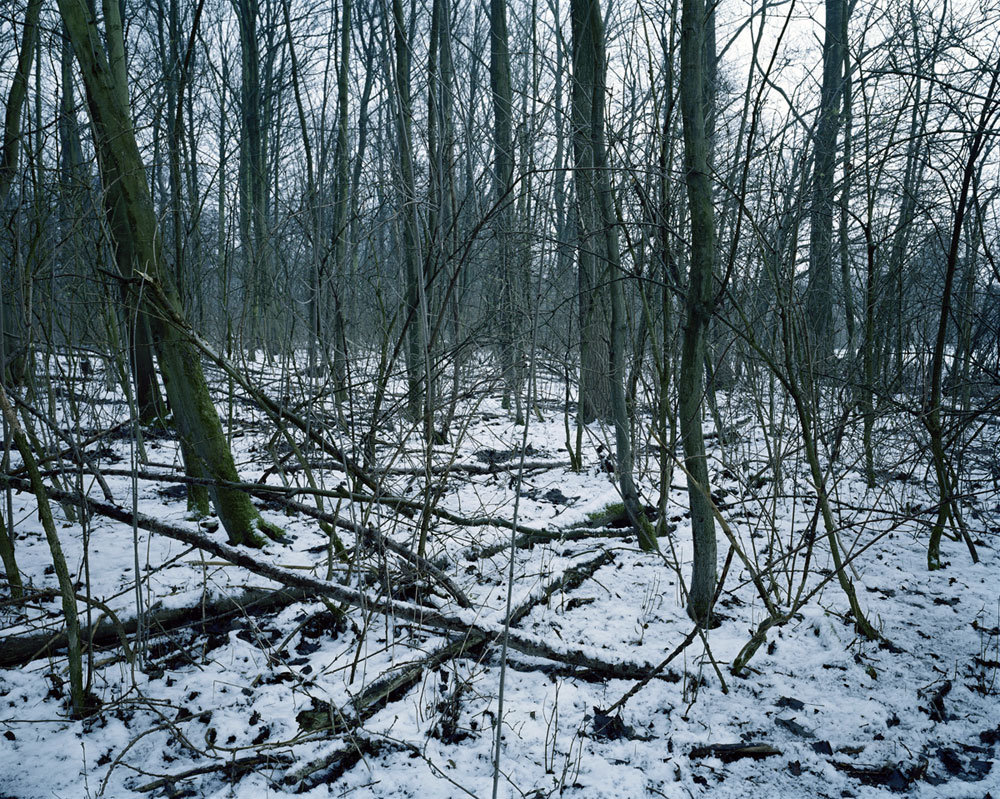
Exhibition: ‘Modern Photographs from the Thomas Walther Collection, 1909-1949’ at the Museum of Modern Art (MoMA), New York

Exhibition dates: 13th December, 2014 – 19th April, 2015

Exhibition coincides with the culmination of the Thomas Walther Collection Project, a four-year research collaboration between MoMA’s curatorial and conservation staff

Co-curators: Quentin Bajac, Chief Curator of Photography, MoMA, and Sarah Hermanson Meister, Curator in the Department of Photography, MoMA


Unknown photographer. 'British 'Chute Jumpers' 1937 from the exhibition Exhibition: 'Modern Photographs from the Thomas Walther Collection, 1909-1949' at the Museum of Modern Art (MoMA), New York, December 2014 - April 2015


Unknown photographer
British ‘Chute Jumpers
1937
Gelatin silver print
5 15/16 x 6 15/16″ (15.1 x 17.6cm)
The Museum of Modern Art, New York
Thomas Walther Collection. Gift of Thomas Walther


OMG, OMG, OMG if we had tele-transportation to travel around the world, I would be at this exhibition in an instant. Please MoMA, fly me to New York so that I can do a proper review of the exhibition!

Not only are there photographs from well known artists that I have never seen before – for example, the brooding mass of Boat, San Francisco (1925) by Edward Weston with the name of the boat… wait for it… ‘DAYLIGHT’ – there are also outstanding photographs from artists that I have never heard of before.

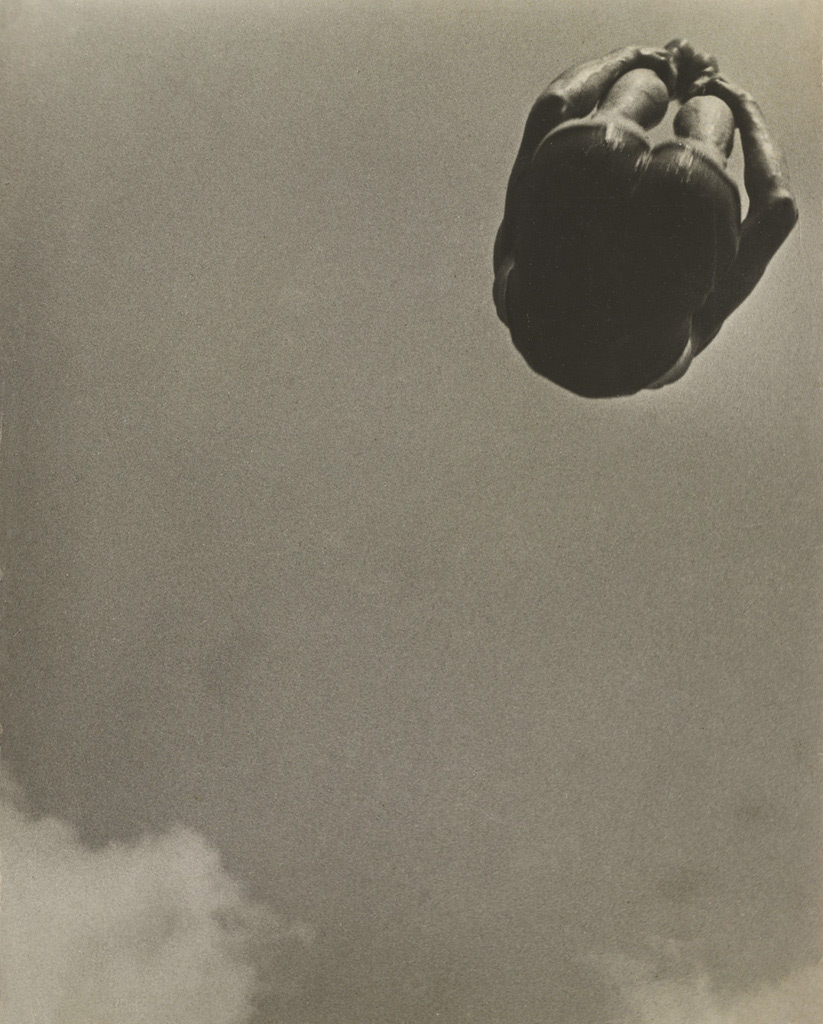
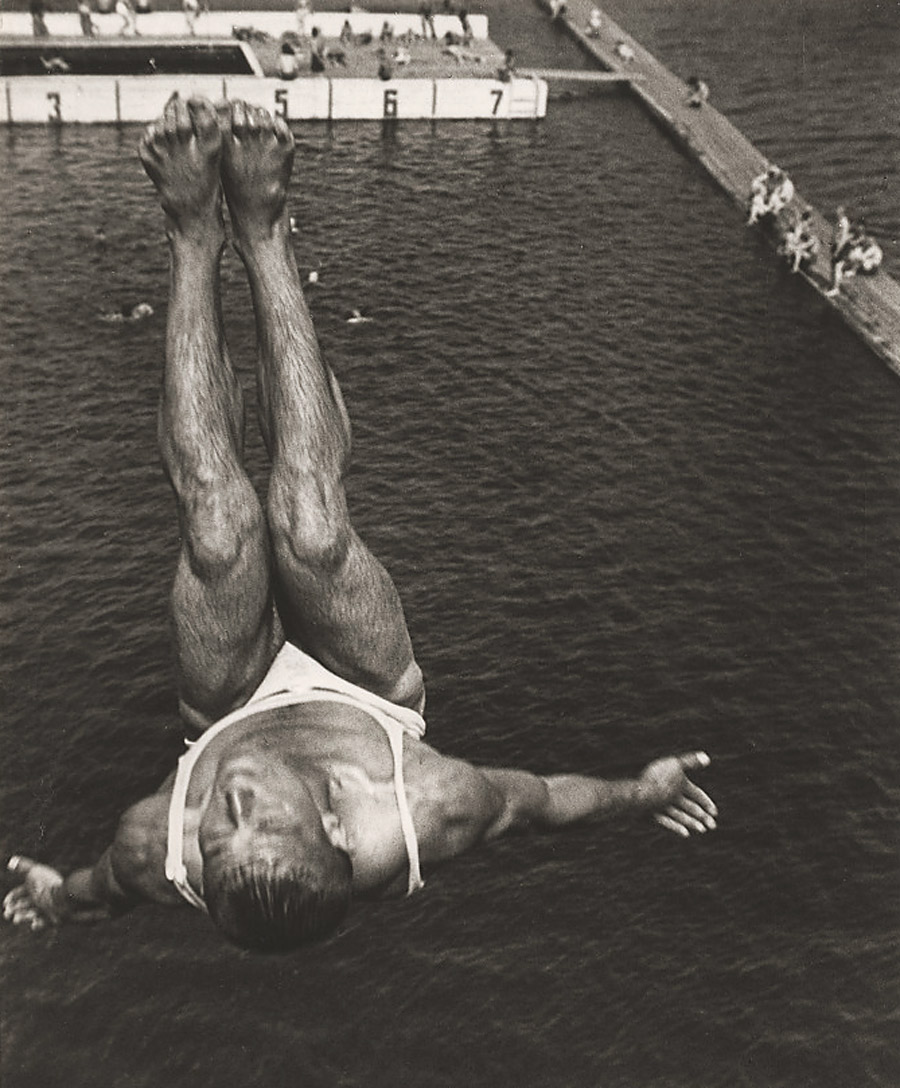
There is so much to like in this monster posting, from the glorious choreography of British ‘Chute Jumpers (1937) to the muscular symmetry and abstraction of Rodchenko’s Dive (1934); from the absolutely stunning light and movement of Riefenstahl’s Nocturnal Start of Decathlon 1,500m Race (August 1936) to the ecstatic, ghost-like swimming in mud apparitions of Kate Steinitz’s Backstroke (1930) – an artist who I knew nothing about (Kate Steinitz was a German-American artist and art historian affiliated with the European Bauhaus and Dadaist movements in the early 20th century. She is best known for her collaborative work with the artist Kurt Schwitters, and, in later life, her scholarship on Leonardo da Vinci). Another artist to flee Germany in the mid-1930s to evade the persecution of the Nazis.

In fact, when I looked through the checklist for this exhibition I observed the country of origin of the artist, and the date of their death. There are a lot of artists from Germany and France. Either they lived through the maelstrom of the Second World War and survived, escaped to America or England, or died during the war and their archive was lost (such as the artist Robert Petschow (German, 1888-1945). For some artists surviving the war was not enough either… trapped behind the Iron Curtain after repatriation, artists such as Edmund Kesting went unacknowledged in their lifetime. What a tough time it must have been. To have created this wonderful avant-garde art and then to have seen it dashed against the rocks of violence, prejudice and bigotry – firstly degenerate, then non-conforming to Communist ideals.

Out of the six sections of the exhibition (The Modern World, Purisms, Reinventing Photography, The Artist’s Life, Between Surrealism and Magic Realism, and Dynamics of the City) it would seem that the section ‘Reinventing Photography’ is the weakest – going from the checklist – with a lack of really memorable images for this section, hence only illustrated in this posting by one image. But this is a minor quibble. When you have images such as Anne W. Brigman’s A Study in Radiation (1924) or Edmund Kesting’s magnificent Glance to the Sun (Blick zur Sonne) (1928) who cares!

I just want to see them all and soak up their atmosphere.

Dr Marcus Bunyan

PS. There is an excellent website titled Object: Photo to accompany the exhibition. It contains sections that map and compare photographs, connect and map artists’ lives along with many more images from the collection, conservation analysis and essays about the works. Well worth a look.


Many thankx to the MoMA for allowing me to publish the photographs and text in the posting. Please click on the photographs for a larger version of the image. All images © The Museum of Modern Art

Note: Images below correspond to their sections in the exhibition.
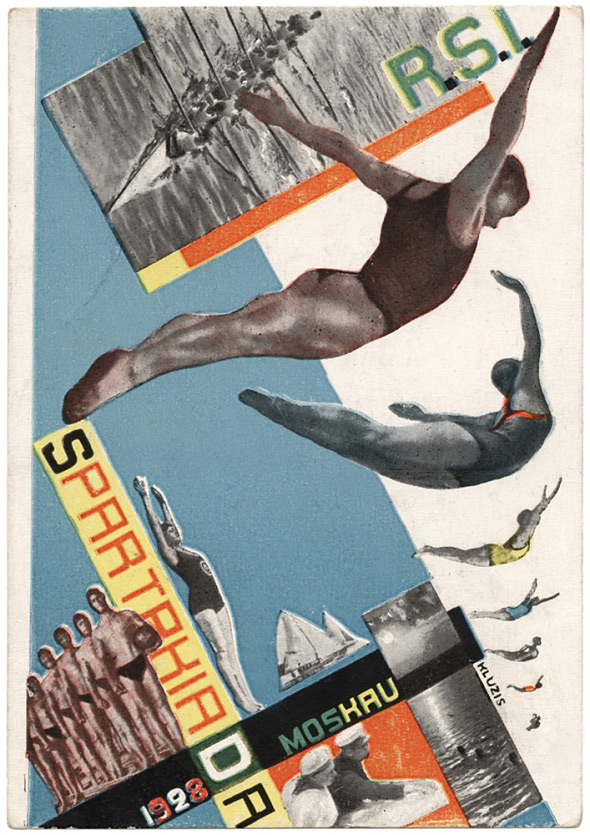


Gustav Klutsis (Latvian, 1895-1938) 'Postcard for the All Union Spartakiada Sporting Event' 1928 from the exhibition Exhibition: 'Modern Photographs from the Thomas Walther Collection, 1909-1949' at the Museum of Modern Art (MoMA), New York, December 2014 - April 2015


Gustav Klutsis (Latvian, 1895-1938)
Postcard for the All Union Spartakiada Sporting Event
1928
Offset lithograph
5 3/4 x 4 1/8″ (14.1 x 10.5cm)
The Museum of Modern Art, New York


Gustav Klutsis (Latvian, 1895-1938) 'Postcard for the All Union Spartakiada Sporting Event' 1928


Gustav Klutsis (Latvian, 1895-1938)
Postcard for the All Union Spartakiada Sporting Event
1928
Offset lithograph
5 3/4 x 4 1/8″ (14.1 x 10.5cm)
The Museum of Modern Art, New York
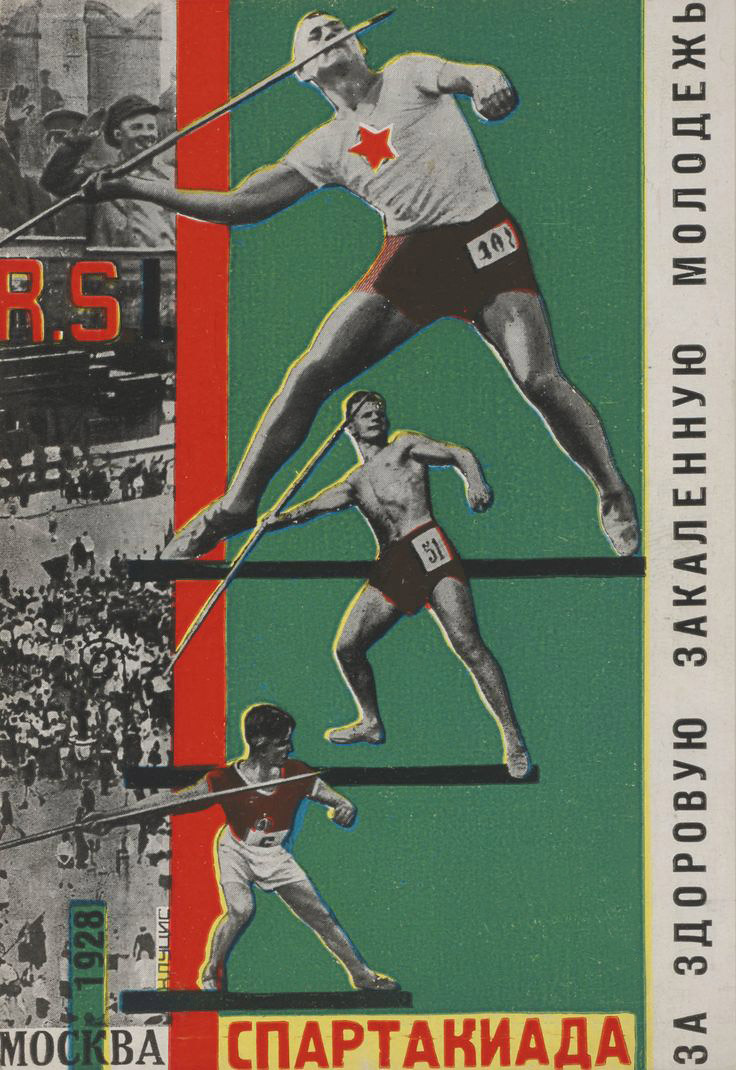
 

Gustav Klutsis (Latvian, 1895-1938) 'Postcard for the All Union Spartakiada Sporting Event' 1928


Gustav Klutsis (Latvian, 1895-1938)
Postcard for the All Union Spartakiada Sporting Event
1928
Offset lithograph
5 3/4 x 4 1/8″ (14.1 x 10.5cm)
The Museum of Modern Art, New York


Gustav Klutsis (Latvian, 1895-1938)

Latvian painter, sculptor, graphic artist, designer and teacher, active in Russia. He was an important exponent of Russian Constructivism. He studied in Riga and Petrograd (now St Petersburg), but in the 1917 October Revolution joined the Latvian Rifle Regiment to defend the Bolshevik government; his sketches of Lenin and his fellow soldiers show Cubist influence. In 1918 he designed posters and decorations for the May Day celebrations and he entered the Free Art Studios (Svomas) in Moscow, where he studied with Malevich and Antoine Pevsner. Dynamic City (1919; Athens, George Costakis priv. col., see Rudenstine, no. 339) illustrates his adoption of the Suprematist style. In 1920 Klucis exhibited with Pevsner and Naum Gabo on Tver’skoy Boulevard in Moscow; in the same year Klucis joined the Communist Party. In 1920-21 he started experimenting with materials, making constructions from wood and paper that combined the geometry of Suprematism with a more Constructivist concern with actual volumes in space. In 1922 Klucis applied these experiments to utilitarian ends when he designed a series of agitprop stands based on various combinations of loudspeakers, speakers’ platforms, display units, film projectors and screens. He taught a course on colour in the Woodwork and Metalwork Faculty of the Vkhutemas (Higher Artistic and Technical Workshops) from 1924 to 1930, and in 1925 helped to organise the Soviet section at the Exposition Internationale des Arts Décoratifs et Industriels Modernes in Paris. During the 1920s he became increasingly interested in photomontage, using it in such agitprop posters as ‘We will repay the coal debt to the country’ (1928; e.g. New York, MoMA). During the 1930s he worked on graphic and typographical design for periodicals and official publications. He was arrested and died during the purges in World War II.

From Grove Art Online
© 2009 Oxford University Press


Gustav Klutsis (Latvian, 1895-1938) 'Postcard for the All Union Spartakiada Sporting Event' 1928


Gustav Klutsis (Latvian, 1895-1938)
Postcard for the All Union Spartakiada Sporting Event
1928
Offset lithograph
5 3/4 x 4 1/8″ (14.1 x 10.5cm)
The Museum of Modern Art, New York


Modern Photographs from the Thomas Walther Collection, 1909-1949, on view from December 13, 2014, to April 19, 2015, explores photography between the First and Second World Wars, when creative possibilities were never richer or more varied, and when photographers approached figuration, abstraction, and architecture with unmatched imaginative fervour. This vital moment is dramatically captured in the photographs that constitute the Thomas Walther Collection, a remarkable group of works presented together for the first time through nearly 300 photographs. Made on the street and in the studio, intended for avant-garde exhibitions or the printed page, these objects provide unique insight into the radical intentions of their creators. Iconic works by such towering figures as Berenice Abbott, Karl Blossfeldt, Alvin Langdon Coburn, El Lissitzky, Lucia Moholy, László Moholy-Nagy, Aleksandr Rodchenko, and Paul Strand are featured alongside lesser-known treasures by more than 100 other practitioners. The exhibition is organised by Quentin Bajac, the Joel and Anne Ehrenkranz Chief Curator of Photography, and Sarah Hermanson Meister, Curator, Department of Photography, MoMA.

The exhibition coincides with Object: Photo. Modern Photographs: The Thomas Walther Collection 1909-1949, the result of a four-year collaborative project between the Museum’s departments of Photography and Conservation, with the participation of over two dozen leading international photography scholars and conservators, making it the most extensive effort to integrate conservation, curatorial, and scholarly research efforts on photography to date. That project is composed of multiple parts including a website that features a suite of digital-visualisation research tools that allow visitors to explore the collection, a hard-bound paper catalogue of the entire Thomas Walther collection, and an interdisciplinary symposium focusing on ways in which the digital age is changing our engagement with historic photographs.

Modern Photographs from the Thomas Walther Collection, 1909-1949, is organised thematically into six sections, suggesting networks between artists, regions, and objects, and highlighting the figures whose work Walther collected in depth, including André Kertész, Germaine Krull, Franz Roh, Willi Ruge, Maurice Tabard, Umbo, and Edward Weston. Enriched by key works in other mediums from MoMA’s collection, this exhibition presents the exhilarating story of a landmark chapter in photography’s history.”

Press release from the MoMA website


The Collection

In the 1920s and ’30s photography underwent a period of exploration, experimentation, technical innovation, and graphic discovery so dramatic that it generated repeated claims that the true age of discovery was not when photography was invented but when it came of age, in this era, as a dynamic, infinitely flexible, and easily transmissible medium. The Thomas Walther Collection concentrates on that second moment of growth. The Walther Collection’s 341 photographs by almost 150 artists, most of them European, together convey a period of collective innovation that is now celebrated as one of the major episodes of modern art.

The Project

Our research is based on the premise that photographs of this period were not born as disembodied images; they are physical things – discrete objects made by certain individuals at particular moments using specific techniques and materials. Shaped by its origin and creation, the photographic print harbours clues to its maker and making, to the causes it may have served, and to the treatment it has received, and these bits of information, gathered through close examination of the print, offer fresh perspectives on the history of the era. “Object: Photo” – the title of this study – reflects this approach.

In 2010, the Andrew W. Mellon Foundation gave the Museum a grant to encourage deep scholarly study of the Walther Collection and to support publication of the results. Led by the Museum’s Departments of Photography and Conservation, the project elicited productive collaborations among scholars, curators, conservators, and scientists, who investigated all of the factors involved in the making, appearance, condition, and history of each of the 341 photographs in the collection. The broadening of narrow specialisations and the cross-fertilisation between fields heightened appreciation of the singularity of each object and of its position within the history of its moment. Creating new standards for the consideration of photographs as original objects and of photography as an art form of unusually rich historical dimensions, the project affords both experts and those less familiar with its history new avenues for the appreciation of the medium. The results of the project are presented in multiple parts: on the website, in a hard-bound paper catalogue of the entire Thomas Walther Collection (also titled Object: Photo), and through an interdisciplinary symposium focusing on the ways in which the digital age is changing our engagement with historic photographs.

Historical Context

The Walther Collection is particularly suited to such a study because its photographs are so various in technique, geography, genre, and materials as to make it a mine of diverse data. The revolutions in technology that made the photography of this period so flexible and responsive to the impulse of the operator threw open the field to all comers. The introduction of the handheld Leica
 in 1925 (a small camera using strips of 35mm motion-picture film), of enlargers to make positive prints from the Leica’s little negatives, and of easy-to-use photographic papers – each of these was respectively a watershed event. Immediately sensing the potential of these tools, artists began to explore the medium; without any specialised training, painters such as László Moholy-Nagy and Aleksandr Rodchenko could become photographers and teachers almost overnight. Excitedly and with an open sense of possibility, they freely experimented in the darkroom and in the studio, producing negative prints, collages and photomontages, photograms, solarisations, and combinations of these. Legions of serious amateurs also began to photograph, and manufacturers produced more types of cameras with different dimensions and capacities: besides the Leica, there was the Ermanox, which could function in low light, motion-picture cameras that could follow and stop action, and many varieties of medium- and larger-format cameras that could be adapted for easy transport. The industry responded to the expanding range of users and equipment with a bonanza of photographic papers in an assortment of textures, colours, and sizes. Multiple purposes also generated many kinds of prints: best for reproduction in books or newspapers were slick, ferrotyped glossies, unmounted and small enough to mail, while photographs for exhibition were generally larger and mounted to stiff boards. Made by practitioners ranging from amateurs to professional portraitists, journalists, illustrators, designers, critics, and artists of all stripes, the pictures in the Walther Collection are a true representation of the kaleidoscopic multiplicity of photography in this period of diversification.

Text from the MoMA website
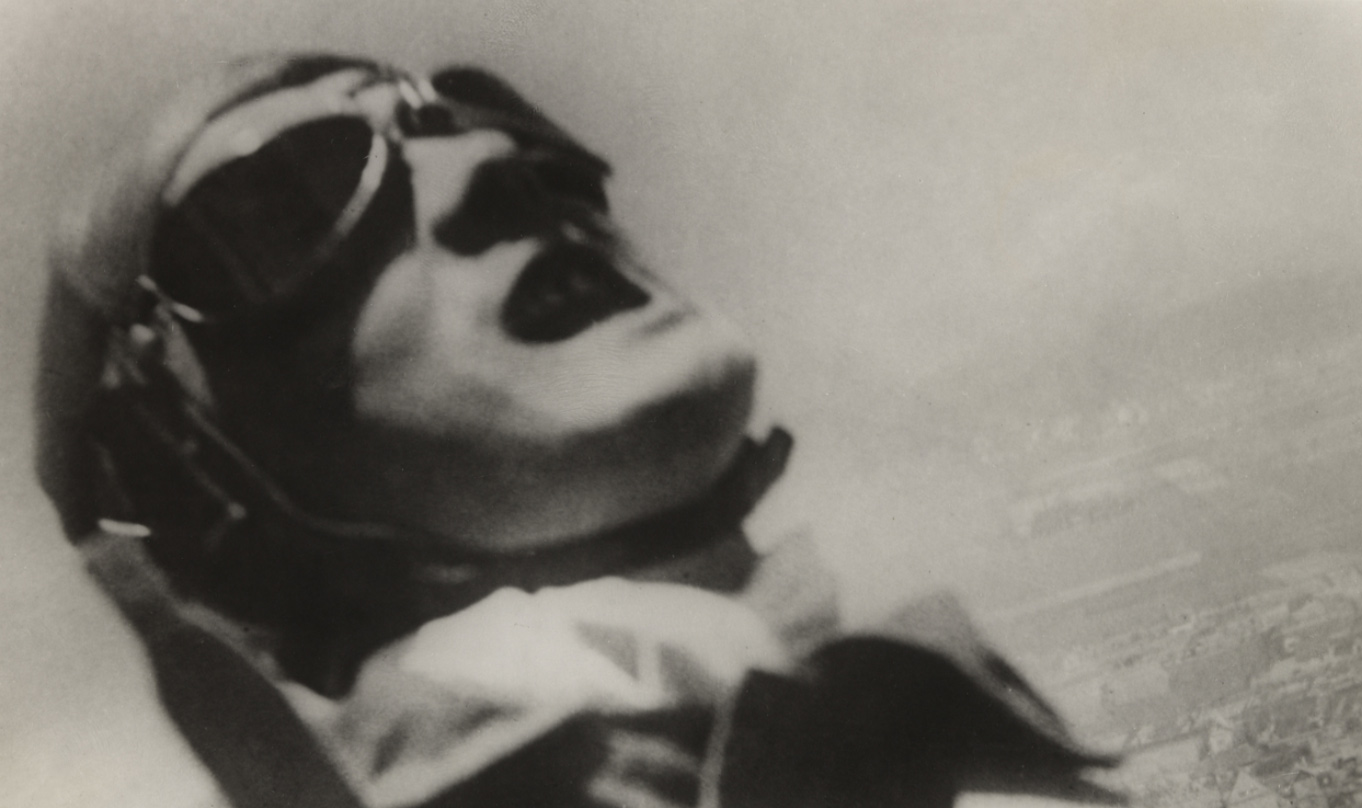
 

Willi Ruge (German, 1882-1961) 'Photo of Myself at the Moment of My Jump' (Selbstfoto im Moment des Abspringens) 1931


Willi Ruge (German, 1882-1961)
Photo of Myself at the Moment of My Jump (Selbstfoto im Moment des Abspringens)
1931
Gelatin silver print
5 9/16 × 8 1/16″ (14.2 × 20.4cm)
The Museum of Modern Art, New York
Thomas Walther Collection. Gift of Thomas Walther
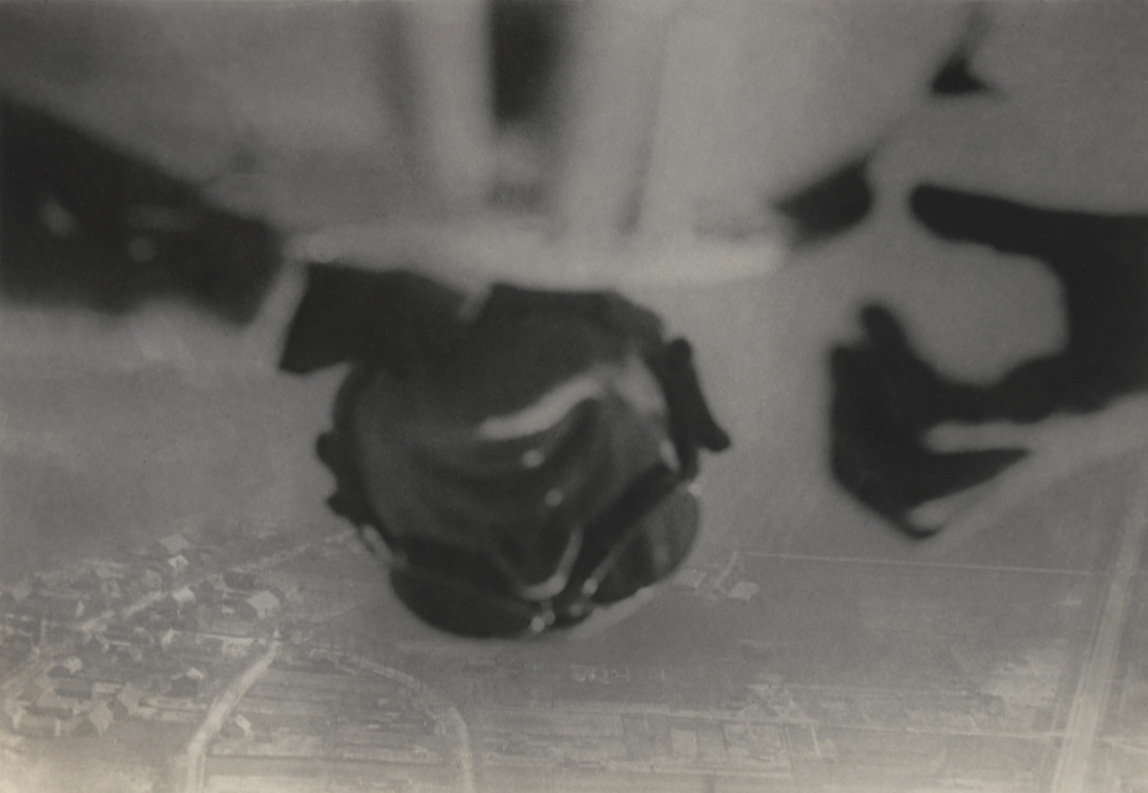
 

Willi Ruge (German, 1882-1961) 'With My Head Hanging Down before the Parachute Opened...' (Mit dem Kopf nach unten hängend, bei ungeöffnetem Fallschirm...) 1931


Willi Ruge (German, 1882-1961)
With My Head Hanging Down before the Parachute Opened . . .
(Mit dem Kopf nach unten hängend, bei ungeöffnetem Fallschirm . . .)
1931
Gelatin silver print
5 1/2 × 8″ (14 × 20.3cm)
The Museum of Modern Art, New York
Thomas Walther Collection. Gift of Thomas Walther


Willi Ruge (German, 1882-1961) 'Seconds before Landing' (Sekunden vor der Landung) 1931


Willi Ruge (German, 1882-1961)
Seconds before Landing (Sekunden vor der Landung)
From the series I Photograph Myself during a Parachute Jump (Ich fotografiere mich beim Absturz mit dem Fallschirm)
1931
Gelatin silver print
8 1/16 × 5 9/16″ (20.4 × 14.1cm) (irreg.)
The Museum of Modern Art, New York
Thomas Walther Collection. Gift of Thomas Walther
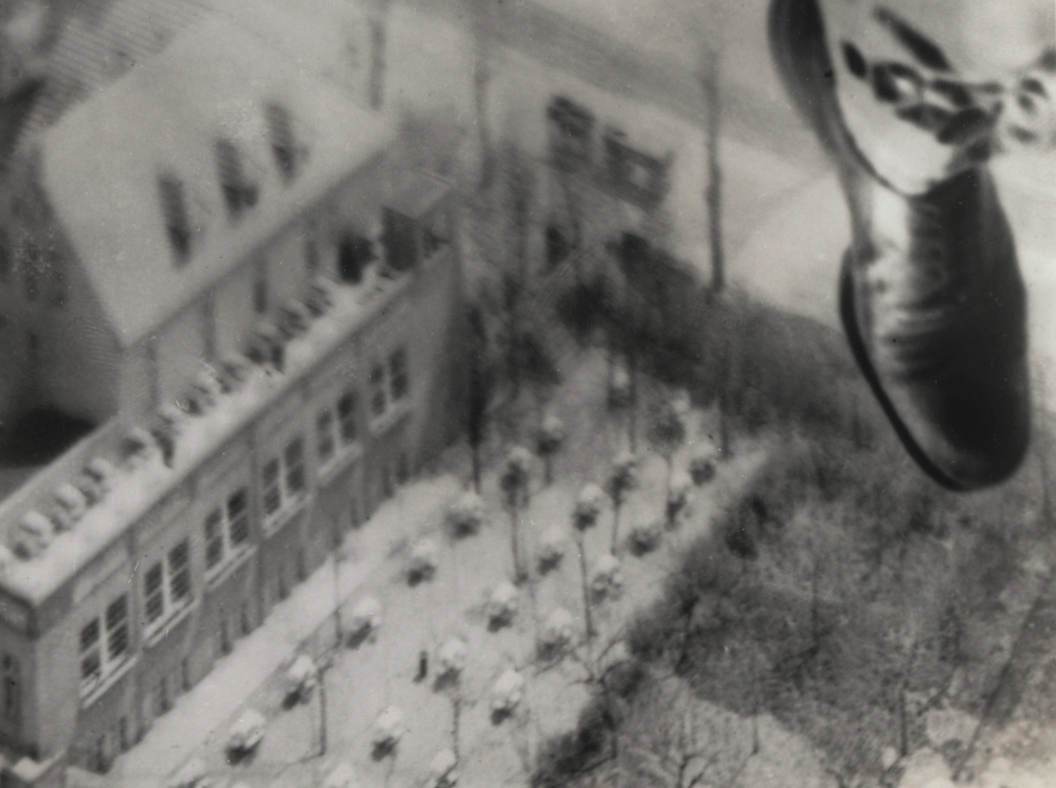
 

Willi Ruge (German, 1882-1961) 'Seconds before Landing' (Sekunden vor der Landung) 1931 (detail)


Willi Ruge (German, 1882-1961)
Seconds before Landing (Sekunden vor der Landung) (detail)
From the series I Photograph Myself during a Parachute Jump (Ich fotografiere mich beim Absturz mit dem Fallschirm)
1931
Gelatin silver print
8 1/16 × 5 9/16″ (20.4 × 14.1cm) (irreg.)
The Museum of Modern Art, New York
Thomas Walther Collection. Gift of Thomas Walther
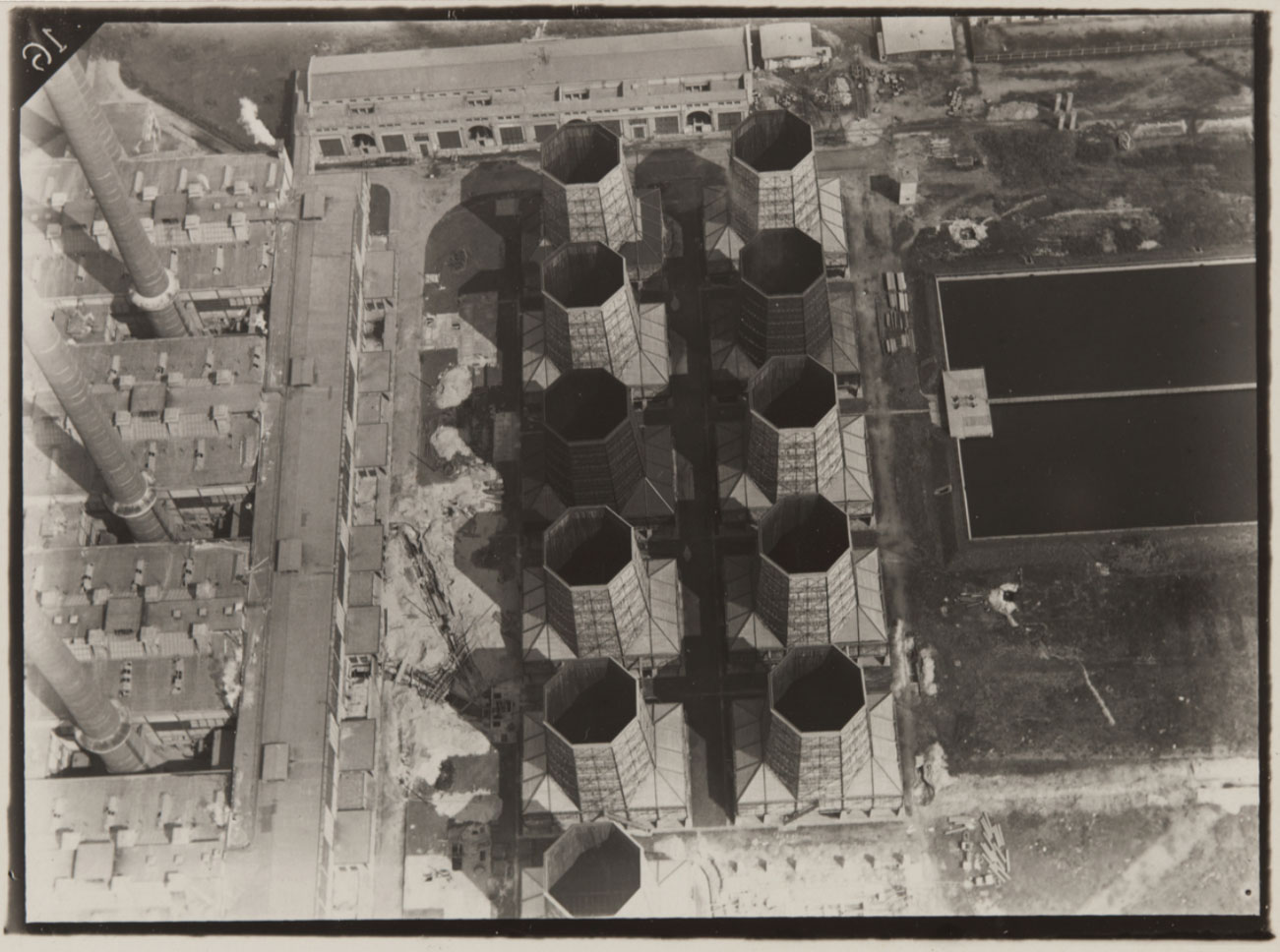
 

Robert Petschow (German, 1888-1945) 'Lines of Modern Industry: Cooling Tower' (Linien der modernen Industrie: Kühlturmanlage) 1920-1929


Robert Petschow (German, 1888-1945)
Lines of Modern Industry: Cooling Tower (Linien der modernen Industrie: Kühlturmanlage)
1920-29
Gelatin silver print
3 3/8 × 4 1/2″ (8.5 × 11.5cm)
The Museum of Modern Art, New York
Thomas Walther Collection. Gift of Albert Renger-Patzsch, by exchange
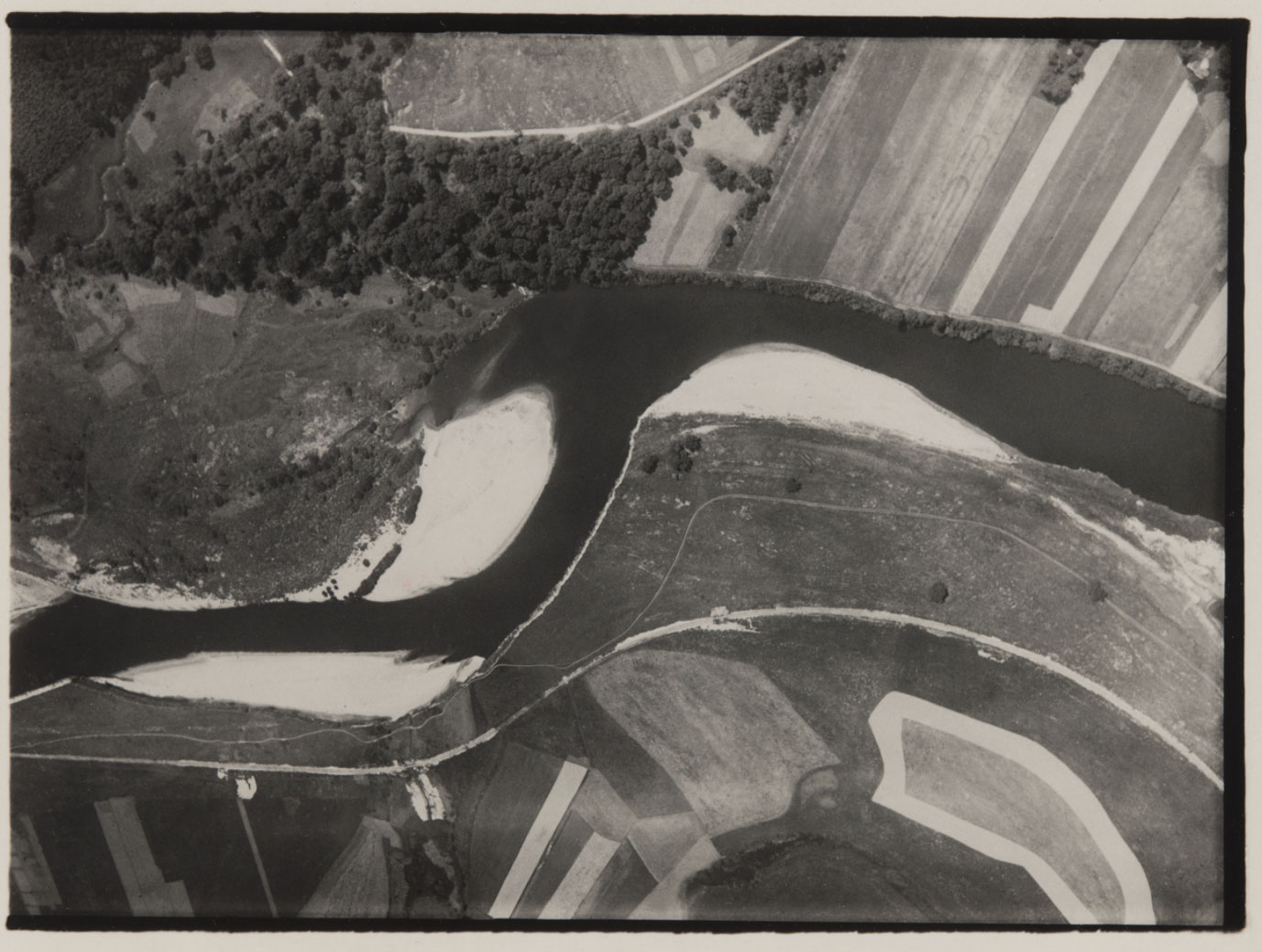
 

Robert Petschow (German, 1888-1945) 'The Course of the Mulde with Sand Deposits in the Curves' (Der Lauf der Mulde mit Versandungen in den Windungen) 1920-1933


Robert Petschow (German, 1888-1945)
The Course of the Mulde with Sand Deposits in the Curves (Der Lauf der Mulde mit Versandungen in den Windungen)
1920-33
Gelatin silver print
3 3/8 × 4 1/2″ (8.5 × 11.5cm)
The Museum of Modern Art, New York
Thomas Walther Collection. Gift of Albert Renger-Patzsch, by exchange


Robert Petschow (German, 1888-1945)

Robert Petschow was studying in Danzig as a free balloon pilot in the West Prussian air force. During the First World War Petschow was a balloon observer with the rank of lieutenant in Poland, France and Belgium. Maybe it was the work of a balloon observer which led him to photography, in which he was worked freelance from 1920. His images appeared in the prestigious photographic yearbook The German photograph in which he was presented with photographers such as Karl Blossfeldt, Albert Renger-Patzsch Chargesheimer and Erich Salomon. The book Land of the Germans, which was published in 1931 by Robert Diesel and includes many photographs of Petschow went on to be published in four editions. In 1931 he journeyed with the airship LZ 127, the “Graf Zeppelin” to Egypt. He participated as an unofficial member of the crew to document the trip photographically. In 1936, at the age of 48 years, Petschow joined the rank of captain in the Air Force and ended his work as a senior editor at the daily newspaper The West, a position he held from 1930. For the following years, there is no information to Petschow.

Robert Petschow died at the age of 57 years on 17 October 1945 in Haldensleben after he had to leave his apartment in Berlin-Steglitz due to the war. He left there a picture archive with about 30,000 aerial photographs, which fell victim of the war. His contemporaries describe Petschow as a humorous person and a great raconteur.

Translated from the German Wikipedia website by Google Translate
 

Aleksandr Rodchenko (Russian, 1891-1956) 'Dive' (Pryzhok v vodu) 1934


Aleksandr Rodchenko (Russian, 1891-1956)
Dive (Pryzhok v vodu)
1934
Gelatin silver print
11 11/16 x 9 3/8″ (29.7 x 23.8cm)
The Museum of Modern Art, New York
Thomas Walther Collection. Gift of Shirley C. Burden, by exchange
 

Aleksandr Rodchenko (Russian, 1891-1956) 'Dive' (Pryzhok v vodu) 1934


Aleksandr Rodchenko (Russian, 1891-1956)
Dive (Pryzhok v vodu)
1934
Gelatin silver print
11 3/4 × 9 5/16″ (29.9 × 23.6cm)
The Museum of Modern Art, New York
Thomas Walther Collection. Gift of Shirley C. Burden, by exchange


Leni Riefenstahl (German, 1902-2003) 'Nocturnal Start of Decathlon 1,500m Race' (Nächtlicher Start zum 1500-m-Lauf des Zehnkampfes) August 1936


Leni Riefenstahl (German, 1902-2003)
Nocturnal Start of Decathlon 1,500m Race
(Nächtlicher Start zum 1500-m-Lauf des Zehnkampfes)

August 1936
Gelatin silver print 9 5/16 x 11 3/4″ (23.7 x 29.8cm)
The Museum of Modern Art, New York
Thomas Walther Collection. Abbott-Levy Collection funds, by exchange
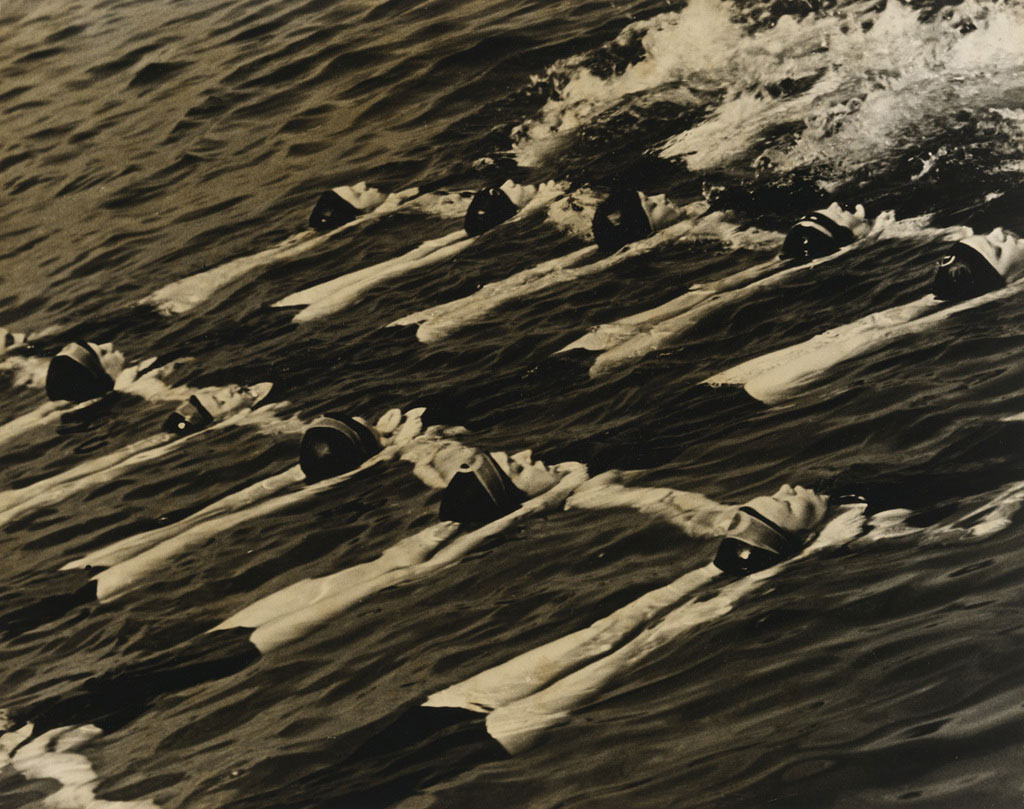
 

Leni Riefenstahl (German, 1902-2003) 'Untitled' 1936


Leni Riefenstahl (German, 1902-2003)
Untitled
1936
Gelatin silver print
9 3/16 x 11 5/8″ (23.4 x 29.5cm)
The Museum of Modern Art, New York
Thomas Walther Collection. Abbott-Levy Collection funds, by exchange


Kate Steinitz (American born Germany, 1889-1975) 'Backstroke' (Rückenschwimmerinnen) 1930


Kate Steinitz (American born Germany, 1889-1975)
Backstroke (Rückenschwimmerinnen)
1930
Gelatin silver print
10 1/2 × 13 7/16″ (26.6 × 34.1cm)
The Museum of Modern Art, New York
Thomas Walther Collection. Gift of Thomas Walther


The Modern World

Even before the introduction of the handheld Leica camera in 1925, photographers were avidly exploring fresh perspectives, shaped by the unique experience of capturing the world through a lens and ideally suited to express the tenor of modern life in the wake of World War I. Looking up and down, these photographers found unfamiliar points of view that suggested a new, dynamic visual language freed from convention. Improvements in the light sensitivity of photographic films and papers meant that photographers could capture motion as never before. At the same time, technological advances in printing resulted in an explosion of opportunities for photographers to present their work to ever-widening audiences. From inexpensive weekly magazines to extravagantly produced journals, periodicals exploited the potential of photographs and imaginative layouts, not text, to tell stories. Among the photographers on view in this section are Martin Munkácsi (American, born Hungary, 1896-1963), Leni Riefenstahl (German, 1902-2003), Aleksandr Rodchenko (Russian, 1891-1956), and Willi Ruge (German, 1882-1961).
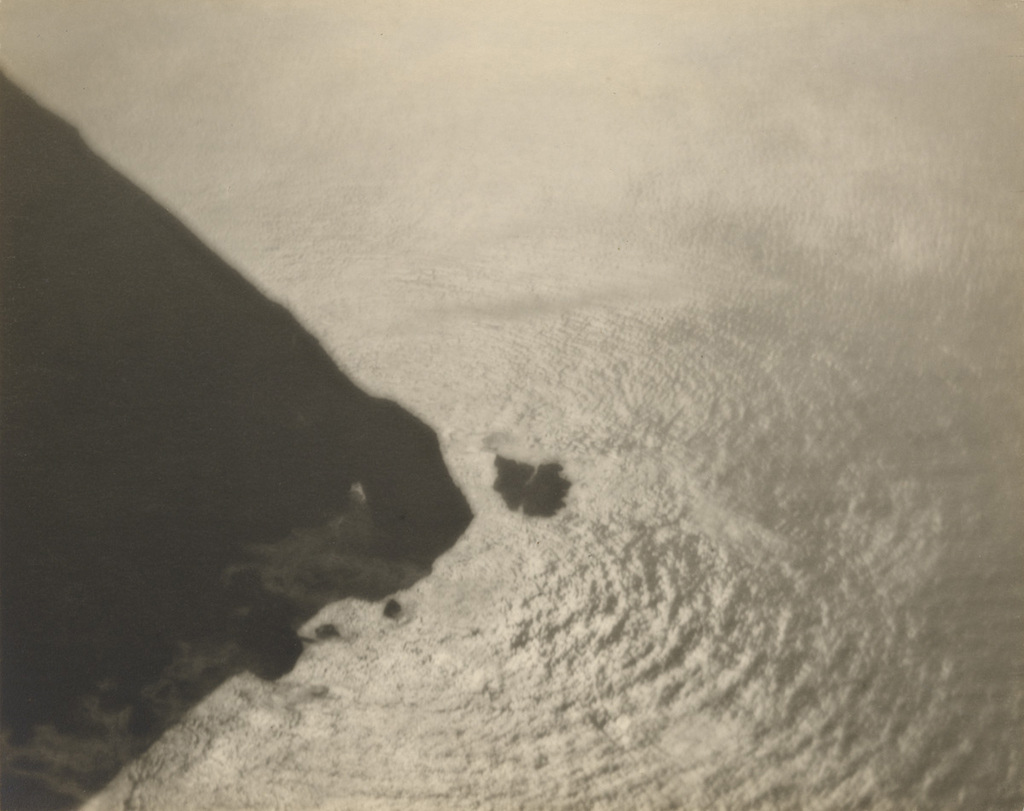
 

Anne W. Brigman (American born Hawaii, 1869-1950) 'A Study in Radiation' 1924


Anne W. Brigman (American born Hawaii, 1869-1950)
A Study in Radiation
1924
Gelatin silver print
7 11/16 × 9 3/4″ (19.6 × 24.8cm)
The Museum of Modern Art, New York
Thomas Walther Collection. Gift of Mrs. B. S. Sexton and Mina Turner, by exchange
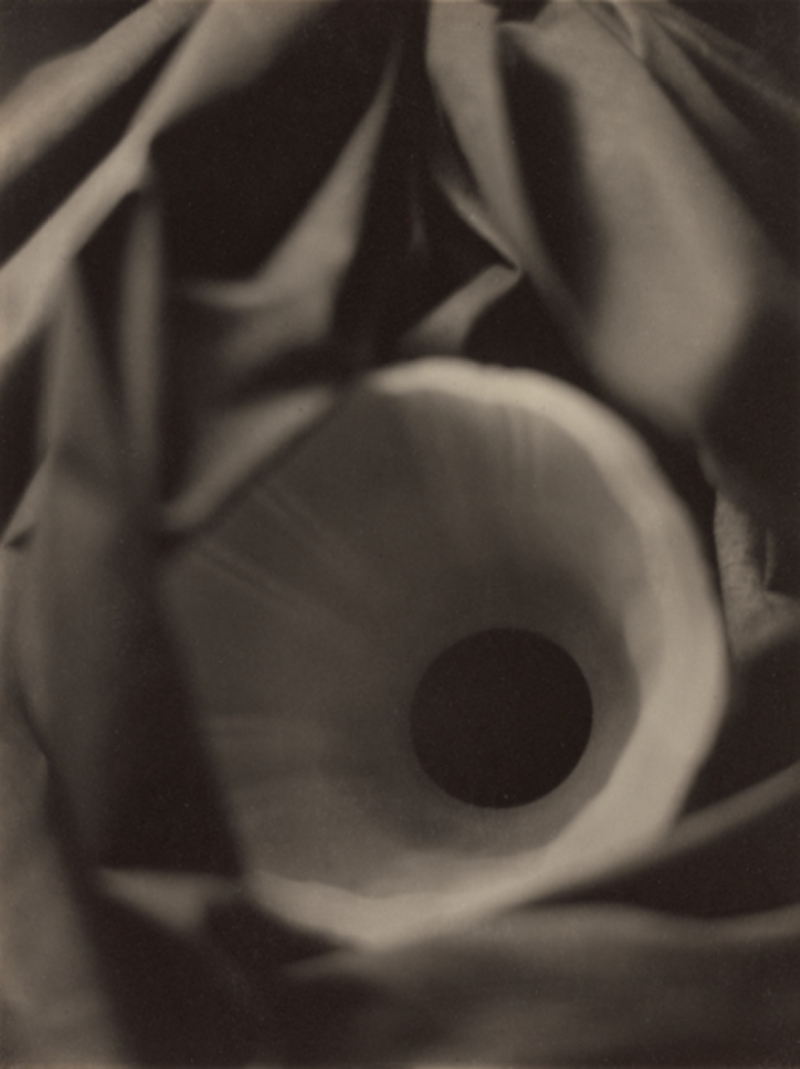
 

Bernard Shea Horne (American, 1867-1933) 'Untitled' 1916-1917


Bernard Shea Horne (American, 1867-1933)
Untitled
1916-17
Platinum print
8 1/16 × 6 1/8″ (20.5 × 15.5cm)
The Museum of Modern Art, New York
Thomas Walther Collection. Gift of Thomas Walther
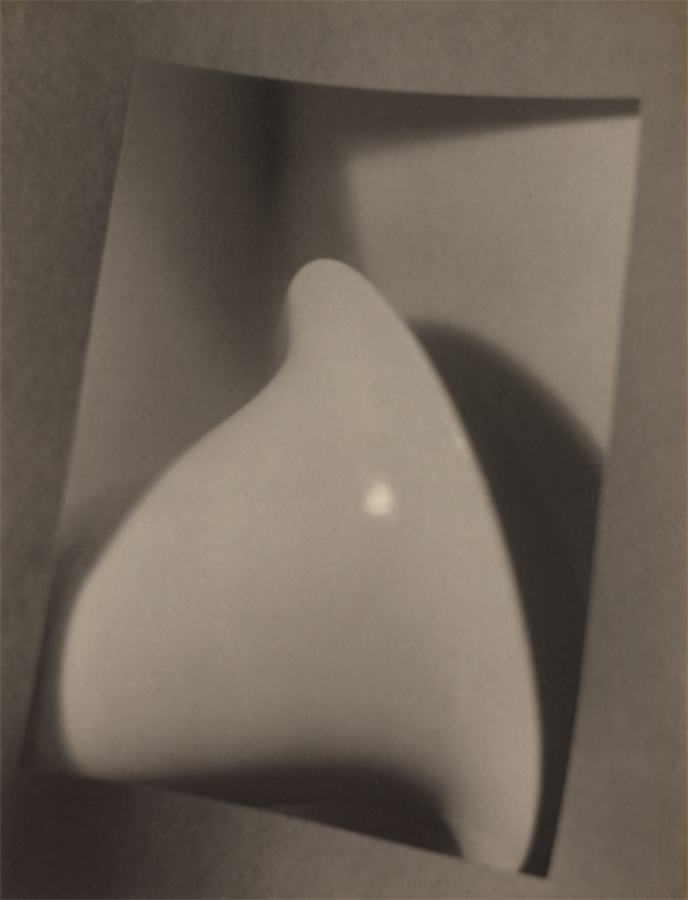
 

Bernard Shea Horne (American, 1867-1933) 'Design' 1916-1917


Bernard Shea Horne (American, 1867-1933)
Design
1916-1917
Platinum print
7 15/16 x 6 1/8″ (20.2 x 15.5cm)
The Museum of Modern Art, New York
Thomas Walther Collection. Gift of Thomas Walther


Bernard Shea Horne (American, 1867-1933)

Bernard Shea Horne was the son of Joseph Horne, who built a legendary department store in Pittsburgh. The younger Horne retired from the family business when he was in his thirties and moved to northern Virginia to pursue his interests in golf and photography. In 1916 he enrolled at the Clarence H. White School of Photography, in New York, and became friends with one of its teachers, the avant-garde painter Max Weber. Horne produced numerous Weber-inspired design exercises, which he compiled into albums of twenty Platinum prints each. The four prints in the Thomas Walther Collection belonged to an album that he gave to Weber.

In 1917 Horne was elected president of the White School’s alumni association, a post he retained until 1925. In 1918 instructor Paul L. Anderson left the school, and Horne took his place as teacher of the technique class, a job he held until 1926. That a middle-aged man of independent means commuted to the school several days a week from Princeton, New Jersey, where he then lived with his two sons, suggests Horne’s devotion to White and his Pictorialist aims. During these years, Horne played a major role in the White School’s activities. In 1920 he was given a one-person show in the exhibition room of the school’s new building, a show that the alumni bulletin described as “interesting and varied in subject and technique, rich in bromoils, strong in design.” Supportive of the practical applications of artistic photography, in 1920 White joined his school to other institutions, including the American Institute of Graphic Arts and the Art Directors Club, to form The Art Center in New York. In 1926 Horne was given a one-person show at The Art Center, which marked the end of his active association with the school.

Abbaspour, Mitra, Lee Ann Daffner, and Maria Morris Hambourg
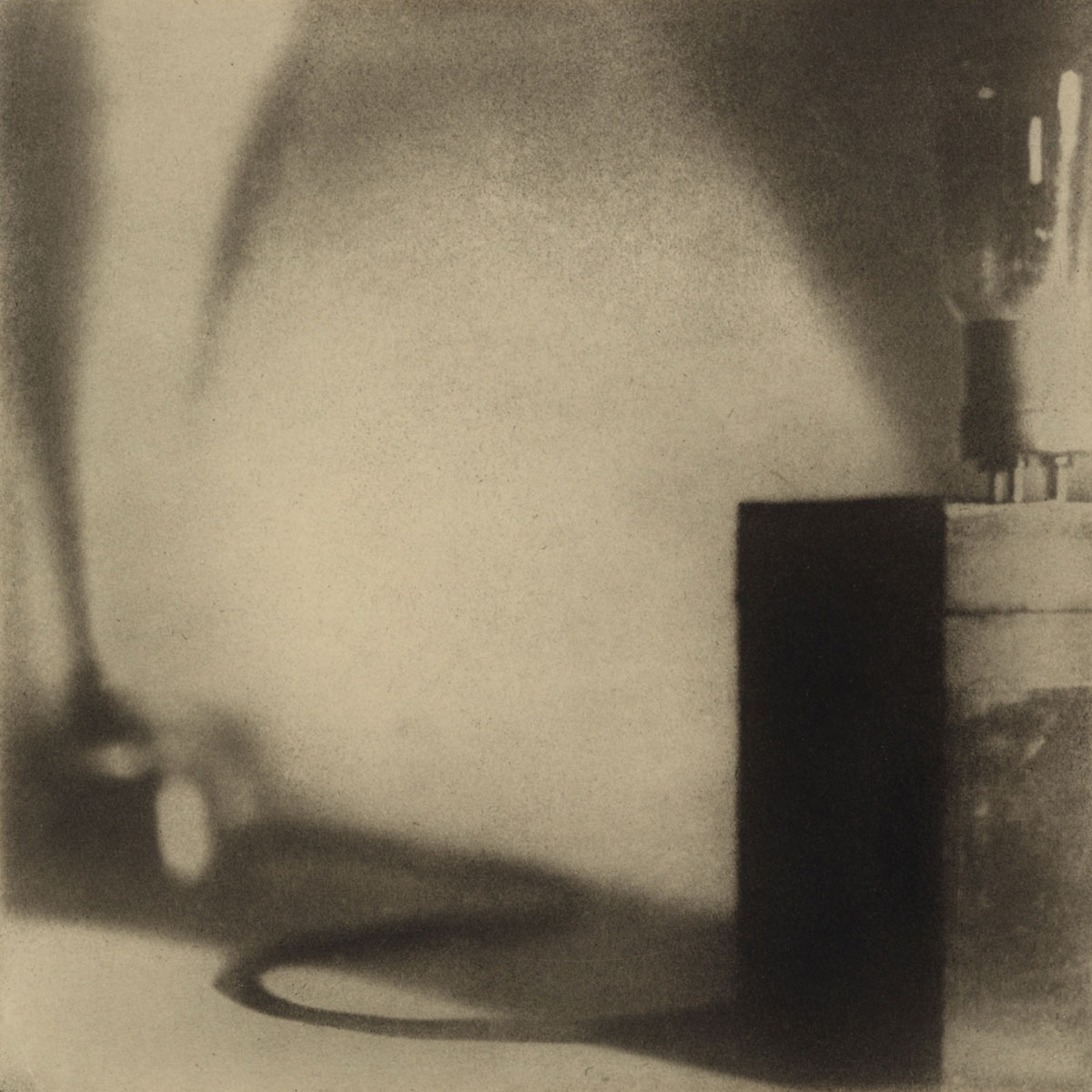
 

Jarislav Rössler (Czech, 1902-1990) 'Untitled' 1924


Jarislav Rössler (Czech, 1902-1990)
Untitled
1924
Pigment print
9 1/16 × 9 1/16″ (23 × 23 cm)
The Museum of Modern Art, New York
Thomas Walther Collection. Horace W. Goldsmith Fund through Robert B. Menschel


Jarislav Rössler (Czech, 1902-1990)

Jaroslav Rössler (1902-1990) was one of the Czech avant-garde photographers of the first half of the twentieth century whose work has only recently become known outside Eastern Europe. Czech photography in the twenties and thirties produced radical modernist works that incorporated principles of abstract art and constructivism; Jaroslav Rossler was one of the most important and distinctive artists of the period. He became known for his fusing of different styles, bringing together elements of Symbolism, Pictorialism, Expressionism, Cubism, Futurism, Constructivism, New Objectivity, and abstract art. His photographs often reduced images to elementary lines and shapes that seemed to form a new reality; he would photograph simple objects against a stark background of black and white, or use long exposures to picture hazy cones and spheres of light. From 1927 to 1935 he lived and worked in Paris, producing work influenced by constructivism and new objectivity. He used the photographic techniques and compositional approaches of the avant-garde, including photograms, large details, diagonal composition, photomontage, and double exposures, and experimented with colour advertising photographs and still lifes produced with the carbro print process. After his return to Prague, he was relatively inactive until the late 1950s, when he reconnected with Czech artistic and photographic trends of that period, including informalism. This book documents each stage of Rossler’s career with a generous selection of duotone images, some of which have never been published before. The photographs are accompanied by texts by Vladimir Birgus, Jan Mlcoch, Robert Silverio, Karel Srp, and Matthew Witkovsky.

Text from the Amazon website
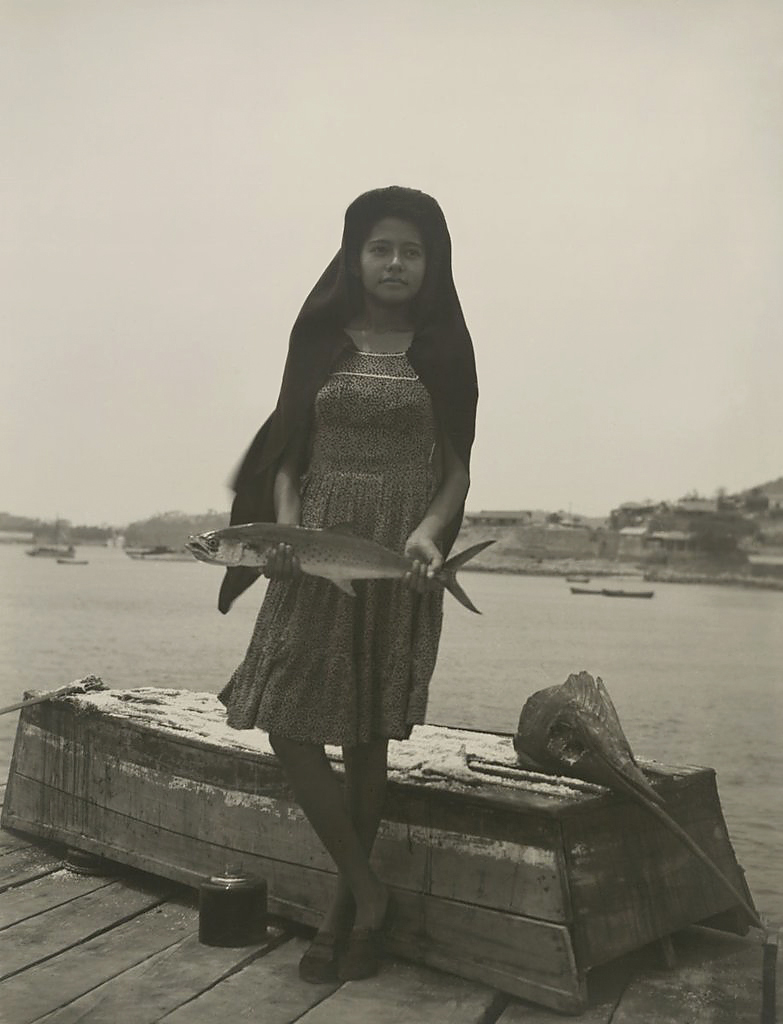
 

Manuel Álvarez Bravo (Mexican, 1902-2002) 'A Fish Called Sierra' (Un pez que llaman sierra) 1944


Manuel Álvarez Bravo (Mexican, 1902-2002)
A Fish Called Sierra (Un pez que llaman sierra)
1944
Gelatin silver print
9 1/2 x 7 1/4″ (24.1 x 18.4cm)
The Museum of Modern Art, New York
Thomas Walther Collection
Edward Steichen Estate and gift of Mrs. Flora S. Straus, by exchange
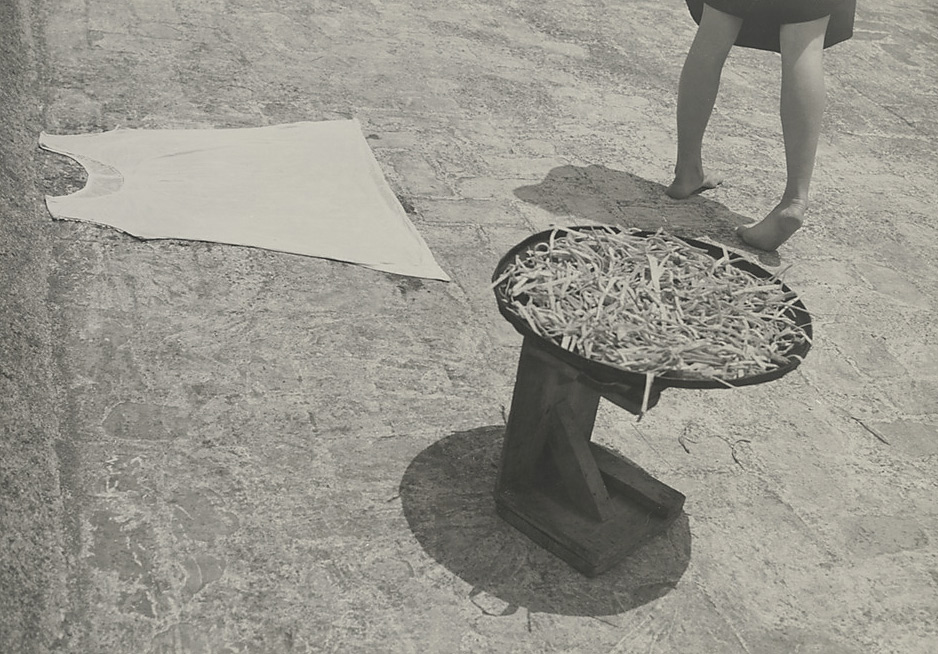
 

Manuel Alvarez Bravo (Mexican, 1902-2002) 'Somewhat Gay and Graceful' (Un poco alegre y graciosa) 1942


Manuel Alvarez Bravo (Mexican, 1902-2002)
Somewhat Gay and Graceful (Un poco alegre y graciosa)
1942
Gelatin silver print
6 5/8 × 9 1/2″ (16.9 × 24.2cm)
The Museum of Modern Art, New York
Thomas Walther Collection. Grace M. Mayer Fund


Manuel Alvarez Bravo (Mexican, 1902-2002) 'Day of Glory' (Día de gloria) 1940s


Manuel Alvarez Bravo (Mexican, 1902-2002)
Day of Glory (Día de gloria)
1940s
Gelatin silver print
6 3/4 × 9 1/2″ (17.2 × 24.2cm)
The Museum of Modern Art, New York
Thomas Walther Collection. Grace M. Mayer Fund


Edward Weston (American, 1886-1958) 'Steel: Armco, Middletown, Ohio' October 1922


Edward Weston (American, 1886-1958)
Steel: Armco, Middletown, Ohio
October 1922
Palladium print
9 1/16 × 6 7/8″ (23 × 17.4cm)
The Museum of Modern Art, New York
Thomas Walther Collection. Gift of Thomas Walther


In Edward Weston’s journals, which he began on his trip to Ohio and New York in fall 1922, the artist wrote of the exhilaration he felt while photographing the “great plant and giant stacks of the American Rolling Mill Company” in Middletown, Ohio. He then went to see the great photographer and tastemaker Alfred Stieglitz. Were he still publishing the magazine Camera Work, Stieglitz told him, he would have reproduced some of Weston’s recent images in it, including, in particular, one of his smokestacks. The photograph’s clarity and the photographer’s frank awe at the beauty of the brute industrial subject seemed clear signs of advanced modernist tendencies.

In moving away from the soft focus and geometric stylisation of his recent images, such as Attic of 1921 (MoMA 1902.2001), Weston was discovering a more straightforward approach, one of considered confrontation with the facts of the larger world much like that of his close friend Johan Hagemeyer, who was photographing such modern subjects as smokestacks, telephone wires, and advertisements. Shortly before his trip east, Weston had met R. M. Schindler, the Austrian architect, and had been excited by his unapologetically spare, modern house and its implications for art and design. Weston was also reading avant-garde European art magazines full of images and essays extolling machines and construction. Stimulated by these currents, Weston saw that by the time he got to Ohio he was “ripe to change, was changing, yes changed.”

The visit to Armco was the critical pivot, the hinge between Weston’s Pictorialist past and his modernist future. It marked a clear leave-taking from his bohemian circle in Los Angeles and the first step toward the cosmopolitan connections he made in New York and in Mexico City, where he moved a few months later to live with the Italian actress and artist Tina Modotti. The Armco photographs went with him and became talismans of the sea change, emblematic works that decorated his studio in Mexico, along with a Japanese print and a print by Picasso. When he sent a representation of his best work to the Film und Foto exhibition in Stuttgart in 1929, one of the smokestacks was included.

In the midst of such transformation, Weston maintained tried-and-true darkroom procedures. He had used an enlarger in earlier years but had abandoned the technique because he felt that too much information was lost in the projection. Instead he increasingly favoured contact printing. To make the smokestack print, Weston enlarged his 3 ¼ by 4 ¼ inch (8.3 by 10.8 centimetre) original negative onto an 8 by 10 inch (20.3 by 25.4 centimetre) interpositive transparency, which he contact printed to a second sheet of film in the usual way, creating the final 8 by 10 inch negative. Weston was frugal; he was known to economise by purchasing platinum and palladium paper by the roll from Willis and Clements in England and trimming it to size. He exposed a sheet of palladium paper to the sun through the negative and, after processing the print, finished it by applying aqueous retouching media to any flaws. The fragile balance of the photograph’s chemistry, however, is evinced in a bubble-shaped area of cooler tonality hovering over the central stacks. The print was in Modotti’s possession at the time of her death in Mexico City, in 1942.

Lee Ann Daffner, Maria Morris Hambourg
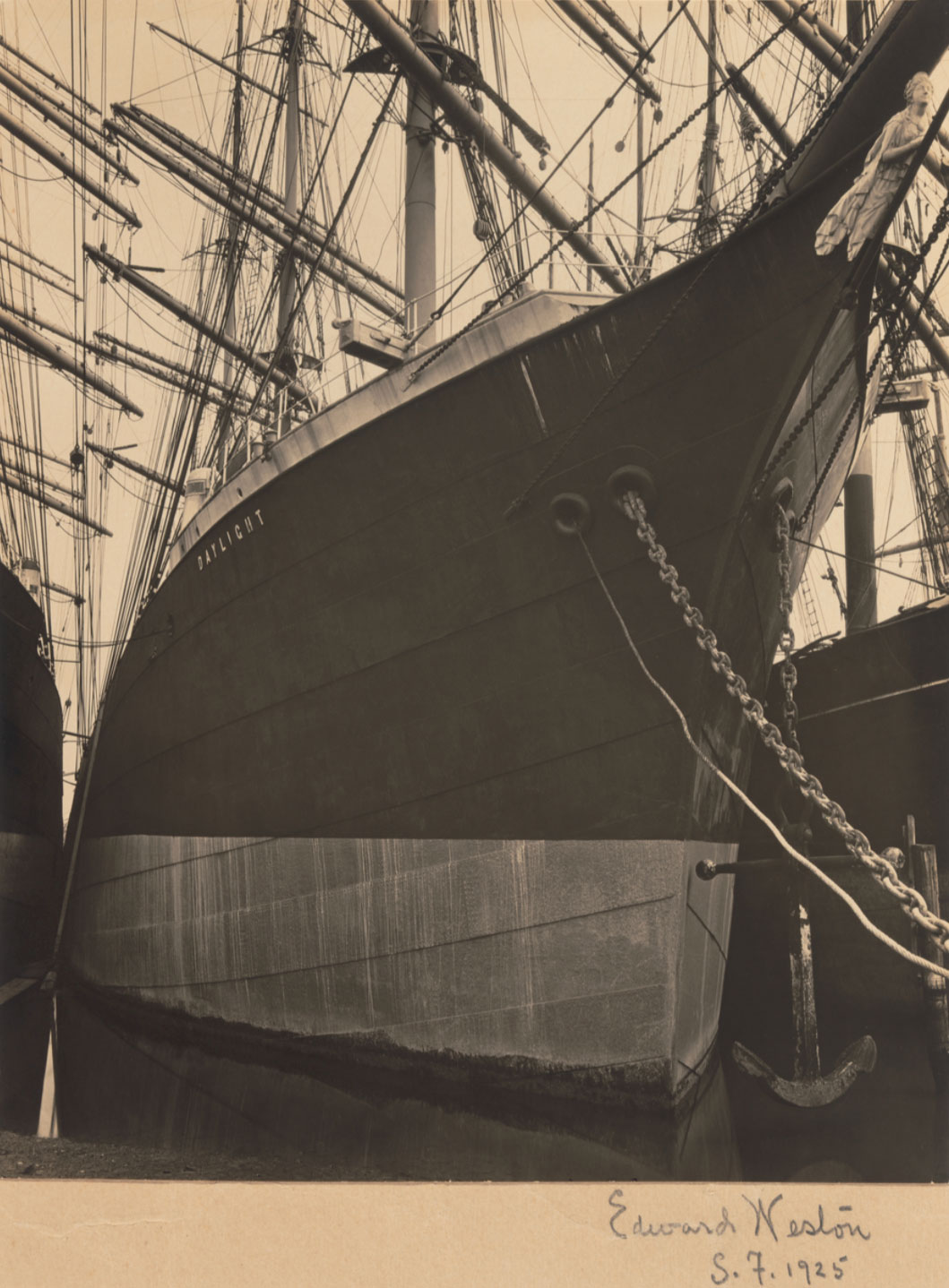
 

Edward Weston (American, 1886-1958) 'Boat, San Francisco' 1925


Edward Weston (American, 1886-1958)
Boat, San Francisco
1925
Gelatin silver print
9 5/16 x 7 9/16″ (23.7 x 19.2cm)
The Museum of Modern Art, New York
Thomas Walther Collection. Grace M. Mayer Fund
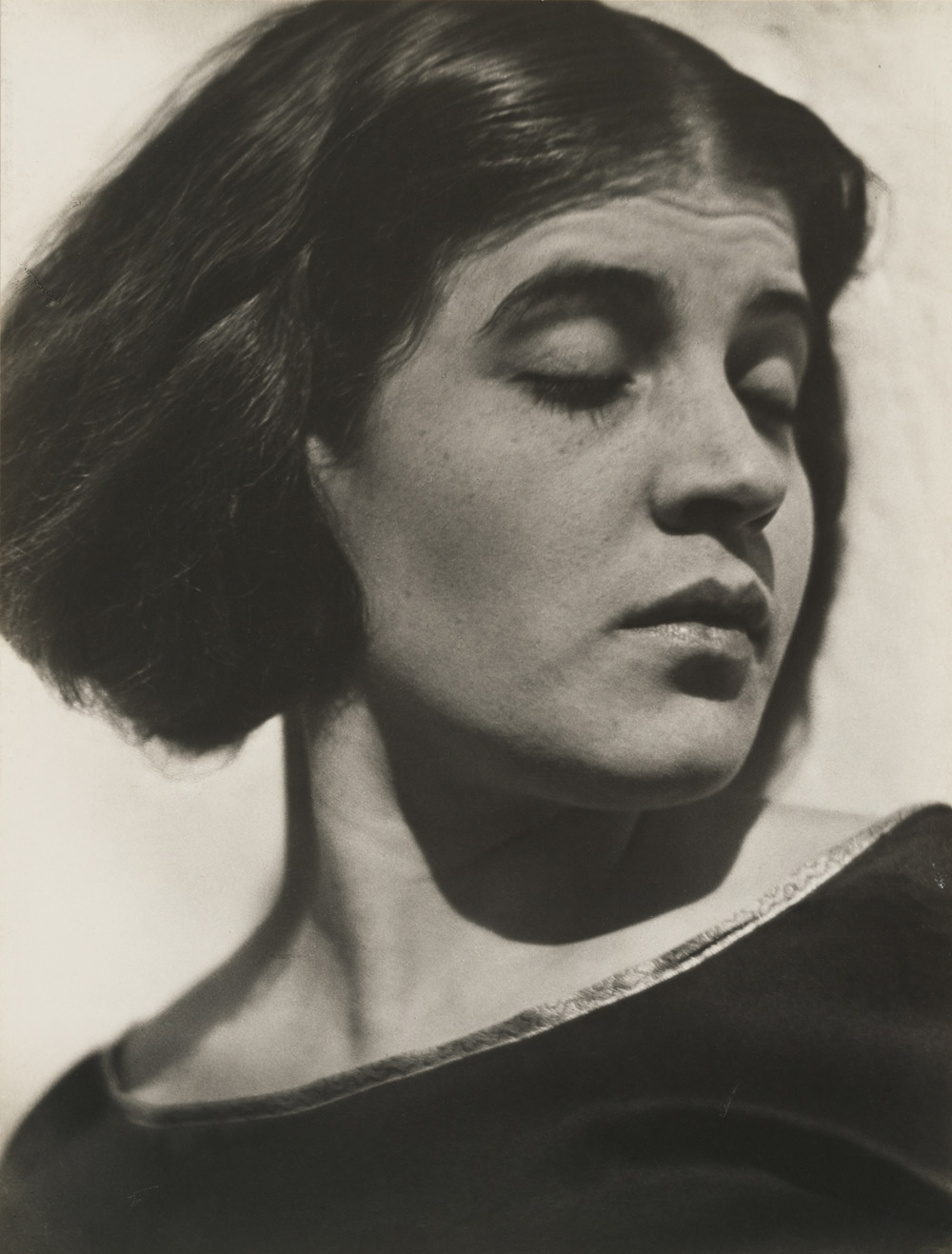
 

Edward Weston (American, 1886-1958) 'Tina' January 30, 1924


Edward Weston (American, 1886-1958)
Tina
January 30, 1924
Gelatin silver print
9 1/16 x 6 7/8″ (23 x 17.5cm)
The Museum of Modern Art, New York
Thomas Walther Collection. Grace M. Mayer Fund and The Fellows of Photography Fund, by exchange


Karl Blossfeldt (German, 1865-1932) 'Acanthus mollis' (Acanthus mollis [Akanthus, Bärenklau. Deckblätter, die Blüten sind entfernt, in 4facher Vergrößerung]) 1898-1928


Karl Blossfeldt (German, 1865-1932)
Acanthus mollis (Acanthus mollis [Akanthus, Bärenklau. Deckblätter, die Blüten sind entfernt, in 4facher Vergrößerung])
1898-1928
Gelatin silver print
11 3/4 × 9 3/8″ (29.8 × 23.8cm)
The Museum of Modern Art, New York
Thomas Walther Collection. Gift of Thomas Walther


Purisms

The question of whether photography ought to be considered a fine art was hotly contested from its invention in 1839 into the 20th century. Beginning in the 1890s, in an attempt to distinguish their efforts from hoards of Kodak-wielding amateurs and masses of professionals, “artistic” photographers referred to themselves as Pictorialists. They embraced soft focus and painstakingly wrought prints so as to emulate contemporary prints and drawings, and chose subjects that underscored the ethereal effects of their methods. Before long, however, most avant-garde photographers had come to celebrate precise and distinctly photographic qualities as virtues. On both sides of the Atlantic, photographers were making this transition from Pictorialism to modernism, while occasionally blurring the distinction. Exhibition prints could be made with precious platinum or palladium, or matte surfaces that mimicked those materials. Perhaps nowhere is this variety more clearly evidenced than in the work of Edward Weston, whose suite of prints in this section suggests the range of appearances achievable with unadulterated contact prints from his large-format negatives. Other photographers on view include Karl Blossfeldt (German, 1865-1932), Manuel Álvarez Bravo (Mexican, 1902-2002), Jaromír Funke (Czech, 1896-1945), Bernard Shea Horne (American, 1867-1933), and Alfred Stieglitz (American, 1864-1946).
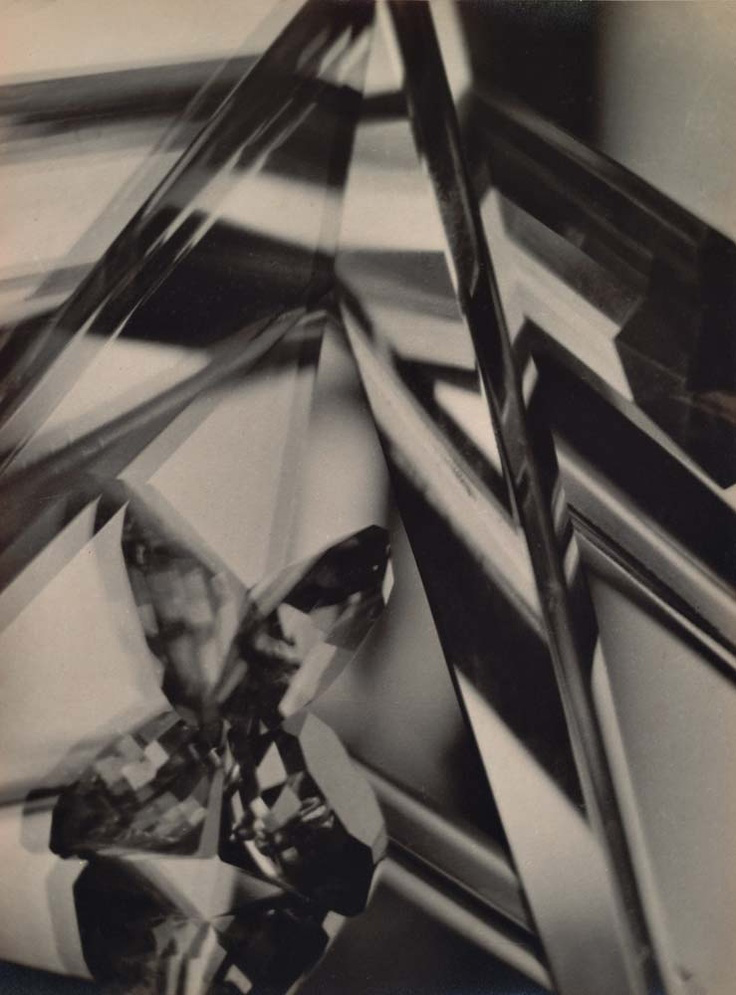
 

Alvin Langdon Coburn (American, 1882-1966) 'Vortograph' 1916-1917


Alvin Langdon Coburn (American, 1882-1966)
Vortograph
1916-17
Gelatin silver print
11 1/8 x 8 3/8″ (28.2 x 21.2cm)
The Museum of Modern Art, New York
Thomas Walther Collection. Grace M. Mayer Fund


Vortograph

The intricate patterns of light and line in this photograph, and the cascading tiers of crystalline shapes, were generated through the use of a kaleidoscopic contraption invented by the American / British photographer Alvin Langdon Coburn, a member of London’s Vorticist group. To refute the idea that photography, in its helplessly accurate capture of scenes in the real world, was antithetical to abstraction, Coburn devised for his camera lens an attachment made up of three mirrors, clamped together in a triangle, through which he photographed a variety of surfaces to produce the results in these images. The poet and Vorticist Ezra Pound coined the term “vortographs” to describe Coburn’s experiments. Although Pound went on to criticise these images as lesser expressions than Vorticist paintings, Coburn’s work would remain influential.

Reinventing Photography – Here Comes New Photographer 

In 1925, László Moholy-Nagy articulated an idea that became central to the New Vision movement: although photography had been invented 100 years earlier, it was only now being discovered by the avant-garde circles for all its aesthetic possibilities. As products of technological culture, with short histories and no connection to the old fine-art disciplines – which many contemporary artists considered discredited – photography and cinema were seen as truly modern instruments that offered the greatest potential for transforming visual habits. From the photogram to solarisation, from negative prints to double exposures, the New Vision photographers explored the medium in countless ways, rediscovering known techniques and inventing new ones. Echoing the cinematic experiments of the same period, this emerging photographic vocabulary was rapidly adopted by the advertising industry, which appreciated the visual efficiency of its bold simplicity. Florence Henri (Swiss, born America, 1893-1982), Edward Quigley (American, 1898-1977), Franz Roh (German, 1890-1965), Franciszka Themerson and Stefan Themerson (British, born Poland, 1907-1988 and 1910-1988), and František Vobecký (Czech, 1902-1991) are among the numerous photographers represented here.
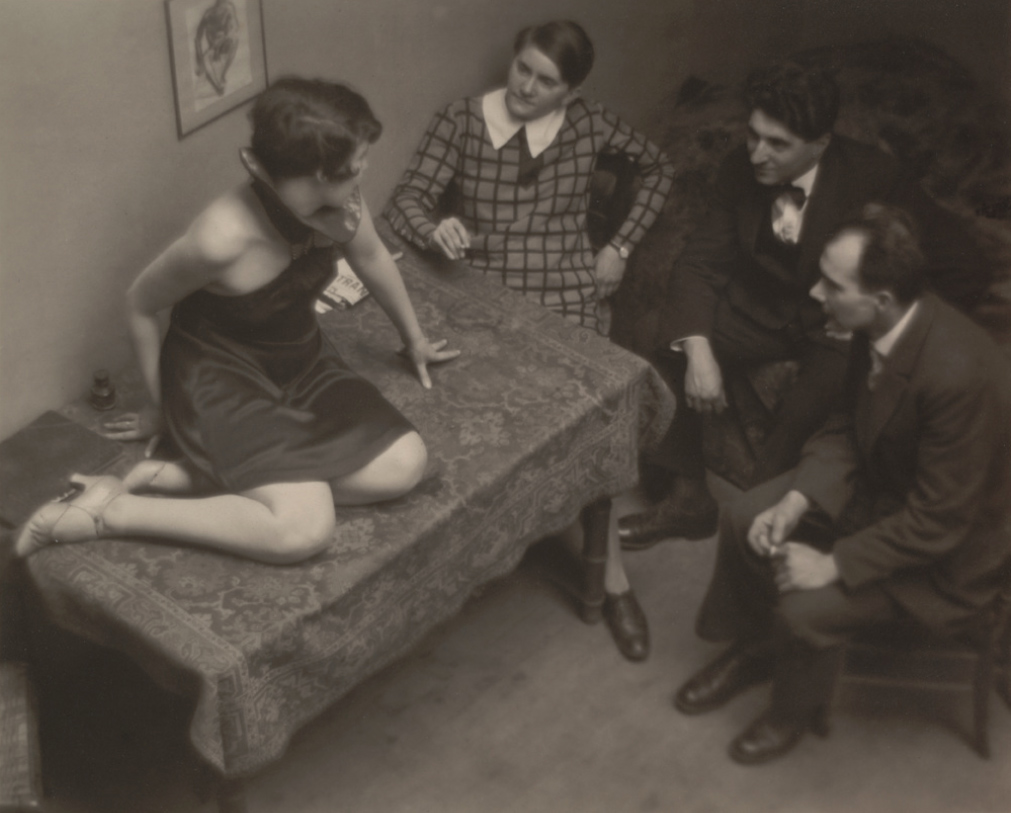
 

André Kertész (American born Hungary, 1894-1985) 'Magda, Mme Beöthy, M. Beöthy, and Unknown Guest, Paris' 1926-1929


André Kertész (American born Hungary, 1894-1985)
Magda, Mme Beöthy, M. Beöthy, and Unknown Guest, Paris
1926-1929
Gelatin silver print
3 1/8 × 3 7/8″ (7.9 × 9.8cm)
The Museum of Modern Art, New York
Thomas Walther Collection. Gift of Thomas Walther
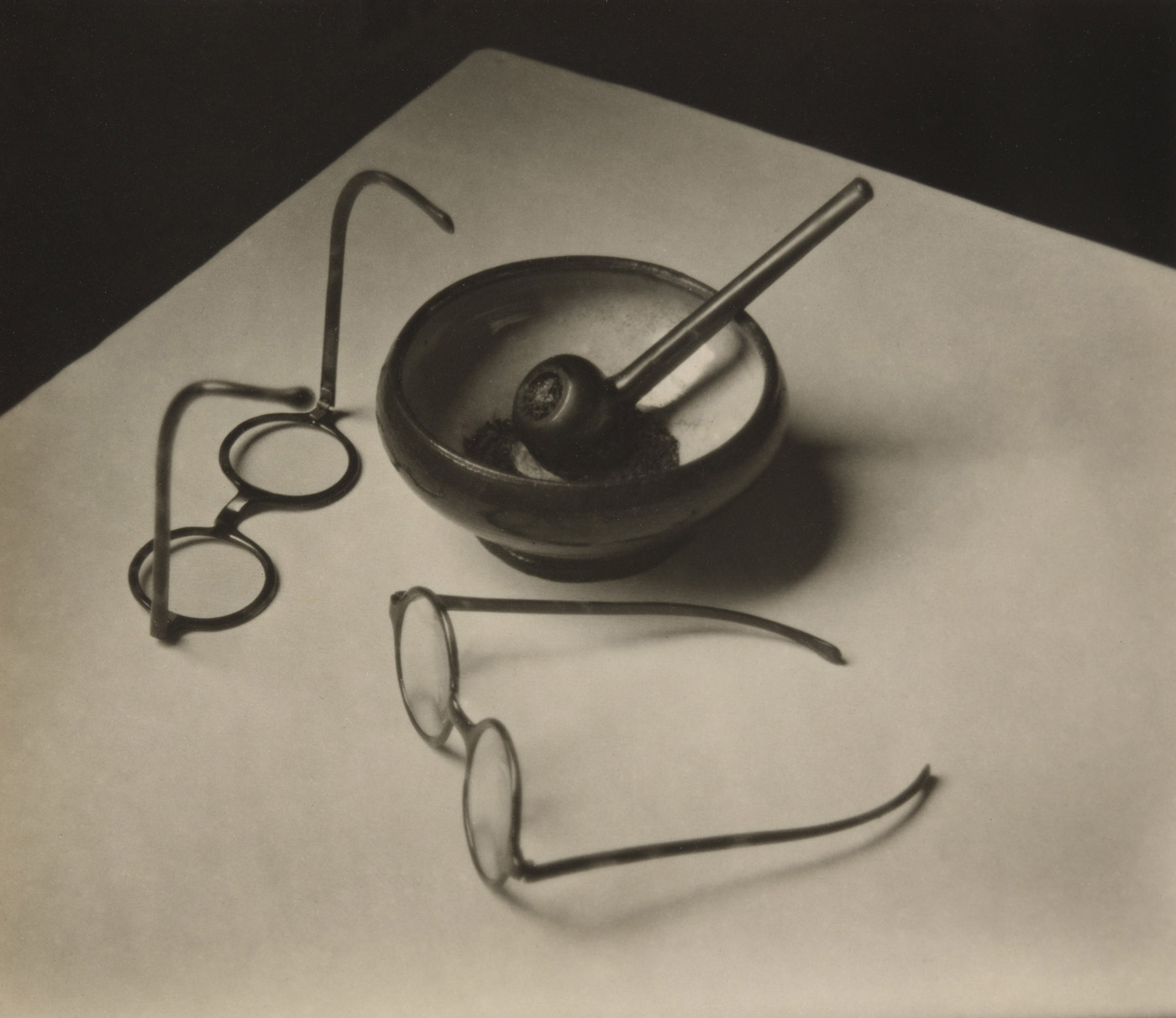
 

André Kertész (American born Hungary, 1894-1985) 'Mondrian's Glasses and Pipe' 1926


André Kertész (American born Hungary, 1894-1985)
Mondrian’s Glasses and Pipe
1926
Gelatin silver print
3 1/8 × 3 11/16″ (7.9 × 9.3cm)
The Museum of Modern Art, New York
Thomas Walther Collection. Grace M. Mayer Fund
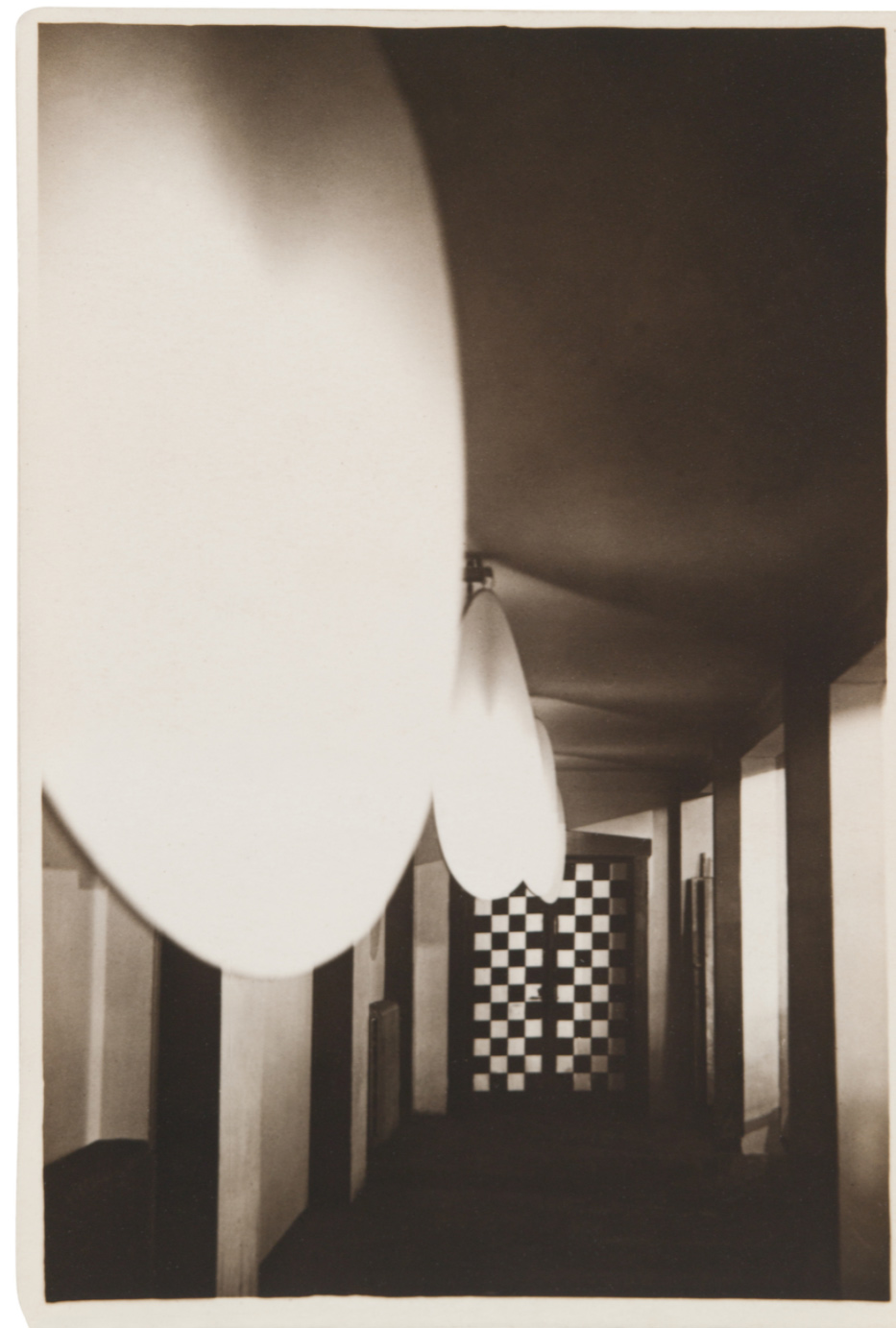
 

Unknown Photographer. 'White Party, Dessau' (Weißes Fest, Dessau) March 20, 1926


Unknown Photographer
White Party, Dessau (Weißes Fest, Dessau)
March 20, 1926
Gelatin silver print
3 x 1 15/16″ (7.6 x 5cm)
The Museum of Modern Art, New York
Thomas Walther Collection. Acquired through the generosity of Howard Stein


Iwao Yamawaki (Japanese, 1898-1987) 'Lunch (12-2 p.m.)' (Mittagessen [12-2 Uhr]) 1931


Iwao Yamawaki (Japanese, 1898-1987)
Lunch (12-2 p.m.) (Mittagessen [12-2 Uhr])
1931
Gelatin silver print
6 7/16 × 4 5/8″ (16.3 × 11.7cm)
The Museum of Modern Art, New York
Thomas Walther Collection. Abbott-Levy Collection funds, by exchange


Gertrud Arndt (German, 1903-2000) 'At the Masters' Houses' (An den Meisterhäusern) 1929-1930


Gertrud Arndt (German, 1903-2000)
At the Masters’ Houses (An den Meisterhäusern)
1929-1930
Gelatin silver print
8 7/8 x 6 1/4″ (22.6 x 15.8cm)
The Museum of Modern Art, New York
Thomas Walther Collection. Gift of Thomas Walther


Gertrud Arndt (German, 1903-2000)

Gertrud Arndt (née Hantschk; 20 September 1903 – 10 July 2000) was a photographer associated with the Bauhaus movement. She is remembered for her pioneering series of self-portraits from around 1930.

Arndt’s photography, forgotten until the 1980s, has been compared to that of her contemporaries Marta Astfalck-Vietz and Claude Cahun. Over the five years when she took an active interest in photography, she captured herself and her friends in various styles, costumes and settings in the series known as Masked Portraits. Writing for Berlin Art Link, Angela Connor describes the images as “ranging from severe to absurd to playful.” Today Arndt is considered to be a pioneer of female self-portraiture, long predating Cindy Sherman and Sophie Calle.

Text from the Wikipedia website


Iwao Yamawaki (Japanese, 1898-1987) 'Untitled' 1931


Iwao Yamawaki (Japanese, 1898-1987)
Untitled
1931
Gelatin silver print
8 11/16 x 6 1/2″ (22 x 16.5cm)
The Museum of Modern Art, New York
Thomas Walther Collection. Abbott-Levy Collection funds, by exchange
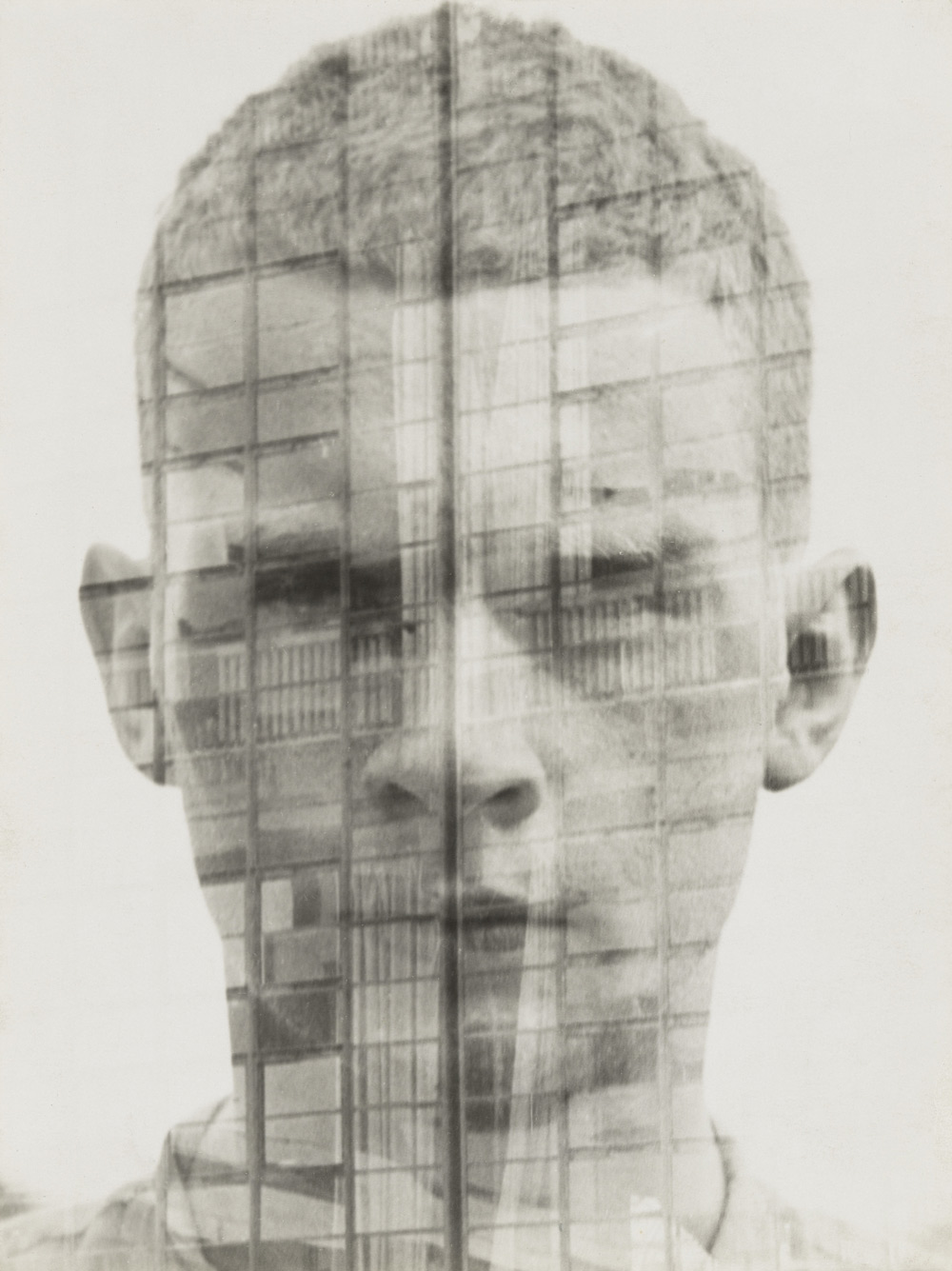
 

Hajo Rose (German, 1910-1989) 'Untitled (Self-Portrait)' 1931


Hajo Rose (German, 1910-1989)
Untitled (Self-Portrait)
1931
Gelatin silver print
9 7/16 × 7 1/16″ (23.9 × 17.9cm)
The Museum of Modern Art, New York
Thomas Walther Collection. Gift of Thomas Walther


Hajo Rose (German, 1910-1989)

‘Finally – a house made of steel and glass!’ This was the enthusiastic reaction of Hajo Rose (1910-1989) to the Bauhaus building in Dessau when he began his studies there in 1930. Rose promoted the methods of the Bauhaus throughout his lifetime: as a lecturer at universities in Amsterdam, Dresden and Leipzig, and also as an artist and photographer.

Hajo Rose experimented with a wide variety of materials and techniques. The photomontage of his self-portrait combined with the Dessau Bauhaus building (c. 1930), the surrealism of his photograph Seemannsbraut (Sailor’s Bride, 1934), and the textile print designs that he created with a typewriter (1932) are examples of the extraordinary creativity of this artist. He also contributed to an advertising campaign for the Jena Glass Company: the first heat-resistant household glassware stood for modern product design and is still regarded as a kitchen classic today.

Shortly before the Bauhaus was closed, Hajo Rose was one of the last students to receive his diploma. Subsequent periods in various cities shaped his biography, which is a special example of the migratory experience shared by many Bauhaus members after 1933. After one year as an assistant in the Berlin office of László Moholy-Nagy, Hajo Rose immigrated to The Netherlands together with Paul Guermonprez, a Bauhaus colleague, in 1934. He worked there as a commercial artist and taught at the Nieuwe Kunstschool in Amsterdam. At the 1937 World Exposition in Paris, he won an award for his poster ‘Amsterdam’. After the Second World War, Rose worked as a graphic designer, photographer and teacher in Dresden and Leipzig. He continued to advocate Bauhaus ideas in the GDR, even though the Bauhaus was regarded in East Germany as bourgeois and formalistic well into the 1960s. Rose resigned from the Socialist Unity Party (SED) – in spite of the loss of his teaching position as a consequence. From that time, he worked as one of the few freelance graphic designers in the GDR. Hajo Rose died at the age of 79 – shortly before the fall of the Berlin Wall.


Edward Steichen (American born Luxembourg, 1879-1973) 'Gertrude Lawrence' 1928


Edward Steichen (American born Luxembourg, 1879-1973)
Gertrude Lawrence
1928
Gelatin silver print
9 7/16 × 7 9/16″ (24 × 19.2cm)
The Museum of Modern Art, New York
Thomas Walther Collection. Edward Steichen Estate and gift of Mrs. Flora S. Straus, by exchange


The Artist’s Life

Photography is particularly well suited to capturing the distinctive nuances of the human face, and photographers delighted in and pushed the boundaries of portraiture throughout the 20th century. The Thomas Walther Collection features a great number of portraits of artists and self-portraits as varied as the individuals portrayed. Additionally, the collection conveys a free-spirited sense of community and daily life, highlighted here with photographs made by André Kertész and by students and faculty at the Bauhaus. When the Hungarian-born Kertész moved to Paris in 1925, he couldn’t afford to purchase photographic paper, so he would print on less expensive postcard stock. These prints, whose small scale requires that the viewer engage with them intimately, function as miniature windows into the lives of Kertész’s bohemian circle of friends. The group of photographs made at the Bauhaus in the mid-1920s, before the medium was formally integrated into the school’s curriculum, similarly expresses friendships and everyday life captured and printed in an informal manner. Portraits by Claude Cahun (French, 1894-1954), Lotte Jacobi (American, born Germany, 1896-1990), Lucia Moholy (British, born Czechoslovakia, 1894-1989), Man Ray (American, 1890-1976), August Sander (German, 1876-1964) and Edward Steichen (American, born Luxembourg, 1879-1973) are among the highlights of this gallery.


Aenne Biermann (German, 1898-1933) 'Summer Swimming' (Sommerbad) 1925-1930


Aenne Biermann (German, 1898-1933)
Summer Swimming (Sommerbad)
1925-1930
Gelatin silver print
7 x 7 7/8″ (17.8 x 20cm)
The Museum of Modern Art, New York
Thomas Walther Collection. Bequest of Ilse Bing, by exchange


Aenne Biermann (German, 1898-1933)

Aenne Biermann (March 8, 1898 – January 14, 1933), born Anna Sibilla Sternfeld, was a German photographer of Ashkenazi origin. She was one of the major proponents of New Objectivity, a significant art movement that developed in Germany in the 1920s.

Biermann was a self-taught photographer. Her first subjects were her two children, Helga and Gershon. The majority of Biermann’s photographs were shot between 1925 and 1933. Gradually she became one of the major proponents of New Objectivity, an important art movement in the Weimar Republic. Her work became internationally known in the late 1920s, when it was part of every major exhibition of German photography.

Major exhibitions of her work include the Munich Kunstkabinett, the Deutscher Werkbund and the exhibition of Folkwang Museum in 1929. Other important exhibitions include the exhibition entitled Das Lichtbild held in Munich in 1930 and the 1931 exhibition at the Palace of Fine Arts (French: Palais des Beaux Arts) in Brussels. Since 1992 the Museum of Gera has held an annual contest for the Aenne Biermann Prize for Contemporary German Photography, which is one of the most important events of its kind in Germany.

Text from the Wikipedia website


Helmar Lerski (Swiss born Germany, 1871-1956) 'Metamorphosis 601' (Metamorphose 601) 1936


Helmar Lerski (Swiss born Germany, 1871-1956)
Metamorphosis 601 (Metamorphose 601)
1936
Gelatin silver print
11 7/16 × 9 1/16″ (29 × 23cm)
The Museum of Modern Art, New York
Thomas Walther Collection. The Family of Man Fund


Helmar Lerski (Swiss, born Germany 1871-1956)

There can hardly be another name in the international history of photography whose work has been so frequently misunderstood and so controversially evaluated as that of Helmar Lerski (1871-1956). “In every human being there is everything; the question is only what the light falls on”. Guided by this conviction, Lerski took portraits that did not primarily strive for likeness but which left scope for the viewer’s imagination, thus laying himself open to the criticism of betraying the veracity of the photographic image.

… Lerski’s pictures were only partly in line with the maxims of the New Photography, and they questioned the validity of pure objectivity. The distinguishing characteristics of his portraits included a theatrical-expressionistic, sometimes dramatic use of lighting inspired by the silent film. Although his close-up photographs captured the essential features of a face – eyes, nose and mouth –, his primary concern was not individual appearance or superficial likeness but the deeper inner potential: he emphasised the changeability, the different faces of an individual. Lerski, who sympathised with the political left wing, thereby infiltrated the photography of types that was practised  (and not infrequently misused for racist purposes) by many of Lerski’s contemporaries.

… Helmar Lerski’s attitude was at its most radical in his work entitled Metamorphosis. This was completed within a few months at the beginning of 1936 in Palestine, to where Lerski and his second wife Anneliese had immigrated in 1932. In Verwandlungen durch Licht (this is the second title for this work), Lerski carried his theatrical talent to extremes. With the help of up to 16 mirrors and filters, he directed the natural light of the sun in constant new variations and refractions onto his model, the Bernese-born, at the time out-of-work structural draughtsman and light athlete Leo Uschatz. Thus he achieved, in a series of over 140 close-ups “hundreds of different faces, including that of a hero, a prophet, a peasant, a dying soldier, an old woman and a monk from one single original face” (Siegfried Kracauer). According to Lerski, these pictures were intended to provide proof “that the lens does not have to be objective, that the photographer can, with the help of light, work freely, characterise freely, according to his inner face.” Contrary to the conventional idea of the portrait as an expression of human identity, Lerski used the human face as a projection surface for the figures of his imagination. We are only just becoming aware of the modernity of this provocative series of photographs.

Peter Pfrunder
Fotostiftung Schweiz


Max Burchartz (German, 1887-1961) 'Lotte (Eye)' (Lotte [Auge]) 1928


Max Burchartz (German, 1887-1961)
Lotte (Eye) (Lotte [Auge])
1928
Gelatin silver print
11 7/8 x 15 3/4″ (30.2 x 40cm)
The Museum of Modern Art, New York
Thomas Walther Collection. Acquired through the generosity of Peter Norton
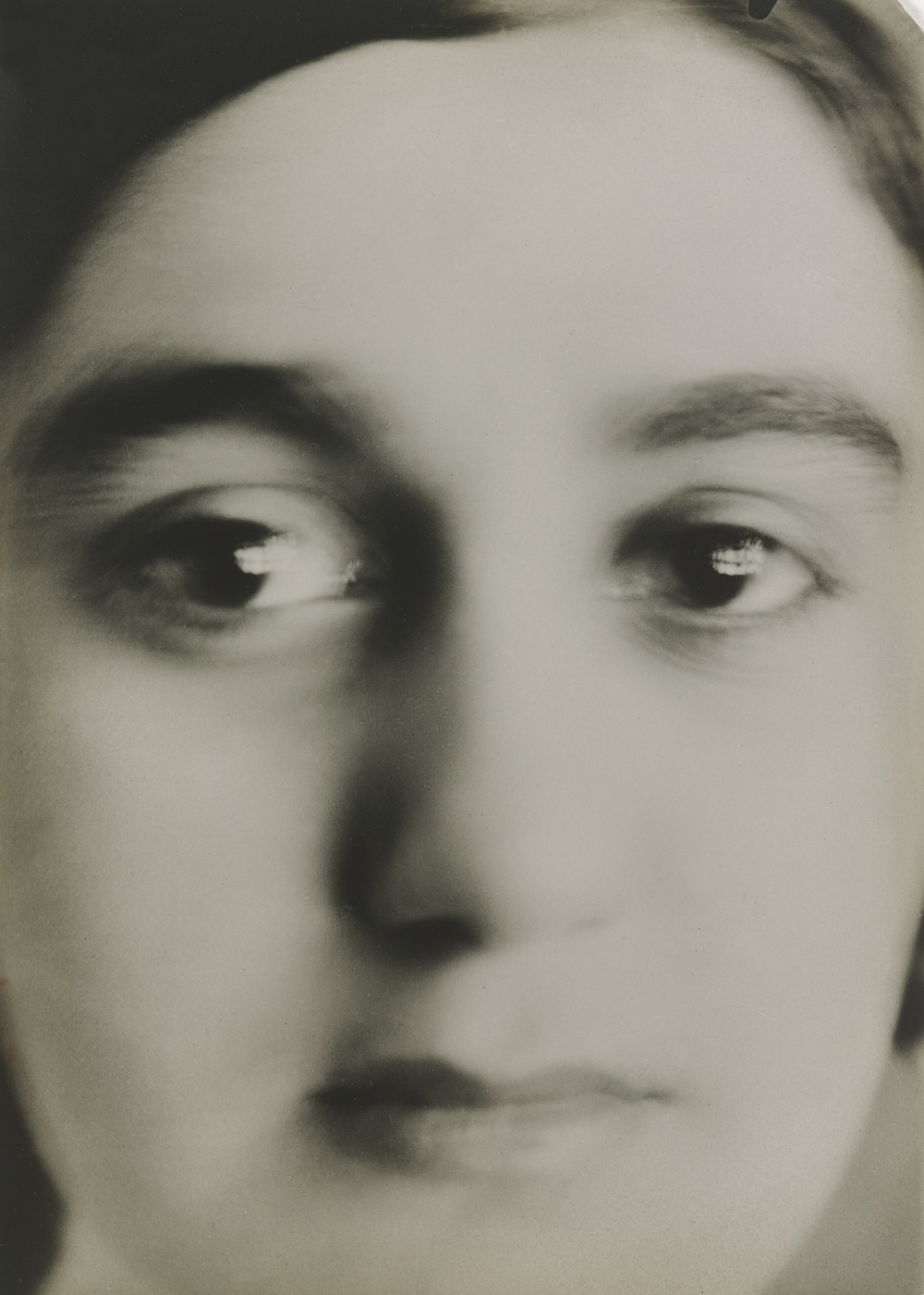
 

Stanisław Ignacy Witkiewicz (Polish, 1885-1939) 'Anna Oderfeld, Zakopane' 1911-1912


Stanisław Ignacy Witkiewicz (Polish, 1885-1939)
Anna Oderfeld, Zakopane
1911-1912
Gelatin silver print 6 11/16 × 4 3/4″ (17 × 12.1cm)
The Museum of Modern Art, New York
Thomas Walther Collection. Gift of Mrs. Willard Helburn, by exchange
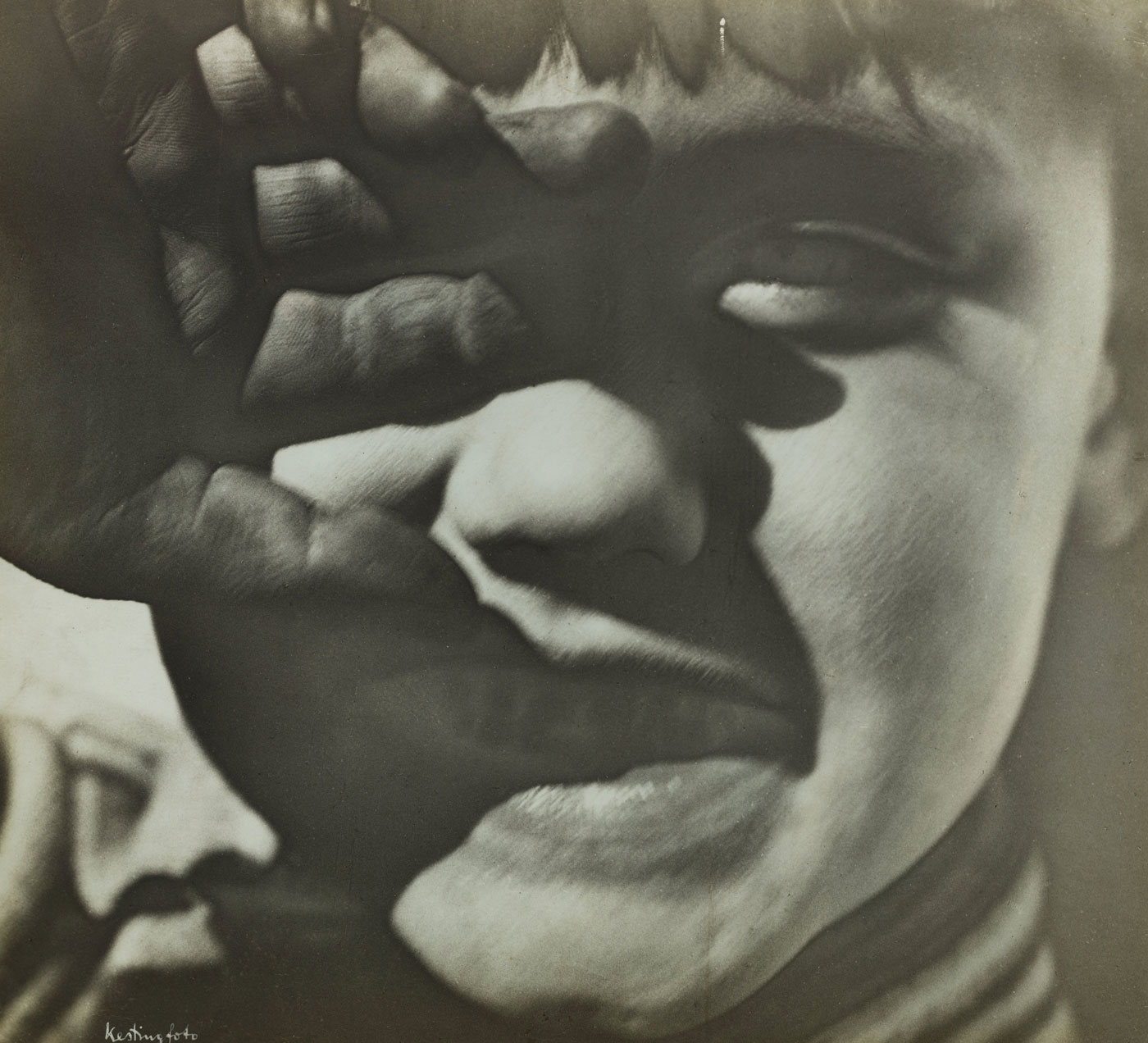
 

Edmund Kesting (German, 1892-1970) 'Glance to the Sun' (Blick zur Sonne) 1928


Edmund Kesting (German, 1892-1970)
Glance to the Sun (Blick zur Sonne)
1928
Gelatin silver print
13 1/16 x 14 1/2″ (33.2 x 36.8cm)
The Museum of Modern Art, New York
Thomas Walther Collection. Gift of Thomas Walther


Edmund Kesting (German, 1892-1970)

Edmund Kesting (27 July 1892, Dresden – 21 October 1970, Birkenwerder) was a German photographer, painter and art professor. He studied until 1916 at the Dresden Academy of Fine Arts before participating as a soldier in the First World War, upon returning his painting teachers were Richard Müller and Otto Gussmann and in 1919 he began to teach as a professor at the private school Der Weg. In 1923 he had his first exposition in the gallery Der Sturm in which he showed photograms. When Der Weg opened a new academy in Berlin in 1927, he moved to the capital.

He formed relations with other vanguardists in Berlin and practiced various experimental techniques such as solarisation, multiple images and photograms, for which reason twelve of his works were considered degenerate art by the Nazi regime and were prohibited. Among the artists with whom he interacted are Kurt Schwitters, László Moholy-Nagy, El Lissitzky and Alexander Archipenko. At the end of World War II he formed part of a Dresden artistic group known as Künstlergruppe der ruf – befreite Kunst (Call to an art in freedom) along with Karl von Appen, Helmut Schmidt-Kirstein and Christoph Hans, among others. In this city he made an experimental report named Dresdner Totentanz (Dance of death in Dresden) as a condemnation of the bombing of the city. In 1946 he was named a member of the Academy of Art in the city.

He participated in the controversy between socialist realism and formalism that took place in the German Democratic Republic, therefore his work was not realist and could not be shown in the country between 1949 and 1959. In 1955 he began to experiment with chemical painting, making photographs without the use of a camera and only with the use of chemical products such as the developer and the fixer and photographic paper, for which he made exposures to light using masks and templates. Between 1956 and 1967 he was a professor at the Academy of Cinema and Television of Potsdam.

His artistic work was not recognised by the authorities of the German Democratic Republic until 1980, ten years after his death.

Text from the Wikipedia website


Maurice Tabard (French, 1897-1984) 'Am I Beautiful?' (Suis-je belle?) 1929


Maurice Tabard (French, 1897-1984)
Am I Beautiful? (Suis-je belle?)
1929
Gelatin silver print
9 5/16 × 6 15/16″ (23.6 × 17.7cm)
The Museum of Modern Art, New York
Thomas Walther Collection. Gift of Shirley C. Burden, by exchange


Between Surrealism and Magic Realism

In the mid-1920s, European artistic movements ranging from Surrealism to New Objectivity moved away from a realist approach by highlighting the strange in the familiar or trying to reconcile dreams and reality. Echoes of these concerns, centred on the human figure, can be found in this gallery. Some photographers used anti-naturalistic methods – capturing hyperreal, close-up details; playing with scale; and rendering the body as landscape – to challenge the viewer’s perception. Others, in line with Sigmund Freud’s definition of “the uncanny” as an effect that results from the blurring of distinctions between the real and the fantastic, offered visual plays on life and the lifeless, the animate and the inanimate, confronting the human body with surrogates in the form of dolls, mannequins, and masks. Photographers influenced by Surrealism, such as Maurice Tabard, subjected the human figure to distortions and transformations by experimenting with photographic techniques either while capturing the image or while developing it in the darkroom. Additional photographers on view include Aenne Biermann (German, 1898-1933), Jacques-André Boiffard (French, 1902-1961), Max Burchartz (German, 1887-1961), Helmar Lerski (Swiss, 1871-1956), and Stanisław Ignacy Witkiewicz (Polish, 1885-1939)
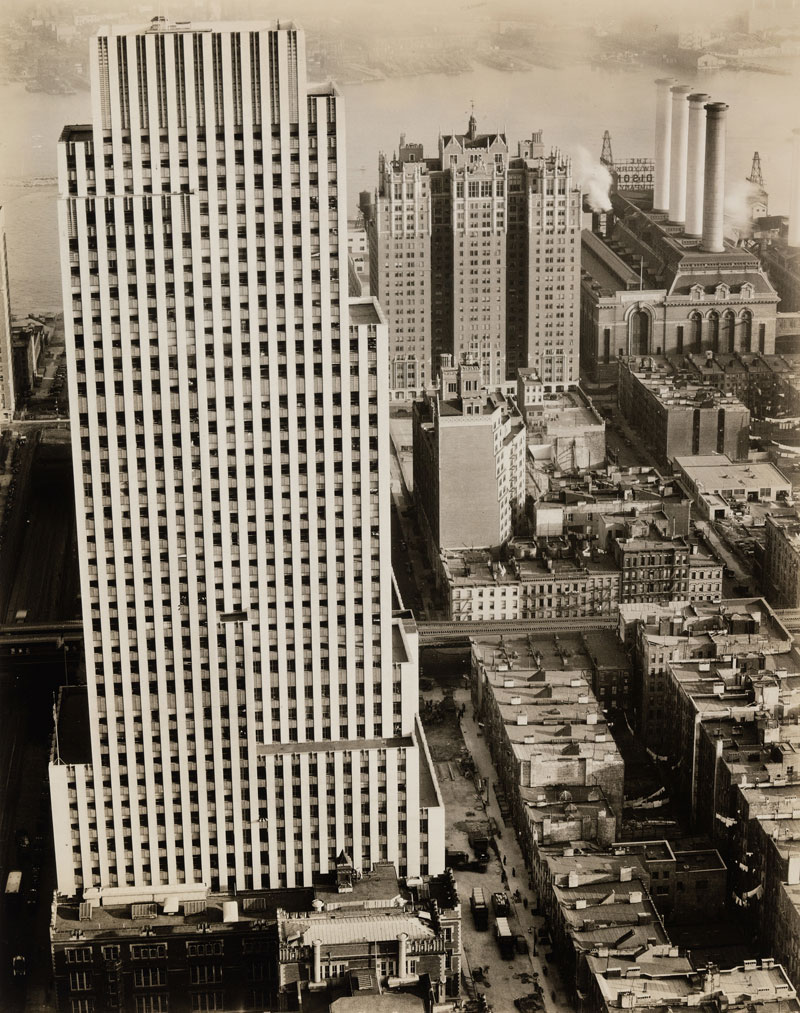
 

Berenice Abbott (American, 1898-1991) 'Daily News Building, 220 East 42nd Street, Manhattan' November 21, 1935


Berenice Abbott (American, 1898-1991)
Daily News Building, 220 East 42nd Street, Manhattan
November 21, 1935
Gelatin silver print
9 5/8 × 7 1/2″ (24.4 × 19.1cm)
The Museum of Modern Art, New York
Thomas Walther Collection. Abbott-Levy Collection funds, by exchange


Marjorie Content (American, 1895-1984) 'Steamship Pipes, Paris' Winter 1931


Marjorie Content (American, 1895-1984)
Steamship Pipes, Paris
Winter 1931
Gelatin silver print
3 13/16 × 2 11/16″ (9.7 × 6.8cm)
The Museum of Modern Art, New York
Thomas Walther Collection. Gift of Andreas Feininger, by exchange


Marjorie Content (American, 1895-1984)

Marjorie Content (1895-1984) was an American photographer active in modernist social and artistic circles. Her photographs were rarely published and never exhibited in her lifetime, but have become of interest to collectors and art historians. Her work has been collected by the Metropolitan Museum of Art and the Chrysler Museum of Art; it has been the subject of several solo exhibitions. (Wikipedia)

Marjorie Content (1895-1984) was a modest and unpretentious photographer who kept her work largely to herself, never published or exhibited. Overshadowed by such close friends as Georgia O’Keefe and Alfred Stieglitz, she was more comfortable as a muse and source of encouragement for others, including her fourth husband, poet Jean Toomer. This text presents her beautiful, varied photographs and provides a glimpse into her life. Her pictures portray a variety of images including: New York’s frenetic cityscape distilled to essential patterns and rhythms; the Southwestern light and heat along with the strength and dignity of the Taos pueblo culture; and cigarettes and other everyday items arranged in jewel-like compositions. The discovery of the quality and extent of her work is proof that an artist’s determination can surmount a lack of recognition in her lifetime.

Text from the Amazon website
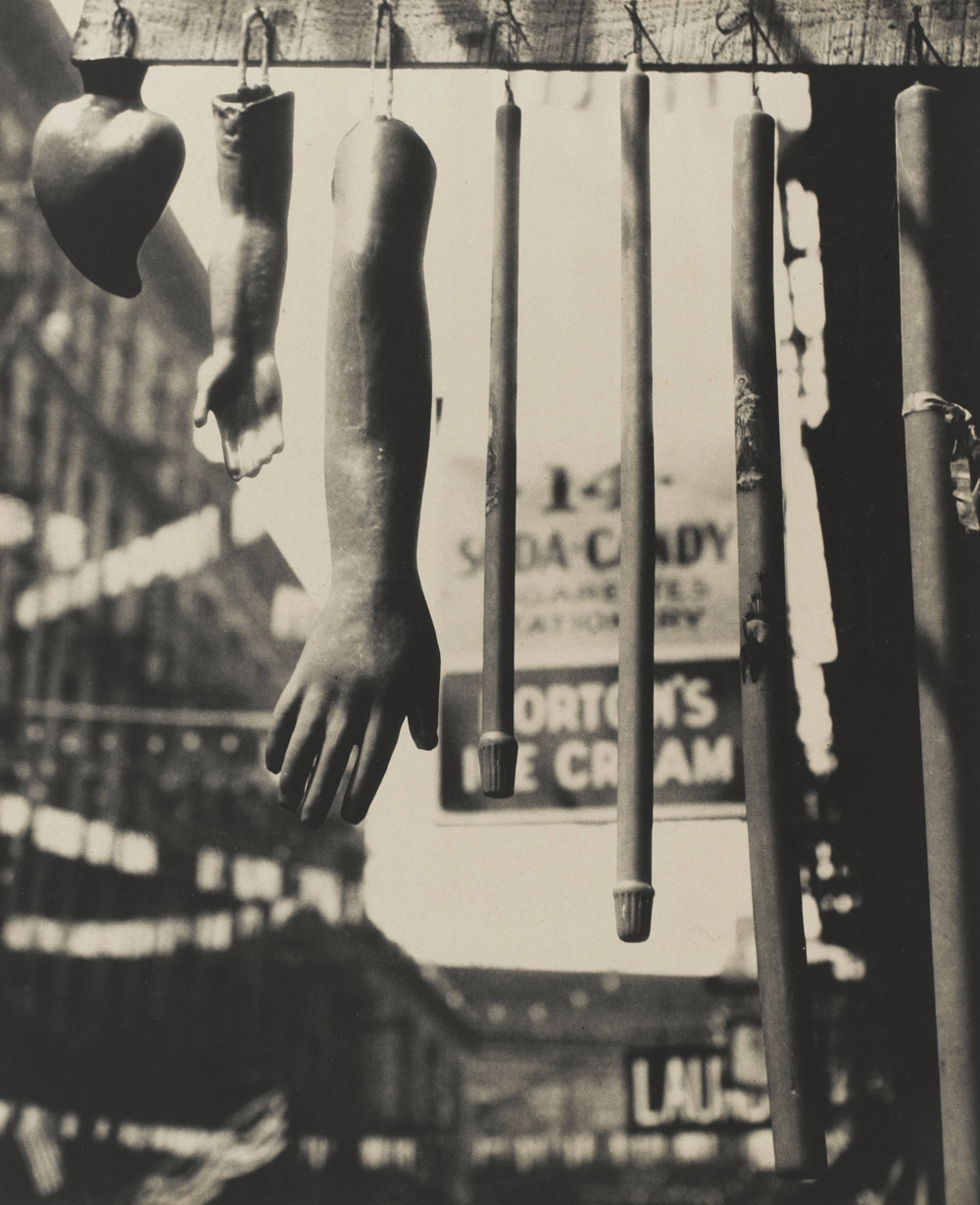
 

Walker Evans (American, 1903-1975) 'Votive Candles, New York City' 1929-1930


Walker Evans (American, 1903-1975)
Votive Candles, New York City
1929-1930
Gelatin silver print
8 1/2 x 6 15/16″ (21.6 x 17.7cm)
The Museum of Modern Art, New York
Thomas Walther Collection. Gift of Willard Van Dyke and Mr. and Mrs. Alfred H. Barr, Jr., by exchange
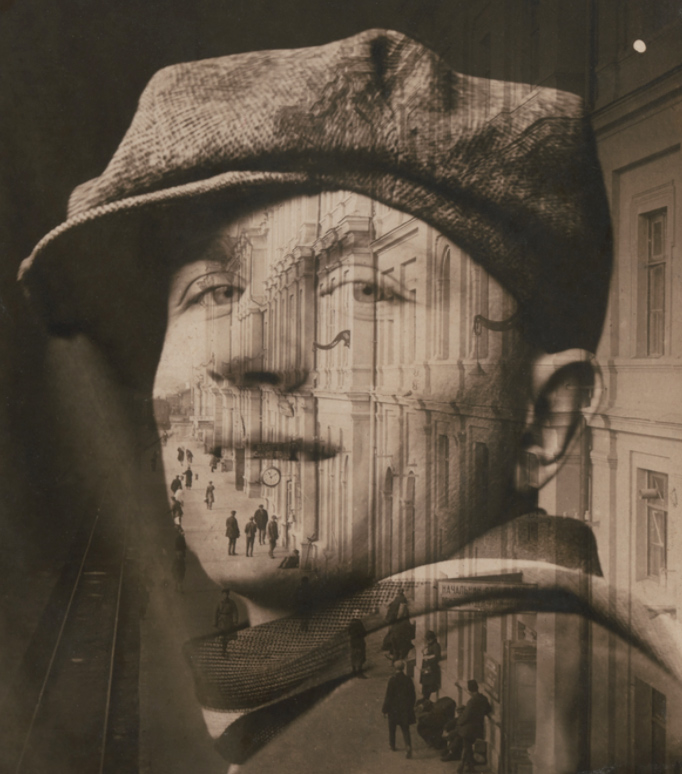
 

Georgii Zimin (Russian, 1900-1985) 'Untitled' 1926


Georgii Zimin (Russian, 1900-1985)
Untitled
1926
Gelatin silver print
3 11/16 x 3 1/4″ (9.4 x 8.3cm)
The Museum of Modern Art, New York
Thomas Walther Collection. Gift of Thomas Walther


Georgii Zimin (Russian, 1900-1985)

Georgii Zimin was born in Moscow in 1900, where he lived and worked for his entire life. Before the Russian Revolution he enrolled as a student at the Artistic-Industrial Stroganov Institute, known after 1918 as SVOMAS (Free state art studios). Zimin continued his studies at VKhUTEMAS (Higher state artistic and technical studios), which replaced SVOMAS in 1920. It was during his time at the school that he published the portfolio Skrjabin in Lukins Tanz (Scriabin in Lukin’s dance), in an edition of one hundred. This set of Cubo-Futurist lithographs from 1922 features costumed dancers in erotic poses, complementing a ballet choreographed by Lev Lukin. This work garnered Zimin acknowledgment by the Academy of Arts and Sciences and marked his affiliation with the Russian Art of Movement group. Throughout the 1920s he showed regularly at Art of Movement exhibitions at GAKhN (State academy for artistic sciences), in Moscow. Zimin also experimented with photography in the late 1920s and early 1930s, producing photograms akin to those made by László Moholy-Nagy and others at the time. Later in life, he served as Art Director of Exhibitions at the Department of Trade and held a post at the All-Union Agricultural Exhibition.

~ Ksenia Nouril
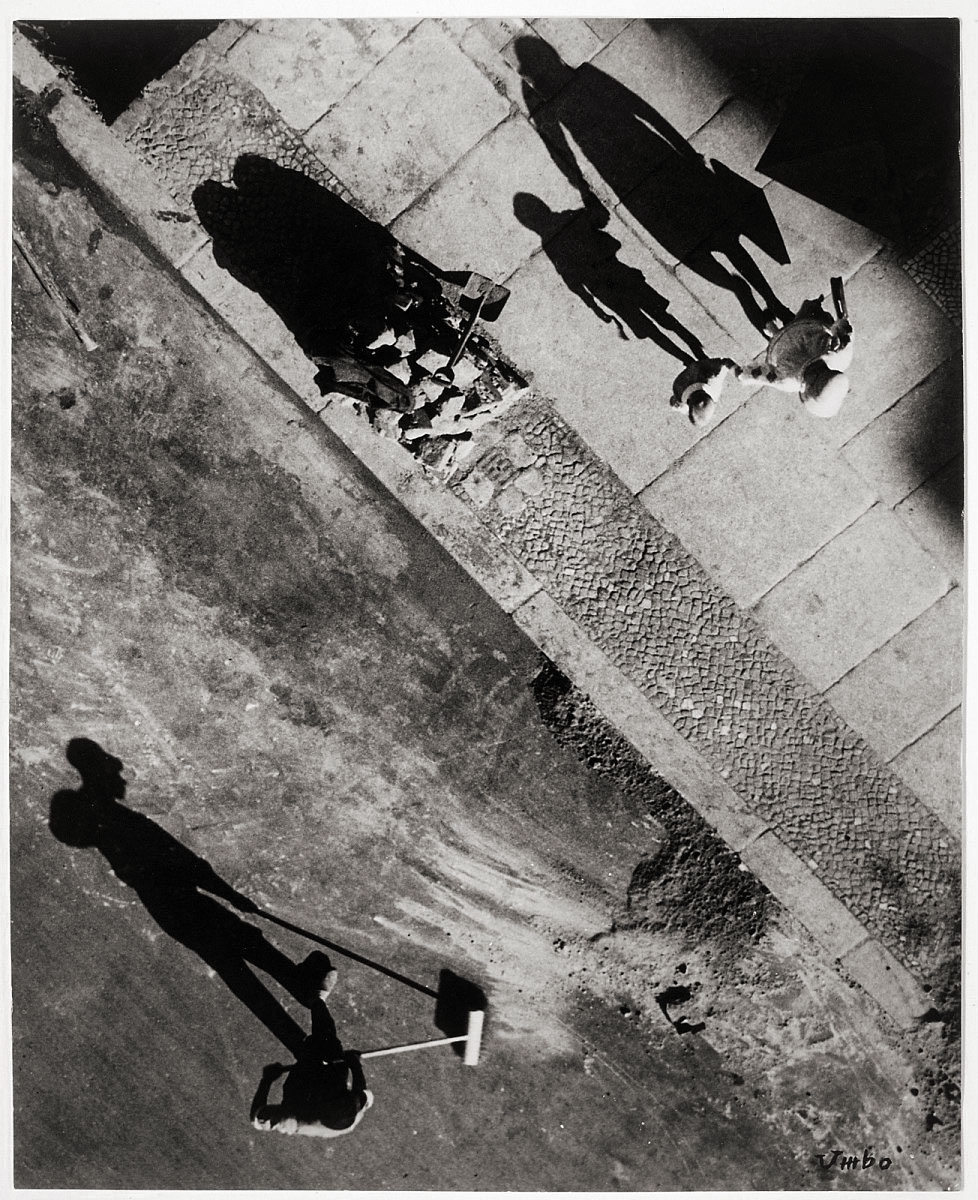
 

Umbo (Otto Umbehr) (German, 1902-1980) 'Mystery of the Street' (Mysterium der Strasse) 1928


Umbo (Otto Umbehr) (German, 1902-1980)
Mystery of the Street (Mysterium der Strasse)
1928
Gelatin silver print
11 7/16 x 9 1/4″ (29 x 23.5cm)
The Museum of Modern Art, New York
Thomas Walther Collection. Gift of Shirley C. Burden, by exchange


Umbo (Otto Umbehr) (German, 1902-1980)

Trained at the Bauhaus under Johannes Itten, a master of expressivity, Berlin-based photographer Umbo (born Otto Umbehr) believed that intuition was the source of creativity. To this belief, he added Constructivist structural strategies absorbed from Theo Van Doesburg, El Lissitzky, and others in Berlin in the early twenties. Their influence is evident in this picture’s diagonal, abstract construction and its spatial disorientation. It is also classic Umbo, encapsulating his intuitive vision of the world as a resource of poetic, often funny, ironic, or dark bulletins from the social unconscious.

After he left the Bauhaus, Umbo worked as assistant to Walther Ruttmann on his film Berlin, Symphony of a Great City 1926. In 1928, photographing from his window either very early or very late in the day and either waiting for his “actors” to achieve a balanced composition or, perhaps, positioning them as a movie director would, Umbo exposed three negatives. He had an old 5 by 7 inch (12.7 by 17.8 centimetre) stand camera and a 9 by 12 centimetre (3 9/16 by 4 3/4 inch) Deckrullo Contessa-Nettle camera, but which he used for these overhead views is not known, as he lost all his prints and most negatives in the 1943 bombing of Berlin. The resulting images present a world in which the shadows take the active role. Umbo made the insubstantial rule the corporeal and the dark dominate the light through a simple but inspired inversion: he mounted the pictures upside down (note the signature in ink in the lower right) .

In 1928-29, Umbo was a founding photographer at Dephot (Deutscher Photodienst), a seminal photography agency in Berlin dedicated to creating socially relevant and visually fascinating photoessays, an idea originated by Erich Solomon. Simon Guttmann, who directed the business, hired creative nonconformists, foremost among them the bohemian Umbo, who slept in the darkroom; Umbo in turn drew the brothers Lore Feininger and Lyonel Feininger to the agency, which soon also boasted Robert Capa and Felix H. Man. Dephot hired Dott, the best printer in Berlin, and it was he who made the large exhibition prints, such as this one, ordered by New York gallerist Julien Levy when he visited the agency in 1931. Umbo showed thirty-nine works, perhaps also printed by Dott, in the 1929 exhibition Film und Foto, and he put Guttmann in touch with the Berlin organizer of the show; accordingly, Dephot was the source for some images in the accompanying book, Es kommt der neue Fotograf! (Here comes the new photographer!). Levy introduced Umbo’s photographs to New York in Surréalisme (January 1932) and showcased them again at the Julien Levy Gallery, together with images by Herbert Bayer, Jacques-André Boiffard, Roger Parry, and Maurice Tabard, in his 1932 exhibition Modern European Photography.

Maria Morris Hambourg, Hanako Murata


Umbo (Otto Umbehr) (German, 1902-1980) 'Six at the Beach' (Sechs am Strand) 1930


Umbo (Otto Umbehr) (German, 1902-1980)
Six at the Beach (Sechs am Strand)
1930
Gelatin silver print
9 3/8 × 7 1/8″ (23.8 × 18.1cm)
The Museum of Modern Art, New York
Thomas Walther Collection. Gift of Shirley C. Burden, by exchange


Alvin Langdon Coburn (American, 1882-1966) 'The Octopus' 1909


Alvin Langdon Coburn (American, 1882-1966)
The Octopus
1909
Gelatin silver print
22 1/8 × 16 3/4″ (56.2 × 42.6cm)
The Museum of Modern Art, New York
Thomas Walther Collection. Gift of Thomas Walther


Dynamics of the City – Symphony of a Great City 

In his 1928 manifesto “The Paths of Contemporary Photography,” Aleksandr Rodchenko advocated for a new photographic vocabulary that would be more in step with the pace of modern urban life and the changes in perception it implied. Rodchenko was not alone in this quest: most of the avant-garde photographers of the 1920s and 1930s were city dwellers, striving to translate the novel and shocking experience of everyday life into photographic images. Equipped with newly invented handheld cameras, they used unusual vantage points and took photos as they moved, struggling to re-create the constant flux of images that confronted the pedestrian. Reflections in windows and vitrines, blurry images of quick motions, double exposures, and fragmentary views portray the visual cacophony of the metropolis. The work of Berenice Abbott (American, 1898- 1991), Alvin Langdon Coburn (American, 1882-1966), Germanie Krull (Dutch, born Germany, 1897-1985), Alexander Hackenschmied (Czech, 1907-2004), Umbo (German, 1902-1980), and Imre Kinszki (Hungarian, 1901-1945) is featured in this final gallery.


The Museum of Modern Art
11 West 53 Street
New York, NY 10019
Phone: (212) 708-9400

Opening hours:
10.30 am – 5.30 pm
Open seven days a week
MoMA website

LIKE ART BLART ON FACEBOOK

Back to top

Selection of images part 1

April 2015


Berenice Abbott (American, 1898-1991) 'Fifth Avenue Houses' 1936


Berenice Abbott (American, 1898-1991)
Fifth Avenue Houses (5th Avenue and 8th Street)
1936, printed later
Silver gelatin print


A selection of interesting images.

The Vanishing Race by Edward S. Curtis is simple, yet one of the best. Their shadows seem more substantial than their owners.

Any photographer worth their salt would recognise the light on the foliage in a certain location that they know, but the chance of it being as perfect as this are about a billion to one. Notice how the original frame extends the synthesis of man and landscape as well. Such a great amalgam of image and frame, such a perfect marriage where one complements the other without the frame being overpowering, as though the frame were an extension of the image (and organic nature of the landscape).

The line of the riders in the image … they would have virtually ridden over the photographer and the tripod if they had kept that line! And the outrider – magnificent!!

Marcus


Please click on the photographs for a larger version of the image.


Edward S. Curtis (American, 1868-1952) 'The Vanishing Race' 1904


Edward S. Curtis (American, 1868-1952)
The Vanishing Race – Navaho
1904
Orotone (in original frame)


“The passing of every old man or woman means the passing of some tradition, some knowledge of sacred rites possessed by no other… consequently the information that is to be gathered, for the benefit of future generations, respecting the mode of life of one of the great races of mankind, must be collected at once or the opportunity will be lost for all time.”

~ Edward S. Curtis


Ansel Adams (American, 1902-1984) 'Surf Sequence #4' 1940


Ansel Adams (American, 1902-1984)
Surf Sequence #4
1940, printed later
Silver gelatin print


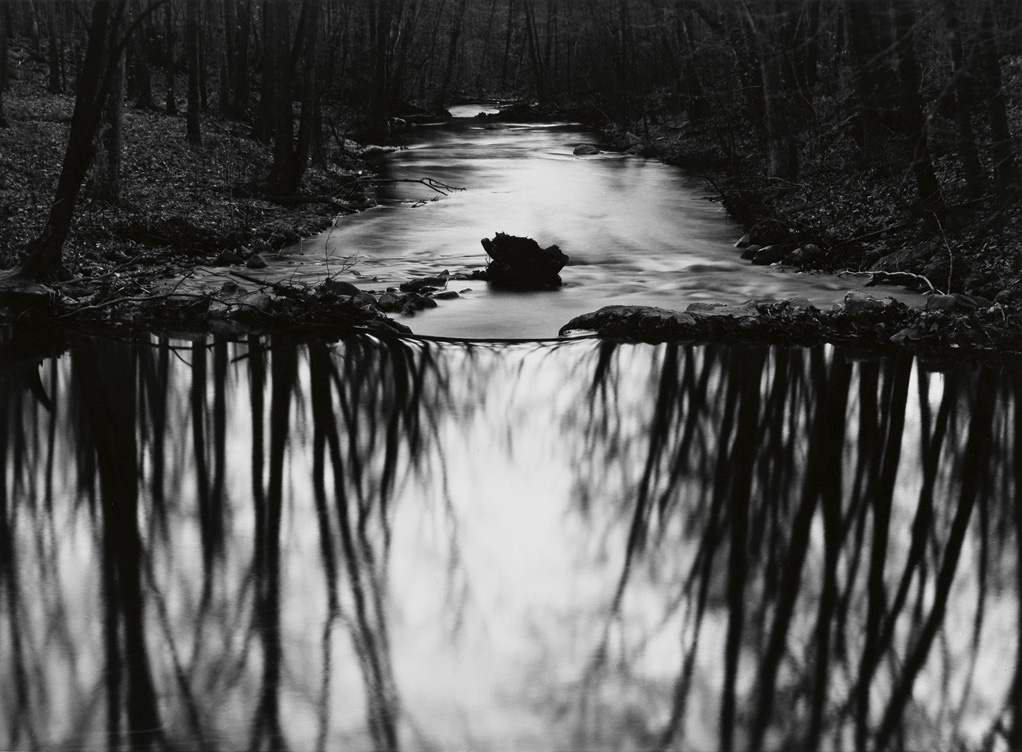
Paul Caponigro (American, 1932-2024) 'Redding Stream, Redding, Connecticut' 1968


Paul Caponigro (American, 1932-2024)
Redding Stream, Redding, Connecticut
1968, printed later
Gelatin silver print


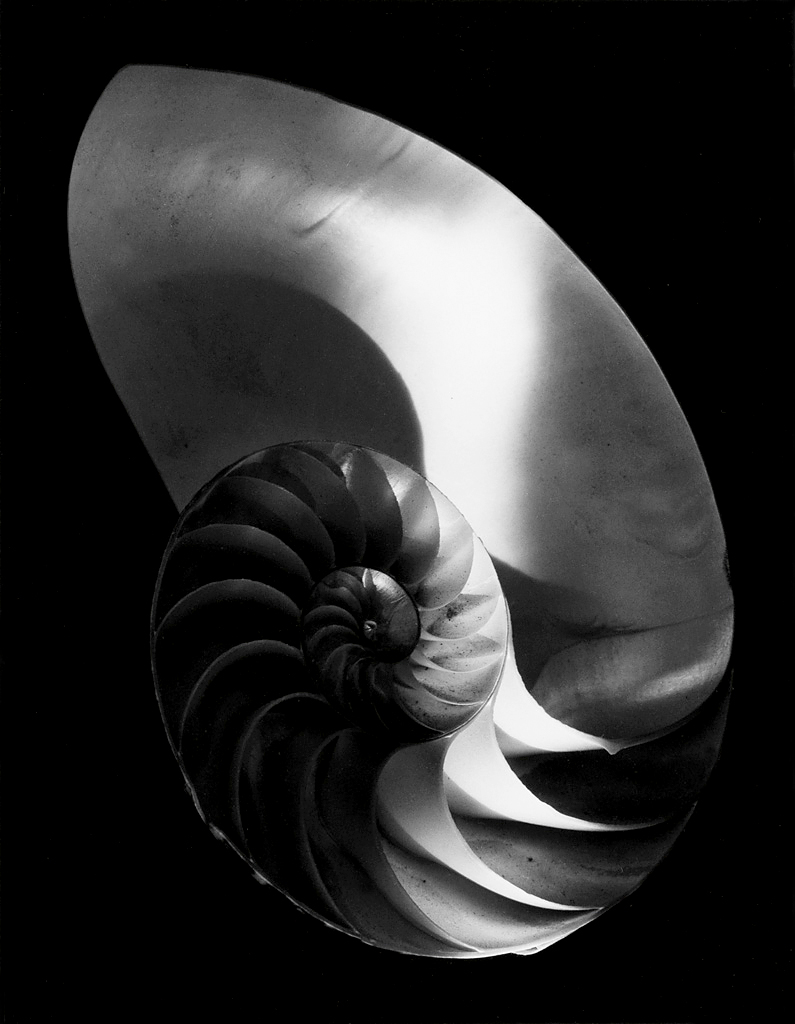
Paul Caponigro (American, 1932-2024) 'Nautilus Shell, Ipswich, Mass' 1960


Paul Caponigro (American, 1932-2024)
Nautilus Shell, Ipswich, Mass
1960
Silver gelatin print


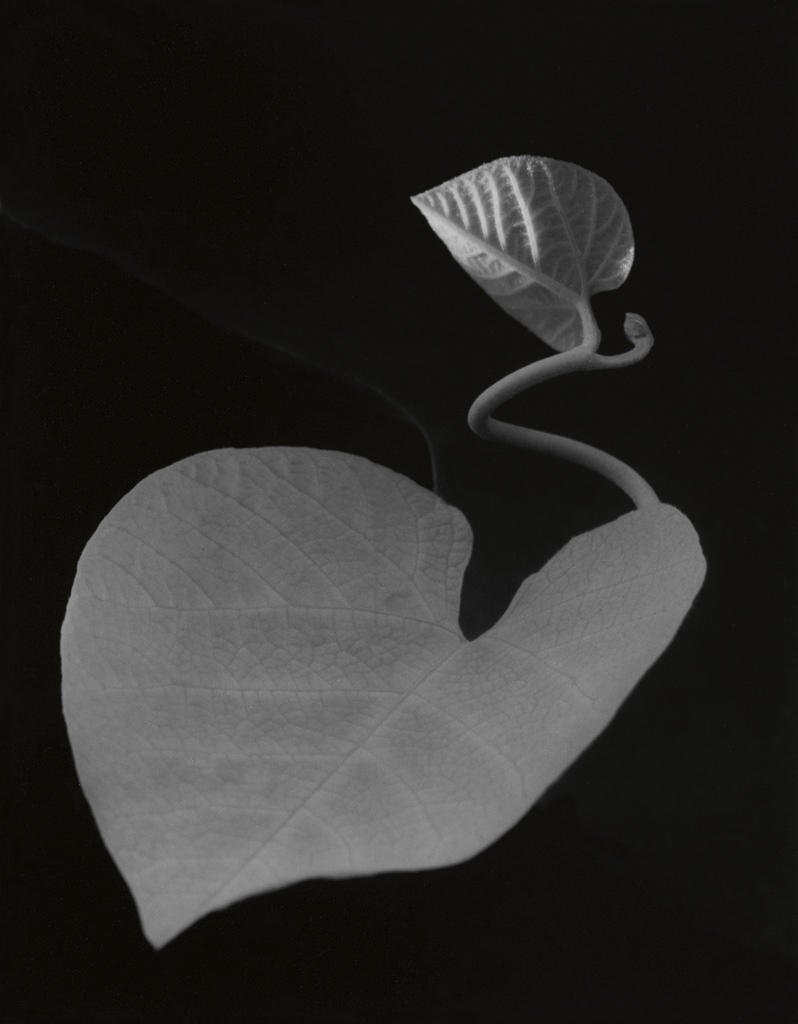
Paul Caponigro (American, 1932-2024) 'Two Leaves, Brewster, New York' 1963


Paul Caponigro (American, 1932-2024)
Two Leaves, Brewster, New York
1963
Silver gelatin print


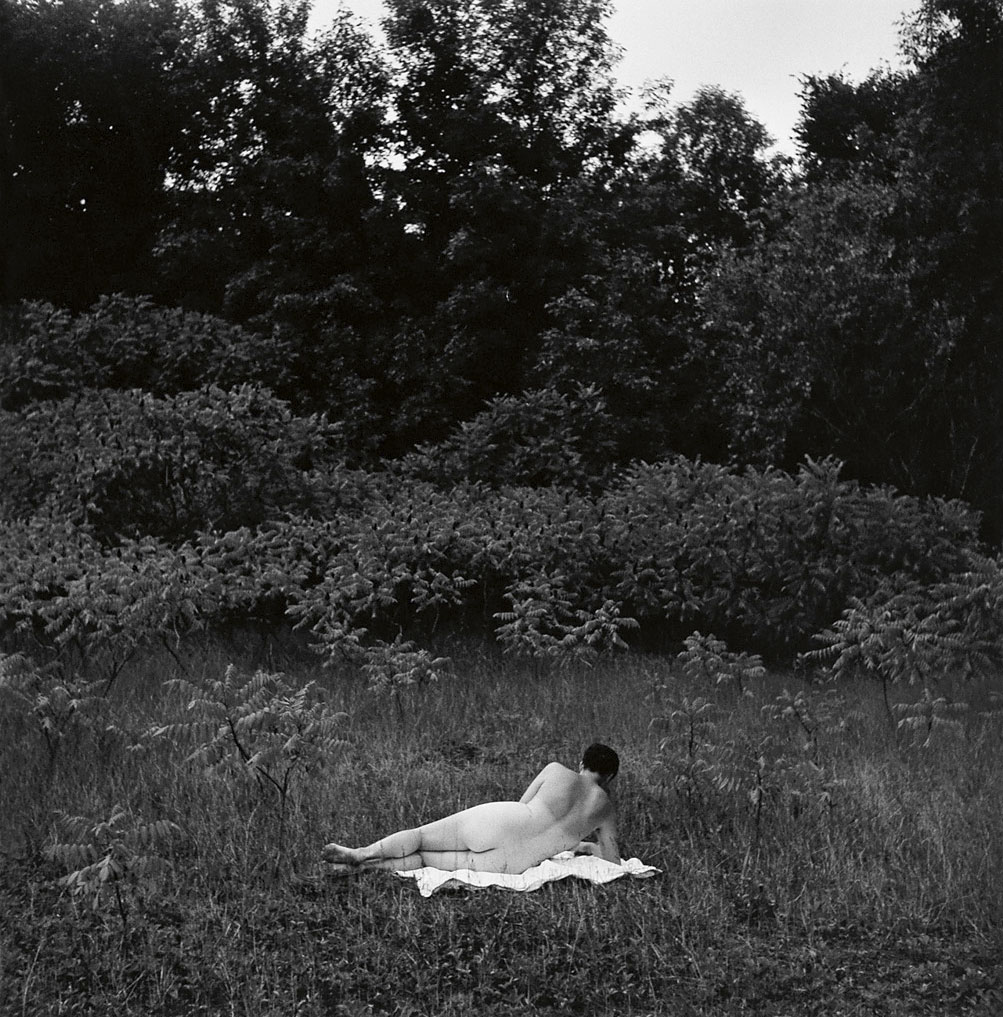
Harry Callahan (American, 1912-1999) 'Eleanor, Port Huron' c. 1954


Harry Callahan (American, 1912-1999)
Eleanor, Port Huron
c. 1954
Silver gelatin print


With her raven hair and ripe figure, Eleanor Callahan is one of the most recognisable models in the history of 20th-century photography, an inseparable part of both the life and work of one of its most renowned artists. Clothed and standing among trees in a public park, or nude and turned to the wall while clutching a radiator in an empty room, she served as a formal element within Mr. Callahan’s austere compositions as well as a symbol of womanhood. From 1941 to his death in 1999, she allowed herself to be photographed by him, without complaint, hundreds of times…

“He just liked to take the pictures of me,” she told an interviewer in 2008. “In every pose. Rain or shine. And whatever I was doing. If I was doing the dishes or if I was half asleep. And he knew that I never, never said no. I was always there for him. Because I knew that Harry would only do the right thing.”

Text from Richard B. Woodward. “Eleanor Callahan, Photographic Muse, Dies at 95,” on the New York Times website 28th February 2012. Used under fair use conditions for the purposes of education and research


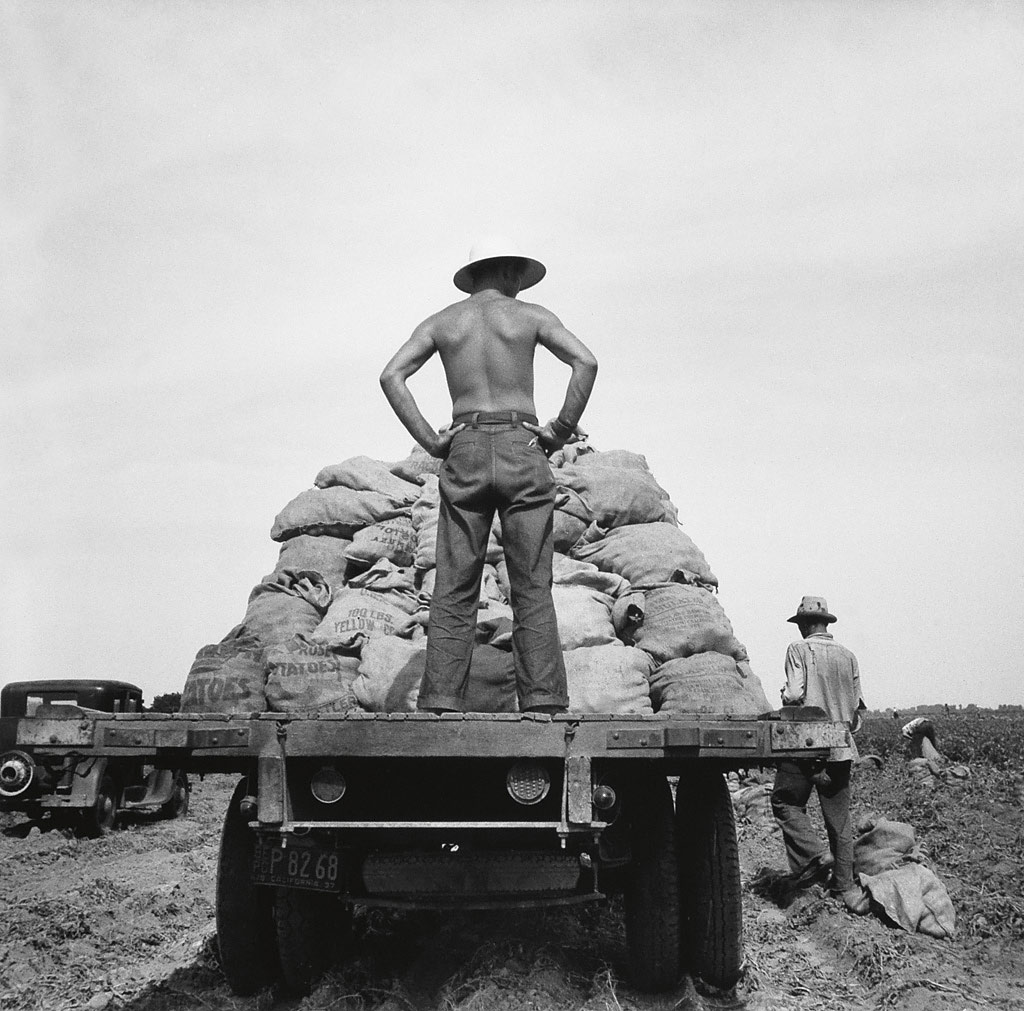
Dorothea Lange (American, 1895-1965) 'Potato truck in the field near Shafter, California' 1937


Dorothea Lange (American, 1895-1965)
Potato truck in the field near Shafter, California
1937
Ferrotyped silver print


Walker Evans (American, 1903-1975) 'Fish Market near Birmingham, Alabama' 1936


Walker Evans (American, 1903-1975)
Fish Market near Birmingham, Alabama
1936
Silver gelatin print


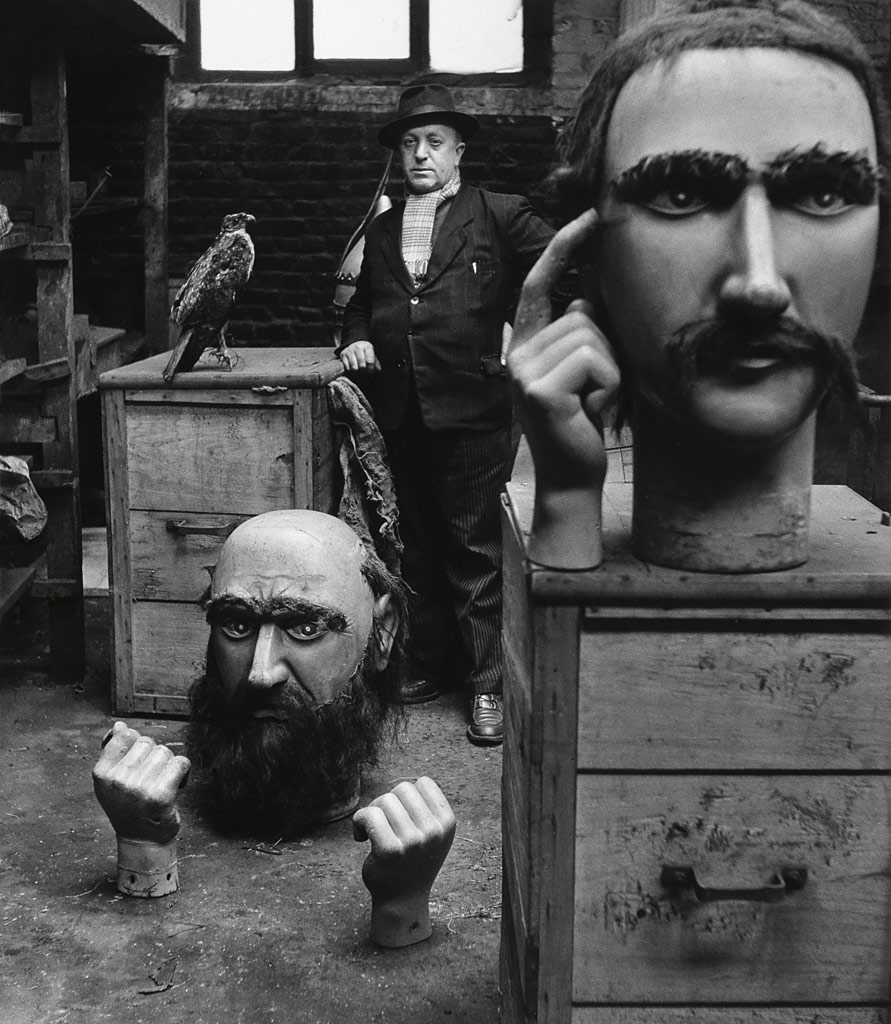
Robert Doisneau (French, 1912-1994) 'Le gardien des géants du Nord' Nd


Robert Doisneau (French, 1912-1994)
Le gardien des géants du Nord
Nd
Silver gelatin print


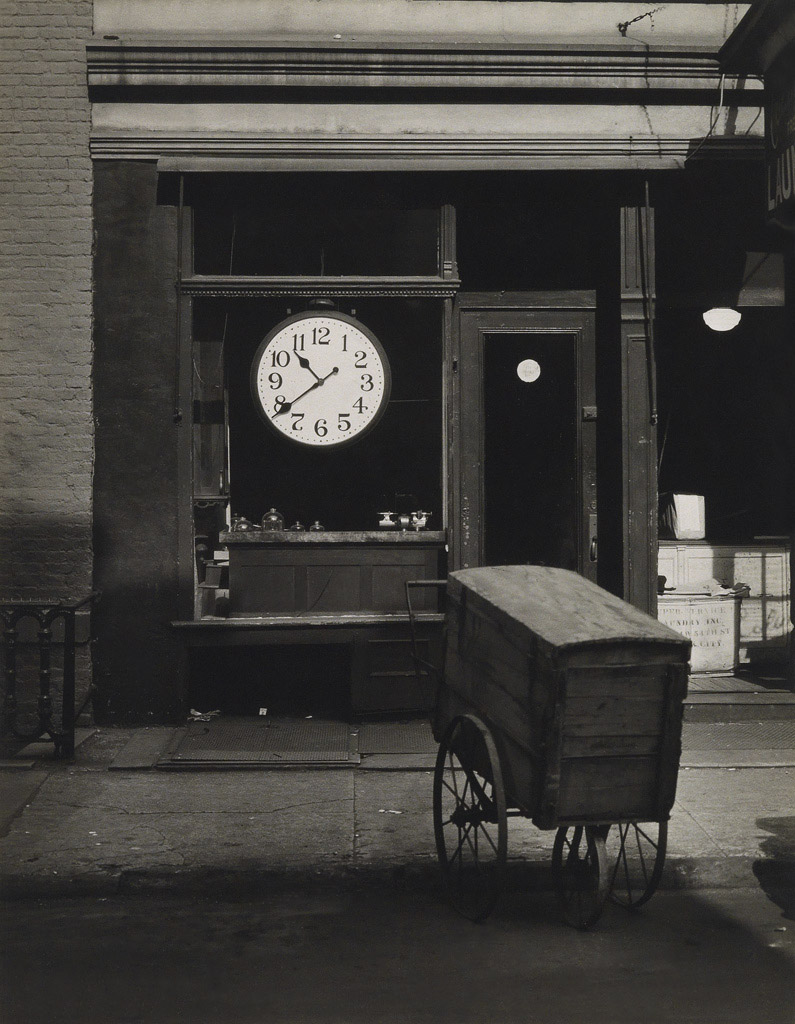
Berenice Abbott (American, 1898-1991) 'Christopher Street Shop' late 1940s


Berenice Abbott (American, 1898-1991)
Christopher Street Shop
late 1940s
Silver gelatin print


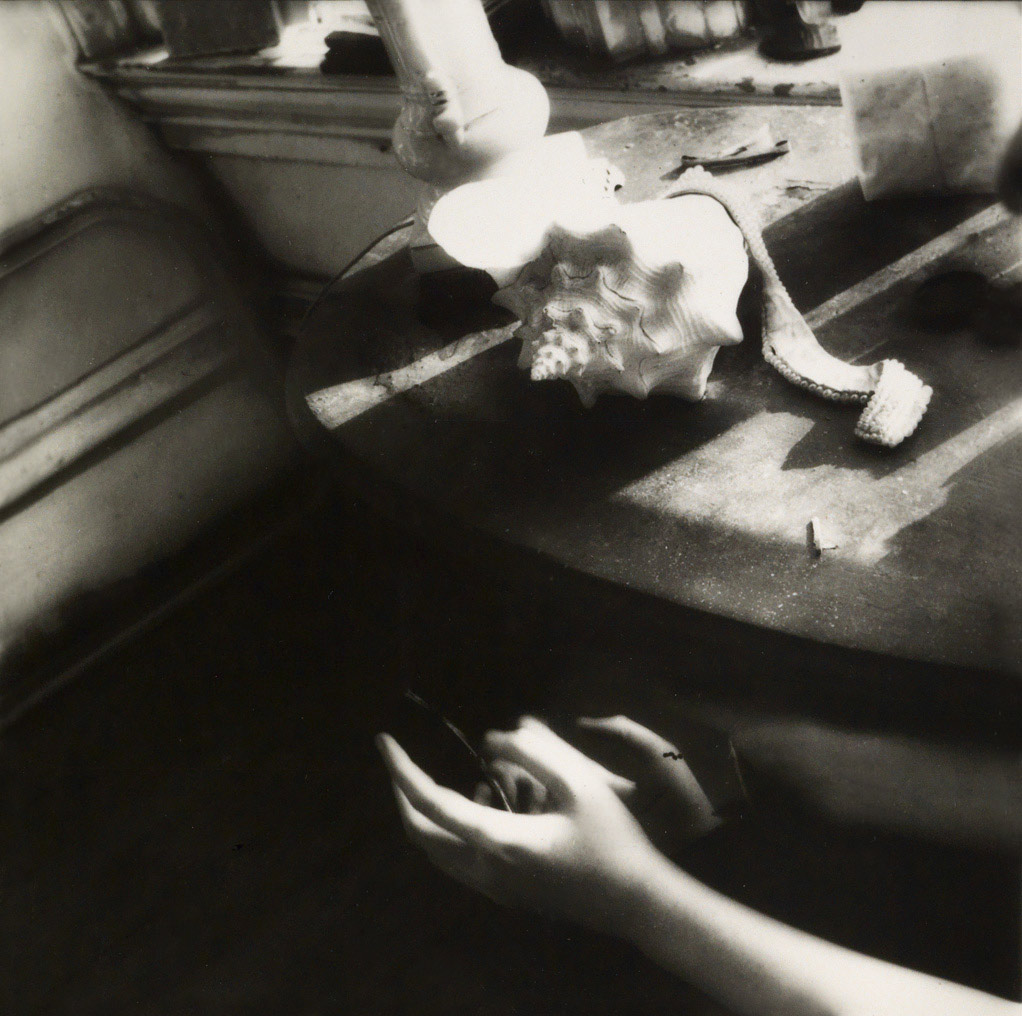
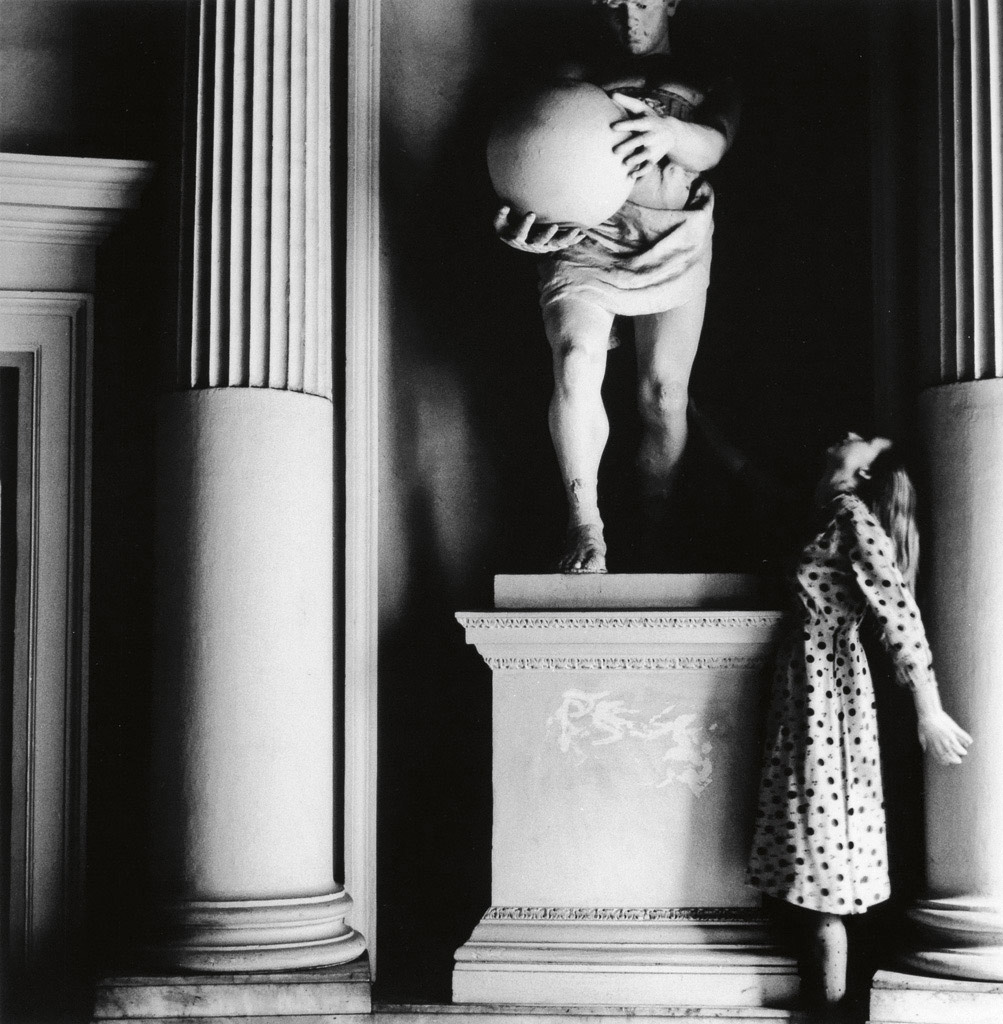
Francesca Woodman (American, 1958-1981) 'But Lately I Find a Sliver of a Mirror is Simply to Slice an Eyelid' 1979/1980


Francesca Woodman (American, 1958-1981)
But Lately I Find a Sliver of a Mirror is Simply to Slice an Eyelid
1979-1980
Silver gelatin print


Francesca Woodman (American, 1958-1981) 'Untitled, Rome, Italy' 1977/1978


Francesca Woodman (American, 1958-1981)
Untitled, Rome, Italy
1977-1978
Silver gelatin print


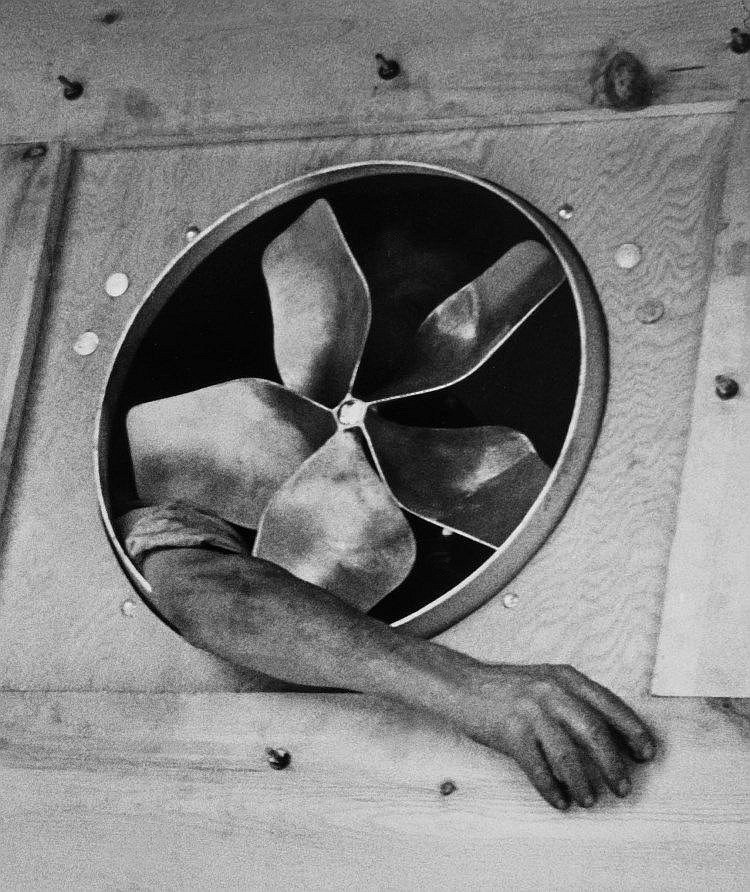
André Kertész (Hungarian, 1894-1985) 'Fan, December 1937' 1937


André Kertész (Hungarian, 1894-1985)
Fan, December 1937
1937
Silver gelatin print


“I am an amateur and I intend to stay that way for the rest of my life.”

~ André Kertész


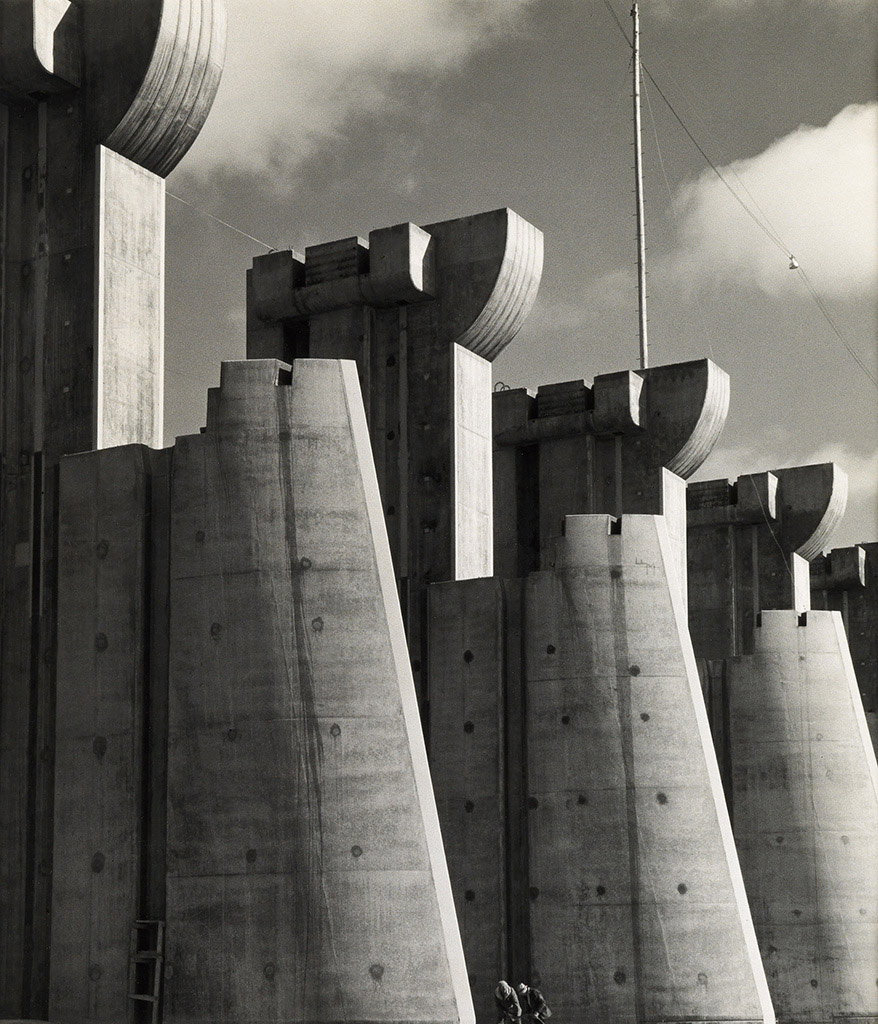
Margaret Bourke-White (American, 1904-1971) 'Fort Peck Dam, Montana' 1936


Margaret Bourke-White (American, 1904-1971)
Fort Peck Dam, Montana
1936
Silver gelatin print


This photograph became an icon of the machine age, not only because it was printed as the cover of the first issue of Life magazine (November 23, 1936), but also because it showed the power of modern technology to dwarf humankind. The giant buttresses and what seem to be crenellated battlements (actually the supports for an elevated highway) are meant to be as raw and impressive as the towering walls of ancient monuments. The engineers on the spillway provide the necessary indication of scale.


Margaret Bourke-White (American, 1904-1971) 'Terminal Tower [Cleveland]' c. 1928


Margaret Bourke-White (American, 1904-1971)
Terminal Tower [Cleveland]
c. 1928
Silver gelatin print


“I stood on the deck to watch the city [Cleveland] come into view. As the skyline took form in the morning mist, I felt I was coming to my promised land … columns of machinery gaining height as we drew toward the pier, derricks swinging like living creatures. Deep inside I knew these were my subjects.”

~ Margaret Bourke-White 1927


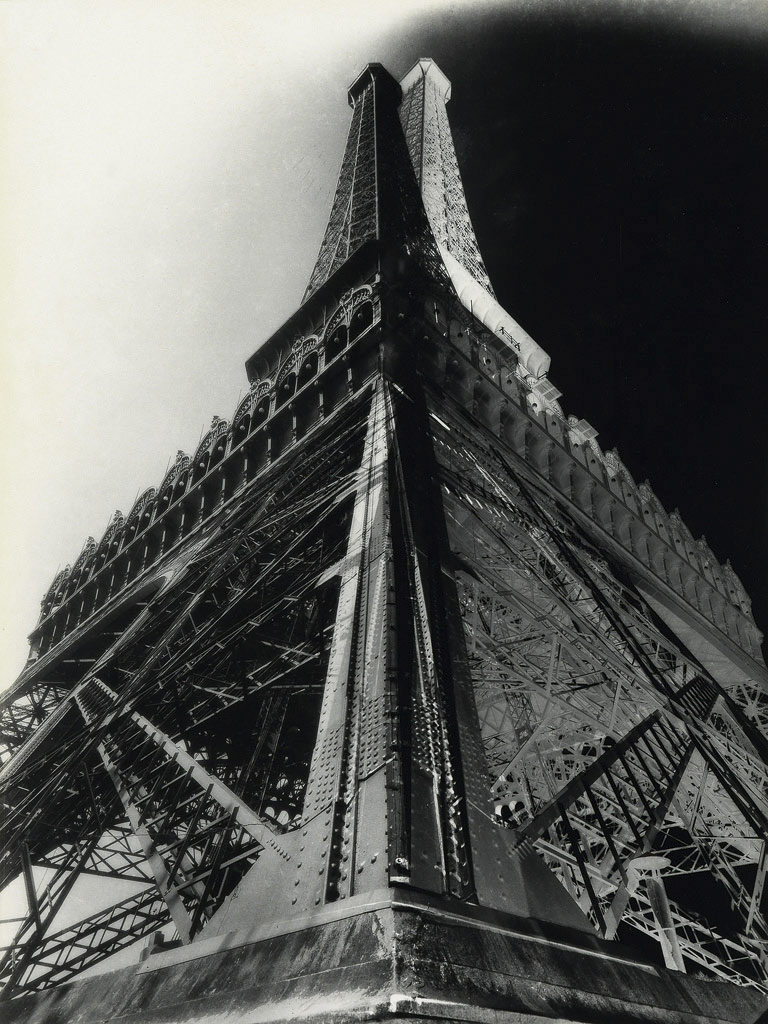
François Kollar (Hungarian, 1904-1979) 'Double-impression of the Eiffel Tower' 1931


François Kollar (Hungarian, 1904-1979)
Double-impression of the Eiffel Tower
1931
Solarised silver gelatin print


In this unique and widely-reproduced photograph, the French modernist photographer has overlaid positive and negative images of the magnificent Eiffel Tower. The iconic structure is depicted from an unusual perspective, thrusting upward, with Kollar’s special solarised effect.


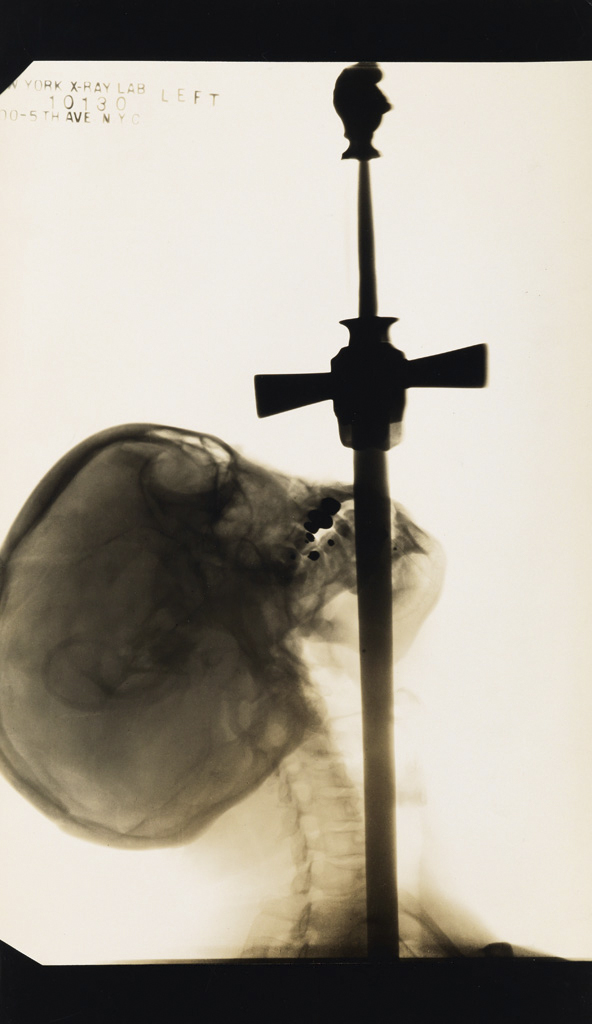
Edward J. Kelty (American, 1888-1967) 'X-ray of Ajax, the sword swallower' 1928


Edward J. Kelty (American, 1888-1967)
X-ray of Ajax, the sword swallower
1928
 Silver print
18 × 11 inches (45.7 × 27.9cm)
With a New York X-ray lab credit in the negative


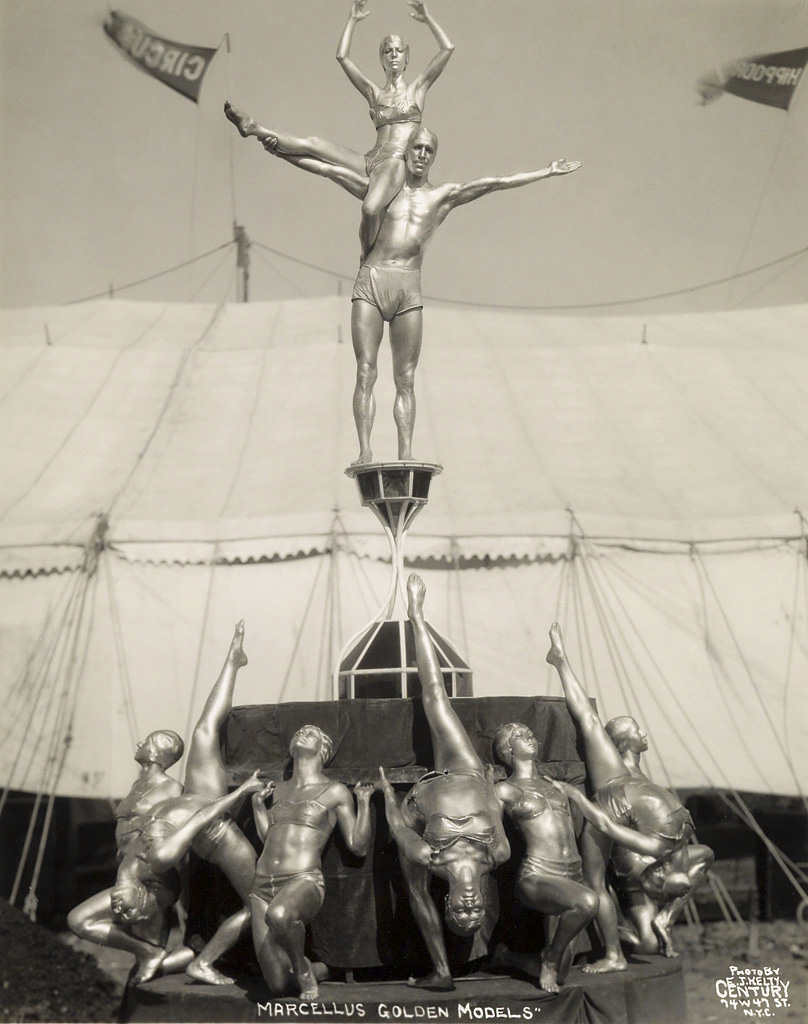
Edward J. Kelty (American, 1888-1967) 'Marcellus Golden Models' 1933


Edward J. Kelty (American, 1888-1967)
Marcellus Golden Models
1933
Silver print
11 1/4 × 8 7/8 inches (28.6 × 22.5cm)
With Kelty’s credit and title in the negative


LIKE ART BLART ON FACEBOOK

Back to top

Exhibition: ‘Bevan Davies: New York’ at Joseph Bellows Gallery, La Jolla, California

Exhibition dates: 14th March – 9th May, 2015


Bevan Davies (American, b. 1941) '94 Greene Street, New York' 1975 from the exhibition 'Bevan Davies: New York' at Joseph Bellows Gallery, La Jolla, California, March - September, 2015


Bevan Davies (American, b. 1941)
94 Greene Street, New York
1975
Vintage gelatin silver print
16 x 20 inches
© Bevan Davies


This stunning suite of large format photographs emanates from an esteemed lineage: the early morning light of Atget’s photographs of Old Paris during that cities urban renewal; the frontality of Walker Evans and his photographs of Southern churches (with both artist’s attention to the storefront facade); and the formal qualities of the New Topographic movement and the gridded topos of Bernd and Hilla Becher.

While Eugène Atget photographed the vanishing environs of Old Paris, Davies captures the urban decay of New York City, a city that was undergoing serious urban renewal in the 1970s.

“The redevelopment of large sections of New York City and New York State by Robert Moses between the 1930s and the 1970s was a notable and prominent example of urban redevelopment. Moses directed the construction of new bridges, highways, housing projects, and public parks. Moses was a controversial figure, both for his single-minded zeal and for its impact on New York City… The Rondout neighbourhood in Kingston, New York (on the Hudson River) was essentially destroyed by a federally funded urban renewal program in the 1960s, with more than 400 old buildings demolished, most of them historic brick structures built in the 19th century. Similarly ill-conceived urban renewal programs gutted the historic centres of other towns and cities across America in the 1950s and 1960s.” (Anon. “Urban Renewal,” on the Wikipedia website)

In Davies’ project (and essential to his task), is the revealing of detail in these undervalued buildings. An ethereal light radiates, almost pulsates from these night time buildings – all rendered in beautifully ferrotyped prints that display a surplus of detail.

The previsualisation in these photographs is excellent. Notice how Davies pushes and pulls the viewer forward and backward in the image plane by using the device of the footpath to frame his compositions. In an image such as 94 Greene Street, New York (1975, above) – one of my favourite in this posting – the artist frames the image to stop at the edge of the pavement, allowing enough room so that the eye is led into the image. In other images, such as Broadway, New York (1976, below) or 425 Broome Street, New York (1976, below), Davies crops right up to the base of the building, forcing the viewer to acknowledge the geometric, cellular structure of the facade and nothing else. In yet other images, such as Column, Mercer Street, New York (1975, below) or 155 West Broadway, New York (1975, below) the artist pulls back from the building, allowing the pavement to anchor the building’s displacement while emphasising the columns grounding within the scene.

These really are magnificent photographs that bring the silence of the city to the fore front of our consciousness. Without the presence of human beings, the buildings take on a majesty that is usually usurped, overlooked or just plain passed by during the humdrum nature of everyday life.

Dr Marcus Bunyan


Many thankx to the Joseph Bellows Gallery for allowing me to publish the photographs in the posting. Please click on the photographs for a larger version of the image.


Bevan Davies (American, b. 1941 '652 Broadway, New York' 1976 from the exhibition 'Bevan Davies: New York' at Joseph Bellows Gallery, La Jolla, California, March - September, 2015


Bevan Davies (American, b. 1941)
652 Broadway, New York
1976
Vintage gelatin silver print
16 x 20 inches
© Bevan Davies


Bevan Davies (American, b. 1941) 'Broadway, New York' 1976


Bevan Davies (American, b. 1941)
Broadway, New York
1976
Vintage gelatin silver print
16 x 20 inches
© Bevan Davies


Bevan Davies (American, b. 1941) '425 Broome Street, New York' 1976


Bevan Davies (American, b. 1941)
425 Broome Street, New York
1976
Vintage gelatin silver print
16 x 20 inches
© Bevan Davies


Bevan Davies (American, b. 1941) 'Walker Street., New York' 1976


Bevan Davies (American, b. 1941)
Walker Street., New York
1976
Vintage gelatin silver print
16 x 20 inches
© Bevan Davies


Bevan Davies (American, b. 1941) 'Hudson Street, New York' 1975


Bevan Davies (American, b. 1941)
Hudson Street, New York
1975
Vintage gelatin silver print
16 x 20 inches
© Bevan Davies


Joseph Bellows Gallery is pleased to announce its upcoming solo exhibition, Bevan Davies New York. The exhibition opens on March 14th and will continue through May 9, 2015. An opening reception will be held on Saturday, March 14th, from 6-8 pm. New York will present Davies’ luminous and highly detailed large-format black and white architectural views from the mid 1970’s, along with a selection of his earlier street portraiture from the preceding decade, in the atrium gallery.

Bevan Davies studied photography with Bruce Davidson, at the University of Chicago in early 1960’s and benefitted greatly through mentoring from Diane Arbus later in that decade. After working the street in both daylight and evening hours, photographing people at odds with society, with a hand camera, Davies changed his working methodology to describing the physical environs of the street: the building facades, alleys and streets with a tripod mounted view camera.

This change in subject and approach resulted in Davies most celebrated work. Created in 1975/76 Bevan Davies’ architectural photographs situated themselves wholly within the dictum laid forth by William Jenkins, as “New Topographics”. In fact, Davies writes of his approach as, “an effort being made to let the camera almost see by itself.” This notion was carried further by the late photographer, Lewis Baltz, who in 1976, referred to Davies’ photographs as, “rigorously contemporary, while acknowledging a use of the camera which dates from the inception of the medium.” The New York facades, taken in the early morning hours and devoid of people, describe spaces defined by light and shadow. They depict a specific time and place, as seen by the window dressings and signage, as well as portray a formal grace among the building’s details that are included within Davies’ camera frame. New York is the first comprehensive exhibition of Davies’ photographs in over two decades.

Davies photographs can be found in the collections of the J. Paul Getty Museum, Center for Creative Photography, Art Institute of Chicago, Nelson-Atkins Museum, Minneapolis Institute of the Arts, Museum of Fine Arts, Houston, George Eastman House, Corcoran Gallery of Art, Harry Ransom Center, Metropolitan Museum of Art, and the International Center of Photography.

In 2014, Nazraeli Press released Los Angeles, 1976, a monograph on Davies’ photographs from that region and era. The photographs depict the residential architecture and neighbourhoods through nuanced arrangement and clarity. A forthcoming volume on Davies’ New York photographs is in prepublication.

Press release from the Joseph Bellows Gallery


Bevan Davies (American, b. 1941) '144 Wooster Street, New York' 1976


Bevan Davies (American, b. 1941)
144 Wooster Street, New York
1976
Vintage gelatin silver print
16 x 20 inches
© Bevan Davies


Bevan Davies (American, b. 1941) 'View from 475 Broadway, New York' 1976


Bevan Davies (American, b. 1941)
View from 475 Broadway, New York
1976
Vintage gelatin silver print
16 x 20 inches
© Bevan Davies


Bevan Davies (American, b. 1941) 'Bond Street, Facing North, New York' 1976


Bevan Davies (American, b. 1941)
Bond Street, Facing North, New York
1976
Vintage gelatin silver print
16 x 20 inches
© Bevan Davies


Bevan Davies (American, b. 1941) 'Franklin and West Broadway, New York' 1976


Bevan Davies (American, b. 1941)
Franklin and West Broadway, New York
1976
Vintage gelatin silver print
16 x 20 inches
© Bevan Davies


Bevan Davies (American, b. 1941) '426 West Broadway, New York' 1975


Bevan Davies (American, b. 1941)
426 West Broadway, New York
1975
Vintage gelatin silver print
20 x 16 inches
© Bevan Davies


Bevan Davies (American, b. 1941) 'Column, Mercer Street, New York' 1975


Bevan Davies (American, b. 1941)
Column, Mercer Street, New York
1975
Vintage gelatin silver print
20 x 16 inches
© Bevan Davies


Bevan Davies (American, b. 1941) '11 Mercer Street, New York' 1976


Bevan Davies (American, b. 1941)
11 Mercer Street, New York
1976
Vintage gelatin silver print
20 x 16 inches
© Bevan Davies


Bevan Davies (American, b. 1941) '155 West Broadway, New York' 1975


Bevan Davies (American, b. 1941)
155 West Broadway, New York
1975
Vintage gelatin silver print
20 x 16 inches
© Bevan Davies


Joseph Bellows Gallery
7661 Girrard Avenue
La Jolla, California
Phone: 858 456 5620

Opening hours:
Tuesday – Saturday 11am – 5pm and by appointment

Joseph Bellows Gallery website

LIKE ART BLART ON FACEBOOK

Back to top

Exhibition: ‘John Gossage: Three Routines’ at The Art Institute of Chicago

Exhibition dates: 22nd January – 3rd May, 2015

Curator: Matthew Witkovsky, the Richard and Ellen Sandor Chair and Curator of Photography at the Art Institute of Chicago


John Gossage (American, b. 1946) 'Stallschreiberstr.,' 1989, printed 2003-2004 from the exhibition 'John Gossage: Three Routines' at The Art Institute of Chicago, January - May, 2015


John Gossage (American, b. 1946)
Stallschreiberstr.,
1989, printed 2003-2004
From the series Berlin in the Time of the Wall
Gelatin silver print
15.5 x 12.3cm
The Art Institute of Chicago, Gift of Michael Abrams and Sandra Stewart
© John Gossage

Used under fair use conditions for the purpose of art criticism.


I freely admit that I knew little about this artist’s work before starting to assemble this posting.

Strong, focused, conceptually driven bodies of work that have real guts and presence. Tough, no compromise realist photographs with Gossage not afraid to challenge convention… through dark, almost totally black, chthonic images; through over exposure, sprocket holes of the film, out of focus foregrounds, and an elemental consciousness pushing at reality.

While there are only 12 images in the posting (I wish there were more!), there are 600 more on the Art Institute of Chicago website in the collection and I have spent a lot of time immersing myself in his worlds, his heterotopic spaces (Foucault), spaces of otherness, which are neither here nor there, that are simultaneously physical and mental. The series Berlin in the Time of the Wall is a particular favourite. Just look at the image Stallschreiberstr., (1989, below) and grasp the atmosphere and allusion of the image – the light that emanates from the yin/yang puddle and the symbolic quality of that division with the looming presence of the towering wall, being reflected into the water and next to the only specular highlight of the image.

I am deeply impressed by the profundity of his artistic enquiry, his visioning of a reality that takes the viewer places that they have never been before. And holds them there. Gossage does more than just gather, record, and sequence memories from our contemporary world… he creates those memories afresh, anew. Some photographs in his series work better than others but that is bound to happen when you are really trying to engage with the world that you are imag(in)ing. The force is strong in this one. He got me hook, line and sinker.

Dr Marcus Bunyan


Many thankx to The Art Institute of Chicago for allowing me to publish the photographs in the posting. Please click on the photographs for a larger version of the image.


“For ‘There and Gone’, [Gossage] is photographing on the beach of Tijuana in Mexico; ‘Berlin in the Time of The Wall’ is taking place in Berlin; ‘The Romance Industry’ in Marghera, a desolated industrial area located across the lagoon from Venice in Italy. With these series John Gossage is established as an anthropologist of the ordinary.

In his work, objects, places, situations are also clues, traces to build a photographic memory of past and contemporary history… The choice of the title “Routine” for both of these exhibitions shouldn’t surprise us. John Gossage is using photography as a mastered routine. He gathers, records, and sequences memories from our contemporary world.”


Agathe Cancellieri. “Chicago: Three Routines by John Gossage,” on The Eye of Photography website 2nd March 2015 [Online] Cited 10/03/2015. No longer available online


The first museum survey of American photographer John Gossage’s career ever mounted, this “retrospective in a room” brings together several decades’ worth of work to show three distinct ways, or routines, in which the artist has approached photography.

One routine concentrates on his intensely productive time in Berlin in the 1980s; on display are two dozen images from the nearly 600 that make up his Berlin series, which the Art Institute is fortunate to own in its entirety. The second routine comes from Gossage’s recent year spent traveling the United States on a prestigious Guggenheim Foundation Fellowship, making portraits of art students and capturing views in smaller towns and cities, from Albuquerque, New Mexico, to Rochester, Minnesota. The third offers a “medley” of images from across his career, which he began in his teenage years as a student of Lisette Model, Alexey Brodovich, and Bruce Davidson. In addition to highlighting the various photographic methods Gossage has used throughout his career, the exhibition includes a reading table with a selection of the artist’s publications, showcasing his talents as a consummate printer and an ingenious book artist.


Jim Iska. 'Untitled [Installation view of the exhibition John Gossage: Three Routines at The Art Institute of Chicago]' 2015

Jim Iska. 'Untitled [Installation view of the exhibition John Gossage: Three Routines at The Art Institute of Chicago]' 2015

Jim Iska. 'Untitled [Installation view of the exhibition John Gossage: Three Routines at The Art Institute of Chicago]' 2015


Jim Iska
Untitled [Installation views of the exhibition John Gossage: Three Routines at The Art Institute of Chicago]
2015


John Gossage (American, b. 1946) 'SS Headquarters, Zimmerstr.,' 1988, printed 2003-2004 from the exhibition 'John Gossage: Three Routines' at The Art Institute of Chicago, January - May, 2015


John Gossage (American, b. 1946)
SS Headquarters, Zimmerstr.,
1988, printed 2003-2004
From the series Berlin in the Time of the Wall
Gelatin silver print
21.3 x 26.2cm
The Art Institute of Chicago, gift of Michael Abrams and Sandra Stewart
© John Gossage


John Gossage (American, b. 1946) 'Behind the Japanese embassy Köbisstr.,' 1989, printed 2003/2004


John Gossage (American, b. 1946)
Behind the Japanese embassy Köbisstr.,
1989, printed 2003-2004
From the series Berlin in the Time of the Wall
Gelatin silver print
28.6 x 22.3cm
The Art Institute of Chicago, gift of Michael Abrams and Sandra Stewart
© John Gossage


John Gossage (American, b. 1946) 'Doris, Friedrichstr.,' 1982, printed 2003/2004


John Gossage (American, b. 1946)
Doris, Friedrichstr.,

1982, printed 2003-2004
From the series Berlin in the Time of the Wall
Gelatin silver print
29.7 x 22.6cm
The Art Institute of Chicago, gift of Michael Abrams and Sandra Stewart
© John Gossage


John Gossage (American, b. 1946) 'Untitled' 1982/1989, printed 2003-2006


John Gossage (American, b. 1946)
Untitled
1982/1989, printed 2003-2006
Gelatin silver print
The Art Institute of Chicago, Gift of Michael Abrams and Sandra Stewart
© John Gossage


The Art Institute of Chicago is presenting the first museum survey ever mounted of American photographer John Gossage’s career. John Gossage: Three Routines opened Jan. 22, 2015, and continues through May 3, 2015, in Galleries 188 and 189 in the museum’s Modern Wing.

Gossage, who was born in New York City in 1946, began his photographic career at age 14, taking pictures for the local newspaper in Staten Island, New York. Within a year he advanced to intensive studies with photographers Lisette Model and Bruce Davidson, as well as with art director Alexey Brodovitch.

His only formal education came in 1964, at the experimental Walden School in Washington, D.C. Gossage continued to live in Washington after he graduated, even though New York remained central to his development. He showed his own work there – most frequently with the Leo Castelli Gallery in Manhattan – and organised shows of work by others, including a three-part exhibition on the New York School at the Corcoran Gallery in 1992.

The Art Institute’s “retrospective in a room” brings together several decades’ worth of work to show three distinct ways, or routines, in which the artist has approached photography. One routine concentrates on his intensely productive time in Berlin in the 1980s; on display are two dozen images from the nearly 600 that make up his Berlin series, which the Art Institute is fortunate to own in its entirety. The second routine comes from Gossage’s recent year spent traveling the United States on a prestigious Guggenheim Foundation Fellowship, making portraits of art students and capturing views in small towns, particularly in Colorado. The third offers a “medley” (a fitting approach, as Gossage once played blues guitar professionally) of images from across his career. In addition to highlighting the various photographic methods Gossage has used throughout his career, the exhibition includes a reading table with a selection of the artist’s publications, showcasing his talents as a consummate printer and an ingenious book artist.

While Gossage plays with narrative in his works, he only partly accepts the general expectation that photographs will explain and replicate the world. Extending from Berlin in 1982 to Albuquerque, N.M., in 2014, Three Routines displays a permutating approach to creativity that suggests a reflection on individual continuity in the face of massive historical change. The grouping of so many projects illuminates how Gossage works to maintain authorial consistency while regularly challenging his habits and even questioning the value of a personal style.

John Gossage: Three Routines was organised by Matthew Witkovsky, Richard and Ellen Sandor Chair and Curator, Department of Photography, at the Art Institute. Major funding for the exhibition has been provided by the Trellis Fund. Additional support has been generously contributed by Stephen G. Stein and Edward Lenkin. The exhibition is part of Photography Is ____________ , a nine-month celebration of photography at the Art Institute that includes pop-up gallery talks, online events, and the presentation of the museum’s most treasured photographs.”

Press release from The Art Institute of Chicago


John Gossage (American, b. 1946) 'Untitled', from the series 'Nothing' 1985


John Gossage (American, b. 1946)
Untitled from the series Nothing
1985
Gelatin silver print
© John Gossage


John Gossage (American, b. 1946) #64 from the series 'There and Gone' 1997


John Gossage (American, b. 1946)
#64 from the series There and Gone
1997
Gelatin silver print
© John Gossage


There and Gone is a book in three chapters … the first chapter being the bathing beach in the city of Tijuana. My wife, Terri Weifenbach, took me to this beach. It’s one of those funny places in the world where everything comes together. It’s like a stage set almost. The landscape, what’s going on there and what it means is all concentrated in a relatively small area; it’s exceedingly intense. There’s a lot of illegal border crossing and at the same time it’s the beach of the people of Tijuana.

Robert Adams made a comment in his book Beauty in Photography that always stuck with me. [He wrote] that no photographer of major ambition had ever sustained important work taken with long telephoto lenses. It seemed on obvious loophole. There’s got to be something out there worth taking, something like the periphery of your vision at a great distance. What are things at a great distance?

What seemed interesting to me was the photographing of strangers. Here was a culture whose language I did not speak, which I didn’t really know anything about … I could go on the beach and do the standard photojournalist pantomime where you spend a couple of days blending in, getting to know the people, but it’s a lie, an illusion. Given this I decided to stay at a distance and photograph people who didn’t know that they were being photographed. All of the pictures taken of Mexico are done from America, about a quarter mile down the beach. I could just stand there and shoot all day, anything that went on, taking another culture on its own terms.”

“Interview with John Gossage on There and Gone on the American Suburb X website, April 18, 2011 [Online] Cited 10/03/2015.


John Gossage (American, b. 1946) 'Untitled' from the series 'An Easy Guide to Southern Stars' 2009


John Gossage (American, b. 1946)
Untitled from the series An Easy Guide to Southern Stars
2009
© John Gossage


John Gossage (American, b. 1946) 'Untitled' from the series 'pomodori a grappolo' 2009-2011


John Gossage (American, b. 1946)
Untitled
from the series pomodori a grappolo
2009-2011
© John Gossage


John Gossage (American, b. 1946) 'Untitled' from the series 'pomodori a grappolo' 2009-2011


John Gossage (American, b. 1946)
Untitled
 from the series pomodori a grappolo
2009-2011
© John Gossage


John Gossage (American, b. 1946) '#41' from the series 'The Guggenheim Project' 2010


John Gossage (American, b. 1946)
#41 from the series The Guggenheim Project
2010
© John Gossage


John Gossage (American, b. 1946) '#417' from the series 'The Guggenheim Project' 2013


John Gossage (American, b. 1946)
#417 from the series The Guggenheim Project
2013
© John Gossage


The Art Institute of Chicago
111 South Michigan Avenue
Chicago, Illinois 60603-6404
Phone: (312) 443-3600

Opening hours:
Thursday – Monday 11am – 6pm
Closed Tuesday and Wednesday

The Art Institute of Chicago website

LIKE ART BLART ON FACEBOOK

Back to top

Exhibition: ‘In Focus: Play’ at the J. Paul Getty Museum at the Getty Center, Los Angeles

Exhibition dates: 23rd December, 2014 – 10th May, 2015

Curator: organised by assistant curator Arpad Kovacs in the Department of Photographs at the J. Paul Getty Museum


Herman F. Nielson (American, active Niagara Falls, New York 1883 - early 1900s) 'View of Niagara Falls in Winter' c. 1885 from the exhibition 'In Focus: Play' at the J. Paul Getty Museum at the Getty Center, Los Angeles, December 2014 - May 2015


Herman F. Nielson (American, active Niagara Falls, New York 1883 – early 1900s)
View of Niagara Falls in Winter
c. 1885
Gelatin silver print
19.1 x 24.3cm (7 1/2 x 9 9/16 in.)
The J. Paul Getty Museum, Los Angeles


The J. Paul Getty Museum always puts on the most interesting photography exhibitions. This looks to be no exception.

Marcus


Many thankx to the J. Paul Getty Museum for allowing me to publish some of the photographs in the posting. Please click on the photographs for a larger version of the image.


Platt D. Babbitt (American, 1823-1879, active Niagara Falls, New York 1853-1870) '[Scene at Niagara Falls]' c. 1855 from the exhibition 'In Focus: Play' at the J. Paul Getty Museum at the Getty Center, Los Angeles, December 2014 - May 2015


Platt D. Babbitt (American, 1823-1879, active Niagara Falls, New York 1853-1870)
[Scene at Niagara Falls]
c. 1855
Whole plate daguerreotype
The J. Paul Getty Museum
CC This work is in the public domain


In the 1800s Prospect Point at Niagara Falls was a popular destination for travellers in search of a transcendent encounter with nature. The falls were revered as a sacred place that was recognised by the Catholic Church in 1861 as a “pilgrim shrine,” where the faithful could contemplate the landscape as an example of divine majesty. Two well-dressed couples are seen from behind as they stand on the shore downstream from the falls, gazing at its majestic splendour. The silhouetted forms – women wearing full skirts and bonnets and carrying umbrellas and men in stovepipe hats – are sharply outlined against the patch of shore and expansive, white foam. Platt D. Babbitt would customarily set up his camera in an open-sided pavilion and photograph groups of tourists admiring the falls without their knowledge, as he appears to have done here. Later he would sell the unsuspecting subjects their daguerreotype likenesses alongside the natural wonder.


Roger Fenton (English, 1819-1869) 'The Billiard Room, Mentmore' c. 1858


Roger Fenton (English, 1819-1869)
The Billiard Room, Mentmore
c. 1858
Albumen silver print
Height: 303mm (11.93 in)
Width: 306mm (12.05 in).
The J. Paul Getty Museum
CC This work is in the public domain


A group of fashionable men and women enjoy a game of billiards in a richly furnished salon. The recently completed billiards room, which was designed as a conservatory, is flooded with sunlight, illuminating the lavish interior and creating a dramatic pattern of light and shadows. Indoor photography was rare in the mid-1800s, but the abundance of light and Fenton’s skill with the wet-collodion process created a remarkably detailed portrait of the space and its inhabitants. Behind the woman standing in the doorway at the very far end of the salon, a marble bust, mantelpiece, and mirror can be seen in an adjacent room.

Mentmore House was a country residence of the wealthy Rothschild family, but little is known as to how Fenton came to photograph its interior or who the depicted individuals might be. Fenton accepted commissions to document several other country homes, and his surviving photographs of Mentmore House – both interior and exterior views – may have formed part of a commissioned album. Like Fenton’s Orientalist scenes, this image reveals a high degree of staging. Only one figure actually holds a cue stick, and several of the women wear hats that seem unusual for the indoor setting.


Camille Silvy (French, 1834-1910, active in London) 'Group of their Royal Highnesses the Princess Clementine de Saxe Cobourg Gotha, her Sons and Daughter, the Duke d'Aumale, the Count d'Eu, the Duke d'Alencon, and the Duke de Penthievre [in England]' 1864


Camille Silvy (French, 1834-1910, active in London)
Group of their Royal Highnesses the Princess Clementine de Saxe Cobourg Gotha, her Sons and Daughter, the Duke d’Aumale, the Count d’Eu, the Duke d’Alencon, and the Duke de Penthievre [in England]
1864
Albumen silver print
10.2 x 17cm (4 x 6 11/16 in.)


Camille Silvy (French, 1834-1910, active in London) 'Group of their Royal Highnesses the Princess Clementine de Saxe Cobourg Gotha, her Sons and Daughter, the Duke d'Aumale, the Count d'Eu, the Duke d'Alencon, and the Duke de Penthievre [in England]' 1864 (detail)


Camille Silvy (French, 1834-1910, active in London)
Group of their Royal Highnesses the Princess Clementine de Saxe Cobourg Gotha, her Sons and Daughter, the Duke d’Aumale, the Count d’Eu, the Duke d’Alencon, and the Duke de Penthievre [in England] (detail)
1864
Albumen silver print
10.2 x 17cm (4 x 6 11/16 in.)


Man Ray (American, 1890-1976) '[Marcel Duchamp and Raoul de Roussy de Sales Playing Chess]' 1925


Man Ray (American, 1890-1976)
[Marcel Duchamp and Raoul de Roussy de Sales Playing Chess]
1925
Gelatin silver print
16.7 x 22.5cm (6 9/16 x 8 7/8 in.)
The J. Paul Getty Museum, Los Angeles
© Man Ray Trust ARS-ADAGP


Weegee (Arthur Fellig) (American born Austria, 1899-1968) '[Summer, The Lower East Side, New York City]' Summer 1937


Weegee (Arthur Fellig) (American born Austria, 1899-1968)
[Summer, The Lower East Side, New York City]
Summer 1937
Gelatin silver print 26.5 x 33.3cm (10 7/16 x 13 1/8 in.)
The J. Paul Getty Museum, Los Angeles
© International Center of Photography


André Kertész (American born Hungary, 1894-1985) '[Underwater Swimmer]' Negative 1917; print 1970s


André Kertész (American born Hungary, 1894-1985)
[Underwater Swimmer]
Negative 1917; print 1970s
Gelatin silver print 17 x 24.7cm (6 11/16 x 9 3/4 in.)
The J. Paul Getty Museum, Los Angeles
© Estate of André Kertész


In Focus: Play, on view at the J. Paul Getty Museum at the Getty Center from December 23, 2014 through May 10, 2015, presents photographs that explore how notions of leisure and play have been represented over the course of the medium’s history. The nearly thirty works from the Museum’s permanent collection highlight a wide range of amusing activities, from quiet games like chess to more boisterous forms of recreation like skateboarding and visits to amusement parks and circuses. All of the photographs included in the exhibition illustrate the many ways people have chosen to spend their free time. The images also demonstrate inventive and improvised approaches, like unusual vantage points and jarring juxtapositions that photographers have employed to help capture the spontaneity of playfulness.

Organised by assistant curator Arpad Kovacs in the Department of Photographs at the J. Paul Getty Museum, this exhibition spans almost 175 years of the medium’s history and features the work of a variety of well-known and lesser-known photographers, including Diane Arbus, Henri Cartier-Bresson, Imogene Cunningham, Larry Fink, T. Lux Feininger, Roger Fenton, Andre Kertész, Man Ray, Alexander Rodchenko, Masato Seto, Camille Silvy, and Weegee, among others.

“Capturing our everyday lives has been one of photography’s central themes ever since its invention in the mid-nineteenth century,” says Timothy Potts, Director of the J. Paul Getty Museum. “So it is no surprise that images of people playing games and having fun is a rich seam within the history of photography that this exhibition and accompanying book bring to life brilliantly. This is photography at its entertaining and uplifting best.”

The introduction of photography in 1839 coincided with a bourgeoning culture of leisure. Changes in working and living conditions brought on by the Industrial Revolution created an unprecedented amount of free time for large numbers of people in Europe and the United States. In the 1850s, photographic studios began to capitalize on the development and growth of the tourism industry, promoting recreation as a photographic subject. Technological advancements in film and camera equipment during the early twentieth century facilitated the recording of dynamic activities such as sports and visits to amusement parks. Domestic and public spaces alike became sites where people performed for the camera and documented a break from daily routines.

During the nineteenth century, the eminent photographer Roger Fenton, who was widely recognised for visually documenting the Crimean War (1853-1856), also photographed intimate scenes that reflected casual pastimes. Included in the exhibition is his photograph from 1858 entitled, The Billiard Room, Mentmore House, in which a group of six people act out a scene of domestic amusement in a billiard room lined with a row of large windows.

The desire for pictures of everyday life flourished during the early twentieth-century. The illustrated press, which had grown in popularity in the United States and Europe since the 1920s, was especially interested in photographs of recreation and leisure. Photojournalists often searched for high-impact images that could tell compelling or amusing stories. Weegee (Arthur Fellig), a well-known tabloid photographer, kept his camera focused on New York City’s neighbourhoods. In the photograph Summer, Lower East Side, New York City, 1937, he recorded the ecstatic faces of boys and girls cooling off in the water from an open fire hydrant as they briefly co-opted a street for their own delight.

Tourist destinations with sweeping vistas, like Niagara Falls and Yosemite Valley, had been attracting photographers continuously since the 1850s. In a 1980 photograph from his Sightseer series, Roger Minick comments on the phenomenon of taking in the sights through visual juxtaposition. A tourist, seen from behind, obstructs the famous view of Yosemite Valley from Inspiration Point, a spot that is practically synonymous with photography. The woman wears a souvenir headscarf illustrated with views of the valley, underscoring the commodification of nature that pervades modern life.

In the 1990s, the photographer Lauren Greenfield began an ambitious project documenting various subcultures in Los Angeles. These works examine the social pecking order and rites of passage associated with youth culture. In her photograph “Free Sex” Party Crew Party, East Los Angeles, 1993, one gets a glimpse into the potential dangers associated with these wild demonstrations of unrestricted freedom and machismo.

“The photographs chosen for this exhibition demonstrate the wide range of approaches photographers have employed to capture people at play, along with a variety of sites that have traditionally signalled leisure and entertainment,” said Kovacs. “Visiting a museum would be included on that list of leisure-time activities. I can’t think of a better way to spend an afternoon.”

In Focus: Play is on view at the J. Paul Getty Museum at the Getty Center beginning December 23, 2014, through May 10, 2015.

Press release from the J. Paul Getty Museum


Unknown photographer. '[Barnum and Bailey Circus Tent in Paris, France]' 1901-1902


Unknown photographer
[Barnum and Bailey Circus Tent in Paris, France]
1901-1902
Gelatin silver print
22.2 x 58.1cm (8 3/4 x 22 7/8 in.)
The J. Paul Getty Museum, Los Angeles


Max Yavno (American, 1911-1985) 'Card Players, Los Angeles, California' 1949


Max Yavno (American, 1911-1985)
Card Players, Los Angeles, California
1949
Gelatin silver print
26.5 x 27.9cm
© 1988 Center for Creative Photography, The University of Arizona Foundation


Joe Schwartz (American, 1913-2013) 'East L.A. Skateboarders' 1950s


Joe Schwartz (American, 1913-2013)
East L.A. Skateboarders
1950s
Toned gelatin silver print
30.2 x 39cm (11 7/8 x 15 3/8 in.)
The J. Paul Getty Museum, Los Angeles
© Joe Schwartz


Bill Owens (American, b. 1938) 'Untitled (Swimming Pool)' 1973 or before


Bill Owens (American, b. 1938)
Untitled (Swimming Pool)
1973 or before
Gelatin silver print
17.1 x 21.5cm (6 3/4 x 8 7/16 in.)
The J. Paul Getty Museum, Los Angeles, Gift of Robert Harshorn Shimshak and Marion Brenner
© Bill Owens


Hiromi Tsuchida (Japanese, b. 1939) 'Counting Grains of Sand, Tsuruga' Negative 1985; print May 15, 1990


Hiromi Tsuchida (Japanese, b. 1939)
Counting Grains of Sand, Tsuruga
Negative 1985; print May 15, 1990
Gelatin silver print
28.1 x 42.5cm (11 1/16 x 16 3/4 in.)
The J. Paul Getty Museum, Los Angeles
© Hiromi Tsuchida


Roger Minick (American, b. 1944) 'Woman with Scarf at Inspiration Point, Yosemite National Park' 1980


Roger Minick (American, b. 1944)
Woman with Scarf at Inspiration Point, Yosemite National Park
1980
Chromogenic print
38.1 x 43.5cm (15 x 17 1/8 in.)
The J. Paul Getty Museum, Los Angeles
© Roger Minick


Lauren Greenfield (American, b. 1966) '"Free Sex" Party Crew Party, East Los Angeles' 1993


Lauren Greenfield (American, b. 1966)
“Free Sex” Party Crew Party, East Los Angeles
1993
Dye destruction print
32.4 x 48.9cm (12 3/4 x 19 1/4 in.)
The J. Paul Getty Museum, Los Angeles, Gift of Allison Amon & Lisa Mehling
© Lauren Greenfield/INSTITUTE


Masato Seto (Japanese born Thailand, b. 1953) 'picnic #32' 2005


Masato Seto (Japanese born Thailand, b. 1953)
picnic #32
2005
From the series picnic
Silver-dye bleach print
43.2 x 55cm
© Masato Seto


Photographer Masato Seto’s series picnic, produced between 1996 and 2005, takes a particularly intimate approach. Seto’s photographs get inside Tokyo’s private pockets of outdoor space, a highly coveted respite from the busy thrum of the Japanese urban lifestyle. They give us a glimpse of the hard-won leisure of local couples escaping the cramped quarters of high-rise living for the scarce green space of public parks.

The couples’ reactions to the camera’s intrusion range from shielding their faces to outright defiance, to simple staring curiosity. We feel like we’ve caught them in the act of doing something that we shouldn’t see. Representing one family, couple, or individual at a time, Seto situates his subjects in a detached reality of their own. He creates what critic Hiro Koike referred to as “invisible rooms” – plots of grass often defined by the customary plastic sheet – in which intimate moments have been openly displayed and captured.

Melissa Abraham, “An Intimate View of Tokyo,” on The Getty Iris blog, August 5, 2014 [Online] Cited 03/03/2015. No longer available online. Used under fair use conditions for the purposes of education and research


T. Lux Feininger (American born Germany, 1910-2011) 'Am Strand (On the Beach)' c. 1929


T. Lux Feininger (American born Germany, 1910-2011)
Am Strand (On the Beach)
c. 1929
Gelatin silver print
23.8 x 17.8cm (9 3/8 x 7 in.)
The J. Paul Getty Museum, Los Angeles
© Estate of T. Lux Feininger


Brassaï (French born Hungary, 1899-1984) 'Kiss on the Swing' 1935-1937


Brassaï (French born Hungary, 1899-1984)
Kiss on the Swing
1935-1937
Gelatin silver print
29.7 x 23.3cm
© Estate Brassaï-RMN


Imogen Cunningham (American, 1883-1976) 'Self-Portrait with Grandchildren in Funhouse' 1955


Imogen Cunningham (American, 1883-1976)
Self-Portrait with Grandchildren in Funhouse
1955
Gelatin silver print
22.2 x 18.5cm (8 3/4 x 7 5/16 in.)
The J. Paul Getty Museum, Los Angeles
© Imogen Cunningham Trust


The J. Paul Getty Museum
1200 Getty Center Drive
Los Angeles, California 90049

Opening hours:
Daily 10am – 5pm

The J. Paul Getty Museum website

LIKE ART BLART ON FACEBOOK

Back to top

Exhibition: ‘Pieter Hugo: Kin’ at Fondation Henri Cartier-Bresson, Paris

Exhibition dates: 14th January – 26th April, 2015

Curator: Pieter Hugo


Pieter Hugo (South African, b. 1976) 'Green Point Common, Capetown' 2013 from the exhibition 'Pieter Hugo: Kin' at Fondation Henri Cartier-Bresson, Paris, January - April, 2015


Pieter Hugo (South African, b. 1976)
Green Point Common, Capetown
2013
© Pieter Hugo
Courtesy Stevenson Gallery, Capetown/Johannesburg and Yossi Milo, New York


At this moment in time, I believe that Pieter Hugo is one of the best photographers in the world.

Approaching photography with a keen awareness of the problems inherent in pointing a camera at anything, Hugo’s latest series Kin is a tour de force where concept meets clarity of vision and purpose; where a deep suspicion of photography and what it can accurately portray is used in the most incisive way to interrogate identity formation and power structures, colonisation, racial diversity and economic disparity in Hugo’s homeland of South Africa. This is intelligent, beautiful, focused art.

While there is a deep suspicion about what photography can achieve, Hugo uses that suspicion… and balances it with sensitivity, respect and dignity towards subject. An enquiring mind coupled with a wonderful eye, fantastic camera position and understanding of his colour palette complete the picture. These are beautiful, classical and yes, iconic images. Not for Hugo the interchangeability of so much contemporary photobook photography, where one image, one artist, can be replaced by another with no discernible difference in feeling or form. Where single images, whole series of work even, mean very little. The re/place ability of so much post-photography.

Just look at those eyes and face in Daniel Richards, Milnerton (2013, below), eyes that bore right through you; or the human being in At a Traffic Intersection, Johannesburg (2011, below) and tell me you’re not moved. Hugo is one of the brightest of stars in the photographic firmament.

Dr Marcus Bunyan


Many thankx to the Fondation Henri Cartier-Bresson for allowing me to publish the photographs in the posting. Please click on the photographs for a larger version of the image.


Pieter Hugo (South African, b. 1976) 'Loyiso Mayga, Wandise Ngcama, Lunga White, Luyanda Mzanti and Khungsile Mdolo after their initiation ceremony, Mthatha' 2008 from the exhibition 'Pieter Hugo: Kin' at Fondation Henri Cartier-Bresson, Paris, January - April, 2015


Pieter Hugo (South African, b. 1976)
Loyiso Mayga, Wandise Ngcama, Lunga White, Luyanda Mzanti and Khungsile Mdolo after their initiation ceremony, Mthatha
2008
© Pieter Hugo
Courtesy Stevenson Gallery, Capetown/Johannesburg and Yossi Milo, New York


Pieter Hugo (South African, b. 1976) 'Outside Pretoria' 2013


Pieter Hugo (South African, b. 1976)
Outside Pretoria
2013
© Pieter Hugo
Courtesy Stevenson Gallery, Capetown/Johannesburg and Yossi Milo, New York


Pieter Hugo (South African, b. 1976) 'Thoba Calvin and Tshepo Cameron Sithole-Modisane, Pretoria' 2013


Pieter Hugo (South African, b. 1976)
Thoba Calvin and Tshepo Cameron Sithole-Modisane, Pretoria
2013
© Pieter Hugo
Courtesy Stevenson Gallery, Capetown/Johannesburg and Yossi Milo, New York


Pieter Hugo (South African, b. 1976) 'Hilbrow' 2013


Pieter Hugo (South African, b. 1976)
Hilbrow
2013
© Pieter Hugo
Courtesy Stevenson Gallery, Capetown/Johannesburg and Yossi Milo, New York


Created over the past eight years, Pieter Hugo’s series Kin confronts complex issues of colonisation, racial diversity and economic disparity in Hugo’s homeland of South Africa. These subjects are common to the artist’s past projects in Nigeria, Ghana, Liberia and Botswana; however, this time, Hugo’s attention is focused on his conflicted relationship with the people and environs closest to home. 
Hugo depicts locations and subjects of personal significance, such as cramped townships, contested farmlands, abandoned mining areas and sites of political influence, as well as psychologically charged still lives in people’s homes and portraits of drifters and the homeless. Hugo also presents intimate portraits of his pregnant wife, his daughter moments after her birth and the domestic servant who worked for three generations of Hugo’s family. Alternating between private and public spaces, with a particular emphasis on the growing disparity between rich and poor, Kin is the artist’s effort to locate himself and his young family in a country with a fraught history and an uncertain future.

Text from the Fondation Henri-Cartier Bresson website


“I have a deep suspicion of photography, to the point where I do sometimes think it cannot accurately portray anything, really. And, I particularly distrust portrait photography. I mean, do you honestly think a portrait can tell you anything about the subject? And, even if it did, would you trust what it had to say?… It sounds extreme, but for me to work at all as a photographer, I have to be conscious always of the problems inherent in what I do. I have to be conscious, if you like, of the impossibility of photography…

I matriculated at the end of apartheid and the photographs I grew up looking at were directly political in that they attempted to reveal, or change, what was happening. Back then, the lines were clear. You tried to tell the world what was going on with your photographs. It’s much more complex now. I am of a generation that approaches photography with a keen awareness of the problems inherent in pointing a camera at anything.

My homeland is Africa, but I’m white. I feel African, whatever that means, but if you ask anyone in South Africa if I’m African, they will almost certainly say no. I don’t fit into the social topography of my country and that certainly fuelled why I became a photographer.”


Pieter Hugo quoted in Sean O’Hagan. “Africa as you’ve never seen it,” on the Guardian website 20th July 2008 [Online] Cited 24/02/2015


Pieter Hugo (South African, b. 1976) 'The Miners’ Monument, Braamfontein' 2013


Pieter Hugo (South African, b. 1976)
The Miners’ Monument, Braamfontein
2013
© Pieter Hugo
Courtesy Stevenson Gallery, Capetown/Johannesburg and Yossi Milo, New York


From January 14th to April 26th, Fondation HCB is showing Kin, the last project of the south-african photographer Pieter Hugo. Through landscapes, portraits and still life photography exhibited for the first time in France, the photographer offers a personal exploration of South Africa. The exhibit, accompanied by a book published by Aperture is coproduced with Foto Colectania Foundation, Barcelone and Stevenson Gallery, Cape Town/Johannesburg.

Created over the past eight years, Pieter Hugo’s series Kin confronts complex issues of colonisation, racial diversity and economic disparity in Hugo’s homeland of South Africa. These subjects are common to the artist’s past projects in Nigeria, Ghana, Liberia and Botswana; however, this time, Hugo’s attention is focused on his conflicted relationship with the people and environs closest to home.

Hugo depicts locations and subjects of personal significance, such as cramped townships, contested farmlands, abandoned mining areas and sites of political influence, as well as psychologically charged still lives in people’s homes and portraits of drifters and the homeless. Hugo also presents intimate portraits of his pregnant wife, his daughter moments after her birth and the domestic servant who worked for three generations of Hugo’s family. Alternating between private and public spaces, with a particular emphasis on the growing disparity between rich and poor, Kin is the artist’s effort to locate himself and his young family in a country with a fraught history and an uncertain future.

“South Africa is such a fractured, schizophrenic, wounded and problematic place. It is a very violent society and the scars of colonialism and Apartheid run deep. Issues of race and cultural custodianship permeate every aspect of society here and the legacy of Apartheid casts a long shadow … How does one live in this society? How does one take responsibility for history, and to what extent does one have to? How do you raise a family in such a conflicted society? Before getting married and having children, these questions did not trouble me; now, they are more confusing. This work attempts to address these questions and to reflect on the nature of conflicting personal and collective narratives. I have deeply mixed feelings about being here. I am interested in the places where these narratives collide. ‘Kin’ is an attempt at evaluating the gap between society’s ideals and its realities.”

Biography

Born in Johannesburg in 1976, Pieter Hugo grew up in Cape Town where he currently lives. His work is held in the permanent collections of The Metropolitan Museum of Art, New York; Museum of Modern Art, New York; J. Paul Getty Museum, Los Angeles; San Francisco Museum of Modern Art; Musée de l’Elysée, Lausanne; Huis Marseille, Amsterdam; and the Victoria and Albert Museum, London, among others. He is the winner of numerous awards, including in 2008 the KLM Paul Huf Award and the Discovery Award at Rencontres d’Arles. He won the Seydou Keita Award at the ninth Rencontres de Bamako African Photography Biennial, Mali, in 2011, and was short-listed for the 2012 Deutsche Börse Photography Prize.

Press release from the Fondation Henri Cartier-Bresson


Pieter Hugo (South African, b. 1976) 'Inside the Bester’s home, Vermaaklikheid' 2013


Pieter Hugo (South African, b. 1976)
Inside the Bester’s home, Vermaaklikheid
2013
© Pieter Hugo
Courtesy Stevenson Gallery, Capetown/Johannesburg and Yossi Milo, New York


Pieter Hugo (South African, b. 1976) 'At a Traffic Intersection, Johannesburg' 2011


Pieter Hugo (South African, b. 1976)
At a Traffic Intersection, Johannesburg
2011
© Pieter Hugo
Courtesy Stevenson Gallery, Capetown/Johannesburg and Yossi Milo, New York

Used under fair use conditions for the purposes of academic comment and criticism


Pieter Hugo (South African, b. 1976) 'Daniel Richards, Milnerton' 2013


Pieter Hugo (South African, b. 1976)
Daniel Richards, Milnerton
2013
© Pieter Hugo
Courtesy Stevenson Gallery, Capetown/Johannesburg and Yossi Milo, New York


Pieter Hugo (South African, b. 1976) 'Daniela Beukman, Milnerton' 2013


Pieter Hugo (South African, b. 1976)
Daniela Beukman, Milnerton
2013
© Pieter Hugo
Courtesy Stevenson Gallery, Capetown/Johannesburg and Yossi Milo, New York


Pieter Hugo (South African, b. 1976) 'Ann Sallies, who worked for my parents and helped raise their children, Douglas' 2013


Pieter Hugo (South African, b. 1976)
Ann Sallies, who worked for my parents and helped raise their children, Douglas
2013
© Pieter Hugo
Courtesy Stevenson Gallery, Capetown/Johannesburg and Yossi Milo, New York


Fondation Henri Cartier-Bresson
79 rue des Archives
75003 Paris

Opening hours:
Tuesday – Sunday
11am – 7pm
Closed on Mondays

Fondation Henri Cartier-Bresson website

LIKE ART BLART ON FACEBOOK

Back to top

Exhibition: ‘Freedom Journey 1965: Photographs of the Selma to Montgomery March by Stephen Somerstein’ at the New-York Historical Society, New York

Exhibition dates: 16th January – 19th April 2015


Stephen Somerstein (American, b. 1941) 'Dr. Martin Luther King, Jr. speaking to 25,000 civil rights marchers in Montgomery' 1965


Stephen Somerstein (American, b. 1941)
Dr. Martin Luther King, Jr. speaking to 25,000 civil rights marchers in Montgomery 
1965
Courtesy of the photographer


And still it goes on… whether it be so called Chelsea football “fans” singing racist songs and abusing a black man on the Paris Metro, the Australian government’s “intervention” in Aboriginal communities, or Channel Seven’s adverts for Australia: The Story of Us which states, “This is the story of how a bunch of convicts transformed Australia from a barren, frontier prison into one of the richest countries in the world.”

The use of the word “barren” insidiously supports the hidden tenants of racism, surreptitiously reaffirming the idea that Australia was a terra nullius when it was invaded. And for one of the richest countries in the world, the Aboriginal and refugee population is sure not seeing the benefits, both in terms of freedom (refugee children and Indigenous people from incarceration), health, education and life span.

When will the human race ever grow up? We have been fighting this stuff since time immemorial, or perhaps that should be time ‘in memoriam’ – in honour of those who have passed – and in honour of those that continue to suffer. In the end it all comes down to the intersectionality of power, race, religion, money, gender and place, a moveable and fluid feast of fear and loathing, possession and patriarchy. I don’t believe that it will ever change, unless something truly momentous happens to this world… the earth self regulates and rids itself of this disease, this human ‘race’. But we can and we will still fight the good fight, against bigotry, war, corporations and government surveillance, everywhere.

Dr Marcus Bunyan


Many thankx to the New York Historical Society Museum and Library for allowing me to publish the photographs in the posting. Please click on the photographs for a larger version of the image.


“All through the march I was thinking, ‘This is history in the making. Can I capture it? Can I give a sense to other people of what I am experiencing myself?’ That was the thread that always wove through the back of my mind. Am I up for the task?… I turned my camera most consciously to the people watching the march. It was meant to free them. The march was meant to give them voting rights. The march was meant to change their lives… I wanted the pictures to be a window for people to look back in time and see what it was like then. I needed to capture a sense of their vision.”


Stephen Somerstein


Stephen Somerstein (American, b. 1941) '"Things Go Better With Coke" sign and multi-generational family watching marchers' 1965


Stephen Somerstein (American, b. 1941)
“Things Go Better With Coke” sign and multi-generational family watching marchers
1965
Courtesy of the photographer


This is among Somerstein’s favourite shots from the march. “Only in this instant are they looking mostly in the same direction,” he said, recalling that a second shot he took just after lacked the “unity” of this composition.


Stephen Somerstein (American, b. 1941) 'Marchers on the way to Montgomery as families watch from their porches' 1965


Stephen Somerstein (American, b. 1941)
Marchers on the way to Montgomery as families watch from their porches
1965
Courtesy of the photographer


Stephen Somerstein (American, b. 1941) 'Nuns, priests, and civil rights leaders at the head of the march' 1965


Stephen Somerstein (American, b. 1941)
Nuns, priests, and civil rights leaders at the head of the march
1965
Courtesy of the photographer


Stephen Somerstein (American, b. 1941) 'Two mothers with children watching marchers' 1965


Stephen Somerstein (American, b. 1941)
Two mothers with children watching marchers
1965
Courtesy of the photographer


Stephen Somerstein (American, b. 1941) 'Dr. Martin Luther King, Jr. Looks out at crowd in Montgomery' 1965


Stephen Somerstein (American, b. 1941)
Dr. Martin Luther King, Jr. Looks out at crowd in Montgomery
1965
Courtesy of the photographer


“I had to be totally cool about it,” Somerstein said of getting this shot, taken from the platform where Martin Luther King was speaking. “You don’t ask people, you don’t discuss it, you just do it… I had 30 seconds to take the photograph.” This image inspired the poster for the current film Selma.

“Somehow, the photographer managed to position himself directly behind Dr. King as he delivered the sonorous “How Long? Not Long” speech: “Somebody’s asking, ‘How long will prejudice blind the visions of men, darken their understanding, and drive bright-eyed wisdom from her sacred throne?'” it began, ending, “Not long, because the arc of the moral universe is long, but it bends toward justice.” (Holland Cotter)

Iconic Photographs by Stephen Somerstein Capture the Spirit of the Civil Rights Movement

The New-York Historical Society showcases a powerful selection of photographs by Stephen Somerstein that chronicle the 1965 Selma-to-Montgomery Civil Rights March, honouring the 50th anniversary of the protest that changed the course of civil rights in America. On view from January 16 through April 19, 2015, the exhibition Freedom Journey 1965: Photographs of the Selma to Montgomery March by Stephen Somerstein will feature the work of the 24-year-old City College student, who felt he had to document “what was going to be a historic event.” He accompanied the marchers, gaining unfettered access to Dr. Martin Luther King, Jr., Coretta Scott King, Rosa Parks, James Baldwin, Joan Baez, and Bayard Rustin.

Through 55 black and white and colour photographs, Freedom Journey 1965 will document the quest for equality and social justice over the five-day march. Then the managing editor and picture editor of the City College newspaper, Stephen Somerstein recalls “When Dr. King called on Americans to join him in a massive protest march to Montgomery, I knew that important, nation-changing history was unfolding and I wanted to capture its power and meaning with my camera.”

The Selma-to-Montgomery March marked a peak of the American civil rights movement. From March 21 to March 25, 1965, hundreds of people marched from Selma to the State Capitol Building in Montgomery, Alabama to protest against the resistance that the Student Nonviolent Coordinating Committee (SNCC) and other groups had encountered in their mission to register black voters. By March 25, the group had grown to 25,000 people, which Dr. King addressed from the steps of the Montgomery State Capitol. Three months later, President Lyndon Johnson signed the Voting Rights Act of 1965.

Somerstein took approximately 400 photographs over the five-day, 54 mile march. Exhibition highlights include images of Dr. Martin Luther King, Jr. addressing the crowd of 25,000 civil rights marchers in Montgomery; folk singer Joan Baez, standing before a line of state troopers blocking the entrance to the State Capitol; white hecklers yelling and gesturing at marchers; families watching the march from their porches; and images of young and old alike participating in the demonstration.

Somerstein pursued a career in physics, building space satellites at the Harvard Smithsonian Astrophysical Observatory and Lockheed Martin Co. Upon retiring, Somerstein revisited the Selma photographs. Though he had sold a few of them, the majority were not showcased until he participated in a civil rights exhibition at the San Francisco Art Exchange in 2010. “I realised that I had numerous iconic and historic photographs that I wanted to share with the public,” says Somerstein.

This exhibit features the stunning and historic photographs of Stephen Somerstein, documenting the Selma-to-Montgomery Civil Rights March in January 1965. Somerstein was a student in City College of New York’s night school and Picture Editor of his student newspaper when he traveled to Alabama to document the March.

He joined the marchers and gained unfettered access to everyone from Martin Luther King Jr. to Rosa Parks, James Baldwin, and Bayard Rustin. “I had five cameras slung around my neck,” he recalled. Over the five-day, 54-mile march, Somerstein took about four hundred photographs including poignant images of hopeful blacks lining the rural roads as they cheered on the marchers walking past their front porches and whites crowded on city sidewalks, some looking on silently-others jeering as the activists walked to the Alabama capital. Somerstein sold a few photographs to the New York Times Magazine, Public Television and photography collectors, but none were exhibited until 2010, when he participated in a civil rights exhibition at the San Francisco Art Exchange.

Rather than choosing photography as a career, Somerstein became a physicist and worked at the Harvard-Smithsonian Astrophysical Observatory and at Lockhead Martin Company. It was only after his retirement in 2008 that he returned to his photography remarking that he wanted “to have exhibitions of my work and that I realised that I had numerous iconic as well as historic photographs.” Among those photographs were his moving photographs of that memorable march to Montgomery in 1965.”

Press release from the New-York Historical Society Museum and Library


Selma – Montgomery March, 1965

A powerful and recently rediscovered film made during the 1965 Selma to Montgomery march for voting rights. Stefan Sharff’s intimate documentary reflects his youthful work in the montage style under the great Russian filmmaker Sergei Eisenstein. The film features moving spirituals. Marchers include Rev. Dr. Martin Luther King Jr. and his wife Coretta Scott King. (NJ state film festival)

Director: Stefan Sharff

Cameramen:
Stefan Sharff
Christopher Harris
Julian Krainin
Alan Jacobs
Norris Eisenbrey


Stephen Somerstein (American, b. 1941) 'Coretta Scott King and husband civil rights leader Dr. Martin Luther King, Jr., on platform at end of 1965 Selma to Montgomery, Alabama Civil Rights March - March 25, 1965' 1965


Stephen Somerstein (American, b. 1941)
Coretta Scott King and husband civil rights leader Dr. Martin Luther King, Jr., on platform at end of 1965 Selma to Montgomery, Alabama Civil Rights March – March 25, 1965
1965
Courtesy of the photographer


It had taken them 54 miles on the march and their entire lives to reach their goal of voting rights for blacks. Somerstein, who took that photo as a CCNY student, says it’s one of his favourite images from that time.


Stephen Somerstein (American, b. 1941) 'Folk singer Joan Baez in Montgomery' 1965


Stephen Somerstein (American, b. 1941)
Folk singer Joan Baez in Montgomery
1965
Courtesy of the photographer


Stephen Somerstein (American, b. 1941) 'Hecklers yelling and gesturing at marchers' 1965


Stephen Somerstein (American, b. 1941)
Hecklers yelling and gesturing at marchers
1965
Courtesy of the photographer


Stephen Somerstein (American, b. 1941) 'Young civil rights marchers with American flags march in Montgomery' 1965


Stephen Somerstein (American, b. 1941)
Young civil rights marchers with American flags march in Montgomery
1965
Courtesy of the photographer


For all involved, danger was ever-present. The march, which covered 54 miles and took five days, from March 21 to 25, had been preceded by two traumatic aborted versions. On March 7, 600 people trying to walk across the Edmund Pettus Bridge over the Alabama River leading out of Selma to Montgomery were accused by local law officials of gathering illegally and were savagely assaulted by state troopers. Two days later, a second group, this one led by Dr. King, approached the bridge, knelt to pray and turned back. If the retreat was intended as a symbolic rebuke to violence, it did no good. That night, a Unitarian minister from Boston named James J. Reeb, in town for the event, was beaten on the street by a group of Selma racists and died.

By the time of the third march, certain protective measures were in place. The force of public opinion was one. Pictures of the attack at the bridge had been widely seen in print and on national television: All eyes were on Selma now. An Alabama judge had finally granted legal permission for a march to proceed. Finally, President Lyndon B. Johnson, enraged at Gov. George C. Wallace’s refusal to shield the marchers, ordered federal troops to guard them…

Scads of photographers were on the job that day and, inevitably, certain subjects – political leaders, visiting celebrities – were the focus of many cameras, including Mr. Somerstein’s. Yet most of the people in his pictures are not stars; they’re rank-and-file participants. It’s from their perspective that we see the march. In one shot, we’re in the middle of it, surrounded by fellow walkers. In others, we’re looking out at bystanders who line the way: white office workers; hecklers; multiracial shoppers; African-American children on porches; women, dressed in Sunday best, on the steps of black churches.

This viewpoint subtly alters a standard account of the event, one perpetuated in Selma, which suggests that a small, elite band of high-level organisers were the heroes of the day. They were indeed heroes, but they were borne on the shoulders of the countless grass-roots organisers who paved the way for the march and the anonymous marchers, many of them women, who risked everything to walk the walk…

… in the film, the image [of the back of Dr King’s head] seems to be about the man and his drama; in Mr. Somerstein’s photograph, it seems to be about the crowd. For an account of this and other civil rights era events that balance symbols and facts, I look back to the documentary series Eyes on the Prize that ran on public television between 1987 and 1990. Its use of archival images and contemporary interviews with people involved in the Selma-to-Montgomery march gave equal time to personalities and larger realities. And its news clips of the bloody attack on citizens by the police on the bridge in Selma, despite being choppy and grainy, are to me far more wrenching in a you-are-there way than a Hollywood re-enactment, however spectacular. Mr. Somerstein’s quiet photographs are moving in a similar way.

Extracts from Holland Cotter. “A Long March Into History: Stephen Somerstein Photos in ‘Freedom Journey 1965’,” on the New York Times website [Online] Cited 19/02/2015. No longer available online


Stephen Somerstein (American, b. 1941) 'Family watching march' 1965


Stephen Somerstein (American, b. 1941)
Family watching march
1965
Courtesy of the photographer


Stephen Somerstein (American, b. 1941) 'Man with American flag and marchers walking past federal troops guarding crossroads' 1965


Stephen Somerstein (American, b. 1941)
Man with American flag and marchers walking past federal troops guarding crossroads
1965
Courtesy of the photographer


Martin Luther King Jr. (MLK) delivers his famous “How Long, Not Long” speech on the steps of the state capitol building in Montgomery, Alabama, 1965


Eyes On The Prize – (Part 6) Bridge to Freedom 1965


Stephen Somerstein talks about a photo he took during the famous 1965 Selma to Montgomery, Ala., march at the New-York Historical Society


Stephen Somerstein talks about a photo he took during the famous 1965 Selma to Montgomery, Ala., march at the New-York Historical Society on Wednesday. Somerstein was a 24-year-old college student when he photographed Dr. Martin Luther King Jr. and the march from Selma to Montgomery that changed the course of civil rights in the U.S. REUTERS


New-York Historical Society
170 Central Park West
at Richard Gilder Way (77th Street)
New York, NY 10024
Phone: (212) 873-3400

Opening hours:
Monday CLOSED
Tuesday – Thursday 11am – 5pm
Friday 11am – 8pm
Saturday – Sunday 11am – 5pm

New-York Historical Society website

LIKE ART BLART ON FACEBOOK

Back to top

Exhibition: ”Poor man’s picture gallery’: Victorian Art and Stereoscopic Photography’ at Tate Britain, London

Exhibition dates: 7th October 2014 – 12th April 2015

Curator: Carol Jacobi with Dr Brian May and Denis Pellerin


James Robinson (Ireland, 1850s-1870s) 'The Death of Chatterton' 1859


James Robinson (Ireland, 1850s-1870s)
The Death of Chatterton
1859
Two photographs, hand-tinted albumen prints on paper mounted on card
Collection Dr Brian May


I have always been fascinated by early three-dimensional photography, inexpensive stereograph pictures. To me, they are an early form of VR. You bring a machine to your eyes, focus and wham, your in another world – just like wearing an enveloping VR headset. Here are the Pyramids, or the Venice canals, right in front of you. The pictures separate fore, mid and background so there is real depth to the tableaux, like sitting in an iMax cinema and watching old New York come to life. The photographs seem to reach out to you, not just the scene being brought to life, but the transcendence of time as well. This is how these things looked all those years ago in Technicolor 3D. Even now, there is nothing quite like looking through a stereoscope viewer.

In this exhibition we see that, not only did photographers copy famous paintings, but new innovation and mis en scene techniques in photography also inspired painters. “Stereographic techniques of arranging real figures in compositions that were at once carefully composed and naturally spontaneous were particularly pertinent to Pre-Raphaelite painters, who observed and used friends and acquaintances as models in inventive and expressive new poses.”

Both mediums had their advantages: the artistic possibilities of the precocious technology of photography allowed the mind of the viewer “to feel its way into the very depths of the picture” and produce “a surprise such as no painting ever produced.” The photographs added a charm and depth never dreamt of by the original artists, the painters. While “the light and colour [of the photographs] appear crude in comparison with the painting … the stereoscope records ‘every stick, straw, scratch’ in a manner that the painting cannot.” The painters colour harmonies are infinitely more nuanced than the hand-tinted photograph and the brushwork asserts the painter’s individual touch.

But, as curator Carol Jacobi’s erudite essay “Tate Painting and the Art of Stereoscopic Photography,” (which is well worth the time to read) observes, one medium did not defer to the other but played off each other, working in different form in the service of realism. As Jacobi observes, “The problems and possibilities of realism… underpinned the dialogue between painters and stereographers.” For example, “Robinson’s The Death of Chatterton illustrates the way this uncanny quality [the ability to record reality in detail] distinguishes the stereograph from even the immaculate Pre-Raphaelite style of Wallis’s painting of the same subject.” Jacobi also notes that, “Unlike painting, stereographs exclude things outside the frame. When the eyes come close to the stereoscope lenses and manage to bring the image into focus they experience the sudden sensation of being in the picture… Stereography was a new art. Gaudin’s stereograph can be seen exploring its distinctive characteristics, the actuality of figures and its immersive three-dimensionality, to bring the Pre-Raphaelite painter’s composition to life in new ways.” You only have to look at Alfred Silvester’s The Road, the Rail, the Turf, the Settling Day (The Turf) (detail, below) to understand what Jacobi is proposing.

The actuality and presence of figures and contexts. This is why this form of photography retains its undoubted fascination.

Dr Marcus Bunyan


Many thankx to Tate Britain for allowing me to publish the photographs in the posting. Please click on the photographs for a larger version of the image. My apologies for some of the small images in the posting, that was all I could get!


Henry Wallis (British, 1830-1916) 'The Death of Chatterton' 1856


Henry Wallis (British, 1830-1916)
The Death of Chatterton
1856
Oil paint on canvas
622 x 933mm
Tate. Bequeathed by Charles Gent Clement 1899


‘Poor man’s picture gallery’: Victorian Art and Stereoscopic Photography is the first display in a major British art gallery devoted to early three-dimensional photography. These ingenious but inexpensive stereograph pictures were a nineteenth century craze, circulating world-wide in tens of thousands and more. Pioneers of the art form were quick to challenge fine art itself. Celebrated canvases of the age, such as Henry Wallis’s Chatterton and William Powell Frith’s Derby Day, were recreated in real depth.

This display brings twelve of Tate’s Victorian and Pre-Raphaelite works face to face with a rare collection of their three-dimensional doubles assembled by Brian May. Viewers can finally appreciate the interpretations that the photographers explored and the ways they brought the paintings to life. This display has been curated by Carol Jacobi with Dr Brian May and Denis Pellerin. The Poor Man’s Picture Gallery: Stereoscopy versus Paintings in the Victorian Era by Dr Brian May and Denis Pellerin is published 20 October 2014 by the London Stereoscopic Company.

Text from the Tate Britain website


“Holmes’s 1859 article confirms that, in its earliest moment, stereography was thought of in relation to realist painting. “The first effect of looking at a good photograph through the stereoscope is a surprise such as no painting ever produced,” he declared, “the mind feels its way into the very depths of the picture.” He provides a sophisticated understanding of the artistic possibilities of the precocious technology, at the date at which the stereographs on display at Tate Britain were made, but it is the stereographs themselves which bear this out.”


“Many artists, such as Leonardo da Vinci, understood that the world appears to us in three dimensions because our two eyes see from two slightly different angles (look at your hand with one eye covered, then the other eye covered, and you will see it move and alter slightly). Our mind combines these two views to perceive depth. Leonardo concluded that even the most realistic painting, being just one view, can only be experienced in two dimensions.

Nearly 350 years later, in London, the Victorian scientist Charles Wheatstone (1802-1875) took up the challenge. In 1838, he showed that a pair of two-dimensional pictures represented from slightly different viewpoints, brought together in his ‘stereoscope’, could appear three-dimensional. William Fox Talbot announced his technique of print photography a few months later and soon photographs were being taken in pairs for this purpose. Within a decade special cameras and viewers were invented; stereoscopes and stereographs were soon available worldwide. In 1859, Oliver Wendell Holmes’s essay The Stereoscope and the Stereograph celebrated the invention:

The two eyes see different pictures of the same thing, for the obvious reason that they look from points two or three inches apart. By means of these two different views of an object, the mind, as it were, feels round it and gets an idea of its solidity. We clasp an object with our eyes, as with our arms, or with our hands.


Stereographs sold for a few shillings and people of all classes collected them for education and for pleasure. Small hand-held stereoscopes allowed them to gaze on faraway countries, mechanical inventions, comic incidents, beauty spots, zoological or botanical specimens or celebrity weddings, in the comfort of their homes. Three-dimensional images of famous sculptures were especially successful and Dr Brian May’s and Denis Pellerin’s new book, The Poor Man’s Picture Gallery: Stereoscopy versus Paintings in the Victorian Era (2014) has drawn attention to stereo photographers’ engagement with famous paintings of the age. Tate Britain’s display of some of the stereographs in Brian May’s collection creates a dialogue between these and celebrated Tate works, six of which are discussed here. It also introduces the photographers who, with rapidity and invention, took up this new medium.

The phrase ‘poor man’s picture gallery’, borrowed from print-making, appeared in The Times newspaper in 1858 in an article speculating on making stereographs of ‘our most remarkable pictures’. The writer did not think of these as mere imitations: “So solid and apparently real”, they would have “added a charm never dreamt of by their producers”, the original artists. Interestingly, the writer was discussing attempts to make stereographs from the paintings themselves because, he or she regretted, that such elaborate compositions could never be recreated in real life; “No exertion could gather together the characters with the requisite expression and all the adjuncts of suitable scenery… and retain them still until they were fixed by the camera’. This assertion was incorrect.”

Extract from the essay by Carol Jacobi. “Tate Painting and the Art of Stereoscopic Photography,” on the Tate website 17th October, 2014 [Online] Cited 14/02/2015


James Robinson (Ireland, 1850s-1870s) 'The Death of Chatterton' 1859 (detail)


James Robinson (Ireland, 1850s-1870s)
The Death of Chatterton (detail)
1859
Two photographs, hand-tinted albumen prints on paper mounted on card
Collection Dr Brian May


One of the most famous paintings of Victorian times was Chatterton, 1856 (Tate) by the young Pre-Raphaelite-style artist, Henry Wallis (1830-1916). Again, the tale of the suicide of the poor poet, Thomas Chatterton, exposed as a fraud for faking medieval histories and poems to get by, had broad appeal. Chatterton was also an 18th-century figure, but Wallis set his picture in a bare attic overlooking the City of London which evoked the urban poverty of his own age. The picture toured the British Isles and hundreds of thousands flocked to pay a shilling to view it. One of these was James Robinson, who saw the painting when it was in Dublin. He immediately conceived a stereographic series of Chatterton’s life. Unfortunately Robinson started with Wallis’s scene (The Death of Chatterton, 1859). Within days of its publication, legal procedures began, claiming his picture threatened the income of the printmaker who had the lucrative copyright to publish engravings of the painting. The ensuing court battles were the first notorious copyright cases. Robinson lost, but strangely, in 1861, Birmingham photographer Michael Burr published variations of Death of Chatterton with no problems. No other photographer was ever prosecuted for staging a stereoscopic picture after a painting and the market continued to thrive…

Robinson’s The Death of Chatterton illustrates the way this uncanny quality [the ability to record reality in detail] distinguishes the stereograph from even the immaculate Pre-Raphaelite style of Wallis’s painting of the same subject. The stereograph represented a young man in 18th-century costume on a bed. The backdrop was painted, but the chest, discarded coat and candle were real. Again, the light and colour appear crude in comparison with the painting but the stereoscope records ‘every stick, straw, scratch’ in a manner that the painting cannot. The torn paper pieces, animated by their three-dimensionality, trace the poet’s recent agitation, while the candle smoke, representing his extinguished life, is different in each photograph due to their being taken at separate moments. The haphazard creases of the bed sheet are more suggestive of restless movement, now stilled, than Wallis’s elegant drapery. Even the individuality of the boy adds potency to his death.

Extract from the essay by Carol Jacobi. “Tate Painting and the Art of Stereoscopic Photography,” on the Tate website 17th October, 2014 [Online] Cited 14/02/2015


Michael Burr (British, 1826-1912) 'Hearts are Trumps' 1866


Michael Burr (British, 1826-1912)
Hearts are Trumps
1866
Hand coloured albumen prints on stereo card
Collection Dr Brian May


Michael Burr (British, 1826-1912) 'Hearts are Trumps' 1866 (detail)

Michael Burr (British, 1826-1912) 'Hearts are Trumps' 1866 (detail)


Michael Burr (British, 1826-1912)
Hearts are Trumps (details)
1866
Hand coloured albumen prints on stereo card
Collection Dr Brian May


Stereographic techniques of arranging real figures in compositions that were at once carefully composed and naturally spontaneous were particularly pertinent to Pre-Raphaelite painters, who observed and used friends and acquaintances as models in inventive and expressive new poses. Michael Burr was skilled at intimate scenes; The Death of Chatterton was typical of his use of an unusually shallow, portrait-like space. In 1866, Burr’s Hearts are Trumps (above) photographed three women in modern dress. They interact casually around a card table, and one regards us directly, but they are at the same time artfully positioned equally close the picture plane. This created a natural effect while keeping them the same length from the camera to avoid the distortions that a lens gives to near objects at different distances. Six years on, Sir John Everett Millais adapted the stereograph’s composition in his own Hearts are Trumps (1872, Tate, below). He might have incorporated its informal effect to challenge accusations that had recently appeared in the press that he could not represent modern beauties in contemporary fashion. The life-like size of Millais’s image fills the field of vision with the same impact that the encompassing scene presents in the stereoscope…

Millais’s Hearts are Trumps may have nodded to the alternative stereographic art form, but it did not defer to it. His colour harmonies are infinitely more nuanced than Burr’s hand-tinted photograph. The brushwork whips up extra vivacity and asserts the painter’s individual touch. Nonetheless, Oliver Wendell Holmes argued that stereography had its own artistic possibilities:

The very things which an artist would leave out, or render imperfectly, the photograph takes infinite care with; there will be incidental truths which interest us more than the central object of the picture… every stick, straw, scratch… look at the lady’s hands. You will very probably find the young countess is a maid-of-all-work.


Extract from the essay by Carol Jacobi. “Tate Painting and the Art of Stereoscopic Photography,” on the Tate website 17th October, 2014 [Online] Cited 14/02/2015


Sir John Everett Millais, Bt (English, 1829-1896) '
Hearts are Trumps' 1872


Sir John Everett Millais, Bt (English, 1829-1896)
Hearts are Trumps
1872
Oil on canvas
1657 x 2197mm
Tate. Presented by the Trustees of the Chantrey Bequest 1945


In its style, which recalls the works of the eighteenth-century painter Sir Joshua Reynolds, and in its flattering depiction of the fashionable sitters, this picture expresses a gentle and nostalgic vision of family life. Elizabeth, Diana and Mary, daughters of Walter Armstrong of Scotland and London, were in their twenties when Millais painted them. Mary holds most of the trumps and looks towards the viewer. Delicately, the card game hints at sisterly competition in husband-finding.


William Powell Frith (English, 1819-1909) 'Dolly Varden' c. 1842-1849


William Powell Frith (English, 1819-1909)
Dolly Varden
c. 1842-1849
Oil on wood
273 x 216 mm
Tate. Bequeathed by Mrs E.J. Thwaites 1955


The delightfully fluttery Dolly Varden is a character in Charles Dickens’ novel Barnaby Rudge, published in 1841. Its action is set in the London of the 1780s. Dickens describes Dolly, daughter of a worthy locksmith, as “the very pink and pattern of good looks, in a smart little cherry coloured mantle.” This work, apart from drawing on a well-known novel of the day, also owes much to a strong nineteenth-century tradition of ‘fancy portraits’ – where likenesses of pretty and anonymous young women would be graced by the names of characters from literature.


Frederic Jones (British, active 1861-1868) 'Dolly Varden' 1858


Frederic Jones (British, active 1861-1868)
Dolly Varden
1858
Albumen prints on paper mounted on card
Collection Dr Brian May


The problems and possibilities of realism were fundamental to 19th-century science and literature as well as the arts. It underpinned the dialogue between painters and stereographers. Even painted subjects from history and literature represented by stereographers appear to have been chosen for their familiar, everyday aspects. This shared realism reflected and therefore appealed to 19th-century audiences and was essential to the medium’s success. In 1854 The London Stereoscopic Company was set up on Oxford Street to sell stereographs and stereoscopes. Its first catalogue (1856) advertised scenes as ‘Miscellaneous Subjects of the “Wilkie” character’, referring to the most famous genre painter of the day, Sir David Wilkie. Wilkie’s younger rival, William Powell Frith (1819-1909), and Welsh photographer Frederic Jones (1827 – date not known), a manager of the London Stereographic Company, recreated one of his most popular paintings, Dolly Varden. Frith’s composition was taken in turn from Charles Dickens’s (1812-1870) classic realist novel Barnaby Rudge (1841). It drew on the popularity of the author and book, and was intended to reach a similarly broad audience in the form of engraved prints. Although Dickens’s story was set in the 18th-century, the episode Frith chose, in which Dolly came across a man when she was alone in the woods and laughed bravely, appealed to modern preoccupations with women’s vulnerability and independence. Both Frith’s and Jones’s pictures placed the viewer in the position of the approaching man, but only Jones’s three-dimensional Dolly offered the spectator the opportunity to “clasp an object with our eyes, as with our arms, or with our hands,” as Holmes put it, as her predator does in the book. Fortunately, Dolly eventually eluded his attentions.

Extract from the essay by Carol Jacobi. “Tate Painting and the Art of Stereoscopic Photography,” on the Tate website 17th October, 2014 [Online] Cited 14/02/2015


William Collins (English, 1788-1847) 'Happy as a King' c. 1836 (replica)


William Collins (English, 1788-1847)
Happy as a King (replica)
c. 1836
Oil paint on canvas
711 x 914mm
Tate. Presented by Robert Vernon 1847


Michael Burr (British, 1826-1912) 'Happy as a King' 1865


Michael Burr (British, 1826-1912)
Happy as a King
1865
Hand coloured albumen prints on stereo card
Collection Dr Brian May


Michael Burr (British, 1826-1912) 'Happy as a King' 1865 (detail)


Michael Burr (British, 1826-1912)
Happy as a King (detail)
1865
Hand coloured albumen prints on stereo card
Collection Dr Brian May


Astronomer and Queen‘s guitarist, Dr Brian May has lent a rare collection of Victorian stereographic photographs to Tate Britain. They are featured in ‘Poor man’s picture gallery’: Victorian Art and Stereoscopic Photography until 12 April 2015. This is the first display in a major British art gallery devoted to the nineteenth-century craze of three-dimensional photography, known as stereographs, and open up this neglected area of British art.

In the 1850s and 1860s pioneer photographers staged real men, women and children in tableaux based on famous paintings of the day, in order to bring them to life as three-dimensional scenes. Henry Wallis’ Chatterton 1856, William Powell Frith’s Derby Day 1857 and John Everett Millais’ The Order of Release 1746 are among twelve of Tate’s famous Victorian and Pre-Raphaelite paintings to be shown with their 3D hand-coloured photographic equivalents.

Stereographs comprise two photographs of the same scene taken from fractionally different viewpoints. When these are mounted side by side and viewed through a stereoscope, the viewer sees just one three-dimensional image. Stereographs were inexpensive, and in the 1850s and 1860s they circulated world-wide in their tens of thousands. Many Victorians became familiar with well-known paintings through their stereoscopic counterparts which became known as a ‘Poor Man’s Picture Gallery’. The photographs were regarded by many as fairly disposable, making them hard to track down today.

The display introduces important figures in stereoscopic photography such as Alexis Gaudin and Michael Burr, and shows how some of their innovations also inspired painters. Burr’s stereograph Hearts are Trumps 1866 anticipated John Everett Millais’ voluptuous painting with the same title six years later, and James Elliott’s Derby Day, One Week after the Derby 1858, pre-empted Robert Martineau’s renowned oil painting of family ruin, The Last Day in the Old Home 1862.

Dr Brian May, said: “We’re thrilled that for the very first time Stereographs are now on view at Tate. In this unique display they can be viewed in their full 3-D splendour alongside the beautiful Victorian narrative paintings to which they relate. We’re grateful to Tate Britain, and hope to inspire a new love of stereoscopy in the 21st Century.”

Carol Jacobi, Curator, British Art, 1850-1915, Tate Britain said: “This display allows us to consider the works in Tate’s collection in a new light. We are delighted to be collaborating with Dr Brian May, who has built this collection over 40 years, and with Denis Pellerin, who has researched the connections.”

The photographs exhibited in this display at Tate Britain are kindly lent by Dr Brian May. This display has been curated by Carol Jacobi with Dr Brian May and Denis Pellerin. The book The Poor Man’s Picture Gallery: Stereoscopy versus Paintings in the Victorian Era by Dr Brian May and Denis Pellerin is published by the London Stereoscopic Company on 20 October 2014.

Press release from Tate Britain


Charles Robert Leslie (English, 1794-1859) 'A Scene from Tristram Shandy ('Uncle Toby and the Widow Wadman')' 1829-1830


Charles Robert Leslie (English, 1794-1859)
A Scene from Tristram Shandy (‘Uncle Toby and the Widow Wadman’)
1829-1830, exhibited 1831
Oil paint on canvas
813 x 559mm
Tate. Presented by Robert Vernon 1847


Anonymous photographer. 'Uncle Toby' Nd


Anonymous photographer
Uncle Toby
Nd
Albumen prints on paper mounted on card
Collection Dr Brian May


Sir John Everett Millais, Bt (English, 1829-1896) 'The Order of Release 1746' 1852-1853


Sir John Everett Millais, Bt (English, 1829-1896)
The Order of Release 1746
1852-1853
Oil on canvas
1029 x 737mm
Tate. Presented by Sir Henry Tate 1898


In 1855, the French photographer Alexis Gaudin (1816-1894) saw the Scottish scene from the Jacobite Rebellion, The Order of Release, 1746 by John Everett Millais(1829-1896), at the first Exposition Universelle in Paris. A woman carrying a sleeping child comforts her wounded husband, a defeated rebel, while handing an order for his release to a gaoler. Shortly afterwards, Gaudin made a stereograph, the rare surviving examples of which bear no title, which posed a young woman, child and two men in the same attitudes (Untitled, after Millais, The Order of Release, c. 1855).

Millais’s subject may have appealed to the Frenchman because of its theme of revolution (the Jacobites had been supported by France) and he may have hoped to capitalise on the painting’s popular success. It is notable too, however, that the picture is an example of Pre-Raphaelite realism, not just in appearance, but in the emotions expressed in pose and expression. Millais’s figures were, moreover, renowned as portraits of real people. Pre-Raphaelite painting was a challenge to photography, which Gaudin took up.

Gaudin’s stereograph was not a copy of Millais’s composition; it was a response to it. His image combined a backdrop painted in the conventional way behind the figures with real furniture and a door jutting out in front. Such round and rectangular geometric objects became common in stereographs because they created clear three-dimensional shapes. Like Millais, Gaudin used real models. They express the sternness, despair and stoicism of the gaoler, soldier and wife. The child’s bare legs and feet and head dropping on the mother’s shoulder indicate that s/he is sleeping, innocent of the tense exchange. The dog is probably an example of taxidermy as a real one is unlikely to have stayed still while the photograph, which would have been exposed over several seconds, was taken. Since they were taken and developed, the pictures have been hand-coloured.

Differences between the painting and the stereograph adapted Millais’s image to the new medium and new ideas. The gaoler could be resting the hand holding the order against the rebel’s shoulder to avoid moving and blurring the image, or Gaudin may have liked the juxtaposition of the document of release with the window indicating the outside world. The little dog is less romanticised than Millais’s loyal, silky specimen. It would have been recognisable at the time as a typical British terrier breed, a working dog similar to Bullseye, familiar from Phiz’s illustrations to Dickens’s Oliver Twist (1837). This proletarian touch is compounded by the dog’s apparent interest in the empty food bowl.

Gaudin’s image could conjure reality in ways not available to Millais. Unlike painting, stereographs exclude things outside the frame. When the eyes come close to the stereoscope lenses and manage to bring the image into focus they experience the sudden sensation of being in the picture. Even the tiny scale of the scenes imitates the scale at which distant objects are experienced in life (to get a sense of this, look at a person on the other side of the room and holding your hand near your eye line up your forefinger with their head and your thumb with their feet). This characteristic provided Gaudin with a different way to explore Millais’s theme of imprisonment. The painter created an enclosed feeling for the viewer with a claustrophobic shadowy shallow space. The stereographer used a deeper room so that when seen through the viewer the figure, and the viewer, are enclosed within its walls.

Stereography was a new art. Gaudin’s stereograph can be seen exploring its distinctive characteristics, the actuality of figures and its immersive three-dimensionality, to bring the Pre-Raphaelite painter’s composition to life in new ways. This complexity was admired at the time: “It is a mistake to suppose one knows a stereoscopic picture when he has studied it a hundred times,” Holmes advised. Tate Britain’s display provides the opportunity to view originals with and without the stereoscopic viewer, and examine and appreciate their distinctive approach.

Extract from the essay by Carol Jacobi. “Tate Painting and the Art of Stereoscopic Photography,” on the Tate website 17th October, 2014 [Online] Cited 14/02/2015


Alexis Gaudin (French, 1816-1894) 'Untitled, after Millais, The Order of Release' c. 1855


Alexis Gaudin (French, 1816-1894)
Untitled, after Millais, The Order of Release
c. 1855
Two photographs, hand-tinted albumen prints on paper mounted on card
Collection Dr Brian May


Alexis Gaudin (French, 1816-1894) 'Untitled, after Millais, The Order of Release' c. 1855 (detail)


Alexis Gaudin (French, 1816-1894)
Untitled, after Millais, The Order of Release (detail)
c. 1855
Two photographs, hand-tinted albumen prints on paper mounted on card
Collection Dr Brian May


Philip Hermogenes Calderon (English born France, 1833-1898) 'Broken Vows' 1856


Philip Hermogenes Calderon (English born France, 1833-1898)
Broken Vows
1856
Oil paint on canvas
914 x 679mm
Tate, purchased 1947


James Elliott (British, active 1860s) 'Broken Vows' Nd


James Elliott (British, active 1860s)
Broken Vows
Nd
Two photographs, hand-tinted albumen prints on paper mounted on card
Collection Dr Brian May


James Elliott (British, active 1860s) 'Broken Vows' Nd (detail)


James Elliott (British, active 1860s)
Broken Vows (detail)
Nd
Two photographs, hand-tinted albumen prints on paper mounted on card
Collection Dr Brian May


William Powell Frith (English, 1819-1909) 'The Derby Day' 1856-1858


William Powell Frith (English, 1819-1909)
The Derby Day
1856-1858
Oil paint on canvas
1016 x 2235mm
Tate. Bequeathed by Jacob Bell 1859


When The Derby Day was first exhibited at the Royal Academy in 1858, it proved so popular that a rail had to be put up to keep back the crowds. It presents a panorama of modern Victorian life, a previously unknown genre which Frith largely created in his earlier work, Life at the Seaside, Ramsgate Sands of 1854 (Royal Collection). Frith was a firm believer in the spurious sciences of phrenology and social type, which considered people’s characters and social origins were visible in their physical features. Each character in Frith’s picture is depicted to conform to these stereotypes, notably in the range of criminal and low-life types present (see Cowling 1989, Ch.2).

On the basis of an initial sketch, which he made after a visit to Epsom in 1856, Frith was commissioned by Jacob Bell, a chemist and amateur artist, to paint a large 5-6 foot canvas for £1,500. He worked on the project for fifteen months, producing two large sketches in addition to the finished work. He brought the composition together with the aid of drawings and sketches, hiring models to pose for all the main figures. He also commissioned the photographer Robert Howlett to “photograph for him from the roof of a cab as many queer groups of figures as he could” (Journal of the Photographic Society, 15 January 1863). He asked a real jockey called Bundy to pose on a hobbyhorse in his studio for the riders on the right of the picture, and also hired an acrobat and his son, whom he saw performing in a pantomime in Drury Lane. For the remaining figures he called on family and friends, as well as a string of young women sent by Jacob Bell.

Despite a remarkable feat of organisation, the picture remains fairly static, and the figures are more interesting when examined individually. There are three main incidents taking place in the picture. On the far left, next to the Reform Club’s private tent, a group of men in top hats focus on the thimble-rigger with his table, inviting the audience to participate in the game. The man taking a note from his pocket is the trickster’s accomplice. He is tempting the rustic-looking man in a smock, whose wife is trying to restrain him. On the right of this group, another man, with his hands in his pockets, has had his gold watch stolen by the man behind. In the centre of the picture we see the acrobat and his son, who looks longingly over at a sumptuous picnic being laid out by a footman. Behind them are carriages filled with race-goers, including a courtesan on the far right, who is the kept mistress of the foppish-looking character leaning against the carriage. The courtesan is balanced on the far left of the picture by the woman in a dark riding habit, one of a number of high-class prostitutes who daily paraded on horseback in Hyde Park.

Text from the Tate website


Alfred Silvester (British, active 1850s-1860s) 'The Road, the Rail, the Turf, the Settling Day (The Rail Second Class)' 1859


Alfred Silvester (British, active 1850s-1860s)
The Road, the Rail, the Turf, the Settling Day (The Rail Second Class)
1859
Two photographs, hand-tinted albumen prints on paper mounted on card
Collection Dr Brian May


Alfred Silvester (British, active 1850s-1860s) 'The Road, the Rail, the Turf, the Settling Day (The Rail Second Class)' 1859 (detail)


Alfred Silvester (British, active 1850s-1860s)
The Road, the Rail, the Turf, the Settling Day (The Rail Second Class) (detail)
1859
Two photographs, hand-tinted albumen prints on paper mounted on card
Collection Dr Brian May


Alfred Silvester (British, active 1850s-1860s) 'The Road, the Rail, the Turf, the Settling Day (The Turf)' 1859


Alfred Silvester (British, active 1850s-1860s)
The Road, the Rail, the Turf, the Settling Day (The Turf)
1859
Two photographs, hand-tinted albumen prints on paper mounted on card
Collection Dr Brian May


Alfred Silvester (British, active 1850s-1860s) 'The Road, the Rail, the Turf, the Settling Day (The Turf)' 1859 (detail)


Alfred Silvester (British, active 1850s-1860s)
The Road, the Rail, the Turf, the Settling Day (The Turf) (detail)
1859
Two photographs, hand-tinted albumen prints on paper mounted on card
Collection Dr Brian May


The relationship between photography and painting went two ways. In the mid 1850s, Frith began to use photographs to help him paint elaborate and up-to-date scenes on a very large scale. Lively descriptions of racegoers at Epsom often appeared in popular magazines such as Punch (1949) and Dickens’s Household Words (Epsom, 1852) and between 1856 and 1858 he created a panorama of the crowds, Derby Day (Tate). It caused a sensation. Its quality of reflecting its modern audience is clear from a contemporary comment from the Birmingham Daily Post:

“Frith’s picture will conjure around it as great a crowd of gazers as any to be found even on the most crowded part of the racecourse.”


Stereography had the potential to take the viewer inside the crowd’s jostling and excitement. “The elbow of a figure stands forth so as to make us almost uncomfortable,” as Holmes observed. To this end, the London photographer Alfred Silvester (1831-1886) published two series based on the Epsom Races, National Sports, The Race-course of which there are several variations echoing the different scenes within Frith’s painting, and The Road, the Rail, the Turf, the Settling Day (1859) a series of five. They were the portrait shape required by the stereoscope rather than panoramas like Frith’s painting, but Silvester squeezed in dozens of people. The Turf (below) contained an astonishing 60 gesticulating figures in front of a painted backdrop of more distant crowds. Carriage wheels and cylindrical top hats occupy the foregrounds to enhance the three-dimensional effect.

Silvester expanded Frith’s narrative in time as well as content (moving pictures were still 40 years away). The Road, the Rail, the Turf, the Settling Day began with the exodus from London to Epsom Downs and ended with the settlement of bets. This narrative momentum was complemented by motion within the pictures. In The Road, aristocrats ride in their fine carriages while in The Rail (Second Class) (above) and The Rail (Third Class) the less well-to-do travel on the new railway from London Bridge to Sutton, opened in 1847. The Turf shows three horses (sculpted from papier mâché and rather reminiscent of those in the Elgin Marbles in the British Museum) plunging headlong through the crowd. Further movement is contributed by the people. In each, Silvester orchestrated incessant activity in poses which betray no hint that they were held for several seconds. The Turf is the most spectacular, where all 60 people cheer and gesticulate. In The Rail (Second Class) a man kneels solicitously offering refreshment to a woman who appears to have fainted. Her child and others look on while an older gentleman (whose covered nose suggests he may be suffering from syphilis) shows his disapproval. The action continues into depth; in the background two men fight with bottles and a white top-hatted figure looms troublingly over a young girl.

Such photographs informed and challenged the naturalism of Frith’s painting and influenced others of the period. William Maw Egley’s (1826-1916) Omnibus Life in London (1859, below) depicted the discomforts, intrusions and intrigues of mass transport from a viewpoint within – or just outside – the carriage (an omnibus in this case, introduced 1826) which envelops the observer in a similar manner to Silvester’s The Rail (Second Class).

Extract from the essay by Carol Jacobi. “Tate Painting and the Art of Stereoscopic Photography,” on the Tate website 17th October, 2014 [Online] Cited 14/02/2015


William Maw Egley (English, 1826-1916) 'Omnibus Life in London' 1859


William Maw Egley (English, 1826-1916)
Omnibus Life in London
1859
Oil on canvas
448 x 419mm
Tate. Bequeathed by Miss J. L. R. Blaker 1947


The painting of modern-life subjects was popularised during the 1850s by such artists as William Frith (1819-1909). Artists deliberately chose subjects such as racetracks, seaside resorts and busy streets where all classes of society could be represented in the one picture. Following this trend, Egley exhibited Omnibus Life in London at the British Institution in 1859. He may have been inspired by the French artist Honoré Daumier’s pictures of the cramped interior of railway carriages, but comparisons can also be drawn with such works as Charles Rossiter’s To Brighton and Back for 3s 6d (Birmingham City Museum and Art Gallery), painted in the same year as Egley’s picture.

The omnibus – a horse-drawn carriage that picked up and deposited people along an established route – was introduced into London on 4 July 1829 and quickly became a popular mode of transport. One observer commented that, “Among the middle classes of London the omnibus stands immediately after air, tea, and flannel, in the list of the necessaries of life… the Londoner cannot get on without it.” (M.E. Purgini in Victorian Days and Ways, London 1936). To achieve as authentic an effect as possible, Egley painted the interior of the omnibus in a coach builder’s yard in Paddington. The view out of the back of the bus is of Westbourne Grove, painted from the chemist’s shop at the corner of Hereford Road where Egley lived. He posed the sitters in a makeshift ‘carriage’ constructed from boxes and planks in his back garden.

Egley painted the scene as if glimpsed through a window and attempted to convey the claustrophobic and cramped conditions that the passengers were forced to endure. The subject permitted him to portray every class of society, from an old country woman, perhaps a family servant, with her piles of baggage, to the city clerk with his cane. The old woman stares sympathetically towards the young mother and her children, who avert their gazes, in a gesture of gentility. The mother was modelled on Egley’s wife and the ringletted daughter was posed for by a twelve-year old girl, Susannah (Blanche) Rix.

Egley worked on the picture for 44 days and sold it to a man called William Jennings for £52 10s. It was described by the Illustrated London News as follows: “a droll interior, the stern and trying incidents of which will be recognised by thousands of weary wayfarers through the streets of London.”

Text from the Tate website


James Elliott. 'The Last Look' 1858


James Elliott
The Last Look
1858
Two photographs, hand-tinted albumen prints on paper mounted on card
Collection Dr Brian May


Similarly, a series by James Elliott (1833-?) charting the aftermath of the Derby appears to have pre-empted The Last Day in the Old Home 1862 (Tate, below) by Robert Braithwaite Martineau (1826-1869). Elliott’s One Week after the Derby extended Frith’s Derby Day into the future to show an auctioneer assessing the belongings of a family ruined by the races. The Last Look (above) shows them leaving their house. Lot numbers have been attached to the furniture and in the background a servant, who has also lost her home, weeps. A horse print on the floor hints at the husband’s extravagant habits and only the grandmother, wife and daughter look back with regret. The last picture, Sold Up, shows the auction. The doll’s house which the little girl must to leave behind, a miniature replica of her home and her aspirations for the future is placed poignantly in the foreground. These narratives and motifs had been widely used in literature and cartoons since the time of William Hogarth, but Martineau’s image of a middle-class family forced to sell their home is close to Elliott’s The Last Look. Martineau adopted a photographic composition, figures enclosed within a room cluttered with clues to both narrative and depth. A stereograph-style view into another space shows men assessing possessions. Lot numbers are attached to the furniture. Another horse image suggests gambling. Once more, the women show regret while the husband appears unconcerned, cheerily leading his son down the same path.

Extract from the essay by Carol Jacobi. “Tate Painting and the Art of Stereoscopic Photography,” on the Tate website 17th October, 2014 [Online] Cited 14/02/2015


Robert Braithwaite Martineau. 'The Last Day in the Old Home' 1862


Robert Braithwaite Martineau
The Last Day in the Old Home
1862
Oil on canvas
1073 x 1448mm
Tate. Presented by E.H. Martineau 1896


Tate Britain
Millbank, London SW1P 4RG
United Kingdom
Phone: +44 20 7887 8888

Opening hours:
10.00 am – 18.00 pm daily

Tate Britain website

LIKE ART BLART ON FACEBOOK

Back to top

Exhibition: ‘Witness at a Crossroads: Photographer Marc Riboud in Asia’ at The Rubin Museum of Art, New York

Exhibition dates: 16th October 2014 – 23rd March 2015


Marc Riboud (French, 1923-2016) 'Road to Khyber Pass' Afghanistan, 1956


Marc Riboud (French, 1923-2016)
Road to Khyber Pass
Afghanistan, 1956
60 x 94cm


I am not convinced by these. There are a couple of brilliant images in the posting, such as Forbidden City (Beijing, 1957) and Photography Fair 150 Kilometers from Tokyo (Japan, 1958) but the rest vary between plain (Between Konark and Puri, Orissa, India, 1956), kitsch or is it cheesy (Road to Khyber Pass, Afghanistan, 1956) to downright obvious (Cave Dwelling, between Urgup and Uchisar, Cappadocia, Turkey, 1955).

Dr Marcus Bunyan


Many thankx to The Rubin Museum of Art for allowing me to publish the photographs in the posting. Please click on the photographs for a larger version of the image.


Marc Riboud (French, 1923-2016) 'Photography Fair 150 Kilometers from Tokyo' Japan, 1958


Marc Riboud (French, 1923-2016)
Photography Fair 150 Kilometers from Tokyo
Japan, 1958
40 x 50cm


Marc Riboud (French, 1923-2016) 'Darjeeling' Darjeeling, India, 1956


Marc Riboud (French, 1923-2016)
Darjeeling
Darjeeling, India, 1956
30 x 40cm


Marc Riboud (French, 1923-2016) 'Forbidden City' Beijing, 1957


Marc Riboud (French, 1923-2016)
Forbidden City
Beijing, 1957
40 x 50cm


Marc Riboud (French, 1923-2016) 'Between Konark and Puri' Orissa, India, 1956


Marc Riboud (French, 1923-2016)
Between Konark and Puri
Orissa, India, 1956
Vintage print
18 x 27.2cm


Marc Riboud (French, 1923-2016) 'Camel Market' Nagaur, Rajasthan, India, 1956


Marc Riboud (French, 1923-2016)
Camel Market
Nagaur, Rajasthan, India, 1956
Vintage print
33.5 x 49.5cm


Marc Riboud’s first New York exhibition in over 25 Years chronicles the artist’s expeditions across Asia

Photography exhibition at Rubin Museum of Art offers rare glimpse into life at critical time in trans-regional Asian history

This October, the Rubin Museum of Art will open Witness at a Crossroads: Photographer Marc Riboud in Asia, a photography exhibition that chronicles the French artist’s journeys across Asia, with particular focus on his travels from 1955 through 1958. The first New York museum exhibition of Riboud’s work in over 25 years, Witness at a Crossroads will illustrate the artist’s perspective on the confluence of tradition and modern culture in mid-century Asia. On view from October 16, 2014 through March 23, 2015, Witness at a Crossroads will feature approximately 100 black-and-white photographs from the mid-to-late 1950s, as well as images from Riboud’s pioneering visit to China in the 1960s. The exhibition will also present ephemeral objects including press cards, contact sheets, and international magazines where photographs of Riboud’s travels were published.

Organized in thematic clusters – regionally and chronologically – the exhibition will examine Riboud’s travels across Turkey, Iran, Afghanistan, Pakistan, India, Nepal, China, and Japan. Riboud’s photographs provide an honest and accessible window into the daily lives of the diverse people of the region and illuminate the tension created by cultural shifts during this period. These early images provide important context for Riboud’s later works and illuminate the influence of his experience in Asia on his career.

“Marc Riboud captured a period of significant cultural transformation and postwar modernisation through the lives of everyday individuals, creating an important living document. The exhibition provides a broad lens through which to look at trans-regional Asian dynamics and history in these critical years,” said Beth Citron, Assistant Curator at the Rubin Museum of Art. “Witness at a Crossroads is the latest exhibition at the Rubin Museum of Art to illuminate the profound impact of cultures across Asia on the work of modern and contemporary artists from across the globe. Our latest exhibition affirms the institution’s commitment to providing a comprehensive view of artistic activity coming out of – and impacted by – these diverse cultures.”

Riboud left for Asia shortly after beginning his career at the photo agency Magnum. The photographer’s explorations were shaped in part by his correspondence with his mentor Henri Cartier-Bresson, the father of photojournalism, who provided insight to his protégé on engaging with new cultures. The exhibition highlights common themes in Riboud’s work and underscores the artist’s use of photography to investigate culture and his ability to capture intimate glimpses of everyday life. One of the first foreign photographers allowed into China after the country’s Cultural Revolution of 1949, Riboud was a pioneer in documenting the region, as demonstrated in images such as Forbidden City (1957), where a silhouette of a figure is framed by the angular rooftops, fences, and walls. A strong sense of composition is also apparent in images like On the Backs of Ganges (1956), where bathers relaxing after a swim are divided by a draping sheet in the centre of the photograph. Works like Darjeeling (1956), a look at the Indian city on a rainy day, demonstrate Riboud’s ability to create poetic and atmospheric images of the countries he explored.

About Marc Riboud

Before beginning his career as a photographer, Marc Riboud worked as a factory engineer until 1951. After a week on holiday, during which he covered the cultural festival of Lyon, Riboud dropped his engineering job for photography and moved to Paris in 1952. He was invited by Henri Cartier-Bresson and Robert Capa to join Magnum as an associate that same year.

In 1957, Riboud made his first trip to China. He returned multiple times, including a 1965 trio with writer K.S. Karol. In 1968, 1972, and 1976, Riboud made several reportages on North Vietnam in addition to continuing his travels all over the world, mostly in Asia, Africa, the U.S., and Japan. He is best known for his extensive reports on the East: The Three Banners of China (1966), Face of North Vietnam (1970), Visions of China (1981) and In China (1966). He has received many awards including two by the Overseas Press Clun, the Time-Life Achievement, the Lucie Award and the ICP Infinity Award.

Press release from The Rubin Museum of Art website


Marc Riboud (French, 1923-2016) 'Cave Dwelling, between Urgup and Uchisar' Cappadocia, Turkey, 1955


Marc Riboud (French, 1923-2016)
Cave Dwelling, between Urgup and Uchisar
Cappadocia, Turkey, 1955
24 x 30cm


Marc Riboud (French, 1923-2016) 'Istanbul' Istanbul, Turkey, 1955


Marc Riboud (French, 1923-2016)
Istanbul
Istanbul, Turkey, 1955
30 x 40cm


Marc Riboud (French, 1923-2016) 'Jaipur' Jaipur, India, 1956


Marc Riboud (French, 1923-2016)
Jaipur
Jaipur, India, 1956
23.2 x 33cm


Marc Riboud (French, 1923-2016) 'On a Train from Hong Kong to Guangzhou' China, January 1, 1957


Marc Riboud (French, 1923-2016)
On a Train from Hong Kong to Guangzhou
China, January 1, 1957
20.2 x 30cm


Marc Riboud (French, 1923-2016) 'Preparing Kites on a Sunday Morning' Ankara, Turkey, 1955


Marc Riboud (French, 1923-2016)
Preparing Kites on a Sunday Morning
Ankara, Turkey, 1955
Vintage print
17 x 25.3cm


Marc Riboud (French, 1923-2016) 'Untitled' Afghanistan, 1955


Marc Riboud (French, 1923-2016)
Untitled
Afghanistan, 1955
Vintage print
16.2 x 23.7cm


Marc Riboud (French, 1923-2016) 'Street Show' Beijing, China, 1957


Marc Riboud (French, 1923-2016)
Street Show
Beijing, China, 1957
Vintage print
20.4 x 29.9cm


The Rubin Museum of Art
150 West 17th Street
New York City

Opening hours:
Thursday 11.00am – 5.00pm
Friday 11.00am – 10.00pm
Saturday – Sunday 11.00am – 5.00pm
Closed Mondays – Wednesdays
The museum is closed on Christmas, Thanksgiving, and New Year’s Day

The Rubin Museum of Art website

LIKE ART BLART ON FACEBOOK

Back to top

Exhibition: ‘Conflict, Time, Photography’ at Tate Modern, London

Exhibition dates: 26th November 2014 – 15th March 2015

The Eyal Ofer Galleries

Artists: Jules Andrieu, Pierre Antony-Thouret, Nobuyoshi Araki, George Barnard, Adam Broomberg and Oliver Chanarin, Luc Delahaye, Ken Domon, Roger Fenton, Ernst Friedrich, Jim Goldberg, Toshio Fukada, Kenji Ishiguro, Kikuji Kawada, An-My Lê, Jerzy Lewczyński, Emeric Lhuisset, Agata Madejska, Diana Matar, Eiichi Matsumoto, Chloe Dewe Mathews, Don McCullin, Susan Meiselas, Kenzo Nakajima, Simon Norfolk, João Penalva, Richard Peter, Walid Raad, Jo Ratcliffe, Sophie Ristelhueber, Julian Rosefeldt, Hrair Sarkissian, Michael Schmidt, Ursula Schulz-Dornburg, Indre Šerpytyte, Stephen Shore, Harry Shunk and János Kender, Taryn Simon, Shomei Tomatsu, Hiromi Tsuchida, Marc Vaux, Paul Virilio, Nick Waplington, Jane and Louise Wilson, and Sasaki Yuichiro.

Curators: Simon Baker, Curator Photography and International Art, Shoair Mavlian, Assistant Curator, and Professor David Alan Mellor, University of Sussex


Roger Fenton (British, 1819-1869) 'The Valley of the Shadow of Death' 1855


Roger Fenton (British, 1819-1869)
The Valley of the Shadow of Death
1855


Another fascinating exhibition. The concept, that of vanishing time, a vanquishing of time – inspired by Kurt Vonnegut’s 1969 novel Slaughterhouse-Five and the Japanese photographer Kikuji Kawada’s 1965 photobook The Map – is simply inspired. Although the images are not war photography per se, they are about the lasting psychological effects of war imaged on a variable time scale.

While the images allow increasing passages of time between events and the photographs that reflect on them – “made moments after the events they depict, then those made days after, then months, years and so on” – there settles in the pit of the stomach some unremitting melancholy, some unholy dread as to the brutal facticity and inhumanness of war. The work which “pictures” the memory of the events that took place, like a visual ode of remembrance, are made all the more powerful for their transcendence – of time, of death and the immediate detritus of war.

Dr Marcus Bunyan


Many thankx to the Tate Modern for allowing me to publish the photographs in the posting. Please click on the photographs for a larger version of the image.


“… taking its cue from Vonnegut, ‘Conflict, Time, Photography’ is arranged differently, following instead the increasing passages of time between events and the photographs that reflect on them. There are groups of works made moments after the events they depict, then those made days after, then months, years and so on – 10, 20, 50, right up to 100 years later.”


Simon Baker


Shomei Tomatsu (Japanese, 1930-2012) 'Atomic Bomb Damage – Wristwatch Stopped at 11-02, August 9. 1945, Nagasaki' 1961


Shomei Tomatsu (Japanese, 1930-2012)
Atomic Bomb Damage – Wristwatch Stopped at 11.02, August 9, 1945, Nagasaki
1961
Gelatin silver print on paper
253 x 251mm
Tokyo Metropolitan Museum of Photography, Tokyo


Shomei Tomatsu (Japanese, 1930-2012) 'Steel Helmet with Skull Bone Fused by Atomic Bomb, Nagasaki' 1963


Shomei Tomatsu (Japanese, 1930-2012)
Steel Helmet with Skull Bone Fused by Atomic Bomb, Nagasaki
1963
Gelatin silver print on paper
226 x 303mm
Tokyo Metropolitan Museum of Photography, Tokyo


Shomei Tomatsu (Japanese, 1930-2012) 'Melted bottle' Nagasaki, 1961


Shomei Tomatsu (Japanese, 1930-2012)
Melted bottle
Nagasaki, 1961
from the series Nagasaki 11:02
Silver Gelatin print
20 x 21cm
© Shomei Tomatsu


“From the seconds after a bomb is detonated to a former scene of battle years after a war has ended, this moving exhibition focuses on the passing of time, tracing a diverse and poignant journey through over 150 years of conflict around the world, since the invention of photography.

In an innovative move, the works are ordered according to how long after the event they were created from moments, days and weeks to decades later. Photographs taken seven months after the fire bombing of Dresden are shown alongside those taken seven months after the end of the First Gulf War. Images made in Vietnam 25 years after the fall of Saigon are shown alongside those made in Nakasaki 25 years after the atomic bomb. The result is the chance to make never-before-made connections while viewing the legacy of war as artists and photographers have captured it in retrospect…

The exhibition is staged to coincide with the 2014 centenary and concludes with new and recent projects by British, German, Polish and Syrian photographers which reflect on the First World War a century after it began.”

Text from the Tate Modern website


“The original idea for the Tate Modern exhibition Conflict, Time, Photography came from a coincidence between two books that have captivated and inspired me for many years: Kurt Vonnegut‘s classic 1969 novel Slaughterhouse-Five and the Japanese photographer Kikuji Kawada’s 1965 photobook The Map. Both look back to hugely significant and controversial incidents from the Second World War from similar distances.

Vonnegut was a prisoner of war in Dresden when what he called ‘possibly the world’s most beautiful city’ was destroyed by incendiary bombs, and struggled to write his war book for almost 25 years. Kawada was a young photographer working in post-war Hiroshima when he began to take the strange photographs of the scarred, stained ceiling of the A-bomb Dome – the only building to survive the explosion – that he would eventually publish on August 6 1965, 20 years to the day since the atomic bomb was dropped on the city.

It may seem odd that these great works of art and literature took so long to emerge from the aftermath of the events they concern. But many of the most complex and considered accounts of conflict have taken their time. To Vonnegut’s painfully slow response to the war, for example, we might add Joseph Heller’s brilliantly satirical Catch-22, published in 1961, and, even more significantly, JG Ballard’s memorial masterpiece Empire of the Sun, which did not see the light of day until 1984.

And today, in 2014, 100 years since the start of the First World War, it seems more important than ever not only to understand the nature and long-term effects of conflict, but also the process of looking back at the past…”

Extract from Simon Baker. “War photography: what happens after the conflict?” on The Telegraph website, 7th November 2014 [Online] Cited 09/02/2015


An-My Lê (Vietnamese-American, b. 1960) 'Untitled, Hanoi' 1994-1998


An-My Lê (Vietnamese-American, b. 1960)
Untitled, Hanoi
1994-1998
Gelatin silver print on paper
508 x 609mm
Courtesy the artist and Murray Guy, New York


Jane Wilson (British, b. 1967) Louise Wilson (British, b. 1967) 'Urville' 2006


Jane Wilson (British, b. 1967)
Louise Wilson (British, b. 1967)
Urville
2006
Gelatin silver print, mounted onto aluminium
1800 x 1800mm
Tate
Purchased 2011


Jane Wilson (British, b. 1967) Louise Wilson (British, b. 1967) 'Azeville' 2006


Jane Wilson (British, b. 1967)
Louise Wilson (British, b. 1967)
Azeville
2006
Gelatin silver print, mounted onto aluminium
1800 x 2900mm
Tate
Purchased 2011


Jo Ractliffe (South African, b. 1961) 'As Terras do fim do Mundo' Nd


Jo Ractliffe (South African, b. 1961)
As Terras do fim do Mundo (The Lands of the End of the World)
2009-2010
Courtesy Mark McCain collection


“At first glance, Jo Ractliffe’s black-and-white shots of sun-baked African landscapes look random and bland: rocks, dirt, scrubby trees; some handwritten signs but no people. Only when reading the titles – “Mass Grave at Cassinga,” “Minefield Near Mupa” – do you learn where the people are, or once were, and the pictures snap into expressive focus.

Ms. Ractliffe, who lives in Johannesburg, took the photographs in 2009 and 2010 in Angola on visits to now-deserted places that were important to that country’s protracted civil war and to the intertwined struggle of neighbouring Namibia to gain independence from South Africa’s apartheid rule. South Africa played an active role in both conflicts, giving military support to insurgents who resisted Angola’s leftist government, and hunting down Namibian rebels who sought safety within Angola’s borders.

It’s through this historical lens that Ms. Ractliffe views landscape: as morally neutral terrain rendered uninhabitable by terrible facts from the past – the grave of hundreds of Namibia refugees, most of them children, killed in an air raid; the unknown numbers of land mines buried in Angola’s soil. Some are now decades old but can still detonate, so the killing goes on.”

Holland Cotter. “Jo Ratcliffe: ‘As Terras do Fim do Mundo (The Lands of the End of the World)’,” on The New York Times website May 26, 2011 [Online] Cited 12/07/2021


Kikuji Kawada (Japanese, b. 1933) 'Hinomaru, Japanese National Flag' from the series 'The Map' 1965


Kikuji Kawada (Japanese, b. 1933)
Hinomaru, Japanese National Flag
1965
From the series The Map
Gelatin silver print
279 x 355mm
© Kikuji Kawada, courtesy the artist and Photo Gallery International, Tokyo


Kikuji Kawada (Japanese, b. 1933) 'Lucky Strike' 1962


Kikuji Kawada (Japanese, b. 1933)
Lucky Strike
1962
From the series The Map
© Kikuji Kawada, courtesy the artist and Photo Gallery International, Tokyo


Kikuji Kawada (Japanese, b. 1933) 'The A-Bomb Memorial Dome and Ohta River' Hiroshima 1960-1965


Kikuji Kawada (Japanese, b. 1933)
The A-Bomb Memorial Dome and Ohta River from the series The Map
Hiroshima 1960-1965
Gelatin silver print
© Kikuji Kawada


Points of memory: Kikuji Kawada

My first published photo book, The Map, took me five years to complete, beginning in 1960. In late 1961 a solo show with work from the series was held at Fuji Photo Salon in Tokyo, organised in three parts.

The first featured a ruined castle that was blown up intentionally by the Japanese army during the Second World War. The second comprised photographs taken a decade after the atomic bomb exploded in Hiroshima. They showed the stains and flaking ceilings of the Atomic Bomb Dome, the only structure left standing at the heart of the detonation zone. The third part concerned Tokyo during the period of economic recovery: images of advertising, scrap iron, the trampled national flag and emblems of the American Forces such as Lucky Strike and Coca-Cola, all twisted together, their order shuffled again and again. Some appeared as a montage to be presented as a metaphor. I dare not say the meaning of it.

These works led me to attempt to create this photographic book, using the notion of the map as a clue to the future and to question the whereabouts of my spirit. Discarded memorial photographs, a farewell note, kamikaze pilots – the illusions of various maps that emerge are to me like a discussion with the devil. The stains are situated as a key image of the series by drawing a future stratum and sealing the history, the nationality, the fear and anxiety of destruction and prosperity. It was almost a metaphor for the growth and the fall.

On the back of the black cover box are written rhyming words that are almost impossible to read. The front cover shows that the words are about to burn out. Inside, the pages are laid out as hinged double fold-out spreads. The repetition of the act of opening and closing makes the images appear and disappear. I wanted to have a book design as a new object and something that goes beyond the contents. With the rich and chaotic nature of monochrome, it might be that I tried to find my early style within the illusion of reality by abstracting the phenomenon. As an observer, I would like to keep forcing myself into the future, never losing the sense of danger which emerges in the conflicts of daily life. I wish to harmonise my old distorted maps with the heartbeat of this exhibition at Tate Modern, twisting across the bridges of the centuries through conflicting space and time.

Kikuji Kawada is a photographer based in Tokyo.

Kikuji Kawada. “Points of memory: Kikuji Kawada: Conflict, Time, Photography,” on the Tate Modern website 3 December 2014 [Online] Cited 12/07/2021


Richard Peter (German, 1895-1977) 'Dresden After Allied Raids Germany' 1945


Richard Peter (German, 1895-1977)
Dresden After Allied Raids Germany
1945
© SLUB Dresden / Deutsche Fotothek / Richard Peter, sen.


Toshio Fukada (Japanese, 1928-2009) 'The Mushroom Cloud - Less than twenty minutes after the explosion (4)' 1945


Toshio Fukada (Japanese, 1928-2009)
The Mushroom Cloud – Less than twenty minutes after the explosion (4)
1945
Tokyo Metropolitan Museum of Photography
© The estate of Toshio Fukada, courtesy Hiroshima Peace Memorial Museum


Jerzy Lewczyński (Polish, 1924-2014) 'Wolf's Lair / Adolf Hitler's War Headquarters' 1960


Jerzy Lewczyński (Polish, 1924-2014)
Wolf’s Lair / Adolf Hitler’s War Headquarters
1960
© Jerzy Lewczyński


Don McCullin (British, b. 1935) 'Shell Shocked US Marine, Vietnam, The Battle of Hue' 1968


Don McCullin (British, b. 1935)
Shell Shocked US Marine, Vietnam, The Battle of Hue
1968, printed 2013
© Don McCullin


Ursula Schulz-Dornburg (German, b. 1938) 'Kurchatov – Architecture of a Nuclear Test Site Kazakhstan. Opytnoe Pole' 2012


Ursula Schulz-Dornburg (German, b. 1938)
Kurchatov – Architecture of a Nuclear Test Site Kazakhstan. Opytnoe Pole
2012
Courtesy of the artist’s studio
© Ursula Schultz-Domburg


Conflict, Time, Photography brings together photographers who have looked back at moments of conflict, from the seconds after a bomb is detonated to 100 years after a war has ended. Staged to coincide with the centenary of the First World War, this major group exhibition offers an alternative to familiar notions of war reportage and photojournalism, instead focusing on the passing of time and the unique ways that artists have used the camera to reflect on past events.

Conflicts from around the world and across the modern era are depicted, revealing the impact of war days, weeks, months and years after the fact. The works are ordered according to how long after the event they were created: images taken weeks after the end of the American Civil War are hung alongside those taken weeks after the atomic bombs fell on Japan in 1945. Photographs from Nicaragua taken 25 years after the revolution are grouped with those taken in Vietnam 25 years after the fall of Saigon. The exhibition concludes with new and recent projects by British, German, Polish and Syrian photographers which reflect on the First World War a century after it began.

The broad range of work reflects the many different ways in which conflict impacts on people’s lives. The immediate trauma of war can be seen in the eyes of Don McCullin’s Shell-shocked US Marine 1968, while the destruction of buildings and landscapes is documented by Pierre Antony-Thouret’s Reims After the War (published in 1927) and Simon Norfolk’s Afghanistan: Chronotopia 2001-2002. Other photographers explore the human cost of conflict, from Stephen Shore’s account of displaced Jewish survivors of the Second World War in the Ukraine, to Taryn Simon’s meticulously researched portraits of those descended from victims of the Srebrenica massacre.

Different conflicts also reappear from multiple points in time throughout the exhibition, whether as rarely-seen historical images or recent photographic installations. The Second World War for example is addressed in Jerzy Lewczyński’s 1960 photographs of the Wolf’s Lair / Adolf Hitler’s War Headquarters, Shomei Tomatsu’s images of objects found in Nagasaki, Kikuji Kawada’s epic project The Map made in Hiroshima in the 1960s, Michael Schmidt’s Berlin streetscapes from 1980, and Nick Waplington’s 1993 close-ups of cell walls from a Prisoner of War camp in Wales.

As part of Conflict, Time, Photography, a special room within the exhibition has been guest-curated by the Archive of Modern Conflict. Drawing on their unique and fascinating private collection, the Archive presents a range of photographs, documents and other material to provide an alternative view of war and memory.

Conflict, Time, Photography is curated at Tate Modern by Simon Baker, Curator of Photography and International Art, with Shoair Mavlian, Assistant Curator, and Professor David Mellor, University of Sussex. It is organised by Tate Modern in association with the Museum Folkwang, Essen and the Staatliche Kunstsammlungen, Dresden, where it will tour in spring and summer 2015 respectively. The exhibition is also accompanied by a fully-illustrated catalogue from Tate Publishing and a programme of talks, events and film screenings at Tate Modern.

Press release from the Tate Modern website


Simon Norfolk
 (British born Nigeria, b. 1963) 'Bullet-scarred apartment building' 2003


Simon Norfolk
 (British born Nigeria, b. 1963)
Bullet-scarred apartment building and shops in the Karte Char district of Kabul. This area saw fighting between Hikmetyar and Rabbani and then between Rabbani and the Hazaras
2003
© Simon Norfolk


Susan Meiselas (American, b. 1948) 'Managua, July 2004' from the series 'Reframing History'


Susan Meiselas (American, b. 1948)
Managua, July 2004
2004
From the series Reframing History


“Cuesto del Plomo,” hillside outside Managua, a well-known site of many assassinations carried out by the National Guard. People searched here daily for missing persons. July 1978, from the series, “Reframing History,” Managua, July 2004

In July 2004, for the 25th anniversary of the overthrow of Somoza, Susan returned to Nicaragua with nineteen mural-sized images of her photographs from 1978-1979, collaborating with local communities to create sites for collective memory. The project, “Reframing History,” placed murals on public walls and in open spaces in the towns, at the sites where the photographs were originally made.


Reframing History: Excerpt, Bus (2004)


Nick Waplington (British, b. 1965) 'Untitled' from the series 'We Live as We Dream, Alone' 1993


Nick Waplington (British, b. 1965)
Untitled
1993
From the series We Live as We Dream, Alone


Nick Waplington (British, b. 1965) 'Untitled' from the series 'We Live as We Dream, Alone' 1993


Nick Waplington (British, b. 1965)
Untitled
1993
From the series We Live as We Dream, Alone


Nick Waplington’s deeply moving and once controversial photographs of the cells of Barry Island prison, where Nazi SS Officers were held prisoner before the Nuremburg trials, were taken in 1993, almost 50 years after the prisoners had embellished the cell walls with Germanic slogans and drawings of pin-up girls and Bavarian landscapes will be displayed. The half-century that elapsed between the photographs and the creation of their subject is grim testament to the enduring legacy of conflict…

“In 1992 I was commissioned to make work by the Neue galerie in Graz, Austria and the theme was war or “krieg” as it is in German. Graz is on the border with Yugoslavia and there was war in Yugoslavia at the time. I think they were hoping that I would make something to do with the war that was taking place between Croatia and Serbia and Bosnia. I did go to the war; you went to Zagreb and got a UN pass and went in to the war zone. It was very interesting to be taken into the war zone but ultimately I got back to England and I decided – to the annoyance of the gallery – that I was thinking about Austria instead. At the time, the president of Austria, Kurt Waldheim, had been exposed as a member of the SS and had been informing Yugoslavia during the war [World War Two] and the Austrians were very unconcerned about this. I thought I’d much prefer to make work that had the Austrians confronting their Nazi past rather than about the current conflict. I knew about the prison in Barry Island in South Wales where the SS were held before they were sent to Nuremberg for the trial and I started taking a series of photographs in the prison. It was lucky that I did because it was demolished the following year by the MOD. It’s gone now. When I got there, I saw the prisoners had been drawing on the walls. They’re mossy and crumbling but you can see Germanic lettering and Bavarian landscapes and women with 1940s haircuts. They are evocative and powerful given the emotive history. ”

Extract from Elliot Watson. “Nick Waplington: Conflict, Rim, Photography,” on the Hunger TV website, 26th November 2014 [Online] Cited 09/02/2015. No longer available online


Sophie Ristelhueber (French, b. 1949) 'Fait #25' 1992


Sophie Ristelhueber (French, b. 1949)
Fait #25
1992
71 photographs, gelatin silver prints mounted on aluminium
Object, each: 1000 x 1240 x 50mm
National Gallery of Canada, Ottawa. Purchased 2013


Sophie Ristelhueber (French, b. 1949) 'Fait #44' 1992


Sophie Ristelhueber (French, b. 1949)
Fait #44
1992
71 photographs, gelatin silver prints mounted on aluminium
Object, each: 1000 x 1240 x 50mm
National Gallery of Canada, Ottawa. Purchased 2013


Sophie Ristelhueber (French, b. 1949) 'Fait #46' 1992


Sophie Ristelhueber (French, b. 1949)
Fait #46
1992
71 photographs, gelatin silver prints mounted on aluminium
Object, each: 1000 x 1240 x 50mm
National Gallery of Canada, Ottawa. Purchased 2013


Luc Delahaye (French, b. 1962) 'US Bombing on Taliban Positions' 2001


Luc Delahaye (French, b. 1962)
US Bombing on Taliban Positions
2001
C-print
238.6 x 112.2cm
Courtesy Luc Delahaye and Galerie Nathalie Obadia, Paris/Bruxelles


Chloe Dewe Mathews (British, b. 1982) 'Vebranden-Molen, West-Vlaanderen' 2013


Chloe Dewe Mathews (British, b. 1982)
Vebranden-Molen, West-Vlaanderen
2013
Soldat Ahmed ben Mohammed el Yadjizy
Soldat Ali ben Ahmed ben Frej ben Khelil
Soldat Hassen ben Ali ben Guerra el Amolani
Soldat Mohammed Ould Mohammed ben Ahmed
17:00 / 15.12.1914
From the series Shot at Dawn
© Chloe Dewe Mathews


Chloe Dewe Mathews (British, b. 1982) 'Former Abattoir, Mazingarbe, Nord-Pas-de-Calais' 2013


Chloe Dewe Mathews (British, b. 1982)
Former Abattoir, Mazingarbe, Nord-Pas-de-Calais
2013
Eleven British soldiers were executed here between 1915-1918
From the series Shot at Dawn
© Chloe Dewe Mathews


Seeing what can’t be seen

“This is a challenge still faced by photographers today. Two years ago, the British documentary photographer Chloe Dewe Mathews set about creating a series of her own responding to the World War One. Called Shot at Dawn, it expresses her shock upon discovering that during the conflict around a thousand British, French and Belgian troops were condemned for cowardice or desertion before being executed the following morning by firing squads consisting of comrades from their own battalions. “I never knew this happened,” she tells me. “Until quite recently, no one really talked about it, because the subject was so contentious and taboo.”

Researching her series, Dewe Mathews worked closely with academics to locate the forgotten places along the western front where these unfortunate combatants had been shot. She then travelled to each spot and set up her camera there at dawn, recording whatever could be seen a century after the executions had taken place.

The results are eerie and elegiac – otherwise unremarkable, empty landscapes infused with a powerful sense of mourning, outrage and loss.”

Extract from Alastair Sooke. “Beyond boots and guns: A new look at the horrors of war,” on BBC Culture website, 11 November 2014 [Online] Cited 09/02/2015

For more information please see the excellent article by Sean O’Hagan. “Chloe Dewe Mathews’s Shot at Dawn: a moving photographic memorial” on The Guardian website [Online] Cited 09/02/2015


Chloe Dewe Mathews (British, b. 1982) 'Six Farm, Loker, West-Vlaanderen' 2013


Chloe Dewe Mathews (British, b. 1982)
Six Farm, Loker, West-Vlaanderen
2013
Private Joseph Byers
Private Andrew Evans
Time unknown / 6.2.1915
Private George E. Collins
07:30 / 15.2.1915
© Chloe Dewe Mathews


Stephen Shore (American, b. 1947) 'Tzylia Bederman, Bucha, Ukraine, July 18, 2012'


Stephen Shore (American, b. 1947)
Tzylia Bederman, Bucha, Ukraine, July 18, 2012
2012
Courtesy of Stephen Shore


Pierre Anthony-Thouret (French, 1861-1926) 'Plate I' 1927 from 'Reims after the war'


Pierre Anthony-Thouret (French, 1861-1926)
Plate I
1927
from Reims after the war. The mutilated cathedral. The devastated city.
Private collection, London


The limits of realism

“So how can photographers respond to conflict if not by employing strategies commonly found in photojournalism about war? One alternative approach is to focus less on documenting the heat of battle and more on remembrance – something that feels relevant this year, which marks the centenary of the start of the World War One.

Some of the most moving evocations of the Great War were captured by commercial photographers who arrived in northeast France in the wake of the conflict, when people began travelling to the region in order to see for themselves the extent of the devastation of local villages, towns, and cities. There was enormous appetite for images recording the destruction, available in the form of cheap guidebooks and postcards.

“This is one of the first episodes of mass tourism in the history of the world,” explains [curator Simon] Baker. “There were 300 million postcards sent from the western front, for instance by people visiting the places where their relatives had died. And the photographers had to make these incredible compromises: making photographs of places that weren’t there anymore.”

In the case of Craonne, which was entirely obliterated by artillery, the village had to be rebuilt on a nearby site, while the ruins of the original settlement were abandoned to nature. As a result, the only way for photographers to identify Craonne was by providing a caption.

“The idea of photographing absence became really important,” says Baker. “War is about destruction, removing things, disappearance. A really interesting photographic language about disappearance in conflict emerged and it is extremely powerful. How does one record something that is gone?””

Extract from Alastair Sooke. “Beyond boots and guns: A new look at the horrors of war,” on BBC Culture website, 11 November 2014 [Online] Cited 09/02/2015


Pierre Anthony-Thouret (French, 1861-1926) 'Plate XXXVIII' 1927


Pierre Anthony-Thouret (French, 1861-1926)
Plate XXXVIII
1927
from Reims after the war. The mutilated cathedral. The devastated city.
Private collection, London


Tate Modern
Bankside
London SE1 9TG
United Kingdom

Opening hours:
Daily 10am – 6pm

Tate Modern website

LIKE ART BLART ON FACEBOOK

Back to top