Exhibition: ‘Fabergé: Jeweler to the Tsars’ at the Oklahoma City Museum of Art, Oklahoma City

Exhibition dates: 20th June – 27th September, 2015

 Curators: Dr. Michael J. Anderson, Curator at Oklahoma City Museum of Art, with expert guidance from Fabergé specialist Dr. Geza von Habsburg


Russian. 'Imperial Diamond Brooch' 1890–1910 from the exhibition 'Fabergé: Jeweler to the Tsars' at the Oklahoma City Museum of Art, Oklahoma City, June - September, 2015


Russian
Imperial Diamond Brooch
1890-1910
Virginia Museum of Fine Arts, Richmond. Bequest of Lillian Thomas Pratt
Photo: Travis Fullerton
© Virginia Museum of Fine Arts


Even after nearly six years of making this website, I still get a thrill bringing you the next posting.

And what a posting it is.

Even as their countrymen lay starving in the cities and dying on the fields of battle in World War One, the Romanov’s still kept spending. Oh how the once mighty fell in a heap of their own making. But sometimes you just need a bit of dynastic, debauched (and beautiful) bling to brighten your capitalist day … and to remind you that nothing lasts forever and karma will always have its way.

As a t-shirt in an op-shop that I saw today said, “Workers … possess the power.” And that is why governments, tyrants and despotic royalty will always be afraid of them.

Marcus


Many thankx to the Oklahoma City Museum of Art for allowing me to publish the photographs in the posting. Please click on the photographs for a larger version of the image.


Pavel Ovchinnikov (Russian, 1830-1888) 'The Holy Virgin of Kazan, Saint Prince Aleksandr Nevskii, Saint Mary Magdalene' 1891 from the exhibition 'Fabergé: Jeweler to the Tsars' at the Oklahoma City Museum of Art, Oklahoma City, June - September, 2015


Pavel Ovchinnikov (Russian, 1830-1888)
The Holy Virgin of Kazan, Saint Prince Aleksandr Nevskii, Saint Mary Magdalene
1891
Virginia Museum of Fine Arts, Richmond. Bequest of Lillian Thomas Pratt.
Photo: Katherine Wetzel
© Virginia Museum of Fine Arts


Pavel Ovchinnikov (Russian, 1830-1888), Russian jeweller, silversmith, goldsmith, enameller, merchant, industrialist. Hallmark: П.О. or П.Овчинниковъ in a rectangle. Trained in his brother’s workshop and opened a factory in Moscow, where he revived the art of enamelling and worked in the Neo-Russian style. Official purveyor to Tsar Alexander III, Grand Duke Mikhail Nikolaevich, King Victor Emmanuel II of Italy and King Christian IX of Denmark. Awarded the Légion d’honneur and the Order of the Iron Crown. Member of the Moscow City Duma.

Alexander Yaroslavich Nevsky (Russian: Алекса́ндр Яросла́вич Не́вский; pronounced [ɐlʲɪˈksandr jɪrɐˈslavʲɪtɕ ˈnʲɛfskʲɪj] Ukrainian: Олександр Ярославович Не́вський); 13 May 1221 – 14 November 1263) served as Prince of Novgorod, Grand Prince of Kiev and Grand Prince of Vladimir during some of the most difficult times in Kievan Rus’ history.

Commonly regarded as a key figure of medieval Rus’, Alexander – the grandson of Vsevolod the Big Nest – rose to legendary status on account of his military victories over German and Swedish invaders while agreeing to pay tribute to the powerful Golden Horde. He was proclaimed as a saint of the Russian Orthodox Church by Metropolite Macarius in 1547. Popular polls rank Alexander Nevsky as the greatest Russian hero in history.


Russian. 'Crown Brooch' 1890-1910


Russian
Crown Brooch
1890-1910
Virginia Museum of Fine Arts, Richmond. Bequest of Lillian Thomas Pratt
Photo: Travis Fullerton
© Virginia Museum of Fine Arts


Peter Karl Fabergé (Russian, 1846-1920) 'Elephant Box' before 1899


Peter Karl Fabergé (Russian, 1846-1920)
Elephant Box
before 1899
Nephrite, ivory, gold, rubies, diamonds
3.75 x 4 (diameter) in. (9.53 x 10.16cm)
Virginia Museum of Fine Arts, Richmond. Bequest of Lillian Thomas Pratt
Photo: Travis Fullerton
© Virginia Museum of Fine Arts


Peter Karl Fabergé (Russian, 1846-1920)

Upon the death of Hiskias Pendin in 1882, Carl Fabergé took sole responsibility for running the company. Carl was awarded the title Master Goldsmith, which permitted him to use his own hallmark in addition to that of the firm. Carl Fabergé’s reputation was so high that the normal three-day examination was waived. For several years, Carl Faberge’s main assistant in the designing of jewellery was his younger brother, Agathon Faberge (1862-1895), who had also trained in Dresden.

Carl and Agathon were a sensation at the Pan-Russian Exhibition held in Moscow in 1882. Carl was awarded a gold medal and the St. Stanisias Medal. One of the Fabergé pieces displayed was a replica of a 4th-century BC gold bangle from the Scythian Treasure in the Hermitage. The Tsar declared that he could not distinguish the Fabergé’s work from the original and ordered that objects by the House of Fabergé should be displayed in the Hermitage as examples of superb contemporary Russian craftsmanship. The House of Fabergé with its range of jewels was now within the focus of Russia’s Imperial Court.

When Peter Carl took over the House, there was a move from producing jewellery in the then fashionable French 18th century style, to becoming artist-jewellers. Having acquired the title of Supplier to the Court from Tsar Alexander III on May 1, 1885, Fabergé had full access to the important Hermitage Collection, where he was able not only to study but also to find inspiration for developing his unique style. Influenced by the jewelled bouquets created by the eighteenth century goldsmiths, Jean-Jacques Duval and Jérémie Pauzié, Fabergé re-worked their ideas, combining them with his accurate observations and fascination for Japanese art. This resulted in reviving the lost art of enamelling and concentrating on setting every single stone in a piece to its best advantage. Indeed, it was not unusual for Agathon to make ten or more wax models so that all possibilities could be exhausted before deciding on a final design. Shortly after Agathon joined the firm, the House introduced objects deluxe: gold bejewelled items embellished with enamel ranging from electric bell pushes to cigarette cases, including objects de fantaisie.

In 1885, Tsar Alexander III gave the House of Fabergé the title; ‘Goldsmith by special appointment to the Imperial Crown’.

Text from the Wikipedia website


Peter Karl Fabergé (Russian, 1846-1920) 'Elephant Box' before 1899 (detail)


Peter Karl Fabergé (Russian, 1846-1920)
Elephant Box (detail)
before 1899
Nephrite, ivory, gold, rubies, diamonds
3.75 x 4 (diameter) in. (9.53 x 10.16cm)
Virginia Museum of Fine Arts, Richmond. Bequest of Lillian Thomas Pratt
Photo: Travis Fullerton
© Virginia Museum of Fine Arts


Peter Karl Fabergé (Russian, 1846-1920). 'Monumental Kovsh' 1899-1908


Peter Karl Fabergé (Russian, 1846-1920)
Monumental Kovsh
1899-1908
Silver, chrysoprase, amethyst
15 x 27.5 x 12.25 in. (38.10 x 69.85 x 31.12cm)
Virginia Museum of Fine Arts, Richmond. Jerome and Rita Gans Collection of Silver
Photo: Katherine Wetzel
© Virginia Museum of Fine Arts


Peter Karl Fabergé (Russian, 1846-1920) 'Monumental Kovsh' 1899-1908 (detail)


Peter Karl Fabergé (Russian, 1846-1920)
Monumental Kovsh (detail)
1899-1908
Silver, chrysoprase, amethyst
15 x 27.5 x 12.25 in. (38.10 x 69.85 x 31.12cm)
Virginia Museum of Fine Arts, Richmond. Jerome and Rita Gans Collection of Silver
Photo: Katherine Wetzel
© Virginia Museum of Fine Arts


The Kovsh is a traditional drinking vessel or ladle from Russia. It was oval-shaped like a boat with a single handle and may be shaped like a water bird or a norse longship. Originally the Kovsh made from wood and used to serve and drink mead, with specimens excavated from as early as the tenth century. Metal Kovsh began to appear around the 14th century, although it also continued to be carved out of wood and was frequently brightly painted in peasant motifs. By the 17th century, the Kovsh was often an ornament rather than a practical vessel, and in the 19th century it was elaborately cast in precious metals for presentation as an official gift of the tsarist government.


Peter Karl Fabergé (Russian, 1846-1920). 'Star Frame' before 1899


Peter Karl Fabergé (Russian, 1846-1920)
Star Frame
before 1899
Gold, enamel, pearls, glass, ivory
3 x 2.625 x 3.5625 (diameter) in (7.62 x 6.67 x 9.05cm)
Virginia Museum of Fine Arts, Richmond. Bequest of Lillian Thomas Pratt
Photo: Katherine Wetzel
© Virginia Museum of Fine Arts


Peter Karl Fabergé (Russian, 1846-1920) 'Star Frame' before 1899 (detail)


Peter Karl Fabergé (Russian, 1846-1920)
Star Frame (detail)
before 1899
Gold, enamel, pearls, glass, ivory
3 x 2.625 x 3.5625 (diameter) in (7.62 x 6.67 x 9.05cm)
Virginia Museum of Fine Arts, Richmond. Bequest of Lillian Thomas Pratt
Photo: Katherine Wetzel
© Virginia Museum of Fine Arts


Fedor Rückert (Russian, 1840–1917) 'Plate' 1899-1908


Fedor Rückert (Russian, 1840-1917)
Plate
1899-1908
Virginia Museum of Fine Arts, Richmond. Jerome and Rita Gans Collection of Silver
Photo: Travis Fullerton
© Virginia Museum of Fine Arts


Feodor Ivanovich Rückert, Russian silver- and goldsmith of German origin, Fabergé workmaster. Born in Moscow in 1840. Worked with Carl Fabergé from 1887. His mark Ф.Р. (F.R. in Russian Cyrillic) can be found on cloisonné enamel objects made in Moscow, sold independently or by Fabergé.


Fedor Rückert (Russian, 1840–1917) 'Plate' 1899–1908 (detail)


Fedor Rückert (Russian, 1840-1917)
Plate (detail)
1899-1908
Virginia Museum of Fine Arts, Richmond. Jerome and Rita Gans Collection of Silver
Photo: Travis Fullerton
© Virginia Museum of Fine Arts


More than 230 rare and storied treasures created by the House of Fabergé will be celebrated in a new exhibition at the Oklahoma City Museum of Art. Fabergé: Jeweler to the Tsars will be on view from June 20 through September 27, 2015. The exhibition, drawn from the Collection of the Virginia Museum of Fine Arts, Richmond, will showcase Karl Fabergé’s fine craftsmanship in pieces of jewellery and adornments once belonging to the Russian Imperial family.

“This exhibition represents a double honour for the Oklahoma City Museum of Art – the opportunity to collaborate with the Virginia Museum of Fine Arts and to showcase the largest Fabergé collection outside of Russia,” said E. Michael Whittington, OKCMOA President and CEO. “The technical and artistic virtuosity of the Fabergé workshop is without parallel. Individually, these objects are breathtaking. Collectively, they represent a unique window into an empire and subsequent revolution that dramatically altered 20th century history. We are proud to present such an extraordinary collection of treasures to our community.”

From dazzling Imperial Easter eggs to delicate flower ornaments and from enchanting animal sculptures to cigarette cases, photograph frames and desk clocks, Fabergé often turned the most mundane objects into miniature works of art. The vast majority of his designs were never repeated, and most pieces were made entirely by hand. The success of his business was inextricably linked to the patronage of the Romanov dynasty and the close ties among the British, Danish and Russian royal families, who often exchanged works by Fabergé as personal gifts.

The Imperial Tsesarevich Easter Egg of 1912, which will be on view at OKCMOA, was a gift to Empress Alexandra from her husband, Emperor Nicholas II. The egg commemorates their son, Alexsei, who nearly died the previous year of haemophilia. For the shell, craftsmen joined six wedges of highly prized lapis lazuli and hid the seams with an elaborate gold filigree encasement. Inside the egg, a diamond encrusted Romanov family crest frames a two-sided portrait of the young child.

These objects were associated with refinement and luxury because the House of Fabergé was known for accepting nothing less than perfection as well as for being business savvy. Beyond the elegant showrooms in Moscow and Saint Petersburg, hundreds of the country’s finest goldsmiths, enamellers, stone carvers, gem cutters and jewellers were at work creating innovative and complex designs that could not be readily imitated.

The presence of the Romanov family – Emperor Nicholas II, Empress Alexandra and their five children – is most intimately felt in the exhibition through the display of more than 40 family photographs held in enamelled Fabergé frames. These family photographs and jewels were some of the only possessions the Romanovs took with them when they were forced out of St. Petersburg during the Revolution. In an effort to preserve their wealth, the Romanov daughters are said to have sewn Fabergé jewels into their undergarments. In the end, their diamond-lined corsets managed to prolong their execution and sealed the fate for the inevitable fall of the dynasty.

Press release from the Oklahoma City Museum of Art


Peter Karl Fabergé (Russian, 1846-1920) 'Christ Pantocrator,' 1914-1917


Peter Karl Fabergé (Russian, 1846-1920)
Christ Pantocrator
1914-1917
Oil on panel, silver gilt, filigree silver, precious and semiprecious stones, seed pearls
11.875 x 10.125 in. (30.16 x 25.72cm)
Virginia Museum of Fine Arts, Richmond. Bequest of Lillian Thomas Pratt
Photo: Katherine Wetzel
© Virginia Museum of Fine Arts


In Christian iconography, Christ Pantocrator refers to a specific depiction of Christ. Pantocrator or Pantokrator (Greek: Παντοκράτωρ) is, used in this context, a translation of one of many names of God in Judaism. When the Hebrew Bible was translated into Greek as the Septuagint, Pantokrator was used both for YHWH Sabaoth “Lord of Hosts” and for El Shaddai “God Almighty”. In the New Testament, Pantokrator is used once by Paul (2 Cor 6:18). Aside from that one occurrence, the author of the Book of Revelation is the only New Testament author to use the word Pantokrator. The author of Revelation uses the word nine times, and while the references to God and Christ in Revelation are at times interchangeable, Pantokrator appears to be reserved for God alone.


Peter Karl Fabergé (Russian, 1846-1920) Mikhail Perkhin (Russian, 1860-1903), Workmaster Vasilii Zuiev (Russian, 1870-1941), Painter of miniatures. 'Imperial Peter the Great Easter Egg'
1903


Peter Karl Fabergé (Russian, 1846-1920)
Mikhail Perkhin (Russian, 1860-1903), Workmaster
Vasilii Zuiev (Russian, 1870-1941), Painter of miniatures
Imperial Peter the Great Easter Egg
1903
Virginia Museum of Fine Arts, Richmond. Bequest of Lillian Thomas Pratt
Photo: Katherine Wetzel
© Virginia Museum of Fine Arts


Peter the Great Egg (Fabergé egg)

Peter the Great Egg, is a jewelled Easter egg made under the supervision of the Russian jeweller Peter Carl Fabergé in 1903, for the last Tsar of Russia, Nicholas II. Tsar Nicholas presented the egg to his wife, the Czarina Alexandra Fyodorovna. Made in the Rococo style, the Peter the Great Egg celebrated the two-hundredth anniversary of the founding of St. Petersburg in 1703.

Executed in gold, the curves are set with diamonds and rubies. The body of the egg is covered in laurel leaves and bulrushes that are chased in 14-carat green gold. These symbolise the source of the “living waters”. The spiky heads are set with square rubies. White enamel ribbons inscribed with historical details encircle the egg. On the top of the egg is an enamelled wreath which encircles Nicholas II’s monogram. The bottom of the egg is adorned with the double-headed imperial eagle, made of black enamel and crowned with two diamonds.

The paintings representing the “before” and “after” of St. Petersburg in 1703 and 1903. The front painting features the extravagant Winter Palace, the official residence of Nicholas II two hundred years after the founding of St. Petersburg. Opposite this, on the back of the egg, is a painting of the log cabin believed to be built by Peter the Great himself, representative of the founding of St. Petersburg on the banks of the Neva River. On the sides of the egg are portraits of Peter the Great in 1703 and Nicholas II in 1903. Each of the miniatures is covered by rock crystal. The dates 1703 and 1903, worked in diamonds, appear on either side of the lid above the paintings of the log cabin and Winter Palace, respectively.

Below each painting are fluttering enamel ribbons with inscriptions in black Cyrillic letters. The inscriptions include: “The Emperor Peter the Great, born in 1672, founding St. Petersburg in 1703”, “The first little house of the Emperor Peter the Great in 1703”, “The Emperor Nicholas II born in the 1868 ascended the throne in 1894” and “The Winter Palace of His Imperial Majesty in 1903.”

The surprise is that when the egg is opened, a mechanism within raises a miniature gold model of Peter the Great’s monument on the Neva, resting on a base of sapphire. The model was made by Gerogii Malychevin. The reason for this choice of surprise is the story of a legend from the 19th century that says enemy forces will never take St. Petersburg while the “Bronze Horseman” stands in the middle of the city.

Text from the Wikipedia website


Peter Karl Fabergé (Russian, 1846-1920) Mikhail Perkhin (Russian, 1860-1903), Workmaster Vasilii Zuiev (Russian, 1870-1941) Painter of miniatures. 'Imperial Peter the Great Easter Egg' 1903 (detail)


Peter Karl Fabergé (Russian, 1846-1920)
Mikhail Perkhin (Russian, 1860-1903), Workmaster
Vasilii Zuiev (Russian, 1870-1941), Painter of miniatures
Imperial Peter the Great Easter Egg (detail)
1903
Gold, platinum, diamonds, rubies, enamel, bronze, sapphire, watercolour on ivory, rock crystal
4.25 x 3.125 (diameter) in. (10.80 x 7.94cm)
Virginia Museum of Fine Arts, Richmond. Bequest of Lillian Thomas Pratt
Photo: Katherine Wetzel
© Virginia Museum of Fine Arts


Peter Karl Fabergé (Russian, 1846-1920) Henrik Wigström (Russian, 1862-1923) 'Imperial Tsesarevich Easter Egg' 1912


Peter Karl Fabergé (Russian, 1846-1920)
Henrik Wigström (Russian, 1862-1923)
Imperial Tsesarevich Easter Egg
1912
Lapis lazuli, gold, diamonds, platinum or silver
5.75 x 4 (diameter) in. (on stand) (14.61 x 10.16cm)
Virginia Museum of Fine Arts, Richmond. Bequest of Lillian Thomas Pratt
Photo: Katherine Wetzel
© Virginia Museum of Fine Arts


The Imperial Tsesarevich Easter Egg, created by workmaster Henrik Wigström, has six lapis lazuli segments with double-headed eagles, winged caryatids, hanging canopies, scrolls, flower baskets, and sprays that conceal the joints. It is set with a large solitaire diamond at the base, and a table diamond (a thin, flat diamond) on top over the Cyrillic monogram AF (for Alexandra Feodorovna) and the date 1912. The surprise found inside is a portrait painted on ivory, front and back, of the tsesarevich in a diamond-set, double-headed eagle standing on a lapis lazuli pedestal. In addition to assisting Perkhin with 26 imperial eggs, Henrik Wigström produced 20 to 21 additional eggs between 1906 and 1916, including this masterpiece.

Henrik Immanuel Wigström (1862-1923) was one of the most important Fabergé workmasters along with Michael Perchin. Perchin was the head workmaster from 1886 until his death in 1903, when he was succeeded by his chief assistant Henrik Wigstrom. These two workmasters were responsible for almost all the imperial Easter eggs.

Once in Madsén’s employment, his master’s trade with Russia, as well as his numerous business contacts here, brought him to work in St. Petersburg. It is unknown who employed Wigström on his arrival in the capital, but Wigström became assistant in 1884, at the age of 22, to Perchin, whose shop at that time was already working exclusively for Fabergé. Wigström became head workmaster at Fabergé after Perchin’s death in 1903. The number of craftsmen in Wigström’s workshop diminished drastically with the outbreak of World War I. By 1918, the Revolution forced the complete closing of the House of Fabergé. Aged 56, Wigström retreated almost empty-handed to his summer house, on Finnish territory, and died there in 1923.

His art is similar to Perchin’s but tends to be in the Louis XVI, Empire, or neo-classical style. Nearly all the Fabergé hardstone animals, figures and flowers from that time period were produced under his supervision.


Imperial Tsesarevich Easter Egg


Peter Karl Fabergé (Russian, 1846-1920) Mikhail Perkhin (Russian, 1860-1903), Workmaster Johannes Zehngraf (Russian, 1857-1908), Painter of miniatures. 'Imperial Pelican Easter Egg' 1897


Peter Karl Fabergé (Russian, 1846-1920)
Mikhail Perkhin (Russian, 1860-1903), Workmaster
Johannes Zehngraf (Russian, 1857-1908), Painter of miniatures
Imperial Pelican Easter Egg
1897
Gold, diamonds, enamel, pearls, watercolour on ivory
4 x 2.125 (diameter) in. (10.16 x 5.40cm)
Virginia Museum of Fine Arts, Richmond. Bequest of Lillian Thomas Pratt
Photo: Katherine Wetzel
© Virginia Museum of Fine Arts


Michael Evlampievich Perchin (Russian: Михаил Евлампьевич Перхин) (1860-1903) was born in Okulovskaya in Olonets Governorate (now Republic of Karelia) and died in St. Petersburg. He was one of the most important Fabergé workmasters along with Henrik Wigström. Perchin became the leading workmaster in the House of Fabergé in 1886 and supervised production of the eggs until his death in 1903. The eggs he was responsible for were marked with his initials.

He worked initially as a journeyman in the workshop of Erik August Kollin. In 1884 he qualified as a master craftsman and his artistic potential must have been obvious to Fabergé who appointed him head workmaster in 1886. His workshop produced all types of objets de fantasie in gold, enamel and hard stones. All the important commissions of the time, including some of the Imperial Easter Eggs, the renowned “Fabergé eggs”, were made in his workshop. His period as head Fabergé workmaster is generally acknowledged to be the most artistically innovative, with a huge range of styles from neo-Rococo to Renaissance.


Peter Karl Fabergé (Russian, 1846-1920) Mikhail Perkhin (Russian, 1860-1903), Workmaster Johannes Zehngraf (Russian, 1857-1908), Painter of miniatures. 'Imperial Pelican Easter Egg' 1897 (detail)


Peter Karl Fabergé (Russian, 1846-1920)
Mikhail Perkhin (Russian, 1860-1903), Workmaster
Johannes Zehngraf (Russian, 1857-1908), Painter of miniatures
Imperial Pelican Easter Egg (detail)
1897
Gold, diamonds, enamel, pearls, watercolour on ivory
4 x 2.125 (diameter) in. (10.16 x 5.40 cm)
Virginia Museum of Fine Arts, Richmond. Bequest of Lillian Thomas Pratt
Photo: Katherine Wetzel
© Virginia Museum of Fine Arts


Johannes Zehngraf (born April 18, 1857 in Nykøbing Falster, Denmark; † February 7, 1908 in Berlin) was a Danish painter of miniatures and chief miniaturist in the house of Carl Peter Fabergé in St. Petersburg. He was the son of painter and photographer Christian Antoni Zehngraf  and Rebecca de Lemos and married on January 27, 1880 in Aalborg Caroline Ludovica Lund (* June 30, 1856; † after 1908), the daughter of Carl Ludvig Lund and Pouline Elisabeth Poulsen.

Zehngraf  learned in Aalborg with his father the art of photography and worked at first as a photographer, later in Aarhus, Odense and Malmö (1886-1889). The small-scale retouching his photographs led him then to miniature painting. As a miniaturist he settled down in 1889 in Berlin and counted the European royal houses to its customers. He led the photographic realism with their richness of detail in his painting. Portraits of the Russian Emperor Alexander III., His wife, the Empress Maria Feodorovna, the Danish Princess Thyra and a series of portraits of eleven miniature effigies of the Danish King Christian IX family testify to his skill. He painted, among others, the thumbnails on the Lily of the Valley Faberge Egg (1898)


Peter Karl Fabergé (Russian, 1846-1920) Henrik Wigström (Russian, 1862-1923) Workmaster. 'Imperial Red Cross Easter Egg with Portraits' 1915


Peter Karl Fabergé (Russian, 1846-1920)
Henrik Wigström (Russian, 1862-1923) Workmaster
Imperial Red Cross Easter Egg with Portraits
1915
Silver, enamel, gold, mother-of-pearl, watercolour on ivory, velvet lining
3 x 2.375 (diameter) in. (7.62 x 6.03cm)
Virginia Museum of Fine Arts, Richmond. Bequest of Lillian Thomas Pratt
Photo: Katherine Wetzel
© Virginia Museum of Fine Arts


Peter Karl Fabergé (Russian, 1846-1920) Henrik Wigström (Russian, 1862-1923) Workmaster. 'Imperial Red Cross Easter Egg with Portraits' 1915 (detail)


Peter Karl Fabergé (Russian, 1846-1920)
Henrik Wigström (Russian, 1862-1923) Workmaster
Imperial Red Cross Easter Egg with Portraits (detail)
1915
Silver, enamel, gold, mother-of-pearl, watercolour on ivory, velvet lining
3 x 2.375 (diameter) in. (7.62 x 6.03cm)
Virginia Museum of Fine Arts, Richmond. Bequest of Lillian Thomas Pratt
Photo: Katherine Wetzel
© Virginia Museum of Fine Arts


Peter Karl Fabergé (Russian, 1846-1920) 'Ring Box' before 1899


Peter Karl Fabergé (Russian, 1846-1920)
Ring Box
before 1899
Gold, ruby, silk
1 (height) in. (2.54cm)
Virginia Museum of Fine Arts, Richmond. Bequest of Lillian Thomas Pratt
Photo: Katherine Wetzel
© Virginia Museum of Fine Arts


Peter Karl Fabergé (Russian, 1846-1920) 'Rooster' c. 1900


Peter Karl Fabergé (Russian, 1846-1920)
Rooster
c. 1900
Carnelian, diamonds, gold
1.5 x 0.5 x 1.25 in. (3.81 x 1.27 x 3.18cm)
Virginia Museum of Fine Arts, Richmond. Bequest of Lillian Thomas Pratt
Photo: Katherine Wetzel
© Virginia Museum of Fine Arts


Peter Karl Fabergé (Russian, 1846-1920) 'Rooster' c. 1900 (detail)


Peter Karl Fabergé (Russian, 1846-1920)
Rooster (detail)
c. 1900
Carnelian, diamonds, gold
1.5 x 0.5 x 1.25 in. (3.81 x 1.27 x 3.18cm)
Virginia Museum of Fine Arts, Richmond. Bequest of Lillian Thomas Pratt
Photo: Katherine Wetzel
© Virginia Museum of Fine Arts


Peter Karl Fabergé (Russian, 1846-1920) 'Miniature Easter Egg Pendant' c. 1900


Peter Karl Fabergé (Russian, 1846-1920)
Miniature Easter Egg Pendant
c. 1900
Gold, enamel, diamonds, sapphires
0.75 (height) x 0.5 (diameter) in. (1.91 x 1.27cm)
Virginia Museum of Fine Arts, Richmond. Bequest of Lillian Thomas Pratt
Photo: Travis Fullerton
© Virginia Museum of Fine Arts


Peter Karl Fabergé (Russian, 1846-1920). 'Miniature Easter Egg Pendant' c. 1900


Peter Karl Fabergé (Russian, 1846-1920)
Miniature Easter Egg Pendant
c. 1900
Chalcedony, gold, diamonds
1.35 x 0.875 (diameter) in. (3.18 x 2.22cm)
Virginia Museum of Fine Arts, Richmond. Bequest of Lillian Thomas Pratt
Photo: Travis Fullerton
© Virginia Museum of Fine Arts


Peter Karl Fabergé (Russian, 1846-1920). 'Cane Handle' before 1899


Peter Karl Fabergé (Russian, 1846-1920)
Parasol Handle
before 1899
Bowenite, gold, diamonds, pearls, enamel
3 1/4 H x 1 1/2 W (8.26 cm x 3.81cm)
Virginia Museum of Fine Arts, Richmond. Bequest of Lillian Thomas Pratt
Photo: Travis Fullerton
© Virginia Museum of Fine Arts


Peter Karl Fabergé (Russian, 1846-1920). 'Cane Handle' before 1899 (detail)


Peter Karl Fabergé (Russian, 1846-1920)
Parasol Handle (detail)
before 1899
Bowenite, gold, diamonds, pearls, enamel
3 1/4 H x 1 1/2 W (8.26 cm x 3.81cm)
Virginia Museum of Fine Arts, Richmond. Bequest of Lillian Thomas Pratt
Photo: Travis Fullerton
© Virginia Museum of Fine Arts


The tapering, pentagonal parasol handle has panels of pink guilloché enamel painted with dendritic motifs within opaque-white enamel borders. A diamond is centered on each panel and Louis XVI-style floral decorations are set between the panels. Atop the handle is a brilliant-cut diamond finial in a rose-cut diamond surround with diamond-set fillets.

Marks: Early initials of workmaster Mikhail Perkhin, assay mark of St. Petersburg before 1899, 56 zolotnik


Peter Karl Fabergé (Russian, 1846-1920). 'Statuette of a Sailor' c. 1900


Peter Karl Fabergé (Russian, 1846-1920)
Statuette of a Sailor
c. 1900
Agate, obsidian, aventurine quartz, lapis lazuli, sapphire
4.625 x 2.5 in. (11.75 x 6.35cm)
Virginia Museum of Fine Arts, Richmond. Bequest of Lillian Thomas Pratt
Photo: Travis Fullerton
© Virginia Museum of Fine Arts


Fedor Rückert (Russian, 1840–1917). 'Loving Cup' 1899-1908


Fedor Rückert (Russian, 1840-1917)
Loving Cup
1899-1908
Virginia Museum of Fine Arts, Richmond. Jerome and Rita Gans Collection of Silver
Photo: Travis Fullerton
© Virginia Museum of Fine Arts


Fedor Rückert (Russian, 1840-1917) 'Loving Cup' 1899-1908


Fedor Rückert (Russian, 1840-1917)
Loving Cup
1899-1908
Virginia Museum of Fine Arts, Richmond. Jerome and Rita Gans Collection of Silver
Photo: Travis Fullerton
© Virginia Museum of Fine Arts


Fedor Rückert (Russian, 1840-1917) 'Loving Cup' 1899-1908 (detail)


Fedor Rückert (Russian, 1840-1917)
Loving Cup (detail)
1899-1908
Virginia Museum of Fine Arts, Richmond. Jerome and Rita Gans Collection of Silver
Photo: Travis Fullerton
© Virginia Museum of Fine Arts


Oklahoma City Museum of Art
415 Couch Drive
Oklahoma City, OK 73102

Opening hours:
Wednesday – Saturday: 10am – 5pm
Friday: 10am – 8pm
Sunday: noon – 5pm
Closed: Monday, Tuesday and Major Holidays

Oklahoma City Museum of Art website

LIKE ART BLART ON FACEBOOK

Back to top

Exhibition: ‘Horst: Photographer of Style’ at the Victoria & Albert Museum, London

Exhibition dates: 6th September, 2014 – 4th January, 2015

Curator: Susanna Brown, Curator of Photographs at the V&A


Installation image of 'Horst - Photographer of Style' at the V&A


Installation image of Horst – Photographer of Style at the V&A
© Victoria and Albert Museum, London


Steichen, Penn, Avedon, Newman – and then there is Horst, master of them all. Style, elegance, lighting, framing, colour but above all panache – the guts and talent to push it just that little bit further.

Dr Marcus Bunyan


Many thankx to the Victoria & Albert Museum for allowing me to publish the photographs in the posting. Please click on the photographs for a larger version of the image.


“Fashion is an expression of the times. Elegance is something else again.”


Horst, 1984


Installation image of 'Horst - Photographer of Style' at the V&A

Installation image of 'Horst - Photographer of Style' at the V&A

Installation image of 'Horst - Photographer of Style' at the V&A

Installation image of 'Horst - Photographer of Style' at the V&A

Installation image of 'Horst - Photographer of Style' at the V&A


Installation images of Horst – Photographer of Style at the V&A
© Victoria and Albert Museum, London


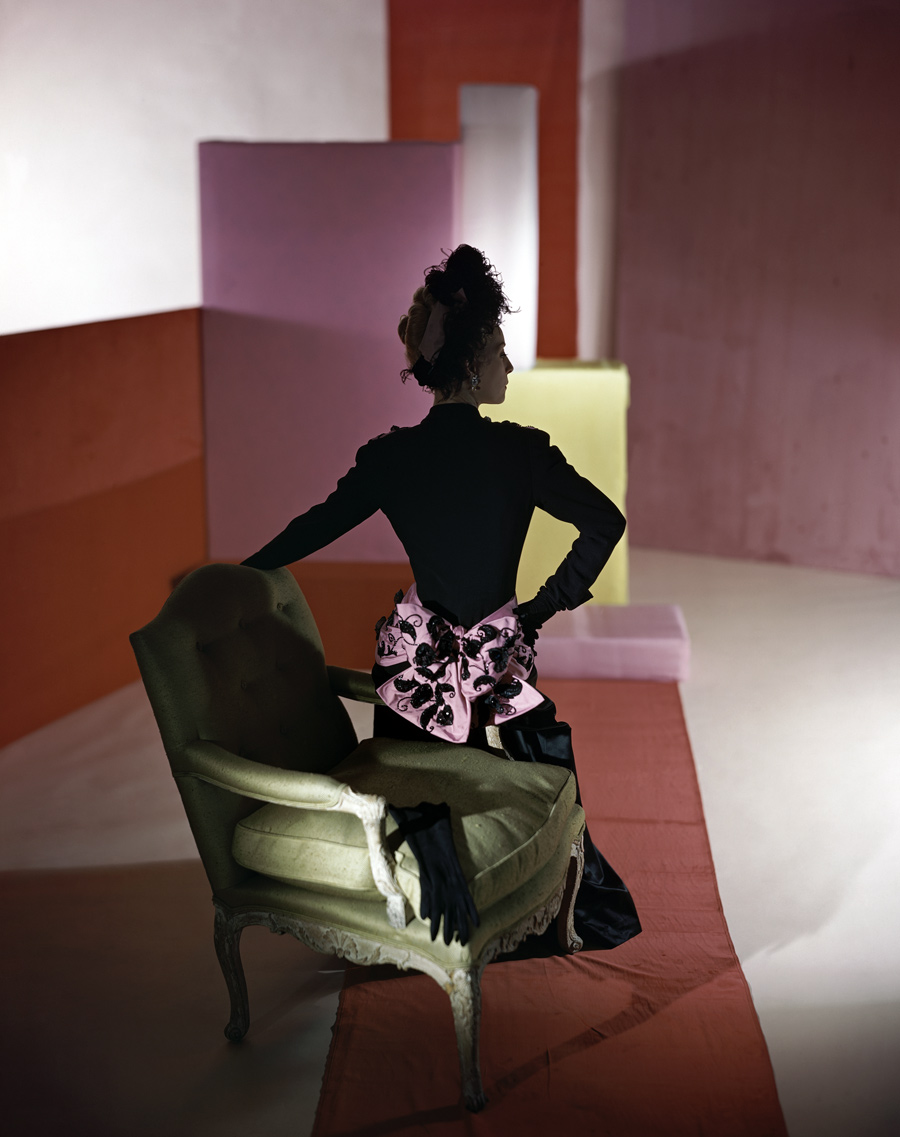
This autumn, the V&A will present the definitive retrospective exhibition of the work of master photographer Horst P. Horst (1906-1999) – one of the leading photographers of the 20th century. In his illustrious 60-year career, German-born Horst worked predominantly in Paris and New York and creatively traversed the worlds of photography, art, fashion, design, theatre and high society.

Horst: Photographer of Style will display 250 photographs, alongside haute couture garments, magazines, film footage and ephemera. The exhibition explores Horst’s collaborations and friendships with leading couturiers such as Coco Chanel and Elsa Schiaparelli in Paris; stars including Marlene Dietrich and Noël Coward; and artists and designers such as Salvador Dalí and Jean-Michel Frank. Highlights of the exhibition include photographs recently donated to the V&A by Gert Elfering, art collector and owner of the Horst Estate, previously unpublished vintage prints, and more than 90 Vogue covers by Horst.

The exhibition will also reveal lesser-known aspects of Horst’s work: nude studies, travel photographs from the Middle East and patterns created from natural forms. The creative process behind some of his most famous photographs, such as the Mainbocher Corset, will be revealed through the inclusion of original contact sheets, sketches and cameras. The many sources that influenced Horst – from ancient Classical art to Bauhaus ideals of modern design and Surrealism in 1930s Paris – will be explored.

Martin Roth, Director of the V&A said: “Horst was one of the greatest photographers of fashion and society and produced some of the most famous and evocative images of the 20th century. This exhibition will shine a light on all aspects of his long and distinguished career. Horst’s legacy and influence, which has been seen in work by artists, designers and performers including Herb Ritts, Robert Mapplethorpe, Bruce Weber and Madonna, continues today.”

Horst’s career straddled the opulence of pre-war Parisian haute couture and the rise of ready-to-wear in post-war New York and his style developed from lavish studio set-ups to a more austere approach in the latter half of the 20th century. The exhibition will begin in the 1930s with Horst’s move to Paris and his early experiments in the Vogue studio. Among his first models and muses were Lisa Fonssagrives, Helen Bennett and Lyla Zelensky. Vintage black and white photographs from the archive of Paris Vogue will be displayed alongside garments in shades of black, white, silver and gold by Parisian couturiers such as Chanel, Lanvin, Molyneux and Vionnet.

The exhibition will then focus on Horst’s Surreal-inspired studies and collaborations with Salvador Dalí and Elsa Schiaparelli. Fashion photographs will be shown with trompe l’oeil portraits and haunting still life. Horst excelled at portraiture and in the 1930s he captured some of Hollywood’s brightest stars: Rita Hayworth, Bette Davis, Vivien Leigh, Noël Coward, Ginger Rogers, Marlene Dietrich and Joan Crawford, to name a few.

Horst travelled widely throughout the 1940s and 1950s to Israel, Iran, Syria, Italy and Morocco. An escape from the world of fashion and city environs, his little-known travel photographs reveal a fascination for ancient cultures, landscapes and architecture. On display will be works taken in Iran such as the Persepolis Bull, Horst’s powerful image of a vast sculpture head amidst the ruins of a once magnificent palace, and images documenting the annual migration of the nomadic Qashqai clan.

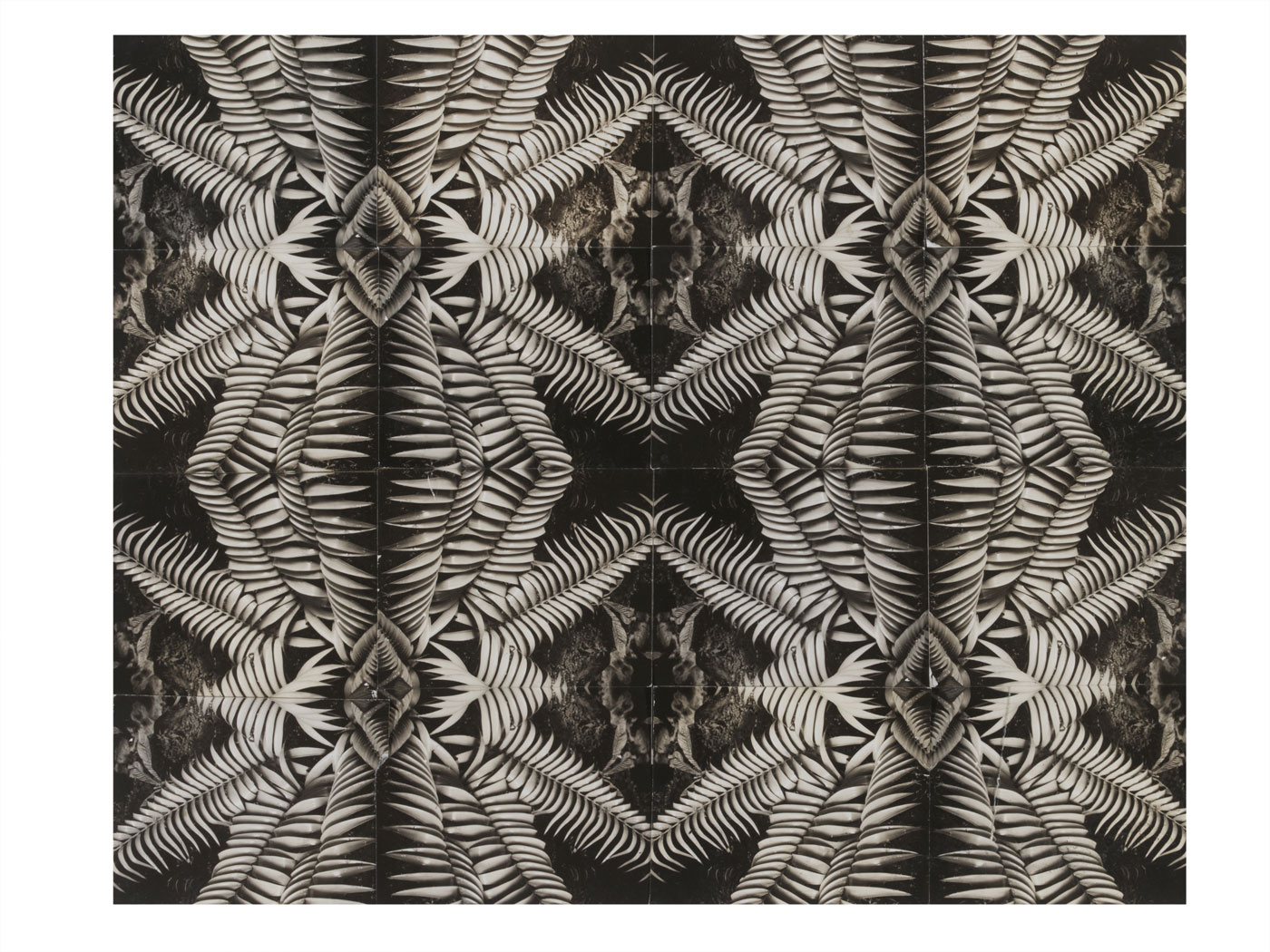
Detailed studies of natural forms such as flowers, minerals, shells and butterfly wings from the project Patterns From Nature, will be shown alongside a series of kaleidoscopic collages made by arranging photographs in simple repeat; his intention was that these dynamic patterns could be used as designs for textiles, wallpaper, carpets, plastics and glass.

Horst was admired for his dramatic lighting and became one of the first photographers to perfect the new colour techniques of the 1930s. A short film of him at work in the Vogue studios during the 1940s will be shown with an introduction to his peers including Lee Miller, Cecil Beaton and Irving Penn. The advent of colour enabled a fresh approach and Horst went on to create more than 90 Vogue covers and countless pages in vivid colour. A selection of 25 large colour photographs, newly printed from the original transparencies from the Condé Nast Archive, will demonstrate Horst’s exceptional skill as a colourist. These prints feature Horst’s favourite models from the 1940s and 50s, such as Carmen Dell’Orefice, Muriel Maxwell and Dorian Leigh, and will be shown together with preparatory sketches, which have never previously been exhibited.

In the early 1950s, Horst created a series of male nudes for an exhibition in Paris for which the models were carefully posed and dramatically lit to accentuate their musculature. The series evokes the classical sculpture that Horst so admired throughout his career. During the 1960s and 1970s, Horst photographed some of the world’s most beautiful and luxurious homes for House and Garden and Vogue under the editorship of his friend Diana Vreeland. A three-sided projection and interactive screens will present these colourful studies. Among the most memorable are the Art Deco apartment of Karl Lagerfeld, the three lavish dwellings of Yves Saint Laurent and the Roman palazzo of artist Cy Twombly.

In the latter years of Horst’s life, his early aesthetic experienced a renaissance. The period also witnessed a flurry of new books, exhibitions, and television documentaries celebrating his work. Horst produced new, lavish prints in platinum-palladium for museums and the collector’s market, selecting emblematic works from every decade of his career, which will be showcased as the finale to the exhibition.

Press release from the V&A


Horst P. Horst (German-American, 1906-1999) 'Chanel, Vogue France' 1935


Horst P. Horst (German-American, 1906-1999)
Chanel, Vogue France
1935
© Condé Nast/Horst Estate


A fore-runner of the timeless look of Chanel, here in brown and white check rayon with collar, cuffs and lapels in white piquè that matches the buttoned top.


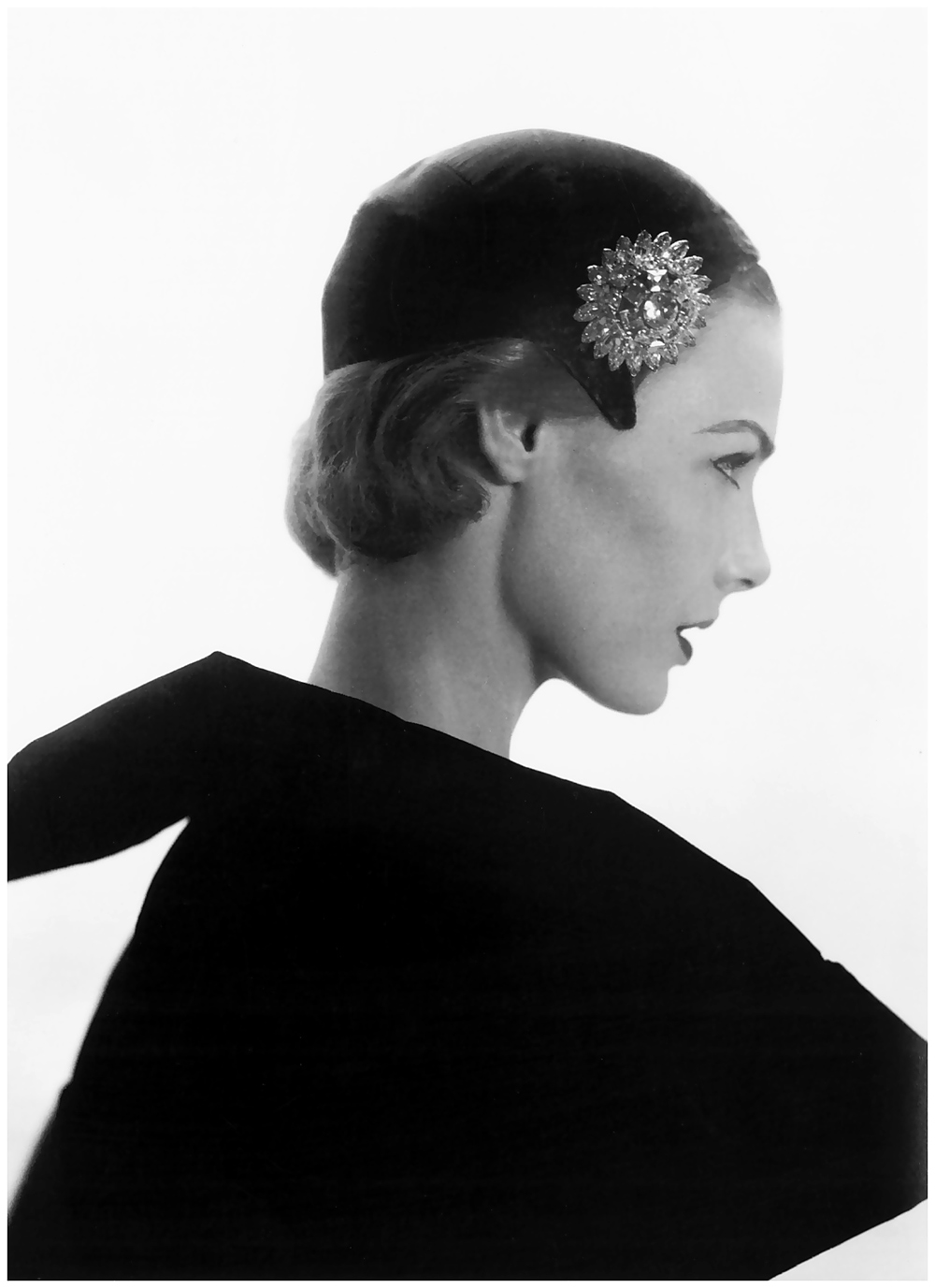
Horst P. Horst (German-American, 1906-1999) 'Hat and coat-dress by Bergdorf Goodman, modelled by Estrella Boissevain' 1938


Horst P. Horst (German-American, 1906-1999)
Hat and coat-dress by Bergdorf Goodman, modelled by Estrella Boissevain
1938
© Conde Nast / Horst Estate


Horst P. Horst (German-American, 1906-1999) 'Corset by Detolle for Mainbocher' 1939


Horst P. Horst (German-American, 1906-1999)
Corset by Detolle for Mainbocher
1939
© Conde Nast / Horst Estate


Horst P. Horst (German-American, 1906-1999) 'Lisa with Turban, New York' 1940


Horst P. Horst (German-American, 1906-1999)
Lisa with Turban, New York
1940
© Conde Nast / Horst Estate


Horst P. Horst (German-American, 1906-1999) 'Gertrude Stein at Balmain Fashion Show' 1946


Horst P. Horst (German-American, 1906-1999)
Gertrude Stein at Balmain Fashion Show
1946
© Conde Nast / Horst Estate


Horst P. Horst (German-American, 1906-1999) 'Birthday Gloves, New York' 1947


Horst P. Horst (German-American, 1906-1999)
Birthday Gloves, New York
1947
© Condé Nast/Horst Estate


Horst P. Horst (German-American, 1906-1999) 'Lillian Marcuson in Dior's belted two-piece suit in black rustic wool, called 'Milieu du Siècle'' 1949


Horst P. Horst (German-American, 1906-1999)
Lillian Marcuson in Dior’s belted two-piece suit in black rustic wool, called ‘Milieu du Siècle’
1949
© Condé Nast/Horst Estate


Horst P. Horst (German-American, 1906-1999) 'Nina de Voe' 1951


Horst P. Horst (German-American, 1906-1999)
Nina de Voe
1951
© Condé Nast/Horst Estate


Horst P. Horst (German-American, 1906-1999) 'Lillian Marcuson, New York' 1950


Horst P. Horst (German-American, 1906-1999)
Lillian Marcuson, New York
1950
© Condé Nast/Horst Estate


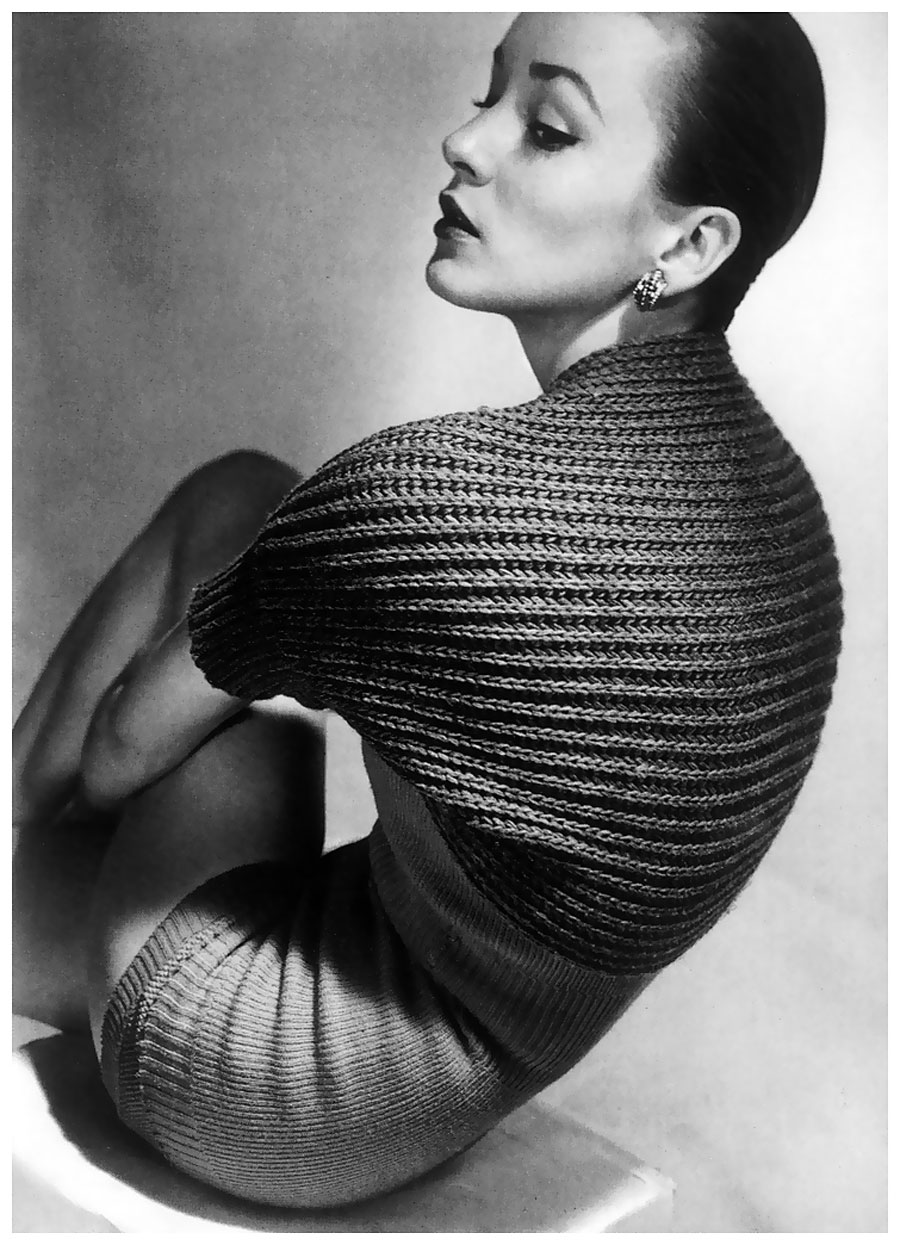
Horst P. Horst (German-American, 1906-1999) 'Outfit by Tina Leser' Vogue, April 1950


Horst P. Horst (German-American, 1906-1999)
Outfit by Tina Leser
Vogue, April 1950
© Condé Nast/Horst Estate


Horst P. Horst (German-American, 1906-1999) 'Bombay Bathing Fashion' 1950


Horst P. Horst (German-American, 1906-1999)
Bombay Bathing Fashion
1950
© Condé Nast/Horst Estate


Model (unidentified) and Dorian Leigh (r) in bathing suit and sleeveless shirt cover-up by Carolyn Schnurer 1951 Vogue


Haute Couture

When Horst joined Vogue in 1931, Paris was still the world’s undisputed centre of high fashion. Photography had begun to eclipse graphic illustration in fashion magazines and the publisher Condé Montrose Nast devoted large sums to improving the quality of image reproduction. He insisted that Vogue photographers work with a large format camera, which produced richly detailed negatives measuring ten by eight inches.

The creation of a Horst photograph was a collaborative process, involving the talents of the photographer and model, the art director, fashion editor, studio assistants and set technicians. The modelling profession was still in its infancy in the 1930s and many of those who posed under the hot studio lights were stylish friends of the magazine’s staff, often actresses or aristocrats.

By the mid 1930s, Horst had superseded his mentor George Hoyningen-Huene as Paris Vogue‘s primary photographer. His images frequently appeared in the French, British and American editions of the magazine. Many of the photographs on display in the exhibition are vintage prints from the company’s archive.


Horst P. Horst (German-American, 1906-1999) 'Dress by Hattie Carnegie' 1939


Horst P. Horst (German-American, 1906-1999)
Dress by Hattie Carnegie
1939
© Conde Nast / Horst Estate


Horst P. Horst (German-American, 1906-1999) 'Dress by Hattie Carnegie' 1939


Horst P. Horst (German-American, 1906-1999)
Dress by Hattie Carnegie
1939
© Conde Nast / Horst Estate


Horst P. Horst (German-American, 1906-1999) 'Muriel Maxwell, American Vogue' 1939


Horst P. Horst (German-American, 1906-1999)
Muriel Maxwell, American Vogue
1939
© Conde Nast / Horst Estate


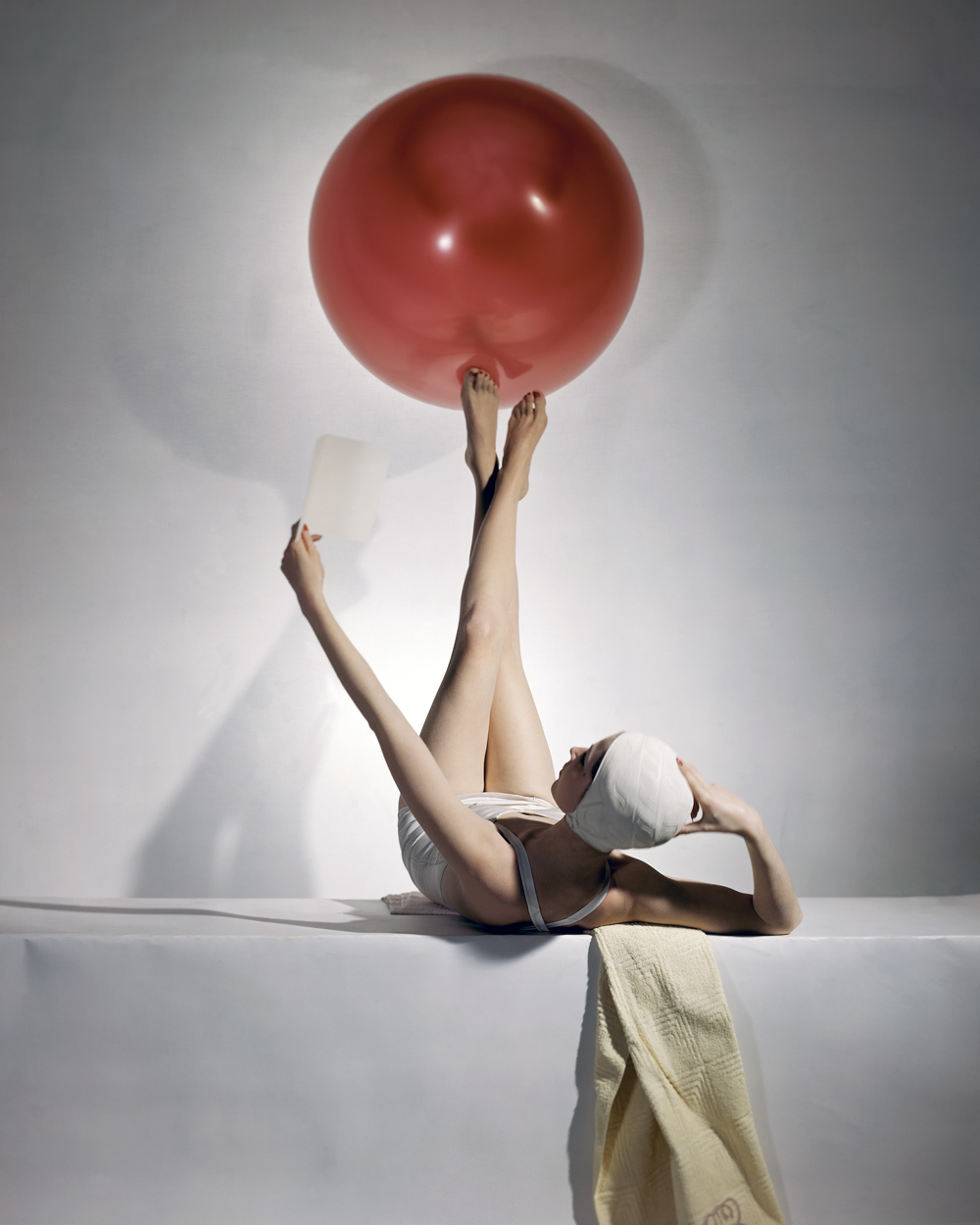
Horst P. Horst (German-American, 1906-1999) 'Summer Fashions, American Vogue cover' 1941


Horst P. Horst (German-American, 1906-1999)
Summer Fashions, American Vogue cover
1941
© Conde Nast / Horst Estate


Horst P. Horst (German-American, 1906-1999) 'Dinner suit and headdress by Schiaparelli' 1947


Horst P. Horst (German-American, 1906-1999)
Dinner suit and headdress by Schiaparelli
1947
© Conde Nast / Horst Estate


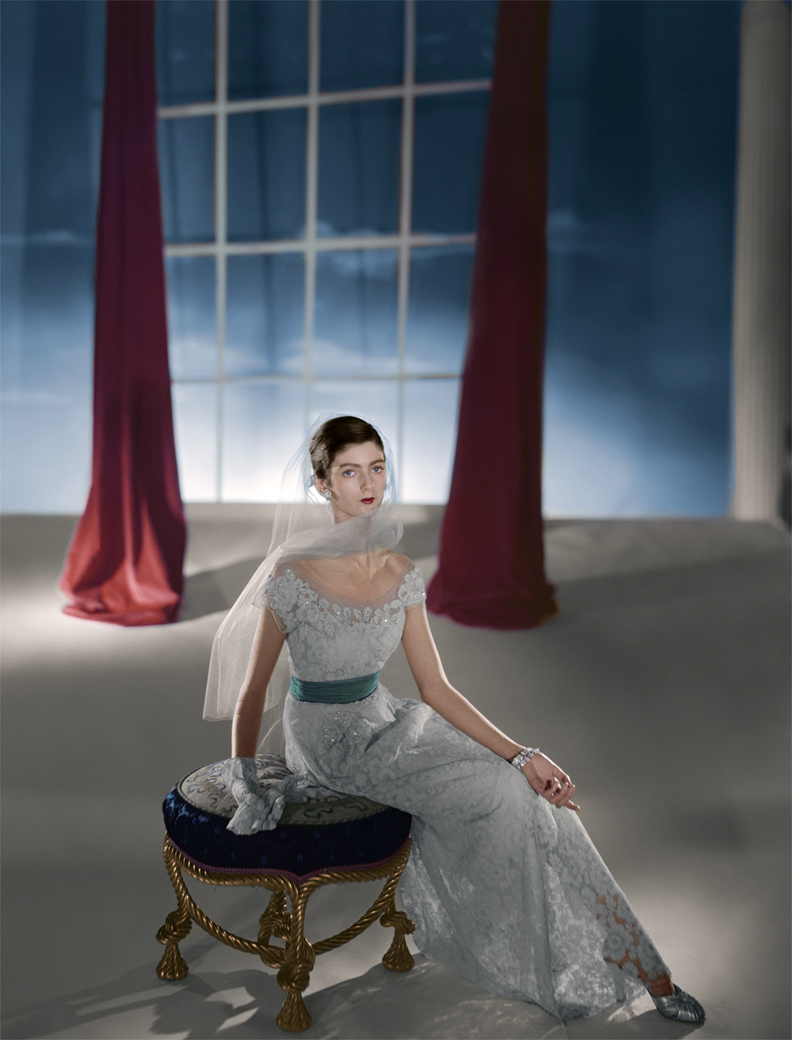
Horst P. Horst (German-American, 1906-1999) 'Dinner suit and headdress by Schiaparelli' 1947 'Millicent Rogers in a Charles James gown and a gold necklace of her own design' Vogue, February 1, 1949


Horst P. Horst (German-American, 1906-1999)
Millicent Rogers in a Charles James gown and a gold necklace of her own design Vogue,
February 1, 1949
© Conde Nast / Horst Estate


Horst in Colour from Victoria and Albert Museum


This film reveals the process of creating new colour prints for the exhibition Horst: Photographer of Style. Horst was quick to master new colour processes, introduced in the late 1930s, and he created hundreds of vibrant fashion photographs for Vogue.

The V&A team worked closely with specialists at the Condé Nast Archive and expert printer Ken Allen to select and print from Horst’s early transparencies, which date from the 1930s to the 1950s. The film includes insights into Horst’s dynamic approach from model Carmen Dell’Orefice and Vogue‘s International Editor at Large, Hamish Bowles.​


Fashion in Colour

The 1930s ushered in huge technical advancements in colour photography. Horst adapted quickly to a new visual vocabulary, creating some of Vogue‘s most dazzling colour images. In 1935 he photographed the Russian Princess Nadejda Sherbatow in a red velveteen jacket for the first of his many Vogue cover pictures.

The occupation of Paris transformed the world of fashion. The majority of French ateliers closed and many couturiers and buyers left the country. Remaining businesses struggled with extreme shortages of cloth and other supplies. The scarcity of French fashions in America, however, enabled American designers to come into their own.

Horst’s colour photographs are rarely exhibited because few vintage prints exist. Colour capture took place on a transparency which could be reproduced on the magazine page without the need to create a photographic print. The size of the new prints displayed in this room of the exhibition echoes the large scale of a group of Horst images printed in 1938 at the Condé Nast press.


Horst P. Horst (German-American, 1906-1999) 'Marlene Dietrich, New York' 1942


Horst P. Horst (German-American, 1906-1999)
Marlene Dietrich, New York
1942
© Conde Nast / Horst Estate


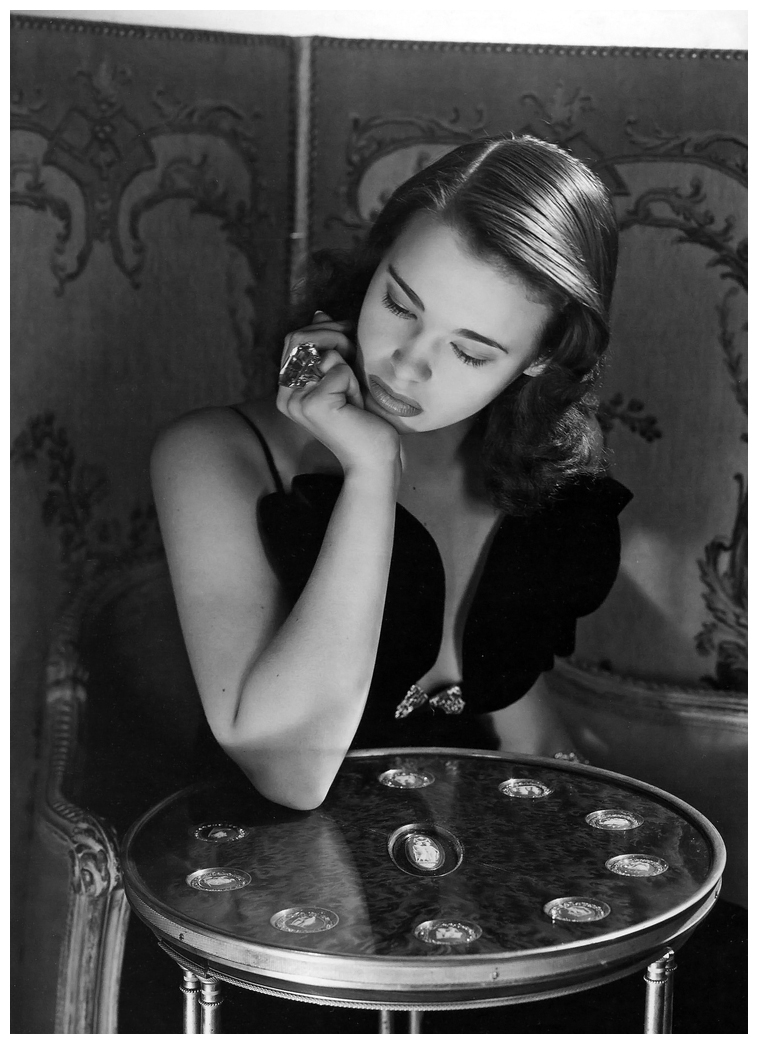
Horst P. Horst (German-American, 1906-1999) 'Gloria Vanderbilt age 17 wearing a dress by Howard Greer, New York' 1941


Horst P. Horst (German-American, 1906-1999)
Gloria Vanderbilt age 17 wearing a dress by Howard Greer, New York
1941
© Conde Nast / Horst Estate


At 17, in Beverly Hills wearing a tabletop dress by Howard Greer. Tabletop dresses looked good from the waist up when stars were photographed sitting in restaurants and nightclub.


Stage and Screen

Horst’s portraits spanned a wide cross-section of subjects, from artists and writers to presidents and royalty. In the 1930s, he became aware of a new focus for his work. As he later noted in his book Salute to the Thirties (1971), glamorous Hollywood movie stars were imperceptibly assuming the place left vacant by Europe’s vanishing royal families. With the approach of the Second World War, the escapism offered by theatre and cinema gained in popularity. Horst began to photograph these new, classless celebrities, both in costume and as themselves.

The first well-known star Horst photographed was the English performer Gertrude Lawrence, then appearing in Ronald Jeans’ play Can the Leopard…? at the Theatre Royal, Haymarket. Horst’s first portrait of a Hollywood actress, Bette Davis, appeared in Vogue‘s sister magazine Vanity Fair in 1932.


Horst P. Horst (German-American, 1906-1999) 'Round the Clock, New York' 1987


Horst P. Horst (German-American, 1906-1999)
Round the Clock, New York
1987
© Conde Nast / Horst Estate


Platinum

The 1980s witnessed a flurry of new books, exhibitions and television documentaries about Horst. He produced new prints for museums and the collector’s market, selecting emblematic works from every decade of his career to be reprinted in platinum-palladium, sometimes with new titles. This was a complex and expensive technique, employing metals more expensive than gold. Failing eyesight finally forced him to stop working in 1992.

Horst’s platinum-palladium prints are treasured for their nuanced tones, surface quality and permanence. His style had experienced a renaissance in 1978 when Francine Crescent, French Vogue‘s editor in chief, had invited him to photograph the Paris collections. Horst’s work for her echoed his atmospheric, spot-lit studies of the 1930s. His use of the platinum process for creating new and reproducing early works ensured his mastery of light, mood and composition would be enjoyed by a new audience.


Horst P. Horst (German-American, 1906-1999) 'Male Nude #3' 1952, printed 1980s


Horst P. Horst (German-American, 1906-1999)
Male Nude #3
1952, printed 1980s
© Conde Nast / Horst Estate


Horst P. Horst (German-American, 1906-1999) 'Still Life' Nd


Horst P. Horst (German-American, 1906-1999)
Still Life
Nd
© Conde Nast / Horst Estate


Horst P. Horst (German-American, 1906-1999) 'Male Nude' 1952


Horst P. Horst (German-American, 1906-1999)
Male Nude
1952
© Conde Nast / Horst Estate


Male Nudes

In the early 1950s Horst produced a set of distinctive photographs unlike much of his previous output. These male figure studies were exhibited for the first time in Paris in 1953 and reprinted using the platinum-palladium process in the 1980s. The studies exemplify Horst’s sense of form. All emphasis is on the idealised human body, expressive light and shadow. Monumental and anonymous nudes resemble classical sculptures. As Mehemed Agha (1929-78), art director of American Vogue, commented:

“Horst takes the inert clay of human flesh and models it into the decorative shapes of his own devising. Every gesture of his models is planned, every line controlled and coordinated to the whole of the picture. Some gestures look natural and careless, because carefully rehearsed; the others, like Voltaire’s god, were invented by the artist because they did not exist.”


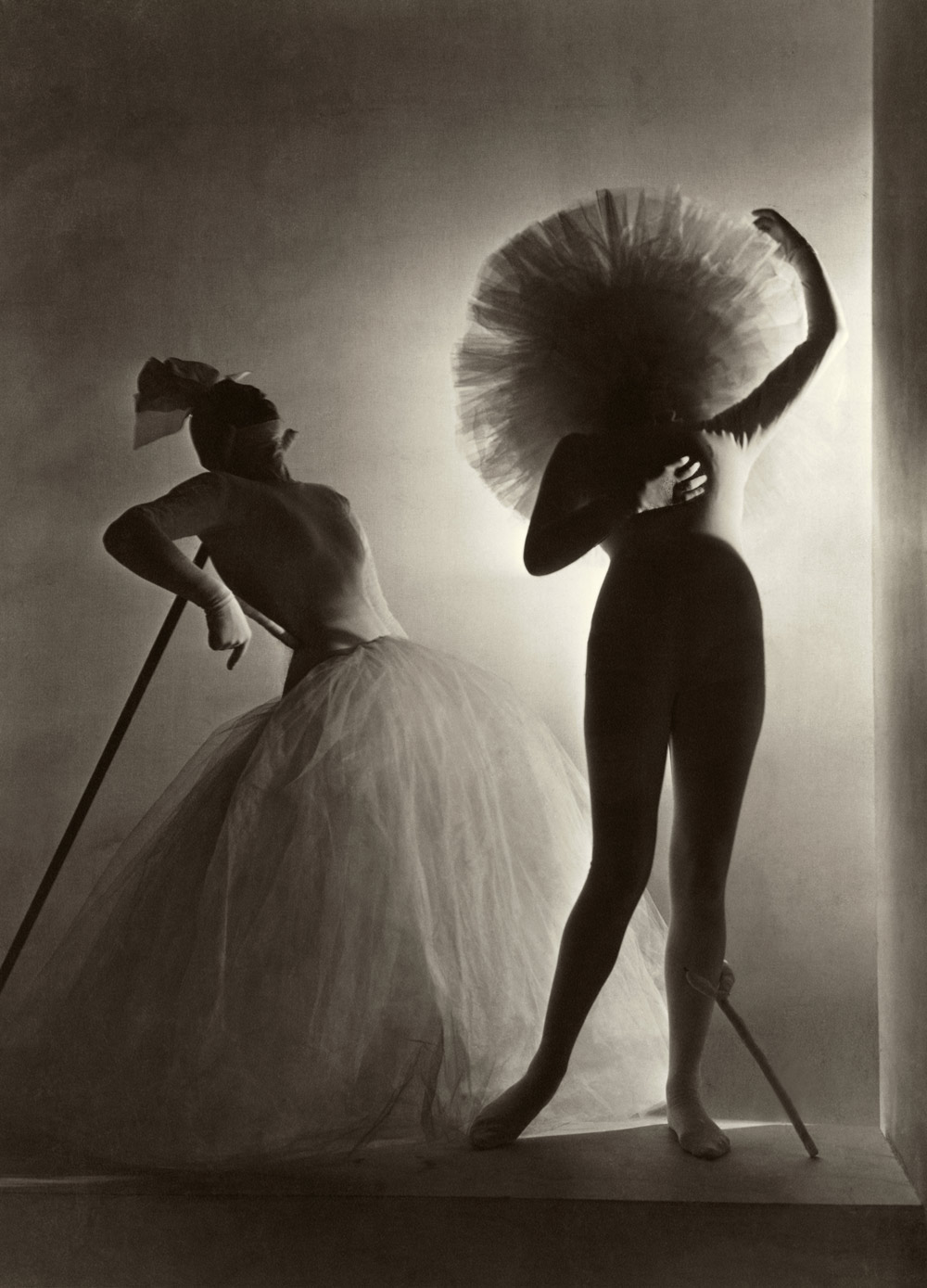
Horst P. Horst (German-American, 1906-1999) 'Salvador Dali's costumes for Leonid Massine's ballet 'Bacchanale'' 1939


Horst P. Horst (German-American, 1906-1999)
Salvador Dali’s costumes for Leonid Massine’s ballet Bacchanale
1939
© Conde Nast / Horst Estate


Horst P. Horst (German-American, 1906-1999) 'Lisa Fonssagrives hands, New York' 1941


Horst P. Horst (German-American, 1906-1999)
Lisa Fonssagrives hands, New York
1941
© Conde Nast / Horst Estate


Horst P. Horst (German-American, 1906-1999) 'Odalisque I' 1943


Horst P. Horst (German-American, 1906-1999)
Odalisque I
1943
© Conde Nast / Horst Estate


Horst P. Horst (German-American, 1906-1999) 'Bunny Hartley' Vogue, 1938


Horst P. Horst (German-American, 1906-1999)
Bunny Hartley, Vogue

1938
© Conde Nast / Horst Estate


Horst P. Horst (German-American, 1906-1999) 'Lisa Fonssagrives "I Love You"' 1937


Horst P. Horst (German-American, 1906-1999)
Lisa Fonssagrives “I Love You”
1937
© Conde Nast / Horst Estate


Surrealism

The Surrealist art movement explored unique ways of interpreting the world, turning to dreams and the unconscious for inspiration. During the 1930s Surrealism escaped its radical avant-garde roots and transformed design, fashion, advertising, theatre and film. Horst’s photographs of this period feature mysterious, whimsical and surreal elements combined with his classical aesthetic. He created trompe l’oeil still life, photographed the surreal-infused dress designs of his friend Elsa Schiaparelli and collaborated with the artist Salvador Dalí. He shared with the Surrealists a fascination with the representation of the female body, often fragmenting and eroticising the human form in his images.

His most celebrated photograph of the era is Mainbocher Corset (1939). Decades after the photograph was made, Main Bocher himself expressed his admiration for Horst’s virtuosity, writing,

“Your photographs are sheer genius and delight my soul … each one is perfect by itself.”


Horst P. Horst (German-American, 1906-1999) 'Patterns from Nature Photographic Collage' 1945


Horst P. Horst (German-American, 1906-1999)
Patterns from Nature Photographic Collage
1945
© Conde Nast / Horst Estate


Patterns from Nature

Horst’s second book, Patterns from Nature (1946), and the photographs from which it originated, are a surprising diversion from the high glamour of his fashion and celebrity photographs. These close-up, black and white images of plants, shells and minerals were taken in New York’s Botanical Gardens, in the forests of New England, in Mexico, and along the Atlantic and Pacific coasts.

This personal project was partly inspired by photographs of plants by Karl Blossfeldt (1865-1932). Horst was struck by “their revelation of the similarity of vegetable forms to art forms like wrought iron and Gothic architecture.” Horst’s interest was also linked to the technical purity of ‘photographic seeing’, a philosophy associated with the New Objectivity movement of the 1920s and ’30s. Practitioners took natural forms out of their contexts and examined them with such close attention that they became unfamiliar and revelatory.


Horst P. Horst (German-American, 1906-1999) 'View of ruins at the palace of Persepolis, Persia' 1949


Horst P. Horst (German-American, 1906-1999)
View of ruins at the palace of Persepolis, Persia
1949
© Conde Nast / Horst Estate


Travel

In the summer of 1949, Horst journeyed to the Middle East with his partner Valentine Lawford, then political counsellor at the British Embassy in Tehran. They travelled by road from Beirut to Persepolis, where Horst was able to photograph parts of the ancient Persian city that had only recently been uncovered. Afterwards, Horst visited the newly established State of Israel on a photographic assignment for Vogue.

The trip left a strong impression on Horst and he returned in the spring of 1950. He spent a week with Lawford at the relatively remote south-eastern shore of the Caspian Sea, before documenting the annual migration of the Qashqa’i clan. Horst and Lawford were invited by Malik Mansur Khan Qashqa’i to spend ten days with his tribe as they travelled by camel and horse, in search of vegetation for their flocks.


Horst P. Horst (German-American, 1906-1999) 'Yves Saint Laurent poses in the apartment's grand salon for a November 1971 'Vogue' photo spread' 1971


Horst P. Horst (German-American, 1906-1999)
Yves Saint Laurent poses in the apartment’s grand salon for a November 1971 ‘Vogue’ photo spread
1971
© Conde Nast / Horst Estate


Living in Style

In 1947 Horst acquired five acres of land in Oyster Bay Cove, Long Island, part of the estate once owned by the designer Louis Comfort Tiffany. On the land he described as ‘everything I had ever dreamed of’, Horst built a unique house and landscaped garden. British diplomat Valentine Lawford visited for the first time in 1947, with Noël Coward, Christopher Isherwood, and Greta Garbo. It was the beginning of a relationship with Horst that would last until Lawford’s death in 1991.

They welcomed many friends and visitors to Long Island, including the dynamic editor Diana Vreeland. She left Harper’s Bazaar for Vogue in 1962 and soon put the couple to work on Vogue‘s ‘Fashions in Living’ pages. The homes and tastes of everyone from Jackie Onassis to the Duke and Duchess of Windsor, Andy Warhol and Karl Lagerfeld featured in their articles. Horst’s creative chemistry with Vreeland brought him a new lease of life.


Roy Stevens (American, b. 1916) 'Horst directing fashion shoot with Lisa Fonssagrives' 15 May 1941


Roy Stevens (American, b. 1916)
Horst directing fashion shoot with Lisa Fonssagrives
15 May 1941
© Time & Life Pictures / Getty Images


In the Studio

During the 1940s Horst worked primarily in the Condé Nast studio on the 19th floor of the Graybar Building, an Art Deco skyscraper on Manhattan’s Lexington Avenue. The busy studio was well equipped with a variety of lights and props and Horst worked closely with talented art director Alexander Liberman. Like Horst, he had found refuge in the artistic circles of Paris and New York, and enjoyed a long career with Condé Nast.

By 1946 dressing the American woman had become one of the country’s largest industries, grossing over six billion dollars a year. The staff of Vogue expanded accordingly. In 1951 Horst found a studio of his own, the former penthouse apartment of artist Pavel Tchelitchew, with high ceilings and a spectacular view over the river. Horst developed a new approach to photography in response to the abundance of daylight and for a time his famous atmospheric shadows disappeared.


Victoria and Albert Museum
Cromwell Road, London SW7 2RL

Opening hours:
The V&A is open daily from 10.00 to 17.45 and until 22.00 on Fridays
Victoria and Albert Museum website

LIKE ART BLART ON FACEBOOK

Back to top

Video: ‘klimt02 in conversation with Mari Funaki’

May 2014


A wonderful energy, a wonderful artist, a wonderful human being – sadly missed!

Marcus


Published on April 23, 2014

Interview filmed on the occasion of the solo exhibition Space and Gravity by Mari Funaki at Klimt02 Gallery in Barcelona in February 2008. The artist talks about her work, the process of work: drawing, breaking predictability, her gallery and steel and black concept.


Gallery Funaki website

LIKE ART BLART ON FACEBOOK

Back to top

Exhibition: ‘From the Village to Vogue: The Modernist Jewelry of Art Smith’ at the Cincinnati Art Museum

Exhibition dates: 22nd February – 18th May, 2014

Curator: Chief Curator Cynthia Amnéus


Art Smith (American, 1917-1982) '"Modern Cuff" Bracelet' designed c. 1948


Art Smith (American, 1917-1982)
“Modern Cuff” Bracelet
Designed c. 1948
Silver
1 5/8 x 2 1/2 x 4 in. (4.1 x 6.4 x 10.2cm)
Brooklyn Museum, Gift of Charles L. Russell


Very much of their time, these beautiful, understated pieces of anamorphic jewellery are exquisitely designed and crafted objets d’art.

Dr Marcus Bunyan


Many thankx to the Cincinnati Art Museum for allowing me to publish the art work in the posting. Please click on the photographs for a larger version of the art.


Art Smith (American, 1917-1982) '"Lava" Bracelet' designed c. 1946


Art Smith (American, 1917-1982)
“Lava” Bracelet
Designed c. 1946
Silver
2 1/2 x 2 5/8 x 5 3/4 in. (6.4 x 6.7 x 14.6cm)
Brooklyn Museum, Gift of Charles L. Russell


Art Smith (American, 1917-1982) 'Autumn Leaves Brooch' 1974


Art Smith (American, 1917-1982)
Autumn Leaves Brooch
1974
Gold, jade
1/2 x 3 x 1 3/4 in. (1.3 x 7.6 x 4.4cm)
Brooklyn Museum, Gift of Charles L. Russell


Art Smith (American, 1917-1982) 'Untitled' 1948-1979


Art Smith (American, 1917-1982)
Untitled
1948-1979
Wood, paint, copper
Brooklyn Museum, Gift of Charles L. Russell


It will be a feast for the eyes of those who appreciate jewellery this Spring in the Queen City. The spirit of craft and its revival will shine through in large scale, highly sculpted pieces of jewellery created by Art Smith and his contemporaries in From the Village to Vogue: The Modernist Jewelry of Art Smith, February 22, 2014 through May 18, 2014.

This exhibition features twenty-four pieces of silver and gold jewellery created by African American artist Art Smith, as well as more than forty pieces by his contemporaries, including Sam Kramer, Margaret De Patta, and Harry Bertoia. Three pieces of jewellery by Alexander Calder, who influenced many of these artists/jewellers, will also be featured in this exhibition. This exhibition was organised by the Brooklyn Museum of Art and the Cincinnati Art Museum is the first to host this exhibition. It will then continue to the Dallas Museum of Art and the High Museum of Art in Atlanta, Georgia.

Inspired by surrealism, biomorphism and primitivism, Art Smith (1917-1982) was one of the leading modernist jewellers of the mid-twentieth century. Early in his career, Smith met Talley Beatty, a young black dancer and choreographer, who introduced him to the world of dance, in particular the salon of Frank and Dorcas Neal. It was there that he met several prominent black artists, including writer James Baldwin, musician and composer Billy Strayhorn, singers Lena Horne and Harry Belafonte, actor Brock Peters, and painter Charles Sebree. Smith began to create pieces for dance companies, who in turn, encouraged him to design on a grander scale. This experience is evident in the scale of his mature work.

In 1946, Smith opened his own studio in Greenwich Village and started selling his jewellery. He soon caught the attention of buyers in Boston, San Francisco, and Chicago. In the early 1950s, Smith received pictorial coverage in both Harper’s Bazaar and Vogue and was mentioned in The New Yorker shoppers guide, “On the Avenue”. Smith soon established business relationships with Bloomingdales, Milton Heffling in Manhattan, James Boutique in Houston, L’Unique in Minneapolis and Black Tulip in Dallas. While his earlier work was executed primarily in copper and brass, because it was less expensive, growing recognition increased sales and special commissions for custom designs. This allowed him to begin producing more work in silver. He received a prestigious commission from the Peekskill, New York chapter of the NAACP, for example, to design a brooch for Eleanor Roosevelt. He was even commissioned to design a pair of cufflinks for Duke Ellington, whose music he often listened to while working.

Included in the exhibition are major works by Smith including his famous Patina Necklace (c. 1959). Worked in silver, it is an example both of the large scale of his jewellery and of his use of asymmetry. Alexander Calder’s influence is also clear in this piece. From the curved structure that wraps the neck, two pierced ellipses dangle over the breastbone, giving the necklace a kinetic energy that enlivens the piece. With a sculptor’s sensitivity, Smith emphasised negative space in his designs and viewed the human body as an armature for his creations. He considered his jewellery incomplete until it rested on the human structure.

According to Cincinnati Art Museum interim Chief Curator Cynthia Amnéus, “Working in the heart of Greenwich Village, Smith was influenced by jazz musicians like Charlie Parker, visual artists like Robert Motherwell, and the poetry readings of Beat Generation writers like Alan Ginsberg. Smith’s work, like that of his contemporaries, appealed to an artistic and intellectual clientele. These artisans were not concerned with making pretty jewellery. They created works of art that were meant to be worn on the body.”

Press release from the Cincinnati Art Museum website


Art Smith (American, 1917-1982) 'Linked Oval Necklace' designed by 1974


Art Smith (American, 1917-1982)
Linked Oval Necklace
Designed by 1974
Silver, amethyst quartz
11 x 10 1/2 x 1/2 in. (27.9 x 26.7 x 1.3cm)
Brooklyn Museum, Gift of Charles L. Russell


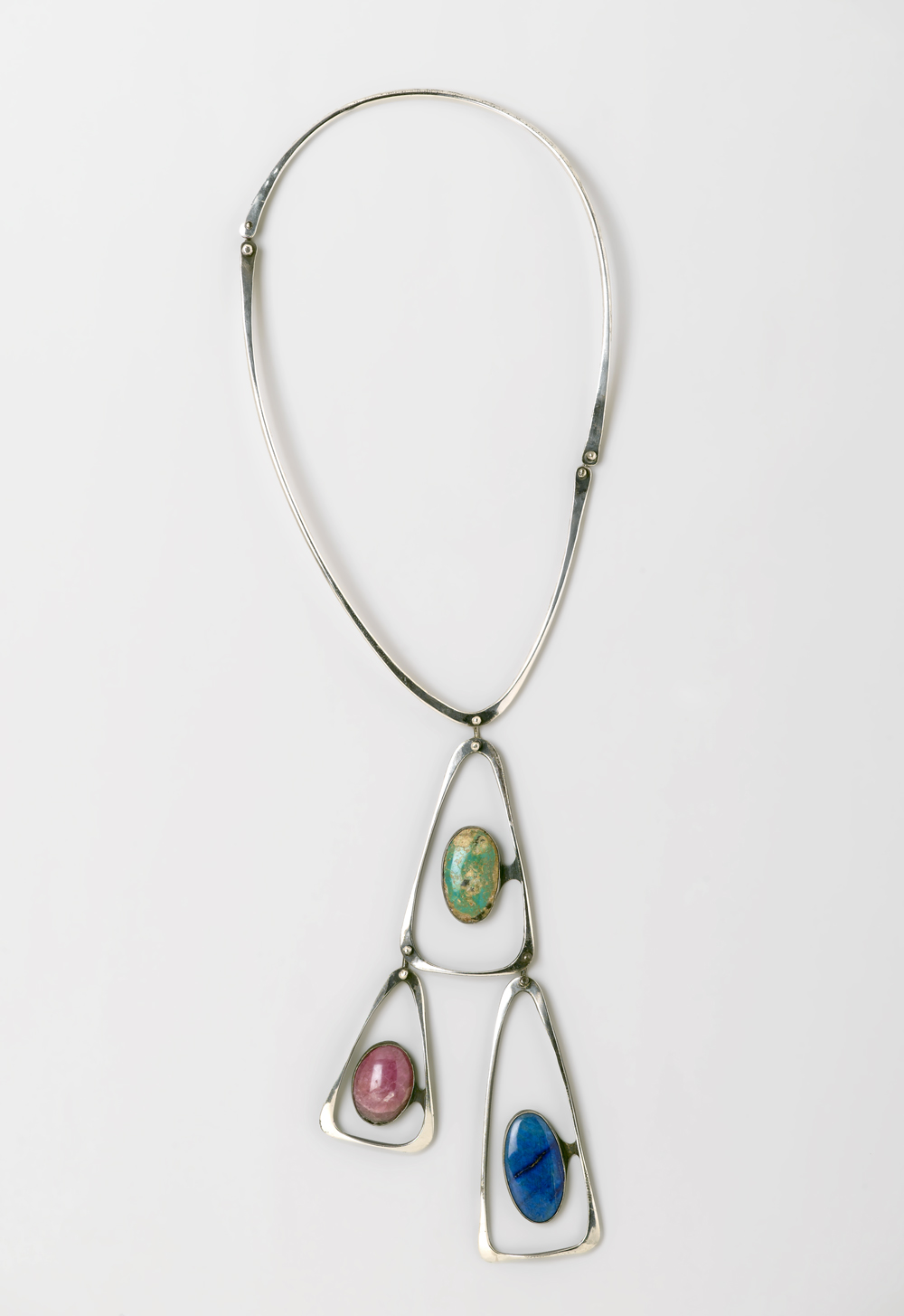
Art Smith (American, 1917-1982) 'Triangle Necklace' c. 1969


Art Smith (American, 1917-1982)
Triangle Necklace
c. 1969
Silver, turquoise, lapis lazuli, rhodochrosite
16 1/8 x 5 1/8 x 1/2 in. (41.0 x 13.0 x 1.3cm)
Brooklyn Museum, Gift of Charles L. Russell


Art Smith (American, 1917-1982) 'Ellington Necklace' c. 1962


Art Smith (American, 1917-1982)
Ellington Necklace
c. 1962
Silver, turquoise, amethyst, prase, rhodonite
16 7/8 x 9 7/8 x 3/4 in. (42.9 x 25.1 x 1.9cm)
Brooklyn Museum, Gift of Charles L. Russell


Art Smith (American, 1917-1982) 'New Orleans Necklace' c. 1962


Art Smith (American, 1917-1982)
New Orleans Necklace
c. 1962
Silver, three semiprecious stones: Labradorite (?)
8 5/8 x 5 7/8 x 3/4 in. (21.9 x 14.9 x 1.9cm)
Brooklyn Museum, Gift of Charles L. Russell


Art Smith (American, 1917-1982) '"Bauble" Necklace' c. 1953


Art Smith (American, 1917-1982)
“Bauble” Necklace
c. 1953
Silver, colourless quartz
9 1/8 x 4 7/8 x 1/2 in. (23.2 x 12.4 x 1.3cm)
Brooklyn Museum, Gift of Charles L. Russell


Peter Basch (American, 1921-2004) 'Model Wearing Art Smith's "Modern Cuff" Bracelet' c. 1948


Peter Basch (American, 1921-2004)
Model Wearing Art Smith’s “Modern Cuff” Bracelet
c. 1948
Black-and-white photograph
13 3/4 x 103/4 in. (34.9 x 27.3cm)
Courtesy of Brooklyn Museum


Cincinnati Art Museum

953 Eden Park Drive
Cincinnati, OH 45202
Phone: 513-639-2872

Opening hours:
Tuesday through Sunday, 11am – 5pm
The Art Museum is closed on Mondays

Cincinnati Art Museum
 website

LIKE ART BLART ON FACEBOOK

Back to top

Exhibition: ‘Jewels by JAR’ at The Metropolitan Museum of Art, New York

Exhibition dates: 20th November, 2013 – 9th March, 2014

Curator: Jane Adlin, Associate Curator in the Department of Modern and Contemporary Art


JAR (Joel Arthur Rosenthal, American, b. 1943) 'Poppy Brooch' 1982 from the exhibition 'Jewels by JAR' at The Metropolitan Museum of Art, New York, November 2013 - March 2014


JAR (Joel Arthur Rosenthal, American, b. 1943) 
Poppy Brooch 
1982
Diamond, tourmalines, and gold
Private collection
Photograph by Katharina Faerber. Courtesy of JAR, Paris


Can you imagine 400 of these fabulous works together in one exhibition… so much restrained, cultured bling all in one place!

Dr Marcus Bunyan


Many thankx to The Metropolitan Museum of Art for allowing me to publish the photographs in the posting. Please click on the photographs for a larger version of the image.


(Joel Arthur Rosenthal, American, b. 1943) 'Zebra Brooch' 1987 from the exhibition 'Jewels by JAR' at The Metropolitan Museum of Art, New York, November 2013 - March 2014


JAR (Joel Arthur Rosenthal, American, b. 1943)
Zebra Brooch
1987
Agate, diamonds, a sapphire, silver, and gold
Private collection
Photograph by Katharina Faerber. Courtesy of JAR, Paris


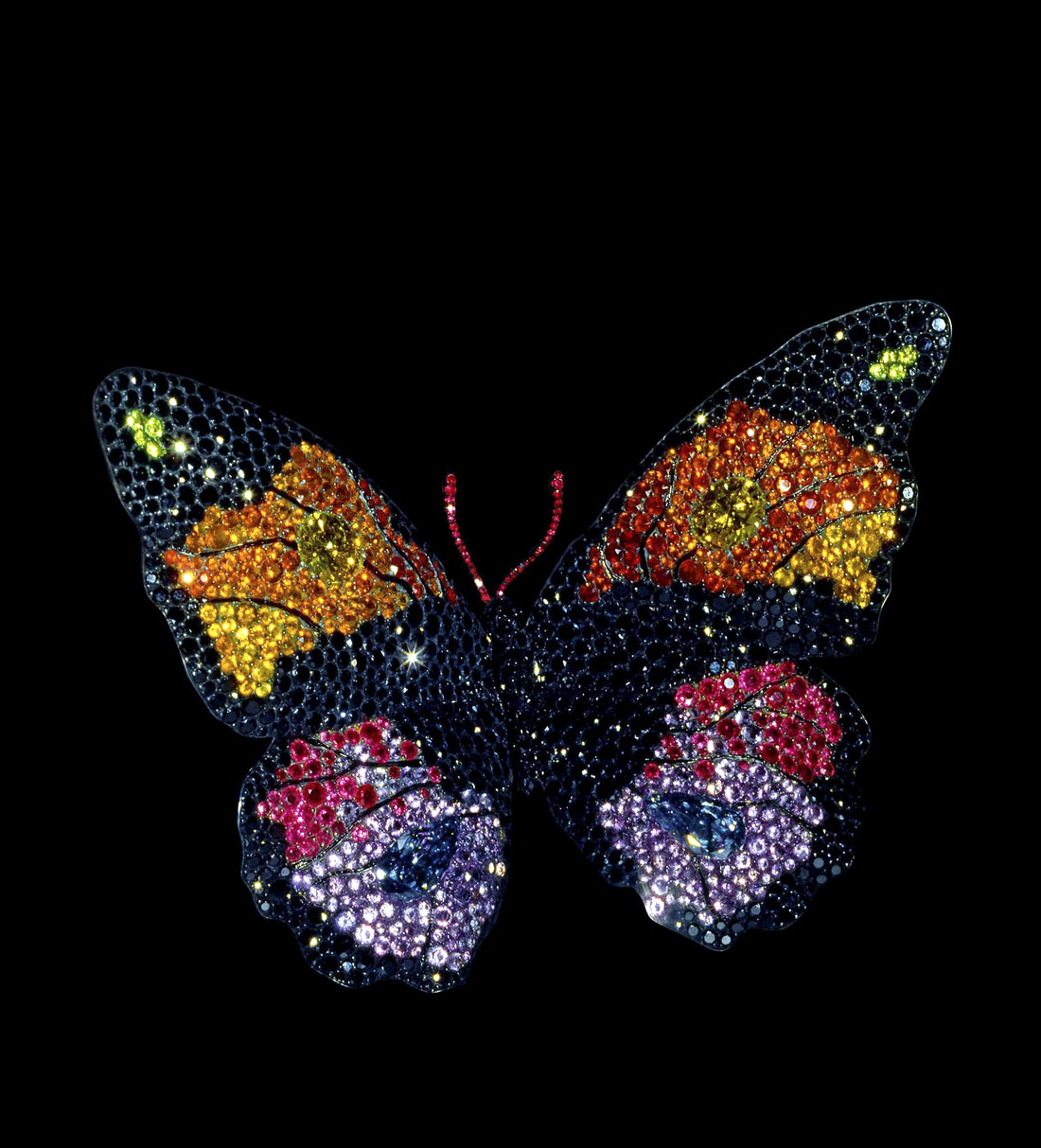
(Joel Arthur Rosenthal, American, b. 1943) 'Butterfly Brooch' 1994


JAR (Joel Arthur Rosenthal, American, b. 1943)
Butterfly Brooch
1994
Sapphires, fire opals, rubies, amethyst, garnets, diamonds, silver and gold
Private collection
Photograph by Katharina Faerber. Courtesy of JAR, Paris


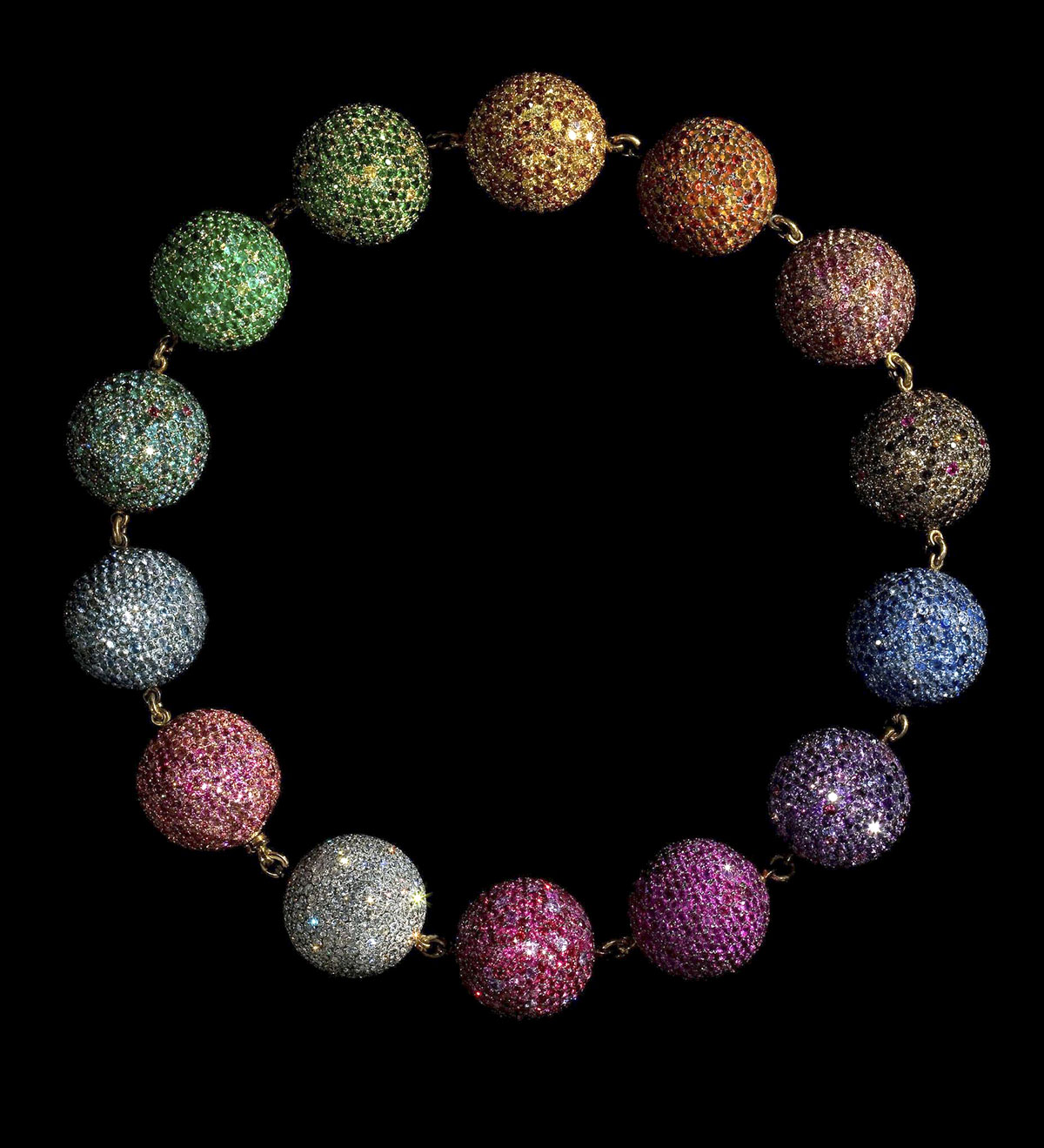
(Joel Arthur Rosenthal, American, b. 1943) 'Colored Balls Necklace' 1999


JAR (Joel Arthur Rosenthal, American, b. 1943)
Colored Balls Necklace
1999
Rubies, sapphires, emeralds, amethysts, spinels, garnets, opals, tourmalines, aquamarines, citrines, diamonds, silver, and gold
Private collection
Photograph by Jozsef Tari. Courtesy of JAR, Paris


JAR. 'Lilac Brooches' 2001


JAR (Joel Arthur Rosenthal, American, b. 1943)
Lilac Brooches
2001
Diamonds, lilac sapphires, garnets, aluminum, silver, and gold
Private collection
Photograph by Jozsef Tari. Courtesy of JAR, Paris


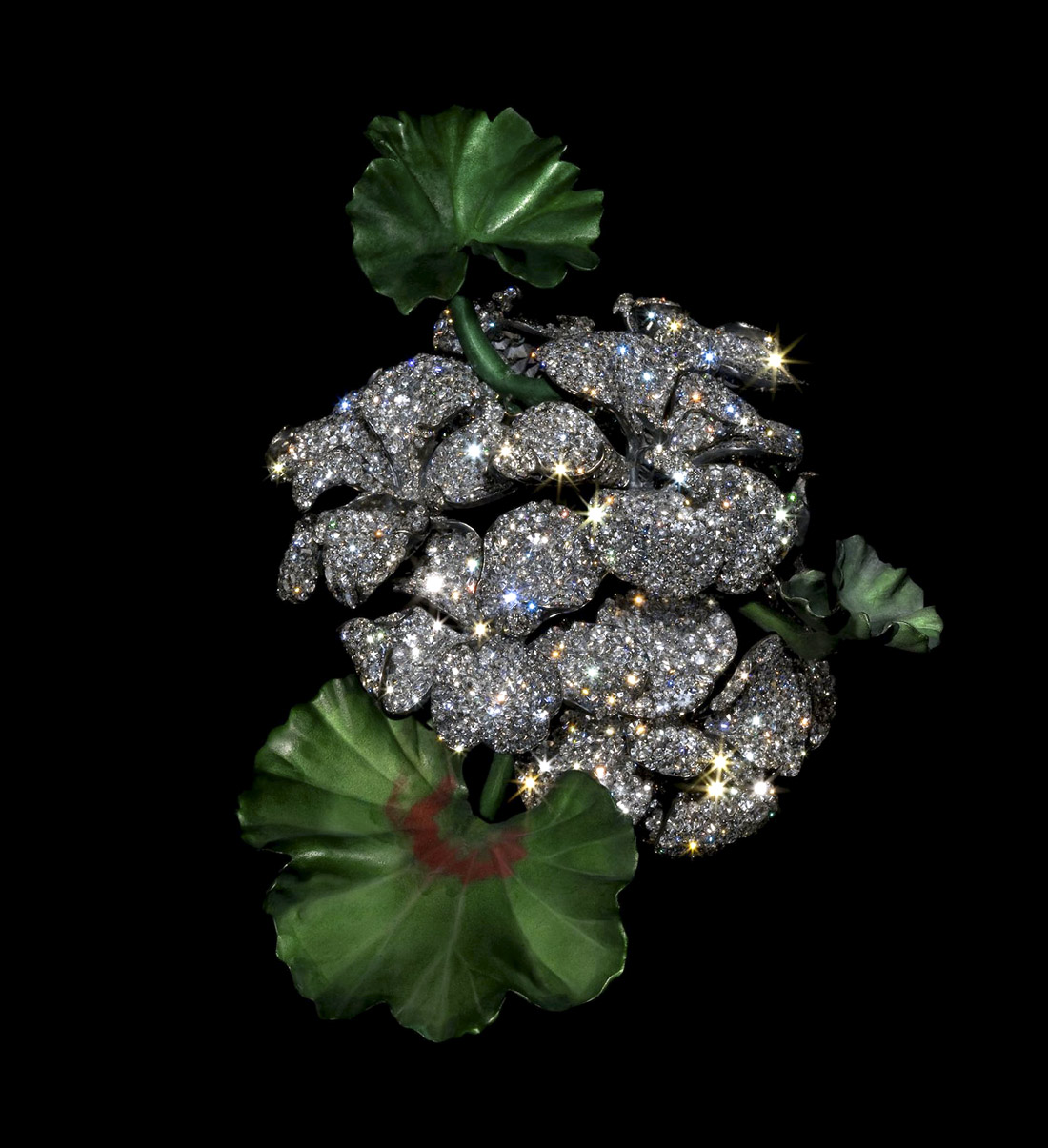
JAR. 'Geranium brooch' 2007


JAR (Joel Arthur Rosenthal, American, b. 1943)
Geranium brooch 
2007
Diamonds, aluminum, silver, and gold
Private collection
Photograph by Jozsef Tari. Courtesy of JAR, Paris


JAR. 'Tulip Brooch' 2008


JAR (Joel Arthur Rosenthal, American, b. 1943)
Tulip Brooch
2008
Rubies, diamonds, pink sapphires, garnets, silver, gold, and enamel
Private collection
Photograph by Jozsef Tari. Courtesy of JAR, Paris


Jewels by JAR at The Metropolitan Museum of Art will feature more than 400 works by renowned jewellery designer Joel Arthur Rosenthal, who works in Paris under the name JAR. The exhibition will be the first retrospective in the United States of his work and the first retrospective at the Metropolitan Museum devoted to a contemporary artist of gems.

Growing up in the Bronx, New York, Rosenthal spent much of his early life visiting the museums in the city, stirring in him a passion for art, history, and all things beautiful that has stayed with him throughout his life. Rosenthal left New York to attend Harvard University and moved to Paris shortly after his graduation in 1966. It was in Paris that Rosenthal met Pierre Jeannet – the other half of the JAR story.

Rosenthal and Jeannet spent much time at antique shops, museums, galleries, and auction houses learning about antique jewellery, diamonds, pearls, and coloured stones. In 1973, they opened a needlepoint shop on the rue de l’Université. For Rosenthal needlepoint meant painting, mainly flowers, on a white canvas and playing with the palette of the colours of the wools. But the passion for jewellery was there and he wanted to “play with stones,” as he later explained. The needlepoint shop lasted only 11 months, but during this period Rosenthal was encouraged by others to re-design clients’ jewels and turned his attention once again, and more fully, to jewellery. In 1976, Rosenthal moved back to New York to work at Bulgari but returned to Paris and decided to open his own jewellery business under his initials, JAR.

JAR opened in 1978 on the Place Vendôme. At the start, it was run by a team of only two – Rosenthal and Jeannet. The clientele broadened from local Parisians to a range of international clients, and in 1987, Rosenthal and Jeannet relocated JAR to a larger space next door to their original shop – the same space from which they operate today. As they worked more and more with exceptional stones, they expanded the team to include the few exceptional craftsmen still specialising in this field.

JAR makes jewels that fulfil an aesthetic rather than commercial ambition. A particular skill of the JAR team is selecting stones for their colour compatibility, complementary range, or contrast. Rosenthal, who once said, “we are not afraid of any materials,” uses metals as strong as platinum and as lightweight as aluminium as bases for his designs. He reintroduced the use of silver in fine jewellery making and blackened the metal to enhance the colour of the stones and the shine of the diamonds. The colour and the shading of his pavé technique became a signature, as did the diamond thread work.

Rosenthal experiments with a variety of forms, designs, and themes. Two significant and recurring themes in his work are flowers and butterflies, which often appear in the form of brooches. Rosenthal’s flowers are not shaped regularly, but rather capture the role of chance in nature – be it in the form of a bud, a flower in full bloom, or a falling petal. Each JAR piece is unique and three-dimensional.

Jeannet summarises Rosenthal’s process this way: “At every step of the making of a piece, he checks and corrects. And if at the end his eye is not happy, we destroy the piece. But the piece, finished, is not yet at home; his last look is to see that the jewel has gone to the right lady. Then he sighs, his work is done.”

Press release from The Metropolitan Museum of Art website


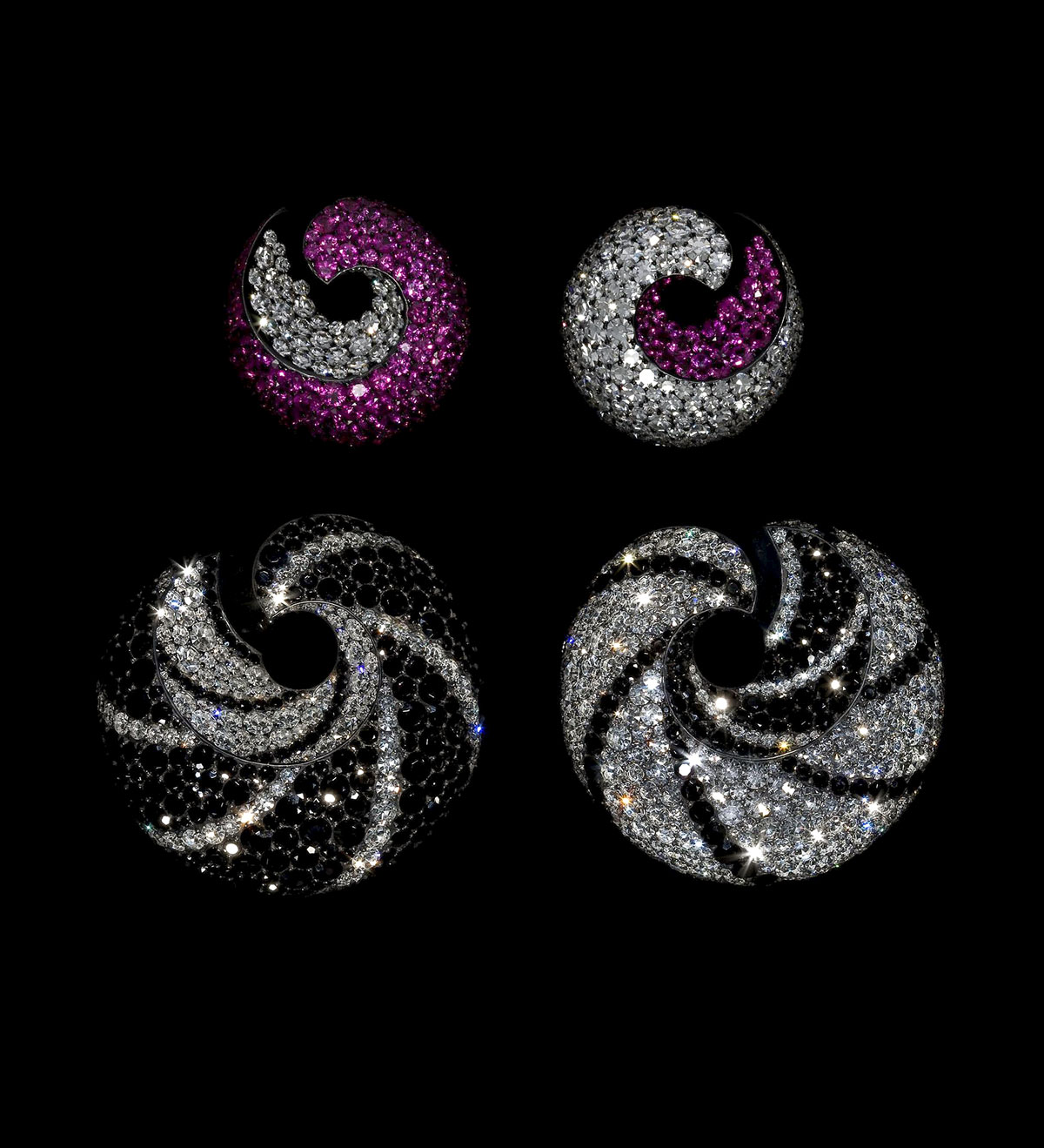
JAR. 'Hoop Earrings' 2008 and 2010


JAR (Joel Arthur Rosenthal, American, b. 1943)
Top:
Hoop Earrings 
2008
Rubies, sapphires, diamonds, silver, and gold

Bottom:
Hoop Earrings 
2010
Spinels, diamonds, silver, and gold

Both: Private collection
Photograph by Jozsef Tari. Courtesy of JAR, Paris


JAR. 'Bracelet' 2010


JAR (Joel Arthur Rosenthal, American, b. 1943)
Bracelet
2010
Diamonds, silver, and platinum
Private collection
Photograph by Jozsef Tari. Courtesy of JAR, Paris


JAR. 'Camellia Brooch' 2010


JAR (Joel Arthur Rosenthal, American, b. 1943)
Camellia Brooch
2010
Rubies, pink sapphires, diamonds, silver, and gold
Private collection
Photograph by Jozsef Tari. Courtesy of JAR, Paris


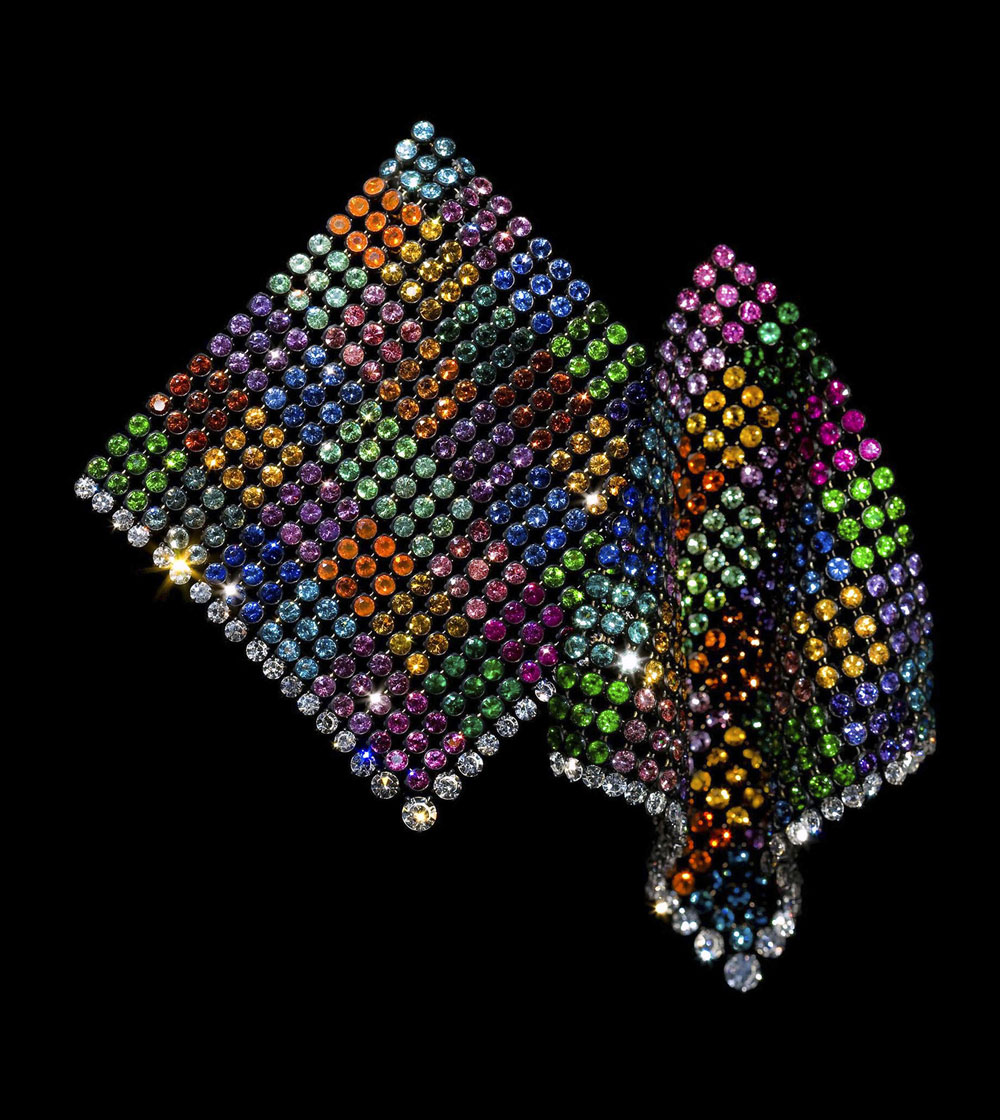
JAR. 'Multicolored Handkerchief Earrings' 2011


JAR (Joel Arthur Rosenthal, American, b. 1943)
Multicolored Handkerchief Earrings
2011
Sapphires, demantoid and other garnets, zircons, tourmalines, emeralds, rubies, fire opals, spinels, beryls, diamonds, platinum, silver, and gold
Private collection
Photograph by Jozsef Tari. Courtesy of JAR, Paris


JAR. 'Earrings' 2011


JAR (Joel Arthur Rosenthal, American, b. 1943)
Earrings
2011
Emeralds, oriental pearls, diamonds, and platinum
Private collection
Photograph by Jozsef Tari. Courtesy of JAR, Paris


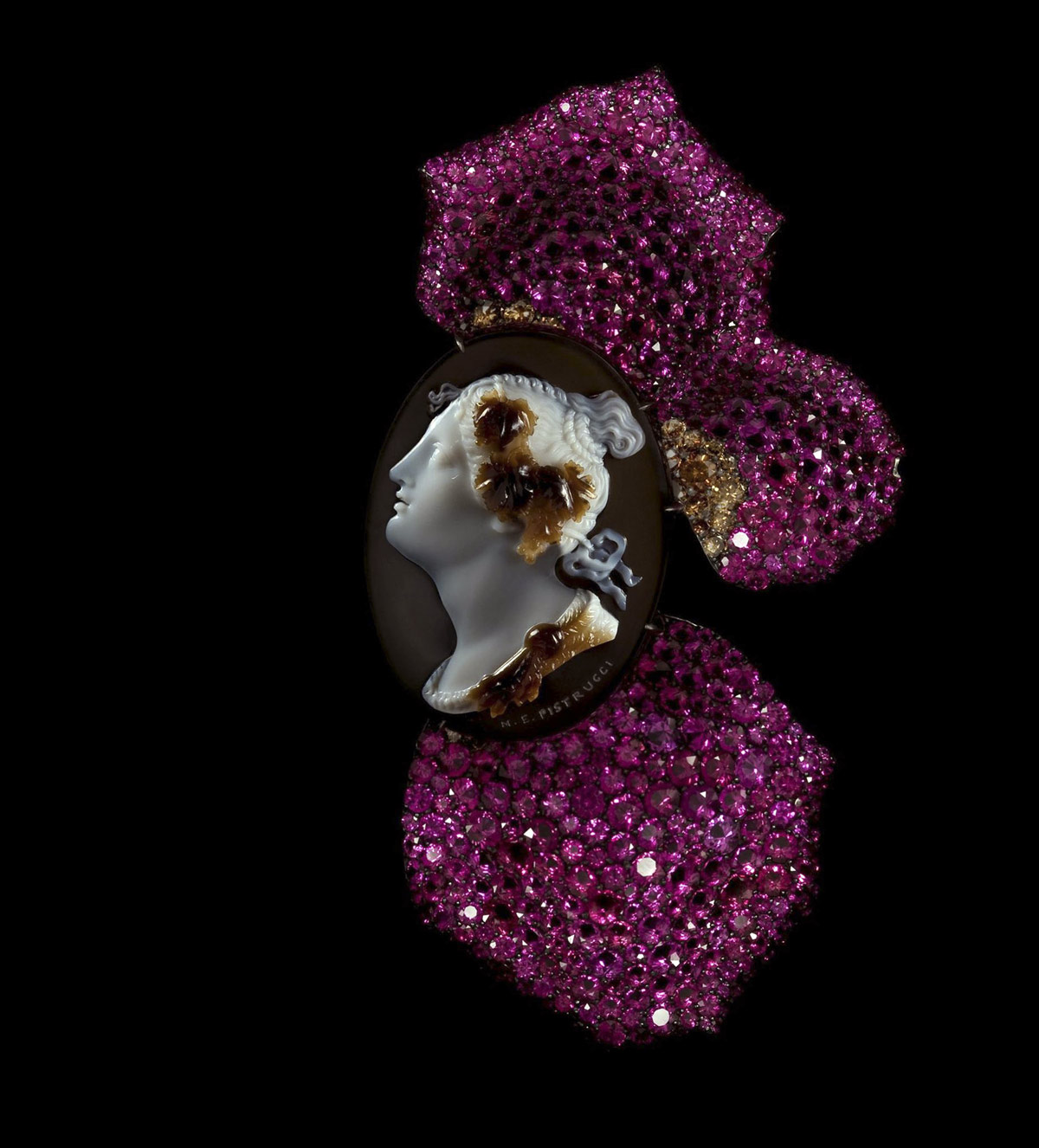
JAR. 'Cameo and Rose Petal Brooch' 2011


JAR (Joel Arthur Rosenthal, American, b. 1943)
Cameo and Rose Petal Brooch
2011
Rubies, diamonds, silver, gold
Private collection
Photograph by Jozsef Tari. Courtesy of JAR, Paris


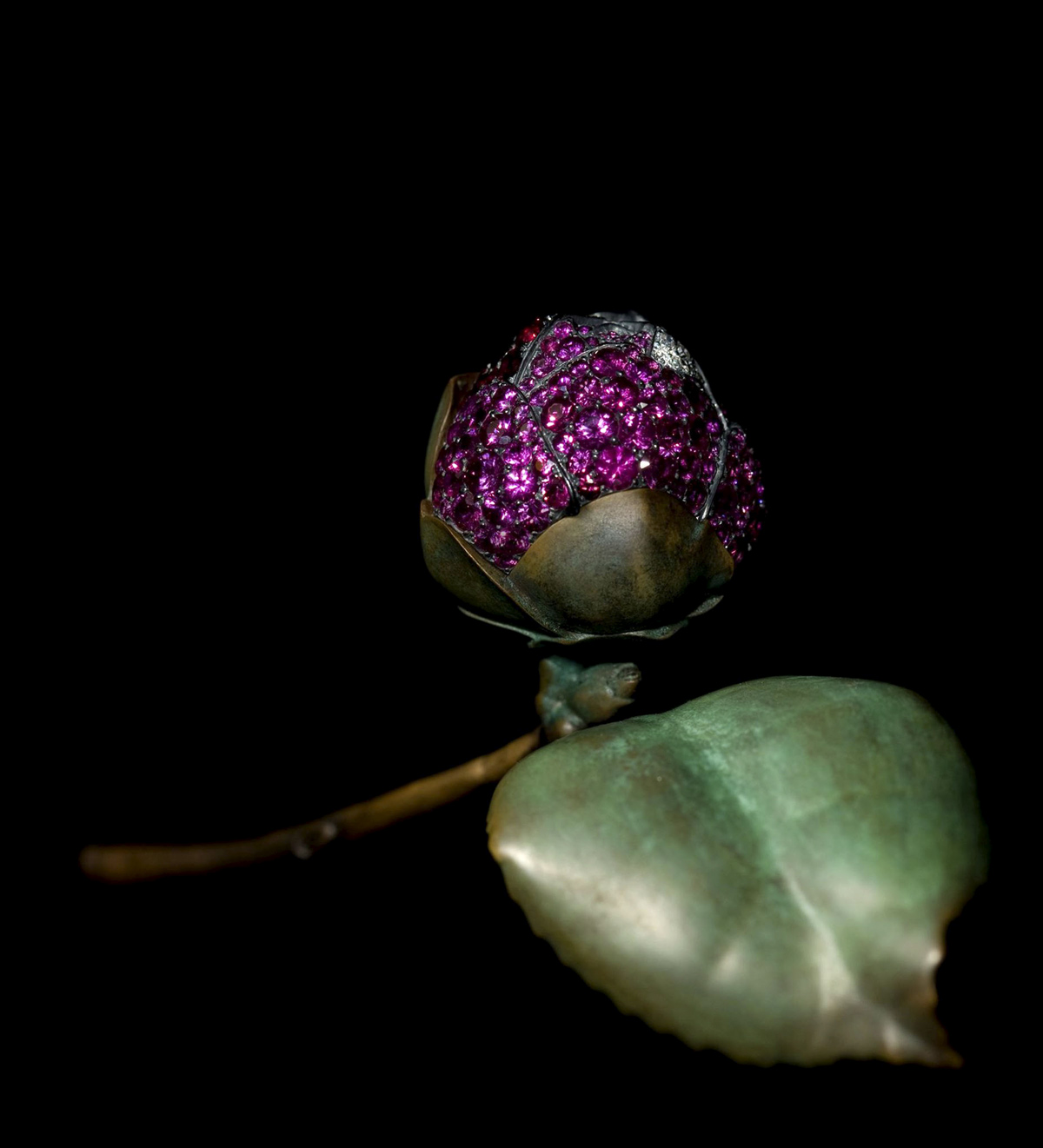
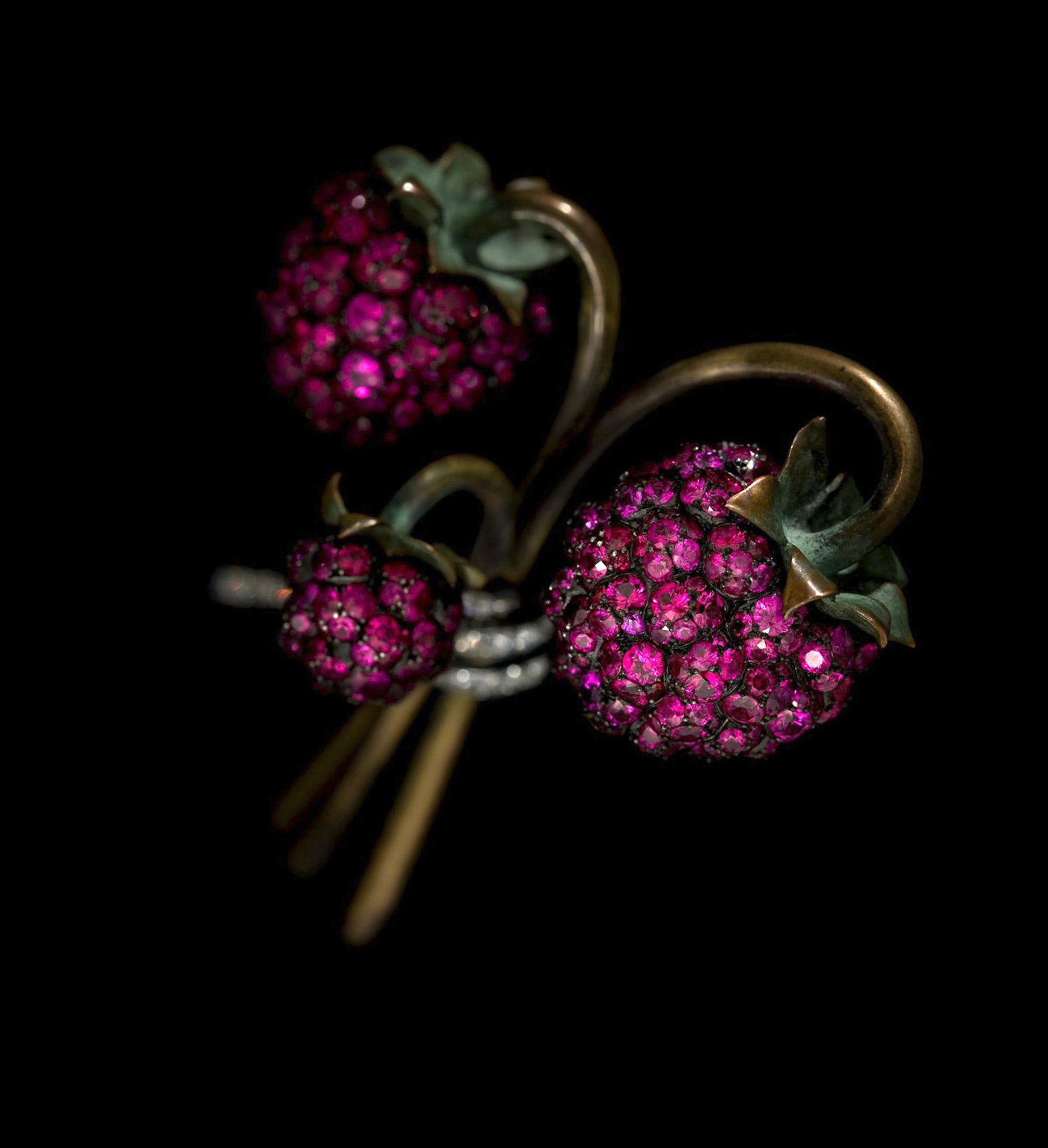
JAR. 'Raspberry Brooch' 2011


JAR (Joel Arthur Rosenthal, American, b. 1943)
Raspberry Brooch
2011
Rubies, diamonds, bronze, silver, gold, and platinum
Collection of Sien M. Chew
Photograph by Jozsef Tari. Courtesy of JAR, Paris


The Metropolitan Museum of Art
1000 Fifth Avenue at 82nd Street
New York, New York 10028-0198
Phone: 212-535-7710

Opening hours:
Sunday – Tuesday and Thursday: 10am – 5pm
Friday and Saturday: 10am – 9pm
Closed Wednesday

The Metropolitan Museum of Art website

LIKE ART BLART ON FACEBOOK

Back to top

Exhibition: ‘Guy Bourdin’ at the House of Photography at Deichtorhallen Hamburg

Exhibition dates: 1st November, 2013 – 26th January, 2014

Curator: Ingo Taubhorn, with additional cabinet exhibition curation by Dr. Sabine Schnakenberg

PLEASE NOTE: THIS POSTING CONTAINS ART WORK OF FEMALE NUDITY – IF YOU DO NOT LIKE PLEASE DO NOT LOOK, FAIR WARNING HAS BEEN GIVEN


Many thankx to House of Photography at Deichtorhallen Hamburg for allowing me to publish the photographs in the posting. Please click on the photographs for a larger version of the image.


Guy Bourdin (French, 1928-1991) 'Untitled' (Child) 1950


Guy Bourdin (French, 1928-1991)
Untitled (Child)
1950
Gelatin silver print
© The Estate of Guy Bourdin, 2013


Guy Bourdin (French, 1928-1991) 'Untitled' (Child with doll and pram) 1954


Guy Bourdin (French, 1928-1991)
Untitled (Child with doll and pram)
1954
Gelatin silver print
© The Estate of Guy Bourdin, 2013


Guy Bourdin (French, 1928-1991) 'Untitled' (Child lying on stones) 1953-1957


Guy Bourdin (French, 1928-1991)
Untitled (Child lying on stones)
1953-1957
Gelatin silver print
© The Estate of Guy Bourdin, 2013


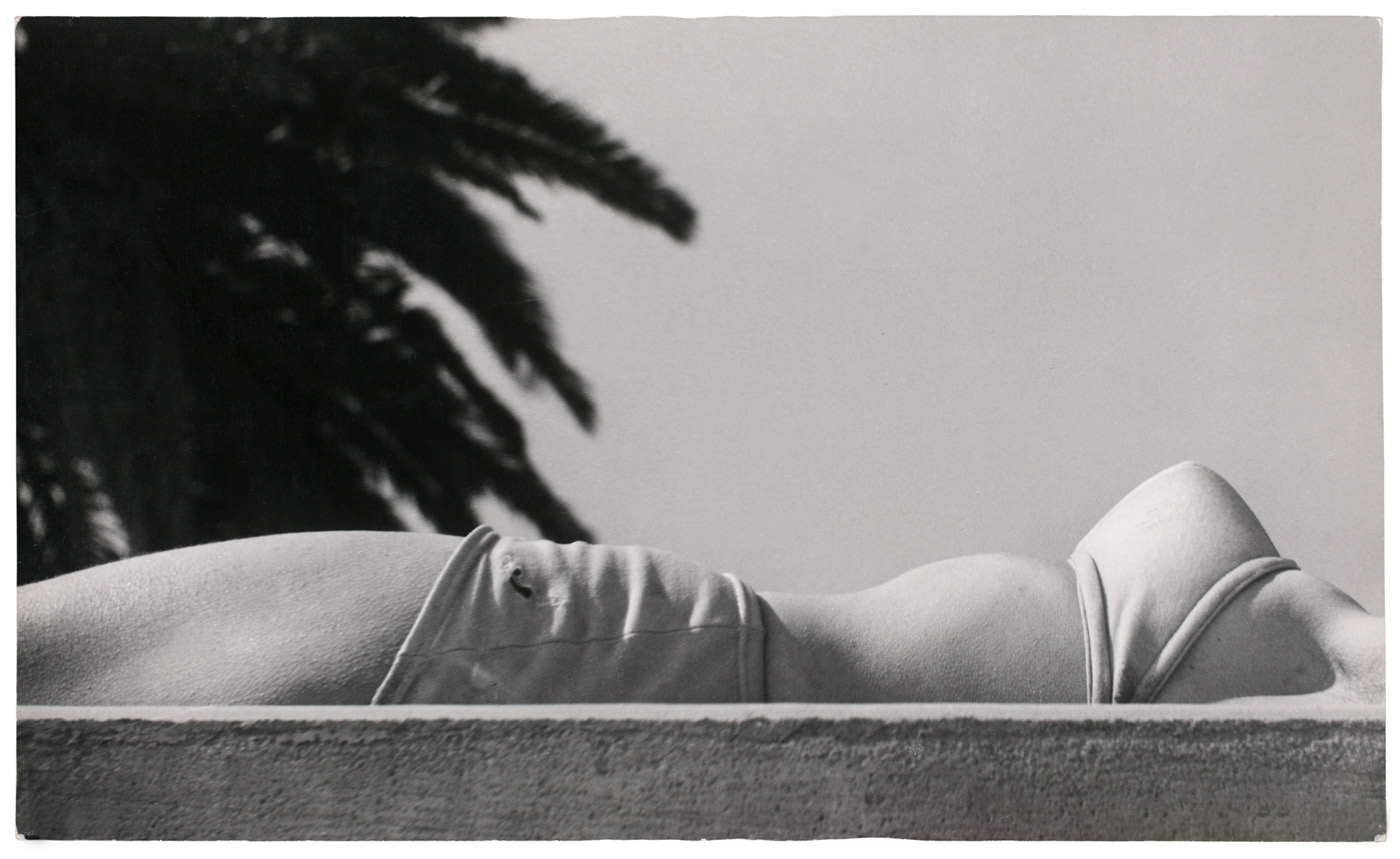
Guy Bourdin (French, 1928-1991) 'La Baigneuse' c. 1950-1953


Guy Bourdin (French, 1928-1991)
La Baigneuse (The Bather)
c. 1950-1953
Gelatin silver print
© The Estate of Guy Bourdin, 2013


Guy Bourdin (French, 1928-1991) 'Vogue Paris - January 1966' 1966


Guy Bourdin (French, 1928-1991)
Vogue Paris – January 1966
1966
Gelatin silver print
© The Estate of Guy Bourdin, 2013


Guy Bourdin (French, 1928-1991) 'Untitled' Nd


Guy Bourdin (French, 1928-1991)
Untitled
Nd
© Estate of Guy Bourdin


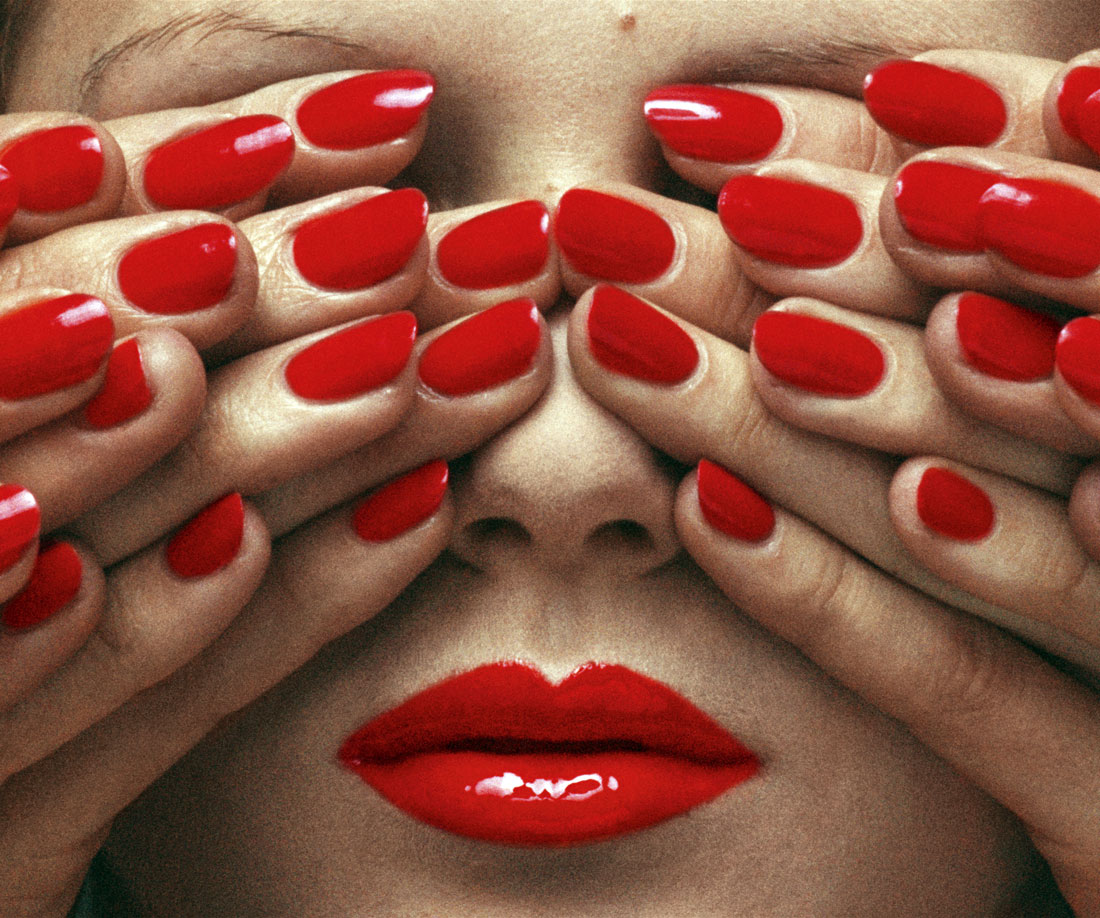
House of Photography at Deichtorhallen Hamburg announces an exhibition of the legendary photographer Guy Bourdin (1928-1991), on view from November 1, 2013 – January 26, 2014. This most comprehensive exhibition to date is both an overview of the essential components of Guy Bourdin’s oeuvre and an introduction to unveiling works from his personal archives which have never been seen before. This is the first time that both his works as a painter and his notes on films are being shown at an exhibition. B&W shots dating from the 1950s are also included, showing portraits of artists and views of the city of Paris as well as Polaroids, sketches and texts. The exhibition examines Guy Bourdin’s oeuvre, but moreover, it provides insight into the complex working processes of the photographer’s mind and aims to establish his status as a visionaire image maker.

Guy Bourdin’s career spanned more than forty years during which time he worked for the world’s leading fashion houses and magazines. With the eye of a painter, Guy Bourdin created images that contained fascinating stories, compositions, both in B&W and in colours. He was among the 1st to create images with narratives, telling stories and shows that the image is more important than the product which is displayed. Using fashion photography as his medium, he sent out his message, one that was difficult to decode, exploring the realms between the absurd and the sublime. Famed for his suggestive narratives and surreal aesthetics, he radically broke conventions of commercial photography with a relentless perfectionism and sharp humour.

During the 1950s, Guy Bourdin launched his career with fashion assignments for Vogue Paris working in B&W. It’s nearly unknown, that half of the oeuvre of Guy Bourdin is black-and-white and as amazingly powerful as his colour works. He developed colour photography to its maximum effect, creating dramatic accents with intense colour saturation and textures in his compositions. Guy Bourdin used the format of the double spread magazine page in the most inventive way. He tailored his compositions to the constraints of the printed page both conceptually and graphically, and the mirror motif so central in his work finds its formal counterpart in the doubleness of the magazine spread. Layout and design become powerful metaphors for the photographic medium, engaging the eye and with it, the mind. While on the one hand employing formal elements of composition, Guy Bourdin, on the other hand, sought to transcend the reality of the photographic medium with surreal twists to the apparent subject of his images and his unconventional manipulation of the picture plane. Given total creative freedom and with uncompromising artistic ethic, Guy Bourdin captured the imagination of a whole generation at the late 1970s, recognised as the highest note in his career.

Guy Bourdin was an image maker, a perfectionist. He knew how to grab the attention of the viewer and left nothing to chance. He created impeccable sets, or when not shooting in his studio rue des Ecouffes in le Marais, in undistinguished bedrooms, on the beach, in nature, or in urban landscapes. The unusual dramas that unfold in these seemingly everyday scenes and ordinary encounters pique our subconscious and invite our imagination. Moreover, he developed a technic using hyper real colours, meticulous compositions of cropped elements such as low skies with high grounds and the interplay of light and shadows as well as the unique make-up of the models.

“Guy Bourdin irreverently swept away all the standards of beauty, conventional morals and product portrayals in one fell swoop. Around the female body he constructed visual disruptions, the outrageous, the hair-raising, the indiscreet, the ugly, the doomed, the fragmentary and the absent, torsos and death – all the tension and the entire gamut of what lies beyond the aesthetic and the moral,” explains the exhibition’s curator Ingo Taubhorn. Bourdin investigates in minute detail the variables of fashion photography, from brash posing to subtle performances and from complex settings to novel and disturbing notions of images.

Guy Bourdin’s imagery not only changed the course of fashion photography but influenced a host of contemporary artists, photographers and filmmakers. It is without question, that Guy Bourdin’s work for Vogue and his highly acclaimed print advertising for Charles Jourdan in the 1970s are now being seen in the appropriate context of contemporary art.

Press release from House of Photography at Deichtorhallen Hamburg


Guy Bourdin (French, 1928-1991) 'Self portrait' c. 1950


Guy Bourdin (French, 1928-1991)
Self portrait
c. 1950
© The Estate of Guy Bourdin, 2013


Guy Bourdin (French, 1928-1991) 'Untitled' 1960


Guy Bourdin (French, 1928-1991)
Untitled
1960
© Estate of Guy Bourdin


Guy Bourdin (French, 1928-1991) 'Untitled' Nd


Guy Bourdin (French, 1928-1991)
Untitled
Nd
© Estate of Guy Bourdin


Guy Bourdin (French, 1928-1991) 'Charles Jourdan - Spring 1979' 1979


Guy Bourdin (French, 1928-1991)
Charles Jourdan – Spring 1979
1979
© Estate of Guy Bourdin


Guy Bourdin (French, 1928-1991) 'Pentax Calendar' 1981


Guy Bourdin (French, 1928-1991)
Pentax Calendar
1981
Asahi Optical Company Limited. Tokyo, Japan
© Estate of Guy Bourdin


Guy Bourdin (French, 1928-1991) 'Vogue Paris – May 1970' 1970


Guy Bourdin (French, 1928-1991)
Vogue Paris – May 1970
1970
© Estate of Guy Bourdin


Guy Bourdin (French, 1928-1991) 'Charles Jourdan – Spring 1978' 1978


Guy Bourdin (French, 1928-1991)
Charles Jourdan – Spring 1978
1978
© Estate of Guy Bourdin


Guy Bourdin (French, 1928-1991) 'Vogue Paris – December 1969' 1969


Guy Bourdin (French, 1928-1991)
Vogue Paris – December 1969
1969
Jewellery: Van Cleef & Arpels
Make-up: Serge Lutens
© Estate of Guy Bourdin, 2013


Deichtorhallen Hamburg
Deichtorstrasse 1-2
20095
Hamburg
Phone: +49 (0)40 32103-0

Opening hours:
Tuesday – Sunday 11am – 6pm
Closed Mondays

Deichtorhallen Hamburg website

LIKE ART BLART ON FACEBOOK

Back to top

Exhibition: ‘Melbourne Now’ at the National Gallery of Victoria, Melbourne, Part 1

Exhibition dates: 22nd November, 2013 – 23rd March, 2014

Key Curatorial and Leadership Figures: Max Delany: Lead Curator / Senior Curator of Contemporary Art; Simone LeAmon: Curator, Design Wall & Design in Everyday Life; Fleur Watson: Curator, Architecture; Ewan McEoin: Curator, Architecture / Design; Tony Ellwood: NGV Director, who initiated the project as a comprehensive survey of Melbourne’s creative scene, along with numerous guest curators to represent various creative fields.


Ross Coulter (Australian, b. 1972) '10,000 paper planes – aftermath (1)' 2011 (installation view)


Ross Coulter (Australian, b. 1972)
10,000 paper planes – aftermath (1) (installation view)
2011
National Gallery of Victoria, Melbourne
Photo: © Marcus Bunyan


This is the first of a two-part posting on the huge Melbourne Now exhibition at the National Gallery of Victoria, Melbourne. The photographs in this posting are from the NGV International venue in St Kilda Road. The second part of the posting features photographs of work at NGV Australia: The Ian Potter Centre at Federation Square. Melbourne Now celebrates the latest art, architecture, design, performance and cultural practice to reflect the complex cultural landscape of creative Melbourne.

Keywords

Place, memory, anxiety, democracy, death, cultural identity, spatial relationships.

The best

Daniel Crooks An embroidery of voids 2013 video.

Highlights

Patricia Piccinini The Carrier 2012 sculpture; Mark Hilton dontworry 2013 sculpture.

Honourable mentions

Stephen Benwell Statues various dates sculpture; Rick Amor mobile call 2012 painting; Destiny Deacon and Virginia Fraser Melbourne Noir 2013 installation.

Disappointing

The weakness of the photography. With a couple of notable exceptions, I can hardly recall a memorable photographic image. Some of it was Year 12 standard.

Low points

~ The lack of visually interesting and beautiful art work – it was mostly all so ho hum in terms of pleasure for the eye
~ The preponderance of installation / design / architectural projects that took up huge areas of space with innumerable objects
~ The balance between craft, form and concept
~ Too much low-fi art
~ Too much collective art
~ Little glass art
~ Weak third floor at NGV International
~ Two terrible installations on the ground floor of NGVA

Verdict

As with any group exhibition there are highs and lows, successes and failures. Totally over this fad for participatory art spread throughout the galleries. Too much deconstructed / performance / collective design art that takes the viewer nowhere. Good effort by the NGV but the curators were, in some cases, far too clever for their own (and the exhibitions), good. 7/10

Dr Marcus Bunyan


Many thankx to the NGV for allowing me to publish the photographs in the posting. All photographs © Dr Marcus Bunyan unless otherwise stated. Please click on the photographs for a larger version of the image.

Please note: All text below the images is from the guide book.


“Although the word “new” recurs like an incantation in the catalogue essays many exhibits are variations on well-worn themes. The trump cards of Melbourne Now are bulk and variety… It’s astonishing that curators still seem to assume that art which proclaims its own radicality must be intrinsically superior to more personal expressions. Yet mediocrity recognises no such distinctions. Most of this show’s avant-garde gestures are no better than clichés.”


John Macdonald. “Review of Melbourne Now,” in the Sydney Morning Herald, Saturday 11 January, 2014 [Online] Cited 03/10/2022


“A rich, inspiring critical context prevails within Melbourne’s contemporary art community, reflecting the complexity of multiple situations and the engaging reality of a culture that is always in the process of becoming. Local knowledge is of course specific and resists generalisation – communities are protean things, which elide neat definition and representation. Notwithstanding the inevitable sampling and partial account which large-scale survey exhibitions unavoidably present, we hope that Melbourne Now retains a sense of semantic density, sensory intensity and conceptual complexity, harnessing the vision and energy that lie within our midst. Perhaps most importantly, the contributors to Melbourne Now highlight the countless ways in which art is able to change, alter and invigorate the senses, adding new perspectives and modes of perceiving the world in which we live.”


Max Delany. “Metro-cosmo-polis: Melbourne now” 2013


Ross Coulter (Australian, b. 1972) '10,000 paper planes – aftermath (1)' 2011 (detail)

Ross Coulter (Australian, b. 1972) '10,000 paper planes – aftermath (1)' 2011 (installation view)


Ross Coulter (Australian, b. 1972)
10,000 paper planes – aftermath (1)
2011
Type C photograph
156 x 200cm
National Gallery of Victoria, Melbourne
Purchased NGV Foundation, 2012
© Ross Coulter
Photo: © Marcus Bunyan
Last photo: © National Gallery of Victoria


With 10,000 paper planes – aftermath (1), 2011, Coulter encountered Melbourne’s intellectual heart, the State Library of Victoria (SLV). Being awarded the Georges Mora Foundation Fellowship in 2010 allowed Coulter to realise a concept he had been developing since he worked at the SLV in the late 1990s. The result is a playful intervention into what is usually a serious place of contemplation. Coulter’s paper planes, launched by 165 volunteers into the volume of the Latrobe Reading Room, give physical form to the notion of ideas flying through the building and the mind. This astute work investigates the striking contrast between the strict discipline of the library space and its categorisation system and the free flow of creativity that its holdings inspire in the visitor.


Laith McGregor (Australian, b. 1977) 'Pong ping paradise' 2011 (installation view)


Laith McGregor (Australian, b. 1977)
Pong ping paradise (installation view)
2011
Private collection, United States of America
Photo: © Marcus Bunyan


The drawings OK and KO, both 2013, which decorate the horizontal surfaces of two table-tennis tables and contain four large self-portraits portraying unease and concern, are more restrained. The hirsute beards of McGregor’s earlier works have evolved into all enveloping geometric grids, their hand-drawn asymmetry creating a subtle sense of distortion that contradicts the inherently flat surface of the tables.


Rick Amor (Australian, b. 1948) 'Mobile call' 2012 (installation view)


Rick Amor (Australian, b. 1948)
Mobile call (installation view)
2012
Private collection, Melbourne
Photo: © Marcus Bunyan


Best known for his brooding urban landscapes, Amor’s work in Melbourne Now, Mobile call, 2012, stays true to this theme. The painting speaks to the heart of urban living in its depiction of a darkened city alleyway, with dim, foreboding lighting. A security camera on the wall surveys the scene, a lone, austere figure just within its watch. The camera represents the omnipresent surveillance of our modern lives, and an uneasy air of suspicion permeates the painting’s subdued, grey landscape. Amor’s reflections on the urban landscape are solemn, restrained and often melancholic. Quietly powerful, his work alludes to a mystery in the banality of daily existence. Mobile call is a realistic portrayal of a metropolitan landscape that opens our eyes to a strange and complex world.


Steaphan Paton (Australian, Gunai and Monero Nations, b. 1985) 'Cloaked combat' 2013 (installation view detail)


Steaphan Paton (Australian, Gunai and Monero Nations, b. 1985)
Cloaked combat (installation view detail)
2013
National Gallery of Victoria, Melbourne
Photo: © Marcus Bunyan


Cloaked combat, 2013, is a visual exploration of the material and technological conflicts between cultures, and how these differences enable one culture to assert dominance over another. Five Aboriginal bark shields, customarily used in combat to deflect spears, repel psychedelic arrows shot from a foreign weapon. Fired by an unseen intruder cloaked in contemporary European camouflage, the psychedelic arrows rupture the bark shields and their diamond designs of identity and place, violating Aboriginal nationhood and traditional culture. The jarring clash of weapons not only illustrates a material conflict between these two cultures, but also suggests a deeper struggle between old and new. In its juxtaposition of prehistoric and modern technologies, Cloaked combat highlights an uneven match between Indigenous and European cultures and discloses the brutality of Australia’s colonisation.


Zoom project team. 'Zoom' 2013 (installation view detail)

Zoom project team. 'Zoom' 2013 (installation view detail)


Zoom project team
Curator: Ewan McEoin / Studio Propeller; Data visualisation: Greg More / OOM Creative; Graphic design: Matthew Angel; Exhibition design: Design Office; Sound installation: Marco Cher-Gibard; Data research: Serryn Eagleson / EDG Research; Digital survey design: Policy Booth
Zoom (installation view details)
2013
Photos: © Marcus Bunyan


Anchored around a dynamic tapestry of data by Melbourne data artist Greg More, this exhibit offers a window into the ‘system of systems’ that makes up the modern city, peeling back the layers to reveal a sea of information beneath us. Data ebbs and flows, creating patterns normally inaccessible to the naked eye. Set against this morphing data field, an analogue human survey asks the audience to guide the future design of Melbourne through choice and opinion. ZOOM proposes that every citizen influences the future of the city, and that the city in turn influences everyone within it. Accepting this co-dependent relationship empowers us all to imagine the city we want to create together.


Installation view of Jon Campbell. 'DUNNO (T. Towels)' 2012 (left) and Reko Rennie 'Initiation', 2013 (right) (installation view)


Installation view of Jon Campbell DUNNO (T. Towels) 2012 (left) and Reko Rennie Initiation, 2013 (right)
Photo: © Marcus Bunyan


Jon Campbell (Australian born Northern Ireland, b. 1961) 'DUNNO (T. Towels)' 2012 (installation view detail)

Jon Campbell (Australian born Northern Ireland, b. 1961) 'DUNNO (T. Towels)' 2012 (installation view detail)


Jon Campbell (Australian born Northern Ireland, b. 1961)
DUNNO (T. Towels) (installation view details)
2012
Photos: © Marcus Bunyan


For Melbourne Now Campbell presents DUNNO (T. Towels), 2012, a work that continues his fascination with the vernacular culture of suburban Australia. Comprising eighty-five tea towels, some in their original condition and others that Campbell has modified through the addition of ‘choice’ snippets of Australian slang and cultural signifiers, this seemingly quotidian assortment of kitsch ‘kitchenalia’ is transformed into a mock heroic frieze in which we can discover the values and dramas of our present age.


Reko Rennie (Australian, Gamilaraay (Kamilaroi) b. 1974) 'Initiation' 2013 (installation view)


Reko Rennie (Australian, Gamilaraay (Kamilaroi) b. 1974)
Initiation (installation view)
2013
Synthetic polymer paint on plywood (1-40)
300 x 520cm (overall)
Collection of the artist
© Reko Rennie, courtesy Karen Woodbury Gallery, Melbourne
Supported by Esther and David Frenkiel
Photo: © Marcus Bunyan


Initiation, 2013, a mural-scale, multi-panelled hoarding that subverts the negative stereotyping of Indigenous people living in contemporary Australian cities. This declarative, renegade installation work is a psychedelic farrago of street art, native flora and fauna, Kamilaroi patterns, X-ray images and text that addresses what it means to be an urban Aboriginal person. By yoking together contrary elements of graffiti, advertising, bling, street slogans and Kamilaroi diamond geometry, Rennie creates a monumental spectacle of resistance.


Installation view of Reko Rennie 'Initiation', 2013 (installation view)


Installation view of Reko Rennie Initiation, 2013
Photo: Marcus Bunyan


Janet Burchill (Australian, b. 1955) and Jennifer McCamley (Australian, b. 1957) 'The Belief' 2004-2013 (installation view)


Janet Burchill (Australian, b. 1955)
Jennifer McCamley (Australian, b. 1957)
The Belief (installation view)
2004-2013
Photo: © Marcus Bunyan


Shields from Papua New Guinea held in the National Gallery of Victoria’s collection provided an aesthetic catalyst for the artists to develop an open-ended series of their own ‘shields’. The Belief includes shields made by Burchill and McCamley between 2004 and 2013. In part, this installation meditates on the form and function of shields from the perspective of a type of reverse ethnography. As the artists explain:

“The shield is an emblematic form ghosted by the functions of attack and defence and characterised by the aggressive display of insignia … We treat the shield as a perverse type of modular unit. While working with repetition, each shield acts as a carrier or container for different types and registers of content, motifs, emblems and aesthetic strategies. The series as a whole, then, becomes a large sculptural collage which allows us to incorporate a wide range of responses to making art and being alive now.”


Janet Burchill (Australian, b. 1955) and Jennifer McCamley (Australian, b. 1957) 'The Belief' 2004-2013 (installation view)


Janet Burchill (Australian, b. 1955)
Jennifer McCamley (Australian, b. 1957)
The Belief (detail)
2004-2013
Photo: © Marcus Bunyan


Melbourne Now is an exhibition unlike any other we have mounted at the National Gallery of Victoria. It takes as its premise the idea that a city is significantly shaped by the artists, designers, architects, choreographers, intellectuals and community groups that live and work in its midst. With this in mind, we have set out to explore how Melbourne’s visual artists and creative practitioners contribute to the dynamic cultural identity of this city. The result is an exhibition that celebrates what is unique about Melbourne’s art, design and architecture communities.

When we began the process of creating Melbourne Now we envisaged using several gallery spaces within The Ian Potter Centre: NGV Australia; soon, however, we recognised that the number of outstanding Melbourne practitioners required us to greatly expand our commitment. Now spreading over both The Ian Potter Centre: NGV Australia and NGV International, Melbourne Now encompasses more than 8000 square metres of exhibition space, making it the largest single show ever presented by the Gallery.

Melbourne Now represents a new way of working for the NGV. We have adopted a collaborative curatorial approach which has seen twenty of our curators work closely with both external design curators and many other members of the NGV team. Committing to this degree of research and development has provided a great opportunity to meet with artists in their studios and to engage with colleagues across the city as a platform not only for this exhibition, but also for long-term engagement.

A primary aim throughout the planning process has been to create an exhibition that offers dynamic engagement with our audiences. From the minute visitors enter NGV International they are invited to participate through the exhibition’s Community Hall project, which offers a diverse program of performances and displays that showcase a broad concept of creativity across all art forms, from egg decorating to choral performances. Entering the galleries, visitors discover that Melbourne Now includes ambitious and exciting contemporary art and design commissions in a wide range of media by emerging and established artists. We are especially proud of the design and architectural components of this exhibition which, for the first time, place these important areas of practice in the context of a wider survey of contemporary art. We have designed the exhibition in terms of a series of curated, interconnected installations and ‘exhibitions within the exhibition’ to offer an immersive, inclusive and sometimes participatory experience.

Viewers will find many new art commissions featured as keynote projects of Melbourne Now. One special element is a series of commissions developed specifically for children and young audiences – these works encourage participatory learning for kids and families. Artistic commissions extend from the visual arts to architecture, dance and choreography to reflect Melbourne’s diverse artistic expression. Many of the new visual arts and design commissions will be acquired for the Gallery’s permanent collections, leaving the people of Victoria a lasting legacy of Melbourne Now.

The intention of this exhibition is to encourage and inspire everyone to discover some of the best of Melbourne’s culture. To help achieve this, family-friendly activities, dance and music performances, inspiring talks from creative practitioners, city walks and ephemeral installations and events make up our public programs. Whatever your creative interests, there will be a lot to learn and enjoy in Melbourne Now. Melbourne Now is a major project for the NGV which we hope will have a profound and lasting impact on our audiences, our engagement with the art communities in our city and on the NGV collection. We invite you to join us in enjoying some of the best of Melbourne’s creative art, design and architecture in this landmark exhibition.

Tony Ellwood
Director, National Gallery of Victoria

Foreword from the Melbourne Now exhibition guide book


Destiny Deacon (Australian, K'ua K'ua and Erub/Mer peoples 1957-2024) Virginia Fraser (Australian) 'Melbourne Noir' 2013 (installation view)

Destiny Deacon (Australian, K'ua K'ua and Erub/Mer peoples 1957-2024) Virginia Fraser (Australian) 'Melbourne Noir' 2013 (installation view)

Destiny Deacon (Australian, K'ua K'ua and Erub/Mer peoples 1957-2024) Virginia Fraser (Australian) 'Melbourne Noir' 2013 (installation view)

Destiny Deacon (Australian, K'ua K'ua and Erub/Mer peoples 1957-2024) Virginia Fraser (Australian) 'Melbourne Noir' 2013 (installation view)


Destiny Deacon (Australian, K’ua K’ua and Erub/Mer peoples 1957-2024)
Virginia Fraser (Australian)
Melbourne Noir (installation view details)
2013
Installation comprising photography, video, sculptural diorama dimensions (variable) (installation)
Collection of the artists
© Destiny Deacon and Virginia Fraser, courtesy Roslyn Oxley9 Gallery, Sydney
Photos: © Marcus Bunyan


Adapting the quotidian formats of snapshot photography, home videos, community TV and performance modes drawn from vaudeville and minstrel shows, Deacon’s artistic practice is marked by a wicked yet melancholy comedic and satirical disposition. In decidedly lo-fi vignettes, friends, family and members of Melbourne’s Indigenous community appear in mischievous narratives that amplify and deconstruct stereotypes of Indigenous identity and national history. For Melbourne Now, Deacon and Fraser present a trailer for a film noir that does not exist, a suite of photographs and a carnivalesque diorama. The pair’s playful political critiques underscore a prevailing sense of postcolonial unease, while connecting their work to wider global discourses concerned with racial struggle and cultural identity.


Darren Sylvester (Australian, b. 1974) 'For you' 2013 (installation view detail)

Darren Sylvester (Australian, b. 1974) 'For you' 2013 (installation view detail)

Darren Sylvester (Australian, b. 1974) 'For you' 2013 (installation view detail)

Darren Sylvester (Australian, b. 1974) 'For you' 2013 (installation view detail)


Darren Sylvester (Australian, b. 1974)
For you (installation view details)
2013
Based on Yves Saint Laurent Les Essentials rouge pur couture, La laque couture and Rouge pur couture range revolution lipsticks, Marrakesh sunset palette, Palette city drive, Ombres 5 lumiéres, Pure chromatic eyeshadows and Blush radiance
Illuminated dance floor, sound system
605 x 1500 x 198cm
Supported by VicHealth; assisted by the Australian Government through the Australia Council for the Arts, its arts funding and advisory body
Photos: © Marcus Bunyan


For Melbourne Now Sylvester presents For you, 2013, an illuminated dance floor utilising the current palette of colours of an international make-up brand. By tapping into commonly felt fears of embarrassment and the desire to show off in front of others, For you provides a gentle push onto a dance floor flush in colours already proven by market research to appear flattering on the widest cross-section of people. It is a work that plays on viewers’ vanity while acting as their support. In Sylvester’s own words, this work ‘will make you look good whilst enjoying it. It is for you‘.


Assembling over 250 outstanding commissions, acquired and loaned works and installations, Melbourne Now explores the idea that a city is significantly shaped by the artists, designers and architects who live and work in its midst. It reflects the complexity of Melbourne and its unique and dynamic cultural identity, considering a diverse range of creative practice as well as the cross-disciplinary work occurring in Melbourne today.

Melbourne Now is an ambitious project that represents a new direction for the National Gallery of Victoria in terms of its scope and its relationship with audiences. Drawing on the talents of more than 400 artists and designers from across a wide variety of art forms, Melbourne Now will offer an experience unprecedented in this city; from video, sound and light installations, to interactive community exhibitions and artworks, to gallery spaces housing working design and architectural practices. The exhibition will be an immersive, inclusive and participatory exhibition experience, providing a rich and compelling insight into Melbourne’s art, design and cultural practice at this moment. Melbourne Now aims to engage and reflect the inspiring range of activities that drive contemporary art and creative practice in Melbourne, and is the first of many steps to activate new models of art and interdisciplinary exhibition practice and participatory modes of audience engagement at the NGV.

The collaborative curatorial structure of Melbourne Now has seen more than twenty NGV curators working across disciplinary and departmental areas in collaboration with exhibition designers, public programs and education departments, among others. The project also involves a number of guest curators contributing to specific contexts, including architecture and design, performance and sound, as well as artist-curators invited to create ‘exhibitions within the exhibition’, develop off-site projects and to work with the NGV’s collection. Examples of these include Sampling the City: Architecture in Melbourne Now, curated by Fleur Watson; Drawing Now, curated by artist John Nixon, bringing together the work of forty-two artists; ZOOM, an immersive data visualisation of cultural demographics related to the future of the city, convened by Ewan McEoin; Melbourne Design Now, which explores creative intelligence in the fields of industrial, product, furniture and object design, curated by Simone LeAmon; and un Retrospective, curated by un Magazine. Other special projects present recent developments in jewellery design, choreography and sound.

Numerous special projects have been developed by NGV curators, including Designer Thinking, focusing on the culture of bespoke fashion design studios in Melbourne, and a suite of new commissions and works by Indigenous artists from across Victoria which reflect upon the history and legacies of colonial and postcolonial Melbourne. The NGV collection is also the subject of artistic reflection, reinterpretation and repositioning, with artists Arlo Mountford, Patrick Pound and The Telepathy Project and design practice MaterialByProduct bringing new insights to it through a suite of exhibitions, videos and performative installations.

In our Community Hall we will be hosting 600 events over the four months of Melbourne Now offering a daily rotating program of free workshops, talks, catwalks and show’n’tells run by leaders in their fields. And over summer, the NGV will present a range of programs and events, including a Children’s Festival, dance program, late-night music events and unique food and beverage offerings.

The exhibition covers 8000 square metres of space, covering much of the two campuses of the National Gallery of Victoria, and moves into the streets of Melbourne with initiatives such as the Flags for Melbourne project, ALLOURWALLS at Hosier Lane, walking and bike tours, open studios and other programs that will help to connect the wider community with the creative riches that Melbourne has to offer.

Melbourne Now Introduction


Alan Constable (Australian, b. 1956) 'No title (teal SLR with flash)' 2013


Alan Constable (Australian, b. 1956)
No title (teal SLR with flash)
2013
Earthenware
15.5 x 24 x 11cm
Collection of the artist
© Alan Constable, courtesy Arts Project Australia, Melbourne
Photo: © National Gallery of Victoria


A camera’s ability to act as an extension of our eyes and to capture and preserve images renders it a potent instrument. In the case of Constable, this power has particular resonance and added poignancy. The artist lives with profound vision impairment and his compelling, hand-modelled ceramic reinterpretations of the camera – itself sometimes referred to as the ‘invented eye’ – possess an altogether more moving presence. For Melbourne Now, Constable has created a special group of his very personal cameras.


Linda Marrinon (Australian, b. 1959) Installation view of works including 'Debutante' (centre) 2009


Linda Marrinon (Australian, b. 1959)
Installation view of works including Debutante (centre)
2009
Tinted plaster, muslin
Collection of the artist
© Linda Marrinon, courtesy Roslyn Oxley9 Gallery, Sydney
Supported by Fiona and Sidney Myer AM, Yulgilbar Foundation and the Myer Foundation
Photo: © Marcus Bunyan


Marrinon’s art lingers romantically somewhere between the past and present. Her figures engage with notions of formal classical sculpture, with references to Hellenistic and Roman periods, yet remain quietly contemporary in their poise, scale, adornments and subject matter. Each work has a sophisticated and nonchalant air of awareness, as if posing for the audience. Informed by feminism and a keen sense of humour, Marrinon’s work is anti-heroic and anti-monumental. The figures featured in Melbourne Now range from two young siblings, Twins with skipping rope, New York, 1973, 2013, and a young woman, Debutante, 2009, to a soldier, Patriot in uniform, 2013, presented as a pantheon of unlikely types.


Brook Andrew (Australian, b. 1970) 'Vox: Beyond Tasmania' 2013 (installation view)


Brook Andrew (Australian, b. 1970)
Vox: Beyond Tasmania (installation view)
2013
Wood, cardboard, paper, books, colour slides, glass slides, 8mm film, glass, stone, plastic, bone, gelatin silver photographs, metal, feather
267 x 370 x 271cm
Collection of the artist
© Brook Andrew, courtesy Tolarno Galleries, Melbourne
Photo: © National Gallery of Victoria


Andrew’s Vox: Beyond Tasmania, 2013, renders palpable as contemporary art a central preoccupation of his humanist practice – the legacy of historical trauma on the present. Inspired by a rare volume of drawings of fifty-two Tasmanian Aboriginal crania, Andrew has created a vast wunderkammer containing a severed human skeleton, anthropological literature and artefacts. The focal point of this assemblage of decontextualised exotica is a skull, which lays bare the practice of desecrating sacred burial sites in order to snatch Aboriginal skeletal remains as scientific trophies, amassed as specimens to be studied in support of taxonomic theories of evolution and eugenics. Andrew’s profound and humbling memorial to genocide was supported in its first presentation by fifty-two portraits and a commissioned requiem by composer Stéphanie Kabanyana Kanyandekwe.


Brook Andrew (Australian, b. 1970) 'Vox: Beyond Tasmania' 2013 (installation view detail)

Brook Andrew (Australian, b. 1970) 'Vox: Beyond Tasmania' 2013 (installation view detail)


Brook Andrew (Australian, b. 1970)
Vox: Beyond Tasmania (details)
2013
Photos: © Marcus Bunyan


Daniel Crooks (New Zealand, b. 1973) 'An embroidery of voids' 2013 (still)

Daniel Crooks (New Zealand, b. 1973) 'An embroidery of voids' 2013 (still)


Daniel Crooks (New Zealand, b. 1973)
An embroidery of voids (stills)
2013
Colour single-channel digital video, sound, looped
Collection of the artist
© Daniel Crooks, courtesy Anna Schwartz Gallery, Melbourne and Sydney
Supported by Julie, Michael and Silvia Kantor
Photos: © National Gallery of Victoria


Commissioned for Melbourne Now, Crooks’s most recent video work focuses his ‘time-slice’ treatment on the city’s famous laneways. As the camera traces a direct, Hamiltonian pathway through these lanes, familiar surroundings are captured in seamless temporal shifts. Cobblestones, signs, concrete, street art, shadows and people gracefully pan, stretch and distort across our vision, swept up in what the artist describes as a ‘dance of energy’. Exposing the underlying kinetic rhythm of all we see, Crooks’s work highlights each moment once, gloriously, before moving on, always forward, transforming Melbourne’s gritty and often inhospitable laneways into hypnotic and alluring sites.


Jan Senbergs (Australian, 1939-2024) 'Extended Melbourne labyrinth' 2013 (installation view)


Jan Senbergs (Australian, 1939-2024)
Extended Melbourne labyrinth
2013
Oil stick, synthetic polymer paint wash (1-4)
158 x 120cm (each)
Collection of the artist
© Jan Senbergs, courtesy Niagara Galleries
Photo: © Marcus Bunyan


Senbergs’s significance as a contemporary artist and his understanding of the places he depicts and their meanings make his contribution to Melbourne Now essential. Drawing inspiration from Scottish poet Edwin Muir’s collection The labyrinth (1949), Senbergs’s Extended Melbourne labyrinth, 2013, takes us on a journey through the myriad streets and topography that make up our sprawling city. His characteristic graphic style and closely cropped rendering of the city’s urban thoroughfares is at once enthralling and unsettling. While the artist neither overtly celebrates nor condemns his subject, there is a strong sense of Muir’s ‘roads that run and run and never reach an end’.


Patrick Pound (Australian, b. 1962) 'The gallery of air' 2013 (installation view detail)

Patrick Pound (Australian, b. 1962) 'The gallery of air' 2013 (installation view detail)


Patrick Pound (Australian, b. 1962)
The gallery of air (installation view details)
2013
Photos: © Marcus Bunyan


For Melbourne Now Pound has created The gallery of air, 2013, a contemporary wunderkammer of works of art and objects from across the range of the NGV collection. There are Old Master paintings depicting the effect of the wind, and everything from an exquisite painted fan to an ancient flute and photographs of a woman sighing. When taken as a group these disparate objects hold the idea of air. Added to works from the Gallery’s collection is an intriguing array of objects and pictures from Pound’s personal collection. On entering his installation, visitors will be drawn into a game of thinking and rethinking about the significance of the objects and how they might be activated by air. Some are obvious, some are obscure, but all are interesting.


Marco Fusinato (Australian, b. 1964) 'Aetheric plexus (Broken X)' 2013 (installation view)


Marco Fusinato (Australian, b. 1964)
Aetheric plexus (Broken X) (installation view)
2013
Alloy tubing, lights, double couplers, Lanbox LCM DMX controller, dimmer rack, DMX MP3 player, powered speaker, sensor, extension leads, shot bags
880 x 410 x 230cm
Collection of the artist
© Marco Fusinato, courtesy Anna Schwartz Gallery, Melbourne and Sydney
Supported by Joan Clemenger and Peter Clemenger AM
Photo: © National Gallery of Victoria


For Melbourne Now, Fusinato presents Aetheric plexus (Broken X), 2013, a dispersed sculpture comprising deconstructed stage equipment that is activated by the presence of the viewer, triggering a sensory onslaught with a resonating orphic haze. The work responds to the wider context of galleries, in the artist’s words, ‘changing from places of reflection to palaces of entertainment’ by turning the engulfed audience member into a spectacle.


Installation view of Susan Jacobs 'Wood flour for pig iron (vessel for mixing metaphors)' 2013 with Mark Hilton 'dontworry' 2013 in the background (installation view)


Installation view of Susan Jacobs Wood flour for pig iron (vessel for mixing metaphors) 2013 with Mark Hilton dontworry 2013 in the background
Photo: © Marcus Bunyan


In her most recent project, Jacobs fabricates a rudimentary version of the material Hemacite (also known as Bois Durci) – made from the blood of slaughtered animals and wood flour – which originated in the late nineteenth century and was moulded with hydraulic pressure and heat to form everyday objects, such as handles, buttons and small domestic and decorative items. The attempt to re-create this outmoded material highlights philosophical, economic and ethical implications of manufacturing and considers how elemental materials are reconstituted. Wood flour for pig iron (vessel for mixing metaphors), 2013, included in Melbourne Now, explores properties, physical forces and processes disparately linked across various periods of history.


Mark Hilton (Australian, b. 1976) 'dontworry' 2013 (installation view)


Mark Hilton (Australian, b. 1976)
dontworry (installation view)
2013
Cast resin, powder
The Michael Buxton Collection, Melbourne
© Mark Hilton, courtesy Darren Knight Gallery, Sydney
Photo: © National Gallery of Victoria


dontworry, 2013, included in Melbourne Now, is the most ambitious and personal work Hilton has made to date. A dark representation of events the artist witnessed growing up in suburban Melbourne, this wall-based installation presents an unnerving picture of adolescent mayhem and bad behaviour. Extending across nine intricately detailed panels, each corresponding to a formative event in the artist’s life, dontworry can be understood as a deeply personal memoir that explores the transition from childhood to adulthood, and all the complications of this experience. Detailing moments of violence committed by groups or mobs of people, the installation revolves around Hilton’s continuing fascination with the often indistinguishable divide between truth and myth.


Mark Hilton (Australian, b. 1976) 'dontworry' 2013 (installation view detail)

Mark Hilton (Australian, b. 1976) 'dontworry' 2013 (installation view detail)


Mark Hilton (Australian, b. 1976)
dontworry (installation view details)
2013
Cast resin, powder
The Michael Buxton Collection, Melbourne
© Mark Hilton, courtesy Darren Knight Gallery, Sydney
Photos: © Marcus Bunyan


NGV International
180 St Kilda Road

Opening hours
Daily 10am – 5pm

National Gallery of Victoria website

LIKE ART BLART ON FACEBOOK

Back to top

Exhibition: ‘Evil Things. An Encyclopaedia of Bad Taste’ at Museum für Kunst und Gewerbe Hamburg

Exhibition dates: 16th May – 27th October, 2013

Curator: traveling project curated by the Werkbundarchiv – Museum der Dinge in Berlin


'Mosque alarm clock in shape' Nd


Mosque alarm clock in shape
Nd
Devotionalienkitsch, fishing Seng
Collection Werkbundarchiv – Museum der Dinge, Berlin, acquired 2009
Photo: Armin Herrmann


I just love the categories that this museum has classified these objects into:

~ Devotional kitsch

~ Construction and artists dummies jokes

~ Whimsical material

~ Relief transpositions

~ Material surrogates

~ Inappropriate jewellery designs (for a rug depicting planes flying into the World Trade Centre towers!)

~ Inconveniences

~ Relief transpositions

~ Hunter kitsch

~ Jewellery and ornamental waste

~ Hooray kitsch

~ Construction dummy or far-fetched fantasy design

~ Tourist souvenir kitsch

~ Racist design

~ Bad or rotten material


There is a whole series of exhibitions that could be mounted, like stuffed animals, on any number of these categories. I particularly like “Material surrogates” which has endless possibilities and paradoxical connotations, as though, surrogates always have to be material and cannot be immaterial, of the spirit.

Dr Marcus Bunyan


Many thankx for the Museum für Kunst und Gewerbe Hamburg for allowing me to publish the art work in the posting. Please click on the images for a larger version of the art.


'Abdominal ashtray' 2009


Abdominal ashtray
2009
Construction and artists dummies jokes
Collection Werkbundarchiv – Museum der Dinge, Berlin
Photo: Armin Herrmann


'Ashtray horse's hoof' Nd


Ashtray horse’s hoof
Nd
Origin unknown
Whimsical material
Collection Werkbundarchiv – Museum der Dinge, Berlin
Photo: Armin Herrmann


Ottmar Hoerl (German, b. 1950) 'The Big Piece of Hare' 2003


Ottmar Hoerl (German, b. 1950)
The Big Piece of Hare
2003
Relief transpositions
Motive after a watercolour by Albrecht Dürer
Collection Werkbundarchiv – Museum der Dinge, Berlin
Photo: Armin Herrmann


'Celluloid hair clips, mimic the natural material horn' 1920


Celluloid hair clips, mimic the natural material horn
1920
Germany
Material surrogates
Collection Werkbundarchiv – Museum der Dinge, Berlin
Photo: Armin Herrmann


Installation view of the exhibition 'Evil Things. An Encyclopaedia of Bad Taste' at Museum für Kunst und Gewerbe Hamburg. Photos: Michaela Hille


Installation views of the exhibition Evil Things. An Encyclopaedia of Bad Taste at Museum für Kunst und Gewerbe Hamburg, May – October, 2013
Photos: Michaela Hille


What is taste? Who decides what is good or bad, beautiful or ugly? Corporations spend billions trying to find out which product will catch the spirit of the times. Scientists devote themselves to researching which regions of the brain are responsible for forming taste. And what do we do? We argue about taste, although, as is well known, there is no accounting for taste. The Museum für Kunst und Gewerbe Hamburg (MKG) is throwing itself into the argument about “good” and “bad” taste by showing the exhibition Evil Things: an Encylopaedia of Bad Taste developed by the Werkbundarchiv – Museum der Dinge, Berlin, which juxtaposes historical and contemporary approaches. On top of this, we invite visitors to take an active part in the debate on taste by setting up an exchange where they can swap items. The idea of the exhibition Evil Things was based on the pamphlet “Good and Bad Taste in the Arts and Crafts” published by the art historian Gustav E. Pazaurek in 1912. In it, he sets up a complex catalogue of criteria which also underlies his “Department of Lapses in Taste” in the Landesmuseum in Stuttgart. Pazaurek was a member of the Deutscher Werkbund, founded in 1907, which set off the debate on “good form” in design which still shows no sign of abating even today. The exhibition Evil Things presents some 60 objects from Pazaurek’s former “Chamber of Horrors” and confronts these with items of contemporary design. This provides an opportunity to review Pazaurek’s systematic canon and decide if it is still valid today. At the same time it postulates new categories which might be able to classify things as “good” or “bad” from the perspective of today’s world. In parallel to this, the MKG is showing a project by the Muthesius-Kunsthochschule Kiel entitled Name That Thing. Students focussed here on kitsch and produced projections, installations, objects, photography and texts on the theme, whereby they also had the Museum as an authority for forming taste squarely in their sights.”

Press release from the Museum für Kunst und Gewerbe Hamburg website


'Bocksbeutel bottle, covered with patriotic motifs and coins' c. 1915


Bocksbeutel bottle, covered with patriotic motifs and coins
c. 1915
Probably Austrian
Materialpimpeleien
Pazaurek Collection, Landesmuseum Württemberg, Stuttgart,
Photo: Hendrik Zwietasch, Landesmuseum fillies


'Hand-knotted rug with motif for 9/11' Nd


Hand-knotted rug with motif for 9/11
Nd
Inappropriate jewellery designs
Afghanistan
Donated by Achille Mauri, Milan
Collection Werkbundarchiv – Museum der Dinge, Berlin
Photo: Armin Herrmann


'Mobile Phone Holder' 2009


Mobile Phone Holder
2009
Agora Gift House AB, Sweden
Inappropriate jewellery motifs
Collection Werkbundarchiv – Museum der Dinge, Berlin
Photo: Armin Herrmann


Philippe Starck (French, b. 1949) 'Juicy Salif lemon squeezer' 1990


Philippe Starck (French, b. 1949)
Juicy Salif lemon squeezer
1990
Designed by Philippe Starck in 1990, Alessi, Italy
Inconveniences
Collection Werkbundarchiv – Museum der Dinge, Berlin
Photo: Armin Herrmann


Evil Things. An Encyclopaedia of Bad Taste

In 1909, Gustav E. Pazaurek opened a “Department of Lapses in Taste” in the Landesmuseum in Stuttgart with the goal of educating people in “good taste”. The exhibits on show there were without exception examples of art and craftwork intended to induce repugnance and to expose the “bad taste” of the objects. Pazaurek developed a comprehensive canon to classify things in his pamphlet “Good and Bad Taste in the Arts and Crafts”. In this, he invented drastic terminology such as “decorative brutality”, “violation of the material” or “functional lies”. But what is “evil” about an object? For Pazaurek, it lies first and foremost in its external appearance, materiality and construction. In his opinion, things have a strong influence on human beings, and are capable of altering the essence of their being. Pazaurek follows the notions of the Deutscher Werkbund here, according to which an appropriate domestic environment should aim not only at improving living standards, but also “improving” people and educating them to be responsible and thoughtful members of the community. The idea of educating people to have taste at the beginning of the 20th century, which also had proponents in the Bauhaus and in the Reform Movement, set itself up in opposition to the ostentatious pomposity and rabid inflation of decorative excrescences of the Wilhelminian period, which were perceived as being dishonest and superficial. Pazaurek’s “Bible of Taste” can also be seen in this context as an “anti-product catalogue”. The guidelines of the Deutscher Werkbund, to which architects, designers and academics subscribed, continued to exert an influence until well into the 1960s. The application of the historical criteria to contemporary products provides a wealth of material for discussion. On the one hand, it would probably be argued that such canons make no sense today while on the other, if we were asked to formulate criteria, we would consider quite different ones to be relevant – for instance, sustainability, fair trade, wildlife conservation etc.

Press release from the Museum für Kunst und Gewerbe Hamburg website


'Mineral water bottle in the form of Madonna' Nd


Mineral water bottle in the form of Madonna
Nd
Devotionalienkitsch, “lichen”
Collection Werkbundarchiv – Museum der Dinge, Berlin
Photo: Armin Herrmann


Madonna figure "Fatima" Nd


Madonna figure “Fatima”
Nd
Devotionalienkitsch, Portugal
collection Werkbundarchiv – Museum der Dinge, Berlin
Photo: Armin Herrmann


"The Scream" as a key chain, according to Edvard Munch's "The Scream" 1991


“The Scream” as a key chain, according to Edvard Munch’s “The Scream”
1991
Relief transpositions
Robert Fishbone, On The Wall Productions, Inc. USA, 1991
Collection Werkbundarchiv – Museum der Dinge, Berlin
Photo: Armin Herrmann


'Historicist clock' Second half of the 19th Century


Historicist clock
Second half of the 19th Century
Hunter kitsch
Collection Werkbundarchiv – Museum der Dinge, Berlin
Photo: Armin Herrmann


Moeko Ishida. 'Studded with Stones cell phone' 2009


Moeko Ishida
Studded with Stones cell phone
2009
Deco Loco
Jewellery and ornamental waste
Collection Werkbundarchiv – Museum der Dinge, Berlin
Photo: Armin Herrmann


'Obama children's sneakers' 2008


Obama children’s sneakers
2008
Draft, Keds, USA 2009
Hooray kitsch
Collection Werkbundarchiv – Museum der Dinge, Berlin
Photo: Armin Herrmann


'USB stick in the shape of a finger' 2009


USB stick in the shape of a finger
2009
China
Construction dummy or far-fetched fantasy design
Collection Werkbundarchiv – Museum der Dinge, Berlin
Photo: Armin Herrmann


'Salt and pepper shakers in the shape of a woman' 2009


Salt and pepper shakers in the shape of a woman
2009
Construction dummy or far-fetched fantasy design
Collection Werkbundarchiv – Museum der Dinge, Berlin


'Souvenir from Dessau in the form of acting as a salt shaker with view of the Dessau city hall' first quarter 20th Century


Souvenir from Dessau in the form of acting as a salt shaker with view of the Dessau city hall
first quarter 20th Century
Tourist souvenir kitsch
Pazaurek Collection, Landesmuseum Württemberg, Stuttgart


'Jewellery packaging Conguitos' 1998


Jewellery packaging Conguitos
1998
Conguitos – LACASA. SA, Zaragoza, Spain, 1998
Racist design
Collection Werkbundarchiv – Museum der Dinge, Berlin
Photo: Armin Herrmann


'Withdrawn from the market Teletubbies character that contains toxic plasticisers' 1998


Withdrawn from the market Teletubbies character that contains toxic plasticisers
1998
Hasbro, Inc., 1998
Bad or rotten material
Collection Werkbundarchiv – Museum der Dinge, Berlin
Photo: Armin Herrmann


Philippe Starck. Floor lamp 'Guns – Lounge Gun' 2005


Philippe Starck (French, b. 1949)
Floor lamp Guns – Lounge Gun
2005
Inappropriate jewellery designs
Flos, Italy, 2009
Collection Werkbundarchiv – Museum der Dinge, Berlin
Photo: Armin Herrmann


Portrait Professor Gustav E. Pazaurek, © Fotoarchiv Landesmuseum Württemberg


Portrait of Professor Gustav E. Pazaurek
© Fotoarchiv Landesmuseum Württemberg


Museum für Kunst und Gewerbe Hamburg
Steintorplatz, 20099 Hamburg

Opening hours:
Tuesday to Sunday 10am – 6pm
Thursday 10am – 9pm
Closed Mondays

Museum fur Kunst und Gewerbe Hamburg website

LIKE ART BLART ON FACEBOOK

Back to top

Video: Installation of Erika Diettes ‘Sudarios’ (Shrouds) at the Ballarat International Foto Biennale 2013

Exhibition dates: 17th August – 15th September, 2013


Installation video of Erika Diettes Sudarios (Shrouds) at the Ballarat International Foto Biennale 2013
© Dr Marcus Bunyan


“Erika Diettes travelled to different cities in the department of Antioquia (Colombia) to interview women who had been present at the torture and murder of their loved ones. Diettes photographed the women, closely cropped in black and white, at a moment of great vulnerability – all but one with their eyes closed. The resultant twenty photographs were printed on seven feet tall silk panels and form the work Sudarios (shrouds are a burial cloak, a cloth that shrouds the body of the deceased). The artist always intended for these images to be printed on silk and had the installation in mind before she took the photographs: in other words previsualisation was strong. The work is usually displayed in sacred spaces such as churches and convents with a sound track of a barely audible, sighing female voice; here in Ballarat the work is hung in the former Mining Exchange building, a seat of colonial power and wealth which can be read as appropriate for the presentation of this work, for torture is always about the power of one person over another.”

From the catalogue essay Intimations of Mor(t)ality: Sudarios (Shrouds) by Erika Diettes by Dr Marcus Bunyan.


Ballarat International Foto Biennale
12 Lydiard St North, Ballarat 3350

Ballarat International Foto Biennale website

Erika Diettes website

LIKE ART BLART ON FACEBOOK

Back to top

Catalogue essay: ‘Intimations of Mor(t)ality: Sudarios (Shrouds) by Erika Diettes’ Dr Marcus Bunyan / Exhibition: ‘Sudarios (Shrouds)’ by Erika Diettes at the Ballarat International Foto Biennale

“Diettes opens a space before the camera where the terrors are written on the countenance of the women, their mouths silently singing their song of mourning. ” Dr Marcus Bunyan

Exhibition dates: 17th August – 15th September, 2013

Curator: the artist


Installation photograph of 'Sudarios (Shrouds)' by Erika Diettes at the Mining Exchange, Ballarat. Photograph by Marcus Bunyan


Installation photograph of Sudarios (Shrouds) by Erika Diettes at the Mining Exchange, Ballarat
Photograph by Marcus Bunyan
© Marcus Bunyan, Erika Diettes and Ballarat International Foto Biennale


This exhibition is one of the core programs for this year’s Ballarat International Foto Biennale and I had the privilege of writing the catalogue essay for the Colombian artist Erika Diettes. I met the delightful Erika and her husband today at the opening of BiFB on their first trip to Australia and I must say the art hangs very well in the Mining Exchange building.

This was one of the most difficult but rewarding pieces that I have ever had to write. In reading, I hope you gather the full import of the text.

Dr Marcus Bunyan

Text © Marcus Bunyan. All images © Marcus Bunyan, Erika Diettes and Ballarat International Foto Biennale.


Intimations of Mor(t)ality: Sudarios (Shrouds) by Erika Diettes

Dr Marcus Bunyan


“There is now a vast repository of images that make it harder to maintain [a] kind of moral defectiveness. Let the atrocious images haunt us. Even if they are only tokens, and cannot possibly encompass most of the reality to which they refer, they still perform a vital function. The images say: This is what human beings are capable of doing – may volunteer to do, enthusiastically, self-righteously. Don’t forget.”

Susan Sontag Regarding the Pain of Others 2003 1


When I was asked to write the catalogue essay on Colombian artist Erika Diettes’ work Sudarios (Shrouds) by editor Esther Gyorki for the Ballarat International Foto Biennale the work gave me pause. What could I say about it that was relevant, insightful and spoke from the heart? I wrote back to Esther saying I needed to do some background research: “This is difficult subject matter and I want to make sure I can do it justice before I commit to writing about it.”2 In a synchronous way that often happens in the world, that is ultimately what this text is about – justice.

The basics are easily told. Artist and anthropologist Erika Diettes travelled to different cities in the department of Antioquia to interview women who had been present at the torture and murder of their loved ones.3 Diettes photographed the women, closely cropped in black and white, at a moment of great vulnerability – all but one with their eyes closed. The resultant twenty photographs were printed on seven feet tall silk panels and form the work Sudarios (shrouds are a burial cloak, a cloth that shrouds the body of the deceased). The artist always intended for these images to be printed on silk and had the installation in mind before she took the photographs: in other words previsualisation was strong. The work is usually displayed in sacred spaces such as churches and convents with a sound track of a barely audible, sighing female voice; here in Ballarat the work is hung in the former Mining Exchange building, a seat of colonial power and wealth which can be read as appropriate for the presentation of this work, for torture is always about the power of one person over another. The viewer can walk through these floating realities and be enfolded in the aggrieved women’s sorrow as if part of a ceremonial procession, perhaps a funeral cortege.

In her creation of an allegorical space for mourning, Diettes work acts as a funeral rite for both living and dead, acts of mourning placed in a context of splendour. The images evoke the representation of the death of Saint Sebastian, the faces recalling “the exquisite suffering of the Catholic saints and martyrs, but also of refugees and victims of contemporary traumas,”4 while the atrocities perpetrated on the body are hidden by the close cropping of the images. As Diettes observes, “You can’t help being a little pierced by their exhalations,”5 an indirect reference by Diettes to the arrows that pierce Saint Sebastian’s body. Diettes opens a space before the camera for the human ‘being’ in context, a terrain (of) or becoming, where the terrors are written on the countenance of the women, their mouths silently singing their song of mourning. Look at their mouths, each one contorted in agony, each one giving voice to the memory of terror.

These are confronting images about trauma and grief, documenting the ongoing effects of atrocity on the mind of the observer for they are portrayals of the effect of intim(id)ation, where intimations of mortality are evidenced by the removal of an identity, the beloved id, which reveals the intimate – expressed in the adoration/adornment of the women with jewellery which signifies the women’s dignity, comfort, and continuing engagement with the world as an extension of personal self/belief.

The signs of erasure of these murders are rearticulated through Diettes work. The bodies are held in suspended animation, in endless agony, through an act of re-terror-itorialisation. Through the evacuation of loved ones, their discontinuity and deterritorialisation, and the reterritorialisation / re-terroring of that space through memory – portrayed on the faces of the women – the images recast and represent issues of power, domination and abuse. Through suspended sorrow, suspended mourning, the disappearance of some bodies and the speaking of others, the images become a representation of a doubled absence, a doubled momenti mori – for the photographs picture the women (making them dead) as they themselves remember the violence perpetrated before them from behind closed eyes (as the dead have their eyes closed), remembering in their mind’s eye the death of the beloved. The image of the victim has become a ghost, a trace etched upon the face of the relative, a trace of that which “persists and gives testimony of a vanished state” in art, for if art is linked to memory and to what survives, it is from the perspective of its own corpse-oreality, its own ghostly and fragile materiality that these images emerge: the hanged man, the hung woman. Remaking but always recording the past through interaction with the present, the shrouds are a palimpsest in which “personal memories are always interwoven with historical consciousness”6 and are constantly being rewritten.

Of course the photographs elicit our empathy but more than that they make us feel their terrible vulnerability while drawing us into uncomfortable complicity as subsidiary witnesses to the event.7 Normally when looking at a photograph the viewer is a secondary witness but here the viewer becomes a tertiary witness – the actual event, the memory of that event etched on the face of the women captured by the camera and now observed by the viewer. There is an osmotic effect taking place as one as one image is super imposed on another. Even after an event is over, “there’s an after image or an echo that exists… a spirit or a residue, a trace.”8 These visions are like images of the Holocaust. As soon as we see them we are implicated in a narrative – and we are helpless in this process – which is an essential part of history.

Diettes work reframes the subject because there is no traditional frame of reference for the viewer, only a memory of that reference in the form of a ghost-like shroud. The normal definition of a shroud no longer pertains to these images for the cloth is no longer around a dead body but represents / holds a trace of what was once dead.

As spirit photographs in the Victorian era solidified a fractured, unknown reality, so these apparitions of the departed are brought forth and solidified, just for a moment, in the faces of the suffering women. The viewer of these images does not see the (dead) carrier of messages, but only their shadows carried by the grief of their loved ones, shrouded as they are in remembrances of the past. We feel that the women are not looking at us but that the aura of their invisible seeing is directed toward us from outside of its normative context – from behind their eyes. It is this imprint on the Shrouds; the imprint of their memories that travels great distances towards us, that enfolds us in sorrow and shadow.

“It is the special feeling of the ‘presence’ of a work produced not by its remaining where it is but by its moving across boundaries where it reaches us from a distance, looking at us even when it appears not to. It is where the work seems peculiarly meant for us even in its indifference to or difference from us.”9

If photographs really are “experience captured” then Diettes explores this arm of consciousness in its acquisitive mood,10 probing the limitation of the medium, shaping the space within the available conditions. Her images become images of sentience that enable the viewer to live in the world with open eyes (while the victims eyes are closed) – to be made aware of the injustices of this world and not remain silent. Diettes work is not about remembering, it’s about an answerable “not forgetting” for hers… is to remind us of the responsibility to make art in response to mor(t)ality.

As human beings, we must fight for the right to be heard and use art as a visual language to textualise our experience and thereby make it available for interpretation and closure. Powerful, simple questions (and I believe) undeniable questions have to be asked; and in response to those questions (power: it will corrupt you, but if you don’t want it, it will be used against you), intelligence, justice and integrity must be used in the service of art. While human truth may be ephemeral qualities like justice are not; the struggle is to define justice and to live it. And for artists to display it.

You place innocence at the heart of human depravity – and hope it survives.

Dr Marcus Bunyan
Melbourne 2013


Endnotes

1/ Sontag, Susan. Regarding the Pain of Others. London: Hamish Hamilton, 2003, p. 102.

2/ Email to Esther Gyorki. Tue, March 26, 2013

3/ The capital of the department of Antioquia is Medellin. The city is a 35-minute flight from the Colombian capital Bogota and has one of the highest rates of violence concerning drugs in Colombia. Most of the crimes were committed between 2001 and 2008.

4/ Anon. “Berlinde De Bruyckere Into One-Another To P.P.P.” on the Hauser and Wirth website [Online] Cited May 5, 2013. No longer available online

5/ Diettes, Erika quoted in Tobón, Paola Cardona. “The exhalation of sorrow,” in  El Colombiano, November 4, 2012 [Online] Cited Cited May 5, 2013. No longer available online

6/ Garb, Tamar. “A Land of Signs,” in Journal of Contemporary African Art 26, Spring 2010, p. 11.

7/ Op. cit. “Berlinde De Bruyckere Into One-Another To P.P.P.”

8/ Rakes, Rachael and Goldsmith, Leo. “Pasolini’s Body: Cathy Lee Crane with Leo Goldsmith and Rachael Rakes,” on The Brooklyn Rail website.January 13, 2013 [Online] Cited May 5, 2013.
www.brooklynrail.org/2013/02/film/pasolinis-body-cathy-lee-crane-with-leo-goldsmith-rachael-rakes

9/ Butler, Rex. “”Lines”, Leading Out of Sight?: Is Aboriginal Art Losing its Aura?” in Australian Art Collector No. 13, July-September 2000, p. 87.

10/ Campany, David. “Photography and Photographs,” on the Still Searching blog. April 14, 2013 [Online] Cited May 11, 2013.
blog.fotomuseum.ch/2013/04/1-photography-and-photographs/#more-1282


Installation photographs of 'Sudarios (Shrouds)' by Erika Diettes at the Mining Exchange, Ballarat. Photograph by Marcus Bunyan

Installation photograph of 'Sudarios (Shrouds)' by Erika Diettes at the Mining Exchange, Ballarat. Photograph by Marcus Bunyan

Installation photograph of 'Sudarios (Shrouds)' by Erika Diettes at the Mining Exchange, Ballarat. Photograph by Marcus Bunyan

Installation photograph of 'Sudarios (Shrouds)' by Erika Diettes at the Mining Exchange, Ballarat. Photograph by Marcus Bunyan

Installation photograph of 'Sudarios (Shrouds)' by Erika Diettes at the Mining Exchange, Ballarat. Photograph by Marcus Bunyan

Installation photograph of 'Sudarios (Shrouds)' by Erika Diettes at the Mining Exchange, Ballarat. Photograph by Marcus Bunyan

Installation photograph of 'Sudarios (Shrouds)' by Erika Diettes at the Mining Exchange, Ballarat. Photograph by Marcus Bunyan

Installation photograph of 'Sudarios (Shrouds)' by Erika Diettes at the Mining Exchange, Ballarat. Photograph by Marcus Bunyan

Installation photograph of 'Sudarios (Shrouds)' by Erika Diettes at the Mining Exchange, Ballarat. Photograph by Marcus Bunyan

Installation photograph of 'Sudarios (Shrouds)' by Erika Diettes at the Mining Exchange, Ballarat. Photograph by Marcus Bunyan

Installation photograph of 'Sudarios (Shrouds)' by Erika Diettes at the Mining Exchange, Ballarat. Photograph by Marcus Bunyan


Installation photographs of Sudarios (Shrouds) by Erika Diettes at the Mining Exchange, Ballarat
Photographs by Marcus Bunyan
© Marcus Bunyan, Erika Diettes and Ballarat International Foto Biennale


Please click on the photographs for a larger version of the image.


Ballarat International Foto Biennale
12 Lydiard St North, Ballarat 3350

Ballarat International Foto Biennale website

Erika Diettes website

LIKE ART BLART ON FACEBOOK

Back to top