
Exhibition: ‘FOR YOUR EYES ONLY: Miniatures from the Romantic Era’ at Hamburger Kunsthalle, Hamburg

Exhibition dates: 6th February – 7th June, 2026

Curator: Sabine Zorn (Head of Conservation/Restoration of Graphic Art and Photography, Hamburger Kunsthalle); Guest Curator: Dr. Bernd Pappe (Freelance restorer and art historian specialising in portrait miniatures)
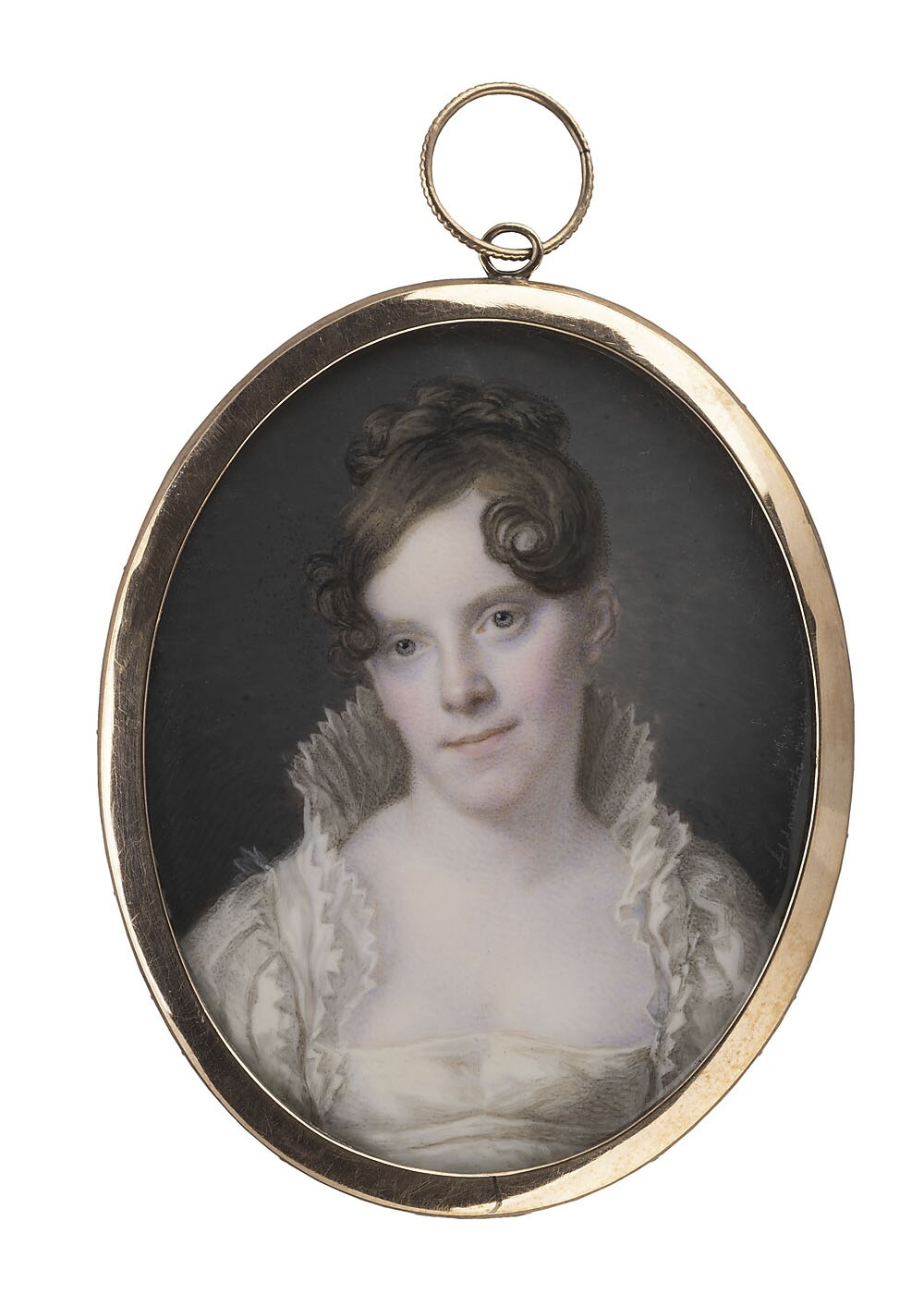
 

Heinrich Jakob Aldenrath (German, 1775-1844) 'Caroline Mohrmann (geb. Wortmann)' c. 1815


Heinrich Jakob Aldenrath (German, 1775-1844)
Caroline Mohrmann (geb. Wortmann)
c. 1815
Watercolour and gouache on ivory
6.3 x 4.9cm
Hamburger Kunsthalle
© Hamburger Kunsthalle, Foto: Birgitt Schmedding


A bonus posting for the weekend.

I discovered this exhibition while surfing online and I couldn’t miss it before it closes tomorrow. Resistance is futile, especially for an avid collector of object d’arts.

I love miniatures, their sensitivity, their sensuality, their size. The fact they were held in the hand and carried close to the heart. Portraits of the self, relying on mirrors to capture the artist’s own reflection, portraits of loved ones, artists, anonymous men and women.

“Many master miniaturists (like Daguerre himself) used optical tools like the Camera Obscura to map proportions before painting. Using early cameras felt like a natural mechanical extension of this process.” (Wikipedia)

“Portrait miniaturists were already experts at arranging subjects for flattering, highly personalised, and dignified depictions. They brought these same framing, angling, and lighting rules – such as emphasising the face – to the camera.” (Wikipedia)

“As miniature painters attempted to mimic the technical precision of daguerreotypes, they lost the intimate, distinct appeal of their art form. As the former Metropolitan Museum scholar Harry Wehle put it in 1927, “The miniature in the presence of the photograph was like a bird before a snake; it was fascinated – even to the fatal point of imitation – then it was swallowed”.” (Metropolitan Museum of Art)

For me, there is a delicacy and romanticism to the painted miniature which can never be matched by the photographic miniature. Despite both being housed in small, protective leather and wood cases, each are constructed realities of a different aspect – one created through the eye and creativity of the painter, the other created through the eye and creativity of the photographer and the maximal, granular reality of the camera.

Where possible I have added bibliographic and other pertinent information for the artists in the posting.

Dr Marcus Bunyan


Many thankx to Hamburger Kunsthalle for allowing me to publish the photographs in the posting. Please click on the photographs for a larger version of the image.
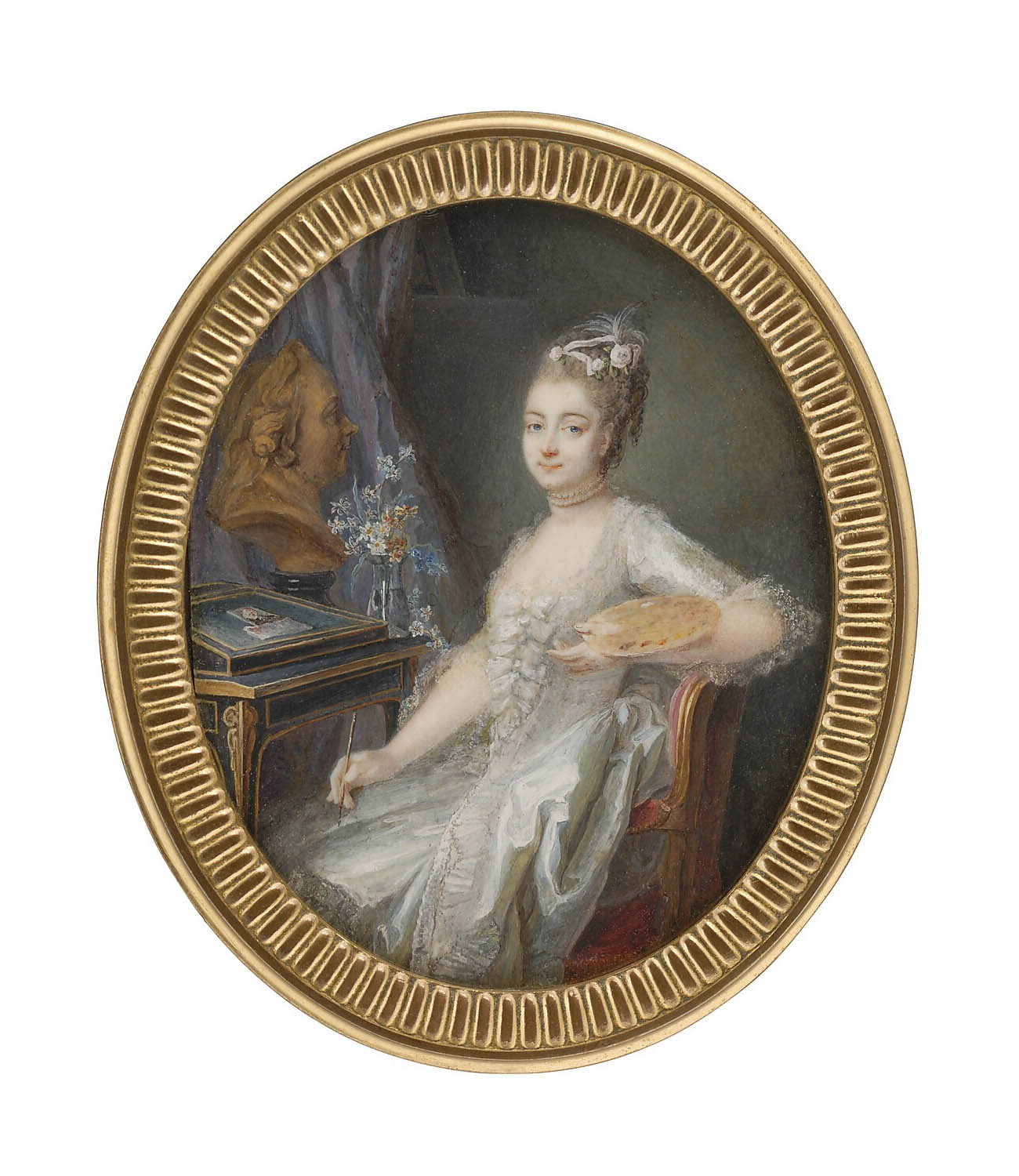


Adélaïde Labille-Guiard (1749-1803) 'Self-portrait' c. 1774


Adélaïde Labille-Guiard (1749-1803)
Self-portrait
c. 1774
Aquarell und Gouache auf Elfenbein
10.3 x 8.4cm
The Tansey Miniatures Foundation, Celle
© Foto: Birgitt Schmedding


Adélaïde Labille-Guiard (French, 1749-1803)

Adélaïde Labille-Guiard (née Labille; 11 April 1749 – 24 April 1803), also known as Adélaïde Labille-Guiard des Vertus, was a French miniaturist and portrait painter. She was an advocate for women to receive the same opportunities as men to become great painters. Labille-Guiard was one of the first women to become a member of the Royal Academy, and was the first female artist to receive permission to set up a studio for her students at the Louvre.

Adélaïde Labille was born on 11 April 1749 in Paris. Her father, Claude-Edme Labille (1705-1788) was a haberdasher.

Labille-Guiard became a master at miniatures, pastels, and oil paintings. Little is known about her training due to the practices of the 18th century which dictated masters (who were predominately male) should not take on female pupils. During this time, women were perceived as incapable to follow instruction alongside men. During her adolescence, Labille-Guiard studied miniature painting with oil painter François-Élie Vincent and her early work was exhibited at the Académie de Saint-Luc.

Labille-Guillard married Louis-Nicolas Guiard in 1769, but separated from him eight years later, already able to support herself through her artwork. She apprenticed with the pastel master Quentin de la Tour until 1774. From 1776 to 1780, she began to study oil painting with her childhood friend François-André Vincent (the eldest son of François-Élie Vincent), who would later become her husband.

Exhibitions at the Académie de Saint-Luc

Labille-Guiard was admitted to the Académie de Saint-Luc in 1767 when she was twenty years old. Her admission piece has since disappeared and sadly no records of its existence survive today. The Académie de Saint-Luc provided Labille-Guiard with a space to practice art professionally. In 1774, she exhibited her work at its Salon. This show was so successful that the Royal Academy took offence, and with the backing of the monarchy, issued an edict in March 1776 abolishing “guilds, brotherhoods, and communities of arts and crafts”, forcing the Académie de Saint-Luc to close its doors in 1777. However, this did not stop Labille-Guiard’s ambitions as an artist.

Becoming a member of the Royal Academy

Once the Académie de Saint-Luc closed its doors, Labille-Guiard began to learn oil painting, so she could apply to the Royal Academy which required her to present at least one oil painting for admission. During the late 1770s, she painted several portraits of leading academicians, creating contacts with the Académie royale de peinture et de sculpture.[6]

Labille-Guiard chose to display some of her work at the Salon de la Correspondance in 1779 and 1783. This included her self-portrait in pastel and oil portraits, which were well received by critics. Labille-Guiard’s talent as an oil painter and pastellist was quickly noticed, and she received national recognition, ultimately leading to her acceptance into the Royal Academy. On 31 May 1783 Labille-Guiard was accepted as a member of the French Academie Royale de Peinture et de Sculpture. Her rival, Elisabeth-Louise Vigée Le Brun, was also elected on that day; the two of them were the first women to be inducted. Both Labille-Guiard and Vigée Le Brun were immediately criticised following their admission by those who were furious at women’s entry; Labille-Guiard suffered attacks against both her art and character. One anonymous pamphlet Suite de Malborough au Salon 1783, accused Labille-Guiard of exchanging sexual favours for help with painting. The pamphlet punned on François-André Vincent’s name (though still unmarried, he was her rumoured paramour), saying that Labille Guiard had “vignt cents” (twenty-hundreds, or two thousand) lovers. Still, becoming accepted into the Royal Academy opened doors for Labille-Guiard as she gained patronage from the royal family. …

Style and context

Labille-Guiard often did not fit comfortably within the boundaries of feminine virtue in the 18th century. In order to appeal to a wide variety of viewers including upper-class men and women, she often incorporated recent fashions into her paintings, which allowed her to showcase her artistic ability. She was good at rendering details, such as showing luxurious folds and layers of complex skirts that were in fashion at the time. However, often she painted with a twist such as having women face directly at the viewer or with a low neckline, which was an uncommon practice in the 18th century when portraying women.

Further evidence of Labille-Guiard’s boldness can be seen in her self-portraits, which leave her exposed slightly more than usual, but not enough to evoke allegations of promiscuous behaviour. This is seen in her painting Self-Portrait with Two Pupils. Unlike some other paintings of female artists in the 18th century, Labille-Guiard chose to depict herself actively working rather than passive and at rest. Labille-Guiard also pushed against other restrictions, such as those that limited the number of females that could attend the Royal Academy. By depicting two female students in Self-Portrait with Two Pupils, Labille-Guiard suggests more women should be allowed in to the Royal Academy. In this sense, Labille-Guiard was daring, but not too daring as to sabotage her reputation and lose the respect she worked hard to gain within the art world.

At the time, female artists were frequently related to the goddess Minerva. Therefore, Labille-Guiard and her rival Vigée Le Brun were both referred to as “modern Minervas.” Their rivalry was encouraged by both academicians and patrons at court.

Today, Labille-Guiard’s masterpiece, Self-Portrait with Two Pupils, hangs in New York’s Metropolitan Museum of Art, after the Louvre rejected it in a final dismissal of the artist’s talent.

Text from the Wikipedia website
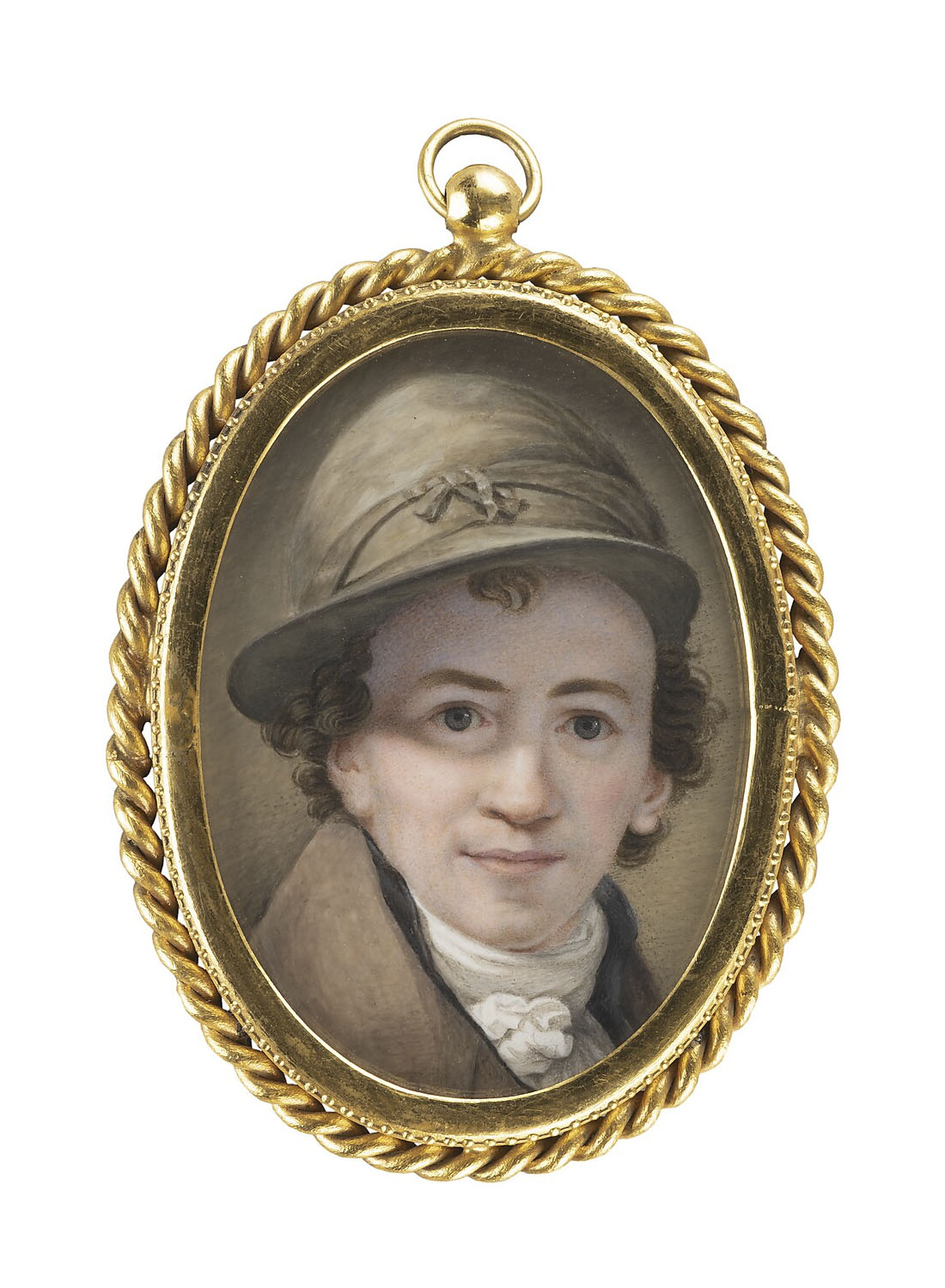
 

Friedrich Karl Gröger (German, 1766–1838) 'Self-portrait' c. 1800


Friedrich Karl Gröger (German, 1766–1838)
Self-portrait
c. 1800
Watercolour and gouache on ivory
7.1 x 5.3cm
Hamburger Kunsthalle
© Hamburger Kunsthalle, Foto: Birgitt Schmedding


Friedrich Carl Gröger was a north-German portrait painter and lithographer. One of the most respected portraitists of his time in northern Germany, his works are to be found in several museums, including the Hamburger Kunsthalle, as well as in north German, Holstein and Danish private collections.
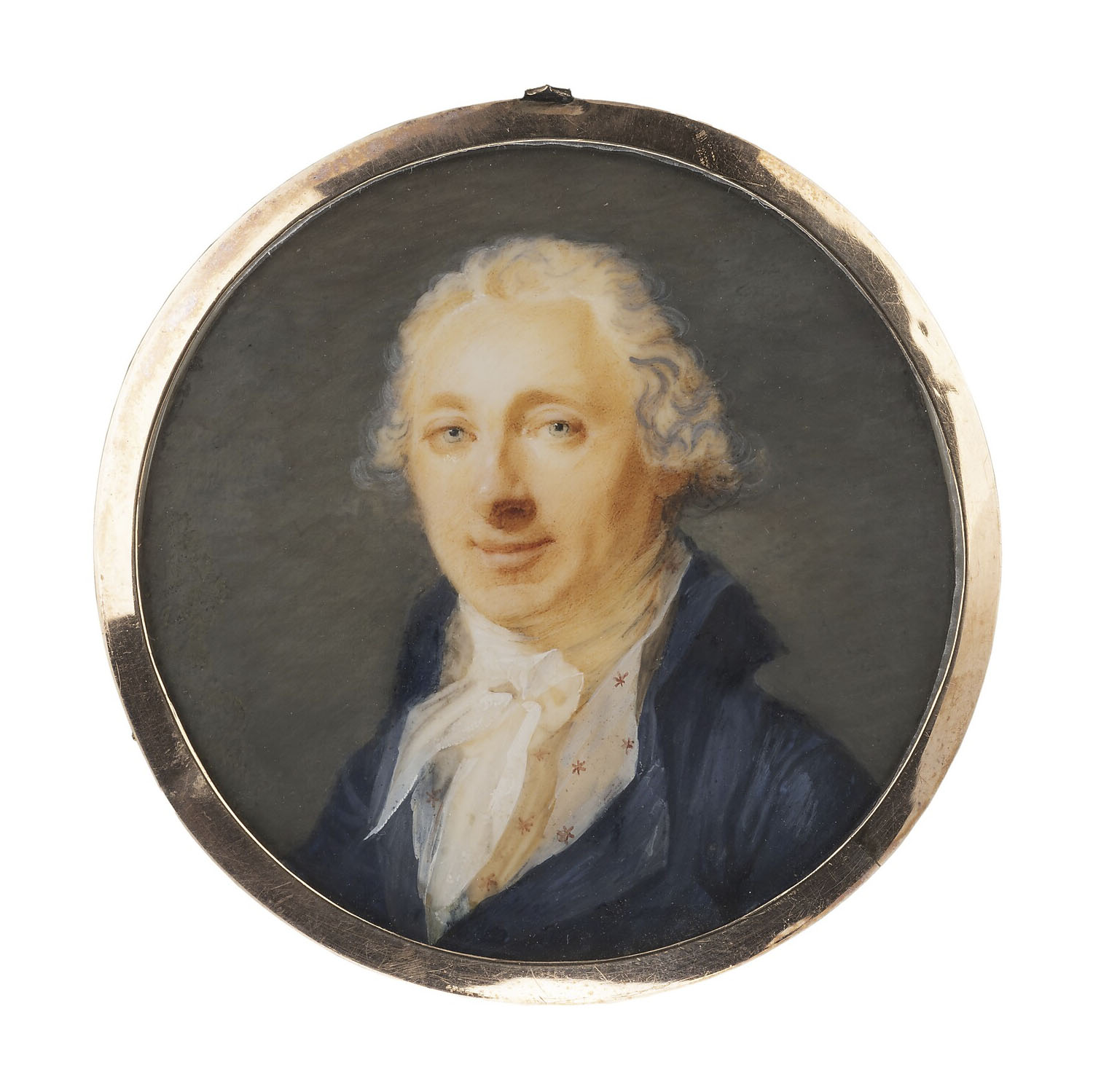
 

Domenico Bossi (German born Italy, 1767–1853) 'Dr. med Paul Hinrich Büsch' c. 1795


Domenico Bossi (German born Italy, 1767–1853)
Dr. med Paul Hinrich Büsch
c. 1795
Watercolour and gouache on ivory
6cm (Durchmesser)
Hamburger Kunsthalle
© Hamburger Kunsthalle
Foto: Birgitt Schmedding


Johann Dominik Bossi, also known as Domenico Bossi, was a painter. Bossi, a student of Giovanni Domenico Tiepolo, was born in Trieste and worked primarily as a miniaturist in Germany, Austria, Sweden and Russia before he settled down in Munich, where he lived at Theresien Straße 19 in Munich around 1850.
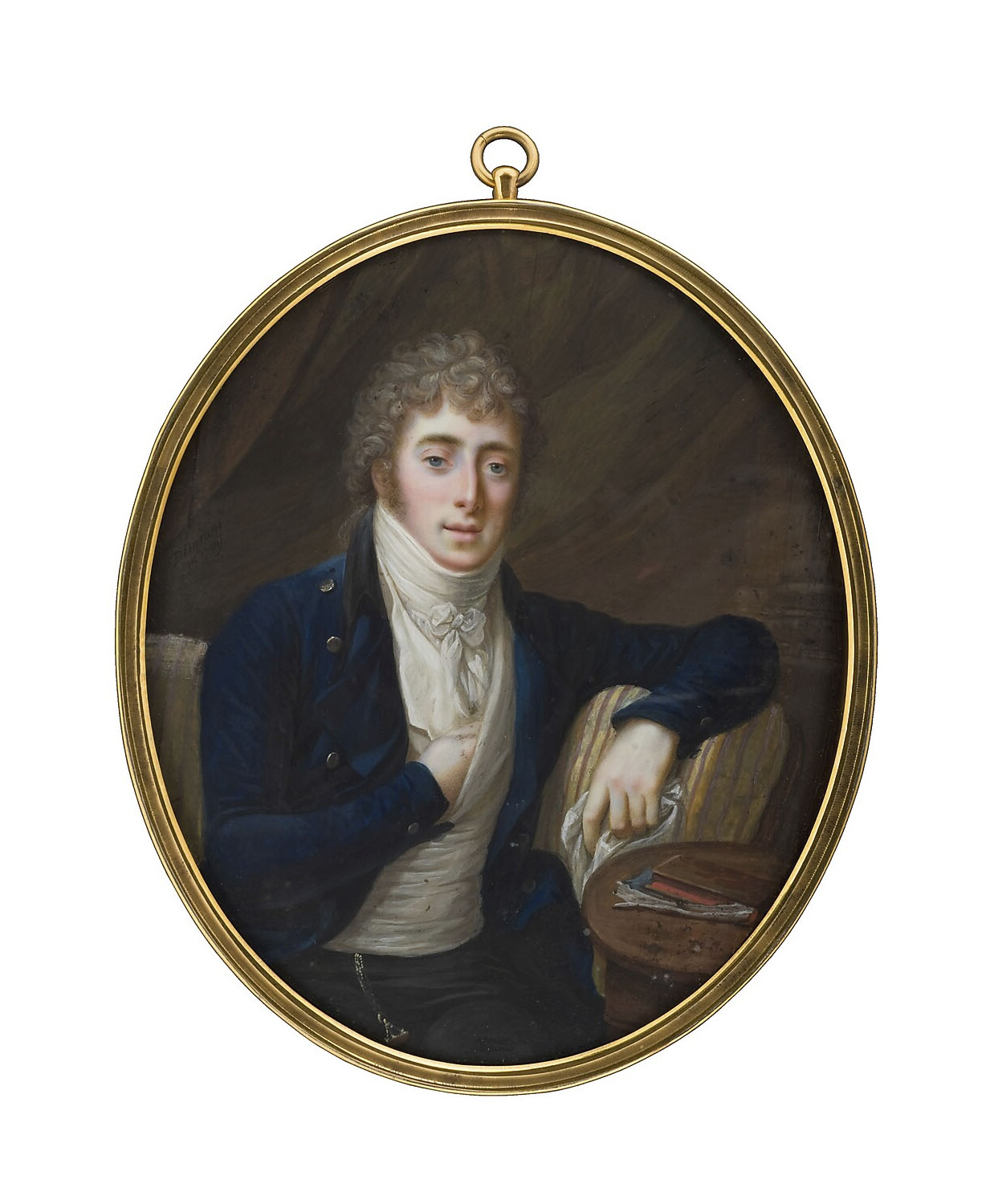
 

Carl Friedrich Demiani (German, 1768-1823) 'Man on sofa' 1799


Carl Friedrich Demiani (German, 1768-1823)
Man on sofa
1799
Watercolour and gouache on ivory
15.1 x 12.5cm
The Tansey Miniatures Foundation, Celle
© Foto: Birgitt Schmedding


Carl (Karl) Friedrich Demiani was born in 1768 in Breslau (now Wroclaw, Poland), and died in 1823 in Dresden. He studied at the Dresden Academy of Fine Arts and specialised in portrait miniatures.
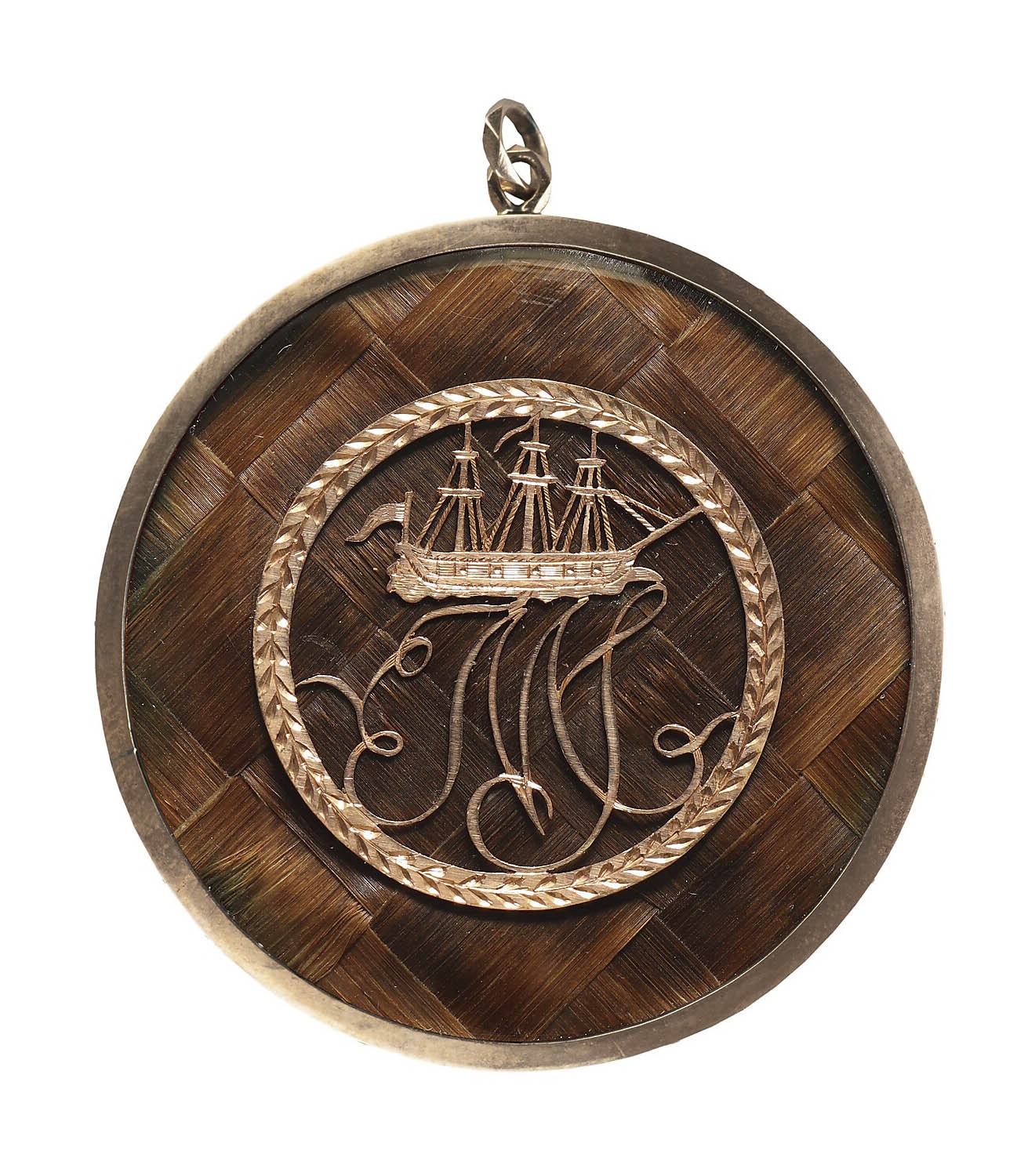
 

Unknown maker. 'Monogram "JMJ" on hair braid (back of a gentleman's portrait)' c. 1800


Unknown maker
Monogram “JMJ” on hair braid (back of a gentleman’s portrait)
c. 1800
Gold-plated metal on hair
5.3cm
Hamburger Kunsthalle / ARTOTHEK
© Hamburger Kunsthalle
Foto: Birgitt Schmedding
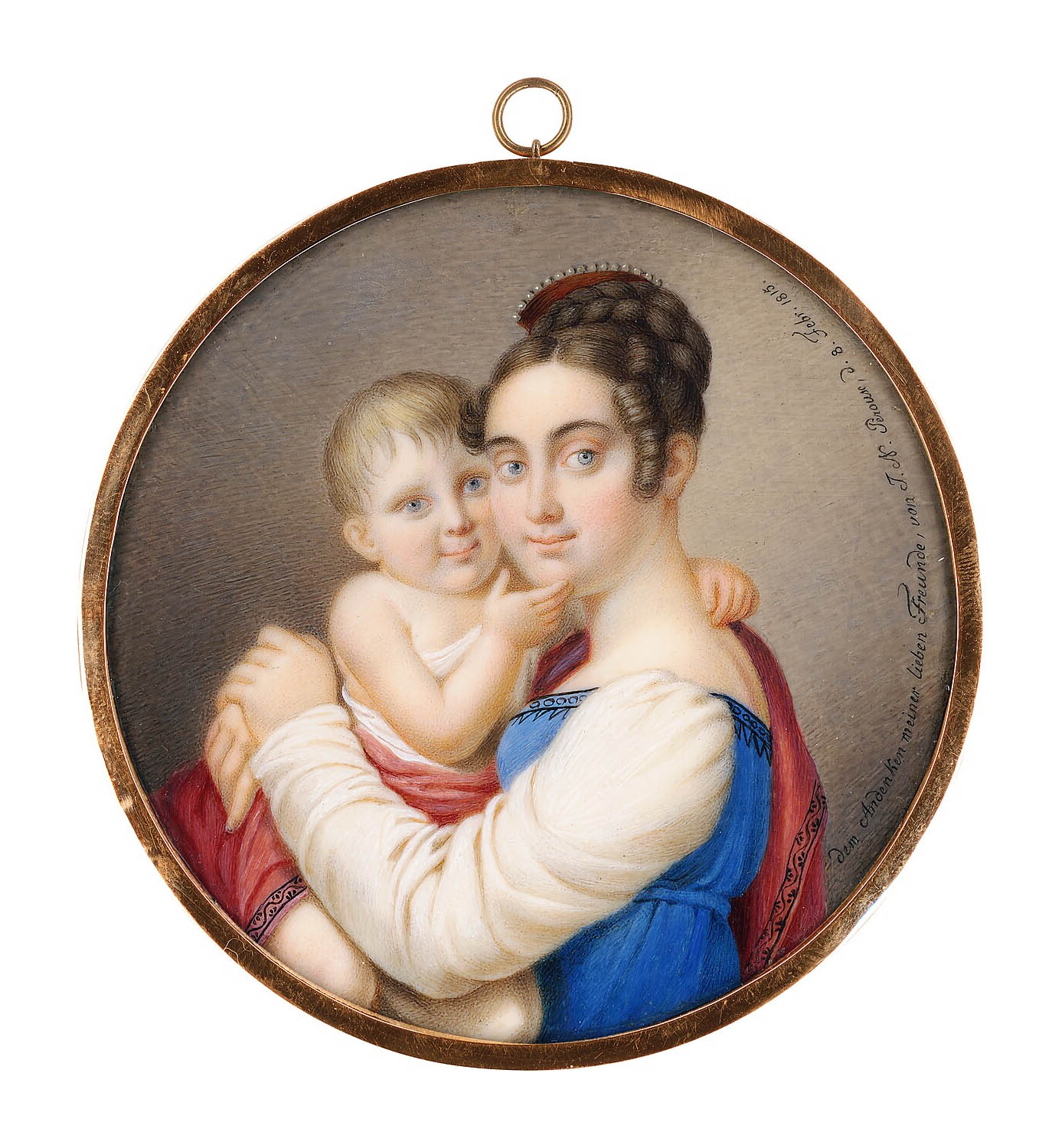
 

Joseph Nocolaus Peroux (German, 1771 -1849) 'Mother and child' 1815


Joseph Nocolaus Peroux (German, 1771 -1849)
Mother and child
1815
Watercolour and gouache on ivory
Schloss Kemnade, Hattingen (Sammlung Rudowski)
© Foto: Fotostudio Eric Jobs, Hattingen


Joseph Nicolaus Peroux was born in 1771, in Ludwigsburg. He was a well-known German miniature painter, etcher and lithographer of the Romantic era.
Peroux was a student of the “Peintre du Duc de Wurtemberg” (first painter at the Württemberg court) Nicolas Guibal, who taught at the Académie des Arts and the Hohen Karlsschule in Stuttgart until his death in 1784. Peroux initially worked in Frankfurt am Main (from 1795) and in Hamburg from 1800, where he exhibited a portrait of Emma Hamilton and a self-portrait in 1803. He then opened an art school in Lübeck and became the young Friedrich Overbeck’s first drawing teacher. The turmoil of the French Period brought him back to Frankfurt in 1806. Accordingly, his works can be found primarily in the museums in Frankfurt, the Hamburger Kunsthalle and in the Behnhaus in Lübeck. The artist died in 1849, in Frankfurt am Main.

Text from the Wikipedia website translated from the German
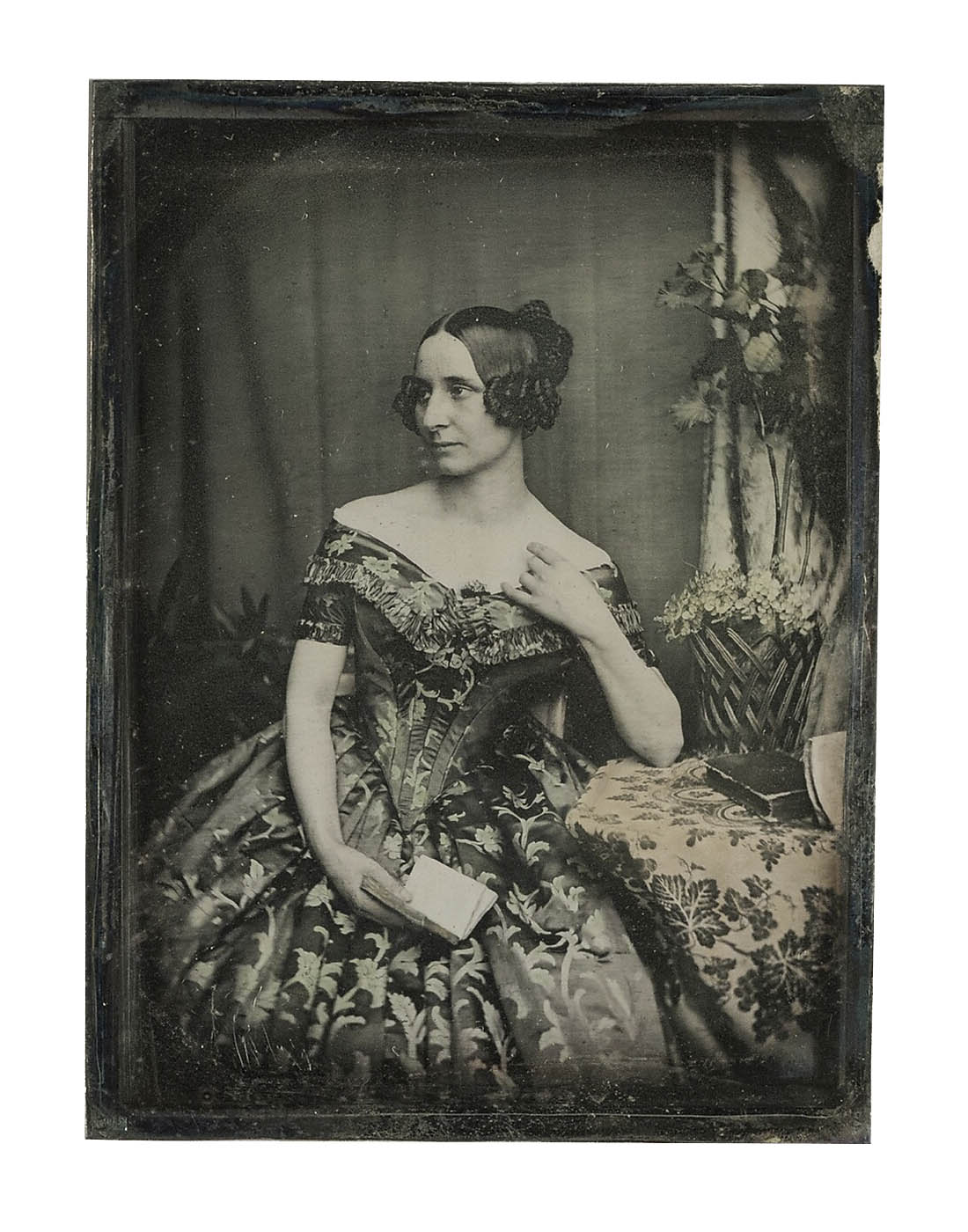
 

Carl Ferdinand Stelzner (German, 1805-1894) 'The miniature painter Caroline Stelzner (1808-1875)' 1843


Carl Ferdinand Stelzner (German, 1805-1894)
The miniature painter Caroline Stelzner (1808-1875)
1843
Daguerreotype
10.8 x 8.1cm
Museum für Kunst und Gewerbe
© Museum für Kunst und Gewerbe


[Stelzner] was the stepson of the portrait and miniature painter Carl Gottlieb Stelzner, who trained him in painting. In 1825 he traveled through Schleswig-Holstein and painted portraits of peasants and citizens. At the end of the 1820s he made study trips to Hamburg, Stockholm , Copenhagen and then to Paris where from 1831 to 1834 he was mentored by prominent miniature painters Jean-Baptiste Isabey and Claude Marie Dubufe. On return to Hamburg in 1837 he opened a studio, painting portrait miniatures.

Hearing of the new technique of photography, Stelzner returned quickly to Paris in 1839 to learn in person from Louis Daguerre how to make daguerreotypes. He then opened a daguerreotype studio in Hamburg with Hermann Blow (1804-1850). The partnership was short-lived and in 1843 he returned to his old studio to become the first daguerreotypist in Schleswig-Holstein and ultimately one of the best in Germany. His output was mainly portraits. His first wife Anna Caroline Stelzner (above), a miniaturist artist who was also his half-sister, coloured many of them and did the rephotography of the plates, since copying was the only way to reproduce the daguerreotype.

Despite the constraints of his medium, Selzner’s portraits rarely appear ‘frozen’. The position of Caroline’s arms and her sideways gaze are reinforced by the position of props such as the book on the table as a counterpoint to the one in her hand which infers movement, and the framing of the foliage of pot plants, repeated in the fabric of her dress and the tablecloth.

You can see Selzner experimenting with his own pose in these two self-portraits [one of which you can see below] on which Caroline no doubt assisted. Though these two images are dated five years apart on the Hamburg Art Museum website, the photographer’s clothing, hair and the background are identical. The only change is in the pose and a lowering of the camera to provide a more regal impression in the second image.

Associate Professor James McArdle. “December 30: Action,” on the On This Date In Photography website 30/12/2016 [Online] Cited 05/06/2026
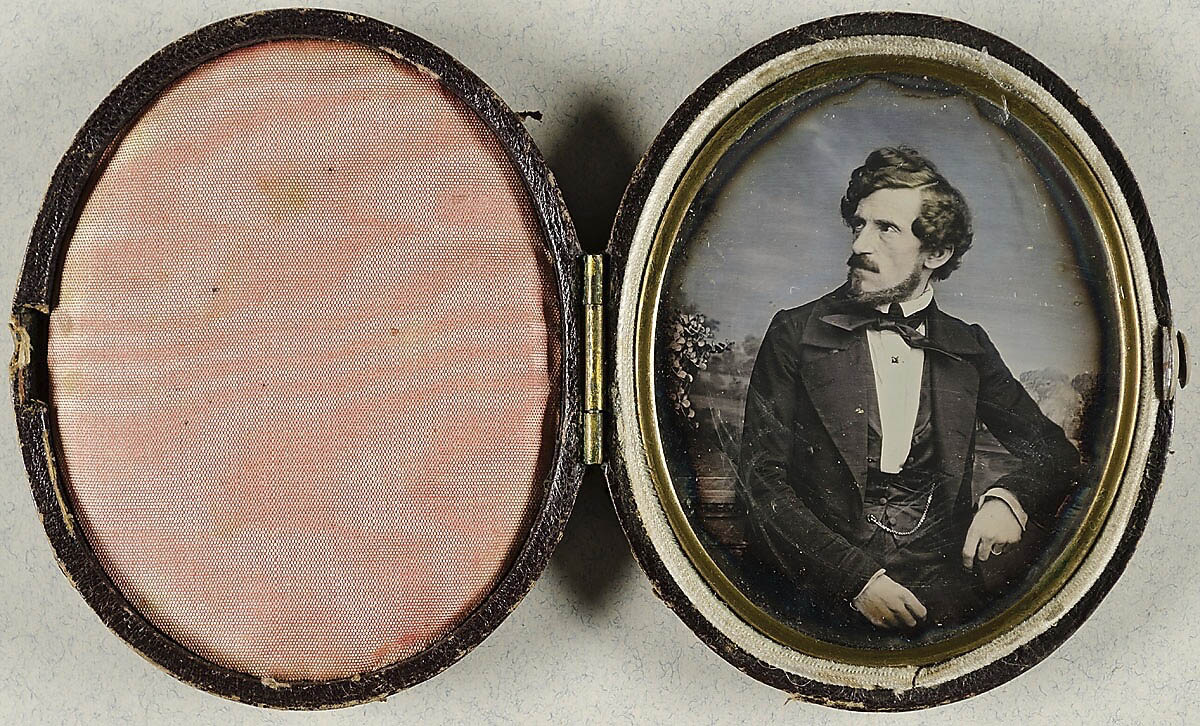
 

Carl Ferdinand Stelzner (German, 1805–1894) 'Self-portrait' 1855


Carl Ferdinand Stelzner (German, 1805–1894)
Self-portrait
1855
Daguerreotype
5.9 x 4.8cm
Museum für Kunst und Gewerbe Hamburg
© Museum für Kunst und Gewerbe Hamburg


With FOR YOUR EYES ONLY: Miniatures from the Romantic Era, the Hamburger Kunsthalle is presenting the first major exhibition devoted to the multifaceted art of miniature painting in Hamburg, from its heyday circa 1800 to the 1840s, when it was replaced by early photography. These miniature portraits, usually measuring around 6 to 10 cm and artfully painted in watercolour and gouache on wafer-thin ivory plates, backed in some cases with silver foil, still fascinate us even today. A total of over 250 objects will be on view. 

The show is based on portrait miniatures from the Kunsthalle’s own collection that were restored and catalogued in 2023–24. Around 60 of these miniatures will be shown for the first time here, together with some 200 works on loan from European and private collections, some of them also making their public debut.

These small portraits set in frames, brooches or cases were among the most personal and intimate likenesses people had painted of themselves. They were intended only for the eyes of the recipient and could be worn – often directly over the heart – and viewed at will. The portraits were a way to keep memories alive in the event of a long separation or to provide comfort after the loss of a loved one.

Portrait miniatures were widespread in Europe around 1800. Often made for the nobility, they also became popular with the aspiring bourgeoisie – including in Hamburg, which experienced an economic boom in the late eighteenth century that impacted the art world. Private collections were formed, the Kunstverein was founded, and exhibitions, liberal auction laws and new techniques such as the daguerreotype and lithography contributed to Hamburg’s emergence as an important art centre. Internationally renowned miniaturists such as Domenico Bossi and Pierre-Louis Bouvier lived and worked for a time in the Hanseatic city, which itself produced outstanding artists including Heinrich Jacob Aldenrath, Friedrich Carl Gröger, and Ferdinand and Caroline Stelzner.

Text from the Hamburger Kunsthalle website
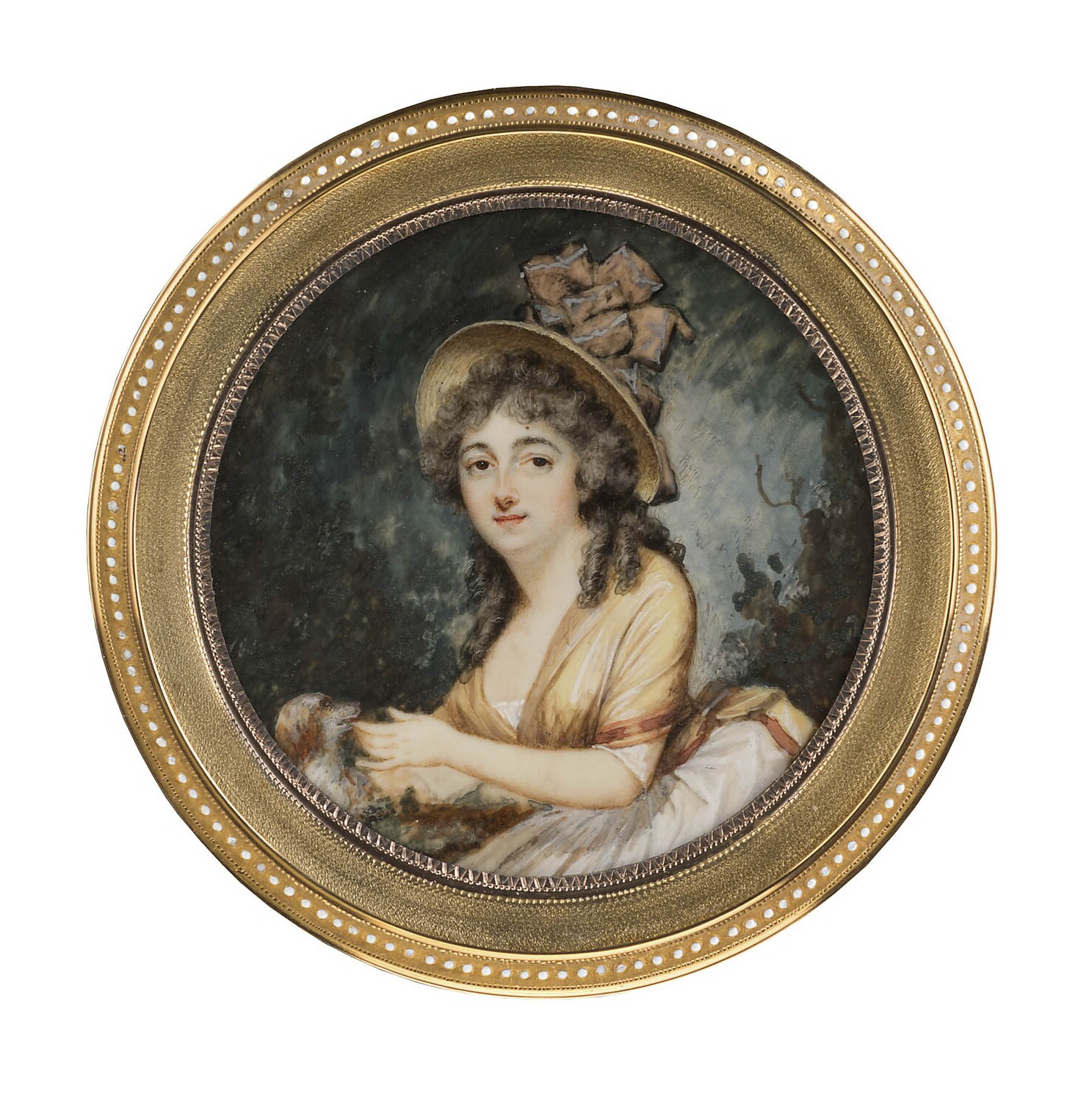
 

Pierre-Charles Hénard (French, 1756-1813) 'Lady with straw hat and puppy' c. 1795


Pierre-Charles Hénard (French, 1756-1813)
Lady with straw hat and puppy
c. 1795
Watercolour and gouache on ivory
7.3cm
The Tansey Miniatures Foundation, Celle
© Foto: Birgitt Schmedding


Hénard was born in Bourg-en-Bresse on 11 February 1756. He was the son of the goldsmith Vincent Hénard and of Elisabeth Cadet. After having studied with Taraval, Hénard worked in both France and England. He exhibited at London’s Royal Academy from 1785 to 1800, and in Paris in 1791 and from 1806 to 1812. He worked in Hamburg from mid-1796 to the spring of 1797. After emigrating to the United States in 1811 on board of the Susquehanna, he lived in Baltimore and showed some of his works in 1812 and 1813 at the Pennsylvania Academy of the Fine Arts.

Text from The Tansey Miniatures Foundation website
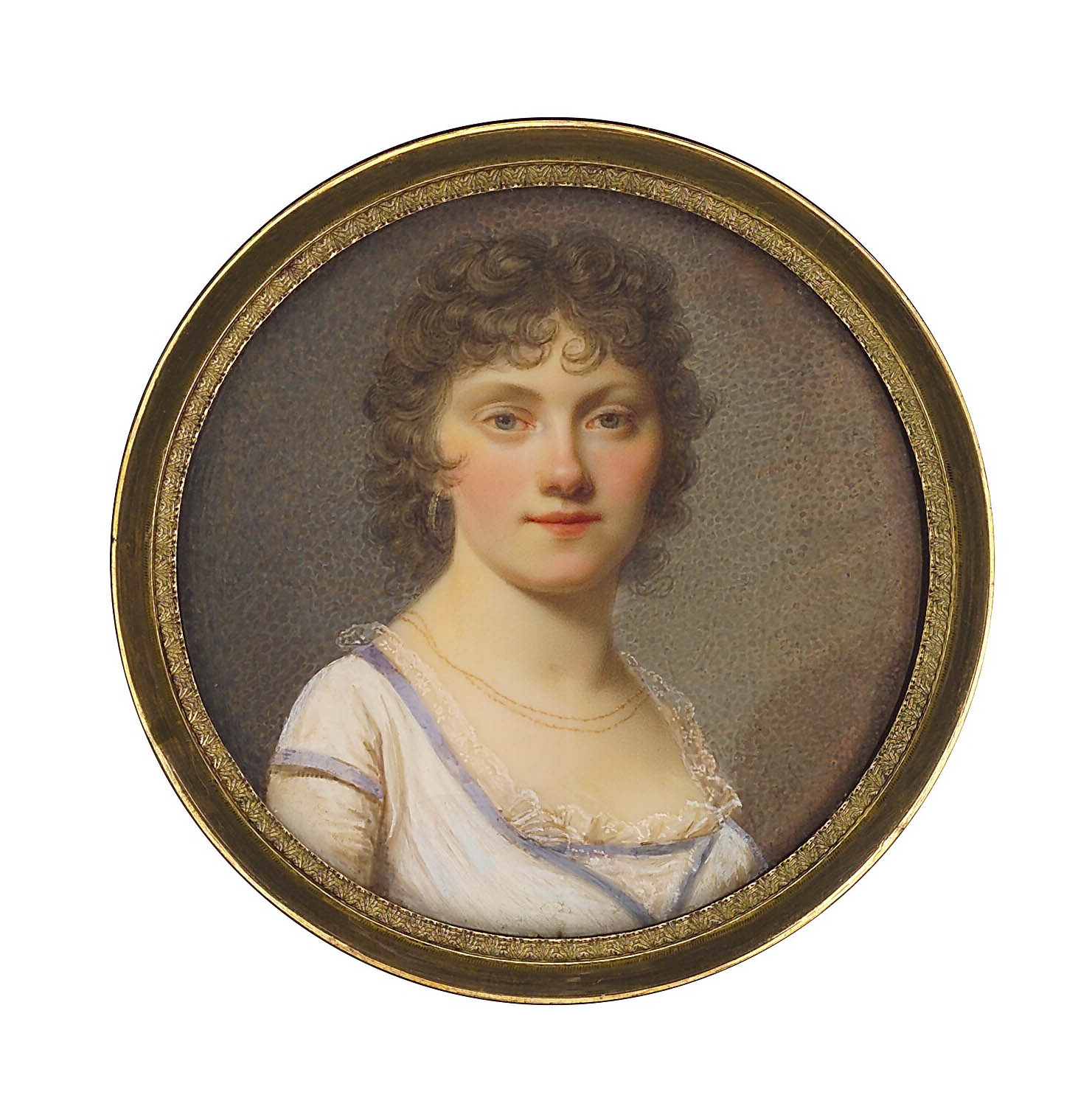
 

Domenico Bossi (German born Italy, 1767–1853) 'Lady in a white dress with blue trim' c. 1800


Domenico Bossi (German born Italy, 1767–1853)
Lady in a white dress with blue trim
c. 1800
Watercolour and gouache on ivory
6.2cm
The Tansey Miniatures Foundation, Celle
© Foto: Birgitt Schmedding


With FOR YOUR EYES ONLY. Miniatures from the Romantic Era, the Hamburger Kunsthalle is presenting its first major exhibition devoted to the multifaceted art of miniature painting in Hamburg, from its heyday circa 1800 to the 1840s, when it was replaced by early photography. The show is based on portrait miniatures from the Kunsthalle’s own collection that were restored and catalogued in 2023-2024. Around 60 of these miniatures will be shown for the first time here, together with some 150 works on loan from European and private collections, some of them also making their public debut. Accompanying the miniature portraits are a number of paintings, drawings, prints and photographs, for example a self-portrait by the painter and miniaturist Bernhard Peter von Rausch (1793-1865). This material sheds light on how miniatures were made as well as their special function and the technical modifications they required. In total, over 250 objects are on display in the Harzen Cabinet that tell of an era marked by social transformation, European exchanges and technological innovations. 

Even today, people still like to carry a likeness of a loved one on their person. Before the advent of photography, such miniature portraits were precious one-offs that took hours to paint. Their small format – usually around 6 to 10 cm – and skilled execution in watercolour and gouache on wafer-thin ivory plates, sometimes backed with silver foil, hold an enduring fascination. Set in frames, brooches or cases, these miniatures were among the most personal and intimate likenesses people had painted of themselves. The miniaturists held several sittings with their clients, painting “ad vivum” [from life], often on specially developed painting desks. One such desk from the estate of the miniaturist Jean-Baptiste Jacques Augustin (1759-1832) is exhibited here for the first time, along with painting utensils and measuring instruments such as a pantograph for the true-to-scale reduction of drawings. These aids illustrate the traditional technique used to produce minia-tures on ivory and white-primed paper as well as reproduction methods devel-oped in the late eighteenth century known as Bou-Magie and Physionotrace.

The commission to make a miniature arose from an intimate relationship between two people. The likeness was intended only for the eyes of the recipient, who might wear it as jewellery – often directly over the heart – and could admire it at will. Often, such portraits were designed to keep memories alive in the event of a long separation or to provide comfort after the loss of a loved one. Added locks of hair, artful plaits, inscriptions or symbolic messages hidden in the portrait in the form of flowers, objects or animals underscore the personal nature of these works while offering a glimpse of the emotional climate in the period around 1800.

Portrait miniatures were widespread in Europe during that era. No longer reserved for the nobility, they enjoyed increasing popularity among the aspiring bourgeoisie – including in Hamburg, which experienced an economic upswing in the late eighteenth century. After the setbacks of the Napoleonic era, a prolonged period of prosperity would have a lasting influence on the arts scene in the Hanseatic city. The first private collections were formed, the Kunstverein was founded in 1817, and exhibitions, liberal auction laws and new techniques such as lithography and later daguerreotype contributed to Hamburg’s rapid rise as an important northern art centre. 

Internationally renowned miniaturists such as Giovanni Domenico Bossi (1767-1853), Carl Friedrich Demiani (1768-1823), Pierre-Louis Bouvier (1765-1836), Charles Hénard (1756-1813), Jan Gottlieb Jannasch (c. 1755-1804) and Edmé Quenedey (1756-1830) lived and worked in Hamburg for a time. And the Hanseatic city itself produced some outstanding artists during this period, including Leo Lehmann (1782-1859), Ernst August Abel (1720-1790), Karl Friedrich Kroymann (1781-1849) and Christopher Suhr (1771-1842). Friedrich Carl Gröger (1766-1838) and Heinrich Jakob Aldenrath (1775-1844) were particularly influential. 

With the invention of photography in 1839, a medium rose to popularity that would take over the function of the portrait miniature and eventually replace it completely. The daguerreotype (also known as helio-graphy) made it possible to produce small-format portraits that were not only more realistic but also sig-nificantly faster to realise. A sitting for a miniature portrait soon took less than a minute. Thanks to the low cost of production, artists could now attract a new clientele. Carl Ferdinand Stelzner (1805-1894) from Hamburg and his wife Caroline (1808-1875) initially painted miniatures before Carl Ferdinand in particular successfully turned his attention to portrait photography in 1842. And yet, the portrait miniature did not go completely out of fashion. The artist Enrichetta Fioroni-Narducci (1806-1892), who worked in Rome, and her sister Teresa Fioroni (1799-1880), for example, augmented their income with miniature versions of famous paintings that were extremely popular with mid-nineteenth-century travellers. The Kunsthalle is home to five of their works, on display in the exhibition. 

The exhibition is accompanied by a publication (Michael Imhof Verlag, edited by Sabine Zorn and Bernd Pappe, approx. 160 pages), which is available in the museum shop or at http://www.freunde-der-kunsthalle.de for a price of 29 euros, as well as in bookstores.

Press release from Hamburger Kunsthalle
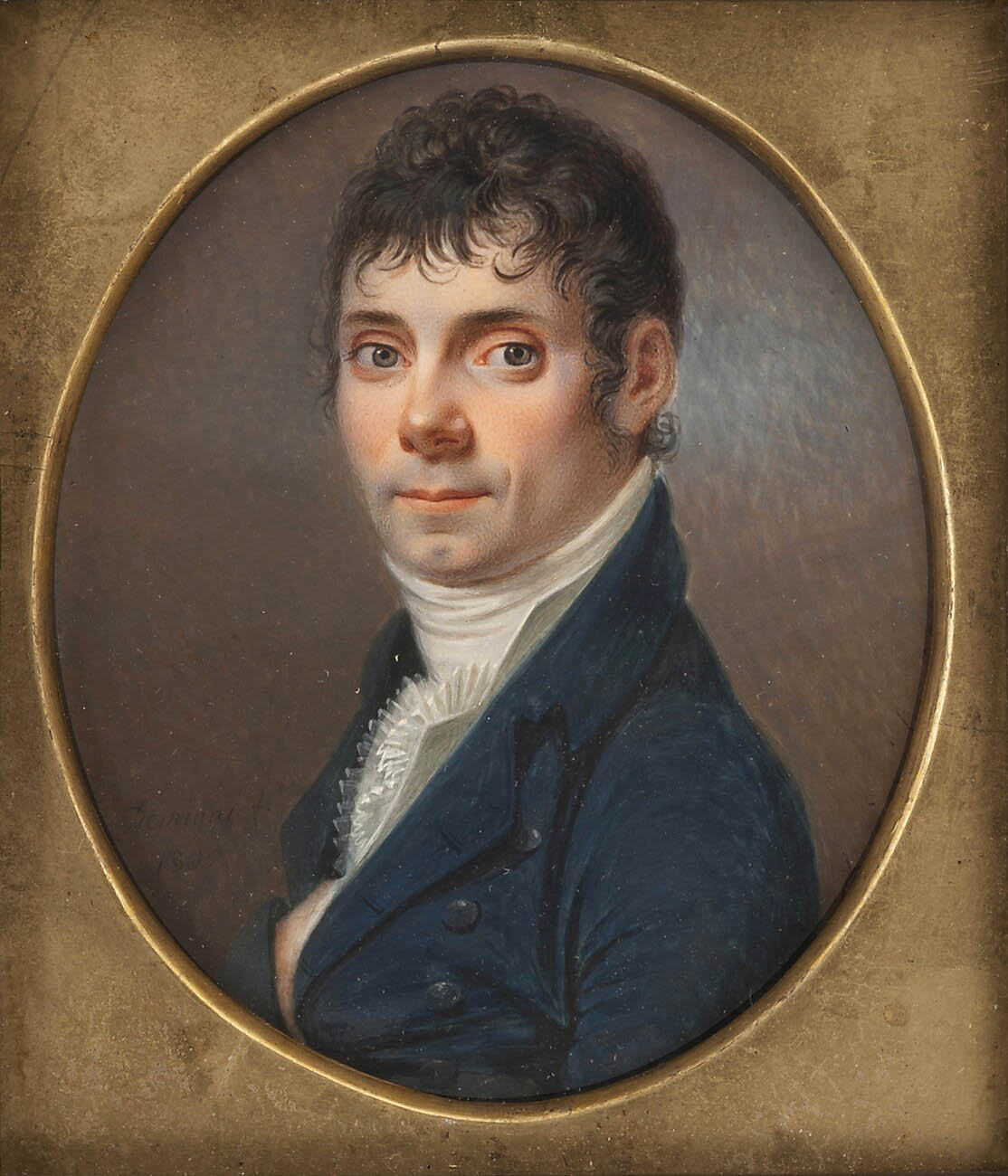
 

Carl Friedrich Demiani (German, 1768–1823) 'Man in blue coat, 1805' 1805


Carl Friedrich Demiani (German, 1768-1823)
Man in blue coat, 1805
1805
Watercolour and gouache on ivory
8.8 x 7.4cm
The Tansey Miniatures Foundation, Celle
© Foto: Birgitt Schmedding
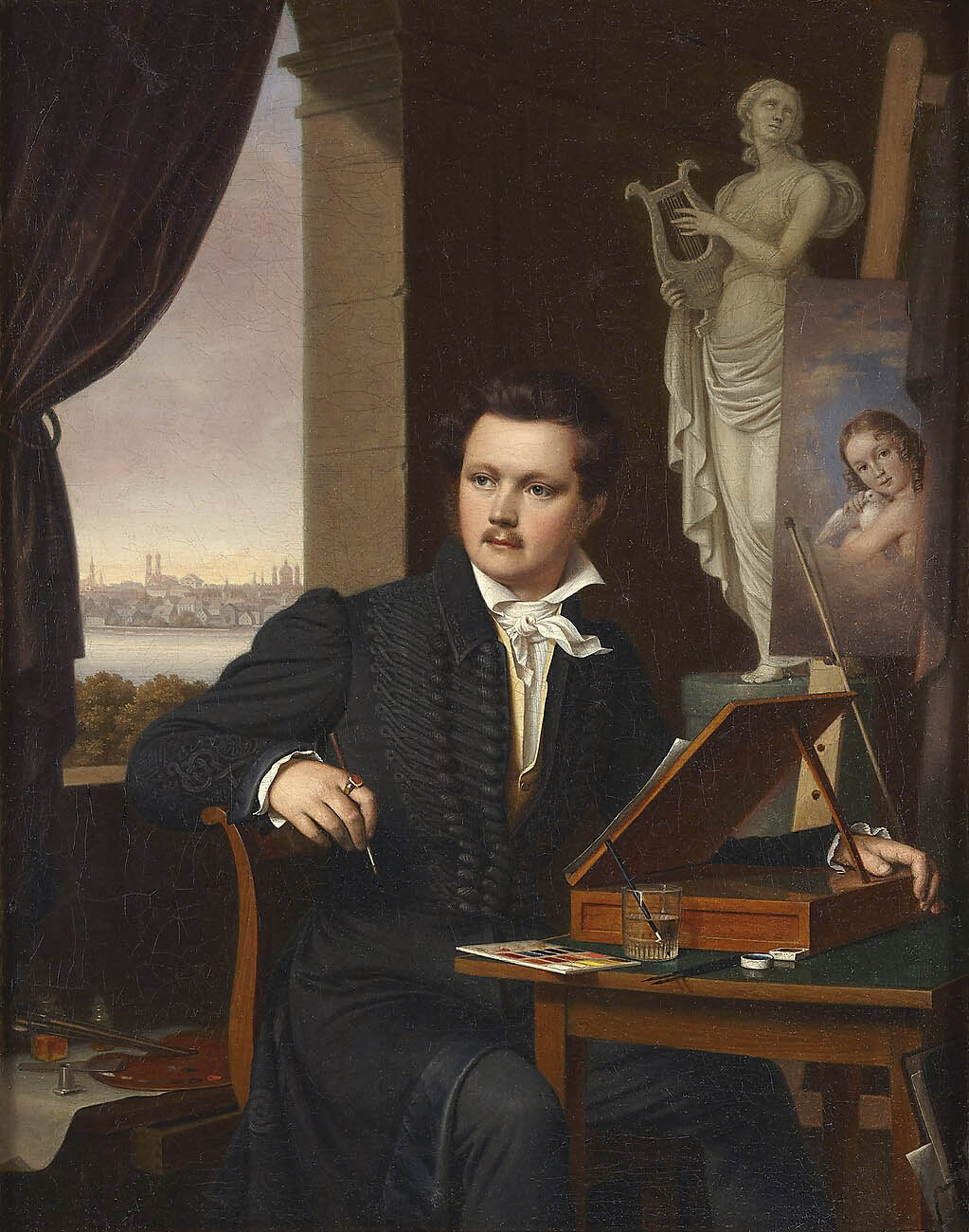
 

Bernhard Peter von Rausch (German, 1793-1865) 'Self-portrait in the studio in Munich' c. 1830


Bernhard Peter von Rausch (German, 1793-1865)
Self-portrait in the studio in Munich
c. 1830
Oil on canvas
37.8 x 29.8cm
Hamburger Kunsthalle, © Hamburger Kunsthalle / ARTOTHEK
Foto: Christoph Irrgang


Bernhard Peter von Rausch was a German painter and lithographer.
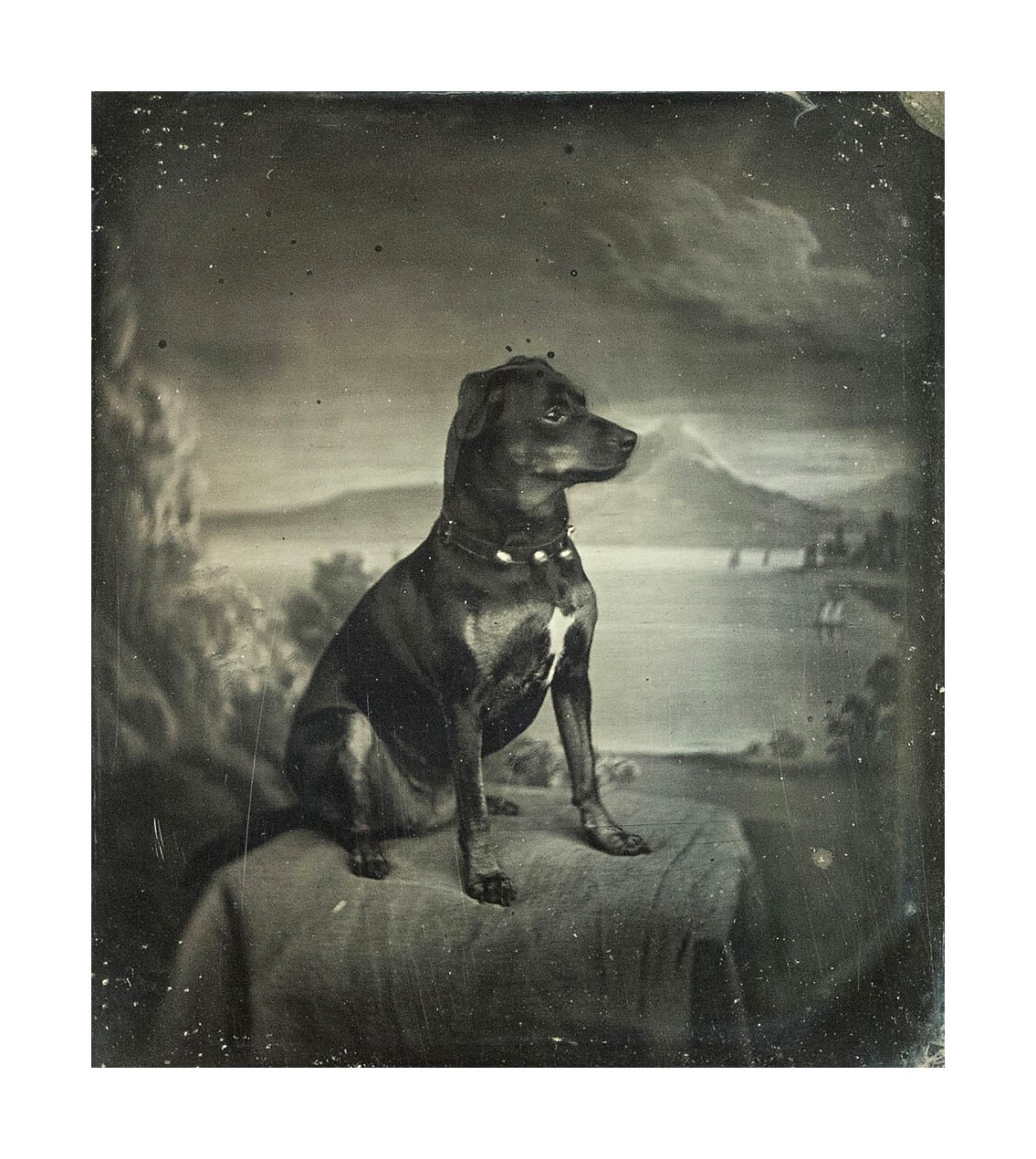
 

Carl Ferdinand Stelzner (German, 1805-1894) 'Ulla, the dog in the Stelzner household' 1850-1865


Carl Ferdinand Stelzner (German, 1805-1894)
Ulla, the dog in the Stelzner household
1850-1865
Daguerreotype
7.3 x 6.3cm
© Museum für Kunst und Gewerbe Hamburg


Among all of the daguerreotypes produced before the advent of the wet-plate swept it aside, it is rare to see pictures of animals. Slezner’s portrait of his dog stands out as a tribute to his attaining an unusual facility in his medium.

No doubt obedient, Ulla the dog has nary a muscle during the long exposure, which, even if by 1860 Slezner was achieving high speeds with his lens and by pimping the daguerreotype process, would have still run into tens of seconds. It is quite a feat; a faint double image of snout and then only the slightest movement around the collar and end of the nose, due to a dog’s rapid breathing, can be discerned.

Associate Professor James McArdle. “December 30: Action,” on the On This Date In Photography website 30/12/2016 [Online] Cited 05/06/2026


Carl Ferdinand Stelzner (German, 1805-1894)

Carl Ferdinand Stelzner was a began his career as a lithographer and engraver, but became interested in photography in the early 1840s. He learnt the daguerreotype process from Louis Daguerre himself and opened his own studio in Berlin in 1845.

Stelzner quickly became known for his high-quality daguerreotypes, which were prized for their clarity and detail. He used a large-format camera that allowed him to capture images with incredible precision, and he experimented with different lighting techniques to create dramatic effects.

As well as his technical skill, Stelzner was also known for his artistic ability. He often posed his subjects in carefully composed scenes and was adept at capturing their personalities and emotions.

Stelzner’s work was exhibited widely throughout Europe and he won numerous awards for his photography. He continued to work as a photographer until his death in 1894 at the age of 88.

Today, Stelzner’s daguerreotypes are highly prized by collectors and museums around the world. They offer a fascinating glimpse into the early days of photography and continue to inspire photographers today.

Text from the Picryl website [Online] Cited 05/06/2026. Used under fair use conditions for the purposes of education and research
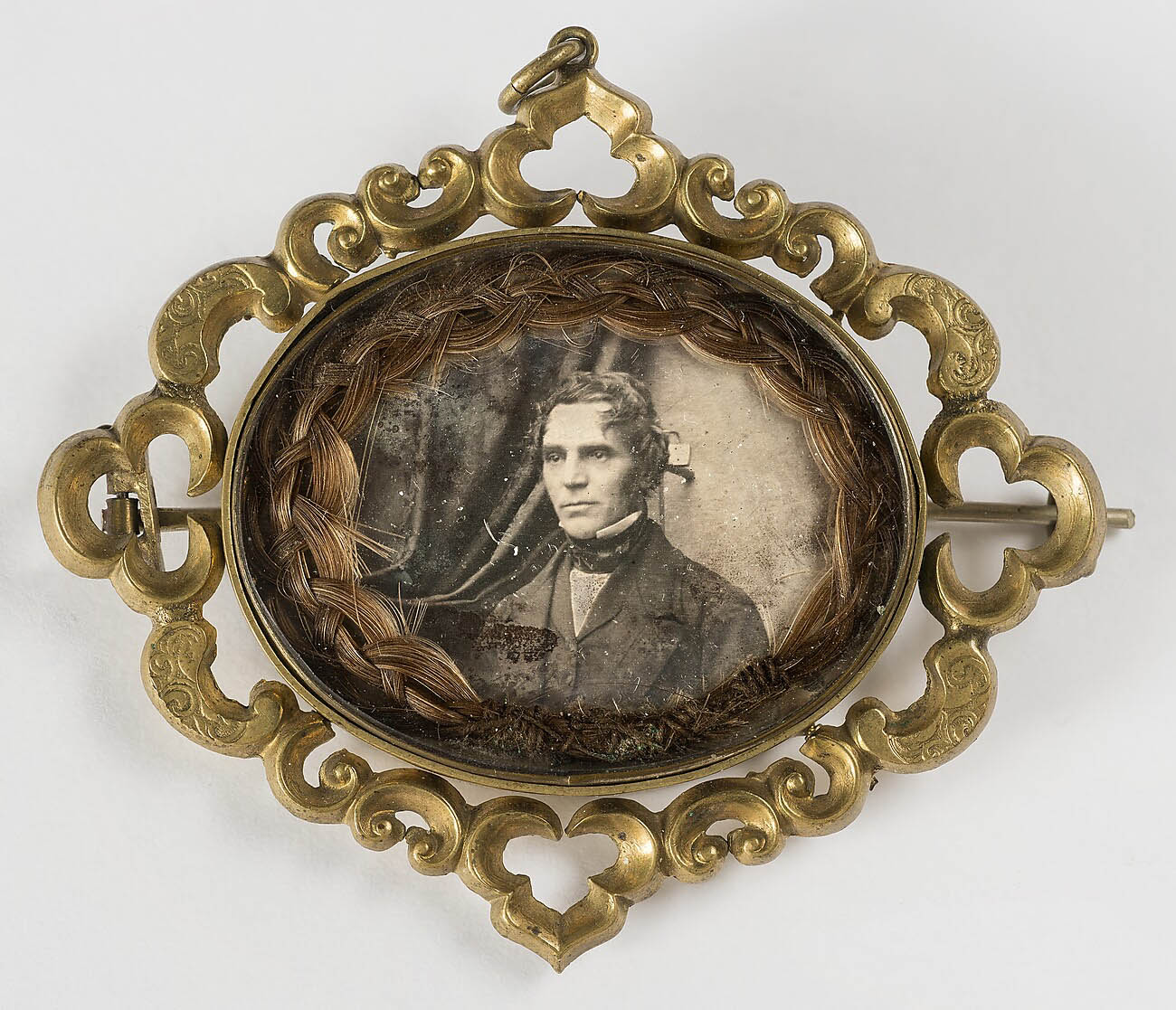
 

Unknown photographer. 'Mr. Crowe' c. 1845


Unknown photographer
Mr. Crowe
c. 1845
Daguerreotype, framed by braided hair, on a brooch
5.5 x 6.5cm
Sammlung Gummersbach
© Foto: Jakob Schnetz


Hamburger Kunsthalle
Glockengießerwall 5  
20095 Hamburg

Opening hours:
Monday – Thursday 10am – 3pm
Friday 10am – 2pm

Hamburger Kunsthalle website

LIKE ART BLART ON FACEBOOK

Back to top

Exhibition: ‘Fabergé: Jeweler to the Tsars’ at the Oklahoma City Museum of Art, Oklahoma City

Exhibition dates: 20th June – 27th September, 2015

 Curators: Dr. Michael J. Anderson, Curator at Oklahoma City Museum of Art, with expert guidance from Fabergé specialist Dr. Geza von Habsburg


Russian. 'Imperial Diamond Brooch' 1890–1910 from the exhibition 'Fabergé: Jeweler to the Tsars' at the Oklahoma City Museum of Art, Oklahoma City, June - September, 2015


Russian
Imperial Diamond Brooch
1890-1910
Virginia Museum of Fine Arts, Richmond. Bequest of Lillian Thomas Pratt
Photo: Travis Fullerton
© Virginia Museum of Fine Arts


Even after nearly six years of making this website, I still get a thrill bringing you the next posting.

And what a posting it is.

Even as their countrymen lay starving in the cities and dying on the fields of battle in World War One, the Romanov’s still kept spending. Oh how the once mighty fell in a heap of their own making. But sometimes you just need a bit of dynastic, debauched (and beautiful) bling to brighten your capitalist day … and to remind you that nothing lasts forever and karma will always have its way.

As a t-shirt in an op-shop that I saw today said, “Workers … possess the power.” And that is why governments, tyrants and despotic royalty will always be afraid of them.

Marcus


Many thankx to the Oklahoma City Museum of Art for allowing me to publish the photographs in the posting. Please click on the photographs for a larger version of the image.


Pavel Ovchinnikov (Russian, 1830-1888) 'The Holy Virgin of Kazan, Saint Prince Aleksandr Nevskii, Saint Mary Magdalene' 1891 from the exhibition 'Fabergé: Jeweler to the Tsars' at the Oklahoma City Museum of Art, Oklahoma City, June - September, 2015


Pavel Ovchinnikov (Russian, 1830-1888)
The Holy Virgin of Kazan, Saint Prince Aleksandr Nevskii, Saint Mary Magdalene
1891
Virginia Museum of Fine Arts, Richmond. Bequest of Lillian Thomas Pratt.
Photo: Katherine Wetzel
© Virginia Museum of Fine Arts


Pavel Ovchinnikov (Russian, 1830-1888), Russian jeweller, silversmith, goldsmith, enameller, merchant, industrialist. Hallmark: П.О. or П.Овчинниковъ in a rectangle. Trained in his brother’s workshop and opened a factory in Moscow, where he revived the art of enamelling and worked in the Neo-Russian style. Official purveyor to Tsar Alexander III, Grand Duke Mikhail Nikolaevich, King Victor Emmanuel II of Italy and King Christian IX of Denmark. Awarded the Légion d’honneur and the Order of the Iron Crown. Member of the Moscow City Duma.

Alexander Yaroslavich Nevsky (Russian: Алекса́ндр Яросла́вич Не́вский; pronounced [ɐlʲɪˈksandr jɪrɐˈslavʲɪtɕ ˈnʲɛfskʲɪj] Ukrainian: Олександр Ярославович Не́вський); 13 May 1221 – 14 November 1263) served as Prince of Novgorod, Grand Prince of Kiev and Grand Prince of Vladimir during some of the most difficult times in Kievan Rus’ history.

Commonly regarded as a key figure of medieval Rus’, Alexander – the grandson of Vsevolod the Big Nest – rose to legendary status on account of his military victories over German and Swedish invaders while agreeing to pay tribute to the powerful Golden Horde. He was proclaimed as a saint of the Russian Orthodox Church by Metropolite Macarius in 1547. Popular polls rank Alexander Nevsky as the greatest Russian hero in history.


Russian. 'Crown Brooch' 1890-1910


Russian
Crown Brooch
1890-1910
Virginia Museum of Fine Arts, Richmond. Bequest of Lillian Thomas Pratt
Photo: Travis Fullerton
© Virginia Museum of Fine Arts


Peter Karl Fabergé (Russian, 1846-1920) 'Elephant Box' before 1899


Peter Karl Fabergé (Russian, 1846-1920)
Elephant Box
before 1899
Nephrite, ivory, gold, rubies, diamonds
3.75 x 4 (diameter) in. (9.53 x 10.16cm)
Virginia Museum of Fine Arts, Richmond. Bequest of Lillian Thomas Pratt
Photo: Travis Fullerton
© Virginia Museum of Fine Arts


Peter Karl Fabergé (Russian, 1846-1920)

Upon the death of Hiskias Pendin in 1882, Carl Fabergé took sole responsibility for running the company. Carl was awarded the title Master Goldsmith, which permitted him to use his own hallmark in addition to that of the firm. Carl Fabergé’s reputation was so high that the normal three-day examination was waived. For several years, Carl Faberge’s main assistant in the designing of jewellery was his younger brother, Agathon Faberge (1862-1895), who had also trained in Dresden.

Carl and Agathon were a sensation at the Pan-Russian Exhibition held in Moscow in 1882. Carl was awarded a gold medal and the St. Stanisias Medal. One of the Fabergé pieces displayed was a replica of a 4th-century BC gold bangle from the Scythian Treasure in the Hermitage. The Tsar declared that he could not distinguish the Fabergé’s work from the original and ordered that objects by the House of Fabergé should be displayed in the Hermitage as examples of superb contemporary Russian craftsmanship. The House of Fabergé with its range of jewels was now within the focus of Russia’s Imperial Court.

When Peter Carl took over the House, there was a move from producing jewellery in the then fashionable French 18th century style, to becoming artist-jewellers. Having acquired the title of Supplier to the Court from Tsar Alexander III on May 1, 1885, Fabergé had full access to the important Hermitage Collection, where he was able not only to study but also to find inspiration for developing his unique style. Influenced by the jewelled bouquets created by the eighteenth century goldsmiths, Jean-Jacques Duval and Jérémie Pauzié, Fabergé re-worked their ideas, combining them with his accurate observations and fascination for Japanese art. This resulted in reviving the lost art of enamelling and concentrating on setting every single stone in a piece to its best advantage. Indeed, it was not unusual for Agathon to make ten or more wax models so that all possibilities could be exhausted before deciding on a final design. Shortly after Agathon joined the firm, the House introduced objects deluxe: gold bejewelled items embellished with enamel ranging from electric bell pushes to cigarette cases, including objects de fantaisie.

In 1885, Tsar Alexander III gave the House of Fabergé the title; ‘Goldsmith by special appointment to the Imperial Crown’.

Text from the Wikipedia website


Peter Karl Fabergé (Russian, 1846-1920) 'Elephant Box' before 1899 (detail)


Peter Karl Fabergé (Russian, 1846-1920)
Elephant Box (detail)
before 1899
Nephrite, ivory, gold, rubies, diamonds
3.75 x 4 (diameter) in. (9.53 x 10.16cm)
Virginia Museum of Fine Arts, Richmond. Bequest of Lillian Thomas Pratt
Photo: Travis Fullerton
© Virginia Museum of Fine Arts


Peter Karl Fabergé (Russian, 1846-1920). 'Monumental Kovsh' 1899-1908


Peter Karl Fabergé (Russian, 1846-1920)
Monumental Kovsh
1899-1908
Silver, chrysoprase, amethyst
15 x 27.5 x 12.25 in. (38.10 x 69.85 x 31.12cm)
Virginia Museum of Fine Arts, Richmond. Jerome and Rita Gans Collection of Silver
Photo: Katherine Wetzel
© Virginia Museum of Fine Arts


Peter Karl Fabergé (Russian, 1846-1920) 'Monumental Kovsh' 1899-1908 (detail)


Peter Karl Fabergé (Russian, 1846-1920)
Monumental Kovsh (detail)
1899-1908
Silver, chrysoprase, amethyst
15 x 27.5 x 12.25 in. (38.10 x 69.85 x 31.12cm)
Virginia Museum of Fine Arts, Richmond. Jerome and Rita Gans Collection of Silver
Photo: Katherine Wetzel
© Virginia Museum of Fine Arts


The Kovsh is a traditional drinking vessel or ladle from Russia. It was oval-shaped like a boat with a single handle and may be shaped like a water bird or a norse longship. Originally the Kovsh made from wood and used to serve and drink mead, with specimens excavated from as early as the tenth century. Metal Kovsh began to appear around the 14th century, although it also continued to be carved out of wood and was frequently brightly painted in peasant motifs. By the 17th century, the Kovsh was often an ornament rather than a practical vessel, and in the 19th century it was elaborately cast in precious metals for presentation as an official gift of the tsarist government.


Peter Karl Fabergé (Russian, 1846-1920). 'Star Frame' before 1899


Peter Karl Fabergé (Russian, 1846-1920)
Star Frame
before 1899
Gold, enamel, pearls, glass, ivory
3 x 2.625 x 3.5625 (diameter) in (7.62 x 6.67 x 9.05cm)
Virginia Museum of Fine Arts, Richmond. Bequest of Lillian Thomas Pratt
Photo: Katherine Wetzel
© Virginia Museum of Fine Arts


Peter Karl Fabergé (Russian, 1846-1920) 'Star Frame' before 1899 (detail)


Peter Karl Fabergé (Russian, 1846-1920)
Star Frame (detail)
before 1899
Gold, enamel, pearls, glass, ivory
3 x 2.625 x 3.5625 (diameter) in (7.62 x 6.67 x 9.05cm)
Virginia Museum of Fine Arts, Richmond. Bequest of Lillian Thomas Pratt
Photo: Katherine Wetzel
© Virginia Museum of Fine Arts


Fedor Rückert (Russian, 1840–1917) 'Plate' 1899-1908


Fedor Rückert (Russian, 1840-1917)
Plate
1899-1908
Virginia Museum of Fine Arts, Richmond. Jerome and Rita Gans Collection of Silver
Photo: Travis Fullerton
© Virginia Museum of Fine Arts


Feodor Ivanovich Rückert, Russian silver- and goldsmith of German origin, Fabergé workmaster. Born in Moscow in 1840. Worked with Carl Fabergé from 1887. His mark Ф.Р. (F.R. in Russian Cyrillic) can be found on cloisonné enamel objects made in Moscow, sold independently or by Fabergé.


Fedor Rückert (Russian, 1840–1917) 'Plate' 1899–1908 (detail)


Fedor Rückert (Russian, 1840-1917)
Plate (detail)
1899-1908
Virginia Museum of Fine Arts, Richmond. Jerome and Rita Gans Collection of Silver
Photo: Travis Fullerton
© Virginia Museum of Fine Arts


More than 230 rare and storied treasures created by the House of Fabergé will be celebrated in a new exhibition at the Oklahoma City Museum of Art. Fabergé: Jeweler to the Tsars will be on view from June 20 through September 27, 2015. The exhibition, drawn from the Collection of the Virginia Museum of Fine Arts, Richmond, will showcase Karl Fabergé’s fine craftsmanship in pieces of jewellery and adornments once belonging to the Russian Imperial family.

“This exhibition represents a double honour for the Oklahoma City Museum of Art – the opportunity to collaborate with the Virginia Museum of Fine Arts and to showcase the largest Fabergé collection outside of Russia,” said E. Michael Whittington, OKCMOA President and CEO. “The technical and artistic virtuosity of the Fabergé workshop is without parallel. Individually, these objects are breathtaking. Collectively, they represent a unique window into an empire and subsequent revolution that dramatically altered 20th century history. We are proud to present such an extraordinary collection of treasures to our community.”

From dazzling Imperial Easter eggs to delicate flower ornaments and from enchanting animal sculptures to cigarette cases, photograph frames and desk clocks, Fabergé often turned the most mundane objects into miniature works of art. The vast majority of his designs were never repeated, and most pieces were made entirely by hand. The success of his business was inextricably linked to the patronage of the Romanov dynasty and the close ties among the British, Danish and Russian royal families, who often exchanged works by Fabergé as personal gifts.

The Imperial Tsesarevich Easter Egg of 1912, which will be on view at OKCMOA, was a gift to Empress Alexandra from her husband, Emperor Nicholas II. The egg commemorates their son, Alexsei, who nearly died the previous year of haemophilia. For the shell, craftsmen joined six wedges of highly prized lapis lazuli and hid the seams with an elaborate gold filigree encasement. Inside the egg, a diamond encrusted Romanov family crest frames a two-sided portrait of the young child.

These objects were associated with refinement and luxury because the House of Fabergé was known for accepting nothing less than perfection as well as for being business savvy. Beyond the elegant showrooms in Moscow and Saint Petersburg, hundreds of the country’s finest goldsmiths, enamellers, stone carvers, gem cutters and jewellers were at work creating innovative and complex designs that could not be readily imitated.

The presence of the Romanov family – Emperor Nicholas II, Empress Alexandra and their five children – is most intimately felt in the exhibition through the display of more than 40 family photographs held in enamelled Fabergé frames. These family photographs and jewels were some of the only possessions the Romanovs took with them when they were forced out of St. Petersburg during the Revolution. In an effort to preserve their wealth, the Romanov daughters are said to have sewn Fabergé jewels into their undergarments. In the end, their diamond-lined corsets managed to prolong their execution and sealed the fate for the inevitable fall of the dynasty.

Press release from the Oklahoma City Museum of Art


Peter Karl Fabergé (Russian, 1846-1920) 'Christ Pantocrator,' 1914-1917


Peter Karl Fabergé (Russian, 1846-1920)
Christ Pantocrator
1914-1917
Oil on panel, silver gilt, filigree silver, precious and semiprecious stones, seed pearls
11.875 x 10.125 in. (30.16 x 25.72cm)
Virginia Museum of Fine Arts, Richmond. Bequest of Lillian Thomas Pratt
Photo: Katherine Wetzel
© Virginia Museum of Fine Arts


In Christian iconography, Christ Pantocrator refers to a specific depiction of Christ. Pantocrator or Pantokrator (Greek: Παντοκράτωρ) is, used in this context, a translation of one of many names of God in Judaism. When the Hebrew Bible was translated into Greek as the Septuagint, Pantokrator was used both for YHWH Sabaoth “Lord of Hosts” and for El Shaddai “God Almighty”. In the New Testament, Pantokrator is used once by Paul (2 Cor 6:18). Aside from that one occurrence, the author of the Book of Revelation is the only New Testament author to use the word Pantokrator. The author of Revelation uses the word nine times, and while the references to God and Christ in Revelation are at times interchangeable, Pantokrator appears to be reserved for God alone.


Peter Karl Fabergé (Russian, 1846-1920) Mikhail Perkhin (Russian, 1860-1903), Workmaster Vasilii Zuiev (Russian, 1870-1941), Painter of miniatures. 'Imperial Peter the Great Easter Egg'
1903


Peter Karl Fabergé (Russian, 1846-1920)
Mikhail Perkhin (Russian, 1860-1903), Workmaster
Vasilii Zuiev (Russian, 1870-1941), Painter of miniatures
Imperial Peter the Great Easter Egg
1903
Virginia Museum of Fine Arts, Richmond. Bequest of Lillian Thomas Pratt
Photo: Katherine Wetzel
© Virginia Museum of Fine Arts


Peter the Great Egg (Fabergé egg)

Peter the Great Egg, is a jewelled Easter egg made under the supervision of the Russian jeweller Peter Carl Fabergé in 1903, for the last Tsar of Russia, Nicholas II. Tsar Nicholas presented the egg to his wife, the Czarina Alexandra Fyodorovna. Made in the Rococo style, the Peter the Great Egg celebrated the two-hundredth anniversary of the founding of St. Petersburg in 1703.

Executed in gold, the curves are set with diamonds and rubies. The body of the egg is covered in laurel leaves and bulrushes that are chased in 14-carat green gold. These symbolise the source of the “living waters”. The spiky heads are set with square rubies. White enamel ribbons inscribed with historical details encircle the egg. On the top of the egg is an enamelled wreath which encircles Nicholas II’s monogram. The bottom of the egg is adorned with the double-headed imperial eagle, made of black enamel and crowned with two diamonds.

The paintings representing the “before” and “after” of St. Petersburg in 1703 and 1903. The front painting features the extravagant Winter Palace, the official residence of Nicholas II two hundred years after the founding of St. Petersburg. Opposite this, on the back of the egg, is a painting of the log cabin believed to be built by Peter the Great himself, representative of the founding of St. Petersburg on the banks of the Neva River. On the sides of the egg are portraits of Peter the Great in 1703 and Nicholas II in 1903. Each of the miniatures is covered by rock crystal. The dates 1703 and 1903, worked in diamonds, appear on either side of the lid above the paintings of the log cabin and Winter Palace, respectively.

Below each painting are fluttering enamel ribbons with inscriptions in black Cyrillic letters. The inscriptions include: “The Emperor Peter the Great, born in 1672, founding St. Petersburg in 1703”, “The first little house of the Emperor Peter the Great in 1703”, “The Emperor Nicholas II born in the 1868 ascended the throne in 1894” and “The Winter Palace of His Imperial Majesty in 1903.”

The surprise is that when the egg is opened, a mechanism within raises a miniature gold model of Peter the Great’s monument on the Neva, resting on a base of sapphire. The model was made by Gerogii Malychevin. The reason for this choice of surprise is the story of a legend from the 19th century that says enemy forces will never take St. Petersburg while the “Bronze Horseman” stands in the middle of the city.

Text from the Wikipedia website


Peter Karl Fabergé (Russian, 1846-1920) Mikhail Perkhin (Russian, 1860-1903), Workmaster Vasilii Zuiev (Russian, 1870-1941) Painter of miniatures. 'Imperial Peter the Great Easter Egg' 1903 (detail)


Peter Karl Fabergé (Russian, 1846-1920)
Mikhail Perkhin (Russian, 1860-1903), Workmaster
Vasilii Zuiev (Russian, 1870-1941), Painter of miniatures
Imperial Peter the Great Easter Egg (detail)
1903
Gold, platinum, diamonds, rubies, enamel, bronze, sapphire, watercolour on ivory, rock crystal
4.25 x 3.125 (diameter) in. (10.80 x 7.94cm)
Virginia Museum of Fine Arts, Richmond. Bequest of Lillian Thomas Pratt
Photo: Katherine Wetzel
© Virginia Museum of Fine Arts


Peter Karl Fabergé (Russian, 1846-1920) Henrik Wigström (Russian, 1862-1923) 'Imperial Tsesarevich Easter Egg' 1912


Peter Karl Fabergé (Russian, 1846-1920)
Henrik Wigström (Russian, 1862-1923)
Imperial Tsesarevich Easter Egg
1912
Lapis lazuli, gold, diamonds, platinum or silver
5.75 x 4 (diameter) in. (on stand) (14.61 x 10.16cm)
Virginia Museum of Fine Arts, Richmond. Bequest of Lillian Thomas Pratt
Photo: Katherine Wetzel
© Virginia Museum of Fine Arts


The Imperial Tsesarevich Easter Egg, created by workmaster Henrik Wigström, has six lapis lazuli segments with double-headed eagles, winged caryatids, hanging canopies, scrolls, flower baskets, and sprays that conceal the joints. It is set with a large solitaire diamond at the base, and a table diamond (a thin, flat diamond) on top over the Cyrillic monogram AF (for Alexandra Feodorovna) and the date 1912. The surprise found inside is a portrait painted on ivory, front and back, of the tsesarevich in a diamond-set, double-headed eagle standing on a lapis lazuli pedestal. In addition to assisting Perkhin with 26 imperial eggs, Henrik Wigström produced 20 to 21 additional eggs between 1906 and 1916, including this masterpiece.

Henrik Immanuel Wigström (1862-1923) was one of the most important Fabergé workmasters along with Michael Perchin. Perchin was the head workmaster from 1886 until his death in 1903, when he was succeeded by his chief assistant Henrik Wigstrom. These two workmasters were responsible for almost all the imperial Easter eggs.

Once in Madsén’s employment, his master’s trade with Russia, as well as his numerous business contacts here, brought him to work in St. Petersburg. It is unknown who employed Wigström on his arrival in the capital, but Wigström became assistant in 1884, at the age of 22, to Perchin, whose shop at that time was already working exclusively for Fabergé. Wigström became head workmaster at Fabergé after Perchin’s death in 1903. The number of craftsmen in Wigström’s workshop diminished drastically with the outbreak of World War I. By 1918, the Revolution forced the complete closing of the House of Fabergé. Aged 56, Wigström retreated almost empty-handed to his summer house, on Finnish territory, and died there in 1923.

His art is similar to Perchin’s but tends to be in the Louis XVI, Empire, or neo-classical style. Nearly all the Fabergé hardstone animals, figures and flowers from that time period were produced under his supervision.


Imperial Tsesarevich Easter Egg


Peter Karl Fabergé (Russian, 1846-1920) Mikhail Perkhin (Russian, 1860-1903), Workmaster Johannes Zehngraf (Russian, 1857-1908), Painter of miniatures. 'Imperial Pelican Easter Egg' 1897


Peter Karl Fabergé (Russian, 1846-1920)
Mikhail Perkhin (Russian, 1860-1903), Workmaster
Johannes Zehngraf (Russian, 1857-1908), Painter of miniatures
Imperial Pelican Easter Egg
1897
Gold, diamonds, enamel, pearls, watercolour on ivory
4 x 2.125 (diameter) in. (10.16 x 5.40cm)
Virginia Museum of Fine Arts, Richmond. Bequest of Lillian Thomas Pratt
Photo: Katherine Wetzel
© Virginia Museum of Fine Arts


Michael Evlampievich Perchin (Russian: Михаил Евлампьевич Перхин) (1860-1903) was born in Okulovskaya in Olonets Governorate (now Republic of Karelia) and died in St. Petersburg. He was one of the most important Fabergé workmasters along with Henrik Wigström. Perchin became the leading workmaster in the House of Fabergé in 1886 and supervised production of the eggs until his death in 1903. The eggs he was responsible for were marked with his initials.

He worked initially as a journeyman in the workshop of Erik August Kollin. In 1884 he qualified as a master craftsman and his artistic potential must have been obvious to Fabergé who appointed him head workmaster in 1886. His workshop produced all types of objets de fantasie in gold, enamel and hard stones. All the important commissions of the time, including some of the Imperial Easter Eggs, the renowned “Fabergé eggs”, were made in his workshop. His period as head Fabergé workmaster is generally acknowledged to be the most artistically innovative, with a huge range of styles from neo-Rococo to Renaissance.


Peter Karl Fabergé (Russian, 1846-1920) Mikhail Perkhin (Russian, 1860-1903), Workmaster Johannes Zehngraf (Russian, 1857-1908), Painter of miniatures. 'Imperial Pelican Easter Egg' 1897 (detail)


Peter Karl Fabergé (Russian, 1846-1920)
Mikhail Perkhin (Russian, 1860-1903), Workmaster
Johannes Zehngraf (Russian, 1857-1908), Painter of miniatures
Imperial Pelican Easter Egg (detail)
1897
Gold, diamonds, enamel, pearls, watercolour on ivory
4 x 2.125 (diameter) in. (10.16 x 5.40 cm)
Virginia Museum of Fine Arts, Richmond. Bequest of Lillian Thomas Pratt
Photo: Katherine Wetzel
© Virginia Museum of Fine Arts


Johannes Zehngraf (born April 18, 1857 in Nykøbing Falster, Denmark; † February 7, 1908 in Berlin) was a Danish painter of miniatures and chief miniaturist in the house of Carl Peter Fabergé in St. Petersburg. He was the son of painter and photographer Christian Antoni Zehngraf  and Rebecca de Lemos and married on January 27, 1880 in Aalborg Caroline Ludovica Lund (* June 30, 1856; † after 1908), the daughter of Carl Ludvig Lund and Pouline Elisabeth Poulsen.

Zehngraf  learned in Aalborg with his father the art of photography and worked at first as a photographer, later in Aarhus, Odense and Malmö (1886-1889). The small-scale retouching his photographs led him then to miniature painting. As a miniaturist he settled down in 1889 in Berlin and counted the European royal houses to its customers. He led the photographic realism with their richness of detail in his painting. Portraits of the Russian Emperor Alexander III., His wife, the Empress Maria Feodorovna, the Danish Princess Thyra and a series of portraits of eleven miniature effigies of the Danish King Christian IX family testify to his skill. He painted, among others, the thumbnails on the Lily of the Valley Faberge Egg (1898)


Peter Karl Fabergé (Russian, 1846-1920) Henrik Wigström (Russian, 1862-1923) Workmaster. 'Imperial Red Cross Easter Egg with Portraits' 1915


Peter Karl Fabergé (Russian, 1846-1920)
Henrik Wigström (Russian, 1862-1923) Workmaster
Imperial Red Cross Easter Egg with Portraits
1915
Silver, enamel, gold, mother-of-pearl, watercolour on ivory, velvet lining
3 x 2.375 (diameter) in. (7.62 x 6.03cm)
Virginia Museum of Fine Arts, Richmond. Bequest of Lillian Thomas Pratt
Photo: Katherine Wetzel
© Virginia Museum of Fine Arts


Peter Karl Fabergé (Russian, 1846-1920) Henrik Wigström (Russian, 1862-1923) Workmaster. 'Imperial Red Cross Easter Egg with Portraits' 1915 (detail)


Peter Karl Fabergé (Russian, 1846-1920)
Henrik Wigström (Russian, 1862-1923) Workmaster
Imperial Red Cross Easter Egg with Portraits (detail)
1915
Silver, enamel, gold, mother-of-pearl, watercolour on ivory, velvet lining
3 x 2.375 (diameter) in. (7.62 x 6.03cm)
Virginia Museum of Fine Arts, Richmond. Bequest of Lillian Thomas Pratt
Photo: Katherine Wetzel
© Virginia Museum of Fine Arts


Peter Karl Fabergé (Russian, 1846-1920) 'Ring Box' before 1899


Peter Karl Fabergé (Russian, 1846-1920)
Ring Box
before 1899
Gold, ruby, silk
1 (height) in. (2.54cm)
Virginia Museum of Fine Arts, Richmond. Bequest of Lillian Thomas Pratt
Photo: Katherine Wetzel
© Virginia Museum of Fine Arts


Peter Karl Fabergé (Russian, 1846-1920) 'Rooster' c. 1900


Peter Karl Fabergé (Russian, 1846-1920)
Rooster
c. 1900
Carnelian, diamonds, gold
1.5 x 0.5 x 1.25 in. (3.81 x 1.27 x 3.18cm)
Virginia Museum of Fine Arts, Richmond. Bequest of Lillian Thomas Pratt
Photo: Katherine Wetzel
© Virginia Museum of Fine Arts


Peter Karl Fabergé (Russian, 1846-1920) 'Rooster' c. 1900 (detail)


Peter Karl Fabergé (Russian, 1846-1920)
Rooster (detail)
c. 1900
Carnelian, diamonds, gold
1.5 x 0.5 x 1.25 in. (3.81 x 1.27 x 3.18cm)
Virginia Museum of Fine Arts, Richmond. Bequest of Lillian Thomas Pratt
Photo: Katherine Wetzel
© Virginia Museum of Fine Arts


Peter Karl Fabergé (Russian, 1846-1920) 'Miniature Easter Egg Pendant' c. 1900


Peter Karl Fabergé (Russian, 1846-1920)
Miniature Easter Egg Pendant
c. 1900
Gold, enamel, diamonds, sapphires
0.75 (height) x 0.5 (diameter) in. (1.91 x 1.27cm)
Virginia Museum of Fine Arts, Richmond. Bequest of Lillian Thomas Pratt
Photo: Travis Fullerton
© Virginia Museum of Fine Arts


Peter Karl Fabergé (Russian, 1846-1920). 'Miniature Easter Egg Pendant' c. 1900


Peter Karl Fabergé (Russian, 1846-1920)
Miniature Easter Egg Pendant
c. 1900
Chalcedony, gold, diamonds
1.35 x 0.875 (diameter) in. (3.18 x 2.22cm)
Virginia Museum of Fine Arts, Richmond. Bequest of Lillian Thomas Pratt
Photo: Travis Fullerton
© Virginia Museum of Fine Arts


Peter Karl Fabergé (Russian, 1846-1920). 'Cane Handle' before 1899


Peter Karl Fabergé (Russian, 1846-1920)
Parasol Handle
before 1899
Bowenite, gold, diamonds, pearls, enamel
3 1/4 H x 1 1/2 W (8.26 cm x 3.81cm)
Virginia Museum of Fine Arts, Richmond. Bequest of Lillian Thomas Pratt
Photo: Travis Fullerton
© Virginia Museum of Fine Arts


Peter Karl Fabergé (Russian, 1846-1920). 'Cane Handle' before 1899 (detail)


Peter Karl Fabergé (Russian, 1846-1920)
Parasol Handle (detail)
before 1899
Bowenite, gold, diamonds, pearls, enamel
3 1/4 H x 1 1/2 W (8.26 cm x 3.81cm)
Virginia Museum of Fine Arts, Richmond. Bequest of Lillian Thomas Pratt
Photo: Travis Fullerton
© Virginia Museum of Fine Arts


The tapering, pentagonal parasol handle has panels of pink guilloché enamel painted with dendritic motifs within opaque-white enamel borders. A diamond is centered on each panel and Louis XVI-style floral decorations are set between the panels. Atop the handle is a brilliant-cut diamond finial in a rose-cut diamond surround with diamond-set fillets.

Marks: Early initials of workmaster Mikhail Perkhin, assay mark of St. Petersburg before 1899, 56 zolotnik


Peter Karl Fabergé (Russian, 1846-1920). 'Statuette of a Sailor' c. 1900


Peter Karl Fabergé (Russian, 1846-1920)
Statuette of a Sailor
c. 1900
Agate, obsidian, aventurine quartz, lapis lazuli, sapphire
4.625 x 2.5 in. (11.75 x 6.35cm)
Virginia Museum of Fine Arts, Richmond. Bequest of Lillian Thomas Pratt
Photo: Travis Fullerton
© Virginia Museum of Fine Arts


Fedor Rückert (Russian, 1840–1917). 'Loving Cup' 1899-1908


Fedor Rückert (Russian, 1840-1917)
Loving Cup
1899-1908
Virginia Museum of Fine Arts, Richmond. Jerome and Rita Gans Collection of Silver
Photo: Travis Fullerton
© Virginia Museum of Fine Arts


Fedor Rückert (Russian, 1840-1917) 'Loving Cup' 1899-1908


Fedor Rückert (Russian, 1840-1917)
Loving Cup
1899-1908
Virginia Museum of Fine Arts, Richmond. Jerome and Rita Gans Collection of Silver
Photo: Travis Fullerton
© Virginia Museum of Fine Arts


Fedor Rückert (Russian, 1840-1917) 'Loving Cup' 1899-1908 (detail)


Fedor Rückert (Russian, 1840-1917)
Loving Cup (detail)
1899-1908
Virginia Museum of Fine Arts, Richmond. Jerome and Rita Gans Collection of Silver
Photo: Travis Fullerton
© Virginia Museum of Fine Arts


Oklahoma City Museum of Art
415 Couch Drive
Oklahoma City, OK 73102

Opening hours:
Wednesday – Saturday: 10am – 5pm
Friday: 10am – 8pm
Sunday: noon – 5pm
Closed: Monday, Tuesday and Major Holidays

Oklahoma City Museum of Art website

LIKE ART BLART ON FACEBOOK

Back to top