Exhibition: ‘Laure Albin Guillot: The Question of Classicism’ at Jeu de Paume, Paris

Exhibition dates: 26th February – 12th May 2013

PLEASE NOTE: THIS POSTING CONTAINS ART PHOTOGRAPHS OF MALE AND FEMALE NUDITY – IF YOU DO NOT LIKE PLEASE DO NOT LOOK, FAIR WARNING HAS BEEN GIVEN


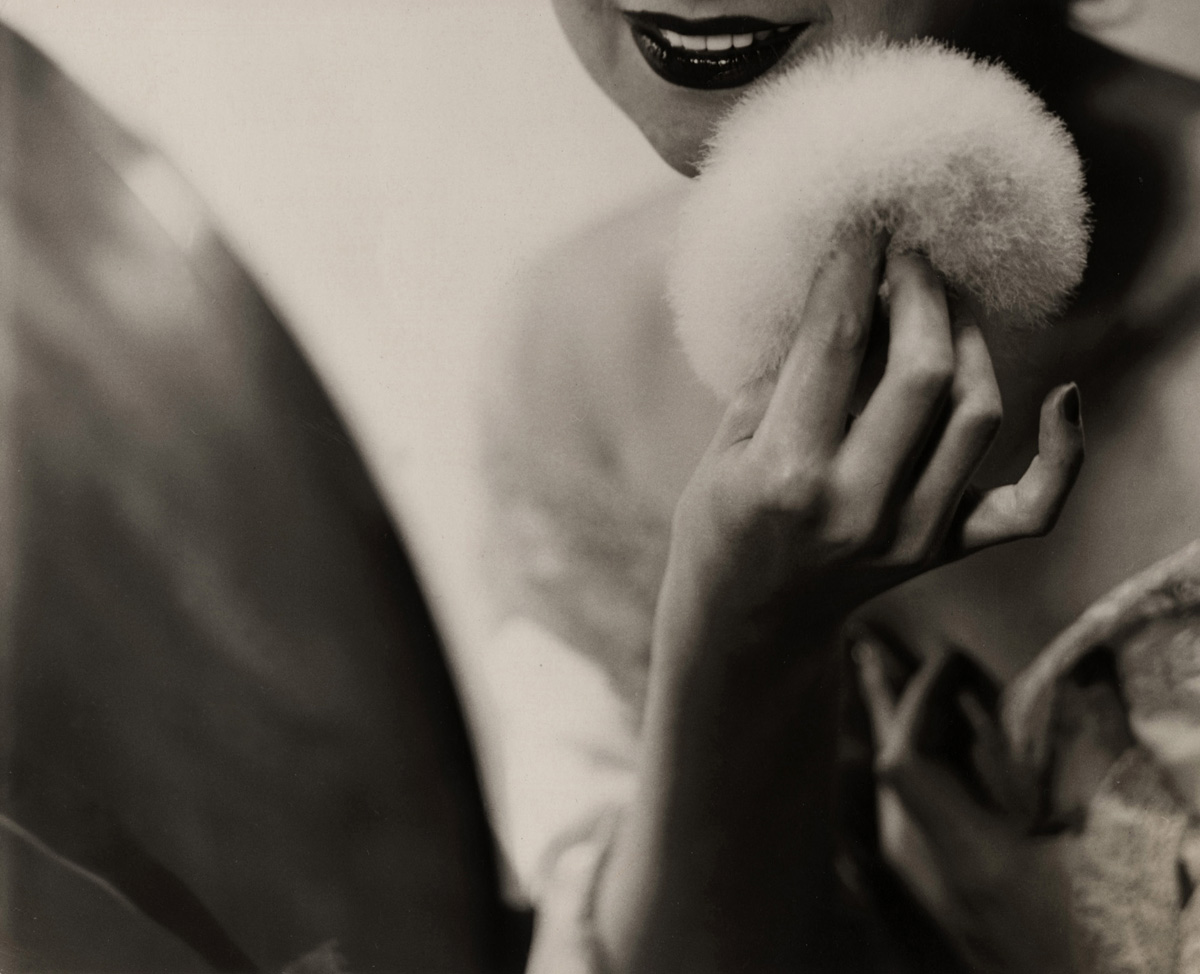
Laure Albin Guillot (French, 1879-1962) 'Estampe pour F. Marquis chocolatier-confiseur, Paris [Print for F. Marquis chocolate maker, Paris]' sans date (without date)


Laure Albin Guillot (French, 1879-1962)
Estampe pour F. Marquis chocolatier-confiseur, Paris (Print for F. Marquis chocolate maker, Paris)
Sans date (without date)
Collection particulière, Paris


The ravishing sensuality of the nudes make all the hours spent assembling this archive worthwhile!

Marcus


Many thankx to Jue de Paume for allowing me to publish the photographs in the posting. Please click on the photographs for a larger version of the image.


Laure Albin Guillot (French, 1879-1962) 'Étude publicitaire' sans date (without date)


Laure Albin Guillot (French, 1879-1962)
Étude publicitaire (Advertising study)
Sans date (without date)
Collection Musée Nicéphore Niépce, Ville de Chalon-sur-Saône


Laure Albin Guillot (French, 1879-1962) 'Les tierces alternées, illustration pour les Préludes de Claude Debussy [The third alternative, illustration for Claude Debussy Preludes]' 1948


Laure Albin Guillot (French, 1879-1962)
Les tierces alternées, illustration pour les Préludes de Claude Debussy (The third alternative, illustration for Claude Debussy Preludes)
1948
© Laure Albin Guillot / Roger-Viollet


Laure Albin Guillot (French, 1879-1962) 'Publicité pour la pommade-vaccin Salantale' 1942


Laure Albin Guillot (French, 1879-1962)
Publicité pour la pommade-vaccin Salantale (Advertisement for Salantale ointment vaccine)
1942
Bibliothèque nationale de France


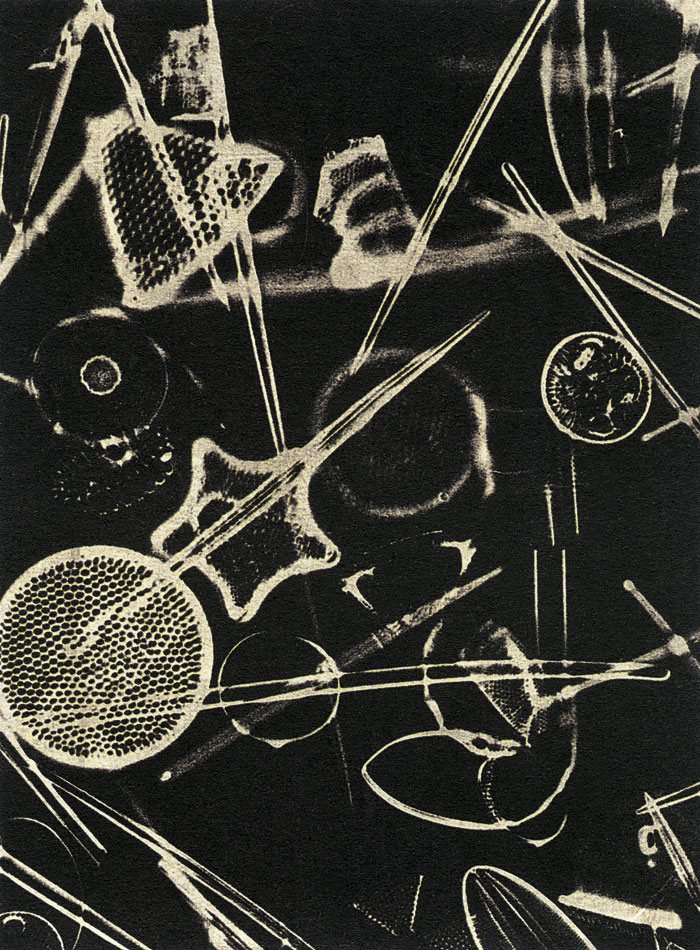
Laure Albin Guillot (French, 1879-1962) 'Micrographie' 1929


Laure Albin Guillot (French, 1879-1962)
Micrographie
1929
Collection particulière, Paris
© Laure Albin Guillot / Roger-Viollet


Laure Albin Guillot (French, 1879-1962) 'Micrographie, bourgeon de Frêne (coupe)' 1930


Laure Albin Guillot (French, 1879-1962)
Micrographie, bourgeon de Frêne (coupe)
1930
Collection Société française de photographie
© Laure Albin Guillot / Roger-Viollet


Laure Albin Guillot (French, 1879-1962) 'Micrographie' 1929


Laure Albin Guillot (French, 1879-1962)
Micrographie
1929
Collections Roger-Viollet / Parisienne de Photographie
© Laure Albin Guillot / Roger-Viollet


Laure Albin Guillot (Paris, 1879-1962), a “resounding name that should become famous”, one could read just after World War II. Indeed, the French photographic scene in the middle of the century was particularly marked by the signature and aura of this artist, who during her lifetime was certainly the most exhibited and recognised, not only for her talent and virtuosity but also for her professional engagement.

Organised in four parts, the exhibition, Laure Albin Guillot: The Question of Classicism allows one to discover her art of portraiture and the nude, her active role in the advertising world, her printed work and, at last, a significant gathering of her “micrographies décoratives”, stupefying photographs of microscopic preparations that made her renown in 1931. The exhibition presented at the Jeu de Paume gathers a significant collection of 200 original prints and books by Laure Albin Guillot, as well as magazines and documents of the period from public and private collections, such as the Parisienne de Photographie, the Musée National d’Art Moderne, the Bibliothèque Nationale de France, the Musée Nicéphore Niépce (Chalon-sur-Saône) and the Musée Français de la Photographie (Bièvres).

A large number of the original prints and documents on show come from the collections of the Agence Roger-Viollet, which acquired Laure Albin Guillot’s studio stock in 1964. This archive, which now belongs to the City of Paris, recently became accessible after a long inventory process. Made up of 52,000 negatives and 20,000 prints, this source has made it possible to question the oeuvre and the place that the photographer really occupies in history. The photographer’s work could appear as a counter-current to the French artistic scene of the 1920s to 40s, whose modernity and avant-garde production attract our attention and appeal to current tastes. It is however this photography, incarnating classicism and a certain “French style” that was widely celebrated at the time.

If Laure Albin Guillot’s photography was undeniably in vogue between the wars, her personality remains an enigma. Paradoxically, very little research has been carried out into the work and career of this artist. Her first works were seen in the salons and publications of the early 1920s, but it was essentially during the 1930s and 40s that Laure Albin Guillot, artist, professional and institutional figure, dominated the photographic arena. As an independent photographer, she practised several genres, including portraiture, the nude, landscape, still life and, to a lesser degree, documentary photography. Technically unrivalled, she raised the practice to a certain elitism. A photographer of her epoch, she used the new means of distribution of the image to provide illustrations and advertising images for the press and publishing industry.

She was notably one of the first in France to consider the decorative use of photography through her formal research into the infinitely tiny. With photomicrography, which she renamed “micrographie”, Laure Albin Guillot thus offered new creative perspectives in the combination of art and science. Finally, as member of the Société des artistes décorateurs, the Société Française de Photographie, director of photographic archives for the Direction générale des Beaux-Arts (forerunner of the Ministry of Culture) and first curator of the Cinémathèque nationale, president of the Union Féminine des Carrières Libérales, she emerges as one of the most active personalities and most aware of the photographic and cultural stakes of the period.

Press release from the Jeu de Paume website


Laure Albin Guillot (French, 1879-1962) 'Illustration pour 'Le Narcisse' de Paul Valéry' 1936


Laure Albin Guillot (French, 1879-1962)
Illustration pour ‘Le Narcisse’ de Paul Valéry
1936
Collection particulière, Paris
© Laure Albin Guillot / Roger-Viollet


Laure Albin Guillot (French, 1879-1962) 'Lucienne Boyer' 1935


Laure Albin Guillot (French, 1879-1962)
Lucienne Boyer
1935
Collections Roger-Viollet / Parisienne de Photographie
© Laure Albin Guillot / Roger-Viollet


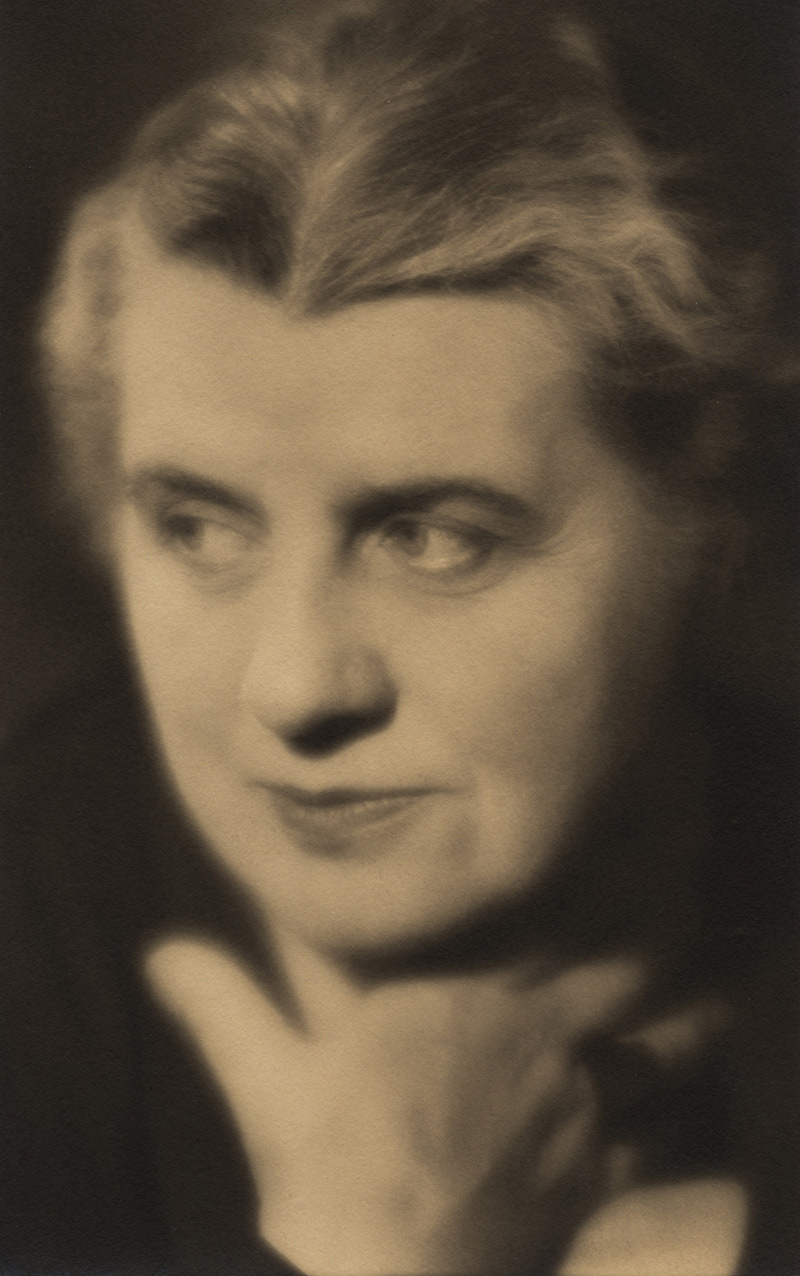
Laure Albin Guillot (French, 1879-1962) 'Autoportrait' 1935


Laure Albin Guillot (French, 1879-1962)
Autoportrait
1935
Collection Musée Nicéphore Niépce, Ville de Chalon-sur-Saône
© Laure Albin Guillot / Roger-Viollet


Laure Albin Guillot (French, 1879-1962) 'Jean Cocteau' 1939


Laure Albin Guillot (French, 1879-1962)
Jean Cocteau
1939
© Laure Albin Guillot / Roger-Viollet


Laure Albin Guillot (French, 1879-1962) 'Hubert de Givenchy' 1948


Laure Albin Guillot (French, 1879-1962)
Hubert de Givenchy
1948
© Laure Albin Guillot / Roger-Viollet


Laure Albin Guillot (French, 1879-1962) 'Étude de nu' 1930s


Laure Albin Guillot (French, 1879-1962)
Étude de nu
1930s
© Laure Albin Guillot / Roger-Viollet


Laure Albin Guillot (French, 1879-1962) 'Étude de nu' 1939


Laure Albin Guillot (French, 1879-1962)
Étude de nu
1939
© Laure Albin Guillot / Roger-Viollet


Laure Albin Guillot (French, 1879-1962) 'Étude de nu' 1939


Laure Albin Guillot (French, 1879-1962)
Étude de nu
1939
Bibliothèque nationale de France.
© Laure Albin Guillot / Roger-Viollet


Laure Albin Guillot (French, 1879-1962) 'Nudite de Jeune Femme [Nude of a Young Woman]' c. 1950


Laure Albin Guillot (French, 1879-1962)
Nudite de Jeune Femme (Nude of a Young Woman)
c. 1950
© Laure Albin Guillot / Roger-Viollet


Laure Albin Guillot (French, 1879-1962) 'Étude de nu' 1935


Laure Albin Guillot (French, 1879-1962)
Étude de nu
1935
Collections Roger-Viollet / Parisienne de Photographie
© Laure Albin Guillot / Roger-Viollet


Laure Albin Guillot (French, 1879-1962) 'Sans titre [women with crossed legs on a plinth]' 1937


Laure Albin Guillot (French, 1879-1962)
Sans titre [women with crossed legs on a plinth]
1937
Collection musée Nicéphore Niépce, Ville de Chalon-sur-Saône


Jeu de Paume
1, Place de la Concorde
75008 Paris
métro Concorde
Phone: 01 47 03 12 50

Opening hours:
Tuesday: 11am – 9pm
From Wednesday to Sunday: 11am – 7pm
Closed Monday

Jeu de Paume website

LIKE ART BLART ON FACEBOOK

Back to top

Exhibition: ‘WAR/PHOTOGRAPHY: Images of Armed Conflict and Its Aftermath’ at the Museum of Fine Arts, Houston – Posting Part 4

Exhibition dates: 11th November 2012 – 3rd February 2013


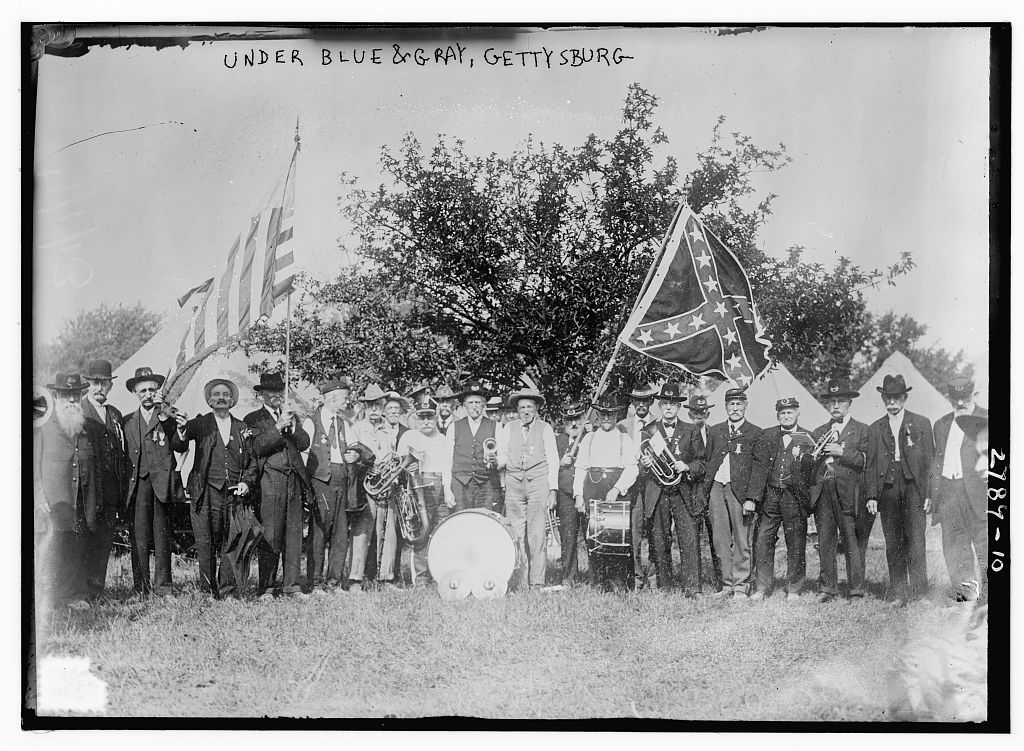
Anonymous photographer. 'Under blue & gray – Gettysburg' July 1913


Anonymous photographer
Under blue & gray – Gettysburg
July 1913
Photo shows the Gettysburg Reunion (the Great Reunion) of July 1913, which commemorated the 50th anniversary of the Battle of Gettysburg
Library of Congress Prints and Photographs Division Washington, D.C.


Part 4 of the biggest posting on one exhibition that I have ever undertaken on Art Blart!

As befits the gravity of the subject matter this posting is so humongous that I have had to split it into 4 separate postings. This is how to research and stage a contemporary photography exhibition that fully explores its theme. The curators reviewed more than one million photographs in 17 countries, locating pictures in archives, military libraries, museums, private collections, historical societies and news agencies; in the personal files of photographers and service personnel; and at two annual photojournalism festivals producing an exhibition that features 26 sections (an inspired and thoughtful selection) that includes nearly 500 objects that illuminate all aspects of WAR / PHOTOGRAPHY.

I have spent hours researching and finding photographs on the Internet to support the posting. It has been a great learning experience and my admiration for photographers of all types has increased. I have discovered the photographs and stories of new image makers that I did not know and some enlightenment along the way. I despise war, I detest the state and the military that propagate it and I surely hate the power, the money and the ethics of big business that support such a disciplinarian structure for their own ends. I hope you meditate on the images in this monster posting, an exhibition on a subject matter that should be consigned to the history books of human evolution.

**Please be aware that there are graphic photographs in all of these postings.** Part 1Part 2Part 3

Dr Marcus Bunyan


Many thankx to the Museum of Fine Arts, Houston for allowing me to publish some of the photographs in the posting. Please click on the photographs for a larger version of the image.


Memorials

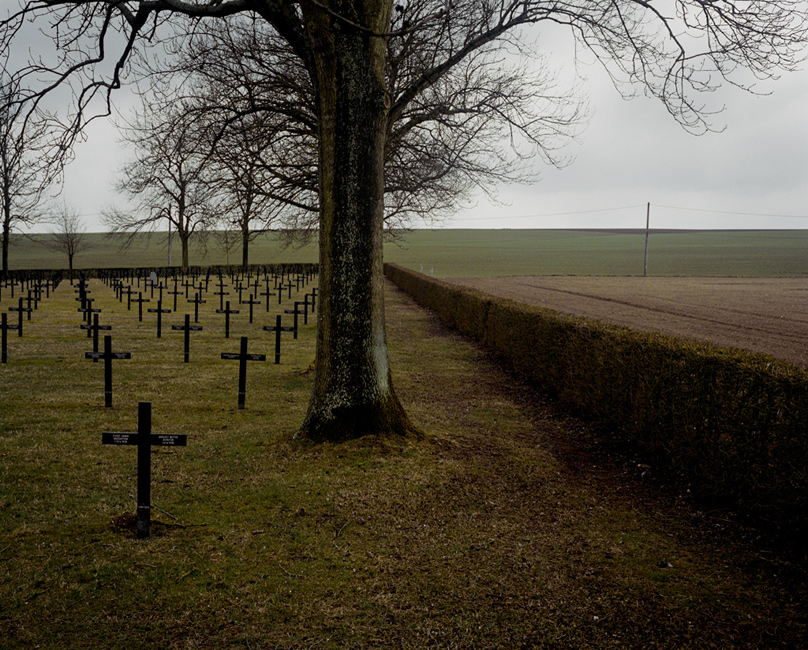
25. Photographs in the “Memorials” section range from the tomb of an unknown World War I soldier in England, by Horace Nicholls; and a landscape of black German crosses throughout a World War II burial site, by Bertrand Carrière; to an anonymous photograph of a reunion scene in Gettysburg of the opposing sides in the Civil War; and Joel Sternfeld’s picture of a woman and her daughter at the Vietnam Veterans Memorial in Washington, DC, in 1986. (8 images)


Horace Nicholls (English, 1867-1941) 'The Unknown Warrior at Westminster Abbey, London, November 1920' 1920


Horace Nicholls (English, 1867-1941)
The Unknown Warrior at Westminster Abbey, London, November 1920
1920
Silver gelatin print
© IWM (Q 31514)


In order to commemorate the many soldiers with no known grave, it was decided to bury an ‘Unknown Warrior’ with all due ceremony in Westminster Abbey on Armistice Day in 1920. The photograph shows the coffin resting on a cloth in the nave of Westminster Abbey before the ceremony at the Cenotaph and its final burial.


Bertrand Carrière (Canadian, b. 1957) 'Untitled' 2005-2009


Bertrand Carrière (Canadian, b. 1957)
Untitled
2005-2009
From the series Lieux Mêmes [Same Places]


Joel Sternfeld (American, b. 1944) 'Vietnam Veterans Memorial, Washington, D.C.,' May 1986


Joel Sternfeld (American, b. 1944)
Vietnam Veterans Memorial, Washington, D.C.,
May 1986
Chromogenic print, ed. #1/25 (printed October 1986)
The Museum of Fine Arts, Houston, the Target Collection of American Photography, gift of the artist
© 1986 Joel Sternfeld


Remembrance

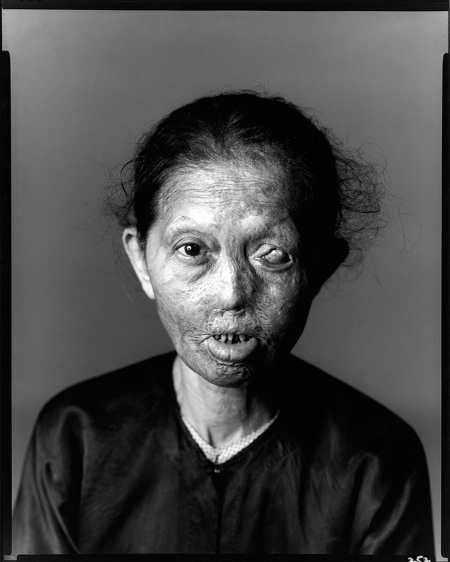
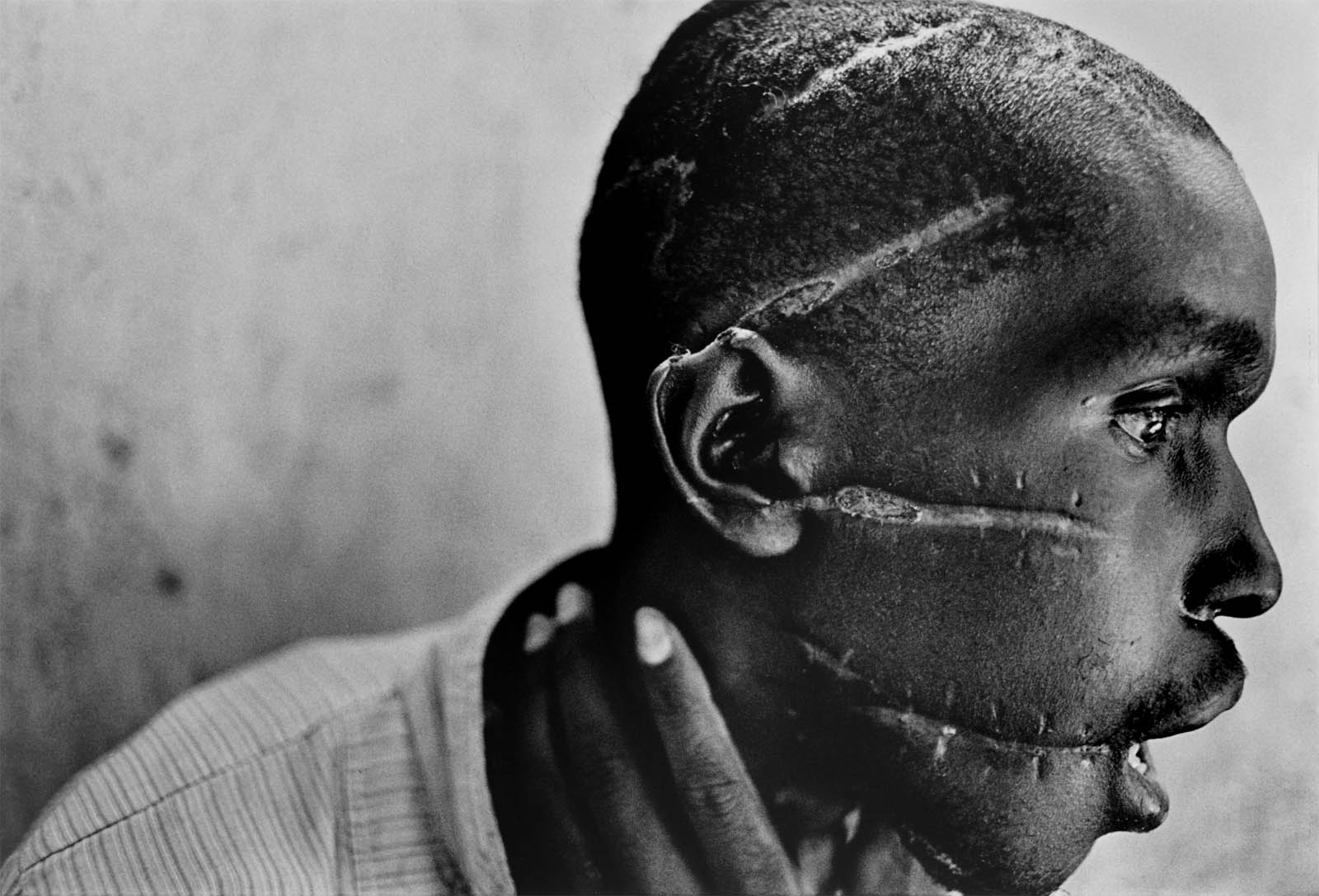
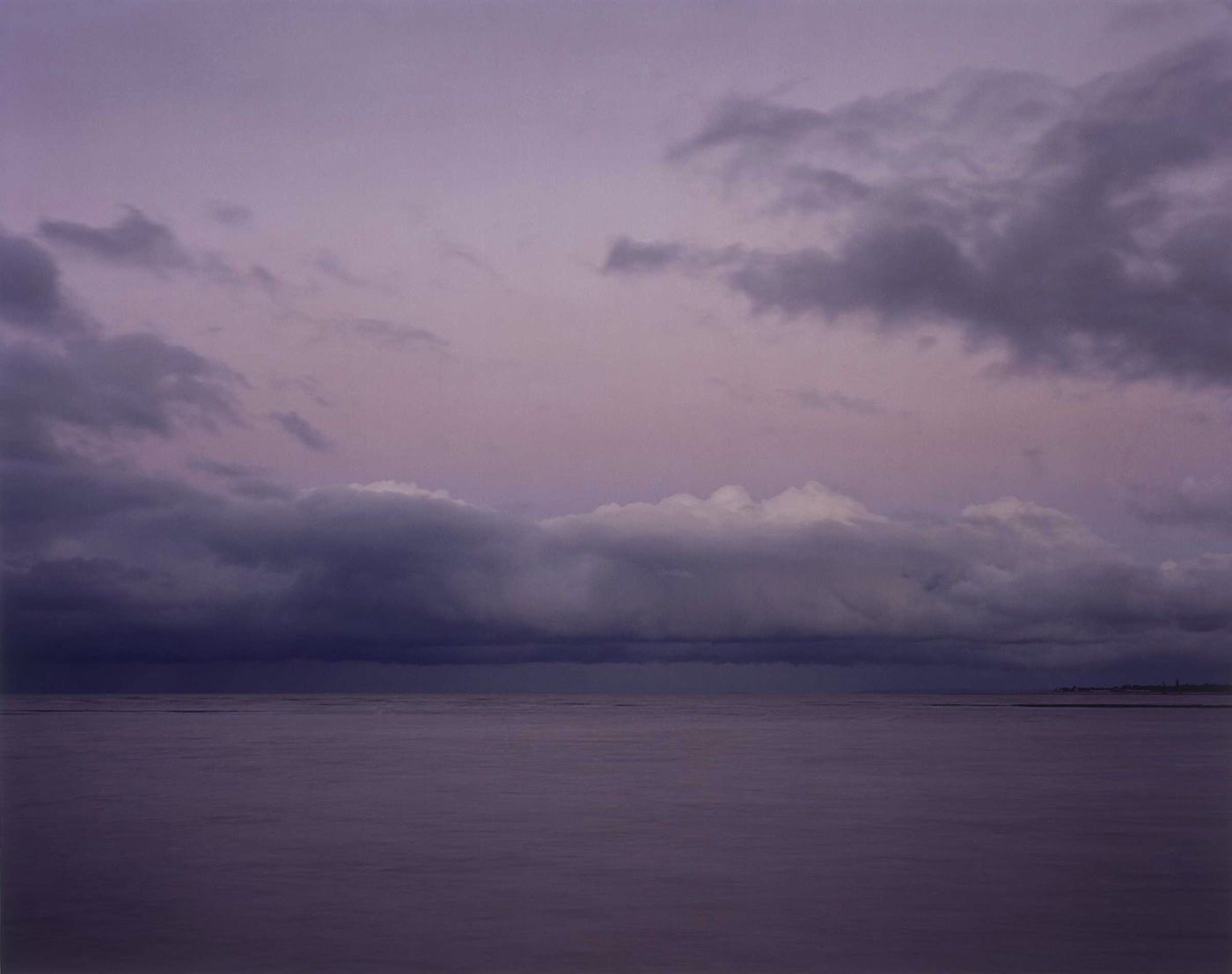
26. The last gallery in the exhibition is “Remembrance.” Most of these images were taken by artists seeking to come to terms with a conflict after fighting had ceased. Included are Richard Avedon’s picture of a Vietnamese napalm victim; a survivor of a machete attack in a Rwandan death camp, by James Nachtwey; a 1986 portrait of a hero who rescued Jews during the Holocaust, by Houston native Gay Block; and Suzanne Opton’s 2004 portrait of a soldier who survived the Iraq War and returned to the United States to work as a police officer, only to be murdered on duty by a fellow veteran. The final wall features photographs by Simon Norfolk of sunrises at the five D-Day beaches in 2004. The only reference to war is the title of the series: The Normandy Beaches: We Are Making a New World(33 images)


Richard Avedon (American, 1923-2004) 'Napalm Victim #1, Saigon, South Vietnam, April 29, 1971' 1971


Richard Avedon (American, 1923-2004)
Napalm Victim #1, Saigon, South Vietnam, April 29, 1971
1971
Silver gelatin print
© Richard Avedon


Gay Block (American, b.1942) 'Zofia Baniecka, Poland' 1986


Gay Block (American, b. 1942)
Zofia Baniecka, Poland
1986
From the series Rescuers: Portraits of Moral Courage in the Holocaust, a record of non-Jewish citizens from European countries who risked their lives helping to hide Jews from the Nazis
Chromogenic print, printed 1994
Courtesy of Museum of Fine Arts, Houston, gift of Clinton T. Wilour in honour of Eve France


Zofia Baniecka (born 1917 in Warsaw – 1993) was a Polish member of the Resistance during World War II. In addition to relaying guns and other materials to resistance fighters, Baniecka and her mother rescued over 50 Jews in their home between 1941 and 1944.


James Nachtwey (American, b. 1948) 'A Hutu man who did not support the genocide had been imprisoned in the concentration camp, was starved and attacked with machetes. He managed to survive after he was freed and was placed in the care of the Red Cross, Rwanda, 1994' 1994


James Nachtwey (American, b. 1948)
A Hutu man who did not support the genocide had been imprisoned in the concentration camp, was starved and attacked with machetes. He managed to survive after he was freed and was placed in the care of the Red Cross, Rwanda, 1994
1994
Silver gelatin print
© James Nachtwey / TIME

World Press Photo of the Year, prize singles


A Hutu man at a Red Cross hospital in Nyanza, Rwanda. His face was mutilated by the Hutu ‘Interahamwe’ militia, who suspected him of sympathising with the Tutsi rebels.

Liberated from a nearby Hutu camp, where mainly Tutsis were incarcerated, starved, beaten, and killed, this man did not support the genocide and was thus subjected to the same treatment. Starved and attacked with machetes, he had managed to survive, though he was unable to speak and could barely walk or swallow when this photo was made.

Jibran Abbasi. “Mutilated By The Hutu ‘Interahamwe’ by James Nachtwey,” on the Business Recorder website April 5, 2017 [Online] Cited 27/07/2024


Simon Norfolk (British, b. Nigeria, 1963) 'Sword Beach' 2004


Simon Norfolk (British born Nigeria, b. 1963)
Sword Beach
2004
From the series The Normandy Beaches: We Are Making a New World
Chromogenic print, ed. #1/10 (printed 2006)
The Museum of Fine Arts, Houston
Gift of Bari and David Fishel, Brooke and Dan Feather and Hayley Herzstein in honor of Max Herzstein and a partial gift of the artist and Gallery Luisotti, Santa Monica
© Simon Norfolk / Gallery Luisotti


WAR/PHOTOGRAPHY Extended Info


Other photographs from the exhibition


Alexander Gardner (1821-1882) 'Scouts and Guides to the Army of the Potomac, Berlin, MD, October, 1862' October 1862 (detail)


Alexander Gardner (American, 1821-1882)
Scouts and Guides to the Army of the Potomac, Berlin, MD, October, 1862
October 1862
Albumen silver print
Photograph by Alexander Gardner, from “Incidents of the War. Guide to the Army of the Potomac,” from Gardner’s Photographic Sketch Book of the War, Washington
Records of the War Department General and Special Staffs, Record Group 165, National Archives Still Picture Branch, College Park, Maryland


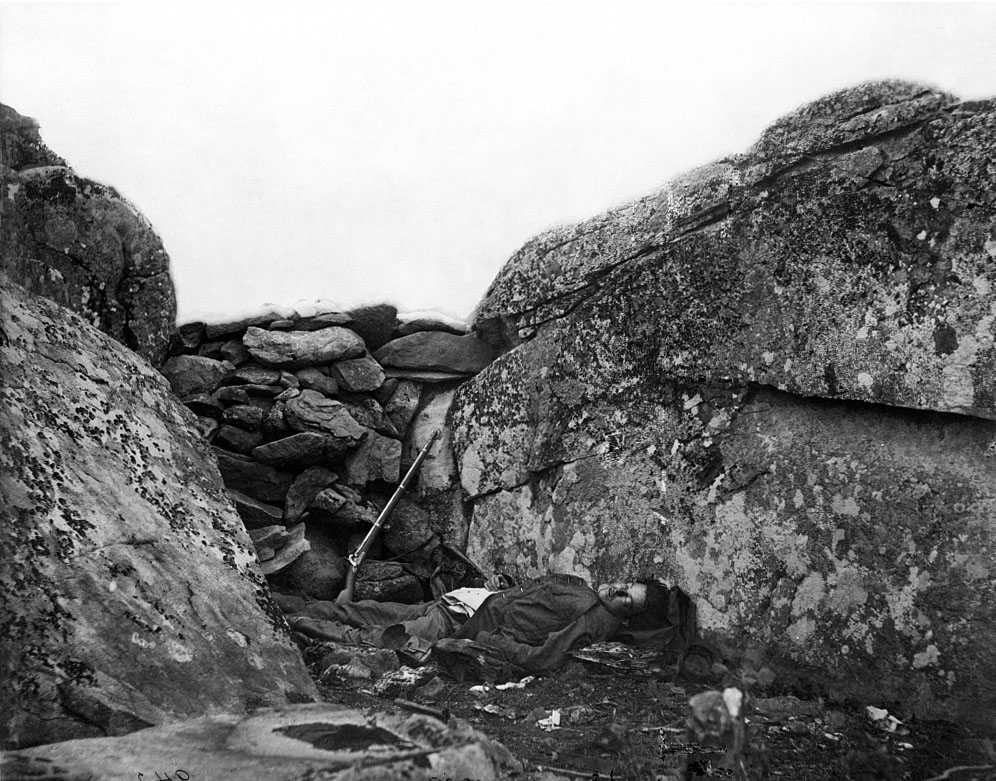
Alexander Gardner (American, 1821-1882) ‘The Home of a Rebel Sharpshooter, Gettysburg, Pennsylvania’. Albumen paper print


Alexander Gardner (American, 1821-1882)
The Home of a Rebel Sharpshooter / Dead Confederate soldier in the devil’s den, Gettysburg, Pennsylvania
July 1863
Albumen paper print copied from glass, wet collodion negative
Library of Congress, Prints and Photographs Division


Josiah Barnes (Australian, 1858-1921) 'Embarkation of HMAT Ajana, Melbourne, July 8, 1916' 1916


Josiah Barnes (Australian, 1858-1921)
Embarkation of HMAT Ajana, Melbourne, July 8, 1916
1916
Gelatin silver print from original glass half-plate negative (printed 2012)
On loan from the Australian War Memorial


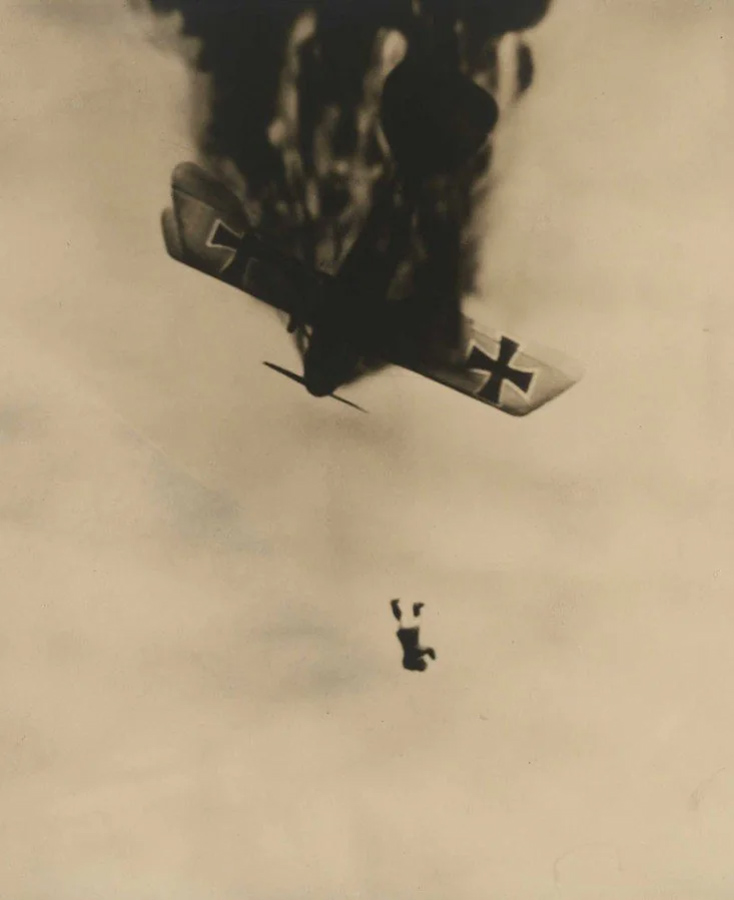
Wesley D. Archer (American, d. 1952) 'Just as he left the burning plane' 1933


Wesley D. Archer (American, d. 1952)
Just as he left the burning plane
1933
From the publication Death in the Air: The War Diary and Photographs of a Flying Corps Pilot


The typewritten script of a First World War pilot’s diary with a large number of photographs was submitted to the publishers William Heinemann and published by them in 1933. Heinemann stated on the book’s jacket that the diary contained no names, dates, or anything that could reveal the identity of the writer or the squadron in which he served. The publishers understood that the diarist was killed in action in 1918 and that it was in deference to the wishes of those who were close to him that his diary should be published.

So remarkable were the photographs that their veracity was immediately questioned, but no proof of their authenticity or otherwise could be ascertained. It was not until 1983 that a collection of documents, photographs and artifacts was presented to the Smithsonian’s National Air and Space Museum. Some of the photographs were recognized as being those of the mystery diarist and the truth was soon revealed.

The author was Wesley Archer, an American with Canadian parents who served with the RFC in the First World War, and the photographs and diary had been faked.

Text from the Google Books website

For more information on the faked photographs see the article “How dramatic images of WWI dogfights in the skies of Europe were FAKED by a conman who was just looking to make some money”.


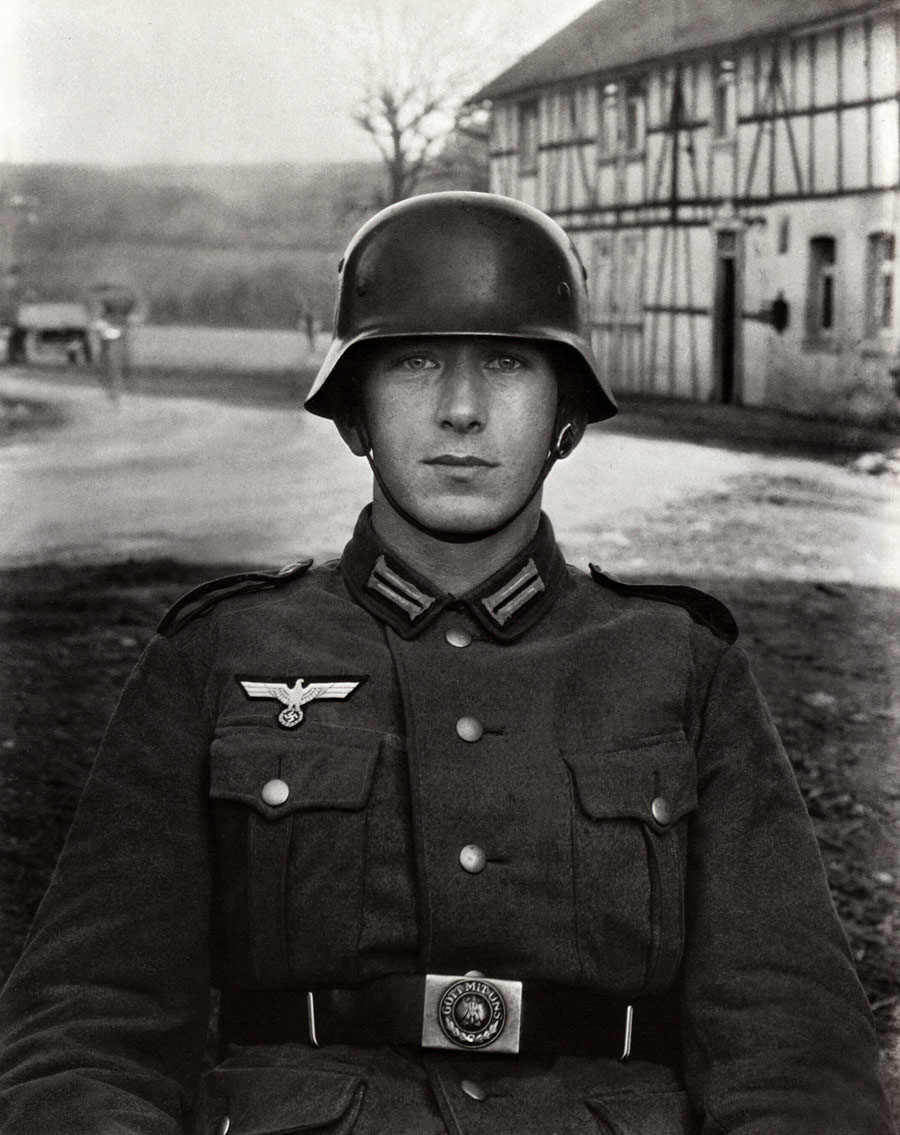
August Sander (German, 1876-1964) 'Soldier' c. 1940


August Sander (German, 1876-1964)
Soldier
c. 1940
Gelatin silver print, printed by Gunther Sander, 1960s
The Museum of Fine Arts, Houston
Gift of John S. and Nancy Nolan Parsley in honour of the 65th birthday of Anne Wilkes Tucker
© Die Photographische Sammlung/SK StiftungKultur – August Sander Archiv, Cologne; DACS, London 2012


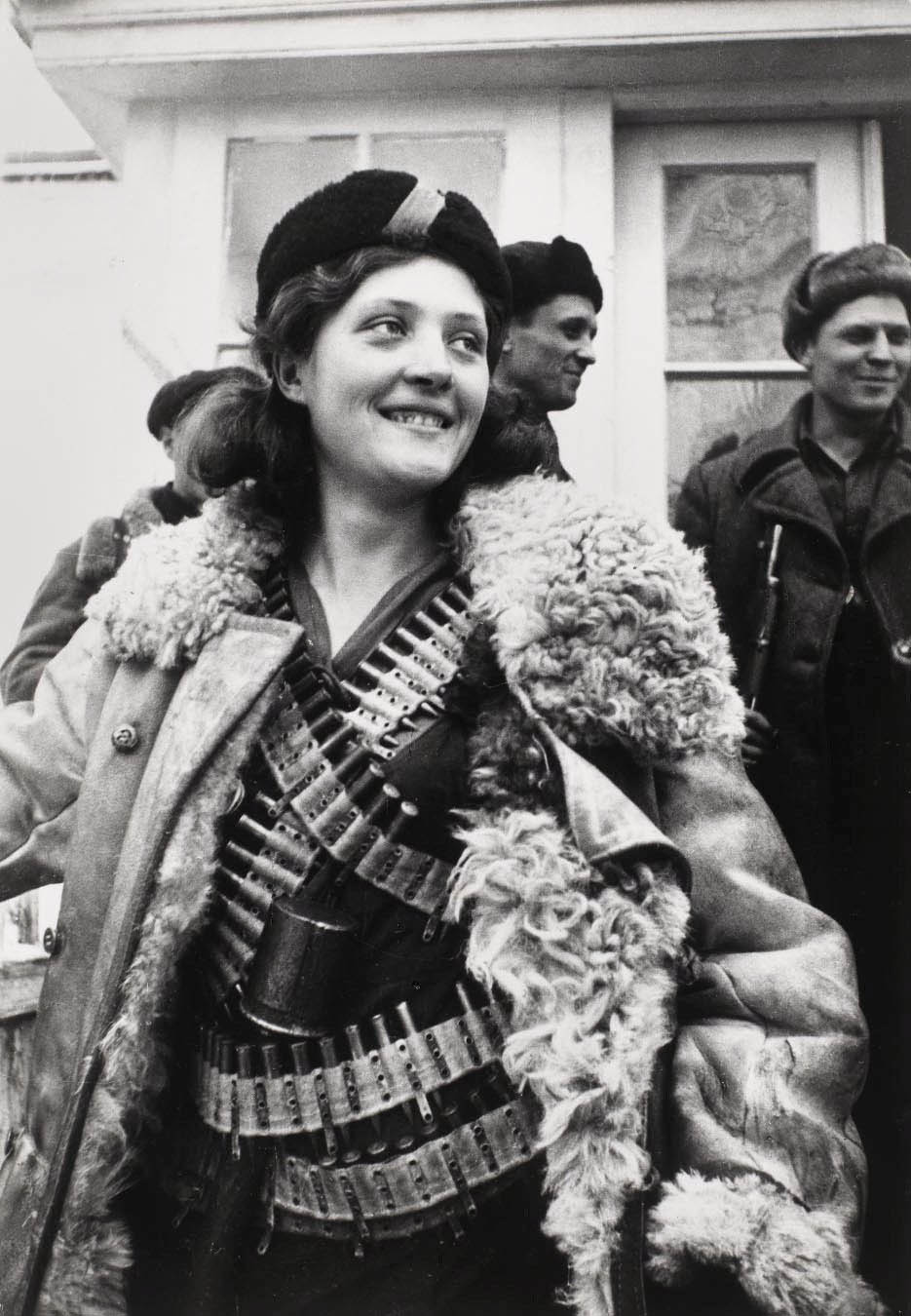
Arkady Shaikhet (Soviet, 1898-1959) 'Partisan Girl' 1942


Arkady Shaikhet (Soviet, 1898-1959)
Partisan Girl
1942
Gelatin silver print
Gift of Marion Mundy
© Arkady Shaikhet Estate, Moscow


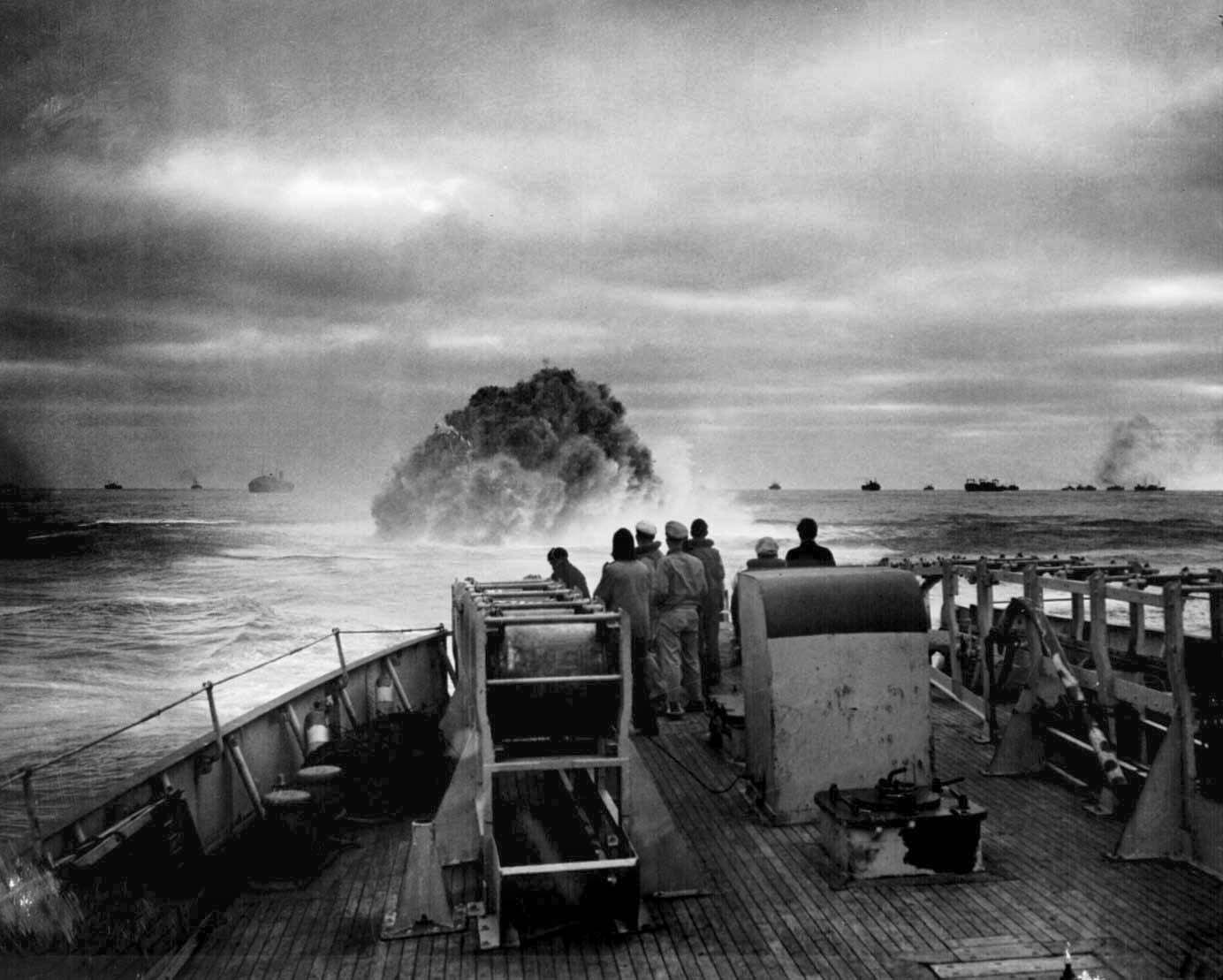
Anonymous photographer / U.S. Department of Defense. 'US Coast Guard crew of cutter Spencer watched as a depth charge exploded near U-175, North Atlantic, 500nm WSW of Ireland, 17 Apr 1943'


Anonymous photographer
U.S. Department of Defense
US Coast Guard crew of cutter Spencer watched as a depth charge exploded near U-175, North Atlantic, 500nm WSW of Ireland, 17 Apr 1943
17 April 1943
Public domain


W. Eugene Smith (American, 1918-1978) 'Wounded, dying infant found by American soldier in Saipan Mountains' June 1944


W. Eugene Smith (American, 1918-1978)
Wounded, dying infant found by American soldier in Saipan Mountains
June 1944
Gelatin silver print
© W. Eugene Smith


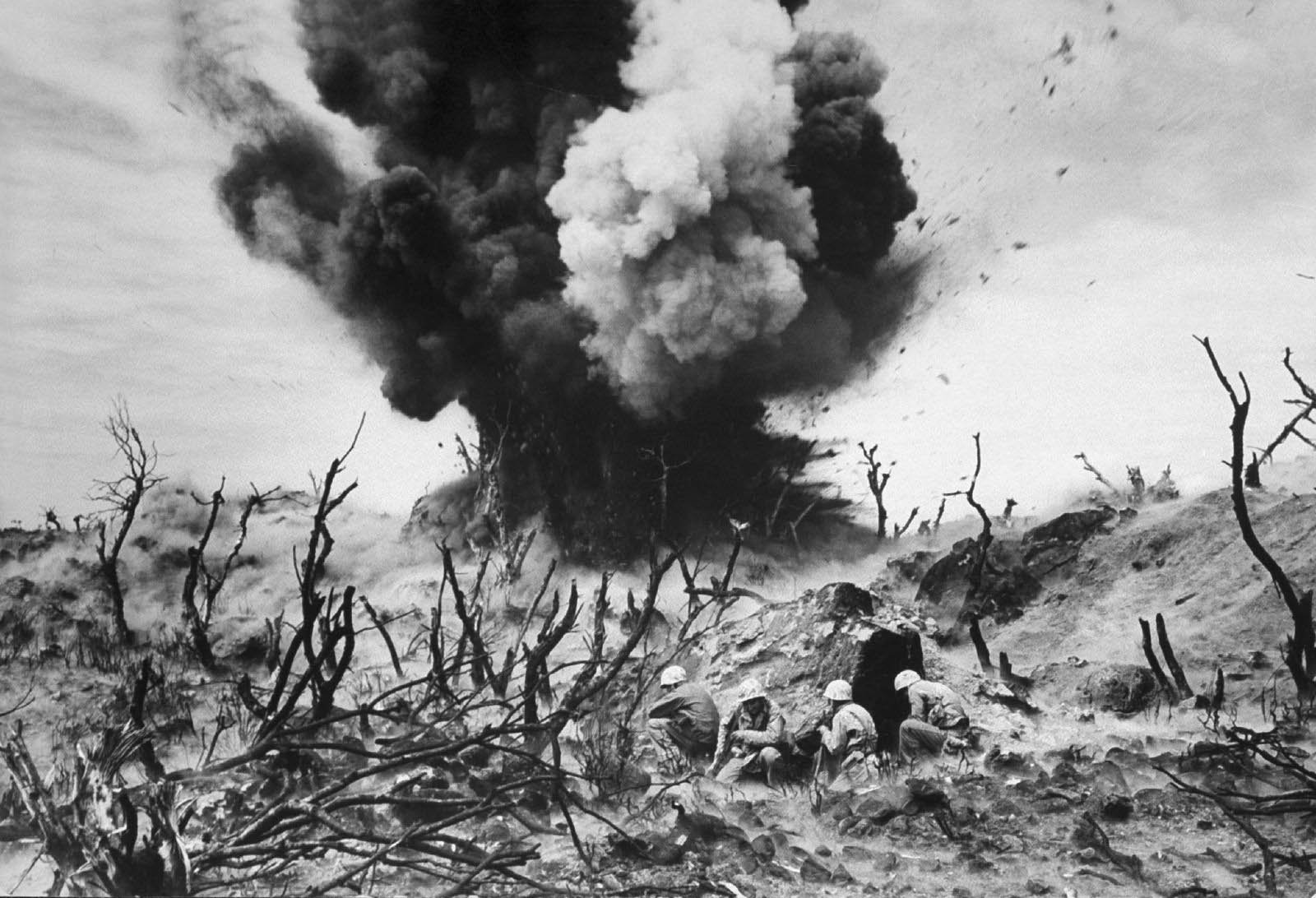
W. Eugene Smith (American, 1918-1978) 'World War II. The Pacific Campaign. The Battle of Iwo Jima (Japanese island). US Marine demolition team blasting out a cave on Hill 382. Iwo Jima. February, 1945' 1945


W. Eugene Smith (American, 1918-1978)
World War II. The Pacific Campaign. The Battle of Iwo Jima (Japanese island). US Marine demolition team blasting out a cave on Hill 382. Iwo Jima. February, 1945
1945
Gelatin silver print
© W. Eugene Smith


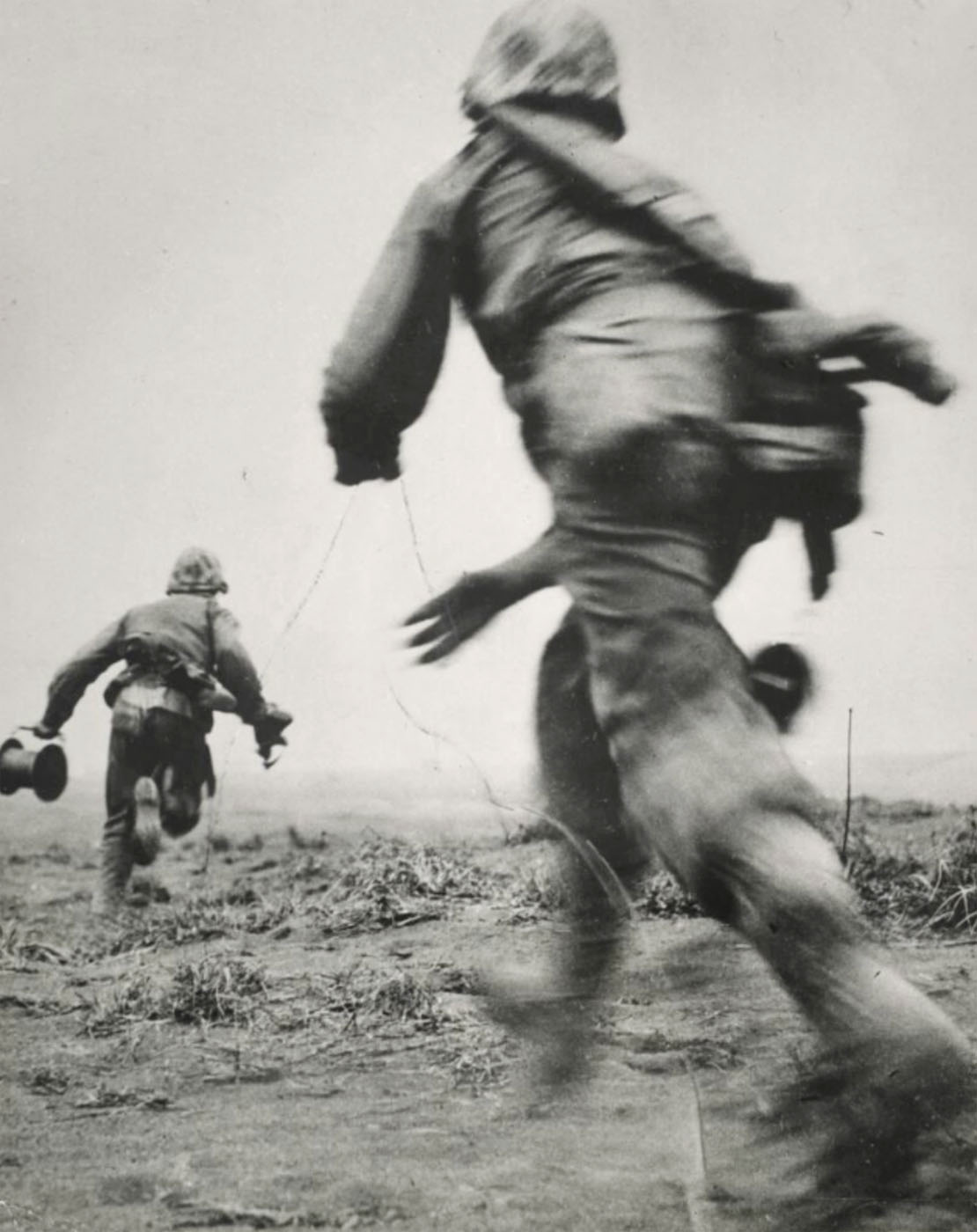
Joseph Schwartz (American, 1913–2013) 'Hold the Phone - Two Marine wiremen on Iwo Jima race across an open field, under heavy enemy fire to establish field telephone contact with the front lines' February 19, 1945, printed early 1950s


Joseph Schwartz (American, 1913–2013)
Hold the Phone – Two Marine wiremen on Iwo Jima race across an open field, under heavy enemy fire to establish field telephone contact with the front lines
February 19, 1945, printed early 1950s
Gelatin silver print mounted on board
18 13/16 × 14 15/16 in. (47.8 × 37.9cm)
The Museum of Fine Arts, Houston
Museum purchase funded by Knox Nunnally at “One Great Night in November, 2009,” in honor of Houston trial lawyer Joe Reynolds, a U.S. Marine who fought on Iwo Jima


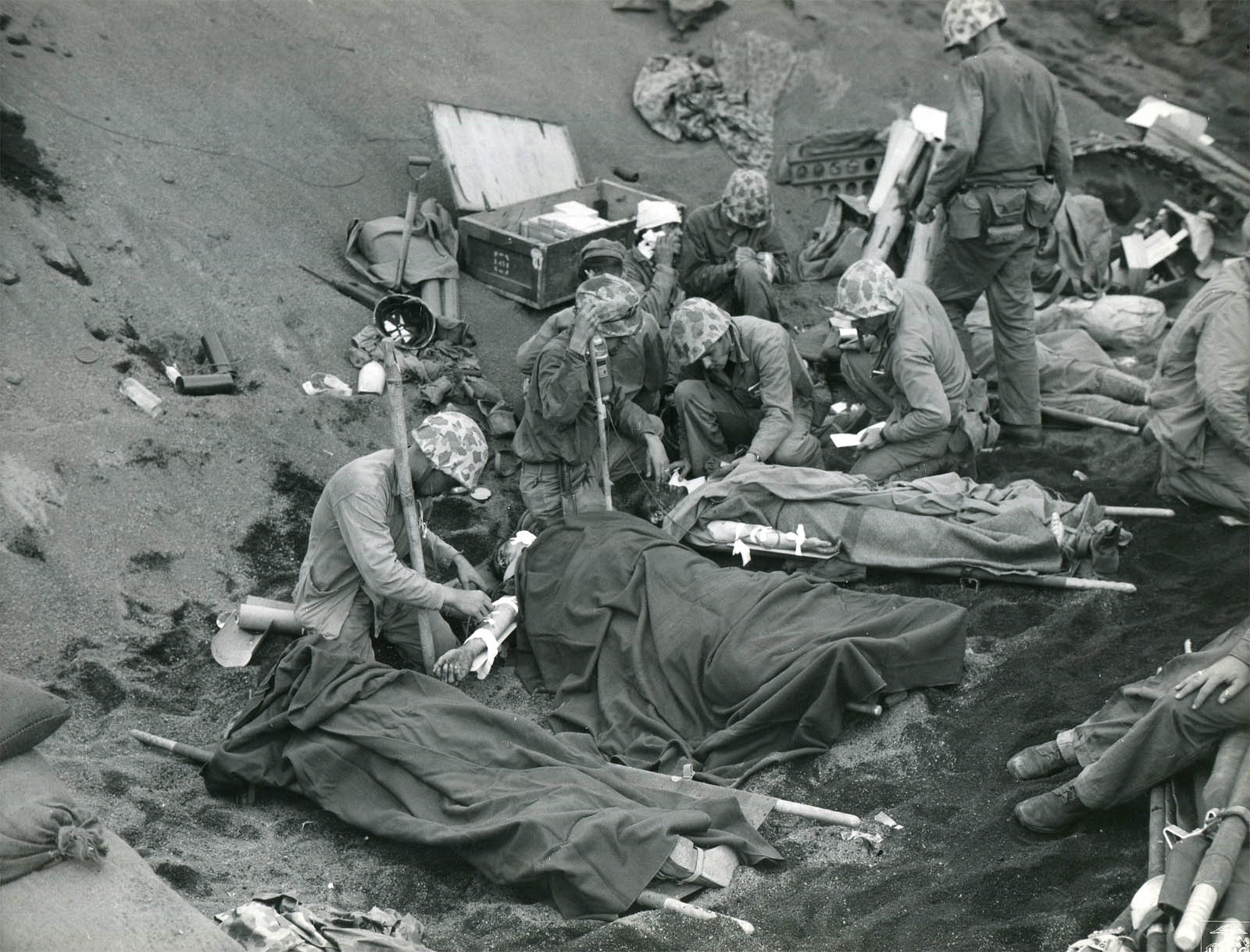
Anonymous photographer. U.S. Department of Defense / USMC Official Photograph 'PLASMA WARD – Navy doctors and corpsmen administer to wounded Marines at an aid station established in a gully on Iwo Jima. The high casualty rate in this operation required the use of gallons of plasma and whole blood sent by air from the West Coast' 1945


Anonymous photographer
U.S. Department of Defense / USMC Official Photograph
PLASMA WARD – Navy doctors and corpsmen administer to wounded Marines at an aid station established in a gully on Iwo Jima. The high casualty rate in this operation required the use of gallons of plasma and whole blood sent by air from the West Coast
1945
Gelatin silver print
Creative Commons Attribution 2.0 Generic


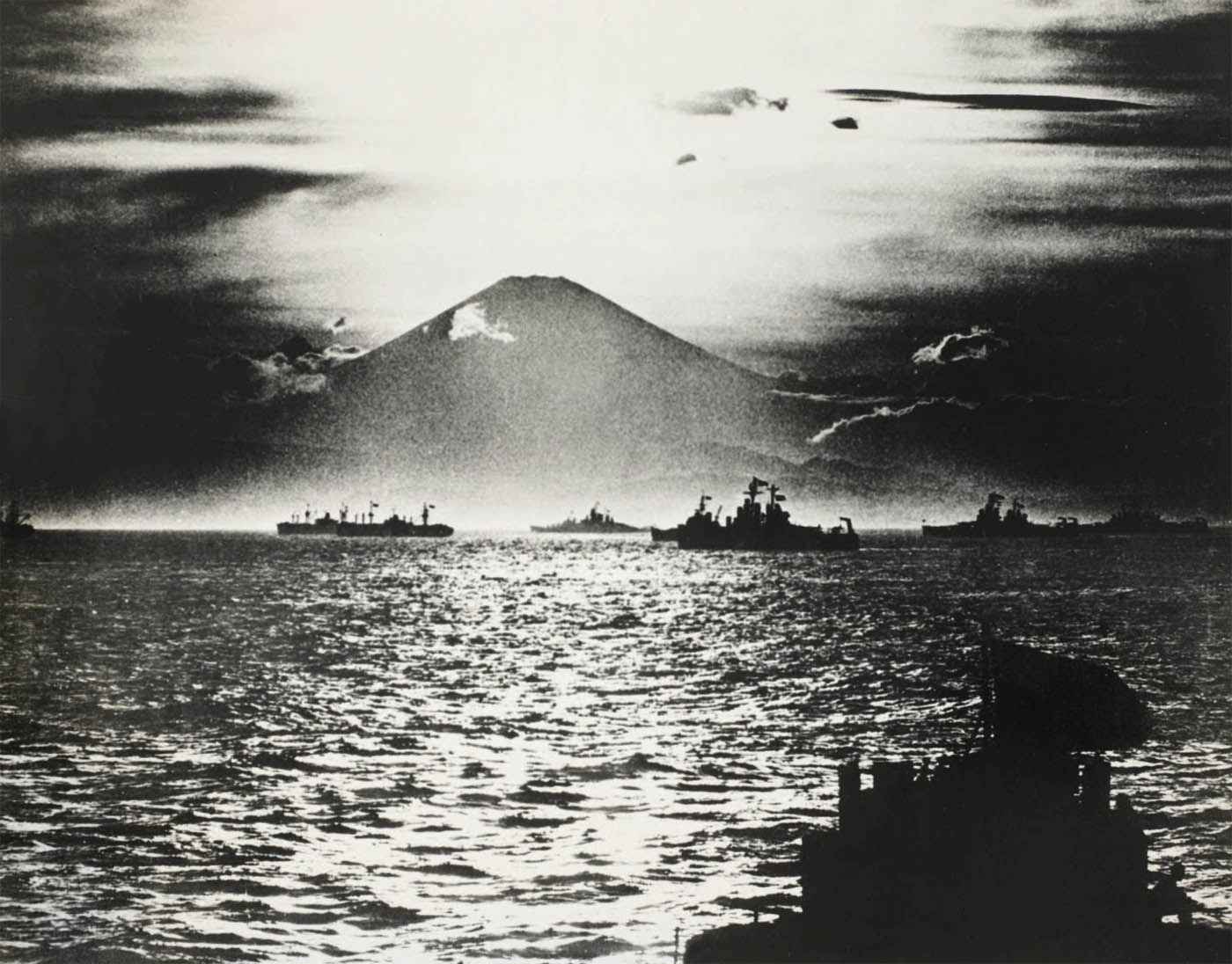
U.S. Navy Photographic Team. 'U.S. and British Warships Anchored in Sagami Wan, Outside of Tokyo Bay, Japan, on the Day the Allied Ships Entered Japanese Waters' 27th August 1945


U.S. Navy Photographic Team
U.S. and British Warships Anchored in Sagami Wan, Outside of Tokyo Bay, Japan, on the Day the Allied Ships Entered Japanese Waters
27th August 1945
Gelatin silver print
The Museum of Fine Arts, Houston, museum purchase funded by Laura and Tony Visage in honor and memory of William A. Visage and his fellow soldiers in Battery “E” of the 2nd Battalion, 131st Field Artillery, U.S. Army Air Corps


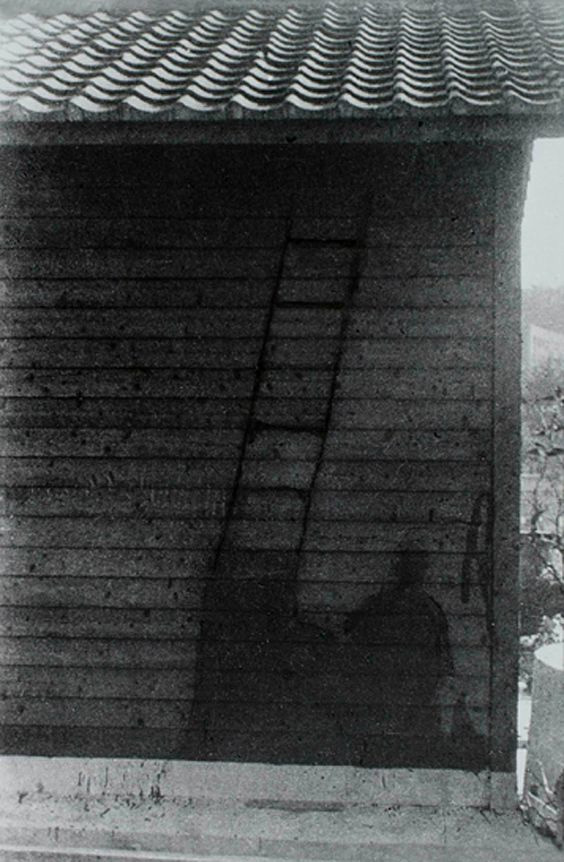
Matsumoto Eiichi (Japanese, 1915-2004) 'Shadow of a soldier remaining on the wooden wall of the Nagasaki military headquarters (Minami-Yamate machi, 4.5km from Ground Zero)' 1945


Matsumoto Eiichi (Japanese, 1915-2004)
Shadow of a soldier remaining on the wooden wall of the Nagasaki military headquarters (Minami-Yamate machi, 4.5km from Ground Zero)
1945
Gelatin silver print
Collection of the Tokyo Metropolitan Museum of Photography
© Matsumoto Eiichi


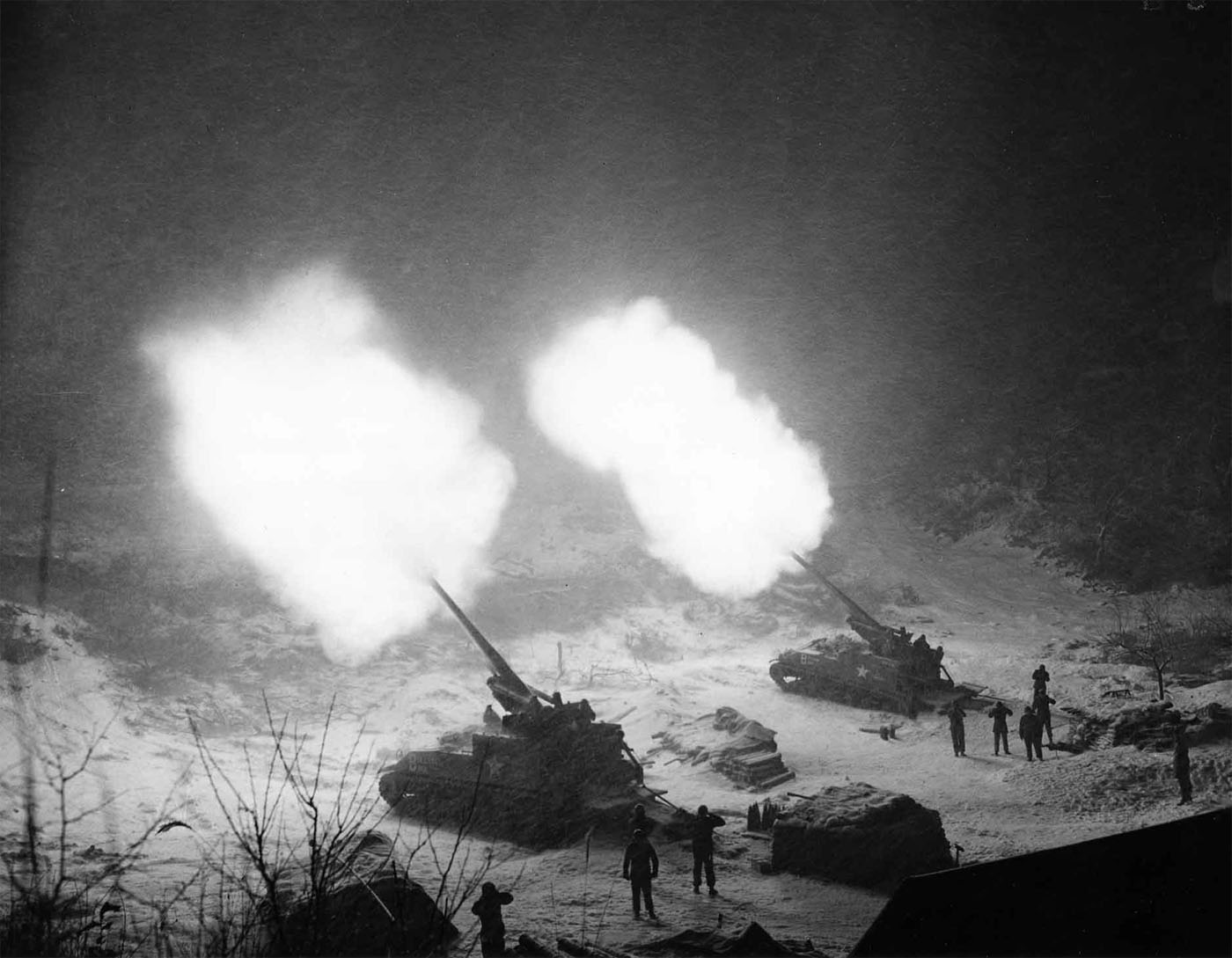
Unknown photographer. 'A pair of M-40 155mm Gun Motor Carriages of Battery B, 937th Field Artillery Battalion, providing fire support to U.S. Army 25th Infantry Division, Munema, Korea' 26 November 1951


Unknown photographer
A pair of M-40 155mm Gun Motor Carriages of Battery B, 937th Field Artillery Battalion, providing fire support to U.S. Army 25th Infantry Division, Munema, Korea
26 November 1951
Gelatin silver print
U.S. Department of Defense


Cathy LeRoy (French, 1944-2006) 'Corpsman In Anguish' 1967


Cathy LeRoy (French, 1944-2006)
Corpsman In Anguish
1967
Gelatin silver print


Her pictures from Vietnam were stunning. Her photos from Battle of Hill 881 evoked “ghosts of Iwo Jima and Pork Chop Hill,” Time magazine wrote in May 1967. Her photos of corpsman Vernon Wike during the battle was a triptych of an all-too-familiar scene: in the first, Wike has two hands on his friend’s chest, trying to staunch the wound; in the second, he tries to find a heartbeat; in the third frame, “Corpsman In Anguish”, he realised the man is dead.

LeRoy herself came very close to death two weeks later. Her Nikon barely stopped a piece of mortar shrapnel that ripped open her chest. She said that she thought the last words she would ever hear were, “I think she’s dead, sarge.” During the Tet offensive in 1968, LeRoy was briefly captured by the North Vietnamese during the battle for Hue. LeRoy’s photos of her captivity later made the cover of Life, ‘A Remarkable Day in Hue: the Enemy Lets Me Take His Picture’. She was the first person to take photos of North Vietnamese Army Regulars behind their lines.

Anonymous. “Corpsman In Anguish | Cathy LeRoy,” on the Iconic Photos website January 13, 2014 [Online] Cited 27/07/2024


A licensed parachutist, Leroy jumped with the U.S. 173rd Airborne Brigade into combat during Operation Junction City in February of 1967. It was in this action, the battle for Hill 881, that Leroy photographed U.S. Navy Corpsman Vernon Wike as he rushed to the aid of a fallen comrade. “Corpsman in anguish” is the third frame of a series that Leroy shot, capturing the unimaginable grief of war. Later, in an interview for the documentary “The Hill Fights”, Wike recounted the moment that Leroy photographed.

“I know there was chaos going on around me, but there was no sound,” she says. “… I knew he didn’t have a chance, but I still got p—–d off when he died.” Leroy describes the aftermath as the corpsman “lost in this nightmare landscape” grabbed the fallen marine’s M16 and charged a Viet bunker alone in a hail of obscenities. The fallen marine was a man called “Rock”, a New Yorker from Puerto Rico. Earlier that day he had told Wike that he only had 60 days left “in country” – his deployment in Vietnam.

Anonymous. “Giving War a Face: Catherine Leroy,” on the Dismal Nitch website September 04, 2020 [Online] Cited 27/07/2024


Arkady Shaikhet (Soviet, 1898-1959) 'Partisan Girl' 1942


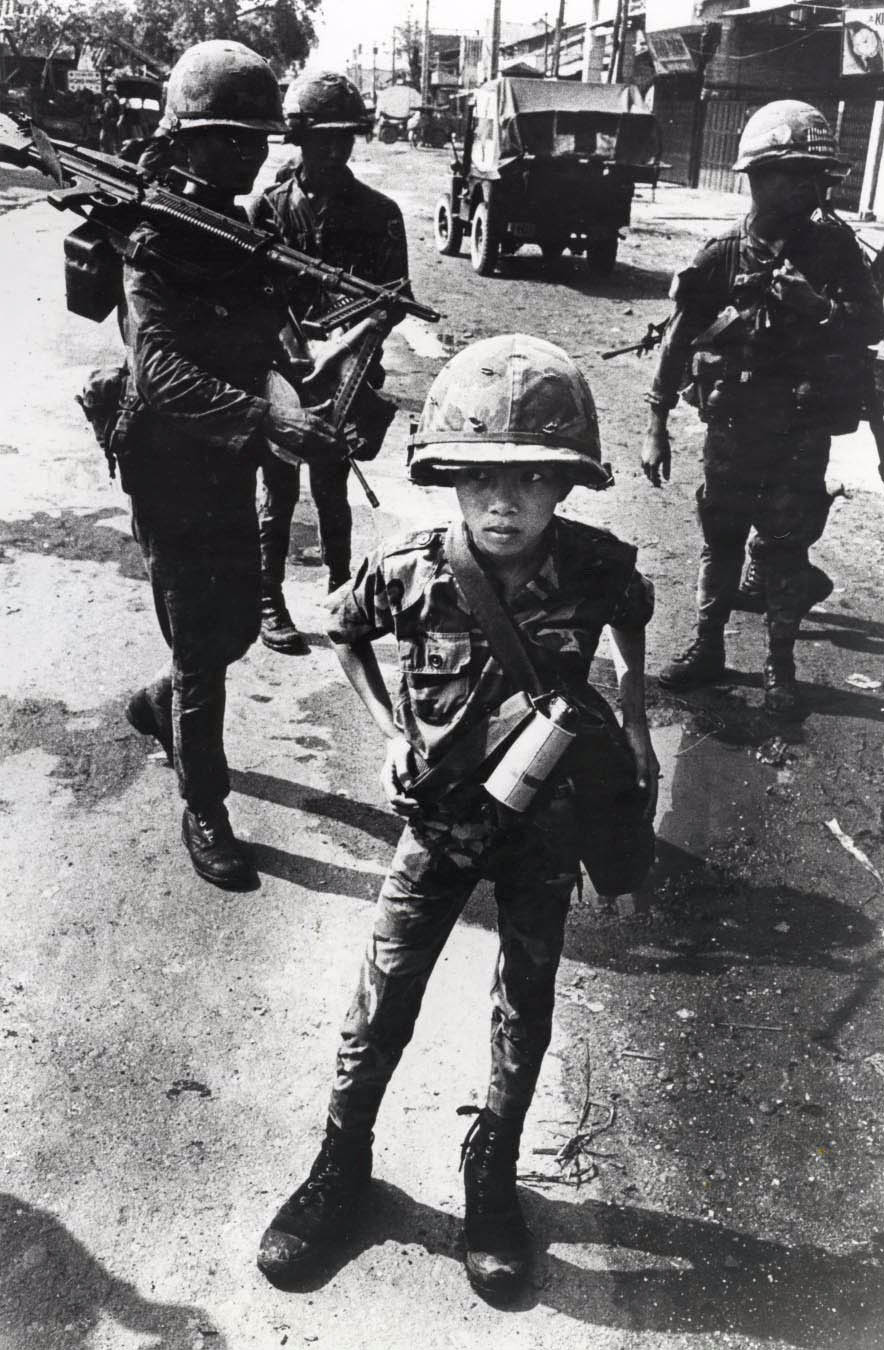
Philip Jones Griffiths (Welsh, 1936-2008)
​Called “Little Tiger” for killing two “Viet Cong women cadre” – his mother and teacher, it was rumored, Vietnam​
1968
Gelatin silver print
The Philip Jones Griffiths Foundation, courtesy of Howard Greenberg Gallery
© Philip Jones Griffiths / Magnum Photos


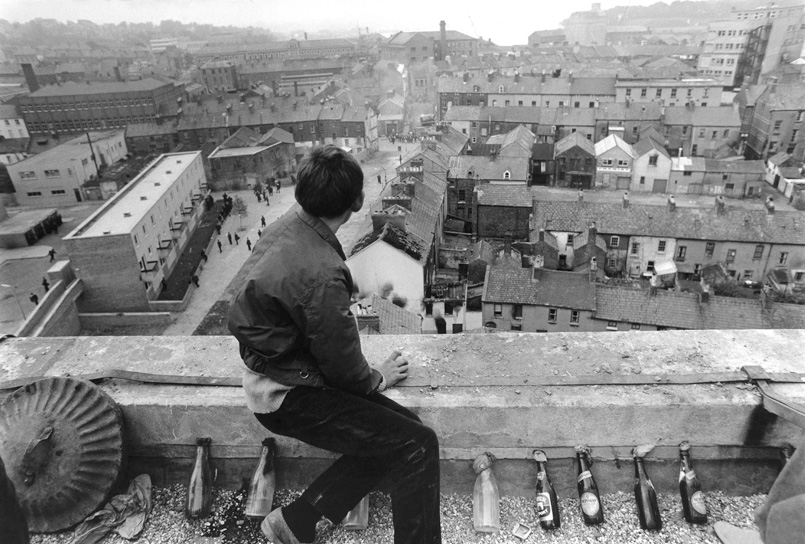
Gilles Caron (French, 1939-1970) 'Young Catholic demonstrator on Londonderry Wall, Northern Ireland' 1969


Gilles Caron (French, 1939-1970)
Young Catholic demonstrator on Londonderry Wall, Northern Ireland
1969
Gelatin silver print
Courtesy of Foundation Gilles Caron and Contact Press Images
© Gilles Caron


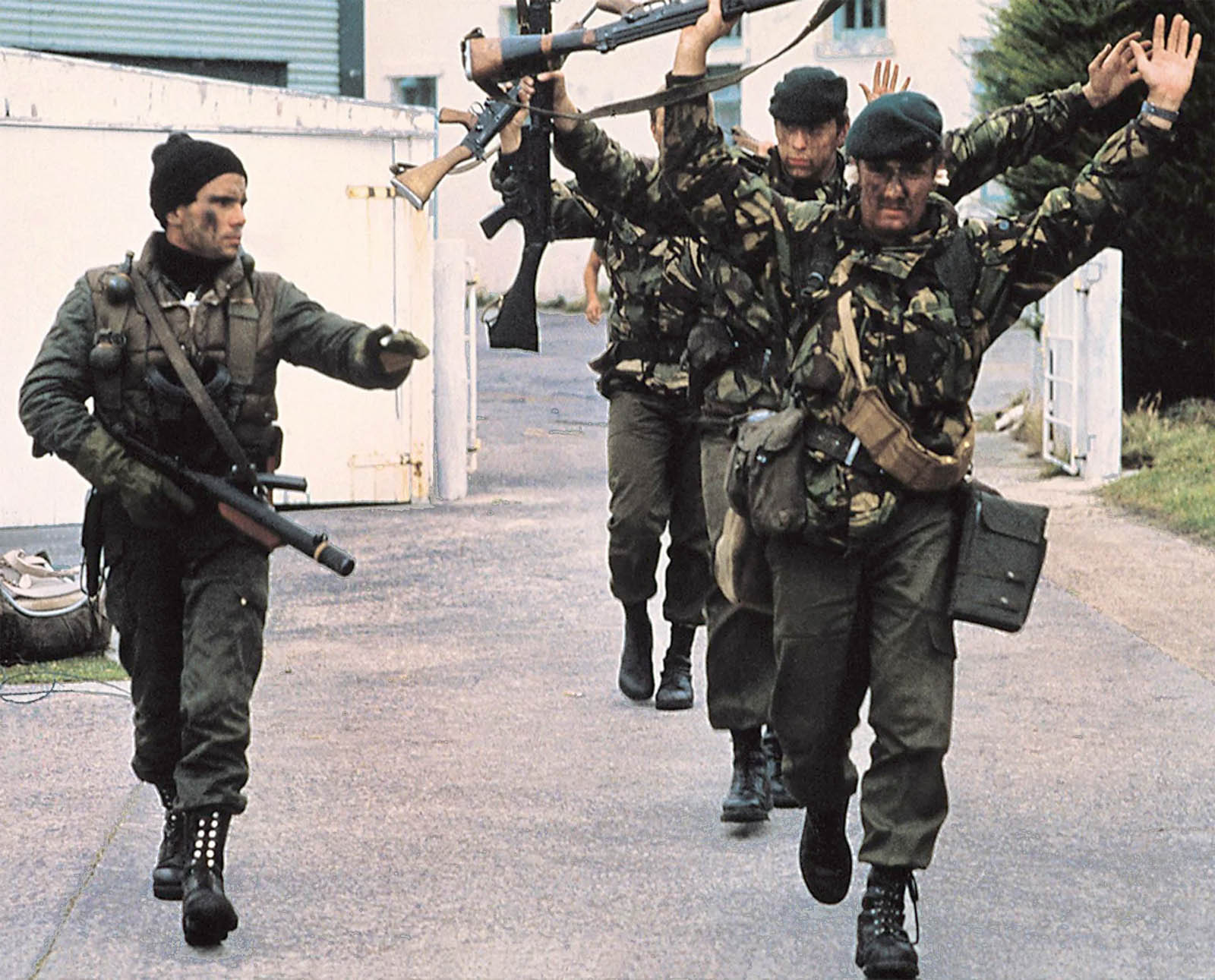
Rafael Wollmann (Argentinian, b. 1958) 'British Marines surrender to Argentinean troops in Malvinas/Falklands' April 2, 1982, printed 2012


Rafael Wollmann (Argentinian, b. 1958)
British Marines surrender to Argentinean troops in Malvinas/Falklands
April 2, 1982, printed 2012
Inkjet print
15 7/8 × 20 in. (40.4 × 50.8cm)
The Museum of Fine Arts, Houston
Gift of Rafael Wollmann


David Leeson (American, b. 1957) 'Death of a Soldier, Iraq' March 24, 2003


David Leeson (American, b. 1957)
Death of a Soldier, Iraq
March 24, 2003
Inkjet print, printed 2012
Courtesy of the artist


Ziv Koren (Israeli, b. 1970) 'A sniper’s-eye view of Rafah, in the Southern Gaza strip, during an Israeli military sweep' 2006


Ziv Koren (Israeli, b. 1970)
A sniper’s-eye view of Rafah, in the Southern Gaza strip, during an Israeli military sweep
2006
Inkjet print, printed 2012
© Ziv Koren/Polaris Images


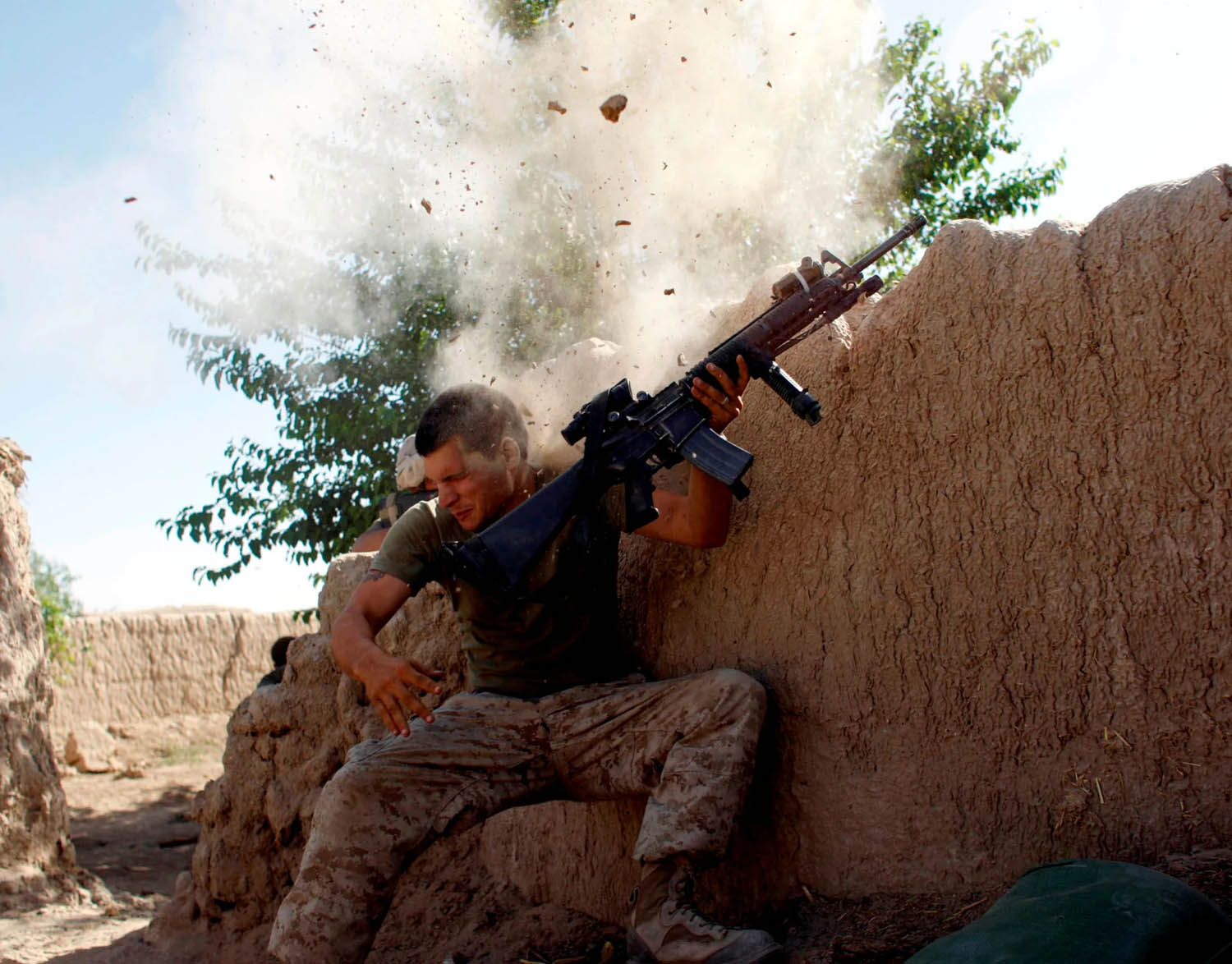
Goran Tomasevic (Serbian, b. 1959) /Reuters. 'SHOOTING. Sgt. William Olas Bee, a US Marine from the 24th Marine Expeditionary Unit, has a close call after Taliban fighters opened fire near Garmser in Helmand Province of Afghanistan May 18, 2008. The Marine was not injured.' 2008


Goran Tomasevic (Serbian, b. 1959) /Reuters
SHOOTING. Sgt. William Olas Bee, a US Marine from the 24th Marine Expeditionary Unit, has a close call after Taliban fighters opened fire near Garmser in Helmand Province of Afghanistan May 18, 2008. The Marine was not injured.
2008


Tomašević began photographing the war that followed the breakup of Yugoslavia from 1991 for daily newspaper Politika. In 1996 he joined the world’s largest news agency, Reuters, covering the simmering political tensions in Kosovo and the anti-Milošević demonstrations in his hometown of Belgrade since mid-1990s. During three-month NATO bombing of Yugoslavia in 1999, Tomašević was the only photographer working for foreign press to spend the duration of the conflict in Kosovo.

Tomašević moved to Jerusalem in 2002, covering the second Palestinian intifada. During the U.S. led invasions of Iraq in 2003, his picture of a U.S. Marine watching the toppling of a Saddam Hussein statue became one of the most memorable images of the war. He often returned to Iraq as sectarian violence escalated and regularly photographed America’s other war in Afghanistan. His sequence of photographs of U.S. Marine Sergeant Bee narrowly escaping Taliban bullets became an iconic image in U.S. war history.

Tomašević moved to Cairo in 2006 and was at the heart of Reuters’ coverage of the Arab Springs. In Libya, his image of a fireball that spewed up after an air strike on pro-Gaddafi fighters became an iconic image of the Libyan war, gracing the front pages of more than 100 newspapers around the globe. He stayed in Cairo until 2012. His raw pictures of rebel fighters battling pro-Assad forces among the ruins of Aleppo and Damascus during the Syrian Civil War have won international acclaim, as did his coverage of the bloody siege on a Nairobi shopping mall in Kenya. Tomašević worked for Reuters until 2022.

Text from the Wikipedia website


Museum of Fine Arts, Houston
1001 Bissonnet Street
Houston, TX 77005

Opening hours:
Wednesday 11am – 5pm
Thursday 11am – 9pm
Friday 11am – 6pm
Saturday 11am – 6pm
Sunday 12.30pm – 6pm
Closed Monday and Tuesday, except Monday holidays
Closed Thanksgiving Day and Christmas Day

Museum of Fine Arts, Boston website

LIKE ART BLART ON FACEBOOK

Back to top

Exhibition: ‘WAR/PHOTOGRAPHY: Images of Armed Conflict and Its Aftermath’ at the Museum of Fine Arts, Houston, Part 1

Exhibition dates: 11th November 2012 – 3rd February 2013

Curators: Anne Tucker, Natalie Zelt and Will Michels


Roger Fenton (British, 1819-1869) 'The Valley of the Shadow of Death' 1855


Roger Fenton (British, 1819-1869)
The Valley of the Shadow of Death
1855


This is the biggest posting on one exhibition that I have ever undertaken on Art Blart!

As befits the gravity of the subject matter this posting is so humongous that I have had to split it into 4 separate postings. This is how to research and stage a contemporary photography exhibition that fully explores its theme (NGV please note!). The curators reviewed more than one million photographs in 17 countries, locating pictures in archives, military libraries, museums, private collections, historical societies and news agencies; in the personal files of photographers and service personnel; and at two annual photojournalism festivals producing an exhibition that features 26 sections (an inspired and thoughtful selection) that includes nearly 500 objects that illuminate all aspects of WAR/PHOTOGRAPHY.

I have spent hours researching and finding photographs on the Internet to support the posting. It has been a great learning experience and my admiration for photographers of all types has increased. I have discovered the photographs and stories of new image makers that I did not know and some hidden treasures along the way. I hope you enjoy this monster posting on a subject matter that should be consigned to the history books of human evolution.

**Please be aware that there are graphic photographs in all of these postings.** Part 2Part 3Part 4

Dr Marcus Bunyan


Many thankx to the Museum of Fine Arts, Houston for allowing me to publish some of the photographs in the posting. Please click on the photographs for a larger version of the image.


On November 11, 2012, the Museum of Fine Arts, Houston, debuts an unprecedented exhibition exploring the experience of war through the eyes of photographers. WAR / PHOTOGRAPHY: Images of Armed Conflict and Its Aftermath features nearly 500 objects, including photographs, books, magazines, albums and photographic equipment. The photographs were made by more than 280 photographers, from 28 nations, who have covered conflict on six continents over 165 years, from the Mexican-American War of 1846 through present-day conflicts. The exhibition takes a critical look at the relationship between war and photography, exploring what types of photographs are, and are not, made, and by whom and for whom. Rather than a chronological survey of wartime photographs or a survey of “greatest hits,” the exhibition presents types of photographs repeatedly made during the many phases of war – regardless of the size or cause of the conflict, the photographers’ or subjects’ culture or the era in which the pictures were recorded. The images in the exhibition are organised according to the progression of war: from the acts that instigate armed conflict, to “the fight,” to victory and defeat, and images that memorialise a war, its combatants and its victims. Both iconic images and previously unknown images are on view, taken by military photographers, commercial photographers (portrait and photojournalist), amateurs and artists.

“‘WAR/PHOTOGRAPHY’ promises to be another pioneering exhibition, following other landmark MFAH photography exhibitions such as ‘Czech Modernism: 1900-1945’ (1989) and ‘The History of Japanese Photography’ (2003),” said Gary Tinterow, MFAH director. “Anne Tucker, along with her co-curators, Natalie Zelt and Will Michels, has spent a decade preparing this unprecedented exploration of the complex and profound relationship between war and photography.” “Photographs serve the public as a collective memory of the experience of war, yet most presentations that deal with the material are organised chronologically,” commented Tucker. “We believe ‘WAR / PHOTOGRAPHY’ is unique in its scope, exploring conflict and its consequences across the globe and over time, analysing this complex and unrelenting phenomenon.”

The earliest work in the exhibition is from 1847, taken from the first photographed conflict: the Mexican-American War. Other early examples include photographs from the Crimean War, such as Roger Fenton’s iconic The Valley of the Shadow of Death (1855) and Felice Beato’s photograph of the devastated interior of Fort Taku in China during the Second Opium War (1860). Among the most recent images is a 2008 photograph of the Battle Company of the 173rd Airborne Brigade in the remote Korengal Valley of Eastern Afghanistan by Tim Hetherington, who was killed in April 2011 while covering the civil war in Libya. Also represented with two photographs in the exhibition is Chris Hondros, who was killed with Hetherington. While the exhibition is organised according to the phases of war, portraits of servicemen, military and political leaders and civilians are a consistent presence throughout, including Yousuf Karsh’s classic 1941 image of Winston Churchill, and the Marlboro Marine (2004), taken by embedded Los Angeles Times photographer Luis Sinco of soldier James Blake Miller after an assault in Fallujah, Iraq. Sinco’s image was published worldwide on the cover of 150 publications and became a 2005 Pulitzer Prize finalist.

The exhibition was initiated in 2002, when the MFAH acquired what is purported to be the first print made from Joe Rosenthal’s negative of Old Glory Goes Up on Mount Suribachi, Iwo Jima (1945). From this initial acquisition, the curators decided to organise an exhibition that would focus on war photography as a genre. During the evolution of the project, the museum acquired more than a third of the prints in the exhibition. The curators reviewed more than one million photographs in 17 countries, locating pictures in archives, military libraries, museums, private collections, historical societies and news agencies; in the personal files of photographers and service personnel; and at two annual photojournalism festivals: World Press Photo (Amsterdam) and Visa pour l’Image (Perpignan, France). The curators based their appraisals on the clarity of the photographers’ observation and capacity to make memorable and striking pictures that have lasting relevance. The pictures were recorded by some of the most celebrated conflict photographers, as well as by many who remain anonymous. Almost every photographic process is included, ranging from daguerreotypes to inkjet prints, digital captures and cell-phone shots.

Press release from the Museum of Fine Arts, Houston


Yousuf Karsh (Armenian-Canadian, 1908-2002) 'Winston Churchill' 1941


Yousuf Karsh (Armenian-Canadian, 1908-2002)
Winston Churchill
1941
Gelatin silver print


WAR/PHOTOGRAPHY: Images of Armed Conflict and Its Aftermath is organised into 26 sections, which unfold in the sequence that typifies the stages of war, from the advent of conflict through the fight, aftermath and remembrance. Each section showcases images appropriate to that category while cutting across cultures, time and place. Outside of this chronological approach are focused galleries for “Media Coverage and Dissemination” (with an emphasis on technology); “Iwo Jima” (a case study); and “Photographic Essays” (excerpts from two landmark photojournalism essays, by Larry Burrows and Todd Heisler).

Media Coverage and Dissemination

1. Media Coverage and Dissemination provides an overview of how technology has profoundly affected the ways that pictures from the front reach the public: from Roger Fenton and his horse-drawn photography van (commissioned by the British government to document the Crimean War), to Joe Rosenthal’s 1940s Anniversary Speed Graphic (4 x 5) camera, to pictures taken with the Hipstamatic app of an iPhone by photojournalist Michael Christopher Brown in Egypt during the protests and clashes of the Arab Spring. (22 images / objects)


Roger Fenton (English, 1819-1869) 'The artist's van [Marcus Sparling, full-length portrait, seated on Roger Fenton's photographic van]' 1855


Roger Fenton (British, 1819-1869)
The artist’s van [Marcus Sparling, full-length portrait, seated on Roger Fenton’s photographic van]
1855
Salted paper print
17.5 × 16.5cm
Library of Congress, Prints & Photographs Division


Manufactured by Graflex, active 1912-1973. 'Anniversary Speed Graphic (4 x 5), "Scott S. Wigle camera" (First American-made D-Day picture)' c. 1940


Manufactured by Graflex, active 1912-1973
Anniversary Speed Graphic (4 x 5), “Scott S. Wigle camera” (First American-made D-Day picture)
c. 1940
Camera
Collection of George Eastman House (Gift of Graflex, Inc.)


An Advent of War

2. The photographs in An Advent of War depict the catalytic events of war. These moments of instigation are rarely captured, as photographers are not always present at the initial attack or provocation. Photographs that Robert Clark took on the morning of September 11, 2001, and the aerial view of torpedoes approaching Battleship Row during the Pearl Harbor attack, taken by an unknown Japanese airman on December 7, 1941, both convey with clarity the concept of war’s advent. (11 images).


Unknown photographer (Japanese) 'War in Hawaiian Water. Japanese Torpedoes Attack Battleship Row, Pearl Harbor' December 7, 1941


Unknown photographer (Japanese)
War in Hawaiian Water. Japanese Torpedoes Attack Battleship Row, Pearl Harbor
December 7, 1941
Gelatin silver print
The Museum of Fine Arts, Houston, gift of Will Michels


Recruitment & Embarkation

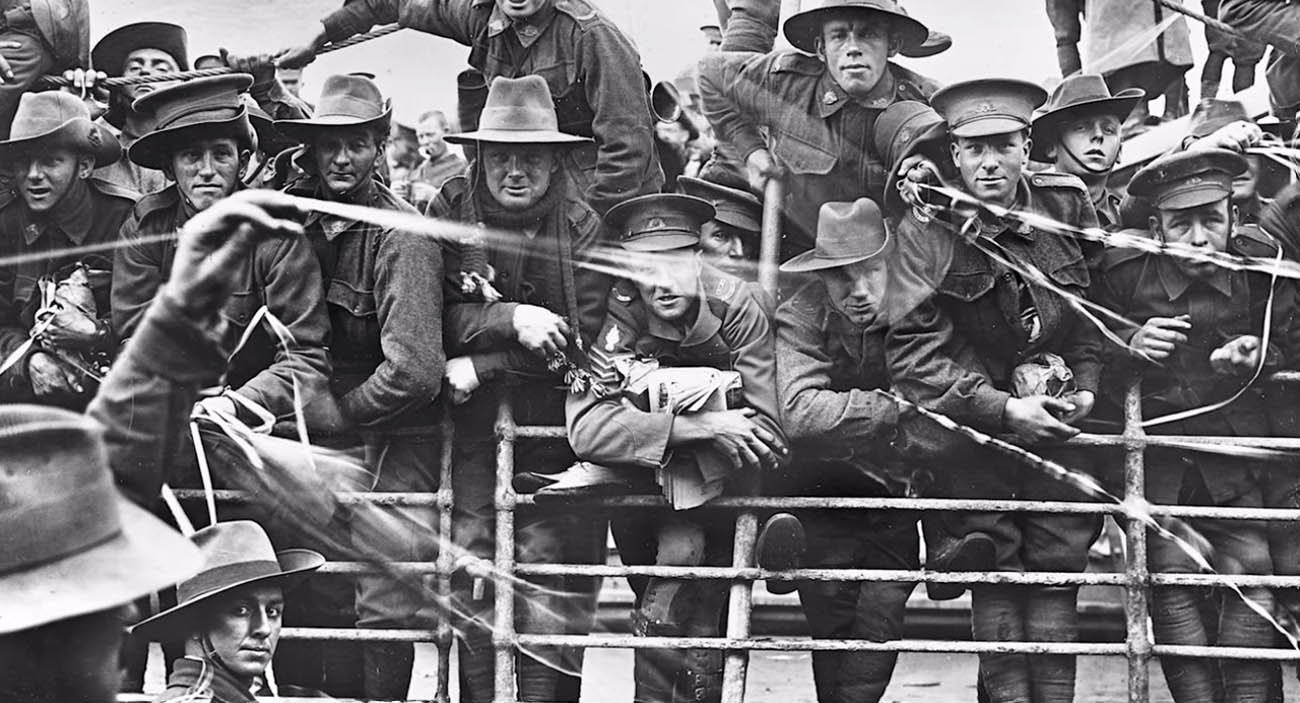
3. Recruitment & Embarkation shows mobilisation: the movement toward the front. Mikhail Trakhman captures a Russian mother kissing her son goodbye in Kolkhoz farmer M. Nikolaïeva bids her son Ivan goodbye before he joins the partisans (1942), while a 1916 photograph by Josiah Barnes, known as the “Embarkation Photographer,” shows an archetypal moment: young Australian soldiers waving goodbye from a ship as they depart their home country to fight in World War I. (7 images)


Josiah Barnes (Australian, 1858-1921) 'Embarkation of HMAT Ajana, Melbourne' July 8, 1916


Josiah Barnes (Australian, 1858-1921)
Embarkation of HMAT Ajana, Melbourne
July 8, 1916
Gelatin silver print (printed 2012)
On loan from the Australian War Memorial


Known as “the embarkation photographer”, the Kew, Melbourne photographer Josiah Barnes took an interest in photographing Australian troopships as they departed for war from Melbourne. He had two sons, “Norm and Victor, who left for war in 1916 (both returned to Australia after their service),” which may have fuelled his interest.


Mikhail Trakhman (Russian, 1918-1976) 'Kolkhoz farmer M. Nikolaïeva bids her son Ivan goodbye before he joins the partisans' 1942


Mikhail Trakhman (Russian, 1918-1976)
Kolkhoz farmer M. Nikolaïeva bids her son Ivan goodbye before he joins the partisans
1942
Gelatin silver print


A kolkhoz was a form of collective farm in the Soviet Union which, alongside sovkhoz (state farm), formed the main components of the socialised farm sector which emerged after the October Revolution of 1917 as an antithesis to feudalism, aristocratic landlords, serfdom and individual farming.

Mikhail Trakhman

Mikhail Trakhman was born in Moscow in 1918. After graduating from school, he began working at the newsreel studio and at the same time studying for courses in the field of assistant operator. From 1938 he became the photo reporter of the Uchitelskaya Gazeta, and in 1939 he was drafted into the army and participated in the Soviet-Finnish war. During the Great Patriotic War, Mikhail Trakhman worked as a press photographer for the Soviet Information Bureau. His main instrument was the famous “Leica” camera, but often military weapons fell into his hands. He shot in besieged Leningrad, in Pskov and in Belarus, participated in the liberation of Poland and Hungary. The most famous are his photographs from the partisan series taken in the rear of the German troops. In his diaries, he wrote: “I take a lot of things, although I know that 80% of the shot will go to the basket, but I need to shoot it, since such things happen once in a lifetime.” Thanks to these photos, he entered the history of war reporting. Mikhail Trakhman was awarded the Order of the Red Star and the medal “For the Defense of Leningrad” and “Partisan Medal”, which he especially valued.

Anonymous. “Mikhail Trakhman,” on the Lumiere Brothers Gallery website [Online] Cited 06/09/2020


Training

4. Training explores photographs of soldiers in boot camp or more-advanced phases of instruction and exercise. World War II Royal Navy officers gather around a desk to study different types of aircraft in a photograph by Sir Cecil Beaton. Also included is the iconic Vietnam-era photograph of a U.S. Marine drill sergeant reprimanding a recruit in South Carolina, from Thomas Hoepker’s series US Marine Corps boot camp, 1970. In one photograph, shot by a Japanese soldier and published in 1938 by Look magazine, Japanese soldiers use living Chinese prisoners in bayonet practice. (13 images) 


Thomas Hoepker (German, 1936-2024) 'A US Marine drill sergeant delivers a severe reprimand to a recruit, Parris Island, South Carolina' 1970


Thomas Hoepker (German, 1936-2024)
A US Marine drill sergeant delivers a severe reprimand to a recruit, Parris Island, South Carolina
1970
From the series US Marine Corps boot camp, 1970
Inkjet print
Thomas Hoepker / Magnum Photos
© Thomas Hoepker / Magnum Photos


Daily Routine

5. Daily Routine features moments of boredom, routine and playfulness. A member of the U.S. Army Signal Corps wears a gas mask as he peels onions. A 1942 photograph by Sir Cecil Beaton catches the off-guard expression of a Royal Navy man at a sewing machine, mending a signal flag. (13 images)
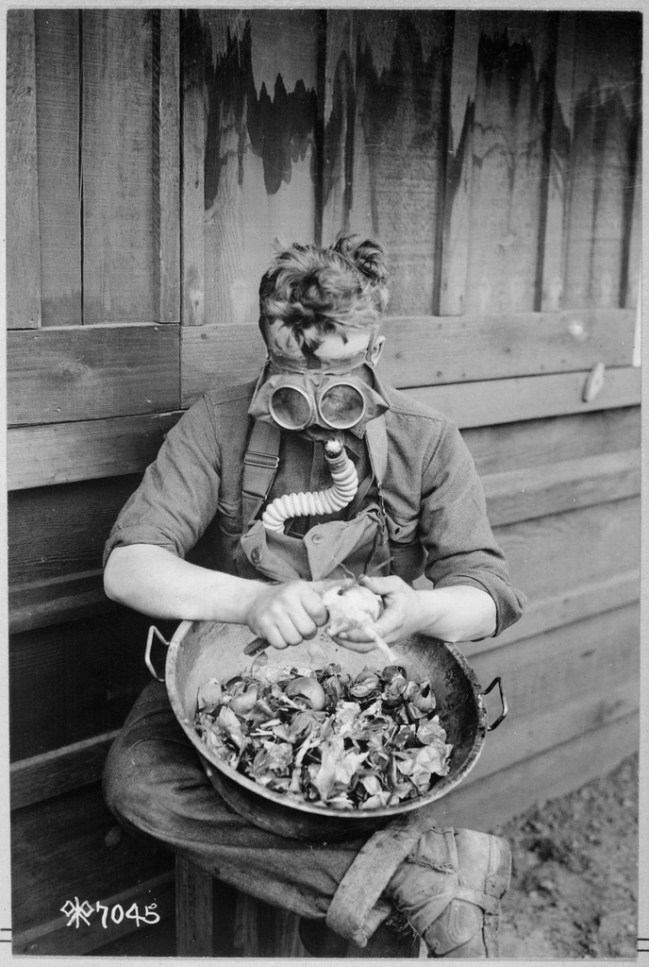
 

Anonymous photographer. 'Soldiers trying out their gas masks in every possible way. Putting the respirator to good use while peeling onions. 40th Division, Camp Kearny, San Diego, California' 1918


Anonymous photographer
Soldiers trying out their gas masks in every possible way. Putting the respirator to good use while peeling onions. 40th Division, Camp Kearny, San Diego, California
1918
National Archives and Records Administration
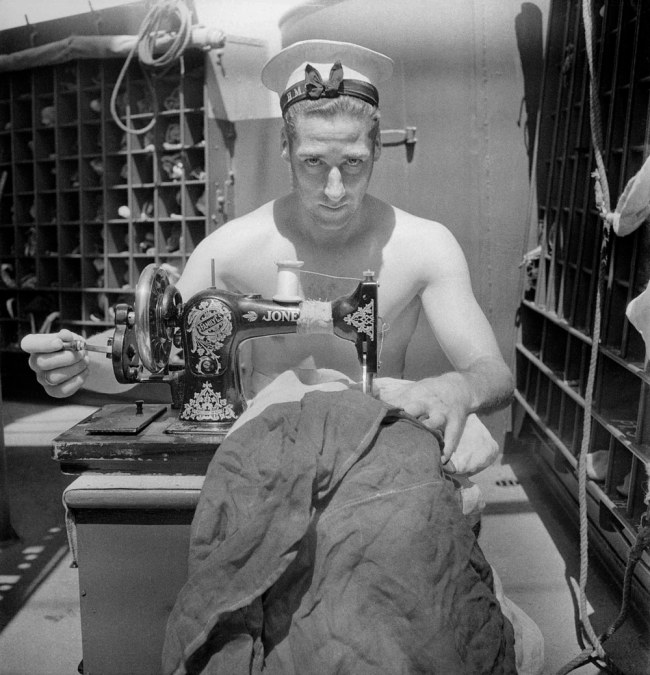
 

Cecil Beaton (English, 1904-1980) 'A Royal Navy sailor on board HMS Alcantara uses a portable sewing machine to repair a signal flag during a voyage to Sierra Leone' March 1942


Cecil Beaton (English, 1904-1980)
A Royal Navy sailor on board HMS Alcantara uses a portable sewing machine to repair a signal flag during a voyage to Sierra Leone
March 1942
Gelatin silver print, printed 2012
The Museum of Fine Arts, Houston
Gift of the Phillip and Edith Leonian Foundation
© The Imperial War Museums (neg. #CBM 1049)


HMS Alcantara

HMS Alcatara was an RML passenger liner of 22,209 tons and 19 knots launched in 1926, and taken up by the Royal Navy for conversion to an armed merchant cruiser to counter the threat posed by German surface raiders against shipping. When Jim Hingston joined her as an ordinary seaman at Freetown she was still largely in merchant dress, with wood panelling throughout. Much to the regret of her crew this was removed during their stay at Simonstown – the wisdom of that was apparent to them only too soon.

There were some 53 such ships in all, poorly armed, in Alcantara‘s case with eight 6 inch and two 3 inch guns, the former having a range of some 14,200 yards (13,000 metres). Such armament could not be much more than defensive, the intention being that the AMCs should radio the position of the German ship and not only give merchant shipping a chance to escape but delay the commerce raider long enough to allow regular RN warships to get to the scene.

Alcantara‘s opponent, the Thor, was laid down in 1938 as a freighter of 9,200 tons displacement and a speed of 18 knots, but commissioned as a commerce raider on 14 March 1940. Though she had only 6 150 mm guns they had a much greater range, at 20,000 yards, than Alcantara and other British AMCs. She also carried a scout floatplane. During the engagement with Alcantara on 28 July 1940 the Thor inflicted significant damage but the Alcantara successfully closed, and after being hit the Thor withdrew in order to avoid the risk of being crippled or being forced to abort her mission. In later encounters with AMCs the Thor severely damaged the Carnarvon Castle and sank Voltaire.

HMS Alcantara later had her 6 in armament upgraded and was equipped with a seaplane, but as the threat of surface raiders receded she was converted to her more natural role of troopship in 1943.


Reconnaissance, Resistance and Sabotage

6. Images of Reconnaissance, Resistance and Sabotage are scarce by nature, as they reveal spies in the act and could be used against those depicted or their families. A U.S. soldier on night watch sits atop a mountain in Afghanistan, wrapped in a blanket and peering into night-vision equipment, in a photograph by Adam Ferguson. A photograph by T. E. Lawrence (known as Lawrence of Arabia) documents the bombing of the Hejaz Railway during the Arab Revolt. Cas Oorthuys’ photograph Under German Occupation (Dutch Worker’s Front), Amsterdam (c. 1940-1945), taken with a camera hidden in his jacket, shows the back of a fellow countryman who is helping to conceal the photographer, with German troops in the distance. Also included is Arkady Shaikhet’s 1942 photograph Partisan Girl depicting Olga Mekheda, who was renowned for her ability to get through German roadblocks – even while pregnant. (10 images)


T.E. Lawrence. 'Untitled [A Tulip bomb explodes on the railway Hejaz Railway, near Deraa, Hejaz, Ottoman Empire]' 1918


T.E. Lawrence (British, 1888-1935)
Untitled [A Tulip bomb explodes on the railway Hejaz Railway, near Deraa, Hejaz, Ottoman Empire]
1918
Collection of the MFA Houston
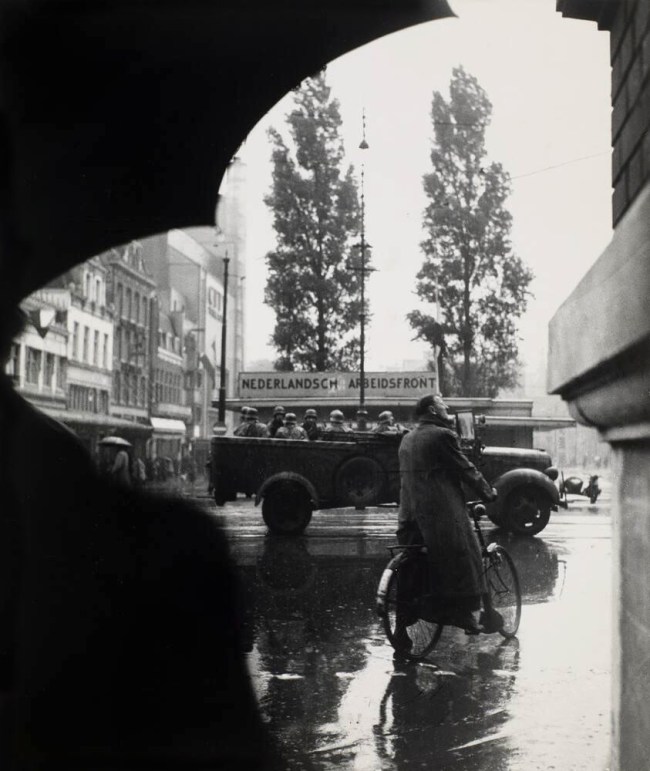
 

Cas Oorthuys (Dutch, 1908-1975) 'Under German Occupation (Dutch Worker's Front), Amsterdam' c. 1940-1945


Cas Oorthuys (Dutch, 1908-1975)
Under German Occupation (Dutch Worker’s Front), Amsterdam
c. 1940-1945
Gelatin silver print
13 7/8 × 11 5/8 in. (35.2 × 29.5cm)
Museum of Fine Arts, Houston
Museum purchase funded by Anne Wilkes Tucker in honor of the 50th wedding anniversary of Max and Isabell Smith Herzstein


Adam Ferguson (Australian, b. 1978) 'September 4, Tangi valley, Wardak province, Afghanistan, a soldier of the U.S. Army 10th Mountain Division was attentively monitoring a highway' September 4, 2009


Adam Ferguson (Australian, b. 1978)
September 4, Tangi valley, Wardak province, Afghanistan, a soldier of the U.S. Army 10th Mountain Division was  attentively monitoring a highway
September 4, 2009


“To me, this picture epitomises the abstract idea of the ‘enemy’ that exists within the U.S. led war in Afghanistan: a young infantryman watches a road with a long-range acquisition sight surveying for insurgents planting Improvised Explosive Devices. U.S. Army Infantrymen rarely knowingly come face to face with their enemy, combat is fleeting and fought like cat and mouse, and the most decisive blows are determined by intelligence gathering, and then delivered through technology that maintains a safe distance, just like a video game.”

~ Adam Ferguson
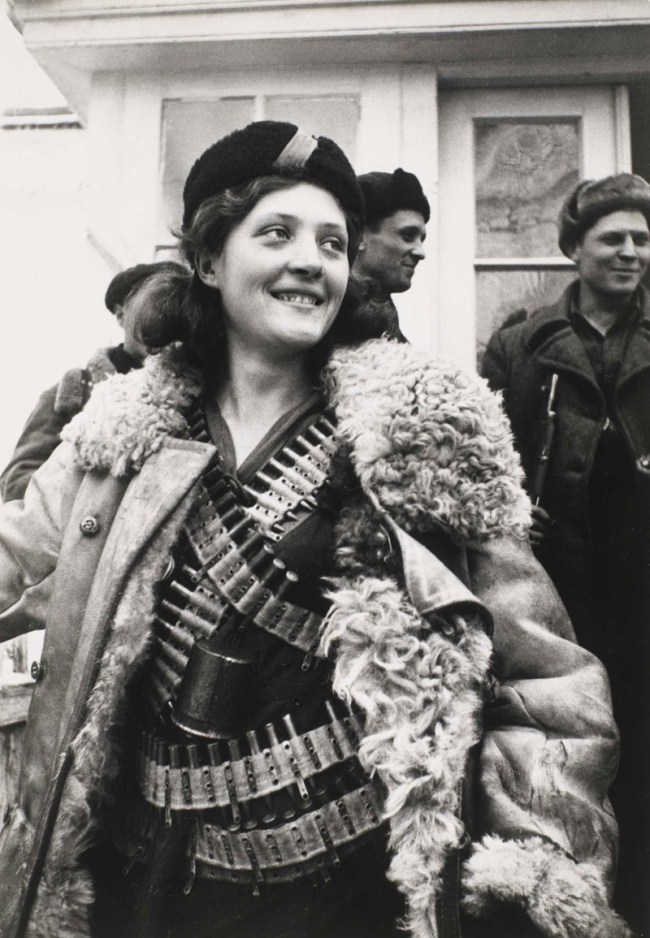
 

Arkady Shaikhet (Russian, 1898-1959) 'Partisan Girl' 1942


Arkady Shaikhet (Russian, 1898-1959)
Partisan Girl
1942
Gelatin silver print
The Museum of Fine Arts, Houston, gift of Marion Mundy
© Arkady Shaikhet Estate, Moscow, courtesy Nailya Alexander Gallery, NYC


Patrol & Troop Movement

7. Patrol & Troop Movement conveys the mass movements of peoples and personnel by land, sea and air, from the movement of troops and supplies to patrols by all five divisions of military service: Army, Navy, Marine Corps, Coast Guard and Air Force. Combat patrols are detachments of forces sent into hostile terrain for a range of missions, and they – as well as the photographers accompanying them – face considerable danger. João Silva’s three sequenced frames show, through his eyes, the tilted earth just after he was felled by an IED while on patrol in Afghanistan in 2010; he lost both legs in the incident. A tranquil, 1917 image by Australian James Frank Hurley depicts silhouetted soldiers walking in a line, their reflections captured in a body of water. A 1943 photograph by American Warrant Photographer Jess W. January USCGR shows members of the U.S. Coast Guard observing a depth-charge explosion hitting a German submarine that stalked their convoy. (14 images)

.

João Silva (South African born Portugal, b. 1966) 'Soldiers of Charlie Company, 1st Battalion, 66th Armored Regiment, 4th Infantry Division react to photographer Joao Silva stepping on a mine in the Arghandab district of Kandahar Province, Afghanistan, on Oct. 23, 2010'


João Silva (South African born Portugal, b. 1966)
Soldiers of Charlie Company, 1st Battalion, 66th Armored Regiment, 4th Infantry Division react to photographer Joao Silva stepping on a mine in the Arghandab district of Kandahar Province, Afghanistan, on Oct. 23, 2010, in a three-photo combination. For American troops in heavily-mined Afghan villages, steering clear of improvised explosive devices is the most difficult task
October 23, 2010
© João Silva / The New York Times via Redux


Frank Hurley (Australian, 1885-1962) 'Supporting troops of the 1st Australian Division walking on a duckboard track' 1917


Frank Hurley (Australian, 1885-1962)
Supporting troops of the 1st Australian Division walking on a duckboard track
1917
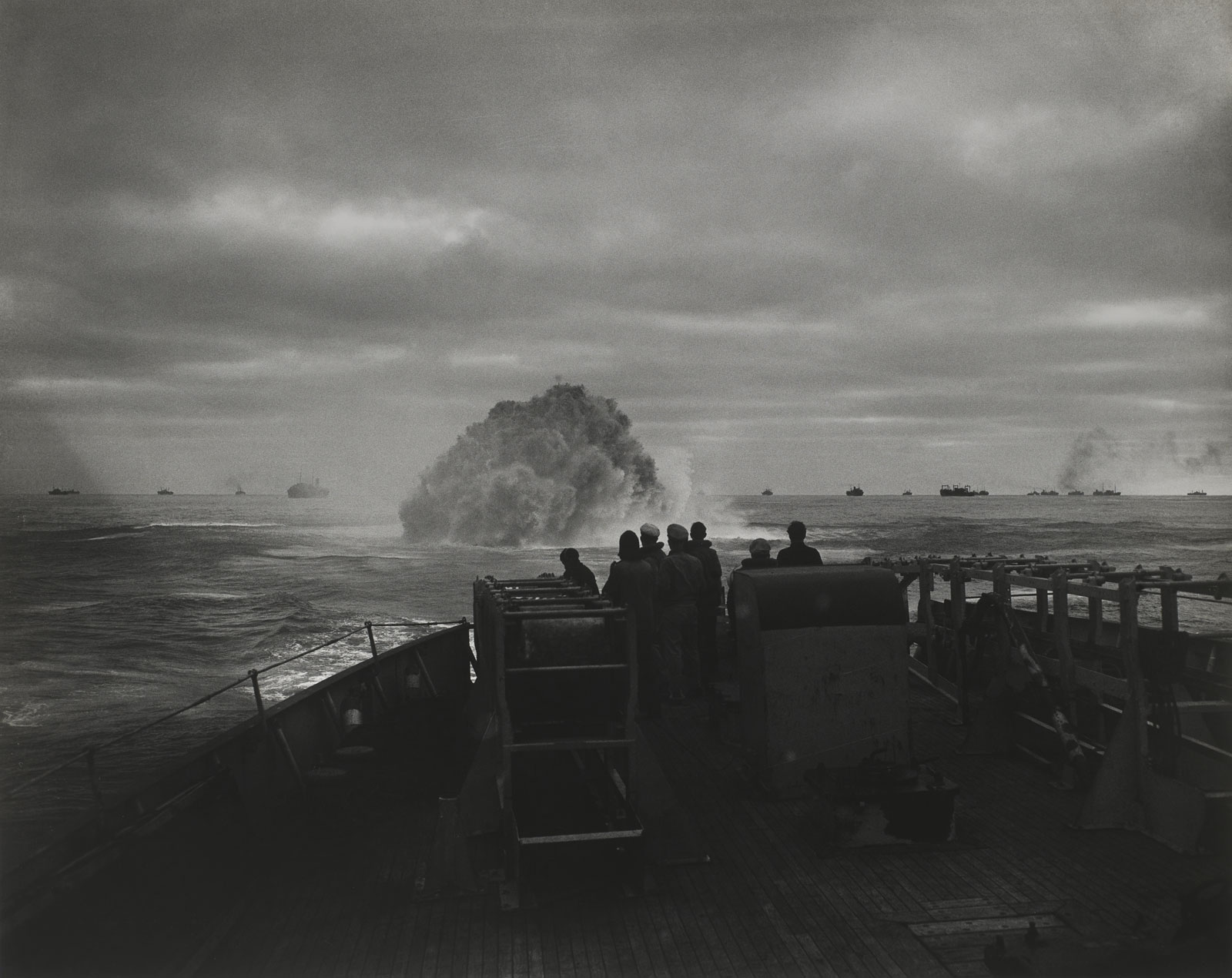
 

Warrant Photographer Jess W. January USCGR, American USCG. 'Cutter Spencer destroys Nazi sub' April 17, 1943


Warrant Photographer Jess W. January USCGR, American
USCG Cutter Spencer destroys Nazi sub
April 17, 1943
Gelatin silver print
The Museum of Fine Arts, Houston


The Wait

8. The Wait depicts a common situation of wartime. Susan Meiselas captures a tense moment during a 1978 street fight in Nicaragua, when muchachos with Molotov cocktails line up in an alleyway, ready to initiate an attack on the National Guard. Robert Capa shows two female French ambulance drivers in Italy during World War II, leaning against their vehicle, knitting, as they wait to be called. (8 images)
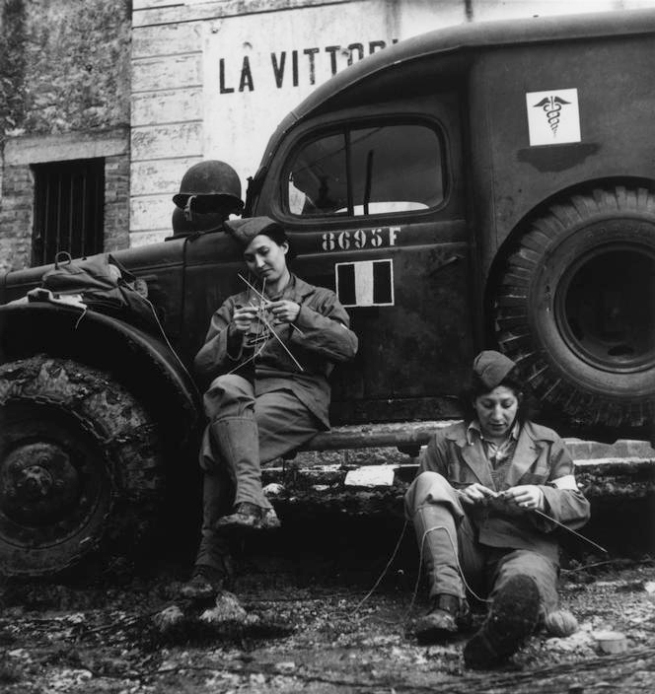
 

Robert Capa (American-Hungarian, 1913-1954) 'Drivers from the French ambulance corps near the front, waiting to be called' Italy, 1944


Robert Capa (American-Hungarian, 1913-1954)
Drivers from the French ambulance corps near the front, waiting to be called
Italy, 1944
Original album – Italy. Cassino Campaign. W.W.II.
© 2001 By Cornell Capa, Agentur Magnum


Susan Meiselas (American, b. 1948) 'Muchachos Await Counter Attack by The National Guard, Matagalpa, Nicaragua' 1978


Susan Meiselas (American, b. 1948)
Muchachos Await Counter Attack by The National Guard, Matagalpa, Nicaragua
1978
Chromogenic print (printed 2006)
The Museum of Fine Arts, Houston, museum purchase with funds provided by Photo Forum 2006
© Susan Meiselas / Magnum Photos


The Fight

9. The Fight is one of the most extensive sections in the exhibition. Dmitri Baltermants shot Attack – Eastern Front WWII (cover image of the exhibition catalogue) in 1941 from the trench, as men charged over him. Sky Over Sevastopol (1944), by Evgeny Khaldey, is an aerial photograph of planes on their way to a bombing raid of the strategically important naval point. Joe Rosenthal’s Over the Top – American Troops Move onto the Beach at Iwo Jima (1945) pictures infantrymen emerging from the protection of their landing craft into enemy fire. Staged photographs, presented as authentic documents, tend to proliferate during wartime, and several examples are included here. In 1942 the Public Relations Department of the War issued an assignment to photographers to create “representative” images of combat in North Africa for more dynamic images; official British photographer Len Chetwyn staged an Australian officer leading the charging line in the battle of El Alamein, using smoke in the background from the cookhouse to create a lively image. (21 images)


Len Chetwyn (English, 1909-1980) 'Australians approached the strong point, ready to rush in from different sides' November 3, 1942


Len Chetwyn (English, 1909-1980)
Australians approached the strong point, ready to rush in from different sides
November 3, 1942
Silver gelatin photograph


Joe Rosenthal (American, 1911-2006) 'Over the Top – American Troops Move onto the Beach at Iwo Jima' 1945

Joe Rosenthal (American, 1911-2006) 'Over the Top - American Troops Move onto the Beach at Iwo Jima' February 19, 1945


Joe Rosenthal (American, 1911-2006)
Over the Top – American Troops Move onto the Beach at Iwo Jima
February 19, 1945 (printed February 23, 1945)
Gelatin silver print with applied ink
The Museum of Fine Arts, Houston, gift of Richard S. and Dodie Otey Jackson in honor of Ira J. Jackson, M.D., and his service in the Pacific Theater during World War II
© AP / Wide World Photos


Dmitri Baltermants (Russian, 1912-1990) 'Attack – Eastern Front WWII' 1941


Dmitri Baltermants (Russian, 1912-1990)
Attack – Eastern Front WWII
1941
Silver gelatin photograph


The Wait and Rescue

10. The Wait and Rescue bookend The Fight. Among the photographs in Rescue are Ambush of the 173rd AB, South Vietnam (1965), by Tim Page, showing soldiers immediately combing through a battleground to assist the wounded; American Lt. Wayne Miller’s image of a wounded gunner being lifted from the turret of a torpedo bomber; and Life magazine photographer W. Eugene Smith’s 1944 photograph of an American soldier rescuing a dying Japanese infant. Smith wrote about that moment, stating “hands trained for killing gently… extricated the infant” to be transported to medical care. (8 images) 
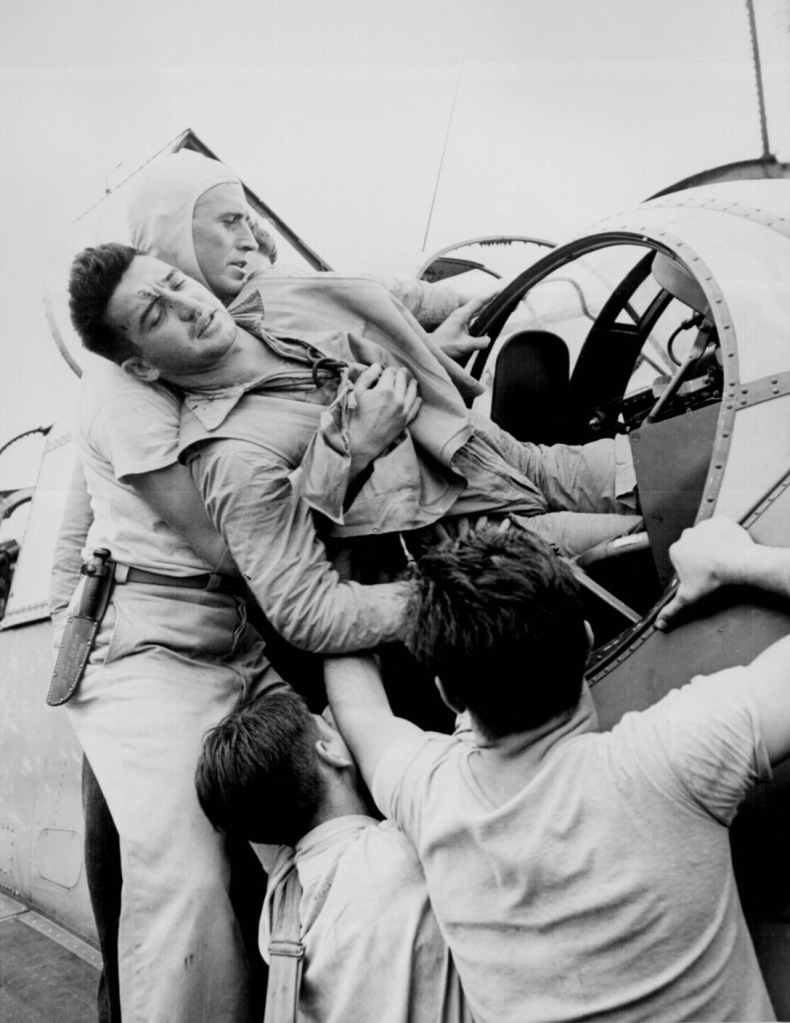
 

Lt. Wayne Miller. 'Crewmen lifting Kenneth Bratton out of turret of TBF on the USS SARATOGA after raid on Rabaul' November 1943


Lt. Wayne Miller (American, 1918-2013)
Crewmen lifting Kenneth Bratton out of turret of TBF on the USS SARATOGA after raid on Rabaul
November 1943
Silver gelatin photograph


More information: Kenneth C. Bratton – Mississippi (WWII vet). He was born in Pontotoc, MS, December 17, 1918. He passed away April 15, 1982. Lt. Bratton won a purple heart for his bravery during the attack on Rabaul November 11, 1943.


Wayne Forest Miller (September 19, 1918 – May 22, 2013) was an American photographer known for his series of photographs The Way of Life of the Northern Negro. Active as a photographer from 1942 until 1975, he was a contributor to Magnum Photos beginning in 1958. …

War photographer

Miller then served as a lieutenant in the U.S. Navy where he was assigned to Edward Steichen’s World War II Naval Aviation Photographic Unit. He was among the first Western photographers to document the destruction at Hiroshima.

Text from the Wikipedia website


The Grumman TBF Avenger (designated TBM for aircraft manufactured by General Motors) is an American World War II-era torpedo bomber developed initially for the United States Navy and Marine Corps, and eventually used by several air and naval aviation services around the world.

The Avenger entered U.S. service in 1942, and first saw action during the Battle of Midway. Despite the loss of five of the six Avengers on its combat debut, it survived in service to become the most effective and widely-used torpedo bomber of World War II, sharing credit for sinking the super-battleships Yamato and Musashi (the only ships of that type sunk exclusively by American aircraft while under way) and being credited for sinking 30 submarines. Greatly modified after the war, it remained in use until the 1960s.

Text from the Wikipedia website
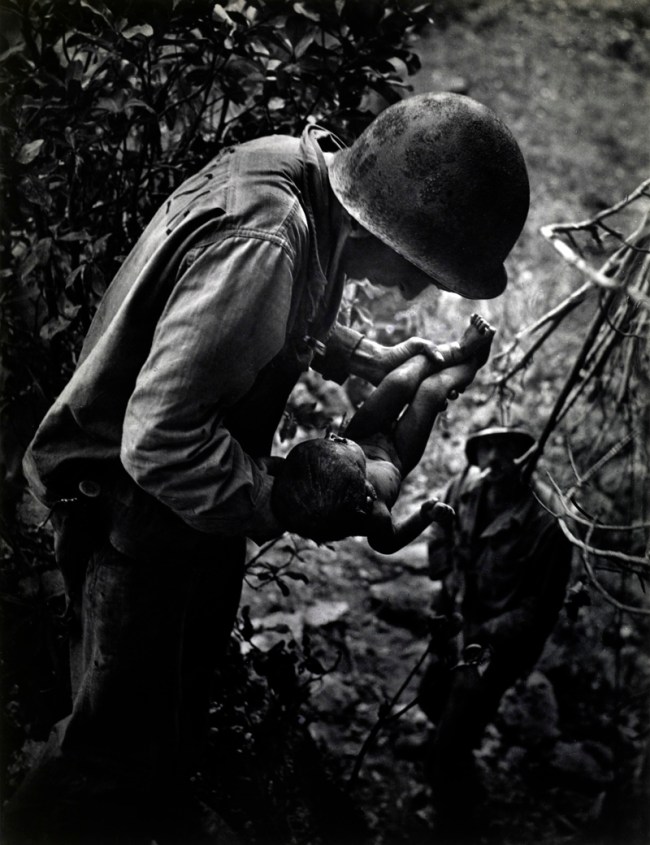
 

W. Eugene Smith (American, 1918-1978) 'Dying Infant Found by American Soldiers in Saipan' June 1944


W. Eugene Smith (American, 1918-1978)
Dying Infant Found by American Soldiers in Saipan
June 1944
Gelatin silver print
The Museum of Fine Arts, Houston, gift of Will Michels in honor of Anne Wilkes Tucker
© Estate of W. Eugene Smith / Black Star


Aftermath

11. Aftermath, with four subsections, features photographs taken after the battle has ended. “Death” on the battlefield is one of the earliest types of war images: Felice Beato photographed the dead in the interior of Fort Taku in the Second Opium War (1860). George Strock’s Dead GIs on Buna Beach, New Guinea (1943), which ran in Life magazine with personal details about the casualties, was the first published photograph from any conflict of American dead in World War II. In 1966, Associated Press photographer Henri Huet documented an American paratrooper, who was killed in action, being raised to an evacuation helicopter. Incinerated Iraqi, Gulf War, Iraq, taken by Kenneth Jarecke, was published in Europe, but the American Associated Press editors withheld it in the United States. “Shell Shock and Exhaustion” shows impenetrable exhaustion after battle. In Don McCullin’s Shell-shocked soldier awaiting transportation away from the front line, Hué, Vietnam (1968), the man looks forward with the “thousand-yard stare.” Robert Attebury photographed Marines so exhausted after a 2005 battle in Iraq that lasted 17 hours that they fell asleep where they had been standing, amid the rubble of a destroyed building. “Grief and Battlefield Burial” were taken at the site of the conflict, including David Turnley’s 1991 picture of a weeping soldier who has just learned that the remains in a nearby body bag are those of a close friend. “Destruction of Property” shows collateral damage from war. Christophe Agou, for instance, photographed the smouldering steel remains of the twin towers of the World Trade Center in 2001. (39 images)


George Strock (American, 1911-1977) 'Dead GIs on Buna Beach, New Guinea' January 1943


George Strock (American, 1911-1977)
Dead GIs on Buna Beach, New Guinea
January 1943
© George Strock / LIFE
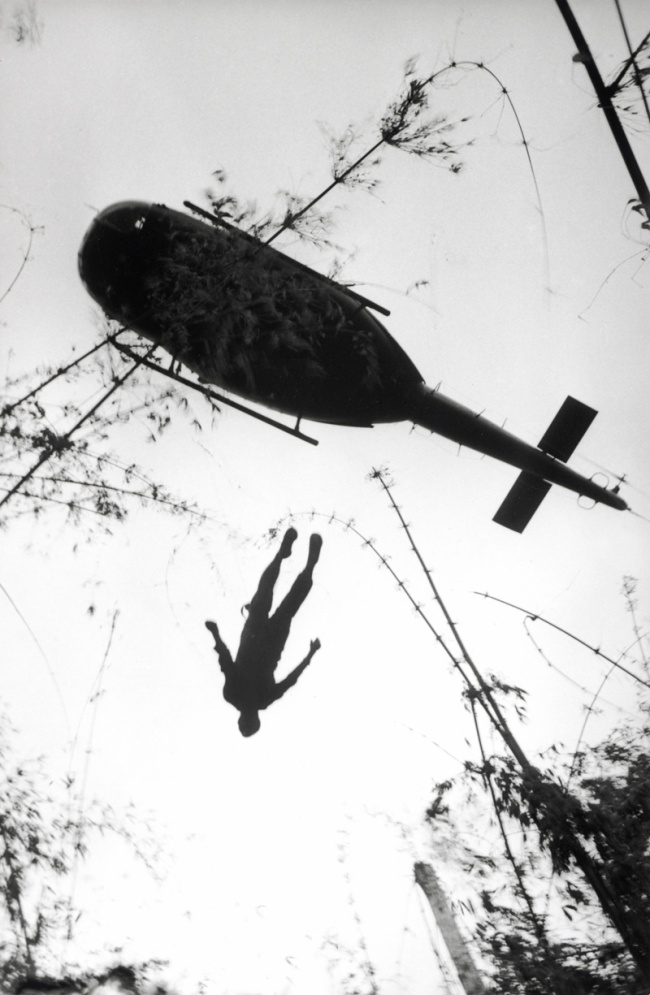
 

Henri Huet (French, 1927-1971) 'The body of an American paratrooper killed in action in the jungle near the Cambodian border is raised up to an evacuation helicopter, Vietnam' 1966


Henri Huet (French, 1927-1971)
The body of an American paratrooper killed in action in the jungle near the Cambodian border is raised up to an evacuation helicopter, Vietnam
1966
Gelatin silver print (printed 2004)
The Museum of Fine Arts, Houston, museum purchase
© AP / Wide World Photos
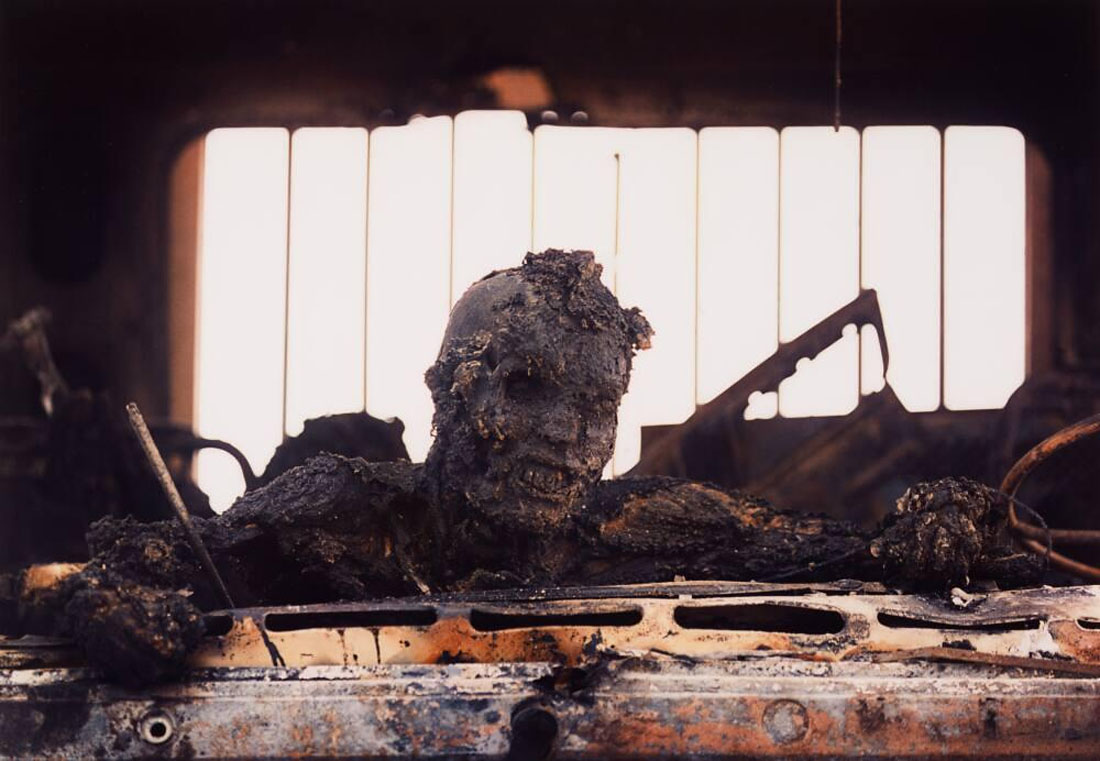
 

Kenneth Jarecke (American, b. 1963) 'Gulf War: Incinerated Iraqi soldier in personnel carrier'
Nasiriyah, Iraq, March 1991


Kenneth Jarecke (American, b. 1963)
Gulf War: Incinerated Iraqi soldier in personnel carrier
Nasiriyah, Iraq, March 1991


Felice Beato (Italian-British, 1832-1909) 'Angle of North Taku Fort at which the French entered' August 21-22, 1860


Felice Beato (Italian-British, 1832-1909)
Angle of North Taku Fort at which the French entered
August 21-22, 1860
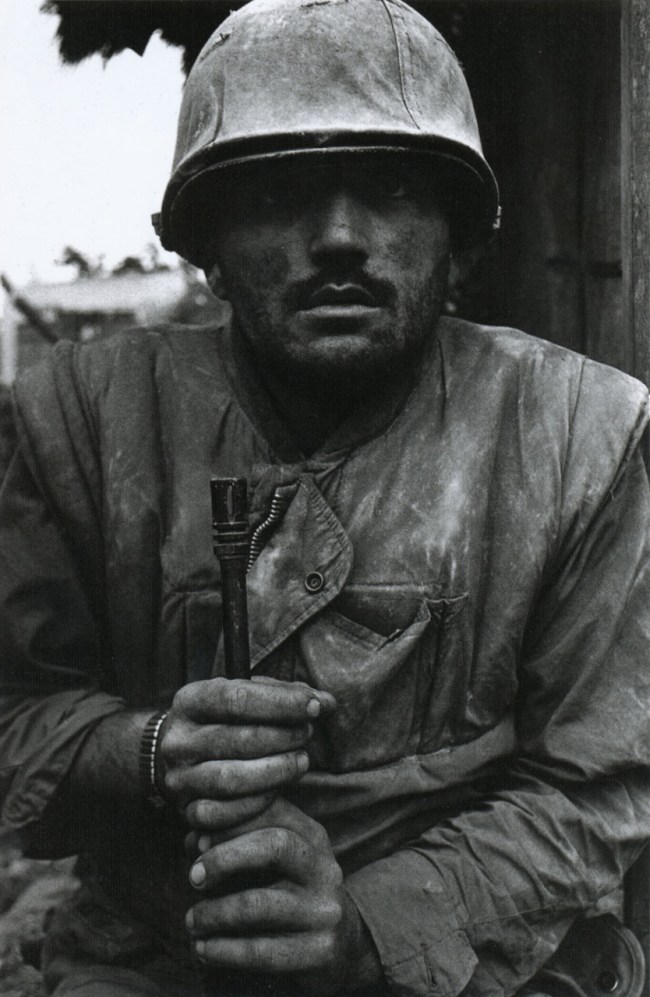
 

Don McCullin (British, b. 1935) 'Shell-shocked US soldier awaiting transportation away from the front line' Hue, Vietnam, 1968


Don McCullin (British, b. 1935)
Shell-shocked US soldier awaiting transportation away from the front line
Hue, Vietnam, 1968
© Don McCullin
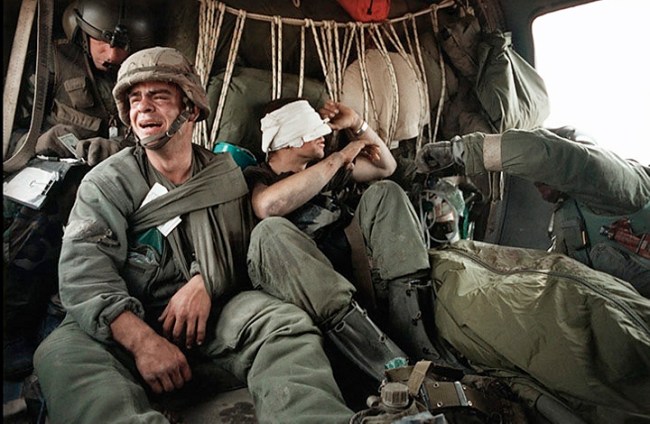
 

David Turnley (American, b. 1955) 'American Soldier Grieving for Comrade' Iraq, 1991


David Turnley (American, b. 1955)
American Soldier Grieving for Comrade
Iraq, 1991


Ken Kozakiewicz (left) breaks down in an evacuation helicopter after hearing that his friend, the driver of his Bradley Fighting Vehicle, was killed in a “friendly fire” incident that he himself survived. Michael Tsangarakis (centre) suffers severe burns from ammunition rounds that blew up inside the vehicle during the incident. All of the soldiers were exposed to depleted uranium as a result of the explosion. They and the body of the dead man are on their way to a MASH (Mobile Army Surgical Hospital).


Prisoners of War (Civilian and Military)/Interrogation

12. Prisoners of War (Civilian and Military)/Interrogation is a frequently photographed subject because such pictures can be made outside an area of conflict. Moreover, the people in control often documented their prisoners as a show of power. The photographs in this section include the official recording of a prisoner of war before his execution by the Khmer Rouge, taken by Nhem Ein. (14 images)
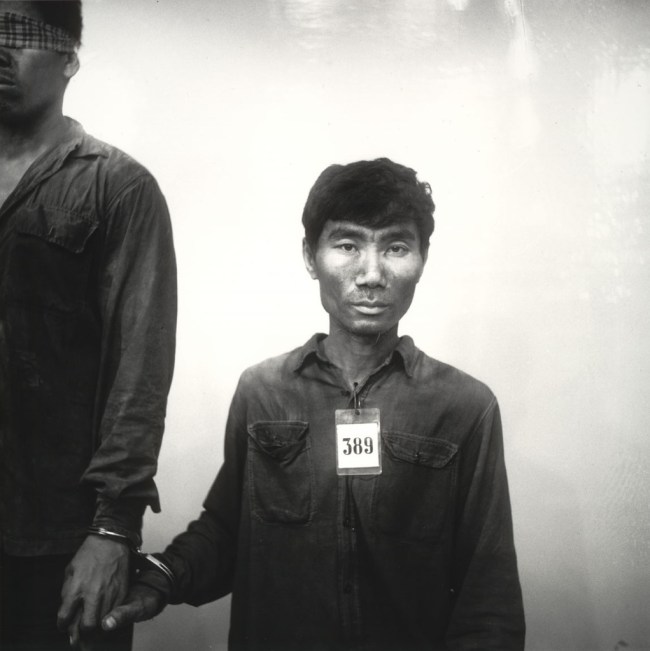
 

Nhem Ein (Cambodian, b. 1959) 'Untitled (prisoner #389 of the Khmer Rouge; man)' 1975-79


Nhem Ein (Cambodian, b. 1959)
Untitled (prisoner #389 of the Khmer Rouge; man)
1975-1979
Gelatin silver print (printed 1994)
Courtesy of Museum of Modern Art
Arthur M. Bullowa Fund and Geraldine Murphy Fund
Digital image © The Museum of Modern Art / Licensed by SCALA Art Resource, NY. Used with permission of Photo Archive Group


Iwo Jima

13. Iwo Jima is a case study within the exhibition that presents the complete thematic narrative in photographs from a specific battle. Included in this section is the inspiration for the exhibition: Joe Rosenthal’s iconic, Pulitzer Prize-winning Old Glory Goes Up on Mount Suribachi, Iwo Jima, a photograph he took as an Associated Press photographer in World War II showing U.S. Marines and one Navy medic raising the American flag on the remote Pacific island. (25 images)


Joe Rosenthal (American, 1911-2006) 'Old Glory Goes Up on Mount Suribachi, Iwo Jima' February 23, 1945


Joe Rosenthal (American, 1911-2006)
Old Glory Goes Up on Mount Suribachi, Iwo Jima
February 23, 1945
Gelatin silver print
The Museum of Fine Arts, Houston, The Manfred Heiting Collection, gift of the Kevin and Lesley Lilly Family
© AP / Wide World Photos


Exhibition posting continued in Part 2…


Museum of Fine Arts, Houston
1001 Bissonnet Street
Houston, TX 77005

Opening hours:
Wednesday 11am – 5pm
Thursday 11am – 9pm
Friday, Saturday 11am – 6pm
Sunday 12.30 – 6pm
Closed Monday and Tuesday

Museum of Fine Arts, Boston website

LIKE ART BLART ON FACEBOOK

Back to top

Exhibition: ‘Eminent & Enigmatic: 10 aspects of Alan Turing’ at the Heinz Nixdorf Museums Forum, Paderborn

Exhibition dates: 11th January – 16th December 2012


Model of a U-boat (Unterseeboot) used in the film 'Das Boot'


Model of a U-boat (Unterseeboot) used in the film Das Boot and multimedia screens at the exhibition


One of the greatest minds of the 20th century (code breaking, computers, intelligent machines, artificial intelligence), persecuted to death for being a homosexual. In 2010 there is an apology for Turing’s conviction as a homosexual: Prime Minister Gordon Brown speaks for the British people when he says that he is sorry for the treatment meted out to Alan Turing:

“You deserved so much better!”


Better late than never.

Many thankx to the Heinz Nixdorf Museums Forum for allowing me to publish some of the photographs in the posting. I have supplemented their media images with other images that can be found on the Internet: the plugboard of an Enigma machine, a logic machine by Gisbert Hasenjäger, the Pilot ACE (Automatic Computing Engine), installation photographs of Hello, world! by Yunchul Kim, Alan Turing with two colleagues at the Ferranti Mark I computer and installation photograph of Love Letters_1.0 by David Link.

All photographs have been attributed where possible. The use of these photographs has led to an infinitely better posting that gives a greater insight into the exhibition, the work of the brilliant Alan Turing, and other work based on his ideas. Please click on the photographs for a larger version of the image.

Dr Marcus Bunyan


Enigma machine lampboard and keyboard detail


Enigma machine lampboard and keyboard detail


Enigma machine rotor detail


Enigma machine rotor detail


Enigma and the Battle of the Atlantic

1939. The UK Government Code and Cipher School appoints one of the country’s best mathematicians, Alan Turing, to a post at its Bletchley Park headquarters, where the German enemy’s intercepted radio messages are to be deciphered. Operation ULTRA begins.

1940. The Atlantic becomes a major theatre of war, with German submarines attacking Allied supply lines. This first topic examines the secret communications between German submarines and the naval high command in Berlin. Messages are encrypted using the Enigma machine. They are intercepted at British listening posts and sent to Bletchley Park to be deciphered.

The HNF is exhibiting the original model of the submarine from the film Das Boot, as well as a Marine 4-rotor Enigma. Further prominent exhibits which help relate this exciting story include radio technology items, codebooks and an interactive cipher rotor.


A three-rotor Enigma machine


A three-rotor Enigma machine with (from below rotors), lampboard, keyboard and plugboard (front of machine)


The Enigma was an electro-mechanical rotor machine used for the encryption and decryption of secret messages. It was developed in Germany in the 1920s. The repeated changes of the electrical pathway from the keyboard to the lampboard implemented a polyalphabetic substitution cipher, which turned plaintext into ciphertext and back again. Used properly, this provided a very high degree of security. The Enigma’s scrambler contained rotors with 26 electrical contacts on each side, whose wiring diverted the current to a different position on the two sides. On depressing a key on the keyboard, an electrical current flowed through an entry drum at the right-hand end of the scrambler, then through the set of rotors to a reflecting drum (or reflector) which turned it back through the rotors and entry drum, and out to cause one lamp on the lampboard to be illuminated.

At each key depression, at least one of the rotors (the right-hand or “fast” rotor) advanced one position, which caused the encipherment to alter. At a certain point, the right-hand rotor caused the middle rotor to advance and in a similar way, the middle rotor caused the left-hand (or “slow”) rotor to advance. Each rotor caused the “turnover” of the rotor to its left after a full rotation. The Enigma operator could rotate the wheels by hand to change the letter of the alphabet showing through a window, to set the start position of the rotors for enciphering a message. This three-letter sequence was “message key”. There were 26 × 26 × 26 = 17,576 possible positions of the set of three rotors, and hence different message keys. By opening the lid of the machine and releasing a compression bar, the set of three rotors on their spindle could be removed from the machine and their sequence (called the “wheel order” at Bletchley Park) could be altered. Multiplying 17,576 by the six possible wheel orders gives 105,456 different ways that the scrambler could be set up.

Text from the Wikipedia website


The plugboard of an Enigma machine, showing two pairs of letters swapped: S↔O and J↔A.


The plugboard of an Enigma machine, showing two pairs of letters swapped: S↔O and J↔A. During World War II, ten plugboard connections were made. The plugboard (Steckerbrett) is positioned at the front of the machine, below the keys. When in use, there can be up to 13 connections.

Photograph from Wikipedia under Creative Commons GNU Free Documentation License


Government Code and Cypher School (GC&CS) (World War Tw0) 'Bletchley Park' Buckinghamshire, England


National Codes Centre and the National Museum of Computing (contemporary)
Government Code and Cypher School (GC&CS) (World War Tw0)
Bletchley Park
Buckinghamshire, England


British Tabulating Machine Company. 'Turing Bombe wiring at back' (detail) 1940-1945


British Tabulating Machine Company
Turing Bombe wiring at back (detail)
1940-1945


The Codebreakers of Bletchley Park

Up to 10,000 people are working hard to decipher German radio messages at Bletchley Park, and Alan Turing is one of their leading lights. He achieves the crucial breakthrough: his decryption device known as the Bombe can calculate Enigma code settings automatically, quickly and reliably. The rotors of up to 200 Bombes now run day and night, with radio messages able to be cracked within hours, while they are still of military relevance. This gives Winston Churchill and his military officers in London a priceless advantage.

The second topic of the HNF Turing year includes exhibits not previously seen in Germany, such as components of an original US Bombe owned by the NSA as well as loans of a functional checking machine and Bombe rotors from Bletchley Park. The entire communications chain is presented to visitors, from the German submarine radio operator all the way to the clear text message received by the British Prime Minister.


British Tabulating Machine Company. 'Turing Bombe' 1940-1945


British Tabulating Machine Company
Turing Bombe
1940-1945
7 feet (2.1 m) wide, 6 feet 6 inches (1.98 m) tall, 2 feet (0.61 m) deep


The working rebuilt bombe at Bletchley Park museum. Each of the rotating drums simulates the action of an Enigma rotor. There are 36 Enigma-equivalents and, on the right hand end of the middle row, three indicator drums. John Harper led the ‘Phoenix’ team that built this. It was officially switched on by the Duke of Kent, patron of the British Computer Society on 17 July 2008.


British Tabulating Machine Company. 'Turing Bombe rotors' (detail) 1940-1945


British Tabulating Machine Company
Turing Bombe rotors (detail)
1940-1945


The international scientific focus in 2012 will be firmly on Alan Turing. This legendary British mathematician and computer pioneer was born in London on 23 June 1912. His 100th birthday will be marked by numerous events, primarily in his native country, but also in the USA, Brazil, China and elsewhere. Germany’s Heinz Nixdorf MuseumsForum in Paderborn is to pay tribute to the achievements of this equally academic and awkward scientist with an ambitious exhibition entitled Eminent & enigmatic – 10 aspects of Alan Turing. Its aim is to present Alan Turing’s outstanding achievements to visitors in the form of original exhibits and innovative and artistic installations alike.

Turing’s research made a huge contribution towards deciphering German radio messages encrypted using the Enigma machine during World War II. Thus he played a vital role in the Battle of the Atlantic, as well as in other major theatres of war. His theoretical work, which still forms the basis of information technology to this day, is equally significant. While his contemporaries could not see beyond the pure calculating capabilities of the computer, Turing designed the model of a universal machine capable of solving every algorithmic problem.

The exhibition at the Heinz Nixdorf MuseumsForum will focus on Turing’s achievements in breaking the Enigma code and his basic work as a computer and computer science pioneer, while also shedding light on his views on the subjects of artificial intelligence and spacial pattern formation, as well as on the tragedy of his untimely death and his legacy.

This marks the first time that an exhibition will be shown in stages, with the ten exhibition topics portrayed in successive monthly presentations. The exhibition will open on 10 January 2012 with the topic Enigma and the Battle of the Atlantic. It will be followed as of 14 February with exhibits and presentations on The code breakers of Bletchley Park, the UK’s National Codes and Cipher Centre during World War II. The remaining topics will also be shown for a period of around one month until the exhibition closes on 16 December 2012.

“The multi-part exhibition format will allow us to provide our visitors with insights into aspects of Alan Turing’s life and works all year long,” said HNF managing director and project manager Norbert Ryska of this unusual approach in the first public presentation of EMINENT & ENIGMATIC. “This was the only way to attract significant and highly sought-after loans from at home and abroad, including exhibits from the US National Security Agency, the Science Museum in London, Bletchley Park and IBM. So regular visits to the HNF will be more worthwhile than ever in 2012.”

The exhibition will be held in a specially constructed pavilion in the foyer. In addition to the technical and scientific exhibits, artistic installations are to shed light on Alan Turing’s work and thinking. “We want to pay tribute to Alan Turing with a series of presentations because he was the mastermind of the digital age as well as an exceptional personality,” said Ryska of the exhibition concept. Turing’s achievements will open up several unusual avenues into the HNF permanent exhibition. It can be accessed via a special Turing tour and workshops for schools, making the special exhibition a great stepping stone into the world’s biggest computer museum, in which a section in the Hall of Fame has been dedicated to Turing since its opening in 1996.

Turing, who died on 7 June 1954 under mysterious circumstances, has only been properly appreciated by the public at large during recent years, although experts have sung his praises for decades. In 1952 Alan Turing was sentenced to a degrading 12-month course of oestrogen treatment designed to combat his homosexuality. He took his own life by eating a cyanide-laced apple one year after completion of the treatment, on 7 June 1954.

Exhibition topics and selected exhibits

~ 11.1.-12.2.2012 Enigma and the Battle of the Atlantic (Enigma, submarine model, radio equipment)
~ 15.2.-11.3.2012 The code breakers of Bletchley Park (Enigma, Bombe drums, Enigma rotor model)
~ 14.3.-8.4.2012 The Turing test (model of the brain, Turing test terminal)
~ 11.4.-6.5.2012 From Turbochamp to Deep Blue (Deep Blue Chip/Board, Turing chess engine)
~ 9.5.-8.7.2012 The history of intelligent machines (Robo Thespian)
~ 28.7.-26.8.2012 The Turing machine (HNF functional model, historic Turing machine)
~ 29.8.-23.9.2012 Pattern formation (Interactive Plant Growing)
~ 26.9.-21.10.2012 The Pilot ACE computer (UNIVAC delay line memory, Pilot ACE component)
~ 24.10.-18.11.2012 Love Letters/Mark I (installation by David Link)
~ 21.11.-16.12.2012 Tragedy and legacy – Turing today (Turing Award)

Short biography of Alan Turing (1912-1954)

Alan Turing was born on 23 June 2012 in London. From 1931 to 1934 he studied mathematics at King’s College, Cambridge, where he was elected a fellow in 1935. During World War II he worked at the Government Code and Cipher School at Bletchley Park, developing methods of deciphering German radio messages encrypted using the Enigma machine. At the end of the war Turing turned his attention towards computer development, first at the National Physical Laboratory in Teddington (1945-1947), where he developed the concept of the Automatic Computing Engine (ACE), and then (as of 1948) as deputy director of the computing laboratory at Manchester University.

Although Alan Turing did not have too deep an impact on the invention of the first computers in the 1940s and 1950s, his theoretical concepts earned him a place in computer history: The Turing machine still provides an important basis for research into theoretical computer science today, and the Turing test proposed by him in 1950 in response to the question “Can machines think?” lent impetus to the development of artificial intelligence.

Turing, who died on 7 June 1954 under mysterious circumstances, has only been properly appreciated by the public at large during recent years, although experts have sung his praises for decades. In 1952 Alan Turing was sentenced to a degrading 12-month course of oestrogen treatment designed to combat his homosexuality. He took his own life by eating a cyanide-laced apple one year after completion of the treatment, on 7 June 1954.

In 2010 British Prime Minister Gordon Brown expressed his regret at Turing’s persecution on behalf of the British Government and paid tribute to his exceptional contribution during World War II. US President Barack Obama placed Turing on a par with Newton, Darwin and Einstein during his recent state visit to London.

Text from the HNF website


British Tabulating Machine Company. 'Turing Bombe rotors' (details) 1940-1945

British Tabulating Machine Company. 'Turing Bombe' (details) 1940-1945


British Tabulating Machine Company
Turing Bombe (details)
1940-1945
7 feet (2.1 m) wide, 6 feet 6 inches (1.98 m) tall, 2 feet (0.61 m) deep


The Turing Test

In 1950 Alan Turing proposes a new type of test. He is researching the question of when a machine can be described as “intelligent”, using the human brain as a model. According to the Turing test, a machine is intelligent if it can convince a human interlocutor that it is itself “human”. This deception must succeed with the required frequency in repeated tests.

From Turochamp to Deep Blue

What do the contemporary luminaries Konrad Zuse, Claude Shannon, John von Neumann and Alan Turing have in common? They all want to play chess against calculating machines that they themselves have devised. But the history of computer chess began as early as the end of the 19th century, when Spanish engineer Torres Quevedo presented a chess-playing automaton whose rook and king could reliably checkmate the opponent’s king. The fourth topic is all about computer chess.

Turing defines his own rules for a chess algorithm, but his Turochamp program loses its first game in 1952 – played “by hand,” rather than run on a computer – against his friend Alick Glennie. It is not until 1997 that reigning chess world champion Garry Kasparov is defeated by a calculating machine, in the form of the IBM supercomputer Deep Blue. The HNF is exhibiting original hardware from the machine and the original chessboard from this “final” game in the Turing pavilion – the first time these have been on show in Germany.


Processor board of Deep Blue


Processor board of Deep Blue, 1997


RoboThespian I am a Machine

RoboThespian demonstrates his acting skills – moving from robotic to fluid and emotional humanoid robot


The History of Intelligent Machines

“Can machines think?” It is 1950 when Alan Turing asks this provocative question and founds a new field of research along with significant contemporaries of the likes of Claude Shannon, Norbert Wiener and Joseph Weizenbaum: that of “artificial intelligence (AI).” To this day, the development of the “intelligent machine” has been marked by excessive expectations as well as important advancements.

The humanoid robot RoboThespian relates the history of AI as the fifth topic of our Turing year. RoboThespian is a prominent visitor to the Turing pavilion. With his love of theatrical appearances, he is more than happy to answer questions or cheekily imitate the gestures of visitors. An entire section of the permanent exhibition is devoted to AI and robotics. Our networked computers are becoming more powerful all the time. It is still unclear when precisely a team of robots will beat the human world champions – an event predicted by experts for some time.

The Turing Machine

Mathematician Kurt Gödel turns the world of numbers on its head in 1931, when he proves that there are some logical statements that are neither true nor false. Inspired by this revolutionary finding, Alan Turing takes up the baton and publishes the concept of the Turing machine in 1936. He demonstrates that his simple but universal theoretical machines can calculate everything that can be calculated by any machine or computer.

The HNF has built a mechanical Turing machine that can be tried and tested by visitors to the Turing pavilion. The logic machines of the Münster School are on show for the first time ever: in the 1960s Gisbert Hasenjäger and Dieter Rödding use spare parts from the German Federal Post Office to construct somewhat bizarre devices for logical calculations (see photographs below).


Gisbert Hasenjäger. 'Logic machine' c. 1960s

Gisbert Hasenjäger. 'Logic machine' c. 1960s


Gisbert Hasenjäger (German, 1919-2006)
Logic machine
c. 1960s


A logic machine by Gisbert Hasenjäger based on Turing’s work
Provided by Family Hasenjäger
Photographs from “Intelligenz ist ein soziales Produkt: Alan Mathison Turing zum 100. Geburtstag” on the Heise online website [Online] Cited 03/09/2020.

Die Turing-Maschine ist im Grunde keine konkrete Konstruktion, sondern ein mathematisches Konzept zum Nachweis der algorithmischen Berechenbarkeit einer Funktion. Dennoch sind anhand von Turings Arbeiten sehenswerte konstruktionstechnische Umsetzungen entstanden (The Turing machine has basically no concrete construction, but a mathematical concept for the detection of algorithmic computability of a function. Nevertheless, based on Turing’s work remarkable constructional reactions are caused).


The Automatic Computing Engine (ACE)

The war is over, with Germany having been defeated by the Allies. Alan Turing makes the transition from codebreaker to computer pioneer at the National Physical Laboratory. He designs the Automatic Computing Engine, known as ACE, entirely on his own. New features of this vacuum tube computer include its delay-line memories – very fast memories for digital data and programs. James H. Wilkinson builds the machine and presents the Pilot ACE builds the machine and presents the Pilot ACE to the public in 1950 as the world’s fastest computer.

At this point, Turing is already working on his next groundbreaking computer project, a new computer for the University of Manchester. The eighth topic is all about the new memory technology of the ACE. How can data be saved as sound waves? This question is answered not only with the help of an original ACE component, but also via the artistic installation Hello, world by Yunchul Kim, a three-metre sculpture made from copper pipes. This object acts as an analogue memory location for digital data.


Alan Turing (designer) James H. Wilkinson (builder) 'Pilot ACE' 1950


Alan Turing (designer)
James H. Wilkinson (builder)
Pilot ACE (Automatic Computing Engine) (Science Museum, London)
1950
Photograph by Antoine Taveneaux from Wikipedia under Creative Commons Attribution-Share Alike 3.0 Unported license


The Pilot ACE had 1450 thermionic valves (vacuum tubes), and used mercury delay lines for its main memory. Each of the 12 delay lines could store 32 instructions or data words of 32 bits. This ran its first program on May 10, 1950, at which time it was the fastest computer in the world with a clock speed of 1MHz.


Yunchul Kim. 'Hello, world!' 2006

Yunchul Kim. 'Hello, world!' 2006


Yunchul Kim
Hello, world!
2006
Prix Ars Electronica 2006, Honorary Mention Interactive Art
Photographs from Marc Wathieu’s Flickr photostream
Creative Commons Attribution-NonCommercial-ShareAlike 2.0 Generic


Hello, world! is an interesting take on long- and short-lived data storage media. It uses acoustic signals to store data. A codified auditory signal (feedback) circulates in a closed system consisting of a computer, a loudspeaker, 246 meters of copper tubing and a microphone. Due to the acoustic delay in the tubing system, it’s possible to save data, whereby the rule is: the longer the copper tubing, the longer the time delay and the greater the memory capacity. In addition to this a screen shows a visual representation of the information traveling around the system. If a participant makes noises near the installation or hits the copper piping it interferes with the audio signal loop.

There is some instability in the system. If you go up to the sculpture you can hear the sounds (every sign of the ASCII code has its own sine wave frequency thus translating it in an acoustic signal) travelling through the copper piping. But a loud noise in the exhibition space or a vibrational disturbance from passing traffic or low frequency rumble effects the lettering on the screen and the text and Hello, World! starts to tremble as the quality of the signal degenerates and recovers.


Love Letters from a Machine

While in Manchester, Alan Turing writes the programming manual for the Ferranti Mark I, an early British digital computer, and trains staff as programmers. The Mark I no longer saves data and programs on punched tape, but instead uses a new system of a line of dots on a Williams tube display. Its storage capacity, which was huge for the time, gave users plenty of scope for new experiments, such as initial chess and draughts programs as well as digital musical compositions. The penultimate topic in our Alan Turing year includes a display of the interactive installation Love Letters by David Link, who has created a fully functioning replica of the Ferranti Mark I using original components. The machine program generates personal love letters with the help of an algorithm. Christopher Strachey originally wrote the code for the love letters program in the 1950s.


Alan Turing with two colleagues at the Ferranti Mark I computer


Alan Turing with two colleagues at the Ferranti Mark I computer
1951
Photograph from the Love Letters website [Online] Cited November 2012. No longer available online


David Link. 'LoveLetters_1.0. MUC=Resurrection. A Memorial' 2009-

David Link. 'LoveLetters_1.0. MUC=Resurrection. A Memorial' 2009-


David Link
Love Letters_1.0. MUC=Resurrection. A Memorial
2009-
Photographs from the Love Letters website [Online] Cited November 2012. No longer available online


From August 1953 to May 1954 strange love-letters appeared on the notice board of Manchester University’s Computer Department:

DARLING SWEETHEART
YOU ARE MY AVID FELLOW FEELING. MY AFFECTION CURIOUSLY CLINGS TO YOUR PASSIONATE WISH. MY LIKING YEARNS FOR YOUR HEART. YOU ARE MY WISTFUL SYMPATHY: MY TENDER LIKING.
YOURS BEAUTIFULLY
M. U. C.

The acronym M.U.C. stood for “Manchester University Computer”, the earliest electronic, programmable and universal calculating machine worldwide; the fully functional prototype was completed in June 1948 and was based on Williams tubes as means of volatile storage. One of the very first software developers, Christopher Strachey (1916-1975), had used the built-in random generator of the Ferranti Mark I, the first industrially produced computer of this kind, to generate texts that are intended to express and arouse emotions.


Tragedy and Legacy: “You deserved so much better!”

Alan Turing dies at not quite 42 years of age, after eating a poisoned apple, as in the fairytale. His incredibly influential body of work remains, and has left its mark on the discipline known as computer science today. The tenth and final topic looks back on the Alan Turing year of 2012. For twelve months, Turing has been the focus of international conferences, events and exhibitions, which the HNF now reviews. We follow in Turing’s footsteps, visiting places where he worked and where his presence is still felt.

At the end comes an apology for Turing’s conviction as a homosexual: in 2010 Prime Minister Gordon Brown speaks for the British people when he says that he is sorry for the treatment meted out to Alan Turing: “You deserved so much better.” Queen Elizabeth visits Bletchley Park in 2011. The Turing Award is now the biggest of its kind in the world of computer science.


Elliott & Fry. 'Alan Mathison Turing' 1951


Elliott & Fry
Alan Mathison Turing
1951


Alan Turing at the time of his election to a Fellowship of the Royal Society.
Photograph was taken at the Elliott & Fry studio on 29 March 1951.


Heinz Nixdorf Museums Forum
Fürstenallee 7
33102 Paderborn
Phone: +49 (0) 5251-306-600

Opening hours:
Tues – Fri 9am – 6pm
Sat – Sun 10am – 6pm
Closed on Monday

Heinz Nixdorf Museums Forum website

LIKE ART BLART ON FACEBOOK

Back to top

Exhibition: ‘Entre Nous: The Art of Claude Cahun’ at the Art Institute of Chicago

Exhibition dates:  25th February – 3rd June 2012


Claude Cahun (French, 1894-1954) 'Autoportrait' 1929


Claude Cahun (French, 1894-1954)
Autoportrait
1929
Gelatin silver print
24 x 19cm
Musée des Beaux-Arts de Nantes
© RMN/Gérard Blot


“In many ways, Cahun’s life was marked by a sense of role reversal, and her public identity became a commentary upon not only her own, but the public’s notions of sexuality, gender, beauty, and logic. Her adoption of a sexually ambiguous name, and her androgynous self-portraits display a revolutionary way of thinking and creating, experimenting with her audience’s understanding of photography as a documentation of reality. Her poetry challenged gender roles and attacked the increasingly modern world’s social and economic boundaries. Also Cahun’s participation in the Parisian Surrealist movement diversified the group’s artwork and ushered in new representations. Where most Surrealist artists were men, and their primary images were of women as isolated symbols of eroticism, Cahun epitomised the chameleonic and multiple possibilities of the female identity. Her photographs, writings, and general life as an artistic and political revolutionary continue to influence countless artists, namely Cindy Sherman, Nan Goldin and Del LaGrace Volcano.”


Text from the Wikipedia website


Cahun was a resistance fighter during the Second World War, was arrested, sentenced to death and survived. She lived with her longtime female partner and collaborator on Jersey from 1937 until 1954, the year of her death. Entre Nous means “Between Us,” such an appropriate title for their collaboration, love and partnership. What a talent, what a woman and gay to boot!

Dr Marcus Bunyan


Many thankx to the Art Institute of Chicago for allowing me to publish the photographs in the posting. Please click on the photographs for a larger version of the image.


Claude Cahun (French, 1894-1954) 'Autoportrait' 1929


Claude Cahun (French, 1894-1954)
Autoportrait
1929
Gelatin silver print
11.5 x 8.5cm
Jersey Heritage Collection
© Jersey Heritage


Claude Cahun (French, 1894-1954) 'Autoportrait' 1928


Claude Cahun (French, 1894-1954)
Autoportrait
1928
Gelatin silver print
13.9 x 9cm
Jersey Heritage Collection
© Jersey Heritage


Claude Cahun (French, 1894-1954) 'Autoportrait' 1927


Claude Cahun (French, 1894-1954)
Autoportrait
1927
Gelatin silver print
10.4 x 7.6cm
Soizic Audouard Collection


Claude Cahun (1894-1954) has something approaching cult status in today’s art world. However, her work was almost unknown until the early 1980s, when it was championed by the research of François Leperlier, after which exhibitions at the Musée des Beaux-Arts in Nantes (1994) and the Musée d’Art Moderne de la Ville de Paris (1995) brought it to public attention. Her life and work (both literary and artistic) bespeak an extraordinary libertarian personality who defied sexual, social and ethical conventions in what was an age of avant-garde and moral upheaval. Among her many photographs, it is undoubtedly her self-portraits that have aroused the greatest interest in recent years. Throughout her life, Cahun used her own image to dismantle the clichés surrounding ideas of identity. She reinvented herself through photography, posing for the lens with a keen sense of performance and role-play, dressed as a woman or a man, as a maverick hero, with her hair long or very short, or even with a shaved head. This approach was extended in innovative ways in her photographs of objects and use of photomontages, which asserted the primacy of the imagination and of metamorphosis.

By exploring the many different analyses made of Cahun’s work since the 1990s, and ranging across its different themes: from the subversive self-portraits that question identity, to her surrealist compositions, erotic metaphors and political forays, this exhibition confirms the modernity of a figure who, as a pioneer of self-representation and the poetry of objects, has been an important influence for many contemporary artists.

Metamorphoses of identity and the subversion of gender (I)

This set of photographs, going from 1913 to the end of the 1920s, includes some of Cahun’s major works, in which she staged her own persona, emphasising disguise and masks, and working through variations on gender: feminine, masculine, androgyne, undifferentiated. Sexual ambiguity is consciously cultivated and calls into question established norms and conventions. In 1928, she even represented herself with her head shaved, wearing a singlet, in profile, or with her hands against her face, or wearing a loose man’s jacket. Some of the mise-en-scènes from this period seem to anticipate contemporary performance.

Poetics of the object

The “assemblages of objects,” which make their appearance in around 1925, inventively explore what at the time was still a rather new form. This work came to wider attention in the Surrealist exhibition at the Charles Ratton gallery, in May 1936, and then with the commissioning of 22 photographic plates to illustrate a book of poems by Lise Deharme, Le Coeur de Pic (1937), prefaced by Paul Eluard. These photographs capture ephemeral set-ups, often in a natural setting (garden, beach). Each “sketch” is a composition of heterogeneous elements, both found and made, such as knickknacks in spun glass, sewing items, twigs, bones, insects, feathers, gloves, pieces of fabric, shoes, tools, etc. This “theatre of objects” has both a visual and symbolic significance, which Cahun explained in her text Prenez garde aux objets domestiques (1936).

Metamorphoses of identity and the subversion of gender (continued)

The 1930s saw Cahun continuing to explore images of the self. However, questions of sexual difference and its social and cultural construction were now less to the fore as she went deeper into the potential of situations and disguises and experimented with duplication in a way that extended the work of the photomontages from the late 1920s.

Metaphors of desire

Eschewing the direct and sometimes reifying display of the female body found in many paintings and photographs, Cahun opted for a more subtle kind of “veiled eroticism” using distance and irony. Here we find some very evocative examples of her calculating games with desire. Whether through the contained display of the body, allegory (the bacchante or faun, surrounded by sensuous vegetation), or anthropomorphic objects (the hermaphroditic “père”), she aimed to capture the essence of desire, to bring out its essential grounding in fantasy.

The two of us. Claude Cahun and Suzanne Malherbe (Marcel Moore)

The photograph Entre nous (1926) clearly establishes the spirit of this section, which evokes various aspects of Claude Cahun’s intimate relationship and artistic collaboration with her partner, Suzanne Malherbe. In fact, a number of the photographs here were taken by Suzanne following Claude’s suggestions. A double portrait from 1921 shows a surprising parallel which could be read as a metaphor of their relationship, a deep closeness and understanding between two strong personalities. The linchpin of this section is constituted by the four photomontages used to illustrate Aveux non avenus (1930), Cahun’s most significant literary work, gathering together all the artist’s main themes and obsessive metaphors. The plates were executed by Moore in collaboration with Claude Cahun.

Elective encounters

This series of portraits, which reflect the importance of friendship in the development of Cahun’s work, gives an idea of the figures who were important to her and influenced her, or to whom she felt close, among them Henri Michaux, Robert Desnos, André Breton, Jacqueline Lamba and Suzanne Malherbe. There are also two photographs from performances at Pierre Albert-Birot’s theatre Le Plateau (1929). They attest Cahun’s keen interest in theatre and acting.

Poetry and politics

In the 1930s Cahun’s positions grew increasingly radical in response to the rise of totalitarianism. She joined the Surrealists and associated with a number of groups on the left and far left. This radicalisation is reflected in her aesthetic. In line with the ideas put forward in her pamphlet Les Paris sont ouverts (1934), she exploited the subversive qualities of “indirect action” in the sphere of symbolic expression, making a number of objects in which poetry and politics are intimately intertwined. This process culminated when she used these pieces for two big series of photographs dominated by a mood of irony, revolt and provocation: “La Poupée” (The Doll), a figure fashioned out of newspaper, and “Le Théâtre” (The Theatre), a wooden mannequin surrounded by various elements and placed under a glass dome.

Beyond the visible. The last self-portraits

Close study of Cahun’s photographs reveals the presence of allusions to non-visible phenomena, pointing the way to other realities – and perhaps, too, beyond death. Her attraction to symbolism, her interest in Eastern doctrines and her closeness to Surrealism only confirmed the primacy of fantasy and metamorphosis evidenced in the intellectual and aesthetic approaches she took throughout her life. The series Le Chemin des chats (The Way of Cats, around 1949 and 1953), suggests a mediation on and questioning of reality and appearance. Cahun was a true cat lover: for her, this animal was the great intercessor, the medium of an intuitive contact between the visible and the invisible, leading to sensorial worlds that are both unfamiliar and yet very near.

Juan Vicente Aliaga and François Leperlier, curators of the exhibition


Claude Cahun (French, 1894-1954) 'Autoportrait' 1939


Claude Cahun (French, 1894-1954)
Autoportrait
1939
Gelatin silver print
10 x 8cm
Jersey Heritage Collection
© Jersey Heritage


Claude Cahun (French, 1894-1954) 'Autoportrait' 1926


Claude Cahun (French, 1894-1954)
Autoportrait
1926
Gelatin silver print
11.1 x 8.6cm
IVAM, Institut Valencià d’Art Modern, Generalitat


Born Lucy Schwob to a family of French intellectuals and writers, Claude Cahun (who adopted the pseudonym at age 22) is best known for the staged self-portraiture, photomontages, and prose texts she made principally between 1920 and 1940. Rediscovered in the late 1980s, her work has not only expanded our understanding of the Surrealist era but also serves as an important touchstone to later feminist explorations of gender and identity politics. In her self-portraits, which she began creating around 1913, Cahun dismantled and questioned preexisting notions of self and sexuality. Posing in costumes and elaborate make-up, Cahun appears masked as various personae: man or woman, hero or doll, both powerful and vulnerable. Almost a century after their making, these innovative photographs and assemblages remain remarkably relevant in their treatment of gender, performance, and identity.

From her university years until her death, Cahun was accompanied by her partner and artistic collaborator, Suzanne Malherbe, a childhood friend and stepsister. They surrounded themselves with members of the Surrealist movement and created work that embraced leftist politics. Cahun, with assistance from Malherbe (under the pseudonym Marcel Moore), produced photographs, assemblages, and publications from the 1920s on. The photograph Entre Nous (Between Us), featuring a pair of masks embedded in sand, gives the title to this show and is emblematic of their multifaceted relationship.

The first retrospective exhibition in the United States of Cahun’s work, Entre Nous: The Art of Claude Cahun brings together over 80 photographs and published material by Cahun and Moore, including several photomontages from their 1930 collaborative publication Aveux non avenus (Disavowals), and the only surviving object by Cahun, which is in the Art Institute’s permanent collection.

Organiser: This exhibition was organised by the Jeu de Paume, Paris, and coproduced with La Virreina Centre de la Imatge, Barcelona.

Press release from the Art Institute of Chicago website


Claude Cahun (French, 1894-1954) 'Combat de pierres' 1931


Claude Cahun (French, 1894-1954)
Combat de pierres
1931
Gelatin silver print
21 x 15.5cm
Private collection
© Béatrice Hatala


Claude Cahun (French, 1894-1954) 'Le Père' 1932


Claude Cahun (French, 1894-1954)
Le Père
1932
Gelatin silver print
23.6 x 17.7cm
LAC


Claude Cahun (French, 1894-1954) Marcel Moore (French, 1892-1972) 'Entre nous' (Between Us) 1926


Claude Cahun (French, 1894-1954) Marcel Moore (French, 1892-1972)
Entre nous (Between Us)
1926
Gelatin silver print
4 11/16 × 4 5/8 in (11.9 × 11.7cm)


While the motivation for these remarkable self-portraits seems rooted in a commitment to leftist politics and subversion of gender norms, I also feel a great sense of intimate domesticity beneath the surface. Cahun and Moore first met in 1909 when they were both teenagers. Eight years later, Cahun’s father married Moore’s mother, which must have given the couple a convenient excuse for their close relationship at a time when such lifestyle choices were less than accepted.

Our curators have surmised that Cahun’s camera did not have a timer on it, so many if not all of these self-portraits must have been created with Moore’s assistance. When the two moved to the Isle of Jersey in the 1930s to escape the political climate developing in France, they began to live in almost total seclusion. Though often taken outside around the grounds of their estate, the photographs from this period seem to the most private and familiar. Beyond the thoughtful self-presentation and artistic experimentation, there is a palpable sense of play, of close friends having fun.

An interesting aside: In July of 1940, the Nazis invaded Jersey where Cahun and Moore were still living. For the next four years, they engaged in active resistance against the Germans, producing and distributing counterpropaganda leaflets to Nazi soldiers on the island. Continuing the kind of dress-up they’d played together for years, the two would dress in disguises to infiltrate German outposts where they would disseminate anti-Nazi leaflets signed as “der Soldat ohne Namen” (the solider with no name). They were eventually arrested in 1944 and sentenced to death. Fortunately, the island was liberated before the executions could be carried out.

Extract from Robby Sexton, “Between You and Me,” on the Art Institute of Chicago website March 15, 2012 [Online] Cited 08/10/2024


Claude Cahun (French, 1894-1954) 'Aveux non avenus, planche III' 1929-1930


Claude Cahun (French, 1894-1954)
Aveux non avenus, planche III
1929-1930
Gelatin silver print photomontage
15 x 10cm
Private collection


The Art Institute of Chicago
111 South Michigan Avenue
Chicago, Illinois 60603-6404
Phone: (312) 443-3600

Opening hours:
Thursday – Monday 11am – 5pm
Closed Tuesdays and Wednesdays

The Art Institute of Chicago website

LIKE ART BLART ON FACEBOOK

Back to top

Exhibition: ‘Karlheinz Weinberger: Intimate Stranger’ at Kunstmuseum Basel, Museum for Gegenwartskunst

Exhibition dates: 21st January – 15th April 2012


Karlheinz Weinberger (Swiss, 1921-2006) 'Hardau, Zürich' 1962


Karlheinz Weinberger (Swiss, 1921-2006)
Hardau, Zürich
1962
Schwarz-Weiss Fotografie
50.7 x 58cm
Courtesy The Estate of Karlheinz Weinberger in care of Patrik Schedler, Zürich


Another relatively unknown artist, people whose work I like promoting in this archive. I certainly had never heard of this photographer. A self-taught part-time photographer who worked as a warehouseman most of his life, Weinberger published photographs in the homosexual magazine “Der Kreis,” the same early gay magazine that George Platt Lynes submitted photographs to in the last stages of his life.

While their might seem to be a dichotomy between the desirous photographs of male youth and the city toughs and “rowdies”, gay men have always been drawn to rough trade: from Oscar Wilde who was more sexually drawn towards the swarthy young rough trade to contemporary iconography of gay skinheads and punks, still a prevalent culture in London for example. Tattoos, shaved heads, braces, Docs – in Weinberger’s case rockabillies. Notice how in the photograph of the male reclining with candlestick, the form of the candlestick mimics the spidery tattoo on the hand in the photograph above. Notice also how the crouching nude lad looks almost identical to the lad in the photograph below, with his hands thrust into his pockets emphasising the crutch area. And the earlier crutch photograph with the mating of Elvis and Vince over a skull and cross bones which has delicious, subversive homosocial overtones. Toughs or not, there is always the desire for the dangerous and different.

Dr Marcus Bunyan


Many thankx to the Kunstmuseum Basel for allowing me to publish the photographs in the posting. Please click on the photographs for a larger version of the image.


Karlheinz Weinberger (Swiss, 1921-2006) 'Knabenschiessen, Albisgütli, Zürich' 1961


Karlheinz Weinberger (Swiss, 1921-2006)
Knabenschiessen, Albisgütli, Zürich
1961
Schwarz-Weiss Fotografie
50.5 x 60.5cm
Courtesy The Estate of Karlheinz Weinberger in care of Patrik Schedler, Zürich


Karlheinz Weinberger (Swiss, 1921-2006) 'Fisherman with Hat, Sicily' c. 1960


Karlheinz Weinberger (Swiss, 1921-2006)
Fisherman with Hat, Sicily
c. 1960
Schwarz-Weiss Fotografie
18.5 x 24cm
Courtesy The Estate of Karlheinz Weinberger in care of Patrik Schedler, Zürich


Karlheinz Weinberger (Swiss, 1921-2006) 'Drei zusammen (three together)' c. 1965


Karlheinz Weinberger (Swiss, 1921-2006)
Drei zusammen (three together)
c. 1965
Schwarz-Weiss Fotografie
50 x 53.5cm
Courtesy The Estate of Karlheinz Weinberger in care of Patrik Schedler, Zürich


Karlheinz Weinberger (Swiss, 1921-2006) 'Untitled, Zürich' c. 1962


Karlheinz Weinberger (Swiss, 1921-2006)
Untitled, Zürich
c. 1962
Schwarz-Weiss Fotografie
23.8 x 30.4cm
Courtesy The Estate of Karlheinz Weinberger in care of Patrik Schedler, Zürich


Karlheinz Weinberger (Swiss, 1921-2006) 'Untitled, Zurich' c. 1962


Karlheinz Weinberger (Swiss, 1921-2006)
Untitled, Zurich
c. 1962
Schwarz-Weiss Fotografie
23.8 x 30.4cm
Courtesy The Estate of Karlheinz Weinberger in care of Patrik Schedler, Zürich


Karlheinz Weinberger (Swiss, 1921-2006) 'Untitled, Zurich' c. 1962


Karlheinz Weinberger (Swiss, 1921-2006)
Untitled, Zurich
c. 1962
Schwarz-Weiss Fotografie
23.8 x 30.4cm
Courtesy The Estate of Karlheinz Weinberger in care of Patrik Schedler, Zürich


Karlheinz Weinberger (Swiss, 1921-2006) 'Untitled, Zurich' c. 1962


Karlheinz Weinberger (Swiss, 1921-2006)
Untitled, Zurich
c. 1962
Schwarz-Weiss Fotografie
29.7 x 39.1cm
Courtesy The Estate of Karlheinz Weinberger in care of Patrik Schedler, Zürich


The exhibition presents the rarely shown work of the photographer Karlheinz Weinberger (1921-2006). Together with magazines and a selection of vintage apparel, the pictures document a youth culture in Zurich that emerged after World War II whose members sought to subvert contemporary notions of “Swiss correctness.”

Weinberger spent the largest part of his life working as a warehouseman for Siemens-Albis in Zurich. In his free time, he was a self-taught photographer, portraying his lovers and people he met in the street. From the late 1940s on, he frequently published his pictures in “Der Kreis,” a homosexual magazine produced in Zurich from 1943 until 1967 that garnered international attention, pseudonymously signing his work as “Jim.” In 1958, he launched a major project for which he would photograph a group of teenagers, the city’s so-called “Halbstarke,” over an extended period of time. Weinberger’s unfailingly respectful approach allowed him to capture the non-conformism of these “rowdies” with regard to social convention and their play with stereotypes of masculinity and femininity, most readily evident in the way they dressed.

Wearing embroidered denim jackets and oversized belt buckles adorned with the likenesses of idols such as Elvis or James Dean, Weinberger’s adolescent subjects present themselves to his camera in public settings like members of a gang. Photographs such as those taken at the Knabenschiessen, a target shooting competition held at Zurich’s Albisgüetli, show them sprawling on the ground between fairground stalls and compact vans, illustrating the “Halbstarke”‘s refusal to fit in with the traditions surrounding this Zurich folk festival. In addition to the photographs in public settings, Weinberger also took pictures in the improvised studio in his living room. Scantily clad, some of his subjects, mostly young men, strike confident poses showing off their denim shorts and hats, while others cower, their eyes glancing at the camera with a vulnerable expression. Weinberger’s role is that of an Intimate Stranger: he records the attitudes of a generation and its marginal social position in unvarnished pictures and develops the photographs capturing the objects of his fascination in his own photo laboratory.

In an oeuvre that spanned many years, Weinberger portrayed what lay behind the curtains of 1960s bourgeois Switzerland, finding ways to document deviancy without ever putting his protagonists on display.

Press release from the Kunstmuseum Basel website


Karlheinz Weinberger (Swiss, 1921-2006) 'Untitled' c. 1969


Karlheinz Weinberger (Swiss, 1921-2006)
Untitled
c. 1969
Schwarz-Weiss Fotografie
30.4 x 23.8cm
Courtesy The Estate of Karlheinz Weinberger in care of Patrik Schedler, Zürich


Karlheinz Weinberger (Swiss, 1921-2006) 'Untitled' c. 1961


Karlheinz Weinberger (Swiss, 1921-2006)
Untitled
c. 1961
Schwarz-Weiss Fotografie
24 x 18cm
Courtesy The Estate of Karlheinz Weinberger in care of Patrik Schedler, Zürich


Karlheinz Weinberger (Swiss, 1921-2006) 'Untitled' c. 1960


Karlheinz Weinberger (Swiss, 1921-2006)
Untitled
c. 1960
Schwarz-Weiss Fotografie
39 x 29cm
Courtesy The Estate of Karlheinz Weinberger in care of Patrik Schedler, Zürich


What is the story behind Karlheinz Weinberger and his photographs?

Weinberger was totally fascinated with photography. From the day he received his first camera at a very young age, which was given to him by a lover, he felt the urge to take pictures. Although he had a day job as warehouseman and never really made money with his shots, he maintained this passion until the end of his life. Under the pseudonym Jim he began, in the mid 50s, to publish portraits in a gay magazine. Most of them were taken whilst travelling in Southern Italy. In 1958, he met a young rocker named Jimmy Oechslin in the streets of Zurich and asked him, excitedly, if he could take his portrait. Through him he was introduced to the burgeoning gang culture in Switzerland. Teenagers under the influence of American culture celebrated their own lifestyle by wearing customised jeans and by riding motorcycles. Eventually, in the 80s and 90s, Weinberger went on to photograph the Hell’s Angels in Switzerland.

How would you describe Weinberger’s aesthetic?

Rough, personal, artistic. He was at times very commanding during photo shoots and had an almost ethnographic interest in gangs and biker culture. At times, a buckle belt was more important than a face. Through his passion for photography he was part of gangs without adopting their lifestyle.

Who are the people in these images?

In Germany and Switzerland the German term ‘Halbstarker’ was created in the 50s. It literally means half strong. The ‘half strongs’ were gangs of young people who were looking for an identity of their own. They rejected society’s expectation and were pioneers in the establishment of youth culture through music, cloths and assimilation of American culture.

Ricky Lee. “Karlheinz Weinberger: Rebel Youth,” on the AnOther website February 7th, 2011 [Online] Cited 06/04/2012


Karlheinz Weinberger (Swiss, 1921-2006) 'The Jets, Basel' 1962


Karlheinz Weinberger (Swiss, 1921-2006)
The Jets, Basel
1962
Schwarz-Weiss Fotografie
Courtesy The Estate of Karlheinz Weinberger in care of Patrik Schedler, Zürich


Karlheinz Weinberger (Swiss, 1921-2006) 'The Lions, Basel' c. 1962


Karlheinz Weinberger (Swiss, 1921-2006)
The Lions, Basel
c. 1962
Schwarz-Weiss Fotografie
Courtesy The Estate of Karlheinz Weinberger in care of Patrik Schedler, Zürich


Karlheinz Weinberger (Swiss, 1921-2006) 'Zürich am Limmatquai' 1962


Karlheinz Weinberger (Swiss, 1921-2006)
Zürich am Limmatquai
1962
Schwarz-Weiss Fotografie
30 x 24cm
Courtesy The Estate of Karlheinz Weinberger in care of Patrik Schedler, Zürich


Karlheinz Weinberger (Swiss, 1921-2006) 'Milchbuck, Zürich' c. 1962


Karlheinz Weinberger (Swiss, 1921-2006)
Milchbuck, Zürich
c. 1962
Schwarz-Weiss Fotografie
60.5 x 49cm
Courtesy The Estate of Karlheinz Weinberger in care of Patrik Schedler, Zürich


Karlheinz Weinberger(Swiss, 1921-2006)

Career

Karlheinz Weinberger was a self-taught photographer spending over sixty years producing intimate, often homoerotic photographs of rebellious male youth, mostly working-class men. Weinberger worked in the warehouse at Zürich’s Siemens factory during the day and his nights he spent shooting portraits of construction workers, bikers, and athletes for the underground gay journal Der Kreis. Weinberger published his works under the pseudonym Jim. In 1958 he began focusing his camera on the Halbstarken, an edgy, antiauthoritarian teen subculture whose members styled themselves as bad boys à la James Dean in Rebel Without a Cause or Elvis Presley.

Work

As early as 1948, Weinberger made contact with the gay magazine Der Kreis, where he used the pseudonym “Jim”. At the parties of the district subscribers, he showed off his musical talent and was the “house photographer”. From September 1952 to 1965 his photographs were an integral part of the circle. With around 80 photos published, he had a significant impact on homosexual aesthetics until the end of the magazine in 1967 and its successor magazine Club68. The photographs, which Weinberger published under the pseudonym “Jim”, mainly show workers and evoke the homoeroticism of simple men.

From 1958 Weinberger began photographing the hooligan scene in Zürich. He was also interested in rockers and tattooed people. Weinberger was one of the first photographers to get permission to document the Hells Angels’ local offshoot. Between 1964 and 1976 Weinberger also worked as a freelancer for various sports magazines and specialised in sports reports.

Text from the Wikipedia website


Karlheinz Weinberger (Swiss, 1921-2006) 'Adler Gang, Zurich' c. 1966


Karlheinz Weinberger (Swiss, 1921-2006)
Adler Gang, Zurich
c. 1966
Schwarz-Weiss Fotografie
Courtesy The Estate of Karlheinz Weinberger in care of Patrik Schedler, Zürich


Karlheinz Weinberger (Swiss, 1921-2006) 'Lone Star Camp, Gossau' 1967


Karlheinz Weinberger (Swiss, 1921-2006)
Lone Star Camp, Gossau
1967
Schwarz-Weiss Fotografie
Courtesy The Estate of Karlheinz Weinberger in care of Patrik Schedler, Zürich


Kunstmuseum Basel
St. Alban-Graben 16
CH-4010 Basel
Phone: 0041 (0)61 206 62 62

Opening hours:
Tuesday – Sunday 10am – 6pm
Closed on Monday

Kunstmuseum Basel website

LIKE ART BLART ON FACEBOOK

Back to top

Exhibition: ‘Teenie Harris, Photographer: An American Story’ at Carnegie Museum of Art, Pittsburgh, Pennsylvania

Exhibition dates:  29th October 2011 – 7th April 2012


Teenie Harris (American, 1908-1998) 'Construction site with bulldozer, two men, including one in front holding child, large tank with hose, and car on right, possibly in construction site of Belmar Gardens' c. 1954


Teenie Harris (American, 1908-1998)
Construction site with bulldozer, two men, including one in front holding child, large tank with hose, and car on right, possibly in construction site of Belmar Gardens
c. 1954
Gelatin silver print
© Carnegie Museum of Art


What an astonishing photographer this man was. These photographs are a revelation. African American artist Charles “Teenie” Harris, captured “the essence of daily African-American life in the 20th century. For more than 40 years, Harris – as lead photographer of the influential Pittsburgh Courier newspaper – took almost 80,000 pictures of people from all walks: presidents, housewives, sports stars, babies, civil rights leaders and even cross-dressing drag queens.”

While Harris is most famous for depicting an innovative and thriving black urban community – daily life in Pittsburgh’s Hill District – it is the less figurative, more abstract urban landscape work that I am interested in here. Hence I have put four outstanding photographs that I picked out from the Archive at the top of the posting.

Earlier photographs of the city from the 1940s, such as Large two story home with attic, porch, double entryway, and yard, with young child on steps alone, next to smaller two story home with porches on both stories (c. 1940-45, below) have a touch of Walker Evans about them. Note how in this photograph the eve of the large two story home roof touches the top of the negative (allowing an exit for the eye at the top of the image), beautifully balanced on the left-hand side by the intrusion of the roof of another out of frame building and its shadow cast on the ground. The spatial separation between this roof and the porch of the smaller two story home is critical, as is the punctum of the child standing on the stoop. There are beautiful spaces in this photograph, as the eye plays across its surface, taking in form and detail, light and shade, eventually escaping down the right hand side of the building to the sky beyond.

It is only when we get to the 1950s that Harris really seems to hit his straps in these photographs of the urban landscape. Personally, I can’t remember any other photographs like them. By this time he has developed his own signature, his own voice. And what a voice it is!

In the three remaining photographs at the top of the posting there is a conciseness to his vision of the world, a spatial spareness, even sparseness that is very eloquent. In Construction site with bulldozer (c. 1954, below), possibly a photograph of the site of Belmar Gardens, Pittsburgh’s first black-owned housing cooperative, the landscape is shot from below up a slight incline, bookended with raised bank at left and car at right framing the image plane and holding it together. But it is the space around the central figures as they look off into the distance that is so magical – the blackened, textural ground playing off the cloudless sky with single tree at left. That space in the foreground, between the bottom of the image and the figures is tensioned so well with the distance between the figures and the top edge of the negative: Harris has an intimate understanding of what he wants to achieve in this image – spatially and narratively. The hope of the future.

The same can be said for Three story brick row houses with mansard roofs (c. 1958, below). Again, there is a spareness to his rendition of space and a complexity to his imaging of tone. It is almost like there is a dividing line between night and day, between the city in snow and the city in darkness, the ying yang of existence. Observe the light car is in darkness and the dark car in light; the dark trees, the light telegraph post; the space between the cars which no car could ever fit through; and the smallness of the child walking down the street. Incredible. Again, there is a openness to Harris’ rendition of space in Young men playing sandlot baseball with steel mill in background (c. 1955, below). Let your eyes soak in the open sky; the verticals of dark chimneys, left and light chimneys, right; the building at left perched atop the embankment; the composition of the figures across the middle of the image, reminiscent of a piece of music; the open space of the baseball sandlot at the bottom of the photograph with faint white line delineation and figure at right holding up the edge of the image. This is a master at work.

In this mature style, Harris has no need to fill space with an urban mass or congeries. These are spaces that matter, spaces of matter but these spaces are not empty, negative spaces, but active, fluid spaces, the space of possibilities. He understands what he wants to say so well, he is so confident of his previsualisation of the urban spaces of the city they become uniquely his own – open, engaging, optimistic. This is his voice, his gift, his legacy to the world – for me, not so much the portraits of Afro-American culture, but the spaces of the city as a metaphor for change within that culture. His reading of the landscape is his unique field of vision: in the stillness of these photographs time no longer passes, for the author and for the viewer. His images transcend place and, as such, like Atget before him, he deserves to be recognised as an artist who captured a changing world. Further research on this aspect of his art would seem appropriate.

Dr Marcus Bunyan


I am most grateful to Tey Stiteler for allowing me to pick the photographs I wanted for this posting. This help was crucial as I wanted to talk about the less figurative work in the Teenie Harris Archive. Many thankx to the Carnegie Museum of Art and the Teenie Harris Archive for allowing me to publish the photographs and book pdf in the posting. Please click on the photographs for a larger version of the image.


Teenie Harris (American, 1908-1998) 'Large two story home with attic, porch, double entryway, and yard, with young child on steps alone, next to smaller two story home with porches on both stories' c. 1940-1945


Teenie Harris (American, 1908-1998)
Large two story home with attic, porch, double entryway, and yard, with young child on steps alone, next to smaller two story home with porches on both stories
c. 1940-1945
Gelatin silver print
© Carnegie Museum of Art


Teenie Harris (American, 1908-1998) 'Young men playing sandlot baseball with steel mill in background' c. 1955


Teenie Harris (American, 1908-1998)
Young men playing sandlot baseball with steel mill in background
c. 1955
Gelatin silver print
© Carnegie Museum of Art


Carnegie Museum of Art presents a groundbreaking retrospective of African American photographer Charles “Teenie” Harris (1908-1998), featuring nearly a thousand of Harris’s most beautiful, appealing, and historically significant images. Harris’s photographs – made in his studio and for the Pittsburgh Courier, the leading Black newspaper of the time – chronicle a vibrant Black urban community during the Jim Crow and Civil Rights eras. He captured the poetry of everyday common experience, as well as the extraordinary people who shaped the 20th century: entertainer Lena Horne, baseball star Jackie Robinson, and leaders such as John F. Kennedy and Martin Luther King, Jr. Carnegie Museum of Art was entrusted with the archive of nearly 80,000 Teenie Harris negatives in 2001. Drawing on 10 years of research into archive, Teenie Harris, Photographer: An American Story features immersive life-size projections combined with a newly commissioned jazz soundtrack. A large-scale chronology and a web-based interactive introduce visitors to the rich visual resources of the archive and offer access to firsthand accounts by Harris’s contemporaries. The final section of the exhibition is dedicated to an in-depth evaluation of Harris as an artist.

Text from the Carnegie Museum of Art website


Teenie Harris (American, 1908-1998) 'Three story brick row houses with mansard roofs, and small child on sidewalk of tree lined street with automobiles' c. 1958


Teenie Harris (American, 1908-1998)
Three story brick row houses with mansard roofs, and small child on sidewalk of tree lined street with automobiles
c. 1958
Gelatin silver print
© Carnegie Museum of Art


Teenie Harris, Photographer: An American Story, the first major retrospective exhibition of the work and legacy of African American artist Charles “Teenie” Harris, will be on view at Carnegie Museum of Art from October 29, 2011, to April 7, 2012.

The groundbreaking exhibition will celebrate the artist/photographer whose work is considered one of the most complete portraits anywhere of 20th-century African American experience. Large-scale, themed photographic projections of nearly 1,000 of Teenie Harris’s greatest images accompanied by an original jazz soundtrack will generate an immersive experience in the exhibition’s opening gallery. Subsequent galleries will present a chronological display of these photographs at a conventional scale, and give visitor access to the more than 73,000 catalogued and digitised images in the museum’s Teenie Harris Archive. The exhibition will offer an examination of Harris’s working process and artistry, and audio commentary on the man and his work by the people who knew him. In addition, the photographs and many of these materials will be accessible on Carnegie Museum of Art’s website.

“Since 2001, our museum has been the repository of the Teenie Harris Archive. This exhibition marks the culmination of a long effort to preserve and document an extensive collection of historically and artistically important images,” says Lynn Zelevansky, The Henry J. Heinz II Director of Carnegie Museum of Art. “We are honoured to present this retrospective of a photographer whose body of work gives so much to us.”

During his 40-year career as freelance and staff photographer for the Pittsburgh Courier, one of the nation’s most influential black newspapers, Teenie Harris (1908-1998) produced more than 80,000 images of Pittsburgh’s African American community. The photographs, taken from the 1930s to the 1970s, capture a period of momentous change for black Americans. His subjects ranged from the everyday lives of ordinary people to visits by powerful and glamorous national figures to Pittsburgh, the nation’s industrial centre. From birthday celebrations to civil rights boycotts, the distinctive vision of Harris’s photographs folds into the larger narrative of American history, art, and culture.

Charles “Teenie” Harris

Teenie Harris grew up in Pittsburgh’s Hill District, a neighbourhood once called “the crossroads of the world.” A serious photographer from the age of 18, he started his professional photographic career in 1937 when he opened a studio and began to take on freelance assignments. In 1941, Harris was appointed staff photographer for the Pittsburgh Courier, the nation’s preeminent black newsweekly. His images were disseminated nationally through the Courier, and played a key role in how African Americans visualised themselves.

Like the Scurlock Studio in Washington, DC, James Van Der Zee in New York, and P. H. Polk in Alabama, Harris depicted an innovative and thriving black urban community, in spite of the segregationist policies and attitudes of mid-century America. His images captured daily life in the Hill – weddings, funerals, family portraits, parades, church events, street scenes, graduations – as well as of the great men and women who visited the neighbourhood, including Martin Luther King Jr., Paul Robeson, John F. Kennedy, Eleanor Roosevelt, Lena Horne, and Muhammad Ali. Some of the country’s finest jazz musicians – Louis Armstrong, Dizzy Gillespie, Ahmad Jamal, Sarah Vaughan, and Duke Ellington – were photographed by Harris alongside bartenders, waitresses, and dancing crowds.

The longevity of Harris’s career offers an outlook on historic shifts that took place in the lives of African Americans everywhere. In the era of segregated baseball, for example, Harris photographed two legendary Negro League baseball teams, the Pittsburgh Crawfords (which Harris cofounded in the mid-1920s) and Homestead Grays. Later, when baseball’s color barrier was broken, he photographed African American major league baseball players like Jackie Robinson and Roberto Clemente along with their teammates. The pride and optimism evident in Harris’s photos of the Double V campaign from the World War II era (victory abroad, victory for racial equality at home), turned to growing moods of frustration and anger evident in images of militant protests in the late 1950s and 1960s. These photographs provide important insights to issues that are still pertinent today.

“Teenie Harris had great empathy with his subjects and a talent for storytelling,” says Lippincott. “His images transcend place. Powerful and personal, they connect today’s viewers with a proud past and a vibrant artistic and cultural heritage. We hope that through this retrospective and traveling exhibition, Harris will be established in the canons of art, history, and photography.”

About the Exhibition

Nearly 1,000 of Harris’s most striking and iconic photographs will be digitally projected as life-sized images in the opening gallery. The images, organised into seven sections – “Crossroads,” “Gatherings,” “Urban Landscapes,” “Style,” “At Home,” “The Rise and Fall of the Crawford Grill,” and “Words and Signs” – will be synchronised with an original jazz score produced by MCG Jazz, one of the nation’s top organisations dedicated to the preservation, presentation, and promotion of jazz music. A second gallery will feature a chronological installation of small prints of the projected images that will include a referencing system for in-depth exploration of each photograph through a bank of computers and books also located in the gallery. In addition, the computers will provide access to the interactive website that has been created for the show.

At the entrance to the third gallery, a mini exhibition of 12 fine-art-quality 16 x 20″ prints selected by 12 experts will be accompanied by their personal analyses of the meaning, significance, and beauty of the chosen images. This gallery will also feature a large-scale map showing the places Harris lived, worked, and photographed and a multimedia presentation called “Artist at Work” that demonstrates Harris’s technical skill and artistic vision, and shows how newspapers and publishers cropped and edited his work in order to tell a particular story. “Artist at Work” marries audio recordings of the stories and memories of Teenie Harris, as told by his family, friends, colleagues, and models, with a montage of projected images relating to their tales.

In addition to an exhibition-specific website, the museum is collaborating with the University of Pittsburgh Press on an illustrated book offering new and unpublished scholarship about Harris, his work, and his times that will impact the fields of American and African American art, culture, and history.

About the Teenie Harris Archive

In 2001, Carnegie Museum of Art acquired the Teenie Harris archive from the Harris family and began a multiyear project to preserve, catalogue, digitise, and make the images available on the museum’s website for public view. Few of Harris’s negatives were titled and dated; since the acquisition of the archive, the museum has invited the public to help in the identification of the people, places, and activities in the photographs through a series of museum-based displays of his work, outreach presentations, meetings with oral historians, and online response forms that accompany the continually growing display of images on the museum’s website.

The Teenie Harris Archive Project is supported by the National Endowment for the Humanities, which designated the archive a “We the People” project in the spring of 2007. “We the People” is an initiative to encourage and strengthen the teaching, study, and understanding of American history and culture. Initial support for the Teenie Harris Archive Project was provided by the Heinz Endowments.

Press release from the Carnegie Museum of Art website

Teenie Harris Archive website


Teenie Harris (American, 1908-1998) 'Man lying with arms crossed and ferns on his lap, in cabin of truck' c. 1940-1945


Teenie Harris (American, 1908-1998)
Man lying with arms crossed and ferns on his lap, in cabin of truck
c. 1940-1945
Gelatin silver print
© Carnegie Museum of Art


Teenie Harris (American, 1908-1998) 'Wooden roller coaster, possibly at Rock Springs Park, Chester, West Virginia' c. 1941


Teenie Harris (American, 1908-1998)
Wooden roller coaster, possibly at Rock Springs Park, Chester, West Virginia
c. 1941
Gelatin silver print
© Carnegie Museum of Art


Teenie Harris (American, 1908-1998) 'Lena Horne reflected in mirror in dressing room at Stanley Theatre' c. 1944


Teenie Harris (American, 1908-1998)
Lena Horne reflected in mirror in dressing room at Stanley Theatre
c. 1944
Gelatin silver print
Heinz Family Fund
© Carnegie Museum of Art


Teenie Harris (American, 1908-1998) 'Deserted Alley' 1946-1970


Teenie Harris (American, 1908-1998)
Deserted Alley
1946-1970
Gelatin silver print
© Carnegie Museum of Art


Charles “Teenie” Harris had a photographic mission: going beyond the obvious or sensational to capture the essence of daily African-American life in the 20th century. For more than 40 years, Harris – as lead photographer of the influential Pittsburgh Courier newspaper – took almost 80,000 pictures of people from all walks: presidents, housewives, sports stars, babies, civil rights leaders and even cross-dressing drag queens. Now, a new exhibit and online catalog is showing the depth of Harris’ work, an archive showing a major artistic achievement that influenced people around the country.

“His shots of everyday people are amazing. People seem to kind of jump off the page,” said Stanley Nelson, an Emmy Award-winning documentary filmmaker and MacArthur genius grant winner who has made a number of acclaimed films on African-American artists, business people, and workers. “They don’t have the sense of somebody kind of looking in and spying on the community. For me his pictures are very unique,” Nelson said.

Harris was a gifted basketball player as a young man, and helped start a Negro League baseball team, too. His brother was Pittsburgh’s biggest bookie, and that gave him access to people throughout the city. But he found his mission at the Pittsburgh Courier, which was distributed all over the country via a network of Pullman train porters. Through the paper Harris had endless opportunities to chronicle daily life and to meet the rich, famous, and powerful. Harris photographed Richard Nixon, Jackie Robinson, Martin Luther King Jr., John F. Kennedy and many musical greats, such as Nat King Cole and Duke Ellington. “That was the black national paper of record at the time,” said Laurence Glasco, a professor of history at the University of Pittsburgh.

Many people stopped by the Courier offices because of its clout with African-Americans, Glasco said. Yet Harris neither pandered to nor looked down on celebrities, he added. “He really didn’t have a cult of celebrity. He wouldn’t cross a street to shake a celebrity’s hand. He was interested in them, but he really saw them as just people. And that really comes out in his photographs,” Glasco said. A young Muhammad Ali, for example, is shown picking up his mother and holding her in his arms. “He had an equal opportunity lens,” recalled Teenie’s son, Charles Harris. “He just liked people.”

The partnership with the Courier was a perfect match, since its reporters and editors were also pushing for equal rights. And true to Pittsburgh traditions, Teenie Harris was a hard worker, on call virtually 24-hours a day. “No matter what time it was, they could call. A lot of times he didn’t sleep,” his son said.

Louise Lippincott, the Carnegie Museum of Art Curator, worked closely with Harris in the last years of his life. “He had a very strong personal desire to complete a positive view of African-Americans and counter the negative stereotypes in the white press. On the other hand, there’s nothing sugarcoated,” said Lippincott. Glasco adds that Harris took pictures of very poor people without exaggerating their situation. “You can look at them and say, ‘These are real people; they happen to be very poor.’ They’re more than those clothes they’re wearing. They were first and foremost a person.” One picture shows a little girl with a big smile sitting on the floor of a newsstand, reading a comic book with a small dog on her lap. A key piece of history that Harris and the Courier covered heavily was African-Americans who served in World War II and returned home demanding that they be accorded rights equal to white soldiers, sailors, and airmen.

“The drive for civil rights really began in World War II,” Lippincott said, far earlier than many imagine. Yet the photographs are more than just a rich trove of mid-century American history. They emerge as art because Harris became a master of composition and for decades took each picture with a large-format camera that had to be hand-loaded with a single piece of film for each shot. “I remember being just shocked and amazed at what an incredible photographer he was. He just had this incredible eye,” said Nelson, who noted that Harris earned the nickname “One Shot” for his ability to deliver an assignment with one photograph.

Many of the pictures show a successful – and happy – black middle class. One young woman is depicted posing on the hood of a 1950s car, with steel mills in the background, while another simply kneels while playing with two small dogs. And even before the civil rights movement, there are many pictures showing black and white children and adults together. Glasco notes that even some controversial pictures seem to defy current expectations of what the past was like. In one, a man in a car has a cross-dressing male companion on each side.

“They’re happy, they’re proud, they’re smiling. It’s a joyful thing,” Glasco said of the men openly dressing as women. At an annual parade in Pittsburgh’s Hill district, one car was often filled with cross-dressers who waved at crowds, he added. Glasco once saw a Harris picture of cross-dressers next to contemporary pictures with the same subject, and was struck by the anger and hostility of the people in the new pictures, and the openness of the people in the older ones.

The Carnegie Museum of Art purchased Harris’ entire collection in 2001, through the Heinz Family Fund. The exhibit at the museum includes almost 1000 photographs, slide shows, and a jazz soundtrack commissioned especially for the show, which is up until next April. It’s also scheduled to travel to Chicago, Birmingham, Alabama, and Atlanta in the future. People who can’t get to one of those museums can view almost 60,000 Harris images that have been scanned and put online along with audio interviews of people who knew him.”

Kevin Begos. “Pa. exhibit showcases legendary black photographer,” Associated Press on the Boston.com website November 27, 2011 [Online] Cited 21/03/2012


Teenie Harris (American, 1908-1998) 'Group portrait of women wearing church choir robes, posed outside in yard, with other houses, garage, and woman in background, seen from above' c. 1938-1945


Teenie Harris (American, 1908-1998)
Group portrait of women wearing church choir robes, posed outside in yard, with other houses, garage, and woman in background, seen from above
c. 1938-1945
Gelatin silver print
© Carnegie Museum of Art


Teenie Harris (American, 1908-1998) 'Woman wearing one-piece skirted bathing suit reclining on swimming pool diving board' c. 1940-1945


Teenie Harris (American, 1908-1998)
Woman wearing one-piece skirted bathing suit reclining on swimming pool diving board
c. 1940-1945
Gelatin silver print
© Carnegie Museum of Art


Teenie Harris (American, 1908-1998) 'Charles "Teenie" Harris self-portrait in Harris Studio' c. 1940


Teenie Harris (American, 1908-1998)
Charles “Teenie” Harris self-portrait in Harris Studio
c. 1940
Gelatin silver print
Heinz Family Fund
© Carnegie Museum of Art


Teenie Harris (American, 1908-1998) 'Doris Clark (Moody) seated on Buick car with steel mill in background, Clairton' c. 1940


Teenie Harris (American, 1908-1998)
Doris Clark (Moody) seated on Buick car with steel mill in background, Clairton
c. 1940
Gelatin silver print
Heinz Family Fund
© Carnegie Museum of Art


Teenie Harris (American, 1908-1998) 'Group portrait of two women and two men, woman on right wearing dark dress with wide brimmed hat, in interior with wainscoting and pictures on wall' c. 1940-1945


Teenie Harris (American, 1908-1998)
Group portrait of two women and two men, woman on right wearing dark dress with wide brimmed hat, in interior with wainscoting and pictures on wall
c. 1940-1945
Gelatin silver print
© Carnegie Museum of Art


Teenie Harris (American, 1908-1998) 'Herron Avenue at intersection of Milwaukee Street, Hill District' c. 1945-1949


Teenie Harris (American, 1908-1998)
Herron Avenue at intersection of Milwaukee Street, Hill District
c. 1945-1949
Gelatin silver print
Heinz Family Fund
© Carnegie Museum of Art


Teenie Harris (American, 1908-1998) 'Group portrait of eight male boxers, possibly Golden Gloves contenders, lined up in boxing ring' c. 1955

Teenie Harris (American, 1908-1998) 'Boxers, possibly Golden Gloves contenders, possibly including Robert "Bobby" Matthews second from left, lined up in boxing ring' c. 1955


Teenie Harris (American, 1908-1998)
Boxers, possibly Golden Gloves contenders, possibly including Robert “Bobby” Matthews second from left, lined up in boxing ring
c. 1955
Gelatin silver print
© Carnegie Museum of Art


Teenie Harris (American, 1908-1998) 'Workers demolishing roof of Crawford Grill No. 1, 1401 Wylie Avenue at Townsend Street, Hill District' 1956


Teenie Harris (American, 1908-1998)
Workers demolishing roof of Crawford Grill No. 1, 1401 Wylie Avenue at Townsend Street, Hill District
1956
Gelatin silver print
Heinz Family Fund
© Carnegie Museum of Art


Teenie Harris (American, 1908-1998) 'Protesters, including Ronald A. Crawley on left, with UNPC signs outside United Mine Safety Appliance Company, North Braddock Avenue and Meade Street, Homewood' October 1963


Teenie Harris (American, 1908-1998)
Protesters, including Ronald A. Crawley on left, with UNPC signs outside United Mine Safety Appliance Company, North Braddock Avenue and Meade Street, Homewood
October 1963
Gelatin silver print
© Carnegie Museum of Art


Anonymous photographer. 'Charles "Teenie" Harris holding camera and standing in front of Flash Circulation office, 2132 Centre Avenue, Hill District' c. 1937


Anonymous photographer
Charles “Teenie” Harris holding camera and standing in front of Flash Circulation office, 2132 Centre Avenue, Hill District
c. 1937
Gelatin silver print
© Carnegie Museum of Art


Carnegie Museum of Art
4400 Forbes Avenue
Pittsburgh, PA 15213-4080
Phone: 412.622.3131

Opening hours:
Tuesday – Saturday: 10am – 5pm
Thursday: 10am – 8pm
Sunday: noon – 5pm

Carnegie Museum of Art website

Teenie Harris Archive website

LIKE ART BLART ON FACEBOOK

Back to top

Exhibition: ‘Albert Tucker: Images of Modern Evil’ at Heide Museum of Modern Art

Exhibition dates: 19th March – 26th June 2011


Albert Tucker (Australian, 1914-1999) 'Image of Modern Evil: Paris Night' 1948


Albert Tucker (Australian, 1914-1999)
Image of Modern Evil: Paris Night
1948
Oil on canvas on composition board
38.5 x 46.5cm
National Gallery of Australia, Canberra
Gift of the artist 1985
© Barbara Tucker


Everything that I have felt about Tucker’s work Images of Modern Evil was eloquently spelt out by Robert Nelson in The Age newspaper on April 13th 2011 in a piece titled ‘Portrait of the artist as a hateful man’. Unfortunately, having searched The Age website, I cannot locate the online version of the writing.

Some of the best quotes from the piece are below:


“History is full of moralists who insulted people for their lack of virtue. A millennium, a century, a decade later, we read their invectives and cringe. The main cause of their distemper now seems little more than misanthropic jealousy, where the reasons for moral disapproval boil down to a hatred of other people having fun.”

“Women for Tucker are disembodied monsters. Their limbs are abbreviated so as to focus attention on their fleshy core. The implication of these aesthetic amputees is grim: through their moral destitution, the women have transformed themselves into pure carnality, promoting their organs to men as mere flesh and with nothing in the head but an imbecilic smile.”

“Critics at the time were disgusted, recognising that the images are hateful and rancorous. But because Australia was determined to have modernism, it felt for 50 years that it had to swallow Tucker’s bile and consider it exquisite – like poison in Baudelaire – and make up political justifications for an odious sentiment.”

“Strip Tucker of his metaphoric filibustering, and you’re left with less weight than the shrivelled skulls of his strumpets. If Tucker’s women are happy lasses seeking fun with men, then why is their alacrity demeaned and condemned as sinister and vile? And if they’re prostitutes, why pick on the most vulnerable in society and stigmatise them for functional signs of joy?”

“Though accepted as heroically avant-garde, Tucker’s genre is pictorial slander. Just as an unproven allegation is destined to reflect on the plaintiff, so the man who accuses women of rotten morals – when no substance backs it up – stands accused of depraved motives.”


And best of all…


“None of the wartime circumstances that writers adduce can explain Tucker’s misogyny. His ferocity comes from a declamatory soul, impatient to score points and assert superiority. The exhibition reveals talent for painting but none of the humility to apply it to people.”


Nelson
, Robert. “Portrait of the artist as a hateful man,” in The Age newspaper. Wednesday, April 13th 2011


Talent for painting but none of the humility to apply it to people. Very well said Robert Nelson.

Thank you for having the courage to enunciate what I, for one, have felt for a long time.

Go and visit the exhibition if you must, but if critics at the time found the work disgusting, hateful and rancorous viewing them from an historical perspective should not make them less so. These are works that lack the capacity to empathise with vulnerabilities of the human spirit and do not deserve the energy of an attentive audience to be spent upon them.

Dr Marcus Bunyan


Albert Tucker (Australian, 1914-1999) 'Image of Modern Evil: Demon Dreamer' 1943


Albert Tucker (Australian, 1914-1999)
Image of Modern Evil: Demon Dreamer
1943
Oil on paper on cardboard
40.8 x 50.8cm
National Gallery of Australia, Canberra
Gift of the artist 1982
© Estate of Babara Tucker


Albert Tucker (Australian, 1914-1999) 'Image of Modern Evil: Spring in Fitzroy' 1943


Albert Tucker (Australian, 1914-1999)
Image of Modern Evil: Spring in Fitzroy
1943
Oil on canvas on composition board
© Estate of Babara Tucker


Albert Tucker (Australian, 1914-1999)
'Image of modern evil: Woman and clown' 1943


Albert Tucker (Australian, 1914-1999)
Image of modern evil: Woman and clown
1943
Oil on canvas on composition board
20 2/5 × 28 1/2 in (51.8 × 72.5cm)
National Gallery of Victoria, Melbourne


In 1943 Albert Tucker began a new phase in his art. Recently discharged from the army and primed with a fresh vocabulary of imagery that drew upon his wartime experiences, he commenced a suite of paintings which is now seen as a turning point in the advancement of modernism within twentieth-century Australian culture. The Images of Modern Evil series, painted between 1943 and 1948, offers a probing and powerful insight into the schismatic socio-political climate of World War II and its aftermath. Though neither critically nor popularly successful at the time, the series proved formative in Tucker’s practice as a distillation of humanist, psychological and mythological ideas and as a vehicle for specific motifs and narratives that have endured within his art.

The series starts with pictures of predatory and lascivious behaviour in Melbourne’s streets at night that have a gritty, elemental edge. As it progresses there is a greater sense of story-telling, and by the series’ end the influence of the avant-garde art of Pablo Picasso – in both style and subject – is clearly in evidence. Picasso was, however, but one of a variety of literary and artistic sources that Tucker drew on to help shape the Images: others included the poetry of T.S. Eliot; the imaginative creativity of the surrealists; the roughened political sentiments and social commentary of the German expressionists; and, pervasively, Carl Jung’s psychological treatises on irrationality, myths and archetypes, and on the personal and collective unconscious.

Tucker kept the Images of Modern Evil together and in his possession for more than thirty years, before 28 of the 39 constituent works were acquired for the collection of the National Gallery of Australia in Canberra. Accompanied by studies, related works on paper and archival material, this is the first time that all locatable works in the series have been displayed together.

Text from the Heide Museum website [Online] Cited 11/01/2020


Albert Tucker (Australian, 1914-1999)
'Image of Modern Evil' 1944


Albert Tucker (Australian, 1914-1999)
Image of Modern Evil
1944
Pastel, pen and ink and pencil on paper
23.3 x 15.3cm
Heide Museum of Modern Art
© Estate of Babara Tucker


Albert Tucker (Australian, 1914-1999) 'Image of Modern Evil' 1945


Albert Tucker (Australian, 1914-1999)
Image of Modern Evil
1945
Coloured pastel on brown paper
23.9 × 20.2cm
National Gallery of Victoria, Melbourne
Purchased, 1978
© Estate of Babara Tucker


Albert Tucker (Australian, 1914-1999)
'Image of Modern Evil 29' 1946


Albert Tucker (Australian, 1914-1999)
Image of Modern Evil 29
1946
Oil on cotton gauze on cardboard
63.1 x 47.2cm


Heide Museum of Modern Art
7 Templestowe Road, Bulleen, Victoria 3105

Opening hours:
(Heide II & Heide III)
Tuesday – Sunday 10.00am – 5.00pm

Heide Museum of Art website

LIKE ART BLART ON FACEBOOK

Back to top

Michael Leunig, President Obama and the “just war” (God with us)

December 2009


Michael Leunig (Australian, b. 1945) 'Carbon Footprints, War Footprints' December 2009


Michael Leunig (Australian, b. 1945)
Carbon Footprints, War Footprints
in The Age Newspaper, Friday 11th December 2009


Still, we are at war, and I’m responsible for the deployment of thousands of young Americans to battle in a distant land. Some will kill, and some will be killed. And so I come here with an acute sense of the costs of armed conflict – filled with difficult questions about the relationship between war and peace, and our effort to replace one with the other…

The concept of a “just war” emerged, suggesting that war is justified only when certain conditions were met: if it is waged as a last resort or in self-defense; if the force used is proportional; and if, whenever possible, civilians are spared from violence.

Of course, we know that for most of history, this concept of “just war” was rarely observed. The capacity of human beings to think up new ways to kill one another proved inexhaustible, as did our capacity to exempt from mercy those who look different or pray to a different God. Wars between armies gave way to wars between nations – total wars in which the distinction between combatant and civilian became blurred. In the span of 30 years, such carnage would twice engulf this continent. And while it’s hard to conceive of a cause more just than the defeat of the Third Reich and the Axis powers, World War II was a conflict in which the total number of civilians who died exceeded the number of soldiers who perished…

We must begin by acknowledging the hard truth: We will not eradicate violent conflict in our lifetimes. There will be times when nations – acting individually or in concert – will find the use of force not only necessary but morally justified.

I make this statement mindful of what Martin Luther King Jr. said in this same ceremony years ago: “Violence never brings permanent peace. It solves no social problem: it merely creates new and more complicated ones.” As someone who stands here as a direct consequence of Dr. King’s life work, I am living testimony to the moral force of non-violence. I know there’s nothing weak – nothing passive – nothing naïve – in the creed and lives of Gandhi and King.

But as a head of state sworn to protect and defend my nation, I cannot be guided by their examples alone. I face the world as it is, and cannot stand idle in the face of threats to the American people. For make no mistake: Evil does exist in the world…

I raise this point, I begin with this point because in many countries there is a deep ambivalence about military action today, no matter what the cause. And at times, this is joined by a reflexive suspicion of America, the world’s sole military superpower.

But the world must remember that it was not simply international institutions – not just treaties and declarations – that brought stability to a post-World War II world. Whatever mistakes we have made, the plain fact is this: The United States of America has helped underwrite global security for more than six decades with the blood of our citizens and the strength of our arms…

So yes, the instruments of war do have a role to play in preserving the peace. And yet this truth must coexist with another – that no matter how justified, war promises human tragedy. The soldier’s courage and sacrifice is full of glory, expressing devotion to country, to cause, to comrades in arms. But war itself is never glorious, and we must never trumpet it as such.


Part of the Nobel Peace Prize acceptance speech by President Barack Obama


Michael Leunig on Wikipedia

LIKE ART BLART ON FACEBOOK

Back to top