Exhibition: ‘Walker Evans. A Life’s Work’ at Martin-Gropius-Bau Berlin

Exhibition dates: 25th July – 9th November 2014


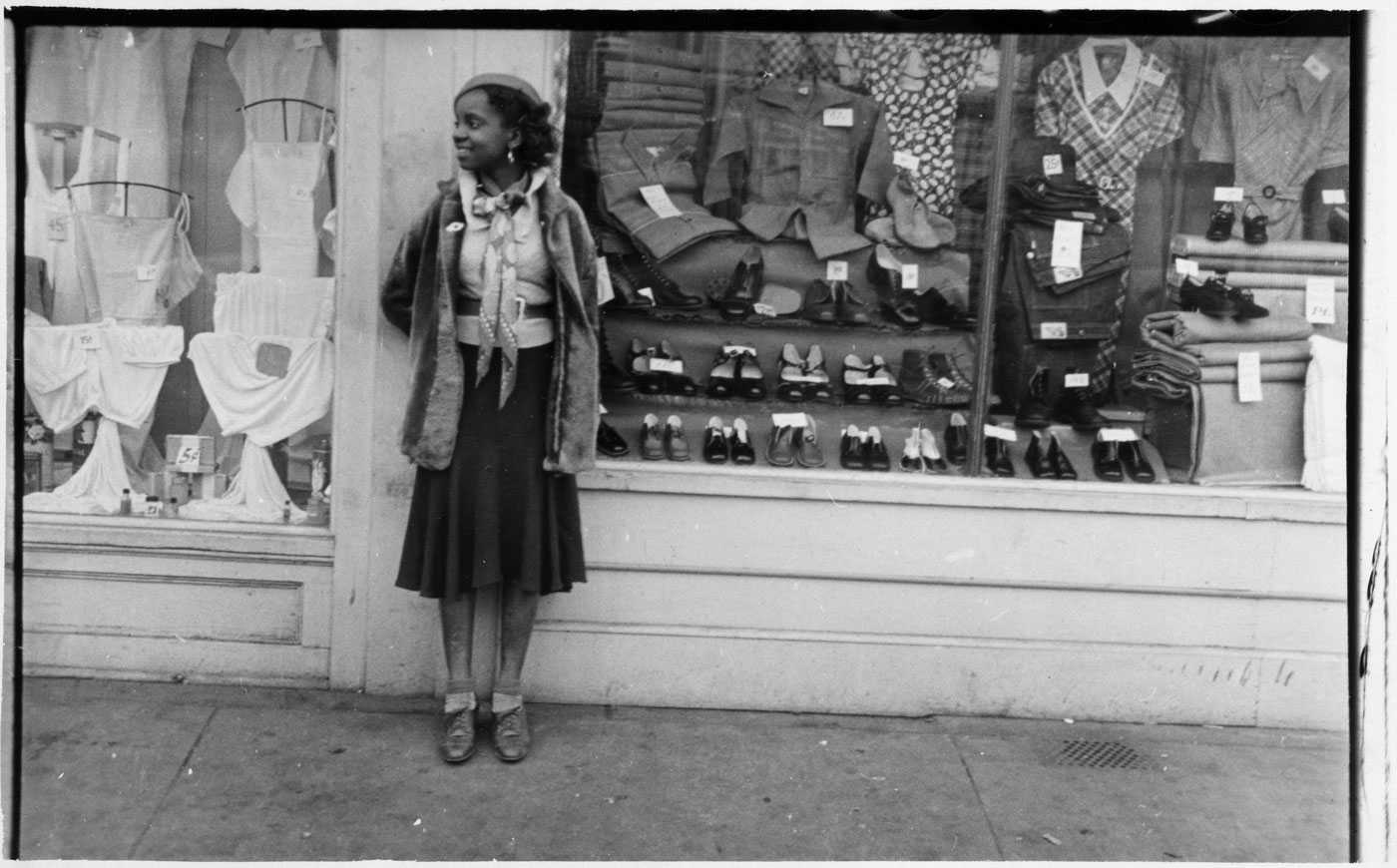
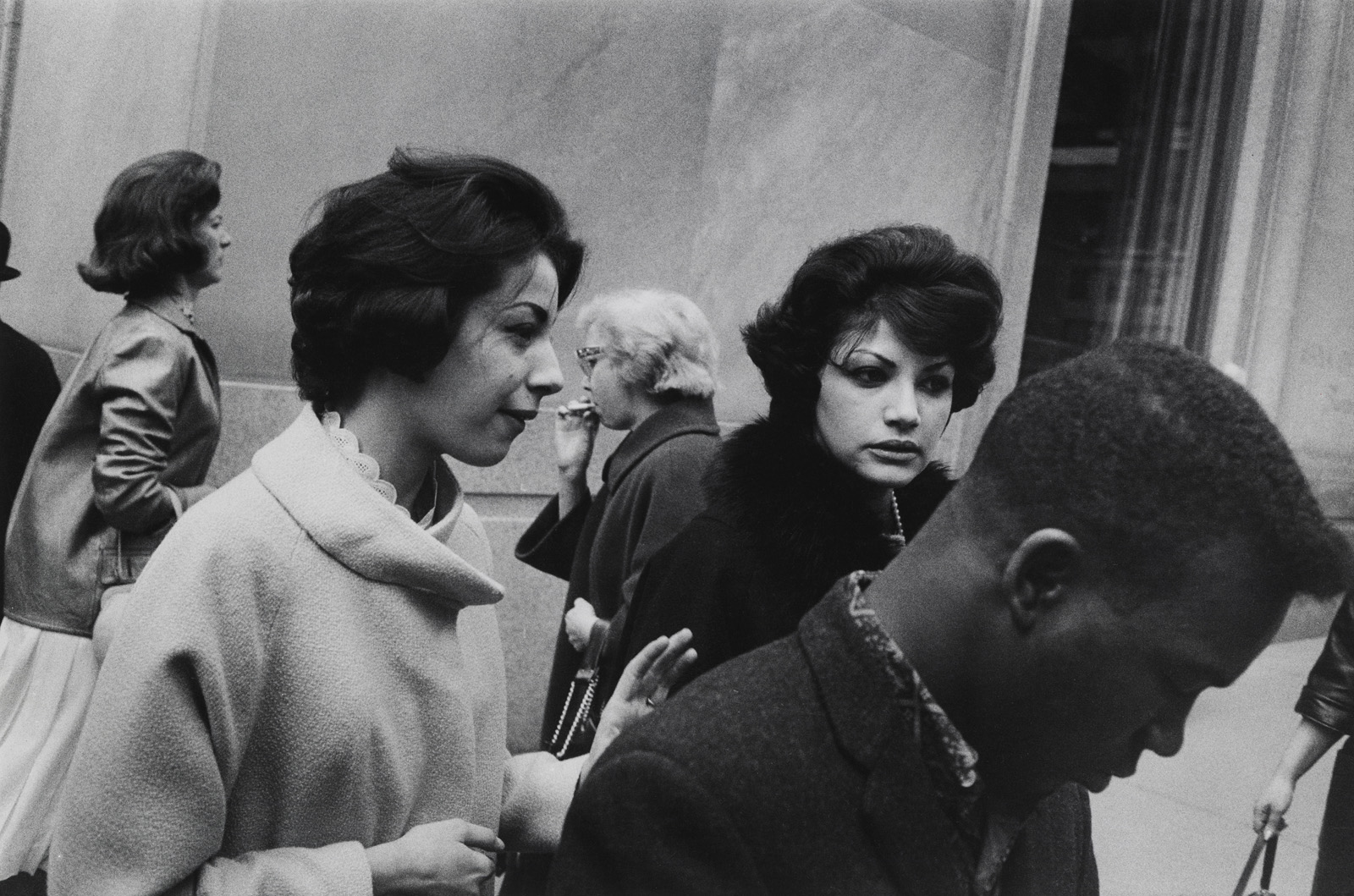
Walker Evans (American, 1903-1975) 'Young Women Outside Clothing Store' 1934-1935


Walker Evans (American, 1903-1975)
Young Women Outside Clothing Store
1934-1935
114 x 184mm
Lunn Gallery Stamp (1975)
© Walker Evans Archive, The Metropolitan Museum of Art


End of the week. Not a lot of energy or time to write an in depth piece on the wonders of Walker Evans, so just a few observations…

I like this photographer, I like him a lot. No histrionics, little subjectivity being thrown at the audience. The images are -just -so. The compositions are seemingly simple but are actually very complex. Only a skilled craftsman can make the difficult look simple. As Thomas Struth has said of his photography: ‘for me it is more interesting to try and find out something from the real than to throw something subjective in front of the audience.’

“The uninflected image gives no hints as to how it is to be interpreted, and the viewer is led to linger over what might otherwise seem an un-noteworthy, everyday vista.” It’s recognising that vista in the first place for what it is, and what else it can be, so that it ‘gives pause’ to the viewer.

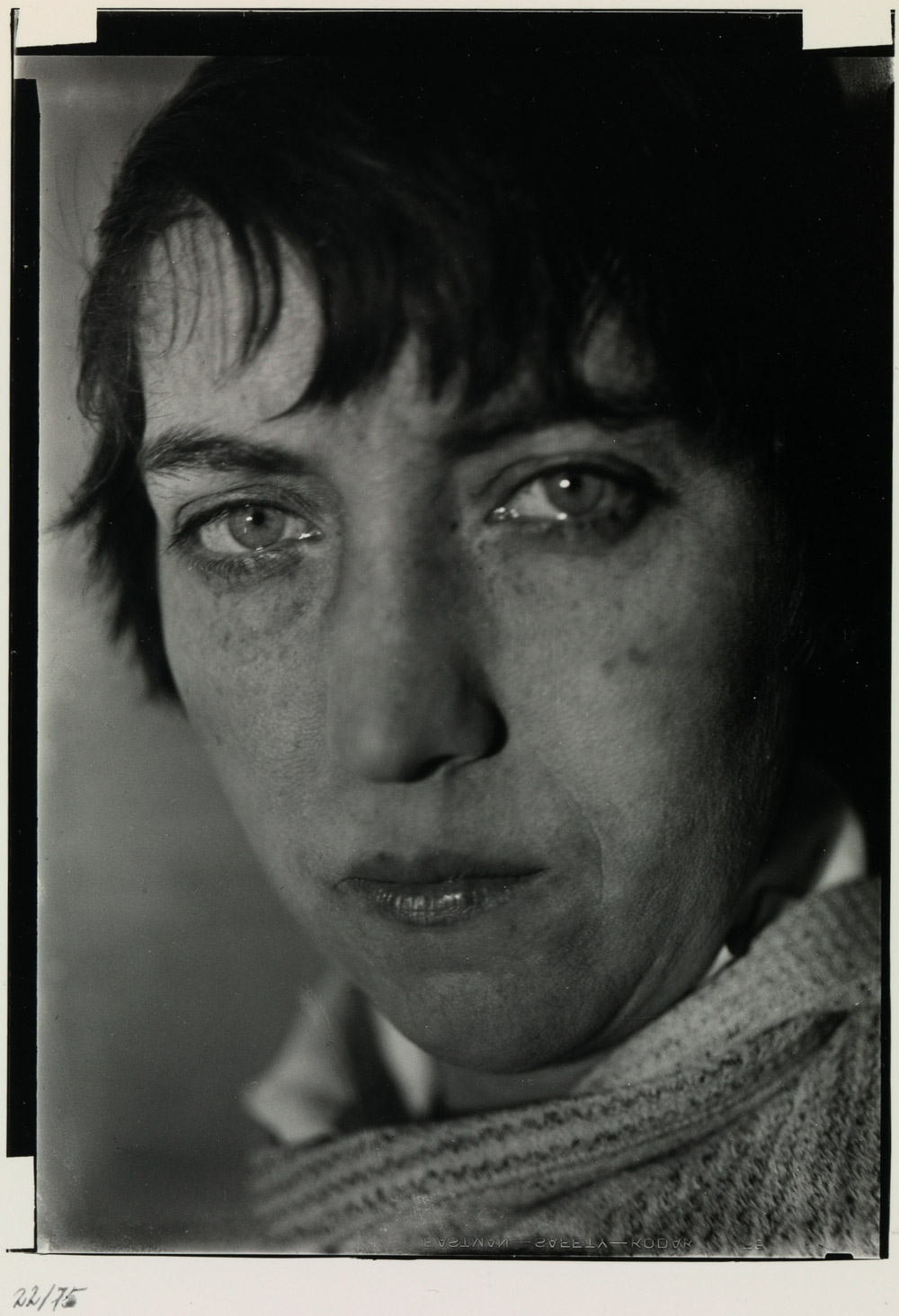
I really like the portrait of Berenice Abbott and it is also very educational. Look at the depth of field, with the view camera probably one stop past wide open. The sharpness plane is very tiny but look at the quality of the lens and how it renders the values that are slightly out of focus. What a very beautiful image and I suspect a top drawer lens. Notice also it is print 22. Walker Evans would keep a lot of prints and they were not the same. The next copy of this print might have been better (he might have worked out something to do) or it might be worse – the developer might have gone off. So it is not strictly an “edition” it is just the numbering of the prints he made.

He used every sort of camera: 8 x 10 and the smaller view formats, roll film cameras, Colour polaroid! hence the different sizes of his prints. Occasionally he did crop his images but on other occasions he took “a stance” where you knew he was about to perform and there would be no cropping. If you are really interested in this master photographer, the best Walker Evans book to get is First and Last (1978, available cheaply as a hardback on Amazon) which contains many pictures and “threads” that are dynamite… and the John Szarkowski book Walker Evans (1972) is a good one as well.

Dr Marcus Bunyan


Many thankx to Martin-Gropius-Bau for allowing me to publish the photographs in the posting. Please click on the photographs for a larger version of the image.


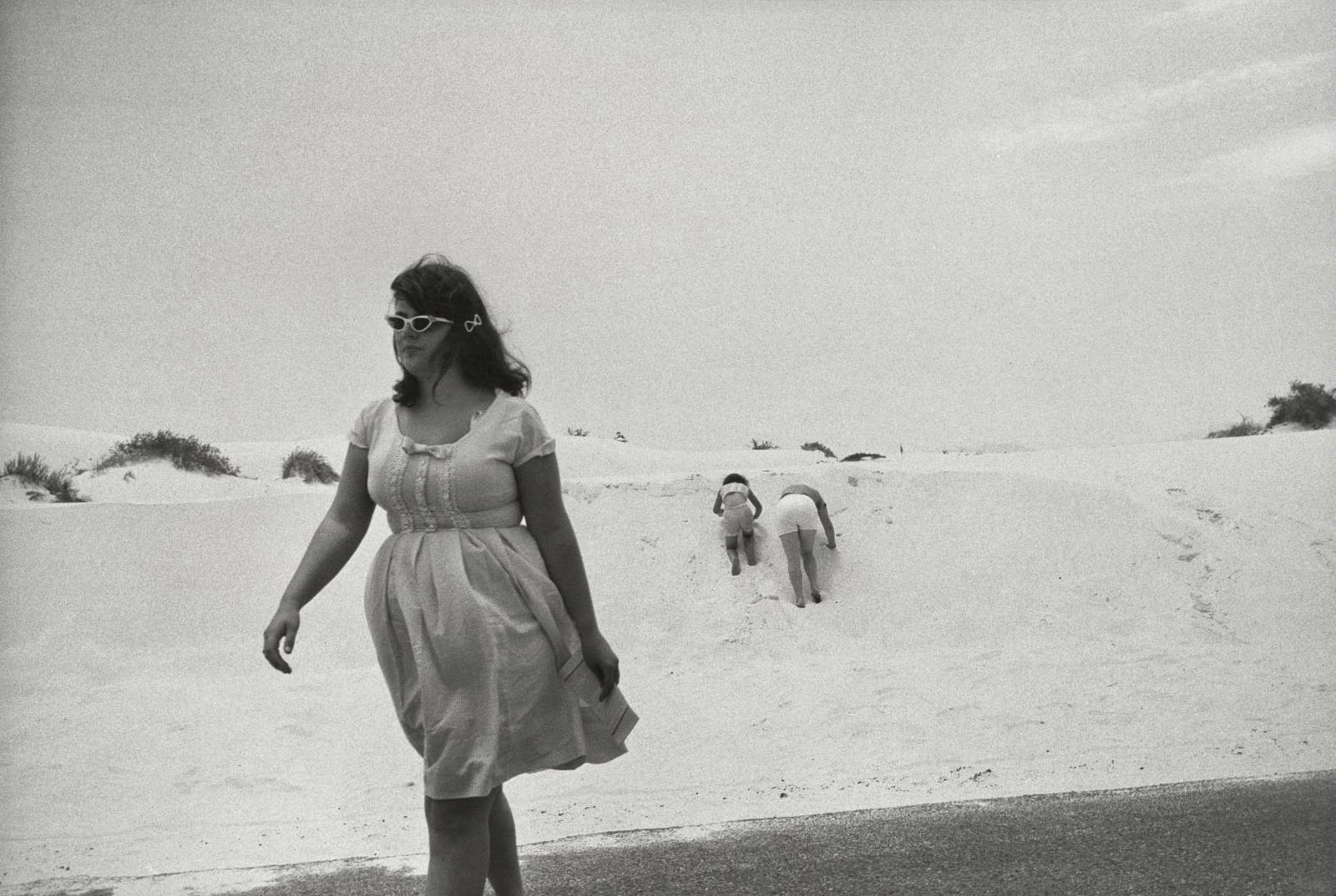
Walker Evans (American, 1903-1975) 'Two Women' Frenchquarter, New Orleans, February - March 1935


Walker Evans (American, 1903-1975)
Two Women
Frenchquarter, New Orleans, February – March 1935
155 x 219mm
Lunn Gallery Stamp (1975)
© Walker Evans Archive, The Metropolitan Museum of Art


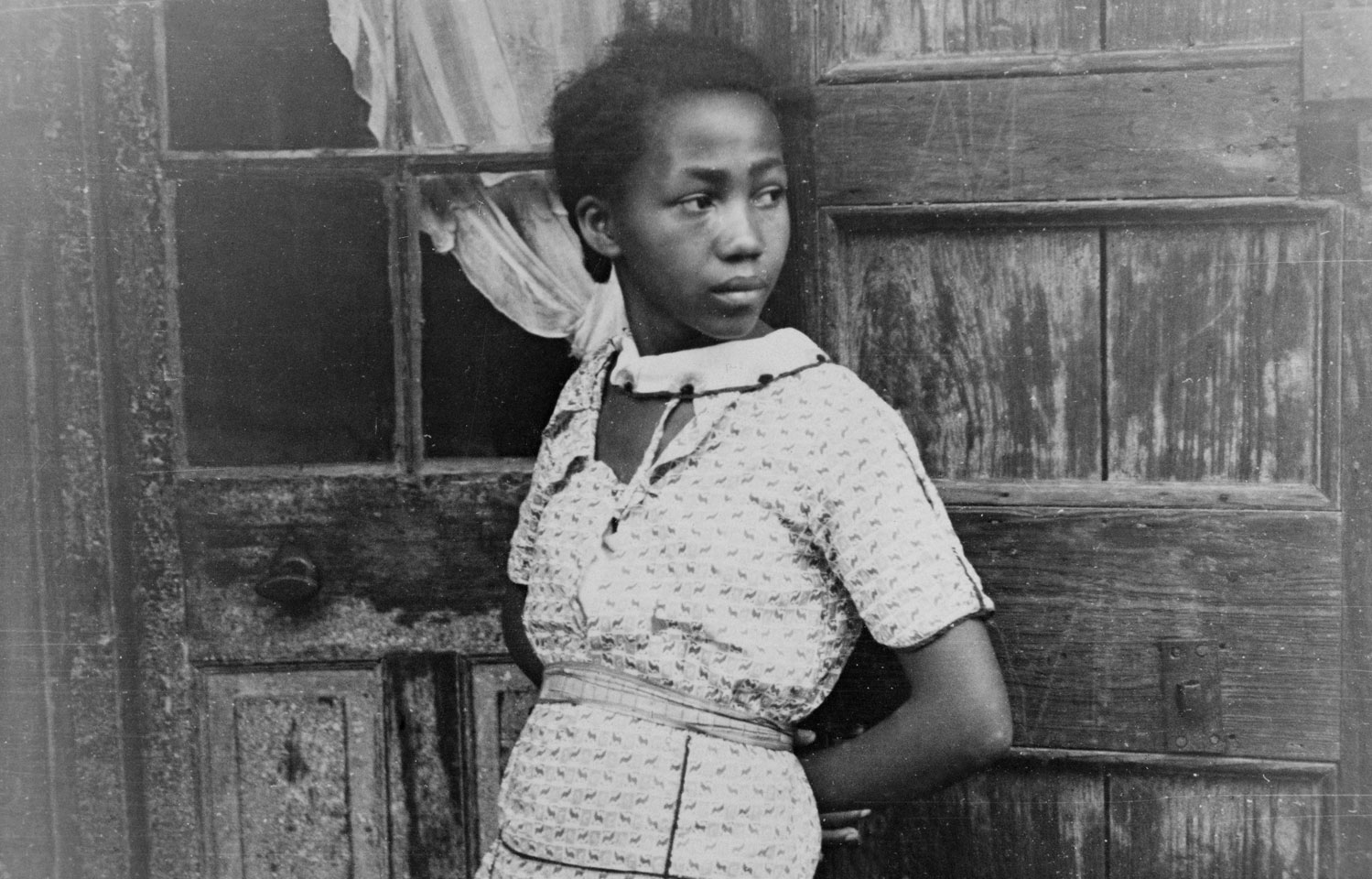
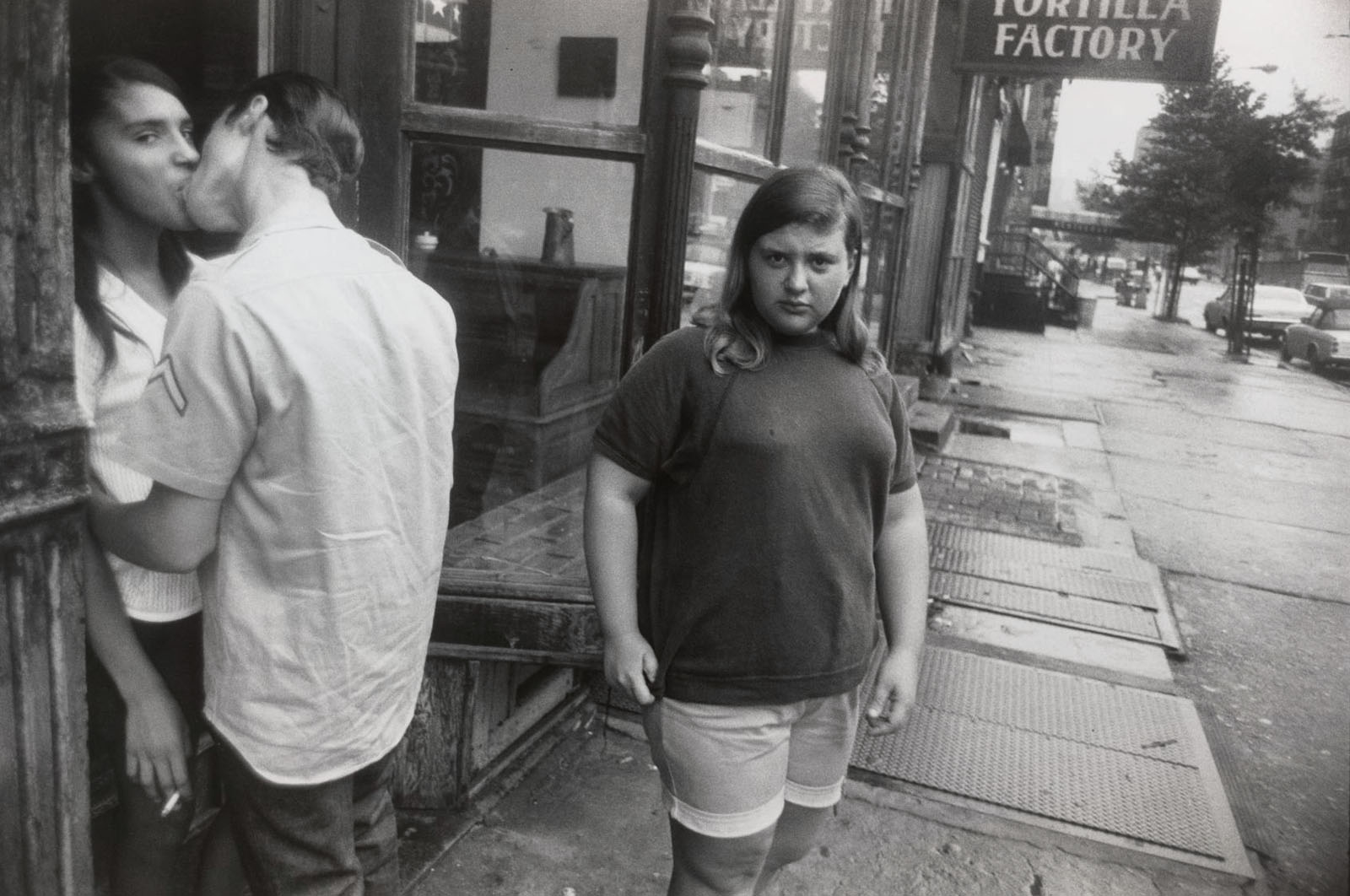
Walker Evans (American, 1903-1975) 'Girl In French Quarter' New Orleans, February - March 1935


Walker Evans (American, 1903-1975)
Girl In French Quarter
New Orleans, February – March 1935
117 x 178mm
Lunn Gallery Stamp (1975)
© Walker Evans Archive, The Metropolitan Museum of Art


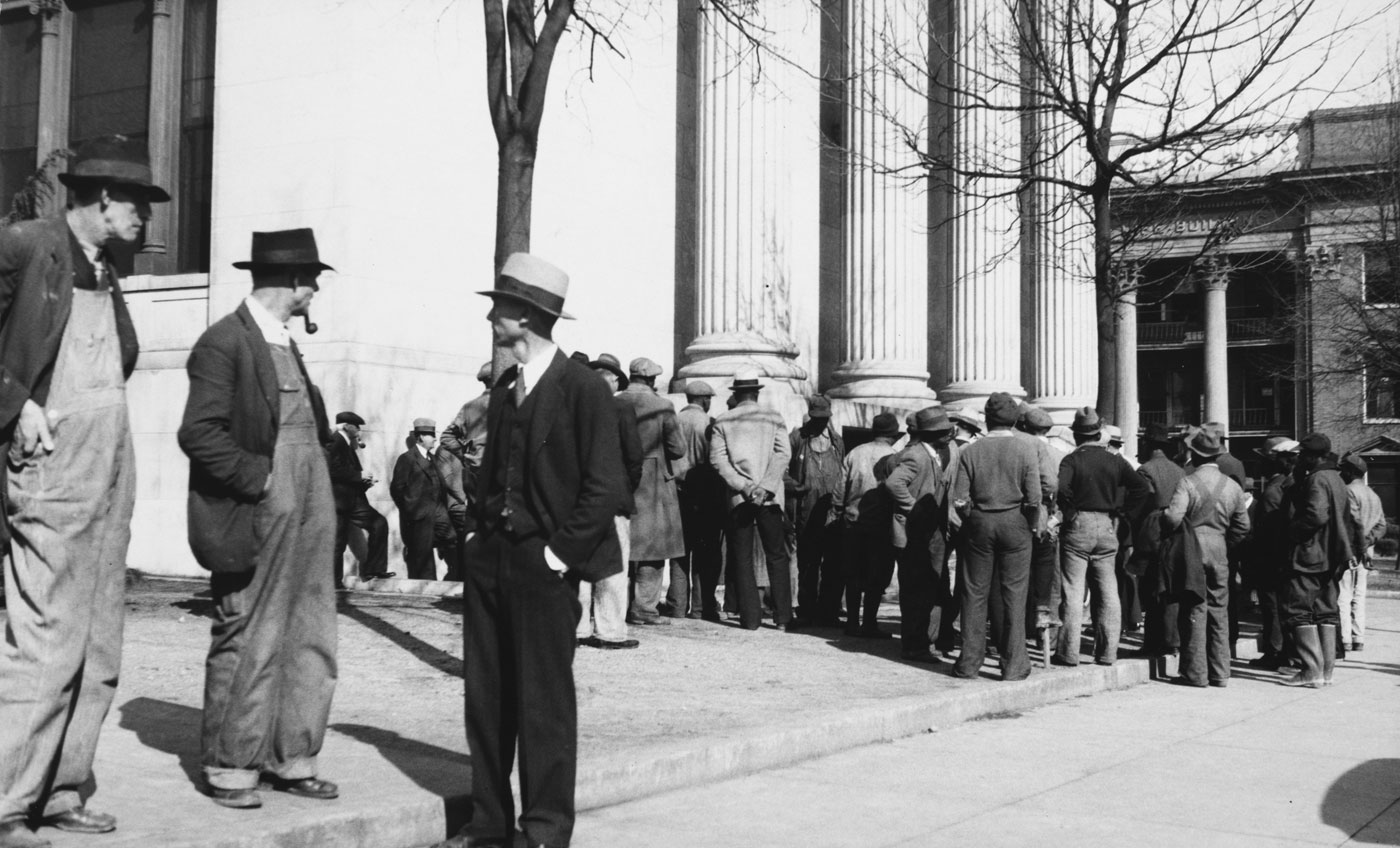
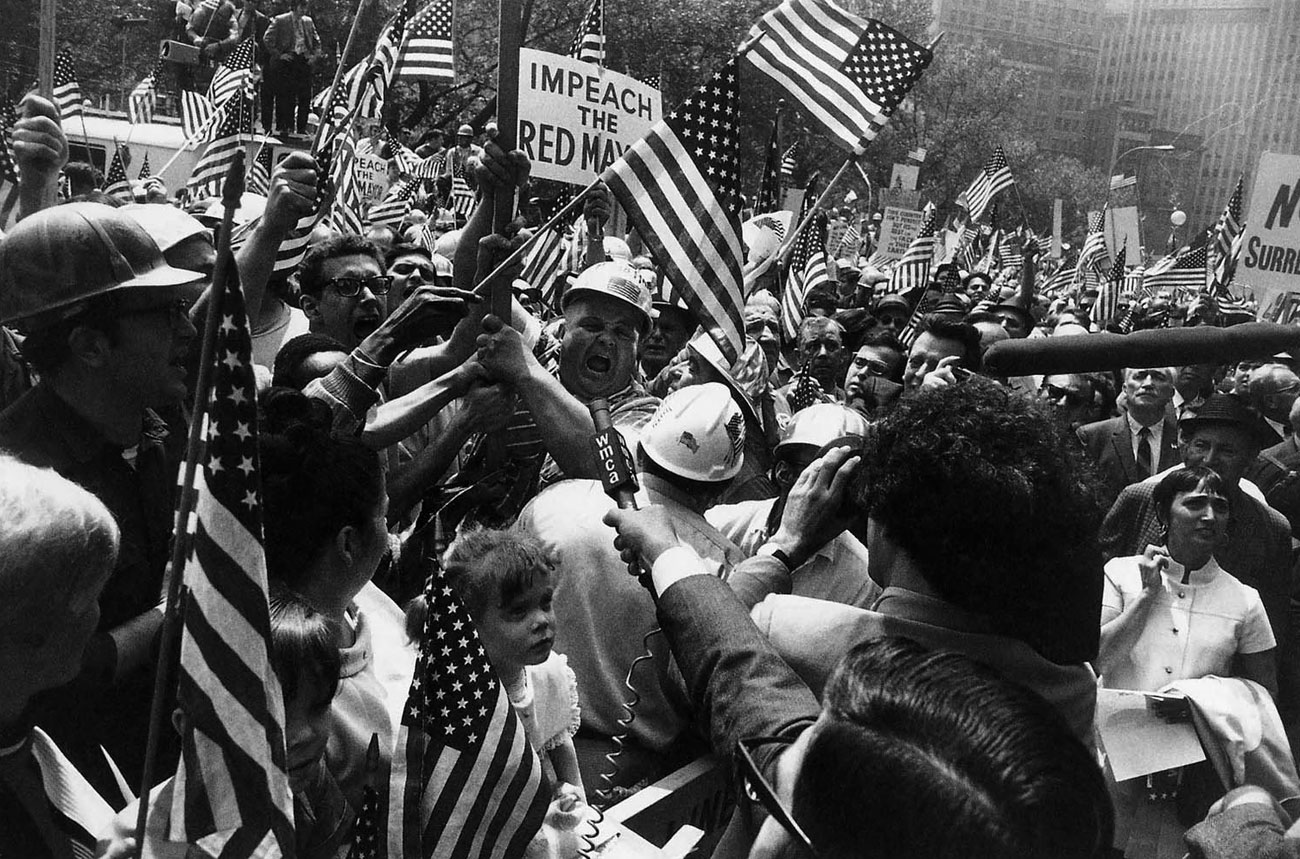
Walker Evans (American, 1903-1975) 'Crowd In Public Square' 1930s


Walker Evans (American, 1903-1975)
Crowd In Public Square
1930s
143 x 248mm
Lunn Gallery Stamp (1975)
© Walker Evans Archive, The Metropolitan Museum of Art


Walker Evans (American, 1903-1975) 'Berenice Abbott' 1929-1930


Walker Evans (American, 1903-1975)
Berenice Abbott
1929-1930
© Walker Evans Archive, The Metropolitan Museum of Art


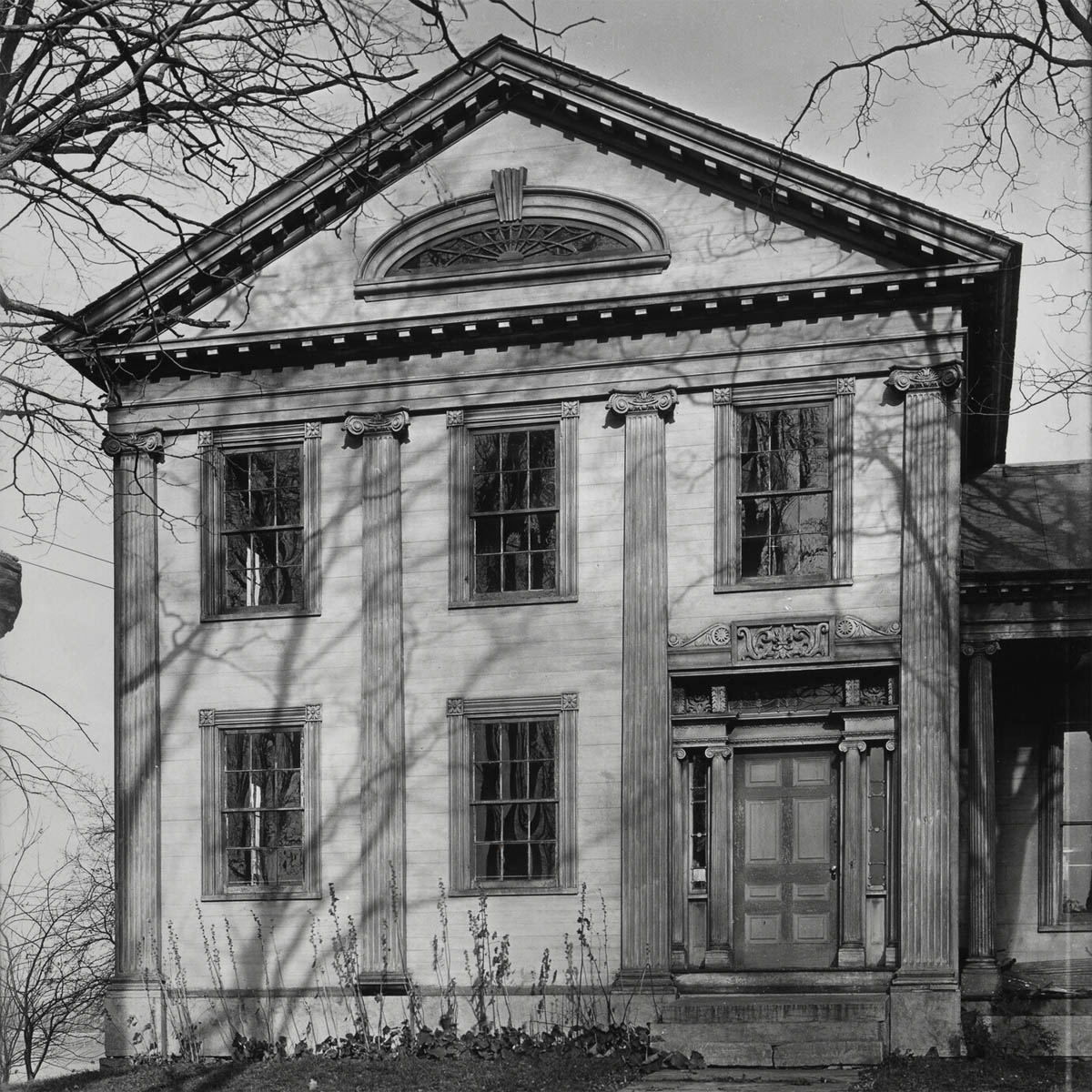
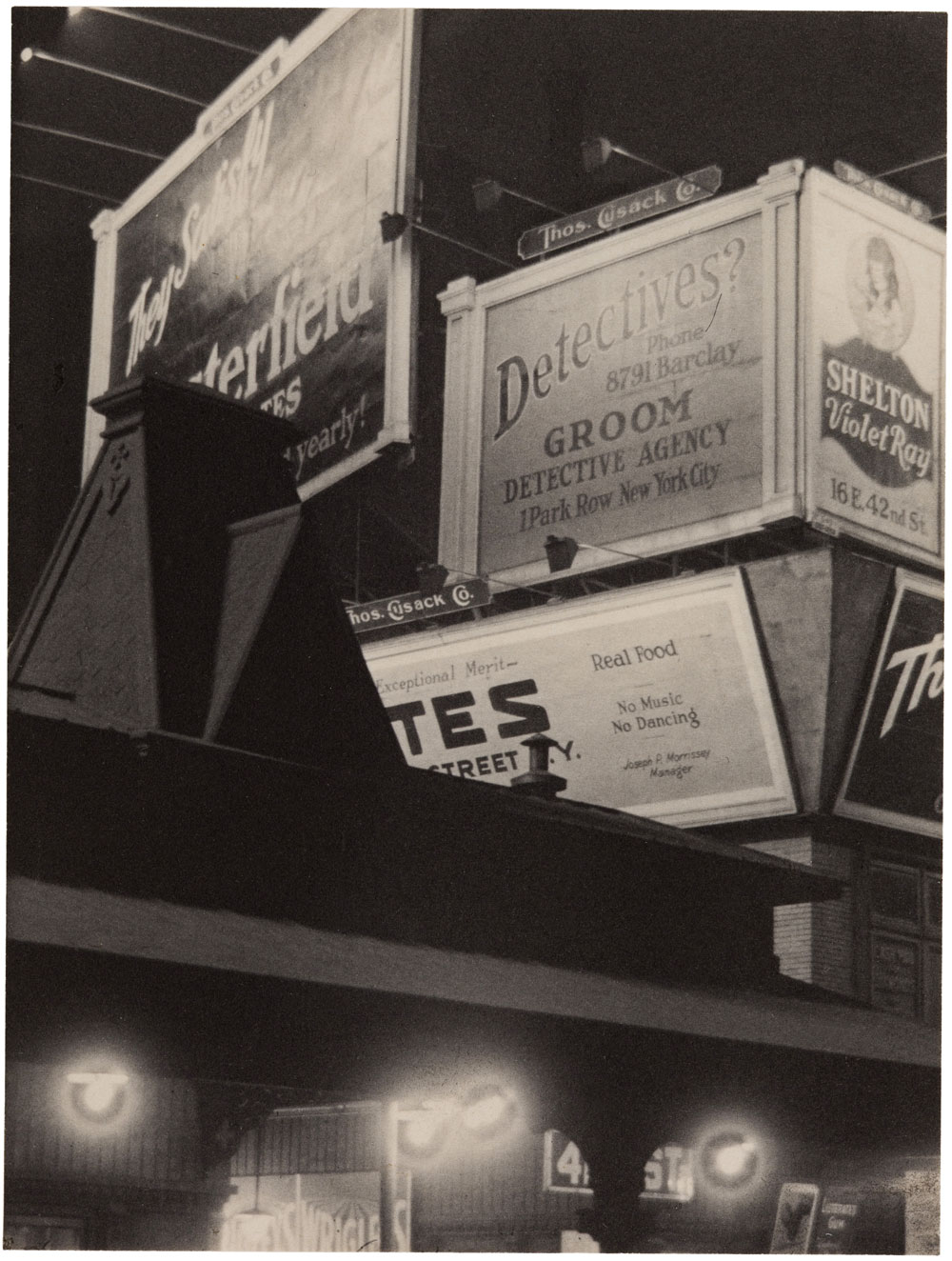
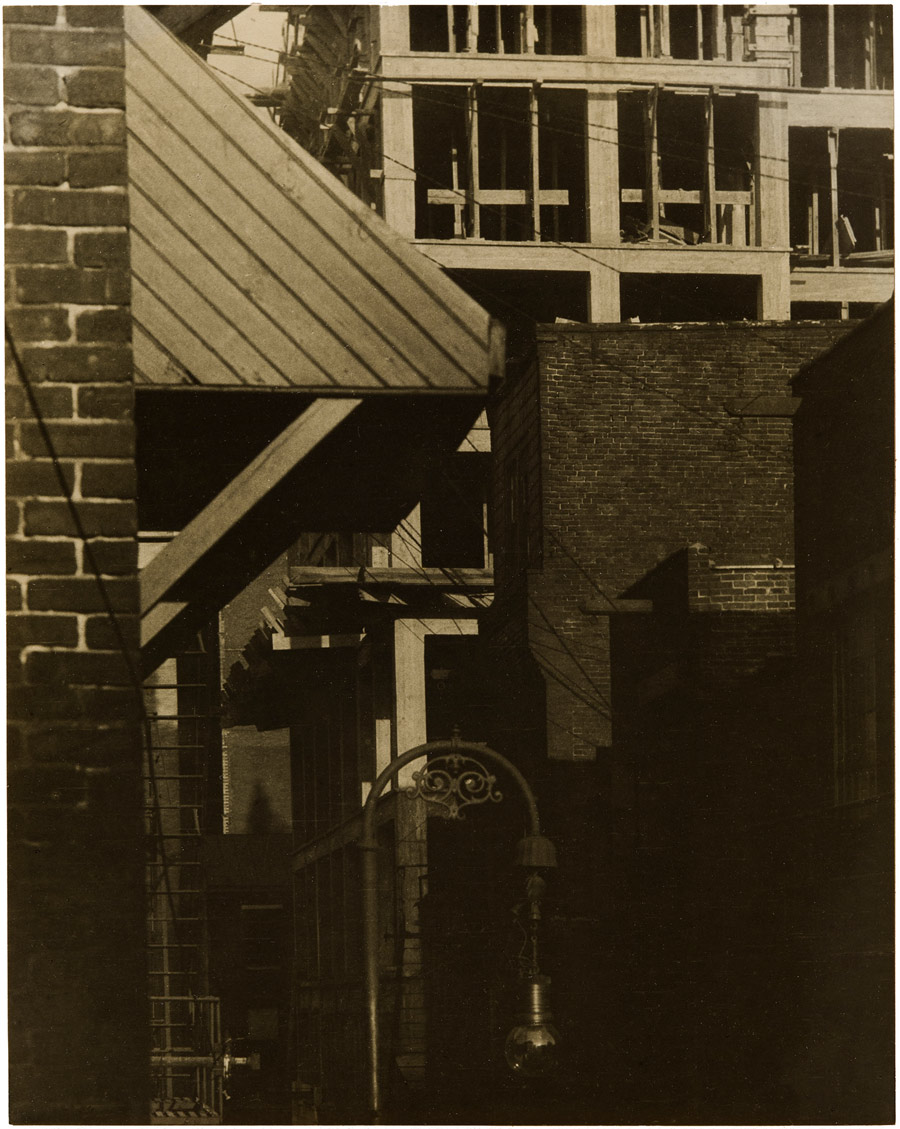
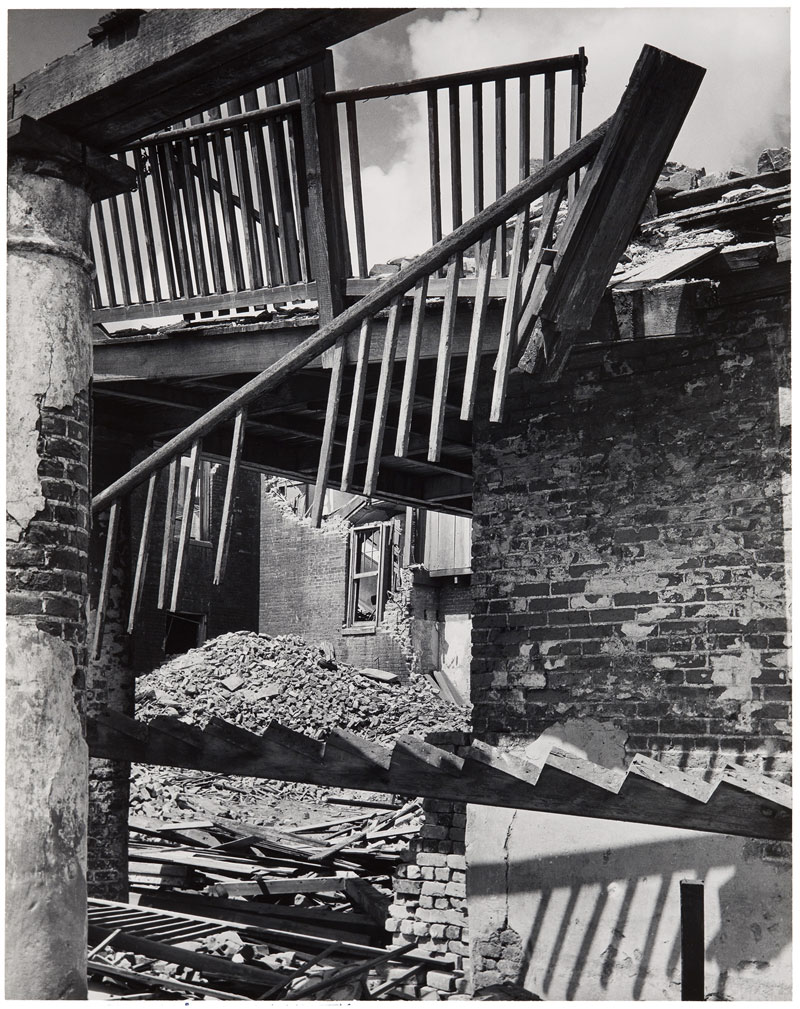
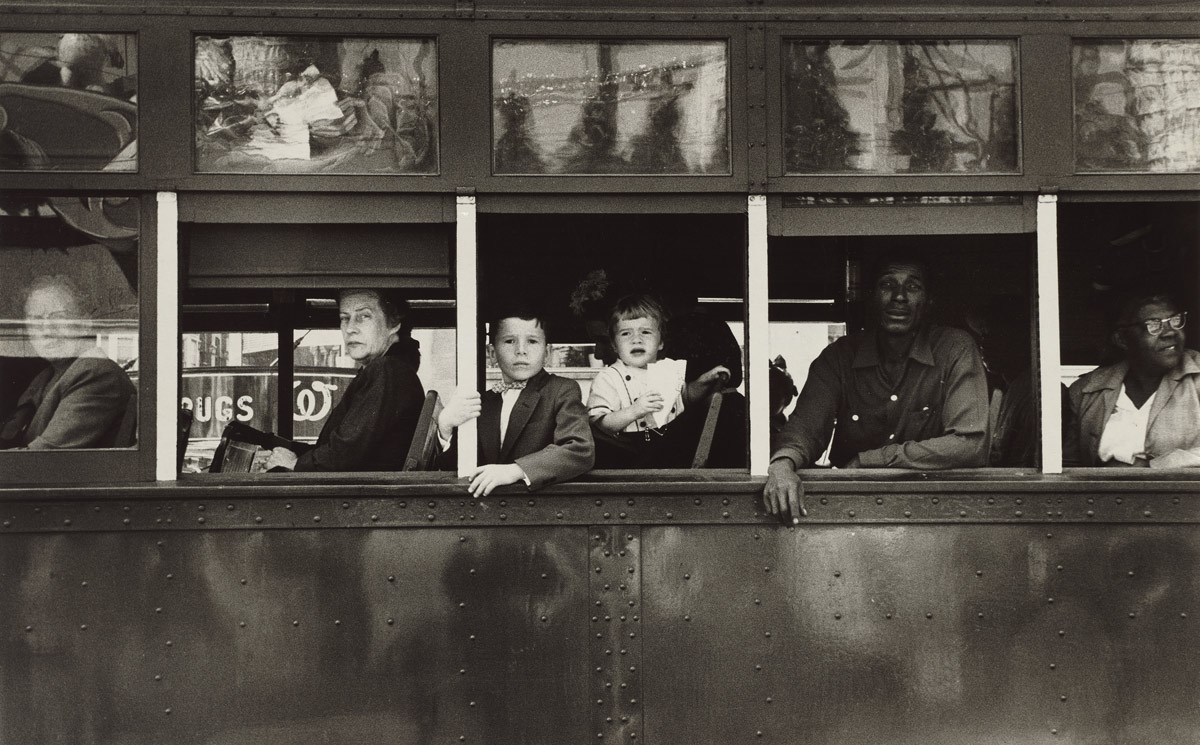
Walker Evans (1903-1975) was one of the great personalities of 20th century photography, being an exponent of what is called the “documentary style”. His work, which spans a period of over fifty years, will be represented by well over 200 original prints from the years 1928 to 1974, taken mostly from the considerable private collection of Clark and Joan Worswick, but also from various German collections.

For decades, right up to the present, the prolific photographic oeuvre of Walker Evans has acquired an increasingly model character. In the half century of his creative activity the photographer documented in sober documentary fashion a uniquely authentic picture of America, and like no other before him showed a particular feel for both the everyday and the subtle – the American Vernacular – creating a sense of identity and historic significance.

Visitors follow both Evans’ biography and the changing face of America, from the Great Depression to the onset of stability and business as usual: early impressions of the 1920s from the New York neighbourhood he lived in; portraits of his friends and fellow artists which give some indication of the ramified cultural ambience he inhabited; specimens of 19th century architecture that have blended into the evolving cultural life about them; picture cycles from Tahiti and Cuba; images of African sculptures and masks commissioned by the New York Museum of Modern Art; and numerous photographs taken in the 1930s in the rural south of the USA, which contrast starkly with the lifestyles of those who may be seen promenading in the fashionable streets of cities like New York.

In addition to street scenes, American monuments and shop window displays far from the world of “big business”, examples of his significant subway photographs are to be seen, taken with a hidden camera. We also see interiors whose modest appointments tell of the life of those who live in them, pictures that inevitably recall Evans’ remark that “I do like to suggest people by absence”. Evans’ predilection for typography, advertising and mass-produced articles give rise to strangely fascinating shots which seem to anticipate the soon-to-emerge Pop Art and its assemblages.

While the exhibition shows icons in the history of photography, it also highlights some of the photographer’s lesser known motifs dating from the 1940s, 1950s and 1960s. These include works done for Fortune, the magazine founded by Henry Luce in 1930; pictures taken on trips to London from 1945 onwards for the periodical Architectural Forum; or during stays at Robert Frank’s Nova Scotia house in the late 1960s.

Text from the Martin-Gropius-Bau website


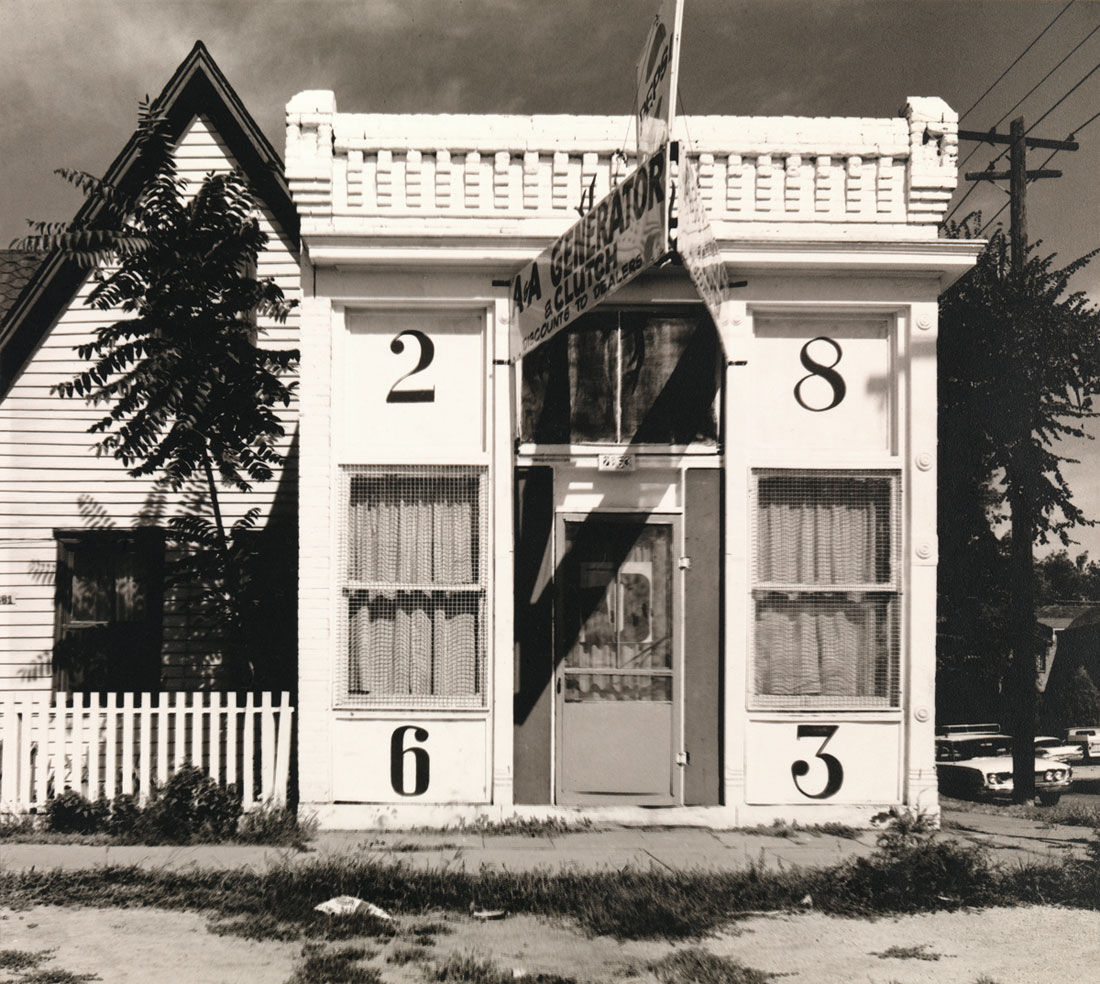
Walker Evans (American, 1903-1975) 'Façade of House with Large Numbers' Denver, Colorado, August 1967


Walker Evans (American, 1903-1975)
Façade of House with Large Numbers
Denver, Colorado, August 1967
Collection of Clark and Joan Worswick
© Walker Evans Archive, The Metropolitan Museum of Art


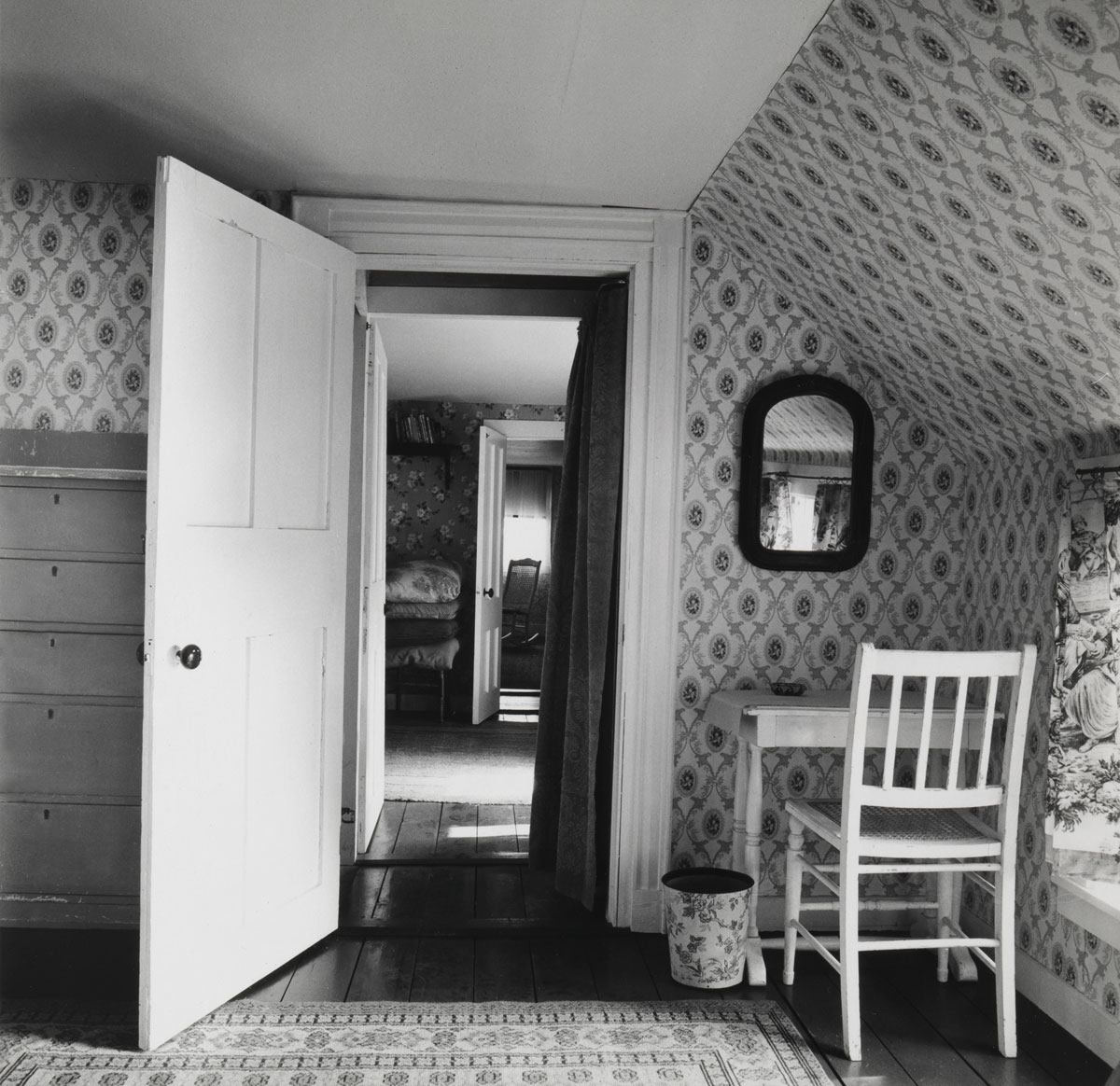
Walker Evans (American, 1903-1975) 'Interior View of Heliker/Lahotan House' Walpole, Maine, 1962


Walker Evans (American, 1903-1975)
Interior View of Heliker/Lahotan House
Walpole, Maine, 1962
Collection of Clark and Joan Worswick
© Walker Evans Archive, The Metropolitan Museum of Art


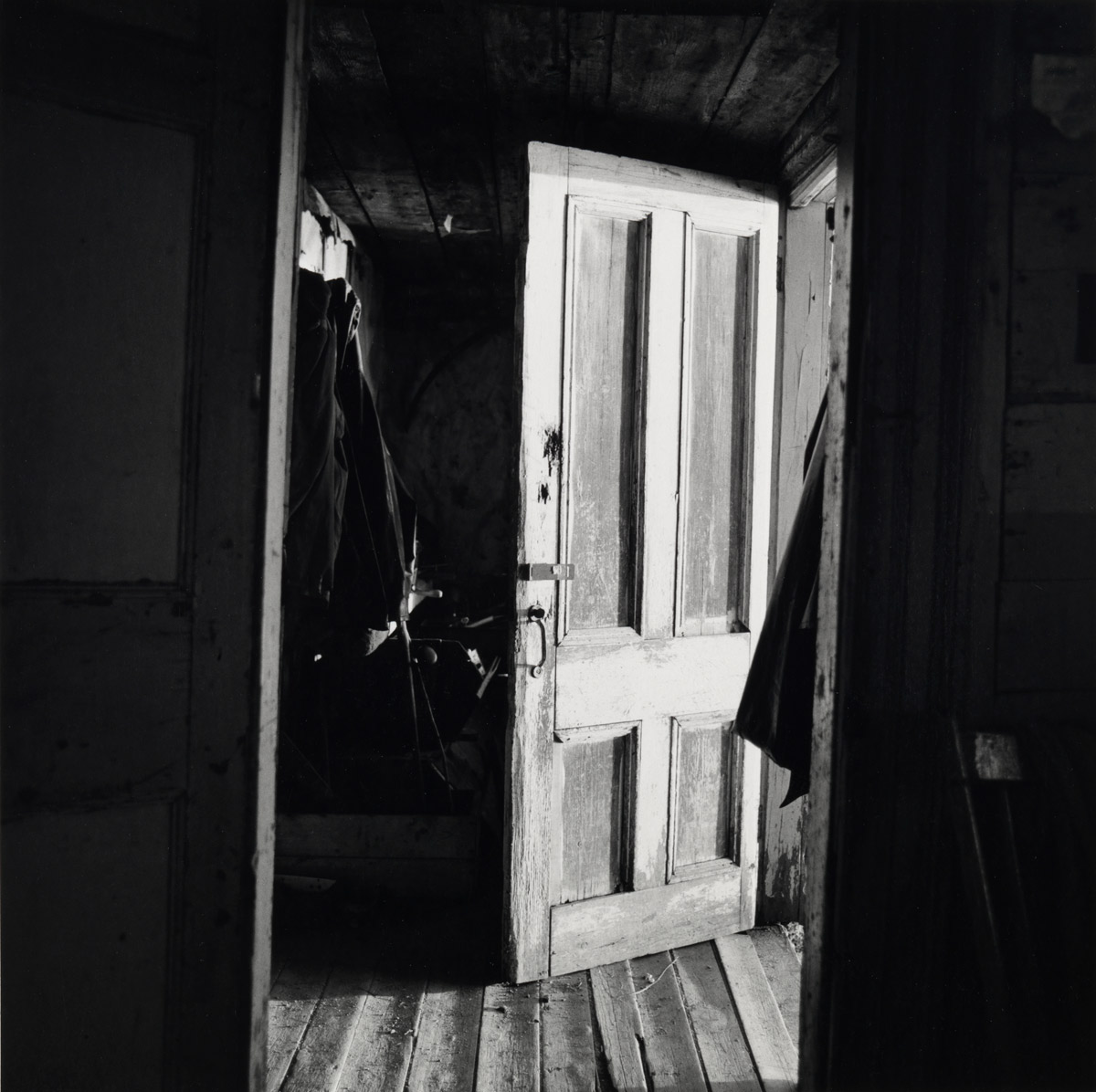
Walker Evans (American, 1903-1975) 'Interior View of Robert Frank’s House' Nova Scotia, 1969-1971


Walker Evans (American, 1903-1975)
Interior View of Robert Frank’s House
Nova Scotia, 1969-1971
Collection of Clark and Joan Worswick
© Walker Evans Archive, The Metropolitan Museum of Art


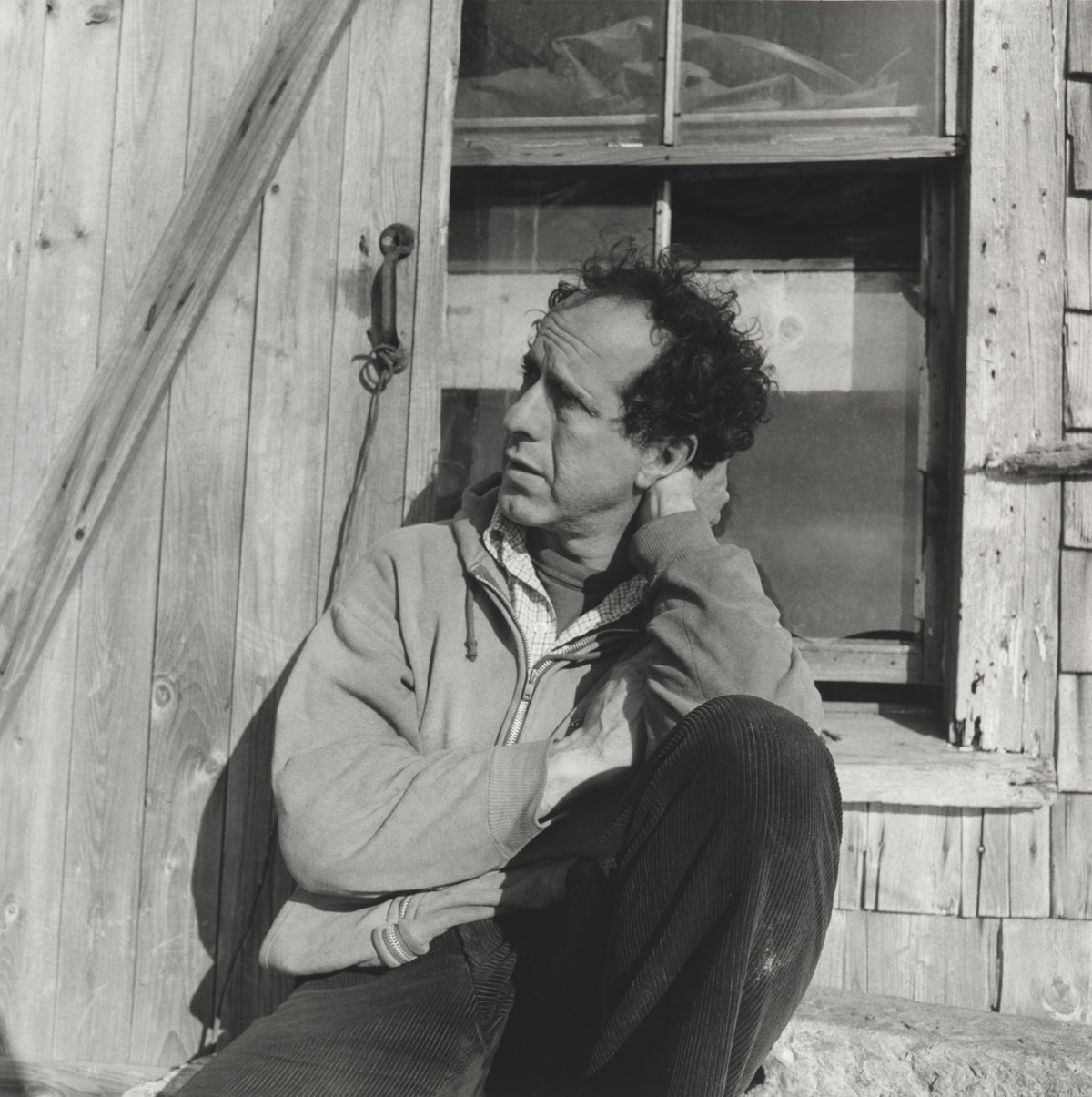
Walker Evans (American, 1903-1975) 'Robert Frank' Nova Scotia, 1969-1971


Walker Evans (American, 1903-1975)
Robert Frank
Nova Scotia, 1969-1971
Collection of Clark and Joan Worswick
© Walker Evans Archive, The Metropolitan Museum of Art


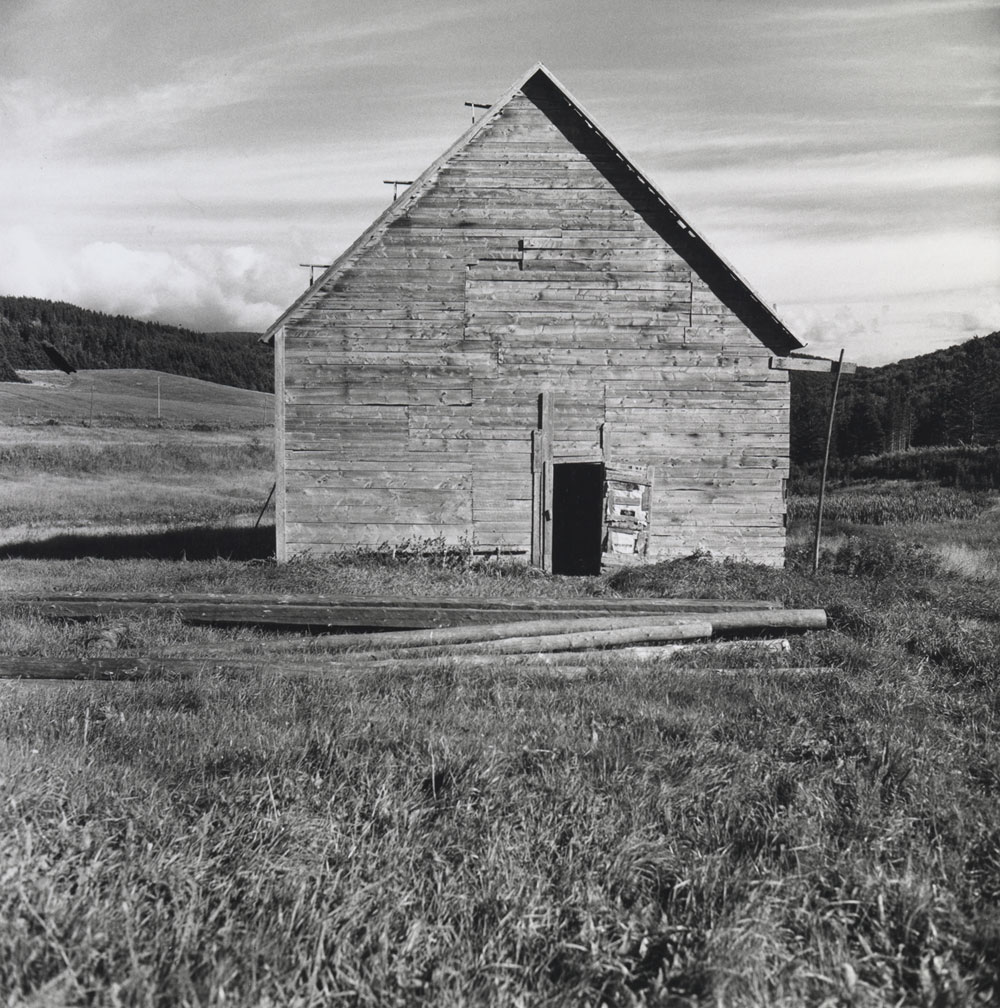
Walker Evans (American, 1903-1975) 'Barn' Nova Scotia, 1969-1971


Walker Evans (American, 1903-1975)
Barn
Nova Scotia, 1969-1971
Collection of Clark and Joan Worswick
© Walker Evans Archive, The Metropolitan Museum of Art


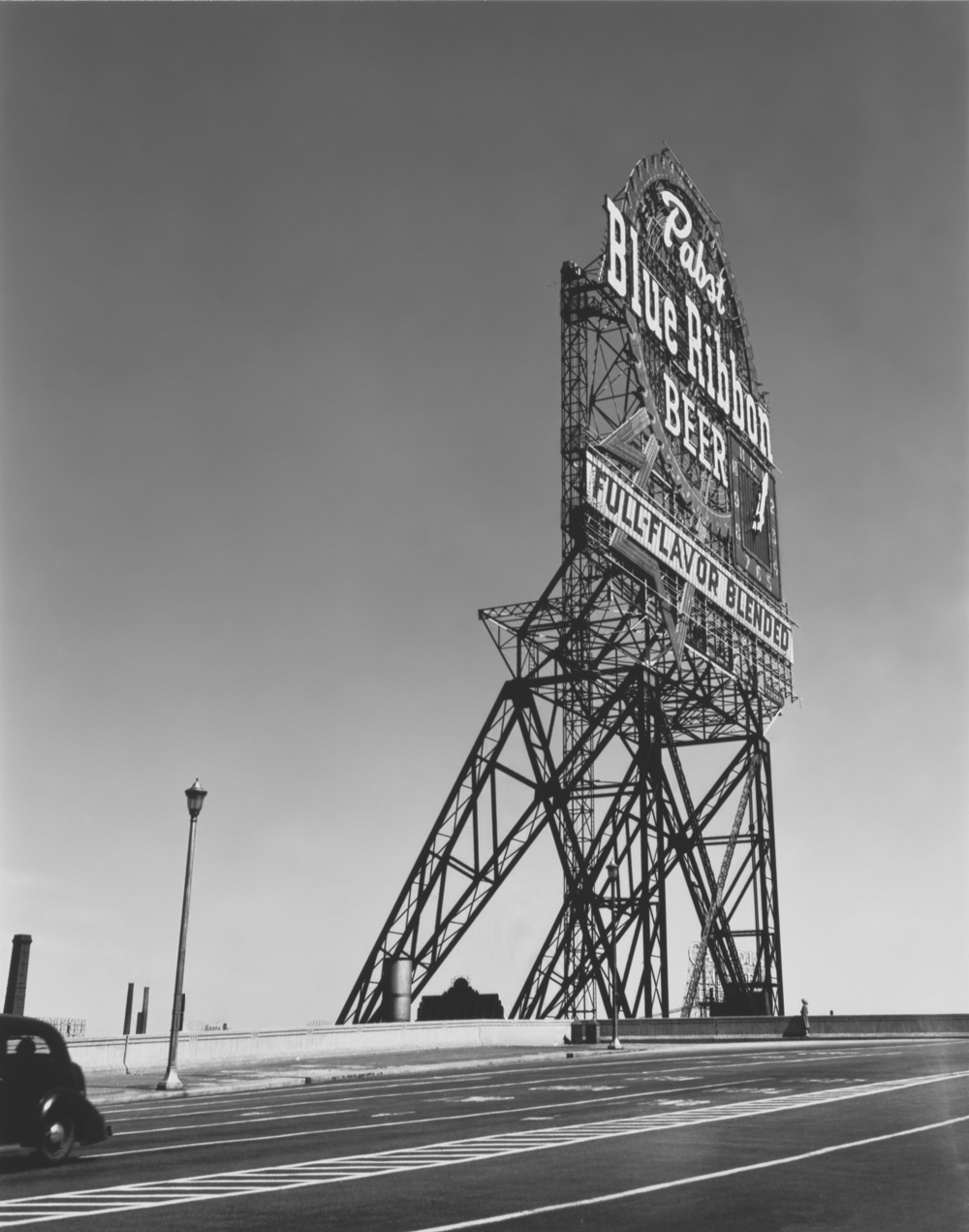
Walker Evans (American, 1903-1975) 'Pabst Blue Ribbon Sign' Chicago, Illinois, 1946


Walker Evans (American, 1903-1975)
Pabst Blue Ribbon Sign
Chicago, Illinois, 1946
Collection of Clark and Joan Worswick
© Walker Evans Archive, The Metropolitan Museum of Art


Martin-Gropius-Bau Berlin
Niederkirchnerstraße 7
Corner Stresemannstr. 110
10963 Berlin
Phone: +49 (0)30 254 86-0

Opening Hours:
Wednesday to Monday 10 – 19 hrs
Tuesday closed

Martin-Gropius-Bau website

LIKE ART BLART ON FACEBOOK

Back to top

Exhibition: ‘A World of Its Own: Photographic Practices in the Studio’ at the Museum of Modern Art (MoMA), New York Part 2

Exhibition dates: 8th February – 2nd November 2014

The Edward Steichen Photography Galleries, third floor

Curators: Organised by Quentin Bajac, The Joel and Anne Ehrenkranz Chief Curator, with Lucy Gallun, Assistant Curator, Department of Photography


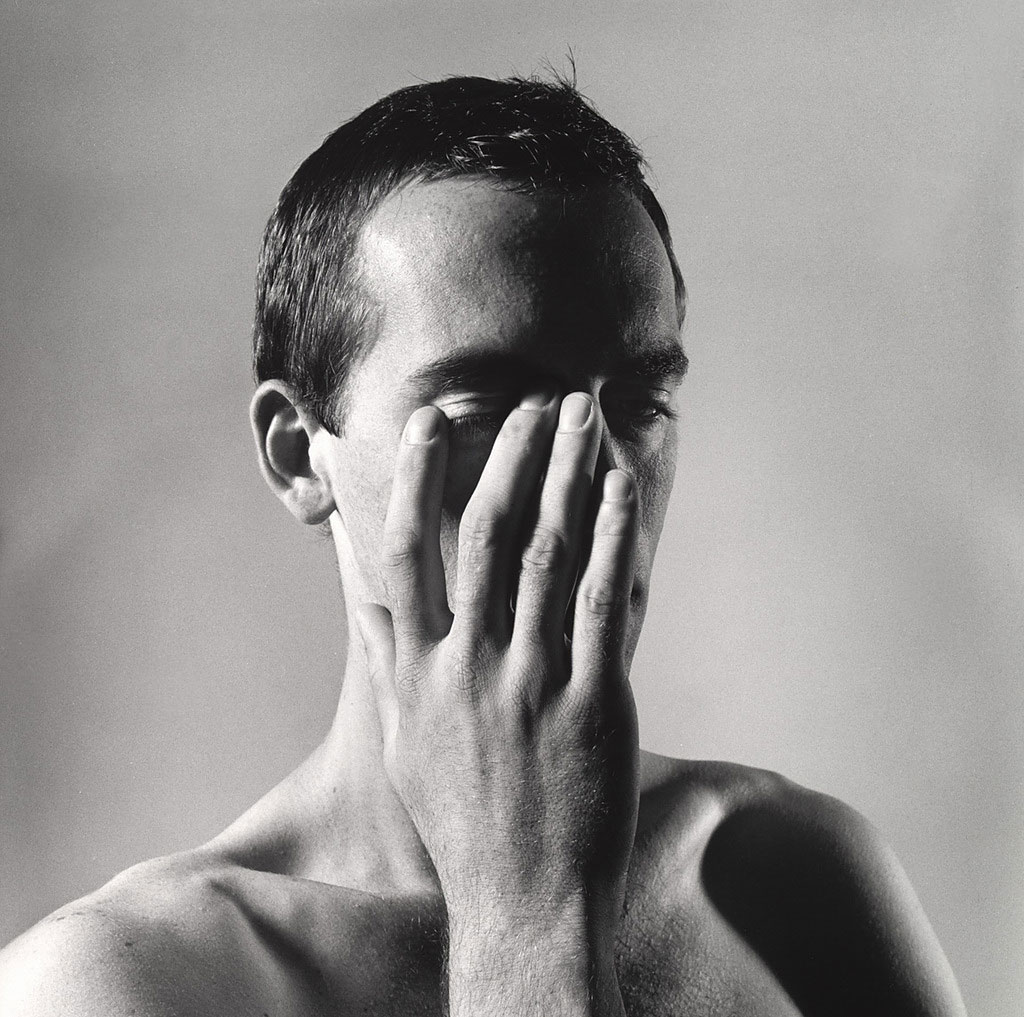
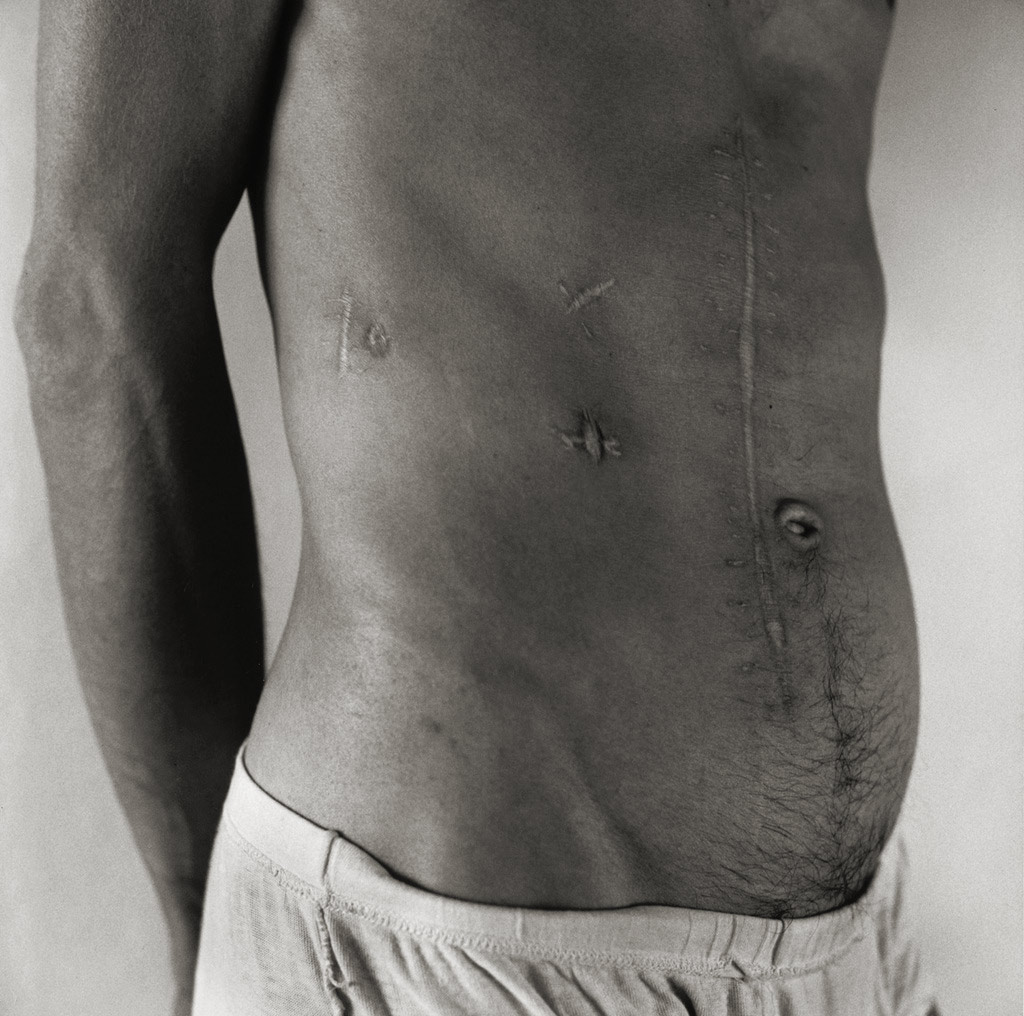
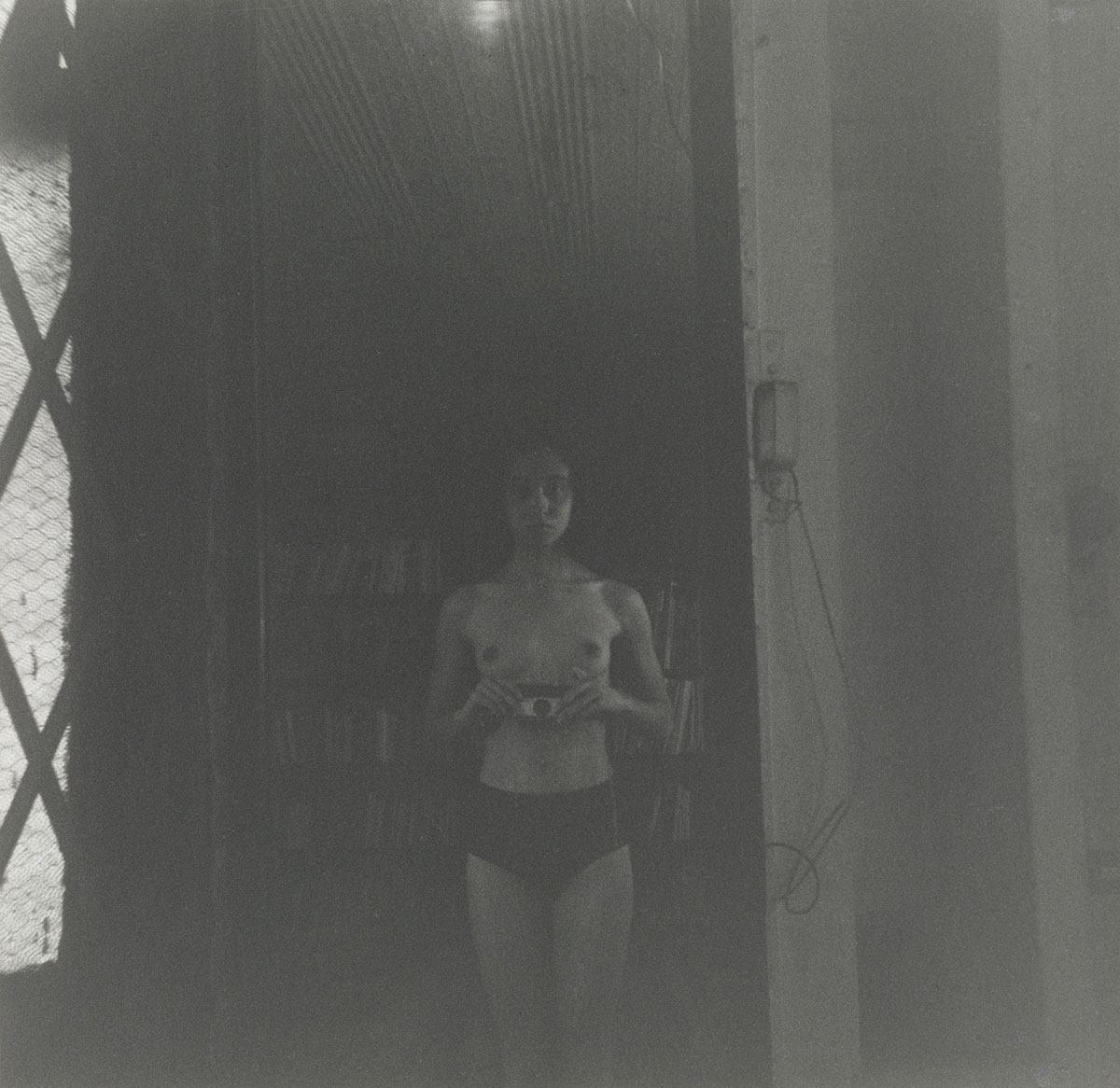
Peter Hujar (American, 1934-1987) 'David Wojnarowicz' 1981


Peter Hujar (American, 1934-1987)
David Wojnarowicz
1981
Gelatin silver print
14 x 14″ (35.6 x 35.6cm)
The Fellows of Photography Fund
Museum of Modern Art Collection


Many thankx to MoMA for allowing me to publish four of the photographs in the posting. The rest of the images were sourced from the Internet in order to give the reader a more comprehensive understanding of what this exhibition is actually about – especially if you are thousands of miles away and have no hope of ever seeing it!

Dr Marcus Bunyan


Please click on the photographs for a larger version of the image.


The exhibition is divided into 6 themes each with its own gallery space:

1/ Surveying the Studio
2/ The Studio as Stage
3/ The Studio as Set
4/ A Neutral Space
5/ Virtual Spaces
6/ The Studio, from Laboratory to Playground


A Neutral Space


Harry Callahan (American, 1912-1999) 'Eleanor' 1948


Harry Callahan (American, 1912-1999)
Eleanor
1948
Gelatin silver print
4 1/2 x 3 1/4″ (11.4 x 8.3cm)
Gift of the artist
Museum of Modern Art Collection


Charles Harry Jones (English, 1866-1959) 'Brussels Sprouts' c. 1900


Charles Harry Jones (English, 1866-1959)
Brussels Sprouts
c. 1900
Gelatin silver printing-out-paper print
6 1/8 × 8 1/16″ (15.5 × 20.5cm)
Acquired through the generosity of Robert B. Menschel
Museum of Modern Art Collection


Charles Harry Jones (1866 – 15 November 1959) was an English gardener and photographer, noted for his still lifes of fruit and vegetables.

The photographs were probably made between 1895 and 1910, and likely while he was employed at Ote Hall. Jones’ work was never exhibited in his lifetime, and was largely unknown even to his family, until the photographic prints were discovered by accident in 1981. Sean Sexton found a suitcase containing hundreds of prints of vegetables, fruits and flowers at Bermondsey antiques market. Other than a very few exceptions, Jones’ photographs exist only in unique examples. None of the glass-plate negatives have been located.

Jones isolated his vegetables, fruits and flowers against neutral dark or light backgrounds, in the manner of formal studio portraits. He used long exposures and small apertures to give depth of field.

Text from the Wikipedia website


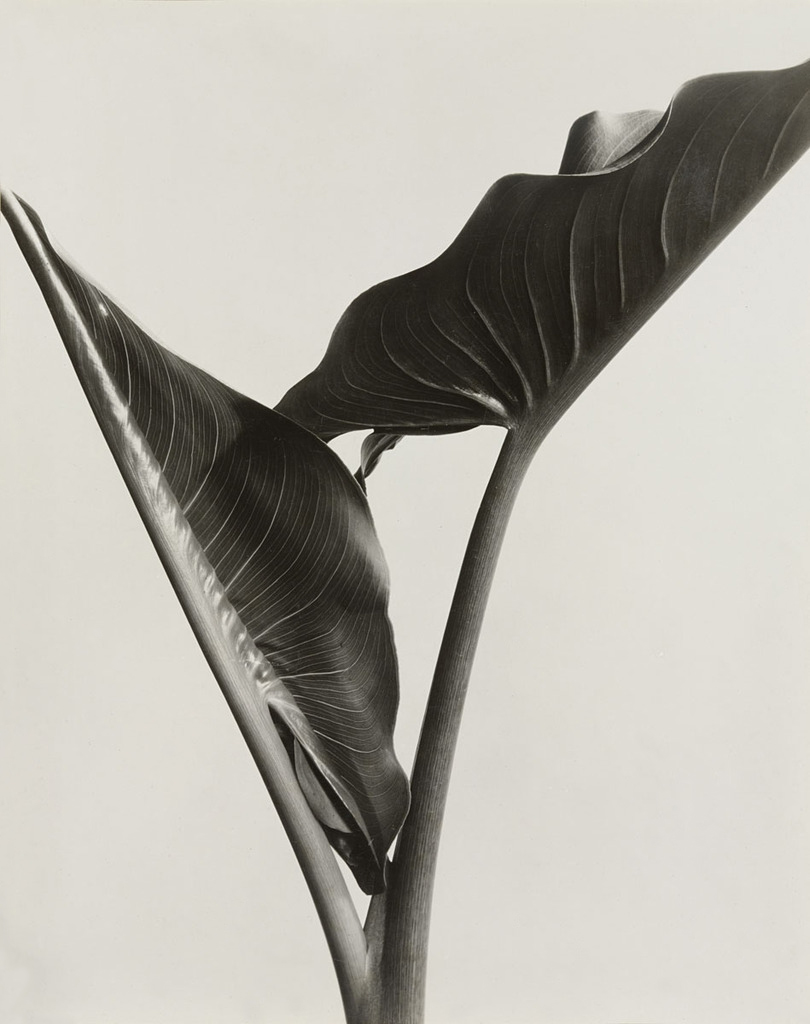
Imogen Cunningham (American, 1883-1976) 'Cala Leaves' 1932


Imogen Cunningham (American, 1883-1976)
Cala Leaves
1932
Gelatin silver print
9 9/16 x 7 9/16″ (24.3 x 19.2cm)
Gift of Paul F. Walter
Museum of Modern Art Collection


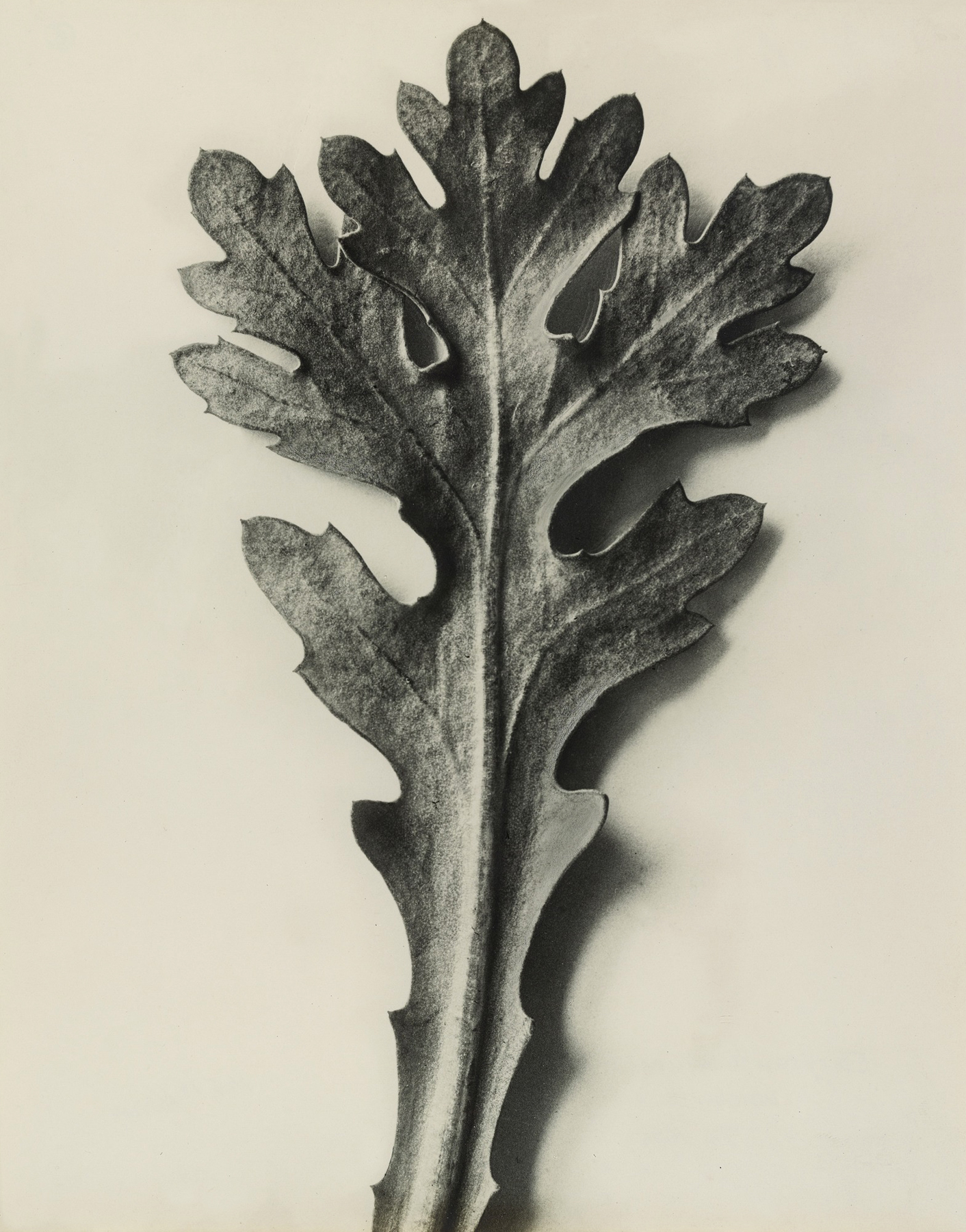
Karl Blossfeldt (German, 1865-1932) 'Chrysanthemum segetum – Feverfew' before 1928


Karl Blossfeldt (German, 1865-1932)
Chrysanthemum segetum – Feverfew Enlarged 8 Times
Before 1928
Gelatin silver print
11 15/16 × 9 7/16″ (30.4 × 23.9cm)
Thomas Walther Collection. Gift of James Thrall Soby, by exchange
Museum of Modern Art Collection
© 2022 Karl Blossfeldt / Artists Rights Society (ARS), New York


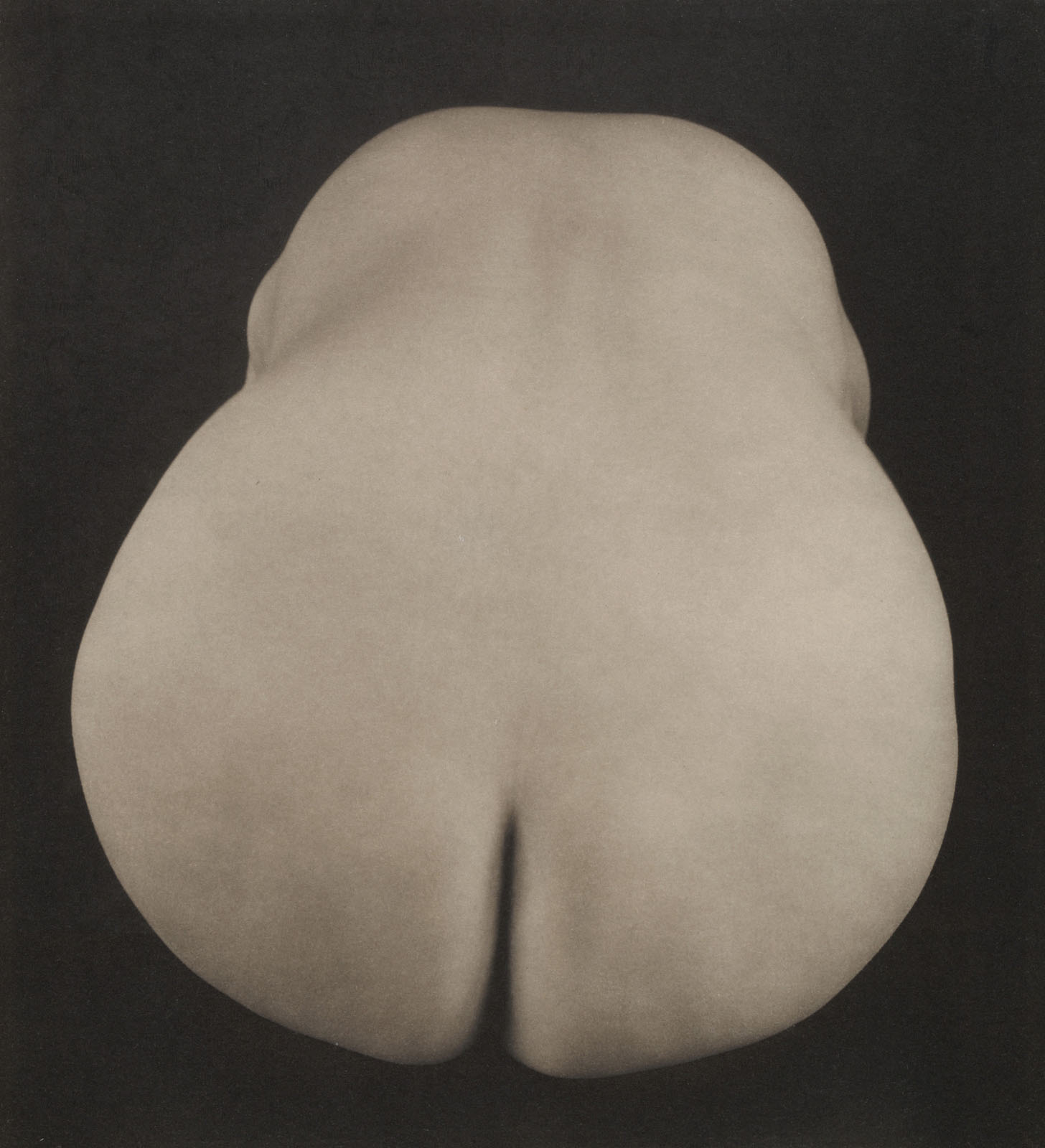
Edward Weston (American, 1886-1958) 'Nude, Mexico' 1925


Edward Weston (American, 1886-1958)
Nude, Mexico
1925
Palladium print
8 3/8 × 7 5/8″ (21.2 × 19.3cm)
Gift of David H. McAlpin
Museum of Modern Art Collection
© 1981 Center for Creative Photography, Arizona Board of Regents


Richard Avedon (American, 1923-2004) 'Carl Hoefert, unemployed blackjack dealer, Reno, Nevada', from the series 'In the American West' August 30, 1983


Richard Avedon (American, 1923-2004)
Carl Hoefert, unemployed blackjack dealer, Reno, Nevada, from the series In the American West
August 30, 1983
Gelatin silver print, printed 1985
47 1/2 x 37 1/2″ (120.6 x 95.2cm)
Gift of the artist
Museum of Modern Art Collection


Peter Hujar (American, 1934-1987) 'Pascal (Paris)' 1980


Peter Hujar (American, 1934-1987)
Pascal (Paris)
1980
Gelatin silver print
14 5/8 x 14 11/16″ (37.1 x 37.3cm)
Gift of David Wojnarowicz
Museum of Modern Art Collection


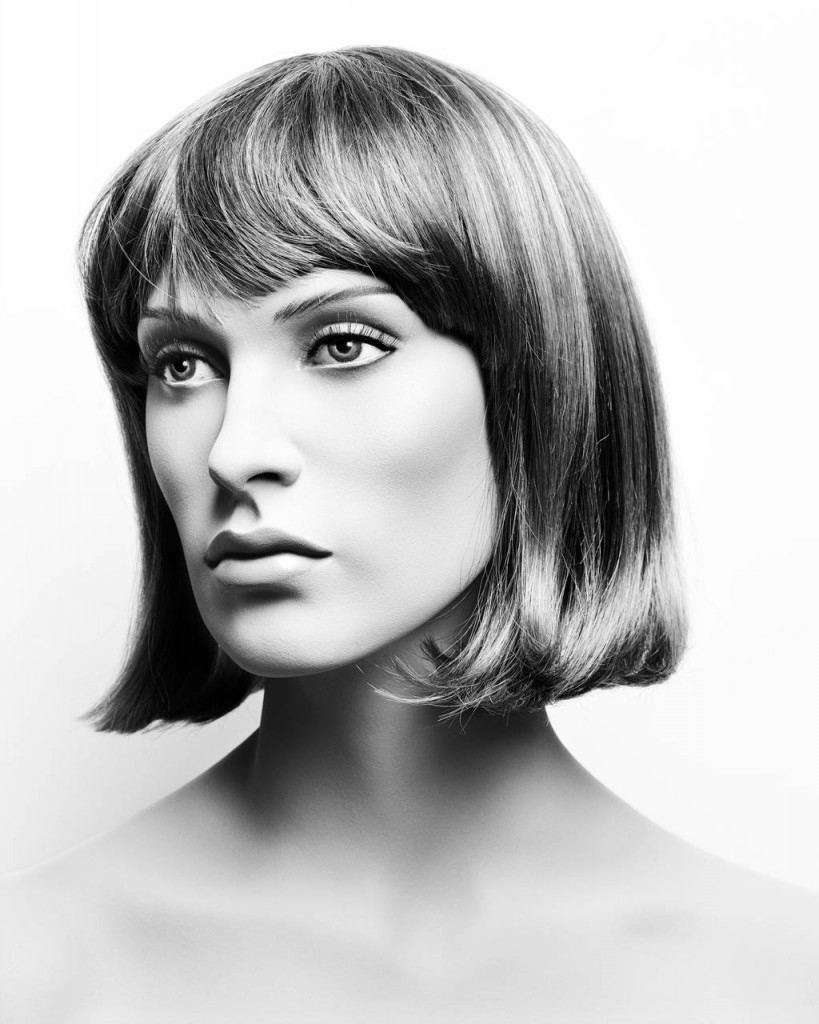
Valérie Belin (French, b. 1964) 'Untitled' from the series 'Mannequins' 2003


Valérie Belin (French, b. 1964)
Untitled from the series Mannequins
2003
Gelatin silver print
61 x 49″ (154.9 x 124.5cm)
Purchase
Museum of Modern Art Collection


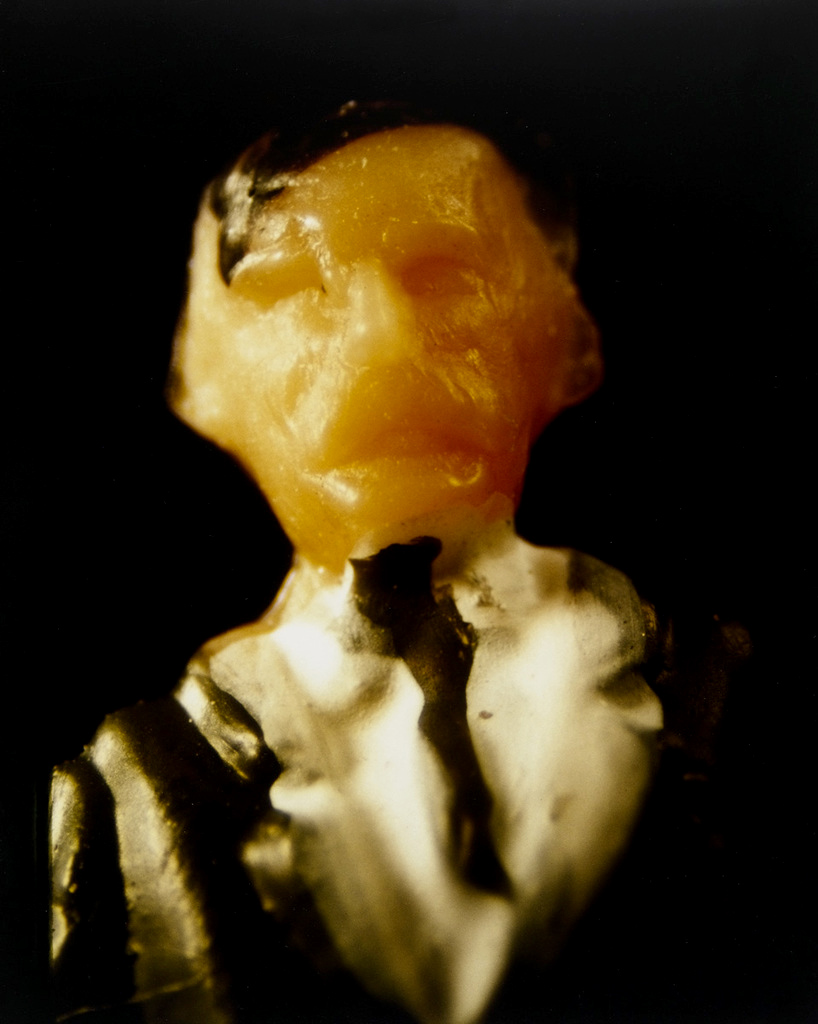
Laurie Simmons (American, b. 1949) Allan McCollum (American, b. 1944) 'Untitled' from the series 'Actual Photos' 1985


Laurie Simmons (American, b. 1949)
Allan McCollum (American, b. 1944)
Untitled from the series Actual Photos
1985
Silver dye bleach print
9 5/16 x 6 5/16″ (23.7 x 16.1cm)
Joel and Anne Ehrenkranz Fund
Museum of Modern Art Collection


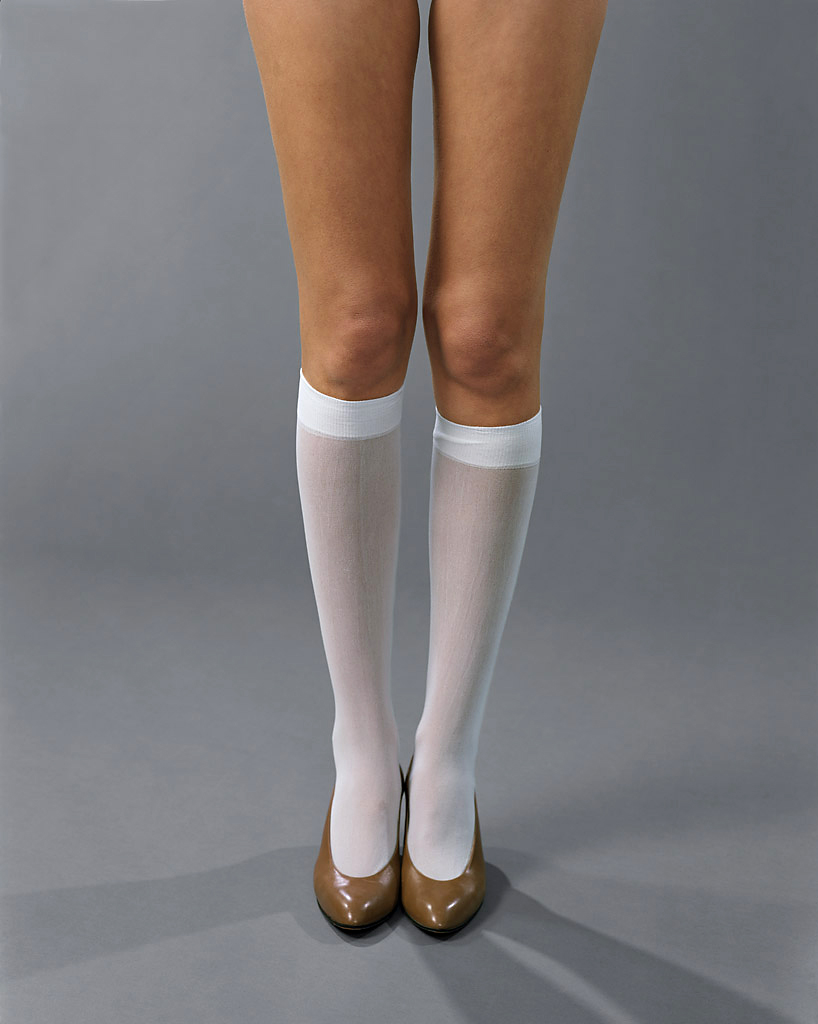
Josephine Meckseper (German, b. 1964) 'Blow-Up (Michelli, Knee-Highs)' 2006


Josephine Meckseper (German, b. 1964)
Blow-Up (Michelli, Knee-Highs)
2006
Chromogenic colour print
78 5/8 x 62 5/8″ (199.7 x 159.1cm)
Fund for the Twenty-First Century
Museum of Modern Art Collection


Robert Mapplethorpe (American, 1946-1989) 'Hermes' 1988


Robert Mapplethorpe (American, 1946-1989)
Hermes
1988
Gelatin silver print
19 1/4 × 19 1/4″ (48.9 × 48.9cm)
Gift of Agnes Gund
Museum of Modern Art Collection
© 2022 Robert Mapplethorpe Foundation


Virtual Spaces


Christian Marclay (American and Swiss, b. 1955) 'Allover (Genesis, Travis Tritt, and Others)' 2008


Christian Marclay (American and Swiss, b. 1955)
Allover (Genesis, Travis Tritt, and Others)
2008
Cyanotype
Composition and sheet: 51 1/2 x 97 3/4″ (130.8 x 248.3cm)
Publisher and printer: Graphic studio, University of South Florida, Tampa
Acquired through the generosity of Steven A. and Alexandra M. Cohen
Museum of Modern Art Collection


Luigi Veronesi (Italian, 1908-1998) 'Composition' 1935


Luigi Veronesi (Italian, 1908-1998)
Composition
1935
Gelatin silver print
9 7/16 × 11 1/4″ (24 × 28.6 cm)
Thomas Walther Collection. Gift of Ansel Adams, by exchange
Museum of Modern Art Collection
© 2022 Archivio Luigi Veronesi, Milan


Luigi Veronesi (28 May 1908 – 25 February 1998) was an Italian photographer, painter, scenographer and film director born in Milan.


Thomas Ruff (German, b. 1958) 'phg.06' 2012


Thomas Ruff (German, b. 1958)
phg.06
2012
Chromogenic colour print
100 3/8 x 72 13/16″ (255 x 185cm)
Courtesy David Zwirner, New York/London
Museum of Modern Art Collection


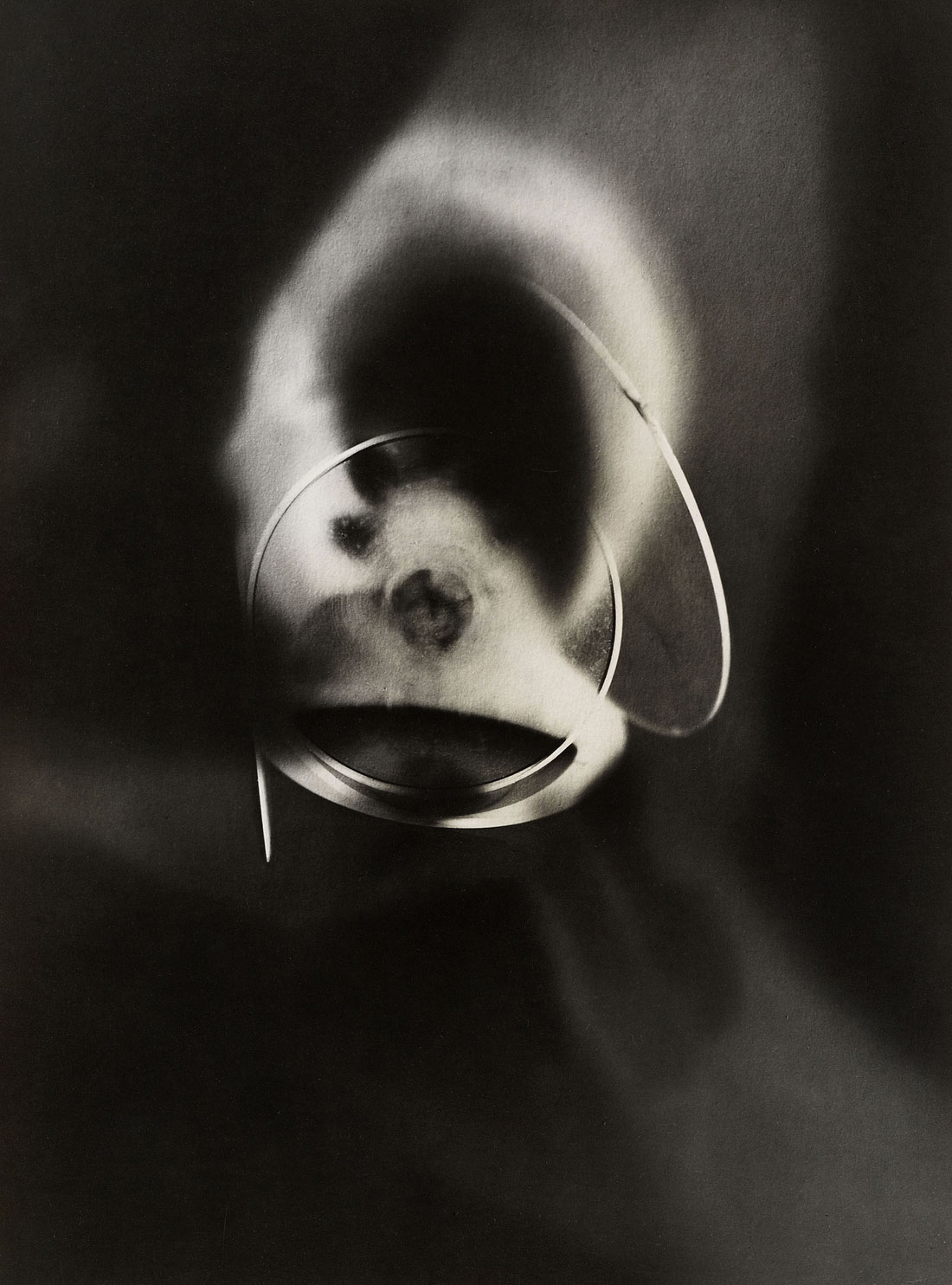
Man Ray (American, 1890-1976) 'Rayograph' 1923


Man Ray (American, 1890-1976)
Rayograph
1923
Gelatin silver print
9 7/16 x 7″ (23.9 x 17.8cm)
Purchase
Museum of Modern Art Collection


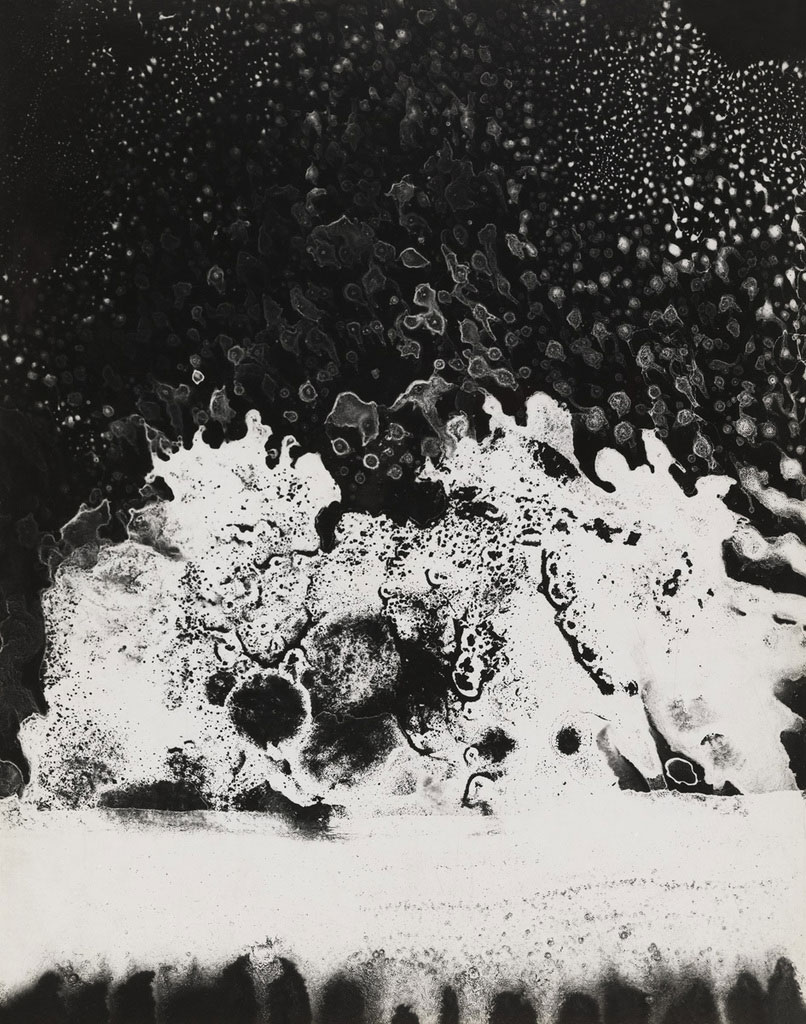
György Kepes (American born Hungary, 1906-2001) 'Abstraction – Surface Tension #2' c. 1940


György Kepes (American born Hungary, 1906-2001)
Abstraction – Surface Tension #2
c. 1940
Gelatin silver print
14 x 11 1/8″ (35.6 x 28.3cm)
Gift of the artist
Museum of Modern Art Collection


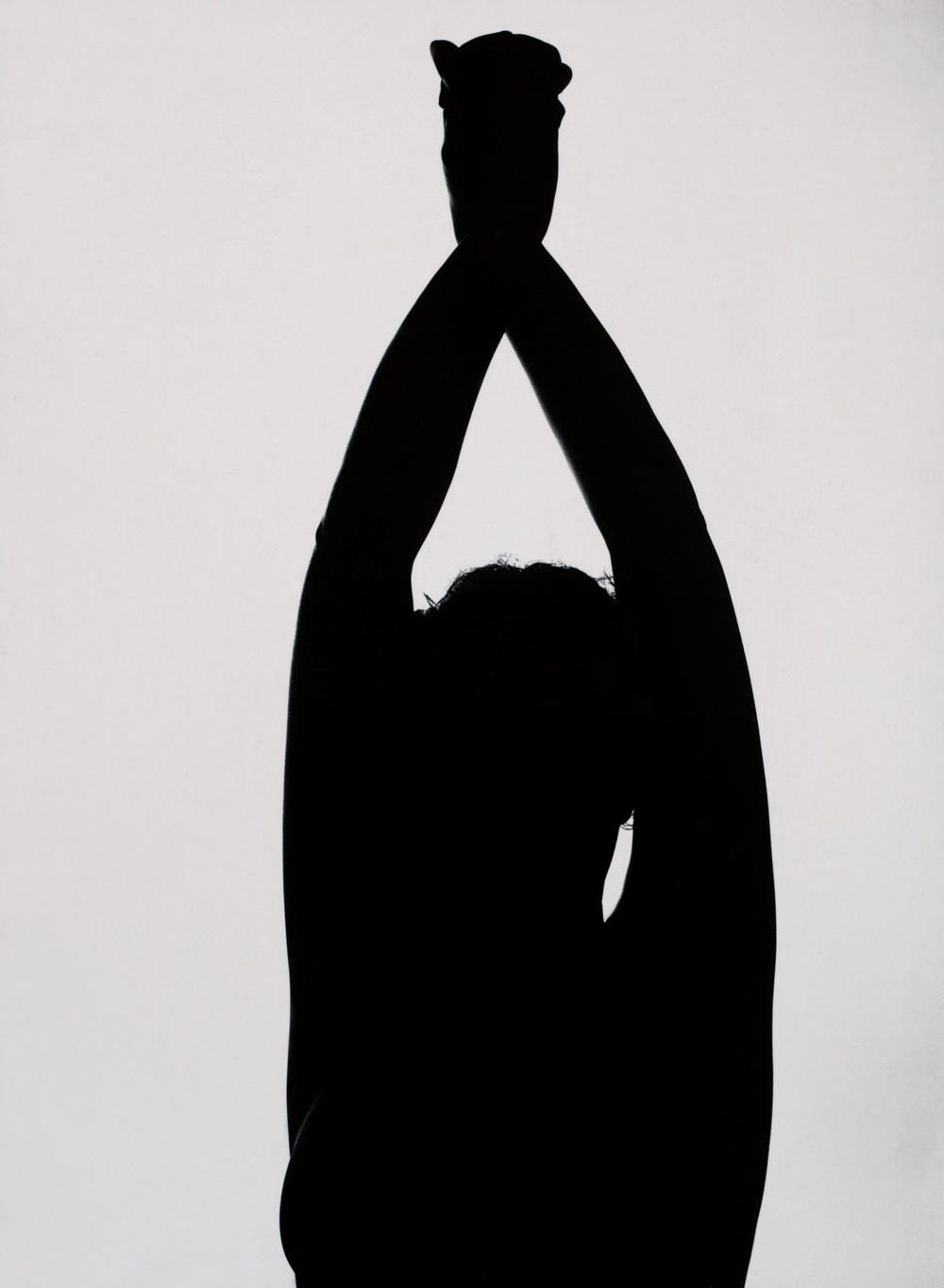
The Studio, from Laboratory to Playground


Barbara Morgan (American, 1900-1992) 'Pure Energy and Neurotic Man' 1941


Barbara Morgan (American, 1900-1992)
Pure Energy and Neurotic Man
1941
Gelatin silver print, printed 1971
19 1/8 x 15 1/2″ (48.6 x 39.3cm)
Gift of the artist
Museum of Modern Art Collection


Barbara Morgan (American, 1900-1992) 'Cadenza' 1940


Barbara Morgan (American, 1900-1992)
Cadenza
1940
Gelatin silver print, printed 1971
17 7/8 x 15″ (45.4 x 38.2cm)
Gift of the artist
Museum of Modern Art Collection


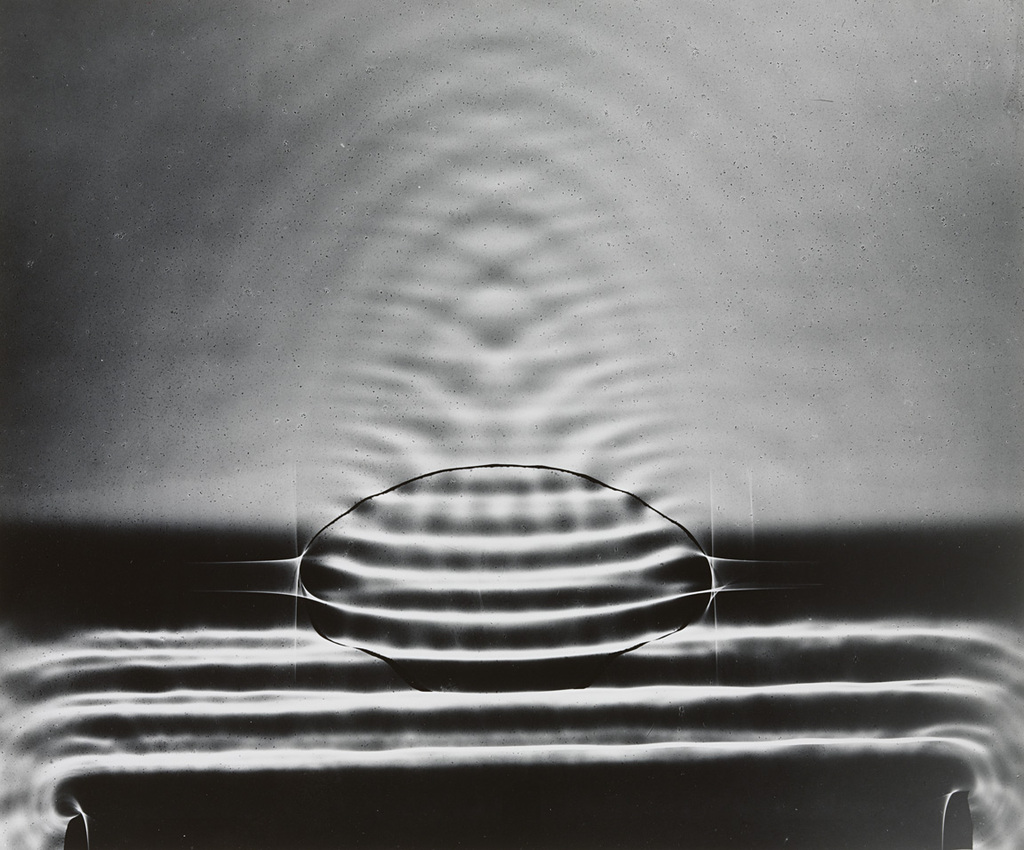
Berenice Abbott (American, 1898-1991) 'Focusing Water Waves, Massachusetts Institute of Technology' 1958-1961


Berenice Abbott (American, 1898-1991)
Focusing Water Waves, Massachusetts Institute of Technology
1958-1961
Gelatin silver print
6 9/16 x 7 15/16″ (16.7 x 20.1cm)
Gift of Ronald A. Kurtz
Museum of Modern Art Collection


Berenice Abbott (American, 1898-1991) 'Wave Pattern with Glass Plate, Massachusetts Institute of Technology' 1958-1961


Berenice Abbott (American, 1898-1991)
Wave Pattern with Glass Plate, Massachusetts Institute of Technology
1958-1961
Gelatin silver print
6 9/16 x 7 9/16″ (16.7 x 19.2cm)
Gift of Ronald A. Kurtz
Museum of Modern Art Collection


Heinz Hajek-Halke (German, 1898-1983) 'Embrace (Umarmung)' 1947-1951


Heinz Hajek-Halke (German, 1898-1983)
Embrace (Umarmung)
1947-1951
Gelatin silver print
15 5/8 x 11 3/8″ (39.7 x 29.0cm)
Gift of the artist
Museum of Modern Art Collection


Harold Edgerton (American, 1903-1990) 'Lead Falling in a Shot Tower' 1936


Harold Edgerton (American, 1903-1990)
Lead Falling in a Shot Tower
1936
Gelatin silver print
7 9/16 x 9 1/2″ (19.3 x 24.2cm)
Gift of Gus and Arlette Kayafas
Museum of Modern Art Collection


Harold Edgerton (American, 1903-1990) 'Bouncing Ball Bearing' 1962


Harold Edgerton (American, 1903-1990)
Bouncing Ball Bearing
1962
Gelatin silver print
9 9/16 x 7 11/16″ (24.3 x 19.5cm)
Gift of Gus and Arlette Kayafas
Museum of Modern Art Collection


Harold Edgerton (American, 1903-1990) 'This is Coffee' 1933


Harold Edgerton (American, 1903-1990)
This is Coffee
1933
Gelatin silver print
9 7/8 x 12 7/8″ (25.1 x 32.7cm)
Gift of the artist
Museum of Modern Art Collection


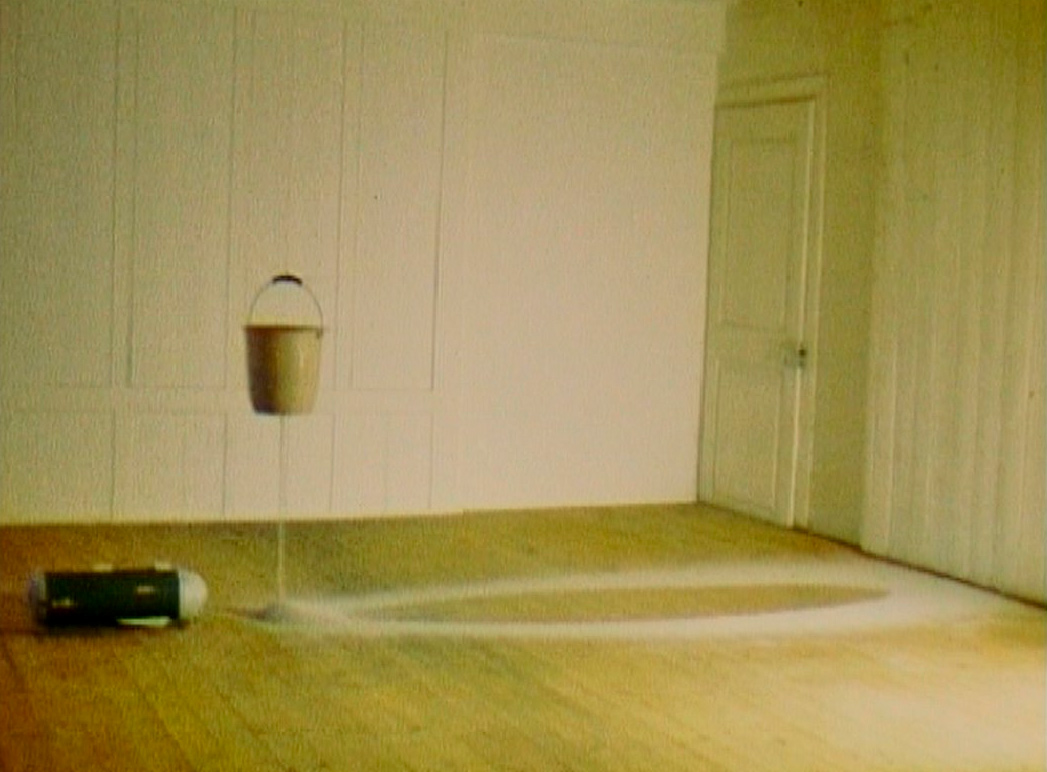
Roman Signer (Swiss, b. 1938) 'Sand Curtain (Sandvorhang)' 1983


Roman Signer (Swiss, b. 1938)
Sand Curtain (Sandvorhang)
1983
Super 8 film transferred to video (colour, silent)
Approximately 2 min.
Committee on Media Funds
Museum of Modern Art Collection


Roman Signer (Swiss, b. 1938) 'Sand Stairs (Sandtreppe)' 1975


Roman Signer (Swiss, b. 1938)
Sand Stairs (Sandtreppe)
1975
Super 8 film transferred to video (colour, silent)
Approximately 2 min.
Committee on Media Funds
Museum of Modern Art Collection


Roman Signer (Swiss, b. 1938) 'Rubber Motor (Gummimotor)' 1983


Roman Signer (Swiss, b. 1938)
Rubber Motor (Gummimotor)
1983
Super 8 film transferred to video (colour, silent)
Approximately 2 min.
Committee on Media Funds
Museum of Modern Art Collection


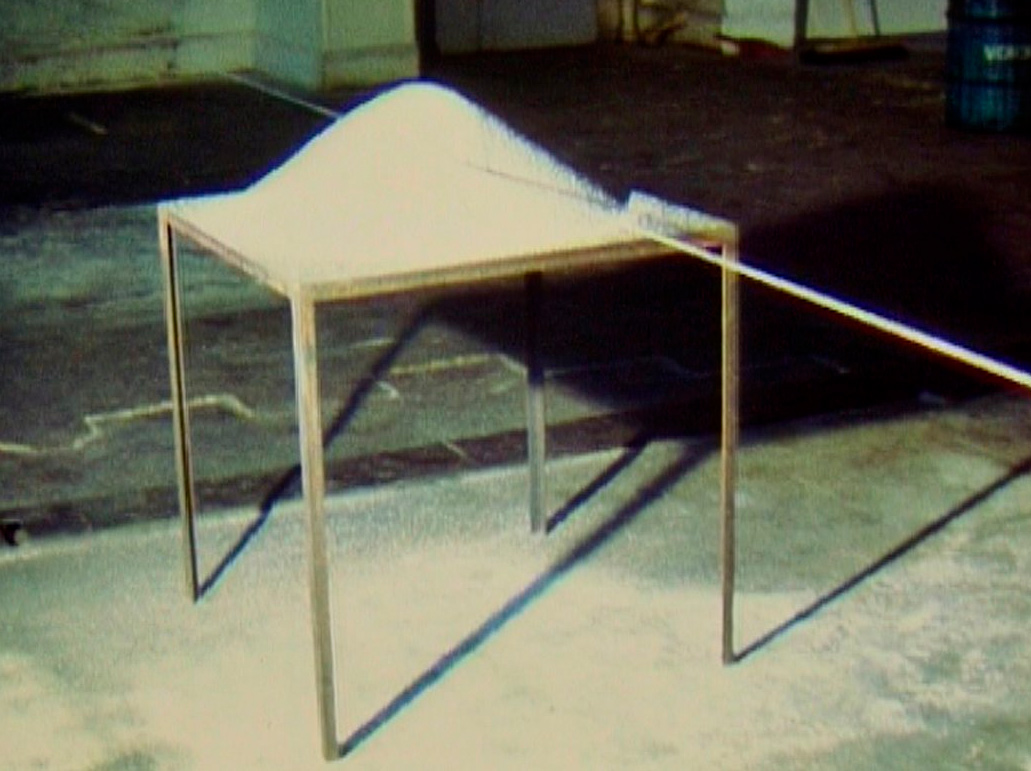
Roman Signer (Swiss, b. 1938) 'Sand Cone (Sandkegel)' 1984


Roman Signer (Swiss, b. 1938)
Sand Cone (Sandkegel)
1984
Super 8 film transferred to video (colour, silent)
Approximately 2 min.
Committee on Media Funds
Museum of Modern Art Collection


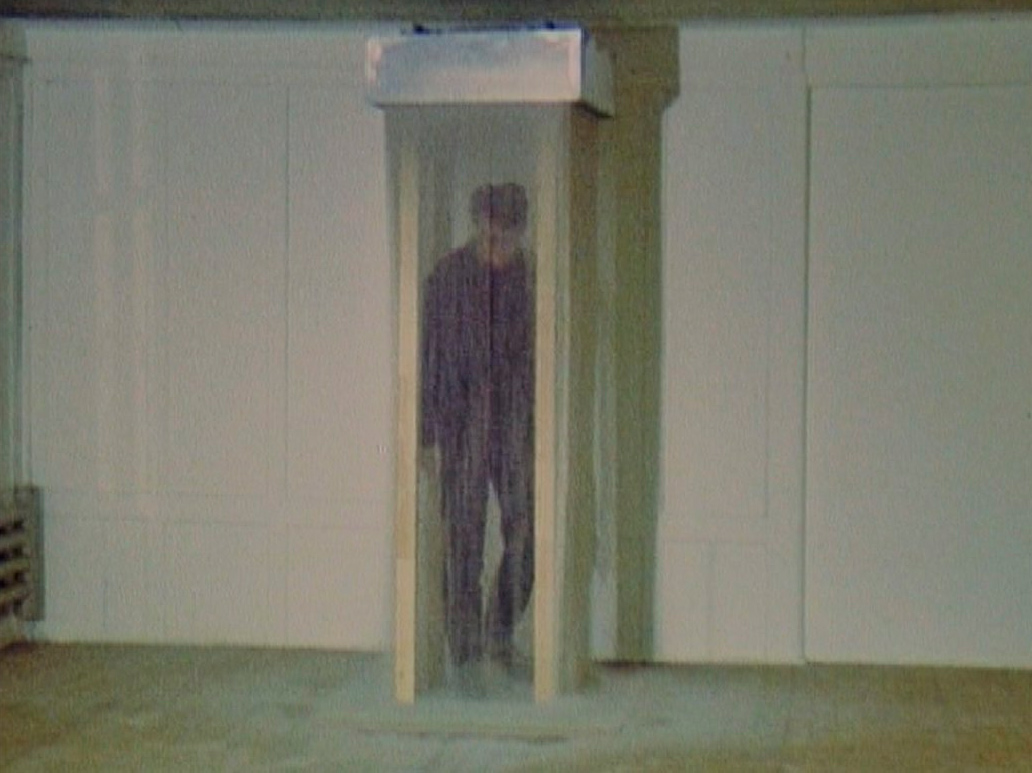
Roman Signer (Swiss, b. 1938) 'Sand Pillar (Sandturm)' 1987


Roman Signer (Swiss, b. 1938)
Sand Pillar (Sandturm)
1987
Super 8 film transferred to video (colour, silent)
Approximately 2 min.
Committee on Media Funds
Museum of Modern Art Collection


Roman Signer (Swiss, b. 1938) 'Sand (Sand)' 1988


Roman Signer (Swiss, b. 1938)
Sand (Sand)
1988
Super 8 film transferred to video (colour, silent)
Approximately 2 min.
Committee on Media Funds
Museum of Modern Art Collection


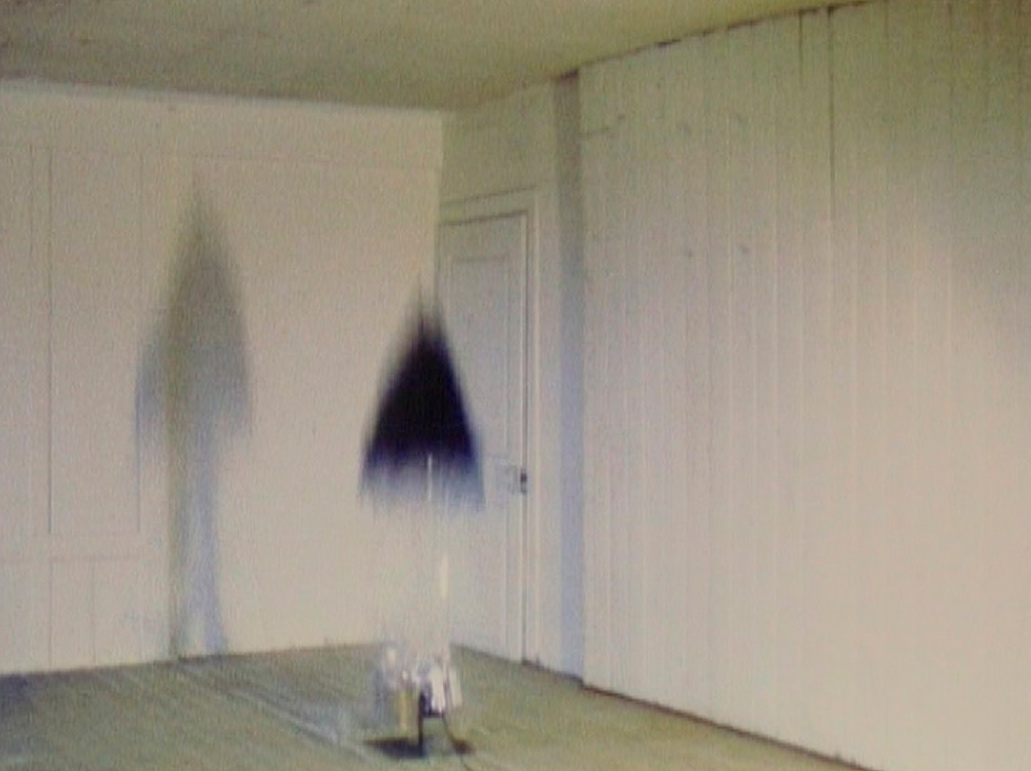
Roman Signer (Swiss, b. 1938) 'Umbrella (Schirm)' 1989


Roman Signer (Swiss, b. 1938)
Umbrella (Schirm)
1989
Super 8 film transferred to video (colour, silent)
Approximately 2 min.
Committee on Media Funds
Museum of Modern Art Collection


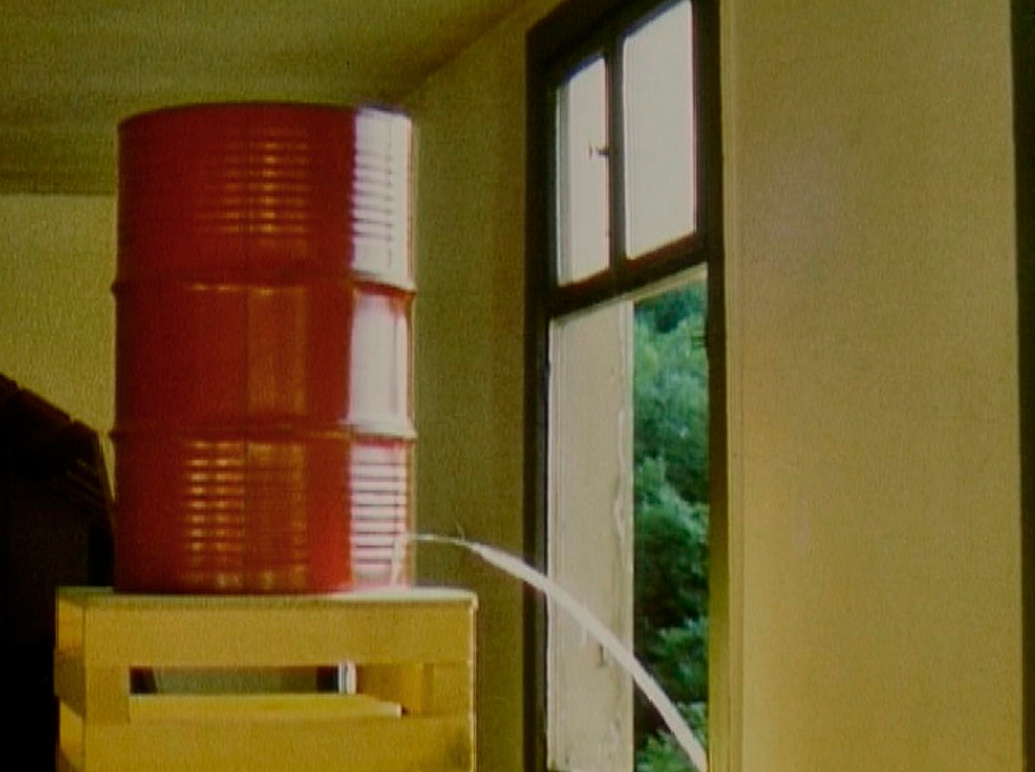
Roman Signer (Swiss, b. 1938) 'Barrel (Fass)' 1985


Roman Signer (Swiss, b. 1938)
Barrel (Fass)
1985
Super 8 film transferred to video (colour, silent)
Approximately 2 min.
Committee on Media Funds
Museum of Modern Art Collection


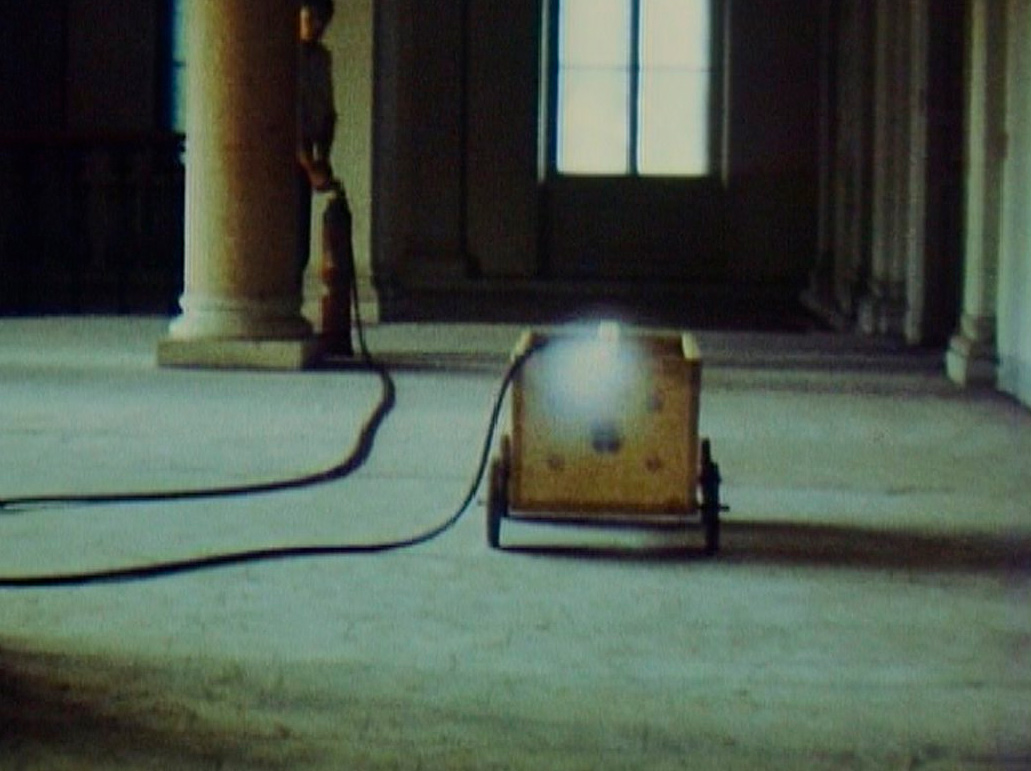
Roman Signer (Swiss, b. 1938) 'Carriage (Wagen)' 1982


Roman Signer (Swiss, b. 1938)
Carriage (Wagen)
1982
Super 8 film transferred to video (colour, silent)
Approximately 2 min.
Committee on Media Funds
Museum of Modern Art Collection


Roman Signer (Swiss, b. 1938) 'Tube (Schlauch)' 1982


Roman Signer (Swiss, b. 1938)
Tube (Schlauch)
1982
Super 8 film transferred to video (colour, silent)
Approximately 2 min.
Committee on Media Funds
Museum of Modern Art Collection


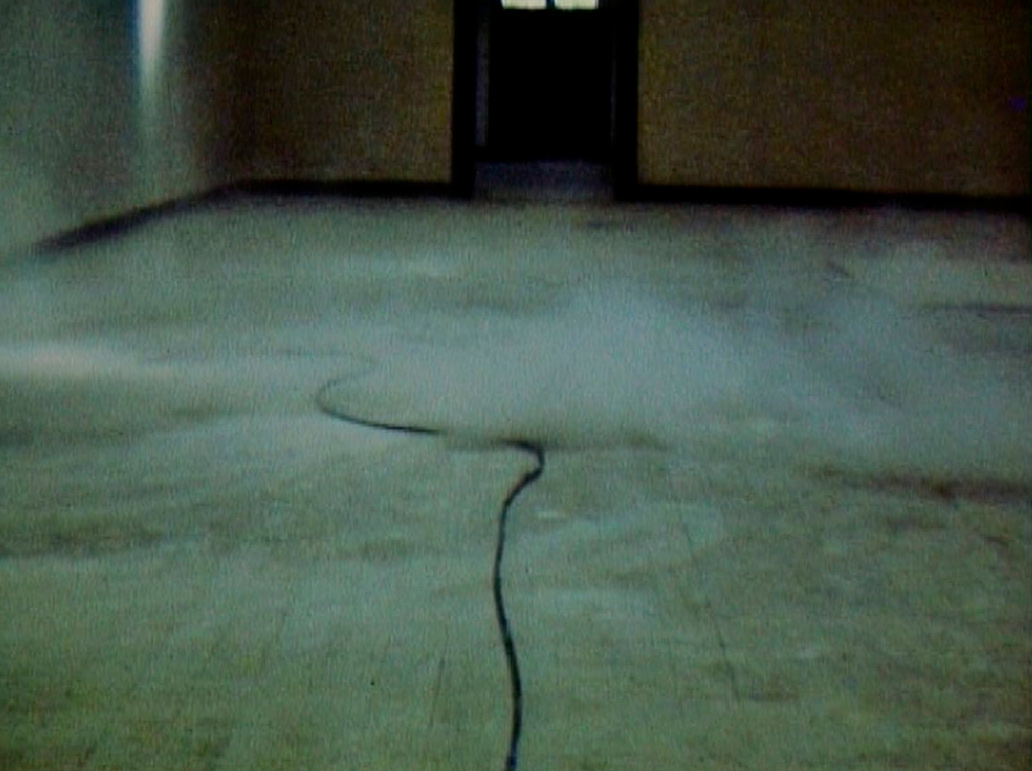
Roman Signer (b. 1938 in Appenzell, Switzerland) is principally a visual artist who works in sculpture, installations photography, and video. Signer’s work has grown out of, and has affinities with both land art and performance art, but they are not typically representative of either category.It is often being described as following the tradition of the Swiss engineer-artist, such as Jean Tinguely and Peter Fischli & David Weiss.

Signer’s “action sculptures” involve setting up, carrying out, and recording “experiments” or events that bear aesthetic results. Day-to-day objects such as umbrellas, tables, boots, containers, hats and bicycles are part of Signer’s working vocabulary. Following carefully planned and strictly executed and documented procedures, the artist enacts and records such acts as explosions, collisions, and the projection of objects through space. Signer advocates ‘controlled destruction, not destruction for its own sake’. Action Kurhaus Weissbad (1992) saw chairs catapulted out of a hotel’s windows; Table (1994) launched a table into the sea on four buckets; Kayak (2000) featured the artist being towed down a road in a canoe. In documenta 8 (1987), he catapulted thousands of sheets of paper into the air to create an ephemeral wall in the room for a brief, but all the more intense moment. As the Swiss representative at the Venice Biennale in 1999, he made 117 steel balls fall from the ceiling on to lumps of clay lying on the ground. Many of his happenings are not for public viewing, and are only documented in photos and film. Video works like Stiefel mit Rakete (Boot with Rocket) are integral to Signer’s performances, capturing the original setup of materials that self-destruct in the process of creating an emotionally and visually compelling event.

Text from Wikipedia website


Kiki Smith (American born Germany, b. 1954) 'My Secret Business' 1993


Kiki Smith (American born Germany, b. 1954)
My Secret Business
1993
Lithograph
23 9/16 x 18 1/8″ (59.8 x 46cm)
Gift of Howard B. Johnson
Museum of Modern Art Collection


Adrian Piper (American, b. 1948) 'Food for the Spirit #2' 1971, printed 1997


Adrian Piper (American, b. 1948)
Food for the Spirit #2
1971, printed 1997
Gelatin silver print
14 9/16 x 15″ (37 x 38.1cm)
The Family of Man Fund
Museum of Modern Art Collection


Adrian Piper (American, b. 1948) 'Food for the Spirit #8' 1971, printed 1997


Adrian Piper (American, b. 1948)
Food for the Spirit #8
1971, printed 1997
Gelatin silver print
14 9/16 x 14 15/16″ (37 x 38cm)
The Family of Man Fund
Museum of Modern Art Collection


Adrian Piper (American, b. 1948) 'Food for the Spirit #14' 1971, printed 1997


Adrian Piper (American, b. 1948)
Food for the Spirit #14
1971, printed 1997
Gelatin silver print
14 9/16 x 15″ (37 x 38.1cm)
The Family of Man Fund
Museum of Modern Art Collection


Harold Edgerton (American, 1903-1990) 'Indian Club Demonstration' 1939


Harold Edgerton (American, 1903-1990)
Indian Club Demonstration
1939
Gelatin silver print
13 x 10″ (33.0 x 26.0cm)
Gift of the artist
Museum of Modern Art Collection


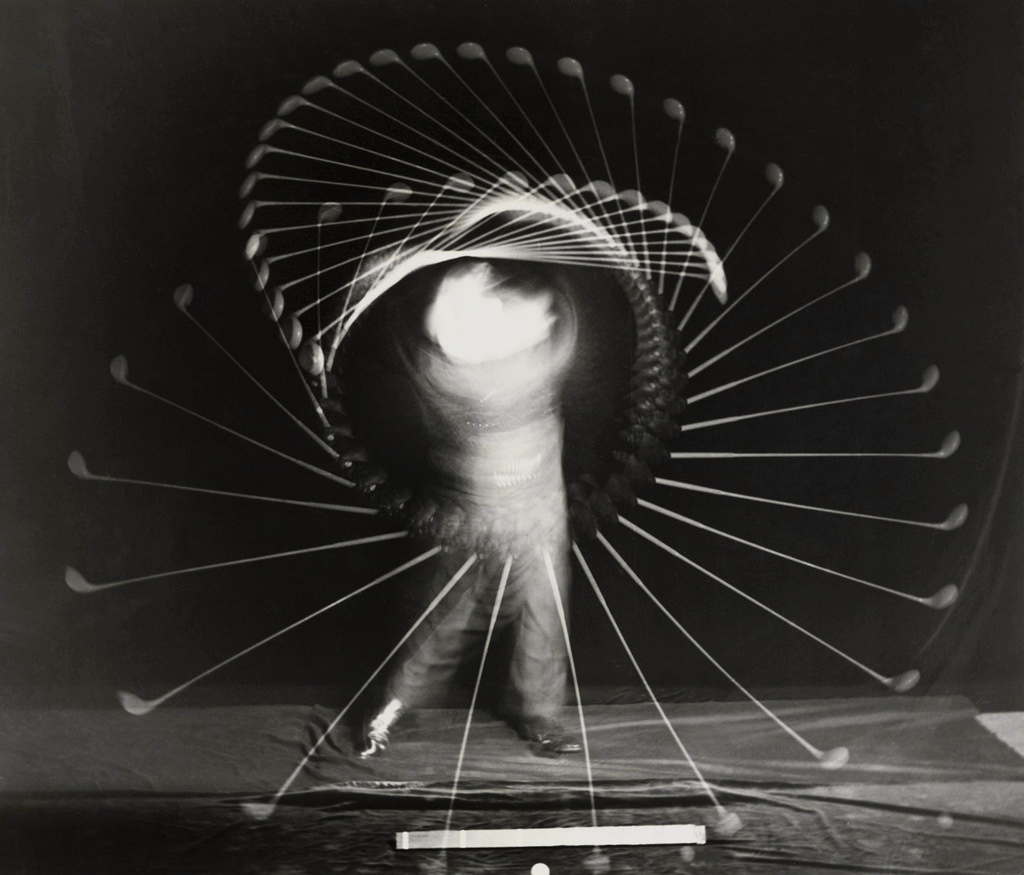
Harold Edgerton (American, 1903-1990) 'Bobby Jones with an Iron' 1938


Harold Edgerton (American, 1903-1990)
Bobby Jones with an Iron
1938
Gelatin silver print
9 5/8 x 11 1/2″ (24.4 x 29.2cm)
Gift of the artist
Museum of Modern Art Collection


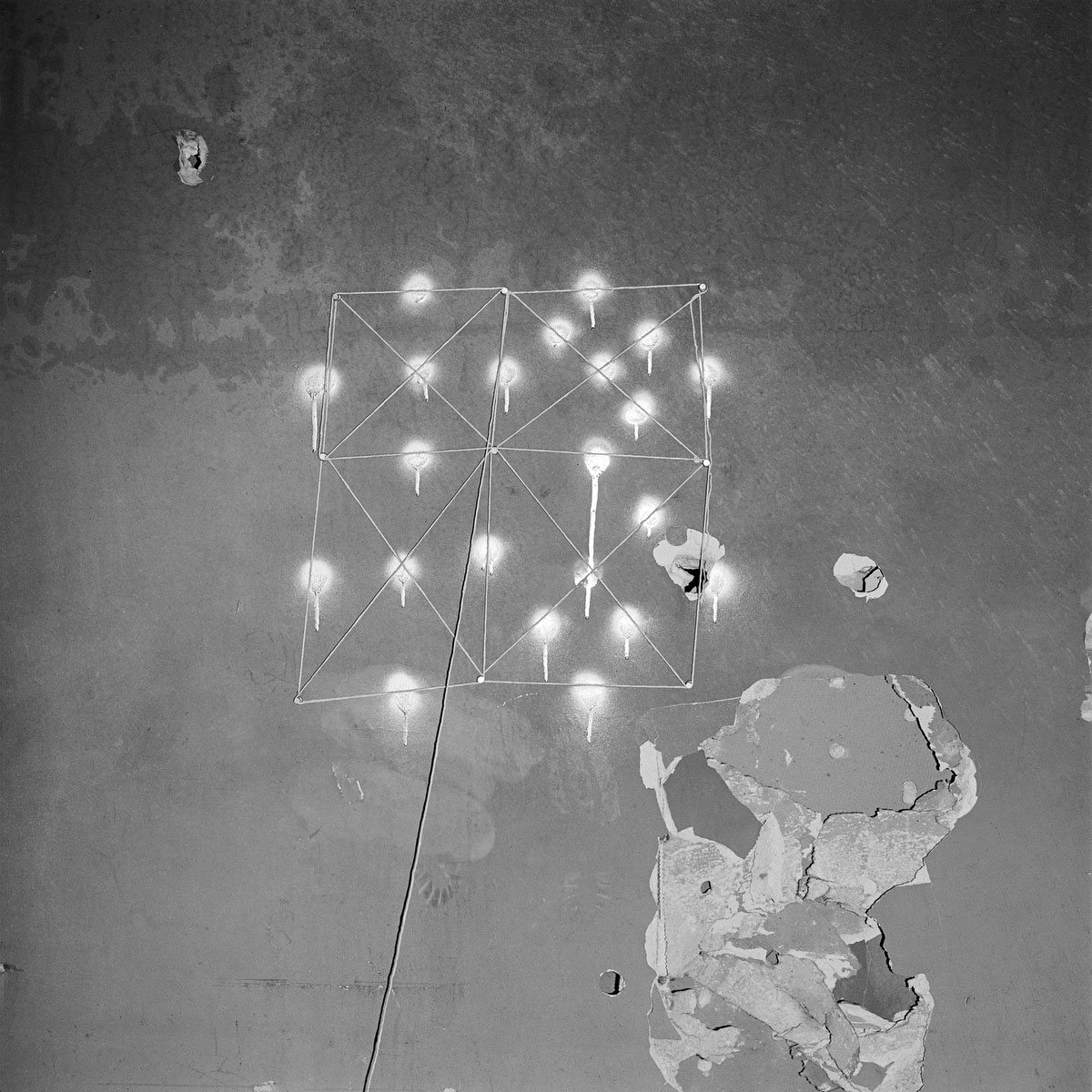
John Divola (American, b. 1949) 'Untitled' from the series 'Vandalism' 1974


John Divola (American, b. 1949)
Untitled from the series Vandalism
1974
Gelatin silver print
7 1/16 x 7 1/16″ (18.0 x 18.0cm)
Purchase
Museum of Modern Art Collection


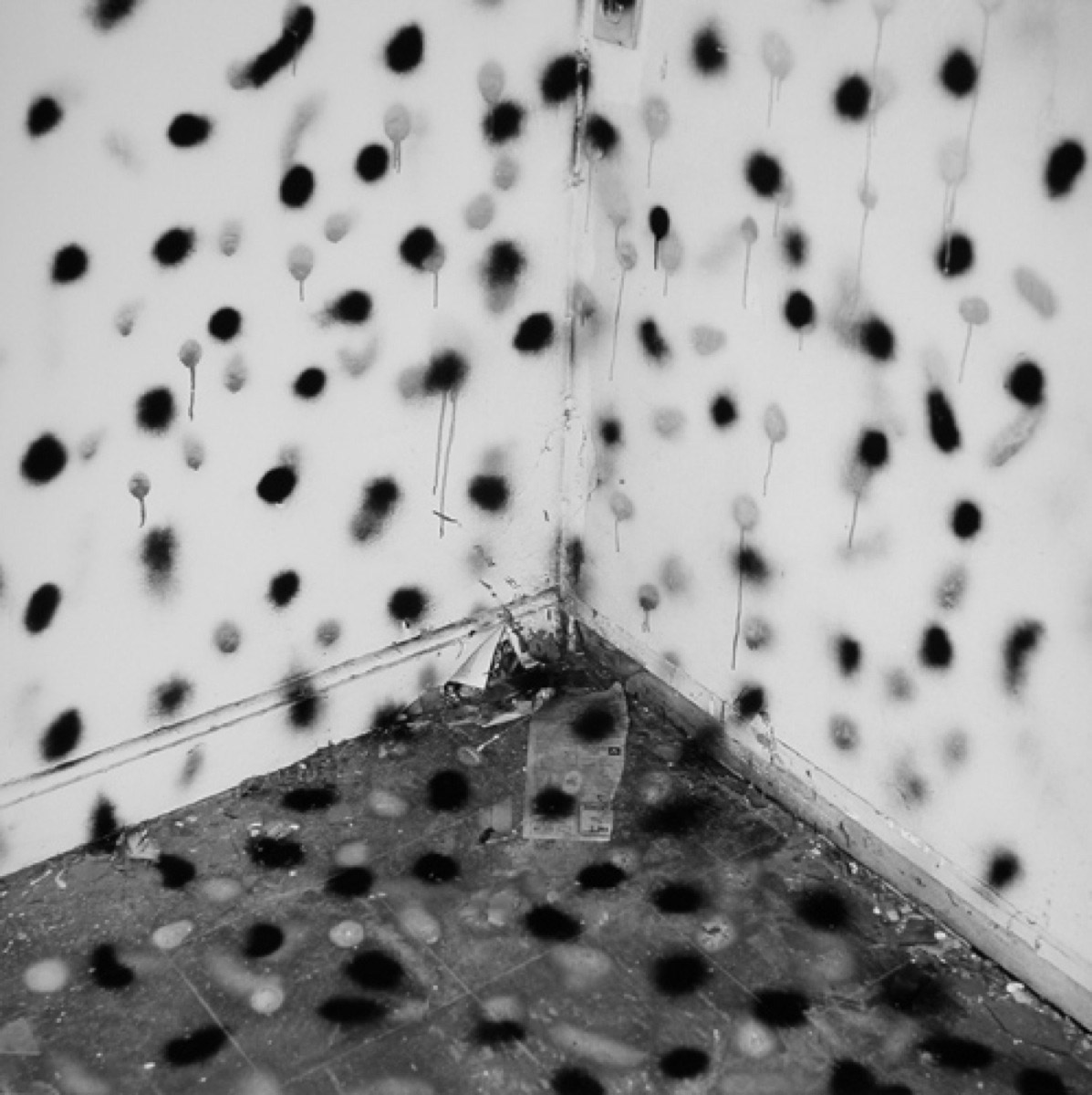
John Divola (American, b. 1949) 'Untitled' from the series 'Vandalism' 1974


John Divola (American, b. 1949)
Untitled from the series Vandalism
1974
Gelatin silver print
7 x 7″ (17.9 x 17.9cm)
Purchase
Museum of Modern Art Collection


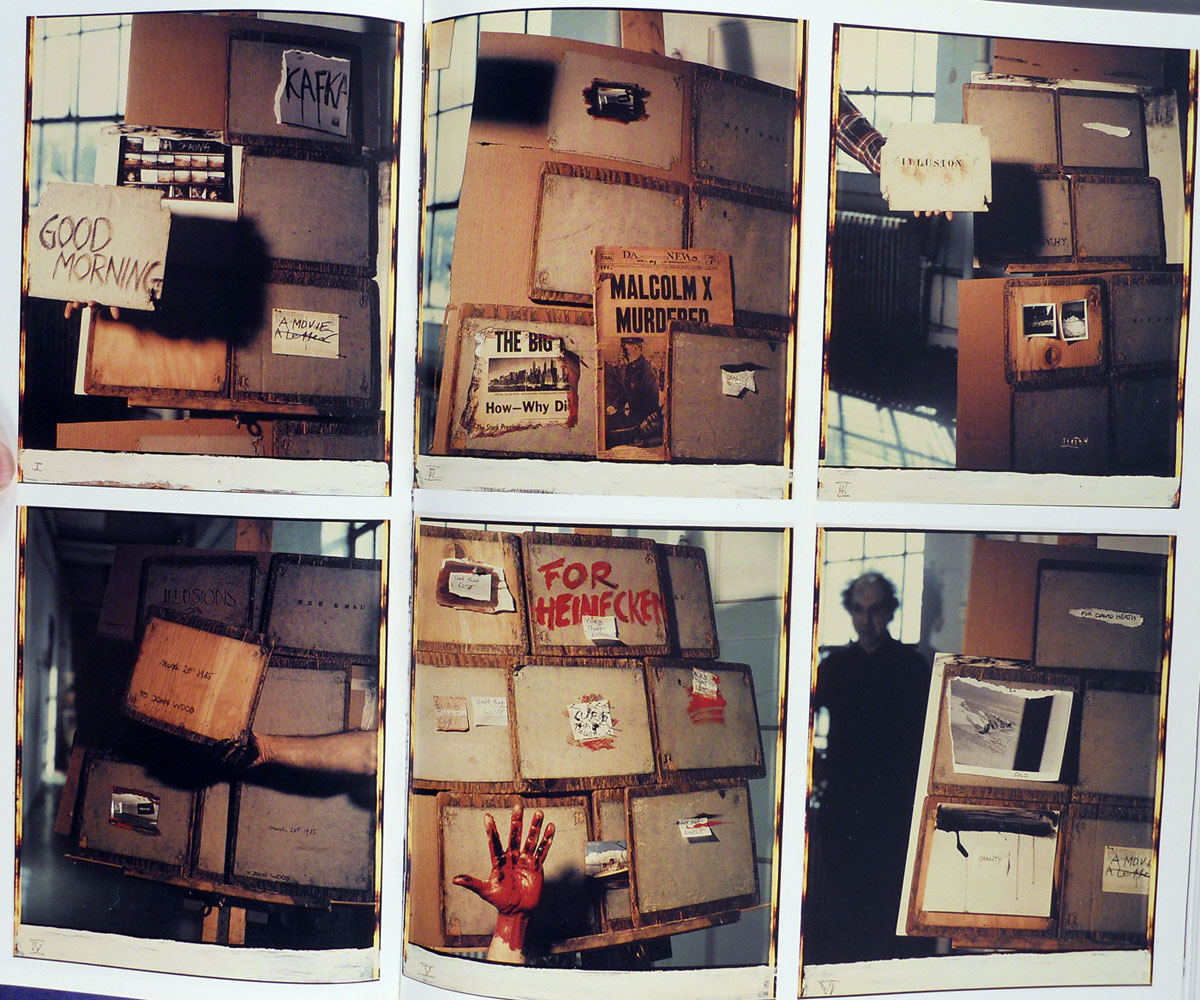
Robert Frank (American born Switzerland, 1924-2019) 'Boston' March 20, 1985 (detail)


Robert Frank (American born Switzerland, 1924-2019)
Boston (detail)
March 20, 1985
Colour instant prints (Polaroids) with hand-applied paint and collage
Each 27 3/4 x 22 1/4″ (70.3 x 56.4cm)
Acquired through the generosity of Polaroid Corporation
Museum of Modern Art Collection


Anna Blume (German, 1937-2020) Bernhard Blume (German, 1937-2011) 'Kitchen Frenzy (Küchenkoller)' 1986 (detail)


Anna Blume (German, 1937-2020)
Bernhard Blume (German, 1937-2011)
Kitchen Frenzy (Küchenkoller) (detail)
1986
Gelatin silver prints
Each 66 15/16 x 42 1/2″ (170 x 108cm)
Acquired through the generosity of the Contemporary Arts Council of The Museum of Modern Art
Museum of Modern Art Collection


Anna Blume (née Helming; 21 April 1936 – 18 June 2020) and Bernhard Johannes Blume (8 September 1937 – 1 September 2011) were German art photographers. They created sequences of large black-and-white photos of staged scenes in which they appeared themselves, with objects taking on a “life” of their own. Their works have been shown internationally in exhibitions and museums, including New York’s MoMA. They are regarded as “among the pioneers of staged photography”. …

Anna and Bernhard Blume together created installations, sequences of large photo scenes and, mostly in the 1990s, Polaroids. Both created drawings. They staged and photographed scenes in which they appeared themselves, with objects taking on a “life” of their own. According to the Deutsche Börse Photography Foundation, their process was to create their picture sequences together and complete all related tasks without outside help. That included designing the sets and costumes, developing the negatives, and producing enlargements; at each stage the artwork was refined, polished and painted. Anna said: “Wir malen mit der Kamera, und diese malerische Arbeit findet auch noch im Labor statt.” (We paint with our camera, and this painterly work continues in the lab, too.) The images were produced without the aid of digital manipulation or post-production montages. Taking pictures of a “flying, crashing, and swirling world”, the artists used safety features such as ropes, nets and mattresses.

Text from the Wikipedia website


The Museum of Modern Art
11 West 53 Street
New York, NY 10019
Phone: (212) 708-9400

Opening hours:
10.30am – 5.30pm
Open seven days a week

MoMA website

LIKE ART BLART ON FACEBOOK

Back to top

Exhibition: ‘Now You See It: Photography and Concealment’ at the Metropolitan Museum of Art, New York

Exhibition dates: 31st March – 1st September 2014


Many thankx to the Metropolitan Museum of Art for allowing me to publish the photographs in the posting. Please click on the photographs for a larger version of the image.


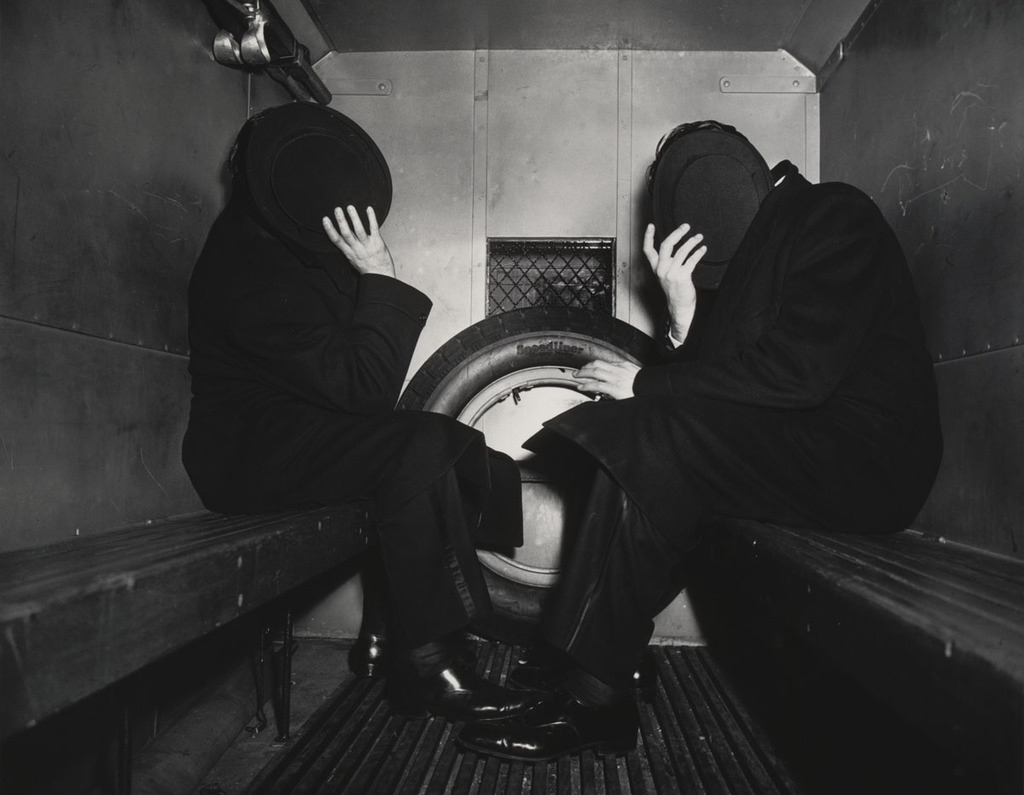
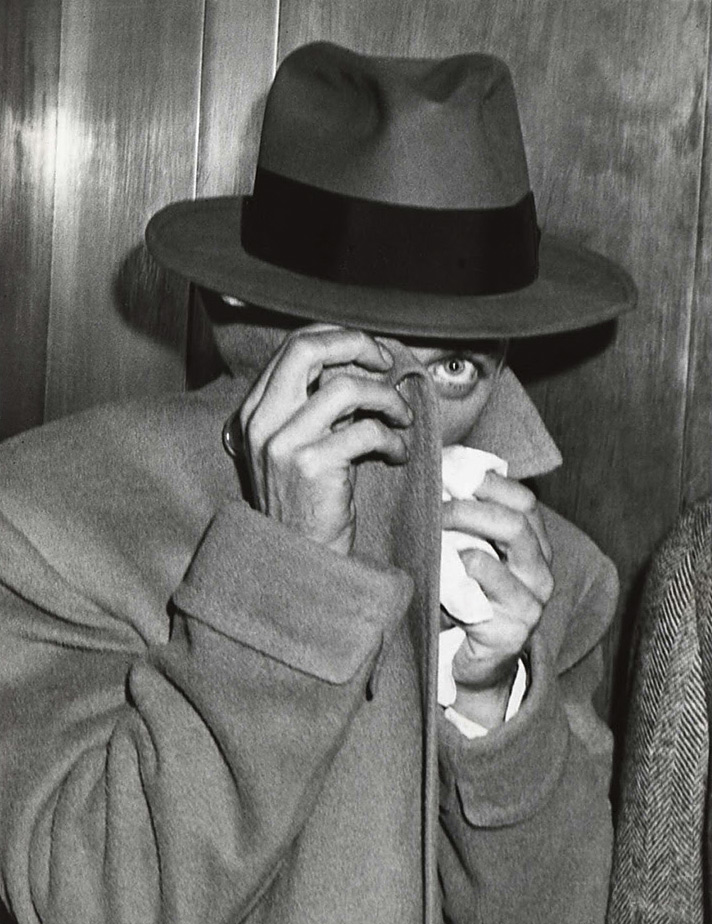
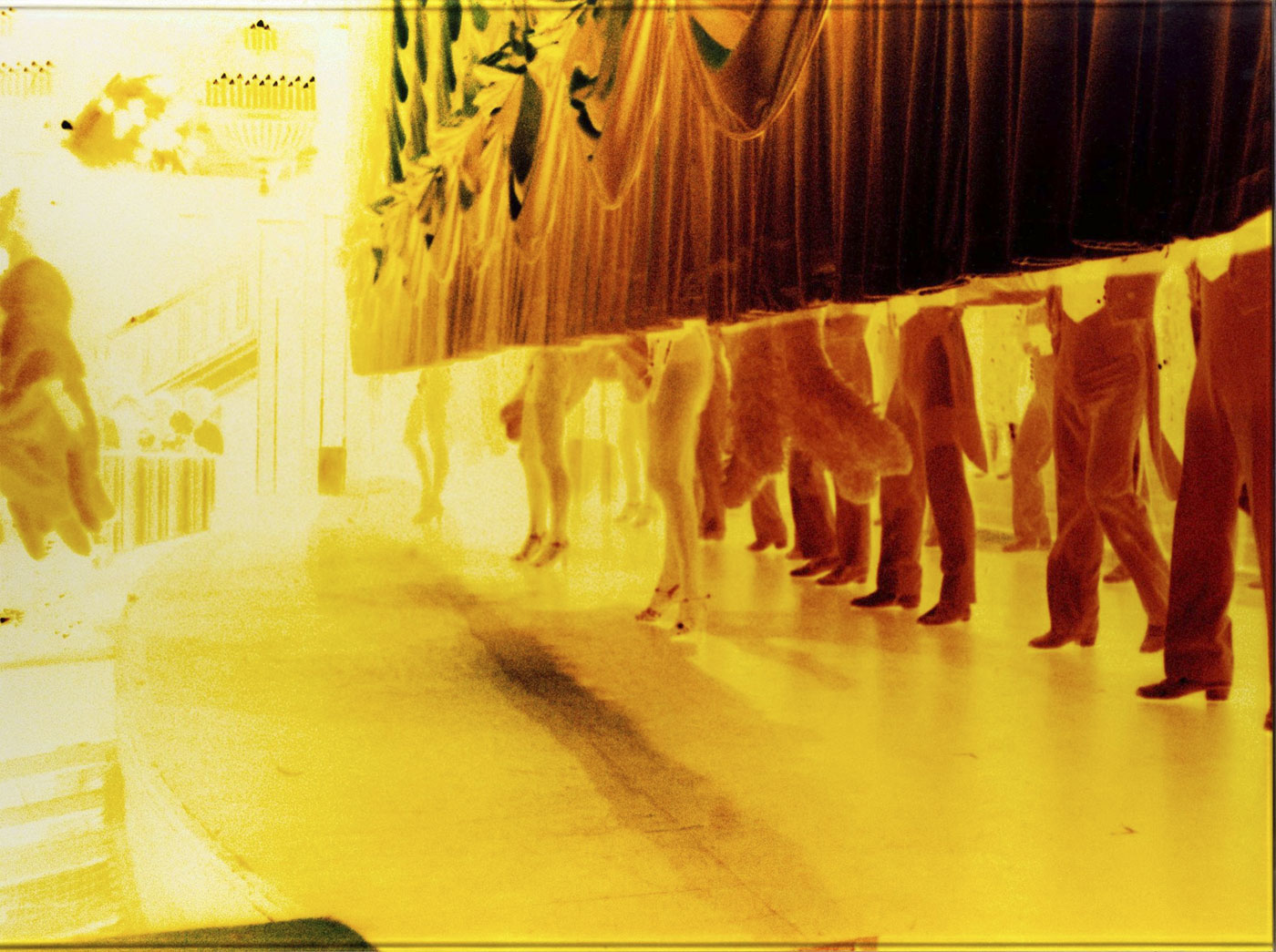
Weegee (American, born Ukraine (Austria), Złoczów (Zolochiv) 1899-1968 New York) 'Charles Sodokoff and Arthur Webber Use Their Top Hats to Hide Their Faces' January 27, 1942, printed c. 1983


Weegee (American born Ukraine (Austria), Złoczów (Zolochiv) 1899-1968 New York)
Charles Sodokoff and Arthur Webber Use Their Top Hats to Hide Their Faces
January 27, 1942, printed c. 1983
Gelatin silver print
31.8 x 41.4cm (12 1/2 x 16 5/16 in.)
Gift of Aaron and Jessica Rose, 1983
Rights and Reproduction: © Weegee / International Center of Photography


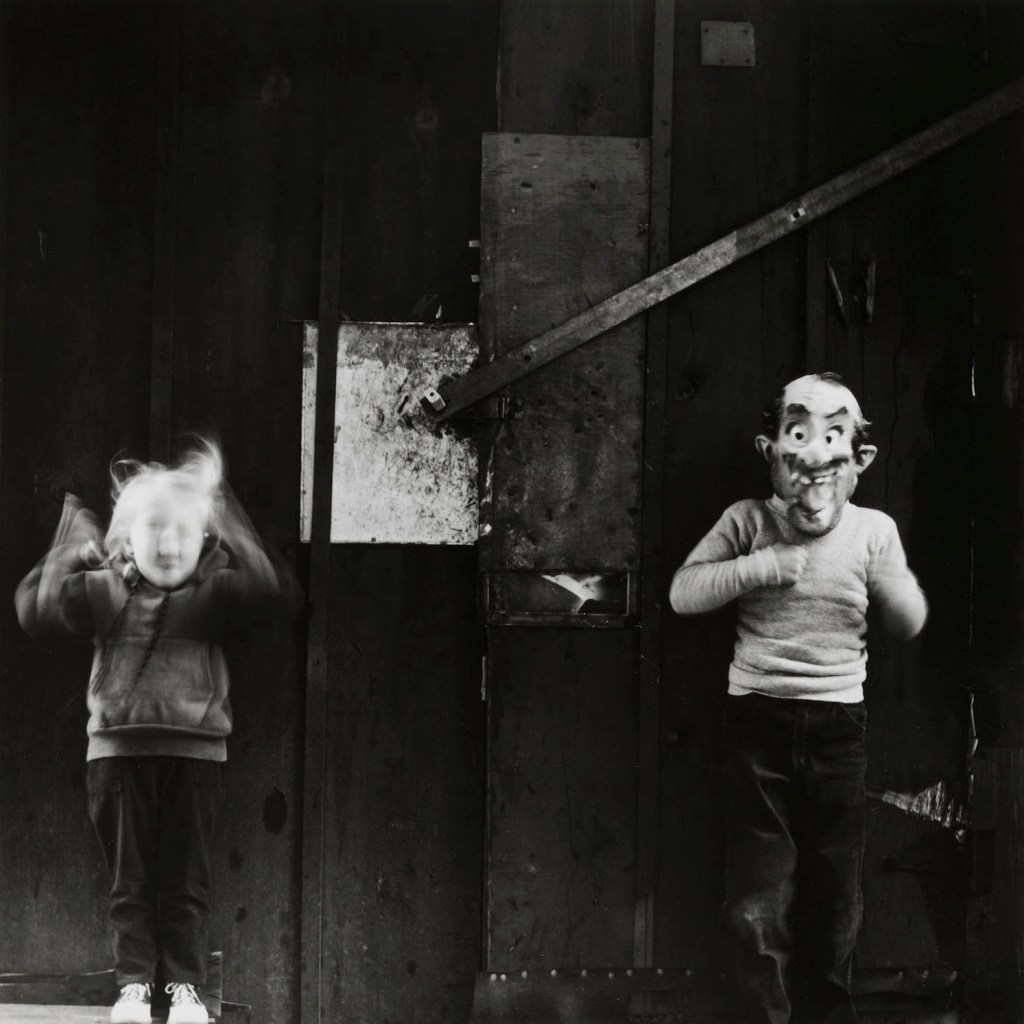
Ralph Eugene Meatyard (American, 1925-1972) 'Occasion for Diriment' 1962


Ralph Eugene Meatyard (American, 1925-1972)
Occasion for Diriment
1962
Gelatin silver print
18.0 x 18.7cm (7 1/16 x 7 3/8 in.)
Rogers Fund, 1967
© The Estate of Ralph Eugene Meatyard, Courtesy Fraenkel Gallery, San Francisco


Ralph Eugene Meatyard was a photographer and optician who spent the last two decades of his life in Lexington, Kentucky, producing an eccentric body of work at some remove from the photographic mainstream. He often posed his family and friends in enigmatic tableaux with props such as dolls and rubber masks, imbuing his images with a haunting Surrealist sensibility. The curious title of this photograph stems from Meatyard’s passion for odd names, puns, and peculiar words and phrases. Diriment is a made-up word, a Lewis Carroll-like compound of “dire” and “merriment” that suggests a mood of high-spirited fun and hilarity fraught with anxious undertones.


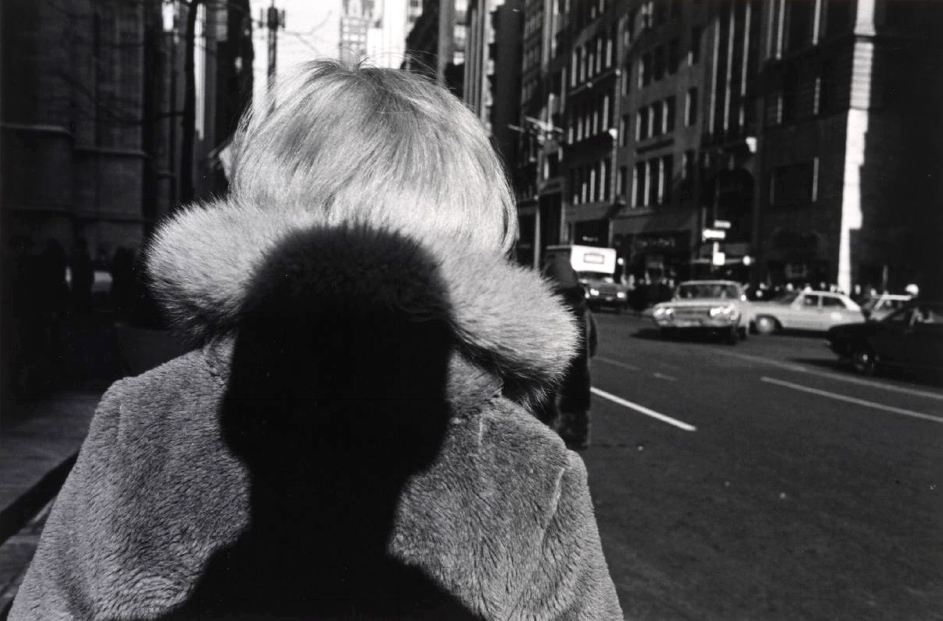
Lee Friedlander (American, born Aberdeen, Washington, 1934) 'Shadow, New York City' 1966, printed 1973


Lee Friedlander (American born Aberdeen, Washington, 1934)
Shadow, New York City
1966, printed 1973
Gelatin silver print
16.0 x 24.1cm (6 5/16 x 9 1/2 in.)
Purchase, The Horace W. Goldsmith Foundation Gift, through Joyce and Robert Menschel, 1990


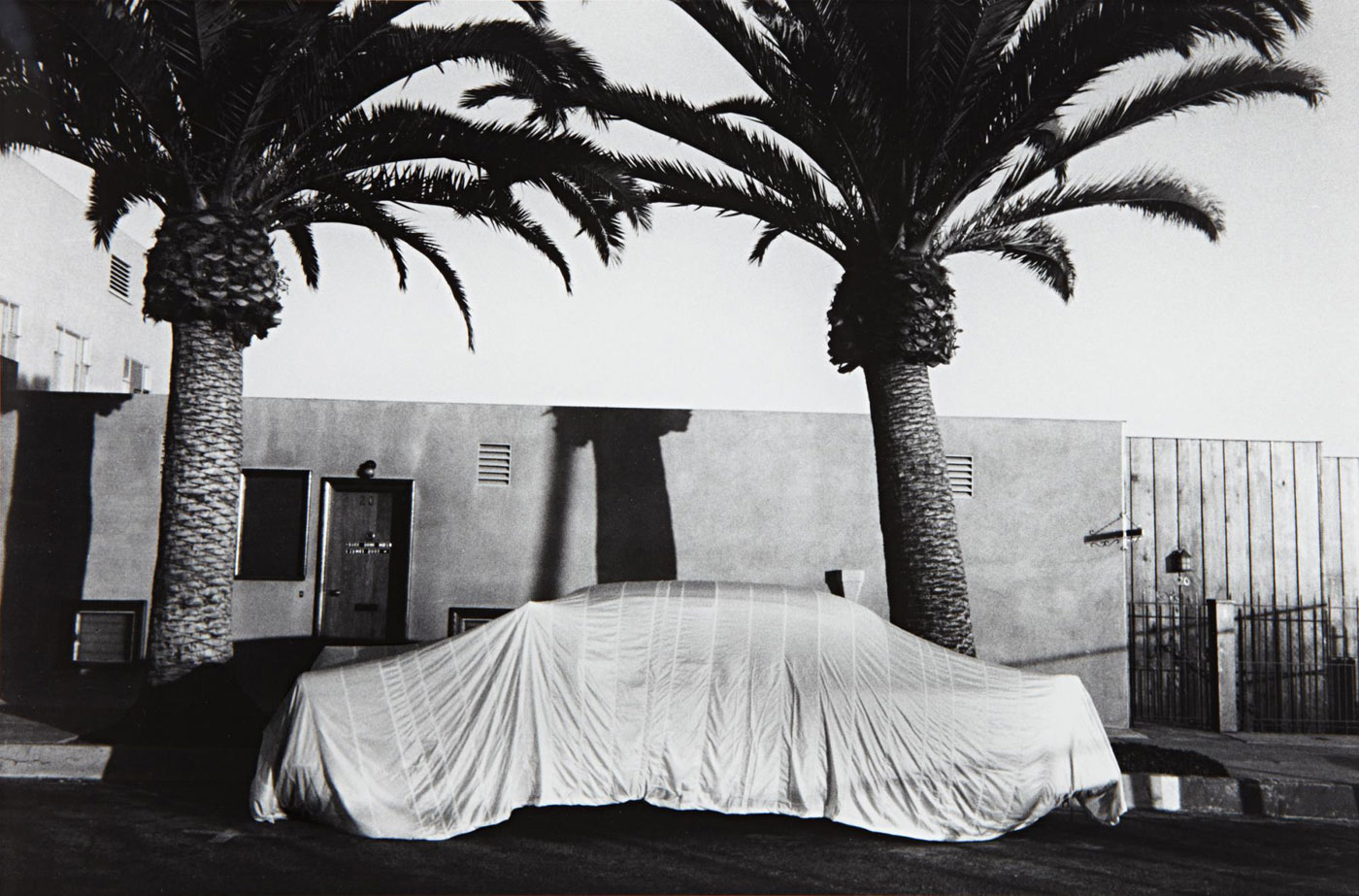
Robert Frank (American, born Zurich, 1924) 'Covered Car - Long Beach, California' 1955


Robert Frank (American born Zurich, 1924-2019)
Covered Car – Long Beach, California
1955
Gelatin silver print
21.4 x 32.7cm (8 7/16 x 12 7/8 in.)
Gilman Collection, Purchase, Ann Tenenbaum and Thomas H. Lee Gift, 2005


Photography is a medium prized for its capacity to expose, lay bare, make visible. For many artists, the camera is, above all, a tool for revealing what would otherwise remain unnoticed. As Diane Arbus once said: “I really believe there are things which nobody would see unless I photographed them.” At the root of this artistic impulse is a keen fascination with that which is hidden, obscure, or hitherto unseen. This exhibition presents a selection of contemporary photographs and video from the permanent collection that variously explores the medium’s dynamic interplay between concealment and revelation.

Some of the artists featured here use the camera to reveal subjects or places ordinarily hidden, as in Vera Lutter’s majestic view of the interior of a Pepsi-Cola bottling plant or Miguel Rio Branco’s lush image of a tapestry’s seamy underside. Others address instances of geopolitical obfuscation: Fazal Sheikh’s aerial photographs of the Negev desert in southern Israel record the traces of Bedouin villages that have been transformed into forests or farmland, while Mishka Henner collects images of stylishly censored high-security sites on Google Earth. In Vault (2011), Thomas Demand takes his inspiration from current events, meticulously re-creating a storeroom in which thirty missing works of art were discovered during a recent police raid.

The tension between publicity and privacy – the simultaneous desire to be looked at and to evade the merciless gaze of the camera – animates the work of artists as diverse as Arbus, Lutz Bacher, Jack Pierson, and Taryn Simon. In her video, The Nightingale (2003), Grace Ndiritu explores the tradition of the veil and its complex poetics of exposure and effacement. Complementing the contemporary works on view is a selection of earlier photographs in which the primary subject is hidden or obscured – a brief anthology of playfulness, shame, and seduction.


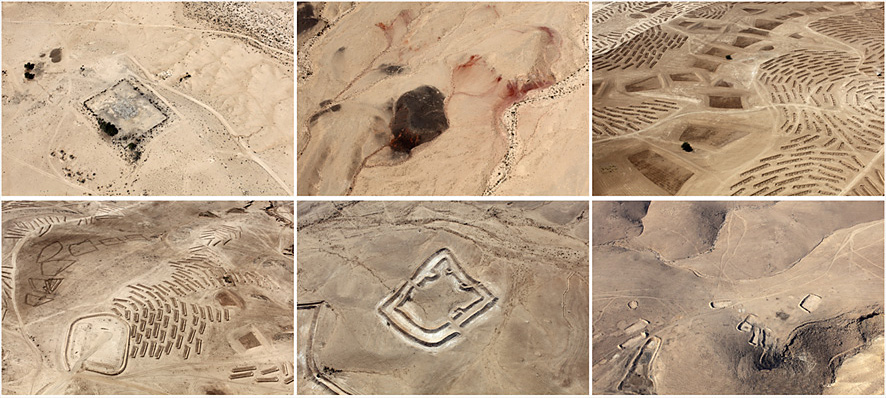
Fazal Sheikh (American, born 1965) 'Desert Bloom' (various numbers) 2011


Fazal Sheikh (American, b. 1965)
Desert Bloom (various numbers)
2011
Excerpt from the Erasure Trilogy
Inkjet print
Image: 40 × 60cm (15 3/4 × 23 5/8 in.) Sheet: 52.1 × 72.1cm (20 1/2 × 28 3/8 in.)
Frame: 73.7 × 53.3cm (29 × 21 in.)
Purchase, Jane P. Watkins Gift, 2013


In 2011 the French photographer Frederic Brenner invited eleven prominent photographers to spend six months in residence in Israel and the Occupied Territories, or West Bank, to explore the area’s complexity and to create bodies of work that might broaden and reframe the conversation about the region. Among those invited was Sheikh, an artist best known for his sensitive black-and-white portraits of people living in displaced and marginalised communities around the world. Sheikh’s project takes the form of a trilogy titled Erasure, of which Desert Bloom is the central part. The images were made during several months of flying above the Negev desert and are intended to articulate the rapid transformation of the region. On the one hand, they invoke the Israeli endeavour to “make the desert bloom,” and on the other, they reveal traces of the Negev’s history: the construction of towns for the Bedouin, the natural erosion of the land, the demolition of local dwellings, the remains of military installations, the afforestation campaigns of the Jewish National Fund (JNF), and the transformation of nomadic desert regions into farmland.


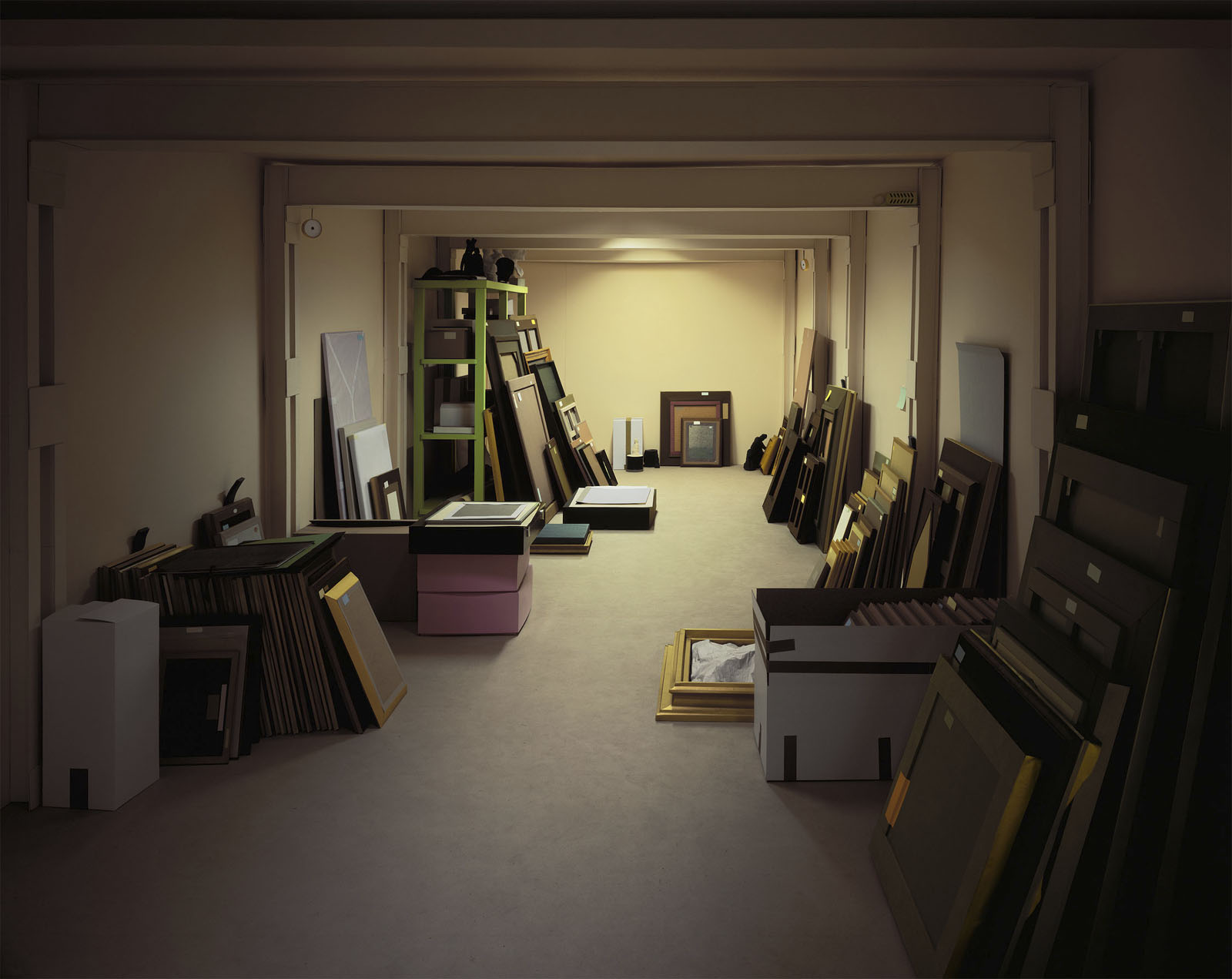
Thomas Demand (German, b. 1964) 'Vault' 2012


Thomas Demand (German, b. 1964)
Vault
2012
Chromogenic print
220 x 276.9cm (86 5/8 x 109 in.)
Purchase, Louis V. Bell Fund; Alfred Stieglitz Society, The Fledgling Fund, through Diana Barrett and Robert Vila, Joseph M. and Barbara Cohen Foundation Inc. and Hideyuki Osawa Gifts, 2013
© Thomas Demand / Artist’s Rights Society (ARS), New York


Demand’s photographs of the paper constructions he builds in his studio are typically based on photographs related to politically charged real-world events. He begins with an existing image, usually culled from the news media, which he translates into a three-dimensional life-sized model made of coloured paper and cardboard. The models are then carefully lit and photographed, after which they are destroyed. Three times removed from the scenes they depict, Demand’s works are masterpieces of pictorial ambiguity that occupy a mesmerising middle ground between reality and artifice.

Vault is based on a police photograph of a storeroom at the Wildenstein Institute in Paris, where thirty paintings and sculptures that had been missing for decades were discovered during a police raid in 2011. The missing artworks belong to the heirs of a French Jewish family displaced during the Holocaust. In Demand’s picture, as in the photograph on which it is based, the framed paintings – which include works by Degas, Manet, and Morisot – are turned to face the walls and remain tantalisingly hidden from view.


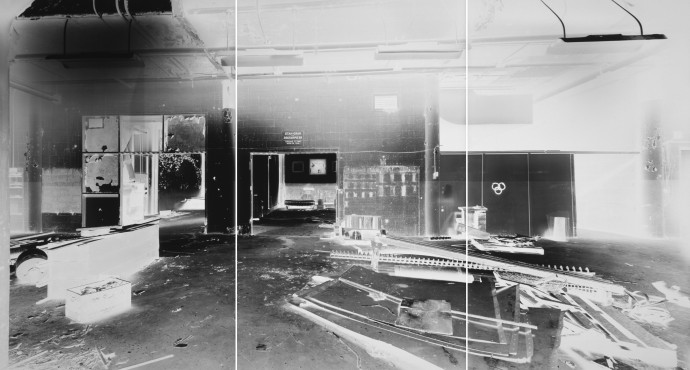
Vera Lutter (German, born Kaiserslautern, 1960) 'Pepsi Cola Interior II: July 6-13, 2000' 2000


Vera Lutter (German, b. 1960)
Pepsi Cola Interior II: July 6-13, 2000
2000
Gelatin silver print
Overall installation: 90 3/4 in. × 14 ft. 3/4 in. (230.5 × 428.6cm)
Sheet (A): 90 in. × 55 3/4 in. (228.6 × 141.6cm)
Sheet (B): 90 in. × 55 3/4 in. (228.6 × 141.6cm)
Sheet (C): 90 in. × 55 3/4 in. (228.6 × 141.6cm)
Frame (each): 90 3/4 × 56 1/4 in. (230.5 × 142.9cm)
Purchase, Joseph M. and Barbara Cohen Foundation Inc. Gift, 2001
© Vera Lutter


While the basis for Lutter’s technique – the camera obscura – is older than photography itself, her images and subject matter are wholly modern. This enormous negative print was made inside a room-sized pinhole camera that Lutter built in a derelict Pepsi-Cola bottling plant on the East River in Hunters Point, Queens. After pinning three huge sheets of photographic paper opposite the camera’s pinhole aperture, she worked inside the camera to monitor and manipulate the light during the weeklong exposure. The bottling plant itself closed in 1999 and was later demolished.


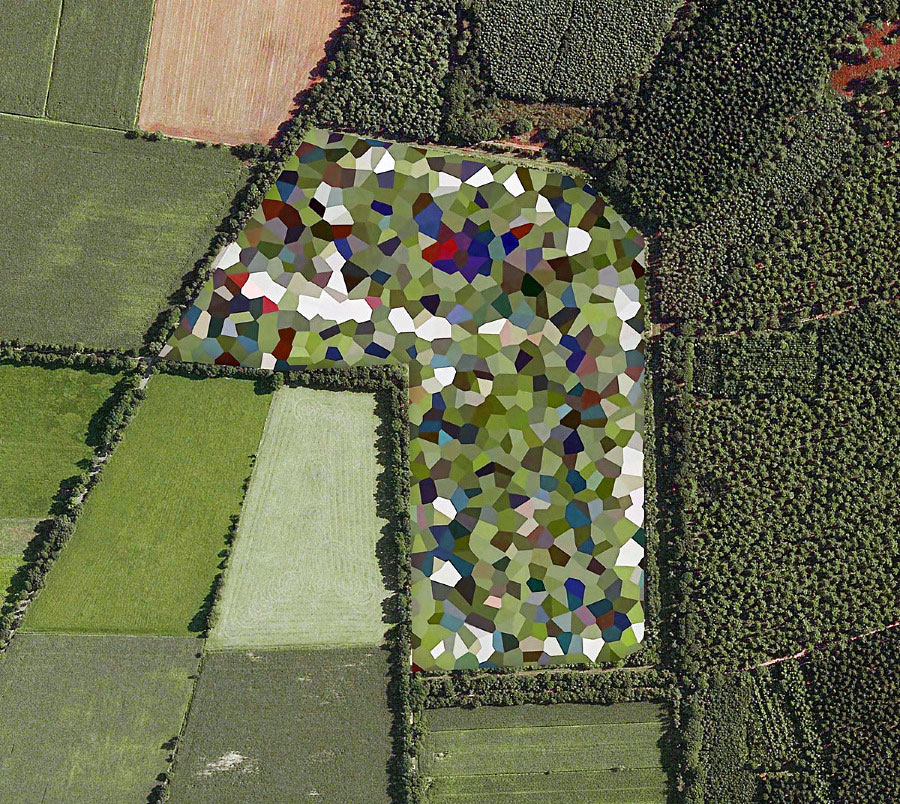
Mishka Henner (British, b. 1976) 'Staphorst Ammunition Depot, Overijssel' 2011, printed 2014


Mishka Henner (British, b. 1976)
Staphorst Ammunition Depot, Overijssel
2011, printed 2014
From the series Dutch Landscapes
Inkjet print
31 1/2 × 35 7/16 in. (80 × 90cm)
Purchase, Vital Projects Fund Inc. Gift, through Joyce and Robert Menschel, 2014
© Mishka Henner


In his “Dutch Landscapes” series, Henner selects and reproduces images of the Netherlands found on Google Earth. The multicoloured shapes punctuating these landscapes were created not by the artist but at the behest of the Dutch government. When Google Earth was introduced in 2005, satellite imagery of the entire planet became freely accessible to anyone with an Internet connection. This sudden visibility created concerns among many governments, who required Google – or its image suppliers – to obscure the details of sites deemed vital to national security. While most nations employed standard techniques, such as blurring, pixilation, or digital cloning, the Dutch chose to conceal hundreds of sites – including royal palaces, army barracks, and fuel depots – with bold, multicoloured polygons. “There is of course an absurdity to these censored images,” Henner has written, “since their overt, bold and graphic nature only draws attention to the very sites that are meant to be hidden. Yet this contradiction seems perfectly apt for the absurd fear of terror that has come to dominate the cultural landscape of the last decade.”


Now You See It: Photography and Concealment, an installation of 25 works at The Metropolitan Museum of Art, focuses on the dynamic interplay between concealment and revelation in contemporary photography and video art. The featured works, all from the Museum’s Department of Photographs, range from a late 19th-century photograph by Pierre-Louis Pierson to a recently acquired work by Thomas Demand.

The installation presents works by artists who use the camera to reveal subjects or places ordinarily hidden from view, as well as works that explore broader themes of secrecy and obscured or partial vision. A highlight of Now You See It is Thomas Demand’s photograph Vault (2012). The image is based on a police photograph of a storeroom at the Wildenstein Institute in Paris, where 30 paintings and sculptures that had been missing for decades were discovered during a police raid in 2011. In Demand’s picture, as in the photograph on which it is based, the framed art works are turned to face the walls, remaining tantalisingly hidden from view. Other highlights include Vera Lutter’s haunting view of the seldom seen interior of the Pepsi Cola bottling plant in Queens, New York, Pepsi Cola Interior II: July 6-13 (2000), and Fazal Sheikh’s Desert Bloom (2011), a series of aerial photographs of the Negev desert. In Grace Nditru’s acclaimed video The Nightingale (2003), the artist explores the tradition of the veil and its complex associations of exposure and effacement. Accompanied by a recording of the Senegalese singer Baaba Maal, Ndiritu evokes a rapid-fire series of cultural references as she performs a hypnotic, Scheherazade-like series of gestures and movements with a piece of fabric, swiftly transforming it from turban to blindfold, and do-rag to noose to niqab. The tension between publicity and privacy, inherent in the field of photography, is explored in works by artists as diverse as Diane Arbus, Lutz Bacher, Jack Pierson, and Taryn Simon. The 20th-century photographs on view present the theme of concealment in a literal way and include Weegee’s Charles Sodokoff and Arthur Webber Use Their Top Hats to Hide Their Faces (January 27, 1942) and Helen Levitt’s Kids in a Box, on the Street, New York City (c. 1942).

Now You See It: Photography and Concealment is organised by Mia Fineman, Associate Curator in the Department of Photographs at The Metropolitan Museum of Art.


Helen Levitt (American, 1913-2009) [Kids in a Box, on the Street, New York City] c. 1942


Helen Levitt (American, 1913-2009)
[Kids in a Box, on the Street, New York City]
c. 1942
Gelatin silver print
Image approx.: 9 × 6 in. (22.9 × 15.2cm)
Promised Gift of Mrs. Robert O. Levitt
© Estate of Helen Levitt


Helen Levitt (American, 1913-2009) [Kids on the Street Playing Hide and Seek, New York City] c. 1942


Helen Levitt (American, 1913-2009)
[Kids on the Street Playing Hide and Seek, New York City]
c. 1942
Gelatin silver print
9 3/4 × 6 3/4 in. (24.8 × 17.1cm)
Promised Gift of Mrs. Robert O. Levitt
© Estate of Helen Levitt


Attributed to Juliette Alexandre-Bisson (French, 1861-1956) [Birth of Ectoplasm During Séance with the Medium Eva C.] 1919-1920


Attributed to Juliette Alexandre-Bisson (French, 1861-1956)
[Birth of Ectoplasm During Séance with the Medium Eva C.]
1919-1920
Gelatin silver print
11.8 x 8.9cm (4 5/8 x 3 1/2 in.)
Gilman Collection, Purchase, The Howard Gilman Foundation Gift, 2001


Bill Wasilevich (American, active 1940s) 'Jimmy "One Eye" Collins After Arraignment' 1946


Bill Wasilevich (American, active 1940s)
Jimmy “One Eye” Collins After Arraignment
1946
Gelatin silver print
18.6 x 14.4cm (7 5/16 x 5 11/16 in.)
Twentieth-Century Photography Fund, 2008
© Steve Schapiro/Corbis


Grace Ndiritu (British, born 1976)
The Nightingale
2003
Video
Gift of the artist, 2009
© 2003 Grace Ndiritu, Courtesy Grace Ndiritu and LUX, London


Before a camera fixed on her face and neck and accompanied by a recording of the Senegalese singer Baaba Maal, Ndiritu performs a hypnotic, Scheherazade-like series of gestures and movements with a piece of fabric, swiftly transforming it from turban to blindfold, from do-rag to noose to niqab. Both jubilant and unsettling, the video evokes a rapid-fire series of cultural references, counterposing the enforced modesty of the Islamic world with Western fantasies of exoticism. Ndiritu, who studied textiles at the Winchester School of Art, acquired this simple red-and-white scarf while traveling in India and carried it with her as a talisman through years of global exploration.


Jack Pierson (American, b. 1960) 'The Lonely Life' 1992


Jack Pierson (American, b. 1960)
The Lonely Life
1992
Chromogenic print
Frame: 76.2 × 101.6cm (30 × 40 in.)
Purchase, The Horace W. Goldsmith Foundation Gift, through Joyce and Robert Menschel, 2000
© Jack Pierson


In 1994, Pierson was invited by the Whitney Museum of American Art to show his photographs alongside a group of works by Edward Hopper (1882-1967) that the artist selected from their vast holdings. Like Hopper, Pierson creates works that are inherently cinematic in their scope and effects; both are primarily concerned with mood, atmosphere, and exhibit a particularly urban kind of melancholy. His greatest asset, however, is an almost overwhelmingly lush palette, which he uses to depict objects of desire or scenes that are unabashedly sensual and emotional. An excellent example of the artist’s high-key chromaticism, The Lonely Life describes the unique brand of loneliness shared by the performer and the fan, both of whom (like Pierson) are doomed to experience existence solely through the intoxications of art.


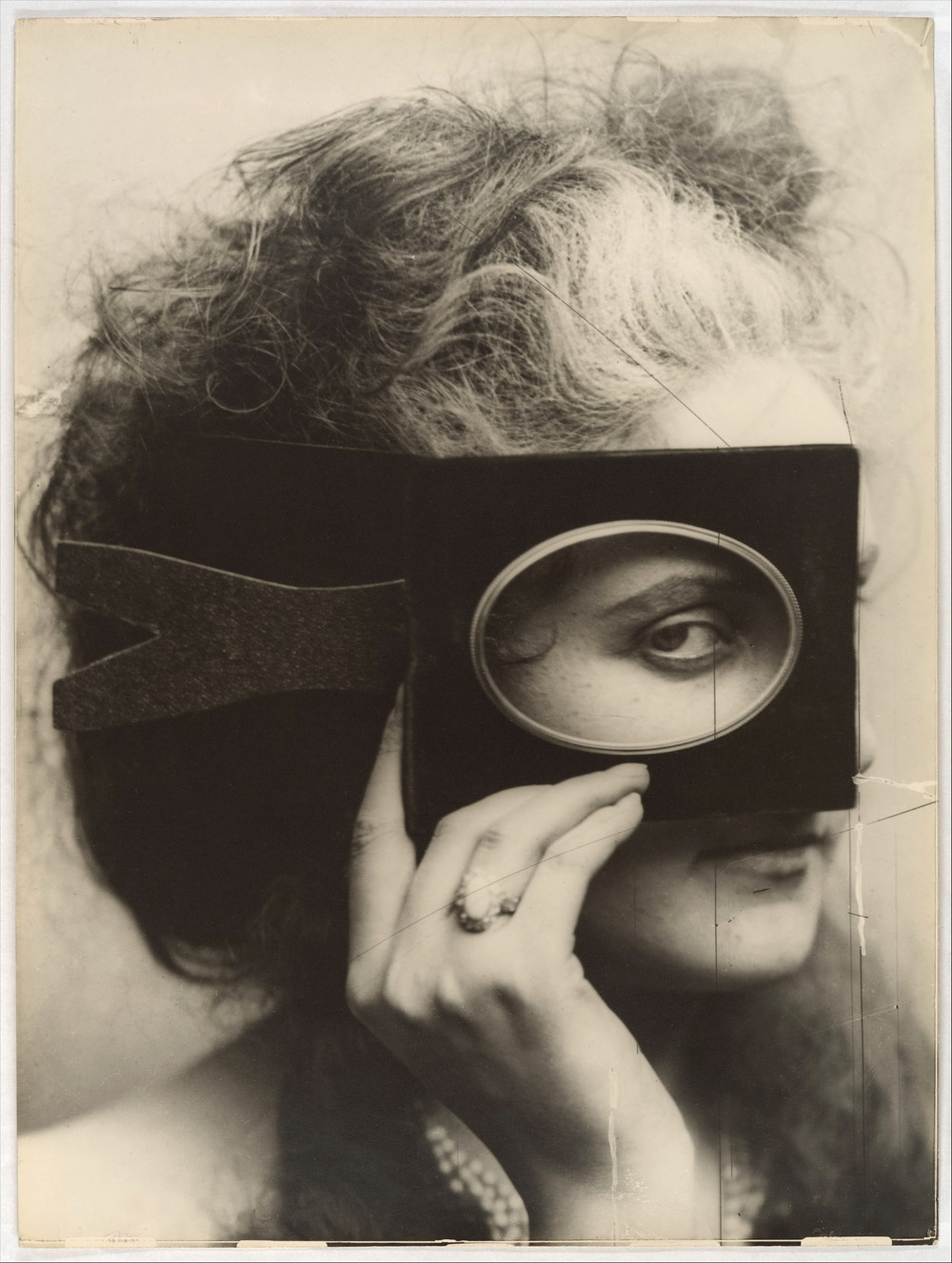
Pierre-Louis Pierson (French, 1822-1913) 'Scherzo di Follia' 1861-1867, printed c. 1930


Pierre-Louis Pierson (French, 1822-1913)
Scherzo di Follia
1861-1867, printed c. 1930
Gelatin silver print from glass negative
39.8 x 29.8cm (15 11/16 x 11 3/4 in.)
Gilman Collection, Gift of The Howard Gilman Foundation, 2005


Virginia Oldoini, Countess Verasis de Castiglione (1837-1899), created a sensation when she appeared on the social scene in Paris in 1855, having been sent by the Italian statesman Cavour to secretly win Napoleon III over to the cause of Italian unity by “any means she chose.” Within months, the statuesque beauty was the mistress of Napoleon III and a much-talked-about ornament of the lavish balls so prevalent during the period. After the fall of the Second Empire in 1870, she led an increasingly secluded existence, which gave rise to fantastic speculation about her affairs. As the years went by, her mental stability declined and she ventured out only at night, shrouded in veils.

The countess’s raging narcissism found in photography the perfect ally; Pierre-Louis Pierson produced over seven hundred different images of her. In a reversal of roles, the sitter would direct every aspect of the picture, from the angle of the shot to the lighting, using the photographer as a mere tool in her pursuit of self-promotion and self-expression.


The Metropolitan Museum of Art
1000 Fifth Avenue at 82nd Street
New York, New York 10028-0198
Phone: 212-535-7710

Opening hours:
Sunday – Tuesday and Thursday 10am – 5pm
Friday and Saturday 10am – 9pm
Closed Wednesday

The Metropolitan Museum of Art website

LIKE ART BLART ON FACEBOOK

Back to top

Exhibition: ‘Roman Vishniac Rediscovered’ at the Jewish Historical Museum, Amsterdam

Exhibition dates: 4th April – 24th August 2014


Roman Vishniac (Russian-American, 1897-1990) 'Recalcitrance, Berlin' 1926 (detail)


Roman Vishniac (Russian-American, 1897-1990)
Recalcitrance, Berlin (detail)
1926
© Mara Vishniac Kohn, courtesy International Center of Photography


It takes guts and moral fortitude to continue photographing the city that you live in even as the state that controls that city (and country) conspires against you. It takes talent to produce memorable images of urban poverty, to record for posterity communities that would soon vanish forever under the weight of a malignant form of madness, of genocide.

Vishniac was the only one not concerned with ego. He went out there and got the job done where no one else did. He produced thoroughly modern images of an ancient culture on the verge of destruction. He knew the danger and yet he still took the photos. Courage and fortitude, and in the end the luck to escape the Holocaust himself.

You can’t look at these images without a sense of regret and sadness – at the stupidity of humanity, of the egos of men, and the waste of millions of lives. One name says it all: Ernst Kaufmann. Standing on a pile of rocks, wearing wooden clogs, this man with the wavy hair looks down into the camera and he will ever be thus – young, handsome, alive in the moment that the photograph was taken.

Ernst Kaufmann was born in Krefeld, Germany, in 1911. He was arrested in June 1941 and killed in August of that year in the Mauthausen concentration camp in Austria.

Dr Marcus Bunyan


Many thankx to the Jewish Historical Museum for allowing me to publish the photographs in the posting. Please click on the photographs for a larger version of the image. Lots more images can be found on the excellent Roman Vishniac Archive website.


Roman Vishniac (Russian-American, 1897-1990) '[Interior of the Anhalter Bahnhof railway terminus near Potsdamer Platz, Berlin]' late 1920s - early 1930s


Roman Vishniac (Russian-American, 1897-1990)
[Interior of the Anhalter Bahnhof railway terminus near Potsdamer Platz, Berlin]
late 1920s – early 1930s
© Mara Vishniac Kohn, courtesy International Center of Photography


Roman Vishniac Rediscovered brings together four decades of work by an extraordinarily versatile and innovative photographer for the first time. Vishniac (1897-1990) created the most widely recognised and reproduced photographic record of Jewish life in Eastern Europe between the two World Wars. These celebrated photographs were taken on assignment for the American Jewish Joint Distribution Committee, the world’s largest Jewish relief organisation, from 1935-1938, yet this exhibition follows the photographer’s long and accomplished career from the early 1920s through the 1950s. Roman Vishniac Rediscovered introduces a radically diverse body of work – much of it only recently discovered – and repositions Vishniac’s iconic photographs of Eastern European Jewry within a broader tradition of 1930s social documentary photography.

More than any other photographer, Roman Vishniac’s images have profoundly influenced contemporary notions of Jewish life in Eastern Europe. Vishniac created the most widely recognised and reproduced photographic record of that world on the eve of its annihilation, yet only a small fraction of his work was published or printed during his lifetime. Known primarily for this poignant record, Vishniac was in fact a remarkably versatile and innovative photographer. His body of work spans more than five decades, ranging from early engagements with European modernism in the 1920s to highly inventive colour photomicroscopy in the 1950s and ’60s.

Born in 1897 to an affluent Russian-Jewish family, Vishniac was raised in Moscow, where he studied zoology and biology. He immigrated to Berlin in 1920 in the aftermath of the Bolshevik Revolution. As an amateur photographer he took to the streets, offering witty and wry visual commentary on his adopted city while experimenting with new approaches to framing and composition. As Vishniac documented the Nazi rise to power, foreboding signs of oppression soon became a focal point of his work. In 1935, he was commissioned by the European headquarters of the American Jewish Joint Distribution Committee (AJDC) – the world’s largest Jewish relief organisation – to photograph impoverished Jewish communities in Eastern Europe. Vishniac’s four years of work on the project yielded the celebrated images that have largely defined his photographic legacy.

Arriving in New York on New Year’s Day 1941, Vishniac opened a portrait studio, working to make ends meet by documenting American Jewish communal and immigrant life, while establishing himself as a pioneer in the field of photomicroscopy. In 1947, he returned to Europe and documented Jewish Displaced Persons’ Camps, the efforts of Holocaust survivors to rebuild their lives, emigration and relief efforts, and the ruins of Berlin.

Roman Vishniac Rediscovered is a comprehensive reappraisal of Vishniac’s total photographic output, from his early years in Berlin through the postwar period in America. The exhibition is drawn from the Roman Vishniac archive at ICP and serves as an introduction to this vast assemblage comprising more than 30,000 objects, including recently discovered vintage prints, rare moving film footage, contact sheets, personal correspondence, and exhibition prints made from his recently digitised negatives.

Berlin Street Photography, 1920s-1930s

Vishniac immigrated to Berlin in 1920, shortly after the formation of the Weimar Republic. He and his wife Luta settled in the Wilmersdorf district, home to a large community of affluent Russian-Jewish expatriates. Berlin in the 1920s was the epitome of a modern city: cosmopolitan, loud, vibrant, diverse, and full of recent immigrants. Already an accomplished amateur photographer, Vishniac joined several of the city’s ubiquitous camera clubs. Armed with his Rolleiflex and Leica, he took to the streets, creating astute, often humorous observations of his adopted city.

Vishniac’s interest in photography had begun during his childhood in Russia; many Russian Jews owned photography shops and studios, and Vishniac’s family encouraged his pursuits. In Berlin, his perspective as an outsider contributed to his inventive and dynamic images of life in the city, and marked his transformation from amateur hobbyist to accomplished street photographer. His best, most intimate photographs were often taken in his own neighbourhood, where he built a fully equipped photo-processing lab in his apartment.

Vishniac took full advantage of the city’s manifold resources, improving his technique and experimenting with modernist and avant-garde approaches to framing and composition – hallmarks of Weimar Berlin. This prodigious body of early work became increasingly influenced by European modernism as he captured the buzzing day-to-day life of the city: streetcar drivers, municipal workers and day labourers, marching students and children at play, bucolic park scenes and the intellectual café life of the bustling metropolis that was, in Vishniac’s words, “the world’s center of music, books, and science.”


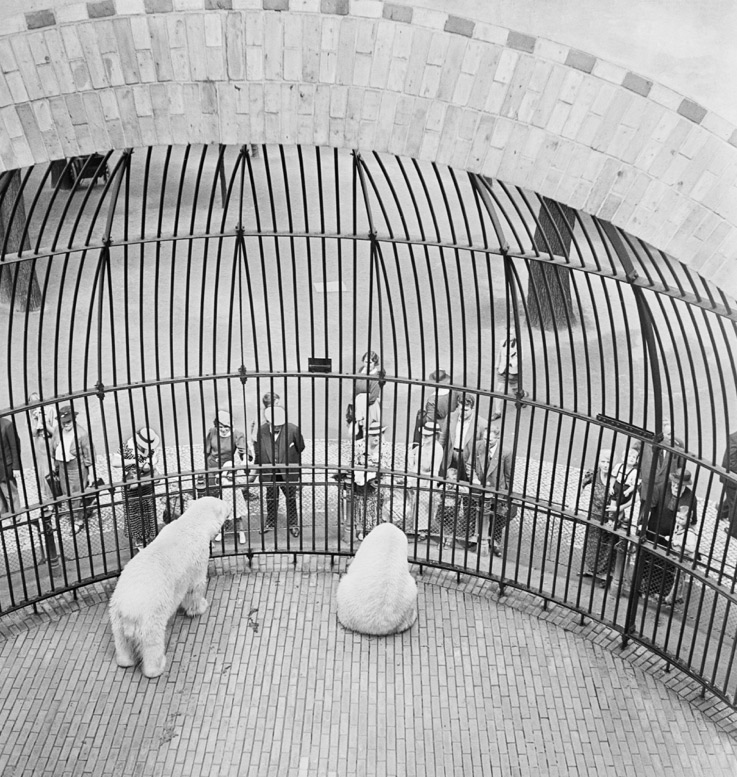
Roman Vishniac (Russian-American, 1897-1990) 'People behind bars, Berlin Zoo' Early 1930s (printed 2012)


Roman Vishniac (Russian-American, 1897-1990)
People behind bars, Berlin Zoo
Early 1930s (printed 2012)
© Mara Vishniac Kohn, courtesy International Center of Photography


The oldest and most renowned zoo in Germany, the Zoologische Garten was a popular gathering place for Berlin’s middle- and upper-class Jewish community before World War II. Many affluent Jewish families, including the Vishniacs, were shareholders. Beginning in 1933, the zoo began to force out Jewish board members. In 1938, a sign reading “Juden unerwünscht” (Jews Unwanted) was displayed at the entrance to the zoo and in early 1939 Jews were denied entry entirely. In Vishniac’s photograph of the zoo’s famous polar bears, it appears that the visitors, and not the animals, are in a cage.


Roman Vishniac (Russian-American, 1897-1990) '[Boys admiring a motorcycle, Brandenburg, outskirts of Berlin]' 1929 - early 1930s (printed 2012)


Roman Vishniac (Russian-American, 1897-1990)
[Boys admiring a motorcycle, Brandenburg, outskirts of Berlin]
1929 – early 1930s (printed 2012)
© Mara Vishniac Kohn, courtesy International Center of Photography


Nazi Rise to Power in Germany, 1933-1938

“I grew up in Berlin with a pervasive sense of danger and dread combined with a perceived obligation not to show fear. I was aware of personal danger and knew that whatever happened to me, my parents could offer no protection or help. That was everyday life.”

Mara Vishniac Kohn


Vishniac’s development as a professional photographer coincided with the Nazi rise to power and the establishment of the Third Reich. Widespread antisemitism and the implementation of increasingly restrictive measures against Jews became daily realities. Vishniac documented the ominous changes he encountered, photographing campaign posters, swastika banners, phrenology shops, and marching Nazi soldiers. Following Hitler’s appointment as chancellor in 1933, the government relentlessly pursued those artists and intellectuals not in line with the Reich’s values. Berlin’s cosmopolitan vivacity was soon drained of its intellectual and cultural capital. Once-vibrant neighbourhoods became ruled by fear; anyone considered an opponent of the Nazi government could be sent to Dachau, a concentration camp established in 1933 outside Munich.

Many photographers suffered from the Nazi policies; the Schriftgesetz (Editorial Act) of November 1933 forced anyone working in publishing – photographers included – to provide proof of Aryan heritage. In 1934, the Deutsche Presse (German Press) published a list of authorised Aryan photographers whose work aligned with the Nazi party. Jews were forbidden to take photographs on the street. In spite of these restrictions, Vishniac tenaciously documented Berlin’s rapid acclimation to Nazi policy. To avoid suspicion, he often used his young daughter Mara as a prop, snapping seemingly innocuous pictures of her in front of advertising columns and shop windows festooned with Nazi propaganda.

These symbols of oppression formed the quotidian backdrop of Vishniac’s Germany, a fact to which the ubiquity of Nazi flags, banners, and posters in his later Berlin photographs testify. Capturing the spread of Nazi ideology on Berlin’s streets, Vishniac’s images embodied his own marginalisation – and endangerment – as both a photographer and a Jew.


Roman Vishniac (Russian-American, 1897-1990) 'Recalcitrance, Berlin' 1926


Roman Vishniac (Russian-American, 1897-1990)
Recalcitrance, Berlin
1926
© Mara Vishniac Kohn, courtesy International Center of Photography


Roman Vishniac (Russian-American, 1897-1990) '[Vishniac's daughter Mara posing in front of an election poster for Hindenburg and Hitler that reads "The Marshal and the Corporal: Fight with Us for Peace and Equal Rights," Wilmersdorf, Berlin]' 1933


Roman Vishniac (Russian-American, 1897-1990)
[Vishniac’s daughter Mara posing in front of an election poster for Hindenburg and Hitler that reads “The Marshal and the Corporal: Fight with Us for Peace and Equal Rights,” Wilmersdorf, Berlin]
1933
© Mara Vishniac Kohn, courtesy International Center of Photography


Roman Vishniac (Russian-American, 1897-1990) '[Street scene with a swastika flag on a storefront (at left), Berlin]' c. 1935-1936 (printed 2012)


Roman Vishniac (Russian-American, 1897-1990)
[Street scene with a swastika flag on a storefront (at left), Berlin]
c. 1935-1936 (printed 2012)
© Mara Vishniac Kohn, courtesy International Center of Photography


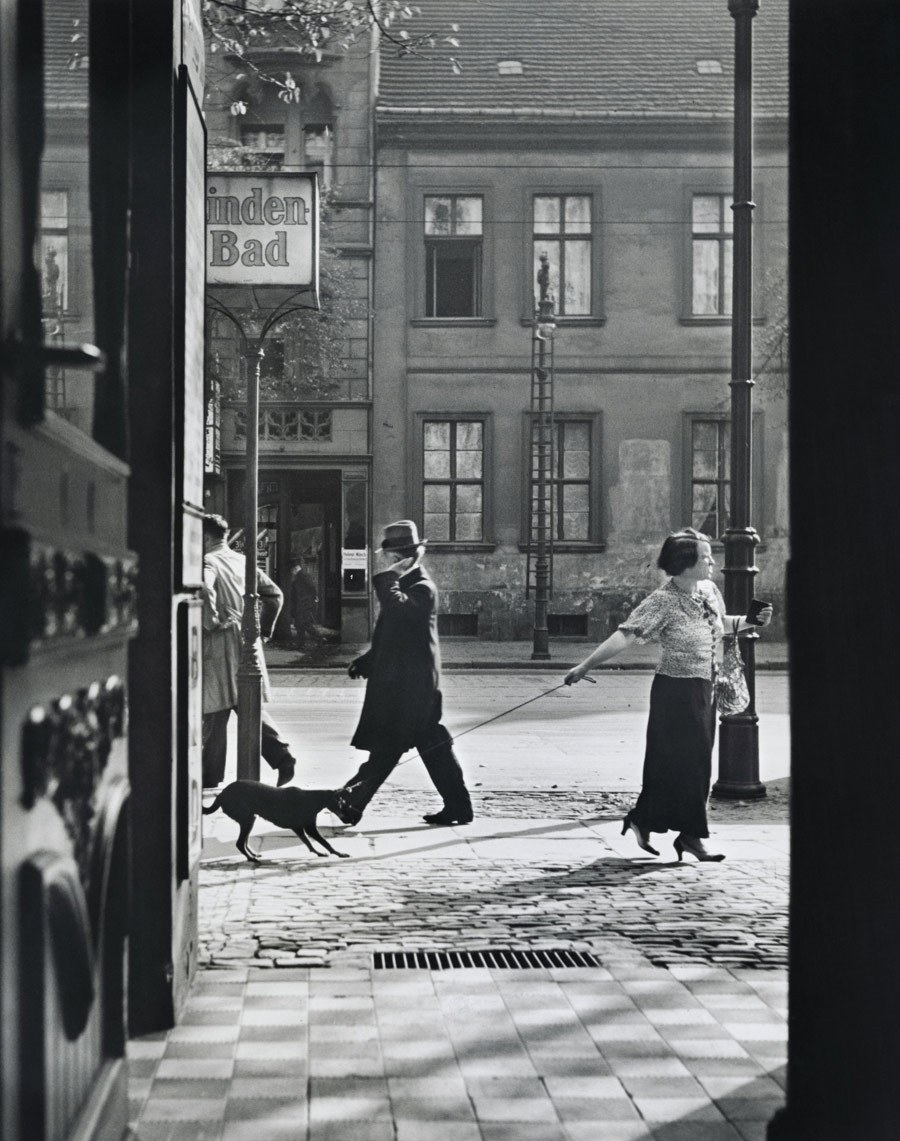
Vishniac often positioned himself in doorways or building foyers in his Berlin street photography, documenting daily life as a removed observer. This image reveals multiple layers of time in one shot: the car positioned alongside the horse-drawn wagon, bicyclists speeding by as pedestrians young and old navigate the cobblestones and pavement, against the backdrop of a rapidly modernising metropolis. Only upon closer examination do our eyes move to a swastika flag blowing in the wind above the horses, a common site on most Berlin streets by 1935.


German-Jewish Relief and Community Organizations, Berlin, mid- to late 1930s

Prior to Hitler’s assumption of power in 1933, Jewish social service organisations in Germany primarily served Eastern European Jews, the majority of whom were less cosmopolitan, assimilated, and affluent than their German-born coreligionists. The Nazi regime recognised no such distinction, however, and their rise to power drastically affected almost every Jew living in Germany. As Germany’s Jewish population was gradually excluded from both social and economic life, many came to depend upon a Jewish social structure that was originally intended to look outward but quickly expanded to serve the growing needs of the community.

In 1933, German-Jewish groups unified into the Reichsvertretung der Deutschen Juden (Central Organization of German Jews), an umbrella organisation intended to ameliorate the effects of Nazi racial policy. Between 1933 and 1938, subsidiary and affiliate organisations created Jewish education and healthcare systems and instituted a welfare system for Jews facing impoverishment. Zionist and other youth organisations flourished under the exclusionary policies of the Nazis, helping would-be émigrés learn the agricultural and vocational skills needed to build new lives in Palestine and elsewhere. The Jüdischer Kulturbund (Jewish Cultural Association) was established in response to restrictions placed on Jewish artists. Vishniac and his family were among its 70,000 members and regularly attended lectures and performances. Vishniac was also a member of T’munah, a Jewish photographic group founded in 1934 in response to the exclusionary policies of “Aryan” camera clubs.

As restrictions on photographers increased, Vishniac was commissioned to document the work of several Jewish community and social service organisations in Berlin. This fascinating body of work is largely unknown, but it helped establish his reputation in Jewish philanthropic circles, leading to major commissions from a wide range of Jewish relief and community organisations from the mid-1930s to the mid-1950s.


Roman Vishniac (Russian-American, 1897-1990) '[Drawer of freshly farmed eggs, Gut Winkel, a training farm for German-Jewish youth hoping to emigrate to Palestine, Spreenhagen in der Mark, Brandenburg, Germany]' c. 1938


Roman Vishniac (Russian-American, 1897-1990)
[Drawer of freshly farmed eggs, Gut Winkel, a training farm for German-Jewish youth hoping to emigrate to Palestine, Spreenhagen in der Mark, Brandenburg, Germany]
c. 1938
© Mara Vishniac Kohn, courtesy International Center of Photography


Roman Vishniac (Russian-American, 1897-1990) '[Preparing food in a Jewish soup kitchen, Berlin]' mid- to late 1930s


Roman Vishniac (Russian-American, 1897-1990)
[Preparing food in a Jewish soup kitchen, Berlin]
mid- to late 1930s
© Mara Vishniac Kohn, courtesy International Center of Photography


Jewish Life in Eastern Europe, c. 1935-1938

In 1935, Roman Vishniac was hired by the European headquarters of the American Jewish Joint Distribution Committee (AJDC) to document impoverished Jewish communities in Eastern Europe. Photographic images offered limitless, affordable reproducibility, and could be used in slide lectures, brochures, appeals, and annual reports throughout America and Western Europe. Vishniac’s images played a crucial role in communicating the AJDC’s message, and they would ultimately become the last extensive photographic record by a single photographer of Jewish communities that had existed for centuries.

The majority of Vishniac’s published photographs of Eastern Europe depict privation. Many others illustrate the philanthropic activities of the AJDC such as children’s camps, free loan societies, soup kitchens, schools, and health organisations. And while Vishniac is often associated with images of rural villages and small towns, or shtetlach, most of his photographs record urban poverty in major cities like Warsaw, Krakow, and Lodz. His work for the AJDC echoes the contemporaneous projects of American photographers like Dorothea Lange, Ben Shahn, Arthur Rothstein, and Walker Evans. In the same years that the Farm Security Administration sent photographers to the American South and West to document those affected by drought, depression, and migration, Vishniac was sent east by the AJDC. Today, his work stands alongside the best social-documentary photographers of his era. His unpublished work imparts a much more complex and nuanced perspective on Eastern European Jewish life, and reveals a much more versatile – and modern – artist.

That Vishniac was commissioned to document the most impoverished Jews is significant, as is the fact that he often chose the most traditional and observant Jews as subjects, to amplify the contrast between Ostjuden, or Eastern Jews, and the more assimilated Western Jews who would be viewing the images. It was only after the Holocaust, when the communities he had so poignantly depicted were annihilated, that his body of work came to symbolise the vanished world of Eastern Jewry.


Roman Vishniac (Russian-American, 1897-1990) 'Villagers in the Carpathian Mountains' c. 1935-1938


Roman Vishniac (Russian-American, 1897-1990)
Villagers in the Carpathian Mountains
c. 1935-38
© Mara Vishniac Kohn, courtesy International Center of Photography


Roman Vishniac (Russian-American, 1897-1990) '[Jewish schoolchildren, Mukacevo]' c. 1935-1938


Roman Vishniac (Russian-American, 1897-1990)
[Jewish schoolchildren, Mukacevo]
c. 1935-1938
© Mara Vishniac Kohn, courtesy International Center of Photography


Roman Vishniac (Russian-American, 1897-1990) '[Inside the Jewish quarter, Bratislava]' c. 1935-1938


Roman Vishniac (Russian-American, 1897-1990)
[Inside the Jewish quarter, Bratislava]
c. 1935-1938
© Mara Vishniac Kohn, courtesy International Center of Photography


Roman Vishniac (Russian-American, 1897-1990) '[Eastern Europe]' c. 1935-1938


Roman Vishniac (Russian-American, 1897-1990)
[Eastern Europe]
c. 1935-1938
© Mara Vishniac Kohn, courtesy International Center of Photography


Roman Vishniac (Russian-American, 1897-1990) '[Eastern Europe]' (detail) c. 1935-1938


Roman Vishniac (Russian-American, 1897-1990)
[Eastern Europe] (detail)
c. 1935-1938
© Mara Vishniac Kohn, courtesy International Center of Photography


Roman Vishniac (Russian-American, 1897-1990) '[Boy with kindling in a basement dwelling, Krochmalna Street, Warsaw]' c. 1935-1938


Roman Vishniac (Russian-American, 1897-1990)
[Boy with kindling in a basement dwelling, Krochmalna Street, Warsaw]
c. 1935-1938
© Mara Vishniac Kohn, courtesy International Center of Photography


Roman Vishniac (Russian-American, 1897-1990) '[David Eckstein, seven years old, and classmates in cheder (Jewish elementary school), Brod]' c. 1935-1938


Roman Vishniac (Russian-American, 1897-1990)
[David Eckstein, seven years old, and classmates in cheder (Jewish elementary school), Brod]
c. 1935-1938
© Mara Vishniac Kohn, courtesy International Center of Photography


Roman Vishniac (Russian-American, 1897-1990) '[Sara, sitting in bed in a basement dwelling, with stenciled flowers above her head, Warsaw]' c. 1935-1937


Roman Vishniac (Russian-American, 1897-1990)
[Sara, sitting in bed in a basement dwelling, with stenciled flowers above her head, Warsaw]
c. 1935-1937
© Mara Vishniac Kohn, courtesy International Center of Photography


Werkdorp Nieuwesluis Agrarian Training Camp, Wieringermeer, The Netherlands, 1939

As the plight of German Jews became increasingly dire throughout the 1930s and many Jewish families attempted to send their children to safety in neutral countries, many young German Jews, including Vishniac’s children Wolf and Mara, joined a large number of Zionist organisations. With the British government maintaining strict immigration quotas, hundreds of young German Jews planning to go to Palestine and waiting to obtain visas were sent to the Werkdorp Nieuwesluis, a Zionist agrarian youth training complex, or hachschara, in the Netherlands. Established in 1934 by the Foundation for Jewish Labor on land donated by the Dutch government, the Werkdorp taught young, urban Jews farming, animal husbandry, construction, and other unfamiliar skills they would need as pioneers in Palestine.

In 1939, Vishniac was sent by the American Jewish Joint Distribution Committee (AJDC) to document the Werkdorp’s activities. Vishniac photographed the capable young men and women as idealised, heroic Zionist pioneers, lifting heavy stones, constructing scaffolding, and tugging on rope. The images bear a striking resemblance to heavily circulated halutz (Zionist pioneer) photography made in Palestine in the 1930s, and demonstrate Vishniac’s versatility: here is an ambitious, accomplished series in a style that is radically different from his earlier work, and perfectly suited to his athletic, industrious subjects. Shot from a low vantage point, the Werkdorp images juxtapose clear skies and strong silhouettes to form vigorous, balanced compositions. Young, healthy bodies play off the clean, rhythmic geometry of the construction sites in a manner that is also reminiscent of the Russian Constructivist photographer Rodchenko, whose work would certainly have been familiar to Vishniac.

In March 1941, Nazi SS officers ordered the evacuation of the camp, and most of its inhabitants were sent to transit camps, including Westerbork. Out of 315 Werkdorp residents in May 1940, 175 were killed in concentration camps in the east.


Roman Vishniac (Russian-American, 1897-1990) '[Zionist youth building a school and foundry while learning construction techniques, Werkdorp Nieuwesluis, Wieringermeer, The Netherlands]' 1939


Roman Vishniac (Russian-American, 1897-1990)
[Zionist youth building a school and foundry while learning construction techniques, Werkdorp Nieuwesluis, Wieringermeer, The Netherlands]
1939
© Mara Vishniac Kohn, courtesy International Center of Photography


Roman Vishniac (Russian-American, 1897-1990) '[Ernst Kaufmann, center, and unidentified Zionist youth, wearing clogs while learning construction techniques in a quarry, Werkdorp Nieuwesluis, Wieringermeer, The Netherlands]' 1939


Roman Vishniac (Russian-American, 1897-1990)
[Ernst Kaufmann, centre, and unidentified Zionist youth, wearing clogs while learning construction techniques in a quarry, Werkdorp Nieuwesluis, Wieringermeer, The Netherlands]
1939
© Mara Vishniac Kohn, courtesy International Center of Photography


Vishniac’s Werkdorp images did not include any caption information on the few existing prints of the work, and were thus difficult to identify. A small, 2 1/4-inch-square contact print of three young men wearing wooden clogs provided a vital clue that facilitated the attribution of this larger body of Werkdorp material, with the assistance of curators at the Jewish Historical Museum in Amsterdam. This is the only known example of a professional photographer documenting this Dutch Zionist agrarian training camp.

Ernst Kaufmann was born in Krefeld, Germany, in 1911. He was arrested in June 1941 and killed in August of that year in the Mauthausen concentration camp in Austria.


Roman Vishniac (Russian-American, 1897-1990) '[Willy Lefkowitz and Martin Grünpeter constructing a foundry, Werkdorp Nieuwesluis, Wieringermeer, The Netherlands]' 1939 (printed 2012)


Roman Vishniac (Russian-American, 1897-1990)
[Willy Lefkowitz and Martin Grünpeter constructing a foundry, Werkdorp Nieuwesluis, Wieringermeer, The Netherlands]
1939 (printed 2012)
© Mara Vishniac Kohn, courtesy International Center of Photography


Willy Lefkowitz, left, was forcibly removed from the Werkdorp when it was closed by the Nazis in 1941. Lefkowitz, along with the majority of the Werkdorp’s remaining inhabitants, was sent to the Westerbork Transit Camp in northeastern Netherlands, a site where Dutch Jews and Roma were assembled during World War II prior to their deportation to Nazi extermination camps in the east. Of the 107,000 people who passed through Westerbork – among them Anne Frank and her family – only 5,200 survived, including Lefkowitz, who immigrated to the United States. He is believed to have died in Brooklyn in 2001. Martin Grünpeter, right, a German Jew born in 1914, survived World War II and immigrated to Palestine.


Travel, Refuge, and Internment in France: Paris, Nice, and Marseille, c. 1939

From April to September 1939, Vishniac worked as a freelance photographer based in France while his family struggled to secure exit visas to the U.S. (his children had been sent to safety in Sweden). In the interwar years, France had welcomed Jews from across Europe. By 1939, as Jews fleeing Nazi rule brought the Jewish population in France to over 300,000, an increasingly conservative and nationalist government sought to limit immigration. Detention camps for Jews were established in southern France.

During this time, Vishniac was commissioned by the American Jewish Joint Distribution Committee (AJDC) and the Society for Trades and Agricultural Labor (ORT) to photograph and film an ORT vocational training school for Jewish refugees near Marseille. Vishniac’s parents had relocated to Nice in 1937, and while visiting them, he took playful, spontaneous photographs of Riviera beach life, a stark contrast to the intense and machine-focused ORT images that were to be his final photographic assignment for the AJDC until his return to Europe in 1947.

In late 1939, after entrusting a large selection of his negatives to his friend Walter Bierer in Paris, Vishniac was arrested and imprisoned at the Camp du Ruchard internment camp. Held for three months, he wrote desperate letters to family, friends, and the staff of the AJDC, describing the dismal conditions and pleading for assistance. Following his release, secured through the efforts of his wife, Vishniac waited in France while his family worked to obtain exit visas, with assistance from the AJDC. Vishniac reunited with Luta, Wolf, and Mara in Lisbon, and the family sailed for America on the S.S. Siboney in December 1940, arriving in America on New Year’s Day 1941.


Roman Vishniac (Russian-American, 1897-1990) '[Beachgoers in the afternoon, Nice, France]' c. 1939


Roman Vishniac (Russian-American, 1897-1990)
[Beachgoers in the afternoon, Nice, France]
c. 1939
© Mara Vishniac Kohn, courtesy International Center of Photography


Roman Vishniac (Russian-American, 1897-1990) '[Students learning metalwork techniques, Society for Trades and Agricultural Labor (ORT), Marseille]' 1939


Roman Vishniac (Russian-American, 1897-1990)
[Students learning metalwork techniques, Society for Trades and Agricultural Labor (ORT), Marseille]
1939
© Mara Vishniac Kohn, courtesy International Center of Photography


YIVO Exhibitions in New York, January 1944 and January 1945

In 1944 and 1945, as World War II raged in Europe, Vishniac staged two large exhibitions at YIVO Institute for Jewish Research in New York, presenting his commissioned work from Eastern Europe to an American audience.

Founded in 1925 as the Yiddish Scientific Institute in Wilno, Poland, YIVO was created to preserve, research, and promote Eastern European Jewish culture and history during a period of rapid modernisation and immigration. After the German invasion of Poland in 1939, the organisation was reestablished in New York in 1940 as the YIVO Institute for Jewish Research, at 55 West 123rd Street, while a group of brave and dedicated archivists in Wilno worked to rescue precious material in defiance of Nazi orders.

Vishniac’s first exhibition at YIVO, Pictures of Jewish Life in Prewar Poland, opened in January 1944 and focused on urban Jewish life, with a large selection of images from Lublin, Warsaw, and Wilno. The second exhibition, Jewish Life in the Carpathians, opened in January 1945, and featured photographs of Jewish farming communities in the Carpathian Mountains, and yeshivas and religious life in Galicia.

The largely Yiddish-speaking audience in New York viewed images of their communities of origin just as those communities were being destroyed, a fate the viewers were virtually powerless to stop. As word of the destruction of Eastern European Jews spread across the Atlantic, Vishniac’s photographs – originally intended to call attention to the privation of living Eastern European Jews – began to be seen as “documents of a lost epoch,” as phrased in the exhibition text at YIVO. These exhibitions signalled the first major shift in the contextualisation of Vishniac’s work: from documentary assignments to bolster relief efforts in the late 1930s to images capturing a world on the brink of annihilation.

The YIVO exhibition boards, labeled in both English and Yiddish utilising an innovative, Bauhaus-inspired typography that originated in interwar Wilno, are now in the collection of ICP and are being displayed as a group for the first time since the original exhibitions.

Today, YIVO continues to advance the study of Eastern European Jewish cultural heritage, and houses an archive of more than 24 million artefacts.


“The Face of America at War”: New York, 1941-1944

The recent discovery of Vishniac’s unsuccessful 1944 application for a Guggenheim Fellowship sheds new light on a group of more than 200 negatives from the early 1940s that had previously appeared to be unrelated. Printed and exhibited here for the first time, these images show the impact of war rationing on shoppers at the Washington Market, the war relief efforts of New York’s Chinese-American community, women’s entrance into the industrial workforce and the military, the carousing of off-duty soldiers in Central Park, and the impact of war on the lives of New Yorkers. Vishniac’s Guggenheim proposal described a “photographic series portraying the face of America at war,” and this diverse yet cohesive group of images was likely submitted as a sample portfolio with his application, the beginnings of a project never completed for want of funding. His extraordinary, extensive series on Chinatown, reminiscent of his photographs of urban Jewish communities in Eastern Europe, depicts a neighbourhood that is both separated from and integrated into the fabric of the larger city, reflective of Vishniac’s own efforts to navigate yet another new, adopted home as an outsider. The images capture the “objectivity” of “un-posed” journalistic photography, in the words of one recommender, and have a great deal in common with fellow Jewish émigré Robert Frank’s Guggenheim-funded project, The Americans, made a decade later.


Roman Vishniac (Russian-American, 1897-1990) '[Sisters Marion, Renate, and Karen Gumprecht, refugees assisted by the National Refugee Service (NRS) and Hebrew Immigrant Aid Society (HIAS), shortly after their arrival in the United States, Central Park, New York]' 1941


Roman Vishniac (Russian-American, 1897-1990)
[Sisters Marion, Renate, and Karen Gumprecht, refugees assisted by the National Refugee Service (NRS) and Hebrew Immigrant Aid Society (HIAS), shortly after their arrival in the United States, Central Park, New York]
1941
© Mara Vishniac Kohn, courtesy International Center of Photography


Roman Vishniac (Russian-American, 1897-1990) '[Customers waiting in line at a butcher's counter during wartime rationing, Washington Market, New York]' 1941-1944


Roman Vishniac (Russian-American, 1897-1990)
[Customers waiting in line at a butcher’s counter during wartime rationing, Washington Market, New York]
1941-1944
© Mara Vishniac Kohn, courtesy International Center of Photography


Roman Vishniac (Russian-American, 1897-1990) '[Boys exercising in the gymnasium of the Jewish Community House of Bensonhurst, Brooklyn]' 1949


Roman Vishniac (Russian-American, 1897-1990)
[Boys exercising in the gymnasium of the Jewish Community House of Bensonhurst, Brooklyn]
1949
© Mara Vishniac Kohn, courtesy International Center of Photography


Berlin in Ruins, 1947

In 1947, Vishniac returned to Europe as an American citizen, hired by the American Jewish Joint Distribution Committee (AJDC) and United Jewish Appeal (UJA) to document relief efforts in Jewish Displaced Persons’ Camps. While on assignment, Vishniac visited Berlin, where he created a bleak and poignant record of the destroyed city that had been his home for twenty years. Focusing on West Berlin, he took intimate photographs of his former Wilmersdorf neighbourhood, now reduced to ruins. The same locations that had thrummed with life in his street photography from the Weimar era are suffused with a haunting silence in his 1947 photographs. One photograph reveals the crumbling and mangled platform that had once been Vishniac’s living room. Other images capture the tentative steps of a city emerging from devastation: children walking hand-in-hand and playing amidst the ruins, flowers growing through the rubble, and hairdressers once more advertising their services. Together, these pictures, which have not been previously printed or exhibited, constitute a unique and highly personal contribution to the documentation of postwar life in Berlin.


Roman Vishniac (Russian-American, 1897-1990) '[Boy standing on a mountain of rubble, Berlin]' 1947


Roman Vishniac (Russian-American, 1897-1990)
[Boy standing on a mountain of rubble, Berlin]
1947
© Mara Vishniac Kohn, courtesy International Center of Photography


Roman Vishniac (Russian-American, 1897-1990) 'The streets are free of brown batallions!, Berlin' 1947


Roman Vishniac (Russian-American, 1897-1990)
The streets are free of brown batallions!, Berlin
1947
© Mara Vishniac Kohn, courtesy International Center of Photography


Refugees and Displaced Persons’ Camps, Germany and France, 1947

In the aftermath of World War II, the Allied nations had initially expected the repatriation of displaced refugees to take six months. Most Jewish refugees, however, no longer had communities or family to which they could return, presenting a unique challenge. Following the 1945 Harrison Report, the Allies considered Jewish survivors a distinct group, to be housed in exclusively Jewish camps and aided in eventual emigration. By mid-1947, 250,000 Jews lived in Displaced Persons’ Camps in Germany, Austria, and Italy. Officially administered by the United Nations, the primary aid, support, and administration for the DP Camps came from Jewish charitable organisations, most notably the American Jewish Joint Distribution Committee (AJDC). In France, Jewish organisations ran DP Camps privately, housing nearly 40,000 refugees. Despite difficult conditions and profound trauma, Jewish life soon flourished in the camps, as families reunited and formed anew.

Commissioned by the AJDC and the United Jewish Appeal (UJA), Vishniac traveled to various DP Camps in 1947, documenting a broad range of relief programs, including food distribution centres, visa application lines, occupational training, and health services. Other images record children’s camps, religious and cultural events, and refugee reunions. Wired back to America, Vishniac’s images helped publicise the plight of homeless and stateless Jewish refugees, raising funds and increasing the pressure on Britain and the U.S. to open their doors to survivors.

Spurred by these cultural and educational programs and the emerging Zionist youth movement, survivors soon rallied against British restrictions on immigration to Palestine. Following the Declaration of the State of Israel in 1948, and the American Displaced Persons Act of 1948, most Jews left DP Camps for Israel or the United States. By 1952, almost all DP Camps had closed.

Maya Benton, Curator at the International Center of Photography


Roman Vishniac (Russian-American, 1897-1990) '[Holocaust survivors and American relief worker, probably Schlachtensee Displaced Persons' Camp, Zehlendorf, Berlin]' 1947


Roman Vishniac (Russian-American, 1897-1990)
[Holocaust survivors and American relief worker, probably Schlachtensee Displaced Persons’ Camp, Zehlendorf, Berlin]
1947
© Mara Vishniac Kohn, courtesy International Center of Photography


Roman Vishniac (Russian-American, 1897-1990) '[Holocaust survivors gathering outside a building where matzoh is being made in preparation for the Passover holiday, Hénonville Displaced Persons' Camp, Picardy, France]' 1947


Roman Vishniac (Russian-American, 1897-1990)
[Holocaust survivors gathering outside a building where matzoh is being made in preparation for the Passover holiday, Hénonville Displaced Persons’ Camp, Picardy, France]
1947
© Mara Vishniac Kohn, courtesy International Center of Photography


Jewish Historical Museum
Nieuwe Amstelstraat 1
1011 PL Amsterdam

Opening hours:
Daily 10am – 5pm

Jewish Historical Museum website

LIKE ART BLART ON FACEBOOK

Back to top

Exhibition: ‘Philip-Lorca diCorcia: Photographs 1975-2012’ at the De Pont museum of contemporary art, Tilburg

Exhibition dates: 5th October 2013 – 19th January 2014

PLEASE NOTE: THIS POSTING CONTAINS ART PHOTOGRAPHS OF FEMALE NUDITY – IF YOU DO NOT LIKE PLEASE DO NOT LOOK, FAIR WARNING HAS BEEN GIVEN


Philip-Lorca diCorcia (American, b. 1951) 'Norfolk' 1979


Philip-Lorca diCorcia (American, b. 1951)
Norfolk
1979
Fujicolor Crystal Archive print
16 x 20 inches (40.6 x 50.8cm)
Courtesy the artist and David Zwirner, New York/London


This is (our) reality.


Many thankx to the De Pont museum of contemporary art for allowing me to publish the photographs in the posting. Please click on the photographs for a larger version of the image.


Philip-Lorca diCorcia (American, b. 1951) 'Marilyn; 28 years old; Las Vegas, Nevada; $30' 1990-1992


Philip-Lorca diCorcia (American, b. 1951)
Marilyn; 28 years old; Las Vegas, Nevada; $30
1990-1992
© Philip-Lorca diCorcia, Courtesy David Zwirner, New York/London


Philip-Lorca diCorcia (American, b. 1951) 'Ike Cole, 38 years old, Los Angeles, California, $25' 1990-1992


Philip-Lorca diCorcia (American, b. 1951)
Ike Cole, 38 years old, Los Angeles, California, $25
1990-1992
Fujicolor Crystal Archive print
30 x 40 inch (111.8 x 167.6cm)
© Courtesy of the artist and David Zwirner, New York and Sprüth Magers, London/Berlin


Philip-Lorca diCorcia (American, b. 1951) 'Eddie Anderson, 21 years old, Houston, Texas, $ 20' 1990-1992


Philip-Lorca diCorcia (American, b. 1951)
Eddie Anderson, 21 years old, Houston, Texas, $ 20
1990-1992
Fujicolor Crystal Archive print
30 x 40 inches (76.2 x 101.6cm)
Courtesy the artist and David Zwirner, New York/London


Philip-Lorca diCorcia (American, b. 1951) 'New York' 1993


Philip-Lorca diCorcia (American, b. 1951)
New York
1993
Ektacolor print
30 x 40 inches (76.2 x 101.6cm)
Courtesy the artist and David Zwirner, New York/London


Philip-Lorca diCorcia (American, b. 1951) 'Wellfleet' 1993


Philip-Lorca diCorcia (American, b. 1951)
Wellfleet
1993
Fujicolor Crystal Archive print
41.3 x 51.8cm
© Courtesy of the artist and David Zwirner, New York/London


Philip-Lorca diCorcia (American, b. 1951) 'Hong Kong' 1996


Philip-Lorca diCorcia (American, b. 1951)
Hong Kong
1996
Ektacolor print
25 x 37 1/2 inches (63.50 x 95.25cm)
Courtesy the artist, and David Zwirner, New York/London


Philip-Lorca diCorcia (American, b. 1951) 'New York City' 1996


Philip-Lorca diCorcia (American, b. 1951)
New York City
1996
Fujicolor Crystal Archive print
16 1/4 x 20 3/8 inches (41.3 x 51.8cm)
© Courtesy of the artist and David Zwirner, New York/London


Starting October 5, 2013 De Pont museum of contemporary art is hosting the first European survey of the oeuvre of US photographer Philip-Lorca diCorcia. Born in 1951, diCorcia is one of the most important and influential contemporary photographers. His images oscillate between everyday elements and arrangements that are staged down to the smallest detail. In his works, seemingly realistic images that are taken with an ostensibly documentary eye are undermined by their highly elaborate orchestration. This exhibition is organised in collaboration with Schirn Kunsthalle Frankfurt.

One of the primary issues that diCorcia addresses is the question of whether it is possible to depict reality, and this is what links his photographs, most of which he creates as series. For Hustlers (1990-1992), for example, he took pictures of male prostitutes in meticulously staged settings, while in what is probably his most famous series, Heads (2000-2001), he captured an instant in the everyday lives of unsuspecting passers­‐by. Alongside the series Streetwork (1993-1999), Lucky 13 (2004) and A Storybook Life (1975-1999), the exhibition at the Schirn, which was organised in close collaboration with the artist, will also present works from his new and ongoing East of Eden (2008-) project for the first time.

In addition, the work Thousand (2007) will also be on show in Tilburg. This installation consisting of 1,000 Polaroid’s, which are considered one complete work, offers a distinctive vantage point into the artist’s sensibility and visual preoccupations. Seen alongside Polaroid’s from some of diCorcia’s most recognised bodies of work and distinctive series – Hustlers, Streetwork, Heads, Lucky Thirteen – are intimate scenes with friends, family members, and lovers; self portraits; double-exposures; test shots from commercial and fashion shoots; the ordinary places of everyday life, such as airport lounges, street corners, bedrooms; and still life portraits of common objects, including clocks and lamps.

For the Hustlers series (1990-1992), diCorcia shot photographs of male prostitutes along Santa Monica Boulevard in Hollywood. The artist carefully staged the protagonists’ positions as well as the setting and the accompanying lighting. The titles of the respective photographs make reference to the name, age, and birthplace of the men as well as the amount of money diCorcia paid them for posing and which they typically receive for their sexual services. Staged in Tinseltown, the Hollywood district of Los Angeles, the hustlers become the touching performers of their own lost dreams.

The streets of New York, Tokyo, Paris, London, Mexico City, or Los Angeles are the setting for diCorcia’s Streetwork series. Produced between 1993 and 1999, passers-by walk into the artist’s photo trap on their way home, to work, to the gym, or to the grocery store, unsuspectingly passing through diCorcia’s arranged photoflash system. The photographer releases the shutter at a certain moment, “freezing” it in time. DiCorcia has time stand still in the hustle and bustle of big-city life and shifts individuals and groups of people into the centre of events. In much the same way as in Hustlers, what counts here is not the documentary character of the work; instead, diCorcia poses the question: What is reality?

The artist heightens this focus on the individual in his subsequent series, Heads (2000-2001), for which he selected seventeen heads out of a total of some three thousand photographs. The viewer’s gaze is directed toward the face of the passer-by, who is moved into the centre of the image by means of the lighting and the pictorial detail. The rest remains in shadowy darkness. The individuals – a young woman, a tourist, a man wearing a suit and tie – seem strangely isolated, almost lonely, their gazes otherworldly. DiCorcia turns the inside outward and for a brief moment elevates the individual above the crowd. The artist produces a profound intimacy.

With Streetwork and Heads, diCorcia treads a very individual path of street photography, which in America looks back at a long tradition established by artists such as Walker Evans, Robert Frank, or Diane Arbus. He reinvents the seemingly chance moment and transfers it into the present.

The painterly quality of diCorcia’s photographs, which is produced by means of dramatic lighting, becomes particularly evident in the series Lucky 13 (2004). The artist captures the athletic, naked bodies of pole dancers in the midst of a falling motion. The women achieve a sculptural plasticity by means of the strong lighting and the almost black background, and seem to have been chiselled in stone. Although the title of the series, an American colloquialism used to ward off a losing streak, makes reference to the seamy milieu of strip joints, the artist is not seeking to create a milieu study or celebrate voyeurism. Instead, the performers become metaphors for impermanence, luck, or the moment they begin to fall, suggesting the notion of “fallen angels.”

DiCorcia also includes a religious element in his most recent works, the series East of Eden, a work in progress that is being published for the first time in the catalogue accompanying the exhibition. Besides the biblical inspiration, which the title underscores, a literary connection can furthermore be made to the eponymous novel by John Steinbeck, which relates the story of Cain and Abel in the form of an American family saga set between the period of the Civil War and World War I. In his choice of motifs, diCorcia makes use of iconographic visual worlds: an apple tree in all its tantalising glory, a blind married couple sitting at the dining table, a landscape photograph that leads us into endless expanses.

DiCorcia deals intensely with the motif of the figure in his oeuvre. His compact compositions are marked by a non-dialogue between people and their environment or between individual protagonists. The motifs captured in compositional variations in most of the series feature painterly qualities. Subtly arranged and falling back on a complex orchestration of the lighting, the visual worlds created by the American manifest social realities in an almost poetic way. The emotionally and narratively charged works are complex nexuses of iconographic allusions to and depictions of contemporary American society.

Press release from the De Pont website


Philip-Lorca diCorcia (American, b. 1951) 'Head #10' 2001


Philip-Lorca diCorcia (American, b. 1951)
Head #10
2001
Fujicolor Crystal Archive print
48 x 60 inches (121.9 x 152.4cm)
Courtesy the artist and David Zwirner, New York/London


Philip-Lorca diCorcia (American, b. 1951) 'Head #11' 2001


Philip-Lorca diCorcia (American, b. 1951)
Head #11
2001
Fujicolor Crystal Archive print
48 x 60 inches (121.9 x 152.4cm)
Collection De Pont museum of contemporary art, Courtesy the artist and David Zwirner, New York/London


Philip-Lorca diCorcia (American, b. 1951) 'Head #23' 2001


Philip-Lorca diCorcia (American, b. 1951)
Head #23
2001
Fujicolor Crystal Archive print
48 x 60 inches (121.9 x 152.4cm)
© Courtesy of the artist and David Zwirner, New York/London


Philip-Lorca diCorcia (American, b. 1951) 'Lola' 2004


Philip-Lorca diCorcia (American, b. 1951)
Lola
2004
Fujicolor Crystal Archive print
64 1/2 x 44 1/2 inches (163.8 x 113cm)
Courtesy the artist and David Zwirner, New York/London


Philip-Lorca diCorcia (American, b. 1951) 'Juliet Ms. Muse' 2004


Philip-Lorca diCorcia (American, b. 1951)
Juliet Ms. Muse
2004
Fujicolor Crystal Archive print
64 1/2 x 44 1/2 inches (163.8 x 113cm)
Courtesy the artist and David Zwirner, New York/London


Philip-Lorca diCorcia (American, b. 1951) 'The Hamptons' 2008


Philip-Lorca diCorcia (American, b. 1951)
The Hamptons
2008
Inkjet print
40 x 60 inches (101.6 x 152.4cm)
Courtesy the artist and David Zwirner, New York/London


Philip-Lorca diCorcia (American, b. 1951) 'Sylmar, California' 2008


Philip-Lorca diCorcia (American, b. 1951)
Sylmar, California
2008
Inkjet print
56 x71 inches (142.2 x 180.3cm)
Collection De Pont museum of contemporary art, Courtesy the artist and David Zwirner, New York/London


De Pont museum of contemporary art
Wilhelminapark 1
5041 EA Tilburg

Opening hours:
Tuesday through Sunday 11am – 5pm

De Pont museum of contemporary art website

LIKE ART BLART ON FACEBOOK

Back to top

Exhibition: ‘Photography at NOMA’ at The New Orleans Museum of Art

Exhibition dates: 10th November 2013 – 19th January 2014


André Kertész (American born Hungary, 1894-1985) 'Leger's Studio' 1926 - 1927


André Kertész (American born Hungary, 1894-1985)
Leger’s Studio
1926-1927
Gelatin silver print
Image: 3 1/8 x 4 1/4in. (8 x 10.8cm)
The New Orleans Museum of Art
Museum purchase, Women’s Volunteer Committee Fund


There are some rare and beautiful photographs in this posting. I have never seen the Kertész (Leger’s Studio 1926-1927) with its wonderful structure and tonality nor the unusual Mapplethorpe (Staircase, 1140 Royal 1982). I particularly like the Bellocq (Bedroom Mantel, Storyville c. 1911-1913) with its complex medley of shapes and images.

Marcus


Many thankx to The New Orleans Museum of Art for allowing me to publish the photographs in the posting. Please click on the photographs for a larger version of the image.


Lee Friedlander (American, b. 1934) 'Untitled (Self-Portrait Reflected in Window, New Orleans)' c. 1965


Lee Friedlander (American, b. 1934)
Untitled (Self-Portrait Reflected in Window, New Orleans)
c. 1965
Gelatin silver print
Image: 7 x 10 3/4 in. (17.6 x 27.2cm)
Mount: 11 x 14 in. (27.9 x 35.5cm)
The New Orleans Museum of Art
Museum purchase through the National Endowment for the Arts Grant


Robert Frank (American, 1924-2019) 'Canal Street, New Orleans' 1955


Robert Frank (American, 1924-2019)
Canal Street, New Orleans
1955
Gelatin silver print
Image: 11 x 13 4/5 in. (28 x 35.2cm)
The New Orleans Museum of Art
Museum purchase through the National Endowment for the Arts and Museum Purchase Funds


Ilse Bing (American, 1899-1998) 'New York, The Elevated and Me' 1936


Ilse Bing (American, 1899-1998)
New York, The Elevated and Me
1936
Gelatin silver print
Image: 7 15/16 x 11 in. (18.6 x 28cm)
The New Orleans Museum of Art
Museum purchase through the National Endowment for the Arts Matching Grant
© Estate of Ilse Bing


Henri Cartier-Bresson (French, 1908-2004) 'Louisiana' 1947, printed circa 1975


Henri Cartier-Bresson (French, 1908-2004)
Louisiana
1947, printed c. 1975
Gelatin silver print
Image: 9 5/8 x 14 3/16 in. (24.4 x 36cm)
Paper: 12 x 16 in. (30.3 x 40.4cm)
The New Orleans Museum of Art
Museum purchase, General Acquisition Fund


Theodore Lilienthal (American, 1829-1894) 'Charles Hotel, New Orleans' c. 1867


Theodore Lilienthal (American, 1829-1894)
Charles Hotel, New Orleans
c. 1867
Albumen print
Image: 10 3/4 x 13 13/16 in. (27.2 x 35.1cm)
Mount: 17 x 22 1/4 in. (43.3 x 56.6cm)
The New Orleans Museum of Art
Museum Purchase


Featuring masterworks by photographers Edward Weston, William Henry Fox Talbot, André Kertész, Robert Mapplethorpe, and many more, the New Orleans Museum of Art’s upcoming exhibition, Photography at NOMA, explores the Museum’s rich permanent photography collection through a selection of some of its finest works from the early 1840s to the 1980s.

The first comprehensive presentation of works from NOMA’s collection since the 1970s, the exhibition includes over 130 of the most important photographs in the Museum’s collection and presents rare and unusual examples from throughout photography’s history. On view November 10, 2013 through January 19, 2014, the exhibition highlights the tremendous depth and breadth of the Museum’s collection and includes photographs made as works of art as well as advertising images, social documents, and more. The photographers featured in the exhibition range from some of the most recognisable names in the field, including Henri Cartier-Bresson, Robert Frank, and Lewis Hine, to unknown photographers – reflecting the vast spectrum of photographic activity since the medium’s inception in the 19th century.

“NOMA began collecting photographs seriously in the early 1970s when photography was not commonly found in American art museum collections. Today our holdings include nearly 10,000 works, representing a broad range of creative energy and achievement,” said Susan Taylor, NOMA’s Director. “Our collection has strong roots in New Orleans history. Our city has long been an epicentre for the work of established and emerging photographers and we are delighted to share this aspect of New Orleans history with our audiences.”

“Since its origins, photography has infiltrated every aspect of modern life, from art to war, and religion to politics and many of these applications are represented in NOMA’s extensive collection,” said Russell Lord, Freeman Family Curator of Photographs. “Despite the collection’s long history, it remains one of the best kept secrets in this country. Photography at NOMA is an opportunity to re-examine and bring to the fore the diverse range of works found in the collection.”

Since the 1970s, NOMA has built an extensive collection of photographs that represents a wide range of achievement in that medium from the 1840s to the present. Today the collection comprises nearly 10,000 works with images by some of the most significant photographic artists including Berenice Abbott, Ansel Adams, Diane Arbus, Ilse Bing, and Edward Steichen, among many others. The collection includes examples that reflect photography’s international scope, from an 1843 view from his hotel window in Paris by William Henry Fox Talbot to a view of Mount Fuji by Kusakabi Kimbei, but it is also strong in photographs made in and around New Orleans by regional and national photographers such as E. J. Bellocq, Walker Evans, Clarence John Laughlin, and Robert Polidori.

Photography at NOMA features works by Berenice Abbott, Ansel Adams, Diane Arbus, Henri Cartier-Bresson, Walker Evans, Robert Frank, Robert Mapplethorpe, William Henry Fox Talbot, and Edward Weston, among many others.

Press release from the NOMA website


Felix Moissenet (American, b. circa 1814) 'Freeman' c. 1855


Felix Moissenet (American, b. circa 1814)
Freeman
c. 1855
Sixth plate daguerreotype
Image: 3 1/4 x 2 3/4 in. (8 x 6.8cm)
Case (open): 3 5/8 x 6 3/8 in. (9.2 x 16.1cm)
The New Orleans Museum of Art
Museum purchase


Thomas Augustine Malone (British, 1823-1867) 'Demonstration of the Talbotype' December 11, 1848


Thomas Augustine Malone (British, 1823-1867)
Demonstration of the Talbotype
December 11, 1848
Calotype (Talbotype) negative
7 3/8 x 9 2/16 in. (18.8 x 23.3cm)
The New Orleans Museum of Art
Museum purchase


Robert Mapplethorpe (American, 1946-1989) 'Staircase, 1140 Royal' 1982


Robert Mapplethorpe (American, 1946-1989)
Staircase, 1140 Royal
1982
Gelatin silver print
Image: 15 1/5 x 15 1/5 in. (38.5 x 38.5cm)
Paper: 20 x 16 in. (50.6 x 40.4cm)
The New Orleans Museum of Art
Promised gift from H. Russell Albright, MD


William Henry Fox Talbot (British, 1800-1877) 'View of the Paris Boulevards from the First Floor of the Hôtel de Louvais, Rue de la Paix' 1843


William Henry Fox Talbot (British, 1800-1877)
View of the Paris Boulevards from the First Floor of the Hôtel de Louvais, Rue de la Paix
1843
Salted paper print from a paper negative
Image: 6 3/8 x 6 3/4 in. (16.2 x 17.1cm)
Paper: 7 1/2x 9 in. (19 x 23cm)
The New Orleans Museum of Art
Museum purchase, 1977 Acquisition Fund Drive


Paul Outerbridge (American, 1896-1958) 'Groom Detective Agency' 1923


Paul Outerbridge (American, 1896-1958)
Groom Detective Agency
1923
Platinum print
Image: 4 1/2 x 3 1/2 in. (11.5 x 9cm)
Paper: 14 x 11 in. (35.5 x 28cm)
Paul Outerbridge, Jr.
© 2013 G. Ray Hawkins Gallery, Beverly Hills, CA


Morton Schamberg (American, 1881-1918) 'Cityscape' 1916


Morton Schamberg (American, 1881-1918)
Cityscape
1916
Gelatin silver print
Image: 9 1/2 x 7 1/2 in. (24 x 19cm)
Mount: 15 3/4 x 13 in. (40 x 33cm)
The New Orleans Museum of Art
Museum purchase, Women’s Volunteer Committee Fund


Clarence John Laughlin (American, 1905-1985) 'A Mangled Staircase (No. 2)' 1949


Clarence John Laughlin (American, 1905-1985)
A Mangled Staircase (No. 2)
1949
Gelatin silver print
Image: 13 1/2 x 10 13/16 in. (34.2 x 27.5cm)
Mount: 17 x 14 in. (43 x 35.5cm)
The New Orleans Museum of Art
Bequest of Clarence John Laughlin


E. J. Bellocq (American, 1873-1949) 'Bedroom Mantel, Storyville' c. 1911-1913


E. J. Bellocq (American, 1873-1949)
Bedroom Mantel, Storyville
c. 1911-1913
Glass negative
Plate: 10 x 8 in. (25.2 20.2cm)
Museum purchase


Lewis Hine (American, 1874-1940) '[Mechanic and Steam Pump]' c. 1930


Lewis Hine (American, 1874-1940)
[Mechanic and Steam Pump]
c. 1930
Gelatin silver print
Image: 9 1/2 x 7 in. (24.3 x 17.6cm)
Paper: 10 x 8 in. (25.2 x 20.3cm)
The New Orleans Museum of Art
Museum Purchase


The New Orleans Museum of Art
One Collins Diboll Circle, City Park
New Orleans, LA 70124
Phone: (504) 658-4100

Opening hours:
Tuesday – Sunday: 10am – 5pm
Closed Mondays

The New Orleans Museum of Art website

LIKE ART BLART ON FACEBOOK

Back to top

Exhibition: ‘At the Window: The Photographer’s View’ at the J. Paul Getty Museum, Getty Center, Los Angeles

Exhibition dates: 1st October 2013 – 5th January 2014


Robert Frank (Swiss, 1924-2019) 'Trolley - New Orleans' 1955


Robert Frank (Swiss, 1924-2019)
Trolley – New Orleans
1955
Gelatin silver print
Image: 22.9 x 34cm (9 x 13 3/8 in.)
Trish and Jan de Bont


Another fascinating exhibition from the J. Paul Getty Museum that features classic photographs and some that I have never seen before. In my opinion, the two most famous photographs of windows have to be Minor White’s rhapsodic Windowsill Daydreaming, Rochester (1958, below) and Paul Strand’s Wall Street (1915, below, originally known as Pedestrians raked by morning light in a canyon of commerce) which, strangely, is not included in the exhibition. I can’t understand this omission as this is the seminal image of windows in the history of photography.

Dr Marcus Bunyan


Many thankx to the J. Paul Getty Museum for allowing me to publish the photographs in the posting. Please click on the photographs for a larger version of the image.


Paul Strand (American, 1890-1976 'Wall Street, New York' 1915


Paul Strand (American, 1890-1976)
Wall Street
1915
Platinum print


In this photo, taken by morning light 1915, the recently built J.P. Morgan Co. building appears sinister and foreboding and dwarfs (perhaps consumes even) the humanity of suited men and women, their long shadows dragging behind them, walked alongside its facade.

Paul Strand studied under Lewis Hine and Alfred Steiglitz. Although he set up in New York as a portrait photographer, Strand often visited Stieglitz’s gallery to see the new European painting which it exhibited. In 1914-1915, under the influence of this new form of art, Strand turned from soft-focus Pictoralism towards abstraction. It was in this spirit that the above photo was taken, originally named, “Pedestrians raked by morning light in a canyon of commerce”. Strand did not intended to show Wall Street in a bad light, he admitted. However, as the Great Depression happened (criticism was squarely towards Wall Street back then as it is today) and Strand turned more communist, he later spoke of “sinister windows” and “blind shapes” inherent in the above picture.

The photo, now simply titled “Wall Street”, was one of six Paul Strand pictures Stieglitz published in Camera Work. In three of the six pictures, humanity strides out from abstract ideas, and each figure was a study in itself – an irregular item complimented by modular formats that surround it. Another set of eleven Strand photos were published in the magazine’s final issue in 1917, and those pictures, overwhelmingly endorsed by Stieglitz as ‘brutally direct’ made Strand’s reputation.

Alex Selwyn-Holmes. “Wall Street by Paul Strand,” on the Iconic Photos blog, December 2010 [Online] Cited 12/01/2021


Arthur Rothstein (American, 1915-1985) 'Girl at Gee's Bend' 1937


Arthur Rothstein (American, 1915-1985)
Girl at Gee’s Bend
1937
Silver gelatin print
Image: 40 x 49.7cm (15 3/4 x 19 9/16 in.)
The J. Paul Getty Museum, Los Angeles


Edmund Collein (German, 1906-1992) '[Four Women Looking Through Window]' about 1928


Edmund Collein (German, 1906-1992)
[Four Women Looking Through Window]
about 1928
Gelatin silver print
Image: 8.2 x 11.1cm (3 1/4 x 4 3/8 in.)
The J. Paul Getty Museum, Los Angeles
© Ursula Kirsten-Collein, Berlin


Walker Evans (American, 1903-1975) 'Wall Street Windows' about 1929


Walker Evans (American, 1903-1975)
Wall Street Windows
about 1929
Gelatin silver print
Image: 29.8 x 19.2cm (11 3/4 x 7 9/16 in.)
The J. Paul Getty Museum, Los Angeles
© Walker Evans Archive, The Metropolitan Museum of Art


William Henry Fox Talbot (English, 1800-1877) '[The Milliner's Window]' before January 1844


William Henry Fox Talbot (English, 1800-1877)
[The Milliner’s Window]
before January 1844
Salted paper print from a Calotype negative
Image: 14.3 x 19.5cm (5 5/8 x 7 11/16 in.)
The J. Paul Getty Museum, Los Angeles


Paul Strand (American, 1890-1976) 'Barn Window and Ice, East Jamaica, Vermont' 1943


Paul Strand (American, 1890-1976)
Barn Window and Ice, East Jamaica, Vermont
1943
Gelatin silver print
Image (trimmed to mount): 19.4 x 24.3cm (7 5/8 x 9 9/16 in.)
The J. Paul Getty Museum, Los Angeles
© Aperture Foundation


Brett Weston (American, 1911-1993) 'Rain Drops' 1953


Brett Weston (American, 1911-1993)
Rain Drops
1953
Gelatin silver print
Image: 20.2 x 25cm (7 15/16 x 9 13/16 in.)
The J. Paul Getty Museum, Los Angeles, Gift of Christian K. Keesee
© The Brett Weston Archive


Sebastião Salgado (Brazilian, b. 1944) 'Ho Chi Minh City, Vietnam' Negative 1995; print 2009


Sebastião Salgado (Brazilian, b. 1944)
Ho Chi Minh City, Vietnam
Negative 1995; print 2009
Gelatin silver print
Image: 34.3 x 51.4cm (13 1/2 x 20 1/4 in.)
The J. Paul Getty Museum, Los Angeles
© Sebastião Salgado


In many respects, the window was where photography began. As early as 1826, the sill of an upstairs window in the home of the French inventor Joseph Nicéphore Niépce served as a platform for his photographic experiments. His View from the Window at Le Gras is today considered to be the first photograph. Since then, the window motif in photographs has functioned formally as a framing device and conceptually as a tool for artistic expression. It is also tied metaphorically to the camera itself which is, at its most rudimentary, a “room” (the word camera means “chamber”) and its lens a “window” through which images are projected and fixed. The photographs in At the Window: A Photographer’s View, on view October 1, 2013 – January 5, 2014 at the J. Paul Getty Museum, Getty Center, explore varying aspects of the window as frame or mirror – formally or metaphorically – for photographic vision.

“The Getty Museum’s extensive collection allows us to explore themes and subjects within the history of photography that highlight not only the most famous masters and iconic images they produced, but also less obvious subjects, methods and practitioners of the medium whose contributions have not yet been fully acknowledged. At the Window is one such an exhibition, and holds in store many surprises, even for those who know the field well,” explains Timothy Potts, director of the J. Paul Getty Museum. “The exhibition also allows us to celebrate a substantial body of work that was recently added to the collection with funds provided by the Museum’s Photographs Council, whose mission it is to help us support the growth of the collection, and a number of highly important loans from private collections.”

Shop Windows and Architecture

Featured in the exhibition is an exceedingly rare early photograph, William Henry Fox Talbot’s The Milliner’s Window (before January 1844) which depicts not an actual window but a carefully constructed one: shelves were placed outdoors and propped in front of black cloth, while various ladies’ hats were arranged to simulate the look of a shop display. Throughout the history of photography, actual shop fronts have been a popular subject and reflections in their windows a source for unexpected juxtapositions. This motif is well represented in the exhibition with photographs by William Eggleston, Eugène Atget, and Walker Evans.

Photographers have also taken an interest in the distinctive formal arrangements made possible by the architectural facades found in a cityscape. André Kertész’s Rue Vavin, Paris (1925), a view from his apartment window, is one of the first photographs he took upon arriving in Paris from Budapest. Photographers like Alfred Stieglitz carefully framed their views of urban exteriors, using the window as a unifying device within the composition.

The Window as Social Documentary

While windows provide an opportunity to observe life beyond a single room, the camera’s lens opens a window to the world at large. Arthur Rothstein believed in photography’s ability to enact social change – his Girl at Gee’s Bend (1937) features a young girl framed in the window of her log-and-earth home in Alabama, highlighting the schism between magazine images and the actual lives of most Americans at the time. Similarly, Robert Frank’s Trolley – New Orleans (1955) frames racial segregation through windows in a trolley, while Sebastião Salgado’s Ho Chi Minh City, Vietnam (negative 1995; print 2009) uses the barely separated windows of a housing structure to evoke the cramped quarters and dire economic situation of its inhabitants.

The Window as a Conceptual Tool

Artists have used the window in other novel ways, whether to create an enigmatic mood or suggest a suspenseful scene. In Gregory Crewdson’s Untitled (2002) from the series Twilight, the image of a woman standing in a room and turned toward a window creates a suspended, unsettling moment of anticipation that is never resolved. In her Stranger series (2000), Shizuka Yokomizo actively engages subjects by sending letters to randomly selected apartment residents, asking them to stand in front of a window at a particular date and time in order to be photographed. Uta Barth’s diptych …and of time (2000), where the path of a window’s light and shadow is followed across the wall of the artist’s living room, illustrates something the artist phrased as “ambient vision.”

“The window has been a recurrent and powerful theme for photographers from the beginning of the medium,” explains Karen Hellman, assistant curator of photographs at the J. Paul Getty Museum and curator of the exhibition. “In a collection such as the Getty’s that is particularly rich in work by important photographers from the beginnings of the medium to the present day, the motif provides a unique way to travel through the history of photography.”

The Window in Photographs (Getty Publications, $24.95, hardcover) investigates the recurrence of windows both as a figurative and literal theme throughout the history of photography. From the very vocabulary we use to describe cameras and photographic processes to the subjects of world-renowned photographers, windows have long held powerful sway over artists working in the medium. When documented on film, windows call into question issues of representation, the malleability of perception, and the viewer’s experience of the photograph itself, and the window’s evocative power is often rooted in the interplay between positive and negative, darkness and light, and inside and out.

Yet despite the ubiquity of windows in photography, this subject has been rarely addressed head on in a single exhibition or publication. From the birth of the Daguerreotype to the development of digital imagery, this volume presents a full account of the motif of the window as a symbol of photographic vision. Its eighty featured colour plates, all drawn from the Getty Museum’s permanent collection, are arranged thematically rather than chronologically, allowing the window’s many uses in photography to be highlighted and explored stylistically. Including images from all-star contributors such as Uta Barth, Gregory Crewdson, William Eggleston, Walker Evans, Robert Frank, and Minor White, The Window in Photographs is a remarkable examination of a theme that has inspired photographers for over a century. This book is published to coincide with the exhibition At the Window: The Photographer’s View at the J. Paul Getty Museum from October 1, 2013 to January 5, 2014.

Press release from the J. Paul Getty Museum website


Minor White (American, 1908-1976) 'Windowsill daydreaming' 1958


Minor White (American, 1908-1976)
Windowsill Daydreaming, Rochester
Negative July 1958; print 1960
Gelatin silver print, selenium toned
Image: 28.6 x 22.2cm (11 1/4 x 8 3/4 in.)
The J. Paul Getty Museum, Los Angeles,
Purchased in part with funds provided by the Greenberg Foundation
© Trustees of Princeton University, Minor White Archive


Charles Swedlund (American, b. 1935) 'Buffalo, NY' about 1970


Charles Swedlund (American, b. 1935)
Buffalo, NY
about 1970
Gelatin silver print
Image: 18.7 x 15.9cm (7 3/8 x 6 1/4 in.)
The J. Paul Getty Museum, Los Angeles
Purchased in part with funds provided by an anonymous donor in memory of James N. Wood
© Charles Swedlund


Walker Evans (American, 1903-1975) 'Penny Picture Display, Savannah' 1936


Walker Evans (American, 1903-1975)
Penny Picture Display, Savannah / Photographer’s Window Display, Birmingham, Alabama / Studio Portraits, Birmingham, Alabama
1936
Gelatin silver print
Image: 25.6 x 19.9cm (10 1/16 x 7 7/8 in.)
The J. Paul Getty Museum, Los Angeles


Eugène Atget (French, 1857-1927) 'Petit Bacchus, 61, rue St. Louis en l'Ile' (The Little Bacchus Café, rue St. Louis en l'Ile) 1901-1902


Eugène Atget (French, 1857-1927)
Petit Bacchus, 61, rue St. Louis en l’Ile (The Little Bacchus Café, rue St. Louis en l’Ile)
1901-1902
Albumen silver print
Image: 22.1 x 17.8cm (8 11/16 x 7 in.)
The J. Paul Getty Museum, Los Angeles


Alfred Stieglitz (American, 1864-1946) '[From My Window at the Shelton, North]' 1931


Alfred Stieglitz (American, 1864-1946)
[From My Window at the Shelton, North]
1931
Gelatin silver print
Image (trimmed to mount): 24.3 x 19.1cm (9 9/16 x 7 1/2 in.)
The J. Paul Getty Museum, Los Angeles
© Georgia O’Keeffe Museum


Yuki Onodera (Japanese, b. 1962) 'Look Out the Window, No. 18' 2000


Yuki Onodera (Japanese, b. 1962)
Look Out the Window, No. 18
2000
Gelatin silver print
Image: 59 x 49.2cm (23 1/4 x 19 3/8 in.)
The J. Paul Getty Museum, Los Angeles, Purchased with funds provided by the Photographs Council
© Yuki Onodera


Shizuka Yokomizo (Japanese, b. 1966) 'Stranger (15)' 1998-2000


Shizuka Yokomizo (Japanese, b. 1966)
Stranger (15)
1998-2000
Chromogenic print
Mount: 124.5 x 104.9cm (49 x 41 5/16 in.)
The J. Paul Getty Museum, Los Angeles,
Purchased with funds provided by the Photographs Council
© Shizuka Yokomizo


Alex Prager (American, b. 1979) 'Megan' 2007


Alex Prager (American, b. 1979)
Megan
2007
Chromogenic print
Framed: 125.7 x 62.9cm (49 1/2 x 24 3/4 in.)
Michael and Jane Wilson


Gregory Crewdson (American, b. 1962) 'Untitled' from the series 'Twilight' 2002


Gregory Crewdson (American, b. 1962)
Untitled from the series Twilight
2002
Chromogenic print
Image: 122 x 152cm (48 1/16 x 59 13/16 in.)
The J. Paul Getty Museum, Los Angeles
Gift of Trish and Jan de Bont
© Gregory Crewdson


Uta Barth (German, b. 1958) 'Untitled (...and of time. #4)' 2000


Uta Barth (German, b. 1958)
Untitled (…and of time. #4)
2000
Chromogenic print
Image: 88.9 x 114.3cm (35 x 45 in.)
The J. Paul Getty Museum, Los Angeles
© 2000 Uta Barth


The J. Paul Getty Museum
1200 Getty Center Drive
Los Angeles, California 90049

Opening hours:
Tuesday – Friday 10am – 5.30pm
Saturday 10am – 8pm
Sunday 10am – 5.30pm
Monday closed

The J. Paul Getty Museum website

LIKE ART BLART ON FACEBOOK

Back to top

Exhibition: ‘A Democracy of Images: Photographs from the Smithsonian American Art Museum’ at the Smithsonian American Art Museum, Washington DC

Exhibition dates: 28th June 2013 – 5th January 2014
1st floor West, American Art Museum (8th and F Streets, N.W.)

Browse the exhibition and related works on the exhibition website


Unidentified artist. '[Bird in Basin with Thread Spool and Patterned Cloth]' c. 1855


Unidentified artist
[Bird in Basin with Thread Spool and Patterned Cloth]
c. 1855
Daguerreotype
Plate: 2 3/4 x 3 1/4 in. (6.9 x 8.2cm)
Smithsonian American Art Museum
Museum purchase from the Charles Isaacs Collection made possible in part by the Luisita L. and Franz H. Denghausen Endowment


The next two weeks sees a lot of exhibitions finish their run on the 5th January 2014.

Here is a bumper posting which contains one of my favourite photographs of all time: Danny Lyon’s Crossing the Ohio River, Louisville (1966, below). From a distance, this looks to be a very interesting exhibition on a large topic, delineated for the viewer into four main sections. The task of the curator cannot have been easy, picking 113 images to represent a “democracy” of images out of a collection of over 7,000 images. Of course there can never be a true “democracy” of images as some will always be more valued within our culture than others. There is a meritocracy in this exhibition which features images by masters of the medium but this is balanced by the inclusion of images by anonymous photographers, little known photographers and vernacular and street photography.

What is most impressive is the specially developed website which includes many images from the different sections of the exhibition. These images are of good quality and, along with relevant text, help the viewer place the images in context. Related content is also suggested from the full photographic collection at The Smithsonian which has been placed online with good image quality. This is a far cry from many exhibitions at state galleries in Australia where there are hardly any dedicated exhibition websites. Most of the photographic collection from these galleries is not available online and if it has been scanned, the image quality is generally poor. How many times have I searched a state gallery or library collection and come up with the answer: “Image not available” ?

Dr Marcus Bunyan


Many thankx to the Smithsonian American Art Museum for allowing me to publish the photographs and text in the posting. Please click on the photographs for a larger version of the image.


“More often, though, the moments, places, people and views that have been collected here feel offhand and stumbled upon, telling a fragmentary, incomplete tale. Sometimes it’s literally a glance, as in “Girl Holding Popsicle,” a 1972 image by Mark Cohen, who rarely even looked through his viewfinder. Other times, it’s more like a long stare, as in William Christenberry’s 1979 “China Grove Church – Hale County, Alabama,” a locale that the Washington-based artist and Alabama native returned to again and again. These 113 pictures are, at the same time, quietly telling, revealing bits of America in oblique, prismatic ways.”


Part of Michael O’Sullivan’s review of the exhibition in The Washington Post.


American Characters

Photographers have captured the texture of everyday life since the medium’s arrival in the United States in 1839. Photographic portraits have made both the iconic and the commonplace serve as stand-ins for all of us, forging a shared language of political and social understanding. In charting the passing parade of history – the faces of the anonymous and the famous; evolving stories of immigration, disenfranchisement, and assimilation; as well as emblematic objects and celebrated landmarks lodged within our collective memory – photographs reveal the complexities of America.


Larry Sultan (American, 1946-2009) 'Portrait of My Father with Newspaper' 1988


Larry Sultan (American, 1946-2009)
Portrait of My Father with Newspaper
1988
Chromogenic print
Image: 28 5/8 x 34 5/8 in. (72.7 x 87.9cm)
Smithsonian American Art Museum
Gift of Nan Tucker McEvoy
© 1988, Larry Sultan


In Portrait of My Father with Newspaper, Irving Sultan reads the Los Angeles Times as light pours in behind him. This carefully composed portrait reveals the artist’s father almost entirely through reflections and shadows. Thin newsprint shields his body from the camera, while only a vague profile of his face is discernible on the right half of the spread. Prompted by the discovery of a box of home movies, Larry Sultan embarked on an eight-year enquiry into his parents’ lives. He stayed in their home for weeks at a time, interviewing them about their marriage and photographing their domestic activities.


Eugene Richards (American, b. 1944) 'First Communion (Dorchester, Mass.)' 1976


Eugene Richards (American, b. 1944)
First Communion (Dorchester, Mass.)
1976
Gelatin silver print
Image: 8 x 12 in. (20.3 x 30.5cm)
Sheet: 11 x 14 in. (27.9 x 35.6cm)
Smithsonian American Art Museum
Transfer from the National Endowment for the Arts
© 1974, Eugene Richards


Mark Cohen (American, b. 1943) 'Girl Holding Popsicle' 1972, printed 1983


Mark Cohen (American, b. 1943)
Girl Holding Popsicle
1972, printed 1983
Gelatin silver print
Sheet: 14 x 17 in. (35.5 x 43.2cm)
Smithsonian American Art Museum
Gift of Dene and Mel Garbow
© 1972, Mark Cohen


In Girl Holding Popsicle a young girl twists shyly as she poses before a graffiti-inscribed brick wall. Mark Cohen took this photograph spontaneously as he passed through a back alley. Cohen does not hesitate to get assertively close to the strangers he meets in his hometown of Wilkes-Barre, Pennsylvania. Many of his photographs are made without looking through a viewfinder, and so remain a mystery even to Cohen until they are developed.


Unidentified artist. '[Gold Nugget]' c. 1860s


Unidentified artist
[Gold Nugget]
c. 1860s
Albumen silver print
Image: 2 1/8 x 3 5/8 in. (5.4 x 9.2cm)
Sheet: 2 3/8 x 3 7/8 in. (6.1 x 9.8cm) irregular
Smithsonian American Art Museum
Gift of Charles Isaacs and Carol Nigro


Mathew B. Brady (American, 1823-1896) 'Reviewing Stand in Front of the Executive Mansion, Washington, D.C., May, 1865' 1865, printed early 1880s


Mathew B. Brady (American, 1823-1896)
Reviewing Stand in Front of the Executive Mansion, Washington, D.C., May, 1865
1865, printed early 1880s
Albumen silver print
Sheet and image: 6 1/2 x 9 in. (16.5 x 22.9cm)
Smithsonian American Art Museum
Museum purchase through the Julia D. Strong Endowment
 

Kevin Bubriski (American, b. 1954) 'World Trade Center Series, New York City' 2001


Kevin Bubriski (American, b. 1954)
World Trade Center Series, New York City
2001
Gelatin silver print
Image: 18 x 18 in. (45.7 x 45.7cm)
Smithsonian American Art Museum
Gift of the Consolidated Natural Gas Company Foundation
© 2001, Kevin Bubriski


In the weeks and months following the World Trade Center attacks on September 11, 2001, Kevin Bubriski photographed people who gathered at Ground Zero. Frozen in awe, struck with disbelief, and overcome with loss, people stood before the destroyed building site to confront the horrible tragedy. More than ten years later, Bubriski’s photographs preserve the emotional impact of this infamous day through images of those who witnessed its aftermath first-hand.
 

Deborah Luster (American, b. 1951) '01-26 Location. 1800 Leonidas Street (Carrollton) Date(s). July 14, 2009 7:55 a.m. Name(s). Brian Christopher Smith (22) Notes. Face up with multiple gunshot wounds' 2008-2012


Deborah Luster (American, b. 1951)
01-26 Location. 1800 Leonidas Street (Carrollton) Date(s). July 14, 2009 7:55 a.m. Name(s). Brian Christopher Smith (22) Notes. Face up with multiple gunshot wounds
2008-2012
Gelatin silver print
55 x 55 in. (139.7 x 139.7cm)
Smithsonian American Art Museum
Museum purchase through the Luisita L. and Franz H. Denghausen Endowment
© 2010, Deborah Luster


This photograph, from a series that documents contemporary and historical homicide sites in New Orleans, presents Deborah Luster’s interpretation of the last view of the crime victim lying face up on the ground. The title is the entry from the New Orleans Police blotter, but the photograph is Luster’s meditation on looking, seeing, and the power of images to haunt our imagination.


Unidentified artist. '[Two Workmen Polishing a Stove]' c. 1865


Unidentified artist
[Two Workmen Polishing a Stove]
c. 1865
Albumen silver print
Sheet and image: 14 1/8 x 11 in. (35.9 x 28cm)
Smithsonian American Art Museum
Museum purchase from the Charles Isaacs Collection made possible in part by the Luisita L. and Franz H. Denghausen Endowment
 

Anthony Barboza (American, b. 1944) '"Marvelous" Marvin Hagler, boxer' 1981


Anthony Barboza (American, b. 1944)
“Marvelous” Marvin Hagler, boxer
1981
Gelatin silver print
Image: 13 7/8 x 13 7/8 in. (35.2 x 35.2cm)
Smithsonian American Art Museum
Gift of Kenneth B. Pearl
© 1981, Anthony Barboza
 

Edward S. Curtis (American, 1868-1952) 'Girl and Jar – San Ildefonso' 1905


Edward S. Curtis (American, 1868-1952)
Girl and Jar – San Ildefonso
1905
Photogravure
16 5/8 x 12 1/4 in. (12.3 x 31.1cm)
Smithsonian American Art Museum
Transfer from the United States Marshal Service of the U.S. Department of Justice


Between 1900 and 1930, Edward S. Curtis traveled across the continent photographing more than seventy Native American tribes. The photographs, compiled into twenty volumes, presented daily activities, customs, and religions of a people he called “a vanishing race.” Curtis hoped to preserve the legacy of Native peoples in lasting images. To this end, Curtis often costumed his subjects and set up scenes, mixing tribal artefacts and traditions to match his romantic vision of the people he studied. In this intimate portrait, a young Tewa woman named Povi-Tamu (“Flower Morning”) balances a large jug with help from a hidden fiber ring. She is from the San Ildefonso Pueblo of New Mexico, which is famed for its rich tradition of fine pottery. Curtis associated the serpentine design of the vessel with the serpent cult, which he noted was central to Tewa life.


Oliver H. Willard (American, active 1850s-1870s, died 1875) 'Portrait of a Young Woman' c. 1857


Oliver H. Willard (American, active 1850s-1870s, died 1875)
Portrait of a Young Woman
c. 1857
Salted paper print
8 7/8 x 6 3/4 in. (22.5 x 17.1cm)
Smithsonian American Art Museum
Museum purchase through the Horace W. Goldsmith Foundation, 1999.29.1


Spiritual Frontier

The earliest photographs made in America describe an awesome land blessed with such an abundance of natural beauty that it seemed heaven sent. Images of waterfalls, mountains, and vast open spaces conveyed the beauty, the grandeur, the sublimity, and dynamics of a great spiritual endeavour. In the nineteenth century photographers pictured wilderness landscapes that symbolised American greatness. More recently, photographers have described a landscape no less romantic, but now recalibrated to account for the interaction of nature and culture.


Eadweard Muybridge (English, 1830-1904) 'Valley of the Yosemite from Union Point' 1872


Eadweard Muybridge (English, 1830-1904)
Valley of the Yosemite from Union Point
1872
Albumen silver print
Sheet: 17 x 21 1/2 in. (43.2 x 54.6cm)
Smithsonian American Art Museum
Gift of Dr. and Mrs. Charles T. Isaacs


Eadweard Muybridge went to great lengths to photograph the best possible views of the West. He chopped down trees if they obstructed his camera, and ventured to “points where his packers refused to follow him.” Muybridge was determined to produce the most comprehensive photographs ever made of Yosemite and the surrounding region. His views were sold widely in both large-format prints and stereograph cards, which are viewed through a device that creates the illusion of three-dimensional space. This allowed Muybridge to transport his audience, if just for a moment, to a faraway place caught on film.


Robert Frank (Swiss, 1924-2019) 'Butte, Montana' 1956, printed 1973


Robert Frank (Swiss, 1924-2019)
Butte, Montana
1956, printed 1973
Gelatin silver print
Image: 8 3/4 x 13 in. (22.2 x 33cm)
Smithsonian American Art Museum
Museum purchase


Robert Adams (American, b. 1937) 'New Housing, Longmont, Colorado' 1973


Robert Adams (American, b. 1937)
New Housing, Longmont, Colorado
1973
Gelatin silver print
Sheet: 6 x 7 5/8 in. (15.1 x 19.3cm)
Smithsonian American Art Museum
Transfer from the National Endowment for the Arts
© 1973, Robert Adams


As both a photographer and writer, Robert Adams is committed to describing the western American landscape as both awe-inspiring and scarred by man. In New Housing, Longmont Colorado, Adams contrasted the vast space of the distant landscape view with a foreground image of the wall of a newly constructed suburban tract house. Adams invites a consideration of the balance between myth and reality and the land as home as well as scenic backdrop.


Charles L. Weed (American, 1824-1903) 'Mirror Lake and Reflections, Yosemite Valley, Mariposa County, California' 1865


Charles L. Weed (American, 1824-1903)
Mirror Lake and Reflections, Yosemite Valley, Mariposa County, California
1865
Albumen silver print
Sheet and image: 15 1/2 x 20 1/4 in. (39.4 x 51.4cm)
Smithsonian American Art Museum
Gift of Dr. and Mrs. Charles T. Isaacs


Like Carleton Watkins, his better-known competitor, Charles Weed recognised the pictorial dividend to be gained by showing Yosemite’s glorious geological features in duplicate, using the valley’s lakes as reflecting ponds. Weed first traveled to what was then known as “Yo-Semite,” in 1859, but with a relatively small camera; he returned in 1865 with a larger model capable of using what were called mammoth plates. Like Watkins, he sold his prints to buyers eager to own a photograph of majestic natural beauty.
 

Ansel Adams (American, 1902-1984) 'Monolith: The Face of Half Dome, Yosemite Valley' 1926-1927, printed 1927


Ansel Adams (American, 1902-1984)
Monolith: The Face of Half Dome, Yosemite Valley
1926-1927, printed 1927
Gelatin silver print
Sheet: 11 7/8 x 9 7/8 in. (30.2 x 25.1cm)
Smithsonian American Art Museum
Museum purchase
© 2013 The Ansel Adams Publishing Rights Trust


At just over 4,700 feet above the valley, Half Dome is the most iconic rock formation in Yosemite National Park. Adams squeezed the monolith into the frame to emphasise the majesty of its scale and the drama of its cliff. As it thrusts out of the brilliant white snow, Half Dome stands as a symbol of the unspoiled western landscape. Ansel Adams made his first trip to the Sierra Nevada mountain range when he was fourteen years old, and he returned every year until the end of his life, often for month-long stretches. Throughout his career Adams traveled widely – from Hawaii to Maine – to photograph the most picturesque vistas in America. After his death in 1984, a section of the Sierra Nevada was named the Ansel Adams Wilderness in his honour.
 

John Pfahl (American, 1939-2020) 'Goodyear #5, Niagara Falls, New York' 1989


John Pfahl (American, 1939-2020)
Goodyear #5, Niagara Falls, New York
1989
Chromogenic print
Sheet: 20 x 24 in. (50.8 x 61.0cm)
Smithsonian American Art Museum
Gift of the Consolidated Natural Gas Company Foundation
© 1989, John Pfahl


John Pfahl’s photographs embody the conflict between progress and preservation. Throughout the 1980s he focused on oil refineries and power plants. He chose the sites strategically based on their location in picturesque landscapes, where he observed a “transcendental” connection between industry and nature. In Goodyear #5 a nuclear power plant occupies the horizon. The setting sun provides a romantic colour palette as light filters through clouds of billowing steam. The landscape is reduced to an abstract composition that celebrates colour and texture. Pfahl’s intention with this series, titled Smoke, was to “make photographs whose very ambiguity provokes thought.” This photograph complicates popular notions of power plants by revealing an uncommonly beautiful view of a controversial structure.


A Democracy of Images: Photographs from the Smithsonian American Art Museum celebrates the numerous ways in which photography, from early daguerreotypes to contemporary digital works, has captured the American experience. The photographs presented here are selected from the approximately 7,000 images collected since the museum’s photography program began thirty years ago, in 1983. Ranging from daguerreotype to digital, they depict the American experience and are loosely grouped around four ideas: American Characters, Spiritual Frontier, America Inhabited, and Imagination at Work.

The exhibition’s title is inspired by American poet Walt Whitman’s belief that photography provided America with a new, democratic art form that matched the spirit of the young country and his belief that photography was a quintessentially American activity, rooted in everyday people and ordinary things and presented in a straightforward way. Known as the “poet of democracy,” Whitman wrote after visiting a daguerreotype studio in 1846: “You will see more life there – more variety, more human nature, more artistic beauty… than in any spot we know.” At the time of Whitman’s death, in 1892, George Eastman had just introduced mass market photography when he put an affordable box camera into the hands of thousands of Americans. The ability to capture an instant of lasting importance and fundamental truth mesmerised Americans then and continues to inspire photographers working today. Marking the thirtieth anniversary of the establishment of the museum’s pioneering photography collection, the exhibition examines photography’s evolution in the United States from a documentary medium to a full-fledged artistic genre and showcases the numerous ways in which it has distilled our evolving idea of “America.”

The exhibition features 113 photographs selected from the museum’s permanent collection, including works by Edward S. Curtis, Timothy H. O’SullivanBerenice AbbottDiane ArbusRoy DeCaravaWalker Evans,Irving PennTrevor Paglen, among others, as well as vernacular works by unknown artists. A number of recent acquisitions are featured, including works by Ellen CareyMitch EpsteinMuriel HasbunAlfredo Jaar, Annie Leibovitz, Deborah Luster, and Sally Mann. Landscapes, portraits, documentary-style works from the New York Photo League and images from surveying expeditions sent westward after the Civil War are among the images on display, and explore how photographs have been used to record and catalogue, to impart knowledge, to project social commentary, and as instruments of self-expression.

Photography’s arrival in the United States in 1840 allowed ordinary people to make and own images in a way that had not been previously possible. Photographers immediately became engaged with the life of the emerging nation, the activity of new urban centers, and the possibilities of unprecedented access to the vast western frontier. From the nineteenth to the twentieth century, photography not only captured the country’s changing cultural and physical landscape, but also developed its own language and layers of meaning.

A Democracy of Images: Photographs from the Smithsonian American Art Museum is organised around four major themes that defined American photography. “American Characters” examines the ways in which photographs of individuals, places, and objects become a catalogue of our collective memory and have contributed to the ever-evolving idea of the American character. “Spiritual Frontier” investigates early ideas of a vast, inexhaustible wilderness that symbolised American greatness. “America Inhabited” traces the nation’s rapid industrialisation and urbanisation through images of speed, change, progress, immigration, and contemporary rural, urban, and suburban landscapes. “Imagination at Work” demonstrates how photography’s role of spontaneous witness gradually gave way to contrived arrangement and artistic invention. The exhibition is organised by Merry Foresta, guest curator and independent consultant for the arts. She was the museum’s curator of photography from 1983 to 1999.

Connecting online

A complementary website designed for viewing on tablets includes photographs on view in the exhibition, an expanded selection of works from the museum’s collection and a timeline of American photography. It is available through tablet stations in the exhibition galleries, online, and on mobile devices.”

Press release from the Smithsonian American Art Museum website


America Inhabited

Photography’s early presence in America coincided with the rise of an industrial economy, the growth of major urban population centers, and the fulfilling of what some saw as the Manifest Destiny of spanning the continent from sea to sea. Images of progress and industry, as well as of city and suburbs, quickly added themselves to photography’s catalogue of places and people. Some of these images reflect idealistically, and at times nostalgically, on the beauty and humanity of our own backyards. Others stand as social documents that can be seen as critical and ironic, inviting outrage as well as compassion about the way we now live our lives.


Helen Levitt (American, 1913-2009) 'New York' c. 1942, printed later


Helen Levitt (American, 1913-2009)
New York
c. 1942, printed later
Gelatin silver print
Image: 7 1/8 x 10 1/2 in. (18.1 x 26.6cm)
Smithsonian American Art Museum
Museum purchase
© 1981, Helen Levitt


Caught before they run off into the streets, three masked youngsters pause on their front stoop. Expressive postures and mysterious disguises give this trio a theatrical quality. Helen Levitt, who found poetry in the uninhibited gestures of children, used a right-angle viewfinder to capture boys and girls roaming freely and playing with found objects. Working in New York City during the years surrounding World War II, her photographs show the drama of life that unfolded on the sidewalks of poor and working-class neighbourhoods.


Louis Faurer (American, 1916-2001) 'Broadway, New York, N.Y.' 1949-1950, printed 1980-1981


Louis Faurer (American, 1916-2001)
Broadway, New York, N.Y.
1949-1950, printed 1980-1981
Gelatin silver print
Image: 8 3/8 x 12 9/16 in. (21.3 x 32cm)
Smithsonian American Art Museum
Gift of David L. Davies and John D. Weeden and museum purchase
© Estate of Louis Faurer
 

Danny Lyon (American, b. 1942) 'Crossing the Ohio River, Louisville' 1966, printed 1985


Danny Lyon (American, b. 1942)
Crossing the Ohio River, Louisville
1966, printed 1985
Gelatin silver print
Image: 8 3/4 x 12 7/8 in. (22.2 x 32.7cm)
Smithsonian American Art Museum
Museum purchase made possible by Mrs. Marshall Langhorne
Photo courtesy Edwynn Houk Gallery


William Eggleston (America, born July 27, 1939) 'Memphis' c. 1970


William Eggleston (American, b. 1939)
Tricycle (Memphis)
about 1975, printed 1980
Dye transfer print
Smithsonian American Art Museum, Gift of Amy Loeserman Klein


An ordinary tricycle is made monumental in this playful colour photograph. Taken from below, it suggests a child’s perspective – elevating this rusty tricycle to a symbol of innocence and freedom. The quiet Memphis suburb in the background typifies the safe neighbourhoods where children could spend hours playing after school. This print was made with the expensive and exacting dye imbibition process, which was typically used for fashion and advertising at the time. Eggleston began experimenting with colour photography in the mid-1960s. Inspired by trips to a commercial photography lab, he developed an approach that imitates the random, imperfect style of amateur snapshots to describe his immediate surroundings combined with a keen interest in the effects of colour.


Tina Barney (American, b. 1945) 'Marina's Room' 1987


Tina Barney (American, b. 1945)
Marina’s Room
1987
Chromogenic print
Sheet: 48 x 60 in. (121.9 x 52.3cm)
Smithsonian American Art Museum
Museum purchase
© 1987, Tina Barney, Courtesy Janet Borden, Inc.


Aaron Siskind (American, 1903-1991) 'Untitled' 1937, printed later


Aaron Siskind (American, 1903-1991)
Untitled
1937, printed later
Gelatin silver print
Sheet: 10 x 14 in. (25.4 x 35.5cm)
Smithsonian American Art Museum
Gift of Tennyson and Fern Schad, courtesy of Light Gallery
© 1940, Aaron Siskind


In this untitled photograph Aaron Siskind focused on the regular grid of boarded-up windows on a derelict tenement building. Once portals into intimate domestic spaces, the windows represent loss in a community plagued by poverty, unemployment, and racial discrimination. Building upon the traditions of social documentary photographers before him, Siskind used his camera to raise public awareness of Harlem’s struggle, even as he created a modernist work of art.


Walker Evans (American, 1903-1975) 'Kitchen Wall, Alabama Farmstead' 1936, printed 1974


Walker Evans (American, 1903-1975)
Kitchen Wall, Alabama Farmstead
1936, printed 1974
Gelatin silver print
Sheet and image: 9 3/8 x 12 in. (23.9 x 30.5cm)
Smithsonian American Art Museum
Gift of Lee and Maria Friedlander


During the summer of 1936, Walker Evans joined writer James Agee in rural Alabama to work on a magazine assignment on cotton farming. Evans and Agee met with three tenant farm families and documented every detail of their experiences. The result, which the magazine declined to publish, was released as the book Let Us Now Praise Famous Men in 1941. It contains some of the most iconic and contentious photographs to document the Great Depression. Kitchen Wall, Alabama Farmstead reads like a modern novel. Every crack in the wood, every speck of paint tells part of the story. Evans drew special attention to the scarcity of cooking tools at the family’s disposal. These everyday utensils illustrate a metaphor for the struggle to meet basic needs.
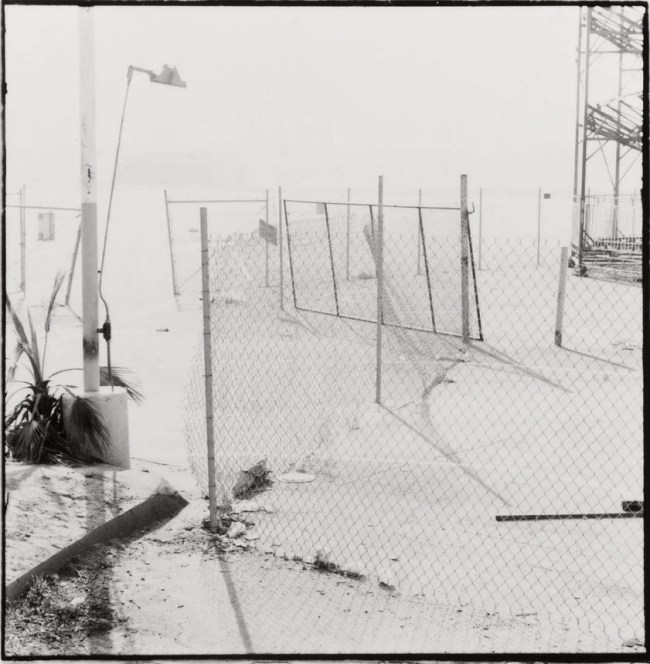
 

Judy Fiskin (American, b. 1945) 'Long Beach Pike (broken fence)', from the 'Long Beach, California Documentary Survey Project' 1980


Judy Fiskin (American, b. 1945)
Long Beach Pike (broken fence), from the Long Beach, California Documentary Survey Project
1980
Gelatin silver print
Image: 2 1/2 x 2 1/2 in. (6.2 x 6.2cm)
Smithsonian American Art Museum
Transfer from the National Endowment for the Arts
© 1980, Judy Fiskin


For this series, sponsored by the National Endowment of the Art’s Long Beach Documentary Survey Project, Judy Fiskin focused on the Long Beach Pike, an amusement park that was demolished soon after she made the photographs. By printing in high contrast and restricting the scale of her prints, Fiskin reduced form to its bare essentials. Devoid of superfluous detail, these photographs appear more like conjured images than documents of reality. Judy Fiskin systematically catalogues the world of architecture and design in order to study variations of historical styles. Her series carefully investigate esoteric subjects such as military base architecture, “dingbat” style houses in southern California, and the art of flower arranging.
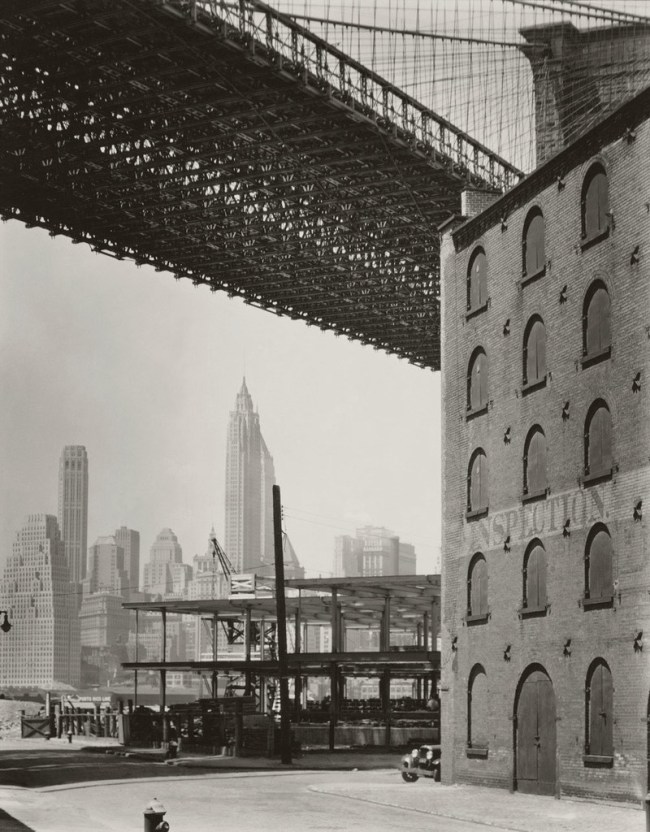
 

Berenice Abbott (American, 1898-1991) 'Brooklyn Bridge, Water and Dock Streets, Brooklyn' 1936


Berenice Abbott (American, 1898-1991)
Brooklyn Bridge, Water and Dock Streets, Brooklyn
1936
Gelatin silver print
Sheet: 18 x 14 3/8 in. (45.7 x 36.6cm)
Smithsonian American Art Museum
Transfer from the Evander Childs High School, Bronx, New York through the General Services Administration


Berenice Abbott returned home in 1929 after nearly eight years abroad and found herself fascinated by the rapid growth of New York City. She saw the city as bristling with new buildings and structures which seemed to her as solid and as permanent as a mountain range. Aiming to capture “the past jostling the present,” Abbott spent the next five years on a project she called Changing New York. In Brooklyn Bridge, Water and Dock Streets, Brooklyn, Abbott presented a century of history in a single image. The Brooklyn Bridge, once a marvel of modern engineering, seems dark and heavy compared with the skeletal structure beneath it. The construction site at center suggests the never-ending cycle of death and regeneration. And the Manhattan skyline, veiled and weightless, hangs just out of reach, its shape accommodating the ambitious spirit of American modernism.
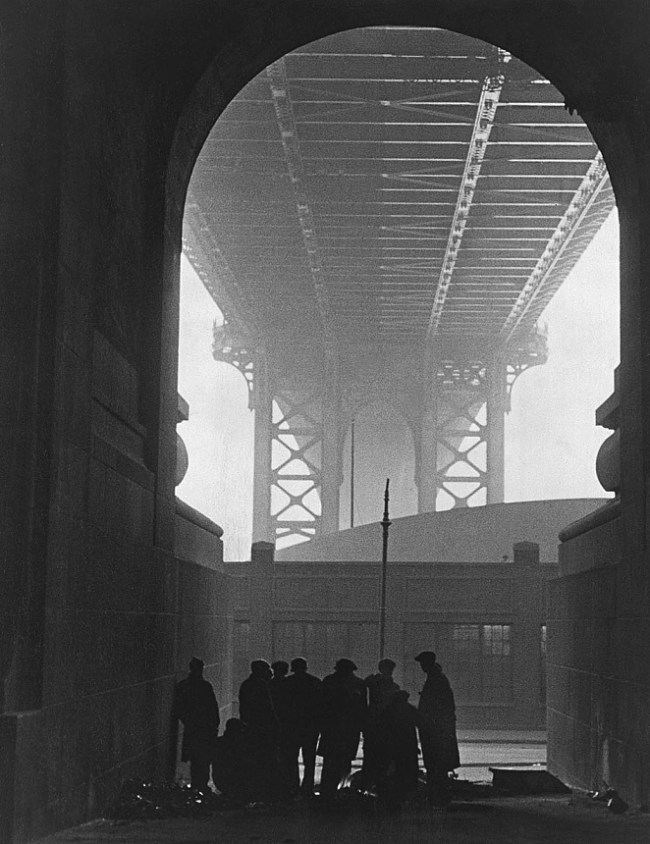
 

Robert Disraeli (American, 1905-1987) 'Cold Day on Cherry Street' 1932


Robert Disraeli (American, 1905-1987)
Cold Day on Cherry Street
1932
Gelatin silver print
Image and sheet: 14 x 11 in. (35.5 x 28cm)
Smithsonian American Art Museum
Museum purchase made possible by Mr. and Mrs. G. Howland Chase, Mrs. James S. Harlan (Adeline M. Noble Collection), Lucie Louise Fery, Berthe Girardet, and Mrs. George M. McClellan
© 1932, Robert Disraeli


Imagination at Work

Nineteenth-century French commentator Alexis de Tocqueville observed that in America, nothing is ever quite what it seems. Yet the idea that “seeing is believing” is deeply ingrained in the American character. By yoking together style and subject under the guise of the real, today’s photographers borrow from photography’s rich past while embracing the conceptual framework of contemporary art. They read reality as something on the surface of a picture or, more complexly, as something located in the mind of its beholder.


Sonya Noskowiak (American born Germany, 1900-1975) 'Calla Lily' c. 1930s


Sonya Noskowiak (American born Germany, 1900-1975)
Calla Lily
c. 1930s
Gelatin silver print
Sheet: 7 3/8 x 9 3/4 in. (18.8 x 24.7cm)
Smithsonian American Art Museum
Museum purchase made possible through Deaccession Funds


Ray K. Metzker (American, 1931-2014) 'Composites: Philadelphia (Car and Street Lamp)' 1966


Ray K. Metzker (American, 1931-2014)
Composites: Philadelphia (Car and Street Lamp)
1966
Gelatin silver prints
Image: 25 3/8 x 17 3/4 in. (64.5 x 45cm)
Smithsonian American Art Museum
Museum purchase
© 1966, Ray K. Metzker


Ray Metzker’s Composites series, begun in 1964, connected in a dramatic fashion his interests in contrasts of light and shadow, his strong sense of design, and his earlier explorations of the multiple image. Metzker studied at Chicago’s Institute of Design, where a rigorously formal, problem-solving approach to photography was taught. For this series he assembled grids of individual photographs to create complex image-fields. When viewed from a distance, this work reads as an abstract, rhythmic pattern of light and dark. On closer inspection, however, many crisply descriptive images are revealed. The Composites function somewhat like short filmstrips. The mystery of these brief narratives is exaggerated by the repetitive design and provides a unique opportunity, in Metzker’s words, “to deal with complexity of succession and simultaneity, of collected and related moments.”
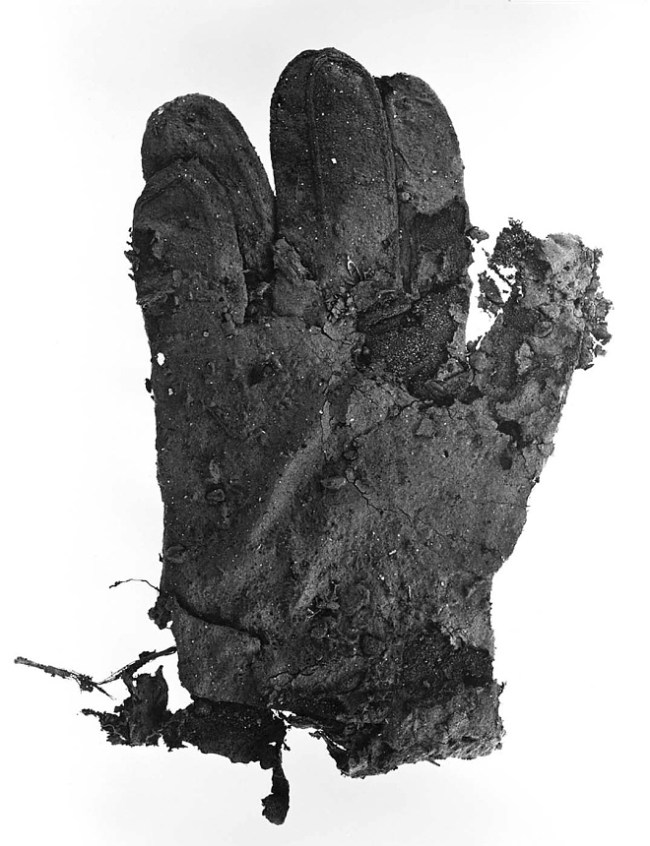
 

Irving Penn (American, 1917-2009) 'Mud Glove – New York' 1975, printed 1976


Irving Penn (American, 1917-2009)
Mud Glove – New York
1975, printed 1976
Platinum-palladium print
Sheet and image: 29 3/4 x 22 1/4 in. (75.5 x 56.5cm)
Smithsonian American Art Museum
Gift of the artist


Irving Penn was one of the most important and influential photographers of the twentieth century. In a career that spanned almost seventy years, Penn worked across multiple genres, from celebrity portraits to fashion, from still lives to images of native cultures in remote places of the world. Throughout his career Penn also worked on a series of photographs of discarded objects: things that had been lost, neglected, or misused. Printed in platinum, these detailed photographs of objects such as a lost glove found in the gutter, are Penn’s photographic memento mori, offering beauty compromised by age or disuse.
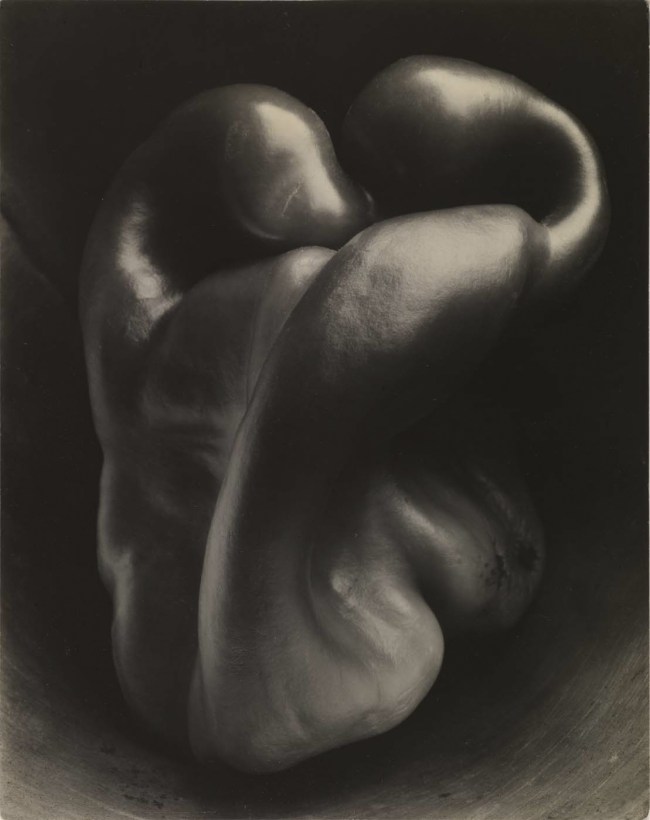
 

Edward Weston (American, 1886-1958) 'Pepper no. 30' 1930


Edward Weston (American, 1886-1958)
Pepper no. 30
1930
Gelatin silver print
Sheet: 9 1/2 x 7 1/2 in. (24.3 x 19.2cm)
Smithsonian American Art Museum
Museum purchase
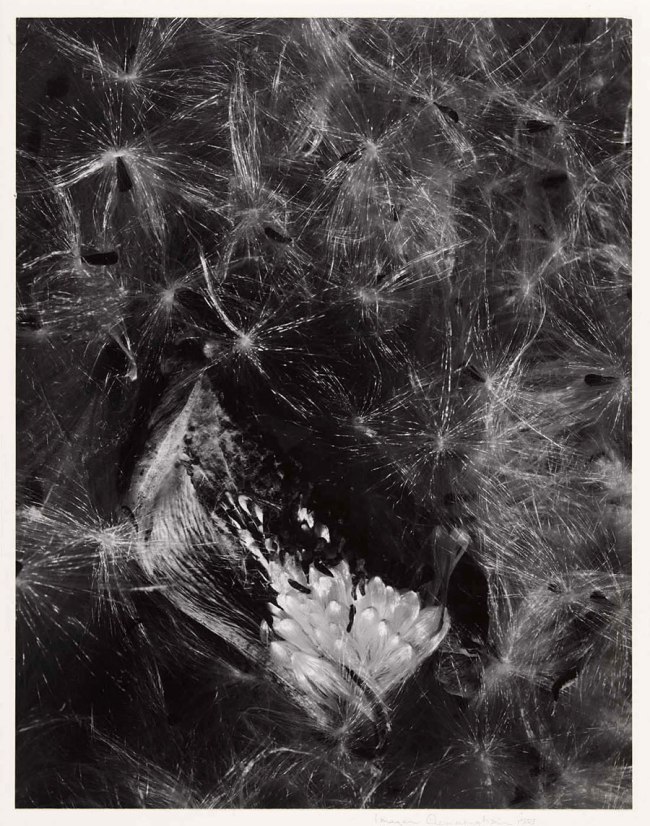
 

Imogen Cunningham (American, 1883-1976) 'Auragia' 1953, printed c. 1960s


Imogen Cunningham (American, 1883-1976)
Auragia
1953, printed c. 1960s
Gelatin silver print
Sheet and image: 11 1/8 x 8 3/4 in. (28.3 x 22.2cm)
Smithsonian American Art Museum
Gift of Charles Isaacs and Carol Nigro


Ellen Carey (American, b. 1952) 'Dings and Shadows' 2012


Ellen Carey (American, b. 1952)
Dings and Shadows
2012
Chromogenic print
Sheet and image: 40 x 30 in. (101.6 x 76.2cm)
Smithsonian American Art Museum
Gift of Linda Cheverton Wick and Walter Wick
© 2012, Ellen Carey


Ellen Carey created the series she calls Dings and Shadows by exposing photosensitive paper to light projected through primary and complementary colour filters. The artist first folds and crushes paper; then after exposing the paper to light from a colour enlarger, flattens it out again for processing. In doing so, Carey dissects the process of developing film, and evokes the hand-crafted nature of early photographic techniques.


Some images from the Timeline on the website

1843

Daguerreotypists Albert S. Southworth and Josiah Johnson Hawes begin a partnership, establishing Southworth & Hawes as the most highly regarded portrait studio in Boston, Mass. The studio caters to the city’s elite, and is visited by Charles Dickens, Ralph Waldo Emerson, and Oliver Wendell Holmes, among many other influential people of the time.
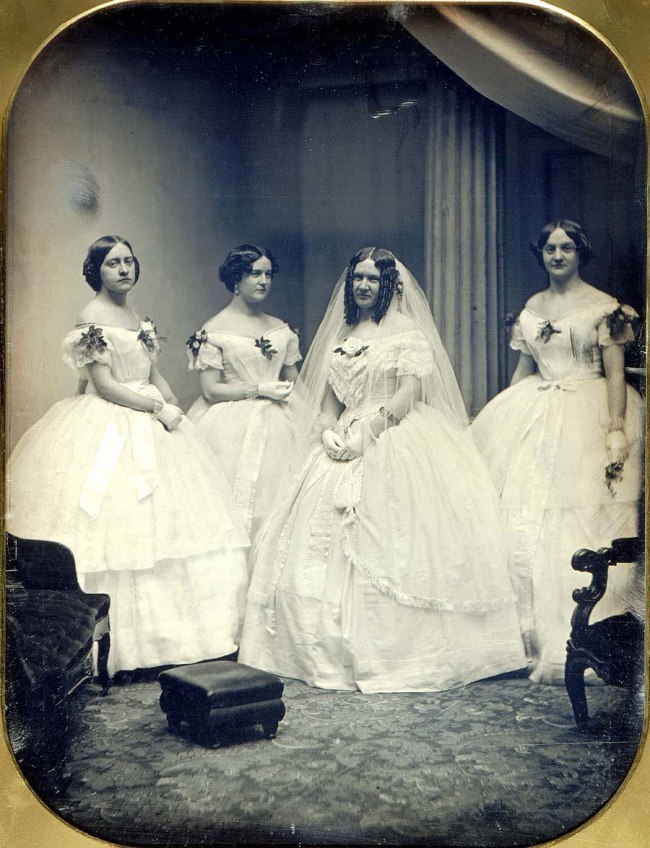
 

Albert Sands Southworth (American, 1811-1894) and Josiah Johnson Hawes (American, 1808-1901) 'A Bride and Her Bridesmaids' 1851


Albert Sands Southworth (American, 1811-1894) and Josiah Johnson Hawes (American, 1808-1901)
A Bride and Her Bridesmaids
1851
Daguerreotype
Smithsonian American Art Museum
Museum purchase made possible by Walter Beck


1853

The New York Daily Tribune estimates that in the United States, three million daguerreotypes are being produced annually.
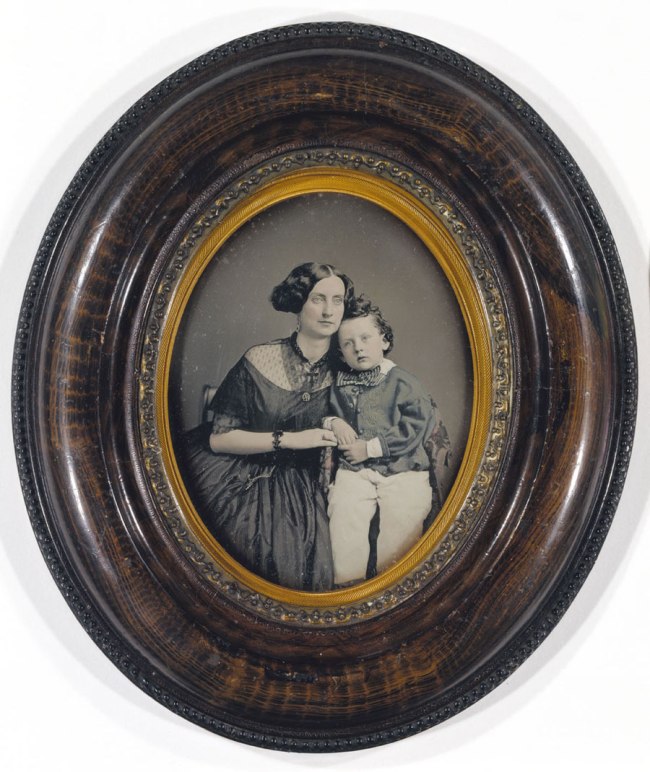
 

Unidentified artist. 'Mother and Son' c. 1855


Unidentified artist
Mother and Son
c. 1855
Daguerreotype with applied colour
Smithsonian American Art Museum
Museum purchase from the Charles Isaacs Collection made possible in part by the Luisita L. and Franz H. Denghausen Endowment


1857

Julian Vannerson and Samuel Cohner make the first systematic photographs of Native American delegations to visit Washington, D.C. They photograph ninety delegates representing thirteen tribes who conduct treaty and other negotiations with government officials.
 

Julian Vannerson (American, 1827-1875) 'Shining Metal' 1858


Julian Vannerson (American, 1827-1875)
Shining Metal
1858
Salted paper print
Smithsonian American Art Museum
Museum purchase from the Charles Isaacs Collection made possible in part by the Luisita L. and Franz H. Denghausen Endowment


1861

American Civil War begins with shots fired on Fort Sumter by Confederate troops. Portrait photographer Mathew Brady is given permission by President Abraham Lincoln to photograph the First Battle of Bull Run, but comes so close to the battle that he narrowly avoids capture. Using paid assistants Alexander Gardner, Timothy O’Sullivan, George N. Barnard, and others, Brady’s studio makes thousands of photos of the sites, material, and people of the war. Civilian free-lance photographer Egbert Guy Fowx sells numerous negatives to Brady’s studio, which publishes and copyrights many of them. Many other images are credited to Fowx, including this group of Union officers.


Egbert Guy Fowx (American, 1821-1889) 'New York 7th Regiment Officers' c. 1863


Egbert Guy Fowx (American, 1821-1889)
New York 7th Regiment Officers
c. 1863
Salted paper print
Smithsonian American Art Museum
Museum purchase from the Charles Isaacs Collection made possible in part by the Luisita L. and Franz H. Denghausen Endowment


1867

Eadweard Muybridge begins trip to photograph in Yosemite Valley. He publishes his photographs under the name “Helios,” which is also the name of his San Francisco studio. An exhibition of more than 300 photographic portraits of Native American delegates to Washington, D.C., opens in the Smithsonian Castle. Clarence R. King begins direction of the U.S. Geological Expedition of the Fortieth Parallel, appointing Timothy O’Sullivan as the official photographer. Photographer Carleton Watkins joins the survey in 1871.


Timothy H. O'Sullivan  (American born Ireland, 1840-1882) 'Tufa Domes, Pyramid Lake, Nevada' 1867


Timothy H. O’Sullivan  (American born Ireland, 1840-1882)
Tufa Domes, Pyramid Lake, Nevada
1867
Albumen silver print
Smithsonian American Art Museum
Museum purchase from the Charles Isaacs Collection made possible in part by the Luisita L. and Franz H. Denghausen Endowment


1869

Andrew J. Russell’s album, The Great West Illustrated in a Series of Photographic Views across the Continent; Taken along the Line of the Union Pacific Railroad from Omaha, Nebraska, Volume I, is published. George M. Wheeler begins direction of the United States Geological Surveys West of the 100th Meridian for the U.S. Army Corps of Engineers. Wheeler makes fourteen trips to the West over the next eight years. Photographer Timothy O’Sullivan accompanies him in 1871, 1873, and 1874.


Andrew Joseph Russell (American, 1829-1902) 'Sphinx of the Valley' 1869


Andrew Joseph Russell (American, 1829-1902)
Sphinx of the Valley
1869
Albumen silver print
Smithsonian American Art Museum
Museum purchase from the Charles Isaacs Collection made possible in part by the Luisita L. and Franz H. Denghausen Endowment


1967

The Friends of Photography is founded in Carmel, California, by Ansel Adams, Beaumont and Nancy Newhall, Brett Weston, and others, with the aim of promoting creative photography and supporting its practitioners. It remains in existence until 2001.


Brett Weston (American, 1911-1993) 'Untitled (Snow Covered Mountains)' 1973


Brett Weston (American, 1911-1993)
Untitled (Snow Covered Mountains)
1973
Gelatin silver print
Smithsonian American Art Museum
Transfer from the National Endowment for the Arts
© 1973, Brett Weston


1975

New Topographics: Photographs of a Man-Altered Landscape opens at the International Museum of Photography in Rochester, N.Y. It includes photographs by Robert Adams, Lewis Baltz, Bernd and Hilla Becher, Joe Deal, Frank Gohlke, Nicholas Nixon, John Schott, Stephen Shore, and Henry Wessel Jr.
 

Frank Gohlke (American, b. 1942) 'Grain Elevator, Dumas, Texas, 1973' 1973, printed 1994


Frank Gohlke (American, b. 1942)
Grain Elevator, Dumas, Texas, 1973
1973, printed 1994
Gelatin silver print
Smithsonian American Art Museum, Museum purchase through the Luisita L. and Franz H. Denghausen Endowment
© 1973, Frank Gohlke


Smithsonian American Art Museum
8th and F Streets, N.W.
Washington, D.C. 20004

Opening hours:
11.30am – 7.00pm daily

Smithsonian American Art Museum website

A Democracy of Images website

LIKE ART BLART ON FACEBOOK

Back to top

Exhibition: ‘Lee Friedlander – America by Car’ at Foam, Amsterdam

Exhibition dates: 13th September – 11th December 2013


Lee Friedlander (American, b. 1934) 'Bettina Katz, Cleveland, Ohio' 2009


Lee Friedlander (American, b. 1934)
Bettina Katz, Cleveland, Ohio
2009
From the series America by Car, 1995-2009
Gelatin silver print
15 × 15 in. (38.1 × 38.1cm)
Collection of the artist; courtesy Fraenkel Gallery, San Francisco
© Lee Friedlander, courtesy Fraenkel Gallery, San Francisco


“I’m not trying to do something to you, I’m trying to do something with you.”


American pianist and composer Keith Jarrett at a concert in Melbourne, 1970s


The eye of Lee Friedlander is incredible. His complex, classical photographs in books such as Letters from the People (1993), Flowers and Trees (1981), The American Monument (1976) and America by Car (2010) have redefined the (photographic) landscape. The artist is constantly reinventing himself, reinventing pictorial space – cutting, distorting, reflecting it back onto itself – to create layered images (after Eugène Atget and Walker Evans). These self-reflective spaces are as much about the artist and his nature as they are about the world in which he lives. They have become the basis of Friedlander’s visual language. Here is a love of the medium and of the world that is a reflection of Self.

I don’t see these cars (or photographs) as illusion factories. For me, this series of work is akin to a tri-view self-portrait. Instead of the artist painting the sitter (as in the triple portrait of Cardinal Richelieu, 1627 below), a vision, an energy of Self emanates outwards from behind the bulwark of the car steering wheel and dash. It is a Self and its relationship to the world split into multifaceted angles and views. He looks out the left window, the front window, the side window – and then he splits his views between side and front windows using the A pillar of the car as a dividing, framing tool. Sometimes he throws in the reflections of him / self with camera in the rear view mirror for good measure. There is wit, humour and irony in these photographs. There is cinematic panorama and moments of intimacy. There is greatness in these images.

Friedlander is not trying to do something to you, but something with you, for he is showing you something that you inherently know but may not be aware of. Like a Zen master, he asks you questions but also shows you the way. If you understand the path of life and the energy of the cosmos, you understand what a journey this is.

Dr Marcus Bunyan


Many thankx to Foam for allowing me to publish the photographs in the posting. Please click on the photographs for a larger version of the image.


Philippe de Champaigne (French, 1602-1674) 'Triple portrait of Cardinal Richelieu' 1642


Philippe de Champaigne (French, 1602-1674)
Triple portrait of Cardinal Richelieu
c. 1640
Oil on canvas
58cm (22.8 in) x 72cm (28.3 in)
The National Gallery, London
This reproduction is in the public domain


Lee Friedlander: America by Car

Published by D.A.P./Fraenkel


Lee Friedlander (American, b. 1934) 'Houston, Texas' 2006


Lee Friedlander (American, b. 1934)
Houston, Texas
2006
From the series America by Car, 1995-2009
Gelatin silver print
15 × 15 in. (38.1 × 38.1cm)
Collection of the artist; courtesy Fraenkel Gallery, San Francisco
© Lee Friedlander, courtesy Fraenkel Gallery, San Francisco


Lee Friedlander (American, b. 1934) 'Denali National Park, Alaska' 2007


Lee Friedlander (American, b. 1934)
Denali National Park, Alaska
2007
From the series America by Car, 1995-2009
Gelatin silver print
15 × 15 in. (38.1 × 38.1cm)
Collection of the artist; courtesy Fraenkel Gallery, San Francisco
© Lee Friedlander, courtesy Fraenkel Gallery, San Francisco


Lee Friedlander (American, b. 1934) 'Nebraska' 1999


Lee Friedlander (American, b. 1934)
Nebraska
1999
From the series America by Car, 1995-2009
Gelatin silver print
15 × 15 in. (38.1 × 38.1cm)
Collection of the artist; courtesy Fraenkel Gallery, San Francisco
© Lee Friedlander, courtesy Fraenkel Gallery, San Francisco


The automobile has come to symbolise the American dream and the associated urge for freedom. It is therefore no surprise that cars play a central role in the series America by Car and The New Cars 1964 by renowned American photographer Lee Friedlander (1934, US), now receiving their first showing in the Netherlands.

Road Trip

America by Car documents Friedlander’s countless wanderings around the United States over the past decade. In this he follows a trail laid down by numerous photographers, film makers and writers like Robert Frank, Stephen Shore and Jack Kerouac. Friedlander nevertheless succeeds in giving the theme of the American road trip his own very original twist, using the cars’ windscreens and dashboards to frame the familiar American landscape, as well as exploiting the reflections found in their wing and rear view mirrors. It is a simple starting point which results in complex and layered images that are typical for Friedlander’s visual language. He also has a sharp eye for the ironic detail. He makes free use of text on billboards and symbols on store signs to add further meaning to his work. His images are so layered that new information continues to surface with every glance, making America by Car a unique evocation of contemporary America.

Car portraits

The New Cars 1964 is a much older series. Friedlander had been commissioned by Harper’s Bazaar to photograph all the new models of automobile introduced in 1964. Rather than placing them centrally and showing them to best advantage, Friedlander decided to set the cars in the most banal of locations, in front of a furniture store or in a scrap yard for instance. Exploiting reflections, available light and unusual perspectives, his cars are almost completely absorbed into the street scene. Although they were rejected at the time by the magazine’s editorial board on the grounds that the images were not attractive enough, the pictures were put away in a drawer and since forgotten. Friedlander however recently rediscovered this series. The New Cars 1964 has since become a special historical and social document and has in its own right become part of Friedlander’s impressive oeuvre.

Fifty-year career

Lee Friedlander was born in the US in 1934. In a career extending across 5 decades Friedlander has maintained an obsessive focus on the portrayal of the American social landscape. His breakthrough in the eyes of the wider public came with the New Documents exhibition at the MoMA in 1967, where his work was presented alongside that of Diane Arbus and Garry Winogrand. Friedlander accumulated numerous awards during his career, including the MacArthur Foundation Award and three Guggenheim Fellowships. He also published more than twenty books. His work has been shown at many venues around the world, including the Whitney Museum of American Art and the MoMA in New York, San Francisco’s SFMOMA, the MAMM in Moscow and the National Museum of Photography in Copenhagen.

Press release from the FOAM website


Lee Friedlander (American, b. 1934) 'Cleveland, Ohio' 2009


Lee Friedlander (American, b. 1934)
Cleveland, Ohio
2009
From the series America by Car, 1995-2009
Gelatin silver print
15 × 15 in. (38.1 × 38.1cm)
Collection of the artist; courtesy Fraenkel Gallery, San Francisco
© Lee Friedlander, courtesy Fraenkel Gallery, San Francisco


Lee Friedlander (American, b. 1934) 'Montana' 2008


Lee Friedlander (American, b. 1934)
Montana
2008
From the series America by Car, 1995-2009
Gelatin silver print
15 × 15 in. (38.1 × 38.1cm)
Collection of the artist; courtesy Fraenkel Gallery, San Francisco
© Lee Friedlander, courtesy Fraenkel Gallery, San Francisco


Lee Friedlander (American, b. 1934) 'Montana' 2008


Lee Friedlander (American, b. 1934)
Montana
2008
From the series America by Car, 1995-2009
Gelatin silver print
15 × 15 in. (38.1 × 38.1cm)
Collection of the artist; courtesy Fraenkel Gallery, San Francisco
© Lee Friedlander, courtesy Fraenkel Gallery, San Francisco


Mr. Friedlander took his black-and-white, square-format photographs entirely from the interior of standard rental cars – late-model Toyotas and Chevys, by the looks of them – on various road trips over the past 15 years. In these pictures our vast, diverse country is buffered by molded plastic dashboards and miniaturized in side-view mirrors…

Mr. Friedlander groups images by subject, not geography: monuments, churches, houses, factories, ice cream shops, plastic Santas, roadside memorials.

So “America by Car,”… is more of an exercise in typology, along the lines of Ed Ruscha’s “Twentysix Gasoline Stations.” But there’s nothing deadpan or straightforward about the way Mr. Friedlander composes his pictures. He knows that cars are essentially illusion factories – to wit: “Objects in the mirror are closer than they appear.”

Some of the illusions on view here exploit the technology of the camera Mr. Friedlander has been using since the 1990s, the square-format Hasselblad Superwide (so named for its extra-wide-angle lens). The Superwide produces crisp and detail-packed images that are slightly exaggerated in perspective, giving the foreground – the car – a heightened immediacy…

Some of the photographs are dizzyingly complex, like one taken in Pennsylvania in 2007. The camera looks out through the passenger-side window, at a man whose feet appear to be perched on the door frame. He is standing in front of a trompe l’oeil mural of a train, which seems to be heading right at the car. In the side-view mirror you can see a woman approaching. It’s a bizarre pileup of early cinematic trickery (as in the Lumière Brothers), amateur photography and surveillance technology.

Mr. Friedlander’s love of such layering can be traced to Walker Evans and Eugène Atget. He also shares, in this series, Evans’s wry eye for signs of all kinds: the matter-of-fact “Bar” advertising a Montana watering hole, or the slightly more cryptic “ME RY RISTMAS” outside a service station in Texas [see image below]. He strikes semiotic gold at Mop’s Reaching the Hurting Ministry in Mississippi: “LIVE IN RELATIONSHIP ARE LIKE RENTAL CARS NO COMMITMENT.”

Cars distance people from one another, this series reminds us over and over. When Mr. Friedlander photographs people he knows – the photographer Richard Benson, or the legendary MoMA curator John Szarkowski (to whom the book is dedicated) – he remains in his seat, shooting through an open window. In just a few instances the subjects poke their heads inside, a gesture that seems transgressive in its intimacy…

Did he ever get out of the vehicle? Just once in this series, for a self-portrait. It’s the last picture, and it shows him leaning into the driver’s-side window, elbow propped on the door, left hand reaching for the steering wheel.

Maybe he was thinking of the last image in “The Americans” – a shot of Mr. Frank’s used Ford taken from the roadside, showing his wife and son huddled in the back seat. In Mr. Frank’s photograph the car is a protective cocoon. Mr. Friedlander seems to see it that way too, but from the inside out.

Excerpts of an excellent review of “America by Car” by Karen Rosenberg published on The New York Times website on September 2, 2010.


Lee Friedlander (American, b. 1934) 'Alaska' 2007


Lee Friedlander (American, b. 1934)
Alaska
2007
From the series America by Car, 1995-2009
Gelatin silver print
15 × 15 in. (38.1 × 38.1cm)
Collection of the artist; courtesy Fraenkel Gallery, San Francisco
© Lee Friedlander, courtesy Fraenkel Gallery, San Francisco


Lee Friedlander (American, b. 1934) 'Montana' 2008


Lee Friedlander (American, b. 1934)
Montana
2008
From the series America by Car, 1995-2009
Gelatin silver print
15 × 15 in. (38.1 × 38.1cm)
Collection of the artist; courtesy Fraenkel Gallery, San Francisco
© Lee Friedlander, courtesy Fraenkel Gallery, San Francisco


Lee Friedlander (American, b. 1934) 'California' 2008


Lee Friedlander (American, b. 1934)
California
2008
From the series America by Car, 1995-2009
Gelatin silver print
15 × 15 in. (38.1 × 38.1cm)
Collection of the artist; courtesy Fraenkel Gallery, San Francisco
© Lee Friedlander, courtesy Fraenkel Gallery, San Francisco


Lee Friedlander (American, b. 1934) 'Texas' 2006


Lee Friedlander (American, b. 1934)
Texas
2006
From the series America by Car, 1995-2009
Gelatin silver print
15 × 15 in. (38.1 × 38.1cm)
Collection of the artist; courtesy Fraenkel Gallery, San Francisco
© Lee Friedlander, courtesy Fraenkel Gallery, San Francisco


Foam
Keizersgracht 609
1017 DS Amsterdam
The Netherlands
Phone: + 31 20 5516500

Opening hours:
Daily from 10am – 6pm
Thurs – Friday 10am – 9pm

Foam website

LIKE ART BLART ON FACEBOOK

Back to top

Exhibition: ‘Garry Winogrand’ at the San Francisco Museum of Modern Art (SFMOMA)

Exhibition dates: 9th March – 2nd June 2013


Garry Winogrand (American, 1928-1984) 'Utah (Wyoming)' 1964


Garry Winogrand (American, 1928-1984)
Utah (Wyoming)
1964
Silver gelatin photograph
© The Estate of Garry Winogrand


“Every photograph is a battle of form versus content.”


Garry Winogrand


Playing God with his film

Form and content. Form and content.

I don’t like the work of Garry Winogrand. Never have, never will. I think his work is overrated and and somewhat trite. That should stir up all the Winophiles who think that he is one of the best street photographers in the history of the medium!

At best his form is average – technical aspects adequate; composition is pretty basic including dull use of tension points within the picture frame; and framing very bland, tilted angles not withstanding. His content is nothing special either, mainly frontal shots of people walking towards him or voyeuristic shots while mingled in crowds, or a mixture of both. As he himself says, “I don’t have anything to say in any picture. My only interest in photography is to see what something looks like as a photograph.” By letting the medium describe the world around him. And therein lies part of the problem.

Winogrand just looks – and you can’t fault someone for just looking. It’s just a not very interesting looking.

If I really look at Winogrand’s work I can see that he just states what he saw in shot after shot after shot, indiscriminately. Personally, I find there is a real cynicism in his work. The photographs “describe” his own state of mind – as much as he denies that he (or his state of mind) has anything to do with the act of describing the world through photography. You see, it’s all about how the camera sees the world and not how he sees it. Hence, Winogrand hardly embraces his feelings towards the world and if he does, it is only in a half-hearted manner. For example, he goes a certain way towards the dark (as in the photographs Utah (Wyoming), 1964 above, and Los Angeles, 1964, below) and then stops. The other part of the problem is this: what you can also fault is all the hyperbole that is laid over the top of his work by curators and museums – because on close examination the work really doesn’t justify it. It’s actually not that good.

Winogrand states and summarises but doesn’t solve. He just keeps adding to the list occasionally, under duress, ordering it (photographs of women in the book Women are Beautiful, 1975):

“During his Austin years he was preparing two books, Public Relations and Women are Beautiful. Given his method of printing every image on the contact sheet for the selection process, and given his proclivity for the physical act of shooting, no wonder he wasn’t out on the street as much as he’d like. Yes he had to print, select and publish some prints to survive unless he wanted to teach the rest of his life. I don’t believe he wanted to do that. Had there been a way, I believe he would died a blissful death had he been on the streets clicking away and either letting the exposed film rot or letting someone else process and print them, and arrange the books and shows and collect the money. That’s how much he loved the physical act of shooting.

He felt at home out there, looking for the next image to expose. He was also the boss out there, playing God with his film and deciding where to frame that next battle between form and content, then the next and the next.”1


Playing God with his film…

In some ways Winogrand reminds me of both the king and the court jester. King because he could frame the battle between form and content ad infinitum and jester because he was the fool, standing in front of people, laughing, smiling, obsequious, running hither and yon to get every shot, any shot. See the video below to understand what I mean. Unlike the photographs in Robert Frank’s The Americans, his is not a poetic understanding of the world for the difference between Robert Frank and Garry Winogrand is that the former’s photographs are undeniably poetic while the latter’s are prosaic aphorisms about the world. In Winogrand’s “describing” the social landscape he photographed is reduced to lists of things: “the dislocation of urban life, the rise of the suburb with its growing alienation, the skepticism of youth, and the collusion of the press and the powerful,” rarely pursued by any obvious means and certainly not through poetic evocation.

I think that Winogrand struggled with the question – do I add to the list or do I order the list? Obviously he chose the former, for if there is no order in life there can be no order in the archive. Hence we are left with the “Unfinished” Late Work, an archive of 250,000 images that have remained virtually unknown. A boon for researchers and curators wishing to position Winogrand’s legacy “revealing for the first time the full sweep of his career… creating a vivid portrait of the artist.”

Even when the artist could not be bothered (so why should we bother).
Even when the images were never seen or acknowledged.
The artist streetwise in his omnipotent isolation.

Dr Marcus Bunyan


1/ Garza, O. C. Class Time with Garry Winogrand. 2007, p. 19 [Online] Cited 26/05/2013
www.ocgarzaphotography.com/documents/ClassTimewithGarryWinograndfinal2.pdf


“Great photography is always on the edge of failure.”

“I photograph to see what the world looks like in photographs.”

“I like to think of photographing as a two-way act of respect. Respect for the medium, by letting it do what it does best, describe. And respect for the subject, by describing as it is. A photograph must be responsible to both.”

“I don’t have anything to say in any picture. My only interest in photography is to see what something looks like as a photograph. I have no preconceptions.”


Garry Winogrand


“We quickly learned Winogrand’s technique – he walked slowly or stood in the middle of pedestrian traffic as people went by. He shot prolifically. I watched him walk a short block and shoot an entire roll without breaking stride. As he reloaded, I asked him if he felt bad about missing pictures when he reloaded. “No,” he replied, “there are no pictures when I reload.” He was constantly looking around, and often would see a situation on the other side of a busy intersection. Ignoring traffic, he would run across the street to get the picture.”


Mason Resnick


“Form and content are two keys which make a memorable street photograph. Consider “form” as the composition, framing, and technical aspects of a photograph. Consider “content” as what is actually happening in the photograph (whether it be an old couple holding hands, a boy holding two bottles of wine, or a man looking through a peep-hole)… Garry Winogrand shot with a 28mm lens for most of his life [using a Leica M4 35mm and Tri-X film pushed to 1200 ASA], which meant that for the majority of his shots he had to be quite close to his subjects (and in front of them). Therefore Winogrand wasn’t Henri Cartier-Bresson (trying to be invisible) but was actively a part of the action and immersed in the crowds. He would be very obviously taking photographs in the streets and would stick out like a sore thumb.”
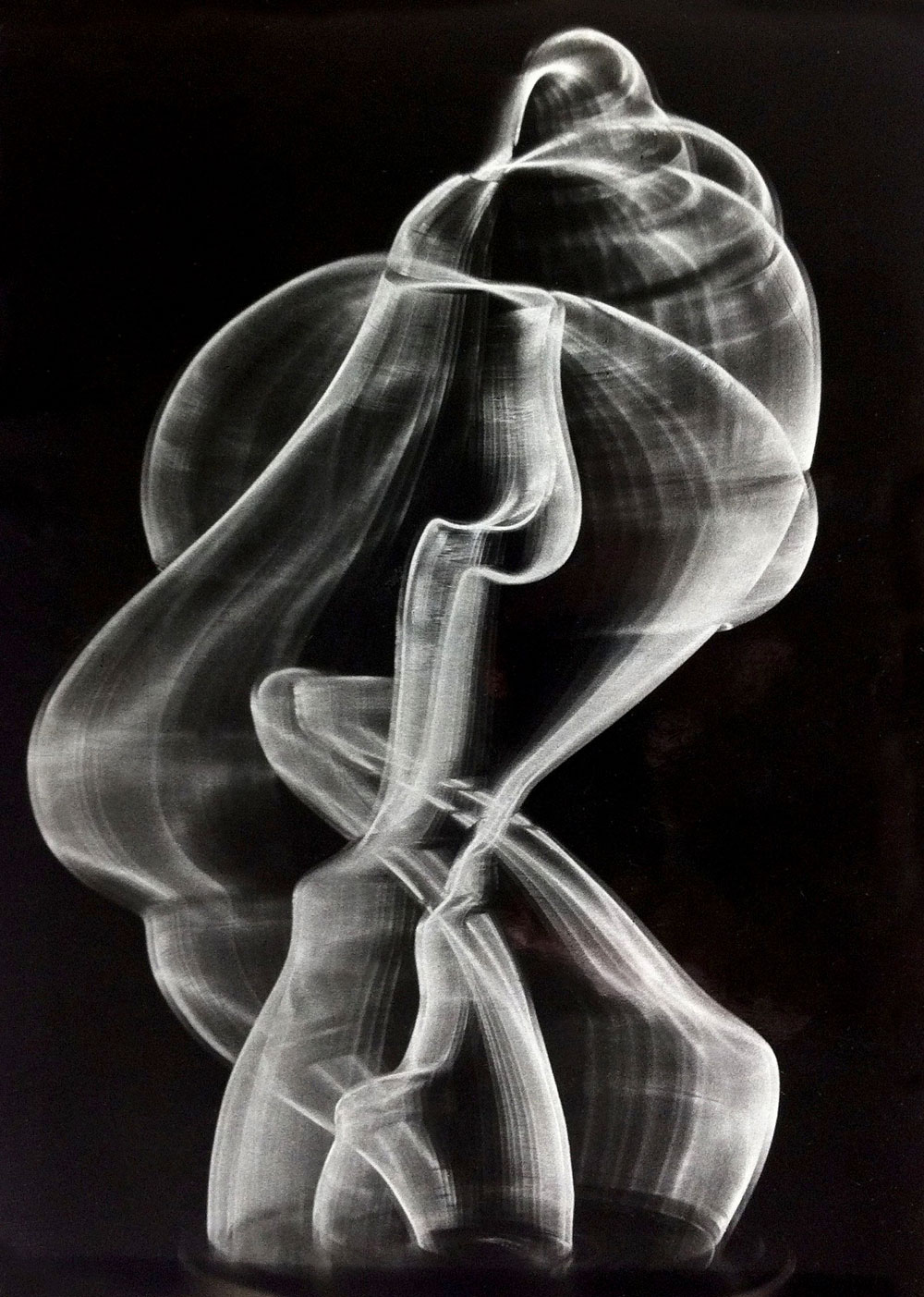

Eric Kim


Garry Winogrand – Part 1 


Garry Winogrand – Fotograf


Garry Winogrand – The Man In The Crowd


Garry Winogrand (American, 1928-1984) 'Albuquerque' 1957


Garry Winogrand (American, 1928-1984)
Albuquerque
1957
Gelatin silver print
Collection SFMOMA, gift of Dr. Paul Getz
© The Estate of Garry Winogrand, courtesy Fraenkel Gallery, San Francisco


Garry Winogrand (American, 1928-1984) 'Park Avenue, New York' 1959


Garry Winogrand (American, 1928-1984)
Park Avenue, New York
1959
Gelatin silver print
© The Estate of Garry Winogrand, courtesy Fraenkel Gallery, San Francisco


Garry Winogrand (American, 1928-1984) 'Central Park Zoo, New York' 1967


Garry Winogrand (American, 1928-1984)
Central Park Zoo, New York
1967
Gelatin silver print
© The Estate of Garry Winogrand, courtesy Fraenkel Gallery, San Francisco


Since Winogrand took this photograph of a white woman and a Black man, each holding a chimpanzee dressed in children’s clothing, many critics have noted the picture’s deliberate ambiguity – not only about the circumstances of how these figures came to be here, but also about the way Winogrand chose to frame them with his camera, cutting out most of the surrounding context.

During the 1960s, Winogrand became increasingly reluctant to speak about the “meaning” of his photographs, preferring to focus on their form and technique, in spite of their excessive narrative potential. Perhaps this was a reaction against his photojournalistic and advertising work, which was often illustrative. Winogrand would cite Susan Sontag’s influential essay “Against Interpretation” (1964), which deplored the growing impulse at the time to reduce works of art to their content in order to make them mean something. She argued, like Winogrand, in favor of the pleasure and poetry of seeing.

Anonymous. “Central Park Zoo-New York, New York,” on the Brooklyn Museum website Nd [Online] Cited 14/07/2024


Garry Winogrand (American, 1928-1984) 'Fort Worth, Texas' 1974


Garry Winogrand (American, 1928-1984)
Fort Worth, Texas
1974
Gelatin silver print
Collection SFMOMA, Accessions Committee Fund: gift of Doris and Donald Fisher and Marion E. Greene
© The Estate of Garry Winogrand, courtesy Fraenkel Gallery, San Francisco


Garry Winogrand (American, 1928-1984) 'Fort Worth, Texas' 1975


Garry Winogrand (American, 1928-1984)
Fort Worth, Texas
1975
Gelatin silver print
Collection SFMOMA, gift of Dr. Paul Getz
© The Estate of Garry Winogrand, courtesy Fraenkel Gallery, San Francisco


Garry Winogrand (American, 1928-1984) 'John F. Kennedy, Democratic National Convention, Los Angeles' 1960
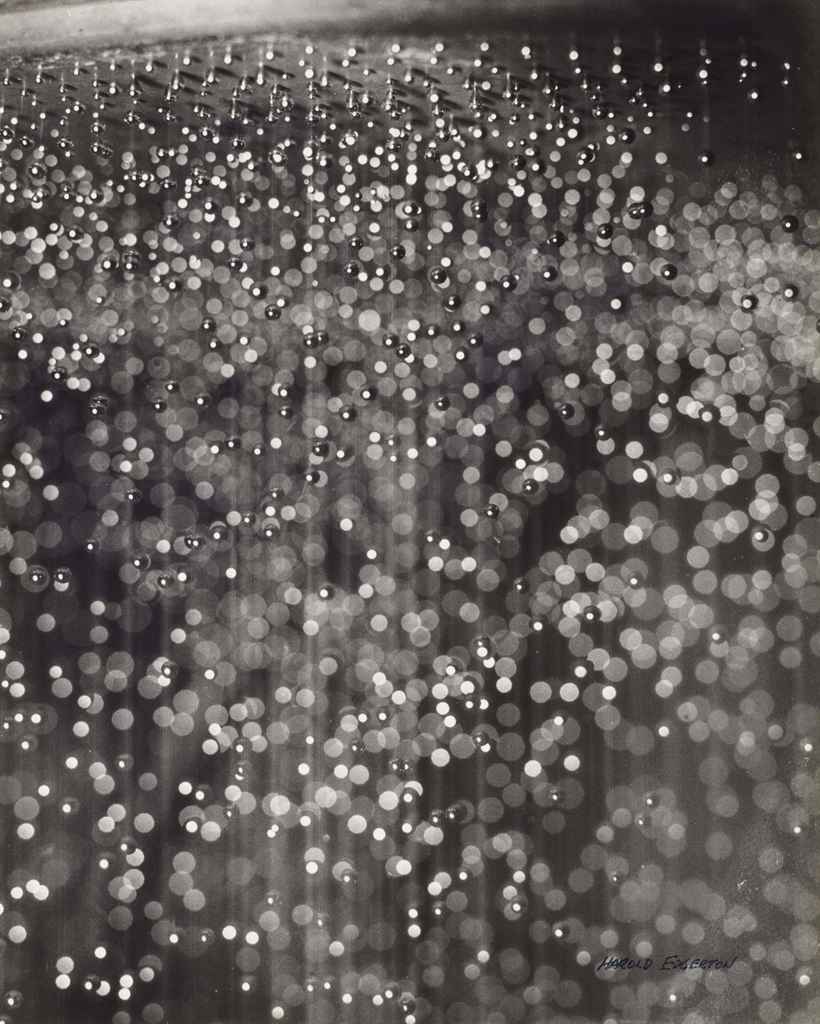
 

Garry Winogrand (American, 1928-1984)
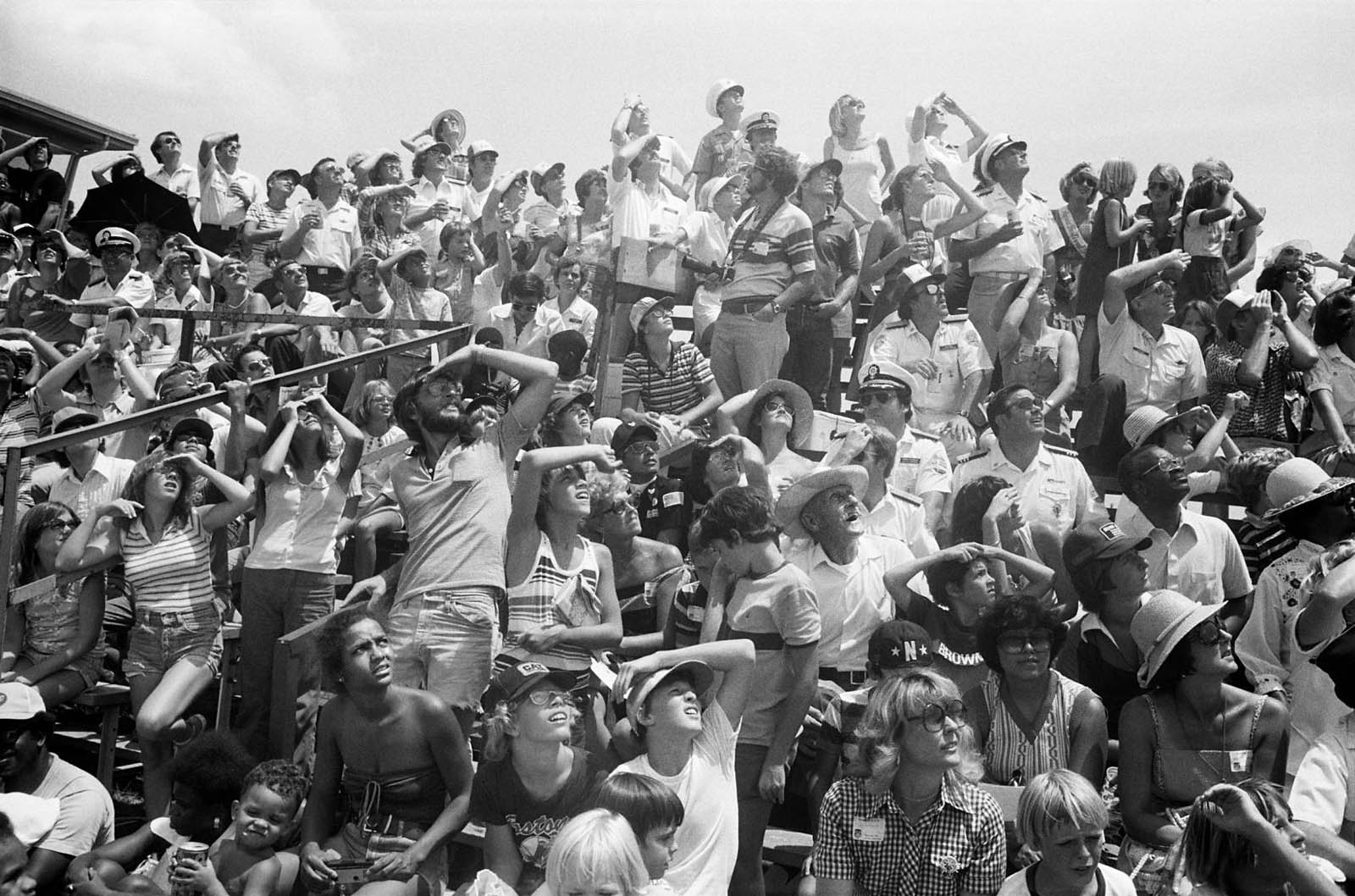
John F. Kennedy, Democratic National Convention, Los Angeles
1960
Posthumous digital reproduction from original negative
Garry Winogrand Archive, Center for Creative Photography, University of Arizona
© The Estate of Garry Winogrand, courtesy Fraenkel Gallery, San Francisco


Garry Winogrand (American, 1928-1984) 'Democratic National Convention, Los Angeles' 1960


Garry Winogrand (American, 1928-1984)
Democratic National Convention, Los Angeles
1960
Silver gelatin photograph
© The Estate of Garry Winogrand


Garry Winogrand (American, 1928-1984) 'New York' c. 1960


Garry Winogrand (American, 1928-1984)
New York
c. 1960
Gelatin silver print
Garry Winogrand Archive, Center for Creative Photography, University of Arizona
© The Estate of Garry Winogrand, courtesy Fraenkel Gallery, San Francisco


Garry Winogrand (American, 1928-1984) 'White Sands National Monument, New Mexico' 1964


Garry Winogrand (American, 1928-1984)
White Sands National Monument, New Mexico
1964
Gelatin silver print
© The Estate of Garry Winogrand, courtesy Fraenkel Gallery, San Francisco


Garry Winogrand (American, 1928-1984) 'New York' 1969


Garry Winogrand (American, 1928-1984)
New York
1969
Gelatin silver print
© The Estate of Garry Winogrand, courtesy Fraenkel Gallery, San Francisco


Garry Winogrand (American, 1928-1984) 'Elliot Richardson Press Conference, Austin, Texas' 1973


Garry Winogrand (American, 1928-1984)
Elliot Richardson Press Conference, Austin, Texas
1973
Silver gelatin photograph
© The Estate of Garry Winogrand


Elliot Lee Richardson (July 20, 1920 – December 31, 1999) was an American lawyer and politician who was a member of the cabinet of Presidents Richard Nixon and Gerald Ford. As U.S. Attorney General, he was a prominent figure in the Watergate Scandal, and resigned rather than obey President Nixon’s order to fire special prosecutor Archibald Cox.

Text from Wikipedia website


Garry Winogrand (American, 1928-1984) 'Centennial Ball, Metropolitan Museum, New York' 1969


Garry Winogrand (American, 1928-1984)
Centennial Ball, Metropolitan Museum, New York
1969
Silver gelatin photograph
© The Estate of Garry Winogrand


Garry Winogrand (American, 1928-1984) 'Point Mugu Naval Air-Station, California' 1979


Garry Winogrand (American, 1928-1984)
Point Mugu Naval Air-Station, California
1979
Silver gelatin photograph
© The Estate of Garry Winogrand


Garry Winogrand (American, 1928-1984) 'Untitled' 1970


Garry Winogrand (American, 1928-1984)
Untitled
1970
Silver gelatin photograph
© The Estate of Garry Winogrand


Garry Winogrand (American, 1928-1984) 'Venice Beach, Los Angeles' 1979


Garry Winogrand (American, 1928-1984)
Venice Beach, Los Angeles
1979
Silver gelatin photograph
© The Estate of Garry Winogrand


The first retrospective in 25 years of work by artist Garry Winogrand (1928-1984) – the renowned photographer of New York City and of American life from the 1950s through the early 1980s – will debut at the San Francisco Museum of Modern Art (SFMOMA) from March 9 through June 2, 2013. Jointly organised by SFMOMA and the National Gallery of Art, Washington, D.C., Garry Winogrand brings together the artist’s most iconic images with newly printed photographs from his largely unexamined archive of late work, offering a rigorous overview of Winogrand’s complete working life and revealing for the first time the full sweep of his career. More than 300 photographs in the exhibition and more than 400 in the accompanying catalogue will create a vivid portrait of the artist – a chronicler of postwar America on a par with such figures as Norman Mailer and Robert Rauschenberg who unflinchingly captured America’s wrenching swings between optimism and upheaval in the decades following World War II.

While Winogrand is widely considered one of the greatest photographers of the 20th century, his overall body of work and influence on the field remains incompletely explored. He was enormously prolific but largely postponed the editing and printing of his work. Dying suddenly at the age of 56, he left behind approximately 6,500 rolls of film (some 250,000 images) that he had never seen, as well as proof sheets from his earlier years that he had marked but never printed. Roughly half of the photographs in the exhibition have never been exhibited or published until now; over 100 have never before been printed.

“There exists in photography no other body of work of comparable size or quality that is so editorially unresolved,” says Rubinfien, who was among the youngest of Winogrand’s circle of friends in the 1970s. “This exhibition represents the first effort to comprehensively examine Winogrand’s unfinished work. It also aims to turn the presentation of his work away from topical editing and toward a freer organisation that is faithful to his art’s essential spirit, thus enabling a new understanding of his oeuvre, even for those who think they know him.”

The exhibition is divided into three parts, each covering a broad variety of subjects found in Winogrand’s art. “Down from the Bronx” presents photographs taken for the most part in New York from his start in 1950 until 1971; “A Student of America” looks at work made in the same period during journeys outside New York; and “Boom and Bust” addresses Winogrand’s late period – from when he moved away from New York in 1971 until his death in 1984 – with photographs from Texas and Southern California, as well as Chicago, Washington, Miami, and other locations. This third section also includes a small number of photographs Winogrand made on trips back to Manhattan, which express a sense of desolation unprecedented in his earlier work.

Winogrand was known as great talker with a flamboyant, forceful personality, and what he said accompanying his slide shows and lectures was often imaginative and very funny. A number of videos edited for presentation in the exhibition will allow visitors to experience the living Winogrand as audiences have rarely been able to do for 30-odd years. A short selection from Winogrand’s experimental 8mm footage taken in the late 1960s will also be on view.

After premiering at SFMOMA in spring 2013 Garry Winogrand will travel to the National Gallery of Art, Washington, D.C. (March 2 through June 8, 2014); The Metropolitan Museum of Art, New York (June 27 through September 21, 2014); the Jeu de Paume, Paris (October 14, 2014 through January 25, 2015); and the Fundacion MAPFRE, Madrid (March 3 through May 10, 2015).

An Epic Chronicler of Postwar America

Born in the Bronx, Winogrand did much of his best-known work in Manhattan during the 1960s, and in both the content of his photographs and his artistic style he became one of the principal voices of that eruptive decade – so much so that influential Museum of Modern Art curator John Szarkowski anointed him “the central photographer of his generation.”

Known primarily as a street photographer, Winogrand, who is often associated with famed contemporaries Diane Arbus and Lee Friedlander, photographed with dazzling energy and incessant appetite, exposing some 20,000 rolls of film in his short lifetime. He photographed business moguls, everyday women on the street, famous actors and athletes, hippies, rodeos, politicians, soldiers, animals in zoos, car culture, airports, and antiwar demonstrators and the construction workers who beat them bloody in view of the unmoved police. Daily life in postwar America – rich with new possibility and yet equally anxious, threatening to spin out of control – seemed to unfold for him in a continuous stream.

Yet if Winogrand was one of New York City’s prime photographers, he was also an avid traveller who roamed widely around the United States, bringing exquisite work out of locations that included Los Angeles, San Francisco, Ohio, Dallas, Houston, Chicago, Colorado, and the open country of the Southwest. “You could say that I am a student of photography,” he said, “and I am; but really I’m a student of America.” Winogrand’s expansive visual catalogue of the nation’s evolving social scene has led to comparisons to Walt Whitman, who also unspooled the world in endless lists of people, places, and things.

Winogrand’s pictures often bulge with twenty or thirty figures, and are fascinating both for their dramatic foregrounds and the sub-events at their edges. Even when crowded with people or at their most lighthearted – he was fond of visual puns and was drawn to the absurd – his pictures can convey a feeling of human isolation, hinting at something darker beneath the veneer of the American dream. Early on, some critics considered his pictures formally “shapeless” and “random,” but admirers and critics later found a unique poetry in his tilted horizons and his love of the haphazard.

“Winogrand was an artistic descendant of Walker Evans and Robert Frank, but differed sharply from them,” says Rubinfien. “He admired Frank’s The Americans, but felt the work missed the main story of its time, which in his mind was the emergence of suburban prosperity and isolation. The hope and buoyancy of middle-class life in postwar America is half of the emotional heart of Winogrand’s work. The other half is a sense of undoing. The tension between these qualities gives his work its distinct character.”

After serving in the military as a weather forecaster, Winogrand first began working as a photographer while studying painting on the G.I. Bill at Columbia University (1948-1951). During that time, he also studied briefly with Alexey Brodovitch at the New School for Social Research. While pursuing his personal work, he began supplying commercial photographs to a number of general-interest magazines such as Life, Look, Sports Illustrated, Collier’s, and Pageant, which were then at the height of their power and reach. His career was further shaped by the decline of those magazines and the rise of a new culture of photography centred in the art world.

“Winogrand worked at a moment when the boundaries between journalistic and artistic photography were less certain than they had ever been, yet it was also a time when the most advanced photographers were consciously abandoning journalistic values,” says Greenough. “The social landscape he photographed – the dislocation of urban life, the rise of the suburb with its growing alienation, the skepticism of youth, and the collusion of the press and the powerful – was of concern to many Americans. Yet Winogrand rarely pursued an obvious means to explicate these ideas, preferring poetic evocation over intelligible journalism.”

Winogrand went on to exhibit widely at prominent museums and achieved renown in his lifetime. Yet despite this recognition, he is perhaps the most inadequately understood of all his contemporaries.

“Unfinished” Late Work Thoroughly Investigated for the First Time

The act of taking pictures was far more fulfilling to Winogrand than making prints or editing for books and exhibitions – he often allowed others to perform these tasks for him. Near the end of his life, he spoke of reviewing and reediting all of his photographs, but never had a chance to oversee the shaping of his legacy, or even to review much of the output of his later years. Because of his working methods and his lack of interest in developing his film toward the end of his life, he left behind more than 2,500 rolls of exposed but undeveloped film, an additional 4,100 rolls that he had processed but never seen – an estimated total of 250,000 images that have remained virtually unknown.

Furthermore, Winogrand published just five modest books during his lifetime – The Animals (1969), Women Are Beautiful (1975), Garry Winogrand (1976), Public Relations (1977), and Stock Photographs (1980) – that represent only a fraction of his work and are mainly confined to narrow topical frames that don’t suggest the full scope of his importance.

“One reason that Winogrand is only now receiving the full retrospective treatment already devoted to peers of his era, including Diane Arbus, Lee Friedlander, and Robert Frank, is that any truly comprehensive consideration of his life’s work requires contending with the practical and ethical issues surrounding the vast archive he left behind,” says O’Toole. “In the absence of explicit instructions from him regarding how he wanted his work to be handled after he was gone, its posthumous treatment has been the subject of ongoing debate and raises provocative questions about the creative process and its relationship to issues specific to the medium.”

“Some argue that what was left behind should be left alone, and that no one should intrude upon the intentions of an artist,” adds Rubinfien. “But the quantity of Winogrand’s output, the incompleteness with which he reviewed it, and the suddenness of his death create a special case in which the true scope of an eminent photographer’s work cannot be known without the intervention of an editor.”

Now housed at the Center for Creative Photography of the University of Arizona, Tucson, Winogrand’s “unfinished” work was initially organized in the years just after his death by several colleagues and friends in preparation for the artist’s first major museum retrospective, held at the Museum of Modern Art, New York (MoMA) in 1988. Exhibition curator John Szarkowski felt the quality of Winogrand’s work had significantly deteriorated in the last 15 years of his life, and included only a small group of pictures from the mysterious late work in MoMA exhibition.

Nearly 30 years have elapsed since the last attempt to grapple with the complete arc of Winogrand’s career. Benefiting from new curatorial research undertaken for this project, the current exhibition will provide a long-awaited reevaluation of his accomplishments. As one of the first museums to recognise photography as a legitimate art form, SFMOMA has collaborated with the National Gallery of Art – who, like SFMOMA, is known for its photography scholarship – in a multi-year endeavour to spearhead the presentation of this important exhibition and publication.”

Press release from the SFMOMA website


Garry Winogrand (American, 1928-1984) 'New York' 1961


Garry Winogrand (American, 1928-1984)
New York
1961
Silver gelatin photograph
© The Estate of Garry Winogrand


Garry Winogrand (American, 1928-1984) 'New York' 1963


Garry Winogrand (American, 1928-1984)
New York
1963
Silver gelatin photograph
© The Estate of Garry Winogrand


Garry Winogrand (American, 1928-1984) 'San Marcos, Texas' 1964


Garry Winogrand (American, 1928-1984)
San Marcos, Texas
1964
Silver gelatin photograph
© The Estate of Garry Winogrand


Garry Winogrand (American, 1928-1984) 'Coney Island, New York' c. 1952


Garry Winogrand (American, 1928-1984)
Coney Island, New York
c. 1952
Gelatin silver print
Collection The Museum of Modern Art, New York, purchase and gift of Barbara Schwartz in memory of Eugene M. Schwartz
© The Estate of Garry Winogrand, courtesy Fraenkel Gallery, San Francisco; digital image
© The Museum of Modern Art/ Licensed by SCALA / Art Resource, NY


Garry Winogrand (American, 1928-1984) 'Fort Worth, Texas' 1974-77


Garry Winogrand (American, 1928-1984)
Fort Worth, Texas
1974-1977
Gelatin silver print
Garry Winogrand Archive, Center for Creative Photography, University of Arizona
© The Estate of Garry Winogrand, courtesy Fraenkel Gallery, San Francisco


Garry Winogrand (American, 1928-1984) 'John F. Kennedy International Airport, New York' 1968


Garry Winogrand (American, 1928-1984)
John F. Kennedy International Airport, New York
1968
Silver gelatin photograph
© The Estate of Garry Winogrand


Garry Winogrand (American, 1928-1984) 'New York' 1950


Garry Winogrand (American, 1928-1984)
New York
1950
Gelatin silver print
Collection SFMOMA, fractional and promised gift of Carla Emil and Rich Silverstein
© The Estate of Garry Winogrand, courtesy Fraenkel Gallery, San Francisco


Garry Winogrand (American, 1928-1984) 'New York' c. 1962


Garry Winogrand (American, 1928-1984)
New York
c. 1962
Gelatin silver print
Garry Winogrand Archive, Center for Creative Photography, University of Arizona
© The Estate of Garry Winogrand, courtesy Fraenkel Gallery, San Francisco


Garry Winogrand (American, 1928-1984) 'Venice Beach, Los Angeles' 1980-1983


Garry Winogrand (American, 1928-1984)
Venice Beach, Los Angeles
1980-1983
Gelatin silver print
Garry Winogrand Archive, Center for Creative Photography, University of Arizona
© The Estate of Garry Winogrand, courtesy Fraenkel Gallery, San Francisco


Garry Winogrand (American, 1928-1984) 'Grand Central Station' 1968


Garry Winogrand (American, 1928-1984)
Grand Central Station
1968
Silver gelatin photograph
© The Estate of Garry Winogrand


Garry Winogrand (American, 1928-1984) 'Los Angeles' 1964


Garry Winogrand (American, 1928-1984)
Los Angeles
1964
Silver gelatin photograph
© The Estate of Garry Winogrand


Garry Winogrand (American, 1928-1984) 'New York' 1968


Garry Winogrand (American, 1928-1984)
New York
1968
Silver gelatin photograph
© The Estate of Garry Winogrand


Garry Winogrand (American, 1928-1984) 'New York' c. 1969


Garry Winogrand (American, 1928-1984)
New York
c. 1969
Silver gelatin photograph
© The Estate of Garry Winogrand


San Francisco Museum of Modern Art
151 Third Street
San Francisco, CA 94103

Opening hours:
Monday – Tuesday: 10am – 5pm
Wednesday: Closed
Thursday: 12 – 8pm
Friday – Sunday: 10am – 5pm

San Francisco Museum of Modern Art website

LIKE ART BLART ON FACEBOOK

Back to top