Exhibition: ‘Hans Richter: Encounters – “From Dada till today”‘ at Martin-Gropius-Bau, Berlin

Exhibition dates: 27th March – 30th June 2014


Hans Richter (German, 1888-1976) 'Blue Man' 1917


Hans Richter (German, 1888-1976)
Blue Man
1917
Oil on canvas
61 x 48.5cm
© Kunsthaus Zürich, Geschenk Frida Richter, 1977
© Estate Hans Richter


Many thankx to Martin-Gropius-Bau, Berlin for allowing me to publish the art work in the posting. Please click on the photographs for a larger version of the image.

Marcus


“One can also pursue politics with art.
Everything that intervenes in the processes of life, and transforms them, is politics.”


Hans Richter


The oeuvre of Hans Richter (1888-1976) spanned nearly seven decades. Born in Berlin, he was one of the most significant champions of modernism. Berlin, Paris, Munich, Zurich, Moscow and New York were the major stations of his life. He was a painter and draughtsman, a Dadaist and a Constructivist, a film maker and a theoretician, as well as a great teacher. His great scroll collages remain icons of art history to this day. His work is characterised by a virtually unparalleled interpenetration of different artistic disciplines. The link between film and art was his major theme. Many of the most famous artists of the first half of the twentieth century were among his friends.


Hans Richter (German, 1888-1976) 'Ghosts Before Breakfast' 1928


Hans Richter (German, 1888-1976)
Ghosts Before Breakfast (Vormittagsspuk)
1928
B/W, 35mm
Approx. 7 minutes
© Estate Hans Richter


Hans Richter Ghosts Before Breakfast – 1929 German DaDa silent film


Hans Richter created the film Ghosts Before Breakfast (Vormittagsspuk) in 1928. This was a silent experimental avant-garde film and it was the fifth film that he had made. The film is considered to be one of the first surrealist films ever made. Richter’s interest in Dadaism is shown directly in this work as he challenges the art standards of the time by presenting a theme of obscurity and fantasy. Clocks, legs, ladders, hats, and people undergo total irrational happenings in unusual settings. Men have beards magically appear and disappear before the viewer’s eyes. All strange manner of things are brought together by associative logic. The flying hats perform this function by continually reappearing in the sequence of shots to tie the film together. Richter tries to increase the viewer’s knowledge of reality of showing them surrealist fantasy. He accomplished this through his use of rhythm, and his use of the camera.

Rhythm is a very important element in all of Richter’s works. In this film rhythm is shown in the use of movement in the characters. All of the characters seem to move at the same space distance from one another and at the same speed. This clarifies a sense of rhythm and intensifies a sense of stability within the frame. The same number of characters or items also seems to preserve rhythm… if there are three hats then in the next shot there are three men. The numbers do fluctuate, but a number would remain constant throughout a couple of shots. Shapes in the film also preserve rhythm. This can be seen in Richter’s bulls-eye scene, where the circles of the bulls-eye fill the screen and are spaced equally apart from one another. The target then breaks up and the circles the spread out in the frame to relocate in different areas continuing the rhythm.

The original score, attributed to Paul Hindemith, was destroyed in the Nazi purge of ‘degenerate art’.


Unknown artist. 'Hans Richter, Sergei Eisenstein and Man Ray, Paris' 1929


Unknown artist
Hans Richter, Sergei Eisenstein and Man Ray, Paris
1929
© Estate Hans Richter
© 2013 Man Ray Trust / Artists Rights Society (ARS), New York / ADAGP, Paris


Dreams That Money Can Buy (1947) by Hans Richter, Clip: [Case Number 1: Desire] – Mr A 


Dreams That Money Can Buy excerpt – John Cage dream sequence 


Joe/Narcissus (Jack Bittner) is an ordinary man who has recently signed a complicated lease on a room. As he wonders how to pay the rent, he discovers that he can see the contents of his mind unfolding whilst looking into his eyes in the mirror. He realises that he can apply his gift to others (“If you can look inside yourself, you can look inside anyone!”), and sets up a business in his room, selling tailor-made dreams to a variety of frustrated and neurotic clients. Each of the seven surreal dream sequences in the diegesis is in fact the creation of a contemporary avant-garde and / or surrealist artist (such as Marcel Duchamp, Alexander Calder, Max Ernst et al). Joe’s waiting room is full within minutes of his first day of operation, “the first instalment of the 2 billion clients” according to the male narrator in voiceover, whose voice is the only one we hear in the non-dream sequences.


Hans Richter (German, 1888-1976) 'Dreams That Money Can Buy' 1944-1947


Hans Richter (German, 1888-1976)
Dreams That Money Can Buy
1944-1947
Color, 16mm
Approx. 83 minutes
© Estate Hans Richter


HR Productions. Production still of 'Dreams That Money Can Buy' 1944-1947


HR Productions
Production still of Dreams That Money Can Buy
1944-1947
Left: Jack Bittner, Middle: Hans Richter
© Estate Hans Richter
Foto: HR Productions


Hans Richter (1888-1976) life’s work spans nearly 70 years. Born in Berlin, he is one of the most important protagonists of modernity. Berlin, Paris, Munich, Zurich, Moscow and New York are stages of his life. He was a painter and draftsman, Dadaist and Constructivist, filmmakers and theorists, and also a great teacher. His great scroll collages remain icons of art history to this day. His work is characterised by a virtually unparalleled interpenetration of different artistic disciplines. The link between film and art was his major theme. Many of the most famous artists of the first half of the 20th Century were his friends.

Hans Richter: Encounters from Dada to the Present is the title of one of his books, published in the 1970s. By that time in the West in postwar Germany there had been a rediscovery of this important artist, outlawed by the Nazis, whose work was shown in 1937 in the infamous exhibition “Degenerate Art”. For the first time since the 1980s, this big Berlin artist has a dedicated exhibition in his home town, with over 140 works, including his important films and about 50 works of those artists who were influenced by Hans Richter. Hans Richter worked with multimedia in an era when this term hadn’t even been invented. The movie he saw as part of Modern Art: “Film absolutely opens your eyes to what the camera is and what it can and wants to do.”

The Los Angeles County Museum of Art has developed the exhibition with the Martin-Gropius-Bau and the Centre Pompidou Metz. Timothy Benson has curated it. The program explains how Richter understood his cross-disciplinary work and what effect his work had on the art of the 20th century. In ten chapters, the exhibition describes the extensive work of the artist: Early Portraits / War and Revolution / Dada / Richter and Eggeling / Magazine “G” / Malevich and Richter / Film and Photo (FIFO) / Painting / Series / Confronting the Object. Important works of the avant-garde as well as films, photographs, and extensive documentary material make this exhibition an important artistic event.

Hans Richter was active in the broad field of the European avant-garde beginning in the 1910s. Not only art, but also the new medium of film interested him from the very start of his artistic career. In 1908 Hans Richter began his studies at the School of Fine Arts in Berlin. He switched to Weimar the following year. In 1910 he studied at the Académie Julian in Paris. Starting in 1913 he was associated with Herwarth Walden’s gallery Der Sturm and became acquainted with the artists of the “Brücke” and the “Blauer Reiter”. He distributed Marinetti’s “Futurist Manifesto” to hackney drivers in Berlin. In 1914 he also drew for Franz Pfemfert’s magazine Die Aktion and was called up to military service in the summer of that year. In 1916, having suffered severe wounds, he travelled to Zurich (“an island in a sea of fire, steel and blood”) where, together with Tristan Tzara, Hugo Ball and others, he founded the Dada movement, about which he would one day write: ” … it was a storm that broke over the art of that time just as the war broke over the peoples.”

In 1918 he met Viking Eggeling, with whom he conducted his first film experiments as precursors of “abstract film”. Both dreamt of discovering a universal language within film which could promote peace among human beings. In 1919 Richter served as chairman of the “Action Committee for Revolutionary Artists” in the Munich Soviet Republic. He was arrested shortly after the entry of Reichswehr troops. His mother Ida secured his release.

Richter’s first film, Rythmus 21 in 1921 [see below], was a scandal – the audience attempted to beat up the pianist. Moholy-Nagy regarded it as “an approach to the visual realisation of a light-space-continuum in the movement thesis”. The film, which is now recognised as a classic, also attracted the attention of Theo van Doesburg, who invited Richter to work on his magazine De Stijl. In 1922 Richter attended two famous congresses where many of the most significant avant-gardists of the era assembled: The Congress of International Progressive Artists in Düsseldorf and the International Congress of Constructivists and Dadaists – the Dada movement was dismissed on this occasion. In 1923 Richter and other artists founded the short-lived but celebrated Magazine G: Material zur Elementaren Gestaltung (G: Materials for Elemental Form-Creation) (G for “Gestaltung”, i.e. design), which sought to build a bridge between Dadaism and Constructivism. Prominent contributors included Arp, Malevich, El Lissitzky, Mies van der Rohe, Schwitters and van Doesburg.

In 1927 Richter worked with Malevich, who was then visiting Berlin for his first large exhibition, on a – naturally, “suprematist” – film, which, however, was never completed due to the political situation.


Rhythmus 21 is a film from 1921 by the German artist Hans Richter. It is the first experiment of Abstract Cinema. It is a non-narrative-based film, the first of Richter’s “Rhythm” series, developed through the placing of abstract images in a specific order. The film is conceived as a piece of music composed of images instead of sounds.


Hans Richter’s first truly surrealist film was Rhythmus 21. Richter broke from conventions of the time when rather than attempting to visually orchestrate formal patterns, he focused instead on the temporality of the cinematic viewing experience. He emphasised movement and the shifting relationship of form elements in time. His major creative breakthrough, in other words, was the discovery of cinematic rhythm…

For Richter, rhythm, “as the essence of emotional expression”, was connected to a Bergsonian life force:

Rhythm expresses something different from thought. The meaning of both is incommensurable. Rhythm cannot be explained completely by thought nor can thought be put in terms of rhythm, or converted or reproduced. They both find their connection and identity in common and universal human life, the life principle, from which they spring and upon which they can build further. (Richter, Hans. “Rhythm,” in Little Review, Winter 1926, p. 21)


Completed by using stop motion and forward and backward printing in addition to an animation table, the film consists of a continuous flow of rectangular and square shapes that “move” forward, backward, vertically, and horizontally across the screen (Gideon Bachmann and Jonas Mekas. “From Interviews With Hans Richter during the Last Ten Years,” in Film Culture, No. 31, Winter 1963-1964, p. 29). Syncopated by an uneven rhythm, forms grow, break apart and are fused together in a variety of configurations for just over three minutes (at silent speed). The constantly shifting forms render the spatial situation of the film ambivalent, an idea that is reinforced when Richter reverses the figure-background relationship by switching, on two occasions, from positive to negative film. In so doing, Richter draws attention to the flat rectangular surface of the screen, destroying the perspectival spatial illusion assumed to be integral to film’s photographic base, and emphasising instead the kinetic play of contrasts of position, proportion and light distribution. By restricting himself to the use of square shapes and thus simplifying his compositions, Richter was able to concentrate on the arrangement of the essential elements of cinema: movement, time and light. Disavowing the beauty of “form” for its own sake, Rhythmus ’21 instead expresses emotional content through the mutual interaction of forms moving in contrast and relation to one another. Nowhere is this more evident than in the final “crescendo” of the film, in which all of the disparate shapes of the film briefly coalesce into a Mondrian-like spatial grid before decomposing into a field of pure light.

Suchenski, Richard. “Hans Richter” on the Senses of Cinema website [Online] Cited 19/06/2014.


Hans Richter (German, 1888-1976) 'Neither Hand nor Foot' 1955/56


Hans Richter (German, 1888-1976)
Neither Hand nor Foot
1955-56
Paint and collages on board (with doorbell)
16 1/2 x 18 1/4 in. (41.9 x 46.4cm)
Private collection
© Estate Hans Richter


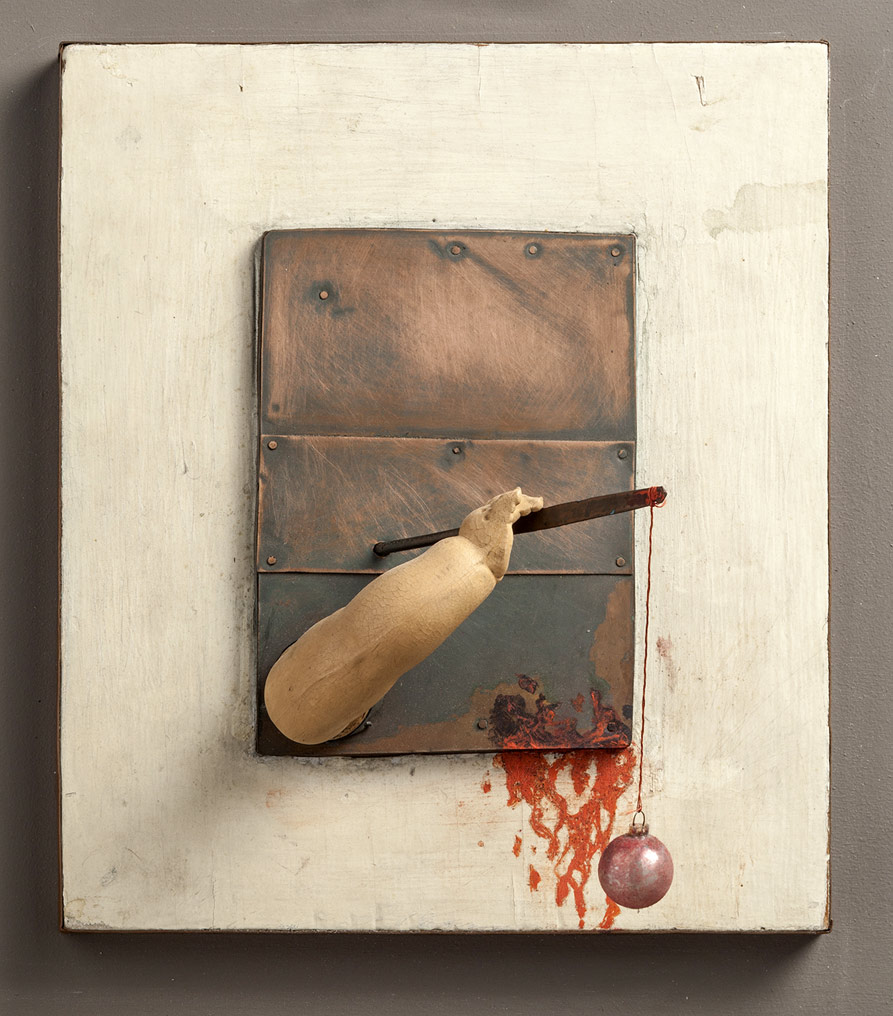
Hans Richter (German, 1888-1976) 'Justitia Minor' 1917/1960s


Hans Richter (German, 1888-1976)
Justitia Minor
1917/1960s
Assemblage (wood, copper, plastic, iron file and string, Christmas decoration)
24 x 18 x 10 in (61 x 45.7 x 25.4cm)
Private Collection
© Estate Hans Richter
Foto © 2013 Museum Associates/LACMA


Hans Richter (German, 1888-1976) 'Houses' 1917


Hans Richter (German, 1888-1976)
Houses
1917
Ink wash on paper
8 1/4 x 6 1/2 in. (20.9 x 16.5cm)
Private collection
© Estate Hans Richter Foto
Foto © 2013 Museum Associates/LACMA


“Influenced by cubism and its search for structure, but not satisfied with what it offered, I found myself between 1913-1918 increasingly faced with the conflict of suppressing spontaneous expression in order to gain an objective understanding of a fundamental principle with which I could control the ‘heap of fragments’ inherited from the cubists. Thus I gradually lost interest in the subject – in any subject – and focused instead on the positive-negative (white-black) opposition, which at least gave me a working hypothesis whereby I could organise the relationship of one part of a painting to the other.”

Richter, Hans. “Easel-Scroll-Film,” in Magazine of Art, No. 45 (February 1952), p. 82.


Unknown artist. 'Hans Arp, Tristan Tzara and Hans Richter, Zurich' 1918


Unknown artist
Hans Arp, Tristan Tzara and Hans Richter, Zurich
1918
© Estate Hans Richter


In 1929 Richter curated the film section of the famous FiFo exhibition (Film und Foto), a milestone in the history of the cinematic and photographic arts. More than 1,000 photos were presented – curated by, among others, Edward Weston and Edward Steichen for the USA and El Lissitzky for the USSR. More than sixty silent films were shown, including works by Duchamp, Egeling, Léger, Man Ray and Chaplin. This important exhibition, initiated by the German Werkbund (which was founded in 1907), was also shown in the Martin-Gropius-Bau, which in those days was called “the former Museum of Applied Arts” – a fact that is rarely mentioned in current photographic histories. On this occasion, Richter published his first film book: Film Enemies of Today, Film Friends of Tomorrow.

That same year, the first Congress of Independent Film was held in the remote Swiss castle of “La Sarraz”: Hans Richter was invited along with Sergei Eisenstein, Bela Balazs, Walter Ruttmann and others. He made a film with Eisenstein, which has since been lost. The Congress is still regarded as the first festival dedicated solely to film. Back then, the still young art of film-making had to struggle for recognition. Also in 1929 the SA (“Sturmabteilung” or Nazi “Brown Shirts”) declares him the first time a “Kulturbolschewisten” – a “cultural Bolshevik”.

In 1930 he travelled to Moscow to make the film Metal. But objections by the Soviet government prevented its completion. In 1933, when the Nazis seized power and Richter was living in Moscow, storm troopers sacked his Berlin flat and made off with his art collection. Fearing for his life, he was soon forced to flee Moscow without a penny to his name. In the Netherlands he made advertising films for Philips. He also worked for a number of chemical companies that were eager to invest in film as an advertising medium. He sought permanent residency in France and Switzerland. In Switzerland, he and Anna Seghers cooperated on a script, and in 1939 Jean Renoir arranged for him to create a major film project in Paris. But the outbreak of war prevented this film as well.

When the Swiss Foreign Police ask him to leave the country he succeeds in 1941, with emigration to the United States. Hilla Rebay, artist and once a member of Ricther’s famous Berlin “November Group” is at this time advisor to the New York art patron Solomon Guggenheim. With his help they can implement their idea of ​​a “Temple of Non-Objectivity” – the Museum of Non-Objective Painting (1939), later the Guggenheim. The museum provided Richter with the necessary invitation and a Jewish support fund for refugees sponsored his long journey. In 1942 Richter became a teacher for film – and later director – at the Institute of Film Techniques at the College of the City of New York. Until 1956 he trained students who were later counted among the great figures of American independent film, including Stan Brackhage, Shirley Clarke, Maya Deren and Jonas Mekas.

In 1940s America, after a fifteen-year pause, Richter began painting again. In 1943/44 he created his great scroll paintings and collages about the war: Stalingrad, Invasion and Liberation of Paris. After the war he made the episodic film Dreams That Money Can Buy, working alongside five of the most famous artists of the twentieth century: Léger, Ernst, Calder, Ray and Duchamp. In 1946 he presented his first great American art exhibition in Peggy Guggenheim’s Art of This Century gallery.

In the 1950s, Richter returned to Europe for the first time following his emigration to deliver lectures. Portions of his art collection, which he had left behind in Germany following his move to Moscow, were returned to him. Numerous exhibitions led to the rediscovery of Hans Richter’s works in Western Europe as well. He worked in Connecticut during the summers and spent his winters in Ascona near his artist friends. Richter experienced an extraordinarily prolific creative phase during which – after he set aside his painting utensils in the late 1960s – many works appeared using special collage techniques. In 1971 he became a member of the Berlin Academy of the Arts. By the time of his death in Switzerland in 1976, his work was shown and appreciated in many exhibitions in Western Europe. Now, for the first time in over thirty years, Hans Richter can be rediscovered in an exhibition from Los Angeles.

Press release from the Martin-Gropius-Bau website


Hans Richter (German, 1888-1976) 'Visionary Portrait' 1917


Hans Richter (German, 1888-1976)
Visionary Portrait
1917
Oil on canvas
53 x 38cm
© Estate Hans Richter
Foto: Galerie Berinson


Hans Richter (German, 1888-1976) 'Triptych in Gray, Red, and Green' 1959 (detail)


Hans Richter (German, 1888-1976)
Triptych in Gray, Red, and Green (detail)
1959
Oil on canvas on boards
Three parts, each: 15 1/2 x 19 1/2 in. (39.4 x 49.5cm); all: 20 1/2 x 49 1/2 in. (52 x 125.7cm)
Private collection
© Estate Hans Richter
Foto © 2013 Museum Associates/LACMA


Hans Richter (German, 1888-1976) 'Dragonfly (Counterpoint in Red, Black,Gray, and White)' 1943


Hans Richter (German, 1888-1976)
Dragonfly (Counterpoint in Red, Black,Gray, and White)
1943
Oil on canvas
29 1/2 x 15 1/2 in. (74.9 x 39.4cm)
Private collection
© Estate Hans Richter
Foto © 2013 Museum Associates/LACMA


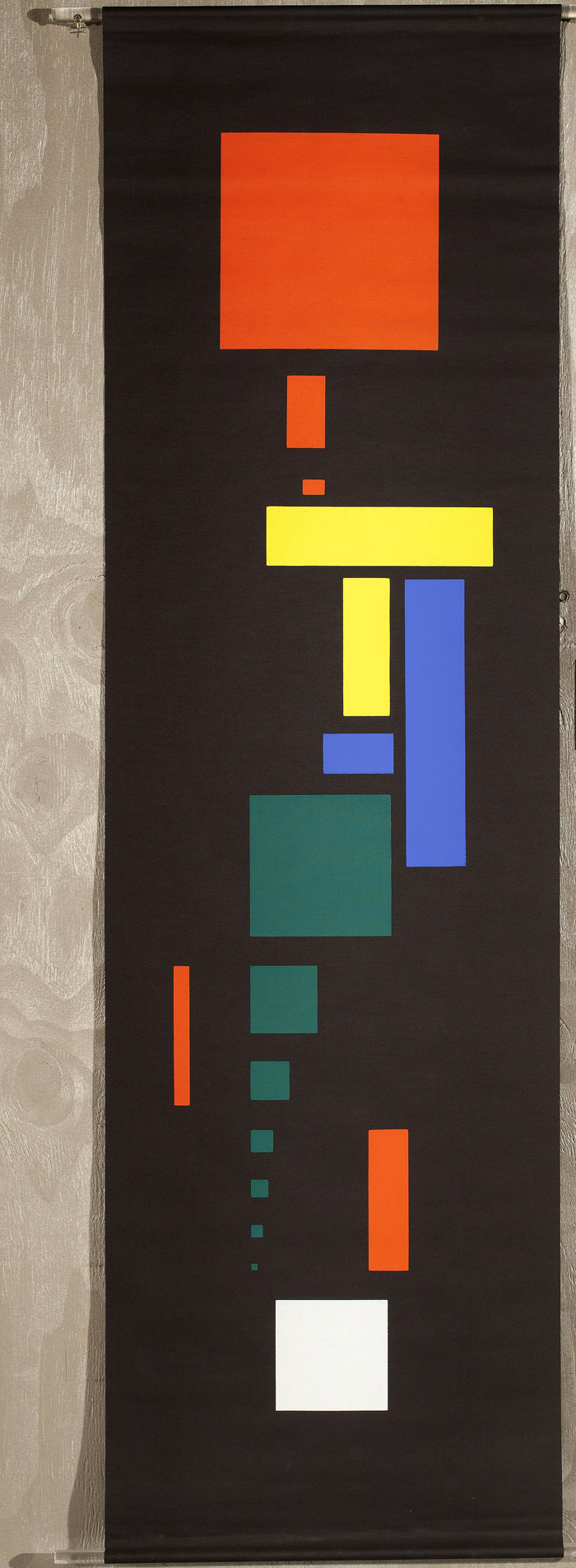
Hans Richter (German, 1888-1976) 'Orchestration of Colors' 1923/1970


Hans Richter (German, 1888-1976)
Orchestration of Colors
1923/1970
Serigraph on linen
54 x 16 in. (137.2 x 40.6cm)
Private collection
© Estate Hans Richter Foto
Foto © 2013 Museum Associates/LACMA


Martin-Gropius-Bau Berlin
Niederkirchnerstraße 7
Corner Stresemannstr. 110
10963 Berlin
Phone: +49 (0)30 254 86-0

Opening hours:
Wednesday to Monday 10 – 19 hrs
Tuesday closed

Martin-Gropius-Bau website

LIKE ART BLART ON FACEBOOK

Back to top

Exhibitions: ‘New Women’ and ‘The Chanel Legend’ at Museum für Kunst und Gewerbe Hamburg

The Chanel Legend exhibition dates: 28th February – 18th May 2014
New Women exhibition dates: 28th February – 27th July 2014


Yva (German, 1900-1944) 'Silk stockings' Nd


Yva (German, 1900-1944)
Silk stockings
Nd
Silver gelatin print
Museum für Kunst und Gewerbe Hamburg


Yva (26 January 1900 – 31 December 1944) was the professional pseudonym of Else Ernestine Neuländer-Simon who was a German Jewish photographer renowned for her dreamlike, multiple exposed images. She became a leading photographer in Berlin during the Weimar Republic. When the Nazi Party came to power, she was forced into working as a radiographer. She was deported by the Gestapo in 1942 and murdered, probably in the Majdanek concentration camp during World War II.


Do you feel like a new woman?

Do you feel like a god?

You, in the oft mentioned (ten times in the accompanying texts) LBD (Little Black Dress) or Chanel Suit (ten times as well)

It’s like the ten commandments.


And ~ on we go… say after me,

“Sashay! Shantay!”

PS some of the photos ain’t half bad tho!

Dr Marcus Bunyan


Many thankx to the Museum für Kunst und Gewerbe Hamburg for allowing me to publish the photographs in the posting. Please click on the photographs for a larger version of the image.


‘Sleeping with the Enemy, Coco Chanel and the Secret War’ written by Hal Vaughan further solidifies the consistencies of the French intelligence documents released by describing Coco as a “vicious anti-Semite” who praised Hitler.

World War II, specifically the Nazi seizure of all Jewish-owned property and business enterprises, provided Chanel with the opportunity to gain the full monetary fortune generated by Parfums Chanel and its most profitable product, Chanel No. 5. The directors of Parfums Chanel, the Wertheimers, were Jewish. Chanel used her position as an “Aryan” to petition German officials to legalise her claim to sole ownership.

“On 5 May 1941, she wrote to the government administrator charged with ruling on the disposition of Jewish financial assets. Her grounds for proprietary ownership were based on the claim that Parfums Chanel “is still the property of Jews” and had been legally “abandoned” by the owners”. …

Chanel was not aware that the Wertheimers, anticipating the forthcoming Nazi mandates against Jews had, in May 1940, legally turned control of Parfums Chanel over to Félix Amiot, a Christian French businessman and industrialist. At war’s end, Amiot returned “Parfums Chanel” to the hands of the Wertheimers.

During the period directly following the end of World War II, the business world watched with interest and some apprehension the ongoing legal wrestle for control of Parfums Chanel. Interested parties in the proceedings were cognisant that Chanel’s Nazi affiliations during wartime, if made public knowledge, would seriously threaten the reputation and status of the Chanel brand. Forbes magazine summarised the dilemma faced by the Wertheimers: [it is Pierre Wertheimer’s worry] how “a legal fight might illuminate Chanel’s wartime activities and wreck her image – and his business.”


Text from the Wikipedia website


Aenne Biermann (German, 1898-1933) 'Self-Portrait with silver ball' 1931


Aenne Biermann (German, 1898-1933)
Self-Portrait with silver ball
1931
Silver gelatin print
Museum für Kunst und Gewerbe, Hamburg


Aenne Biermann (March 8, 1898 – January 14, 1933), born Anna Sibilla Sternfeld, was a German photographer of Ashkenazi origin. She was one of the major proponents of New Objectivity, a significant art movement that developed in Germany in the 1920s.

Major exhibitions of her work include the Munich Kunstkabinett, the Deutscher Werkbund and the exhibition of Folkwang Museum in 1929. Other important exhibitions include the exhibition entitled Das Lichtbild held in Munich in 1930 and the 1931 exhibition at the Palace of Fine Arts (French: Palais des Beaux Arts) in Brussels.

Text from the Wikipedia website


Horst P. Horst (German-American, 1906-1999) 'Coco Chanel' 1937


Horst P. Horst (German-American, 1906-1999)
Coco Chanel
1937
Silver gelatin print
Museum für Kunst und Gewerbe Hamburg


Horst Paul Albert Bohrmann (August 14, 1906 – November 18, 1999), who chose to be known as Horst P. Horst, was a German-American fashion photographer. …

Horst is best known for his photographs of women and fashion, but is also recognised for his photographs of interior architecture, still lifes, especially ones including plants, and environmental portraits. One of the great iconic photos of the Twentieth-Century is “The Mainbocher Corset” with its erotically charged mystery, captured by Horst in Vogue‘s Paris studio in 1939. Designers like Donna Karan continue to use the timeless beauty of “The Mainbocher Corset” as an inspiration for their outerwear collections today. His work frequently reflects his interest in surrealism and his regard of the ancient Greek ideal of physical beauty.

His method of work typically entailed careful preparation for the shoot, with the lighting and studio props (of which he used many) arranged in advance. His instructions to models are remembered as being brief and to the point. His published work uses lighting to pick out the subject; he frequently used four spotlights, often one of them pointing down from the ceiling. Only rarely do his photos include shadows falling on the background of the set. Horst rarely, if ever, used filters. While most of his work is in black & white, much of his colour photography includes largely monochromatic settings to set off a colourful fashion. Horst’s colour photography did include documentation of society interior design, well noted in the volume Horst Interiors. He photographed a number of interiors designed by Robert Denning and Vincent Fourcade of Denning & Fourcade and often visited their homes in Manhattan and Long Island. After making the photograph, Horst generally left it up to others to develop, print, crop, and edit his work.

One of his most famous portraits is of Marlene Dietrich, taken in 1942. She protested the lighting that he had selected and arranged, but he used it anyway. Dietrich liked the results and subsequently used a photo from the session in her own publicity.

Text from the Wikipedia website


Boris Lipnitzki (French born Ukraine, 1887-1971) 'Coco Chanel' 1937


Boris Lipnitzki (French born Ukraine, 1887-1971)
Coco Chanel
1937
© Getty Images


Boris Lipnitzki (1887-1971) was a Ukrainian-born French photographer of the arts; ballet, fashion, cinema, visual art, writing and music.

Haim Efime Boris Lipnitzki (or Lipnitzky) was born into a Jewish family in Oster, in Chernihiv Province of the Russian Empire (now Ukraine) on 4 February 1887. He died in Paris on 6 July 1971, aged 84, and is buried in Pere Lachaise cemetery.

Lipnitzki first worked for a photographer in Odessa, then opened his own studio in Pultusk. He arrived in Paris in the early 1920s. There, he established a studio at 40 rue du Colisée, where he photographed many of the artistic personalities of the 20th century from the 1920s-1960s, as well as picturing them in their own surroundings. His friendship with fashion designer Paul Poiret, with whom he would stay to photograph in Biarritz, provided an entrée into these circles.

His subjects included Maurice Ravel, René Hubert, Albert Camus, Blaise Cendrars, Jean Cocteau, Otto Preminger, Igor Strawinsky, Arthur Honegger, Leonid Massine, Serge Lifar, Paul Poiret, Coco Chanel, Olga Spessivtseva, Nyota Inyoka, Tamara Karsavina, Serge Gainsbourg, Les Six, Marc Chagall, Pablo Picasso, as well as Josephine Baker of whom in 1926 he made a famous series of nude photographs.

Text from the Wikipedia website


New Women

In the 1920s Coco Chanel chiefly influenced the type of the “new woman”. She established skirts that reached just below the knee, encouraged women to wear trousers and represents functional ladies wear. In the photographs by among others Yva, Franz Roth, Lotte Jacobi and Hein Gorny presented here, women show legs in silk stockings, wear cropped hair, drive motorbikes or automobiles and play tennis or go into baths. In this period women begin to take charge of their lives. Being a photographer offered the opportunity to express this new notion of the self in images and in life. The special display of the Photography Department coincides with the exhibition The Chanel Legend.

The Chanel Legend

Coco Chanel (1883-1971) is one of the most eminent couturières of the twentieth century. She already appears as an advocate of simple, comfortable clothes in the years just after 1910, thus helping to pave the way for a style which has retained its major importance in the fashion world till today. Such outstanding fashion classics as the “little black dress”, the Chanel Suit and the Chanel handbag are inseparably linked with her person. Since her start-up in 1913, Chanel has built up an international and, till the present day, astoundingly successful fashion empire. It is not until 1983, in the shape of Karl Lagerfeld, that a personality with anything like her charisma and influence becomes her successor. Coco – her real name was Gabrielle – Chanel launched her perfume Chanel N° 5, whose overwhelming commercial success guaranteed her a financial independence which was to last all her life, at the beginning of the 1920s. She combined fashion jewellery and genuine gemstones with surefooted confidence and had herself portraited by celebrity photographers such as Man Ray or Horst P. Horst.

The Chanel Legend investigates why it is that the person of Coco Chanel and the brand she established have attracted such huge attention up to and including the present. It will turn the spotlight both on the fashion designer’s biography and the image which she created for herself, as well as the brilliant achievement of Karl Lagerfeld (b. 1933) in combining this legacy with the fluctuating currents of contemporary taste since 1983. The exhibition shows a total of more than 200 objects from eminent collections, including women’s suits, accessoires, jewellery, advertising graphic, historical photographs and over 75 fashion magazines spanning a period from 1920 to1971. Besides more than 54 original garments, among them 38 created by Coco Chanel, and some 50 jewellery creations, over 35 adaptions of the Chanel classics can be seen for the first time, which in their own individual way give us a new appreciation of the “Chanel Legend”.

The exhibition approaches the “Chanel Legend” in three chapters. The first documents, with 38 original garments, accessoires and more than 50 items of fashion jewellery from the period between 1925 and 1971 the fashion designer’s oeuvre. Designs for evening and day wear and the perfume Chanel N° 5, of which an original flacon is on show, belong to Chanel’s pre-Second World War creative phase. After her return to Paris in 1954, Chanel continued to lead her firm up to her death in 1971. The exhibition shows, among other items from this period, some 10 garments which Chanel designed for the actress and singer Marlene Dietrich, including day wear and garments for representative occasions. On top of this, a large quantity of pieces of fashion jewellery can be seen, supplemented by original photographs.

The second chapter throws light on the Chanel classics, which have retained their fascination till today. Thus historical original examples of the Chanel Suit are juxtaposed with some 20 different adaptations of it, including models from other fashion houses, unknown ateliers and garment manufacturers. The procession of “lookalikes” and “distant cousins” by no means comes to an end with Chanel’s lifetime, but integrates aspects of contemporary fashion. A selection of the endless variations on the theme of the “little black dress” from the 1920s till the present will also be on show, some of them by designers such as Yves Saint Laurent, Max Heyman and Issey Miyake or Nina Ricci. They should by no means be seen as just copies of Chanel models. The short black dress was in keeping with the modern, dynamic lifestyle of the 1920s. Later the “little black dress” is an indispensable requisite in every woman’s wardrobe and, in the Fifties and Sixties, the epitome of Parisian chic.

In the third section, the focus is on Karl Lagerfeld’s creations for the House of Chanel. He succeeded in modernising the brand without sacrificing the features which were typical for it. The exhibition shows in particular items which quote the Chanel classics, or pay homage to his revered predecessor in some of their details. This selection, too, is complemented by fashion jewellery. The development comes full circle here, since Lagerfeld’s present winter collection for 2013-14 playfully quotes references to Coco Chanel’s legendary initial phase in the 1920s. More than 100 historical fashion magazines spanning a period from 1920 to 1971 can also be seen in the exhibition, including an issue of the American Vogue dated 1st October 1926 in which the “little black dress” is shown. Magazines were the most important medium for the propagation and reception of Chanel’s fashion. Visitors can leaf through them on the tablet computers provided.

Text from press release from the Museum für Kunst und Gewerbe Hamburg website


Aenne Biermann (German, 1898-1933) 'Portrait of Anneliese Schiesser' 1929


Aenne Biermann (German, 1898-1933)
Portrait of Anneliese Schiesser
1929
Silver gelatin print
Museum für Kunst und Gewerbe, Hamburg


Hein Gorny (German, 1904-1967) 'Portrait of a Woman' c. 1930/1972


Hein Gorny (German, 1904-1967)
Portrait of a Woman
c. 1930/1972
Silver gelatin print, Reprint ofHeinrich Riebesehl
Museum für Kunst und Gewerbe, Hamburg


Hein Gorny (1904-1967) was a highly versatile photographer. Self-taught, he had extensive, in-depth knowledge of photographic techniques and was specialised both in photographic and darkroom processes. He photographed a broad range of subject matter, including portraits, architecture, and animals as well as images used in industrial, commercial, and illustrational contexts. In addition he created experimental photographs, primarily working with macrophotography. Advertising photography was the field in which Hein Gorny carried out numerous commissions and was most well-known. He was primarily active in Hanover and Berlin. Hein Gorny is described by Heinrich Riebesehl as a “pioneer of modern commercial photography” in a catalogue published in conjunction with the Spectrum Photogalerie’s inaugural exhibition of 1972. He was masterful in his groundbreaking ability to fuse the photographic spirit of his time with the demands of advertising photography.

“Especially in his early work, the joy of experimentation and the openness to everything new and unusual is clearly visible. His positive attitude towards life, his carefree, almost exuberant way of using the medium of photography made him – consciously or unconsciously – adopt the taste of the times.” ~ Heinrich Riebesehl


Atelier Benda/d'Ora. 'The actress Marlene Dietrich with beret' 1927


Atelier Benda/d’Ora
The actress Marlene Dietrich with beret
1927
Silver gelatin print
Museum für Kunst und Gewerbe Hamburg


Madame D'Ora. 'The fashion designer Coco Chanel' about 1927


Madame D’Ora
The fashion designer Coco Chanel
about 1927
Silver gelatin print
Museum für Kunst und Gewerbe Hamburg


Dora Philippine Kallmus (20 March 1881 – 28 October 1963), also known as Madame D’Ora or Madame d’Ora, was an Austrian fashion and portrait photographer.

She became interested in the photography field while assisting the son of the painter Hans Makart, and in 1905 she was the first woman to be admitted to theory courses at the Graphische Lehr- und Versuchsanstalt (Graphic Training Institute). That same year she became a member of the Association of Austrian photographers. At that time she was also the first woman allowed to study theory at the Graphischen Lehr- und Versuchsanstalt, which in 1908 granted women access to other courses in photography.

In 1907, she established her own studio with Arthur Benda in Vienna called the Atelier d’Ora or Madame D’Ora-Benda. The name was based on the pseudonym “Madame d’Ora”, which she used professionally. D’ora and Benda operated a summer studio from 1921 to 1926 in Karlsbad, Germany, and opened another gallery in Paris in 1925. She was represented by Schostal Photo Agency (Agentur Schostal) and it was her intervention that saved the agency’s owner after his arrest by the Nazis, enabling him to flee to Paris from Vienna.

Her subjects included Josephine Baker, Coco Chanel, Tamara de Lempicka, Alban Berg, Maurice Chevalier, Colette, and other dancers, actors, painters, and writers.

Text from the Wikipedia website


Unknown photographer. 'Chanel' 1931


Unknown photographer
Chanel
1931
© Corbis Images


Man Ray (American, 1890-1976) 'Chanel with cigarette' 1935


Man Ray (American, 1890-1976)
Chanel with cigarette
1935
© VG Bildkunst Bonn, 2014, and Man Ray Trust


Roger Schall (French, 1904-1995) 'Ritz Apartment' Nd


Roger Schall (French, 1904-1995)
Ritz Apartment
Nd
© Roger Schall-Collection Schall


Roger Schall was a photographer during the interwar period, a contemporary of Brassaï. He excelled in photojournalism, in which he was one of the pioneers, as well as in the photographic disciplines of fashion and portraits. In the early 30s, the “revolution” Leica and Rolleiflex allowed him to fulfill his passion for images taken on the spot. Paris was his main exploration ground, where the night allowed him to capture and expose with strength and delicacy the particular shapes of a city made of diversities.

Text from the Artsper website [Online] Cited 25/03/2021


During World War II, Schall secretly documented the Nazi occupation of Paris. He also produced fashion photography for the fetish clothing company Diana Slip.


Douglas Kirkland (American, b. 1934) 'Chanel im Atelier' (Chanel in the studio) 1962


Douglas Kirkland (American, b. 1934)
Chanel im Atelier (Chanel in the studio)
1962
© Corbis Images


Coco Chanel

Gabrielle Chanel, who grew up in humble circumstances, opened her first Couture Salon in Paris in 1913, after she had already set up in business in 1908 as a modiste. In 1919 she moved to the Rue Cambon 31, which is still the address of the House of Chanel today. Coco Chanel’s first creative phase ended with the outbreak of war in 1939. Her fashion house stayed shut for 15 years before she dared a comeback in 1954, at the age of 70. The exhibition shows creations by Chanel from both periods. The “little black dress” becomes her trademark. Further models of day and evening wear show to what extent the fashion designer had her finger on the pulse of her time, and at the same time bear witness to the high quality of her models both in design and execution. In the 1950s and 1960s it is her women’s suits which cause a furore, first and foremost the “Chanel Suit”, which she first presented at a fashion show in 1957. Her celebrated quilted handbag, launched in February 1955 and called, simply, “2.55”, has long since attained the status of a classic and is a must in every collection of the luxury label. Her collections were always supplemented by matching fashion jewellery. Till today, Coco Chanel appears as an enigmatic and fascinating personality, and has been the theme of many films and books. Fierce controversy also surrounds her links to decision-makers of the Third Reich too, however, up to the present day.

The “little black dress” and suits by Chanel – their reception

he reception of Coco Chanel’s fashion and her style is already very widespread in her lifetime. A comparison with other contemporary couturiers reveals that Coco Chanel operated a very tolerant policy as regards the copyright for her models: The fashion designer allowed her models to be copied up to a certain point with her consent. For her, it was an acknowledgement of her eminence if women all over the world dressed in her style – an aspect whose influence on the “Chanel Legend” should not be underestimated, and which is investigated in this exhibition for the first time. In October 1926, the American Vogue magazine described a short black dress by Chanel as “The Chanel Ford – the frock that all the world will wear”. This drew a parallel between Chanel’s dress in its universality and modernity and one of the most important inventions of the time and prophesied a great future for it.

This is the birth of the “little black dress”. And although Chanel was not the first couturier to design simple black dresses for day wear it nevertheless remains inseparably linked with her name. Even the perhaps most celebrated “little black dress”, that worn by Audrey Hepburn in the film classic “Breakfast at Tiffany’s”, is often wrongly attributed to Chanel. The exhibition traces the development of the fashion classic from the 1920s till today. Another model which has gone down as an icon in fashion history is the “Chanel Suit” with its boxy, collarless jacket and often contrasting braided edgings. The term “Chanel Suit” is even quoted as a reference in the Duden. The exhibition shown here also document the fact that Coco Chanel produced a whole range of women’s suits which were adapted by other fashion houses or even home dressmakers. It is mostly no longer possible today to reconstruct whether individual models were made under licence or whether they were freely interpreted or simply copied. Irrespective of this, however, it is certain that all these models also made their contribution to the “Chanel Legend”.

Text from press release from the Museum für Kunst und Gewerbe Hamburg website


Gabrielle Chanel (French, 1883-1971) 'Ensemble' 1960s


Gabrielle Chanel (French, 1883-1971)
Ensemble
1960s
Jahre Seidencloqué mit Lurex
Deutsche Kinemathek – Marlene Dietrich Collection, Berlin
© Draiflessen Collection, Mettingen, Fotografie von Christin Losta


Gabrielle Chanel (French, 1883-1971) 'Tageskleid/Day Dress' 1960-62


Gabrielle Chanel (French, 1883-1971)
Tageskleid/Day Dress
1960-62
Seiden-Crêpe de Chine
Gemeentemuseum, Den Haag
© Draiflessen Collection, Mettingen, Fotografie von Christin Losta


Gabrielle Chanel (French, 1883-1971) 'Costume, C. H. Kuehne & Zn' Autumn / Winter 1966/67, licensed by Chanel


Gabrielle Chanel (French, 1883-1971)
Costume, C. H. Kuehne & Zn
Autumn / Winter 1966/67, licensed by Chanel
Silk brocade
Gemeentemuseum, Den Haag © Draiflessen Collection, Mettingen, Fotografie von Christin Losta


Karl Lagerfeld (German, 1933-2019) 'Costume, Chanel Boutique' Autumn/Winter 1989/90


Karl Lagerfeld (German, 1933-2019)
Costume, Chanel Boutique
Autumn/Winter 1989/90
Wool tweed, Wool georgette
Museum für Kunst und Gewerbe Hamburg
© Draiflessen Collection, Mettingen, Fotografie von Christin Losta


Karl Lagerfeld (German, 1933-2019) 'Costume, Chanel Boutique' Spring/Summer 1986


Karl Lagerfeld (German, 1933-2019)
Costume, Chanel Boutique
Spring/Summer 1986
Cotton poplin, cotton pique
Museum für Kunst und Gewerbe Hamburg
© Draiflessen Collection, Mettingen, Fotografie von Christin Losta


Museum für Kunst und Gewerbe Hamburg
Steintorplatz, 20099 Hamburg

Opening hours:
Tuesday to Sunday 11am – 6pm
Wednesday and Thursday 11am – 9pm

Museum fur Kunst und Gewerbe Hamburg website

LIKE ART BLART ON FACEBOOK

Back to top

Exhibition: ‘Brancusi, Rosso, Man Ray – Framing Sculpture’ at Museum Boijmans Van Beuningen, Rotterdam

Exhibition dates: 8th February – 11th May 2014


Installation photograph of the exhibition 'Brancusi, Rosso, Man Ray – Framing Sculpture' at Museum Boijmans Van Beuningen, 2014


Installation photograph of the exhibition Brancusi, Rosso, Man Ray – Framing Sculpture
Museum Boijmans Van Beuningen, 2014
Foto / Photo: Gert-Jan de Rooij, Amsterdam


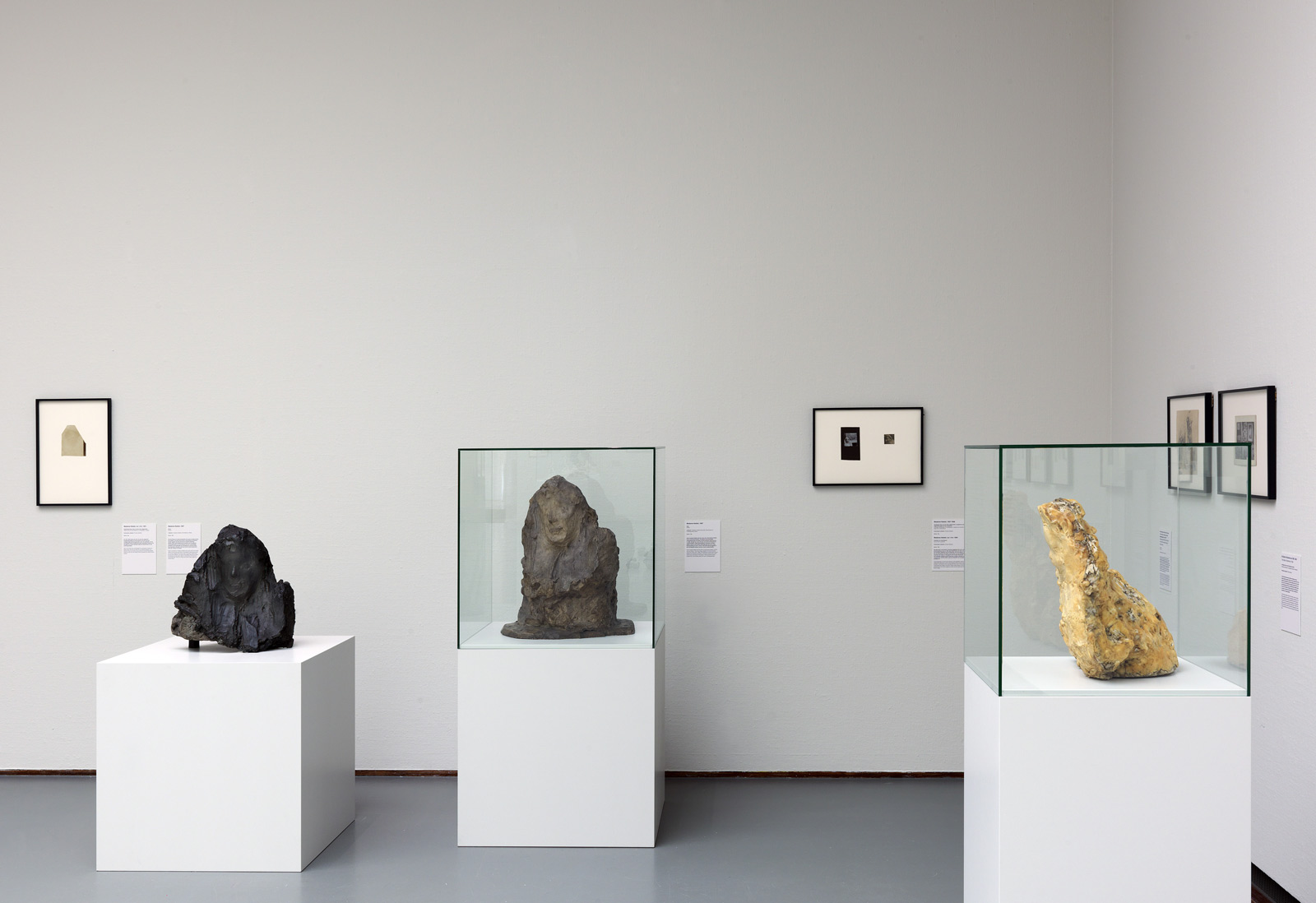
What a magnificent exhibition. We all know Brancusi and Man Ray but it is the work of Medardo Rosso that surprises and delights here, an artist I admit I knew nothing about before this posting. What a revelation, both his sculptures and photographs. I must try and do a whole posting just on his photographs!

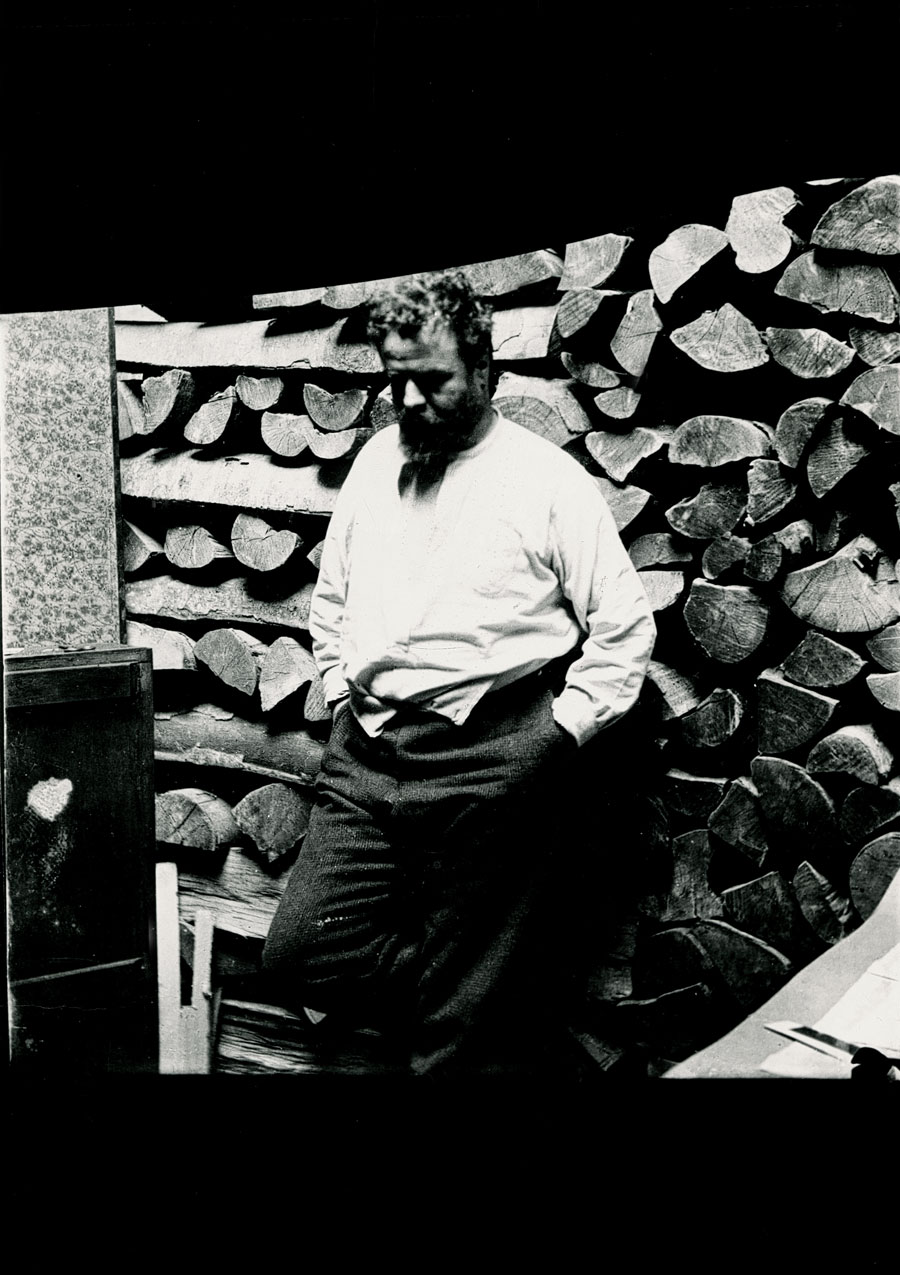
The two self-portraits of the artists in the studio are telling… Rosso, pensive, brooding, with a stack of chopped wood surrounding him, face wreathed in shadow, head titled slightly down and hands stuffed in pockets; Brancusi, seated on a plinth, legs crossed, swarthy arms folded replete with large hands, staring directly at the camera and surrounded by his work. Rosso in malleable darkness, Brancusi in towering light. The photographs reflect their respective personalities and inform the art which represents them.

Dr Marcus Bunyan


Many thankx to Museum Boijmans Van Beuningen for allowing me to publish the art work in the posting. Please click on the image for a larger version of the art.


Alessio delli Castelli considers the Italian sculptor’s photographic legacy.

“Medardo Rosso was born in Turin in 1858 and died in Milan 1928. However, he spent most of his life away from Italy, in Paris especially, from where he travelled to all the major European capitals. It was in Paris that, towards the close of the 19th century, he emerged alongside Auguste Rodin as a serious contender for the title of father of modern sculpture. Yet it was Rodin who achieved universal recognition. In spite of Rosso’s influence on sculptors such as Constantin Brancusi – whose Sleeping Muse (1909-10), with its radically abstracted features of a female head, is strongly reminiscent of Rosso’s Madame X (1896) – he was long held hostage by a provincial criticism which saw his practice confined, chronologically, thematically and formally, to the 19th century. Although it is true that Rosso only created two original sculptural works in the 20th century, to claim that he was no longer a practicing artist would be to overlook the variations he made of his sculptures, and the copies from antiquity. More importantly, it would be to dismiss his photographic work of that period merely as images of sculptures that already existed. This would mean ignoring the fact that his photography showed all the signs of rigorous artistic investigation – and was not, as critics in the 20th century often declared, indicative of either an accident that injured his leg and made him weak or a more general creative block.

It is only in recent years that Rosso’s photographs have acquired the status of art objects in and of themselves…”


Installation photograph of the exhibition 'Brancusi, Rosso, Man Ray – Framing Sculpture' at Museum Boijmans Van Beuningen, 2014

Installation photograph of the exhibition 'Brancusi, Rosso, Man Ray – Framing Sculpture' at Museum Boijmans Van Beuningen, 2014

Installation photograph of the exhibition 'Brancusi, Rosso, Man Ray – Framing Sculpture' at Museum Boijmans Van Beuningen, 2014
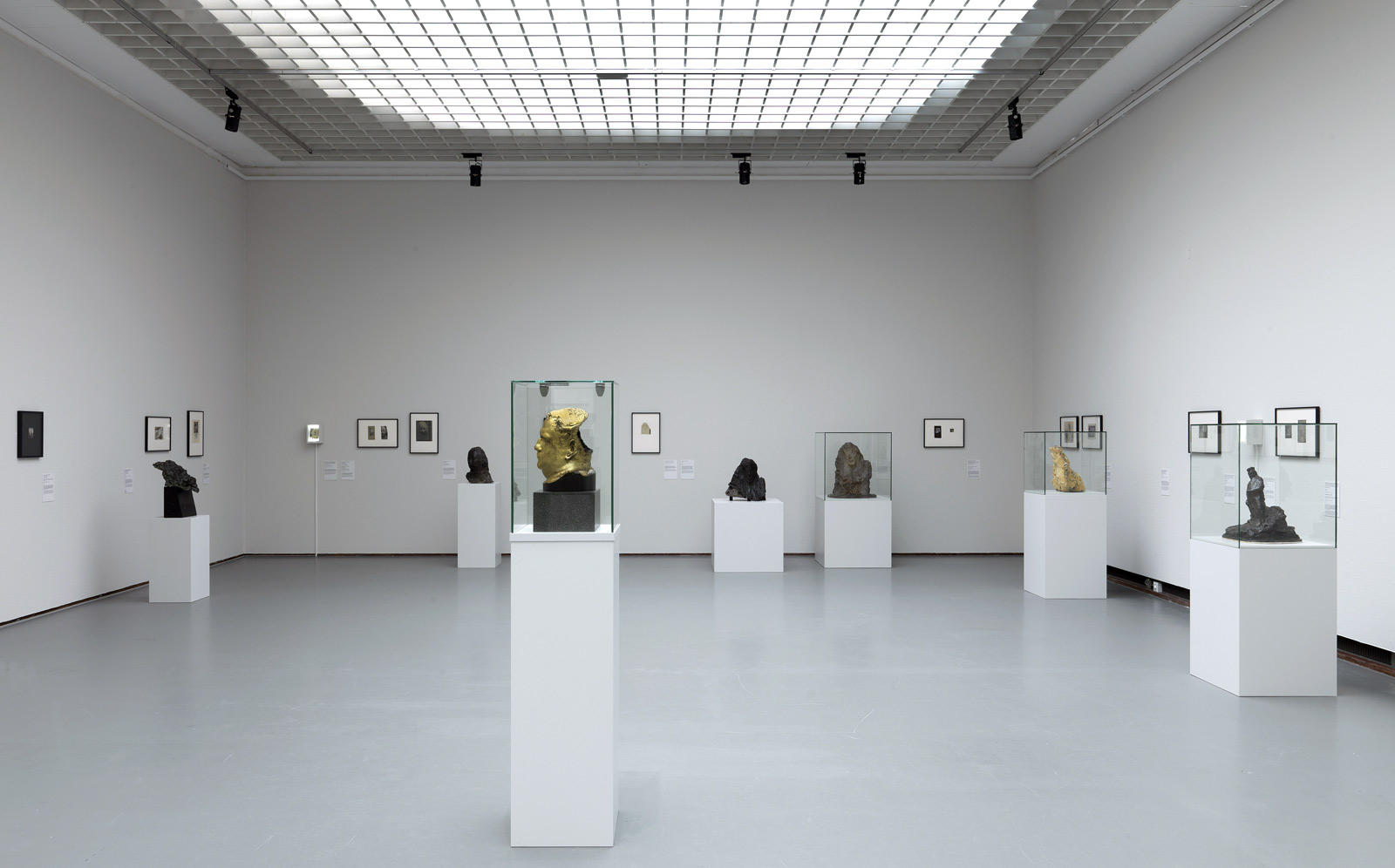
Installation photograph of the exhibition 'Brancusi, Rosso, Man Ray – Framing Sculpture' at Museum Boijmans Van Beuningen, 2014
Installation photograph of the exhibition 'Brancusi, Rosso, Man Ray – Framing Sculpture' at Museum Boijmans Van Beuningen, 2014


Installation photographs of the exhibition Brancusi, Rosso, Man Ray – Framing Sculpture
Museum Boijmans Van Beuningen, 2014
Foto / Photos: Gert-Jan de Rooij, Amsterdam


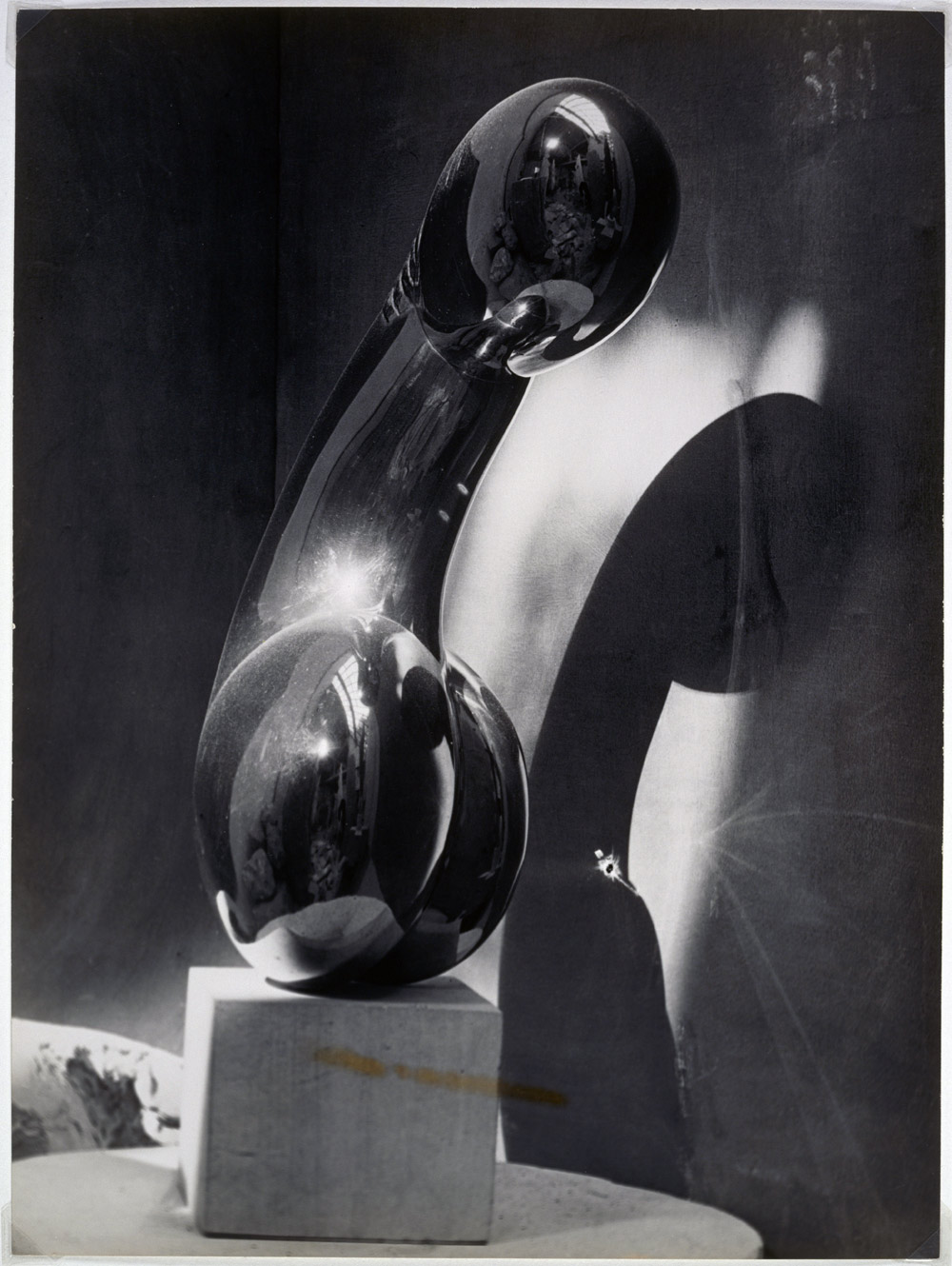
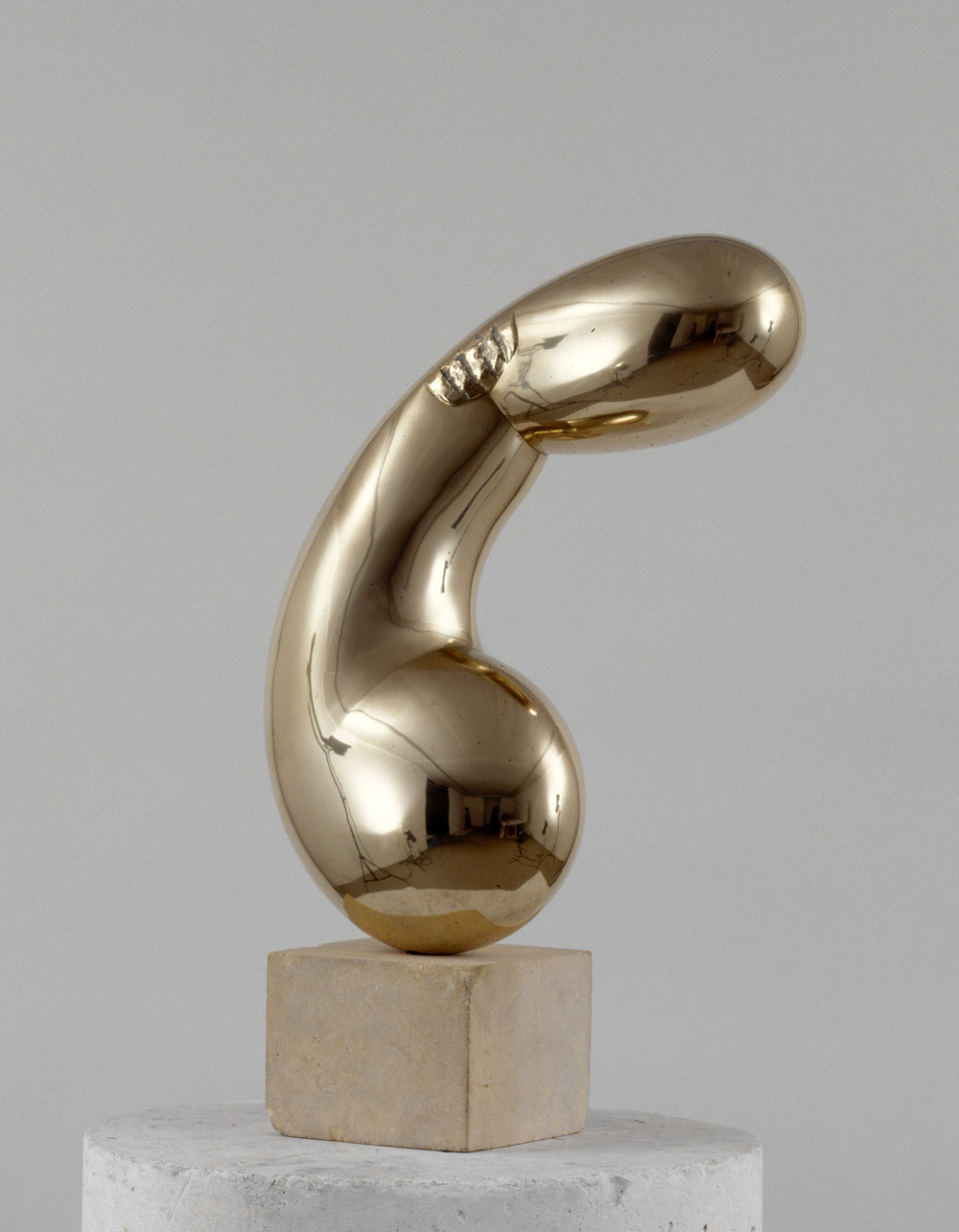
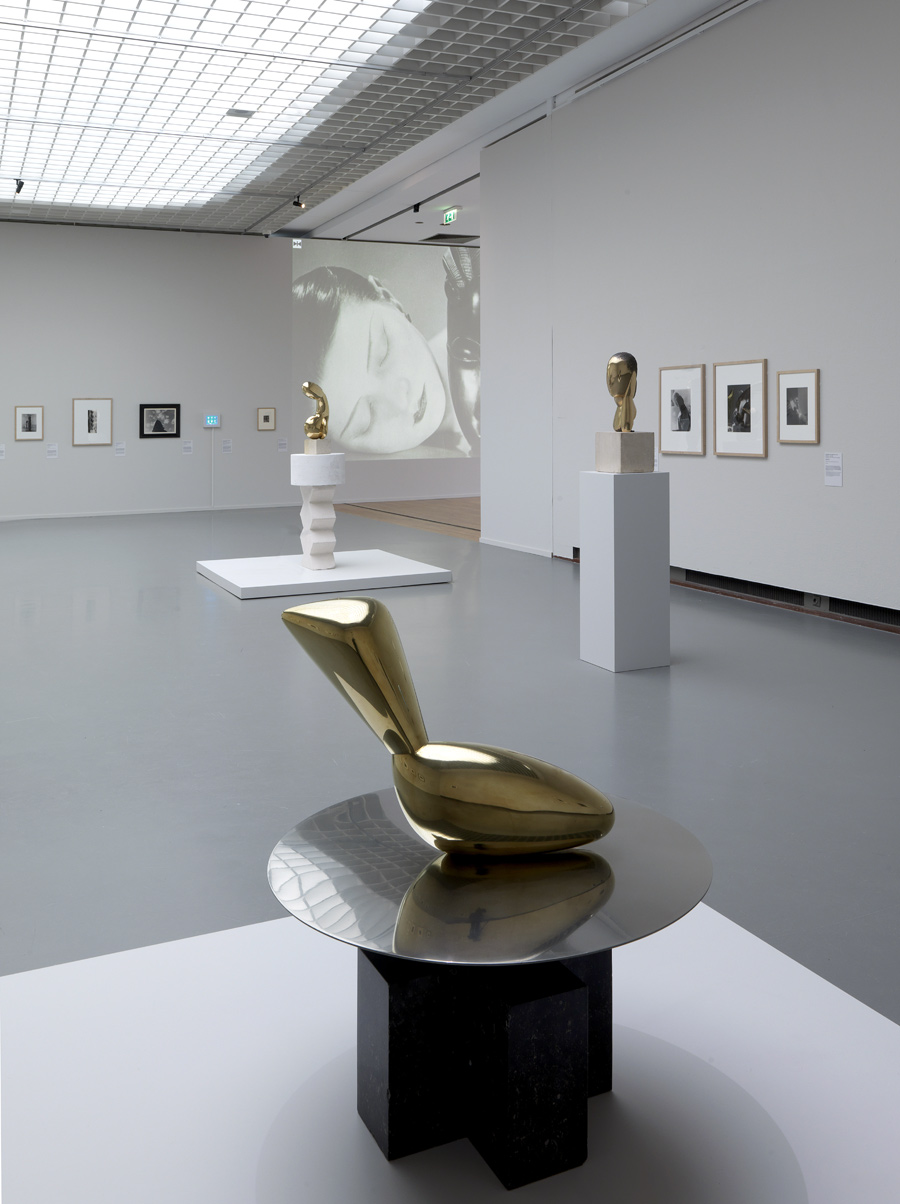
In mythology, Leda is a girl who is seduced by Zeus who turns her into a swan. In the Brancusi sculpture, Leda (foreground, above) is that metamorphosis. The swan is an animal whose body is often associated with a hybrid identity between male and female. His neck is close to a phallic shape while her body has feminine attributes. The bird and woman, male and female mingle in the same sculptural movement. This transfiguration is reflected in the complex forms of sculpture, asymmetrical contours, the offset top shape intersecting with the lower form, giving rise to multiple passages and perceptions.

In 1932, Brancusi sculpture adds a large polished steel disc which suggests the presence of water and Leda is reflected in the mirror which changes its shape. Modifications qu’accentuera still provide a motor and a ball bearing arranged in the circular plate. Within the workshop, the body of Leda is in a state of constant metamorphosis. The shimmer of light on the surface of polished bronze sculpture blends with its reflection in the steel circle and absorbs its environment. Leda becomes a pure luminous presence. Weight and lightness, balance and imbalance are the same event within a continuous time duration in the sculptures of Constantin Brancusi.

Translated from the French on the Constantin Brancusi web page of the Centre Pompidou website [Online] Cited 05/05/2014 no longer available online


Installation photograph of the exhibition 'Brancusi, Rosso, Man Ray – Framing Sculpture' at Museum Boijmans Van Beuningen, 2014


Installation photograph of the exhibition Brancusi, Rosso, Man Ray – Framing Sculpture
Museum Boijmans Van Beuningen, 2014
Foto / Photo: Gert-Jan de Rooij, Amsterdam


In the spring of 2014 Museum Boijmans Van Beuningen brings together works from all over the world by three artists who were decisive for the development of modern art. This is the first exhibition to combine sculptures by Brancusi, Rosso and Man Ray together with their photographs, affording a unique insight into the artists’ working methods.

Masterpieces that have rarely or never been seen in the Netherlands will be lent by important museums such as the Centre Pompidou, MoMA and Tate. Museum Boijmans Van Beuningen will show more than 40 sculptures and hundred photographs by Constantin Brancusi (Hobita 1876 – Paris 1957), Medardo Rosso (Turin 1858 – Milan 1928) and Man Ray (Philadelphia 1890 – Paris 1976). The exhibition will feature sculptures such as Brancusi’s Princesse X (1915-1916) and Rosso’s Ecce Puer (1906) alongside works by Man Ray from the museum’s collection, including the sculpture L’Énigme d’Isidore Ducasse (1920 / 1971). Presenting the sculptures together with the artists’ photographs of their sculptures reveals their often-surprising perspectives on their own works.

Framing Sculpture

Brancusi, Rosso and Man Ray employed photography not so much as a means of recording their work. The photographs show how they interpreted their sculptures and how they wanted them to be seen by others. Brancusi is considered the father of modern sculpture with his highly simplified sculptures of people and animals. In his photographs he experimented with light and reflection so that his sculptures absorb their environment and appear to come to life. Rosso is the artist who introduced impressionism in sculpture. The indistinct contours of his apparently quickly modelled figures in plaster and wax make them appear to fuse with their surroundings. Rosso cut up the soft-focus photographs of his work, made them into collages and reworked them with ink so that the sculptures appear even flatter and more contourless. Man Ray is best known as a photographer but was also a painter and sculptor. His choice of materials was unconventional: he combined existing objects to create new works, comparable to the ‘readymades’ of his friend Marcel Duchamp. Man Ray’s experimental use of photography led him to make photographs without the use of a camera. He made these so-called ‘rayographs’ by placing objects directly on photographic paper and exposing them briefly to light, leaving behind a ghostly impression.

Press release from the Museum Boijmans Van Beuningen


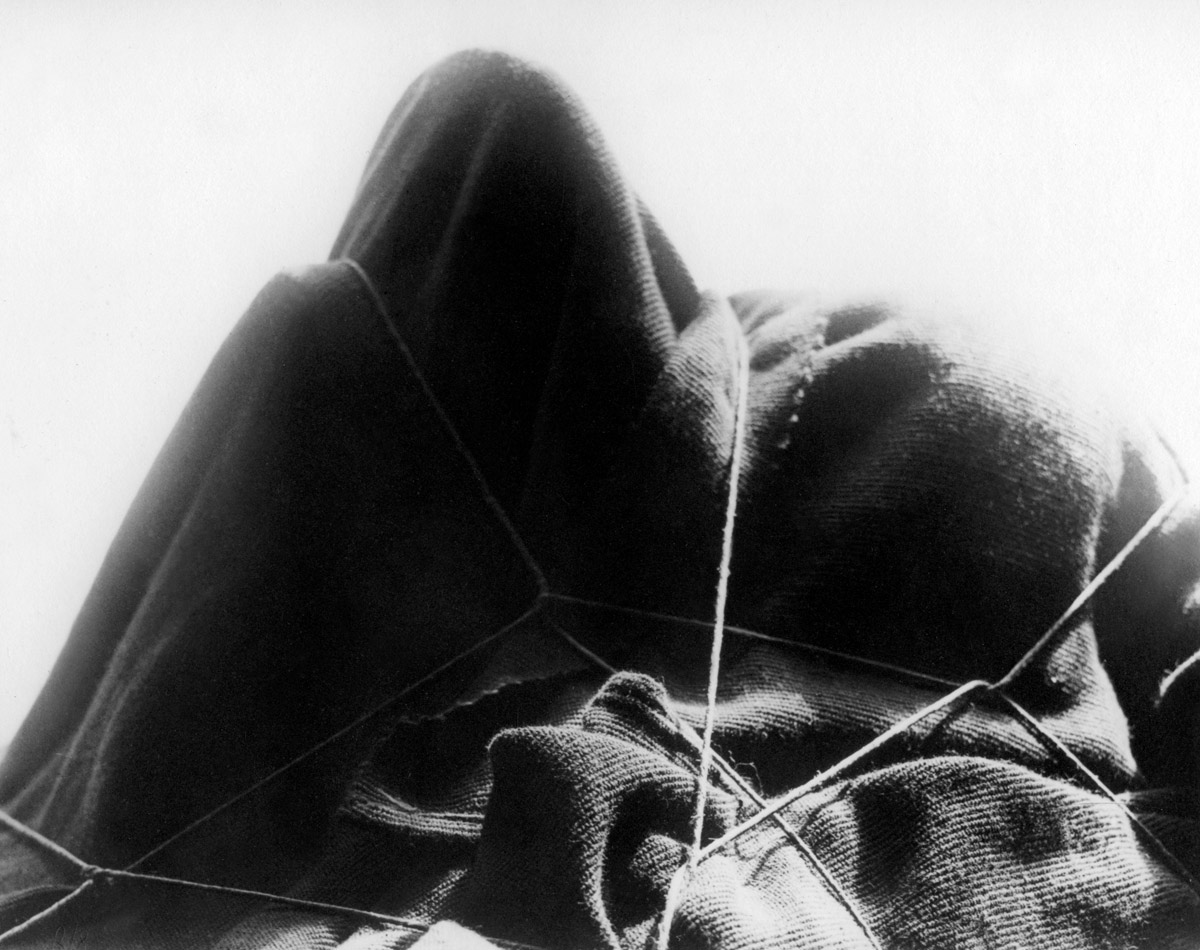
Man Ray (American, 1890-1976) 'L'Énigme d'Isidore Ducasse' (The Riddle of Isidore Ducasse) 1920 (1971)


Man Ray (American, 1890-1976)
L’Énigme d’Isidore Ducasse (The Riddle of Isidore Ducasse)
1920 (1971)
Iron, textile, rope, cardboard
45.4 x 60 x 24cm
Collection Museum Boijmans Van Beuningen
© Man Ray Trust / ADAGP, c/o Pictoright Amsterdam 2013.


Man Ray (American, 1890-1976) 'L'Énigme d'Isidore Ducasse' (The Riddle of Isidore Ducasse) 1920 (1975)


Man Ray (American, 1890-1976)
L’Énigme d’Isidore Ducasse (The Riddle of Isidore Ducasse)
1920 (1975)
Gelatin silver print
47.5 x 59cm
Courtesy Fondazione Marconi, Milan
© Man Ray Trust / ADAGP, c/o Pictoright Amsterdam 2013


Medardo Rosso (Italian, 1858-1928) 'Enfant à la Bouchée de pain' (Child in the soup kitchen) 1897 (1892-1893)


Medardo Rosso (Italian, 1858-1928)
Enfant à la Bouchée de pain (Child in the soup kitchen)
1897 (1892-1893)
Wax over plaster
46 x 49 x 37cm
Galleria Nazionale d’Arte Moderna e Contemporanea, Rome


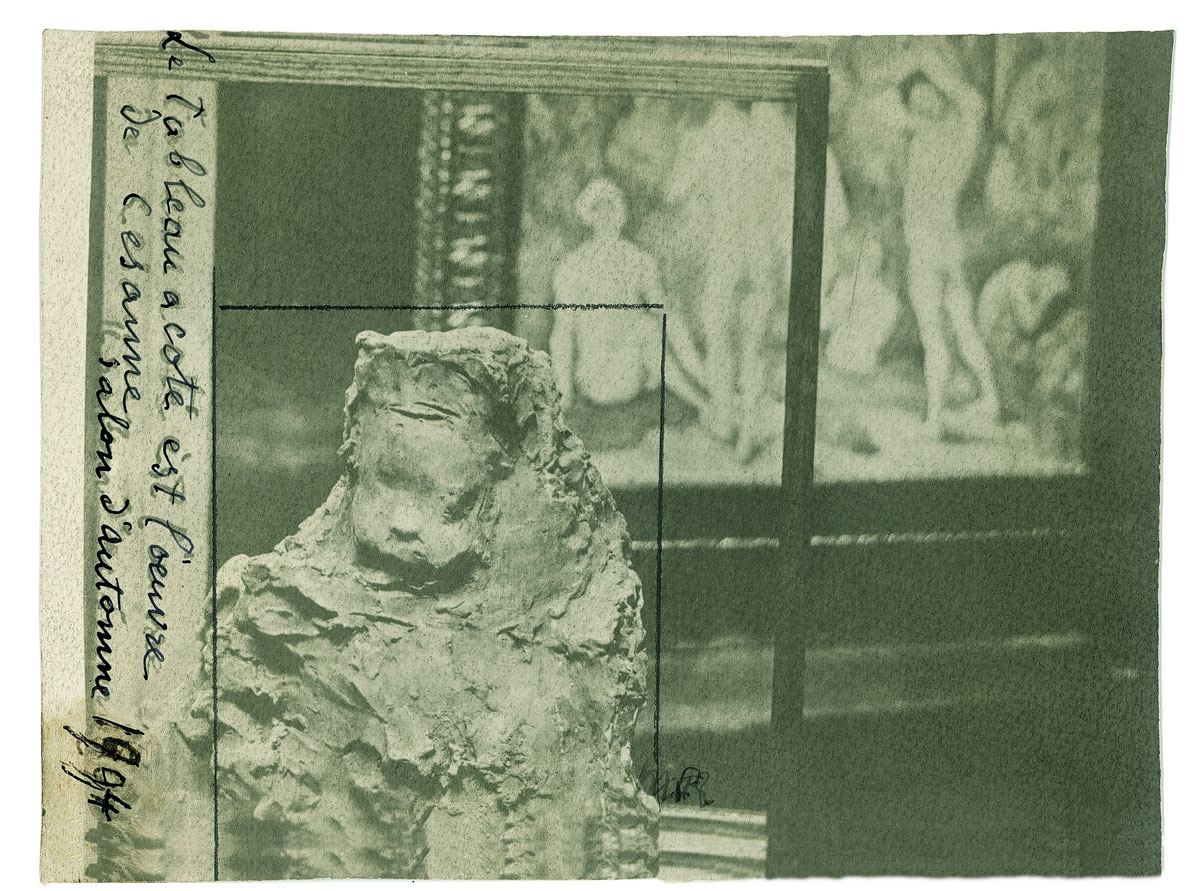
Medardo Rosso (Italian, 1858-1928) ''Enfant à la Bouchée de pain' in the Cézanne room at the Salon d'Automne' 1904


Medardo Rosso (Italian, 1858-1928)
Enfant à la Bouchée de pain in the Cézanne room at the Salon d’Automne
1904
Felatin silver print
12.3 x 15.5cm
Private collection


The Italian sculptor Medardo Rosso (1858-1928) is the oldest and most traditional of the three artists. He stands in the Impressionist tradition of French sculptor August Rodin. Rosso has made many portraits of children, which he adored. They were one of his favourite subjects. Rosso kept working on the same pieces throughout his career, making changes to their titles, shapes or materials. Sometimes he combined materials or poured another substance over the original. A work of plaster then became a wax sculpture. Other times he made two different versions of the same image, using different materials…

Rosso… used his camera to present his art in the way he preferred. By taking pictures and displaying them next to the actual sculptures he could show the audience what was, in his opinion, the right angle to look at his piece. Of course, everyone is free to walk around the sculpture, but the photographs show what the artist had in mind when he created it. Many times he would cut up his pictures, tear away corners or colour them with ink. This way he even reinterpreted his interpretations. Together the sculptures, photographs and collages give a complete picture of the work by Medardo Rosso. Never before have there been so many of his works on display in the Netherlands.

Text by Evita Bookelmann on the Kunstpedia website [Online] Cited 05/05/2014. No longer available online


Constantin Brancusi (Romanian, 1876-1957) 'Tête d’enfant endormi' (Head of a Sleeping Child) 1906-1907


Constantin Brancusi (Romanian, 1876-1957)
Tête d’enfant endormi (Head of a Sleeping Child)
1906-1907
Plaster, coloured dark brown
10.8 x 13.6 x 15.2cm
Private collection


A previously unknown sculpture by Constantin Brancusi (1876-1957) can be seen in Brancusi, Rosso, Man Ray – Framing Sculpture, the exhibition opening at Museum Boijmans Van Beuningen on Saturday. The museum is especially delighted by the arrival of Tête d’enfant endormie (Head of a Sleeping Child, 1906-07). This early sculpture is an important key work in Brancusi’s development of his famous ‘ovoid’.

The exhibition, which features more than forty sculptures by Constantin Brancusi, Medardo Rosso and Man Ray and a hundred vintage photographs taken by them, runs in Museum Boijmans Van Beuningen for three months from 8 February. The plaster sculpture was purchased at a sale by a French private collector. Leading expert Friedrich Teja Bach has recently confirmed that it is a version of the ‘head of a sleeping child’. Curators Francesco Stocchi and Peter van der Coelen remarked, “It is unusual for a previously unknown work by Brancusi to turn up at a sale. Works by Brancusi are rare and almost all of them are in prominent museum collections like those of the Centre Pompidou, the Tate and MoMA.”

The Road to Abstraction

The child’s head with natural features is in the tradition of the contemporary Impressionists Auguste Rodin and Medardo Rosso. At the same time, this early work is a starting point in Brancusi’s journey towards a more abstract style, which culminated in an entirely smooth oval form, devoid of any facial features. This process can also be seen in the photographs taken by Brancusi himself, in which he pictured Tête d’enfant endormie in his studio with Le Nouveau-Ne II, a work he made ten years later. The exhibition in Rotterdam examines the artistic practices and development of Brancusi, Rosso and Man Ray by showing the sculptures alongside the photographs they took of them.

Painted Bronze

Brancusi’s oeuvre contains a number of recurring subjects, which the artist executed in a variety of materials, including plaster, marble and bronze. This allowed Brancusi to explore various effects, such as the reflection of light. The signed Tête d’enfant endormie is an early version in the series. It is unusual that Brancusi painted the plaster, making it look like bronze.

Press release from the Museum Boijmans Van Beuningen


Constantin Brancusi (Romanian, 1876-1957) 'La Muse endormie' (Sleeping muse) 1910


Constantin Brancusi (Romanian, 1876-1957)
La Muse endormie (Sleeping muse)
1910
Bronze
16.1 x 27.7 x 19.3cm
Arthur Jerome Eddy Memorial Collection. The Art Institute of Chicago
© 2013 c/o Pictoright Amsterdam


Man Ray (American, 1890-1976) 'Noire et blanche (Black and white)' 1926


Man Ray (American, 1890-1976)
Noire et blanche (Black and white)
1926
Gelatin silver print
18 x 23.5cm
© Man Ray Trust / ADAGP – PICTORIGHT / Telimage – 2013


Man Ray’s Noire et blanche is a photograph exemplary of Surrealist art. The striking faces of the pale model and the dark mask have a doubling effect. This repetition is a reminder that a photograph is a double of what it represents, namely, a sign or an index of reality. In Surrealism the act of doubling indicates that we are all divided subjects made up of the conscious and unconscious. In reading this photograph as typical of primitivism, the woman can be understood as European civilisation and the mask as “primitive” Africa. The image draws a parallel between the two faces presenting them as related to each another. The title “black and white” is a word play because the order is reversed when reading the image left to right. The artist also printed a negative version of this image. The photograph was first published in Vogue. It is a portrait of Kiki of Montparnasse, Man Ray’s lover and model at the time the photograph was taken.
Text from the Stedelijk Museum Amsterdam website [Online] Cited 05/05/2014. No longer available online


Medardo Rosso (Italian, 1858-1928) 'Enfant malade (Ziek kind)' c. 1909


Medardo Rosso (Italian, 1858-1928)
Enfant malade (Ziek kind)
c. 1909
Aristotype
7.9 x 6.3cm
Private collection


Medardo Rosso (Italian, 1858-1928) 'Enfant malade (Ziek kind) 1895 (1903-1904)


Medardo Rosso (Italian, 1858-1928)
Enfant malade (Ziek kind)
1895 (1903-1904)
Bronze
25.5 x 14.5 x 16.5cm
Collectie Galleria d’Arte Moderna, Milan


Medardo Rosso (Italian, 1858-1928) 'Madame X' 1896


Medardo Rosso (Italian, 1858-1928)
Madame X
1896
Wax
300mm
Venice, Ca’ Pesaro


Con una coerenza assoluta, insensibile alle polemiche e alle controversie che la sua arte suscitava, e più ancora al disprezzo oltraggioso di cui lo faceva segno la cultura ufficiale, il Rosso deduceva alle estreme conseguenze le premesse fondamentali della sua visione. Davanti ai nostri occhi una sgomentante superficie d’ombra da cui emerge la lama trepida e vibrante di un essere vivente, che contesta al nulla misterioso che lo incalza e in cui in un soffio si dissolverà, il suo diritto alla luce, cioè all’essenza vitale. Le premesse letterarie, le suggestioni filosofiche o vagamente esoteriche sono totalmente assorbite nella suprema qualità stilistica: lo scultore modula ed assottiglia la materia al limite del possibile, sull’orlo dell’astrazione assoluta, ricercandone spasmodicamente ogni vibrazione musicale; l’equazione scultura-luce-pittura poteva dirsi verificata.”

“With absolute consistency, insensitive to the controversies and disputes that his art aroused, and even more outrageous contempt of which he did hold official culture, Rosso deduced to the extreme the basic premises of his vision. Before our eyes a daunting shadow surface which shows the blade trembling and vibrating of a living being, which criticises the mysterious anything that presses him and when you blow in a dissolver, its right in the light, that all ‘vital’ essence. The premises literary, philosophical or vaguely esoteric suggestions are totally absorbed in the supreme quality of style: the sculptor modulation and tapering the matter to the extent possible, the absolute brink of abstraction, seeking spasmodically every musical vibration; the equation of light-sculpture-painting could be said to be verified.

Terrible translation by Google translate of an anonymous text = but so beautiful at the same time!


Constantin Brancusi (Romanian, 1876-1957) 'Princesse X' (Princess X) c. 1930


Constantin Brancusi (Romanian, 1876-1957)
Princesse X (Princess X)
c. 1930
Gelatin silver print
29.7 x 23.7cm
Collection Centre Pompidou, MNAM-CCI, Paris
© 2013 c/o Pictoright Amsterdam
Photo: Bertrand Prévost


Constantin Brancusi (Romanian, 1876-1957) 'Princesse X (Princess X)' 1915-1916


Constantin Brancusi (Romanian, 1876-1957)
Princesse X (Princess X)
1915-1916
Bronze
61.7 x 40.5 x 22.2cm
Collection Centre Pompidou, MNAM-CCI, Paris
© 2013 c/o Pictoright Amsterdam
Photo: Adam Rzepka


Princess X is a sculptured rendering of the French princess, Marie Bonaparte, by the artist Constantin Brâncusi. Princess Bonaparte was the great-grand niece of the emperor Napoleon Bonaparte…

According to the Philadelphia Museum of Art, Brâncusi had been “at the center of two of modern arts most notorious scandals.” One of the scandals being that the Salon des Indépendants, in Paris where Brâncusi practiced his trade, discontinued the display of Princess X from its establishment for its apparent obscene content, as some thought it looked like a penis. After having his art taken off display, Brâncusi was shocked. He declared the incident a misunderstanding. He had created Princess X not as a sculpture depicting a more masculine subject, but the object of feminine desire and vanity.

After much accusation, Brâncuși insisted the sculpture had been his rendition of Marie Bonaparte. Brâncusi discussed the comparison of the bronze figure to the princess. He described his detest of Marie, as a “vain woman.” He claimed she went as far as placing a hand mirror on the table at mealtimes, so she could gaze upon herself. The sculpture’s C-like form reveals a woman looking over and gazing down, as if looking into an object. The large anchors of the sculpture resemble the “beautiful bust” which she possessed. Without knowing the context, to a viewer Princess X could look like an erect penis. Brâncusi allows the princess to gaze upon herself in an eternal loop locked in the bronze sculpture.

The style of Brâncusi is one that “was largely fuelled by myths, folklore, and primitive culture,” this combined with the modern materials and tools Brâncuși used to sculpt, “formed a unique contrast… resulting in a distinctive kind of modernity and timelessness.” The technique Brâncusi was known for and used on Princess X could be mistaken for a penis, but in fact it was the simple form of a woman.

“What my art is aiming at, is above all realism; pursue the inner hidden reality, the very essence of objects in their own intrinsic fundamental nature: this is my only preoccupation.” – Constantine Brâncusi.

Text from the Wikipedia website


Constantin Brancusi (Romanian, 1876-1957) 'View of the Studio with Maïastra' 1917


Constantin Brancusi (Romanian, 1876-1957)
View of the Studio with Maïastra
1917
Gelatin silver print
23.9 x 17.8cm
Collection Centre Pompidou, MNAM-CCI, Paris
© 2013 c/o Pictoright Amsterdam


According to Constantin Brancusi’s own testimony, his preoccupation with the image of the bird as a plastic form began as early as 1910. With the theme of the Maiastra (1910-18), he initiated a series of about thirty sculptures of birds.

The word maïastra means “master” or “chief” in Brancusi’s native Romanian, but the title refers specifically to a magically beneficent, dazzlingly plumed bird in Romanian folklore. Brancusi’s mystical inclinations and his deeply rooted interest in peasant superstition make the motif an apt one. The golden plumage of the Maiastra is expressed in the reflective surface of the bronze; the bird’s restorative song seems to issue from within the monumental puffed chest, through the arched neck, out of the open beak. The heraldic, geometric aspect of the figure contrasts with details such as the inconsistent size of the eyes, the distortion of the beak aperture, and the cocking of the head slightly to one side. The elevation of the bird on a saw-tooth base lends it the illusion of perching. The subtle tapering of form, the relationship of curved to hard-edge surfaces, and the changes of axis tune the sculpture so finely that the slightest alteration from version to version reflects a crucial decision in Brancusi’s development of the theme.

Seven other versions of Maiastra have been identified and located: three are marble and four bronze…

Extract from Lucy Flint. “Constantin Brancusi: Maiastra,” on the Guggenheim website [Online] Cited 17/03/2021


Constantin Brancusi (Romanian, 1876-1957) 'Self-portrait in the studio' c. 1934


Constantin Brancusi (Romanian, 1876-1957)
Self-portrait in the studio
c. 1934
Gelatin silver print
39.7 x 29.7cm
Collection Centre Pompidou, MNAM-CCI, Paris
© 2013 c/o Pictoright Amsterdam
Photo: Philippe Migeat


Man Ray (American, 1890-1976) 'Rayographie' (Rayograph) 1925


Man Ray (American, 1890-1976)
Rayographie (Rayograph)
1925
Photogram
50 x 40.5cm
Collection Museum Boijmans Van Beuningen
© Man Ray Trust / ADAGP, c/o Pictoright Amsterdam 2013


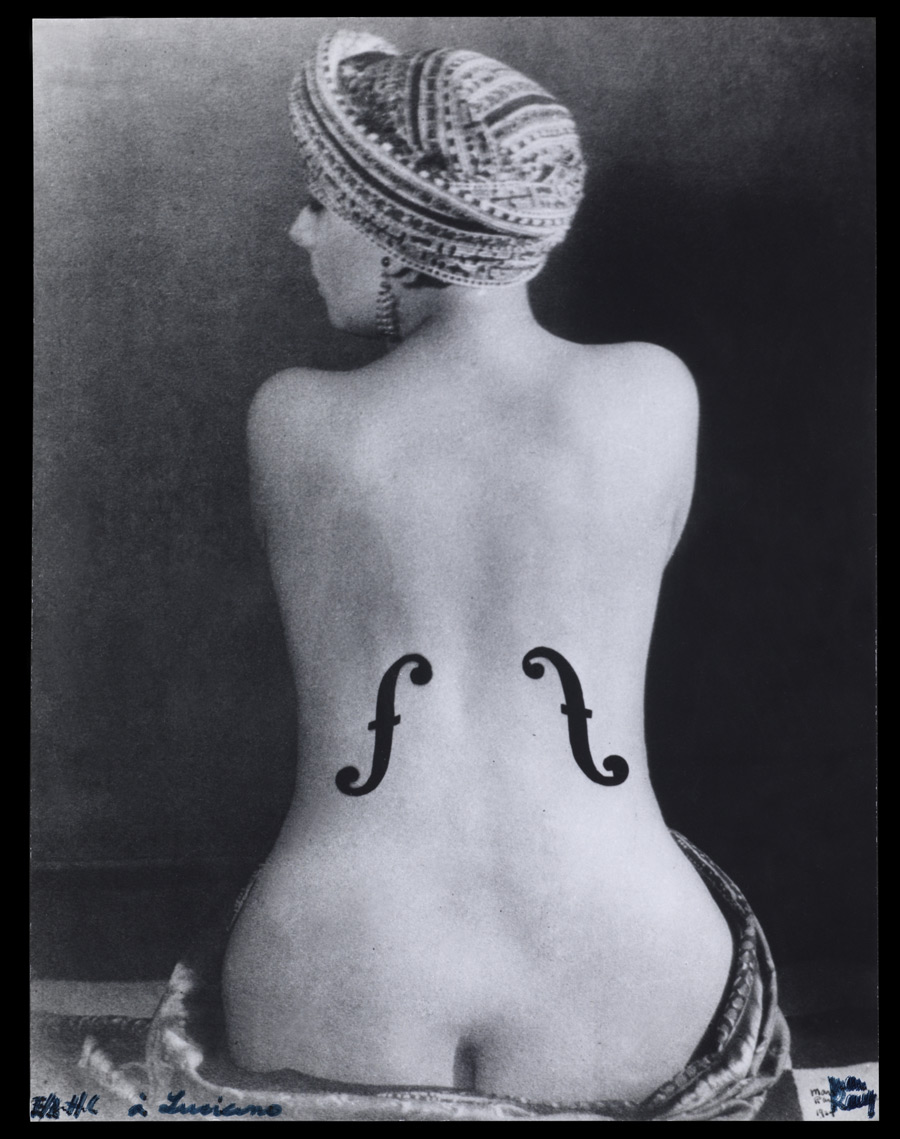
Man Ray (American, 1890-1976) 'Le Violon d'Ingres' (Ingres's Violin or The Hobby) 1924


Man Ray (American, 1890-1976)
Le Violon d’Ingres (Ingres’s Violin or The Hobby)
1924
Gelatine silver print
17.2 x 22.4cm
Private collection Turin
© Man Ray Trust / ADAGP, c/o Pictoright Amsterdam 2013


Man Ray (American, 1890-1976) 'Self-portrait with the lamp' 1934


Man Ray (American, 1890-1976)
Self-portrait with the lamp
1934
Gelatin silver print
10. 8 x 8cm
© Man Ray Trust / ADAGP, c/o Pictoright Amsterdam 2013


Medardo Rosso (Italian, 1858-1928) 'Self-portrait in the studio' c. 1906


Medardo Rosso (Italian, 1858-1928)
Self-portrait in the studio
c. 1906
Modern contact print of the original glass negative
12.7 x 13cm
Private collection


'Brancusi, Rosso, Man Ray - Framing Sculpture' exhibition poster


Brancusi, Rosso, Man Ray – Framing Sculpture exhibition poster

Constantin Brancusi, La Muse endormie, 1910. Arthur Jerome Eddy Memorial Collection. The Art Institute of Chicago. © 2013 c/o Pictoright Amsterdam /
Medardo Rosso, Enfant malade, c. 1909. Private collection / Man Ray, Noire et blanche, 1926
© Man Ray Trust / ADAGP – PICTORIGHT / Telimage – 2013
Design: Thonik.


Museum Boijmans Van Beuningen
Museumpark 18-20
3015 CX Rotterdam
The Netherlands
Phone: +31 (0)10 44.19.400

Opening hours:
Tuesdays to Sundays, 11am – 5pm

Museum Boijmans Van Beuningen website

LIKE ART BLART ON FACEBOOK

Back to top

Exhibition: ‘Flesh and Metal: Body and Machine in Early 20th­-Century Art’ at the Cantor Arts Center at Stanford University

Exhibition dates: 13th November 2013 – 16th March 2014

Featured artists include Margaret Bourke-White, Constantin Brancusi, Giorgio de Chirico, Salvador Dalí, Marcel Duchamp, Germaine Krull, Fernand Léger, Wyndham Lewis, László Moholy-Nagy, Piet Mondrian, Man Ray, Alexander Rodchenko, and Charles Sheeler, among others.


Many thankx to the San Francisco Museum of Modern Art (SFMOMA) and the Cantor Arts Center at Stanford University for allowing me to publish the art work in the posting. Please click on the art work for a larger version of the image.


Man Ray (American, 1890-1976) 'Untitled (Rayograph)' 1922


Man Ray (American, 1890-1976)
Untitled (Rayograph)
1922
Gelatin silver print
11 15/16 x 9 3/8 in. (30.32 x 23.81cm)
Collection SFMOMA, purchase
© Man Ray Trust / Artists Rights Society (ARS), New York / ADAGP, Paris


“I am young, I am twenty years old; yet I know nothing of life but despair, death, fear, and fatuous superficiality cast over an abyss of sorrow. I see how peoples are set against one another, and in silence, unknowingly, foolishly, obediently, innocently slay one another. I see that the keenest brains of the world invent weapons and words to make it yet more refined and enduring. And all men of my age, here and over there, throughout the whole world see these things; all my generation is experiencing these things with me. What would our fathers do if we suddenly stood up and came before them and proffered our account? What do they expect of us if a time ever comes when the war is over? Through the years our business has been killing; – it was our first calling in life. Our knowledge of life is limited to death. What will happen afterwards? And what shall come out of us?”

Erich Maria Remarque. All Quiet on the Western Front, 1929


Germaine Krull (European, 1897-1985) 'Portrait of Joris Ivens, Amsterdam' c. 1928


Germaine Krull (European, 1897-1985)
Portrait of Joris Ivens, Amsterdam
c. 1928
Gelatin silver print
7 3/8 x 6 1/4 in. (18.77 x 15.88cm)
Collection SFMOMA, gift of Simon Lowinsky
© Germaine Krull Estate


Germaine Krull (29 November 1897 – 31 July 1985), was a photographer, political activist, and hotel owner. Her nationality has been categorised as German, Polish, French, and Dutch, but she spent years in Brazil, Republic of the Congo, Thailand, and India. Described as “an especially outspoken example” of a group of early 20th-century female photographers who “could lead lives free from convention”, she is best known for photographically-illustrated books such as her 1928 portfolio Métal...

Having met Dutch filmmaker and communist Joris Ivens in 1923, she moved to Amsterdam in 1925. After Krull returned to Paris in 1926, Ivens and Krull entered into a marriage of convenience between 1927 and 1943 so that Krull could hold a Dutch passport and could have a “veneer of married respectability without sacrificing her autonomy.”

In Paris between 1926 and 1928, Krull became friends with Sonia Delaunay, Robert DelaunayEli LotarAndré MalrauxColetteJean CocteauAndré Gide and others; her commercial work consisted of fashion photography, nudes, and portraits. During this period she published the portfolio Métal (1928) which concerned “the essentially masculine subject of the industrial landscape.” Krull shot the portfolio’s 64 black-and-white photographs in Paris, Marseille, and Holland during approximately the same period as Ivens was creating his film De Brug (“The Bridge”) in Rotterdam, and the two artists may have influenced each other. The portfolio’s subjects range from bridges, buildings and ships to bicycle wheels; it can be read as either a celebration of machines or a criticism of them. Many of the photographs were taken from dramatic angles, and overall the work has been compared to that of László Moholy-Nagy and Alexander Rodchenko. In 1999-2004 the portfolio was selected as one of the most important photobooks in history.

By 1928 Krull was considered one of the best photographers in Paris, along with André Kertész and Man Ray. Between 1928 and 1933, her photographic work consisted primarily of photojournalism, such as her photographs for Vu, a French magazine. Also in the early 1930s, she also made a pioneering study of employment black spots in Britain for Weekly Illustrated (most of her ground-breaking reportage work from this period remains immured in press archives and she has never received the credit which is her due for this work). Her book Études de Nu (“Studies of Nudes”) published in 1930 is still well-known today.

Text from the Wikipedia website


El Lissitzky (Russian, 1890-1941) 'Untitled' c. 1923


El Lissitzky (Russian, 1890-1941)
Untitled
c. 1923
Gelatin silver print
9 1/2 x 7 1/4 in. (24.13 x 18.42cm)
Collection SFMOMA, gift of anonymous donors
© Estate of El Lissitzky / Artists Rights Society (ARS), New York / VG Bild-Kunst, Bonn


Lazar Markovich Lissitzky (November 23, 1890 – December 30, 1941), better known as El Lissitzky, was a Russian artist, designer, photographer, typographer, polemicist and architect. He was an important figure of the Russian avant garde, helping develop suprematism with his mentor, Kazimir Malevich, and designing numerous exhibition displays and propaganda works for the Soviet Union. His work greatly influenced the Bauhaus and constructivist movements, and he experimented with production techniques and stylistic devices that would go on to dominate 20th-century graphic design.

Lissitzky’s entire career was laced with the belief that the artist could be an agent for change, later summarised with his edict, “das zielbewußte Schaffen” (goal-oriented creation). Lissitzky, of Jewish origin, began his career illustrating Yiddish children’s books in an effort to promote Jewish culture in Russia, a country that was undergoing massive change at the time and that had just repealed its antisemitic laws. When only 15 he started teaching; a duty he would stay with for most of his life. Over the years, he taught in a variety of positions, schools, and artistic media, spreading and exchanging ideas. He took this ethic with him when he worked with Malevich in heading the suprematist art groupUNOVIS, when he developed a variant suprematist series of his own, Proun, and further still in 1921, when he took up a job as the Russian cultural ambassador to Weimar Germany, working with and influencing important figures of the Bauhaus and De Stijl movements during his stay. In his remaining years he brought significant innovation and change to typography, exhibition design, photomontage, and book design, producing critically respected works and winning international acclaim for his exhibition design. This continued until his deathbed, where in 1941 he produced one of his last works – a Soviet propaganda poster rallying the people to construct more tanks for the fight against Nazi Germany. In 2014, the heirs of the artist, in collaboration with Van abbemuseum and the leading worldwide scholars, the Lissitzky foundation was established, to preserve the artist’s legacy and prepare a catalogue raisonné of the artists oeuvre.

Text from the Wikipedia website


Alexander Rodchenko (Russian, 1891-1956) 'Pozharnaia lestnitsa' from the series 'Dom na Miasnitskoi' (Fire Escape, from the series House Building on Miasnitskaia Street) 1925


Alexander Rodchenko (Russian, 1891-1956)
Pozharnaia lestnitsa from the series Dom na Miasnitskoi (Fire Escape, from the series House Building on Miasnitskaia Street)
1925
Gelatin silver print
9 x 6 in. (22.86 x 15.24cm)
Collection SFMOMA, Accessions Committee Fund: gift of Frances and John Bowes, Evelyn Haas, Mimi and Peter Haas, Pam and Dick Kramlich, and Judy and John Webb
© Estate of Alexander Rodchenko / RAO, Moscow / VAGA, New York


Raoul Ubac (French, 1910-1985) 'Penthésilée' 1937


Raoul Ubac (French, 1910-1985)
Penthésilée
1937
Gelatin silver print
15 1/2 x 11 1/4 in. (39.37 x 28.58cm)
Collection SFMOMA, gift of Robert Miller
© Artists Rights Society (ARS), New York / ADAGP, Paris


Raoul Ubac (31 August 1910, Cologne – 24 March 1985, Dieudonne, Oise) was a French painter, sculptor, photographer and engraver. Ubac’s mother’s family ran a tannery and his father was a magistrate. In his early years he traveled through some parts of Europe on foot. He originally intended to become a waterways and forestry inspector. His interest in art was aroused when he made his first visit to Paris in 1928 and met several artists, including Otto Freundlich.

After returning to Malmédy he read the Manifeste du Surréalisme (1924) by André Breton. He met that document’s author André Breton and other leading Surrealists in 1930, and dedicated himself to capturing the movement’s dream aesthetic in photography after settling in Paris, attending the first showing of Luis Buñuel’s film L’Age d’or (1931). He attended the Faculté des Lettres of the Sorbonne briefly but soon left to frequent the studios of Montparnasse. About 1933-34 he attended the Ecole des Arts Appliqués for more than a year, studying mainly drawing and photography. In the course of a visit to Austria and the Dalmatian coast in 1933, he visited the island of Hvar where he made some assemblages of stones, which he drew and photographed, for example Dalmatian Stone (1933). Disillusioned with Surrealism, Ubac abandoned photography after the Second World War in favour of painting and sculpture, and died in France in 1985.

Text from various sources


Co-organised by the San Francisco Museum of Modern Art (SFMOMA) and the Cantor Arts Center at Stanford University, Flesh and Metal: Body and Machine in Early 20th­-Century Art presents more than 70 artworks that explore a central dynamic of art making in Europe and the Americas between the 1910s and the early 1950s. On view from November 13, 2013 to March 16, 2014 at the Cantor Arts Center, the exhibition includes a rich group of paintings, sculptures, photographs, drawings, prints, and illustrated books from the collection of SFMOMA. Taken together, the works offer a fresh view of how artists negotiated the terrain between the mechanical and the bodily – two oppositional yet inextricably bound forces – to produce a wide range of imagery responding to the complexity of modern experience.

The exhibition is part of the collaborative museum shows and extensive off-site programming presented by SFMOMA while its building is temporarily closed for expansion construction. From the summer of 2013 to early 2016, SFMOMA is on the go, presenting a dynamic slate of jointly organised and traveling exhibitions, public art displays and site-specific installations, and newly created education programs throughout the Bay Area.

“We are thrilled to pair SFMOMA’s world-class collection with Stanford’s renowned academic resources,” said Connie Wolf, the John and Jill Freidenrich Director of the Cantor Arts Center. “Cantor curators and the distinguished chair of the Department of Art and Art History guided seminars specifically for this exhibition, with students examining art of the period, investigating themes, studying design and display issues, and developing writing skills. The students gained immeasurably by this amazing experience and added new research and fresh perspectives to the artwork and to the exhibition. We are proud of the results and delighted to present a unique and invaluable partnership that will enrich the Stanford community, our museum members, and our visitors.”

SFMOMA’s Curator of Photography Corey Keller concurred: “The opportunity to work with our colleagues at Stanford has been a remarkable experience both in the galleries and in the classroom. We couldn’t be prouder of the exhibition’s unique perspective on a particularly rich area of SFMOMA’s collection that resulted from our collaboration.”

Exhibition overview

The exhibition is organised into four thematic sections dealing with the human figure, the imagination, the urban landscape, and the object, which together reveal a range of artists’ responses to the conditions of modernity. At the beginning of the 20th century, many hailed the machine as a symbol of progress. “Speed” and “efficiency” entered the vocabularies of art movements such as Futurism (in Italy), Purism (in France), Vorticism (in England), and Constructivism (in Russia), all of which adapted the subject matter and formal characteristics of the machine. Factories and labourers were presented positively as emblems of modernity, and mechanisation became synonymous with mobility and the possibility of social improvement. Countering this utopian position were proponents of the Dada and Surrealist movements (based largely in Germany and France), who found mechanical production problematic. For many of these artists who had lived through the chaos and destruction of World War I, the machine was perceived as a threat not only to the body, but to the uniquely human qualities of the mind as well. These artists embraced chance, accident, dream, and desire as new paths to freedom and creativity, in contrast to their counterparts who maintained their faith in an industrially enhanced future.

Though art from the first half of the 20th century is often viewed as representing an opposition between the rational, impersonal world of the machine and the uncontrollable, often troubling realm of the human psyche, the work in this exhibition suggests a more nuanced tension. In fact, artists regularly perceived these polarities in tandem. The codes of the bodily and the industrial coalesce in Fernand Léger’s machine aesthetic, on view in his 1927 painting Two Women on a Blue Backgound and an untitled collage from 1925. For his “rayographs,” Man Ray made use of mass-produced objects, but deployed them in a lyrical and imaginative manner – placing them on photosensitised paper and exposing it to light. Constantin Brancusi’s The Blond Negress (1927) and Jacques Lipchitz’s Draped Woman (1919) update the tradition of the cast bronze figure by introducing impersonal geometries. And even the seemingly formulaic surfaces of Piet Mondrian’s abstract paintings eventually reveal the artist’s sensitive hand.”

Press release from SFMOMA and the Cantor Arts Center


Hans Bellmer (German, 1902-1975) 'La mitrailleuse en état de grâce' (The Machine Gun[neress] in a State of Grace) 1937


Hans Bellmer (German, 1902-1975)
La mitrailleuse en état de grâce (The Machine Gun[neress] in a State of Grace)
1937
Gelatin silver print with oil and watercolour
26 x 26 in. (66.04 x 66.04cm)
Collection SFMOMA, gift of Foto Forum
© Artists Rights Society (ARS), New York / ADAGP, Paris


Hans Bellmer (13 March 1902 – 23 February 1975) was a German artist, best known for the life sized pubescent female dolls he produced in the mid-1930s. Historians of art and photography also consider him a Surrealist photographer.

Bellmer was born in the city of Kattowitz, then part of the German Empire (now Katowice, Poland). Up until 1926, he’d been working as a draftsman for his own advertising company. He initiated his doll project to oppose the fascism of the Nazi Party by declaring that he would make no work that would support the new German state. Represented by mutated forms and unconventional poses, his dolls were directed specifically at the cult of the perfect body then prominent in Germany. Bellmer was influenced in his choice of art form by reading the published letters of Oskar Kokoschka (Der Fetisch, 1925).

Bellmer’s doll project is also said to have been catalysed by a series of events in his personal life. Hans Bellmer takes credit for provoking a physical crisis in his father and brings his own artistic creativity into association with childhood insubordination and resentment toward a severe and humourless paternal authority. Perhaps this is one reason for the nearly universal, unquestioning acceptance in the literature of Bellmer’s promotion of his art as a struggle against his father, the police, and ultimately, fascism and the state. Events of his personal life also including meeting a beautiful teenage cousin in 1932 (and perhaps other unattainable beauties), attending a performance of Jacques Offenbach’s Tales of Hoffmann (in which a man falls tragically in love with an automaton), and receiving a box of his old toys. After these events, he began to actually construct his first dolls. In his works, Bellmer explicitly sexualised the doll as a young girl. The dolls incorporated the principle of “ball joint”, which was inspired by a pair of sixteenth-century articulated wooden dolls in the Kaiser Friedrich Museum.

Bellmer produced the first doll in Berlin in 1933. Long since lost, the assemblage can nevertheless be correctly described thanks to approximately two dozen photographs Bellmer took at the time of its construction. Standing about fifty-six inches tall, the doll consisted of a modelled torso made of flax fibre, glue, and plaster; a mask-like head of the same material with glass eyes and a long, unkempt wig; and a pair of legs made from broomsticks or dowel rods. One of these legs terminated in a wooden, club-like foot; the other was encased in a more naturalistic plaster shell, jointed at the knee and ankle. As the project progressed, Bellmer made a second set of hollow plaster legs, with wooden ball joints for the doll’s hips and knees. There were no arms to the first sculpture, but Bellmer did fashion or find a single wooden hand, which appears among the assortment of doll parts the artist documented in an untitled photograph of 1934, as well as in several photographs of later work.

Bellmer’s 1934 anonymous book, The Doll (Die Puppe), produced and published privately in Germany, contains 10 black-and-white photographs of Bellmer’s first doll arranged in a series of “tableaux vivants” (living pictures). The book was not credited to him, as he worked in isolation, and his photographs remained almost unknown in Germany. Yet Bellmer’s work was eventually declared “degenerate” by the Nazi Party, and he was forced to flee Germany to France in 1938. Bellmer’s work was welcomed in the Parisian art culture of the time, especially the Surrealists around André Breton, because of the references to female beauty and the sexualization of the youthful form. His photographs were published in the Surrealist journal Minotaure, 5 December 1934 under the title “Poupée, variations sur le montage d’une mineure articulée” (The Doll, Variations on the Assemblage of an Articulated Minor).

He aided the French Resistance during the war by making fake passports. He was imprisoned in the Camp des Milles prison at Aix-en-Provence, a brickworks camp for German nationals, from September 1939 until the end of the Phoney War in May 1940. After the war, Bellmer lived the rest of his life in Paris. Bellmer gave up doll-making and spent the following decades creating erotic drawings, etchings, sexually explicit photographs, paintings, and prints of pubescent girls… Of his own work, Bellmer said, “What is at stake here is a totally new unity of form, meaning and feeling: language-images that cannot simply be thought up or written up … They constitute new, multifaceted objects, resembling polyplanes made of mirrors … As if the illogical was relaxation, as if laughter was permitted while thinking, as if error was a way and chance, a proof of eternity.

Text from the Wikipedia website


Salvador Dalí (Spanish, 1904-1989) 'Objet Surréaliste à fonctionnement symbolique - le soulier de Gala' (Surrealist object that functions symbolically - Gala's Shoe) 1932/1975


Salvador Dalí (Spanish, 1904-1989)
Objet Surréaliste à fonctionnement symbolique – le soulier de Gala (Surrealist object that functions symbolically – Gala’s Shoe)
1932/1975
Shoe, marble, photographs, clay, and mixed media
48 x 28 x 14 in. (121.92 x 71.12 x 35.56 cm)
Collection SFMOMA, purchase, by exchange, through a gift of Norah and Norman Stone
© Salvador Dalí, Gala-Salvador Dalí Foundation / Artists Rights Society (ARS), New York


Marcel Jean (French, 1900-1993) 'Le Spectre du Gardenia' (The Specter of the Gardenia) 1936/1972


Marcel Jean (French, 1900-1993)
Le Spectre du Gardenia (The Specter of the Gardenia)
1936/1972
Wool powder over plaster, zippers, celluloid film, and suede over wood
13 1/2 x 7 x 9 in. (34.29 x 17.78 x 22.86 cm)
Collection SFMOMA
Purchase through a gift of Dr. and Mrs. Allan Roos
© Artists Rights Society (ARS), New York / ADAGP, Paris


With zippers for eyes and a filmstrip collar around its neck, this figure composes an anxious portrait, but its tactile surface of black cloth, faded red velvet, and zippers is charged with the eroticism of imagined touch. Jean originally called this work Secret of the Gardenia after an old movie reel he discovered, along with the velvet stand, at a Paris flea market. As the artist later recalled, Surrealism’s leader André Breton “always pressed his friends to center their interest on Surrealist objects,” and “he made a certain number himself.” Chance discoveries like the movie reel and velvet stand that inspired this work provided a trove of uncanny items for Surrealists to include, combine, and transform in their works.

Text from the MoMA website [Online] Cited 01/03/2014


Max Ernst (German, 1891-1976) 'La famille nombreuse' (The Numerous Family) 1926


Max Ernst (German, 1891-1976)
La famille nombreuse (The Numerous Family)
1926
Oil on canvas
32 1/8 x 25 5/8 in. (81.61 x 65.1cm)
Collection SFMOMA, gift of Peggy Guggenheim
© Artists Rights Society (ARS), New York / ADAGP, Paris


Giorgio de Chirico (Italian, 1888-1978) 'Les contrariétés du penseur' (The Vexations of the Thinker) 1915


Giorgio de Chirico (Italian, 1888-1978)
Les contrariétés du penseur (The Vexations of the Thinker)
1915
Oil on canvas
18 1/4 x 15 in. (46.36 x 38.1cm)
Collection SFMOMA, Templeton Crocker Fund purchase
© 2013 Artists Rights Society (ARS), New York / SIAE, Rome


Fernand Léger (French, 1881-1955) 'Deux femmes sur fond bleu' (Two Women on a Blue Background) 1927


Fernand Léger (French, 1881-1955)
Deux femmes sur fond bleu (Two Women on a Blue Background)
1927
Oil on canvas
36 1/2 x 23 5/8 in. (92.71 x 59.94cm)
Collection SFMOMA, fractional gift of Helen and Charles Schwab
© Artists Rights Society (ARS), New York / ADAGP, Paris


Constantin Brancusi (Romanian, 1876-1957) 'La Négresse blonde' (The Blond Negress) 1926


Constantin Brancusi (Romanian, 1876-1957)
La Négresse blonde (The Blond Negress)
1926
Bronze with marble and limestone base
70 3/4 x 10 3/4 x 10 3/4 in. (179.71 x 27.31 x 27.31 cm)
Collection SFMOMA, gift of Agnes E. Meyer and Elise S. Haas
© Artists Rights Society (ARS), New York / ADAGP, Paris


Cantor Arts Center at Stanford University
328 Lomita Drive at Museum Way
Stanford, CA 94305-5060
Phone: 650-723-4177

Opening hours:
Wednesday – Sunday 11am – 5pm
Closed Monday and Tuesday

Cantor Arts Center at Stanford University website

LIKE ART BLART ON FACEBOOK

Back to top

Exhibition: ‘Erwin Blumenfeld (1897-1969) Photographs, drawings and photomontages’ at Jeu de Paume, Paris

Exhibition dates: 15th October 2013 – 26th January 2014


Erwin Blumenfeld (American-German, 1897-1969) 'Grauenfresse / Hitler, Holland, 1933' 1933


Erwin Blumenfeld (American-German, 1897-1969)
Grauenfresse / Hitler, Holland, 1933
1933
Collage and ink on photomontage (gelatin silver print, double-exposition). Printed later
Collection Helaine and Yorick Blumenfeld, Courtesy of Modernism Inc., San Francisco
© The Estate of Erwin Blumenfeld


Considering the nature of Blumenfeld’s collages such as Grauenfresse / Hitler, Holland, 1933 and Minotaur / Dictator I would say that the artist was very, very lucky to escape to America in 1941. Let us remember all those that were not so fortunate…

Marcus


Many thankx to Jeu de Paume for allowing me to publish the photographs in the posting. Please click on the photographs for a larger version of the image.


“In 1940 Blumenfeld was interned as a German Jew in France, first in Montbard, then in Loriol, Le Vernet, and Catus. He made a daring escape with his family in 1941, returning via Casablanca to New York, where he subsequently lived and worked until his death.” (press release)

“After Blumenfeld returned to France, during World War II, Blumenfeld and his family spent time in Vézelay with Le Corbusier and Romain Rolland. He was incarcerated at Camp Vernet and other concentration camps. His daughter Lisette (who had just turned 18) was incarcerated at the Gurs internment camp. Luckily Blumenfeld was bunked next to the husband of the woman Lisette was bunked next to. Through postcards and letters the Blumenfeld family of five managed to reunite. In 1941 they obtained a visa and escaped to North Africa and then New York.”

Text from the Wikipedia website


Erwin Blumenfeld (American-German, 1897-1969) 'Minotaur / Dictator' [Minotaure / Dictateur] The Minotaur or The Dictator Paris, c. 1937


Erwin Blumenfeld (American-German, 1897-1969)
Minotaur / Dictator [Minotaure / Dictateur]
The Minotaur or The Dictator
Paris, c. 1937
Vintage gelatin silver print
Collection Yvette Blumenfeld Georges Deeton / Art+Commerce, New York, Gallery Kicken Berlin, Berlin


The Vichy Policy on Jewish Deportation

Paul Webster

Jewish Statute

Despite autonomy from German policies, Pétain brought in legislation setting up a Jewish Statute in October 1940. By then about 150,000 Jews had crossed what was known as the Demarcation Line to seek protection from Vichy in the south – only to find they were subjected to fierce discrimination along lines practised by the Germans in the north.

Jews were eventually banned from the professions, show business, teaching, the civil service and journalism. After an intense propaganda campaign, Jewish businesses were ‘aryanised’ by Vichy’s Commission for Jewish Affairs and their property was confiscated. More than 40,000 refugee Jews were held in concentration camps under French control, and 3,000 died of poor treatment during the winters of 1940 and 1941. The writer Arthur Koestler, who was held at Le Vernet near the Spanish frontier, said conditions were worse than in the notorious German camp, Dachau.

During 1941 anti-Semitic legislation, applicable in both zones, was tightened. French police carried out the first mass arrests in Paris in May 1941when 3,747 men were interned. Two more sweeps took place before the first deportation train provided by French state railways left for Germany under French guard on 12 March 1942. On 16 July 1942, French police arrested 12,884 Jews, including 4,501 children and 5,802 women, in Paris during what became known as La Grande Rafle (‘the big round-up’). Most were temporarily interned in a sports stadium, in conditions witnessed by a Paris lawyer, Georges Wellers.

‘All those wretched people lived five horrifying days in the enormous interior filled with deafening noise … among the screams and cries of people who had gone mad, or the injured who tried to kill themselves’, he recalled. Within days, detainees were being sent to Germany in cattle-wagons, and some became the first Jews to die in the gas chambers at Auschwitz.

Vichy crimes

Many historians consider that an even worse crime was committed in Vichy-controlled southern France, where the Germans had no say. In August 1942, gendarmes were sent to hunt down foreign refugees. Families were seized in their houses or captured after manhunts across the countryside. About 11,000 Jews were transported to Drancy in the Paris suburbs, the main transit centre for Auschwitz. Children as young as three were separated from their mothers – gendarmes used batons and hoses – before being sent to Germany under French guard, after weeks of maltreatment.

During 1942, officials sent 41,951 Jews to Germany, although the deportations came to a temporary halt when some religious leaders warned Vichy against possible public reaction. Afterwards, arrests were carried out more discreetly. In 1943 and 1944, the regime deported 31,899 people – the last train left in August 1944, as Allied troops entered Paris. Out of the total of 75,721 deportees, contained in a register drawn up by a Jewish organisation, fewer than 2,000 survived.

Revolt and aftermath

The number of dead would have been far higher if the Italian fascist leader, Benito Mussolini, had not ordered troops in France to defy German-French plans for mass round ups in Italian-occupied south-eastern France. Thousands were smuggled into Italy after Italian generals said that ‘no country can ask Italy, cradle of Christianity and law, to be associated with these (Nazi) acts’. After the Italian surrender in September 1943, arrests in the area restarted, but by then French public opinion had changed. Escape lines to Switzerland and Spain had been set up, and thousands of families risked death to shelter Jews. Since the war, Israel has given medals to 2,000 French people, including several priests, in recognition of this, and of the fact that about 250,000 Jews survived in France.

Post-war indifference to anti-Semitic persecution pushed the issue into the background until Serge Klarsfield, a Jewish lawyer whose Romanian father died in Germany, reawakened the national conscience. He tracked down the German chief of the Secret Service in Lyon, Klaus Barbie, who was hiding in Bolivia but was subsequently jailed for life in 1987. His case threw light on Vichy’s complicity in the Holocaust. Klarsfeld’s efforts were frustrated by the Socialist president of France at this time, Francois Mitterrand, who had been an official at Vichy and was decorated by Pétain. It was not until 1992 that one of Barbie’s French aides, Paul Touvier, who had been a minor figure in wartime France, was jailed for life for his crimes.

Facing facts

French courts, responding to Mitterrand’s warnings that trials would cause civil unrest, blocked other prosecutions, including that of the Vichy police chief, René Bousquet, who organised the Paris and Vichy zone mass arrests. He was assassinated by a lone gunman in June 1993. It was not until Mitterrand retired in 1995 that France began to face up to its responsibility in the persecution of Jews. When the new right-wing president, Jacques Chirac, came to power, he immediately condemned Vichy as a criminal regime and two years later the Catholic Church publicly asked for forgiveness for its failure to protect the Jews.

But the most significant step forward was the trial in 1997 of Maurice Papon, 89, for crimes concerning the deportation of Jews from Bordeaux. He had served as a cabinet minister after the war, before losing a 16-year legal battle to avoid trial. He was released from jail because of poor health, but his ten-year prison sentence has been interpreted as official recognition of French complicity in the Holocaust, although there are still those who continue to defend his actions.

Since the trial, France has opened up hidden archives and offered compensation to survivors – and ensured that schools, where history manuals used not to mention France’s part in the deportations, now have compulsory lessons on Vichy persecution. While anti-Semitism is still a social problem in France, there is no official discrimination, and today’s 600,000-strong Jewish community is represented at every level of the establishment, including in the Catholic Church, where the Archbishop of Paris is Cardinal Jean-Marie Lustiger.

Extract from Paul Webster. “The Vichy Policy on Jewish Deportation,” on the BBC History website, 17/02/2011 [Online] Cited 23/01/2021


Erwin Blumenfeld (American-German, 1897-1969) 'Mode-Montage' c. 1950


Erwin Blumenfeld (American-German, 1897-1969)
Mode-Montage
c. 1950
Vintage gelatin silver print
Collection Helaine et Yorick Blumenfeld
Courtesy of Modernism Inc., San Francisco
© The Estate of Erwin Blumenfeld


Erwin Blumenfeld (American-German, 1897-1969) 'Marguerite von Sivers sur le toit du studio 9, rue Delambre' [Marguerite von Sivers on the roof of Blumenfeld’s studio at 9, rue Delambre] Paris, 1937


Erwin Blumenfeld (American-German, 1897-1969)
Marguerite von Sivers sur le toit du studio 9, rue Delambre [Marguerite von Sivers on the roof of Blumenfeld’s studio at 9, rue Delambre]
Paris, 1937
Vintage gelatin silver print
Collection Yvette Blumenfeld Georges Deeton / Art+Commerce, New York, Gallery Kicken Berlin, Berlin
© The Estate of Erwin Blumenfeld


Erwin Blumenfeld (American-German, 1897-1969) 'Untitled [Natalia Pasco]' 1942


Erwin Blumenfeld (American-German, 1897-1969)
Untitled [Natalia Pasco]
1942
Vintage gelatin silver print
Collection Henry Blumenfeld
© The Estate of Erwin Blumenfeld


Erwin Blumenfeld (American-German, 1897-1969) 'Voile mouillé' [Wet veil] Paris, 1937


Erwin Blumenfeld (American-German, 1897-1969)
Voile mouillé [Wet Veil]
Paris, 1937
Vintage gelatin silver print
Collection particulière, Suisse
© The Estate of Erwin Blumenfeld


Erwin Blumenfeld (American-German, 1897-1969) 'Cecil Beaton' 1946


Erwin Blumenfeld (American-German, 1897-1969)
Cecil Beaton
1946
Vintage silver gelatin print
Collection particulière, Suisse
© The Estate of Erwin Blumenfeld


Erwin Blumenfeld (American-German, 1897-1969) 'Self-Portrait' Paris, c. 1937


Erwin Blumenfeld (American-German, 1897-1969)
Self-Portrait
Paris, c. 1937
Gelatin silver print. Printed later
Collection Helaine and Yorick Blumenfeld
© The Estate of Erwin Blumenfeld


Erwin Blumenfeld (American-German, 1897-1969) 'Untitled (Self-Portrait)' 1945


Erwin Blumenfeld (American-German, 1897-1969)
Untitled (Self-Portrait)
1945


Erwin Blumenfeld’s life and work impressively document the socio-political context of artistic development between the two World Wars, while highlighting the individual consequences of emigration. The exhibition devoted to Erwin Blumenfeld’s multi-layered œuvre brings together over 300 works and documents from the late 1910s to the 1960s, and encompasses the various media explored by the artist throughout his career: drawings, photographs, montages and collages.

This exhibition traces his visual creativity and encompasses the early drawings, the collages and montages, which mostly stem from the early 1920s, the beginnings of his portrait art in Holland, the first black and white fashion photographs of the Paris period, the masterful colour photography created in New York and the urban photos taken toward the end of his life.

The retrospective also showcases his drawings, many of which have never been shown before, as well as his early collages and photomontages, shedding fascinating light on the evolution of his photographic oeuvre and revealing the full extent of his creative genius. The now classic motifs of his experimental black-and-white photographs can be seen alongside his numerous self-portraits and portraits of famous and little-known people, as well as his fashion and advertising work.

In the first years of his career, he worked only in black and white, but as soon as it became technically possible he enthusiastically used colour. He transferred his experiences with black-and-white photography to colour; applying them to the field of fashion, he developed a particularly original repertoire of forms. The female body became Erwin Blumenfeld’s principal subject. In his initial portrait work, then the nudes he produced while living in Paris and, later on, his fashion photography, he sought to bring out the unknown, hidden nature of his subjects; the object of his quest was not realism, but the mystery of reality

Blumenfeld’s work was showcased most recently in France in a 1981 show at the Centre Pompidou, which focused on his fashion photography, in 1998 at the Maison Européenne de la Photographie, as well as more recently in the exhibition Blumenfeld Studio, Colour, New York, 1941-1960 (Chalon-sur-Saône, Essen, London).

Press release from the Jeu de Paume website


“Bringing together over three hundred works and documents dating from the late 1910s to the 1960s, this exhibition, the first in France to showcase the multilayered aspects of Erwin Blumenfeld’s oeuvre, encompasses the various media explored by the artist throughout his career: drawing, photography, montage, and collage.

The life and work of Erwin Blumenfeld (Berlin, 1897 – Rome, 1969) provides an impressive record of the socio-political context of artistic development between the two World Wars, while highlighting the individual consequences of emigration. Erwin Blumenfeld, a German Jew, only spent a few years in his country of birth. It was only in 1919, when he was in self-imposed exile in the Netherlands, that Blumenfeld began to take a deeper interest in photography, particularly the photographic process and above all the artistic possibilities offered by darkroom experiments. For a short while, he ran an Amsterdam-based portrait studio that doubled as an exhibition space, before moving to Paris in 1936, where the art dealer Walter Feilchenfeldt helped him rent a studio in the rue Delambre. That same year, his photographs were exhibited at the Galerie Billiet, while the following year saw his first beauty cover, for Votre Beauté magazine. In 1938 he received a visit from leading fashion photographer Cecil Beaton, who helped him to obtain a contract with the French Vogue. Blumenfeld travelled to New York, returning in 1939, shortly before the outbreak of war, to become Harper’s Bazaar’s fashion correspondent in Paris.

In 1940 he was interned as a German Jew in France, first in Montbard, then in Loriol, Le Vernet, and Catus. He made a daring escape with his family in 1941, returning via Casablanca to New York, where he subsequently lived and worked until his death. It was in New York that Blumenfeld’s astonishing career as a much sought after, highly paid fashion photographer really took off, first of all in the studio he shared with Martin Munkácsi, then from 1943 in his own premises. The contract he signed with the publishers Condé Nast in 1944 marked the beginning of ten years of remarkable photography and cover shots for various magazines in the company’s stable. Following on from his experimental black-and-white shots of the 1930s, he began playing with colour. The present exhibition includes, besides photographs, both magazine work and early experimental films made for the Dayton department store in Minneapolis, his leading advertising customer.

Not until 1960 did Blumenfeld return to Berlin for a visit. He devoted the following years to finishing his autobiography, begun in the 1950s. The work was completed in 1969 with the help of his assistant Marina Schinz, but was only published in 1975, initially in French translation, then in the original German in 1976. His book My One Hundred Best Photos was also released posthumously, in 1979.

Drawings, Montages, and Collages

Between 1916 and 1933 Erwin Blumenfeld produced a fairly limited number of drawings and montages. As a young man he was very interested in literature, writing poems and short stories. And as early as 1915 he mentioned that he was interested in writing an autobiography. Almost all of his montages and collages include drawings and snippets of language. He plays with written and printed words and typography, juxtaposing names, concepts, and places to create ironic commentaries and provocative titles. His collages typically combine drawing, language, and cut-outs of original or printed photographs. He also often used letter stationery to form a background, leaving bare spaces. In 1918 Blumenfeld made the acquaintance of the Dadaist George Grosz; two years later he and Paul Citroen wrote to Francis Picabia in the name of the Hollandse Dadacentrale, but neither was present at the First International Dada Fair in Berlin in 1920. That same year, Blumenfeld began using the pseudonyms Erwin Bloomfeld and Jan Bloomfield, as documented in his Dadaist publications and in some of his collages. The drawings in the present exhibition, most of which have never been shown in public, were produced in Berlin and the Netherlands. Only a handful of them are dated. They are quick sketches from life or from imagination, rough cartoons and acid caricatures, in pencil, ink, watercolour, or coloured pencil – whatever was to hand. Blumenfeld was clearly fascinated by the quality and immediacy of drawing as a medium, and, as these works reveal, it certainly stimulated his playful side.

Self-Portraits

Blumenfeld took his first photographs as a schoolboy, using himself as one of his first subjects. The earliest date from the 1910s, but he continued taking self-portraits to the end of his life. The young man with the dreamy gaze turned into the louche bohemian with a cigarette, then the carefully staged photographer experimenting with his camera. His self-portraits are not the product of excessive vanity, but rather playful experiments, with and without masks, models, and other grotesque objects such as a calf’s head, all used to create witty images.

Portraits

Blumenfeld’s first steps in professional photography were in portraiture. He started “learning by doing” in the early 1920s in Amsterdam, where he had opened the ladies handbag store Fox Leather Company. This is where he took portraits of customers, using a darkroom in the back of the store. Comparison of the contact sheets from the time with the blow-ups taken from them clearly shows, right from the outset, the importance in Blumenfeld’s work of the finishing in the lab. The final images display extremely tight framing, high levels of contrast, and lighting that creates dramatic, even devilish, effects. When he arrived in Paris in 1936 his first photographs were portraits, featuring among others Henri Matisse and Georges Rouault. Although he quickly entered the Paris fashion scene, he retained a strong interest in portraiture throughout the remainder of his life.

Nudes

Blumenfeld’s earliest, highly narrative nudes date from his time in the Netherlands, but the subject only became a passion during his Paris years from 1936 on, when he discovered the work of French avant-garde photographers. His admiration for them is particularly evident in his nude photographs, as is the influence of Man Ray’s work. The bodies of the women in these images were surfaces onto which he projected his artistic imagination. He cut them up, solarised them, and transformed them into abstract imagery through the play of light and shadow. The faces of his nudes from the 1930s are only rarely visible, the women remaining somewhat mysterious entities. The nudes Blumenfeld produced in the 1950s after he had settled in New York tended to be more concrete, illustrative works.

Architecture

The black-and-white architectural photographs that Erwin Blumenfeld took in the 1930s feature buildings and urban spaces from various experimental and abstract perspectives. The Eiffel Tower, for instance, is captured in sharp reliefs of light and shade, while the photographs of Rouen Cathedral are intended to draw the viewer’s visual attention to the building’s specific forms. Blumenfeld expresses his artistic vision and his knowledge of Gothic architecture by focusing on the abstraction of details. During the 1950s and 1960s Blumenfeld used a 35mm camera for cityscapes. The exhibition showcases three of these colour slide projects for the first time. They feature New York, Paris, and Berlin – three places that made a mark on his art and also shaped his career.

The Dictator

In 1933, according to his autobiography, Blumenfeld reacted to Hitler’s rise to power in Germany with a photomontage. This outstanding piece of work, probably his most famous photograph, symbolises and anticipates the dictator’s dehumanisation. Following on from the political themes in some of his early collages, he here combined different negatives – a skull and a portrait of Hitler – to make a single print. In one of these montages he included a swastika, while in a different portrait “bleeding eyes” were added later on the surface. Later on, in Paris, he photographed a calf’s head, using this subject to compose different images. One in which he placed the animal’s head on a woman’s torso was titled The Minotaure or The Dictator. This image, which does not refer to a specific figure, is obviously intended to be allegorical. In 1941 Blumenfeld was able to escape from the Nazis with his family to New York.

Fashion

Blumenfeld’s move to Paris in 1936 marked the beginning of his career as a fashion photographer, although he had already had contacts with magazines in Paris while living in Amsterdam. The work that appeared in French publications in the late 1930s raised Blumenfeld’s profile as a modernist photographer and brought him to the attention of the famous British photographer Cecil Beaton, who visited him in his studio in 1938 and helped him sign his first contract with the French edition of Vogue. When Blumenfeld made his first trip to New York following his sensational set of fashion photographs on the Eiffel Tower, he came home with a new contract as Paris fashion correspondent for Harper’s Bazaar. He was only able to file his reports for a year before he was interned in various prison camps across France. In 1941 he was able to escape from German-occupied France to New York with his family. In the first half of the 1950s, he drew on his experiments in black-and-white photography to develop an exceptionally original artistic repertoire, reflected in his use of colour and his fashion work.

Ute Eskildsen
Curator of the exhibition
Translated from German by Susan Pickford


Erwin Blumenfeld (American-German, 1897-1969) 'Three Graces (1947), New York' 1947


Erwin Blumenfeld (American-German, 1897-1969)
Three Graces (1947), New York
1947


Leslie Petersen appears here in a triple variation inspired by Botticelli’s Primavera. The photograph, was intended to show off a gown by Cadwallader. The final image is made of two shots. The two on the right are similar but with different degrees of sharpness. The pose on the left is different.

Text from Phaidon


Erwin Blumenfeld (American-German, 1897-1969) 'Nude (Lisette)' Paris, 1937


Erwin Blumenfeld (American-German, 1897-1969)
Nude (Lisette)
Paris, 1937
Gelatin silver print, negative print, solarisation. Vintage print
Collection Yvette Blumenfeld Georges Deeton / Art + Commerce, New York, Gallery Kicken Berlin, Berlin
© The Estate of Erwin Blumenfeld


Erwin Blumenfeld (American-German, 1897-1969) 'Charlie' 1920


Erwin Blumenfeld (American-German, 1897-1969)
Charlie
1920
Collage, Indian ink, watercolour and pencil on paper
Collection Helaine and Yorick Blumenfeld
© The Estate of Erwin Blumenfeld


Erwin Blumenfeld (American-German, 1897-1969) 'Untitled, New York, 1944' 1944


Erwin Blumenfeld (American-German, 1897-1969)
Untitled, New York, 1944
1944
Gelatin silver print. Vintage print
Collection Henry Blumenfeld
© The Estate of Erwin Blumenfeld


Erwin Blumenfeld (American-German, 1897-1969) 'In hoc signo vinces [in this sign you will conquer]' 1967


Erwin Blumenfeld (American-German, 1897-1969)
In hoc signo vinces [in this sign you will conquer]
1967
Gelatin silver print. Vintage print
Private collection, Switzerland
© The Estate of Erwin Blumenfeld


Erwin Blumenfeld (American-German, 1897-1969) 'Audrey Hepburn' New York, 1950


Erwin Blumenfeld (American-German, 1897-1969)
Audrey Hepburn
New York, 1950
Vintage silver gelatin print
Collection particulière, Suisse.
© The Estate of Erwin Blumenfeld


Audrey Hepburn is wearing a hat designed by Blumenfeld and made by Mister Fred, one of New York’s most talented milliners. Blumenfeld here uses a system of mirrors showing the front and back of the hat and allowing infinite repetition of the motif.

Text from Phaidon


Erwin Blumenfeld (American-German, 1897-1969) 'Untitled [Homme agenouillé avec tour]' [Kneeling man with tower] 1920


Erwin Blumenfeld (American-German, 1897-1969)
Untitled [Homme agenouillé avec tour] [Kneeling man with tower]
1920
Indian ink, ink, watercolor and collage on paper
Collection Henry Blumenfeld.
© The Estate of Erwin Blumenfeld


Erwin Blumenfeld (American-German, 1897-1969) 'Group with Chaplin' Early 1920's


Erwin Blumenfeld (American-German, 1897-1969)
Group with Chaplin
Early 1920’s
Gouache and pencil on paper
Collection Henry Blumenfeld
© The Estate of Erwin Blumenfeld


Erwin Blumenfeld (American-German, 1897-1969) 'Untitled (Green dress)' 1946


Erwin Blumenfeld (American-German, 1897-1969)
Untitled (Green dress)
1946


Erwin Blumenfeld (American-German, 1897-1969) 'Do your part for the Red Cross' [Soutenez la Croix-Rouge] 1945


Erwin Blumenfeld (American-German, 1897-1969)
Do your part for the Red Cross [Soutenez la Croix-Rouge]
1945
Variante de la photographie de couverture de Vogue US, 15 mars 1945
Variant of a cover photograph of Vogue, “Do your part for the Red Cross”, New York, March 15th, 1945
Impression jet d’encre sur papier Canson baryta, tirage posthume (2012).
Collection Henry Blumenfeld.
© The Estate of Erwin Blumenfeld


A model, a red cross: fashion and current affairs superimposed. The background to this humanitarian appeal is the liberation of the concentration camps and the aid brought to prisoners of war. Blumenfeld reinterprets these humanitarian signs just as he blurs those of fashion.

Text from Phaidon


Erwin Blumenfeld (American-German, 1897-1969) Variant of the photograph published in Life Magazine entitled "The Picasso Girl" [The young woman of Picasso] (model: Lisette) c. 1941-1942


Erwin Blumenfeld (American-German, 1897-1969)
Variante de la photographie parue dans Life Magazine et intitulée “The Picasso Girl” [La jeune femme Picasso]
Variant of the photograph published in Life Magazine entitled “The Picasso Girl” [The young woman of Picasso]
(model: Lisette)
c. 1941-1942
Inkjet printing on Canson baryta paper, posthumous print (2012)
Collection Henry Blumenfeld
© The Estate of Erwin Blumenfeld


Erwin Blumenfeld (American-German, 1897-1969) Three profiles. Variant of the photograph published in the article "Color and lighting" Photograph Annual of 1952


Erwin Blumenfeld (American-German, 1897-1969)
The young woman of Picasso
Trois profils. Variante de la photographie parue dans l’article “Color and lighting” [Couleur et éclairage], de Photograph Annual 1952
Three profiles. Variant of the photograph published in the article “Color and lighting” Photograph Annual of 1952
1952
Inkjet printing on Canson baryta paper, posthumous print (2012)
Collection Henry Blumenfeld
© The Estate of Erwin Blumenfeld


Jeu de Paume
1, Place de la Concorde
75008 Paris
métro Concorde
Phone: 01 47 03 12 50

Opening hours:
Tuesday – Sunday 11am – 7pm
Closed Monday

Jeu de Paume website

LIKE ART BLART ON FACEBOOK

Back to top

Essay: ‘Made ready: A Philosophy of Moments’ Dr Marcus Bunyan / Exhibition: ‘Reinventing the Wheel: the Readymade Century’ at the Monash University Museum of Art (MUMA), Melbourne

Exhibition dates: 3rd October – 14th December 2013

Presented by Monash University Museum of Art in association with Melbourne Festival


Marcel Duchamp (French-American, 1887-1968) 'Bicycle wheel' 1913 reconstructed 1964 (installation view detail with Dr Marcus Bunyan)


Marcel Duchamp (French-American, 1887-1968)
Bicycle wheel (installation view detail) (with Dr Marcus Bunyan)
1913 reconstructed 1964
Painted wooden stool and bicycle wheel
Stool: 50.4cm (h.); wheel: 64.8cm (diam.); overall: 126.5cm (h.)
Collection: National Gallery of Australia, Canberra
Photo: © Joyce Evans


Monash University Museum of Art (MUMA) is generating an enviable reputation for holding vibrant, intellectually stimulating group exhibitions on specific ideas, concepts and topics. This exhibition is no exception. It is one of the best exhibitions I have seen in Melbourne this year. Accompanied by a strong catalogue with three excellent essays by Thierry de Duve, Dr Rex Butler and Patrice Sharkey, this is a must see exhibition for any Melbourne art aficionado before it closes. My favourite pieces were Jeff Koons’ tactile Balloon dog (Red) (1995, below) and the coupling, copulating lights of Lou Hubbard’s Stretch (2007, below).

I am not going to critique the exhibition pieces per se but offer some thoughts about the nature of the readymade below.

Dr Marcus Bunyan


Many thankx to MUMA for allowing me to publish the photographs in the posting. Please click on the photographs for a larger version of the image. All photographs taken at the opening © Monash University Museum of Art and Dr Marcus Bunyan unless otherwise stated.

Download this essay as a pdf (9.8Mb pdf) Text © Dr Marcus Bunyan


“This transition is a flash, a boundary where this becomes that, not then, not that – falling in love, jumping of a bridge. Alive : dead; presence : absence; purpose : play; mastery : exhaustion; logos : silence; worldly : transcendent. Not this, not that. It is an impossible presence, present – a moment of unalienated production that we know exists but we cannot define it, place it. How can we know love? We can speak of it in a before and after sense but it is always a past moment that we recognise.


Dr Marcus Bunyan. Made Ready: A Philosophy of Moments. December 2013


Made ready: A Philosophy of Moments

Dr Marcus Bunyan

December 2013


The readymade is everywhere in the world (for the readymade can be made of anything); the readymade is nowhere in the world. This is the paradox of the readymade: it does not exist in the world as art until after the artist has named it. In this sense it can be argued that there is no such thing as a readymade. It only comes into being through the will and intention of the artist. The readymade may live unnamed in the world for years but it does not exist in the world as art until the artist has intentionally named it (or made it). As Marcel Duchamp observes,

“It’s not the visual aspect of the readymade that matters, it’s simply that fact that it exists… Visuality is no longer the question: the readymade is no longer visible, so to speak. It is completely grey matter. It is no longer retinal.”1

The readymade is (initially) a concept of the brain and not of the eye. It is a commodity made by man living in the world made ready for identification as art ‘already made’ by the recognition of the artist of its exchange value – the object as transitory metonym which “stands in” for another place of being through a change of name or purpose. It is the intention of the artist to impose an (alternate) order on the object, an order in which the readymade questions aesthetic criteria and categories such as taste, authorship and intentionality. As Dr Rex Butler notes, “The work is not simply intended – which is an obvious fact about any work of art – but about an intention that has come to replace, while entirely reproducing, that which is the very embodiment of the contingent and unpredictable.”2

According to Thierry de Duve, the choosing of the object is accompanied by three other acts: naming the object, signing it and devising some original presentation for it.3 There are the so called unassisted readymades (such as Duchamp’s Bottle dryer, 1914 reconstructed 1964 below) and there are also plain, aided, sick, unhappy, reciprocal and semi-readymades.4 In reality no readymade is unassisted as all are called into being by the mind of the artist. But the concept of the readymade “heralds the realisation that art can be made from anything whatsoever.”5 If this is the case then the readymade “makes of all aesthetic judgements something unconvincing, derivative, second-hand,”6 perhaps even deliberately “invoking” criticism before the artwork is even constructed. If the inherent structural and aesthetic function of all things is predetermined, as though fulfilling some underlying design, it is the artists intentionality in naming the object as art – a model of explanation “that abducts from external products to internal processes, from what is visible to what must be inferred”7 – that deliberately places and fixes these objects in a new moment in space and time.

Through appropriation, readymades “make their claim to the dignity of an art object through some unexpected presentation that decontextualises them and pulls them away from their daily use.”8 Through appropriation, artists laud everyday objects as art for all to see.9 Through appropriation, art institutes emphasise the power of the art institution, the readymade made taxidermied, stuffed object, placed on a stand, an everyday object lauded as art for all to see. In this scenario, the desire of manufacturing that wants consumer objects to be seen as useful, valuable is inverted as readymades become institutional objects of desire just out of reach of the audience (10,000 dollar coins just lying around on the floor!). The death of the object as an object and its reanimation “to the dignity of an art object” is completed “simply by its presence in the museum.”10 As Elizabeth Wilson states, “The only defence against transgressive desire is to turn either oneself or the object of desire to stone.”11 In this case it is the museum officials that turn the object of desire into stone (by lionising them as readymades). In actuality, these objects that artists imagine explore the dichotomy between presence and absence and the nature of transgressive desire.

Essentially, the concept of the readymade is both elastic (like the band that holds together the brick and book cover in Claire Fontaine’s witty La société du spectacle brickbat 2006, below) and fixed (like the brick itself), the readymade being both a performative act (ritualised play) and citational practice by which discourse produces the effects it names.12 Further, a link can be made to Bachelard’s theory of space and imagination which describes literary space as reflexive, resonant and moulded by consciousness.13 In their playfulness the spatial dynamics of readymades challenge and illuminate the human, sensory possibility. They examine how the reality of contemporary life is disguised and concealed from view, and how human beings are alienated from the very objects that they produce. For the French philosopher and sociologist Henri Lefebvre, “(The) critique of everyday life is … at once a rejection of the inauthentic and the alienated, and an unearthing of the human which still lies buried therein.”14

“One avenue for this unearthing is what Lefebvre describes as moments of presence – fleeting, sensate instants in which the “totality of possibilities contained in daily existence” were revealed. While destined to pass in an instant, it is through such moments that we are able to catch glimpses of the relation between the everyday and the social totality.”15 This philosophy or theory of moments was developed in opposition to Bergson’s understanding of time as a linear duration (duree) of separate instances and for Lefebvre, these “moments are “experiences of detachment from the everyday flow of time” which puncture the banality of everyday life…”16

“All the activities that constitute everyday life must then be rethought in terms of a dialectic of presence and absence and each moment is simultaneously an opportunity for alienation and disalienation.”17 The readymade, then, explores the politically radical potential that lies within the everyday through play and the intentionality of the artist. Through representation, readymades mediate between absence and presence; through poësis they begin to inhabit another time and space.

“In the poetic act, presence is the given. Lefebvre intends ‘poetic’ to cover unalienated production – the Greek poësis – as he explained in The Production of Space (1974)… Presence and poësis stand outside social relations of production. Flashes of inspiration, moments when one feels ‘all together’ and ‘in touch’, are not determined by economic relations, and cannot be prevented, even in a prison camp.”18

Readymades are a reaction against the linear production of industry, which is both functional and hierarchical. They are a reaction against the banality and repetition of the everyday – of the hegemony of capitalist production and the social relations of everyday life. In a culture of use and use by, the readymade “inscribes the work of art within a network of signs and pre-existing material.”19 Theses assemblages enable us to ask the question, what makes aesthetic judgement possible. They offer an alternative form of resistance to the imposition of linear repetition, through a form of mental and visual play. The moment of the representation encloses a transition (something transitory, something which ‘traverses’)20 – through a plethora of creative, emotive and imaginative practices – from something stable to un/stable.

This transition is a flash, a boundary where this becomes that, not then, not that – falling in love, jumping of a bridge. Alive : dead; presence : absence; purpose : play; mastery : exhaustion; logos : silence; worldly : transcendent. Not this, not that. It is an impossible presence, present – a moment of unalienated production that we know exists but we cannot define it, place it. How can we know love? We can speak of it in a before and after sense but it is always a past moment that we recognise.

It is the same with the readymade. The inscriptions on the early readymades (such as the bottle dryer and urinal) detailing authorship, dates, times, places can be seen as an attempt to ‘fix’ an individual artwork in the flow of time, to distinguish it from its unacknowledged neighbour – like “fixing” a photograph. It is telling that when the bottle rack was lost and remade in the 1960s the text that was originally on the lower metal ring was lost with the object itself.21 The text sought to fix these transitory moments of absence : presence.

Søren Kierkegaard calls this transition a “leap,” where a human being chooses an ethical life-view, one that resides in the actual and not in an ironic-aesthetic attitude.

“It is important to see that choice, as the characteristic of the ethical lifeview, forms a radical break with the ironic spiral of the aesthetic attitude. Kierkegaard sometimes calls the ethical choice a “leap,” a term that expresses the fundamental uncertainty of each commitment to actuality: contrary to aesthetic fantasy, which is “safely” self-contained, the outcome of the individual’s ethical choice is dependent on actuality and therefore not fully under the individual’s control. This is a decisive difference between aesthetic irony (including meta-irony) and the ethical leap: instead of merely rejecting all actuality, the latter takes responsibility for a certain actuality and tries to reshape it.”22

And tries to reshape it. Thus we can say that readymades are human beings taking responsibility for their actuality by choosing to name an object as art, creating objects that challenge aesthetic value judgements and an ironic-aesthetic lifeview through their very presence, by their very selfness. Remembering (ah memory!), that it is always a past moment that we recognise. The familiar is not necessarily the known – it has to be named.

Dr Marcus Bunyan


Endnotes

1/ Duchamp, Marcel. “Talking about Readymades,” Interview by Phillipe Collin, June 21, 1967, quoted in Girst, Thomas. “Duchamp for Everyone,” in The Indefinite Duchamp. Germany: Hatje Cantz, 2013, p. 55 quoted in Day, Charlotte. “Introduction,” in Reinventing the Wheel: The Readymade Century. Melbourne: Monash University Museum of Art (MUMA), 2013, p. 85

2/ Butler, Rex. “Two Snapshots of the Readymade Today,” in Reinventing the Wheel: The Readymade Century. Melbourne: Monash University Museum of Art (MUMA), 2013, p. 98

3/ Duve, Thierry de. “Readymade,” in Reinventing the Wheel: The Readymade Century. Melbourne: Monash University Museum of Art (MUMA), 2013, p. 92

4/ Ibid.,

5/ Ibid.,

6/ Butler, op. cit.,

7/ Danto, Arthur C. “Criticism, advocacy, and the end-of-art condition: a working paper,” on Artnet website [Online] Cited 01/12/2013. www.artnet.com/magazine_pre2000/features/danto/danto97-3-6.asp

8/ Duve, op. cit. p. 91

9/ “Still, appropriationism, which defines the end-of-art condition, is pretty much the defining principle of our moment, putting, as it does, everything and every combination of things at the service of art, even including bad drawing and bad painting, since these, being designated, tell us only what kind of point the artist who appropriates them intends, not what kind of artist she or he is.”
Danto op. cit.,

10/ Duchamp, Marcel. Definition of the readymade in the Dictionnaire abrégé du Surréalisme quoted in Duve, op. cit. p. 92

11/ Wilson, Elizabeth. “The Invisible Flaneur,” in Watson, Sophie and Gibson, Katherine (eds.,). Postmodern Cities and Spaces. Cambridge, Mass: Blackwell, 1995, p. 75

12/ Butler, Judith. Bodies That Matter. New York: Routledge, 1993, p. 1-2

13/ See Bachelard, Gaston. The Poetics of Space. Boston: Beacon Press, 1958 (1994)

14/ Trebitsch, M. “Preface,” in Lefebvre, Henri. Critique of everyday life Vol. I. London: Verso, 1991, pp.ix-xxviii quoted in Butler, Chris. Law and the Social Production of Space. August 2003, p.60 [Online] Cited 01/12/2013. No longer available online

15/ Harvey, D. “Afterword,” in Lefebvre, Henri. The production of space. Blackwell, Oxford, 1991, see note 1, at p. 429 quoted in Butler, Chris. Ibid., p. 60

16/ Shields, Rob. Lefebvre, love and struggle: spatial dialectics. London: Routledge, 1999, see note 4, at p. 61 quoted in Butler, Chris. Ibid., p. 61

17/ Shields, Rob. Lefebvre, love and struggle: spatial dialectics. London: Routledge, 1999, see note 4, at p. 70 quoted in Butler, Chris. Ibid., p. 61

18/ Shields, Rob. Lefebvre, love and struggle: spatial dialectics. London: Routledge, 1999, p. 99 [Online] Cited 01/12/2013. Google Books website.

19/ Sharkey, Patrice. “When Everything is already a Readymade,” in Reinventing the Wheel: The Readymade Century. Melbourne: Monash University Museum of Art (MUMA), 2013, p. 107

20/ Lefebvre, Henri. The production of space. Blackwell, Oxford, 1991, p. 213 quoted in Shields, Rob op. cit., p. 99

21/ Duve, op. cit. p. 91

22/ Dulk, Allard Den. “Beyond Endless “Aesthetic” Irony: A Comparison of the Irony Critique of Søren Kierkegaard and David Foster Wallace’s Infinite Jest,” in Studies in the Novel Vol. 44, No. 3. University of North Texas: Fall 2012, pp. 325-345


Man Ray (American, 1890-1976) 'Cadeau (Gift)' 1921 reconstructed 1970 (installation view)


Man Ray (American, 1890-1976)
Cadeau (Gift) (installation view)
1921 reconstructed 1970
Iron with brass tacks and wooden base
Overall: 19.0 x 14.9 x 14.9cm; iron & base: 17.9 x 14.9 x 14.9cm; glass cover: 19.0cm (h.)
Collection: National Gallery of Australia, Canberra
Photo: © Marcus Bunyan


Marcel Duchamp. 'Bicycle wheel' 1913 and 'Bottle dryer' 1914 (installation view)


Marcel Duchamp (French-American, 1887-1968)
Bicycle wheel (installation view)
1913 reconstructed 1964
Painted wooden stool and bicycle wheel
Stool: 50.4cm (h.); wheel: 64.8cm (diam.); overall: 126.5cm (h.)
Collection: National Gallery of Australia, Canberra

Marcel Duchamp (French-American, 1887-1968)
Bottle dryer (installation view)
1914 reconstructed 1964
Galvanised iron bottle dryer
65 x 44 x 43cm (overall); base: 37.5cm (diam.)
Collection: National Gallery of Australia, Canberra

Martin Creed (British, b. 1968)
Work no. 88 A sheet of A4 paper crumpled into a ball (installation view)
1995
A4 paper, ed. 625/Unlimited
Approx. 2 in / 5.1cm diameter
Courtesy of the artist and Hauser & Wirth, London

Aleks Danko (Australian, b. 1950)
Art stuffing (installation view)
1970
Synthetic polymer paint on paper-stuffed hessian bag
75 x 58 x 30cm
Collection: Art Gallery of New South Wales – John Kaldor Family Collection
Photos: © Marcus Bunyan


Barry Humphries (Australian, 1934-2023) 'Battle of the plate' 1958 (installation view)


Barry Humphries (Australian, 1934-2023)
Battle of the plate (installation view)
1958
Welded steel forks
28.5 x 87 x 26.5cm
Heide Museum of Modern Art, Melbourne
Bequest of Barrett Reid 2000
Photo: © Joyce Evans


Haim Steinbach (Israeli-American, b. 1944) 'Untitled (graters, Victorian iron banks)' 1990 (installation view)

Haim Steinbach (Israeli-American, b. 1944) 'Untitled (graters, Victorian iron banks)' 1990 (installation view detail)

Haim Steinbach (Israeli-American, b. 1944) 'Untitled (graters, Victorian iron banks)' 1990 (installation view detail)


Haim Steinbach (Israeli-American, b. 1944)
Untitled (graters, Victorian iron banks) (installation view details)
1990
Aluminium laminated wood shelf with glass display case and objects
150 x 150 x 62cm (overall installed)
Collection: Art Gallery of New South Wales
Photos: © Marcus Bunyan


Tony Cragg (British, b. 1949) 'Spyrogyra' 1992 (installation view)

Tony Cragg (British, b. 1949) 'Spyrogyra' 1992 (installation view)


Tony Cragg (British, b. 1949)
Spyrogyra (installation views)
1992
Glass and steel
220.0 x 210.0cm
Collection: Art Gallery of New South Wales
Photo: © Marcus Bunyan


Tony Cragg (British, b. 1949) 'Spyrogyra' 1992 (installation view detail)


Tony Cragg (British, b. 1949)
Spyrogyra (installation detail)
1992
Glass and steel
220 x 210 cm
Collection: Art Gallery of New South Wales
Photo: © Marcus Bunyan


Arguably the most influential artistic development of the twentieth century, the readymade was set in motion one hundred years ago when Marcel Duchamp mounted an upturned bicycle wheel on a stool. Duchamp’s conversion of unadorned, everyday objects into fine art completely inverted how artistic practice was considered. Suddenly, art was capable of being everywhere and in everything. It was a revolutionary moment in modern art and the ripples from this epochal shift still resonate today.

Reinventing the Wheel: the Readymade Century pays tribute to Duchamp’s innovation, including two key examples of his work: Bicycle wheel 1913 and Bottle dryer 1914. Other important historical works that MUMA has borrowed for the exhibition reveal the readymade’s presence in Minimalism and Conceptual art as well as its echoes in Pop art. The exhibition traces some of the ways the readymade has been reinterpreted by subsequent artists in acts of homage to Duchamp or further expanding the possibilities the readymade has unfurled.

Among the various trajectories of the readymade, Reinventing the Wheel traces its elaborations in neo-dada practices, with a particular focus on everyday and vernacular contexts; the mysterious and libidinous potential of sculptural objects; institutional critique and nominal modes of artistic value. These discursive contexts also provide a foundation to explore more recent tendencies related to unmonumental and social sculpture, post-Fordism and other concerns, particularly among contemporary Australian artists. Bringing together works by over forty artists – from Duchamp and Man Ray to Andy Warhol and Martin Creed, along with some of Australia’s leading practitioners – this is a one-of-a-kind salute to an idea that continues to define the very nature of contemporary art.

“This is the most ambitious exhibition that MUMA has yet presented, including works that establish the historical moment of the readymade in Europe and its reception in the USA and in Australia. Most exciting is the opportunity for living artists to see their work as part of this ongoing history,” said Charlotte Day, Director of MUMA.

Press release from the MUMA website


Joseph Kosuth (American, b. 1945) 'One and three tables' 1965 (installation view)


Joseph Kosuth (American, b. 1945)
One and three tables (installation view)
1965
Wooden table, gelatin silver photograph, and photostat mounted on foamcore
Installation dimensions variable
Collection: Art Gallery of New South Wales
Photo: © Marcus Bunyan


Julian Dashper (New Zealand, b. 1960) 'Untitled (The Warriors)' 1998 (installation view)


Julian Dashper (New Zealand, b. 1960)
Untitled (The Warriors) (installation view)
1998
Vinyl on drumheads, drum kit
Dimensions variable
Courtesy of the Julian Dashper Estate and Michael Lett Auckland
Photo: © Marcus Bunyan


Masato Takasaka (Japanese Australian, b. 1977) 'Smile! Bauhaus babushka sundae boogie woogie (model for a prog rock SCULPTURE PARK)' 1999-2007/2013 (installation view detail)


Masato Takasaka (Japanese Australian, b. 1977)
Smile! Bauhaus babushka sundae boogie woogie (model for a prog rock SCULPTURE PARK) (installation view detail)
1999-2007/2013
MDF, vinyl, marker on foamcore, soft drink cans, acrylic, paper notepad from Bauhaus Museum giftshop, plastic wrapper, cardboard, polycarbonate sheeting, marker on paper, Metallica babushka dolls, toy guitar, sundae keyring
Dimensions variable
Courtesy of the artist and Studio Masatotectures, Melbourne
Photo: © Marcus Bunyan


Jeff Koons (American, b. 1955) 'Balloon dog (Red)' 1995 designed (installation view)


Jeff Koons (American, b. 1955)
Balloon dog (Red) (installation view)
1995 designed
Porcelain, ed. 1113/2300
11.3 x 26.3cm diameter
National Gallery of Victoria, Melbourne
Photo: © Marcus Bunyan


Lou Hubbard (Australian, b. 1957) 'Stretch' 2007 (installation view)


Lou Hubbard (Australian, b. 1957)
Stretch (installation view)
2007
Two ‘Studio K’ Planet lamps, fluorescent lights, MDF, acrylic paint and Perspex
108.3 x 251.8 x 29cm
Courtesy of the artist and Sarah Scout, Melbourne
Photo: © Marcus Bunyan


Andrew Liversidge (Australian, b. 1979) 'IN MY MIND I KNOW WHAT I THINK BUT THAT’S ONLY BASED ON MY EXPERIENCE' 2009 (installation view)


Andrew Liversidge (Australian, b. 1979)
IN MY MIND I KNOW WHAT I THINK BUT THAT’S ONLY BASED ON MY EXPERIENCE (installation view)
2009
10,000 $1 coins (AUD)
30 x 30 x 30cm
Courtesy of the artist and The Commercial Gallery, Sydney
Photo: © Marcus Bunyan


Andrew Liversidge (Australian, b. 1979) 'IN MY MIND I KNOW WHAT I THINK BUT THAT’S ONLY BASED ON MY EXPERIENCE' 2009 (installation view)


Andrew Liversidge (Australian, b. 1979)
IN MY MIND I KNOW WHAT I THINK BUT THAT’S ONLY BASED ON MY EXPERIENCE (installation view)
2009
10,000 $1 coins (AUD)
30 x 30 x 30cm
Courtesy of the artist and The Commercial Gallery, Sydney
Photo: © Joyce Evans


Callum Morton (Australian born Canada, b. 1965) 'Mayor' 2013 (installation view)


Callum Morton (Australian born Canada, b. 1965)
Mayor (installation view)
2013
Polyurethane resin, wood, fibreglass, synthetic polymer paint
290 x 200 x 26cm
City of Melbourne Art and Heritage Collection
Photo: © Marcus Bunyan


Claire Fontaine (Italian, b. 1975) 'La société du spectacle brickbat' 2006 (installation view)


Claire Fontaine (Italian, b. 1975)
La société du spectacle brickbat (installation view)
2006
Bricks and brick fragments, laser impression
178 x 108 x 58cm
Courtesy of the artist and Metro Pictures, New York
Photo: © Marcus Bunyan


Word History

The earliest sense of brickbat, first recorded in 1563, was “a piece of brick.” Such pieces of brick have not infrequently been thrown at others in the hope of injuring them; hence, the figurative brickbats (first recorded in 1929) that critics hurl at performances they dislike. The appearance of bat as the second part of this compound is explained by the fact that the word bat, “war club, cudgel,” developed in Middle English the sense “chunk, clod, wad,” and in the 16th century came to be used specifically for a piece of brick that was unbroken on one end.

1/ A piece of brick or similar material, esp one used as a weapon
2/ Blunt criticism the critic threw several brickbats at the singer


Monash University Museum of Art (MUMA)
Ground Floor, Building F.
Monash University Caulfield campus
900 Dandenong Road
Caulfield East, VIC 3145
Phone: 61 3 9905 4217

Opening hours:
Tuesday – Friday 10am – 5pm
Saturday 12 – 5pm
Closed Sunday and Monday

Monash University Museum of Art (MUMA) website

LIKE ART BLART ON FACEBOOK

Back to top

Exhibition: ‘French Twist: Masterworks of Photography from Atget to Man Ray’ at the Delaware Art Museum, Wilmington, DE

Exhibition dates: 29th June – 15th September 2013


Ilse Bing (German, 1899-1998) 'Cancan Dancers' Moulin Rouge 1931


Ilse Bing (German, 1899-1998)
Cancan Dancers

Moulin Rouge 1931
Gelatin silver print
6 1/4 × 9 in. (15.9 × 22.9cm)
Collection of Michael Mattis and Judith Hochberg
© Estate of Ilse Bing. Courtesy Edwynn Houk Gallery, New York


C’est magnifique!

Marcus


Many thankx to the Delaware Art Museum for allowing me to publish the photographs in the posting. Please click on the photographs for a larger version of the image.


Ilse Bing (German, 1899-1998) 'Champ-de-Mars from the Eiffel Tower' 1931


Ilse Bing (German, 1899-1998)
Champ-de-Mars from the Eiffel Tower
1931
7 1/2 x 11 inches
Collection of Michael Mattis and Judith Hochberg
© Estate of Ilse Bing, Courtesy Edwynn Houk Gallery, New York


Ilse Bing (German, 1899-1998) 'Boarding House for Young Women, Tours' 1935


Ilse Bing (German, 1899-1998)
Boarding House for Young Women, Tours
1935
Gelatin silver print
11 1/8 × 7 1/2 in. (28.3 × 19.1cm)
Collection of Michael Mattis and Judith Hochberg
© Estate of Ilse Bing. Courtesy Edwynn Houk Gallery, New York


Ilse Bing (German, 1899-1998) 'Lovers, Bal Musette des Quatre Saisons, rue de Lappe' c. 1932


Brassaï (French, 1899-1984)
Lovers, Bal Musette des Quatre Saisons, rue de Lappe
c. 1932
9 3/8 x 7 inches
Collection of Michael Mattis and Judith Hochberg
© The Brassaï Estate-RMN


In the early 20th century, between the two world wars, Paris saw a fervour of change. From 1910 to 1940, the city became a creative epicentre for artistic exploration, attracting international avant-garde artists – including photographers experimenting with Surrealism, Modernism, and the new reportage. French Twist: Masterworks of Photography from Atget to Man Ray, on view at the Delaware Art Museum from June 29, 2013 through September 15, 2013, features 100 vintage prints from this golden age of French photography and explores the variety and inventiveness of native and immigrant photographers working in France in the early 20th century.

This exhibition presents a number of themes that capture the flavour and nightlife of Paris at this exciting moment. “Life of the Streets,” “Diversions,” and “Paris by Night” are just some of the topics that these masterful photographs explore. Visitors will experience Eugène Atget’s lyrical views of Paris streets and gardens, Man Ray’s surrealist experiments, and Henri Cartier-Bresson’s pioneering photojournalism, as well as works by Ilse Bing, Brassaï, Jacques-Henri Lartigue, André Kertész, and Dora Maar. Many of these artists settled in France for life, while others, fleeing the Nazis, brought their Paris‐trained sensibilities and influences to America.

Eugène Atget

The exhibition opens with one of the most significant figures in the history of photography, Eugène Atget, whose work influenced a range of artists from Surrealists to documentary photographers. This selection encompasses pictures of city streets, architectural details, and the gardens at Versailles and includes one of his most famous photographs, Boulevard de Strasbourg, Corsets (1912).

La vie de la rue (Life of the Street)

This section includes images of the streets and buildings of Paris – of the bustling Champ-de-Mars and the deserted Avenue du Maine – and features a large selection of photographs by Ilse Bing. In her modernist views of urban architecture, Bing provides a modern take on the old city through unexpected angles and dramatic cropping.

Divertissement (Diversions)

Divertissement focuses on the myriad amusements available in the City of Lights. Lartigue provides an insider’s view of upper-class life in the Belle Epoque, while Bing and Brassaï chronicle the attractions of the dance hall, the theatre, and the street.

Henri Cartier-Bresson

The master of the “decisive moment” and one of the most significant photojournalists of the 20th century, Henri Cartier-Bresson is featured along with 17 famous photographs from his travels around the world. This section includes his stellar images of the Spanish Second Republic and his iconic view of the coronation of George VI in London.

Les basses classes (The Lower Classes)

Between the wars, photographers from Ilse Bing to Andre Kertész to Brassaï chronicled lives of poor Parisians, often bringing a Modernist sensibility, rather than a reformer’s eye, to scenes of urban poverty.

Paris de nuit (Paris by Night) 

In 1933 Brassaï released his photo book Paris by Night, which chronicled the city’s streets and amusements after dark. The book became an immediate success and Brassaï became famous as the foremost photographer of the city’s bars and brothels, performers, and prostitutes.

L’art pour l’art (Art for Art’s Sake)

This section focuses on the technical experimentation and virtuoso technique of photographers including Pierre Dubreuil, Edward Steichen, and Pal Funk Angelo. It features examples of unusual techniques like cliché-verre, solarisation, and oil printing.

Cliché verre is a combination of art and photography. In brief, it is a method of either etching, painting or drawing on a transparent surface, such as glass, thin paper or film and printing the resulting image on a light sensitive paper in a photographic darkroom. It is a process first practiced by a number of French painters during the early 19th century. The French landscape painter Jean-Baptiste-Camille Corot was the best known of these. Some contemporary artists have developed techniques for achieving a variety of line, tone, texture and colour by experimenting with film, frosted Mylar, paint and inks and a wide assortment of tools for painting, etching, scratching, rubbing and daubing.

Cliché verre is French. Cliché is a printing term: a printing plate cast from movable type; while verre means glass. (Text from Wikipedia)

Andre Kertész, Dora Maar, Man Ray

These three important photographers – all immigrants to Paris between the Wars and all involved in Surrealist movement – are featured in individual sections that highlight their most famous works. Kertész is represented by his photographs of the painter Piet Mondrian’s studio. Maar’s Surrealist street photographs capture her dark humor, and a full complement of Man Ray’s experimental and psychologically charged images summarize his photographic interests.

La figure (Portraits and Nudes)

La Figure showcases experimental approaches to the classic subject of the female nude, including a cameraless photograph and a solarisation by Man Ray and a distortion created with fun-house-type mirrors by Kertész.

Ilse Bing (German, 1899-1998), nicknamed the “Queen of the Leica” after her camera of choice, moved to Paris in 1930 and immersed herself in its cultural milieu, interacting with painters like Pavel Tchelitchev and fashionistas Elsa Schiaparelli and Carmel Snow. The decade she spent in France is considered the high point of her artistic career.

Dora Maar (French, 1907-1997) created startlingly imaginative Surrealist photographs under the tutelage of Man Ray. However, she is best known as Picasso’s lover, muse, and “Weeping Woman” from 1936 to 1943. Her photographs documenting Picasso’s creation of Guernica hang alongside the painting in the Reina Sofía museum in Madrid.

JacquesHenri Lartigue (French, 1894-1986), considered by many to be a child prodigy, received his first camera as a gift when he was six years old and immediately set to work documenting the activities of his energetic family and circle of friends. Lartigue’s light‐hearted snapshots capture the essence of France’s Belle Époque, the halcyon period before World War I when it seemed that modernity would bring nothing but progress and delight.


Eugène Atget (French, 1857-1927) 'Boulevard de Strasbourg Corsets' 1912


Eugène Atget (French, 1857-1927)
Boulevard de Strasbourg Corsets
1912
Printing-out paper
8 3/4 x 7 inches
Collection of Michael Mattis and Judith Hochberg


Eugène Atget (French, 1857-1927) 'Rue Egynard' 1901


Eugène Atget (French, 1857-1927)
Rue Egynard
1901
Albumen print
8 1/4 × 7 in. (21 × 17.8cm)
Collection of Michael Mattis and Judith Hochberg


Man Ray (American, 1890-1976) 'Solarized nude' 1930


Man Ray (American, 1890-1976)
Solarized nude
1930
11 5/8 x 8 7/8 inches
Collection of Michael Mattis and Judith Hochberg
© 2013 Man Ray Trust / Artists Rights Society (ARS), NY / ADAGP, Paris


Edward Steichen (American, 1879-1973) 'Three Pears and an Apple, Voulangis, France' 1921


Edward Steichen (American, 1879-1973)
Three Pears and an Apple, Voulangis, France
1921
Gelatin silver print
14 x 11 inches
Collection of Michael Mattis and Judith Hochberg


Man Ray (American, 1890-1976) 'Kiki de Montparnasse' 1923


Man Ray (American, 1890-1976)
Kiki de Montparnasse
1923
11 x 8 3/4 inches
Collection of Michael Mattis and Judith Hochberg
© 2013 Man Ray Trust / Artists Rights Society (ARS), NY / ADAGP, Paris


Brassaï (French, 1899-1984) 'Fille de Montmartre playing Russian billiards, Blvd Rochechouart' 1932-33


Brassaï (French, 1899-1984)
Fille de Montmartre playing Russian billiards, Blvd Rochechouart
1932-1933
11 1/4 x 8 1/4 inches
Collection of Michael Mattis and Judith Hochberg
© The Brassaï Estate-RMN


Delaware Art Museum
2301 Kentmere Parkway
Wilmington, DE 19806

Opening hours:
Wednesday – Sunday 10am – 4pm
Closed Monday and Tuesday

Delaware Art Museum website

LIKE ART BLART ON FACBEOOK

Back to top

Exhibition: ‘Japan’s Modern Divide: The Photographs of Hiroshi Hamaya and Kansuke Yamamoto’ at the J. Paul Getty Museum, Los Angeles

Exhibition dates: 26th March – 25th August 2013


Hiroshi Hamaya (Japanese, 1915-1999) 'The Village up on a Cay, Aomori Prefecture' 1955


Hiroshi Hamaya (Japanese, 1915-1999)
The Village up on a Cay, Aomori Prefecture
1955
Gelatin silver print
The J. Paul Getty Museum, Los Angeles
© Keisuke Katano


According to the press release, “Hamaya focused inward toward rural life on the back coast of Japan, [while] Yamamoto found inspiration in the art of European Surrealists,” the two artists responding differently to upheaval in their country in two different ways.  While Yamamoto is more obviously influenced by the Surrealists, almost becoming the Japanese version of Man Ray, for me Hamaya’s photographs are equally if more subtly influenced by the cultural movement. Observe Woman Planting Rice, Toyama Prefecture (1955, below). I relate this image to the atomisation of bodies during the conflagration of Hiroshima, however subconsciously the artist is expressing this feeling. Similarly, the faceless humans in Rice Harvesting, Yamagata Prefecture (1955, below), blind musicians, disembodied man in a raincoat or poet thinking the void all have an essential quality, that of a disturbing psychological undertow which juxtaposes two more or less distant realities – reality and dream – to form images of great emotional and poetic power.

Dr Marcus Bunyan


Many thankx to the J. Paul Getty Museum, Getty Center for allowing me to publish the photographs in the posting. Please click on the photographs for a larger version of the image.


Hiroshi Hamaya (Japanese, 1915-1999) 'The United States-Japan Security Treaty Protest, Tokyo, May 20, 1960' 1960


Hiroshi Hamaya (Japanese, 1915-1999)
The United States-Japan Security Treaty Protest, Tokyo, May 20, 1960
1960
Gelatin silver print
The J. Paul Getty Museum, Los Angeles
© Keisuke Katano


Hiroshi Hamaya (Japanese, 1915-1999) 'New Year's Ritual, Niigata Prefecture' 1940-1946


Hiroshi Hamaya (Japanese, 1915-1999)
New Year’s Ritual, Niigata Prefecture
1940-1946
Gelatin silver print
30.6 x 20.2cm
The J. Paul Getty Museum, Los Angeles
© Keisuke Katano


Japan’s Black Coast

“Knowledge of the back coast, along the Sea of Japan, is somewhat vague to those not living there, and in the minds of most people it is a country obscured by snow. In Japan, the back coast is where the old era still lingers on… The supporting industries of this back coast are primitive – agriculture, forestry, and fishing. The work involved is backbreaking physical labor. A narrow land, a heavy population, and climatic drawbacks invite a vicious circle of poverty. The basic Japanese foods are fish and rice. And they are obtained by these people only through hard labor.”

Hiroshi Hamaya, Ura Nihon (Japan’s Back Coast), 1957

A Chronicle of Grief and Anger

In 1959 the proposed ten-year renewal of the United States-Japan Security Treaty of 1952 meant the continuation of the presence of U.S. troops and the persistence of U.S. political and cultural influence. When Prime Minister Nobusuke Kishi, with the aid of the police, forced the Japanese parliament to ratify the treaty in May 1960, the public upheaval was immense. Hamaya, a pacifist living outside Tokyo, entered the fray with his camera, chronicling the demonstrations. His pictures were published both individually and in the form of a quickly assembled paperback under the title Ikari to kanashimi no kiroku (A Chronicle of Grief and Anger).

Portraiture

Japanese society had a pronounced respect for artists, authors, craftsmen, and scholars. As a freelance photographer, Hamaya was often enlisted to make portraits of them for publication. He compiled a selection of these portraits made since the 1940s for the 1983 book Japanese Scholars and Artists, which included the renowned poet, art historian, and calligrapher Yaichi Aizu. Hamaya also produced a series of genre studies that featured his wife, Asa Hamaya, who was a skilled master of the tea ceremony. After her death in 1985 Hamaya prepared a memorial to her in the form of a portfolio of prints, titled Calendar Days of Asa Hamaya, following the earlier ukiyo-e tradition of woodblock series such as bijin-ga (pictures of beautiful women).

Observing Nature

“I spent three years and four months on an extended walking tour to observe nature in Japan, from the drifting ice packs off the Shiretoko Peninsula to the coral reefs of Okinawa … Nature breathed, sometimes deeply and sometimes violently, with the climatic changes of the seasons, and with the changing face of daily weather, humidity, seasonal winds, and typhoons. In particular, the distribution of plants from the subarctic to the subtropical zones, and of lichen and mosses, was both complex and varied… I came to realise that natural features in Japan, like the nature of its people, were extremely diversified and complex. I intended to investigate this conclusion with my own eyes.”

Hiroshi Hamaya, My Fifty Years of Photography, 1982


Hiroshi Hamaya (Japanese, 1915-1999) 'Woman Planting Rice, Toyama Prefecture' 1955


Hiroshi Hamaya (Japanese, 1915-1999)
Woman Planting Rice, Toyama Prefecture
1955
Gelatin silver print
42.1 x 28cm
The J. Paul Getty Museum, Los Angeles
© Keisuke Katano


Hiroshi Hamaya (Japanese, 1915-1999) 'Rice Harvesting, Yamagata Prefecture' 1955


Hiroshi Hamaya (Japanese, 1915-1999)
Rice Harvesting, Yamagata Prefecture
1955
Gelatin silver print print
29.5 x 19.7cm (11 5/8 x 7 3/4 in.)
The J. Paul Getty Museum, Los Angeles
© Keisuke Katano


Hiroshi Hamaya (Japanese, 1915-1999) 'Blind Musicians, Niigata Prefecture' 1956


Hiroshi Hamaya (Japanese, 1915-1999)
Blind Musicians, Niigata Prefecture
1956
Gelatin silver print print
30.1 x 20cm (11 7/8 x 7 7/8 in.)
The J. Paul Getty Museum, Los Angeles
© Keisuke Katano


Hiroshi Hamaya (Japanese, 1915-1999) 'Man in a Traditional Minobashi Raincoat, Niigata Prefecture' 1956


Hiroshi Hamaya (Japanese, 1915-1999)
Man in a Traditional Minobashi Raincoat, Niigata Prefecture
1956
Gelatin silver print print
30.6 x 19.8cm (12 1/16 x 7 13/16 in.)
The J. Paul Getty Museum, Los Angeles
© Keisuke Katano


Hiroshi Hamaya (Japanese, 1915-1999) 'Yaichi Aizu, Poet, Calligrapher, and Japanese Art Critic' 1947


Hiroshi Hamaya (Japanese, 1915-1999)
Yaichi Aizu, Poet, Calligrapher, and Japanese Art Critic
1947
Gelatin silver print print
24 x 16cm (9 7/16 x 6 5/16 in.)
Estate of Hiroshi Hamaya, Oiso, Japan
© Keisuke Katano


The Taishō era (1912-1926) was a brief but dynamic period in Japan’s history that ushered in a modern state with increased industrialisation, shifting political parties, radical fashions, and liberal thinking in many areas. However, this era of heightened experimentation ended with the arrival of an international depression, the promotion of ultranationalism, and the country’s entry into what would become the Greater East Asia War.

Reflecting both sides of this dramatic transition, two disparate representations of modern Japan will be displayed together in Japan’s Modern Divide: The Photographs of Hiroshi Hamaya and Kansuke Yamamoto, on view March 26 – August 25, 2013, at the J. Paul Getty Museum, Getty Center. Curated by Judith Keller, senior curator of photographs, and Amanda Maddox, assistant curator of photographs, the exhibition includes photographs from the Getty Museum’s permanent collection, the Toyko Metropolitan Museum of Photography, the estate of Hiroshi Hamaya, the Nagoya City Art Museum, and other public and private lenders.

Born during the Taishō era, photographers Hiroshi Hamaya (1915-1999) and Kansuke Yamamoto (1914-1987) responded to Japan’s rapidly-changing sociopolitical climate in very different ways. While Hamaya focused inward toward rural life on the back coast of Japan, Yamamoto found inspiration in the art of European Surrealists. As the ebb and flow of Japan’s political, economic, and social structures persisted across the 20th century, Hamaya and Yamamoto continued to pursue divergent paths, thus embodying both sides of modern Japanese life: the traditional and the Western, the rural and the urban, the oriental and the occidental.

“Much is known about the Surrealists living and working in Europe, as well as the celebrated documentary tradition of 20th-century photography, but the Japanese artists who embraced these movements remain relatively unknown in the West,” says Timothy Potts, director of the J. Paul Getty Museum. “This exhibition illuminates the extraordinary work of two artists who responded to upheaval in their country in two different, but equally powerful ways.”

Hiroshi Hamaya

The son of a detective, Hamaya grew up in Tokyo’s Ueno neighbourhood during the rise and decline of the Taishō era. After attending Kanto Junior College, he began his photographic career by taking aerial images for the Practical Aeronautical Institute. He later photographed downtown Tokyo from street level, and provided images of daily city life and local events to a number of magazines. In 1939, an assignment that took him to Ura Nihon, or the rural back coast of the Sea of Japan, changed his view of photography and society.

Known for its unforgiving winter snowstorms and the difficult lives of its impoverished inhabitants, Ura Nihon was a mystery to most of Japan and the world. Moved by the customs and lifestyles of a much older era, Hamaya shifted from journalism toward a more humanistic and ethnographic approach to photography, capturing the everyday life of the region’s residents. This included documenting labourers in fields and at sea, as fish and rice were the primary sources of nourishment throughout the year.

From 1940 to 1955 Hamaya pursued a long-term personal interest in the region of Echigo (now known as Niigata Prefecture). He recorded the people, traditions, and landscape of a district that was, at the time, Japan’s chief rice-producing region in spite of a four-month long snow season. Among his many subjects, Hamaya focused on the winter in Kuwatoridani, a small agricultural village that practiced elaborate, long-standing New Year’s Eve rituals. In New Year’s Ritual, Niigata Prefecture (1940-1946), boys in the village are seated with their hands clasped and their eyes closed in prayer. The close-up of the boys’ faces in deep concentration emphasises the respect for customs of the region.

In late 1959, the proposed ten-year renewal of the United States-Japan Security Treaty of 1952 raised doubts about Japan’s sovereignty and its future prosperity. When Prime Minister Nobusuke Kishi, with the aid of police, forced the Japanese parliament to ratify the treaty in May 1960, the political upheaval was immense. While Hamaya was a pacifist, he felt obligated to return to his journalistic roots and entered the fray with his camera. He chronicled the demonstrations day by day, sometimes hour by hour.

“These demonstrations profoundly affected Hamaya, causing him, in the 1960s, to turn from the social landscape to an investigation of nature,” explains Judith Keller. “His disillusionment with Japan’s political apparatus provoked a rejection of the human subject. Much of the work he created in his late career depicts the volcanoes, seas, mountains, forests, and other natural wonders of Japan and other small island nations.”

Hamaya’s career also included portraiture of noted artists and scholars. As a freelance photographer, he was often enlisted to make portraits of well-known men and women, and in 1983 published Japanese Scholars and Artists, a book that included prominent novelist Junichiro Tanizaki, woodcut artist Shiko Manakata, literary critic Kenichi Yoshida, and renowned poet, art historian, and calligrapher Yaichi Aizu. He also documented the daily life of his beloved wife, Asa, and upon her death in 1985 created a portfolio of these sensitive photographs, Calendar Days of Asa Hamaya.

Kansuke Yamamoto

Kansuke Yamamoto (1914-1987) learned about photography from his father, an amateur pictorialist photographer and owner of the first photo supply store in the city of Nagoya. His interest in photography developed at a time when two movements based on experimentation and new modes of expression – Shinkō Shashin (New Photography) and Zen’ei Shashin (avant-garde photography) – were dominant. However, it was Surrealism – particularly Surrealist artists and writers such as René Magritte, Paul Éluard, Yves Tanguy, and Man Ray that appears to have made the most profound impact on his work.

Yamamoto was an influential figure in the avant-garde photography movement in Japan in the 1930s, helping to establish the group Nagoya Foto Avant-Garde by the end of that decade. In 1938 he created a journal, Yoru no Funsui (The Night’s Fountain), which promoted Surrealist poems, literature, ideas, and art in Japanese.

His first photographs date to the early 1930s and reveal an interest in myriad techniques and subjects, including abstract architectural studies, still life, and collage. From the outset, he created work suffused with mystery, provocation, and humour. He often utilised photography as a means to address controversial issues or express avant-garde ideas. For example, in Buddhist Temple’s Birdcage (1940), the telephone enclosed in the cage is possibly a metaphor for the control exercised by the Japanese government during the Showa Era (1926-1989), a theme that reappears in work produced throughout his career. The experience of being interrogated by the Tokkō (Thought Police) in 1939 for his journal, Yoru no Funsui, and its potentially subversive content made a profound impact on Yamamoto, but never deterred his avant-garde spirit.

Yamamoto remained part of the artistic vanguard in Japan during the 1940s and 1950s. He was a member of VOU, a club founded by poet Katue Kitasono that organised exhibitions and published a journal promoting visual “plastic” poetry, photography, literature, and other arts. In 1947 Yamamoto founded VIVI, a collective in Nagoya that allowed further dissemination and promotion of avant-garde ideologies. Yamamoto continued to produce innovative work during this period, experimenting with colour photography, combination printing, photograms, and sculpture.

“At the end of his career in the 1970s, Yamamoto maintained his ardent nonconformist spirit, employing art as a means of criticism, dialogue, and rebellion,” explains Amanda Maddox. “He never failed to generate provocative imagery in an effort to represent his convictions concerning war, liberty, and avant-garde ideologies.”

Press release from the J. Paul Getty Museum website


Kansuke Yamamoto (Japanese, 1914-1987) 'My Thin-aired Room' 1956


Kansuke Yamamoto (Japanese, 1914-1987)
My Thin-aired Room
1956
Gelatin silver print print
34.9 x 42.9cm (13 3/4 x 16 7/8 in.)
Private collection, entrusted to Tokyo Metropolitan Museum of Photography
© Toshio Yamamoto


Kansuke Yamamoto (Japanese, 1914-1987) 'Rose and Shovel' 1956


Kansuke Yamamoto (Japanese, 1914-1987)
Rose and Shovel
1956
Gelatin silver print print
31.9 x 34.9cm (12 9/16 x 13 3/4 in.)
© Toshio Yamamoto
Private collection, entrusted to Tokyo Metropolitan Museum of Photography


Kansuke Yamamoto (Japanese, 1914-1987) 'A Forgotten Person' 1958


Kansuke Yamamoto (Japanese, 1914-1987)
A Forgotten Person
1958
Chromogenic print
46.2 x 33cm (18 3/16 x 13 in.)
© Toshio Yamamoto
The J. Paul Getty Museum, Los Angeles


Kansuke Yamamoto (Japanese, 1914-1987) 'Stapled Flesh' 1949


Kansuke Yamamoto (Japanese, 1914-1987)
Stapled Flesh
1949
Gelatin silver print print
31.1 x 24.8cm (12 1/4 x 9 3/4 in.)
© Toshio Yamamoto
From the Collection of Gloria Katz and Willard Huyck


Kansuke Yamamoto (Japanese, 1914-1987) 'Buddhist Temple's Bird Cage' 1940


Kansuke Yamamoto (Japanese, 1914-1987)
Buddhist Temple’s Bird Cage
1940
Gelatin silver print
© Toshio Yamamoto
Private collection, entrusted to Tokyo Metropolitan Museum of Photography


Kansuke Yamamoto (Japanese, 1914-1987) 'Butterfly' 1970


Kansuke Yamamoto (Japanese, 1914-1987)
Butterfly
1970
Gelatin silver print print
16.4 x 11.4cm (6 7/16 x 4 1/2 in.)
© Toshio Yamamoto
Private collection, entrusted to Tokyo Metropolitan Museum of Photography


Kansuke Yamamoto (Japanese, 1914-1987) 'A Chronicle of Drifting' 1949


Kansuke Yamamoto (Japanese, 1914-1987)
A Chronicle of Drifting
1949
Collage print
30 x 24.8cm (11 13/16 x 9 3/4 in.)
© Toshio Yamamoto
Private collection, entrusted to Tokyo Metropolitan Museum of Photography


The J. Paul Getty Museum
1200 Getty Center Drive
Los Angeles, California 90049

Opening hours:
Tues – Friday 10am – 5.30pm
Saturday 10am – 8pm
Sunday 10am – 5.30pm
Monday closed

The J. Paul Getty Museum website

LIKE ART BLART ON FACEBOOK

Back to top

Exhibition: ‘Bill Brandt: Shadow and Light’ at The Museum of Modern Art, New York

Exhibition dates: 6th March – 12th August 2013


Bill Brandt (British born Germany, 1904-1983) 'Parlourmaid Preparing a Bath before Dinner' c. 1936


Bill Brandt (British born Germany, 1904-1983)
Parlourmaid Preparing a Bath before Dinner
c. 1936
Gelatin silver print
9 1/16 x 7 11/16″ (23 x 19.5cm)
The Museum of Modern Art. Horace W. Goldsmith Fund through Robert B. Menschel
© 2012 Bill Brandt Archive Ltd.


“Brandt ranks among the visionaries who, in the diversity of their approach, established the creative potential of photography based on observation of the world around them. Brandt’s distinctive vision – his ability to present the mundane world as fresh and strange – emerged in London in the 1930s, and drew from his time in the Paris studio of Man Ray. His visual explorations of the society, landscape, and literature of England are indispensable to any understanding of photographic history and, arguably, to our understanding of life in Britain during the middle of the 20th century.”


Text from the press release


Along with Julia Margaret Cameron, Bill Brandt is the greatest British photographer of all time.

Why is it so?

1/ There is the diversity of his approach over decades of artistic endeavour, from social documentary, portrait and landscape photography to nudes.

2/ There is a consistency to this enquiry. He is concerned with the same ideas in the 1930s as the 1960s, only expressed in a different form.

3/ There is a subtle ambiguity to all his work, no doubt influenced by his time in the Paris studio of Man Ray. For example, in the portrait of Northumbrian Miner at His Evening Meal (1937, below), there is an odd sense of surrealism to the mise-en-scène.

Notice the placement of the objects on the table, the positioning of both people’s heads with the jardiniere between, and the askance attitude of the satchel and framed image covered by drying, hanging clothes on the wall behind. And then, just to emphasise this pictorial disjunction, we notice that the miner is leaning one way and, in the framed image, another man with a tie is leaning the other, peering around  the edge of the drying clothes. The man and wife and the framed man for a triangle within the pictorial plane

4/ There is his understanding of light. Look at any of the images in this posting – Bombed Regency Staircase, Upper Brook Street, Mayfair (c. 1942, below), Evening in Kenwood (c. 1934, below) etc… and marvel at Brandt’s “ability to present the mundane world as fresh and strange.” Looking at the light of the world with a sense of wonder!

5/ And his understanding of “perspective”.

Brandt is not afraid of the out of focus photograph as long as it gives him the “feeling” that he wants from the image. For example, see Losing at the Horse Races, Auteuil, Paris (c. 1932, below), shot from below, quickly, to capture the pensiveness of loosing money.

Brandt is not afraid of foreshortening as in the photographs Evening in Kenwood (c. 1934, below) or A Snicket in Halifax (1937, below), where the use of this device leads the viewers eye into the body of the image. Brandt is also not afraid of a shallow depth of field or of placing objects or people right in the forefront of the image in order to create a complex picture plane. For example, in Kensington Children’s Party (c. 1934, below) the two children at bottom right are completely out of focus but hold up that corner of the image and give the image the stability and energy it needs to lead the eye into the small, frontal boy and the suspended balloons.

Notice the really shallow depth of field, as only the girl at extreme right and a small number of balloons are in focus. Another later and more extreme example is the photograph Seaford, East Sussex Coast (1957, below) and the distortions in his book Perspective of Nudes (1961) – “a series that is both personal and universal, sensual and strange… rendering what might otherwise have been hopelessly clichéd aspects of the female form unfamiliar and surprising.


Brandt’s skewed perspectives are not only literal but also have psychological undertones. His work challenges traditional ideas of identity, place and time and makes the mundane seem fresh and strange. Over and over again. These photographs remain as fresh today as the day they were taken BECAUSE OF THE COMPLEXITY OF THOUGHT THAT LIES BEHIND EACH IMAGE.

Many a photographer could do no better than study the work of this incredible artist. I see so many images in Melbourne and from around the world that really say nothing and go nowhere, because of a lack of understanding of what is POSSIBLE when making a photograph, when telling a story. Rules are there to be broken, out of focus, shallow depth of field, complex pictures, complex thoughts succinctly and elegantly told. For Brandt in any photograph, the artifice necessary to make a work was irrelevant so long as he felt the picture rang true. That does not mean lazy story telling, poor conceptualisation, bland visual construction.

As a good friend of mine artist Joyce Evans is fond of saying, “There is no excuse for bad photography.”

Dr Marcus Bunyan


Many thankx to the Museum of Modern Art for allowing me to publish the photographs in the posting. Please click on the photographs for a larger version of the image.


Bill Brandt (British born Germany, 1904-1983) 'Northumbrian Miner at His Evening Meal' 1937


Bill Brandt (British born Germany, 1904-1983)
Northumbrian Miner at His Evening Meal
1937
Gelatin silver print
8 3/4 x 7 3/8″ (22.2 x 18.8cm)
The Museum of Modern Art. John Parkinson III Fund
© 2012 Bill Brandt Archive Ltd.


Analysis of Brandt's visual exploration in 'Northumbrian Miner at His Evening Meal' (1937)


Analysis of Brandt's visual exploration in 'Northumbrian Miner at His Evening Meal' (1937)


Analysis of Brandt’s visual exploration in Northumbrian Miner at His Evening Meal (1937)


Bill Brandt (British born Germany, 1904-1983) 'Packaging Post for the War' c. 1942


Bill Brandt (British born Germany, 1904-1983)
Packaging Post for the War
c. 1942
Gelatin silver print
8 3/16 x 7 13/16″ (20.8 x 19.9cm)
Acquired through the generosity of Mark Levine
© 2013 Estate of Bill Brandt


Bill Brandt (British born Germany, 1904-1983) 'Liverpool Street Underground Station Shelter' 1940


Bill Brandt (British born Germany, 1904-1983)
Liverpool Street Underground Station Shelter
1940
Gelatin silver print
11 11/16 x 9 11/16″ (29.7 x 24.6cm)
© 2013 Estate of Bill Brandt


Bill Brandt (British born Germany, 1904-1983) 'Kensington Children's Party' c. 1934


Bill Brandt (British born Germany, 1904-1983)
Kensington Children’s Party
c. 1934
Gelatin silver print
8 5/8 x 7 3/16″ (21.9 x 18.3cm)
The Museum of Modern Art. Gift of David Dechman and Michel Mercure
© 2012 Estate of Bill Brandt


Bill Brandt (British born Germany, 1904-1983) 'Evening in Kenwood' c. 1934


Bill Brandt (British born Germany, 1904-1983)
Evening in Kenwood
c. 1934
Gelatin silver print
9 x 7 3/4″ (22.9 x 19.7cm)
The Museum of Modern Art. Acquired through the generosity of David Dechman and Michel Mercure and the Committee on Photography Fund.
© 2012 Bill Brandt Archive Ltd.


The Museum of Modern Art presents Bill Brandt: Shadow and Light, a major critical reevaluation of the heralded career of Bill Brandt (British born Germany, 1904-1983) from March 6 to August 12, 2013. A founding figure in photography’s modernist traditions, Brandt ranks among the visionaries who, in the diversity of their approach, established the creative potential of photography based on observation of the world around them. Brandt’s distinctive vision – his ability to present the mundane world as fresh and strange – emerged in London in the 1930s, and drew from his time in the Paris studio of Man Ray. His visual explorations of the society, landscape, and literature of England are indispensable to any understanding of photographic history and, arguably, to our understanding of life in Britain during the middle of the 20th century. Bill Brandt: Shadow and Light is organised by Sarah Meister, Curator, with Drew Sawyer, Beaumont and Nancy Newhall Curatorial Fellow, Department of Photography.

The impressive breadth of Brandt’s career, which suggests his restless experimental impulse, and the dramatic transformations of his printing style have often confounded those seeking to understand the link between the highly celebrated and seemingly unrelated chapters of his oeuvre. The exhibition brings together more than 150 works divided into six sections, each corresponding with a distinct aspect of Brandt’s achievement: London in the Thirties; Northern England; World War II; Portraits; Landscapes; and Nudes. Beginning with a highly selective display of albums and prints made around the European continent as Brandt was forming his artistic identity, the exhibition presents an opportunity to understand Brandt in a new light: one that establishes a chronological trajectory of his career, with an expanded consideration of his activity during World War II. In addition, a closer look at his printing methods with the finest known prints from across the range of Brandt’s career will clarify how the artist, whose early work is characterised by the muted, wistful portrait of a young housewife scrubbing the threshold to her home (East End Morning, 1937), would come to create a bold and unpredictable series of nudes on the rocky English coast (East Sussex Coast, 1957).

Brandt established his reputation before the Second World War with the publication of The English at Home (1936) and A Night in London (1938), books that distilled his early photographic studies of life in Britain. Noted works from this period on view include: Parlourmaid Preparing a Bath before Dinner (c. 1936); Soho Bedroom (1934); Street Scene, London (1936); and Losing at the Horse Races, Auteuil, Paris (c. 1932), which Brandt later re-titled Racegoers in Sandown Park in order to present it in the context of his English pictures, an expression of his disdain for slavish adherence to facts.

During this same period, Brandt ventured to several industrial towns in northern England to witness firsthand the impact of the Depression. Striking images from this group, including Snicket in Halifax (1937), Coal-Searcher Coming Home from Jarrow (1937), and Northumbrian Miner at His Evening Meal (1937), bear unequivocal witness to the devastating unemployment that plagued the region at the time, but there is a subtle ambiguity to many of these images that suggests Brandt found the artistic potential of these soot-blackened structures and faces competing for his attention.

Brandt’s activity during the Second World War – long distilled by Brandt and others to a handful of now-iconic pictures of moonlit London during the Blackout and improvised shelters during the Blitz – are presented for the first time in the context of his assignments for the leading illustrated magazines of his day, establishing a key link between his pre- and postwar work. In addition to photographs such as Liverpool Street Underground Station Shelter (1940) and Deserted Street in Bloomsbury (1942), this section includes lesser-known works from the period such as: Bombed Regency Staircase, Upper Brook Street, Mayfair (c. 1942); Packaging Post for the War (c. 1942); and a suite of extraordinary wartime portraits.

Brandt’s assignments for Picture Post and Lilliput magazines, as well as Harper’s Bazaar (UK and US), led variously into extended investigations of portraiture and landscape photography, with a strong emphasis on contemporary literary figures in Britain and the country’s rich literary heritage. A solemn, vaguely distracted expression became a hallmark of Brandt’s portraiture, and notable examples on view include Dylan Thomas, Norman Douglas, Evelyn Waugh, Reg Butler, Harold Pinter, Martin Amis, Tom Stoppard, Vanessa Redgrave, Barbara Hepworth, Henry Moore, and Francis Bacon.

Brandt’s crowning artistic achievement – published as Perspective of Nudes in 1961 – is a series that is both personal and universal, sensual and strange, collectively exemplifying the “sense of wonder”, to quote Brandt, that is paramount in his photographs. His extended investigation of the female nude remains his most original and memorable work, defying preconceived notions of the genre with his choice of settings (inhospitably barren seashores or prim Victorian interiors that conflated the domestic and the sexual in lieu of sterile, but safe, studios), as well as the extreme exaggeration of his distortions, cropping, and printing styles, rendering what might otherwise have been hopelessly clichéd aspects of the female form unfamiliar and surprising. On view are over 40 photographs from this period, including four prints of his iconic London (1952), which together suggest Brandt’s willingness to reinterpret even the most supremely resolved images in his oeuvre.

Through a rigorous analysis of each chapter of Brandt’s career across a half century of work, the exhibition clarifies the achievement of this towering figure in photography’s modernist tradition.

Press release from the MoMA website


Bill Brandt (British born Germany, 1904-1983) 'Bombed Regency Staircase, Upper Brook Street, Mayfair' c. 1942


Bill Brandt (British born Germany, 1904-1983)
Bombed Regency Staircase, Upper Brook Street, Mayfair
c. 1942
Gelatin silver print
9 x 7 5/8″ (22.8 x 19.4cm)
The Museum of Modern Art. Acquired through the generosity of Clarissa A. Bronfman
© 2012 Bill Brandt Archive Ltd.


Bill Brandt (British born Germany, 1904-1983) 'A Snicket in Halifax' 1937


Bill Brandt (British born Germany, 1904-1983)
A Snicket in Halifax
1937
Gelatin silver print
9 x 7 11/16″ (22.9 x 19.6cm)
Carl Jacobs Fund
© 2013 Estate of Bill Brandt


Bill Brandt (British born Germany, 1904-1983) 'Street Scene, London' 1936


Bill Brandt (British born Germany, 1904-1983)
Street Scene, London
1936
Gelatin silver print
9 1/16 x 7 11/16″ (23 x 19.6cm)
© 2013 Estate of Bill Brandt


This picture, first published in Brandt’s book A Night in London in 1938, recalls the work of the Hungarian-born photographer Brassaï, who had a particular talent for capturing illicit, marginalised, or unconventional activity in the lamplit streets of Paris. Many of Brandt’s pictures, however, feature his family members playing roles. Here he placed his brother and sister-in-law, Rolf and Esther Brandt, in front of a large poster. Using a nearby streetlight or perhaps his own floodlight, Brandt cast Rolf’s profile in melodramatic shadow. The artifice necessary to make a work was irrelevant for Brandt so long as he felt the picture rang true.

Text from MoMA website


Bill Brandt (British born Germany, 1904-1983) 'Soho Bedroom' 1934


Bill Brandt (British born Germany, 1904-1983)
Soho Bedroom
1934
Gelatin silver print
8 3/4 x 7 9/16″ (22.2 x 19.2cm)
Acquired through the generosity of Michèle Gerber Klein
© 2013 Estate of Bill Brandt


Bill Brandt (British born Germany, 1904-1983) 'Haworth Churchyard' 1945


Bill Brandt (British born Germany, 1904-1983)
Haworth Churchyard
1945
Gelatin silver print
8 15/16 x 7 11/16″ (22.7 x 19.5cm)
The Museum of Modern Art. Acquired through the generosity of Jon L. Stryker
© 2012 Bill Brandt Archive Ltd.


Bill Brandt (British born Germany, 1904-1983) 'Losing at the Horse Races, Auteuil, Paris' c. 1932


Bill Brandt (British born Germany, 1904-1983)
Losing at the Horse Races, Auteuil, Paris
c. 1932
Gelatin silver print
8 3/8 x 6 15/16″ (21.3 x 17.6cm)
The Museum of Modern Art. Gift of Edwynn Houk
© 2012 Bill Brandt Archive Ltd.


Bill Brandt (British born Germany, 1904-1983) 'Jean Dubuffet' 1960


Bill Brandt (British born Germany, 1904-1983)
Jean Dubuffet
1960
Gelatin silver print
8 3/8 x 7 1/4″ (21.3 x 18.4cm)
The Museum of Modern Art. John Parkinson III Fund
© 2012 Bill Brandt Archive Ltd.


Bill Brandt (British born Germany, 1904-1983) 'London' 1954


Bill Brandt (British born Germany, 1904-1983)
London
1954
Gelatin silver print
9 1/8 x 7 3/4″ (23.1 x 19.7cm)
The Museum of Modern Art. Acquired through the generosity of Clarissa Alcock Bronfman and Richard E. Salomon
© 2012 Bill Brandt Archive Ltd.


Bill Brandt A Perspective of Nudes 1961

A book that looks back to Kertesz’s Distortions and forward to the psychedelia of the late 60s. As Vince Aletti writes in The Book of 101 Books, Brandt “conjure[d] a dream world of skewed perspectives in which his nude female subjects appeared to float unanchored or loom like giants.” Parr and Badger writing in The Photobook: A History, vol. 1, assert that these images “rewrote the language of nude photography in not one, but several quarters… [they are] as interesting for their psychological undertones as for the wealth of unexpected forms he conjured… Brandt pictured a world of faded grandeur, of Edwardian bourgeois homes metamorphosing into 1940s bedsit land – cavernous refuges for European émigrés or bohemian nonconformists.”


Bill Brandt (British born Germany, 1904-1983) 'Seaford, East Sussex Coast' 1957


Bill Brandt (British born Germany, 1904-1983)
Seaford, East Sussex Coast
1957
Gelatin silver print
9 x 7 11/16″ (22.9 x 19.5cm)
The Museum of Modern Art. Gift of David Dechman and Michel Mercure
© 2012 Bill Brandt Archive Ltd.


The Museum of Modern Art
11 West 53 Street
New York, NY 10019
Phone: (212) 708-9400

Opening hours:
10.30am – 5.30pm daily

MOMA website

LIKE ART BLART ON FACEBOOK

Back to top

Exhibition: ‘A World of Bonds: Frederick Sommer’s Photography and Friendships’ at the National Gallery of Art, Washington

Exhibition dates: 16th June – 4th August 2013


Frederick Sommer (American, 1905-1999) 'Moon Culmination' 1951


Frederick Sommer (American, 1905-1999)
Moon Culmination
1951
gelatin silver print
24.2 x 19.2cm (9 1/2 x 7 9/16 in.)
Gift of Frederick Sommer


Frederick Sommer is not as well known as others in the famous quintet (the others being Ansel Adams, Edward Weston, Minor White and Paul Strand). He is the (slightly) forgotten master. But for those that know his work, Frederick Sommer is the photographer’s photographer.

There is a visual and intellectual alchemy transmitted through his work. It is as if he was a magician, producing images out of thin air: paper cuts, smoke on glass, collage, found objects, rites, passages, cleavages, heroes, occultism (Paracelsus was a Renaissance physician, botanist, alchemist, astrologer, and general occultist). From the few photographs I have seen in the flesh his prints, like his thinking, have a volume to them that few other photographers can match. Here I must cede to the knowledge of my friend and photographer Ian Lobb who visited Sommer at his home in Prescott, Arizona.


“You will notice with FS prints that the only date given is the date of the negative. This is not unusual of course, but one of FS strengths is being interested in returning to a negative and print it with enthusiasm after looking at other versions for a very long time.

Another strength is a really simple strong way of working – according to Les Walkling, FS had a block of wood the same size as an 8 x 10 contact print. By placing the print on this base as he spotted, the print was always raised above his work environment and the chance of an accident was reduced. So simple – so elegant. I see this state of mind repeated – eg when he was out photographing with Siskind and he found a pile of X-rays and said that this was his work for the day.

Caponigro and Sommer are the ones that make their technical skill communicate in very unique ways. By chronology, Sommer is the first one who found that something beyond the f/64 Group vocabulary could be said. Whereas Edward Weston and Paul Strand are working at about 3/10 for their prints, Sommer is working at 9/10. He doesn’t always get there in every print but when he succeeds the results are beyond what any other classical photographer ever achieved in the physical presence of the photograph.

Venus, Jupiter and Mars was the first extended viewing of Sommer that arrived here (in Australia). It would have been at the Printed Image (bookshop) in 1981.”

Ian Lobb


Many thankx to the National Gallery of Art for allowing me to publish the photographs in the posting. Please click on the photographs for a larger version of the image.


Frederick Sommer (American, 1905-1999) 'Venus, Jupiter and Mars' 1949


Frederick Sommer (American, 1905-1999)
Venus, Jupiter and Mars
1949
Gelatin silver print
23.8 x 19.1cm (9 3/8 x 7 1/2 in.)
National Gallery of Art, Washington, Gift of Frederick Sommer


Frederick Sommer (American, 1905-1999) 'Valise d'Adam' 1949


Frederick Sommer (American, 1905-1999)
Valise d’Adam
1949
Gelatin silver print
23.9 x 18.9cm (9 7/16 x 7 7/16 in.)
National Gallery of Art, Washington, Gift of Frederick Sommer


Against a backdrop of rusting metal, Frederick Sommer arranged a grouping of found objects. A clipboard clamp represents a head and shoulders while dirty, cracking doll’s arms and legs provide more literal context, defining the object as a human body. Within that fragmented body, Sommer places a complete doll with its head pointed downward, as if ready to be born. The photograph’s French title, Valise d’Adam, or as Sommer translated it, Adam’s Traveling Case, is a sly reference to the idea that man travels through woman into the world, and perhaps, woman even carries man through life.


Frederick Sommer (American, 1905-1999) 'Manzanillo, Mexico' 1955


Aaron Siskind (American, 1903-1991)
Manzanillo, Mexico
1955
Gelatin silver print
35.6 x 27.8cm (14 x 10 15/16 in.)
National Gallery of Art, Washington, René Huyghe Collection
Image courtesy of the Aaron Siskind Foundation


Frederick Sommer (American, 1905-1999) 'Untitled' 1947


Frederick Sommer (American, 1905-1999)
Untitled
1947
Gelatin silver print
24.2 x 19.1cm (9 1/2 x 7 1/2 in.)
National Gallery of Art, Washington, Gift of Frederick Sommer


Frederick Sommer (American, 1905-1999) 'The Anatomy of a Chicken' 1939


Frederick Sommer (American, 1905-1999)
The Anatomy of a Chicken
1939
Gelatin silver print mounted on paperboard
24.1 x 19cm (9 1/2 x 7 1/2 in.)
National Gallery of Art, Washington, Gift of Frederick Sommer


Frederick Sommer (American, 1905-1999) 'Paracelsus' 1957


Frederick Sommer (American, 1905-1999)
Paracelsus
1957
Gelatin silver print
34.3 x 25.6cm (13 1/2 x 10 1/16 in.)
National Gallery of Art, Washington, Gift of Frederick Sommer


Paracelsus (1493/1494 – 24 September 1541), born Theophrastus von Hohenheim (full name Philippus Aureolus Theophrastus Bombastus von Hohenheim), was a Swiss physician, alchemist, lay theologian, and philosopher of the German Renaissance.

He was a pioneer in several aspects of the “medical revolution” of the Renaissance, emphasising the value of observation in combination with received wisdom. He is credited as the “father of toxicology”. Paracelsus also had a substantial impact as a prophet or diviner, his “Prognostications” being studied by Rosicrucians in the 1600s. Paracelsianism is the early modern medical movement inspired by the study of his works.

Text from the Wikipedia website


Frederick Sommer (American, 1905-1999) 'Cut Paper' 1980


Frederick Sommer (American, 1905-1999)
Cut Paper
1980
gelatin silver print
24.2 x 18.7cm (9 1/2 x 7 3/8 in.)
National Gallery of Art, Washington, Gift of Frederick Sommer


The National Gallery of Art explores the continuities in Frederick Sommer’s varied body of work and demonstrates the influence of his friendships with fellow artists in the exhibition A World of Bonds: Frederick Sommer’s Photography and Friendships, on view in the East Building from June 16 to August 4, 2013. Drawn from the Gallery’s significant holdings, which include a major 1995 gift from the artist himself, the exhibition showcases 27 works by Sommer, Edward Weston, Max Ernst, Man Ray, Aaron Siskind, and Charles Sheeler, including three pieces on loan from other museums and private collections.

“The Gallery is privileged to display this influential body of work, which illuminates Frederick Sommer’s interactions with his fellow artists,” said Earl A. Powell III, director, National Gallery of Art. “In addition to photographs drawn from our permanent collection, we are grateful to the lenders who have assisted us in revealing the continuities in Sommer’s broad range of work, as well as The Robert Mapplethorpe Foundation for its generous support.”

About the exhibition

The exhibition showcases the beauty and diversity of Sommer’s striking images and places them in the context of his formative friendships with such prominent contemporaries as Edward Weston, Max Ernst, Man Ray, Charles Sheeler, and Aaron Siskind.

As an artist, Frederick Sommer notoriously defies classification. Over the span of more than 60 years, he created paintings, drawings, and photographs, as well as collages, musical scores, poetry, and theoretical texts. Today, Sommer is best known for his photography, the medium in which he produced his most inventive visual experiments and which best suited the breadth of his visual interests. These ranged from disorienting desert landscapes to surrealistic arrangements of found objects, and to abstractions that brought together drawing and photography.

“All rare things should be lent away / and I have borrowed very freely,” Sommer wrote of his art. He also asserted that “the world is not a world of cleavages, it is a world of bonds.” This exhibition examines both claims, offering a glimpse into the ways in which Sommer shared ideas with his contemporaries while simultaneously creating a body of work uniquely his own.

About the artist

Just as he defied the bounds of medium and genre, Sommer, who lived in the small town of Prescott, Arizona, also never fully belonged to any artistic group or movement. His work reflects both wide-ranging personal interests and a broad scope of artistic affinities with artists as divergent as the surrealists and the members of the f/64 group of West Coast photographers.

Sommer’s circle of close artist-friends and mentors helps explain his idiosyncratic sensibilities. This circle included the photographer Edward Weston, whose precise attention to the details of the natural world inspired Sommer’s turn to photography. Equally important to Sommer, however, was his friendship with Max Ernst, the surrealist whose automatic painting techniques and uncanny imagery encouraged Sommer to reconfigure familiar objects into strange new creations. Aaron Siskind was yet another close friend and peer with whom Sommer shared a fascination with the abstract textures of everyday materials. Other artists represented in the exhibition who influenced Sommer’s approach to photographing assemblages and his exploration of photographic abstraction include Man Ray and Charles Sheeler.

Text from the National Gallery of Art website


Frederick Sommer (American, 1905-1999) 'Coyotes' 1945


Frederick Sommer (American, 1905-1999)
Coyotes
1945
Gelatin silver print mounted on paperboard
19 x 24.2cm (7 1/2 x 9 1/2 in.)
National Gallery of Art, Washington, Gift of Frederick Sommer


Frederick Sommer (American, 1905-1999) 'Man tracks #9R' from the 'Mantracks' series 1978-83


John Cato (Australian, 1926-2011)
Man tracks #9R
from the Mantracks series 1978-83
Gelatin silver photograph
42.9 x 35.2cm


Frederick Sommer (American, 1905-1999) 'Ondine' 1950


Frederick Sommer (American, 1905-1999)
Ondine
1950
Gelatin silver print mounted on paperboard
19.2 x 24.3cm (7 9/16 x 9 9/16 in.)
National Gallery of Art, Washington, Gift of Frederick Sommer


The nymph Ondine was an immortal water spirit who became human after falling in love for a man, marrying him, and having a baby. In one of the versions of the tale, when she caught her husband sleeping with another woman, she cursed him to remain awake in order to control his own breathing.


Frederick Sommer (American, 1905-1999) 'Taylor, Arizona' 1945


Frederick Sommer (American, 1905-1999)
Taylor, Arizona
1945
Gelatin silver print
19.2 x 24.2cm (7 9/16 x 9 1/2 in.)
National Gallery of Art, Washington, Gift of Frederick Sommer


Frederick Sommer (American, 1905-1999) 'Max Ernst' 1946


Frederick Sommer (American, 1905-1999)
Max Ernst
1946
Gelatin silver print
19.05 x 24.13cm (7 1/2 x 9 1/2 in.)
Collection of Susan and Peter MacGill
Frederick & Frances Sommer Foundation


Frederick Sommer (American, 1905-1999) 'Untitled' 1947


Frederick Sommer (American, 1905-1999)
Untitled
1947
Gelatin silver print
19 x 24cm (7 1/2 x 9 7/16 in.)
National Gallery of Art, Washington, Gift of Frederick Sommer


Frederick Sommer (American, 1905-1999) 'Coyotes' 1941


Frederick Sommer (American, 1905-1999)
Coyotes
1941
Gelatin silver print
19.1 x 24.1cm (7 1/2 x 9 1/2 in.)
National Gallery of Art, Washington, Gift of Frederick Sommer


Les Walkling (Australia, b. 1953) 'Flypaper' 1980


Les Walkling (Australia, b. 1953)
Flypaper
1980
Gelatin silver photograph
19.1 x 24.3cm
Gift of the Philip Morris Arts Grant 1982
© Les Walkling


Frederick Sommer (American, 1905-1999) 'Lacryma' 1992


Frederick Sommer (American, 1905-1999)
Lacryma
1992
Collage of photomechanical reproductions of lithographic, relief and intaglio prints on
heavyweight wove paper
36 x 42.4cm (14 3/16 x 16 11/16 in.)
National Gallery of Art, Washington, Gift of Frederick Sommer


Lacryma, alternative form of lacrima – a tear (drop of liquid from crying)


Frederick Sommer (American, 1905-1999) 'Drawing' 1948


Frederick Sommer (American, 1905-1999)
Drawing
1948
Tempera on black wove paper
30.4 x 46.9cm (11 15/16 x 18 7/16 in.)
National Gallery of Art, Washington, Gift of Frederick Sommer


Frederick Sommer (American, 1905-1999) 'The Queen of Sheba' 1992


Frederick Sommer (American, 1905-1999)
The Queen of Sheba
1992
Collage of photomechanical reproductions of relief and intaglio prints on heavyweight wove
paper
21.8 x 31.8cm (8 9/16 x 12 1/2 in.)
National Gallery of Art, Washington, Gift of Frederick Sommer


Fiona Hall (Australian, b. 1953) 'Envy, Seven Deadly Sins' 1985


Fiona Hall (Australian, b. 1953)
Envy, Seven Deadly Sins
1985
Polaroid photograph
61 × 50.8cm
© Fiona Hall


National Gallery of Art
National Mall between 3rd and 7th Streets
Constitution Avenue NW, Washington

Opening hours:
Daily 10.00am – 5.00pm

National Gallery of Art website

Frederick Sommer website

LIKE ART BLART ON FACEBOOK

Back to top