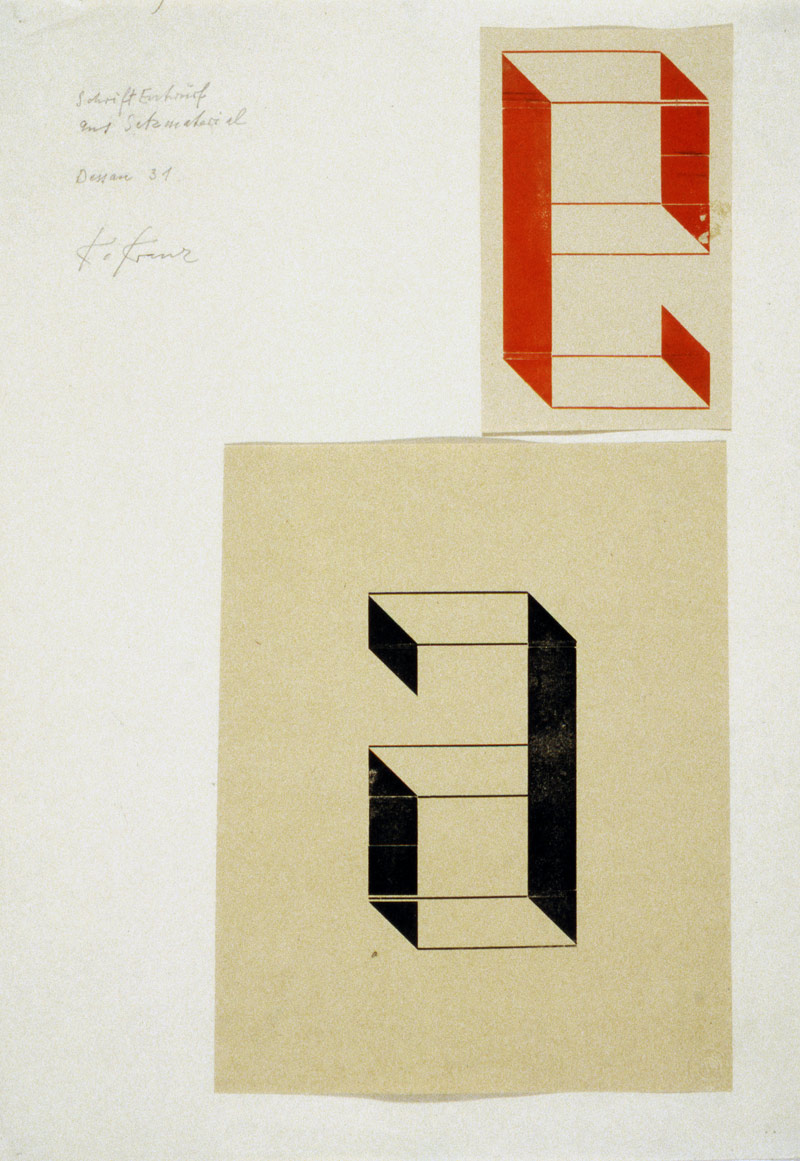
Exhibition: ‘Painting in Photography. Strategies of Appropriation’ at the Städel Museum, Frankfurt

Exhibition dates: 27th June – 23rd September 2012
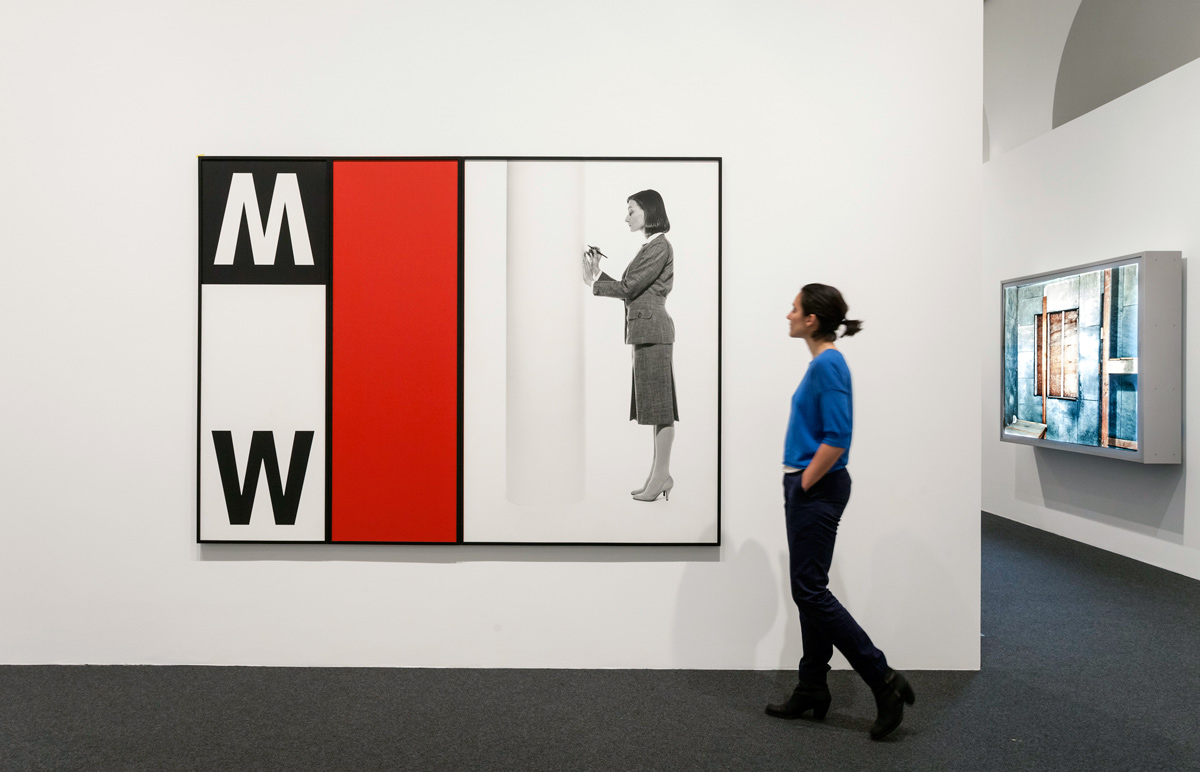
 

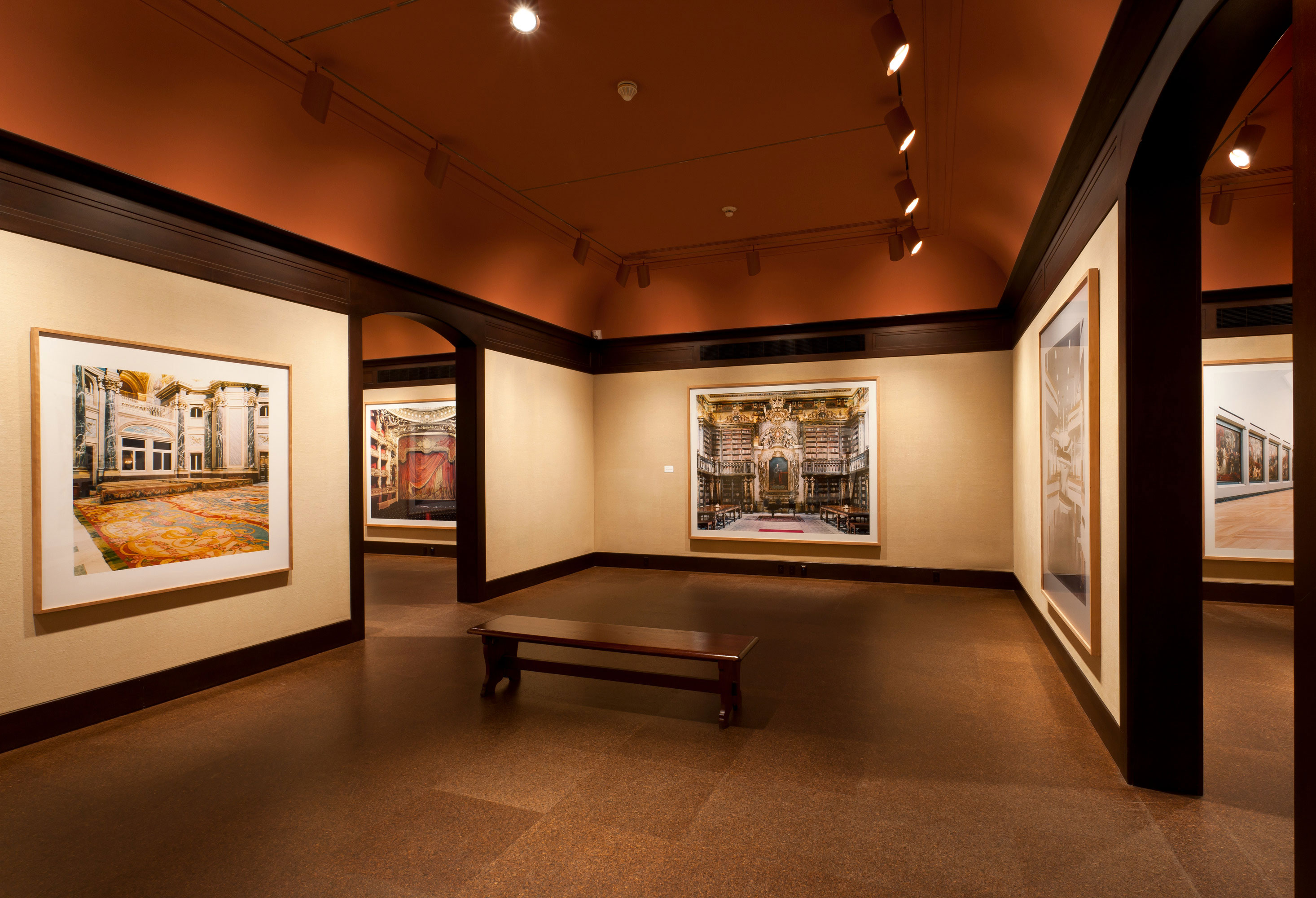
Installation view of the exhibition 'Painting in Photography. Strategies of Appropriation' at the Städel Museum, Frankfurt showing Victor Burgin's 'Office at Night (Red)' 1985


Installation view of the exhibition Painting in Photography. Strategies of Appropriation at the Städel Museum, Frankfurt showing Victor Burgin’s Office at Night (Red), 1985 (below)


“To understand the production of art at the end of tradition, which in our lifetime means art at the end of modernism, requires, as the postmodern debate has shown, a careful consideration of the idea of history and the notion of ending. Rather than just thinking ending as the arrival of the finality of a fixed chronological moment, it can also be thought as a slow and indecisive process of internal decomposition that leaves in place numerous deposits of us, in us and with us – all with a considerable and complex afterlife. In this context all figuration is prefigured. This is to say that the design element of the production of a work of art, the compositional, now exists prior to the management of form of, and on, the picture plane. Techniques of assemblage, like montage and collage – which not only juxtaposed different aesthetics but also different historical moments, were the precursors of what is now the general condition of production.”


“Art Byting the Dust” Tony Fry 1990 1


They said that photography would be the death of painting. It never happened. Recently they thought that digital photography would be the death of analogue photography. It hasn’t happened for there are people who care enough about analogue photography to keep it going, no matter what. As the quotation astutely observes, the digital age has changed the conditions of production updating the techniques of montage and collage for the 21st century. Now through assemblage the composition may be prefigured but that does not mean that there are not echoes, traces and deposits of other technologies, other processes that are not evidenced in contemporary photography.

As photography influenced painting when it first appeared and vice versa (photography went through a period known as Pictorialism where where it imitated Impressionist painting), this exhibition highlights the influence of painting on later photography. Whatever process it takes photography has always been about painting with light – through a pinhole, through a microscope, through a camera lens; using light directly onto photographic paper, using the light of the scanner or the computer screen. As Paul Virilio observes, no longer is there a horizon line but the horizon square of the computer screen, still a picture plane that evidences the history of art and life. Vestiges of time and technology are somehow always present not matter what medium an artist chooses. They always have a complex afterlife and afterimage.

Dr Marcus Bunyan

PS. I really don’t think it is a decomposition, more like a re/composition or reanimation.
PPS. Notice how Otto Steinert’s Luminogramm (1952, below), is eerily similar to some of Pierre Soulages paintings.


1/ Fry, Tony. “Art Byting the Dust,” in Hayward, Phillip. Culture, Technology and Creativity in the Late Twentieth Century. London: John Libbey and Company, 1990, pp. 169-170

Many thankx to the Städel Musuem for allowing me to publish the photographs in the posting. Please click on the photographs for a larger version of the image.


Victor Burgin (British, b. 1941) 'Office at Night (Red)' 1985


Victor Burgin (British, b. 1941)
Office at Night (Red)
1985


In a conceptual, analytical visual language, Burgin, who originally started out as a painter, refers to Edward Hopper’s painting “Office at Night” from 1940. It shows a New York office at night, in which the boss and secretary are still at work and alone. Burgin’s picture is part of a series about this depiction of a couple by Hopper (and the special role of the female motif in his work). Burgin’s picture consists of three panels, each of which uses a fictional register: letters (word), color (red is traditionally the color for lust and love) and photographic image (secretary).

Anonymous. “Victor Burgin” in the pdf “WONDERFULLY FEMININE! Interrogations of the feminine,” on the Kunst Stiftung DZ Bank website 2009 [Online] Cited 11/09/2024. Translated from the German by Google Translate
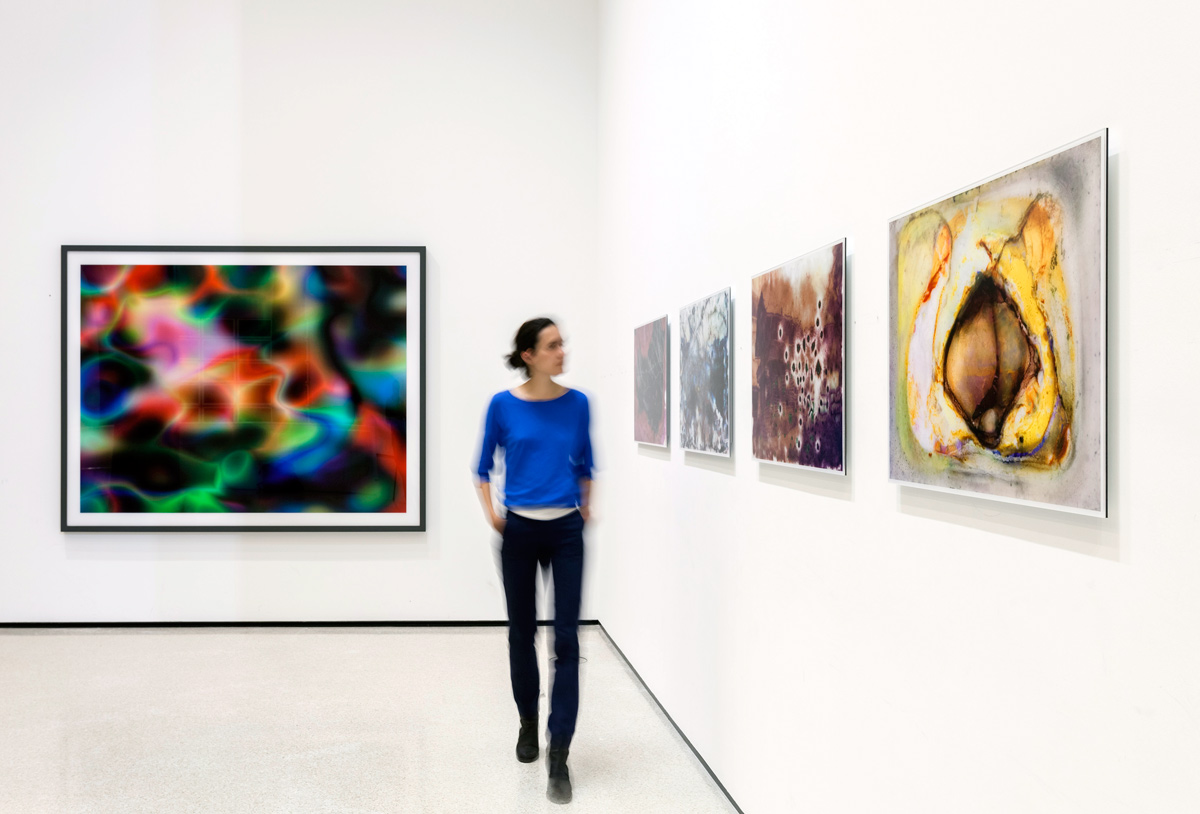
 

Installation view of the exhibition 'Painting in Photography. Strategies of Appropriation' at the Städel Museum, Frankfurt showing at left, Thomas Ruff's 'Substrat 10' (2002)


Installation view of the exhibition Painting in Photography. Strategies of Appropriation at the Städel Museum, Frankfurt showing at left, Thomas Ruff’s Substrat 10 (2002, below)


Thomas Ruff (German, b. 1958) 'Substrat 10' 2002


Thomas Ruff (German, b. 1958)
Substrat 10
2002
C-type print
186 x 238cm
DZ BANK Kunstsammlung
© VG Bild-Kunst, Bonn 2012
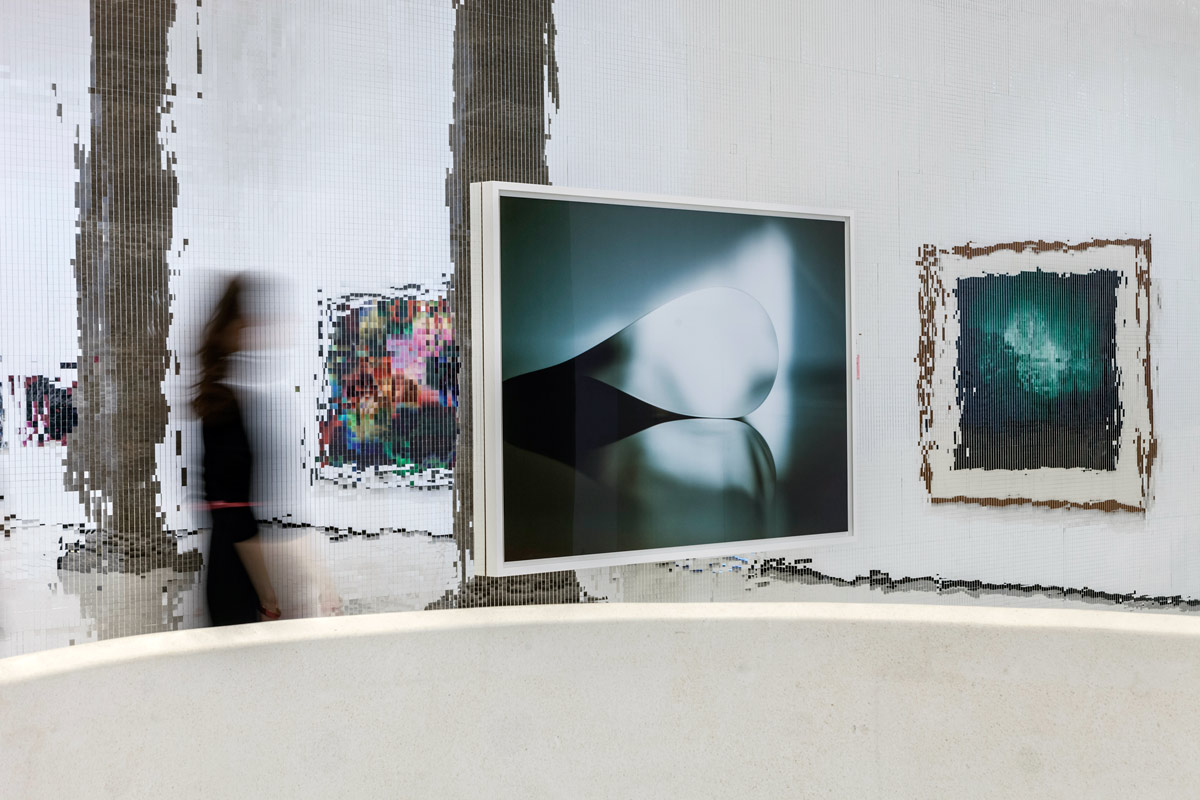
 

Installation view of the exhibition 'Painting in Photography. Strategies of Appropriation' at the Städel Museum, Frankfurt showing at centre, Wolfgang Tillmans 'Paper drop (window)' (2006)


Installation view of the exhibition Painting in Photography. Strategies of Appropriation at the Städel Museum, Frankfurt showing at centre, Wolfgang Tillmans Paper drop (window) (2006, below)


Wolfgang Tillmans (German, b. 1968) 'Paper drop (window)' 2006


Wolfgang Tillmans (German, b. 1968)
paper drop (window)
2006
C-type print in artists frame
145 x 200cm
Property of Städelscher Museums-Verein e.V.
© Courtesy Galerie Buchholz, Köln / Berlin
Städel Museum, Frankfurt am Main
Acquired in 2008 with funds from the Städelkomitee 21. Jahrhundert
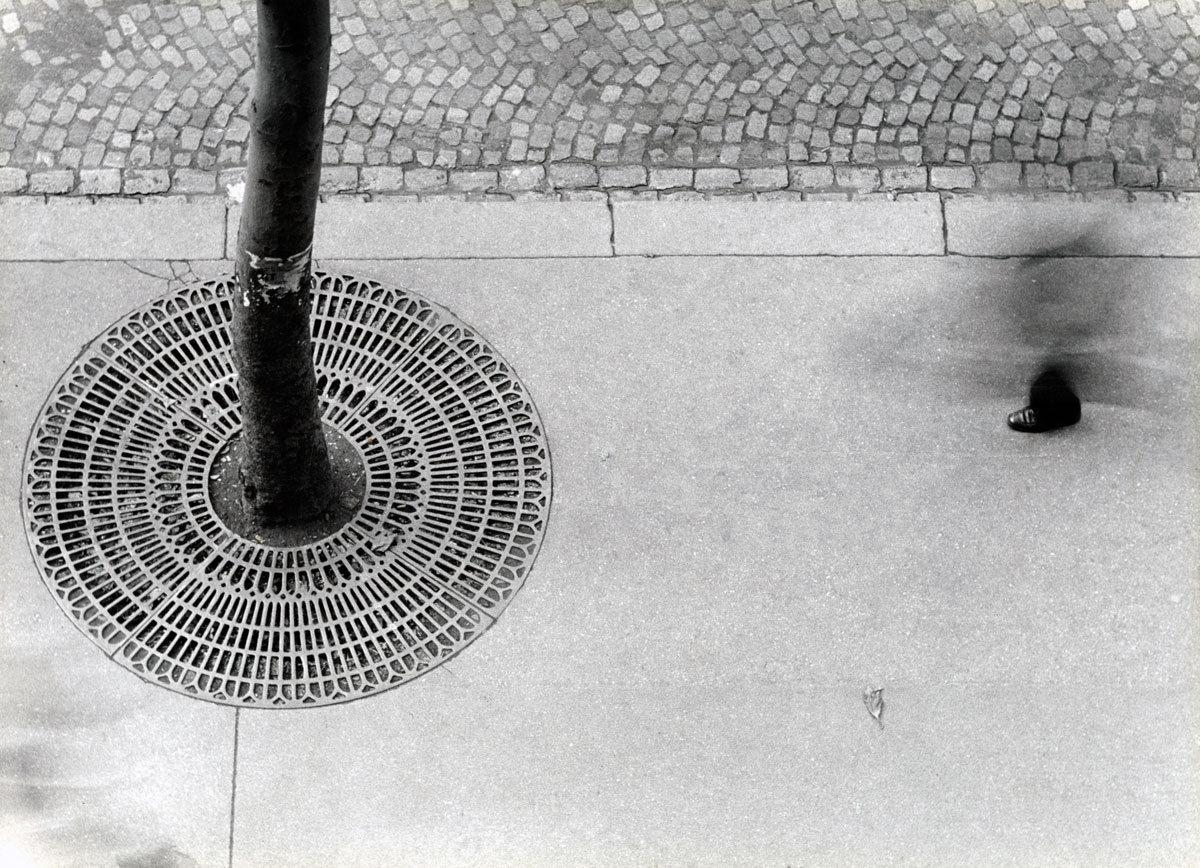
 

Otto Steinert (German, 1915-1978) 'Ein-Fuß-Gänger' 1950


Otto Steinert (German, 1915-1978)
Ein-Fuß-Gänger
1950
Gelatin silver print
28.5 x 39cm
Courtesy Galerie Kicken Berlin
© Nachlass Otto Steinert, Museum Folkwang, Essen
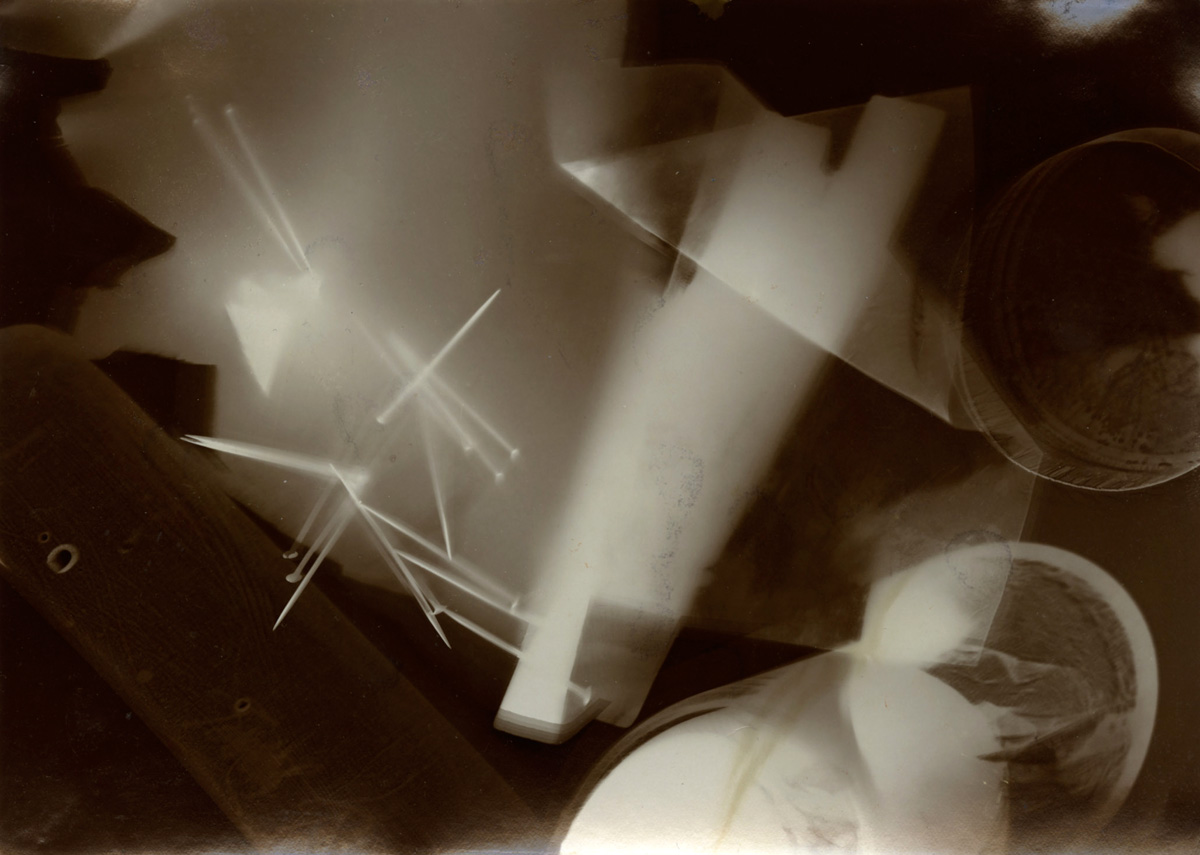
 

Laszlo Moholy-Nagy (Hungarian, 1895-1946) 'Photogram' c. 1923-1925


Laszlo Moholy-Nagy (Hungarian, 1895-1946)
Photogram
c. 1923-1925
Unique photogram, toned printing-out paper
12.6 x 17.6cm
Courtesy Galerie Kicken Berlin
© Hattula Moholy-Nagy / VG Bild-Kunst, Bonn


Robert Rauschenberg (American, 1925-2008) '10-80-C-17 (NYC)' 1980


Robert Rauschenberg (American, 1925-2008)
10-80-C-17 (NYC)
1980
From the series: In + Out of City Limits: New York / Boston
Gelatin silver print on fibre-based paper
58 x 73cm
DZ BANK Kunstsammlung at the Städel Museum
© Estate of Robert Rauschenberg / VG Bild-Kunst, Bonn 2012


Hiroshi Sugimoto (Japanese, b. 1948) 'Sam Eric, Pennsylvania' 1978


Hiroshi Sugimoto (Japanese, b. 1948)
Sam Eric, Pennsylvania
1978
Gelatin silver print
42.5 x 54.5cm
Private collection, Frankfurt
© Hiroshi Sugimoto / Courtesy The Pace Gallery
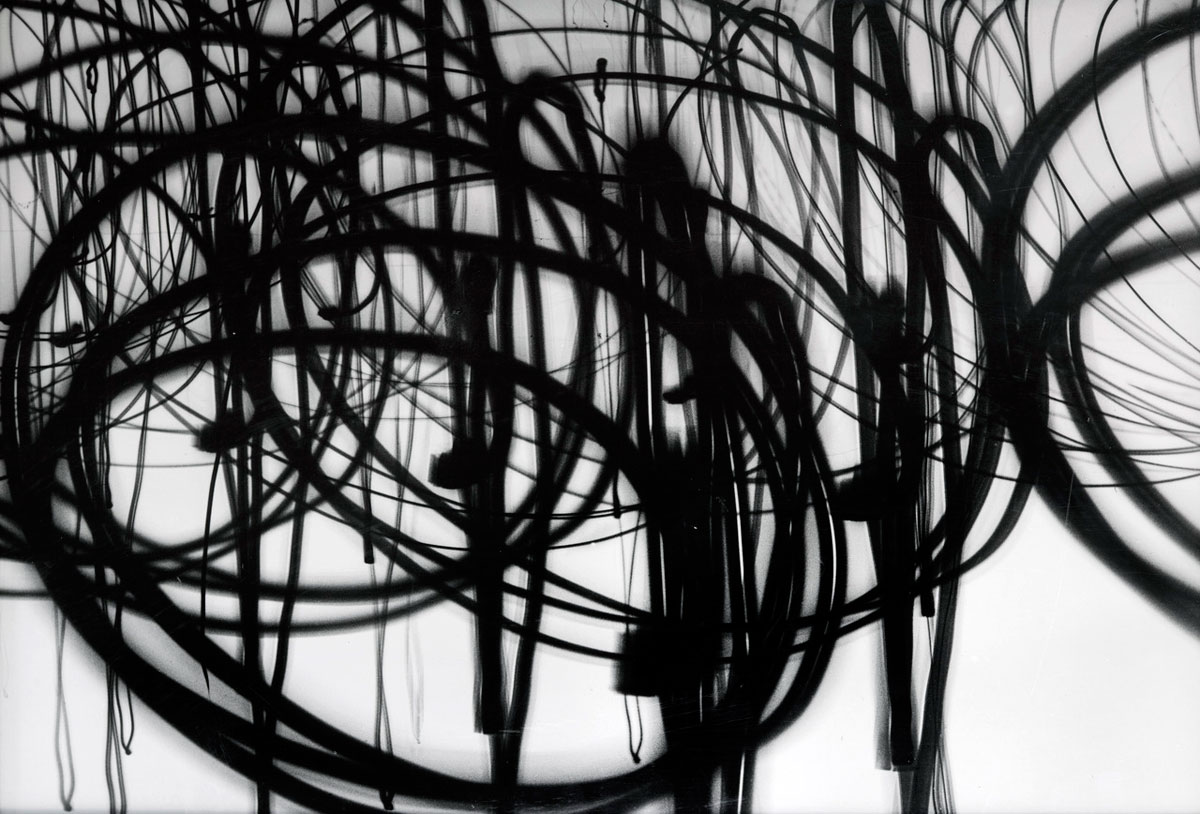
 

Otto Steinert (German, 1915-1978) 'Luminogramm' 1952


Otto Steinert (German, 1915-1978)
Luminogramm
1952, printed c. 1952
Gelatin silver print
41.5 x 60cm
Courtesy Galerie Kicken Berlin
© Nachlass Otto Steinert, Museum Folkwang, Essen


From 27 June to 23 September 2012, the Städel Museum will show the exhibition “Painting in Photography. Strategies of Appropriation.” The comprehensive presentation will highlight the influence of painting on the imagery produced by contemporary photographic art. Based on the museum’s own collection and including important loans from the DZ Bank Kunstsammlung as well as international private collections and galleries, the exhibition at the Städel will centre on about 60 examples, among them major works by László Moholy-Nagy, Hiroshi Sugimoto, Wolfgang Tillmans, Thomas Ruff, Jeff Wall, and Amelie von Wulffen. Whereas the influence of the medium of photography on the “classic genres of art” has already been the subject of analysis in numerous exhibitions and publications, less attention has been paid to the impact of painting on contemporary photography to date. The show at the Städel explores the reflection of painting in the photographic image by pursuing various artistic strategies of appropriation which have one thing in common: they reject the general expectation held about photography that it will document reality in an authentic way.

The key significance of photography within contemporary art and its incorporation into the collection of the Städel Museum offer an occasion to fathom the relationship between painting and photography in an exhibition. While painting dealt with the use of photography in the mass media in the 1960s, today’s photographic art shows itself seriously concerned with the conditions of painting. Again and again, photography reflects, thematises, or represents the traditional pictorial medium, maintaining an ambivalent relationship between appropriation and detachment.

Numerous works presented in the Städel’s exhibition return to the painterly abstractions of the prewar and postwar avant-gardes, translate them into the medium of photography, and thus avoid a reproduction of reality. Early examples for the adaption of techniques of painting in photography are László Moholy-Nagy’s (1895-1946) photograms dating from the 1920s. For his photographs shot without a camera, the Hungarian artist and Bauhaus teacher arranged objects on a sensitised paper; these objects left concrete marks as supposedly abstract forms under the influence of direct sunlight. In Otto Steinert’s (1915-1978) non-representational light drawings or “luminigrams,” the photographer’s movement inscribed itself directly into the sensitised film. The pictures correlate with the gestural painting of Jackson Pollock’s Abstract Expressionism. A product of random operations during the exposure and development of the photographic paper, Wolfgang Tillmans’ (b. 1968) work “Freischwimmer 54” (2004) is equally far from representing the external world. It is the pictures’ fictitious depth, transparency, and dynamics that lend Thomas Ruff’s photographic series “Substrat” its extraordinary painterly quality recalling colour field paintings or Informel works. For his series “Seascapes” the Japanese artist Hiroshi Sugimoto (b. 1948) seems to have “emptied” the motif through a long exposure time: the sublime pictures of the surface of the sea and the sky – which either blur or are set off against each other – seem to transcend time and space.

In addition to the photographs mentioned, the exhibition “Painting in Photography” includes works by artists who directly draw on the history of painting in their choice of motifs. The mise-en-scène piece “Picture for Women” (1979) by the Canadian photo artist Jeff Wall (b. 1946), which relates to Édouard Manet’s famous painting “Un Bar aux Folies-Bergère” from 1882, may be cited as an example for this approach. The camera positioned in the centre of the picture reveals the mirrored scene and turns into the eye of the beholder. The fictitious landscape pictures by Beate Gütschow (b. 1970), which consist of digitally assembled fragments, recall ideal Arcadian sceneries of the seventeenth and eighteenth centuries. The photographs taken by Italian Luigi Ghirri (1943-1992) in the studio of Giorgio Morandi (1890-1964) “copy” Morandi’s still lifes by representing the real objects in the painter’s studio instead of his paintings.

Another appropriative strategy sees the artist actually becoming active as a painter, transforming either the object he has photographed or its photographic representation. Oliver Boberg’s, Richard Hamilton’s, Georges Rousse’s and Amelie von Wulffen’s works rank in this category. For her series “Stadtcollagen” (1998-1999) Amelie von Wulffen (b. 1966) assembled drawing, photography, and painting to arrive at the montage of a new reality. The artist’s recollections merge with imaginary spaces offering the viewer’s fantasy an opportunity for his or her own associations.

The exhibition also encompasses positions of photography for which painting is the object represented in the picture. The most prominent examples in this section come from Sherrie Levine (b. 1947) and Louise Lawler (b. 1947), both representatives of US Appropriation Art. From the late 1970s on, Levine and Lawler have photographically appropriated originals from art history. Levine uses reproductions of paintings from a catalogue published in the 1920s: she photographs them and makes lithographs of her pictures. Lawler photographs works of art in private rooms, museums, and galleries and thus rather elucidates the works’ art world context than the works as such.

Press release from the Städel Museum website
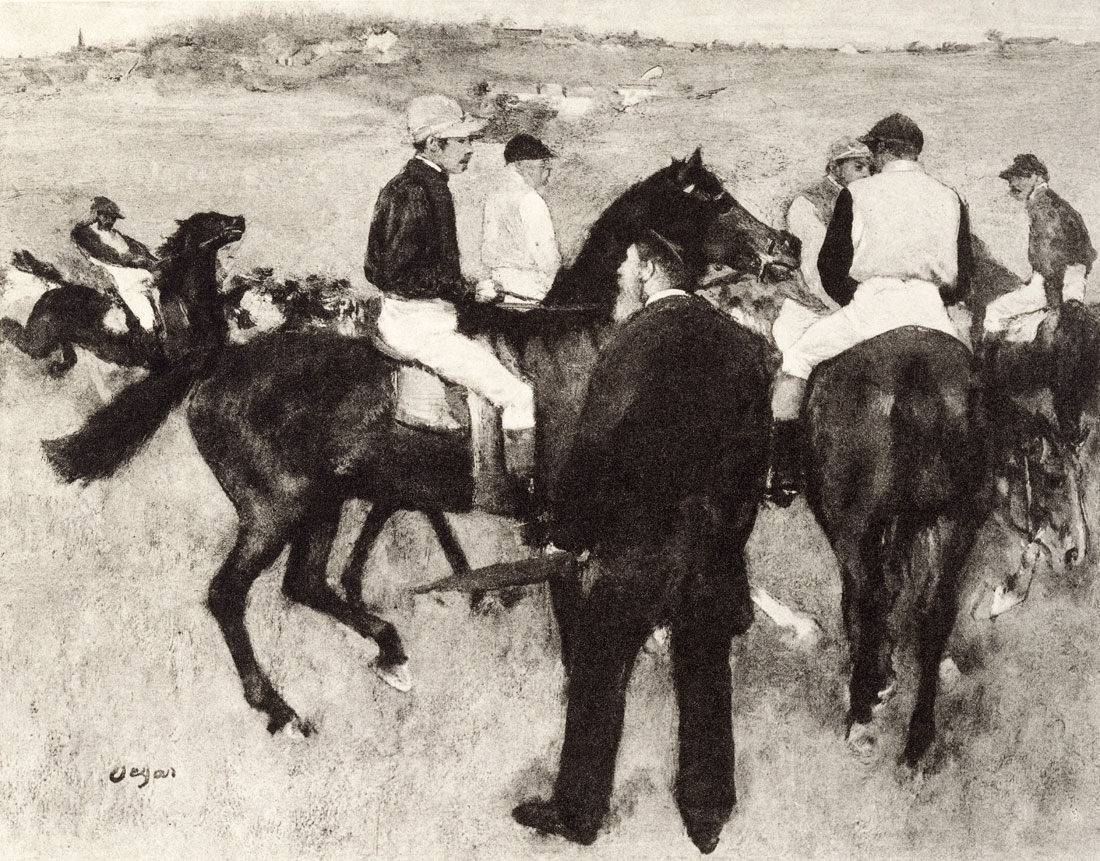
 

Sherrie Levine (American, b. 1947) 'After Edgar Degas' 1987 (detail)


Sherrie Levine (American, b. 1947)
After Edgar Degas (detail)
1987
5 lithographs on hand-made paper
69 x 56cm
DZ BANK Kunstsammlung im Städel Museum, Frankfurt
© Sherrie Levine / Courtesy Jablonka Galerie, Köln


Beate Gütschow (German, b. 1970) 'PN #1' 2000


Beate Gütschow (German, b. 1970)
PN #1
2000
C-Print, mounted on aluminium dibond
Acquired in 2013, property of Städelscher Museums-Verein e.V.
Städel Museum, Frankfurt am Main, Eigentum des Städelschen Museums-Vereins e.V.


… these images do not evoke a sense of the sublime. On closer inspection, not only is the virginity of nature lost forever, but the innocence of perception is also denied. The natural realms presented here are simply too beautiful to be true. The beauty, wildness, and potentially threatening aspects of nature have been skillfully merged into a decorative whole, as they were in landscape painting from the 17th through to the 19th century. Beate Gütschow’s photographic works reproduce traditional patterns of depiction, incorporating landscape elements that recall compositions by Nicolas Poussin (1594-1665), Jacob van Ruisdael (1628-1682), Claude Lorrain (1600-1682), John Constable (1776-1837), and Philipp Otto Runge (1777-1810). The subjects portrayed by these landscape painters were based on an idealised worldview, the construction of which reflected the dominant philosophical ethos of their time. The artists themselves, however, presented this ideal in a manner bordering on the absolute. …

Beate Gütschow photographs landscapes with a medium-format analog camera, then converts the images into digital files. From this archived material she then constructs new landscapes in Photoshop, basing their spatial arrangements and compositional structures on the principles of landscape painting. As part of this subsequent editing process, she adjusts the light and colours in the images, applying lighting techniques from the realm of painting to her photographs. Because Gütschow uses only the retouching tool and other traditional darkroom techniques offered by Photoshop, not its painting tools, the photographic surface is preserved and the joins between the component parts are not immediately visible. These digital tools make it possible to employ a painterly method without the resulting picture being a painting. The viewer is given the impression that this is a completely normal photograph. When, however, an ideal landscape is presented in the form of a photograph, it appears more unnatural than the painted version of the same view. In this way, Gütschow’s work explores concepts of representation, colour, and light – the formal attributes of painting and photography – as well as the distinctions between documentation and staging.

Extract from Gebbers, Anna-Catharina. “Larger than Life,” in Beate Gütschow: ZISLS. Heidelberg, 2016, pp. 8-17. Translated by Jacqueline Todd [Online] Cited 23/08/2022
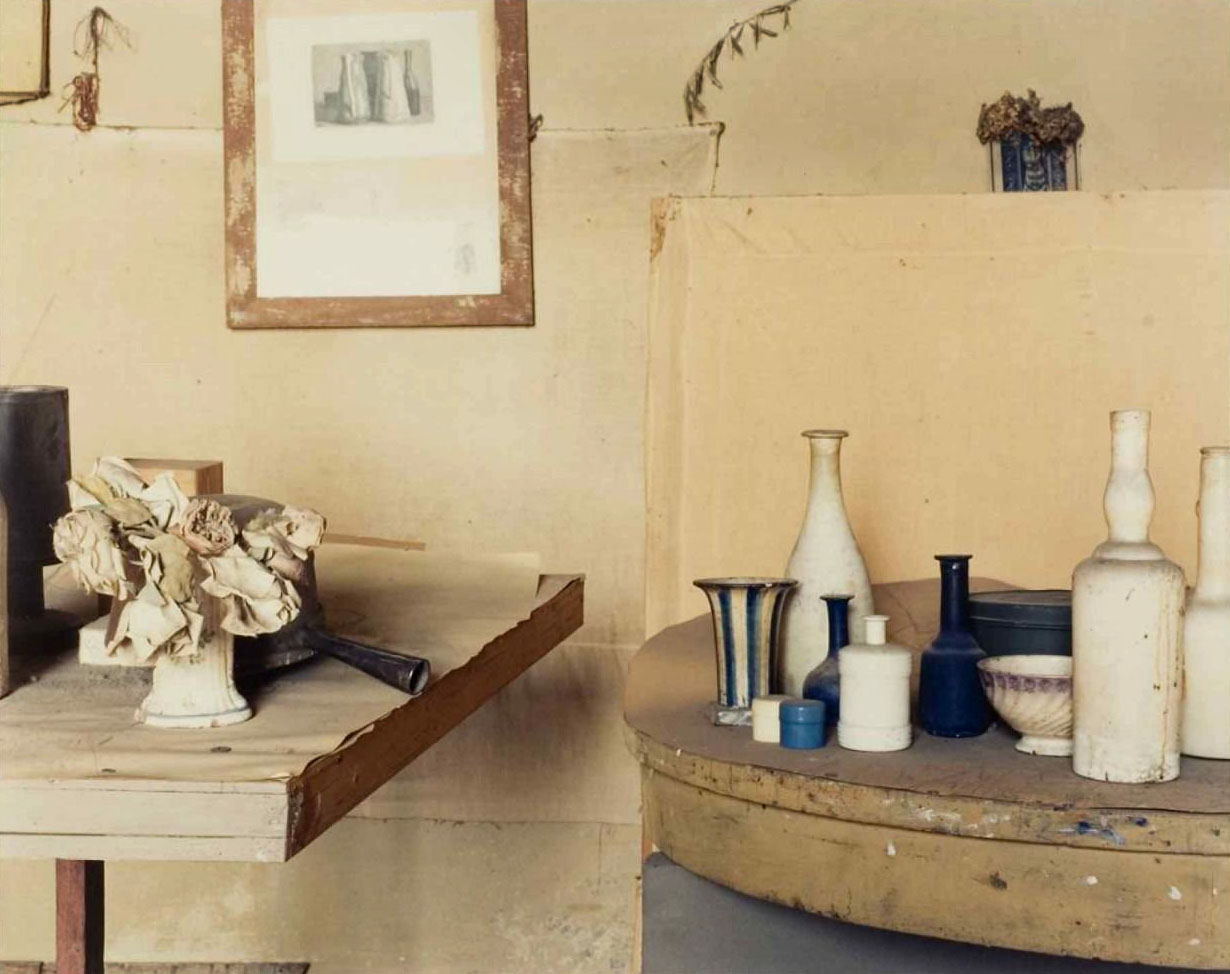
 

Luigi Ghirri (Italian, 1943-1992) 'L'atelier de Giorgio Morandi, Bologne' 1989


Luigi Ghirri (Italian, 1943-1992)
L’atelier de Giorgio Morandi, Bologne
1989


Luigi Ghirri (5 January 1943 – 14 February 1992) was an Italian artist and photographer who gained a far-reaching reputation as a pioneer and master of contemporary photography, with particular reference to its relationship between fiction and reality.


Amelie von Wulffen (German, b. 1966) 'Untitled (City Collages, VIII)' 1998


Amelie von Wulffen (German, b. 1966)
Untitled (City Collages, VIII)
1998
Oil paint, photographs on paper
42 x 59.7cm
Acquired in 2009 with funds from the Städelkomitee 21. Jahrhundert, property of Städelscher Museums-Verein e.V.
Städel Museum, Frankfurt am Main, Eigentum des Städelschen Museums-Vereins e.V.


The starting point for Amelie von Wulffen’s city collages is the urban architecture which she has photographed herself. These photographs are affixed to a surface and then processed pictorially: the artist alienates the perspective, adds abstract patterns and confronts the scene with quirky objects. The painted forms and unreal connections intervene in the relationship to reality of the supposedly objective photograph. The combination of photograph and painting is accompanied by a reflection on the characteristics of the medium concerned. The photographic reproduction of a situation which has been experienced may adequately record the place but not necessarily the memory. With this in mind, the artist sees painting as a suitable medium to equip photography with an authentic means of expression. During the chemical process of photography, real objects are registered on the light-sensitive material, just as the mood of the place and the memory of the artist are translated into the painting process. With regard to form, Wulffen reveals a wealth of references to Constructivism, Surrealism and Dadaism.

Text from the Städel Museum website


Art after 1945: Amelie von Wulffen

In our “Art after 1945” series, artists introduce their artworks in the Städel collection. In this episode Amelie von Wulffen explains her series “Stadtcollagen”.


Jeff Wall (Canadian, b. 1946) 'Picture for Women' 1979


Jeff Wall (Canadian, b. 1946)
Picture for Women
1979
Cibachrome transparency in lightbox
204.5 × 142.5cm (80.5 in × 56.1 in)


Picture for Women is a photographic work by Canadian artist Jeff Wall. Produced in 1979, Picture for Women is a key early work in Wall’s career and exemplifies a number of conceptual, material and visual concerns found in his art throughout the 1980s and 1990s. An influential photographic work, Picture for Women is a response to Édouard Manet’s Un bar aux Folies Bergère and is a key photograph in the shift from small-scale black and white photographs to large-scale colour that took place in the 1980s in art photography and museum exhibitions. …

Picture for Women is a 142.5 by 204.5 cm Cibachrome transparency mounted on a lightbox. Along with The Destroyed Room (1978), Wall considers Picture for Women to be his first success in challenging photographic tradition. According to Tate Modern, this success allows Wall to reference “both popular culture (the illuminated signs of cinema and advertising hoardings) and the sense of scale he admires in classical painting. As three-dimensional objects, the lightboxes take on a sculptural presence, impacting on the viewer’s physical sense of orientation in relationship to the work.”

Text from the Wikipedia website


Louise Lawler (American, b. 1947) 'It Could Be Elvis' 1994


Louise Lawler (American, b. 1947)
It Could Be Elvis
1994
Cibachrome, varnished with shellac
74.5 x 91cm
DZ BANK Kunstsammlung at the Städel Museum
© Courtesy of the artist and Metro Pictures, New York


Oliver Boberg (German, b. 1965) 'Unterführung' [Underpass] 1997


Oliver Boberg (German, b. 1965)
Unterführung [Underpass]
1997
C-type print
75 x 84cm
DZ BANK Kunstsammlung
© Oliver Boberg / Courtesy L.A. Galerie – Lothar Albrecht, Frankfurt
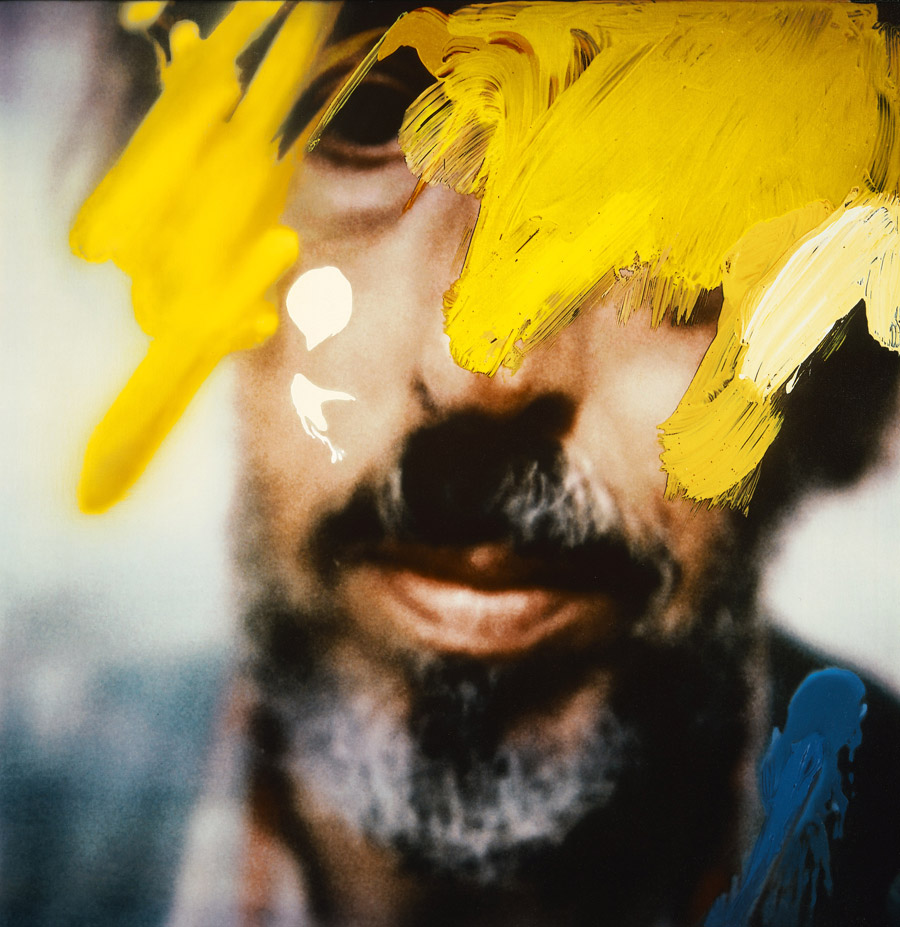
 

Richard Hamilton (English, 1922-2011) 'Eight-Self-Portraits' 1994 (detail)


Richard Hamilton (English, 1922-2011)
Eight-Self-Portraits (detail)
1994
Thermal dye sublimation prints
40 x 35cm
DZ BANK Kunstsammlung
© VG Bild-Kunst, Bonn 2012


Wolfgang Tillmans (German, b. 1968) 'Freischwimmer 54' 2004


Wolfgang Tillmans (German, b. 1968)
Freischwimmer 54
2004
C-type in artists frame
237 x 181 x 6cm
Städel Museum, Frankfurt am Main
© Courtesy Galerie Buchholz, Köln / Berlin
Acquired in 2008 with funds from the Städelkomitee 21. Jahrhundert
Property of Städelscher Museums-Verein e.V.


Städel Museum
Schaumainkai 63
60596 Frankfurt

Opening hours:
Tuesday – Sunday 10am – 6pm
Closed Mondays

Städel Museum website

LIKE ART BLART ON FACEBOOK

Back to top

Exhibition: ‘Gerhard Richter. Atlas’ at the Staatliche Kunstsammlungen Dresden

Exhibition dates: 4th February – 22nd April 2012


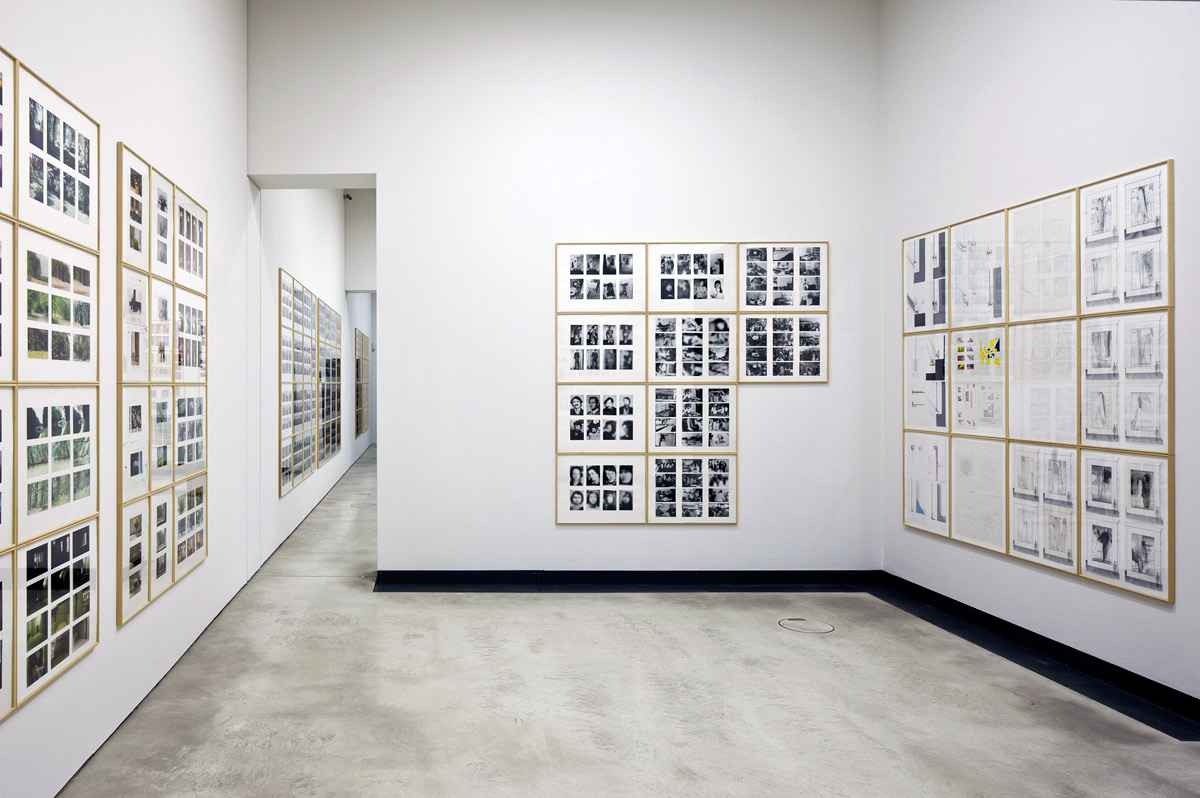
Installation photograph of 'Gerhard Richter. Atlas' at Kunsthalle im Lipsiusbau, Staatliche Kunstsammlungen Dresden 2012


Installation photograph of Gerhard Richter. Atlas
Kunsthalle im Lipsiusbau
Photograph: David Brandt, 2012
© Gerhard Richter Archive, Staatliche Kunstsammlungen Dresden


Meaning arises out of context – or the lack of it. Unlike the grids of the Bechers which promote multiple ways of seeing and construct narrative tension these images do not increase the photographic narrative. They are like the parrots, finches or scarab beetles in a display case at a natural history museum – part of a taxonomic classification system, where one out of a thousand is the most impressive beetle, the bird with the brightest plumage, where the composition is the most surprising. Multiples as collected here are fascinating but emerge from a slightly obsessive mind (which any collectors mind is!)

This photomontage of impressions, ground and movement blurs the history and memory embedded in each photograph. The assemblage of all these visions ranges far and wide but ultimately collapses time and space into one huge universal snapshot. As in advertising imagery the individual documentary-style images mean relatively little – it is the overall impression that impinges on the consciousness. If you watch MTV and stop to analyse the individual images in a pop video you soon acknowledge their vacuousness. The context of the singular image is lost. In this display the grid controls the photographs position relative to each other and the viewer – a compositional design matrix that has a symbolic function. The grid both decontextualises and recontextualises the floating signifier.

Richter obviously uses them as an aide-memoire. Some remind me of the folded photographs found in Francis Bacon’s studio; others Bacon’s portraits of blurred bodies; yet more, ethnographic mappings of Indigenous bodies or criminals cut out of newspapers. Others remind me of Surrealist experiments and the colour photographs the paintings of Gerhard Richter. Funny about that…

They may be the source material of a great artist but in this regimented form of prosaic knowledge they become like bugs caught in amber.

Dr Marcus Bunyan


Many thankx to the Staatliche Kunstsammlungen Dresden for allowing me to publish the photographs in the posting. Please click on the photographs for a larger version of the image.


“I see countless landscapes, photograph barely one in 100,000, and paint barely 1 in 100 of those that I photograph,”


Gerhard Richter, 1986


“If the grids of art are about arrangement, synchronic vision, connections and knowledge, a standing back to grasp a pattern, then the grids of life are just as much about chance, disconnections among the connections, and the inability of the elements within the grid to perceive, and know, the larger patterns of which they are a part, so that it is only a ‘higher’ consciousness standing outside the grid that will be able to see it all (with or without understanding it). How you know and form a grid depends on whether you are inside or outside it. You can ‘form’ a grid both actively and passively, wittingly and unwittingly – either by simply being part of a grid or by actually assembling one… The grid becomes a potentially totalizing system with which reality (the real of experience as well as the real of the mind), another totalizing system, must endlessly play its games of elusiveness and containment, chaos and order, freedom and necessity.”


Aveek Sen. “The Grid and More,” in ‘What We Talk About When We Talk About Photography,’ on the Fotomuseum Winterthur website, 7th April 2012


Gerhard Richter. Atlas

The film for the special exhibition!

The ATLAS occupies an outstanding position in Gerhard Richter’s entire work. It is both the basis of his painterly oeuvre and an independent work. As a so-called work in progress, the artist, who was born on February 9, 1932 in Dresden, has repeatedly revised and supplemented the ATLAS for more than four decades.

The ATLAS was on display in a special exhibition at the Gerhard Richter Archive of the Dresden State Art Collections.


Installation photograph of 'Gerhard Richter. Atlas' at Kunsthalle im Lipsiusbau, Staatliche Kunstsammlungen Dresden 2012


Installation photograph of Gerhard Richter. Atlas
Kunsthalle im Lipsiusbau
Photograph: David Brandt, 2012
© Gerhard Richter Archive, Staatliche Kunstsammlungen Dresden


Gerhard Richter (German, b. 1932) 'Atlas. Plate 68. Photo experiment' 1969


Gerhard Richter (German, b. 1932)
Atlas. Plate 68. Photo experiment
1969
© Gerhard Richter 2011


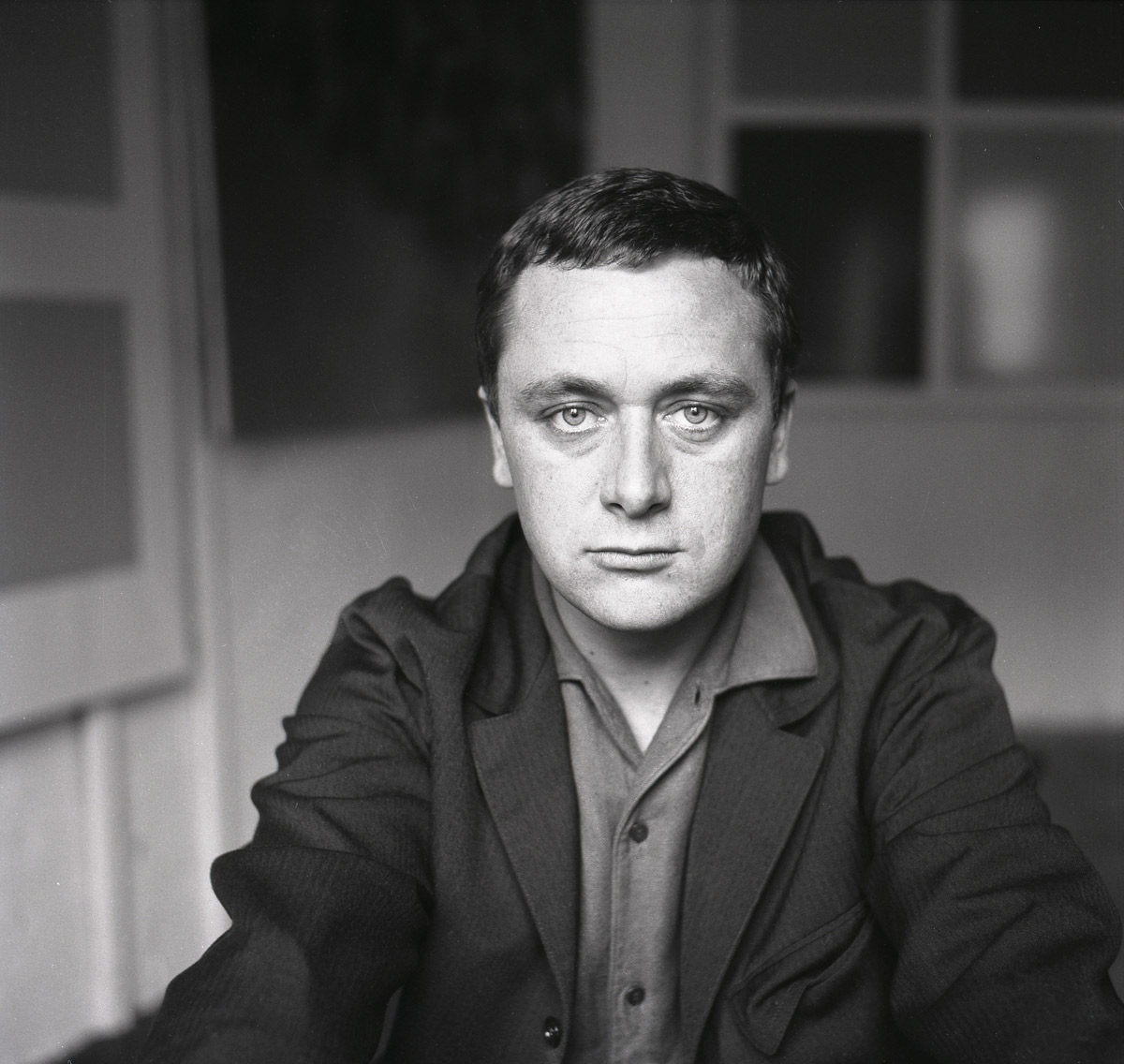
Portrait of Gerhard Richter 1966


Portrait of Gerhard Richter
1966
© Gerhard Richter, Köln 2012


In celebration of Gerhard Richter’s 80th birthday, the Gerhard Richter Archive of the Staatliche Kunstsammlungen Dresden presents the ATLAS of the artist in the Kunsthalle im Lipsiusbau. The ATLAS takes a prominent role in the oeuvre of Gerhard Richter. It is the basis of many of his paintings just as it is an artwork in its own right. The ATLAS consists of approximately 800 framed panels with more than 15,000 photographs, newspaper clippings, sketches and designs, which Richter had accumulated for work in his studio from the early 1960s onwards. In 1972, he ordered and arranged the collection on boards and presented it under the title ATLAS for the first time. Ever since then, he has continuously added new material. The conceptual character of the ATLAS offers unique insights into the mindset of the artist, into the development of some ideas for works as well as into the creational process of several of his paintings.

Gerhard Richter’s ATLAS merits a special place within his oeuvre as a whole. It not only forms the basis of his entire work as a painter but is also an autonomous artwork in its own right. Born in Dresden on 9th February 1932, Richter has been constantly revising and augmenting this “work in progress” for more than four decades.

ATLAS may be seen as an accompaniment, commentary and extension of the entire oeuvre of Gerhard Richter, for it also develops its own perspectives and poses its own questions. ATLAS is Richter’s reflection not only on his own work but also on the everyday world of images that he himself has documented photographically in their thousands. “I see countless landscapes, photograph barely one in 100,000, and paint barely 1 in 100 of those that I photograph,” Richter wrote in 1986. This photographed, yet and seemingly inexhaustible flood of images has afforded Richter a concentrated, ready accessibility of motifs for his future works. Indeed, for some of his paintings, he has been able to draw upon old motifs in his ATLAS, some of them dating back more than a decade.

The accompanying artist’s book “ATLAS” is not just intended as a means of documenting the exhibition. Gerhard Richter sees it as an alternative presentation to the exhibited panels, one that permits an additional, different, non-linear approach to the material. By 1964, Richter had collected a vast amount of pictorial source material for his painting, first keeping it in drawers and portfolios. Five years later he began to sift through this material with a critical eye, grouping the individual photographs, reproductions and sketches into different themes and pasting them onto separate panels. Richter then soon recognised the intrinsic artistic quality of these collections of source material and, in 1972, framed the panels and exhibited them at the Museum Hedendaagse Kunst in Utrecht under the title ATLAS. Meanwhile this repository of source material has grown from its original 343 panels to its present 783, with more than 8,000 individual motifs.

Press release from the Staatliche Kunstsammlungen Dresden website


Gerhard Richter (German, b. 1932) 'Atlas. Tafel 5. Album Photos' 1962-1968


Gerhard Richter (German, b. 1932)
Atlas. Plate 9. Photographs of papers and books etc
1962-1968
© Gerhard Richter 2011


Gerhard Richter (German, b. 1932) 'Atlas. Plate 5. Album Photos' 1962-1968


Gerhard Richter (German, b. 1932)
Atlas. Plate 5. Album Photos
1962-1968
© Gerhard Richter 2011


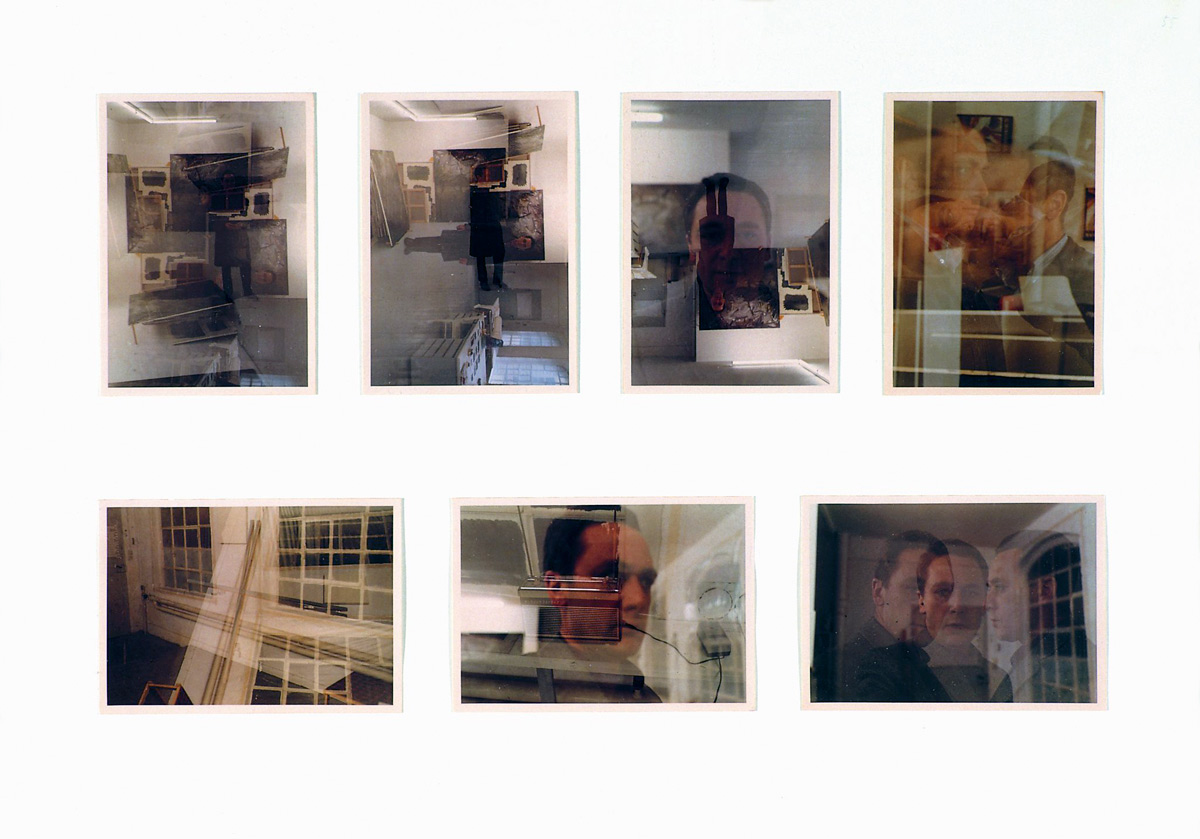
Gerhard Richter (German, b. 1932) 'Atlas. Plate 58. Double exposure' Nd


Gerhard Richter (German, b. 1932)
Atlas. Plate 58. Double exposure
Nd
© Gerhard Richter 2011


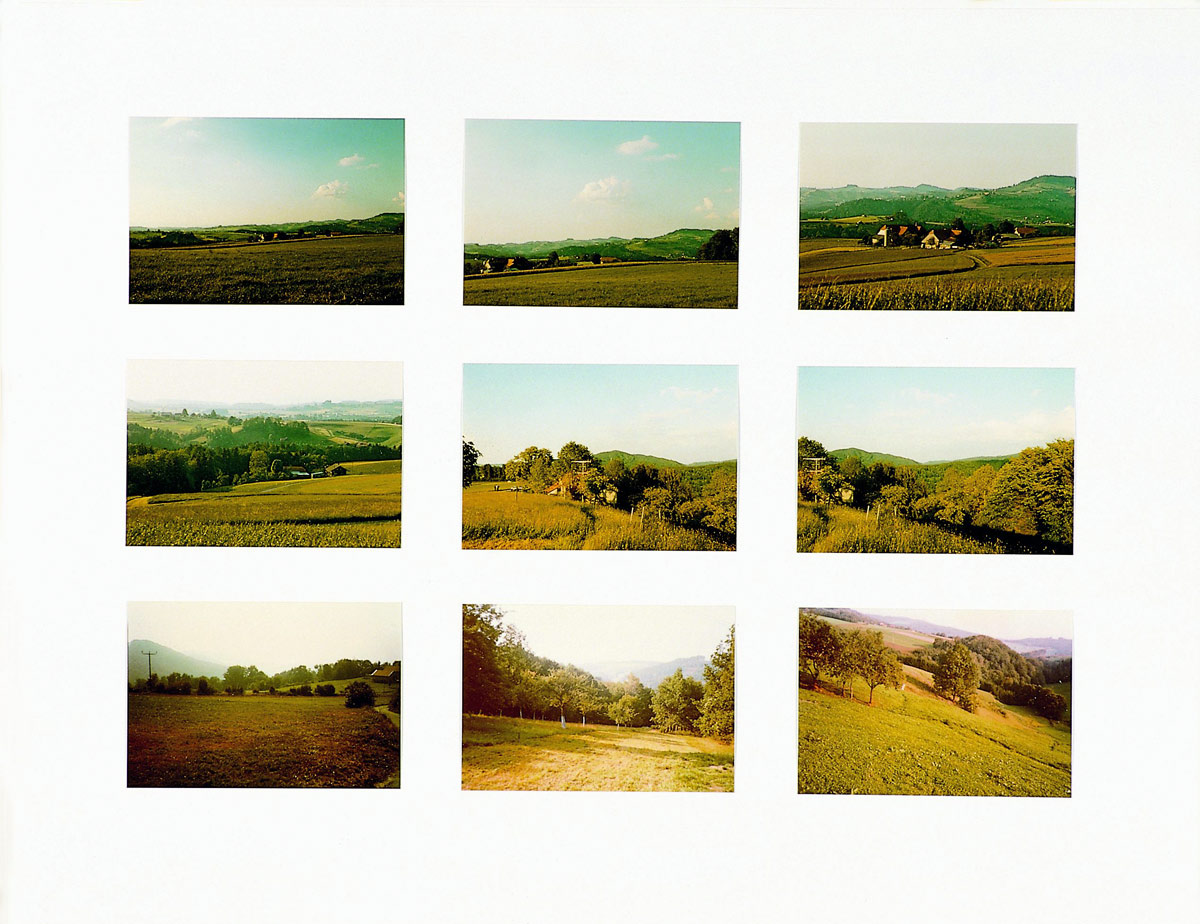
Gerhard Richter (German, b. 1932) 'Atlas. Plate 422. Baysricher forest' 1982


Gerhard Richter (German, b. 1932)
Atlas. Plate 422. Baysricher forest
1982
© Gerhard Richter 2011


Gerhard Richter (German, b. 1932) 'Atlas. Plate 13. Photographs of papers and books etc' 1964-67


Gerhard Richter (German, b. 1932)
Atlas. Plate 13. Photographs of papers and books etc
1964-1967
© Gerhard Richter 2011


Gerhard Richter (German, b. 1932) 'Atlas. Plate 651. Reichstag' 1998


Gerhard Richter (German, b. 1932)
Atlas. Plate 651. Reichstag
1998
© Gerhard Richter 2011


Gerhard Richter (German, b. 1932) 'Atlas. Plate 31 for 48 Portraits' 1971


Gerhard Richter (German, b. 1932)
Atlas. Plate 31 for 48 Portraits
1971
© Gerhard Richter 2011


Staatliche Kunstsammlungen Dresden
Residenzschloss Taschenberg 2
01067 Dresden Germany

Kunsthalle im Lipsiusbau opening hours:
Daily 10am – 6pm
Closed Mondays
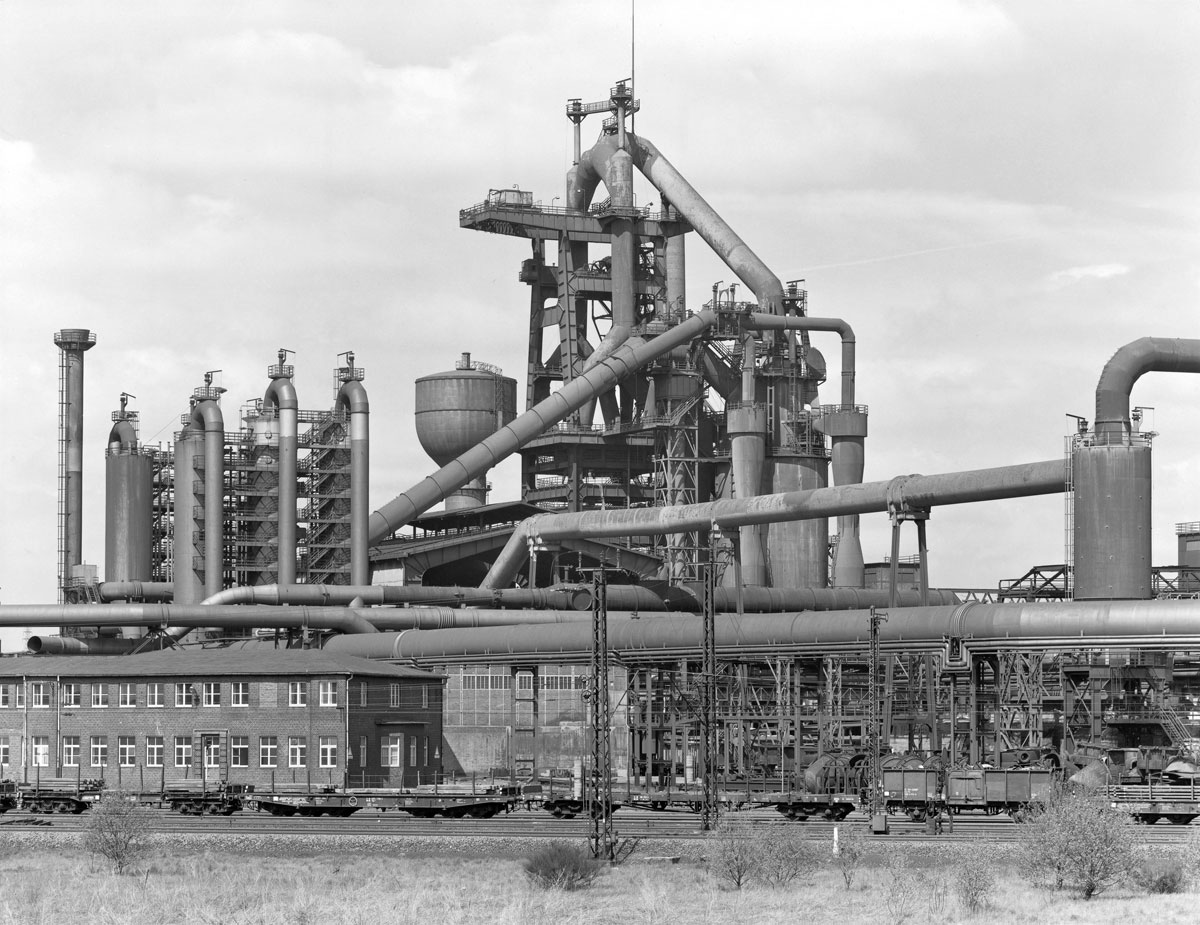
Staatliche Kunstsammlungen Dresden website

LIKE ART BLART ON FACEBOOK

Back to top

Exhibition: ‘Bernd and Hilla Becher: Mines and Mills – Industrial Landscapes’ at Fotomuseum Winterthur, Zurich

Exhibition dates: 26th November, 2011 – 12th February, 2012


Bernd and Hilla Becher (German, active 1959-2007) Bernd Becher (German, 1931-2007) Hilla Becher (German, 1934-2015)
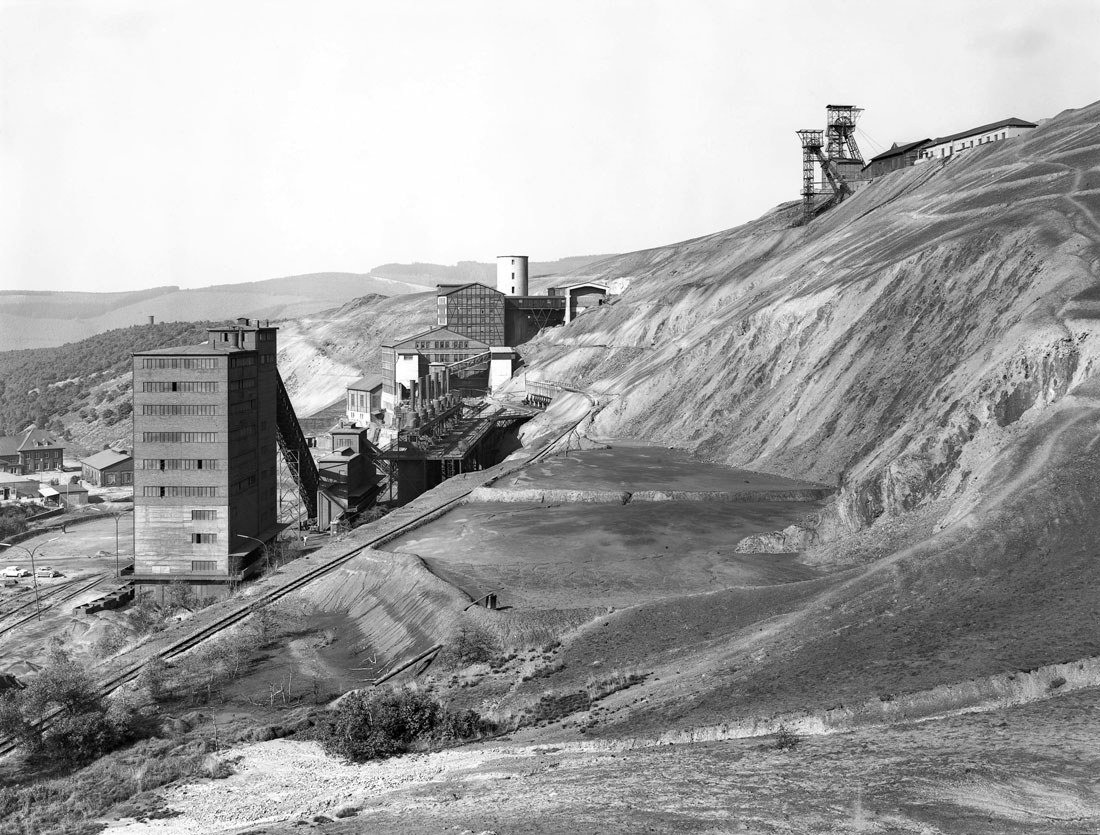
 'Grube San Fernando, Herdorf, D' 1961 from the exhibition 'Bernd and Hilla Becher: Mines and Mills - Industrial Landscapes' at Fotomuseum Winterthur, Zurich, Nov 2011 - Feb 2012


Bernd and Hilla Becher (German, active 1959-2007) Bernd Becher (German, 1931-2007) Hilla Becher (German, 1934-2015)
Grube San Fernando, Herdorf, D
1961
Gelatin silver print
50 x 60cm
© Bernd and Hilla Becher / Courtesy of Schirmer/Mosel


Let’s not beat around the bush. Despite protestations to the contrary (appeals to the objectivity of the image, eschewing entirely the aspects of beauty, emotion and opinion; the rigorous frontality of the individual images giving them the simplicity of diagrams, while their density of detail offers encyclopaedic richness) these are subjective images for all their objective desire. The paradox is the more a photographer strives for objectivity, the more ego drops away, the more the work becomes their own: subjective, beautiful, emotive.

Even though the Bechers’ demonstrate great photographic restraint with regard to documenting the object, the documentary gaze is always corrupted / mutated / distorted by personal interpretation: where to position the camera, what to include or exclude, how to interpret the context of place, how to crop or print the image, and how to display the image, in grids, sequences or singularly. In other words there are always multiple (con)texts to which artists conform or transgress. What makes great photographers, such as Eugène Atget, Walker Evans, August Sander and the Bechers, is the idiosyncratic “nature” of their vision: how Atget places his large view camera – at that particular height and angle to the subject – leaves an indelible feeling that only he could have made that image, to reveal the magic of that space in a photograph. It is their personal, unique thumbprint, recognisable in an instant. So it is with the Bechers.

These are intimate images, a personal reaction to space and place, to being. They make my heart ache for their stillness and ethereal beauty. Bravo!

Dr Marcus Bunyan


Many thankx to the Fotomuseum Winterthur, Zurich for allowing me to publish the photographs in the posting. Please click on the photographs for a larger version of the image.


“The pictures were stripped of any artistic frills and reduced to an essentially topographic state, conveying substantial amounts of visual information but eschewing entirely the aspects of beauty, emotion and opinion.”


William Jenkins, Curator of the ‘New Topographics’ exhibition, 1975


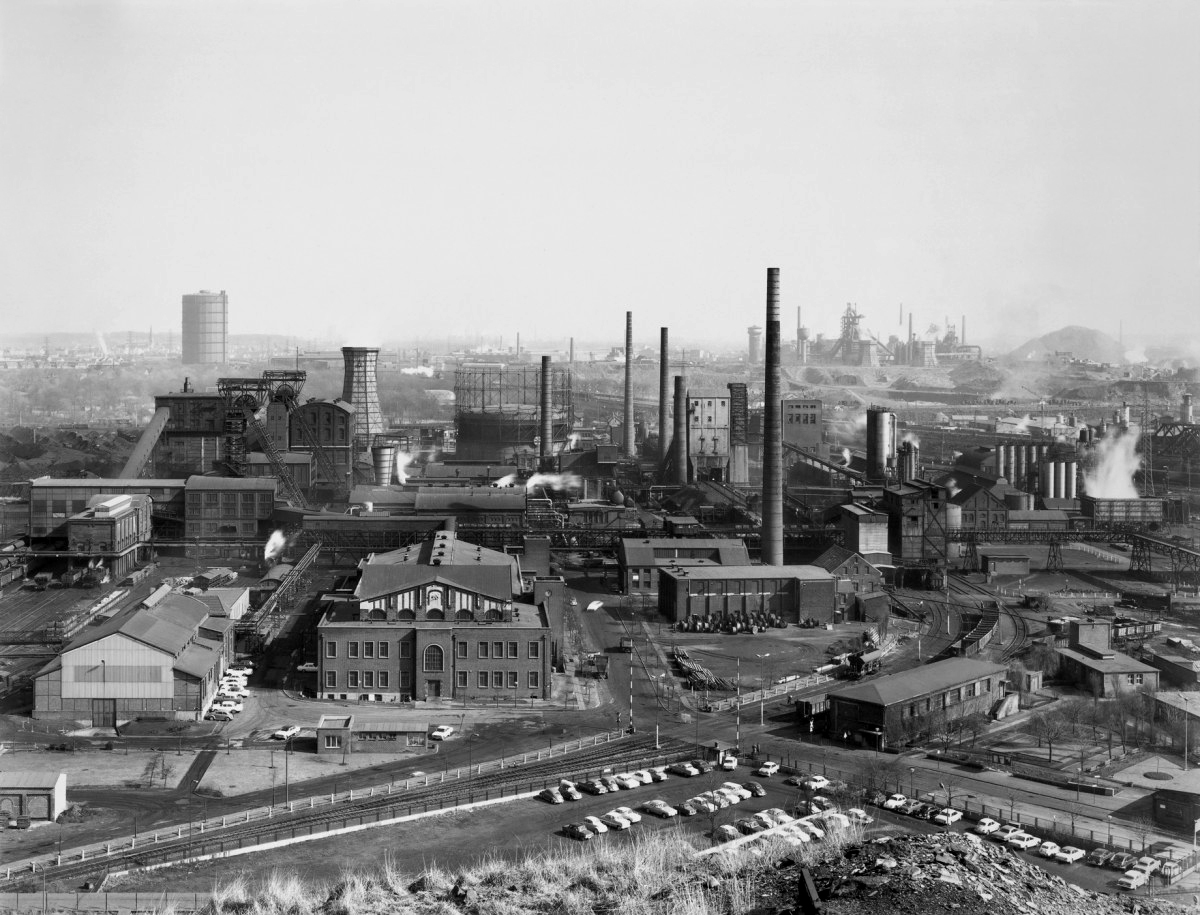
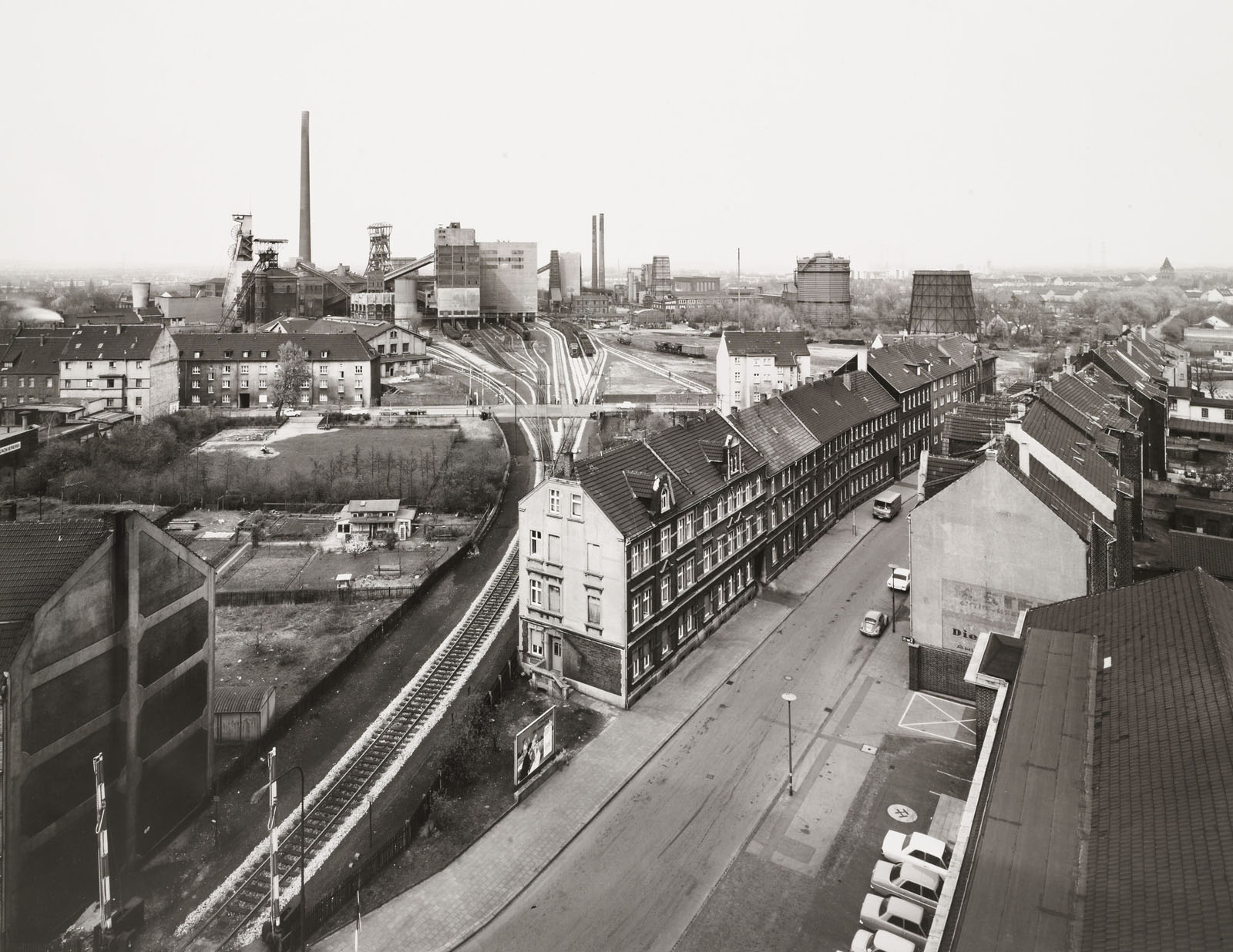
“The Ruhr Valley, where Becher’s family had worked in the steel and mining industries, was their initial focus. They were fascinated by the similar shapes in which certain buildings were designed. In addition, they were intrigued by the fact that so many of these industrial buildings seemed to have been built with a great deal of attention toward design. Together, the Bechers went out with a large 8 x 10-inch view camera and photographed these buildings from a number of different angles, but always with a straightforward “objective” point of view. They shot only on overcast days, so as to avoid shadows, and early in the morning during the seasons of spring and fall. Objects included barns, water towers, oal tipples, cooling towers, grain elevators, coal bunkers, coke ovens, oil refineries, blast furnaces, gas tanks, storage silos, and warehouses. At each site the Bechers also created overall landscape views of the entire plant, which set the structures in their context and show how they relate to each other.”


Wikipedia entry for Bernd and Hilla Becher


“The German artists Bernd and Hilla Becher, who began working together in 1959 and married in 1961, are best known for their “typologies” – grids of black-and-white photographs of variant examples of a single type of industrial structure. To create these works, the artists traveled to large mines and steel mills, and systematically photographed the major structures, such as the winding towers that haul coal and iron ore to the surface and the blast furnaces that transform the ore into metal. The rigorous frontality of the individual images gives them the simplicity of diagrams, while their density of detail offers encyclopaedic richness. At each site the Bechers also created overall landscape views of the entire plant, which set the structures in their context and show how they relate to each other. The typologies emulate the clarity of an engineer’s drawing, while the landscapes evoke the experience of a particular place.”


Peter Galassi, Chief Curator of Photography, MoMA


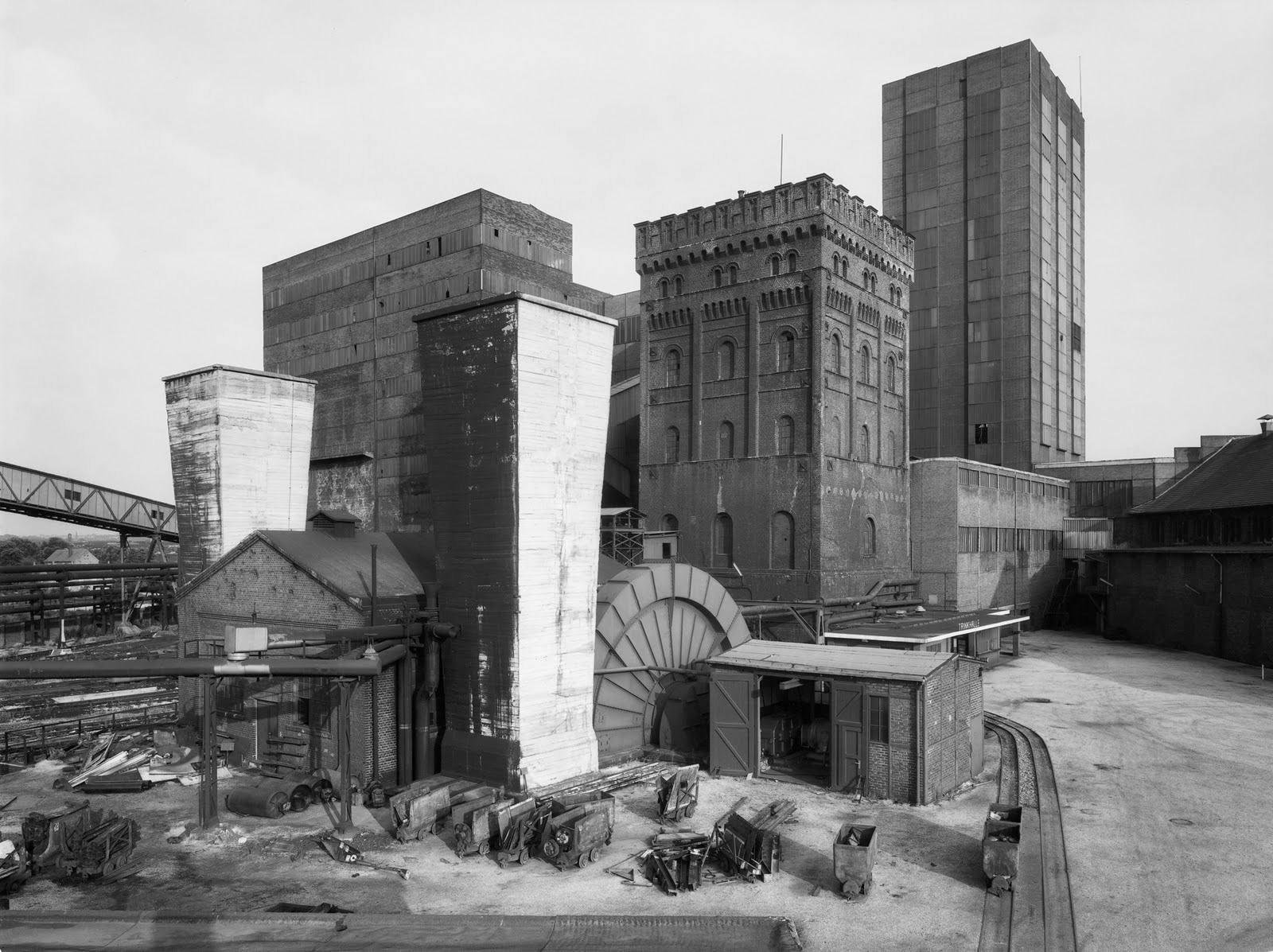
Bernd and Hilla Becher (German, active 1959-2007) Bernd Becher (German, 1931-2007) Hilla Becher (German, 1934-2015)
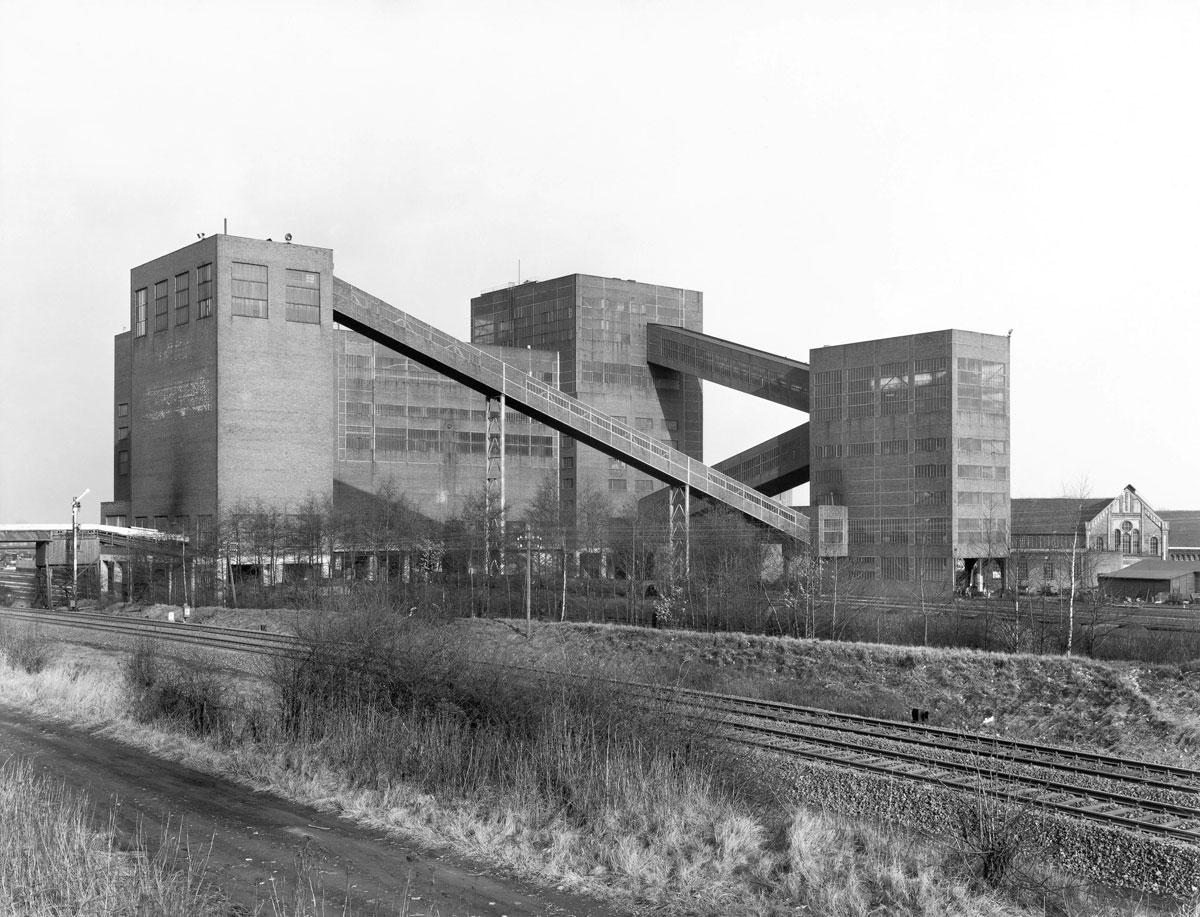
 'Becher 
Zeche Germania, Dortmund, D' 1971
 rom the exhibition 'Bernd and Hilla Becher: Mines and Mills - Industrial Landscapes' at Fotomuseum Winterthur, Zurich, Nov 2011 - Feb 2012


Bernd and Hilla Becher (German, active 1959-2007) Bernd Becher (German, 1931-2007) Hilla Becher (German, 1934-2015)

Zeche Germania, Dortmund, D
1971
Gelatin silver print
50 x 60cm
© Bernd and Hilla Becher / Courtesy of Schirmer/Mosel


For more than forty years, the photographer couple Bernd (1931-2007) and Hilla Becher (1934-2015) worked on creating an inventory of industrial architecture. Warehouses, shaft towers, gas tanks, blast furnaces as well as half-timbered houses are among the subjects they photographed throughout Germany, England, France, Central Europe, and the USA. Calling these buildings “anonymous sculptures,” they refer to the artistic quality of the constructions, which played no role for the buildings’ largely unknown builders and users. Their photographs attempt to draw attention to these hidden sculptural qualities and to document them historically as a building tradition in decline.

Bernd and Hilla Becher have always held particular interest for the industrial architecture in the Ruhr region. The exhibition Mines and Mills – Industrial Landscapes systematically examines this aspect of their work for the first time. Even today, names such as the Concordia and Hannibal collieries or Gutehoffnungshütte stand for the industrial history of the Ruhr region. Instead of concentrating on individual buildings, the exhibition approaches the mining facilities (where coal was produced for the smelting works) as a whole and in the context of their urban or natural surroundings. This typology, which the Bechers described as “industrial landscape,” compares the Ruhr region with similar complexes elsewhere in Europe and the USA.

As with their typological multiple and serial views of buildings, Bernd and Hilla Becher strive for a comparative perspective in their industrial landscapes. Demonstrating great photographic restraint in their approach and in the name of a “New Objectivity” dedicated solely to the object, they stand in a long tradition of proponents of the documentary gaze that includes Eugène Atget, Karl Blossfeldt, Walker Evans, Albert Renger-Patzsch and August Sander. Their influence on the history of photography extends from the establishment of the “Dusseldorf School” into the present.

“The main aim of our work is to show that the forms of our time are technical forms, although they did not develop from formal considerations. Just as medieval thought is manifested in the gothic cathedral, our era is revealed in technical buildings and apparatuses,” Bernd and Hilla Becher stated in a conversation from 2005.

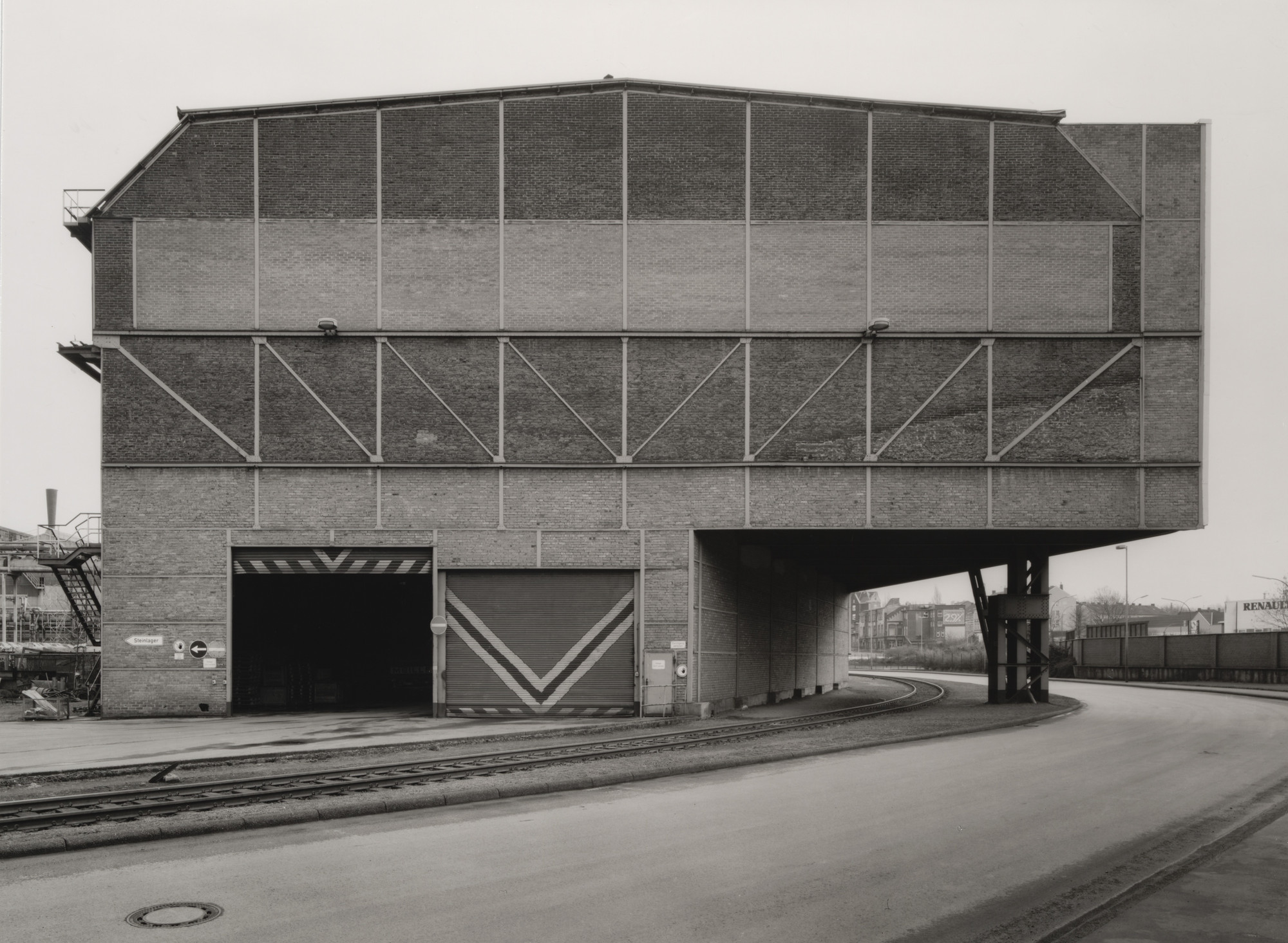
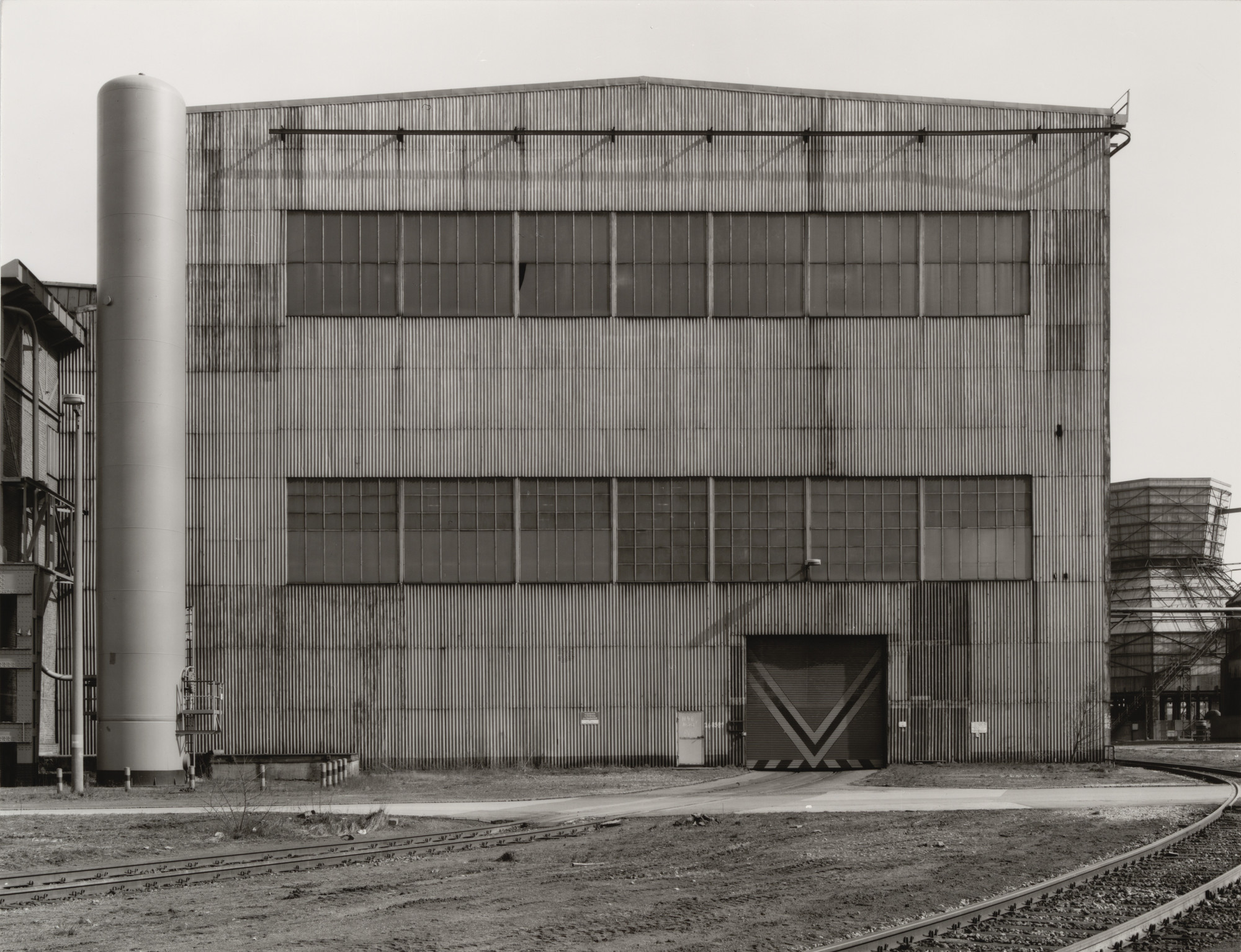
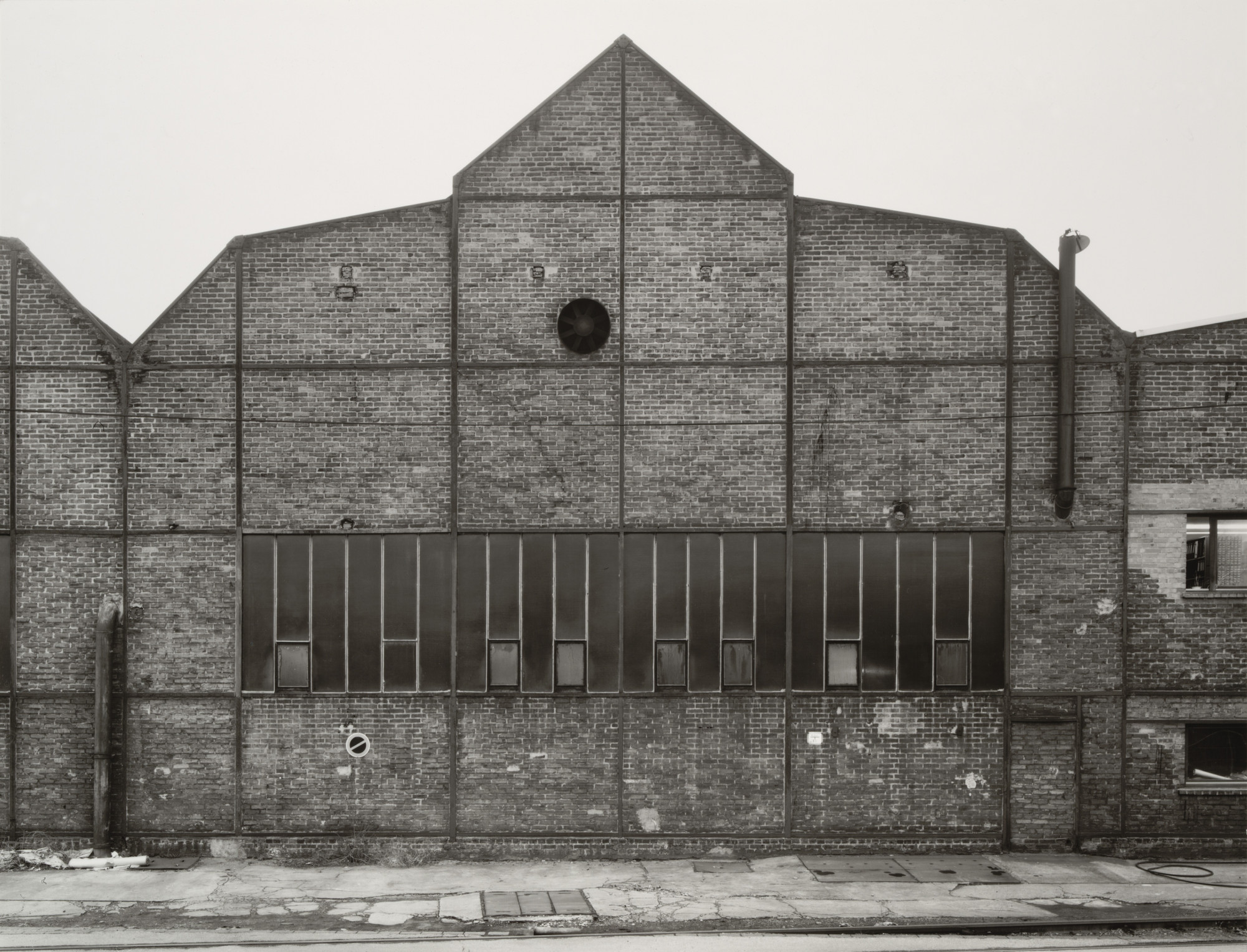
The industrial landscapes can be read from historical and social perspectives, to an even greater extent than the familiar photographs of simple building typologies. Next to the monumental, industrial buildings one often sees residential constructions, gardens, and allotment gardens, which convey how intertwined the organisation of life and work was at the time and how deeply rooted people were in this city-like structure. Photographed at waist-height, the broad, open views of the horizontally composed photographs have an aesthetic that is almost atypical of the Bechers. However, the images adhere systematically to the archival thinking of the artist couple.

Press release from the Fotomuseum Winterthur, Zurich website


Bernd and Hilla Becher (German, active 1959-2007) Bernd Becher (German, 1931-2007) Hilla Becher (German, 1934-2015)
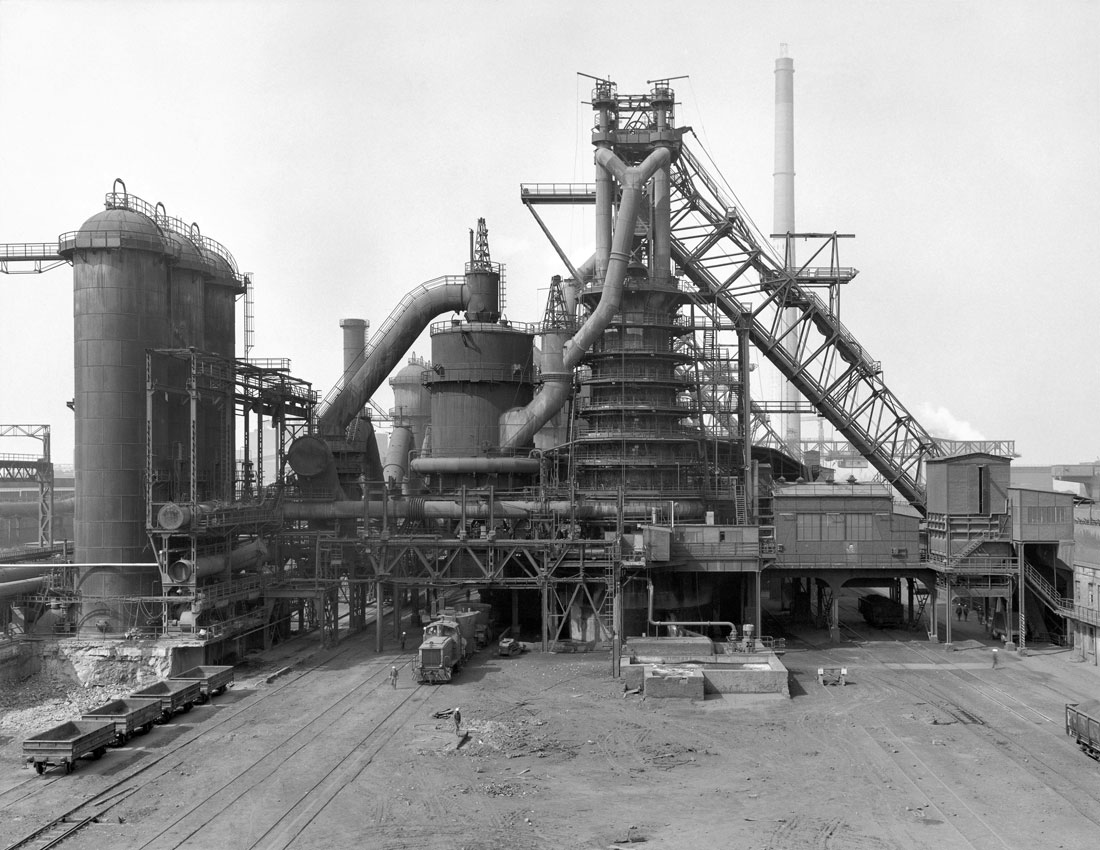
 'Gutehoffnungshütte, Oberhausen, D' 1963


Bernd and Hilla Becher (German, active 1959-2007) Bernd Becher (German, 1931-2007) Hilla Becher (German, 1934-2015)
Gutehoffnungshütte, Oberhausen, D
1963
Gelatin silver print
50 x 60cm
© Bernd and Hilla Becher / Courtesy of Schirmer/Mosel


Bernd and Hilla Becher (German, active 1959-2007) Bernd Becher (German, 1931-2007) Hilla Becher (German, 1934-2015)
 'Charleroi-Montignies, B' 1971


Bernd and Hilla Becher (German, active 1959-2007) Bernd Becher (German, 1931-2007) Hilla Becher (German, 1934-2015)
Charleroi-Montignies, B
1971
Gelatin silver print
50 x 60cm
© Bernd and Hilla Becher / Courtesy of Schirmer/Mosel


Bernd and Hilla Becher (German, active 1959-2007) Bernd Becher (German, 1931-2007) Hilla Becher (German, 1934-2015)
 'Duisburg-Huckingen, D' 1970


Bernd and Hilla Becher (German, active 1959-2007) Bernd Becher (German, 1931-2007) Hilla Becher (German, 1934-2015)
Duisburg-Huckingen, D
1970
Gelatin silver print
50 x 60cm
© Bernd and Hilla Becher / Courtesy of Schirmer/Mosel


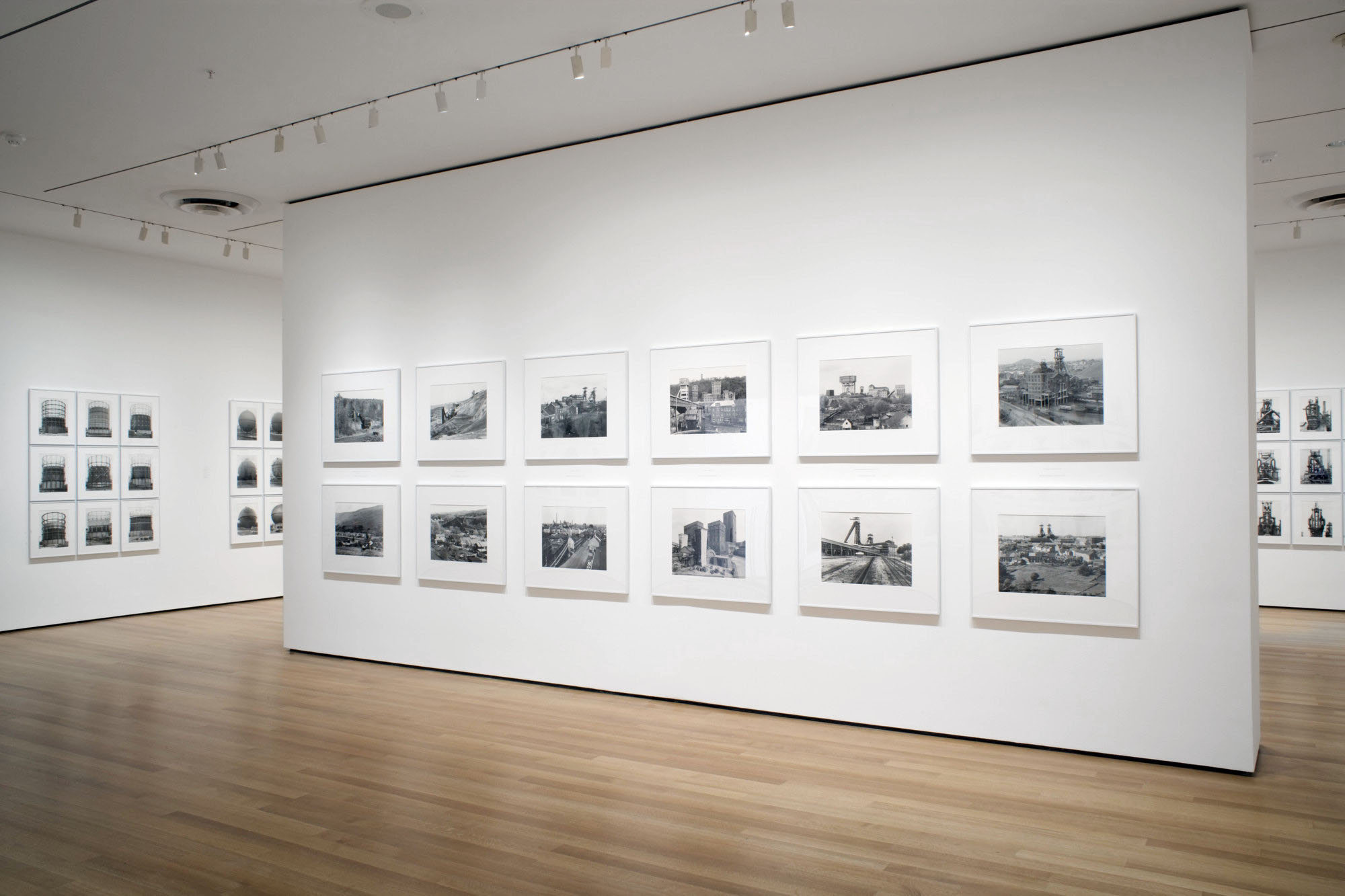
Installation view of the exhibition 'Bernd and Hilla Becher: Landscape/Typology' at the Museum of Modern Art, New York


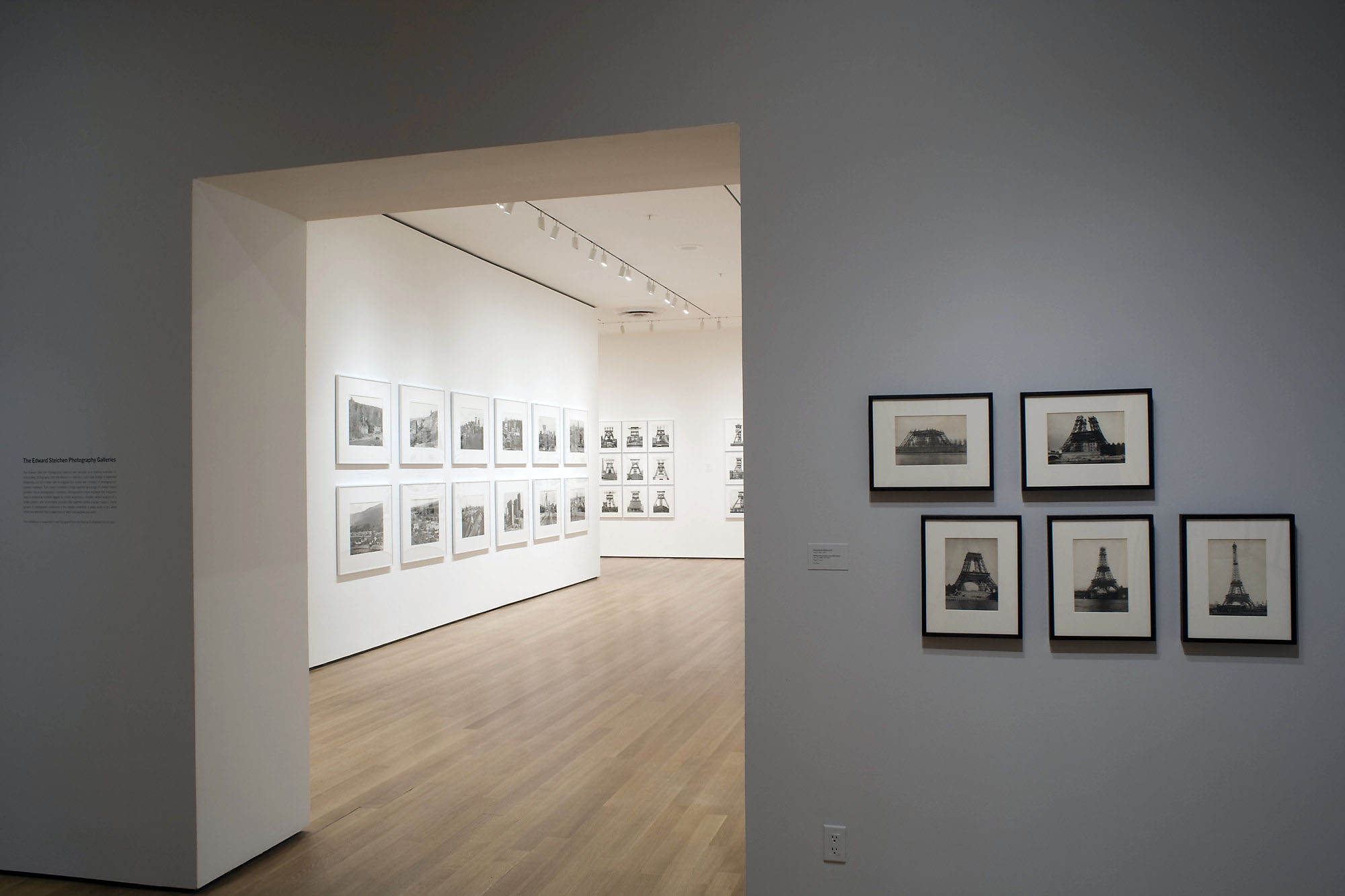
Installation view of the exhibition Bernd and Hilla Becher: Landscape / Typology at the Museum of Modern Art, New York, May 21, 2008 – August 25, 2008 showing top row at right, Hippolyte Blancard’s Untitled (1888, below)
Photograph by John Wronn


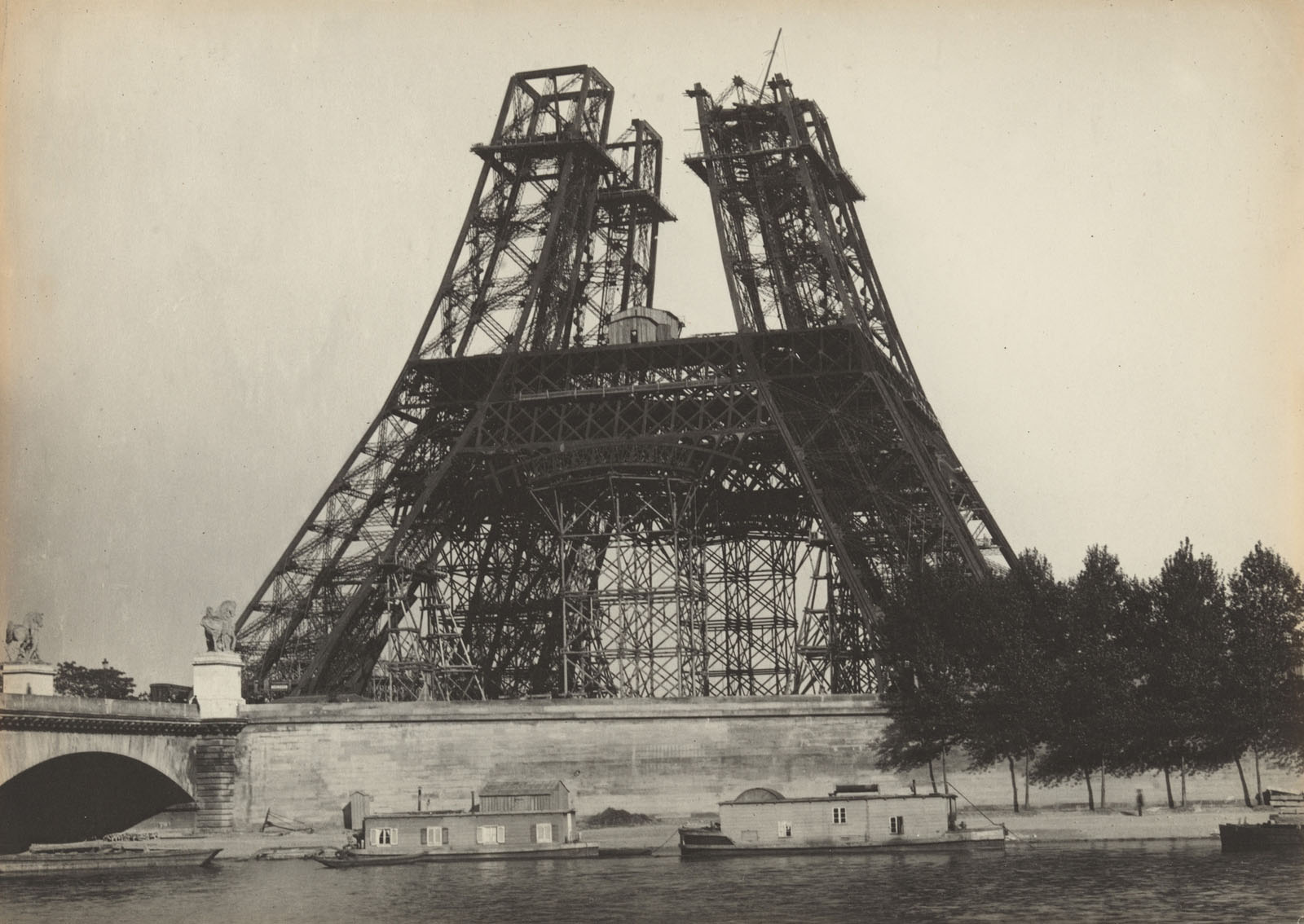
Hippolyte Blancard (French, 1843-1924) 'Untitled' April 1888


Hippolyte Blancard (French, 1843-1924)
Untitled
April 1888
Platinum print
8 13/16 × 6 1/8″ (22.4 × 15.6cm)
Museum of Modern Art, New York
Purchase


Hippolyte Blancard, a pharmacist and amateur photographer, documented Parisian architecture leading up to the 1889 Exposition Universelle, or World’s Fair, an international event held in Paris to showcase new innovations, geographic and scientific discoveries, and works of art. His series of photographs shows the construction of the Eiffel Tower, which was conceived as the entrance to the World’s Fair. Blancard’s photographs document the tower’s progression, from July 1887 to April 1889.

Text from the MoMA website


Bernd and Hilla Becher (German, active 1959-2007) Bernd Becher (German, 1931-2007) Hilla Becher (German, 1934-2015)
 'Zeche Concordia, Oberhausen, D' 1967


Bernd and Hilla Becher (German, active 1959-2007) Bernd Becher (German, 1931-2007) Hilla Becher (German, 1934-2015)
Zeche Concordia, Oberhausen, D
1967
Gelatin silver print
50 x 60cm
© Bernd und Hilla Becher – Courtesy of Schirmer/Mosel


Installation view of the exhibition 'Bernd and Hilla Becher: Landscape/Typology' at the Museum of Modern Art, New York


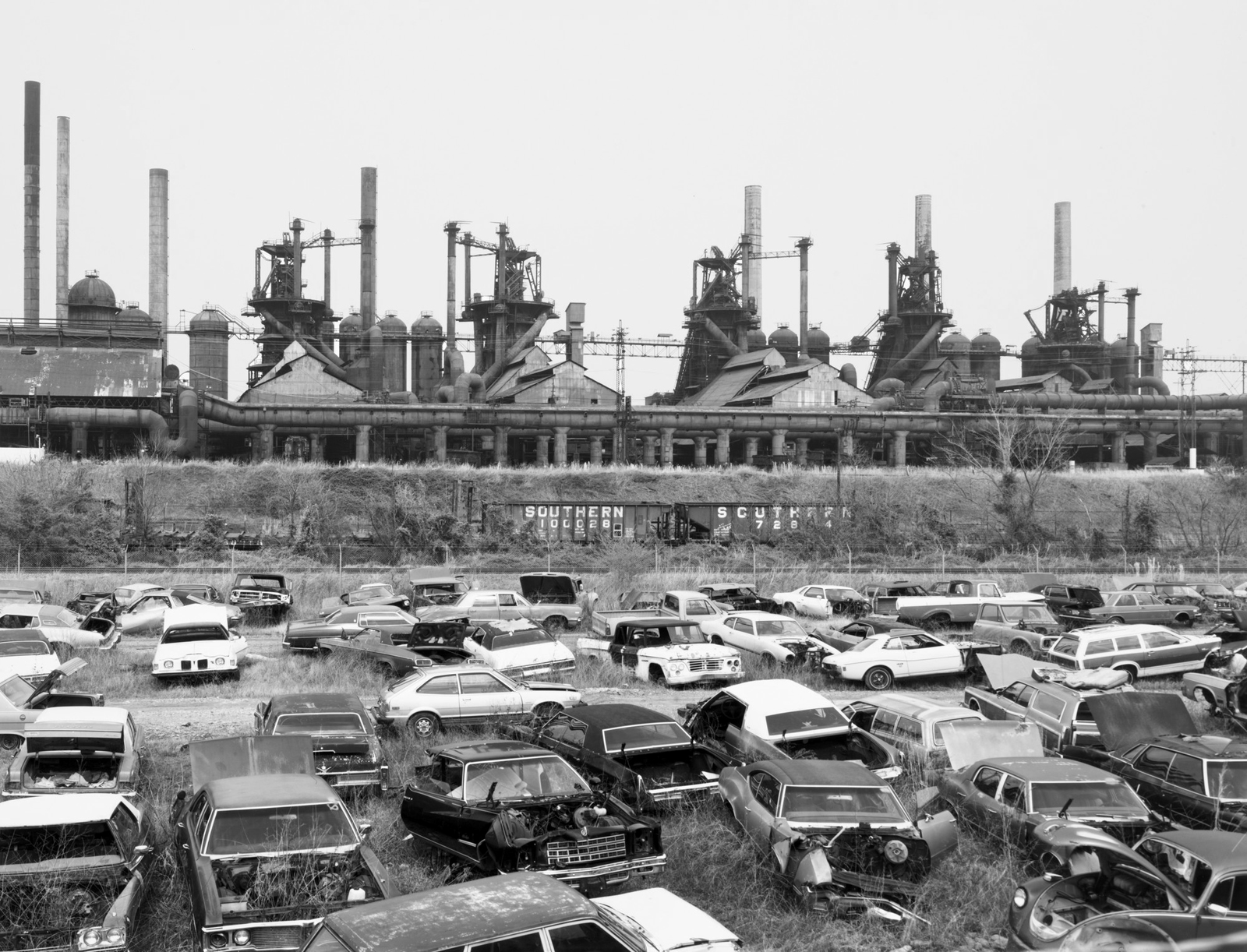
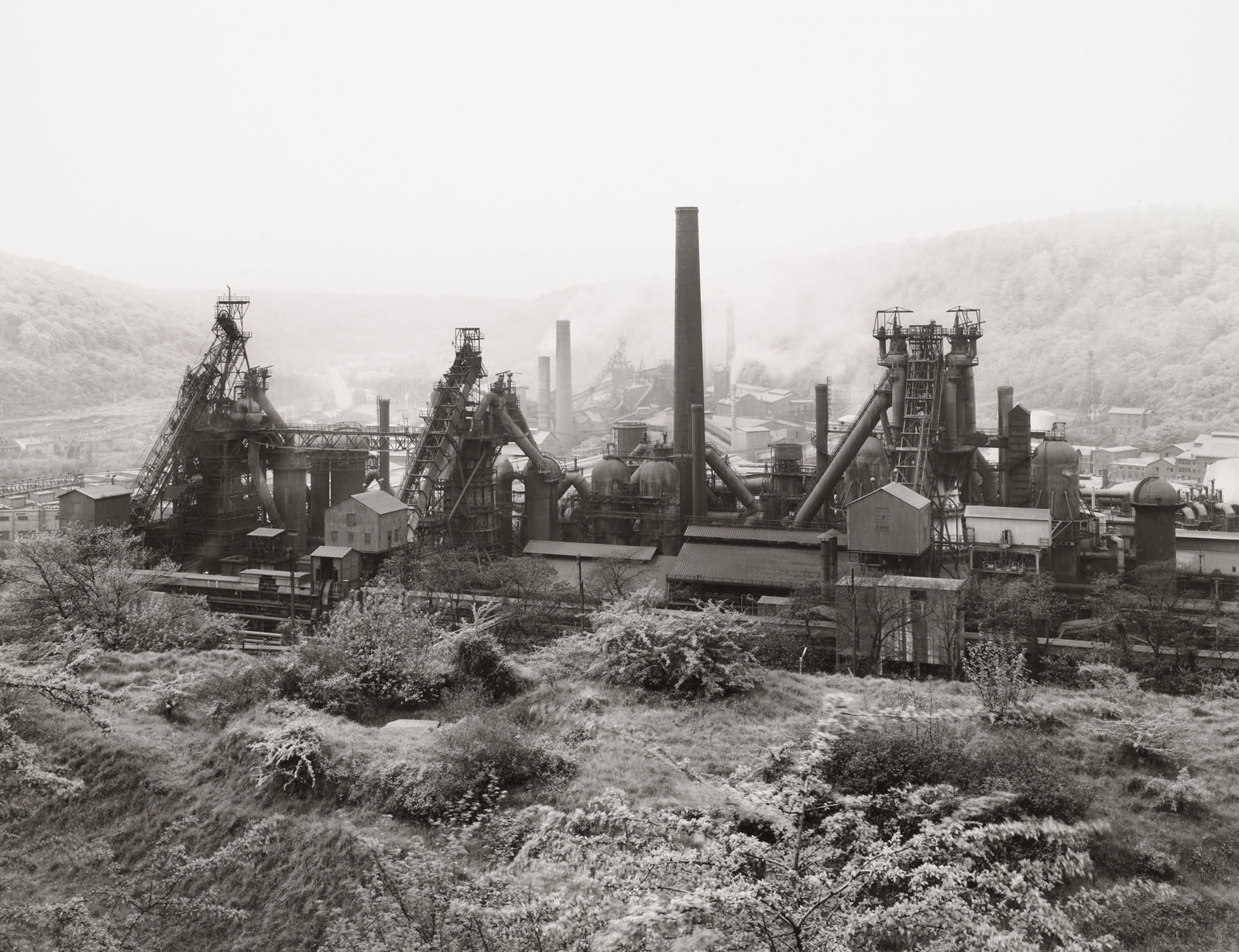
Installation view of the exhibition Bernd and Hilla Becher: Landscape / Typology at the Museum of Modern Art, New York, May 21, 2008 – August 25, 2008 showing the three images directly below – Duisburg-Bruckhausen (1999); Ensley, Alabama, USA (1982); and Knutange, Lorraine, France (1971)
Photograph by John Wronn


Bernd and Hilla Becher (German, active 1959-2007) Bernd Becher (German, 1931-2007) Hilla Becher (German, 1934-2015)
 'Duisburg-Bruckhausen' 1999


Bernd and Hilla Becher (German, active 1959-2007) Bernd Becher (German, 1931-2007) Hilla Becher (German, 1934-2015)
Duisburg-Bruckhausen
1999
Gelatin silver print
50 x 60cm
© Bernd und Hilla Becher – Courtesy of Schirmer/Mosel


Bernd and Hilla Becher (German, active 1959-2007) Bernd Becher (German, 1931-2007) Hilla Becher (German, 1934-2015)
 'Ensley, Alabama, USA' 1982


Bernd and Hilla Becher (German, active 1959-2007) Bernd Becher (German, 1931-2007) Hilla Becher (German, 1934-2015)
Ensley, Alabama, USA
1982
Gelatin silver print
50 x 60cm
© Bernd und Hilla Becher – Courtesy of Schirmer/Mosel


Bernd and Hilla Becher (German, active 1959-2007) Bernd Becher (German, 1931-2007) Hilla Becher (German, 1934-2015) 'Knutange, Lorraine, France' 1971


Bernd and Hilla Becher (German, active 1959-2007) Bernd Becher (German, 1931-2007) Hilla Becher (German, 1934-2015)
Knutange, Lorraine, France
1971
Gelatin silver print
17 7/8 × 23 9/16″ (45.4 × 59.9cm)
Horace W. Goldsmith Fund through Robert B. Menschel
© 2022 Estate of Bernd Becher and Hilla Becher


Installation view of the exhibition 'Bernd and Hilla Becher: Landscape/Typology' at the Museum of Modern Art, New York

Installation view of the exhibition 'Bernd and Hilla Becher: Landscape/Typology' at the Museum of Modern Art, New York


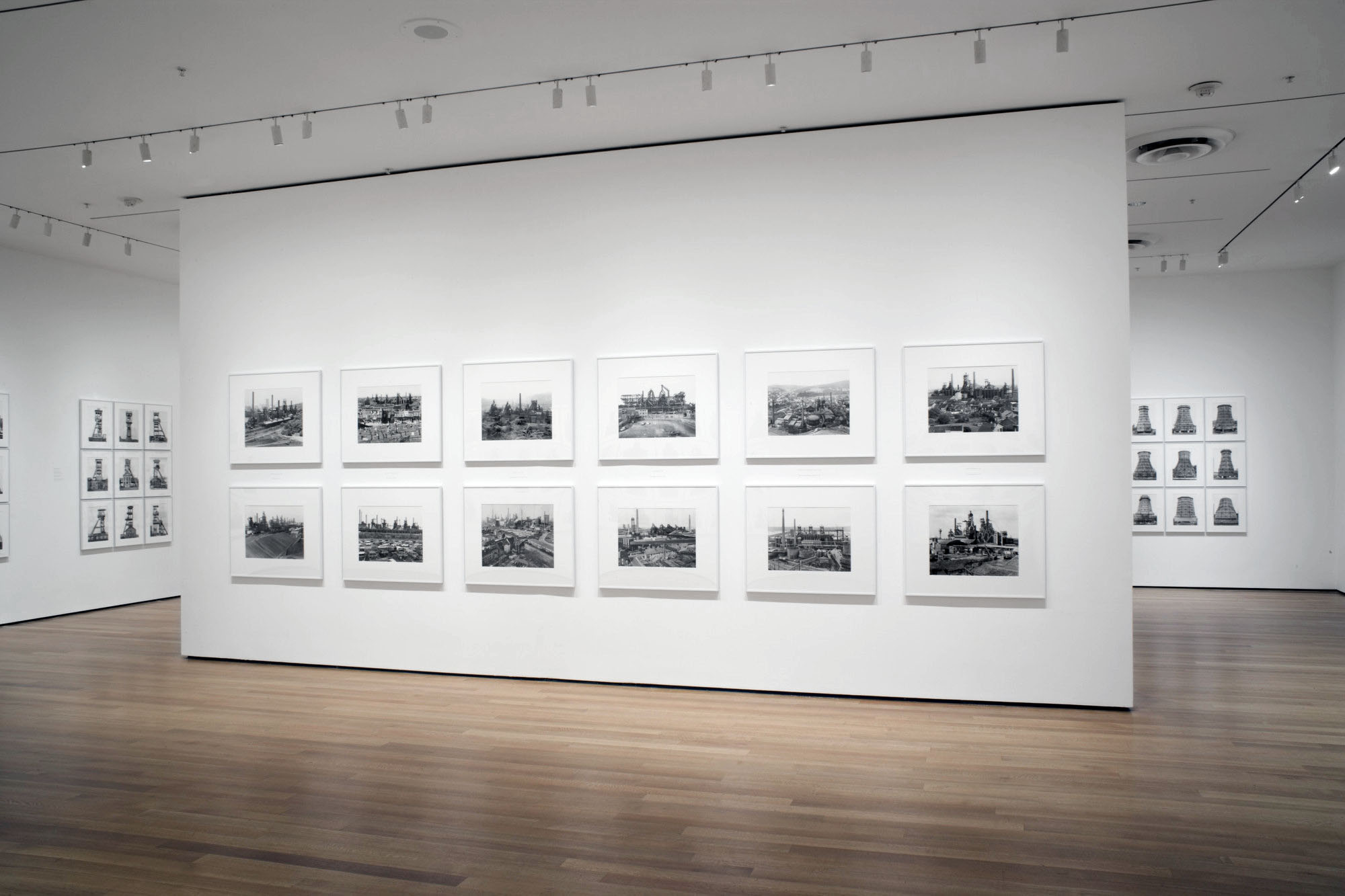
Installation views of the exhibition Bernd and Hilla Becher: Landscape / Typology at the Museum of Modern Art, New York, May 21, 2008 – August 25, 2008
Photographs by John Wronn


Bernd and Hilla Becher (German, active 1959-2007) Bernd Becher (German, 1931-2007) Hilla Becher (German, 1934-2015) 'Hannover Mine 1/2/5, Bochum-Hordel, Ruhr Region, Germany' 1973


Bernd and Hilla Becher (German, active 1959-2007) Bernd Becher (German, 1931-2007) Hilla Becher (German, 1934-2015)
Hannover Mine 1/2/5, Bochum-Hordel, Ruhr Region, Germany
1973
Gelatin silver print
50 x 60cm
© Bernd und Hilla Becher – Courtesy of Schirmer/Mosel


Bernd and Hilla Becher (German, active 1959-2007) Bernd Becher (German, 1931-2007) Hilla Becher (German, 1934-2015) 'Consolidation Mine, Gelsenkirchen, Ruhr Region, Germany' 1974


Bernd and Hilla Becher (German, active 1959-2007) Bernd Becher (German, 1931-2007) Hilla Becher (German, 1934-2015)
Consolidation Mine, Gelsenkirchen, Ruhr Region, Germany
1974
Gelatin silver print
18 1/4 × 23 7/16″ (46.3 × 59.5cm)
Horace W. Goldsmith Fund through Robert B. Menschel
© 2022 Estate of Bernd Becher and Hilla Becher


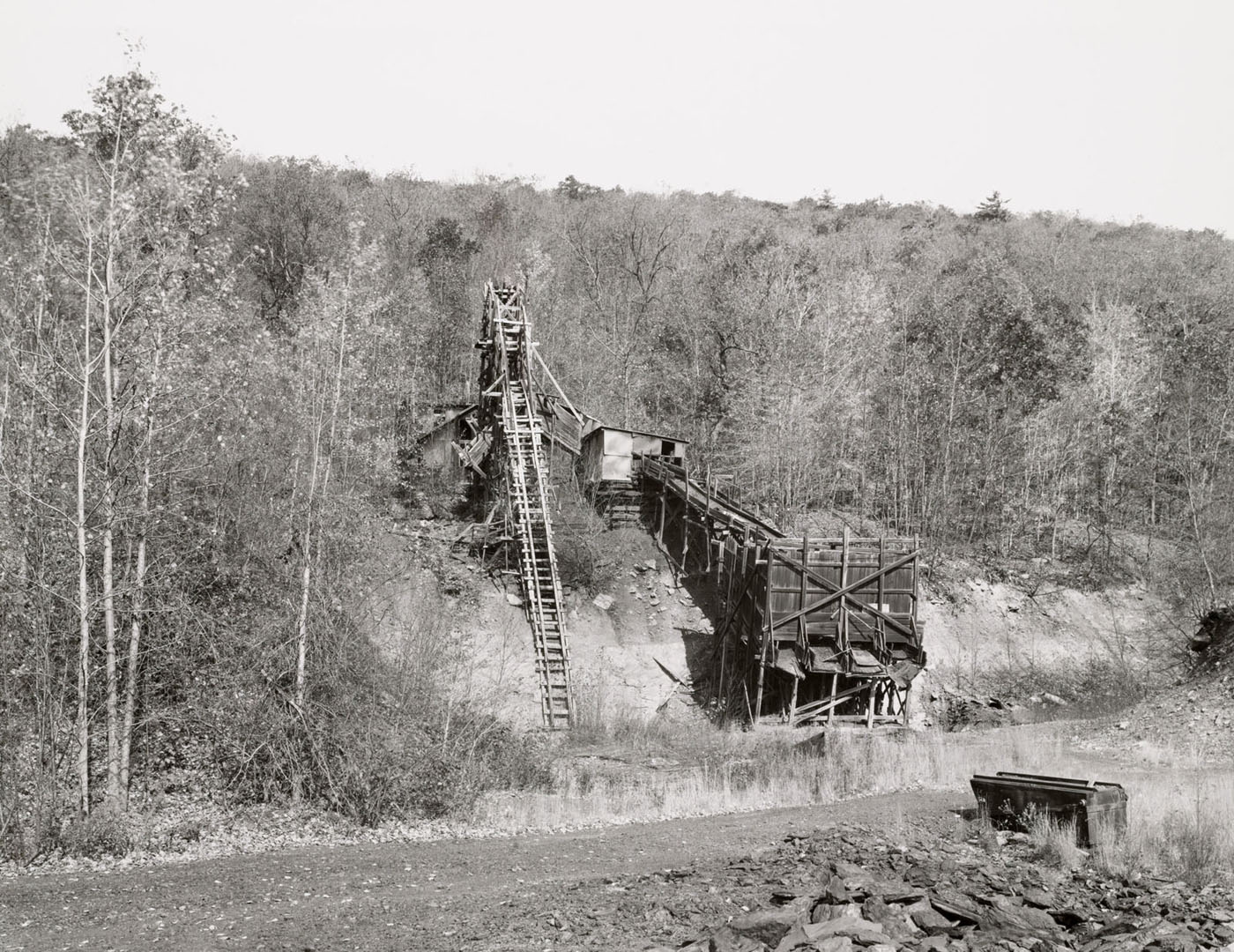
Bernd and Hilla Becher (German, active 1959-2007) Bernd Becher (German, 1931-2007) Hilla Becher (German, 1934-2015) 'Coal Mine, Bear Valley, Schuylkill County, Pennsylvania, United States' 1974


Bernd and Hilla Becher (German, active 1959-2007) Bernd Becher (German, 1931-2007) Hilla Becher (German, 1934-2015)
Coal Mine, Bear Valley, Schuylkill County, Pennsylvania, United States
1974
Gelatin silver print
17 5/8 × 23 1/2″ (44.7 × 59.7cm)
Horace W. Goldsmith Fund through Robert B. Menschel
© 2022 Estate of Bernd Becher and Hilla Becher


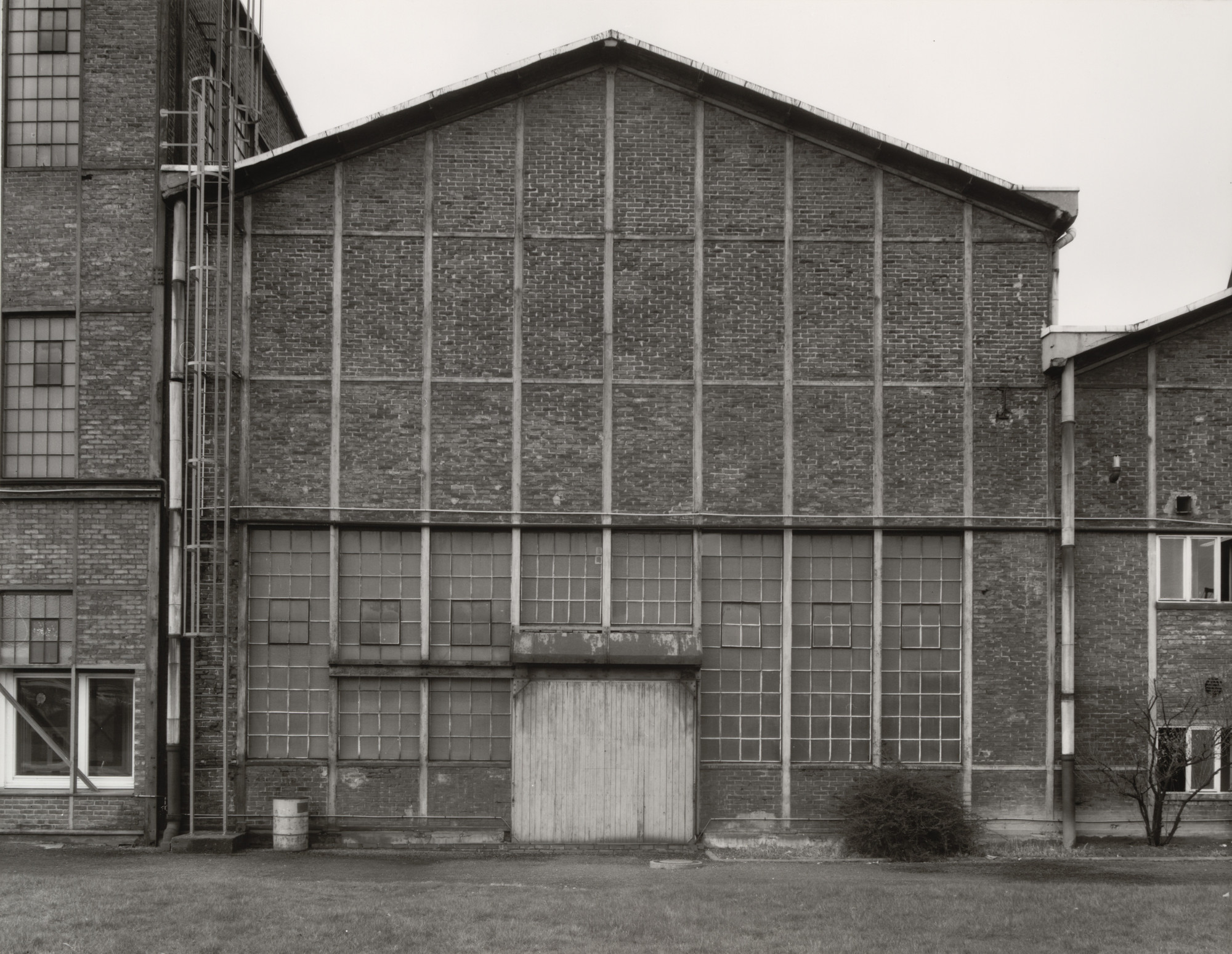
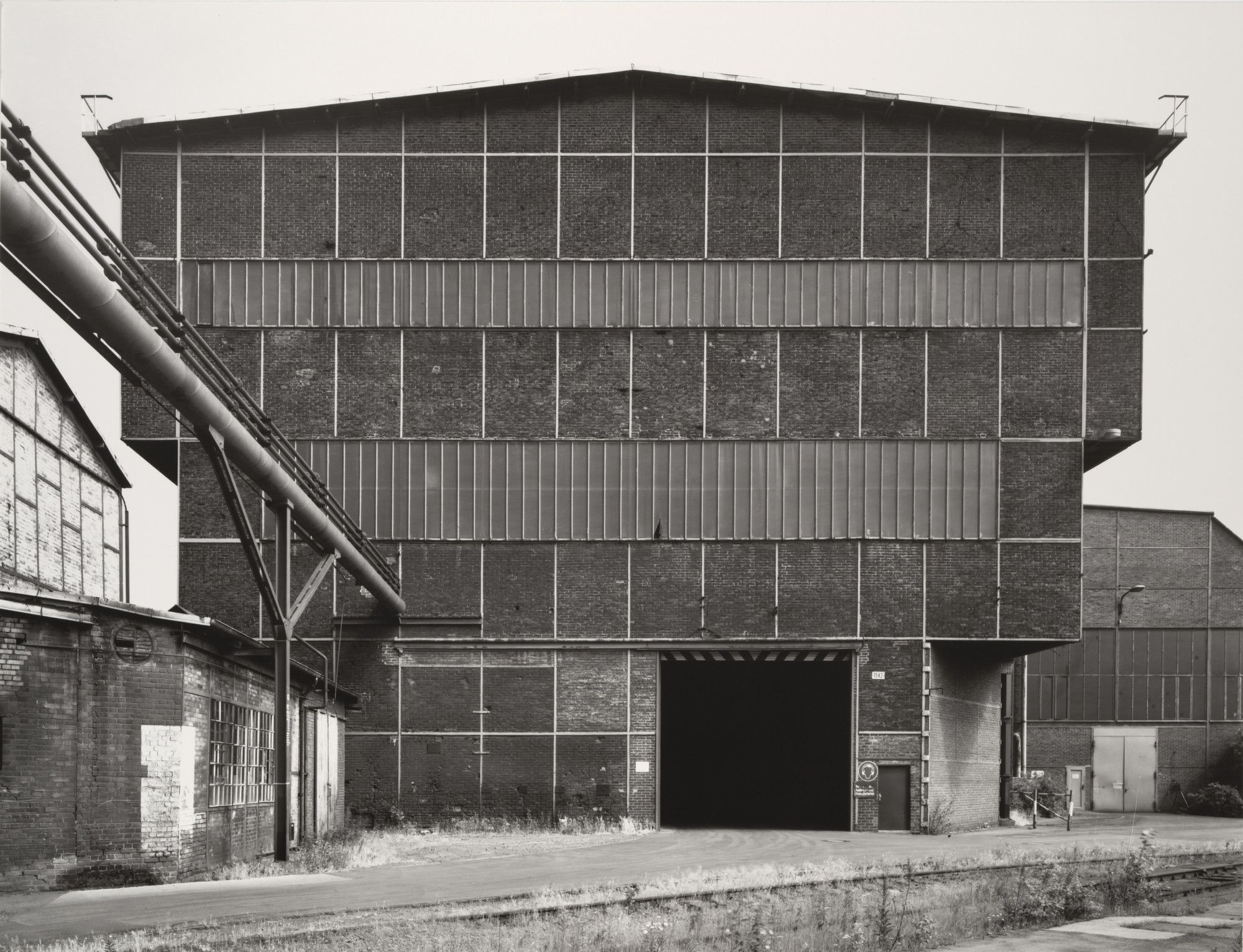
Bernd and Hilla Becher (German, active 1959-2007) Bernd Becher (German, 1931-2007) Hilla Becher (German, 1934-2015) 'Industrial Façades' 1978-1992

Bernd and Hilla Becher (German, active 1959-2007) Bernd Becher (German, 1931-2007) Hilla Becher (German, 1934-2015) 'Industrial Façades' 1978-1992

Bernd and Hilla Becher (German, active 1959-2007) Bernd Becher (German, 1931-2007) Hilla Becher (German, 1934-2015) 'Industrial Façades' 1978-1992

Bernd and Hilla Becher (German, active 1959-2007) Bernd Becher (German, 1931-2007) Hilla Becher (German, 1934-2015) 'Industrial Façades' 1978-1992

Bernd and Hilla Becher (German, active 1959-2007) Bernd Becher (German, 1931-2007) Hilla Becher (German, 1934-2015) 'Industrial Façades' 1978-1992


Bernd and Hilla Becher (German, active 1959-2007) Bernd Becher (German, 1931-2007) Hilla Becher (German, 1934-2015)
Industrial Façades (detail)
1978-1992
21 Gelatin silver prints
Each 12 3/16 × 15 15/16″ (31 × 40.5cm)
Acquired through the Gerald S. Elliot Bequest


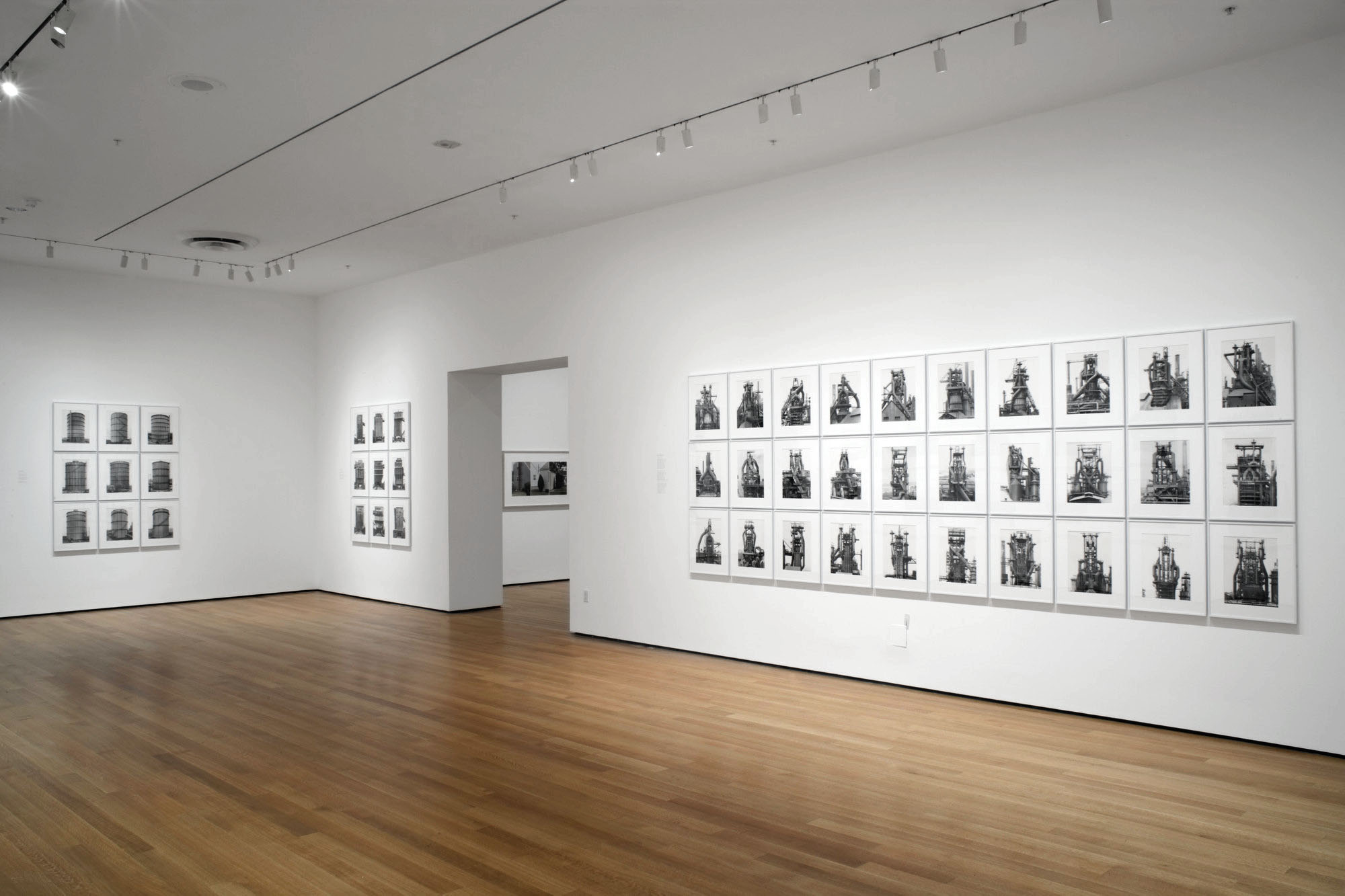
Installation view of the exhibition 'Bernd and Hilla Becher: Landscape/Typology' at the Museum of Modern Art, New York


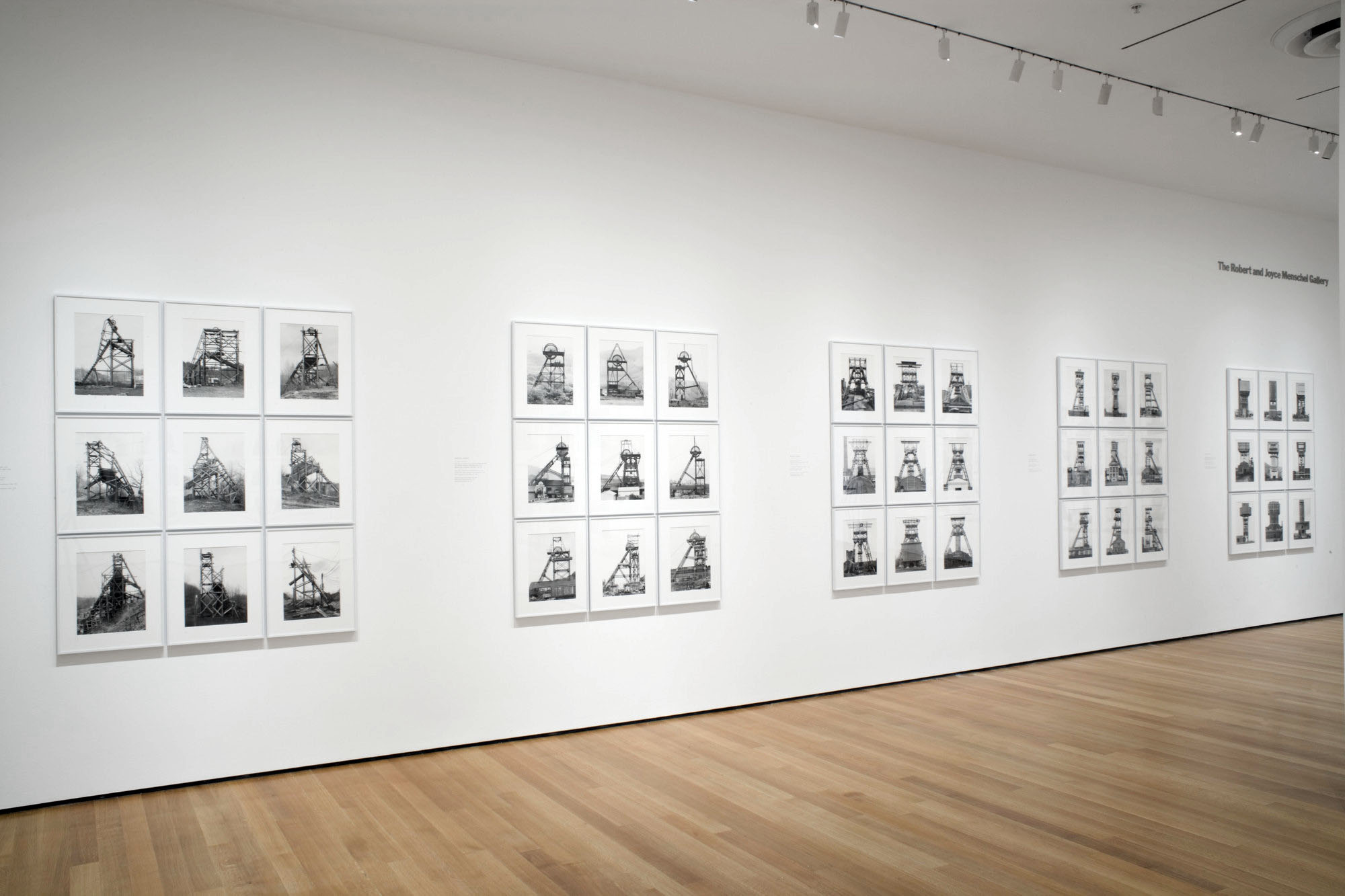
Installation view of the exhibition Bernd and Hilla Becher: Landscape / Typology at the Museum of Modern Art, New York, May 21, 2008 – August 25, 2008 showing at second left, Winding Towers (1966-1997, below)
Photograph by John Wronn


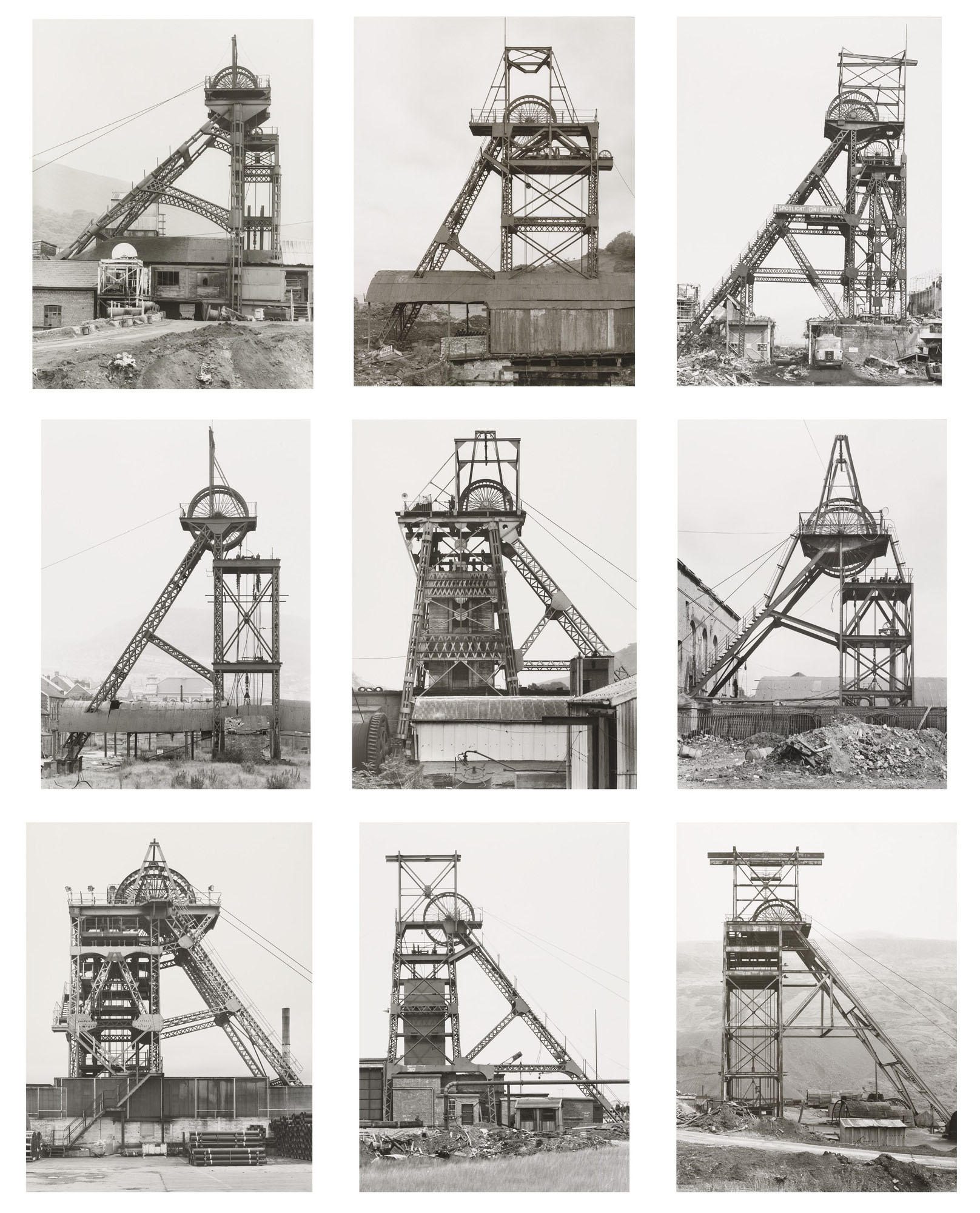
Bernd and Hilla Becher (German, active 1959-2007) Bernd Becher (German, 1931-2007) Hilla Becher (German, 1934-2015) 'Winding Towers' 1966-1997


Bernd and Hilla Becher (German, active 1959-2007) Bernd Becher (German, 1931-2007) Hilla Becher (German, 1934-2015)
Winding Towers
1966-1997
Nine gelatin silver prints
Dimensions
68 1/4 × 56 1/4″ (173.4 × 142.9cm)
Acquired in honour of Marie-Josée Kravis through the generosity of Robert B. Menschel
© 2022 Estate of Bernd Becher and Hilla Becher


For more than forty years, the Bechers photographed winding towers, blast furnaces, silos, cooling towers, gas tanks, grain elevators, oil refineries, and the like – all examples of the European and American industrial architecture that had begun to disappear in the transition from an industrial society to an information society. Their works typically present each structure frontally against flat, evenly grey backgrounds. By using large-format cameras and finely grained black-and-white film, they ensured that the motifs they photographed were rendered with a high degree of precision and clarity.

The Bechers organised the images into groupings assembled in grids, classified by function into types. In this strict layout, each structure may easily be compared with the others. The nine separate pictures in Winding Towers together transform the specificity of the individual towers into variations on an ideal form and, conversely, preserve their individual characteristics within a typology.

Publication excerpt from MoMA Highlights: 375 Works from The Museum of Modern Art, New York (New York: The Museum of Modern Art, 2019)


Installation view of the exhibition 'Bernd and Hilla Becher: Landscape/Typology' at the Museum of Modern Art, New York


Installation view of the exhibition Bernd and Hilla Becher: Landscape / Typology at the Museum of Modern Art, New York, May 21, 2008 – August 25, 2008
Photograph by John Wronn


Fotomuseum Winterthur
Grüzenstrasse 44 + 45
CH-8400
Winterthur (Zürich)

Opening hours:
Tuesday to Sunday 11am – 6pm
Wednesday 11am – 8pm
Closed on Mondays

Fotomuseum Winterthur website

LIKE ART BLART ON FACEBOOK

Back to top

Exhibition: ‘After the Gold Rush: Contemporary Photographs from the Collection’ at The Metropolitan Museum of Art, New York

Exhibition dates: 22nd March, 2011 – 2nd January, 2012


Many thankx to The Metropolitan Museum of Art, New York for allowing me to publish the photographs in the posting. Please click on the photographs for a larger version of the image.


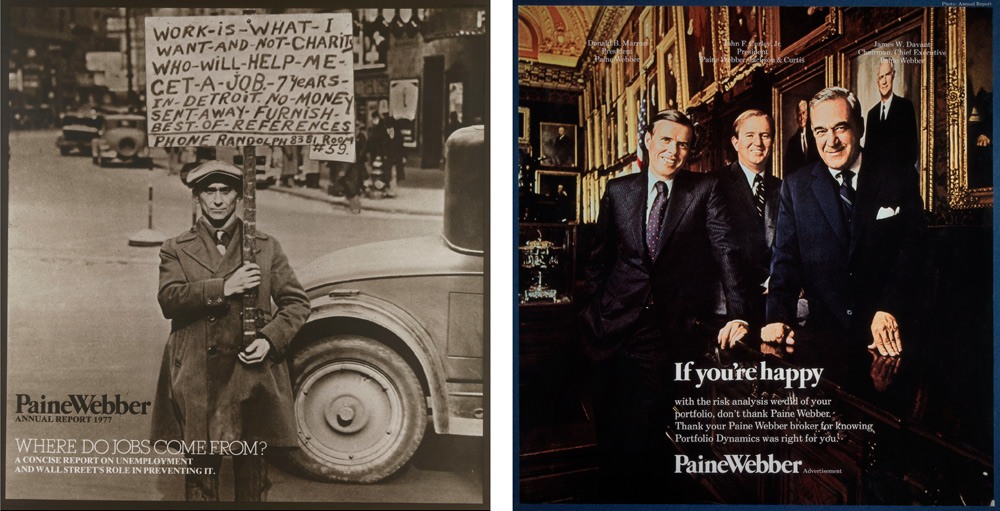
Hans Haacke (German, born 1936). 'Thank You, Paine Webber' 1979


Hans Haacke (German, b. 1936)
Thank You, Paine Webber
1979
Gelatin silver print and chromogenic print
The Metropolitan Museum of Art
Purchase, Vital Projects Fund Inc. Gift, through Joyce and Robert Menschel, 2010
© Hans Haacke


Since the early 1970s Haacke has taken on the intertwined political and corporate forces that use cultural patronage as a smokescreen to advance interests that are often antithetical to the vitality of free speech and expression in democracies. Haacke made this work just as the strategy of appropriation – lifting an image out of its original context and re-presenting it in critical fashion – began to make waves in the New York art world of the late 1970s. Like all effective appropriation, it exposes a prior instance of borrowing – in this case, how the investment firm Paine Webber used a documentary photograph to give its annual report the veneer of social concern. The artist then pointedly contrasted it with an image from the same annual report of a beaming trio of executives in a painting-lined gallery. As a counterpoint to the protestor’s signboard, Haacke dropped in text from a different Paine Webber ad campaign to show on whose backs the “risk management” is taking place – a biting indictment, the relevance of which has only increased since the recent economic downturn.

Wall text


Jeff Wall (Canadian, born 1946). 'The Storyteller' 1986


Jeff Wall (Canadian, b. 1946)
The Storyteller
1986
Silver dye bleach transparency in light box
The Metropolitan Museum of Art
Purchase, Charlene and David Howe, Henry Nias Foundation Inc., Jennifer and Robert Yaffa, Harriet Ames Charitable Trust, and Gary and Sarah Wolkowitz Gifts, 2006
Image courtesy of the artist
© Jeff Wall


Wall’s staged tableaux straddle the worlds of the museum and the street. His subjects are scenes of urban and suburban disarray that he witnessed firsthand – the kinds of things anyone might see while wandering around a city and its outskirts. Working like a movie director, he restages the scene using nonprofessionals as actors and presents his photographs as colour transparencies in light boxes such as those of large-scale public advertisements found at airports and bus stops. The scale and ambition of his pictures – scenes of everyday life shot through with larger intimations of political struggle – equally evoke the Salon paintings of nineteenth century French painters such as Gustave Courbet and Édouard Manet, which were themselves brazen combinations of canonical and contemporary subjects.

The Storyteller is set in a barren, leftover slice of land next to a highway overpass in Vancouver, where the artist lives. Various groupings of modern urban castaways – perhaps descendants of the Native Americans who occupied the land before the arrival of Europeans – are dispersed around the hillside, a mini-catalogue of art-historical reference. Like the upside-down, half-submerged figure of Icarus in the background of Brueghel’s Landscape with the Fall of Icarus, the woman speaking and gesticulating to the two men listening at the lower left becomes the key to unifying the fractured and alienating environment from which Wall’s picture is constructed.

Wall text


Laurie Simmons (American, b. 1949). 'Walking Gun' 1991


Laurie Simmons (American, b. 1949)
Walking Gun
1991
Gelatin silver print
The Metropolitan Museum of Art
Purchase, Anonymous Gift, 1998
© Laurie Simmons


The early 1990s marked the last moment when a wide swath of women artists responded to the sexism they saw as pervasive in the culture – from the rape trial of William Kennedy Smith to the Supreme Court nomination hearings for Clarence Thomas. A pioneer of set-up photography, Simmons dramatically expanded the scale of her constructed tableaux for a series of spotlighted puppet-like objects perched atop doll legs: revolvers, houses, cameras, and cakes. This armed and dangerous example refers to the old-movie cliché where a man carrying a gun is shown in shadow profile. Here, Simmons offers instead the death-dealing seductress – also familiar from film noir – in monumental miniature, a doll capable of turning on its master at a moment’s notice.

Wall text


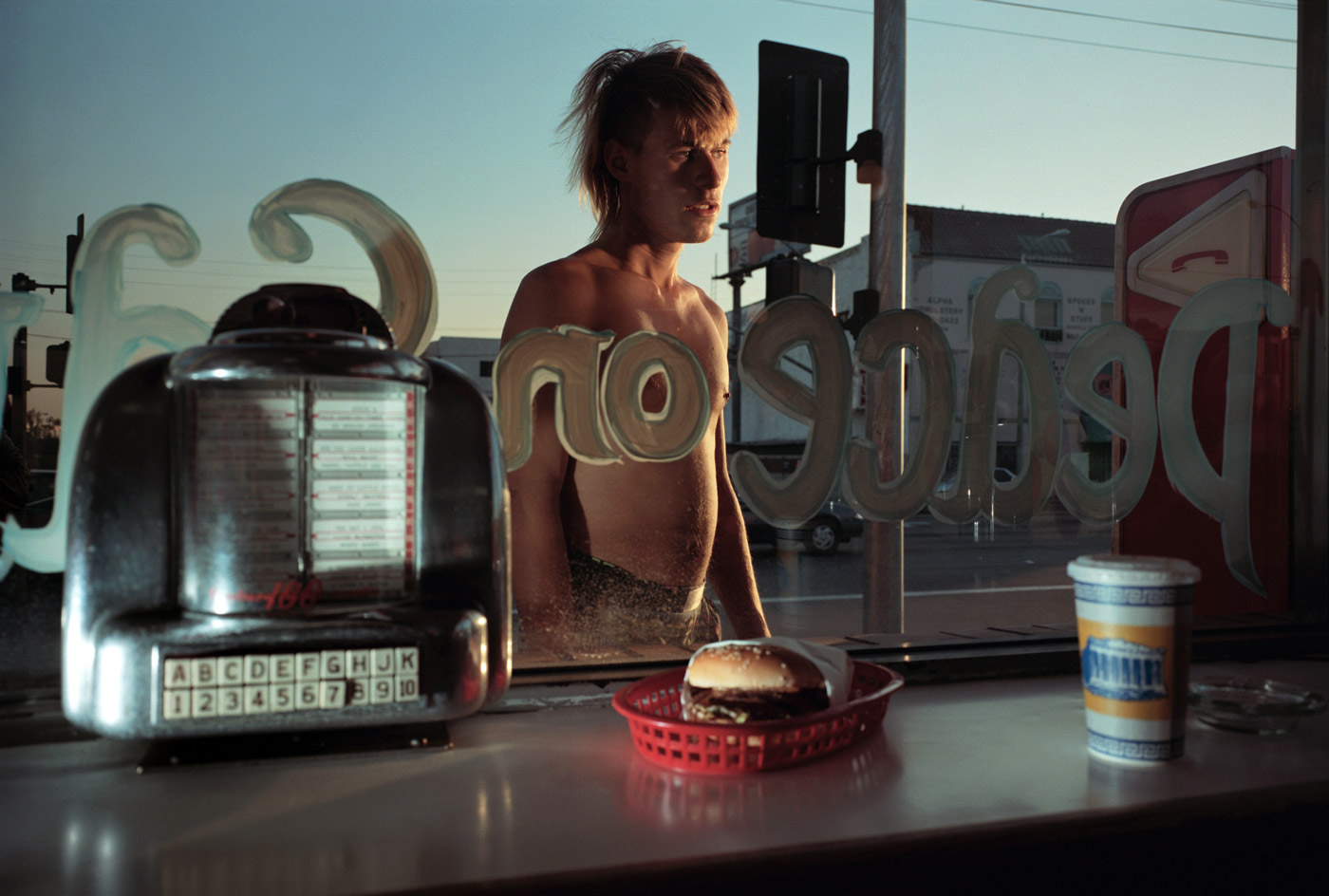
Philip-Lorca diCorcia (American, b. 1953). 'Todd M. Brooks, 22 Years Old, from Denver, Colorado, $40' 1991


Philip-Lorca diCorcia (American, b. 1953)
Todd M. Brooks, 22 Years Old, from Denver, Colorado, $40
1991
Chromogenic print
The Metropolitan Museum of Art
Purchase, The Horace W. Goldsmith Foundation Gift, through Joyce and Robert Menschel, 1991
Image courtesy the artist and David Zwirner, New York
© Philip-Lorca diCorcia


In the middle of the 1990’s, diCorcia gained international recognition for his large color photographs of street scenes and passersby. For an earlier series, he traveled to Los Angeles on a fellowship from the National Endowment for the Arts, and worked on a part of Santa Monica Boulevard frequented by male prostitutes and drug addicts. For each picture he made there, he carefully composed his setting, then asked young men to pose for him, giving them a small fee (from twenty to fifty dollars) that was negotiated each time.

At that time, NEA support of artists such as Robert Mapplethorpe was highly controversial, and diCorcia had to sign a document stating that he would not produce any “obscene” work while on his fellowship. He set up the whole negotiating procedure as a symbolic way of sharing his grant with people whose behavior would surely have been condemned by the censors. The titles always mention the name, the age and the origin of the model, as well as the amount paid. The staged situation interacts with the raw reality of the exchange of money, blurring the boundaries between documentary and fiction, yet preserving an authentic emotional charge.

Text from The Metropolitan Museum of Art website


Philip-Lorca diCorcia (American, b. 1953) 'Eddie Anderson, 21 Years Old, from Houston, Texas, $20' 1991


Philip-Lorca diCorcia (American, b. 1953)
Eddie Anderson, 21 Years Old, from Houston, Texas, $20
1991
Chromogenic print
Image: 39.2 x 57.8 cm (15 7/16 x 22 3/4 in.)
The Metropolitan Museum of Art
Purchase, The Horace W. Goldsmith Foundation Gift, through Joyce and Robert Menschel, 1991
Image courtesy the artist and David Zwirner, New York
© Philip-Lorca diCorcia


The Metropolitan Museum of Art will present After the Gold Rush: Contemporary Photographs from the Collection from March 22, 2011, through January 2, 2012, in the Joyce and Robert Menschel Hall for Modern Photography. Drawn entirely from the Museum’s permanent collection, the exhibition features 25 photographs dating from 1979 to the present by 15 contemporary artists.

The exhibition’s title, After the Gold Rush, is taken from a classic 1970 song by Neil Young, whose verses contrast a romanticised past with a present of squandered plenty and an uncertain future. Inspired by the recent political and economic upheavals in America and abroad, this selection juxtaposes new photographs that take the long view of the world’s current condition with prescient works from the 1980s and 1990s that remain startlingly relevant today.

This is the first occasion for the Museum to present recently acquired works by: Gretchen Bender, James Casebere, Moyra Davey, Katy Grannan, Hans Haacke, An-My Lê, Curtis Mann, Trevor Paglen, and Wolfgang Tillmans. Also featured are photographs by: Philip-Lorca diCorcia, Robert Gober, Adrian Piper, Laurie Simmons, Jeff Wall, and Christopher Williams.

After the Gold Rush begins with Hans Haacke’s Thank You, Paine Webber (1979) – the first work by this legendary provocateur of Conceptual art to enter the Metropolitan’s collection. Haacke’s biting photo-diptych is so pertinent to the recent economic downturn that it seems as if it could have been made yesterday. In this work, the artist appropriated images from the investment firm’s annual report to convey his viewpoint that big business provides a veneer of social concern to mask the brutal effects of the “risk management” they offer their clients.

Other works in After the Gold Rush use varying degrees of artifice and photographic realism to reflect on marginalised and repressed voices. Measuring over 14 feet long and presented as a backlit transparency in a light box, The Storyteller (1986) is Jeff Wall’s signature image and is typical of his method. Working from memory, the artist uses nonprofessional actors and real locations to meticulously restage a scene of urban blight that he witnessed in his native Vancouver. Wall plays this photographic verisimilitude against compositions and figural poses indebted to French painters such as Gustave Courbet, Edouard Manet, and Georges Seurat. A comparison of Wall’s Storyteller with Courbet’s Young Ladies of the Village (1852), on view in the Museum’s galleries for Nineteenth and Early Twentieth-Century European Paintings and Sculpture, reveals parallels: in both, a keenly observed moment of telling social interaction taking place on a sloping landscape. Each artist has combined a daringly modern subject with references to earlier art.

Philip-Lorca diCorcia is another key figure in the development of staged photography. In the early 1990s, the artist created a series of works in response to the political attacks on gays and federal funding of the arts in the U.S. DiCorcia hired male hustlers to pose for their portraits out on the streets – and paid them with grant money he received from the National Endowment for the Arts. At the same moment, a wide swath of women artists addressed issues of sexism and racism: examples of this politically pointed art are represented by Laurie Simmons’ Walking Gun (1991) – a spotlighted puppet of doll legs and a revolver that seems capable of turning on its master at a moment’s notice – and Adrian Piper’s 1992 work Decide Who You Are #24 (A Moving Target), which includes a childhood image of Anita Hill as part of a blistering meditation in word and image on racial politics. Such works are missives from a time not so long ago when artists regularly commented on present-day politics and culture through their art. (Because of light sensitivity, this work by Adrian Piper will be on view through Sunday, September 26.)

Although the recently made photographs in After the Gold Rush seem at first glance to be less overtly political than their predecessors, they nevertheless address vital issues about contemporary society. James Casebere’s epic vision of America, Landscape with Houses (Dutchess County, NY) #1, (2009), is based on a tabletop model that the artist spent 18 months building. The photograph shows a suburban subdivision of the kind recently ravaged by the foreclosure crisis, and its sunny sense of “Morning in America” comments ironically on the country’s future prospects. An-My Lê’s similarly sweeping five-part photographic piece Suez Canal Transit, USS Dwight Eisenhower, Egypt (2009) will also be featured. Lê is interested in the way in which U.S. armed forces come into contact with the rest of the world. This major new work – which seems at first to be a straightforward panorama of military might overseas – subtly undercuts the viewer’s expectations to question the current position of the U.S. on the global stage.

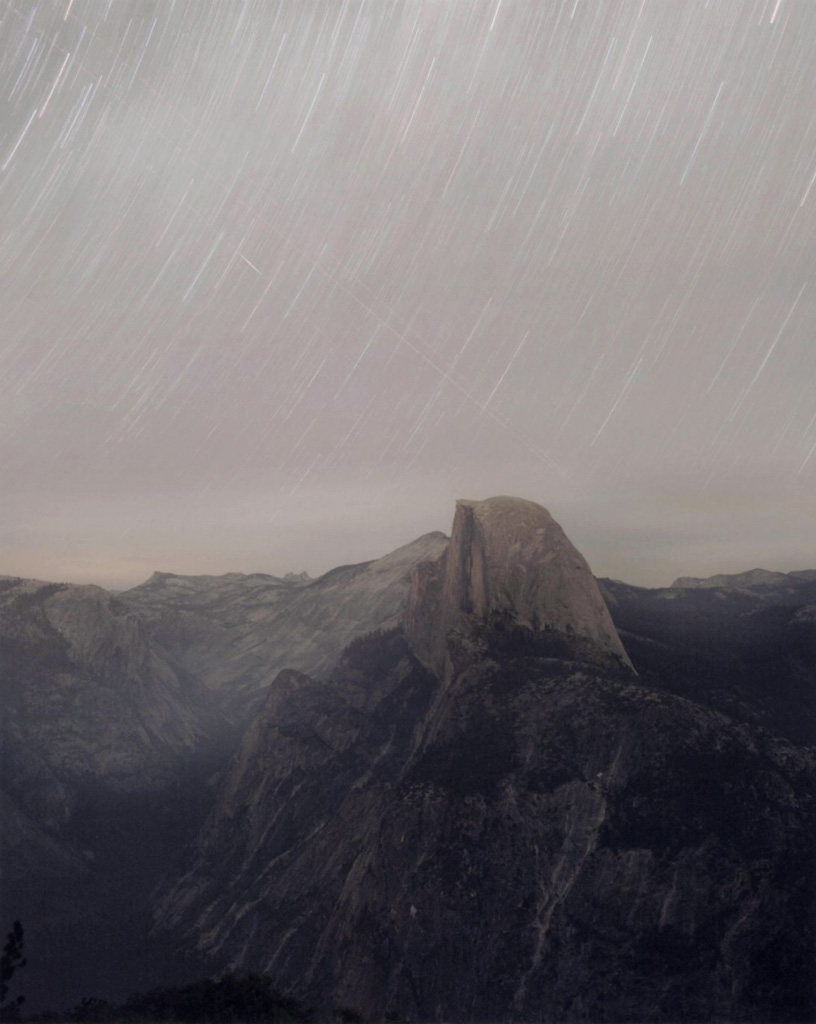
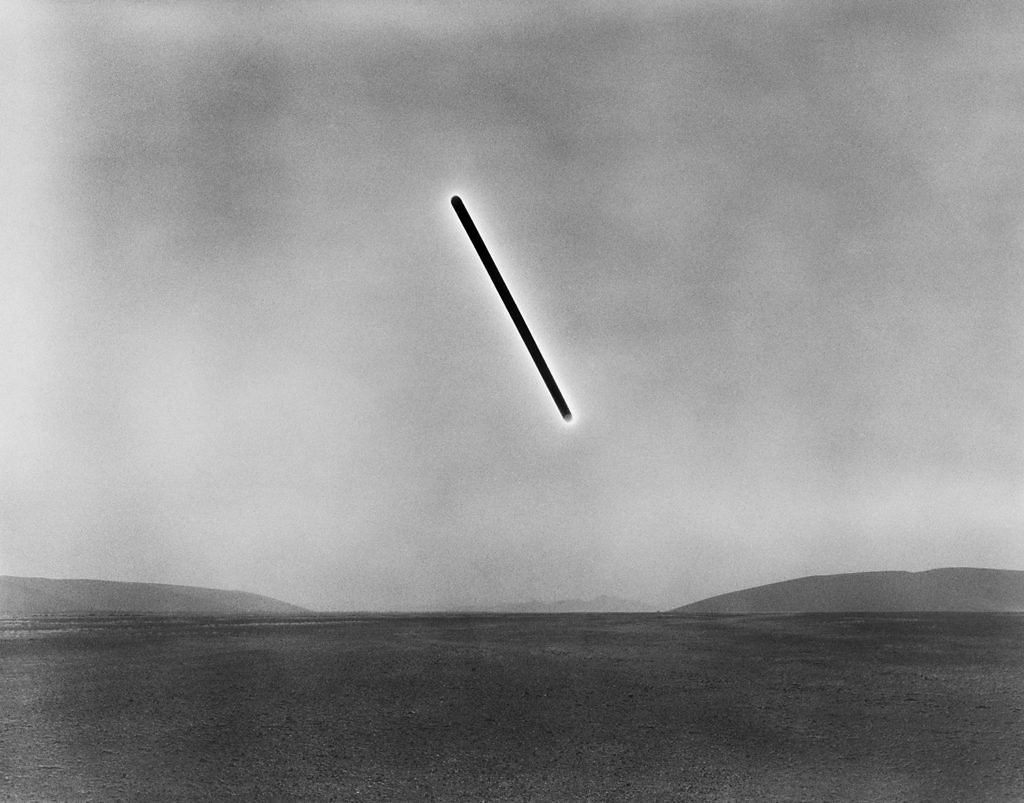
Trevor Paglen is a young artist whose works plot the “black world” of covert military operations, from telephoto images of predator drones taken from miles away, to software that follows planes used for the extraordinary rendition of suspected terrorists. Paglen’s 2008 photograph KEYHOLE IMPROVED CRYSTAL from Glacier Point (Optical Reconnaissance Satellite; USA 186) shows the ghostly white streak of an American reconnaissance satellite bisecting star trails above Yosemite’s Half Dome, a rock formation photographed in the 1860s by artists including Carleton Watkins. To make these and other photographs, Paglen collaborated with amateur astronomers who were originally trained by the U.S. government to look out for Soviet satellites during the Cold War, but turned their attention to American surveillance in recent years.

The final piece in After the Gold Rush is a suite of five recently acquired photographs from 2007-2009 by the celebrated photographer Wolfgang Tillmans. The grouping shifts focus from macro to micro: from expansive aerial views of Shanghai and Dubai to close ups that suggest the smallest increments of sustenance and regeneration. Taken together, they evoke the interconnectedness of all things and a grounding of the political in the personal as a way for an engaged yet expressive art.

Press release from The Metropolitan Museum of Art website


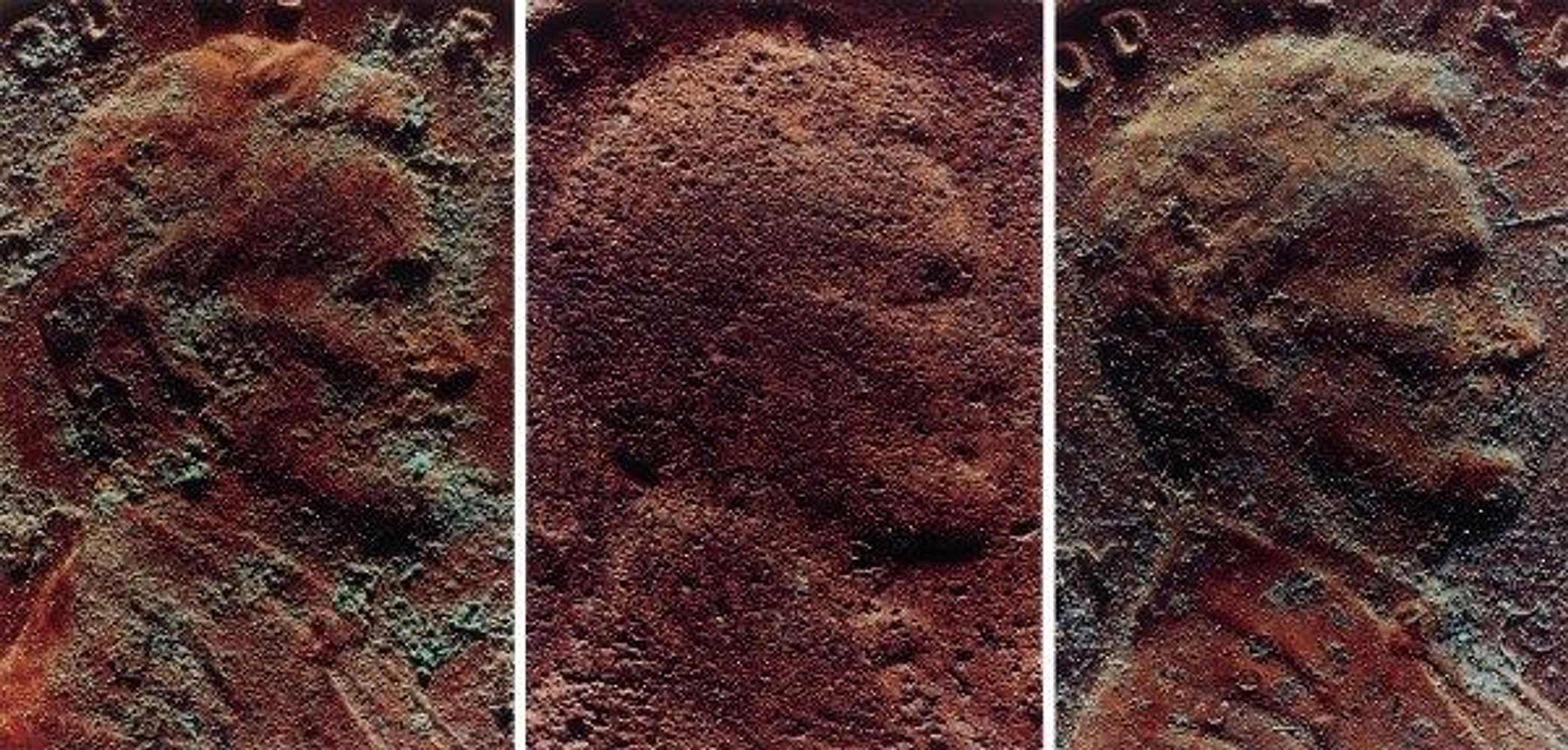
Moyra Davey (American born Canada, b. 1958) 'Copperhead Grid' 1990 (detail)


Moyra Davey (American born Canada, b. 1958)
Copperhead Grid (detail)
1990
Chromogenic prints
Image: 8 3/4 in. × 6 in. (22.3 × 15.3cm) each
Sheet: 10 × 8 in. (25.4 × 20.3cm) each
The Metropolitan Museum of Art
Purchase, Vital Projects Fund Inc. Gift, through Joyce and Robert Menschel, 2011
© Moyra Davey


It was in 1990 – at the height of a worldwide economic recession that also marked the end of the 1980s art bubble – that Davey began photographing the scratched, worn-away surfaces of pennies, the most devalued and lowest form of currency. Her accumulation of one hundred micro-photographic specimens is constructed around the readymade patterns of decay that countless anonymous owners have unconsciously wrought upon their surfaces; their base materiality is incisively contrasted with the most elevated of national symbols. As with all of Davey’s work, there is a melancholic sense of loss that connects subject and form: like pennies, photographs are objects of exchange imprinted by contact with the world around them.

Text from The Metropolitan Museum of Art website


Adrian Piper (American, born 1948). 'Decide Who You Are #24: A Moving Target' 1992


Adrian Piper (American, b. 1948)
Decide Who You Are #24: A Moving Target
1992
Photo-mechanical processes on three panels
The Metropolitan Museum of Art
Gift of Peter Norton Family Foundation, 1994
© Adrian Piper


Piper is an artist and a philosophy professor who works in a variety of media, including performance, video, sound pieces, photography, drawing, and writing. She often explores issues of autobiography, racism, and stereotyping. For her 1992 series Decide Who You Are, the artist used a triptych format in which a different appropriated photograph is flanked by an image of the “three wise monkeys” maxim advocating “See No Evil, Speak No Evil, Hear No Evil” at left, and at right a photograph of a young girl who, though not identified, is Anita Hill – who had recently been thrust into the spotlight for accusing then-nominee for Supreme Court Justice Clarence Thomas of sexual harassment. The verse in the left panel changes in each individual work in the series, while that on the right is unchanging – what the artist once described as “a comprehensive, textbook compendium of commonly invoked litanies of denial and intimidation, from the bland to the vaguely menacing” and “a must for novices and aspiring leaders in business, politics, and culture.”

Wall text


Christopher Williams (American, b. 1956). '3 White (DG's Mr. Postman) Fourth Race, Phoenix Greyhound Park, Phoenix, Arizona, August 22, 1994' 1994


Christopher Williams (American, b. 1956)
3 White (DG’s Mr. Postman) Fourth Race, Phoenix Greyhound Park, Phoenix, Arizona, August 22, 1994
1994
Gelatin silver print
The Metropolitan Museum of Art
Purchase, Charina Foundation Inc. and Jennifer and Joseph Duke Gifts, 2003
© Christopher Williams


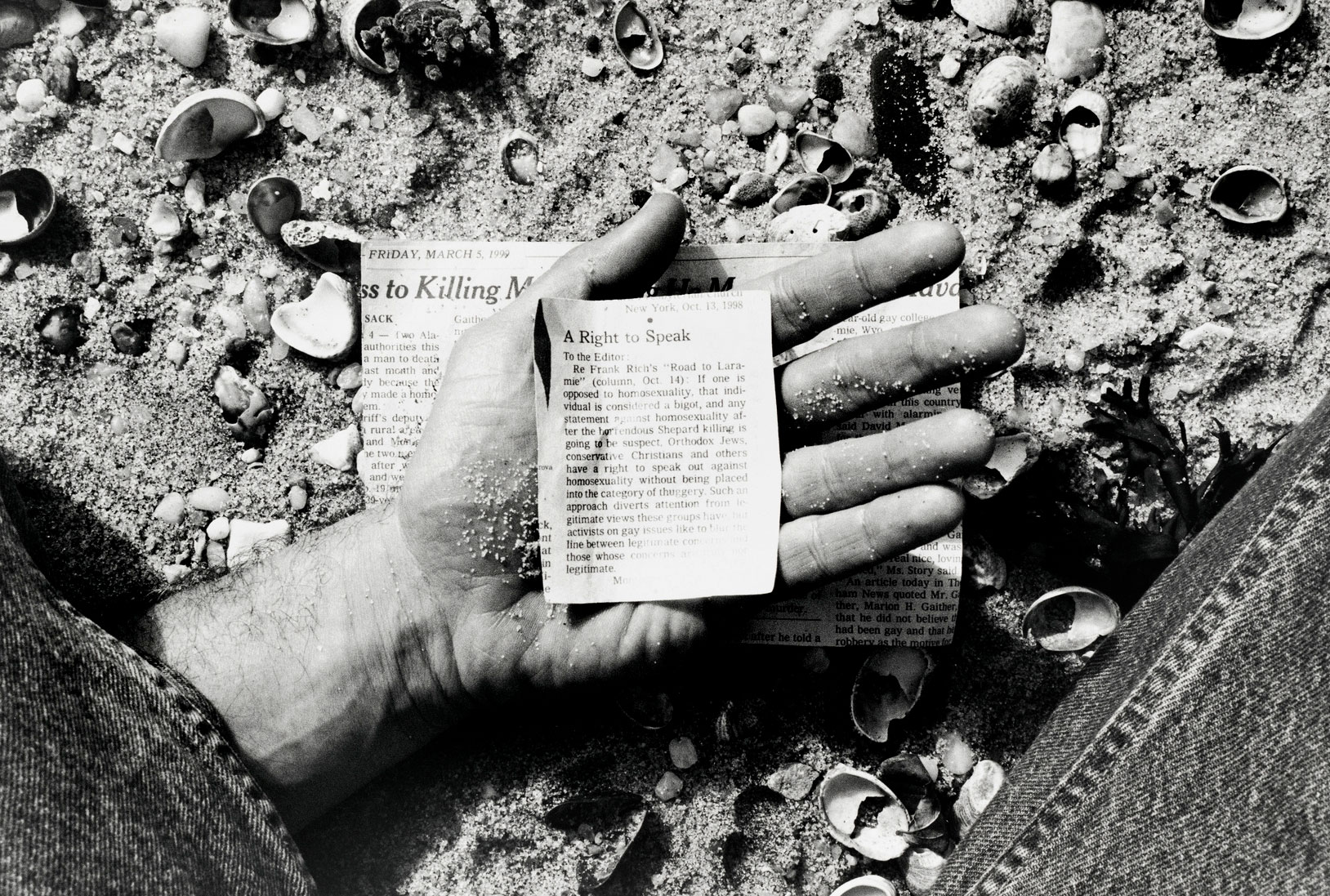
Robert Gober (American, b. 1954) 'Page 12 / Untitled (Detail from 1978-2000)' 1978-2000


Robert Gober (American, b. 1954)
Page 12 / Untitled (Detail from 1978-2000)
1978-2000
Gelatin silver print
40.6 x 50.8cm (16 x 20 in.)
The Metropolitan Museum of Art
Purchase, Charina Foundation Inc. Gift, 2002
© Robert Gober


Robert Gober works primarily in sculpture, installations, and photography. He is perhaps best known for his delicate, ghostly hand crafted versions of domestic fixtures, such as drains, beds, doors, and sinks. Through these uncanny replicas, Gober invests mass produced objects with personal meaning – the private, unruly desires and memories of the individual. This image appeared in the book (his first in the genre) that Gober created to accompany his installation representing the United States at the 2000 Venice Biennale. In it, the artist interweaves his own journey to New York in 1978 as a young gay man with the toxic fallout of homophobic recrimination that accompanied the murder of the Wyoming college student Matthew Shepard twenty years later.

Text from The Metropolitan Museum of Art website


Robert Gober superimposes a man’s hand between two newspaper articles, clipped neatly and placed on a shell-strewn beach. Below his hand, the article refers to Matthew Shepard’s death. Above it, a letter to the editor argues that “Orthodox Jews, conservative Christians and others have a right to speak out against homosexuality without being placed in the category of thuggery.” While the piece obviously precedes Jonathan Rauch’s provocative and important piece in the December issue of the Advocate arguing that gay people should tolerate a certain amount of anti-gay sentiment as a sign that they’re legally and socially secure enough to practice tolerance, it’s a useful encapsulation of the dilemma behind that argument. It’s hard to cast off past threats if you’re not entirely sure they’re past.

Alyssa Rosenberg. “Gay Americans, Censorship, And ‘After The Gold Rush’ At The Metropolitan Museum Of Art,” on the Think Progress website November 28, 2011 [Online] Cited 11/12/2024


Robert Gober (American, b. 1954). 'Untitled (Detail from "1978-2000")' 2000


Robert Gober (American, b. 1954)
Untitled (Detail from “1978-2000”)
2000
Gelatin silver print
The Metropolitan Museum of Art
Purchase, Jennifer and Joseph Duke Gift, 2002
© Robert Gober


James Casebere (American, b. 1953). 'Landscape with Houses (Dutchess County, NY) #1' 2009


James Casebere (American, b. 1953)
Landscape with Houses (Dutchess County, NY) #1
2009
Chromogenic print
The Metropolitan Museum of Art
Purchase, Alfred Stieglitz Society Gifts, 2011
© James Casebere


Trevor Paglen (American, b. 1974) 'KEYHOLE IMPROVED CRYSTAL from Glacier Point (Optical Reconnaissance Satelltte; USA 186)' 2008


Trevor Paglen (American, b. 1974)
KEYHOLE IMPROVED CRYSTAL from Glacier Point (Optical Reconnaissance Satelltte; USA 186)
2008
Chromogenic print
Image: 95.3 x 76.2cm (37 1/2 x 30 in.)
Frame: 96.5 × 77.5cm (38 × 30 1/2 in.)
The Metropolitan Museum of Art
Purchase, Vital Projects Fund Inc. Gift, through Joyce and Robert Menschel, 2011
© Trevor Paglen


Trained as a geographer, Paglen is an artist who plots the topography of a new global and celestial space – the “black world” of covert military operations. Examples of his subjects include the supposed sites used for the extraordinary rendition of prisoners, which he shoots with specially designed cameras from up to forty miles away, and the network of private planes used to transport them under the radar. This image shows the ghostly white streak of an American reconnaissance satellite bisecting star trails above Yosemite’s Half Dome, a rock formation photographed in the 1860s by the photographer Carleton Watkins when the West was still being explored. In order to track such spacecraft, Paglen uses a database created by amateur astronomers who were trained by the U.S. government to search the skies for Soviet sputniks but continued their hobby after the end of the Cold War by tracking our own satellites. In this work, the artist brings into one composition two historically disparate moments in geographic and celestial colonisation.

Text from The Metropolitan Museum of Art website


Wolfgang Tillmans (German, b. 1968).' Oriental Pearl' 2009


Wolfgang Tillmans (German, b. 1968)
Oriental Pearl
2009
Inkjet print
The Metropolitan Museum of Art
Purchase, Vital Projects Fund Inc. Gift, through Joyce and Robert Menschel, 2010
Image courtesy the artist and Andrea Rosen Gallery, New York
© Wolfgang Tillmans


The Metropolitan Museum of Art
1000 Fifth Avenue at 82nd Street
New York, New York 10028-0198
Phone: 212-535-7710

Opening hours:
Sunday – Tuesday and Thursday: 10am – 5pm
Friday and Saturday: 10am – 9pm
Closed Wednesday

The Metropolitan Museum of Art website

LIKE ART BLART ON FACEBOOK

Back to top

Review: ‘The mad square: Modernity in German Art 1910-37’ at The National Gallery of Victoria, Melbourne

Exhibition dates: 25th November 2011 – 4th March 2012


Irene Bayer (American, 1898-1991) 'No title (Man on stage)' c. 1927


Irene Bayer (American, 1898-1991)
No title (Man on stage)
c. 1927
Gelatin silver photograph
Printed image 10.6 h x 7.6 w cm
Purchased 1983
National Gallery of Australia, Canberra


This is one of the best exhibitions this year in Melbourne bar none. Edgy and eclectic the work resonates with the viewer in these days of uncertainty: THIS should have been the Winter Masterpieces exhibition!

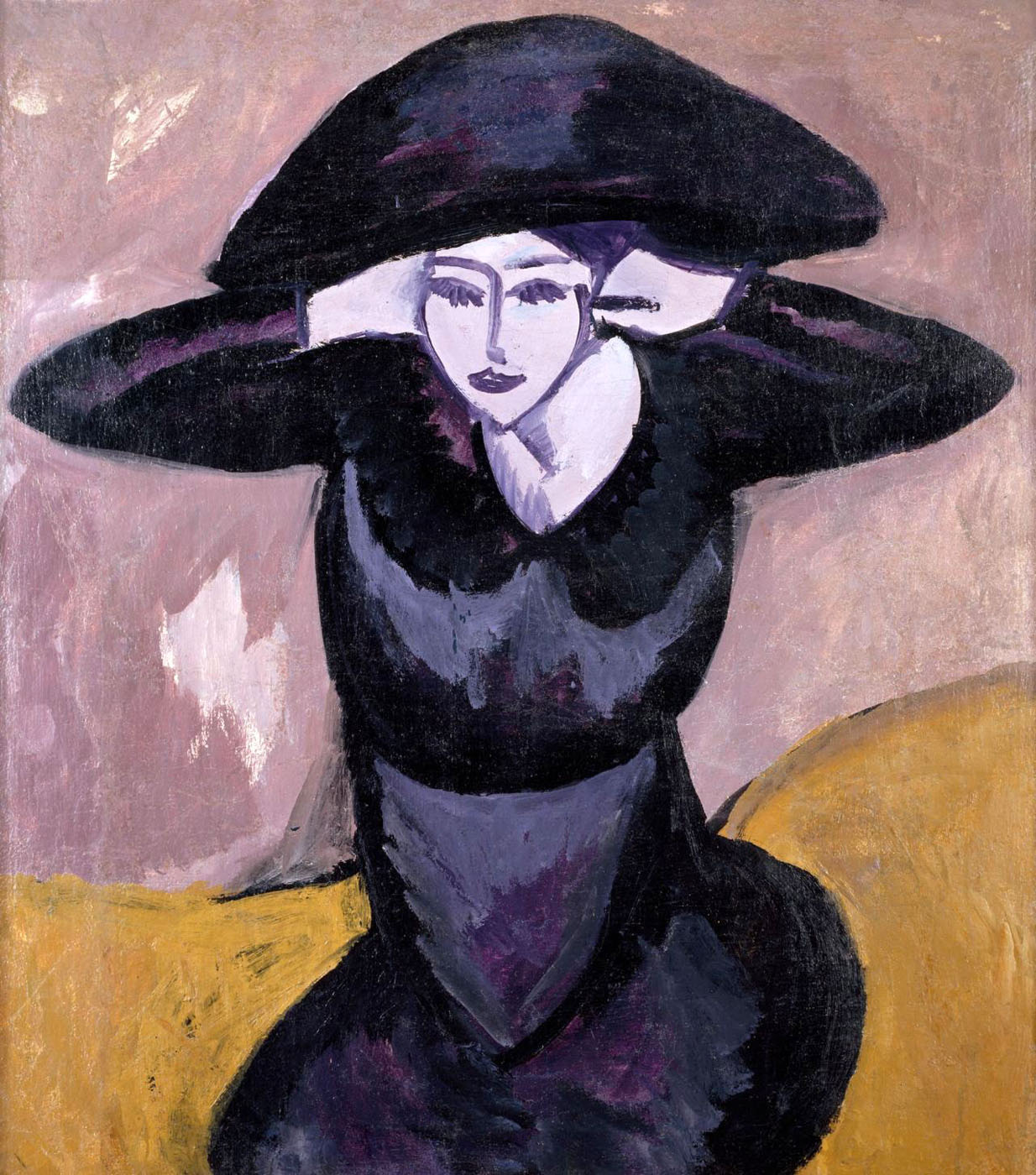
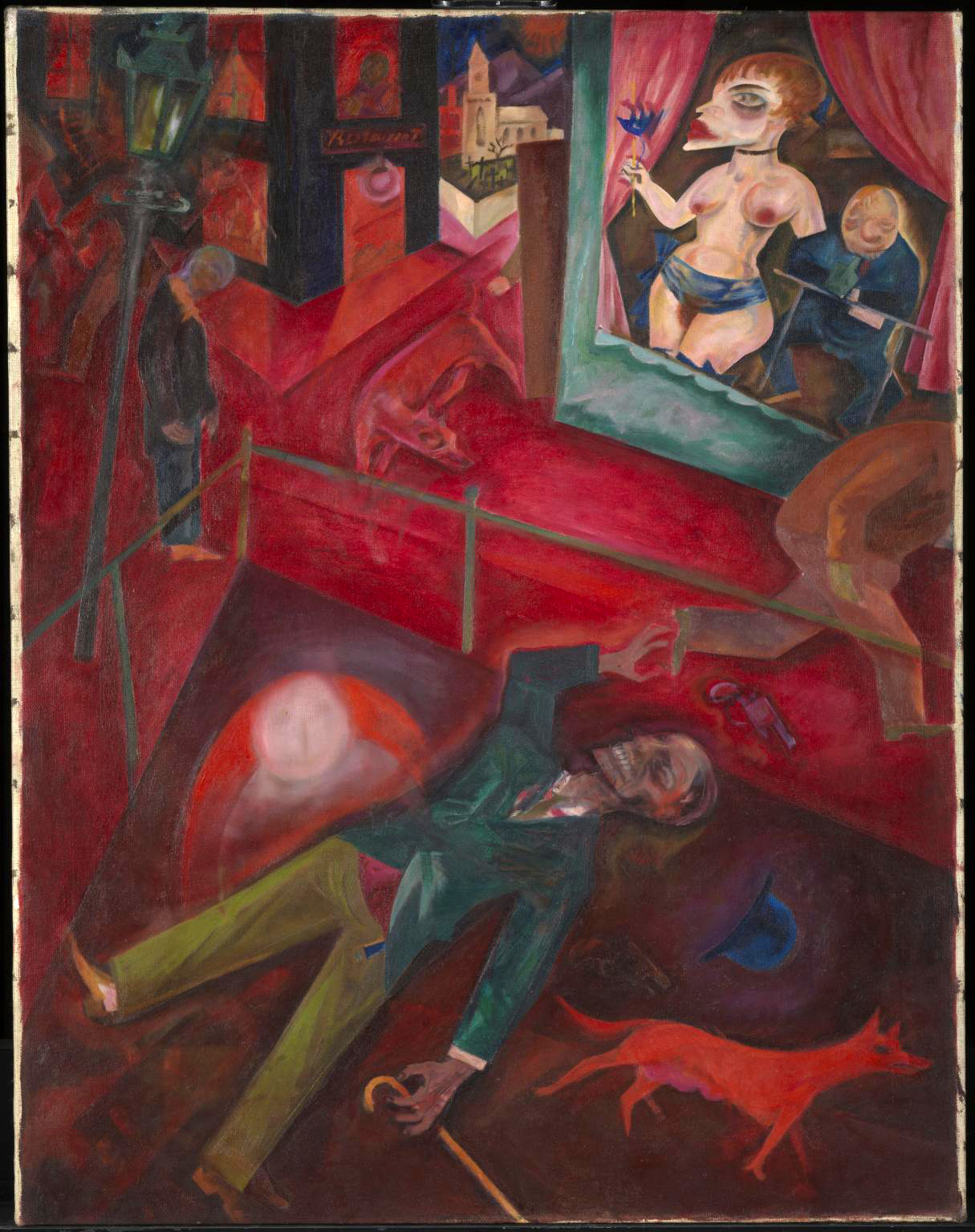
The title of the exhibition, The mad square (Der tolle Platz) is taken from Felix Nussbaum’s 1931 painting of the same name where “the ‘mad square’ is both a physical place – the city, represented in so many works in the exhibition, and a reference to the state of turbulence and tension that characterises the period.” The exhibition showcases how artists responded to modern life in Germany in the interwar years, years that were full of murder and mayhem, putsch, revolution, rampant inflation, starvation, the Great Depression and the rise of National Socialism. Portrayed is the dystopian, dark side of modernity (where people are the victims of a morally bankrupt society) as opposed to the utopian avant-garde (the prosperous, the wealthy), where new alliances emerge between art and politics, technology and the mass media. Featuring furniture, decorative arts, painting, sculpture, collage and photography in the sections World War 1 and the Revolution, Dada, Bauhaus, Constructivism and the Machine Aesthetic, Metropolis, New Objectivity and Power and Degenerate Art, it is the collages and photographs that are the strongest elements of the exhibition, particularly the photographs. What a joy they are to see.

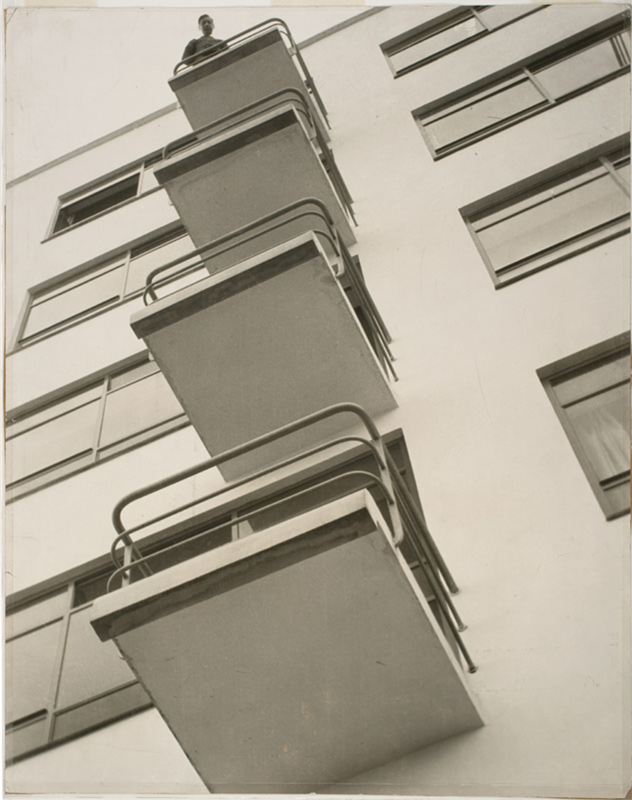
There is a small 2″ x 3″ contact print portrait of Hanna Höch by Richard Kauffmann, Penetrate yourself or: I embrace myself (1922) that is an absolute knockout. Höch is portrayed as the ‘new women’ with short bobbed hair and loose modern dress, her self-image emphasised through a double exposure that fragments her face and multiplies her hands, set against a contextless background. The ‘new women’ fragmented and broken apart (still unsure of herself?). The photograph is so small and intense it takes your breath away. Similarly, there is the small, intimate photograph No title (Man on Stage) (c. 1927) by Irene Bayer (see above) that captures performance as ‘total art’, a combination of visual arts, dance, music, architecture and costume design. In contrast is a large 16 x 20″ photograph of the Bauhaus balconies (1926) by László Moholy-Nagy (see below) where the whites are so creamy, the perspective so magnificent.

No title (Metalltanz) (c. 1928-1929) by T. Lux Feinenger, a photographer that I do not know well, is an exceptional photograph and print. Again small, this time dark and intense, the image features man as dancer performing gymnastics in front of reflective, metal sculptures. The metal becomes an active participant in the Metalltanz or ‘Dance in metal’ because of its reflective qualities. The print, from the J. Paul Getty Museum in Los Angeles is luminous. In fact all the prints from the Getty in this exhibition are of the most outstanding quality, a highlight of the exhibition for me. Another print from the Getty that features metal and performance is Untitled (Spiral Costume, from the Triadic Ballet) by T Grill c. 1926-1927 (see below) where the spiral costume becomes an extension of the body, highlighting its form. Also highlighting form, objectivity and detachment is a wonderful 3 x 5″ photograph of the New Bauhaus Building, Dessau (1926) by Lucia Moholy from the Getty collection, the first I have ever seen in the flesh by this artist. Outstanding.

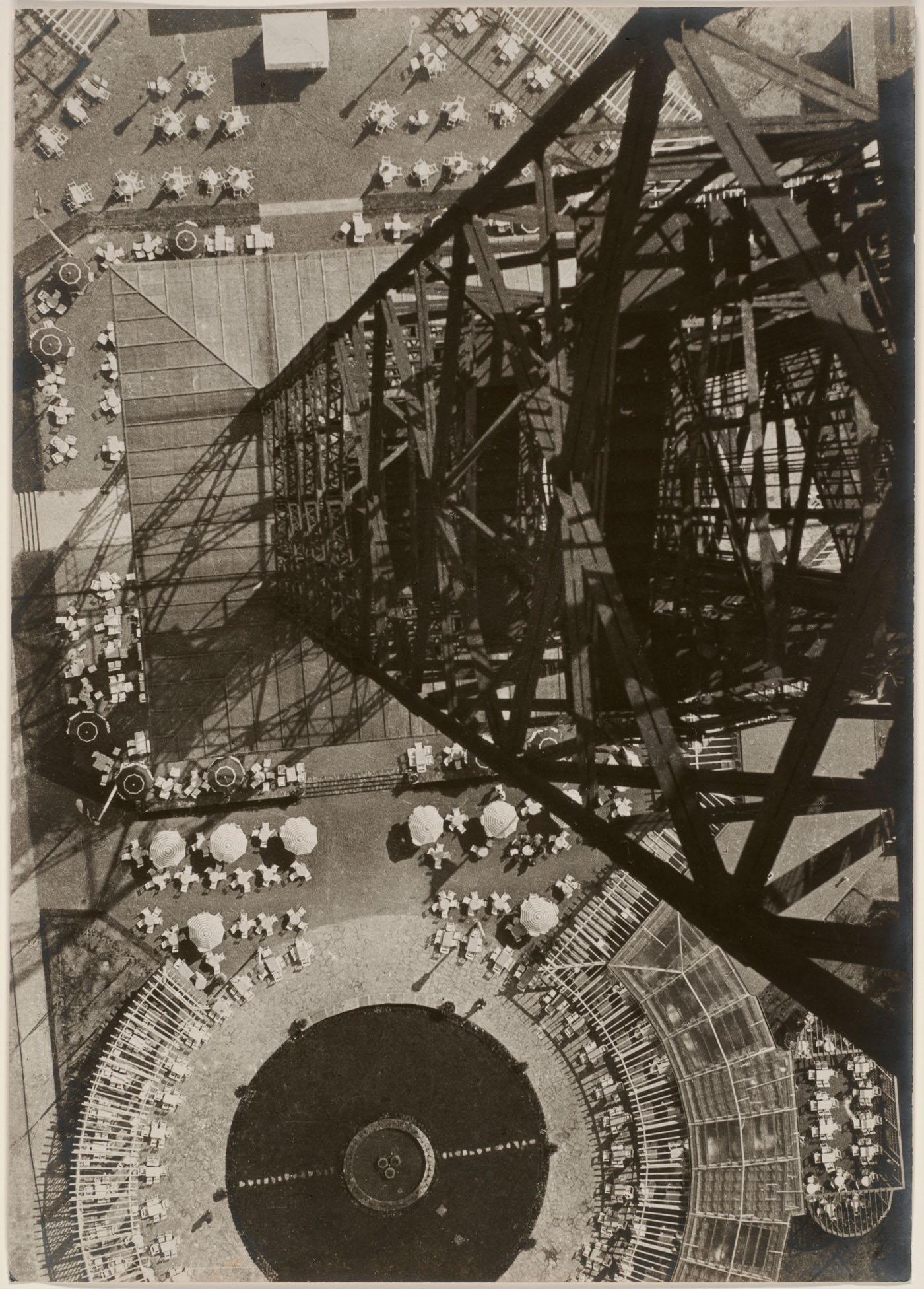
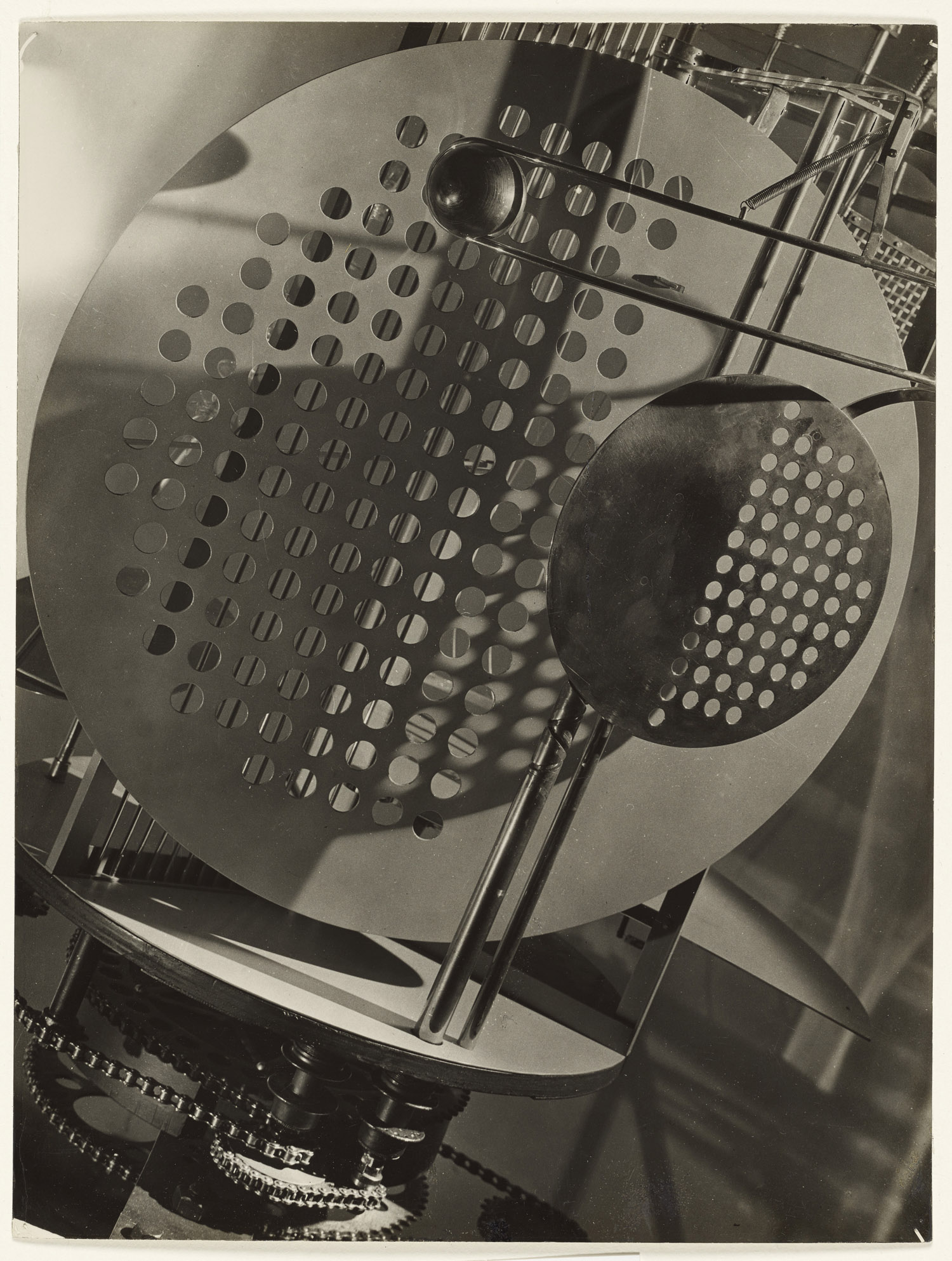
Following, we have 4 photograms by Lucia’s husband, László Moholy-Nagy which display formalist experimentation “inspired by machine aesthetic, exploring a utopian belief that Constructivism and abstract art could play a role in the process of social reform.” Complimenting these photograms is a row of six, yes six! Moholy-Nagy including Dolls (Puppen) 1926-1927 (Getty), The law of the series 1925 (Getty), Lucia at the breakfast table 1926 (Getty), Spring, Berlin 1928 (George Eastman House), Berlin Radio Tower 1928 (Art Institute of Chicago) and Light space modulator 1930 (Getty). All six photographs explore the fascinating relationship between avant-garde art and photography, between they eye and perspective, all the while declaiming what Moholy-Nagy called the “new vision”; angles, shadows and geometric patterns that defy traditional perspective “removing the space from associations with the real world creating a surreal, disjointed image.” This topographic mapping flattens perspective in the case of the Berlin radio tower allowing the viewer to see the world in a new way.

Finally two groups of photographs that are simply magnificent.

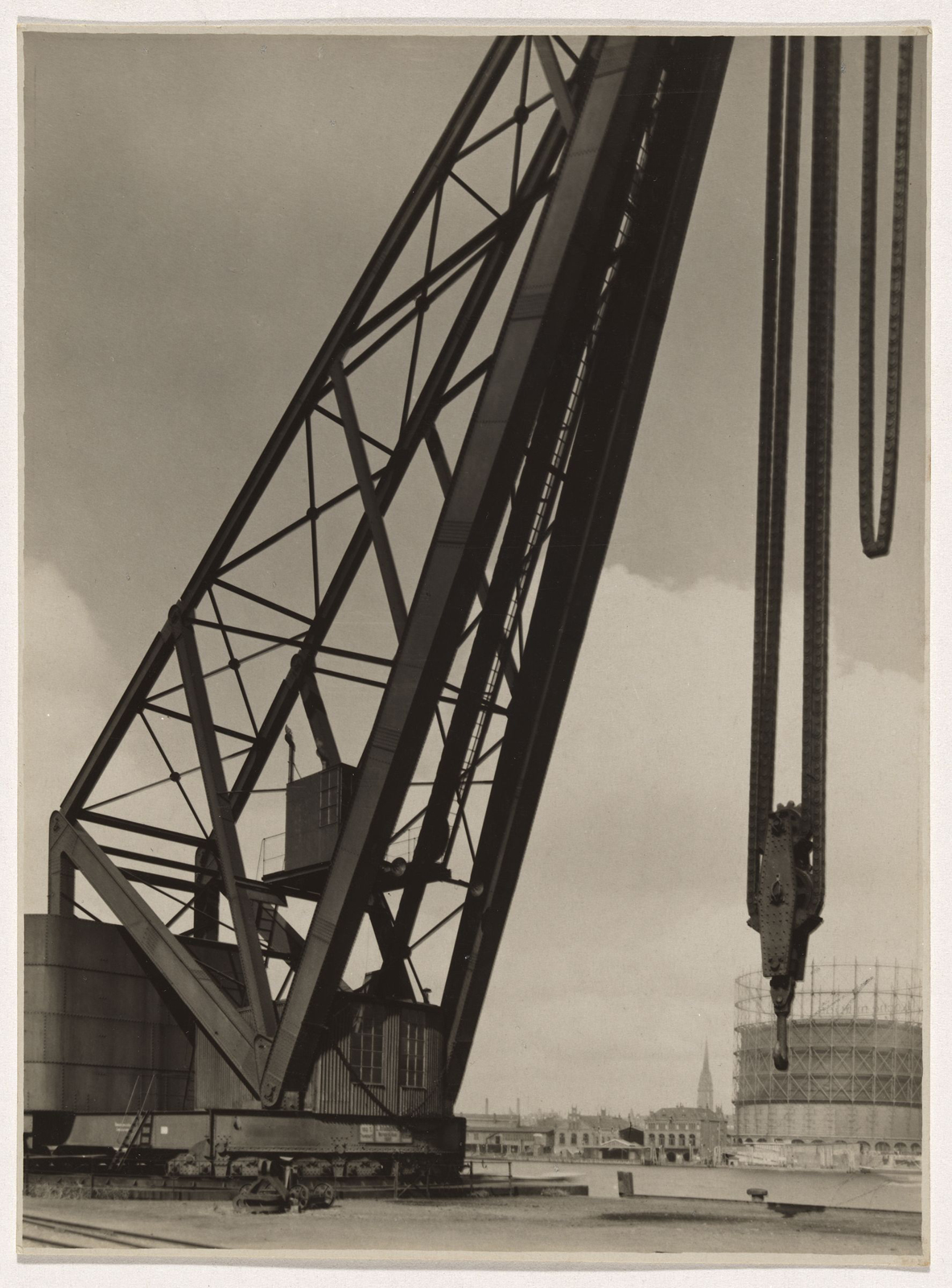
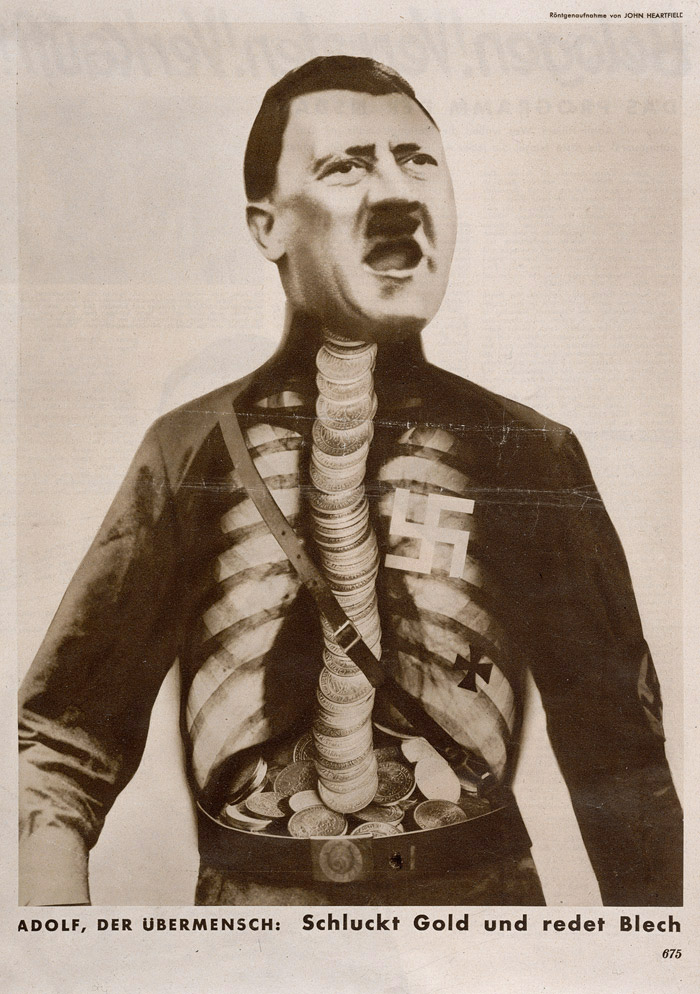
First 8 photographs in a row that focus on the order and progressive nature of the modern world, the inherent beauty of technology captured in formalist studies of geometric forms. The prints range from soft pictorialist renditions to sharp clarity. The quality of the prints is amazing. Artists include the wonderful E. O. Hoppé, Albert Renger-Patzsch (an outstandingly beautiful photograph, Harbour with cranes 1927 that is my favourite photograph in the exhibition, see below), Two Towers 1937-1938 by Werner Mantz and some early Wolfgang Sievers before he left Germany for Australia in 1938 (Blast furnace in the Ruhr, Germany 1933, see below). These early Sievers are particularly interesting, especially when we think of his later works produced in Australia. Lucky were many artists who survived in Germany or fled from Nazi persecution at the last moment, including John Heartfield who relocated to Czechoslovakia in 1933 and then fled to London in 1938 and August Sander whose life and work were severely curtailed under the Nazi regime and whose son died in prison in 1944 near the end of his ten year sentence (Wikipedia).

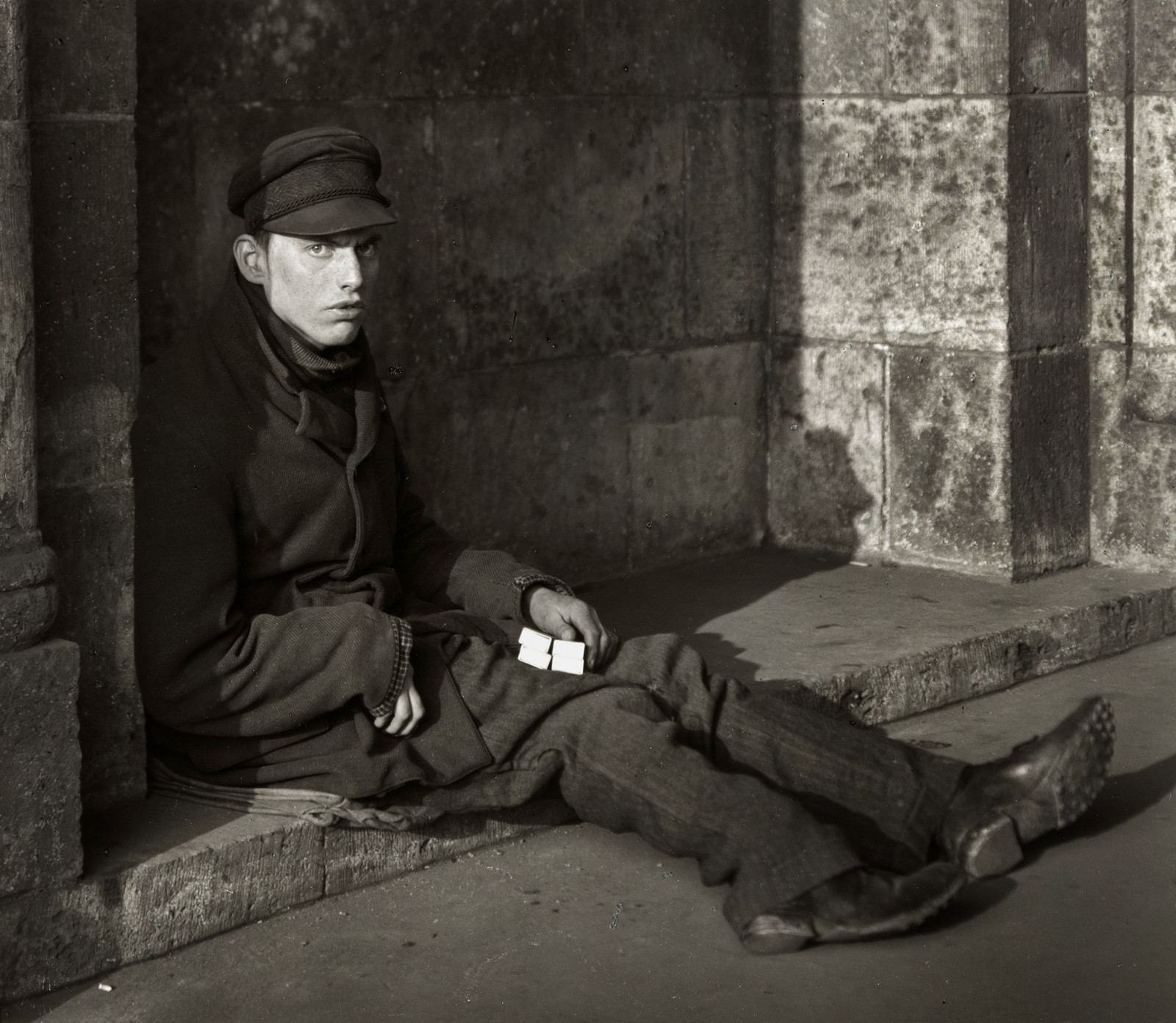
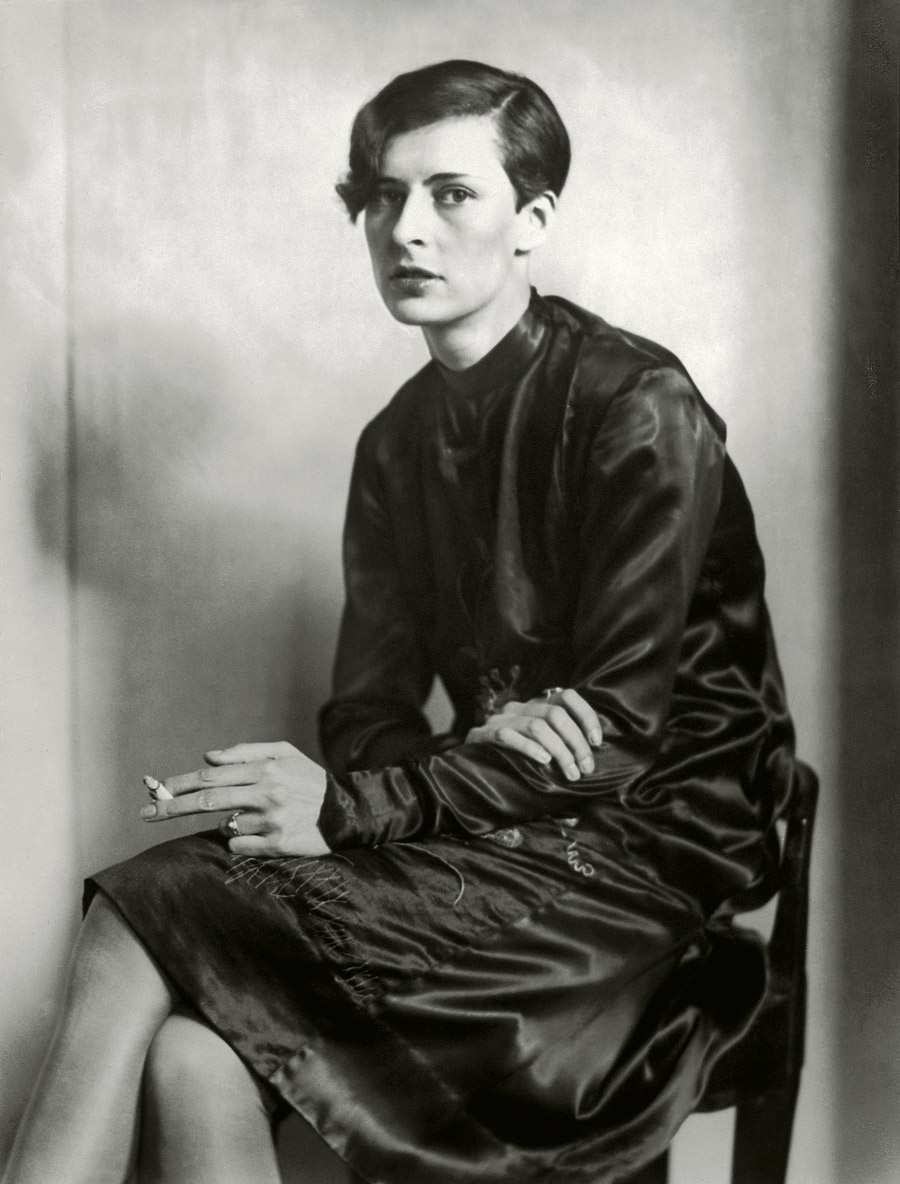
August Sander. Now there is a name to conjure with. The second magnificent group are 7 photographs that are taken from Sander’s seminal work People of the 20th Century. All the photographs have soft, muted tones of greys with no strong highlights and, usually, contextless backgrounds. The emphasis is on archetypes, views of people who exist on the margins of society – circus performers, bohemians, artists, the unemployed and blind people. In all the photographs there is a certain frontality (not necessarily physical) to the portraits, a self consciousness in the sitter, a wariness of the camera and of life. This self consciousness can be seen in the two photographs that are the strongest in the group – Secretary at West German radio in Cologne, 1931 and Match seller 1927 (see below).

There is magic here. Her face wears a somewhat quizzical air – questioning, unsure, vulnerable – despite the trappings of affluence and fashionability (the smoking of the cigarette, the bobbed hair). He is wary of the camera, his face and hands isolated by Sander while the rest of his body falls into shadow. His right hand is curled under, almost deformed, his shadow falling on the stone at right, the only true brightness in this beautiful image the four boxes of matches he clutches in his left hand: as Sander titles him ironically, The Businessman.

Working as I do these days with lots of found images from the 1940s-1960s that I digitally restore to life, I wonder what happened to these people during the dark days of World War 2. Did they survive the cataclysm, the drop into the abyss? I want to know, I want to reach out to these people to send them good energy. I hope that they did but their wariness in front of the camera, so intimately ‘taken’ by Sander, makes me feel the portent of things to come. How differently we see images armed with the hindsight of history!

In conclusion, this is a fantastic exhibition that will undoubtedly be in my top ten of the year for Melbourne in 2011.

Dr Marcus Bunyan


Many thankx to Michael Thorneycroft for his help and The National Gallery of Victoria for allowing me to publish the accredited photographs in the posting. Please click on the photographs for a larger version of the image.


Felix Nussbaum (German, 1904 - after September 1944) 'The mad square' (Der tolle Platz) 1931


Felix Nussbaum (German, 1904 – after September 1944)
The mad square (Der tolle Platz)
1931
Oil on canvas
97 x 195.5cm
Berlinische Galerie
Public domain


László Moholy-Nagy (American born Hungary, 1895-1946) 'Photograph (Berlin Radio Tower)' 1928/1929


László Moholy-Nagy (American born Hungary, 1895-1946)
Berlin Radio Tower
1928
Gelatin silver print
36 × 25.5cm
Julien Levy Collection, Special Photography Acquisition Fund
© 2018 Artists Rights Society (ARS), New York / VG Bild-Kunst, Bonn


Over the winter and spring of 1927-1928, Bauhaus professor László Moholy-Nagy took a series of perhaps nine views looking down from the Berlin Radio Tower, one of the most exciting new constructions in the German capital. Moholy had already photographed the Eiffel Tower in Paris from below, looking up through the tower’s soaring girders. In Berlin, however, Moholy turned his camera around and pointed it straight down at the ground. This plunging perspective showed off the spectacular narrowness of the Radio Tower, finished in 1926, which rose vertiginously to a height of 450 feet from a base seven times smaller than that of its Parisian predecessor (which opened in 1889). Moholy attached exceptional importance to this, his boldest image: he hung it just above his name in a room devoted to his work at the Berlin showing of Film und Foto, a mammoth traveling exhibition that he had helped to prepare. Moholy also chose this view and one other to offer Julien Levy, the pioneering art dealer, when Levy visited him in Berlin in 1930. The following year the pictures went on view at the Levy Gallery in New York, in Moholy’s first solo exhibition of photographs.

Text from the Art Institute of Chicago website


László Moholy-Nagy (American born Hungary, 1895-1946) 'Photograph (Light Prop)' 1930


László Moholy-Nagy (American born Hungary, 1895-1946)
Das Lichtrequisit (The light prop)
1930
Gelatin silver print
24 × 18.1cm (9 7/16 × 7 1/8 in.)
J. Paul Getty Museum, Los Angeles
© 2014 Estate of László Moholy-Nagy / Artists Rights Society (ARS), New York


The Light-Space Modulator is the most spectacular and complete realisation of László Moholy-Nagy’s artistic philosophy. Machine parts and mechanical structures began to appear in his paintings after his emigration from Hungary, and they are also seen in the illustrations he selected for the 1922 Buch neuer Künstler (Book of new artists), which includes pictures of motorcars and bridges as well as painting and sculpture. Many contemporary artists incorporated references to machines and technology in their work, and some, like the Russian Constructivist Vladimir Tatlin, even designed plans for fantastic structures, such as the ambitious Monument to the Third International, a proposed architectural spiral of glass and steel with moving tiers and audiovisual broadcasts. (See Tatlin’s Tower.)

In the Light-Space Modulator, Moholy-Nagy was able to create an actual working mechanism. Although he censured capitalism’s inhumane use of technology, he believed it could be harnessed to benefit mankind and that the artist had an important role in accomplishing this. Moholy had made preliminary sketches for kinetic sculptures as early as 1922 and referred to the idea for a light machine in his writings, but it was not until production was financed by an electric company in Berlin in 1930 that this device was built, with the assistance of an engineer and a metalsmith. It was featured at the Werkbund exhibition in Paris the same year, along with the short film Light Display Black-White-Gray, made by Moholy-Nagy to demonstrate and celebrate his new machine.

The Light-Space Modulator is a Moholy-Nagy painting come to life: mobile perforated disks, a rotating glass spiral, and a sliding ball create the effect of photograms in motion. With its gleaming glass and metal surfaces, this piece (now in the collection of the Busch-Reisinger Museum at Harvard University) is not only a machine for creating light displays but also a sculptural object of beauty, photographed admiringly by its creator.

Katherine Ware, László Moholy-Nagy, In Focus: Photographs from the J. Paul Getty Museum (Los Angeles: J. Paul Getty Museum, 1995), 80 © 1995 The J. Paul Getty Museum


Albert Renger-Patzsch (American born Hungary, 1895-1946) 'Harbour with crane' c. 1927


Albert Renger-Patzsch (American born Hungary, 1895-1946)
Harbour with crane
c. 1927
Gelatin silver photograph
Printed image 22.7 h x 16.8 w cm
Purchased 1983
National Gallery of Australia, Canberra


Wolfgang Sievers (Germany 1913 - Australia 2007) 'Blast furnace in the Ruhr, Germany' 1933


Wolfgang Sievers (Germany 1913 – Australia 2007)
Blast furnace in the Ruhr, Germany
1933
Gelatin silver photograph
27.5 h x 23 w cm
Purchased 1988
National Gallery of Australia, Canberra


The Ruhr region was at the centre of the German acceleration of industry in pre-war Germany, with rapid economic growth creating a heavy demand for coal and steel. In keeping with Modernist trends in photography, Sievers shot this blast furnace – the mechanism that transforms ore into metal – from an unusual, dynamic angle. It dominates the frame, appearing menacing and strange. Despite being imprisoned and beaten by the Gestapo, Sievers studied and taught at a progressive private art school until graduation in 1938. In that year he escaped Germany after being called up for military service, ending up in Australia.

Text © National Gallery of Australia, Canberra


August Sander (German, 1876-1964) 'Match seller' 1927


August Sander (German, 1876-1964)
Match seller
1927
From the portfolio People of the 20th century, IV Classes and Professions, 17 The Businessman


Robert Wiene, Director (German 1873-1938) Still from the 'Cabinet of Dr Caligari' 1919


Robert Wiene, Director (German 1873-1938)
Still from from the Cabinet of Dr Caligari
1919
5 min excerpt, 35mm transferred to DVD, Black and White, silent, German subtitles
Courtesy Transit Film GmbH
Production still courtesy of the British Film Institute and Transit Film GmbH


Felix H Man (German, 1893-1985) 'Luna Park' 1929


Felix H Man (German, 1893-1985)
Luna Park
1929
Gelatin silver photograph
18.1 x 24cm
National Gallery of Australia, Canberra
Purchased, 1987
© Felix H Man Estate


Hannah Höch (German, 1889-1978) 'Love' 1931


Hannah Höch (German, 1889-1978)
Love
1931
From the series Love
Photomontage
21.8 x 21cm
National Gallery of Australia, Canberra
Purchased, 1983


Hannah Höch made some of the most interesting Dada collages and photomontages, including Love, an image of two strange composite female. Höch’s technique of pasting images together from magazine clippings and advertisements was a response to the modern era of mass media, and a way of criticising the bourgeois taste for ‘high art’. In many of her works, Höch explores the identity and changing roles of women in modern society.


The Mad Square takes its name from Felix Nussbaum’s 1931 painting which depicts Berlin’s famous Pariser Platz as a mad and fantastic place. The ‘mad square’ is both a physical place – the city, represented in so many works in the exhibition, and a reference to the state of turbulence and tension that characterises the period. The ‘square’ can also be a modernist construct that saw artists moving away from figurative representations towards increasingly abstract forms.

The exhibition features works by Max Beckman, Otto Dix, George Grosz, Christian Schad, Kurt Schwitters and August Sander. This group represents Germany’s leading generation of interwar artists. Major works by lesser known artists including Karl Hubbuch, Rudolf Schlichter and Hannah Höch are also presented in the exhibition in addition to works by international artists who contributed to German modernism.

The Mad Square brings together a diverse and extensive range of art, created during one of the most important and turbulent periods in European history, offering new insights into the understanding of key German avant‐garde movements including – Expressionism, Dada, Bauhaus, Constructivism, and New Objectivity were linked by radical experimentation and innovation, made possible by an unprecedented freedom of expression.

World War 1 and the Revolution

The outbreak of war in 1914 was met with enthusiasm by many German artists and intellectuals who volunteered for service optimistically hoping that it would bring cultural renewal and rapid victory for Germany. The works in this section are by the generation of artists who experienced war first hand. Depictions of fear, anxiety and violence show the devastating effects of war – the disturbing subjects provide insight into tough economic conditions and social dysfunction experienced by many during the tumultuous early years of the Weimar Republic following the abdication of the Kaiser

Dada

The philosophical and political despair experienced by poets and artists during World War 1 fuelled the Dada movement, a protest against the bourgeois conception of art. Violent, infantile and chaotic, Dada took its name from the French word for a child’s hobbyhorse or possibly from the sound of a baby’s babble. Its activities included poetry readings and avant‐garde performances, as well as creating new forms of abstract art that subverted all existing conditions in western art. Though short‐lived, in Germany the Dada movement has profoundly influenced subsequent developments in avant-garde art and culture. The impact of the Dada movement was felt throughout Europe – and most powerfully in Germany from 1917-21.

Bauhaus

The Bauhaus (1919‐1933) is widely considered as the most important school of art and design of the 20th century, very quickly establishing a reputation as the leading and most progressive centre of the international avant‐garde. German architect Walter Gropius founded the school to do away with traditional distinctions between the fine arts and craft, and to forge an entirely new kind of creative designer skilled in both the conceptual aesthetics of art and the technical skills of handicrafts. The Bauhaus was considered to be both politically and artistically radical from its inception and was closed down by the National Socialists in 1933

Constructivism and the Machine Aesthetic

Having emerged in Russia after World War I, Constructivism developed in Germany as a set of ideas and practices that experimented with abstract or non-representational forms and in opposition to Expressionism and Dada. Constructivists developed works and theories that fused art and with technology. They shared a utopian belief in social reform, and saw abstract art as playing a central role in this process.

Metropolis

By the 1920s Berlin has become the cultural and entertainment capital of the world and mass culture played an important role in distracting a society traumatised by World War 1, the sophisticated metropolis provided a rich source of imagery for artists, it also come to represent unprecedented sexual and personal freedom. In photography modernity was emphasised by unusual views of the metropolis or through the representation of city types. The diverse group of works in this section portray the uninhibited sense of freedom and innovation experienced by artists throughout Germany during the 1920s

New Objectivity

By the mid 1920s, a new style emerged that came to be known as Neue Sachlichkeit or New Objectivity. After experiencing the atrocities of World War 1 and the harsh conditions of life in postwar Germany, many artists felt the need to return to the traditional modes of representation with portraiture becoming a major vehicle of this expression, with its emphasis on the realistic representation of the human figure

Power and Degenerate Art

After the seizure of power by the National Socialists in 1933 modern artists were forbidden from working and exhibiting in Germany, with their works confiscated from leading museums and then destroyed or sold on the international art market. Many avant‐garde artists were either forced to leave Germany or retreat into a state of ‘inner immigration’.

The Degenerate art exhibition, held in Munich in 1937, represented the culmination of the National Socialists’ assault on modernism. Hundreds of works were selected for the show which aimed to illustrate the mental deficiency and moral decay that had supposedly infiltrated modern German art. The haphazard and derogatory design of the exhibition sought to ridicule and further discredit modern art. Over two million people visited the exhibition while in contrast far fewer attended the Great German art exhibition which sought to promote what the Nazis considered as ‘healthy’ art.


Karl Grill (German active Donaueschingen, Germany 1920s) 'Untitled [Spiral Costume, from the Triadic Ballet]' c. 1926-1927


Karl Grill (German active Donaueschingen, Germany 1920s)
Untitled (Spiral Costume, from the Triadic Ballet)
c. 1926-1927
Gelatin silver print
22.5 x 16.2cm
J. Paul Getty Museum, Los Angeles


In 1922, Oskar Schlemmer premiered his “Triadic Ballet” in Germany. He named the piece “Triadic” because it was literally composed of multiples of three: three acts, colours, dancers, and shapes. Concentrating on its form and movement, Schlemmer explored the body’s spatial relationship to its architectural surroundings. Although an abstract design, the spiral costume derived from the tutus of classical ballet.

Text from the J. Paul Getty Museum website


August Sander (German, 1876-1964) 'Secretary at West German radio in Cologne' 1931, printed by August Sander in the 1950s


August Sander (German, 1876-1964)
Secretary at West German radio in Cologne
1931, printed by August Sander in the 1950s
From the portfolio People of the 20th century, III The woman, 17 The woman in intellectual and practical occupation
Gelatin silver photograph
29 x 22cm
Die Photographische Sammlung /SK Stiftung Kultur, August Sander Archiv, Cologne (DGPH1016)
© Die Photographische Sammlung /SK  Stiftung Kultur – August Sander Archiv, Cologne. Licensed by Viscopy, Sydney


Timeline

1910

~ Berlin’s population doubles to two million people

1911

~ Expressionists move from Dresden to Berlin

1912

~ Social Democratic Party (SPD) the largest party in the Reichstag

1913

~ Expressionists attain great success with their city scenes

1914

~ World War I begins
~ George Grosz, Oskar Schlemmer, Otto Dix, Ludwig Hirschfeld Mack, Ernst Ludwig Kirchner, Max Beckmann and Franz Marc enlist in the army

1915

~ Grosz declared unfit for service, Beckmann suffers a breakdown and Schlemmer wounded

1916

~ Marc dies in combat
~ Dada begins at Cabaret Voltaire in Zurich

1917

~ Lenin and Trotsky form the Soviet Republic after the Tzar is overthrown

1918

~ Richard Huelsenbeck writes a Dada manifesto in Berlin
~ Kurt Schwitters creates Merz assemblages in Hanover
~ Revolutionary uprisings in Berlin and Munich
~ Kaiser Wilhelm II abdicates and flees to Holland
~ Social Democratic Party proclaims the Weimar Republic
~ World War I ends

1919

~ Freikorps assassinates the Spartacist leaders, Karl Leibknecht and Rosa Luxemburg
~ Bauhaus established in Weimer by Walter Gropius
~ Cologne Dada group formed
~ Treaty of Versailles signed

1920

~ Berlin is the world’s third largest city after New York and London
~ Inflation begins in Germany
~ National Socialist German Workers Party (NSDAP) founded
~ Kapp Putsch fails after right‐wing forces try to gain control over government
~ First International Dada fair opens in Berlin

1921

~ Hitler made chairman of the NSDAP

1922

~ Schlemmer’s Triadic ballet premiers in Stuttgart
~ Hyperinflation continues

1923

~ Hitler sentenced to five years imprisonment for leading the Beer Hall Putsch
~ Inflation decreases and a period of financial stability begins

1924

~ Hitler writes Mein Kampf while in prison
~ Reduction of reparations under the Dawes Plan

1925

~ New Objectivity exhibition opens at the Mannheim Kunsthalle
~ The Bauhaus relocates to Dessau

1926

~ Germany joins the League of Nations

1927

~ Fritz Lang’s film Metropolis released
~ Unemployment crisis worsens
~ Nazis hold their first Nuremburg party rally

1928

~ Bertolt Brecht and Kurt Weill’s The threepenny opera premieres in Berlin
~ Hannes Meyer becomes the second director of the Bauhaus

1929

~ Street confrontations between the Nazis and communists in Berlin
~ Young Plan accepted, drastically reducing reparations
~ Stock market crashes on Wall Street, New York
~ Thomas Mann awarded the Nobel Prize for literature

1930

~ Resignation of Chancellor Hermann Müller’s cabinet ending parliamentary rule
~ Minority government formed by Heinrich Brüning, leader of the Centre Party
~ Nazis win 18% of the vote and gain 95 seats in the National elections
~ Ludwig Miles van der Rohe becomes the third director of the Bauhaus
~ John Heartfield creates photomontages for the Arbeiter‐Illustrierte Zeitung (AIZ)

1931

~ Unemployment reaches five million and a state of emergency is declared in Germany

1932

~ Nazis increase their representation in the Reichstag to 230 seats but are unable to form a majority coalition
~ Miles van der Rohe moves the Bauhaus to Berlin
~ Grosz relocates to New York as an exile

1933

~ Hindenberg names Hitler as Chancellor
~ Hitler creates a dictatorship under the Nazi regime
~ The first Degenerate art exhibition denouncing modern art is held in Dresden
~ Miles van der Rohe announces the closure of the Bauhaus
~ Nazis organise book burnings in Berlin
~ Many artists including Gropius, Kandinski and Klee flee Germany
~ Beckmann, Dix and Schlemmer lose their teaching positions

1934

~ Fifteen concentration camps exist in Germany

1935

~ The swastika becomes the flag of the Reich

1936

~ Spanish civil war begins
~ Germany violates the Treaty of Versailles
~ Olympic Games held in Garmisch‐Partenkirchen and Berlin
~ Thomas Mann deprived of his citizenship and emigrates to the United States

1937

~ German bombing raids over Guernica in Spain in support of Franco
~ The Nazi’s Degenerate art exhibition opens in Munich and attracts two million visitors
~ Beckmann, Kirchner and Schwitters leave Germany
~ Purging of ‘degenerate art’ from German museums continues 1


1/ Timeline credit: Chronology compiled by Jacqueline Strecker and Victoria Tokarowski from the following sources:

~ Catherine Heroy ‘Chronology’ in Sabine Rewald, Glitter and Doom: German portraits from the 1920s, Metropolitan Museum of Art, New York, exh cat, 2006, pp. 39‐46
~ Anton Kaes, Martin Jay and Edward Dimendberg, eds, ‘Political chronology’, The Weimar Republic sourcebook, Berkely 1994, pp. 765‐71
~ Jonathan Petropoulos and Dagmar Lott‐Reschke ‘Chronology’ in Stephanie Barron, ‘Degenerate Art’: the fate of the avant‐garde in Nazi Germany, Los Angeles County Museum of Art, exh cat, 1991, pp. 391‐401


László Moholy-Nagy (American born Hungary, 1895-1946) ‘Bauhaus Balconies’ 1926


László Moholy-Nagy (American born Hungary, 1895-1946)
Bauhaus Balconies
1926
Silver gelatin photograph


John Heartfield (German, 1891-1968) 'Adolf, the superman: swallows gold and spouts rubbish' from the 'Workers Illustrated Paper', vol 11, no 29, 17 July 1932, p. 675


John Heartfield (German, 1891-1968)
Adolf, the superman: swallows gold and spouts rubbish
1932
From the Workers Illustrated Paper, vol 11, no 29, 17 July 1932, p. 675
Photolithograph
38 x 27cm
John Heartfield Archiv, Akademie der Künste zu Berlin
Photo: Akademie der Künste, Berlin, Kunstsammlung, Heartfield 2261/ Roman März
© The Heartfield Community of Heirs /VG Bild-Kunst, Bonn. Licensed by Viscopy, Sydney


John Heartfield’s photomontages expose hidden agendas in German politics and economics of the 1920s and 30s. This image was published six months before the National Socialist Party came to power, and shows Hitler with a spine made of coins and his stomach filled with gold. The caption says that he ‘swallows gold’, alluding to generous funding by right-wing industrialists, and ‘spouts rubbish’.


Ernst Ludwig Kirchner (German, 1880-1938) 'Woman in hat' 1911


Ernst Ludwig Kirchner (German, 1880-1938)
Woman in hat
1911
Oil on canvas
Art gallery of Western Australia, Perth


George Grosz (German, 1893-1959) 'Suicide' (Selbstmörder) 1916


George Grosz (German, 1893-1959)
Suicide (Selbstmörder)
1916
Oil on canvas
100 × 77.5cm
Tate Modern
Public domain


Rudolf Schlichter (German, 1890-1955) 'Tingle tangel' 1919-1920


Rudolf Schlichter (German, 1890-1955)
Tingle tangel
1919-1920
Oil on canvas


George Grosz (German, 1890-1945) 'Tatlinesque Diagram' 1920


George Grosz (German, 1890-1945)
Tatlinesque Diagram
1920
Watercolour, collage and ink on paper
41 x 29.2cm
Museo Nacional Thyssen-Bornemisza, Madrid


Otto Dix (German, 1891-1969) 'Dr Paul Ferdinand Schmidt' 1921


Otto Dix (German, 1891-1969)
Dr Paul Ferdinand Schmidt
1921
Oil on canvas
63 x 82cm
Staatsgalerie, Stuttgart, Germany


El Lissitzky (Russian, 1890-1941) 'New Man (Neuer)' 1923


El Lissitzky (Russian, 1890-1941)
New Man (Neuer)
1923
Color lithograph on wove paper
12 × 12 1/2 in. (30.5 × 31.8cm)


Max Beckmann (German, 1884-1950) 'The trapeze' 1923


Max Beckmann (German, 1884-1950)
The trapeze
1923
Oil on canvas
196.5 x 84cm
Toledo Museum of Art
Purchased with funds from the Libbey Endowment, Gift of Edward Drummond Libbey
Photo: Photography Incorporated, Toledo


Werner Graul (German, 1905-1984) 'Metropolis'
1926


Werner Graul (German, 1905-1984)
UFA (Universum-Film-Aktiengesellschaft) (publisher)
Metropolis
1926
Lithographic poster


Christian Schad (German, 1894-1982) 'Self-Portrait' (Selbstbildnis mit Modell), 1927


Christian Schad (German, 1894-1982)
Self-Portrait with Model (Selbstbildnis mit Modell)
1927
Oil on wood
29 15/16 x 24 3/16 in. (76 x 61.5cm)
Private collection, courtesy of Tate
© 2015 Christian Schad Stiftung Aschaffenburg/Artists Rights Society (ARS), New York/VG Bild-Kunst, Bonn


Heinrich Hoerle (German, 1895-1936) 'Three invalids' c. 1930


Heinrich Hoerle (German, 1895-1936)
Three invalids
c. 1930
Oil on canvas


NGV International
180 St Kilda Road

Opening hours:
Daily 10am – 5pm

National Gallery of Victoria website

LIKE ART BLART ON FACEBOOK

Back to top

Exhibition: ‘Hans-Christian Schink: Photographs 1980 to 2010’ at MKM Küppersmühle Museum of Modern Art, Duisburg

Exhibition dates:  1st July – 3rd October 2011


Many thankx to MKM Küppersmühle Museum of Modern Art for allowing me to publish the photographs in the posting. Please click on the photographs for a larger version of the image.


Hans-Christian Schink (German, b. 1961) 'St Petersburg (3)' 1989


Hans-Christian Schink (German, b. 1961)
St Petersburg (3)
1989
Series St Petersburg
C-print
© Hans-Christian Schink


Hans-Christian Schink (German, b. 1961) 'Seehausen' 1996


Hans-Christian Schink (German, b. 1961)
Seehausen
1996
Series Walls
C-print
© Hans-Christian Schink


Hans-Christian Schink (German, b. 1961) 'Sanitz' 2003


Hans-Christian Schink (German, b. 1961)
Sanitz
2003
Series Walls
C-print
Hans-Christian Schink
MKM Museum Küppersmühle für Moderne Kunst, Sammlung Ströher
© Hans-Christian Schink


Hans-Christian Schink (German, b. 1961) 'Bärwalde' 1997


Hans-Christian Schink (German, b. 1961)
Bärwalde
1997
C-Print
59 x 68 cm
© Hans-Christian Schink


Hans-Christian Schink (German, b. 1961) 'Plötzetal rest area' 1995-2003


Hans-Christian Schink (German, b. 1961)
Plötzetal rest area
1995-2003
Series Traffic Projects for German Unity
C-Print
© Hans-Christian Schink


Hans-Christian Schink (German, b. 1961) 'A20 - Peenebrücke Jarmen' 2002


Hans-Christian Schink (German, b. 1961)
A20 – Peenebrücke Jarmen
2002
Series Traffic Projects for German Unity
C-Print
Privatsammlung Berlin
© Hans-Christian Schink


Hans-Christian Schink (German, b. 1961) 'A2 - Elbebrücke bei Magdeburg' 2003


Hans-Christian Schink (German, b. 1961)
A2 – Elbebrücke bei Magdeburg
2003
Serie Traffic Projects for German Unity
C-Print
Klassik Stiftung Weimar, Neues Museum
© Hans-Christian Schink


Hans-Christian Schink (German, b. 1961) 'LA Night #9' 2003


Hans-Christian Schink (German, b. 1961)
LA Night #9
2003
Series LA Night
C-print
Galerie Rothamel Erfurt/Frankfurt a.M.
© Hans-Christian Schink


Hans-Christian Schink (German, b. 1961) 'LA Night #10' 2003


Hans-Christian Schink (German, b. 1961)
LA Night #10
2003
Series LA Night
C-print
Galerie Rothamel Erfurt/Frankfurt a.M.
© Hans-Christian Schink


The best present of my life was most probably the simple role-film camera I received for my seventh birthday”, recalls Hans-Christian Schink, one of Germany’s leading contemporary photographers. The works by the Erfurt-born photographer, who today lives in Leipzig and who regularly travels the globe to create his photo-series, are represented in public and private collections worldwide. His photographs are also on view in the MKM’s presentation of the Ströher Collection since many years.

The MKM is now showing the most comprehensive exhibition to date of works by Hans-Christian Schink whose oeuvre has wielded a crucial impact on German photography. Approximately 100 large-format works afford an illuminating insight into his output until the present day, and impressively chart the development of his own distinct artistic signature.

Schink began his study of photography at the renowned Academy of Visual Arts in Leipzig where he was a master-class student from 1991 to 1993. From the very outset Schink worked with series. A key thrust of his oeuvre is his exploration of the transition between the urban and the rural, nature and culture and architectural intervention in the landscape. He finds his motifs both in his immediate environs, initially in eastern Germany, and also on his carefully planned journeys across the world, from North Korea, via the USA to the Antarctic. A further pre-occupation is the photographic rendering of light phenomena and moods.

For the first time, the MKM is exhibiting a selection of small-format black-white photos from the early1980s, together with the first colour photographs from the artist’s student days. Schink initially focused both on daily scenes in the cities of Leipzig, Erfurt and Halle, and on the abstract visual quality of architectural detail. During his studies he discovered colour photography and began working with a large-format camera, initially in the series Leipziger Bäder (Leipzig Baths, 1988), whose empty, dilapidated interiors bear poignant witness to a by-gone age. Since this time, people in his pictures exist merely as traces of their intervention in the environment.

The artist first commanded worldwide attention with the series Verkehrsprojekte Deutsche Einheit (Traffic Projects German Unity, 1995-2003). Here he addressed the radical transformation of the landscape through the expansion of the motorway and rail network in eastern Germany.

The series Wände (Walls, 1995-2003) explored the question of how authentic the representation of reality is. Schink took frontal shots of the prefabricated architecture of unpretentious commercial buildings and melded them into almost abstract colour-fields. Merely the narrow borders adumbrate what we are seeing. To find his motifs, the artist embarks on journeys beyond the confines of Europe, taking him to countries such as Brazil, Japan, Cambodia, North Korea, Peru, the USA or Vietnam. His main objective is not the representation of exotic motifs, but the portrayal of the interface and the dialogue between anthropogenic structures and the natural landscape.

The award-winning series 1h (2002-2010) unites diverse aspects of his oeuvre: the interest in natural phenomena and light situations and his reflection on the possibilities of depicting reality through the medium of photography. Schink photographs the sun at various locations throughout the world, using exposure times of one hour. Together, the over-exposure and light intensity conjure a spectre which cannot be perceived by the human eye and which only becomes visible as a solarisation when captured by analogue photography: a black sunbeam, surrounded by a glowing corona. The resulting images render visible an unreal depiction of reality and confront the viewer with a Nature suspended between imagination and representation.

Press release from the MKM Küppersmühle Museum of Modern Art website


Hans-Christian Schink (German, b. 1961) 'Ba Be (1)' 2005


Hans-Christian Schink (German, b. 1961)
Ba Be (1)
2005
Series Vietnam
C-print
© Hans-Christian Schink


Hans-Christian Schink (German, b. 1961) 'Bach Ma (2A)' 2005


Hans-Christian Schink (German, b. 1961)
Bach Ma (2A)
2005
Series Vietnam
C-print
© Hans-Christian Schink


Hans-Christian Schink (German, b. 1961) 'Ba Be' 2005


Hans-Christian Schink (German, b. 1961)
Ba Be
2005
Series Vietnam
C-print
© Hans-Christian Schink


Hans-Christian Schink (German, b. 1961) '9/17/2006, 8:45 am-9:45 am, N 78°13.370' E 015°40.024' 2006


Hans-Christian Schink (German, b. 1961)
9/17/2006, 8:45 am – 9:45 am, N 78°13.370′ E 015°40.024′
2006
Serie 1h
Gelatin silver print on barite paper
© Hans-Christian Schink
MKM Museum Küppersmühle für Moderne Kunst, Sammlung Ströher


Hans-Christian Schink (German, b. 1961) '4/05/2009, 6:48 am - 7:48 am, S 24°43.399' E 015°28.310'' 2009


Hans-Christian Schink (German, b. 1961)
4/05/2009, 6:48 am – 7:48 am, S 24°43.399′ E 015°28.310′
2009
Serie 1h
Gelatin silver print on barite paper
© Hans-Christian Schink
MKM Museum Küppersmühle für Moderne Kunst, Sammlung Ströher


Hans-Christian Schink (German, b. 1961) '4/10/2009, 4:11 pm - 5:11 pm, S 26°28.034' E 018°16.142'' 2009


Hans-Christian Schink (German, b. 1961)
4/10/2009, 4:11 pm – 5:11 pm, S 26°28.034′ E 018°16.142′
2009
Serie 1h
Gelatin silver print on barite paper
© Hans-Christian Schink
MKM Museum Küppersmühle für Moderne Kunst, Sammlung Ströher


Hans-Christian Schink (German, b. 1961) '2/26/2010, 7:54 am – 8:54 am, S36° 49.622' E 175° 47.340'' 2010


Hans-Christian Schink (German, b. 1961)
2/26/2010, 7:54 am – 8:54 am, S36° 49.622′ E 175° 47.340′
2010
Serie 1h
© Hans-Christian Schink, courtesy Galerie Rothamel Erfurt/Frankfurt a.M. and Kicken Berlin


Hans-Christian Schink (German, b. 1961) 'Antartica 2' 2010


Hans-Christian Schink (German, b. 1961)
Antartica 2
2010
C-print
121 x 145cm


MKM Küppersmühle Museum of Modern Art
Inner Harbour, Duisburg
Philosophenweg 55
D – 47051 Duisburg, Germany

Opening hours:
Wed: 2 – 6pm
Thu – Sun: 11am – 6pm
Public holidays: 11am – 6pm
Mondays and Tuesdays closed

MKM Küppersmühle Museum of Modern Art website

LIKE ART BLART ON FACEBOOK

Back to top

Exhibition: ‘Series of Portraits. A century of photographs’ at Museum für Kunst und Gewerbe, Hamburg

Exhibition dates: 1st April – 17th July 2011


Many thankx to Michaela Hille for her help and to Museum für Kunst und Gewerbe, Hamburg for allowing me to publish the photographs in the posting. Please click on the photographs to view a larger version of the image.


Hermann Biow (German, 1804-1850) 'Heinrich Jakob Venedey' 1848


Hermann Biow (German, 1804-1850)
Heinrich Jakob Venedey
1848
Daguerreotype
20.8 x 15.4cm
Museum für Kunst und Gewerbe, Hamburg


Hermann Biow was an important German daguerreotypist in the early days of photography. Biow became known through his portrait photography during his lifetime. He portrayed politicians, celebrities and wealthy citizens, including Franz Liszt, Alexander von Humboldt and Friedrich Wilhelm IV. He is also known for his parliamentarian portraits of the first German National Assembly in the Paulskirche in Frankfurt in 1848/1849. Today Biow is primarily seen as the founder of German documentary photography.

A daguerreotype of Heinrich Jakob Venedey from 1848 made by Hermann Biow in Frankfurt. Venedey (1805-1871) was a member of the German National Assembly in Frankfurt’s Paulskirche in 1848/1849 as a deputy for Hessen-Homburg. The lawyer belonged to the factions Deutscher Hof and Westendhall of the National Assembly.

Text translated by Google Translate from the German Wikipedia website


Hermann Biow (German, 1804-1850) 'Heinrich Joseph Gerhard Compes' 1848


Hermann Biow (German, 1804-1850)
Heinrich Joseph Gerhard Compes
1848
Daguerreotype
20.4 x 14.8cm
Museum für Kunst und Gewerbe, Hamburg


A daguerreotype of Heinrich Joseph Gerhard Compes (that’s Gerhard Compes) from 1848 by Hermann Biow in Frankfurt. Compes was a member of the German National Assembly in Frankfurt’s Paulskirche in 1848/1849 as a deputy for the 19th province of Rhineland (Siegburg). The Cologne lawyer belonged to the Württemberger Hof faction of the National Assembly.

Text translated by Google Translate from the German Wikipedia website


August Sander (German, 1876-1964) [Farmer, Westerwald (Bauer, Westerwald)] 1910


August Sander (German, 1876-1964)
[Farmer, Westerwald (Bauer, Westerwald)]
1910
Gelatin silver print
© Photograph. Samml./SK Stiftung Kultur – A. Sander Archiv, Köln/VG Bild-Kunst, Bonn 2011
Foto: Jorg Arend/Harald Dubau/Maria Thrun, Museum fur Kunst und Gewerbe Hamburg
Museum fur Kunst und Gewerbe Hamburg


The first section of People of the Twentieth Century is dedicated to the farmer. It begins with a Stammappe, or portfolio of archetypes. Usually three-quarter-length portraits, the photographs depict old farming men, women, and couples seated in their homes or against a natural backdrop. Each is captioned to suggest the fundamental role played by the individual in a balanced society. Sander referred to this farmer as the “earthbound man.” Other archetypes include the “philosopher,” the “fighter or revolutionary,” and the “sage.” All had female counterparts, while couples were labeled as “propriety and harmony.”

Identifying this figure as the “earthbound man,” Sander forged an implicit reference to the soil as a source of livelihood. The farmer’s hands grasp the cane, which keeps him upright and connected to the earth.

Text from the J. Paul Getty Museum website [Online] Cited 04/02/2020


August Sander (German, 1876-1964) 'Jungbauern' (Young Farmers) 1914


August Sander (German, 1876-1964)
Jungbauern, Westerwald, 1914
1914, printed 1962
Gelatin silver print
28.5 x 21.9cm
© Photograph. Samml./SK Stiftung Kultur – A. Sander Archiv, Köln/VG Bild-Kunst, Bonn 2011
Foto: Jorg Arend/Harald Dubau/Maria Thrun, Museum fur Kunst und Gewerbe Hamburg
Museum fur Kunst und Gewerbe Hamburg


August Sander (German, 1876-1964) 'Notar, Köln, 1924' 1924


August Sander (German, 1876-1964)
Notar, Köln, 1924
1924, printed 1962
Gelatin silver print
29.1 x 20.5cm
© Photograph. Samml./SK Stiftung Kultur – A. Sander Archiv, Köln/VG Bild-Kunst, Bonn 2011
Foto: Jorg Arend/Harald Dubau/Maria Thrun, Museum fur Kunst und Gewerbe Hamburg
Museum fur Kunst und Gewerbe Hamburg


Helmar Lerski (Swiss, 1871-1956) 'Old Working Woman from Germany' (left) and 'Beggar from Saxony' (right) both 1928-1931


Helmar Lerski (Swiss, 1871-1956)
Old Working Woman from Germany (left)
1928-1931
Gelatin silver print

Helmar Lerski (Swiss, 1871-1956)
Beggar from Saxony (right)
1928-1931
Gelatin silver print


The portraits in Lerski’s Everyday Heads show unemployed workers whom the photographer met at a Berlin job centre where he hired them to sit for him. Old Working Woman from Germany 1928-1931 is a close-up shot of a woman’s face, eyes down and mouth shut as though she is quietly contemplating something outside of the picture’s frame (left, above). It is impossible to tell whether this meditative look, a common feature of his portraits, was suggested by Lerski but it is evident that he was in control of nearly every aspect of his pictures. An experienced movie cameraman, he used artificial light reflected by mirrors and screens to give his models an aura and monumentality that people would be familiar with from expressionist feature films. Oblique angles, in line with modernist sensibilities, helped to reinforce the impression of grandeur. He also cropped the images and introduced extra screens so as to eliminate the space around his models heads, and any details from what remained of the background. This also served on occasions to compromise the integrity of the subject’s face though, in other cases, he preferred to blur the contours of the face using strong shadows, as can be seen in Beggar from Saxony 1928-1931 (right, above). The results produced a general notion of everyday people rather than an endorsement of individuality as praised in traditional portraiture. Like Sander and Retzlaff, Lerski only gave the individuals’ professions in the captions, and was keen not to exemplify their class affiliation or social rank. The pictures provide no information about either, focusing instead on the face. In this way Lerski enhanced the common human dignity normally ignored in ‘everyday’ faces, and more especially in those humiliated by unemployment during the post-1929 economic crisis.

Wolfgang Brückle. “Face-Off in Weimar Culture: The Physiognomic Paradigm, Competing Portrait Anthologies, and August Sander’s Face of Our Time,” in Tate Papers No.19 Spring 2013 [Online] Cited 04/20/2020


Heinrich Riebesehl (German, 1938-2010) 'Menschen im Fahrstuhl (People in the elevator)' 1969


Heinrich Riebesehl (German, 1938-2010)
Menschen im Fahrstuhl (People in the elevator)
1969
Gelatin silver print


Heinrich Riebesehl (German, 1938-2010) 'Menschen im Fahrstuhl (People in the elevator)' 1969


Heinrich Riebesehl (German, 1938-2010)
Menschen im Fahrstuhl (People in the elevator)
1969
Gelatin silver print


The exhibition comprises 400 exhibits and reflects on important artistic positions in photographic portraiture. During the eventful 20th century portrait photography continually redefines itself, between dissolution of the traditional concept of the subject in the masses and the pursuit of individuality and identity – culturally, socially and in terms of gender. Portraiture is one of the traditional genres in art and was one of the driving forces behind the invention of photography in the 19th century. The image of the human being is subject to constant change, which is also reflected in photography. In postmodern society mass media create ever-changing ideals according to various requirements in tune with a quick succession of trends. Art photography responds to the changes and reflects the development sometimes with spectacular results while it questions the medium of photography itself. The exhibition presents 35 carefully chosen international artists, who through history have opened up a dialogue among themselves; they are referencing each other’s work, and are received and interpreted in ever new contexts. On show are works by Diane Arbus, Hans-Peter Feldmann, Lee Friedlander, Nan Goldin, Roni Horn, Jurgen Klauke, Annie Leibovitz, Helmar Lerski, Irving Penn, Judith Joy Ross, Thomas Ruff, August Sander, Cindy Sherman, Andy Warhol and others. An exhibition in cooperation with the Sammlung Niedersächsische Sparkassenstiftung on the occasion of the 5th Photography Triennial in Hamburg.

“The PORTRAIT-PHOTOGRAPH is a closed field of forces. Four image-repertoires intersect here, oppose and distort each other. In front of the lens, I am at the same time: the one I think I am, the one I want others to think I am, the one the photographer thinks I am, and the one he makes use of to exhibit his art.” (Roland Barthes, Camera Lucida, London, 1984, p. 13). The photographic portrait does indeed combine contrary interests. The relationship between photographer and sitter is crucial. The third factor is the viewer, who is already being considered during the process of photographing. In the knowledge of the particular psychological situation resulting from the presence of a camera, Richard Avedon laconically stated: A photographic portrait is a picture of someone who knows he is being photographed.” The sitters’ reactions to the camera differ, depending on how experienced they are. Fact is: It is not possible to not communicate, as Paul Watzlawick’s research on communication shows. People demean themselves, even if they withdraw or turn away.

The confrontation climaxes in the principle of frontality, which remains valid today although it is constantly being tried and questioned. The project Serial Portraits invites the visitor on a journey through time starting from the beginnings with Hermann Biow’s (1804-1850) daguerreotypes, David Octavius Hill’s (1802-1870) and Robert Adamson’s (1821-1848) talbotypes up to the digital present with Michael Najjar’s (b. 1966) cyborgs, and wondering whether classical portraiture has come to its end.

The beginning includes a model case, where due to the long exposure necessary the models do not live out of the moment but into the moment, as Walter Benjamin said (Little History of Photography, 1931). Thirty-Minute Dialogue by Kyungwoo Chun (b. 1969) from 2000 is examining the synthesis of expression, which is necessitated by the models’ keeping still for so long. An exposure time of half an hour allows the work to penetrate the depths of the pictorial space.

The creativity of the 1920s and the New Vision inspires a “visual vocabulary” appropriate for modernity. Its different forms can be seen in the individual responses of photographers such as August Sander (1876-1964). Being a typical studio photographer, he works on a typology of “man of the 20th century”, beginning with the agricultural type, his Stammappe (engl.: Germinal Portfolio) being a memorial to the latter. Helmar Lerski (1871-1956) takes a different stance; having originally worked in film, he is photographing his Everyday Heads in extreme close-ups. Making use of effective lighting in his studio, he invites unknown sitters from the street and fashions characteristic heads.

Sander’s oeuvre represents a turning point for comparative vision as a genuine principle in series. Considering photography of the 1920s and questioning the photographer’s position as well as the medium itself, author-photography in the 1970s is developing a new idea of documentary. Thomas Ruff (b. 1958) is testing the limits, when he presupposes that photography can merely reflect the surface of things. Bernhard Fuchs is adding a personal touch when he is seeking out the places of his own past. The great portrait photographer Irving Penn is cornering his celebrities in a corner of his studio and allows them to find their place, according to their inclinations and abilities to self-represent.

Diane Arbus (1923-1971) is holding a one-sided dialog, certainly not giving equal weight to the photographer’s interests and that of her models. While the frontality signals the conventionally due deference, the complex composition of her pictures is dominated by the superior gaze directed at the supposedly others, the freaks of bourgeois society. Until now Arbus is misinterpreted as a documentary photographer. It is being ignored that photography inevitably presents a specific view of reality and that the viewer’s position has been carefully constructed within the picture.

Only pictures that have been taken without the awareness of those represented document a found situation at the same time as they present a monologue. Heinrich Riebesehl (1938-2010) chose this method for his series Menschen im Fahrstuhl (engl.: People in an Elevator), which he completed in just one day. In a moment of pause people can reflect and are not forced to react to being observed. In his pictures the photographer respects their individuality without judging social differences.

Examples for comparability as principle in a series can be found early on. Hermann Biow’s (1804-1850) daguerreotypes as unique copies of the members of parliament in the Paulskirche in Frankfurt from 1848/1849 were later reproduced as lithographs and distributed in portfolios. These politicians were the direct successors to the galleries of ancestral portraits in stately homes, whereby the new medium was democratic. Rudolph Duhrkoop’s Hamburgische Männer und Frauen amAnfang des XX. Jahrhunderts (engl.: Men and Women of Hamburg in the Early XXth Century) represent the citizens in this tradition.

Since 1975 Nicholas Nixon (b. 1974) is extending the series The Brown Sisters every year. His study is observing changes, while Hans-Peter Feldmann (b. 1941) is representing a century through 101 average people in his sequence 100 Jahre (engl.: 100 Years). It is fascinating, how the uniqueness of each person even if they remain anonymous is transported in the photographic portrait. Judith Joy Ross’ (b. 1946) series Protesting the U. S. War in Iraq documents a seriousness in the sitters’ faces, the political dimension of which can only be fully grasped with the information on the context. As with every photograph the title or accompanying text is part of the message.

Press release from the Museum für Kunst und Gewerbe, Hamburg website


Andy Warhol (American, 1928-1987) 'Self-Portrait in Drag (Platinum Pageboy Wig)' 1981


Andy Warhol (American, 1928-1987)
Self-Portrait in Drag (Platinum Pageboy Wig)
1981
Foto: Christoph Irrgang, Hamburg
© 2011 The Andy Warhol Foundation for the Visual Arts, Inc./Artists Rights Society (ARS), New York
Hamburger Kunsthalle


Andy Warhol (American, 1928-1987) 'Self-Portrait in Drag' 1981


Andy Warhol (American, 1928-1987)
Self-Portrait in Drag
1981
Foto: Christoph Irrgang, Hamburg
© 2011 The Andy Warhol Foundation for the Visual Arts, Inc./Artists Rights Society (ARS), New York
Hamburger Kunsthalle


Andy Warhol (American, 1928-1987) 'Self-Portrait in Drag (Long Reddish-Brown Wig and Plaid Tie)' 1981/82


Andy Warhol (American, 1928-1987)
Self-Portrait in Drag (Long Reddish-Brown Wig and Plaid Tie)
1981/1982
Foto: Christoph Irrgang, Hamburg
© 2011 The Andy Warhol Foundation for the Visual Arts, Inc. / Artists Rights Society (ARS), New York
Hamburger Kunsthalle


Thomas Ruff (German, b. 1958) 'Portrait (T. Ruff)' 1983


Thomas Ruff (German, b. 1958)
Portrait (T. Ruff)
1983
Colour Print
24 x 18cm
Thomas Ruff/VG Bild-Kunst, Bonn 2011
Niedersachsische Sparkassenstiftung, Hannover


Thomas Ruff (German, b. 1958) 'Portrait (C. Bernhard)' 1985


Thomas Ruff (German, b. 1958)
Portrait (C. Bernhard)
1985
Colour Print
24 x 18cm
© Thomas Ruff/VG Bild-Kunst, Bonn 2011
Niedersachsische Sparkassenstiftung, Hannover


Nan Goldin (American, b. 1953) 'All by Myself' 1993-1996 (detail)


Nan Goldin (American, b. 1953)
All by Myself (detail)
1993-1996
Project installation with 89 colour slides and programmed soundtrack, running time: 5 min. 33 sec
© Nan Goldin/Courtesy Matthew Marks Gallery, New York
Foto: Christoph Irrgang, Hamburg
Hamburger Kunsthalle, Dauerleihgabe F. und W. Stiftung fur zeitgenossische Kunst in der Hamburger Kunsthalle


Nan Goldin (American, b. 1953) 'All by Myself' 1993-1996 (detail)


Nan Goldin (American, b. 1953)
All by Myself (detail)
1993-1996
Project installation with 89 colour slides and programmed soundtrack, running time: 5 min. 33 sec
© Nan Goldin/Courtesy Matthew Marks Gallery, New York
Foto: Christoph Irrgang, Hamburg
Hamburger Kunsthalle, Dauerleihgabe F. und W. Stiftung fur zeitgenossische Kunst in der Hamburger Kunsthalle


Rineke Dijkstra (Dutch, b. 1959) 'Montemor, Portugal, May 1, 1994' 1994


Rineke Dijkstra (Dutch, b. 1959)
Montemor, Portugal, May 1, 1994
1994
C-Print
35.2 x 27.8 cm
© Rineke Dijkstra
Foto/Photo: Jorg Arend/Harald Dubau/Maria Thrun, Museum fur Kunst und Gewerbe Hamburg
Haus der Photographie/Sammlung F. C. Gundlach, Hamburg


Michael Schmidt (German, 1945-2014) From the 81-part series 'Women' 1997-1999


Michael Schmidt (German, 1945-2014)
Aus der 81-teiligen serie Frauen
From the 81-part series Women
1997-1999
Gelatin silver print
44.1 x 29.9cm
© Michael Schmidt
Niedersachsische Sparkassenstiftung, Hannover


Michael Najjar (German, b. 1966) 'Stephan_2.0' from the 'nexus project part I' 1999


Michael Najjar (German, b. 1966)
Stephan_2.0 from the nexus project part I
1999
Hybrid photography, archival pigment print, aludibond, diasec
140 x 100cm / 56 x 40 in, edition of 6


Nexus Project

The series “nexus project part I” investigates the implications of the future enhancement of the human brain with miniaturised computer chips, infiltrated in the neuronal structures of the human organism.

Such a development will give birth to a new form of life – the cyborg, a hybrid compound of human and machine. A new set of questions are raised concerning issues of difference and identification between biologically correct beings and technically or genetically enhanced humans.

This development brings with it a host of new concerns: What impact will neuro-implants have on human consciousness? How will society cope with this kind of being, and what implications will they have for our social and cultural interaction?

“nexus project part I” consists of eight photographic portraits. These have undergone a digital modification of the iris, which gives the portrait faces an intimidating, almost inhuman look whilst at the same time it exerts a strong direct fascination on the viewer.

The highly charged poles of tensions and cross-tensions between fascination and intimidation also shape the para-meters in which the future development of human being to hybrid organism will take place.

Text from the Michael Najjar website [Online] Cited 04/02/2020


Kyungwoo Chun (Korean, b. 1969) 'Thirty-Minute Dialogue #1' 2000


Kyungwoo Chun (Korean, b. 1969)
Thirty-Minute Dialogue #1
2000
Gelatin silver print
40 x 50cm
© Kyungwoo Chun


Roni Horn (American, b. 1955) 'Portrait of an Image (with Isabelle Huppert)' 2005


Roni Horn (American, b. 1955)
Portrait of an Image (with Isabelle Huppert)
2005
50 Fotografien (Version 1)
Colour Print
38.1 x 31.8cm
© Courtesy the artist and Hauser & Wirth


Judith Joy Ross (American, b. 1946) 'Jane C. Keller, Protesting the U.S. War in Iraq, Williamsport, Pennsylvania' from the series 'Protest the War' 2006


Judith Joy Ross (American, b. 1946)
Jane C. Keller, Protesting the U.S. War in Iraq, Williamsport, Pennsylvania, from the series Protest the War
2006
Gelatin silver print


Judith Joy Ross (American, b. 1946) 'Lynn Estomin, Protesting the U.S. War in Iraq, Williamsport, Pennsylvania' from the series 'Protest the War' 2006


Judith Joy Ross (American, b. 1946)
Lynn Estomin, Protesting the U.S. War in Iraq, Williamsport, Pennsylvania, from the series Protest the War
2006
Gelatin silver print


Nicholas Nixon (American, b. 1947) 'The Brown Sisters, East Greenwich, R.I.' 1980


Nicholas Nixon (American, b. 1947)
The Brown Sisters, East Greenwich, R.I.
1980
Gelatin silver print


Nicholas Nixon (American, b. 1947) 'The Brown Sisters, Boston' 2012


Nicholas Nixon (American, b. 1947)
The Brown Sisters, Boston
2012
Gelatin silver print


Museum für Kunst und Gewerbe Hamburg
Steintorplatz, 20099 Hamburg

Opening hours:
Tuesday – Sunday 10am – 6pm
Thursday until 9 pm
Closed Mondays
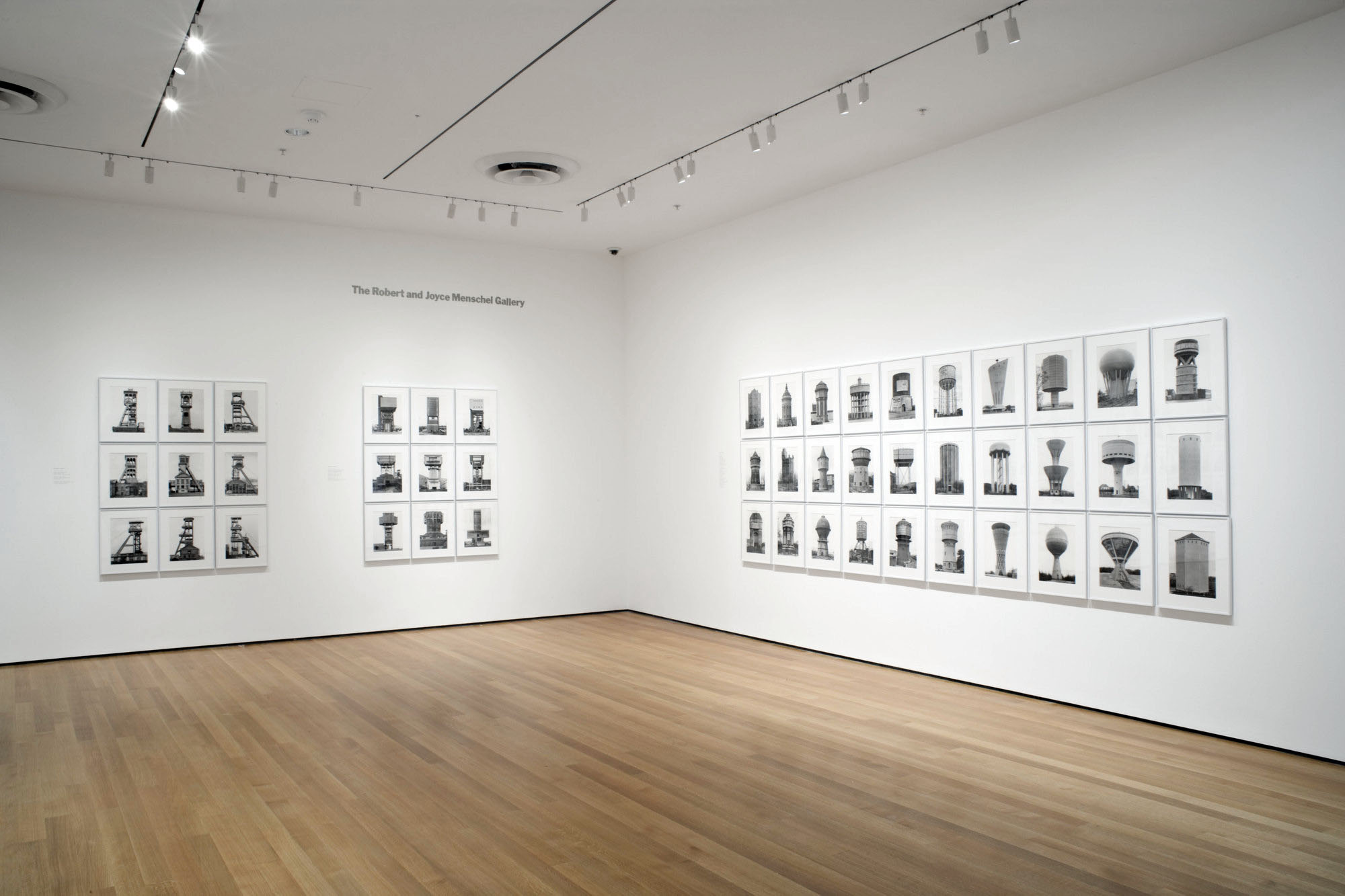
Museum fur Kunst und Gewerbe Hamburg website

LIKE ART BLART ON FACEBOOK

Back to top

Exhibition: ‘When the Curtain Falls: Margarita Broich – Photographs’ at Martin-Gropius-Bau, Berlin

Exhibition dates: 18th March – 30th May 2011


Many thankx to the Martin-Gropius-Bau, Berlin for allowing me to publish the photographs in the posting. Please click on the photographs for a larger version of the image.


Margarita Broich (German, b. 1960) 'Vaginal Davis, Performance, Rising Stars, Falling Stars, Arsenal, Berlin, 13.11.2010' 2010


Margarita Broich (German, b. 1960)
Vaginal Davis
Performance, Rising Stars, Falling Stars, Arsenal, Berlin, 13.11.2010

2010
© Margarita Broich


Margarita Broich (German, b. 1960) 'Martin Wuttke with poodle Taxi, Gretchens Faust, Berliner Ensemble, 11-05-2009' 2009


Margarita Broich (German, b. 1960)
Martin Wuttke with poodle Taxi
Gretchens Faust, Berliner Ensemble, 11.05.2009

2009
© Margarita Broich


Margarita Broich (German, b. 1960) 'Veronica Ferres, Unter Bauern, 1.9.2008' 2008


Margarita Broich (German, b. 1960)
Veronica Ferres
Unter Bauern, 01.09.2008

2008
© Margarita Broich


Margarita Broich (German, b. 1960) 'Melanie and Daniela Reichert, Unter Bauern, 27-08-2008' 2008


Margarita Broich (German, b. 1960)
Melanie and Daniela Reichert
Unter Bauern, 27.08.2008

2008
© Margarita Broich


Margarita Broich (German, b. 1960) 'Rosebud, Volksbühne am Rosa-Luxemburg-Platz, Berlin, 21-12-2001' 2001


Margarita Broich (German, b. 1960)
Margarita Broich
Rosebud, Volksbühne am Rosa-Luxemburg-Platz, Berlin, 21-12-2001

2001
© Margarita Broich


As an actress Margarita Broich is one of the big names, but it may come as a surprise to many that she is also a photographer. For the first time the Martin-Gropius-Bau is showing an exhibition of her work consisting of over 60 portraits of her fellow artists, including Ben Becker, Kate Winslet, Veronika Ferres, Klaus Maria Brandauer, Christoph Schlingensief, Thomas Quasthoff and many more. Margarita Broich has captured those fleeting moments when the actor sheds the role in the intervals or a few minutes after the end of a performance. The role can still be discerned on the features of the players when they are still surrounded by the world of scenery and mirrors but not acting any more. They have been sought out in changing rooms, theatre foyers, or with the make-up artist, taking off their make-up while still surrounded by the tools of their transformation.

Broich portrays the artists with the instinct of a colleague. Her photographs capture famous artists from her circle of acquaintances at those moments when they are returning from the stage after playing their role. However matter-of-fact the situation of the subject may occasionally appear, each photograph has its own charm. The beholder is granted glimpses of scenes that must be among the most intimate in show business: whether they show Martin Wuttke with a blonde, Andy Warhol mane and his poodle, Taxi, smoking a cigarette after a performance of “Gretchens Faust”, or Klaus Maria Brandauer at the end of a 10-hour Wallenstein epic, sitting on a stool with a bottle of beer, the snapshots are full of tension.

Born in Neuwied in 1960, Margarita Broich initially studied photo design in Dortmund and worked as a theatrical photographer at the Bochum Schauspielhaus (Theatre) under Claus Peymann, before studying dramatic art herself at Berlin’s College of Arts. Since then she has appeared in numerous German-language stage performances and television dramas, working with such directors as Claus Peymann, Robert Wilson and, earlier, with Christoph Schlingensief.

Text from the Martin-Gropius-Bau website [Online] Cited 26/05/2011 no longer available online


Margarita Broich (German, b. 1960) 'Kate Winslet, The Reader, 20-04-2008' 2008


Margarita Broich (German, b. 1960)
Kate Winslet
The Reader, 20-04-2008

2008
© Margarita Broich


Margarita Broich (German, b. 1960) 'Klaus Maria Brandauer Wallenstein, Berliner Ensemble in the Preuss-Halle, Berlin, 09-06-2007' 2007


Margarita Broich (German, b. 1960)
Klaus Maria Brandauer
Wallenstein, Berliner Ensemble in the Preuss-Halle, Berlin, 09-06-2007

2007
© Margarita Broich


Margarita Broich (German, b. 1960) 'Ben Becker Jedermann, Salzburger Festspiele, 17-08-2010' 2010


Margarita Broich (German, b. 1960)
Ben Becker
Jedermann, Salzburger Festspiele, 17-08-2010
2010
© Margarita Broich


Martin-Gropius-Bau Berlin
Niederkirchnerstraße 7
Corner Stresemannstr. 110
10963 Berlin
Phone: +49 (0)30 254 86-0

Opening hours:
Wednesday to Monday 10 – 19 hrs
Tuesday closed

Martin-Gropius-Bau website

LIKE ART BLART ON FACEBOOK

Back to top

Exhibition: ‘You Are Here: Architecture and Experience’ at Carnegie Museum of Art, Pittsburgh

Exhibition dates: 5th March – 29th May 2011


Candida Höfer (German, b. 1944) 'Ballettzentrum Hamburg III' 2000


Candida Höfer (German, b. 1944)
Ballettzentrum Hamburg III
2000
Chromogenic print
Courtesy of Sonnabend Gallery


Inspired curating conjoins the monumental, classicist purity of Höfer with the picturesque, dystopian (dis)quietude of Gaillard in an exhibition that investigates our relationship to buildings and their environments and their relationship to us – the ‘i’ in our histor-i-city.

Dr Marcus Bunyan


Many thankx to the Carnegie Museum of Art for allowing me to publish the photographs in the posting. Please click on the photographs for a larger version of the image.


Cyprien Gaillard (French, b. 1980) 'Belief in the Age of Disbelief (L'arbre incliné/étape VI)' 2005


Cyprien Gaillard (French, b. 1980)
Belief in the Age of Disbelief (L’arbre incliné/étape VI)
2005
Etching
36 x 47cm
© Cyprien Gaillard
Courtesy Sprüth Magers Berlin, London


Candida Höfer (German, b. 1944) 'Fundação Bienal de São Paulo XI' 2005


Candida Höfer (German, b. 1944)
Fundação Bienal de São Paulo XI
2005
Chromogenic print
81 3/8 x 71 7/8 in.
Courtesy of Sonnabend Gallery


Carnegie Museum of Art presents the powerful work of two contemporary artists – Candida Höfer and Cyprien Gaillard – who explore architectural environments and how they influence experiences and perceptions of the world.

“We shape our buildings, and afterwards our buildings shape us.” With that simple but profound insight, Winston Churchill conveyed people’s complex relationship to architecture: The physical form of a building is controlled by its designer, but the impact a constructed environment has can be unpredictable, emotional, and even visceral. That dynamic is evident in the upcoming exhibition You Are Here: Architecture and Experience, which brings together the photographs of German artist Candida Höfer and a video and etchings by French artist Cyprien Gaillard. Both artists express the formative power of architecture in different but complementary ways, according to Tracy Myers, curator of architecture at the Heinz Architectural Center and organiser of the exhibition.

Candida Höfer’s lush colour photographs of ornate historical and contemporary interior spaces are usually devoid of humans, yet they reveal details that draw the viewer into a consideration of what each place means. Höfer’s photographs usually focus on spaces of cultural and social activity. Printed very large (from about 4 x 4 feet to a massive 6 x 8 feet), the 17 photographs in You Are Here represent the range of Höfer’s work in terms of scale, point of view, building type, and geographical location.

By contrast, Cyprien Gaillard’s video Desniansky Raion and his meticulously detailed etchings probe the human legacy of Modernist high-rise housing blocks. Constructed after World War II throughout the United States, Europe, and the Eastern Bloc to provide decent housing, these buildings often became warehouses for the poor and incubators of crime and antisocial behaviours.

Named for an administrative district in Kiev, Desniansky Raion poignantly reflects on the gap between the utopian Modernist aspiration for universal housing and the banal reality that instead prevailed. It comprises three parts. In the first section, weekend fight clubs of 50 or 100 people face off against each other in a pugilistic ritual set against the backdrop of housing towers in St. Petersburg, Russia. The second part shows the implosion of a similar tower in Meaux, a small city near Paris; the demolition of the building was treated by the city government as a literal spectacle, with a light show and fireworks preceding the destruction. The final third is a very long panning aerial shot of seemingly endless ranks of virtually identical housing blocks in Kiev, Ukraine. The video is accompanied by a soundtrack composed by Koudlam, a young musician born in the Ivory Coast. Also featured are six etchings by Gaillard, collectively titled Belief in the Age of Disbelief, in which the Modernist housing tower is placed in classic picturesque landscapes.

“Gaillard’s video packs a powerful and direct emotional punch: each time I view it, I experience physically the anticipation that ebbs and flows through the course of the work,” said Myers. “By contrast, Höfer’s photographs embody a kind of quietude that encourages slow, sustained exploration of the meaning that builds through accumulation of detail. But both works are equally affecting and bring the viewer with compelling intensity into the realm of architectural experience. Höfer and Gaillard capture the constant oscillation between what we make of our buildings, and what they make of us.”

Artists’ Biographies

Candida Höfer has been creating photographs for more than 30 years. Born in Eberswalde, Germany, in 1944, she studied with Berndt Becher and is identified with a group of German artists – Thomas Ruff, Andreas Gursky, Axel Hütte, and Thomas Struth – best known for their unsentimental photographs of architecture, landscapes, and urban developments. Höfer has made interiors her focus.

Cyprien Gaillard, born in Paris in 1980 and currently based in Berlin, explores contemporary landscapes and buildings in a variety of media, including video, painting, and etchings. Much of his work is concerned with the legacy and inheritance of buildings and landscapes that are left to us, and the ways in which we interact with them.

Press release from the Carnegie Museum of Art website


Cyprien Gaillard (French, b. 1980) 'Desniansky Raion' video still, 2007


Cyprien Gaillard (French, b. 1980)
Desniansky Raion
2007
Video still
DVD, 30 min.
Edition of 5
© Cyprien Gaillard. Courtesy Sprüth Magers Berlin, London


Cyprien Gaillard – Desniansky Raion, Part 1, 2008

The video takes place in a parking lot of a drab housing complex in St. Petersburg, Russia, where he witness two large groups of men – one mostly wearing red shirts and the other blue – slowly walking towards each other. Set by Gaillard to the hypnotic electronic beats of French composer Koudlam’s I See you All, the video shows the colour-coordinated groups marching in loose formation, reminiscent of ancient armies confronting each other on some distant battlefield. Suddenly, signal flares billowing smoke arc through the air and the two groups come together, clashing in flurry of fists – a breathtaking display of raw physical violence set against the stark backdrop of the housing block. As the sounds of Koudlam’s pulsing music draw louder and more urgent, the furious hand-to-hand combat intensifies while bodies of the fallen lay strewn on the pavement. Before long, the blue faction beats a hasty retreat, only to regroup moments later on one side of a nearby pedestrian bridge. The two sides come together again, this time clashing on the impossibly narrow span of the footbridge. The blue group is once more chased off, and the victors in red erupt in victorious celebration.

Text from the YouTube website


Cyprien Gaillard (French, b. 1980) 'Belief in the Age of Disbelief (Banja Luca)' 2005


Cyprien Gaillard (French, b. 1980)
Belief in the Age of Disbelief (Banja Luca)
2005
Etching
36 x 47cm
© Cyprien Gaillard
Courtesy Sprüth Magers Berlin, London


Candida Höfer (German, b. 1944) 'Pinacoteca Querini Stampalia Venezia I' 2003


Candida Höfer (German, b. 1944)
Pinacoteca Querini Stampalia Venezia I
2003
Chromogenic print
60 15/16 x 73 in
Courtesy of Sonnabend Gallery


Candida Höfer (German, b. 1944) 'Palacio Nacional de Mafra VII' 2006


Candida Höfer (German, b. 1944)
Palacio Nacional de Mafra VII
2006
Chromogenic print
61 x 69 1/8 in
Collection Zibby and Andrew Right, New York


Candida Höfer (German, b. 1944) 'Musee du Louvre Paris XX' 2005


Candida Höfer (German, b. 1944)
Musee du Louvre Paris XX
2005
Chromogenic print
78 3/4 x 95 5/8 in
Courtesy of Sonnabend Gallery


Installation view of the exhibition 'You Are Here: Architecture and Experience' at the Heinz Architectural Center, Carnegie Museum of Art, Pittsburgh

Installation view of the exhibition 'You Are Here: Architecture and Experience' at the Heinz Architectural Center, Carnegie Museum of Art, Pittsburgh

Installation view of the exhibition 'You Are Here: Architecture and Experience' at the Heinz Architectural Center, Carnegie Museum of Art, Pittsburgh


Installation views of the exhibition You Are Here: Architecture and Experience at the Heinz Architectural Center, Carnegie Museum of Art, Pittsburgh


Candida Höfer (German, b. 1944)
'Palacio Real Madrid V' 2000


Candida Höfer (German, b. 1944)
Palacio Real Madrid V
2000
Chromogenic print
47 x 47 in. (119.3 x 119.3cm)


Carnegie Museum of Art
4400 Forbes Avenue
Pittsburgh, PA 15213-4080
Phone: 412.622.3131

Opening hours:
Daily 10am – 5pm

Carnegie Museum of Art website

LIKE ART BLART ON FACEBOOK

Back to top

Exhibition: ‘Kurt Kranz: Programming of Beauty’ at the Bauhaus Dessau, Berlin

Exhibition marking the 100th birthday of Kurt Kranz
19th November 2010 – 29th May 2011


Kurt Kranz (German, 1910-1997) 'Perspective' 1931


Kurt Kranz (German, 1910-1997)
Perspective
1931
Ingrid Kranz / Stiftung Bauhaus Dessau
Foto: Lars Lohrisch / Abdruck mit Genehmigung der Kunsthalle


One of the great pleasures of publishing this archive is that I get to research the life of an artist whose work I never knew before. Kurt Kranz is one such artist.

Dr Marcus Bunyan


Many thankx to the the Bauhaus Dessau for allowing me to publish the photographs in the posting. Please click on the photograph for a larger version of the image.


Kurt Kranz (German, 1910-1997) 'Vereinsamung' Dessau 1930


Kurt Kranz (German, 1910-1997)
Vereinsamung (Isolation)
Dessau
1930
Ingrid Kranz / Stiftung Bauhaus Dessau
Leihgeber: Kunsthalle Bremen


Installation photograph of 'Programming of Beauty' by Kurt Kranz at the Bauhaus Dessau


Installation photograph of Programming of Beauty by Kurt Kranz at the Bauhaus Dessau


Kurt Kranz (German, 1910-1997) 'Versinkende' (Sinking one) 1931


Kurt Kranz (German, 1910-1997)
Versinkende (Sinking one)
1931
Ingrid Kranz / Stiftung Bauhaus Dessau


Kurt Kranz (German, 1910-1997) 'Persischer Garten' (Persian garden) 1970


Kurt Kranz (German, 1910-1997)
Persischer Garten (Persian garden)
1970
Ingrid Kranz / Stiftung Bauhaus Dessau
Foto: Uwe Jacobshagen


The Bauhaus Dessau dedicates a comprehensive exhibition to the painter, graphic designer and photographer Kurt Kranz to mark his 100th birthday. In 1930, the then twenty-year-old lithographer came from Bielefeld to study at the Bauhaus Dessau, where he soon established himself as a pioneer of serial and generative methods. With his avant-garde work, Kranz’s methods anticipated those of later generations.

Inspired by a lecture by László Moholy-Nagy, Kurt Kranz came to the Bauhaus Dessau in April 1930. In Walter Peterhans’s photography class, Kranz began to experiment with photographic techniques and created some of the most striking abstract picture series to emerge from the Bauhaus. Alienated and abstracted faces and hands appear repeatedly in his dynamic picture series. These show Kranz’s early affinity for film as, page for page, the abstract forms interact with one another. Kranz drafted his first concepts for abstract films at the Bauhaus, although he was first able to realise these decades later in 1972.

The exhibition to mark the artist’s 100th birthday shows works from Kranz’s Bauhaus years and his later work as an advertising graphic designer, and focuses on a selection of his large picture cycles. Strikingly diverse leporellos dating from the 1960s onwards take centre stage, as do the so-called “Matrix-und Schiebebilder”

Text from the Bauhaus Dessau website


Kurt Kranz (German, 1910-1997) 'Selbstporträt en face (objektives Foto)' (Self-portrait with face (objective photo)) 1931


Kurt Kranz (German, 1910-1997)
Selbstporträt en face (objektives Foto) (Self-portrait with face (objective photo))
1931
Ingrid Kranz / Stiftung Bauhaus Dessau


Kurt Kranz (German, 1910-1997) 'Rasterfoto' (Raster photograph) 1932


Kurt Kranz (German, 1910-1997)
Rasterfoto (Raster photograph)
1932
Ingrid Kranz / Stiftung Bauhaus Dessau


Kurt Kranz (German, 1910-1997) 'Schwarz : Weiß' (Black: White) 1928-29


Kurt Kranz (German, 1910-1997)
Schwarz: Weiß (Black: White)
1928-1929
Ingrid Kranz / Stiftung Bauhaus Dessau
Privatbesitz


Kurt Kranz (German, 1910-1997) 'Schwarz : Weiß' (Black: White) 1928-29


Kurt Kranz (German, 1910-1997)
Schwarz: Weiß (Black: White)
1928-1929
Ingrid Kranz / Stiftung Bauhaus Dessau
Privatbesitz


Kurt Kranz (German, 1910-1997) 'Schwarz : Weiß' (Black: White) 1928-29


Kurt Kranz (German, 1910-1997)
Schwarz: Weiß (Black: White)
1928-1929
Ingrid Kranz / Stiftung Bauhaus Dessau
Privatbesitz


Kurt Kranz (German, 1910-1997) 'Schrift Entwurf aus Satzmaterial' (Writing draft from sentence material) Dessau 1931


Kurt Kranz (German, 1910-1997)
Schrift Entwurf aus Satzmaterial (Writing draft from sentence material)
Dessau
1931
Ingrid Kranz / Stiftung Bauhaus Dessau


Kurt Kranz (German, 1910-1997) Aus der Serie "Sieben Schritte zum symmetrischen Oval"' (From the series "Seven steps to the symmetrical Oval") 1982


Kurt Kranz (German, 1910-1997)
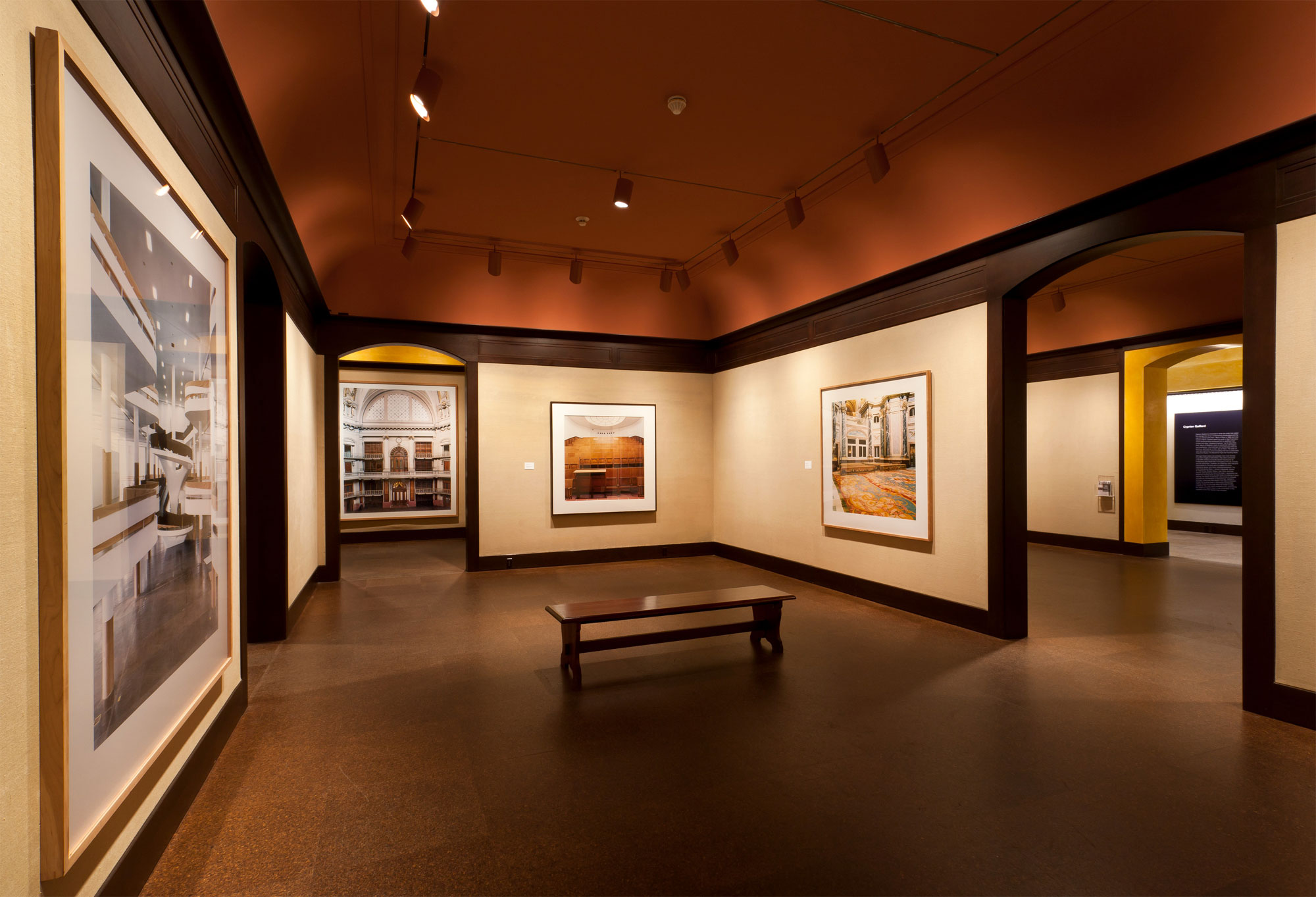
Aus der Serie “Sieben Schritte zum symmetrischen Oval” (From the series “Seven steps to the symmetrical Oval”)
1982
Ingrid Kranz / Stiftung Bauhaus Dessau
Foto: Uwe Jacobshagen


Kurt Kranz (German, 1910-1997) 'Augenreihe' (Eye rows) 1931


Kurt Kranz (German, 1910-1997)
Augenreihe (Eye rows)
1931 (montiert 1981) (1931 (1981 install))
Ingrid Kranz / Stiftung Bauhaus Dessau
Leihgeber: Kunsthalle Bremen


Kurt Kranz (German, 1910-1997) 'Mund-Reihen' (Mouth rows) 1931


Kurt Kranz (German, 1910-1997)
Mund-Reihen (Mouth rows)
1931
Ingrid Kranz / Stiftung Bauhaus Dessau
Leihgeber: Kunsthalle Bremen
Foto: Ingrid Kranz, Wedel


Bauhaus Dessau
Gropiusalle 38, Dessau, Germany

Opening hours:
Tue – Sun 10am – 6pm

Bauhaus Dessau website

LIKE ART BLART ON FACEBOOK

Back to top