Exhibition: ‘Soulèvements / Uprisings’ at Jeu de Paume, Paris

Exhibition dates: 18th October, 2016 – 15th January, 2017

Curator: Georges Didi-Huberman, philosopher and art historian
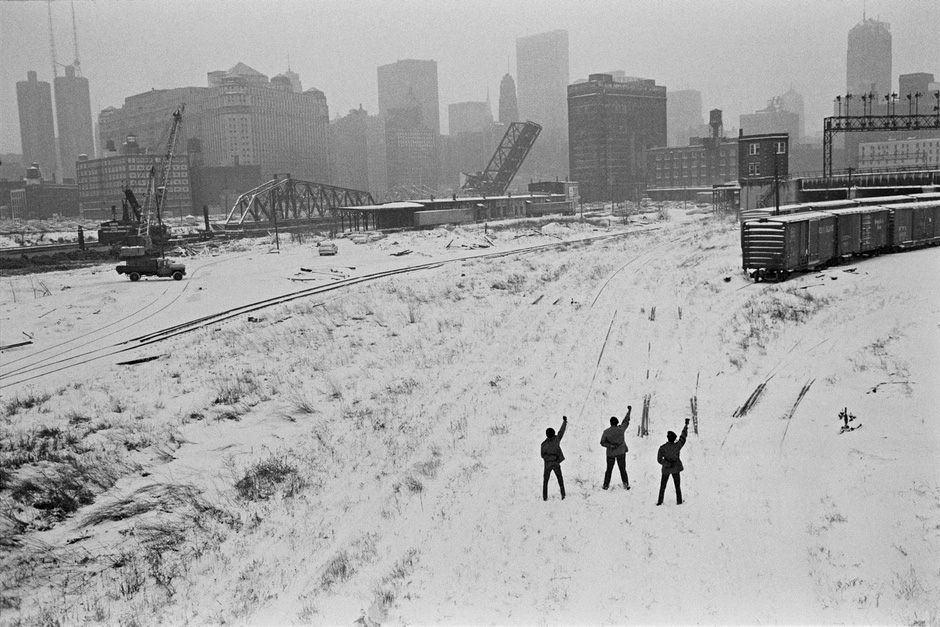
 

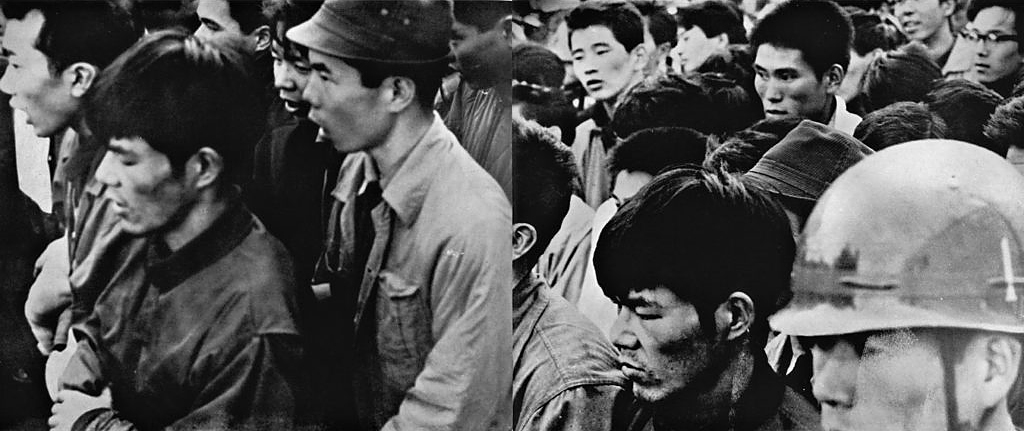
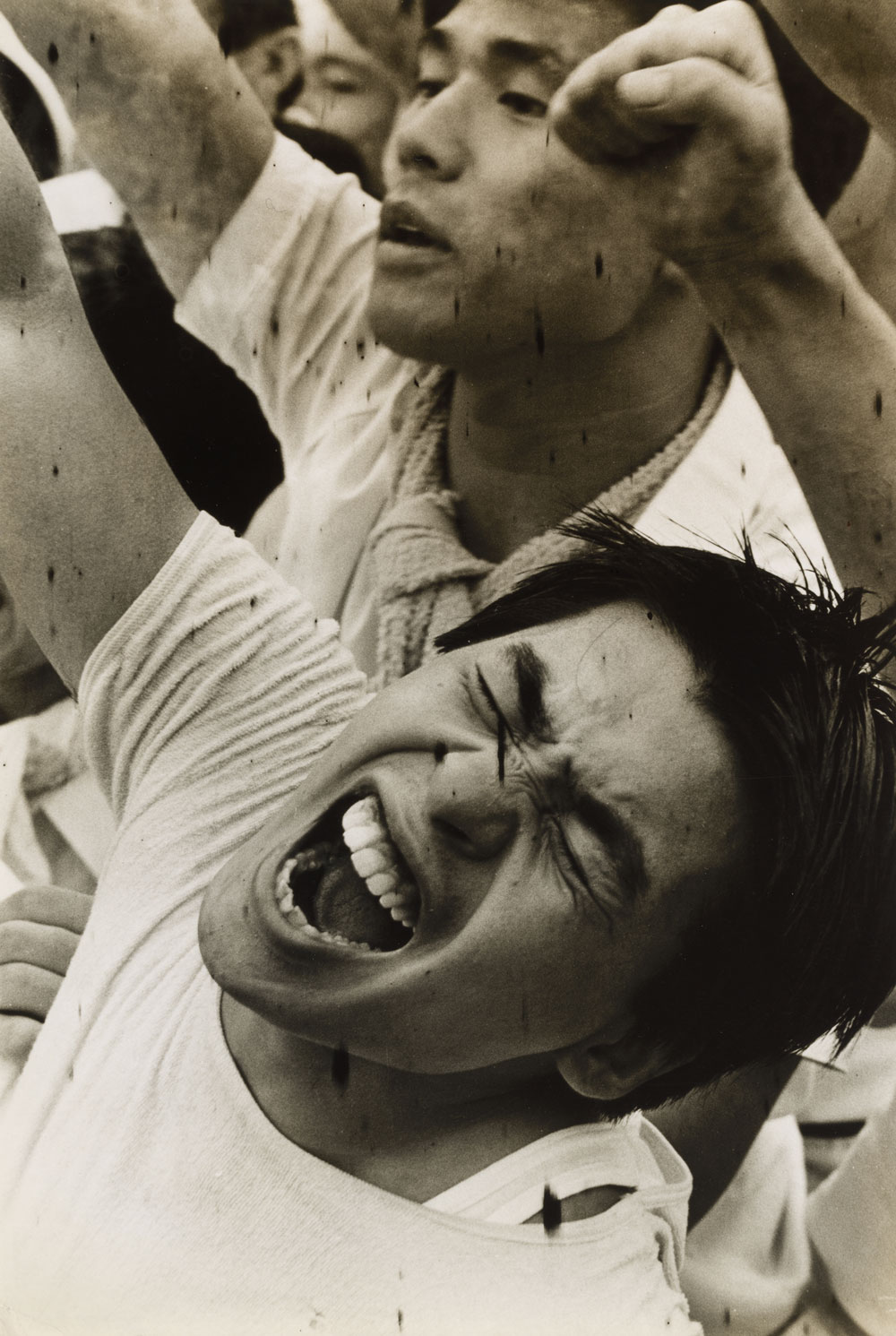
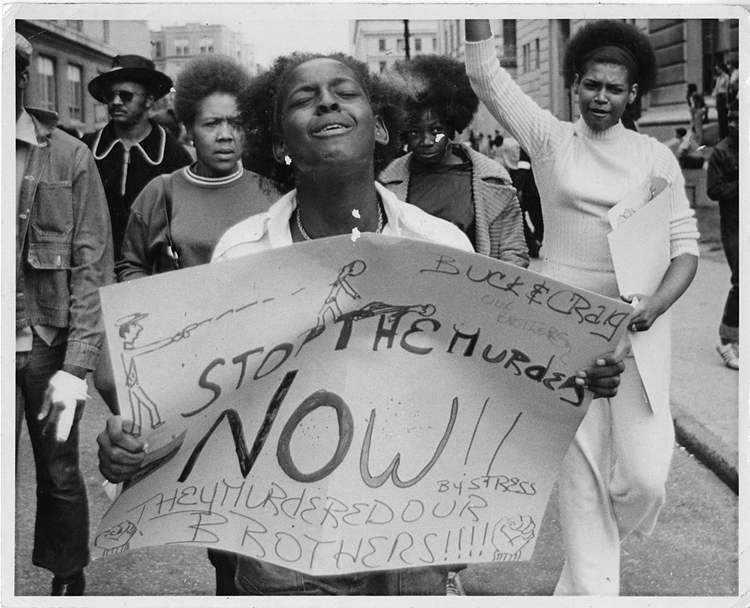
Hiroji Kubota (Japanese, b. 1939) 'Black Panthers in Chicago, Illinois' 1969 from the exhibition 'Soulèvements / Uprisings' at Jeu de Paume, Paris, Oct 2016 - Jan 2017


Hiroji Kubota (Japanese, b. 1939)
Black Panthers in Chicago, Illinois
1969
Gelatin silver print
© Hiroji Kubota/Magnum Photos


soulèvement m ‎(plural soulèvements)

1/ the act of raising, the act of lifting up
2/ revolt, uprising


I believe this to be one of the most complex, original and important exhibitions of 2016. Conceptually, intellectually, ethically and artistically, the exhibition “Soulèvements / Uprisings” seems to stand head and shoulders above most others I posted on during 2016.

Through the profound curatorship of philosopher and art historian Georges Didi-Huberman (a man whose writing I admire), Soulèvements e/merges as a “trans-disciplinary exhibition on the theme of human gestures that raise up the world or rise up against it: collective or individual gestures, actions or passions, works or thoughts” actioned through five themes: Elements (Unleashed); Gestures (Intense); Words (Exclaimed); Conflicts (Flared up); and Desires (Indestructibles), evidenced across mediums: paintings, drawings, prints, video installations, photographs, fiction films, documentary images, writers’ manuscripts, tracts, posters, etc., without hierarchies. Unlike the earlier posting, Intersections: Photographs and Videos from the National Gallery of Art and the Corcoran Gallery of Art at the National Gallery of Art, Washington, where I noted that the self-contained themes of that exhibition seemed purely illusory, here the themes are active and engaging, fluid in meaning and representation (the choice of laterally aligned art works to the themes – dust breeding, waves, sea concertos, banners and capes, red tape, montages, posters etc…), which emphasis resistance, the raising up, the uprising as a desirous and joyful act, one that is performative (hence the wonderful video elements in the exhibition) and transgressive.

As one of the most important mediums of the twentieth century in terms of documenting, promoting, obscuring and forgetting “uprisings” – gestures of resistance and joy of any kind – photography is capable of concealing, denying and sustaining the social context in which we are living … obscuring the ethics and morals of dubious political positions; reinforcing or obscuring the issues behind revolution, rebellion, and revolt; or, through collective amnesia and inertia, through the millions of forgettable images produced each day, overwhelming the authenticity of living that leads to “uprisings” in the first place. Photographs, as people do, cross borders: they are transnational and multidisciplinary. They are global thought patterns that can, in skilled hands, document and sustain alternative ways of seeing the world through a “rising up” of feeling – the “soul” of soulèvement – the act of raising up, the act of lifting ones eyes and one’s spirit from the dire circumstances of oblivion to the hope of a future redemption.

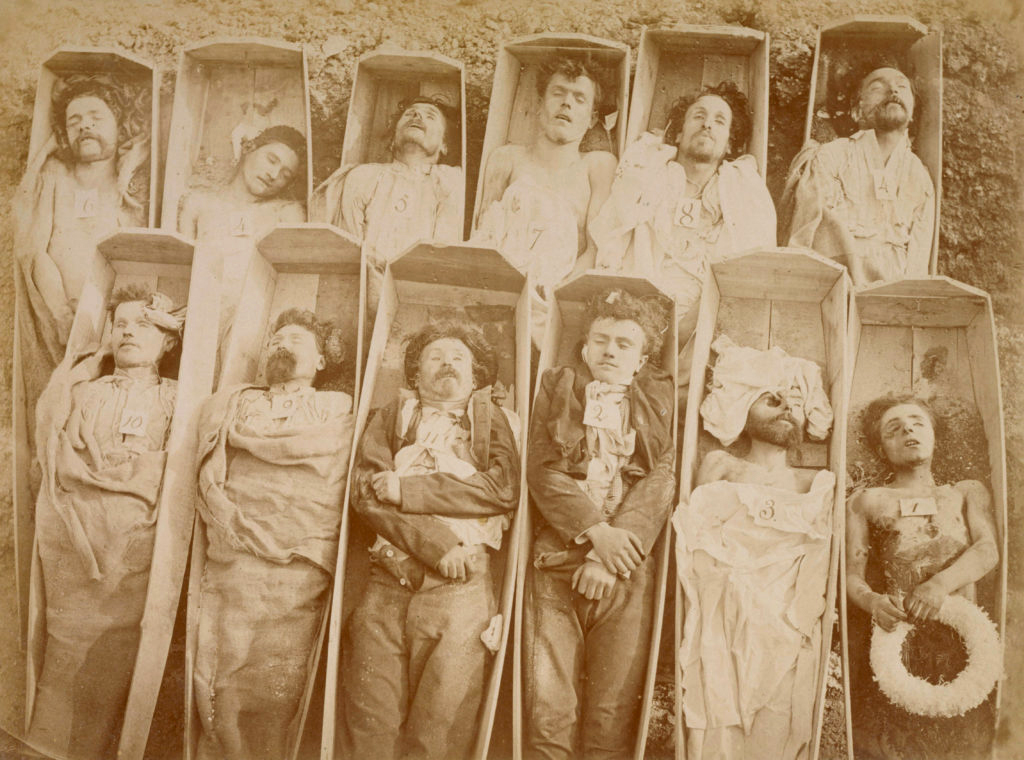
Through photographs, we witness Insurgents killed during bloody week of the Commune (1871, below), where “the exposure of these bodies is transformed by the photographic act. The latter confers on the rebels a particular aura, passing thus from figures of guilty to those of martyrs.” The political act, although a failure in reality in this case, is sustained through time and space by the performance of the documentary image. Their monstration [the act of demonstrating; proof] – the insurgents act of demonstrating; the photograph as an act of demonstrating their death for judicial purposes; and also a certain monstration (proof) that these mostly young, skinny men died for a belief in a better world – is an evidentiary act of transubstantiation. Is the camera looking down on these bodies in cheap coffins from above, or are the coffins propped up against a wall? How do we feel about these people we do not know, who existed in past time now made present, without being that person who tucked a wreath into the hands of the man at bottom right, someone’s brother, father or son.

In “uprisings” (as the hands raise the camera to the face), there is also an acknowledgment of a certain despair at the death of an innocent. In Manuel Álvarez Bravo’s Striking worker, assassinated (1934, below) the young, handsome youth has been killed with a blow to the head. He lies prostrate on the ground, arm outstretched, hand curled, his body and clothes spattered with his own blood his eyes, open, staring at the now invisible sky. A flow of dried blood has discharged from his mouth and nose, coating and matting his thick long hair and running away in rivulets, soaking into the parched d/earth. Bits of dust and earth are still stuck to his arm through the viscosity of his blood. Earlier, he had dressed for the day in a white singlet, put on his trousers and fastened them with an embossed belt, then put on a crisp, stripped shirt and neatly rolled up the sleeves to his elbows. He might have had breakfast before heading of to a meeting outside where he worked. This day he died, protesting his rights – striking worker, assassinated! Assassinated – executed, eliminated, liquidated (to which the congealing blood attests) … slaughtered. For his right to strike, to protest, the conditions of his being. Any human “being”.

And, mortally, I comment on that one photograph, that one evidence of human beings transcending their own lives (knowing they were going to die) for the greater good – the anonymous photograph taken by members of the Sonderkommando of Auschwitz-Birkenau death camp that documents AS PROOF of the reality of the Final Solution: Women pushed towards the gas chamber of crematorium V of Birkenau (1944, below). The risks that these people took to capture this photograph speaks to the power of photography to transcend even the most barbaric of circumstances, to prove to the world what was happening in this place. As Georges Didi-Huberman affirms, “in the depths of this fundamental despair, the “solicitation to resist” has probably detached itself from the beings themselves, who have been promised to disappear, to fix themselves on signals to be emitted beyond the boundaries of the camp.” Among others, the image, this “eye of history”, is then invested with the only hope still possible: to make the hell of Auschwitz visible and therefore imaginable.”

In other words, the solicitation to resist is not singular or human, but collective and eternal, embodied and embedded in cultural thoughts and actions. Even though they knew they were going to die (almost none of the 2,000 prisoners placed in these Sonderkommando units survived to the camp’s liberation), because they have been “promised to disappear”, their spirit flowed beyond the boundaries of the camp into the ether of history, into the elemental upper air, the raising up of spirits: as an observation and representation of the difference between right and wrong. As the world enters a renewed period of right wing promulgation we must resist the rump of bigotry and oppression. Not just for ourselves but for all those that have passed before.

This is why this exhibition is so important. It speaks to the need for vigilance and protest against discrimination and dictatorship, against the persecution of the less fortunate in society. It also speaks to our desire as human beings that our actions and the actions of others be held to account. Intrinsically uprisings are all about desire, the desire to be stand up and be counted, to put your reputation (as Oscar Wilde did) or your life on the line for what you believe in. The courage of your convictions. As Edmund Burke said, “The only thing necessary for the triumph of evil is for good men to do nothing.”

Dr Marcus Bunyan

Addendum

Thank goodness for Google translate because otherwise I would have had no text to put under most of these images. This becomes problematic for weak images such as Dennis Adams’ Patriot (2002, below). Without text to support the image you would have absolutely no idea what this image is about… it’s just a plastic bag floating in the air against the azure sky.

The text states: “… considering the serenity that emanates from the photographs of this series, to imagine that they refer to a dramatic event: the attack of the World Trade Center. Located in Lower Manhattan, Dennis Adams’ studio is very close to the twin towers that were destroyed on September 11, 2001. However, rather than rushing to witness the catastrophe, Dennis Adams photographed for three months the roof of his building, the newspapers and the rubbish that fly away from the ruins.”

Who would have thunk it! From a plastic bag floating in the sky!

Such insight proffered months after the event by any plastic bag floating in the air. The image does not invite reverie and meditation because there is nothing to meditate on. It is an example of contemporary photography as graphic art THAT MEANS ABSOLUTELY NOTHING! If an image cannot stand on its own two feet, without the help of reams of text to support its substance, its contention, then no wonder there are millions of vacillating images in this world. Including contemporary art.

Out, damned spot! the stain of thy blood cannot be exacted from your feeble representation.


Word count: 1,451

Translations of soulèvement

noun

uprising – soulèvement, révolte
rising – soulèvement, hausse (rise), insurrection, montant, lever, élévation
insurrection – insurrection, soulèvement, émeute (riot), rébellion

uplift – soulèvement
upheaval – bouleversement, soulèvement, agitation, perturbation, séisme, renversement


Many thankx to Jeu de Paume for allowing me to publish the photographs in the posting. Please click on the photographs for a larger version of the image.


Uprisings at Jeu de Paume – Concorde, Paris / Teaser

Uprisings is a trans-disciplinary exhibition on the theme of human gestures that raise up the world or rise up against it: collective or individual gestures, actions or passions, works or thoughts. They are gestures which say no to a state of history that is considered too “heavy” and that therefore needs to be “lifted” or even sent packing. They are also gestures that say yes to something else: to a desired better world, an imagined or adumbrated world, a world that could be inhabited and conceived differently.


Foreword

“For almost a decade, the Jeu de Paume’s exhibition program has been conceived with the conviction that twenty-first century museums and cultural institutions cannot be detached from the social and political challenges of the society of which they are part. To us, this approach is a matter of simple common sense.

The program it has shaped does not monitor market trends or seek complacent legitimacy within the field of contemporary art. Rather, we have chosen to work with artists whose poetic and political concerns are attuned to the need to critically explore the models of governance and practices of power that mold much of our perceptual and emotional experience, and thus, the social and political world we live in.

Because the Jeu de Paume is a centre for images, we are aware of the urgent necessity – in line with our societal responsibilities – to revise the analysis of the historical conditions in which photography and the moving image developed in modernity and, subsequently, in postmodernity, with all its alternatives, provocations, and challenges.

Thankfully, the history of images and our ways of seeing and understanding the world through them is neither linear nor unidirectional. These are the sources of our fascination with images that don’t tell everything they show and with images affected by the vicissitudes of the human condition.

Photography, and images in general, represent not only reality, but things that the human eye cannot see; like us, photography is capable of concealing, denying and sustaining. It is only waiting for someone to listen to its joys and its sorrows.

The Jeu de Paume’s programming sites its oblique look at history and contemporaneity in this oscillation between the visible and the invisible in the life of images, creating a space for encounter and the clashing of ideas, emotions, and knowledge, accepting that the coexistence of conflict and antagonism are an essential part of community building.

For these reasons, and from this position, in the superb proposal by the philosopher and art historian Georges Didi-Huberman to form an exhibition from his research on the theme of “uprisings,” we found the ideal intellectual, artistic, and museological challenge.

While the notion of revolution, rebellion, and revolt isn’t alien in contemporary society’s vocabulary, the object of its action is replete with collective amnesia and inertia. That is why analysing the representations of “uprisings” – from the etchings Goya, to contemporary installations, paintings photographs, documents, videos, and films – demonstrates an unequivocal relevance to the social context in which we are living in 2016. […]

Marta Gili, “Foreword,” in Uprisings, catalogue of the exhibition, p. 7-10.


Enrique Ramirez (Chile, b. 1979)
Cruzar un muro [Franchir un mur] (Crossing a wall)
2013
Vidéo HD couleur, son, 5’15”
Courtesy de l’artiste et galerie Michel Rein, Paris/Brussels


A series of images of people in a waiting room is in an unusual place, perhaps in our imagination, or perhaps anywhere. The short by Enrique Ramirez addresses article number 13 of the Universal Declaration of Human Rights: “Everyone has the right to leave any country, including his own, and to return to his country”.
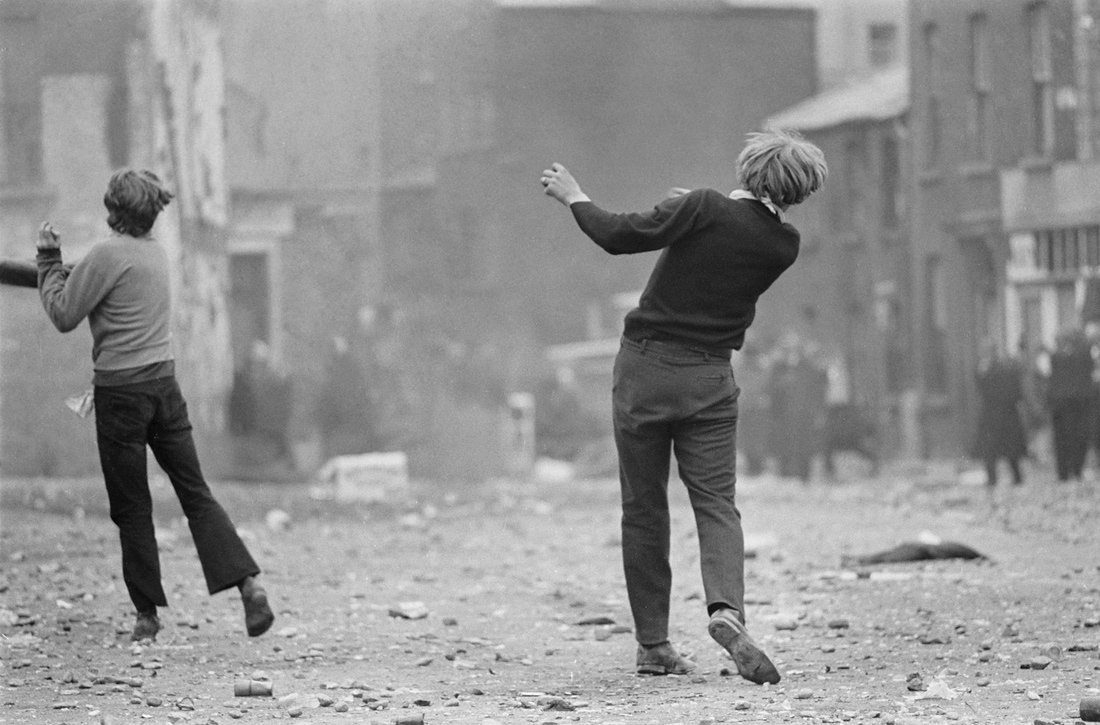
 

Gilles Caron (French, 1939-1970) 'Anticatholic protests, Londonderry, Northern Ireland' August 1969 from the exhibition 'Soulèvements / Uprisings' at Jeu de Paume, Paris, Oct 2016 - Jan 2017


Gilles Caron (French, 1939-1970)
Manifestations anticatholiques à Londonderry
Anticatholic protests, Londonderry, Northern Ireland
August 1969
© Gilles Caron / Fondation Gilles Caron / Gamma Rapho


Known for his wartime photo-reports, fascinated by liberating acts and the figure of the insurgent, photographer Gilles Caron carried throughout the 1960s an interest in the social conflicts that marked his time. At first he is led to cover is a peasant revolt which takes place in Redon in 1967. Anxious to produce an image which appears to him as a formal translation of the anger of these peasants, he seizes the gesture of a demonstrator sending a projectile in the direction of the forces of order. Photogenic, this suspended gesture gives the insurrections a choreographic dimension and testifies to the violence of the social demands that animate the demonstrators. The “figure of the pitcher” then reappears on the occasion of the events of May 1968 and then of the conflicts that took place in Northern Ireland in 1969. This archetype is part of the tradition of the representation of David against Goliath: the symbol of the power carried by the faith of one who is thought weak in the face of brute force. If there is no question of faith in the images of Caron, it is nonetheless an irrepressible form of desire that animates those bodies which revolt: no matter the imbalance of forces, the insurgents are carried by a feeling of invulnerability and of power in the face of the forces of order objectively much more armed.

Text from the Jeu de Paume website translated by Google translate


Man Ray (American, Philadelphia, Pennsylvania 1890-1976 Paris) 'Dust Breeding' 1920


Man Ray (American, Philadelphia, Pennsylvania 1890-1976 Paris)
Dust Breeding (Duchamp’s Large Glass with Dust Motes)
1920
Gelatin silver print
23.9 x 30.4cm (9 7/16 x 12 in.)
© 2016 Artists Rights Society (ARS), New York


One of Duchamp’s close friends and a member of the New York Dada scene, the American photographer and painter Man Ray (1890-1976) was also one of Duchamp’s collaborators. His photograph Dust Breeding (Duchamp’s Large Glass with Dust Motes) from 1920 is a document of The Large Glass after it had collected a year’s worth of dust while Duchamp was in New York. The photograph was taken with a two-hour-long exposure that beautifully captures the complex texture and diversity of materials that lay atop the glass surface. Dust Breeding marks a pivotal phase in the development of Duchamp’s masterpiece. After the photograph was taken, Duchamp wiped The Large Glass almost entirely clean, leaving a section of the cones covered with dust, which he permanently affixed to the glass plate with a diluted cement.

Text from The Met website


Introduction

by Georges Didi-Huberman, curator of the exhibition

What makes us rise up? It is forces: mental, physical, and social forces. Through these forces we transform immobility into movement, burden into energy, submission into revolt, renunciation into expansive joy. Uprisings occur as gestures: arms rise up, hearts beat more strongly, bodies unfold, mouths are unbound. Uprisings are never without thoughts, which often become sentences: we think, express ourselves, discuss, sing, scribble a message, create a poster, distribute a tract, or write a work of resistance.

It is also forms: forms through which all of this will be able to appear and become visible in the public space. Images, therefore; images to which this exhibition is devoted. Images of all times, from Goya to today, and of all kinds: paintings, drawings, sculptures, films, photographs, videos, installations, documents, etc. They interact in dialogue beyond the differences of their times. They are presented according to a narrative in which there will appear, in succession, unleashed elements, when the energy of the refusal makes an entire space rise up; intense gestures, when bodies can say “No!”; exclaimed words, when barricades are erected and when violence becomes inevitable; and indestructible desires, when the power of uprisings manages to survive beyond their repression or their disappearance.

In any case, whenever a wall is erected, there will always be “people arisen” to “jump the wall”, that is, to cross over borders. If only by imagining. As though inventing images contributed – a little here, powerfully there – to reinventing our political hopes.

The exhibition

“Soulèvements / Uprisings” is a trans-disciplinary exhibition on the theme of human gestures that raise up the world or rise up against it: collective or individual gestures, actions or passions, works or thoughts.

They are gestures which say no to a state of history that is considered too “heavy” and that therefore needs to be “lifted” or even sent packing. They are also gestures that say yes to something else: to a desired better world, an imagined or adumbrated world, a world that could be inhabited and conceived differently.

These figures of uprising and up-raising will range freely across mediums: paintings, drawings, prints, video installations, photographs, fiction films, documentary images, writers’ manuscripts, tracts, posters, etc., without hierarchies.

The exhibition sequence will follow a sensitive, intuitive path along which the gaze can focus on exemplary “cases” treated with a precision that prevents any kind of generalisation. We will be mindful not to conclude, not to dogmatically foreclose anything. The sequence will comprise five main parts:

ELEMENTS (UNLEASHED)
GESTURES (INTENSE)
WORDS (EXCLAIMED)
CONFLICTS (FLARED UP)
DESIRES (INDESTRUCTIBLES)


“All the uprisings failed, but taken together, they succeeded.”

“They rise, but they do not simply stand up – they rise up.”

Judith Butler, “Uprisings” catalogue of the exhibition Uprisings


ELEMENTS (UNLEASHED)

The elements become unleashed, time falls out of joint. – And if the imagination made mountains rise up?

To rise up, as when we say “a storm is rising.” To reverse the weight that nailed us to the ground. So it is the laws of the atmosphere itself that will be contradicted. Surfaces – sheets, draperies, flags – fly in the wind. Lights that explode into fireworks. Dust that rises up from nooks and crannies. Time that falls out of joint. The world upside down. From Victor Hugo to Eisenstein and beyond, uprisings are often compared to hurricanes or to great, surging waves. Because then the elements (of history) become unleashed.

We rise up first of all by exercising our imagination, albeit through our “caprichos” (whims or fantasies) or “disparates” (follies) as Goya said. The imagination makes mountains rise up. And when we rise up from a real “disaster,” it means that we meet what oppresses us, and those who seek to make it impossible for us to move, with the resistance of forces that are desires and imaginations first of all, that is to say psychical forces of unleashing and of reopening possibilities.

Dennis Adams, Francis Alÿs, Léon Cogniet, Marcel Duchamp, Francisco de Goya, William Hogarth, Victor Hugo, Leandro Katz, Eustachy Kossakowski, Man Ray, Jasmina Metwaly, Henri Michaux, Tina Modotti, Robert Morris, Saburô Murakami, Hélio Oiticica, Roman Signer, Tsubasa Kato, Jean Veber, French anonymous.
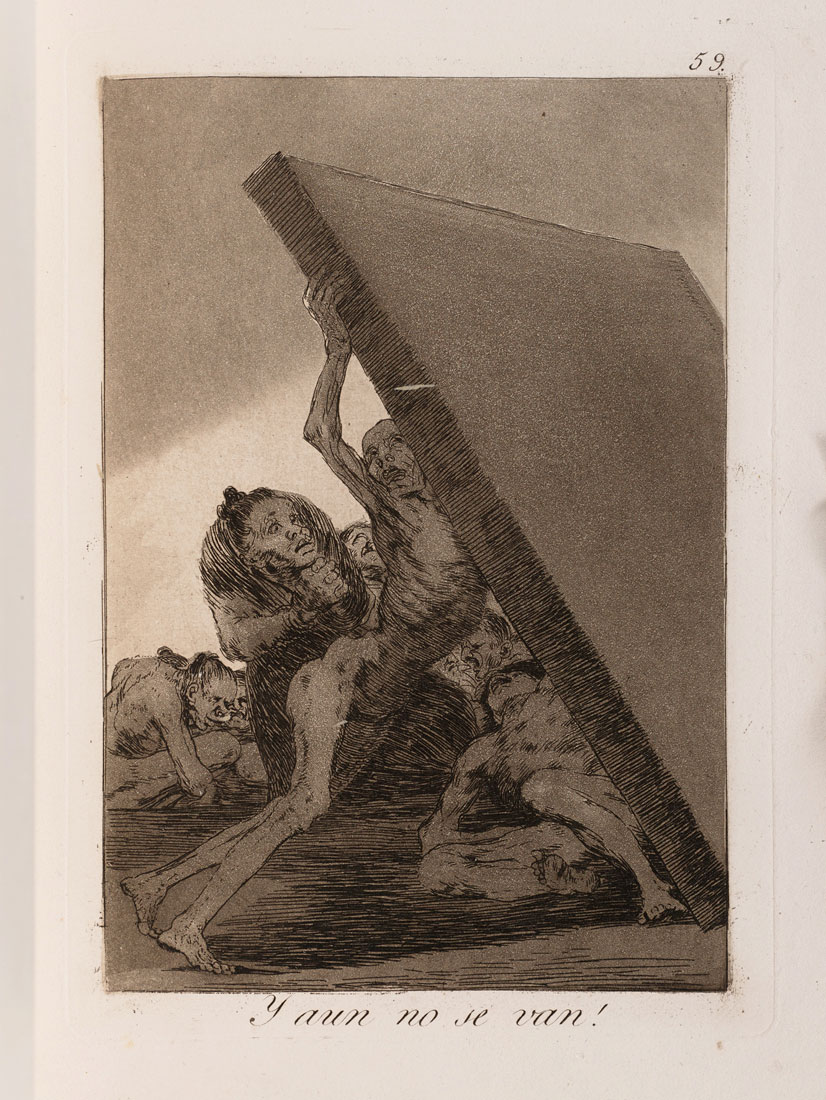
 

Francisco de Goya (Spanish, 1746-1828) 'Los Caprichos' 1799


Francisco de Goya (Spanish, 1746-1828)
Los Caprichos
1799
Eau-forte, aquatinte et burin, 2e édition de 1855.
Collection Sylvie et Georges Helft
Photo: Jean de Calan


Between 1797 and 1799, Francisco de Goya composed a collection of engravings, Los Caprichos [Les Caprices], in which he portrayed in a satirical way the behaviour of his Spanish fellow citizens. “Y aun no se van!” (“And yet they do not go away!”) is the 59th engraving of a set of 80. Each time the title constitutes an ironic commentary on the image. This one refers to the group of people represented on the engraving, with the bodies emaciated, folded on themselves, praying, looking scared. One of them tries to prevent the tombstone from falling on them, but all seem helpless, destitute of strength, unable to resist this final ordeal. The use of chiaroscuro, which produces a dramatic effect, as well as the thick slice of the slab that forms the diagonal of the composition, accentuates the desperate character of the scene. Finally, the massive aspect and the weight of the stone, opposed to fragile and denuded bodies, complete their inexorable destiny. This engraving thus seems to illustrate the absolute dejection felt by individuals under certain circumstances. For Georges Didi-Huberman, degradation is one of the conditions conducive to the uprising. The imagination and the critical eye of the artist – a fervent supporter of the Enlightenment – can constitute a force of resistance and struggle for the oppressed.

Text from the Jeu de Paume website translated by Google translate
 

Léon Cogniet (French, 1794-1880) 'Les Drapeaux' 1830


Léon Cogniet (French, 1794-1880)
Les Drapeaux (The flags)
1830
Huile sur toile
Musée des Beaux-Arts, Orléans
Photo: François Lauginie


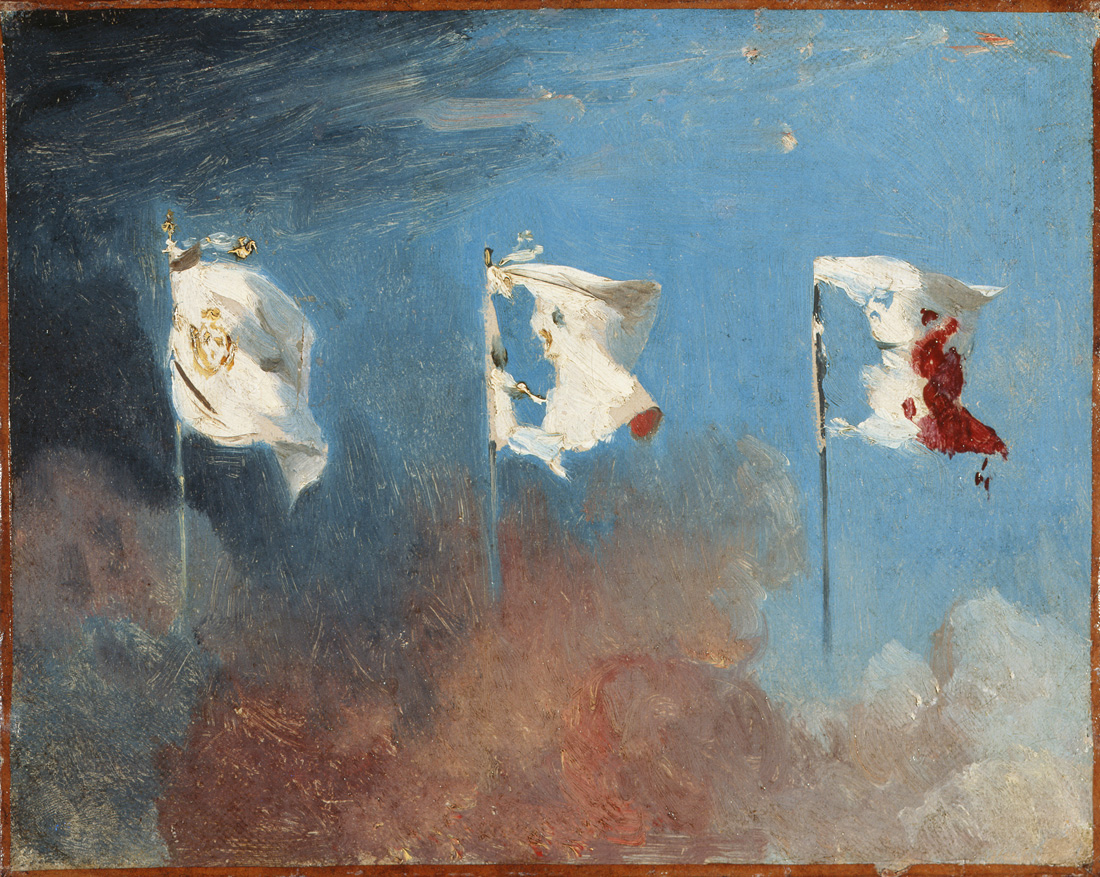
The Revolution of 1830 led to the overthrow of the government of King Charles X. After the publication of several ordinances, including a restriction on freedom of the press, this episode, which failed to restore the Republic, The tricolour flag, abandoned by the Restoration for the benefit of the white flag, symbol of royalty. This is evidenced by Leon Cogniet’s study of a painting that will never see the light of day.

These revolutionary days, also called the Three Glorious Days, are symbolically represented by three flags caught in the turmoil. The first, white, overhung by a menacing sky, is hoisted on a mast adorned with a fleur-de-lis. The second tears apart and reveals the blue sky as a promise of freedom. Finally, the third, torn and covered with blood, allows the reconstruction of the tricolour emblem created during the Revolution of 1789. Thus the blood poured during these days allows the people to reconnect with the revolutionary ideals. The unleashing of elements, a metaphor for the tempestuous popular revolt, accompanies the transformation of the banished flag of royalty to the national flag. This sketch is repeated and widely circulated at the time, accompanied by an anonymous poem: “To the darkness finally succeeds the clarity / And pale shreds of the flag of the slaves / And of the azure sky and the blood of our brave / The brilliant standard of our freedom is born.”

Text from the Jeu de Paume website translated by Google translate
 

Victor Hugo (French, 1802-1885) 'La vague ou Ma destinée (The wave or My destiny)' 1857


Victor Hugo (French, 1802-1885)
La vague ou Ma destinée (The wave or My destiny)
1857
Plume et lavis d’encre brune, gouache, papier vélin
Maison de Victor Hugo
© Maisons de Victor Hugo / Roger-Viollet


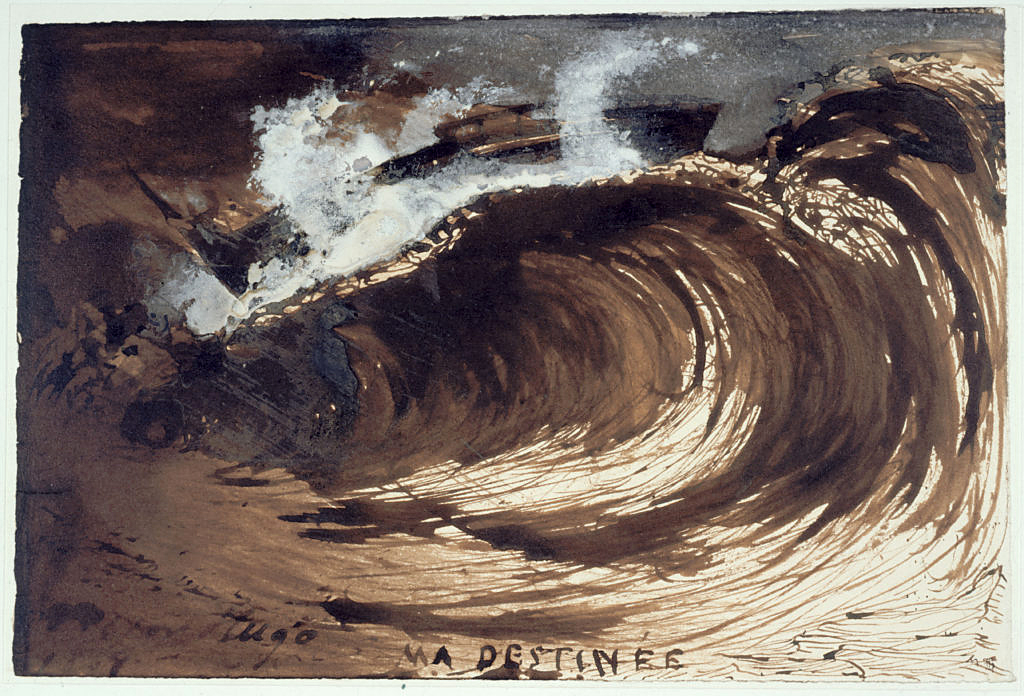
This drawing is the witness of Victor Hugo’s fascination with the sea. His pen marries the movements of the ocean, which then becomes the symbol of his exile: “It is the image of my current destiny stranded in abandonment and solitude,” he says. On the drawing he calls ‘My destiny’, it is not known whether the ship, alone in front of the monster of the sea, enveloped by its foam, is carried or precipitated by the immense wave. It is a figure of his destiny, but also of the human condition.
 

Man Ray (American, 1890-1976) "Sculpture mouvante" ou "La France" ("Moving Sculpture" or "France") 1920


Man Ray (American, 1890-1976)
“Sculpture mouvante” ou “La France” (“Moving Sculpture” or “La France”)
1920
Musée national d’Art moderne, Centre Pompidou, Paris, dation en 1994
Negative gelatin-silver on glass plate
9 x 12cm
Photo: © Centre Pompidou, MNAM-CCI, Dist. RMN-Grand Palais / image Centre Pompidou, MNAM-CCI
Image obtenue par inversion des valeurs du scan du négatif
© Man Ray Trust / ADAGP, Paris, 2016


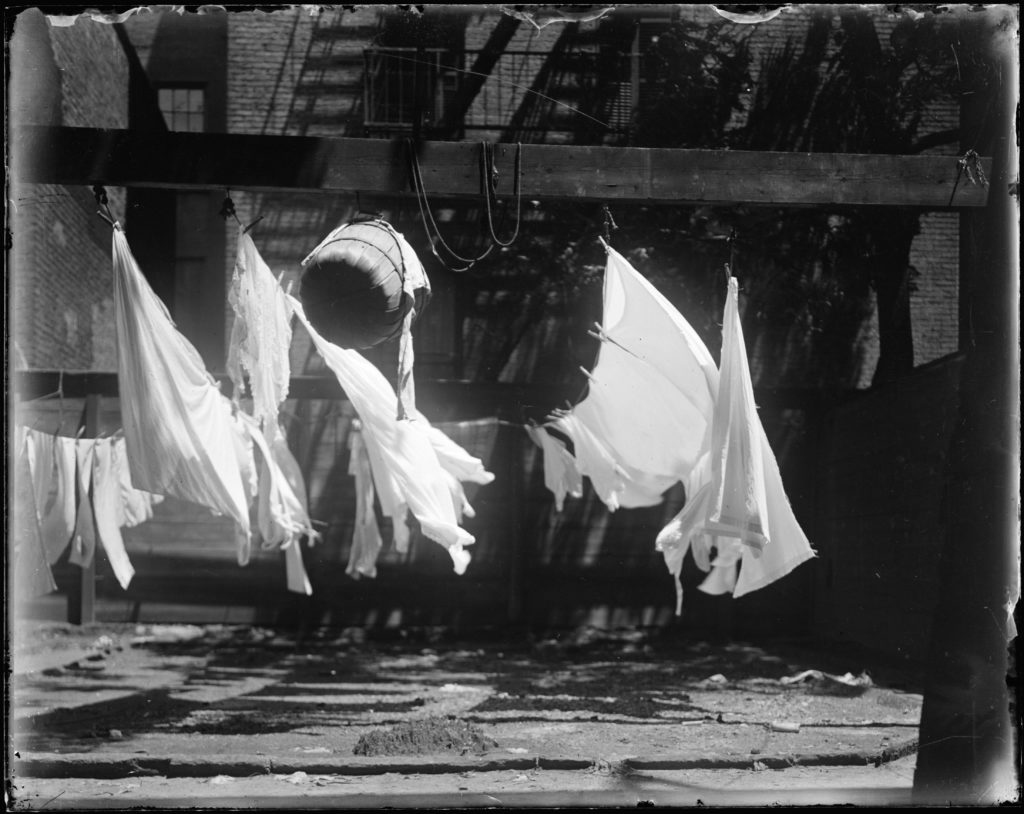
An active member of the Dada group in New York with Marcel Duchamp, Man Ray joined the surrealists in Paris in 1921. He was interested in questioning the conventions of the world of art and considered photography as a means of expression. It explores all potentialities: experiments, diversions, portraits, advertising applications … The fixation of an element in movement constitutes one of the specificities of photography that fascinates the surrealists because the object thus grasped by the apparatus appears in an unexpected light: the linen which dries, inflated under the effect of the wind, becomes a moving sculpture as the title of the work suggests. This way the title can guide the reception of the passionate photography of Man Ray. This image is also published on the cover of the sixth issue of La Révolution Surréaliste in 1926, accompanied by the legend “La France”. This enigmatic title, rather than helping to understand photography, multiplies the possible interpretations and attests to Man Ray’s desire to subvert the use and meaning of the images. Thus this wind which “transforms” linen into sculpture, appears as a metaphor for the surrealist project, which makes the photographic medium the operator of a true conversion of the gaze. By this image of the “uprising”, Man Ray thus gives a visual form to the aesthetic and political revolution that the members of the Surrealist group called for.

Text from the Jeu de Paume website translated by Google translate
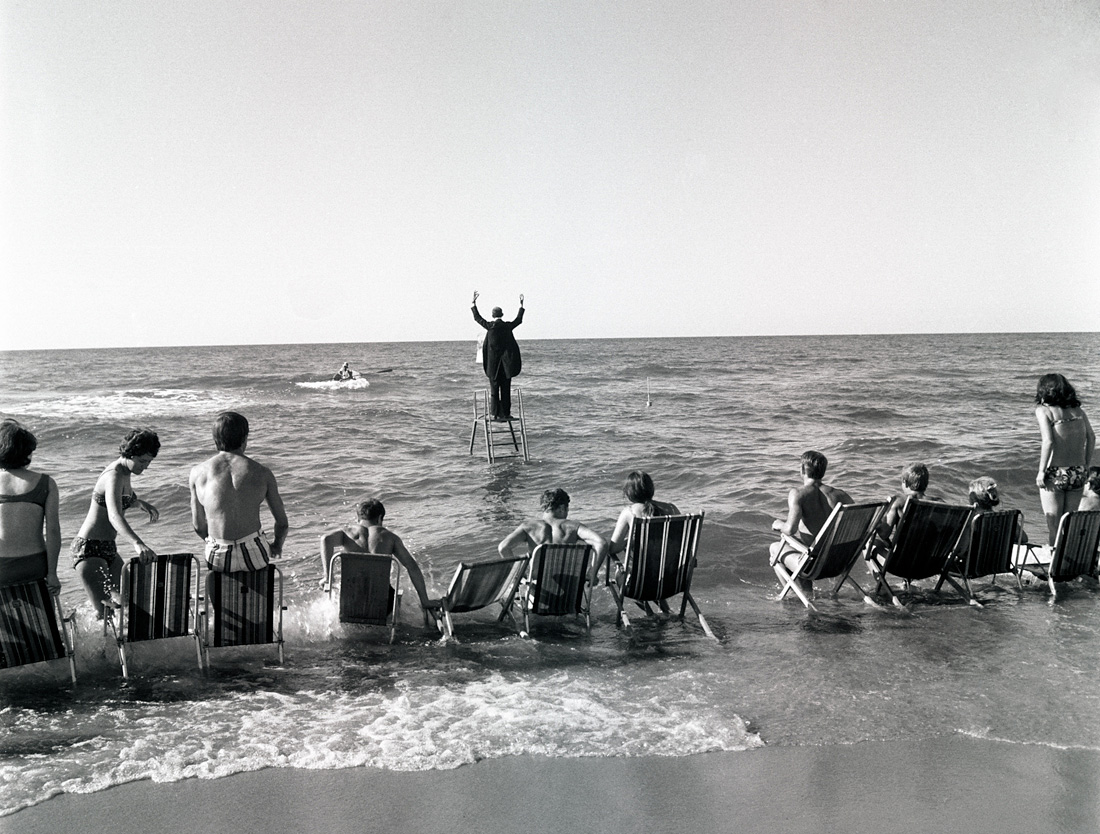
 

Eustachy Kossakowski (Polish, 1925-2001) 'Le "Panoramic Sea Happening - Sea Concerto, Osieki" de Tadeusz Kantor (extrait d'une série)' 1967


Eustachy Kossakowski (Polish, 1925-2001)
Le “Panoramic Sea Happening – Sea Concerto, Osieki” de Tadeusz Kantor (extrait d’une série)
The “Panoramic Sea Happening – Sea Concerto, Osieki” by Tadeusz Kantor (from a series)
1967
Inkjet pigment print
Owner of negatives and slides: Musée d’Art Moderne de Varsovie
© Collection Anka Ptaszkowska


In 1967 Tadeusz Kantor with a group of other Polish avant-garde artists delivered Panoramic Sea Happening. They were working in frames of artistic plain-air in Osieki (near Koszalin) organised there every year since 1963. This complex action was in a way a preface to Kantor’s theatre. But it was also parallel to actions of Western artists, which led to the birth of performance art. In this important moment Kantor formulated a category of impossible. It derived from the night dream but as this one was compromised Kantor wanted to use a new word: ‘impossible’. At the same time the very essence of the happening, as he was saying, was to make impossible real. How did he do it? By reenactment, repetition and documentation.

Dorota Sosnowska. From the abstract for “Impossible is Real: Tadeusz Kantor at the seashore” 2016


Hélio Oiticica (Brazilian, 1937-1980) and Leandro Katz (Argentinian, b. 1938) 'Parangolé - Encuentros de Pamplona' 1972


Hélio Oiticica (Brazilian, 1937-1980) and Leandro Katz (Argentinian, b. 1938)
Parangolé – Encuentros de Pamplona (Parangolé – Encounters of Pamplona)
1972
Impression chromogène (sur papier et carton)
Museo Nacional Centro de Arte Reina Sofía, Madrid
Photo: Archives Museo Nacional Centro de Arte Reina Sofía
© Projeto Hélio Oiticica / © Leandro Katz


“At the time when he was producing his first Penetrables, Oticica started to design Parangolés, banners and capes printed in a great variety of colors and designs, and occasionally inscribed with mottoes, advertisement lines, or found phrases. Oiticica premiered his (anti)fashion statements in 1965 in what he called a Parangolé Coletivo, in which he distributed his creations among friends and members of the Mangueira samba school – he had joined in 1964 – who paraded wearing them while dancing to samba… He would continue making Parangolés and staging Parangolé events throughout the rest of his life, at times through friends who acted as intermediaries, as in the Pamplona encounters of 1972 in Spain when Argentinean artist Leandro Katz ran a Parangolé event on Oiticica’s behalf.”

Juan A. Suárez. “Jack Smith, Hélio Oiticica, Tropicalism,” in Criticism Vol. 56, No. 2, Jack Smith: Beyond the Rented World (Spring 2014) pp. 310-311.


Henri Michaux (French born Belgium, 1899-1984) 'Untitled' 1975


Henri Michaux (French born Belgium, 1899-1984)
Untitled
1975
Acrylic on paper
Private collection
© ADAGP, Paris, 2016
Photo: Jean-Louis Losi

 

Dennis Adams (American, b. 1948) 'Patriot' 2002


Dennis Adams (American, b. 1948)
Patriot
2002
From the series Airborne
C-Print contrecollé sur aluminium.
Prêt du Centre national des Arts Plastiques, Paris, inv. FNAC 03.241.
© Dennis Adams / CNAP / Courtesy Galerie Gabrielle Maubrie


A plastic bag stands out on the azure sky and floats in the air. Difficult, considering the serenity that emanates from the photographs of this series, to imagine that they refer to a dramatic event: the attack of the World Trade Center. Located in Lower Manhattan, Dennis Adams’ studio is very close to the twin towers that were destroyed on September 11, 2001. However, rather than rushing to witness the catastrophe, Dennis Adams photographed for three months the roof of his building, the newspapers and the rubbish that fly away from the ruins. These images, although directly related to this highly publicised event have nothing of the “shock” images that then invade the press.

They carry neither sensationalism nor exaggerated patriotism, but rather invite reverie and meditation. By adopting this attitude to the antipodes of the media and political enthusiasm that follows September 11, Dennis Adams questions the relationship to temporality in the face of this type of event. He denounces the “greed of politicians and military men who have a definite opinion on moments of history”* and questions the imperative of hyper-reactivity not conducive to the analysis and the constitution of a historical consciousness.

Text from the Jeu de Paume website translated by Google translate

*Dennis Adams quoted by Michel Guerrin, “In Madrid, photographers face history”, in Le Monde, June 15, 2004, p. 30.
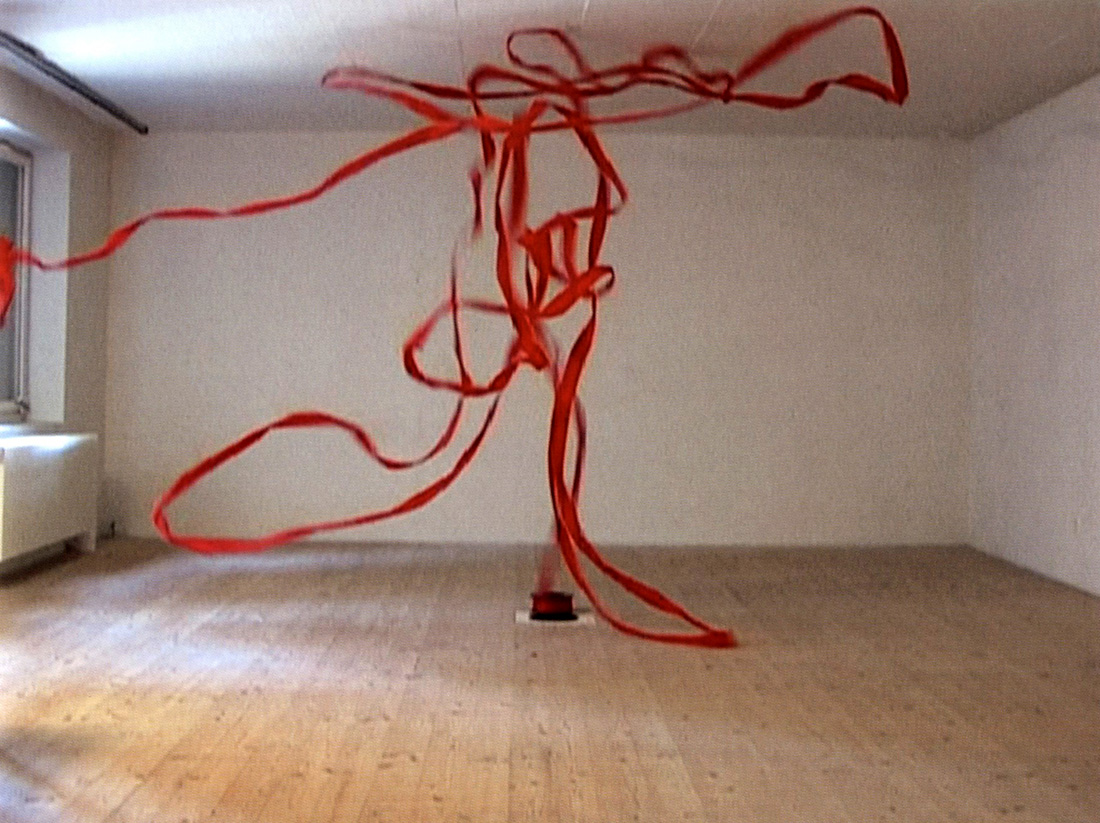
 

Roman Signer (Swiss, b. 1938) 'Rotes Band / Red Tape' 2005


Roman Signer (Swiss, b. 1938)
Rotes Band / Red Tape
2005
Vidéo couleur, son, 2’07′”
Caméra: Aleksandra Signer
Courtesy de l’artiste et d’Art: Concept, Paris
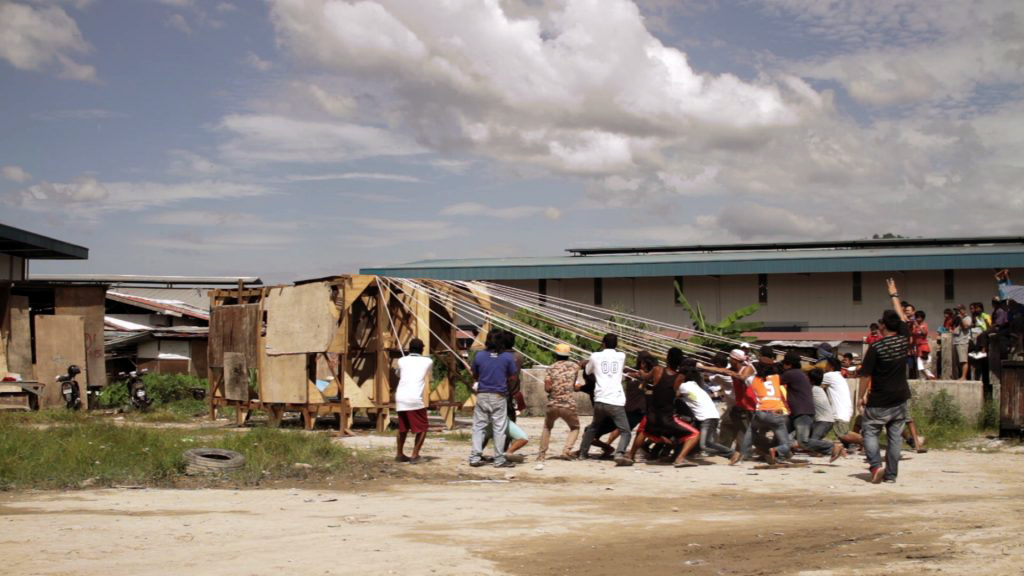
 

Tsubasa Kato (Japanese, b. 1984) 'Break it before it’s broken' 2015

Tsubasa Kato (Japanese, b. 1984) 'Break it before it’s broken' 2015


Tsubasa Kato (Japanese, b. 1984)
Break it before it’s broken
2015
Video: colour, sound, 4:49 min
© Tsubasa Kato / caméraman: Taro Aoishi


On March 11, 2011, a tsunami struck the Japanese coast and caused a nuclear accident at the Fukushima Daiichi plant. The disastrous environmental and social consequences are still impossible to evaluate and the inhabitants, partly neglected by the public authorities, have to face an unprecedented crisis. Many of them have been displaced and most of their income from fishing is reduced to nothing because of the contamination of the ocean. Tsubasa Kato then decides to get involved with them by accompanying them daily in this difficult period. In addition to this support, he decided on November 3rd (03/11) – the day of the celebration of culture in Japan (Bunka no Hi) and date whose numerical writing is the inverse of that of the tsunami (11/03) – to achieve a strongly symbolic performance.

Entitled Break it before it’s broken, the video of this action shows residents of the region invited to overthrow the structure of a house washed away by the tsunami and destroy it definitively. Becoming actors of destruction and no longer passive observers, participants can then transform the event undergone into action. This festival of culture, for Tsubasa Kato, is an opportunity to initiate a unifying artistic moment that testifies to the strength of collective movements and the mobilisation necessary to reverse the course of events. He will then reiterate this performance in other parts of the world, which are often subject to delicate social situations.

Text from the Jeu de Paume website translated by Google translate


Mari Kourkouta (Greek, b. 1982) 'Remontages' 2016

Mari Kourkouta (Greek, b. 1982) 'Remontages' 2016


Mari Kourkouta (Greek, b. 1982)
Remontages
2016
16 mm sur vidéo (en boucle), noir et blanc, silencieux, 4’ 10.
© Maria Kourkouta. Production : Jeu de Paume, Paris


“Body, mind and soul are uplifted by the divine energy of desire”


Marie-José Mondzain, “To those who sail the sea…” catalogue of the exhibition Uprisings


“To make the world rise up we need gestures, desires, and depths.”


Georges Didi-Huberman, “By the desires (Fragments on What Makes Us Rise Up)” catalogue of the exhibition Uprisings


GESTURES (INTENSE)

From burden to uprising. – With hammer blows. – Arms rise up. – The pasión. – When bodies say no. – Mouths for exclaiming.

Rising up is a gesture. Before even attempting to carry out a voluntary and shared “action,” we rise up with a simple gesture that suddenly overturns the burden that submission had, until then, placed on us (be it through cowardice, cynicism, or despair). To rise up means to throw off the burden weighing down on our shoulders, keeping us from moving. It is to break a certain present – be it with hammer blows as Friedrich Nietzsche and Antonin Artaud sought to do – and to raise your arms towards the future that is opening up. It is a sign of hope and of resistance.

It is a gesture and it is an emotion. The Spanish Republicans – whose visual culture was shaped by Goya and Picasso, but also by all the photographers on the field who collected, the gestures of freed prisoners, of voluntary combatants, of children and of the famous La Pasionaria, Dolores Ibárruri – fully assumed this. In the gesture of rising up, each body protests with all of its limbs, each mouth opens and exclaims its no-refusal and its yes-desire.

Paulo Abreu, Art & Language, Antonin Artaud, Taysir Batniji, Joseph Beuys, Désiré-Magloire Bourneville, Gilles Caron, Claude Cattelain, Agustí Centelles, Chim, Pascal Convert, Gustave Courbet, Élie Faure, Michel Foucault, Leonard Freed, Gisèle Freund, Marcel Gautherot, Agnès Geoffray, Jochen Gerz, Jack Goldstein, Käthe Kollwitz, Alberto Korda, Germaine Krull, Hiroji Kubota, Annette Messager, Lisette Model, Tina Modotti, Friedric Nietzsche, Willy Römer, Willy Ronis, Graciela Sacco, Lorna Simpson, Wolf Vostell, anonymes catalans, français, italiens.


Gustave Courbet (French, 1819-1877) 'Home en blouse debout sur une barricade (projet de frontispice pour Le Salut public)' 1848


Gustave Courbet (French, 1819-1877)
Home en blouse debout sur une barricade (projet de frontispice pour Le Salut public)
Man in a smock standing on a barricade (frontispiece for Le Salut public project)

1848
Fusain sur papier
Musée Carnavalet – Histoire de Paris
© Musée Carnavalet / Roger-Viollet


Germaine Krull (European, 1897-1985) 'The Dancer Jo Mihaly, danse "Révolution"' 1925


Germaine Krull (European, 1897-1985)
The Dancer Jo Mihaly, danse “Révolution”
1925
Gelatin silver print
Museum Folkwang, Essen
© Estate Germaine Krull, Folkwang Museum, Essen


Pioneer and adventurous, Germaine Krull is one of those women photographers of the inter-war period who contributed largely to the emergence of a nervous and dynamic photographic approach, in step with a modern world in constant acceleration. In photographing Jo Mihaly, she portrays a dancer who shares this avant-garde sensibility. Indeed, a pupil of Mary Wigman, this singular figure of dance participates in the German expressionist movement and contributes to the development of a modern choreographic art: the unconstrained body emancipates itself from the conventions of classical dance, the gesture of the dancer is released and regains its vitality. The movement then becomes the result of the personal expression of the dancer whose photographer has the burden of seizing the fulgurance [dazzling speed]. Stretched arm, smoky eyes and feverish eyes, Jo Mihaly – who has always claimed her commitment to the Communist Party – realises a gesture that resonates with her time but also with the youth of Germaine Krull, marked by its proximity to the Republic of the Soviets of Berlin in 1919. Thus, it is as much for these artists to participate in an aesthetic revolution in their respective artistic fields as to echo the social and political uprisings that have taken place throughout Europe since the the advent of the industrial era.

Text from the Jeu de Paume website translated by Google translate


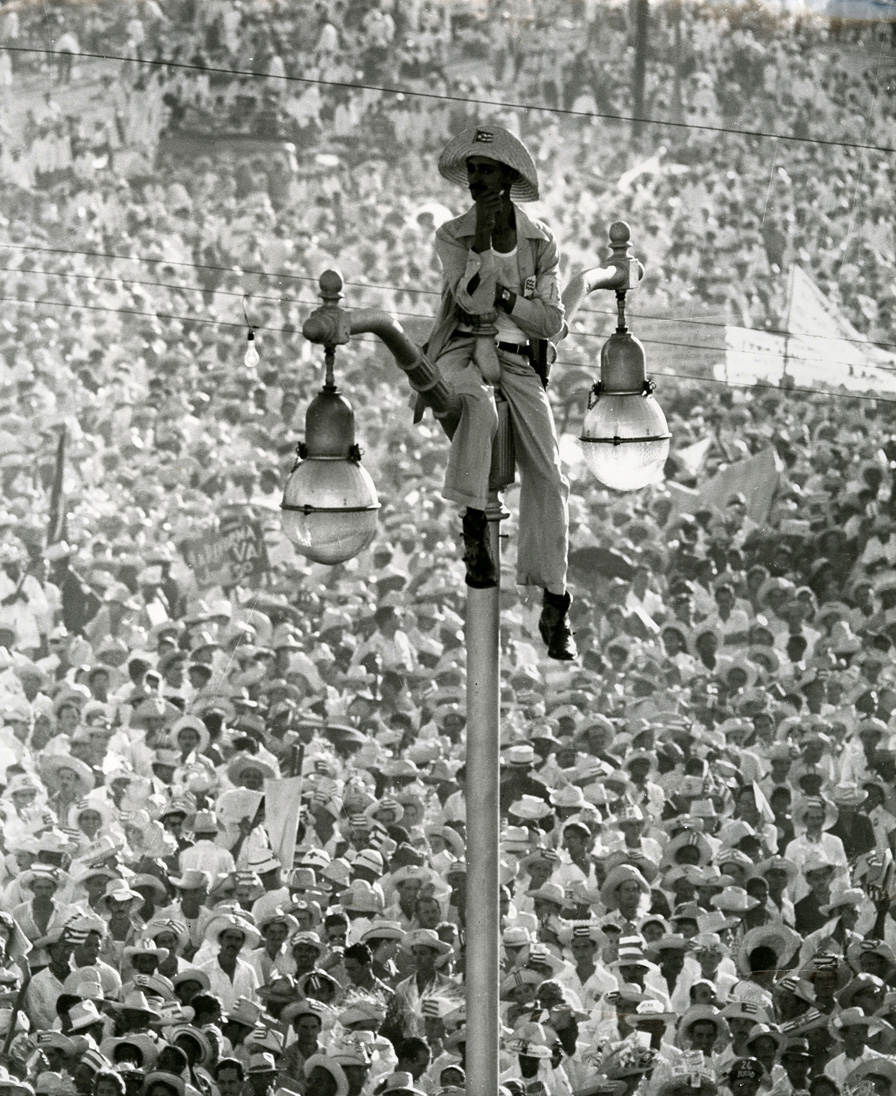
Alberto Korda (Cuban, 1928-2001) 'Don Quixote of the streetlamp, Plaza de la Revolución, Havana, Cuba' 1959


Alberto Korda (Cuban, 1928-2001)
El Quijote de la Farola, Plaza de la Revolución, La Habana, Cuba
Don Quixote of the streetlamp, Plaza de la Revolución, Havana, Cuba

1959
Vintage gelatin silver print on baryta paper
Leticia et Stanislas Poniatowski collection
© ADAGP, Paris, 2016


Kitai Kazuo (Japanese, b. 1944) 'Resistance' (book) 1965


Kitai Kazuo (Japanese, b. 1944)
Resistance (book)
1965
BAL
© Kitai Kazuo/ Collection privée


With a manifesto both aesthetic and philosophical, the Japanese publication Provoke proposed a radical break in only three issues, published in 1968 and 1969. Provoke (photographers Takuma Nakahira, Yutaka Takanashi and Daidō Moriyama, critic Kōji Taki and poet Takahiko Okada) proposes a new visual language – rough, grainy and blurred – that captures the complexity of the experience and the paradoxes of modernity suffered by all.


Wolf Vostell (German, 1932-1998) 'Dutschke' 1968


Wolf Vostell (German, 1932-1998)
Dutschke
1968
Polymer painting on canvas
Haus der Geschichte der Bundensrepublik Deutschland, Bonn
© ADAGP, Paris, 2016


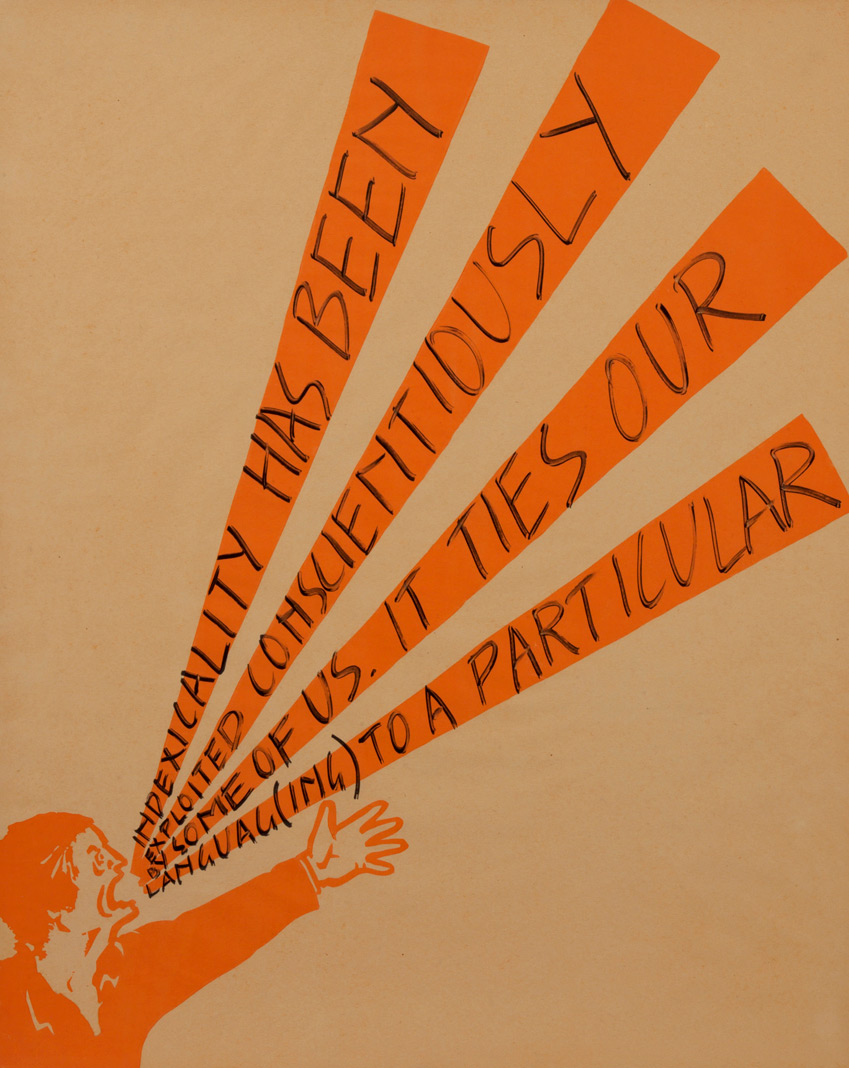
Art and Language (collective created late 1960s) 'Shouting Men' 1975 (details)

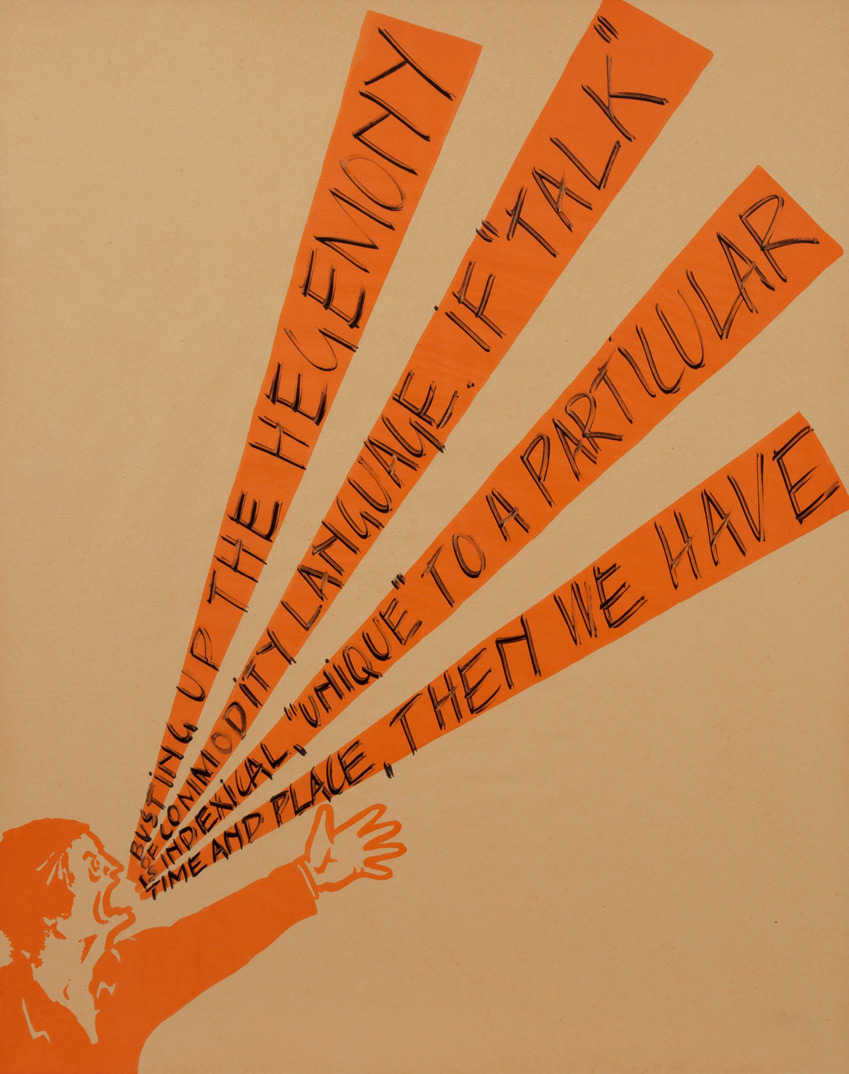
Art and Language (collective created late 1960s) 'Shouting Men' 1975 (details)

Art and Language (collective created late 1960s) 'Shouting Men' 1975 (details)


Art and Language (collective created late 1960s)
Shouting Men (details)
1975
Screenprint and felt pen on paper
Museu d’Art Contemporani de Barcelona collection
Photo: Àngela Gallego
© Art and Language


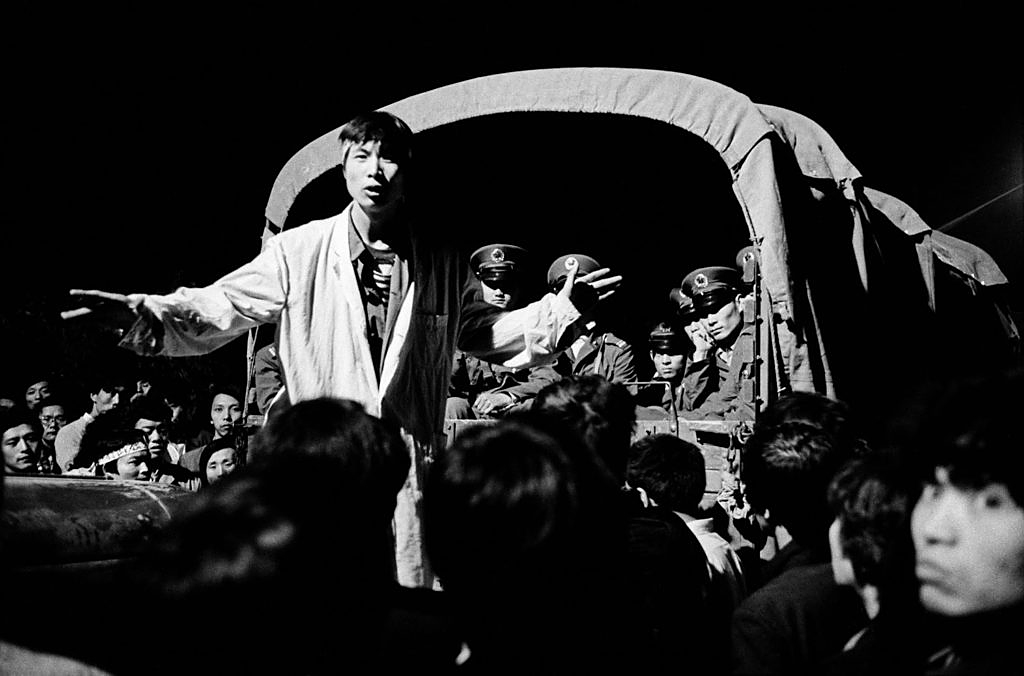
Patrick Zachmann (French, b. 1955) 'The army blocked by the crowd at the gates of the capital' 1989


Patrick Zachmann (French, b. 1955)
L’armée bloquée par la foule aux portes de la capitale
The army blocked by the crowd at the gates of the capital
1989
Gelatin-silver bromide print on baryta paper
50.4 x 60.9cm
Musée du quai Branly – Jacques Chirac
© Patrick Zachmann


From the early 1980s, Patrick Zachmann carried out an in-depth investigation into the Chinese diaspora. Present in China at the time of the events in Tiananmen Square, he photographed particularly symbolic episodes. This picture, taken on 20 May, is located just after the beginning of the hunger strikes, and before the massive repression known as the Tiananmen massacre. The nocturnal atmosphere and the gestures of the orator confer on this “moment before” a dramatic theatricality.


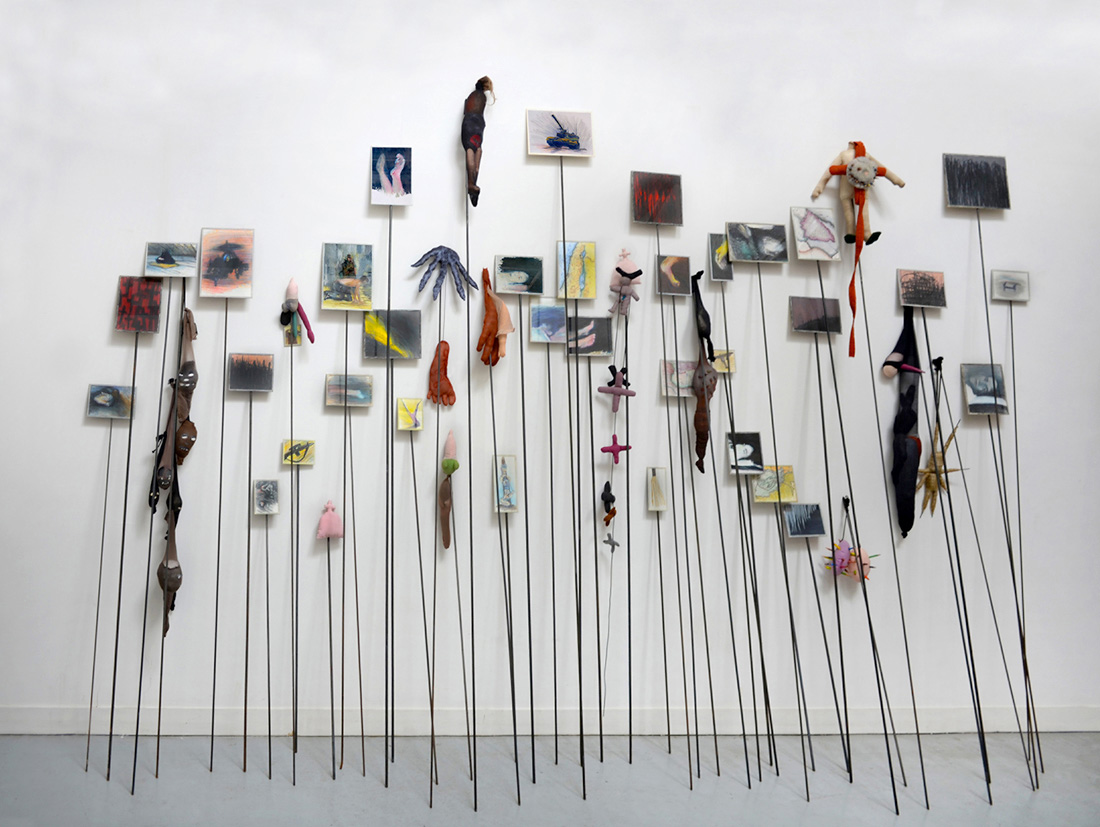
Annette Messager (French, b. 1943) '47 Piques (47 Pikes)' 1992


Annette Messager (French, b. 1943)
47 Piques (47 Pikes)
1992
Soft toys, coloured pencils on paper, various materials, and 47 metal pikes
270 x 570 x 70cm
Annette Messager and Marin Karmitz collection/Marian Goodman Gallery, Paris
© ADAGP, Paris, 2016


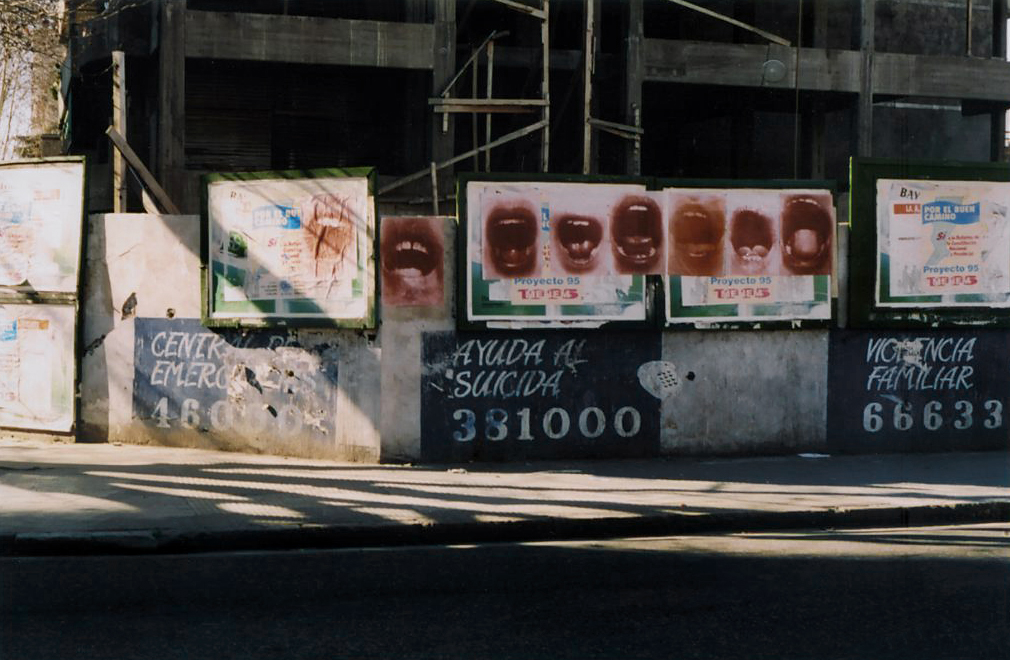
Graciela Sacco (Argentinian, 1956-2017) from the "Bocanada" (A breath of fresh air) series 1992-1993


Graciela Sacco (Argentinian, 1956-2017)
from the “Bocanada” (A breath of fresh air) series
1992-1993
Posters in the streets of Rosario, Argentina
© Graciela Sacco


This series of photographs of open mouths was immediately considered by Graciela Sacco as being intended to circulate in the public space on various supports (stamps, spoons, stickers, posters …). It is however in the form of a wild display that the artist has most often given to see this set. The first of these displays took place in 1993, during a strike, in public school canteens in the town of Rosario. It was then a question of questioning the impossibility of the municipal staff to make their claims heard and the consequences of this movement knowing that for the majority of the children, this meal was the only one of the day. Graciela Sacco then continues to post these posters in cities like Buenos Aires, São Paulo or New York, often during election campaigns or close to advertising images. Are they hungry mouths? Cries of claims? Of suffering? Or even breathing as the title suggests? Be that as it may, this repeated but inaudible message tends to become oppressive. By exposing them in public space, the artist seems to give visibility to those anonymous calls that we do not want or can not hear.

Text from the Jeu de Paume website translated by Google translate


WORDS (EXCLAIMED)

Poetic insurrections. – The message of the butterflies. – Newspapers. – Making a book of resistance. – The walls speak up.

Arms have been raised, mouths have exclaimed. Now, what are needed are words, sentences to say, sing, think, discuss, print, transmit. That is why poets place themselves “at the forefront” of the action itself, as Rimbaud said at the time of the Paris Commune. Upstream the Romantics, downstream the Dadaists, Surrealists, Lettrists, Situationists, etc., all undertook poetic insurrections.

“Poetic” does not mean “far from history,” quite the contrary. There is a poetry of tracts, from the protest leaflet written by Georg Büchner in 1834 to the digital resistance of today, through René Char in 1943 and the “cine-tracts,” from 1968. There is a poetry particular to the use of newspapers and social networks. There is a particular intelligence – attentive to the form – inherent in the books of resistance or of uprising. Until the walls themselves begin to speak and occupy the public space, the sensible space in its entirety.

Antonin Artaud, Ever Astudillo, Ismaïl Bahri, Artur Barrio, Georges Bataille, Charles Baudelaire, Joseph Beuys, Enrique Bostelmann, André Breton, Marcel Broodthaers, Cornelius Castoriadis, Champfleury, Dada, Armand Dayot, Guy Debord, Carl Einstein, Jean-Luc Fromanger, Federico García Lorca, Jean-Luc Godard, Groupe Dziga Vertov, Raymond Hains, Raoul Hausmann, John Heartfield, Bernard Heidsieck, Victor Hugo, Asger Jorn, Jérôme Lindon, Rosa Luxemburg, Man Ray, Germán Marín, Chris Marker, Cildo Meireles, Henri Michaux, Tina Modotti, Pier Paolo Pasolini, Pablo Picasso, Sigmar Polke, Jacques Rancière, Alain Resnais, Armando Salgado, Álvaro Sarmiento, Philippe Soupault, Félix Vallotton, Gil Joseph Wolman, German, Chilean, Cuban, Spanish, French, Italian, Mexican, Russian unknowns.


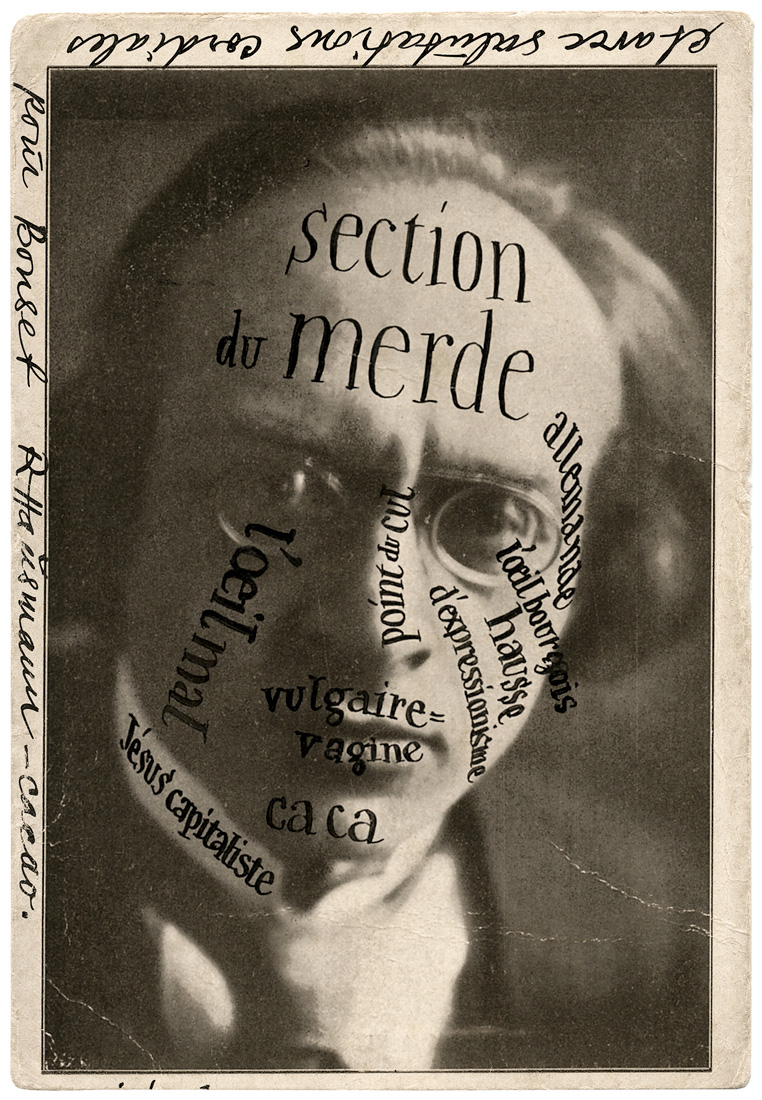
Raoul Hausman (Austrian, 1886-1971) 'Portrait of Herwarth Walden at Bonset' 1921


Raoul Hausman (Austrian, 1886-1971)
Portrait of Herwarth Walden at Bonset
1921
Postcard sent by Raoul Hausmann to Theo van Doesburg
Archives Theo and Nelly van Doesburg
Photo: collection RKD – Netherlands Institute for Art History
© ADAGP, Paris, 2016


Herwarth Walden (German, 1879-1941)

Herwarth Walden (actual name Georg Lewin, 16 September 1879 in Berlin – 31 October 1941 in Saratov, Russia) was a German Expressionist artist and art expert in many disciplines. He is broadly acknowledged as one of the most important discoverers and promoters of German avant-garde art in the early twentieth century (Expressionism, Futurism, Dadaism, Magic Realism).

From 1901 to 1911 Walden was married to Else Lasker-Schüler, the leading female representative of German Expressionist poetry. She invented for him the pseudonym “Herwarth Walden”, inspired by Henry Thoreau’s novel Walden, or Life in the Woods (1854). In 1912 he married Swedish painter Nell Roslund. In 1919 he became a member of the Communist Party. In 1924 he was divorced from his second wife.

With the economic depression of the 1930s and the subsequent rise of National Socialism, his activities were compromised. In 1932 he married again and left Germany shortly later because of the threat of the Gestapo. He went to Moscow, where he worked as a teacher and publisher. His sympathies for the avant-garde soon aroused the suspicion of the Stalinist Soviet government, and he had to repeatedly defend against the equation of avant-garde and fascism. Walden died in October 1941 in a Soviet prison in Saratov.

Text from the Wikipedia website


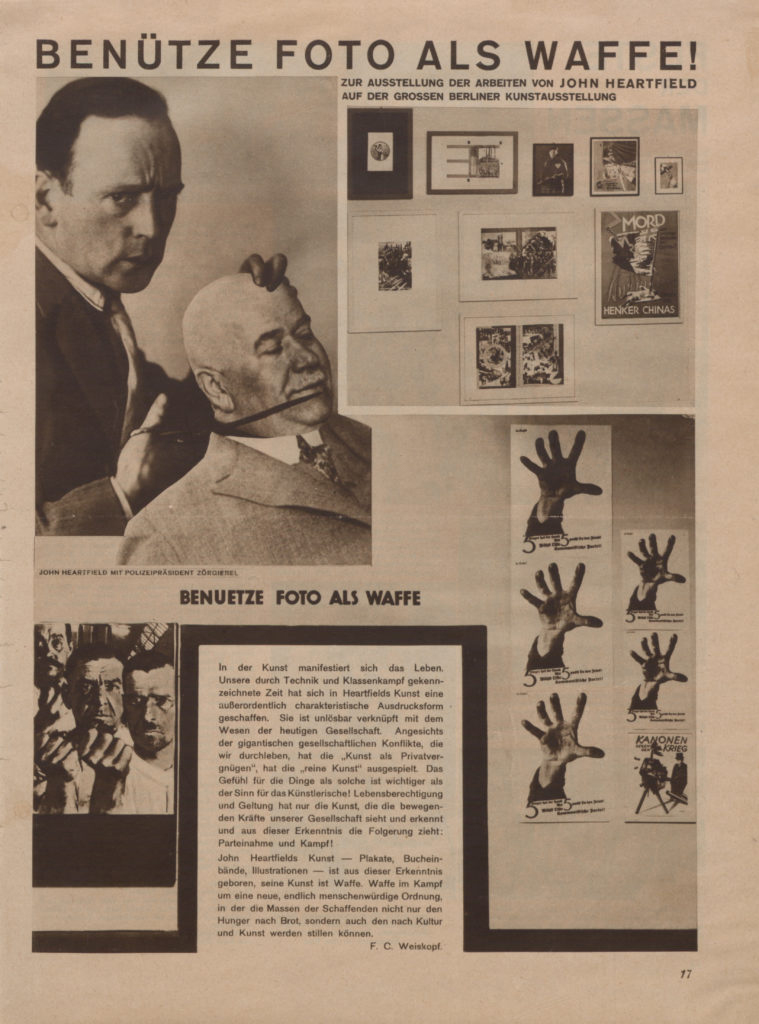
John Heartfield (German, 1891-1968) 'Use photography as a weapon !' 1929


John Heartfield (German, 1891-1968)
Benütze Foto als Waffe! 
Utilise la photo comme une arme !
Use photography as a weapon !

AIZ, année VIII, no 37, Berlin, 1929, p. 17
Revue
37.8 x 27.5cm
Akademie der Künste, Berlin, Kunstsammlung, Inv.-Nr.: JH 2265
© The Heartfield Community of Heirs/ADAGP, Paris, 2016


In the late 1910s, members of the Dada movement practiced the first collages using images from cheap publications. The iconoclastic dimension of these heterogeneous juxtapositions allows them to open up the critical potential of images. Then, in the 1920s in Berlin, the Dada movement became politicised and the idea that the affiliated artists of the Communist Party were to serve the proletarian cause was strengthened. Few artists felt as committed to this mission as John Heartfield (his real name was Helmut Herzfeld). From the end of the 1920s, he developed a practice of satirical photomontage for the press, and in particular of the Communist journal AIZ (Arbeiter Illustrierte Zeitung) for which he worked until 1938. He then produced 237 photomontages denouncing Fascist ideology, the financing of the Nazi party by the industrialists and the extreme violence of the national socialist program. Invited to the Film und Foto exhibition in 1929 in Stuttgart, he had inscribed above the section devoted to him the slogan found in AIZ the same year: “Use photography as a weapon!”. Through the massive dissemination of his photomontages, he wants to mobilise public opinion and incite him to rise up against the rise of the fascisms that threaten Europe.

Text from the Jeu de Paume website translated by Google translate


Heartfield lived in Berlin until April 1933, when the National Socialists took power. On Good Friday, the SS broke into his apartment, and the 5’2″ Heartfield escaped by jumping from his balcony and hiding in a trash bin. He left Germany by walking over the Sudeten Mountains to Czechoslovakia. In Czechoslovakia, John Heartfield rose to number-five on the Gestapo’s most-wanted list.


Federico García Lorca (Spanish, 1898-1936) 'García Lorca Mierda (Shit)' 1934


Federico García Lorca (Spanish, 1898-1936)
Mierda (Shit)
1934
Calligram, Indian ink
Federico García Lorca foundation, Madrid
© Federico García Lorca foundation, Madrid / VEGAP


Réseau Buckmaster (Buckmaster Network) 'Tract clandestin (Clandestine Tract)' 1942

Réseau Buckmaster (Buckmaster Network) 'Tract clandestin (Clandestine Tract)' 1942


Réseau Buckmaster (Buckmaster Network)
Tract clandestin (Clandestine Tract)
1942
Papier
17 x 25cm
Collection particulière
Courtesy des éditions de L’échappée


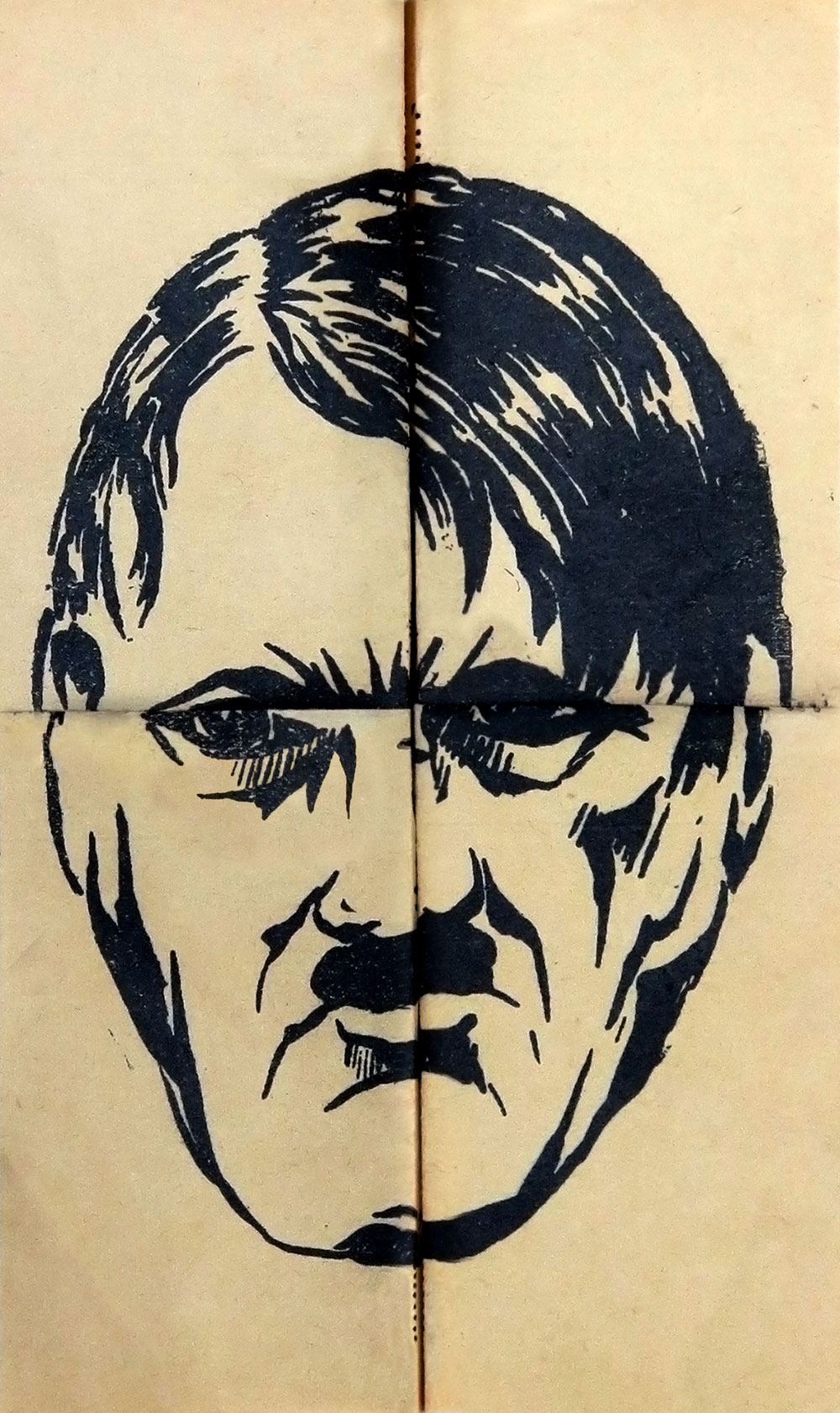
This satirical tract was realised and distributed in 1942 by the network of the Resistance Buckmaster, during the German occupation in France. The flying leaflet, given from hand to hand or slipped into a mailbox, the leaflet or the butterfly (smaller) is at the same time the expression of a refusal – that of yielding – and of an imperious desire to act and call for a start. Intended to mark the minds and to attract adhesion, they can be formed of short and poetic texts, slogans or images. Open, it presents a caricature drawing of four pigs and, in the centre, an inscription in capital letters which apostrophes the reader and invites him to look for the fifth … Indeed, if the recipient folds the sheet according to the dotted lines, he makes Hitler’s acrimonious face! Thus, like any clandestine message, the meaning of the leaflet is not given immediately. The system of folding conceals and intrigues before revealing, but also accentuates the critical and percussive nature of the subject. Opening and closing like two wings, this butterfly is an anonymous, ephemeral and fragile missive ready to fly in the air to carry its message of rising. Like a firefly gleaming in the night of war, “an indication of a desire that flies, goes where it wants, insists, persists, resists in spite of everything”*, in the words of Georges Didi-Huberman, this image constitutes a weapon at the same time frail and powerful.

Text from the Jeu de Paume website translated by Google translate

*Georges Didi-Huberman, “Through desires (fragments on what raises us)”, in Soulèvements, Paris, Jeu de Paume, 2016, p. 372.


Raymond Hains (French, 1926-2005) 'OAS. Fusillez les plastiqueurs (OAS. Shoot the bombers)' 1961


Raymond Hains (French, 1926-2005)
OAS. Fusillez les plastiqueurs (OAS. Shoot the bombers)
1961
Torn poster on canvas backing
Private collection
© ADAGP, Paris, 2016
Photo: Michel Marcuzzi


By the end of the 1940s, Raymond Hains paced the streets of Paris and sought out surprising agglomerates of torn posters that he picked up before painting them on canvas. The artist, flâneur, is the catalyst of a new form of urban poetry that gives rise to impromptu entanglements of words and images. This practice of hijacking posters largely echoed the world of art and French society after the Second World War. These torn posters formally evoke the canvases of “action painting” in vogue at the time, which Hains enjoys by calling himself “inaction painter”. The proliferation of these posters accompanies the rise of consumption but also the many political debates that agitate France. Thus futile advertisements co-exist promoting an eternally joyful world and political posters whose subjects are sometimes dramatic. In 1961, Raymond Hains realised an exhibition entitled “La déchirée France” [The Torn France] which presents itself as a sounding board of contemporary French history, marked by the decomposition of the Fourth Republic and what is not yet called the war of Algeria. The work OAS. Shoot the bombers testifies to the violence of the positions taken with regard to this organisation favourable to the maintenance of French Algeria, but also to the reality of the attacks they commit.

Text from the Jeu de Paume website translated by Google translate


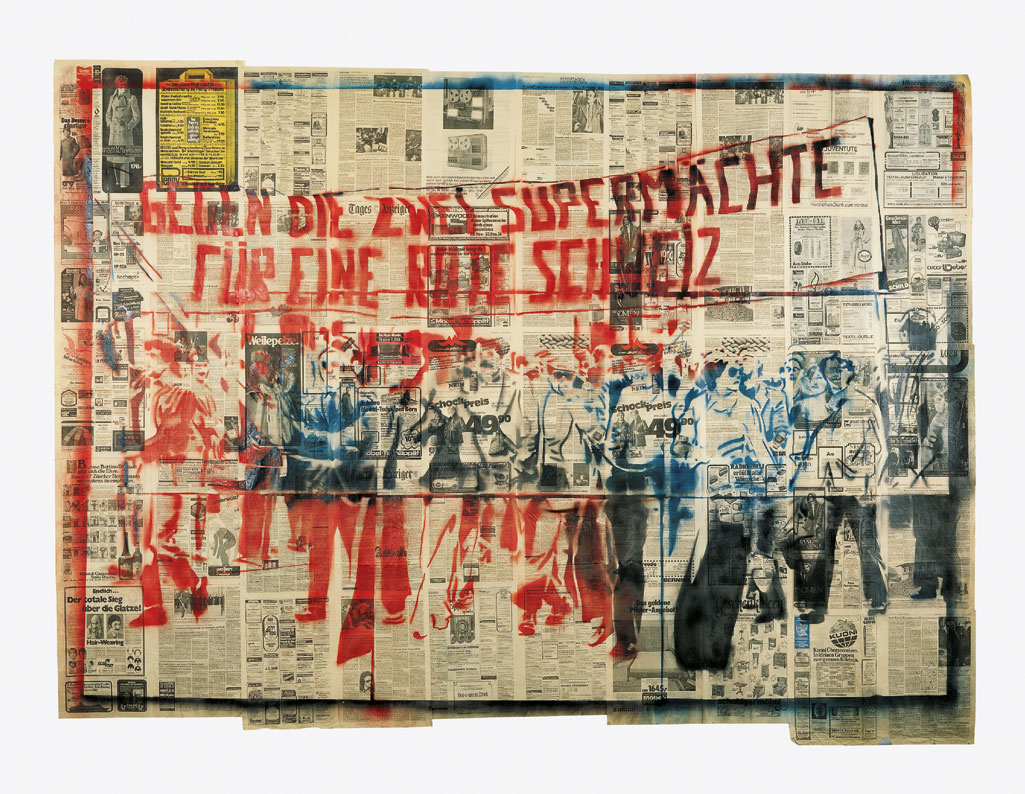
Sigmar Polke (German, 1941-2010) 'Against the two superpowers - for a red Switzerland' (1st version) 1976


Sigmar Polke (German, 1941-2010)
Gegen die zwei Supermächte – für eine rote Schweiz (1e version)
(Against the two superpowers – for a red Switzerland) (1st version)
1976
Spray paint and stencil on paper
Ludwig Forum für internationale Kunst, Aachen
© The Estate of Sigmar Polke, Cologne /ADAGP, Paris, 2016


Henri Michaux (French born Belgium, 1899-1984) 'Untitled' 1975


Henri Michaux (French born Belgium, 1899-1984)
Untitled
1975
Indian ink, acrylic on paper
50 x 65cm
Private collection
© ADAGP, Paris, 2016 / Photo : Jean-Louis Losi


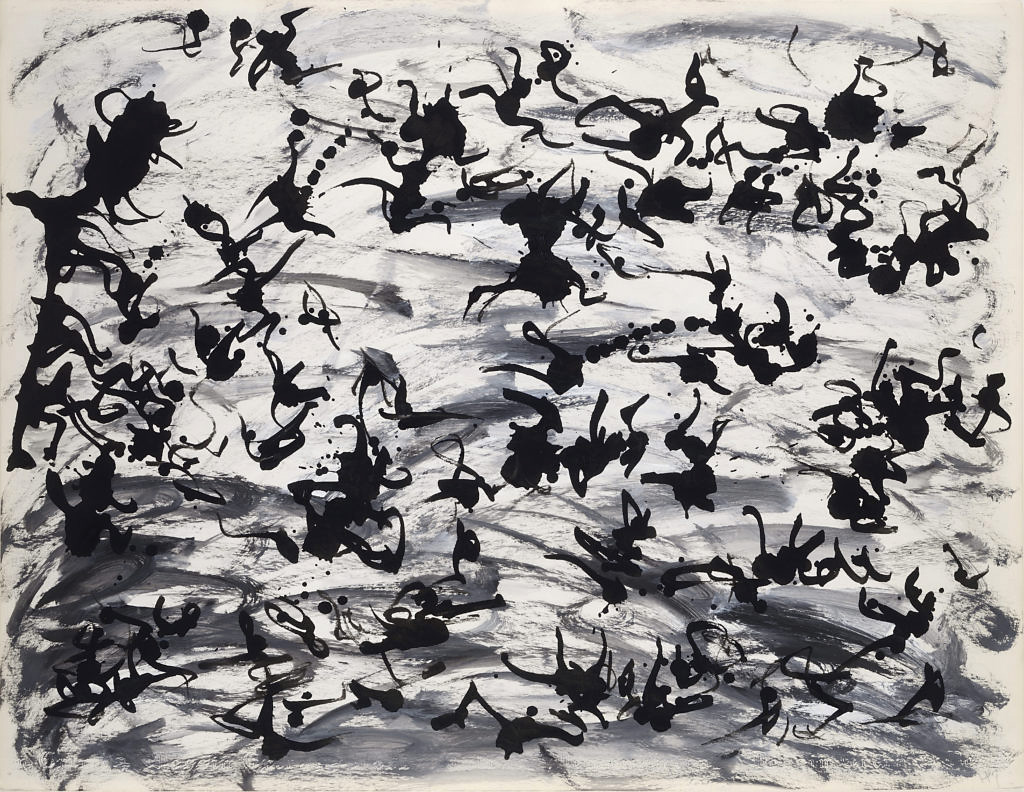
The poet Henri Michaux has endeavoured to combine writing and drawing. Already in his invention of a new graphic alphabet in 1927, and then in his hallucinogenic experiments by absorption of mescaline from 1955, Henri Michaux sought to liberate, unbind language and drawing and thus to explore “the space within”. This ink on paper presents an entanglement of disorderly spots more or less energetic or impregnated. Just as his poems try to lift the tongue, this drawing seems to express what he calls “trembling in images”. Traces of liberating gestures, this expressive “new language”, noisy, made of floods of forms and collisions of signs, becomes the image of the disorderly world and the claimed insubordination of its author. In 1971, Michaux always seems to be looking for what he calls in the turbulent infinity “a confidence of a child, a confidence that goes ahead, hopes, raises you, confidence which, entering into the tumultuous universe … becomes a greater upheaval, a prodigiously great uprising, an extraordinary uprising, an uprising never known, a rising above itself, above all, a miraculous uprising which is at the same time an acquiescence, an unbounded, calming and exciting acquiescence, an overflow and a liberation.” Thus Michaux considered drawing as a movement, the very rise of thought and bodies.

Text from the Jeu de Paume website translated by Google translate


“Uprising transforms consciousness and in this movement it reconstitutes it. It gathers needs together and turns them into demands, it turns affects into desires and wills, it positions them in a tension towards liberty.”


Antonio Negri, “Uprisings” catalogue of the exhibition Uprisings


CONFLICTS (FLARED UP)

To go on strike is not to do nothing. – Demonstrating, showing oneself. – Vandal joys. – Building barricades. – Dying from injustice.

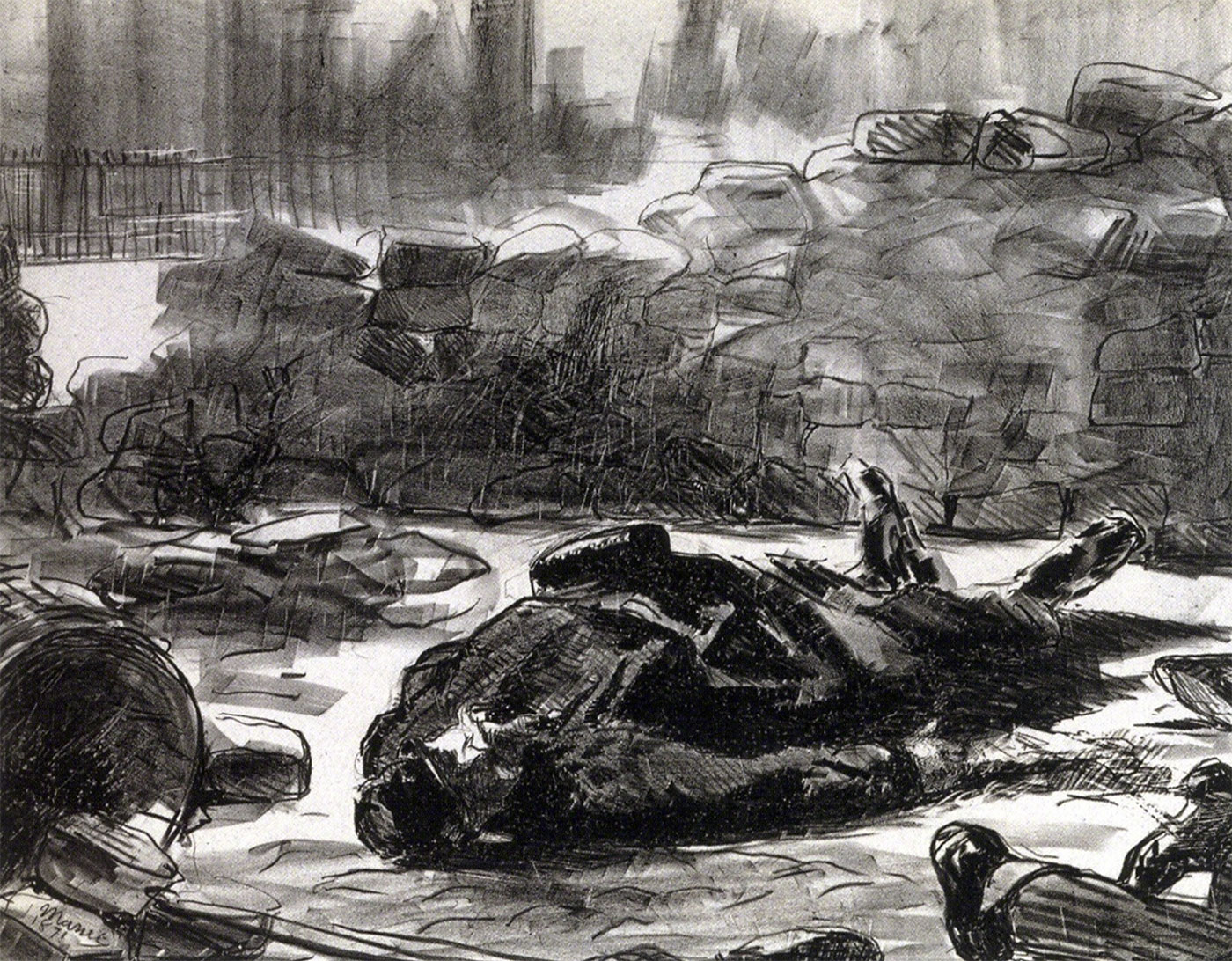
And so everything flares up. Some see only pure chaos. Others witness the sudden appearance of the forms of a desire to be free. During strikes, ways of living together are invented. To say that we “demonstrate,” is to affirm – albeit to be surprised by it or even not to understand it – that something appeared that was decisive. But this demanded a conflict. Conflict: an important motif of modern historical painting (from Manet to Polke), and of the visual arts in general (photography, cinema, video, digital arts).

It happens sometimes that uprisings produce merely the image of broken images: vandalism, those kinds of celebrations in negative format. But on these ruins will be built the temporary architecture of uprisings: paradoxical, moving, makeshift things that are barricades. Then, the police suppress the demonstration, when those who rise up had only the potency of their desire (potency: not power). And this is why there are so many people in history who have died from having risen up.

Manuel Álvarez Bravo, Hugo Aveta, Ruth Berlau, Malcolm Browne, Henri Cartier-Bresson, Agustí Centelles, Chen Chieh-Jen, Armand Dayot, Honoré Daumier, Adolphe-Eugène Disdéri, Robert Filliou, Jules Girardet, Arpad Hazafi, John Heartfield, Dmitri Kessel, Herbert Kirchhorff, Héctor López, Édouard Manet, Ernesto Molina, Jean-Luc Moulène, Voula Papaioannou, Sigmar Polke, Willy Römer, Pedro G. Romero, Jésus Ruiz Durand, Armando Salgado, Allan Sekula, Thibault, Félix Vallotton, Jean Veber, German, Catalan, French, Mexican, South African unknowns.


Charles-François Thibault (French) 'The Barricade of the Rue Saint-Maur-Popincourt before the attack by the troops of General Lamoriciere' Sunday, June 25, 1848


Charles-François Thibault (French)
La Barricade de la rue Saint-Maur-Popincourt avant l’attaque par les troupes du général Lamoricière
The Barricade of the Rue Saint-Maur-Popincourt before the attack by the troops of General Lamoriciere
Sunday, June 25, 1848
Daguerréotype
11.7 x 15cm
Musée d’Orsay, Paris
Photo © RMN-Grand Palais (musée d’Orsay) / Hervé Lewandowski


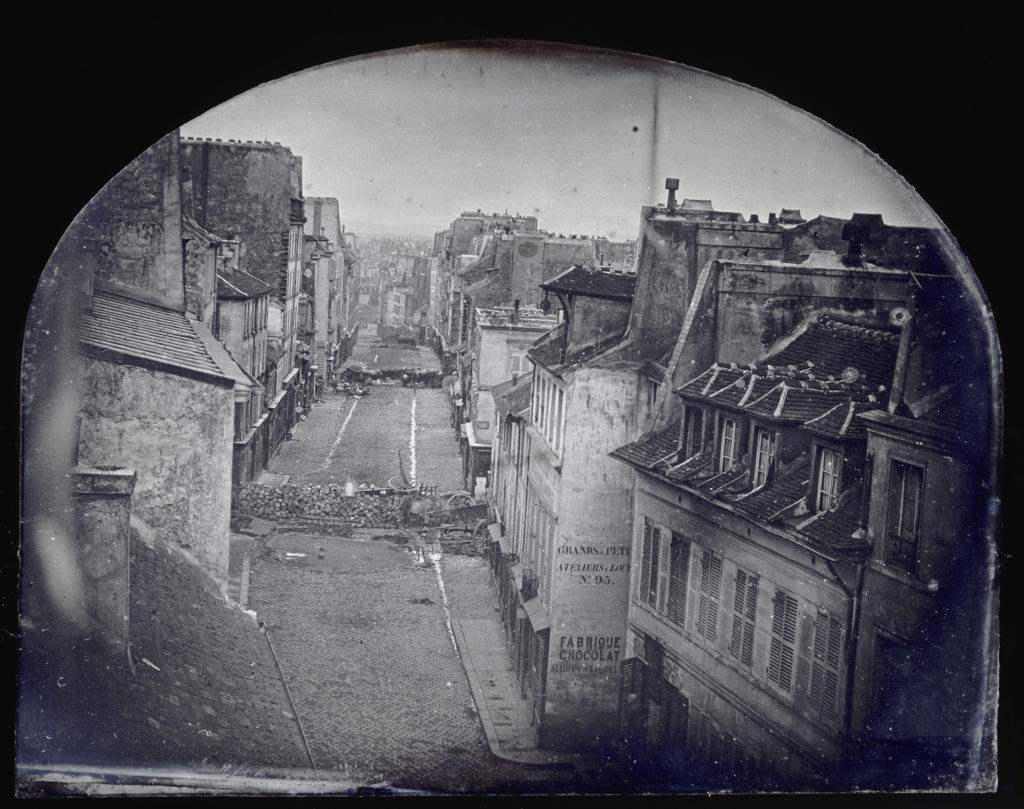
This daguerreotype is part of a series of two exceptional views of the barricades taken during the popular insurrection of June 1848. Disseminated in the form of woodcuts in the newspaper L’Illustration at the beginning of the following July, these photographs were realised by an amateur named Thibault, from a point of view overlooking the Rue Saint-Maur-Popincourt, June 25 and 26, before and after the assault. The first photographs reproduced in the press, they show the value of proof given to the medium in the processing of information since the middle of the nineteenth century, well before the development of photomechanical reproduction techniques. The inaccuracies and ghostly traces caused by a long exposure time limit the accuracy lent to the medium. Also the engraver allowed himself to “rectify” the views for the newspaper, adding clouds here and there and specifying the posture or the detail of the silhouettes. The remarkable interest of these daguerreotypes, however, resides in their indeterminate aspect. In fact, they reveal the singular temporality of these events: both short (since each second counts during the confrontations) and at the same time extended (in the moments of preparation and waiting). The temporalities proper to events and photography are thus combined in order to offer the perennial image of an invisible uprising and therefore always in potentiality.

Text from the Jeu de Paume website translated by Google translate


The first photo of an insurrectionary barricade

This photo was taken by a young photographer, by the name of Charles-François Thibault, at the level of no. 92 of the current rue du Faubourg-du-Temple on the morning of Sunday June 25, 1848. The insurrection is coming to an end, and only the last defences of the working-class districts of eastern Paris resist.

Thibault used twice, probably between 7 am and 8 am, his daguerreotype, a primitive process of photography which fixed the image on a metal plate. These two pictures are visible in Parisian museums, the first at the Carnavalet museum, the second (featured image) at the Musée d’Orsay. One distinguishes there in particular a flag planted in the axle of a wheel on the first barricade (which according to the researches of Olivier Ilh [La Barricade reversed, history of a photograph, Paris 1848, Editions du Croquant, 2016] carried the inscription “Democratic and social Republic”) as well as silhouettes of back.

Anonymous text. “The first photo of a barricade,” on the Un Jour de Plus a Paris website [Online] Cited 11/11/2021.


Édouard Manet (French, 1832-1883) 'Guerre civile (Civil war)' 1871


Édouard Manet (French, 1832-1883)
Guerre civile (Civil war)
1871
Two-tone lithograph on thick paper
Musée Carnavalet – Histoire de Paris
© Musée Carnavalet / Roger-Viollet
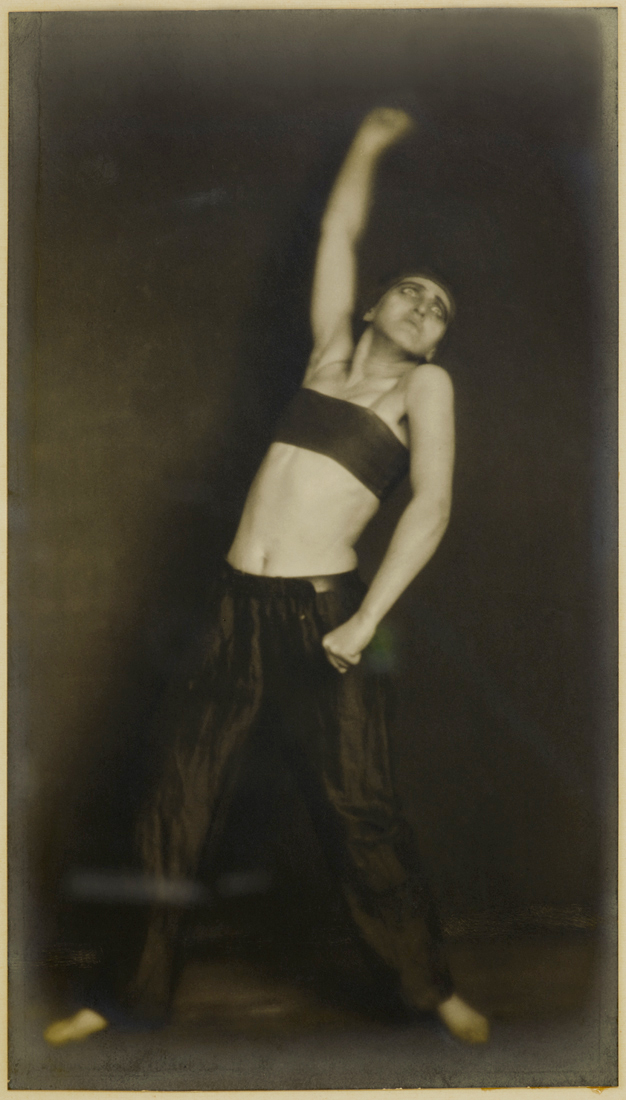
 

André Adolphe Eugène Disdéri (French, 1819-1889) (attributed to) 'Insurgents killed during bloody week of the Commune' 1871


André Adolphe Eugène Disdéri (French, 1819-1889) (attributed to)
Insurgés tués pendant la Semaine sanglante de la Commune
Insurgents killed during bloody week of the Commune
1871
Albumen photograph
21 x 27cm
Musée Carnavalet – Histoire de Paris, Paris
© André A.E. Disdéri / Musée Carnavalet / Roger-Viollet


This photograph was taken at the end of the tragic Bloody Week which concluded the Commune of Paris in May 1871. It shows the corpses of Communards shot by the Versailles troops, presented in their coffins at the public exhibition of their bodies. This image is imprinted with brutality: that of the authors of the massacre of these young men struggling for the independence of Paris, that of the monstration [The act of demonstrating; proof] and, that of photography, in its realisation, its frontality and its precision. Why did one of the most famous portraitists of the Second Empire record the image of these inanimate bodies? We know today that photography has played an important role in anti-communard propaganda, the aim of which was to show the “exactions” of the insurgents (barricades, vandalism, assassinations …) and to present this event not as a revolution but as a civil war. It was also used for identification purposes, used for judicial proceedings and repression. The value of this image, however, is due to the fact that the exposure of these bodies is transformed by the photographic act. The latter confers on the rebels a particular aura, passing thus from figures of guilty to those of martyrs. Gathered for the occasion and set up facing us, they form, through photography, the image of an inseparable community. Even if the revolution has failed and power has failed, its power remains and continues to nourish the memory of political uprisings.

Text from the Jeu de Paume website translated by Google translate
 

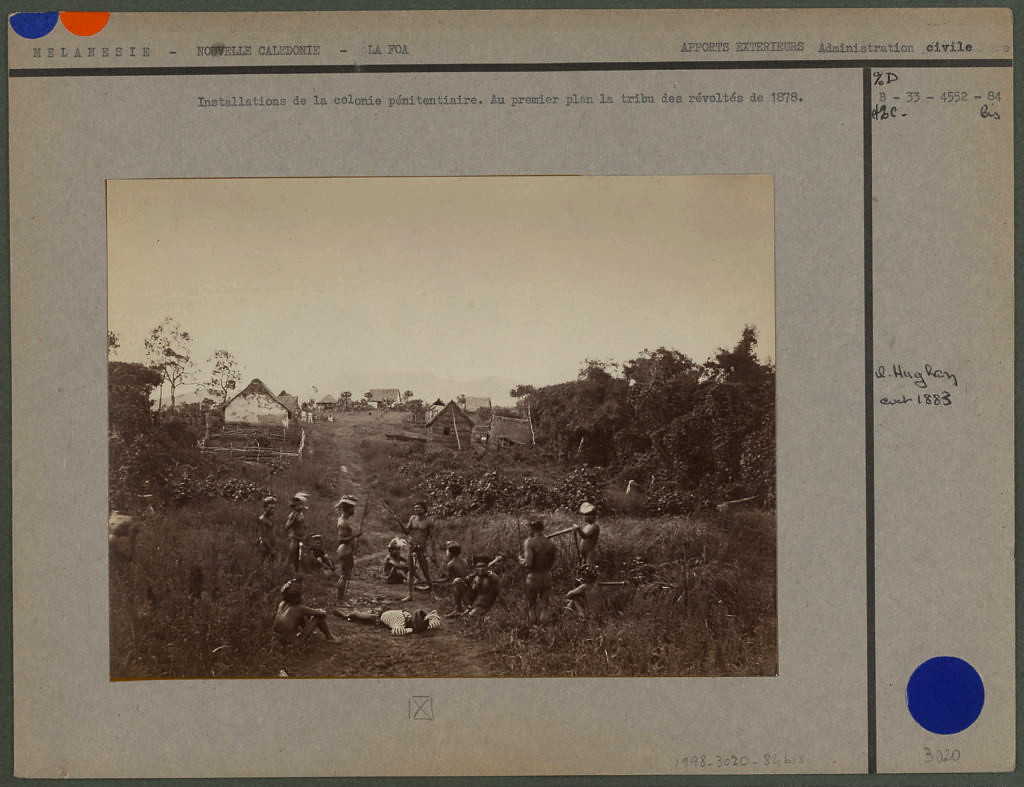
Allan Hughan (British, 1834-1883) 'Installations de la colonie pénitentiaire (Installations of the penal colony)' May 1874


Allan Hughan (British, 1834-1883)
Installations de la colonie pénitentiaire (Installations of the penal colony)
May 1874
Albumen print
14.7 x 19.6cm
Musée du quai Branly – Jacques Chirac


The legend of the image, written in the thirties, states: “In the foreground the tribe of rebels of 1878”, while that handwritten on the original negative says “tribe of Atai revolted.” These elements drag the meaning of this image realised by the first photographer present in New Caledonia. The photographs he takes of kanaks, villages, but also of the prison and mining facilities in 1874, take on a new retrospective significance after the great Kanak revolt of 1878.


Félix Vallotton (Swiss-French, 1865-1925) 'La Charge (The Charge)' 1893


Félix Vallotton (Swiss-French, 1865-1925)
La Charge (The Charge)
1893
Proof, woodcut on paper
Musée national d’Art moderne, Centre Pompidou, Paris
Gift of Adèle et Georges Besson en 1963. On loan to Musée des Beaux-Arts et d’Archéologie de Besançon
© Centre Pompidou / MNAM / Cliché Pierre Guenat, Besançon, Musée des Beaux-Arts et d’Archéologie


Felix Vallotton made this engraving on wood in 1893 as part of his critical contributions to social violence for newspapers and magazines of his time. Composed with great economy of means, La Charge represents the brutal repression of a demonstration by the forces of the order. The diving point of view testifies to the influence of photography on his work and reinforces the voyeur character of the viewer as well as his feeling of helplessness. The formal repetition of the uniform of the “guardians of the peace” and the resemblance of their faces, all wedged between their moustache and their kepi, translates well the impression of mechanical unleashing of a blind violence. By contrasting black and white, Vallotton refers to the physical confrontation between civilians and policemen. The centrifugal force which animates the composition gives the impression that the wounded bodies shatter like an explosion. By distorting the characteristic perspective of the Nabi aesthetic, the victims’ bodies seem to be abandoned. Through the eyes of man in the foreground, the artist denounces the abuse of force but also takes the spectator to witness and invites him to rise up against this injustice. The artist, known for his anarchist positions, broke as much with the traditional principles of composition as with the established order. At the charge against the protesters, he responds by his own charge against the authorities.

Text from the Jeu de Paume website translated by Google translate
 

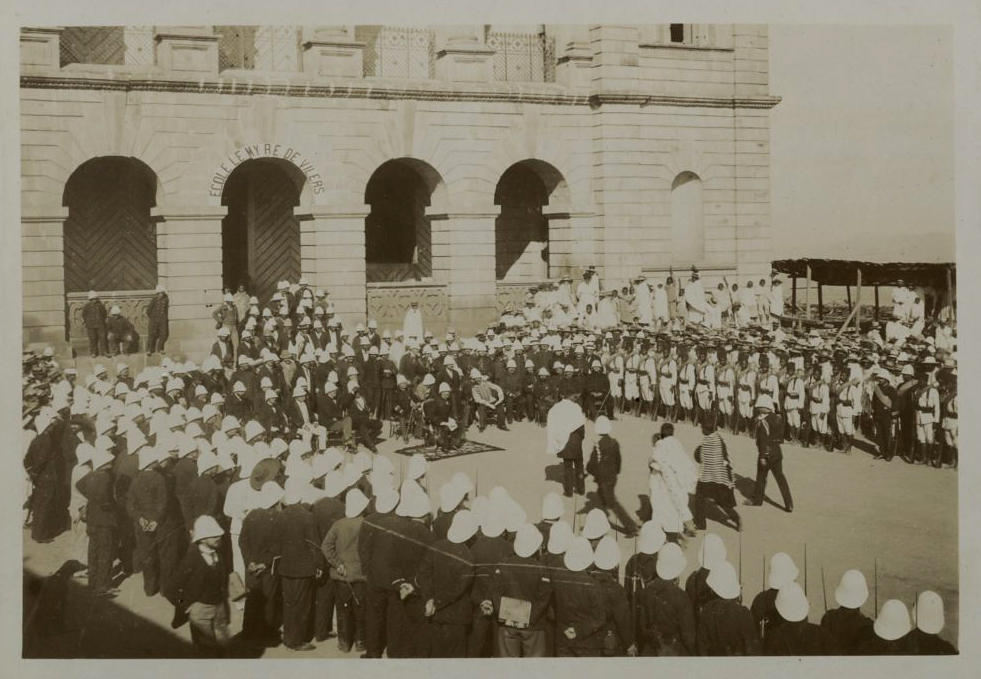
Joseph Marie Ernest Prud'Homme. 'Submission of Rabezavana and Rainibetsimisaraka' 1897


Joseph Marie Ernest Prud’Homme
Submission of Rabezavana and Rainibetsimisaraka
1897
Print on aristotype paper
12 x 17 cm
Musée du quai Branly – Jacques Chirac


On July 29, 1897, Rabezavana and Rainibetsimisaraka, two of the greatest leaders of the Menalamba insurrection, which began after the abdication of Queen Ranavalona III and the establishment of the protectorate in October 1895, publicly knelt before Governor General Joseph Gallieni to signify their submission. This ceremony is the theatrical acme of the policy of “pacification” carried out in Madagascar by Gallieni, since his arrival in September 1896.


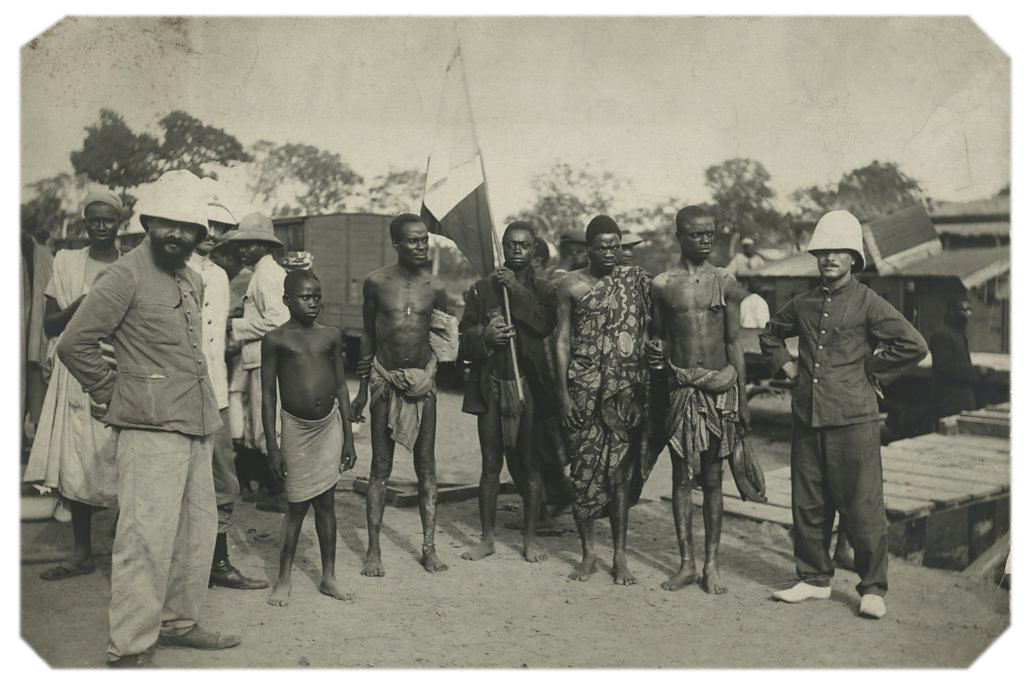
Anonymous photographer. 'The Habés send a parliamentarian to make their submission to Major Pognio' 17 March 1910


Anonymous photographer
Les Habés envoient un parlementaire pour faire leur soumission au commandant Pognio
The Habés send a parliamentarian to make their submission to Major Pognio
17 March 1910
Print on baryta paper
10.9 x 16.7cm
Musée du quai Branly – Jacques Chirac


The French colonial conquest of West Africa, begun in 1854, stops with the unification of its possessions within French West Africa in 1895. It was mainly carried out by the infantry which had to face populations hostile to colonization. The Habés (Dogons) of the Bandiagara region (present-day Mali) resisted the French soldiers from 1894 to 1910.


José Clemente Orozco (Mexican, 1883-1949) 'Les Femmes des soldats (The Women Soldiers)' 1926


José Clemente Orozco (Mexican, 1883-1949)
Les Femmes des soldats (The Women Soldiers)
1926
Oil on canvas
México, INBA, Collection Museo de Arte Moderno
Photo © Francisco Kochen
© Adagp, Paris 2016


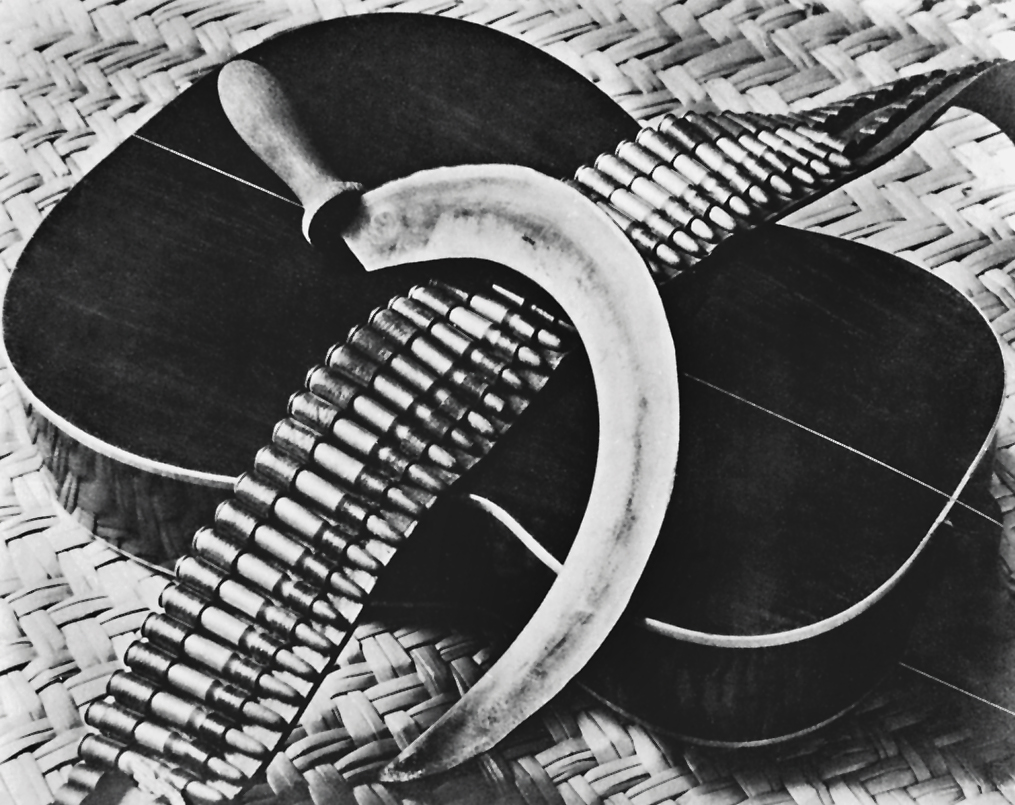
Tina Modotti (Italian American, 1896-1942) 'Guitare, cartouchière et faucille (Guitar, cartridge belt and sickle)' 1st June 1929


Tina Modotti (Italian American, 1896-1942)
Guitare, cartouchière et faucille (Guitar, cartridge belt and sickle)
1st June 1929
Illustration de l’annonce pour la chanteuse communiste Concha Michel, publiée dans el machete, no 168, 1
Illustration of the announcement for the communist singer Concha Michel, published in El Machete, no 168, 1
Gelatin silver print
México, INBA, Museo Nacional de Arte
Donation de la famille Maples Arce, 2015
© Francisco Kochen


The Mexican Revolution profoundly changed the structure of society: since men had gone to war or to search for work and livelihoods, women took on new tasks, first in armed struggle and then in rebuilding culture and education within society. Thus, the image of the soldiaderas, those women who followed the revolutionary troops, acquired a special significance and was symbolically compared to the “strong women” of the Bible. In the artistic field, women also played a decisive role, sometimes called “proto-feminism”: patrons of valuable artists or artists themselves, they participated in the quest for an aesthetic language capable of expressing their doubts and questioning.

Text from the Jeu de Paume website translated by Google translate
 

Concha Michel (1899-1990) was a singer-songwriter, political activist, playwright, and a researcher who published several projects on the culture of Indigenous communities. She was one of the few women who performed in the corrido style. She created the Institute of Folklore in Michoacan and was one of the first collectors of folklore and preservers of the traditions of the Mexican people. She was a cultural icon having relationships with two presidents, and a broad range of Mexico’s most prominent artists including Diego Rivera, Frida Kahlo, Guadalupe Marín, Tina Modotti, Elena Poniatowska, Anita Brenner and others.

Text from the Wikipedia website


Ruth Berlau (Danish, 1906-1974) 'Grévistes américains (American warriors)' 1941


Ruth Berlau (Danish, 1906-1974)
Grévistes américains (American warriors)
1941
Gelatin silver print
10 x 15cm
Akademie der Künste, Berlin, Bertolt Brecht Archiv
© by R. Berlau/Hoffmann


Ruth Berlau, actress, director and photographer of Danish origin realises this photograph shortly after his arrival in the United States. She fled Nazi Germany with the writer and playwright Bertolt Brecht and accompanied him during much of his exile. In line with her commitment to the Spanish war and her communist ideas, she photographed American social movements and showed the actors of the struggle and the victims of oppression. This series on strikes highlights the workforce of the workers, with the desire to get their faces out of anonymity. It is in keeping with the documentary use of photography undertaken by social programs such as the New Deal and in particular the path traced by Walker Evans, initiator of the “documentary style”. It chooses a frontal point of view, apt to reveal with precision and clarity the faces of the strikers. In doing so, it applies itself to restoring their dignity while producing the documents of a social history. The counter-drive gives the strikers a particular scope and strength, just as the framing, which ostensibly divides the group, suggests that they belong to a powerful and determined group. The photographic practice of Ruth Berlau seems to embody a democratic ideal, revealing both the unity and the singularity of each and a common political commitment, which is reflected here through the exchange of views.

Text from the Jeu de Paume website translated by Google translate
 

Manuel Álvarez Bravo (Mexican, 1902-2002) 'Ouvrier en grève, assassiné (Striking worker, assassinated)' 1934


Manuel Álvarez Bravo (Mexican, 1902-2002)
Ouvrier en grève, assassiné (Striking worker, assassinated)
1934
Gelatin silver print
Musée d’Art moderne de la Ville de Paris
© Musée d’Art Moderne de la Ville de Paris / Roger Viollet
© Estate Manuel Álvarez Bravo


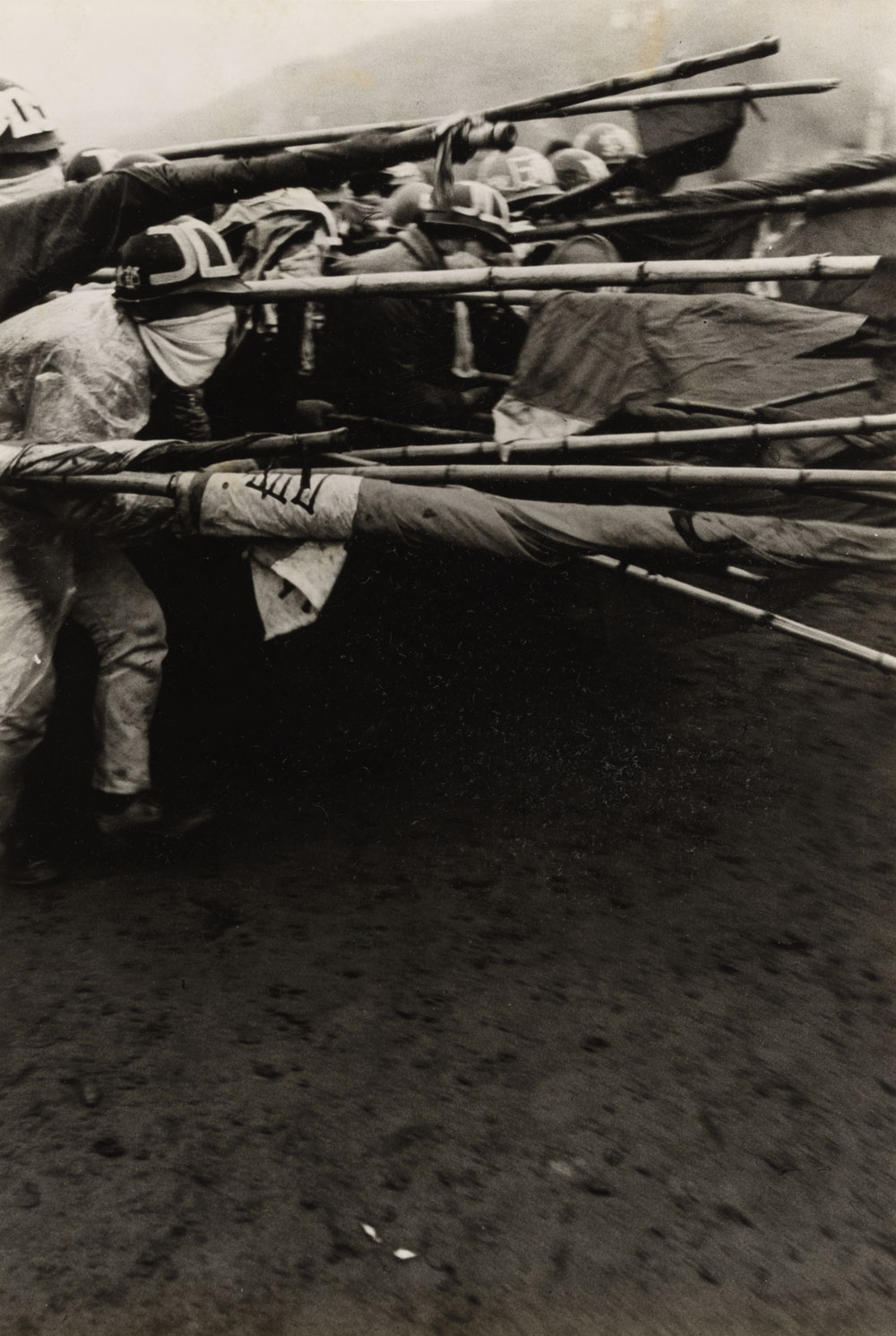
Unknown photographer. 'Contestation around the construction of Narita airport' 1969

Unknown photographer. 'Contestation around the construction of Narita airport' 1969


Unknown photographer
Contestation autour de la construction de l’aéroport de Narita
Contestation around the construction of Narita airport

1969
Gelatin silver prints
© Collection Art Institute of Chicago


In parallel with the dazzling rise of a consumer society on the Western model, for ten years (from 1960 to 1970) Japan went through a major identity crisis that unfolded on multiple fronts: American military bases in Okinawa, construction of Narita airport, occupation of universities by students …


Chieh-Jen Chen (Taiwanese, b. 1960) 'The Route' 2006

Chieh-Jen Chen (Taiwanese, b. 1960) 'The Route' 2006


Chieh-Jen Chen (Taiwanese, b. 1960)
The Route
2006
35 mm film transferred onto DVD: color and black and white, silent, 16:45 min.
© Chieh-Jen Chen, courtesy galerie Lily Robert


“To rise up is to break a history that everyone believed to have been heard. It is to break the foreseeability of history, to refute the rule that presided, as we thought, over its development or its preservation.”


Georges Didi-Huberman, “By the desires (Fragments of What Makes Us Rise Up)” catalogue of the exhibition Uprisings


DESIRES (INDESTRUCTIBLES)

The hope of one condemned to death. – Mothers rise up. – They are your own children. – They who go through walls.

But potency outlives power. Freud said that desire was indestructible. Even those who knew they were condemned – in the camps, in the prisons – seek every means to transmit a testimony or call out. As Joan Miró evoked in a series of works titled “The Hope of a Condemned Man,” in homage to the student anarchist Salvador Puig i Antich, executed by Franco’s regime in 1974.

An uprising can end with mothers’ tears over the bodies of their dead children. But these tears are merely a burden: they can still provide the potencies of uprising, like in the “resistance marches” of mothers and grandmothers in Buenos Aires. It is our own children who rise up: “Zero for Conduct!” was Antigone not almost a child herself? Whether in the Chiapas forests or on the Greece – Macedonia border, somewhere in China, in Egypt, in Gaza, or in the jungle of computerised networks considered as a vox populi, there will always be children to jump the wall.

Francisca Benitez, Ruth Berlau, Bruno Boudjelal, Agustí Centelles, Eduardo Gil, Mat Jacob, Ken Hamblin, Maria Kourkouta, Joan Miró, Pedro Motta, Voula Papaioannou, Estefania Peñafiel Loaiza, Enrique Ramirez, Argentinian, Greek, Mexican unknowns.


Denis Foyatier (French, 1793-1863 'Spartacus' 1830


Denis Foyatier (French, 1793-1863)
Spartacus
1830
Marble
Commande de Charles X, 1828
Département des Sculptures
© 2011 Musée du Louvre, dist. RMN – Grand Palais / Thierry Ollivier


Victor Hugo (French, 1802-1885) 'Le Pendu (The hanged man)' 1854


Victor Hugo (French, 1802-1885)
Le Pendu (The hanged man)
1854
Pen and brown ink wash, black ink, charcoal, black chalk, gouache on paper
Paris, Maison de Victor Hugo
© Maisons de Victor Hugo / Roger-Viollet


While in exile in Jersey, Victor Hugo is deeply moved by the death sentence in Guernsey of John Charles Tapner, a condemnation against which he protests and asks for a pardon that he will not get. Hugo then makes four drawings depicting a gaunt hanged man at his gallows. The museum preserves two (Ecce and Ecce Lex). Hugo had hung them in his room in Marine Terrace in Jersey, and in his study under the roof of Hauteville House in Guernsey.


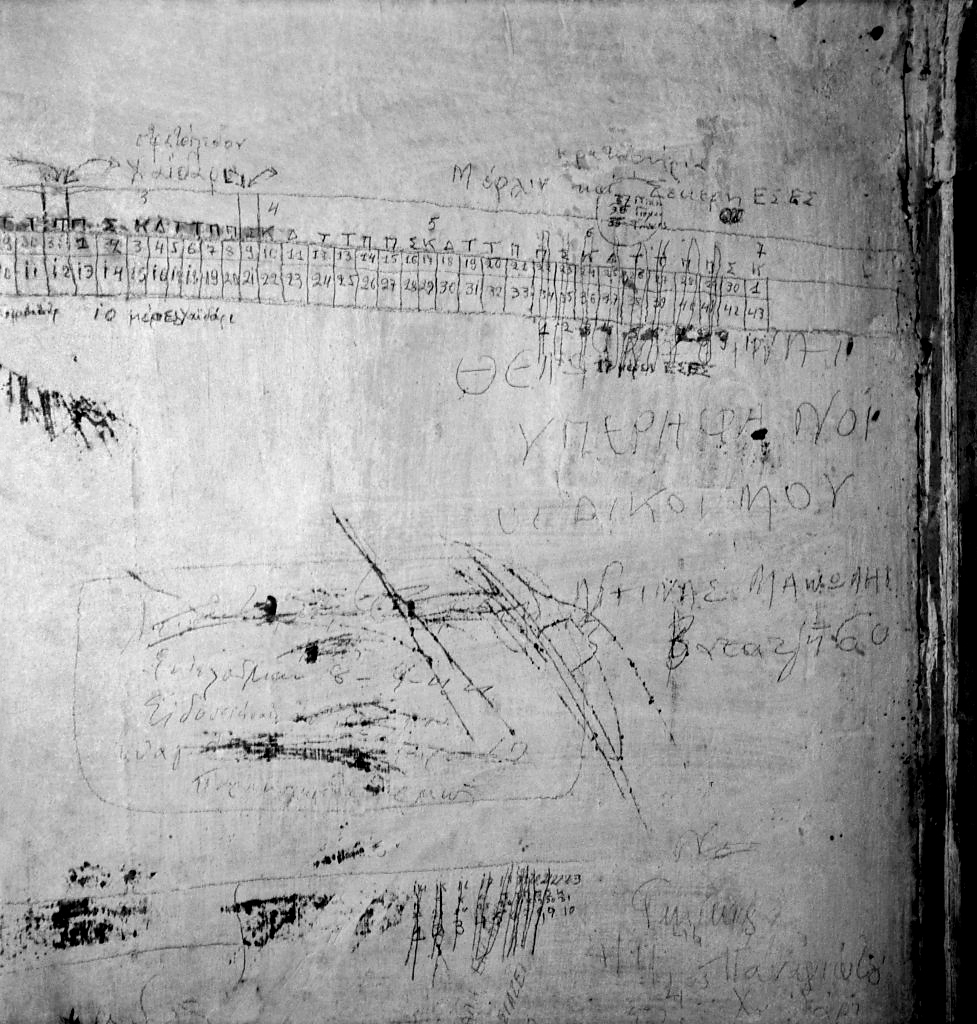
Voula Papaioannou (Greek, 1898-1990) 'Graffiti of prisoners on the walls of the German prison in Merlin Street, Athens' 1944


Voula Papaioannou (Greek, 1898-1990)
Graffitis de prisonniers sur les murs de la prison allemande de la rue Merlin à Athènes
Graffiti of prisoners on the walls of the German prison in Merlin Street, Athens
1944
Gelatin-silver print, modern print
24 x 30cm
Benaki Museum Photographic Archive, Athènes


Voula Papaioannou is a major figure in Greek documentary photography. Born in 1898, she made numerous photographs of landscapes, monuments and archaeological sites in the 1930s. The Second World War led her to wonder about her practice and she was committed to covering the realities of the conflict. Her apparatus then becomes a tool to testify and publicise the misery and suffering of the Greek population during the German occupation. It reflects the difficulties of everyday life, the departure of the military in combat and the famines that strike civilians. During the liberation, she made a few shots of street fights as well as these images of the walls of the prison of Athens held until then by the Germans. It shows the graffiti (inscriptions and drawings) left by the detainees, most of them awaiting execution. Many say their names and send a message to their families (“I want my relatives to be proud of me”) or claim their political convictions (“Vive le KKE”, Greek Communist Party) for the sake of transmitting until the day before their deaths the reasons for their struggle and the conditions of their disappearance. These photographic recordings are similar to archaeological documents bearing the traces of the imprisonment of the Greek Resistance fighters and their hope that these messages will one day be read in a Greece freed from the Nazi occupation.

Text from the Jeu de Paume website translated by Google translate


Photographe Anonyme (membre du Sonderkommando d'Auschwitz-Birkenau) Anonymous photographer (member of the Auschwitz-Birkenau Sonderkommando) 'Femmes poussées vers la chambre à gaz du crématoire V de Birkenau' 'Women pushed towards the gas chamber of crematorium V of Birkenau' 1944


Photographe Anonyme (membre du Sonderkommando d’Auschwitz-Birkenau)
Anonymous photographer (member of the Auschwitz-Birkenau Sonderkommando)

Femmes poussées vers la chambre à gaz du crématoire V de Birkenau
Women pushed towards the gas chamber of crematorium V of Birkenau
1944
Contact plate with two images
12 x 6cm
Archival collection of the State Museum Auschwitz-Birkrenau, Oświęcim
Photo: Archival collection of the State Museum Auschwitz-Birkrenau, Oświęcim


This photograph was taken by a member of the Sonderkommando Auschwitz-Birkenau, a special unit of Jewish inmates commissioned by the SS to carry out the final solution. It belongs to a set of four photographs carried out clandestinely on a piece of film, using a photographic camera infiltrated in the camp and then concealed at the bottom of a bucket. Hidden near crematory furnace V, the author of these photographs was assisted by other members of the Sonderkommando. To do such an act was indeed extremely dangerous. The sloping framing and the blur reflect the perilous conditions in which the photographer was then placed. This picture, however, clearly shows a convoy of naked women pushed by the special unit to the gas chamber, located off-field. The film was then filtered from the camp into a tube of toothpaste to join the Polish Resistance, accompanied by an explanatory letter. These photographs therefore have an informative aim and constitute the only photographic documents on the gas chambers. As Georges Didi-Huberman affirms, “in the depths of this fundamental despair, the “solicitation to resist” has probably detached itself from the beings themselves, who have been promised to disappear, to fix themselves on signals to be emitted beyond the boundaries of the camp.*” Among others, the image, this “eye of history”, is then invested with the only hope still possible: to make the hell of Auschwitz visible and therefore imaginable.

*Georges Didi-Huberman, Images malgré tout, (Images despite everything), Paris, Les Editions de Minuit, 2003, p. 14.


Sonderkommandos were work units made up of German Nazi death camp prisoners. They were composed of prisoners, usually Jews, who were forced, on threat of their own deaths, to aid with the disposal of gas chamber victims during the Holocaust. The death-camp Sonderkommandos, who were always inmates, should not be confused with the SS-Sonderkommandos which were ad hoc units formed from various SS offices between 1938 and 1945. The term itself in German means “special unit”, and was part of the vague and euphemistic language which the Nazis used to refer to aspects of the Final Solution (cf. Einsatzkommando units of the Einsatzgruppen death squads).

About 120 SS personnel were assigned to the gas chambers and lived on site at the crematoria. Several SS personnel oversaw the killings at each gas chamber, while the bulk of the work was done by the mostly Jewish prisoners known as Sonderkommandos (special squads)  Sonderkommando responsibilities included guiding victims to the gas chambers and removing, looting, and cremating the corpses.

The Sonderkommado were housed separately from other prisoners, in somewhat better conditions. Their quality of life was further improved by access to the goods taken from murdered prisoners, which Sonderkommandos were sometimes able to steal for themselves and to trade on Auschwitz’s black market. Hungarian doctor Miklós Nyiszli reported that the Sonderkommando numbered around 860 prisoners when the Hungarian Jews were being killed in 1944. Many Sonderkommandos committed suicide due to the horrors of their work; those who did not generally were shot by the SS in a matter of weeks, and new Sonderkommando units were then formed from incoming transports. Almost none of the 2,000 prisoners placed in these units survived to the camp’s liberation.

Text from the Wikipedia website


Ken Hamblin (American, b. 1940) 'Beaubien Street' 1971


Ken Hamblin (American, b. 1940)
Beaubien Street
1971
Modern gelatin silver print
Fifth Estate photo
Joseph A. Labadie Collection, Special Collections Library, University of Michigan


Joan Miró (Spanish, 1893-1983) 'Prisoner's Hope, Preparatory Drawing for The Hope of the Dead Man I, II and III' 1973


Joan Miró (Spanish, 1893-1983)
L’Espoir du prisonnier, dessin préparatoire pour L’Espoir du condamné à mort I, II et III
Prisoner’s Hope, Preparatory Drawing for The Hope of the Dead Man I, II and III
1973
Colored pencils and pen on paper (notepad)
7.7 x 12.5cm
Fundació Joan Miró, Barcelone
© Successió Miró / ADAGP, Paris, 2016
Photo: Fundació Miró, Barcelone


This sketch is part of a series of preparatory studies for a triptych entitled The Hope of the Condemned to Death, completed in March 1974. It is already possible to guess the overall design (three horizontal compositions of primary colours formed of sinuous lines) and the title seems to be clarified with the addition of these words: “the hope of the prisoner”. Sensitive to the death sentence of the anarchist and anti-fascist militant Salvador Puig i Antich, a member of the Movimiento Ibérico de Liberación, Joan Miró claims that he completed his triptych on the day of his execution on 2 March 1974. Thus the artwork – initially imagined in an abstract and metaphorical way – then encounters history. This triptych executed in very large format so as to address the greatest number, as Miró wished that the painting would be, thus constitutes a real monument to the memory of one of the last victims of Francoism. Judged “prophetic” by the artist, he presents a series of black lines that he interpreted as an image of the tourniquet used for execution. Struggling or playing as much with the void as with the spots of vivid colours, these dark lines on a light background also seem to be distended and open like a permitted hope. From his first studies, Joan Miró managed to preserve intact, by the energy of the gesture and the vivacity of the keys, the “indestructible desire” to hope and resist, which culminated the following year in the fall of the Franco regime.

Text from the Jeu de Paume website translated by Google translate
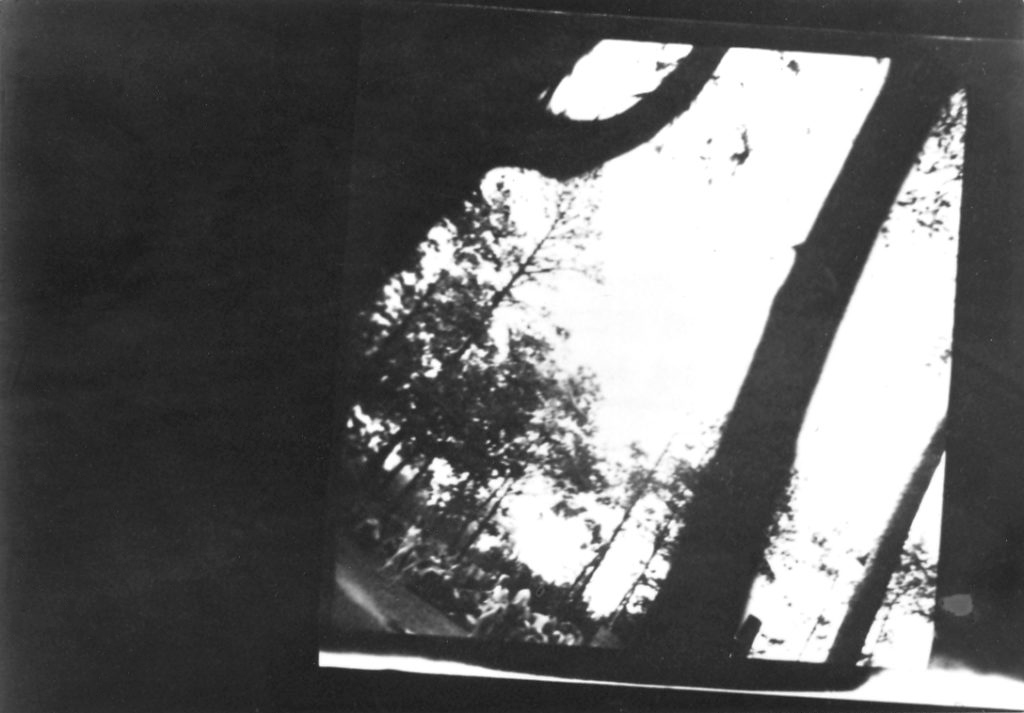
 

Eduardo Gil (Argentinian, b. 1948) 'Niños desaparecidos. Secunda Marcha de la Resistancia (Murdered children. Second Resistance March)' December 9-10 1982


Eduardo Gil (Argentinian, b. 1948)
Niños desaparecidos. Secunda Marcha de la Resistancia (Murdered children. Second Resistance March)
December 9-10 1982
Modern gelatin silver print
Eduardo Gil collection
© Eduardo Gil


Eduardo Gil was born in 1948 in Buenos Aires, Argentina. After studying sociology, he became a photographer. Self-taught and sensitive to social struggles, his commitment was linked to the establishment of the military dictatorship following the coup d’état of 24 March 1976. Working for the press and as an independent author, he made a series of reports on the political situation and social life of his country. He photographed in particular the second March for the Resistance in Buenos Aires on 9 and 10 December 1982. Organised at the call of the Mothers of the Place de Mai in tribute to the missing children during the dictatorship, the First march of the Resistance in 1981 ‘Is then reproduced every year until 2006, involving the entire society, including after the end of the dictatorship. Faced with the march, Eduardo Gil records the determined faces of the women, mothers and grandmothers of the children of Argentina, demonstrating to obtain answers on the fate of the disappeared. The use of black and white flattened the composition and accentuated the juxtaposition of the women’s faces with the banners and placards. The photographs of the children brandished by the demonstrators thus seem to merge in the procession. All appear in this sense more united than ever, stretched out towards us, as towards politics. Eduardo Gil seems to prove here that by recording the image of the missing among the living, photography itself is a force of uprising.

Text from the Jeu de Paume website translated by Google translate
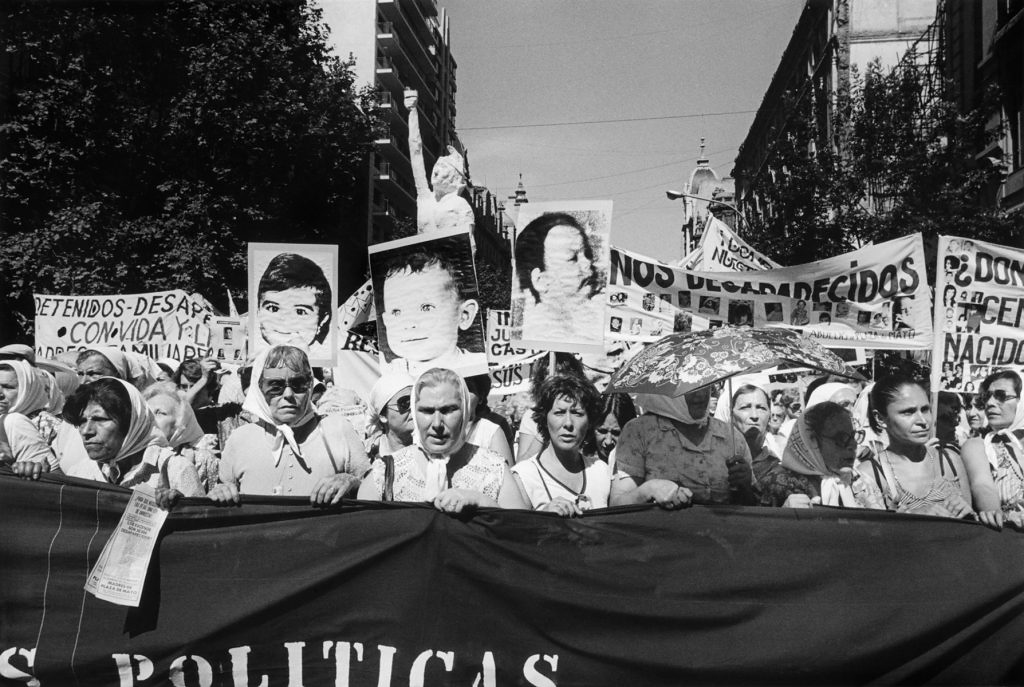
 

Francisca Benítez (Chilean, b. 1974) 'Garde l'Est' 2005


Francisca Benítez (Chilean, b. 1974)
Garde l’Est
2005
Still frame
Francisca Benitez collection
© Francisca Benítez
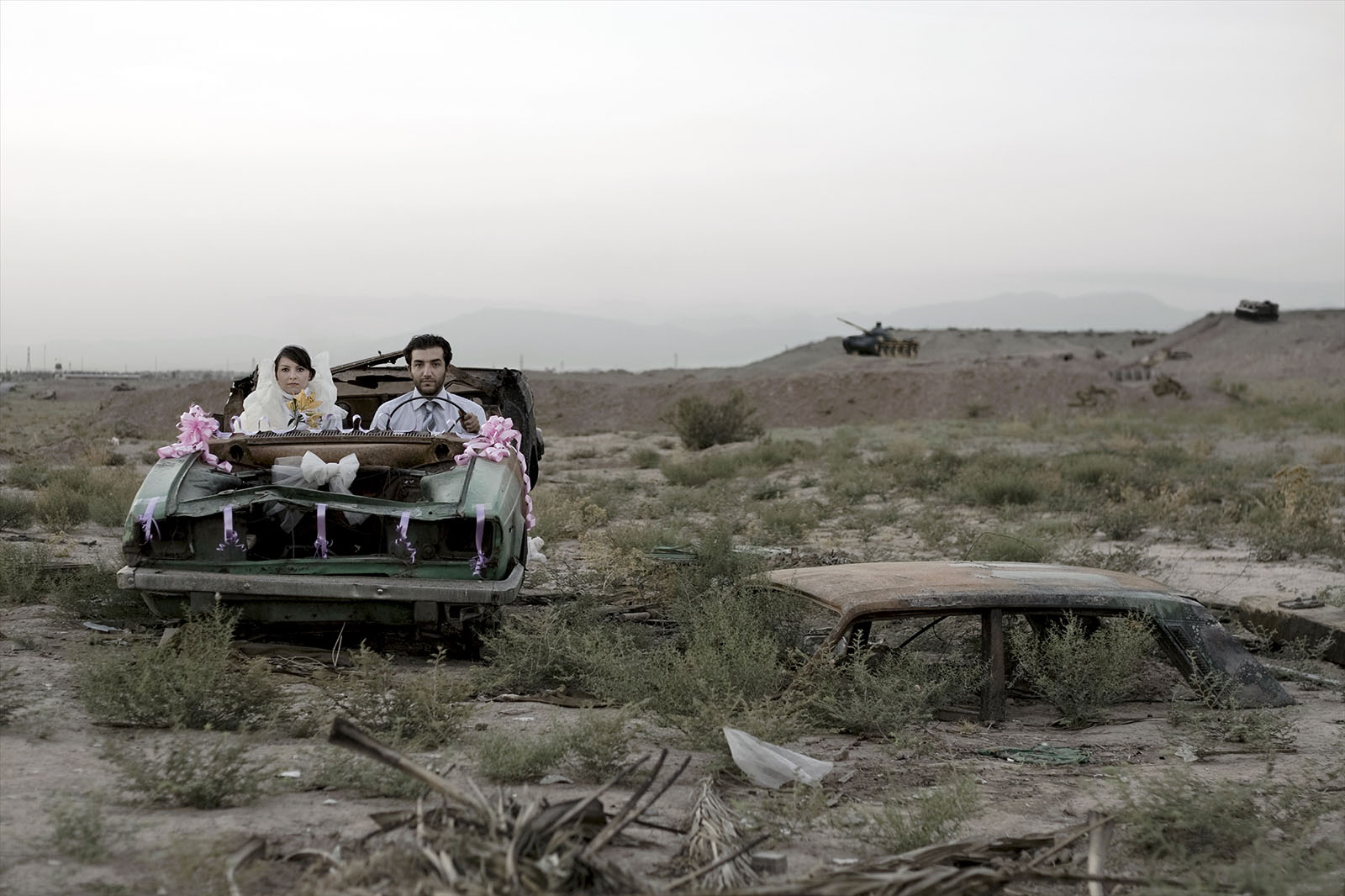
 

Gohar Dashti (Iranian, b. 1980) From the series 'Today's Life and War' 2008


Gohar Dashti (Iranian, b. 1980)
From the series Today’s Life and War
2008
Institut des Cultures d’Islam


The photographs of the Iranian artist Gohar Dashti’s Today’s Life and War show the daily life of a young couple against a background of war. Surrounded by tanks, bunkers and armed soldiers, the spouses live in the middle of the fields of ruins and continue to go about their occupations. Between impassivity and disillusionment, their attitudes show perseverance and unwavering determination to simply continue living. With these surreal scenes, the artist is witnessing a generation caught between the memories of ten years of war against Iraq and the permanent threat of conflict.


Pedro Motta (Brazilian, b. 1977) 'Natureza das coisas #024, (The nature of things #024)' 2013


Pedro Motta (Brazilian, b. 1977)
Natureza das coisas #024, (The nature of things #024)
From the “Natureza das coisas” series
2013
Mineral print on cotton paper
Private collection
Courtesy of the artist and gallery Bendana Pinel
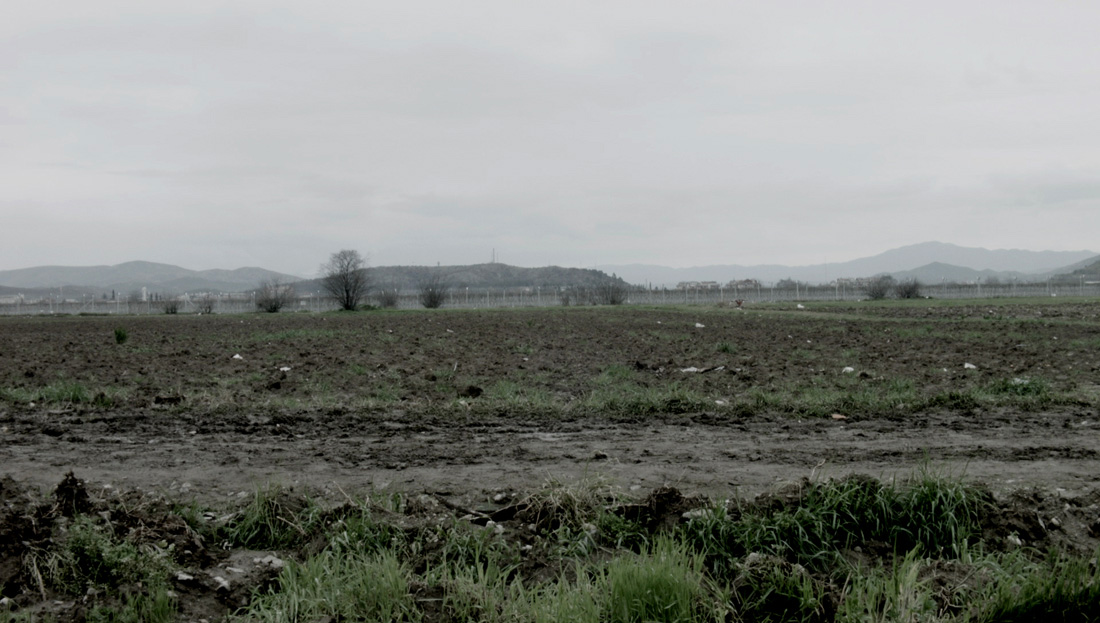
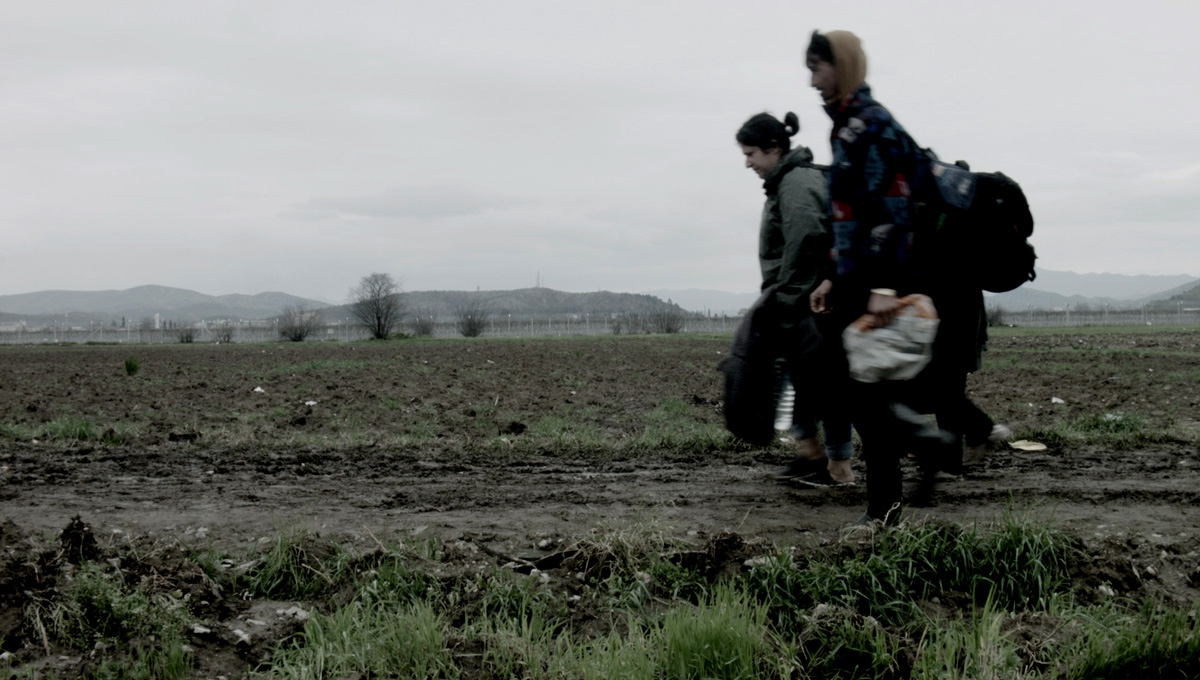
 

Maria Kourkouta (Greek, b. 1982) 'Idomeni, 14 mars 2016. Frontière gréco-macédonienne, (Idomeni, March 14, 2016. Greek-Macedonian border)' 2016

Maria Kourkouta (Greek, b. 1982) 'Idomeni, 14 mars 2016. Frontière gréco-macédonienne, (Idomeni, March 14, 2016. Greek-Macedonian border)' 2016


Maria Kourkouta (Greek, b. 1982)
Idomeni, 14 mars 2016. Frontière gréco-macédonienne, (Idomeni, March 14, 2016. Greek-Macedonian border)
2016
HD video loop: colour, sound, 36:00 min.
© Maria Kourkouta. Production: Jeu de Paume, Paris


Jeu de Paume
1, Place de la Concorde
75008 Paris
métro Concorde
Phone: 01 47 03 12 50

Opening hours:
Tuesday: 11.00 – 21.00
Wednesday – Sunday: 11.00 – 19.00
Closed Monday

Jeu de Paume website

LIKE ART BLART ON FACEBOOK

Back to top

Exhibition: ‘Brett Weston: Significant Details’ at Pasadena Museum of California Art

Exhibition dates: 17th April – 11th September, 2016

Curator: Erin Aitali, PMCA Director of Exhibitions and Registrar


Installation view of the exhibition 'Brett Weston: Significant Details' at the Pasadena Museum of California Art


Installation photographs of the exhibition Brett Weston: Significant Details at the Pasadena Museum of California Art
Photos: © 2016 Don Milici


If your subject is essentially unrecognisable – a defining characteristic of many of Weston’s photographs – devoid of sentimentality, featuring an explosion of geometry as a form of Western expressionism, able to extract the microcosm from the macrocosm through an absence of human presence and apparent narrative – then your previsualisation must be spot on otherwise you loose clear focus as to just what it is you are trying to communicate. It’s all very well being obsessed with capturing the intricacies and rhythms of form, light and shadow, visual poetry in photography, but if that obsession has no ‘feeling’ outcome then you are doomed to failure.

Imagine (if you can) that master of documentary realism Eugène Atget placing his camera in just the wrong position for one of his photographs. The tripod just a little too low, the position a metre to the left of where it should have been. The resulting image would not feel like an Atget, the angles would not feel right, the mixture of objective and subjective would not be present, the magic of his photographs – recognisably his photographs – would be missing. What Atget does so convincingly is to combine the aesthetic with the documentary or representational. As G.H. Saxon Mills observes in his essay ‘Modern photography’ ‘”modern” photography means photography whose aim is partly or wholly aesthetic, as opposed to photography which is merely documentary or representational.’ Atget proves that both were possible within the same frame.

This is not the case with the photographs by Brett Weston in this posting. Although I have commented elsewhere on this website that, “Brett Weston’s pictures are ageing well – the decorative aesthetic seems to have more currency today than previously when the values of his father were predominant,” and admired the reductive minimalism of his photographs … this is not the case with these ‘significant details’. In this instance they are just representation, poor relations to the photographs of Minor White and Aaron Siskind.

I think that the best of his work is very fine – a sort of celebration of all that had gone before with a layer of super-fineness added. However he made many images that were a bit like a preacher rather than an artist. In some of his portfolios the choice of images is just plain weird, catering to the market rather than taking the chance to make a powerful statement. And photography aficionados remain unconvinced by his work, shying away from collecting it. Perhaps they know, or feel a lack of something, some spirit or other, or a seeming unevenness in the quality of his artistic production.

Perhaps it is his printing, which is a bit “Kodak meets EW” in the darkroom (even as his father entrusted him with printing some of his negatives). Weston achieved his good results because he was a careful craftsman, not an experimenter. Someone, I forget who, said that you never looked at his work when desperate for sustenance – and I think a lot of “connoisseurs” think that – and in a Brett Weston you can too often argue yourself out of the celebration. There is a certain dourness that is hard to overcome. I challenge you, now, to say one meaningful thing about any of the images presented here. They take you nowhere. They are either too tightly cropped (that lack of true previsualisation / placing the camera in the wrong position / lack of context) or rely on pattern and representation, and only that, to do the heavy lifting.

My feeling about his work is that he saw and felt many great things that he used in his work – but at the final hurdle, his implementation was always handled a little directly, or not a well as might have been… or is sometimes absent. Perhaps it’s just his viewpoint which seems to be too limited in a psychological sense. If Atget had photographed the city without those magnificent tripod positions and understanding of space, then they would have been dead. That’s how BW’s work sometimes feels. Instead of the space feeling larger than the camera can contain, on occasions his photographs feel enclosed and stilted.

Weston said, “There are a million choices for shot. At its simplest, photography is very complex. So I try to keep it simple and focus on things I can master.”

Sometimes, keeping things simple does not result in preternatural outcomes.

Dr Marcus Bunyan


Many thankx to the Pasadena Museum of California Art for allowing me to publish the photographs in the posting. Please click on the photographs for a larger version of the image.


“My father was driven and so am I. You’re ruthless. You brush off your friends and women. He was much kinder than me. I don’t verbalize well and I don’t socialize much. Too time consuming. And I’m not a good salesman of my work. I love people, but they can be a drain. Some are stimulating; some are leeches. So I seek people on my own terms. Most artists are loners. I guess they have to be.”


Brett Weston


“Weston isn’t really a nature photographer… He was obsessed with capturing the intricacies and rhythms of form, light and shadow. Weston is as fascinated by close-ups of the exfoliating bark of a bristlecone pine or the spikes of a Joshua Tree as he is with the visual poetry of peeling paint on the side-panel of a rusted out truck.”


Jeffrey St. Clair. “A Natural Eye,” on the Counter Punch website, May 25, 2012 [Online] Cited 01/10/2021


Installation view of the exhibition 'Brett Weston: Significant Details' at the Pasadena Museum of California Art

Installation view of the exhibition 'Brett Weston: Significant Details' at the Pasadena Museum of California Art


Installation photographs of the exhibition Brett Weston: Significant Details at the Pasadena Museum of California Art
Photos: © 2016 Don Milici


Although Brett Weston (1911-1993) is best known for his striking scenic photographs, the majority of his work ranges from middle-distance scenes to close-up abstractions. These concentrated images share the high-contrast and graphic qualities of Weston’s panoramas while emphasising his affinity for “significant details” and the unprecedented attention to form, texture, shadow, and light that he explored throughout his nearly-seventy-year career.

Weston took up photography at the age of fourteen. Although he received basic technical instruction from his father, renowned photographer Edward Weston, Brett’s early efforts owed much to his intuition and innate eye. His elemental talent coupled with an unflagging commitment to his photographic vision – often at the expense of personal relationships and fiscal well-being – carried him from early critical acclaim, through difficult periods, to eventual financial success within his own lifetime.

By the age of twenty-five, Weston’s photographs were included in significant exhibitions both nationally and internationally, but despite early recognition he served as a WPA photographer during the Great Depression and as a Signal Corps photographer during World War II. By necessity, he also worked intermittently in the first half of his career as an industrial and portrait photographer. However, when he achieved prosperity beginning in the 1970s, he devoted himself exclusively to the photography and intercontinental expeditions that fulfilled him. His initial interest in abstracted details continually revealed itself, especially once he began using a new, smaller camera after health problems in the late 1960s forced him to abandon the bulky equipment he had used for over thirty years.

Early and continuing critical success notwithstanding, following Brett’s death, the comparison to his famed father left the younger Weston on the wrong side of a narrowing modern canon of photography. Reaffirming Weston’s legacy and his exceptional contributions to modernist photography, these uncharted, close-up images – more than half of which are on view for the first time – demonstrate the major themes present in Weston’s work: a focus on natural and urban landscapes and the objects therein, the absence of human presence and apparent narrative, and an extraordinary ability to extract the microcosm from the macrocosm.

Introduction text from the exhibition


Brett Weston (American, 1911-1993) 'Untitled (Worm Wood, California)' c. 1937 (printed c. 1970) from the exhibition 'Brett Weston: Significant Details' at Pasadena Museum of California Art, April - Sept, 2016


Brett Weston (American, 1911-1993)
Worm Wood, California
c. 1937 (printed c. 1970)
Silver gelatin print
10 1/2 x 13 3/4 inches
The Brett Weston Archive
Courtesy Christian Keesee Collection, 2016


Although Weston’s wife Cicely provided the couple with a steady income, she became pregnant with the pair’s first (and only) child in 1937, providing Weston impetus to generate additional means of support. Hoping to replicate the financial success of Ansel Adams’s portfolio of limited edition original photographs, Weston produced one of his own. His first portfolio San Francisco (1937) consisted of twelve 8 x 10 original prints. Unlike the photograph Staircase, San Francisco (1928) included in this exhibition, the portfolio photos were panoramic vistas. However, without the robust support of a collector like Albert Bender, who both promoted and purchased enough of Adams’s portfolios to assure commercial success, Weston didn’t profit from his portfolio. He lacked not only the promotional skills and collector base but also refused gallery sales owing to his deep distrust and outrage at their commissions.


Brett Weston (American, 1911-1993) 'Wood' 1972 from the exhibition 'Brett Weston: Significant Details' at Pasadena Museum of California Art, April - Sept, 2016


Brett Weston (American, 1911-1993)
Wood
1972
Silver gelatin print
7 1/2 x 8 5/8 inches
The Brett Weston Archive
Courtesy Christian Keesee Collection, 2016


One of the most celebrated and prolific photographers of the twentieth century, Brett Weston (1911-1993) is best known for his striking scenic images, yet the bulk of his work ranges from middle-distance scenes to closeup abstractions. The Pasadena Museum of California Art (PMCA) is proud to present Brett Weston: Significant Details, the first museum exhibition to focus on Weston’s close-up photography. The works – over half of which are on view for the first time – share the high-contrast and graphic qualities of Weston’s panoramic photographs while emphasising the “significant details,” the tendency toward abstraction and extremes in tonality that Weston explored through his nearly 60-year career. The exhibition further contextualises Weston within the pivotal Group f/64 and highlights how intuition and a dedication to photography in its purest form guided his practice.

Although the teaching of his father, famed modernist photographer Edward Weston, was invaluable and his influence undeniable, Weston’s practice was largely shaped by instinct and informal training. He took up photography at the age of 14 when, on an extended trip to Mexico with his father, he started photographing the crew of the SS Oaxaca with the elder Weston’s Graflex camera. This trip also coincided with the end of his formal education; he was enrolled at an English-speaking school, but dropped out within two weeks. While in Mexico, Weston became part of the modernist mileu, socialising with and viewing the work of some of the greatest artists of the time, including David Siqueiros, Diego Rivera, and José Clemente Orozco.

Weston’s professional entry into the world of photography occurred during a shift from the East Coast Pictorialists and their accentuation of romantic effects to the West Coast photographic movement, which coalesced with Group f/64 and their sharp images that captured daily life. Like the members of Group f/64, which included Edward Weston and Ansel Adams, Brett Weston focused primarily on two types of images: close-ups and the scenic view. However, Weston’s approach was distinct, tending toward highly graphic images, with intense areas of dark and highlights, rather than mid-grey tones used by many, including his father.

By the age of 25, Weston’s work had been included in the landmark international photography exhibition Film und Foto and in a solo exhibition at the M. H. de Young Museum in San Francisco. Though he received critical acclaim and  his reputation grew, Weston remained dedicated to art for art’s sake and to creating pure, elemental photographs. He was a simple man and used the same equipment for most of his career. However, when health problems forced him to switch to a smaller camera – the Rollei – in 1968, he further experimented with close-up photographs, and his work became even more intent on exploring specific details and abstract qualities. In Torn Leaf, Hawaii (1978, below), for example, the brittle, curling leaf appears monumental on a black ground. It exists as a singular object, not fully contained within the composition, and the size is indeterminable without context.

The uncharted, close-up images that are the focus of Significant Details demonstrate the major themes present in Weston’s work: a play on scale, the absence of the human presence, and a refrain from imposed order. This exhibition features approximately 40 works taken over a period of 55 years, ranging from 1929 to 1984, and brings to the forefront the unprecedented attention to form, texture, shadow, and light that was the distinctive characteristic of Weston’s oeuvre.

Press release from the Pasadena Museum of California Art


Brett Weston (American, 1911-1993) 'Wall, Europe' 1971


Brett Weston (American, 1911-1993)
Wall, Europe
1971
Silver gelatin print
8 x 10 inches
The Brett Weston Archive
Courtesy Christian Keesee Collection, 2016


In 1971 Brett returned to Europe for the third time. While there, he captured both abstract images, like this one, and panoramas. Notably, this trip resulted in the photograph of Holland Canal, which Weston grew to hate, despite its commercial success or perhaps because of it, “I’m so sick of the thing but people love it. I could retire on sales of this print alone. I’d hate to tell you how many of these I’ve printed.” Although this scenic print wasn’t the legacy Weston desired for himself, it led to an overall increased attention from collectors interested in his work, including his abstractions.


Brett Weston (American, 1911-1993) 'Untitled (Cracked Mud, High Sierra, California)' 1960


Brett Weston (American, 1911-1993)
Cracked Mud, High Sierra, California
1960
Silver gelatin print
8 x 10 inches
The Brett Weston Archive
Courtesy Christian Keesee Collection, 2016


Direct evidence of human presence was rare in Weston’s photos. But here, two playful sets of handprints on the mud provide scale, which would otherwise be indeterminable in the image.


Brett Weston (American, 1911-1993) 'Electrical Towers, Metal' c. 1975


Brett Weston (American, 1911-1993)
Electrical Towers, Metal
c. 1975
Silver gelatin print
8 x 10 inches
The Brett Weston Archive
Courtesy Christian Keesee Collection, 2016


Brett Weston: Significant Details

Brett Weston, born in 1911 in Tropico, CA (now Glendale), took up photography at the age of fourteen while on an extended trip to Mexico with his father, famed photographer Edward Weston. In Mexico for just over a year, his time there was pivotal in many ways, not only marking the start of his photography career, but also the end of his formal education. His father allowed him to drop out of the international school after two short weeks and provided the younger Weston with basic instructions in photography. Still, Brett relied heavily on his innate sensibilities toward form and tonality, evident in Tin Roof, Mexico, an early photograph from 1926 featuring a cropped view of a jagged roofline with dramatic dark shadows splitting the image. Weston also benefited from a social education of sorts. Through connections of his father’s mistress, photographer Tina Modotti, Weston became a part of the Mexican modernist milieu, socialising with and viewing the work of some of the greatest artists of the time, including Frida Kahlo, Diego Rivera, José Clemente Orozco, and David Alfaro Siqueiros.

During his nearly-seventy-year career, Weston’s talent and unique vision developed into two related types of works, panoramic landscapes and abstracted close-ups. The image most associated with Weston was and probably still is Holland Canal from 1971. The photograph of a tree-lined canal with still water reflecting a flawless image of the surrounding landscape is sensual and magnificently balanced. However, the photographer bemoaned his connection to this particular work and its extreme popularity saying, “I’m so sick of the thing, but people love it.” Although this print and other panoramic images, such as Mendenhall Glacier, Alaska (1973), came to typify his work in the public’s mind, the bulk of Weston’s photographs range from middle-distance scenes to close-ups, which became increasingly abstract beginning in the 1950s. Brett Weston: Significant Details focuses on the close-up works that epitomise his unique and unwavering vision. These images share the high-contrast and graphic qualities of Weston’s well-known scenic photographs while emphasising what the photography historian Beaumont Newhall characterised as his affinity for “significant details.” Weston applied this penchant for details to natural and urban environments alike. Another early image, Stairway, Grandview Park, San Francisco from 1928, offers a fragmented view of a San Francisco stairwell. Without context, the unpopulated image’s narrative possibilities are limited; instead, the emphasis is on the orderly, graphic form of the staircase.

From the beginning of his career, Weston’s work was celebrated by institutions and peers. The year following Stairway, Weston’s work was included in the landmark 1929 German photography exhibition Film und Foto, and the early 1930s saw his association with Group f/64, a distinctly West Coast movement of “straight” photographers (as opposed to the East Coast Pictorialist tradition, which was waning at this time) that comprised Ansel Adams, Imogen Cunningham, Edward Weston, and others. Brett’s work appeared in their 1932 inaugural exhibition at the M.H. de Young Memorial Museum in San Francisco. The following year, both San Francisco Stairway and Tin Roofs (presumably the same works discussed in this essay) were included with forty-three other photographs in a solo exhibition at the de Young.

Although Weston saw early success with his work included in major exhibitions, this did not translate into a steady income. Like most artists during the Great Depression, the Federal Art Project – a branch of the Works Progress Administration – employed Weston, first as a sculptor and then later as a photographer. He quit the FAP in December of 1936 after about two and half years because he had no passion for the documentary nature of the work and it impinged upon time for his personal projects, something that he could not bear for long. Throughout the thirties and forties, he worked intermittently – and discontentedly – as a portrait and industrial photographer to stave off poverty and support his daughter who was born in 1938. In complete contrast to the realistic, documentary style of his FAP and commissioned works, an untitled photograph from 1937 is an extreme close-up of paint that is almost organic in appearance, with leaf-like veins in the upper portion of the image. The subject is essentially unrecognisable, which is a defining characteristic of many of Weston’s photographs.

The slim Depression years segued into the tumultuousness of World War II, during which Weston served in the US Army before a much-requested transfer to the US Signal Corps stationed him to work as a photographer in New York. At the end of the war, when Brett returned to Carmel, CA, where the Weston family had made their long-time home, he found his father beginning to show marked symptoms of Parkinson’s disease, which would increasingly debilitate the elder Weston in the last decade of his life. Before Edward’s death in 1958, he enlisted his sons Brett and Cole and a small group of trusted assistants to secure his lasting legacy by making thousands of prints under his supervision. In addition to printing work for his father, during this time, Brett also worked on his Guggenheim fellowship project and his second and third portfolios, White Sands (1949) and New York (1954).

Besides photographing the beaches of Carmel, one of which was dubbed “Weston Beach,” Brett also traveled up and down the California coast countless times over the decades. He repeatedly returned to capture the dunes of Oceano, and these images range from sweeping vistas to striking abstractions. An image from 1952, Dune, Oceano, although not technically a detail, falls into the latter category. The dunes appear wave-like and swirling, and a dark, somewhat-menacing shadow at the centre – similar to the roofline image taken in Mexico – provides graphic force. Jellyfish, California, another beach image, taken in 1967, is a close-up of one of the bulbous marine animals washed ashore. In contrast to the ethereal and weightless appearance jellyfish take underwater, it looks monumental and grotesquely beautiful. The curving form expands beyond the picture’s boundaries and in place of luminescence is a gradation of pure white reflections to jet-black striated patterns on the bell.

Although the tendency to work close-up had always been present in Weston’s work, it became much more pronounced and obvious after health issues necessitated a change in camera equipment. For over thirty years, Weston worked with a large format 8 x 10 camera and preferred contact prints (versus enlarging from smaller negatives). However, a heart attack in 1967 and an ongoing battle with angina forced Weston to switch to a smaller camera because he could no longer manage the bulky equipment. In 1968, he began using the Rollei SL-66 almost exclusively. The camera used roll film that produced small, square negatives and allowed the artist to work close-up with ease. As a result, his work became even more intent on exploring specific elements and abstract qualities. Sand and Kelp from around 1970 is a lyrical example of this. Individual grains of sand are visible and marked by traces of implied movement, both in the dancing shadows of the kelp and the trailing patterns lightly indented into the surface.

While Weston had traveled steadily and as often as he could afford to in his younger years – expeditions that included Europe, Japan, the Pacific Northwest, Baja California, and Mexico – his later years were spent primarily in Hawaii. The tropical climate was beneficial for his health, and the varied terrain provided limitless visual appeal. In 1979, the photographer purchased land there on the slopes of a volcanic mountain. He became especially engrossed with the lava formations and the verdant and spectacular plant life, which he photographed until his death in 1993.

Weston achieved, within his lifetime, the recognition and financial comforts of a highly esteemed photographer. Even so, following his death, Brett’s reputation was eclipsed in favour of his father, due in part to the notion that there wasn’t room for two Westons in the canon of modernist photography. The 2008 exhibition Out of the Shadow (Oklahoma City Museum of Art and The Phillips Collection) and his biography A Restless Eye (2011) have begun to remedy this situation. Significant Details furthers that work by centring on the uncharted, closeup images that characterise Weston’s innate and distinctive eye. These photographs reveal the major themes present in his oeuvre: a focus on natural and urban landscapes and the objects therein, the absence of human presence and apparent narrative, and an extraordinary ability to extract the microcosm from the macrocosm.

Erin Aitali, Director of Exhibitions and Registrar


Brett Weston (American, 1911-1993) 'Broken Glass, California' 1954


Brett Weston (American, 1911-1993)
Broken Glass, California
1954
Silver gelatin print
8 x 10 inches
The Brett Weston Archive
Courtesy Christian Keesee Collection, 2016


Brett Weston (American, 1911-1993) 'Torn Leaf, Hawaii' 1978


Brett Weston (American, 1911-1993)
Torn Leaf, Hawaii
1978
Silver gelatin print
10 3/4 x 12 inches
The Brett Weston Archive
Courtesy Christian Keesee Collection, 2016


Brett Weston (American, 1911-1993) 'Jellyfish, California' 1967


Brett Weston (American, 1911-1993)
Jellyfish, California
1967
Silver gelatin print
7 5/8 x 9 5/8 inches
The Brett Weston Archive
Courtesy Christian Keesee Collection, 2016


Brett Weston (American, 1911-1993) 'Cracked Paint' 1937 (printed later)


Brett Weston (American, 1911-1993)
Cracked Paint
1937 (printed later)
Silver gelatin print
12 1/2 x 10 1/8 inches
The Brett Weston Archive
Courtesy Christian Keesee Collection, 2016


Like Broken Glass, California (1954, above), this image of cracked paint is an extreme close-up to the point that the subject is indistinguishable. Instead pure form becomes the focus. This intense focus also characterises Weston’s approach to life; he prioritised his photography above all else, often at the expense of both financial stability and personal relationships (he was married four times and had countless lovers).

In 1937 Weston was living with his first wife, Cicely, in San Francisco who was employed as a violinist in the WPA symphony. Weston had recently quit the WPA because, as he explained in a letter to his father in December 1936, “It has been a good thing in many ways but after 2 1/2 years I feel that I have had enough experience of this kind. I feared it was beginning to tell on me as well as my work. I would rather divorce, starve, anything, than have this happen. The actual work I’ve been doing for the work program has been child’s play but the sacrifice of one’s priceless days… has become too much.”


Brett Weston (American, 1911-1993) 'Snow' 1954


Brett Weston (American, 1911-1993)
Snow
1954
Silver gelatin print
9 1/2 x 7 5/8 inches
The Brett Weston Archive
Courtesy Christian Keesee Collection, 2016


Pasadena Museum of California Art

This museum closed in October 2018

LIKE ART BLART ON FACEBOOK

Back to top

Exhibition: ‘New Objectivity: Modern German Art in the Weimar Republic, 1919-1933’ at the Los Angeles County Museum of Art (LACMA)

Exhibition dates: 4th October, 2015 – 18th January, 2016

Curator: Stephanie Barron, Exhibition Curator and Senior Curator of Modern Art at LACMA


Otto Dix (German, 1891-1969) 'Card Players' (Kartenspieler), 1920 from the exhibition 'New Objectivity: Modern German Art in the Weimar Republic, 1919-1933' at the Los Angeles County Museum of Art (LACMA), Oct 2015 - Jan 2016


Otto Dix (German, 1891-1969)
Card Players (Kartenspieler)
1920
Drypoint
19 7/8 × 13 1/16 in. (50.5 × 32.5cm)
Los Angeles County Museum of Art, the Robert Gore Rifkind Center for German Expressionist Studies, purchased with funds provided by the Robert Gore Rifkind Foundation, Beverly Hills, CA, and Helgard Field-Lion and Irwin Field
© 2015 Artists Rights Society (ARS), New York/VG Bild-Kunst, Bonn
Photo © 2015 Museum Associates/LACMA


If I had to nominate one period of art that is my favourite, it would be European avant-garde art between 1919-1939. The sense of renewed creativity, inventiveness, and sustained enquiry into the nature of things by artists, this texture of reality, just fascinates me. A hyper-sensory, objective sobriety, yes, but more – an opposite, apposite expression of critical, cultural opprobrium that sticks its proboscis into mental and machinic spaces.

The relations between the physical and the psychic are evidenced during this period “as a general movement and multiplicity, rather than just a series of mechanisms.” What surrounds the metaphysical body, its environment, is enacted as a performance upon the body through a “continuous set of relations, multiplicities, speeds, connections. Bodies are only distinguished by certain singularities, which are clarifications of expression drawing together certain multiplicities, under the aegis of an event.” Bodies are (en)acted upon. Conversely, “Just as bodies can be seen as machinic, so too does the machinic depend upon bodies wrought out of vibration [of energy, of ideas] by clarity of expression of events.” They are folded and refolded into each other, in a series of multiplicities and intensities – of architecture and art, of sex and gender, of flagellation and flight – so that  there is a ‘synthesis of heterogeneties’, or hetero(gene)ties that evidence the DNA of our becoming, our diverse difference, our heterogeneic alterity. This folding, this vibration of energy, these clear zones of expression and performance produce this dazzling, de(gene)rate art.1

In this huge posting I have tried to sequence the machinic (the spelling auto correct keeps changing it to “mechanic” which is quite ironic) with the figurative, the painting of architecture with the architectural photograph; the photograph of the sewing machine with the painting of the Paper Machine; the distorted, etched face with the photographic war damaged face; the Modernist housing estate with the alienation of the Picture of Industry. You get the picture. One is folded into the other as performance, as vibration of energy, as (destructive, or creative) ritual of re/production. And there we have the gay lovers, the first transgender woman who dies after operations on her body, the climax – in an erotic sense – of the scar on the woman’s leg in Friedrich Seidenstücker’s Untitled (c. 1930, below) or the blood lines of the eyeball in Herbert Ploberger’s Self-Portrait with Ophthalmological Models (c. 1928-1930, below). Or the cool objectiveness of Sander’s photographs – Coal Carrier, Painter’s Wife, The Architect – against the detached titles (The Jeweller, Portrait of a Lawyer, Portrait of an Architect, name of person secondary) but outrageous colours and distortions / elongations of the painted portraits. Fascinating archetypal, subjective / objective correlation.

This is a mad, dangerous, exciting world in which these artists lived, which they mapped and depicted in all its glorious intensity. Flowering one minute, dead the next.

Dr Marcus Bunyan


Many thankx to the Los Angeles County Museum of Art for allowing me to publish the photographs in the posting. Please click on the photographs for a larger version of the image.

Further reading: New Objectivity: Modern German Art in the Weimar Republic, 1919-1933 (135kb pdf)

1/ Some of these ideas came from Murphie, Andrew. “Computers are not theatre: the machine in the ghost in Gilles Deleuze and Félix Guattari’s thought,” in Genosko, Gary (ed.,). Deleuze and Guattari: Critical Assessments of Leading Philosophers. London, Routledge, 2001, pp. 1311-1312


“German Expressionism is an art which above all, celebrated, inwardness.”

“There’s no contradiction between being a Fascist and being an artist… I’m sorry but there isn’t. It happens that not very many good artists have been Nazis.”


Robert Hughes


Georg Scholz (German, 1890-1945) 'Industrial Peasants' (Industriebauern), 1920 from the exhibition 'New Objectivity: Modern German Art in the Weimar Republic, 1919-1933' at the Los Angeles County Museum of Art (LACMA), Oct 2015 - Jan 2016


Georg Scholz (German, 1890-1945)
Industrial Peasants (Industriebauern)
1920
Lithograph on wove paper
15 1/2 × 19 in. (39.4 × 48.3cm)
Los Angeles County Museum of Art, purchased with funds provided by the Robert Gore Rifkind Foundation, Beverly Hills, CA, and the Modern Art Deaccession Fund
© 2015 Artists Rights Society (ARS), New York/VG Bild-Kunst, Bonn, photo
© Museum Associates/LACMA


Otto Dix (German, 1891-1969) 'Sex Murder' (Lustmord), 1922


Otto Dix (German, 1891-1969)
Sex Murder (Lustmord)
1922
Etching
10 7/8 x 13 5/8 in. (27.5 x 34.6cm)
© 2015 Artists Rights Society (ARS), New York/VG Bild-Kunst, Bonn
Photo courtesy Galerie Nierendorf, Berlin


Facial reconstruction WW1. Willie Vicarage, suffering facial wounds in the Battle of Jutland 1916 Naval Battle was one of the first men to receive facial reconstruction using plastic surgery


Willie Vicarage, suffering facial wounds in the Battle of Jutland 1916 Naval Battle was one of the first men to receive facial reconstruction using plastic surgery. Doctor Harold Gillies created the “tubed pedicle” technique that used a flap of skin from the chest or forehead and swung it into place over the face. The flap remained attached but was stitched into a tube, keeping the original blood supply intact and dramatically reducing the infection rate.


This photograph is not in the exhibition, but I have included it to show an actual case study of facial reconstruction during WW1. While there were few books in Britain about the war, soldiers injuries and facial reconstruction, Otto Dix produced his seminal portfolio Der Krieg (War) (below).

“Otto Dix was born in 1891 in Untermhaus, Thuringia, the son of an ironworker. He initially trained in Gera and at the Dresden School of Arts and Crafts as a painter of wall decorations and later taught himself how to paint on canvas. He volunteered as a machine-gunner during World War I and in the autumn of 1915 he was sent to the Western Front. He was at the Somme during the major allied offensive of 1916.

After the war he studied at the academies of Dresden and Dusseldorf. Together with George Grosz, he was one of the leading exponents of the artistic movement Die Neue Sachlichkeit (New Objectivity), a form of social realist art which unsentimentally examined the decadence and underlying social inequality of post-war German society. With the rise of the National Socialists in 1933, Dix was dismissed from his teaching post at the Dresden Academy. He moved south to Lake Constance and was only allowed to continue practising as an artist after he agreed to relinquish overtly political subject matter in favour of landscape painting. Dix was conscripted into the army during World War II and in 1945 was captured and put into a prisoner of war camp. He returned to Dresden after the war where his paintings became more religiously reflective of his war-time experiences. He died in 1969.

Der Krieg (War) 1924 arose out of Dix’s own experiences of the horrors of war. As outlined above, he had volunteered for service in the army and fought as a machine-gunner on the Western Front. He was wounded a number of times, once almost fatally. War profoundly affected him as an individual and as an artist, and he took every opportunity, both during his active service and afterwards, to document his experiences. These experiences would become the subject matter of many of his later paintings and are central to the Der Krieg cycle.

Der Krieg itself, as a cycle of prints (51 in total), is consciously modelled on Goya’s (1746-1828) equally famous and equally devastating Los Desastres de la Guerra (The disasters of war). Los Desastres detailed Goya’s own account of the horrors of the Napoleonic invasion and the Spanish War of Independence from 1808 to 1814. Goya’s cycle of 82 etchings, which he worked on for a decade after the Spanish War of Independence were not, however, published until 1863, long after his death.

Like Los Desastres, Der Krieg uses a variety of etching techniques and does so with an equally astonishing facility. Similarly, it exploits the cumulative possibilities of a long sequence of images and mirrors Goya’s unflinching, stark realism in terms of its fundamental presentation. GH Hamilton describes Dix’s cycle as ‘perhaps the most powerful as well as the most unpleasant anti-war statements in modern art… It was truly this quality of unmitigated truth, truth to the most commonplace and vulgar experiences, as well as the ugly realities of psychological experience, that gave his work a strength and consistency attained by no other contemporary artist, not even by (George) Grosz…’ It has become a commonplace to see this cycle as an admonition against the barbarity of war. And there is no doubt that as a human document it is a powerful cautionary work. At a psychological level, however, its truth goes deeper than this. Dix was both horrified and fascinated by the experience of war…

This nightmarish, hallucinatory quality pervades all of the Der Krieg images. Paradoxically, there is also a quality of sensuousness, an almost perverse delight in the rendering of horrific detail, which indicates that there was perhaps, in Dix’s case, an almost addictive quality to the hyper-sensory input of war. In terms of the general corpus of Dix’s work, Der Krieg occupies a central place amongst the large number of paintings and works-on-paper devoted to the theme of war. The work is astonishingly powerful and, as stated above, it remains one of the most powerful indictments of war ever conceived. It is universally regarded as one of the great masterpieces of twentieth century. Dix’s oeuvre as a whole, and Der Krieg in particular, was hugely influential on a number of other twentieth century artist such as Ben Shahn, Pablo Picasso and Robert Motherwell.”

Mark Henshaw. “The Art of War: Otto Dix’s Der Krieg [War] cycle 1924,” on the National Gallery of Australia website [Online] Cited 07/01/2016

Education resource material: beauty, truth and goodness in Dix’s War (250kb pdf)


Otto Dix (German, 1891-1969) 'Skin Graft (Transplantation)' from the portfolio 'War' (Der Krieg), 1924


Otto Dix (German, 1891-1969)
Skin Graft (Transplantation) from the portfolio War (Der Krieg)
1924
Etching with aquatint on copperplate paper
18 11/16 x 13 7/8 in. (47.5 x 35.2cm)
Los Angeles County Museum of Art, the Robert Gore Rifkind Center for German Expressionist Studies
© 2015 Artists Rights Society (ARS), New York/VG Bild-Kunst, Bonn
Photo © Museum Associates/LACMA


The Los Angeles County Museum of Art (LACMA) presents New Objectivity: Modern German Art in the Weimar Republic, 1919-1933, the first comprehensive show in the United States to explore the themes that characterize the dominant artistic trends of the Weimar Republic. Organised in association with the Museo Correr in Venice, Italy, this exhibition features nearly 200 paintings, photographs, drawings, and prints by more than 50 artists, many of whom are little known in the United States. Key figures – Otto Dix, George Grosz, Christian Schad, August Sander, and Max Beckmann – whose heterogeneous careers are essential to understanding 20th century German modernism, are presented together with lesser known artists, including Herbert Ploberger, Hans Finsler, Georg Schrimpf, Heinrich Maria Davringhausen, Carl Grossberg, and Aenne Biermann, among others. Special attention is devoted to the juxtaposition of painting and photography, offering the rare opportunity to examine both the similarities and differences between the movement’s diverse media.

During the 14 years of the Weimar Republic (1919-1933), artists in Germany grappled with the devastating aftermath of World War I: the social, cultural, and economic effects of rapid modernisation and urbanisation; staggering unemployment and despair; shifting gender identities; and developments in technology and industry. Situated between the end of World War I and the Nazi assumption of power, Germany’s first democracy thrived as a laboratory for widespread cultural achievement, witnessing the end of Expressionism, the exuberant anti-art activities of the Dadaists, the establishment of the Bauhaus design school, and the emergence of a new realism.

This new turn to realism, best recognised by a 1925 exhibition in Mannheim, Neue Sachlichkeit (of which New Objectivity is the English translation), has at times been called Post-Expressionism, neo-naturalism, Verism, and Magic Realism. The diverse group of artists associated with this new realism was not unified by manifesto, political tendency, or geography, they shared a skepticism regarding the direction Germany society was taking in the years following World War I and an awareness of the human isolation these changes brought about.

Germany’s financial, sociopolitical, and emotional defeat in WWI took a profound toll on the nation. In contrast to their Expressionist predecessors – who had enthusiastically embraced the war before confronting its harrowing realities on the battlefield – practitioners of the New Objectivity movement were disillusioned with the complex realities of the new Germany. Digressing from Expressionism’s penchant for bold, abstract subjectivity, the Weimar Republic’s burgeoning group of artists favoured realism, precision, objective sobriety, and the appropriation of Old Master painting techniques, including a nostalgic return to portraiture and heightened attention to the appearance of surface…


Hans Finlser (German, 1891-1972) 'Eggs on a Plate' (Eier auf Teller), 1929


Hans Finlser (German, 1891-1972)
Eggs on a Plate (Eier auf Teller)
1929
Gelatin silver print
9 9/16 x 6 13/16 in. (24.3 x 17.3cm)
Kunstmuseum Moritzburg Halle (Saale)
© 2015 Finsler Estate, Stiftung Moritzburg Halle (Saale), Kunstmuseum des Landes Sachsen-Anhalt


Hans Finsler (German, 1891-1972) 'Electric Bulb with Parts of the Socket' (Elektrische Birne mit Teilen der Fassung), 1928


Hans Finsler (German, 1891-1972)
Electric Bulb with Parts of the Socket (Elektrische Birne mit Teilen der Fassung)
1928
Vintage print
8 5/8 x 5 7/8 in. (21.9 x 14.9cm)
Kunstmuseum Moritzburg Halle (Saale)
© 2015 Finsler Estate, Stiftung Moritzburg Halle (Saale), Kunstmuseum des Landes Sachsen-Anhalt


Born in Munich, Hans Finsler was a gifted teacher of photography in Switzerland from the 1920s to the 1950s, where he taught students the vocabulary of modernism and its strength of vision. Finsler was also well-known for his stylish and innovative commercial work reflecting the contemporary Neue Sachlichkeit (New Vision) aesthetic of describing machinery, architecture and manufactured products with clarity and respect. His private work, however, was more profound and philosophical. He experimented tirelessly with simple and elemental forms, developing theories of motion and stillness with highlights and shadows, often using eggs as his principal subject matter. Finsler’s photographs were exhibited in the important exhibition Film und Foto in Stuttgart in 1929.


Carl Grossberg (German, 1894-1940) 'The Yellow Boiler' (Der Gelbe Kessel), 1933


Carl Grossberg (German, 1894-1940)
The Yellow Boiler (Der Gelbe Kessel)
1933
Oil on wood
37 x 29 in. (94 x 73.7cm)
Von der Heydt-Museum Wuppertal, Germany
Photo courtesy Von der Heydt-Museum Wuppertal, Germany


Carl Grossberg (German, 1894-1940) 'The Paper Machine' (Die Papiermaschine), 1934


Carl Grossberg (German, 1894-1940)
The Paper Machine (Die Papiermaschine)
1934
Oil on wood
35 7/16 x 45 11/16 in. (90 x 116cm)
Private collection
Photo by Benjamin Hasenclever, Munich


Wanda von Debschitz-Kunowski (German, 1870-1935) 'Sewing Machine' (Nähmaschine), c. 1930


Wanda von Debschitz-Kunowski (German, 1870-1935)
Sewing Machine (Nähmaschine)
c. 1930
Photograph
7 7/16 x 5 5/16 in. (18.9 x 15.1cm)
Galerie Berinson, Berlin
Photo: Galerie Berinson, Berlin


Wanda von Debschitz-Kunowski was a German portrait photographer based in Munich. From 1902 through 1914, she worked at the Debschitz School, first in the metal workshop (1902-1905) and later teaching photography (1905-1914). By 1921, she had opened her own photography studio in Berlin. Her work included nudes, and dancers.


Albert Renger-Patzsch (German, 1897-1966) 'Flat Irons for Shoe Manufacture, Fagus Factory I' (Bügeleisen für Schuhfabrikation, Fagus-Werk, Alfeld), 1926


Albert Renger-Patzsch (German, 1897-1966)
Flat Irons for Shoe Manufacture, Fagus Factory I (Bügeleisen für Schuhfabrikation, Fagus-Werk, Alfeld)
1926
Gelatin silver print
9 x 6 5/8 in. (22.9 x 16.8cm)
The J. Paul Getty Museum, Los Angeles
© 2015 Albert Renger-Patzsch Archiv/Ann u. Jürgen Wilde, Zülpich/Artists Rights Society (ARS), New York


“We still don’t sufficiently appreciate the opportunity to capture the magic of material things. The structure of wood, stone, and metal can be shown with a perfection beyond the means of painting… To do justice to modern technology’s rigid linear structure… only photography is capable of that.”

So wrote Albert Renger-Patzsch in 1927 about the camera’s innate ability to depict the Industrial Age. Here he studied the materials of identically shaped, finished wooden handles and industrially produced steel heads, while also representing the flatirons as an army of tools standing at attention like bowling pins. Renger-Patzsch’s photograph celebrates the beauty of the commonplace object.

Text from the J. Paul Getty Museum website


Albert Renger-Patzsch (German, 1897-1966)

Renger-Patzsch was born in Würzburg and began making photographs by age twelve. After military service in the First World War he studied chemistry at Dresden Technical College. In the early 1920s he worked as a press photographer for the Chicago Tribune before becoming a freelancer and, in 1925, publishing a book, The choir stalls of Cappenberg. He had his first museum exhibition in 1927. A second book followed in 1928, Die Welt ist schön (The World is Beautiful). This, his best-known book, is a collection of one hundred of his photographs in which natural forms, industrial subjects and mass-produced objects are presented with the clarity of scientific illustrations. The book’s title was chosen by his publisher; Renger-Patzsch’s preferred title for the collection was Die Dinge (“Things”).

In its sharply focused and matter-of-fact style his work exemplifies the aesthetic of The New Objectivity that flourished in the arts in Germany during the Weimar Republic. Like Edward Weston in the United States, Renger-Patzsch believed that the value of photography was in its ability to reproduce the texture of reality, and to represent the essence of an object. He wrote: “The secret of a good photograph – which, like a work of art, can have aesthetic qualities – is its realism … Let us therefore leave art to artists and endeavour to create, with the means peculiar to photography and without borrowing from art, photographs which will last because of their photographic qualities.”

Text from the Wikipedia website


Wilhelm Lachnit (German, 1899-1962) 'Worker with Machine' (Arbeiter mit Maschine), 1924-1928


Wilhelm Lachnit (German, 1899-1962)
Worker with Machine (Arbeiter mit Maschine)
1924-1928
Oil on wood
19 11/16 x 20 1/2 in. (50 x 52cm)
Staatliche Museen zu Berlin, Nationalgalerie
© 2015 Estate of Wilhelm Lachnit
Photo: bpk, Berlin/Staatliche Museen/Jörg P. Anders/Art Resource, NY


Wilhelm Lachnit (German, 1899-1962)

Lachnit was born in the small town of Gittersee; his family moved to Dresden in 1906. He studied at the Kunstgewerbeschule Dresden under Richard Guhr, and later at the Dresden Academy of Fine Arts, where he was acquainted with and influenced by Otto Dix, Conrad Felixmüller, and Otto Griebel. He joined the Communist Party of Germany in 1924 and was active in producing various forms of Agitprop throughout the 1920s. He co-founded the “Neue Gruppe” with Hans Grundig, Otto Griebel, and Fritz Skade; successful exhibitions in Paris, Düsseldorf, Ansterdam, and Dresden followed.

After the Nazis seized power in 1933, Lachnit’s work was declared “degenerate” and confiscated by authorities. During this period he was not allowed to make art and worked as an exhibition designer. Much of his confiscated work was destroyed during the February 1945 firebombing of Dresden. His 1923 watercolours Man and Woman in the Window and “Girl at Table” were found in the 2012 Nazi loot discovery.

Text from the Wikipedia website


Hans Mertens (German, 1906-1944) 'Still Life with Household Appliances' (Stilleben mit Hausgeräten), 1928


Hans Mertens (German, 1906-1944)
Still Life with Household Appliances (Stilleben mit Hausgeräten)
1928
Oil on canvas
25 5/8 x 27 9/16 in. (65 x 70cm)
Sprengel Museum Hannover
Photo: bpk, Berlin/Sprengel Museum/Aline Gwose/Art Resource, NY


Hans Mertens (German, 1906-1944)

Hans Mertens (January 2, 1906 – August 18, 1944) was a German painter associated with the New Objectivity. Mertens was born in Hanover and had his artistic training there at the School of Arts and Crafts during 1925-1926. He found work as a restorer, first in the Provinzialmuseum and then in the Kestner-Museum in Hanover. He was a friend of Carl Buchheister and Kurt Schwitters.

During the 1920s, Mertens painted still lifes, landscapes, and figurative subjects in a controlled style. A Constructivist tendency is visible in his painting Card Players (1926): the imposition of geometric order onto organic forms causes the man’s hair part, shirtfront, and cards to align with an edge of a background wall. Still Life with Household Articles (1928, above) is typical of much New Objectivity painting in its dispassionate rendering of mundane objects.

Mertens remained dependent on work as a commercial artist to make a living. In 1933 he married Hanna Vogel. In 1939 he was called to military service. Many of his works were destroyed when his studio was bombed by Allied forces in 1943. In 1944 Mertens was killed in action at Albi.

Text from the Wikipedia website


Herbert Ploberger (Austrian, 1902-1977) 'Dressing Table' (Toilettentisch), 1926


Herbert Ploberger (Austrian, 1902-1977)
Dressing Table (Toilettentisch)
1926
Oil on canvas
17 11/16 x 27 9/16 in. (45 x 70cm)
Private collection
© 2015 Artists Rights Society (ARS), New York/Bildrecht, Vienna
Photo by Benjamin Hasenclever, Munich


Herbert Ploberger (1902-1977) was an Austrian costume designer and art director active in German and Austrian cinema.


Arthur Köster (German, 1890-1960) 'St. Georgs-Garten Housing Settlement, Architect Otto Haesler' (St. Georgs-Garten Siedlung, Architekt Otto Haesler), 1920s


Arthur Köster (German, 1890-1960)
St. Georgs-Garten Housing Settlement, Architect Otto Haesler (St. Georgs-Garten Siedlung, Architekt Otto Haesler)
1920s
Vintage print
8 13/16 x 6 3/4 in. (22.4 x 17.2cm)
Galerie Berinson, Berlin
© 2015 Artists Rights Society (ARS), New York/VG Bild-Kunst, Bonn
Photo: Galerie Berinson, Berlin


Karl Völker (German, 1889-1962) 'Picture of Industry' (Industriebild), c. 1924


Karl Völker (German, 1889-1962)
Picture of Industry (Industriebild)
c. 1924
Oil on canvas
36 5/8 x 36 5/8 in. (93 x 93cm)
Kunstmuseum Moritzburg Halle (Saale)
© Klaus Völker
Photo: Klaus E. Göltz


Karl Völker (German, 1889-1962) 

Karl Völker (17 October 1889 – 28 December 1962) was a German architect and painter associated with the New Objectivity movement. He was born in Halle, Saxony-Anhalt. After an apprenticeship as an interior decorator from 1904 to 1910, he studied in 1912-1913 at the Dresden School of Arts and Crafts where Richard Guhr was his teacher. His first solo exhibition was in 1918 at the Halle Kunstverein.

Völker was the director of the Halle Artists Group, founded in 1919 and associated with the Berlin November Group. In the early years of the Weimar Republic he contributed many articles and prints to newspapers of the KPD (Communist Party of Germany).

He joined the Berlin “Red Group” in 1924 and was a contributor to the journal Das Wort. His early paintings, such as Industriebild (Picture of Industry, 1923 above) are in a constructivist style. His painting Railroad Station (1924) celebrates both the station – newly built by Halle’s KPD government – and the unity of the massed workers descending the stairs.

He worked as an architect until 1933, when Hitler took power. Declared a degenerate artist by the Nazis, he was forced to support himself from 1933 to 1943 performing architectural conservation work. After military service in World War II he resumed working as an architect and painter. In 1949 he had a retrospective exhibition at the Moritzburgmuseum in Halle. He died in Halle in 1962.

Text from the Wikipedia website


Unknown photographer. 'Karl Völker' early 1930s


Unknown photographer
Karl Völker
early 1930s
Silver gelatin photograph


This photograph is not in the exhibition. The portrait looks like the man at left in the painting Picture of Industry (Industriebild) (c. 1924, above). Therefore, it could be a self-portrait of the artist in the painting.


George Grosz (German, 1893-1959) 'Construction (Untitled)' (Konstruktion [Ohne Titel]), 1920


George Grosz (German, 1893-1959)
Construction (Untitled) (Konstruktion [Ohne Titel])
1920
Oil on canvas
31 7/8 x 24 in. (81 x 61cm)
Stiftung Kunstsammlung Nordrhein-Westfalen
Art © 2015 Estate of George Grosz/Licensed by VAGA, New York, NY
Photo: Walter Klein


“In Grosz’s Germany, everything and everybody is for sale. All human transactions, except for the class solidarity of the workers, are poisoned. The world is owned by four breeds of pig: the capitalist, the officer, the priest and the hooker, whose other form is the sociable wife. He was one of the hanging judges of art.”

~ Robert Hughes


Degenerate Art – 1993, The Nazis vs. Expressionism

This is a documentary from 1993 by David Grubin (written, produced, and directed) about the art exhibit under the Nazi regime of what they considered to be the most corrupting and corrosive examples of what they called ‘Entartete Kunst’ or ‘Degenerate Art.’ The exhibit, which opened in July of 1937, was meant to be laughed at and despised. I ran across it in a class on Modernism and Post-Modernism. The film is not generally available at the time of this writing (other than on VHS). Personally, I could think of no better backdrop for the ideas and pathos of expressionist art than Nazi Germany, shown by a great deal of actual footage (most provided by the Los Angeles County Museum of Art – they had an exhibit of their own based on the event that same year). The music is similarly striking, including Schoenberg, Hindemith, and Wagner.

“You know, one of the, most grotesque kind of, unintended results of this… I remember seeing as a kid one of the newsreels of the liberation of the camps… I never forgot that shot of the bulldozer rolling the mass of starved corpses, the typhoid dead, the murdered, into this mass grave… and it always comes back to me strangely enough when I look at the distortion and elongation in German, in certain German expressionist pictures… as though the, uh, the aesthetic distortions of expressionism had been made real, absolute and concrete on the real suffering human body by the Nazis, you know as though this was some kind of climactic work of art which ended up mimicking what they had attempted to suppress.  This is a very superficial way of looking at it, I know, because it leaves out the actual content of the suffering, but for a, a gentile boy seeing that in Australia, forty-some years ago… uh, on a grainy movie – I compare the two images and I can’t help thinking of it.”

~ Robert Hughes, 50:52


Anton Räderscheidt (German, 1892-1970) 'Man with Bowler' (Mann mit steifem Hut), 1922


Anton Räderscheidt (German, 1892-1970)
Man with Bowler (Mann mit steifem Hut)
1922
Oil on canvas
19 11/16 × 15 3/4 in. (50 × 40cm)
Museum Ludwig, Cologne
© 2015 Artists Rights Society (ARS), New York/VG Bild-Kunst, Bonn,
Photo © Rheinisches Bildarchiv


In 1934-1935 Räderscheidt lived in Berlin. He fled to France in 1936, and settled in Paris, where his work became more colourful, curvilinear and rhythmic. He was interned by the occupation authorities in 1940, but he escaped to Switzerland. In 1949 he returned to Cologne and resumed his work, producing many paintings of horses shortly before adopting an abstract style in 1957.


Anton Räderscheidt (German, 1892-1970)

Anton Räderscheidt (October 11, 1892 – March 8, 1970) was a German painter who was a leading figure of the New Objectivity.

Räderscheidt was born in Cologne. His father was a schoolmaster who also wrote poetry. From 1910 to 1914, Räderscheidt studied at the Academy of Düsseldorf. He was severely wounded in the First World War, during which he fought at Verdun. After the war he returned to Cologne, where in 1919 he cofounded the artists’ group Stupid with other members of the local constructivist and Dada scene. The group was short-lived, as Räderscheidt was by 1920 abandoning constructivism for a magic realist style. In 1925 he participated in the Neue Sachlichkeit (“New Objectivity”) exhibition at the Mannheim Kunsthalle.

Many of the works Räderscheidt produced in the 1920s depict a stiffly posed, isolated couple that usually bear the features of Räderscheidt and his wife, the painter Marta Hegemann. The influence of metaphysical art is apparent in the way the mannequin-like figures stand detached from their environment and from each other. A pervasive theme is the incompatibility of the sexes, according to the art historian Dennis Crockett. Few of Räderscheidt’s works from this era survive, because most of them were either seized by the Nazis as degenerate art and destroyed, or were destroyed in Allied bombing raids. His work was also part of the painting event in the art competition at the 1932 Summer Olympics.

His marriage to Marta ended in 1933. In 1934-1935 he lived in Berlin. He fled to France in 1936, and settled in Paris, where his work became more colourful, curvilinear and rhythmic. He was interned by the occupation authorities in 1940, but he escaped to Switzerland. In 1949 he returned to Cologne and resumed his work, producing many paintings of horses shortly before adopting an abstract style in 1957.

Räderscheidt was to return to the themes of his earlier work in some of his paintings of the 1960s. After suffering a stroke in 1967, he had to relearn the act of painting. He produced a penetrating series of self-portraits in gouache in the final years of his life. Anton Räderscheidt died in Cologne in 1970.

Text from the Wikipedia website


Werner Mantz (German, 1901-1983) 'Entrance to an Apartment Block in the Cologne–Kalkerfeld Housing Settlement' (Eingang in einen Wohnblock in der Siedlung Köln–Kalkerfeld), 1928


Werner Mantz (German, 1901-1983)
Entrance to an Apartment Block in the Cologne-Kalkerfeld Housing Settlement (Eingang in einen Wohnblock in der Siedlung Köln-Kalkerfeld)
1928
Gelatin silver print
15 3/16 × 8 3/4 in. (38.6 × 22.3cm)
The Metropolitan Museum of Art, New York, Ford Motor Company Collection, Gift of Ford Motor Company and John C. Waddell, 1987
© 2015 Artists Rights Society (ARS), New York/VG Bild-Kunst, Bonn
Image copyright © The Metropolitan Museum of Art, image source: Art Resource, NY


During the 1920s and ’30s Mantz photographed functionalist architecture such as houses, factories, bridge constructions and motorways. The pictures are extremely detailed, and with their bold cropping and angles they profit from architecture’s geometric and modern idiom. Mantz later moved to the Netherlands where he set up a portrait studio.


A Kodak Brownie camera launched Werner Mantz’s photographic career. As an adolescent, he photographed Cologne and the surrounding landscape and later studied photography at the Bavarian State Academy in Munich. He returned to Cologne, set up a studio and began a freelance career. Mantz soon distinguished himself as an architectural photographer, receiving numerous commissions. In 1932 he moved to Maastricht, in the Netherlands near the German border. He opened a second studio there and closed the Cologne studio in 1938. Mantz received public and private commissions throughout his career and retired in 1971.

Text from the J. Paul Getty Museum website


Franz Radziwill (German, 1895-1983) 'The Handtowel' (Das Handtuch), 1933


Franz Radziwill (German, 1895-1983)
The Handtowel (Das Handtuch)
1933
Oil on canvas on wood
20 7/8 x 17 11/16 in. (53 x 45 cm)
Radziwill Sammlung Claus Hüppe, courtesy Kunsthalle Emden
© 2015 Artists Rights Society (ARS), New York/VG Bild-Kunst, Bonn
Photo by Fotostudio Blatterspiel & Haftstein, Wardenburg


Franz Radziwill was a German painter best known for his use of haunting, dream-like imagery. The artist often depicted apocalyptic cityscapes, overcome by war, death, and extreme weather, inspired by his service in both World War I and World War II.

Radziwill spent most of his life in the North Sea resort Dangast at Varel on Jadebusen. During the period of National Socialism he had repeatedly been banned from exhibiting, three of his early works were shown in the exhibition “Entartete Kunst”. Despite the exhibition ban he was committed to Nazism and was a functionary of the Nazi Party. He addressed the tension between art and nature.


Aenne Biermann (German, 1898-1933) 'Ficus elastic: Rubber Plant' (Ficus elastic: Gummibaum), c. 1927


Aenne Biermann (German, 1898-1933)
Ficus elastic: Rubber Plant (Ficus elastic: Gummibaum)
c. 1927
Gelatin silver print
18 2/5 x 13 3/4 in. (46.7 x 35cm)
Bayerische Staatsgemäldesammlungen, Munich, Pinakothek der Moderne
Photo: Bayerische Staatsgemäldesammlungen, Fotoarchiv


Aenne Biermann (German, 1898-1933)

Biermann’s photographs of minerals transformed her practice from the early personal views of her children to the close-up, direct studies of form that would define her photographs of plants and people that followed and make her a central figure in New Objectivity photography. Thus 1926 began a period of intense productivity for Biermann that lasted until her untimely death, from liver disease, at the age of thirty-five, in 1933.

 
A self-taught photographer, Aenne Biermann was born Anna Sibilla Sternfeld into a wealthy mercantile family in Goch, on the Lower Rhine, where she received an education in culture and music. In 1920 she married Herbert Joseph Biermann, a prosperous textile merchant and art lover whose family was a founding member of the Jewish community in Goch; following their wedding, they moved to the progressive town of Gera. The couple soon had two children, Helga (born 1921) and Gershon (born 1923), who were the photographer’s first subjects. An avid amateur mineralogist, it was through her collection of rocks that in 1926 she met the geologist Rudolf Hundt, who commissioned her to photograph his specimens the following year for his scientific work. Her photographs of minerals transformed her practice from the early personal views of her children to the close-up, direct studies of form that would define her photographs of plants and people that followed and make her a central figure in New Objectivity photography.

Thus 1926 began a period of intense productivity for Biermann that lasted until her untimely death, from liver disease, at the age of thirty-five, in 1933. In those years, Biermann published in international photography journals and participated in numerous exhibitions, including a solo show in 1929 at the Kunstkabinett, Munich, as well as the influential exhibitions Fotografie der Gegenwart in Essen and Film und Foto in Stuttgart, the same year. This exposure led to art historian Franz Roh’s choice to feature her work in the monograph 60 Fotos: Aenne Biermann (1930), the second (and, ultimately, final) volume in his Fototek series, securing her place in the photographic discourse of the era.

Mitra Abbaspour on the MoMA website


George Scholz (German, 1890-1945) 'Cacti and Semaphore' (Kakteen und Semaphore), 1923


George Scholz (German, 1890-1945)
Cacti and Semaphore (Kakteen und Semaphore)
1923
Oil on hardboard
27 3/16 x 20 9/16 in. (69 x 52.3cm)
LWL-Museum für Kunst und Kultur, Münster, Westfälisches Landesmuseum
© 2015 Artists Rights Society (ARS), New York/VG Bild-Kunst, Bonn
Photo: LWL-Museum für Kunst und Kultur (Westfälisches Landesmuseum), Münster/Rudolf Wakonigg


Franz Radziwill (German, 1895-1983) 'The Harbor II' (Der Hafen II), 1930


Franz Radziwill (German, 1895-1983)
The Harbor II (Der Hafen II)
1930
Oil on canvas
29 15/16 x 39 3/16 in. (76 x 99.5cm)
Staatliche Museen zu Berlin, Nationalgalerie
© 2015 Artists Rights Society (ARS), New York/VG Bild-Kunst, Bonn
Photo: bpk, Berlin/Staatliche Museen zu Berlin, Nationalgalerie/Klaus Goeken/Art Resource, NY


Franz Radziwill (German, 1895-1983) 'The Street' (Die StrasseI), 1928


Franz Radziwill (German, 1895-1983)
The Street (Die StrasseI)
1928
Oil on canvas
31 11/16 x 33 7/8 in. (80.5 x 86cm)
Museum Ludwig, Cologne
© 2015 Artists Rights Society (ARS), New York/VG Bild-Kunst, Bonn
Photo © Rheinisches Bildarchiv


New Objectivity: Modern German Art in the Weimar Republic, 1919-1933 is organised into five thematic sections: Life in Democracy and the Aftermath of the War examines both the polar conditions dividing Germany’s rising bourgeoisie and those who suffered most from the war’s aftereffects, including maimed war veterans, the unemployed, prostitutes, and victims of political corruption and violence; The City and the Nature of Landscape addresses the growing disparity between an increasingly industrialised urbanity and nostalgic longing for the pastoral; Still Life and Commodities highlights a new form of the traditional still life in which quotidian objects – often indicative of mass production – are staged to create object-portraits; Man and Machine looks to artists’ attempts to reconcile the transformative yet dehumanising effects of rapid industrialisation; and lastly, New Identities: Type and Portraiture showcases a new trend in portraiture in which subjects are rendered as social typecasts rather than individual subjects.

Stephanie Barron, Exhibition Curator and Senior Curator of Modern Art at LACMA, said, “Close examinations of this period still yield new insights into a complicated chapter in modern German art. With very different backgrounds, these artists – some among the most well-known artists of the century, while others are virtually unknown outside Germany – eschewed emotion, gesture, and ecstasy, and sought instead to record and unmask the world around them with a close, impersonal, restrained gaze. Together, they created a collective portrait of a society in uneasy transition, in images that are as striking today as they were in their own time.”

“Contemporary art and popular culture alike are preoccupied with documenting ‘the real,’ and it is worth taking a fresh look at how artists in the 1920s dealt with the uses of realism in a time of postwar uncertainty,” said Michael Govan, LACMA CEO and Wallis Annenberg Director. “We hope that New Objectivity: Modern German Art in the Weimar Republic, 1919-1933 will shed new light on this important intersection of art, politics, and modernisation that marks one of the most crucial periods of the 20th century.”

Press release from LACMA


Installation view of the exhibition 'New Objectivity: Modern German Art in the Weimar Republic, 1919-1933' at LACMA

Installation view of the exhibition 'New Objectivity: Modern German Art in the Weimar Republic, 1919-1933' at LACMA

Installation view of the exhibition 'New Objectivity: Modern German Art in the Weimar Republic, 1919-1933' at LACMA

Installation view of the exhibition 'New Objectivity: Modern German Art in the Weimar Republic, 1919-1933' at LACMA

Installation view of the exhibition 'New Objectivity: Modern German Art in the Weimar Republic, 1919-1933' at LACMA

Installation view of the exhibition 'New Objectivity: Modern German Art in the Weimar Republic, 1919-1933' at LACMA

Installation view of the exhibition 'New Objectivity: Modern German Art in the Weimar Republic, 1919-1933' at LACMA


Installation photographs, New Objectivity: Modern German Art in the Weimar Republic, 1919-1933, with in the bottom image, a photo mural showing the exterior of famous Berlin nightclub Eldorado, Los Angeles County Museum of Art, October 4, 2015 – January 18, 2016, photos © Museum Associates / LACMA


Installation view of the exhibition 'New Objectivity: Modern German Art in the Weimar Republic, 1919-1933' at LACMA

Installation view of the exhibition 'New Objectivity: Modern German Art in the Weimar Republic, 1919-1933' at LACMA

Installation view of the exhibition 'New Objectivity: Modern German Art in the Weimar Republic, 1919-1933' at LACMA


Installation photographs, New Objectivity: Modern German Art in the Weimar Republic, 1919-1933, showing photographs by Albert Renger-Patzsch (left), Aenne Biermann (centre top) and Hans Finsler (centre bottom), and Hans Finsler (right top) and Gerda Leo (bottom right), Los Angeles County Museum of Art, October 4, 2015 – January 18, 2016, photos © Museum Associates / LACMA


Installation view of the exhibition 'New Objectivity: Modern German Art in the Weimar Republic, 1919-1933' at LACMA showing photographs by August Sander


Installation photograph, New Objectivity: Modern German Art in the Weimar Republic, 1919-1933, showing photographs by August Sander.


Installation view of the exhibition 'New Objectivity: Modern German Art in the Weimar Republic, 1919-1933' at LACMA showing Aenne Biermann, 'Woman with Monocle' (Dame mit Monokel), c. 1928 at left, with photographs by Friedrich Seidenstücker (right top) and Franz Roh (right bottom)


Installation photograph, New Objectivity: Modern German Art in the Weimar Republic, 1919-1933, showing Aenne Biermann, Woman with Monocle (Dame mit Monokel), c. 1928 at left, with photographs by Friedrich Seidenstücker (right top) and Franz Roh (right bottom)


Exhibition themes

New Objectivity is divided into five sections that address the competing and, at times, conflicting approaches that the adherents to this new realism applied to the turbulent and ever-changing Weimar years.

The first section, Life in the Democracy and the Aftermath of the War, highlights the disparity between victims of the Weimar Republic and the growing bourgeoisie that benefited from the deprivation of that period. Artists such as Max Beckmann, Otto Dix, George Grosz, August Sander, and Heinrich Maria Davringhausen, portrayed urban landscapes highlighting postwar outcasts and their environs: the unemployed, disfigured, victims of violence, and prostitutes are set amid backdrops of bordellos, street corners and other scenes fraught with menace. In contrast, the Weimar Republic’s burgeoning upper class was often depicted as corrupt and ruthless. Davringhausen’s The Profiteer (1920-1921), for example, caricatures a common social type of the early Weimar era: the exploitative businessman making his fortune during the period of hyperinflation. Davringhausen places his profiteer on the top floor of a skyscraper in a long, narrow room filled with windows that appear to be left open, as if there may be the danger of falling out. The brick red walls add to the psychological intensity of the hyper-modern space, in which the well-dressed businessman sits at his desk, enjoying a glass of wine and a cigar as he stares out dispassionately, avoiding the viewer’s gaze.

In The City and the Nature of Landscape, artists respond to the tensions caused by the effects of industrialisation, which bled from cities into rural areas. As factories and jobs proliferated, Germany experienced a mass migration of its population from the countryside to urban areas. The notion of the city became associated with the future while the rural was nostalgically regarded as the past, and those who experienced the transition of migration were subject to feelings of displacement. The complex relationship between the urban and rural reflected the disparate conditions of the Weimar Republic. In addition to artists such as Leonhard Schmidt, Gustav Wunderwald, Erich Wegner, Georg Scholz, and Anton Räderscheidt, this section features Arthur Köster, whose photographs of architect Otto Haesler’s Georgsgarten Siedlung represented architectural spaces using high-contrast lighting and experimental framing. In St. Georgs-Garten Siedlung, Architekt Otto Haesler, Köster’s human subjects, dwarfed by the buildings’ geometric rigour and frozen in the composition’s overriding sense of stillness, suggest an apprehension toward the new, modernised Germany; meanwhile, his images portraying the green spaces of Georgsgarten Siedlung distill nature through the lens of industry.

Still Life and Commodities proposes a new form of the still life, meticulously staged compositions that might be called object-portraits. Zeroing in on disparate, banal objects of everyday life, these images represent things as markers of modernity and mass production. This section sees a recurring motif of cacti and rubber plants – “exotic” plants that were common in households at the time – and includes work by Aenne Biermann, Georg Scholz, Albert Renger-Patzsch, and Finsler, among others.

Man and Machine, the penultimate section of New Objectivity, highlights artists’ attention to the Weimar Republic’s advancements in technology and industry. While some were skeptical about the lack of humanity found within networks of new machinery, others acknowledged the transformative power of technologies and sought new ways of conceiving man’s relationship to industry. Photography plays a key role in this section, not only commenting on its newly accepted position as an art form, but also serving as a key influence for painters such as Carl Grossberg, who executed paintings of factories with photographic precision as seen in Paper Machine (1934). Additionally, some artists, such as Renger-Patzch, attempted to bridge the psychological divide between the natural and the industrial by drawing structural parallels between machinery and botany.

The final section of New Objectivity is dedicated to New Identities: Type and Portraiture, which examines the way artists including Beckmann, Dix, Schad, and their peers turned to portraiture. While diverse in approach, the portraits featured numerous commonalities, including social typecasting, unsentimental renderings, and self-portraiture. Dominating these portraits are depictions of other artists, writers, and performers, the working class, and marginalsed members of society as well as newly established types specific to the period, such as the war veteran and the “new woman.” One of the most iconic images to derive from this new trend informal realism is Max Beckmann’s Self-Portrait in Tuxedo (1927) in which he wears a smoking jacket and its class connotations like a costume and stares brazenly at the viewer. Another of the most important practitioners of this new portraiture is August Sander, who photographed his many subjects in somber, unexpressive poses, which he then arranged according to profession. The faces captured in his unfinished series – his subjects are only rarely identified by name – form an indelible archive of Weimar society.

Text from the LACMA press release


'Die Insel' (The Island), L-R: June 1928, July 1930, April 1931


Die Insel (The Island), L-R: June 1928, July 1930, April 1931
Schwules Museum, Berlin
Photo by Nana Bahlmann


'Die Freundin' (The Girlfriend), September 1932, and 'Liebende Frauen' (Women in Love), 1929


Die Freundin (The Girlfriend), September 1932, and Liebende Frauen (Women in Love), 1929
Spinnboden Berlin
Photo by Nana Bahlmann


Niels Hoyer (editor) 'Lili Elbe. Ein Mensch wechseit sein Geschlecht' (Man into Woman The First Sex Change), 1932


Niels Hoyer (editor)
Lili Elbe. Ein Mensch wechseit sein Geschlecht (Man into Woman The First Sex Change)

1932
Los Angeles County Museum of Art
Photo by Nana Bahlmann


Lili Elbe (Danish, 1882-1931)

Lili Ilse Elvenes, better known as Lili Elbe (28 December 1882 – 13 September 1931), was a Danish transgender woman and one of the first identifiable recipients of sex reassignment surgery. Elbe was born Einar Magnus Andreas Wegener and was a successful artist under that name. She also presented as Lili, sometimes spelled Lily, and was publicly introduced as Einar’s sister. After transitioning, however, she made a legal name change to Lili Ilse Elvenes and stopped painting.

Elbe met Gerda Gottlieb at the Royal Danish Academy of Fine Arts in Copenhagen, and they married in 1904, when Gottlieb was 19 and Wegener was 22. The two of them worked as illustrators, with Elbe specialising in landscape paintings, while Gottlieb illustrated books and fashion magazines. They both travelled through Italy and France, eventually settling in Paris in 1912, where Elbe could live openly as a woman, and Gottlieb a lesbian. Elbe received the Neuhausens prize in 1907 and exhibited at Kunstnernes Efterårsudstilling (the Artists Fall Exhibition), at the Vejle Art Museum, and in the Saloon and Salon d’Automme in Paris. She is represented at Vejle Art Museum in Denmark.

Elbe started dressing in women’s clothes one day filling in for Gottlieb’s absentee model; she was asked to wear stockings and heels so her legs could substitute for those of the model. Elbe felt surprisingly comfortable in the clothing. Over time, Gottlieb became famous for her paintings of beautiful women with haunting almond-shaped eyes dressed in chic fashions. In 1913, the unsuspecting public was shocked to discover that the model who had inspired Gottlieb’s depictions of petites femmes fatales was in fact Gottlieb’s spouse, “Elbe”.

In 1930, Elbe went to Germany for sex reassignment surgery, which was experimental at the time. A series of four operations was carried out over a period of two years. The first surgery, removal of the testicles, was made under the supervision of sexologist Magnus Hirschfeld in Berlin. The rest of Elbe’s surgeries were carried out by Kurt Warnekros, a doctor at the Dresden Municipal Women’s Clinic. The second operation was to implant an ovary onto her abdominal musculature, the third to remove the penis and the scrotum, and the fourth to transplant a uterus and construct a vaginal canal. At the time of Elbe’s last surgery, her case was already a sensation in newspapers of Denmark and Germany. A Danish court invalidated the Wegeners’ marriage in October 1930, and Elbe managed to get her sex and name legally changed, including receiving a passport as Lili Ilse Elvenes…

In June 1931, Elbe had her fourth operation, which consisted of a uterus transplant and the construction of a vagina, both of which were new and experimental procedures at that time. She died three months after the surgery due to heart paralysis caused by the uterus transplant.

Text from the Wikipedia website


'Der Eigene' (The Unique), 1925


Der Eigene (The Unique)
1925
Schwules Museum, Berlin
Photo by Nana Bahlmann


Der Eigene was one of the first gay journals in the world, published from 1896 to 1932 by Adolf Brand in Berlin. Brand contributed many poems and articles; other contributors included writers Benedict Friedlaender, Hanns Heinz Ewers, Erich Mühsam, Kurt Hiller, Ernst Burchard, John Henry Mackay, Theodor Lessing, Klaus Mann, and Thomas Mann, as well as artists Wilhelm von Gloeden, Fidus, and Sascha Schneider. The journal may have had an average of around 1500 subscribers per issue during its run, but the exact numbers are uncertain.

Text from the Wikipedia website


Christian Schad (German, 1894-1982) 'Boys in Love' (Liebende Knaben), 1929


Christian Schad (German, 1894-1982)
Boys in Love (Liebende Knaben)
1929
Silverpoint
11 13/16 x 9 1/4 in. (30 x 23.5cm)
Museen der Stadt Aschaffenburg, Christian Schad Stiftung Aschaffenburg, Leihgabe der Kurt-Gerd-Kunkel Stiftung Aschaffenburg, MSA Dep. KGKS 1/1986
© 2015 Christian-Schad-Stiftung Aschaffenburg/Artists Rights Society (ARS), New York/VG Bild-Kunst, Bonn


Christian Schad (German, 1894-1982) 'Self-Portrait with model' (Selbstbildnis mit Modell), 1927


Christian Schad (German, 1894-1982)
Self-Portrait with Model (Selbstbildnis mit Modell)
1927
Oil on wood
29 15/16 x 24 3/16 in. (76 x 61.5cm)
Private collection, courtesy of Tate
© 2015 Christian Schad Stiftung Aschaffenburg/Artists Rights Society (ARS), New York/VG Bild-Kunst, Bonn
Photo by Benjamin Hasenclever, Munich


Christian Schad (German, 1894-1982)

Christian Schad (August 21, 1894 – February 25, 1982) was a German painter associated with Dada and the New Objectivity movement. Considered as a group, Schad’s portraits form an extraordinary record of life in Vienna and Berlin in the years following World War I.

Schad’s art was not condemned by the Nazis in the way that the work of Otto Dix, George Grosz, Max Beckmann, and many other artists of the New Objectivity movement was; this may have been because of his lack of commercial success. He became interested in Eastern philosophy around 1930, and his artistic production declined precipitously. After the crash of the New York stock market in 1929, Schad could no longer rely on his father’s financial support, and he largely stopped painting in the early 1930s. In 1937, unknown to him, the Museum of Modern Art showed three Schadographs, given by Tristan Tzara, in a show about Dada and Surrealism. The same year, Nazis included Schad in Great German Art, their antidote to the Degenerate Art show.

Schad lived in obscurity in Germany through the war and after it. After the destruction of his studio in 1943 Schad moved to Aschaffenburg. The city commissioned him to copy Matthias Grünewald’s Virgin and Child (Stuppach, parish church), a project on which he worked until 1947. Schad continued to paint in the 1950s in Magic Realist style and returned in the 1960s to experiments with photograms. Schad’s reputation did not begin to recover until the 1960s, when a couple of shows in Europe dovetailed with the rise of Photorealism.

Text from the Wikipedia website


Rudolf Schlichter (German, 1890-1955) 'Meeting of Fetishists and Maniacal Flagellants' (Zusammenkunft von Fetischisten und manischen Flagellanten), c. 1921


Rudolf Schlichter (German, 1890-1955)
Meeting of Fetishists and Maniacal Flagellants (Zusammenkunft von Fetischisten und manischen Flagellanten)
c. 1921
Watercolour on paper
17 5/16 x 10 3/4 in. (43.9 x 27.3cm)
Private Collection
© Viola Roehr v. Alvensleben, Munich
Photo by Christian Wirth, Munich


Meeting of Fetishists and Maniacal Flagellants (1921) is a group fantasy of clothed males, half-naked women, old men masturbating and young women with knee-high boots flashing what Mick Jagger once called “far away eyes”.


Rudolf Schlichter (German, 1890-1955)

Rudolf Schlichter (or Rudolph Schlichter) (December 6, 1890 – May 3, 1955) was a German painter and one of the most important representatives of the Neue Sachlichkeit (New Objectivity) movement.

Schlichter was born in Calw, Württemberg. After an apprenticeship as an enamel painter at a Pforzheim factory he attended the School of Arts and Crafts in Stuttgart. He subsequently studied under Hans Thoma and Wilhelm Trübner at the Academy in Karlsruhe. Called for military service in World War I, he carried out a hunger strike to secure early release, and in 1919 he moved to Berlin where he joined the Communist Party of Germany and the “November” group. He took part in a Dada fair in 1920 and also worked as an illustrator for several periodicals.

A major work from this period is his Dada Roof Studio, a watercolour showing an assortment of figures on an urban rooftop. Around a table sit a woman and two men in top hats. One of the men has a prosthetic hand and the other, also missing a hand, appears on closer scrutiny to be mannequin. Two other figures in gas masks may also be mannequins. A child holds a pail and a woman wearing high button shoes (for which Schlichter displayed a marked fetish) stands on a pedestal, gesturing inexplicably.

In 1925 Schlichter participated in the “Neue Sachlichkeit” exhibit at the Mannheim Kunsthalle. His work from this period is realistic, a good example being the Portrait of Margot (1924) now in the Berlin Märkisches Museum. It depicts a prostitute who often modelled for Schlichter, standing on a deserted street and holding a cigarette.

When Adolf Hitler took power, bringing to an end the Weimar period, his activities were greatly curtailed. In 1935 he returned to Stuttgart, and four years later to Munich. In 1937 his works were seized as degenerate art, and in 1939 the Nazi authorities banned him from exhibiting. His studio was destroyed by Allied bombs in 1942.

At the war’s end, Schlichter resumed exhibiting works. His works from this period were surrealistic in character. He died in Munich in 1955.

Text from the Wikipedia website


Gert Wollheim (German, 1894-1974) 'Untitled (Couple)' (Ohne Titel [Paar]), 1926


Gert Wollheim (German, 1894-1974)
Untitled (Couple) (Ohne Titel [Paar])
1926
Oil on canvas
39 1/2 x 29 1/2 in. (100.3 x 74.9cm)
The Jewish Museum, New York, gift of Charlotte Levite in memory of Julius Nassau, 1990-1930
Photo: The Jewish Museum, New York/Art Resource, NY by John Parnell


Gert Wollheim (German, 1894-1974)

Immediately after Hitler’s seizure of power in 1933 his works were declared degenerate art and many were destroyed. He fled to France and became active in the Resistance. He was one of the co-founders of the artists’ federation, the Union des Artistes Allemandes Libres, an organisation of exiled German artists founded in Paris in autumn 1937. In that same year, he became the companion of the dancer Tatjana Barbakoff. Meanwhile, in Munich, three of his pictures were displayed in the defamatory Nazi exhibition Entartete Kunst (Degenerate Art) in 1937.

From Paris, he fled to Saarbrücken and later to Switzerland. He was arrested in 1939 and held in a series of labor camps in France (Vierzon, Ruchard, Gurs and Septfonds) until his escape in 1942, after which he and his wife hid in the Pyrénées with the help of a peasant woman. At war’s end in 1945 he returned to France, and in 1947 moved to New York and became an American citizen. He died in New York in 1974.

Text from the Wikipedia website


Homosexuality Is a German Invention

Nana Bahlmann, Assistant Curator, Contemporary Exhibitions

December 14, 2015

Homosexuality was invented in Germany? While this might at first sound like a rather preposterous proposition, the idea of an identity based on a fixed sexual orientation did indeed originate in Germany. The public discourse and political movement supporting this idea also started in Germany, in Berlin in particular, and not, as one might assume, in London or New York. As Robert Beachy describes in his recent groundbreaking book Gay Berlin: Birthplace of a Modern Identity (2014), even the term HOMOSEXUALITÄT itself was a German invention, first appearing in a German language pamphlet in 1869. Although the origins of the movement date back to the 19th century, it was during the Weimar Republic (1919-1933), with its new social and democratic freedoms, that gay life experienced its unprecedented heyday. Despite the fact that sexual acts between men (women were simply not addressed) were still criminalized by Paragraph 175 of the penal code, homosexual men and women were able to express their identity more visibly than ever before. By the mid-1920s, around fifty thousand gays and lesbians lived in Berlin. With its countless nightclubs and meeting points for homosexuals, bisexuals, or transvestites, the city became a true “Eldorado” for this growing and vibrant community.

Our exhibition, New Objectivity: Modern German Art in the Weimar Republic, 1919-1933 (on view until January 18, 2016), devotes a whole section to these new social identities of the Weimar Republic. Here you will find stunning paintings and photographs depicting the so-called New Woman, with her bob, monocle, cigarette, and overall masculine demeanor, next to striking renderings of even more androgynous types, whose gender identity is ambiguous and even inscrutable at times. Look at Gert Wollheim’s Couple (1926, above), for instance, who might have come straight out of the popular nightclub Eldorado. With its transvestite hostesses, the infamous establishment attracted an illustrious crowd from all over Europe and featured performances by the likes of Marlene Dietrich. A contemporary visitor described the clientele of the famous cabaret as follows: “… you had lesbians looking like beautiful women, lesbians dressed exactly like men and looking like men. You had men dressed like women so you couldn’t possibly recognise they were men (…) Then you would see couples dancing and wouldn’t know anymore what it was.”

Or look at Christian Schad’s extraordinary Boys in Love (1929, above). This exquisite silverpoint drawing is a rare rendering of male homosexuality. The tenderness of the embrace is astonishing and congruent with the delicate subject matter. The loving intimacy between men so sensitively represented here seems even more provocative than a more explicit depiction of homosexual acts.

To illustrate the vast and far-reaching discourse surrounding the new identities of the Weimar Republic and to introduce the main protagonists defining and steering the movement, we are presenting books, magazines, and other ephemeral objects alongside the artworks. The vitrines in the exhibition include publications by the influential physician and sexologist Magnus Hirschfeld, a pioneer and principal advocate of homosexual and transgender rights. The so-called “Einstein of Sex” founded the Scientific Humanitarian Committee, the first gay-rights organisation and gathered more than five thousand signatures to overturn Paragraph 175. His prolific empirical research resulted in the publication of several anthologies examining gender and sexual identity and in the founding of the Institute for Sexual Research in Berlin, a museum, clinic, meeting point, and research centre. There, in 1930, the first sex reassignment surgery in history was performed on Lili Elbe (previously Einar Wegener). This process is chronicled in the book Man into Woman, also displayed in the exhibition and the basis for the film The Danish Girl directed by Tom Hooper, which is currently playing in theatres across America.

Shining a light on the various publications – over thirty at the time – for homosexuals, bisexuals, transsexuals, and transvestites, a selection of the most important gay and lesbian magazines is also presented in these vitrines. They include Der Eigene (The Unique), the first gay journal in the world. Published from 1896 until 1932 by Adolf Brand, it featured texts about politics and homosexual rights, literature, art, and culture, as well as aesthetic nude photography. Der Eigene was followed by many other gay magazines like Friedrich Radzuweit’s Die Insel (The Island). Surprisingly, these publications were displayed publicly and sold at newsstands alongside other mainstream papers. They included advertisements and announcements for various kinds of nightspots and meeting points, catering to the respective preferences of their readers.

Throughout the 1920s, Radzuweit, who was also an important homosexual rights activist and author, established a publishing network for gay and lesbian magazines. In 1924 he issued Die Freundin (The Girlfriend: Journal for Ideal Friendship between Women), the first lesbian magazine, for instance, and later Das dritte Geschlecht (The Third Gender). After his death in 1932, his son Martin took over the business. Other lesbian magazines presented here are Liebende Frauen (Women in Love), and Frauenliebe (Women Love).

With Hitler’s assumption of power in 1933, the vibrant movement came to an abrupt and brutal end. The Nazis immediately raided Hirschfeld’s Institute for Sexual Research and burned its archives. Wisely, Hirschfeld had not returned from a speaking tour and remained in exile until his death in 1935. Gay publications and organisations were banned and homosexuals were incarcerated, sent to concentration camps, or murdered; the Nazis eradicated the achievements and memories of this pioneering movement in Germany. We are happy to bring it back to life here in our exhibition at LACMA.

Nana Bahlmann. “Homosexuality Is a German Invention,” on the LACMA website, December 14, 2015 [Online] Cited 06/02/2016.


Georg Schrimpf (German, 1889-1938) 'Reclining Girls in the Countryside' (Liegende Mädchen im Grünen), 1930


Georg Schrimpf (German, 1889-1938)
Reclining Girls in the Countryside (Liegende Mädchen im Grünen)
1930
Oil on canvas
21 1/4 × 39 3/4 in. (54 × 101cm)
Staatsgalerie Stuttgart
Photo © 2015 Staatsgalerie Stuttgart


Georg Schrimpf (13 February 1889 – 19 April 1938) was a German painter and graphic artist. Along with Otto Dix, George Grosz and Christian Schad, Schrimpf is broadly acknowledged as a main representative of the art movement Neue Sachlichkeit (usually translated New Objectivity), which developed, in Weimar Germany, from 1919 to 1933, as an outgrowth of Expressionism. Schrimpf was listed as a producer of Degenerate Art by the German National Socialist government in the 1930s.


Friedrich Seidenstücker (German, 1882-1966) 'Untitled' c. 1930


Friedrich Seidenstücker (German, 1882-1966)
Untitled
c. 1930
Vintage print
6 15/16 x 5 1/16 in. (17.6 x 12.9cm)
Galerie Berinson, Berlin
Photo: Galerie Berinson, Berlin


Friedrich Seidenstücker (1882-1966) is noted for his atmospheric photographs of everyday life in Berlin during the Weimar Republic. Thanks to his compassionate studies of animals, he has an almost legendary reputation among animal and zoo lovers, and his haunting pictures of Berlin in ruins are a precious source of material for historians. His images seem to be spontaneous, sympathetic examples of the kind of photography that excels at capturing the moment. They are free of any exaggeration or extravagance, and display a sense of humour rarely found in photography. His work is buoyed by a fundamental optimism, yet it does not ignore the harshness, poverty, and suffering that prevailed at that time.


Max Beckmann (German, 1884-1950) 'Paris Society' (Gesellschaft Paris), 1931


Max Beckmann (German, 1884-1950)
Paris Society (Gesellschaft Paris)
1931
Oil on canvas
43 × 69 1/8 in (109.2 × 175.6cm)
Solomon R. Guggenheim Museum, New York
© 2015 Artists Rights Society (ARS), New York/VG Bild-Kunst, Bonn,
Photo © The Solomon R. Guggenheim Foundation, New York


“My pictures reproach God for his errors.”

“We have to lay our hearts bare, to the cries of people who have been lied to.”

~ Max Beckmann


Max Beckmann (German, 1884-1950)

Unlike several of his avant-garde contemporaries, Beckmann rejected non-representational painting; instead, he took up and advanced the tradition of figurative painting. He greatly admired not only Cézanne and Van Gogh, but also Blake, Rembrandt, and Rubens, as well as Northern European artists of the late Middle Ages and early Renaissance, such as Bosch, Bruegel, and Matthias Grünewald. His style and method of composition are partially rooted in the imagery of medieval stained glass.

Engaging with the genres of portraiture, landscape, still life, and history painting, his diverse body of work created a very personal but authentic version of modernism, one with a healthy deference to traditional forms. Beckmann reinvented the religious triptych and expanded this archetype of medieval painting into an allegory of contemporary humanity.

From his beginnings in the fin de siècle to the period after World War II, Beckmann reflected an era of radical changes in both art and history in his work. Many of Beckmann’s paintings express the agonies of Europe in the first half of the 20th century. Some of his imagery refers to the decadent glamor of the Weimar Republic’s cabaret culture, but from the 1930s on, his works often contain mythologized references to the brutalities of the Nazis. Beyond these immediate concerns, his subjects and symbols assume a larger meaning, voicing universal themes of terror, redemption, and the mysteries of eternity and fate.

Text from the Wikipedia website


Kurt Günther (German, 1893-1955) 'Portrait of a Boy' (Knabenbildnis), 1928


Kurt Günther (German, 1893-1955)
Portrait of a Boy (Knabenbildnis)
1928
Tempera on wood
18 7/8 x 14 9/16 in. (48 x 37cm)
Staatliche Museen zu Berlin, Nationalgalerie
© 2015 Artists Rights Society (ARS), New York/VG Bild-Kunst, Bonn
Photo: bpk, Berlin/Staatliche Museen zu Berlin, Nationalgalerie/Art Resource, NY


Herbert Ploberger (German, 1902-1977) 'Self-Portrait with Ophthalmological Models' (Selbstbildnis mit ophthamologischen Lehrmodellen), c. 1928-1930


Herbert Ploberger (German, 1902-1977)
Self-Portrait with Ophthalmological Models (Selbstbildnis mit ophthamologischen Lehrmodellen)
c. 1928-1930
Oil on canvas
19 11/16 x 15 3/4 in. (50 x 40cm)
Städtische Galerie im Lenbachhaus und Kunstbau, Munich
© 2015 Artists Rights Society (ARS), New York/Bildrecht, Vienna


August Sander (German, 1876-1964) 'Coal Carrier, Berlin' (Berliner Kohlenträger), 1929


August Sander (German, 1876-1964)
Coal Carrier, Berlin (Berliner Kohlenträger)
1929
Gelatin silver print
9 1/2 x 6 in. (24.1 x 15.2cm)
J. Paul Getty Museum, Los Angeles, 84.XM.126.52
© 2015 Die Photographische Sammlung/SK Stiftung Kultur-August Sander Archiv, Cologne/Artists Rights Society (ARS), New York


Sander’s Face of our Time was published in 1929. It contains a selection of 60 portraits from his series People of the 20th Century, and is introduced by an essay by Alfred Döblin titled “On Faces, Pictures, and their Truth.” Under the Nazi regime, his work and personal life were greatly constrained. His son Erich, who was a member of the left wing Socialist Workers’ Party (SAP), was arrested in 1934 and sentenced to 10 years in prison, where he died in 1944, shortly before the end of his sentence. Sander’s book Face of our Time was seized in 1936 and the photographic plates destroyed. Around 1942, during World War II, he left Cologne and moved to a rural area, allowing him to save most of his negatives. His studio was destroyed in a 1944 bombing raid. Thirty thousand of Sander’s roughly forty-thousand negatives survived the war, only to perish in an accidental fire in Cologne in 1946. Sander practically ceased to work as a photographer after World War II. He died in Cologne in 1964.


George Grosz (German, 1893-1959) 'Portrait of Dr. Felix J. Weil' (Bildnis Dr. Felix J. Weil), 1926


George Grosz (German, 1893-1959)
Portrait of Dr. Felix J. Weil (Bildnis Dr. Felix J. Weil)
1926
Oil on canvas
53 x 61 in. (134.6 x 154.9cm)
Los Angeles County Museum of Art, gift of Richard L. Feigen in memory of Gregor Piatigorsky Art
© 2015 Estate of George Grosz/Licensed by VAGA, New York, NY
Photo © 2015 Museum Associates/LACMA


August Sander (German, 1876-1964) 'Painter’s Wife (Helene Abelen)' (Frau des Malers Abelen), 1926


August Sander (German, 1876-1964)
Painter’s Wife (Helene Abelen) (Frau des Malers Abelen)
1926
Gelatin silver print
9 x 6 7/16 in. (22.9 x 16.4cm)
© Die Photographische Sammlung/SK Stiftung Kultur-August Sander Archiv, Cologne/Artists Rights Society (ARS), New York


August Sander (German, 1876-1964) 'The Architect (Hans Poelzig)' (Der Architekt Hans Poelzig), 1928


August Sander (German, 1876-1964)
The Architect (Hans Poelzig) (Der Architekt Hans Poelzig)
1928
Vintage print
11 7/16 x 7 11/16 in. (29.1 x 19.5cm)
Galerie Berinson, Berlin
© 2015 Die Photographische Sammlung/SK Stiftung Kultur – August Sander Archiv, Cologne/Artists Rights Society (ARS), New York
Photo: Galerie Berinson, Berlin


Otto Dix (German, 1891-1969) 'The Jeweller Karl Krall' (Der Juwelier Karl Krall), 1923


Otto Dix (German, 1891-1969)
The Jeweller Karl Krall (Der Juwelier Karl Krall)
1923
Oil on canvas
35 5/8 x 23 13/16 in. (90.5 x 60.5cm)
Von der Heydt-Museum Wuppertal, Germany
© 2015 Artists Rights Society (ARS), New York/VG Bild-Kunst, Bonn
Photo courtesy Von der Heydt-Museum Wuppertal, Germany


Otto Dix (German, 1891-1969) 'Portrait of the Lawyer Hugo Simons' (Porträt des Rechtsanwalts Hugo Simons), 1925


Otto Dix (German, 1891-1969)
Portrait of the Lawyer Hugo Simons (Porträt des Rechtsanwalts Hugo Simons)
1925
Tempera and oil on plywood
39 1/2 x 27 11/16 in. (100.3 x 70.3cm)
Montreal Museum of Fine Arts, purchase, grant from the Government of Canada under the terms of the Cultural Property Export and Import Act, gifts of the Succession J. A. DeSève, Mr. and Mrs. Charles and Andrea Bronfman, Mr. Nahum Gelber and Dr. Sheila Gelber, Mrs. Phyllis Lambert, the Volunteer Association and the Junior Associates of the Montreal Museum of Fine Arts, Mrs. Louise L. Lamarre, Mr. Pierre Théberge, the Museum’s acquisition fund, and the Horsley and Annie Townsend Bequest
© 2015 Artists Rights Society (ARS), New York/VG Bild-Kunst, Bonn
Photo: The Montreal Museum of Fine Arts, Brian Merrett


Wilhelm Schnarrenberger (German, 1892-1966) 'Portrait of an Architect' (Porträt eines Architekten), 1923


Wilhelm Schnarrenberger (German, 1892-1966)
Portrait of an Architect (Porträt eines Architekten)
1923
Oil on canvas
34 1/4 x 23 1/16 in. (87 x 58.5cm)
Städtische Galerie Karlsruhe, on loan from private collection
© 2015 Artists Rights Society (ARS), New York/VG Bild-Kunst, Bonn
Photo by Ernst Reinhold, Munich


Wilhelm Schnarrenberger (German, 1892-1966)

Wilhelm Schnarrenberger (June 30, 1892 – April 12, 1966) was a German painter associated with the New Objectivity. He was born in Buchen. From 1911 to 1916 he studied at the Munich School of Arts and Crafts. He had his first solo exhibition in 1916 at Hans Goltz’ gallery in Munich. In that same year he began a period of military service.

By 1920 he had returned to Munich, where he contributed illustrations to magazines such as Simplicissimus and Wieland. In 1921 he was made a professor of commercial art at the Karlsruhe Academy and joined the “Rih” group of artists that included Karl Hubbuch, Rudolph Schlichter, and Georg Scholz. At about this time, he published a series of lithographs of meticulously rendered landscape scenes.

The influence of Henri Rousseau is evident in Schnarrenberger’s work of the early 1920s. Paintings such as Old Men Going for a Walk (1922) adopt a deliberately naive approach to composition and the depiction of the figures. By 1924, when Schnarrenberger painted The Friends, his work fully exemplified the New Objectivity style in its sharp-edged, dispassionate rendering of a prosaic contemporary scene. According to art historian Sergiusz Michalski, “Schnarrenberger almost demonstratively refrains from portraying an emotional link between the persons in the picture.”

In 1925 Schnarrenberger’s paintings were included in the Neue Sachlichkeit (“New Objectivity”) exhibition organised by Gustav Friedrich Hartlaub at the Kunsthalle in Mannheim. By 1929, Schnarrenberger had begun to paint in a looser style. His work met with official disfavour during the Nazi era: In 1933 he was dismissed from his teaching job, and in 1937 he was declared a degenerate artist. From 1938 until 1947 he lived in Lenzkirch. In 1947 he regained his position as a professor the Karlsruhe Academy, and he relocated to Karlsruhe in 1948. In 1955 he began exhibiting with the Baden-Wurttemberg Federation of Artists. He was awarded the Hans Thoma State Prize [de] in 1962. Schnarrenberger died in Karlsruhe in 1966.

Text from the Wikipedia website


Aenne Biermann (German, 1898-1933) 'Woman with Monocle' (Dame mit Monokel), c. 1928


Aenne Biermann (German, 1898-1933)
Woman with Monocle (Dame mit Monokel)
c. 1928
Gelatin silver print
7 1/4 x 5 1/5 in. (18.4 x 13cm)
Bayerische Staatsgemäldesammlungen, Munich, Pinakothek der Moderne
Photo: Bayerische Staatsgemäldesammlungen, Fotoarchiv


Max Beckmann (German, 1884-1950) 'Self-Portrait in Tuxedo' (Selbstbildnis im Smoking), 1927


Max Beckmann (German, 1884-1950)
Self-Portrait in Tuxedo (Selbstbildnis im Smoking)
1927
Oil on canvas
54 15/16 x 37 5/8 in. (139.5 x 95.5cm)
Harvard Art Museums/Busch-Reisinger Museum, Association Fund
© 2015 Artists Rights Society (ARS), New York/VG Bild-Kunst, Bonn
Photo: Imaging Department © President and Fellows of Harvard College


Christian Schad (German, 1894-1982) '“The Pigeon Chested Man,” and Rasha, “The Black Dove,”' (Agosta, der Flügelmensch, und Rasha, die schwarze Taube), 1929


Christian Schad (German, 1894-1982)
Agosta, “The Pigeon Chested Man,” and Rasha, “The Black Dove,” (Agosta, der Flügelmensch, und Rasha, die schwarze Taube)
1929
Oil on canvas
47 1/4 x 31 1/2 in. (120 x 80cm)
Private Collection, loan by courtesy of Tate Gallery London
© 2015 Christian Schad Stiftung Aschaffenburg/Artists Rights Society (ARS), New York/VG Bild-Kunst, Bonn


Jeanne Mammen (German, 1890-1976) 'Chess Player' (Schachspieler), c. 1929-1930


Jeanne Mammen (German, 1890-1976)
Chess Player (Schachspieler)
c. 1929-1930
Oil on canvas
27 9/16 × 31 11/16 in. (70 × 80.5cm)
Berlinische Galerie, Landesmuseum für Moderne Kunst, Fotografie und Architektur
© 2015 Artists Rights Society (ARS), New York/VG Bild-Kunst, Bonn


Jeanne Mammen (21 November 1890 – 22 April 1976) was a German painter and illustrator of the Weimar period. Her work is associated with the New Objectivity and Symbolism movements. She is best known for her depictions of strong, sensual women and Berlin city life.


Heinrich Maria Davringhausen (German, 1894-1970) 'The Profiteer' (Der Schieber), 1920-1921


Heinrich Maria Davringhausen (German, 1894-1970)
The Profiteer (Der Schieber)
1920-1921
Oil on canvas
47 1/4 x 47 1/4 in. (120 x 120cm)
Stiftung Museum Kunstpalast, Düsseldorf
© Renata Davringhausen
Photo © Stiftung Museum Kunstpalast-ARTOTHEK


Perhaps the best-known work from Davringhausen’s New Objectivity period is Der Schieber (The Black-Marketeer), a Magic realist painting of 1920-1921, which is in the Kunstmuseum Düsseldorf im Ehrenhof. Painted in acidulous colours, it depicts a glowering businessman seated at a desk in a modern office suite that foreshortens dramatically behind him. Although Davringhausen rarely presented social criticism in his work, in Der Schieber “the artist created the classic pictorial symbol of the period of inflation that was commencing.”


Otto Dix (German, 1891-1969) 'To Beauty' (An die Schönheit), 1922


Otto Dix (German, 1891-1969)
To Beauty (An die Schönheit)
1922
Oil and collage on canvas
54 15/16 x 47 7/16 in. (139.5 x 120.5cm)
Von der Heydt-Museum Wuppertal, Germany
© 2015 Artists Rights Society (ARS), New York/VG Bild-Kunst, Bonn
Photo courtesy Von der Heydt-Museum Wuppertal, Germany


George Grosz (German, 1893-1959) 'Eclipse of the Sun' (Sonnenfinsternis), 1926


George Grosz (German, 1893-1959)
Eclipse of the Sun (Sonnenfinsternis)
1926
Oil on canvas
81 5/8 × 71 7/8 in. (207.3 × 182.6cm)
The Heckscher Museum of Art, Huntington, New York, Museum, Purchase Art
© 2015 Estate of George Grosz/Licensed by VAGA, New York, NY


Max Beckmann (German, 1884-1950) 'Dance in Baden-Baden' (Tanz in Baden-Baden), 1923


Max Beckmann (German, 1884-1950)
Dance in Baden-Baden (Tanz in Baden-Baden)
1923
Oil on canvas
42 1/2 x 26 in. (108 x 66cm)
Bayerische Staatsgemäldesammlungen, Munich, Pinakothek der Moderne
© 2015 Artists Rights Society (ARS), New York/VG Bild-Kunst, Bonn
Photo: bpk, Berlin/Bayerische Staatsgemäldesammlungen/Art Resource, NY


Los Angeles County Museum of Art (LACMA)
5905 Wilshire Boulevard (at Fairfax Avenue)
Los Angeles, CA, 90036
Phone: 323 857 6000

Opening hours:
Monday, Tuesday, Thursday, Friday: 11am – 6pm
Saturday, Sunday: 10am – 7pm
Closed Wednesday

LACMA website

LIKE ART BLART ON FACEBOOK

Back to top

Exhibition: ‘Alexander Rodchenko: 
Revolution in Photography’ at WestLicht Museum for Photography, Vienna

Exhibition dates: 11th June – 25th August, 2013

Curator: Olga Sviblova, the Director of the Moscow House of Photography Museum


Alexander Rodchenko (Russian, 1891-1956) 'Radio listeners' 1929 from the exhibition 'Alexander Rodchenko: 
Revolution in Photography' at WestLicht Museum for Photography, Vienna, June - August, 2013


Alexander Rodchenko (Russian, 1891-1956)
Radio listeners
1929
Vintage print on Silver gelatin paper
Collection Museum Moscow House of Photography / Multimedia Art Museum, Moscow
© A. Rodchenko – W. Stepanova Archive
© Museum Moscow House of Photography


What an impression (on the sentient mind) this artist makes!

Dr Marcus Bunyan


Many thankx to the WestLicht Gallery for allowing me to publish the photographs in the posting. Please click on the photographs for a larger version of the image.


“The modern city with its multi-storey buildings, plants, factories […], all this […] has changed the psychology of the traditional perception to a great extent. It seems as if only a camera is able to illustrate modern life.”


“Photography – the new, fast and real reflection of the world – should make it possible to map the world from all points of view […]. In order to educate man to a new vision, everyday familiar objects must be shown to him with totally unexpected perspectives and in unexpected situations. New objects should be depicted from different sides in order to provide a complete impression of the object.”


“We must revolutionise our optical perception. We must remove the veil from our eyes.”


“Contradictions of perspective. Contrasts of light. Contrasts of form. Points of view impossible to achieve in drawing and painting. Foreshortenings with a strong distortion of the objects, with a crude handling of matter. Moments altogether new, never seen before… compositions whose boldness outstrips the imagination of painters… Then the creation of those instants which do not exist, contrived by means of photomontage. The negative transmits altogether new stimuli to the sentient mind and eye.”


Alexander Rodchenko


Alexander Rodchenko (Russian, 1891-1956) 'Marching column of the Dynamo Sports Club' 1932 from the exhibition 'Alexander Rodchenko: 
Revolution in Photography' at WestLicht Museum for Photography, Vienna, June - August, 2013


Alexander Rodchenko (Russian, 1891-1956)
Marching column of the Dynamo Sports Club
1932
Vintage gelatin silver print on paper
Collection Museum Moscow House of Photography / Multimedia Art Museum, Moscow
© A. Rodchenko – W. Stepanova Archive
© Museum Moscow House of Photography


Alexander Rodchenko (Russian, 1891-1956) 'Levels' 1929


Alexander Rodchenko (Russian, 1891-1956)
Levels
1929
Vintage print on Silver gelatin paper
Collection Museum Moscow House of Photography / Multimedia Art Museum, Moscow
© A. Rodchenko – W. Stepanova Archive
© Museum Moscow House of Photography


Alexander Rodchenko (Russian, 1891-1956) 'Sportsmen on Red Square' 1935


Alexander Rodchenko (Russian, 1891-1956)
Sportsmen on Red Square
1935
Vintage print on Silver gelatin paper
Collection Museum Moscow House of Photography / Multimedia Art Museum, Moscow
© A. Rodchenko – W. Stepanova Archive
© Museum Moscow House of Photography


Alexander Rodchenko (Russian, 1891-1956) 'Horse racing' 1935


Alexander Rodchenko (Russian, 1891-1956)
Horse racing
1935
Vintage gelatin silver print on paper
Collection Museum Moscow House of Photography / Multimedia Art Museum, Moscow
© A. Rodchenko – W. Stepanova Archive
© Museum Moscow House of Photography


Alexander Rodchenko (Russian, 1891-1956) 'Sports parade. Girl with towels' 1935


Alexander Rodchenko (Russian, 1891-1956)
Sports parade. Girl with towels
1935
Vintage print on Silver gelatin paper
Collection Museum Moscow House of Photography / Multimedia Art Museum, Moscow
© A. Rodchenko – W. Stepanova Archive
© Museum Moscow House of Photography


Alexander Rodchenko (1891-1956) was a driving force in the Russian avant-garde and is considered one of the great innovators of photography in the first half of the 20th century. In 1924, already well-known as a painter, sculptor and graphic artist, he conquered traditional photography with the slogan “Our duty is to experiment!” Dynamic compositions, stark contrasts, unconventional angles and the use of photomontage are the defining characteristics of his photographic language.

Rodchenko’s visual compositions and constructivist manifestos have been highly influential in the development of modern photography. With more than 200 photographs on display, the exhibition explores Rodchenko’s dynamic vision and the extraordinary range of his work. Alongside renowned, iconic images like Portrait of the Artist’s Mother (1924), Steps (1929) or Girl with a Leica (1934) WestLicht presents many rare vintage prints, which are complemented by a selection of Rodchenko’s posters, publications and typographic works.

As a prominent figure of constructivism, Rodchenko significantly shaped the development of Russian art in the early years of the Revolution. He was also a catalyst of a photography movement, similar to the New Objectivity pioneered by Albert Renger-Patzsch in Germany and the Group f/64 in the USA. “New, unexpected foreshortenings, unusual perspectives, bold light and shadow combinations reproduce fragments of the social reality that are as sharp and clear as possible” (Catalogue for Film and Photo Exhibition, Stuttgart, 1929).

The development of this new reality involved a radical departure from traditional perspectives. As Rodchenko pointed out in an essay on Ways of Contemporary Photography, in 1928: “The modern city with its multi-storey buildings, plants, factories […], all this […] has changed the psychology of the traditional perception to a great extent. It seems as if only a camera is able to illustrate modern life.” Central to Rodenchko’s argumentation was the belief that the camera could act as an active eye of contemporaries, destroying the primacy of the normal view – the navel perspective – established by painting. For Rodchenko the camera lens was “the pupil of the educated person in socialist society.”

Just as the revolution created the new socialist man and swept away the old order, photography should overcome the outdated perception and allow a modern outlook. “Photography – the new, fast and real reflection of the world – should make it possible to map the world from all points of view […]. In order to educate man to a new vision, everyday familiar objects must be shown to him with totally unexpected perspectives and in unexpected situations. New objects should be depicted from different sides in order to provide a complete impression of the object.” According to Rodchenko’s significant and much-quoted claim: “We must revolutionise our optical perception. We must remove the veil from our eyes.”

Curated by Olga Sviblova, Director of the Moscow House of Photography Museum.”

Press release from the WestLicht Gallery website


Alexander Rodchenko (Russian, 1891-1956) 'Girl with Leica' 1934


Alexander Rodchenko (Russian, 1891-1956)
Girl with Leica
1934
Vintage print on Silver gelatin paper
Collection Museum Moscow House of Photography / Multimedia Art Museum, Moscow
© A. Rodchenko – W. Stepanova Archive
© Museum Moscow House of Photography


Alexander Rodchenko (Russian, 1891-1956) 'Balconies. Corner of the house' 1925


Alexander Rodchenko (Russian, 1891-1956)
Balconies. Corner of the house
1925
Vintage print on Silver gelatin paper
Collection Museum Moscow House of Photography / Multimedia Art Museum, Moscow
© A. Rodchenko – W. Stepanova Archive
© Museum Moscow House of Photography


Alexander Rodchenko (Russian, 1891-1956) 'Guard at the Shukhov Tower' 1929


Alexander Rodchenko (Russian, 1891-1956)
Guard at the Shukhov Tower
1929
Vintage print on Silver gelatin paper
Collection Museum Moscow House of Photography / Multimedia Art Museum, Moscow
© A. Rodchenko – W. Stepanova Archive
© Museum Moscow House of Photography


Alexander Rodchenko (Russian, 1891-1956) 'Pines. Puschkino' 1927


Alexander Rodchenko (Russian, 1891-1956)
Pines. Puschkino
1927
Vintage print on Silver gelatin paper
Collection Museum Moscow House of Photography / Multimedia Art Museum, Moscow
© A. Rodchenko – W. Stepanova Archive
© Museum Moscow House of Photography


Alexander Rodchenko (Russian, 1891-1956) 'Fire escape' 1925


Alexander Rodchenko (Russian, 1891-1956)
Fire escape
1925
Deduction on Silver gelatin paper
Collection Museum Moscow House of Photography / Multimedia Art Museum, Moscow
© A. Rodchenko – W. Stepanova Archive
© Museum Moscow House of Photography


Alexander Rodchenko (Russian, 1891-1956) 'Trumpeting pioneer' 1930


Alexander Rodchenko (Russian, 1891-1956)
Trumpeting pioneer
1930
Vintage print on Silver gelatin paper
Collection Museum Moscow House of Photography / Multimedia Art Museum, Moscow
© A. Rodchenko – W. Stepanova Archive
© Museum Moscow House of Photography


Alexander Rodchenko (Russian, 1891-1956) 'They gathered for the demonstration' 1928


Alexander Rodchenko (Russian, 1891-1956)
They gathered for the demonstration
1928
Vintage print on Silver gelatin paper
Collection Museum Moscow House of Photography / Multimedia Art Museum, Moscow
© A. Rodchenko – W. Stepanova Archive
© Museum Moscow House of Photography


Alexander Rodchenko (Russian, 1891-1956) 'Varvara Stepanova on a balcony' 1928


Alexander Rodchenko (Russian, 1891-1956)
Varvara Stepanova on a balcony
1928
Vintage print on Silver gelatin paper
Collection Museum Moscow House of Photography / Multimedia Art Museum, Moscow
© A. Rodchenko – W. Stepanova Archive
© Museum Moscow House of Photography


Alexander Rodchenko (Russian, 1891-1956) 'Portrait of the Artist's Mother' 1924


Alexander Rodchenko (Russian, 1891-1956)
Portrait of the Artist’s Mother
1924
Vintage print on Silver gelatin paper
Collection Museum Moscow House of Photography / Multimedia Art Museum, Moscow
© A. Rodchenko – W. Stepanova Archive


Alexander Rodchenko (Russian, 1891-1956) 'Pioneer' 1930


Alexander Rodchenko (Russian, 1891-1956)
Pioneer
1930
Vintage print on Silver gelatin paper
Collection Museum Moscow House of Photography / Multimedia Art Museum, Moscow
© A. Rodchenko – W. Stepanova Archive
© Museum Moscow House of Photography


Alexander Rodchenko (Russian, 1891-1956) 'Envelope for Vladimir Mayakovsky's poem "Pro eto" (Darüber)' 1923


Alexander Rodchenko (Russian, 1891-1956)
Envelope for Vladimir Mayakovsky’s poem “Pro eto” (Darüber)
1923
Reprint
Collection Museum Moscow House of Photography / Multimedia Art Museum, Moscow
© A. Rodchenko – W. Stepanova Archive
© Museum Moscow House of Photography


Alexander Rodchenko (Russian, 1891-1956) 'Lilya Brik. Portrait of the advertising poster "Knigi"' 1924


Alexander Rodchenko (Russian, 1891-1956)
Lilya Brik. Portrait of the advertising poster “Knigi”
1924
Vintage print on Silver gelatin paper, cut out and glued on pink paper.
Collection Museum Moscow House of Photography / Multimedia Art Museum, Moscow
© A. Rodchenko – W. Stepanova Archive
© Museum Moscow House of Photography


WestLicht Museum for Photography
Westbahnstraße 40,
1070 Vienna
Phone: +43 (0)1 522 66 36 -60

Opening hours:
Daily 11am – 7pm

WestLicht Gallery website

LIKE ART BLART ON FACEBOOK

Back to top

Exhibition: ‘László Moholy-Nagy. The Art of Light’ at the Ludwig Museum, Budapest

Exhibition dates: 9th June – 25th September, 2011

Curator: overall curatorial concept of Oliva Maria Rubio (director of Madrid’s la Fábrica). The Budapest presentation was additionally shaped with the participation of renowned Hungarian art historians and experts Krisztina Passuth and Éva Bajkay


László Moholy-Nagy (Hungarian, 1895-1946) 'Chairs at Margate' 1935 from the exhibition 'László Moholy-Nagy. The Art of Light' at the Ludwig Museum, Budapest, June - September, 2011


László Moholy-Nagy (Hungarian, 1895-1946)
Chairs at Margate
1935
Gelatin silver print diptych
36.9 x 29.5cm (each)
© Hattula Moholy-Nagy/VEGAP 2011


Different press photographs from this exhibition, one that I last posted when it was at Martin Gropius-Bau, Berlin.

Dr Marcus Bunyan


Many thankx to the Ludwig Museum for allowing me to publish the photographs in the posting. Please click on the photographs for a larger version of the image.


László Moholy-Nagy (Hungarian, 1895-1946) 'K VII' 1922 from the exhibition 'László Moholy-Nagy. The Art of Light' at the Ludwig Museum, Budapest, June - September, 2011


László Moholy-Nagy (Hungarian, 1895-1946)
K VII
1922
Oil on canvas
115.3 x 135.9cm
Tate, London
© Hattula Moholy-Nagy/VEGAP 2011


László Moholy-Nagy (Hungarian, 1895-1946) 'Composition A XI' 1923


László Moholy-Nagy (Hungarian, 1895-1946)
Composition A XI
1923
Oil on canvas
Image: 115.6 x 131.1cm
© Hattula Moholy-Nagy/VEGAP 2011


László Moholy-Nagy (Hungarian, 1895-1946) 'Eton. Eleves watching cricket from the pavilion on Agar's Plough' c. 1930


László Moholy-Nagy (Hungarian, 1895-1946)
Eton. Eleves watching cricket from the pavilion on Agar’s Plough
c. 1930
Gelatin silver print


László Moholy-Nagy (Hungarian, 1895-1946) 'Untitled' 1939


László Moholy-Nagy (Hungarian, 1895-1946)
Untitled
1939
Fujicolor Crystal Archive print
Image: 22.8 x 34.2cm
Courtesy of László Moholy-Nagy Estate and Andrea Rosen Gallery Inc., New York
© Hattula Moholy-Nagy/VEGAP 2011


László Moholy-Nagy (Hungarian, 1895-1946) 'Untitled' 1940-44


László Moholy-Nagy (Hungarian, 1895-1946)
Untitled
1940-1944
Fujicolor Crystal Archive print
Image: 22.8 x 34.2cm
Courtesy of László Moholy-Nagy Estate and Andrea Rosen Gallery Inc., New York
© Hattula Moholy-Nagy/VEGAP 2011


László Moholy-Nagy is a world-famous figure of twentieth-century avant-garde art. His visual art and theoretical works, photographs, films, educational activities and photograms – taken without a camera and now synonymous with his name – were of such significance that it is no exaggeration to say that since Moholy-Nagy, we see things differently; since Moholy-Nagy, our thinking about art has been transformed. His innovations over the decades have become so natural, his influence so pervasive, that we now almost have to rediscover him once again. In the series of Hungarian photographers who accomplished world fame – Robert Capa, Martin Munkácsi, György Kepes – the Ludwig Museum – Museum of Contemporary Art now presents the work of László Moholy-Nagy (1895-1946), focussing primarily his photography. This is a long-overdue show: Hungary has not held such an exhibition of Moholy-Nagy’s work since 1975, not even on the centenary of his birth in 1995.

Moholy-Nagy began his creative career in the first half of the twentieth century in Lajos Kassák’s activist circle where, at twenty years old, he was one of Hungary’s youngest avant-garde artists. In 1919 he left for Vienna then Berlin, where he came under the influence of Dadaism and Constructivism, which he later developed further independently. On the invitation of director Walter Gropius in 1923, he became a teacher at the Weimar Bauhaus, then the most progressive art school. There, alongside the Metal Workshop, he also led the definitive course in new arts education, the Foundation. The Bauhaus was more than a school: it was a way of life that unified life, art and science. As well as exploring painting, leading the Metal Workshop, writing and editing books and applying new typographies at the experimental, innovative Bauhaus school, Moholy-Nagy also turned towards photography and film as forms offering new possibilities in art. Photography, and in particular film represented new technologies that questioned the traditional principles of art, among them the uniqueness of the artefacts and the personal signature of the artist.

The central organising principle in Moholy-Nagy’s diverse activities was light: light defined his paintings, sculptures, photoplastics, photograms, photographs, typography and theatre sets. He did not regard photography as a tool for the perfect imaging of reality, rather, it was his conviction that the camera offered new discoveries and possibilities for modern people to finally liberate themselves from the obligation to depict, to copy reality. The years at the Bauhaus proved to be an experience that defined his entire life. After Berlin, Weimar and Dessau, he settled in Chicago in 1937, where he founded the ‘New Bauhaus’ and remained until the end of his life, working as an experimental, innovative artist and theorist. He regarded art as an activity that embraced the whole of life which was non-hierarchical, accessible and cultivatable by everyone, and he was a firm believer in the educational role of art.

The Ludwig Museum’s exhibition presents his diverse life achievement from 1922, with Moholy-Nagy’s photography, films, and works ‘made with light’ in central focus. His first writings on light as a medium were published in 1923, in the Broom magazine, New York. One of the most exciting parts of the exhibition is the compilation of all Moholy-Nagy’s films, shown together here for the first time and according to the artist’s original conception. Such an ambitious and large-scale exhibition of Moholy-Nagy’s oeuvre could only have been realised with international collaboration. This exhibition brings together over 200 pieces and documents from over twenty museums around the world (Tate, Whitney, Tokyo Metropolitan, etc.) as well as private collections. It is based on the curatorial concept of the director of Madrid’s la Fábrica, Oliva Maria Rubio, and is the result of joint work between the Martin-Gropius-Bau in Berlin and the Gemeentemuseum in The Hague. The exhibition has previously shown in Madrid, Berlin and The Hague, and will open to audiences in Budapest until the end of September.

Moholy-Nagy’s rich oeuvre also allows us to make slightly different emphases according to location. In Berlin, the legendary 1929 Film und Foto (FiFo) exhibition and his pedagogical works were emphasised, while in The Hague, the focus was on the time he spent in the Netherlands between 1933 and 1935. With the participation of two internationally-renowned Hungarian art historians, experts of Moholy-Nagy, Krisztina Passuth and Éva Bajkay, the Budapest exhibition is complemented by photographs and publications from Hungarian collections. Thanks to László Moholy-Nagy’s family, valuable documents that have not been seen in any of the earlier locations have been added to the exhibition.

Press release from the Ludwig Museum


László Moholy-Nagy (Hungarian, 1895-1946) 'The Benevolent Gentleman' 1924


László Moholy-Nagy (Hungarian, 1895-1946)
The Benevolent Gentleman
1924
Photoplastic, gelatin silver print


László Moholy-Nagy (Hungarian, 1895-1946) 'Jealousy' 1924-1927


László Moholy-Nagy (Hungarian, 1895-1946)
Jealousy
1924-1927
Photoplastic, gelatin silver print
30 x 24.6cm
Victoria & Albert Museum Collection, London
© Hattula Moholy-Nagy/VEGAP 2011


László Moholy-Nagy (Hungarian, 1895-1946) 'La Canebière Street, Marseilles - View Through the Balcony Grille' 1928


László Moholy-Nagy (Hungarian, 1895-1946)
La Canebière Street, Marseilles – View Through the Balcony Grille
1928
Gelatin silver print
24.4 x 17.5cm
George Eastman House Collection. Donated by Katharine Kuh
© Hattula Moholy-Nagy/VEGAP 2011


László Moholy-Nagy (Hungarian, 1895-1946) 'Costume Design for Tales of Hoffmann' 1929


László Moholy-Nagy (Hungarian, 1895-1946)
Costume Design for Tales of Hoffmann
1929
Watercolour on paper
34.3 x 27cm
Hattula Moholy-Nagy, Ann Arbor, Michigan
© Hattula Moholy-Nagy/VEGAP 2011


László Moholy-Nagy (Hungarian, 1895-1946) 'Portrait of Ellen Frank' c. 1929


László Moholy-Nagy (Hungarian, 1895-1946)
Portrait of Ellen Frank
c. 1929
Gelatin silver print


Interior view of the exhibition 'László Moholy-Nagy. The Art of Light' at Ludwig Museum - Museum of Contemporary Art


Interior view of the exhibition László Moholy-Nagy. The Art of Light at Ludwig Museum – Museum of Contemporary Art
© BUJNOVSZKY Tamás / Ludwig Museum – Museum of Contemporary Art, Archives


Interior view of the exhibition 'László Moholy-Nagy. The Art of Light' at Ludwig Museum - Museum of Contemporary Art

Interior view of the exhibition 'László Moholy-Nagy. The Art of Light' at Ludwig Museum - Museum of Contemporary Art

Interior view of the exhibition 'László Moholy-Nagy. The Art of Light' at Ludwig Museum - Museum of Contemporary Art


Interior views of the exhibition László Moholy-Nagy. The Art of Light at Ludwig Museum – Museum of Contemporary Art showing at left in the bottom image, Composition – Assemblage – Photogram (1926, below); and at right, Photogramm No. II (1929, below)
© BUJNOVSZKY Tamás / Ludwig Museum – Museum of Contemporary Art, Archives


László Moholy-Nagy (Hungarian, 1895-1946) 'Composition - Assemblage - Photogram' 1926


László Moholy-Nagy (Hungarian, 1895-1946)
Composition – Assemblage – Photogram
1926
Photogram and mixed media


László Moholy-Nagy (Hungarian, 1895-1946) 'Photogramm No. II' 1929


László Moholy-Nagy (Hungarian, 1895-1946)
Photogramm No. II
1929
Silver gelatin photograph
95.5 x 68.5cm


László Moholy-Nagy (Hungarian, 1895-1946) 'Lago Maggiore, Ascona, Switzerland' c. 1930


László Moholy-Nagy (Hungarian, 1895-1946)
Lago Maggiore, Ascona, Switzerland
c. 1930
Silver gelatin photograph


László Moholy-Nagy (Hungarian, 1895-1946) and Paul Hartland. 'Carnival: Composition with two masks' c. 1934


László Moholy-Nagy (Hungarian, 1895-1946) and Paul Hartland 
Carnival: Composition with two masks
c. 1934
Gemeentemuseum Den Haag


Ludwig Museum – Museum of Contemporary Art
Palace of Arts
Komor Marcell u. 1, Budapest, H-1095
Phone: +36 1 555 3444

Opening hours:
Tuesday – Sunday: 10am – 6pm
Closed on Mondays

Ludwig Museum website

LIKE ART BLACK ON FACEBOOK

Back to top

Exhibition: ‘Alexander Rodchenko – Revolution in Photography’ at Fotomuseum Winterthur, Zurich

Exhibition dates: 28th May – 14th August 2011


Many thankx to Fotomuseum Winterthur for allowing me to publish the photographs in the posting. Please click on the photographs for a larger version of the image.


Alexander Rodchenko (Russian, 1891-1956) 'Boats' 1926


Alexander Rodchenko (Russian, 1891-1956)
Boats
1926
Vintage print on silver gelatin paper
© A. Rodchenko – W. Stepanova Archive


Alexander Rodchenko (Russian, 1891-1956) '
Pine trees, Pushkino', 1927


Alexander Rodchenko (Russian, 1891-1956)
Pine trees, Pushkino
1927
Vintage print on silver gelatin paper
© A. Rodchenko – W. Stepanova Archive


Alexander Rodchenko (Russian, 1891-1956) 'Laying Asphalt, Leningrad Highway' 1929


Alexander Rodchenko (Russian, 1891-1956)
Laying Asphalt, Leningrad Highway
1929
Vintage print on silver gelatin paper
Collection of Moscow House of Photography Museum / Multimedia Art Museum Moscow
© A. Rodchenko – W. Stepanova Archive


Alexander Rodchenko (Russian, 1891-1956) 'Radio listeners' 1929


Alexander Rodchenko (Russian, 1891-1956)
Radio listeners
1929
Vintage print on silver gelatin paper
Collection Museum Moscow House of Photography / Multimedia Art Museum, Moscow
© A. Rodchenko – W. Stepanova Archive


Alexander Rodchenko (Russian, 1891-1956) '
Shukhov Tower' 1929


Alexander Rodchenko (Russian, 1891-1956)
Shukhov Tower
1929
Vintage print on silver gelatin paper
21.6 x 29.5cm
Private collection
© Rodchenko’s Archive /
 2011, ProLitteris, Zurich


Alexander Rodchenko (Russian, 1891-1956) 'Stairs' 1930


Alexander Rodchenko (Russian, 1891-1956)
Stairs
1930
Vintage print on silver gelatin paper
Collection of Moscow House of Photography Museum / Multimedia Art Museum Moscow
© Rodchenko’s Archive /
 2011, ProLitteris, Zurich


Alexander Rodchenko (Russian, 1891-1956) 'Bus' 1932


Alexander Rodchenko (Russian, 1891-1956)
Bus
1932
Vintage print on silver gelatin paper
© Rodchenko’s Archive /
 2011, ProLitteris, Zurich


Alexander Rodchenko (Russian, 1891-1956) 'Morning exercises, Student Campus in Lefortovo' 1932


Alexander Rodchenko (Russian, 1891-1956)
Morning exercises, Student Campus in Lefortovo
1932
Vintage print on silver gelatin paper
22.8 x 29.5cm
Private collection
© Rodchenko’s Archive /
 2011, ProLitteris, Zurich


Alexander Rodchenko (Russian, 1891-1956) / Warwara Stepanowa (Russian, 1894-1958) 'Young Gliders' 1933 Sketch of a double page for the magazine 'USSR under Construction'


Alexander Rodchenko (Russian, 1891-1956) / Warwara Stepanowa (Russian, 1894-1958)
Young Gliders
1933
Sketch of a double page for the magazine USSR under Construction
Gelatin silver print, Vintage print, Photomontage
41.2 x 60.5cm
Moscow House of Photography Museum
© Rodchenko’s Archive / 
2011, ProLitteris, Zurich


Modernism made photography what it is. It gave it self-confidence and made it trust itself. Self confident because photography in the 1920s recognised and developed its own possibilities and qualities: a probing vision of the world, an investigation of the visible reality from various perspectives, direct, clear, from above, below, behind, from the front, but without references to the pool of art history. Russian Constructivism is an important part of this great shift. In 1924, Alexander Rodchenko (1891-1956), already known as a painter, sculptor, and designer, conquered traditional photography with the slogan “Our duty is to experiment!” This resulted in a reconsideration of the concept and role of photography. Conceptual work entered the stage. Instead of being an illustration of reality, photography became a means to visually represent intellectual constructs, and the artist became an “artist-engineer”.

Yet Rodchenko was much more than a dynamic image maker. He wrote manifestos to accompany almost every one of his picture series, tirelessly promoting his concept of Russian Constructivism to the world. Destabilising diagonals, harsh contrasts, tilted views, and picture and text collages are design elements found in his photographs. To this day they form, together with his texts, a unique document of the indefatigable artistic energy that is also manifest in Alexander Rodchenko’s posters, invitation cards, and publications.

At the beginning of the 1920s, Rodchenko worked together with his friend the poet Vladimir Mayakovsky on bold, photographic illustrations for Mayakovsky’s volume of poems Pro Eto. Rodchenko soon became coeditor, with Mayakovsky, of the magazine LEV (Left Front of the Arts), and was responsible for its cover designs in the years 1923-24. He designed posters for Sergei Eisenstein’s film Battleship Potemkin and was commissioned to design the Soviet pavilion to the world exhibition in Paris in 1925. The experimental and innovative “new vision” was celebrated across Europe. Rodchencko took part in the pioneering exhibition Film und Foto (Film and Photo) of the Stuttgart Werkbund in 1929. Yet already at the beginning of the 1930s, the mood had shifted in Russia; photography was increasingly being instrumentalised by the state in the interests of socialism. Rodchenko was repeatedly forced to defend himself against accusations of formalism made over his photograph Pioneer with Trumpet, and, in the end, he was expelled from the October artists group, which he himself had cofounded in 1928, for refusing to adapt his style of working to the new times.

Press release from the Fotomuseum Winterthur website


Alexander Rodchenko (Russian, 1891-1956) 'Lilia Brik. Portrait for the poster "Knigi"' 1924


Alexander Rodchenko (Russian, 1891-1956)
Lilia Brik. Portrait for the poster “Knigi”
1924
Vintage print
Collection of Moscow House of Photography Museum / Multimedia Art Museum Moscow
© Rodchenko’s Archive /
 2011, ProLitteris, Zurich


Alexander Rodchenko (Russian, 1891-1956) '
Caricature Showing Osip Brik, variant of a cover for LEF Magazine' 1924


Alexander Rodchenko (Russian, 1891-1956)

Caricature Showing Osip Brik, variant of a cover for LEF Magazine
1924
Gelatin silver print
24.2 x 17.9cm
Private collection
© Rodchenko’s Archive /
 2011, ProLitteris, Zurich


Alexander Rodchenko (Russian, 1891-1956) 'Portrait of Mother' 1924


Alexander Rodchenko (Russian, 1891-1956)
Portrait of Mother
1924
Vintage print on silver gelatin paper
22.7 x 16.5cm
Private collection
© Rodchenko’s Archive /
 2011, ProLitteris, Zurich


Alexander Rodchenko (Russian, 1891-1956) 'Vladimir Mayakovsky' 1924


Alexander Rodchenko (Russian, 1891-1956)
Vladimir Mayakovsky
1924
Vintage print on silver gelatin paper
© Rodchenko’s Archive /
 2011, ProLitteris, Zurich


Alexander Rodchenko (Russian, 1891-1956) 'Mosselprom Building' 1926


Alexander Rodchenko (Russian, 1891-1956)
Mosselprom Building
1926
Vintage print on silver gelatin paper
29 x 23.3cm
Private collection
© Rodchenko’s Archive /
 2011, ProLitteris, Zurich


Alexander Rodchenko (Russian, 1891-1956) 'Varvara Stepanova' 1928


Alexander Rodchenko (Russian, 1891-1956)
Varvara Stepanova
1928
Vintage print on silver gelatin paper
Collection of Moscow House of Photography Museum / Multimedia Art Museum Moscow
© Rodchenko’s Archive /
 2011, ProLitteris, Zurich


Varvara Fyodorovna Stepanova (1894-1958) was a Russian artist. With her husband Alexander Rodchenko, she was associated with the Constructivist branch of the Russian avant-garde, which rejected aesthetic values in favour of revolutionary ones. Her activities extended into propaganda, poetry, stage scenery and textile designs.


Alexander Rodchenko (Russian, 1891-1956) 'Gears' 1929


Alexander Rodchenko (Russian, 1891-1956)
Gears
1929
Vintage print on silver gelatin paper
28.8 x 23cm
Private collection
© Rodchenko’s Archive /
 2011, ProLitteris, Zurich


Alexander Rodchenko (Russian, 1891-1956) 'Pioneer with a trumpet' 1930


Alexander Rodchenko (Russian, 1891-1956)
Pioneer with a trumpet
1930
Vintage print on silver gelatin paper
44.5 x 38.5cm
Moscow House of Photography Museum
© Rodchenko’s Archive / 
2011, ProLitteris, Zurich


Alexander Rodchenko (Russian, 1891-1956) 'Girl with Leica' 1934


Alexander Rodchenko (Russian, 1891-1956)
Girl with a Leica
1934
Vintage print on silver gelatin paper
45 x 29.5cm
Private collection
© Rodchenko’s Archive / 
2011, ProLitteris, Zurich


Fotomuseum Winterthur
Grüzenstrasse 44 + 45
CH-8400
Winterthur (Zürich)

Opening hours:
Tuesday to Sunday 11am – 6pm
Wednesday 11am – 8pm
Closed on Mondays

Fotomuseum Winterthur website

LIKE ART BLART ON FACEBOOK

Back to top

Exhibition: ‘André Kertész’ at Jeu de Paume, Paris

Exhibition dates: 28th September 2010 – 6th February 2011

Curators: Michel Frizot and Annie-Laure Wanaverbecq


Many thankx to Jeu de Paume for allowing me to publish the photographs in the posting. Please click on the photographs for a larger version of the image.


André Kertész (Hungarian, 1894-1985) 'Underwater Swimmer, Esztergom' 1917 from the exhibition 'André Kertész' at Jeu de Paume, Paris


André Kertész (Hungarian, 1894-1985)
Underwater Swimmer, Esztergom
1917, printed in the 1980s
Gelatin silver print
Bibliothèque Nationale de France


André Kertész

André Kertész (Budapest, 1894 – New York, 1985) has never seen his work the subject of a real retrospective in Europe, although he donated all his negatives to the French State. However, he is one of the major photographers of the 20th century, both in terms of the richness of his work and the longevity of his career…


André Kertész (Hungarian, 1894-1985) 'Esztergom' 1918 from the exhibition 'André Kertész' at Jeu de Paume, Paris


André Kertész (Hungarian, 1894-1985)
Esztergom
1918
Gelatin silver print


André Kertész (Hungarian, 1894-1985) 'Tisza Szalka' 1924 from the exhibition 'André Kertész' at Jeu de Paume, Paris


André Kertész (Hungarian, 1894-1985)
Tisza Szalka
1924
Vintage gelatin silver contact print
Salgo Trust for Education, New York


André Kertész (Hungarian, 1894-1985) 'Self-portrait, Paris' 1927 from the exhibition 'André Kertész' at Jeu de Paume, Paris


André Kertész (Hungarian, 1894-1985)
Self-portrait, Paris
1927
Gelatin silver print


André Kertész (Hungarian, 1894-1985) 'Plaque cassée, Paris' (Broken Plate, Paris) 1929 from the exhibition 'André Kertész' at Jeu de Paume, Paris


André Kertész (Hungarian, 1894-1985)
Plaque cassée, Paris (Broken Plate, Paris)
1929
Gelatin silver print


André Kertész (Hungarian, 1894-1985) 'Distortion n° 41' 1933 from the exhibition 'André Kertész' at Jeu de Paume, Paris


André Kertész (Hungarian, 1894-1985)
Distortion n° 41
1933
[with André Kertész selportrait]
Gelatin silver print, later print
Collection of the Maison Européenne de la Photographie, Paris


Twenty-five years after his death, André Kertész (1894-1985) is today a world-famous photographer who produced images that will be familiar to everyone, but he has yet to receive full recognition for his personal contribution to the language of photography in the 20th century. His career spanning more than seventy years was chaotic, and his longevity was matched by an unwavering creative acuity that rendered difficult an immediate or retrospective understanding of his work.

This exhibition attempts to provide for the first time a broad and balanced view of Kertéz’s work, presenting new elements and bringing together, for the first time also, a large number of period prints (two thirds of the 300 photographs on show). Both the exhibition and the accompanying catalogue were produced in collaboration with The André and Elizabeth Kertész Foundation (New York) and the Médiathèque de l’Architecture et du Patrimoine (Paris), which holds Kertész’s donation to the ministère de la Culture.

An initial investigation was undertaken during his lifetime as part of preparations for the first retrospective in 1985. The book Ma France (1990) paid tribute to his French donation and celebrated his Parisian periods (1925-1936 and after 1963), and the recent catalogue for the exhibition at the National Gallery of Art (2005), Washington, provided lots of circumstantial information and new analyses. With this retrospective exhibition, which draws extensively on archive documents, we have attempted to present Kertész’s work as a whole in its homogeneity and its continuity, as he himself conceived it, reflecting closely the course of his life.

Adopting a chronological and linear exhibition layout reflecting the various periods of his creative life, punctuated by self-portraits at the entrance to each space, we have created thematic groups in the form of “cells” highlighting the unique aspects of his output: his personal photography (the photographic postcards, the Distortions), his involvement in publishing (the book Paris vu par Kertész, 1934), his recurrent creative experiments (shadows, chimneys), and the more diffuse expression of emotions (solitude). The exhibition sheds light on the importance of previously neglected or unexplored periods (his time as a soldier between 1914 and 1918, the New York period and the Polaroids of his last years). In particular, it highlights the beginnings of photojournalism in Paris in 1928, and the dissemination of his photographs in the press, which had become a professional activity for him. Thus numerous copies of magazines are presented (Vu, Art et Médecine, Paris Magazine), as are the various publications of his photo essay on the Trappist monastery in Soligny, with Kertész’s original shots.

Press release from the Jeu de Paume website


André Kertész (Hungarian, 1894-1985) 'Place de la Concorde' Paris 1928 from the exhibition 'André Kertész' at Jeu de Paume, Paris


André Kertész (Hungarian, 1894-1985)
Place de la Concorde
Paris, 1928, printed in the 1970s
Gelatin silver print
Collection of Robert Gurbo


André Kertész (Hungarian, 1894-1985) 'The Eiffel Tower, Paris' 1933 from the exhibition 'André Kertész' at Jeu de Paume, Paris


André Kertész (Hungarian, 1894-1985)
The Eiffel Tower, Paris
1933
Vintage gelatin silver print
Courtesy Stephen Daiter Gallery


André Kertész (Hungarian, 1894-1985) '
Elizabeth and I' 1933 from the exhibition 'André Kertész' at Jeu de Paume, Paris


André Kertész (Hungarian, 1894-1985)
Elizabeth and I
1933
Gelatin silver print


A Small Journal

André Kertész (1894-1985) is today famous for his extraordinary contribution to the language of photography in the 20th century. This retrospective, which will be traveling to Winterthur, Berlin, and Budapest, marshals a large number of prints and original documents that highlight the exceptional creative acuity of this photographer, from his beginnings in Hungary, his homeland, to Paris, where between 1925 and 1936 he was one of the leading figures in avant-garde photography, to New York, where he lived for nearly fifty years without encountering the success that he expected and deserved. It pays tribute to a photographer whom Cartier-Bresson regarded as one of his masters, and reveals, despite an apparent diversity of periods and situations, themes and styles, the coherence of Kertész’s approach. It emphasises his originality and poetic uniqueness, drawing on new elements to present his oeuvre as the photographer himself conceived it, reflecting as closely as possible the course of his life. It makes full use of archive documents, focusing in particular on an area of his work that is little known (the beginnings of photo-reportage in Paris and the publication of his images in the press and books), and it analyses the circumstances surrounding his late resurgence. By exploring the recurring preoccupations and themes of Kertész’s work, it sheds light on the complex output of this unclassifiable photographer, who defined himself as an “amateur,” and in connection with whom Roland Barthes talked of a photography “that makes us think.”

Hungary 1894-1925: from Andor to André

Kertész’s youth left him with an enduring love of the countryside, animals, leisurely walks, and down-to-earth people. His sentimental nature led him to treat photography as “a little notebook, a sketchbook,” whose principal subjects were his friends, his family, his fiancée Elizabeth, and above all his younger brother, Jenö, with whom he carried out most of his early experiments in photography. Called up during the war, he continued to take photographs, capturing for the most part trivial events in the lives of the soldiers, whose situation he shared, for in spite of the context photography remained for him a way of expressing emotions. André Kertész was very independent at this time – his work diverged radically from the prevailing pictorialism of the time – and he was laying the foundations for a unique innovative photographic language. In 1914, he began photographing at night; in 1917, he took an astonishing photo of an underwater swimmer, and captured his brother “as a scherzo” in 1919. The two persons watching the Circus (1920) and The Blind Musician (1921) immediately emerged as modernist images. André Kertész’s photography was distinguished at this time by its freedom and diversity of approach, as well as its reliance on feelings and emotional bonds for inspiration.

France, 1925-1936: The Garden of André Kertész

Hard up and speaking only Hungarian, André Kertész lived in Paris amid a circle of fellow Hungarian émigrés. It was in the studio of one of them, Étienne Beöthy, that the dancer Magda Förstner, mimicking one of the artist’s sculptures, instigated the famous photograph Satiric Dancer in 1926. In the same year, when taking photographs at Mondrian’s studio, the photographer emerged as the master of a new type of unorthodox “portrait in absence.” Kertész evokes more than he shows, giving life to the inanimate, and creating a poetic language of allusive signs, both poetic and visual. During the early years of his life in Paris, he printed a large number of his images on photographic paper in postcard format (this inexpensive practice occupied a notable place in his work, because he resorted to it so persistently and with such inventiveness).

The street also provided the photographer with micro-events, fleeting associations and multiple signs that became metaphors. The leading representative, along with Man Ray, of international modernity in Paris, he worked for the press, initiating photo-reportage; he took part in several important exhibitions, including “Film und Foto” in Stuttgart in 1929. Kertész nevertheless insisted on retaining his independence, keeping artistic movements, in particular Surrealism, at arm’s length. Nourished by his emotions, surprises, and personal associations, his work, with its mirrored images, reflections, shadows, and doubles, established him as a leading exponent of avant-garde photography. But he nevertheless avoided conventional doctrines and styles. The Fork (1928), for example, a perfect application of the modernist creed that held sway at the time, reveals another distinguishing feature of Kertész’s work: his interest in shadows cast by objects or people. In The Hands of Paul Arma (1928) and the extraordinary Self-Portrait (1927), these play subtly on the alternation between absence and presence, doubling and disappearance.

André Kertész always sought to take advantage of innovations that would enable him to reconfigure reality through unusual images. He very quickly became interested in the optical distortions produced by waves (The Swimmer, 1917), or by the polished surfaces of such objects as silver balls or by car headlights. In 1930, when the magazine VU commissioned him to take a portrait of its new editor, Carlo Rim, Kertész took him to the funhouse at Luna Park to pose in front of the distorting mirrors. Then, in 1933, at the request of the editor of a girlie magazine, Le Sourire, he produced an extraordinary series of female nudes, known as Distortions. He used two models, who posed with two distorting mirrors that, depending on the vantage point chosen, produced grotesque elongations, monstrous protuberances, or the complete disintegration of the body. Following his move to the United States, Kertész hoped to make use of this technique by adapting it to advertising, but he was met with incomprehension (it was not until 1976 that a book devoted to the Distortions was published in American and French editions).

United States, 1936-1962: A Lost Cloud

The offer of a contract from the Keystone agency (which would be broken after one year) prompted Kertész’s to move to New York in October 1936. His reservations about fashion photography, the rejection of his photo essays that “talked too much” according to the editorial board of Life, and the incomprehension that greeted the Distortions series gradually plunged Kertész into depression. The war and the curtailment of the “foreign” photographer’s freedom merely added to his difficulties. In 1947, in order to have a regular income, Kertész was forced to accept a contract from the magazine House & Garden. In 1952, he moved into an apartment overlooking Washington Square, which prompted a change of direction in Kertész’s work. He now watched and witnessed what was taking place on the surrounding terraces and in the square. He used telephoto lenses and zooms to create whimsical series, such as the one featuring chimneys.

André Kertész lived in New York from 1936 to 1985 and he never stopped photographing “in” the city, rather than the city itself. He did not record the life of its neighbourhoods, the picturesque aspects of its various trades, and its often paradoxical architectural environments. For him, New York was a sound box for his thoughts, which the city echoed back to him in the form of photographs. He sought everywhere an antidote to the city’s regularity, in the dilapidated brick walls and the inextricable tangle of shadows, beams, and external staircases, and it is sometimes impossible to recognise specific places in these broken geometries: Kertész’s New York is highly fragmented, but a single photo could reveal the imaginary city.

He remained true to his intuitive, allusive personal style, and used his work to give voice to the sadness that undoubtedly permeated his entire life in New York, rendered most explicitly in The Lost Cloud (1937). Right up until the end of his life, he sought images of solitude, sometimes incorporating pigeons into them. On January 1, 1972, during a trip to Martinique, he caught the fleeting, pensive profile of a man behind a pane of frosted glass: this nebulous vision of a solitary man before the immensity of the sea was the last image in his retrospective collection, Sixty Years of Photography, 1912-1972, providing a very provisional conclusion to his career.

Returns and Renewal, 1963-1985

After his retirement in 1961, Kertész developed a new appetite for life and photography. Following a request from the magazine Camera for a portfolio, he made a sort of inventory of his available work. In 1963 he had one-man exhibitions at the Venice Photography Biennale and the Bibliothèque Nationale de Paris, the latter enabling him to stay in a city that, on an emotional level, he had never left. In addition, he located and took possession of several boxes of negatives that had been entrusted to a friend in 1936, at the time of his departure, which prompted a review of his entire oeuvre and led to new prints, with fresh croppings. These various episodes, which can be seen as part of a general reassessment of the value of photography and its history, had a rejuvenating effect on Kertész (who was seventy at the time). The traveling exhibition “The Concerned Photographer” even presented him as a pioneer of photojournalism.

Kertész continued his never-ending search for images, both in the cities that he visited and from the window of his apartment. His two books J’aime Paris (1974) and Of New York … (1976) express his sense of being torn between two cultures. The death of his wife Elizabeth in 1977, shortly before his one-man show at the Centre Georges Pompidou, led him to develop an interest in Polaroids, which enabled him to adopt a more introspective approach. As always, emotion was the driving force behind his work. Of the fifty-three Polaroids brought together in the small book From My Window, dedicated to Elizabeth, Kertész, always curious about new technology, was in reality capturing the light of his recollections and the distortions of his memory.”

Michel Frizot and Annie-Laure Wanaverbecq, curators of the exhibition


André Kertész (Hungarian, 1894-1985) 'Peintre d'ombre, Paris' (Shadow painter, Paris) 1926 from the exhibition 'André Kertész' at Jeu de Paume, Paris


André Kertész (Hungarian, 1894-1985)
Peintre d’ombre, Paris (Shadow painter, Paris)
1926
Gelatin silver print


André Kertész (Hungarian, 1894-1985) 'Satiric Dancer' 1926 from the exhibition 'André Kertész' at Jeu de Paume, Paris


André Kertész (Hungarian, 1894-1985)
Satiric Dancer
1926, printed in the 1950s
Gelatin silver print
Bibliothèque nationale de France


André Kertész (Hungarian, 1894-1985) 'Melancholic Tulip' New York, 1939 from the exhibition 'André Kertész' at Jeu de Paume, Paris


André Kertész (Hungarian, 1894-1985)
Melancholic Tulip
New York, 1939, printed c. 1980
Gelatin silver print
Courtesy Bruce Silverstein Gallery


André Kertész (Hungarian, 1894-1985) 'Lost Cloud, New York' 1937 from the exhibition 'André Kertész' at Jeu de Paume, Paris


André Kertész (Hungarian, 1894-1985)
Lost Cloud, New York
1937, printed in the 1970s
Gelatin silver print
Courtesy Sarah Morthland Gallery, New York


André Kertész (Hungarian, 1894-1985) 'Washington Square, New York' 1954 from the exhibition 'André Kertész' at Jeu de Paume, Paris


André Kertész (Hungarian, 1894-1985)
Washington Square, New York
1954
Gelatin silver print


André Kertész (Hungarian, 1894-1985) 'July 3, 1979
' from the exhibition 'André Kertész' at Jeu de Paume, Paris


André Kertész (Hungarian, 1894-1985)
July 3, 1979

Polaroid


Jeu de Paume
1, place de la Concorde
75008 Paris
métro Concorde
information: 01 47 03 12 50

Opening hours:
Tuesday – Friday 12 – 8pm
Saturday and Sunday 11am – 7pm
Closed Monday (including public holidays)
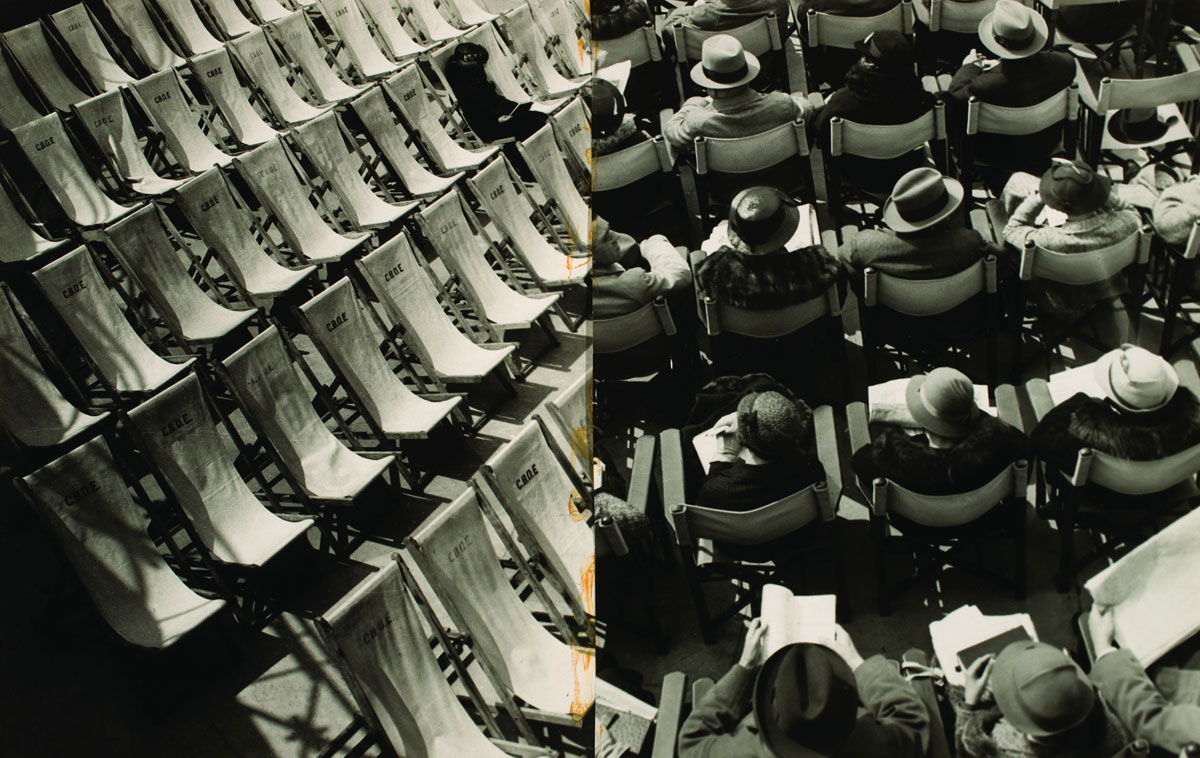
Jeu de Paume website

LIKE ART BLART ON FACEBOOK

Back to top

Exhibition: ‘Reading the modern photography book: changing perceptions’ at the National Gallery of Art, Washington

Exhibition dates: 18th January – 26th April, 2009


Looks a great exhibition for fans of photography books!

Many thankx to the National Gallery of Art, Washington for allowing me to publish the photographs in the posting. Please click on the photographs for a larger version of the image.


foto-auge (photo-eye), edited and with an introduction by Franz Roh, cover design by Jan Tschichold (Stuttgart: Akademischer Verlag, Dr. Fritz Wedekind & Co., 1929) from the exhibition 'Reading the modern photography book: changing perceptions' at the National Gallery of Art, Washington, Jan - April, 2009


foto-auge (photo-eye)
Edited and with an introduction by Franz Roh, cover design by Jan Tschichold
(Stuttgart: Akademischer Verlag, Dr. Fritz Wedekind & Co., 1929)


“Also produced in conjunction with Film und Foto, this book showcases a wide variety of photographic practices as a way of examining the social importance of the medium’s ability to construct visual knowledge.”


Held in conjunction with Looking In: Robert Frank’s “The Americans,” this exhibition examines a variety of artistic and thematic approaches to the modern photography book, displaying examples that span the period from the late 1920s to the early 1970s. The photography book, more than simply a book containing photographs, is a publication composed by the careful sequencing and editing of photographic material. Often produced by a photographer, they present visual narratives through creative page design that frequently integrates photographs with text and graphic elements.

This focus exhibition organises 21 books from the Gallery’s library into four themes: “New Visions,” “Documented Realities,” “Postwar Scenes,” and “Conceptual Practices.” It highlights diverse projects from individual photographers such as László Moholy-Nagy, Henri Cartier-Bresson, and Yasuhiro Ishimoto as well as collaborative projects from the Hungarian Work Circle (Munka Kör) and Andy Warhol’s Factory, revealing that the photography book is both a significant conveyer of contemporary experience and a witness to historical events.

The modern photography book, more than simply a book containing photographs, is a publication composed by the careful sequencing and editing of photographic material. Often produced by a photographer, these books present visual narratives through creative page design that frequently integrates photographs with text and graphic elements. Popular across the political spectrum, photography books have been published both as art objects and as documentary records. Through their organisation they foster a critical examination of the visual world, and as works of historical witness they have helped to construct cultural memories. Photography books have been a primary format for the arrangement and display of photographs, making them a vital but commonly overlooked component of the history of photography. Today they continue to provide an important forum for photographers to convey their work to a wide public audience.

Photographs have appeared in book format since their inception. For example, William Henry Fox Talbot’s commercially published The Pencil of Nature (1844) was one of the earliest explorations of photography’s narrative capabilities. Like all early photography books, Talbot’s photographs were printed separately from the letterpress text. It was not until the 1880s, with the development of the halftone plate and printing process, that mass-produced newspapers, magazines, and books regularly featured photographs. This invention, which allowed type and photographic images to be mechanically reproduced on the same press, dramatically changed the means by which the general public viewed and had access to photographs. By the 1920s the number of photographically illustrated publications had increased exponentially, and photographs regularly recounted events without explanatory text. As people began to see more and more photographs on a daily basis, they became far more visually literate. Set within this context, the modern mass-produced photography book challenged not only traditional narrative structures but also popular habits of reading and seeing.

Text from the National Gallery of Art website [Online] Cited 06/03/2009. No longer available online


Yasuhiro Ishimoto (Japanese-American, 1921-2012) 'Aruhi Arutokoro (Someday, Somewhere)' preface by Tsutomu Watanabe, design by Ryuuichi Yamashiro (Tokyo: Geibi Shuppan, 1958) from the exhibition 'Reading the modern photography book: changing perceptions' at the National Gallery of Art, Washington, Jan - April, 2009


Yasuhiro Ishimoto (Japanese-American, 1921-2012)
Aruhi Arutokoro (Someday, Somewhere)
Preface by Tsutomu Watanabe, design by Ryuuichi Yamashiro (Tokyo: Geibi Shuppan, 1958)


“This engaging publication juxtaposes photographs taken by Ishimoto in Chicago and Tokyo. Born in the United States, Ishimoto spent his childhood in Japan and later returned to the U.S. to attend school at the Institute of Design in Chicago. Finally settling in Tokyo, he influenced a new generation of postwar Japanese photographers interested in producing books.”


Henri Cartier-Bresson (French, 1908-2004) 'The Decisive Moment' (New York: Simon & Schuster, in collaboration with Éditions Verve, Paris, 1952)


Henri Cartier-Bresson (French, 1908-2004)
The Decisive Moment
(New York: Simon & Schuster, in collaboration with Éditions Verve, Paris, 1952)


“An important presentation of Cartier-Bresson’s photographs from the 1930s and 1940s, this large-format book helped to popularise his work, in which a distinctive documentary approach transforms ordinary moments into remarkable photographic visions.”


National Gallery of Art
National Mall between 3rd and 7th Streets
Constitution Avenue NW, Washington

Opening hours:
Daily 10.00am – 5.00pm

National Gallery of Art website

LIKE ART BLART ON FACEBOOK

Back to top