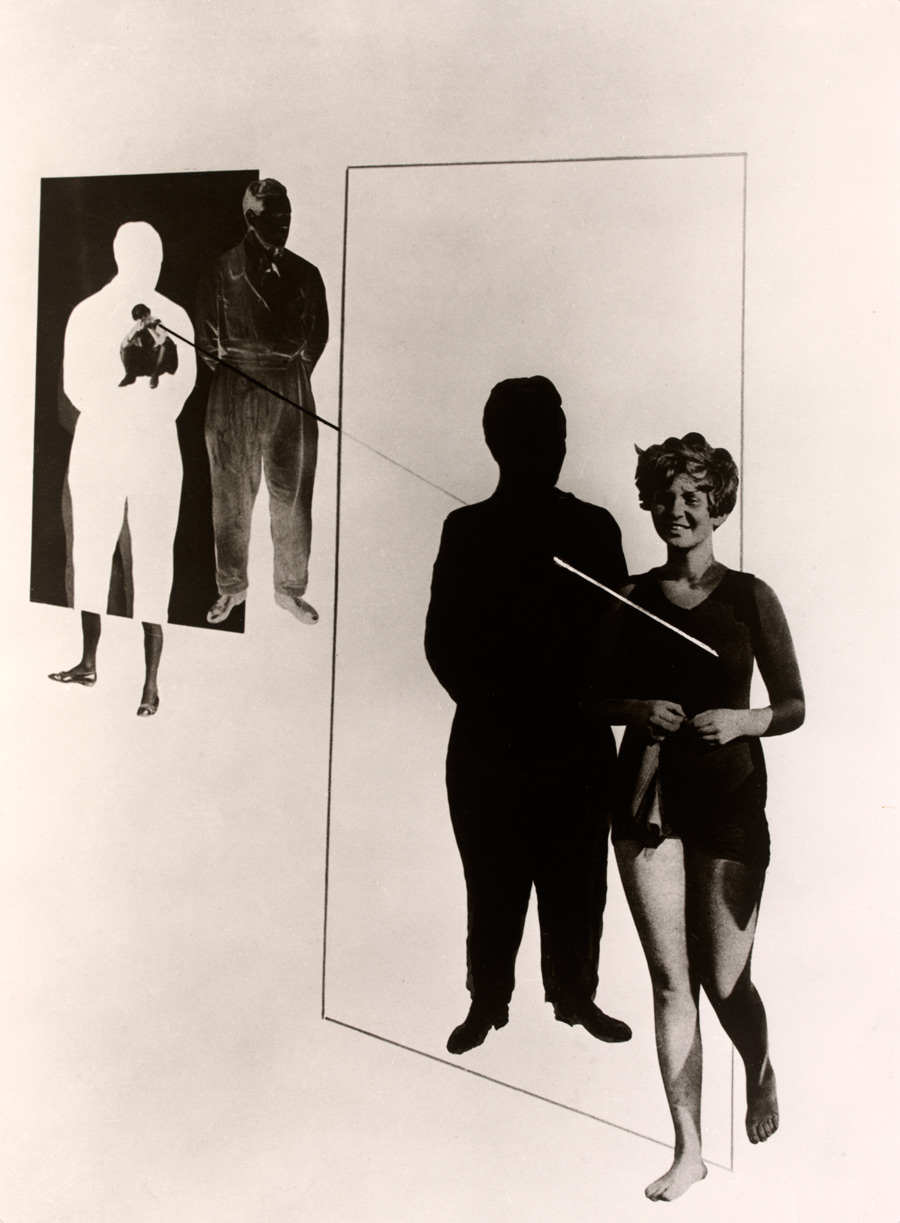
Exhibition: ‘One and One Is Four: The Bauhaus Photocollages of Josef Albers’ at The Museum of Modern Art (MoMA), New York

Exhibition dates: 23rd November, 2016 – 2nd April, 2017

Curators: Sarah Hermanson Meister, Curator in the Department of Photography and Nancy Newhall Curatorial Fellow, Department of Photography


Josef Albers (American born Germany, 1888-1976) 'El Lissitzky, Dessau' 1930/1932 from the exhibition 'One and One Is Four: The Bauhaus Photocollages of Josef Albers' at The Museum of Modern Art (MoMA), New York, Nov 2016 - April 2017


Josef Albers (American born Germany, 1888-1976)
El Lissitzky, Dessau
1930/1932
Gelatin silver prints mounted to board
11 5/8 × 16 3/8″ (29.5 × 41.6cm) overall
The Museum of Modern Art, New York
Acquired through the generosity of Jo Carole and Ronald S. Lauder, and Jon L. Stryker
© 2016 The Josef and Anni Albers Foundation / Artists Rights Society (ARS), New York
Photo: John Wronn


NEARLY A WEEK SINCE MY LAST POSTING SO LET’S MAKE THIS A GOOD ONE…

A fabulous posting on the photocollages of that most excellent of artists, Josef Albers, where the selection of images and their pairings “take on questions of duality, time, and narrative…” – to which I might add, questions of perspective and context. These photocollages are a revelation to me.

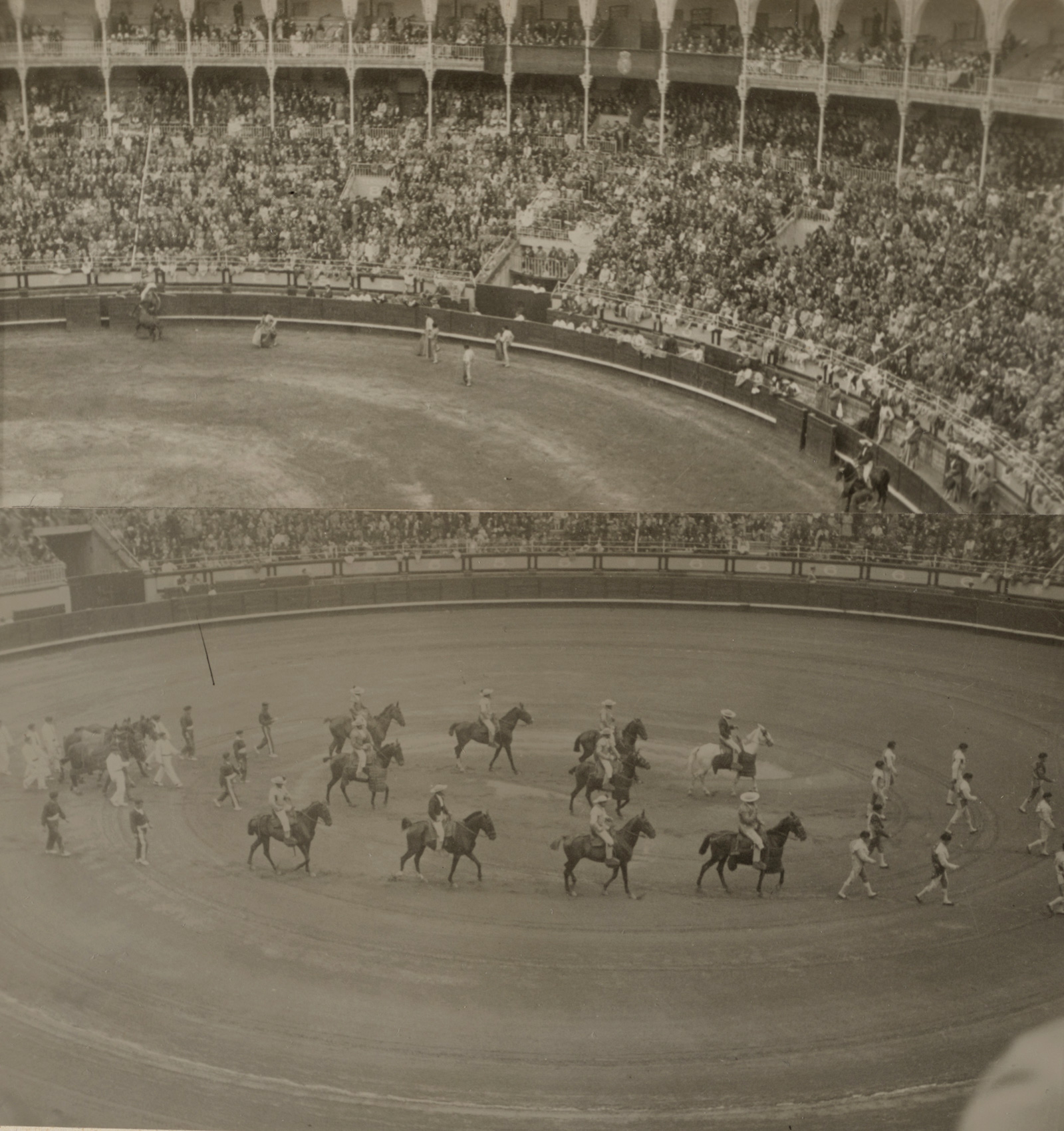
The complex photo narratives move image across time and space. This can be seen in the photomontage Untitled (Bullfight, San Sebastian) (1930/1932, below) where the multitude of photographs of a bullfight in San Sebastien, “can be read as a short story or experimental film, where we as viewers recognise that we are being transported to a distant time and place…”

Here the visual plane is fragmented, the scale mixed, shape, direction and space / time continuity confused. Structures are repeated; time is overlaid; perspective is shifted; narrative is multiplied. This is complex, New Vision image making, not just the downwards or upward looking objectivity of Russian constructivism, but a more nuanced splicing of time and space. The bullfight is magnificent in its “in the round” picturing … the splitting of the arena in the central images confuses direction, scale and circularity.

There are further “in the round” elements (mimicking Renaissance triple portrait painting such as Triple Portrait of Cardinal de Richelieu (1642) in the National Gallery of Art, London), seen in the work Amédée Ozenfant, summer 1931 (below) which, while objectifying the human countenance, contains that nugget of truth: that portraiture is an expression of humanism. Other photocollages, for example Road, Paznauntal, July 1930; Hotel staircases, Geneva, 1929 (with its Escher-like construction); Flooded trees and forest; and Dessau, end of winter, 1931 (all below), challenge our orientation in the world both physically and spiritually.

These photocollages, 70 of which were made between 1928 and 1932, were never discovered until after Albers was dead. No one ever knew he took photographs, but it was obviously important to him that he did so. Would he be able to say whether he was being serious, or he was having fun? Probably both. What a shame that they are often mutually exclusive in the last 30 -40 years.

It’s all very well to be able to say you are having fun – but what about being in this state (i.e. Albers state when he was compositing the photographs) and not even knowing … not even thinking of the question. Perhaps his was a private form of meditation on the nature of vision.

Dr Marcus Bunyan

(Written using dictation software, the rest all cut and paste)


Many thankx to MoMA for allowing me to publish the photographs in the posting. Please click on the photographs for a larger version of the image.


“Beginning at the Bauhaus in 1928, Albers made hundreds, perhaps thousands, of photographs with his handheld Leica camera, and he made thousands more, mostly while traveling, in the decades following his emigration to the United States in 1933. But we concern ourselves here with a group of seventy photocollages mounted to A3 boards, established as a standard size in Germany in 1922 at 29.7 by 42 centimetres (11 3/4 by 16 1/2 inches). No record exists of Albers ever having exhibited these collages in his lifetime, nor does he appear to have spoken of them. Yet in their rigorous construction and allusive potential, they represent a singularly creative body of work. The images Albers used to make these collages fall rather neatly into four categories – portraits, mannequins, the natural world, and the built environment – and Albers attends to a remarkably narrow subsection within each of these: The portraits feature only people Albers knew well – fellow Bauhäusler, family, and friends. The primary urban motif is the mannequin, which was also featured in the photographs of contemporaries such as Eugène Atget, Bill Brandt, Manuel Álvarez Bravo, Horacio Coppola, and scores of others who were attentive to the figures’ Surrealist echoes. His images of nature consist of mostly waves, some trees, and a few mountains, and there are only a handful of man-made structures. Albers’s limited range of subjects achieves new significance in his collages, where their selection and pairings take on questions of duality, time, and narrative, topics that resist being infused into single images of similar subjects.”


Sarah Hermanson Meister. “Josef Albers: An Open Mind for the Newer and Nearer,” from One and One Is Four: The Bauhaus Photocollages of Josef Albers, Museum of Modern Art, New York, 2016, pp. 11-12.


“The abstract language that Albers adopted for the great majority of his oeuvre precludes temporal specificity, which makes the close study of a number of his photocollages all the more compelling, specifically in Albers’s attentiveness to the complexity engendered by incorporating multiple photographs – each captured in a fraction of a second, but inevitably across time – into a single work.”


Sarah Hermanson Meister. “Josef Albers: An Open Mind for the Newer and Nearer,” from One and One Is Four: The Bauhaus Photocollages of Josef Albers, Museum of Modern Art, New York, 2016, p. 15.


“The image on the left shows Lissitzky smiling warmly, almost conspiratorially, at Albers. The background divides neatly into three tones – black, white, and gray – each of which corresponds loosely to Lissitzky’s (black) tie, (white) shirt, and the middle shades of the photographic spectrum that echo Lissitzky’s tanned complexion and balding pate. The horizontal image on the right is the same width but half the height of the vertical image, and in it we see Lissitzky almost in profile, looking toward his other likeness. This time the asymmetry of his placement within the frame is even more pronounced: his nose is cropped by the left edge, his forehead by the top, but the right half of the image is virtually empty. While we feel confident that these photographs were captured at the same meeting, the darker background in the right-hand image and the differentiation between Lissitzky’s shirt and collar (which, on the left, seem identical) remind the viewer of the variability of photographic representation. Albers mounted these prints with their top edges roughly aligned and with nearly equivalent space between their outside edges and the sides of the board: there is no evident rhyme or reason in the interstitial spaces. This irregularity draws the viewer’s attention to the geometric forms within each image and to the prints themselves, which might be construed as Albers’s nod to the dynamic geometric vocabulary that Lissitzky employed in his own art and design.”

Sarah Hermanson Meister. “Josef Albers: An Open Mind for the Newer and Nearer,” from One and One Is Four: The Bauhaus Photocollages of Josef Albers, Museum of Modern Art, New York, 2016, pp. 13-14.


Josef Albers (American born Germany, 1888-1976) 'El Lissitzky, Dessau' 1930/1932 (detail)


Josef Albers (American born Germany, 1888-1976)
El Lissitzky, Dessau (detail)
1930/1932
Gelatin silver prints mounted to board
11 5/8 × 16 3/8″ (29.5 × 41.6cm) overall
The Museum of Modern Art, New York
Acquired through the generosity of Jo Carole and Ronald S. Lauder, and Jon L. Stryker
© 2016 The Josef and Anni Albers Foundation / Artists Rights Society (ARS), New York
Photo: John Wronn


Josef Albers (American born Germany, 1888-1976) 'Untitled (Bullfight, San Sebastian)' 1930/1932 from the exhibition 'One and One Is Four: The Bauhaus Photocollages of Josef Albers' at The Museum of Modern Art (MoMA), New York, Nov 2016 - April 2017


Josef Albers (American born Germany, 1888-1976)
Untitled (Bullfight, San Sebastian)
1930/1932
Gelatin silver prints mounted to board
11 5/8 × 16 3/8″ (29.5 × 41.6cm) overall
The Museum of Modern Art, New York
Acquired through the generosity of Jo Carole and Ronald S. Lauder, and Jon L. Stryker
© 2016 The Josef and Anni Albers Foundation / Artists Rights Society (ARS), New York
Photo: John Wronn


“Nowhere does Albers change the rules of the game more profoundly than in his collages that feature a multitude of photographs. His collage of a bullfight in San Sebastian can be read as a short story or experimental film, where we as viewers recognise that we are being transported to a distant time and place, no less enchanting for its impossibility.

At the centre we find the nominal subject: a procession of banderilleros, picadors, and matadors. Surrounding this are three views of the arena filled with crowds, whose choreographed disjunction evokes the rhythm of the event they are gathered to see. The sweep of the arcade is plainly elevated in the central view, with a nearly symmetrical relationship to those architectural forms on the left and right, whereas the cropped edge of the ring awkwardly intersects its corresponding form, an oblique allusion, perhaps, to the impossibility of predicting the outcome of this highly ritualised event. The two images that anchor the bottom of the collage show more dramatic vantage points. A plethora of boater hats, caps, and a scattering of bare heads, each precisely described, is juxtaposed against a mass of automobiles presumably parked outside. These horizonless seas of repeated forms were common motifs for avant-garde photographers of the period. It is the tightly woven – but not flawless – relationships between these individual components, akin to cuts in a film, that reward our reconsideration of these elements with respect to the whole.”

Sarah Hermanson Meister. “Josef Albers: An Open Mind for the Newer and Nearer,” from One and One Is Four: The Bauhaus Photocollages of Josef Albers, Museum of Modern Art, New York, 2016, pp. 14-15.
 

Josef Albers (American born Germany, 1888-1976) 'Untitled (Bullfight, San Sebastian)' 1930/1932 (detail)

Josef Albers (American born Germany, 1888-1976) 'Untitled (Bullfight, San Sebastian)' 1930/1932 (detail)


Josef Albers (American born Germany, 1888-1976)
Untitled (Bullfight, San Sebastian) (details)
1930/1932
Gelatin silver prints mounted to board
11 5/8 × 16 3/8″ (29.5 × 41.6cm) overall
The Museum of Modern Art, New York
Acquired through the generosity of Jo Carole and Ronald S. Lauder, and Jon L. Stryker
© 2016 The Josef and Anni Albers Foundation / Artists Rights Society (ARS), New York
Photo: John Wronn


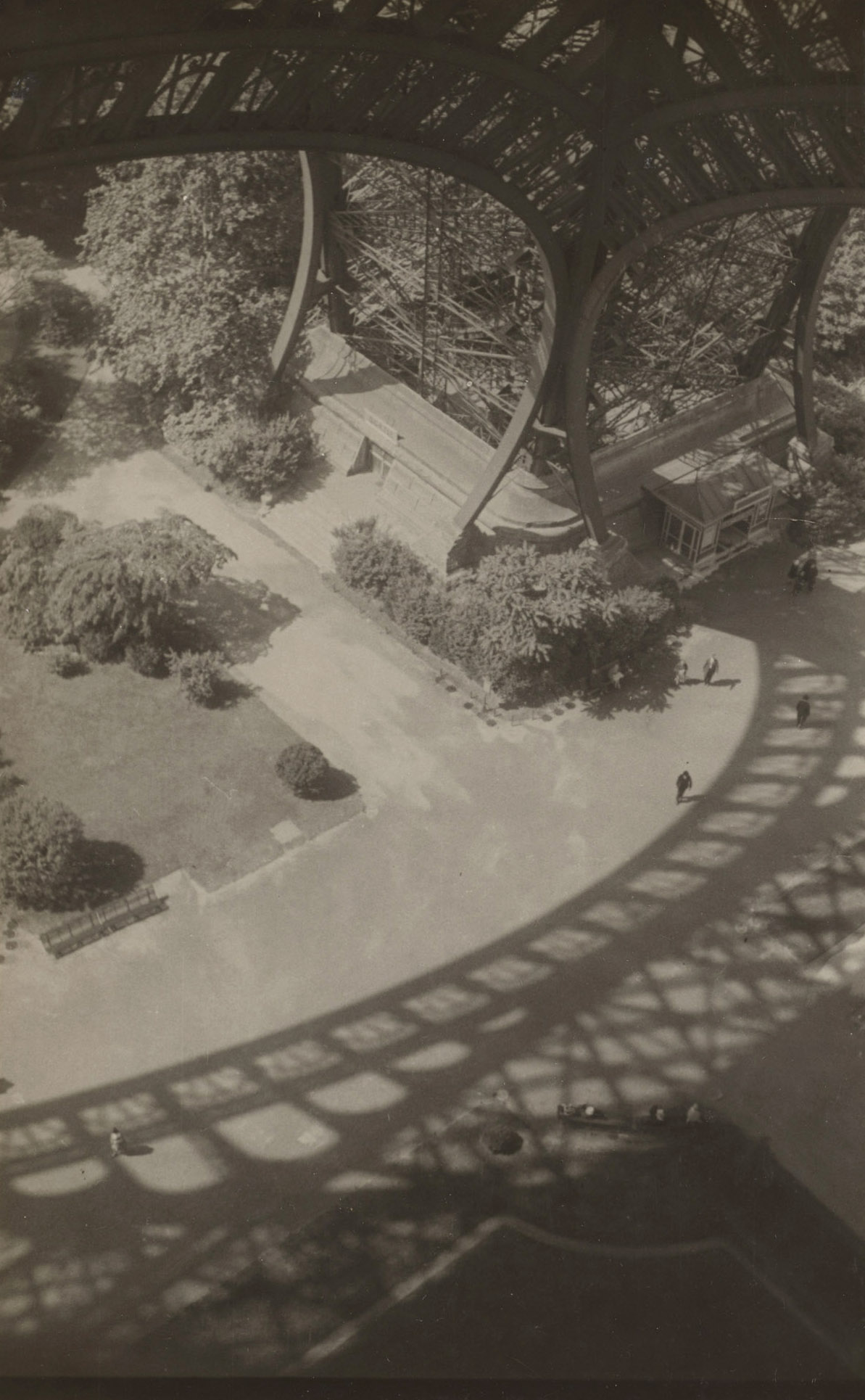
Josef Albers (American born Germany, 1888-1976) 'Paris, Eiffel Tower' 1929/1932


Josef Albers (American born Germany, 1888-1976)
Paris, Eiffel Tower
1929/1932
Gelatin silver prints mounted to board
11 5/8 × 16 3/8″ (29.5 × 41.6cm) overall
The Museum of Modern Art, New York
Acquired through the generosity of Jo Carole and Ronald S. Lauder, and Jon L. Stryker
© 2016 The Josef and Anni Albers Foundation / Artists Rights Society (ARS), New York
Photo: John Wronn


“Of the seventy photocollages Albers made at this time, more than half feature but two photographic prints: their placement reveals both formal innovation and a sensitivity to the unique characteristics of the individual photographs. Albers’s photographs of the Eiffel Tower, made during a summer break from teaching, suggest his attentiveness to the range of possibilities offered by his Leica, and the close relationship between his work and that of his contemporaries. Both images in his collage feature plunging perspectives; the sunlight and shadow in the image on the left draw our attention to the diminutive figures below. Albers was not a particularly fastidious printer, yet he was surely attuned to the fact that every tone in the photograph on the right exists on the continuum of tones between the highlights and shadows on the left. Lest the viewer suspect that these are purely mechanical byproducts of the process, Albers trims each image with a subtly but noticeably irregular hand, underscoring the artist’s creative agency. This marriage of industry and craft was a hallmark of the Bauhaus. To further emphasise the aesthetic, non-documentary function of these photographs, Albers anchors them at the top left of his board, pointedly shifting the viewer’s perspective.”

Sarah Hermanson Meister. “Josef Albers: An Open Mind for the Newer and Nearer,” from One and One Is Four: The Bauhaus Photocollages of Josef Albers, Museum of Modern Art, New York, 2016, p. 14.
 

Josef Albers (American born Germany, 1888-1976) 'Paris, Eiffel Tower' 1929/1932 (detail)


Josef Albers (American born Germany, 1888-1976)
Paris, Eiffel Tower (detail)
1929/1932
Gelatin silver prints mounted to board
11 5/8 × 16 3/8″ (29.5 × 41.6cm) overall
The Museum of Modern Art, New York
Acquired through the generosity of Jo Carole and Ronald S. Lauder, and Jon L. Stryker
© 2016 The Josef and Anni Albers Foundation / Artists Rights Society (ARS), New York
Photo: John Wronn
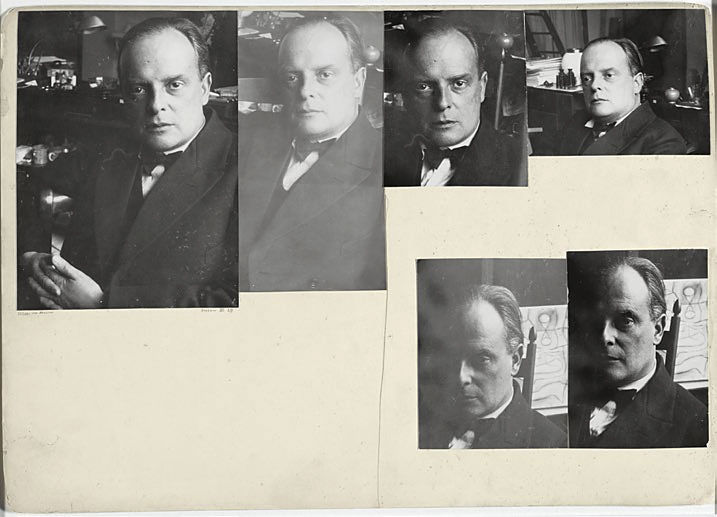
 

Josef Albers (American born Germany, 1888-1976) 'Paul Klee in his studio, Dessau, November 1929'


Josef Albers (American born Germany, 1888-1976)
Paul Klee in his studio, Dessau, November 1929
November 1929
Gelatin silver prints mounted to board
11 5/8 × 16 3/8″ (29.5 × 41.6cm) overall
The Museum of Modern Art, New York
Acquired through the generosity of Jo Carole and Ronald S. Lauder, and Jon L. Stryker, 2015
© 2016 The Josef and Anni Albers Foundation / Artists Rights Society (ARS), New York
Photo: John Wronn


Josef Albers (American born Germany, 1888-1976). 'Paul Klee, Dessau, November 1929' 1929/1932


Josef Albers (American born Germany, 1888-1976)
Paul Klee, Dessau, November 1929
1929/1932
Gelatin silver prints mounted to board
11 11/16 x 16 7/16″ (29.7 x 41.8cm) overall
The Museum of Modern Art, New York
Gift of The Josef and Anni Albers Foundation
© 2016 The Josef and Anni Albers Foundation / Artists Rights Society (ARS), New York
Photo: John Wronn
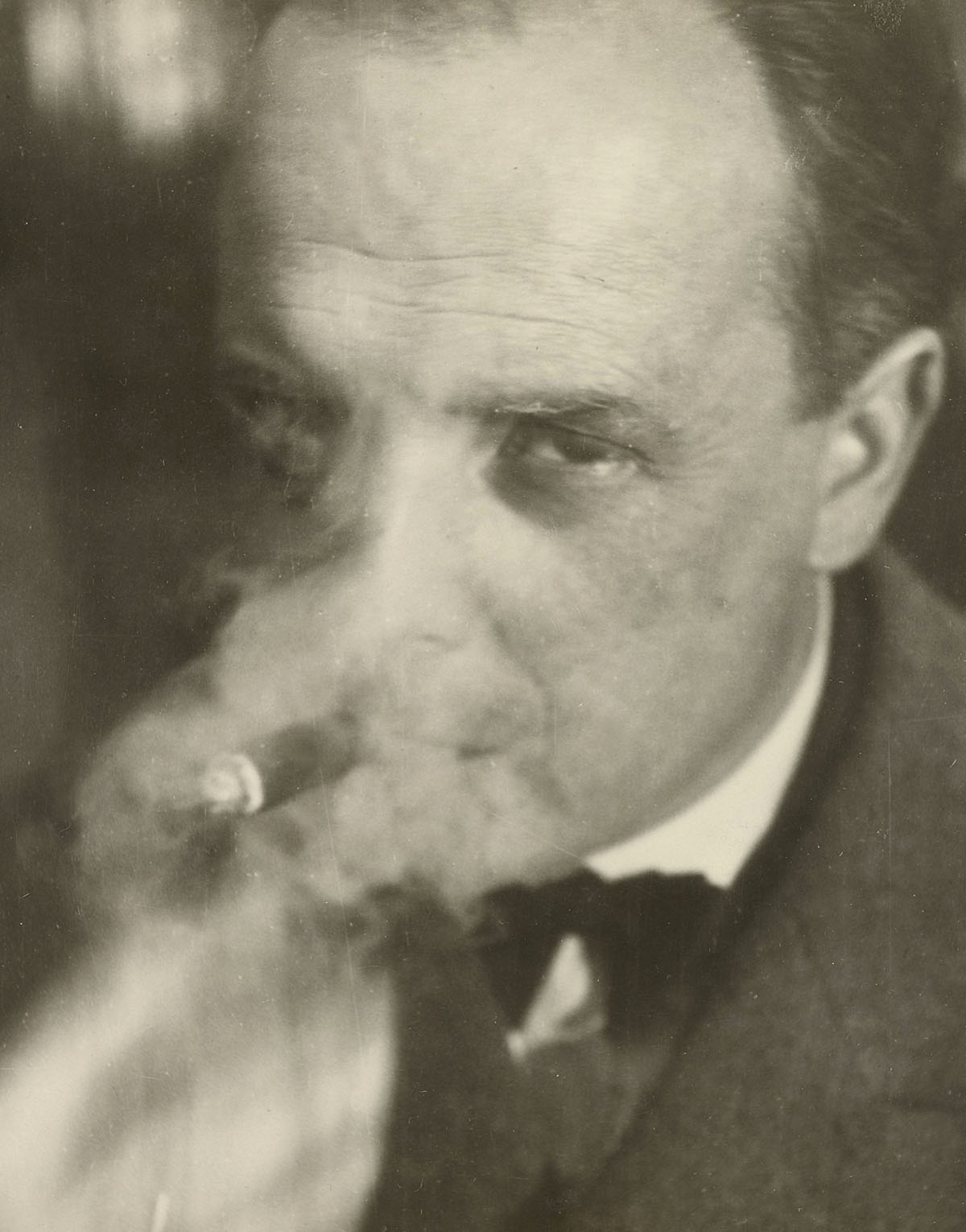
 

Josef Albers (American born Germany, 1888-1976). 'Paul Klee, Dessau' 1929/1932 (detail)


Josef Albers (American born Germany, 1888-1976)
Paul Klee, Dessau, November 1929 (detail)
1929/1932
Gelatin silver prints mounted to board
11 11/16 x 16 7/16″ (29.7 x 41.8cm) overall
The Museum of Modern Art, New York
Gift of The Josef and Anni Albers Foundation
© 2016 The Josef and Anni Albers Foundation / Artists Rights Society (ARS), New York
Photo: John Wronn


Josef Albers (American born Germany, 1888-1976) 'Amédée Ozenfant, summer 1931'


Josef Albers (American born Germany, 1888-1976)
Amédée Ozenfant, summer 1931
1931
Gelatin silver prints mounted to board
11 5/8 × 16 3/8″ (29.5 × 41.6cm) overall
The Museum of Modern Art, New York
© 2016 The Josef and Anni Albers Foundation / Artists Rights Society (ARS), New York
Photo: John Wronn


Josef Albers (American born Germany, 1888-1976) 'Vasily Kandinsky, master on the terrace at Hannes Meyer’s, spring 1929; May 1930'


Josef Albers (American born Germany, 1888-1976)
Vasily Kandinsky, master on the terrace at Hannes Meyer’s, spring 1929; May 1930
1929/1930
Gelatin silver prints mounted to board
11 5/8 × 16 3/8″ (29.5 × 41.6cm) overall
The Museum of Modern Art, New York
© 2016 The Josef and Anni Albers Foundation / Artists Rights Society (ARS), New York
Photo: John Wronn


Josef Albers (American born Germany, 1888-1976). 'Marli Heimann, All During an Hour' 1931/1932


Josef Albers (American born Germany, 1888-1976)
Marli Heimann, All During an Hour
1931/1932
Gelatin silver prints mounted to board
11 11/16 x 16 7/16″ (29.7 x 41.8cm) overall
The Museum of Modern Art, New York
Gift of The Josef and Anni Albers Foundation, 1988
© 2016 The Josef and Anni Albers Foundation / Artists Rights Society (ARS), New York
Photo: John Wronn


Josef Albers (American born Germany, 1888-1976) 'Oskar Schlemmer, April 1929; Schlemmer in the Bauhaus Masters' Council, 1928; Schlemmer with Hans Wittwer, Ernst Kállai, and Marianne Brandt, Preliminary Course Exhibition, 1927/28; Schlemmer and Tut, summer 1928; Schlemmer, April 1930; Schlemmer, 1928' 1927/1929


Josef Albers (American born Germany, 1888-1976)
Oskar Schlemmer, April 1929; Schlemmer in the Bauhaus Masters’ Council, 1928; Schlemmer with Hans Wittwer, Ernst Kállai, and Marianne Brandt, Preliminary Course Exhibition, 1927/28; Schlemmer and Tut, summer 1928; Schlemmer, April 1930; Schlemmer, 1928
1927/1929
Gelatin silver prints mounted on board
11 5/8 × 16 3/8″ (29.5 × 41.6cm) overall
Acquired through the generosity of Jo Carole and Ronald S. Lauder, and Jon L. Stryker
© 2016 The Josef and Anni Albers Foundation / Artists Rights Society (ARS), New York
Photo: John Wronn


Josef Albers (American born Germany, 1888-1976) 'Oskar Schlemmer, April 1929; Schlemmer in the Bauhaus Masters' Council, 1928; Schlemmer with Hans Wittwer, Ernst Kállai, and Marianne Brandt, Preliminary Course Exhibition, 1927/28; Schlemmer and Tut, summer 1928; Schlemmer, April 1930; Schlemmer, 1928' 1927/1929 (detail)


Josef Albers (American born Germany, 1888-1976)
Oskar Schlemmer, April 1929; Schlemmer in the Bauhaus Masters’ Council, 1928; Schlemmer with Hans Wittwer, Ernst Kállai, and Marianne Brandt, Preliminary Course Exhibition, 1927/28; Schlemmer and Tut, summer 1928; Schlemmer, April 1930; Schlemmer, 1928 (detail)
1927/1929
Gelatin silver prints mounted on board
11 5/8 × 16 3/8″ (29.5 × 41.6cm) overall
Acquired through the generosity of Jo Carole and Ronald S. Lauder, and Jon L. Stryker
© 2016 The Josef and Anni Albers Foundation / Artists Rights Society (ARS), New York
Photo: John Wronn


Josef Albers (American, born Germany, 1888-1976) is a central figure in 20th-century art, both as a practitioner and as a teacher at the Bauhaus, Black Mountain College, and Yale University. Best known for his iconic series Homages to the Square, Albers made paintings, drawings, and prints and designed furniture and typography. The least familiar aspect of his extraordinary career is his inventive engagement with photography, which was only discovered after his death. The highlight of this work is undoubtedly the photocollages featuring photographs he made at the Bauhaus between 1928 and 1932. At once expansive and restrained, this remarkable body of work anticipates concerns that Albers would pursue throughout his career: seriality, perception, and the relationship between handcraft and mechanical production.

The first serious exploration of Albers’s photographic practice occurred in a modest exhibition at MoMA in 1988, The Photographs of Josef Albers. In 2015, the Museum acquired 10 photocollages by Albers – adding to the two donated by the Josef and Anni Albers Foundation almost three decades ago – making its collection the most significant anywhere outside the Foundation. This installation celebrates both this landmark acquisition and the publication of One and One Is Four: The Bauhaus Photocollages of Josef Albers, which focuses exclusively on this deeply personal and inventive aspect of Albers’s work and makes many of these photocollages available for the first time.

Book

The Museum of Modern Art announces the release of One and One Is Four: The Bauhaus Photocollages of Josef Albers, the first publication to reproduce all 70 photocollages created by Josef Albers at the Bauhaus using photographs he made between 1928 and 1932. Hailed in his own lifetime as among the most important figures of 20th-century art, both as a practitioner and as a teacher at the Bauhaus, Black Mountain College, and Yale University, Albers (1888-1976) achieved widespread acclaim across a range of mediums, from glassworks and furniture design to printmaking and painting. Yet Albers’s engagement with modernist photography remained largely hidden until after his death, and it is only now that the entire series of unique photocollages the artist produced at the famed art school – before he and his wife fled Nazi Germany for the US – has been published together, many for the first time. At once expansive and restrained, this remarkable body of work anticipates concerns that Albers would pursue throughout his career: seriality, perception, and the relationship between handcraft and mechanical production.

One and One Is Four reveals an Albers at once familiar and unexpected – playful yet disciplined, personal yet enigmatic – through a body of work whose genius becomes fully apparent when considered as a whole. “Albers’s photocollages stand as remarkable contributions to the medium in their own right,” explains Sarah Hermanson Meister, Curator in the Department of Photography and the author of the book, “while they anticipate in important ways key concerns that would animate the artist’s work throughout his career, including his iconic Homages to the Square.” An essay by art historian and Bauhaus scholar Elizabeth Otto underscores the originality of Albers’s achievement through a survey of photocollages by Albers’s fellow Bauhäusler, and a contribution by MoMA conservator Lee Ann Daffner examines the artist’s materials to suggest new insights into these works, the discovery of which has been celebrated as one of the great art finds of the past century. The publication also includes a transcription of a lecture delivered by Albers at Black Mountain College in February 1943 titled “Photos as Photography and Photos as Art” – Albers’s sole public statement about the medium – and a preface by Nicholas Fox Weber, Executive Director of The Josef and Anni Albers Foundation.

The first serious exploration of Albers’s photographic practice occurred in a modest exhibition of 38 photographs organised by John Szarkowski at MoMA in 1988, The Photographs of Josef Albers. At the time, the Josef and Anni Albers Foundation donated two photocollages to the Museum. In 2015, the Museum acquired 10 additional photocollages by Albers, making its collection the most significant anywhere outside the Foundation. A new installation featuring 16 photocollages, on view from November 23, 2016, through April 2, 2017, in the Museum’s fifth-floor galleries, celebrates both the publication and this landmark acquisition. The exhibition is organised by Sarah Meister with Kristen Gaylord, Beaumont and Nancy Newhall Curatorial Fellow, Department of Photography. The exhibition is supported by the Annual Exhibition Fund.

Press release from MoMA
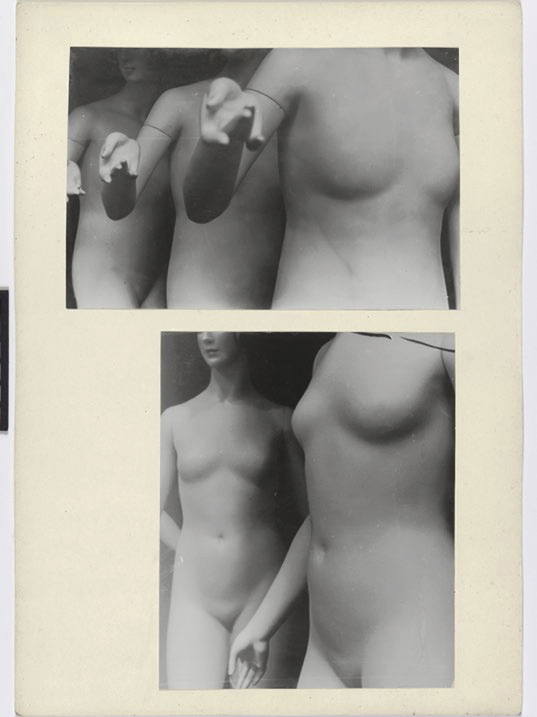
 

Josef Albers (American born Germany, 1888-1976) 'Mannequins' c. 1930


Josef Albers (American born Germany, 1888-1976)
Mannequins
c. 1930
Gelatin silver prints mounted to board
16 3/8 x 11 5/8″ (41.6 x 29.5cm) overall
The Museum of Modern Art, New York
© 2016 The Josef and Anni Albers Foundation / Artists Rights Society (ARS), New York
Photo: John Wronn
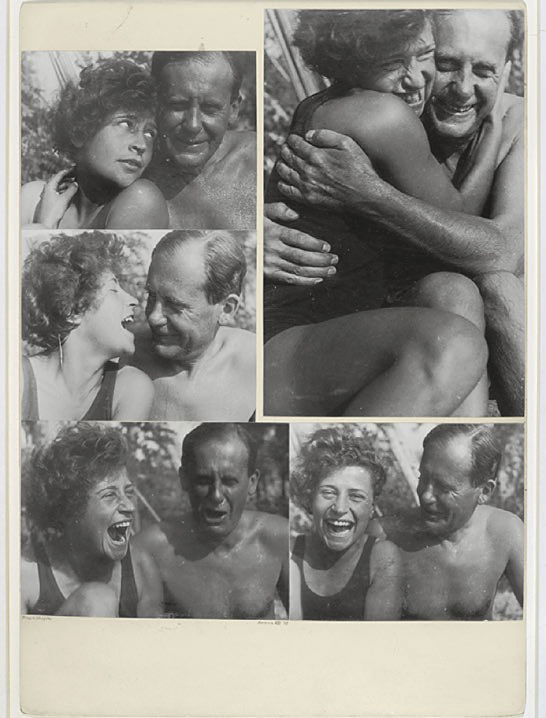
 

Josef Albers (American born Germany, 1888-1976) 'Walter Gropius and Schifra Canavesi, Ascona August 1930'


Josef Albers (American born Germany, 1888-1976)
Walter Gropius and Schifra Canavesi, Ascona, August 1930
August 1930
Gelatin silver prints mounted to board
16 3/8 x 11 5/8″ (41.6 x 29.5cm) overall
The Museum of Modern Art, New York
© 2016 The Josef and Anni Albers Foundation / Artists Rights Society (ARS), New York
Photo: John Wronn
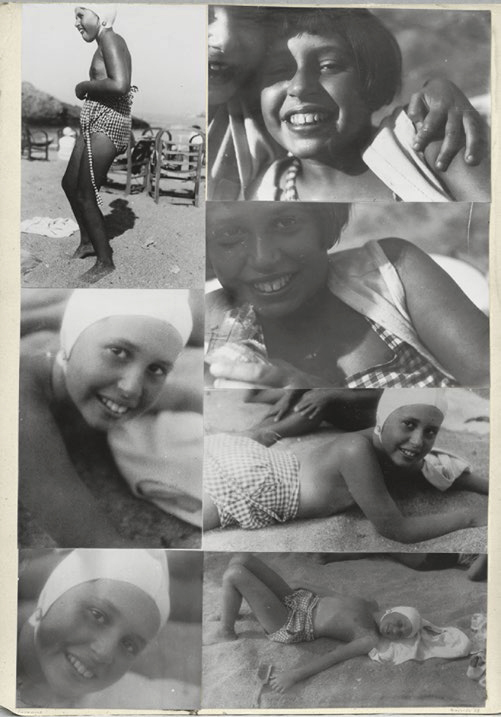
 

Josef Albers (American born Germany, 1888-1976) 'Susanne, Biarritz, August 1929'


Josef Albers (American born Germany, 1888-1976)
Susanne, Biarritz, August 1929
August 1929
Gelatin silver prints mounted to board
16 3/8 x 11 5/8″ (41.6 x 29.5cm) overall
The Museum of Modern Art, New York
© 2016 The Josef and Anni Albers Foundation / Artists Rights Society (ARS), New York
Photo: John Wronn


Josef Albers (American born Germany, 1888-1976) 'Mrs. Lewandowski of Munich, Ascona, August 1930'


Josef Albers (American born Germany, 1888-1976)
Mrs. Lewandowski of Munich, Ascona, August 1930
August 1930
Gelatin silver prints mounted to board
16 3/8 x 11 5/8″ (41.6 x 29.5cm) overall
The Museum of Modern Art, New York
© 2016 The Josef and Anni Albers Foundation / Artists Rights Society (ARS), New York
Photo: John Wronn
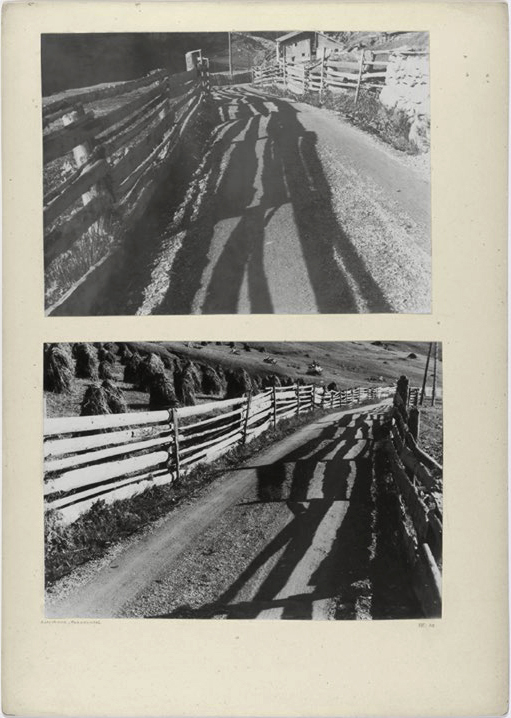
 

Josef Albers (American born Germany, 1888-1976) 'Road, Paznauntal, July 1930'


Josef Albers (American born Germany, 1888-1976)
Road, Paznauntal, July 1930
July 1930
Gelatin silver prints mounted to board
16 3/8 x 11 5/8″ (41.6 x 29.5cm) overall
The Museum of Modern Art, New York
© 2016 The Josef and Anni Albers Foundation / Artists Rights Society (ARS), New York
Photo: John Wronn


Josef Albers (American born Germany, 1888-1976) 'Hotel staircases, Geneva, 1929'


Josef Albers (American born Germany, 1888-1976)
Hotel staircases, Geneva, 1929
1929
Gelatin silver prints mounted to board
11 5/8 × 16 3/8″ (29.5 × 41.6cm) overall
The Museum of Modern Art, New York
Acquired through the generosity of Jo Carole and Ronald S. Lauder, and Jon L. Stryker, 2015
© 2016 The Josef and Anni Albers Foundation / Artists Rights Society (ARS), New York
Photo: John Wronn
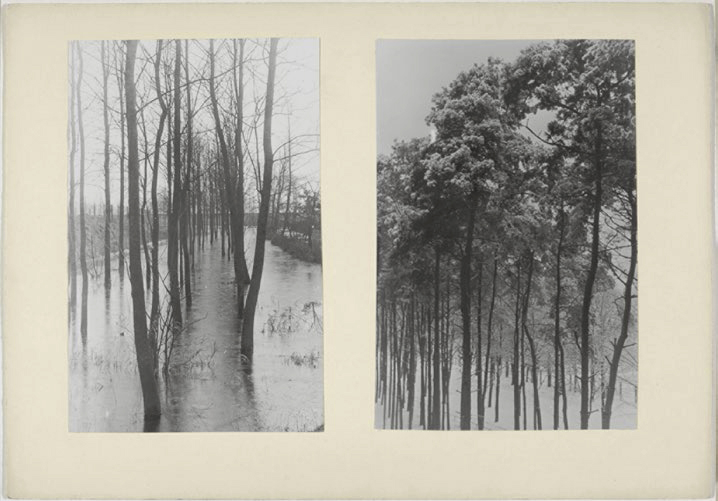
 

Josef Albers (American born Germany, 1888-1976) 'Flooded trees and forest' c. 1931


Josef Albers (American born Germany, 1888-1976)
Flooded trees and forest
c. 1931
Gelatin silver prints mounted to board
11 5/8 × 16 3/8″ (29.5 × 41.6cm) overall
The Museum of Modern Art, New York
© 2016 The Josef and Anni Albers Foundation / Artists Rights Society (ARS), New York
Photo: John Wronn


Josef Albers (American born Germany, 1888-1976) 'Dessau, end of winter, 1931'


Josef Albers (American born Germany, 1888-1976)
Dessau, end of winter, 1931
1931
Gelatin silver prints mounted to board
11 5/8 × 16 3/8″ (29.5 × 41.6cm) overall
The Museum of Modern Art, New York
Acquired through the generosity of Jo Carole and Ronald S. Lauder, and Jon L. Stryker, 2015
© 2016 The Josef and Anni Albers Foundation / Artists Rights Society (ARS), New York
Photo: John Wronn


Josef Albers (American born Germany, 1888-1976) 'Brackish water, Biarritz, August 1929'


Josef Albers (American born Germany, 1888-1976)
Brackish water, Biarritz, August 1929
August 1929
Gelatin silver prints mounted to board
11 5/8 × 16 3/8″ (29.5 × 41.6cm) overall
The Museum of Modern Art, New York
© 2016 The Josef and Anni Albers Foundation / Artists Rights Society (ARS), New York
Photo: John Wronn
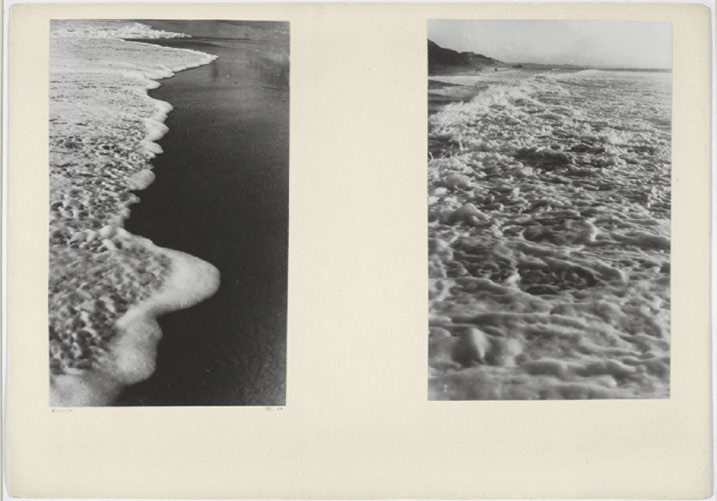
 

Josef Albers (American born Germany, 1888-1976) 'Biarritz, August 1929'


Josef Albers (American born Germany, 1888-1976)
Biarritz, August 1929
August 1929
Gelatin silver prints mounted to board
11 5/8 × 16 3/8″ (29.5 × 41.6cm) overall
The Museum of Modern Art, New York
Acquired through the generosity of Jo Carole and Ronald S. Lauder, and Jon L. Stryker, 2015
© 2016 The Josef and Anni Albers Foundation / Artists Rights Society (ARS), New York
Photo: John Wronn


The Museum of Modern Art
11 West 53 Street
New York, NY 10019
Phone: (212) 708-9400

Opening hours:
10.30am – 5.30pm
Open seven days a week
MoMA website

LIKE ART BLART ON FACEBOOK

Back to top

Exhibition: ‘Edith Tudor-Hart: In the Shadow of Tyranny’ at the Scottish National Portrait Gallery, Edinburgh

Exhibition dates: 2nd March – 26th May 2013


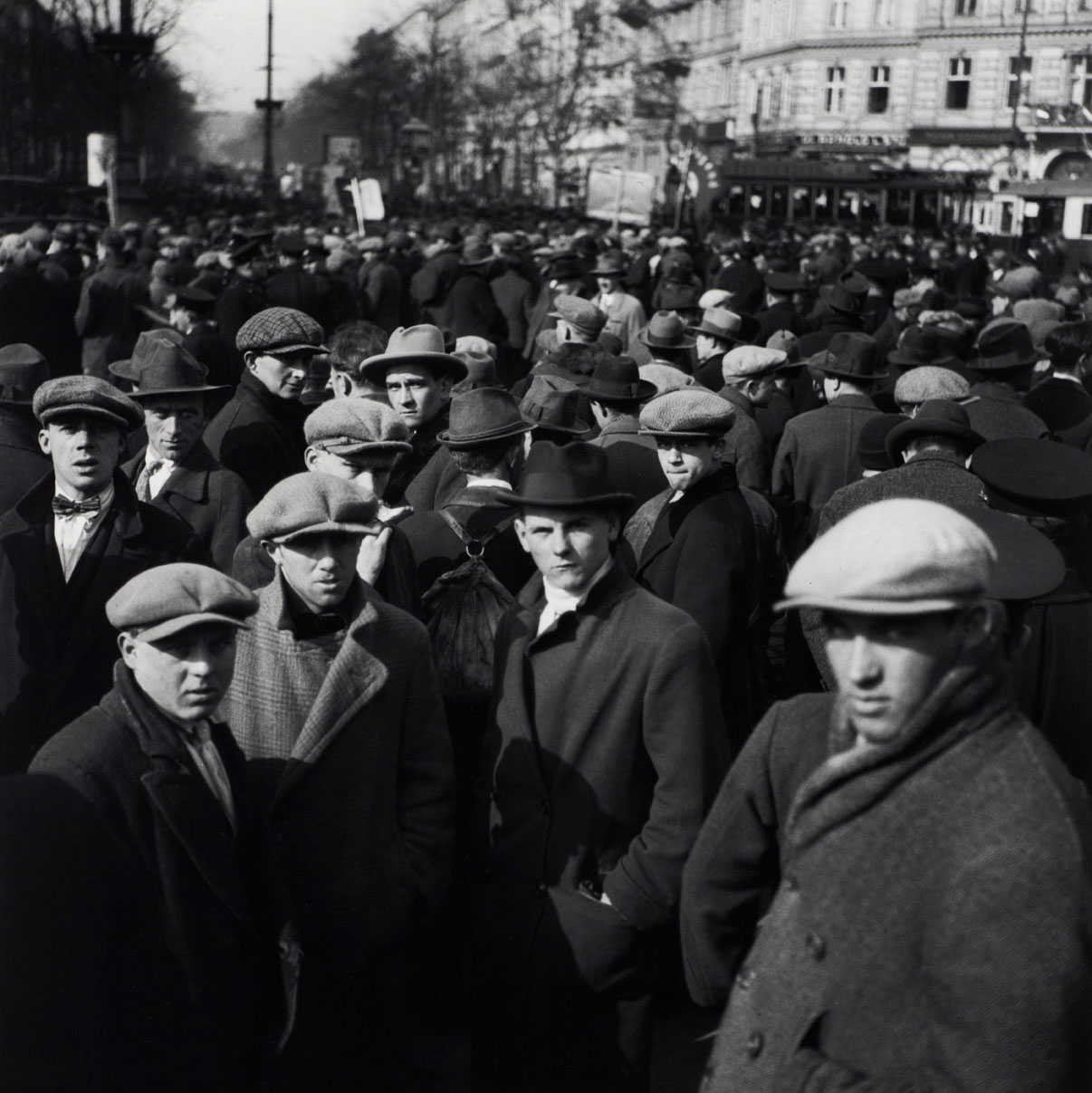
Edith Tudor-Hart (Austrian-British, 1908-1973) 'Untitled (Unemployed Workers' Demonstration, Vienna)' 1932


Edith Tudor-Hart (Austrian-British, 1908-1973)
Untitled (Unemployed Workers’ Demonstration, Vienna)
1932
Modern silver gelatine print from archival negative
30.3 x 30cm
Scottish National Portrait Gallery: Archive presented by Wolfgang Suschitzky 2004
© The Estate of Edith Tudor-Hart


Another photographer unknown to me, who “attempted to use the camera as a political weapon, aligning her practice with the wider worker photography movement” and produced “images that show a sophisticated realism, marked by their directness and capacity to communicate issues of inequality and deprivation.” In other words she was using photography to fight the good fight, producing photographs that interrogate issues of poverty, unemployment and slum housing.

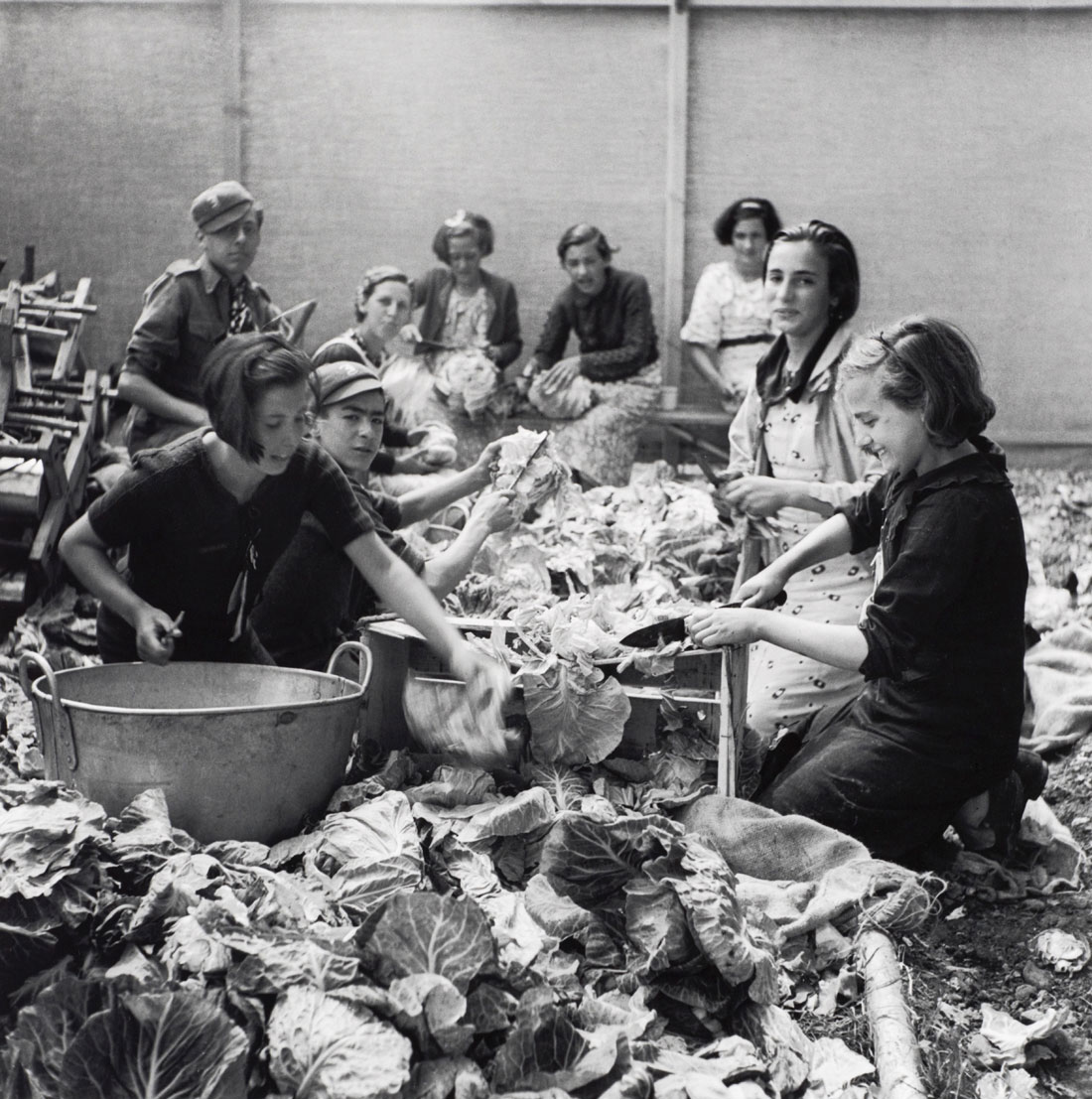
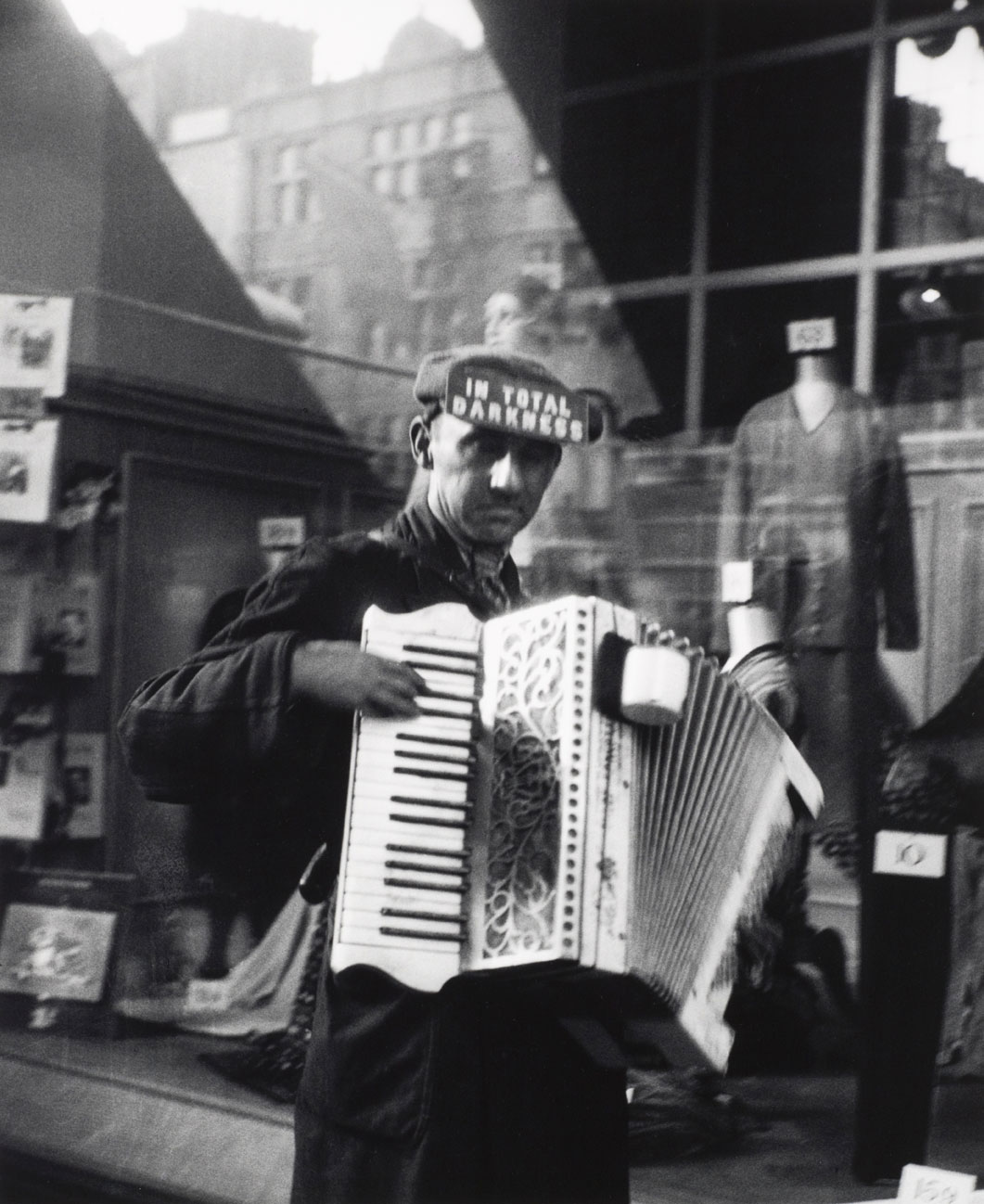
But there is more to Tudor-Hart’s photographs than just social realism otherwise they would not hold us so. Beyond a perceptive understanding of light and the formal elements of the picture plane there is that ineffable something that a good photographer always has – the ability to transcend the scene, to capture the chance encounter – be it the look on a woman’s face, the ensemble of children preparing vegetables or the untitled man ‘In Total Darkness’ (with traces of Eugene Atget). The aesthetic of engagement, the ability of her photographs to speak directly to the viewer in a vital, dynamic way, also speaks to the life of the photographer: studied at the Bauhaus, an agent for the Communist party, I would have liked to have met this artist.

Dr Marcus Bunyan


Many thankx to the Scottish National Portrait Gallery for allowing me to publish the photographs in the posting. Please click on the photographs for a larger version of the image.


Edith Tudor-Hart (Austrian-British, 1908-1973) 'Demonstration, South Wales' 1935


Edith Tudor-Hart (Austrian-British, 1908-1973)
Demonstration, South Wales
1935
Printed 2004 from original negatives held in the Edith Tudor Hart Archive
Gelatin silver print
Framed: 50.80 x 40.64cm
© The Estate of Edith Tudor-Hart


Edith Tudor Hart was in South Wales in the 1930s following her husband’s appointment as a GP there. As communists they would have sympathised with the economic hardship of the miners in the Rhondda valley. During the industrial depression following the First World War, unemployment figures in the area soared. With the help of other unions, the National Unemployed Workers’ Movement (NUWM) organised Hunger Marches, which demanded more fair unemployment legislation. This photograph was taken during one such demonstration, with the photographer perched on a post opposite the crowd of men.

Text from the National Galleries of Scotland website


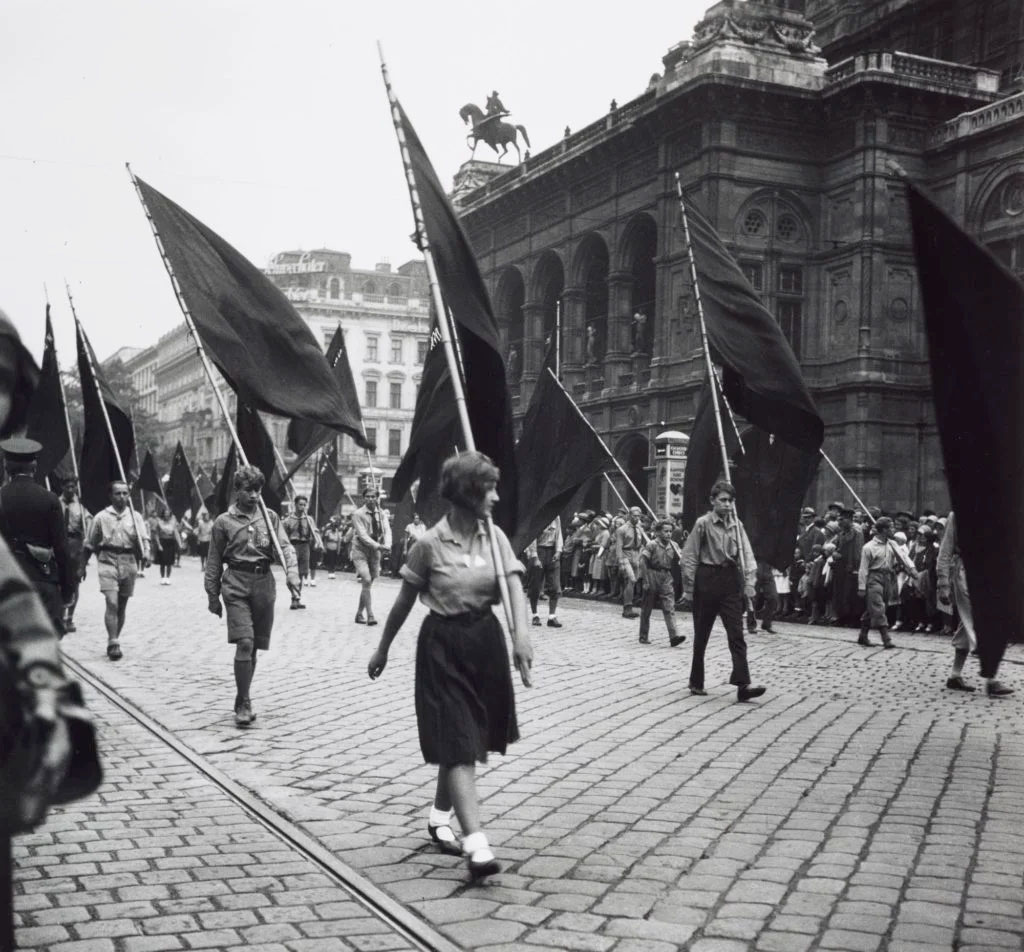
Edith Tudor-Hart (Austrian-British, 1908-1973) 'Members of the Social-Democratic Youth Movement Marching Past the Opera House, Opernring, Vienna' c. 1928


Edith Tudor-Hart (Austrian-British, 1908-1973)
Members of the Social-Democratic Youth Movement Marching Past the Opera House, Opernring, Vienna
c. 1928
Printed 2004 from original negatives held in the Edith Tudor Hart Archive
Gelatin silver print
28 x 30cm
Scottish National Portrait Gallery
© Copyright held jointly by Peter Suschitzky, Julia Donat & Misha Donat


This is a very dynamic image showing members of the Social-Democratic Youth Movement marching in Vienna. In the wake of the First World War, the Austrian political parties had a youthful membership – it is estimated that up to sixty per cent of the Viennese Social Democrats were under forty years of age. The limits of teenagers’ political engagement was a particular source of controversy, with many arguing that the youth movement should be more educational than political. Memoirs of the period reveal that political identification was often fluid. A common joke amongst young activists was that you went to bed a Social Democrat and woke up a Communist!

Text from the National Galleries of Scotland website


Edith Tudor-Hart (Austrian-British, 1908-1973) 'Untitled (Man Selling Fruit, Vienna)' c. 1930


Edith Tudor-Hart (Austrian-British, 1908-1973)
Untitled (Man Selling Fruit, Vienna)
c. 1930
Modern silver gelatine print from archival negative
30.3 x 30.1cm
Scottish National Portrait Gallery: Archive presented by Wolfgang Suschitzky 2004
© The Estate of Edith Tudor-Hart


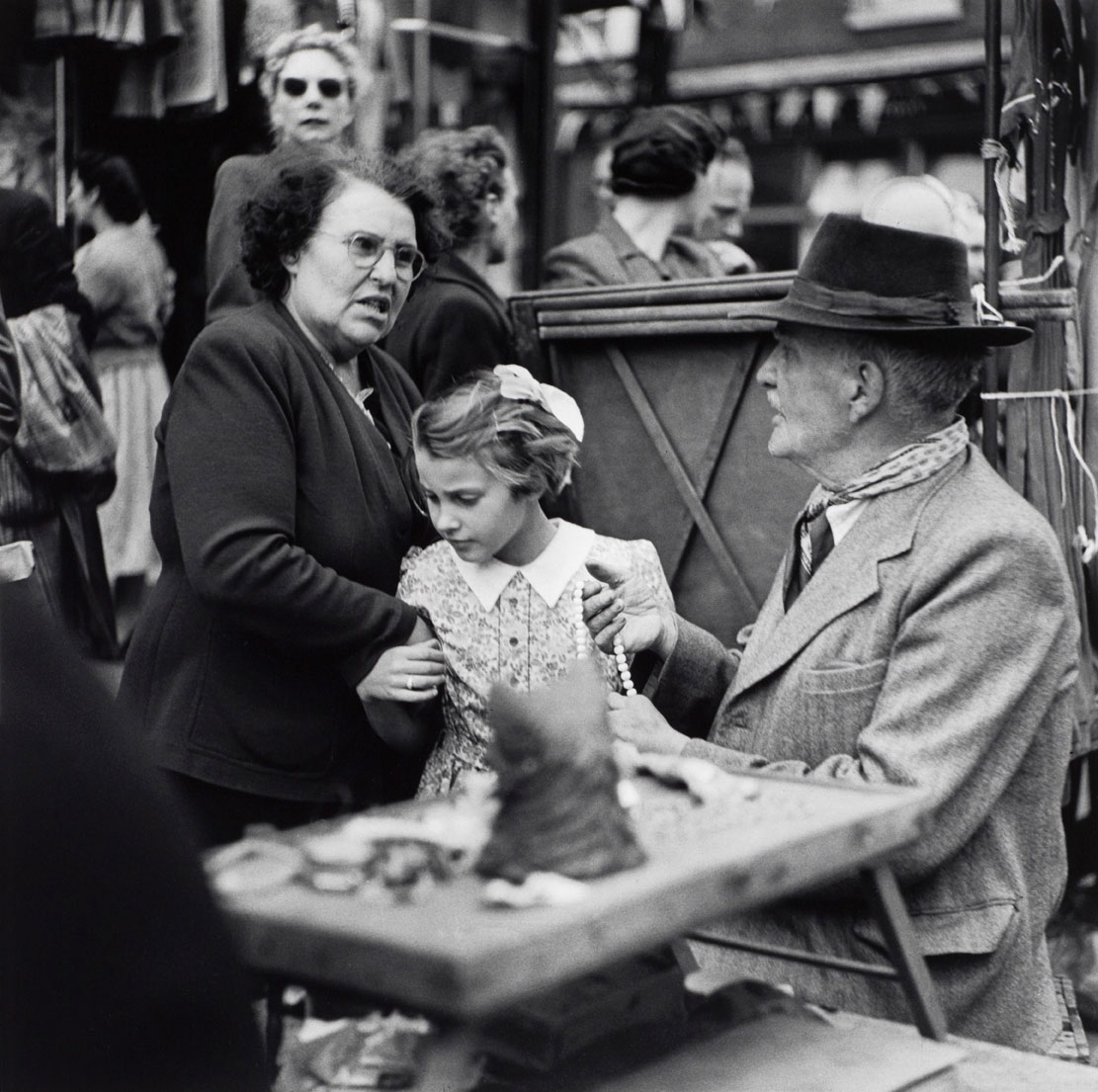
Edith Tudor-Hart (Austrian-British, 1908-1973) 'Untitled (Caledonian Market, London)' c. 1931


Edith Tudor-Hart (Austrian-British, 1908-1973)
Untitled (Caledonian Market, London)
c. 1931
Modern silver gelatine print from archival negative
27.7 x 27.5cm
Scottish National Portrait Gallery: Archive presented by Wolfgang Suschitzky 2004
© The Estate of Edith Tudor-Hart


Edith Tudor-Hart (Austrian-British, 1908-1973) 'Ferris Wheel, Vienna' c. 1931


Edith Tudor-Hart (Austrian-British, 1908-1973)
Ferris Wheel, Vienna
c. 1931
Printed 2004 from original negatives held in the Edith Tudor Hart Archive
Gelatin silver print
29.3 x 29.2cm
Scottish National Portrait Gallery: Archive presented by Wolfgang Suschitzky 2004
© The Estate of Edith Tudor-Hart


Before marrying Edith Tudor Hart had studied photography at the Bauhaus in Dessau. The concerns of this school are obvious in the geometries and startling perspective of this image. Note the exaggerated size of the steel supports of the wheel and the minute figures of the people standing on the ground. The photographer’s eagerness to document the dynamism of urban life suggests she was aware of developments in Soviet avant-garde photography.

Text from the National Galleries of Scotland website


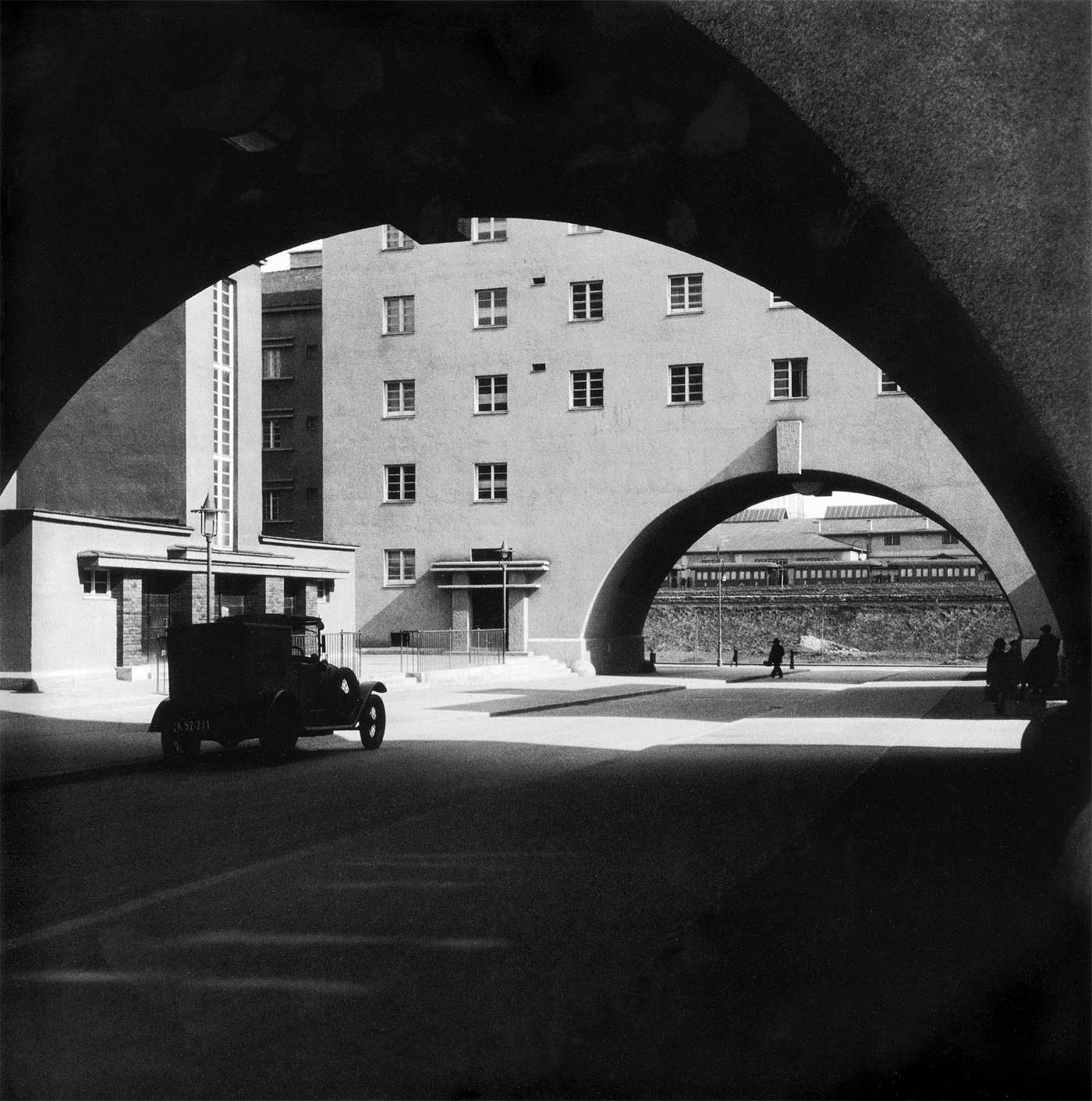
Edith Tudor-Hart (Austrian-British, 1908-1973) 'Karl-Marx-Hof, Vienna' c. 1932


Edith Tudor-Hart (Austrian-British, 1908-1973)
Karl-Marx-Hof, Vienna
c. 1932
Printed 2004 from original negatives held in the Edith Tudor Hart Archive
Gelatin silver print
30.2 x 30cm
Scottish National Portrait Gallery
© Copyright held jointly by Peter Suschitzky, Julia Donat & Misha Donat


The Karl-Marx-Hof was a fortress-like housing estate built by the Social Democrats between 1927 and 1930. A kilometre in length, its huge walls contained nearly 1400 apartments for Viennese workers. In her photograph of the building Tudor-Hart summons both its strength and sense of modernity. However, the permanence evoked by the architecture soon proved to be more apparent than real. In February 1934, during the short-lived Austrian civil war, the building was shelled by Austro-fascist forces. Out-gunned, and concerned about women and children still in their homes, the Karl-Marx-Hof’s defenders surrendered. The first mass movement against European fascism was easily defeated and the Austrian Social Democrats were driven into illegality and exile.

Text from the National Galleries of Scotland website


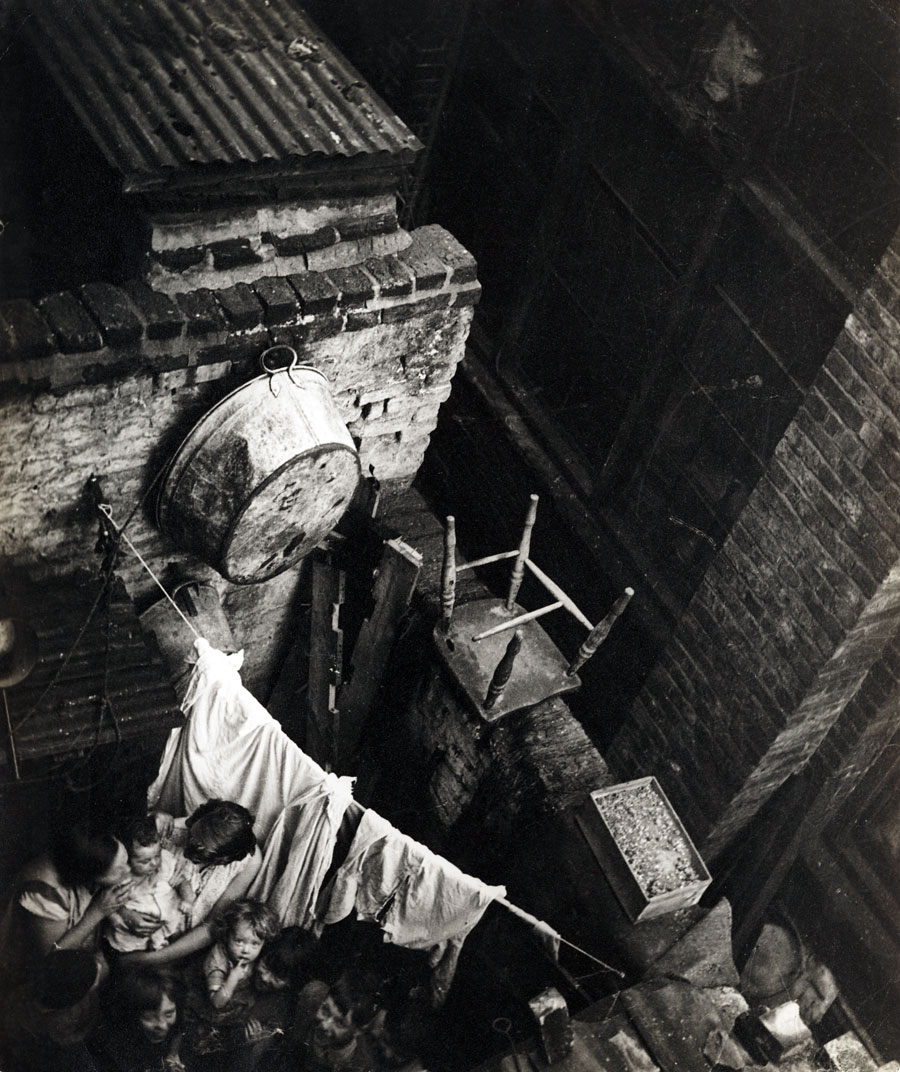
Edith Tudor-Hart (Austrian-British, 1908-1973) 'Family Group, Stepney, London' c. 1932


Edith Tudor-Hart (Austrian-British, 1908-1973)
Family Group, Stepney, London
c. 1932
Printed 2004 from original negatives held in the Edith Tudor Hart Archive
Gelatin silver print
Scottish National Portrait Gallery
© Copyright held jointly by Peter Suschitzky, Julia Donat & Misha Donat


Tudor-Hart worked extensively amongst working-class communities in East and North London, photographing children on the streets and families in their homes. She was part of a larger movement on the left concerned about the effect of widespread slum housing. However, Tudor-Hart’s imagery is rarely merely propaganda and her ability to connect with those she photographs – often women and children – is evident. This complex photograph explores the photographer’s relationship to her subjects. Shot deliberately through the window it emphasises her voyeurism, thus limiting the sentimental impact of the image.

Text from the National Galleries of Scotland website


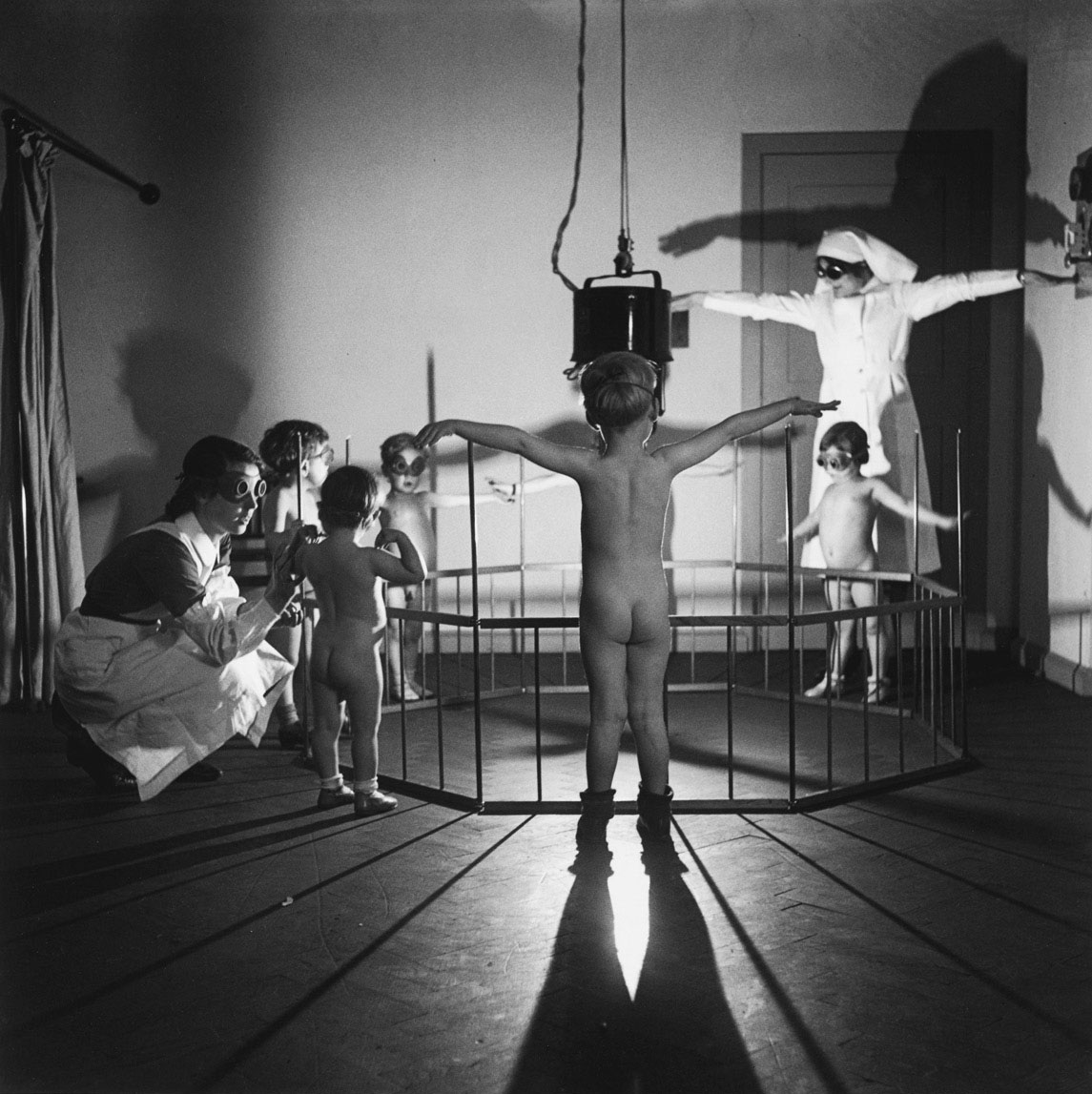
Edith Tudor-Hart (Austrian-British, 1908-1973) 'Untitled (Ultraviolet Light Treatment, South London Hospital for Women and Children)' c. 1935


Edith Tudor-Hart (Austrian-British, 1908-1973)
Untitled (Ultraviolet Light Treatment, South London Hospital for Women and Children)
c. 1935
Modern silver gelatine print from archival negative
30.3 × 30cm
Scottish National Portrait Gallery: Archive presented by Wolfgang Suschitzky 2004


This photograph was taken for a booklet promoting the work of the South London Hospital for Women and Children, produced in collaboration with the German exile photographer, Grete Stern. It shows light treatment for children suffering from vitamin deficiencies, a standard cure at the time. The South London Hospital was founded in 1912 “to meet the growing demand of women for medical treatment by members of their own sex.” Tudor-Hart campaigned throughout her life for health reforms for women and children, part of a wider movement of women whose activity was vital to the formation of the National Health Service in 1948.

Text from the National Galleries of Scotland website


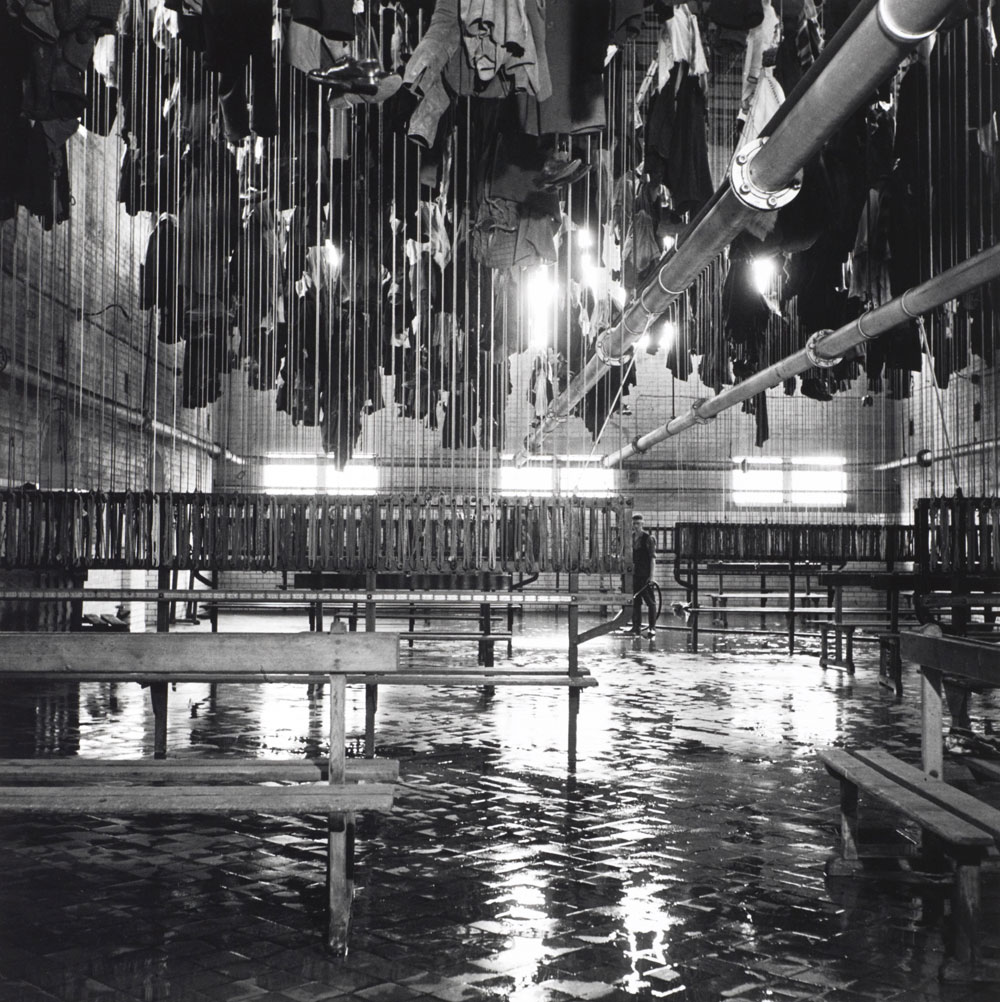
Edith Tudor-Hart (Austrian-British, 1908-1973) 'Untitled (Drying Room, Pit-head Baths, Ashington Colliery, Northumberland)' c. 1937


Edith Tudor-Hart (Austrian-British, 1908-1973)
Untitled (Drying Room, Pit-head Baths, Ashington Colliery, Northumberland)
c. 1937
Modern silver gelatine print from archival negative
30.3 x 30.1cm
Scottish National Portrait Gallery: Archive presented by Wolfgang Suschitzky 2004
© The Estate of Edith Tudor-Hart


The life and work of one of the most extraordinary photographers in Britain during the 1930s and 1940s is the subject of a major new exhibition at the Scottish National Portrait Gallery. Based on extensive new research, Edith Tudor-Hart: In the Shadow of Tyranny, is the first full presentation of the Austrian-born photographer’s work. The exhibition presents over 80 photographs, many of which have never been shown before, and includes film footage, Tudor-Hart’s scrapbook and a selection of her published stories in books and magazines.

During the 1930s, photography became implicated in the vital political and social questions of the era as never before. The enhanced technological capacities of the camera and faster printing processes offered left-wing political activists new techniques for popular mobilisation. The medium took on a sharper social purpose, breaking down the traditional divisions of culture through its quality of immediacy and capacity for self-representation.

Edith Tudor-Hart was a key exponent of this aesthetic of engagement, with images that show a sophisticated realism, marked by their directness and capacity to communicate issues of inequality and deprivation. In a turbulent decade, she attempted to use the camera as a political weapon, aligning her practice with the wider worker photography movement. Tudor-Hart’s photography dealt with many of the major social issues of the day, including poverty, unemployment and slum housing. Her imagery is a vital record of the politically-charged atmosphere of inter-war Vienna and Britain during the Great Slump of the 1930s. After 1945, Tudor-Hart concentrated on questions of child welfare, producing some of the most psychologically penetrating imagery of children of her era.

Tudor-Hart’s life story as a photographer is inextricably tied to the great political upheavals of the twentieth century. Born Edith Suschitzky in Vienna in 1908, she grew up in radical Jewish circles in a city ravaged by the impact of the First World War. Her childhood was dominated by social issues in a culture acutely aware of the impact of the Russian Revolution. After training as a Montessori teacher, she studied photography at the Bauhaus in Dessau and pursued a career as a photojournalist. However, her life was turned upside down in May 1933 when she was arrested whilst working as an agent for the Communist Party of Austria. She escaped long-term imprisonment by marrying an English doctor, Alexander Tudor-Hart, and was exiled to London shortly afterwards. Notoriously, Tudor-Hart continued to combine her practice as a photographer with low-level espionage for the Soviet Union and was pursued by the security services until her death in 1973.

Tudor-Hart’s photography introduced into Britain formal and narrative features that derived from her training on the Continent. Her method initiates a dialogue with those she photographs, very different from the more distancing imagery of the photojournalists. Along with thirty or so German-speaking exile photographers, many of Jewish origin, Tudor-Hart helped transform British photography. After the Second World War, rejected by Fleet Street and the British establishment, Tudor-Hart turned to documenting issues of child welfare. Her photographs were published in Picture Post and a range of other British magazines. By the late 1950s she had abandoned photography altogether.

Commenting on the exhibition, Director of the Scottish National Portrait Gallery, Christopher Baker, said, ‘We are really pleased to be staging this thrilling retrospective of Tudor-Hart’s photography. It combines stunning images with an intriguing life-story and illuminates a turbulent period in European history. Tudor-Hart was one of the great photographers of her era.’ Edith Tudor-Hart: In the Shadow of Tyranny is drawn largely from the photographer’s negative archive, which was donated to the National Galleries of Scotland by her family in 2004. The exhibition travels to the Wien Museum in September and will form the first complete presentation of her work in Austria.

Press release from the Scottish National Portrait Gallery


Edith Tudor-Hart (Austrian-British, 1908-1973) 'Untitled (Children Preparing Vegetables, North Stoneham Camp, Hampshire)' 1937


Edith Tudor-Hart (Austrian-British, 1908-1973)
Untitled (Children Preparing Vegetables, North Stoneham Camp, Hampshire)
1937
Modern silver gelatine print from archival negative
30.2 x 29.8cm
Scottish National Portrait Gallery: Archive presented by Wolfgang Suschitzky 2004
© The Estate of Edith Tudor-Hart


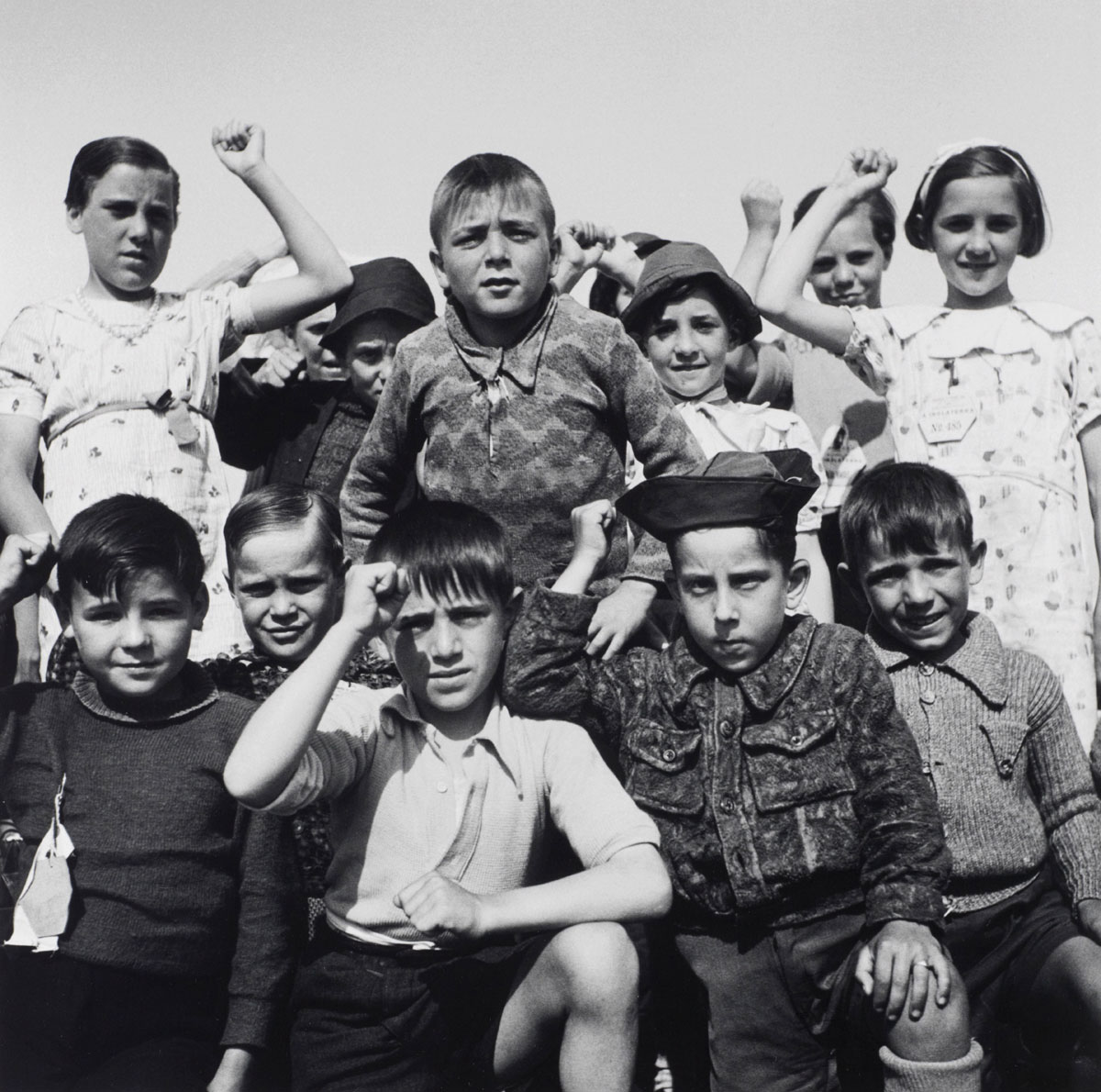
Edith Tudor-Hart (Austrian-British, 1908-1973) 'Untitled (Basque Refugee Children, North Stoneham Camp, Hampshire)' 1937


Edith Tudor-Hart (Austrian-British, 1908-1973)
Untitled (Basque Refugee Children, North Stoneham Camp, Hampshire)
1937
Modern silver gelatine print from archival negative
30.2 x 30cm
Scottish National Portrait Gallery: Archive presented by Wolfgang Suschitzky 2004
© The Estate of Edith Tudor-Hart


The children are giving the Spanish anti-fascist Republican salute.


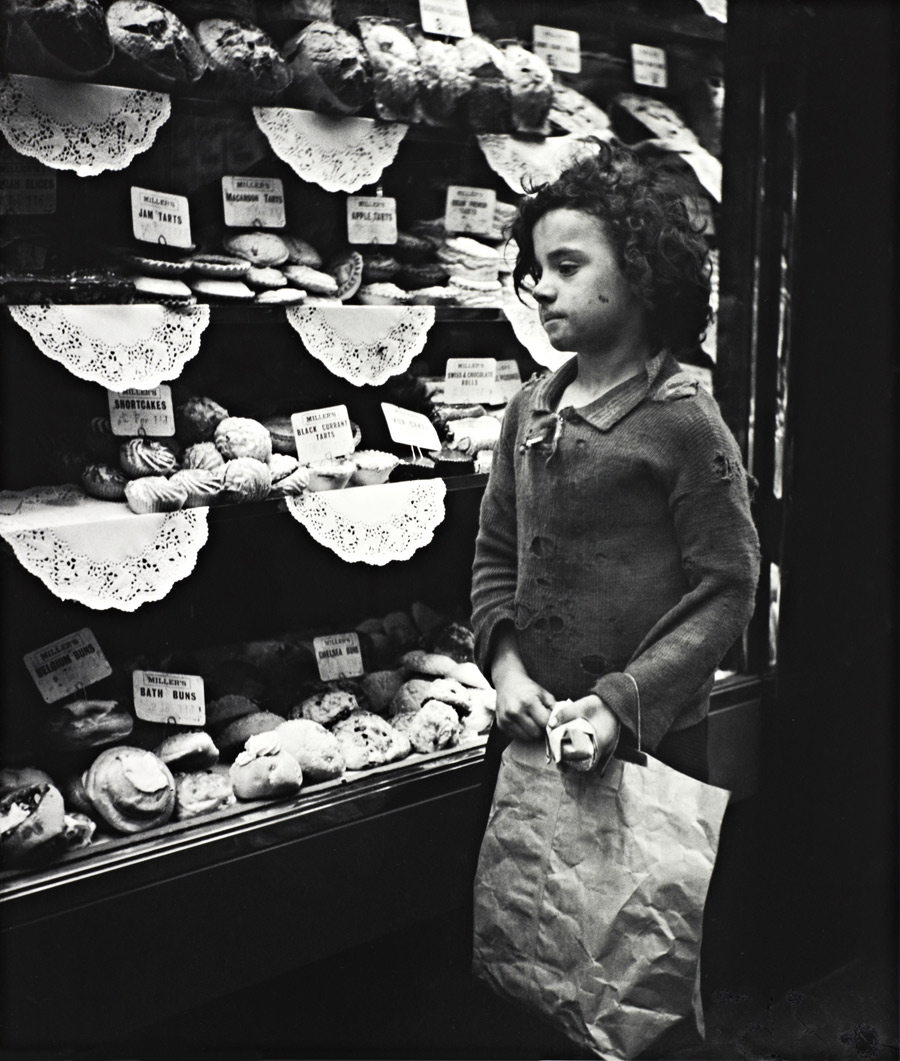
Edith Tudor-Hart (Austrian-British, 1908-1973) 'Untitled (Child Staring into Bakery Window)' c. 1935


Edith Tudor-Hart (Austrian-British, 1908-1973)
Untitled (Child Staring into Bakery Window)
c. 1935
Modern silver gelatine print from archival negative
35.30 x 30.00cm
Scottish National Portrait Gallery: Archive presented by Wolfgang Suschitzky 2004
© The Estate of Edith Tudor-Hart


Edith Tudor-Hart (Austrian-British, 1908-1973) 'Untitled (In Total Darkness, London)' c. 1935


Edith Tudor-Hart (Austrian-British, 1908-1973)
Untitled (In Total Darkness, London)
c. 1935
Modern silver gelatine print from archival negative
27.70 x 27.50cm
Scottish National Portrait Gallery: Archive presented by Wolfgang Suschitzky 2004
© The Estate of Edith Tudor-Hart


Scottish National Portrait Gallery
1 Queen Street, Edinburgh EH2 1JD
Phone: +44 131 624 6200

Opening hours:
Daily 10am – 5pm

Scottish National Portrait Gallery website

LIKE ART BLART ON FACEBOOK

Back to top

Exhibition: ‘Lyonel Feininger: Photographs, 1928-1939’ at the J. Paul Getty Museum, Getty Center, Los Angeles

Exhibition dates: 25th October 2011 – 11th March 2012


Lyonel Feininger (American, 1871-1956) 'Untitled [Street Scene, Double Exposure, Halle]' 1929-1930


Lyonel Feininger (American, 1871-1956)
Untitled [Street Scene, Double Exposure, Halle]
1929-1930
Gelatin silver print
Image: 17.8 x 23.7cm (7 x 9 5/16 in)
Gift of T. Lux Feininger, Houghton Library, Harvard University
© Artists Rights Society (ARS), New York / VG Bild-Kunst, Bonn


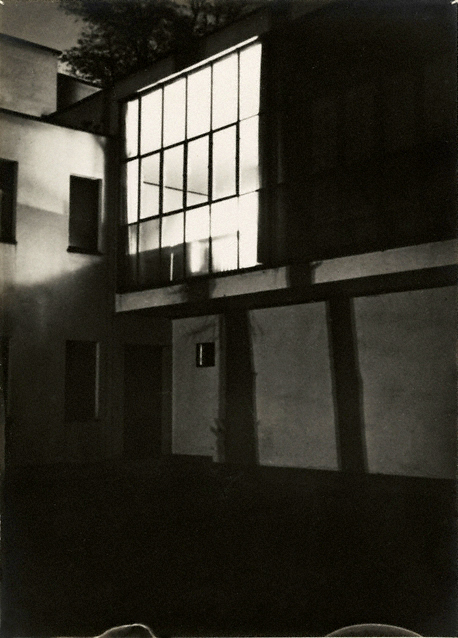
Another photographer whose work was largely unknown to me. His work can be seen to reference Pictorialism, Eugene Atget, Constructivism and Modernism, the latter in the last three photographs of the Bauhaus buildings at night which are just beautiful! The capture of form, light (emanating from windows) and atmosphere is very pleasing.

Dr Marcus Bunyan

P.S. Don’t be confused when looking at the photographs in the posting. Note the difference in the work of Lynonel and his two sons Andreas and Theodore (nicknamed Lux).


Many thankx to the J. Paul Getty Museum for allowing me to publish the photographs in the posting. Please click on the photographs for a larger version of the image.


Lucia Moholy (British born Czechoslovakia, 1894-1989) 'Untitled [Southern View of Newly Completed Bauhaus, Dessau]' 1926


Lucia Moholy (British born Czechoslovakia, 1894-1989)
Untitled [Southern View of Newly Completed Bauhaus, Dessau]
1926
Gelatin silver print
Sheet: 5.7 x 8.1cm (2 1/4 x 3 3/16 in)
The J. Paul Getty Museum, Los Angeles
© Artists Rights Society (ARS), New York / VG Bild-Kunst, Bonn


Lyonel Feininger (American, 1871-1956) 'Untitled [Train Station, Dessau]' 1928-1929


Lyonel Feininger (American, 1871-1956)
Untitled [Train Station, Dessau]
1928-1929
Gelatin silver print
Image: 17.7 x 23.7 cm (6 15/16 x 9 5/16 in.)
Gift of T. Lux Feininger, Houghton Library, Harvard University
© Artists Rights Society (ARS), New York / VG Bild-Kunst, Bonn


Werner Zimmermann (German, 1906-1975) 'In Der Werkstatt' about 1929


Werner Zimmermann (German, 1906-1975)
In Der Werkstatt [In The Workshop]
About 1929
Gelatin silver print
7.9 × 11cm (3 1/8 × 4 5/16 in.)
The J. Paul Getty Museum, Los Angeles


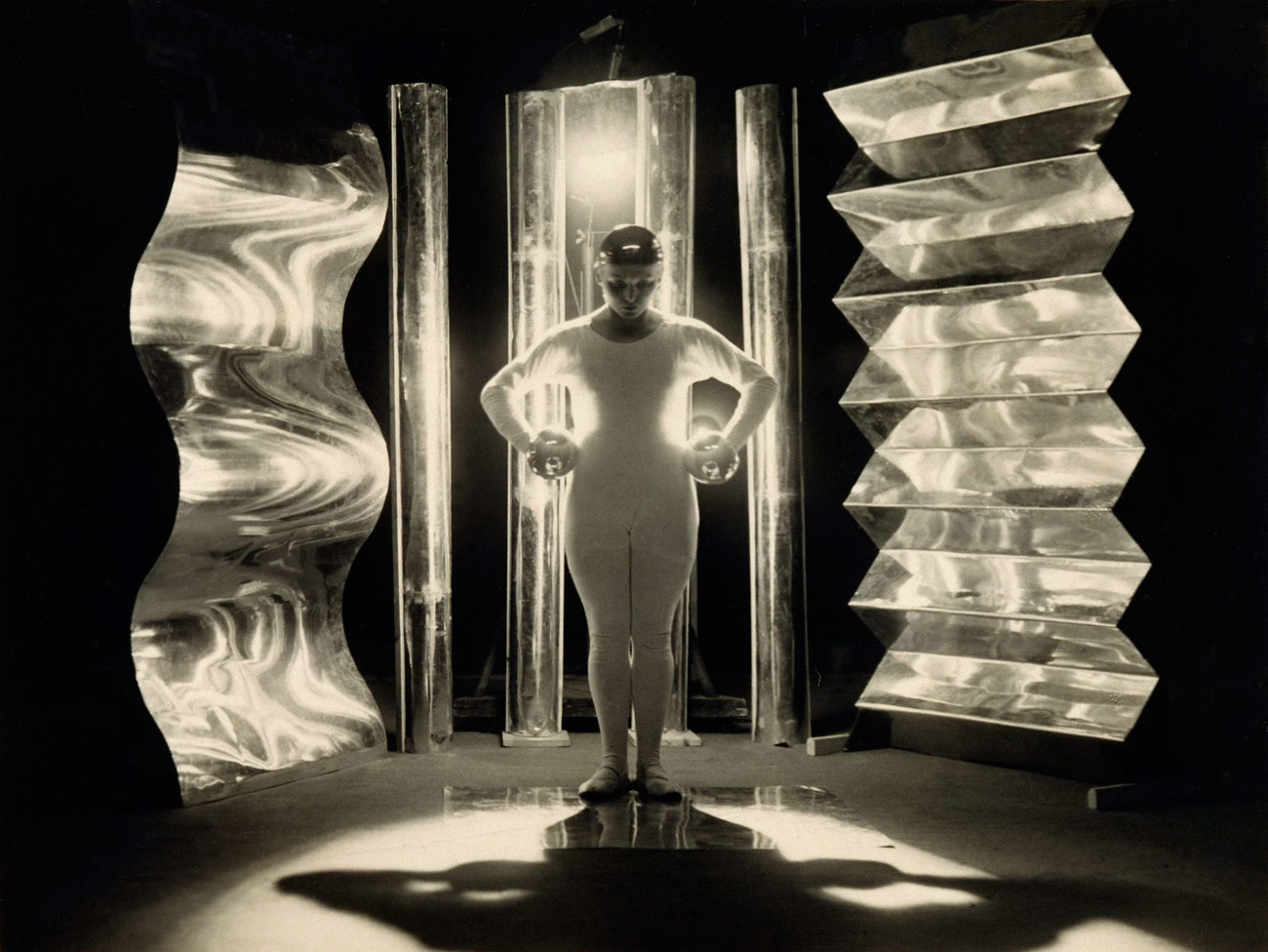
T. Lux Feininger (American born Germany, 1910-2011) 'Metalltanz' 1929


T. Lux Feininger (American born Germany, 1910-2011)
Metalltanz
1929
Gelatin silver print
Image: 10.8 x 14.4cm (4 1/4 x 5 5/8 in.)
The J. Paul Getty Museum, Los Angeles
© Estate of T. Lux Feininger


Widely recognised as a painter, printmaker, and draftsman who taught at the Bauhaus, Lyonel Feininger (American, 1871-1956) turned to photography later in his career as a tool for visual exploration. Drawn mostly from the collections at Harvard University in Cambridge, Massachusetts, Lyonel Feininger: Photographs, 1928-1939 at the J. Paul Getty Museum, Getty Center, October 25, 2011 – March 11, 2012, presents for the first time Feininger’s unknown body of photographic work. The exhibition is accompanied by a selection of photographs by other Bauhaus masters and students from the Getty Museum’s permanent collection. The Getty is the first U.S. venue to present the exhibition, which will have been on view at the Kupferstichkabinett, Staatliche Museen zu Berlin from February 26 – May 15, 2011 and the Staatliche Graphische Sammlung, Pinakothek der Moderne in Munich from June 2 – July 17, 2011. Following the Getty installation, the exhibition will be shown at the Harvard Art Museums from March 30 – June 2, 2012. At the Getty, the exhibition will run concurrently with Narrative Interventions in Photography.

“We are delighted to be the first U.S. venue to present this important exhibition organised by the Harvard Art Museums / Busch-Reisinger Museum,” says Virginia Heckert, curator of photographs at the J. Paul Getty Museum and curator of the Getty’s installation. “The presentation at the Getty provides a unique opportunity to consider Lyonel Feininger’s achievement in photography, juxtaposed with experimental works in photography at the Bauhaus from our collection.”

Lyonel Feininger Photographs

When Lyonel Feininger (1871-1956) took up the camera in 1928, the American painter was among the most prominent artists in Germany and had been on the faculty of the Bauhaus school of art, architecture, and design since it was established by Walter Gropius in 1919. For the next decade, he used the camera to explore transparency, reflection, night imagery, and the effects of light and shadow. Despite his early skepticism about this “mechanical” medium, Feininger was inspired by the enthusiasm of his sons Andreas and Theodore (nicknamed Lux), who had installed a darkroom in the basement of their house, as well as by the innovative work of fellow Bauhaus master, László Moholy-Nagy.

Although Lyonel Feininger would eventually explore many of the experimental techniques promoted by Moholy-Nagy and practiced by others at the school, he remained isolated and out of step with the rest of the Bauhaus. Working alone and often at night, he created expressive, introspective, otherworldly images that have little in common with the playful student photography more typically associated with the school. Using a Voigtländer Bergheil camera (on display in the exhibition), frequently with a tripod, he photographed the neighbourhood around the Bauhaus campus and masters’ houses, and the Dessau railway station, occasionally reversing the tonalities to create negative images.

Lyonel Feininger: Photographs, 1928-1939 also includes the artist’s photographs from his travels in 1929-1931 to Halle, Paris, and Brittany, where he investigated architectural form and urban decay in photographs and works in other media. In Halle, while working on a painting commission for the city, Feininger recorded architectural sites in works such as Halle Market with the Church of St. Mary and the Red Tower (1929-1930), and experimented with multiple exposures in photographs such as Untitled (Street Scene, Double Exposure, Halle) (1929-1930), a hallucinatory image that merges two views of pedestrians and moving vehicles.

Since 1892 Feininger had spent parts of the summer on the Baltic coast, where the sea and dunes, along with the harbours, rustic farmhouses, and medieval towns, became some of his most powerful sources of inspiration. During the summers Feininger also took time off from painting, focusing instead on producing sketches outdoors or making charcoal drawings and watercolours on the veranda of the house he rented. Included in the exhibition are photographs Feininger created in Deep an der Rega (in present-day Poland) between 1929 and 1935 which record the unique character of the locale, the people, and the artistic and leisure activities he pursued.

In the months after the Nazis closed the Bauhaus, and prior to Feininger’s departure from Dessau in March 1933, he made a series of unsettling photographs featuring mannequins in shop windows such as Drunk with Beauty (1932). Feininger’s images emphasise not only the eerily lifelike and strangely seductive quality of the mannequins, but also the disorienting, dreamlike effect created by reflections on the glass.

In 1937 Feininger permanently settled in New York City after a nearly 50-year absence, and photography served as an important means of reacquainting himself with the city in which he had lived until the age of sixteen. The off-kilter bird’s eye view he made from his eleventh-floor apartment of the Second Avenue elevated train tracks, Untitled (Second Avenue El from Window of 235 East 22nd Street, New York) (1939), is a dizzying photograph of an American subject in the style of European avant-garde photography, and mirrors the artist’s own precarious and disorienting position between two worlds, and between past and present.

The Bauhaus

Walter Gropius, director of the Bauhaus from 1919 to 1928, changed the face of art education with his philosophy of integrating art, craft, and technology with everyday life at the Bauhaus. When Gropius’s newly designed building in Dessau was completed in December 1926, its innovative structure did more than house the various components of the school; it became an integral aspect of life at the Bauhaus and a stage for its myriad activities, from studies and leisurely pursuits to theatrical performances. From the beginning, the camera recorded the architecture as the most convincing statement of Gropius’ philosophy as well as the fervour with which the students embraced it. The photographs in this complementary section of the exhibition also examine the various ways photography played a role at the Bauhaus, even before it became part of the curriculum.

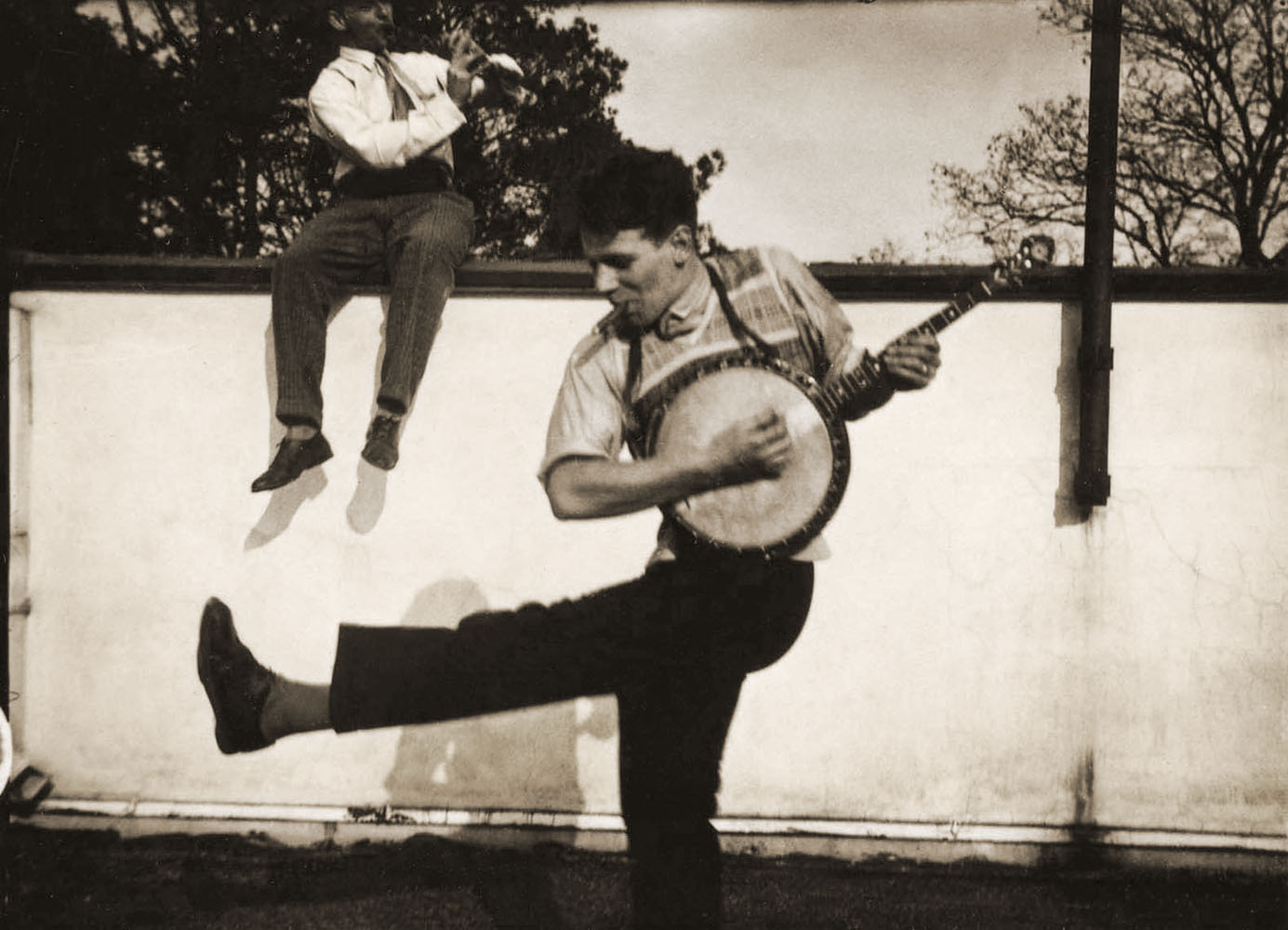
In addition to the collaborative environment encouraged in workshops, students found opportunities to bond during their leisure time, whether in a band that played improvisational music or on excursions to nearby beaches, parks, and country fairs. One of the most active recorders of life at the Bauhaus was Lyonel Feininger’s youngest son, T. Lux, who was also a member of the jazz band.

Masters and students alike at the Bauhaus took up the camera as a tool with which to record not only the architecture and daily life of the Bauhaus, but also one another. Although photography was not part of the original curriculum, it found active advocates in the figures of László Moholy-Nagy and his wife Lucia Moholy. With his innovative approach and her technical expertise, the Moholy-Nagys provided inspiration for others to use the camera as a means of both documentation and creative expression. The resulting photographs, which included techniques such as camera-less photographs (photograms), multiple exposures, photomontage and collages (“photo-plastics”), and the combination of text and image (“typo-photo”), contributed to Neues Sehen, or the “new vision,” that characterised photography in Germany between the two world wars.

It was not until 1929 that photography was added to the Bauhaus curriculum by Hannes Meyer, the new director following Gropius’s departure. A part of the advertising department, the newly established workshop was led by Walter Peterhans, who included technical exercises as well as assignments in the genres of portraiture, still life, advertisement, and photojournalism in the three-year course of study.”

Press release from the J.Paul Getty Museum website


Lyonel Feininger (American, 1871-1956) 'Untitled [Night View of Trees and Street Lamp, Burgkühnauer Allee, Dessau]' 1928


Lyonel Feininger (American, 1871-1956)
Untitled [Night View of Trees and Street Lamp, Burgkühnauer Allee, Dessau]
1928
Gelatin silver print
Image: 17.7 x 23.7cm (6 15/16 x 9 5/16 in)
Gift of T. Lux Feininger, Houghton Library, Harvard University
© Artists Rights Society (ARS), New York / VG Bild-Kunst, Bonn


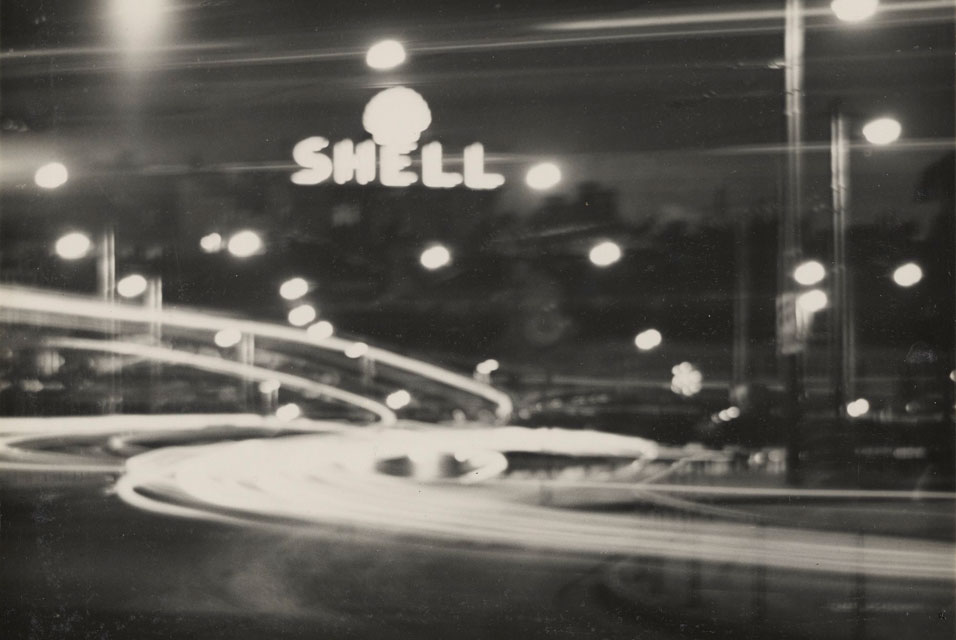
Andreas Feininger (American, 1906-1999) 'Stockholm (Shell sign at night)' 1935


Andreas Feininger (American, 1906-1999)
Stockholm (Shell sign at night)
1935
Gelatin silver print
17.4 x 24.2cm
The J. Paul Getty Museum, Los Angeles, Gift of the Estate of Gertrud E. Feininger
© Estate of Gertrud E. Feininger


Lyonel Feininger (American, 1871-1956) 'Drunk with Beauty' 1932


Lyonel Feininger (American, 1871-1956)
Drunk with Beauty
1932
Gelatin silver print
Image: 17.9 x 23.9cm (7 1/16 x 9 7/16 in)
Gift of T. Lux Feininger, Houghton Library, Harvard University
© Artists Rights Society (ARS), New York / VG Bild-Kunst, Bonn


Lyonel Feininger (American, 1871-1956) 'Bauhaus' March 22, 1929


Lyonel Feininger (American, 1871-1956)
Bauhaus
March 22, 1929
Gelatin silver print
Image: 17.8 x 23.9cm (7 x 9 7/16 in)
Harvard Art Museums/Busch-Reisinger Museum, Gift of Mr. and Mrs. Lyonel Feininger
© Artists Rights Society (ARS), New York / VG Bild-Kunst, Bonn


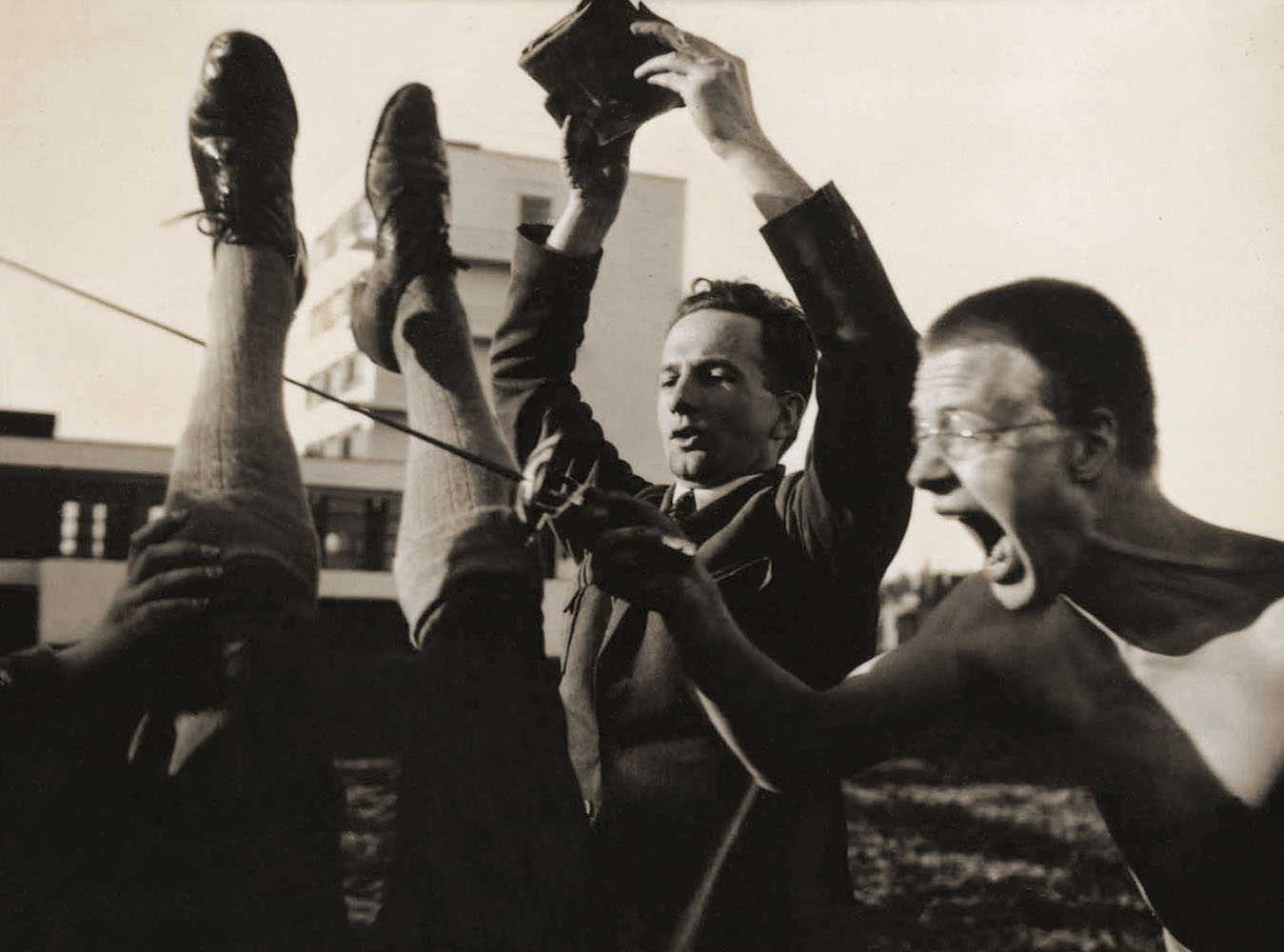
T. Lux Feininger (American born Germany, 1910-2011) 'Untitled (Georg Hartmann and Werner Siedhoff with Other Students)' 1929


T. Lux Feininger (American born Germany, 1910-2011)
Untitled (Georg Hartmann and Werner Siedhoff with Other Students)
1929
Gelatin silver print
© Estate of T. Lux Feininger


Lyonel Feininger and Photography

Lyonel Feininger took up the camera at the age of 58 in fall 1928. Despite his early skepticism about this “mechanical” medium, the painter was inspired by the enthusiasm of his sons Andreas and Theodore (nicknamed Lux), as well as by the innovative work of László Moholy-Nagy, a fellow master at the Bauhaus in Dessau, Germany.

Photography remained a private endeavour for Feininger. He never exhibited his prints, publishing just a handful during his lifetime and sharing them only with family and a few friends.

Bauhaus Experiments in Photography

Although Feininger explored many of the experimental photographic techniques being practiced at the Bauhaus, he remained isolated and out of step with the rest of the school. Working alone and often at night, he created expressive, introspective, otherworldly images that have little in common with the playful student photography more typically associated with the school.

Using a Voigtländer Bergheil camera (on display in the exhibition), frequently with a tripod, he photographed the neighbourhood around the masters’ houses, the Bauhaus campus, and the Dessau railway station, experimenting with night imagery, reversed tonalities, and severe weather conditions.

Halle, 1929-1931

In 1929 Feininger created numerous photographic sketches to prepare for a series of paintings he was commissioned to make of the city of Halle, Germany.

A photograph of Halle included in the exhibition, Untitled (Bölbergasse, Halle), was the basis for one of these paintings, which is now lost. It was perhaps the most inventive and photographic of the Halle series, transforming a view of an unremarkable street into a dramatic, almost abstract composition through tight framing and an unusual perspective. The painting is visible in a 1931 photograph of the artist’s studio also included in the exhibition

Feininger also made many photographs of his Halle studio and the paintings he produced there. While many are purely documentary, others are sophisticated compositions that explore formal relationships between a particular painting and the space in which it was created, such as the one shown at right.

Feininger would never again use photography so extensively in connection with his paintings as he did in conjunction with the Halle series.

France, 1931

After completing his painting commission in Halle, Feininger spent several weeks in June and July of 1931 in France. In Paris and in the village of Bourron, he created images with his Voigtländer Bergheil camera as well as with his newly acquired Leica (also on display in the exhibition), in which he used 35 mm film for the first time. He also sketched and photographed Brittany on a bicycle tour with his son Lux, capturing views of the architecture and seaside.

In Paris, primed by his recent experience of photographing historic buildings in the streets of Halle, Feininger was drawn to architectural views and urban scenes. On returning from a day trip, he wrote to his wife Julia: “I wandered on foot through the city, flâné! Armed with both cameras, I made photographs… From ‘Boul-Miche’ I crisscrossed through the Quartier Mouffetard… through all possible old narrow and fabulous lanes and I hope that I snapped some very, very good things. Luckily the ‘Leica’ functioned flawlessly” (June 16, 1931, Feininger Papers, Houghton Library).

The Baltic Coast, 1929-1935

Beginning in 1892 Lyonel Feininger spent parts of his summers on the Baltic coast, where the sea and dunes, along with the harbours, rustic farmhouses, and medieval towns, became some of his most powerful sources of inspiration.

Every summer between 1929 and 1935, he used the camera to document family trips to Deep an der Rega (in present-day Poland), where the beach became a playground for his three athletic sons, Andreas, Laurence, and Lux. Feininger looked forward to his time in Deep and the restorative, transformative effect it always had on him.

Shop Windows, 1932-1933

From September 1932, when the National Socialist majority of the Dessau city council voted to close the Bauhaus, through March 1933, when he and his family left for Berlin, Feininger made a series of unsettling photographs that feature mannequins in shop windows. Feininger’s images emphasise not only the eerily lifelike and strangely seductive quality of the mannequins but also the disorienting, dreamlike effect created by reflections on the glass.

In the work shown here, the reflection seems to transport the languid central figure – “drunk with beauty” and oblivious to the camera – beyond the confines of the glass.

Germany to America, 1933 to 1939

Feininger came under increasing scrutiny by the National Socialists, who had stepped up their campaign against the avant-garde after rising to power in January 1933. He produced few paintings during this oppressive period, but continued to photograph regularly in spite of having little access to darkroom facilities. In 1937 he and his wife moved to the United States, renting an apartment in Manhattan – marking his permanent return to New York after an absence of nearly 50 years.

In the years that followed, photography remained an important part of Feininger’s life, though few prints exist from his time in America.

Text from the J. Paul Getty Museum website


T. Lux Feininger (American born Germany, 1910-2011) 'Untitled (Bauhaus Band)' About 1928


T. Lux Feininger (American born Germany, 1910-2011)
Untitled (Bauhaus Band)
About 1928
Gelatin silver print
3 1/4 x 4 1/2 in.
The J. Paul Getty Museum
© Estate of T. Lux Feininger


Photography at the Bauhaus

The exhibition Lyonel Feininger: Photographs, 1928-1939 features a complementary selection of over 90 photographs from the Getty Museum’s permanent collection made at the Bauhaus.

The Bauhaus was founded in 1919 in Weimar, Germany, by the architect Walter Gropius. Students entered specialised workshops after completing a preliminary course that introduced them to materials, form, space, colour, and composition. Lyonel Feininger was one of the first masters appointed by Gropius.

The school moved to Dessau in 1925 and to Berlin in 1932, closing under pressure from the National Socialists in 1933.

The Bauhaus Building as Stage

Walter Gropius’s building in Dessau became an integral aspect of life at the Bauhaus. The camera recorded the architecture as the most convincing statement of Gropius’s philosophy of uniting art, design, and technology with everyday life, and captured the fervor with which the students embraced this philosophy.

Tight framing, dramatic use of light and shadow, and unusual angles from above and below underscored the dynamism generated by the program. The campus’s architecture was often incorporated into rehearsals and performances by the school’s theater workshop.

Masters and Students

Bauhaus masters and students alike took up the camera as a tool for documentation and creative expression.

Photography served as a medium to record student life at the Bauhaus. In addition to the collaborative environment encouraged in classes and workshops, students found opportunities to bond during their leisure time, whether in a band that played improvisational music, in excursions to nearby beaches, parks, and fairs, or at Saturday-night costume parties.

One of the most active recorders of life at the Bauhaus was Lyonel Feininger’s youngest son Theodore, nicknamed Lux, a student who also became a member of the jazz band.

László Moholy-Nagy

At the Bauhaus, photography found active advocates in the figures of László Moholy-Nagy and his wife Lucia Moholy. Hired in 1923 to head the metal workshop and teach the preliminary course, Moholy-Nagy promoted photography as a form of visual literacy and encouraged experimental techniques of what he called a “new vision,” which included dramatic camera angles, multiple exposures, negative printing, collage and photomontage (fotoplastik), the combination of text and image (typofoto), and cameraless photography (the photogram, made by placing objects on photosensitised paper).

Moholy-Nagy did not differentiate between commercial assignments and personally motivated projects; he used the same strategies in both sectors of his practice.

Walter Peterhans

A photography workshop was established at the Bauhaus in 1929, led by Walter Peterhans, a professional photographer and the son of the director of camera lens manufacturer Zeiss Ikon A.G. The three-year course of study included technical exercises as well as assignments in portraiture, still life, advertisement, and photojournalism.

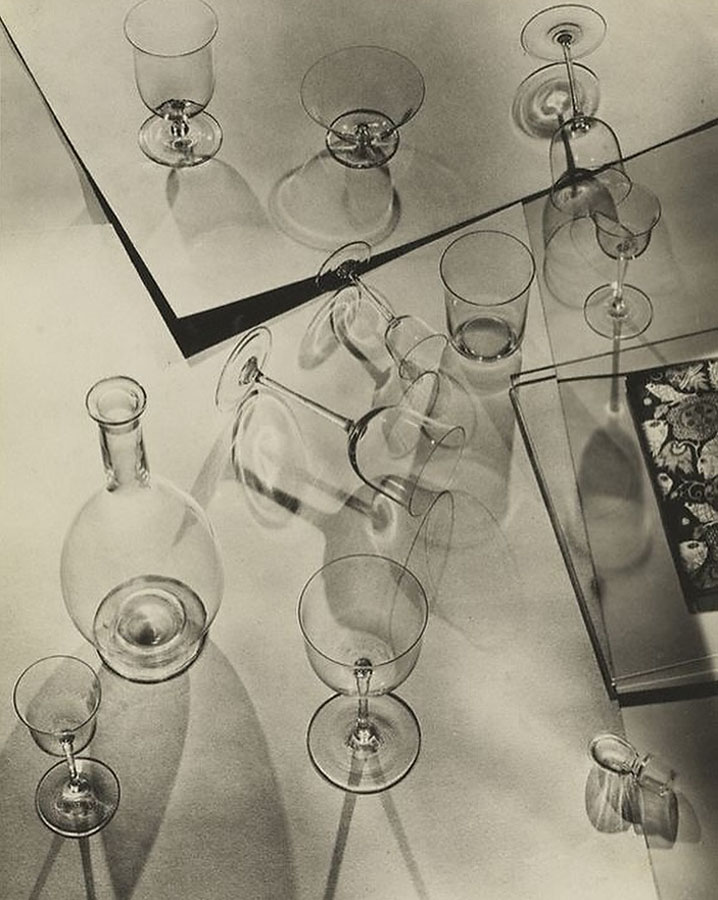
In his own work, Peterhans created haunting still lifes and portraits that are at once straightforward and evocative. Titles such as Portrait of the Beloved, Good Friday Magic, and Dead Hare lend surrealistic overtones to the meticulous arrangements of richly textured, disparate objects that he photographed from above, resulting in ambiguous spatial relationships.

Text from the J. Paul Getty Museum website


Walter Peterhans (German, 1897-1960) 'Untitled (Composition with Nine Glasses and a Decanter)' 1929-1933


Walter Peterhans (German, 1897-1960)
Untitled (Composition with Nine Glasses and a Decanter)
1929-1933
Gelatin silver print
© Estate Walter Peterhans, Museum Folkwang, Essen


Lyonel Feininger (American, 1871-1956) 'Bauhaus' March 26, 1929


Lyonel Feininger (American, 1871-1956)
Bauhaus
March 26, 1929
Gelatin silver print
Image: 17.9 x 14.3cm (7 1/16 x 5 5/8 in)
Bauhaus-Archiv Berlin
© Artists Rights Society (ARS), New York / VG Bild-Kunst, Bonn


Lyonel Feininger (American, 1871-1956) '"Moholy’s Studio Window" around 10 p.m.' 1928


Lyonel Feininger (American, 1871-1956)
“Moholy’s Studio Window” around 10 p.m.
1928
Gelatin silver print
Image: 17.8 x 12.8 cm (7 x 5 1/16 in.)
Bauhaus-Archiv Berlin
© Artists Rights Society (ARS), New York / VG Bild-Kunst, Bonn


Lyonel Feininger (American, 1871-1956) 'On the Lookout, Deep an der Rega' 1932


Lyonel Feininger (American, 1871-1956)
On the Lookout, Deep an der Rega
1932
Gelatin silver print
Image: 17.7 x 12.7cm (6 15/16 x 5 in)
Gift of T. Lux Feininger, Houghton Library, Harvard University
© Artists Rights Society (ARS), New York / VG Bild-Kunst, Bonn


Irene Bayer-Hecht (American, 1898-1991) 'Untitled [Students on the Shore of the Elbe River, near Dessau]' 1925


Irene Bayer-Hecht (American, 1898-1991)
Untitled [Students on the Shore of the Elbe River, near Dessau (Georg Muche, Hinnerk Scheper, Herbert Bayer, Unknown, Unknown, Marcel Breuer, László Moholy Nagy, Unknown, Xanti Schawinsky)]
1925
Gelatin silver print
Image: 7.5 x 5.4cm (2 15/16 x 2 1/8 in)
The J. Paul Getty Museum, Los Angeles


The J. Paul Getty Museum
1200 Getty Center Drive
Los Angeles, California 90049

Opening hours:
Daily 10am – 5pm

The J. Paul Getty Museum website

LIKE ART BLART ON FACEBOOK

Back to top

Exhibition: ‘László Moholy-Nagy. The Art of Light’ at the Ludwig Museum, Budapest

Exhibition dates: 9th June – 25th September 2011


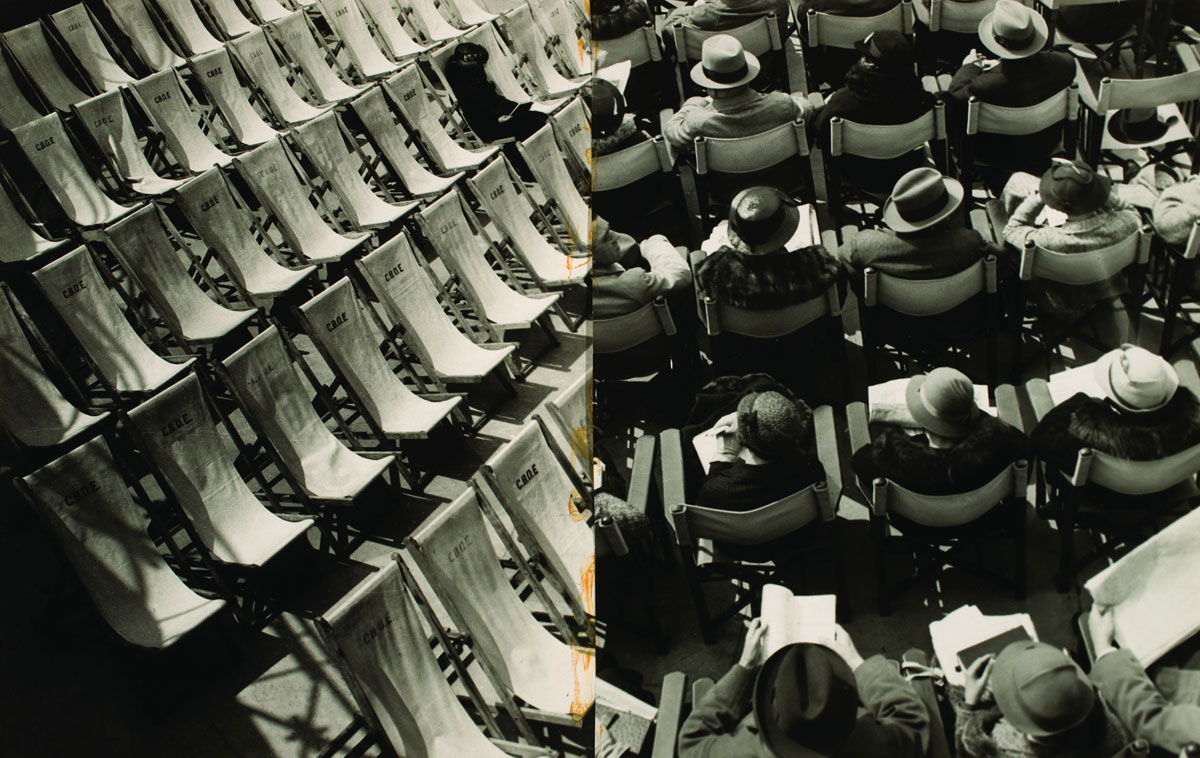
László Moholy-Nagy (Hungarian, 1895-1946) 'Chairs at Margate' 1935


László Moholy-Nagy (Hungarian, 1895-1946)
Chairs at Margate
1935
Gelatin silver print diptych
36.9 x 29.5cm (each)
© Hattula Moholy-Nagy/VEGAP 2011


Different press photographs from this exhibition, one that I last posted when it was at Martin Gropius-Bau, Berlin.

Marcus


Many thankx to the Ludwig Museum for allowing me to publish the photographs in the posting. Please click on the photographs for a larger version of the image.


László Moholy-Nagy (Hungarian, 1895-1946) 'K VII' 1922


László Moholy-Nagy (Hungarian, 1895-1946)
K VII
1922
Oil on canvas
115.3 x 135.9cm
Tate, London
© Hattula Moholy-Nagy/VEGAP 2011


László Moholy-Nagy (Hungarian, 1895-1946) 'Composition A XI' 1923


László Moholy-Nagy (Hungarian, 1895-1946)
Composition A XI
1923
Oil on canvas
Image: 115.6 x 131.1cm
© Hattula Moholy-Nagy/VEGAP 2011


László Moholy-Nagy (Hungarian, 1895-1946) 'Eton. Eleves watching cricket from the pavilion on Agar's Plough' c. 1930


László Moholy-Nagy (Hungarian, 1895-1946)
Eton. Eleves watching cricket from the pavilion on Agar’s Plough
c. 1930
Gelatin silver print


László Moholy-Nagy (Hungarian, 1895-1946) 'Untitled' 1939


László Moholy-Nagy (Hungarian, 1895-1946)
Untitled
1939
Fujicolor Crystal Archive print
Image: 22.8 x 34.2cm
Courtesy of László Moholy-Nagy Estate and Andrea Rosen Gallery Inc., New York
© Hattula Moholy-Nagy/VEGAP 2011


László Moholy-Nagy (Hungarian, 1895-1946) 'Untitled' 1940-44


László Moholy-Nagy (Hungarian, 1895-1946)
Untitled
1940-1944
Fujicolor Crystal Archive print
Image: 22.8 x 34.2cm
Courtesy of László Moholy-Nagy Estate and Andrea Rosen Gallery Inc., New York
© Hattula Moholy-Nagy/VEGAP 2011


László Moholy-Nagy is a world-famous figure of twentieth-century avant-garde art. His visual art and theoretical works, photographs, films, educational activities and photograms – taken without a camera and now synonymous with his name – were of such significance that it is no exaggeration to say that since Moholy-Nagy, we see things differently; since Moholy-Nagy, our thinking about art has been transformed. His innovations over the decades have become so natural, his influence so pervasive, that we now almost have to rediscover him once again. In the series of Hungarian photographers who accomplished world fame – Robert Capa, Martin Munkácsi, György Kepes – the Ludwig Museum – Museum of Contemporary Art now presents the work of László Moholy-Nagy (1895-1946), focussing primarily his photography. This is a long-overdue show: Hungary has not held such an exhibition of Moholy-Nagy’s work since 1975, not even on the centenary of his birth in 1995.

Moholy-Nagy began his creative career in the first half of the twentieth century in Lajos Kassák’s activist circle where, at twenty years old, he was one of Hungary’s youngest avant-garde artists. In 1919 he left for Vienna then Berlin, where he came under the influence of Dadaism and Constructivism, which he later developed further independently. On the invitation of director Walter Gropius in 1923, he became a teacher at the Weimar Bauhaus, then the most progressive art school. There, alongside the Metal Workshop, he also led the definitive course in new arts education, the Foundation. The Bauhaus was more than a school: it was a way of life that unified life, art and science. As well as exploring painting, leading the Metal Workshop, writing and editing books and applying new typographies at the experimental, innovative Bauhaus school, Moholy-Nagy also turned towards photography and film as forms offering new possibilities in art. Photography, and in particular film represented new technologies that questioned the traditional principles of art, among them the uniqueness of the artefacts and the personal signature of the artist.

The central organising principle in Moholy-Nagy’s diverse activities was light: light defined his paintings, sculptures, photoplastics, photograms, photographs, typography and theatre sets. He did not regard photography as a tool for the perfect imaging of reality, rather, it was his conviction that the camera offered new discoveries and possibilities for modern people to finally liberate themselves from the obligation to depict, to copy reality. The years at the Bauhaus proved to be an experience that defined his entire life. After Berlin, Weimar and Dessau, he settled in Chicago in 1937, where he founded the ‘New Bauhaus’ and remained until the end of his life, working as an experimental, innovative artist and theorist. He regarded art as an activity that embraced the whole of life which was non-hierarchical, accessible and cultivatable by everyone, and he was a firm believer in the educational role of art.

The Ludwig Museum’s exhibition presents his diverse life achievement from 1922, with Moholy-Nagy’s photography, films, and works ‘made with light’ in central focus. His first writings on light as a medium were published in 1923, in the Broom magazine, New York. One of the most exciting parts of the exhibition is the compilation of all Moholy-Nagy’s films, shown together here for the first time and according to the artist’s original conception. Such an ambitious and large-scale exhibition of Moholy-Nagy’s oeuvre could only have been realised with international collaboration. This exhibition brings together over 200 pieces and documents from over twenty museums around the world (Tate, Whitney, Tokyo Metropolitan, etc.) as well as private collections. It is based on the curatorial concept of the director of Madrid’s la Fábrica, Oliva Maria Rubio, and is the result of joint work between the Martin-Gropius-Bau in Berlin and the Gemeentemuseum in The Hague. The exhibition has previously shown in Madrid, Berlin and The Hague, and will open to audiences in Budapest until the end of September.

Moholy-Nagy’s rich oeuvre also allows us to make slightly different emphases according to location. In Berlin, the legendary 1929 Film und Foto (FiFo) exhibition and his pedagogical works were emphasised, while in The Hague, the focus was on the time he spent in the Netherlands between 1933 and 1935. With the participation of two internationally-renowned Hungarian art historians, experts of Moholy-Nagy, Krisztina Passuth and Éva Bajkay, the Budapest exhibition is complemented by photographs and publications from Hungarian collections. Thanks to László Moholy-Nagy’s family, valuable documents that have not been seen in any of the earlier locations have been added to the exhibition.

Press release from the Ludwig Museum


László Moholy-Nagy (Hungarian, 1895-1946) 'The Benevolent Gentleman' 1924


László Moholy-Nagy (Hungarian, 1895-1946)
The Benevolent Gentleman
1924
Photoplastic, gelatin silver print


László Moholy-Nagy (Hungarian, 1895-1946) 'Jealousy' 1924-1927


László Moholy-Nagy (Hungarian, 1895-1946)
Jealousy
1924-1927
Photoplastic, gelatin silver print
30 x 24.6cm
Victoria & Albert Museum Collection, London
© Hattula Moholy-Nagy/VEGAP 2011


László Moholy-Nagy (Hungarian, 1895-1946) 'La Canebière Street, Marseilles - View Through the Balcony Grille' 1928


László Moholy-Nagy (Hungarian, 1895-1946)
La Canebière Street, Marseilles – View Through the Balcony Grille
1928
Gelatin silver print
24.4 x 17.5cm
George Eastman House Collection. Donated by Katharine Kuh
© Hattula Moholy-Nagy/VEGAP 2011


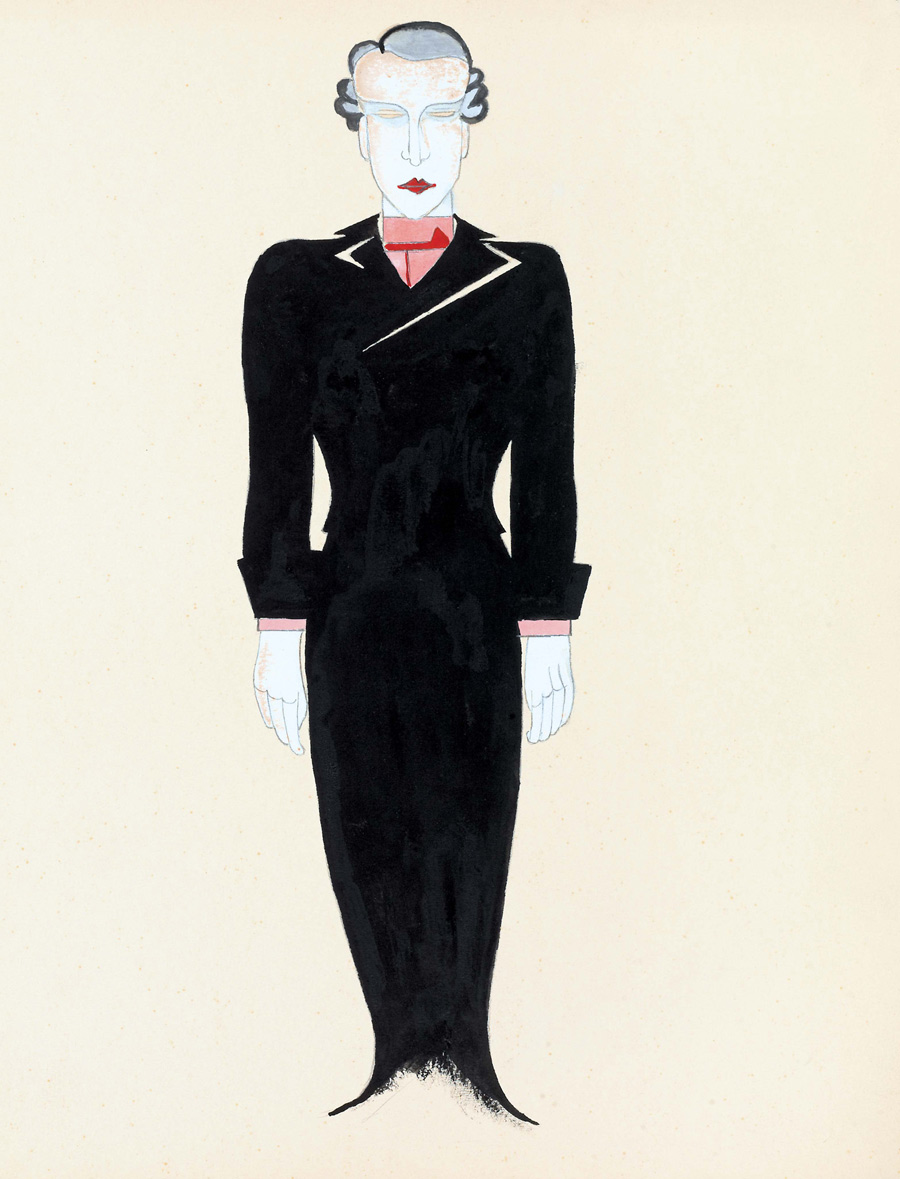
László Moholy-Nagy (Hungarian, 1895-1946) 'Costume Design for Tales of Hoffmann' 1929


László Moholy-Nagy (Hungarian, 1895-1946)
Costume Design for Tales of Hoffmann
1929
Watercolour on paper
34.3 x 27cm
Hattula Moholy-Nagy, Ann Arbor, Michigan
© Hattula Moholy-Nagy/VEGAP 2011


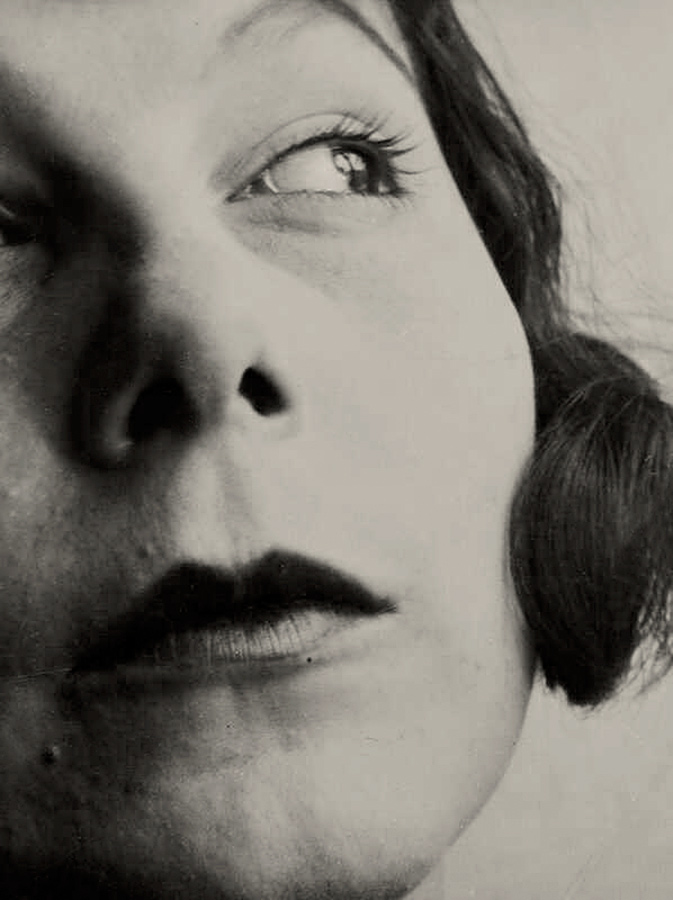
László Moholy-Nagy (Hungarian, 1895-1946) 'Portrait of Ellen Frank' c. 1929


László Moholy-Nagy (Hungarian, 1895-1946)
Portrait of Ellen Frank
c. 1929
Gelatin silver print


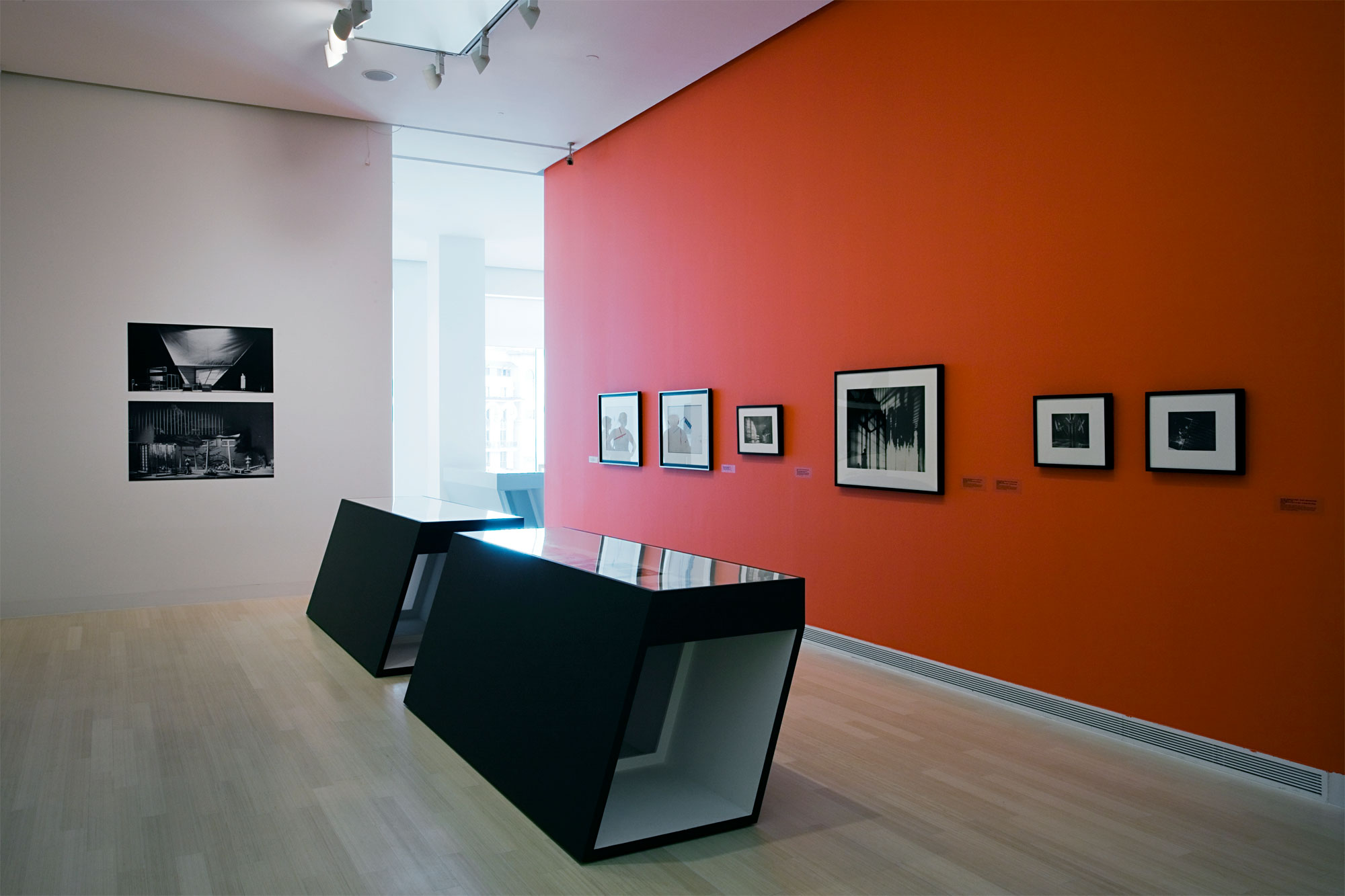
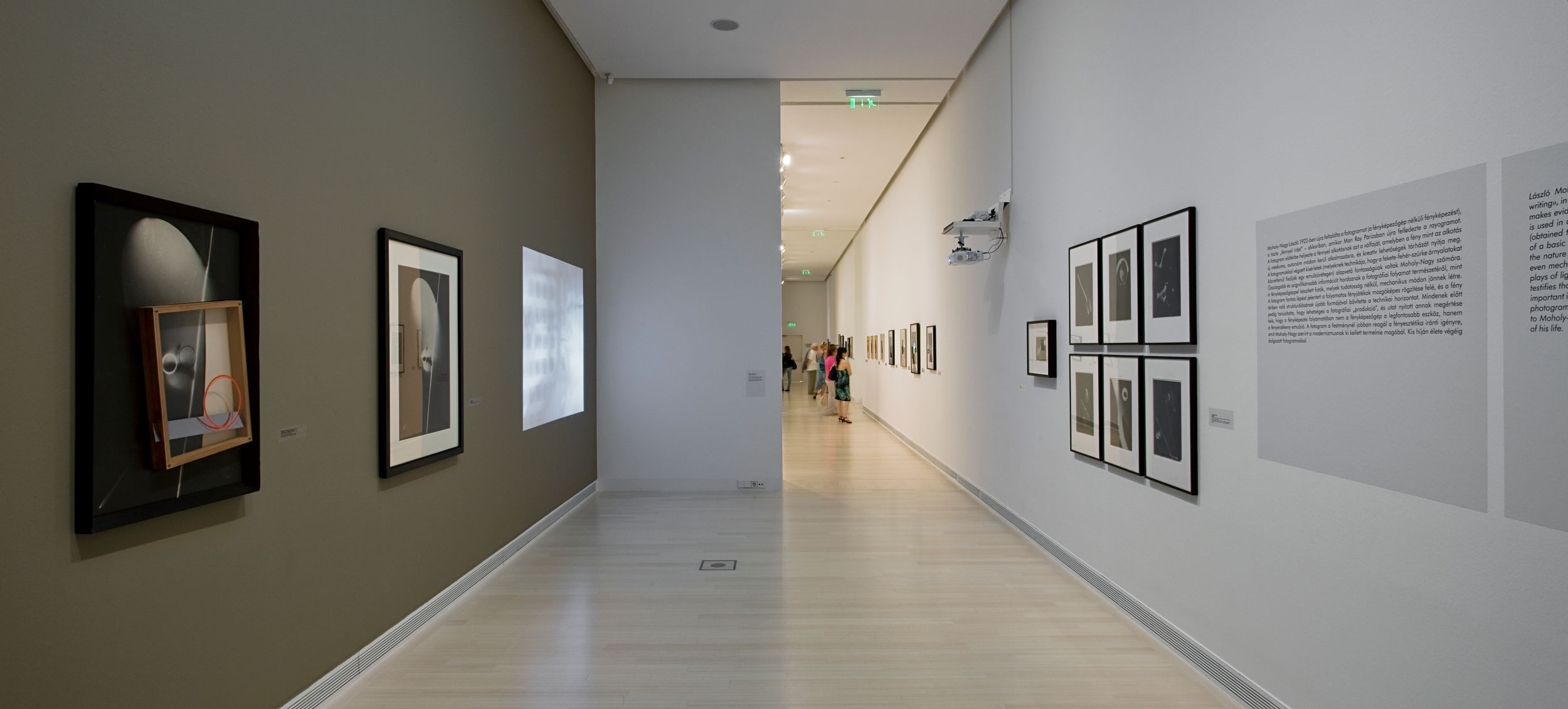
Interior view of the exhibition 'László Moholy-Nagy. The Art of Light' at Ludwig Museum - Museum of Contemporary Art


Interior view of the exhibition László Moholy-Nagy. The Art of Light at Ludwig Museum – Museum of Contemporary Art
© BUJNOVSZKY Tamás / Ludwig Museum – Museum of Contemporary Art, Archives


Interior view of the exhibition 'László Moholy-Nagy. The Art of Light' at Ludwig Museum - Museum of Contemporary Art

Interior view of the exhibition 'László Moholy-Nagy. The Art of Light' at Ludwig Museum - Museum of Contemporary Art

Interior view of the exhibition 'László Moholy-Nagy. The Art of Light' at Ludwig Museum - Museum of Contemporary Art


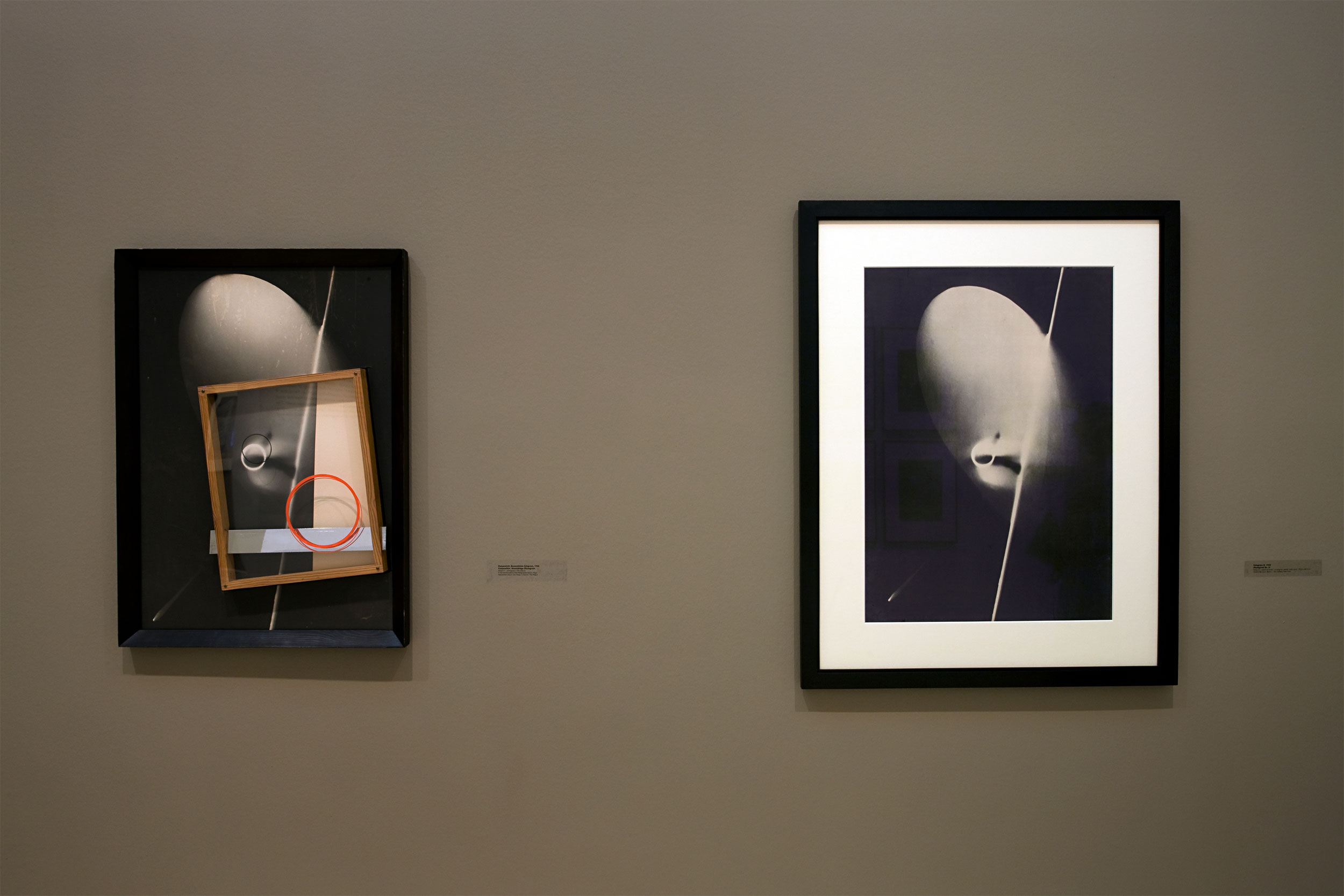
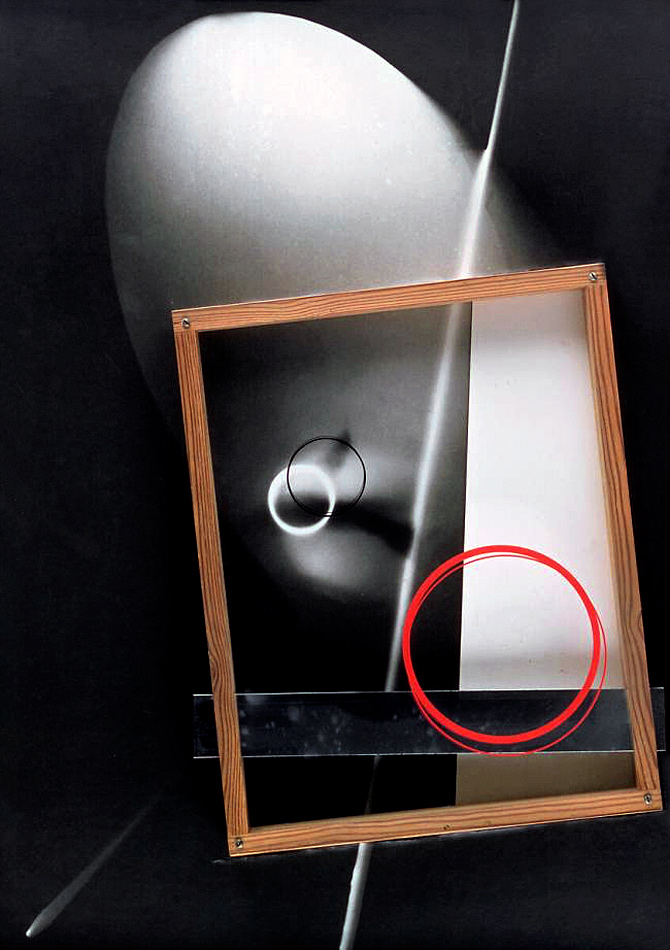
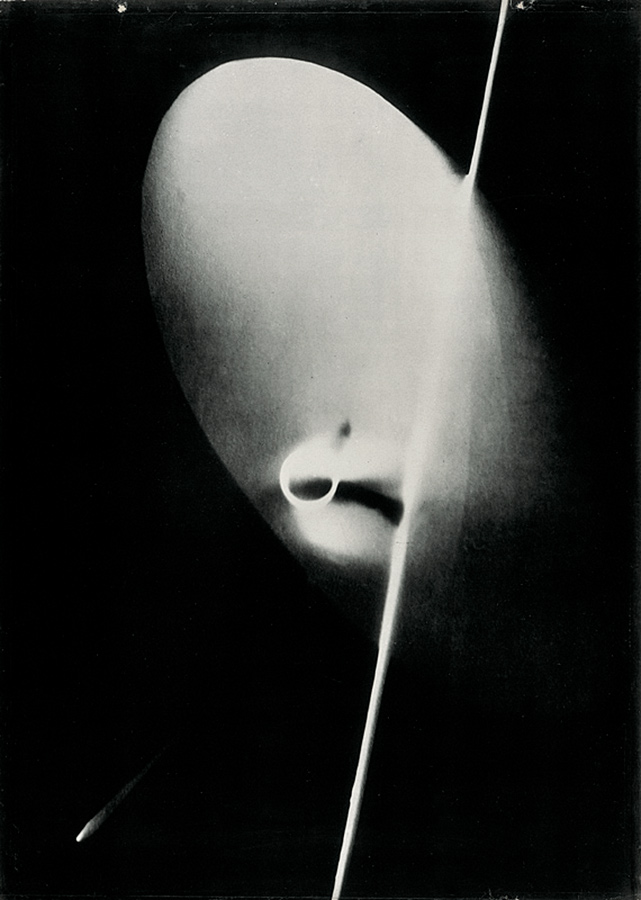
Interior views of the exhibition László Moholy-Nagy. The Art of Light at Ludwig Museum – Museum of Contemporary Art showing at left in the bottom image, Composition – Assemblage – Photogram (1926, below); and at right, Photogramm No. II (1929, below)
© BUJNOVSZKY Tamás / Ludwig Museum – Museum of Contemporary Art, Archives


László Moholy-Nagy (Hungarian, 1895-1946) 'Composition - Assemblage - Photogram' 1926


László Moholy-Nagy (Hungarian, 1895-1946)
Composition – Assemblage – Photogram
1926
Photogram and mixed media


László Moholy-Nagy (Hungarian, 1895-1946) 'Photogramm No. II' 1929


László Moholy-Nagy (Hungarian, 1895-1946)
Photogramm No. II
1929
Silver gelatin photograph
95.5 x 68.5cm


László Moholy-Nagy (Hungarian, 1895-1946) 'Lago Maggiore, Ascona, Switzerland' c. 1930


László Moholy-Nagy (Hungarian, 1895-1946)
Lago Maggiore, Ascona, Switzerland
c. 1930
Silver gelatin photograph


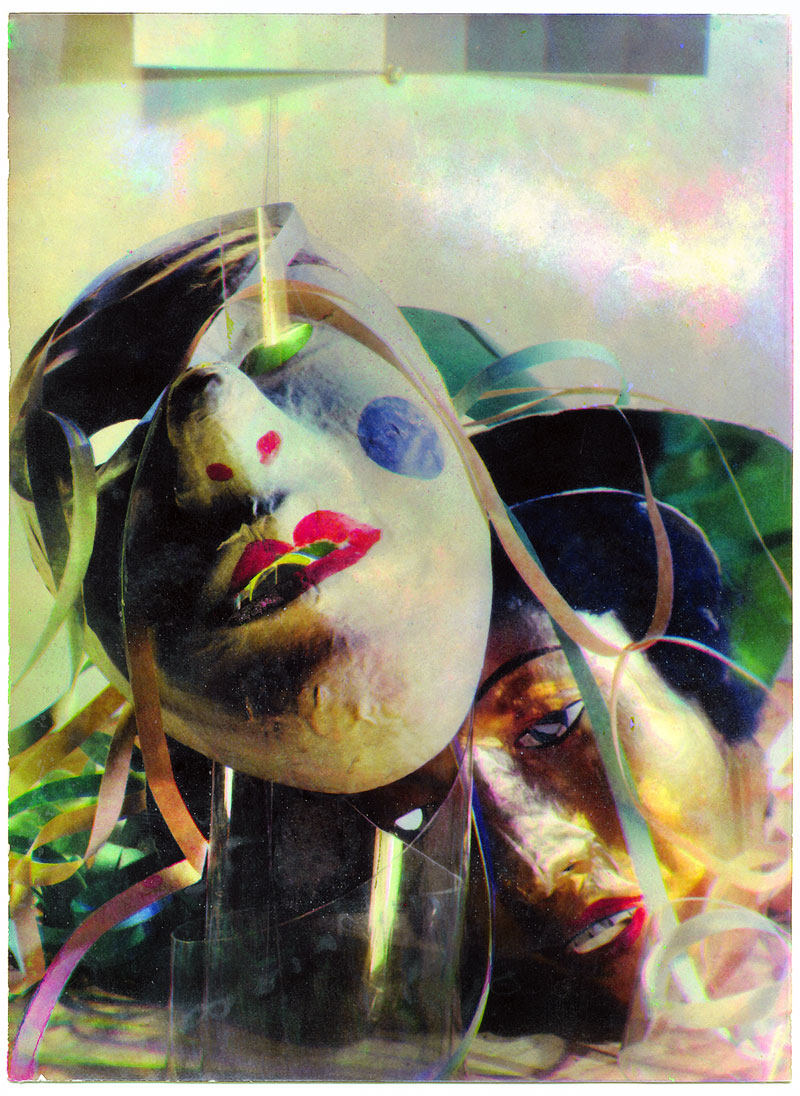
László Moholy-Nagy (Hungarian, 1895-1946) and Paul Hartland. 'Carnival: Composition with two masks' c. 1934


László Moholy-Nagy (Hungarian, 1895-1946) and Paul Hartland 
Carnival: Composition with two masks
c. 1934
Gemeentemuseum Den Haag


Ludwig Museum – Museum of Contemporary Art
Palace of Arts
Komor Marcell u. 1, Budapest, H-1095
Phone: +36 1 555 3444

Opening hours:
Tuesday – Sunday: 10am – 6pm
Closed on Mondays

Ludwig Museum website

LIKE ART BLACK ON FACEBOOK

Back to top

Exhibition: ‘The Lives of Great Photographers’ at The National Media Museum, Bradford

Exhibition dates: 15th April – 4th September 2011


Many thankx to The National Media Museum for allowing me to publish the photographs in the posting. Please click on the photographs for a larger version of the image.


Lady Clementina Hawarden (British, 1822-1865) 'Self Portrait' c. 1864


Lady Clementina Hawarden (British, 1822-1865)
Self Portrait
c. 1864
Albumen print
Courtesy of the National Media Museum/SSPL


Clementina, Lady Hawarden, is a poetic, if elusive, presence among nineteenth-century photographers. As a devoted mother, her life revolved around her eight children. She took up photography in 1857; using her daughters as models, she created a body of work remarkable for its technical brilliance and its original depiction of nascent womanhood.
Lady Hawarden showed her work in the 1863 and 1864 exhibitions of the Photographic Society. With the exception of a few rare examples, her photographs remained in the possession of her family until 1939, when the more than eight hundred images were donated to the Victoria and Albert Museum. Only recently have they been the objects of research, publication, and exhibition.

Text from The Metropolitan Museum of Art website


John Moffat (Scottish, 1819-1894) 'William Henry Fox Talbot with camera and lens' 1864


John Moffat (Scottish, 1819-1894)
William Henry Fox Talbot with camera and lens
1864


Julia Margaret Cameron (British born India, 1815-1879) 'Carlyle like a rough block of Michael Angelo's sculpture' 1867


Julia Margaret Cameron (British born India, 1815-1879)
Carlyle like a rough block of Michael Angelo’s sculpture
1867
Albumen print
Courtesy The Royal Photographic Society Collection at the National Media Museum/SSPL


Henry Herschel Hay Cameron (British born India, 1852-1911) 'Mrs Julia Margaret Cameron' 1870


Henry Herschel Hay Cameron (British born India, 1852-1911)
Mrs Julia Margaret Cameron
1870
Albument print
Courtesy of the National Media Museum/SSPL


Julia Margaret Cameron (British born India, 1815-1879) 'So Like a Shatter'd Column Lay the King' 1875


Julia Margaret Cameron (British born India, 1815-1879)
So Like a Shatter’d Column Lay the King
1875
Albumen print
Courtesy of The Royal Photographic Society Collection at the National Media Museum


Photographers have created some of the most famous and memorable images ever produced, combining science and art since 1839. The Lives of Great Photographers, a free to enter exhibition at the National Media Museum in Bradford, draws on the Museum’s renowned collection to focus on the pioneers behind the camera, exploring the extraordinary stories surrounding some of photography’s most important innovators and artists.

Featuring Henri Cartier-Bresson, Julia Margaret Cameron, Robert Capa, William Henry Fox Talbot, Weegee, Tony Ray-Jones, Fay Godwin and Eadweard Muybridge, the exhibition will display iconic images and artefacts from these and other great names, selected exclusively from the National Collection of Photography.

Exhibition curator Brian Liddy said: “Photography has been with us for more than 170 years, and in that time countless famous photographs have been taken by many famous photographers. Often we may think we know these men and women because we know their work so well, but over time so many photographers’ personal stories have become overshadowed by their most famous pictures. This major exhibition aims to redress the balance.”

The show begins with an investigation into the rivalry between two of the medium’s earliest pioneers. Without Louis Jacques Mandé Daguerre and William Henry Fox Talbot, photography as it known today would not exist. Daguerre, a former theatrical designer, presented the photographic process to France and the world in 1839. Working in parallel and in competition, Talbot, who became an MP for Chippenham, went on to create the first negative from which multiple copy photographs could be produced.

As technology evolved, the breadth and range of photography increased, and the methods by which it could provide a source of income, or artistic expression, became more diverse. Julia Margaret Cameron, although primarily considered an artist, copyrighted her work and attempted to make a living by selling copies. Her personal connections gave her the opportunity to produce some of the first celebrity photographs in existence. Olive Edis employed photography as a serving war artist during the First World War and Edward Steichen’s career was remarkable for its variety as he moved effortlessly from art, to fashion, to advertising.

Photography also proved an ideal medium when it came to documenting world events. Lewis Hine and Dorothea Lange were both driven by their social consciences to record the Great Depression in America. Photojournalism, the cousin of documentary photography, is represented in the exhibition by names such as Henri Cartier-Bresson and Robert Capa, founding members of the world’s first photographic agency, Magnum. Both served in the Second World War and produced images that helped define an era.

One of the most notorious life stories is that of the English photographer Eadweard Muybridge. His pioneering work in chronophotography, whereby movement is captured by a sequence of photographic exposures, famously demonstrated that all four legs of a horse left the ground as it galloped. Until then the motion of a horse’s hooves were too quick for the human eye to determine. Perhaps less well known is the fact that Muybridge murdered his wife’s lover in cold blood but was later acquitted with a verdict of ‘justifiable homicide’.

The exhibition also includes Roger Fenton, Lady Clementina Hawarden, Alfred Stieglitz, André Kertész, and Larry Burrows. Each photographer is represented by their photographic portrait and a selection of their images. None is living, as only those whose lives and work can be evaluated in their entirety have been selected.

Brian Liddy added: “This exhibition shows just how rich the museum’s collections are. The work of some of the best-known photographers in history will be shown alongside the kinds of cameras they would have had to carry and use in the course of their work. We’ve also taken the opportunity to show rarely seen material, such as pages from the notebooks of Tony Ray-Jones detailing what was going through his mind when he was thinking about how to get the pictures he wanted.”

“By recounting the lives of these great photographers, we hope to provide an insight into what led them to produce some of the greatest photographs ever taken.”

Press release from The National Media Museum


Henry Fox Talbot (British, 1800-1877) 'The Ladder' 1844


Henry Fox Talbot (British, 1800-1877)
The Ladder
1844
Salted paper print from paper negative
Courtesy of the National Media Museum/SSPL


Roger Fenton (British, 1819-1869) 'Princesses Helena and Louise' 1856


Roger Fenton (British, 1819-1869)
Princesses Helena and Louise
1856
Albumen print
Courtesy of The Royal Photographic Society Collection at the National Media Museum


Photograph of Princess Helena and Princess Louise, seated outside together wearing identical outfits, including hats. Both look to front. Upturned stool in foreground.

The two princesses look straight at the camera in what is an unusually direct pose. Princess Helena (1846-1923) and Princess Louise (1848-1939) were the fifth and six children of Queen Victoria and Prince Albert. Princess Helena was herself a keen collector of photographs and compiled a number of albums commemorating her many visits to Balmoral

Text adapted from Roger Fenton – Julia Margaret Cameron: Early British photographs from the Royal Collection, London, 2010 on the Royal Collection Trust website


Eadweard Muybridge (English, 1830-1904) Man (Muybridge) throwing discus walking up steps walking Plate 519 Animal Locomotion


Eadweard Muybridge (English, 1830-1904)
Man (Muybridge) throwing discus walking up steps walking
Plate 519 Animal Locomotion
1887
Collotype
Courtesy of the National Media Museum/SSPL


Unknown photographer. 'Eadweard Muybridge' date unknown


Unknown photographer
Eadweard Muybridge
Date unknown
Courtesy of The Royal Photographic Society Collection at the National Media Museum


Alvin Langdon Coburn (American, 1882-1966) 'Alfred Stieglitz' 1905


Alvin Langdon Coburn (American, 1882-1966)
Alfred Stieglitz
1905
Courtesy of the National Media Museum/SSPL


Lewis Hine (American, 1874-1940) 'Albanian woman Ellis Island' 1905


Lewis Hine (American, 1874-1940)
Albanian woman Ellis Island
1905
Gelatin silver print
Courtesy of the National Media Museum/SSPL


At the Ethical Culture School in New York Lewis Hine taught photography to teenagers, encouraging them to observe others. He took his classes to Ellis Island to see arriving immigrants. “At times it looked like a costume ball,” he wrote, “with the multicoloured, many-styled national costumes,” This is one of over 200 photographs that Hine made himself at Ellis Island, representing an Albanian immigrant, wearing her best clothes, cleaned and immaculately pressed. Hine’s empathy with the neglected him led to a job with the National Child Labor Committee. He traveled the country photographing children at work in factories in New England, at coal mines in Pennsylvania, and canneries on the Gulf Coast. Hine’s photographs helped secure child labor laws in this country.

From Touchstones of the Twentieth Century: A History of Photography at the University of Notre Dame (exhibition, 2020-21)


Unknown photographer. 'Lewis Hine photographing children in a slum' c. 1910


Unknown photographer
Lewis Hine photographing children in a slum
c. 1910
Gelatin silver print
Courtesy of the National Media Museum/SSPL


Alvin Langdon Coburn (American, 1882-1966) 'George Davison' 1918


Alvin Langdon Coburn (American, 1882-1966)
George Davison
1918
Gelatin silver print
Courtesy of the National Media Museum/SSPL


George Davison (19 September 1854 – 26 December 1930) was an English photographer, a proponent of impressionistic photography, a co-founder of the Linked Ring Brotherhood of British artists and a managing director of Kodak UK. He was also a millionaire, thanks to an early investment in Eastman Kodak.


Edith Tudor Hart (Austrian-British, 1908-1973) 'Gee Street, Finsbury' 1936


Edith Tudor Hart (Austrian-British, 1908-1973)
Gee Street, Finsbury
1936
Courtesy of the National Media Museum/SSPL
© Wolfgang Suschitzky


This photograph was published alongside Poodle Parlour, London (PGP 279.33B) in the satirical magazine Lilliput in 1939, offering a comparison between the living conditions of the urban poor and the care lavished on pets by their wealthy owners. The juxtaposition made a simple political point and encouraged the viewer to think about the unequal organisation of society. This was a rhetorical technique common in left-wing illustrated journals on the Continent. The Austrian magazine, Der Kuckuck, had published a similar story in 1931 comparing the living conditions of the Berlin poor with the more salubrious accommodation of the city’s dog home.

Text from the National Galleries of Scotland website


Henri Cartier-Bresson (French, 1908-2004) 'Dessau, Germany' 1945


Henri Cartier-Bresson (French, 1908-2004)
Dessau, Germany
1945
Gelatin silver print
Courtesy of the National Media Museum/SSPL
© Henri Cartier-Bresson, Magnum, HCB Fondation


Cartier-Bresson had been a prisoner of war in Germany for nearly three years. He tried to escape two times, and then on the third time was successful. And partly because of that experience he was commissioned by the US Office of War Information to make a film about the return of displaced persons and prisoners of war.

And this incident appears in the film. The cameraman is filming this scene, and Cartier-Bresson, is right next to him making his own pictures. This is at a displaced person’s camp. And the woman in the black dress had been denounced to the Gestapo by the woman she’s about to hit. And here they’re both telling their stories to the man on the right who’s obviously the man in authority.

And what’s typical in this picture of Cartier-Bresson’s best work after the war, is that it’s all boiled down to these three protagonists. The anger of the woman who had been betrayed totally saturates her body, just the way the shame and the guilt of the woman who had done the betraying occupies her body, right down to where she’s got her thumb inside her fist.

Peter Galassi on the Museum of Modern Art website


Richard Sadler (British, 1927-2020) Weegee in Coventry, "Weegee the Famous" 1963


Richard Sadler (British, 1927-2020)
Weegee in Coventry, “Weegee the Famous”
1963
Gelatin silver print
Courtesy of the National Media Museum/SSPL


Tony Ray-Jones (English, 1941-1972) 'Auto Show, Daytona' 1965


Tony Ray-Jones (English, 1941-1972)
Auto Show, Daytona
1965
Gelatin silver print
Courtesy of the National Media Museum/SSPL


Unknown photographer. 'Portrait of Bill Brandt' c. 1979


Unknown photographer
Portrait of Bill Brandt
c. 1979
Gelatin silver print
Courtesy of the National Media Museum/SSPL


National Media Museum
Bradford,
West Yorkshire,
BD1 1NQ

Opening hours:
Wednesday – Sunday 10.00 – 17.00

National Media Museum website

LIKE ART BLACK ON FACEBOOK

Back to top

Exhibition: ‘Kurt Kranz: Programming of Beauty’ at the Bauhaus Dessau, Berlin

Exhibition marking the 100th birthday of Kurt Kranz
19th November 2010 – 29th May 2011


Kurt Kranz (German, 1910-1997) 'Perspective' 1931


Kurt Kranz (German, 1910-1997)
Perspective
1931
Ingrid Kranz / Stiftung Bauhaus Dessau
Foto: Lars Lohrisch / Abdruck mit Genehmigung der Kunsthalle


One of the great pleasures of publishing this archive is that I get to research the life of an artist whose work I never knew before. Kurt Kranz is one such artist.

Dr Marcus Bunyan


Many thankx to the the Bauhaus Dessau for allowing me to publish the photographs in the posting. Please click on the photograph for a larger version of the image.


Kurt Kranz (German, 1910-1997) 'Vereinsamung' Dessau 1930


Kurt Kranz (German, 1910-1997)
Vereinsamung (Isolation)
Dessau
1930
Ingrid Kranz / Stiftung Bauhaus Dessau
Leihgeber: Kunsthalle Bremen


Installation photograph of 'Programming of Beauty' by Kurt Kranz at the Bauhaus Dessau


Installation photograph of Programming of Beauty by Kurt Kranz at the Bauhaus Dessau


Kurt Kranz (German, 1910-1997) 'Versinkende' (Sinking one) 1931


Kurt Kranz (German, 1910-1997)
Versinkende (Sinking one)
1931
Ingrid Kranz / Stiftung Bauhaus Dessau


Kurt Kranz (German, 1910-1997) 'Persischer Garten' (Persian garden) 1970


Kurt Kranz (German, 1910-1997)
Persischer Garten (Persian garden)
1970
Ingrid Kranz / Stiftung Bauhaus Dessau
Foto: Uwe Jacobshagen


The Bauhaus Dessau dedicates a comprehensive exhibition to the painter, graphic designer and photographer Kurt Kranz to mark his 100th birthday. In 1930, the then twenty-year-old lithographer came from Bielefeld to study at the Bauhaus Dessau, where he soon established himself as a pioneer of serial and generative methods. With his avant-garde work, Kranz’s methods anticipated those of later generations.

Inspired by a lecture by László Moholy-Nagy, Kurt Kranz came to the Bauhaus Dessau in April 1930. In Walter Peterhans’s photography class, Kranz began to experiment with photographic techniques and created some of the most striking abstract picture series to emerge from the Bauhaus. Alienated and abstracted faces and hands appear repeatedly in his dynamic picture series. These show Kranz’s early affinity for film as, page for page, the abstract forms interact with one another. Kranz drafted his first concepts for abstract films at the Bauhaus, although he was first able to realise these decades later in 1972.

The exhibition to mark the artist’s 100th birthday shows works from Kranz’s Bauhaus years and his later work as an advertising graphic designer, and focuses on a selection of his large picture cycles. Strikingly diverse leporellos dating from the 1960s onwards take centre stage, as do the so-called “Matrix-und Schiebebilder”

Text from the Bauhaus Dessau website


Kurt Kranz (German, 1910-1997) 'Selbstporträt en face (objektives Foto)' (Self-portrait with face (objective photo)) 1931


Kurt Kranz (German, 1910-1997)
Selbstporträt en face (objektives Foto) (Self-portrait with face (objective photo))
1931
Ingrid Kranz / Stiftung Bauhaus Dessau


Kurt Kranz (German, 1910-1997) 'Rasterfoto' (Raster photograph) 1932


Kurt Kranz (German, 1910-1997)
Rasterfoto (Raster photograph)
1932
Ingrid Kranz / Stiftung Bauhaus Dessau


Kurt Kranz (German, 1910-1997) 'Schwarz : Weiß' (Black: White) 1928-29


Kurt Kranz (German, 1910-1997)
Schwarz: Weiß (Black: White)
1928-1929
Ingrid Kranz / Stiftung Bauhaus Dessau
Privatbesitz


Kurt Kranz (German, 1910-1997) 'Schwarz : Weiß' (Black: White) 1928-29


Kurt Kranz (German, 1910-1997)
Schwarz: Weiß (Black: White)
1928-1929
Ingrid Kranz / Stiftung Bauhaus Dessau
Privatbesitz


Kurt Kranz (German, 1910-1997) 'Schwarz : Weiß' (Black: White) 1928-29


Kurt Kranz (German, 1910-1997)
Schwarz: Weiß (Black: White)
1928-1929
Ingrid Kranz / Stiftung Bauhaus Dessau
Privatbesitz


Kurt Kranz (German, 1910-1997) 'Schrift Entwurf aus Satzmaterial' (Writing draft from sentence material) Dessau 1931


Kurt Kranz (German, 1910-1997)
Schrift Entwurf aus Satzmaterial (Writing draft from sentence material)
Dessau
1931
Ingrid Kranz / Stiftung Bauhaus Dessau


Kurt Kranz (German, 1910-1997) Aus der Serie "Sieben Schritte zum symmetrischen Oval"' (From the series "Seven steps to the symmetrical Oval") 1982


Kurt Kranz (German, 1910-1997)
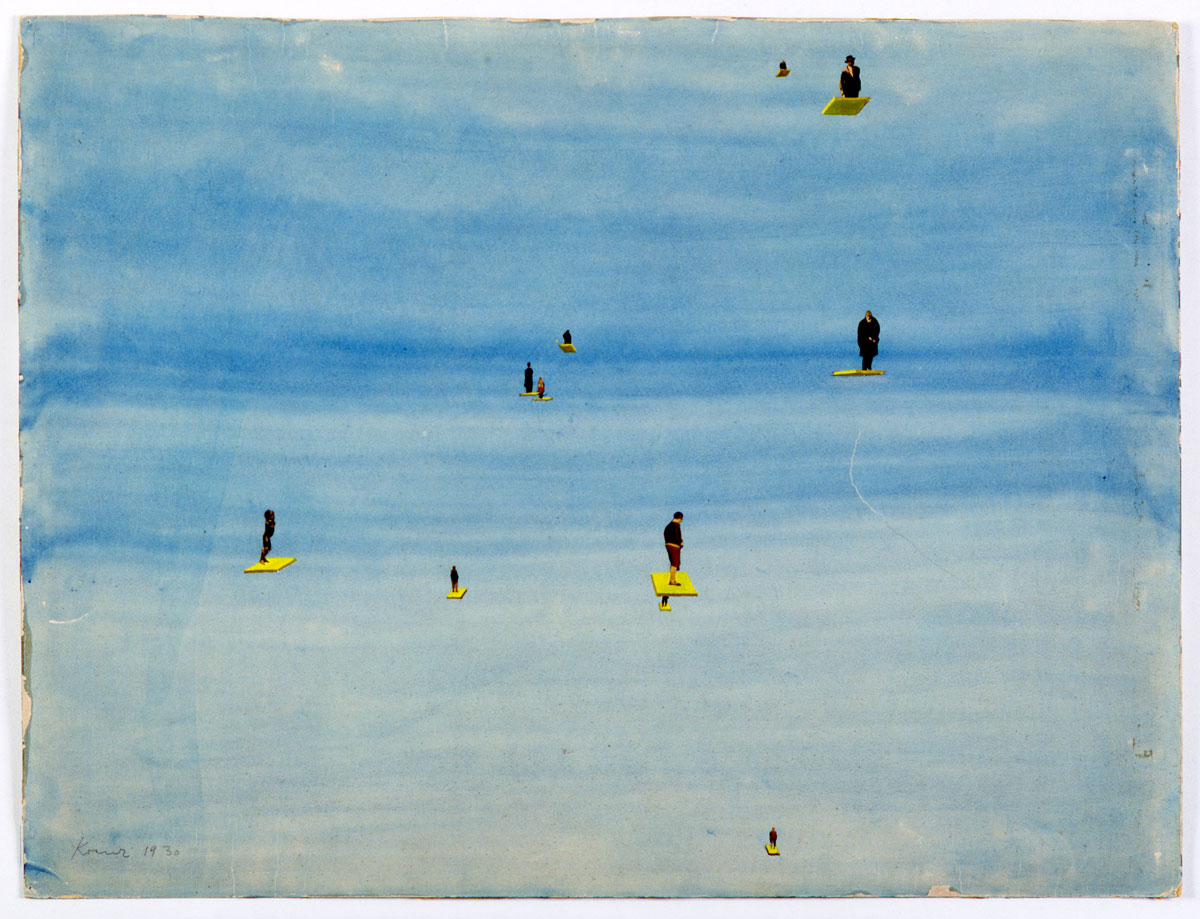
Aus der Serie “Sieben Schritte zum symmetrischen Oval” (From the series “Seven steps to the symmetrical Oval”)
1982
Ingrid Kranz / Stiftung Bauhaus Dessau
Foto: Uwe Jacobshagen


Kurt Kranz (German, 1910-1997) 'Augenreihe' (Eye rows) 1931


Kurt Kranz (German, 1910-1997)
Augenreihe (Eye rows)
1931 (montiert 1981) (1931 (1981 install))
Ingrid Kranz / Stiftung Bauhaus Dessau
Leihgeber: Kunsthalle Bremen


Kurt Kranz (German, 1910-1997) 'Mund-Reihen' (Mouth rows) 1931


Kurt Kranz (German, 1910-1997)
Mund-Reihen (Mouth rows)
1931
Ingrid Kranz / Stiftung Bauhaus Dessau
Leihgeber: Kunsthalle Bremen
Foto: Ingrid Kranz, Wedel


Bauhaus Dessau
Gropiusalle 38, Dessau, Germany

Opening hours:
Tue – Sun 10am – 6pm

Bauhaus Dessau website

LIKE ART BLART ON FACEBOOK

Back to top