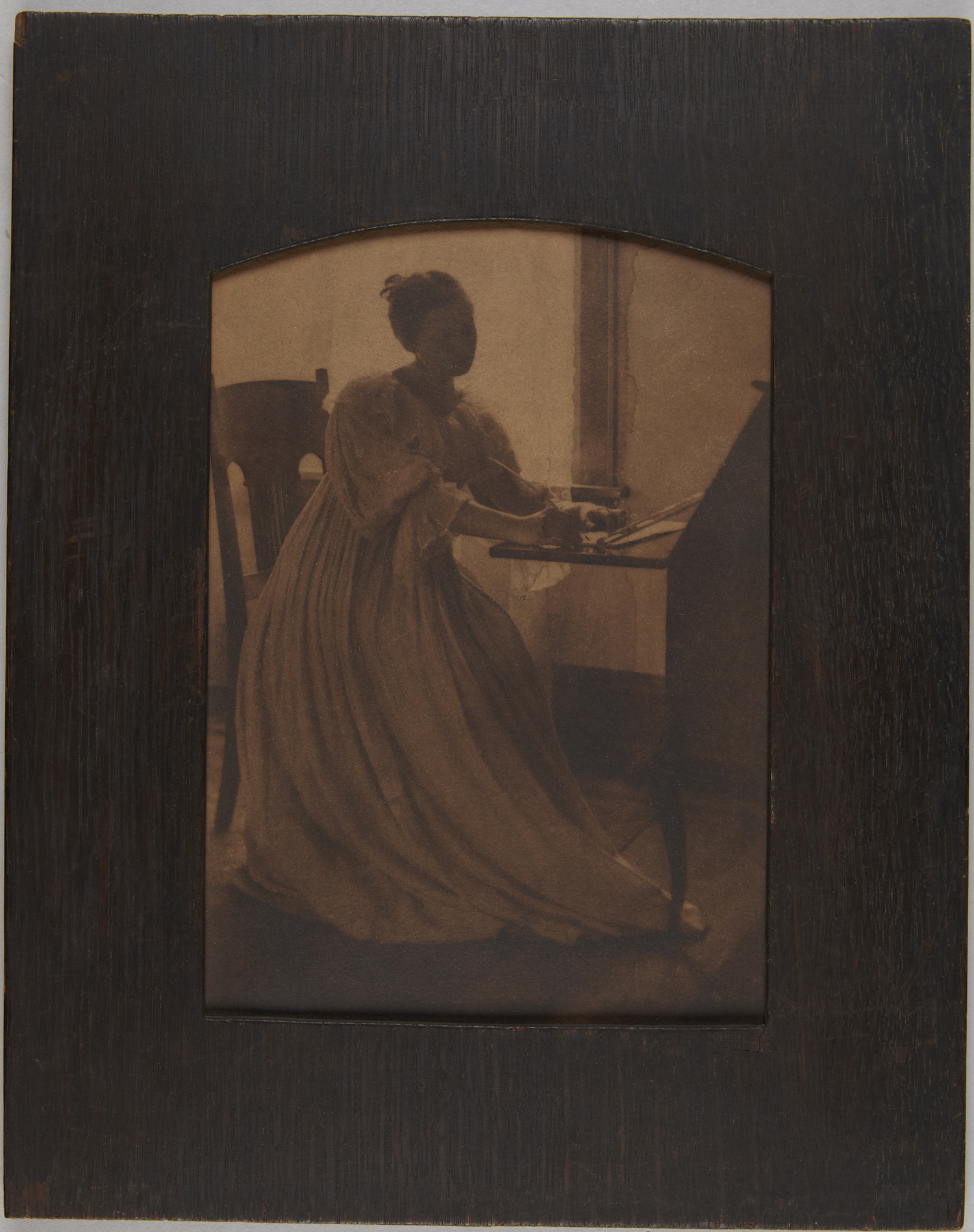
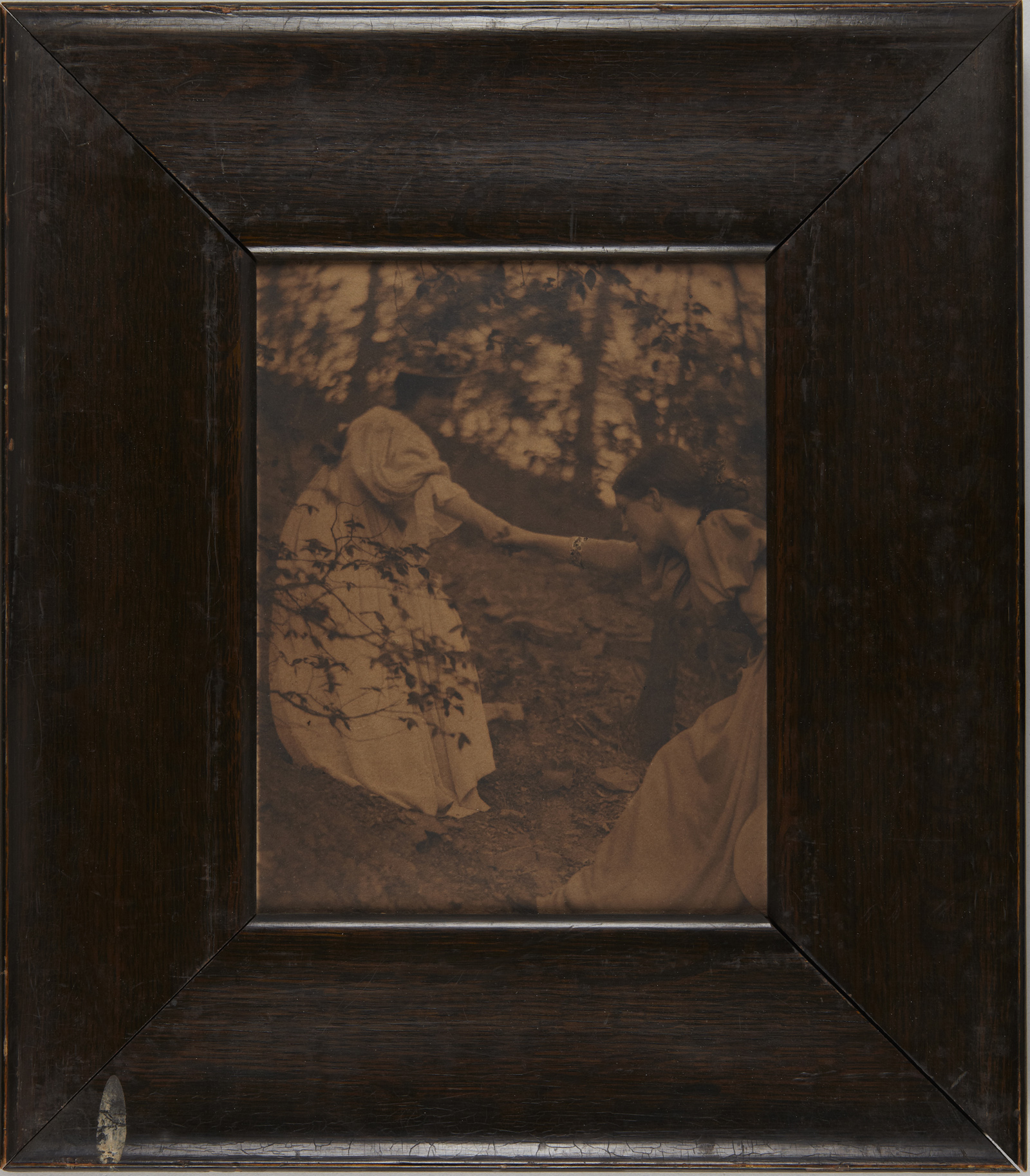
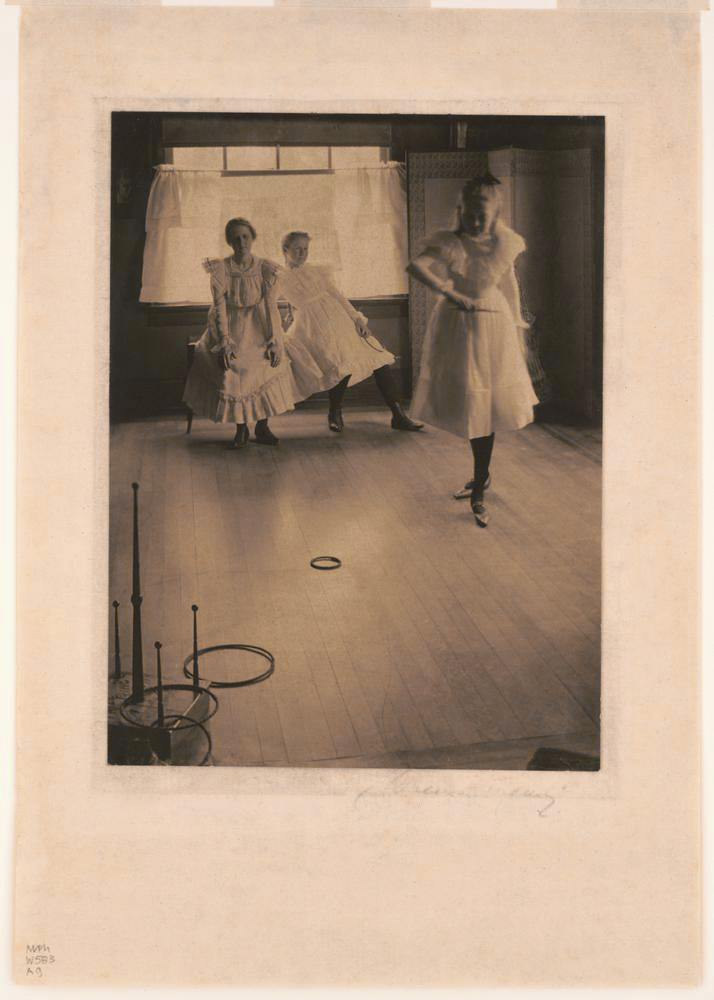
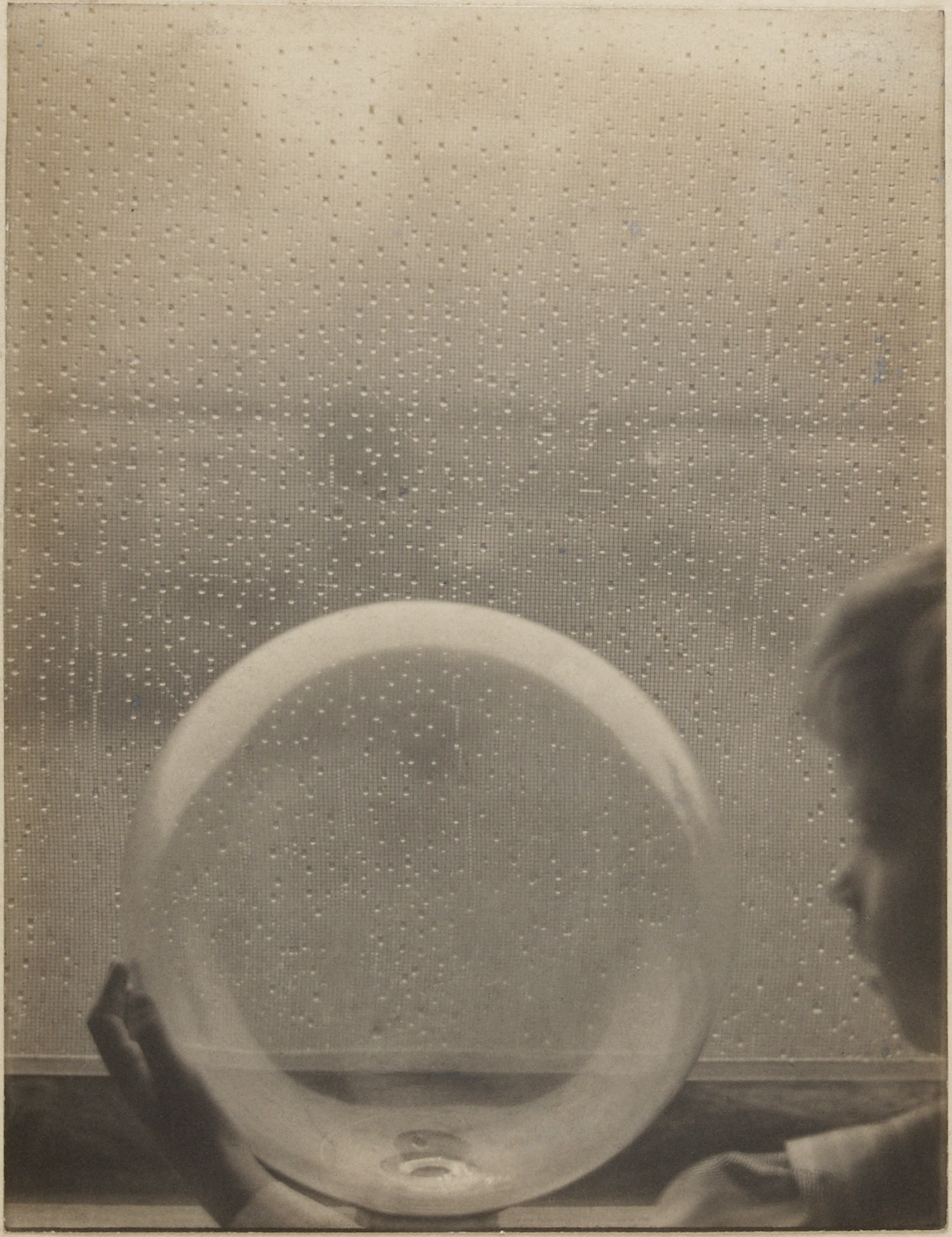
Exhibition: ‘Victorian Giants: The Birth of Art Photography’ at the National Portrait Gallery, London Part 2

Exhibition dates: 1st March – 20th May, 2018

Victorian Giants: The Birth of Art Photography is curated by Phillip Prodger PhD, Head of Photographs at the National Portrait Gallery, London


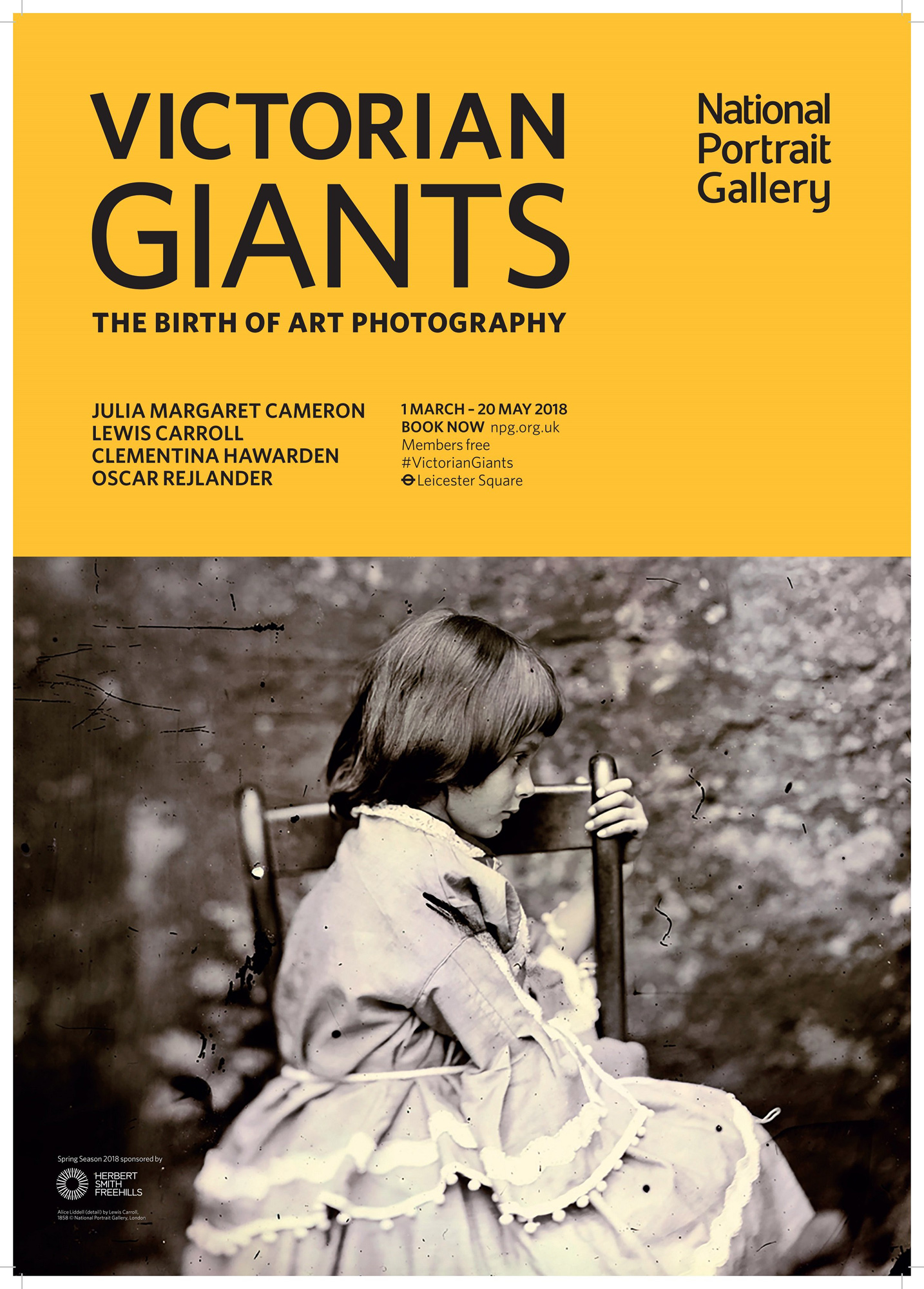
Poster for the exhibition 'Victorian Giants: The Birth of Art Photography' at the National Portrait Gallery, London


Poster for the catalogue for the exhibition Victorian Giants: The Birth of Art Photography at the National Portrait Gallery, London


Oh Clementina! the light, the stars!

There is enough text in the posting for me not to really have to say anything. It’s all there…

Art, influence, technology;
Classical, formal, diaristic;
Intimacy, mystery, atmospheric;
Motherhood, sexuality, feminist identity, nascent womanhood;
‘Profil perdu’ (French, ‘lost profile’, which refers to a portrait in which the profile cannot be seen), mirror, loss, duplication and replication, illusion, and fetish

… all woven into a performative, psychological, expressive and creative (self) portraiture.

The real stars of the show are most definitely the women… the avant-garde artists of their era.

Dr Marcus Bunyan

View part 1 of the posting


Many thankx to the National Portrait Gallery, London for allowing me to publish the photographs in the posting. Please click on the photographs for a larger version of the image.


“The women are the real stars of this exhibition. Their pictures are bolder and bigger, more imaginative and more daring. They portray people with a raw reality that is not just the result of the collodion method but a powerful, visionary insight.

Hawarden’s pictures of Victorian women have an intimacy that transcends time and a mystery that asserts the autonomy of her subjects. They are feminist, and gothic too, in their eerie atmosphere. In an 1863-4 picture called ‘Photographic Study’, she poses a young woman by a mirror so that we see her twice. The “real” woman is in brooding profile while her reflection is a shadowy full-face image. The effect is spookily absorbing as we become witnesses to her melancholic introspection.

Hawarden’s ultra-sharp yet shadow-rich prints create unresolved stories featuring women free to show who they really are. None of them look happy. All are curiously defiant – these pictures anticipate those of the 1970s US artist Francesca Woodman. As portraits of women created by women, these Victorian photographers’ subversive creations have almost no precedents.

Not that Cameron looked to the handful of earlier women artists as models. She was trying to be a new Rembrandt: her portraits consciously compete with the masterpieces of the baroque age. While the painted portraits of male Victorian artists such as John Everett Millais and George Frederic Watts are period pieces at best, her great 1866 photograph Mountain Nymph, Sweet Liberty (Mrs Keene) with its subtle mix of resolution and suggestiveness brings us face to face with someone whose eyes hold ours and whose mind is as real to us as her tangled hair. There is a sensitivity to the magic of being human in Cameron’s portraits that makes her the greatest British artist of her time. This exhibition puts her in a brilliantly delineated context of experiment and imagination, the first avant-garde artist of the camera.”


Extract from Jonathan Jones. “Victorian Giants: the Birth of Art Photography review – the triumph of the female gaze,” on The Guardian website Friday 2 March 2018 [Online] Cited 14/02/2022


This major exhibition is the first to examine the relationship between four ground-breaking Victorian artists: Julia Margaret Cameron (1815-1879), Lewis Carroll (1832-1898), Lady Clementina Hawarden (1822-1865) and Oscar Rejlander (1813-1875). Drawn from public and private collections internationally, the exhibition features some of the most breath-taking images in photographic history. Influenced by historical painting and frequently associated with the Pre-Raphaelite Brotherhood, the four artists formed a bridge between the art of the past and the art of the future, standing as true giants in Victorian photography.


Clementina Hawarden (British, 1822-1865)

Her life cruelly cut short by pneumonia at the age of forty-two, Clementina Maude, Viscountess Hawarden produced some 800 photographs in her lifetime, nearly all are of her eight children posed in poignant tableaux. She began to photograph on her family’s estate, outside Tipperary, around 1857, later moving to Princes Gardens, London, near Hyde Park. Frequently compared to Cameron, she was much admired by Carroll, and on her death, Rejlander wrote her obituary.

Wall text from the exhibition


“In that vein, the greatest discovery in the exhibition is a thrillingly strange image by Hawarden, to my mind always the most intriguing photographer of the four. Hawarden was a Scottish countess who had ten children. She photographed all of her daughters repeatedly, and there were so many of them it’s hard to keep track. Her photographs, which are often classical in their formal qualities, nevertheless anticipate the diaristic work of the 20th century photographers Sally Mann and Nan Goldin. They often contain more than one girl, and often feature mirrors, so that everything is about multiplication or reflection – an effect that might also be seen as a form of self-portraiture in the mother of so many.”

Gaby Wood. “A jewel-like show of photographs Victorian Giants, National Portrait Gallery, review,” on The Telegraph website 27th February 2018 [Online] Cited 14/02/2022


Her photographic years were brief but prolific. Hawarden produced over eight hundred photographs between 1857 and her sudden death in 1864. During this time she gave birth to three of her eight children. Lady Hawarden’s photographic focus remained on her children. There is only one photograph believed to feature the Viscountess Hawarden, yet it could also be a portrait of her sister Anne Bontine.

A collection of 775 portraits were donated to the Victoria and Albert Museum, London in 1939 by Hawarden’s granddaughter, Clementina Tottenham. The photographs were torn, or cut, from family albums for reasons that are still unclear. This accounts for the torn or trimmed corners which are now considered a hallmark of Hawarden’s work.

Carol Mavor writes extensively about the place of Hawarden’s work in the history of Victorian photography as well as contemporary interpretations of the work. She states, “Hawarden’s pictures raise significant issues of gender, motherhood, and sexuality as they relate to photography’s inherent attachments to loss, duplication and replication, illusion, fetish.” (Mavor, Carol (1999). Becoming: the photographs of Clementina, Viscountess Hawarden (1st ed.). Durham, NC: Duke University Press.)

Text from the Wikipedia website


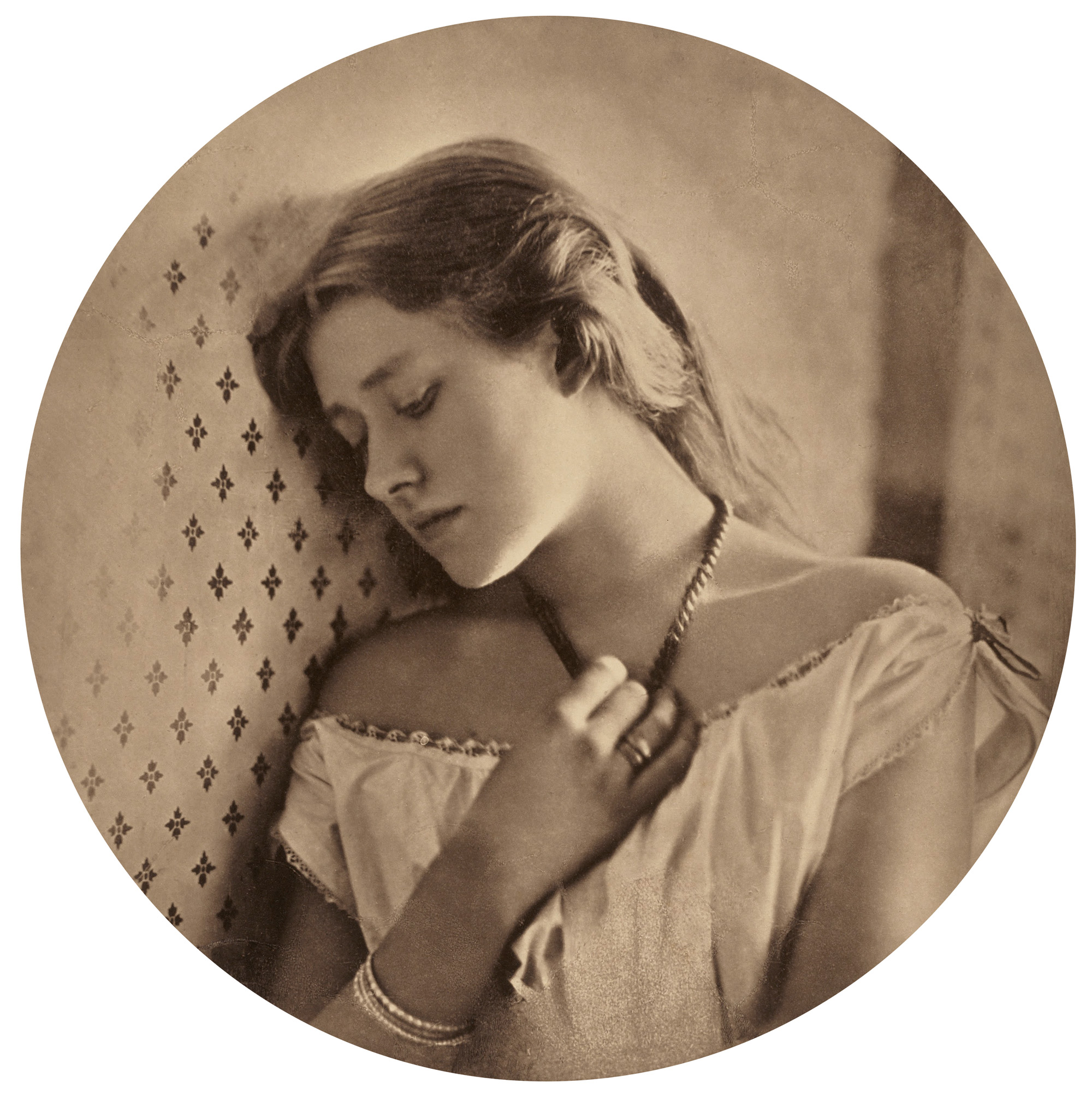
Clementina Hawarden (British, 1822-1865) 'Photographic Study, 5 Princes Gardens (Clementina Maude)' 1863-1864 from the exhibition 'Victorian Giants: The Birth of Art Photography' at the National Portrait Gallery, London , March - May, 2018


Clementina Hawarden (British, 1822-1865)
Photographic Study, 5 Princes Gardens (Clementina Maude)
1863-1864
from The Photographic Study Series by Clementina, Lady Hawarden
Albumen silver print from glass negative
Given by Lady Clementina Tottenham
© Victoria and Albert Museum, London


“Although her work has often been linked to that of Julia Margaret Cameron, the best known woman photographer of the Victorian epoch, Clementina Hawarden struck out into areas and depicted moods unknown to the art photographers of her age.”

~ Graham Ovenden 1974


This remarkable photograph shows a woman gazing into a mirror, but not at her own reflection. Instead, the picture was carefully arranged so that the woman’s face is seen in profile, while only her reflection looks back out of the mirror. Hawarden excelled at producing ambiguous narrative photographs such as this one, suggesting the rich inner life of the subject, without telling a clear story. The heroes of her pictures are nearly always women, who seem all but trapped in domestic interiors.

Wall text from the exhibition


Clementina Hawarden (British, 1822-1865) 'Photographic Study (Clementina Maude)' early 1860s from the exhibition 'Victorian Giants: The Birth of Art Photography' at the National Portrait Gallery, London , March - May, 2018


Clementina Hawarden (British, 1822-1865)
Photographic Study (Clementina Maude)
early 1860s
Albumen print from wet collodion negative
20.1 x 14.4cm (7 15/16 x 5 11/16 in.)
Gilman Collection, Purchase, Harriette and Noel Levine Gift, 2005
© Metropolitan Museum of Art


Clementina, Lady Hawarden, is a poetic, if elusive, presence among nineteenth-century photographers. As a devoted mother, her life revolved around her eight children. She took up photography in 1857; using her daughters as models, she created a body of work remarkable for its technical brilliance and its original depiction of nascent womanhood. Lady Hawarden showed her work in the 1863 and 1864 exhibitions of the Photographic Society. With the exception of a few rare examples, her photographs remained in the possession of her family until 1939, when the more than eight hundred images were donated to the Victoria and Albert Museum. Only recently have they been the objects of research, publication, and exhibition.

Clementina Maude, her mother’s preferred model, is seen here in a reflective pose against a star-studded wall. The casual placement of the shawl on the table and the girl’s loose hair contribute to the feeling of intimacy. In the airy room time seems to be suspended. The sensuous curves of the table legs, the soft weight of the crushed velvet, and the crispness of the starry wallpaper are enhanced by the skilful handling of the collodion technique. The composition, devoid of Victorian clutter, brings together light, shadow, and compositional elements in a spare and appealing interplay. In contrast to the prevailing fashion of giving literary or sentimental titles to portraits of young women, Lady Hawarden titled her works simply “Photographic Study.”

Text from the Metropolitan Museum of Art website


Clementina Hawarden (British, 1822-1865) 'Photographic Study (Clementina and Isabella Grace Maude)' 1863-1864


Clementina Hawarden (British, 1822-1865)
Photographic Study (Clementina and Isabella Grace Maude)
1863-1864
Albumen print from wet collodion negative
© Victoria and Albert Museum, London


Hawarden frequently dressed up her sitters and arranged them in enigmatic narratives like this one. Although not derived from any known painting, the manner of dress, including the cloak and tricorn hat of the male figure (actually one of Hawarden’s daughters dressed up), suggest an eighteenth century reference.

Wall text from the exhibition


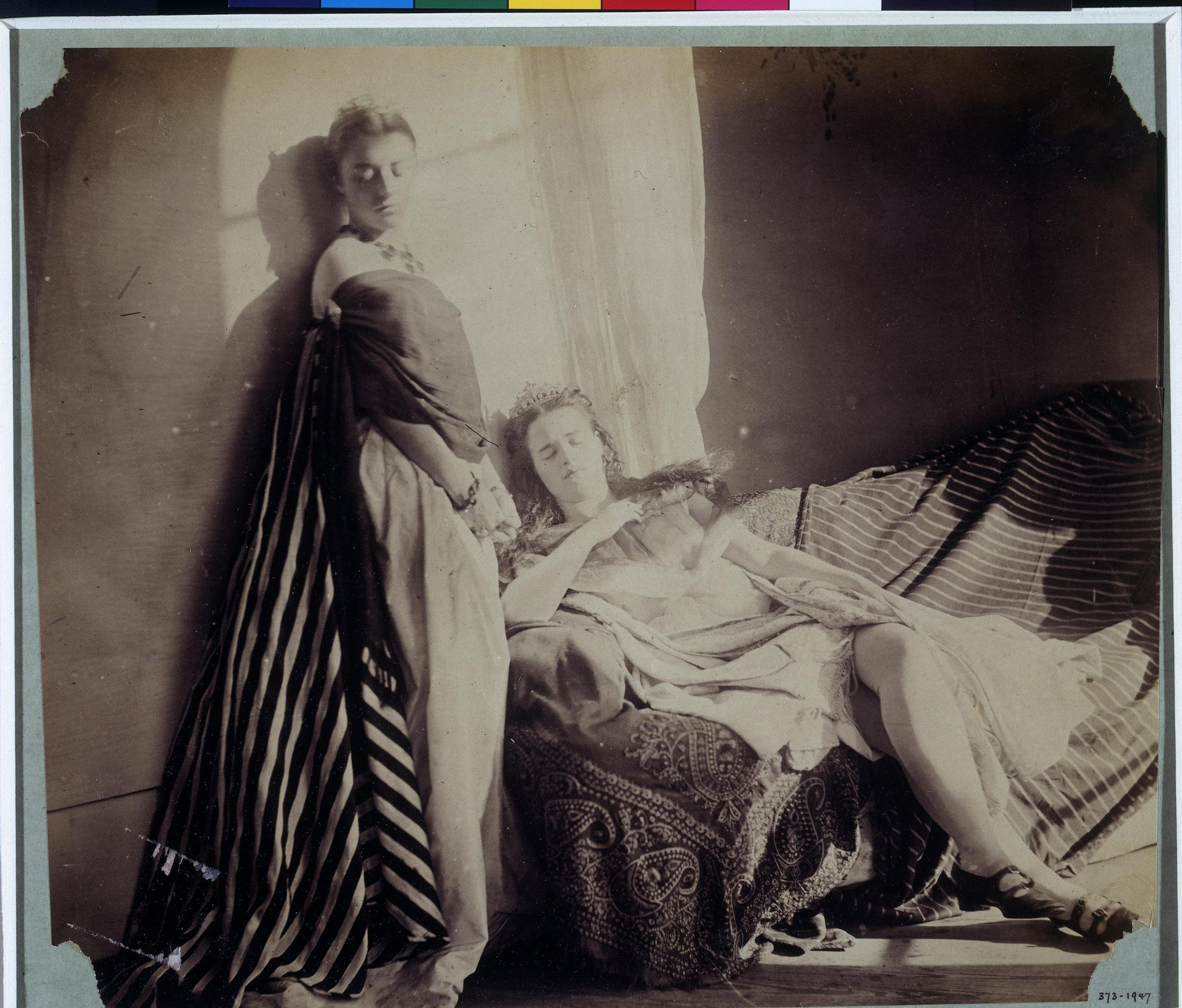
Clementina Hawarden (British, 1822-1865) 'Photographic Study (Florence Elizabeth and Clementina Maude)' 1863-1864


Clementina Hawarden (British, 1822-1865)
Photographic Study (Florence Elizabeth and Clementina Maude)
1863-1864
Albumen print from wet collodion negative
© Victoria and Albert Museum, London


Working from upstairs rooms at 5 Princes Gardens, near to the South Kensington Museum (where both she and Julia Margaret Cameron were frequent visitors), Hawarden used light streaming from large floor to ceiling windows to illuminate her pictures. Her subjects were usually her children, especially her daughters Clementina, Florence, and Isabella Grace, whom she posed in domestic tableaux.

Both Carroll and Rejlander knew and admired Hawarden. On at least one occasion, Rejlander photographed her daughter Isabella Grace; after Hawarden’s death, he also photographed her youngest daughter, Antonia.

Wall text from the exhibition


Clementina Hawarden (British, 1822-1865) Hawarden. 'Isabella Grace and Clementina Maude, 5 Princes Gardens' c. 1863-1864


Clementina Hawarden (British, 1822-1865)
Hawarden Isabella Grace and Clementina Maude, 5 Princes Gardens
c. 1863-1864
Albumen print from wet collodion negative
Given by Lady Clementina Tottenham
© Victoria and Albert Museum, London


Virginia Dodier thinks that this photograph belongs to an ‘Orientalist’ series. Here, Lady Hawarden gives her drawing room a tent-like atmosphere. Such scenes were popularised by the painter J. F. Lewis, and Roger Fenton exhibited his photographic ‘Nubian Series’ in 1859. Dodier writes that the idea of Orientalism allowed European artists to ‘evoke sensuality on the premise of presenting quasi-ethnographical information about the customs of the East’. The idea of the fancy dress or allegorical portrait stems from an earlier tradition in English art. They are found, for example, in the work of the painter Sir Joshua Reynolds (1723-1792).

Text from the Victoria and Albert Museum website


Lady Clementina Hawarden: Themes & Style (extract)

With careful choice of props, clothing, mirrors, balcony, and posture, Hawarden produced exquisite studies of her adolescent daughters. The figures and dress are the main subject, carefully framed in the room, and often in front of the balcony. The city beyond often provides a blurred background.

The writer Carol Mavor in Becoming: The Photographs of Clementina, Viscountess Hawarden suggests that the often provocative poses of Hawarden’s daughters are significant. The Victorians were bothered by the idea of sexuality and adolescence, and in 1861 the Offences Against the Person Act raised the age of consent from 10 to 12. This was also the year in which Hawarden began to make this kind of photograph, though there is no evidence that she was deliberately exploring this controversial topic.

Hawarden liked to use natural light in her studio at her South Kensington home, in a way that was seen at the time as ‘daring’. She placed mirrors to reflect light and used them to explore the idea of ‘the double’, just as other photographers (and occasionally Hawarden herself) used a stereoscopic camera to produce twin prints.

From around 1862 Hawarden concentrated on photographing her daughters in costume tableaux, a popular subject at the time. Costumes from the dressing up box are combined with dresses at the height of fashion to produce beautiful and detailed studies that confound the contemporary with the make-believe.

Text from the Victoria and Albert Museum website [Online] Cited 16/05/2018. No longer available online


Clementina Hawarden (British, 1822-1865) 'Photographic Study (Clementina and Florence Elizabeth Maude)' 1859-1861


Clementina Hawarden (British, 1822-1865)
Photographic Study (Clementina and Florence Elizabeth Maude)
1859-1861
Uncut stereo albumen print


Figure 60 and 61 of the catalogue for the exhibition 'Victorian Giants: The Birth of Art Photography' at the National Portrait Gallery, London


Figure 60 and 61 of the catalogue for the exhibition Victorian Giants: The Birth of Art Photography at the National Portrait Gallery, London


Figure 112 and 113 of the catalogue for the exhibition 'Victorian Giants: The Birth of Art Photography' at the National Portrait Gallery, London


Figure 112 and 113 of the catalogue for the exhibition Victorian Giants: The Birth of Art Photography at the National Portrait Gallery, London


Oscar Rejlander (British born Sweden, 1813-1875)

According to his naturalisation papers, Rejlander was born in Stockholm on October 19, 1813. He was the son of Carl Gustaf Rejlander, a stonemason and Swedish Army Officer. During his youth, his family moved to the Swedish-speaking community in Rauma, Finland (then Russia). In the 1830s, he relocated to England, initially settling in Lincoln, England. In the 1850s he abandoned his original profession as a painter and portrait miniaturist, apparently after seeing how well a photograph captured the fold of a sleeve.

He set up as a portraitist in the industrial Midlands town of Wolverhampton, probably around 1846. In the early 1850s he learned the wet-collodion and waxed-paper processes at great speed with Nicholas Henneman in London, and then changed his business to that of a photography studio. He undertook genre work and portraiture. Rejlander also produced nude studies, mainly for use as studies by painters. There are no known erotic photographs of children by Rejlander. His so-called ‘Charlotte Baker’ photograph is a well-known forgery, produced by convicted child sex offender Graham Ovenden by Ovenden’s friend Howard Grey in the 1970s, rephotographed and printed to look antique by Ovenden. No person by the name Charlotte Baker ever seems to have posed for Rejlander.

Rejlander undertook many experiments to perfect his photography, including combination printing, which he did not invent; however, he created more elaborate and convincing composite photographs than any prior photographer. He had articles feature in the Wolverhampton Chronicle, on 15 November 1854 an article called “Improvement in Calotypes, by Mr. O.G. Rejlander, of Wolverhampton” it suggests that by 1854 he was experimenting with combination printing from several negatives. He was a friend of photographer Charles Lutwidge Dodgson (better known by the nom de plume Lewis Carroll), who collected Rejlander’s work and corresponded with him on technical matters. Rejlander later created one of the best known and most revealing portraits of Dodgson.

Rejlander participated in the Paris Exhibition of 1855. In 1856 he made his best-known allegorical work, The Two Ways of Life. This was a seamlessly montaged combination print made of thirty-two images (akin to the use of Photoshop today, but then far more difficult to achieve) in about six weeks. First exhibited at the Manchester Art Treasures Exhibition of 1857, the work shows a man being lured to paths of vice or virtue by good and bad angels. The image’s partial nudity, which showed real women as they actually appeared and not the idealised forms then common in Victorian art, was deemed ‘indecent’ by some. Rejlander was also accused of using prostitutes as models, although Rejlander categorically denied this and no proof was ever offered. Reservations about the work subsided when Queen Victoria ordered a 10-guinea copy to give to Prince Albert. Victoria and Albert would go on to purchase three copies of the work, all of which are now lost. …

Rejlander moved his studio to Malden Road, London around 1862 and largely abandoned her early experiments with double exposure, photomontage, photographic manipulation and retouching. Instead, he became one of Britain’s leading portraitists, creating pictures with psychological charge. He became a leading expert in photographic techniques, lecturing and publishing widely, and sold work through bookshops and art dealers. He also found subject-matter in London, photographing homeless London street children to produce popular ‘social-protest’ pictures such as “Poor Joe,” also known as “Homeless”. …

Rejlander’s ideas and techniques were taken up by other photographers and this, to some extent, justifies labelling him as the father of art photography.

Text from the Wikipedia website


Oscar Rejlander (British born Sweden, 1813-1875) 'Charles Darwin' 1871


Oscar Rejlander (British born Sweden, 1813-1875)
Charles Darwin
1871
Albumen print
© Moderna Museet, Stockholm


Starting in the late 1860s, Charles Darwin began collecting photographs for use in the research that would eventually become his book The Expression of the Emotions in Man and Animals (1872). Hoping to find authentic photographs, that captured emotional expressions as they actually occurred, he visited print shops and studios in London, and contacted several photographers hoping to commission new pictures. Few, if any, of the photographs he acquired met his ambitious expectations.

In April, 1871, Darwin wrote, ‘I am now rich in photographs, for I have found in London Rejlander, who for years has had a passion for photographing all sorts of chance expressions, exhibited on various occasions … instantaneously.’ Rejlander would go on to become the main contributor of photographs to Darwin’s book.

Wall text from the exhibition


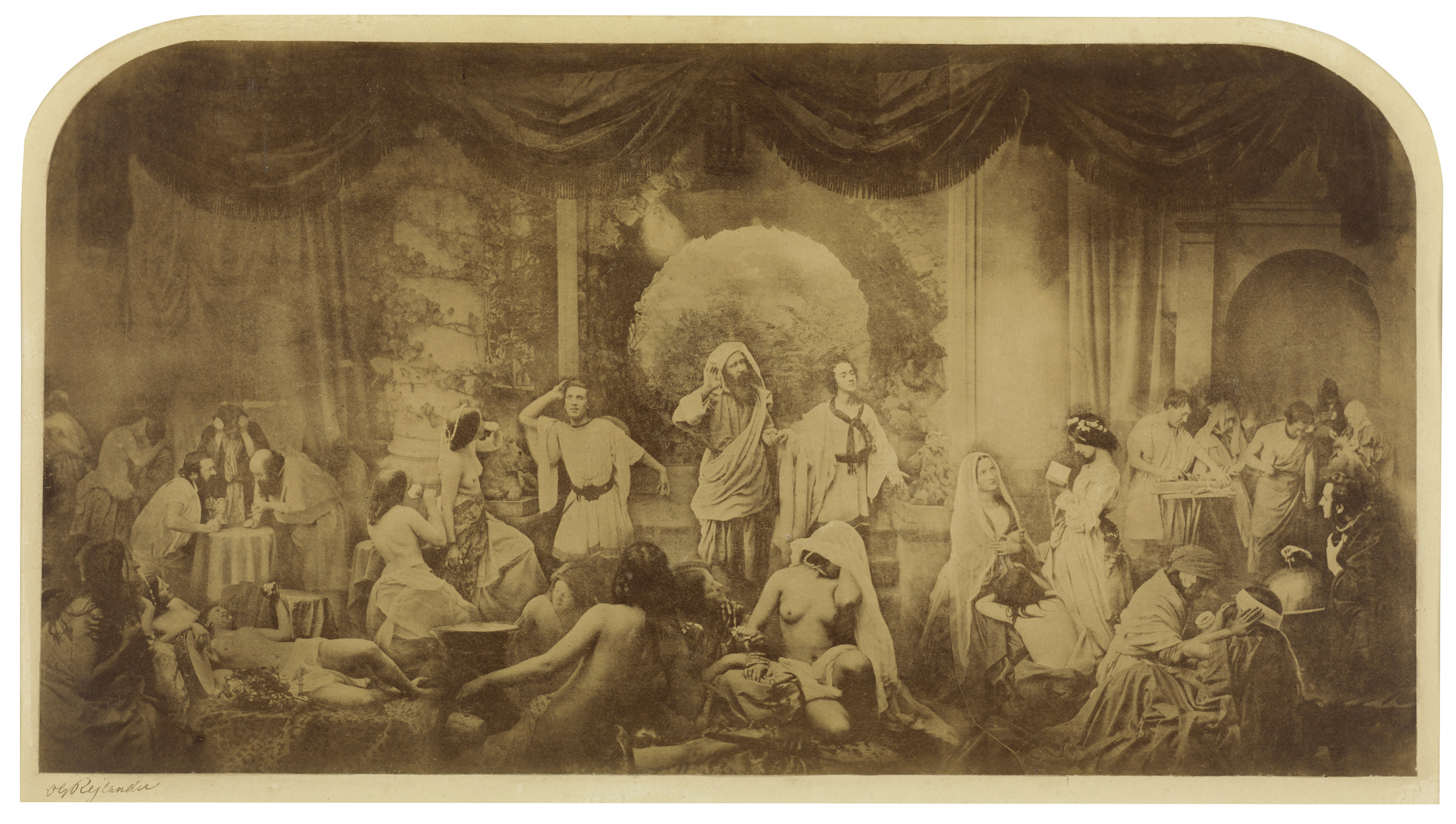
Oscar Rejlander (British born Sweden, 1813-1875) 'The Two Ways of Life' 1856-1857


Oscar Rejlander (British born Sweden, 1813-1875)
The Two Ways of Life
1856-1957
Albumen print, made from approximately 32 separate negatives
Moderna Museet, Stockholm


One of the most famous pictures in photographic history, Rejlander’s Two Ways of Life caused a sensation when it was exhibited at the Manchester Art Treasures exhibition in 1857. To make it, Rejlander combined some thirty-two separate negatives (there were variations between printings, and it is not always clear where negatives begin and end). Some viewers were offended by the nudes, whose bodies appear frank and realistic compared to the ideal fantasies painters were expected to produce. Others objected to its ambition, since Rejlander seemed to be saying that photography could be used to produce pictures just as meaningful, and as artistically composed, as any painting.

To make Two Ways of Life, Rejlander had to arrange the various subjects within it at the right size to maintain visual perspective. This was a challenge, since enlargement and reduction of negatives was not yet possible in the darkroom. The only way he could change the size of something in the negative was to rephotograph it.

This is the finest known print of the photograph, which is also known in a reduced form. The photograph is a parable featuring Rejlander himself, who stands in the middle, listening to ‘good’ and ‘bad’ angels luring him to paths of vice and virtue. Queen Victoria and Prince Albert loved the picture and bought three copies, none of which survive.

Wall text from the exhibition


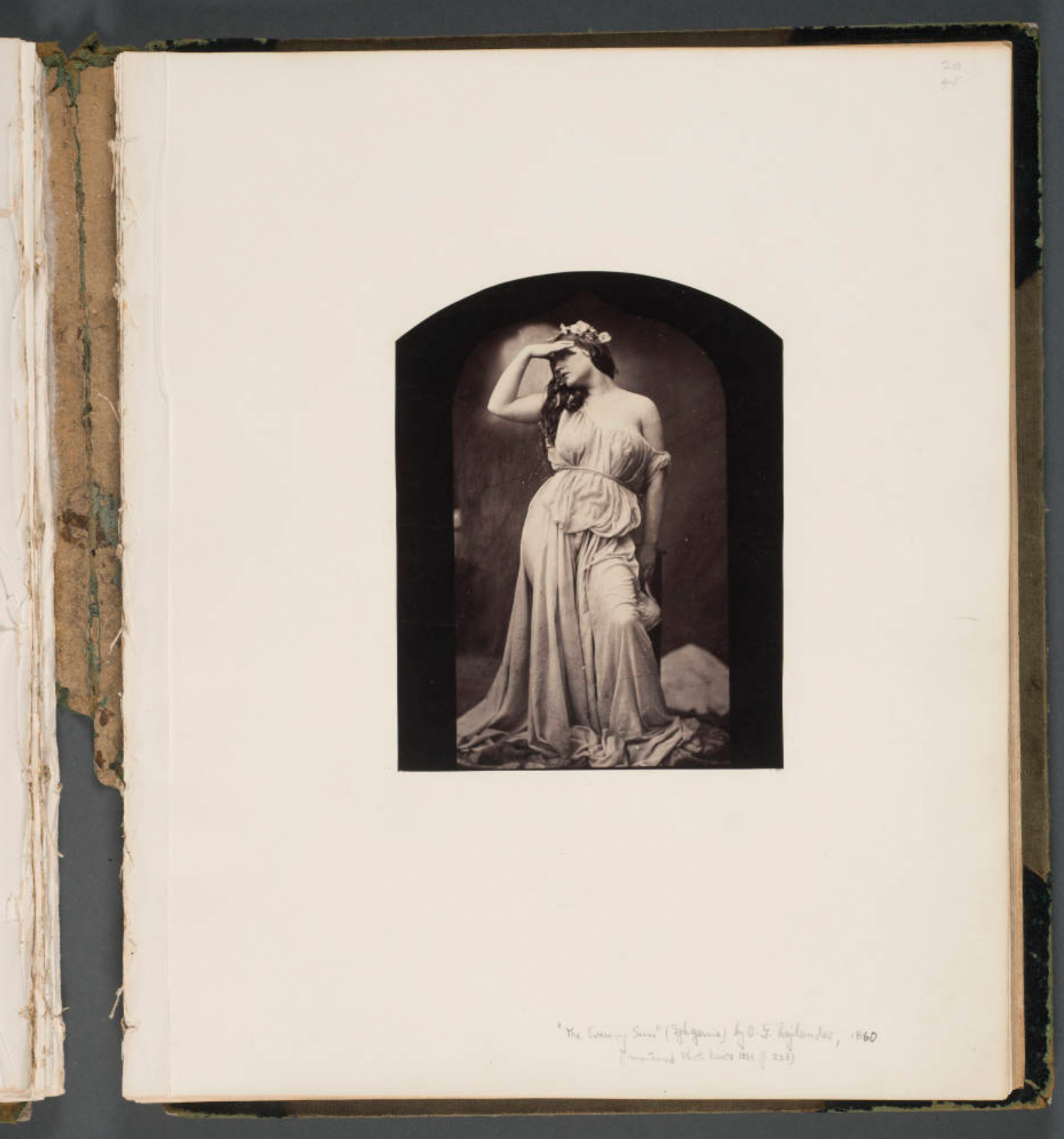
Oscar Rejlander (British born Sweden, 1813-1875) 'The Evening Sun (Iphigenia)' c. 1860


Oscar Rejlander (British born Sweden, 1813-1875)
The Evening Sun (Iphigenia)
c. 1860
© Gernsheim Collection, Harry Ransom Centre, The University of Texas at Austin


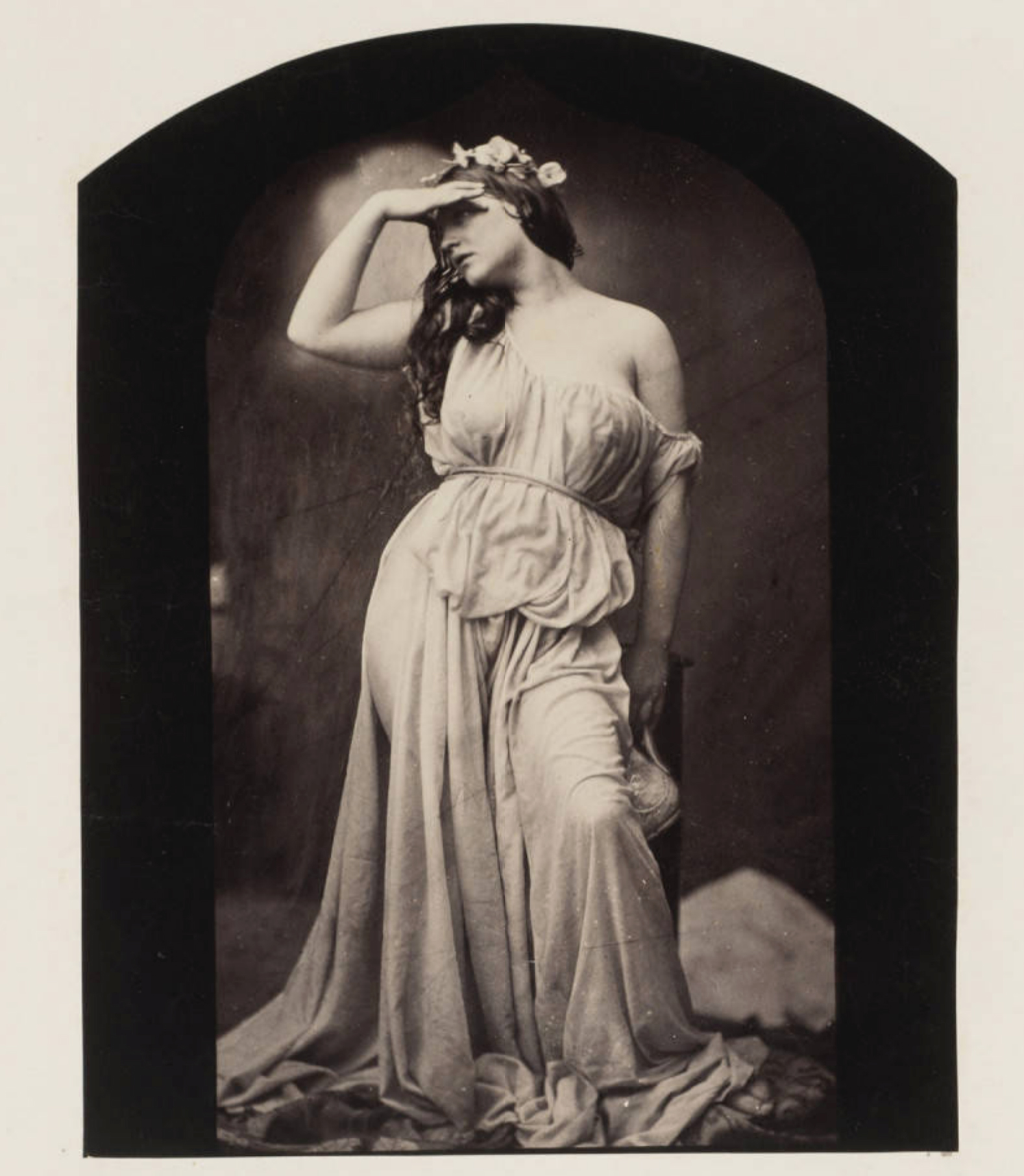
Oscar Rejlander (British born Sweden, 1813-1875) 'The Evening Sun (Iphigenia)' c. 1860


Oscar Rejlander (British born Sweden, 1813-1875)
The Evening Sun (Iphigenia)
c. 1860
© Gernsheim Collection, Harry Ransom Centre, The University of Texas at Austin


Oscar Rejlander (British born Sweden, 1813-1875) 'The Evening Sun (Iphigenia)' c. 1860 (detail)


Oscar Rejlander (British born Sweden, 1813-1875)
The Evening Sun (Iphigenia) (detail)
c. 1860
© Gernsheim Collection, Harry Ransom Centre, The University of Texas at Austin


Iphigenia was a daughter of King Agamemnon who appears in legends about the Trojan War. When her father accidentally offended the goddess Artemis, he was forced to sacrifice Iphigenia to appease the goddess so that she would allow his ships to sail to Troy. She was tricked into going to the town of Aulis under the pretence that she would marry the heroic warrior Achilles. In some versions she was killed, while in others she was rescued by Artemis.

Wall text from the exhibition


Oscar Rejlander (British born Sweden, 1813-1875) 'Ariadne' 1857


Oscar Rejlander (British born Sweden, 1813-1875)
Ariadne
1857
Albumen print from a wet collodion negative


Oscar Rejlander (British born Sweden, 1813-1875) 'Nude female study' c. 1867


Oscar Rejlander (British born Sweden, 1813-1875)
Nude female study
c. 1867
Albumen print
7 3/4 x 5 3/8 in. (196 x 138mm) overall
Given by Stephan Loewentheil, 2017
© National Portrait Gallery, London


Rejlander produced a number of nude studies which he sold to painters for use as studies. He considered these pictures significant because they pointed up errors historically made by painters when depicting human anatomy. Although he was happy for painters to use photographs to improve their paintings, he also saw accuracy of depiction as one of the things that made photography special when compared to other art forms.

Wall text from the exhibition


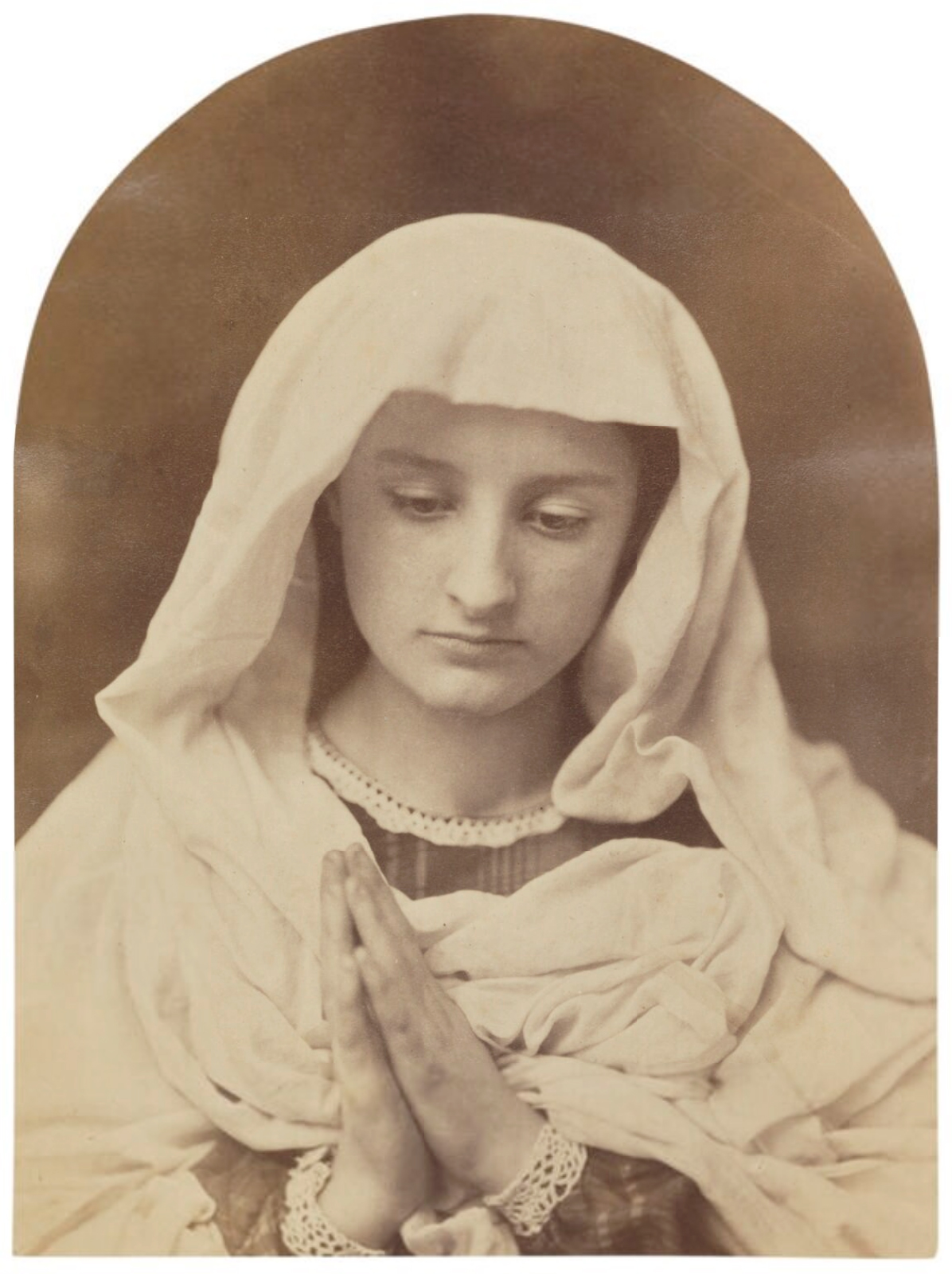
Oscar Rejlander (British born Sweden, 1813-1875) 'The Virgin in prayer' c. 1857


Oscar Rejlander (British born Sweden, 1813-1875)
The Virgin in prayer (after Sassoferrato)
c. 1857
albumen print
6 7/8 x 5 7/8 in. (174 x 150mm) overall
Purchased with help from the Art Fund, Jane and Michael Wilson and Stephen Barry, 2015
© National Portrait Gallery, London


This photograph is a based on the famous painting The Virgin in Prayer painted by the Italian Baroque painter Sassoferrato 1640-1650, now in the collection of the National Gallery, London. The rise of public art spaces in Britain in the nineteenth century, including the National Gallery (1824), and the National Portrait Gallery (1856), provided inspiration for countless photographers. Rejlander was particularly enthusiastic about restaging famous paintings, often in order to demonstrate mistakes that painters had made in scale and perspective. The process was fun, and the results fuelled the debate about photography’s role among the arts.

Wall text from the exhibition


Oscar Rejlander (British born Sweden, 1813-1875) 'The Virgin in prayer (after Sassoferrato)' c. 1857


Oscar Rejlander (British born Sweden, 1813-1875)
The Virgin in prayer (after Sassoferrato)
c. 1857
Albumen print
7 3/4 x 5 3/4 in. (196 x 146mm) overall
Given by Stephan Loewentheil, 2017
© National Portrait Gallery, London


Oscar Rejlander (British born Sweden, 1813-1875) 'Unknown young woman' 1860-1866


Oscar Rejlander (British born Sweden, 1813-1875)
Unknown young woman
1860-1866
Albumen print
7 3/8 x 5 1/4 in. (188 x 134mm) overall
Purchased with help from the Art Fund, Jane and Michael Wilson and Stephen Barry, 2015
© National Portrait Gallery, London


Oscar Rejlander (British born Sweden, 1813-1875) 'Untitled (unknown sitter, possibly Rejlander's wife, Mary)' c. 1863


Oscar Rejlander (British born Sweden, 1813-1875)
Untitled (unknown sitter, possibly Rejlander’s wife, Mary)
c. 1863
Printed by Julia Margaret Cameron
Albumen print from wet collodion glass negative
Given by Mrs Margaret Southam, 1941
© Victoria and Albert Museum, London


Cameron invited Rejlander to the Isle of Wight in 1863. Before the visit, Rejlander provided her with some of his own negatives, so that she could practise printing. She experimented with some, decorating them with ferns. This picture, which descended through Cameron’s family, was once believed to have been made by her. However, it is now recognised as one of the pictures Cameron printed from a Rejlander negative. The subject is one who frequently appears in Rejlander’s work, and may even have been his wife, Mary.

Wall text from the exhibition


Oscar Rejlander (British born Sweden, 1813-1875) 'Unknown young woman' 1863-1866


Oscar Rejlander (British born Sweden, 1813-1875)
Unknown young woman
1863-1866
Albumen print
8 1/8 x 5 7/8 in. (205 x 149mm) overall
Purchased with help from the Art Fund, Jane and Michael Wilson and Stephen Barry, 2015
© National Portrait Gallery, London


Oscar Rejlander (British born Sweden, 1813-1875) ''Sleep' (Mary Rejlander (née Bull))' c. 1855


Oscar Rejlander (British born Sweden, 1813-1875)
‘Sleep’ (Mary Rejlander (née Bull))
c. 1855
Albumen print
6 1/8 x 6 5/8 in. (156 x 167mm) overall
Purchased with help from the Art Fund, Jane and Michael Wilson and Stephen Barry, 2015
© National Portrait Gallery, London


Oscar Rejlander (British born Sweden, 1813-1875) 'Minnie Constable' 1860-1866


Oscar Rejlander (British born Sweden, 1813-1875)
Minnie Constable
1860-1866
Albumen print
7 1/2 x 5 3/4 in. (192 x 146mm) overall
Purchased with help from the Art Fund, Jane and Michael Wilson and Stephen Barry, 2015
© National Portrait Gallery, London


Oscar Rejlander (British born Sweden, 1813-1875) ''Art must assist Photography' (Putto as Allegory of Painting)' 1856


Oscar Rejlander (British born Sweden, 1813-1875)
‘Art must assist Photography’ (Putto as Allegory of Painting)
1856
Albumen print
4 3/4 x 3 5/8 in. (120 x 93mm) overall
Purchased with help from the Art Fund, Jane and Michael Wilson and Stephen Barry, 2015
© National Portrait Gallery, London


Oscar Rejlander (British born Sweden, 1813-1875) 'Oscar Gustav Rejlander; Mary Rejlander (née Bull)' 1860-1866


Oscar Rejlander (British born Sweden, 1813-1875)
Oscar Gustav Rejlander; Mary Rejlander (née Bull)
1860-1866
Albumen print
8 5/8 x 6 1/4 in. (219 x 158mm) overall
Purchased with help from the Art Fund, Jane and Michael Wilson and Stephen Barry, 2015
© National Portrait Gallery, London


Oscar Rejlander (British born Sweden, 1813-1875) 'Unknown woman' 1860-1866


Oscar Rejlander (British born Sweden, 1813-1875)
Unknown woman
1860-1866
Albumen print
8 x 5 3/4 in. (202 x 147mm) overall
Purchased with help from the Art Fund, Jane and Michael Wilson and Stephen Barry, 2015
© National Portrait Gallery, London


Oscar Rejlander (British born Sweden, 1813-1875) ''A devotee' (Unknown woman)' 1860-1866


Oscar Rejlander (British born Sweden, 1813-1875)
‘A devotee’ (Unknown woman)
1860-1866
Albumen print
8 5/8 x 6 1/4 in. (219 x 158mm) overall
Purchased with help from the Art Fund, Jane and Michael Wilson and Stephen Barry, 2015
© National Portrait Gallery, London


Oscar Rejlander (British born Sweden, 1813-1875) 'Purify my heart' also known as 'The Little Sisters' c. 1862


Oscar Rejlander (British born Sweden, 1813-1875)
Purify my heart also known as The Little Sisters
c. 1862
Albumen print
5 x 4 1/8 in. (127 x 105mm) overall
Given by Stephan Loewentheil, 2017
© National Portrait Gallery, London


This photograph shows two sisters side by side in profile, their hands clasped in prayer. One girl seems almost to be a mirror reflection of the other. Rejlander exhibited versions of this photograph with two different titles. Purify My Heart is a reference to the biblical passage James 4:8: ‘Draw nigh to God, and he will draw nigh to you. Cleanse your hands, ye sinners; and purify your hearts, ye double minded.’ Lewis Carroll admired this photograph and purchased a copy for his personal collection.

Wall text from the exhibition


Oscar Rejlander (British born Sweden, 1813-1875) 'Unknown young woman' 1863-1866


Oscar Rejlander (British born Sweden, 1813-1875)
Unknown young woman
1863-1866
Albumen print
8 1/8 x 5 7/8 in. (205 x 149 mm) overall
Purchased with help from the Art Fund, Jane and Michael Wilson and Stephen Barry, 2015
© National Portrait Gallery, London


National Portrait Gallery
St Martin’s Place
London, WC2H 0HE

Opening hours:
Open daily: 10.30 – 18.00
Friday and Saturday: 10.30 – 21.00

National Portrait Gallery website

LIKE ART BLART ON FACEBOOK

Back to top

Exhibition: ‘Victorian Giants: The Birth of Art Photography’ at the National Portrait Gallery, London Part 1

Exhibition dates: 1st March – 20th May, 2018

Victorian Giants: The Birth of Art Photography is curated by Phillip Prodger PhD, Head of Photographs at the National Portrait Gallery, London


Cover of the catalogue for the exhibition 'Victorian Giants: The Birth of Art Photography' at the National Portrait Gallery, London


Cover of the catalogue for the exhibition Victorian Giants: The Birth of Art Photography at the National Portrait Gallery, London


A two-part bumper posting on this exhibition, Part 1 featuring the work of Lewis Carroll and our Julia… JMC, Julia Margaret Cameron, the most inventive, audacious and talented photographer of the era. In a photographic career spanning eleven years of her life (1864-1875) what Julia achieved in such a short time is incredible.

“Her style was not widely appreciated in her own day: her choice to use a soft focus and to treat photography as an art as well as a science, by manipulating the wet collodion process, caused her works to be viewed as “slovenly”, marred by “mistakes” and bad photography. She found more acceptance among pre-Raphaelite artists than among photographers.” (Wikipedia)

As with any genius (a person who possesses exceptional intellectual or creative power) who goes against the grain, full recognition did not come until later. But when it does arrive, it is undeniable. As soon as you see a JMC photograph… you know it is by her, it could be by no one else. Her “signature” – closely framed portraits and illustrative allegories based on religious and literary works; far-away looks, soft focus and lighting, low depth of field; strong men (“great thro’ genius”) and beautiful, sensual, heroic women (“great thro’ love”) – is her genius.

There is something so magical about how JMC can frame a face, emerging from darkness, side profile, filling the frame, top lit. Soft out of focus hair with one point of focus in the image. Beautiful light. Just the most sensitive capturing of a human being, I don’t know what it is… a glimpse into another world, a ghostly world of the spirit, the soul of the living seen before they are dead.

Love and emotion. Beauty, beautiful, beatified.

Dr Marcus Bunyan

View part 2 of the posting


Many thankx to the National Portrait Gallery, London for allowing me to publish the photographs in the posting. Please click on the photographs for a larger version of the image.


“My aspirations are to ennoble Photography and to secure for it the character and uses of High Art by combining the real & Ideal & sacrificing nothing of Truth by all possible devotion to poetry and beauty.”


Julia Margaret Cameron to Sir John Herschel, 31 December 1864


This major exhibition is the first to examine the relationship between four ground-breaking Victorian artists: Julia Margaret Cameron (1815-1879), Lewis Carroll (1832-1898), Lady Clementina Hawarden (1822-1865) and Oscar Rejlander (1813-1875). Drawn from public and private collections internationally, the exhibition features some of the most breath-taking images in photographic history. Influenced by historical painting and frequently associated with the Pre-Raphaelite Brotherhood, the four artists formed a bridge between the art of the past and the art of the future, standing as true giants in Victorian photography.


Figure 94 and 95 of the catalogue for the exhibition 'Victorian Giants: The Birth of Art Photography' at the National Portrait Gallery, London


Figure 94 and 95 from the catalogue for the exhibition Victorian Giants: The Birth of Art Photography at the National Portrait Gallery, London


Lewis Carroll (English, 1832-1898)

In 1856, Charles Lutwidge Dodgson (Lewis Carroll) took up the new art form of photography under the influence first of his uncle Skeffington Lutwidge, and later of his Oxford friend Reginald Southey. He soon excelled at the art and became a well-known gentleman-photographer, and he seems even to have toyed with the idea of making a living out of it in his very early years.

A study by Roger Taylor and Edward Wakeling exhaustively lists every surviving print, and Taylor calculates that just over half of his surviving work depicts young girls, though about 60% of his original photographic portfolio is now missing. Dodgson also made many studies of men, women, boys, and landscapes; his subjects also include skeletons, dolls, dogs, statues, paintings, and trees. His pictures of children were taken with a parent in attendance and many of the pictures were taken in the Liddell garden because natural sunlight was required for good exposures.

He also found photography to be a useful entrée into higher social circles. During the most productive part of his career, he made portraits of notable sitters such as John Everett MillaisEllen TerryDante Gabriel RossettiJulia Margaret CameronMichael FaradayLord Salisbury, and Alfred, Lord Tennyson.

By the time that Dodgson abruptly ceased photography (1880, over 24 years), he had established his own studio on the roof of Tom Quad, created around 3,000 images, and was an amateur master of the medium, though fewer than 1,000 images have survived time and deliberate destruction. He stopped taking photographs because keeping his studio working was too time-consuming. He used the wet collodion process; commercial photographers who started using the dry-plate process in the 1870s took pictures more quickly.

Text from the Wikipedia website


Lewis Carroll (English, 1832-1898) 'Alice Liddell as 'The Beggar Maid'' Summer 1858 from the exhibition 'Victorian Giants: The Birth of Art Photography' at the National Portrait Gallery, London , March - May, 2018


Lewis Carroll (English, 1832-1898)
Alice Liddell as ‘The Beggar Maid’
also known as King Cophetua’s Bride
Summer 1858
Albumen silver print from glass negative
16.3 x 10.9cm (6 7/16 x 4 5/16in.)
Gilman Collection, Gift of The Howard Gilman Foundation, 2005
© Metropolitan Museum of Art


Known primarily as the author of children’s books, Lewis Carroll was also a lecturer in mathematics at Oxford University and an ordained deacon. He took his first photograph in 1856 and pursued photography obsessively for the next twenty-five years, exhibiting and selling his prints. He stopped taking pictures abruptly in 1880, leaving over three thousand negatives, for the most part portraits of friends, family, clergy, artists, and celebrities. Ill at ease among adults, Carroll preferred the company of children, especially young girls. He had the uncanny ability to inhabit the universe of children as a friendly accomplice, allowing for an extraordinarily trusting rapport with his young sitters and enabling him to charm them into immobility for as long as forty seconds, the minimum time he deemed necessary for a successful exposure. The intensity of the sitters’ gazes brings to Carroll’s photographs a sense of the inner life of children and the seriousness with which they view the world.

Carroll’s famous literary works, “Alice’s Adventures in Wonderland” (1865) and “Through the Looking Glass and What Alice Found There” (1872), were both written for Alice Liddell, the daughter of the dean of Christ Church, Oxford. For Carroll, Alice was more than a favourite model; she was his “ideal child-friend,” and a photograph of her, aged seven, adorned the last page of the manuscript he gave her of “Alice’s Adventures Underground.” The present image of Alice was most likely inspired by “The Beggar Maid,” a poem written by Carroll’s favourite living poet, Alfred, Lord Tennyson, in 1842. If Carroll’s images define childhood as a fragile state of innocent grace threatened by the experience of growing up and the demands of adults, they also reveal to the contemporary viewer the photographer’s erotic imagination. In this provocative portrait of Alice at age seven or eight, posed as a beggar against a neglected garden wall, Carroll arranged the tattered dress to the limits of the permissible, showing as much as possible of her bare chest and limbs, and elicited from her a self-confident, even challenging stance. This outcast beggar will arouse in the passer-by as much lust as pity. Indeed, Alice looks at us with faint suspicion, as if aware that she is being used as an actor in an incomprehensible play. A few years later, a grown-up Alice would pose, with womanly assurance, for Julia Margaret Cameron.

Text from the Metropolitan Museum of Art website


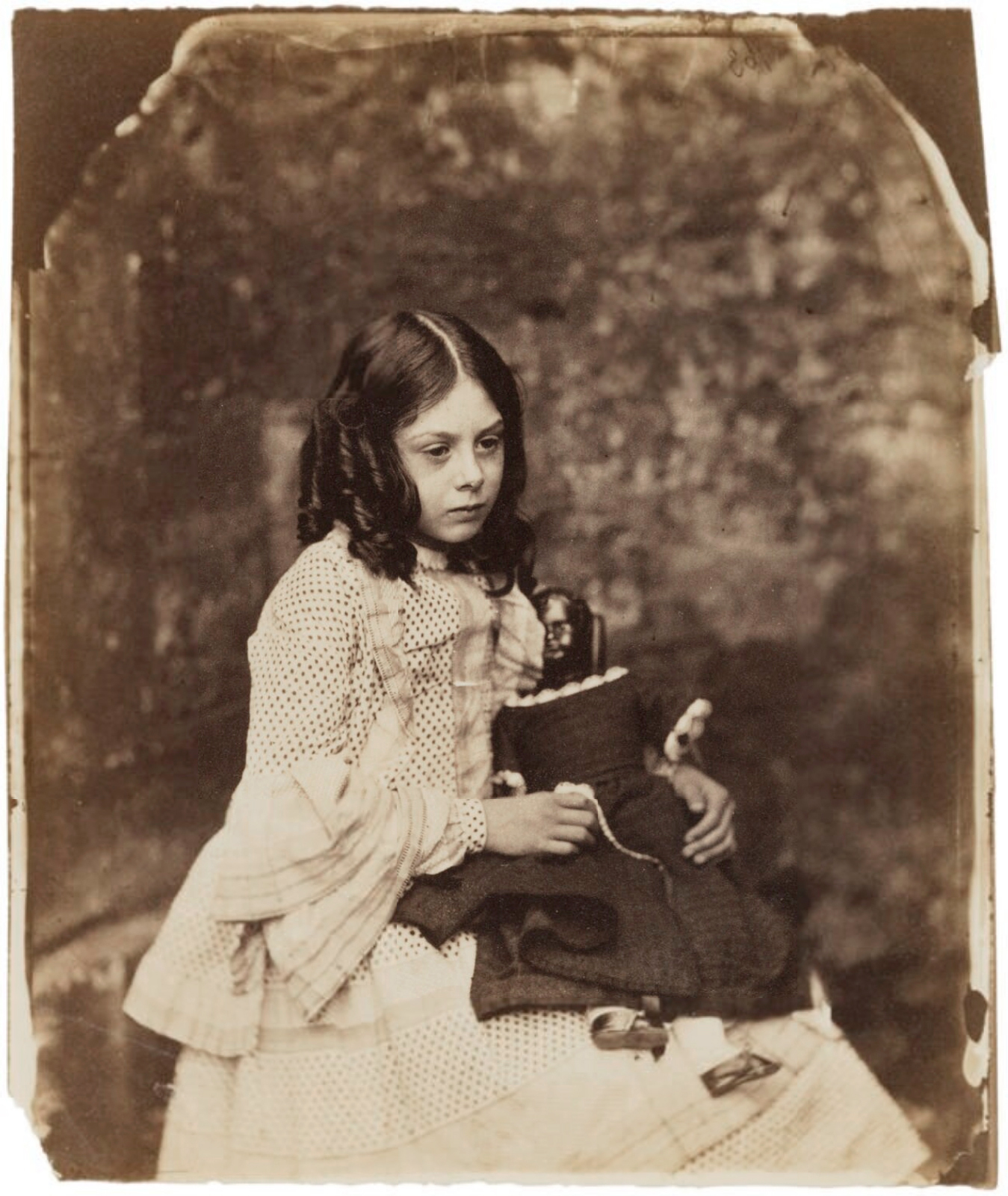
Lewis Carroll (English, 1832-1898) 'Alice Liddell' Summer 1858 from the exhibition 'Victorian Giants: The Birth of Art Photography' at the National Portrait Gallery, London , March - May, 2018


Lewis Carroll (English, 1832-1898)
Alice Liddell
Summer 1858
Wet collodion glass-plate negative
6 x 5 in. (152 x 127mm)
Purchased jointly with the National Science and Media Museum, Bradford, with help from the Art Fund and the National Heritage Memorial Fund, 2002
© National Portrait Gallery, London and the National Media Museum (part of the Science Museum Group, London)


The fourth of ten children and later the inspiration for Alice’s Adventures in Wonderland and its sequel, Through the Looking Glass, Alice Liddell is the most famous of Carroll’s child sitters. Contrary to popular belief, Carroll did not photograph her particularly often, and never photographed her in the nude. Of the 2,600 photographs recorded by Carroll, only twelve solo portraits of Alice are known. By comparison, he made six individual portraits of Alice’s sister, Ina, and forty-five of another favoured sitter, Xie Kitchin (see preceding room).

Wall text from the exhibition


Lewis Carroll (English, 1832-1898) 'Ina Liddell' Summer 1858


Lewis Carroll (English, 1832-1898)
Ina Liddell
Summer 1858
Albumen print
5 7/8 x 5 in. (150 x 126mm) uneven
Purchased jointly with the National Science and Media Museum, Bradford, with help from the Art Fund and the National Heritage Memorial Fund, 2002
© National Portrait Gallery, London and the National Media Museum (part of the Science Museum Group, London)


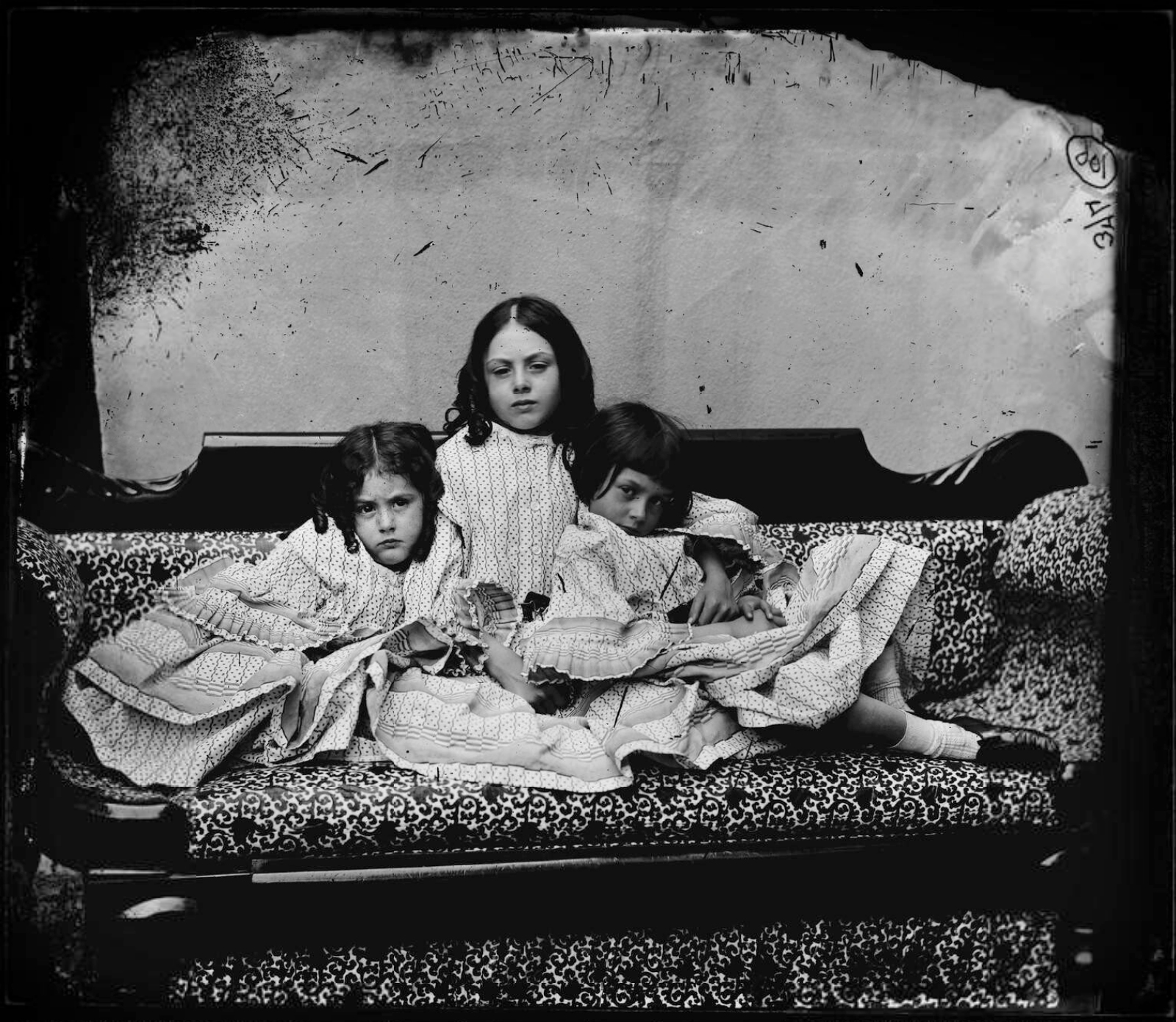
Lewis Carroll (English, 1832-1898) 'Edith Mary Liddell; Ina Liddell; Alice Liddell Summer' 1858


Lewis Carroll (English, 1832-1898)
Edith Mary Liddell; Ina Liddell; Alice Liddell
Summer 1858
Wet collodion glass plate negative
6 x 7 1/8 in. (154 x 181mm)
Purchased jointly with the National Science and Media Museum, Bradford, with help from the Art Fund and the National Heritage Memorial Fund, 2002
© National Portrait Gallery, London


Lewis Carroll (English, 1832-1898) 'Edith Mary Liddell; Ina Liddell; Alice Liddell Summer' 1858


Lewis Carroll (English, 1832-1898)
Edith Mary Liddell; Ina Liddell; Alice Liddell
Summer 1858
Albumen print
6 1/8 x 6 7/8 in. (156 x 176mm)
Purchased jointly with the National Science and Media Museum, Bradford, with help from the Art Fund and the National Heritage Memorial Fund, 2002
© National Portrait Gallery, London


Lewis Carroll (English, 1832-1898) 'Edith Mary Liddell' Summer 1858


Lewis Carroll (English, 1832-1898)
Edith Mary Liddell
Summer 1858
Albumen print
5 7/8 x 7 in. (148 x 177mm) uneven
Purchased jointly with the National Science and Media Museum, Bradford, with help from the Art Fund and the National Heritage Memorial Fund, 2002
© National Portrait Gallery, London


Lewis Carroll (English, 1832-1898) 'Hallam Tennyson, 2nd Baron Tennyson' 28 September 1857


Lewis Carroll (English, 1832-1898)
Hallam Tennyson, 2nd Baron Tennyson
28 September 1857
Albumen print
5 1/8 x 3 7/8 in. (130 x 99 mm)
Purchased, 1977
© National Portrait Gallery, London


Hallam Tennyson (British, 1852-1928), Alfred Tennyson’s eldest son, was five years old when Carroll photographed him at Monk Coniston Park in the Lake District. Taken while the poet and his family were visiting friends, the portrait shows Hallam standing on a chair, holding what may be a hoop rolling stick. Carroll posed him with his legs crossed – a tricky stance for such a young child to maintain. As an adult, Hallam would marry May Prinsep, Julia Margaret Cameron’s niece. Carroll did make one portrait of Alfred Tennyson during his Lake District trip, but he was determined to make more. In 1864, he visited the Isle of Wight to try to photograph him again, armed with a ‘carpet bag full’ of his photographs to show Cameron and others. He was unable to photograph Tennyson, but Cameron and Carroll staged a ‘mutual exhibition’ in Cameron’s living room. (Wall text)

Hallam Tennyson, 2nd Baron Tennyson, GCMG, PC (11 August 1852 – 2 December 1928) was a British aristocrat who served as the second Governor-General of Australia, in office from 1903 to 1904. He was previously Governor of South Australia from 1899 to 1902.

Tennyson was born in Twickenham, Surrey, and educated at Marlborough College and Trinity College, Cambridge. He was the oldest son of the poet Alfred, Lord Tennyson, and served as his personal secretary and biographer; he succeeded to his father’s title in 1892. Tennyson was made Governor of South Australia in 1899. When Lord Hopetoun resigned the governor-generalship in mid-1902, he was the longest-serving state governor and thus became Administrator of the Government. Tennyson was eventually chosen to be Hopetoun’s permanent replacement, but accepted only a one-year term. He was more popular than his predecessor among the general public, but had a tense relationship with Prime Minister Alfred Deakin and was not offered an extension to his term. Tennyson retired to the Isle of Wight, and spent the rest of his life upholding his father’s legacy.


Lewis Carroll (English, 1832-1898) ''Open your mouth, and shut your eyes' (Edith Mary Liddell; Ina Liddell; Alice Liddell)' July 1860


Lewis Carroll (English, 1832-1898)
‘Open your mouth, and shut your eyes’ (Edith Mary Liddell; Ina Liddell; Alice Liddell)
July 1860
Wet collodion glass plate negative
10 x 8 in. (254 x 203mm)
Purchased jointly with the National Science and Media Museum, Bradford, with help from the Art Fund and the National Heritage Memorial Fund, 2002
© National Portrait Gallery, London


The Liddell family arrived at Christ Church, Oxford in 1856, just as Carroll was beginning to take up photography. He and the family became close friends. Henry Liddell served as Dean of the College throughout Carroll’s career, and initially supported his photographic efforts. In 1863, Carroll and the family broke off relations for unknown reasons. Speculation has included disappointment that Carroll went against the family’s wishes by refusing to court their governess or one of the older Liddell children – Ina has been mentioned as a candidate. Carroll was enormously charmed by the Liddell children, all of whom he photographed, and nearly all of whom made their way into Alice’s Adventures in Wonderland and other, related writings.

Wall text from the exhibition


Lewis Carroll (English, 1832-1898) 'The Rossetti Family' 7 October 1863


Lewis Carroll (English, 1832-1898)
The Rossetti Family
7 October 1863
Albumen print
6 7/8 x 8 3/4 in. (175 x 222mm)
Given by Helen Macgregor, 1978
© National Portrait Gallery, London


Carroll spent months trying to arrange an introduction to Rossetti (1828-1882) so that he could photograph the famous Pre-Raphaelite painter and poet, and his family. This is one of several photographs he made in the garden of Tudor House, 16 Cheyne Walk, Chelsea, during a four-day session in which he photographed the family and some of Rossetti’s artwork, including drawings of his late wife, Elizabeth Siddal.

The relationship between Carroll, Cameron, Hawarden, Rejlander and the Pre-Raphaelites was complex. They had many common friends and associates, and it is believed that several Pre-Raphaelite painters used photographs as studies for their paintings and sculpture. However, all four photographers were attracted to later styles of painting, especially the Spanish and Italian National Portrait Gallery, London Baroque, and the Dutch Golden Age. Led by the cantankerous critic John Ruskin, an associate of Henry Liddell’s at Oxford (Alice Liddell’s father), the Pre-Raphaelites were opposed to such painting, which they considered too literal and mundane.

Wall text from the exhibition


Lewis Carroll (English, 1832-1898) 'Dante Gabriel Rossetti' 7 October 1863


Lewis Carroll (English, 1832-1898)
Dante Gabriel Rossetti
7 October 1863
Albumen print
5 3/4 x 4 3/4 in. (146 x 121mm)
Purchased, 1977
© National Portrait Gallery, London


Gabriel Charles Dante Rossetti (12 May 1828 – 9 April 1882), generally known as Dante Gabriel Rossetti was a British poet, illustrator, painter and translator. He founded the Pre-Raphaelite Brotherhood in 1848 with William Holman Hunt and John Everett Millais. Rossetti was later to be the main inspiration for a second generation of artists and writers influenced by the movement, most notably William Morris and Edward Burne-Jones. His work also influenced the European Symbolists and was a major precursor of the Aesthetic movement.

Rossetti’s art was characterised by its sensuality and its medieval revivalism. His early poetry was influenced by John Keats. His later poetry was characterised by the complex interlinking of thought and feeling, especially in his sonnet sequence, The House of Life. Poetry and image are closely entwined in Rossetti’s work. He frequently wrote sonnets to accompany his pictures, spanning from The Girlhood of Mary Virgin (1849) and Astarte Syriaca (1877), while also creating art to illustrate poems such as Goblin Market by the celebrated poet Christina Rossetti, his sister. Rossetti’s personal life was closely linked to his work, especially his relationships with his models and muses Elizabeth Siddal, Fanny Cornforth and Jane Morris.

Text from the Wikipedia website


Lewis Carroll (English, 1832-1898) 'Benjamin Woodward' Late 1850s


Lewis Carroll (English, 1832-1898)
Benjamin Woodward
Late 1850s
Albumen print
8 x 6 in. (203 x 152mm)
Purchased, 1986
© National Portrait Gallery, London


Irish-born architect Benjamin Woodward (1815-1861) is best known for having designed a number of buildings in Cork, Dublin and Oxford in partnership with Sir Thomas Deane and his son Sir Thomas Newenham Deane. Inspired by the writings of critic John Ruskin, his most important buildings include the museum at Trinity College, Dublin (1853-1857). Through Ruskin, Woodward met Dante Gabriel Rossetti and other Pre-Raphaelite artists, whom Woodward employed in 1857 to decorate his recently completed Oxford Union building.

Wall text from the exhibition


Lewis Carroll (English, 1832-1898) 'John Ruskin' 6 March 1875


Lewis Carroll (English, 1832-1898)
John Ruskin
6 March 1875
Albumen print
3 1/2 x 2 1/4 in. (90 x 58mm) overall
Given by an anonymous donor, 1973
© National Portrait Gallery, London


John Ruskin (8 February 1819 – 20 January 1900) was the leading English art critic of the Victorian era, as well as an art patron, draughtsman, water colourist, a prominent social thinker and philanthropist. He wrote on subjects as varied as geology, architecture, myth, ornithology, literature, education, botany and political economy.

His writing styles and literary forms were equally varied. He penned essays and treatises, poetry and lectures, travel guides and manuals, letters and even a fairy tale. He also made detailed sketches and paintings of rocks, plants, birds, landscapes, and architectural structures and ornamentation. The elaborate style that characterised his earliest writing on art gave way in time to plainer language designed to communicate his ideas more effectively. In all of his writing, he emphasised the connections between nature, art and society.

He was hugely influential in the latter half of the 19th century and up to the First World War. After a period of relative decline, his reputation has steadily improved since the 1960s with the publication of numerous academic studies of his work. Today, his ideas and concerns are widely recognised as having anticipated interest in environmentalism, sustainability and craft.

Text from the Wikipedia website


Lewis Carroll (English, 1832-1898) 'Lewis Carroll' c. 1857


Lewis Carroll (English, 1832-1898)
Lewis Carroll
c. 1857
Albumen print
5 1/2 x 4 5/8 in. (140 x 117mm)
Purchased with help from Kodak Ltd, 1973
© National Portrait Gallery, London


Lewis Carroll took this photograph of himself with the assistance of Ina Liddell, Alice’s older sister. His diary records: ‘Bought some Collodion at Telfer’s […] and spent the morning at the Deanery … Harry was away, but the two dear little girls, Ina and Alice, were with me all the morning. To try the lens, I took a picture of myself, for which Ina took off the cap, and of course considered it all her doing!’

Wall text from the exhibition


Lewis Carroll (English, 1832-1898) 'Alice Liddell' 25 June 1870


Lewis Carroll (English, 1832-1898)
Alice Liddell
25 June 1870
Albumen carte-de-visite
3 1/2 x 2 1/4 in. (91 x 58mm)
Purchased jointly with the National Science and Media Museum, Bradford, with help from the Art Fund and the National Heritage Memorial Fund, 2002
© National Portrait Gallery, London


This is the only portrait of Alice that Carroll is known to have made after the publication of Alice in Wonderland, some seven years earlier. Showing Alice at age eighteen, the innocence of her earlier portraits has now completely drained away, replaced by a severe, inscrutable expression. The moment captured is unusually intimate, with Alice’s head lowered slightly and cocked to one side, looking up at the viewer, and her body slumped in a padded armchair. It is unclear whether Carroll orchestrated this pose, or whether Alice assumed it naturally.

Wall text from the exhibition


The National Portrait Gallery is to stage an exhibition of photographs by four of the most celebrated figures in art photography, including previously unseen works and a notorious photomontage, it was announced today, Tuesday 22 August 2017.

Victorian Giants: The Birth of Art Photography (1 March – 20 May 2018), will combine for the first time ever portraits by Lewis Carroll (1832-1898), Julia Margaret Cameron (1815-1879), Oscar Rejlander (1813-1875) and Lady Clementina Hawarden (1822-1865). The exhibition will be the first to examine the relationship between the four ground-breaking artists. Drawn from public and private collections internationally, it will feature some of the most breath-taking images in photographic history, including many which have not been seen in Britain since they were made.

Victorian Giants: The Birth of Art Photography will be the first exhibition in London to feature the work of Swedish born ‘Father of Photoshop’ Oscar Rejlander since the artist’s death. it will include the finest surviving print of his famous picture Two Ways of Life of 1856-1857, which used his pioneering technique combining several different negatives to create a single final image. Constructed from over 30 separate negatives, Two Ways of Life was so large it had to be printed on two sheets of paper joined together. Seldom-seen original negatives by Lewis Carroll and Rejlander will both be shown, allowing visitors to see ‘behind the scenes’ as they made their pictures.

An album of photographs by Rejlander purchased by the National Portrait Gallery following an export bar in 2015 will also go on display together with other treasures from the Gallery’s world-famous holdings of Rejlander, Cameron and Carroll, which for conservation reasons are rarely on view. The exhibition will also include works by cult hero Clementina Hawarden, a closely associated photographer. This will be the first major showing of her work since the exhibition Lady Hawarden at the V&A in London and the J. Paul Getty Museum in Los Angeles in 1990.

Lewis Carroll’s photographs of Alice Liddell, his muse for Alice in Wonderland, are among the most beloved photographs of the National Portrait Gallery’s Collection. Less well known are the photographs made of Alice years later, showing her a fully grown woman. The exhibition will bring together these works for the first time, as well as Alice Liddell as Beggar Maid on loan from The Metropolitan Museum of Art, New York.

Visitors will be able to see how each photographer approached the same subject, as when Cameron and Rejlander both photographed the poet Alfred, Lord Tennyson and the scientist Charles Darwin, or when Carroll and Cameron both photographed the actress, Ellen Terry. The exhibition will also include the legendary studies of human emotion Rejlander made for Darwin, on loan from the Darwin Archive at Cambridge University.

Victorian Giants: The Birth of Art Photography celebrates four key nineteenth-century figures, exploring their experimental approach to picture-making. Their radical attitudes towards photography have informed artistic practice ever since.

The four created an unlikely alliance. Rejlander was a Swedish émigré with a mysterious past; Cameron was a middle-aged expatriate from colonial Ceylon (now Sri Lanka); Carroll was an Oxford academic and writer of fantasy literature; and Hawarden was landed gentry, the child of a Scottish naval hero and a Spanish beauty, 26 years younger. Yet, Carroll, Cameron and Hawarden all studied under Rejlander briefly, and maintained lasting associations, exchanging ideas about portraiture and narrative. Influenced by historical painting and frequently associated with the Pre-Raphaelite brotherhood, they formed a bridge between the art of the past and the art of the future, standing as true giants in Victorian photography.

Lenders to the exhibition include The Royal Collection, Metropolitan Museum of Art, New York; Ashmolean Museum, Oxford; Moderna Museet, Stockholm; Harry Ransom Center, University of Texas at Austin; Munich Stadtsmuseum; Tate and V & A. Victorian Giants: The Birth of Art Photography will include portraits of sitters such as Charles Darwin, Alice Liddell, Dante Gabriel Rossetti, Thomas Carlyle, George Frederick Watts, Ellen Terry and Alfred, Lord Tennyson.

Dr Nicholas Cullinan, Director, National Portrait Gallery, London, says: ‘The National Portrait Gallery has one of the finest holdings of Victorian photographs in the world. As well as some of the Gallery’s rarely seen treasures, such as the original negative of Lewis Carroll’s portrait of Alice Liddell and images of Alice and her siblings being displayed for the first time, this exhibition will be a rare opportunity to see the works of all four of these highly innovative and influential artists.’

Phillip Prodger, Head of Photographs, National Portrait Gallery, London, and Curator of Victorian Giants: The Birth of Art Photography, says: ‘When people think of Victorian photography, they sometimes think of stiff, fusty portraits of women in crinoline dresses, and men in bowler hats. Victorian Giants is anything but. Here visitors can see the birth of an idea – raw, edgy, experimental – the Victorian avant-garde, not just in photography, but in art writ large. The works of Cameron, Carroll, Hawarden and Rejlander forever changed thinking about photography and its expressive power. These are pictures that inspire and delight. And this is a show that lays bare the unrivalled creative energy, and optimism, that came with the birth of new ways of seeing.’

Press release from the National Portrait Gallery


Figure 25 and 26 of the catalogue for the exhibition 'Victorian Giants: The Birth of Art Photography' at the National Portrait Gallery, London


Figure 25 and 26 from the catalogue for the exhibition Victorian Giants: The Birth of Art Photography at the National Portrait Gallery, London


Julia Margaret Cameron (British, 1815-1879)

In 1863, when Cameron was 48 years old, her daughter gave her a camera as a present, thereby starting her career as a photographer. Within a year, Cameron became a member of the Photographic Societies of London (1864) and Scotland. She remained a member of the Photographic Society, London, until her death. In her photography, Cameron strove to capture beauty. She wrote, “I longed to arrest all the beauty that came before me and at length the longing has been satisfied.” In 1869 she collated and gave what is now known as The Norman Album to her daughter and son-in-law in gratitude for having introduced her to photography. The album was later deemed by the Reviewing Committee on the Export of Works of Art to be of “outstanding aesthetic importance and significance to the study of the history of photography and, in particular, the work of Julia Margaret Cameron – one of the most significant photographers of the 19th century.”

The basic techniques of soft-focus “fancy portraits”, which she later developed, were taught to her by David Wilkie Wynfield. She later wrote that “to my feeling about his beautiful photography I owed all my attempts and indeed consequently all my success”.

Lord Tennyson, her neighbour on the Isle of Wight, often brought friends to see the photographer and her works. At the time, photography was a labour-intensive art that also was highly dependent upon crucial timing. Sometimes Cameron was obsessive about her new occupation, with subjects sitting for countless exposures as she laboriously coated, exposed, and processed each wet plate. The results were unconventional in their intimacy and their use of created blur both through long exposures and leaving the lens intentionally out of focus. This led some of her contemporaries to complain and even ridicule the work, but her friends and family were supportive, and she was one of the most prolific and advanced amateurs of her time. Her enthusiasm for her craft meant that her children and others sometimes tired of her endless photographing, but it also left us with some of the best of records of her children and of the many notable figures of the time who visited her.

During her career, Cameron registered each of her photographs with the copyright office and kept detailed records. Her shrewd business sense is one reason that so many of her works survive today. Another reason that many of Cameron’s portraits are significant is because they are often the only existing photograph of historical figures, becoming an invaluable resource. Many paintings and drawings exist, but, at the time, photography was still a new and challenging medium for someone outside a typical portrait studio.

Text from the Wikipedia website


Julia Margaret Cameron (British, 1815-1879) 'Mary Fisher (Mrs Herbert Fisher)' 1866-1867


Julia Margaret Cameron (British, 1815-1879)
Mary Fisher (Mrs Herbert Fisher)
1866-1867
Albumen print


Julia Margaret Cameron (British, 1815-1879) 'Julia Jackson' 1864


Julia Margaret Cameron (British, 1815-1879)
Julia Jackson
1864
Albumen print


Born in Calcutta, Julia Prinsep Jackson (1846-1895) was the youngest of three daughters of Maria Pattle and the physician John Jackson. Greatly admired by the leading artists of the day, both Edward Burne-Jones and G.F. Watts painted her and she was extensively photographed by her aunt and godmother Julia Margaret Cameron. Julia Jackson’s first husband, Herbert Duckworth, died in 1870 after only three years of marriage. She later married Leslie Stephen, editor of The Dictionary of National Biography. Together they had four children, including the painter Vanessa Bell and the writer Virginia Woolf.

Wall text from the exhibition


Julia Margaret Cameron (British, 1815-1879) 'Mountain Nymph, Sweet Liberty' 1866


Julia Margaret Cameron (British, 1815-1879)
Mountain Nymph, Sweet Liberty
1866
Albumen print
©  Wilson Centre for Photography


Positioned high in the frame against a dark neutral backdrop, with piercing eyes and determined expression, the Mountain Nymph reveals the psychological charge of Cameron’s best portraits. The title derives from John Milton’s poem L’Allegro (published 1645): ‘Come, and trip it as ye go / On the light fantastick toe, / And in thy right hand lead with thee, / The Mountain Nymph, sweet Liberty’. Little is known about the sitter, Mrs Keene. She may have been a professional model as she also sat for the Pre-Raphaelite painter Edward Burne-Jones.

Wall text from the exhibition


Julia Margaret Cameron (British, 1815-1879) 'Virginia Dalrymple' 1868-1870


Julia Margaret Cameron (British, 1815-1879)
Virginia Dalrymple
1868-1870
Gernsheim Collection, Harry Ransom Center, The University of Texas at Austin


Julia Margaret Cameron (British, 1815-1879) 'Marie Stillman (née Spartali)' 1868


Julia Margaret Cameron (British, 1815-1879)
Marie Stillman (née Spartali)
1868
Albumen cabinet card
5 1/4 x 3 7/8 in. (133 x 99mm)
Given by Cordelia Curle (née Fisher), 1959
© National Portrait Gallery, London


Marie Euphrosyne Spartali (Greek: Μαρία Ευφροσύνη Σπαρτάλη), later Stillman (10 March 1844 – 6 March 1927), was a British Pre-Raphaelite painter of Greek descent, arguably the greatest female artist of that movement. During a sixty-year career, she produced over one hundred and fifty works, contributing regularly to exhibitions in Great Britain and the United States.


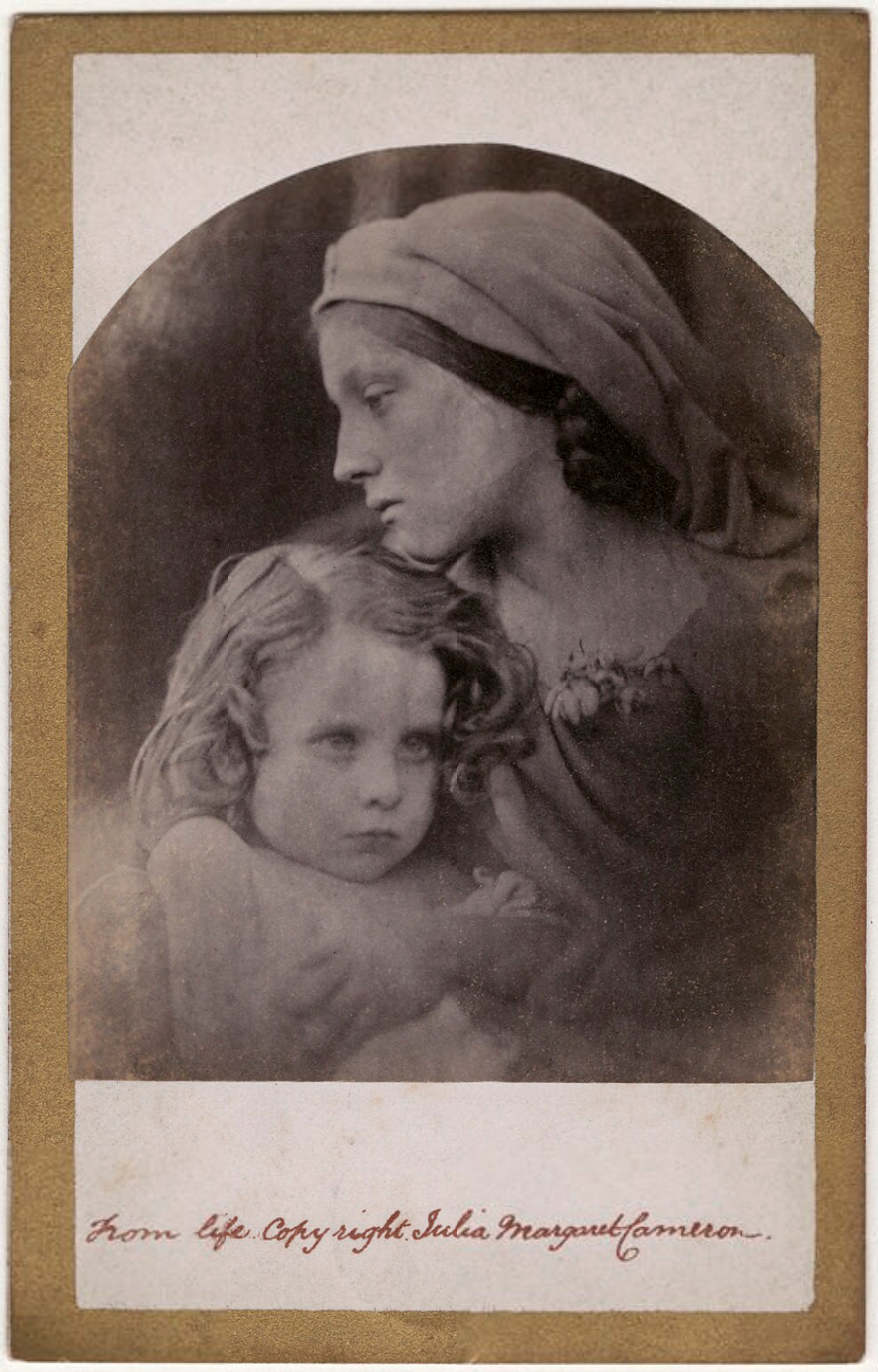
Julia Margaret Cameron (British, 1815-1879) ''La Madonna Aspettante' (William Frederick Gould; Mary Ann Hillier)' 1865


Julia Margaret Cameron (British, 1815-1879)
‘La Madonna Aspettante’ (William Frederick Gould; Mary Ann Hillier)
1865
Albumen carte-de-visite on gold-edged mount
2 3/4 x 2 1/4 in. (70 x 56mm)
Given by Cordelia Curle (née Fisher), 1959
© National Portrait Gallery, London


Julia Margaret Cameron (British, 1815-1879) ''The Kiss of Peace' (Elizabeth ('Topsy') Keown; Mary Ann Hillier)' 1869


Julia Margaret Cameron (British, 1815-1879)
‘The Kiss of Peace’ (Elizabeth (‘Topsy’) Keown; Mary Ann Hillier)
1869
Albumen print on gold-edged cabinet
5 1/8 x 3 7/8 in. (131 x 99mm) image size
Given by Cordelia Curle (née Fisher), 1959
© National Portrait Gallery, London


Julia Margaret Cameron (British, 1815-1879) 'Daisy Taylor' 1872


Julia Margaret Cameron (British, 1815-1879)
Daisy Taylor
1872
Albumen print
14 3/8 x 9 3/4 in. (364 x 247 mm) image size
Given by Cordelia Curle (née Fisher), 1959
© National Portrait Gallery, London


Julia Margaret Cameron (British, 1815-1879) ''Alethea' (Alice Liddell)' 1872


Julia Margaret Cameron (British, 1815-1879)
‘Alethea’ (Alice Liddell)
1872
Albumen print
12 3/4 x 9 3/8 in. (324 x 237mm) oval
Given by Cordelia Curle (née Fisher), 1959
© National Portrait Gallery, London


Lewis Carroll’s photographs of Alice Liddell are well-known; less familiar are the portraits Julia Margaret Cameron made of her years later, several of which respond directly to Carroll’s pictures. In this photograph, the twenty-year-old Alice is posed in full profile, much as Carroll depicted her in his famous seated portrait of 1858, shown nearby. However, Cameron shows Alice’s long wavy hair cascading in front of and behind her, merging with a background of blooming hydrangeas, the flowering of the plant echoing her coming of age. Cameron named the portrait after the Greek Aletheia, meaning ‘true’ or ‘faithful’.

Wall text from the exhibition


Julia Margaret Cameron (British, 1815-1879) 'Ellen Terry at Age Sixteen' 1864


Julia Margaret Cameron (British, 1815-1879)
Ellen Terry at Age Sixteen
1864
Albumen print


With a stage career that began at the age of nine and spanned sixty-nine years, Ellen Alice Terry (1847-1928) is regarded as one of the greatest actresses of her time. She was particularly celebrated for her naturalistic portrayals. Already an established professional, she married the artist G.F. Watts, thirty years her senior, a week before her seventeenth birthday, the year this photograph was made. Although they separated after less than a year, Watts painted Ellen on several occasions. One such portrait is currently on view in Room 26, on the Gallery’s first floor. Cameron’s idea to use a photograph of a particular subject at a specific time to embody a broad, abstract concept was particularly bold. Many believed that photography was better suited to recording minute detail than communicating universal themes.

Wall text from the exhibition


Dame Alice Ellen Terry, GBE (27 February 1847 – 21 July 1928), known professionally as Ellen Terry, was an English actress who became the leading Shakespearean actress in Britain. Born into a family of actors, Terry began performing as a child, acting in Shakespeare plays in London, and toured throughout the British provinces in her teens. At 16 she married the 46-year-old artist George Frederic Watts, but they separated within a year. She soon returned to the stage but began a relationship with the architect Edward William Godwin and retired from the stage for six years. She resumed acting in 1874 and was immediately acclaimed for her portrayal of roles in Shakespeare and other classics.

In 1878 she joined Henry Irving’s company as his leading lady, and for more than the next two decades she was considered the leading Shakespearean and comic actress in Britain. Two of her most famous roles were Portia in The Merchant of Venice and Beatrice in Much Ado About Nothing. She and Irving also toured with great success in America and Britain.

In 1903 Terry took over management of London’s Imperial Theatre, focusing on the plays of George Bernard Shaw and Henrik Ibsen. The venture was a financial failure, and Terry turned to touring and lecturing. She continued to find success on stage until 1920, while also appearing in films from 1916 to 1922. Her career lasted nearly seven decades.

Text from the Wikipedia website


Julia Margaret Cameron (British, 1815-1879) 'Julia Prinsep Stephen (née Jackson, formerly Mrs Duckworth)' 1867


Julia Margaret Cameron (British, 1815-1879)
Julia Prinsep Stephen (née Jackson, formerly Mrs Duckworth)
1867
Albumen print, oval
13 1/2 x 10 3/8 in. (344 x 263mm)
Given by Cordelia Curle (née Fisher), 1959
© National Portrait Gallery, London


Julia Prinsep Stephen, née Jackson (7 February 1846 – 5 May 1895) was a celebrated English beauty, philanthropist and Pre-Raphaelite model. She was the wife of the agnostic biographer Leslie Stephen and mother of Virginia Woolf and Vanessa Bell, members of the Bloomsbury Group.

Born in India, the family returned to England when Julia Stephen was two years old. She became the favourite model of her aunt, the celebrated photographer, Julia Margaret Cameron, who made over 50 portraits of her. Through another maternal aunt, she became a frequent visitor at Little Holland House, then home to an important literary and artistic circle, and came to the attention of a number of Pre-Raphaelite painters who portrayed her in their work. Married to Herbert Duckworth, a barrister, in 1867 she was soon widowed with three infant children. Devastated, she turned to nursing, philanthropy and agnosticism, and found herself attracted to the writing and life of Leslie Stephen, with whom she shared a mutual friend in Anny Thackeray, his sister-in-law.

After Leslie Stephen’s wife died in 1875 he became close friends with Julia and they married in 1878. Julia and Leslie Stephen had four further children, living at 22 Hyde Park Gate, South Kensington, together with his seven year old handicapped daughter. Many of her seven children and their descendants became notable. In addition to her family duties and modelling, she wrote a book based on her nursing experiences, Notes from Sick Rooms, in 1883. She also wrote children’s stories for her family, eventually published posthumously as Stories for Children and became involved in social justice advocacy. Julia Stephens had firm views on the role of women, namely that their work was of equal value to that of men, but in different spheres, and she opposed the suffrage movement for votes for women. The Stephens entertained many visitors at their London home and their summer residence at St Ives, Cornwall. Eventually the demands on her both at home and outside the home started to take their toll. Julia Stephen died at her home following an episode of influenza in 1895, at the age of 49, when her youngest child was only 11. The writer, Virginia Woolf, provides a number of insights into the domestic life of the Stephens in both her autobiographical and fictional work.

Text from the Wikipedia website


Julia Margaret Cameron (British, 1815-1879) 'Julia Prinsep Stephen (née Jackson, formerly Mrs Duckworth); Gerald Duckworth' August 1872


Julia Margaret Cameron (British, 1815-1879)
Julia Prinsep Stephen (née Jackson, formerly Mrs Duckworth); Gerald Duckworth
August 1872
Albumen print
8 1/2 in. x 12 1/8 in. (216 x 309mm)
Given by Cordelia Curle (née Fisher), 1959
© National Portrait Gallery, London


Julia Margaret Cameron (British, 1815-1879) 'Robert Browning' 1865


Julia Margaret Cameron (British, 1815-1879)
Robert Browning
1865
Albumen print
© Wellcome Collection, London


Cameron had a genius for recognising the expressive potential of chance events in her work. In this incomparable portrait, she allowed the many speck marks that cover this picture, caused by dust or debris settling on the plate after sensitising, to remain as part of the image. As a result, the poet Browning (1812-1889) becomes a transcendent figure, seemingly emerging from a field of stars. Browning developed an early interest in literature and the arts, encouraged by his father who was a clerk for the Bank of England. He refused to pursue a formal career and from 1833, he dedicated himself to writing poems and plays. In 1846 he married the poet Elizabeth Barrett. The couple lived in Italy until Elizabeth’s death in 1861, five years before this picture was taken.

Wall text from the exhibition


Robert Browning (7 May 1812 – 12 December 1889) was an English poet and playwright whose mastery of the dramatic monologue made him one of the foremost Victorian poets. His poems are known for their irony, characterisation, dark humour, social commentary, historical settings, and challenging vocabulary and syntax.

Browning’s early career began promisingly, but was not a success. The long poem Pauline brought him to the attention of Dante Gabriel Rossetti, and was followed by Paracelsus, which was praised by William Wordsworth and Charles Dickens, but in 1840 the difficult Sordello, which was seen as wilfully obscure, brought his poetry into disrepute. His reputation took more than a decade to recover, during which time he moved away from the Shelleyan forms of his early period and developed a more personal style.

In 1846 Browning married the older poet Elizabeth Barrett, who at the time was considerably better known than himself, thus starting one of the most famous literary marriages. They went to live in Italy, a country he called “my university”, and which features frequently in his work. By the time of her death in 1861, he had published the crucial collection Men and Women. The collection Dramatis Personae and the book-length epic poem The Ring and the Book followed, and made him a leading British poet. He continued to write prolifically, but his reputation today rests largely on the poetry he wrote in this middle period.

When Browning died in 1889, he was regarded as a sage and philosopher-poet who through his writing had made contributions to Victorian social and political discourse – as in the poem Caliban upon Setebos, which some critics have seen as a comment on the theory of evolution, which had recently been put forward by Darwin and others. Unusually for a poet, societies for the study of his work were founded while he was still alive. Such Browning Societies remained common in Britain and the United States until the early 20th century.

Text from the Wikipedia website


Julia Margaret Cameron (British, 1815-1879) 'Thomas Carlyle' 1865


Julia Margaret Cameron (British, 1815-1879)
Thomas Carlyle
1865
Albumen print
Lent by Her Majesty The Queen


Cameron portrayed the eminent historian and essayist Thomas Carlyle (1795-1881) completely out of focus – a disembodied, ethereal being, with light playing across his head, face, and beard.

Born in Scotland, Carlyle is considered one of the most important social commentators of his time. His ideas about the role of ‘great men’ in shaping history informed his lecture series and book On Heroes, Hero-Worship and The Heroic in History (1841). Instrumental in the founding of the National Portrait Gallery, he became one of its first Trustees. Carlyle was lifelong friends with Henry Taylor (shown in the next room), to whom Cameron was also close.

Wall text from the exhibition


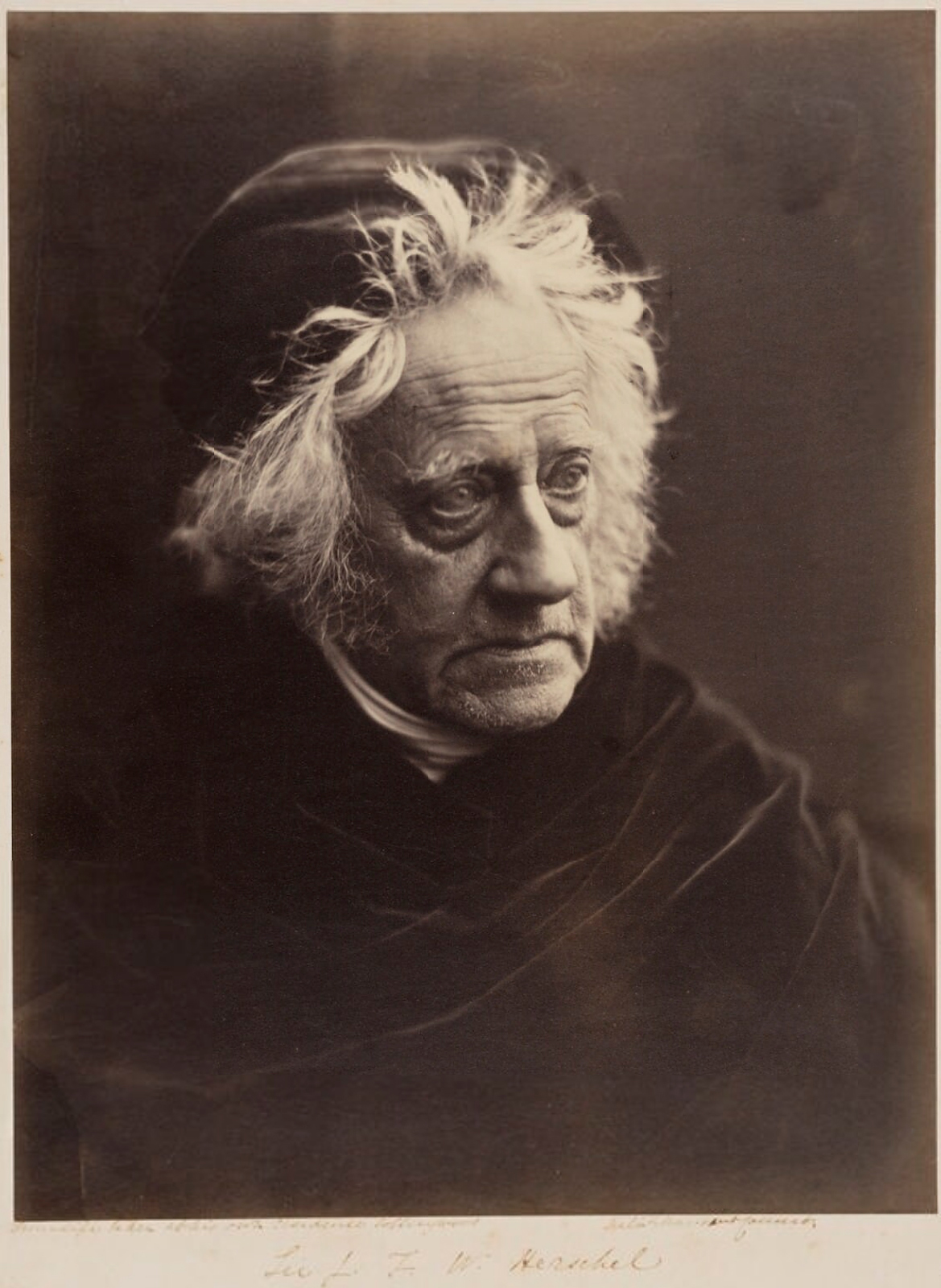
Julia Margaret Cameron (British, 1815-1879) 'Sir John Frederick William Herschel, 1st Bt' 1867


Julia Margaret Cameron (British, 1815-1879)
Sir John Frederick William Herschel, 1st Bt
1867
Albumen print
13 3/8 x 10 3/8 in. (340 x 264mm)
Purchased, 1982
© Wilson Centre for Photography


Cameron portrayed astronomer and physicist John Frederick William Herschel (1792-1871) as a romantic hero, his wild white hair and shining eyes emerging from darkness. Cameron and Herschel were lifelong friends. They had met in South Africa in 1836, where he was mapping the sky of the southern hemisphere, and where she was recovering from illness. A pioneer in the invention of photography, Herschel was responsible for numerous advancements and is credited with coining the terms ‘negative’, ‘positive’, and ‘photograph’. He introduced Cameron to photography in 1839 and shared the results of his early experiments with her. Rejlander also photographed Herschel, several years previously.

Wall text from the exhibition


Sir John Frederick William Herschel, 1st Baronet KH FRS (7 March 1792 – 11 May 1871) was an English polymath, mathematician, astronomer, chemist, inventor, and experimental photographer, who also did valuable botanical work. He was the son of Mary Baldwin and astronomer William Herschel, nephew of astronomer Caroline Herschel and the father of twelve children.

Herschel originated the use of the Julian day system in astronomy. He named seven moons of Saturn and four moons of Uranus. He made many contributions to the science of photography, and investigated colour blindness and the chemical power of ultraviolet rays; his Preliminary Discourse (1831), which advocated an inductive approach to scientific experiment and theory building, was an important contribution to the philosophy of science.

Text from the Wikipedia website


Julia Margaret Cameron (British, 1815-1879) 'Alfred, Lord Tennyson' 3 June 1869


Julia Margaret Cameron (British, 1815-1879)
Alfred, Lord Tennyson
3 June 1869
Albumen print
11 3/8 x 9 3/4 in. (289 x 248mm)
Purchased, 1974
© National Portrait Gallery, London


Here, Cameron shows the poet emerging out of inky darkness, crowned by wild locks of hair on either side of his head, sporting an abundant beard, and framed by two points of his lapel. She positioned him on high, god-like and looking down, the viewer’s eye fixed at the height of his top button.

Wall text from the exhibition


Julia Margaret Cameron (British, 1815-1879) 'Charles Darwin' 1868-1869


Julia Margaret Cameron (British, 1815-1879)
Charles Darwin
1868-1869
Albumen print
13 x 10 1/8 in. (330 x 256mm)
Purchased, 1974
© National Portrait Gallery, London


In the summer of 1868, Darwin and his family rented a holiday cottage on the Isle of Wight from Cameron’s family. The visit gave Cameron the opportunity to make this famous photograph. Publically, Darwin wrote of this portrait: ‘I like this photograph very much better than any other which has been taken of me.’ Privately, he was less positive, describing it as ‘heavy and unclear’. This particular print once belonged to Virginia Woolf, who was Julia Margaret Cameron’s great niece.

Wall text from the exhibition


National Portrait Gallery
St Martin’s Place
London, WC2H 0HE

Opening hours:
Open daily: 10.30 – 18.00
Friday and Saturday: 10.30 – 21.00

National Portrait Gallery website

LIKE ART BLART ON FACEBOOK

Back to top

Review: ‘Rosemary Laing’ at TarraWarra Museum of Art, Healesville, Victoria

Exhibition dates: 2nd December, 2017 – 11th February, 2018

Curator: Victoria Lynn


Rosemary Laing (Australian, 1959-2024) 'weather (Eden) #1' 2006 from the exhibition 'Rosemary Laing' at TarraWarra Museum of Art, Healesville, Victoria, Dec 2017 - Feb 2018


Rosemary Laing (Australian, 1959-2024)
weather (Eden) #1
2006
From the series weather
C Type photograph
110 x 221.5cm
Private Collection
© Rosemary Laing, Courtesy Tolarno Galleries, Melbourne


Disjunction and displacement in the Australian landscape

On a suitably apocalyptic day – in terms of our relationship to landscape, environment, elements and shelter – I drove up the Yarra Valley to the beautiful TarraWarra Museum of Art to see an exhibition of the works of Rosemary Laing. Through teeming rain, headlights gleaming, windshield wipers at full bore listening to Beethoven symphonies, I undertook an epic drive up to that most beautiful part of Victoria. The slightly surreal, disembodied experience of the drive continued once I stepped inside the gallery to view Laing’s work.

Laing’s work has always been a favourite, whether it be the floating brides, the carpet laid through the forest, or the melting newsprint after rain. I have always thought of her sensitive conceptual, performative work as evidenced through large, panoramic photographs as strong and focused, effective in challenging contemporary cultural cliché relating to the land, specifically the possession and inhabitation of it. As such, perhaps I was expecting too much of this exhibition but to put it bluntly, the presentation was a great disappointment.

There are various contributing factors that do not make this exhibition a good one.

Firstly, as the curator Victoria Lynn observes, “Laing’s photographs are conceived in series, so that each photograph is part of a larger cluster of images that are often arrange in specific sequences.” This exhibition, “includes 28 large-scale works selected from ten series over a thirty-year period” that focus on the themes of land and landscape in Laing’s oeuvre. The problem with this approach to Laing’s work is that the photographs from the different series sit uncomfortably together. The transitions between the photographs and different bodies of work as evidenced in this exhibition, simply do not work. Minor White’s ice / fire – that frisson of intensity between two disparate images that makes both images relevant to each other – is non-existent here. What might have more successful in displaying Laing’s work would have been a larger selection from a more limited number of series. It would have given the viewer a more holistic sense of belonging and investment in the work. This is the problem working in series and specific sequences… once the work leaves that cluster of energy, that magical place of nurture, nature and conceptualisation, how does it reintegrate itself into other states of being and display?

Secondly, the light levels in the gallery were so low the photographs seemed drained of all their energy. I understand that the “lux levels are quite particular according to museum requirements considering many works are lent from various institutions around Australia,” having done a conservation subject during my Master of Art Curatorship, but this is where the surreal experience from the drive continued: upon entering the gallery it was like navigating a stygian gloom, as can be seen in the installation photographs of the exhibition below. This is a museum of art situated in the most beautiful landscape and these are photographs, captured with light! that need light to bring them alive. I remember seeing Laing’s work leak at Tolarno galleries in Melbourne, and being amazed by their presence, their energy. Not here. Here the blues of the sky and the reds of the carpet seemed drained of energy, the vibrations of being of the forest and land victim to overzealous preservation.

Thirdly, and this relates to the first point, there was one work How we lost poor Flossie (fires) (1988, below) from Laing’s early series Natural Disasters. The work appeared out of nowhere at the end of the exhibition, had nothing that it related to around it, and had no explanation as to why it was there. I really would have liked to have known more about how Laing got from this work to the later series in the exhibition. What was her process of discovery, of change and experimentation. How did Laing go from Flossie – slicing together the spectacle and graphic imagery from media coverage of the Ash Wednesday fires – to the embeddedness [definition: the dependence of a phenomenon on its environment, which may be defined alternatively in institutional, social, cognitive, or cultural terms] of performances within the landscape of the later work? This would have been a more cogent, pungent and relevant investigation into the rigours of Laing’s art practice.

I emerged into the world and it was still pouring with rain. I rejoiced. It was as though I was alive again. Laing’s work is always strong and interesting. It was just such a pity that this iteration of it, specifically its closeted choreography, was not as restless as the landscape the works imagine.

Dr Marcus Bunyan


Many thankx to the TarraWarra Museum of Art for allowing me to publish the photographs in the posting. Please click on the photograph for a larger version of the image. All installation images © Dr Marcus Bunyan and TarraWarra Museum of Art.


Installation view of the exhibition 'Rosemary Laing' at the TarraWarra Museum of Art

Installation view of the exhibition 'Rosemary Laing' at the TarraWarra Museum of Art

Installation view of the exhibition 'Rosemary Laing' at the TarraWarra Museum of Art

Installation view of the exhibition 'Rosemary Laing' at the TarraWarra Museum of Art featuring the works 'welcome to Australia' (2004, C Type photograph, Collection of the University of Queensland) from the series 'to walk on a sea of salt'


Installation view of the exhibition Rosemary Laing at the TarraWarra Museum of Art featuring the works welcome to Australia (2004, C Type photograph, Collection of the University of Queensland) from the series to walk on a sea of salt
Photos: Marcus Bunyan


“… the detention centre images, so that you’ve got the Heysen, you know, trees that you want to belong to, and then you’ve got this endless vista – though it be a difficult journey across a horizon that never ends – and then you have the raised wire fence, completely closing off access to that land, and that place, and those images of belonging and heritage.”

Art Talk with Rosemary Laing


Installation view of the exhibition 'Rosemary Laing' at the TarraWarra Museum of Art featuring the works 'after Heysen' (2004) at left, and 'to walk on a sea of salt' (2004) at right, from the series 'to walk on a sea of salt'


Installation view of the exhibition Rosemary Laing at the TarraWarra Museum of Art featuring the works after Heysen (2004) at left, and to walk on a sea of salt (2004) at right, from the series to walk on a sea of salt
Photo: Marcus Bunyan


Installation view of Rosemary Laing's 'after Heysen' (2004, C Type photograph, Collection of Carey Lyon and Jo Crosby) from the series 'to walk on a sea of salt'


Installation view of Rosemary Laing’s after Heysen (2004, C Type photograph, Collection of Carey Lyon and Jo Crosby) from the series to walk on a sea of salt
Photo: Marcus Bunyan


The question of how to belong in Australia permeates Laing’s work. Australia has one of the highest immigrant populations in the world so that the question of arrival, and of making oneself at home, continues to be part of the everyday reality. We also have one of the world’s harshest policies for asylum seekers so that – in the political imaginary of contemporary Australia – land is conceived as a border that has to be protected.

The artist’s most potent response to the contested issue of being at home in Australia is the 2004 series to walk on a sea of salt, where images of Woomera detention centre, combined with photographs inspired by quintessential Australian imagery and stories, remind us that home does not travel with the asylum seeker. In after Heysen, Laing photographs the trees that Hans Heysen transformed into an Arcadian image of the Australian bush, but bleaches the image to invoke a sense of nationalistic nostalgia. By contrast, the spatial potential and magnitude of the Australian landscape is invoked by the image to walk on a sea of salt.

Wall text from the exhibition


Installation view of the exhibition 'Rosemary Laing' at the TarraWarra Museum of Art featuring works from the series 'The Paper' (2013)

Installation view of the exhibition 'Rosemary Laing' at the TarraWarra Museum of Art featuring works from the series 'The Paper' (2013)


Installation view of the exhibition Rosemary Laing at the TarraWarra Museum of Art featuring works from the series The Paper (2013)
Photos: Marcus Bunyan


Installation view of Rosemary Laing's work 'The Paper, Tuesday' (2013, C Type photograph, Monash University Collection) from the series 'The Paper' (2013)


Installation view of Rosemary Laing’s work The Paper, Tuesday (2013, C Type photograph, Monash University Collection) from the series The Paper (2013)
Photo: Marcus Bunyan


Installation view of Rosemary Laing's work 'The Paper, Thursday' (2013, C Type photograph, Monash University Collection) from the series 'The Paper' (2013)


Installation view of Rosemary Laing’s work The Paper, Thursday (2013, C Type photograph, Monash University Collection) from the series The Paper (2013)
Photo: Marcus Bunyan


Laing choreographs situations in the landscape, invoking a unique set of circumstances that reflect upon historic, social, environmental, economic and material conditions. Incongruous items are carefully positioned to flow with the compositional logic of a place.

On a hillside in Bundanon, New South Wales is a Casuarina forest sprinkled with Burrawang (cycads), an ancient plant that dates back to the Palaeozoic. The series The Paper was created on this hillside. The forest floor is covered in newspaper and photographed after the rains. The paper has literally been pressed into the forest floor by the torrent. It has been weathered. The sensationalism, headlines, imagery and opinion of the newspaper merge into a feathery ground cover of soft white, cream and beige hues. It is as if the area has flooded, not with water, but with paper. Words, colour and dates are dissolved into a tonal carpet. There is no light and shadow. This misalignment suggests the death of the daily paper, and here it inevitably returns to its natural habitat, its original ‘home’.

Wall text from the exhibition


Installation view of the exhibition 'Rosemary Laing' at the TarraWarra Museum of Art

Installation view of the exhibition 'Rosemary Laing' at the TarraWarra Museum of Art

Installation view of the exhibition 'Rosemary Laing' at the TarraWarra Museum of Art

Installation view of the exhibition 'Rosemary Laing' at the TarraWarra Museum of Art

Installation view of the exhibition 'Rosemary Laing' at the TarraWarra Museum of Art

Installation view of the exhibition 'Rosemary Laing' at the TarraWarra Museum of Art

Installation view of the exhibition 'Rosemary Laing' at the TarraWarra Museum of Art

Installation view of the exhibition 'Rosemary Laing' at the TarraWarra Museum of Art


Installation views of the exhibition Rosemary Laing at the TarraWarra Museum of Art
Photos: Marcus Bunyan


Installation view of Rosemary Laing's work 'weather (Eden) #1' (2006, C Type photograph, Collection of Peter and Anna Thomas) from the series 'weather'


Installation view of Rosemary Laing’s work weather (Eden) #1 (2006, C Type photograph, Collection of Peter and Anna Thomas) from the series weather
Photo: Marcus Bunyan


The idea of a natural disaster in the Australian landscape occupies the same intensity for Laing as the human or ‘unnatural’ disasters. The each speak of the endless transformation of the landscape, its unfolding stories and its capacity to conjure anxiety and fear.

the series weather, located on the south coast of New South Wales, was inspired by the impact of natural phenomena – coastal storms – on the area. The flash of red fish netting snagged unawares by the battered grey melaleucas in weather (Eden) #1 also signals the historic Indigenous and colonial whaling in the area and the more recent slow demise of the fishing industry. These images seem haunted.

Wall text from the exhibition


Installation view of the exhibition 'Rosemary Laing' at the TarraWarra Museum of Art showing 'The Flowering of the Strange Orchid' (2017) left, from the series 'Buddens', and at right 'weather (Eden) #2' from the series 'weather'


Installation view of Rosemary Laing’s works The Flowering of the Strange Orchid (2017) left, from the series Buddens, and at right weather (Eden) #2 from the series weather
Photo: Marcus Bunyan


Installation view of the exhibition 'Rosemary Laing' at the TarraWarra Museum of Art showing a detail of Rosemary Laing's work 'The Flowering of the Strange Orchid' (2017)


Detail of Rosemary Laing’s work The Flowering of the Strange Orchid (2017)
Photo: Marcus Bunyan


Installation view of the exhibition 'Rosemary Laing' at the TarraWarra Museum of Art showing the work 'Walter Hood' (2017) from the series 'Buddens'


Installation view of the exhibition Rosemary Laing at the TarraWarra Museum of Art showing the work Walter Hood (2017) from the series Buddens
Photo: Marcus Bunyan


In the most recent series Buddens, Laing turns again to the ‘unnatural disasters’ that impact ‘country’. The stream is covered in rolls of discarded clothing. It leads down to Wreck Bay, on the south coast of New South Wales, and is the site of multiple ship disasters. Historically these waters were used to transport convicts, goods, troops and settlers up and down the coast and they are littered with relics from shipwrecks including those of the vessels ‘Rose of Australia’ and ‘Walter Hood’.

The roof truss is like a piece of wreckage in amongst the trees, as if torn by the winds from an urban development on the outskirts of a city. Recalling the upside down house in the series leak (2010), it meets a natural A-frame in the foliage, yet the two don’t make a safe house.

The clothes seem to push through the landscape, like the rush of a river, perhaps in search of a safe haven. There is a mixture of metaphors in Buddens, highlighting the delicate balance between nature and culture required for survival.

Wall text from the exhibition


Installation view of Rosemary Laing's work 'brumby mound #5' (2003, C Type photograph, National Gallery of Victoria, Melbourne) from the series 'one dozen unnatural disasters in the Australian landscape'


Installation view of Rosemary Laing’s work brumby mound #5 (2003, C Type photograph, National Gallery of Victoria, Melbourne) from the series one dozen unnatural disasters in the Australian landscape
Photo: Marcus Bunyan


Installation view of Rosemary Laing's work 'brumby mound #6' (2003, C Type photograph, National Gallery of Victoria, Melbourne) from the series 'one dozen unnatural disasters in the Australian landscape'


Installation view of Rosemary Laing’s work brumby mound #6 (2003, C Type photograph, National Gallery of Victoria, Melbourne) from the series one dozen unnatural disasters in the Australian landscape
Photo: Marcus Bunyan


Landscape has a past, present an future; it is never the same as it used to be. In the face of wars, wrecks, and both natural and ‘unnatural’ destruction, we build shelters. We fence and furnish these landscape as we try to impose order on the precariousness and relative insignificance of life.  As can be seen in a number of Laing’s series, the introduction of elements from our ‘settled’ environment including carpet, clothing, architectural structures, newspapers and the like – creates a disjunction. Some thing is literally awry.

In the one dozen unnatural disasters in the Australian landscape series, red interior furniture occupies and unsuccessfully domesticates this landscape. Painted in red earth and glue, these items almost disappear in the desert landscape. they are both like relics of a lost civilisation, but also seem to have become attuned to the terrain.

In the series leak, Laing continues her poetic and political engagement with the Australian landscape whereby powerful and dynamic tensions are elicited through the construction and insertion of foreign objects in the natural environment. Although the land depicted has already been altered through years of cleating and grazing practices, these works metaphorically signal that the continued ‘leak’ of residential development into both remnant bushland and farmland owned by generations of families is an unwelcome accident or breach that threatens to overturn the ecological balance between nature and culture.

Wall text from the exhibition


Installation view of Rosemary Laing's work 'Aristide' (2010, C Type photograph, Collection of the University of Queensland) from the series 'leak'


Installation view of Rosemary Laing’s work Aristide (2010, C Type photograph, Collection of the University of Queensland) from the series leak
Photo: Marcus Bunyan


Landscape changes; its restless. It moves with the wind and rhymes with the seasons. It burns and floods. It is spatial, offering the visitor several perspectives that can be contradictory, paradoxical and durational. Landscape is also a ‘situation’, a complex interplay of historical and environmental conditions. Landscape has a past, present and future; it is never the same as it used to be. When we gaze out over a bay, or ponder and Indigenous site, we can’t help but wonder what it used to look like, how it used to be occupied, what tragedies and serendipities happened there. Landscape can be both a place of belonging and a destination, and depending on one’s perspective, it can embody the familiarity of home and the promise of adventure; the discomfort of displacement or the tragedy of invasion. Landscape is formed as much by natural forces as it is by human knowledge. …

Rosemary Laing introduces us to these histories by creating projects in the Australian landscape. These projects are sustained by her continuing search for understanding the multiple attitudes to belonging in the landscape. Miwon Kwon has argued that today ‘feeling out of place is the cultural symptom of late capitalism’s political and social reality’, so much so, that to be ‘situated’ is to be ‘displaced’. In Australia, the notion of displacement has a history that goes back to colonisation. Questions of who owns the land, how we inhabit it, and who feels displaced, are an intrinsic part of the Australian consciousness. Laing’s work also asks how we encounter the landscape; who or what is out of  place; who or what does not belong; are ‘we’ the alien? …

Laing choreographs situations in the landscape, invoking a unique set of circumstances that reflect upon historic, social, environmental and material conditions…

Doherty argues that rather than being site specific, art has shifted from a fixed location, to one that, in the words of Kwon, is ‘constituted through social, economic, cultural and economic processes’. Such artworks are not located in a single place, but rather take the form of interactive activities, collective actions, and spatial experiences. They are constitutive rather than absolute; propositional rather than conclusive. Rosemary Laing’s mise-en-scènes are not public, events or performances, but they forge a compositional dialogue with the natural environment that provokes a social, economic and environmental conscience.

Laing’s photographs are conceived in series, so that each photograph is part of a larger cluster of images that are often arrange in specific sequences. Moreover, the spatial tableaux and the photographic outcome have an intrinsic connection. The installations cannot be seen without the photographic apparatus and yet each mise-en-scène is presented from a variety of perspectives and angles, so that we cannot necessarily rely on the photographic outcome to be ‘truthful’. The photograph is not simply documentation. It is an activator. In many respects Laing places us in the landscape, so that we fell part of the image. She does this through both the size and relative height of the image, along with the point of view and our relation with the horizon line. Laing tests the limits of the photograph, and also provokes the viewer to rearticulate their connection to landscape, and re-energise it. She comes to be the interlocutor between the histories and meanings embedded in landscape, the installation, the photograph and the viewer.

Victoria Lynn. “Rosemary Laing – Co-belonging with the Landscape,” in Rosemary Laing exhibition catalogue, TarraWarra Art Museum, 2017, pp. 7-9.


Installation view of Rosemary Laing's work 'effort and rush #9 (swanfires)' (2013-2015, C Type photograph, Collection of Alex Cleary) from the series 'effort and rush'


Installation view of Rosemary Laing’s work effort and rush #9 (swanfires) (2013-2015, C Type photograph, Collection of Alex Cleary) from the series effort and rush
Photo: Marcus Bunyan


Detail of Rosemary Laing's work 'effort and rush #9 (swanfires)' (2013-2015)


Detail of Rosemary Laing’s work effort and rush #9 (swanfires) (2013-2015)
Photo: Marcus Bunyan


Installation view of Rosemary Laing's 'work burning Ayer #12' (2003, C Type photograph, Art Gallery of New South Wales, Sydney) from the series 'one dozen unnatural disasters in the Australian landscape'


Installation view of Rosemary Laing’s work burning Ayer #12 (2003, C Type photograph, Art Gallery of New South Wales, Sydney) from the series one dozen unnatural disasters in the Australian landscape
Photo: Marcus Bunyan


The fire in burning Ayer #12 gives us some clues to the relationship between fire and the artist’s quest to reimagine belonging in the Australian landscape. The earth-encrusted items of mass-produced domestic wooden furniture – a reference, once more, to the idea of ‘housing’, home and belonging. Their ashes fold back into the earth. The strength of the red desert plain holds its ground, as it were, as the stage for this enactment of both sacrifice and return. Fire comes to be a metaphor for the ways in which the Indigenous landscape refuses our presence and escapes from our control.

In effort and rush #9 (swanfires), the blur of movement across tall thin tree trunks, captured in a smoky black hue, considers both the rush of the fire, and the rush of escape. It is as if the camera has become a paintbrush.

Wall text from the exhibition


Installation view of Rosemary Laing's work 'swanfires, Chris's shed' (2002-2004, C Type photograph, Monash Gallery of Art) from the series 'swanfires'


Installation view of Rosemary Laing’s work swanfires, Chris’s shed (2002-2004, C Type photograph, Monash Gallery of Art) from the series swanfires
Photo: Marcus Bunyan


Detail of Rosemary Laing's work 'swanfires, Chris's shed' (2002-2004)


Detail of Rosemary Laing’s work swanfires, Chris’s shed (2002-2004)
Photo: Marcus Bunyan


Installation view of Rosemary Laing's work 'How we lost poor Flossie (fires)' (1988, Gelatin silver photograph, Art Gallery of South Australia, Adelaide) from the series 'Natural Disasters'


Installation view of Rosemary Laing’s work How we lost poor Flossie (fires) (1988, Gelatin silver photograph, Art Gallery of South Australia, Adelaide) from the series Natural Disasters
Photo: Marcus Bunyan


When Laing first tackled disasters in her 1988 Natural Disasters series, it was from the point of view of the media phenomenon. Slicing together imagery from media coverage of the Ash Wednesday fires, the series, including works such as How we lost poor Flossie (fires) was more to do with the slipstream of spectacle in the wake of the bicentennial of Australia. At the time, competing propositions about our cultural identity jostled for attention: 200 years of settlement, Aboriginal calls for recognition, the tourist panorama, and the sensationalism of fire in the landscape.

After every significant fire near her house in Swanhaven, on the south cost of New South Wales, Laing takes photographs in the aftermath of the blaze, like a marker of the irreconcilable yet continuing presence of natural and unnatural disasters.

In the series swanfires there is an overwhelming sense of loss. These two images speak of the abject disaster of fire, before the clean up. They depict situations that exceed our comprehension. In swanfires, John and Kathy’s auto services, the intersecting forms of corrugated iron – the quintessential material of rural Australia – are unexpectedly bathed in the softest of pink, their forms reflecting the tree line behind.

Wall text from the exhibition


Installation view of Rosemary Laing's work 'swanfires, John and Kathy's auto services' (2002-2004, C Type photograph,Courtesy of the artist and Tolarno Galleries, Melbourne) from the series 'swanfires'


Installation view of Rosemary Laing’s work swanfires, John and Kathy’s auto services (2002-2004, C Type photograph,Courtesy of the artist and Tolarno Galleries, Melbourne) from the series swanfires (see below)
Photo: Marcus Bunyan


Rosemary Laing (Australian, 1959-2024) 'swanfires, John and Kathy's auto services' 2002-2004


Rosemary Laing (Australian, b. 1959)
swanfires, John and Kathy’s auto services
2002-2004
From the series swanfires
C Type photograph
85 x 151cm
Courtesy the artist and Tolarno Galleries, Melbourne
© Rosemary Laing, Courtesy Tolarno Galleries, Melbourne


TarraWarra Museum of Art will stage an exhibition of the works of Rosemary Laing, one of Australia’s most significant and internationally-renowned photo-based artists, 2 December 2017 – 11 February 2018.

Focusing on the theme of land and landscape in Laing’s oeuvre, the Rosemary Laing exhibition includes 28 large scale works selected from 10 series over a thirty-year period. The exhibition, which is the first large-scale showing of Laing’s work in Victoria, will be accompanied by an exhibition of works by Fred Williams focusing on a single year of the artist’s oeuvre, Fred Williams – 1974. Curated by Anthony Fitzpatrick, the Williams exhibition reveals the ways in which colour and human intervention in the landscape became a focus for the artist.

Born in Brisbane and based in Sydney, Laing has worked with the photographic medium since the mid-1980s. Her projects have engaged with culturally and historically resonant sites in the Australian landscape, as well as choreographed performances. TarraWarra director, Victoria Lynn, curator of the exhibition, says Laing’s work is highly representative of the Museum’s central interest in the exchange between art, place and ideas.

“This exhibition reveals Laing’s compositional and technical ingenuity. It shows that Laing can create images of dazzling luminosity as well as solemnly subdued light. Flickers of bright red catch our eye, while passages of verdant greens create an all-over intensity. Her images take us to open and infinite plains as well as the depths of entangled forest trails.

“The artist builds structures and installations in coastal, farming, forest and desert landscapes from which she then creates photographic images. Whether it is papering the floor of a forest in the 2013 series The Paper, or creating a river of clothes displacing the water of a flowing creek in the new series Buddens 2017, Laing’s images reflect upon the historical and contemporary stories of human engagement with our continent. More specifically, the artist draws on colonisation and the impact of waves of asylum seekers, suggesting that the landscape is forever transformed both physically and metaphorically. The exhibition also includes works depicting the aftermath of fire, and the ways it too transforms what we thought we knew of the landscape,” Ms Lynn said.

Rosemary Laing comments: “The arrival of people, throughout history, shifts what happens in land, challenging those who have left their elsewhere, and disrupting the continuum of their destination-place. A disruption causes a reconfiguration. It elaborates both the beforehand and the afterward. The works are somewhere between – a narrative for the movement of people, the condition of landforms with a changing peopled condition, expectations of home and haven, flow and flooding, and the effect and affect of these passages.” The exhibition is supported by major exhibition partner the Balnaves Foundation, and will be accompanied by a catalogue authored by Judy Annear, funded by the Gordon Darling Foundation.

Annear, writes: “How to make sense of what humanity does in and to their environment regardless of whether that environment appears to be natural or made? What is the spectrum, the temperature of that activity? Laing is an artist who grapples with these questions and how to reflect and interpret the times in which she lives.”

Neil Balnaves AO, Founder The Balnaves Foundation said, “The exhibitions Rosemary Laing and Fred Williams – 1974 will be the third year that The Balnaves Foundation have supported the TarraWarra Museum of Art to deliver exhibitions of note by Australian artists. The Foundation is proud to partner in these major endeavours, providing vital opportunities for important Australian artists to be showcased, whilst providing art lovers – including inner-regional audiences – access to outstanding arts experiences.”

Laing has exhibited in Australia and abroad since the late 1980s. She has participated in various international biennials, including the Biennale of Sydney (2008), Venice Biennale (2007), Busan Biennale (2004), and Istanbul Biennial (1995). Her work is present in museums Australia-wide and international museums including: the Museo Nacional Centro De Arte Reina Sofia, Madrid; North Carolina Museum of Art, Raleigh; Modern Art Museum of Fort Worth, USA; 21st Century Museum of Contemporary Art, Kanazawa, Japan; Kunstmuseum Luzern, Lucerne, Switzerland; Wadsworth Atheneum Museum of Art, Hartford, Connecticut, USA.

Laing has presented solo exhibitions at several museums, including the Museum of Contemporary Art, Sydney; Kunsthallen Brandts Klædefabrik, Odense; Domus Artium 2002, Salamanca; Frist Center for the Visual Arts, Nashville; and National Museum of Art, Osaka. A monograph, written by Abigail Solomon-Godeau has been published by Prestel, New York (2012).

Press release from the TarraWarra Museum of Art


Rosemary Laing (Australian, 1959-2024) 'brumby mound #6' 2003 from the exhibition 'Rosemary Laing' at TarraWarra Museum of Art, Healesville, Victoria, Dec 2017 - Feb 2018


Rosemary Laing (Australian, 1959-2024)
brumby mound #6
2003
From the series one dozen unnatural disasters in the Australian landscape
C Type photograph
109.9 x 225cm
National Gallery of Victoria, Melbourne
Purchased with funds from the Victorian Foundation for Living Australian Artists, 2004
© Rosemary Laing, Courtesy Tolarno Galleries, Melbourne


Rosemary Laing (Australian, 1959-2024) 'The Paper, Tuesday' 2013


Rosemary Laing (Australian, b. 1959)
The Paper, Tuesday
2013
From the series The Paper
C Type photograph
90 x 189cm
Monash University Collection
Purchased by the Faculty of Science, 2015
Courtesy of Monash University Museum of Art
© Rosemary Laing, Courtesy Tolarno Galleries, Melbourne


Rosemary Laing (Australian, 1959-2024) 'Aristide' 2010


Rosemary Laing (Australian, b. 1959)
Aristide
2010
From the series leak
C Type photograph
110 x 223cm
The University of Queensland Art Museum, Brisbane
Collection of The University of Queensland, purchased 2011
© Rosemary Laing, Courtesy Tolarno Galleries, Melbourne


Rosemary Laing (Australian, 1959-2024) 'Walter Hood' 2017


Rosemary Laing (Australian, 1959-2024)
Walter Hood
2017
From the series Buddens
Archival pigment print
100 x 200.6cm
Courtesy the artist and Tolarno Galleries, Melbourne
© Rosemary Laing, Courtesy Tolarno Galleries, Melbourne


Rosemary Laing (Australian, 1959-2024) 'The Flowering of the Strange Orchid' 2017


Rosemary Laing (Australian, 1959-2024)
The Flowering of the Strange Orchid
2017
From the series Buddens
Archival pigment print
100 x 200cm
Ten Cubed Collection, Melbourne
© Rosemary Laing, Courtesy Tolarno Galleries, Melbourne


Rosemary Laing (Australian, 1959-2024) 'Drapery and wattle' 2017


Rosemary Laing (Australian, 1959-2024)
Drapery and wattle
2017
From the series Buddens
Archival pigment print
100 x 152.6cm
Collection of Sally Dan-Cuthbert Art Consultant
© Rosemary Laing, Courtesy Tolarno Galleries, Melbourne


TarraWarra Museum of Art
311 Healesville-Yarra Glen Road,
Healesville, Victoria, Australia
Melway reference: 277 B2
Phone: +61 (0)3 5957 3100

Opening hours:
Open Tuesday – Sunday, 11am – 5pm
Open all public holidays except Christmas day

Summer Season – open 7 days
Open 7 days per week from Boxing Day to the Australia Day public holiday

TarraWarra Museum of Art website

LIKE ART BLART ON FACEBOOK

Back to top

Exhibition: ‘Walker Evans’ at the San Francisco Museum of Modern Art (SFMOMA)

Exhibition dates: 30th September, 2017 – 4th February, 2018

Curator: Clément Chéroux


Walker Evans (American, 1903-1975) 'Self-Portrait' 1927 from the exhibition 'Walker Evans' at the San Francisco Museum of Modern Art (SFMOMA), Sept 2017 - Feb 2018


Walker Evans (American, 1903-1975)
Self-Portrait
1927
Gelatin silver print
Collection of The Metropolitan Museum of Art, New York, Ford Motor Company Collection, Gift of Ford Motor Company and John C. Waddell
© Walker Evans Archive, The Metropolitan Museum of Art, New York


I have posted on this exhibition before, when it was at the Centre Pompidou in Paris, but this iteration at SFMOMA is the exclusive United States venue for the Walker Evans retrospective exhibition – and the new posting contains fresh media images not available previously.

I can never get enough of Walker Evans. This perspicacious artist had a ready understanding of the contexts and conditions of the subject matter he was photographing. His photographs seem easy, unpretentious, and allow his sometimes “generally unaware” subjects (subway riders, labor workers) to speak for themselves. Does it matter that he was an outsider, rearranging furniture in workers homes while they were out in the fields: not at all. Photography has always falsified truth since the beginning of the medium and, in any case, there is never a singular truth but many truths told from many perspectives, many different points of view. For example, who is to say that the story of America proposed by Robert Frank in The Americans, from the point of view of an outsider, is any less valuable than that of Helen Levitt’s view of the streets of New York? For different reasons, both are as valuable as each other.

Evans’ photographs for the Farm Security Administration (FSA) documenting the effects of the Great Depression on American life are iconic because they are cracking good photographs, not because he was an insider or outsider. He was paid to document, to enquire, and that is what he did, by getting the best shot he could. It is fascinating to compare Floyd and Lucille Burroughs, Hale County, Alabama (1936, below) with Alabama Tenant Farmer Floyd Bourroughs (1936, below). In the first photograph the strong diagonal element of the composition is reinforced by the parallel placement of the three feet, the ‘Z’ shape of Lucille Burroughs leg then leading into her upright body, which is complemented by the two vertical door jams, Floyd’s head silhouetted by the darkness beyond. There is something pensive about the clasping of his hands, and something wistful and sad, an energy emanating from the eyes. If you look at the close up of his face, you can see that it is “soft” and out of focus, either because he moved and/or the low depth of field. Notice that the left door jam is also out of focus, that it is just the hands of both Floyd and Lucille and her face that are in focus. Does this low depth of field and lack of focus bother Evans? Not one bit, for he knows when he has captured something magical.

A few second later, he moves closer to Floyd Burroughs. You can almost hear him saying to Floyd, “Stop, don’t move a thing, I’m just going to move the camera closer.” And in the second photograph you notice the same wood grain to the right of Floyd as in the first photograph, but this time the head is tilted slightly more, the pensive look replaced by a steely gaze directed straight into the camera, the reflection of the photographer and the world beyond captured on the surface of the eye. Walker Evans is the master of recognising the extra/ordinary. “The street was an inexhaustible source of poetic finds,” describes Chéroux. In his creation of visual portfolios of everyday life, his “notions of realism, of the spectator’s role, and of the poetic resonance of ordinary subjects,” help Evans created a mythology of American life: a clear vision of the present as the past, walking into the future.

With the contemporary decline of small towns and blue collar communities across the globe Evans’ concerns, for the place of ordinary people and objects in the world, are all the more relevant today. As the text from the Metropolitan Museum observes, it is the individuals and social institutions that are the sites and relics that constitute the tangible expressions of American desires, despairs, and traditions. And not just of American people, of all people… for it is community that binds us together.

Dr Marcus Bunyan


Many thankx to the San Francisco Museum of Modern Art for allowing me to publish the text and photographs in the posting. Please click on the photographs for a larger version of the image.


Walker Evans (American, 1903-1975) 'Truck and Sign' 1928-1930 from the exhibition 'Walker Evans' at the San Francisco Museum of Modern Art (SFMOMA), Sept 2017 - Feb 2018


Walker Evans (American, 1903-1975)
Truck and Sign
1928-1930
Gelatin silver print
Private collection, San Francisco
© Walker Evans Archive, The Metropolitan Museum of Art, New York


Walker Evans is one of the most influential artists of the twentieth century. His elegant, crystal-clear photographs and articulate publications have inspired several generations of artists, from Helen Levitt and Robert Frank to Diane Arbus, Lee Friedlander, and Bernd and Hilla Becher. The progenitor of the documentary tradition in American photography, Evans had the extraordinary ability to see the present as if it were already the past, and to translate that knowledge and historically inflected vision into an enduring art. His principal subject was the vernacular – the indigenous expressions of a people found in roadside stands, cheap cafés, advertisements, simple bedrooms, and small-town main streets. For fifty years, from the late 1920s to the early 1970s, Evans recorded the American scene with the nuance of a poet and the precision of a surgeon, creating an encyclopaedic visual catalogue of modern America in the making. …

Most of Evans’ early photographs reveal the influence of European modernism, specifically its formalism and emphasis on dynamic graphic structures. But he gradually moved away from this highly aestheticised style to develop his own evocative but more reticent notions of realism, of the spectator’s role, and of the poetic resonance of ordinary subjects. …

In September 1938, the Museum of Modern Art opened American Photographs, a retrospective of Evans’ first decade of photography. The museum simultaneously published American Photographs – still for many artists the benchmark against which all photographic monographs are judged. The book begins with a portrait of American society through its individuals – cotton farmers, Appalachian miners, war veterans – and social institutions – fast food, barber shops, car culture. It closes with a survey of factory towns, hand-painted signs, country churches, and simple houses – the sites and relics that constitute the tangible expressions of American desires, despairs, and traditions.

Between 1938 and 1941, Evans produced a remarkable series of portraits in the New York City subway. They remained unpublished for twenty-five years, until 1966, when Houghton Mifflin released Many Are Called, a book of eighty-nine photographs, with an introduction by James Agee written in 1940. With a 35mm Contax camera strapped to his chest, its lens peeking out between two buttons of his winter coat, Evans was able to photograph his fellow passengers surreptitiously, and at close range. Although the setting was public, he found that his subjects, unposed and lost in their own thoughts, displayed a constantly shifting medley of moods and expressions – by turns curious, bored, amused, despondent, dreamy, and dyspeptic. “The guard is down and the mask is off,” he remarked. “Even more than in lone bedrooms (where there are mirrors), people’s faces are in naked repose down in the subway.”

Extract from Department of Photographs. “Walker Evans (1903-1975),” in Heilbrunn Timeline of Art History. New York: The Metropolitan Museum of Art, 2000 on the Metropolitan Museum of Art website October 2004 [Online] Cited 08/02/2022


Walker Evans (American, 1903-1975) 'Floyd and Lucille Burroughs, Hale County, Alabama' 1936


Walker Evans (American, 1903-1975)
Floyd and Lucille Burroughs, Hale County, Alabama
1936
Gelatin silver print
Collection of the J. Paul Getty Museum, Los Angeles
© Walker Evans Archive, The Metropolitan Museum of Art, New York


Walker Evans (American, 1903-1975) 'Floyd and Lucille Burroughs, Hale County, Alabama' 1936 (detail)


Walker Evans (American, 1903-1975)
Floyd and Lucille Burroughs, Hale County, Alabama (detail)
1936
Gelatin silver print
Collection of the J. Paul Getty Museum, Los Angeles
© Walker Evans Archive, The Metropolitan Museum of Art, New York


Walker Evans (American, 1903-1975) 'Alabama Tenant Farmer Floyd Bourroughs' 1936


Walker Evans (American, 1903-1975)
Alabama Tenant Farmer Floyd Bourroughs
1936
Gelatin silver print
22.9 x 18.4cm
Collection particulière, San Francisco
© Walker Evans Archive, The Metropolitan Museum of Art
Photo: © Fernando Maquieira, Cromotex


Walker Evans (American, 1903-1975) 'Allie Mae Burroughs, Wife of a Cotton Sharecropper, Hale Country, Alabama' 1936


Walker Evans (American, 1903-1975)
Allie Mae Burroughs, Wife of a Cotton Sharecropper, Hale County, Alabama
1936
Gelatin silver print
Private collection
© Walker Evans Archive, The Metropolitan Museum of Art, New York


“These are not photographs like those of Walker Evans who in James Agee’s account in Let Us Now Praise Famous Men took his pictures of the bare floors and iron bedsteads of the American mid-western sharecroppers while they were out tending their failing crops, and who even, as the evidence of his negatives proves, rearranged the furniture for a ‘better shot’. The best shot that Heilig could take was one that showed things as they were and as they should not be. …

To call these ‘socially-conscious documentary’ photographs is to acknowledge the class from which the photographer [Heilig] comes, not to see them as the result of a benign visit by a more privileged individual [Evans], however well-intentioned.”

Extract from James McCardle. “Weapon,” on the On This Day In Photography website [Online] Cited 29/01/2018


Walker Evans (American, 1903-1975) 'Sidewalk and Shopfront, New Orleans' 1935


Walker Evans (American, 1903-1975)
Sidewalk and Shopfront, New Orleans
1935
Gelatin silver print
Collection of the Museum of Modern Art, New York, gift of Willard Van Dyke
© Walker Evans Archive, The Metropolitan Museum of Art, New York


Walker Evans (American, 1903-1975) 'Fish Market near Birmingham, Alabama' 1936


Walker Evans (American, 1903-1975)
Roadside Stand Near Birmingham/Roadside Store Between Tuscaloosa and Greensboro, Alabama
1936
Gelatin silver print
Collection of the J. Paul Getty Museum, Los Angeles
© Walker Evans Archive, The Metropolitan Museum of Art, New York


Walker Evans (American, 1903-1975) 'Penny Picture Display, Savannah' 1936


Walker Evans (American, 1903-1975)
Penny Picture Display, Savannah
1936
Gelatin silver print
Pilara Foundation Collection
© Walker Evans Archive, The Metropolitan Museum of Art, New York


Walker Evans (American, 1903-1975) 'Subway Portrait' January 1941


Walker Evans (American, 1903-1975)
Subway Portrait
1938-1941
Gelatin silver print
Collection of the J. Paul Getty Museum, Los Angeles
© Walker Evans Archive, The Metropolitan Museum of Art, New York


Walker Evans (American, 1903-1975) 'Subway Passengers, New York' 1938


Walker Evans (American, 1903-1975)
Subway Portrait
1938-1941
Gelatin silver print
Collection of the J. Paul Getty Museum, Los Angeles
© Walker Evans Archive, The Metropolitan Museum of Art, New York


Walker Evans (American, 1903-1975) 'Subway Passengers, New York' 1938


Walker Evans (American, 1903-1975)
Subway Portrait
1938-1941
Gelatin silver print
Collection of the J. Paul Getty Museum, Los Angeles
© Walker Evans Archive, The Metropolitan Museum of Art, New York


Walker Evans (American, 1903-1975) '[Subway Passengers, New York City]' 1938


Walker Evans (American, 1903-1975)
Subway Portrait
1938-1941
Gelatin silver print
Collection of the J. Paul Getty Museum, Los Angeles
© Walker Evans Archive, The Metropolitan Museum of Art, New York


Walker Evans (American, 1903-1975) 'Subway Portraits' 1938-1941


Walker Evans (American, 1903-1975)
Subway Portraits
1938-1941
Gelatin silver print
Collection of the J. Paul Getty Museum, Los Angeles
© Walker Evans Archive, The Metropolitan Museum of Art, New York


Exhibition Displays Over 400 Photographs, Paintings, Graphic Ephemera and Objects from the Artist’s Personal Collection

The San Francisco Museum of Modern Art (SFMOMA) will be the exclusive United States venue for the retrospective exhibition Walker Evans, on view September 30, 2017, through February 4, 2018. As one of the preeminent photographers of the 20th century, Walker Evans’ 50-year body of work documents and distills the essence of life in America, leaving a legacy that continues to influence generations of contemporary photographers and artists. The exhibition will encompass all galleries in the museum’s Pritzker Center for Photography, the largest space dedicated to the exhibition, study and interpretation of photography at any art museum in the United States.

“Conceived as a complete retrospective of Evans’ work, this exhibition highlights the photographer’s fascination with American popular culture, or vernacular,” explains Clément Chéroux, senior curator of photography at SFMOMA. “Evans was intrigued by the vernacular as both a subject and a method. By elevating it to the rank of art, he created a unique body of work celebrating the beauty of everyday life.”

Using examples from Evans’ most notable photographs – including iconic images from his work for the Farm Security Administration (FSA) documenting the effects of the Great Depression on American life; early visits to Cuba; street photography and portraits made on the New York City subway; layouts and portfolios from his more than 20-year collaboration with Fortune magazine and 1970s Polaroids – Walker Evans explores Evans’ passionate search for the fundamental characteristics of American vernacular culture: the familiar, quotidian street language and symbols through which a society tells its own story. Decidedly popular and more linked to the masses than the cultural elite, vernacular culture is perceived as the antithesis of fine art.

While many previous exhibitions of Evans’ work have drawn from single collections, Walker Evans will feature over 300 vintage prints from the 1920s to the 1970s on loan from the important collections at major museums including the Metropolitan Museum of Art, the Getty Museum, the Museum of Modern Art, the Art Institute of Chicago, the National Gallery of Art, Washington, D.C., the National Gallery of Canada, the Musée du Quai Branly and SFMOMA’s own collection, as well as prints from private collections from around the world. More than 100 additional objects and documents, including examples of the artist’s paintings; items providing visual inspiration sourced from Evans’ personal collections of postcards, graphic arts, enamelled plates, cut images and signage; as well as his personal scrapbooks and ephemera will be on display. The exhibition is curated by the museum’s new senior curator of photography, Clément Chéroux, who joined SFMOMA in 2017 from the Musée National d’Art Moderne of the Centre Pompidou, Paris, organiser of the exhibition.

While most exhibitions devoted to Walker Evans are presented chronologically, Walker Evans‘ presentation is thematic. The show begins with an introductory gallery displaying Evans’ early modernist work whose style he quickly rejected in favour of focusing on the visual portfolio of everyday life. The exhibition then examines Evans’ captivation with the vernacular in two thematic contexts. The first half of the exhibition will focus on many of the subjects that preoccupied Evans throughout his career, including text-based images such as signage, shop windows, roadside stands, billboards and other examples of typography. Iconic images of the Great Depression, workers and stevedores, street photography made surreptitiously on New York City’s subways and avenues and classic documentary images of life in America complete this section. By presenting this work thematically, the exhibition links work separated by time and place and highlights Evans’ preoccupation with certain subjects and recurrent themes. The objects that moved him were ordinary, mass-produced and intended for everyday use. The same applied to the people he photographed – the ordinary human faces of office workers, labourers and people on the street.

“The street was an inexhaustible source of poetic finds,” describes Chéroux.

The second half of the exhibition explores Evans’ fascination with the methodology of vernacular photography, or styles of applied photography that are considered useful, domestic and popular. Examples include architecture, catalog and postcard photography as well as studio portraiture, and the exhibition juxtaposes this work with key source materials from the artist’s personal collections of 10,000 postcards, hand-painted signage and graphic ephemera (tickets, flyers, logos and brochures). Here Evans elevates vernacular photography to art, despite his disinclination to create fine art photographs. Rounding out this section are three of Evans’ paintings using vernacular architecture as inspiration. The exhibition concludes with Evans’ look at photography itself, with a gallery of photographs that unite Evans’ use of the vernacular as both a subject and a method.

About Walker Evans

Born in St. Louis, Walker Evans (1903-1975) was educated at East Coast boarding schools, Williams College, the Sorbonne and College de France before landing in New York in the late 1920s. Surrounded by an influential circle of artists, poets and writers, it was there that he gradually redirected his passion for writing into a career as a photographer, publishing his first photograph in the short-lived avant-garde magazine Alhambra. The first significant exhibition of his work was in 1938, when the Museum of Modern Art, New York presented Walker Evans: American Photographs, the first major solo exhibition at the museum devoted to a photographer.

In the 50 years that followed, Evans produced some of the most iconic images of his time, contributing immensely to the visibility of American culture in the 20th century and the documentary tradition in American photography. Evans’ best known photographs arose from his work for the Farm Security Administration (FSA), in which he documented the hardships and poverty of Depression-era America using a large-format, 8 x 10-inch camera. These photographs, along with his photojournalism projects from the 1940s and 1950s, his iconic visual cataloguing of the common American and his definition of the “documentary style,” have served as a monumental influence to generations of photographers and artists.

Press release from SFMOMA


Walker Evans (American, 1903-1975) 'Resort Photographer at Work' 1941


Walker Evans (American, 1903-1975)
Resort Photographer at Work
1941, printed later
Gelatin silver print
Collection of the J. Paul Getty Museum, Los Angeles
© Walker Evans Archive, The Metropolitan Museum of Art, New York


Walker Evans (American, 1903-1975) 'Untitled [Street scene]' 1950s


Walker Evans (American, 1903-1975)
Untitled [Street scene]
1950s
Gouache on paper
Collection of the J. Paul Getty Museum, Los Angeles
© Walker Evans Archive, The Metropolitan Museum of Art, New York


Walker Evans (American, 1903-1975) 'Street Debris, New York City' 1968


Walker Evans (American, 1903-1975)
Street Debris, New York City
1968
Gelatin silver print
Private collection, San Francisco
© Walker Evans Archive, The Metropolitan Museum of Art, New York


Walker Evans (American, 1903-1975) '"Labor Anonymous,” Fortune 34, no. 5, November 1946' 1946


Walker Evans (American, 1903-1975)
“Labor Anonymous,” Fortune 34, no. 5, November 1946
1946
Offset lithography
Centre Pompidou, Musée national d’art moderne, Paris, Bibliothèque Kandinsky, Collection of David Campany
© Walker Evans Archive, The Metropolitan Museum of Art, New York


Walker Evans (American, 1903-1975) '"The Pitch Direct. The Sidewalk Is the Last Stand of Unsophisticated Display," Fortune 58, no. 4, October 1958' 1958


Walker Evans (American, 1903-1975)
“The Pitch Direct. The Sidewalk Is the Last Stand of Unsophisticated Display,” Fortune 58, no. 4, October 1958
1958
Offset lithography
Centre Pompidou, Musée national d’art moderne, Paris, Bibliothèque Kandinsky, Collection of David Campany
© Walker Evans Archive, The Metropolitan Museum of Art, New York


Walker Evans (American, 1903-1975) 'Collage with Thirty-Six Ticket Stubs' 1975


Walker Evans (American, 1903-1975)
Collage with Thirty-Six Ticket Stubs
1975
Cut and pasted photomechanical prints on paper
Collection of The Metropolitan Museum of Art, New York, Walker Evans Archive
© Walker Evans Archive, The Metropolitan Museum of Art, New York


Unidentified Sign Painter. 'Coca-Cola Thermometer' 1930-1970


Unidentified Sign Painter
Coca-Cola Thermometer
1930-1970
Enamel on ferrous metal
Collection of The Metropolitan Museum of Art, New York, Walker Evans Archive
© Walker Evans Archive, The Metropolitan Museum of Art, New York


Walker Evans (American, 1903-1975) 'Chain-Nose Pliers' 1955


Walker Evans (American, 1903-1975)
Chain-Nose Pliers
1955
Gelatin silver print
The Bluff Collection
© Walker Evans Archive, The Metropolitan Museum of Art, New York


John T. Hill (American, b. 1934) 'Interior of Walker Evans's House, Fireplace with Painting of Car' 1975, printed 2017


John T. Hill (American, b. 1934)
Interior of Walker Evans’s House, Fireplace with Painting of Car
1975, printed 2017
Inkjet print
Private collection
© Walker Evans Archive, The Metropolitan Museum of Art, New York


Lenoir Book Co., 'Main Street, Showing Confederate Monument, Lenoir, North Carolina' 1900-1940


Lenoir Book Co.,
Main Street, Showing Confederate Monument, Lenoir, North Carolina
1900-1940
Offset lithography
Collection of The Metropolitan Museum of Art, New York, Walker Evans Archive
© Walker Evans Archive, The Metropolitan Museum of Art, New York


San Francisco Museum of Modern Art
151 Third Street
San Francisco, CA 94103

Opening hours:
Monday – Tuesday 10am – 5pm
Wednesday Closed
Thursday 1pm – 8pm
Friday – Sunday 10am – 5pm

San Francisco Museum of Modern Art website

LIKE ART BLART ON FACEBOOK

Back to top

Exhibition: ‘Clarence H. White and His World: The Art and Craft of Photography, 1895-1925’ at the Princeton University Art Museum

Exhibition dates: 7th October, 2017 – 7th January, 2018

Curator: Anne McCauley


Clarence H. White (American, 1871-1925) 'The Bubble' 1898, printed 1905 from the exhibition 'Clarence H. White and His World: The Art and Craft of Photography, 1895-1925' at the Princeton University Art Museum, Oct 2017 - Jan 2018


Clarence H. White (American, 1871-1925)
The Bubble
1898, printed 1905
Platinum print
24.2 x 19.3cm (9 1/2 x 7 5/8 in.)
Alfred Stieglitz Collection, 1933
The Metropolitan Museum of Art


A sense of the beyond

I have waited over nine years to be able to do a posting on this artist. This is the first retrospective of Clarence H. White’s photographs in a generation… and my first posting for 2018. What a beauty the posting is, and what beauty is contained within, his photographs.

White was born in Newark, Ohio (see map below) in 1871. Just to put that into perspective, of the big three Alfred Stieglitz was born in 1871, Edward Steichen in 1879 and Paul Strand in 1890. Soon after marrying his wife in 1893 White took up photography, applying some of his artistic vision, developed earlier through filling sketchbooks with pencil sketches, pen-and-ink drawings and watercolours, to the craft of photography. “He learned how to use light, or the lack of it, to draw attention to his subject. He also learned how to visualise his subjects in his mind.” He was completely self-taught, “in part because he had no money to pay for training or courses at the time when he was developing his own vision in the medium. Many of his friends, students and biographers believe his lack of any formal training was one of his greatest strengths… It is important to note that at that time there were no formal schools of photography in the U.S. or even acknowledged leaders with whom White might have studied.”1

In 1895, he exhibited his first photos in public, at the Camera Club of Fostoria, Ohio, and by 1898 he had met Fred Holland Day and Alfred Stieglitz. His star continued to rise, White having solo exhibitions in 1899 at the Camera Club of New York and at the Boston Camera Club, and he also exhibited in the London Photographic Salon organised by The Linked Ring. In 1900 White was elected to membership in The Linked Ring and in 1901 White and 10 others to become “charter members” of the Photo-Secession, a group founded by Alfred Stieglitz to promote Pictorialism and fine art photography. Due to financial constraints during this time, White was only able to create about 8 photographs each month, and he had to photograph either very early in the morning, after he finished work as a bookkeeper, or at the weekend. Some of his most memorable images were created at this time, before his move to New York in 1906. As Cathleen A. Branciaroli and William Inness Homer observe in “The Artistry of Clarence H. White”, “White is most significant in the history of photography because, in his early years, he redefined the nature of picture-making, creating a distinctly modern idiom for his own time…. He reduced his compositions to very simple elements of form, and by experimenting with principles of design derived largely from Whistler and Japanese prints, he created a personal style that was unique for photography.”2

If the photograph consumes light, then Clarence H. White was consumed by photography. Informed by the widespread Japonisme of the period, especially ukiyo-e prints (the term ukiyo-e translates as “picture[s] of the floating world”) with their flat perspective, unmodulated colours and outlined forms – his photographs “sought to capture either the geometry of perceived pattern or the gorgeous effect of shimmering light… qualities of image that the camera, conjoining realism and poetic perception, could render with compelling effect.”3 We now group these kind of photographs under the label “pictorialism,” soft-focus photographs that were more than purely representational, that project “an emotional intent into the viewer’s realm of imagination.”4 Here, an “atmosphere” (formulated, created, conceptualised, captured) is the key to conveying an expressive mood and an emotional response to the viewer “through an emphasis on the atmospheric elements in the picture and by the use of “vague shapes and subdued tonalities … [to convey] a sense of elegiac melancholy.””5

After his move to New York in 1906, White and Stieglitz “jointly created a series of photographs of two models, Mabel Cramer and another known only as Miss Thompson,” in 1907. This was the only time that Stieglitz ever worked with another photographer. “In 1908 Stieglitz continued to show his admiration for White by devoting an entire issue of Camera Work to him and 16 of his photographs. It was only the third time Stieglitz had singled out an individual photographer for this honor (the others were Steichen and Coburn).”6 In 1910, White set up the Seguinland School of Photography, the first independent school of photography in America, while in 1912 he had a terminal falling out with the excessive ego of Stieglitz. “First Käsebier, then White and finally Steichen broke off their relationship with Stieglitz, each citing Stieglitz’s overbearing ego, his refusal to consider other’s viewpoints and his repeated actions on behalf of the Photo-Secession without consulting any of the so-called “members” of the group.”7

Encouraged by his newfound freedom to act outside of the shadow of Stieglitz, White founded the Clarence H. White School of Photography in 1914… an influential school which, over the next decade, “attracted many students who went on to become notable photographers, including Margaret Bourke-White, Anton Bruehl, Dorothea LangePaul OuterbridgeLaura GilpinRalph SteinerKarl StrussMargaret Watkins and Doris Ulmann.”8 In his class “The Art of Photography” White stressed that the primary thing his students had to learn was “the capacity to see.” White became one of the most important teachers of photography of the age. White died suddenly of a heart attack while on a trip to Mexico with students to take his first photographs in years. He was 54 years old.

After Alfred Stieglitz died in 1946 numerous photographs by White were found in his personal collection. Despite their differences, it is obvious that Stieglitz held White in very high regard, “one of the very few who understand what the Photo-Session means & is.”9 “Although White and Stieglitz had tried to reconcile their differences before White died, Stieglitz never forgave White for breaking from him in 1912. Upon hearing about White’s untimely death, Stieglitz wrote to Kuehn, “Poor White. Cares and vexation. When I last saw him he told me he was not able to cope with [life as well as he was] twenty years ago. I reminded him that I warned him to stay in business in Ohio – New York would be too much for him. But the Photo-Session beckoned. Vanity and ambitions. His photography went to the devil.” In spite of these words, Stieglitz had 49 of White’s photographs, including 18 created jointly with Stieglitz, in his personal collection when he died.”10

There is something undeniable in what Stieglitz says. White’s greatest photographs emerge from the Stygian dusk, a dash of melancholy, a lot of beauty, mostly before he moved to New York. It says a lot that Stieglitz still thought that much of him as an artist, a man, and as an emasculated friend, that he kept nearly 50 of his photographs in his personal collection until he died. Stieglitz knew the nature of (his) genius.

The value of self-expression and direct engagement with experience

Clarence H. White’s artistic achievements may have been overshadowed by the likes of Stieglitz, Steichen and Strand’s later modernist photographs, but there is no doubt in my mind that he is a colossus, a monster in the history of art photography. Simply put, there is no one else like him in the history of photography, for you can always recognise the “signature” of a White photograph.

Peter Bunnell notes, “[White] celebrated elemental things, the time spent playing in the fields or woods, the simple pleasure of unhurried living, the playing of games in interior spaces…. White, growing up within an extended family, knowing nothing else, had no real sense of other societies and his pictures thus had a kind of fortification against the outside. They were his private epic.”12 His private epic was a personal mythology which expressed his personality and distinctive sentiments through his photographs of imagined worlds. This is the critical thing that makes him so different from other photographers of the period: he was beholden to no movement, no school, teacher or narrative – but only to himself. In his best photographs it was this private world writ large in light that made him famous.

His “masterful reinterpretation of the possibilities of light and the photographic medium done with artistic intent”11 allowed him to develop this personal mythology. White learned how to visualise his subjects in his imagination, before rendering them by drawing in light. His unique prints, made in a variety of processes (platinum, gum-platinum, palladium, gum-palladium, gum, glycerin developed platinum, cyanotype and hand-coated platinum) with the same image sometimes printed using different processes,13 celebrate “pure photography”, a cerebral, ethereal emanation of pure light and form. They seem not of this earth. Indeed, I would argue that White steps outside strict Pictorialism into this “other”, private realm.

There may be, as Peter Bunnell suggests, a luminosity of tone in his prints rarely achieved in the history of photography, but there was also a luminosity in his thinking, in the way he approaches the medium itself. I look at the photograph The Deluge (c. 1902-1903, below) and I think of William Blake. I look at the three versions of the photograph Spring – A Triptych [Letitia Felix] (1898, below) and observe how each iteration is different (in colour, tone and inflection), but how they are just as valid as each other. There are personal, domestic quotidian scenes (Blindmans’ Bluff, 1898 or Mother was living in the old home alone, 1902); mythic scenes, such as the glorious photograph The Bubble (1898, above) where the figure seems to hover above the ground (“pictures of the floating world”); and early Modernist inclinations such as Drops of Rain (1903, below) and Newport the Maligned (1907, below). But above all, there is the light which shines from within.

Further, his was a whole art aligned perhaps subconsciously, perhaps not, to that German Art Nouveau movement named after the Munich periodical Die Jugend (‘Youth’) – Jugendstijl. “A decorative art with the mid-century idea of the gesamtkunstwerk; the ‘total work of art’ applied in Wagner’s opera and in Dülfer’s architecture, Jugendstil before 1900 favoured floral motifs and ukiyo-e prints of Japanese art.” Evidence of this ‘total work of art’ (an expression of folk legend as universal humanist fable), can be seen in the few Pictorialist works from the late 1890s that survive in their original exhibition frames (see below). The plain dark wood frames with their curved tops serve to further isolate and flatten the pictorial space of the photograph; the dark colour of the wood pushing against the luminosity, line, form and reddish brown colour of the prints. The last version of Spring – A Triptych (Letitia Felix) (1898, below) is particularly illuminating in this respect, the dark wood framing the individual panels fragmenting the field upon which the young woman stands, so that we are no longer in a fairytale landscape (as in the first iteration) but surrounded by writhing tree trunks of sombre hue with a ghost-like presence walking amongst them. And then we see how these photographs were originally exhibited!

In Display of Clarence H. White photographs in Newark Camera Club exhibition, Young Men’s Christian Association building, Newark, Ohio, 1899 (below) we observe, we are witness to, a flow of energy from one side of the wall to the other – none of this staid singular hanging “on the line” – but a dynamic narrative that moves the viewer both physically and mentally. How wondrous is this display! An then in William Herman Rau’s photograph Untitled [Clarence H. White works in Second Philadelphia Photographic Salon installation (1899, below) we see a networked display, almost a cross-like shape, with portraits surrounding what looks like a central landscape image (although it is difficult to make out exactly what the image is). This is an almost contemporary sequencing of photographic work, still used by the likes of Annette Messager today… a perfect example of gesamtkunstwerk, where White has fully understood concept, narrative, form, function, the physicality of the photograph, it’s frame, and the context and environment of the image display.

To me, the early prints of Clarence H. White give the sense that he has found a metaphor, but he is not sure what that metaphor relates to: a cosmology? / man creating something of wonder (when viewed with imagination)?

He is still working it out… and then he goes to New York.
Does it matter that he didn’t find the answer? A thing that is done as a reaction to a situation.
Not at all. It’s the journey that matters.

The sense of ethereal beauty and the beyond that he captured on his glass plates are enough to make him a genius in my eyes. “Images arising from dreams are the well spring of all our efforts to give enduring form and meaning to the urgencies within,” states Douglas Fowler.14 White’s oneiric photographs, and our prior experiences with dreaming and imagination, help to create a sense of oneness with his photographs. Ultimately, his private epic, his personal mythology brought these aspects of art into photography.

Dr Marcus Bunyan


Many thankx to the Princeton University Art Museum for allowing me to publish the art work in the posting. Please click on the art work for a larger version of the image.


Footnotes

1/ Anonymous. “Clarence Hudson White,” on the Wikipedia website [Online] Cited 02/01/2018

2/ Cathleen A. Branciaroli and William Inness Homer. “The Artistry of Clarence H. White,” in Homer, William Innes (ed.). Symbolism of Light: The Photographs of Clarence H. White. Wilmington, DE: Delaware Art Museum, 1977, p. 34

3/ Richard K. Kent. “Early Twentieth-Century Art Photography in China: Adopting, Domesticating, and Embracing the Foreign,” in Local Culture / Global Photography, Trans Asia Photography Review Vol. 3, Issue 2, Spring 2013 [Online] Cited 02/01/2018

4/ “Pictorialism is the name given to an international style and aesthetic movement that dominated photography during the later 19th and early 20th centuries. There is no standard definition of the term, but in general it refers to a style in which the photographer has somehow manipulated what would otherwise be a straightforward photograph as a means of “creating” an image rather than simply recording it. Typically, a pictorial photograph appears to lack a sharp focus (some more so than others), is printed in one or more colours other than black-and-white (ranging from warm brown to deep blue) and may have visible brush strokes or other manipulation of the surface. For the pictorialist, a photograph, like a painting, drawing or engraving, was a way of projecting an emotional intent into the viewer’s realm of imagination.”

Anonymous. “Pictorialism,” on the Wikipedia website [Online] Cited 02/01/2018

5/ Naomi Rosenblum. A World History of Photography. New York: Abbeville Press, 1989, p. 297 quoted in Anonymous. “Pictorialism,” on the Wikipedia website [Online] Cited 02/01/2018

6/ Anonymous. “Clarence Hudson White,” on the Wikipedia website [Online] Cited 02/01/2018

7/ Maynard Pressley White Jr. Clarence H. White: A Personal Portrait. Wilmington, Delaware: University of Delaware, PhD dissertation, 1975 quoted in Anonymous. “Clarence Hudson White,” on the Wikipedia website [Online] Cited 02/01/2018

8/ Lucinda Barnes (ed.) with Constance W. Glenn and Jane L. Bledsoe. A Collective Vision: Clarence H. White and His Students. Long Beach, CA: University Art Museum, 1985 in Anonymous. “Clarence Hudson White,” on the Wikipedia website [Online] Cited 02/01/2018

9/ Maynard Pressley White Jr. Clarence H. White: A Personal Portrait. Wilmington, Delaware: University of Delaware, PhD dissertation, 1975, p. 175 quoted in Anonymous. “Clarence Hudson White,” on the Wikipedia website [Online] Cited 02/01/2018

10/ Weston J. Naef. The Collection of Alfred Stieglitz, Fifty Pioneers of Modern Photography. NY: Viking Press, 1978, pp. 482-493 quoted in Anonymous. “Clarence Hudson White,” on the Wikipedia website [Online] Cited 02/01/2018

11/ Peter Bunnell. Clarence H. White: The Reverence for Beauty. Athens, Ohio: Ohio University Gallery of Fine Arts, 1986, p. 17 quoted in Anonymous. “Clarence Hudson White,” on the Wikipedia website [Online] Cited 02/01/2018

12/ Anonymous. “A Reevaluation: Clarence H. White,” on the Photoseed blog [Online] Cited 02/01/2018

13/ “White sometimes printed the same image using different processes, and as a result there are significant variations in how some of his prints appear. His platinum prints have a deep magenta-brown tone, for example, whereas his gum prints have a distinct reddish hue. Photogravures of his images in Camera Work, which he considered to be true prints, were more neutral, tending toward warm black-and-white tones.”

Maynard Pressley White Jr. Clarence H. White: A Personal Portrait. Wilmington, Delaware: University of Delaware, PhD dissertation, 1975, p. 68 quoted in Anonymous. “Clarence Hudson White,” on the Wikipedia website [Online] Cited 02/01/2018

14/ Douglas Fowler. The Kingdom of Dreams in Literature and Film: Selected Papers from the Tenth Annual Florida State University Conference on Literature and Film. Tallahassee: University Presses of Florida, 1986, p. 10 quoted in Anonymous. “Oneiric (film theory),” on the Wikipedia website [Online] Cited 03/01/2018


Newark, Ohio


Newark, Ohio – where Clarence H. White was born and taught himself photography


Lecture Clarence H White and His World

Anne McCauley, curator of the exhibition and David Hunter McAlpin Professor of the History of Photography and Modern Art, explores the legacy of one of the early twentieth century’s most gifted photographers and influential teachers. Program took place on Saturday, October 14, 2017.


Clarence H. White Analysis and Collaborative Discovery

Collaboration with Yale Reveals Late Nineteenth and Early Twentieth-Century Photographic Processes

Preparations for the first retrospective exhibition in a generation of pioneer photographer Clarence Hudson White (1871-1925) have inspired an unexpected collaboration between the Princeton University Art Museum and the Yale Institute for the Preservation of Cultural Heritage. Immersed in the real-life setting of the Princeton University Art Museum, the project drew students, researchers, and curators from across two universities and from numerous disciplines to analyse the experimental techniques that took place during the “Pictorialism” period of the late 19th and early 20th centuries.


Unknown photographer. 'Display of Clarence H. White photographs in Newark Camera Club exhibition, Young Men's Christian Association building, Newark, Ohio, 1899' 1899  from the exhibition 'Clarence H. White and His World: The Art and Craft of Photography, 1895-1925' at the Princeton University Art Museum, Oct 2017 - Jan 2018


Unknown photographer
Display of Clarence H. White photographs in Newark Camera Club exhibition, Young Men’s Christian Association building, Newark, Ohio, 1899
1899


Unknown photographer. 'Jury of the Second Philadelphia Photographic Salon' 1899


Unknown photographer
Jury of the Second Philadelphia Photographic Salon
1899


Photograph shows, from left: Frances Benjamin Johnston, Clarence H. White, F. Holland Day, Gertrude Käsebier, and Henry Troth


William Herman Rau (1855-1920) 'Untitled [Clarence H. White works in Second Philadelphia Photographic Salon installation]' 1899


William Herman Rau (1855-1920)
Untitled [Clarence H. White works in Second Philadelphia Photographic Salon installation]
1899


Photograph shows a wall installation of photographs by Clarence H. White at the second exhibition of the Philadelphia Photographic Salon; according to the catalog for the exhibition, the works shown are “Fear”, “Morning”, “A Puritan”, “The Bubble”, “Lady in Black”, “Evening : An Interior”, “On the Old Stair”, “At the Old Canal Lock”, and “Lady with the Venus.” Also includes a portrait, presumably of White, half-length, facing right.


Clarence H. White (American, 1871-1925) 'A Rift in the Clouds' 1896


Clarence H. White (American, 1871-1925)
A Rift in the Clouds
1896
Platinum print
Image (window): 10.3 x 13.9cm (4 1/16 x 5 1/2 in.)
Frame: 28.6 × 36.2cm (11 1/4 × 14 1/4 in.)
The Clarence H. White Collection, assembled and organised by Professor Clarence H. White Jr., and given in memory of Lewis F. White, Dr. Maynard P. White Sr., and Clarence H. White Jr., the sons of Clarence H. White Sr. and Jane Felix White


Clarence H. White (American, 1871-1925) 'A Rift in the Clouds' 1896


Clarence H. White (American, 1871-1925)
A Rift in the Clouds
1896
Platinum print
Image (window): 10.3 x 13.9cm (4 1/16 x 5 1/2 in.)
Frame: 28.6 × 36.2cm (11 1/4 × 14 1/4 in.)
The Clarence H. White Collection, assembled and organised by Professor Clarence H. White Jr., and given in memory of Lewis F. White, Dr. Maynard P. White Sr., and Clarence H. White Jr., the sons of Clarence H. White Sr. and Jane Felix White


White was completely self-taught throughout his career, in part because he had no money to pay for training or courses at the time when he was developing his own vision in the medium. Many of his friends, students and biographers believe his lack of any formal training was one of his greatest strengths. When a one-man exhibition of his work was held in Newark in 1899, fellow Newark photographer Ema Spencer wrote, “He has been remote from artistic influences and is absolutely untrained in the art of the schools. In consequence, traditional lines have unconsciously been ignored and he has followed his own personal bent because he has been impelled by that elusive and inscrutable force commonly known as genius.” It is also important to note that at that time there were no formal schools of photography in the U.S. or even acknowledged leaders with whom White might have studied. The most common way a new photographer learned the trade was by working with an experienced photographer, and, other than a few portraitists, there was no one to learn from in Newark.

Text from the Wikipedia website


Clarence H. White (American, 1871-1925) 'The Girl with the Violin' 1897


Clarence H. White (American, 1871-1925)
The Girl with the Violin
1897
Platinum print with gouache in original frame
Image: 14.7 x 14cm (5 13/16 x 5 1/2 in.)
Frame: 22.9 x 22.4cm (9 x 8 13/16 in.)
The Clarence H. White Collection, assembled and organised by Professor Clarence H. White Jr., and given in memory of Lewis F. White, Dr. Maynard P. White Sr., and Clarence H. White Jr., the sons of Clarence H. White Sr. and Jane Felix White


Clarence H. White (American, 1871-1925) 'The Deluge' c. 1902-1903 Gum bichro


Clarence H. White (American, 1871-1925)
The Deluge
c. 1902-1903
Gum bichromate print
Image (arched top): 20.2 x 16.2cm (7 15/16 x 6 3/8 in.)
Frame: 43.8 × 36.2 × 3.2cm (17 1/4 × 14 1/4 × 1 1/4 in.)
The Clarence H. White Collection, assembled and organised by Professor Clarence H. White Jr., and given in memory of Lewis F. White, Dr. Maynard P. White Sr., and Clarence H. White Jr., the sons of Clarence H. White Sr. and Jane Felix White


Clarence H. White (American, 1871-1925) 'Just a Line' 1897


Clarence H. White (American, 1871-1925)
Just a Line
1897
Platinum print in original frame
Image: 19.2 x 13.3cm (7 9/16 x 5 1/4 in.)
Frame: 28.8 x 22.9cm (11 5/16 x 9 in.)
The Clarence H. White Collection, assembled and organised by Professor Clarence H. White Jr., and given in memory of Lewis F. White, Dr. Maynard P. White Sr., and Clarence H. White Jr., the sons of Clarence H. White Sr. and Jane Felix White


Clarence H. White (American, 1871-1925) 'Climbing the Hill' 1897


Clarence H. White (American, 1871-1925)
Climbing the Hill
1897
Platinum print with gouache in original frame
Image: 20 x 16cm (7 7/8 x 6 5/16 in.)
Frame: 34.5 x 30.5cm (13 9/16 x 12 in.)
The Clarence H. White Collection, assembled and organised by Professor Clarence H. White Jr., and given in memory of Lewis F. White, Dr. Maynard P. White Sr., and Clarence H. White Jr., the sons of Clarence H. White Sr. and Jane Felix White


Clarence H. White (American, 1871-1925) 'At the Window' 1896, printed 1897


Clarence H. White (American, 1871-1925)
At the Window
1896, printed 1897
Platinum print in original frame
Image: 20.4 x 14.2cm (8 1/16 x 5 9/16 in.)
Frame: 29.8 x 22.9cm (11 3/4 x 9 in.)
The Clarence H. White Collection, assembled and organised by Professor Clarence H. White Jr., and given in memory of Lewis F. White, Dr. Maynard P. White Sr., and Clarence H. White Jr., the sons of Clarence H. White Sr. and Jane Felix White


“These photographs [above] are among the few Pictorialist works from the late 1890s that survive in their original exhibition frames.”

Wall text from the exhibition


Gertrude L. Brown (approximately 1870-1934) 'Clarence H. White (seated center), Gertrude Käsebier (seated right), and students, Summer School of Photography, Five Islands, Maine' c. 1913


Gertrude L. Brown (approximately 1870-1934)
Clarence H. White (seated center), Gertrude Käsebier (seated right), and students, Summer School of Photography, Five Islands, Maine
c. 1913
Clarence H. White School of Photography


“My photographs were less sharp than others and I do not think it was because of the lens so much as the conditions under which the photographs were made – never in the studio, always in the home or in the open, and when out of doors at a time of day very rarely selected for photography.”


Clarence H. White


“I think that if I were asked to name the most subtle and refined master photography has produced, that I would name him… To be a true artist in photography one must also be an artist in life, and Clarence H. White was such an artist.”


Alvin Langdon Coburn


“What he brought to photography was an extraordinary sense of light. ‘The Orchard’ is bathed in light. ‘The Edge of the Woods’ is a tour de force of the absence of light.”


Beaumont Newhall


“Clarence White’s poetic vision and sensitive intuition produced images that insinuate themselves deeply into one’s consciousness.”


Edward Steichen


“[White] celebrated elemental things, the time spent playing in the fields or woods, the simple pleasure of unhurried living, the playing of games in interior spaces… White, growing up within an extended family, knowing nothing else, had no real sense of other societies and his pictures thus had a kind of fortification against the outside. They were his private epic.”

“The qualities that make White’s photographs memorable have to do with both form and content. In his finest pictures the disposition of every element, of each line and shape, is elevated to an expressive intensity few photographers managed to attain. … White was able to transform the sensory perception of light into an exposition of the most fundamental aspect of photography – the literal materialisation of form through light itself. His prints, mostly in the platinum medium, display a richness, a subtlety, and a luminosity of tone rarely achieved in the history of photography.”


Peter Bunnell


Innovative American Photographer Clarence H. White Receives First Retrospective in a Generation

The vision and legacy of photographer Clarence H. White (1871-1925), a leader in the early twentieth-century effort to position photography as an art, will be the focus of a major traveling exhibition organised by the Princeton University Art Museum. The first retrospective devoted to the photographer in over a generation, Clarence H. White and His World: The Art and Craft of Photography, 1895-1925 will survey White’s career from his beginnings in 1895 in Ohio to his death in Mexico in 1925.

On view at the Princeton University Art Museum from October 7, 2017, through January 7, 2018, the exhibition will draw on the Clarence H. White Collection at the Museum and the deep holdings at the Library of Congress as well as loans from other public and private collections. Clarence H. White and His World reasserts White’s place in the American canon and, in the process, reshapes and expands our understanding of early twentieth-century American photography.

White’s career spans the radical shifts in photographic styles and status from the Kodak era of the 1890s; the corresponding fight for art photography primarily associated with his friend and fellow photographer Alfred Stieglitz; and the postwar rise of advertising and fashion photography. While living in a small town in Ohio, White received international recognition for his beautiful scenes of quiet domesticity and his sensitivity to harmonious, two-dimensional composition. With his move to New York in 1906, he became renowned as a teacher, first at Teachers College with Arthur Wesley Dow, then in the summer school he established in Maine, and finally with the Clarence H. White School of Photography, founded in 1914. Among his students were some of the most influential artistic and commercial photographers of the early twentieth century: Laura Gilpin, Doris Ulmann, Paul Outerbridge, Ralph Steiner, Margaret Watkins, Dorothea Lange, Karl Struss, Anton Bruehl and hundreds more who did not become professional photographers but were shaped by White’s belief that art could enrich the lives of everyday Americans.

“The goal of the exhibition is to locate White’s own diverse and rich body of work within a period of great social and aesthetic change, from the Gilded Age to the Roaring Twenties,” said Anne McCauley, exhibition curator and David Hunter McAlpin Professor of the History of Photography and Modern Art at Princeton. “Far from staying stuck in the nineteenth century, White embraced new media like cinema and new commercial uses for photography, including fashion and advertising.”

The exhibition will feature photographs by White’s fellow Photo-Secessionists and his students as well as a selection of paintings and prints by other artists whom he knew and admired, and was influenced by or whose work he shaped, including William Merritt Chase, Thomas Dewing, Max Weber, Edmund Tarbell and John Alexander.

Also explored within the exhibition are White’s links to the American Arts and Crafts movement, his embrace of socialism, his radically modern representations of childhood, and his complicated printing and framing processes. Of particular note is his lifelong investment in photographing the nude model, culminating in series that he made with Alfred Stieglitz in 1907 and with Paul Haviland in 1909, brought together here for the first time.

“As an artist and a teacher, White emerges as one of the essential American innovators of the early twentieth century, dedicated to the creation of beauty,” notes James Steward, Nancy A. Nasher – David J. Haemisegger, Class of 1976, Director. “Through significant new archival research and bringing together works not seen in one setting since the artist’s lifetime, this exhibition and publication aim to reaffirm White’s astonishing accomplishments.”

After premiering at the Princeton University Art Museum, the exhibition travels to the Davis Museum, Wellesley College (February 7-June 3, 2018), the Portland Museum of Art, Maine (June 30-September 16, 2018) and the Cleveland Museum of Art (October 21, 2018-January 21, 2019). The exhibition is accompanied by a sumptuous 400-page catalogue by Anne McCauley, published by the Princeton University Art Museum and distributed by Yale University Press, with contributions by Peter C. Bunnell, Verna Posever Curtis, Perrin Lathrop, Adrienne Lundgren, Barbara L. Michaels, Ying Sze Pek and Caitlin Ryan.

Press release from the Princeton University Art Museum


The Clarence H. White School of Photography

In 1910, to augment his courses in New York City and bring in extra income, White opened a summer school for photography. Named the Seguinland School of Photography, it was housed in a hotel, which was to be part of the new “Seguinland” resort on the mid-coast of Maine near Georgetown and Seguin Island. Pictorialist photographer F. Holland Day, who summered nearby, had earlier invited White and his family to the area for a respite from the city and the opportunity to explore creative photography outdoors. The fellowship between the two photographers and their families was an important factor in White’s decision to start the summer school. Students wore sailor suits, a practice begun by Day and his summer guests, and boarded at the Seguinland Hotel. Day regularly conducted critiques for White’s students, as on occasion did New York photographer Gertrude Käsebier. After 1912, the Pilot House adjacent to the hotel served as the school’s studio and darkroom. Among the students attracted to the idyllic coastal setting was the Pictorialist Anne W. Brigman from Northern California, who made the pilgrimage to Maine during an eight-month visit to the East Coast. White’s summer school in Maine lasted until 1915, when White relocated to northwestern Connecticut’s Berkshire Hills for summers. He reintroduced a summer school there, first in East Canaan, and then in Canaan that lasted until his death.

In the fall of 1914, the Clarence H. White School of Photography opened its doors at 230 E. 11th St. in New York City. This was the first of four locations for the school in the burgeoning art and publishing capital. White’s first instructor for art appreciation and design between 1914 and 1918 was avant-garde painter Max Weber, who often posed for the students. When Weber left, White hired one of his Columbia students, Charles J. Martin.

In 1917 the school occupied the “Washington Irving House” at 122 E. 17th St. at the corner of Irving Place near Union Square and Gramercy Park. Three years later, when that location was no longer available, the Clarence H. White Realty Corp. was formed in order to purchase a building for the school, and the White School resettled again, at 460 W. 144th St., where it remained until 1940. The uptown location provided a meeting place for White’s Columbia classes. From the 1920s on, photographer Edward Steichen was among those who served regularly as guest lecturers. White students paid $150 per semester, a fee that held constant until the school’s closing.

After Clarence White’s unexpected death in 1925, friends urged his widow to carry on despite the fact that his personality had been crucial to the advancement of the school. Though Jane Felix White was not a photographer herself, she took on the challenge and remained the school’s director until her retirement in 1940, when her youngest son, Clarence H. White Jr., took over. Jane and Clarence Jr. recruited more students, raising the enrolment to 106 by 1939. With greater numbers came significant changes: twice as many men as women (a reversal of the previous 2-to-1 ratio of women to men) and new classes. Art integrated with technique – the school’s previous hallmark – was no longer central to the curriculum. Nonetheless, the school continued to prosper, and its reputation surpassed other competitors, such as the New York Institute of Photography, a commercial school established in 1910, and the Studio School of Art Photography, which began in 1920 and continued a strict orientation toward the soft-focus, Pictorialist style. A poorly timed and costly move to larger, more centrally located quarters at 32 West 74th Street in 1940, however, soon helped bring about its closure. The mobilisation for World War II dealt the White School its final blow. After surviving for three decades, it closed its doors in 1942.

Vern Posever Curtis. “Photos from the Clarence H. White School,” on the Library of Congress website December 2001 [Online] Cited 03/01/2018


Clarence H. White (American, 1871-1925) 'Spring - A Triptych [Letitia Felix]' 1898

Clarence H. White (American, 1871-1925) 'Spring - A Triptych [Letitia Felix]' 1898

Clarence H. White (American, 1871-1925) 'Spring - A Triptych [Letitia Felix]' 1898


Clarence H. White (American, 1871-1925)
Spring – A Triptych (Letitia Felix)
1898
Gum bichromate prints with graphite
Image (1): 16.8 x 2.7cm (6 5/8 x 1 1/16 in.)
Image (2): 20.7 x 9.8cm (8 1/8 x 3 7/8 in.)
Image (3): 16.8 x 2.7cm (6 5/8 x 1 1/16 in.)
Frame: 34 x 28.5 x .5cm (13 3/8 x 11 1/4 in.)
The Clarence H. White Collection, assembled and organised by Professor Clarence H. White Jr., and given in memory of Lewis F. White, Dr. Maynard P. White Sr., and Clarence H. White Jr., the sons of Clarence H. White Sr. and Jane Felix White


Arthur Wesley Dow (American, 1857-1922) 'Spring Landscape' 1892


Arthur Wesley Dow (American, 1857-1922)
Spring Landscape
1892
Oil on canvas
University of Michigan Museum of Art


Clarence H. White (American, 1871-1925) 'The Orchard' 1902


Clarence H. White (American, 1871-1925)
The Orchard
1902
Palladium print
24.3 x 19.1cm (9 9/16 x 7 1/2 in.)


Clarence H. White (American, 1871-1925) 'What shall I say?' 1896, printed after 1917


Clarence H. White (American, 1871-1925)
What shall I say?
1896, printed after 1917
Palladium print
Image: 14.8 × 17.3cm (5 13/16 × 6 13/16 in.)
Frame: 43.8 × 36.2 × 3.2cm (17 1/4 × 14 1/4 × 1 1/4 in.)
The Clarence H. White Collection, assembled and organised by Professor Clarence H. White Jr., and given in memory of Lewis F. White, Dr. Maynard P. White Sr., and Clarence H. White Jr., the sons of Clarence H. White Sr. and Jane Felix White


Clarence H. White (American, 1871-1925) 'Girl with Mirror' 1898


Clarence H. White (American, 1871-1925)
Girl with Mirror
1898
Varnished palladium print
George Eastman Museum, purchase


Clarence H. White (American, 1871-1925) 'Evening Interior' c. 1899


Clarence H. White (American, 1871-1925)
Evening Interior
c. 1899
Platinum print


Clarence H. White (American, 1871-1925) 'Untitled [Male academic nude]' c. 1900


Clarence H. White (American, 1871-1925)
Untitled [Male academic nude]
c. 1900
Waxed platinum print
Image: 22.7 x 14.7cm (8 15/16 x 5 13/16 in.)
Frame: 51.4 × 41.3 × 3.2cm (20 1/4 × 16 1/4 × 1 1/4 in.)
The Clarence H. White Collection, assembled and organised by Professor Clarence H. White Jr., and given in memory of Lewis F. White, Dr. Maynard P. White Sr., and Clarence H. White Jr., the sons of Clarence H. White Sr. and Jane Felix White


Clarence H. White (American, 1871-1925) 'The Ring Toss' 1899


Clarence H. White (American, 1871-1925)
The Ring Toss
1899
Palladium print


Clarence H. White (American, 1871-1925) 'Untitled [Portrait of F. Holland Day with Male Nude]' 1902


Clarence H. White (American, 1871-1925)
Untitled [Portrait of F. Holland Day with Male Nude]
1902
Platinum print
24.2 x 18.8cm (9 1/2 x 7 3/8 in.)
Gilman Collection, Purchase, Harriette and Noel Levine Gift, 2005
The Metropolitan Museum of Art


Clarence H. White (American, 1871-1925) 'Untitled [F. Holland Day lighting a cigarette]' 1902


Clarence H. White (American, 1871-1925)
Untitled [F. Holland Day lighting a cigarette]
1902
Cyanotype
Image: 24.2 x 19.2cm (9 1/2 x 7 9/16 in.)
Frame: 43.8 × 36.2 × 3.2cm (17 1/4 × 14 1/4 × 1 1/4 in.)
The Clarence H. White Collection, assembled and organised by Professor Clarence H. White Jr., and given in memory of Lewis F. White, Dr. Maynard P. White Sr., and Clarence H. White Jr., the sons of Clarence H. White Sr. and Jane Felix White


Clarence H. White (American, 1871-1925) 'The Boy with His Wagon [1/3]' 1898


Clarence H. White (American, 1871-1925)
The Boy with His Wagon [1/3]
1898
Platinum print
Sheet: 17.7 x 15.5cm (6 15/16 x 6 1/8 in.)
The Clarence H. White Collection, assembled and organised by Professor Clarence H. White Jr., and given in memory of Lewis F. White, Dr. Maynard P. White Sr., and Clarence H. White Jr., the sons of Clarence H. White Sr. and Jane Felix White


Clarence H. White (American, 1871-1925) "Blindman's Bluff" 1898


Clarence H. White (American, 1871-1925)
“Blindman’s Bluff”
1898
Platinum print
Library of Congress


Clarence H. White (American, 1871-1925) 'Drops of Rain' 1903


Clarence H. White (American, 1871-1925)
Drops of Rain
1903
Platinum print
Image: 21.1 × 16.2cm (8 5/16 × 6 3/8 in.)
Frame: 51.4 × 41.3 × 3.2cm (20 1/4 × 16 1/4 × 1 1/4 in.)
The Clarence H. White Collection, assembled and organised by Professor Clarence H. White Jr., and given in memory of Lewis F. White, Dr. Maynard P. White Sr., and Clarence H. White Jr., the sons of Clarence H. White Sr. and Jane Felix White


Clarence H. White (American, 1871-1925) 'Winter Landscape' 1903


Clarence H. White (American, 1871-1925)
Winter Landscape
1903
Photogravure


Léon Dabo (American, born France, 1868-1960) 'Rondout, New York' c. 1907


Léon Dabo (American born France, 1868-1960)
Rondout, New York
c. 1907
Oil on canvas
68.6 x 91.4cm
Indianapolis Museum of Art, Gift of S. O. Buckner
© Estate of Léon Dabo


Leon Dabo (July 9, 1864 – November 7, 1960) was an American tonalist landscape artist best known for his paintings of New York, particularly the Hudson Valley. His paintings were known for their feeling of spaciousness, with large areas of the canvas that had little but land, sea, or clouds. During his peak, he was considered a master of his art, earning praise from such luminaries as John Spargo, Bliss Carman, Benjamin De Casseres, Edwin Markham, and Anatole Le Braz. His brother, Scott Dabo, was also a noted painter.

Text from the Wikipedia website


Clarence H. White (American, 1871-1925) "Newport the Maligned" 1907


Clarence H. White (American, 1871-1925)
Unpublished illustration [Beacon Rock with home of E. D. Morgan III] for Gouverneur Morris, “Newport the Maligned”
1907
Platinum print
Image: 23.9 x 19.2cm (9 7/16 x 7 9/16 in.)
Frame: 51.4 × 41.3 × 3.2cm (20 1/4 × 16 1/4 × 1 1/4 in.)
The Clarence H. White Collection, assembled and organised by Professor Clarence H. White Jr., and given in memory of Lewis F. White, Dr. Maynard P. White Sr., and Clarence H. White Jr., the sons of Clarence H. White Sr. and Jane Felix White


Clarence H. White (1871-1925) 'The Sea (Rose Pastor Stokes, Caritas Island, Connecticut)' 1909


Clarence H. White (American, 1871-1925)
The Sea (Rose Pastor Stokes, Caritas Island, Connecticut)
1909
Platinum print
The Clarence H. White Collection, Princeton University Art Museum


Clarence H. White (1871-1925) "At the Edge of the Woods - Evening" 1901


Clarence H. White (American, 1871-1925)
“At the Edge of the Woods – Evening” [Letitia Felix]
1901
Chine-collé photogravure
14.4 x 10.1cm
28.6 x 19.6cm uncut
Camera Notes, Vol. IV, April 1901


Clarence H. White (1871-1925) 'Untitled [Jean Reynolds in Newark, Ohio]' c. 1905


Clarence H. White (American, 1871-1925)
Untitled [Jean Reynolds in Newark, Ohio]
c. 1905
Gum bichromate print
Image: 24.1 x 19cm (9 1/2 x 7 1/2 in.)
Frame: 43.8 × 36.2cm (17 1/4 × 14 1/4 in.)
The Clarence H. White Collection, assembled and organised by Professor Clarence H. White Jr., and given in memory of Lewis F. White, Dr. Maynard P. White Sr., and Clarence H. White Jr., the sons of Clarence H. White Sr. and Jane Felix White


Clarence H. White (1871-1925) 'Mother was living in the old home alone' 1902


Clarence H. White (American, 1871-1925)
Mother was living in the old home alone
1902
Photogravure
From the book Eben Holden, John Andrew & Son (Boston) 1903


Clarence H. White (American, 1871-1925) 'Untitled [Interior of Weiant house, Newark, Ohio]' 1904


Clarence H. White (American, 1871-1925)
Untitled [Interior of Weiant house, Newark, Ohio]
1904
Platinum print
Image: 15.6 x 19.6cm (6 1/8 x 7 11/16 in.)
Frame: 36.2 × 43.8 × 3.2cm (14 1/4 × 17 1/4 × 1 1/4 in.)
Gift of Edmund T. Weiant


Clarence H. White (American,  1871-1925) and Paul Burty Haviland (French, 1880-1950) 'Untitled [Florence Peterson]' 1909, printed after 1917


Clarence H. White (American, 1871-1925) and Paul Burty Haviland (French, 1880-1950)
Untitled [Florence Peterson]
1909, printed after 1917
Palladium print
Image: 25.6 x 19.6cm (10 1/16 x 7 11/16 in.)
Frame: 51.4 × 41.3 × 3.2cm (20 1/4 × 16 1/4 × 1 1/4 in.)
The Clarence H. White Collection, assembled and organised by Professor Clarence H. White Jr., and given in memory of Lewis F. White, Dr. Maynard P. White Sr., and Clarence H. White Jr., the sons of Clarence H. White Sr. and Jane Felix White


Clarence H. White (1871-1925) 'Morning - The Bathroom' 1906


Clarence H. White (American, 1871-1925)
Morning – The Bathroom
1906
Platinum print
22.3 x 18.0cm (8 3/4 x 7 1/16 in.)
Alfred Stieglitz Collection, 1933
The Metropolitan Museum of Art


Alfred Stieglitz (American, 1864-1946) and Clarence H. White (American,  1871-1925) "Experiment 28" 1907


Alfred Stieglitz (American, 1864-1946) and Clarence H. White (American, 1871-1925)
“Experiment 28”
1907
Vintage japanese tissue photogravure
20.6 x 15.9cm
30.2 x 21.1cm uncut
Published in Camera Work XXVII, 1909


In 1907, the year after Clarence White arrived in New York City, he collaborated with Photo-Secession founder Alfred Stieglitz on a series of portraits featuring two models. Shown here holding a glass globe, California model Mabel Cramer poses in a portrait later reproduced as a plate in Camera Work. Said to be a friend of the German American photographer Arnold Genthe and possessing a face worthy of Cleopatra, Cramer and a woman known only as a Miss Thompson, posed for a series of photographs intended to promote photography as an equivalent medium to painting. It was the only time Stieglitz would ever work in tandem with another photographer and shows the extent to which the photographers were allied aesthetically and technically.


Alfred Stieglitz (American, 1864-1946) and Clarence H. White (American, 1871-1925) 'Untitled [Miss Thompson]' 1907


Alfred Stieglitz (American, 1864-1946) and Clarence H. White (American, 1871-1925)
Untitled [Miss Thompson]
1907
Platinum print
Image: 23.7 x 18.4cm (9 5/16 x 7 1/4 in.)
Frame: 43.8 × 36.2 × 3.2cm (17 1/4 × 14 1/4 × 1 1/4 in.)
The Clarence H. White Collection, assembled and organised by Professor Clarence H. White Jr., and given in memory of Lewis F. White, Dr. Maynard P. White Sr., and Clarence H. White Jr., the sons of Clarence H. White Sr. and Jane Felix White


Also in 1910, Stieglitz led an effort to create a major exhibition of the Photo-Secession artists at what was then called the Albright Gallery in Buffalo, New York (now known as the Albright-Knox Art Gallery). While this effort was announced as a group activity of the Photo-Secession, Stieglitz refused to allow any others to have input or make decision about who would be included in the exhibition and how it would be displayed. Stieglitz, who was already known for his domineering ways and dogmatic approach to photography, took his self-assigned, unilateral authority even beyond his past actions; in this case he proved to have gone too far for several people who had been closely aligned with him. First Käsebier, then White and finally Steichen broke off their relationship with Stieglitz, each citing Stieglitz’s overbearing ego, his refusal to consider other’s viewpoints and his repeated actions on behalf of the Photo-Secession without consulting any of the so-called “members” of the group.

Stieglitz reacted to these claims and White’s departure in particular with his usual antagonistic manner. Within a short while, he delivered to White most of the negatives and prints he had jointly produced with White in 1907. The split between the two was so deep that Stieglitz wrote to White “One thing I do demand… is that my name not be mentioned by you in connection with either the prints or the negatives… Unfortunately I cannot wipe out the past…” …

Although White and Stieglitz had tried to reconcile their differences before White died, Stieglitz never forgave White for breaking from him in 1912. Upon hearing about White’s untimely death, Stieglitz wrote to Kuehn, “Poor White. Cares and vexation. When I last saw him he told me he was not able to cope with [life as well as he was] twenty years ago. I reminded him that I warned him to stay in business in Ohio – New York would be too much for him. But the Photo-Session beckoned. Vanity and ambitions. His photography went to the devil.” In spite of these words, Stieglitz had 49 of White’s photographs, including 18 created jointly with Stieglitz, in his personal collection when he died.

Text from the Wikipedia website


Alfred Stieglitz (American, 1864-1946) and Clarence H. White (American, 1871-1925) 'Torso' 1907


Alfred Stieglitz (American, 1864-1946) and Clarence H. White (American, 1871-1925)
Torso
1907
Platinum print
22.1 x 18.7cm (8 11/16 x 7 3/8 in.)
Alfred Stieglitz Collection, 1933
The Metropolitan Museum of Art


In 1907 White and Stieglitz collaborated on a series of nude studies in which they planned to experiment with various lenses and papers. Stieglitz placed the camera and choreographed the poses, much as he would later do in his extensive portrait of Georgia O’Keeffe, while White focused the camera and developed the negatives. These three photographs illustrate the range of the imagery and its progression from the most formal and demure image in which the draped Miss Thompson assumes a cool classical pose to the second image which is surprisingly intimate and unaffected. Combining the compositional strength and naturalism of the first two photographs, but exchanging props and interior surroundings for tight framing and expressive chiaroscuro, the third and most accomplished photograph is both modern and sensual.

Text from The Metropolitan Museum of Art website


Clarence H. White (American, 1871-1925) 'Untitled [Florence Peterson]' c. 1909


Clarence H. White (American, 1871-1925)
Untitled [Florence Peterson]
c. 1909
Platinum print
Image (arched top): 22.5 x 16.5cm (8 7/8 x 6 1/2 in.)
Frame: 51.4 × 41.3 × 3.2cm (20 1/4 × 16 1/4 × 1 1/4 in.)
The Clarence H. White Collection, assembled and organised by Professor Clarence H. White Jr., and given in memory of Lewis F. White, Dr. Maynard P. White Sr., and Clarence H. White Jr., the sons of Clarence H. White Sr. and Jane Felix White


Clarence H. White (American, 1871-1925) 'Morning' 1905


Clarence H. White (American, 1871-1925)
Morning
1905
Platinum print
From Camera Work (No. 23, July 1908)


Morning perfectly embodies the tenets of Pictorialism: expressive, rather than narrative or documentary, content; craftsmanship in the execution of the print; and a carefully constructed composition allied to Impressionist and American Tonalist painting and to popular Japanese prints. His photographs from the period before he moved to New York in 1906 signalled a remove from the modern urban world. Neither genre scene nor narrative tableau, this photograph is a retreat into domesticised nature.

Text from The Metropolitan Museum of Art website


Clarence H. White (American, 1871-1925) 'Eugene Debs' c. 1906-1908


Clarence H. White (American, 1871-1925)
Eugene Debs
c. 1906-1908
Platinum print
Image: 22.2 x 17.8cm (8 3/4 x 7 in.)
Frame: 51.4 × 41.3 × 3.2cm (20 1/4 × 16 1/4 × 1 1/4 in.)
The Clarence H. White Collection, assembled and organised by Professor Clarence H. White Jr., and given in memory of Lewis F. White, Dr. Maynard P. White Sr., and Clarence H. White Jr., the sons of Clarence H. White Sr. and Jane Felix White


Eugene Debs (American, 1855-1926)

Eugene Victor Debs (November 5, 1855 – October 20, 1926) was an American union leader, one of the founding members of the Industrial Workers of the World (IWW or the Wobblies), and five times the candidate of the Socialist Party of America for President of the United States. Through his presidential candidacies, as well as his work with labor movements, Debs eventually became one of the best-known socialists living in the United States. …

Debs ran as a Socialist candidate for President of the United States five times, including 1900 (earning 0.63% of the popular vote), 1904 (2.98%), 1908 (2.83%), 1912 (5.99%), and 1920 (3.41%), the last time from a prison cell. He was also a candidate for United States Congress from his native state Indiana in 1916.

Debs was noted for his oratory, and his speech denouncing American participation in World War I led to his second arrest in 1918. He was convicted under the Sedition Act of 1918 and sentenced to a term of 10 years. President Warren G. Harding commuted his sentence in December 1921. Debs died in 1926, not long after being admitted to a sanatorium due to cardiovascular problems that developed during his time in prison. He has since been cited as the inspiration for numerous politicians.

Text from the Wikipedia website


Clarence H. White (American, 1871-1925) 'Alfred Stieglitz' 1907


Clarence H. White (American, 1871-1925)
Alfred Stieglitz
1907
Cyanotype
Image: 24.2 x 19.2cm (9 1/2 x 7 9/16 in.)
Frame: 43.8 × 36.2 × 3.2cm (17 1/4 × 14 1/4 × 1 1/4 in.)
The Clarence H. White Collection, assembled and organised by Professor Clarence H. White Jr., and given in memory of Lewis F. White, Dr. Maynard P. White Sr., and Clarence H. White Jr., the sons of Clarence H. White Sr. and Jane Felix White


Clarence H. White (American, 1871-1925) 'Portrait of Arthur Wesley Dow' 1908


Clarence H. White (American, 1871-1925)
Portrait of Arthur Wesley Dow
1908
Vintage waxed platinum print
22.1 x 16.6cm


“White was hired by Arthur Wesley Dow at Teachers College in 1907 and shared Dow’s philosophy that students of the fine and the applied arts should have the same fundamental training based on design principles (anticipating the approach of the Bauhaus in the 1920s).”


Arthur Wesley Dow (American, 1857-1922)

Arthur Wesley Dow (April 6, 1857 – December 13, 1922) was an American painter, printmaker, photographer and influential arts educator.

Dow taught at three major American arts training institutions over the course of his career beginning with the Pratt Institute from 1896-1903 and the New York Art Students League from 1898-1903; then, in 1900, he founded and served as the director of the Ipswich Summer School of Art in Ipswich, Massachusetts, and from 1904 to 1922, he was a professor of fine arts at Columbia University Teachers College.

His ideas were quite revolutionary for the period; he taught that rather than copying nature, art should be created by elements of the composition, like line, mass and colour. He wanted leaders of the public to see art is a living force in everyday life for all, not a sort of traditional ornament for the few. Dow suggested this lack of interest would improve if the way art was presented would permit self-expression and include personal experience in creating art.

Text from the Wikipedia website


Clarence H. White (American, 1871-1925) 'Clarence H. White' c. 1908-1910


Clarence H. White (American, 1871-1925)
Clarence H. White
c. 1908-1910
Autochrome
17.5 x 12.5cm
The Clarence H. White Collection, assembled and organised by Professor Clarence H. White Jr., and given in memory of Lewis F. White, Dr. Maynard P. White Sr., and Clarence H. White Jr., the sons of Clarence H. White Sr. and Jane Felix White


In the decade after the invention of the Kodak point-and-shoot camera in 1888, thousands of men and women began taking their own amateur photographs. Some of them, generally from educated backgrounds and interested in the fine arts, aspired to make aesthetically pleasing images that rivalled paintings and prints in their compositions and tonal effects. These serious photographers, favouring large-format view cameras on tripods, called themselves pictorialists, which merely meant that they were concerned with making artistic “picture” rather than documents.

One of the most successful and influential of these self-taught amateurs was Clarence H. White (1871-1925), who rose from modest origins in Newark, Ohio, to become an internationally known art photographer and teacher. Clarence H. White and His World: The Art and Craft of Photography, 1895-1925 celebrates the short-lived career of this dedicated visionary, which spans the turbulent era from the Gilded Age through the 1913 Armory Show to the Roaring Twenties.

Drawing primarily on the vast collection of prints and archival material acquired by former curator Peter C. Bunnell for the Princeton University Art Museum and from the Library of Congress’s White Family Collection, the exhibition also includes photographs by White’s friends – such as Alvin Langdon Coburn, F. Holland Day, and Gertrude Käsebier – and works by a sampling of the hundreds of students who White trained at Columbia Teachers College, the Brooklyn Institute of Arts and Sciences, and the schools he founded in New York, Maine, and Connecticut. Complementing more than 140 rare photographic prints, illustrated books, and albums are paintings and drawings by John White Alexander, Léon Dabo, Thomas Wilmer Dewing, Arthur Wesley Dow, Alice Barber Stephens, Edmund Charles Tarbell, Max Weber, and Marius de Zayas that illuminate the artistic milieu in which White’s style evolved.

White’s early career centers on his Midwestern hometown, where he took up the camera in 1894. Squeezing photographic sittings into the spare time he had from his job as a bookkeeper for a wholesale grocer, he dressed his wife, her sisters, and his friends in costumes evocative of the colonial or antebellum era and posed them in penumbral interiors or the twilit hills outside Newark. White’s knack for setting up tableaux that were at once naturalistic and yet formally striking won him prizes in regional exhibitions, followed by his acceptance in 1898 in the exclusive group show of art photographs held at the Pennsylvania Academy of the Fine Arts. His meeting there with Alfred Stieglitz, F. Holland Day, Gertrude Käsebier, and others led to his participation in international exhibitions and his eventual inclusion as a founding member of the group that Stieglitz in 1902 dubbed the “Photo-Secession.” White stood out from his contemporaries for his assimilation of the radical cropping and flattened planes of Japanese prints, his melancholy, introspective women, and his frank, unromanticised portrayals of children.

White’s decision in 1904 to become a full-time photographer and his move in 1906 to New York transformed his life and his subjects. While in Newark, he had already earned extra income from commercial jobs illustrating fiction, primarily stories set in frontier America, such as the bestselling novel by Irving Bacheller, Eben Holden: A Tale of the North Country. A section of the exhibition reveals the extent to which White, like many Photo-Secessionists, sold portraits, landscapes, and narrative illustrations to magazines – a practice that has received little attention as a result of Alfred Stieglitz’s renowned dismissal of commercial photography.

Another discovery explored in the exhibition is the importance of socialism for White’s aesthetic vision. White’s selection of handmade printing techniques – such as gum prints in which a pigmented gum emulsion is hand applied to drawing paper – and his transformation of each platinum print (made in contact with a negative) into a unique object are indebted to the ideals of William Morris and the Arts and Crafts movement, which valued hand labor over standardised machine production. White’s deep friendship with the family of Stephen M. Reynolds, Eugene Debs’s campaign manager and a leading Indiana socialist, resulted in idealised portraits of a family that embraced the simple life, racial and social equality, and the philosophy that every object in the home should be harmonious. White also went on to celebrate Rose Pastor Stokes and her husband, Graham Stokes, a socialist power couple in the years prior to the American entry into World War I.

Consistent with many socialists’ embrace of Morris and Walt Whitman, White also accepted the undressed human form as natural and free of sin. Throughout his career he made photographs of nude figures, primarily his sons outdoors and young women posed in the studio or in secluded glens. Drawing upon his greater experience with indoor lighting, White joined with Stieglitz in 1907 for a series of soft-focus studies of female models. A sampling of these prints is reunited here for the first time since 1912, when Stieglitz split with White and disavowed this collaborative venture.

The latter part of the exhibition is devoted to White’s innovations as a teacher, which form a major part of his legacy. White was hired by Arthur Wesley Dow at Teachers College in 1907 and shared Dow’s philosophy that students of the fine and the applied arts should have the same fundamental training based on design principles (anticipating the approach of the Bauhaus in the 1920s). At a time when the few American schools that existed to teach photography focused solely on processes and technique, White assigned more open-ended compositional and exposure problems followed by group critiques. Later, at the Clarence H. White School that he founded in New York in 1914, he hired a series of artists (starting with Max Weber) to teach art history and composition. White’s students – represented here by Anton Bruehl, Laura Gilpin, Paul Burty Haviland, Paul Outerbridge, Karl Struss, Doris Ulmann, and Margaret Watkins, among others – mastered abstract principles of framing, cropping, and lighting that prepared them for a wide array of professional careers, including the growing arenas of advertising and fashion photography.

White’s late works include portraits of famous, but now forgotten, actresses and silent film stars, such as Alla Nazimova and Mae Murray, as well as the painter Abbott Thayer and the art director for Condé Nast, Heyworth Campbell. White also tried his hand at fashion photography and welcomed filmmaking into the White School in the months before he led a summer class to Mexico City, where he tragically succumbed to a heart attack at the age of fifty-four.

Far from rejecting modern styles, White accommodated them in his school, although he maintained his preference for matte printing papers and a degree of soft focus for his personal salon prints. What unites his career, and allows his work to speak to us today, is his belief in the transformative power of art and the potential of every individual to craft objects of lasting beauty.

Anne McCauley
David Hunter McAlpin Professor of the History of Photography and Modern Art


Margaret Watkins (Canadian, 1884-1969) 'Untitled [Kitchen still life]' c. 1919-1920


Margaret Watkins (Canadian, 1884-1969)
Untitled [Kitchen still life]
c. 1919-1920
Gelatin silver print
16 x 18.7cm
Los Angeles County Museum of Art, The Marjorie and Leonard Vernon Collection, gift of the Annenberg Foundation, acquired from Carol Vernon and Robert Turbin
© The Estate of Margaret Watkins, courtesy of Robert Mann Gallery, New York
Digital image © Museum Associates / LACMA


Margaret Watkins (Canadian, 1884-1969)

Margaret Watkins (1884-1969) was a Canadian photographer who is remembered for her innovative contributions to advertising photography. She lived a life of rebellion, rejection of tradition, and individual heroism; she never married, she was a successful career woman in a time when women stayed at home, and she exhibited eroticism and feminism in her art and writing. …

Watkins opened a studio in Greenwich Village, New York City, and in 1920 became editor of the annual publication Pictorial Photography in America. She worked successfully as an advertising photographer for Macy’s and the J. Walter Thompson Company and Fairfax, becoming one of the first women photographers to contribute to advertising agencies. She also produced landscapes, portraits, nudes and still lifes. While teaching at the Clarence White school from 1916 to 1928, her students included Margaret Bourke-White, Laura Gilpin, Paul Outerbridge, Ralph Steiner and Doris Ulmann.

One of the earliest art photographers in advertising, her images of everyday objects set new standards of acceptability. From 1928, when she was based in Glasgow, she embarked on street photography in Russia, Germany and France, specialising in store fronts and displays. Watkins died in Glasgow, Scotland in 1969, largely forgotten as a photographer.

Watkins legacy exists in her exemplary work left behind, but also her example as a single, successful woman. According to Queen’s Quarterly, her life is an inspiration for single women, who are fulfilled by their careers, rather than the traditional gender roles women face of fulfilment through marrying and having children.

Before she died, Watkins handed over a sealed box of all her work to her neighbour and executor of her will, Joseph Mulholland. She gave him strict instructions to not open it until after she died. As a result, several solo exhibitions were subsequently held in Britain and North America. When she died in November 1969, she left most of her estate to music charities.

In October 2012, a retrospective exhibition of Margaret Watkins’ work titled “Domestic Symphonies” opened at the National Gallery of Canada. This exhibition showcased 95 of her photographs dating from 1914-1939. Of these photos were portraits and landscapes, modern still life, street scenes, advertising work, and commercial designs. Music was a vital inspiration for Watkins, and that can be seen just from the title of this exhibition.

Text from the Wikipedia website


Clarence H. White (American, 1871-1925) Shipbuilding, Bath, Maine 1917


Clarence H. White (American, 1871-1925)
Shipbuilding, Bath, Maine
1917
Hand-applied platinum print
Image: 12.1 x 9.8cm (4 3/4 x 3 7/8 in.)
Frame: 43.8 × 36.2 × 3.2cm (17 1/4 × 14 1/4 × 1 1/4 in.)
The Clarence H. White Collection, assembled and organised by Professor Clarence H. White Jr., and given in memory of Lewis F. White, Dr. Maynard P. White Sr., and Clarence H. White Jr., the sons of Clarence H. White Sr. and Jane Felix White


Clarence H. White (American, 1871-1925) 'Untitled [Dome of the Church of Our Lady of Carmen, San Ángel, Mexico]' 1925


Clarence H. White (American, 1871-1925)
Printed by Clarence H. White Jr., American, 1907-1978
Untitled [Dome of the Church of Our Lady of Carmen, San Ángel, Mexico]
1925
Palladium print by Clarence H. White Jr.
Image: 21.9 x 17.1cm (8 5/8 x 6 3/4 in.)
Frame: 43.8 × 36.2 × 3.2cm (17 1/4 × 14 1/4 × 1 1/4 in.)
The Clarence H. White Collection, assembled and organised by Professor Clarence H. White Jr., and given in memory of Lewis F. White, Dr. Maynard P. White Sr., and Clarence H. White Jr., the sons of Clarence H. White Sr. and Jane Felix White


Clarence H. White (American, 1871-1925) 'Mae Murray' c. 1919-1920


Clarence H. White (American, 1871-1925)
Mae Murray
c. 1919-20
Platinum print with graphite
Image: 24.3 x 14.8cm (9 9/16 x 5 13/16 in.)
Frame: 43.8 × 36.2 × 3.2cm (17 1/4 × 14 1/4 × 1 1/4 in.)
The Clarence H. White Collection, assembled and organised by Professor Clarence H. White Jr., and given in memory of Lewis F. White, Dr. Maynard P. White Sr., and Clarence H. White Jr., the sons of Clarence H. White Sr. and Jane Felix White


Mae Murray (May 10, 1885 – March 23, 1965) was an American actress, dancer, film producer, and screenwriter. Murray rose to fame during the silent film era and was known as “The Girl with the Bee-Stung Lips” and “The Gardenia of the Screen”.


Clarence H. White (American, 1871-1925) 'Alla Nazimova' 1919


Clarence H. White (American, 1871-1925)
Alla Nazimova
1919
Photogravure
Library of Congress


All Nazimova (Russian, 1879-1945)

Alla Nazimova (Russian: Алла Назимова; born Marem-Ides Leventon; June 3 [O.S. May 22], 1879 – July 13, 1945) was a Russian actress who immigrated to the United States in 1905. On Broadway, she was noted for her work in the classic plays of Ibsen, Chekhov and Turgenev. Her efforts at silent film production were less successful, but a few sound-film performances survive as a record of her art. Nazimova openly conducted relationships with women, and her mansion on Hollywood’s Sunset Boulevard was believed to be the scene of outlandish parties. She is credited with having originated the phrase “sewing circle” as a discreet code for lesbian or bisexual actresses.

Text from the Wikipedia website


Clarence H. White (American, 1871-1925) 'The Dancers - Barnard Greek Games' 1922


Clarence H. White (American, 1871-1925)
The Dancers – Barnard Greek Games
1922
Palladium print
Image: 24.5 x 19.6cm (9 5/8 x 7 11/16 in.)
Frame: 43.8 × 36.2 × 3.2cm (17 1/4 × 14 1/4 × 1 1/4 in.)
The Clarence H. White Collection, assembled and organised by Professor Clarence H. White Jr., and given in memory of Lewis F. White, Dr. Maynard P. White Sr., and Clarence H. White Jr., the sons of Clarence H. White Sr. and Jane Felix White


The Barnard Greek Games were a tradition at Barnard College pitting the freshman and sophomore classes against one another in a series of competitions. They began in 1903 when the Class of 1905 challenged the Class of 1906 to an informal athletic contest. In later years upperclass students would cheer on their juniors, “odds” cheering for “odds” and “evens” for “evens.” Signature events included a chariot race, with chariots pulled by teams of 4 students, and a torch race. The torch race is captured in the “Spirit of the Greek Games” statue outside Barnard Hall that was given by the Class of 1905 as a gift on the 25th anniversary of the games in 1928. The games, a central part of Barnard campus life, were held annually until 1968, when upheaval on campus caused their cancellation, snuffing out this tradition along with such longstanding features of campus life as the Varsity Show.

After a 22 year absence, the Games were revived in 1989 as part of Barnard’s Centennial celebrations. The games were revived again in 2000, and have been held sporadically since.

Text from the Wikicu website


Clarence H. White (American, 1871-1925) 'Heyworth Campbell' c. 1921


Clarence H. White (American, 1871-1925)
Heyworth Campbell
c. 1921
Hand-applied platinum print
Image: 24 x 18.9cm (9 7/16 x 7 7/16 in.)
Frame: 51.4 × 41.3 × 3.2cm (20 1/4 × 16 1/4 × 1 1/4 in.)
The Clarence H. White Collection, assembled and organised by Professor Clarence H. White Jr., and given in memory of Lewis F. White, Dr. Maynard P. White Sr., and Clarence H. White Jr., the sons of Clarence H. White Sr. and Jane Felix White


Gertrude Käsebier (1852 - 1934) 'Portrait of Clarence H. White' c. 1910


Gertrude Käsebier (1852 – 1934)
Portrait of Clarence H. White
c. 1910
Silver gelatin print
Library of Congress

Note: Digital clean and print balance by Dr Marcus Bunyan


Princeton University Art Museum
McCormick Hall, Princeton, NJ ‎
Phone: (609) 258-3788

The main Museum building is closed for construction of our new Museum, designed by architect Sir David Adjaye and anticipated to open in late 2024.

Princeton University Art Museum website

LIKE ART BLART ON FACEBOOK

Back to top

Review: ‘An unorthodox flow of images’ at the Centre for Contemporary Photography (CCP), Melbourne Part 2

Exhibition dates: 30th September – 12th November, 2017

Curators: Naomi Cass and Pippa Milne

Living artists include: Laurence Aberhart, Brook Andrew, Rushdi Anwar, Warwick Baker, Paul Batt, Robert Billington, Christian Boltanski, Pat Brassington, Jane Brown, Daniel Bushaway, Sophie Calle, Murray Cammick, Christian Capurro, Steve Carr, Mohini Chandra, Miriam Charlie, Maree Clarke, Michael Cook, Bill Culbert, Christopher Day, Luc Delahaye, Ian Dodd, William Eggleston, Joyce Evans, Cherine Fahd, Fiona Foley, Juno Gemes, Simryn Gill, John Gollings, Helen Grace, Janina Green, Andy Guérif, Siri Hayes, Andrew Hazewinkel, Lisa Hilli, Eliza Hutchison, Therese Keogh, Leah King-Smith, Katrin Koenning, O Philip Korczynski, Mac Lawrence, Kirsten Lyttle, Jack Mannix, Jesse Marlow, Georgie Mattingley, Tracey Moffatt, Daido Moriyama, Harry Nankin, Jan Nelson, Phuong Ngo.

Historic photographers: Hippolyte Bayard (French, 1801-1887), Charles Bayliss (Australian born England, 1850-1897), Bernd and Hilla Becher (German; Bernd Becher 1931-2007, Hilla Becher 1934-2015), Lisa Bellear (Australian / Goernpil, 1962-2006), James E. Bray (Australian, 1832-1891), Jeff Carter (Australian, 1928-2010), Harold Cazneaux (Australian, 1878-1953), Olive Cotton (Australian, 1911-2003), Peter Dombrovskis (Australian, 1995-1996), Max Dupain (Australian, 1911-1992), Joyce Evans (Australian, 1929-2019), Walker Evans (American, 1903-1975), Sue Ford (Australian, 1943-2009), Marti Friedlander (New Zealand born Britain, 1928-2016), Kate Gollings (Australian, 1943-2017), André Kertész (Hungarian, 1894-1985), J. W. Lindt (Australian born Germany, 1845-1926), W. H. Moffitt (Australian, 1888-1948), David Moore (Australian, 1927-2003), Michael Riley (Australian / Wiradjuri/Kamilaroi, 1960-2004), Robert Rooney (Australian, 1937-2017), Joe Rosenthal (American, 1911-2006), Mark Strizic (Australian, 1928 -2012), Ingeborg Tyssen (Australian, 1945-2002), Aby Warburg (German, 1866-1929), Charles Woolley (Australian, 1834-1922).


J W Lindt (Australian, 1845-1926) 'Body of Joe Byrne, member of the Kelly Gang, hung up for photography Benalla' 1880 from the exhibition 'An unorthodox flow of images' at the Centre for Contemporary Photography (CCP), Melbourne, Sept - Dec, 2017


(1) J W Lindt (Australian, 1845-1926)
Body of Joe Byrne, member of the Kelly Gang, hung up for photography, Benalla
1880
Courtesy State Library Victoria, Pictures Collection


Thought to be the first press photograph in Australia, this shows Joe Byrne, a member of the Kelly Gang, strung up for documentation days after his death, which followed the siege at Glenrowan. Byrne is displayed for an unknown photographer and the painter Julian Ashton who is standing to the left with possibly a sketchbook under his arm. Lindt’s photograph captures not only the spectacle of Byrne’s body but the contingent of documentarians who arrived from Melbourne to record and widely disseminate the event for public edification.


Double take

I was a curatorial interlocutor for this exhibition so it was very interesting to see this exhibition in the flesh.

An unorthodox flow of images is a strong exhibition, splendidly brought to fruition by curators Naomi Cass and Pippa Milne at the Centre for Contemporary Photography (CCP), Melbourne. To be able to bring so many themes, images, ideas and people together through a network of enabling, and a network of images, is an impressive achievement.

The exhibition explores the notion of connectivity between images in our media saturated world – across context, time and space. “With a nod to networked image viewing behaviour and image sharing – in one long line – the flow also impersonates the form of a sentence.” While the viewer makes their own flows through the works on view, they must interpret the interpolation of images (much like a remark interjected in a conversation) in order to understand their underlying patterns of connection. Like Deleuze and Guattari’s horizontal rhizome theory1 – where the viewer is offered a new way of seeing: that of infinite plateaus, nomadic thought and multiple choices – here the relationship between the photograph and its beholder as a confrontation between self and other, and the dynamic relation between time, subjectivity, memory and loss is investigated … with the viewer becoming an intermediary in an endless flow of non-hierarchical images/consciousness.

In this throng of dialects, the exhibition meanders through different “sections” which are undefined in terms of their beginning and end. The starting point for this flow is the public demonstration of trauma for the edification of society (the photographs of the aftermath of the siege of Ned Kelly and his gang at Glenrowan), notably what is thought to be the first press photograph in Australia, J W Lindt’s Body of Joe Byrne, member of the Kelly Gang, hung up for photography, Benalla (1880, above), and the flow then gathers its associations through concepts such as studio work, the gaze, disruption, truth, performance and traces, to name just a few. The exhibition ceaselessly establishes connections between semiotic chains, organisations of power and contextual circumstances, moving forward and backwards in time and space, jumping across the gallery walls, linking any point to any point if the beholder so desires. In this sense (that of an expanded way of thinking laterally to create a democracy of sight and understanding), the exhibition succeeds in fostering connections, offering multiple entryways into the flow of images that proposes a new cultural norm.
For Deleuze and Guattari these assemblages (of images in this case), “… are the processes by which various configurations of linked components function in an intersection with each other, a process that can be both productive and disruptive. Any such process involves a territorialization; there is a double movement where something accumulates meanings (re-territorialization), but does so co-extensively with a de-territorialization where the same thing is disinvested of meanings.”2 Now here’s the rub (or the trade-off if you like) of this exhibition, for everything in life is a trade-off: the accumulation of new meaning that such a flow of images creates is balanced by what has been lost. Both an accumulation and disinvestment of meaning.

I have a feeling that in such a flow of images the emotion and presence of the subject has been lost, subsumed into a networked, hypermedia flow where, “images become more and more layered until they are architectural in design, until their relationship to the context from which they have grown cannot be talked about through the simple models offered by referentiality, or by attributions of cause and effect.”3 The linear perspective developed during the Renaissance and its attendant evidence of truth / objective reality (the logic of immediacy) is disrupted. It is no longer about being there, about the desire for presence, but about a logic of hypermediacy that privileges fragmentation, process, and performance. Of course, immediacy / hypermediacy are part of a whole and are not exclusionary to each other. But here contemporary art, and in particular contemporary photography, keeps coming back to the surface, redefining conceptual and aesthetic spaces.

This is where I was plainly unmoved by the whole exhibition. Conceptually and intellectually the exhibition is very strong but sequentially and, more importantly, emotionally – the flow of images failed to engage me. The dissociative association proposed – like a dissociative identity disorder – ultimately becomes a form of ill/literation, in which the images seem drained of their passion, a degenerative illness in which all images loose their presence and power. In a media saturated world what does it mean to pluck these images from a variable spatio-temporal dimensionality and sequence them together and hope they give meaning to each other? Ultimately, it’s a mental exercise of identity organisation that is pure construct.

Further, this (re)iteration is a repetition that is supposed to bring you successively closer to the solution of a problem: what is the relevance of the stream of image consciousness in contemporary society? What happens to the referentiality and presence of the individual image?

With this in mind, let us return to the first image in the flow of images, J W Lindt’s Body of Joe Byrne, member of the Kelly Gang, hung up for photography, Benalla (1880, above). Here Byrne is displayed for an unknown photographer and the painter Julian Ashton who is standing to the left with possibly a sketchbook under his arm. Amongst other things, the image is by a photographer taking a photograph of another photographer taking a photograph of the body of Joe Byrne. Immediately, the triangular relationship of camera / subject / viewer (cause and effect) is disrupted with the addition of the second photographer. There is a doubling of space and time within this one image, as we imagine the image the photographer in the photograph would have taken. And then we can see two variations of that internal photograph: Photographer unknown Joe Byrne’s Body, Benalla Gaol, 29 June 1880 (below) and William J. Burman’s Joe Byrne’s Body, Benalla Gaol, 29 June 1880 (1880, below) which 1/ appears to solve who the “photographer unknown” is (unless Burman purchase the rights to use another’s photographers’ negatives); and 2/ is a more tightly framed image than the first iteration. If you look at the top of the head in the second image the hair goes over the metal hinge of the door behind… so the photographer (the same one) has moved closer and dropped the height of the camera, so that the camera looks up more, at the body.

Other details fascinate. The ring on the left finger of Joe Byrne; his stripped shirt; the rope under his arms used to help support his weight; the rope disappearing out of picture to help string him up; and questions such as, how did they get his left hand to stay in that position? This is also, “an image of an audience as much as a portrait of the deceased … Members of the public are also documented; children, men – trackers perhaps, bearing witness to the public display of retribution that was intended to restore social order.” To the left we have what is presumably the photographers’ coat hung on a tree; a man wiping his nose with his thumb; and Aboriginal man; and a boy looking at the camera. Through his silhouette the Aboriginal man can probably be identified as Tracker Johnny, one of five trackers who helped track Ned Kelly, and we can see a portrait of him in an albumen photograph held by the Queensland Police Museum (1880, below). A picture of the ‘Other’, both outsiders, the outlaw and the Aboriginal, detailing the social order. The blurred image of the boy looking at the camera shows the length of the time exposure for the glass plate, but it is his “Janus-faced” visage that I am fascinated with… as he both looks forwards and backwards in time. Whilst most images within An unorthodox flow of images are conceptually grounded, they also evidence only one direct meaning in relationship to themselves within that network, “each one connected to those on either side,” – from point to point to point. Conversely, in this image the interpretation is open-ended, WITHIN THE ONE IMAGE. It is a network all of its own. I also remember, emotionally, the other images of the burnt out Glenrowan Inn, the place where the rails were taken up (I was there!), the bodies in the coffins, the preparation for the photograph of the Kelly Gang Armour laid out in a muddy field for documentation, and the burnt to a cinder, charred remains rescued from the ashes of the Glenrowan Inn laid out on a piece of wood. There is a physicality to these photographs, and an emotional charge, that no other photograph in this exhibition matches. I think, then, not of Joe Bryne’s lifeless body and its/the photographs morbidity, but of him as a younger man – standing legs crossed, one hand on hip, the other resting on the surface of a table, imagining his touch on that table in reality – a son, an outlaw, a living being.

I wish the curators had been braver. I wish that they had given these images more chance to breathe. I wish they had cut the number of images and sequenced them so that the space between them (what Minor White calls ice/fire, that frisson of space between two images that adds to their juxtaposed meaning) provided opportunity for a more emotional engagement with what was being presented. Yes, this is a strong exhibition but it could have been so much more powerful if the flow had not just meandered through the sentence, but cried out, and declaimed, and was quiet. Where was the punctum? Where was the life blood of the party, if only disappearing in a contiguous flow of images.

Dr Marcus Bunyan

Word count: 1,642


Footnotes

1/ Deleuze, Gilles and Guattari, Felix. A Thousand Plateaus: Capitalism and Schizophrenia. Minneapolis and London: University of Minneapolis Press, 1987

2/ Wood, Aylish. “Fresh Kill: Information technologies as sites of resistance,” in Munt, Sally (ed.,). Technospaces: Inside the New Media. London: Continuum, 2001, p. 166

3/ Burnett, Ron. Cultures of Vision: Images, Media, & the Imaginary. Bloomington: Indiana University Press, 1995, pp. 137-138.


Many thankx to the CCP for allowing me to publish the photographs in the posting. Please click on the photographs for a larger version of the image. The numbers in brackets refer to the number of the image in the field guide. The text is taken from the field guide to the exhibition [Online] Cited 01/11/2017. No longer available online.


J W Lindt (Australian, 1845-1926) 'Body of Joe Byrne, member of the Kelly Gang, hung up for photography Benalla' 1880 (detail)

J W Lindt (Australian, 1845-1926) 'Body of Joe Byrne, member of the Kelly Gang, hung up for photography Benalla' 1880 (detail)

J W Lindt (Australian, 1845-1926) 'Body of Joe Byrne, member of the Kelly Gang, hung up for photography Benalla' 1880 (detail)


J W Lindt (Australian, 1845-1926)
Body of Joe Byrne, member of the Kelly Gang, hung up for photography, Benalla (details)
1880
Courtesy State Library Victoria, Pictures Collection


An unorthodox flow of images commences with what is known as the first press photograph in Australia and unfurls through historic, press, portraiture, popular and art photography, some in their intended material form and others as reproductions. An unbroken thread connects this line of still and moving images, each tied to those on either side through visual, conceptual, temporal, material or circumstantial links.

This is a proposition about photography now. Relationships between images are sometimes real, and sometimes promiscuous. Unorthodox brings new contexts to existing artworks whilst celebrating the materiality of real photographs, in real time and critically, honouring the shared democratic experience of the public gallery space.

Text from the CCP website


Photographer unknown (Australian). 'Joe Byrne's Body, Benalla Gaol, 29 June' 1880


(2) Photographer unknown (Australian)
Joe Byrne’s Body, Benalla Gaol, 29 June
1880
Photographic print from glass plate
12 × 19.5cm
© Collection of Joyce Evans
Photo: Marcus Bunyan


This image appears to the one of the images taken by the photographer in J. W. Lindt’s Body of Joe Byrne, member of the Kelly Gang, hung up for photography, Benalla 1880 (above)


William J. Burman (Australian born England, 1814-1890) 'Joe Byrne's Body, Benalla Gaol, 29 June 1880' 1880 from the exhibition 'An unorthodox flow of images' at the Centre for Contemporary Photography (CCP), Melbourne, Sept - Dec, 2017


William J. Burman (Australian born England, 1814-1890)
Joe Byrne’s Body, Benalla Gaol, 29 June 1880
1880
At 209 Bourke Street, East Melbourne 1878-1888
Albumen carte de visite
6.5 × 10.5cm


This image appears to the one of the images taken by the photographer in J. W. Lindt’s Body of Joe Byrne, member of the Kelly Gang, hung up for photography, Benalla 1880.


Unknown photographer. 'Untitled [Portrait of Tracker Johnny from Maryborough District one of five trackers who helped track Ned Kelly]' c. 1880


Unknown photographer
Untitled [Portrait of Tracker Johnny from Maryborough District one of five trackers who helped track Ned Kelly] (detail, not in exhibition)
c. 1880
Albumen photograph
Queensland Police Museum
Non-commercial – Share Alike (cc)


J. E. Bray (Australian, 1832-1891) 'Kelly Gang Armour' 1880


(3) J. E. Bray (Australian, 1832-1891)
Kelly Gang Armour
1880
Albumen cabinet portrait
16.5 × 10.5cm
© Collection of Joyce Evans
Photo: Marcus Bunyan


“As objects of contemplation, images of the atrocious can answer to several different needs. To steel oneself against weakness. To make oneself more numb. To acknowledge the existence of the incorrigible.”

~ Susan Sontag, Regarding the Pain of Others (2003)


Unknown photographer. 'Place where rails were taken up by Kelly gang' 1880


(4) Unknown photographer
Place where rails were taken up by Kelly gang
1880
Albumen carte de visite
6.5 × 10.5cm
© Collection of Joyce Evans
Photo: Marcus Bunyan


J. E. Bray (Australian, 1832-1891) 'The Glenrowan Inn after the Kelly Siege' 1880


(5) J. E. Bray (Australian, 1832-1891)
The Glenrowan Inn after the Kelly Siege
1880
Albumen carte de visite
6.5 × 10.5cm
© Collection of Joyce Evans
Photo: Marcus Bunyan


J. E. Bray (Australian, 1832-1891) 'Charred remains from Kelly gang siege' 1880


(6) J. E. Bray (Australian, 1832-1891)
Charred remains from Kelly gang siege
1880
Albumen carte de visite
6.5 × 10.5cm
© Collection of Joyce Evans
Photo: Marcus Bunyan


In her comments on a related photograph by Bray, Helen Ennis writes, “What you see pictured, presumably as part of the official documentation are the thoroughly blackened remains of either Dan Kelly or Steve Hart… Relatives raked what remained of the bodies… from the ashes of the Glenrowan Inn. These were then photographed before family members took them home on horseback and buried them. … [These photographs] also underscore the brutality and barbarism of the post-mortem photographs – the violence physically enacted on the body in the first instance and then visually in terms of the photographic representation.”

Helen Ennis. “Portraiture in extremis” in Photogenic Essays / Photography / CCP 2000-2004, Daniel Palmer (ed.), 2005, CCP, pp. 23-39, p. 34


J. E. Bray (Australian, 1832-1891) 'Untitled ["McDonnell's Tavern opposite Railway Station, remains of Dan Kelly and Hart in coffins"]' 1880


(7) J. E. Bray (Australian, 1832-1891)
Untitled [“McDonnell’s Tavern opposite Railway Station, remains of Dan Kelly and Hart in coffins”]
1880
Albumen cabinet portrait
16.5 × 10.5cm
© Collection of Joyce Evans
Photo: Marcus Bunyan


W. E. (William Edward) Barnes (Australian, 1841-1916) 'Steve Hart' (1859-1880) c. 1878

W. E. (William Edward) Barnes (Australian, 1841-1916) 'Steve Hart' (1859-1880) c. 1878 (verso)


W. E. (William Edward) Barnes (Australian, 1841-1916)
Steve Hart (1859-1880) (front and verso, not in exhibition)
c. 1878
Albumen carte de visite
6.5 × 10.5cm
© Collection of Joyce Evans
Photo: Marcus Bunyan


W. E. (William Edward) Barnes (Australian, 1841-1916) 'Steve Hart' (1859-1880) c. 1878


W. E. (William Edward) Barnes (Australian, 1841-1916)
Steve Hart (1859-1880) (not in exhibition)
c. 1878
Albumen carte de visite
State Library of Victoria


Piero della Francesca (Italian, 1415-1492) 'Flagellation of Christ' 1455-1460


(9) Piero della Francesca (Italian, 1415-1492)
Flagellation of Christ
1455-1460
Oil and tempera on wood, reproduced as digital print on wallpaper
58.4 × 81.5 cm, reproduced at 20 × 30 cm


The meaning of della Francesca’s Flagellation and exact identity of the three foreground figures in fifteenth century dress, is widely contested. In the context of this flow of images, the painting represents the pubic display of suffering as punishment, for the edification of society. In both J.W. Lindt’s documentary photograph and the possibly allegorical Flagellation, the broken body of Joe Byrne and that of Christ are isolated from other figures and subject of conversation and debate by gathered figures. Other formal similarities include framing of the tableau into shallow and deep space the organising role of architecture in signifying the key subject.


Joosep Martinson. 'Police Hostage Situation Developing at the Lindt Café in Sydney' 2014


(10) Joosep Martinson
Police Hostage Situation Developing at the Lindt Café in Sydney
2014
Digital print on wallpaper
20 × 30cm


The scene outside the Lindt Cafe siege, caught by the photojournalist in a moment of public trauma. This bears formal resemblance to J.W. Lindt’s photograph of Joe Byrne, and even further back to Piero della Francesca.


Tracey Moffatt (Australian, b. 1960) 'I made a camera' 2003


(13) Tracey Moffatt (Australian, b. 1960)
I made a camera
2003
photolithograph
38 × 43cm, edition 201 of 750
Private collection


Returning to J.W. Lindt’s photograph in particular the hooded central figure photographing Joe Byrne – Tracey Moffatt’s picturing of children role-playing calls to mind the colonial photographer’s anthropological gesture.


Siri Hayes (Australian, b. 1977) 'In the far reaches of the familiar' 2011


(14) Siri Hayes (Australian, b. 1977)
In the far reaches of the familiar
2011
C-type print
88 × 70 cm, exhibition print
Courtesy the artist


The photographer’s hood is the photographer.


Janina Green (Australian born Germany, b. 1944) 'Self Portrait' 1996


(15) Janina Green (Australian born Germany, b. 1944)
Self Portrait
1996
Digital version of a hand-coloured work in early Photoshop
44 × 60cm
Courtesy the artist and M.33, Melbourne


Georgie Mattingly. 'Portrait IV' 2016


(16) Georgie Mattingly
Portrait IV (After Arthroplasty)
2016
Hand-tinted silver gelatin print
36 × 26cm
Unique hand print
Courtesy the artist


The photographer’s hood has become a meat-worker’s protective gear, tenderly hand-coloured. [And spattered with blood ~ Marcus]


Lisa Hilli (Makurategete Vunatarai (clan) Gunantuna / Tolai People, Papua New Guinea) 'In a Bind' 2015


(17) Lisa Hilli (Makurategete Vunatarai (clan) Gunantuna / Tolai People, Papua New Guinea)
In a Bind
2015
Pigment print on cotton rag
76 × 51.5cm
Courtesy the artist


‘The woven material that hoods the artist’s identity is a reference to collected Pacific artefacts, which are usually of a practical nature. Magimagi is a plaited coconut fibre used for reinforcing architectural structures and body adornment within the Pacific. Here it emphasises the artist’s feeling of being bound by derogatory Western and anthropological labels used by museums and the erasure of Pacific bodies and narratives within public displays of Pacific materiality.’  ~ Lisa Hilli 2017, in an email to the curator


In an era of ‘tumbling’ images, An unorthodox flow of images presents visual culture in a novel way: commencing with Australia’s first press photograph, 150 images unfurl in flowing, a-historical sequences throughout the gallery. Each work is connected to the one before through formal, conceptual or material links.

An unorthodox flow of images draws upon the photographic image in its many forms, from significant historical photographs by major Australian artists, such as J.W. Lindt, Olive Cotton and Max Dupain, through to contemporary international and Australian artists, such as Tracey Moffatt, Michael Parekowhai, Christian Boltanski and Daido Moriyama. This exhibition brings early career artists into the flow, including Georgie Mattingley, Jack Mannix and James Tylor.

Celebrating the breadth of photographic technologies from analogue through to digital, including hand made prints, a hand-held stereoscope, early use of Photoshop, iPhone videos and holography, An unorthodox flow of images propels the viewer through a novel encounter with technology, art, and the act of looking. Rather than a definitive narrative, this exhibition is a proposition about relationships between images: sometimes real and sometimes promiscuous, and is inevitably open to alternative readings. Contemporary culture necessitates quick, networked visual literacy. So viewers are invited to make their own readings of this unorthodox flow.

Akin to how images are experienced in our personal lives and perhaps to how artists are influenced by the multiverse of photography, this extraordinary gathering also includes spirited incursions from other kinds of images – rare prints of grizzly 19th century photojournalism abuts contemporary video first shared on Instagram, and surrealist French cinema nestles in with Australian image-makers.

This exhibition aims to bring new contexts to existing artworks to highlight networked image-viewing behaviour, whilst honouring the materiality of real photographs, in real time and critically, honouring the shared democratic experience of the public gallery space. An unorthodox flow of images is presented as part of the 2017 Melbourne Festival.

Press release from the CCP


Siri Hayes (Australian, b. 1977) 'Plein air explorers' 2008


(30)Siri Hayes (Australian, b. 1977)
Plein air explorers
2008
C-type print
108 × 135cm, edition 4 of 6
Collection of Jason Smith


An artist’s studio in the landscape.


Robyn Stacey (Australian, b. 1952) 'Wendy and Brett Whiteley's Library' 2016


(31) Robyn Stacey (Australian, b. 1952)
Wendy and Brett Whiteley’s Library
2016
From the series Dark Wonder
C-type print
110 × 159cm, edition of 5 + 3 artist proofs
Courtesy the artist and Jan Manton Gallery, Brisbane


The landscape brought into the studio by a camera obscura. Robyn Stacey captures the perfect moment of light and clarity, in this instance, also turning the egg-object into an orb of light.


Pat Brassington (Australian, b. 1942) 'Vedette' 2015


(37) Pat Brassington (Australian, b. 1942)
Vedette
2015
Pigment print
75 × 60cm, edition of 8,
Courtesy the artist and ARC ONE Gallery, Melbourne and Bett Gallery, Hobart


Two orbs, a positive and a negative space.


Anne Noble (New Zealand, b. 1954) 'Rubys Room 10' 1998-2004


(38) Anne Noble (New Zealand, b. 1954)
Ruby’s Room 10
1998-2004
Courtesy the artist and Two Rooms Gallery Auckland


Daido Moriyama (Japanese, b. 1938) 'DOCUMENTARY '78' 1986


(42) Daido Moriyama (Japanese, b. 1938)
DOCUMENTARY ’78
1986
Silver gelatin print
61 × 50.8cm
Private collection


Leah King-Smith (Australian / Bigambul, b. 1957) 'Untitled #3' 1991


(43) Leah King-Smith (Australian / Bigambul, b. 1957)
Untitled #3
1991
From the series Patterns of connection
C-type print
102 × 102cm, edition 6 of 25
Private collection


‘I was seeing the old photographs as both sacred family documents on one hand, and testaments of the early brutal days of white settlement on the other. I was thus wrestling with anger, resentment, powerlessness and guilt while at the same time encountering a sense of deep connectedness, of belonging and power in working with images of my fellow Indigenous human beings.’ ~ L King-Smith, White apron, black hands, Brisbane City Hall Gallery, 1994, p. 7. In this series, the artist superimposes the colonial portrait onto images of the subject’s own landscape, returning the dispossessed to country.


Unorthodox: a field guide

We could have started anywhere. Perhaps every image ever made connects with another image in some way. But, we have begun with what is known as the first press photograph in Australia – a grisly depiction of Kelly Gang member Joe Byrne, strung up some days after his execution, for a group of onlookers, including a group of documentarians who came in by train to record the event: a painter and several photographers. This is an image of an audience as much as a portrait of the deceased. A hooded photographer bends to his tripod, and a painter waits in line. Perhaps a seminal moment between competing technologies of record, magnificently captured by colonial photographer, J. W. Lindt (1845-1926): this is as decisive a moment as current technology permitted. Members of the public are also documented; children, men – trackers perhaps, bearing witness to the public display of retribution that was intended to restore social order.

From here, Unorthodox draws a thread of images together, each one connected to those on either side, whether through visual, conceptual, temporal, material or circumstantial ties, or by something even more diffuse and smoky – some images just conjure others, without a concrete reason for their bond. Spanning the entire gallery space, nearly 150 images unfurl with links that move through historic, press, portraiture, popular and art photography.

You are invited to wander through CCPs nautilus galleries, and make what you will of this flow because unlike a chain of custody, there is no singular narrative or forensic link: you are invited to explore not just connections between works but to see individual works in a new light.

At the core of this exhibition is an attempt to lay bare the way that images inform and seep into everyday life, underpinning the way that we see, interpret and understand the world. With a nod to networked image viewing behaviour and image sharing – in one long line – the flow also impersonates the form of a sentence.

The act of looking. Looking is a process, informed by context – where and when we see something, and what surrounds it. Here, images are unbuckled from their original context, indeed there are no museum labels on the wall. But this is often the way when viewing images on the internet, or reproduced in books, referenced in ads, reenacted in fashion shoots, or reinterpreted by artists. The notion of reproductions within photography is slippery, made more so by the rapid circulation of images whereby we sometimes only know certain originals through their reproductions. In this exhibition, sometimes we have the original images, at others we proffer ‘reproductions’, setting out a swathe of contemporary and historical approaches to the craft of photography and video, unhampered by traditional constraints of what we can or cannot show within a non-collecting contemporary art space.

This exhibition moves through a number of notional chapters, for example visual connections can be made between orbs made by soap bubbles (no. 32, 34) and moons (no. 33); eyes (no. 40, 41, 42), gaping mouths (no. 37), the balletic body in space (no. 45); and light from orbs (no. 44, 46) and then moonlight on the ocean (no. 47), which tumbles into salty connections, with photographs exposed by the light of the moon through seawater (no. 48) connecting to an image of salt mines (no. 50), and on to salt prints (no. 51).

We have been influenced by observing how audiences view exhibitions, traversing the space, seemingly drawing connections, making their own flows through works on view. In spite of its indexicality to the world, photography is particularly open to multiple readings due to its reproducibility and its vulnerability to manipulation. A key to this permeability is the intention of the photographer, which can become opaque over time. For example, installation artist Christian Boltanski’s found photograph (no. 137) has been taken out of its time and context so as to mean something quite different from what the photographer intended.

Importantly, due to their multiple readings, many works could be equally effective if placed in other sections of the exhibition. For example, of the many places to position Leah King-Smith’s Untitled #3 (no. 43), we have elected to locate it amongst compositions that include orbs. However, it is also a staged work; a constructed or collaged photograph; it embodies an Indigenous artist returning the colonial gaze and, due to the age of her source photograph, it represents a deceased person. And, in her own words King-Smith is responding to the trauma of settlement. ‘I was thus wrestling with anger, resentment, powerlessness… while at the same time encountering a sense of deep connectedness, of belonging and power in working with images of my fellow Indigenous human beings.’

A curious process indeed, we have been open to many repositories of images while gathering this flow – from our work with artists at CCP; to childhood memories of images and personal encounters with photography and video; to our trawling of the Internet and books; as well as conversations with writers, artists and collectors. From these stores, we have also considered which works were available in their material form, as opposed to reproductions on wallpaper, postcards and record covers. While we exhibit a broad timespan and multiple technologies, our primary desire as a contemporary art space is to create new contexts for the exhibition of contemporary photography and video.

Unorthodox is a proposition about relationships between images: sometimes real and sometimes promiscuous, and is inevitably open to alternative readings. It brings new contexts to existing artworks whilst celebrating the materiality of real photographs, in real time and critically, honouring the shared democratic experience of the public gallery space.

Naomi Cass and Pippa Milne


Brook Andrew (Australian, b. 1970) 'I Split Your Gaze' 1997


(62) Brook Andrew (Australian, b. 1970)
I Split Your Gaze
1997, printed 2005
Silver gelatin print
160 × 127cm
Private collection
Courtesy the artist and Tolarno Galleries, Melbourne; Roslyn Oxley9 Gallery, Sydney; and Galerie Nathalie Obadia, Paris and Brussels


Brassaï (French, 1899-1984) 'Young couple wearing a two-in-one suit at Bal De La Montagne Saint-Genevieve' 1931


(63) Brassaï (French, 1899-1984)
Young couple wearing a two-in-one suit at Bal De La Montagne Saint-Genevieve
c. 1931
Gelatin silver print
Reproduced as digital print on wallpaper
23.2 × 15.9cm, reproduced at 24.5 × 19cm


William Yang (Australian, b. 1943) 'Alter Ego' 2000


(64) William Yang (Australian, b. 1943)
Alter Ego
2000
from the series Self Portraits
Inkjet print, edition 2 of 30
68 × 88cm
Courtesy the artist


Sue Ford (Australian, 1943-2009) 'St Kilda' 1963


(65) Sue Ford (Australian, 1943-2009)
Lyn and Carol
1961
Silver gelatin print, edition 3 of 5
44 × 38cm
Courtesy Sue Ford Archive


Harold Cazneaux (Australian, 1878-1953) 'Spirit of endurance' 1937


(76) Harold Cazneaux (Australian, 1878-1953)
Spirit of Endurance
1937
Silver gelatin print
16.8 × 20.4cm
Private collection


In the following two works, a critical change of title by the artist reveals what, alone, the eye cannot see. This photograph had already achieved iconic status as a symbol of the noble Australian landscape when, following the loss of his son who died aged 21 at Tobruk in 1941, Cazneaux flipped the negative and presented the image under the new title Spirit of Endurance. The tree is now classified on the National Trust of South Australia’s Register of Significant Trees.


Jeff Carter (Australian, 1928-2010) 'The Eunuch, Marree, South Australia' 1964


(77) Jeff Carter (Australian, 1928-2010)
The Eunuch, Marree, South Australia
1964
Silver gelatin print
37.5 × 27.2cm
Private collection


Changing a title can dramatically alter the meaning of an image. This work has had several titles:

Morning Break 1964;
Dreaming in the sun at Marree, outside the towns single store 1966;
At times there is not too much to do except just sit in the sun… 1968;
‘Pompey’ a well known resident of Marree;
and finally The Eunuch, Marree, South Australia 2000

Under early titles, the photograph appeared to be a simple portrait of “Pompey”, a local Aboriginal man in Marree who worked at the town’s bakery. The final title draws viewers’ attention away from what might have seemed to be the man’s relaxed approach to life, and towards the violence enacted on Aboriginal communities in castrating young boys.


Persons Of Interest - ASIO surveillance 1949 -1980. 'Frank Hardy under awning Caption: Author Frank Hardy shelters under an awning, in the doorway of the Building Workers Industrial Union, 535 George St, Sydney, August 1955'


(82) Photographer undisclosed
Persons Of Interest – ASIO surveillance images
1949 -1980
‘Frank Hardy under awning Caption: Author Frank Hardy shelters under an awning, in the doorway of the Building Workers Industrial Union, 535 George St, Sydney, August 1955’
C-type prints
22 × 29cm each
Private collection


The Australian Security and Intelligence Organisation (ASIO) employed photographers to spy on Australian citizens. The photographs which were annotated to indicate persons of interest, were retained by ASIO along with other forms of material gathered through espionage.


Luc Delahaye (French, b. 1962) 'L'Autre' 1999 (detail)


(85) Luc Delahaye (French, b. 1962)
L’Autre (detail)
1999
Book published by Phaidon Press, London
17 × 22cm
Private collection


In the footsteps of Walker Evans’ classic candid series, Rapid Transit 1956


David Moore (Australian, 1927-2003) 'Migrants arriving in Sydney' 1966


(94) David Moore (Australian, 1927-2003)
Migrants arriving in Sydney
1966
Silver gelatin print
35.7 × 47cm
Private collection


In 2015, Judy Annear said of this famous photograph: “It’s great to consider that it’s not actually what it seems.” Years after the photo was published, it emerged that four of the passengers in it were not migrants but Sydneysiders returning home from holiday.


Joe Rosenthal (American, 1911-2006) 'Raising the Flag on Iwo Jima' 1945


(95) Joe Rosenthal (American, 1911-2006)
Raising the Flag on Iwo Jima
1945
Digital print on wallpaper, reproduced at 20 × 25cm


While not present at the the raising of the first flag over Iwo Jima, Rosenthal witnessed the raising of the replacement flag. Some maintain that this Pulitzer Prize winning photograph was staged, while others hold that it depicts the replacement of the first flag with a larger one.


Charles Kerry (Australian, 1857-1928) 'Aboriginal Chief' c. 1901-1907


(103) Charles Kerry (Australian, 1857-1928)
Aboriginal Chief
c. 1901-1907
Carte de visite
13.7 × 8.5 cm
Private collection


No name or details are recorded of this sitter from Barron River, QLD. He was a member of the touring Wild West Aboriginal troupe, which staged corroborees, weapon skills and tableaux of notorious encounters between armed Native Police and unarmed local communities.


Brook Andrew (Australian, b. 1970) 'Sexy and Dangerous' 1996


(104) Brook Andrew (Australian, b. 1970)
Sexy and Dangerous
1996
Computer-generated colour transparency on transparent synthetic polymer resin, included here as postcard of artwork
original 146.0 × 95.6cm, included here at 15.3 × 10.5cm
The artist is represented by Tolarno Galleries, Melbourne; Roslyn Oxley9 Gallery, Sydney; and Galerie Nathalie Obadia, Paris and Brussels


William Eggleston (American, b. 1939) 'Untitled (glass on plane)' 1965-1974


(116) William Eggleston (American, b. 1939)
Untitled (glass on plane)
1965-1974
C-type print
41 × 56cm
Private collection


Bill Culbert (New Zealand, b. 1935) 'Small glass pouring Light, France' 1997


(117) Bill Culbert (New Zealand, b. 1935)
Small glass pouring Light, France
1997
Silver gelatin print, edition of 25
40.5 × 40.5cm
Courtesy the artist and Roslyn Oxley9 Gallery, Sydney and Hopkinson Mossman Gallery, Auckland


Olive Cotton (Australian, 1911-2003) 'Teacup ballet' 1935, printed 1992


(118) Olive Cotton (Australian, 1911-2003)
Teacup Ballet
1935
Silver gelatin print
35.5 × 28cm
Courtesy Tony Lee


David Moore (Australian, 1927-2003) 'Sisters of Charity' 1956


(119) David Moore (Australian, 1927-2003)
Sisters of Charity
1956
Silver gelatin print
40.5 × 27.1cm
Private collection


Bernd and Hilla Becher (German; Bernd Becher 1931-2007, Hilla Becher 1934-2015) 'Kies-und Schotterwerke (Gravel Plants)' 2006


(120) Bernd and Hilla Becher (German; Bernd Becher 1931-2007, Hilla Becher 1934-2015)
Kies-und Schotterwerke (Gravel Plants)
2006
Silver gelatin print
99 × 121cm
Private collection


Max Dupain (Australian, 1911-1992) 'Backyard, Forster, New South Wales' 1940


(123) Max Dupain (Australian, 1911-1992)
Backyard, Forster, New South Wales
1940
Silver gelatin print
44 × 39cm
Private collection


Joyce Evans (Australian, 1929-2019) 'Budapest Festival' 1949


(138) Joyce Evans (Australian, 1929-2019)
Budapest Festival
1949
Inkjet print
7.6 × 7.6cm
Courtesy the artist


Jeff Wall (Canadian, b. 1946) 'A sudden gust of wind (after Hokusai)' 1993


(145) Jeff Wall (Canadian, b. 1946)
A sudden gust of wind (after Hokusai)
1993
Transparency on lightbox, included here as postcard of artwork
250 × 397 × 34cm, included here at 15.3 × 10.5cm
Artist is represented by Marian Goodman Gallery; Gagosian; and White Cube Gallery


Masayoshi Sukita (Japanese, b. 1938) 'David Bowie - Heroes' 1977


(147) Masayoshi Sukita (Japanese, b. 1938)
David Bowie – Heroes
1977
Record cover
31 × 31cm


Sukita: In gesture and gaze, Sukita’s photograph for David Bowie’s 1977 cover harks back 60 years to Weimar Republic artist, Erich Heckel’s 1917 painting, Roquairol, which is in Bowie’s art collection.


(148) Francis Alÿs (Belgian based Mexico, b. 1959)
Railings (Fitzroy square)
London, 2004
4.03 min.
Francis Alÿs website


We posit Fitzroy Square at this point; in honour of your journey through this unorthodox flow of images.


Centre for Contemporary Photography

No permanent exhibition space at the moment

Centre for Contemporary Photography website

LIKE ART BLART ON FACEBOOK

Back to top

Marcus Bunyan black and white archive: England, 1994

June 2016


I finally got around to scanning some more of my black and white archive, this time further photographs from a trip to England in 1994 forming a new sequence. The photographs picture my now ageing mother (these were taken over 20 years ago), an English fair, medieval tiles and Highgate Cemetery, among other subjects.

The image of  my mother plays off against a land that is noting an absence – maybe an absence of a certain type of yang force… even the “strong draught horse” seems to come from another time.

My friend and mentor Ian Lobb said of the sequence: “Wow – that is really good Marcus”. Praise I value highly indeed.

The photographs form a sequence and should be viewed horizontally. Please click on the long small image below to see them in this format, and then click again to enlarge the images.

Unfortunately, WordPress only allows vertical presentations of images in this blog format that I am using – but I have still presented them for you to see in the posting below in horizontal form.

Please click on the first image below to see the spacing of the sequence, and click again to enlarge the sequence.

Dr Marcus Bunyan


I am scanning my negatives made during the years 1991-1997 to preserve them in the form of an online archive as a process of active memory, so that the images are not lost forever. These photographs were images of my life and imagination at the time of their making, the ideas I was thinking about and the people and things that surrounded me.

All images © Marcus Bunyan. Please click the photographs for a larger version of the image. Please remember these are just straight scans of the prints, all full frame, no cropping !

Photographs are available from this series for purchase. As a guide, a vintage 8″ x 10″ silver gelatin print costs $700 plus tracked and insured shipping. For more information please see my store web page.


Marcus Bunyan (Australian, b. 1958) 'England 1994' second sequence


Marcus Bunyan (Australian, b. 1958)
England
1994
Second sequence


Marcus Bunyan (Australian, b. 1958) 'Maman' 1994


Marcus Bunyan (Australian, b. 1958)
Maman
1994
Gelatin silver print


Marcus Bunyan (Australian, b. 1958) 'Bridge, Chatsworth House' 1994


Marcus Bunyan (Australian, b. 1958)
Bridge, Chatsworth House
1994
Gelatin silver print


Marcus Bunyan (Australian, b. 1958) 'Covered figure with graves' 1994


Marcus Bunyan (Australian, b. 1958)
Covered figure with graves
1994
Gelatin silver print


Marcus Bunyan (Australian, b. 1958) 'IOTA, 1893, Napoli, Cantanese Domenico, age 14 with gravestones' 1994


Marcus Bunyan (Australian, b. 1958)
IOTA, 1893, Napoli, Cantanese Domenico, age 14 with gravestones
1994
Gelatin silver print


December 20th 1893, a mounted messenger galloped into Boscastle with news that a large ship was driving ashore, but by 4 pm the 1000-ton iron barque IOTA of Naples had crashed under the great Lye rock off Bossiney Cove. Her crew leapt for the rocks, but two fell and were crushed under the barque’s bilges, while Domenico Cantanese, aged fourteen, was swept away… Only the body of the young cabin boy was recovered from the sea, he’s buried in the windswept graveyard of St Materiana Church Tintagel, where a wooden cross and a lifebuoy bearing his name and ‘Iota, Napoli, 1893’ still marks his grave.


Marcus Bunyan (Australian, b. 1958) 'An English fair' 1994


Marcus Bunyan (Australian, b. 1958)
An English fair
1994
Gelatin silver print


Marcus Bunyan (Australian, b. 1958) 'Medieval tiles' 1994


Marcus Bunyan (Australian, b. 1958)
Medieval tiles
1994
Gelatin silver print


Marcus Bunyan (Australian, b. 1958) 'Esther' 1994


Marcus Bunyan (Australian, b. 1958)
Esther
1994
Gelatin silver print


Marcus Bunyan (Australian, b. 1958) 'Three crosses four graves, Highgate Cemetery' 1994


Marcus Bunyan (Australian, b. 1958)
Three crosses four graves, Highgate Cemetery
1994
Gelatin silver print


Marcus Bunyan (Australian, b. 1958) 'An English fair' 1994


Marcus Bunyan (Australian, b. 1958)
An English fair
1994
Gelatin silver print


Marcus Bunyan (Australian, b. 1958) 'Death's pathway' 1994


Marcus Bunyan (Australian, b. 1958)
Death’s pathway
1994
Gelatin silver print


Marcus Bunyan (Australian, b. 1958) 'Descending' 1994


Marcus Bunyan (Australian, b. 1958)
Descending
1994
Gelatin silver print


Marcus Bunyan (Australian, b. 1958) 'Landscape, Chatsworth House' 1994


Marcus Bunyan (Australian, b. 1958)
Landscape, Chatsworth House
1994
Gelatin silver print


Marcus Bunyan (Australian, b. 1958) 'An English fair' 1994


Marcus Bunyan (Australian, b. 1958)
An English fair
1994
Gelatin silver print


Marcus Bunyan (Australian, b. 1958) 'Two graves, Highgate Cemetery' 1994


Marcus Bunyan (Australian, b. 1958)
Two graves, Highgate Cemetery
1994
Gelatin silver print


Marcus Bunyan (Australian, b. 1958) 'Five angels' 1994


Marcus Bunyan (Australian, b. 1958)
Five angels
1994
Gelatin silver print


Marcus Bunyan (Australian, b. 1958) 'An English fair' 1994


Marcus Bunyan (Australian, b. 1958)
An English fair
1994
Gelatin silver print


Marcus Bunyan (Australian, b. 1958) 'Medieval tiles' 1994


Marcus Bunyan (Australian, b. 1958)
Medieval tiles
1994
Gelatin silver print


Marcus Bunyan (Australian, b. 1958) 'Covered figure with flowers' 1994


Marcus Bunyan (Australian, b. 1958)
Covered figure with flowers
1994
Gelatin silver print


Marcus Bunyan (Australian, b. 1958) 'An English fair' 1994


Marcus Bunyan (Australian, b. 1958)
An English fair
1994
Gelatin silver print


Marcus Bunyan (Australian, b. 1958) 'Tree, Highgate Cemetery' 1994


Marcus Bunyan (Australian, b. 1958)
Tree, Highgate Cemetery
1994
Gelatin silver print


Marcus Bunyan black and white archive page

LIKE ART BLART ON FACEBOOK

Back to top

Marcus Bunyan black and white archive: England, 1994

August 2015


Marcus Bunyan (Australian, b. 1958) 'Lake District, England' 1994


Marcus Bunyan (Australian, b. 1958)
Lake District, England
1994
Silver gelatin print


I finally got around to scanning some more of my black and white archive, this time from a trip to England in 1994. Beautiful, poignant and funny (with people wearing the solidarity with people living with HIV/AIDS ribbons on their crotch), these images make me laugh and reflect at the same time. To all those that we have lost, we remember them.

Dr MarcusBunyan


I am scanning my negatives made during the years 1991-1997 to preserve them in the form of an online archive as a process of active memory, so that the images are not lost forever. These photographs were images of my life and imagination at the time of their making, the ideas I was thinking about and the people and things that surrounded me.

All images © Marcus Bunyan. Please click the photographs for a larger version of the image. Please remember these are just straight scans of the prints, all full frame, no cropping !

Photographs are available from this series for purchase. As a guide, a vintage 8″ x 10″ silver gelatin print costs $700 plus tracked and insured shipping. For more information please see my store web page.


Marcus Bunyan (Australian, b. 1958) 'Lake District, England' 1994


Marcus Bunyan (Australian, b. 1958)
Lake District, England
1994
Silver gelatin print


Marcus Bunyan (Australian, b. 1958) 'Lake District, England' 1994


Marcus Bunyan (Australian, b. 1958)
Lake District, England
1994
Silver gelatin print


Marcus Bunyan (Australian, b. 1958) 'Manchester Mardi Gras' 1994


Marcus Bunyan (Australian, b. 1958)
Manchester Mardi Gras
1994
Silver gelatin print


Marcus Bunyan (Australian, b. 1958) 'Manchester Mardi Gras' 1994


Marcus Bunyan (Australian, b. 1958)
Manchester Mardi Gras
1994
Silver gelatin print


Marcus Bunyan (Australian, b. 1958) 'Untitled' 1994


Marcus Bunyan (Australian, b. 1958)
Untitled
1994
Silver gelatin print


Marcus Bunyan (Australian, b. 1958) 'Lake District, England' 1994


Marcus Bunyan (Australian, b. 1958)
Lake District, England
1994
Silver gelatin print


Marcus Bunyan (Australian, b. 1958) 'Lake District, England' 1994


Marcus Bunyan (Australian, b. 1958)
Lake District, England
1994
Silver gelatin print


Marcus Bunyan (Australian, b. 1958) 'Untitled' 1994


Marcus Bunyan (Australian, b. 1958)
Untitled
1994
Silver gelatin print


Marcus Bunyan (Australian, b. 1958) 'Manchester Mardi Gras' 1994


Marcus Bunyan (Australian, b. 1958)
Manchester Mardi Gras
1994
Silver gelatin print


Marcus Bunyan (Australian, b. 1958) 'Manchester Mardi Gras' 1994


Marcus Bunyan (Australian, b. 1958)
Manchester Mardi Gras
1994
Silver gelatin print


Marcus Bunyan (Australian, b. 1958) 'Manchester Mardi Gras' 1994


Marcus Bunyan (Australian, b. 1958)
Manchester Mardi Gras
1994
Silver gelatin print


Marcus Bunyan (Australian, b. 1958) 'Manchester Mardi Gras' 1994


Marcus Bunyan (Australian, b. 1958)
Manchester Mardi Gras
1994
Silver gelatin print


Marcus Bunyan (Australian, b. 1958) 'Untitled' 1994


Marcus Bunyan (Australian, b. 1958)
Untitled
1994
Silver gelatin print


Marcus Bunyan (Australian, b. 1958) 'Manchester Mardi Gras' 1994


Marcus Bunyan (Australian, b. 1958)
Manchester Mardi Gras
1994
Silver gelatin print


Marcus Bunyan (Australian, b. 1958) 'Untitled' 1994


Marcus Bunyan (Australian, b. 1958)
Untitled
1994
Silver gelatin print


Marcus Bunyan (Australian, b. 1958) 'Manchester Mardi Gras' 1994


Marcus Bunyan (Australian, b. 1958)
Manchester Mardi Gras
1994
Silver gelatin print


Marcus Bunyan (Australian, b. 1958) 'Untitled' 1994


Marcus Bunyan (Australian, b. 1958)
Untitled
1994
Silver gelatin print


Marcus Bunyan (Australian, b. 1958) 'Lake District, England' 1994


Marcus Bunyan (Australian, b. 1958)
Lake District, England
1994
Silver gelatin print


Marcus Bunyan (Australian, b. 1958) 'Manchester Mardi Gras' 1994


Marcus Bunyan (Australian, b. 1958)
Manchester Mardi Gras
1994
Silver gelatin print


Marcus Bunyan black and white archive page

LIKE ART BLART ON FACEBOOK

Back to top

Photographs: Andy Warhol unplugged 2

May 2015


Andy Warhol (American, 1928-1987)
 'Air France' 
dated Jun 21 1982


Andy Warhol (American, 1928-1987)
Air France
Jun 21 1982
Unique gelatin silver print
8 x 10 in. (20.3 x 25.4cm)


Andy Warhol being, well … Andy Warhol.

Artist, tourist, celebrity, poofter, man about town and spontaneous, thoughtful snapper. The photograph of the Prado at night is superb as are the multiple, stitched together photographs. Warhol certainly loved his high key, 35mm images.

Marcus


Please click on the photographs for a larger version of the image.


Andy Warhol (American, 1928-1987)
 'Cessna Plane'
 c. 1977


Andy Warhol (American, 1928-1987)
Cessna Plane
c. 1977
Four stitched gelatin silver prints
Each: 11 x 14 in. (27.9 x 35.6cm)
Overall: 2 1 1/4 x 27 3/8 in. (54 x 69.5cm)


Andy Warhol (American, 1928-1987) 
'
City View
' May 07 1984


Andy Warhol (American, 1928-1987)
City View

May 07 1984
Unique gelatin silver print
8 x 10 in. (20.3 x 25.4cm)


Andy Warhol (American, 1928-1987) 'Houston Skyline' c. 1979


Andy Warhol (American, 1928-1987)
Houston Skyline
c. 1979
Unique gelatin silver print
8 x 10 in. (20.3 x 25.4cm)


Andy Warhol (American, 1928-1987) 'German Trolley
' Jun 23 1980


Andy Warhol (American, 1928-1987)
German Trolley

Jun 23 1980
Unique gelatin silver print
8 x 10 in. (20.3 x 25.4cm)


Andy Warhol (American, 1928-1987)
 'Limousine Interior' c. 1980


Andy Warhol (American, 1928-1987)
Limousine Interior
c. 1980
Unique gelatin silver print
8 x 10 in. (20.3 x 25.4cm)


Andy Warhol (American, 1928-1987)
 'Luxor Temple' c. 1977


Andy Warhol (American, 1928-1987)
Luxor Temple
c. 1977
Two unique gelatin silver prints
Each: 8 x 5 in. (20.3 x 12.7cm)


Andy Warhol (American, 1928-1987)
 Luxor Temple c. 1977 (detail)


Andy Warhol (American, 1928-1987)
Luxor Temple (detail)
c. 1977
Two unique gelatin silver prints
Each: 8 x 5 in. (20.3 x 12.7cm)


Andy Warhol (American, 1928-1987)
 'Ocean Landscape' 1986


Andy Warhol (American, 1928-1987)
Ocean Landscape
1986
Four stitched gelatin silver prints
Each: 11 x 14 in. (27.9 x 35.6cm)
Overall: 2 1/4 x 27 1/2 in. (54 x 69.9cm)


Andy Warhol (American, 1928-1987)
 'Statues Outside Musée D'Orsay' c. 1980


Andy Warhol (American, 1928-1987)
Statues Outside Musée D’Orsay
c. 1980
Unique gelatin silver print
8 x 10 in. (20.3 x 25.4cm)


Andy Warhol (American, 1928-1987)
 'Monastery of Saint John of the Kings, Toledo' Jan 24 1983


Andy Warhol (American, 1928-1987)
Monastery of Saint John of the Kings, Toledo
Jan 24 1983
Unique gelatin silver print
8 x 10 in. (20.3 x 25.4 cm)


Andy Warhol (American, 1928-1987)
 'Museo del Prado Exterior, Madrid, Spain' Jan 24 1983


Andy Warhol (American, 1928-1987)
Museo del Prado Exterior, Madrid, Spain
Jan 24 1983
Unique gelatin silver print
8 x 10 in. (20.3 x 25.4cm)


Andy Warhol (American, 1928-1987)
 'Spanish Portico' 
Jan 24 1983


Andy Warhol (American, 1928-1987)
Spanish Portico
Jan 24 1983
Unique gelatin silver print
8 x 10 in. (20.3 x 25.4cm)


Andy Warhol (American, 1928-1987)
 'Richard Coeur de Lion at Westminster' c. 1980


Andy Warhol (American, 1928-1987)
Richard Coeur de Lion at Westminster
c. 1980
Unique gelatin silver print
8 x 10 in. (20.3 x 25.4cm)


Andy Warhol (American, 1928-1987)
 'Pyramid' c. 1977


Andy Warhol (American, 1928-1987)
Pyramid
c. 1977
Unique gelatin silver print
5 x 8 in. (12.7 x 20.3cm)


Andy Warhol (American, 1928-1987)
 'Street Scene' c. 1982


Andy Warhol (American, 1928-1987)
Street Scene
c. 1982
Unique gelatin silver print
8 x 10 in. (20.3 x 25.4cm)


Andy Warhol (American, 1928-1987)
 'Riders from the Car' c. 1979


Andy Warhol (American, 1928-1987)
Riders from the Car
c. 1979
Two unique polaroid prints mounted on board
Each: 4 1/4 x 3 3/8 in. (10.8 x 8.6cm)


Andy Warhol (American, 1928-1987)
 'Unidentified Men' c. 1980


Andy Warhol (American, 1928-1987)
Unidentified Men
c. 1980
Unique gelatin silver print
8 x 10 in. (20.3 x 25.4cm)


Andy Warhol (American, 1928-1987)
 'Venetian Canal' 1977


Andy Warhol (American, 1928-1987)
Venetian Canal
1977
Unique gelatin silver print
8 x 10 in. (20.3 x 25.4cm)


Andy Warhol (American, 1928-1987)
 'Table Setting' c. 1980


Andy Warhol (American, 1928-1987)
Table Setting
c. 1980
Unique gelatin silver print
8 x 10 in. (20.3 x 25.4cm)


Andy Warhol (American, 1928-1987)
 'Beach Scene' c. 1975


Andy Warhol (American, 1928-1987)
Beach Scene
c. 1975
Unique polaroid print
4¼ x 3½ in. (10.8 x 8.8cm)


Andy Warhol (American, 1928-1987)
 'Place de la Concorde' c. 1980


Andy Warhol (American, 1928-1987)
Place de la Concorde
c. 1980
Unique gelatin silver print
10 x 8 in. (25.4 x 20.3cm)


Andy Warhol (American, 1928-1987)
 'Rockefeller Center' c. 1984


Andy Warhol (American, 1928-1987)
Rockefeller Center
c. 1984
Unique gelatin silver print
10 x 8 in. (25.4 x 20.3cm)


Andy Warhol (American, 1928-1987)
 'Sears Tower' c. 1980


Andy Warhol (American, 1928-1987)
Sears Tower
c. 1980
Unique gelatin silver print
10 x 8 in. (25.4 x 20.3cm)


Andy Warhol (American, 1928-1987)
 'Max Delys at the Saloon' c. 1980


Andy Warhol (American, 1928-1987)
Max Delys at the Saloon
c. 1980
Unique polaroid print mounted on board
4 1/4 x 3/ 3/8 in. (10.8 x 8.5cm)


Andy Warhol (American, 1928-1987)
 'Union Square' c. 1975


Andy Warhol (American, 1928-1987)
Union Square
c. 1975
Unique polaroid print
4 1/4 x 3 3/8 in. (10.8 x 8.5cm)


Andy Warhol (American, 1928-1987)
 'Tunnel' c. 1980


Andy Warhol (American, 1928-1987)
Tunnel
c. 1980
Unique gelatin silver print
8 x 10 in. (20.3 x 25.4cm)


LIKE ART BLART ON FACEBOOK

Back to top

Marcus Bunyan black and white archive: ‘The Songs of Eternity’, 1994

July 2014


These are really important photographs for me.

As Minor White’s artist book The Temptation of St. Anthony is Mirrors (1948) is a visual love poem to Tom Murphy, so my artist book The Songs of Eternity (1994) is a visual love poem to my then long-time partner Paul. Both are exceedingly rare books: there are two copies of White’s book and there is one copy of mine.

The prints are even more beautiful in the flesh (so to speak).

Marcus


I am scanning my negatives made during the years 1991-1997 to preserve them in the form of an online archive as a process of active memory, so that the images are not lost forever. These photographs were images of my life and imagination at the time of their making, the ideas I was thinking about and the people and things that surrounded me.

All images © Marcus Bunyan. Please click the photographs for a larger version of the image. Please remember these are just straight scans of the prints, all full frame, no cropping !

Photographs are available from this series for purchase. As a guide, a vintage 8″ x 10″ silver gelatin print costs $700 plus tracked and insured shipping. For more information please see my store web page.

*PLEASE NOTE THIS POSTING CONTAINS ART PHOTOGRAPHS OF MALE NUDITY – IF YOU DO NOT LIKE PLEASE DO NOT LOOK, FAIR WARNING HAS BEEN GIVEN*


The Songs of Eternity

Images and poetry by M. Bunyan 1994


I stood at the edge of the precipice / and peered in as William Blake would say

The timepiece of eternity / swung hands through all the hours

so how naive I’ve been / not to see its powers

Did I deceive / or was I led

What a rude awakening / throughout my head

Many fabulous things were said /

many a doubt was in silence bled …

Nothing is certainty but the change – I was must be strong to attain

Depth, spirit, integrity and the rest

This affirmation I will confirm – not in conformity but in my own special way

Not this way nor that but my own path / that one day will whisper gently in my ear

Be strong, for we have much to say / when the sea becomes the sky.

Strong in your arms I become your scent

Lying in my bed the sheets of flowers enfold me

Trusting in my heart I know

Today    Yesterday    Tomorrow


Marcus Bunyan (Australian, b. 1958) 'Shroud' 1994


Marcus Bunyan (Australian, b. 1958)
Shroud
1994
From the series The Songs of Eternity
Silver gelatin photograph


The Songs of Eternity


Marcus Bunyan (Australian, b. 1958) 'Paul, shadows' 1994


Marcus Bunyan (Australian, b. 1958)
Paul, shadows
1994
From the series The Songs of Eternity
Silver gelatin photograph


I stood at the edge of the precipice / and peered in as William Blake would say


Marcus Bunyan (Australian, b. 1958) 'Eternal timepiece' 1994


Marcus Bunyan (Australian, b. 1958)
Eternal timepiece
1994
From the series The Songs of Eternity
Silver gelatin photograph


The timepiece of eternity / swung hands through all the hours


Marcus Bunyan (Australian, b. 1958) 'Paul, head covered' 1994


Marcus Bunyan (Australian, b. 1958)
Paul, head covered
1994
From the series The Songs of Eternity
Silver gelatin photograph


so how naive I’ve been / not to see its powers


Marcus Bunyan (Australian, b. 1958) 'Pendent #1' 1994


Marcus Bunyan (Australian, b. 1958)
Pendent #1
1994
From the series The Songs of Eternity
Silver gelatin photograph


Did I deceive / or was I led


Marcus Bunyan (Australian, b. 1958) 'Untitled' 1994


Marcus Bunyan (Australian, b. 1958)
Untitled
1994
From the series The Songs of Eternity
Silver gelatin photograph


What a rude awakening / throughout my head


Marcus Bunyan (Australian, b. 1958) 'Untitled' 1994


Marcus Bunyan (Australian, b. 1958)
Untitled
1994
From the series The Songs of Eternity
Silver gelatin photograph


Many fabulous things were said /


Marcus Bunyan (Australian, b. 1958) 'Suspension #1' 1994


Marcus Bunyan (Australian, b. 1958)
Suspension #1
1994
From the series The Songs of Eternity
Silver gelatin photograph


many a doubt was in silence bled …


Marcus Bunyan (Australian, b. 1958) 'Chyralis' 1994


Marcus Bunyan (Australian, b. 1958)
Chrysalis
1994
From the series The Songs of Eternity
Silver gelatin photograph


Nothing is certainty but the change – I was must be strong to attain


Marcus Bunyan (Australian, b. 1958) 'Décolleté' 1994


Marcus Bunyan (Australian, b. 1958)
Décolleté
1994
From the series The Songs of Eternity
Silver gelatin photograph


Depth, spirit, integrity and the rest


Marcus Bunyan (Australian, b. 1958) 'Paul, doorway (for Georgia O'Keeffe)' 1994


Marcus Bunyan (Australian, b. 1958)
Paul, doorway (for Georgia O’Keeffe)
1994
From the series The Songs of Eternity
Silver gelatin photograph


This affirmation I will confirm – not in conformity but in my own special way


Marcus Bunyan (Australian, b. 1958) 'Pendent #2' 1994


Marcus Bunyan (Australian, b. 1958)
Pendent #2
1994
From the series The Songs of Eternity
Silver gelatin photograph


Not this way nor that but my own path / that one day will whisper gently in my ear


Marcus Bunyan (Australian, b. 1958) 'Shadow, wreath' 1994


Marcus Bunyan (Australian, b. 1958)
Shadow, wreath
1994
From the series The Songs of Eternity
Silver gelatin photograph


Be strong, for we have much to say / when the sea becomes the sky.


Marcus Bunyan (Australian, b. 1958) 'Madonna, male' 1994


Marcus Bunyan (Australian, b. 1958)
Madonna, male
1994
From the series The Songs of Eternity
Silver gelatin photograph


Strong in your arms I become your scent


Marcus Bunyan (Australian, b. 1958) 'Suspension #2' 1994


Marcus Bunyan (Australian, b. 1958)
Suspension #2
1994
From the series The Songs of Eternity
Silver gelatin photograph


Lying in my bed the sheets of flowers enfold me


Marcus Bunyan (Australian, b. 1958) 'Paul, wreath and hands' 1994


Marcus Bunyan (Australian, b. 1958)
Paul, wreath and hands
1994
From the series The Songs of Eternity
Silver gelatin photograph


Trusting in my heart I know


Marcus Bunyan (Australian, b. 1958) 'Untitled' 1994


Marcus Bunyan (Australian, b. 1958)
Untitled
1994
From the series The Songs of Eternity
Silver gelatin photograph


Today    Yesterday    Tomorrow


Marcus Bunyan black and white archive page

LIKE ART BLART ON FACEBOOK

Back to top