Exhibition: ‘The New Woman Behind the Camera’ at the National Gallery of Art, Washington Part 2

Exhibition dates: 31st October, 2021 – 30th January, 2022

Curator: The exhibition is curated by Andrea Nelson, associate curator in the department of photographs, National Gallery of Art, Washington.


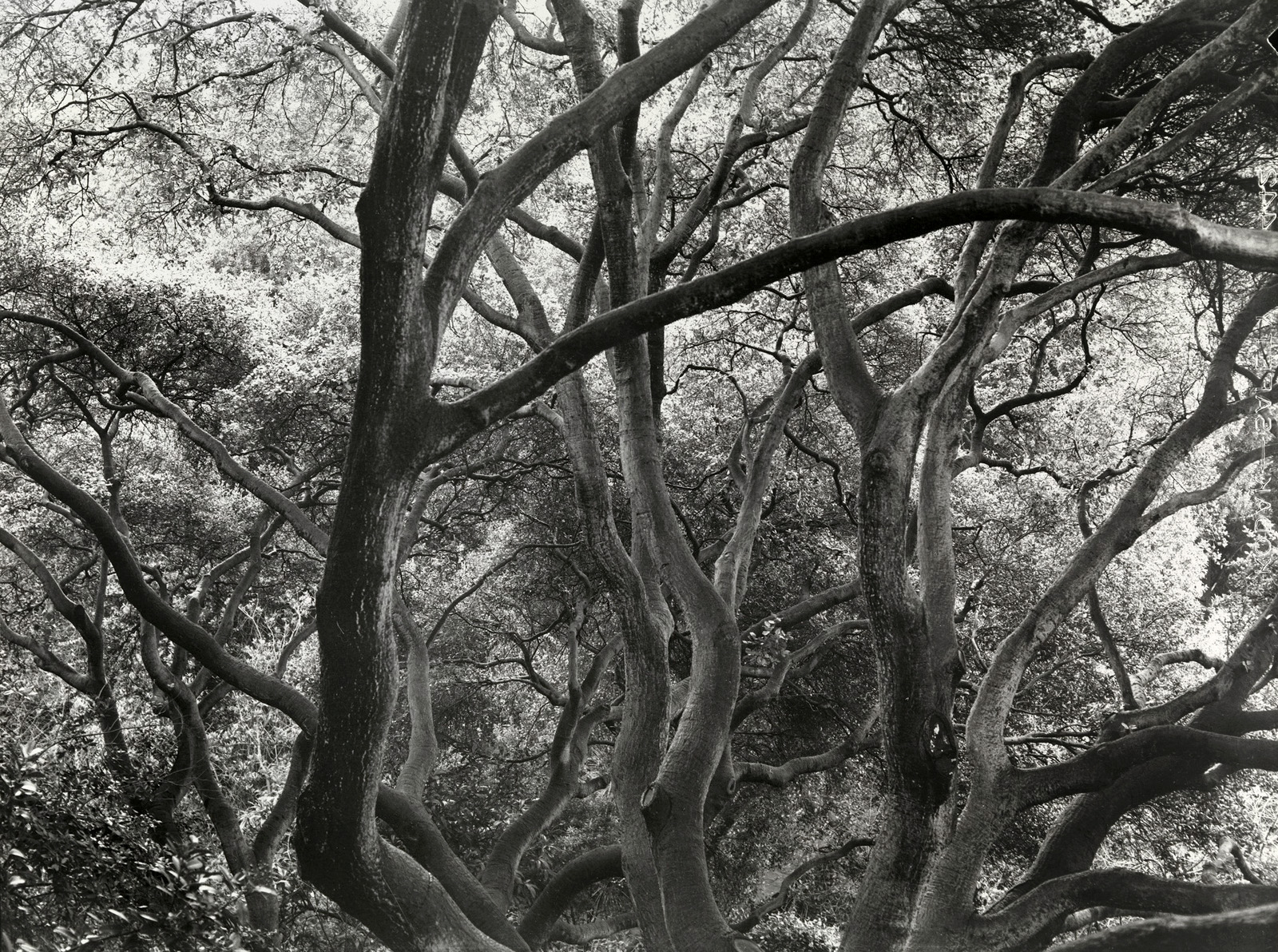
Ilse Salberg (German, 1899-1947) 'Anton im Detail' (Anton in Detail) 1938 from the exhibition 'The New Woman Behind the Camera' at the National Gallery of Art, Washington, Oct 2021 - Jan 2022


Ilse Salberg (German, 1899-1947)
Anton im Detail (Anton in Detail)
1938
Gelatin silver print
Image: 29.6 x 39.8cm (11 5/8 x 15 11/16 in.)
Frame (outer): 41.3 x 51.3 x 2.7cm (16 1/4 x 20 3/16 x 1 1/16 in.)
Galerie Berinson, Berlin


Ilse Salberg (1899-1947) worked in the New Vision style in Paris and Sanary-sur-Mer. Driven from Cologne, Germany by persecutions, escaping the SS in Barjols, France, she died early of cancer in Switzerland. …

For a long time, Ilse Salberg’s photographs went unnoticed by the public. Most of her photographs from exile in France were lost while fleeing. Fortunately, in 1963 Anton Räderscheidt and his new wife Giséle found paintings and negatives by Ilse Salberg in a cellar in Barjols, which she had to leave behind when she fled to Switzerland.

For more information please see the German Wikipedia website entry


The second of a humungous three-part posting on this archaeological exhibition.

Combined with the posting I did on this exhibition when it was on view at The Metropolitan Museum of Art, this three-part posting will include over 160 new images from the exhibition… meaning a combined total over the four postings of over 200 images with biographical information.

This has been a mammoth effort to construct these postings but so worthwhile!

See Part 1 of the posting. I will make comment on the exhibition in part 3 of the posting.

Dr Marcus Bunyan


Many thankx to the National Gallery of Art for allowing me to publish the photographs in the posting. Please click on the photographs for a larger version of the image.


“[Lee] Miller was the quintessential New Woman, as were the photographers in The New Woman Behind the Camera in New York. Andrea Nelson, who organised the show at its next destination, the National Gallery in Washington, says these new women were independent, competent, and – especially in the 1920s – found themselves in a moment when they were fighting for, then winning the right to vote, “and had really started examining their lives, their marriages and children.” They were also exploring what it meant to be professional photographers. “It was a time when photography was replacing drawings in all the magazines,” says Nelson. And women could sell their advertising and fashion pictures readily.”


Susan Stamberg. “Behind The Lens, These Women Created Photographs That Leap Over Decades,” on the NPR website July 25th, 2021 [Online] Cited 28/11/2021
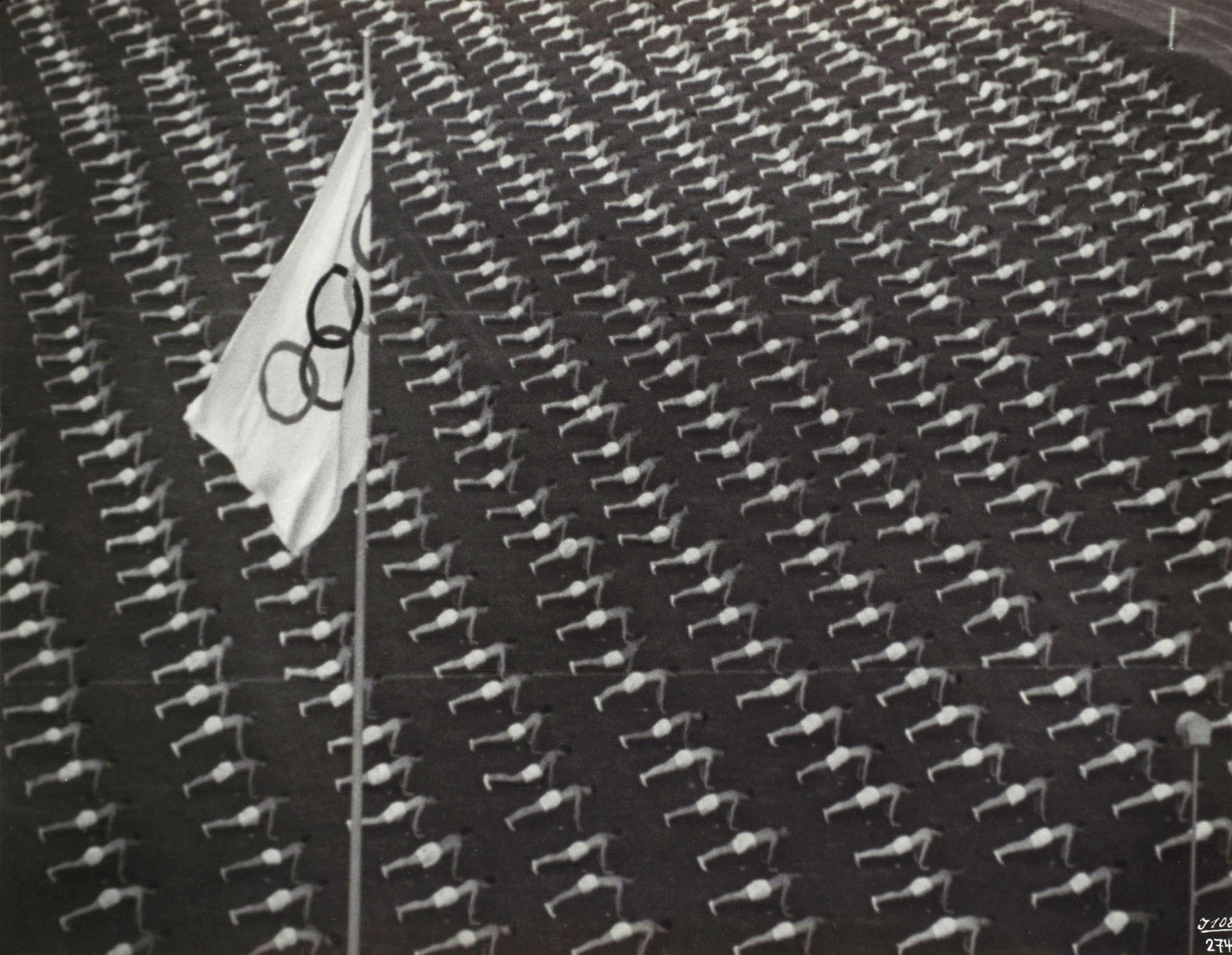


Leni Riefenstahl (German, 1902-2003) 'Freiübungen im Stadion, Olympischen Kampf, Berlin' (Calisthenics in the Stadium, Olympic Games, Berlin) 1936 from the exhibition 'The New Woman Behind the Camera' at the National Gallery of Art, Washington, Oct 2021 - Jan 2022


Leni Riefenstahl (German, 1902-2003)
Freiübungen im Stadion, Olympischen Kampf, Berlin (Calisthenics in the Stadium, Olympic Games, Berlin)
1936
Gelatin silver print
Image: 21.8 x 28.2cm (8 9/16 x 11 1/8 in.)
Mount: 29.9 x 36.9cm (11 3/4 x 14 1/2 in.)
Mat: 42.5 x 49.5 cm (16 3/4 x 19 1/2 in.)
Frame (outer): 47.9 x 52.7 cm (18 7/8 x 20 3/4 in.)
The Metropolitan Museum of Art, Ford Motor Company Collection, Gift of Ford Motor Company and John C. Waddell, 1987 bpk / Leni Riefenstahl
Image © The Metropolitan Museum of Art. Art Resource, NY


Helene Bertha Amalie “Leni” Riefenstahl (German, 22 August 1902 – 8 September 2003) was a German film director, photographer, and actress, known for her seminal role in producing Nazi propaganda.

Read a fuller biography on this “fellow traveller” (Mitläufer) on the Wikipedia website


The relentless pursuit of the truth about Riefenstahl. About time.

She knew what was going on and hitched her wagon to National Socialism, taking money to make her film Tiefland (Lowlands), bringing in extra from a concentration camp, keeping them in rags and starving them. After filming some were executed in the gas chambers. Her story is similar to that of Albert Speer (Hitler’s architect) who after being released from Spandau prison in 1966 rehabilitated himself by writing books and public speaking about his wartime experiences. Only recently has it come to light that Speer knew all along about the ruthlessness of the Nazi regime and – as Reich Minister of Armaments and War Production (until 2 September 1943 Reich Minister of Armaments and Munitions) – used conscripted labour and prisoners of war in appalling conditions to power the Nazi war effort. Many thousands died as a result of his zeal.

Read the excellent article on The Guardian website about Riefenstahl.

Dr Marcus Bunyan


“Riefenstahl denied that she had visited the camp to handpick the extras, denied failing to pay them and denied having promised and subsequently failed to save them from Auschwitz. She claimed that, while making the film, she had not known of the existence of the gas chambers, nor of the fate of the Roma and Sinti.”

Kate Connolly. “Burying Leni Riefenstahl: one woman’s lifelong crusade against Hitler’s favourite film-maker,” on The Guardian website Thursday 9 December 2021 [Online] Cited 11/12/2021


Vera Jackson (American, 1911-1999) 'Man at Printing Press' 1940s from the exhibition 'The New Woman Behind the Camera' at the National Gallery of Art, Washington, Oct 2021 - Jan 2022


Vera Jackson (American, 1911-1999)
Man at Printing Press
1940s
Gelatin silver print
Image/sheet: 27.94 x 35.56cm (11 x 14 in.)
Frame: 40.64 x 50.8cm (16 x 20 in.)
Framed (outer): 43.18 x 53.34cm (17 x 21 in.)
Collection of Friends, the Foundation of the California African American Museum. Gift of the artist
Courtesy of the California African American Museum


Vera Jackson (July 21, 1911 – January 26, 1999) was a “pioneer woman photographer in the black press”. She photographed African-American social life and celebrity culture in 1930s and 1940s Los Angeles. Noted photographic subjects included major league baseball player Jackie Robinson, educator Mary McLeod Bethune, and actresses Dorothy Dandridge, Hattie McDaniel and Lena Horne.


Hildegard Rosenthal (Brazilian born Switzerland, 1913-1990) 'Ponto de encontro Ladeira Porto Geral, esquina da Rua 25 de Março, São Paulo' (Meeting Place Ladeira Porto Geral, Corner of 25 de Março Street, São Paulo) c. 1940, printed later


Hildegard Rosenthal (Brazilian born Switzerland, 1913-1990)
Ponto de encontro Ladeira Porto Geral, esquina da Rua 25 de Março, São Paulo (Meeting Place Ladeira Porto Geral, Corner of 25 de Março Street, São Paulo)
c. 1940, printed later
Gelatin silver print
Image: 24 x 36cm (9 7/16 x 14 3/16 in.)
Mount: 40 x 50cm (15 3/4 x 19 11/16 in.)
Frame (outer): 42 x 52cm (16 9/16 x 20 1/2 in.)
Instituto Moreira Salles Collection Hildegard Rosenthal / Acervo Instituto Moreira Salles


Hildegard Rosenthal (Brazilian born Switzerland, 1913-1990)

Hildegard Baum Rosenthal (March 25, 1913 – September 16, 1990) was a Swiss-born Brazilian photographer, the first woman photojournalist in Brazil. She was part of the generation of European photographers who emigrated during World War II and, acting in the local press, contributed to the photographic aesthetic renovation of Brazilian newspapers.

Life and career

Rosenthal was born in Zurich, Switzerland. Until her adolescence, she lived in Frankfurt (Germany), where she studied pedagogy from 1929 until 1933. She lived in Paris between 1934 and 1935. Upon her return to Frankfurt, she studied photography for about 18 months in a program led by Paul Wolff [de]. Wolff emphasised small, portable cameras that used 35 mm film. These were a recent innovation at the time, and could be used unobtrusively for street photography. She also studied photographic laboratory techniques at the Gaedel Institute.

In this same period, she had entered a relationship with Walter Rosenthal. Rosenthal was Jewish, and Jews were increasingly persecuted in Germany in the 1930s under the National Socialist (Nazi) regime that took power in 1933. Walter Rosenthal emigrated to Brazil in 1936. Hildegard joined him in São Paulo in 1937. That same year she began working as a laboratory supervisor at the Kosmos photographic materials and services company. A few months later, the agency Press Information hired her as a photojournalist and she did news reports for national and international newspapers. During this period, she took photographs of the city of São Paulo and the state countryside of Rio de Janeiro and other cities in southern Brazil, as well as portraying several personalities from the São Paulo cultural scene, such as the painter Lasar Segall, the writers Guilherme de Almeida and Jorge Amado, the humorist Aparicio Torelly (Barão de Itararé) and the cartoonist Belmonte. Her images sought to capture the artist at his moment of creation, in obvious connection with his spirit of reporter. She interrupted her professional activity in 1948, after the birth of her first daughter. And in 1959, after her husband died, she took over the management of her family’s company.

Artistic trajectory

Her photographs remained little known until 1974, when art historian Walter Zanini held a retrospective of her work at the Museum of Contemporary Art of the University of São Paulo. The following year the Museum of Image and Sound of São Paulo (MIS) was opened with the exhibition Memória Paulistana, by Rosenthal. In 1996 the Instituto Moreira Salles acquired more than 3,000 of her negatives, in which urban scenes of São Paulo from the 1930s and 1940s stood out, during which time the city underwent a vertiginous growth, both material and cultural. Other negatives were donated by her during her life to the Lasar Segall Museum.

“Photography without people does not interest me,” she said at the Museum of Image and Sound of São Paulo in 1981.

Text from the Wikipedia website


Liselotte Grschebina (Israeli born Germany, 1908-1994) 'Arbeiterin, Primazon GmbH, Netanya' (Worker, Primazon Ltd., Netanya) c. 1937


Liselotte Grschebina (Israeli born Germany, 1908-1994)
Arbeiterin, Primazon GmbH, Netanya (Worker, Primazon Ltd., Netanya)
c. 1937
Gelatin silver print
Image: 16.8 x 22.7cm (6 5/8 x 8 15/16 in.)
Frame (outer): 38.4 x 46cm (15 1/8 x 18 1/8 in.)
The Israel Museum, Jerusalem, Gift of Beni and Rina Gjebin, Shoham, Israel, with the assistance of Rachel and Dov Gottesman, Tel Aviv and London
Photo: Liselotte Grschebina
© The Israel Museum, Jerusalem


Liselotte Grschebina (Israeli born Germany, 1908-1994)

Liselotte Grschebina (or Grjebina; 1908-1994) was an Israeli photographer. …

In January 1932 Grschebina opens Bilfoto, her own studio, announcing her specialisation in child photography, and takes on students. In 1933, following the Nazis come to power and the restrictions on professional freedom for Jews, Grschebina closed her studio. Before leaving Germany, she marries Dr. Jacob (Jasha) Grschebin. …

The Grschebin couple reaches Tel Aviv in March 1934. The same year, Grschebina opens the Ishon studio on Allenby Street with her friend Ellen Rosenberg (Auerbach), previously a partner in the Berlin photographic studio ringl + pit. In 1936 the Ishon studio is closed when Rosenberg leaves the country; Grschebina continues to work from her home.

Style

Grschebina arrived in Palestine in 1934, a trained professional profoundly influenced by the revolutionary movements of the Weimar Republic: New Objectivity in painting and New Vision in photography, as well as by a number of prominent professors, including Karl Hubbuch and Wilhelm Schnarrenberger. Unlike many of her colleagues in Palestine, who sought their identities in the collective Zionist endeavour by documenting and extolling it in their work, Grschebina did not use photography as a means of forming her identity. She came with a full-fledged style and remained committed to Weimar artistic ideals and principles in her new home, where she continued to apply and develop them. … Grschebina’s artistic roots clearly lay in New Vision, which defined photography as an artistic field in its own right and called on camera artists to portray subjects in a new, different way to convey their unique qualities and their essence. She did this through striking vantage points and strong diagonals, making masterful use of mirrors, reflections, and plays of light and shadow to create geometric shapes and to endow her photographs with atmosphere, appeal, and meaning.

In Germany, most of her photographs – usually advertising commissions – were taken in the studio. In the land of Israel, she also worked outdoors, observing those around her with a clear, impartial eye. She photographed people going about their daily routine, unaffected by the presence of the camera. The viewer of her pictures feels like an outsider looking in, gaining a new, objective perspective on the subject: the “objective portrait … not encumbered with subjective intention” wherein, according to New Vision photographer László Moholy-Nagy, lies the genius of photography.

Legacy

The photographs of Liselotte Grschebina, rediscovered casually, almost miraculously, in a cupboard in Tel Aviv, reveal a talent that might otherwise have remained forgotten.

The archive of Liselotte Grschebina’s photographs were given to the Israel Museum by her son, Beni Gjebin and his wife Rina, from Shoham, with the assistance of Rachel and Dov Gottesman, the museum president between 2001 and 2011.

Text from the Wikipedia website


Liselotte Grschebina (Israeli born Germany, 1908-1994) 'Hebräische Wassermelone' (Hebrew Watermelon) c. 1935


Liselotte Grschebina (Israeli born Germany, 1908-1994)
Hebräische Wassermelone (Hebrew Watermelon)
c. 1935
Gelatin silver print
Image: 22.7 x 29cm (8 15/16 x 11 7/16 in.)
Frame (outer): 43.5 x 53.8cm (17 1/8 x 21 3/16 in.)
The Israel Museum, Jerusalem, Gift of Beni and Rina Gjebin, Shoham, Israel, with the assistance of Rachel and Dov Gottesman, Tel Aviv and London Photo Liselotte Grschebina
© The Israel Museum, Jerusalem


Liselotte Grschebina (Israeli born Germany, 1908-1994) 'Turnerin' (Gymnast) 1930


Liselotte Grschebina (Israeli born Germany, 1908-1994)
Turnerin (Gymnast)
1930
Gelatin silver print
Image: 23.5 x 17.5cm (9 1/4 x 6 7/8 in.)
Frame (outer): 46 x 38.4cm (18 1/8 x 15 1/8 in.)
The Israel Museum, Jerusalem, Gift of Beni and Rina Gjebin, Shoham, Israel, with the assistance of Rachel and Dov Gottesman, Tel Aviv and London
Photo: Liselotte Grschebina
© The Israel Museum, Jerusalem
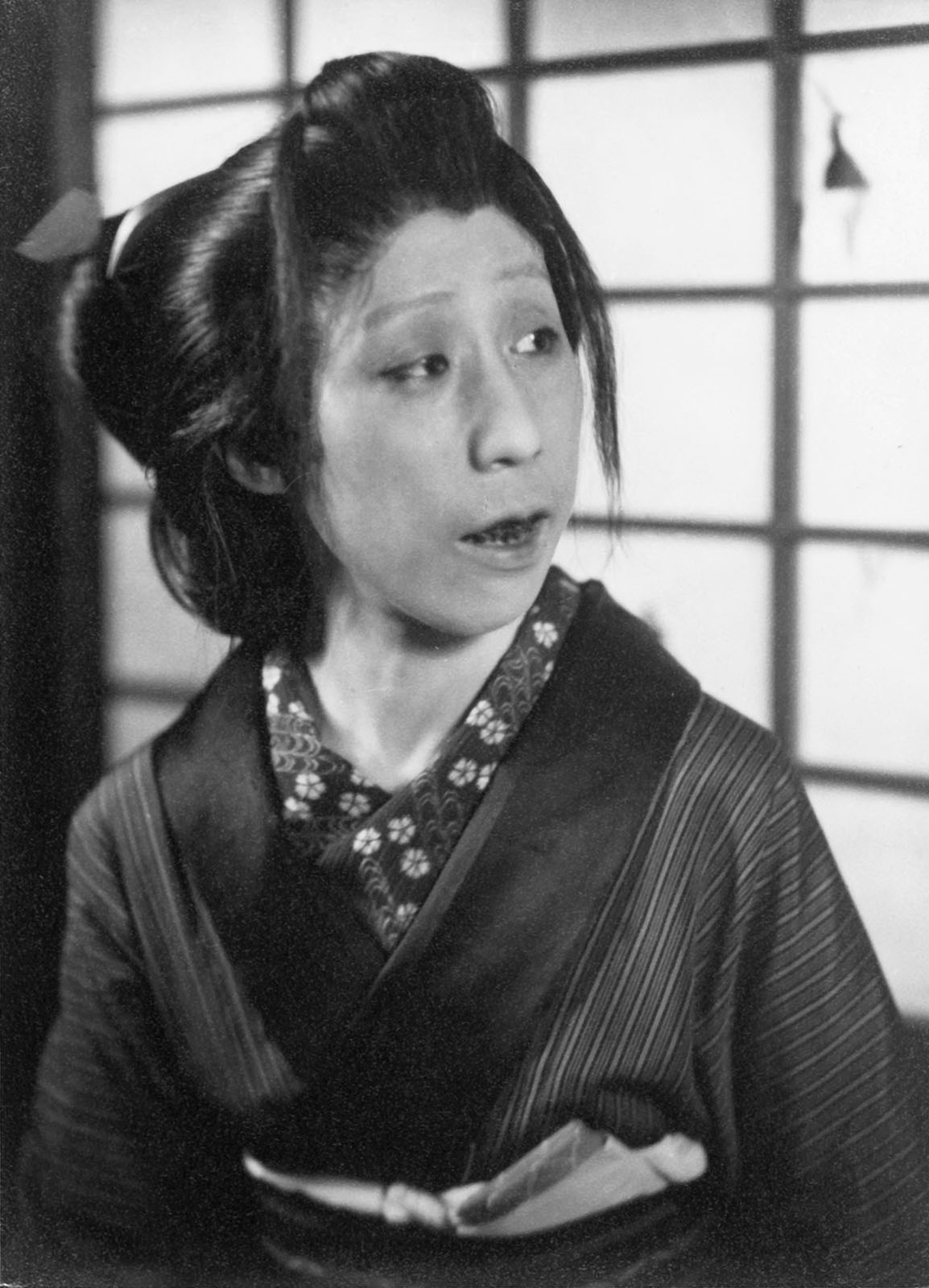
 

Eiko Yamazawa (Japanese, 1899-1995) '(Untitled (Yasue Yamamoto as Okichi in "Elegy for a Woman" by Yuzo Yamamoto))' c. 1943-1944, printed 1944


Eiko Yamazawa (Japanese, 1899-1995)
(Untitled (Yasue Yamamoto as Okichi in “Elegy for a Woman” by Yuzo Yamamoto))
c. 1943-1944, printed 1944
Gelatin silver print
Image: 15 x 10.5cm (5 7/8 x 4 1/8 in.)
Mat: 50.8 x 40.64cm (20 x 16 in.)
Frame (outer): 54.61 x 44.45cm (21 1/2 x 17 1/2 in.)
Tomoka Aya, The Third Gallery Aya
© Yamazawa Eiko


Eiko Yamazawa (Japanese, 1899-1995)

Eiko Yamazawa (山沢 栄子, Yamazawa Eiko, February 19, 1899 – July 16, 1995) was a renowned Japanese photographer. She is considered one of Japan’s earliest women photographers and is among the few women photographers in Japan who were active both before and after World War II. First trained in Nihonga, she later studied photography in the U.S. under the mentorship of Consuelo Kanaga, and also exposed to the work of Kanaga’s contemporaries such as Paul Strand and Edward Weston.

After coming back to Japan in 1929, she established herself as a professional photographer. In 1931 she opened a portrait studio in Osaka, and in 1950 she established the Yamazawa Institute of Photography also in Osaka. In the early half of her career, Yamazawa was engaged in portraiture and commercial photography, having produced work for major Osaka department stores. In 1960 she shifted abstraction away from realism. Her work in this latter half of her career is characterised by her photographing art materials in distortion and reflection. Yamazawa’s photographs were unique at the time for their use of vibrant colour, which was in stark contrast to black and white photography championed by other Japanese photographers.

Read a fuller biography on the Wikipedia website
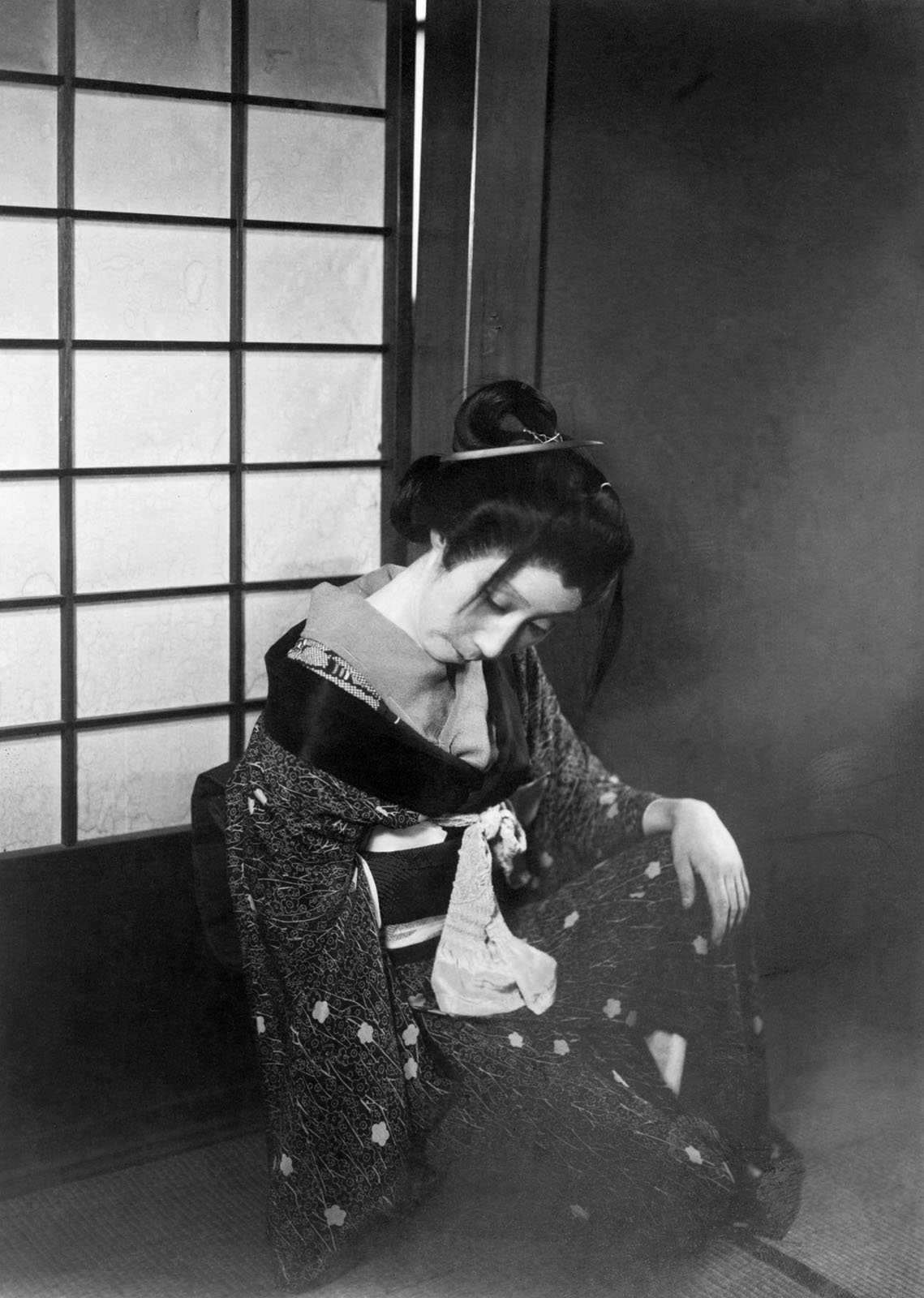
 

Eiko Yamazawa (Japanese, 1899-1995) '(Untitled (Yasue Yamamoto as Okichi in "Elegy for a Woman" by Yuzo Yamamoto))' c. 1943-1944, printed 1944


Eiko Yamazawa (Japanese, 1899-1995)
(Untitled (Yasue Yamamoto as Okichi in “Elegy for a Woman” by Yuzo Yamamoto))
c. 1943-1944, printed 1944
Gelatin silver print
Image: 15 x 10.5cm (5 7/8 x 4 1/8 in.)
Mat: 50.8 x 40.64cm (20 x 16 in.)
Frame (outer): 54.61 x 44.45cm (21 1/2 x 17 1/2 in.)
Tomoka Aya, The Third Gallery Aya
© Yamazawa Eiko


Eiko Yamazawa (Japanese, 1899-1995) '(Untitled (Yasue Yamamoto as Okichi in "Elegy for a Woman" by Yuzo Yamamoto))' c. 1943-1944, printed 1944


Eiko Yamazawa (Japanese, 1899-1995)
(Untitled (Yasue Yamamoto as Okichi in “Elegy for a Woman” by Yuzo Yamamoto))
c. 1943-1944, printed 1944
Gelatin silver print
Image: 15 x 10.5cm (5 7/8 x 4 1/8 in.)
Mat: 50.8 x 40.64cm (20 x 16 in.)
Frame (outer): 54.61 x 44.45cm (21 1/2 x 17 1/2 in.)
Tomoka Aya, The Third Gallery Aya
© Yamazawa Eiko


Yamamoto Yasue (Japanese 山 本 安 英, actually Yamamoto Chiyo (山 本 千代); born October 29, 1906 in Tōkyō ; died December 29, 1993 there) was a Japanese actress.

Yamamoto Yasue attended from 1921 the “School for modern theater training for women” (現代 劇 女優 養成 所, Gendaigeki joyū yōseijo), which was directed by Ichikawa Sadanji II (二世 市 川 左 団 次; 1880-1940). In 1924 she became a founding member of the “Small Theater Tsukiji” (築 地 小 劇 所) directed by Osanai Kaoru and played the leading role in 67 productions. After Osanai’s death in 1928, Yamamoto and Hijikata Yoshi (1998-1959) founded the “New Tsukiji Theater Company” (新 築 地 劇 団, Shin Tsukiji gekidan). Until the end of the Pacific War, she also took part in radio broadcasts.

In 1951 the Ministry of Culture honored Yamamoto for her role as Tsū in Kinoshita Junji’s internationally acclaimed play “Yūzuru” (夕 鶴), “Crane in the Twilight” [A1] , which had been performed since 1949. In 1966 she founded the “Yasue no kai” (安 英 の 会) to research recitation in contemporary pieces. Yamamoto had a unique presence on stage and a sophisticated way of speaking. In 1974 she was awarded the Asahi Prize and in 1984 the Mainichi Art Prize.


Eiko Yamazawa (Japanese, 1899-1995)

Yūzō Yamamoto (山本 有三, Yamamoto Yūzō, July 27, 1887 – January 11, 1974) was a Japanese novelist and playwright. His real name was written as “山本 勇造” but pronounced the same as his pen name. He was born to a family of kimono makers in Tochigi-city, Tochigi Prefecture.

He studied German literature at Tokyo Imperial University. After graduating, he gained popularity for his solidly crafted plays, some twenty in all, notably Professor Tsumura (Tsumura kyōju, 1919), The Crown of Life (生命の冠, Inochi no kanmuri, 1920), Infanticide (Eijigoroshi, 1920), and People Who Agree (同志の人々, Dōshi no hitobito, 1923). In 1926 he turned to novels, known for their clarity of expression and dramatic composition. Later, with the writers Kan Kikuchi and Ryūnosuke Akutagawa, he helped to co-found the Japanese Writer’s Association and openly criticised Japan’s wartime military government for its censorship policies.

After World War II he joined the debate on Japanese language reform, and from 1947 to 1953 he served in the National Diet as a member of the House of Councillors. He is well known for his opposition to the use of enigmatic expressions in written Japanese and his advocacy for the limited use of furigana [a Japanese reading aid]. In 1965 he was awarded the prestigious Order of Culture. He died at his summer villa in Yugawara, Kanagawa in 1974.

Yamamoto’s large European-style house in Mitaka, Tokyo, was expropriated by the Supreme Commander for the Allied Powers by eminent domain during the occupation period from 1945 to 1953. The mansion was then used as an archive and research lab by non-profit organisations for years, until it was converted into the Mitaka City Yūzō Yamamoto Memorial Museum in 1996. There is also a museum dedicated to him in his hometown of Tochigi.

Text from the Wikipedia website


Valentina Kulagina (Russian, 1902-1987) 'A. Tarasov-Rodionov's "October"' 1930


Valentina Kulagina (Russian, 1902-1987)
A. Tarasov-Rodionov’s “October”
1930
Book cover maquette with collage of cut-and-pasted gelatin silver prints, gouache, and ink on paper
Overall: 20.7 x 31.2cm (8 1/8 x 12 1/4 in.)
Frame: 40.64 x 50.8cm (16 x 20 in.)
Frame (outer): 43.18 x 53.34cm (17 x 21 in.)
Collection Merrill C. Berman


Valentina Kulagina, full name Valentina Nikiforovna Kulagina-Klutsis (Russian: Валентина Никифоровна Кулагина-Клуцис, 1902-1987) was a Russian painter and book, poster, and exhibition designer. She was a central figure in Constructivist avant-garde in the early 20th century alongside El Lissitzky, Alexander Rodchenko other and her husband Gustav Klutsis. She is known for the Soviet revolutionary and Stalinist propaganda she produced in collaboration with Klutsis.

Read a fuller biography on the Wikipedia website
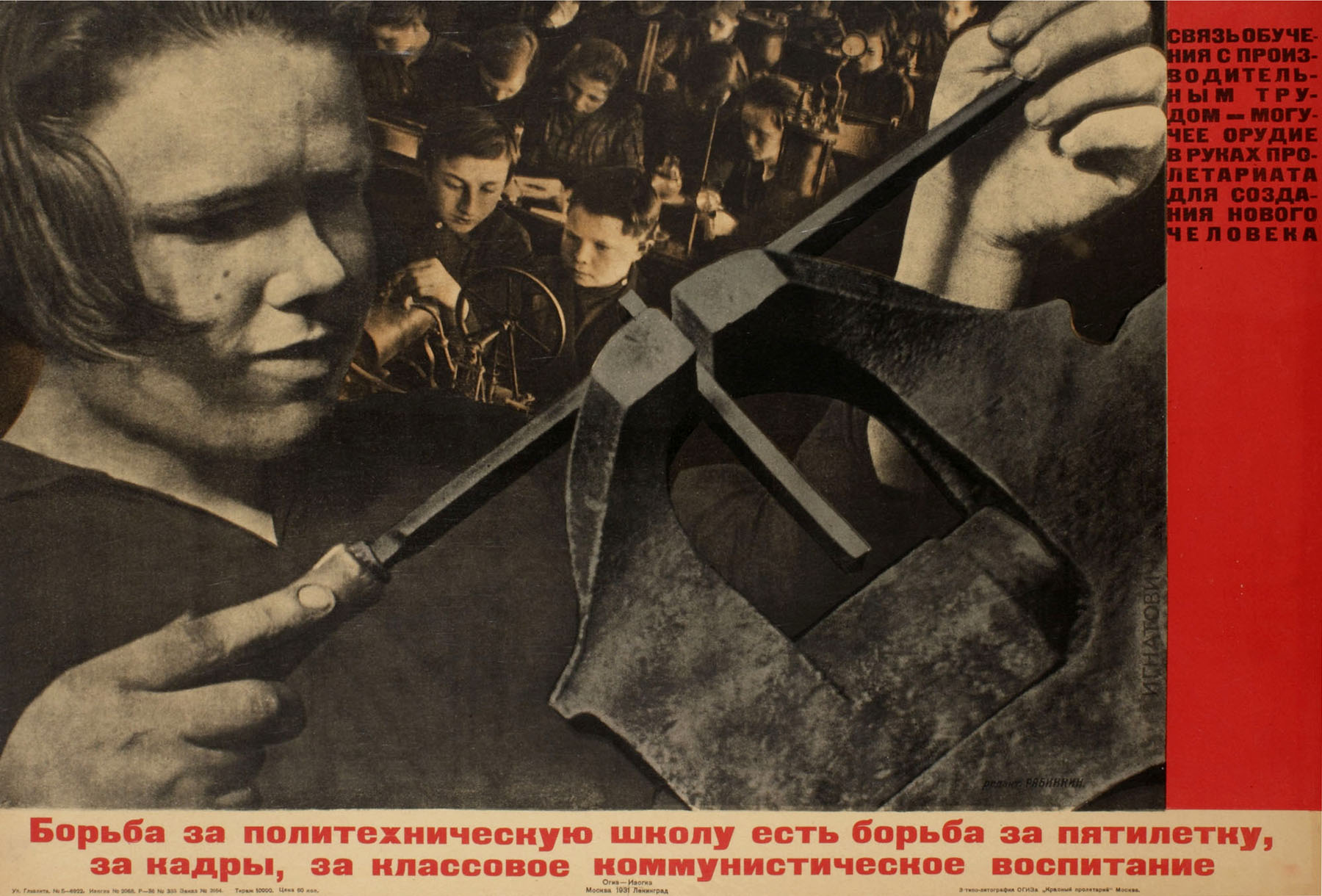
 

Elizaveta Ignatovich (Russian, 1903-1983) 'The struggle for the polytechnical school is the struggle for the five-year plan, for the communist education about class consciousness' 1931


Elizaveta Ignatovich (Russian, 1903-1983)
The struggle for the polytechnical school is the struggle for the five-year plan, for the communist education about class consciousness
1931
Photolithograph
Sheet: 51.4 x 72.1cm (20 1/4 x 28 3/8 in.)
Frame: 66.04 x 86.36cm (26 x 34 in.)
Collection Merrill C. Berman


Elizaveta Ignatovich (Russian, 1903-1983)

Elizaveta Ignatovich (1903-1983) was born in Moscow, and was a well-regarded photographer and photojournalist of the 1920s through 1940s. In 1929, Elizaveta joined the experimental October organisation with such artists as Alexander Rodchenko, Elizar Langman, Dmitry Debabov, and her husband Boris Ignatovich. After October disbanded, she joined the Ignatovich Brigade along with her husband; her sister-in-law, Olga; Elizar Langman; J. Brodsky and L. Bach.

Elizaveta participated in many photographic exhibitions in the 1930s both in the Soviet Union and abroad including the seminal 1937 exhibition, First all-Union Exhibition of Soviet Photographic Art. While a prolific photographer of her day, Elizaveta’s photographs are now distinguished for their rarity. Among her photographs are Family of Kolkhoz Farmer, Portrait of Pioneer Leader Galina Pogrebniak, The Worker Tatiana Surina, and At the Kokhoz’s 10 Year Anniversary. By 1940, having gained a reputation as a veteran of documentary art photography, Sovetskoe Foto (1940, no. 3, “Zhenshchiny-fotoreportery”) wrote on Elizaveta:

“She is captivated by the fast-paced developments and the colourfulness of our lives, and she knows how to present it in a new fashion with the eyes of an artist. Her work is opposed to posturing and artificiality; as well as to the flashiness in formalist scholasticism.

Overall, E. Ignatovich tends to analyse every component of the scene before taking the shot. For this reason, she is attracted to creating monumental work and to constructing the scene. And E. Ignatovich truly succeeds in creating these scenes. A rich characterisation of her subjects and an artistic integrity distinguish her work.”


The writer for Sovetskoe Foto underscores Ignatovich’s ability to breath life into her subjects by manifesting their histories and personalities on film. In Family of Kolzhoz Farmer, Ignatovich creates an elaborate scene framed compositionally by tasseled curtains. Occupied by their tasks, Ignatovich’s subjects reveal their dynamic as a tight-knit Soviet family, and suggest their own personalities and concerns.

Later in her career, Ignatovich worked creating commercial photographic albums and post cards for the art publishing house Izogiz and the art journal Iskusstvo. In 1956, she received a silver medal and diploma at the Fifth International Salon of Art Photography (see Power of Pictures, 2015, p. 223) in Paris.

In 2015, E. Ignatovich’s artwork was included in the acclaimed exhibition The Power of Pictures: Early Soviet Photography, Early Soviet Film at the Jewish Museum in New York.

Anonymous text. “Elizaveta Ignatovich,” on the Nailya Alexander Gallery website [Online] Cited 28/11/2021. No longer available online


Elizaveta Ignatovich (Russian, 1903-1983) 'Family of a Kolkhoz Farmer' 1930s


Elizaveta Ignatovich (Russian, 1903-1983)
Family of a Kolkhoz Farmer
1930s
Gelatin silver print
Overall: 40.64 x 27.94cm (16 x 11 in.)
Frame: 60.96 x 45.72cm (24 x 18 in.)
Frame (outer): 64.77 x 49.53cm (25 1/2 x 19 1/2 in.)
National Gallery of Art, Washington, Alfred H. Moses and Fern M. Schad Fund
© Elizaveta Ignatovich
Courtesy of Nailya Alexander Gallery, New York


During the 1920s, the iconic New Woman was splashed across the pages of magazines and projected on the silver screen. As a global phenomenon, she embodied an ideal of female empowerment based on real women making revolutionary changes in life and art. Featuring more than 120 photographers from over 20 countries, the groundbreaking exhibition, The New Woman Behind the Camera, explores the diverse “new” women who embraced photography as a mode of professional and personal expression from the 1920s to the 1950s. The first exhibition to take an international approach to the subject, it examines how women brought their own perspectives to artistic experimentation, studio portraiture, fashion and advertising work, scenes of urban life, ethnography, and photojournalism, profoundly shaping the medium during a time of tremendous social and political change. Accompanied by a fully illustrated catalogue, this landmark exhibition will be on view from October 31, 2021 through January 30, 2022, in the West Building of the National Gallery of Art, Washington. It was previously on view at The Metropolitan Museum of Art, New York, from July 2 through October 3, 2021.

In an era when traditional definitions of womanhood were being questioned, women’s lives were a mix of emancipating and confining experiences that varied by country. Many women around the world found the camera to be a means of independence as they sought to redefine their positions in society and expand their rights. This exhibition presents a geographically, culturally, and artistically diverse range of practitioners to advance new conversations about the history of modern photography and the continual struggle of women to gain creative agency and self-representation.

“This innovative exhibition reevaluates the history of modern photography through the lens of the New Woman, a feminist ideal that emerged at the end of the 19th century and spread globally during the first half of the 20th century,” said Kaywin Feldman, director, National Gallery of Art. “The transnational realities of modernism visualised in photography by women such as Lola Álvarez Bravo, Berenice Abbott, Claude Cahun, Germaine Krull, Dorothea Lange, Niu Weiyu, Tsuneko Sasamoto, and Homai Vyarawalla offer us an opportunity to better understand the present by becoming more fully informed of the past.”

About the exhibition

This landmark exhibition critically examines the extraordinary impact women had on the practice of photography worldwide from the 1920s to the 1950s. It presents the work of over 120 international photographers who took part in a dramatic expansion of the medium propelled by artistic creativity, technological innovation, and the rise of the printed press. Photographers such as Berenice Abbott, Ilse Bing, Lola Álvarez Bravo, Madame d’Ora, Florence Henri, Elizaveta Ignatovich, Germaine Krull, Dorothea Lange, Dora Maar, Niu Weiyu, Eslanda Goode Robeson, Tsuneko Sasamoto, Gerda Taro, and Homai Vyarawalla, among many others, emerged at a tumultuous moment in history that was profoundly shaped by two world wars, a global economic depression, struggles for decolonisation, and the rise of fascism and communism. Against the odds, these women were at the forefront of experimentation with the camera and produced invaluable visual testimony that reflects both their personal experiences and the extraordinary social and political transformations of the era.

Organised thematically in eight galleries, The New Woman Behind the Camera illustrates women’s groundbreaking work in modern photography, exploring their innovations in the fields of social documentary, avant-garde experimentation, commercial studio practice, photojournalism, ethnography, and the recording of sports, dance, and fashion. By evoking the global phenomenon of the New Woman, the exhibition seeks to reevaluate the history of photography and advance new and more inclusive conversations on the contributions of female photographers.

Known by different names, from nouvelle femme and neue Frau to modan gāru and xin nüxing, the New Woman was easy to recognise but hard to define. Fashionably dressed with her hair bobbed, the self-assured cosmopolitan New Woman was arguably more than a marketable image. She was a contested symbol of liberation from traditional gender roles. Revealing how women photographers from around the world gave rise to and embodied the quintessential New Woman even as they critiqued the popular construction of the role, the exhibition opens with a group of compelling portraits and self-portraits. In these works, women defined their positions as professionals and artists during a time when they were seeking greater personal rights and freedoms.

For many women, the camera became an effective tool for self-determination as well as a source of income. With better access to education and a newfound independence, female photographers emerged as a major force in studio photography. From running successful businesses in Berlin, Buenos Aires, London, and Vienna, to earning recognition as one of the first professional female photographers in their home country, women around the world, including Karimeh Abbud, Steffi Brandl, Trude Fleischmann, Annemarie Heinrich, Eiko Yamazawa, and Madame Yevonde, reinvigorated studio practice. A collaborative space where both sitters and photographers negotiated gender, race, and cultural difference, the portrait studio was also vitally important to African American communities which sought to represent and define themselves within a society that continued to be plagued by racism. Photography studios run by Black women, such as Florestine Perrault Collins and Winifred Hall Allen, thrived throughout the United States, and not only preserved likenesses and memories, but also constructed a counter narrative to the stereotyping images that circulated in the mass media.

With the invention of smaller lightweight cameras, a growing number of women photographers found that the camera’s portability created new avenues of discovery outside the studio. In stunning photographs of the city, photographers such as Alice Brill, Rebecca Lepkoff, Helen Levitt, Lisette Model, Genevieve Naylor, and Tazue Satō Matsunaga used their artistic vision to capture the exhilarating modern world around them. They depicted everyday life, spontaneous encounters on the street, and soaring architectural views in places like Bombay (now Mumbai), New York, Paris, São Paulo, and Tokyo, revealing the multiplicity of urban experience. Many incorporated the newest photographic techniques to convey the energy of the city, and the exhibition continues with a gallery focused on those radical formal approaches that came to define modern photography. Through techniques like photomontage, photograms, sharp contrasts of light and shadow, extreme cropping, and dizzying camera angles, women including Aenne Biermann, Imogen Cunningham, Dora Maar, Tina Modotti, Lucia Moholy, and Cami Stone pushed the boundaries of the medium.

Women also produced dynamic pictures of the modern body, including innovative nude studies as well as sport and dance photography. Around the world, participation in spectator and team sports increased along with membership in fitness and hygiene reform movements. New concepts concerning health and sexuality along with new attitudes in movement and dress emphasised the body as a central site of experiencing modernity. On view are luminous works by photographers Laure Albin Guillot, Yvonne Chevalier, Florence Henri, and Jeanne Mandello who reimagined the traditional genre of the nude. Photographs by Irene Bayer-Hecht and Liselotte Grschebina highlight joyous play and gymnastic exercise, while Charlotte Rudolph, Ilse Bing, Trude Fleischmann, and Lotte Jacobi made breathtaking images of dancers in motion, revealing the body as artistic medium.

During the modern period, a growing number of women pursued professional photographic careers and traveled widely for the first time. Many took photographs that documented their experiences abroad and interactions with other cultures as they engaged in formal and informal ethnographic projects. The exhibition continues with a selection of photographs and photobooks by women, mainly from Europe and the United States, that reveal a diversity of perspectives and approaches. Gender provided some of these photographers with unusual access and the drive to challenge discriminatory practices, while others were not exempt from portraying stereotypical views. Publications by Jette Bang, Hélène Hoppenot, Ella Maillart, Anna Riwkin, Eslanda Goode Robeson, and Ellen Thorbecke exemplify how photographically illustrated books and magazines were an influential form of communication about travel and ethnography during the modern period. Other works on display include those by Denise Bellon and Ré Soupault, who traveled to foreign countries on assignment for magazines and photo agencies seeking ethnographic and newsworthy photographs, and those by Marjorie Content and Laura Gilpin, who worked on their own in the southwestern United States.

The New Woman – both as a mass-circulating image and as a social phenomenon – was confirmed by the explosion of photographs found in popular fashion and lifestyle magazines. Fashion and advertising photography allowed many women to gain unprecedented access to the public sphere, establish relative economic independence, and attain autonomous professional success. Producing a rich visual language where events and ideas were expressed directly in pictures, illustrated fashion magazines such as Die DameHarper’s Bazaar, and Vogue became an important venue for photographic experimentation by women for a female readership. Photographers producing original views of women’s modernity include Lillian Bassman, Ilse Bing, Louise Dahl-Wolfe, Toni Frissell, Toni von Horn, Frances McLaughlin-Gill, ringl + pit, Margaret Watkins, Caroline Whiting Fellows, and Yva.

The rise of the picture press also established photojournalism and social documentary as dominant forms of visual expression during the modern period. Ignited by the effects of a global economic crisis and growing political and social unrest, numerous women photographers including Lucy Ashjian, Margaret Bourke-White, Kati Horna, Elizaveta Ignatovich, Kata Kálmán, Dorothea Lange, and Hansel Mieth engaged a wide public with gripping images. So-called soft topics such as “women and children,” “the family,” and “the home front” were more often assigned to female photojournalists than to their male counterparts. The exhibition asks viewers to question the effect of having women behind the camera in these settings. Pictures produced during the war, from combat photography by Galina Sanko and Gerda Taro to images of the Blitz in London by Thérèse Bonney and the Tuskegee airmen by Toni Frissell, are also featured. At the war’s end, haunting images by Lee Miller of the opening of Nazi concentration camps and celebratory images of the victory parade of Allied Forces in New Delhi by Homai Vyarawalla made way for the transition to the complexities of the postwar era, including images of daily life in US-occupied Japan by Tsuneko Sasamoto and the newly formed People’s Republic of China by Hou Bo and Niu Weiyu.

The New Woman Behind the Camera acknowledges that women are a diverse group whose identities are defined not exclusively by gender but rather by a host of variable factors. It contends that gender is an important aspect in understanding their lives and work and provides a useful framework for analysis to reveal how photography by women has powerfully shaped our understanding of modern life.

Exhibition catalog

Published by the National Gallery of Art, Washington and distributed by DelMonico Books | D.A.P., this groundbreaking, richly illustrated 288-page catalog examines the diverse women whose work profoundly marked the medium of photography from the 1920s to the 1950s. The book – featuring over 120 international photographers, including Lola Álvarez Bravo, Elizaveta Ignatovich, Germaine Krull, Dorothea Lange, Tsuneko Sasamoto, and Homai Vyarawalla – reevaluates the history of modern photography through the lens of the iconic New Woman. Inclusive scholarly essays introduce readers to these important photographers and question the past assumptions about gender in the history of photography. Contributors include Andrea Nelson, associate curator in the department of photographs, National Gallery of Art; Elizabeth Cronin, assistant curator of photography in the Miriam and Ira D. Wallach Division of Art, Prints, and Photographs, New York Public Library; Mia Fineman, curator in the department of photographs, Metropolitan Museum of Art; Mila Ganeva, professor of German in the department of German, Russian, Asian, and Middle Eastern languages and cultures, Miami University, Ohio; Kristen Gresh, Estrellita and Yousuf Karsh Senior Curator of Photographs, Museum of Fine Arts, Boston; Elizabeth Otto, professor of modern and  contemporary art history, University at Buffalo (The State University of New York); and Kim Sichel, associate professor in the department of the history of art and architecture at Boston University; biographies of the photographers by Kara Felt, Andrew W. Mellon postdoctoral fellow in the department of photographs, National Gallery of Art.

Press release from the National Gallery of Art


Ella Maillart (Swiss, 1903-1997) 'Turkistan Solo' 1935


Ella Maillart (Swiss, 1903-1997)
Turkistan Solo
1935
Bound volume
Open: 21.59 x 22.86cm (8 1/2 x 9 in.)
Cradle: 12.07 x 27.31 x 22.54cm (4 3/4 x 10 3/4 x 8 7/8 in.)
National Gallery of Art Library, Gift of the Department of Photographs


Ella Maillart (Swiss, 1903-1997)

Ella Maillart (or Ella K. Maillart; 20 February 1903, Geneva – 27 March 1997, Chandolin) was a Swiss adventurer, travel writer and photographer, as well as a sportswoman.

Career

From the 1930s onwards she spent years exploring Muslim republics of the USSR, as well as other parts of Asia, and published a rich series of books which, just as her photographs, are today considered valuable historical testimonies. Her early books were written in French but later she began to write in English. Turkestan Solo describes a journey in 1932 in Soviet Turkestan. Photos from this journey are now displayed in the Ella Maillart wing of the Karakol Historical Museum. In 1934, the French daily Le Petit Parisien sent her to Manchuria to report on the situation under the Japanese occupation. It was there that she met Peter Fleming, a well-known writer and correspondent of The Times, with whom she would team up to cross China from Peking to Srinagar (3,500 miles), much of the route being through hostile desert regions and steep Himalayan passes. The journey started in February 1935 and took seven months to complete, involving travel by train, on lorries, on foot, horse and camelback. Their objective was to ascertain what was happening in Xinjiang (then also known as Sinkiang or Chinese Turkestan) where the Kumul Rebellion had just ended. Maillart and Fleming met the Hui Muslim forces of General Ma Hushan. Ella Maillart later recorded this trek in her book Forbidden Journey, while Peter Fleming’s parallel account is found in his News from Tartary. In 1937 Maillart returned to Asia for Le Petit Parisien to report on Afghanistan, Iran and Turkey, while in 1939 she undertook a trip from Geneva to Kabul by car, in the company of the Swiss writer, Annemarie Schwarzenbach. The Cruel Way is the title of Maillart’s book about this experience, cut short by the outbreak of the second World War.

She spent the war years at Tiruvannamalai in the South of India, learning from different teachers about Advaita Vedanta, one of the schools of Hindu philosophy. On her return to Switzerland in 1945, she lived in Geneva and at Chandolin, a mountain village in the Swiss Alps. She continued to ski until late in life and last returned to Tibet in 1986.

Text from the Wikipedia website
 

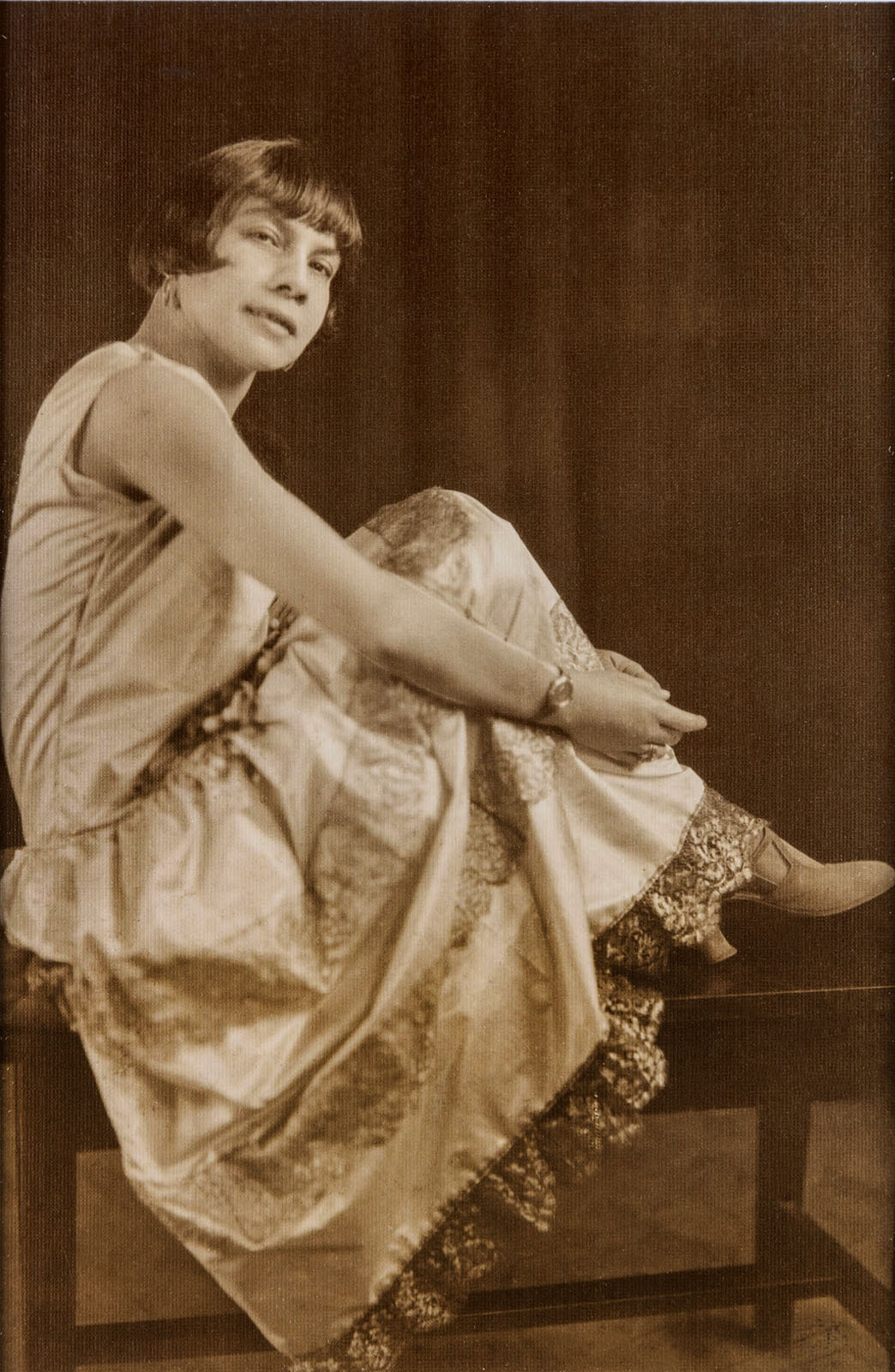
Ellen Thorbecke (Dutch, 1902-1973) 'People in China: Thirty-Two Photographic Studies from Life' 1935


Ellen Thorbecke (Dutch, 1902-1973)
People in China: Thirty-Two Photographic Studies from Life
1935
Bound volume
Closed:
30.48 x 22.86cm (12 x 9 in.)
Open: 29.85 x 43.18cm (11 3/4 x 17 in.)
Cradle: 13.97 x 40.64 x 30.48cm (5 1/2 x 16 x 12 in.)
National Gallery of Art Library, David K.E. Bruce Fund


Ellen Thorbecke (Dutch, 1902-1973)

(Ellen Thorbecke, born Ellen Kolban, 1902-1973) is a woman who holds a unique position in Dutch photography. Her small yet extraordinary photo archive, one of the Nederlands Fotomuseum Collection’s true gems, shows rare images of everyday life in China during that era. She photographed with an open mind and as a result Ellen Thorbecke’s images are still relevant and immensely popular in China today.

Compelling photographer

In 1931, Ellen Thorbecke left Berlin for China to be reunited with her beloved husband Willem Thorbecke, who had been appointed as an envoy in China on behalf of the Netherlands. Before she left for China, she bought her first camera, as she was planning to work in China as a correspondent for the Berlin newspapers. To illustrate her articles, she captured a series of portraits and street scenes in the Chinese countryside and in the cities of Beijing, Shanghai and Hong Kong. This was during the era when the idea of ‘East Meets West’ was gaining ground and a number of Western writers, filmmakers and artists were shining the spotlight on China.

Being a journalist from origin, Thorbecke gradually developed into a compelling photographer who infused her photographs with fully-engaged observation of the people and places she visited. The exhibition Ellen Thorbecke’s China presents photographs that capture the changing identity of the young Chinese Republic between centuries-old traditions and Western modernisation. Her images range from those that refer to traditional Chinese role patterns – such as arranged marriages at a young age – to modern portraits showing the desire for freedom and independence.

Anonymous text. “Ellen Thorbecke’s China,” on the Nederlands Fotomuseum website [Online] Cited 29/11/2021. No longer available online


Photographer and journalist Ellen Thorbecke (born Ellen Kolban, 1902-1973) occupies a unique and forgotten position in the photography world. In 1931 she left Berlin for Beijing. For this trip she bought her first camera. Thorbecke developed into a compelling photographer who provided her photos with engaged observations about the people and places she visited. She made reports in a lively candid style with an eye for the vitality of street life and has produced several photo books including Peking Studies (1934) and People in China (1935).

Her visual stories and travel guides make her oeuvre a unique time document. Her compact but special photo archive is held at the Dutch Fotomuseum in Rotterdam and consists of 638 black and white negatives, 166 of which were made in China. The photographs Thorbecke made are still relevant today because of her human, direct and unbiased way of looking.

Anonymous text. “Ellen Thorbecke,” on the Photography of China website [Online] Cited 29/11/2021
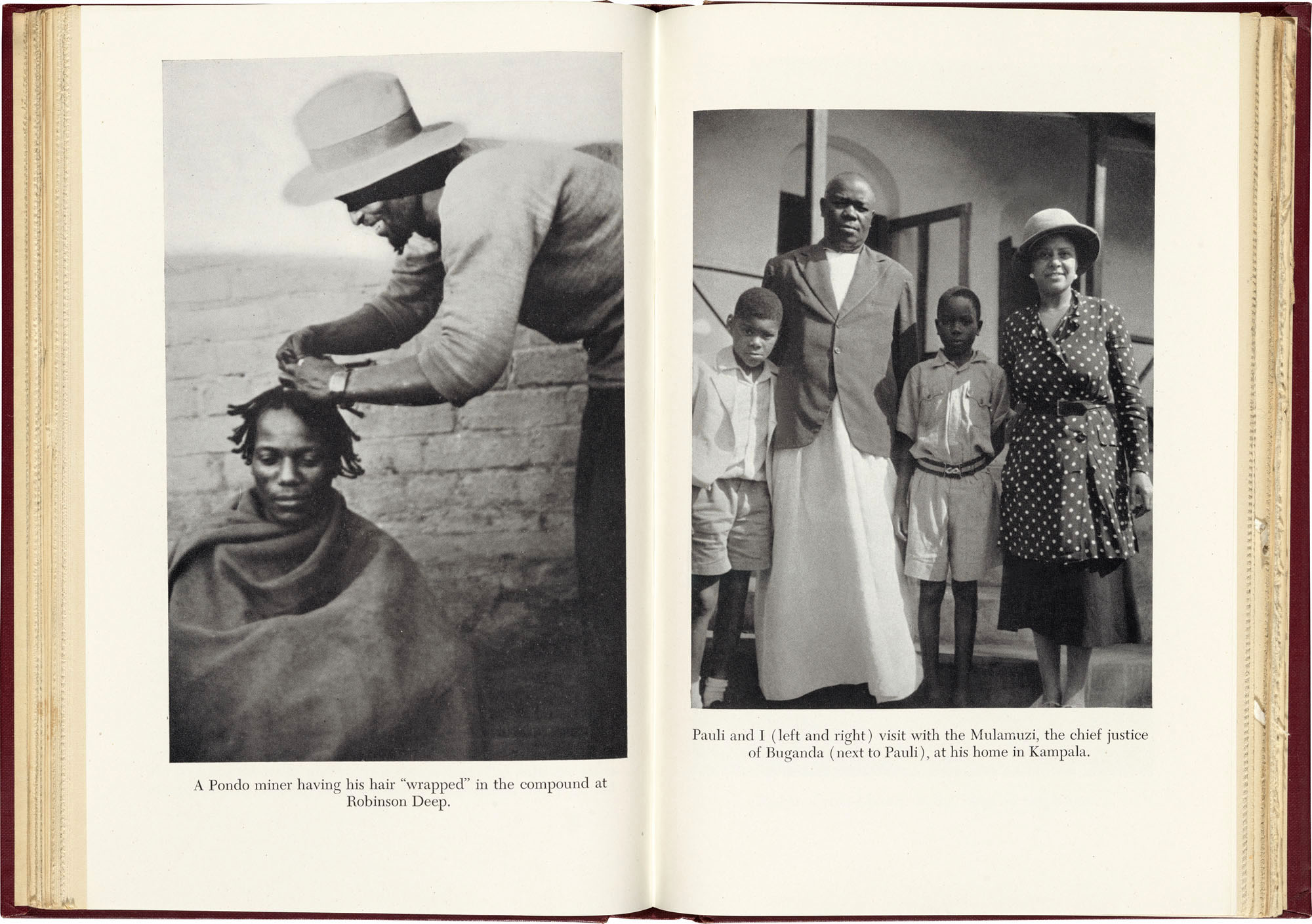
 

Eslanda Goode Robeson (American, 1896-1965) 'African Journey' 1945


Eslanda Goode Robeson (American, 1896-1965)
African Journey
1945
Bound volume
Open:
21.59 x 31.75cm (8 1/2 x 12 1/2 in.)
Mount: 3.49 x 31.27 x 21.75cm (1 3/8 x 12 5/16 x 8 9/16 in.)
National Gallery of Art Library, Gift of the Department of Photographs


Eslanda Goode Robeson (American, 1896-1965)

Eslanda Cardozo Goode Robeson (American, 1896-1965), “Essie,” as she was called, was a photographer, actress, world traveler, author and activist

Born Eslanda Cardoza Goode in Washington, D.C., in 1896, “Essie,” as she was known by her intimates, was the wife of the dynamic performer and activist Paul Robeson. Although not as well known as her famous husband, Eslanda Robeson by no means hid in his shadow. Through her writings and actions, she advocated racial equality and withstood considerable political and social pressure in the course of her long activist career. …

The mid-1940s brought significant accolades to the Robesons as Eslanda’s book African Journey appeared in 1945 and Paul received the Spingarn Medal that same year. While a scholarly work, African Journey was not so much analytical as it was descriptive of the living habits and cultural customs of different tribes, complete with photographs taken by Eslanda. Both provocative and enlightening, it was a landmark work in the sense that it was the first by an American to show the need for reform among the colonial powers. This theme of colonialism became a focal point of Eslanda’s later writings; she strongly believed that the end of World War II hearkened a new era of freedom from European colonisers for emerging nations in Asia and Africa.

Anonymous text. “Robeson, Eslanda Goode (1896-1965),” on the Women in World History: A Biographical Encyclopedia website [Online] Cited 28/11/2021


Esther Bubley (American, 1921-1998) 'Young woman in the doorway of her room at a boardinghouse, Washington, DC' 1943


Esther Bubley (American, 1921-1998)
Young woman in the doorway of her room at a boardinghouse, Washington, DC
1943
Gelatin silver print
Image/sheet: 26.42 x 25.4cm (10 3/8 x 10 in.)
Frame: 50.8 x 40.64cm (20 x 16 in.)
Frame (outer): 53.34 x 43.18cm (21 x 17 in.)
National Gallery of Art, Washington, Gift of Kent and Marcia Minichiello


Esther Bubley (American, 1921-1998)

Esther Bubley (February 16, 1921 – March 16, 1998) was an American photographer who specialised in expressive photos of ordinary people in everyday lives. She worked for several agencies of the American government and her work also featured in several news and photographic magazines.

A protégée of Roy Stryker at the U.S. Office of War Information and subsequently at Standard Oil Company (New Jersey), Esther Bubley (1921-1998) was a preeminent freelance photographer during the “golden age” of American photojournalism, from 1945 to 1965. At a time when most post-war American women were anchored by home and family, Bubley was a thriving professional, traveling throughout the world, photographing stories for magazines such as LIFE and the Ladies’ Home Journal and for prestigious corporate clients that included Pepsi-Cola and Pan American World Airways.

“Put me down with people, and it’s just overwhelming,” Bubley exclaimed in an interview. Like most great photojournalists, she found her art in everyday life, and she successfully balanced her artistic ambitions with the demands of commercial publishing. Edward Steichen, curator of photographs at the Museum of Modern Art and the era’s arbiter of taste, was a great supporter of Bubley, whose work embodied his aesthetic ideal that photography “explain man to man and each to himself.” …

Bubley’s photographs are of cultural as well as artistic interest. Her photo-essays explore the era’s American stereotypes – the troubled child, the high school drop-out, the harried housewife, the enterprising farm family – that were elaborated in the pages of the magazines for which she worked. Her corporate assignments document the introduction of American companies into traditional cultures abroad. Bubley developed a specialty in stories about health care and mental health, documenting the era’s faith in new technologies and the growing prestige of psychology and psychiatry. She also covered her share of celebrities and popular culture topics, including children’s television and beauty contests. A cross-section of Bubley’s work provides a revealing glimpse into the post-war decades, seen not only through Bubley’s lens but through the pages of the illustrated magazines that dominated the mass media of the time.

Bonnie Yochelson. “Biography of Esther Bubley,” on the Esther Bubley website [Online] Cited 28/11/2021
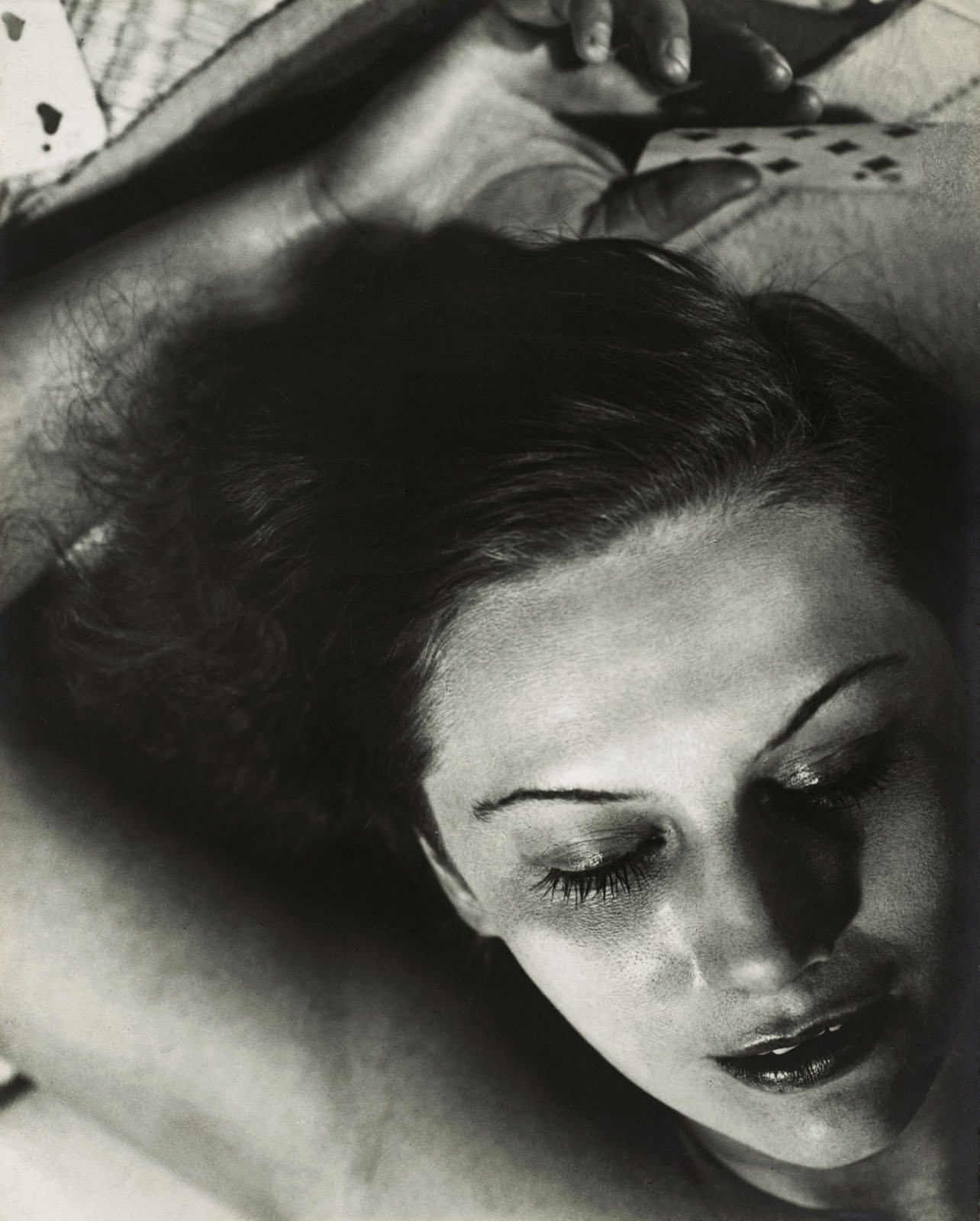
 

Florence Henri (European, 1893-1982) 'Portrait Composition (Femme aux cartes)' (Portrait Composition (Woman with Cards)) 1930


Florence Henri (European, 1893-1982)
Portrait Composition (Femme aux cartes) (Portrait Composition (Woman with Cards))
1930
Gelatin silver print
Image: 28 x 22.4cm (11 x 8 13/16 in.)
Mount: 38.1 x 33cm (15 x 13 in.)
Frame (outer): 52.7 x 47.6cm (20 3/4 x 18 3/4 in.)
The Metropolitan Museum of Art, Ford Motor Company Collection, Gift of Ford Motor Company and John C. Waddell, 1987
Florence Henri © Galleria Martini & Ronchetti, courtesy Archives Florence Henri
Image © The Metropolitan Museum of Art. Art Resource, NY


Florence Henri (European, 1893-1982)

Florence Henri (28 June 1893 – 24 July 1982) was a surrealist artist; primarily focusing her practice on photography and painting, in addition to pianist composition. In her childhood, she traveled throughout Europe, spending portions of her youth in Paris, Vienna, and the Isle of Wight. She studied in Rome, where she would encounter the Futurists, finding inspiration in their movement. From 1910 to 1922, she studied piano in Berlin, under the instruction of Egon Petri and Ferrucio Busoni. She would find herself landlocked to Berlin during the first World War, supporting herself by composing piano tracks for silent films. She returned to Paris in 1922, to attend the Académie André Lhote, and would attend until the end of 1923. From 1924 to 1925, she would study under painters Fernand Léger and Amédée Ozenfant at the Académie Moderne. Henri’s most important artistic training would come from the Bauhaus in Dessau, in 1927, where she studied with masters Josef Albers and László Moholy-Nagy, who would introduce her to the medium of photography. She returned to Paris in 1929 where she started seriously experimenting and working with photography up until 1963. Finally, she would move to Compiègne, where she concentrated her energies on painting until the end of her life in 1982. Her work includes experimental photography, advertising, and portraits, many of which featured other artists of the time.

Text from the Wikipedia website
 

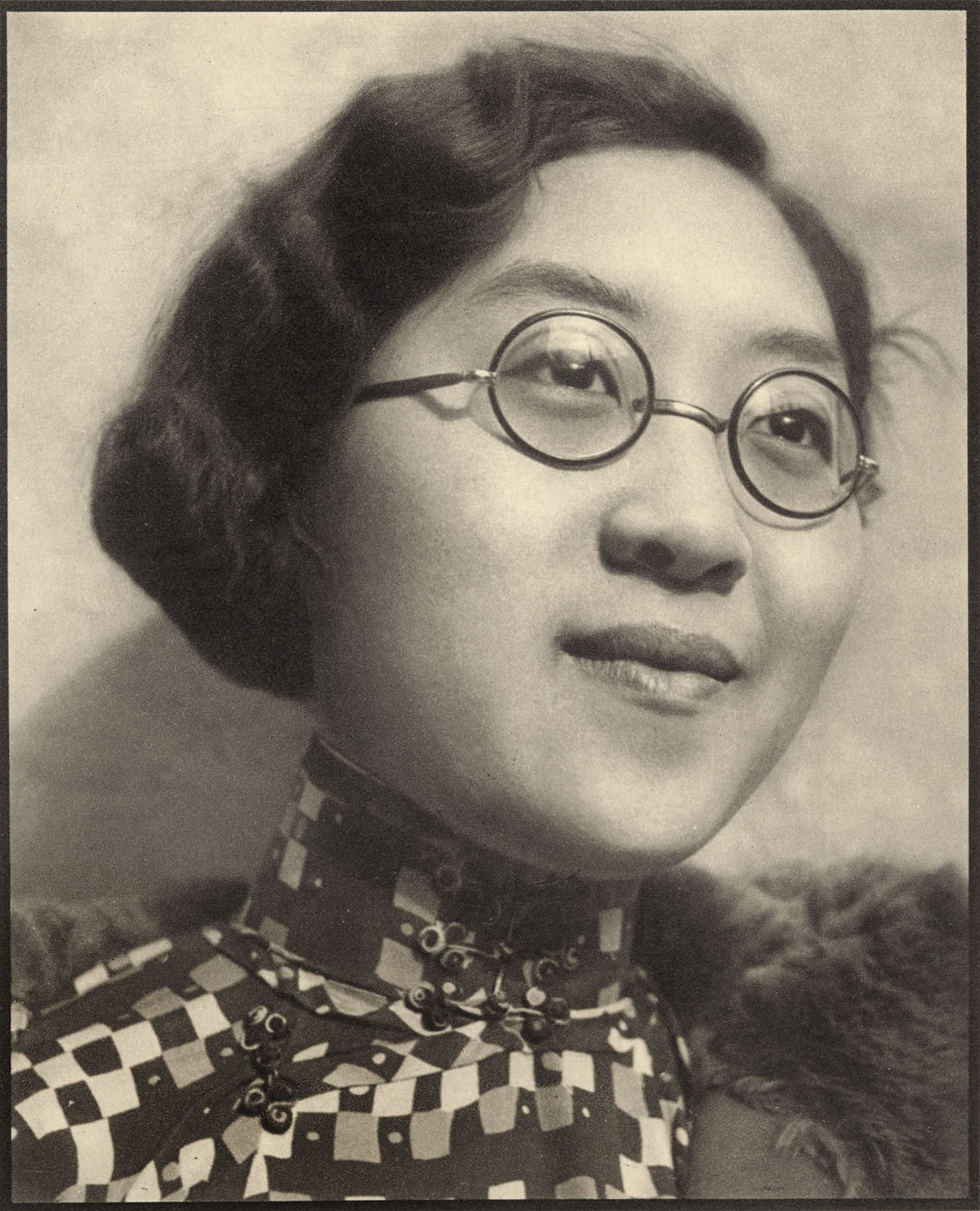
Florestine Perrault Collins (American, 1895-1988) 'Mae Fuller Keller' Early 1920s


Florestine Perrault Collins (American, 1895-1988)
Mae Fuller Keller
Early 1920s
Gelatin silver print
Overall: 35.56 x 27.94cm (14 x 11 in.)
Frame: 35.56 x 27.94cm (14 x 11 in.)
Frame (outer): 39.37 x 31.75cm (15 1/2 x 12 1/2 in.)
Dr Arthé A. Anthony


Florestine Perrault Collins (American, 1895-1988)

Florestine Perrault Collins (1895-1988) was an American professional photographer from New Orleans. Collins is noted for having created photographs of African-American clients that “reflected pride, sophistication, and dignity,” instead of racial stereotypes.

In 1909, Collins began practicing photography at age 14. Her subjects ranged from weddings, First Communions, and graduations to personal photographs of soldiers who had returned home. At the beginning of her career, Collins had to pass as a white woman to be able to assist photographers.

Collins eventually opened her own studio, catering to African-American families. She gained a loyal following and had success, due to both her photography and marketing skills. Out of 101 African-American women who identified themselves as photographers in the 1920 U.S. Census, Collins was the only one listed in New Orleans.

She advertised in newspapers, playing up the sentimentality of a well-done photograph. Collins also included her photograph in the ads to appeal to customers who thought a female photographer might take better pictures of babies and children.

According to the Encyclopedia of Louisiana, Collins’ career “mirrored a complicated interplay of gender, racial and class expectations”.

“The history of black liberation in the United States could be characterised as a struggle over images as much as it has also been a struggle over rights,” according to Bell Hooks. Collins’ photographs are representative of that. By taking pictures of black women and children in domestic settings, she challenged the pervasive stereotypes of the time about black women.

Text from the Wikipedia website
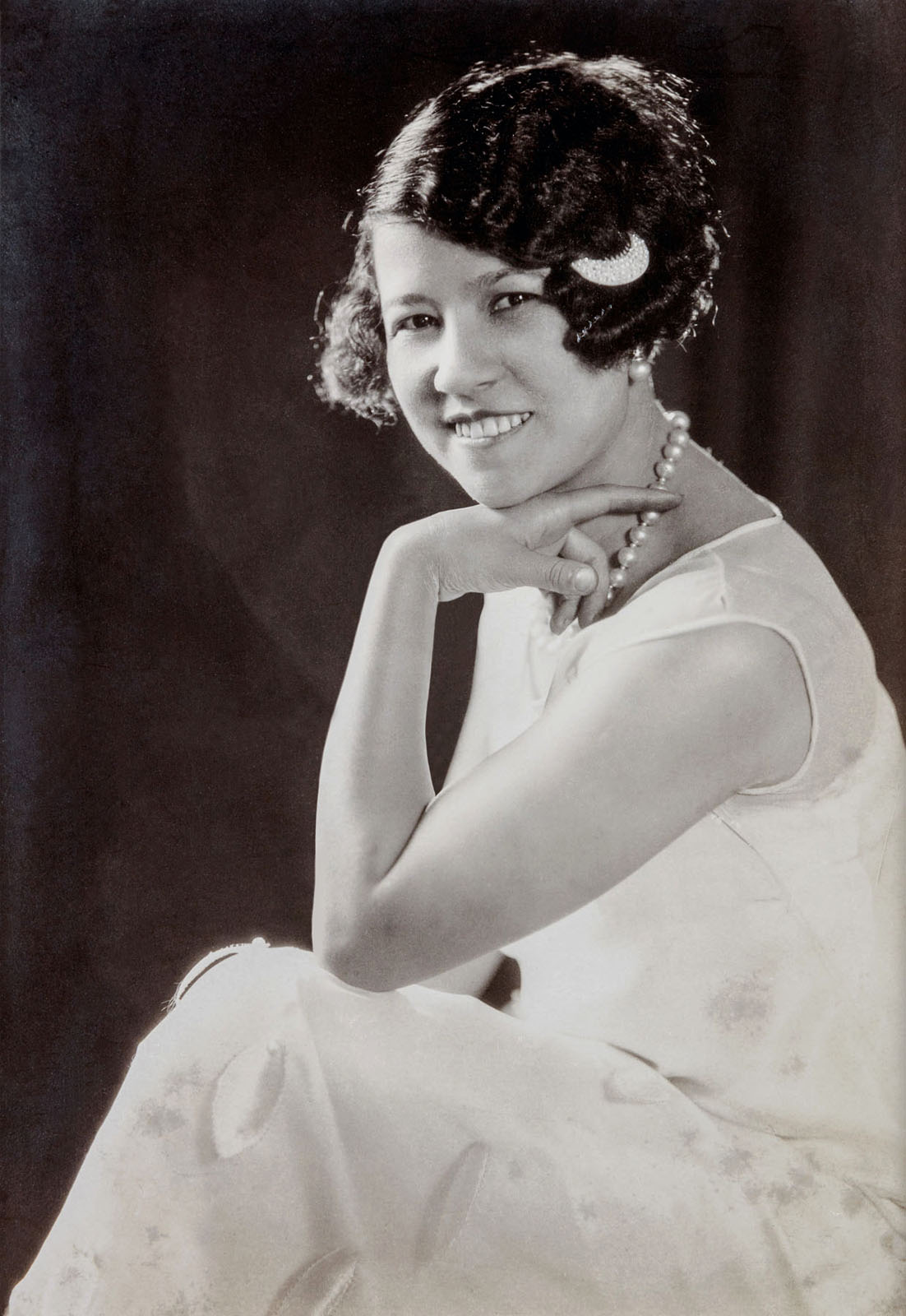
 

Photographer unknown. 'Florestine Perrault Collins' 1920s


Photographer unknown
Florestine Perrault Collins
1920s
Gelatin silver print
Overall: 35.56 x 27.94cm (14 x 11 in.)
Frame: 35.56 x 27.94cm (14 x 11 in.)
Frame (outer): 39.37 x 31.75cm (15 1/2 x 12 1/2 in.)
Dr Arthé A. Anthony


Germaine Krull (German, French, and Dutch, Brazil, Republic of the Congo, Thailand and India, 1897-1985) 'Eielturm' (Eifel Tower) 1928


Germaine Krull (German, French, and Dutch, Brazil, Republic of the Congo, Thailand and India, 1897-1985)
Eielturm (Eifel Tower)
1928
Gelatin silver print
Image: 22.5 x 15.2cm (8 7/8 x 6 in.)
Frame: 50 x 40cm (19 11/16 x 15 3/4 in.)
Frame (outer): 52 x 42 x 2.8cm (20 1/2 x 16 9/16 x 1 1/8 in.)
Museum Folkwang, Essen © Estate Germaine Krull, Museum Folkwang, Essen
Photo © Museum Folkwang Essen – ARTOTHEK


Gertrude Fehr (German, 1895-1996) 'Odile' 1936


Gertrude Fehr (German, 1895-1996)
Odile
1936
Gelatin silver print
Image: 32.39 x 29.21cm (12 3/4 x 11 1/2 in.)
Frame: 60.96 x 50.8cm (24 x 20 in.)
Frame (outer): 25.75 x 21.75cm (10 1/8 x 8 9/16 in.)
Trish and Jan de Bont


Gertrude Fehr (German, 1895-1996)

Gertrude Fehr was a German photographer. She was born in Mainz on Tuesday 5 March 1895 and died in 1996 at the age of 101. She was one of the earliest professional female photographers.

Fehr studied photography at the Bavarian School of photography in Munich and undertook an apprenticeship in the Munich studio of Eduard Wasow. Shortly after finishing the apprenticeship, she set up a photographic studio dedicated fundamentally to the theatre and to the portrait technique which employed six people. In 1933, the rise of Hitler and the establishment of the Third Reich forced Fehr to close the studio and to emigrate to Paris with her future Swiss husband, the painter Jules Fehr. Installed in the French capital there she opened her own school of photography: PUBLI-phot.

In Paris she found the artistic atmosphere of the avant-garde of the time and, influenced by the movements modernism, began photographic experiments. Patent in those moments was the tremendous influence of the most transgressive photographer-painter of the moment, Man Ray, which she considered “fascinating”. Like him, she started experimenting with the solarisation process. The solarisation of Fehr (unlike Man Ray) are works that have a aesthetic which resembles an academic charcoal drawing. If it were not for the difference in procedures, Fehr’s “Odile” (1940) seems rather an image enhanced by traditional procedures rather than by the photographic avant-garde.

At the end of the 1930s she and her husband moved to Switzerland, where they opened a photography school in Lausanne.


Adele Gloria (Italian, 1910-1984) 'Senza titolo' (Untitled) c. 1933


Adele Gloria (Italian, 1910-1984)
Senza titolo (Untitled)
c. 1933
Collage with gelatin silver prints
Overall: 18.2 x 21.27cm (7 3/16 x 8 3/8 in.)
Mat: 39.37 x 49.85cm (15 1/2 x 19 5/8 in.)
Frame: 40.64 x 50.8cm (16 x 20 in.)
Frame (outer): 43.18 x 53.34cm (17 x 21 in.)
Collection Merrill C. Berman


Adele Gloria was the only futurist woman in Sicily, she distinguished herself in the field of aeropainting and avant-garde, in the early 30s in Catania. She was a poet, photographer, painter, sculptor and journalist, a “total” artist according to the canons of the Futurist movement.


Adele Gloria (Italian, 1910-1984) 'Senza titolo' (Untitled) c. 1933 (detail)


Adele Gloria (Italian, 1910-1984)
Senza titolo (Untitled) (detail)
c. 1933
Collage with gelatin silver prints
Overall: 18.2 x 21.27cm (7 3/16 x 8 3/8 in.)
Mat: 39.37 x 49.85cm (15 1/2 x 19 5/8 in.)
Frame: 40.64 x 50.8cm (16 x 20 in.)
Frame (outer): 43.18 x 53.34cm (17 x 21 in.)
Collection Merrill C. Berman
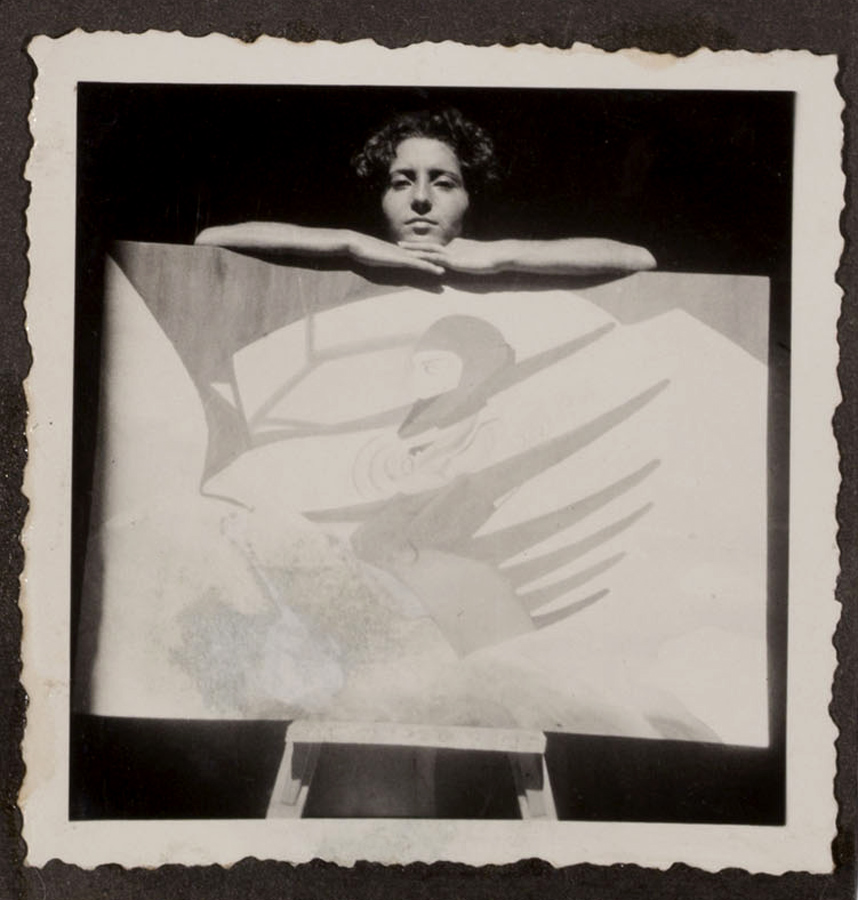
 

Adele Gloria (Italian, 1910-1984) 'Senza titolo' (Untitled) c. 1933 (detail)


Adele Gloria (Italian, 1910-1984)
Senza titolo (Untitled) (detail)
c. 1933
Collage with gelatin silver prints
Overall: 18.2 x 21.27cm (7 3/16 x 8 3/8 in.)
Mat: 39.37 x 49.85cm (15 1/2 x 19 5/8 in.)
Frame: 40.64 x 50.8cm (16 x 20 in.)
Frame (outer): 43.18 x 53.34cm (17 x 21 in.)
Collection Merrill C. Berman


Hélène Hoppenot (French, 1894-1990) 'Chine' 1946


Hélène Hoppenot (French, 1894-1990)
Chine
1946
Bound volume
Open: 35.56 x 33.02cm (14 x 13 in.)
Cradle:11.43 x 49.85 x 36.2cm (4 1/2 x 19 5/8 x 14 1/4 in.)
National Gallery of Art Library, Gift of the Department of Photographs


Hélène Hoppenot (1894-1990) was a French amateur photographer who made thousands of snapshots using the Rolleiflex from 1933 to the 1970s.

Hoppenot made a trip to China where she photographed the everyday life and habits of Chinese people in the country and in the city. This book is her testimony of this travel. It is accompanied with a text from writer Paul Claudel who was deeply interested in Chinese culture and traveled to China as well.


Homai Vyarawalla (Indian, 1913-2012) 'The Ashes of Mahatma Gandhi Being Carried in a Procession, Allahabad' February 1948


Homai Vyarawalla (Indian, 1913-2012)
The Ashes of Mahatma Gandhi Being Carried in a Procession, Allahabad
February 1948
Gelatin silver print
Image/sheet: 38.1 x 38.1cm (15 x 15 in.)
Frame: 53.34 x 53.34cm (21 x 21 in.)
Frame (outer): 55.88 x 55.88cm (22 x 22 in.)
Homai Vyarawalla Archive / The Alkazi Collection of Photography


Homai Vyarawalla (Indian, 1913-2012)

Homai Vyarawalla (9 December 1913 – 15 January 2012), commonly known by her pseudonym Dalda 13, was India’s first woman photojournalist. She began work in the late 1930s and retired in the early 1970s. In 2011, she was awarded Padma Vibhushan, the second highest civilian award of the Republic of India. She was amongst the first women in India to join a mainstream publication when she joined The Illustrated Weekly of India.

Career

Vyarawalla started her career in the 1930s. At the onset of World War II, she started working on assignments for Mumbai-based The Illustrated Weekly of India magazine which published many of her most admired black-and-white images. In the early years of her career, since Vyarawalla was unknown and a woman, her photographs were published under her husband’s name. Vyarawalla stated that because women were not taken seriously as journalists she was able to take high-quality, revealing photographs of her subjects without interference:

People were rather orthodox. They didn’t want the women folk to be moving around all over the place and when they saw me in a sari with the camera, hanging around, they thought it was a very strange sight. And in the beginning they thought I was just fooling around with the camera, just showing off or something and they didn’t take me seriously. But that was to my advantage because I could go to the sensitive areas also to take pictures and nobody will stop me. So I was able to take the best of pictures and get them published. It was only when the pictures got published that people realized how seriously I was working for the place.

~  Homai Vyarawalla in Dalda 13: A Portrait of Homai Vyarawalla (1995)


Eventually her photography received notice at the national level, particularly after moving to Delhi in 1942 to join the British Information Services. As a press photographer, she recorded many political and national leaders in the period leading up to independence, including Mohandas Gandhi, Jawaharlal Nehru, Muhammad Ali Jinnah, Indira Gandhi and the Nehru-Gandhi family.

The Dalai Lama in ceremonial dress enters India through Nathu La in Sikkim on 24 November 1956, photographed by Homai Vyarawalla. In 1956, she photographed for Life Magazine the 14th Dalai Lama when he entered Sikkim in India for the first time via the Nathu La. Most of her photographs were published under the pseudonym “Dalda 13”. The reasons behind her choice of this name were that her birth year was 1913, she met her husband at the age of 13 and her first car’s number plate read “DLD 13”.

Text from the Wikipedia website


Photographer unknown. 'Homai Vyarawalla photographing Ganesh Chaturthi at Chowpatty Beach, Bombay' Late 1930s, printed later


Photographer unknown
Homai Vyarawalla photographing Ganesh Chaturthi at Chowpatty Beach, Bombay
Late 1930s, printed later
Inkjet print
Image: 30.48 x 20.8cm (12 x 8 3/16 in.)
Frame: 45.72 x 35.56cm (18 x 14 in.)
Frame (outer): 48.26 x 38.1cm (19 x 15 in.)
Homai Vyarawalla Archive / The Alkazi Collection of Photography
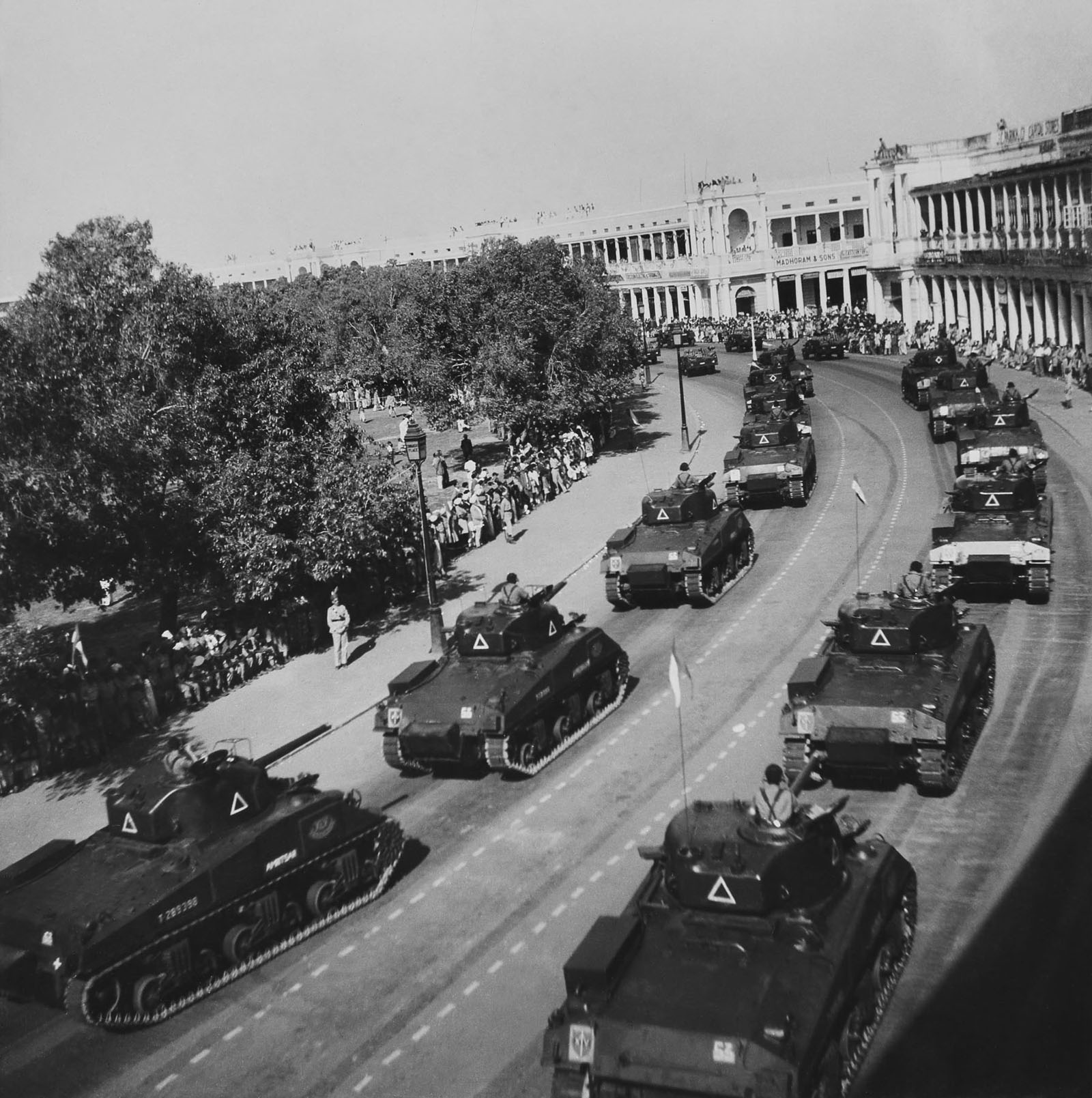
 

Homai Vyarawalla (Indian, 1913-2012) 'The Victory Parade by the Allied Forces in India Marking the End of the Second World War, Connaught Place, New Delhi' 1945


Homai Vyarawalla (Indian, 1913-2012)
The Victory Parade by the Allied Forces in India Marking the End of the Second World War, Connaught Place, New Delhi
1945
Gelatin silver print
Image/sheet: 31 x 30.8cm (12 3/16 x 12 1/8 in.)
Frame: 45.72 x 45.72cm (18 x 18 in.)
Frame (outer): 48.26 x 48.26cm (19 x 19 in.)
Homai Vyarawalla Archive / The Alkazi Collection of Photography
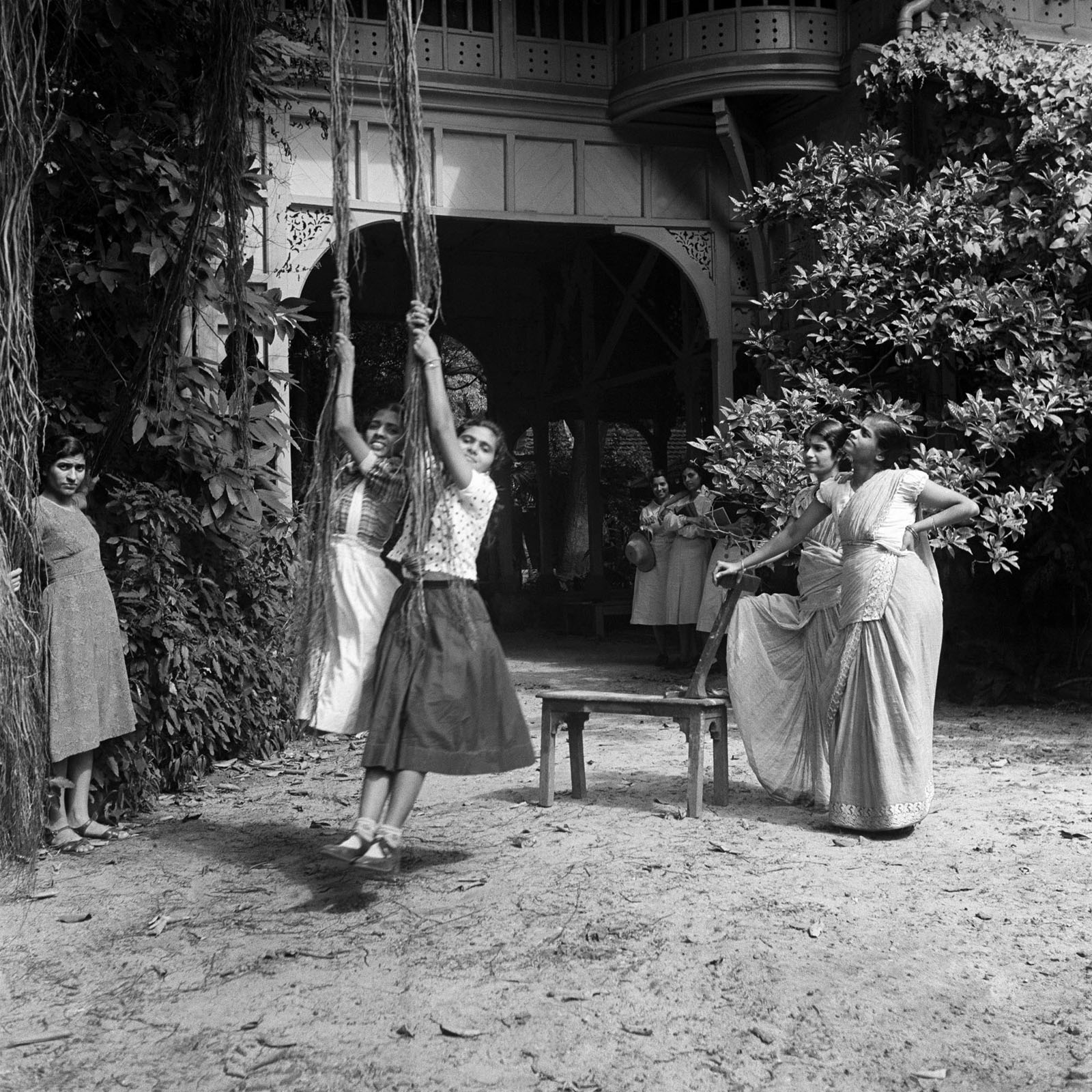
 

Homai Vyarawalla (Indian, 1913-2012) 'Students at the Sir Jamsetjee Jeejeebhoy School of Art, Bombay' Late 1930s, printed later


Homai Vyarawalla (Indian, 1913-2012)
Students at the Sir Jamsetjee Jeejeebhoy School of Art, Bombay
Late 1930s, printed later
Inkjet print
Image/sheet: 40.7 x 40.7cm (16 x 16 in.)
Frame: 55.88 x 55.88cm (22 x 22 in.)
Frame (outer): 58.42 x 58.42cm (23 x 23 in.)
Homai Vyarawalla Archive / The Alkazi Collection of Photography
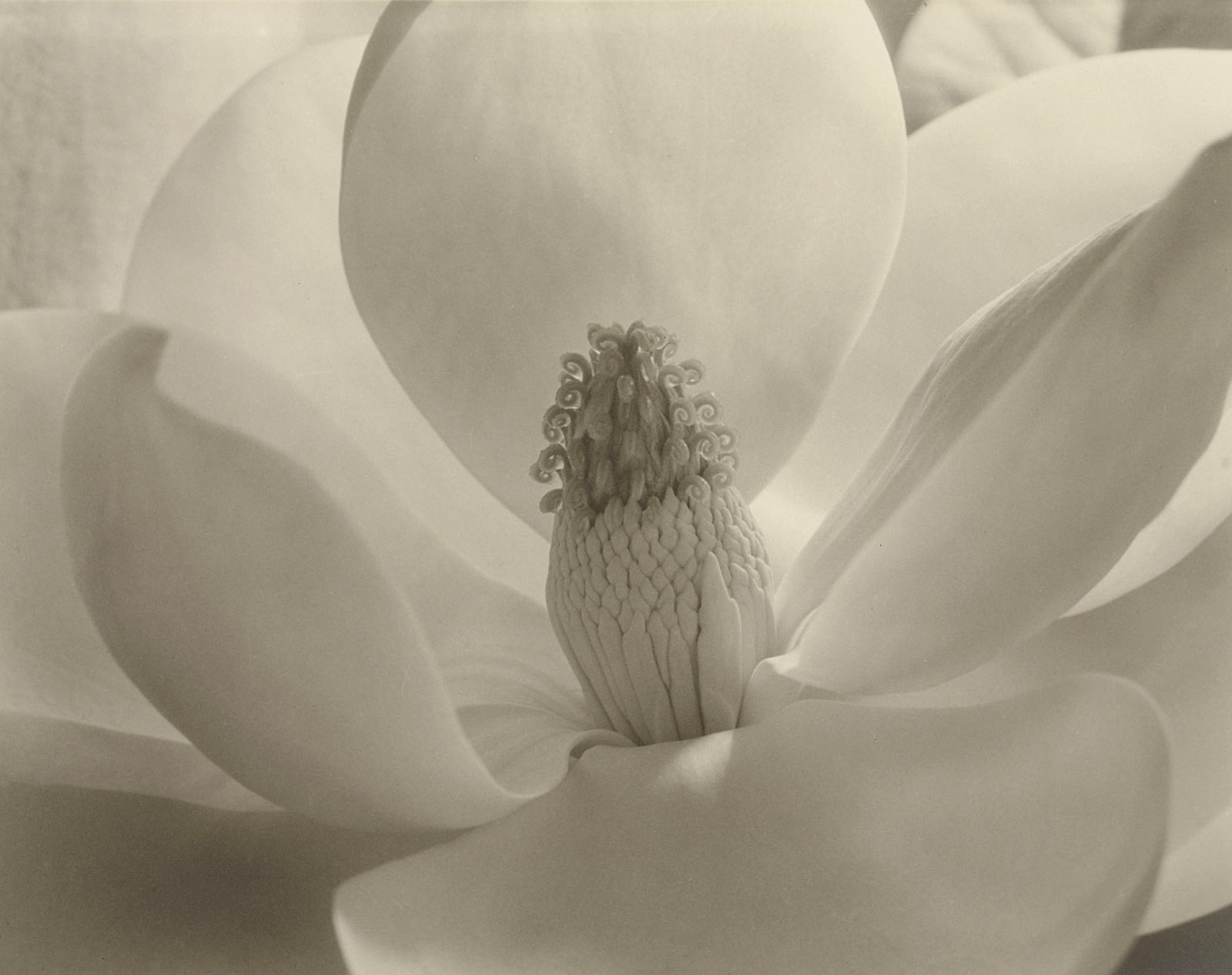
 

Imogen Cunningham (American, 1883-1976) 'Magnolia Blossom' c. 1925


Imogen Cunningham (American, 1883-1976)
Magnolia Blossom
c. 1925
Gelatin silver print
17.1 x 21.6cm (6 3/4 x 8 1/2 in.)
The Museum of Modern Art, New York
Gift of Albert M. Bender
© 2020 Imogen Cunningham Trust


Judit Kárász (Hungarian, 1912-1977) 'Kávészemek cukorral' (Coffee Beans and Sugar) 1931


Judit Kárász (Hungarian, 1912-1977)
Kávészemek cukorral (Coffee Beans and Sugar)
1931
Gelatin silver print
Image: 13.02 x 20.96cm (5 1/8 x 8 1/4 in.)
Support: 13.02 x 20.96cm (5 1/8 x 8 1/4 in.)
Mat: 40.64 x 50.8cm (16 x 20 in.)
Frame: 40.64 x 50.8cm (16 x 20 in.)
Frame (outer): 41.28 x 51.44 x 3.33cm (16 1/4 x 20 1/4 x 1 5/16 in.)
Los Angeles County Museum of Art, Gift of Louis Stern Digital Image
© 2019 Museum Associates / LACMA / Licensed by Art Resoure, NY


Judit Kárász (Hungarian, 1912-1977)

Judit Kárász (21 May 1912 – 30 May 1977) was a Hungarian photographer interested in the medium’s ability to reveal the hidden structures of everyday subject matter. Her photography brought together social documentary and modernist ideas such as Gestalt theory.

Bauhaus

On 21 June 1932 Kárász received her Bauhaus diploma, where she majored in photography. She was taught by Walter Peterhans, who founded the school’s photography department in 1929. Influenced by the work of artists such as fellow Hungarian László Moholy-Nagy who had previously taught at the school, Kárász began to experiment with compositional devices, such as bird’s-eye perspective, and explored modernist themes and subject matters including industrial landscapes.

Career

In 1931 Kárász became a member of Kostufa (Kommunistische Studenten Fraktion) a communist student group, and following her active role in election campaigns she was expelled from the Sachsen-Anhalt area of Germany. Between 1932-1935 Karasz worked as a laboratory technician at the Dephot in Berlin, a photographic agency that represented photojournalists, such as Robert Capa.

Karasz was involved with the Workers-Photography movement, a collective associated with communism dedicated to activating photography for social ends.

Text from the Wikipedia website
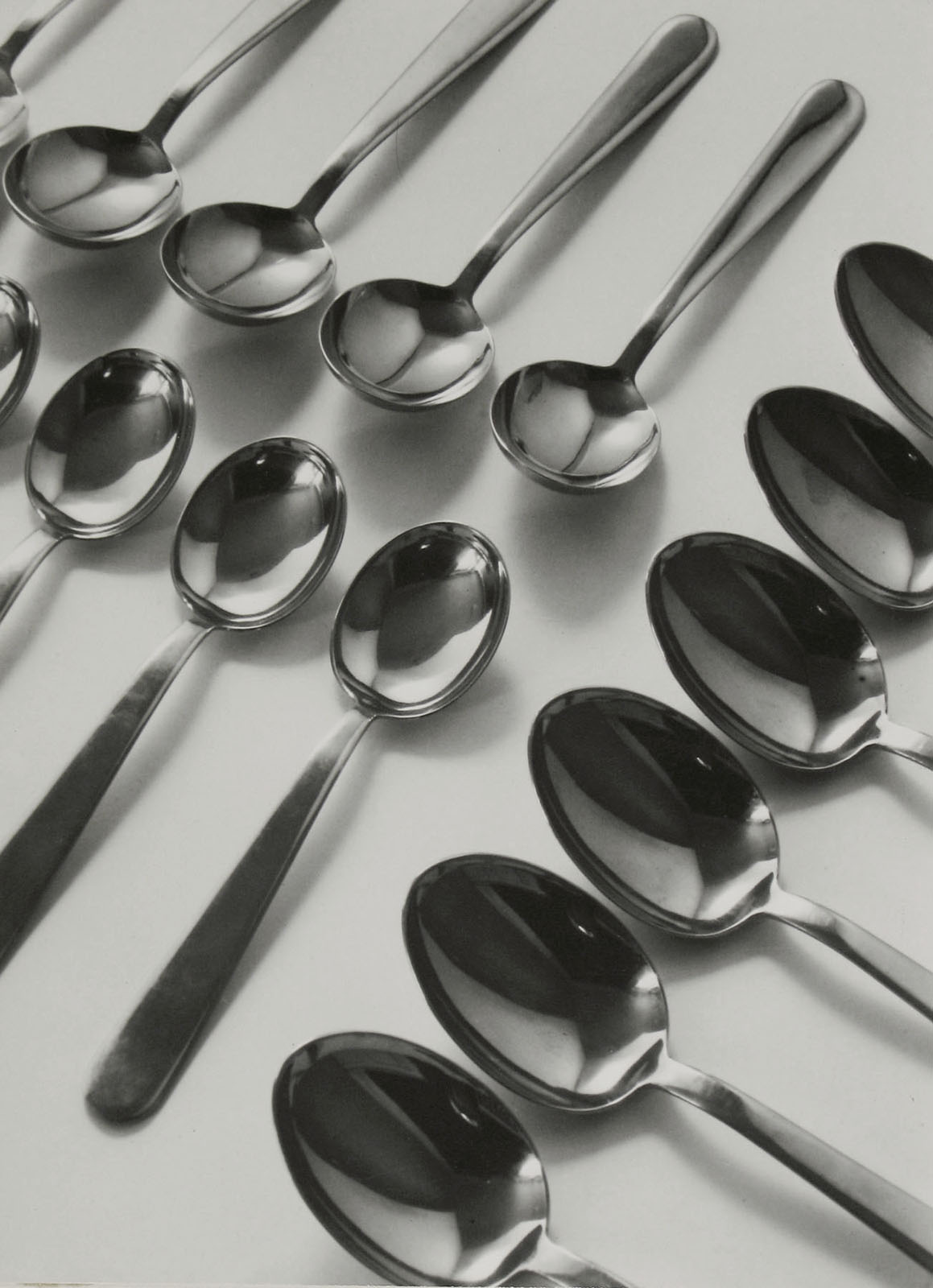
 

Vera Gabrielová (Czech, 1919-2002) 'Bez názvu (lžíce)' (Untitled (Spoons)) 1935-1936


Vera Gabrielová (Czech, 1919-2002)
Bez názvu (lžíce) (Untitled (Spoons))
1935-1936
Gelatin silver print
Image: 23.8 x 17.5cm (9 3/8 x 6 7/8 in.)
Frame: 50.8 x 40.64cm (20 x 16 in.)
Frame (outer): 53.34 x 43.18cm (21 x 17 in.)
Ellen and Robert Grimes
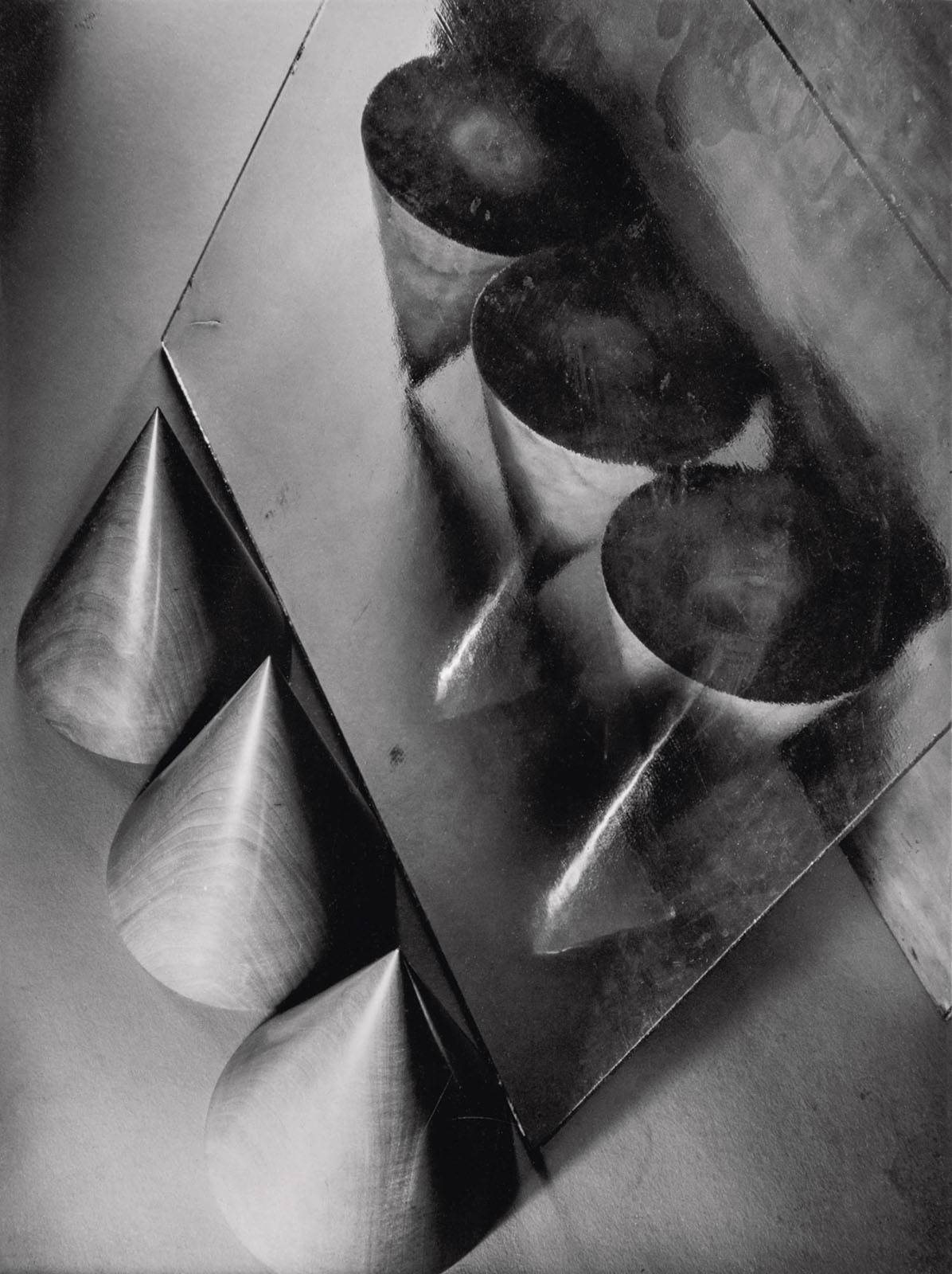
 

Jaroslava Hatláková (Czech, 1904-1989) 'Bez názvu' (Untitled) c. 1936


Jaroslava Hatláková (Czech, 1904-1989)
Bez názvu (Untitled)
c. 1936
Gelatin silver print
10.8 x 8.26cm (4 1/4 x 3 1/4 in.)
Trish and Jan de Bont
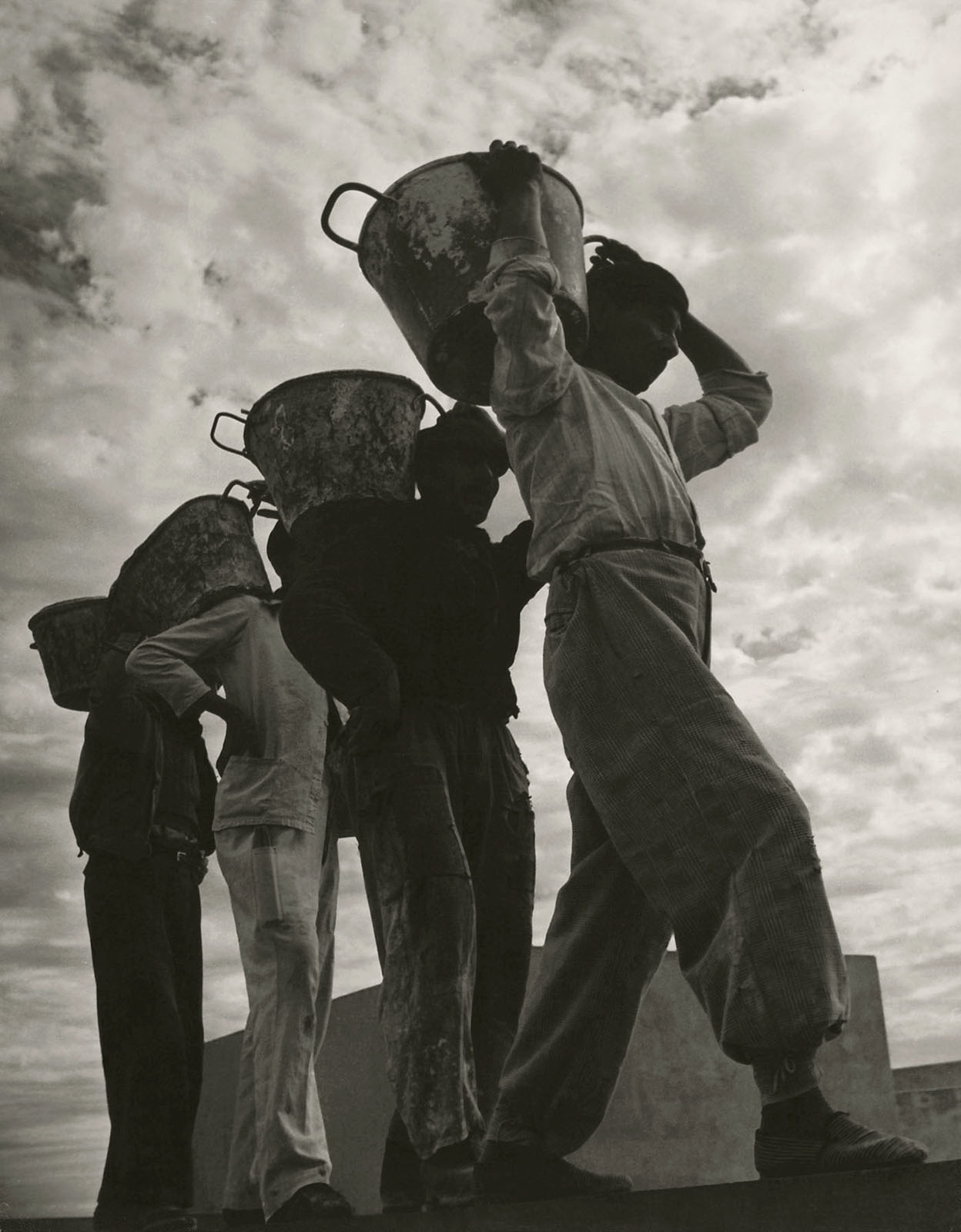
 

Jeanne Mandello (German, 1907-2001) 'Arbeiter der neuen uruguayischen Fakultät für Architektur, Montevideo' (Workers on the new Uruguayan School of Architecture, Montevideo) c. 1945, printed later


Jeanne Mandello (German, 1907-2001)
Arbeiter der neuen uruguayischen Fakultät für Architektur, Montevideo (Workers on the new Uruguayan School of Architecture, Montevideo)
c. 1945, printed later
Gelatin silver print
Image: 35 x 27cm (13 3/4 x 10 5/8 in.)
Frame: 50.8 x 40.64cm (20 x 16 in.)
Frame (outer): 53.34 x 43.18cm (21 x 17 in.)
Isabel Mandello Collection
© 2020 Isabel Mandello


Jeanne Mandello (German, 1907-2001)

Jeanne Mandello (née Johanna Mandello; October 18, 1907, Frankfurt – December 17, 2001, Barcelona) was a German modern artist and experimental photographer. …

In 1926 she began studying photography at Lette-Verein. In a time when it was difficult for a woman to get attention as an artist, photography opened a way into the art world. Inspired by the spirit of freedom in Berlin in the 1920s, the women’s movement offered an opportunity to go out, attended theater performances, concerts, exhibitions and decide on the model of the “new woman”, imitating Grete Stern and Ellen Auerbach who wore pants and short hair. In 1927, she studied at the studio of Paul Wolff and Alfred Tritschler. Through Wolff, she became familiar with Leica Camera photography. Back in Berlin, she returned to Lette and finished her studies. Using a Leica film camera, she photographed portraits, landscapes and scenes of everyday life. In 1929, she taught in Frankfurt, creating a studio at her parents’ house. Here, she collaborated with the photographer Nathalie Reuter (1911-1990), a former classmate and friend. In 1932, she met Arno Grünebaum. Under Mandello’s guidance, he learned photography. In 1933, they married. Being Jewish and being aware of the coming danger, they left Germany in 1934 and began in Paris a new life.

Career

In Paris, she changed her first name Johanna into the French form, Jeanne. Like other modern photographers of the Weimar Republic, Mandello found inspiration during her exile in Paris. She was influenced by the Nouvelle Vision; by Man Ray, Brassaï and Doisneau, in redefined photography. They experimented with new techniques, unusual camera angles, picture cutouts, exposures and photomontages. Mandello and Grunbaum specialised in commercial and portrait photography and established themselves as fashion photographers. In 1937, they opened a studio in 17th Arrondissement under the name “Mandello”. “Mandello” did work for Fémina, Harper’s Bazaar and Vogue, as well as the fashion houses of Balenciaga, Guerlain, Maggy Rouff, and Creed. Occasionally, they worked with the photographer Hermann Landshoff, who had also fled Nazi Germany. After the outbreak of World War II, Mandello and her husband were considered Alien Enemies within the French Republic and were forced to leave Paris in early 1940. They had to leave everything behind: the photo studio, camera equipment, archived works and negatives. They were allowed to take only 14 kilos of luggage. They came to the village of Dognen where she helped out in the infirmary. Her German citizenship was withdrawn on 28 October 1940. With visas to Uruguay, Mandello and Grunebaum left France and started a new life in South America where she exhibited beginning in 1943. Her new work included architecture, landscapes, photograms, portraits, and solarisations. In 1952, she exhibited at Museum of Modern Art, Rio de Janeiro, and two years later, she separated from her husband, and moved to Brazil to be with the journalist, Lothar Bauer. With Bauer, she moved to Barcelona at the end of the decade where she worked the rest of her life. She married Bauer, and they adopted a daughter, Isabel, in 1970. Mandello died in Barcelona in 2001.

Text from the Wikipedia website


Jeanne Mandello was a pioneer of modern photography and a Jewish avant-garde woman artist working in Berlin, Frankfurt, Paris, Montevideo, Rio de Janeiro and Barcelona.

She belongs to the same school of modern female photographers of the early 20th century as her contemporaries Grete Stern, Ellen Auerbach, Ilse Bing, Marianne Breslauer, Gisèle Freund, or, even though some years older, Germaine Krull. …

Jeanne Mandello became a cosmopolitan artist by the force of circumstances and brought the geometry of the Bauhaus and the surrealist fantasy of pre-war Paris to her later countries of residence, Uruguay, Brazil and Spain. Her eye remained European and wherever she lived her photographs rendered homage to her new countries. No country can claim her for itself but her work is another example of the universality of art, which transcends all physical frontiers.

Forgotten for nearly 50 years because of the historical circumstances surrounding her life, she is today rediscovered and seen as she should have been: an avant-garde Jewish-German woman artist and a pioneer in the field of modern photography.

Anonymous text. “Jeanne Mandello: Photographer in Exile,” on the Jeanne Mandello website [Online] Cited 28/11/2021
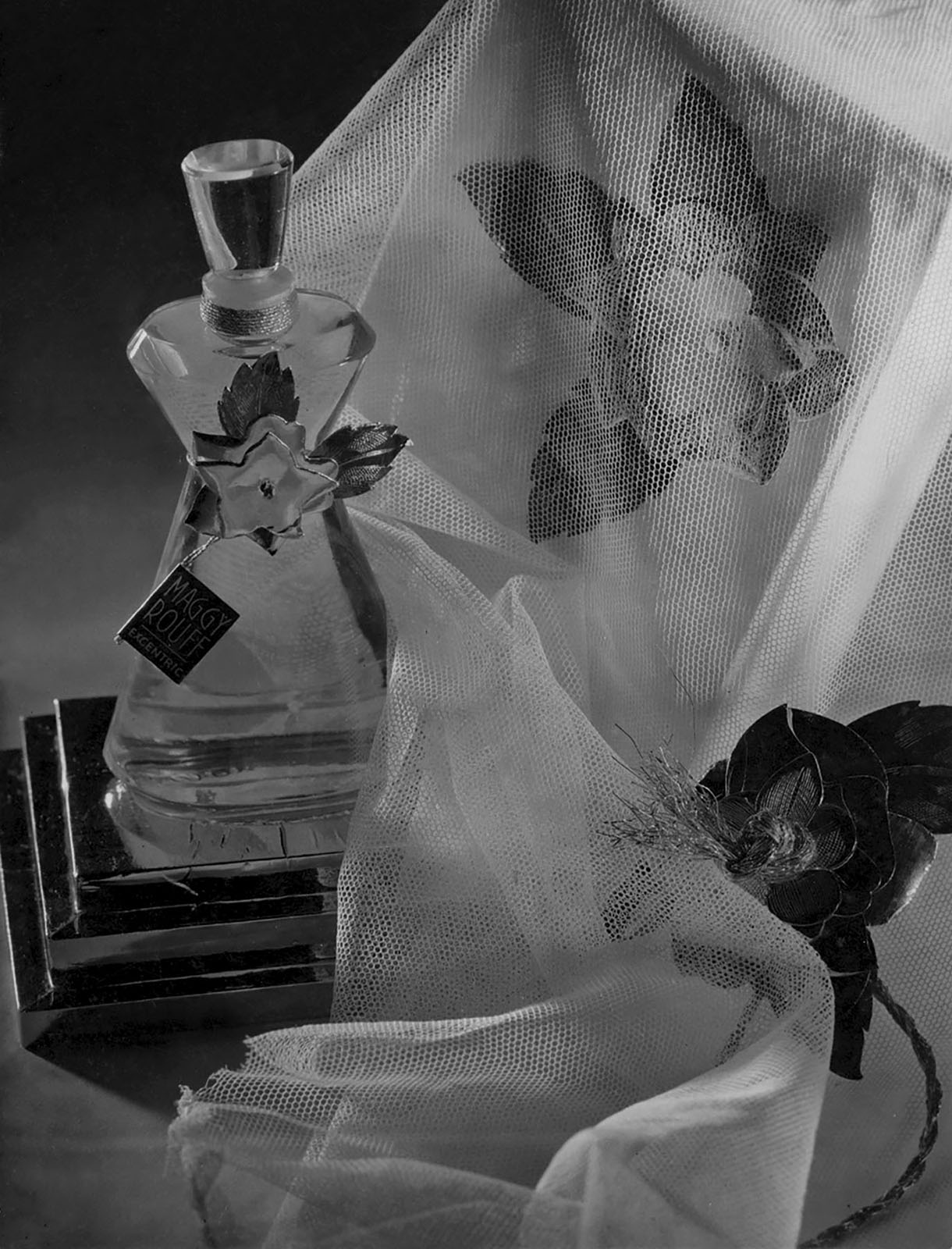
 

Jeanne Mandello (German, 1907-2001) 'Perfume Advertisement for Maggy Rou' c. 1935-1938, printed later


Jeanne Mandello (German, 1907-2001)
Perfume Advertisement for Maggy Rou
c. 1935-1938, printed later
Gelatin silver print
Image: 29 x 22cm (11 7/16 x 8 11/16 in.)
Frame: 50.8 x 40.64cm (20 x 16 in.)
Frame (outer): 53.34 x 43.18cm (21 x 17 in.)
Isabel Mandello Collection
© 2020 Isabel Mandello


Jeanne Mandello (German, 1907-2001) 'Selbstporträt, Montevideo' (Self-Portrait, Montevideo) c. 1942-1943, printed later


Jeanne Mandello (German, 1907-2001)
Selbstporträt, Montevideo (Self-Portrait, Montevideo)
c. 1942-1943, printed later
Gelatin silver print
Image: 28.5 x 24cm (11 1/4 x 9 7/16 in.)
Frame: 50.8 x 40.64cm (20 x 16 in.)
Framed (outer): 53.34 x 43.18cm (21 x 17 in.)
Isabel Mandello Collection
© 2020 Isabel Mandello
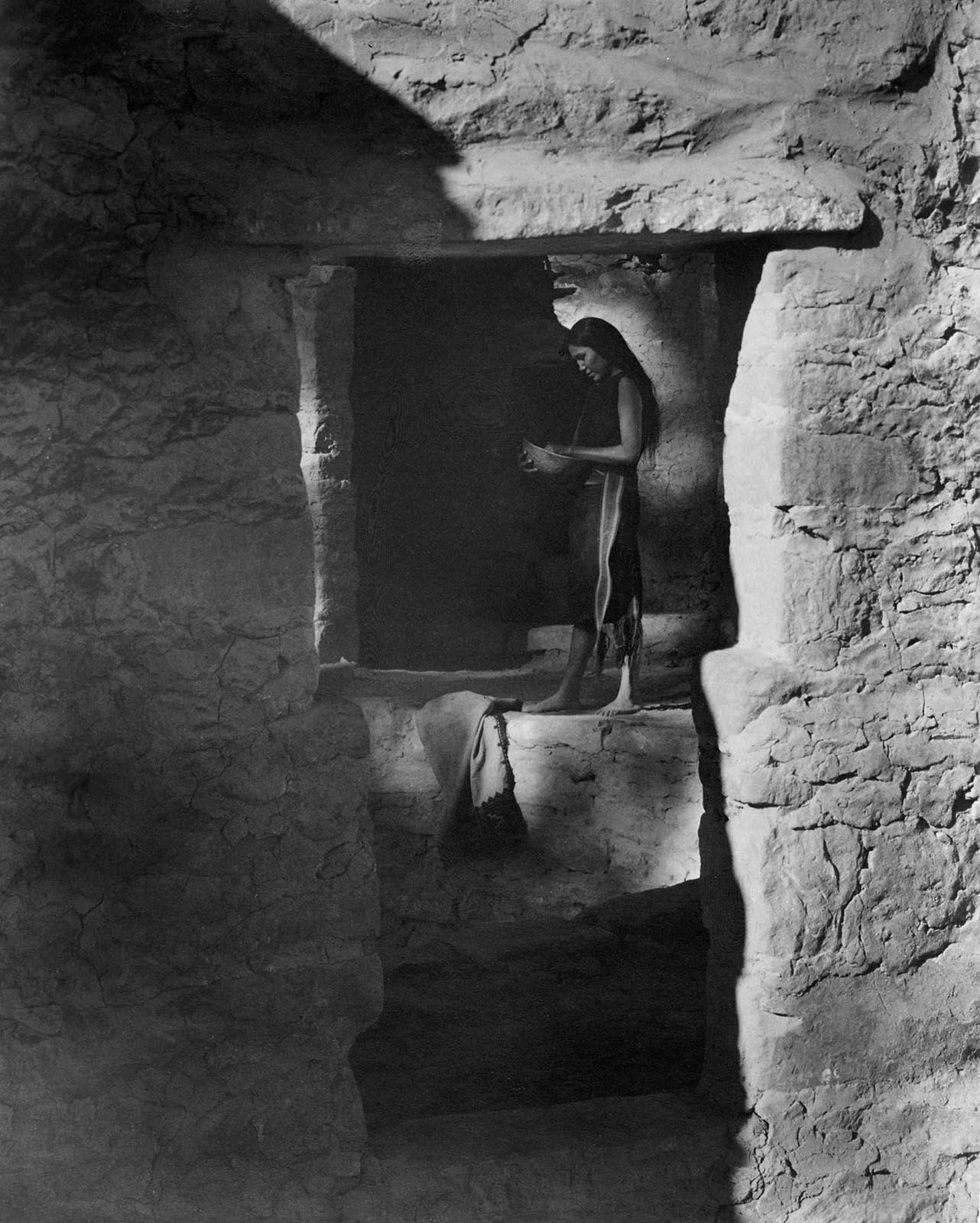
 

Laura Gilpin (American, 1891-1979) 'Untitled (Pueblo dwelling, woman holding a bowl)' c. 1930


Laura Gilpin (American, 1891-1979)
Untitled (Pueblo dwelling, woman holding a bowl)
c. 1930
Platinum print
Sheet: 24.7 x 19.8cm (9 3/4 x 7 13/16 in.)
Mat: 45.72 x 35.56cm (18 x 14 in.)
Frame: 45.72 x 35.56cm (18 x 14 in.)
Frame (outer): 48.26 x 38.74cm (19 x 15 in.)
Prints and Photographs Division, Library of Congress, Washington, D.C.
© 1979 Amon Carter Museum of American Art, Fort Worth, Texas


Laura Gilpin (April 22, 1891 – November 30, 1979) was an American photographer. Gilpin is known for her photographs of Native Americans, particularly the Navajo and Pueblo, and Southwestern landscapes. Gilpin began taking photographs as a child in Colorado and formally studied photography in New York from 1916 to 1917 before returning to her home in Colorado to begin her career as a professional photographer.

Read a fuller biography on the Wikipedia website
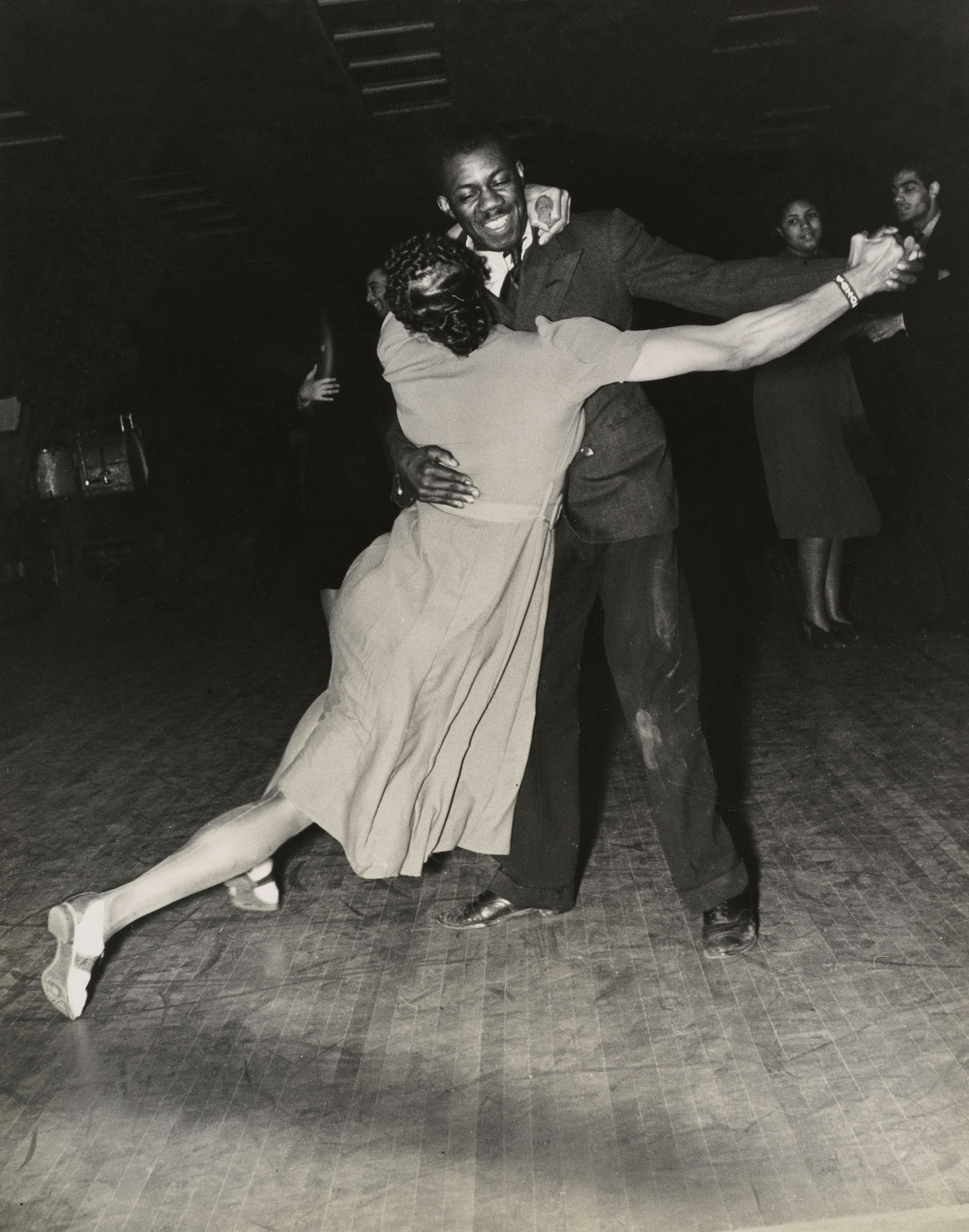
 

Lucy Ashjian (American, 1907-1993) 'Savoy Dancers' 1935-1943


Lucy Ashjian (American, 1907-1993)
Savoy Dancers
1935-1943
Gelatin silver print
Image: 24 x 18.8cm (9 7/16 x 7 3/8 in.)
Sheet: 26.2 x 20.2cm (10 5/16 x 7 15/16 in.)
Frame (outer): 47.3 x 39.5cm (18 5/8 x 15 9/16 in.)
The Metropolitan Museum of Art, Gift of Gregor Ashjian Preston, 2004
Image © The Metropolitan Museum of Art. Art Resource, NY


Lucy Ashjian (1907-1993) is an American photographer best known as a member of the New York Photo League. Her work is included in the collections of the Metropolitan Museum of Art, New York, the Center for Creative Photography in Tucson, Arizona and the Museum of the City of New York.


Margaret Michaelis (Austrian-Australian, 1902-1985) '"Residencia de J. M. a Barcelona," in D'Ací i d'Allà' Spring 1936


Margaret Michaelis (Austrian-Australian, 1902-1985)
“Residencia de J. M. a Barcelona,” in D’Ací i d’Allà
Spring 1936
Bound volume
Open: 32.39 x 52.07cm (12 3/4 x 20 1/2 in.)
Closed: 32.39 x 29.21cm (12 3/4 x 11 1/2 in.)
Cradle: 15.88 x 57.15 x 33.02cm (6 1/4 x 22 1/2 x 13 in.)
National Gallery of Art Library, David K.E. Bruce Fund
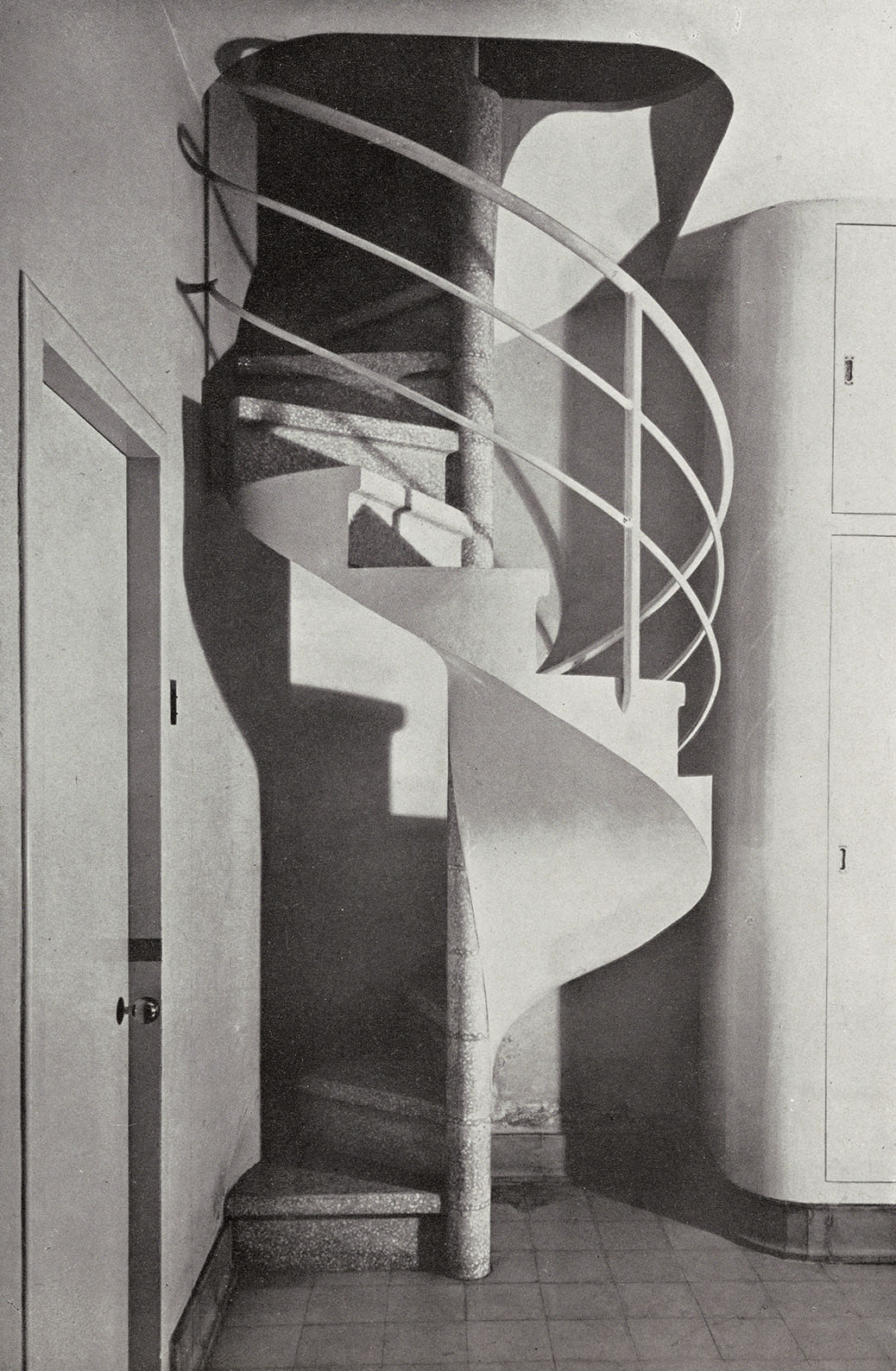
 

Margaret Michaelis (Austrian-Australian, 1902-1985) '"Residencia de J. M. a Barcelona," in D'Ací i d'Allà' Spring 1936 (detail)


Margaret Michaelis (Austrian-Australian, 1902-1985)
“Residencia de J. M. a Barcelona,” in D’Ací i d’Allà (detail)
Spring 1936
Bound volume
Open: 32.39 x 52.07cm (12 3/4 x 20 1/2 in.)
Closed: 32.39 x 29.21cm (12 3/4 x 11 1/2 in.)
Cradle: 15.88 x 57.15 x 33.02cm (6 1/4 x 22 1/2 x 13 in.)
National Gallery of Art Library, David K.E. Bruce Fund


Margaret Michaelis (Austrian-Australian, 1902-1985)

Margaret (Margarethe) Michaelis-Sachs (née Gross, 1902-1985) was an Austrian-Australian photographer of Polish-Jewish origin. In addition to her many portraits, her architectural scenes of Barcelona and her images of the Jewish quarter in Kraków in the 1930s are of lasting historical interest.

Michaelis studied photography at Vienna’s Graphische Lehr-und Versuchsanstalt from 1918 to 1921.

Career

In 1922, still in Vienna, she first worked for a period at the Studio d’Ora before spending a number of years at the Atelier für Porträt Photographie. She went on to work for Binder Photographie in Berlin and Fotostyle in Prague, and finally returned to Berlin in 1929 to work intermittently for a variety of studios during the hard times of the Depression.

In October 1933, she married Rudolf Michaelis who, as an anarcho-syndicalist, was almost immediately arrested and imprisoned by the Nazis. In December 1933, after Rudolf’s release, the couple moved to Spain but they separated shortly afterwards. In Barcelona, Michaelis opened her own studio, Foto-elis. Collaborating with a group of architects, she produced documentary images of progressive architecture which were published in Catalan journals such as D’Ací i d’Allà and, after the start of the civil war, Nova Iberia.

After returning to Poland in 1937, she obtained a German passport, went to London and, in September 1939, emigrated to Australia, first working as a house maid in Sydney. In 1940, she opened her “Photo-studio”, becoming one of the few women photographers in Sydney. She specialised in portraits, especially of Europeans, Jews and people in the arts, many published in Australia and Australian Photography. A member of the photographers’ associations of New South Wales and Australia, in 1941 she was the only woman to join the Institute of Photographic Illustrators.

Margaret Michaelis’ photographic career came to an end in 1952 as a result of poor eyesight. In 1960, she married Albert George Sachs, a glass merchant. She died on 10 October 1985 in Melbourne.

Styles

In her early life, Michaelis used the sharp focus and sometimes unusual vantage points of modernist photography while her portraits sought to reveal the psychological essence of her sitters. Her portraits were primarily focused on capturing the lives of Jewish immigrants. Of particular significance is the small set of scenes from the Jewish market in Kraków taken in the 1930s. Helen Ennis of the National Gallery of Australia stated the images “carry the weight of history, offering a visual trace of a way of life that was destroyed by fascism.”

Michaelis was also fond of self-portraiture using the landscapes around Sydney and Melbourne as her backdrop.

Text from the Wikipedia website


Niu Weiyu (Chinese, b. 1927) 'The Handcrafts Group Organised by Families of Shanghai Business Owners Making Chinese Dolls' 1956, printed later


Niu Weiyu (Chinese, b. 1927)
The Handcrafts Group Organised by Families of Shanghai Business Owners Making Chinese Dolls
1956, printed later
Gelatin silver print
Image: 43.9 x 45.8cm (17 5/16 x 18 1/16 in.)
Sheet: 60.9 x 50.8cm (24 x 20 in.)
Frame: 60.96 x 60.96 cm (24 x 24 in.)
Frame (outer): 63.5 x 63.5cm (25 x 25 in.)
Gao Fan & Niu Weiyu Foundation


Niu Weiyu (Chinese: 牛畏予; born 1927 in Tanghe, Henan) is a Chinese photojournalist whose career started in the 1940s with coverage of the Chinese Communist Party’s wartime experiences and continued after 1949. She is praised for her photographs of ordinary workers and ethnic groups, and as one of the few women in photography, she specialised in female images.

She is a member of the Chinese Communist Party and the Chinese Photographers Association. Her husband, Gao Fan (1922-2004) was also a wartime and post-1949 photographer.

Text from the Wikipedia website


Niu Weiyu 牛畏予 (1927- ) is a native of Tanghe County, Henan Province. In the spring of 1945, she joined in revolution. She studied in Chinese People’s Anti-Japanese Military and Political College. In 1947, she served as Publicity Officer of Shanxi-Hebei-Shandong-Henan Military Region Political Department. In 1948, she served as a photographer of North China Pictorial. Later, she followed the Second Field Army to advance southwards, and worked as a photographer in Southwest Pictorial. In the early 1951, she was transferred to civilian work and served as a photographer of News Photography Bureau. She was the Head of photography team in North China Branch and Beijing Branch of Xinhua News Agency. In 1955, she began to serve as the central news photojournalist of Xinhua News Agency. In 1973, she was transferred to the post of photographer of foreign affairs team of Xinhua News Agency. In 1978, she began to serve as Head of photography team of Hong Kong Branch of Xinhua News Agency. She retired as a veteran cadre in 1982.

Anonymous text. “Niu Weiyu,” on the Photography of China website [Online] Cited 29/11/2021
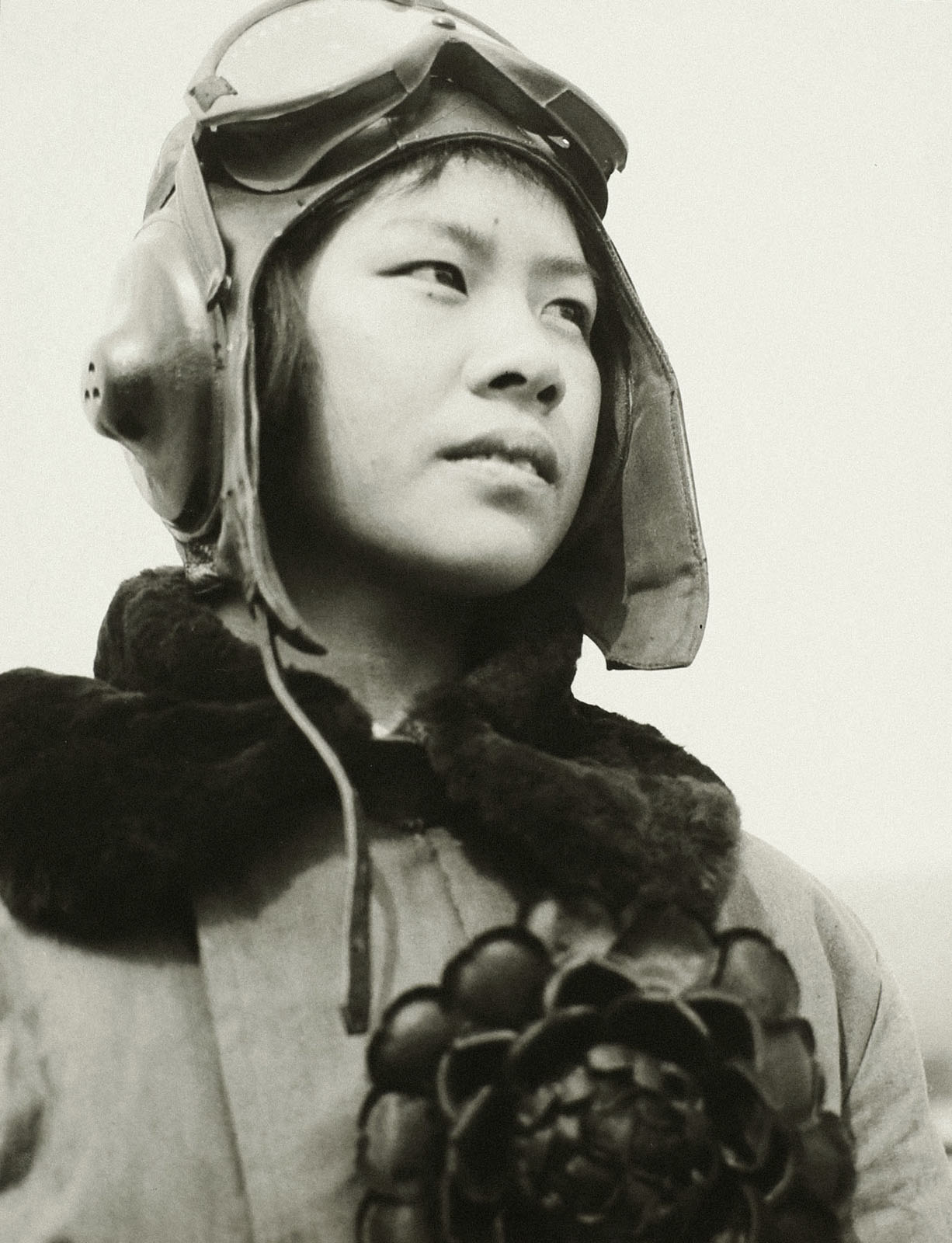
 

Niu Weiyu (Chinese, b. 1927) 'Female Pilot' 1952, printed 1988


Niu Weiyu (Chinese, b. 1927)
Female Pilot
1952, printed 1988
Gelatin silver print
Image: 43.8 x 33cm (17 1/4 x 13 in.)
Frame: 60.96 x 50.8cm (24 x 20 in.)
Frame (outer): 63.5 x 53.34cm (25 x 21 in.)
Gao Fan & Niu Weiyu Foundation


Shu Ye (Chinese) 'Niu Weiyu with Camera' c. 1960


Shu Ye (Chinese)
Niu Weiyu with Camera
c. 1960
Gelatin silver print
Image: 15.4 x 7.1 cm (6 1/16 x 2 13/16 in.)
Mount: 25.4 x 12.8 cm (10 x 5 1/16 in.)
Frame: 45.72 x 35.56 cm (18 x 14 in.)
Frame (outer): 48.26 x 38.1 cm (19 x 15 in.)
Gao Fan & Niu Weiyu Foundation
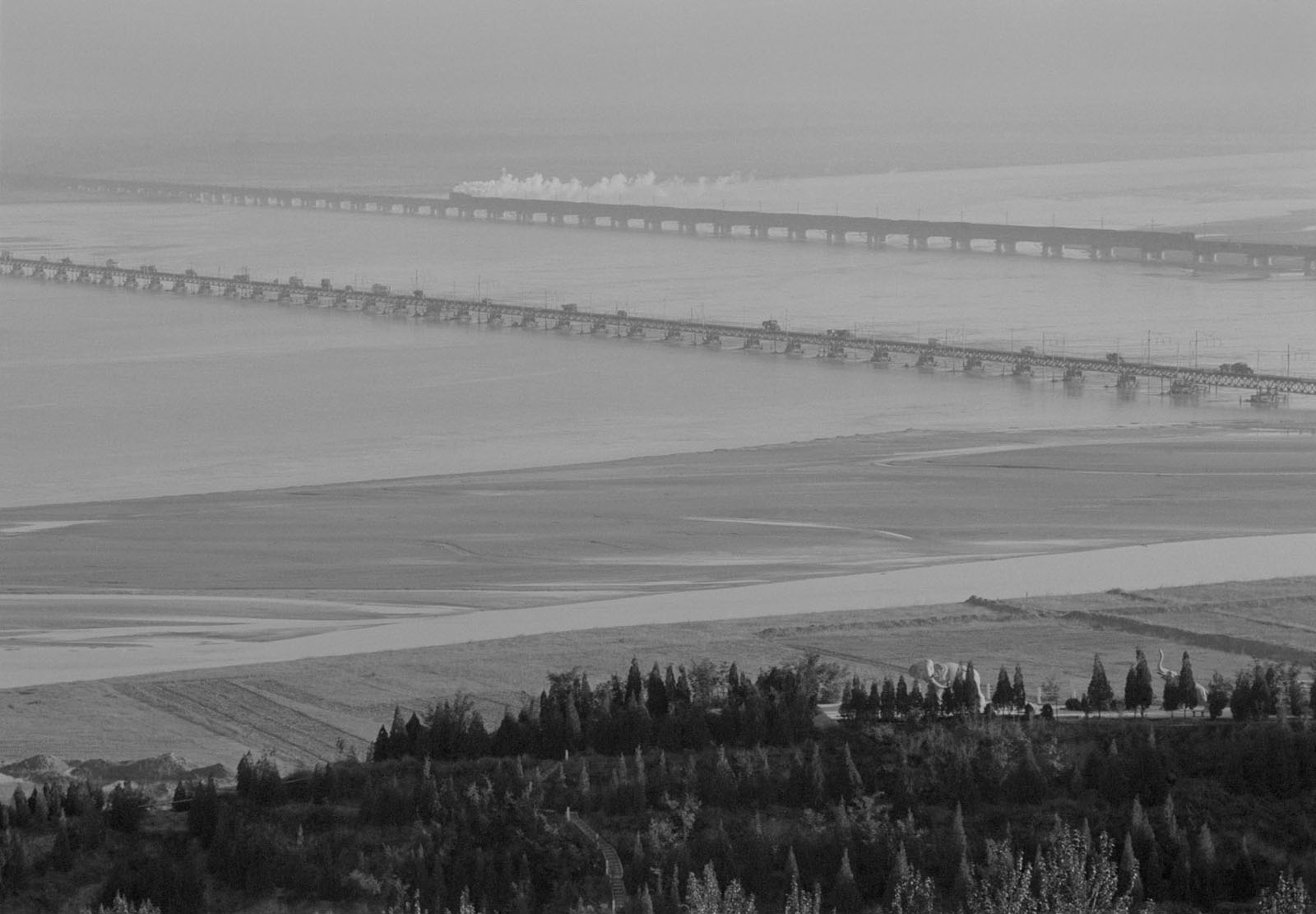
 

Niu Weiyu (Chinese, b. 1927) 'Train, Bridge, Highway, and Elephant' 1950s, printed later


Niu Weiyu (Chinese, b. 1927)
Train, Bridge, Highway, and Elephant
1950s, printed later
Gelatin silver print
Image: 38.8 x 55.9cm (15 1/4 x 22 in.)
Sheet: 50.8 x 60.9cm (20 x 24 in.)
Frame: 50.8 x 60.9cm (20 x 24 in.)
Gao Fan & Niu Weiyu Foundation


Niu Weiyu (Chinese, b. 1927) 'The First Beginning of Spring After Liberation, an International Women's Day Celebration in front of the Temple of the Forbidden City' 1949, printed 2017


Niu Weiyu (Chinese, b. 1927)
The First Beginning of Spring After Liberation, an International Women’s Day Celebration in front of the Temple of the Forbidden City
1949, printed 2017
Gelatin and silver bromide printing
National Art Museum Collection of China
Courtesy National Gallery of Art, Washington


Behind the Camera

Women actively participated in the development of photography soon after its inception in the 19th century. Yet it was in the 1920s, after the seismic disruptions of World War I, that women entered the field of photography in force. Aided by advances in technology and mass communications, along with growing access to training and acceptance of their presence in the workplace, women around the world made an indelible mark on the growth and diversification of the medium. They brought innovation to a range of photographic disciplines, from avant-garde experimentation and commercial studio practice to social documentary, photojournalism, ethnography, and the recording of sports, dance, and fashion.

The New Woman

A global phenomenon, the New Woman of the 1920s embodied an ideal of female empowerment based on real women making revolutionary changes in life and art. Her image – a woman with bobbed hair, stylish dress, and a confident stride – was a staple of newspapers and magazines first in Europe and the United States and soon in China, Japan, India, Australia, and elsewhere. A symbol of the pursuit of liberation from traditional gender roles, the New Woman in her many guises represented women who faced a mix of opportunities and obstacles that varied from country to country. The camera became a powerful means for female photographers to assert their self-determination and redefine their position in society. Producing compelling portraits, including self-portraits featuring the artist with her camera, they established their roles as professionals and artists.

The Studio

Commercial studio photography was an important pathway for many women to forge a professional career and to earn their own income. Running successful businesses in small towns and major cities from Buenos Aires to Berlin and Istanbul, women reinvigorated the genre of portraiture. In the studio, both sitters and photographers navigated gender, race, and cultural difference; those run by women presented a different dynamic. For example, Black women operated studios in Chicago, New Orleans, and elsewhere in the United States, where they not only preserved likenesses and memories, but also constructed a counter narrative to racist images then circulating in the mass media.

The City

The availability of smaller, lightweight cameras and the increasing freedom to move about cities on their own spurred a number of women photographers to explore the diversity of the urban experience beyond the studio walls. Using their creative vision to capture the vibrant modern world around them, women living and working in Bombay (now Mumbai), London, New York, Paris, São Paulo, Tokyo, and beyond photographed soaring architecture and spontaneous encounters on the street.

Avant-Garde Experiments

Creative formal approaches – photomontage, photograms, sharp contrasts of light and shadow, unconventional cropping, extreme close-ups, and dizzying camera angles – came to define photography during this period. Women incorporated these cutting-edge techniques to produce works that conveyed the movement and energy of modern life. Although often overshadowed by their male partners and colleagues, women photographers were integral in shaping an avant-garde visual language that promoted new ways of seeing and experiencing the world.

Modern Bodies

Beginning in the 1920s, new concepts concerning health and sexuality, along with changing attitudes about movement and dress, emphasised the human body as a central site of experiencing modernity. Women photographers produced incisive visions of liberated modern bodies, from pioneering photographs of the nude to exuberant pictures of sport and dance. Photographs of joyous play and gymnastic exercise, as well as images of dancers in motion, celebrate the body as artistic medium.

Ethnographic Approaches

During this modern period, numerous women pursued professional photographic careers and traveled extensively for the first time. Many took photographs that documented their experiences abroad in Africa, China, Afghanistan, and elsewhere, while others engaged in more formal ethnographic projects. Some women with access to domains that were off limits to their male counterparts produced intimate portraits of female subjects. While gender may have afforded these photographers special connections to certain communities, it did not exempt some, especially those from Europe and the United States, from producing stereotypical views that reinforced hierarchical concepts of race and ethnocentrism.

Fashion and Advertising

Images splashed across the pages of popular fashion and lifestyle magazines vividly defined the New Woman. The unprecedented demand for fashion and advertising photographs between the world wars provided exceptional employment opportunities for fashion reporters, models, and photographers alike, allowing women to emerge as active agents in the profession. Cultivating the tastes of newly empowered female consumers, fashion and advertising photography provided a space where women could experiment with pictures intended for a predominantly female readership.

Social Documentary

Galvanised by the effects of a global economic crisis and the growing political and social unrest that began in the 1930s, numerous women photographers produced arresting images of the human condition. Whether working for government agencies or independently, women contributed to the visual record of the Depression and the events leading up to World War II. From images of breadlines and worker demonstrations to forced migration and internment, women photographers helped to expose dire conditions and shaped what would become known as social documentary photography.

Reportage

The rise of the picture press established photojournalism as a dominant form of visual expression during a period shaped by two world wars. Women photographers conveyed an inclusive view of worldwide economic depression, struggles for decolonisation in Africa, and the rise of fascism and communism in Europe and the Soviet Union. They often received the “soft assignments” of photographing women and children, families, and the home front, but some women risked their lives close to the front lines. Images of concentration camps and victory parades made way for the complexities of the postwar era, as seen in pictures of daily life in US-occupied Japan and the newly formed People’s Republic of China.

The photographers whose works are in The New Woman Behind the Camera represent just some of the many women around the world who were at the forefront of experimenting with the camera. They produced invaluable visual testimony that reflected both their personal experiences and the extraordinary social and political transformations of the early 20th century. Together, they changed the history of modern photography.

Text from the National Gallery of Art website
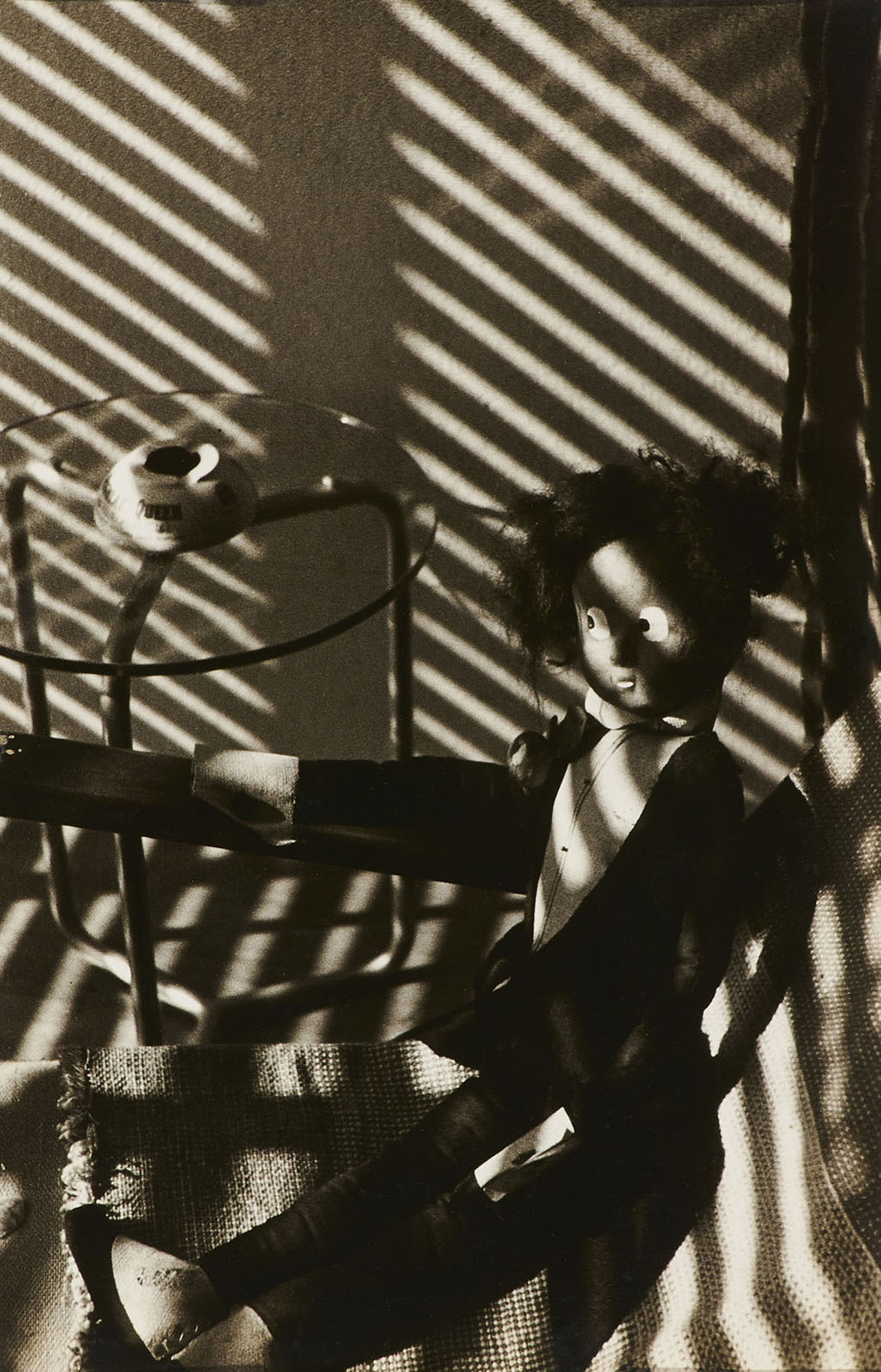
 

Nobuko Tsuchiura (Japanese, 1900-1998) 'Untitled (A doll)' c. 1938


Nobuko Tsuchiura (Japanese, 1900-1998)
Untitled (A doll)
c. 1938
Gelatin silver print
Image: 21.8 x 14.3cm (8 9/16 x 5 5/8 in.)
Frame: 54.5 x 42.5cm (21 7/16 x 16 3/4 in.)
Frame (outer): 56.3 x 44.1 x 2cm (22 3/16 x 17 3/8 x 13/16 in.)
The Shoto Museum of Art, Tokyo


Nobuko Tsuchiura (1900-1998) was the first woman architect in Japan.

The wife of architect Kameki Tsuchiura, also an architect, she trained with Frank Lloyd Wright. The couple worked with Wright on the Imperial Hotel. They returned to the United States with Wright and worked for him for two years as draftsmen. After their return to Japan in 1929, they established their own architectural firm. Besides designing homes, the firm also experimented with furniture design. However, her work was always presented under her husband’s name, not her own. In 1937, she founded the Ladies’ Photo Club; at the time, photography was considered to be a more appropriate activity for women than architecture.

Text from the Wikipedia website
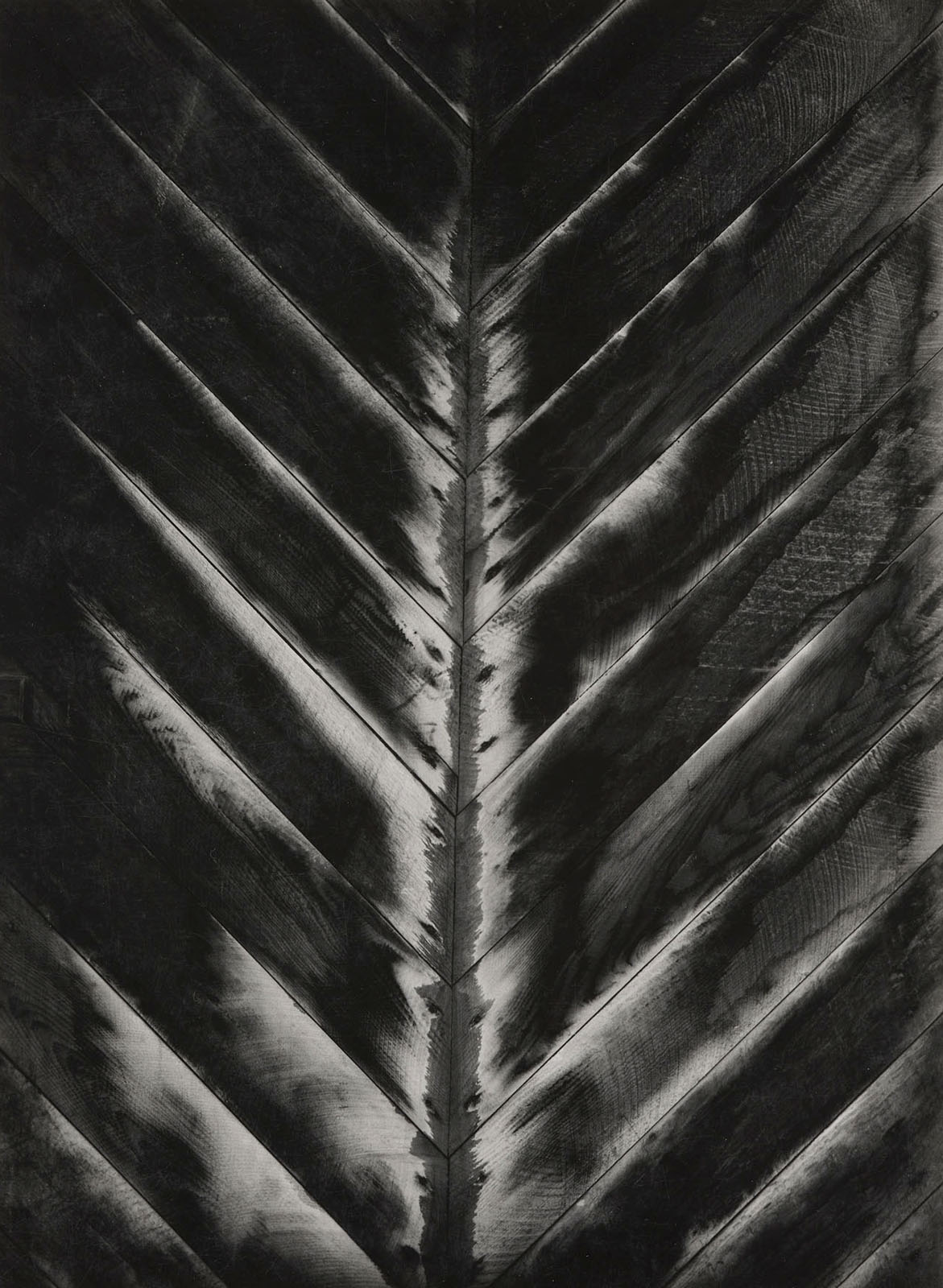
 

Sonya Noskowiak (American born Germany, 1900-1975) 'Ohne Titel' (Untitled) c. 1930


Sonya Noskowiak (American born Germany, 1900-1975)
Ohne Titel (Untitled)
c. 1930
Gelatin silver print
Image: 24.13 x 17.78cm (9 1/2 x 7 in.)
Frame: 50.8 x 40.64cm (20 x 16 in.)
Frame (outer): 53.34 x 43.18cm (21 x 17 in.)
Michael Mattis and Judith Hochberg


Sonya Noskowiak (American born Germany, 1900-1975)

Sonya Noskowiak (25 November 1900 – 28 April 1975) was a 20th-century German-American photographer and member of the San Francisco photography collective Group f/64 that included Ansel Adams and Edward Weston. She is considered an important figure in one of the great photographic movements of the twewntieth century. Throughout her career, Noskowiak photographed landscapes, still lifes, and portraits. Her most well-known, though unacknowledged, portraits are of the author John Steinbeck. In 1936, Noskowiak was awarded a prize at the annual exhibition of the San Francisco Society of Women Artists. She was also represented in the San Francisco Museum of Art’s “Scenes from San Francisco” exhibit in 1939. Ten years before her death, Noskowiak’s work was included in a WPA exhibition at the Oakland Museum in Oakland, California.

Read a fuller biography on the Wikipedia website


Tazue Sato Matsunaga (Japanese) 'Door' 1938-1939


Tazue Sato Matsunaga (Japanese)
Door
1938-1939
Gelatin silver print
Image: 28.8 x 22.5cm (11 5/16 x 8 7/8 in.)
Frame: 54.4 x 42.3cm (21 7/16 x 16 5/8 in.)
Frame (outer): 56.3 x 44.1 x 2cm (22 3/16 x 17 3/8 x 13/16 in.)
The Shoto Museum of Art, Tokyo


Thérèse Bonney (American, 1894-1978) 'Europe's Children' 1943


Thérèse Bonney (American, 1894-1978)
Europe’s Children
1943
Bound volume
Open: 29.85 x 44.45cm (11 3/4 x 17 1/2 in.)
Closed: 29.85 x 22.23cm (11 3/4 x 8 3/4 in.)
National Gallery of Art Library, David K.E. Bruce Fund


Thérèse Bonney (American, 1894-1978)

Thérèse Bonney (born Mabel Bonney, Syracuse, New York, July 15, 1894 – Paris, France, January 15, 1978) was an American photographer and publicist. Bonney was best known for her images taken during World War II on the Russian-Finnish front. Her war effort earned her the decoration of the Croix de guerre in May 1941, and one of the five degrees the Légion d’honneur. She published several photo-essays, and was the subject of the 1944 True Comics issue “Photo-fighter”.

Career

Beginning in 1925, she thoroughly documented the French decorative arts through photography. At this time, most of the photographs were not taken by Bonney herself, but rather gathered from sources such as the collections of fellow photographers, photo agencies, architects, designers, stores, and various establishments. An ardent self-publicist, Bonney acquired the images directly from the Salon exhibitions, stores, manufacturers, architects, and designers of furniture, ceramics, jewellery, and other applied arts as well as architecture. She sold the photographic prints to various client-subscribers primarily in the U.S. (a small-effort precursor to today’s illustrated news agency) and charged fees for reproduction rights in a more traditional manner. She typed captions and glued them to the backs of the photographic prints. These photographs, sometimes garnered without permissions, were widely published – both with and without published credits.

She attended the 1930 “Stockholmsutstäliningen” (Stockholm Exhibition) and gathered photographs there. While in the Netherlands, she collected images of contemporary Dutch architecture.

After her decade-and-a-half activities in publicity and the photography of the decorative arts and architecture by others, Bonney took up photography herself and became a photojournalist. Her concerns with the ravages caused by World War II informed her images, which focused on civilians. Her early photographs focused at first on the individuals at the Russian-Finnish front. For her documentation of this demographic, she was granted the Order of the White Rose of Finland medal for bravery. She also traveled through western Europe during the war, taking photographs of children in dire conditions. A collection of the images were shown at The Museum of Modern Art in New York City in 1940 and later published in her 1943 book Europe’s Children. Other activities included serving with the Croix-rouge (French International Red Cross).

Text from the Wikipedia website


Tina Modotti (American born Italy, 1896-1942) 'Campesinos (Farm Labourers) or Workers Parade' 1926


Tina Modotti (American born Italy, 1896-1942)
Campesinos (Farm Labourers) or Workers Parade
1926
Gelatin silver print
Image: 21.43 x 18.57cm (8 7/16 x 7 5/16 in.)
Mat: 50.8 x 40.64cm (20 x 16 in.)
Frame: 50.8 x 40.64cm (20 x 16 in.)
Frame (outer): 53.34 x 43.18cm (21 x 17 in.)
Daniel Greenberg and Susan Steinhauser


Tina Modotti (American born Italy, 1896-1942)

Tina Modotti (born Assunta Adelaide Luigia Modotti Mondini, August 16/17, 1896 – January 5, 1942) was an Italian American photographer, model, actor, and revolutionary political activist for the Comintern. She left Italy in 1913 and moved to the USA, where she worked as a model and subsequently as a photographer. In 1922 she moved to Mexico, where she became an active Communist. …

Photography career

As a young girl in Italy her uncle, Pietro Modotti, maintained a photography studio. Later in the U.S., her father briefly ran a similar studio in San Francisco. While in Los Angeles, she met the photographer Edward Weston and his creative partner Margrethe Mather. It was through her relationship with Weston that Modotti developed as an important fine art photographer and documentarian. By 1921, Modotti was Weston’s lover. Ricardo Gómez Robelo became the head of Mexico’s Ministry of Education’s Fine Arts Department, and persuaded Robo to come to Mexico with a promise of a job and a studio.

Robo left for Mexico in December 1921. Perhaps unaware of his affair with Modotti, Robo took with him prints of Weston’s, hoping to mount an exhibition of his and Weston’s work in Mexico. While she was on her way to be with Robo, Modotti received word of his death from smallpox on February 9, 1922. Devastated, she arrived two days after his death. In March 1922, determined to see Robo’s vision realised, she mounted a two-week exhibition of Robo’s and Weston’s work at the National Academy of Fine Arts in Mexico City. She sustained a second loss with the death of her father, which forced her to return to San Francisco later in March 1922. In 1923, Modotti returned to Mexico City with Weston and his son Chandler, leaving behind Weston’s wife Flora and their youngest three children. She agreed to run Weston’s studio free of charge in return for his mentoring her in photography.

Together they opened a portrait studio in Mexico City. Modotti and Weston quickly gravitated toward the capital’s bohemian scene and used their connections to create an expanding portrait business. Together they found a community of cultural and political “avant-gardists”, which included Frida Kahlo, Lupe Marín, Diego Rivera, and Jean Charlot. In general, Weston was moved by the landscape and folk art of Mexico to create abstract works, while Modotti was more captivated by the people of Mexico and blended this human interest with a modernist aesthetic. Modotti also became the photographer of choice for the blossoming Mexican mural movement, documenting the works of José Clemente Orozco and Diego Rivera. Between 1924 and 1928, Modotti took hundreds of photographs of Rivera’s murals at the Secretariat of Public Education in Mexico City. Modotti’s visual vocabulary matured during this period, such as her formal experiments with architectural interiors, blooming flowers, urban landscapes, and especially in her many beautiful images of peasants and workers during the depression. In 1926, Modotti and Weston were commissioned by Anita Brenner to travel around Mexico and take photographs for what would become her influential book Idols Behind Altars. The relative contributions of Modotti and Weston to the project has been debated. Weston’s son Brett, who accompanied the two on the project, indicated that the photographs were taken by Edward Weston.

In 1925, Modotti joined International Red Aid, a Communist organisation. In November 1926, Weston left Mexico and returned to California. During this time Modotti met several political radicals and Communists, including three Mexican Communist Party leaders who would all eventually become romantically linked with her: Xavier Guerrero, Julio Antonio Mella, and Vittorio Vidali.

Starting in 1927, a much more politically active Modotti (she joined the Mexican Communist Party that year) found her focus shifting and more of her work becoming politically motivated. Around that time her photographs began appearing in publications such as Mexican Folkways, Forma, and the more radically motivated El Machete, the German Communist Party’s Arbeiter-Illustrierte-Zeitung (AIZ), and New Masses.

Mexican photographer Manuel Álvarez Bravo divided Modotti’s career as a photographer into two distinct categories: “Romantic” and “Revolutionary”, with the former period including her time spent as Weston’s darkroom assistant, office manager and, finally, creative partner. Her later works were the focus of her one-woman retrospective exhibition at the National Library in December 1929, which was advertised as “The First Revolutionary Photographic Exhibition In Mexico”.

Read a fuller biography on the Wikipedia website
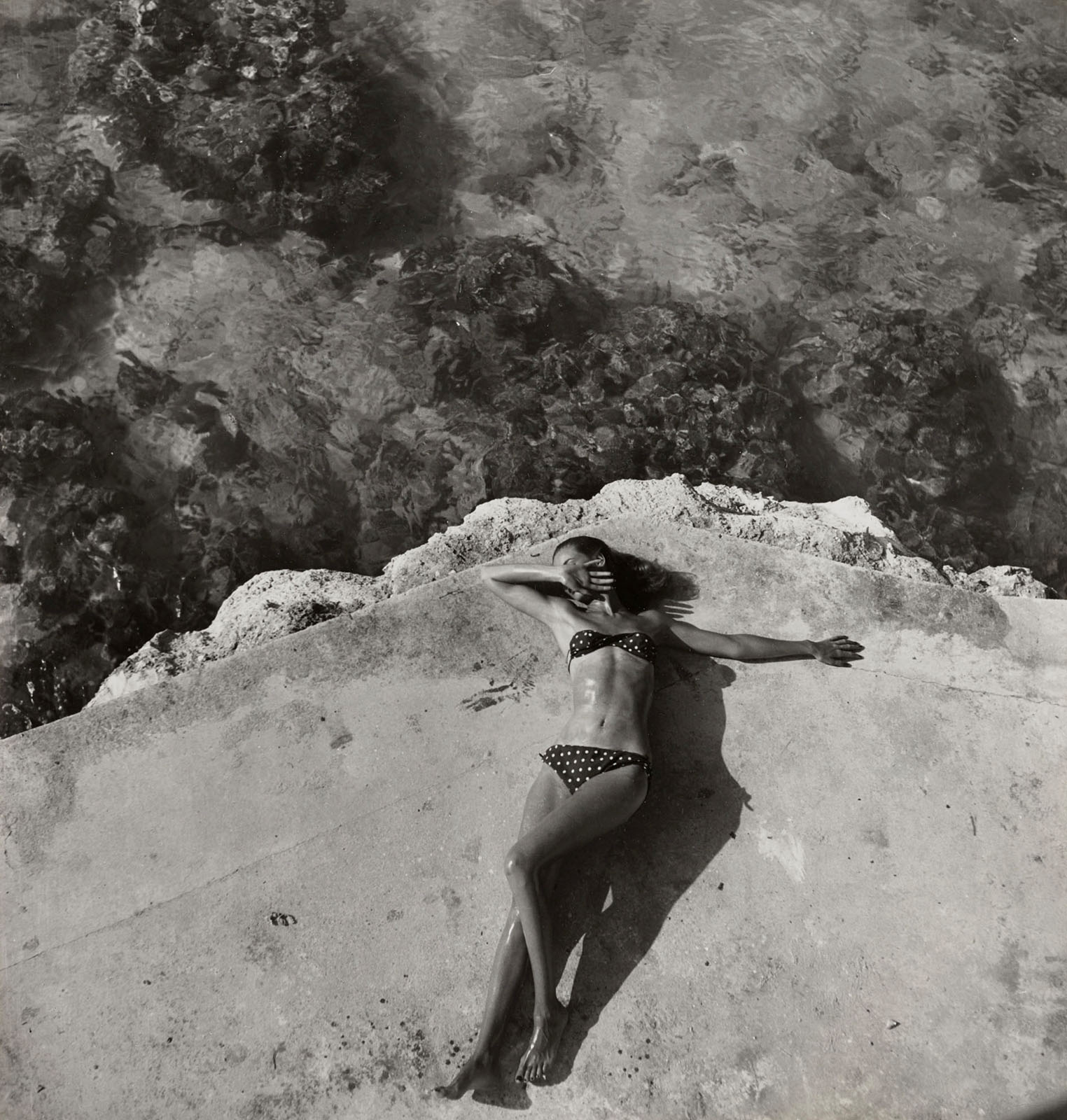
 

Toni Frissell (American, 1907-1988) 'Untitled (Model Natalie Nickerson Paine wearing a bikini, Montego Bay, Jamaica)' 1946


Toni Frissell (American, 1907-1988)
Untitled (Model Natalie Nickerson Paine wearing a bikini, Montego Bay, Jamaica)
1946
Gelatin silver print
Sheet: 27.2 x 26cm (10 11/16 x 10 1/4 in.)
Mat: 50.8 x 40.64cm (20 x 16 in.)
Frame: 50.8 x 40.64cm (20 x 16 in.)
Frame (outer): 53.34 x 43.18cm (21 x 17 in.)
Toni Frissell Collection, Prints and Photographs Division, Library of Congress, Washington, D.C.


Toni Frissell (American, 1907-1988)

Antoinette Frissell Bacon (March 10, 1907 – April 17, 1988), known as Toni Frissell, was an American photographer, known for her fashion photography, World War II photographs, and portraits of famous Americans, Europeans, children, and women from all walks of life. …

World War II

In 1941, Frissell volunteered her photographic services to the American Red Cross. Later she worked for the Eighth Army Air Force and became the official photographer of the Women’s Army Corps. On their behalf, she took thousands of images of nurses, front-line soldiers, WACs, African-American airmen, and orphaned children.

She travelled to the European front twice. Her first picture to be published in Life magazine was of bombed out London in 1942. Her moving photographs of military women and African American fighter pilots in the elite 332d Fighter Group (the “Tuskegee Airmen”) were used to encourage public support for women and African Americans in the military.

During the War she produced a series of photographs of children that were used in an edition of Robert Louis Stevenson’s much-published A child’s garden of verses which were an early example of the successful use of photography in illustration of children’s literature.

Read a fuller biography on the Wikipedia website
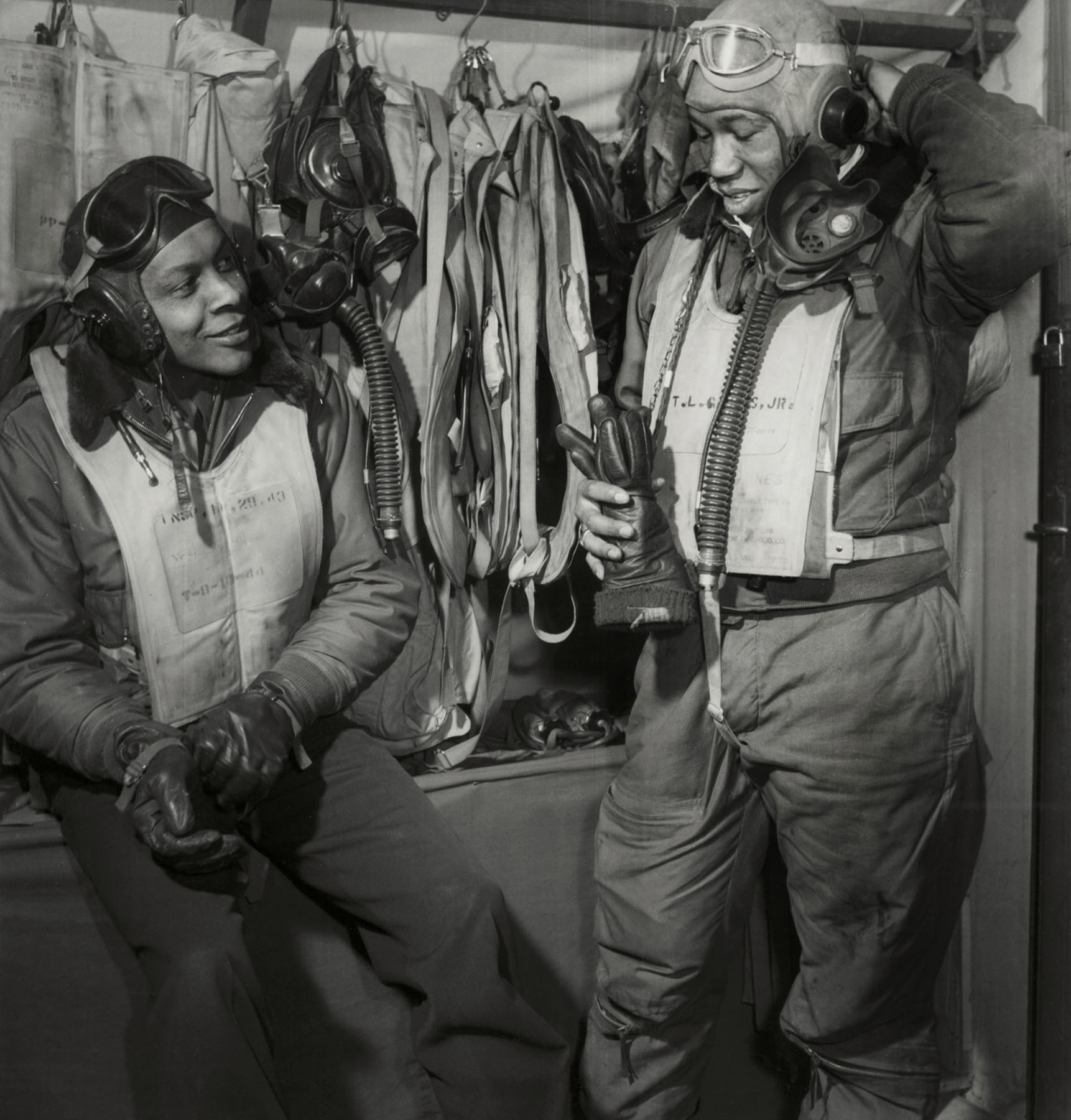
 

Toni Frissell (American, 1907-1988) 'Untitled (William A. Campbell and Thurston L. Gaines, Jr., members of the 332nd Fighter Group in Ramitelli, Italy, March 1945)' 1945


Toni Frissell (American, 1907-1988)
Untitled (William A. Campbell and Thurston L. Gaines, Jr., members of the 332nd Fighter Group in Ramitelli, Italy, March 1945)
1945
Gelatin silver print
Sheet: 35.5 x 28.4cm (14 x 11 3/16 in.)
Mat: 50.8 x 40.64cm (20 x 16 in.)
Frame: 50.8 x 40.64cm (20 x 16 in.)
Frame (outer): 53.34 x 43.18cm (21 x 17 in.)
Toni Frissell Collection, Prints and Photographs Division, Library of Congress, Washington, D.C.


National Gallery of Art
National Mall between 3rd and 7th Streets
Constitution Avenue NW, Washington

Opening hours:
Daily 10am – 5pm

National Gallery of Art website

LIKE ART BLART ON FACEBOOK

Back to top

Exhibition: ‘In Focus: Protest’ at the J. Paul Getty Museum, Los Angeles

Exhibition dates: 29th June – 10th October, 2021

Curator: Mazie Harris


David Wojnarowicz in 1988 wearing the "If I Die of AIDS" jacket


David Wojnarowicz in 1988
Please note, this photograph is not in the exhibition


Speaking up when others are silent

This one-room exhibition seems like a missed opportunity.

I note the observation of Anne Wallentine: “In Focus: Protest, a one-room exhibition at the Getty Center, focuses on palatable images of protest. There are no disturbing images of the police’s violent attacks on protesters during the June 2020 Black Lives Matter protests, for example, or of self-immolations protesting the Vietnam War. On the one hand, we don’t need to see violence to understand injustice. But this subject deserves a much deeper and broader show to explore the important power dynamics of protest – and of documenting it – than the Getty’s somewhat muddled march through the lowlights of American history.”1

Although I haven’t seen the exhibition I have been able to gather together numerous photographs from installation shots of the show. The exhibition focuses heavily on the civil rights photographs of the 1960s with sporadic abortion, women’s lib, Vietnam War, contemporary Black Lives Matter and metaphorical images standing in for actual protest photographs (such as the photographs of Robert Frank). As Wallentine observes, the subject deserves a much deeper and broader show to explore the important power dynamics of protest, and of documenting it.

America has a long history of protest stretching back to its very beginning, such as the Boston Tea Party in 1773. But thinking about the photography of protest in America – where are the cartes de visit of slavery abolitionists such as Sojourner Truth or Frederick Douglass, the photographs of protests for women’s suffrage, after the Stonewall Riots, against the lack of funding for HIV/AIDS, for gun legislation, photographs of protests for Native American enfranchisement, marches for equal rights, anti-nuclear protests, Iraq War protests, climate change protests, and the worldwide Occupy movement?

What are issues and the politics involved with documenting protest, both for an against, as an expression of the photographers own beliefs? How does the presence of photographers affect how people “play up” to the camera? Does the photographer participate in the protest or stand aside and just document? How is documenting a form of protest in itself? How are these images then made propaganda and to what ends? What is the difference between the vernacular photography of protest and that of a professional photojournalist? How are both disseminated and what is the difference of this impact?

How is the framing of protest photography undertaken in a system – and here I am thinking, for example, of the selective cropping, editing and addition of text in photo essays by professional photographers such as Gordon Parks for Life magazine – and how do we, as viewers, recognise that the systems in which the works are viewed often obscure the networks in which they are created and operate… that is, structures that sit around those pictures re/presentation in galleries or newspapers, journals.

Essentially, in the power of the image, what lies in and beyond the frame of reference – in terms of the technologies of production, technologies of sign systems, technologies of power and technologies of the self2 – has an “affect” upon the reception and interpretation of images, their inculcation in memory through repetition, their performativity, their intertextuality and their promulgation in the world as acts of resistance and freedom, both from the point of view of the photographer and the viewer.

The one image that is my favourite protest photograph “of all time” can be seen above. To my knowledge, this photograph is not included in the exhibition. Taken by an anonymous photographer in 1988 it shows an anonymous man at a protest rally (evidenced by the placard in the background top right) wearing a jacket emblazoned with words in white capital letters “IF I DIE OF AIDS – FORGET BURIAL – JUST DROP MY BODY ON THE STEPS OF THE F.D.A” over the pink triangle, symbol of homosexuals in the Nazi concentration camps later reclaimed as a positive symbol of self-identity for various LGBTQ identities. The F.D.A. referred to is the United States Food and Drug Administration which is responsible for protecting the public health by ensuring the safety, efficacy, and security of human and veterinary drugs and biological products… at the time dragging their feet over AIDS research.

The anonymous man is, in fact, American artist and activist David Wojnarowicz who died at the age of 37 in 1992, four years after the photograph was taken, of AIDS-related complications.

“… during the plague years, he watched his best friends die horribly, while religious leaders pontificated against safe-sex education and politicians mooted quarantine on islands.

It filled him with rage, the brutality and the waste. He writes: “I want to throw up because we’re supposed to quietly and politely make house in this killing machine called America and pay taxes to support our own slow murder, and I’m amazed that we’re not running amok in the streets and that we can still be capable of gestures of loving after lifetimes of all this.” …

“It is exhausting, living in a population where people don’t speak up if what they witness doesn’t directly threaten them,” he writes. Long before the word intersectionality was in common currency, Wojnarowicz was alert to people whose experience was erased by what he called “the pre‑invented world” or “the one-tribe nation”. Politicised by his own sexuality, by the violence and deprivation he had been subjected to, he developed a deep empathy with others, a passionate investment in diversity. During the course of Close to the Knives he touches repeatedly on other struggles, from fighting police brutality towards people of colour to standing up to the erosion of abortion rights. …

As the rallying cry of Aids activists made clear, “Silence = Death”. From the very beginning of his life Wojnarowicz had been subjected to an enforced silencing, first by his father and then by the society he inhabited: the media that erased him; the courts that legislated against him; and the politicians who considered his life and the lives of those he loved expendable.

In Knives he repeatedly explains his motivation for making art as an acute desire to produce objects that could speak, testifying to his presence when he no longer could. “To place an object or piece of writing that contains what is invisible because of legislation or social taboo into an environment outside myself makes me feel not so alone,” he writes. “It is kind of like a ventriloquist’s dummy – the only difference is that the work can speak by itself or act like that magnet to attract others who carried this enforced silence.””3


The jacket that he made and the photograph of it form an intertextual art work, one both (physically) sculptural and photographic, objects that could visibly speak in the world by transgressing the taboo of invisibility, of silence. The photograph was taken by an anonymous photographer of an initially (to the viewer) anonymous man. It then proceeds to transcend its subject … through the projection of the voice of the artist through time, through the knowledge of the story of his own vitality and resistance, now his absence/presence. His protest stands “in eternity” where there is no time. Standing with others, speaking up when others are silent. That is the essence of protest. I just wonder where that jacket is now?
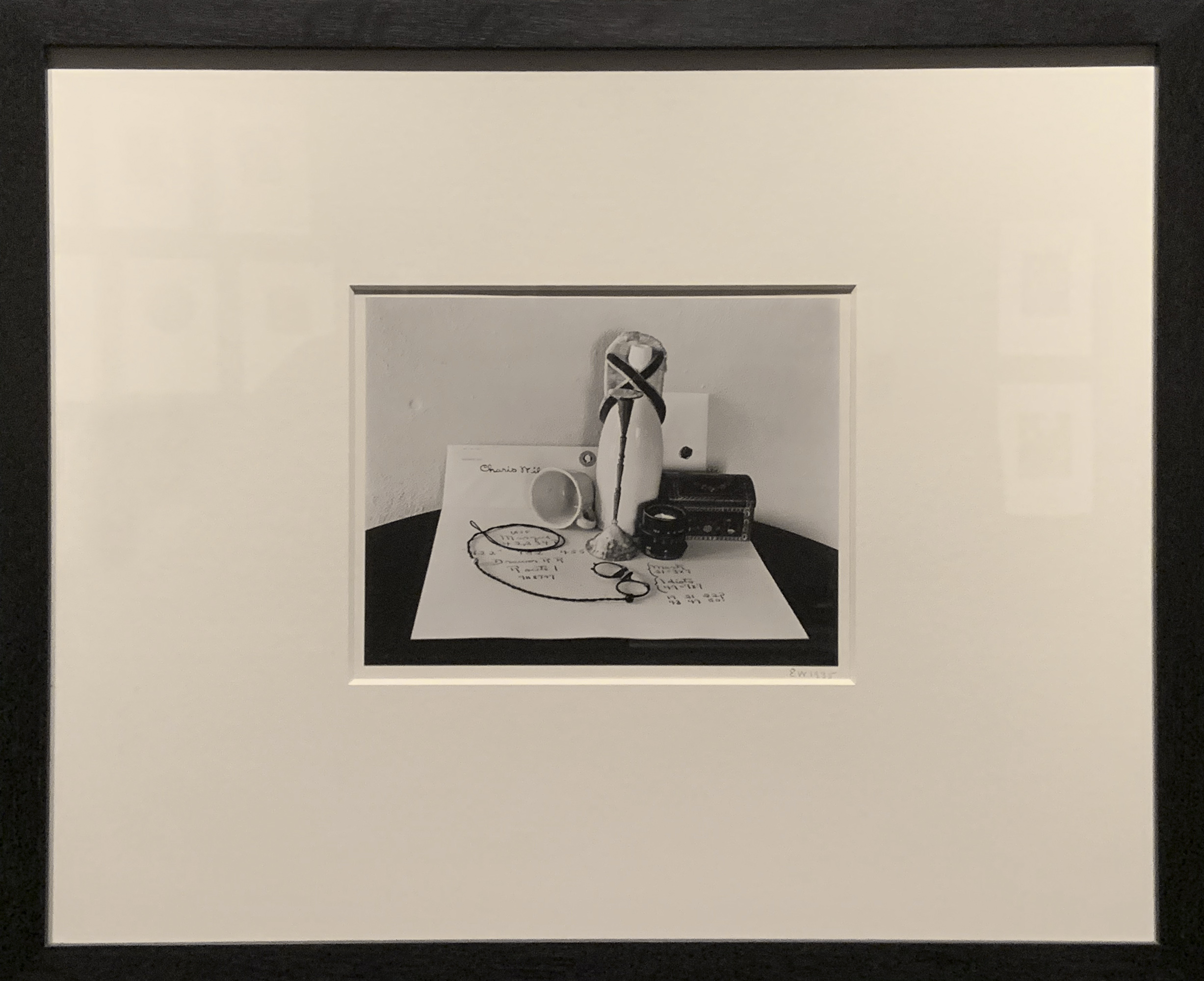
Dr Marcus Bunyan


Footnotes

1/ Anne Wallentine. “A History of Protest Photography That Plays It Too Safe,” on the Hyperallergic website August 18, 2021 [Online] Cited 12/09/2021

2/ Michel Foucault, “Technologies of the Self,” quoted in Luther Martin, Huck Gutman, Patrick Hutton (eds.). Technologies of the Self: A Seminar with Michel Foucault. Tavistock Publications, London, 1988, p. 18.

3/ Olivia Laing. “David Wojnarowicz: still fighting prejudice 24 years after his death,” on the Guardian website, Friday 13 May 2016 [Online] Cited 12/09/2021


Many thankx to the J. Paul Getty Museum for allowing me to publish the photographs in the posting. Please click on the photographs for a larger version of the image.


We are reminded frequently of the power of photographs to propel action and inspire change. During demonstrations photographers take to the streets to record fast-moving events. At other times they bear witness to daily injustices, helping to make them more widely known. This exhibition of images made during periods of social struggle in the United States highlights the myriad roles protest photographs play in shaping our understanding of American life.


In Focus: Protest, a one-room exhibition at the Getty Center, focuses on palatable images of protest. There are no disturbing images of the police’s violent attacks on protesters during the June 2020 Black Lives Matter protests, for example, or of self-immolations protesting the Vietnam War. On the one hand, we don’t need to see violence to understand injustice. But this subject deserves a much deeper and broader show to explore the important power dynamics of protest – and of documenting it – than the Getty’s somewhat muddled march through the lowlights of American history. …

… depicting individuals carries new risks now. Contemporary protest photographers have to navigate the dangers of photo recognition technology for their subjects – notably, Kris Graves’s 2020 photo depicts a luminous memorial to George Floyd projected and graffitied onto a Confederate statue, rather than an image of identifiable marchers [see below]. At the very least, the issue deserves mention in the wall text to contextualize current photography amid this threat to human rights and the tricky role photographers have to navigate while recording and participating in protests. Documenting can be a form of protest, but it can be used against its subjects, too. The exhibition text, however, tends to swerve away from engaging with the complexities of history, mentioning the passage of the 19th Amendment and Voting Rights Act 1965 without referencing the continued struggles to ensure voting access in marginalized communities. It does provide images of counter-protest during the Vietnam War and women’s liberation movement of the 1970s, but these only sharpen the desire for a better understanding of the ebb and flow of human rights efforts into the present.


Anne Wallentine. “A History of Protest Photography That Plays It Too Safe,” on the Hyperallergic website August 18, 2021 [Online] Cited 12/09/2021


Underwood & Underwood (American, founded 1881, dissolved 1940s) '[Women's Campaign Train for Hughes]' 1916 from the exhibition 'In Focus: Protest' at the J. Paul Getty Museum, Los Angeles, June - Oct, 2021


Underwood & Underwood (American, founded 1881, dissolved 1940s)
[Women’s Campaign Train for Hughes]
1916
Gelatin silver print
18.7 × 24.9cm (7 3/8 × 9 13/16 in.)
The J. Paul Getty Museum, Los Angeles


Adger Cowans (American, b. 1936) 'Malcolm X Speaks at a Rally in Harlem at 115th St. & Lennox Ave., New York' September 7, 1963 from the exhibition 'In Focus: Protest' at the J. Paul Getty Museum, Los Angeles, June - Oct, 2021


Adger Cowans (American, b. 1936)
Malcolm X Speaks at a Rally in Harlem at 115th St. & Lennox Ave., New York
September 7, 1963
Gelatin silver print
16.2 × 23.5cm (6 3/8 × 9 1/4 in.)
The J. Paul Getty Museum, Los Angeles
© Adger Cowans


Bruce Davidson (American, born 1933) 'Birmingham, Alabama' Negative 1963; print 1970-1979


Bruce Davidson (American, born 1933)
Birmingham, Alabama
Negative 1963; print 1970-1979
Gelatin silver print
19.9 × 31.1 cm (7 13/16 × 12 1/4 in.)
The J. Paul Getty Museum, Los Angeles
© Bruce Davidson/Magnum Photos


An African-American woman is arrested by two Caucasian police officers, each holding her by her arms. In the background is a theatre marquee, bearing the signs for the movies, “Back Street” and “Damn the Defiant.”


Leonard Freed (American, 1929-2006) 'March on Washington, Washington, D.C.' August 28, 1963


Leonard Freed (American, 1929-2006)
March on Washington, Washington, D.C.
August 28, 1963
Gelatin silver print
26.5 × 38.7cm (10 7/16 × 15 1/4 in.)
The J. Paul Getty Museum, Los Angeles
© Leonard Freed / Magnum Photos


Robert (Bob) Adelman (American, 1930-2016) 'Washington, D.C., Cheering crowd during speeches at historic March on Washington' 1963


Robert (Bob) Adelman (American, 1930-2016)
Washington, D.C., Cheering crowd during speeches at historic March on Washington
1963
Gelatin silver print
27.9 × 35.6cm (11 × 14 in.)
The J. Paul Getty Museum, Los Angeles
© Bob Adelman/Magnum Photos


Bruce Davidson (American, b. 1933) 'March from Selma, Alabama' Negative 1965; printed later


Bruce Davidson (American, b. 1933)
March from Selma, Alabama
Negative 1965; printed later
Gelatin silver print
21.7 × 32.8cm (8 9/16 × 12 15/16 in.)
The J. Paul Getty Museum, Los Angeles
© Bruce Davidson/Magnum Photos


Photographs not only capture a nation’s values and beliefs but also help shape them. Camera in hand, photographers often take to the streets, recording protests and demonstrations or bearing witness to daily injustices to make them more widely known. Such images have inspired change for generations.

The late United States Congressman John Lewis emphasised the crucial role photography played in the civil rights struggles of the 1960s. “The unbelievable photographs published in newspapers and magazines… brought people from around the globe to small Southern towns to join the movement,” he said. “These photographs told us that those who expressed themselves by standing in unmovable lines… must be looked upon as the found mothers and fathers of a new America.”

This exhibition highlights how photographers have recorded periods of social struggle and transformation in the United States. Amid the country’s current and ongoing efforts to address and rectify injustice and systemic racism, and as the United States continues to grapple with how best to forge a new and better future, these images help us consider the myriad roles photography plays in shaping our understanding of American life.

Wall text from the exhibition


Voting Rights Act 1965

Voting Rights Act, U.S. legislation (August 6, 1965) that aimed to overcome legal barriers at the state and local levels that prevented African Americans from exercising their right to vote under the Fifteenth Amendment (1870) to the Constitution of the United States. The act significantly widened the franchise and is considered among the most far-reaching pieces of civil rights legislation in U.S. history.

In the 1950s and early 1960s the U.S. Congress enacted laws to protect the right of African Americans to vote, but such legislation was only partially successful. In 1964 the Civil Rights Act was passed and the Twenty-fourth Amendment, abolishing poll taxes for voting for federal offices, was ratified, and the following year Pres. Lyndon B. Johnson called for the implementation of comprehensive federal legislation to protect voting rights. The resulting act, the Voting Rights Act, suspended literacy tests, provided for federal approval of proposed changes to voting laws or procedures (“preclearance”) in jurisdictions that had previously used tests to determine voter eligibility (these areas were covered under Sections 4 and 5 of the legislation), and directed the attorney general of the United States to challenge the use of poll taxes for state and local elections. An expansion of the law in the 1970s also protected voting rights for non-English-speaking U.S. citizens. Sections 4 and 5 were extended for 5 years in 1970, 7 years in 1975, and 25 years in both 1982 and 2006.

The Voting Rights Act resulted in a marked decrease in the voter registration disparity between white and Black people. In the mid-1960s, for example, the overall proportion of white to Black registration in the South ranged from about 2 to 1 to 3 to 1 (and about 10 to 1 in Mississippi); by the late 1980s racial variations in voter registration had largely disappeared. As the number of African American voters increased, so did the number of African American elected officials. In the mid-1960s there were about 70 African American elected officials in the South, but by the turn of the 21st century there were some 5,000, and the number of African American members of the U.S. Congress had increased from 6 to about 40. In what was widely perceived as a test case, Northwest Austin Municipal Utility District Number One v. Holder, et al. (2009), the Supreme Court declined to rule on the constitutionality of the Voting Rights Act. In Shelby County v. Holder (2013), however, the Court struck down Section 4 – which had established a formula for identifying jurisdictions that were required to obtain preclearance – declaring it to be unjustified in light of changed historical circumstances. Eight years later, in Brnovich v. Democratic National Committee (2021), the Court further weakened the Voting Rights Act by finding that the law’s Section 2(a) – which prohibited any voting standard or procedure that “results in a denial or abridgement of the right of any citizen of the United States to vote on account of race or color” – was not necessarily violated by voting restrictions that disproportionately burden members of racial minority groups.

The Editors of Encyclopaedia Britannica. “Voting Rights Act,” on the Britannica website last updated July 30, 2021 [Online] Cited 12/09/2021.


John Simmons (American, b. 1950) 'Unite or Perish, Chicago, Illinois' 1968


John Simmons (American, b. 1950)
Unite or Perish, Chicago, Illinois
1968
The J. Paul Getty Museum, Los Angeles
© John Simmons


Simmons began his career at 15 as a photographer for the oldest African American-owned newspaper, The Chicago Daily Defender in 1965. Over his decades long career, he’s photographed icons of the Civil Rights Movement, turbulent protests and demonstrations, famed musicians and poignant intimate moments of everyday life. “I’m glad to see photographs I took back in my teens are still relevant today,” he says. …

Two of Simmons’ photographs are featured in “In Focus: Protest,” “an exhibition featuring images made during periods of social struggle in the U.S. and highlighting the myriad roles protest photographs play in shaping our understanding of American life,” says Mazie Harris, assistant curator in the department of photographs at the J. Paul Getty Museum. “With this exhibition we aim to give visitors a place to think about some of the ways photographers have brought attention to efforts to address and rectify injustice.” …

“My position on protest is interesting,” says Simmons. “My father was much older than my mother and when Harriet Tubman died my father was around 12 or 13 so that puts me in close relationship to slavery and to people who were arounds slaves. My great grandmother saw Abraham Lincoln and my great aunt was babysat by former slaves. I picked up a camera in 1965, the first year African Americans were allowed to vote. That was behind those eyes the first day I pressed a shutter. So in reality, every photograph I take is a protest photo.”

John Simmons quoted in Steve Simmons. “Photographer John Simmons, ‘Chronicler Of The Civil Rights Movement,’​ Featured In Three Exhibits,” on the Linkedin website August 4, 2021 [Online] Cited 11/09/2021.


Robert Flora (American, 1929-1986) 'A Women's Liberation Marcher Is Temporarily Overwhelmed by a Group of Women Marching against the Women's Liberation Movement in Downtown Los Angeles' August 26, 1970


Robert Flora (American, 1929-1986)
A Women’s Liberation Marcher Is Temporarily Overwhelmed by a Group of Women Marching against the Women’s Liberation Movement in Downtown Los Angeles
August 26, 1970
Gelatin silver print with typed caption
The J. Paul Getty Museum, Los Angeles
Gift of the Flora Family
Reproduced with permission via Bettmann Archive/Getty Images


Bill Owens (American, born 1938) 'Untitled' early 1970s


Bill Owens (American, born 1938)
Untitled
early 1970s
Gelatin silver print
19.2 × 21.5cm (7 9/16 × 8 7/16 in.)
The J. Paul Getty Museum, Los Angeles
Gift of Robert Shimshak and Marion Brenner
© Bill Owens


Robert Mapplethorpe (American, 1946-1989) 'American Flag' 1977


Robert Mapplethorpe (American, 1946-1989)
American Flag
1977
Gelatin silver print
35.3 × 35.3cm (13 7/8 × 13 7/8 in.)
Jointly acquired by the J. Paul Getty Trust and the Los Angeles County Museum of Art, with funds provided by the J. Paul Getty Trust and the David Geffen Foundation
© Robert Mapplethorpe Foundation


“Mapplethorpe evoked the frayed character of American ideals during a period when equal rights for gay men and women in the United States seemed nearly unimaginable.”


The J. Paul Getty Museum presents In Focus: Protest, an exhibition featuring images made during periods of social struggle in the United States, and highlighting the myriad roles protest photographs play in shaping our understanding of American life. The exhibition is on view at the Getty Center Museum June 29 – October 10, 2021.

Photographs not only capture a nation’s values and beliefs but also help shape them. Camera in hand, photographers often take to the streets, recording protests and demonstrations or bearing witness to daily injustices to make them more widely known. Such images have inspired change for generations.

In Focus: Protest reminds us of the ability of photographs to both document and propel action,” says Mazie Harris, assistant curator of photographs at the Museum. “With this exhibition we aim to give visitors a place to think about some of the ways that photographers have brought attention to efforts to address and rectify injustice.” Among the works on view are images by well-known artists including Dorothea Lange (American, 1895-1965), Robert Mapplethorpe (American, 1946-1989), and L.A.-based cinematographer and artist John Simmons (American, born 1950). The exhibition also includes resonant images by photographers Robert Flora (American, 1929-1986), William James Warren (American, born 1942), An-My Lê (American, born 1960), and a 2020 photograph by Kris Graves (American, born 1982).

Press release from the J. Paul Getty Museum


Dorothea Lange (American, 1895-1965) 'Pledge of Allegiance, Raphael Weill Elementary School, San Francisco' Negative April 20, 1942; print about 1960s


Dorothea Lange (American, 1895-1965)
Pledge of Allegiance, Raphael Weill Elementary School, San Francisco
Negative April 20, 1942; print about 1960s
Gelatin silver print
34 × 25.6cm (13 3/8 × 10 1/16 in.)
The J. Paul Getty Museum, Los Angeles


Children’s symbol of hope and innocence can also be tied to their shielding from the “outside world”. Here we have a young Japanese girl reciting the American pledge of allegiance with much determination and passion, all while the United States government would take Japanese Americans into internment camps weeks later, following the bombing of Pearl Harbor.


Robert Frank. 'Trolley – New Orleans' 1955


Robert Frank (Swiss-American, 1924-2019)
Trolley – New Orleans
1955
Gelatin silver print
The J. Paul Getty Museum, Los Angeles


“America is an interesting country… but there is a lot here that I do not like and that I would never accept. I am also trying to show this in my photos.” ~ Robert Frank


Robert Frank (American, 1924-2019) 'Railway Station, Memphis, Tennessee' 1955


Robert Frank (Swiss-American, 1924-2019)
Railway Station, Memphis, Tennessee
1955
Gelatin silver print
The J. Paul Getty Museum, Los Angeles


Fred W. McDarrah (American, 1926-2007) 'Jose Rodriguez-Soltero Burned a Flag in a New York Happening' April 8, 1966


Fred W. McDarrah (American, 1926-2007)
Jose Rodriguez-Soltero Burned a Flag in a New York Happening
April 8, 1966
Gelatin silver print
34.8 × 25.8cm (13 11/16 × 10 3/16 in.)
The J. Paul Getty Museum, Los Angeles
© Estate of Fred W. McDarrah


William James Warren (American, b. 1942) 'Robert F. Kennedy and César Chávez Celebrate Mass as Chávez Breaks a Twenty-Five Day Fast, Delano, California' 1968


William James Warren (American, b. 1942)
Robert F. Kennedy and César Chávez Celebrate Mass as Chávez Breaks a Twenty-Five Day Fast, Delano, California
1968
Gelatin silver print
31.2 × 21.6cm (12 5/16 × 8 1/2 in.)
The J. Paul Getty Museum, Los Angeles, Gift of William James Warren
© William James Warren


Mary Ellen Mark (American, 1940-2015) 'Vietnam Pro Demonstration' 1968


Mary Ellen Mark (American, 1940-2015)
Vietnam Pro Demonstration
1968
Gelatin silver print
24.3 × 16.7cm (9 9/16 × 6 9/16 in.)
The J. Paul Getty Museum, Los Angeles
© Mary Ellen Mark Foundation


Louis Draper (American, 1935-2002) 'Fannie Lou Hamer, Mississippi' 1971


Louis Draper (American, 1935-2002)
Fannie Lou Hamer, Mississippi
1971
Gelatin silver print
22.86 × 15.56cm (9 × 6 1/8 in.)
The J. Paul Getty Museum, Los Angeles


In 1971 Essence magazine sent Draper on assignment to Mississippi to photograph civil rights activist Fannie Lou Hamer. This portrait appeared with the article “Fannie Lou Hamer Speaks Out,” in the October issue. Known for her fearlessness and strength in the midst of violence and intimidation, Hamer had been arrested and severely beaten by police in 1963 for her work on voter registration drives. She gained national attention when she returned to her activism in the mid-1960s, and this photograph visually distills her voice: “Today I don’t have any money, but I’m freer than the average white American ’cause I know who I am. I know what I’m about, and I know that I don’t have anything to be ashamed of.”

Anonymous text from the Virginia Museum of Fine Arts website


Anthony Friedkin (American, b. 1949) 'These Are the Thoughts that Set Fire to Your City' 1993


Anthony Friedkin (American, b. 1949)
These Are the Thoughts that Set Fire to Your City
1993
Gelatin silver print
32.6 × 22cm (12 13/16 × 8 11/16 in.)
The J. Paul Getty Museum, Los Angeles, Gift of Sue and Albert Dorskind
© Anthony Friedkin


This photograph was taken following the 1992 Rodney King Riots that happened across Los Angeles.


Rodney King (American, 1965-2012)

Rodney Glen King (April 2, 1965 – June 17, 2012) was an African-American man who was a victim of police brutality. On March 3, 1991, King was beaten by LAPD officers during his arrest, after a high-speed chase, for driving while intoxicated on I-210. An uninvolved individual, George Holliday, filmed the incident from his nearby balcony and sent the footage to local news station KTLA. The footage showed an unarmed King on the ground being beaten after initially evading arrest. The incident was covered by news media around the world and caused a public furor.

At a press conference, announcing the four officers involved would be disciplined, and three would face criminal charges, Los Angeles police chief Daryl Gates said: “We believe the officers used excessive force taking him into custody. In our review, we find that officers struck him with batons between fifty-three and fifty-six times.” The LAPD initially charged King with “felony evading”, but later dropped the charge. On his release, he spoke to reporters from his wheelchair, with his injuries evident: a broken right leg in a cast, his face badly cut and swollen, bruises on his body, and a burn area to his chest where he had been jolted with a stun gun. He described how he had knelt, spread his hands out, and slowly tried to move so as not to make any “stupid moves”, being hit across the face by a billy club and shocked. He said he was scared for his life as they drew down on him.

Four officers were eventually tried on charges of use of excessive force. Of these, three were acquitted, and the jury failed to reach a verdict on one charge for the fourth. Within hours of the acquittals, the 1992 Los Angeles riots started, sparked by outrage among racial minorities over the trial’s verdict and related, longstanding social issues. The rioting lasted six days and killed 63 people, with 2,383 more injured; it ended only after the California Army National Guard, the Army, and the Marine Corps provided reinforcements to re-establish control.

The federal government prosecuted a separate civil rights case, obtaining grand jury indictments of the four officers for violations of King’s civil rights. Their trial in a federal district court ended on April 16, 1993, with two of the officers being found guilty and sentenced to serve prison terms. The other two were acquitted of the charges. In a separate civil lawsuit in 1994, a jury found the city of Los Angeles liable and awarded King $3.8 million in damages.

Text from the Wikipedia website


Glenn Ligon (American, b. 1960) 'Screen' 1996


Glenn Ligon (American, b. 1960)
Screen
1996
Silkscreen on canvas
213.36 x 365.76cm (84 x 144 in.)


Taking up an entire wall of a four-walled exhibit is Ligon’s “Screen”, where he took and enlarged a newspaper photograph from the Million Man March in Washington, DC. “Ligon has noted that while the march was meant to inspire African American unity, women and gay men were excluded,” says the photograph’s blurb. Ligon states, “I’m interested in what citizenship is in a democratic country… and the responsibilities that come with it.” On the video screen is Louis Farrakhan, a controversial organiser of the Million Man March.

Text from Julianna Lozada. “”In Focus Protest”: A Close Look at the New Getty Center Exhibit,” on the Karma Compass website July 14, 2021 [Online] Cited 11/09/2021


Million Man March

The Million Man March was a large gathering of African-American men in Washington, D.C., on October 16, 1995. Called by Louis Farrakhan, it was held on and around the National Mall. The National African American Leadership Summit, a leading group of civil rights activists and the Nation of Islam working with scores of civil rights organisations, including many local chapters of the National Association for the Advancement of Colored People (but not the national NAACP) formed the Million Man March Organizing Committee. The founder of the National African American Leadership Summit, Dr. Benjamin Chavis Jr. served as National Director of the Million Man March.

The committee invited many prominent speakers to address the audience, and African American men from across the United States converged in Washington to “convey to the world a vastly different picture of the Black male” and to unite in self-help and self-defence against economic and social ills plaguing the African American community.

The march took place in the context of a larger grassroots movement that set out to win politicians’ attention for urban and minority issues through widespread voter registration campaigns. On the same day, there was a parallel event called the Day of Absence, organised by women in conjunction with the March leadership, which was intended to engage the large population of black Americans who would not be able to attend the demonstration in Washington. On this date, all blacks were encouraged to stay home from their usual school, work, and social engagements, in favour of attending teach-ins, and worship services, focusing on the struggle for a healthy and self-sufficient black community. Further, organisers of the Day of Absence hoped to use the occasion to make great headway on their voter registration drive.

Text from the Wikipedia website


An-My Lê (American born Vietnam, b. 1960) 'Fragment VI: General Robert E. Lee and P.G.T. Beauregard Monuments, Homeland Security Storage, New Orleans, Louisiana' 2017


An-My Lê (American born Vietnam, b. 1960)
Fragment VI: General Robert E. Lee and P.G.T. Beauregard Monuments, Homeland Security Storage, New Orleans, Louisiana
2017
Inkjet print
142.2 × 100.3cm (56 × 39 1/2 in.)
Pier 24 Photography, San Francisco
© An-My Lê courtesy of the Artist and Marian Goodman Gallery


John Simmons (American, b. 1950) 'Fight Like a Girl, Los Angeles' Negative 2019; print 2020


John Simmons (American, b. 1950)
Fight Like a Girl, Los Angeles
Negative 2019; print 2020
Pigment print
24.1 × 38.1cm (9 1/2 × 15 in.)
The J. Paul Getty Museum, Los Angeles
© John Simmons


Kris Graves (American, b. 1982) 'George Floyd Projection, Richmond, Virginia' 2020


Kris Graves (American, b. 1982)
George Floyd Projection, Richmond, Virginia
2020
Inkjet print
40 × 50.1cm (15 3/4 × 19 3/4 in.)


The J. Paul Getty Museum
1200 Getty Center Drive
Los Angeles, California 90049

Opening hours:
Daily 10am – 5pm

The J. Paul Getty Museum website

LIKE ART BLACK ON FACEBOOK

Back to top

Exhibition: ‘Mary Ellen Mark: Girlhood’ at the National Museum of Women in the Arts, Washington

Exhibition dates: 3rd March – 8th August, 2021


Mary Ellen Mark (American, 1940-2015) 'Tashara and Tanesha Reese, Twins Days Festival, Twinsburg, Ohio' 1998 (printed later) from the exhibition 'Mary Ellen Mark: Girlhood' at the National Museum of Women in the Arts, Washington, March - August, 2021


Mary Ellen Mark (American, 1940-2015)
Tashara and Tanesha Reese, Twins Days Festival, Twinsburg, Ohio
1998 (printed later)
Gelatin silver print
20 x 24 in.
National Museum of Women in the Arts, Gift of Robert and Kathi Steinke; Photo by Lee Stalsworth
© Mary Ellen Mark / The Mary Ellen Mark Foundation


I have always liked Mary Ellen Mark’s work.

Photographing subjects living outside of mainstream society, there is something of the spirit of Diane Arbus present in her photographs (see Tashara and Tanesha Reese, Twins Days Festival, Twinsburg, Ohio 1998, above) but pushed further, photographed with more sensitivity and compassion for subject matter.

As a photographer Mark blends into the background leaving her subjects to speak for themselves. Intimate moments, abandoned youths, institutionalised patients and child prostitutes are all documented with a sensitive eye. She does not judge.

Her work is not about developing novels ways of representation. As an artist it is not always about being “fashionable” or “contemporary” or coming up with new ways to represent things. With her subjects comfortable in her presence and before her lens, she records what she sees. She lets her subjects tell their own stories.

Sumeja Tulic states that the photograph Falkland Road, Mumbai, India (1978, below) “leaves one uncomfortable at the sight of girls and women performing their sexuality before her lens.” I don’t feel uncomfortable, do you?

I understand the circumstances of the photograph, I feel sadness that this is happening, I feel anger that this girl has to sell her body to men to survive. I feel the injustice of the world. I want there to be fairness and equity in the world not men controlling women… and I feel the empathy of the photographer towards her subject.

“I don’t like to photograph children as children,” Mark said. “I like to see them as adults, as who they really are. I’m always looking for the side of who they might become.”

Through her vision we might be able to access some of the many paths that life may take: from teen runaway to sex worker, to drug addict, to mother of ten.

Unbounded steps on the precious path of life.

Dr Marcus Bunyan


Many thankx to the National Museum of Women in the Arts for allowing me to publish the photographs in the posting. Please click on the photographs for a larger version of the image.


Mary Ellen Mark (American, 1940-2015) 'Emine Dressed Up for Republic Day. Trabzon, Turkey' Nd from the exhibition 'Mary Ellen Mark: Girlhood' at the National Museum of Women in the Arts, Washington, March - August, 2021


Mary Ellen Mark (American, 1940-2015)
Emine Dressed Up for Republic Day. Trabzon, Turkey
Nd
Gelatin silver print
© Mary Ellen Mark/The Mary Ellen Mark Foundation


In 1965, Mark was awarded a Fulbright Scholarship to photograph in Turkey. She took this portrait in the courtyard of Emine’s home. Mark gave minimal direction, encouraging the girl to pose herself. With a hand on her hip, Emine mimics an older teen, but her unbuckled, dirt-stained shoes and hair loosening from its bow reveal markers of childhood. Calling this “the first strong photograph I made,” Mark captured a young girl’s eagerness to grow up.


Mary Ellen Mark (American, 1940-2015) 'Women and Children in a Doorway, Mexico' 1965


Mary Ellen Mark (American, 1940-2015)
Women and Children in a Doorway, Mexico
1965
Vintage gelatin silver print
11 x 14 in.
National Museum of Women in the Arts, Gift of Jill and Jeffrey Stern
© Mary Ellen Mark / The Mary Ellen Mark Foundation
Photo by Lee Stalsworth


Mary Ellen Mark (American, 1940-2015) 'Laurie in the Bathtub, Ward 81, Oregon State Hospital, Salem, Oregon' 1976 (printed later)


Mary Ellen Mark (American, 1940-2015)
Laurie in the Bathtub, Ward 81, Oregon State Hospital, Salem, Oregon
1976 (printed later)
Gelatin silver print
20 x 24 in.
National Museum of Women in the Arts, Gift of Susan and Earl Cohen
© Mary Ellen Mark / The Mary Ellen Mark Foundation
Photo by Lee Stalsworth


In 1975, Mark visited the hospital in which Milos Forman’s film One Flew Over the Cuckoo’s Next (1975) was being shot, on assignment for The Pennsylvania Gazette. The living conditions inside Women’s Ward 81 greatly affected Mark, and she returned a year later, living inside the facility for 36 days. During this time, she made a body of work about the institutionalised patients. The exhibition includes one of these photographs: a girl, Laurie, submerged in a bathtub [featured image]. Her hair rests on the bathtub’s rim, and her eyes gaze out at Mark. The photograph excludes the institutional surroundings, transforming the frame into a scene of deceptive domesticity.

Text from Sumeja Tulic. “Mary Ellen Mark’s distinct depictions of girlhood reflect the diverse realities of that word,” on the 1854 website March 2021 [Online] Cited 03/04/2021.


Mark approached her subjects with sensitivity and compassion. While photographing on the set of the film One Flew Over the Cuckoo’s Nest (1975), shot at the Oregon State Hospital, Mark encountered young women living in a high-security ward for patients considered dangerous to themselves or others. Interested in getting to know the residents, Mark gained temporary permission to live in an adjacent ward. Laurie’s open expression in this portrait reveals little of the institutional environment, as Mark strove to capture the women’s inner selves beyond their diagnoses.


Mary Ellen Mark (American, 1940-2015) 'Girl Jumping over a Wall, Central Park. New York City' Nd


Mary Ellen Mark (American, 1940-2015)
Girl Jumping over a Wall, Central Park. New York City
Nd
Gelatin silver print
© Mary Ellen Mark / The Mary Ellen Mark Foundation


Mary Ellen Mark (American, 1940-2015) 'Falkland Road, Mumbai, India' 1978


Mary Ellen Mark (American, 1940-2015)
Falkland Road, Mumbai, India
1978
Dye transfer print
20 x 24 in.
National Museum of Women in the Arts, Gift of Jean Rossall
© Mary Ellen Mark / The Mary Ellen Mark Foundation


Mark was not always successful in challenging stereotypes or developing novel ways of representation. An image depicting a woman applying lipstick to the lips of a girl sitting on a bed in a dimly-lit room is a jarring example of this. There is synchronicity between the unbuttoned buttons on the girl’s dress and her slightly open mouth. Mark’s caption states that she made the photograph in a brothel, where villagers brought the girl after her husband left her. The image is part of Falkland Road (1981), a book about sex workers in Bombay, India. Although Mark invested deeply in making the series, the work leaves one uncomfortable at the sight of girls and women performing their sexuality before her lens.

Text from Sumeja Tulic. “Mary Ellen Mark’s distinct depictions of girlhood reflect the diverse realities of that word,” on the 1854 website March 2021 [Online] Cited 03/04/2021.


Mark spent three months photographing the brothels that line Falkland Road in Mumbai, India. Though she typically worked in black and white, for this project she used colour film. The vibrant saturation of the jewel-toned walls, curtains, and clothing heightens the intensity of this somber scene in which a teenage sex worker is made up for a client. Mark portrayed each of her subjects with dignity and empathy. Her photographs called international attention to the injustices faced by these overlooked young women.


Mary Ellen Mark (American, 1940-2015) 'Jeanette and Victor, Brooklyn, New York' 1979 (printed later)


Mary Ellen Mark (American, 1940-2015)
Jeanette and Victor, Brooklyn, New York
1979 (printed later)
Gelatin silver print
16 x 20 in.
National Museum of Women in the Arts, Gift of Shaun Lucas
© Mary Ellen Mark / The Mary Ellen Mark Foundation
Photo by Lee Stalsworth


This portrait of Jeanette and her boyfriend, Victor, captures the tenderness of young love. Mark met fifteen-year-old Jeanette when she was five months pregnant. Several times a week for the remainder of the teen’s pregnancy, Mark visited and photographed the couple and their families in Brooklyn, eventually documenting the birth of their daughter. “Photographing Jeanette was a great learning experience for me,” Mark said. “I learned that you can capture more intimate moments by blending into the background.”


Mary Ellen Mark (American, 1940-2015) 'Runaway Girls on Pike Street, Seattle, Washington' 1983


Mary Ellen Mark (American, 1940-2015)
Runaway Girls on Pike Street, Seattle, Washington
1983
Vintage gelatin silver print
16 x 20 in.
National Museum of Women in the Arts, Gift of Robert and Kathi Steinke
© Mary Ellen Mark / The Mary Ellen Mark Foundation


In 1983, Mark traveled to Seattle to document runaway and abandoned youths living on the streets for Life magazine. That assignment became the basis for Streetwise, a photographic series and film documenting the challenges, complexities, and occasional joys in the lives of these children and teenagers. Many of the youths Mark photographed in Seattle fled violent homes or were forced to the streets by poverty. In this image, two girls rest against a graffitied wall on Pike Street, a popular gathering place for the city’s homeless youth.


An icon of modern photography, Mary Ellen Mark (American, 1940-2015) created compassionate and candid portraits of subjects living outside of mainstream society. From street children in Seattle to circus performers in India, Mark captured the lives and stories of individuals with empathy, humour, and candour. Through the lens of her camera, she cut through social and societal barriers to champion overlooked communities in the United States, India, Mexico, the former Soviet Union, and other countries.

Mary Ellen Mark: Girlhood examines Mark’s depictions of girls and young women living in a variety of circumstances around the globe. While Mark photographed people from all walks of life, she was particularly interested in children. “I don’t like to photograph children as children,” Mark said. “I like to see them as adults, as who they really are. I’m always looking for the side of who they might become.”

Made possible by a recent donation from the Photography Buyers Syndicate of more than 160 Mary Ellen Mark works, this presentation includes approximately 30 photographs that span the artist’s 50-year career – from her earliest work in Turkey in the 1960s to images taken on Polaroid film in the early 2000s. Mary Ellen Mark: Girlhood highlights some of the artist’s best-known series, including “Prom,” “Streetwise,” and “Twins,” offering viewers an intriguing glimpse into the artist’s wondrous and uncanny vision of girlhood.

Text from the National Museum of Women in the Arts website


Mary Ellen Mark (American, 1940-2015) 'Classroom, Kiev, Ukraine' 1987 (printed later)


Mary Ellen Mark (American, 1940-2015)
Classroom, Kiev, Ukraine
1987 (printed later)
Gelatin silver print
16 x 20 in.
National Museum of Women in the Arts, Gift of Robert and Kathi Steinke
© Mary Ellen Mark / The Mary Ellen Mark Foundation


Mary Ellen Mark (American, 1940-2015) 'Lakeisha, South Dallas' 1988 (printed later)


Mary Ellen Mark (American, 1940-2015)
Lakeisha, South Dallas
1988 (printed later)
Gelatin silver print
20 x 16 in.
National Museum of Women in the Arts, Gift of Robert and Kathi Steinke
© Mary Ellen Mark / The Mary Ellen Mark Foundation
Photo by Lee Stalsworth


Mary Ellen Mark (American, 1940-2015) 'Child Acrobat with Two Children in Peacock Costumes, Great Royal Circus, Himmatnagar, India' 1989 (printed later)


Mary Ellen Mark (American, 1940-2015)
Child Acrobat with Two Children in Peacock Costumes, Great Royal Circus, Himmatnagar, India
1989 (printed later)
Gelatin silver print
16 x 20 in.
National Museum of Women in the Arts, Gift of Jill and Jeffrey Stern
© Mary Ellen Mark / The Mary Ellen Mark Foundation


In 1968, during her first visit to India, Mark encountered the Indian circus. Her photographs of the events hint at strange and wondrous sights – including this fantastically costumed trio – but focus on the performers in their down time. Mark said, “I wanted to document the lives of the people when they weren’t performing… If I had photographed from the audience’s point of view, I would have just been a spectator.”


Mary Ellen Mark (American, 1940-2015) 'Batman and Little Barbies at the Toys "R" Us Holiday Parade, New York' 2002 (printed later)


Mary Ellen Mark (American, 1940-2015)
Batman and Little Barbies at the Toys “R” Us Holiday Parade, New York
2002 (printed later)
Gelatin silver print
20 x 16 in.
National Museum of Women in the Arts, Gift of Susan and Earl Cohen
© Mary Ellen Mark / The Mary Ellen Mark Foundation
Photo by Lee Stalsworth


Mary Ellen Mark (American, 1940-2015) 'Idesha and Mikayla Preston, 8 Years Old, Idesha Older by 10 Minutes, Twinsburg, Ohio' 2002


Mary Ellen Mark (American, 1940-2015)
Idesha and Mikayla Preston, 8 Years Old, Idesha Older by 10 Minutes, Twinsburg, Ohio
2002
Polaroid
28 1/4 x 22 in.
National Museum of Women in the Arts, Gift of Susan and Earl Cohen
© Mary Ellen Mark / The Mary Ellen Mark Foundation


Mary Ellen Mark (American, 1940-2015) 'Ursula Phillips and Gregg Whitlock Jr., Malcolm X Shabazz Prom' 2006


Mary Ellen Mark (American, 1940-2015)
Ursula Phillips and Gregg Whitlock Jr., Malcolm X Shabazz Prom
2006
Polaroid
28 1/4 x 22 in.
National Museum of Women in the Arts, Gift of Frieder K. Hofmann
© Mary Ellen Mark / The Mary Ellen Mark Foundation


Mary Ellen Mark (American, 1940-2015) 'Lucas Nathan and Grace Bush-Vineberg, Palisades Charter High School Prom, Los Angeles, California' 2008


Mary Ellen Mark (American, 1940-2015)
Lucas Nathan and Grace Bush-Vineberg, Palisades Charter High School Prom, Los Angeles, California
2008
Polaroid
28 1/4 x 22 in.
National Museum of Women in the Arts, Gift of Robert and Kathi Steinke
© Mary Ellen Mark / The Mary Ellen Mark Foundation


From 2006 to 2009, Mark traveled the United States documenting high school proms. A rite of passage for American teens, the prom symbolises an impending transition to adulthood. Mark’s subjects exhibit a range of reactions; some pose seriously with their dates, while others affect more playful mannerisms. Mark used a six-foot-high, 240-pound Polaroid 20 x 24 Land Camera for these portraits. As with the smaller, more familiar Polaroid instant cameras, each shot produces just one unique print with no negative.


Mary Ellen Mark (American, 1940-2015) 'J'Lisa Looks Through the Blinds, Streetwise Revisited' Nd


Mary Ellen Mark (American, 1940-2015)
J’Lisa Looks Through the Blinds, Streetwise Revisited
Nd
Gelatin silver print
© Mary Ellen Mark / The Mary Ellen Mark Foundation


The exhibition also includes one photograph, which Mark took the year before her death. In J’Lisa Looks Through the Blinds (2014), a child gazes through broken window blinds. The subject is the daughter of Erin Blackwell, better known as, Tiny. Mark first photographed Tiny in 1983 while working on her most influential body of work, Streetwise. When Mark met Tiny, she was a teen sex worker. By the end of Mark’s life, Tiny was a mother of 10 children and a recovered drug addict. Streetwise also became a film in 1984, documenting runaway children living on the streets of Seattle.

Text from Sumeja Tulic. “Mary Ellen Mark’s distinct depictions of girlhood reflect the diverse realities of that word,” on the 1854 website March 2021 [Online] Cited 03/04/2021.


Mark often took personal interest in those she met and photographed, and in some instances she formed lasting connections with her subjects. Mark’s involvement with Erin Blackwell (nicknamed “Tiny”) began in 1983 while filming the Streetwise (1984) documentary, when the girl was just thirteen. Over the next thirty-two years, Mark documented Tiny’s transition from teen runaway to sex worker, to drug addict, to mother of ten. In this image, Tiny’s daughter J’Lisa peers out of a window, her expression brimming with anticipation and skepticism.


National Museum of Women in the Arts
1250 New York Ave., NW
Washington, DC 20005

Opening hours:
Exhibition hours
Monday – Saturday 10am – 5pm
Sunday 12 – 5pm

National Museum of Women in the Arts website

LIKE ART BLART ON FACEBOOK

Back to top

Photographs: ‘Walker Evans – Subway portraits’ 1938-1941

January 2021


Walker Evans (American, 1903-1975) 'Subway portrait' 1938-1941


Walker Evans (American, 1903-1975)
Subway portrait
1938-1941
Gelatin silver print
© Walker Evans Archive, The Metropolitan Museum of Art
Public domain


Unguarded moments

“Tell those friends with cameras for eyes”


It’s going to be really hot in Melbourne for the next few days so I won’t be able to get into the computer room to work – so a posting today, Friday 22 January, and the next one on Wednesday next week.

These iconic Walker Evans New York subway portraits of anonymous travellers (both physically and mentally) are remarkably unprepossessing. They just are. They exist. Taken with a hidden 35mm camera, they picture human beings in (allegedly) unposed, unguarded moments, unaware that they are being photographed. But un/aware in another sense – un/aware of their surroundings, the person opposite them, or the time, un/aware of their dreams – of past, present and future. Engrossed in reading, staring vacantly into space, deep in thoughtful repose, or possessing a sadness beyond belief, now, they impinge on our consciousness through their very facticity.

You could make up stories about their lives: the boy above in his postal cap(?), gay, nervous, lonely in the big city; the man with the spectacles staring down at his paper, an accountant, or a watchmaker, working all his life to support his family. The black man with his immaculate dress, coat, scarf and Fedora battling for his place in society; and the two woman together, polar opposites, she, clasping her bag, possibly an immigrant arrived through Ellis Island from Eastern Europe, and she, fur edged coat and steepling hat, severe, dour, rich, matronly.

Here they are, this panoply of archetypes, clothed in complete protection for spiritual warfare. Unguarded moments to the photographer they may be, but the mask is definitely not off. In my observation, human beings on public transport are always un/guarded, always protecting themselves from the stranger next to them, the unknown threat, or wandering off in daydreams to another time and place, absenting themselves so that only the shell, the husk, is left. Here and there, present but absent, absent but present, these creatures of the underground still roam the corridors of human consciousness.

Dr Marcus Bunyan


All photographs are used under fair use conditions for the purpose of educational research and informed comment. Please click on the photographs for a larger version of the image.


“Although the setting was public, he found that his subjects, unposed and lost in their thoughts, displayed a constantly shifting medley of moods and expressions – by turns curious, bored, amused, despondent, dreamy, and dyspeptic. “The guard is down and the mask is off,” he remarked. “Even more than in lone bedrooms (where there are mirrors), people’s faces are in naked repose down in the subway.””

Anonymous text from the Metropolitan Museum of Art website [Online] Cited 22/01/2021


The Unguarded Moment  ~ The Church

So hard finding inspiration
I knew you’d find me crying
Tell those girls with rifles for minds
That their jokes don’t make me laugh
They only make me feel like dying
In an unguarded moment
So long, long between mirages
I knew you’d find me drinking
Tell those men with horses for hearts
That their jibes don’t make me bleed
They only make me feel like shrinking
In an unguarded moment
So deep, deep without a meaning
I knew you’d find me leaving
Tell those friends with cameras for eyes
That their hands don’t make me hang
They only make me feel like breathing
In an unguarded moment


Walker Evans (American, 1903-1975) '35mm negative strip of Subway Portraits' 1938-1941


Walker Evans (American, 1903-1975)
35mm negative strip of Subway Portraits
1938-1941


Walker Evans (American, 1903-1975) 'Subway portrait' 1938-1941


Walker Evans (American, 1903-1975)
Subway portrait
1938-1941
Gelatin silver print
© Walker Evans Archive, The Metropolitan Museum of Art
Public domain


Walker Evans (American, 1903-1975) 'Subway portrait' 1938-1941


Walker Evans (American, 1903-1975)
Subway portrait
1938-1941
Gelatin silver print
© Walker Evans Archive, The Metropolitan Museum of Art
Public domain


Walker Evans (American, 1903-1975) 'Subway portrait' 1938-1941


Walker Evans (American, 1903-1975)
Subway portrait
1938-1941
Gelatin silver print
© Walker Evans Archive, The Metropolitan Museum of Art
Public domain


Walker Evans (American, 1903-1975) 'Subway portrait' 1938-1941


Walker Evans (American, 1903-1975)
Subway portrait
1938-1941
Gelatin silver print
© Walker Evans Archive, The Metropolitan Museum of Art
Public domain


Walker Evans (American, 1903-1975) 'Subway portrait' 1938-1941


Walker Evans (American, 1903-1975)
Subway portrait
1938-1941
Gelatin silver print
© Walker Evans Archive, The Metropolitan Museum of Art
Public domain


Walker Evans (American, 1903-1975) 'Subway portrait' 1938-1941


Walker Evans (American, 1903-1975)
Subway portrait
1938-1941
Gelatin silver print
© Walker Evans Archive, The Metropolitan Museum of Art
Public domain


As photographic technology advanced – cameras became more portable and film more sensitive to light, requiring shorter exposure times – people were no longer required to stay still for pictures. Walker Evans was among the photographers who capitalised on this flexibility. Between 1938 and 1941, he took his camera underground, where he photographed subway riders in New York City. “The guard is down and the mask is off,” he wrote, “even more than when in lone bedrooms (where there are mirrors). People’s faces are in naked repose down in the subway.” (Walker Evans, quoted in Belinda Rathbone. Walker Evans. Boston: Houghton Mifflin, 1995, 170-71)

In order to discreetly capture these candid Subway Portraits, Evans came up with an undercover method of taking photographs. He concealed his 35-millimeter Contax camera by painting its shiny chrome parts black and hiding it under his topcoat, with only its lens peeking out between two buttons. He rigged its shutter to a cable release, whose chord snaked down his sleeve and into the palm of his hand, which he kept buried in his pocket. For extra assurance, he asked his friend and fellow photographer Helen Levitt to join him on his subway shoots, believing that his activities would be less noticeable if he was accompanied by someone. With these methods, Evans managed to capture people immersed in conversation, reading, or seemingly lost in their own thoughts and moods. His subjects’ faces display a range of emotions. He also succeeded in accomplishing a difficult challenge in making truly unposed portraits.

Anonymous text from the MoMA website [Online] Cited 22/01/2021


Walker Evans (American, 1903-1975) 'Subway portrait' 1938-1941


Walker Evans (American, 1903-1975)
Subway portrait
1938-1941
Gelatin silver print
© Walker Evans Archive, The Metropolitan Museum of Art
Public domain


Walker Evans (American, 1903-1975) 'Subway portrait' 1938-1941


Walker Evans (American, 1903-1975)
Subway portrait
1938-1941
Gelatin silver print
© Walker Evans Archive, The Metropolitan Museum of Art
Public domain


Walker Evans (American, 1903-1975) 'Subway portrait' 1938-1941


Walker Evans (American, 1903-1975)
Subway portrait
1938-1941
Gelatin silver print
© Walker Evans Archive, The Metropolitan Museum of Art
Public domain


Walker Evans (American, 1903-1975) 'Subway portrait' 1938-1941


Walker Evans (American, 1903-1975)
Subway portrait
1938-1941
Gelatin silver print
© Walker Evans Archive, The Metropolitan Museum of Art
Public domain


Walker Evans’ book Many Are Called is a three-year photographic study of people on the New York subway. Using a camera hidden in his jacket and a cable release running down his sleeve, Evans snapped unsuspecting passengers while they traveled through the city. Evans said that these photographs were his “idea of what a portrait ought to be,” he wrote, “anonymous and documentary and a straightforward picture of mankind.” As photographic technology advanced – cameras became more portable and film more sensitive to light, requiring shorter exposure times – people were no longer required to pose for pictures. In an effort to capture candid images of people in public places, Walker Evans affixed a right angle viewfinder to his camera to make it look as if he was pointing it off to the side rather than directly at his subjects. For his Subway Portraits, he went even further and concealed his camera by painting its shiny chrome parts black and hiding it under his topcoat, with only its lens peeking out between two buttons. He rigged its shutter to a cable release, whose chord snaked down his sleeve and into the palm of his hand, which he kept buried in his pocket. As a result, these portraits show people in unguarded moments.

Text from ‘Seeing Through Photographs’ online course, Coursera, 2016.


Walker Evans (American, 1903-1975) 'Subway Passengers, New York City' 1938-1941


Walker Evans (American, 1903-1975)
Subway Passengers, New York City
1938-1941
Gelatin silver print
© Walker Evans Archive, The Metropolitan Museum of Art
Public domain


Walker Evans (American, 1903-1975) 'Subway Passengers, New York City' 1938-1941


Walker Evans (American, 1903-1975)
Subway Passengers, New York City
1938-1941
Gelatin silver print
© Walker Evans Archive, The Metropolitan Museum of Art
Public domain


Walker Evans (American, 1903-1975) 'Subway Passengers, New York City' 1938-1941


Walker Evans (American, 1903-1975)
Subway Passengers, New York City
1938-1941
Gelatin silver print
© Walker Evans Archive, The Metropolitan Museum of Art
Public domain


Walker Evans (American, 1903-1975) 'Subway portrait' 1938-1941


Walker Evans (American, 1903-1975)
Subway portrait
1938-1941
Gelatin silver print
© Walker Evans Archive, The Metropolitan Museum of Art
Public domain


Walker Evans (American, 1903-1975) 'Subway Passengers, New York City' 1938-1941


Walker Evans (American, 1903-1975)
Subway Passengers, New York City
1938-1941
Gelatin silver print
© Walker Evans Archive, The Metropolitan Museum of Art
Public domain


Walker Evans (American, 1903-1975) 'Subway portrait' 1938-1941


Walker Evans (American, 1903-1975)
Subway portrait
1938-1941
Gelatin silver print
© Walker Evans Archive, The Metropolitan Museum of Art
Public domain


Walker Evans (American, 1903-1975) 'Subway Passengers, New York City' 1938-1941


Walker Evans (American, 1903-1975)
Subway Passengers, New York City
1938-1941
Gelatin silver print
© Walker Evans Archive, The Metropolitan Museum of Art
Public domain


Walker Evans (American, 1903-1975) 'Subway Passengers, New York City' 1938-1941


Walker Evans (American, 1903-1975)
Subway Passengers, New York City
1938-1941
Gelatin silver print
© Walker Evans Archive, The Metropolitan Museum of Art
Public domain


Walker Evans (American, 1903-1975) 'Subway Passengers, New York City' 1938-1941


Walker Evans (American, 1903-1975)
Subway Passengers, New York City
1938-1941
Gelatin silver print
© Walker Evans Archive, The Metropolitan Museum of Art
Public domain


Walker Evans (American, 1903-1975) 'View Down Subway Car with Accordionist Performing in Aisle, New York City' 1938-1941


Walker Evans (American, 1903-1975)
View Down Subway Car with Accordionist Performing in Aisle, New York City
1938-1941
Gelatin silver print
© Walker Evans Archive, The Metropolitan Museum of Art
Public domain


Walker Evans (American, 1903-1975) 'View Down Subway Car with Accordionist Performing in Aisle, New York City' 1938-1941


Walker Evans (American, 1903-1975)
View Down Subway Car with Accordionist Performing in Aisle, New York City
1938-1941
Gelatin silver print
© Walker Evans Archive, The Metropolitan Museum of Art
Public domain


LIKE ART BLART ON FACEBOOK

Back to top

Exhibition: ‘Bruce Davidson: Brooklyn Gang’ at Cleveland Museum of Art

Exhibition dates: 25th October, 2020 – 28th February, 2021


Bruce Davidson (American, b. 1933) 'Untitled' 1959 from the exhibition 'Bruce Davidson: Brooklyn Gang' at Cleveland Museum of Art, Oct 2020 - Feb 2021


Bruce Davidson (American, b. 1933)
Untitled
1959
Gelatin silver print
Paper: 27.9 x 35.6cm (11 x 14 in.)
Gift of an anonymous donor
© Bruce Davidson/Magnum Photos


For a few brief moments, rebels with a cause

This is one of my favourite photo essays of all time. The story Davidson tells of this male-orientated Brooklyn gang and its culture through his photographs is one of brotherhood, friendship, rivalry, love, longing, agony, depression and death at a time of utter poverty and rock ‘n roll rebellion. He produced “unflinchingly honest images of these American youths.” Now, all these years later, the photographs possess a powerful nostalgia for the era mixed with the desolation of destroyed lives and lost youth.

Davidson gets under the skin of his subjects, embeds himself firmly in their milieu. The subjects allow him to photograph their most intimate moments, seemingly free from worry or anxiety. There is an insouciance to their attitude, a knowing insouciance. In one photograph inside Helen’s Candy Store, Bob Powers stares directly and disarmingly at the camera while the girl playing with the yo-yo and the youth in the background also stare directly into the lens, forming a strong compositional triangle of the gaze. Powers said he was voted “most likely to die before I was 21 years old.” He lived with his seven siblings and alcoholic parents in a three-bedroom apartment that had a coal-powered cookstove and no hot water or central heating.

There is a dark undertone to the narrative. While there are moments of joy and happiness, you can sense the isolation and despair of these disaffected youths. Cathy O’Neal, seen in front of a cigarette machine at Coney Island, committed suicide by shotgun. Jimmie and his family were wiped out by drugs. Junior Rice became a heroin dealer. Lefty od’d in bed at 19. “He was the first in the group to die from a drug overdose… within a few years, drugs would claim the lives of many in the gang and in the neighbourhood.” In picturing their lives, the photographs gather moments (in time), enunciating how the gang members railed against the conformity and materialism of 1950s America whilst imbibing its rebellious iconography. Only occasionally does the artist pull back to show us the wider picture, the context of the action, with photographs of New York skyscrapers seen in the distance and the Statue of Liberty.

Davidson does not let his spontaneity slip. He is informed, aware, absent (but present) in all of these photographs waiting for that special moment. In the photograph above, a bird-like creature swoops down on something invisible on the ground. In informal yet tightly focused photographs – of sunbathing or walking the boardwalks of Coney Island, gang members fixing their hair, rolling up their sleeves, dead beat(s) in the back of the bus, making out in the back seat of a car, walking in the park or hooning around on the Metro – Davidson is there to capture the off-beat moments of gang existence and the members relationship to each other.

Through a superb eye, a feeling, a sensibility and connection towards the gang members desperation and isolation, universally acknowledged by the photographer himself, Davidson sets them all on the path to immortality. Do not forget, these photographs seem to be saying. For a few brief moments these people did exist, their lives were valuable, these rebels with a cause.

Dr Marcus Bunyan


Many thankx to the Cleveland Museum of Art for allowing me to publish the photographs in the posting. Please click on the photographs for a larger version of the image.


One of Davidson’s best-known series, Brooklyn Gang was inspired by a news story he read about a teenage gang called the Jokers.

Davidson contacted the Jokers, one of Brooklyn’s roughest gangs, through their social worker. In the summer of 1959, Davidson roamed the streets of New York with these teens, loitered in stores that the Jokers called their own, and sunbathed with them on the beach at Coney Island. Eventually they allowed him to photograph even their most intimate, private moments. He responded by producing unflinchingly honest images of these American youths.

Gang membership was exclusively male, but the members’ girlfriends appear frequently in Davidson’s photographs. Some of the pictures depict the teenagers exploring lust and love and the boys struggling to define and prove their masculinity. Looking back at the series in 1998, Davidson said that he felt “the reason that body of work has survived is that it’s about emotion. That kind of mood and tension and sexual vitality, that’s what those pictures were really about.”


Bruce Davidson (American, b. 1933) 'Untitled' 1959 from the exhibition 'Bruce Davidson: Brooklyn Gang' at Cleveland Museum of Art, Oct 2020 - Feb 2021


Bruce Davidson (American, b. 1933)
Untitled
1959
Gelatin silver print
Paper: 27.9 x 35.6cm (11 x 14 in.)
Gift of an anonymous donor
© Bruce Davidson/Magnum Photos


The pleasures and agonies of teenage romance are captured in Bruce Davidson’s photographs of the gang’s dance parties, which were held variously in Brooklyn’s Prospect Park, at a neighbourhood school, and in members’ homes. The basement wallpaper seen here – with its fairy-tale figures, including horses, queens, knights, marionettes, and jokers – suggests a domestic setting. The event could have been a farewell party for an older gang member going off to join the army, which was a common occurrence.


Bruce Davidson (American, b. 1933) 'Untitled' 1959


Bruce Davidson (American, b. 1933)
Untitled
1959
Gelatin silver print
Paper: 20.3 x 25.4cm (8 x 10 in.)
Gift of an anonymous donor
© Bruce Davidson/Magnum Photos


Bruce Davidson (American, b. 1933) 'Untitled' 1959


Bruce Davidson (American, b. 1933)
Untitled
1959
Gelatin silver print
Image: 16 x 23.9cm (6 5/16 x 9 7/16 in.)
Paper: 20.3 x 25.2cm (8 x 9 15/16 in.)
Gift of an anonymous donor
© Bruce Davidson/Magnum Photos


This rooftop view in Park Slope, Brooklyn, was taken from a building in the gang’s “turf,” which was a block anchored by the intersection of 17th Street and 8th Avenue. Davidson spent the summer hanging out with the gang and photographing them. Describing his process, the artist said, “I stay a long time. … I am an outsider on the inside.” Park Slope, now one of New York’s most desirable neighbourhoods, was then a poor, mostly Irish area.


Bruce Davidson (American, b. 1933) 'Untitled' 1959


Bruce Davidson (American, b. 1933)
Untitled
1959
Gelatin silver print
Image: 21.9 x 14.6cm (8 5/8 x 5 3/4 in.)
Paper: 25.1 x 20.2cm (9 7/8 x 7 15/16 in.)
Gift of an anonymous donor
© Bruce Davidson/Magnum Photos


Davidson contacted the Jokers, one of Brooklyn’s roughest gangs, through their social worker. In the summer of 1959, Davidson roamed the streets of New York with these teens, loitered in stores that the Jokers called their own, and sunbathed with them on the beach at Coney Island. Eventually they allowed him to photograph even their most intimate, private moments. He responded by producing unflinchingly honest images of these American youths.


Bruce Davidson (American, b. 1933) 'Untitled' 1959


Bruce Davidson (American, b. 1933)
Untitled
1959
Gelatin silver print
Paper: 27.9 x 35.6cm (11 x 14 in.)
Gift of an anonymous donor
© Bruce Davidson/Magnum Photos


The pleasures and agonies of teenage romance are captured in Bruce Davidson’s photographs of the gang’s dance parties, which were held variously in Brooklyn’s Prospect Park, at a neighbourhood school, and in members’ homes.


Bruce Davidson (American, b. 1933) 'Untitled' 1959


Bruce Davidson (American, b. 1933)
Untitled
1959
Gelatin silver print
Image: 16.1 x 24.1cm (6 5/16 x 9 1/2 in.)
Paper: 20.2 x 25.3cm (7 15/16 x 9 15/16 in.)
Gift of an anonymous donor
© Bruce Davidson/Magnum Photos


Childhood pastimes like playing yo-yo were a thing of the distant past for 15-year-old Bob Powers, a Joker seen here leaning against a fixture in Helen’s Candy Store. He had already been in and out of the court system numerous times by 1959. Powers stabbed someone when he was 12 and had been incarcerated for bringing zip guns (homemade firearms) and chains to school, where, Powers said, he was voted “most likely to die before I was 21 years old.”


Bruce Davidson (American, b. 1933) 'Untitled' 1959


Bruce Davidson (American, b. 1933)
Untitled
1959
Gelatin silver print
Paper: 27.9 x 35.6cm (11 x 14 in.)
Gift of an anonymous donor
© Bruce Davidson/Magnum Photos


The gang members, most of whom were 15 or 16 years old, thought tattoos made them look older and might help them get served at bars. Tattoos were also a demonstration of masculinity and a rite of passage. Bob Powers, seen here at age 15 displaying his first tattoo, recalled years later that “the first time you get a tattoo it’s scary. I was sitting back with a cigarette like it’s nothing. Meanwhile, it was killing me. … I got ‘Bobby’ with stars around it. … They said, ‘Get your name.’ … I hated it forever.”


Bruce Davidson (American, b. 1933) 'Untitled' 1959


Bruce Davidson (American, b. 1933)
Untitled
1959
Gelatin silver print
Paper: 61 x 50.8cm (24 x 20 in.)
Gift of an anonymous donor
© Bruce Davidson/Magnum Photos


One of the gang members – Bob Powers – suggested that Davidson follow him to a rooftop on the gang’s block. “I remember thinking,” said Davidson, “‘This kid’s going to throw me off the roof and then rob me,’ but he’s pointing down at the stickball game (an informal form of baseball played in the street) and saying, ‘Get that,’ and saying: ‘Oh, there’s the Statue of Liberty. You can see it through all these television antennas.'”


Bruce Davidson (American, b. 1933) 'Untitled' 1959


Bruce Davidson (American, b. 1933)
Untitled
1959
Gelatin silver print
Paper: 27.9 x 35.6 cm (11 x 14 in.)
Gift of an anonymous donor
© Bruce Davidson/Magnum Photos


The gang members were very concerned with their appearance, although they did not have much money to spend on grooming or clothes. “If you see a picture of me,” said former gang member Bob Powers, “the broken tooth, my teeth were green because I didn’t go to the dentist. We never had any money even though my father worked. … We used Vaseline petroleum jelly to make our hair stick like iron in a pompadour. We combed our hair constantly, wore sunglasses, and all thought we were Marlon Brandos.”

The Jokers’ slicked-back pompadours … and their clothing echoed the greaser style, a rebellious youth subculture that was promoted by cinematic antiheroes of the era. Role models included Marlon Brando’s portrayal of a motorcycle gang member in The Wild One (1953) and James Dean as a troubled teen in Rebel without a Cause (1955). The “bad boy” image flouted the aspirational role model of the time, the upwardly mobile white-collar worker in a business suit and short haircut.


Bruce Davidson (American, b. 1933) 'Untitled' 1959


Bruce Davidson (American, b. 1933)
Untitled
1959
Gelatin silver print
Paper: 27.9 x 35.6cm (11 x 14 in.)
Gift of an anonymous donor
© Bruce Davidson/Magnum Photos


Petey, a Jokers member who looks out the second-story window here, was injured in that fight. Petey’s best friend, fellow Jokers member Bob Powers, walks by the house. Housing in the gang’s neighbourhood, the then-impoverished Park Slope, Brooklyn, was overcrowded and rundown. Powers lived with his seven siblings and alcoholic parents in a three-bedroom apartment that had a coal-powered cookstove and no hot water or central heating.


One of the most highly respected and influential American documentary photographers of the past half century, Bruce Davidson spent several months photographing the daily lives of a teenage street gang for his 1959 series Brooklyn Gang. A new exhibition in the Cleveland Museum of Art’s Mark Schwartz and Bettina Katz Photography Gallery, Bruce Davidson: Brooklyn Gang features 50 black-and-white photographs from that series, which are part of a recent anonymous gift to the museum of extensive selections from the artist’s archives. The exhibition is on view now through February 28, 2021.

Brooklyn Gang was Davidson’s first major project after joining the distinguished photo agency Magnum and was the fruit of several months spent immersing himself in the daily lives of the Jokers, one of the many teenage street gangs worrying New York City officials at the time. He recorded the teenagers’ pleasures and frustrations as they attempted to define masculinity and mimic adult behaviour. The photographs reflect the group’s camaraderie but also their alienation from societal norms. While many officials and commentators at the time saw the gangs as evidence of social deterioration resulting from poverty, others regarded them as the most visible manifestations of a socially disengaged generation of males – rebels without a cause.

“Bruce Davidson: Brooklyn Gang presents an intimate portrayal of the teens’ lives,” said William Griswold, director of the Cleveland Museum of Art. “Davidson was an outsider, but one who spent so much time with the gang that he became, as he liked to say, ‘an outsider on the inside.’ Davidson offered an independent look at the lives of these disadvantaged youths; this view of society was quite different from the age of visual and social homogenisation of the 1950s presented in mainstream magazines such as Life and Look and predicts the social turmoil of the 1960s.”

The images reflect the time Davidson spent with the teens hanging out on street corners and in the local candy store and accompanying them to the beach at Coney Island with their girlfriends. Included are several sets of variant images, affording a rare glimpse into Davidson’s working process.

“Despite a more than ten-year age difference, Davidson describes recognising his own repression in his subjects and feeling a connection to their desperation,” said Barbara Tannenbaum, the CMA’s chair of prints, drawings, and photographs and curator of photography.

Press release from the Cleveland Museum of Art


Bruce Davidson (American, b. 1933) 'Untitled' 1959


Bruce Davidson (American, b. 1933)
Untitled
1959
Gelatin silver print
Paper: 40.6 x 50.8cm (16 x 20 in.)
Gift of an anonymous donor
© Bruce Davidson/Magnum Photos


The museum owns several groups of images from the series taken during the same shoot at Coney Island. They provide a rare glimpse of the artist’s selection process (see 2018.688, 2018.696, 2018.697, 2018.701, 2018.706, and 2018.735). The size of these prints, and the fact that the artist printed them long after they were shot, suggest he considered all four images worthwhile. In an exhibition print, the white marks on the woman’s cheek here, made by dust on the negative, would have been covered up with ink or dye, a process known as spotting. This may be a work print, made to aid in decisions on exactly how to print this picture. It has become one of the better-known images from Brooklyn Gang.


Bruce Davidson (American, b. 1933) 'Untitled' 1959


Bruce Davidson (American, b. 1933)
Untitled
1959
Gelatin silver print
Paper: 20.3 x 25.4cm (8 x 10 in.)
Gift of an anonymous donor
© Bruce Davidson/Magnum Photos


Bruce Davidson (American, b. 1933) 'Untitled' 1959


Bruce Davidson (American, b. 1933)
Untitled
1959
Gelatin silver print
Paper: 27.9 x 35.6cm (11 x 14 in.)
Gift of an anonymous donor
© Bruce Davidson/Magnum Photos


In this photograph, gang member Bob Powers talks with friends in one of the many Coney Island bathhouses where people could change, shower, or swim in pools. “We’d come down on a Friday and sometimes we’d stay the whole weekend till Monday, down on the beach, me, Lefty, Junior,” Powers recalled. “The girls would stay too… We would light fires and bury all the cans of beer. I remember stealing cars and driving down there. We’d drive the car under the boardwalk and bring it right onto the bay and leave it there.”


Bruce Davidson (American, b. 1933) 'Untitled' 1959


Bruce Davidson (American, b. 1933)
Untitled
1959
Gelatin silver print
Paper: 50.8 x 61cm (20 x 24 in.)
Gift of an anonymous donor
© Bruce Davidson/Magnum Photos


Shown here on the Coney Island boardwalk, from left to right, are gang members Junior Rice, Bob Powers, and Lefty, who “was a pretty tough guy in the gang and then he went to jail for about a year,” according to Powers. “He came out and he just lost it. He wasn’t the same guy. Something happened and nobody knew what. … We protected him a bit, but he caught a couple of bad beatings and lost his reputation. He ate a lot of pills one night and never woke up. His mother found him dead. OD’d in bed at 19. He was the first in the group to die from a drug overdose.”


Bruce Davidson (American, b. 1933) 'Untitled' 1959


Bruce Davidson (American, b. 1933)
Untitled
1959
Gelatin silver print
Image: 16.1 x 24.1 cm (6 5/16 x 9 1/2 in.)
Paper: 20.2 x 25.3 cm (7 15/16 x 9 15/16 in.)
Gift of an anonymous donor
© Bruce Davidson/Magnum Photos


This print is vintage – made soon after the picture was shot – and its 8 x 10-inch size was typical of the period and preferred for making reproductions for magazines and books. As photography began gaining acceptance into the gallery and museum world in the 1980s, larger prints became the norm. The museum also owns an unusually large print of the same image, made in the 1990s or 2000s, which was created to be exhibited in galleries and museums. The two may look the same on the computer screen, but do not feel the same when viewed in real life.


Bruce Davidson (American, b. 1933) 'Untitled' 1959


Bruce Davidson (American, b. 1933)
Untitled
1959
Gelatin silver print
Image: 15.8 x 24.1 cm (6 1/4 x 9 1/2 in.)
Paper: 20.1 x 25.4 cm (7 15/16 x 10 in.)
Gift of an anonymous donor
© Bruce Davidson/Magnum Photos


After a day at the beach at Coney Island, the teens “would take the long bus ride back to their neighbourhood,” remembered Bruce Davidson. “As they sat in the rear of the bus, the sunlight burned through the windows, giving them an angelic glow. They would drift into their dreams and awake alert to the mean streets awaiting them.”


Bruce Davidson

Barbara Tannenbaum

Curator of Photography

A hot topic in the 1950s, gangs were avidly analysed by sociologists, the press, and artists. Gordon Parks’s photographs of a young black Harlem gang leader were published in Life magazine in 1948. The musical West Side Story, which pitted a Polish gang against a Puerto Rican one, debuted on Broadway in 1957. The following year, a seven-part series in the New York Times analysed the social, economic, and psychological causes of this juvenile delinquency.

In the summer of 1959, Bruce Davidson went to Brooklyn to meet and photograph a teenage street gang called the Jokers. Davidson’s series Brooklyn Gang provided an in-depth view into the daily activities of an Irish and Polish gang whose turf was a block in the impoverished Park Slope neighbourhood. The Jokers were teenagers who were mostly students at the neighbourhood Catholic school or dropouts. They shoplifted and fought with members of rival gangs in rumbles that involved bricks, bats, knives, and occasionally zip (homemade) guns.

At age 25, Davidson was an outsider to them. He had been raised in a Jewish family in suburban Chicago and held an MFA in photography from Yale University. His images were being published in major magazines, and he had just joined Magnum, a distinguished, artist-run photographic agency. The Jokers’ role models were the greasers, a rebellious youth subculture promoted by cinematic antiheroes such as Marlon Brando’s motorcycle gang member in The Wild One (1953) and James Dean’s troubled teen in Rebel without a Cause (1955). The gang members’ “bad boy” image, replete with Vaseline-slicked pompadours and blue-collar clothing, flouted the era’s aspirational role model of an upwardly mobile white-collar worker in a business suit and short haircut.

Davidson did not sport a pompadour, but making a living as a freelance photojournalist was itself a rebellion against the nine-to-five office world. He spent the summer with the Jokers, hanging out on street corners, in the local candy store, and on the beach at Coney Island. His images reflect their alienation and anxieties but also their camaraderie. The boys explore male bonding rituals and act out their visions of maleness and adulthood. They may roughhouse, but gang ethics dictated that they were not to hurt each other. Real violence was reserved for rival gangs and, like their criminal acts, was not shown by Davidson.

He did capture the teens’ early experiences with lust and love. The Lothario in the back seat of a car is Lefty, of whom Bob Powers, a gang member who wrote a memoir 40 years later, remarked, “We never thought he was good-looking, but all the girls loved him.” This well-known image of Lefty is joined in the exhibition by three others from that same make-out session. Together they form an almost cinematic progression. Several other groups of related images of events are also included in the exhibition. These rare glimpses into the artist’s shooting and editing processes are all drawn from the recent anonymous gift to the museum of 367 works from Davidson’s archive, selections that span his 70-year career.

Davidson was careful not to pass judgment in his Brooklyn Gang photographs. The youngsters’ hairstyles, tattoos, and underage drinking, smoking, and sex were considered ruinous behaviour at the time. The memoirs of Bob Powers and the reminiscences of other members give the Jokers’ story a dark tone. The best-known image in the series, taken in front of a cigarette machine at Coney Island, shows Artie Giammarino, who later became a transit police detective, and Cathy O’Neal, whom the boys considered “beautiful like Brigitte Bardot.” Cathy is seen here at age 13 or 14, around the time she began dating the “coolest” of the gang, Junior Rice. At 14 she got pregnant. Though they were both under the legal age, they married. They later divorced, and Junior became a heroin dealer and user; within a few years, drugs would claim the lives of many in the gang and in the neighbourhood. Years after their divorce, Cathy committed suicide by shotgun.

Davidson would always remain an outsider to the gang, but his working process allowed for intimacy and trust to grow between the gang members and the photographer. By the end of the summer, Davidson realised that he and the Jokers were all considered outsiders in the conformist, materialistic 1950s. “I could see my own repression in them, and I began to feel a connection to their desperation,” he remembered. “I began to feel their isolation and even my own.”

Cleveland Art, Fall 2020


Bruce Davidson (American, b. 1933) 'Untitled' 1959


Bruce Davidson (American, b. 1933)
Untitled
1959
Gelatin silver print
Paper: 61 x 50.8cm (24 x 20 in.)
Gift of an anonymous donor
© Bruce Davidson/Magnum Photos


Although most of the gang members’ time was spent in their neighbourhood of Park Slope, Brooklyn, the Jokers sometimes took excursions. Few had access to cars, so most travel was by bus and subway. The subway fare of 15 cents – the equivalent of $1.33 today – would take them anywhere in New York City. Here a gang member and his girlfriend wait for a train on the neighbourhood subway platform. The beach at Coney Island was a favourite summer destination for the gang.


Bruce Davidson (American, b. 1933) 'Untitled' 1959


Bruce Davidson (American, b. 1933)
Untitled
1959
Gelatin silver print
Paper: 27.9 x 35.6cm (11 x 14 in.)
Gift of an anonymous donor
© Bruce Davidson/Magnum Photos


Bruce Davidson (American, b. 1933) 'Untitled' 1959


Bruce Davidson (American, b. 1933)
Untitled
1959
Gelatin silver print
Paper: 20.3 x 25.4cm (8 x 10 in.)
Gift of an anonymous donor
© Bruce Davidson/Magnum Photos


“We used to hang out in [Brooklyn’s] Prospect Park all the time,” recalled Jokers member Bob Powers. “We did a lot of drinking and sleeping overnight in the park. … The cops with their bats would push us along, tell us to move. We were very defiant. If we moved, we moved ten feet. Then they had to tell us to move another ten feet. We’d kind of like move around in a circle and come back to where we originally started. The cops were mean at that time, but then we weren’t the best of kids either.”


Bruce Davidson (American, b. 1933) 'Untitled' 1959


Bruce Davidson (American, b. 1933)
Untitled
1959
Gelatin silver print
Paper: 13.9 x 17.6cm (5 1/2 x 6 15/16 in.)
Image: 11.4 x 16.9cm (4 1/2 x 6 5/8 in.)
Gift of an anonymous donor
© Bruce Davidson/Magnum Photos


The Jokers roughhoused and fought among themselves but were not allowed to hurt each other. Real violence was reserved for those in other gangs or occasionally for civilians. “Did we fight with chains and pipes and knives? Yeah,” gang member Bob Powers reminisced years later. “Did people get stabbed? Yeah, people got stabbed. And people got their heads cracked open with bats.”


Bruce Davidson (American, b. 1933) 'Untitled' 1959


Bruce Davidson (American, b. 1933)
Untitled
1959
Gelatin silver print
Paper: 20.3 x 25.4cm (8 x 10 in.)
Gift of an anonymous donor
© Bruce Davidson/Magnum Photos


Bruce Davidson (American, b. 1933) 'Untitled' 1959


Bruce Davidson (American, b. 1933)
Untitled
1959
Gelatin silver print
Paper: 27.9 x 35.6cm (11 x 14 in.)
Gift of an anonymous donor
© Bruce Davidson/Magnum Photos


The gang member making out in the back seat of a car on the way home from Coney Island is Lefty, identifiable by his tattoo. “We always wondered why the girls liked him,” recalled Jokers member Bob Powers. “We never thought he was good-looking, but all the girls loved him. It was amazing.”


Bruce Davidson (American, b. 1933) 'Untitled' 1959


Bruce Davidson (American, b. 1933)
Untitled
1959
Gelatin silver print
Paper: 61 x 50.8cm (24 x 20 in.)
Gift of an anonymous donor
© Bruce Davidson/Magnum Photos


Jimmie, an older member of the gang, watched over the younger members with his brother Johnny. In 1998, Jokers member Bob Powers recalled, “Later, the whole family, all six of them … died, wiped out, mostly from drugs. It’s amazing because at this particular time, if you see Jimmie, he’s like the ‘Fonz,’ like James Dean – handsome. He was good-looking, he had the women, and he was always working on cars.”


Cleveland Museum of Art
11150 East Boulevard
Cleveland, Ohio 44106

Opening hours:
Tuesdays, Thursdays, Saturdays, Sundays 10.00am – 5.00pm
Wednesdays, Fridays 10.00am – 9.00pm
Closed Mondays

Cleveland Museum of Art website

LIKE ART BLART ON FACEBOOK

Back to top

European photographic research tour exhibition: ‘Berenice Abbott: Portraits of Modernity’ at Huis Marseille, Amsterdam Part 2

Exhibition dates: 7th September – 1st December, 2019

Visited September 2019 posted June 2020

Curator: Estrella de Diego, Professor of Modern Art at the Complutense University of Madrid


Installation view of the exhibition 'Berenice Abbott: Portraits of Modernity' at Huis Marseille, Amsterdam


Installation view of the exhibition Berenice Abbott: Portraits of Modernity at Huis Marseille, Amsterdam
Photo: Dr Marcus Bunyan


Old New York, new New York

This was an impressive exhibition from this powerhouse of a photographer in that most beautiful of galleries, Huis Marseille in Amsterdam. While her debt to that French master photographer Eugène Atget (1857-1927) is acknowledged through Abbott’s statement that she planned “to do for New York what Atget did for Paris,” Abbott’s photographs and her ‘point of view’ differ significantly to that of her Parisian hero.

Inflections of the influence of the Parisian master are present in the work, but in the project Changing New York Abbott develops a unique visual language through her representation of city life. Her photographs of shop fronts are more static and formal than that of Atget, more interested in the multiplicities of form than they are of reflections in glass, or ghostly people standing in doorways. Further, Atget would never have taken a photograph such as Gunsmith and Police Department, 6 Centre Market Place, Manhattan (1937, below) because the angle of the composition looking upwards is too severe, too modernist. Similarly, the placement by Abbott of the lamppost and U.S. Mail box in Old Law Tenements, 35-47 East 1st Street (1937, below) as the focus of attention, make this photograph uniquely her own.

Abbott photographs the co-mingled elements of old New York and new New York – the crowded tenements, rushing people, and “grand canyons” lined with monolithic skyscrapers of the bustling metropolis – as a city caught in the shadows of a piercing New York light. If you have been to New York you know that the city has that light, a hard, clinical light that bounces off surfaces until it sinks into the deepening shadows and recesses of overshadowed buildings. In her vital, still, intense, renditions of the cityscape Abbott’s photographs capture this light.

But what really changes her attitude (or altitude you might say) to the city is Abbott’s depiction of those edifices of modernism that are the crowning glory of New York: the skyscraper. Paraphrasing Karen Chambers from her article, “Paris to New York: Photographs by Eugène Atget and Berenice Abbott,” we can say that Abbott’s photographs of skyscrapers are different from the human scale of Atget’s photographs and of Abbott’s of a disappearing New York. Whether looking up from the bowls of the city (Canyon: Broadway and Exchange Place, 1936 below); across at the regimented forms of building (New York Telephone Company’s Lower Broadway Building, 1930-31 below); or down from a God-like perspective (Waterfront, from roof of Irving Trust Company Building, 1938 below), Abbott’s photographs of skyscrapers and the spaces they inhabit perfectly capture the layered forms and walls of isolation of the contemporary working metropolis, complete with Tempo of the City automatons.

Through the meritocracy of her talent, Abbott’s vision soars and plunges, meticulously, into the utopian / dystopian fabric of the city, Atget influences subsumed into American light, form and culture… the brooding hulks of towering skyscrapers; the skeletal form of bridges; and Abbott’s clear persistence of vision – seeing modernity clearly, with focus, in focus.

Dr Marcus Bunyan


All iPhone photographs by Dr Marcus Bunyan. Please click on the photographs for a larger version of the image. See Part 1 of the posting.


“When Abbott returned to New York in 1929, she planned “to do for New York what Atget did for Paris.” The project became known as ‘Changing New York’, and in her application for funding from the Federal Art Project (FAP), a part of the Farm Security Administration, best known for sending photographers, including Dorothea Lange and Walker Evans, into the American heartland to document rural poverty, she wrote that the purpose of the project was “to preserve for the future an accurate and faithful chronicle in photographs of the changing aspect of the world’s greatest metropolis”.”


Karen S. Chambers. “”Paris to New York: Photographs by Eugène Atget and Berenice Abbott,” Taft Museum of Art, through January 20, 2019,” on the AEQAI website October 28th, 2018 [Online] Cited 08/06/2020


Installation view of the exhibition Berenice Abbott: Portraits of Modernity at Huis Marseille, Amsterdam showing Abbott's 'Gunsmith and Police Department Headquarters' 1937


Installation view of the exhibition Berenice Abbott: Portraits of Modernity at Huis Marseille, Amsterdam showing Abbott’s Gunsmith and Police Department Headquarters 1937
Photo: Dr Marcus Bunyan


Berenice Abbott (American, 1898-1991) 'Gunsmith and Police Department Headquarters'  February 4, 1937 (installation view)


Berenice Abbott (American, 1898-1991)
Gunsmith and Police Department Headquarters (installation view)
February 4, 1937
Gelatin silver print
International Center of Photography
Photo: Dr Marcus Bunyan


Berenice Abbott (American, 1898-1991) 'Gunsmith and Police Department, 6 Centre Market Place, Manhattan'  February 4, 1937 from the exhibition 'Berenice Abbott: Portraits of Modernity' at Huis Marseille, Amsterdam, Sept - Dec, 2019


Berenice Abbott (American, 1898-1991)
Gunsmith and Police Department, 6 Centre Market Place, Manhattan 
February 4, 1937
Gelatin silver print
Wikipedia Commons, Public domain


Installation view of the exhibition 'Berenice Abbott: Portraits of Modernity' at Huis Marseille, Amsterdam

Installation view of the exhibition 'Berenice Abbott: Portraits of Modernity' at Huis Marseille, Amsterdam


Installation view of the exhibition Berenice Abbott: Portraits of Modernity at Huis Marseille, Amsterdam
Photos: Dr Marcus Bunyan


Berenice Abbott (American, 1898-1991) 'New York Harbour' 1938 (installation view)


Berenice Abbott (American, 1898-1991)
New York Harbour (installation view)
1938
Gelatin silver print
International Center of Photography
Photo: Dr Marcus Bunyan


Berenice Abbott (American, 1898-1991) 'Waterfront, from roof of Irving Trust Company Building' 1938 (installation view)


Berenice Abbott (American, 1898-1991)
Waterfront, from roof of Irving Trust Company Building (installation view)
1938
Gelatin silver print
The Miriam and Ira D. Wallach Division of Art, Prints and Photographs, Photography Collection
The New York Public Library, Astor, Lenox and Tilden Foundations
Photo: Dr Marcus Bunyan


Berenice Abbott (American, 1898-1991) 'Daily News Building, 42nd Street between 2nd and 3rd Avenues, Manhattan' 1935 (installation view)


Berenice Abbott (American, 1898-1991)
Daily News Building, 42nd Street between 2nd and 3rd Avenues, Manhattan
1935
Gelatin silver print
The Miriam and Ira D. Wallach Division of Art, Prints and Photographs, Photography Collection
The New York Public Library, Astor, Lenox and Tilden Foundations
Photo: Dr Marcus Bunyan


Berenice Abbott (American, 1898-1991) 'Daily News Building, 42nd Street between 2nd and 3rd Avenues, Manhattan' 1935 from the exhibition 'Berenice Abbott: Portraits of Modernity' at Huis Marseille, Amsterdam, Sept - Dec, 2019


Berenice Abbott (American, 1898-1991)
Daily News Building, 42nd Street between 2nd and 3rd Avenues, Manhattan
1935
Gelatin silver print
The Miriam and Ira D. Wallach Division of Art, Prints and Photographs, Photography Collection
The New York Public Library, Astor, Lenox and Tilden Foundations
Wikipedia Commons, Public domain


Berenice Abbott (American, 1898-1991) 'New York Telephone Company’s Lower Broadway Building' 1930-31 (installation view)


Berenice Abbott (American, 1898-1991)
New York Telephone Company’s Lower Broadway Building (installation view)
1930-1931
Gelatin silver print
Courtesy of Howard Greenberg Gallery
Photo: Dr Marcus Bunyan


Berenice Abbott (American, 1898-1991) 'New York Telephone Company Building, 140 West Street, Manhattan' 1936 (installation view)


Berenice Abbott (American, 1898-1991)
New York Telephone Company Building, 140 West Street, Manhattan (installation view)
1936
Gelatin silver print
The Miriam and Ira D. Wallach Division of Art, Prints and Photographs, Photography Collection
The New York Public Library, Astor, Lenox and Tilden Foundations
Photo: Dr Marcus Bunyan


Berenice Abbott (American, 1898-1991) 'Canyon: Broadway and Exchange Place' July 16, 1936


Berenice Abbott (American, 1898-1991)
Canyon: Broadway and Exchange Place
July 16, 1936
Gelatin silver print
The Miriam and Ira D. Wallach Division of Art, Prints and Photographs, Photography Collection
The New York Public Library, Astor, Lenox and Tilden Foundations
Photo: Dr Marcus Bunyan


Installation view of the exhibition 'Berenice Abbott: Portraits of Modernity' at Huis Marseille, Amsterdam

Installation view of the exhibition 'Berenice Abbott: Portraits of Modernity' at Huis Marseille, Amsterdam

Installation view of the exhibition 'Berenice Abbott: Portraits of Modernity' at Huis Marseille, Amsterdam


Installation views of the exhibition Berenice Abbott: Portraits of Modernity at Huis Marseille, Amsterdam
Photos: Dr Marcus Bunyan


Berenice Abbott (American, 1898-1991) 'R.C.A. building' c. 1932 (installation view)


Berenice Abbott (American, 1898-1991)
R.C.A. building (installation view)
c. 1932 (printed before 1950)
Gelatin silver print
Courtesy of Howard Greenberg Gallery
Photo: Dr Marcus Bunyan


Berenice Abbott (American, 1898-1991) 'Manhattan Skyline: I. South Street and Jones Lane' 1936 (installation view)

Berenice Abbott (American, 1898-1991) 'Manhattan Skyline: I. South Street and Jones Lane' 1936 (installation view)

Berenice Abbott (American, 1898-1991) 'Manhattan Skyline: I. South Street and Jones Lane' 1936 (installation view)


Berenice Abbott (American, 1898-1991)
Manhattan Skyline: I. South Street and Jones Lane (installation views)
1936
Gelatin silver print
The Miriam and Ira D. Wallach Division of Art, Prints and Photographs, Photography Collection
The New York Public Library, Astor, Lenox and Tilden Foundations
Photos: Dr Marcus Bunyan


Berenice Abbott (American, 1898-1991) 'Manhattan Skyline: I. South Street and Jones Lane' 1936


Berenice Abbott (American, 1898-1991)
Manhattan Skyline: I. South Street and Jones Lane
1936
Gelatin silver print
The Miriam and Ira D. Wallach Division of Art, Prints and Photographs, Photography Collection
The New York Public Library, Astor, Lenox and Tilden Foundations
Public domain


Berenice Abbott (American, 1898-1991) 'Old Law Tenements, 35-47 East 1st Street' February 11, 1937 (installation view)


Berenice Abbott (American, 1898-1991)
Old Law Tenements, 35-47 East 1st Street (installation view)
February 11, 1937
Gelatin silver print
Courtesy of Howard Greenberg Gallery
Photo: Dr Marcus Bunyan


Berenice Abbott (American, 1898-1991) 'Old Law Tenements, 35-47 East 1st Street' February 11, 1937


Berenice Abbott (American, 1898-1991)
Old Law Tenements, 35-47 East 1st Street
February 11, 1937
Gelatin silver print
Public domain


Berenice Abbott (American, 1898-1991) 'Shelter on the Waterfront, Coenties Slip, Pier 5, East River, Manhattan' 1938 (installation view)


Berenice Abbott (American, 1898-1991)
Shelter on the Waterfront, Coenties Slip, Pier 5, East River, Manhattan (installation view)
1938
Gelatin silver print
The Miriam and Ira D. Wallach Division of Art, Prints and Photographs, Photography Collection
The New York Public Library, Astor, Lenox and Tilden Foundations
Photo: Dr Marcus Bunyan


Berenice Abbott (American, 1898-1991) 'Provincetown Playhouse, 133 MacDougal Street, Manhattan' December 29, 1936 (installation view)

Berenice Abbott (American, 1898-1991) 'Provincetown Playhouse, 133 MacDougal Street, Manhattan' December 29, 1936 (installation view)


Berenice Abbott (American, 1898-1991)
Provincetown Playhouse, 133 MacDougal Street, Manhattan  (installation view)
December 29, 1936
Gelatin silver print
Courtesy of Howard Greenberg Gallery
Photos: Dr Marcus Bunyan


Berenice Abbott (American, 1898-1991) 'Country Store Interior' October 11, 1935 (installation view)

Berenice Abbott (American, 1898-1991) 'Country Store Interior' October 11, 1935 (installation view)


Berenice Abbott (American, 1898-1991)
Country Store Interior (installation view)
October 11, 1935
Gelatin silver print
Gift of the Metropolitan Museum of Art, 1948
Photo: Dr Marcus Bunyan


Berenice Abbott (American, 1898-1991) 'Country Store Interior' October 11, 1935


Berenice Abbott (American, 1898-1991)
Country Store Interior
October 11, 1935
Gelatin silver print
Public domain


Installation view of the exhibition 'Berenice Abbott: Portraits of Modernity' at Huis Marseille, Amsterdam

Installation view of the exhibition 'Berenice Abbott: Portraits of Modernity' at Huis Marseille, Amsterdam


Installation views of the exhibition Berenice Abbott: Portraits of Modernity at Huis Marseille, Amsterdam
Photos: Dr Marcus Bunyan


Berenice Abbott (American, 1898-1991) 'Charles Lane, between West and Washington Street' September 20, 1938 (installation view)


Berenice Abbott (American, 1898-1991)
Charles Lane, between West and Washington Street (installation view)
September 20, 1938
Gelatin silver print
The Miriam and Ira D. Wallach Division of Art, Prints and Photographs, Photography Collection
The New York Public Library, Astor, Lenox and Tilden Foundations
Photo: Dr Marcus Bunyan


Berenice Abbott (American, 1898-1991) 'Charles Lane, between West and Washington Street' September 20, 1938


Berenice Abbott (American, 1898-1991)
Charles Lane, between West and Washington Street
September 20, 1938
Gelatin silver print
The Miriam and Ira D. Wallach Division of Art, Prints and Photographs, Photography Collection
The New York Public Library, Astor, Lenox and Tilden Foundations
Public domain


Berenice Abbott (American, 1898-1991) 'Newsstand, 32nd Street and 3rd Avenue, Manhattan' 1935 (installation view)


Berenice Abbott (American, 1898-1991)
Newsstand, 32nd Street and 3rd Avenue, Manhattan (installation view)
1935
Gelatin silver print
The Miriam and Ira D. Wallach Division of Art, Prints and Photographs, Photography Collection
The New York Public Library, Astor, Lenox and Tilden Foundations
Photo: Dr Marcus Bunyan


Berenice Abbott (American, 1898-1991) 'Newsstand, 32nd Street and 3rd Avenue, Manhattan' 1935


Berenice Abbott (American, 1898-1991)
Newsstand, 32nd Street and 3rd Avenue, Manhattan
1935
Gelatin silver print
The Miriam and Ira D. Wallach Division of Art, Prints and Photographs, Photography Collection
The New York Public Library, Astor, Lenox and Tilden Foundations
Public domain


Berenice Abbott (American, 1898-1991) 'Cheese Store, 276 Bleecker Street, Manhattan' 1937 (installation view)


Berenice Abbott (American, 1898-1991)
Cheese Store, 276 Bleecker Street, Manhattan (installation view)
1937
Gelatin silver print
The Miriam and Ira D. Wallach Division of Art, Prints and Photographs, Photography Collection
The New York Public Library, Astor, Lenox and Tilden Foundations
Photo: Dr Marcus Bunyan


New York must have seem to Abbott extremely photogenic, with its skyscrapers and street vendors on Hester Street on the Lower East Side. It is a city of contrasts; of light and shade, and bustling squares; of all manner of shoes overflowing with bread, bric-a-brac, ricotta in Little Italy, rope, metal objects… Abbott depicts a city that heralds the consumer society and its abundance – its excess, even.


Berenice Abbott (American, 1898-1991) 'Cheese Store, 276 Bleecker Street, Manhattan' 1937


Berenice Abbott (American, 1898-1991)
Cheese Store, 276 Bleecker Street, Manhattan
1937
Gelatin silver print
The Miriam and Ira D. Wallach Division of Art, Prints and Photographs, Photography Collection
The New York Public Library, Astor, Lenox and Tilden Foundations
Public domain


Berenice Abbott (American, 1898-1991) 'A & P (Great Atlantic & Pacific Tea Co.), 246 3rd Avenue, Manhattan' 1936 (installation view)


Berenice Abbott (American, 1898-1991)
A & P (Great Atlantic & Pacific Tea Co.), 246 3rd Avenue, Manhattan (installation view)
1936
Gelatin silver print
The Miriam and Ira D. Wallach Division of Art, Prints and Photographs, Photography Collection
The New York Public Library, Astor, Lenox and Tilden Foundations
Photo: Dr Marcus Bunyan


Berenice Abbott (American, 1898-1991) 'Hardware Store, 316-318 Bowery' 1938 (installation view)


Berenice Abbott (American, 1898-1991)
Hardware Store, 316-318 Bowery (installation view)
1938
Gelatin silver print
Courtesy of Howard Greenberg Gallery
Photo: Dr Marcus Bunyan


Berenice Abbott (American, 1898-1991) 'Pingpank Barber Shop, 413 Bleecker Street, Manhattan' 1938 (installation view)


Berenice Abbott (American, 1898-1991)
Pingpank Barber Shop, 413 Bleecker Street, Manhattan (installation view)
1938
Gelatin silver print
The Miriam and Ira D. Wallach Division of Art, Prints and Photographs, Photography Collection
The New York Public Library, Astor, Lenox and Tilden Foundations
Photo: Dr Marcus Bunyan


Berenice Abbott (American, 1898-1991) 'Pingpank Barber Shop, 413 Bleecker Street, Manhattan' 1938


Berenice Abbott (American, 1898-1991)
Pingpank Barber Shop, 413 Bleecker Street, Manhattan
1938
Gelatin silver print
The Miriam and Ira D. Wallach Division of Art, Prints and Photographs, Photography Collection
The New York Public Library, Astor, Lenox and Tilden Foundations
Public domain


Berenice Abbott (American, 1898-1991) 'Sumner Healey Antique Shop, 942 3rd Avenue and 57th Street, Manhattan' 1936 (installation view)


Berenice Abbott (American, 1898-1991)
Sumner Healey Antique Shop, 942 3rd Avenue and 57th Street, Manhattan (installation view)
1936
Gelatin silver print
The Miriam and Ira D. Wallach Division of Art, Prints and Photographs, Photography Collection
The New York Public Library, Astor, Lenox and Tilden Foundations
Photo: Dr Marcus Bunyan


Berenice Abbott (American, 1898-1991) 'Sumner Healey Antique Shop, 942 3rd Avenue and 57th Street, Manhattan' 1936


Berenice Abbott (American, 1898-1991)
Sumner Healey Antique Shop, 942 3rd Avenue and 57th Street, Manhattan
1936
Gelatin silver print
The Miriam and Ira D. Wallach Division of Art, Prints and Photographs, Photography Collection
The New York Public Library, Astor, Lenox and Tilden Foundations
Public domain


Berenice Abbott (American, 1898-1991) 'Union Square, 14th Street and Broadway, Manhattan' 1936 (installation view)


Berenice Abbott (American, 1898-1991)
Union Square, 14th Street and Broadway, Manhattan (installation view)
1936
Gelatin silver print
The Miriam and Ira D. Wallach Division of Art, Prints and Photographs, Photography Collection
The New York Public Library, Astor, Lenox and Tilden Foundations
Photo: Dr Marcus Bunyan


Berenice Abbott (American, 1898-1991) 'Union Square' July 16, 1936


Berenice Abbott (American, 1898-1991)
Union Square
July 16, 1936
Gelatin silver photograph
6 7/8 x 8 7/8 in. (17.5 x 22.5cm)
Brooklyn Museum, Brooklyn Museum Collection
Public domain


Installation view of the exhibition 'Berenice Abbott: Portraits of Modernity' at Huis Marseille, Amsterdam

Installation view of the exhibition 'Berenice Abbott: Portraits of Modernity' at Huis Marseille, Amsterdam

Installation view of the exhibition 'Berenice Abbott: Portraits of Modernity' at Huis Marseille, Amsterdam

Installation view of the exhibition 'Berenice Abbott: Portraits of Modernity' at Huis Marseille, Amsterdam

Installation view of the exhibition 'Berenice Abbott: Portraits of Modernity' at Huis Marseille, Amsterdam

Installation view of the exhibition 'Berenice Abbott: Portraits of Modernity' at Huis Marseille, Amsterdam


Installation views of the exhibition Berenice Abbott: Portraits of Modernity at Huis Marseille, Amsterdam
Photos: Dr Marcus Bunyan


Berenice Abbott (American, 1898-1991) 'Lewis Hine' 1930 (Installation view)


Berenice Abbott (American, 1898-1991)
Lewis Hine (installation view)
1930
Gelatin silver photograph
International Centre of Photography
Purchase with funds provided by the Lois and Bruce Henkel purchase Fund, 1984
Photo: Dr Marcus Bunyan


Berenice Abbott (American, 1898-1991) 'Edward Hopper' 1949 (installation view)


Berenice Abbott (American, 1898-1991)
Edward Hopper (installation view)
1949
Gelatin silver photograph
International Centre of Photography
Gift of Jonathan A. Berg, 1984
Photo: Dr Marcus Bunyan


Installation view of the exhibition 'Berenice Abbott: Portraits of Modernity' at Huis Marseille, Amsterdam

Installation view of the exhibition 'Berenice Abbott: Portraits of Modernity' at Huis Marseille, Amsterdam

Installation view of the exhibition 'Berenice Abbott: Portraits of Modernity' at Huis Marseille, Amsterdam

Installation view of the exhibition 'Berenice Abbott: Portraits of Modernity' at Huis Marseille, Amsterdam


Installation views of the exhibition Berenice Abbott: Portraits of Modernity at Huis Marseille, Amsterdam
Photos: Dr Marcus Bunyan


Berenice Abbott (American, 1898-1991) 'Manhattan Bridge, Manhattan' 1935 (installation view)

Berenice Abbott (American, 1898-1991) 'Manhattan Bridge, Manhattan' 1935 (installation view)


Berenice Abbott (American, 1898-1991)
Manhattan Bridge, Manhattan (installation view)
1935
Gelatin silver print
The Miriam and Ira D. Wallach Division of Art, Prints and Photographs, Photography Collection
The New York Public Library, Astor, Lenox and Tilden Foundations
Photos: Dr Marcus Bunyan


Berenice Abbott (American, 1898-1991) 'Penn Station, Manhattan' 1935 (installation view)


Berenice Abbott (American, 1898-1991)
Penn Station, Manhattan (installation view)
1935
Gelatin silver print
The Miriam and Ira D. Wallach Division of Art, Prints and Photographs, Photography Collection
The New York Public Library, Astor, Lenox and Tilden Foundations
Photo: Dr Marcus Bunyan


Berenice Abbott (American, 1898-1991) 'El': 2nd & 3rd Avenue lines, looking W. from Second & Pearl St., Manhattan' 1936


Berenice Abbott (American, 1898-1991)
El’: 2nd & 3rd Avenue lines, looking W. from Second & Pearl St., Manhattan
1936
Gelatin silver print
The Miriam and Ira D. Wallach Division of Art, Prints and Photographs, Photography Collection
The New York Public Library, Astor, Lenox and Tilden Foundations
Public domain


Yousuf Karsh (Armenian-Canadian, 1908-2002) 'Portrait of Berenice Abbott, Monson, Maine' August 1989 (installation view)


Photography Collection, Miriam and Ira D. Wallach Division of Art, Prints and Photographs
The New York Public Library, Astor, Lenox and Tilden Foundations
Gift of the photographer


Huis Marseille
Keizersgracht 401
1016 EK Amsterdam
Phone: +31 20 531 89 89

Opening hours
Tue – Sun, 11 – 18 h

Huis Marseille website

LIKE ART BLART ON FACEBOOK

Back to top

European photographic research tour: V&A Photography Centre, London

Visited October 2019 posted May 2020


Unknown photographer. 'Photograph of Allied War exhibition, Serbian Section, V&A' 1917 (installation view)


Unknown photographer
Photograph of Allied War exhibition, Serbian Section, V&A (installation view)
1917
Gelatin silver print
The Royal Photographic Society Collection at the V&A Museum
Photo: Marcus Bunyan


The older I grow, the more exponentially I appreciate and love these early photographs. Imagine having a collection like this!

Wonderful to see Edward Steichen’s Portrait – Lady H (1908, below) as I have a copy of Camera Work 22 in my collection.

Dr Marcus Bunyan


All iPhone images © Dr Marcus Bunyan. Please click on the photographs for a larger version of the image.


The V&A has been collecting photographs since 1856, the year the Museum was founded, and it was one of the first museums to present photography exhibitions. Since then the collection has grown to be one of the largest and most important in the world, comprising around 500,000 images. The V&A is now honoured to have added the Royal Photographic Society (RPS) collection to its holdings, which contains around 270,000 photographs, an extensive library, and 6,000 cameras and pieces of equipment associated with leading artists and photographic pioneers.

Take a behind-the-scenes look at our world class photography collection following the transfer of the Royal Photographic Society (RPS) Collection, which has enabled a dramatic reimagining of the way photography is presented at the V&A. The photographs curators introduce a series of five highlights that are on display in the new Photography Centre, which opened on 12th October 2018. The first phase of the centre will more than double the space dedicated to photography at the Museum.

Text from the V&A and YouTube websites


Unknown photographer. 'Photograph of Allied War exhibition, Serbian Section, V&A' 1917


Unknown photographer
Photograph of Allied War exhibition, Serbian Section, V&A (installation view)
1917
Gelatin silver print
The Royal Photographic Society Collection at the V&A Museum
Photo: Marcus Bunyan


The V&A has been collecting and exhibiting photographs since the 1850s. This image shows part o a photographic exhibition held over 100 years ago in the same galleries you are standing in today. The exhibition presented a densely packed display of images depicting the Allied Powers during the First World War.


Installation view of the V&A Photography Centre, London

Installation view of the V&A Photography Centre, London

Installation view of the V&A Photography Centre, London

Installation view of the V&A Photography Centre, London

Wall text from the V&A Photography Centre, London

Installation view of the V&A Photography Centre, London


Installation views of the V&A Photography Centre, London
Photos: Marcus Bunyan


Joseph Nicéphore Niépce (French, 1765-1833) 'Christ Carrying his Cross' 1827 (installation view)

Joseph Nicéphore Niépce (French, 1765-1833) 'Christ Carrying his Cross' 1827 (installation view)


Joseph Nicéphore Niépce (French, 1765-1833)
Christ Carrying his Cross (installation views)
1827
Heliograph on pewter plate
The Royal Photographic Society Collection at the V&A Museum
Photos: Marcus Bunyan


The French inventor Niépce made the earliest surviving photographic images, which he called ‘heliographs’ or ‘sun-writing’. Only 16 are thought to still exist. Although Niépce experimented with light-sensitive plates inside a camera, he made most of his images, including this one, by placing engravings of works by other artists directly onto a metal plate. He would probably have had the resulting heliographs coated in ink and printed.


Joseph Nicéphore Niépce (French, 1765-1833) 'Christ Carrying his Cross' 1827 (installation view)


Joseph Nicéphore Niépce (French, 1765-1833)
Christ Carrying his Cross (installation view)
1827
Heliograph on pewter plate
The Royal Photographic Society Collection at the V&A Museum
Photo: Marcus Bunyan


David Octavius Hill (Scottish, 1802-70) and Robert Adamson (Scottish, 1821-48) 'The Adamson Family' 1843-1845 (installation view)


David Octavius Hill (Scottish, 1802-1870) and Robert Adamson (Scottish, 1821-1848)
The Adamson Family (installation view)
1843-1845
Salted paper print
The Royal Photographic Society Collection at the V&A Museum
Photo: Marcus Bunyan


The partnership between Scottish painter Hill and chemist Adamson merged the art and science of photography. The pair initially intended to create preliminary studies for Hill’s paintings, but soon recognised photography’s artistic potential. With Hill’s knowledge of composition and lighting, and Adamson’s considerable sensitivity and dexterity in handling the camera, together they produced some of the most accomplished photographic portraits of their time.


William Henry Fox Talbot (British, 1800-77) 'The Haystack' 1844 from  the V&A Photography Centre, London 2019


William Henry Fox Talbot (British, 1800-1877)
The Haystack
1844
From The Pencil of Nature
Salted paper print
The Royal Photographic Society Collection at the V&A Museum


Benjamin Brecknell Turner (British, 1815-94) 'Hedgerow Trees, Clerkenleap' 1852-1854 (installation view)

Benjamin Brecknell Turner (British, 1815-94) 'Hedgerow Trees, Clerkenleap' 1852-1854 (installation view)


Benjamin Brecknell Turner (British, 1815-1894)
Hedgerow Trees, Clerkenleap (installation views)
1852-1854
Albumen print; Calotype negative
The Royal Photographic Society Collection at the V&A Museum
Photos: Marcus Bunyan


Turner took out a licence to practice ‘calotype’ photography from Talbot in 1848. He contact-printed positive images from paper negatives. The negative (below) and its corresponding positive (above) are reunited here to illustrate this process, but the pairing as you see them would not have been the photographer’s original intention for display. Although unique negatives were sometimes exhibited in their own right, only showing positive prints was the norm.


Benjamin Brecknell Turner (British, 1815-94) 'Hedgerow Trees, Clerkenleap' 1852-1854 (installation view)


Benjamin Brecknell Turner (British, 1815-1894)
Hedgerow Trees, Clerkenleap (installation view)
1852-1854
Albumen print; Calotype negative
The Royal Photographic Society Collection at the V&A Museum
Photo: Marcus Bunyan


Gustave Le Gray (French, 1820-84) 'The Road to Chailly, Forest of Fontainebleau' 1852 (installation view)


Gustave Le Gray (French, 1820-1884)
The Road to Chailly, Forest of Fontainebleau (installation view)
1852
Albumen print from a collodion glass negative
Bequeathed to the V&A by Chauncey Hare Townshend
Photo: Marcus Bunyan


Installation view of the V&A Photography Centre, London

Installation view of the V&A Photography Centre, London

Wall text from the V&A Photography Centre, London


Installation views of the V&A Photography Centre, London
Photos: Marcus Bunyan


Gustave Le Gray (French, 1820-84) 'The Marseillaise (The Departure of the Volunteers of 1792), by Francois Rude, 1833-35, Arc de Triomphe de l’Etoile, Paris' 1852 (installation view)


Gustave Le Gray (French, 1820-1884)
The Marseillaise (The Departure of the Volunteers of 1792), by Francois Rude, 1833-35, Arc de Triomphe de l’Etoile, Paris (installation view)
1852
Albumen print
Bequeathed to the V&A by Chauncey Hare Townshend
Photo: Marcus Bunyan


Gustave Le Gray (French, 1820-1884) 'The Marseillaise (The Departure of the Volunteers of 1792), by Francois Rude, 1833-1835, Arc de Triomphe de l’Etoile, Paris' 1852 (installation view)


Gustave Le Gray (French, 1820-1884)
The Marseillaise (The Departure of the Volunteers of 1792), by Francois Rude, 1833-35, Arc de Triomphe de l’Etoile, Paris (installation view)
1852
Albumen print
Bequeathed to the V&A by Chauncey Hare Townshend
Photo: Marcus Bunyan


Roger Fenton (British, 1819-1869) 'Parian Vase, Grapes and Silver Cup' 1860 (installation view)


Roger Fenton (British, 1819-1869)
Parian Vase, Grapes and Silver Cup (installation view)
1860
Albumen print
The Royal Photographic Society Collection at the V&A Museum
Photo: Marcus Bunyan


Fenton was one of the most versatile and technically brilliant photographers of the 19th century. He excelled at many subjects, including war photography, portraiture, architecture and landscape. He also made a series of lush still lives. Here, grapes, plums and peaches are rendered in exquisite detail, and the silver cup on the right reflects a camera tripod.


Roger Fenton (British, 1819-1869) 'Parian Vase, Grapes and Silver Cup' 1860 (installation view)


Roger Fenton (British, 1819-1869)
Parian Vase, Grapes and Silver Cup (installation view)
1860
Albumen print
The Royal Photographic Society Collection at the V&A Museum
Photo: Marcus Bunyan


Roger Fenton (British, 1819-1869) 'Parian Vase, Grapes and Silver Cup' 1860 (installation view)


Roger Fenton (British, 1819-1869)
Parian Vase, Grapes and Silver Cup (installation view)
1860
Albumen print
The Royal Photographic Society Collection at the V&A Museum
Photo: Marcus Bunyan


Roger Fenton (British, 1819-1869) 'Parian Vase, Grapes and Silver Cup' 1860 (installation view detail)


Roger Fenton (British, 1819-1869)
Parian Vase, Grapes and Silver Cup (installation view detail)
1860
Albumen print
The Royal Photographic Society Collection at the V&A Museum
Photo: Marcus Bunyan


Roger Fenton (British, 1819-1869) 'Still Life with Fruit and Decanter' 1860 from the V&A Photography Centre, London 2019


Roger Fenton (British, 1819-1869)
Still Life with Fruit and Decanter
1860
Albumen print
The Royal Photographic Society Collection at the V&A Museum


Oscar Gustaf Rejlander (British born Sweden, 1813-1875) 'Head of St John the Baptist on a Charger' c. 1856 (installation view)


Oscar Gustaf Rejlander (British born Sweden, 1813-1875)
Head of St John the Baptist on a Charger (installation view)
c. 1856
Albumen print
The Royal Photographic Society Collection at the V&A Museum
Photo: Marcus Bunyan


Rejlander probably intended this photograph to be part of a larger composition telling the biblical story of Salome, in which the severed head of John the Baptist was presented to her on a plate. Rejlander never made the full picture, however, and instead produced multiple prints of the head alone.


Oscar Gustaf Rejlander (British born Sweden, 1813-75) 'Head of St John the Baptist on a Charger' c. 1856 (installation view)


Oscar Gustaf Rejlander (British born Sweden, 1813-1875)
Head of St John the Baptist on a Charger (installation view)
c. 1856
Albumen print
The Royal Photographic Society Collection at the V&A Museum


Francis Frith (British, 1822-1898) 'Th', from Egypt, Sinai, and Jerusalem: A Series of Twenty Photographic Views by Francis Frith 1858 (published 1860 or 1862) (installation view)


Francis Frith (British, 1822-1898)
The Pyramids of Dahshoor [Dahshur], from the East, from Egypt, Sinai, and Jerusalem: A Series of Twenty Photographic Views by Francis Frith (installation view)
1858 (published 1860 or 1862)
Albumen print
The Royal Photographic Society Collection at the V&A Museum
Photo: Marcus Bunyan


Frith’s photographs were popular and circulated widely, both because of their architectural interest and because they often featured sites mentioned in the Bible. Photographs of places described in biblical stories brought a new level of realism to a Christian Victorian audience, previously only available through the interpretations of a painter or illustrator.


Francis Frith (British, 1822-1898) 'Th', from Egypt, Sinai, and Jerusalem: A Series of Twenty Photographic Views by Francis Frith 1858 (published 1860 or 1862) (installation view)


Francis Frith (British, 1822-1898)
The Pyramids of Dahshoor [Dahshur], from the East, from Egypt, Sinai, and Jerusalem: A Series of Twenty Photographic Views by Francis Frith (installation view)
1858 (published 1860 or 1862)
Albumen print
The Royal Photographic Society Collection at the V&A Museum
Photo: Marcus Bunyan


Francis Frith (British, 1822-98) 'The Pyramids of Dahshoor [Dahshur], from the East, from Egypt, Sinai, and Jerusalem: A Series of Twenty Photographic Views by Francis Frith' 1858 (published 1860 or 1862) from the V&A Photography Centre, London 2019


Francis Frith (British, 1822-1898)
The Pyramids of Dahshoor [Dahshur], from the East, from Egypt, Sinai, and Jerusalem: A Series of Twenty Photographic Views by Francis Frith
1858 (published 1860 or 1862)
Albumen print
The Royal Photographic Society Collection at the V&A Museum
Photo: Marcus Bunyan


Installation view of the V&A Photography Centre, London


Installation view of the V&A Photography Centre, London
Photo: Marcus Bunyan


Gustave Le Gray (French, 1820-1884) 'Solar Effect in the Clouds – Ocean' 1856-1859 (installation view)


Gustave Le Gray (French, 1820-1884)
Solar Effect in the Clouds – Ocean (installation view)
1856-1859
Albumen Print
Bequeathed to the V&A by Chauncey Hare Townshend
Photo: Marcus Bunyan


Gustave Le Gray (French, 1820-1884) 'Solar Effect in the Clouds – Ocean' 1856-1859


Gustave Le Gray (French, 1820-1884)
Solar Effect in the Clouds – Ocean
1856-1859
Albumen Print
Art Institute of Chicago
Creative Commons Zero (CC0)


Gustave Le Gray (French, 1820-1884) 'The Imperial Yacht, La Reine Hortense, Le Havre' 1856-1857 (installation view)


Gustave Le Gray (French, 1820-1884)
The Imperial Yacht, La Reine Hortense, Le Havre (installation view)
1856-1857
Albumen print
Bequeathed to the V&A by Chauncey Hare Townshend
Photo: Marcus Bunyan


Gustave Le Gray (French, 1820-1884) 'The Imperial Yacht, La Reine Hortense, Le Havre' 1856-1857 (installation view)


Gustave Le Gray (French, 1820-1884)
The Imperial Yacht, La Reine Hortense, Le Havre (installation view)
1856-1857
Albumen print
Bequeathed to the V&A by Chauncey Hare Townshend
Photo: Marcus Bunyan


Gustave Le Gray (French, 1820-1884) 'The Imperial Yacht, La Reine Hortense, Le Havre' 1856-1857


Gustave Le Gray (French, 1820-1884)
The Imperial Yacht, La Reine Hortense, Le Havre
1856-1857
Albumen print
The Metropolitan Museum of Art
Public domain


Gustave Le Gray (French, 1820-1884) 'Pavilion Richelieu, Louvre, Paris' 1857-1859 (installation view)


Gustave Le Gray (French, 1820-1884)
Pavilion Richelieu, Louvre, Paris (installation view)
1857-1859
Albumen print
Bequeathed to the V&A by Chauncey Hare Townshend
Photo: Marcus Bunyan


Gustave Le Gray (French, 1820-1884) 'Pavilion Richelieu, Louvre, Paris' 1857-1859 (installation view)


Gustave Le Gray (French, 1820-1884)
Pavilion Richelieu, Louvre, Paris (installation view)
1857-1859
Albumen print
Bequeathed to the V&A by Chauncey Hare Townshend
Photo: Marcus Bunyan


Roger Fenton (British, 1819-1869) 'Balaclava from Guard’s Hill, the Crimea' 1855 (installation view)


Roger Fenton (British, 1819-1869)
Balaclava from Guard’s Hill, the Crimea (installation view)
1855
Albumen print
Bequeathed to the V&A by Chauncey Hare Townshend
Photo: Marcus Bunyan


Roger Fenton (British, 1819-1869) 'Balaclava from Guard’s Hill, the Crimea' 1855 (installation view)


Roger Fenton (British, 1819-69)
Balaclava from Guard’s Hill, the Crimea (installation view)
1855
Albumen print
Bequeathed to the V&A by Chauncey Hare Townshend
Photo: Marcus Bunyan


Julia Margaret Cameron (British born India, 1815-1879) 'Lucia' 1864-1865 (installation view)


Julia Margaret Cameron (British, born India, 1815-1879)
Lucia (installation view)
1864-1865
Albumen print
The Royal Photographic Society Collection at the V&A Museum
Photo: Marcus Bunyan


Charles Lutwide Dodgson (also known as Lewis Carroll)(British, 1832-1898) 'Tea Merchant (On Duty)' and 'Tea Merchant (Off Duty)' 1873 (installation view)


Charles Lutwide Dodgson (also known as Lewis Carroll)(British, 1832-1898)
Tea Merchant (On Duty) and Tea Merchant (Off Duty) (installation view)
1873
Albumen prints
The Royal Photographic Society Collection at the V&A Museum
Photo: Marcus Bunyan


Lewis Carroll is best known as the author of Alice’s Adventures in Wonderland, but he was also an accomplished amateur photographer. Approximately half of his photographs are portraits of children, sometimes wearing foreign costumes or acting out scenes. Here, Alexandra ‘Xie’ Kitchen, his most frequent child sitter, poses in Chinese dress on a stack of tea chests.


Charles Lutwide Dodgson (also known as Lewis Carroll)(British, 1832-1898) 'Tea Merchant (On Duty)' 1873 (installation view)


Charles Lutwide Dodgson (also known as Lewis Carroll)(British, 1832-1898)
Tea Merchant (On Duty) (installation view)
1873
Albumen prints
The Royal Photographic Society Collection at the V&A Museum
Photo: Marcus Bunyan


Charles Lutwide Dodgson (also known as Lewis Carroll)(British, 1832-1898) 'Tea Merchant (Off Duty)' 1873 (installation view)


Charles Lutwide Dodgson (also known as Lewis Carroll)(British, 1832-1898)
Tea Merchant (Off Duty) (installation view)
1873
Albumen prints
The Royal Photographic Society Collection at the V&A Museum
Photo: Marcus Bunyan


Julia Margaret Cameron (British, born India, 1815-1879) 'Pomona' 1887 (installation view)


Julia Margaret Cameron (British, born India, 1815-1879)
Pomona (installation view)
1887
Albumen print
The Royal Photographic Society Collection at the V&A Museum
Photo: Marcus Bunyan


The South Kensington museum (now the V&A) was the only museum to collect and exhibit Julia Margaret Cameron’s during her lifetime. This is one of several studies she made of Alice Liddell, who as a child had modelled for the author and photographer Lewis Carroll and inspired his novel Alice’s Adventures in Wonderland. Cameron, Carroll and Liddell moved in overlapping artistic and intellectual circles. Here, surrounded by foliage, a grown-up Alice poses as the Roman goddess of orchards and gardens.


Julia Margaret Cameron (British, born India, 1815-1879) 'Pomona' 1887 (installation view)


Julia Margaret Cameron (British, born India, 1815-1879)
Pomona (installation view)
1887
Albumen print
The Royal Photographic Society Collection at the V&A Museum
Photo: Marcus Bunyan


Installation view of the V&A Photography Centre, London


Installation view of the V&A Photography Centre, London
Photo: Marcus Bunyan


Alvin Langdon Coburn (American 1882-1966) 'Frederick Holland Day' 1900 (installation view)


Alvin Langdon Coburn (American 1882-1966)
Frederick Holland Day (installation view)
1900
Gum platinum print
The Royal Photographic Society Collection at the V&A Museum
Photo: Marcus Bunyan


The British-American photographer Alvin Langdon Coburn enjoyed success on both sides of the Atlantic. Active in the early 20th century, he gained recognition from a young age as a talented photographer. His style ranged from the painterly softness of Pictorialism to the unusual vantage points and abstraction of Modernism. As well as being a practising photographer, Coburn was an avid collector. In 1930 he donated over 600 photographs to the Royal Photographic Society. The gift included examples of Coburn’s own work alongside that of his contemporaries, many of whom are now considered to be the most influential of their generation. Coburn also collected historic photographs, and was among the first in his time to rediscover and appreciate the work of 19th-century masters like Julia Margaret Cameron and Hill and Adamson.


Fredrick Holland Day (American, 1864-1933) 'Head of a Girl, Hampton, Virginia' 1905 (installation view)


Fredrick Holland Day (American, 1864-1933)
Head of a Girl, Hampton, Virginia (installation view)
1905
Gum platinum print
The Royal Photographic Society Collection at the V&A Museum
Photo: Marcus Bunyan


Day made this portrait when he visited the Hampton Institute in Virginia, which was founded after the American Civil War as a teacher-training school for freed slaves. The institute’s camera club invited Day to visit the school and critique the work of its students. Day’s friend and fellow photographer, Frederick Evans, donated this strikingly modern composition to the Royal Photographic Society in 1937.


Fredrick Holland Day (American, 1864-1933) 'Head of a Girl, Hampton, Virginia' 1905 (installation view)


Fredrick Holland Day (American, 1864-1933)
Head of a Girl, Hampton, Virginia (installation view)
1905
Gum platinum print
The Royal Photographic Society Collection at the V&A Museum
Photo: Marcus Bunyan


Fredrick Holland Day (American, 1864-1933) 'Head of a Girl, Hampton, Virginia' 1905 (installation view)


Fredrick Holland Day (American, 1864-1933)
Head of a Girl, Hampton, Virginia (installation view)
1905
Gum platinum print
The Royal Photographic Society Collection at the V&A Museum
Photo: Marcus Bunyan


Fredrick Holland Day (American, 1864-1933) 'Head of a Girl, Hampton, Virginia' 1905


Fredrick Holland Day (American, 1864-1933)
Head of a Girl, Hampton, Virginia
1905
Gum platinum print
The Royal Photographic Society Collection at the V&A Museum


Gertrude Käsebier (American, 1852-1934) 'The Letter' 1906


Gertrude Käsebier (American, 1852-1934)
The Letter
1906
Platinum print
The Royal Photographic Society Collection at the V&A Museum


Käsebier studied painting before opening a photography studio in New York. Her Pictorialist photographs often combine soft focus with experimental printing techniques. These sisters were dressed in historic costume for a ball, but their pose transforms a society portrait into a narrative picture. In a variant image, they turn to look at the framed silhouette on the wall.


Installation view of the V&A Photography Centre, London

Wall text from the V&A Photography Centre, London


Installation views of the V&A Photography Centre, London
Photo: Marcus Bunyan


Francis James Mortimer (British, 1874-1944) 'Alvin Langdon Coburn at the Opening of His One-Man Exhibition the Royal Photographic Society, London' 1906 (installation view)


Francis James Mortimer (British, 1874-1944)
Alvin Langdon Coburn at the Opening of His One-Man Exhibition the Royal Photographic Society, London (installation view)
1906
Carbon print
The Royal Photographic Society Collection at the V&A Museum
Photo: Marcus Bunyan


Annie Wardrope Brigman (American, 1869-1950) 'The Spirit of Photography' c. 1908


Annie Wardrope Brigman (American, 1869-1950)
The Spirit of Photography
c. 1908
Platinum print
The Royal Photographic Society Collection at the V&A Museum


Alvin Langdon Coburn (American 1882-1966) 'Kensington Gardens' 1910 (installation view)


Alvin Langdon Coburn (American 1882-1966)
Kensington Gardens (installation view)
1910
Platinum print
The Royal Photographic Society Collection at the V&A Museum
Photo: Marcus Bunyan


Cover of 'Camera Work'


Cover of Camera Work Number XXVI (installation view)
Photo: Marcus Bunyan


Edward Steichen (American, 1879-1973) 'Portrait – Lady H' 1908 from 'Camerwork 22'


Edward Steichen (American, 1879-1973)
Portrait – Lady H (installation view)
1908
Camera Work 22
1908
Photogravure
The Royal Photographic Society Collection at the V&A Museum
Photo: Marcus Bunyan


Edward Steichen (American, 1879-1973) 'Portrait – Lady H' 1908 from 'Camerwork 22'


Edward Steichen (American, 1879-1973)
Portrait – Lady H
1908
Camera Work 22
1908
Photogravure
The Royal Photographic Society Collection at the V&A Museum


Paul Strand (American, 1890-1976) 'New York' 1916 from 'Camerwork 48' (installation view)


Paul Strand (American, 1890-1976)
New York (installation view)
1916
Camera Work 48
1916
Photogravure
The Royal Photographic Society Collection at the V&A Museum
Photo: Marcus Bunyan


Alfred Stieglitz (American, 1864-1946) was an American photographer, publisher, writer and gallery owner. From 1903-1917, he published the quarterly journal Camera Work, which featured portfolios of exquisitely printed photogravures (a type of photograph printed in ink), alongside essays and reviews. Camera Work promoted photography as an art form, publishing the work of Pictorialist photographers who drew inspiration from painting, and reproducing 19th-century photographs. It also helped to introduce modern art to American audiences, including works by radical European painters such as Matisse and Picasso.


Alvin Langdon Coburn (American 1882-1966) 'Vortograph' 1917 (installation view)


Alvin Langdon Coburn (American 1882-1966)
Vortograph (installation view)
1917
Bromide print
The Royal Photographic Society Collection at the V&A Museum
Photo: Marcus Bunyan


Rudolph Koppitz. 'Movement Study' 1925


Rudolph Koppitz (American, 1884-1936)
Bewegungsstudie (Movement Study)
1926
Carbon print
The Royal Photographic Society Collection at the V&A Museum


Koppitz was a leading art photographer in Vienna between the two World Wars, as well as a master of complex printing processes, including the pigment, gum and broccoli process of transfer printing. Tis dynamic and sensual composition captures dancers from the Vienna State Opera Ballet frozen mid-movement.


Herbert Bayer (Austrian American, 1900-1985) 'Shortly Before Dawn' 1932-1939 (installation view)


Herbert Bayer (Austrian American, 1900-85)
Shortly Before Dawn (installation view)
1932-39
Gelatin silver print
The Royal Photographic Society Collection at the V&A Museum
Photo: Marcus Bunyan


Bayer had a varied and influential career as a designer, painter, photographer, sculptor, art director and architect. He taught at the Bauhaus school in Dessau, Germany, and later began to use photomontage, both in his artistic and advertising work. Using this process, he combined his photographs with found imagery, producing surreal or dreamlike pictures.


Herbert Bayer (Austrian American, 1900-1985) 'Shortly Before Dawn' 1932-1939 (installation view)


Herbert Bayer (Austrian American, 1900-85)
Shortly Before Dawn (installation view)
1932-39
Gelatin silver print
The Royal Photographic Society Collection at the V&A Museum
Photo: Marcus Bunyan


Bernard Eilers (Dutch, 1878-1951) 'Reguliersbreestraat, Amsterdam' 1934 (installation view)


Bernard Eilers (Dutch, 1878-1951)
Reguliersbreestraat, Amsterdam (installation view)
1934
Foto-choma Eilers
Given by Joan Luckhurst Eilers
Photo: Marcus Bunyan


In the 1930s, the Dutch photographer Bernard Eilers developed an experimental new photographic colour separation process known as ‘Foto-chroma Eilers’. Although the process was short-lived, Eilers successfully used this technique to produce prints like this of great intensity and depth of colour. Here, the misty reflections and neon lights create an atmospheric but modern view of a rain-soaked Amsterdam at night.


Bernard Eilers (Dutch, 1878-1951) 'Reguliersbreestraat, Amsterdam' 1934 (installation view)


Bernard Eilers (Dutch, 1878-1951)
Reguliersbreestraat, Amsterdam (installation view)
1934
Foto-choma Eilers
Given by Joan Luckhurst Eilers
Photo: Marcus Bunyan


Edward Weston (American, 1886-1958) 'Valentine to Charis' 1935 (installation view)


Edward Weston (American, 1886-1958)
Valentine to Charis (installation view)
1935
Gelatin silver print
The Royal Photographic Society Collection at the V&A Museum
Photo: Marcus Bunyan


When Weston met the model and writer Charis Wilson in 1934, he was immediately besotted. This valentine to her contains a cluster of objects arranged as a still life, including the photographer’s camera lens and spectacles. Some of the objects seem to hold a special significance that only the lovers could understand. The numbers on the right possibly refer to their ages – there were almost thirty years between them.


Horst P. Horst (German-American, 1906-1999) 'Portrait of Gabrielle ('Coco') Chanel' 1937 (installation view)


Horst P. Horst (German-American, 1906-1999)
Portrait of Gabrielle (‘Coco’) Chanel
1937
Gelatin silver print
The Royal Photographic Society Collection at the V&A Museum

Variant, American Vogue, 1 December 1937, p. 86: ‘Fashion: Mid-Season Prophecies’

Caption reads: Chanel in her fitted, three-quarters coat / Mademoiselle Chanel, in one of her new coats that are making the news – a three quarters coat buttoned tightly and trimmed with astrakham like her cap. 01/12/1937


Nickolas Muray (American, 1892-1965) 'Women with headscarf, 'McCall’s' Cover, July 1938' 1938 (installation view)


Nickolas Muray (American, 1892-1965)
Women with headscarf, McCall’s Cover, July 1938 (installation view)
1938
Tricolour carbro print
The Royal Photographic Society Collection at the V&A Museum


Berenice Abbott (American, 1898-1991) 'Hardware Store' 1938 (installation view)


Berenice Abbott (American, 1898-1991)
Hardware Store (installation view)
1938
Gelatin silver print
The Royal Photographic Society Collection at the V&A Museum
Photo: Marcus Bunyan


Between 1935 and 1939, the Federal Art Project emptied Abbott to make a series of photographs entitled Changing New York, documenting the rapid development and urban transformation of the city. This picture shows the facade of a downtown hardware store, its wares arranged in a densely-packed window display with extend onto the pavement.


Berenice Abbott (American, 1898-1991) 'Hardware Store' 1938 (installation view)


Berenice Abbott (American, 1898-1991)
Hardware Store (installation view)
1938
Gelatin silver print
The Royal Photographic Society Collection at the V&A Museum
Photo: Marcus Bunyan


Berenice Abbott (American, 1898-1991) 'Hardware Store' 1938


Berenice Abbott (American, 1898-1991)
Hardware Store
1938
Gelatin silver print
The Royal Photographic Society Collection at the V&A Museum


Walker Evans (American, 1903-1975) 'Photographs of African masks, from an exhibition entitled African Negro Art at the Museum of Modern Art, New York' 1935 (installation view)


Walker Evans (American, 1903-75)
Photographs of African masks, from an exhibition entitled African Negro Art at the Museum of Modern Art, New York (installation view)
1935
Gelatin silver prints
The Royal Photographic Society Collection at the V&A Museum
Photo: Marcus Bunyan


In 1935, the Museum of Modern Art commissioned Evans to photograph objects in its major exhibition of African art. Using his 8 x 10 inch view camera, he highlighted the artistry and detail of the objects, alternating between front, side and rear views. In total, Evans produced 477 images, and 17 complete sets of them were printed. Several of these sets were donated to colleges and libraries in America, and the V&A bought one set in 1936 to better represent African art in its collection.

The term ‘negro’ is given here in its original historical context.


Walker Evans (American, 1903-1975) 'Photograph of African mask, from an exhibition entitled African Negro Art at the Museum of Modern Art, New York' 1935 (installation view)


Walker Evans (American, 1903-75)
Photograph of African mask, from an exhibition entitled African Negro Art at the Museum of Modern Art, New York (installation view)
1935
Gelatin silver prints
The Royal Photographic Society Collection at the V&A Museum
Photo: Marcus Bunyan


Walker Evans (American, 1903-1975) 'Photograph of African mask, from an exhibition entitled African Negro Art at the Museum of Modern Art, New York' 1935 (installation view)


Walker Evans (American, 1903-75)
Photograph of African mask, from an exhibition entitled African Negro Art at the Museum of Modern Art, New York (installation view)
1935
Gelatin silver prints
The Royal Photographic Society Collection at the V&A Museum
Photo: Marcus Bunyan


Walker Evans (American, 1903-1975) 'Photograph of African mask, from an exhibition entitled African Negro Art at the Museum of Modern Art, New York' 1935 (installation view)


Walker Evans (American, 1903-75)
Photograph of African mask, from an exhibition entitled African Negro Art at the Museum of Modern Art, New York (installation view)
1935
Gelatin silver prints
The Royal Photographic Society Collection at the V&A Museum
Photo: Marcus Bunyan


Bill Brandt (British, 1904-1983) 'Dubuffet’s Right Eye, Alberto Giacometti’s Left Eye, Louise Nevelson’s Eye, Max Ernst’s Left Eye' 1960-1963 (installation view)


Bill Brandt (British, 1904-1983)
Dubuffet’s Right Eye
Alberto Giacometti’s Left Eye
Louise Nevelson’s Eye
Max Ernst’s Left Eye (installation view)
1960-1963
Gelatin silver print
The Royal Photographic Society Collection at the V&A Museum
Photo: Marcus Bunyan


Bill Brandt (British, 1904-1983) 'Dubuffet’s Right Eye' 1960-1963 (installation view)


Bill Brandt (British, 1904-83)
Dubuffet’s Right Eye (installation view)
1960-1963
Gelatin silver print
The Royal Photographic Society Collection at the V&A Museum
Photo: Marcus Bunyan


German-born Brandt moved to London in the 1930s. In his long and varied career, he made many compelling portraits of people including Ezra Pound, Dylan Thomas, the Sitwell family, Robert Graves and E.M. Forster. For this series he photographed the eyes of well-known artists over several years, creating a substantial collection of intense and unique portraits. The pictures play upon ideas of artistic vision and the camera lens, which acts as a photographer’s ‘mechanical eye’.


Josef Sudek (Czech, 1896-1976) 'Simple Still Life, Egg' 1950 (installation view)


Josef Sudek (Czech, 1896-1976)
Simple Still Life, Egg (installation view)
1950
Gelatin silver print
The Royal Photographic Society Collection at the V&A Museum
Photo: Marcus Bunyan


Throughout his career, Sudek used various photographic styles but always conveyed an intensely lyrical vision of the world. Here, his formal approach to a simple still life presents a poetic statement, and evokes an atmosphere of contemplation. Sudek’s motto and advice to his students – ‘hurry slowly’ – encapsulates his legendary patience and the sense of meditative stillness in his photographs.


Otto Steiner (German, 1915-1978) 'Luminogram' 1952 (installation view)


Otto Steiner (German, 1915-1978)
Luminogram (installation view)
1952
Gelatin silver print
The Royal Photographic Society Collection at the V&A Museum
Photo: Marcus Bunyan


Otto Steiner (German, 1915-1978) 'Luminogram' 1952 (installation view)


Otto Steiner (German, 1915-1978)
Luminogram (installation view)
1952
Gelatin silver print
The Royal Photographic Society Collection at the V&A Museum
Photo: Marcus Bunyan


Mark Cohen (American, b. 1943) 'True Color' 1974-1987 (installation view)

Mark Cohen (American, b. 1943) 'True Color' 1974-1987 (installation view)


Mark Cohen (American, b. 1943)
True Color (installation views)
1974-1987
Portfolio of thirty dye transfer prints, printed in 2007
American Friends of the V&A through the generosity of The Michael G. and C. Jane Wilson 2007 Trust
Photos: Marcus Bunyan


Known for his dynamic street photography, Cohen’s work presents a fragmented, sensory image of his hometown of Wiles-Barre, Pennsylvania. This set of pictures was taken at a time when colour photography was just beginning to be recognised as a fine art. Until the 1970s, colour had largely been associated with other advertising or family snapshots, and was not thought of as a legitimate medium for artists. Cohen and other photographers like William Eggleston transferred this perception using the dye-transfer printing process. Although complicated and time-consuming, the technique results in vibrant and high quality colour prints.


Mark Cohen (American, b. 1943) 'True Color' 1974-1987 (installation view detail)


Mark Cohen (American, b. 1943)
True Color (installation view detail)
1974-1987
Portfolio of thirty dye transfer prints, printed in 2007
American Friends of the V&A through the generosity of The Michael G. and C. Jane Wilson 2007 Trust
Photo: Marcus Bunyan


Mark Cohen (American, b. 1943) 'True Color' 1974-1987 (installation view detail)


Mark Cohen (American, b. 1943)
True Color (installation view detail)
1974-1987
Portfolio of thirty dye transfer prints, printed in 2007
American Friends of the V&A through the generosity of The Michael G. and C. Jane Wilson 2007 Trust
Photo: Marcus Bunyan


Graham Smith (British, b. 1947) 'What she wanted & who she got' 1982  (installation view)


Graham Smith (British, b. 1947)
What she wanted & who she got (installation view)
1982
Gelatin silver print
The Royal Photographic Society Collection at the V&A Museum
Photo: Marcus Bunyan


Since the 1980s, Graham Smith has been photographing his hometown of South Bank near Middlesbrough. His images convey his deep sensitivity towards the effects of changing working conditions on the former industrial north-east. In this photograph, despite the suggested humour of the title, we are left wondering who the couple are and what the nature of their relationship might be.


Jan Kempenaers (b. 1968) 'Spomenik #3' 2006


Jan Kempenaers (Belgian, b. 1968)
Spomenik #3
2006
C-type print


The Kosmaj monument in Serbia is dedicated to soldiers of the Kosmaj Partisan detachment from World War II.


Jan Kempenaers (b. 1968) 'Spomenik #4' 2007


Jan Kempenaers (Belgian, b. 1968)
Spomenik #4
2007
C-type print


This monument, authored by sculptor Miodrag Živković, commemorates the Battle of Sutjeska, one of the bloodiest battles of World War II in the former Yugoslavia.


Kempenaers toured the balkans photographing ‘Spomeniks’ – monuments built in former Yugoslavia in the 1960s and ’70s on the sites of Second World War battles and concentration camps. Some have been vandalised in outpourings of anger against the former regime, while others are well maintained. In Kempenaers’ photographs, the monuments appear otherworldly, as if dropped from outer space into a pristine landscape.


Installation view of the V&A Photography Centre, London


Installation view of the V&A Photography Centre, London
Photo: Marcus Bunyan


Victoria and Albert Museum
Cromwell Road
London
SW7 2RL
Phone: +44 (0)20 7942 2000

Opening hours:
Daily 10.00 – 17.45
Friday 10.00 – 22.00

V&A website

V&A Photography Centre website

LIKE ART BLART ON FACEBOOK

Back to top

Exhibition: ‘In Focus: Platinum Photographs’ at the J. Paul Getty Museum, Los Angeles

Exhibition dates: 21st January – 31st May, 2020

Curator: Arpad Kovacs, assistant curator of photographs at the museum


Peter Henry Emerson (British, born Cuba, 1856-1936) 'Coming Home from the Marshes' 1886 from the exhibition 'In Focus: Platinum Photographs' at the J. Paul Getty Museum, Los Angeles, Jan - May, 2020


Peter Henry Emerson (British born Cuba, 1856-1936)
Coming Home from the Marshes
1886
Platinum print
Image: 19.8 × 28.9cm (7 13/16 × 11 3/8 in.)
The J. Paul Getty Museum, Los Angeles


Glorious. adjective: having a striking beauty or splendour.

I have seen quite a few vintage platinum prints over the years, from Paul Strand to Robert Mapplethorpe (even though he didn’t print them himself). And there has always struck me about them a lusciousness, a pleasingly rich “atmosphere” which appeals strongly to the senses, through an almost erotic charge of intensity.

Contrary to the contemporary mania for pure blacks and whites in an image, platinum prints, with their wide gamut, can have an innumerable number of greys in their tonal range which form a holistic whole in the rendition of the subject. For example, Frederick H. Evans’ Kelmscott Manor: In the Attics (2) (1896, below) has a delicacy of description and a glowing aura seemingly emanating from the very depths of the image, which fetishises the photographic object, itself.

As in a drizzle of light rain – and emerging from Pictorialist conventions of sfumato – there is a liquidity to the tonality of platinum prints, as though there is mercury flowing under the surface of the paper. Glorious.

Dr Marcus Bunyan


Many thankx to the J. Paul Getty Museum for allowing me to publish the photographs in the posting. Please click on the photographs for a larger version of the image.


Admired for their velvety matte surface, wide tonal range, and neutral palette, platinum prints helped establish photography as a fine art. Introduced in 1873, the process was championed by prominent photographers until platinum’s use was restricted in World War I and manufacturers were forced to introduce alternatives. The process attracted renewed interest in the mid-twentieth century from a relatively small but dedicated community of practitioners. This exhibition draws from the Museum’s collection to showcase some of the most striking prints made with platinum and the closely related palladium processes.

Text from the J. Paul Getty Museum website


Eveleen W. H. Myers (British, 1856-1937) 'Leopold Hamilton Myers as 'The Compassionate Cherub'' about 1888-1891 from the exhibition 'In Focus: Platinum Photographs' at the J. Paul Getty Museum, Los Angeles, Jan - May, 2020


Eveleen W. H. Myers (British, 1856-1937)
Leopold Hamilton Myers as ‘The Compassionate Cherub’
about 1888-1891
Platinum print
Image: 24.4 × 29cm (9 5/8 × 11 7/16 in.)
The J. Paul Getty Museum, Los Angeles


Sarah Choate Sears (American, 1858-1935) 'Helen Sears' 1895


Sarah Choate Sears (American, 1858-1935)
Helen Sears
1895
Platinum print
Image: 22.8 × 18.7cm (9 × 7 3/8 in.)
The J. Paul Getty Museum, Los Angeles


Sarah Choate Sears (American, 1858-1935)

Sarah Choate Sears (1858-1935) was an American art collector, art patron, cultural entrepreneur, artist and photographer

About 1890 she began exploring photography, and soon she was participating in local salons. She joined the Boston Camera Club in 1892, and her beautiful portraits and still life attracted the attention of fellow Boston photographer F. Holland Day. Soon her work was gaining international attention.

At the same time she was pursuing her photography interest, she and her husband were hosting some of the most elegant cultural and artistic parties in Boston. They often featured private symphonic performances and included many international composers and performers, including Ignacy Paderewski, Serge Koussevitsky and Dame Nellie Melba.

In 1899 she was given a one-woman show at the Boston Camera Club, and in 1900 she had several prints in Frances Benjamin Johnson’s famous exhibition in Paris. In early 1900 she met American Impressionist Mary Cassatt, and the two continued to be friends for the remainder of their lives. During this same period she was elected as a member of the prestigious photographic associations: the Linked Ring in London and Alfred Stieglitz’s Photo-Secession in New York…

In 1907, two of her photographs were published in Camera Work, but by that time she had lost much of her interest in photography.

Text from the Wikipedia website


Frederick H. Evans (British, 1853-1943) 'Kelmscott Manor: In the Attics (2)' 1896


Frederick H. Evans (British, 1853-1943)
Kelmscott Manor: In the Attics (2)
1896
Platinum print
Image: 19.9 × 14.9cm (7 7/8 × 5 7/8 in.)
The J. Paul Getty Museum, Los Angeles


Gertrude Käsebier (American, 1852-1934) '[Gertrude O'Malley and son Charles]' 1900


Gertrude Käsebier (American, 1852-1934)
[Gertrude O’Malley and son Charles]
1900
Platinum print
Image: 20.2 × 15.6cm (7 15/16 × 6 1/8 in.)
The J. Paul Getty Museum, Los Angeles


Edward Steichen (American, born Luxembourg, 1879-1973) 'La Cigale' (The cicada) Negative 1901; print 1908


Edward Steichen (American, born Luxembourg, 1879-1973)
La Cigale (The cicada)
Negative 1901; print 1908
Waxed gum bichromate over platinum print
Image: 31.4 × 27cm (12 3/8 × 10 5/8 in.)
The J. Paul Getty Museum, Los Angeles


The J. Paul Getty Museum presents In Focus: Platinum Photographs, featuring more than two dozen striking prints made with platinum and the closely related palladium photographic process.

Drawn from the museum’s collection, the exhibition explores the wide variety of visual characteristics that have come to define the allure and beauty of this medium, which include a velvety matte surface, wide tonal range, and neutral palette. Introduced in 1873 by scientist William Willis Jr. (British, 1841-1923), the use of platinum was quickly embraced by both professional and amateur photographers alike and helped to establish photography as a fine art.

The visual qualities of each print could be individualised by changing the temperature of the developer or adding chemicals such as mercury or uranium. Photographers further enhanced their works by using an array of commercially available papers with rich textures and by employing inventive techniques such as the application of pigments and layered coatings to mimic effects associated with painting and drawing.

Platinum printing became widely associated with Pictorialism, an international movement and aesthetic style popular at the end of the 19th century. Advocates of Pictorialism favoured visible marks of the artist’s hand that might be achieved by manipulating either the negative or the print, or both. These hand-crafted prints differentiated themselves from the crisp images produced by commercial photographers and snapshots made with hand-held cameras recently introduced by Kodak.

Among the works on view is a triptych of a mother and child by Gertrude Käsebier (American, 1852-1934), one of the most technically innovative photographers associated with Pictorialism, an atmospheric nude by Edward Steichen (American, born Luxembourg, 1879-1973), and a view of Venice by Alvin Langdon Coburn (British, born United States, 1882-1966). Other images by Paul Strand (American, 1890-1976) and Karl Struss (American, 1886-1981) incorporate geometric forms or unusual vantage points to introduce abstraction into their compositions.

The popularity of platinum paper declined in the years leading up to the First World War. The soaring price of the metal forced manufacturers to introduce alternatives, including papers made with palladium and a platinum-and-silver hybrid. As platinum became crucial in the manufacture of explosives, governments prohibited its use for any purpose outside the defence industry. The scarcity of materials and eventual shifting aesthetic preferences led many photographers to abandon the process in favour of gelatin silver prints.

Interest in the process was renewed in the mid-20th century, and a relatively small but dedicated number of photographers continue to use the process today. The fashion photographer Irving Penn (American, 1917-2009) began hand coating papers with platinum in the 1960s and created prints that simultaneously emphasise intense and detailed shadows and subtle luminous highlights. More recent examples include a double portrait by artist Madoka Takagi (American, born Japan, 1956-2015) featuring herself, arms crossed and a shirtless man covered in tattoos, both gazing stoically into the camera’s lens; a suburban night scene by Scott B. Davis (American, born 1971); and an experiment in abstraction by James Welling (American, born 1951).

In Focus: Platinum Photographs is on view January 21-May 31, 2020 at the J. Paul Getty Museum. The exhibition is curated by Arpad Kovacs, assistant curator of photographs at the museum.

Press release from The J. Paul Getty Museum


Gertrude Käsebier (American, 1852-1934) 'Gertrude and Charles O'Malley: A Triptych, summer 1903' 1903


Gertrude Käsebier (American, 1852-1934)
Gertrude and Charles O’Malley: A Triptych, summer 1903
1903
Platinum print
Image: 19.4 × 15.2cm (7 5/8 × 6 in.)
Later overmat and mount -irregular: 58.3 × 71.1cm (22 15/16 × 28 in.)
The J. Paul Getty Museum, Los Angeles


Gertrude Käsebier (American, 1852-1934) 'Gertrude and Charles O'Malley: A Triptych, summer 1903' 1903


Gertrude Käsebier (American, 1852-1934)
Gertrude and Charles O’Malley: A Triptych, summer 1903
1903
Platinum print
Image: 18.7 × 14.9cm (7 3/8 × 5 7/8 in.)
Later overmat and mount -irregular: 58.3 × 71.1cm (22 15/16 × 28 in.)
The J. Paul Getty Museum, Los Angeles


Gertrude Käsebier (American, 1852-1934) 'Gertrude and Charles O'Malley: A Triptych, summer 1903' 1903


Gertrude Käsebier (American, 1852-1934)
Gertrude and Charles O’Malley: A Triptych, summer 1903
1903
Platinum print
Image: 20 × 14.8cm (7 7/8 × 5 13/16 in.)
Later overmat and mount -irregular: 58.3 × 71.1cm (22 15/16 × 28 in.)
The J. Paul Getty Museum, Los Angeles


Gertrude Käsebier (American, 1852-1934) 'Gertrude and Charles O'Malley: A Triptych, summer 1903' 1903


Gertrude Käsebier (American, 1852-1934)
Gertrude and Charles O’Malley: A Triptych, summer 1903
1903
Platinum print
Image: 19.4 × 15.2cm (7 5/8 × 6 in.)
Later overmat and mount -irregular: 58.3 × 71.1cm (22 15/16 × 28 in.)
The J. Paul Getty Museum, Los Angeles


Joseph Turner Keiley (American, 1869-1914) 'Untitled' 1900-1905


Joseph Turner Keiley (American, 1869-1914)
Untitled
1900-1905
Platinum print
The J. Paul Getty Museum, Los Angeles


Joseph Turner Keiley (American, 1869-1914)

Joseph Turner Keiley (26 July 1869 – 21 January 1914) was an early 20th-century photographer, writer and art critic. He was a close associate of photographer Alfred Stieglitz and was one of the founding members of the Photo-Secession. Over the course of his life Keiley’s photographs were exhibited in more than two dozen international exhibitions, and he achieved international acclaim for both his artistic style and his writing.

He began photographing in the mid-1890s and met fellow New York photographer Gertrude Käsebier, who at that time was engaged in photographing American Indians who were performing in Buffalo Bill’s Wild West Show. Keiley also photographed some of the same subjects, and in 1898 nine of his prints were exhibited in the Philadelphia Photographic Salon. One of the judges for the Salon was Stieglitz, who also wrote a glowing review of Keiley’s work.

Due to his success in Philadelphia the next year Keiley became the fourth American elected to the Linked Ring, which at that time was the most prominent photographic society in the world promoting pictorialism.

In 1900 he joined the Camera Club of New York and had a one-person exhibition in the Club’s gallery. At that time Stieglitz was serving as the Vice President of the Club and editor of the Club’s journal Camera Notes, and Keiley soon became his closest ally. Stieglitz asked him to become Associate Editor of the journal, and over the next few years Keiley was one of its most prolific writers, contributing articles on aesthetics, exhibition reviews and technical articles. He also had several of his photographs published in the journal.

While working with Stieglitz the two began experimenting with a new printing technique for glycerine-developed platinum prints, and they co-authored an article on the subject that was later published in Camera Notes.

In 1902 Stieglitz included Keiley as one of the founding members of the Photo-Secession, and he had fifteen of his prints (one more than Edward Steichen) included in the inaugural exhibition of the Photo-Secession at the National Arts Club.

When Stieglitz started Camera Work in 1903 he asked Keiley to become Associate Editor, and for the next eleven years he was second only to Stieglitz in the details of publishing the journal. He contributed dozens of essays, reviews and technical articles, and he advised Stieglitz about promising new photographers from Europe.

Keiley had seven gravures published in Camera Work, one in 1903 and six in 1907.

Text from the Wikipedia website


Alvin Langdon Coburn (British born United States, 1882-1966) 'Grand Canal, Venice' 1908


Alvin Langdon Coburn (British born United States, 1882-1966)
Grand Canal, Venice
1908
Platinum print
40.8 × 21.3cm (16 1/16 × 8 3/8 in.)
The J. Paul Getty Museum, Los Angeles


Alfred Stieglitz (American, 1864-1946) 'Georgia O'Keeffe - Hands' 1918


Alfred Stieglitz (American, 1864-1946)
Georgia O’Keeffe – Hands
1918
Palladium print
The J. Paul Getty Museum, Los Angeles


Doris Ulmann (American, 1882-1934) 'Landscape with Pump and Barn' about 1920-1934


Doris Ulmann (American, 1882-1934)
Landscape with Pump and Barn
about 1920-1934
Platinum print
The J. Paul Getty Museum, Los Angeles


Doris Ulmann (May 29, 1882 – August 28, 1934) was an American photographer, best known for her portraits of the people of Appalachia, particularly craftsmen and musicians, made between 1928 and 1934.


Tina Modotti (American, born Italy, 1896-1942) 'Hands Resting on Tool' 1927


Tina Modotti (American born Italy, 1896-1942)
Hands Resting on Tool
1927
Palladium print
Image: 19.7 × 21.6cm (7 3/4 × 8 1/2 in.)
The J. Paul Getty Museum, Los Angeles


Manuel Álvarez Bravo (Mexican, 1902-2002) '[Wounded Agaves]' Negative 1950; print late 1970s - early 1980s


Manuel Álvarez Bravo (Mexican, 1902-2002)
[Wounded Agaves]
Negative 1950; print late 1970s – early 1980s
Platinum print
Image: 16.7 × 21.2cm (6 9/16 × 8 3/8 in.)
The J. Paul Getty Museum, Los Angeles
Gift of Daniel Greenberg and Susan Steinhauser
© Archivo Manuel Álvarez Bravo, S.C.


Irving Penn (American, 1917-2009) 'Breton Onion Seller, London' Negative 1950; print 1967


Irving Penn (American, 1917-2009)
Breton Onion Seller, London
Negative 1950; print 1967
Platinum and palladium print
Image: 41 × 30.6cm (16 1/8 × 12 1/16 in.)
The J. Paul Getty Museum, Los Angeles
Partial gift of Irving Penn
© The Irving Penn Foundation


Robert Mapplethorpe (American, 1946 - 1989) 'Coral Sea' 1983


Robert Mapplethorpe (American, 1946 – 1989)
Coral Sea
1983
Platinum print
Image: 58.8 × 49.7cm (23 1/8 × 19 9/16 in.)
Jointly acquired by the J. Paul Getty Trust and the Los Angeles County Museum of Art, with funds provided by the J. Paul Getty Trust and the David Geffen Foundation
The J. Paul Getty Museum, Los Angeles
© Robert Mapplethorpe Foundation


Madoka Takagi (American, born Japan, 1956-2015) 'Untitled [Self-portrait with Bare-chested, Tattooed Latino Man]' 1986


Madoka Takagi (American born Japan, 1956-2015)
Untitled [Self-portrait with Bare-chested, Tattooed Latino Man]
1986
Platinum and palladium print
Image: 24.3 × 19.4cm (9 9/16 × 7 5/8 in.)
The J. Paul Getty Museum, Los Angeles
© Estate of Madoka Takagi


Scott B. Davis (American, b. 1971) 'Dana Point, California' Negative April 15, 2006; print April 25, 2010


Scott B. Davis (American, b. 1971)
Dana Point, California
Negative April 15, 2006; print April 25, 2010
Platinum and palladium print
Image: 40.6 × 50.3cm (16 × 19 13/16 in.)
The J. Paul Getty Museum, Los Angeles
Gift of the artist
© Scott B. Davis


James Welling (American, b. 1951) 'Untitled' 2013-2014


James Welling (American, b. 1951)
Untitled
2013-2014
Platinum print
The J. Paul Getty Museum, Los Angeles
Gift of the artist
© James Welling


James Welling (born 1951 in Hartford, Connecticut) is a postmodern artist. He earned both a BFA and an MFA at California Institute of the Arts in Valencia, California, where he studied with, among others, Dan Graham. He emerged in the 1970s as a post-conceptual artist for whom photographic norms and the representational field itself were and remain contested and problematised. Welling lives and works in Los Angeles.


The J. Paul Getty Museum
1200 Getty Center Drive
Los Angeles, California 90049

Opening hours:
Tues – Friday 10am – 5.30pm
Saturday 10am – 8pm
Sunday 10am – 5.30pm
Monday closed

The J. Paul Getty Museum website

LIKE ART BLACK ON FACEBOOK

Back to top

Exhibition: ‘Women of Progress: Early Camera Portraits’ at the Smithsonian National Portrait Gallery, Washington, DC

Exhibition dates: 14th June, 2019 – 31st May, 2020

Curator: Ann Shumard


Unidentified Artist. 'Charlotte Cushman' c. 1850 (detail) from the exhibition 'Women of Progress: Early Camera Portraits' at the Smithsonian National Portrait Gallery, Washington, DC, June 2019 - May 2020


Unidentified Artist
Charlotte Cushman (detail)
c. 1850
Half-plate daguerreotype
Image: 12 × 9cm (4 3/4 × 3 9/16″)
National Portrait Gallery, Smithsonian Institution


Let us celebrate strong, creative, (com)passionate women.

Marcus


Many thankx to the National Portrait Gallery for allowing me to publish the photographs in the posting. Please click on the photographs for a larger version of the image.


Seriousness of their intent and purpose writ large upon their faces. Portraits of the self, as if alone, without decorous engagement for the camera.


Elizabeth Gertsakis


In mid-nineteenth-century America, the growing presence of women in public life coincided with the rise of portrait photography. This exhibition of daguerreotypes and ambrotypes from the 1840s and 1850s features portraits of early feminist icons, women’s rights advocates Margaret Fuller and Lucy Stone, abolitionist Lucretia Mott and best-selling author Harriet Beecher Stowe.


Unidentified Artist. 'Charlotte Cushman' c. 1850 from the exhibition 'Women of Progress: Early Camera Portraits' at the Smithsonian National Portrait Gallery, Washington, DC, June 2019 - May 2020


Unidentified Artist
Charlotte Cushman
c. 1850
Half-plate daguerreotype
Image: 12 × 9cm (4 3/4 × 3 9/16″)
National Portrait Gallery, Smithsonian Institution


Charlotte Saunders Cushman (July 23, 1816 – February 18, 1876) was an American stage actress. Her voice was noted for its full contralto register, and she was able to play both male and female parts. She lived intermittently in Rome, in an expatriate colony of prominent artists and sculptors, some of whom became part of her tempestuous private life.

Text from the Wikipedia website


Charlotte Cushman was the foremost American-born actress of her day and the first to enjoy critical and popular acclaim at home and abroad. Following her 1836 New York City stage debut as Lady Macbeth, she honed her craft there and in Philadelphia, where she managed the Walnut Street Theatre from 1842 to 1844. With a dramatic range and commanding stage presence that more than compensated for her lack of conventional beauty, Cushman boldly developed a repertoire that included male as well as female roles. Taking London by storm in 1845, she returned to universal acclaim in the United States in 1849.

Exhibition label from Smithsonian National Portrait Gallery website [Online] Cited 13/11/2019.


Unidentified Artist. 'Lucy Stone' c. 1855 from the exhibition 'Women of Progress: Early Camera Portraits' at the Smithsonian National Portrait Gallery, Washington, DC, June 2019 - May 2020


Unidentified Artist
Lucy Stone
c. 1855
Half-plate daguerreotype
Case Open: 19.9 × 32.9 × 0.8cm (7 13/16 × 12 15/16 × 5/16″)
National Portrait Gallery, Smithsonian Institution


Lucy Stone (August 13, 1818 – October 18, 1893) was a prominent U.S. orator, abolitionist, and suffragist, and a vocal advocate and organiser promoting rights for women. In 1847, Stone became the first woman from Massachusetts to earn a college degree. She spoke out for women’s rights and against slavery at a time when women were discouraged and prevented from public speaking. Stone was known for using her birth name after marriage, the custom being for women to take their husband’s surname.

Text from the Wikipedia website


Lucy Stone was unequivocal in her opposition to slavery and her support for women’s rights. Yet, when some abolitionists argued that her antislavery efforts should take precedence, she replied, “I was a woman before I was an abolitionist.” Stone helped to organise the first national women’s rights conference in Worcester, Massachusetts, in 1850, and lectured widely on the topic of women’s suffrage. When she married Henry Blackwell in 1855, she defied tradition by retaining her maiden name. In 1866, Stone became a founder of the American Equal Rights Association, which sought to secure voting rights for African Americans and women.

Exhibition label from Smithsonian National Portrait Gallery website [Online] Cited 13/11/2019.


Unidentified Artist. 'Harriet Beecher Stowe' 1852 from the exhibition 'Women of Progress: Early Camera Portraits' at the Smithsonian National Portrait Gallery, Washington, DC, June 2019 - May 2020


Unidentified Artist
Harriet Beecher Stowe
1852
Sixth-plate daguerreotype
Image: 3.9cm x 3.4cm (1 9/16″ x 1 5/16″)
National Portrait Gallery, Smithsonian Institution


Harriet Elisabeth Beecher Stowe (June 14, 1811 – July 1, 1896) was an American abolitionist and author. She came from the Beecher family, a famous religious family, and is best known for her novel Uncle Tom’s Cabin (1852), which depicts the harsh conditions for enslaved African Americans. The book reached millions as a novel and play, and became influential in the United States and Great Britain, energising anti-slavery forces in the American North, while provoking widespread anger in the South. Stowe wrote 30 books, including novels, three travel memoirs, and collections of articles and letters. She was influential for both her writings and her public stances and debates on social issues of the day.

Text from the Wikipedia website


Harriet Beecher Stowe authored numerous articles, essays, and books during her long career, but it was her dramatic, antislavery novel Uncle Tom’s Cabin that brought her fame at home and abroad. First serialised in the National Era newspaper, Uncle Tom’s Cabin appeared in book form in 1852 and sold more than 300,000 copies during its first year in print. Lionised by Northern abolitionists and vilified by Southern slaveholders, Stowe became the subject of intense public interest. When requests for her portrait multiplied, she responded by posing for several daguerreotype likenesses that were soon copied and distributed widely.

Exhibition label from Smithsonian National Portrait Gallery website [Online] Cited 13/11/2019.


Ezra Greenleaf Weld (American, 1801-1874) 'Frederick Douglass with the Edmonson Sisters at Fugitive Slave Law Convention, Cazenovia, New York' 1850


Ezra Greenleaf Weld (American, 1801-1874)
Frederick Douglass with the Edmonson Sisters at Fugitive Slave Law Convention, Cazenovia, New York
1850
Half-plate copy daguerreotype
Case Open: 15.2 x 24.4 x 1.3 cm (6 x 9 5/8 x 1/2″)
National Portrait Gallery, Smithsonian Institution; on loan from Mr. and Mrs. Set Charles Momjian


Weld daguerreotype taken at the 1850 Fugitive Slave Law Convention, Cazenovia, New York. The Edmonson sisters are standing wearing bonnets and shawls in the row behind the seated speakers. Frederick Douglass is seated, with Gerrit Smith standing behind him.

Ezra Greenleaf Weld (October 26, 1801 – October 14, 1874), often known simply as “Greenleaf”, was a photographer and an operator of a daguerreotype studio in Cazenovia, New York. He and his family were involved with the abolitionist movement.

Weld opened his first studio in his home in 1845. In 1850, Cazenovia hosted the abolitionist meeting known as the Fugitive Slave Law Convention. This gave Weld the opportunity to photograph the legendary orator Frederick Douglass with the Edmonson sisters, Gerritt Smith and Abby Kelley Foster. This daguerreotype was given to the imprisoned abolitionist William Chaplin who had helped many of the attendees escape to freedom.

Of the six daguerreotypes of Douglass that have survived, only one besides Greenleaf’s image has had its daguerreotypist identified. Greenleaf’s image is unique because it is a group shot at an outdoor meeting rather than a studio portrait. Daguerreotypes were seldom attempted under these circumstances because the long exposure time required made it difficult to get a satisfactory result. Weld’s is the only daguerreotype of Douglass whose date is known with certainty. This daguerreotype is also unique in the paradoxical sense that it is the only one known to have been copied. Two original half-plates exist: One is held by the Madison County Historical Society in Oneida, New York, the other is in a private collection and currently on display at the Smithsonian Institution in Washington, D.C.

Text from the Wikipedia website


The Fugitive Slave Law Convention was held in Cazenovia, New York, August 21-22, 1850. Organised to oppose passage of the Fugitive Slave Act of 1850 by the United States Congress, participants included Frederick Douglass, the Edmonson sisters, Gerrit Smith, Samuel Joseph May, and Theodore Dwight Weld, among others. The convention opened at the First Congregational Church of Cazenovia (now Cazenovia College’s theater building), then moved to “the orchard of Grace Wilson’s School, located on Sullivan Street,” to accommodate the estimated 2000 to 3000 participants. It was chaired by Douglass.

Text from the Wikipedia website


Frederick Douglass (born Frederick Augustus Washington Bailey; c.  February 1818 – February 20, 1895) was an American social reformer, abolitionist, orator, writer, and statesman. After escaping from slavery in Maryland, he became a national leader of the abolitionist movement in Massachusetts and New York, gaining note for his oratory and incisive antislavery writings. In his time, he was described by abolitionists as a living counter-example to slaveholders’ arguments that slaves lacked the intellectual capacity to function as independent American citizens. Northerners at the time found it hard to believe that such a great orator had once been a slave. …

Douglass was a firm believer in the equality of all peoples, whether white, black, female, Native American, or Chinese immigrants. He was also a believer in dialogue and in making alliances across racial and ideological divides, and in the liberal values of the U.S. Constitution. When radical abolitionists, under the motto “No Union with Slaveholders”, criticised Douglass’ willingness to engage in dialogue with slave owners, he replied: “I would unite with anybody to do right and with nobody to do wrong.”

Text from the Wikipedia website


Mary Edmonson (1832-1853) and Emily Edmonson (1835-1895), “two respectable young women of light complexion”, were African Americans who became celebrities in the United States abolitionist movement after gaining their freedom from slavery. On April 15, 1848, they were among the 77 slaves who tried to escape from Washington, DC on the schooner The Pearl to sail up the Chesapeake Bay to freedom in New Jersey.

Although that effort failed, they were freed from slavery by funds raised by the Congregational Church in Brooklyn, New York, whose pastor was Henry Ward Beecher, an abolitionist. After gaining freedom, the Edmonsons were supported to go to school; they also worked. They campaigned with Beecher throughout the North for the end of slavery in the United States.

Text from the Wikipedia website


Gerrit Smith (March 6, 1797 – December 28, 1874), also spelled Gerritt, was a leading American social reformer, abolitionist, politician, and philanthropist. Spouse to Ann Carroll Fitzhugh, Smith was a candidate for President of the United States in 1848, 1856, and 1860, but only served 18 months in the federal government – in Congress as a Free Soil Party Representative, in 1853-1854.

Text from the Wikipedia website


In 1850, as Congress considered passage of a harsh new Fugitive Slave Law, more than 2,000 people heeded the call of abolitionist Gerrit Smith (standing, center) to meet in Cazenovia, New York, and protest the impending legislation. Among the nearly fifty escaped slaves to participate were Emily and Mary Edmonson (in plaid shawls), whose freedom had been purchased by abolitionists in 1848, and Frederick Douglass (seated, center right), who served as the convention’s presiding officer. On the gathering’s second day, the overflowing crowd moved from its initial meeting place in a church to a nearby orchard. There, a local daguerreotypist made this extraordinary record of the convention.

Exhibition label from Smithsonian National Portrait Gallery website [Online] Cited 13/11/2019.


Marcus Aurelius Root (American, 1808-1888) 'Lucretia Coffin Mott' 1851


Marcus Aurelius Root (American, 1808-1888)
Lucretia Coffin Mott
1851
Half-plate daguerreotype
Case Open: 15 x 23.2 x 1cm (5 7/8 x 9 1/8 x 3/8″)
National Portrait Gallery, Smithsonian Institution


Marcus Aurelius Root (1808-1888) was a writing teacher and photographer. He was born in Granville, Ohio and died in Philadelphia, Pennsylvania.

On 20 June 1846, he bought John Jabez Edwin Mayall’s Chestnut Street photography studio that was in the same building as Root’s residence in Philadelphia, Pennsylvania. Root had success as a daguerreotypist working with his brother, Samuel Root. The Root Brothers had a gallery in New York City from 1849 to 1857. Marcus Aurelius Root authored an important book on photography entitled The Camera and the Pencil.

Text from the Wikipedia website


Lucretia Mott (née Coffin; January 3, 1793 – November 11, 1880) was a U.S. Quaker, abolitionist, women’s rights activist, and social reformer. She had formed the idea of reforming the position of women in society when she was amongst the women excluded from the World Anti-Slavery Convention in 1840. In 1848 she was invited by Jane Hunt to a meeting that led to the first meeting about women’s rights. Mott helped write the Declaration of Sentiments during the 1848 Seneca Falls Convention.

Her speaking abilities made her an important abolitionist, feminist, and reformer. When slavery was outlawed in 1865, she advocated giving former slaves who had been bound to slavery laws within the boundaries of the United States, whether male or female, the right to vote. She remained a central figure in the abolition and suffrage movement until her death in 1880.

Text from the Wikipedia website


A devout Quaker whose activism proved unsettling to some members of her faith, Lucretia Mott assumed a highly visible role in the abolitionist movement. After joining William Lloyd Garrison at the launch of the American Anti-Slavery Society, she helped to found Philadelphia’s Female Anti-Slavery Society. Her concern for women’s rights was a natural outgrowth of her abolitionist efforts. In 1848, Mott and Elizabeth Cady Stanton organised the convention at Seneca Falls, New York, that galvanised the women’s suffrage movement.

Exhibition label from the Smithsonian National Portrait Gallery website [Online] Cited 13/11/2019.


Marcus Aurelius Root (American, 1808-1888) 'Lucretia Coffin Mott' 1851 (detail)


Marcus Aurelius Root (American, 1808-1888)
Lucretia Coffin Mott (detail)
1851
Half-plate daguerreotype
Case Open: 15 x 23.2 x 1cm (5 7/8 x 9 1/8 x 3/8″)
National Portrait Gallery, Smithsonian Institution


The Smithsonian’s National Portrait Gallery will display photographs of 19th-century activists and professionals in “Women of Progress: Early Camera Portraits,” a presentation of 10 daguerreotypes and two ambrotypes from the museum’s extensive collection of antebellum portraits. This focused exhibition will explore the increasing visibility of American women in society before the Civil War and the corresponding advent of portrait photography. Organised by Ann Shumard, senior curator of photographs, “Women of Progress” is part of the Smithsonian American Women’s History Initiative, “Because of Her Story,” and is one of seven exhibitions in the Portrait Gallery’s 2019 – 2020 program to highlight women in history. “Women of Progress: Early Camera Portraits” will be displayed on the museum’s first floor June 14 through May 31, 2020.

The Portrait Gallery’s exhibition will reacquaint visitors with the fascinating lives of 13 memorable Americans. “In the 1840s and 1850s, the growing presence of women in public life coincided with the rise of portrait photography,” Shumard said. “As a result, women who were making their mark in endeavours as varied as journalism, literature, abolitionism and the burgeoning women’s rights movement became sought-after subjects for the camera.”

Those featured in the exhibition will include Dorothea Lynde Dix, activist and educator who sought humane treatment for people with mental illness; Margaret Fuller, editor and women’s rights advocate; Lucretia Mott, abolitionist and co-organiser of the Seneca Falls Convention; Lucy Stone, suffragist and a founder of the American Equal Rights Association; and Harriet Beecher Stowe, author of Uncle Tom’s Cabin. Other pioneers are the actress Laura Keene, the first woman manager of a major theatre in New York City and Mary Ann Brown Patten, the first woman to command a sailing ship around Cape Horn. The exhibition will also highlight the abolitionists Emily and Mary Edmonson, who are pictured in a daguerreotype with Frederick Douglass at the 1850 Fugitive Slave Law Convention in Cazenovia, New York. Funding for the exhibition was made possible by the National Portrait Gallery’s Women’s Initiative Leadership Committee including Capital One and the Smithsonian American Women’s History Initiative.

Press release from the National Portrait Gallery [Online] Cited 03/11/2019


Rufus Anson. 'Laura Keene' c. 1855


Rufus Anson (American, c. 1821-?)
Laura Keene
c. 1855
Sixteenth-plate daguerreotype
Case Open: 5.4 × 9.7cm (2 1/8 × 3 13/16″)
National Portrait Gallery, Smithsonian Institution
Acquired through the generosity of Bill and Sally Wittliff


Rufus Anson (active 1851-1867), American daguerreotypist who operated a studio in New York City.

An accomplished comedic actress, Laura Keene (20 July 1826 – 4 November 1873) rattled New York City’s theatrical establishment in 1855 when she became the first woman manager of a major theatre in that city. After leasing the Metropolitan Theatre, she opened Laura Keene’s Varieties, serving as manager, director, and principal star. Keene faced hostility from New York’s male theatrical managers. Her theatre was vandalised, and she lost her lease. Undeterred, she opened the Laura Keene Theatre in a new building in 1856. Well versed in all aspects of her craft, Keene was a highly successful manager who championed emerging playwrights and attracted the brightest stars to her acting company.

Exhibition label from the Smithsonian National Portrait Gallery website [Online] Cited 13/11/2019.


Rufus Anson. 'Laura Keene' c. 1855 (detail)


Rufus Anson (American, c. 1821-?)
Laura Keene (detail)
c. 1855
Sixteenth-plate daguerreotype
Case Open: 5.4 × 9.7cm (2 1/8 × 3 13/16″)
National Portrait Gallery, Smithsonian Institution
Acquired through the generosity of Bill and Sally Wittliff


John Plumbe, Jr. (American born Wales, 1809-1857) 'Margaret Fuller' 1846


John Plumbe, Jr. (American born Wales, 1809-1857)
Margaret Fuller
1846
Sixth-plate daguerreotype
National Portrait Gallery, Smithsonian Institution


Short on funds and waiting to receive a commission from the United States Congress to survey the route for a transcontinental railroad, an idea which he is credited with originating, civil engineer John Plumbe, Jr., took up photography in 1840 after seeing the work of an itinerant daguerreotypist in Washington, D.C. A Welshman by birth, Plumbe opened a gallery in Boston the following year. He eventually maintained galleries in thirteen cities, making his name recognisable in numerous cities across the country. Plumbe opened his Washington, D.C., gallery in 1844, the first in the nation’s capital. By the time he established the National Plumbeotype Gallery of engraved and lithographic reproductions of his own images in 1846, Plumbe had been dubbed “the American Daguerre” by the press. In 1847 Plumbe found himself in financial trouble and he sold his business to his employees. Two years later he gave up photography and retired to Dubuque, Iowa, where [suffering from the prolonged effects of malaria and from acute depression] he met an untimely end by cutting his own throat [at his brother’s residence in Dubuque on May 28, 1857].

Text from the J. Paul Getty Museum website [Online] Cited 13/11/2019


After working briefly for the Wisconsin territorial legislature in late 1839, Plumbe went east to continue his campaign for a Pacific railroad. He turned to the newly introduced daguerreotype process of photography as a means of support and excelled in that endeavour. Within six years Plumbe had attained a national reputation through photographic competitions and by establishing a chain of 23 galleries. Plumbe’s Dubuque gallery, opened in 1841 and operated by his brother Richard (1810-1896), was the first photographic establishment west of the Mississippi. Plumbe manufactured and imported photographic materials, gave instruction to the first generation of photographers, and published dozens of lithographic prints of noted Americans based on his daguerreotypes. Among his many achievements are the earliest photographs of the U.S. Capitol and White House (exterior and interior), the earliest photograph of a president in office (James K. Polk), and thousands of portraits of the most noted personalities of the era. Plumbe pioneered brand name recognition, obtained patent rights for colour photography, and published a magazine filled with illustrations based on his photographs. By late 1848, however, Plumbe had experienced severe financial reverses due to competition and mismanagement and was forced to sell his galleries to pay his debts.

Text from The Biographical Dictionary of Iowa website [Online] Cited 13/11/2019


John Plumbe, Jr. (American born Wales, 1809-1857) 'Margaret Fuller' 1846 (detail)


John Plumbe, Jr. (American born Wales, 1809-1857)
Margaret Fuller (detail)
1846
Sixth-plate daguerreotype
National Portrait Gallery, Smithsonian Institution


The only known daguerreotype of Margaret Fuller.

Sarah Margaret Fuller Ossoli (May 23, 1810 – July 19, 1850), commonly known as Margaret Fuller, was an American journalist, editor, critic, and women’s rights advocate associated with the American transcendentalism movement. She was the first full-time American female book reviewer in journalism. Her book Woman in the Nineteenth Century is considered the first major feminist work in the United States. …

Fuller was an advocate of women’s rights and, in particular, women’s education and the right to employment. She also encouraged many other reforms in society, including prison reform and the emancipation of slaves in the United States. Many other advocates for women’s rights and feminism, including Susan B. Anthony, cite Fuller as a source of inspiration. Many of her contemporaries, however, were not supportive, including her former friend Harriet Martineau. She said that Fuller was a talker rather than an activist. Shortly after Fuller’s death, her importance faded; the editors who prepared her letters to be published, believing her fame would be short-lived, censored or altered much of her work before publication.

Text from the Wikipedia website


Unidentified Artist. 'Olive Oatman' Nd


Unidentified Artist
Olive Oatman
Nd
Ambrotype
National Portrait Gallery, Smithsonian Institution


In the spring of 1851, a band of Apache men in present-day Arizona captured thirteen-year-old Olive Oatman and her younger sister. They killed or seriously injured the rest of the family during the attack. At the time, the Oatman family-originally from Illinois-was headed west to California to start their lives anew. Shortly thereafter the Apache sold the two sisters to a Mohave family. While living with this family, Oatman was tattooed on the chin, a custom common among members of the tribe. In 1856, after enduring five years in captivity and the death of her sister, Oatman had her freedom negotiated, and she was given over to authorities at Fort Yuma. Accounts of her release were published widely, and her biography became a best-seller. Though Oatman stated that her Mojave family treated her well, stories such as hers reinforced commonly held assumptions that Native Americans were violent savages.

Exhibition label from the Smithsonian National Portrait Gallery website [Online] Cited 13/11/2019.


Olive Ann Oatman (September 7, 1837 – March 21, 1903) was a woman born in Illinois. While traveling from Illinois to California with a company of Mormon Brewsterites, her family was killed in 1851, in present-day Arizona by a Native American tribe. The town of Oatman, Arizona is named after the Oatman family and the massacre which occurred therein. Though she identified her family’s attackers as Apache, they were most likely Tolkepayas (Western Yavapai). This small group of Native Americans clubbed Olive’s family to death. They captured Olive and her younger sister, Mary Ann, and enslaved them for one year. The girls were traded to the Mohave people. Olive spent four years with the Mohave. During her time with the Mohave tribe her sister, Mary Ann, died from starvation. Olive returned to white society five years after the Oatman Massacre, wearing a blue tattoo on her chin as a reminder of her time with the Mohave people.

Following her repatriation into American society, Olive’s story began to be retold with dramatic license in the press, as well as in her own “memoir” and speeches. Novels, plays, movies, and poetry have been inspired by Olive’s story, which resonated in the media of the time and long afterward. She had become an oddity in 1860s America, partly owing to the prominent blue tattooing of Oatman’s face by the Mohave, making her the first known tattooed American woman on record. Much of what actually occurred during her time with the Native Americans remains unknown.

Text from the Wikipedia website


Unidentified Artist. 'Olive Oatman' Nd (detail)


Unidentified Artist
Olive Oatman (detail)
Nd
Ambrotype
National Portrait Gallery, Smithsonian Institution


In the United States, the rise of studio portrait photography during the 1840s and ’50s coincided with a period of heightened visibility for women, who were emerging as prominent players in arenas including activism, literature, journalism and theatre. Harriet Beecher Stowe’s Uncle Tom’s Cabin, for example, sold 300,000 copies across the nation in the first year following its publication, while in 1855, comedic stage actress Laura Keene became the first female manager of a major New York City theatre. These women, as well as others making their mark in antebellum America, increasingly found themselves in front of the camera, posing for portraits to be shared with the public or exchanged among loved ones as tokens of affection.

“Women of Progress” catalogues the stories of 13 such mid-19th century figures through the lens of ten daguerreotypes and two ambrotypes. Some of these individuals remain household names today – Beecher Stowe, Lucretia Mott and Dorothea Dix, for example. Others, including Mary Ann Brown Patten, the first woman to sail a clipper ship around Cape Horn; Charlotte Cushman, a popular actress who played both male and female parts; and Mary Ann Meade, a daguerreotypist in her own right – are lesser known. Regardless, the women are united by both their progressive bent and the fact that their camera likenesses survive as a direct result of the burgeoning popularity of photography.

An 1846 photograph of journalist Margaret Fuller falls into the first of these categories: In a letter to her brother, the writer explains that photographer John Plumbe Jr. asked her to pose for a portrait. The resulting image, a sixth-plate daguerreotype, depicts its sitter reading a hefty tome, seemingly so engrossed in the text that she remains unaware of the camera’s presence. The image was later displayed in Plumbe’s studio to attract future clientele.

The circumstances surrounding the production of an 1851 half-plate daguerreotype of abolitionist and women’s rights advocate Lucretia Mott are far hazier. Taken by photographer Marcus Aurelius Root, the portrait served as the basis for a widely circulated lithographic print by Boston-based artist Leopold Grozelier. Unlike daguerreotypes, lithographic prints could be produced in multiple copies. Lithographs also conveyed a greater variety of tones than earlier printing methods, allowing for more accurate copies of original works such as daguerreotypes and paintings.

Shumard says it’s possible Root’s photograph was taken with the direct intention of serving as the basis for Grozelier’s print. Whereas a daguerreotype sitting typically produced just one plate, lithographs could be easily mass-produced for public purchase. …

To make copies of daguerreotypes, photographers placed original plates on specialised copy stands and then reshot the image – a process known as redaguerreotyping. Although these copies often lacked the level of contrast and subtle gradation seen in the original daguerreotypes, they were more accurate than lithographs and could be circulated on a smaller scale. “Women in Progress” features two copies – an 1852 picture of Beecher Stowe and a half-plate depicting sisters Mary and Emily Catherine Edmonson in a group photograph taken at an 1850 gathering of abolitionists protesting the impending passage of the new federal Fugitive Slave Law. The Edmonsons earned their freedom from slavery with the help of the Uncle Tom’s Cabin author’s brother, Henry Ward Beecher.

Shumard notes that the group portrait had previously been exhibited in relation to two of its better-known sitters, abolitionists Frederick Douglass and Gerrit Smith. Now, however, the scene’s female subjects are the ones commanding visitors’ attention. “In this instance,” she says, “it’s really nice to be able to highlight the Edmonson sisters.” The Beecher Stowe copy, Shumard says, stems from one of several studio sittings that yielded multiple plates ready for reproduction and distribution to an eager public.

The majority of daguerreotypes produced in mid-19th century America were designed for private rather than public consumption. “They are very intimate objects, [made] to be held in your hand and looked at,” says Shumard, or perhaps gifted to a loved one as a personal memento.

The medium’s capacity for conveying familiarity is apparent in an 1855 half-plate of abolitionist and women’s rights advocate Lucy Stone, who took the then-unheard of step of keeping her maiden name upon marrying husband Henry Blackwell. In the portrait, Stone’s features and clothing – including hand-coloured peach-tinted flesh and a pink pigmented skirt – are accentuated in an attempt to make the keepsake image look more lifelike.

Other notable images not to be missed include an 1850 quarter-plate daguerreotype of poet Sarah T. Bolton, who urged readers to “Battle for the right. / And break the chains that bind / the mighty to the few,” and a sixth-plate ambrotype of Olive Oatman, a young woman who was abducted by Native Americans and spent five years in captivity, first as a slave of the tribe that murdered most of her family and later as an adopted member of the Mohave people.

Oatman’s 1856 return attracted national attention. She was the subject of an exaggerated 1857 account, Life Among the Indians: Captivity of the Oatman Girls, and traveled the country on a publicity lecture circuit. Her likeness, meanwhile, was cemented in the public’s imagination by blue markings tattooed across the length of her chin. This facial tattoo, applied with cactus ink, is just discernible in the exhibition ambrotype, which is among the National Portrait Gallery’s most recent acquisitions.

Referencing the Oatman and Brown Patten ambrotypes, Shumard concludes, “I’m so excited that we have these ambrotypes of [women] who are not household names but… who experienced such trying circumstances and managed to survive.”

Extract from Meilan Solly. “How the Camera Introduced American to their Heroines,” on the Smithsonian.com website July 9, 2019 [Online] Cited 12/11/2019


Unidentified Artist. 'Dorothea Lynde Dix' c. 1849


Unidentified Artist
Dorothea Lynde Dix
c. 1849
Half-plate daguerreotype
Case Open: 15.4 x 24.4 x 1.3cm (6 1/16 x 9 5/8 x 1/2″)
National Portrait Gallery, Smithsonian Institution


In 1841, teacher, humanitarian, and reformer Dorothea Dix launched a vigorous campaign to secure humane treatment for those afflicted with mental illness. At a time when such individuals were more often imprisoned and abused than cared for and treated, Dix became a tireless advocate for their welfare. Personally investigating the “cages, cellars, stalls, [and] pens” where sufferers were confined, she reported her findings in speeches and articles, as well as in the petitions she submitted to lawmakers. Thanks to her efforts, facilities for the mentally ill were greatly expanded and improved.

Exhibition label from the Smithsonian National Portrait Gallery website [Online] Cited 13/11/2019. For more information on Dorothea Dix see the large Wikipedia entry.


Unidentified Artist. 'Dorothea Lynde Dix' c. 1849 (detail)


Unidentified Artist
Dorothea Lynde Dix (detail)
c. 1849
Half-plate daguerreotype
Case Open: 15.4 x 24.4 x 1.3cm (6 1/16 x 9 5/8 x 1/2″)
National Portrait Gallery, Smithsonian Institution


Meade Brothers Studio. 'Mary Ann Meade' c. 1850


Meade Brothers Studio
Mary Ann Meade
c. 1850
Sixth-plate daguerreotype
Case Open: 9.6 × 15.9 × 1.6cm (3 3/4 × 6 1/4 × 5/8″)
National Portrait Gallery, Smithsonian Institution
Gift of Mr. and Mrs. Dudley Emerson Lyons


A daguerreotypist in her own right, Mary Ann Meade began her career in the successful photography business founded around 1840 by her brothers, Charles and Henry Meade. After Charles’s death in 1858, Mary Ann gained greater visibility in the gallery’s operations. At a time when few women worked behind the camera, she was listed as a photographer in Trow’s New York City Directory (1861-62). In 1861, an article about the Meade Brothers gallery noted, “Mr. [Henry] Meade and his sister attend personally to visitors.” By June 1863, Mary Ann had become the gallery’s director and was billed as “Successor to MEADE BROTHERS.”

Text from the Smithsonian National Portrait Gallery website [Online] Cited 13/11/2019


Meade Brothers Studio

The brothers opened their daguerreian gallery in Albany, N.Y., in 1842, and their business later expanded to other cities. They each traveled to Europe and in 1848, Charles Meade became the first American to photograph Frenchman Louis-Jacques-Mandé Daguerre – the originator of the daguerreotype process. In 1850, the Meade brothers established their flagship American Daguerreotype Gallery on Broadway in New York City, where they photographed such famous subjects as statesman Daniel Webster and entertainer Lola Montez.

Exhibition label from the Smithsonian website [Online] Cited 13/11/2019


Meade Brothers Studio. 'Mary Ann Meade' c. 1850 (detail)


Meade Brothers Studio
Mary Ann Meade (detail)
c. 1850
Sixth-plate daguerreotype
Case Open: 9.6 × 15.9 × 1.6cm (3 3/4 × 6 1/4 × 5/8″)
National Portrait Gallery, Smithsonian Institution
Gift of Mr. and Mrs. Dudley Emerson Lyons


Unidentified Artist. 'Mary Ann Brown Patten' c. 1857


Unidentified Artist
Mary Ann Brown Patten
c. 1857
Ninth-plate ambrotype
Case Open: 7.4 x 12.4 x 0.9cm (2 15/16 x 4 7/8 x 3/8″)
National Portrait Gallery, Smithsonian Institution
Gift of Dorthy Knouse Koepke


Mary Ann Brown Patten (April 6, 1837 – March 18, 1861) was the first female commander of an American merchant vessel. She was the wife of Joshua Patten, captain of the merchant clipper ship Neptune’s Car. The ship was bound around Cape Horn from New York towards San Francisco when Joshua Patten collapsed from fatigue in 1856. His wife took command for 56 days, faced down a mutiny, and successfully managed to navigate the clipper ship into San Francisco. At the time she was 19 years old and pregnant with her first child.

Text from the Wikipedia website


In 1856, Mary Ann Brown Patten became the first woman to sail a clipper ship around Cape Horn, through the notoriously treacherous waters at the tip of South America. Schooled in navigation by her sea captain husband, she took helm of his ship after he fell seriously ill and the first mate proved untrustworthy. Only nineteen years old and pregnant at the time, Patten captained the San Francisco-bound Neptune’s Car for fifty-one days, during the most hazardous portion of its 15,000-mile voyage. Upon bringing the vessel safely to its destination, she was hailed for her skill as well as her courage.

Exhibition label from the Smithsonian National Portrait Gallery website [Online] Cited 13/11/2019


Smithsonian National Portrait Gallery
8th and F Sts NW
Washington, DC 20001

Opening hours:
11.30am – 7.00pm daily

Smithsonian National Portrait Gallery website

LIKE ART BLART ON FACEBOOK

Back to top

Exhibition: ‘Dorothea Lange: Words & Pictures’ at the Museum of Modern Art, New York

Exhibition dates: 9th February – 9th May, 2020

Curator: Sarah Hermanson Meister, with River Bullock, Beaumont & Nancy Newhall Curatorial Fellow, assisted by Madeline Weisburg, Modern Women’s Fund Twelve-Month Intern, Department of Photography, The Museum of Modern Art.


Dorothea Lange (American, 1895-1965) 'Six Tenant Farmers without Farms, Hardeman County, Texas' 1937, printed 1965 from the exhibition 'Dorothea Lange: Words & Pictures' at the Museum of Modern Art, New York, Feb - May, 2020


Dorothea Lange (American, 1895-1965)
Six Tenant Farmers without Farms, Hardeman County, Texas
1937, printed 1965
Gelatin silver print
12 15/16 × 16 5/8″ (32.9 × 42.2cm)
The Museum of Modern Art, New York. Purchase


This image appeared in Land of the Free and later in Lange and Paul Taylor’s documentary photobook An American Exodus: A Record of Human Erosion (1941), where Lange cropped out the sixth, smaller man, perhaps to simplify the idea of strength and virility conveyed there.


Dorothea Lange (American, 1895-1965) 'A Half-Hour Later, Hardeman County, Texas' 1937, printed 1965 from the exhibition 'Dorothea Lange: Words & Pictures' at the Museum of Modern Art, New York, Feb - May, 2020


Dorothea Lange (American, 1895-1965)
A Half-Hour Later, Hardeman County, Texas
1937, printed 1965
Gelatin silver print
12 1/8 × 15 3/16″ (30.8 × 38.6cm)
The Museum of Modern Art, New York. Purchase


“All photographs – not only those that are so-called ‘documentary,’ … can be fortified by words.”

“And the assignment was… see what was really there. What does it look like, what does it feel like, what actually is the human condition.”


Dorothea Lange


“Lange took so many memorable photographs that it is challenging to shortlist them. One of the greatest is at the entrance to the MoMA show: “Migratory Cotton Picker, Eloy, Arizona” (1940). The farmworker’s hands are close to the lens of the camera. One hand is holding a wooden beam; it could be the implement of his impending crucifixion. The other hand, with its open palm and splayed fingers, covers his mouth. Unforgettably powerful, the photograph resembles self-portraits by Austrian expressionist painter Egon Schiele, who shared Lange’s interest in extremities – hands and feet, and also, wretched misery.”


Arthur Lubow


Closer and closer

While MoMA has closed temporarily due to the novel coronavirus (COVID-19) pandemic, I believe it is important to document and write about those exhibitions that would have been running during this distressing time, as a form of social inclusion, social connection if you like, in the virtual world. I know that I am feeling particularly isolated at the moment, fighting off depression, with a lack of my usual routine and coffee with friends.

Great art always inspires, engages me, makes me feel and care about the world around me. In these photographs by that most excellent of photographers Dorothea Lange, of another desperate time, The Great Depression, we can feel her sincerity and intensity, that resolute gift of seeing the world clearly, despite the abject misery that surrounds her. Fast forward future, and we see the lines of the newly unemployed, desperate, penniless, snaking around the block of the social security buildings here in Australia, this very day.

Lange’s photographs don’t need words. Words are never enough.

The faces weary, furrowed, parched under baking sun, rutted like the land, Tractored Out, Childress County, Texas (1938). Dark eyes pierce the marrow, astringent lines, heavy eyebrows, mirror, set above, tight, tight mouth, Young Sharecropper, Macon County, Georgia (July 1937). I feel what, his pain? his sadness? his despair? Hands, arms, feet, form an important part of Lange’s visual armoury, arm/ory, amour. The hand to chin of Migrant Mother, Nipomo, California (March 1936); the bony arms of Woman of the High Plains, Texas Panhandle (June 1938); hand obscuring face, steely gaze, Funeral Cortege, End of an Era in a Small Valley Town, California (1938); weathered, beaten hands, beaten, Migratory Cotton Picker, Eloy, Arizona (November 1940). These extremities are expressions not just of her subjects, but of herself. A virtual self-portrait.

“One of the greatest is at the entrance to the MoMA show: “Migratory Cotton Picker, Eloy, Arizona” (1940). The farmworker’s hands are close to the lens of the camera. One hand is holding a wooden beam; it could be the implement of his impending crucifixion. The other hand, with its open palm and splayed fingers, covers his mouth. Unforgettably powerful, the photograph resembles self-portraits by Austrian expressionist painter Egon Schiele, who shared Lange’s interest in extremities – hands and feet, and also, wretched misery.” (Press release)

Lange “is a key link in a chain of photographic history. From Evans, she learned how to frame precise images of clapboard churches. But unlike Evans, who usually preferred to keep a distance and capture a building’s architectural integrity, Lange always wanted, as she said when describing how she made “Migrant Mother,” to move “closer and closer”.” Moving closer, her photographs possess an un/bridled intimacy with troubled creatures. Moving closer, seeing clearly. Closer and closer, till death, parts.

Dr Marcus Bunyan


Many thankx to MoMA for allowing me to publish the photographs in posting. Please click on the photographs for a larger version of the image.


Dorothea Lange: Words & Pictures MoMA exhibition


'Dorothea Lange: Words & Pictures' introduction text


Dorothea Lange: Words & Pictures introduction text


Installation view of 'Dorothea Lange: Words & Pictures', The Museum of Modern Art, New York, February 9, 2020 - May 9, 2020 with at right, 'Migratory Cotton Picker, Eloy, Arizona' November 1940


Installation view of Dorothea Lange: Words & Pictures, The Museum of Modern Art, New York, February 9, 2020 – May 9, 2020 with at right, Migratory Cotton Picker, Eloy, Arizona November 1940
© 2020 The Museum of Modern Art
Photo: John Wronn


'San Francisco Streets' wall text from the exhibition 'Dorothea Lange: Words & Pictures' at the Museum of Modern Art, New York


Installation view of 'Dorothea Lange: Words & Pictures', The Museum of Modern Art, New York, February 9, 2020 - May 9, 2020 showing at centre left, 'White Angel Bread Line, San Francisco' 1933


San Francisco Streets

Installation view of Dorothea Lange: Words & Pictures, The Museum of Modern Art, New York, February 9, 2020 – May 9, 2020 showing at centre left, White Angel Bread Line, San Francisco 1933
© 2020 The Museum of Modern Art
Photo: John Wronn


Dorothea Lange (American, 1895-1965) 'White Angel Bread Line, San Francisco' 1933 from the exhibition 'Dorothea Lange: Words & Pictures' at the Museum of Modern Art, New York, Feb - May, 2020


Dorothea Lange (American, 1895-1965)
White Angel Bread Line, San Francisco
1933
Gelatin silver print
10 3/4 x 8 7/8″ (27.3 x 22.6cm)
The Museum of Modern Art, New York. Gift of Albert M. Bender


About this photograph, one of the first made outside her studio, Lange recalled, “I was just gathering my forces and that took a little bit because I wasn’t accustomed to jostling about in groups of tormented, depressed and angry men, with a camera.”


'Government Work' wall text from the exhibition 'Dorothea Lange: Words & Pictures' at the Museum of Modern Art, New York


Installation view of 'Dorothea Lange: Words & Pictures', The Museum of Modern Art, New York, February 9, 2020 - May 9, 2020 showing at fifth from left bottom, 'Funeral Cortege, End of an Era in a Small Valley Town, California' 1938; at fourth from left top, 'Grayson, San Joaquin Valley, California' 1938; and at fifth from left top, 'Ex-Slave with Long Memory, Alabama' c. 1937


Government Work

Installation view of Dorothea Lange: Words & Pictures, The Museum of Modern Art, New York, February 9, 2020 – May 9, 2020 showing at fifth from left bottom, Funeral Cortege, End of an Era in a Small Valley Town, California 1938; at fourth from left top, Grayson, San Joaquin Valley, California 1938; and at fifth from left top, Ex-Slave with Long Memory, Alabama c. 1937
© 2020 The Museum of Modern Art
Photo: John Wronn


“We use the camera as a tool of research. Upon a tripod of photographs, captions, and text we rest themes evolved out of long observations in the field.”


Dorothea Lange and Paul Taylor, 1939


Dorothea Lange (American, 1895-1965) 'Funeral Cortege, End of an Era in a Small Valley Town, California' 1938, printed c. 1958


Dorothea Lange (American, 1895-1965)
Funeral Cortege, End of an Era in a Small Valley Town, California
1938, printed c. 1958
Gelatin silver print
9 7/16 × 8″ (24 × 20.3cm)
The Museum of Modern Art, New York. Purchase


Dorothea Lange (American, 1895-1965) 'Grayson, San Joaquin Valley, California' 1938, printed 1965


Dorothea Lange (American, 1895-1965)
Grayson, San Joaquin Valley, California
1938, printed 1965
Gelatin silver print
10 3/8 x 16 15/16″ (26.3 x 43cm)
The Museum of Modern Art, New York. Purchase


Regarding this picture, Dorothea Lange’s field notes report: “Grayson was a migratory agricultural labourers’ shack town. It was during the season of the pea harvest. Late afternoon about 6 o’clock. Boys were playing baseball in the road that passes this building, which was used as a church. Otherwise, this corpse, lying at the church, was alone, unattended, and unexplained.” The full negative she made there represents not just this doorway but the entire whitewashed gabled façade. The concrete steps in front of the entrance and foundation blocks are visible. Apparently the form in the doorway was what drew Lange to the scene, however; it has been suggested that she later realised this central feature was important enough to carry the composition and proceeded to concentrate on the portion of the negative with the shallow portal holding the body. She published an even more severely cut-down version in the 1940 US Camera Annual. Bearing the title Doorstep Document, it eliminates the three plain boards that frame the doorway, making the depth of the threshold less evident and the wrapped figure and worn double doors more prominent and funereal.

It is not known why Lange identified the form as a corpse rather than a homeless person. Today we are more inclined to think the latter, since such scenes are common. The relaxed, uncovered pose of the feet indicates a voluntary reclining position. Lange was also some distance away when she made the exposure. One of the playing children may have suggested the corpse idea to test its shock value, and perhaps Lange adopted it for future propaganda purposes. Grayson was just a small town southwest of Modesto, and this church was probably one of the few places of refuge it offered.

It would seem peculiar for the feet of a dead person to be exposed. Here they represent the life, the personality, of this anonymous citizen. Always sensitive to the appearance and performance of others’ feet, due to her own deformity, Lange made hundreds of photographs on the theme. This one is among the most melancholy.

Judith Keller, Dorothea Lange, In Focus: Photographs from the J. Paul Getty Museum (Los Angeles: J. Paul Getty Museum, 2002), 40. © 2002 J. Paul Getty Trust


Dorothea Lange (American, 1895-1965) 'Ex-Slave with Long Memory, Alabama' c. 1937, printed 1965


Dorothea Lange (American, 1895-1965)
Ex-Slave with Long Memory, Alabama
c. 1937, printed 1965
Gelatin silver print
15 3/16 × 11 15/16″ (38.5 × 30.3cm)
The Museum of Modern Art, New York. Purchase


Dorothea Lange 'Land of the Free'

Dorothea Lange 'Land of the Free'


Dorothea Lange (American, 1895-1965)
Archibald Macleish (American, 1892-1982)
Land of the Free
1938
Letterpress open: 9 7/16 x 13 1/8″ (24 x 33.4cm)
The Museum of Modern Art Library, New York


Open at Lange’s Ditched, Stalled and Stranded, San Joaquin Valley, California February 1936


'Land of the Free' wall text from the exhibition 'Dorothea Lange: Words & Pictures' at the Museum of Modern Art, New York


Installation view of 'Dorothea Lange: Words & Pictures', The Museum of Modern Art, New York, February 9, 2020 - May 9, 2020 with at left, 'Ditched, Stalled and Stranded, San Joaquin Valley, California' February 1936; and at centre, 'Six Tenant Farmers without Farms, Hardeman County, Texas' 1937


Land of the Free

Installation view of Dorothea Lange: Words & Pictures, The Museum of Modern Art, New York, February 9, 2020 – May 9, 2020 with at left, Ditched, Stalled and Stranded, San Joaquin Valley, California February 1936; and at centre, Six Tenant Farmers without Farms, Hardeman County, Texas 1937
© 2020 The Museum of Modern Art
Photo: John Wronn


Installation view of 'Dorothea Lange: Words & Pictures', The Museum of Modern Art, New York, February 9, 2020 - May 9, 2020


Land of the Free and An American Exodus

Installation view of Dorothea Lange: Words & Pictures, The Museum of Modern Art, New York, February 9, 2020 – May 9, 2020
© 2020 The Museum of Modern Art
Photo: John Wronn


FOR THE ENTIRE second half of Dorothea Lange’s life, a quotation from the English philosopher Francis Bacon floated in her peripheral vision: “The contemplation of things as they are, without error or confusion, without substitution or imposture, is in itself a nobler thing than a whole harvest of invention.” She pinned a printout of these words up on her darkroom door in 1933. It remained there until she died, at 70, in 1965 – three months before her first retrospective opened at the Museum of Modern Art in New York and three decades after she took the most iconic photograph in the medium’s history.


Dorothea Lange (American, 1895-1965) 'Migrant Mother, Nipomo, California' March 1936


Dorothea Lange (American, 1895-1965)
Migrant Mother, Nipomo, California
March 1936
Gelatin silver print
11 1/8 x 8 9/16″ (28.3 x 21.8cm)
The Museum of Modern Art, New York. Purchase


The captions used to describe Migrant Mother are as varied as the publications in which they appeared: “A destitute mother, the type aided by the WPA.” “A worker in the ‘peach bowl.'” “Draggin’-around people.” “In a camp of migratory pea-pickers, San Luis Obispo County, California.” Even in ostensibly factual settings such as newspapers, government reports, or a museum cataloguing sheet, no fixed phrase or set of words was associated with the image until 1952, when it was published as Migrant Mother.


'Lange Migrant Mother / Popular Photography' wall text from the exhibition 'Dorothea Lange: Words & Pictures' at the Museum of Modern Art, New York


Installation view of 'Dorothea Lange: Words & Pictures', The Museum of Modern Art, New York, February 9, 2020 - May 9, 2020

Installation view of 'Dorothea Lange: Words & Pictures', The Museum of Modern Art, New York, February 9, 2020 - May 9, 2020

Installation view of 'Dorothea Lange: Words & Pictures', The Museum of Modern Art, New York, February 9, 2020 - May 9, 2020 with at left, 'Sunlit Oak' c. 1957


Migrant Mother / Popular Photography

Installation views of Dorothea Lange: Words & Pictures, The Museum of Modern Art, New York, February 9, 2020 – May 9, 2020 with at left in the bottom photograph, Sunlit Oak c. 1957 (below)
© 2020 The Museum of Modern Art
Photo: John Wronn


Dorothea Lange (American, 1895-1965) 'Sunlit Oak' c. 1957, printed 1965


Dorothea Lange (American, 1895-1965)
Sunlit Oak
c. 1957, printed 1965
Gelatin silver print
30 7/8 × 41 1/8″ (78.4 × 104.5cm)
The Museum of Modern Art, New York. Purchase


Dorothea Lange (American, 1895-1965) 'Kern County, California' 1938


Dorothea Lange (American, 1895-1965)
Kern County, California
1938
Gelatin silver print
12 7/16 x 12 1/2″ (31.6 x 31.7cm)
The Museum of Modern Art, New York. Purchase


'Pictures of Words' wall text from the exhibition 'Dorothea Lange: Words & Pictures' at the Museum of Modern Art, New York


Installation view of 'Dorothea Lange: Words & Pictures', The Museum of Modern Art, New York, February 9, 2020 - May 9, 2020 with at left, 'Western Addition, San Francisco, California' 1951; at fifth from left, 'Kern County, California' 1938; at third from right, 'Crossroads Store, North Carolina' July 1939


Pictures of Words

Installation view of Dorothea Lange: Words & Pictures, The Museum of Modern Art, New York, February 9, 2020 – May 9, 2020 with at left, Western Addition, San Francisco, California 1951 (below); at fifth from left, Kern County, California 1938 (above); at third from right, Crossroads Store, North Carolina July 1939 (below)
© 2020 The Museum of Modern Art
Photo: John Wronn


Dorothea Lange (American, 1895-1965) 'Western Addition, San Francisco, California' 1951, printed 1965


Dorothea Lange (American, 1895-1965)
Western Addition, San Francisco, California
1951, printed 1965
Gelatin silver print
7 3/16 × 6″ (23.8 × 17.4cm)
The Museum of Modern Art, New York. Purchase


Dorothea Lange (American, 1895-1965) 'Crossroads Store, North Carolina' July 1939, printed 1965


Dorothea Lange (American, 1895-1965)
Crossroads Store, North Carolina
July 1939, printed 1965
Gelatin silver print
9 11/16 × 13 9/16″ (24.6 × 34.4cm)
The Museum of Modern Art, New York. Purchase


Dorothea Lange (American, 1895-1965) 'Tractored Out, Childress County, Texas' 1938


Dorothea Lange (American, 1895-1965)
Tractored Out, Childress County, Texas
1938
Gelatin silver print
9 5/16 x 12 13/16″ (23.6 x 32.6cm)
The Museum of Modern Art, New York. Purchase


Lange and Taylor’s captions in An American Exodus consider the human impact of environmental crises. The one for this image reads, “Tractors replace not only mules but people. They cultivate to the very door of the houses of those whom they replace.”


Dorothea Lange (American, 1895-1965) 'The Road West, New Mexico' 1938, printed 1965


Dorothea Lange (American, 1895-1965)
The Road West, New Mexico
1938, printed 1965
Gelatin silver print
9 5/8 × 13 1/16″ (24.5 × 33.2cm)
The Museum of Modern Art, New York. Purchase


The image was memorialised later by Robert Frank


Dorothea Lange and Paul S. Taylor. 'An American Exodus. A Record of Human Erosion' New York: Reynal & Hitchcock, 1939

Dorothea Lange and Paul S. Taylor. 'An American Exodus. A Record of Human Erosion' New York: Reynal & Hitchcock, 1939


A seminal work in documentary studies, with powerful photographs of the Depression era made by the wife and husband team of Dorothea Lange and Paul Taylor. They were hired by the Farm Security Administration to document the 300,000 strong, Depression era exodus from rural America, and the struggles these migrant workers overcame in search of basic necessities. The documentary photographer and social scientist’s goal was to “use the camera as a tool of research. Upon a tripod of photographs, captions, and text we rest themes evolved out of long observations in the field. We adhere to the standards of documentary photography as we have conceived them. Quotations which accompany photographs report what the persons photographed said, not what we think might be their unspoken thoughts.” p. 6.

Text from the Abe Books website [Online] Cited 24/02/2020


Dorothea Lange (American, 1895-1965) 'Woman of the High Plains, Texas Panhandle' June 1938, printed 1965


Dorothea Lange (American, 1895-1965)
Woman of the High Plains, Texas Panhandle
June 1938, printed 1965
Gelatin silver print
29 3/4 × 24″ (75.6 × 61cm)
The Museum of Modern Art, New York. Purchase


“IF YOU DIE, YOU’RE DEAD – THAT’S ALL”

When it was published in An American Exodus, this portrait was captioned “If you die, you’re dead – that’s all.” This line was taken from Lange’s field notes, which quote the woman at greater length: “‘We made good money a pullin’ bolls, when we could pull. But we’ve had no work since March. … You can’t get no relief here until you’ve lived here a year. This county’s a hard country. They won’t help bury you here. If you die, you’re dead, that’s all.'”


'An American Exodus' wall text from the exhibition 'Dorothea Lange: Words & Pictures' at the Museum of Modern Art, New York


Installation view of 'Dorothea Lange: Words & Pictures', The Museum of Modern Art, New York, February 9, 2020 - May 9, 2020

Installation view of 'Dorothea Lange: Words & Pictures', The Museum of Modern Art, New York, February 9, 2020 - May 9, 2020 with at left, 'Young Sharecropper, Macon County, Georgia' July 1937; at second left top, 'The Road West, New Mexico' 1938; at centre 'Woman of the High Plains, Texas Panhandle' June 1938; and second right, 'Jobless on the Edge of a Peafield, Imperial Valley, California' February 1937


An American Exodus

Installation view of Dorothea Lange: Words & Pictures, The Museum of Modern Art, New York, February 9, 2020 – May 9, 2020 with at left, Young Sharecropper, Macon County, Georgia July 1937; at second left top, The Road West, New Mexico 1938; at centre Woman of the High Plains, Texas Panhandle June 1938; and second right, Jobless on the Edge of a Peafield, Imperial Valley, California February 1937
© 2020 The Museum of Modern Art
Photo: John Wronn


Dorothea Lange (American, 1895-1965) 'Young Sharecropper, Macon County, Georgia' July 1937, printed 1965


Dorothea Lange (American, 1895-1965)
Young Sharecropper, Macon County, Georgia
July 1937, printed 1965
Gelatin silver print
11 3/4 × 11 3/4″ (29.8 × 29.9cm)
The Museum of Modern Art, New York. Purchase


Dorothea Lange (American, 1895-1965) 'Jobless on the Edge of a Peafield, Imperial Valley, California' February 1937, printed 1965


Dorothea Lange (American, 1895-1965)
Jobless on the Edge of a Peafield, Imperial Valley, California
February 1937, printed 1965
Gelatin silver print
16 15/16 × 15 3/4″ (43 × 40.1cm)
The Museum of Modern Art, New York. Purchase


Dorothea Lange and Paul S. Taylor. 'An American Exodus. A Record of Human Erosion' New York: Reynal & Hitchcock, 1939

Dorothea Lange and Paul S. Taylor. 'An American Exodus. A Record of Human Erosion' New York: Reynal & Hitchcock, 1939


Dorothea Lange and Paul S. Taylor
An American Exodus. A Record of Human Erosion
New York: Reynal & Hitchcock, 1939
First edition. Hardcover
Letterpress open: 10 1/4 x 15 3/8″ (26 x 39.1cm)
The Museum of Modern Art Library, New York


Empathy and Artistry: Rediscovering Dorothea Lange

John Szarkowski was about 13 when he saw an image by Dorothea Lange that “enormously impressed” him. After he had become the powerful director of photography at the Museum of Modern Art, he would recall that he took it to be a “picture of the hard-faced old woman, looking out of the handsome oval window of the expensive automobile with her hand to her face as if the smell of the street was offending her, and I thought, ‘Isn’t that marvellous?’ That a photographer can pin that specimen to the board as some kind of exotic moth and show her there in her true colours.”

A quarter of a century after his initial encounter with the photo, working in 1965 with Lange on his first one-artist retrospective at MoMA, he read her full caption for “Funeral Cortege, End of an Era in a Small Valley Town, California,” and realised that the fancy car belonged to an undertaker and that the expression he took for haughtiness was grief.

The wry confession of his mistake, which Szarkowski made in 1982 to an interviewer, is not mentioned in “Dorothea Lange: Words and Pictures,” which opened Sunday at MoMA. But it illustrates the curatorial theme: Lange’s pictures require verbal commentary to be read legibly.

Curiously, though, the strength of Lange’s photographs at MoMA undercuts the exhibition’s concept. With or without the support of words, Dorothea Lange (1895-1965), created some of the greatest images of the unsung struggles and overlooked realities of American life. Her most iconic photograph, which came to be called “Migrant Mother,” portrays a grave-faced woman in ragged clothing in Nipomo, Calif., in 1936, with two small children burying their faces against her shoulders, and a baby nestled in her lap. It is one of the most famous pictures of all time.

Yet Lange was not simply a Depression photographer. As this revelatory, heartening exhibition shows, she was an artist who made remarkable pictures throughout a career that spanned more than four decades. The photos she took in 1942 of interned Japanese-Americans (which the government suppressed until 1964) display state-administered cruelty with stone-cold clarity: One dignified man in a three-piece suit and overcoat is wearing a tag, like a steer, while disembodied white hands on either side examine and prod him. Her prescient photographs of environmental degradation portray the human cost of building a dam that flooded the Berryessa Valley near Napa. Her empathetic portraits of African-American field hands shine a light on a system of peonage that predated and outlasted the 1930s.

Nevertheless, her fame rests largely on the indelible images she made, starting in 1935, as an employee of the Resettlement Administration and its successor, the Farm Security Administration, both under the leadership of Roy Stryker. Lange endured a fractious relationship with Stryker, who seemed deeply discomfited by a strong-minded woman. He fired her in 1940, saying she was “uncooperative.” To his credit, however, he always acknowledged that “Migrant Mother” was the key image of the Depression.

Seeking a deeper understanding of the economic crisis, Lange and her collaborators in the field interviewed her subjects, and she incorporated their words into her captions. She was the first photographer to do that systematically. The show’s curator, Sarah Hermanson Meister, who drew from the museum’s collection of more than 500 Lange prints, includes many of the captions in the wall labels, in an installation that is patterned after Szarkowski’s 1966 Lange show. (The artist died of esophageal cancer before it opened.)

Lange took so many memorable photographs that it is challenging to shortlist them. One of the greatest is at the entrance to the MoMA show: “Migratory Cotton Picker, Eloy, Arizona” (1940). The farmworker’s hands are close to the lens of the camera. One hand is holding a wooden beam; it could be the implement of his impending crucifixion. The other hand, with its open palm and splayed fingers, covers his mouth. Unforgettably powerful, the photograph resembles self-portraits by Austrian expressionist painter Egon Schiele, who shared Lange’s interest in extremities – hands and feet, and also, wretched misery. …

Many wonderful Lange photographs are not overtly political. “Bad Trouble Over the Weekend” (1964) is a close-up of a woman’s hands folded over her face; one hand bears a wedding band and holds an unlit cigarette. (The subject was her daughter-in-law.) And Lange photographed multi-trunked oaks with the same acuity as fingered hands.

The fame of “Migrant Mother” has cropped Lange’s reputation unfairly. She is a key link in a chain of photographic history. From Evans, she learned how to frame precise images of clapboard churches. But unlike Evans, who usually preferred to keep a distance and capture a building’s architectural integrity, Lange always wanted, as she said when describing how she made “Migrant Mother,” to move “closer and closer.” Her 1938 photograph, “Death in the Doorway,” of a church entrance in the San Joaquin Valley reveals a blanketed corpse that someone, probably unable to afford a burial, has deposited. Evans would never have gone there.

In turn, Lange was revered by the documentary photographers who followed her. The greatest of them, Robert Frank, paid her direct homage in “The Americans,” shooting from the same vantage point the New Mexico highway that Lange had memorialised in “An American Exodus.”

But photography was heading off in a different direction. A year after his Lange exhibition, Mr. Szarkowski mounted “New Documents,” which introduced a younger generation of American photographers: Diane Arbus, Lee Friedlander and Garry Winogrand. Speaking to me in 2003, he explained that these photographers were “rejecting Dorothea’s attitude” that “documentary photography was supposed to do some good” and instead using the camera “to explore their own experience and their own life and not to persuade somebody else what to do or what to work for.” That notion was hardly foreign to Lange. In a picture of a lame person, “Walking Wounded, Oakland” (1954), she found, as did the New Documents artists, a real-life subject that mirrored her own life.

One happy consequence of our dismal political moment is a rediscovery of Lange. In 2018, a major exhibition from her archive was staged at the Barbican Center in London and the Jeu de Paume in Paris.

Perhaps now younger photographers will be inspired to pick up her banner. The need is all too apparent. Where is the photographer of clear eyed empathy and consummate artistry to depict the disquiet, hopelessness and desperate fortitude that riddle the American body politic of today? Who will bring us our “Migrant Mother”?

Arthur Lubow. “Empathy and Artistry: Rediscovering Dorothea Lange,” on The New York Times website Feb. 13, 2020 [Online] Cited 24/03/2020.


Dorothea Lange (American, 1895-1965) 'Migratory Cotton Picker, Eloy, Arizona' November 1940


Dorothea Lange (American, 1895-1965)
Migratory Cotton Picker, Eloy, Arizona
November 1940
Gelatin silver print
19 15/16 × 23 13/16″ (50.7 × 60.5cm)
The Museum of Modern Art, New York. Purchase


Lange '12 Million Black Voices'


Dorothea Lange (American, 1895-1965)
Edwin Rosskam (American, 1903-1985)
Richard Wright (American, 1908-1960)
12 Million Black Voices: A Folk History of the Negro in the United States
1941
Offset lithography open: 10 1/4 x 14 1/2″ (26 x 36.8cm)
The Museum of Modern Art Library


'12 Million Black Voices' wall text from the exhibition 'Dorothea Lange: Words & Pictures' at the Museum of Modern Art, New York


Installation view of 'Dorothea Lange: Words & Pictures', The Museum of Modern Art, New York, February 9, 2020 - May 9, 2020


12 Million Black Voices

Installation view of Dorothea Lange: Words & Pictures, The Museum of Modern Art, New York, February 9, 2020 – May 9, 2020
© 2020 The Museum of Modern Art
Photo: John Wronn


Dorothea Lange (American, 1895-1965) 'Richmond, California' 1942


Dorothea Lange (American, 1895-1965)
Richmond, California
1942
Gelatin silver print
9 3/4 x 7 11/16″ (24.7 x 19.5cm)
The Museum of Modern Art, New York. Purchase


Dorothea Lange (American, 1895-1965) 'Richmond, California' 1942


Dorothea Lange (American, 1895-1965)
Richmond, California
1942, printed 1965
Gelatin silver print
10 7/16 × 13 3/16″ (26.5 × 33.5cm)
The Museum of Modern Art, New York. Purchase


During World War II, at the height of antiJapanese sentiment, Lange documented an explicitly racist billboard advertising the Southern Pacific railroad company. Rather than portraying the billboard in isolation, she disrupted the frame with a handmade sign that seems to undermine the commodification of such political sentiments.


'World War II' wall text from the exhibition 'Dorothea Lange: Words & Pictures' at the Museum of Modern Art, New York


Installation view of 'Dorothea Lange: Words & Pictures', The Museum of Modern Art, New York, February 9, 2020 - May 9, 2020 with at second left top, 'One Nation Indivisible, San Francisco 1942'; and at second left bottom, 'Just About to Step into the Bus for the Assembly Center, San Francisco' April 6, 1942


World War II

Installation view of Dorothea Lange: Words & Pictures, The Museum of Modern Art, New York, February 9, 2020 – May 9, 2020 with at second left top, One Nation Indivisible, San Francisco 1942 (below); and at second left bottom, Just About to Step into the Bus for the Assembly Center, San Francisco April 6, 1942 (below)
© 2020 The Museum of Modern Art
Photo: John Wronn


Dorothea Lange (American, 1895-1965) 'One Nation Indivisible, San Francisco' 1942


Dorothea Lange (American, 1895-1965)
One Nation Indivisible, San Francisco
1942
Gelatin silver print
13 1/8 × 9 13/16″ (33.4 × 25cm)
The Museum of Modern Art, New York. Purchase


Dorothea Lange (American, 1895-1965) 'Just About to Step into the Bus for the Assembly Center, San Francisco' April 6, 1942, printed 1965


Dorothea Lange (American, 1895-1965)
Just About to Step into the Bus for the Assembly Center, San Francisco
April 6, 1942, printed 1965
Gelatin silver print
10 3/8 × 9 13/16″ (26.3 × 25cm)
The Museum of Modern Art, New York. Purchase


The Museum of Modern Art presents Dorothea Lange: Words & Pictures, the first major solo exhibition at the Museum of the photographer’s incisive work in over 50 years. On view from February 9 through May 9, 2020, Dorothea Lange: Words & Pictures includes approximately 100 photographs drawn entirely from the Museum’s collection. The exhibition also uses archival materials such as correspondence, historical publications, and oral histories, as well as contemporary voices, to examine the ways in which words inflect our understanding of Lange’s pictures. These new perspectives and responses from artists, scholars, critics, and writers, including Julie Ault, Wendy Red Star, and Rebecca Solnit, provide fresh insight into Lange’s practice. Dorothea Lange: Words & Pictures is organised by Sarah Meister, Curator, with River Bullock, Beaumont & Nancy Newhall Curatorial Fellow, assisted by Madeline Weisburg, Modern Women’s Fund Twelve-Month Intern, Department of Photography, The Museum of Modern Art.

Toward the end of her life, Dorothea Lange (1895-1965) remarked, “All photographs – not only those that are so-called ‘documentary,’ and every photograph really is documentary and belongs in some place, has a place in history – can be fortified by words.” Organised loosely chronologically and spanning her career, the exhibition groups iconic works together with lesser known photographs and traces their varied relationships to words: from early criticism on Lange’s photographs to her photo-essays published in LIFE magazine, and from the landmark photobook An American Exodus to her examination of the US criminal justice system. The exhibition also includes groundbreaking photographs of the 1930s – including Migrant Mother (1936) – that inspired pivotal public awareness of the lives of sharecroppers, displaced families, and migrant workers during the Great Depression. Through her photography and her words, Lange urged photographers to reconnect with the world – a call reflective of her own ethos and working method, which coupled an attention to aesthetics with a central concern for humanity.

“It seems both timely and urgent that we renew our attention to Lange’s extraordinary achievements,” said Sarah Meister. “Her concern for less fortunate and often overlooked individuals, and her success in using photography (and words) to address these inequities, encourages each of us to reflect on our own civic responsibilities. It reminds me of the unique role that art – and in particular photography – can play in imagining a more just society.”

The exhibition begins in 1933, when Lange, then a portrait photographer, first brought her camera outside into the streets of San Francisco. Lange’s increasing interest in the everyday experience of people she encountered eventually led her to work for government agencies, supporting their objective to raise public awareness and to provide aid to struggling farmers and those devastated by the Great Depression. During this time, Lange photographed her subjects and kept notes that formed the backbone of government reports; these and other archival materials will be represented alongside corresponding photographs throughout the exhibition. Lange’s commitment to social justice and her faith in the power of photography remained constant throughout her life, even when her politics did not align with those who were paying for her work. A central focus of the exhibition is An American Exodus, a 1939 collaboration between Lange and Paul Schuster Taylor, her husband and an agricultural economist. As an object and as an idea, An American Exodus highlights the voices of her subjects by pairing first-person quotations alongside their pictures. Later, Lange’s photographs continued to be useful in addressing marginalised histories and ongoing social concerns. Throughout her career as a photographer for the US Government and various popular magazines, Lange’s pictures were frequently syndicated and circulated outside of their original context. Lange’s photographs of the 1930s helped illustrate Richard Wright’s 12 Million Black Voices (1941), and her 1950s photographs of a public defender were used to illustrate Minimizing Racism in Jury Trials (1969), a law handbook published after Black Panther Huey P. Newton’s first trial during a time of great racial strife.

This collection-based exhibition would not be possible had it not been for Lange’s deep creative ties to the Museum during her lifetime. MoMA’s collection of Lange photographs was built over many decades and remains one of the definitive collections of her work. Her relationship to MoMA’s Department of Photography dates to her inclusion in its inaugural exhibition, in 1940 which was curated by the department’s director, Edward Steichen. Lange is a rare artist in that both Steichen and his successor, John Szarkowski, held her in equally high esteem. More than a generation after her first retrospective, organised by Szarkowski at MoMA in 1966, Dorothea Lange: Words & Pictures uses both historical and contemporary words to encourage a more nuanced understanding of words and pictures in circulation.

Press release from MoMA website


Dorothea Lange (American, 1895-1965) 'Richmond, California' 1942


Dorothea Lange (American, 1895-1965)
Richmond, California
1942
Gelatin silver print
7 3/8 x 6 5/8″ (18.8 x 16.9cm)
The Museum of Modern Art, New York. Purchase


'The Family of Man' wall text from the exhibition 'Dorothea Lange: Words & Pictures' at the Museum of Modern Art, New York

Installation view of 'Dorothea Lange: Words & Pictures', The Museum of Modern Art, New York, February 9, 2020 - May 9, 2020 with at left, 'Richmond, California' 1942


The Family of Man and World War II

Installation view of Dorothea Lange: Words & Pictures, The Museum of Modern Art, New York, February 9, 2020 – May 9, 2020 with at left, Richmond, California 1942 (above)
© 2020 The Museum of Modern Art
Photo: John Wronn


Dorothea Lange (American, 1895-1965) 'Café near Pinole, California' 1956, printed 1965


Dorothea Lange (American, 1895-1965)
Café near Pinole, California
1956, printed 1965
Gelatin silver print
11 15/16 × 16 7/8″ (30.3 × 42.8cm)
The Museum of Modern Art, New York. Purchase


Dorothea Lange (American, 1895-1965) '"Guilty, Your Honor," Alameda County Courthouse, California' 1955-1957, printed 1965


Dorothea Lange (American, 1895-1965)
“Guilty, Your Honor,” Alameda County Courthouse, California
1955-1957, printed 1965
Gelatin silver print
17 1/16 × 14 15/16″ (43.3 × 37.9cm)
The Museum of Modern Art, New York. Purchase


'Public Defender' wall text from the exhibition 'Dorothea Lange: Words & Pictures' at the Museum of Modern Art, New York


Installation view of 'Dorothea Lange: Words & Pictures', The Museum of Modern Art, New York, February 9, 2020 - May 9, 2020

Installation view of 'Dorothea Lange: Words & Pictures', The Museum of Modern Art, New York, February 9, 2020 - May 9, 2020 showing at second left, '"Guilty, Your Honor," Alameda County Courthouse, California' 1955-1957; ; and at right, 'The Defendant, Alameda County Courthouse, California' 1957


Public Defender

Installation view of Dorothea Lange: Words & Pictures, The Museum of Modern Art, New York, February 9, 2020 – May 9, 2020 showing at second left, “Guilty, Your Honor,” Alameda County Courthouse, California 1955-1957 (above); and at right, The Defendant, Alameda County Courthouse, California
1957 (below)
© 2020 The Museum of Modern Art
Photo: John Wronn


Dorothea Lange (American, 1895-1965) 'The Defendant, Alameda County Courthouse, California' 1957


Dorothea Lange (American, 1895-1965)
The Defendant, Alameda County Courthouse, California
1957
Gelatin silver print
12 3/8 x 10 1/8″ (31.4 x 25.8cm)
The Museum of Modern Art, New York. Purchase


Dorothea Lange (American, 1895-1965) 'The Witness, Alameda County Courthouse, California' 1955-57, printed c. 1958


Dorothea Lange (American, 1895-1965)
The Witness, Alameda County Courthouse, California
1955-1957, printed c. 1958
Gelatin silver print
10 5/16 × 8 1/2″ (26.2 × 21.6cm)
The Museum of Modern Art, New York. Gift of the artist


'Late Work' wall text from the exhibition 'Dorothea Lange: Words & Pictures' at the Museum of Modern Art, New York


Installation view of 'Dorothea Lange: Words & Pictures', The Museum of Modern Art, New York, February 9, 2020 - May 9, 2020 with at left 'Man Stepping from Cable Car, San Francisco' 1956, and at third left 'Walking Wounded, Oakland' 1954


Late work

Installation view of Dorothea Lange: Words & Pictures, The Museum of Modern Art, New York, February 9, 2020 – May 9, 2020 with at left Man Stepping from Cable Car, San Francisco 1956, and at third left Walking Wounded, Oakland, 1954
© 2020 The Museum of Modern Art
Photo: John Wronn


Dorothea Lange (American, 1895-1965) 'Walking Wounded, Oakland' 1954, printed c. 1958


Dorothea Lange (American, 1895-1965)
Walking Wounded, Oakland
1954, printed c. 1958
Gelatin silver print
7 1/2 × 9 1/2″ (19 × 24.2cm)
The Museum of Modern Art, New York. Gift of the artist


Lange’s choice of title for this image was almost certainly influenced by her own experience with disability. As a child she had contracted polio, which left her with a permanent limp. Toward the end of her life she reflected, “No one who hasn’t lived the life of a semi-cripple knows how much that means. I think it perhaps was the most important thing that happened to me, and formed me, guided me, instructed me, helped me, and humiliated me. All those things at once. I’ve never gotten over it and I am aware of the force and the power of it.”


Dorothea Lange (American, 1895-1965) 'Man Stepping from Cable Car, San Francisco' 1956


Dorothea Lange (American, 1895-1965)
Man Stepping from Cable Car, San Francisco
1956
Gelatin silver print
9 3/4 x 6 7/16″ (24.8 x 16.4cm)
The Museum of Modern Art, New York. Purchase


Dorothea Lange (American, 1895-1965) 'Woman in Purdah, Upper Egypt' 1963, printed 1965


Dorothea Lange (American, 1895-1965)
Woman in Purdah, Upper Egypt
1963, printed 1965
Gelatin silver print
12 7/16 × 15 15/16″ (31.6 × 40.5cm)
The Museum of Modern Art, New York. Purchase


Dorothea Lange (American, 1895-1965) 'Bad Trouble Over the Weekend' 1964, printed 1965


Dorothea Lange (American, 1895-1965)
Bad Trouble Over the Weekend
1964, printed 1965
Gelatin silver print
7 3/16 × 5 3/4″ (18.2 × 14.6cm)
The Museum of Modern Art, New York. Purchase


Lange grappled extensively with the titles of the photographs included in her 1966 MoMA retrospective. In a letter to the curator, John Szarkowski, she wrote, “I propose also to caption each print separately, beyond time and place, sometimes with two or three words, sometimes with a quotation, sometimes with a brief commentary. This textual material I shall be working on for some time, on and of.” Rather than identify the subject of this photo as her daughter-in-law, Lange’s title extends the image’s affective reach.


The Museum of Modern Art
11 West 53 Street
New York, NY 10019
Phone: (212) 708-9400

Opening hours:
10.30am – 5.30pm
Open seven days a week

MoMA website

LIKE ART BLART ON FACEBOOK

Back to top