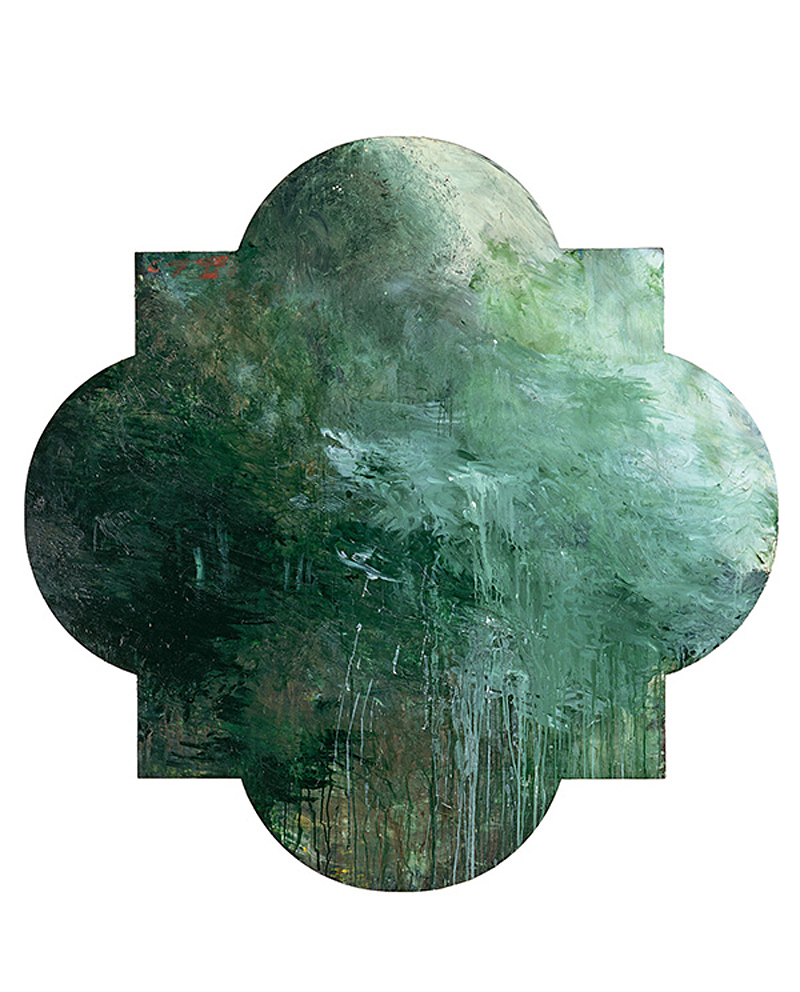
Exhibition: ‘Cy Twombly’ at the Centre Pompidou, Paris

Exhibition dates: 30th November, 2016 – 24th April, 2017

Curator: Jonas Storsve
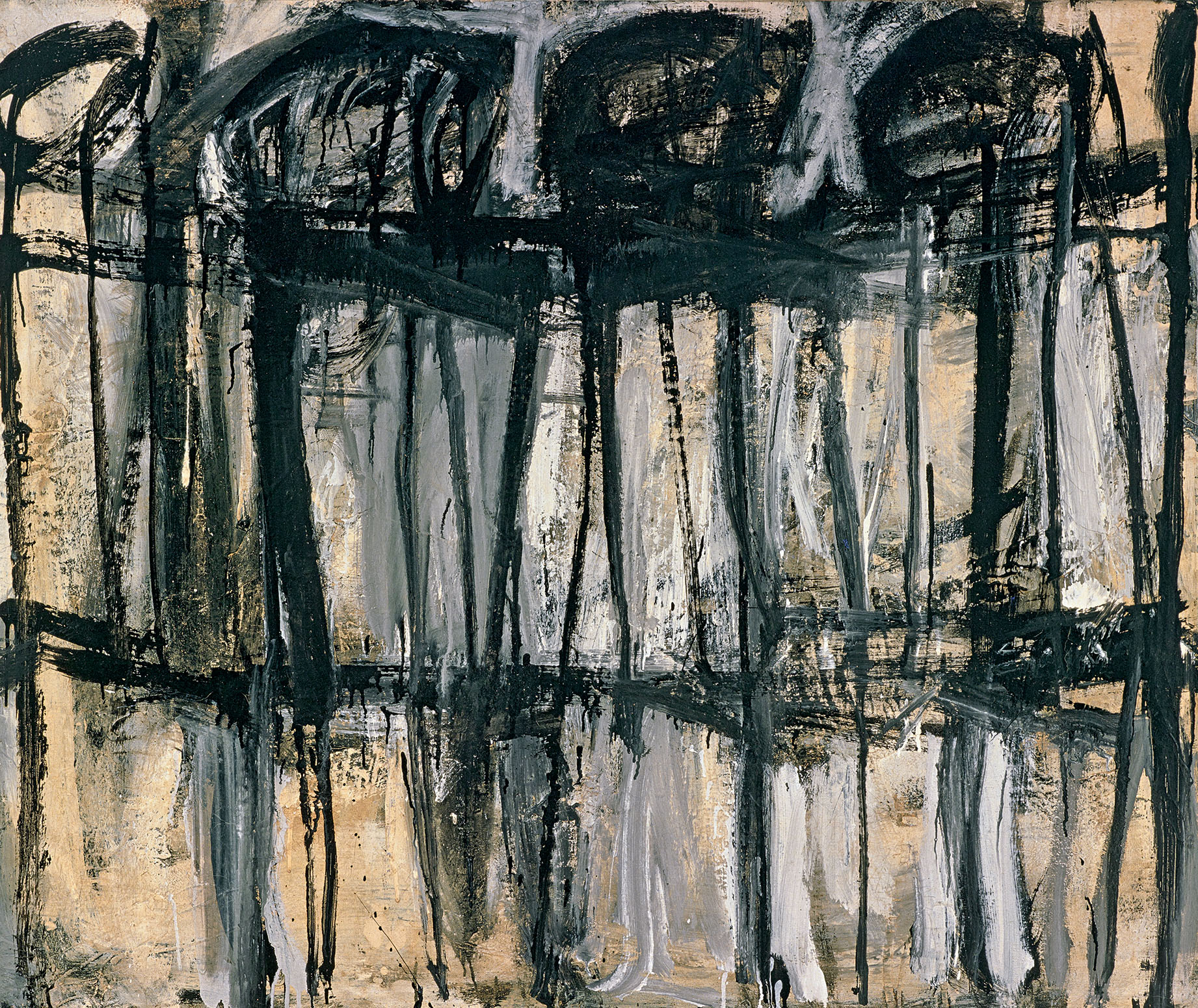
 

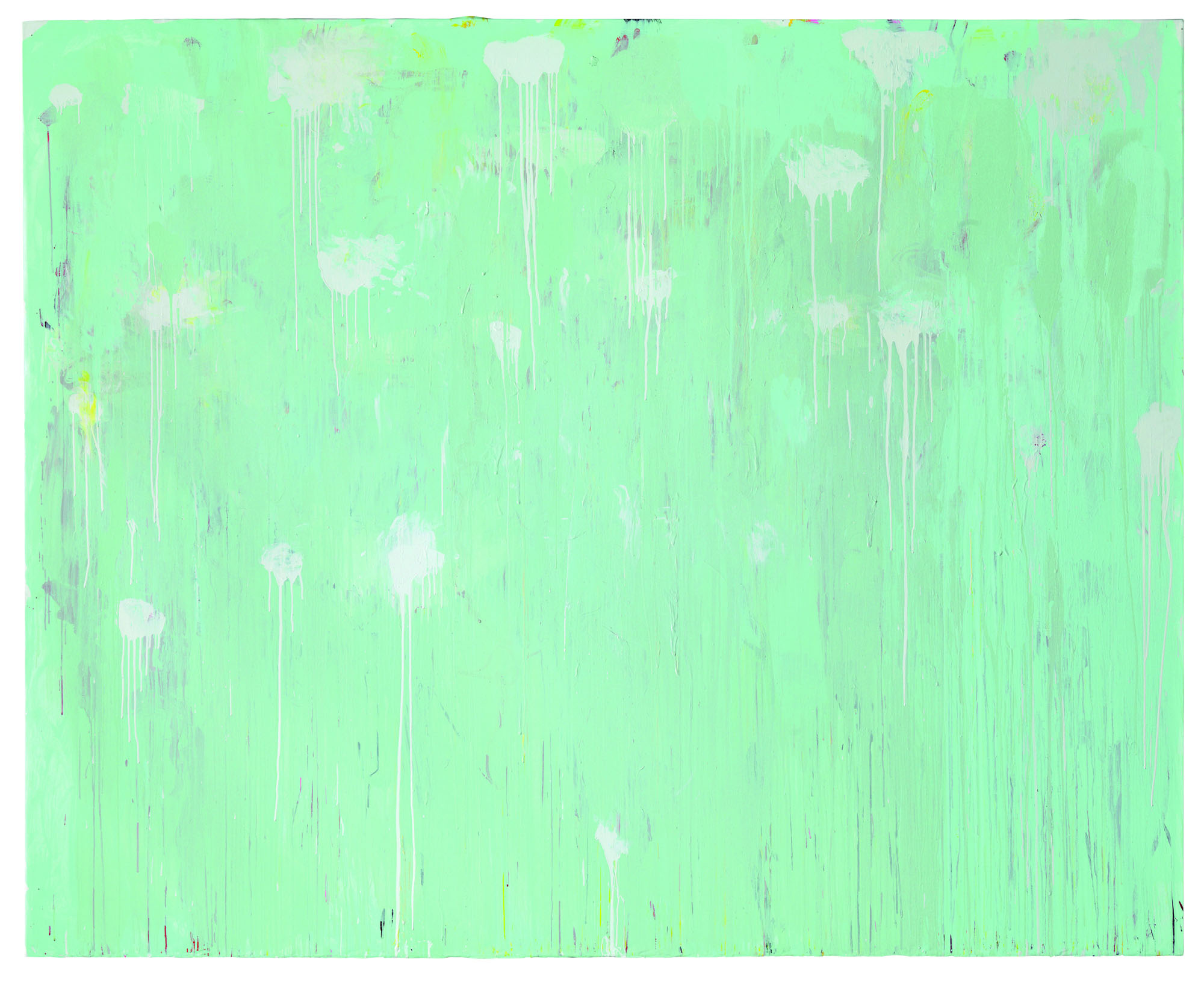
Cy Twombly (American, 1928-2011) 'Untitled (Lexington)' 1951 from the exhibition 'Cy Twombly' at the Centre Pompidou, Paris, Nov 2016 - April 2017


Cy Twombly (American, 1928-2011)
Untitled (Lexington)
1951
Oil-based house paint on canvas
101.6 x 121.9cm
Cy Twombly Foundation
© Cy Twombly Foundation, courtesy Archives Nicola Del Roscio


This posting is for my friend Ian Lobb who is a great Twombly fan.

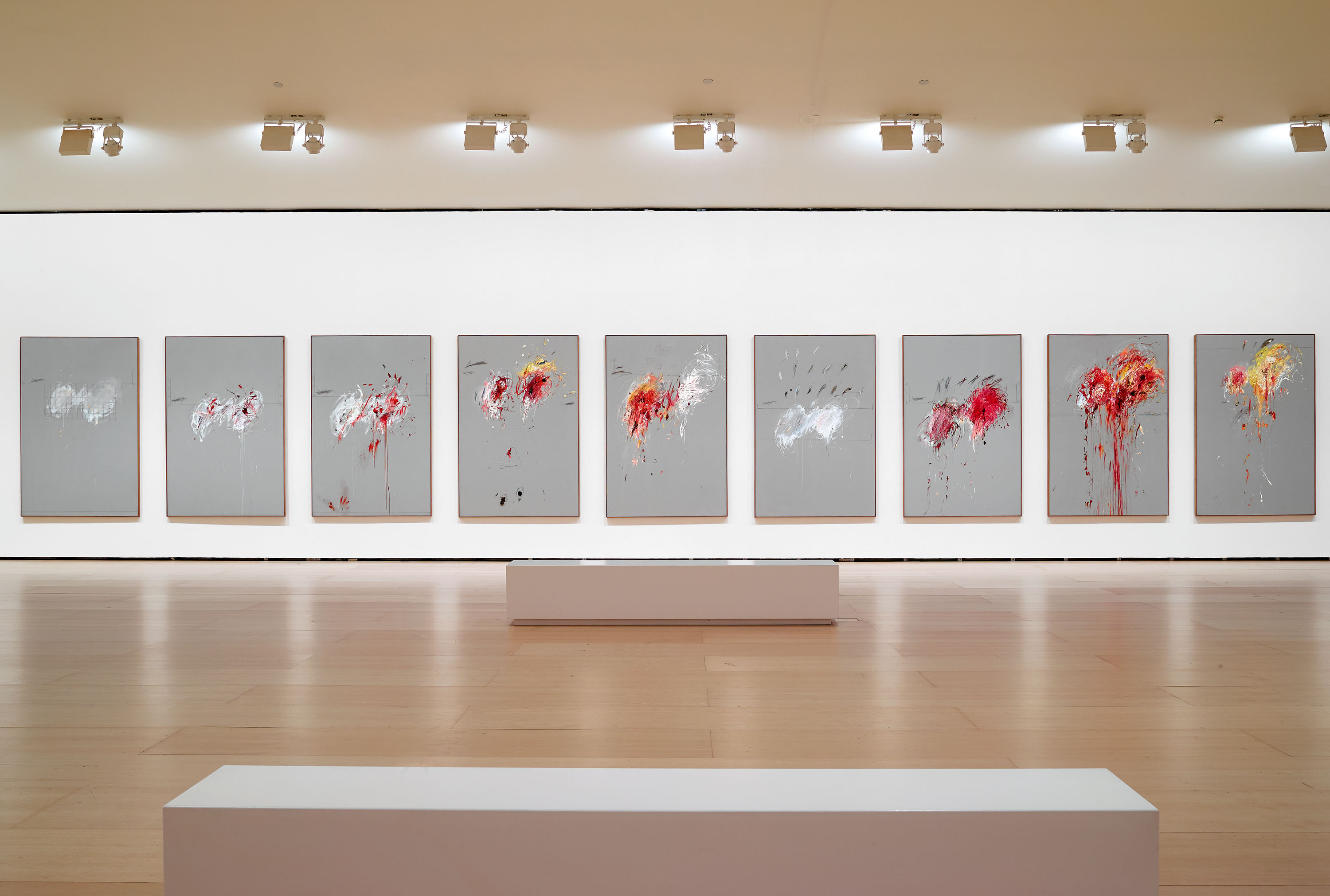
Of the installation photograph of the series Nine Discourses on Commodus (1963, below) he observes:

“Quite an amazing installation… who would have thought #6 being placed there.
The text(?) which replaces the position of the “main” elements in #4, #5 sets the position of #6 – what a choice!
And it all had to be on one wall apparently – it looks tight, yet it is a success.”

The exhibition text states, “Roland Barthes famously wrote of Twombly: ‘His work is based not upon concept (the trace) but rather upon an activity (tracing)’. In Twombly’s graphic art, the trace is the record of a gesture. Barthes again: ‘line is action become visible’. Like Olson, Twombly connects heart to line via the body.”

It would take years to understand the intricacies of Twombly’s work, but the main archetypes that we can all interpret are there: themes such as love, war, death and night.

This is a visceral art of smudges, smears, and inscriptions. It is art that tells a story, an art that emotes? evokes deep inward feelings while challenging the intellect.

Dr Marcus Bunyan


Many thankx to the Centre Pompidou for allowing me to publish the artwork in the posting. Please click on the art work for a larger version of the image.


“To explore Twombly’s work with the eyes and the lips is therefore to continuously dash the expectations inspired by ‘what it looks like’.”


Roland Barthes in Yvon Lambert, ed., Cy Twombly: Catalogue raisonné des oeuvres sur papier (Multhipla Edizioni, Milan, 1979) Éditions du Seuil, 1995


“My line is childlike but not childish. It is very difficult to fake… to get that quality you need to project yourself into the child’s line. It has to be felt.”


Cy Twombly


“Each line now is the actual experience with its own innate history. It does not illustrate – it is the sensation of its own realisation. The imagery is one of the private or separate indulgences rather than an abstract totality of visual perception.”


Cy Twombly, L’Esperienza moderna, no. 2 (1957)
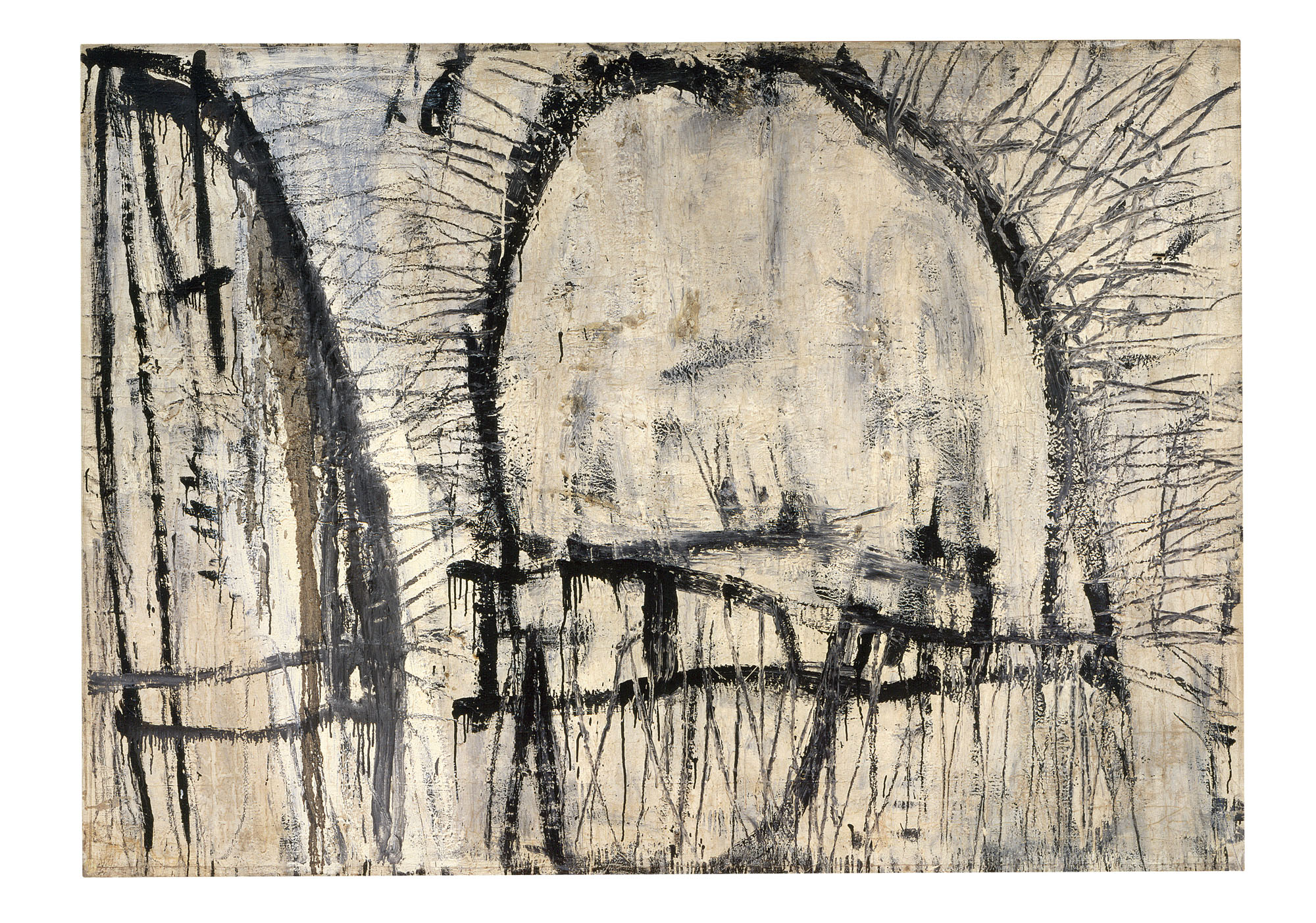


Cy Twombly (American, 1928-2011) 'Volublis' 1953 from the exhibition 'Cy Twombly' at the Centre Pompidou, Paris, Nov 2016 - April 2017


Cy Twombly (American, 1928-2011)
Volubilis
1953
White lead pencil, oil-based house paint, wax crayon on canvas
139.7 x 193cm
Cy Twombly Foundation, on deposit at the Menil Collection, Houston
© Cy Twombly Foundation, courtesy The Menil Collection


The Centre Pompidou is presenting a major retrospective of the work of American artist Cy Twombly. A key event of the fall 2016, this exceptionally vast exhibition will only be shown in Paris, and will feature remarkable loans from private and public collections from all over the world.

Organised around three major cycles – Nine Discourses on Commodus (1963), Fifty Days at Iliam (1978) and Coronation of Sesostris (2000) – this retrospective covers the artist’s entire career in a chronological circuit of some 140 paintings, sculptures, drawings and photographs, providing a clear picture of an extraordinarily rich body of work which is both intellectual and sensual. The selection includes many of Twombly’s iconic works, several of them never previously exhibited in France.

Born in 1928 in Lexington, Virginia, Cy Twombly died in 2011 at the age of 83 in Rome, where he spent a large part of his life. Unanimously acclaimed as one of the greatest painters of the second half of the 20th century, Twombly, who began dividing his life between Italy and America in the late Fifties, merged the legacy of American abstract expressionism with the origins of Mediterranean culture. From his first works in the early Fifties (marked by the so-called primitive arts, graffiti and writing) to his last paintings with their exuberant colour schemes, by way of the highly carnal compositions of the early Sixties and his response to minimalist and conceptual art during the Seventies, this retrospective emphasises the importance of cycles and series for Twombly, in which he reinvented great history painting. The exhibition is also the occasion to highlight the artist’s close relationship with Paris. The Centre Pompidou had devoted a first substantial retrospective to him as early as 1988.

Press release from the Centre Pompidou


“The exhibition is deployed around three Cycles: Nine Discourses on Commodus, 1963, Fifty Days at Iliam, 1978, and Coronation of Sesostris, 2000. Each of them reinterprets an antique tradition by addressing themes such as love, war, death and night. Next to these exceptional series are exhibited magnificent works in which the artist confronts abstraction and figuration while exploring psychoanalysis, primitivism, writing and painting. The works incorporate names of gods, lyric heroes of Homer and Virgil and confirms his fascination for Classical authors, cosmogony, Greece, Rome and Egypt. Mysterious, obscene, crude, this exhibition confirms that Twombly was one the most original and unexpected of artists of the twentieth century.”

Mercedes Lambarri
Cataloguer, Contemporary art
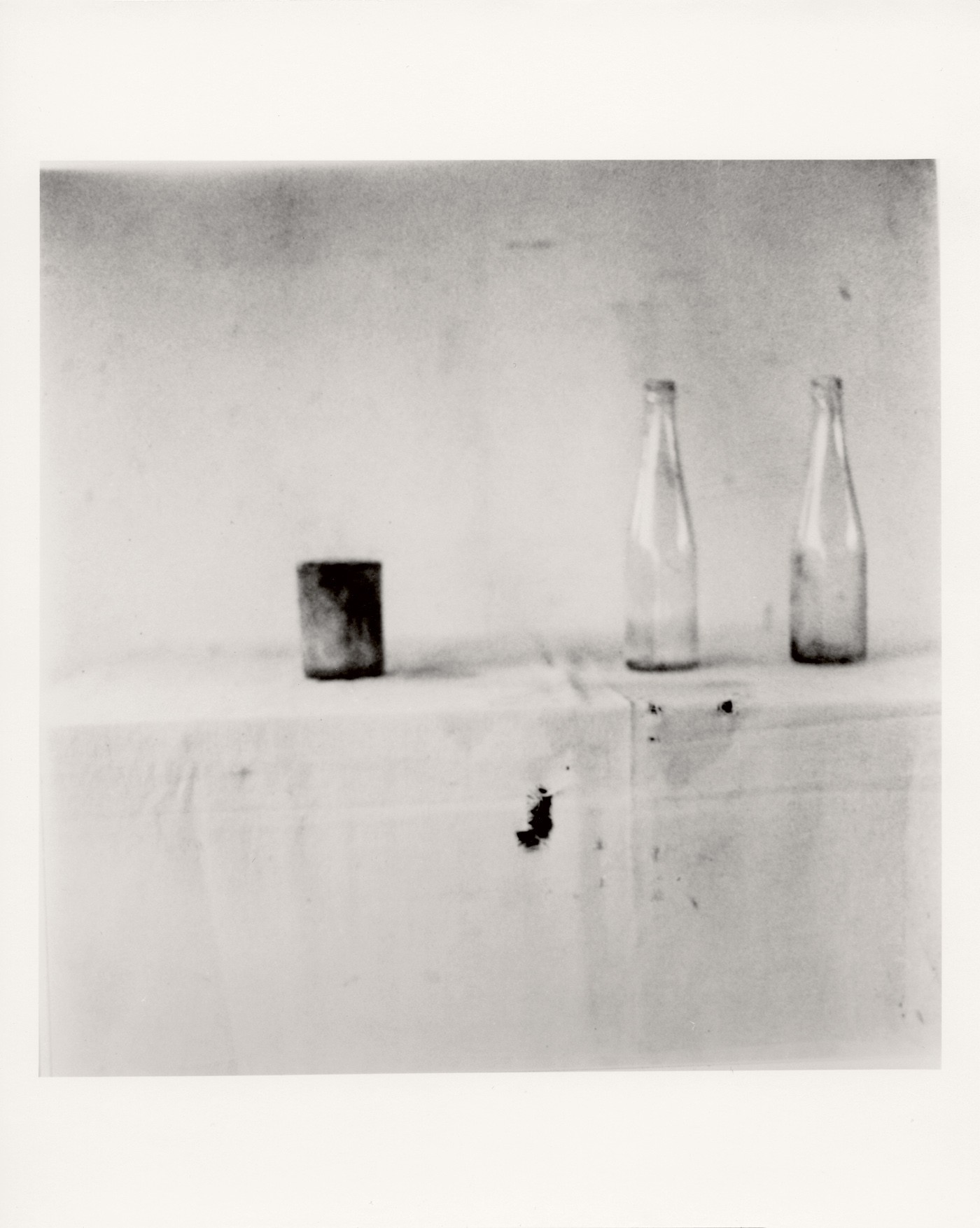
 

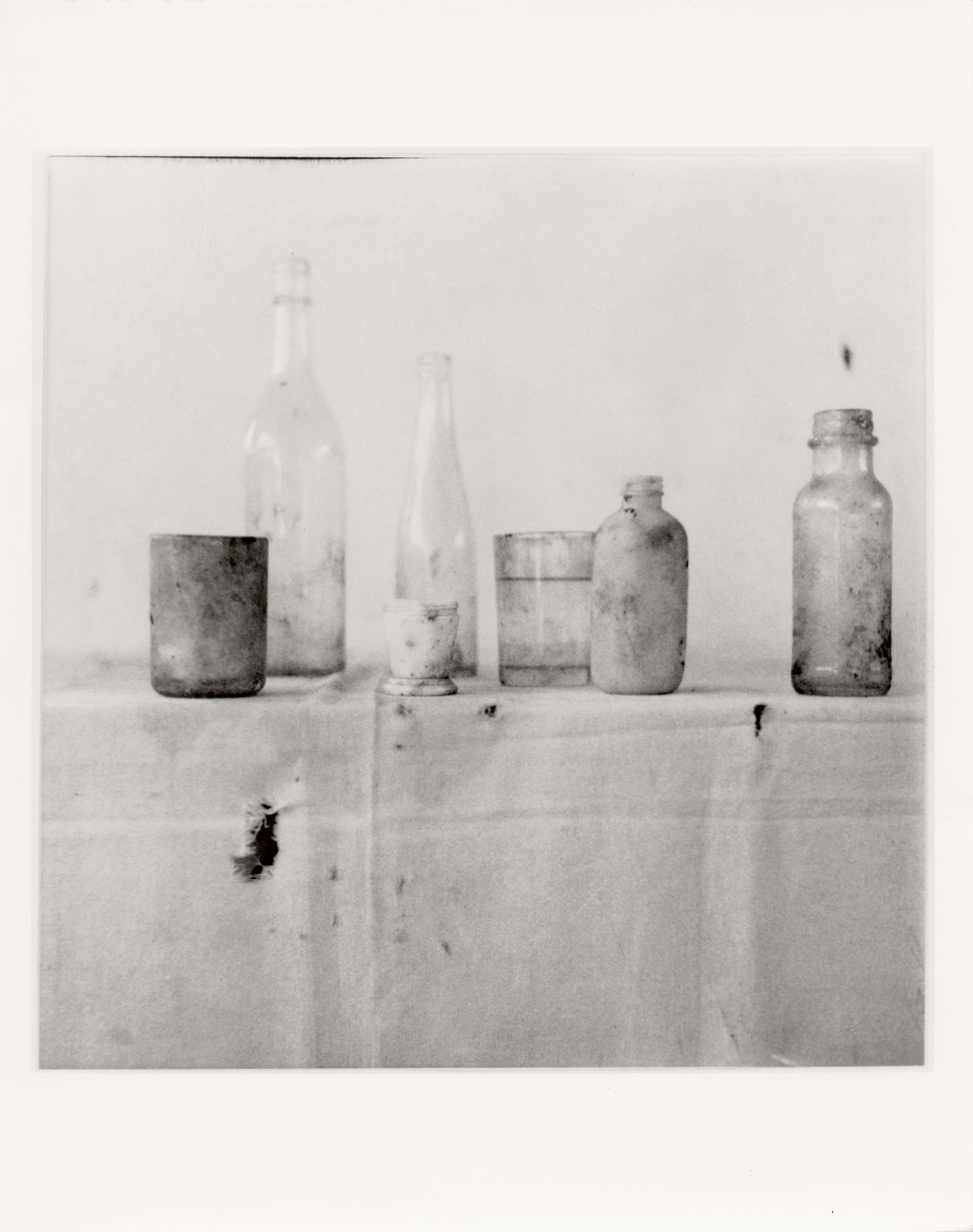
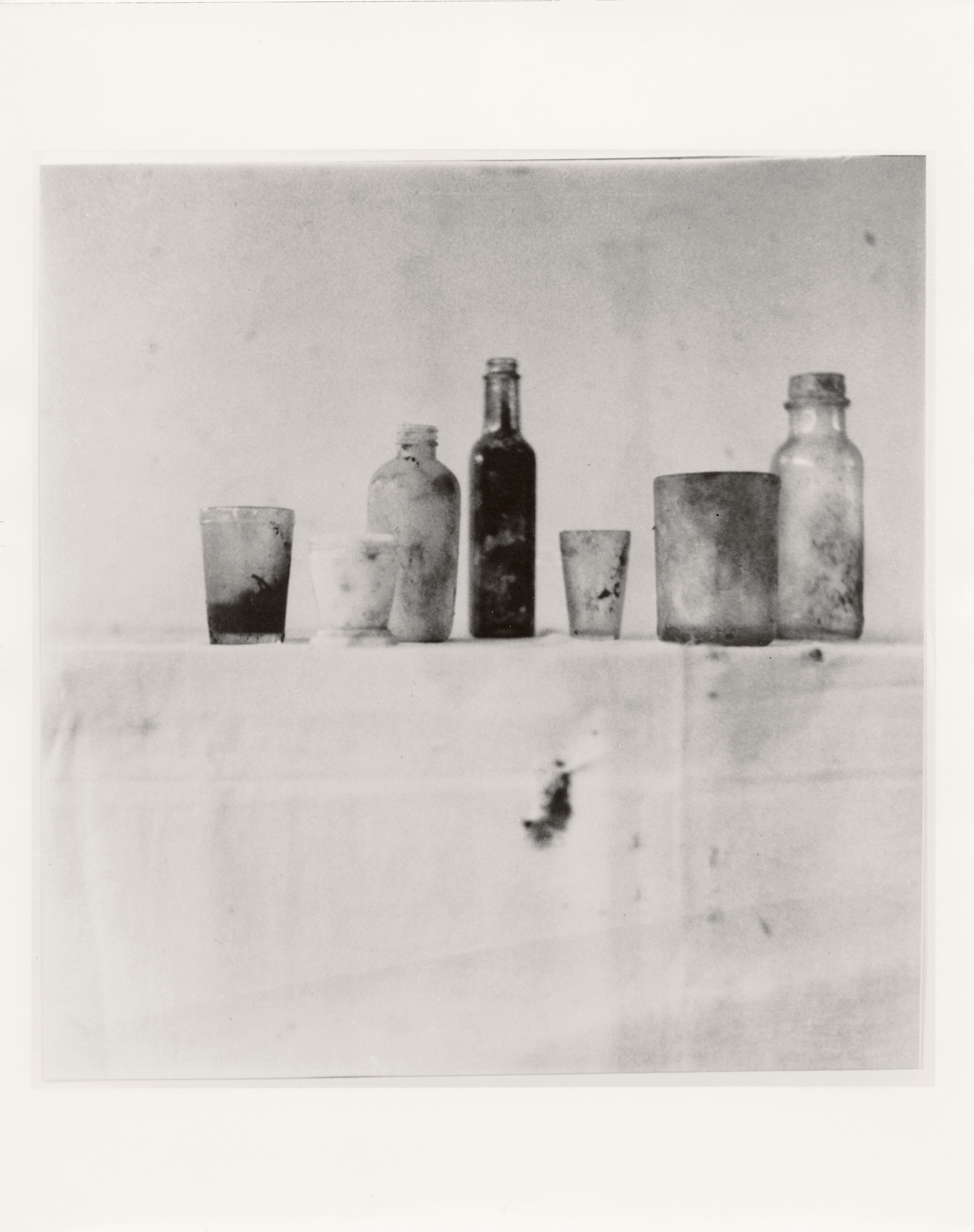
Cy Twombly (American, 1928-2011) 'Still Life, Black Mountain College I' 1951

Cy Twombly (American, 1928-2011) 'Still Life, Black Mountain College II' 1951

Cy Twombly (American, 1928-2011) 'Still Life, Black Mountain College III' 1951


Cy Twombly (American, 1928-2011)
Still Life, Black Mountain College I, II and III
1951
Dry print on cardboard
43,1 x 27.9cm
Fondazione Nicola Del Roscio collection
© Fondazione Nicola Del Roscio, courtesy Archives Nicola Del Roscio
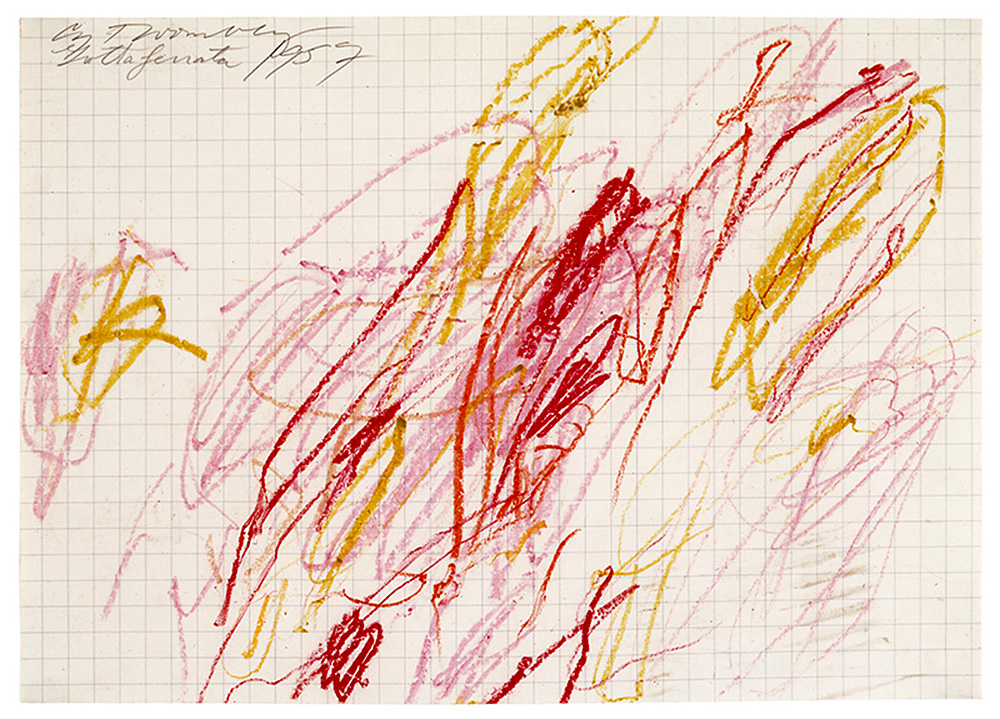
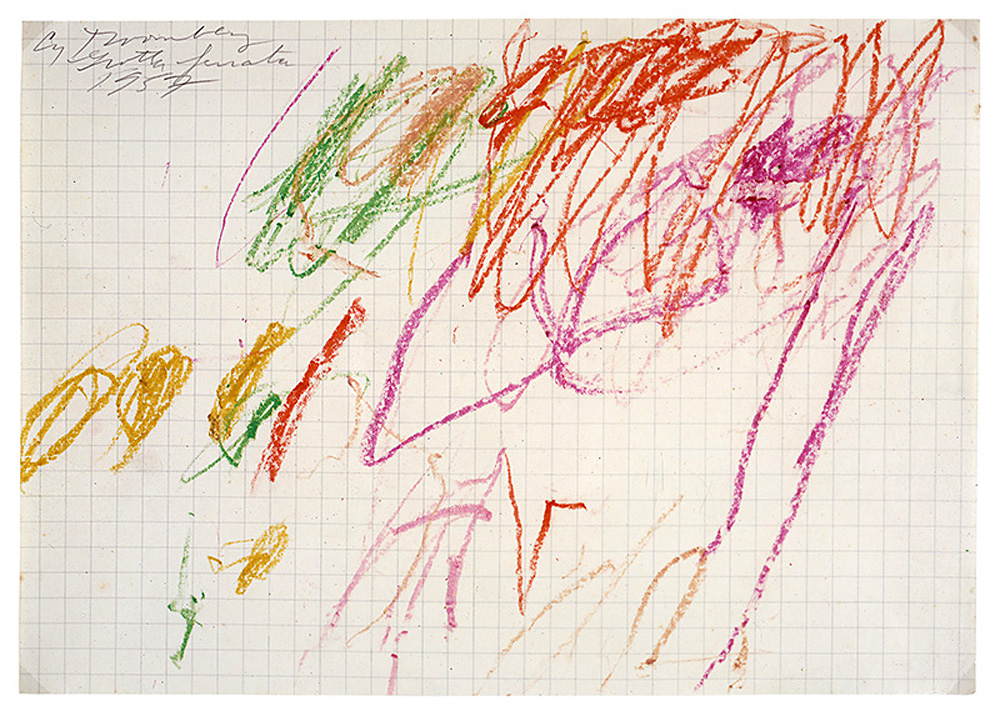
 

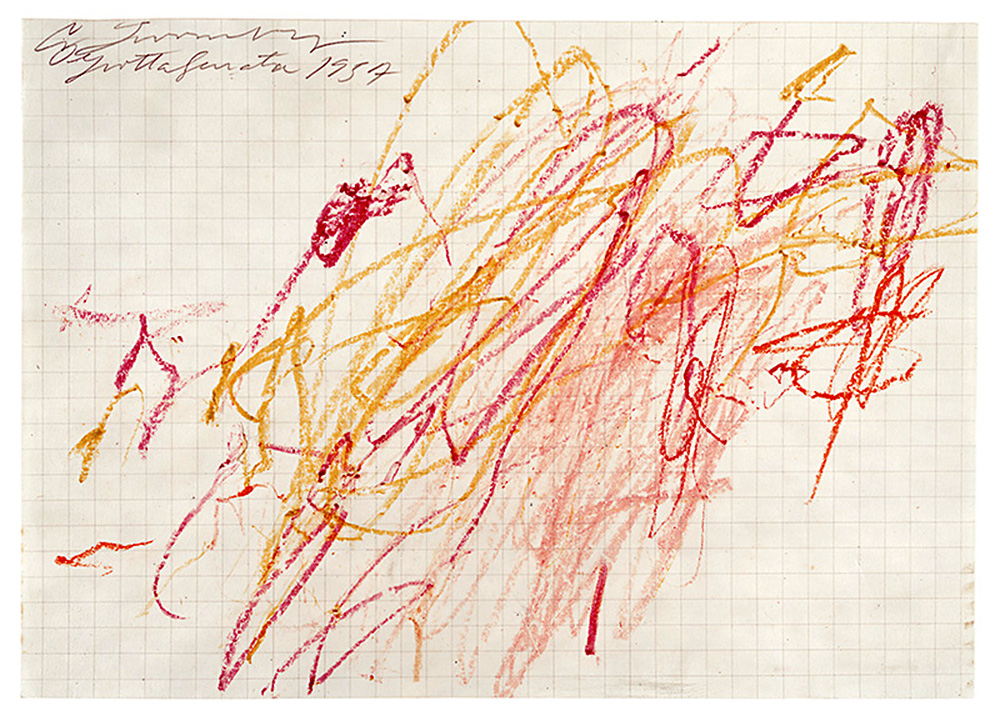
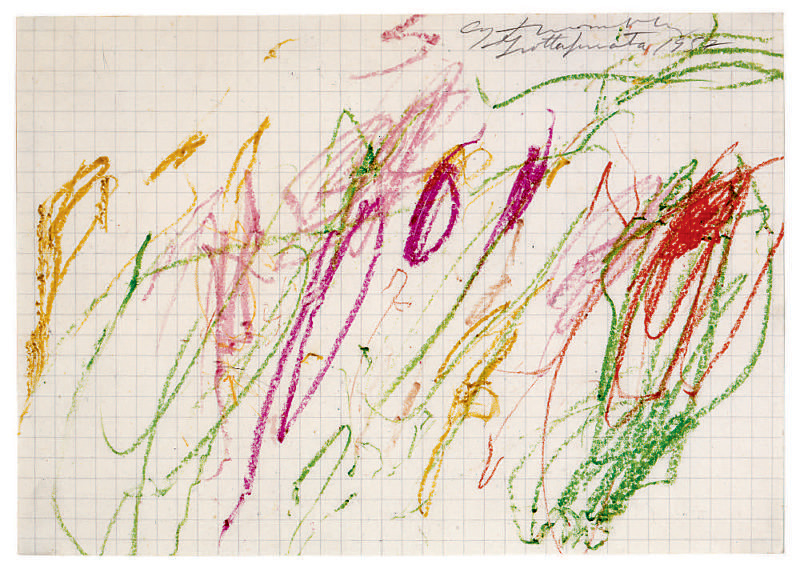
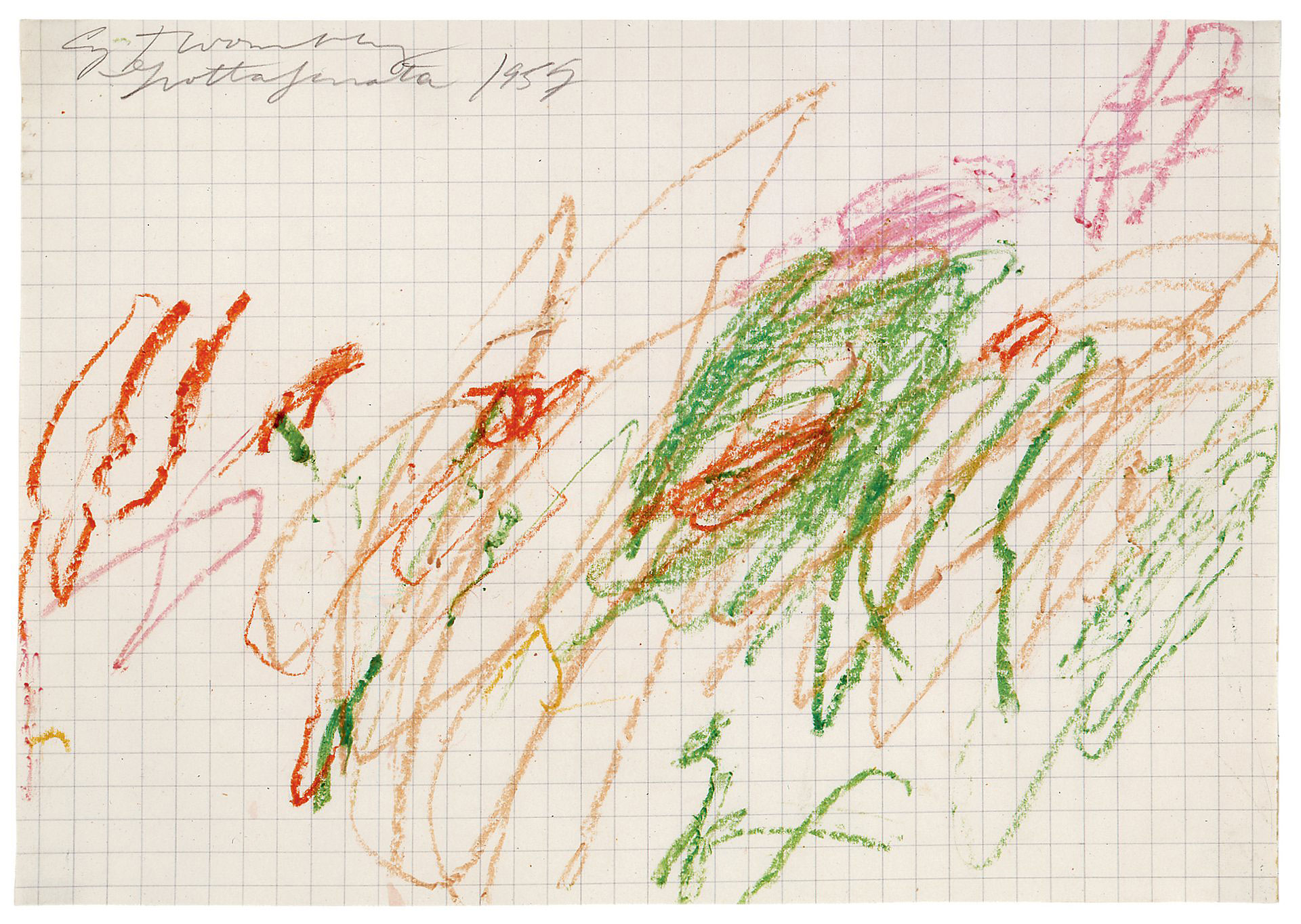
Cy Twombly (American, 1928-2011) 'Untitled (Grottaferrata) III' 1957

Cy Twombly (American, 1928-2011) 'Untitled (Grottaferrata) IV' 1957

Cy Twombly (American, 1928-2011) 'Untitled (Grottaferrata) V' 1957

Cy Twombly (American, 1928-2011) 'Untitled (Grottaferrata) VI' 1957

Cy Twombly (American, 1928-2011) 'Untitled (Grottaferrata) VII' 1957 from the exhibition 'Cy Twombly' at the Centre Pompidou, Paris, Nov 2016 - April 2017


Cy Twombly (American, 1928-2011)
Untitled (Grottaferrata) (No’s 3-7)
1957
Wax crayon and lead pencil on squared paper
7 drawings: 21.6 x 29.9cm (each)
Private Collection
© Cy Twombly Foundation, courtesy Galerie Karsten Greve, St.


“Resisting the term ‘graffiti’ (‘naughty or aggressive’ protest) that is often applied to his work, Twombly says that, ‘it’s more lyrical … in the totality of the painting, feeling and content are more complicated, or more elaborate than say just graffiti.’ Barthes suggests that Twombly’s impossible calligraphy invokes ‘what one might call writing’s field of allusions’ – a cultural field as well as feeling and content; a long way from a fine hand. His writing is also epigraphic, in the double sense of alluding to the object or surface on which it is written, and requiring to be deciphered like an ancient inscription. Twombly’s illegible scrawls and polyglot, non-standardised capitals, his interweaving of phrases from high modernist European poets and names from the Graeco-Roman tradition, evoke the longue durée of a commemorative culture that reaches back to Egypt and beyond: cult as well as culture.”

Mary Jacobus. “Time-Lines: Rilke and Twombly on the Nile,” in Tate Papers no. 10 [Online] Cited 09/12/2021. No longer available online


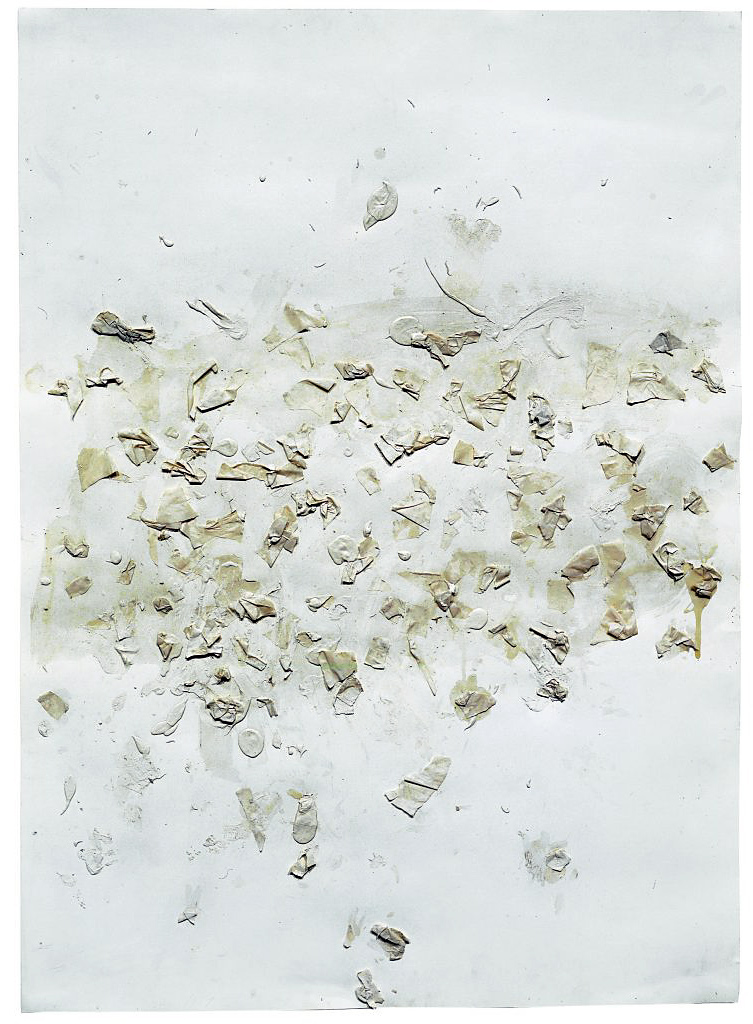
Cy Twombly (American, 1928-2011) 'Sperlonga Collage' 1959


Cy Twombly (American, 1928-2011)
Sperlonga Collage
1959
Pieces of semi-transparent cristal paper, oil-based house paint on paper
85 x 62cm
Cy Twombly Foundation
© Cy Twombly Foundation, courtesy Archives Nicola Del Roscio
 

ROOM 1

The 1950s saw Twombly evidence a precocious maturity. After leaving Black Mountain College – the experimental liberal arts college in North Carolina where he encountered the crème de la crème of the US avant-garde – the 24-year-old painter from Lexington, Virginia, set off on a trip to Europe and North Africa in the company of Robert Rauschenberg. On returning to New York in late spring 1953, he produced his first major works, the sounds of their titles recalling villages and archaeological sites of Morocco. These were followed by white canvases covered in script – Twombly disliked the term “graffiti” employed by many of the critics – and its suggestion of triviality. The masterpiece of the decade is undoubtedly the series of white paintings done at Lexington in 1959, which Leo Castelli however refused to show. The austerity of their pictorial language makes outstanding works, economy of means being pushed to an extreme in the combination of white house paint and pencil.

ROOM 2

In the summer of 1957, Cy Twombly returned to Italy to visit his friend Betty Stokes, who was married to Venetian aristocrat Alvise Di Robilant and had just given birth to their first child. The Robilants were then living at Grottaferrata, where Twombly took several photographs of Betty. During his stay, he also made a series of eight wax crayons drawings, which he presented to her. One of these has since been separated from the group, leaving only seven, outstanding in their vigorous hand and lively colour.


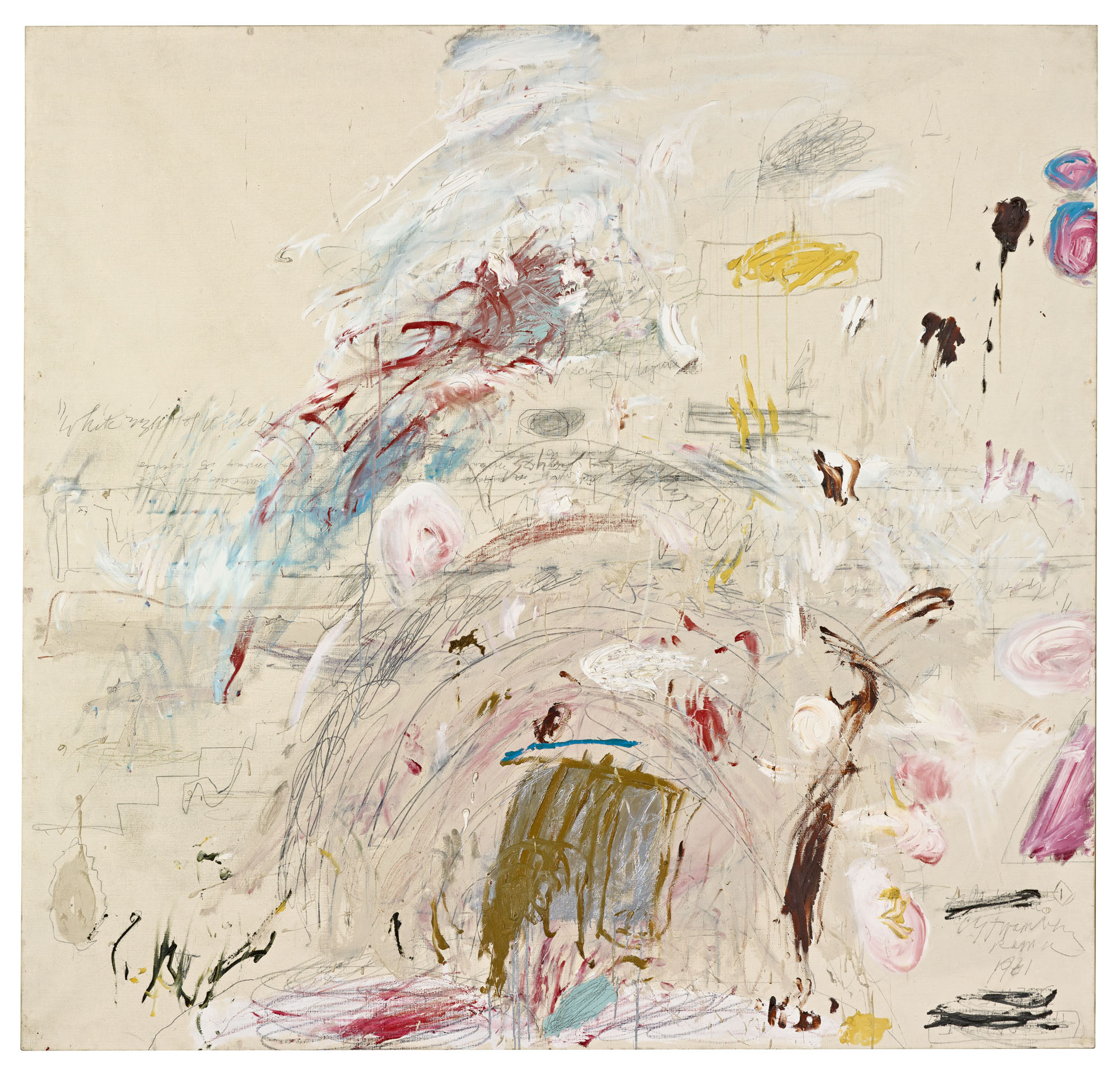
Cy Twombly (American, 1928-2011) 'School of Athens' 1961


Cy Twombly (American, 1928-2011)
School of Athens
1961
Oil, oil-based house paint, coloured pencil and lead pencil on canvas
190.3 x 200.5cm
Private Collection
© Cy Twombly Foundation, courtesy Archives Nicola Del Roscio
 

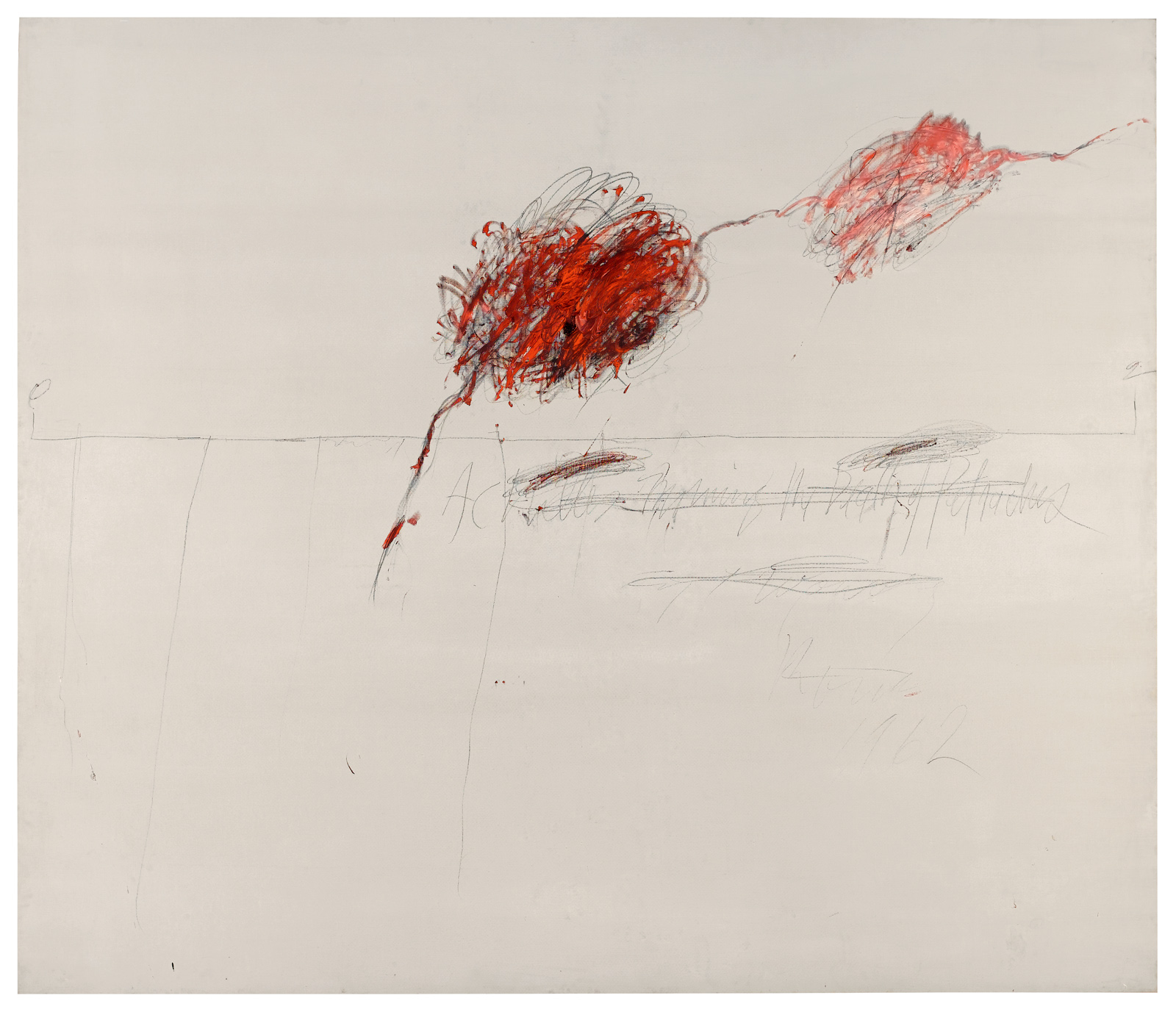
Cy Twombly (American, 1928-2011) 'Achilles Mourning the Death of Patroclus' 1962


Cy Twombly (American, 1928-2011)
Achilles Mourning the Death of Patroclus
1962
259 x 302cm
Oil, lead pencil on canvas
Collection Centre Pompidou, Paris
© Cy Twombly Foundation


Describing space in Twombly’s work, Barthes uses the term ‘rare’ (Latin, rarus): ‘that which has gaps or interstices, sparse, porous, scattered’.


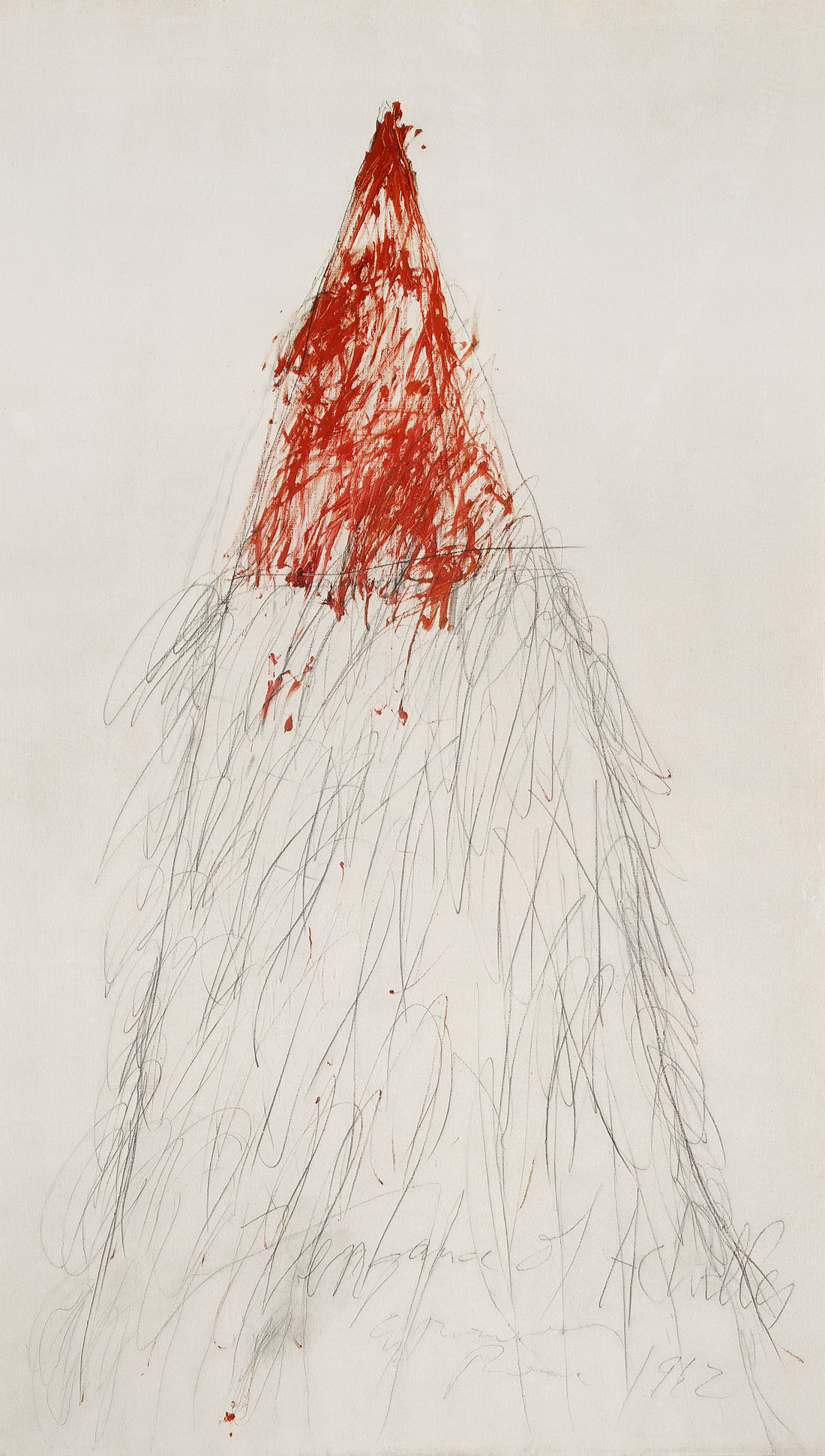
Cy Twombly (American, 1928-2011) 'The Vengeance of Achilles' 1962


Cy Twombly (American, 1928-2011)
The Vengeance of Achilles
1962
Oil, lead pencil on canvas
300 x 175cm
Kunsthaus Zürich, Zurich
© Cy Twombly Foundation, courtesy Kunsthaus Zürich, Zürich


Roland Barthes famously wrote of Twombly: ‘His work is based not upon concept (the trace) but rather upon an activity (tracing)’. In Twombly’s graphic art, the trace is the record of a gesture. Barthes again: ‘line is action become visible’. Like Olson, Twombly connects heart to line via the body.


Cy Twombly (American, 1928-2011) View of the series 'Nine Discourses on Commodus' 1963


Cy Twombly (American, 1928-2011)
View of the series Nine Discourses on Commodus
1963
Guggenheim Bilbao Museo, Bilbao
© Cy Twombly Foundation


ROOM 4

After Twombly’s marriage to Italian aristocrat Luisa Tatiana Franchetti, celebrated in New York on 20 April 1959, the couple settled in Rome, living in a palazzo on the Via di Monserrato, in a quarter known for its intellectual life. Twombly had just given up using his fluid and viscous house paint for oil paint in tubes with precisely the opposite properties. Between 1960 and 1962 he produced some of his most sexual paintings, Empire of Flora being an evocative example. Partial glimpses of body parts, male and female, are scattered over canvases that seem to preserve the sensual memory of hot Roman nights.

ROOM 5

In late 1963, when John F. Kennedy was assassinated in Dallas, Cy Twombly devoted a cycle of nine paintings to the Roman emperor Commodus (161-192), son of Marcus Aurelius and remembered as a cruel and bloodthirsty ruler. In these he conveys the climate of violence that prevailed during his reign, marked by executions and terror. Shown at Leo Castelli’s in New York in the spring of 1964, the paintings were roundly condemned by the critics. Won to the newly emergent Minimalism, the New York public was unable to grasp Twombly’s painterly gifts and his ability to render on canvas the complex psychological phases informing the life and death of the emperor. At the close of the exhibition, Twombly recovered the paintings, which would be sold to an Italian industrialist before being acquired in 2007 by the Guggenheim Museum, Bilbao.

ROOM6

Having painted a series under the sign of Eros in the very early part of the decade, in 1962 Twombly turned to Thanatos, death, a theme that finds paroxysmal expression in his first two meditations on the Trojan War, Achilles Mourning the Death of Patroclus and Vengeance of Achilles. In these two paintings, brought together for this exhibition, Twombly gives form to Achilles’ sorrow and fury on the death of his friend. The Ilium triptych, for its part, was broken up at an unknown date, the first panel joining the Eli and Edythe Broad collection in Los Angeles. In the early 2000s, Twombly painted a new version of that panel to recreate the triptych, then owned by collector François Pinault.


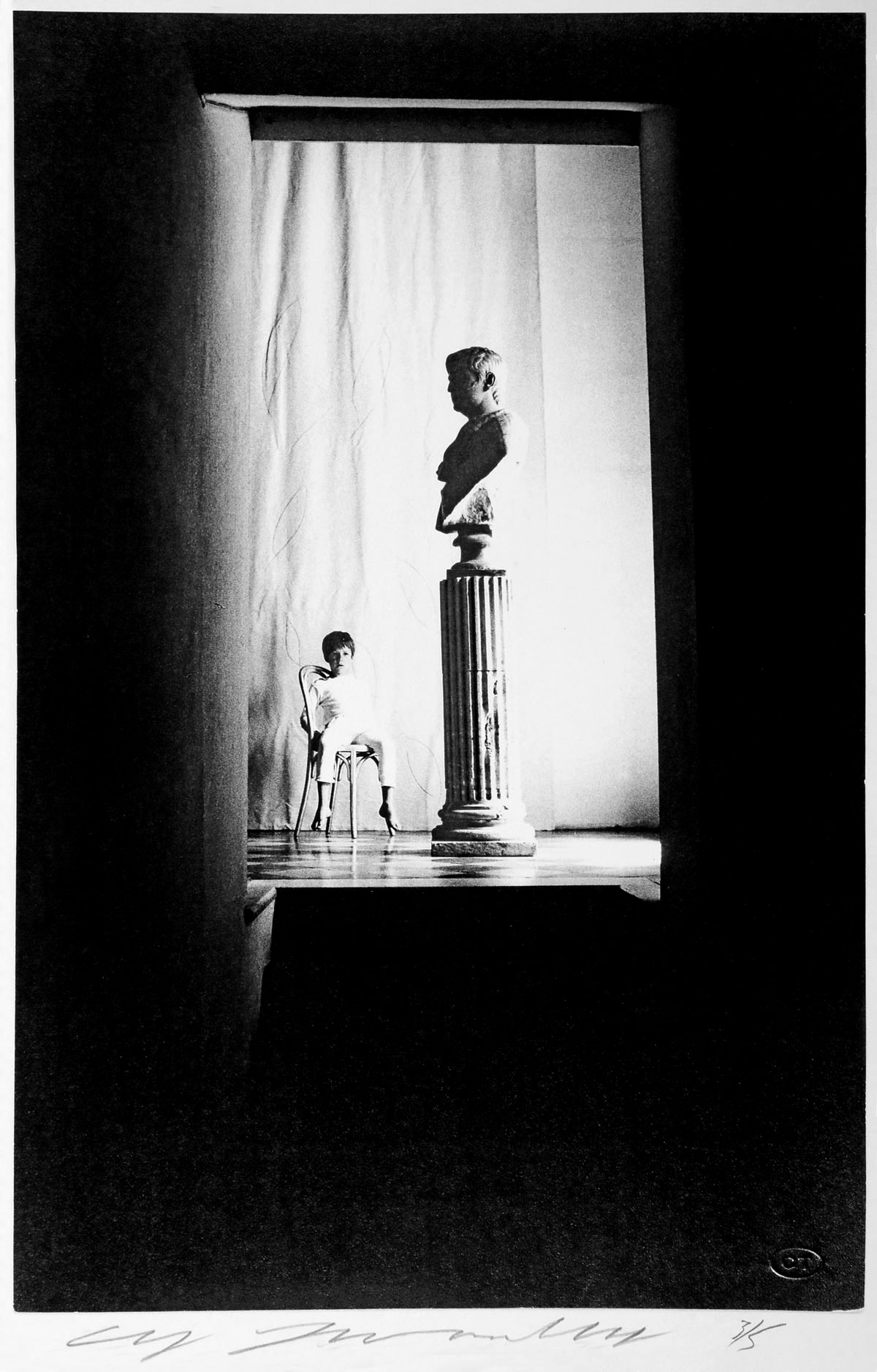
Cy Twombly (American, 1928-2011) 'Alessandro Twombly' 1965


Cy Twombly (American, 1928-2011)
Alessandro Twombly
1965
Dry print on cardboard
43.2 x 28cm
Cy Twombly Foundation
© Fondazione Nicola Del Roscio


Cy Twombly (American, 1928-2011) 'Night Watch' 1966


Cy Twombly (American, 1928-2011)
Night Watch
1966
Oil-based house paint, wax crayon on canvas
190 x 200cm
Private Collection
Courtesy Jeffrey Hoffeld Fine Arts, Inc.
© Cy Twombly Foundation, courtesy Cheim & Read


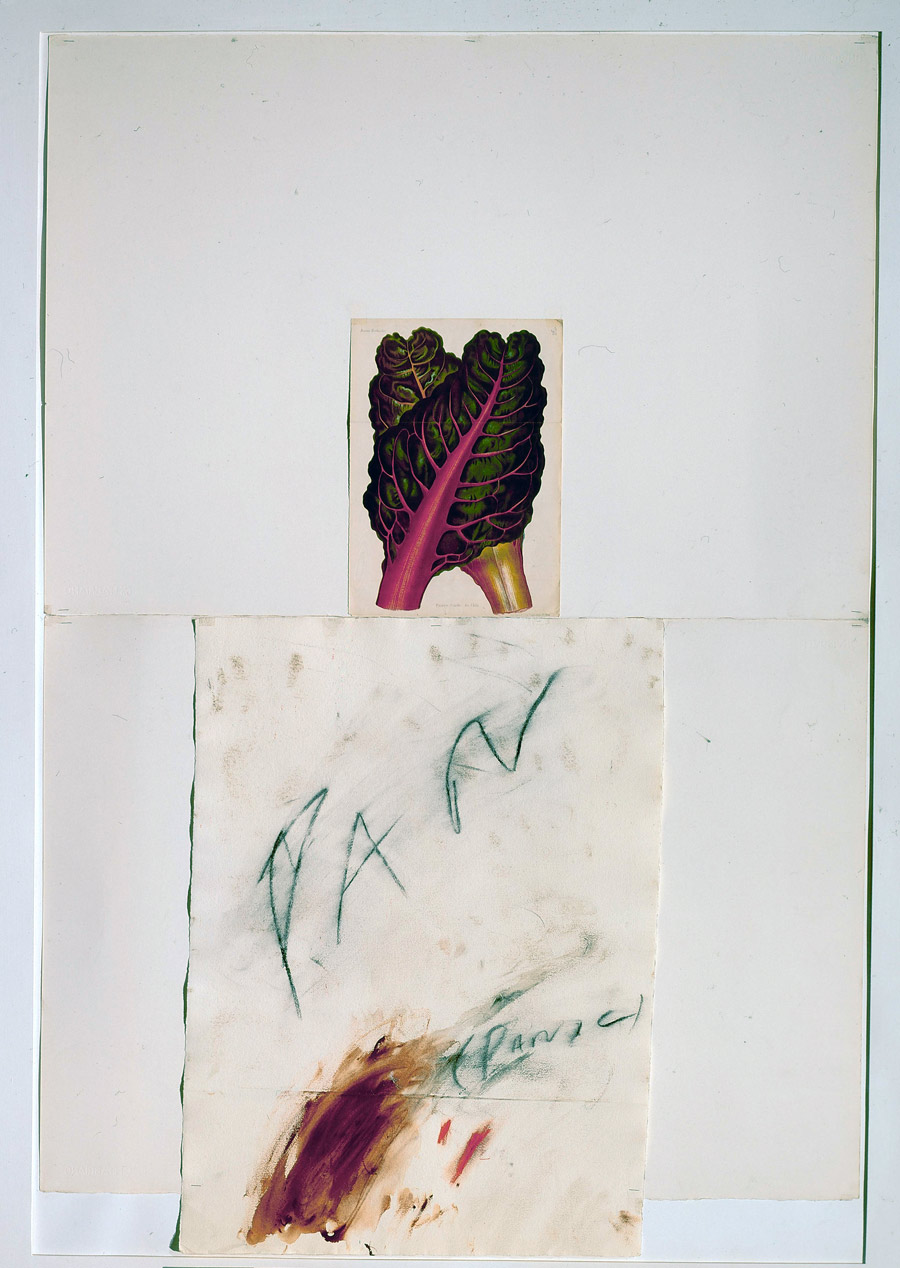
Cy Twombly (American, 1928-2011) 'Pan' 1975


Cy Twombly (American, 1928-2011)
Pan
1975
Oil pastel and collage on paper
148 x 100cm
Cy Twombly Foundation
© Cy Twombly Foundation, courtesy Archives
Nicola Del Roscio
 

Cy Twombly (American, 1928-2011) 'Apollo' 1975


Cy Twombly (American, 1928-2011)
Apollo
1975
Oil pastel and lead pencil on paper
150 x 134cm
Cy Twombly Foundation
© Cy Twombly Foundation, courtesy
Archives Nicola Del Roscio


Cy Twombly (American, 1928-2011) 'Venus' 1975


Cy Twombly (American, 1928-2011)
Venus
1975
Oil Pastel, lead pencil and collage on paper
150 x 137cm
Cy Twombly Foundation
© Cy Twombly Foundation, courtesy Archives Nicola
Del Roscio


Walter Benjamin’s 1917 essay, ‘Painting, or Signs and Marks’, argues that, ‘The graphic line is defined by its contrast to area’ as opposed to the mark (‘Mal’) and painting (‘Malerei’): ‘the realm of the mark is a medium.’ His distinction between line and mark, drawing and painting, is especially hard to maintain in relation to Cy Twombly: the scribbled pencilling, the smudges and smears, are the marks of an affective body used as a writing instrument. Where Benjamin speaks proleptically to Twombly is in the decisive role he gives to writing, inscription, and naming, along with the spatial marks on monuments and gravestones. ‘[T]he linguistic word’, he writes, ‘lodges in the medium of the language of painting.’ With its collage of quotations, inscriptions, and names, Twombly’s entire oeuvre could be read as a retrospective commentary on this early Benjamin essay.

Walter Benjamin: Selected Writings, Vol.1, 19131926, ed. Marcus Bullock and Michael W. Jennings, Cambridge, MA: Harvard University Press, 1996, pp. 84-85 quoted in Mary Jacobus. “Time-Lines: Rilke and Twombly on the Nile,” in Tate Papers no. 10 [Online] Cited 09/12/2021


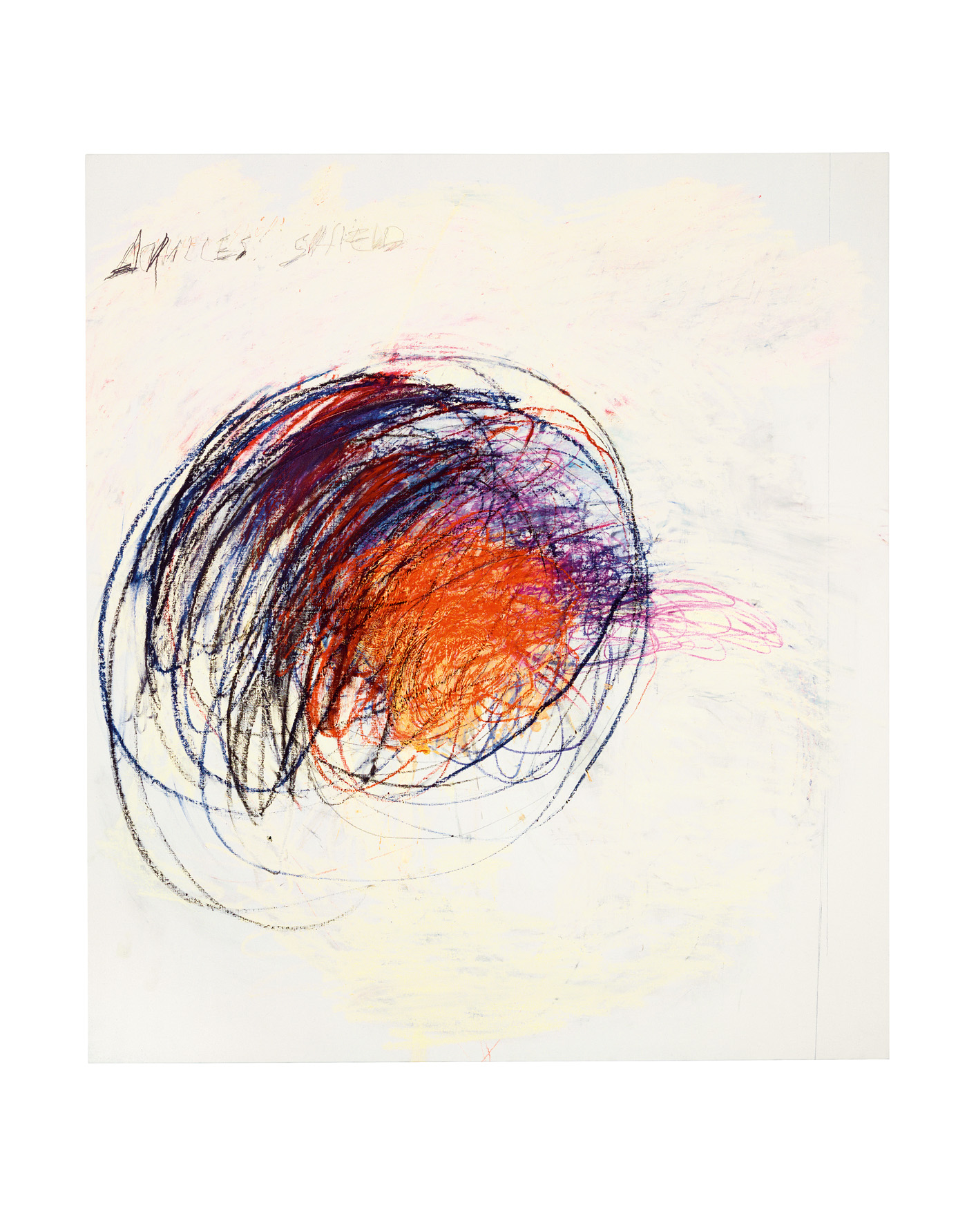
Cy Twombly (American, 1928-2011) 'Fifty Days at Iliam Shield of Achilles (Part 1)' 1978


Cy Twombly (American, 1928-2011)
Fifty Days at Iliam Shield of Achilles (Part I)
1978
Oil, oil stick, lead pencil on canvas
191.8 x 170.2cm
Philadelphia Museum of Art, Philadelphia, gift (by exchange) of Samuel S.White 3rd and Vera White 1989-90-1
© Cy Twombly Foundation, courtesy of Philadelphia Museum of Art, Philadelphie


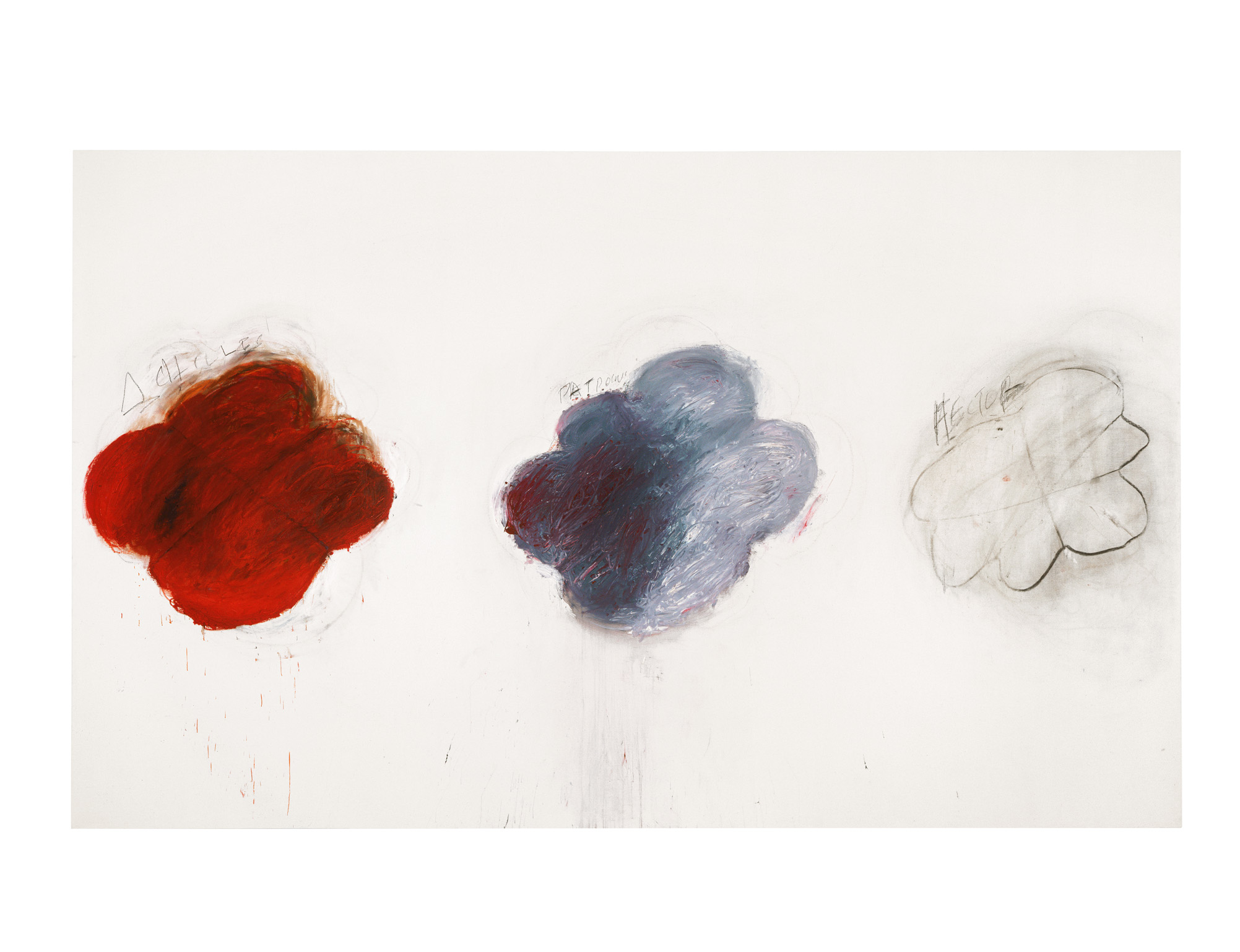
Cy Twombly (American, 1928-2011) 'Fifty Days at Iliam Shades of Achilles, Patroclus and Hector (Part VI)' 1978


Cy Twombly (American, 1928-2011)
Fifty Days at Iliam Shades of Achilles, Patroclus and Hector (Part VI)
1978
Oil, Oil Pencil, lead pencil on canvas
299.7 x 491.5cm
Philadelphia Museum of Art, Philadelphie, gift (by exchange) of Samuel S.White 3rd and Vera White, 1989-90-6
© Cy Twombly Foundation, courtesy of Philadelphia Museum of Art, Philadelphie


ROOM 9

Reacting to the Minimalism and Conceptualism that emerged in the United States in the 1960s, in 1966 Twombly, then living in Rome, embarked on a new series of remarkably austere paintings, with backgrounds of grey or black inscribed with simple forms or script-like loops in white wax crayon. He showed these at the Galleria Notizie, Turin, in early 1967. In the autumn, Leo Castelli in New York exhibited a second series, painted in January in a Canal Street loft made available to the painter by curator and collector David Whitney. Among the works shown was Untitled (New York City) (1967, cat. No. 75), which Twombly would later exchange with Andy Warhol for one of his Tuna Fish Disasters.

ROOM 11

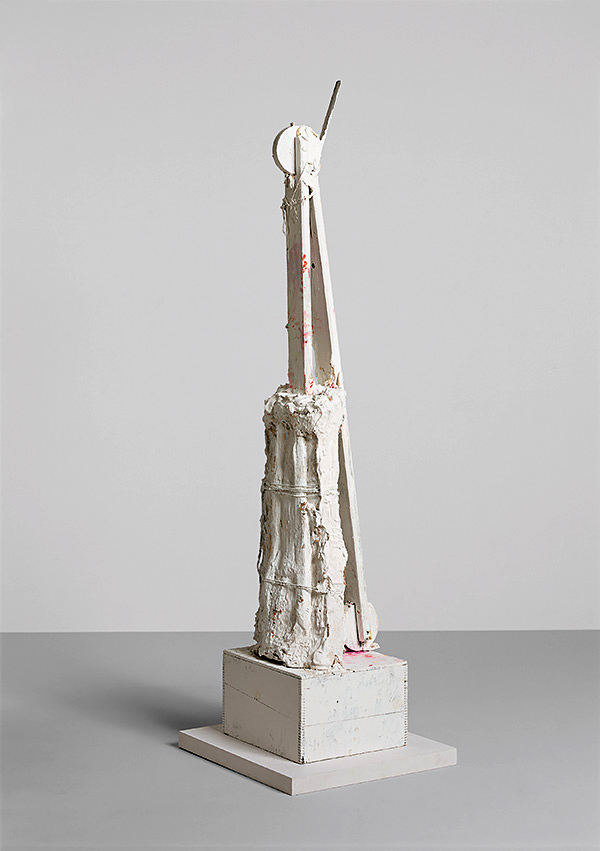
Twombly’s sculptures might be described as “assemblages” or “hybridisations”, in that they consist of disparate elements. These combinations of found materials (pieces of wood, electrical plugs, cardboard boxes, scraps of metal, dried or artificial flowers) are unified by a thin coat of plaster. The white in which they are roughly painted catches the light, bringing out subtle nuances in the surface and giving them a spectral appearance. As Twombly explained in an interview with art critic David Sylvester, “White paint is my marble”. Sometimes later cast in bronze, these sculptures suggest myths, symbolic objects, archaeological finds, as in Winter’s Passage Luxor (Porto Ercole) (1985). “Cy Twombly’s sculpture,” wrote Edmund de Waal, “seems more archaic than archaizing, as if the impulse behind its creation were ancient itself.”

ROOM 12

In 1975, Cy Twombly bought a 16th-century house at Bassano in Teverina, north of Rome, and after basic renovations he established his summer studio there. Inspired by Homer’s Iliad, read in Alexander Pope’s 18th-century English translation, he embarked in 1977 on the major cycle “Fifty Days at Iliam,” whose ten paintings were completed over two successive summers. In the word “Ilium”, one of the ancient names for Troy, Twombly replaced the U with an A, preferring the sound. For him, the letter A evoked Achilles, the Greek hero to whom he had devoted two paintings in 1962. After being shown in 1978 at the Lone Star Foundation (now Dia Art Foundation) in New York, the work remained boxed up for 10 years, to be seen again only upon its purchase in 1989 by the Philadelphia Museum of Art, where it is on permanent exhibition in a room devoted to Cy Twombly. This exhibition marks the first time it has been shown in Europe.


Cy Twombly (American, 1928-2011) 'Untitled (Formia)' 1981


Cy Twombly (American, 1928-2011)
Untitled (Formia)
1981
Wood, iron wire, nails, string, white paint
152 x 88.5 x 33.5cm
Cy Twombly Foundation
© Cy Twombly Foundation, courtesy Foundazione
Nicola Del Roscio


Cy Twombly (American, 1928-2011) 'Untitled (Lexington)' 2004


Cy Twombly (American, 1928-2011)
Untitled (Lexington)
2004
Wood , screw, rope, scakcloth, plaster, synthetic resin paint
206.5 x 44.5 x 45cm
Cy Twombly Foundation
© Cy Twombly Foundation, courtesy Sammlung Udo and Anette Brandhorst


Cy Twombly (American, 1928-2011) 'Untitled (Bassano in Teverina)' 1985


Cy Twombly (American, 1928-2011)
Untitled (Bassano in Teverina)
1985
Oil, acrylic on wooden panel
181.7 x 181.7cm
Cy Twombly Foundation
© Cy Twombly Foundation, courtesy Archives Nicola Del Roscio


Cy Twombly (American, 1928-2011) 'Wilder Shores of Love' 1985


Cy Twombly (American, 1928-2011)
Wilder Shores of Love
1985
Oil-based house paint , oil (oil paint stick), coloured pencil, lead pencil on wooden panel
140 x 120cm
Private Collection
© Cy Twombly Foundation


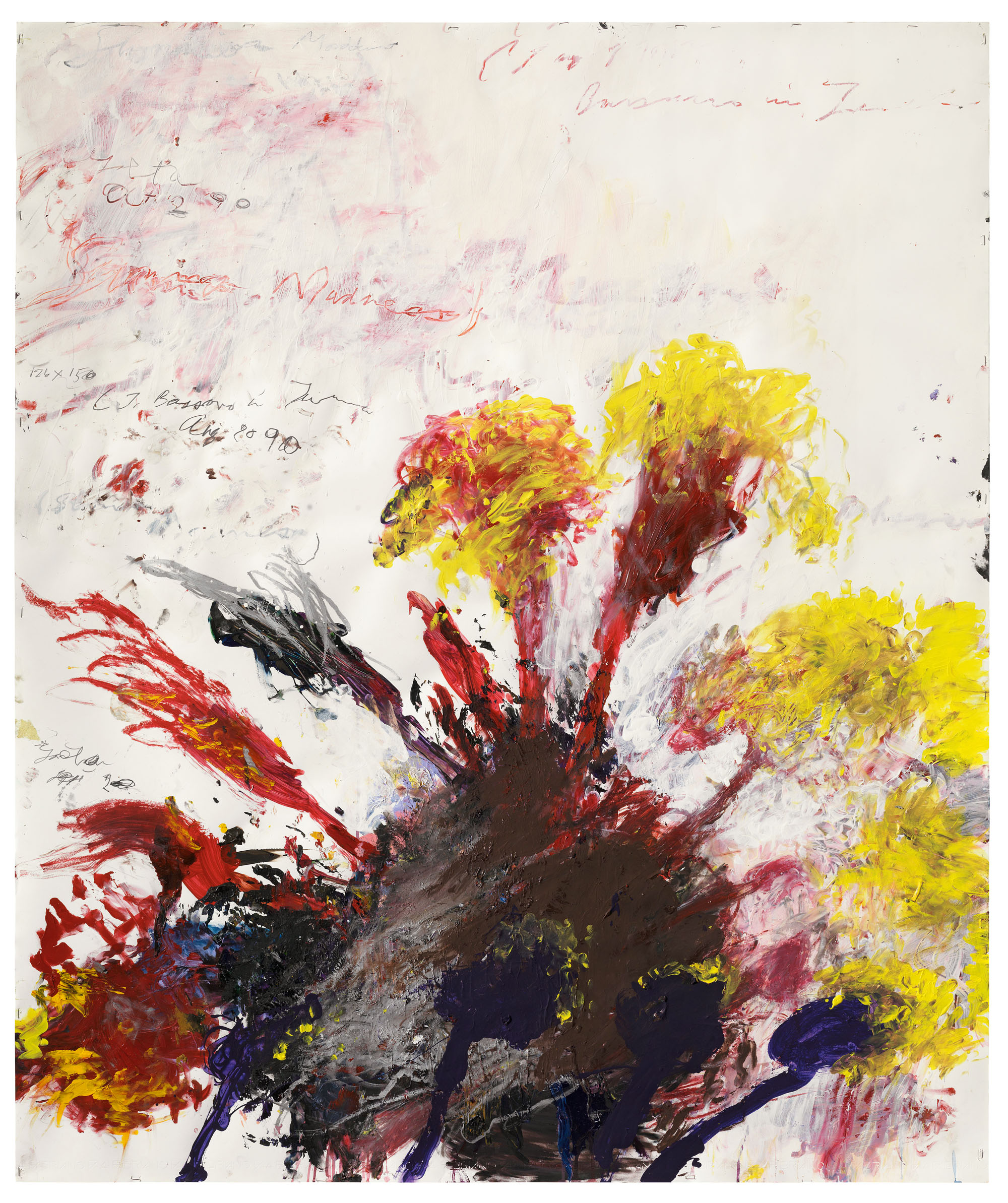
Cy Twombly (American, 1928-2011) 'Summer Madness' 1990


Cy Twombly (American, 1928-2011)
Summer Madness
1990
Acrylic, oil, coloured pencil, lead
Pencil on paper mounted on wooden panels
150 x 126cm
Udo and Anette Brandhorst Collection
© Cy Twombly Foundation


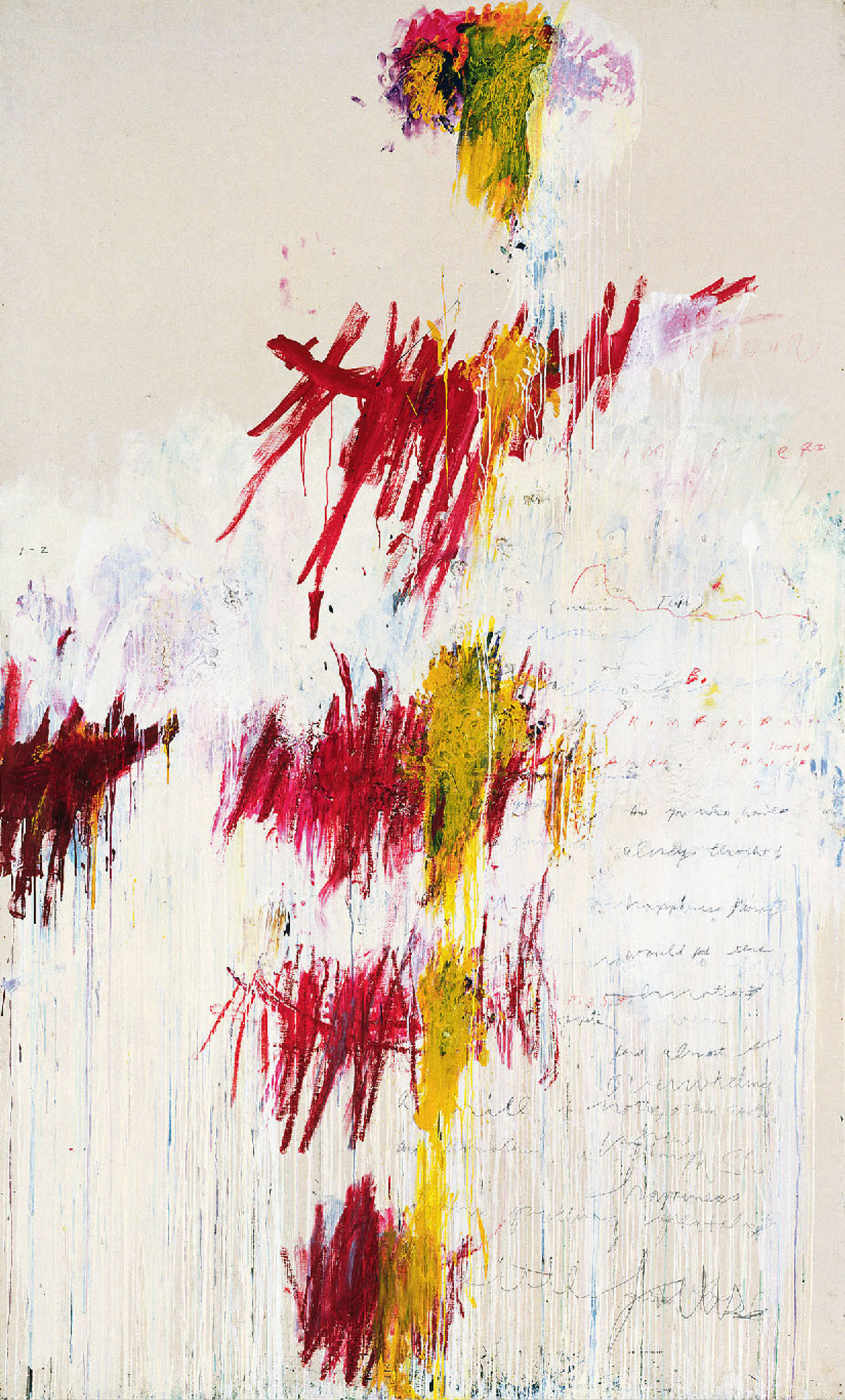
Cy Twombly (American, 1928-2011) 'Quattro Stagioni: Primavera' 1993-1995


Cy Twombly (American, 1928-2011)
Quattro Stagioni: Primavera
1993-1995
Acrylic, oil, coloured pencil and et lead pencil on canvas
313.2 x 189.5cm
Tate, London
© Cy Twombly Foundation, courtesy Tate, London 2016


ROOM 15

“Coronation of Sesostris” is one of the major painting cycles that punctuate Cy Twombly’s career, differing from the purely abstract series in their incorporation of narrative elements. Inspired by the example of the god Râ, whose sun-boat traverses the heavens from dawn to dusk to the end of night, Twombly opens the series with luminous canvasses dominated by sunny yellow and red to close it in black and white with an evocation of Eros from a poem of Sappho’s: “Eros weaver of Myth / Eros, sweet and bitter / Eros, bringer of pain.” Twombly combines fragmentary references to Sesostris I, to ancient Greek poets Sappho and Alcman, and to the contemporary poet Patricia Waters. Begun at Twombly’s house in Bassano, this cycle was completed after the canvases were shipped to Lexington. Sally Mann’s photographs show canvases of different sizes tacked to the walls of the little studio, showing that they were stretched only when finished.

ROOM 17

For the Bacchus series, painted at Twombly’s Gaeta studio in early 2005, in the midst of the Iraq War, the artist remembered again Homer’s Iliad and returned to the very characteristic writing he had explored in the “Black Paintings” of the late 1960s. Here, however, he replaced the white wax crayon with red paint evocative of both blood and wine, allowed to run freely across the vast beige canvases. The first series consisted of eight monumental paintings that were shown in late 2005 at the Gagosian Gallery on Madison Avenue in New York. Between 2006 and 2008, Twombly produced another series on the theme of Bacchus, some of these paintings being even larger in format. The two works here are from the first series.

Twombly took up photography at Black Mountain College in North Carolina and never afterwards gave it up. Studying under American photographer Hazel-Frieda Larsen, in 1951 he produced a series of still lifes with bottles and other glass vessels that recall the memory of the work of the Italian painter Giorgio  Morandi. In Morocco in 1953, on his first trans-Atlantic travels, he attentively studied the chairs and draped tablecloths of a Tetouan restaurant. But it was only later, on discovering the square format of the Polaroid, that he discovered his own photographic identity. Reflecting his taste for the blurred, for colours sometimes pastel and sometimes stridently saturated, the dry-printed enlargements evoke a world of contemplation. The photographs evoke the places he lived and his interest in sculpture, flowers and plants. When a friend brought him citrons, Buddha’s hands and other citrus fruits, he captured their sculptural and sensual aspect in a series of Polaroids. Distant from the photographic conventions of the time, Twombly’s images are “succinct and discreet poems.”


Cy Twombly (American, 1928-2011) 'Lemons (VI)' (Gaète) (detail) 1998


Cy Twombly (American, 1928-2011)
Lemons (VI) (Gaète) (detail)
1998
Dry print on cardboard
43.1 x 27.9cm
Fondazione Nicola del Roscio collection
© Fondazione Nicola Del Roscio, courtesy Archives Nicola Del Roscio


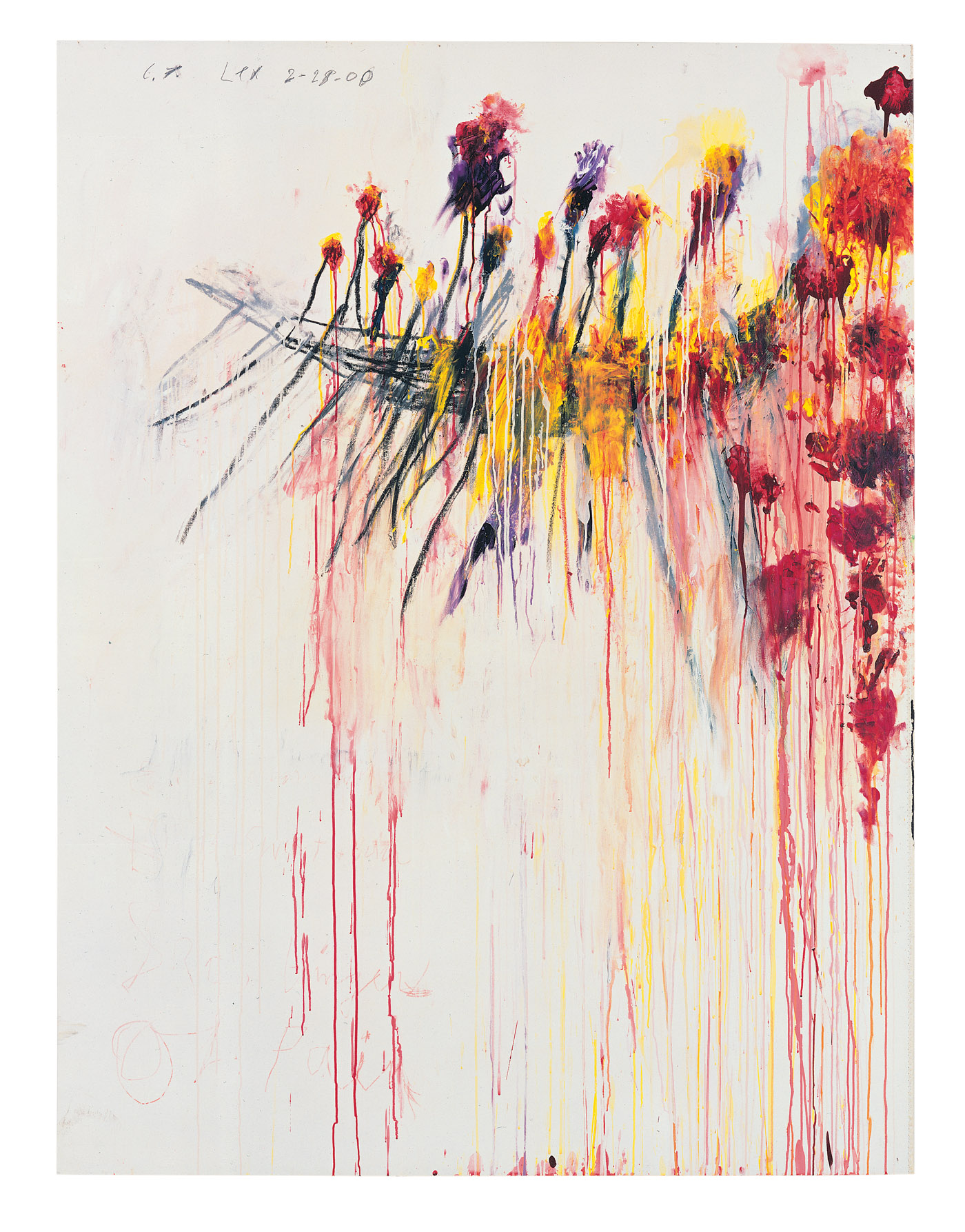
Cy Twombly (American, 1928-2011) 'Coronation of Sesostris (Part III)' 2000


Cy Twombly (American, 1928-2011)
Coronation of Sesostris (Part III)
2000
Acrylic, wax crayon, lead pencil on canvas
206.1 x 136.5cm
Pinault Collection
© Cy Twombly Foundation, courtesy Pinault Collection


Cy Twombly’s remark that ‘lines have a great effect on painting’ resonates not only with his graphic practice but with his relation to poetry. The importance of the modern German poet Rainer Maria Rilke to Twombly includes the figure of the Orphic poet and their shared interest in the ancient River Nile. Twombly’s Egyptian series, Coronation of Sesostris, 2000, represents a late flowering of his remarkable graphic inventiveness…

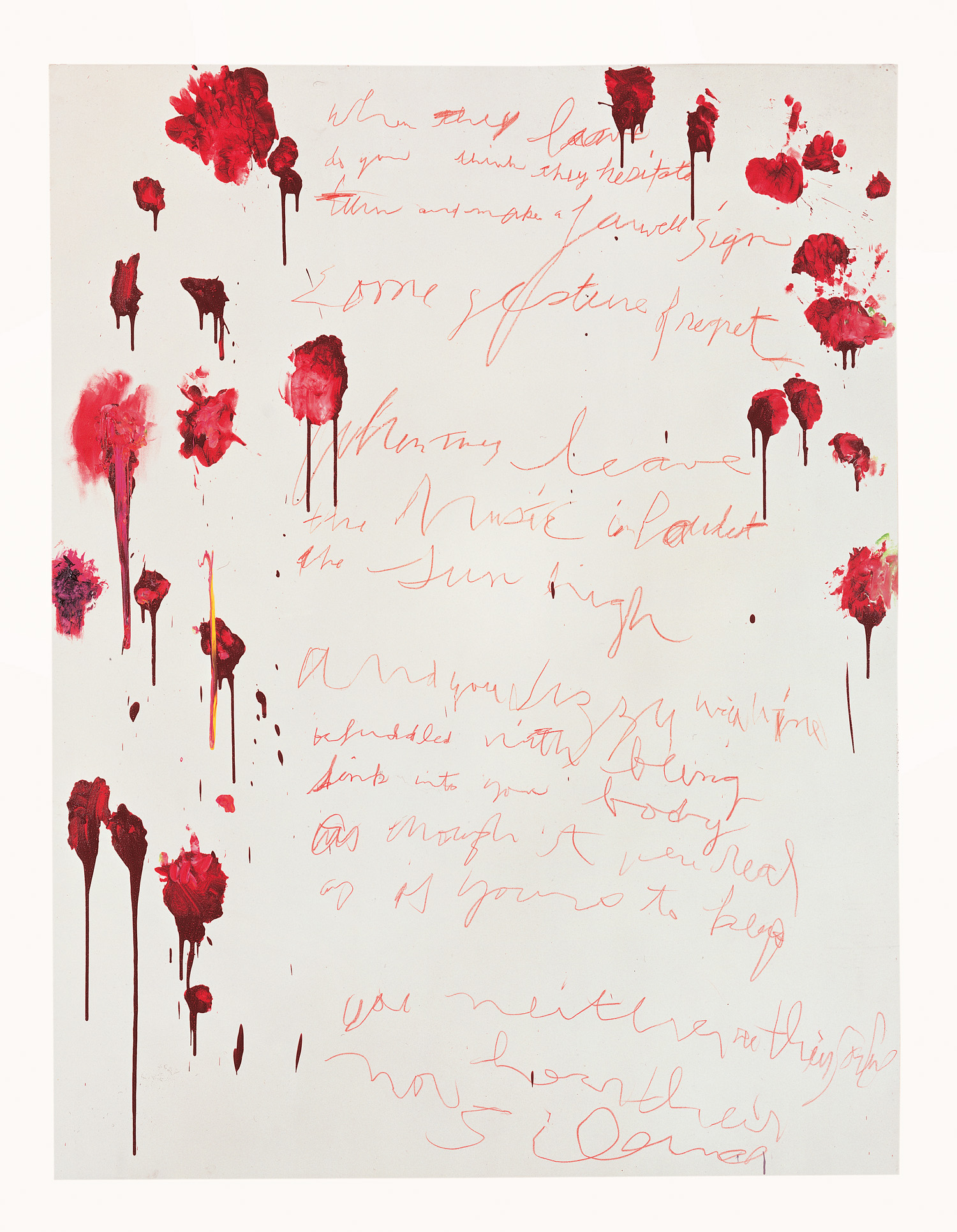
Twombly’s ten-part Coronation of Sesostris, 2000, is the culminating synthesis of his ship ideographs and whirling expeditionary chariots: a blazing, triumphal departure that burns itself out on the far side of the Nile. Begun in Gaeta and completed in Virginia, it combines deceptive simplicity with painterly sophistication and poetic adaptation. Twombly calls this multi-media series (drawn, written, painted) one of his favourite sets and ‘very personal’. It incorporates a poem of 1996 by the Southern poet Patricia Waters, not a translation this time, although its title (‘Now is the Drinking’) translates Nunc est bibendum. With a few strokes and deletions, Twombly ‘interprets’ the poem to create his own reticent version:


When they leave,
Do you think they hesitate,
Turn and make a farewell sign,
Some gesture of regret?

When they leave,
the music is loudest,
the sun high,

and you, dizzy with wine
befuddled with well-being,
sink into your body
as though it were real,
as if yours to keep.

You neither see their going,
nor hear their silence.


Either side of this ambiguous celebration of bodily oblivion, Twombly’s sequence tracks the energetic course of the Pharaonic conquerer, Sesostris II.

Mary Jacobus. “Time-Lines: Rilke and Twombly on the Nile,” in Tate Papers no. 10 [Online] Cited 09/12/2021. No longer available online
 

Cy Twombly (American, 1928-2011) 'Coronation of Sesostris (Part V)' 2000


Cy Twombly (American, 1928-2011)
Coronation of Sesostris (Part V)
2000
Acrylic, wax crayon, lead pencil on canvas
206.1 x 156.5cm
Pinault Collection
© Cy Twombly Foundation, courtesy Pinault Collection


Cy Twombly (American, 1928-2011) 'Coronation of Sesostris (Part VI)' 2000


Cy Twombly (American, 1928-2011)
Coronation of Sesostris (Part VI)
2000
Acrylic, wax crayon, lead pencil on canvas
203.7 x 155.6cm
Pinault Collection
© Cy Twombly Foundation, courtesy Pinault Collection


Jonas Storsve: Curator’s point of view

Rich and complex, the work of Cy Twombly, who passed away in 2011, spans a period of some sixty years without ever losing any of its force, even in the very last years of the artist’s life. One of the most productive in recent history, Twombly’s career links the culture of post-war America, dominated artistically by Abstract Expressionism, and the Classical Mediterranean culture that he discovered as a young man and made his own. The artist would remain very close to the world of his birth, that of the Southern United States, better known in Europe for its literature, with William Faulkner, Carson McCullers, Flannery O’Connor, Truman Capote and more.

From his childhood and youth in Lexington, Virginia, where he grew up under the attentive eye of his African-American nanny, Lula Bell Watts, he retained the characteristic and sometimes difficult-to-understand accent of the South. The boy’s family environment seems to have stimulated his intellectual curiosity, cultivated his sensibility and encouraged an interest in painting. When in 1952, at the age of 24, he applied for a grant to travel to Europe, he said he wanted “to study the prehistoric cave drawings of Lascaux.” He also planned to view French, Italian and Dutch museums, Gothic and Baroque architecture, and Roman ruins. He also declared himself to be “drawn to the primitive, the ritual and fetishistic elements, to the symmetrical visual order.” Once he had his grant, he invited the artist Robert Rauschenberg, whom he met in New York two years earlier, to accompany him. They took a ship for Naples on 20 August 1952. The rich and original culture that he acquired would nourish his work. His readings were also voyages – Goethe, Homer, Horace, Herodotus, Keats, Mallarmé, Ovid, Rilke, Sappho, Virgil – on which he would draw for his creation. He found inspiration too in less well-known authors, among them Lesley Blanch, Robert Burton, George Gissing and 13th-century Persian poet and mystic Jalāl ad-Dīn Muhammad Rūmī. This uncommonly refined sensibility found an expressive outlet in his painting.

Yet while Twombly was indeed a highly cultivated and well-read painter, this was only one aspect of his complex personality. The sophistication of his work is accompanied by a constant attention to vernacular realities, visible to varying degrees but always present. Endowed with a rare wit and humour, Twombly could be deliciously irreverent and even dirty-minded when he wanted. In front of his painting Apollo (1963), he remarked laconically to Paul Winkler, who used to be director of the Menil Collection in Houston: “Rachel and I used to love to go dancing at the Apollo Theater in Harlem”. And in a whole series of drawings from 1981-1982, he wrote the phrase “Private Ejaculations”, in the knowledge that in the 17th century it referred to short, intense prayer at regular intervals.

We know today, too, that photography played an important role in Twombly’s work and life. A private, even secretive man, he nonetheless regularly allowed himself to be photographed. Some of the most famous pictures of the artist were taken by Horst P. Horst for Vogue magazine, illustrating an article by Valentine Lawford entitled “Roman Classic Surprise” published in the November 1966 issue. Taken in Twombly’s apartment in the Via Monserrato in Rome, the photographs reveal a dandy living in palatial accommodations. This appearance in Vogue did little to improve his relationship with the United States, at a low ebb since the controversy of the Nine Discourses on Commodus shown at Leo Castelli’s in New York. It was considered too smart and sophisticated: too distant, in brief, from the American idea of an American artist.

Twelve years later, in 1978, Heiner Bastian published the first monograph on Twombly’s painting, for which the artist took care to present himself differently. The cover picture shows him dressed in jeans and pull-over, boots on his feet, sitting on the ground beneath a tree, with sheep close by – an image intended to communicate an idea of an artist close to the earth, living a healthy and simple life. Twombly indeed was probably both, dandy and Roman shepherd.

Sally Mann, a friend from Lexington, often photographed Twombly and his studio toward the end of his life. Thanks to her we have photos that document the development of the Coronation of Sesostris series, which he finished in the city of his birth. Among the most beautiful of the images are those of the studio, empty of work, with just traces of paint on the walls. From some of these ghostly images of a whole phase of Twombly’s work, of his place of work and creation, Mann assembled an album, recently published as Remembered Light.

The Centre Pompidou is staging the first comprehensive retrospective of Cy Twombly’s work in Europe. Unprecedented in scope, bringing together works from public and private collections the whole world over, the exhibition will be shown only in Paris. Organised around three great series – Nine Discourses on Commodus (1963), Fifty Days at Iliam (1978) and Coronation of Sesostris (2000) – it offers a chronological survey of the whole of the artist’s career, the 140 paintings, drawings and photographs affording an insight into the complexity of his work as a whole, simultaneously scholarly and sensual. Among the works shown are some of his best-known ones, many never exhibited in France before. Polyphonic in conception, the accompanying catalogue proposes a multiplicity of approaches, with essays on different aspects and periods of Twombly’s career. It also includes reflections and personal impressions by other artists, and accounts of the formation of the two great collections of Twombly’s work – the Brandhorsts’ and Yvon Lambert’s – as well as recollections by his son Alessandro Twombly. The catalogue closes on a lively and joyful portrait of Twombly from the pen of Nicola Del Roscio. Through this varied testimony, readers will discover not only the artist, but also the man, seemingly returned to life before our eyes.”

Jonas Storsve in Code Couleur, no. 26, September – December 2016, pp. 18-23.


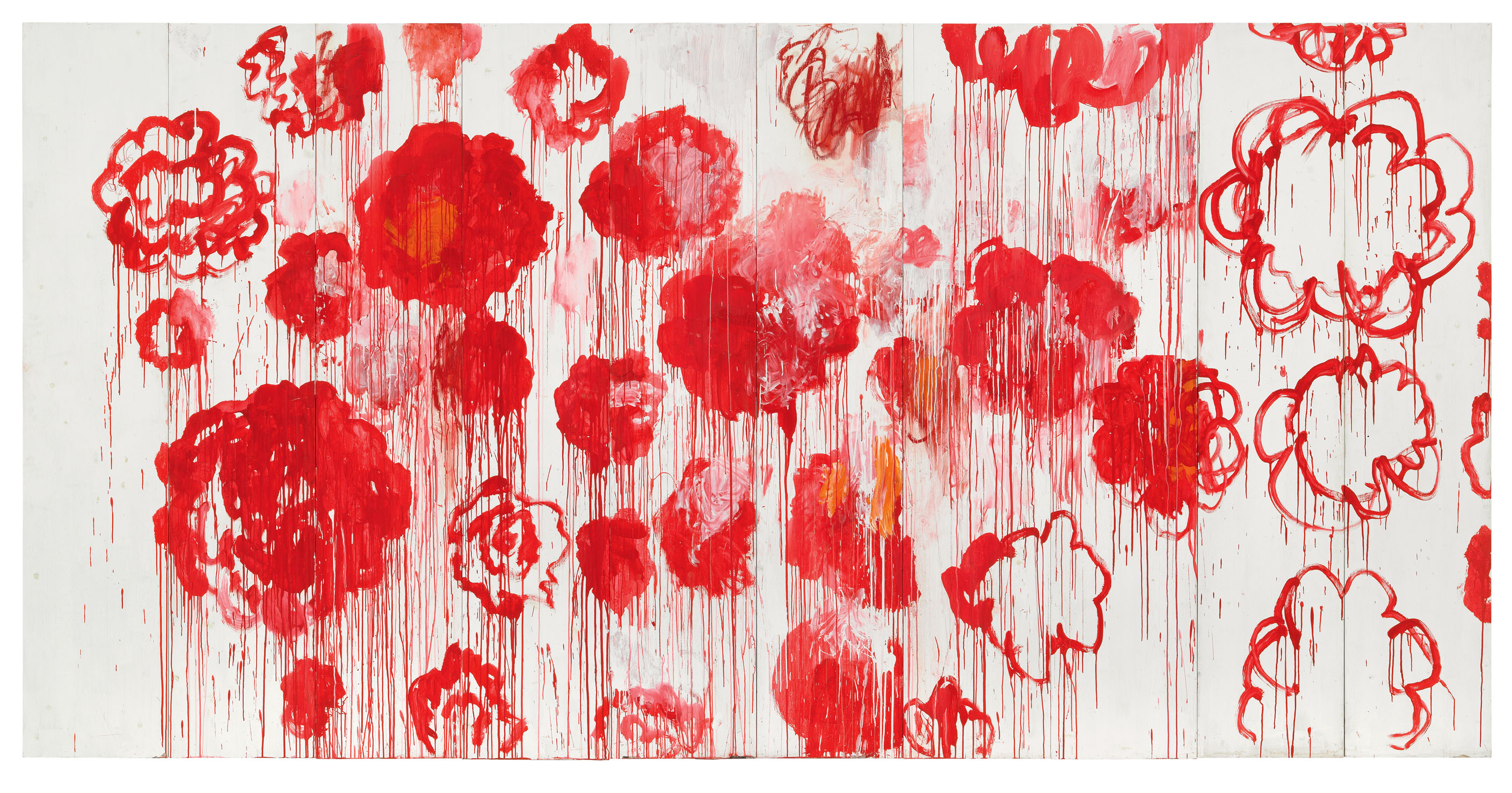
Cy Twombly (American, 1928-2011) 'Blooming' 2001-2008


Cy Twombly (American, 1928-2011)
Blooming
2001-2008
Acrylic, wax crayon on 10 wooden panels
250 x 500cm
Private collection
© Cy Twombly Foundation, courtesy Archives Fondazione Nicola Del Roscio


Cy Twombly (American, 1928-2011) 'Untitled, (A Gathering of Time)' 2003


Cy Twombly (American, 1928-2011)
Untitled, (A Gathering of Time)
2003
Acrylic on canvas
215.9 x 267.3cm
Udo and Anette Brandhorst Collection
© Cy Twombly Foundation
 

Cy Twombly (American, 1928-2011) 'Untitled (Bacchus)' 2005


Cy Twombly (American, 1928-2011)
Untitled (Bacchus)
2005
Acrylic on canvas
317.5 x 417.8cm
Udo and Anette Brandhorst Collection
© Cy Twombly Foundation
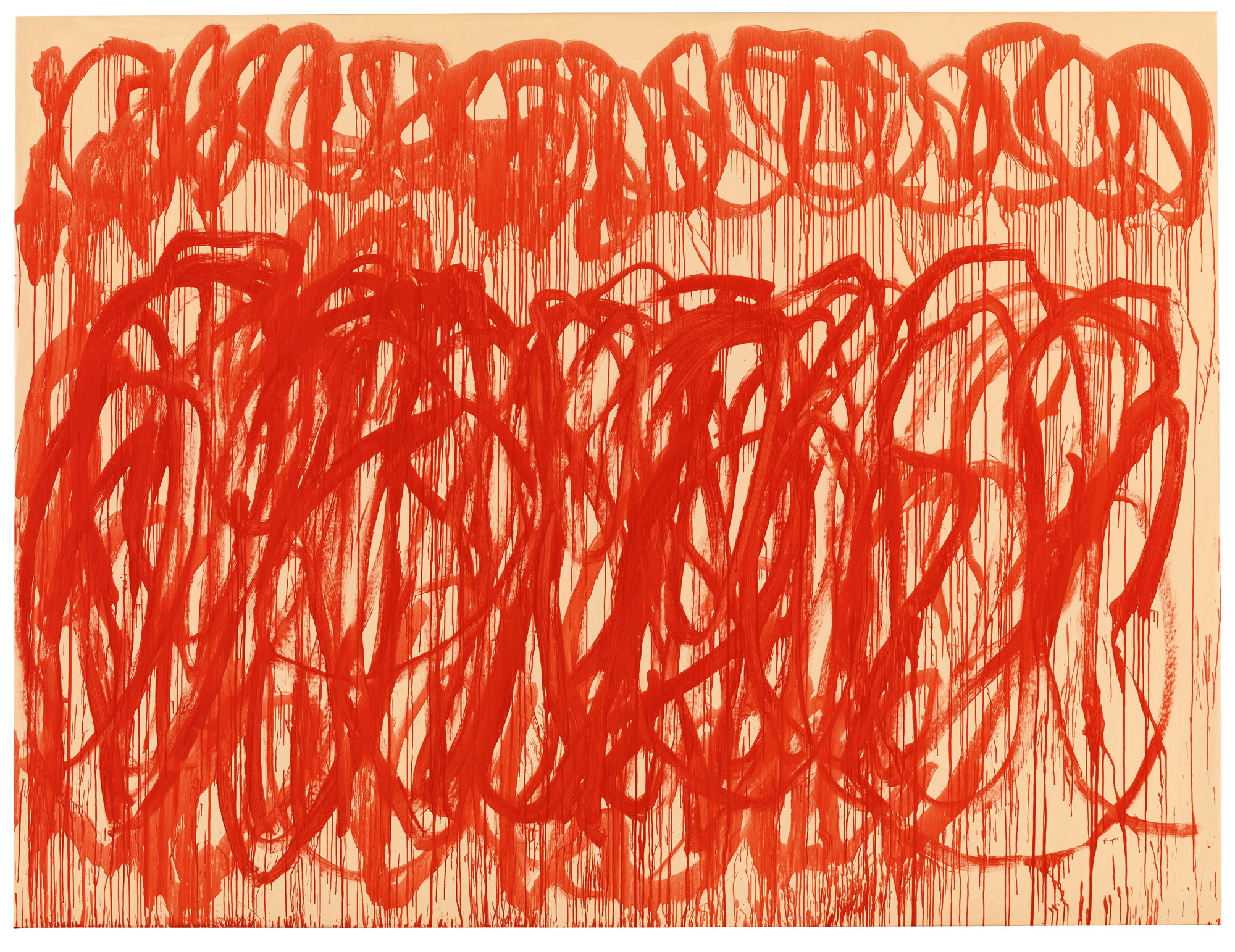
 

Cy Twombly (American, 1928-2011) 'Sans titre' (Gaète) 2007


Cy Twombly (American, 1928-2011)
Sans titre (Gaète)
2007
Acrylic, wax crayon on wooden panel
252 x 552cm
Museum Brandhorst, Munich
Udo and Anette Brandhorst Collection
© Cy Twombly Foundation
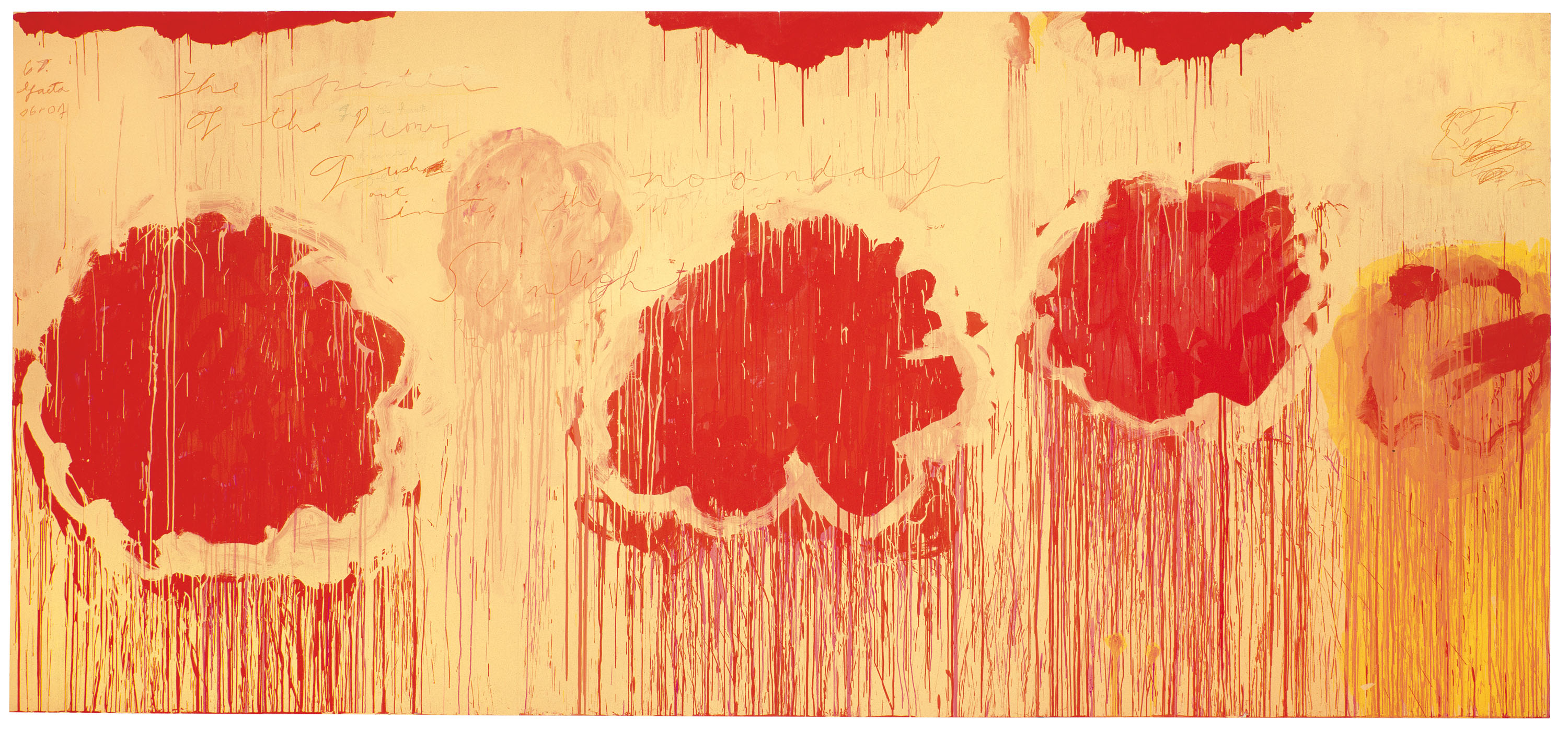
 

Cy Twombly (American, 1928-2011) 'Camino Real (V)' 2010


Cy Twombly (American, 1928-2011)
Camino Real (V),
2010
Acrylic on wood panel
252.4 x 185.1cm
Louis Vuitton Foundation
© Cy Twombly Foundation, courtesy Gagosian Gallery


Centre Pompidou 
75191 Paris cedex 04
Phone: 00 33 (0)1 44 78 12 33

Opening hours:
Exhibition open every day from 11am – 9pm except on Tuesday
Closed on May 1st

Centre Pompidou website

LIKE ART BLART ON FACEBOOK

Back to top

Exhibition: ‘One and One Is Four: The Bauhaus Photocollages of Josef Albers’ at The Museum of Modern Art (MoMA), New York

Exhibition dates: 23rd November, 2016 – 2nd April, 2017

Curators: Sarah Hermanson Meister, Curator in the Department of Photography and Nancy Newhall Curatorial Fellow, Department of Photography


Josef Albers (American born Germany, 1888-1976) 'El Lissitzky, Dessau' 1930/1932 from the exhibition 'One and One Is Four: The Bauhaus Photocollages of Josef Albers' at The Museum of Modern Art (MoMA), New York, Nov 2016 - April 2017


Josef Albers (American born Germany, 1888-1976)
El Lissitzky, Dessau
1930/1932
Gelatin silver prints mounted to board
11 5/8 × 16 3/8″ (29.5 × 41.6cm) overall
The Museum of Modern Art, New York
Acquired through the generosity of Jo Carole and Ronald S. Lauder, and Jon L. Stryker
© 2016 The Josef and Anni Albers Foundation / Artists Rights Society (ARS), New York
Photo: John Wronn


NEARLY A WEEK SINCE MY LAST POSTING SO LET’S MAKE THIS A GOOD ONE…

A fabulous posting on the photocollages of that most excellent of artists, Josef Albers, where the selection of images and their pairings “take on questions of duality, time, and narrative…” – to which I might add, questions of perspective and context. These photocollages are a revelation to me.

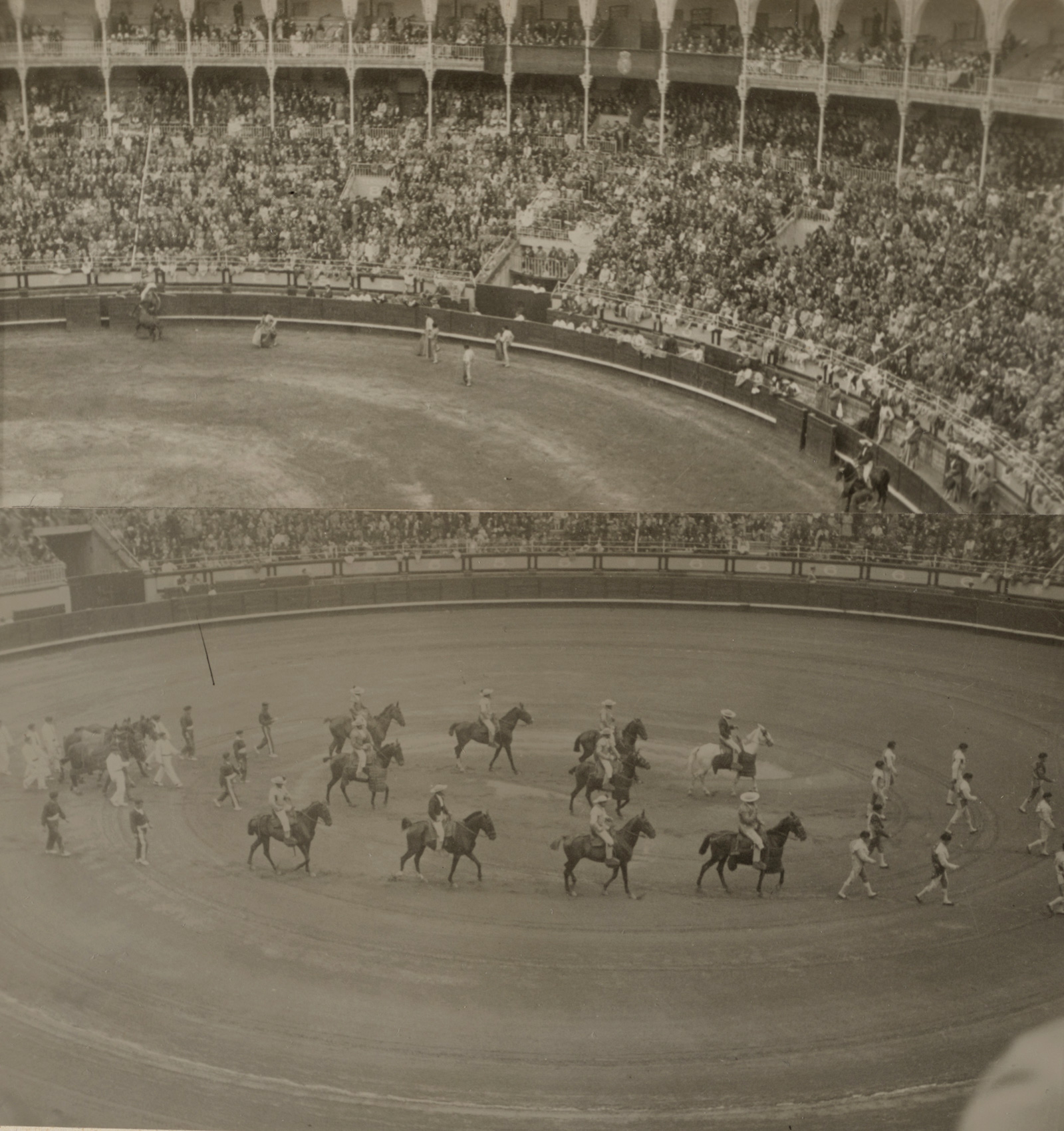
The complex photo narratives move image across time and space. This can be seen in the photomontage Untitled (Bullfight, San Sebastian) (1930/1932, below) where the multitude of photographs of a bullfight in San Sebastien, “can be read as a short story or experimental film, where we as viewers recognise that we are being transported to a distant time and place…”

Here the visual plane is fragmented, the scale mixed, shape, direction and space / time continuity confused. Structures are repeated; time is overlaid; perspective is shifted; narrative is multiplied. This is complex, New Vision image making, not just the downwards or upward looking objectivity of Russian constructivism, but a more nuanced splicing of time and space. The bullfight is magnificent in its “in the round” picturing … the splitting of the arena in the central images confuses direction, scale and circularity.

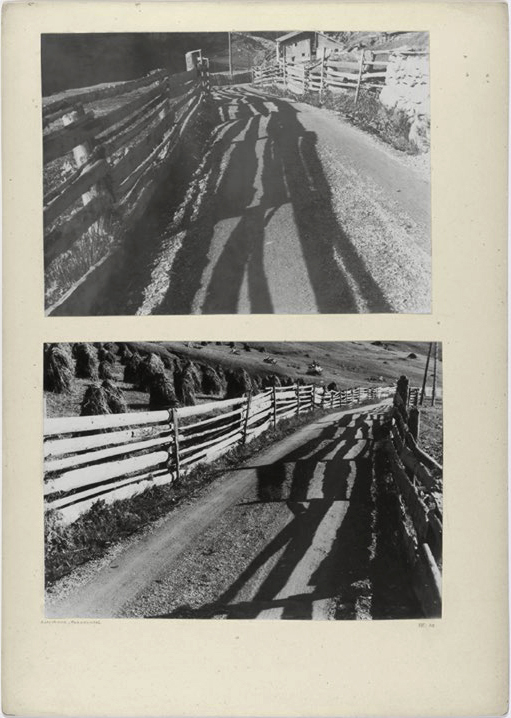
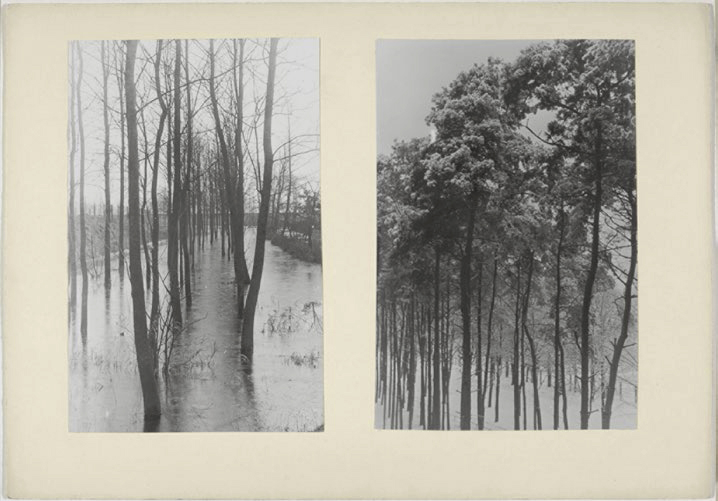
There are further “in the round” elements (mimicking Renaissance triple portrait painting such as Triple Portrait of Cardinal de Richelieu (1642) in the National Gallery of Art, London), seen in the work Amédée Ozenfant, summer 1931 (below) which, while objectifying the human countenance, contains that nugget of truth: that portraiture is an expression of humanism. Other photocollages, for example Road, Paznauntal, July 1930; Hotel staircases, Geneva, 1929 (with its Escher-like construction); Flooded trees and forest; and Dessau, end of winter, 1931 (all below), challenge our orientation in the world both physically and spiritually.

These photocollages, 70 of which were made between 1928 and 1932, were never discovered until after Albers was dead. No one ever knew he took photographs, but it was obviously important to him that he did so. Would he be able to say whether he was being serious, or he was having fun? Probably both. What a shame that they are often mutually exclusive in the last 30 -40 years.

It’s all very well to be able to say you are having fun – but what about being in this state (i.e. Albers state when he was compositing the photographs) and not even knowing … not even thinking of the question. Perhaps his was a private form of meditation on the nature of vision.

Dr Marcus Bunyan

(Written using dictation software, the rest all cut and paste)


Many thankx to MoMA for allowing me to publish the photographs in the posting. Please click on the photographs for a larger version of the image.


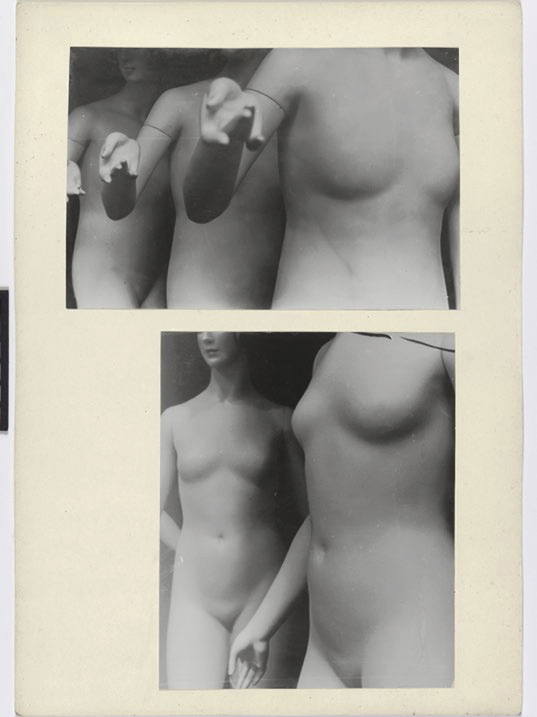
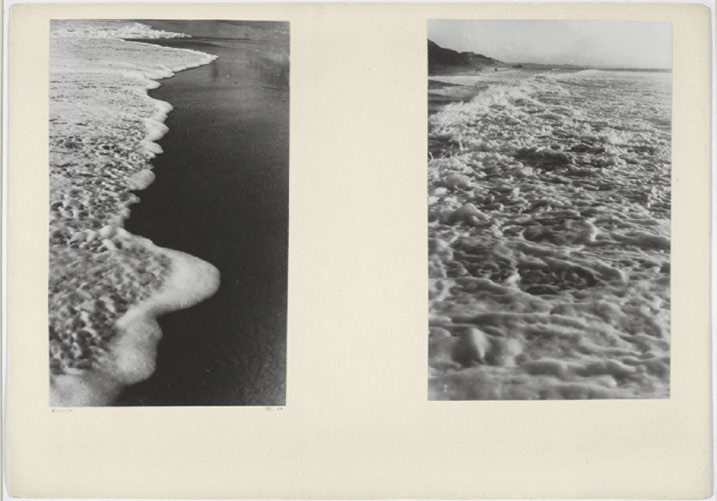
“Beginning at the Bauhaus in 1928, Albers made hundreds, perhaps thousands, of photographs with his handheld Leica camera, and he made thousands more, mostly while traveling, in the decades following his emigration to the United States in 1933. But we concern ourselves here with a group of seventy photocollages mounted to A3 boards, established as a standard size in Germany in 1922 at 29.7 by 42 centimetres (11 3/4 by 16 1/2 inches). No record exists of Albers ever having exhibited these collages in his lifetime, nor does he appear to have spoken of them. Yet in their rigorous construction and allusive potential, they represent a singularly creative body of work. The images Albers used to make these collages fall rather neatly into four categories – portraits, mannequins, the natural world, and the built environment – and Albers attends to a remarkably narrow subsection within each of these: The portraits feature only people Albers knew well – fellow Bauhäusler, family, and friends. The primary urban motif is the mannequin, which was also featured in the photographs of contemporaries such as Eugène Atget, Bill Brandt, Manuel Álvarez Bravo, Horacio Coppola, and scores of others who were attentive to the figures’ Surrealist echoes. His images of nature consist of mostly waves, some trees, and a few mountains, and there are only a handful of man-made structures. Albers’s limited range of subjects achieves new significance in his collages, where their selection and pairings take on questions of duality, time, and narrative, topics that resist being infused into single images of similar subjects.”


Sarah Hermanson Meister. “Josef Albers: An Open Mind for the Newer and Nearer,” from One and One Is Four: The Bauhaus Photocollages of Josef Albers, Museum of Modern Art, New York, 2016, pp. 11-12.


“The abstract language that Albers adopted for the great majority of his oeuvre precludes temporal specificity, which makes the close study of a number of his photocollages all the more compelling, specifically in Albers’s attentiveness to the complexity engendered by incorporating multiple photographs – each captured in a fraction of a second, but inevitably across time – into a single work.”


Sarah Hermanson Meister. “Josef Albers: An Open Mind for the Newer and Nearer,” from One and One Is Four: The Bauhaus Photocollages of Josef Albers, Museum of Modern Art, New York, 2016, p. 15.


“The image on the left shows Lissitzky smiling warmly, almost conspiratorially, at Albers. The background divides neatly into three tones – black, white, and gray – each of which corresponds loosely to Lissitzky’s (black) tie, (white) shirt, and the middle shades of the photographic spectrum that echo Lissitzky’s tanned complexion and balding pate. The horizontal image on the right is the same width but half the height of the vertical image, and in it we see Lissitzky almost in profile, looking toward his other likeness. This time the asymmetry of his placement within the frame is even more pronounced: his nose is cropped by the left edge, his forehead by the top, but the right half of the image is virtually empty. While we feel confident that these photographs were captured at the same meeting, the darker background in the right-hand image and the differentiation between Lissitzky’s shirt and collar (which, on the left, seem identical) remind the viewer of the variability of photographic representation. Albers mounted these prints with their top edges roughly aligned and with nearly equivalent space between their outside edges and the sides of the board: there is no evident rhyme or reason in the interstitial spaces. This irregularity draws the viewer’s attention to the geometric forms within each image and to the prints themselves, which might be construed as Albers’s nod to the dynamic geometric vocabulary that Lissitzky employed in his own art and design.”

Sarah Hermanson Meister. “Josef Albers: An Open Mind for the Newer and Nearer,” from One and One Is Four: The Bauhaus Photocollages of Josef Albers, Museum of Modern Art, New York, 2016, pp. 13-14.


Josef Albers (American born Germany, 1888-1976) 'El Lissitzky, Dessau' 1930/1932 (detail)


Josef Albers (American born Germany, 1888-1976)
El Lissitzky, Dessau (detail)
1930/1932
Gelatin silver prints mounted to board
11 5/8 × 16 3/8″ (29.5 × 41.6cm) overall
The Museum of Modern Art, New York
Acquired through the generosity of Jo Carole and Ronald S. Lauder, and Jon L. Stryker
© 2016 The Josef and Anni Albers Foundation / Artists Rights Society (ARS), New York
Photo: John Wronn


Josef Albers (American born Germany, 1888-1976) 'Untitled (Bullfight, San Sebastian)' 1930/1932 from the exhibition 'One and One Is Four: The Bauhaus Photocollages of Josef Albers' at The Museum of Modern Art (MoMA), New York, Nov 2016 - April 2017


Josef Albers (American born Germany, 1888-1976)
Untitled (Bullfight, San Sebastian)
1930/1932
Gelatin silver prints mounted to board
11 5/8 × 16 3/8″ (29.5 × 41.6cm) overall
The Museum of Modern Art, New York
Acquired through the generosity of Jo Carole and Ronald S. Lauder, and Jon L. Stryker
© 2016 The Josef and Anni Albers Foundation / Artists Rights Society (ARS), New York
Photo: John Wronn


“Nowhere does Albers change the rules of the game more profoundly than in his collages that feature a multitude of photographs. His collage of a bullfight in San Sebastian can be read as a short story or experimental film, where we as viewers recognise that we are being transported to a distant time and place, no less enchanting for its impossibility.

At the centre we find the nominal subject: a procession of banderilleros, picadors, and matadors. Surrounding this are three views of the arena filled with crowds, whose choreographed disjunction evokes the rhythm of the event they are gathered to see. The sweep of the arcade is plainly elevated in the central view, with a nearly symmetrical relationship to those architectural forms on the left and right, whereas the cropped edge of the ring awkwardly intersects its corresponding form, an oblique allusion, perhaps, to the impossibility of predicting the outcome of this highly ritualised event. The two images that anchor the bottom of the collage show more dramatic vantage points. A plethora of boater hats, caps, and a scattering of bare heads, each precisely described, is juxtaposed against a mass of automobiles presumably parked outside. These horizonless seas of repeated forms were common motifs for avant-garde photographers of the period. It is the tightly woven – but not flawless – relationships between these individual components, akin to cuts in a film, that reward our reconsideration of these elements with respect to the whole.”

Sarah Hermanson Meister. “Josef Albers: An Open Mind for the Newer and Nearer,” from One and One Is Four: The Bauhaus Photocollages of Josef Albers, Museum of Modern Art, New York, 2016, pp. 14-15.


Josef Albers (American born Germany, 1888-1976) 'Untitled (Bullfight, San Sebastian)' 1930/1932 (detail)

Josef Albers (American born Germany, 1888-1976) 'Untitled (Bullfight, San Sebastian)' 1930/1932 (detail)


Josef Albers (American born Germany, 1888-1976)
Untitled (Bullfight, San Sebastian) (details)
1930/1932
Gelatin silver prints mounted to board
11 5/8 × 16 3/8″ (29.5 × 41.6cm) overall
The Museum of Modern Art, New York
Acquired through the generosity of Jo Carole and Ronald S. Lauder, and Jon L. Stryker
© 2016 The Josef and Anni Albers Foundation / Artists Rights Society (ARS), New York
Photo: John Wronn


Josef Albers (American born Germany, 1888-1976) 'Paris, Eiffel Tower' 1929/1932


Josef Albers (American born Germany, 1888-1976)
Paris, Eiffel Tower
1929/1932
Gelatin silver prints mounted to board
11 5/8 × 16 3/8″ (29.5 × 41.6cm) overall
The Museum of Modern Art, New York
Acquired through the generosity of Jo Carole and Ronald S. Lauder, and Jon L. Stryker
© 2016 The Josef and Anni Albers Foundation / Artists Rights Society (ARS), New York
Photo: John Wronn


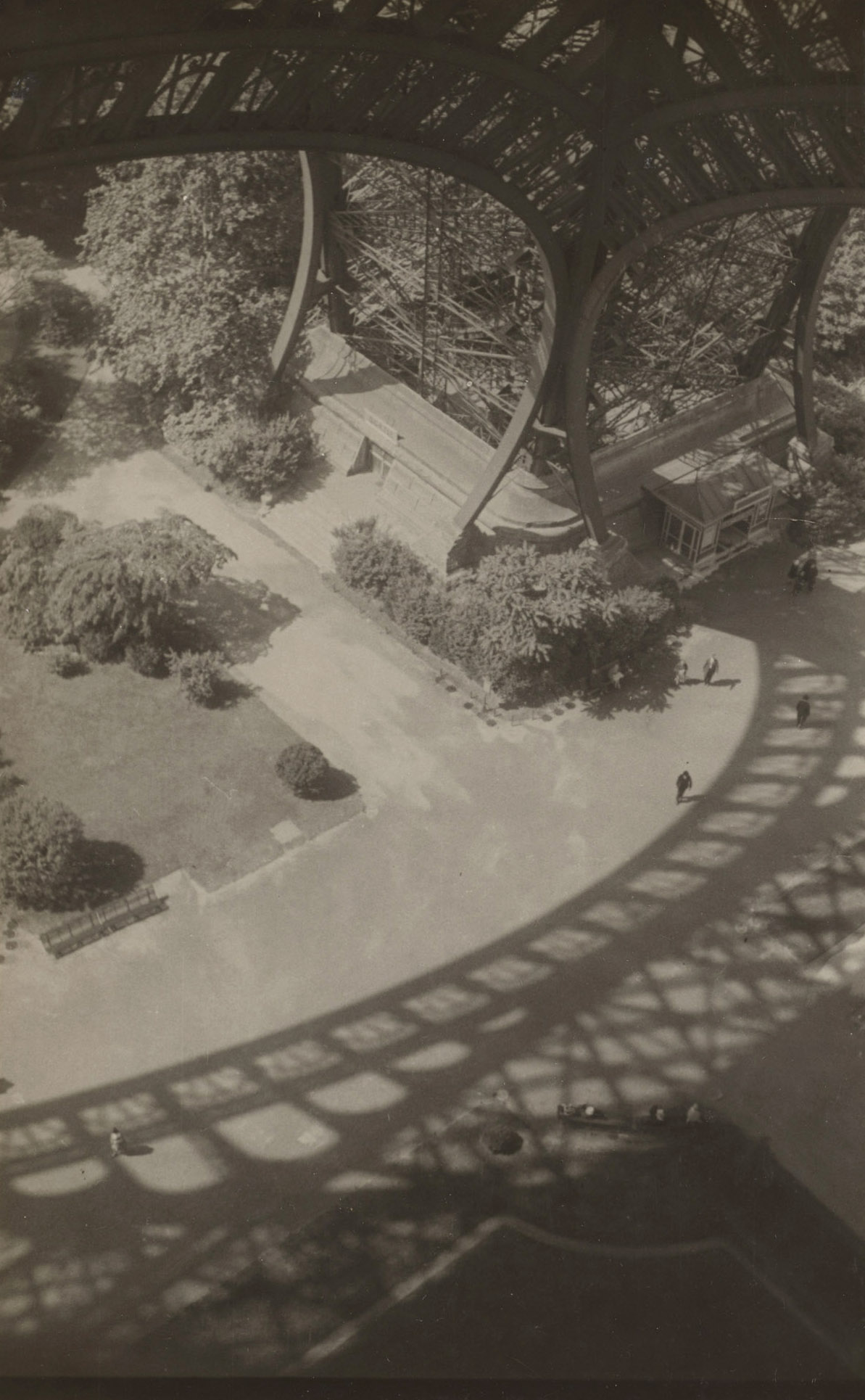
“Of the seventy photocollages Albers made at this time, more than half feature but two photographic prints: their placement reveals both formal innovation and a sensitivity to the unique characteristics of the individual photographs. Albers’s photographs of the Eiffel Tower, made during a summer break from teaching, suggest his attentiveness to the range of possibilities offered by his Leica, and the close relationship between his work and that of his contemporaries. Both images in his collage feature plunging perspectives; the sunlight and shadow in the image on the left draw our attention to the diminutive figures below. Albers was not a particularly fastidious printer, yet he was surely attuned to the fact that every tone in the photograph on the right exists on the continuum of tones between the highlights and shadows on the left. Lest the viewer suspect that these are purely mechanical byproducts of the process, Albers trims each image with a subtly but noticeably irregular hand, underscoring the artist’s creative agency. This marriage of industry and craft was a hallmark of the Bauhaus. To further emphasise the aesthetic, non-documentary function of these photographs, Albers anchors them at the top left of his board, pointedly shifting the viewer’s perspective.”

Sarah Hermanson Meister. “Josef Albers: An Open Mind for the Newer and Nearer,” from One and One Is Four: The Bauhaus Photocollages of Josef Albers, Museum of Modern Art, New York, 2016, p. 14.


Josef Albers (American born Germany, 1888-1976) 'Paris, Eiffel Tower' 1929/1932 (detail)


Josef Albers (American born Germany, 1888-1976)
Paris, Eiffel Tower (detail)
1929/1932
Gelatin silver prints mounted to board
11 5/8 × 16 3/8″ (29.5 × 41.6cm) overall
The Museum of Modern Art, New York
Acquired through the generosity of Jo Carole and Ronald S. Lauder, and Jon L. Stryker
© 2016 The Josef and Anni Albers Foundation / Artists Rights Society (ARS), New York
Photo: John Wronn


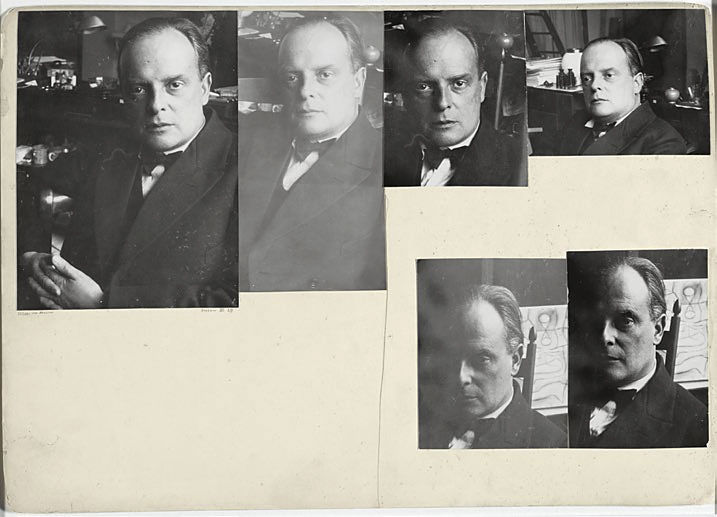
Josef Albers (American born Germany, 1888-1976) 'Paul Klee in his studio, Dessau, November 1929'


Josef Albers (American born Germany, 1888-1976)
Paul Klee in his studio, Dessau, November 1929
November 1929
Gelatin silver prints mounted to board
11 5/8 × 16 3/8″ (29.5 × 41.6cm) overall
The Museum of Modern Art, New York
Acquired through the generosity of Jo Carole and Ronald S. Lauder, and Jon L. Stryker, 2015
© 2016 The Josef and Anni Albers Foundation / Artists Rights Society (ARS), New York
Photo: John Wronn


Josef Albers (American born Germany, 1888-1976). 'Paul Klee, Dessau, November 1929' 1929/1932


Josef Albers (American born Germany, 1888-1976)
Paul Klee, Dessau, November 1929
1929/1932
Gelatin silver prints mounted to board
11 11/16 x 16 7/16″ (29.7 x 41.8cm) overall
The Museum of Modern Art, New York
Gift of The Josef and Anni Albers Foundation
© 2016 The Josef and Anni Albers Foundation / Artists Rights Society (ARS), New York
Photo: John Wronn


Josef Albers (American born Germany, 1888-1976). 'Paul Klee, Dessau' 1929/1932 (detail)


Josef Albers (American born Germany, 1888-1976)
Paul Klee, Dessau, November 1929 (detail)
1929/1932
Gelatin silver prints mounted to board
11 11/16 x 16 7/16″ (29.7 x 41.8cm) overall
The Museum of Modern Art, New York
Gift of The Josef and Anni Albers Foundation
© 2016 The Josef and Anni Albers Foundation / Artists Rights Society (ARS), New York
Photo: John Wronn


Josef Albers (American born Germany, 1888-1976) 'Amédée Ozenfant, summer 1931'


Josef Albers (American born Germany, 1888-1976)
Amédée Ozenfant, summer 1931
1931
Gelatin silver prints mounted to board
11 5/8 × 16 3/8″ (29.5 × 41.6cm) overall
The Museum of Modern Art, New York
© 2016 The Josef and Anni Albers Foundation / Artists Rights Society (ARS), New York
Photo: John Wronn


Josef Albers (American born Germany, 1888-1976) 'Vasily Kandinsky, master on the terrace at Hannes Meyer’s, spring 1929; May 1930'


Josef Albers (American born Germany, 1888-1976)
Vasily Kandinsky, master on the terrace at Hannes Meyer’s, spring 1929; May 1930
1929/1930
Gelatin silver prints mounted to board
11 5/8 × 16 3/8″ (29.5 × 41.6cm) overall
The Museum of Modern Art, New York
© 2016 The Josef and Anni Albers Foundation / Artists Rights Society (ARS), New York
Photo: John Wronn


Josef Albers (American born Germany, 1888-1976). 'Marli Heimann, All During an Hour' 1931/1932


Josef Albers (American born Germany, 1888-1976)
Marli Heimann, All During an Hour
1931/1932
Gelatin silver prints mounted to board
11 11/16 x 16 7/16″ (29.7 x 41.8cm) overall
The Museum of Modern Art, New York
Gift of The Josef and Anni Albers Foundation, 1988
© 2016 The Josef and Anni Albers Foundation / Artists Rights Society (ARS), New York
Photo: John Wronn


Josef Albers (American born Germany, 1888-1976) 'Oskar Schlemmer, April 1929; Schlemmer in the Bauhaus Masters' Council, 1928; Schlemmer with Hans Wittwer, Ernst Kállai, and Marianne Brandt, Preliminary Course Exhibition, 1927/28; Schlemmer and Tut, summer 1928; Schlemmer, April 1930; Schlemmer, 1928' 1927/1929


Josef Albers (American born Germany, 1888-1976)
Oskar Schlemmer, April 1929; Schlemmer in the Bauhaus Masters’ Council, 1928; Schlemmer with Hans Wittwer, Ernst Kállai, and Marianne Brandt, Preliminary Course Exhibition, 1927/28; Schlemmer and Tut, summer 1928; Schlemmer, April 1930; Schlemmer, 1928
1927/1929
Gelatin silver prints mounted on board
11 5/8 × 16 3/8″ (29.5 × 41.6cm) overall
Acquired through the generosity of Jo Carole and Ronald S. Lauder, and Jon L. Stryker
© 2016 The Josef and Anni Albers Foundation / Artists Rights Society (ARS), New York
Photo: John Wronn


Josef Albers (American born Germany, 1888-1976) 'Oskar Schlemmer, April 1929; Schlemmer in the Bauhaus Masters' Council, 1928; Schlemmer with Hans Wittwer, Ernst Kállai, and Marianne Brandt, Preliminary Course Exhibition, 1927/28; Schlemmer and Tut, summer 1928; Schlemmer, April 1930; Schlemmer, 1928' 1927/1929 (detail)


Josef Albers (American born Germany, 1888-1976)
Oskar Schlemmer, April 1929; Schlemmer in the Bauhaus Masters’ Council, 1928; Schlemmer with Hans Wittwer, Ernst Kállai, and Marianne Brandt, Preliminary Course Exhibition, 1927/28; Schlemmer and Tut, summer 1928; Schlemmer, April 1930; Schlemmer, 1928 (detail)
1927/1929
Gelatin silver prints mounted on board
11 5/8 × 16 3/8″ (29.5 × 41.6cm) overall
Acquired through the generosity of Jo Carole and Ronald S. Lauder, and Jon L. Stryker
© 2016 The Josef and Anni Albers Foundation / Artists Rights Society (ARS), New York
Photo: John Wronn


Josef Albers (American, born Germany, 1888-1976) is a central figure in 20th-century art, both as a practitioner and as a teacher at the Bauhaus, Black Mountain College, and Yale University. Best known for his iconic series Homages to the Square, Albers made paintings, drawings, and prints and designed furniture and typography. The least familiar aspect of his extraordinary career is his inventive engagement with photography, which was only discovered after his death. The highlight of this work is undoubtedly the photocollages featuring photographs he made at the Bauhaus between 1928 and 1932. At once expansive and restrained, this remarkable body of work anticipates concerns that Albers would pursue throughout his career: seriality, perception, and the relationship between handcraft and mechanical production.

The first serious exploration of Albers’s photographic practice occurred in a modest exhibition at MoMA in 1988, The Photographs of Josef Albers. In 2015, the Museum acquired 10 photocollages by Albers – adding to the two donated by the Josef and Anni Albers Foundation almost three decades ago – making its collection the most significant anywhere outside the Foundation. This installation celebrates both this landmark acquisition and the publication of One and One Is Four: The Bauhaus Photocollages of Josef Albers, which focuses exclusively on this deeply personal and inventive aspect of Albers’s work and makes many of these photocollages available for the first time.

Book

The Museum of Modern Art announces the release of One and One Is Four: The Bauhaus Photocollages of Josef Albers, the first publication to reproduce all 70 photocollages created by Josef Albers at the Bauhaus using photographs he made between 1928 and 1932. Hailed in his own lifetime as among the most important figures of 20th-century art, both as a practitioner and as a teacher at the Bauhaus, Black Mountain College, and Yale University, Albers (1888-1976) achieved widespread acclaim across a range of mediums, from glassworks and furniture design to printmaking and painting. Yet Albers’s engagement with modernist photography remained largely hidden until after his death, and it is only now that the entire series of unique photocollages the artist produced at the famed art school – before he and his wife fled Nazi Germany for the US – has been published together, many for the first time. At once expansive and restrained, this remarkable body of work anticipates concerns that Albers would pursue throughout his career: seriality, perception, and the relationship between handcraft and mechanical production.

One and One Is Four reveals an Albers at once familiar and unexpected – playful yet disciplined, personal yet enigmatic – through a body of work whose genius becomes fully apparent when considered as a whole. “Albers’s photocollages stand as remarkable contributions to the medium in their own right,” explains Sarah Hermanson Meister, Curator in the Department of Photography and the author of the book, “while they anticipate in important ways key concerns that would animate the artist’s work throughout his career, including his iconic Homages to the Square.” An essay by art historian and Bauhaus scholar Elizabeth Otto underscores the originality of Albers’s achievement through a survey of photocollages by Albers’s fellow Bauhäusler, and a contribution by MoMA conservator Lee Ann Daffner examines the artist’s materials to suggest new insights into these works, the discovery of which has been celebrated as one of the great art finds of the past century. The publication also includes a transcription of a lecture delivered by Albers at Black Mountain College in February 1943 titled “Photos as Photography and Photos as Art” – Albers’s sole public statement about the medium – and a preface by Nicholas Fox Weber, Executive Director of The Josef and Anni Albers Foundation.

The first serious exploration of Albers’s photographic practice occurred in a modest exhibition of 38 photographs organised by John Szarkowski at MoMA in 1988, The Photographs of Josef Albers. At the time, the Josef and Anni Albers Foundation donated two photocollages to the Museum. In 2015, the Museum acquired 10 additional photocollages by Albers, making its collection the most significant anywhere outside the Foundation. A new installation featuring 16 photocollages, on view from November 23, 2016, through April 2, 2017, in the Museum’s fifth-floor galleries, celebrates both the publication and this landmark acquisition. The exhibition is organised by Sarah Meister with Kristen Gaylord, Beaumont and Nancy Newhall Curatorial Fellow, Department of Photography. The exhibition is supported by the Annual Exhibition Fund.

Press release from MoMA


Josef Albers (American born Germany, 1888-1976) 'Mannequins' c. 1930


Josef Albers (American born Germany, 1888-1976)
Mannequins
c. 1930
Gelatin silver prints mounted to board
16 3/8 x 11 5/8″ (41.6 x 29.5cm) overall
The Museum of Modern Art, New York
© 2016 The Josef and Anni Albers Foundation / Artists Rights Society (ARS), New York
Photo: John Wronn


Josef Albers (American born Germany, 1888-1976) 'Walter Gropius and Schifra Canavesi, Ascona August 1930'


Josef Albers (American born Germany, 1888-1976)
Walter Gropius and Schifra Canavesi, Ascona, August 1930
August 1930
Gelatin silver prints mounted to board
16 3/8 x 11 5/8″ (41.6 x 29.5cm) overall
The Museum of Modern Art, New York
© 2016 The Josef and Anni Albers Foundation / Artists Rights Society (ARS), New York
Photo: John Wronn


Josef Albers (American born Germany, 1888-1976) 'Susanne, Biarritz, August 1929'


Josef Albers (American born Germany, 1888-1976)
Susanne, Biarritz, August 1929
August 1929
Gelatin silver prints mounted to board
16 3/8 x 11 5/8″ (41.6 x 29.5cm) overall
The Museum of Modern Art, New York
© 2016 The Josef and Anni Albers Foundation / Artists Rights Society (ARS), New York
Photo: John Wronn


Josef Albers (American born Germany, 1888-1976) 'Mrs. Lewandowski of Munich, Ascona, August 1930'


Josef Albers (American born Germany, 1888-1976)
Mrs. Lewandowski of Munich, Ascona, August 1930
August 1930
Gelatin silver prints mounted to board
16 3/8 x 11 5/8″ (41.6 x 29.5cm) overall
The Museum of Modern Art, New York
© 2016 The Josef and Anni Albers Foundation / Artists Rights Society (ARS), New York
Photo: John Wronn


Josef Albers (American born Germany, 1888-1976) 'Road, Paznauntal, July 1930'


Josef Albers (American born Germany, 1888-1976)
Road, Paznauntal, July 1930
July 1930
Gelatin silver prints mounted to board
16 3/8 x 11 5/8″ (41.6 x 29.5cm) overall
The Museum of Modern Art, New York
© 2016 The Josef and Anni Albers Foundation / Artists Rights Society (ARS), New York
Photo: John Wronn


Josef Albers (American born Germany, 1888-1976) 'Hotel staircases, Geneva, 1929'


Josef Albers (American born Germany, 1888-1976)
Hotel staircases, Geneva, 1929
1929
Gelatin silver prints mounted to board
11 5/8 × 16 3/8″ (29.5 × 41.6cm) overall
The Museum of Modern Art, New York
Acquired through the generosity of Jo Carole and Ronald S. Lauder, and Jon L. Stryker, 2015
© 2016 The Josef and Anni Albers Foundation / Artists Rights Society (ARS), New York
Photo: John Wronn


Josef Albers (American born Germany, 1888-1976) 'Flooded trees and forest' c. 1931


Josef Albers (American born Germany, 1888-1976)
Flooded trees and forest
c. 1931
Gelatin silver prints mounted to board
11 5/8 × 16 3/8″ (29.5 × 41.6cm) overall
The Museum of Modern Art, New York
© 2016 The Josef and Anni Albers Foundation / Artists Rights Society (ARS), New York
Photo: John Wronn


Josef Albers (American born Germany, 1888-1976) 'Dessau, end of winter, 1931'


Josef Albers (American born Germany, 1888-1976)
Dessau, end of winter, 1931
1931
Gelatin silver prints mounted to board
11 5/8 × 16 3/8″ (29.5 × 41.6cm) overall
The Museum of Modern Art, New York
Acquired through the generosity of Jo Carole and Ronald S. Lauder, and Jon L. Stryker, 2015
© 2016 The Josef and Anni Albers Foundation / Artists Rights Society (ARS), New York
Photo: John Wronn


Josef Albers (American born Germany, 1888-1976) 'Brackish water, Biarritz, August 1929'


Josef Albers (American born Germany, 1888-1976)
Brackish water, Biarritz, August 1929
August 1929
Gelatin silver prints mounted to board
11 5/8 × 16 3/8″ (29.5 × 41.6cm) overall
The Museum of Modern Art, New York
© 2016 The Josef and Anni Albers Foundation / Artists Rights Society (ARS), New York
Photo: John Wronn


Josef Albers (American born Germany, 1888-1976) 'Biarritz, August 1929'


Josef Albers (American born Germany, 1888-1976)
Biarritz, August 1929
August 1929
Gelatin silver prints mounted to board
11 5/8 × 16 3/8″ (29.5 × 41.6cm) overall
The Museum of Modern Art, New York
Acquired through the generosity of Jo Carole and Ronald S. Lauder, and Jon L. Stryker, 2015
© 2016 The Josef and Anni Albers Foundation / Artists Rights Society (ARS), New York
Photo: John Wronn


The Museum of Modern Art
11 West 53 Street
New York, NY 10019
Phone: (212) 708-9400

Opening hours:
10.30am – 5.30pm
Open seven days a week

MoMA website

LIKE ART BLART ON FACEBOOK

Back to top

Exhibition: ‘Edward Steichen: Twentieth-Century Photographer’ at deCordova Sculpture Park and Museum, Lincoln, MA

Exhibition dates: 7th October, 2016 – 26th March, 2017


Edward Steichen (American, 1879-1973) 'Self-Portrait with Studio Camera' 1917; printed 1982 from the exhibition Exhibition: 'Edward Steichen: Twentieth-Century Photographer' at deCordova Sculpture Park and Museum, Lincoln, MA, Oct 2016 - March 2017


Edward Steichen (American, 1879-1973)
Self-Portrait with Studio Camera
1917; printed 1982
Silver gelatin print
13 1/8 x 10 5/8 inches (image and paper)
Gift of Stephen L. Singer and Linda G. Singer


Just for enjoyment.

Marcus


Many thankx to the deCordova Sculpture Park and Museum for allowing me to publish the photographs in the posting. Please click on the photographs for a larger version of the image.


Edward Steichen (American, 1879-1973) 'Self-Portrait with Studio Camera' c. 1917 from the exhibition Exhibition: 'Edward Steichen: Twentieth-Century Photographer' at deCordova Sculpture Park and Museum, Lincoln, MA, Oct 2016 - March 2017


Edward Steichen (American, 1879-1973)
Self-Portrait with Studio Camera
c. 1917
Gelatin silver print


Edward Steichen (American, 1879-1973) 'Self-Portrait with photographers paraphernalia' 1929


Edward Steichen (American, 1879-1973)
Self-Portrait with photographers paraphernalia
1929
Gelatin silver print


Installation view of 'Edward Steichen: Twentieth-Century Photographer' at the deCordova Sculpture Park and Museum


Installation view of Edward Steichen: Twentieth-Century Photographer at the deCordova Sculpture Park and Museum
Courtesy Photo/Clements Photography and Design, Boston
Creative Commons


DeCordova Sculpture Park and Museum is pleased to present the upcoming exhibition Edward Steichen: Twentieth-Century Photographer. Edward Steichen (1879-1973) is known for his role in expanding the breadth of twentieth-century photography through his memorable images and his work as a gallery director and museum curator. Steichen was a painter, horticulturalist, museum curator, graphic designer, publisher, and film director. He also served as a military photographer in both World Wars, and lived a life that embraced a century transformed by modernisation. On view in the James and Audrey Foster Galleries, the exhibition is drawn from deCordova’s permanent collection, and features important loans from private collectors and select institutions. The majority of photographs included in this show were made from Steichen’s original negatives and printed after his death in the 1980s by photographer George Tice. The exhibition also features a select number of vintage prints printed by Steichen in the 1910s and 1920s that reveal the lush interpretations he made with experimental printing techniques.

From his early Pictorialist images with their painterly quality, to his decades-long work as a commercial photographer for Condé Nast, Steichen explored the full range of the photographic medium. In his role as the Director of Photography at the Museum of Modern Art, New York, he often reproduced and integrated other photographers’ work into groundbreaking exhibitions that reflected his curatorial practice. The combined aspects of his career as a photographer and curator positioned Steichen to become a controversial yet prescient advocate for photography’s ability to record and amplify human observation, endeavour, and creativity.

The exhibition includes portraits of glamorous celebrities and socialites, still-life photographs of plants and flowers, dynamic cityscapes, and commercial advertisements. Also on view are Steichen’s portraits of fellow artists and writers that reveal his place among avant-garde cultural communities in New York and Europe. Edward Steichen also explores his work as the head of the Naval Aviation Photographic Unit in World War II, and traces his role at the Museum of Modern Art, NY where he curated over forty exhibitions. The aesthetic range of the images shows Steichen’s experimentation throughout his career with new techniques for lighting, composing, and printing photographs.

Edward Steichen continues deCordova’s longstanding commitment to the exhibition and collection of important photographic works. The exhibition opens to the public on October 7, 2016 and will be on view until March 26, 2017.

Press release from the deCordova Sculpture Park and Museum


Edward Steichen (American, 1879-1973) 'Auguste Rodin and the Monument to Victor Hugo' 1902


Edward Steichen (American, 1879-1973)
Auguste Rodin and the Monument to Victor Hugo
1902
Gum bichromate print


When Edward Steichen arrived in Paris in 1900, Auguste Rodin (1840-1917) was regarded not only as the finest living sculptor but also perhaps as the greatest artist of his time. Steichen visited him in his studio in Meudon in 1901 and Rodin, upon seeing the young photographer’s work, agreed to sit for his portrait. Steichen spent a year studying the sculptor among his works, finally choosing to show Rodin in front of the newly carved white marble of the “Monument to Victor Hugo,” facing the bronze of “The Thinker.” In his autobiography, Steichen describes the studio as being so crowded with marble blocks and works in clay, plaster, and bronze that he could not fit them together with the sculptor into a single negative. He therefore made two exposures, one of Rodin and the “Monument to Victor Hugo,” and another of “The Thinker.” Steichen first printed each image separately and, having mastered the difficulties of combining the two negatives, joined them later into a single picture, printing the negative showing Rodin in reverse.

Text from The Metropolitan Museum of Art website


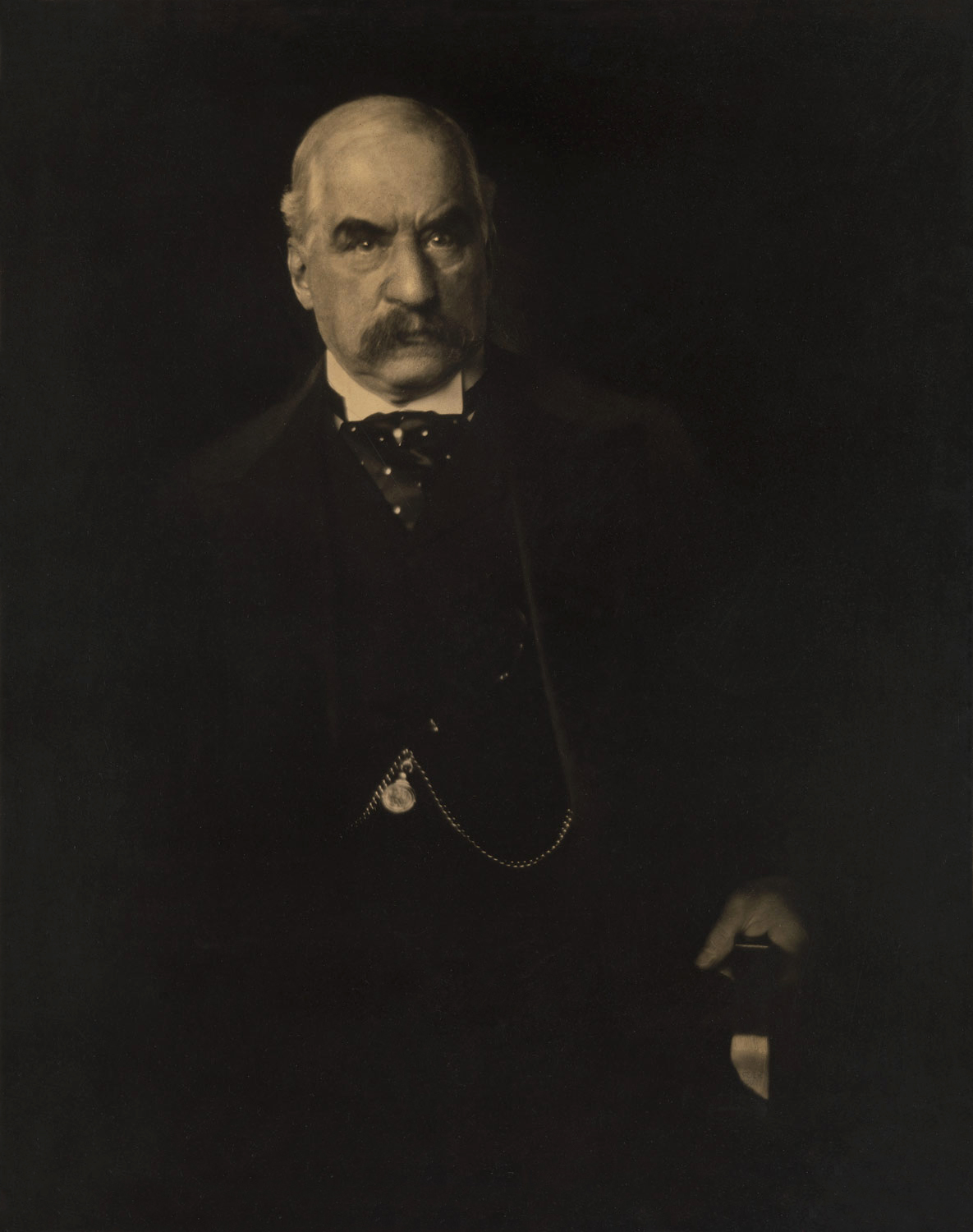
Edward Steichen (American, 1879-1973) 'J. Pierpont Morgan, Esq.' 1903


Edward Steichen (American, 1879-1973)
J. Pierpont Morgan, Esq.
1903
Gum bichromate over platinum print


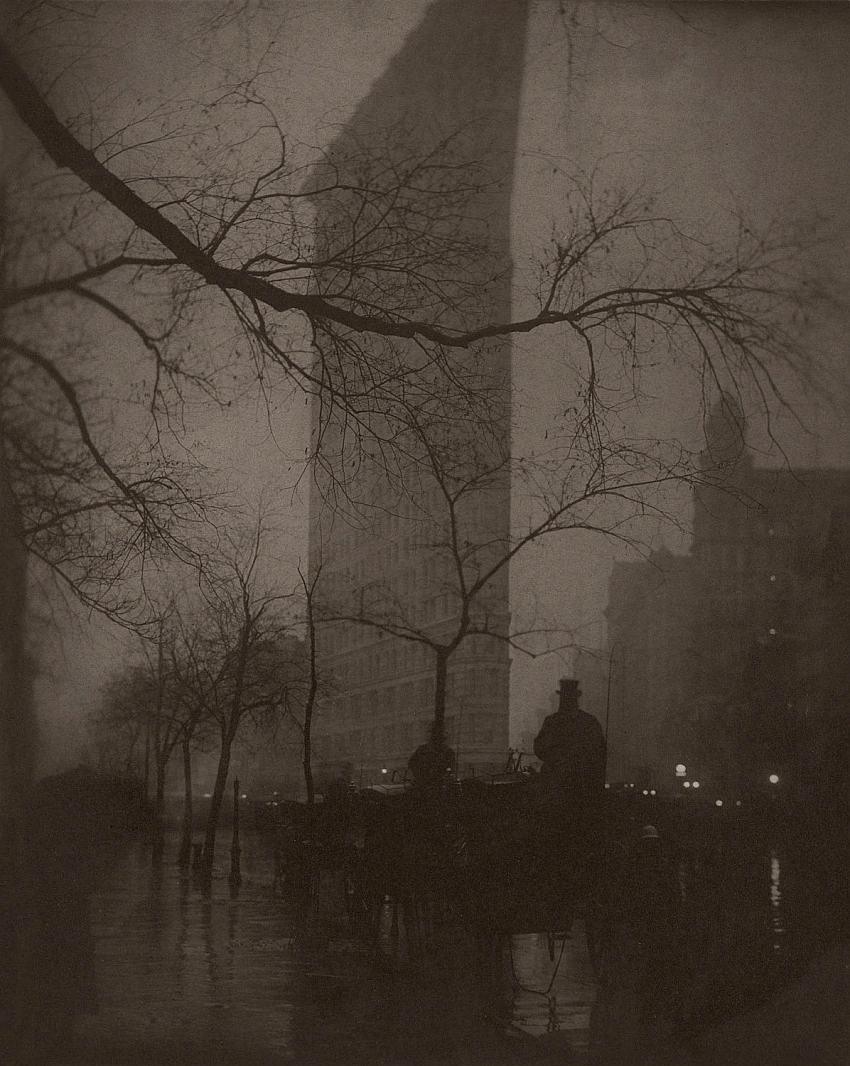
Edward Steichen (American, 1879-1973) 'The Flatiron' 1904


Edward Steichen (American, 1879-1973)
The Flatiron
1904
Gum bichromate over platinum print


While Steichen’s palette recalls Whistler’s Nocturne paintings and the foreground branch echoes those often found in the Japanese prints that were much in vogue in turn-of-the-century Paris, his subject is distinctly modern and American. The newly completed, twenty-two-story skyscraper soars so high above Madison Square in New York that it could not be contained within the photographer’s frame… Steichen’s three variant printings of The Flatiron, each in a different tonality, evoke successive moments of twilight and forcefully assert that photography can rival painting in scale, colour, individuality, and expressiveness.

Text from The Metropolitan Museum of Art website


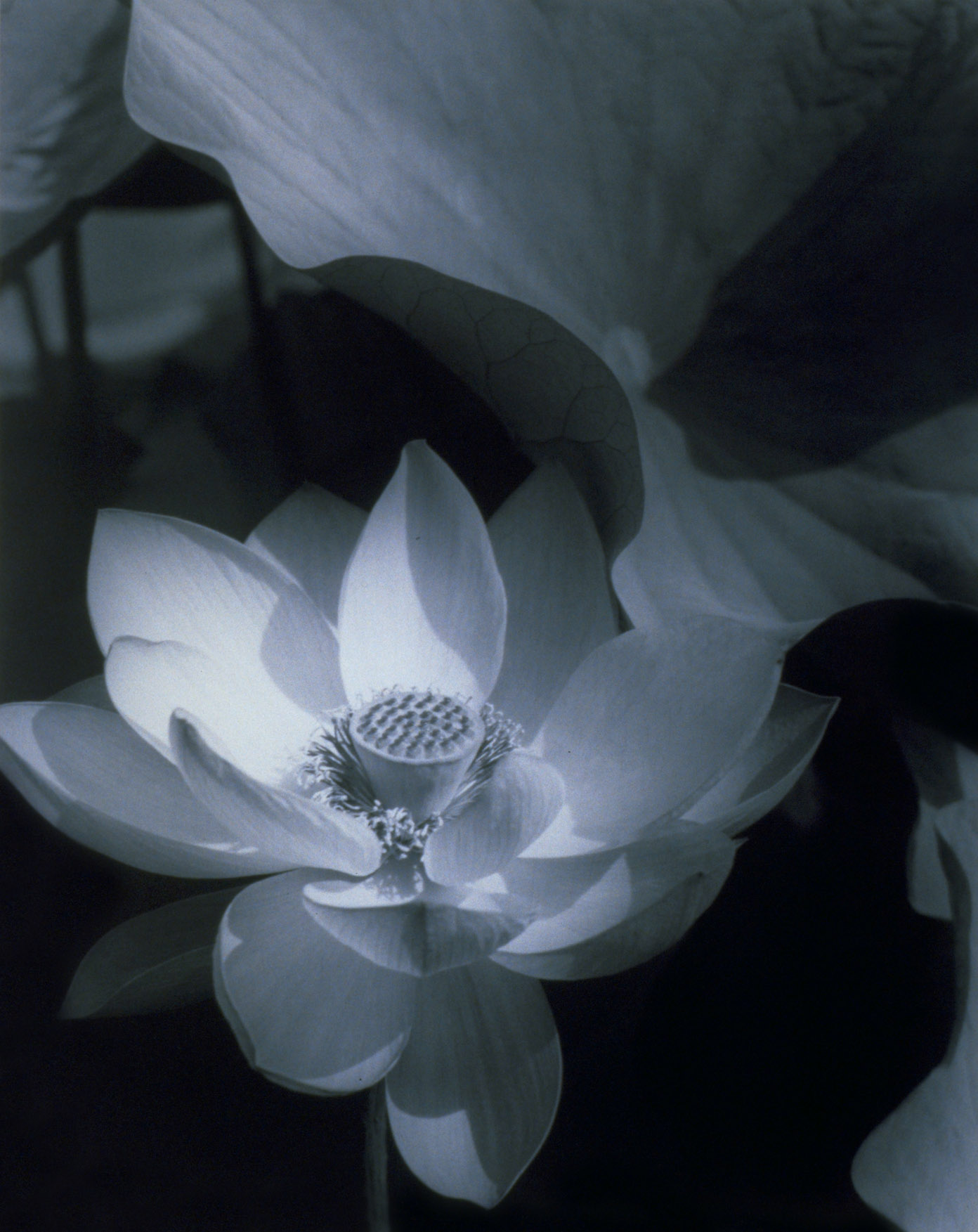
Edward Steichen (American, 1879-1973) 'Lotus, Mount Kisco, New York' 1915; printed 1982


Edward Steichen (American, 1879-1973)
Lotus, Mount Kisco, New York
1915; printed 1982
Silver gelatin print
13 1/4 x 10 1/2 inches (image and paper)
Gift of Diane Singer in honour of the marriage of Diane Singer to Eric Pearlman


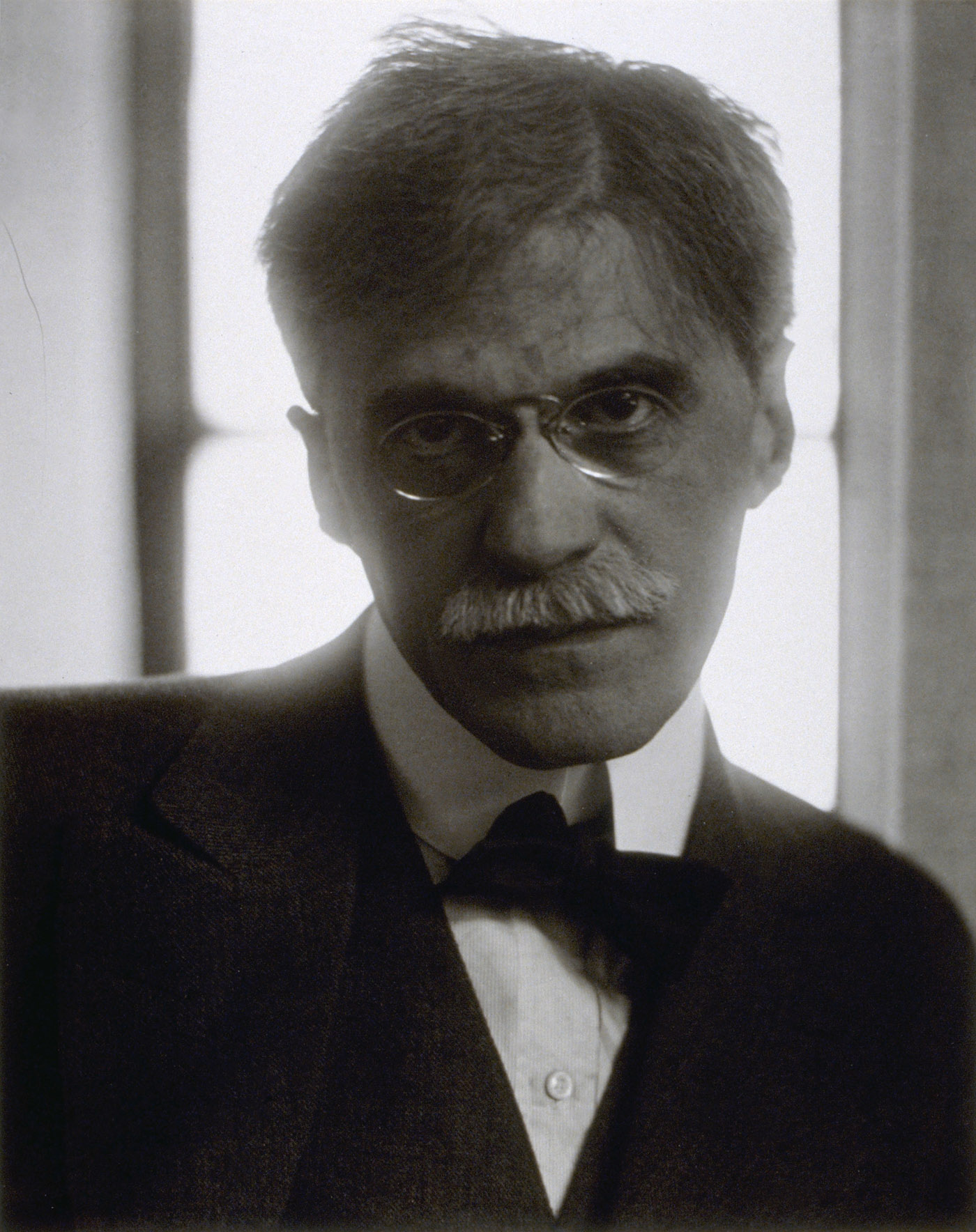
Edward Steichen (American, 1879-1973) Alfred 'Stieglitz' 1915; printed 1982


Edward Steichen (American, 1879-1973)
Alfred Stieglitz
1915; printed 1982
Silver gelatin print
9 5/8 x 7 3/4 inches (image and paper)
Gift of Stephen L. Singer and Linda G. Singer


The most recognisable of these images involve celebrity. Artists – Constantin Brancusi, Eugene O’Neill – and actors Charlie Chaplin, Lillian Gish, Marlene Dietrich, the unforgettable Greta Garbo – all sat for Steichen, who strove for a discovery of the individual.

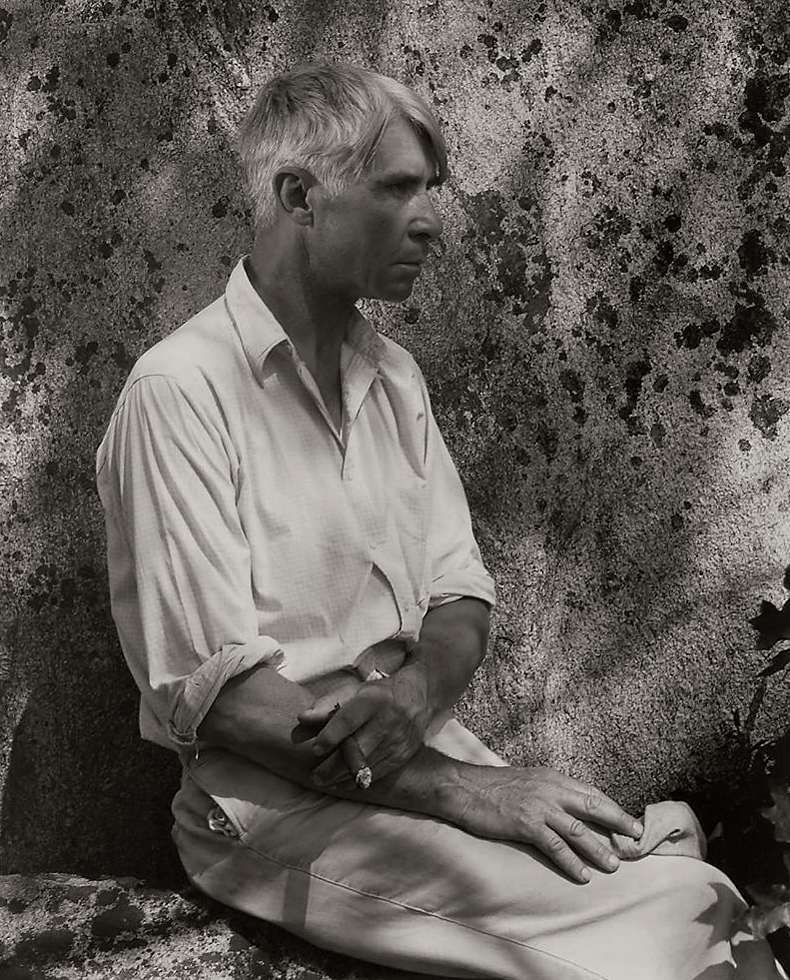
In black-and-white photography, composition, cast and shadow take prominence. Looming stage equipment behind a smiling Chaplin quietly recalls his movie roles. Garbo, clutching her “terrible hair,” wordlessly speaks volumes about her self- and public images. Carl Sandburg (Steichen’s brother-in-law) gazes poetically away from the camera. German author Gerhart Hauptmann stares directly into the camera under the starry firmament. The British dramaturge E. Gordon Craig poses foppishly in front of Notre-Dame cathedral in Paris.

Keith Powers. “DeCordova focuses on the varied career photographer Edward Steichen,” on The Metro West Daily News website [Online] Cited 21/03/2017. No longer available online


Edward Steichen (American, 1879-1973) 'Brancusi, Voulangis, France' c. 1922; printed 1987


Edward Steichen (American, 1879-1973)
Brancusi, Voulangis, France
c. 1922; printed 1987
Silver gelatin print
13 x 10 1/2 inches (image and paper)
Gift of Stephen L. Singer and Linda G. Singer


Edward Steichen (American, 1879-1973) 'Carl Sandburg, Umpawaug, Connecticut' 1930


Edward Steichen (American, 1879-1973)
Carl Sandburg, Umpawaug, Connecticut
1930
Gelatin silver print


Carl Sandburg (January 6, 1878 – July 22, 1967) was an American poet, writer, and editor who won three Pulitzer Prizes: two for his poetry and one for his biography of Abraham Lincoln. During his lifetime, Sandburg was widely regarded as “a major figure in contemporary literature”, especially for volumes of his collected verse, including Chicago Poems (1916), Cornhuskers (1918), and Smoke and Steel (1920). He enjoyed “unrivalled appeal as a poet in his day, perhaps because the breadth of his experiences connected him with so many strands of American life”, and at his death in 1967, President Lyndon B. Johnson observed that “Carl Sandburg was more than the voice of America, more than the poet of its strength and genius. He was America.”

Text from the Wikipedia website


Edward Steichen (American, 1879-1973) 'Greta Garbo' 1929


Edward Steichen (American, 1879-1973)
Greta Garbo
1929
Silver gelatin print


Edward Steichen (American, 1879-1973) 'E. Gordon Craig, Paris' 1920, printed in 1987


Edward Steichen (American, 1879-1973)
E. Gordon Craig, Paris
1920, printed in 1987
Gelatin silver print


Edward Henry Gordon Craig (English, 1872-1966)

Edward Henry Gordon Craig CH OBE (16 January 1872 – 29 July 1966), sometimes known as Gordon Craig, was an English modernist theatre practitioner; he worked as an actor, director and scenic designer, as well as developing an influential body of theoretical writings…

Craig’s idea of using neutral, mobile, non-representational screens as a staging device is probably his most famous scenographic concept. In 1910 Craig filed a patent which described in considerable technical detail a system of hinged and fixed flats that could be quickly arranged to cater for both internal and external scenes. He presented a set to William Butler Yeats for use at the Abbey Theatre in Ireland, who shared his symbolist aesthetic.

Craig’s second innovation was in stage lighting. Doing away with traditional footlights, Craig lit the stage from above, placing lights in the ceiling of the theatre. Colour and light also became central to Craig’s stage conceptualisations…

The third remarkable aspect of Craig’s experiments in theatrical form were his attempts to integrate design elements with his work with actors. His mise en scène sought to articulate the relationships in space between movement, sound, line, and colour. Craig promoted a theatre focused on the craft of the director – a theatre where action, words, colour and rhythm combine in dynamic dramatic form.

All of his life, Craig sought to capture “pure emotion” or “arrested development” in the plays on which he worked. Even during the years when he was not producing plays, Craig continued to make models, to conceive stage designs and to work on directorial plans that were never to reach performance. He believed that a director should approach a play with no preconceptions and he embraced this in his fading up from the minimum or blank canvas approach.

Text from the Wikipedia website


Edward Steichen (American, 1879-1973) 'The Blue Sky, Long Island, New York' 1923; printed 1987


Edward Steichen (American, 1879-1973)
The Blue Sky, Long Island, New York
1923; printed 1987
Silver gelatin print
9 1/2 x 7 1/4 inches (image and paper)
Gift of Stephen L. Singer and Linda G. Singer


DeCordova Sculpture Park and Museum
51 Sandy Pond Road in Lincoln, Massachusetts

Opening hours (Winter hours):
Wednesday – Sunday, 10am – 4pm

deCordova Sculpture Park and Museum website

LIKE ART BLART ON FACEBOOK

Back to top

Exhibition: ‘Life and Labor: The Photographs of Milton Rogovin’ at the San Jose Museum of Art, San Jose, CA

Exhibition dates: 18th August, 2016 – 19th March, 2017

Curator: Marja van der Loo, curatorial assistant at SJMA


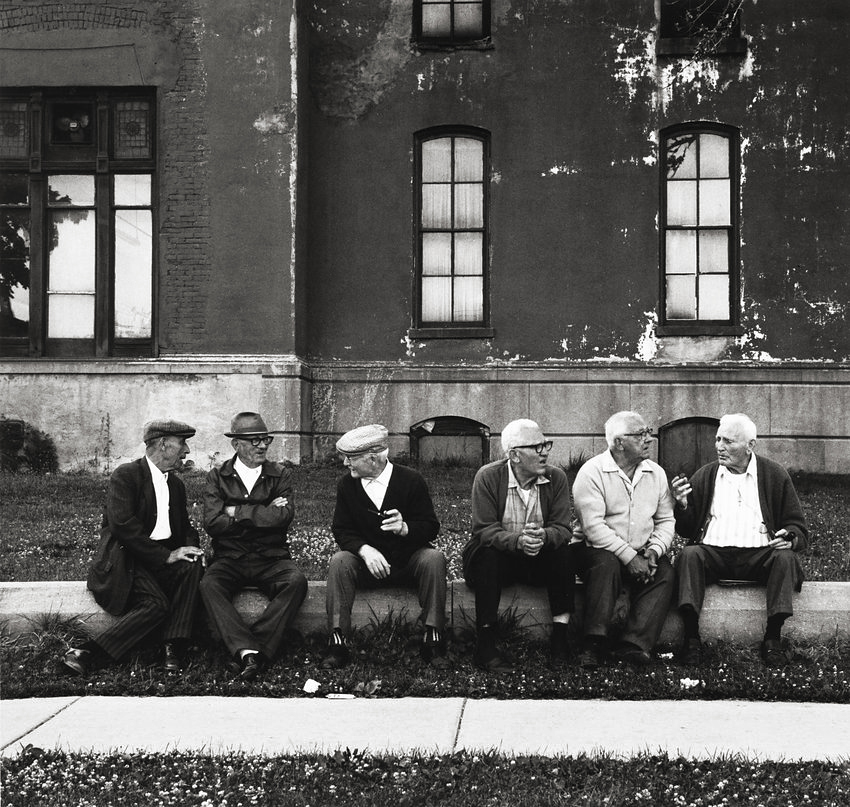
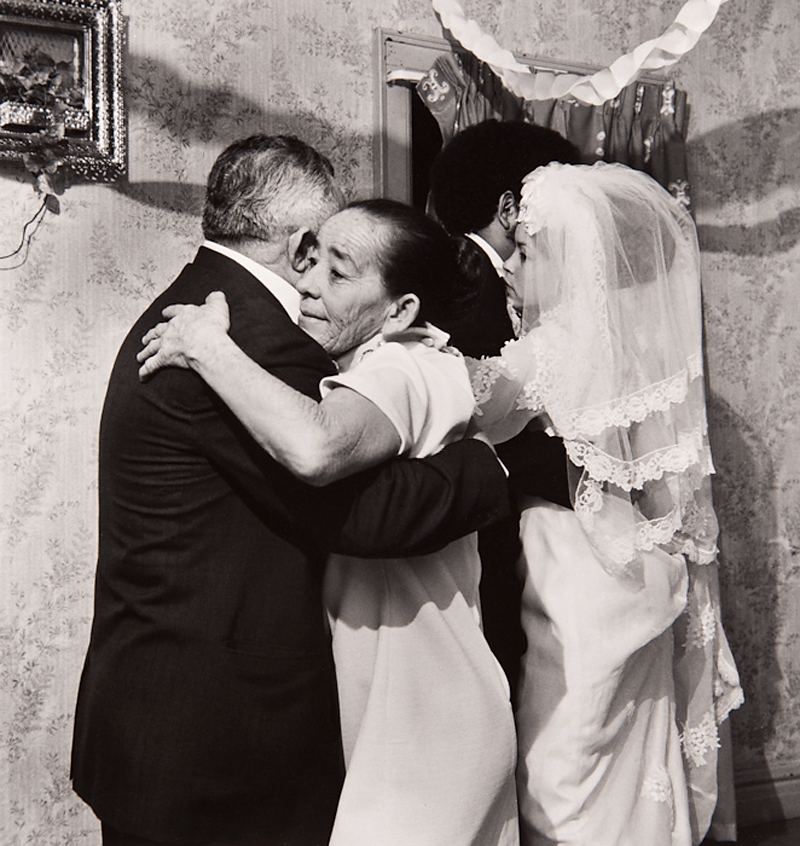
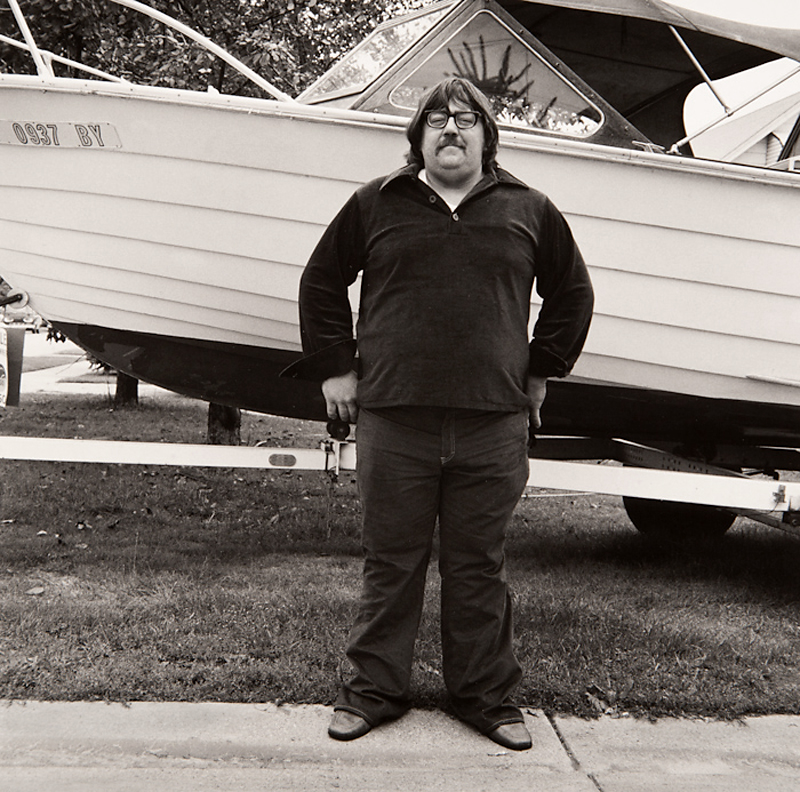
Milton Rogovin (American, 1909-2011) 'Untitled' from the series 'Lower West Side, Buffalo' 1973 from the exhibition 'Life and Labor: The Photographs of Milton Rogovin' at the San Jose Museum of Art, San Jose, CA, Aug 2016 - March 2017


Milton Rogovin (American, 1909-2011)
Untitled from the series Lower West Side, Buffalo
1973
Gelatin silver print
8 x 10 inches
Gift of Mr and Mrs Jon Vein


I will be limiting my postings to one every 5 days because I am resting my injured hands.

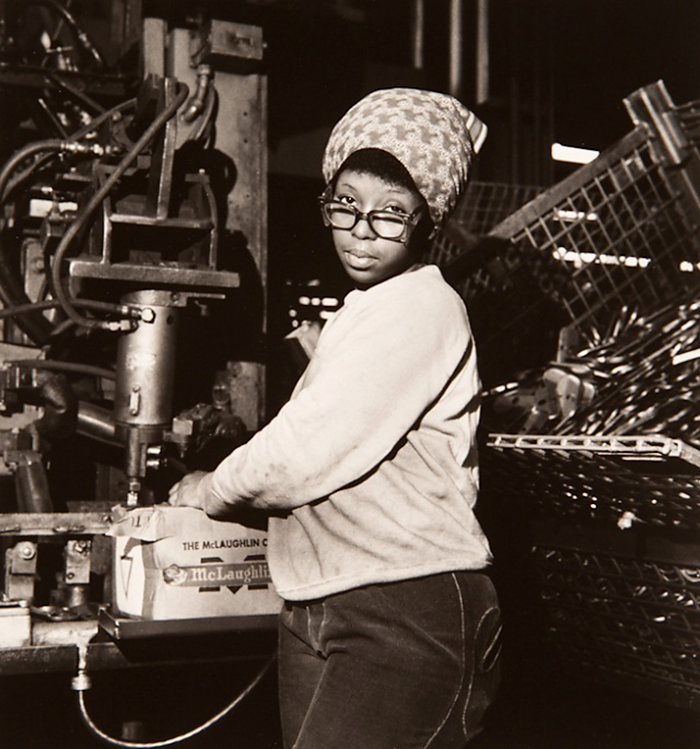
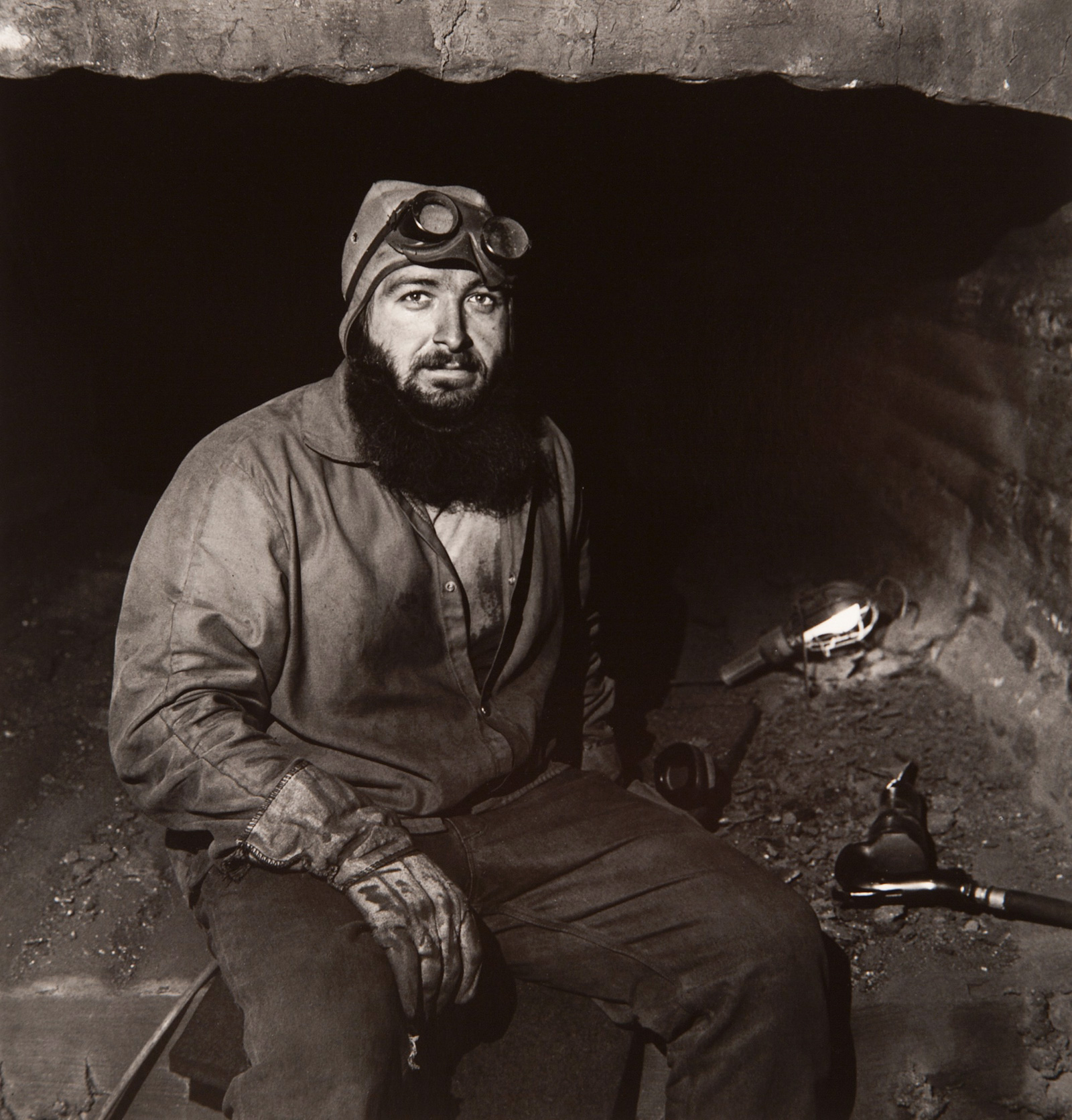
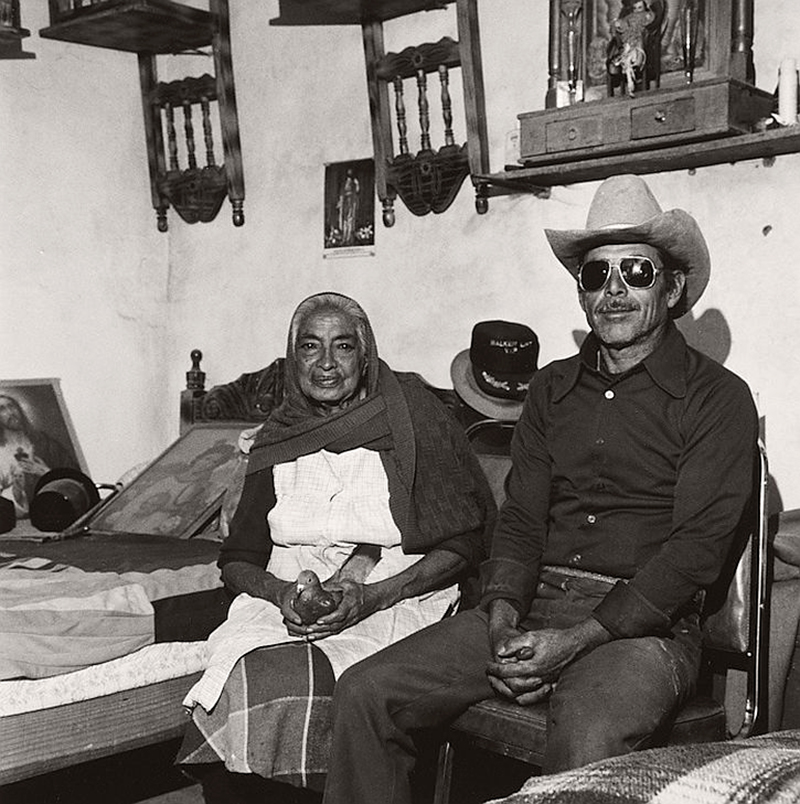
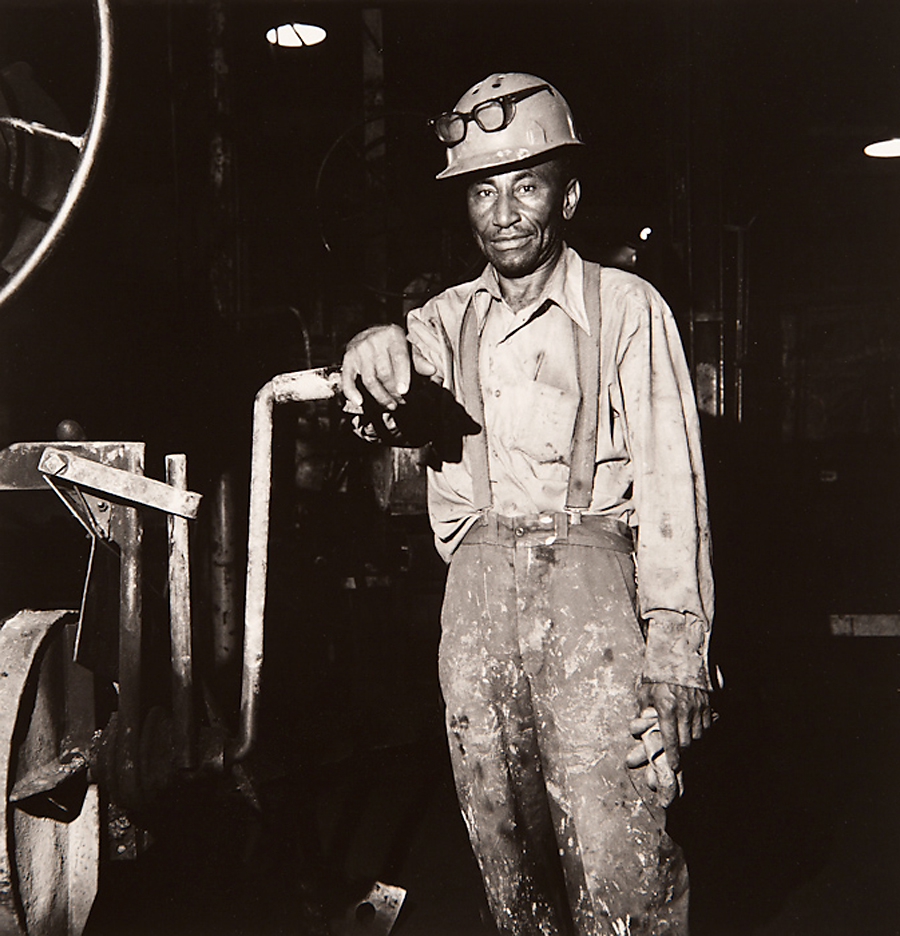
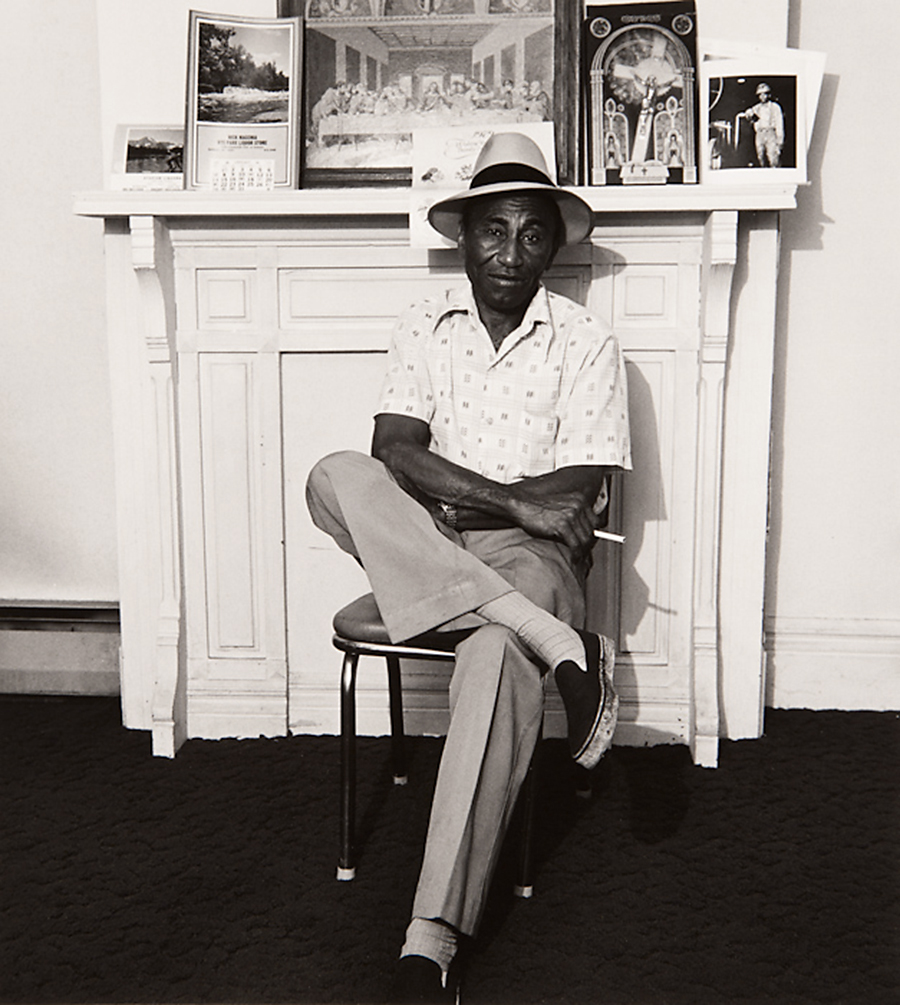
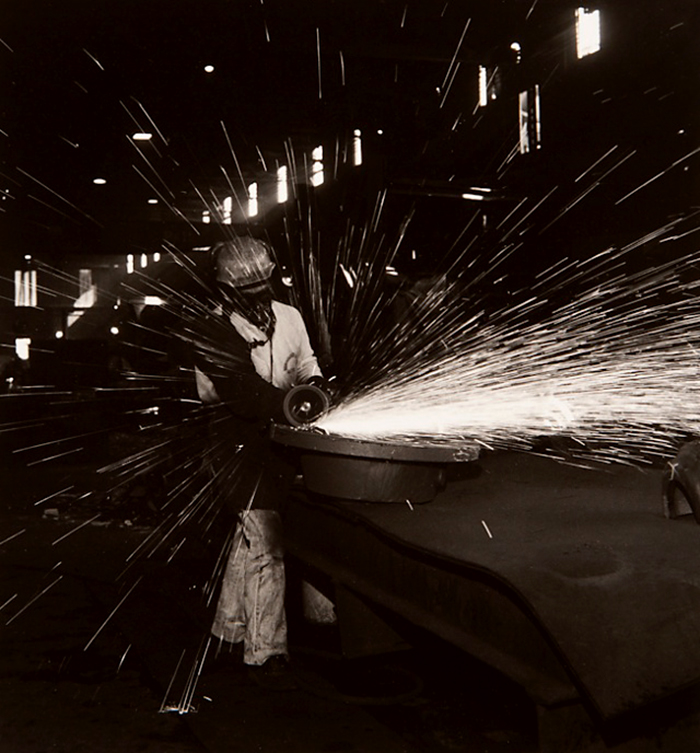
From the lineage of Jacob Riis and Lewis Hine, Walker Evans and Margaret Bourke-White merges the work of Milton Rogovin, an artist who I had never heard of before. It is a blessing in my life that I do now. His gift to us, his job of seeing, was to document the lives of blue collar workers, working class neighbourhoods and multi-ethnic communities.

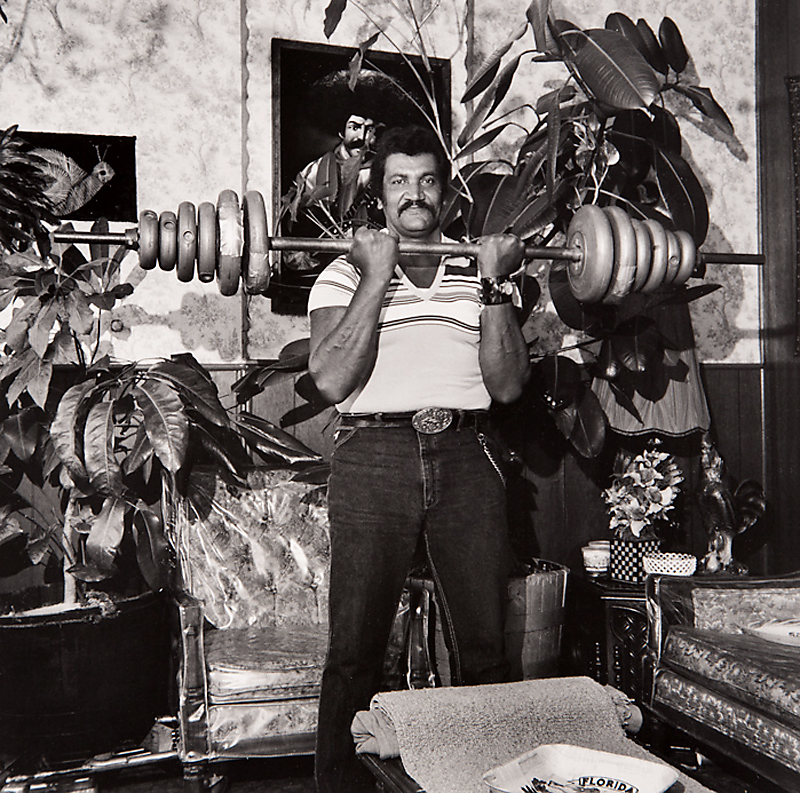
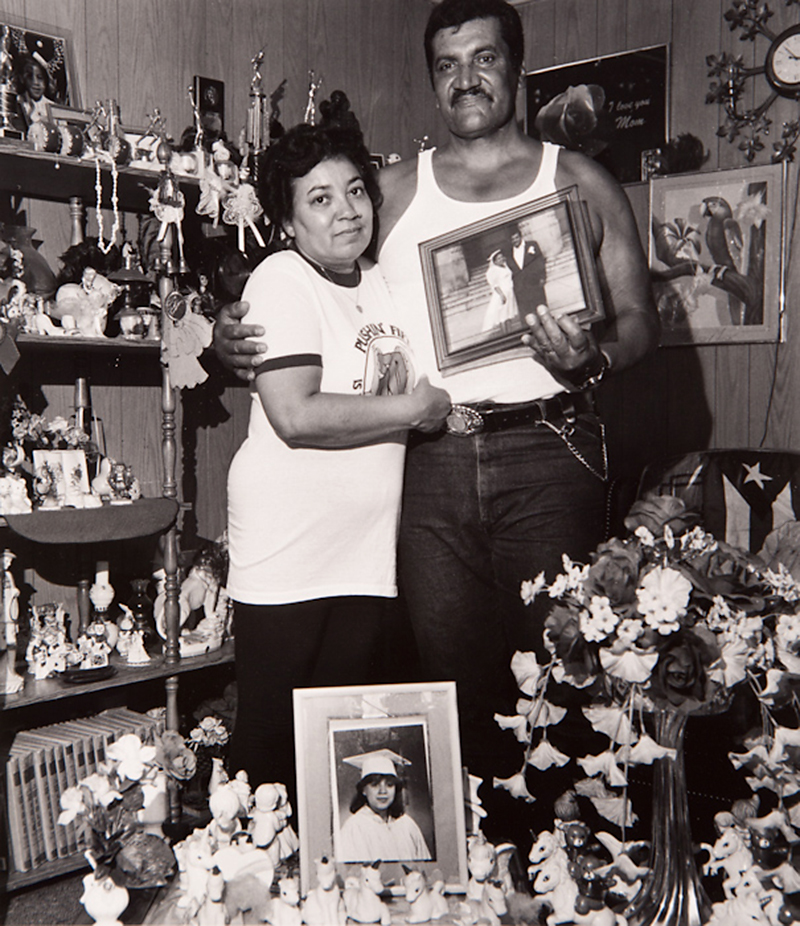
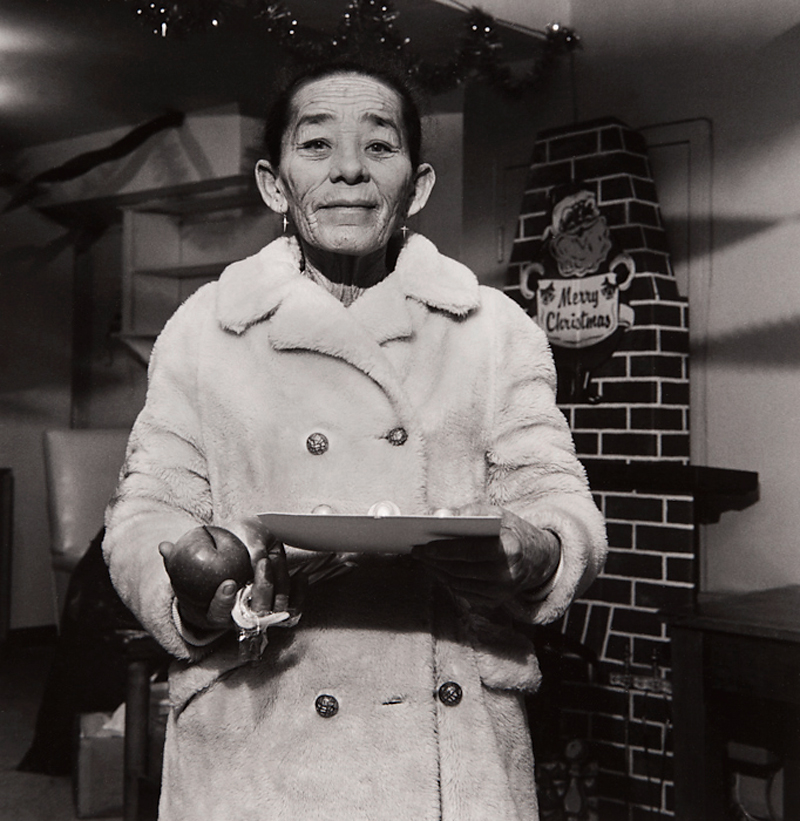
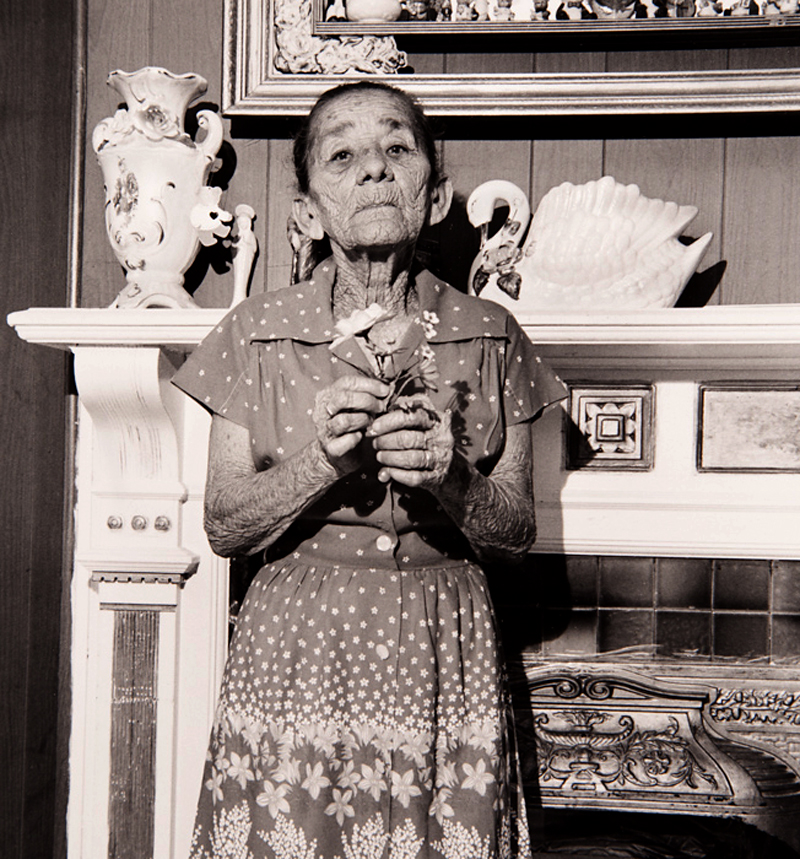
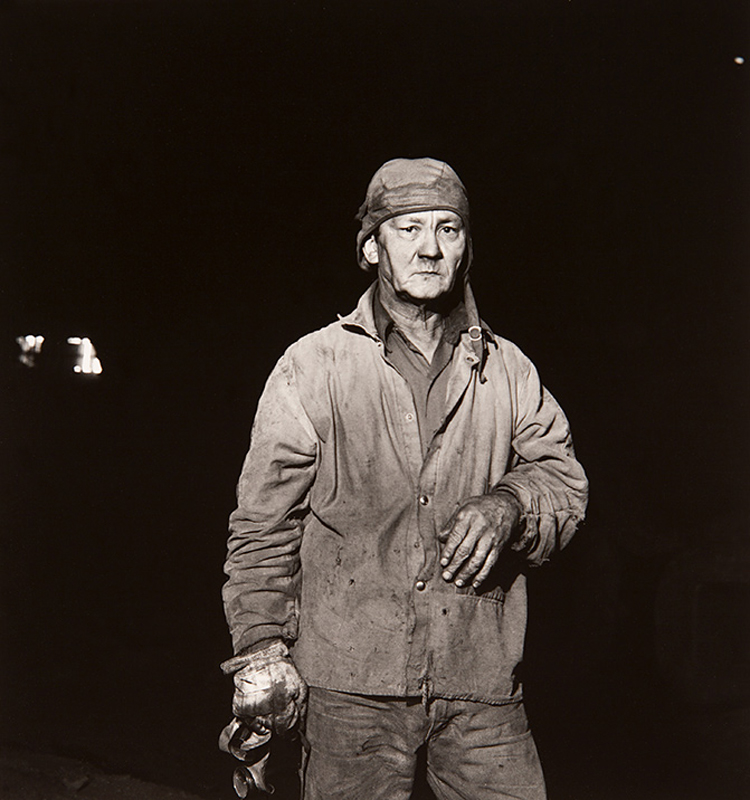
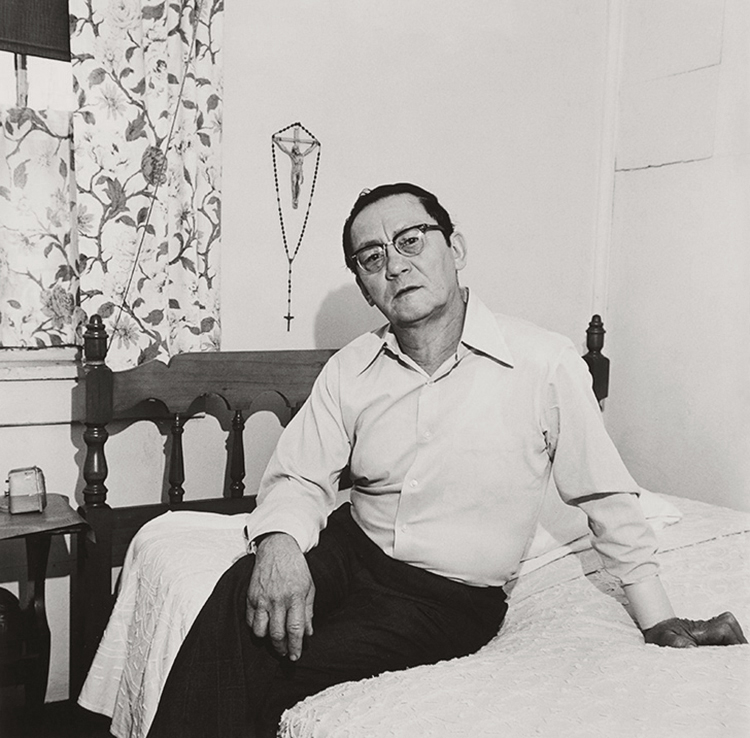
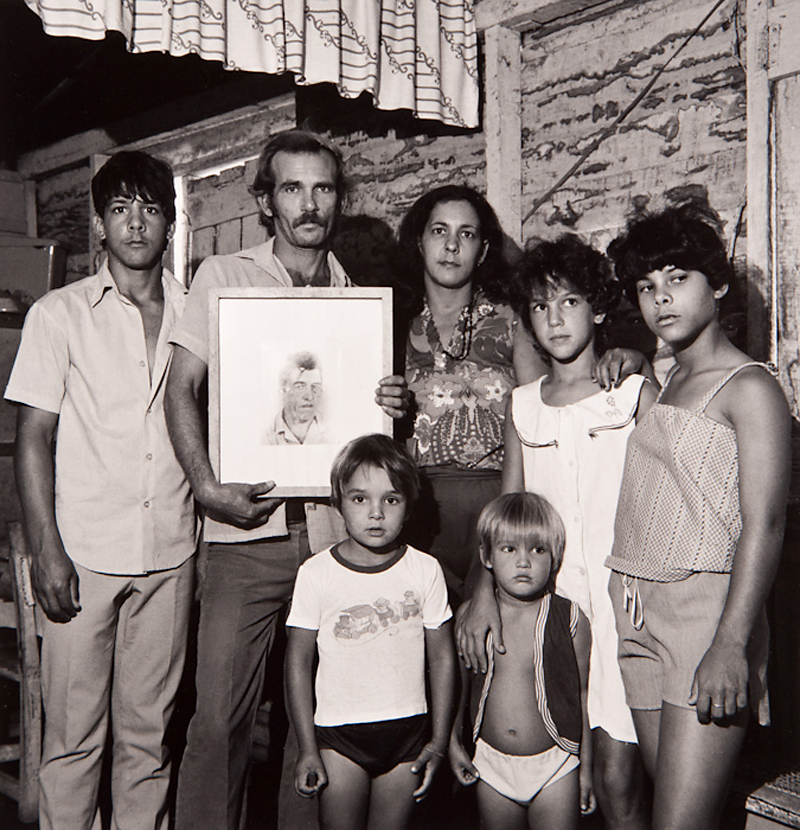
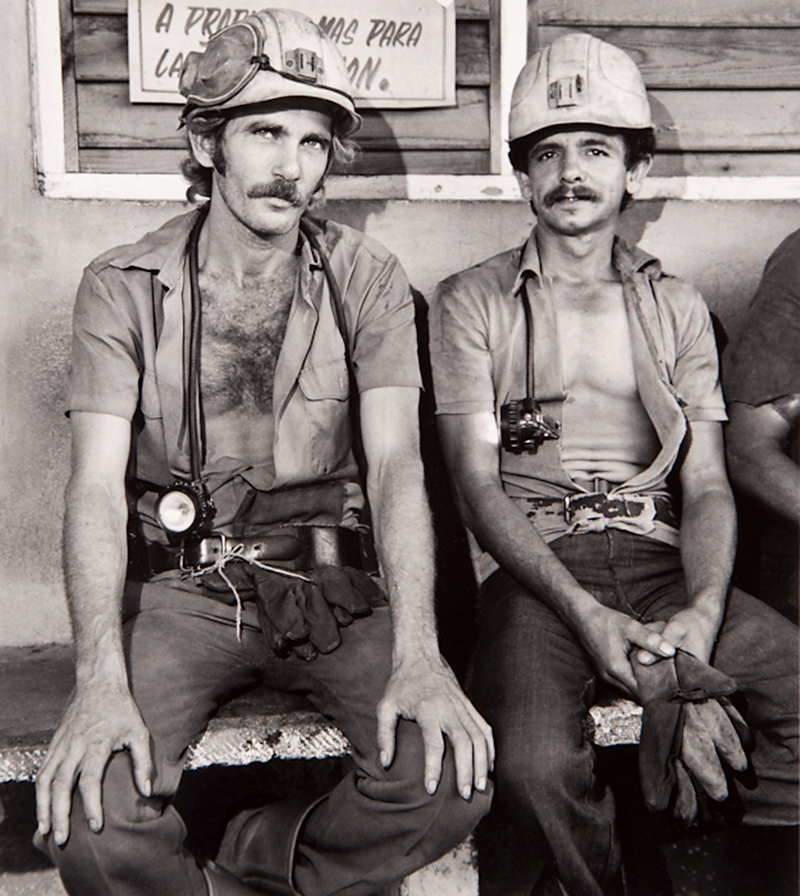
“Rogovin shed light on important social issues of the time: the plight of miners; the decline of the once-robust steel industry in upstate New York; the everyday struggles of the poor and working class in Buffalo, New York, where he lived. He spent more than three decades creating naturalistic portraits of the working class in the Lower West Side of Buffalo, photographing people in their homes, at work, and on the street.” He produced, “compelling narratives of the people he photographed. He believed deeply in photography’s ability to be an agent of social change.” Yes!

He was a social-documentary photographer and proud of it.

His powerful, classical portraits, often grouped in diptychs and triptychs, expound narrative in a single image and over time. They compress time intimately… and by that I mean the viewer is engaged in a conversation with the subject, where we can imagine that we live those lives AS THEY DO (transcending time), the lives of what Rogovin called “the forgotten ones.” He makes their countenance, their physicality, the hardships they endure, and their narrative, directly and intimately compelling. We are made to feel their plight (unlike so much contemporary photography) in the now and the forever. For these photographs are as relevant, if not more so, now as then.

The world needs artists like Rogovin, gifted and attentive image makers who possess a social conscience. Image makers who live, and picture, their egalitarian ideals. Respect.

Dr Marcus Bunyan


Definition of egalitarianism
1: a belief in human equality especially with respect to social, political, and economic affairs.
2: a social philosophy advocating the removal of inequalities among people.


Many thankx to the San Jose Museum of Art for allowing me to publish the photographs in the posting. Please click on the photographs for a larger version of the image.


“The rich ones have their own photographers.”


Milton Rogovin


Milton Rogovin (American, 1909-2011) 'Untitled' from the series 'Lower West Side, Buffalo, Felix & Wife' 1974 from the exhibition 'Life and Labor: The Photographs of Milton Rogovin' at the San Jose Museum of Art, San Jose, CA, Aug 2016 - March 2017


Milton Rogovin (American, 1909-2011)
Untitled from the series Lower West Side, Buffalo, Felix & Wife
1974
Gelatin silver print
8 x 10 inches
Gift of Mr and Mrs Jon Vein


Milton Rogovin (American, 1909-2011) 'Untitled' from the series 'Lower West Side, Buffalo, Felix & Wife' 1985


Milton Rogovin (American, 1909-2011)
Untitled from the series Lower West Side, Buffalo, Felix & Wife
1985
Gelatin silver print
8 x 10 inches
Gift of Mr and Mrs Jon Vein


Milton Rogovin (American, 1909-2011) 'Untitled' from the series 'Lower West Side, Buffalo, Felix & Wife' 1992


Milton Rogovin (American, 1909-2011)
Untitled from the series Lower West Side, Buffalo, Felix & Wife
1992
Gelatin silver print
8 x 10 inches
Gift of Mr and Mrs Jon Vein


In the early 1970s, Milton Rogovin set out to document the neighbourhood near his house. He made a series of portraits of working-class people in Buffalo’s Lower West Side. Then he returned to photograph the same people in the early 1980s and again in the 1990s. The result is this remarkable and moving portrait of time and place in America. Here are fifty of an acclaimed photographer’s engaging Triptychs – a visual chronicle of change, ageing, endurance, and finally survival. As Robert Coles writes in his foreword, “These photographs constitute a major contribution to the American documentary tradition. They represent the insistence of one careful, gifted, attentive photographer upon seeing through, as it were, his self-assigned job of seeing.” Here we see working people who, like most Americans, find partners, have children and grandchildren, sometimes separate, and sometimes die early. Some age considerably in the ten years between photographs, others almost not at all. Some lose children, change partners and houses, and some visibly change lifestyles. What remains constant is the passing of time and its effects upon his subjects, so evident in Rogovin’s work. These are among the themes observed and discussed in Stephen Jay Gould’s illuminating introduction.

Text from the Amazon website


Milton Rogovin (American, 1909-2011) 'Untitled' from the series 'Lower West Side, Buffalo' 1972


Milton Rogovin (American, 1909-2011)
Untitled from the series Lower West Side, Buffalo
1972
Gelatin silver print on paper
10 x 8 inches
Gift of Mr and Mrs William Braunstein


Milton Rogovin (American, 1909-2011) 'Untitled' from the series 'Lower West Side, Buffalo' 1973


Milton Rogovin (American, 1909-2011)
Untitled from the series Lower West Side, Buffalo
1973
Gelatin silver print on paper
10 x 8 inches
Gift of Mr and Mrs William Braunstein


Milton Rogovin (American, 1909-2011) 'Untitled' from the series 'Lower West Side, Buffalo' 1992


Milton Rogovin (American, 1909-2011)
Untitled from the series Lower West Side, Buffalo
1992
Gelatin silver print on paper
10 x 8 inches
Gift of Mr and Mrs William Braunstein


Milton Rogovin (1909-2011) was proud to call himself a “social-documentary photographer.” For more than four decades, he photographed those whom he referred to as “the forgotten ones.” He was working as an optometrist in Manhattan in the early 1930s when he became increasingly involved in leftist causes. Distressed by the rampant social upheaval and widespread poverty caused by the Great Depression, Rogovin attended night classes sponsored by the New York Workers School and became an advocate for social equity. He read the Communist Party newspaper The Daily Worker and was introduced to the social-documentary photographs of Jacob Riis and Lewis Hine. In 1957, he was called before the House Un-American Activities Committee, whose hearings had led to the blacklisting and public persecution of many artists. A year later, he devoted himself full-time to photography: his art became the vehicle for his egalitarian ideals.

Drawn entirely from the permanent collection of the San Jose Museum of Art, this exhibition presents thirty-eight photographs from three series: “Lower West Side, Buffalo” (1972-1984), “Working People” (1976-1987), and “Family of Miners” (1988-1989). Rogovin shed light on important social issues of the time: the plight of miners; the decline of the once-robust steel industry in upstate New York; the everyday struggles of the poor and working class in Buffalo, New York, where he lived. He spent more than three decades creating naturalistic portraits of the working class in the Lower West Side of Buffalo, photographing people in their homes, at work, and on the street. He later photographed in places such as Appalachian towns in Alabama, Kentucky, and West Virginia; Isla Negra, Chile; and later in China, Cuba, Czechoslovakia, France, Germany, Greece, Mexico, Scotland, Spain, and Zimbabwe. He photographed miners in many of these places and created the series “Family of Miners.”

Life and Labor marks the public debut of these photographs, which were gifted to the Museum’s collection in 2011. Rogovin often grouped his pictures into diptychs and triptychs to produce compelling narratives of the people he photographed. He believed deeply in photography’s ability to be an agent of social change. In addition to their aesthetic value, Rogovin’s photographs serve as important records of the changing working class neighbourhoods and multi-ethnic communities he documented over the course of many decades, until well into his 90s. Rogovin’s powerful and provocative portraits raise questions that remain equally prescient today, amid current concerns over employment and income gaps.

“Rogovin believed deeply in photography’s ability to be an agent of social change,” said Marja van der Loo, curatorial assistant at SJMA and curator of the exhibition. “In addition to their aesthetic value, his photographs represent his egalitarian ideals and serve as important records of the changing neighbourhoods and communities he documented over the course of many decades.”

Press release from the San Jose Museum of Art


Milton Rogovin (American, 1909-2011) 'Untitled' from the series 'Working People: Ford' 1977-1978


Milton Rogovin (American, 1909-2011)
Untitled from the series Working People: Ford
1977-1978
Gelatin silver print on paper
10 × 8 inches
Gift of Dr Philip Greider


Milton Rogovin (American, 1909-2011) 'Untitled' from the series 'Working People: Shenango' 1978-1981


Milton Rogovin (American, 1909-2011)
Untitled from the series Working People: Shenango
1978-1981
8 x 10 inches
Gelatin silver print on paper
Gift of Dr Philip Greider


Milton Rogovin (American, 1909-2011) 'Untitled' from the series 'Working People: Shenango' 1978-1981


Milton Rogovin (American, 1909-2011)
Untitled from the series Working People: Shenango
1978-1981
8 x 10 inches
Gelatin silver print on paper
Gift of Mr and Mrs Jon Vein


Milton Rogovin (American, 1909-2011) 'Untitled' from the series 'Working People: Shenango' 1978-1981


Milton Rogovin (American, 1909-2011)
Untitled from the series Working People: Shenango
1978-1981
8 x 10 inches
Gelatin silver print on paper
Gift of Mr and Mrs Jon Vein


Milton Rogovin (American, 1909-2011) 'Untitled' from the series 'Family of Miners: Cuba' 1989


Milton Rogovin (American, 1909-2011)
Untitled from the series Family of Miners: Cuba
1989
Gelatin silver print
8 x 10 inches
Gift of Mr and Mrs Jon Vein


Milton Rogovin (American, 1909-2011) 'Untitled' from the series 'Family of Miners: Cuba' 1989


Milton Rogovin (American, 1909-2011)
Untitled from the series Family of Miners: Cuba
1989
Gelatin silver print
8 x 10 inches
Gift of Mr and Mrs Jon Vein


Milton Rogovin (American, 1909-2011) 'Untitled' from the series 'Family of Miners: Mexico' 1988


Milton Rogovin (American, 1909-2011)
Untitled from the series Family of Miners: Mexico
1988
Gelatin silver print on paper
10 × 8 inches
Gift of Mr and Mrs William Braunstein


Milton Rogovin (American, 1909-2011) 'Untitled' from the series 'Working People: Amherst Foundry' 1979


Milton Rogovin (American, 1909-2011)
Untitled from the series Working People: Amherst Foundry
1979
Gelatin silver print
8 x 10 inches
Gift of Mr and Mrs Jon Vein


Milton Rogovin (American, 1909-2011) 'Untitled' from the series 'Working People: Amherst Foundry' 1979


Milton Rogovin (American, 1909-2011)
Untitled from the series Working People: Amherst Foundry
1979
Gelatin silver print
8 x 10 inches
Gift of Mr and Mrs Jon Vein


Milton Rogovin (American, 1909-2011) 'Untitled' from the series 'Working People: Atlas, Jose' 1976


Milton Rogovin (American, 1909-2011)
Untitled from the series Working People: Atlas, Jose
1976
Gelatin silver print on paper
10 × 8 inches
Gift of Mr. and Mrs. Jon Vein


Milton Rogovin (American, 1909-2011) 'Untitled' from the series 'Working People: Atlas, Jose' 1978-1979


Milton Rogovin (American, 1909-2011)
Untitled from the series Working People: Atlas, Jose
1978-1979
Gelatin silver print on paper
10 × 8 inches
Gift of Mr and Mrs Jon Vein


Milton Rogovin (American, 1909-2011) 'Untitled' from the series 'Working People: Atlas, Jose' 1978-1979


Milton Rogovin (American, 1909-2011)
Untitled from the series Working People: Atlas, Jose
1978-1979
Gelatin silver print on paper
10 × 8 inches
Gift of Mr and Mrs Jon Vein


Milton Rogovin (American, 1909-2011) 'Untitled' from the series 'Working People: Atlas Steel, Frank Andrzewski' 1978-1979


Milton Rogovin (American, 1909-2011)
Untitled from the series Working People: Atlas Steel, Frank Andrzewski
1978-1979
Gelatin silver print on paper
10 x 8 inches
Gift of Dr Philip Greider


Milton Rogovin (American, 1909-2011) 'Untitled' from the series 'Working People: Atlas Steel, Frank Andrzewski' 1978-1979


Milton Rogovin (American, 1909-2011)
Untitled from the series Working People: Atlas Steel, Frank Andrzewski
1978-1979
Gelatin silver print on paper
10 x 8 inches
Gift of Dr Philip Greider


Milton Rogovin (American, 1909-2011) 'Untitled' from the series 'Working People: Atlas Steel, Frank Andrzewski' 1978-1979


Milton Rogovin (American, 1909-2011)
Untitled from the series Working People: Atlas Steel, Frank Andrzewski
1978-1979
Gelatin silver print on paper
10 x 8 inches
Gift of Dr Philip Greider


Milton Rogovin (American, 1909-2011) 'Untitled' from the series 'Working People, Chevy' 1977-1978


Milton Rogovin (American, 1909-2011)
Untitled from the series Working People, Chevy
1977-1978
Gelatin silver print on paper
10 x 8 inches
Gift of Mr and Mrs William Braunstein


Milton Rogovin (American, 1909-2011) 'Untitled' from the series 'Working People, Chevy' 1977-1978


Milton Rogovin (American, 1909-2011)
Untitled from the series Working People, Chevy
1977-1978
Gelatin silver print on paper
10 x 8 inches
Gift of Mr and Mrs William Braunstein


San Jose Museum of Art
110 South Market Street
San Jose, CA 95113

Opening hours:
Thursday: 4 – 9pm
Friday: 11am – 9pm
Saturday – Sunday: 11am – 6pm
Closed Monday – Wednesday

San Jose Museum of Art website

LIKE ART BLART ON FACEBOOK

Back to top

Exhibition: ‘Gay Gotham: Art and Underground Culture in New York’ at the Museum of the City of New York, New York City, Part 2

Exhibition dates: 7th October, 2016 – 26th February, 2017

An exhibition showcasing Lesbian, Gay, Bisexual, Transgender, and Queer artistic life in New York City through the social networks of Leonard Bernstein, Mercedes de Acosta, Harmony Hammond,  Bill T. Jones, Lincoln Kirstein, Greer Lankton, George Platt Lynes,  Robert Mapplethorpe, Richard Bruce Nugent, and Andy Warhol.

Curators: Donald Albrecht, MCNY curator of architecture and design, and Stephen Vider, MCNY Mellon Postdoctoral Fellow.


'The Young Physique' October/November 1964 from the exhibition 'Gay Gotham: Art and Underground Culture in New York' at the Museum of the City of New York, New York City, Oct 2016 - Feb 2017


The Young Physique
October/November 1964
Collection of Kelly McKaig


Part two of this monster posting on the exhibition Gay Gotham: Art and Underground Culture in New York at the Museum of the City of New York.

Highlights include photographs by Carl Van Vechten; art work by and of Andy Warhol; a video of the “Panzy Craze” of the the 1920s and 1930s; a photograph of a very young and skinny Robert Mapplethorpe and some of his early art work; some wonderful subversiveness from Greer Lankton; two glorious photographs from one of my favourite artists, Peter Hujar; and a great selection of book covers and posters, including the ever so sensual, German Expressionist inspired Nocturnes for the King of Naples cover art by Mel Odom.

See Part 1 of the posting

Dr Marcus Bunyan


Many thank to the Museum of the City of New York for allowing me to publish the art work in the posting. Please click on the photographs for a larger version of the image.


Themes ~

Printing


Foujita (Japanese-French, 1886-1968) "Helen Morgan Jr. And Jean Malin at the Smart Club Abbey," 'Vanity Fair' February 1931 from the exhibition 'Gay Gotham: Art and Underground Culture in New York' at the Museum of the City of New York, New York City, Oct 2016 - Feb 2017


Foujita (Japanese-French, 1886-1968)
“Helen Morgan Jr. And Jean Malin at the Smart Club Abbey”
Vanity Fair
February 1931
Private collection


Léonard Tsuguharu Foujita (藤田 嗣治 Fujita Tsuguharu, November 27, 1886 – January 29, 1968) was a Japanese-French painter and printmaker born in Tokyo, Japan, who applied Japanese ink techniques to Western style paintings. He has been called “the most important Japanese artist working in the West during the 20th century”. His Book of Cats, published in New York by Covici Friede, 1930, with 20 etched plate drawings by Foujita, is one of the top 500 (in price) rare books ever sold, and is ranked by rare book dealers as “the most popular and desirable book on cats ever published”.


André Tellier (French, b. 1902) 'Twilight Men' (Greenberg, New York) 1931


André Tellier (French, b. 1902)
Twilight Men (Greenberg, New York)
1931
Fales Library and Special Collections, New York University


First published in 1931, this is an extremely uncommon early novel set in New York City of homosexuality and a young man whose gay tendencies infuriates his father, who attempts to set him upon the “path of normality” by hiring a mistress to seduce him.

“Like many early gay novels, the book does not have a happy ending: the main character becomes addicted to drugs, murders his father, and kills himself. This theme (the gay monster or the gay degenerate) occurs very frequently before the 1960’s. Originally, this was the only way that a book with any kind of gay themes could even be published; that is, it was only palatable – or even legal – to feature a gay protagonist if that person “gets what’s coming to him” in the end.

The February 1934 issue of Chanticleer, a gay literary “magazine,” includes reviews by Henry Gerber of several novels, including Twilight Men. He wrote: “TWILIGHT MEN, by Andre Tellier, deals with a young Frenchman, who comes to America, is introduced into homosexual society in New York, becomes a drug addict for no obvious reason, finally kills his father and commits suicide. It is again excellent anti-homosexual propaganda, although the plot is too silly to convince anyone who has known homosexual people at all.”

Little has been written about the author, Andre Tellier, himself. He wrote other books, including A Woman of Paris, The Magnificent Sin, Vagabond April, and Witchfire; but nothing else is really known about him.”

Anonymous text. “First Pages: Twilight Men by Andre Tellier,” on the Somewhere Books website December 28, 2012 [Online] Cited 22/11/2012.


Blair Niles (American, 1880-1959) 'Strange Brother' (Horace Liveright, New York) 1931


Blair Niles (American, 1880-1959)
Strange Brother (Horace Liveright, New York)
1931
Fales Library and Special Collections, New York University


Strange Brother is a gay novel written by Blair Niles published in 1931. The story is about a platonic relationship between a heterosexual woman and a gay man and takes place in New York City in the late 1920s and early 1930s. Strange Brother provides an early and objective documentation of homosexual issues during the Harlem Renaissance.

Mark Thornton, the story’s protagonist, moves to New York City in hopes of feeling like less of an outsider. At a nightclub in Harlem he meets and befriends June Westbrook. One night they witness a man named Nelly being arrested. June encourages Mark to investigate. This leads Mark to attend Nelly’s trial, where he is found guilty and sentenced to six months’ imprisonment on Welfare Island for his feminine affections and gestures. Next Mark researches the crimes against nature sections of the penal code. Shaken up by his findings and the events, Mark confesses his own homosexuality to June.

Mark and June’s friendship continues to grow, and June introduces Mark to a number of friends in her social circle. Various social interactions ensue including a dinner party for a departing professor, a trip to a nightspot featuring a singer called Glory who sings Creole Love Call and attending a drag ball. Despite reading Walt Whitman’s poetry collection Leaves of Grass, Edward Carpenter’s series of papers Love’s Coming of Age, and Countee Cullen’s poetry, Mark is afraid to come out. Subsequently, Mark is threatened with being outed at work. In response to this threat, Mark commits suicide by shooting himself.

Text from the Wikipedia website


Ann Bannon (American, b. 1932) 'I Am a Woman' (Gold Medal Books, New York) 1959


Ann Bannon (American, b. 1932)
I Am a Woman (Gold Medal Books, New York)
1959
Private collection


The classic 1950s novel from the Queen of Lesbian Pulp. “For contemporary readers the books offer a valuable record of gay and lesbian life in the 1950s. Most are set in Greenwich Village, and Ms. Bannon’s descriptions of bars, clubs and apartment parties vividly evoke a vanished community. Her characters also have historical value. Whereas most lesbians in pulp are stereotypes who get punished for their desires, Beebo and her friends are accessibly human. Their struggles with love and relationships are engrossing today, and half a century ago they were revolutionary.” ~ New York Times “Sex. Sleaze. Depravity. Oh, the twisted passions of the twilight world of lesbian pulp fiction.” ~ Chicago Free Press “Little did Bannon know that her stories would become legends, inspiring countless fledgling dykes to flock to the Village, dog-eared copies of her books in hand, to find their own Beebos and Lauras and others who shared the love they dared not name.” ~ San Francisco Bay Guardian “Ann Bannon is a pioneer of dyke drama.” ~ On Our Backs “When I was young, Bannon’s books let me imagine myself into her New York City neighbourhoods of short-haired, dark-eyed butch women and stubborn, tight-lipped secretaries with hearts ready to be broken. I would have dated Beebo, no question.” ~ Dorothy Allison “Bannon’s books grab you and don’t let go.” ~ Village Voice


'Muscleboy' March/April 1965


Muscleboy
March/April 1965
Collection of Kelly McKaig


Design by Gran Fury for Art Against AIDS/On The Road and Creative Time, Inc. 'Kissing Doesn't Kill: Greed and Indifference Do' 1989


Design by Gran Fury for Art Against AIDS/On The Road and Creative Time, Inc.
Kissing Doesn’t Kill: Greed and Indifference Do
1989
Bus poster
Gran Fury, Courtesy The New York Public Library Manuscripts and Archives Division


Placemaking: Cruising


Anonymous photographer. 'New York City street photograph' 1960s


Anonymous photographer
New York City street photograph
1960s
Collection of Philip Aarons and Shelley Fox Aarons, New York


Leonard Fink (American, 1930-1993) 'Charley Inside Ramrod' c. 1976


Leonard Fink (American, 1930-1993)
Charley Inside Ramrod
c. 1976
Courtesy LGBT Community Center National History Archive


THE RAMROD, 394 West Street, (between Charles and West 10th Streets). Constructed in the 1850’s this building (actually two, that were attached) housed S. J. Seely & Co., a lime dealer, and C. August, (on the corner) a porter house, and private residence. In the late 70’s it was one of the most popular leather bars in New York. Attracting a large motorcycle clientele, West Street always had a plethora of bikes parked out front. The doorman, Rico, had a long black bushy beard, and an ever present black cowboy hat, also he wore on his hand a glove with sharp stainless steel blades attached to it, (sort of a precursor to Freddie Kruger). The bar, and Rico could be very intimidating, if you were new, or “Brown” as the uninitiated were called… referring to the brown leather they wore.

Anonymous text. “Greenwich Village: A Gay History,” on the Huzzbears website [Online] Cited 15/02/2021. No longer available online


In June 1993, the Estate of Leonard Fink donated a photographic collection to The Center in New York City through its executor, Steven E. Bing. The materials in the Fink Estate was willed to four AIDS related organisations who gave all of the rights to the photos to the Center Archive. Some of these were signed “Len Elliot,” which might have ben a pseudonym of Fink’s. The collection consists of over 25,000 negatives and images capturing Greenwich Village and much of the spirit of the late 60s and 70s. Some of the most well known images in the collection are Fink’s work at “The Piers” along the Hudson River. Fink documented over 25 years of gay life in New York City but his photography was never exhibited or published in his lifetime. He was self taught and used an old 35mm camera while working out of a homemade darkroom in his West 92nd Street apartment.

Jeffrey James Keyes. “PHOTOS: An Exclusive Peek Inside The Estate of Leonard Fink,” on the Gay Cities website May 27, 2014 [Online] Cited 22/11/2021


Leonard Fink (American, 1930-1993)

Leonard Fink was an amateur photographer who documented over 25 years of gay life in New York including parades, bars, and especially the west side piers. He worked in complete obscurity and was apparently very reclusive. His photographs were seen by only a few close friends and were never exhibited or published in his lifetime. He seems to have taught himself photography using an old 35mm camera and a homemade darkroom in his small apartment on West 92nd street. He lived frugally, spending much of his income on photographic supplies which he bought in bulk and stored in his darkroom and his bedroom. He stored the prints and negatives in a file cabinet. By the time of his death, the photos in the file cabinet covered a period from 1954 to 1992. His photographs of gay life begin with groups of gay men photographed in Greenwich Village in 1967. His photographs of Gay Pride parades begin with the first parade in 1970. His earlier photographs are of friends, trips to Europe, and scenes in New York. Leonard Fink was a colourful and ubiquitous character in the Village and at Pride parades, usually appearing on roller skates in short cut-offs, and a tight t-shirt with cameras always around his neck. He sometimes arrived on a bicycle or a motorcycle. He was born in 1930. His father and older brother were both physicians. He worked for many years as an attorney for the New York Transit Authority. He died of AIDS in 1993.

Anonymous text. “Leonard Fink Photographs,” on The Center website [Online] Cited 22/11/2021


Posing


James VanDerZee (African-American, 1886-1983) 'Beau of the Ball' 1926


James VanDerZee (American, 1886-1983)
Beau of the Ball
1926
Gelatin silver print
Donna Mussenden VanDerZee


James VanDerZee (American, 1886-1983)

James Van Der Zee (June 29, 1886 – May 15, 1983) was an African-American photographer best known for his portraits of black New Yorkers. He was a leading figure in the Harlem Renaissance. Aside from the artistic merits of his work, Van Der Zee produced the most comprehensive documentation of the period. Among his most famous subjects during this time were Marcus Garvey, Bill “Bojangles” Robinson and Countee Cullen…

Van Der Zee worked predominantly in the studio and used a variety of props, including architectural elements, backdrops, and costumes, to achieve stylised tableaux vivant in keeping with late Victorian and Edwardian visual traditions. Sitters often copied celebrities of the 1920s and 1930s in their poses and expressions, and he retouched negatives and prints heavily to achieve an aura of glamour…

Works by Van Der Zee are artistic as well as technically proficient. His work was in high demand, in part due to his experimentation and skill in double exposures and in retouching negatives of children. One theme that recurs in his photographs was the emergent black middle class, which he captured using traditional techniques in often idealistic images. Negatives were retouched to show glamor and an aura of perfection. This affected the likeness of the person photographed, but he felt each photo should transcend the subject. His carefully posed family portraits reveal that the family unit was an important aspect of Van Der Zee’s life. “I tried to see that every picture was better-looking than the person.” “I had one woman come to me and say ‘Mr.Van Der Zee my friends tell thats a nice picture, But it doesn’t look like you.’ That was my style.” Said Van Der Zee.

Text from the Wikipedia website


Carl Van Vechten (American, 1880-1964) 'Anna May Wong' 1932


Carl Van Vechten (American, 1880-1964)
Anna May Wong
1932
Gelatin silver print
Museum of the City of New York, Gift of Carl Van Vechten


Carl Van Vechten (American, 1880-1964)

Little known today, Carl Van Vechten was a prolific novelist, critic, photographer, and promoter of all things modern, most actively engaged in the city’s cultural life during the 1920s and ’30s. The City Museum is rich in Van Vechten materials; its collections include about 2,200 photographs taken by him and 3,000 Christmas cards sent to him and his wife, film and theatre actress Fania Marinoff. Taken together, they chronicle Van Vechten’s influential circles of friends and colleagues – a hybrid mash-up that defines the modern America at the heart of White’s new book. Images and correspondence in the City Museum’s collection range from Harlem Renaissance poet Langston Hughes to writer Zelda Fitzgerald (wife of F. Scott), and playwright Eugene O’Neill.

Around 1920 Van Vechten gave up journalism for fiction and over the next decade wrote hotly debated novels about Jazz Age Manhattan. His 1923 book The Blind Bow-Boy, for example, is a classic of gay camp and a public expression of Van Vechten’s sexual orientation; while he and Marinoff were married from 1914 until Van Vechten’s death in 1964, he had numerous homosexual relationships… Van Vechten’s role in the Harlem Renaissance remains a controversial topic. To some he’s a valuable bridge between white and black New Yorkers, to others he’s an outsider who patronised and exploited his African-American subjects…

Carl Van Vechten abandoned writing altogether in the early 1930s and embraced photography, a field he would pursue until his death. All told, it is estimated that Van Vechten took some 15,000 photographs. Because his inherited wealth offered him financial independence, Van Vechten took pictures for his own pleasure, usually inviting local and visiting celebrities to a studio he set up in his own apartment. While Van Vechten was aware of the stylistic artifice of such contemporary commercial photographers as Edward Steichen and Cecil Beaton, he stood apart from them. He used a small-format camera, and his aesthetic, which included deep and dramatic shadows that sometimes obscured his subjects’ faces, resulted in picture-making that was far more immediate and spontaneous than that of his contemporaries. Using this technique, Van Vechten photographed musicians Billie Holiday and George Gershwin, Hollywood actors Laurence Olivier and Anna May Wong, and writers Sinclair Lewis and Clifford Odets, to name only a few. The sum of Van Vechten’s work, according to photography historian Keith F. Davis, “constitutes the single most integrated vision of American arts and letters produced in his era.”

Donald Albrecht. “Carl Van Vechten and Modern New York,” on the Museum of the City of New York website August 26, 2014 [Online] Cited 22/11/2021


Anna May Wong (American, 1905-1961)

Anna May Wong (January 3, 1905 – February 3, 1961) was an American actress. She is considered to be the first Chinese American movie star, and also the first Asian American actress to gain international recognition. Her long and varied career spanned silent film, sound film, television, stage and radio…

Wong’s image and career have left a legacy. Through her films, public appearances and prominent magazine features, she helped to humanise Asian Americans to white audiences during a period of overt racism and discrimination. Asian Americans, especially the Chinese, had been viewed as perpetually foreign in U.S. society but Wong’s films and public image established her as an Asian-American citizen at a time when laws discriminated against Asian immigration and citizenship. Wong’s hybrid image dispelled contemporary notions that the East and West were inherently different.

See an excellent short biography on the Wikipedia website


Carl Van Vechten (American, 1880-1964) 'Hugh Laing' 1941


Carl Van Vechten (American, 1880-1964)
Hugh Laing
1941
Gelatin silver print
Museum of the City of New York, Gift of Carl Van Vechten


Hugh Laing (American, 1911-1988)

Hugh Laing (6 June 1911 – 10 May 1988) was one of the most significant dramatic ballet dancers of the 20th-century. He was the partner of choreographer Antony Tudor. Known for his good looks and the intensity of his stage presence, Laing was never considered a great technician, yet his powers of characterisation and his sense of theatrical timing were considered remarkable. His profile as a significant dancer of his era was almost certainly enhanced by Tudor’s choreographing to his undoubted strengths and Laing is generally regarded as one of the finest dramatic dancers of 20th-century ballet. He remained Tudor’s artistic collaborator and companion until the choreographer’s death in 1987.


Carl Van Vechten (American, 1880-1964) 'Alvin Ailey' 1955


Carl Van Vechten (American, 1880-1964)
Alvin Ailey
1955
Gelatin silver print
Museum of the City of New York, Gift of Carl Van Vechten


Alvin Ailey (American, 1931-1989)

Alvin Ailey (January 5, 1931 – December 1, 1989) was an African-American choreographer and activist who founded the Alvin Ailey American Dance Theater in New York City. He is credited with popularising modern dance and revolutionising African-American participation in 20th-century concert dance. His company gained the nickname “Cultural Ambassador to the World” because of its extensive international touring. Ailey’s choreographic masterpiece Revelations is believed to be the best known and most often seen modern dance performance…

Ailey made use of any combination of dance techniques that best suited the theatrical moment. Valuing eclecticism, he created more a dance style than a technique. He said that what he wanted from a dancer was a long, unbroken leg line and deftly articulated legs and feet (“a ballet bottom”) combined with a dramatically expressive upper torso (“a modern top”). “What I like is the line and technical range that classical ballet gives to the body. But I still want to project to the audience the expressiveness that only modern dance offers, especially for the inner kinds of things.”

Ailey’s dancers came to his company with training from a variety of other schools, from ballet to modern and jazz and later hip-hop. He was unique in that he did not train his dancers in a specific technique before they performed his choreography. He approached his dancers more in the manner of a jazz conductor, requiring them to infuse his choreography with a personal style that best suited their individual talents. This openness to input from dancers heralded a paradigm shift that brought concert dance into harmony with other forms of African-American expression, including big band jazz.

Text from the Wikipedia website


Larry Rivers (American, 1923-2002) 'O'Hara Nude With Boots' 1954


Larry Rivers (American, 1923-2002)
O’Hara Nude With Boots
1954
Oil on canvas
Collection of the Larry Rivers Foundation


“Among Rivers’ portraits of the mid-1950s, the most notable and controversial work for a discussion of the relationship among autobiography, sexuality, and art is O’Hara, which he painted during January 1954 as he re-entered an emotional relationship with the sitter. According to [poet Frank] O’Hara’s biographer, Brad Gooch, Rivers and O’Hara had a relatively short, turbulent romance that began in 1952m but during 1953 the two men became involved in other romantic relationships… Beginning in 1954, however, Rivers and O’Hara resumed their intimate relationship, which then lasted less than a year…

A nude of a contemporary figure on such a huge scale as O’Hara appeared unusual and even controversial in the 1950s New York art world. Rivers recalled that when the painting was first shown at the Whitney Annual in 1955, a guard often stood in front of it to ensure that the painting would not be defaced or damaged: “There was something about the male nude that seemed to be more of a problem than the female nude.” Some contemporary viewers where shocked by O’Hara, given its depiction of a naked male body with meticulous attention to the genitals.”

Dong-Yeon Koh. Larry Rivers and Frank O’Hara: Reframing Male Sexualities. Phd dissertation 2006, pp. 196-198.


Beauford Delaney (American, 1901-1979) 'James Baldwin' c. 1957


Beauford Delaney (American, 1901-1979)
James Baldwin
c. 1957
Oil on canvas board
Halley K. Harrisburg and Michael Rosenfeld, New York


Beauford Delaney (American, 1901-1979)

Beauford Delaney (December 30, 1901 – March 26, 1979) was an American modernist painter. He is remembered for his work with the Harlem Renaissance in the 1930s and 1940s, as well as his later works in abstract expressionism following his move to Paris in the 1950s.

In his Introduction to the Exhibition of Beauford Delaney opening December 4, 1964 at the Gallery Lambert, James Baldwin wrote, “the darkness of Beauford’s beginnings, in Tennessee, many years ago, was a black-blue midnight indeed, opaque and full of sorrow. And I do not know, nor will any of us ever really know, what kind of strength it was that enabled him to make so dogged and splendid a journey.”

James Arthur Baldwin (American, 1924-1987)

James Arthur Baldwin (August 2, 1924 – December 1, 1987) was an American novelist, essayist, playwright, poet, and social critic. His essays, as collected in Notes of a Native Son (1955), explore palpable yet unspoken intricacies of racial, sexual, and class distinctions in Western societies, most notably in mid-20th-century America, and their inevitable if unnameable tensions. Some Baldwin essays are book-length, for instance The Fire Next Time (1963), No Name in the Street (1972), and The Devil Finds Work (1976).

Baldwin’s novels and plays fictionalise fundamental personal questions and dilemmas amid complex social and psychological pressures thwarting the equitable integration not only of black people, but also of gay and bisexual men, while depicting some internalised obstacles to such individuals’ quests for acceptance. Such dynamics are prominent in Baldwin’s second novel, Giovanni’s Room, written in 1956, well before the gay liberation movement.

Text from the Wikipedia website


Performing


The Pansy Craze on Stage and Screen

New York’s queer cultures gained remarkable visibility on the city’s stages in the 1920 and 1930s. Broadway producers and nightclub owners put on plays and acts exploring gay and lesbian themes. They launched a popular “Panzy Craze,” where minorities where accepted. This period lasted until the mid-1930s when morals and ethics changed because of right-wing pressure. The film code was then in full force to protect society’s “morals” and there was, once more, open hostility towards minorities that latest into the 1970s.

With permission of the Museum of the City of New York for Art Blart

The Museum of the City of New York
Film compiliation
Produced by Cramersound


Max Ewing (American, 1903-1934) 'Gallery of Extraordinary Portraits' 1928


Max Ewing (American, 1903-1934)
Gallery of Extraordinary Portraits
1928
Courtesy Yale University, Beinecke Rare Books and Manuscripts Library


Max Ewing’s Gallery of Extraordinary Portraits encapsulates the exhibition’s wider exploration of queer communities in 20th-century New York. Ewing was a novelist, composer, pianist, and sculptor who created this gallery in the walk-in closet of his Manhattan studio apartment on West 31st Street. His semi-public closet exhibition paid homage to interracial, gay, and artistic communities with images of friends and celebrities plastered floor to ceiling, corner to corner.


Sterling Paige. 'Gladys Bentley at the Ubangi Club in Harlem' early 1930s


Sterling Paige
Gladys Bentley at the Ubangi Club in Harlem
early 1930s
Gelatin silver print
Courtesy of the Visual Studies Workshop, Rochester, NY


1960-1995

Portraits
Andy Warhol


Andy Warhol (American, 1928-1987) 'Studies for a Boy Book' exhibition announcement for Bodley Gallery c. 1956


Andy Warhol (American, 1928-1987)
Studies for a Boy Book exhibition announcement for Bodley Gallery
c. 1956
Offset lithograph Susan Sheehan Gallery, New York


Andy Warhol (American, 1928-1987) 'Gee, Merrie Shoes' 1956


Andy Warhol (American, 1928-1987)
Gee, Merrie Shoes
1956
Hand coloured offset lithograph
Susan Sheehan Gallery, New York


Andy Warhol (American, 1928-1987) 'Cecil Beaton's Feet' 1961


Andy Warhol (American, 1928-1987)
Cecil Beaton’s Feet
1961
Black ink on buff wove paper
Philadephia Museum of Art
The Henry P. Mcllhenny Collection in memory of Frances P. Mcllhenny, 1986


Cecil Beaton (British, 1904-1980) 'Andy Warhol and Candy Darling, New York' 1969


Cecil Beaton (British, 1904-1980)
Andy Warhol and Candy Darling, New York
1969
Gelatin silver print
© The Cecil Beaton Studio Archive at Sotheby’s


Candy Darling (November 24, 1944 – March 21, 1974) was an American transgender actress, best known as a Warhol Superstar. She starred in Andy Warhol’s films Flesh (1968) and Women in Revolt (1971), and was a muse of the protopunk band The Velvet Underground.
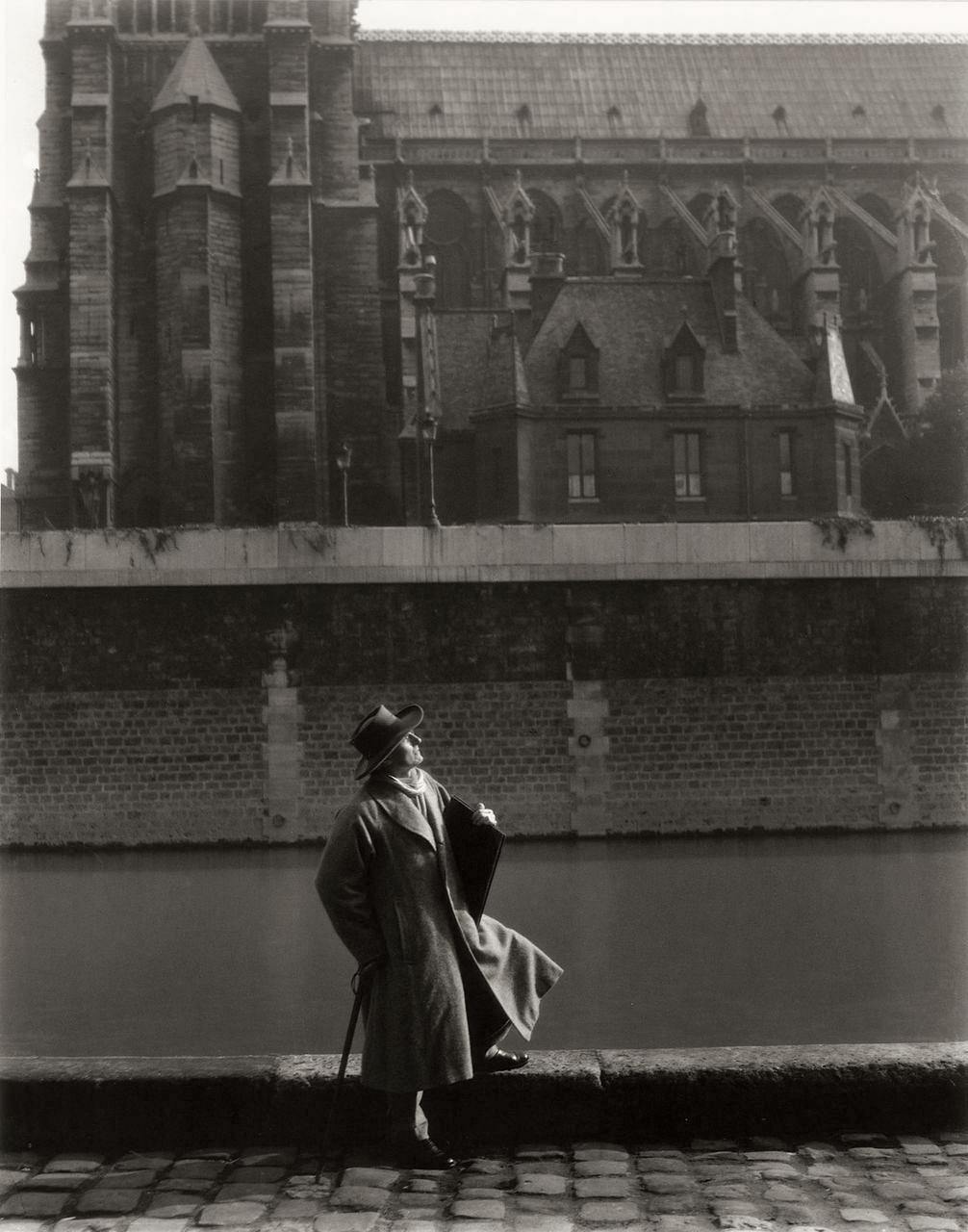
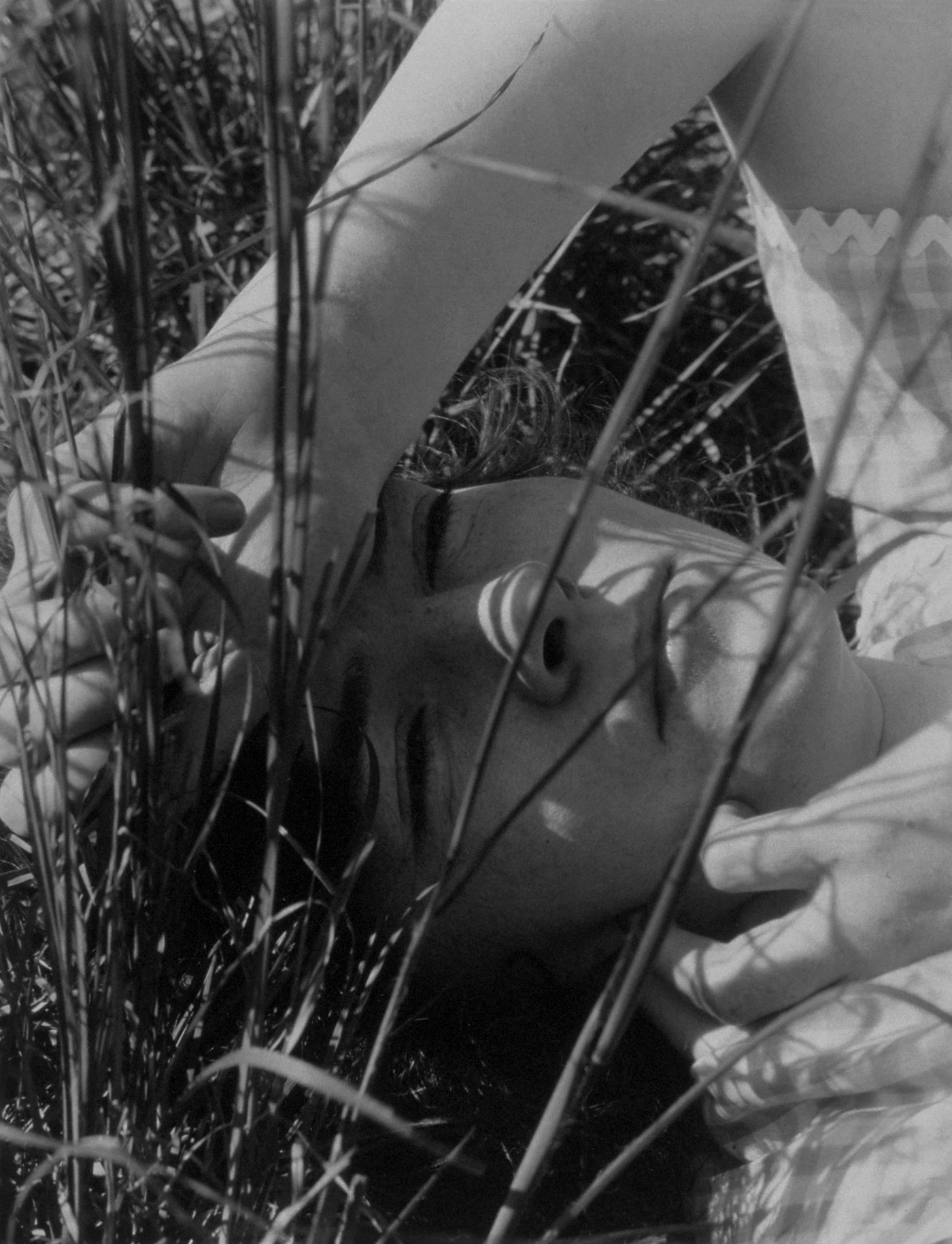


Edie Sedgwick Screen Test

Andy Warhol’s silent screen test for his future “super star.”


Harmony Hammond


'Liberation News Service #624' July 3, 1974


Liberation News Service #624, featuring Harmony Hammond, right, with daughter, Tanya, at the Christopher Street Liberation Day Gay Pride March, photograph by Cidne Hart for Liberation News Service, July 3, 1974
Private collection


Harmony Hammond (American, b. 1944) 'An Oval Braid' 1972


Harmony Hammond (American, b. 1944)
An Oval Braid
1972
Charcoal on paper
Courtesy the artist and Alexander Gray Associates, New York


Harmony Hammond (American, b. 1944) 'Fan Lady meets Cactus Lady' 1981


Harmony Hammond (American, b. 1944)
Fan Lady meets Cactus Lady
1981
Lithograph
Courtesy the artist and Alexander Gray Associates, New York


Robert Mapplethorpe


Judy Linn (American, b. 1947) 'Robert Gets Dressed at the Chelsea, #3' 1970


Judy Linn (American, b. 1947)
Robert Gets Dressed at the Chelsea, #3
1970
Modern digital print
Courtesy the Artist and Susanne Hilberry Gallery


'Gay Power', Volume 1, No 16, April 15, 1970


Gay Power, Volume 1, No 16, April 15, 1970
Alternative Press Collection, Archives & Special Collections at the Thomas J. Dodd Research Center, University of Connecticut Libraries


Robert Mapplethorpe (American, 1946-1989) 'Light Gallery invitation' 1973


Robert Mapplethorpe (American, 1946-1989)
Light Gallery invitation
1973
Getty Research Institute, Los Angeles California


Ultra Violet modeling Mapplethorpe-designed jewelry, c. 1975


Ultra Violet modeling Mapplethorpe-designed jewelry
c. 1975
Gift of the Robert Mapplethorpe Foundation to The J. Paul Getty Trust and the Los Angeles County Museum of Art


Isabelle Collin Dufresne (French-American, 1935-2014)

Isabelle Collin Dufresne (stage name Ultra Violet; 6 September 1935 – 14 June 2014) was a French-American artist, author, and both a colleague of Andy Warhol and one of the pop artist’s so-called superstars. Earlier in her career, she worked for and studied with surrealist artist Salvador Dalí. Dufresne lived and worked in New York City, and also had a studio in Nice, France…

In 1954, after a meeting with Salvador Dalí, she became his “muse”, pupil, studio assistant, and lover in both Port Lligat, Spain, and in New York City. Later, she would recall, “I realised that I was ‘surreal’, which I never knew until I met Dalí”. In the 1960s, Dufresne began to follow the progressive American Pop Art scene including Jasper Johns, Robert Rauschenberg and James Rosenquist.

In 1963, Dalí introduced Dufresne to Andy Warhol, and soon she moved into the orbit of his unorthodox studio, “The Factory”. In 1964 she selected the stage name “Ultra Violet” at Warhol’s suggestion, because it was her preferred fashion – her hair colour at the time was often violet or lilac. She became one of many “superstars” in Warhol’s Factory, and played multiple roles in over a dozen films between 1965 and 1974…

In the 1980s, she gradually drifted away from the Factory scene, taking a lower profile and working independently on her own art. In her autobiography, published the year after Warhol’s unexpected demise in 1987, she chronicled the activities of many Warhol superstars, including several untimely deaths during and after the Factory years…

In 1990 she opened a studio in Nice and wrote another book detailing her own ideas about art, L’Ultratique. She lived and worked as an artist in New York City, and also maintained a studio in Nice for the rest of her life.

Text from the Wikipedia website


Valerie Santagto (American, b. 1947) 'Robert Mapplethorpe, front, and Jay Johnson in Mapplethorpe designed jewelry' c. 1970-1975


Valerie Santagto (American, b. 1947)
Robert Mapplethorpe, front, and Jay Johnson in Mapplethorpe designed jewellery
c. 1970-75
Gift of the Robert Mapplethorpe Foundation to The J. Paul Getty Trust and the Los Angeles County Museum of Art


Robert Mapplethorpe (American, 1946-1989) 'Jim, Sausalito' 1977


Robert Mapplethorpe (American, 1946-1989)
X Portfolio with Jim, Sausalito
1978
Black silk clamshell case with gelatin silver print photographs mounted on pure rag board
Designed by John Cheim
Courtesy Yoshi Gallery, New York and Cheim & Read, New York


Greer Lankton


'Einsteins' installation designed by Paul Monroe for 'Gay Gotham', 2016 featuring works by Greer Lankton and Andy Warhol


Einsteins installation designed by Paul Monroe for Gay Gotham, 2016
Courtesy of Greer Lankton Archives Museum

Greer Lankton (American, 1958-1996)
Mini-Einsteins
1987
Cardboard, glass, paint, styrofoam board

Andy Warhol
1990
Fabric, wire, glass, human hair

Teri Toye
1988
Fabric, wire, glass, human hair

Siamese Twins
1988
Paper, wire, fabric


Greer Lankton (American, 1958-1996) (dolls and photo) 'Einsteins "Circus" window display by Greer Lankton and Paul Monroe' 1986


Greer Lankton (American, 1958-1996) (dolls and photo)
Einsteins “Circus” window display by Greer Lankton and Paul Monroe
1986
Courtesy Paul Monroe for Greer Lankton Archives Museum


Greer Lankton (American, 1958-1996)

Greer Lankton (1958 – November 18, 1996) was an American artist known for creating lifelike, sewn dolls that were often modelled on friends and celebrities and posed in elaborate theatrical settings. She was a key figure in the East Village art scene of the 1980s in New York.

Gender and sexuality are recurring themes in Lankton’s art. Her dolls are created in the likeness of those society calls “freaks”, and have often been compared to the surrealist works of Hans Bellmer, who made surreal dolls with interchangeable limbs. She created figures that were simultaneously distressing and glamorous, as if they were both victim and perpetrator of their existence.

In 1981 Lankton was featured in the seminal “New York/New Wave” exhibition at P.S.1 in Long Island City, and began to show her work in the East Village at Civilian Warfare. She gained an almost cult following among East Village residents from her highly theatrical window displays she designed for Einstein’s, the boutique that was run by her husband, Paul Monroe, at 96 East Seventh Street. Besides her more emotionally charged dolls, Lankton also created commissioned portrait dolls. These include a 1989 doll of Diana Vreeland that was commissioned for a window display at Barney’s as well as shrines to her icons, such as Candy Darling.

Critic Roberta Smith described her works in the New York Times as: “Beautifully sewn, with extravagant clothes, make-up and hairstyles, they were at once glamorous and grotesque and exuded intense, Expressionistic personalities that reminded some observers of Egon Schiele. They presaged many of the concerns of 90’s art, including the emphasis on the body, sexuality, fashion and, in their resemblance to puppets, performance.” 

Photographer Nan Goldin said of her work, “Greer was one of the pioneers who blurred the line between folk art and fine art.” She had spots in the prestigious Whitney Biennial and the Venice Biennale, both in 1995, where her busts of Candy Darling, circus fat ladies, and dismembered heads gained her notoriety…

Greer was friends with photographer Nan Goldin, and lived in her apartment in the early 80’s, often posing for her. She also played muse to photographers like David Wojnarowicz and Peter Hujar.

Text from the Wikipedia website


“Writing about the wax dolls of German artist Lotte Pritzel (to whom Lankton’s own work bears a strong family resemblance), Rainer Maria Rilke noted: “With the doll we had to assert ourselves, because if we surrendered to it there was nobody there. It made no response, so we got into the habit of doing things for it, splitting our own slowly expanding nature into opposing parts and to some extent using the doll to establish distance between ourselves and the amorphous world pouring into us” [“Dolls: On the Wax Dolls of Lotte Pritzel,” tr. Idris Parry]. This relationship imbues the doll with its “soul,” Rilke writes, arguing that it is the extremity of this attachment that leads us to both desire and reject the doll. Unalterable strangeness: Lankton’s own work is plotted along the rejection-desire axis, granting the work a peculiar levity that hovers between fearsome and friendly…

Lankton’s art is both realistic and unrealistic, a difficult balance that is not unlike Candy Darling’s work as an actor, which often operated at the juncture between self-conscious play and unanticipated reality to evoke, again, unalterable strangeness. Following Douglas Crimp’s description of the superstar as someone whose “self … recognises otherness already there in itself [and] performs its own self-alienation” [Our Kind of Movie: The Films of Andy Warhol, Cambridge: MIT Press, 2012], Lankton likewise performs the double work of representing bodies (hers and others) while asserting their alienation. Darling rehearsed and played herself in order to be someone else. It might be said that Lankton rehearsed and played others in order to be herself.”

Extract from “Unalterable Strangeness: Andrew Durbin and Paul Monroe on Greer Lankton,” on the Flash Art website, March – April 2015. No longer available online


Paul Monroe. 'Chanel No. 5 earrings' 1985


Paul Monroe
Chanel No. 5 earrings
1985
Glass (actual miniature Chanel products filled with No. 5), 14k gold wire and glass pearls

Candelabra ring
1986
Metal, chain, glass jewels and wax

Paul Monroe and Greer Lankton (American, 1958-1996)
Teri Toye necklace
1985
Clay, acrylic paint, gold metal chain and rhinestones

Einsteins promotional cards 1986-1992
Einsteins business card, 1985


Nan Goldin (American, b. 1953) 'Greer Lankton and Paul Monroe wedding' 1987


Nan Goldin (American, b. 1953)
Greer Lankton and Paul Monroe wedding
1987
Greer Lankton Archives Museum


Bill T. Jones


Lois Greenfield (American, b. 1949) 'Bill T. Jones and Arnie Zane' 1982


Lois Greenfield (American, b. 1949)
Bill T. Jones and Arnie Zane
1982
Modern print Courtesy Lois Greenfield Studio


Robert Mapplethorpe (American, 1946-1989) 'Studio Portrait (Bill T. Jones and Arnie Zane)' 1986


Robert Mapplethorpe (American, 1946-1989)
Studio Portrait (Bill T. Jones and Arnie Zane)
1986
Private Collection of Bill T. Jones


Tseng Kwong Chi (American born Hong Kong, 1950-1990) 'Bill T. Jones Body Painting with Keith Haring' 1983


Tseng Kwong Chi (American born Hong Kong, 1950-1990)
Bill T. Jones Body Painting with Keith Haring
1983
Silver gelatin selenium-toned print
© Muna Tseng Dance Projects, Inc., New York. Body Drawing on Bill T. Jones by Keith Haring
© 1983 Keith Haring Foundation


Huck Snyder (American, b. 1993) Small mask from 'Last Supper at Uncle Tom's Cabin' 1990


Huck Snyder (American, b. 1993)
Small mask from Last Supper at Uncle Tom’s Cabin
1990
Painted cardboard and fabric
New York Live Arts


Huck Snyder (American, b. 1993)

Huck Snyder was a visual artist and a designer of vivid stage settings for dancers and performance artists. He created sets and stage furniture that were surrealistic yet extremely simple and almost childlike at times. Imaginative and free in their execution and unmistakably his work, his sets often seemed inseparable from the vision of the performers with whom he worked. Huck had designed stage sets for the performance artist John Kelly beginning with sets for Diary of a Somnambulist in 1985…

Mr. Snyder also created sets for dances by Bill T. Jones and Bart Cook, and for theater pieces by Ishmael Houston-Jones. He conceived, directed and designed his own work “Circus,” a performance-art piece presented in 1987 at La Mama E.T.C. Mr. Snyder’s work has been displayed at the Lincoln Center for the Performing Arts, the Brooklyn Academy of Music and the Dance Theater Workshop in New York. His paintings and installations have been exhibited at galleries throughout the United States and in solo and group shows in Europe and Japan.

Anonymous text. “Huck Snyder,” on the Visual AIDS website Nd [Online] Cited 22/11/2021


Themes ~

Downtown


'Shazork! invitation, Danceteria' late 1980s


Downtown invitations
Shazork! invitation, Danceteria
Late 1980s
Museum of the City of New York, Gift of Carrie Goteiner and Miriam Montaug Ashkenazy in memory of Haoui Montaug


Peter Hujar (American, 1934-1987) 'Quentin Crisp' 1982


Peter Hujar (American, 1934-1987)
Quentin Crisp
1982
Vintage gelatin silver print
© The Peter Hujar Archive; Courtesy Pace/MacGill Gallery, New York and Fraenkel Gallery, San Francisco


Quentin Crisp (English, 1908-1999)

Quentin Crisp was born Denis Charles Pratt in Surrey, England, on December 25, 1908. A self-described flamboyant homosexual, Crisp changed his name in his early 20s as part of his process of reinvention. Teased mercilessly at school as a boy, Crisp left school in 1926. He studied journalism at King’s College London, but failed to graduate. He then moved on to take art classes at Regent Street Polytechnic. Crisp began visiting the cafés of Soho, London, and even worked as a prostitute for six months. Crisp was always true to himself and expressed himself by dying his long hair lavender, polishing his fingernails and toenails, and dressing in an often androgynous style. Despite the ridicule and violence often directed toward him, Crisp carried on. He tried to join the army with the outbreak of World War II, but was rejected by the medical board, who determined that he was suffering from sexual perversion. Instead, Crisp remained in London during the Blitz, entertaining American GIs, whose friendliness inculcated a love for Americans.

Crisp held a number of jobs, including engineer’s tracer, life model, and author. His most famous work, The Naked Civil Servant, detailed his life in a homophobic British society. When the book was adapted for television, Crisp began a new career as a performer and lecturer. He moved to Manhattan in 1981, when he was 72 years old; settling in a studio apartment in the Bowery. Upon meeting and spending time with Crisp, Sting was inspired to pen his hit song, “An Englishman in New York.”

Crisp continued to tour, write, and lecture; including instructions on how to live life with style and the importance of manners. Crisp landed a few roles on American television and the 1990s became his busiest decade as an actor. In 1992, Crisp took on the role of Elizabeth I in the film Orlando.

Quentin Crisp died in November 1999, just shy of his 91st birthday, while touring his one-man show.

Anonymous text. “Quentin Crisp,” on the Biography website Nd [Online] Cited 15/02/2017. No longer available online


Peter Hujar (American, 1934-1987) 'Susan Sontag' 1975, printed 2014


Peter Hujar (American, 1934-1987)
Susan Sontag
1975, printed 2014
Pigmented ink print
© The Peter Hujar Archive; Courtesy Pace/MacGill Gallery, New York and Fraenkel Gallery, San Francisco


Peter Hujar (American, 1934-1987)

Peter Hujar (born 1934) died of AIDS in 1987, leaving behind a complex and profound body of photographs. Hujar was a leading figure in the group of artists, musicians, writers, and performers at the forefront of the cultural scene in downtown New York in the 1970s and early 80s, and he was enormously admired for his completely uncompromising attitude towards work and life. He was a consummate technician, and his portraits of people, animals, and landscapes, with their exquisite black-and-white tonalities, were extremely influential. Highly emotional yet stripped of excess, Hujar’s photographs are always beautiful, although rarely in a conventional way. His extraordinary first book, Portraits in Life and Death, with an introduction by Susan Sontag, was published in 1976, but his “difficult” personality and refusal to pander to the marketplace insured that it was his last publication during his lifetime.
Anonymous text. “About Peter Hujar” on the Peter Hujar Archive website [Online] Cited 22/11/2021

Susan Sontag (American, 1933-2004)

Susan Sontag (January 16, 1933 – December 28, 2004) was an American writer, filmmaker, teacher, and political activist. She published her first major work, the essay “Notes on ‘Camp'”, in 1964. Her best-known works include On Photography, Against Interpretation, Styles of Radical Will, The Way We Live Now, Illness as Metaphor, Regarding the Pain of Others, The Volcano Lover, and In America.

Sontag was active in writing and speaking about, or travelling to, areas of conflict, including during the Vietnam War and the Siege of Sarajevo. She wrote extensively about photography, culture and media, AIDS and illness, human rights, and communism and leftist ideology. Although her essays and speeches sometimes drew controversy, she has been described as “one of the most influential critics of her generation.” …

It was through her essays that Sontag gained early fame and notoriety. Sontag wrote frequently about the intersection of high and low art and expanded the dichotomy concept of form and art in every medium. She elevated camp to the status of recognition with her widely read 1964 essay “Notes on ‘Camp’,” which accepted art as including common, absurd and burlesque themes.

In 1977, Sontag published the series of essays On Photography. These essays are an exploration of photographs as a collection of the world, mainly by travellers or tourists, and the way we experience it… She became a role-model for many feminists and aspiring female writers during the 1960s and 1970s.

Text from the Wikipedia website


Printing


Liza Cowan (American) (designer) 'DYKE, A Quarterly' c. 1974


Liza Cowan (American) (designer)
DYKE, A Quarterly
c. 1974
Flyer
Courtesy Liza Cowan and Penny House


'DYKE, A Quarterly Call for poster design flyer' 1976


DYKE, A Quarterly Call for poster design flyer
1976
Illustration by Liza Cowan Penny House


'Christopher Street' September 1977


Christopher Street
September 1977
Private collection


'Christopher Street' June 1978


Christopher Street
June 1978
Private collection


Edmund White (American, b. 1940) 'Nocturnes for the King of Naples' Paperback edition with cover art by Mel Odom, 1980


Edmund White (American, 1940-2025)
Nocturnes for the King of Naples
Paperback edition with cover art by Mel Odom, 1980 (originally published 1978)
Private collection


Edmund White (American, 1940-2025)

Edmund Valentine White III (1940-2025) is an American novelist, memoirist, playwright, biographer and an essayist on literary and social topics. Since 1999 he has been a professor at Princeton University. France made him Chevalier (and later Officier) de l’Ordre des Arts et des Lettres in 1993.

White’s books include The Joy of Gay Sex, written with Charles Silverstein (1977); his trilogy of semi-autobiographic novels, A Boy’s Own Story (1982), The Beautiful Room Is Empty (1988) and The Farewell Symphony (1997); and his biography of Jean Genet. Much of his writing is on the theme of same-sex love.

White has also written biographies of three French writers: Jean Genet, Marcel Proust and Arthur Rimbaud. He is the namesake of the Edmund White Award for Debut Fiction, awarded annually by Publishing Triangle.

Text from the Wikipedia website


'New York Magazine' June 20, 1994


New York Magazine
June 20, 1994
1994
Courtesy New York Magazine


Posing


Eva Weiss (American born Hong Kong, b. 1950) 'From left, Lois Weaver, Peggy Shaw, and Deb Margolin performing as Split Britches in 'Upwardly Mobile Home'' 1984


Eva Weiss (American born Hong Kong, b. 1950)
From left, Lois Weaver, Peggy Shaw, and Deb Margolin performing as Split Britches in ‘Upwardly Mobile Home’
1984
Contemporary archival print
Courtesy Eva Weiss Photography


Alice O'Malley (American, b. 1962) 'Melanie Hope, Clit Club' c. 1992


Alice O’Malley (American, b. 1962)
Melanie Hope, Clit Club
c. 1992
Vintage gelatin silver print
Alice O’Malley Photography


Tseng Kwong Chi (American born Hong Kong, 1950-1990) 'New York, NY (Statue of Liberty)' 1979


Tseng Kwong Chi (American born Hong Kong, 1950-1990)
New York, NY (Statue of Liberty)
1979
Gelatin silver print
Muna Tseng Dance Projects Inc.


Tseng Kwong Chi (American born Hong Kong, 1950-1990)

Tseng Kwong Chi, known as Joseph Tseng prior to his professional career (Chinese: 曾廣智; c. 1950 – March 10, 1990), was a Hong Kong-born American photographer who was active in the East Village art scene in the 1980s.

Tseng was part of an circle of artists in the 1980s New York art scene including Keith Haring, Kenny Scharf, and Cindy Sherman. Tseng’s most famous body of work is his self-portrait series, East Meets West, also called the “Expeditionary Series”. In the series, Tseng dressed in what he called his “Mao suit” and sunglasses (dubbed a “wickedly surrealistic persona” by the New York Times), and photographed himself situated, often emotionlessly, in front of iconic tourist sites. These included the Statue of Liberty, Cape Canaveral, Disney Land, Notre Dame de Paris, and the World Trade Center. Tseng also took tens of thousands of photographs of New York graffiti artist Keith Haring throughout the 1980s working on murals, installations and the subway. In 1984, his photographs were shown with Haring’s work at the opening of the Semaphore Gallery’s East Village location in a show titled “Art in Transit”. Tseng photographed the first Concorde landing at Kennedy International Airport, from the tarmac. According to his sister, Tseng drew artistic influence from Brassai and Cartier-Bresson.

Text from the Wikipedia website


Chantal Regnault (French-Haitian) 'From left, Whitney Elite, Ira Ebony, Stewart and Chris LaBeija, Ian and Jamal Adonis, Ronald Revlon, House of Jourdan Ball, New Jersey' 1989


Chantal Regnault (French-Haitian)
From left, Whitney Elite, Ira Ebony, Stewart and Chris LaBeija, Ian and Jamal Adonis, Ronald Revlon, House of Jourdan Ball, New Jersey
1989
Gelatin silver print
© Chantal Regnault


Museum of the City of New York
1220 Fifth Ave at 103rd St.,

Opening hours:
Open Daily 10am – 6pm

Museum of the City of New York website

LIKE ART BLART ON FACEBOOK

Back to top

Exhibition: ‘Nan Goldin: The Ballad of Sexual Dependency’ at the Museum of Modern Art (MoMA), New York

Exhibition dates: 11th June, 2016 – 12th February, 2017


Nan Goldin (American, born 1953) 'Trixie on the Cot, New York City' 1979 from the exhibition 'Nan Goldin: The Ballad of Sexual Dependency' at the Museum of Modern Art (MoMA), New York, June 2016 - Feb 2017


Nan Goldin (American, b. 1953)
Trixie on the Cot, New York City
1979
Silver dye bleach print, printed 2008
15 1/2 x 23 1/8″ (39.4 x 58.7cm)
The Museum of Modern Art, New York
Acquired through the generosity of Marian and James H. Cohen in memory of their son Michael Harrison Cohen
© 2016 Nan Goldin


This “seminal” body of work by Nan Goldin allegedly changed the course of photography. In my opinion, not for the better.

There is little love and tenderness here, little magic or generosity of spirit. Goldin’s attitude to the world at the time seems to be one of hostility and resentment. It’s all very well portraying the underbelly of society – the depravity, violence and degradation – but if your point of departure is one of anger and animosity, this is always going to be reflected in your art. I remember going out with my friends partying in the 1980s, the drugs, the sex, the pushing it to the edge, but you know what – we cared about each other. Nothing could be further from the truth in Goldin’s hedonistic (not heuristic) approach to her aura.

Shooting indiscriminately, hoping to find the rough diamond of an image, cuts both ways. In the arbitrary voyeurism of this work – do I snap now or a second later, what is happening outside of the frame – you never know what you are missing. Often you get nothing, or you get a reflection of yourself that is not very appealing. (Today is a very different world from the 1980s, we just snap and upload everything. These images are very of their time). There is so much more that could have been said other than through this controlling, diaristic approach to the subject matter.

I repeat, there seems to be a less than generous spirit captured in this work, of how Goldin looked at the world at that time, and it is reflected back to us in her images. Nothing to do with HIV / AIDS, nothing to do with bohemianism – everything to do with the spirit of the artist.

Dr Marcus Bunyan

PS. The minimal hang of the exhibition adds nothing to the energy of the photographs, isolated as they are in the white walled gallery spaces.


Many thankx to the Museum of Modern Art for allowing me to publish the photographs in the posting. Please click on the photographs for a larger version of the image.


“Since David Armstrong and I were young he always referred to photography as “diving for pearls.” If you took a million pictures you were lucky to come out with one or two gems. … I never learned control over my machines. I made every mistake in the book. But the technical mistakes allowed for magic. … Random psychological subtexts that I never would have thought to intentionally create. The subconscious made visible – though whether mine or the camera’s I don’t know …”


Nan Goldin. “Diving for Pearls,” quoted in Hilton Als. “Nan Goldin’s Life in Progress,” on The New Yorker website, July 4, 2016 [Online] Cited 18/11/2021


Installation view of the exhibition 'Nan Goldin: The Ballad of Sexual Dependency' at the Museum of Modern Art (MoMA), New York, June 2016 - February 2017


Installation views of the exhibition Nan Goldin: The Ballad of Sexual Dependency at the Museum of Modern Art (MoMA), New York, June 2016 – February 2017


Nan Goldin (American, born 1953) 'Buzz and Nan at the Afterhours, New York City' 1980 from the exhibition 'Nan Goldin: The Ballad of Sexual Dependency' at the Museum of Modern Art (MoMA), New York, June 2016 - Feb 2017


Nan Goldin (American, b. 1953)
Buzz and Nan at the Afterhours, New York City
1980
Silver dye bleach print, printed 2008
15 1/2 x 23 1/4″ (39.4 x 59cm)
The Museum of Modern Art, New York
Purchase
© 2016 Nan Goldin


Nan Goldin (American, born 1953) 'Nan and Dickie in the York Motel, New Jersey' 1980


Nan Goldin (American, b. 1953)
Nan and Dickie in the York Motel, New Jersey
1980
Silver dye bleach print, printed 2008
15 1/2 x 23 1/8″ (39.4 x 58.7cm)
The Museum of Modern Art, New York
Purchase
© 2016 Nan Goldin


Nan Goldin (American, born 1953) 'Self-Portrait in Blue Bathroom, London' 1980


Nan Goldin (American, b. 1953)
Self-Portrait in Blue Bathroom, London
1980
Silver dye bleach print, printed 2016
20 x 24″ (50.8 x 61cm)
The Museum of Modern Art, New York
Gift of Nan Goldin
© 2016 Nan Goldin


Nan Goldin (American, born 1953) 'Heart-Shaped Bruise, New York City' 1980


Nan Goldin (American, b. 1953)
Heart-Shaped Bruise, New York City
1980
Silver dye bleach print, printed 2006
20 x 24″ (50.8 x 61cm)
The Museum of Modern Art, New York
Gift of Nan Goldin
© 2016 Nan Goldin


Nan Goldin (American, born 1953) 'David and Butch Crying at Tin Pan Alley, New York City' 1981


Nan Goldin (American, b. 1953)
David and Butch Crying at Tin Pan Alley, New York City
1981
Silver dye bleach print, printed 2009
15 1/2 x 23 1/8″ (39.4 x 58.7cm)
The Museum of Modern Art, New York
Purchase
© 2016 Nan Goldin


Nan Goldin (American, born 1953) 'Nan on Brian's Lap, Nan's Birthday, New York City' 1981


Nan Goldin (American, b. 1953)
Nan on Brian’s Lap, Nan’s Birthday, New York City
1981
Silver dye bleach print, printed 2008
15 1/2 x 23 1/8″ (39.3 x 58.7cm)
The Museum of Modern Art, New York
Purchase
© 2016 Nan Goldin


Nan Goldin (American, born 1953) 'Rise and Monty Kissing, New York City' 1980


Nan Goldin (American, b. 1953)
Rise and Monty Kissing, New York City
1980
Silver dye bleach print, printed 2008
15 1/2 x 23 1/8″ (39.4 x 58.7cm)
The Museum of Modern Art, New York
Purchase
© 2016 Nan Goldin


Nan Goldin (American, born 1953) 'Philippe H. and Suzanne Kissing at Euthanasia, New York City' 1981


Nan Goldin (American, b. 1953)
Philippe H. and Suzanne Kissing at Euthanasia, New York City
1981
Silver dye bleach print, printed 2008
15 1/2 x 23 1/8″ (39.4 x 58.7cm)
The Museum of Modern Art, New York
Purchase
© 2016 Nan Goldin


Nan Goldin (American, born 1953) 'Max and Richard, New York City' 1983


Nan Goldin (American, b. 1953)
Max and Richard, New York City
1983
Silver dye bleach print, printed 2006
15 9/16 x 23 1/16″ (39.6 x 58.5cm)
The Museum of Modern Art, New York. The Family of Man Fund
© 2016 Nan Goldin


Nan Goldin (American, born 1953) 'Nan and Brian in Bed, New York City' 1983


Nan Goldin (American, b. 1953)
Nan and Brian in Bed, New York City
1983
Silver dye bleach print, printed 2006
15 1/2 x 23 3/16″ (39.4 x 58.9cm)
The Museum of Modern Art, New York
Acquired through the generosity of Jon L. Stryker
© 2016 Nan Goldin


Nan Goldin (American, born 1953) 'Nan One Month After Being Battered' 1984


Nan Goldin (American, b. 1953)
Nan One Month After Being Battered
1984
Silver dye bleach print, printed 2008
15 1/2 x 23 1/8″ (39.4 x 58.7cm)
The Museum of Modern Art, New York
Purchase
© 2016 Nan Goldin


Nan Goldin (American, born 1953) 'The Parents' Wedding Photo, Swampscott, Massachusetts' 1985


Nan Goldin (American, b. 1953)
The Parents’ Wedding Photo, Swampscott, Massachusetts
1985
Silver dye bleach print, printed 2006
15 1/2 x 23 1/8″ (39.4 x 58.7cm)
The Museum of Modern Art, New York
Acquired through the generosity of Richard O. Rieger
© 2016 Nan Goldin


Comprising almost 700 snapshot-like portraits sequenced against an evocative music soundtrack, Nan Goldin’s The Ballad of Sexual Dependency is a deeply personal narrative, formed out of the artist’s own experiences around Boston, New York, Berlin, and elsewhere in the late 1970s, 1980s, and beyond. Titled after a song in Bertolt Brecht and Kurt Weill’s The Threepenny Opera, Goldin’s Ballad is itself a kind of downtown opera; its protagonists – including the artist herself – are captured in intimate moments of love and loss. They experience ecstasy and pain through sex and drug use; they revel at dance clubs and bond with their children at home; and they suffer from domestic violence and the ravages of AIDS.

The Ballad of Sexual Dependency is the diary I let people read,” Goldin wrote. “The diary is my form of control over my life. It allows me to obsessively record every detail. It enables me to remember.”

The Ballad developed through multiple improvised live performances, for which Goldin ran through the slides by hand and friends helped prepare the soundtrack – from Maria Callas to The Velvet Underground – for an audience not unlike the subjects of the pictures. The Ballad is presented in its original 35mm format, along with photographs from the Museum’s collection that also appear as images in the slide show. Introducing the installation is a selection of materials from the artist’s archive, including posters and flyers announcing early iterations of The Ballad. Live performances will periodically accompany The Ballad during the course of the Museum’s presentation; performance details will be announced during the course of the exhibition presentation.

Press release from MoMA


Nan Goldin (American, born 1953) 'C.Z. and Max on the Beach, Truro, Massachusetts' 1976


Nan Goldin (American, b. 1953)
C.Z. and Max on the Beach, Truro, Massachusetts
1976
Silver dye bleach print, printed 2006
23 1/8 x 15 1/2″ (58.7 x 39.4cm)
The Museum of Modern Art, New York
Acquired through the generosity of Jon L. Stryker
© 2016 Nan Goldin


Nan Goldin (American, born 1953) 'The Hug, New York City' 1980


Nan Goldin (American, b. 1953)
The Hug, New York City
1980
Silver dye bleach print, printed 2008
23 1/8 x 15 1/2″ (58.7 x 39.4cm)
The Museum of Modern Art, New York. Purchase
© 2016 Nan Goldin


Janet Stein (designer) 'Poster for 'The Ballad of Sexual Dependency', slide show by Nan Goldin, with 'Desperate Living', a film by John Waters' O.P. Screening Room, New York, March 29, 1982


Janet Stein (designer)
Poster for ‘The Ballad of Sexual Dependency’, slide show by Nan Goldin, with ‘Desperate Living’, a film by John Waters
O.P. Screening Room, New York, March 29, 1982
Photocopy
11 × 8 1/2″ (27.9 × 21.6cm)
Collection Nan Goldin


The Museum of Modern Art
11 West 53 Street
New York, NY 10019
Phone: (212) 708-9400

Opening hours:
10.30am – 5.30pm
Open seven days a week

MoMA website

LIKE ART BLART ON FACEBOOK

Back to top

Exhibition: ‘Surveillance’ at the Nelson-Atkins Museum of Art, Kansas City, Missouri

Exhibition dates: 16th September, 2016 – 29th January, 2017

Curator: Jane L. Aspinwall, Associate Curator, Photography


Unknown maker (American) 'Rochester, New York' 1886


Unknown maker (American)
Rochester, New York
1886
Albumen print
5 5/8 x 5 5/16 inches
The Nelson-Atkins Museum of Art, Kansas City, Missouri
Gift of Hallmark Cards, Inc.,


This looks to be a fascinating exhibition on a very interesting subject. It’s such a pity I cannot comment on the exhibition itself due to the small number of media images, and having no idea how the images I do have fit into the themes of the exhibition, although one can make guesses: Henri Cartier-Bresson’s Brussels (1932, below) surveys the watchers; his Hyeres, France (1932, below) is taken by an unseen camera; while Professor Lowe’s balloon Intrepid was used by the Union in the American Civil War to spy on Confederate troop movements. Others I have absolutely no idea.

“Dating from 1864-2014, the works in Surveillance fall under these categories: spying or hidden cameras, photography of the forbidden, military surveillance, areas of heavy surveillance and mapping satellites and drones. There are also examples of counter-surveillance that either prevent watching or surveille the watchers.”

My favourite images in this posting of surreptitious photography are those of Tomas van Houtryve from his series Blue Sky Days. I love the titles play on the ideas of blue sky thinking (original or creative thinking, unfettered by convention and not grounded in reality) and blue skies research (scientific research in domains where “real-world” applications are not immediately apparent) – views of the world that are quantifiable but not grounded in reality, and where the “reality” of the world is not immediately apparent. Such a clever and insightful “point of view” which engages with “the changing nature of surveillance, personal privacy, and war”, a projection on a vertical plane.

More intriguing images from this series can be seen on his website.

Dr Marcus Bunyan


Many thankx to the the Nelson-Atkins Museum of Art for allowing me to publish the photographs in the posting. Please click on the photograph for a larger version of the image.


Henri Cartier-Bresson (French, 1908-2004) 'Brussels' 1932 from the exhibition 'Surveillance' at the Nelson-Atkins Museum of Art, Kansas City, Missouri, Sept 2016 - Jan 2017


Henri Cartier-Bresson (French, 1908-2004)
Brussels
1932
Gelatin silver print
9 1/2 x 14 3/16 inches
The Nelson-Atkins Museum of Art, Kansas City, Missouri
Gift of Hallmark Cards, Inc.,
© Henri Cartier-Bresson / Magnum Photos


Henri Cartier Bresson (French, 1908-2004) 'Hyeres, France' 1932


Henri Cartier Bresson (French, 1908-2004)
Hyeres, France
1932
Gelatin silver print
© Henri Cartier-Bresson/Magnum


Tomas van Houtryve (Belgian, b. 1975) 'Schoolyard From the series 'Blue Sky Days'' 2013-2014


Tomas van Houtryve (Belgian, b. 1975)
Schoolyard
2013-2014
From the series Blue Sky Days
Gelatin silver print
150 x 100cm


Tomas van Houtryve (Belgian, b. 1975) 'Domestic gathering' 2013-2014


Tomas van Houtryve (Belgian, b. 1975)
Domestic gathering
2013-2014
From the series Blue Sky Days
Gelatin silver print


“The images captured from the drone’s perspective engage with the changing nature of surveillance, personal privacy, and war.”

~ Tomas van Houtryve


“In October 2012, a drone strike in northeast Pakistan killed a 67-year-old woman picking okra outside her house. At a briefing held in 2013 in Washington, the woman’s 13-year-old grandson, Zubair Rehman, spoke to a group of five lawmakers. “I no longer love blue skies,” said Rehman, who was injured by shrapnel in the attack. “In fact, I now prefer grey skies. The drones do not fly when the skies are grey.”

Over the past decade, drones have become the weapon of the United States military and the CIA for strikes overseas. Their use for surveillance and commercial purposes is also rapidly expanding both at home and abroad.

Tomas van Houtryve attached his camera to a small drone and traveled across America to photograph the very sorts of gatherings that have become habitual targets for foreign air strikes – weddings, funerals, groups of people praying or exercising. He also flew his camera over settings in which drones are used to less lethal effect, such as prisons, oil fields, industrial feedlots, and stretches of the U.S.-Mexico border.”

Text from the Pulitzer Center website [Online] Cited 18/11/2021


Mishka Henner (Belgian, b. 1976) 'Staphorst Ammunition Depot' 2011


Mishka Henner (Belgian, b. 1976)
Staphorst Ammunition Depot
2011
Inkjet print
31 1/4 x 35 1/8 inches
The Nelson-Atkins Museum of Art, Kansas City, Missouri
Gift of the Hall Family Foundation


British photographer Mishka Henner, in his series Dutch Landscapes, uses Google satellite views of locations that have been censored by the Dutch government because of concerns about the visibility of political, economic and military locations. Many countries blur, pixilate or whiten sensitive sites. The Dutch method, however, employs bold, multi-coloured polygons. The resulting photograph is an artistic, visual contrast between secret sites and the surrounding rural environment, providing an unsettling reflection on surveillance and the contemporary landscape.


Surveillance cameras in the 21st century are practically everywhere – on street corners, in shops, in public buildings, silently recording our every movement. Yet this is not a construct of modern times. As soon as cameras were introduced in the 1880s, anyone could be unknowingly photographed at any time. It was an unfortunate fact of life. The exhibition Surveillance opened at The Nelson-Atkins Museum of Art in Kansas City September 16, examining the role of surreptitious photography from the mid-19th century to the present day.

“This body of work represents a sign of our times,” said Julián Zugazagoitia, Menefee D. and Mary Louise Blackwell CEO and Director of the Nelson-Atkins. “Cameras have been recording our movements, many times secretly, since photography began. But it was the tragedy of 9/11 that increased our awareness of this constant presence and brought a new and chilling meaning to the art, and the intention, of surveillance.”

Dating from 1864-2014, the works in Surveillance fall under these categories: spying or hidden cameras, photography of the forbidden, military surveillance, areas of heavy surveillance and mapping satellites and drones. There are also examples of counter-surveillance that either prevent watching or surveille the watchers.

“Twenty-first century technology – like Google Earth View and drone photography – have provided photographers with a treasure trove of surveillance images,” said Jane L. Aspinwall, Associate Curator, Photography. “This work provokes uneasy questions about who is looking at whom and the limits of artistic expression.”

Photographer Roger Schall, formerly a French news reporter, secretly recorded the Nazi occupation of Paris beginning in June 1940. His photographs document his daily routine and illustrate how completely the Nazis permeated every facet of Parisian life.

British photographer Mishka Henner, in his series Dutch Landscapes, uses Google satellite views of locations that have been censored by the Dutch government because of concerns about the visibility of political, economic and military locations. Many countries blur, pixilate or whiten sensitive sites. The Dutch method, however, employs bold, multi-coloured polygons. The resulting photograph is an artistic, visual contrast between secret sites and the surrounding rural environment, providing an unsettling reflection on surveillance and the contemporary landscape.

Other photographers employ techniques to circumvent surveillance. Adam Harvey creates “looks” that block online facial recognition software [CV Dazzle]. The contours of the face are manipulated in such a way that a computer is not able to identify a person, which can be a useful tool for social media sites like Facebook, in which users can search an entire archive for one particular face.”

Press release from the Nelson-Atkins Museum of Art


Brady Studio (American, active c. 1843-1885) 'Professor Lowe inflating balloon Intrepid' 1862


Brady Studio (American, active c. 1843-1885)
Professor Lowe inflating balloon Intrepid
1862
Albumen print
3 1/4 x 2 3/16 inches
The Nelson-Atkins Museum of Art, Kansas City, Missouri
Gift of Hallmark Cards, Inc.,


Intrepid being cross-inflated from Constitution in a spur-of-the-moment attempt to get the larger balloon in the air to overlook the imminent Battle of Seven Pines. The balloon Intrepid, one of six to eventually be constructed by Thaddeus Lowe and the Union Army Balloon Corps.


Peninsula Campaign

The battlefront turned toward Richmond in the Peninsula Campaign. The heavy forestation inhibited the use of balloons, so Lowe and his Balloon Corps, with the use of three of his balloons, the Constitution, the Washington, and the larger Intrepid, used the waterways to make its way inland. In mid May 1862, Lowe arrived at the White House on the Pamunkey River. This is the first home of George and Martha Washington, after which the Washington presidential residence is named. At this time, it was the home of the son of Robert E. Lee, whose family fled at the arrival of Lowe. Lowe was met by McClellan’s Army a few days later, and by 18 May, he had set up a balloon camp at Gaines’ Farm across the Chickahominy River north of Richmond, and another at Mechanicsville. From these vantage points, Lowe, his assistant James Allen, and his father Clovis were able to overlook the Battle of Seven Pines. 

A small contingent from Gen. Samuel P. Heintzelman’s corps crossed the river toward Richmond and was slowly being surrounded by elements of the Confederate Army. McClellan felt that the Confederates were simply feigning an attack. Lowe could see, from his better vantage point, that they were converging on Heintzelman’s position. Heintzelman was cut off from the main body because the swollen river had taken out all the bridges. Lowe sent urgent word of Heintzelman’s predicament and recommended immediate repair of New Bridge and reinforcements for him. 

At the same time, he sent over an order for the inflation of the Intrepid, a larger balloon that could take him higher with telegraph equipment, in order to oversee the imminent battle. When Lowe arrived from Mechanicsville to the site of the Intrepid at Gaines’ Mill, he saw that the aerostat’s envelope was an hour away from being fully inflated. He then called for a camp kettle to have the bottom cut out of it, and he hooked the valve ends of the Intrepid and the Constitution together. He had the gas of the Constitution transferred to the Intrepid and was up in the air in 15 minutes. From this new vantage point, Lowe was able to report on all the Confederate movements. McClellan took Lowe’s advice, repaired the bridge, and had reinforcements sent to Heintzelman’s aid. An account of the battle was being witnessed by the visiting Count de Joinville who at day’s end addressed Lowe with: “You, sir, have saved the day!”

Text from the Union Army Balloon Corps Wikipedia entry


Paul Strand (American, 1890-1976) 'Blind woman, New York' 1916 from the exhibition 'Surveillance' at the Nelson-Atkins Museum of Art, Kansas City, Missouri, Sept 2016 - Jan 2017


Paul Strand (American, 1890-1976)
Blind woman, New York
1916
Photogravure
8 13/16 x 6 9/16 inches
The Nelson-Atkins Museum of Art, Kansas City, Missouri
Gift of Hallmark Cards, Inc.,


Roger Schall (French, 1904-1985) 'Taking the subway' c. 1941


Roger Schall (French, 1904-1985)
Taking the subway
c. 1941
Gelatin silver print
7 7/16 x 7 1/16 inches
The Nelson-Atkins Museum of Art, Kansas City, Missouri
Gift of Jeffrey and Polly Kramer


Born in 1904, Roger Schall was one of the most renowned photographers of the 1930s and 1940s. He worked in all photographic disciplines from fashion, portraits, nudes, still lives and reporting. He began working with his father, a portrait photographer in 1918. 10 years later he would be one of the first reporters to work with a Leica or Rolleiflex. In 1939, he closed the studio-agency he had opened with his brother. From June 1940 to August 1944 he photographed German occupied Paris – hiding the negatives so they would not be seen by the censors. When the occupation was over his brother, Raymond Schall, published a book: A Paris sous la botte des Nazis (Paris under the heel of the Nazis) that was illustrated with the photographs of Roger Schall, Parry, Doisneau, the Seeberger brothers and many others. He then continued working in fashion, doing commercial and publicity work instead of news reporting. From 1970 until his death in 1995, he would manage his archive of some 80,000 images.

Anonymous text. “Roger Schall,” on the Real Life is Elsewhere blog July 30, 2011 [Online] Cited 18/11/2021


His work covered a number of topics, especially Parisian everyday life, his favourite subject, which he photographed before, during and after the German occupation. Formed in 1931, Le Studio in Montmartre was the first agency to publish his work in leading international magazines, such as Vu, Vogue, L’Illustration, Life, and Paris-Match. 150 covers and 10,000 shots were published in his lifetime.

Text from the Yellow Korner website [Online] Cited 23/01/2017. No longer available online


Henri Cartier Bresson (French, 1908-2004) 'An Attentive Cat' 1953


Henri Cartier Bresson (French, 1908-2004)
An Attentive Cat
1953
Gelatin silver print
© Henri Cartier-Bresson/Magnum


Raphaël Dallaporta (French b. 1980) 'Kafir Qala Citadel, Balkh Province, Afghanistan, from the Achaemenid period (6th-4th century BC) to the Ghorid period (12th-13th century AD)' 2010


Raphaël Dallaporta (French b. 1980)
Kafir Qala Citadel, Balkh Province, Afghanistan, from the Achaemenid period (6th-4th century BC) to the Ghorid period (12th-13th century AD)
2010
Inkjet print
59 x 47 1/4 x 1 5/8 inches
The Nelson-Atkins Museum of Art, Kansas City, Missouri
Gift of the Hall Family Foundation


The Nelson-Atkins Museum of Art
4525 Oak Street
Kansas City, MO 64111

Opening hours:
Thursday – Monday 10am – 5pm
Closed Tuesday and Wednesday

The Nelson-Atkins Museum of Art website

LIKE ART BLART ON FACEBOOK

Back to top

Exhibition: ‘In the Tower: Barbara Kruger’ at the National Gallery of Art, Washington

Exhibition dates: 30th September, 2016 – 22nd January, 2017

Curator: Molly Donovan, Associate Curator in the Department of Modern Art at the National Gallery of Art


Barbara Kruger (American, b. 1945) 'Untitled (Know nothing, Believe anything, Forget everything)' 1987/2014 from the exhibition 'In the Tower: Barbara Kruger' at the National Gallery of Art, Washington, Sept 2016 - Jan 2017


Barbara Kruger (American, b. 1945)
Untitled (Know nothing, Believe anything, Forget everything)
1987/2014
Screenprint on vinyl
Overall: 274.32 x 342.05cm (108 x 134 11/16 in.)
National Gallery of Art, Washington, Gift of the Collectors Committee, Sharon and John D. Rockefeller IV, Howard and Roberta Ahmanson, Denise and Andrew Saul, Lenore S. and Bernard A. Greenberg Fund, Agnes Gund, and Michelle Smith
© Barbara Kruger


Now this is how you tell a tale using contemporary photography!

Succinct, psychological sound bites that are commentaries on cultural production, that leave the viewer troubled by the enigma of their pronunciation. They are focused around the construct of the viewer and the subject of representation while also probing matters of identity in contemporary culture.

“They present Kruger’s distinctive direct-address texts (using active verbs and personal pronouns) which confront the viewer head-on and contrast with the underlying images of (often passive, often female) figures looking off the picture plane, and receiving the viewer’s attention. This tension creates conceptual works of great visual power.”

Know nothing, Believe anything, Forget everything!

Dr Marcus Bunyan


Many thankx to the National Gallery of Art for allowing me to publish the photographs in the posting. Please click on the photographs for a larger version of the image.


Barbara Kruger (American, b. 1945) 'Untitled (We don't need another hero)' 1987 from the exhibition 'In the Tower: Barbara Kruger' at the National Gallery of Art, Washington, Sept 2016 - Jan 2017


Barbara Kruger (American, b. 1945)
Untitled (We don’t need another hero)
1987
Photograph and type on paper
Overall: 14.61 x 28.89cm (5 3/4 x 11 3/8 in.)
Framed: 34.61 x 48.58 x 4.45cm (13 5/8 x 19 1/8 x 1 3/4 in.)
Glenstone Museum, Potomac, Maryland
© Barbara Kruger


Barbara Kruger (American, b. 1945) 'Untitled (We don't need another hero)' 1987


Barbara Kruger (American, b. 1945)
Untitled (We don’t need another hero)
1987
Silkscreen on vinyl
Overall: 276.54 x 531.34 x 6.35cm (108 7/8 x 209 3/16 x 2 1/2 in.)
Whitney Museum of American Art, New York. Gift from the Emily Fisher Landau Collection
© Barbara Kruger


Barbara Kruger (American, b. 1945) 'Untitled (Love is something you fall into)' 1990


Barbara Kruger (American, b. 1945)
Untitled (Love is something you fall into)
1990
Photographic silkscreen/vinyl
Overall: 163.83 x 396.24cm (64 1/2 x 156 in.)
Hall Collection
© Barbara Kruger. Photo courtesy Mary Boone Gallery, New York


Barbara Kruger (American, b. 1945) 'Untitled (A picture is worth more than a thousand words)' 1992


Barbara Kruger (American, b. 1945)
Untitled (A picture is worth more than a thousand words)
1992
Silkscreen on vinyl
Overall: 208.28 x 312.42cm (82 x 123 in.)
Private collection
© Barbara Kruger


The striking works of Barbara Kruger (American, b. 1945) will be featured in a focused exhibition at the National Gallery of Art, Washington, timed to celebrate the newly renovated East Building galleries. On view September 30, 2016 through January 22, 2017, In the Tower: Barbara Kruger is the first exhibition in the Tower Gallery in three years, renewing the series devoted to the presentation of works by leading contemporary artists. The exhibition presents 15 of Kruger’s profile works – images of the figure in profile over which the artist has layered her attention-grabbing phrases and figures of speech – from the early 1980s to the present, varying in scale from magazine-size to monumental.

Inspired by the Gallery’s recent acquisition of Kruger’s Untitled (Know nothing, Believe anything, Forget everything) (1987-2014), the exhibition centres on the artist’s profile works, among her strongest commentaries on cultural production. They present Kruger’s distinctive direct-address texts (using active verbs and personal pronouns) which confront the viewer head-on and contrast with the underlying images of (often passive, often female) figures looking off the picture plane, and receiving the viewer’s attention. This tension creates conceptual works of great visual power.

Kruger’s works are by turns so strong, shocking, or humorous that they grab the viewer’s attention. This is due to her signature style which includes pronouncements printed in white Futura Bold typeface across red bands reminiscent of the Life and Look magazine banners from the golden age of picture magazines. Kruger’s text slashes the black-and-white images beneath, effectively shattering the clichés represented in both words and images. Using the language, colour, image, and scale derived from the media-saturated world she queries, Kruger’s work illuminates and interrupts media tropes to encourage an active visual readership.

“Barbara Kruger’s profile works count among her most iconic images,” said Earl A. Powell III, director, National Gallery of Art, Washington. “We are delighted to present to our visitors from around the world this exhibition featuring such an outstanding artist.”

Exhibition highlights

Among the key works on view will be Kruger’s Untitled (Your gaze hits the side of my face), (1983), that served as inspiration for Craig Owens’s 1983 essay, “The Medusa Effect, or The Specular Ruse.” At the time they were made, Kruger’s 1980s works powerfully engaged and promoted theoretical discussion of “the gaze” around the construct of the viewer and the subject of representation. More broadly, these works resound with the use of the profile in the genre of portraiture in the long arc of history, while also probing matters of identity in contemporary philosophy. For this work and others, the exhibition will present Kruger’s original paste-ups to illuminate the artist’s process.

Untitled (Know nothing, Believe anything, Forget everything) (1987-2014), acquired for the Gallery by the Collectors Committee and a group of generous patrons, offers an image of a woman in profile, lying prostrate and receiving medical treatment to her eye through a large, funnel-like device. Over the image are three red bands with the artist’s admonitions emblazoned in white text that warn against the pleasures and perils of our “truthy” photography-based mass media and the knowledge, beliefs, and memories that it imparts.

A new five-minute film will feature excerpts from an interview with the artist discussing works in the exhibition. Made possible by the H.R.H. Foundation, the film will play continuously in the anteroom of the Tower Gallery.

Barbara Kruger (b. 1945) short biography

Kruger’s higher education began at Syracuse University and continued at Parson’s School of Art and Design in New York, where she studied with Diane Arbus and Marvin Israel in 1966. Beginning in 1967 Kruger worked as a layout editor at Condé Nast for twelve years, including posts at Mademoiselle, House and Garden, and Aperture. In 1969 Kruger began to make her own art while also writing poetry and film and television reviews. A decade later she had developed her “picture practice” with photographs repurposed from 1940s-1970s manuals and magazines that she overlaid with her own texts or those repurposed from the media. The completed works alter her found materials, inscribing her admonitions and questions over the images to stimulate and rouse the viewer from the passivity of acceptance.

Kruger’s background in design is evident in these works, for which she is internationally renowned. Owing to her interest in the public arena and the vernacular, Kruger’s work has appeared on billboards, bus cards, posters, T-shirts, matchbook covers, in public parks, and on train station platforms. Recent work has included immersive installations of room-wrapping images and text, and multiple-channel videos.

Prior to teaching at UCLA, Kruger taught at California Institute of the Arts, the School of the Art Institute of Chicago, and the University of California, Berkeley. In 2005 Kruger received the Golden Lion for Lifetime Achievement at the Venice Biennale. Her work was featured in the Whitney Biennial in 1973, 1983, 1985, and 1987; the Venice Biennale in 1982, 1993, and 2005; and Documenta 8 in 1987. Notable solo exhibitions include P.S. 1, Long Island City, New York (1980); Institute of Contemporary Art, London (1983); Los Angeles County Museum of Art (1985); Museum of Contemporary Art, Los Angeles (1999, traveled to Whitney Museum of American Art in 2000); South London Gallery (2001); Gallery of Modern Art, Glasgow (2005); the Moderna Museet, Stockholm (2008); the Museum Of Modern Art, Oxford (2014), and the Hirshhorn Museum and Sculpture Garden (2012–2016). Kruger lives and works in Los Angeles and New York City.”

Press release from the National Gallery of Art


Barbara Kruger (American, b. 1945) 'Untitled (Your gaze hits the side of my face)' 1981


Barbara Kruger (American, b. 1945)
Untitled (Your gaze hits the side of my face)
1981
Photograph and type on paper
Overall: 23.8 x 17.8cm (9 3/8 x 7 in.)
Framed: 47.94 x 39.05 x 4.45cm (18 7/8 x 15 3/8 x 1 3/4 in.)
Glenstone Museum, Potomac, Maryland
© Barbara Kruger


Barbara Kruger (American, b. 1945) 'Untitled (You thrive on mistaken identity)' 1981


Barbara Kruger (American, b. 1945)
Untitled (You thrive on mistaken identity)
1981
Gelatin silver print
Overall: 152.4 x 101.6cm (60 x 40 in.)
Matthias Brunner
© Barbara Kruger. Photo courtesy Mary Boone Gallery, New York


Barbara Kruger (American, b. 1945) 'Untitled (We have received orders not to move)' 1982


Barbara Kruger (American, b. 1945)
Untitled (We have received orders not to move)
1982
Photographic collage
Overall: 177.17 x 120.65cm (69 3/4 x 47 1/2 in.)
Susan Bay-Nimoy and Leonard Nimoy
Courtesy: Mary Boone Gallery, New York
© Barbara Kruger
Photo: courtesy Mary Boone Gallery, New York


Barbara Kruger (American, b. 1945) 'Untitled (Your creation is divine, Our reproduction is human)' 1984


Barbara Kruger (American, b. 1945)
Untitled (Your creation is divine, Our reproduction is human)
1984
Gelatin silver print
Overall: 182.88 x 121.92cm (72 x 48 in.)
Phyllis and William Mack
© Barbara Kruger
Photo: courtesy Mary Boone Gallery, New York


Barbara Kruger (American, b. 1945) 'Untitled (The future belongs to those who can see it)' 1997


Barbara Kruger (American, b. 1945)
Untitled (The future belongs to those who can see it)
1997
Silkscreen on vinyl
Overall: 215.9 x 152.4cm (85 x 60 in.)
From the Chris and Dori Carter Collection
© Barbara Kruger


Barbara Kruger (American, b. 1945) 'Untitled (Think of me thinking of you)' 2013


Barbara Kruger (American, b. 1945)
Untitled (Think of me thinking of you)
2013
Digital print on vinyl
Overall: 243.84 x 191.77cm (96 x 75 1/2 in.)
Private collection
© Barbara Kruger
Photo: courtesy Mary Boone Gallery, New York


National Gallery of Art
National Mall between 3rd and 7th Streets
Constitution Avenue NW, Washington

Opening hours:
Monday – Saturday 10.00am – 5.00pm
Sunday 11.00am – 6.00pm

National Gallery of Art website

LIKE ART BLART ON FACEBOOK

Back to top

Exhibition: ‘Intersections: Photographs and Videos from the National Gallery of Art and the Corcoran Gallery of Art’ at the National Gallery of Art, Washington

Exhibition dates: 29th May, 2016 – 2nd January, 2017

Curators: Sarah Greenough, senior curator, department of photographs, and Philip Brookman, consulting curator, department of photographs, both National Gallery of Art, are the exhibition curators.


Louis Stettner (American, 1922-2016) 'Times Square, New York City' 1952-1954 from the exhibition Exhibition: 'Intersections: Photographs and Videos from the National Gallery of Art and the Corcoran Gallery of Art' at the National Gallery of Art, Washington, May 2016 - Jan 2017


Louis Stettner (American, 1922-2016)
Times Square, New York City
1952-1954
Gelatin silver print
Sheet (trimmed to image): 42.1 x 27.5cm (16 9/16 x 10 13/16 in.)
National Gallery of Art, Washington, Patrons’ Permanent Fund


The last posting of a fruitful year for Art Blart. I wish all the readers of Art Blart a happy and safe New Year!

The exhibition is organised around five themes – movement, sequence, narrative, studio, and identity – found in the work of Muybridge and Stieglitz, themes then developed in the work of other artists. While there is some interesting work in the posting, the conceptual rationale and stand alone nature of the themes and the work within them is a curatorial ordering of ideas that, in reality, cannot be contained within any one boundary, the single point of view.

Movement can be contained in sequences; narrative can be unfolded in a sequence (as in the work of Duane Michals); narrative and identity have a complex association which can also be told through studio work (eg. Gregory Crewdson), etc… What does Roger Mayne’s Goalie, Street Football, Brindley Road (1956, below) not have to do with identity, the young lad with his dirty hands, playing in his socks, in a poverty stricken area of London; why has Hiroshi Sugimoto’s Oscar Wilde (1999, below) been included in the studio section when it has much more to do with the construction of identity through photography – “Triply removing his portrait from reality – from Oscar Wilde himself to a portrait photograph to a wax sculpture and back to a photograph” – which confounds our expectations of the nature of photography. Photography is nefariously unstable in its depiction of an always, constructed reality, through representation(s) which reject simple causality.

To isolate and embolden the centre is to disclaim and disavow the periphery, work which crosses boundaries, is multifaceted and multitudinous; work which forms a nexus for networks of association beyond borders, beyond de/lineation – the line from here to there. The self-contained themes within this exhibition are purely illusory.

Dr Marcus Bunyan


Many thankx to the National Gallery of Art for allowing me to publish the photographs in the posting. Please click on the photographs for a larger version of the image.


“We can no longer accept that the identity of a man can be adequately established by preserving and fixing what he looks like from a single viewpoint in one place.”


John Berger. “No More Portraits,” in New Society August 1967


“Intersections: Photographs and Videos from the National Gallery of Art and the Corcoran Gallery of Art explores the connections between the two newly joined photography collections. On view from May 29, 2016, through January 2, 2017, the exhibition is organised around themes found in the work of the two pioneers of each collection: Eadweard Muybridge (1830-1904) and Alfred Stieglitz (1864-1946). Inspired by these two seminal artists, Intersections brings together more than 100 highlights of the recently merged collections by a range of artists from the 1840s to today.

Just as the nearly 700 photographs from Muybridge’s groundbreaking publication Animal Locomotion, acquired by the Corcoran Gallery of Art in 1887, became the foundation for the institution’s early interest in photography, the Key Set of more than 1,600 works by Stieglitz, donated by Georgia O’Keeffe and the Alfred Stieglitz Estate, launched the photography collection at the National Gallery of Art in 1949.”

Press release from the National Gallery of Art


Exhibition highlights

The exhibition is organised around five themes – movement, sequence, narrative, studio, and identity – found in the work of Muybridge and Stieglitz.

Movement

Works by Muybridge, who is best known for creating photographic technologies to stop and record motion, anchor the opening section devoted to movement. Photographs by Berenice Abbott and Harold Eugene Edgerton, which study how objects move through space, are included, as are works by Roger Mayne, Alexey Brodovitch, and other who employed the camera to isolate an instant from the flux of time.

Wall text

Intersections wall text


Eadweard Muybridge (English, 1830-1904) 'Horses. Running. Phyrne L. No. 40, from The Attitudes of Animals in Motion' 1879 from the National Gallery of Art and the Corcoran Gallery of Art' at the National Gallery of Art, Washington, May 2016 - Jan 2017


Eadweard Muybridge (English, 1830-1904)
Horses. Running. Phyrne L. No. 40, from The Attitudes of Animals in Motion
1879
Albumen print
Image: 16 x 22.4cm (6 5/16 x 8 13/16 in.)
Sheet: 25.7 x 32.4cm (10 1/8 x 12 3/4 in.)
National Gallery of Art, Washington, Gift of Mary and Dan Solomon


In order to analyse the movement of racehorses, farm animals, and acrobats, Muybridge pioneered new and innovative ways to stop motion with photography. In 1878, he started making pictures at railroad magnate Leland Stanford’s horse farm in Palo Alto, California, where he developed an electronic shutter that enabled exposures as fast as one-thousandth of a second. In this print from Muybridge’s 1881 album The Attitudes of Animals in Motion, Stanford’s prized racehorse Phryne L is shown running in a sequential grid of pictures made by 24 different cameras with electromagnetic shutters tripped by wires as the animal ran across the track. These pictures are now considered a critical step in the development of cinema.


Eadweard Muybridge (English, 1830-1904) 'Internegative for Horses. Trotting. Abe Edgington. No. 28, from The Attitudes of Animals in Motion' 1878


Eadweard Muybridge (English, 1830-1904)
Internegative for Horses. Trotting. Abe Edgington. No. 28, from The Attitudes of Animals in Motion
1878
Collodion negative
Overall (glass plate): 15.3 x 25.4cm (6 x 10 in.)
National Gallery of Art, Washington, Gift of Mary and Dan Solomon and Patrons’ Permanent Fund


This glass negative shows the sequence of Leland Stanford’s horse Abe Edgington trotting across a racetrack in Palo Alto, California – a revolutionary record of the changes in the horse’s gait in about one second. Muybridge composed the negative from photographs made by eight different cameras lined up to capture the horse’s movements. Used to print the whole sequence together onto albumen paper, this internegative served as an intermediary step in the production of Muybridge’s 1881 album The Attitudes of Animals in Motion.


Étienne Jules Marey (French, 1830-1904) 'Chronophotograph of a Man on a Bicycle' c. 1885-1890


Étienne Jules Marey (French, 1830-1904)
Chronophotograph of a Man on a Bicycle
c. 1885-1890
Glass lantern slide
Image: 4 x 7.5cm (1 9/16 x 2 15/16 in.)
Plate: 8.8 x 10.2cm (3 7/16 x 4 in.)
National Gallery of Art, Washington, Gift of Mary and David Robinson


A scientist and physiologist, Marey became fascinated with movement in the 1870s. Unlike Muybridge, who had already made separate pictures of animals in motion, Marey developed in 1882 a means to record several phases of movement onto one photographic plate using a rotating shutter with slots cut into it. He called this process “chronophotography,” meaning photography of time. His photographs, which he published in books and showed in lantern slide presentations, influenced 20th-century cubist, futurist, and Dada artists who examined the interdependence of time and space.


William Henry Fox Talbot (English, 1800-1877) 'The Boulevards of Paris' 1843


William Henry Fox Talbot (English, 1800-1877)
The Boulevards of Paris
1843
Salted paper print
Image: 16.6 × 17.1cm (6 9/16 × 6 3/4 in.)
Sheet: 19 × 23.2cm (7 1/2 × 9 1/8 in.)
National Gallery of Art, Washington, New Century Fund


As soon as Talbot announced his invention of photography in 1839, he realised that its ability to freeze time enabled him to present the visual spectacle of the world in an entirely new way. By capturing something as mundane as a fleeting moment on a busy street, he could transform life into art, creating a picture that could be savoured long after the event had transpired.


David Octavius Hill (Scottish, 1802-1870) and Robert Adamson (Scottish, 1821-1848) 'Colinton Manse and weir, with part of the old mill on the right' 1843-1847


David Octavius Hill (Scottish, 1802-1870) and Robert Adamson (Scottish, 1821-1848)
Colinton Manse and weir, with part of the old mill on the right
1843-1847
Salted paper print
Image: 20.7 x 14.6cm (8 1/8 x 5 3/4 in.)
National Gallery of Art, Washington, Paul Mellon Fund


In 1843, only four years after Talbot announced his negative / positive process of photography, painter David Octavius Hill teamed up with engineer Robert Adamson. Working in Scotland, they created important early portraits of the local populace and photographed Scottish architecture, rustic landscapes, and city scenes. Today a suburb southwest of Edinburgh, 19th-century Colinton was a mill town beside a river known as the Water of Leith. Because of the long exposure time required to make this photograph, the water rushing over a small dam appears as a glassy blur.


Thomas Annan (Scottish, 1829-1887) 'Old Vennel, Off High Street' 1868-1871


Thomas Annan (Scottish, 1829-1887)
Old Vennel, Off High Street
1868-1871
Carbon print
Image: 26.9 x 22.3cm (10 9/16 x 8 3/4 in.)
Sheet: 50.8 x 37.9cm (20 x 14 15/16 in.)
National Gallery of Art, Washington, Patrons’ Permanent Fund


In 1868, Glasgow’s City Improvements Trust hired Annan to photograph the “old closes and streets of Glasgow” before the city’s tenements were demolished. Annan’s pictures constitute one of the first commissioned photographic records of living conditions in urban slums. The collodion process Annan used to make his large, glass negatives required a long exposure time. In the dim light of this narrow passage, it was impossible for the photographer to stop the motion of the restless children, who appear as ghostly blurs moving barefoot across the cobblestones.


Thomas Annan (Scottish, 1829-1887) 'Old Vennel, Off High Street' 1868-1871 (detail)


Thomas Annan (Scottish, 1829-1887)
Old Vennel, Off High Street (detail)
1868-1871
Carbon print
Image: 26.9 x 22.3cm (10 9/16 x 8 3/4 in.)
Sheet: 50.8 x 37.9cm (20 x 14 15/16 in.)
National Gallery of Art, Washington, Patrons’ Permanent Fund


Alfred Stieglitz (American, 1864-1946) 'Going to the Post, Morris Park' 1904


Alfred Stieglitz (American, 1864-1946)
Going to the Post, Morris Park
1904
Photogravure
Image: 30.8 x 26.4cm (12 1/8 x 10 3/8 in.)
Sheet: 38.5 x 30.3cm (15 3/16 x 11 15/16 in.)
National Gallery of Art, Washington, Alfred Stieglitz Collection


In the 1880s and 1890s, improvements in photographic processes enabled manufacturers to produce small, handheld cameras that did not need to be mounted on tripods. Faster film and shutter speeds also allowed practitioners to capture rapidly moving objects. Stieglitz was one of the first fine art photographers to exploit the aesthetic potential of these new cameras and films. Around the turn of the century, he made many photographs of rapidly moving trains, horse-drawn carriages, and racetracks that capture the pace of the increasingly modern city.


Harold Eugene Edgerton (American, 1903-1990) 'Wes Fesler Kicking a Football' 1934


Harold Eugene Edgerton (American, 1903-1990)
Wes Fesler Kicking a Football
1934
Gelatin silver print
Image: 11 1/2 x 9 5/8 in.
Sheet: 13 15/16 x 11 in.
National Gallery of Art, Washington, Corcoran Collection (Museum Purchase with the aid of funds from the National Endowment for the Arts, Washington, D.C., a Federal Agency, and The Polaroid Corporation)


A professor of electrical engineering at the Massachusetts Institute of Technology, Edgerton in the early 1930s invited the stroboscope, a tube filled with gas that produced high-intensity bursts of light at regular and very brief intervals. He used it to illuminate objects in motion so that they could be captured by a camera. At first he was hired by industrial clients to reveal flaws in their production of materials, but by the mid-1930s he began to photography everyday events… Edgerton captured phenomena moving too fast for the naked eye to see, and revealed the beauty of people and objects in motion.


Alexey Brodovitch (American born Russia, 1898-1971) 'Untitled from "Ballet" series' 1938


Alexey Brodovitch (American born Russia, 1898-1971)
Untitled from “Ballet” series
1938
Gelatin silver print
Overall: 20.4 x 27.5cm (8 1/16 x 10 13/16 in.)
National Gallery of Art, Washington, Diana and Mallory Walker Fund


A graphic artist, Russian-born Brodovitch moved to the United States from Paris in 1930. Known for his innovative use of photographs, illustrations, and type on the printed page, he became art director for Harper’s Bazaar in 1934, and photographed the Ballets Russes de Monte Carlo during their American tours from 1935 to 1939. Using a small-format, 35 mm camera, Brodovitch worked in the backstage shadows and glaring light of the theatre to produce a series of rough, grainy pictures that convey the drama and action of the performance. This photograph employs figures in motion, a narrow field of focus, and high-contrast effects to express the stylised movements of Léonide Massine’s 1938 choreography for Beethoven’s Seventh Symphony.


Harry Callahan (American, 1912-1999) 'Detroit' 1943


Harry Callahan (American, 1912-1999)
Detroit
c. 1943
Dye imbibition print, printed c. 1980
Overall (image): 18 x 26.7cm (7 1/16 x 10 1/2 in.)
Sheet: 27.31 x 36.83cm (10 3/4 x 14 1/2 in.)
National Gallery of Art, Washington, Gift of the Callahan Family


Harry Callahan (American, 1912-1999) 'Camera Movement on Neon Lights at Night' 1946


Harry Callahan (American, 1912-1999)
Camera Movement on Neon Lights at Night
1946
Dye imbibition print, printed 1979
Image: 8 3/4 x 13 5/8 in.
Sheet: 10 3/8 x 13 15/16 in.
National Gallery of Art, Washington, Corcoran Collection (Gift of Richard W. and Susan R. Gessner)


Frank Horvat (Italian, 1928-2020) 'Paris, Gare Saint-Lazare' 1959


Frank Horvat (Italian, 1928-2020)
Paris, Gare Saint-Lazare
1959
Gelatin silver print
Overall: 39.3 x 26.2cm (15 1/2 x 10 5/16 in.)
National Gallery of Art, Washington, Patrons’ Permanent Fund


Gare Saint-Lazare is one of the principal railway stations in Paris. Because of its industrial appearance, steaming locomotives, and teeming crowds, it was a frequent subject for 19th-century French painters – including Claude Monet, Édouard Manet, and Gustave Caillebotte – who used it to express the vitality of modern life. 20th-century artists such as Horvat also depicted it to address the pace and anonymity that defined their time. Using a telephoto lens and long exposure, he captured the rushing movement of travellers scattered beneath giant destination signs.


Roger Mayne (English, 1929-2014) 'Goalie, Street Football, Brindley Road' 1956


Roger Mayne (English, 1929-2014)
Goalie, Street Football, Brindley Road
1956
Gelatin silver print
Image: 34.7 × 29.1cm (13 11/16 × 11 7/16 in.)
National Gallery of Art, Washington, Patrons’ Permanent Fund


From 1956 to 1961, Mayne photographed London’s North Kensington neighbourhood to record its emergence from the devastation and poverty caused by World War II. This dramatic photograph of a young goalie lunging for the ball during an after-school soccer game relies on the camera’s ability to freeze the fast-paced and unpredictable action. Because the boy’s daring lunge is forever suspended in time, we will never know its outcome.


Shōmei Tōmatsu (Japanese, 1930-2012) 'Rush Hour, Tokyo' 1981 (detail)


Shōmei Tōmatsu (Japanese, 1930-2012)
Rush Hour, Tokyo (detail)
1981
Gelatin silver print
Sheet: 11 5/16 x 9 7/16 in. (28.73 x 23.97 cm)
National Gallery of Art, Washington, Corcoran Collection (Gift of Michael D. Abrams)


Best known for his expressive documentation of World War II’s impact on Japanese culture, Tomatsu was one of Japan’s most creative and influential photographers. Starting in the early 1960s, he documented the country’s dramatic economic, political, and cultural transformation. This photograph – a long exposure made with his camera mounted on a tripod – conveys the chaotic rush of commuters on their way through downtown Tokyo. Tomatsu used this graphic description of movement, which distorts the faceless bodies of commuters dashing down a flight of stairs, to symbolise the dehumanising nature of work in the fast-paced city of the early 1980s.


Sequence

Muybridge set up banks of cameras and used electronic shutters triggered in sequence to analyse the motion of people and animals. Like a storyteller, he sometimes adjusted the order of images for visual and sequential impact. Other photographers have also investigated the medium’s capacity to record change over time, express variations on a theme, or connect seemingly disparate pictures. In the early 1920s, Stieglitz began to create poetic sequences of cloud photographs meant to evoke distinct emotional experiences. These works (later known as Equivalents) influenced Ansel Adams and Minor White – both artists created specific sequences to evoke the rhythms of nature or the poetry of time passing.

Wall text

Intersections wall text


Alfred Stieglitz (American, 1864-1946) 'From My Window at An American Place, Southwest' March 1932


Alfred Stieglitz (American, 1864-1946)
From My Window at An American Place, Southwest
March 1932
Gelatin silver print
Sheet (trimmed to image): 23.8 x 18.4cm (9 3/8 x 7 1/4 in.)
National Gallery of Art, Washington, Alfred Stieglitz Collection


Alfred Stieglitz (American, 1864-1946) 'From My Window at An American Place, Southwest' April 1932


Alfred Stieglitz (American, 1864-1946)
From My Window at An American Place, Southwest
April 1932
Gelatin silver print
Sheet (trimmed to image): 23.8 x 18.8cm (9 3/8 x 7 3/8 in.)
National Gallery of Art, Washington, Alfred Stieglitz Collection


Alfred Stieglitz (American, 1864-1946) 'Water Tower and Radio City, New York' 1933


Alfred Stieglitz (American, 1864-1946)
Water Tower and Radio City, New York
1933
Gelatin silver print
Sheet: 23.7 x 18.6cm (9 5/16 x 7 5/16 in.)
National Gallery of Art, Washington, Alfred Stieglitz Collection


Whenever Stieglitz exhibited his photographs of New York City made in the late 1920s and early 1930s, he grouped them into series that record views from the windows of his gallery, An American Place, or his apartment at the Shelton Hotel, showing the gradual growth of the buildings under construction in the background. Although he delighted in the formal beauty of the visual spectacle, he lamented that these buildings, planned in the exuberance of the late 1920s, continued to be built in the depths of the Depression, while “artists starved,” as he said at the time, and museums were “threatened with closure.”


Ed Ruscha (American, b. 1937) 'Every Building on Sunset Strip' 1966

Ed Ruscha (American, b. 1937) 'Every Building on Sunset Strip' 1966

Ed Ruscha (American, b. 1937) 'Every Building on Sunset Strip' 1966


Ed Ruscha (American, b. 1937)
Every Building on the Sunset Strip
1966
Offset lithography book: 7 x 5 3/4 in. (17.78 x 14.61cm)
Unfolded (open flat): 7 x 276 in.
National Gallery of Art, Washington, Corcoran Collection (Gift of Philip Brookman and Amy Brookman)


Vito Acconci (American, 1940-2017) 'Step Piece' 1970


Vito Acconci (American, 1940-2017)
Step Piece
1970
Five gelatin silver prints and four sheets of type-written paper, mounted on board with annotations in black ink
Sheet: 76.2 x 101.6cm (30 x 40 in.)
National Gallery of Art, Washington, Dorothy and Herbert Vogel Collection


Acconci’s Step Piece is made up of equal parts photography, drawing, performance, and quantitative analysis. It documents a test of endurance: stepping on and off a stool for as long as possible every day. This performance-based conceptual work is rooted in the idea that the body itself can be a medium for making art. To record his activity, Acconci made a series of five photographs spanning one complete action. Like the background grid in many of Muybridge’s motion studies, vertical panels in Acconci’s studio help delineate the space. His handwritten notes and sketches suggest the patterns of order and chaos associated with the performance, while typewritten sheets, which record his daily progress, were given to people who were invited to observe.


Narrative

The exhibition also explores the narrative possibilities of photography found in the interplay of image and text in the work of Robert Frank, Larry Sultan, and Jim Goldberg; the emotional drama of personal crisis in Nan Goldin’s image grids; or the expansion of photographic description into experimental video and film by Victor Burgin and Judy Fiskin.

Wall text

Intersections wall text


Alfred Stieglitz (American, 1864-1946) 'Judith Being Carted from Oaklawn to the Hill. The Way Art Moves' 1920


Alfred Stieglitz (American, 1864-1946)
Judith Being Carted from Oaklawn to the Hill. The Way Art Moves
1920
Gelatin silver print
Image: 24.1 x 18.8cm (9 1/2 x 7 3/8 in.)
Sheet: 25.2 x 20.1cm (9 15/16 x 7 15/16 in.)
National Gallery of Art, Washington, Alfred Stieglitz Collection


In 1920, Stieglitz’s family sold their Victorian summerhouse on the shore of Lake George, New York, and moved to a farmhouse on a hill above it. This photograph shows three sculptures his father had collected – two 19th-century replicas of ancient statues and a circa 1880 bust by Moses Ezekiel depicting the Old Testament heroine Judith – as they were being moved in a wooden cart from one house to another. Stieglitz titled it The Way Art Moves, wryly commenting on the low status of art in American society. With her masculine face and bared breast, Judith was much maligned by Georgia O’Keeffe and other younger family members. In a playful summer prank, they later buried her somewhere near the farmhouse, where she remained lost, despite many subsequent efforts by the perpetrators themselves to find her.


Dan Graham (American, 1942-2022) 'Homes for America' 1966-1967


Dan Graham (American, 1942-2022)
Homes for America
1966-1967
Two chromogenic prints
Image (top): 23 x 34cm (9 1/16 x 13 3/8 in.)
Image (bottom): 27.8 x 34cm (10 15/16 x 13 3/8 in.)
Mount: 101 x 75cm (39 3/4 x 29 1/2 in.)
Framed: 102 x 76.2 x 2.8cm (40 3/16 x 30 x 1 1/8 in.)
National Gallery of Art, Washington, Glenstone in honour of Eileen and Michael Cohen


Beginning in the mid-1960s, conceptual artist Dan Graham created several works of art for magazine pages and slide shows. When Homes for America was designed for Arts magazine in 1966, his accompanying text critiqued the mass production of cookie-cutter homes, while his photographs – made with an inexpensive Kodak Instamatic camera – described a suburban world of offices, houses, restaurants, highways, and truck stops. With their haphazard composition and amateur technique, Graham’s pictures ironically scrutinised the aesthetics of America’s postwar housing and inspired other conceptual artists to incorporate photographs into their work. Together, these two photographs link a middle-class family at the opening of a Jersey City highway restaurant with the soulless industrial landscape seen through the window.


Larry Sultan (American, 1946-2009) 'Thanksgiving Turkey' 1985

Larry Sultan (American, 1946-2009) 'Business Page' from the series 'Pictures from Home' 1985


Larry Sultan (American, 1946-2009)
Thanksgiving Turkey/Newspaper (detail)
1985-1992
Two plexiglass panels with screen printing
Framed (Thanksgiving Turkey): 76 × 91cm (29 15/16 × 35 13/16 in.)
Framed (Newspaper): 76 × 91cm (29 15/16 × 35 13/16 in.)
Other (2 text panels): 50.8 × 76.2cm (20 × 30 in.)
Overall: 30 x 117 in.
National Gallery of Art, Washington, Corcoran Collection (Gift of the FRIENDS of the Corcoran Gallery of Art)


From 1983 to 1992, Sultan photographed his parents in retirement at their Southern California house. His innovative book, Pictures from Home, combines his photographs and text with family album snapshots and stills from home movies, mining the family’s memories and archives to create a universal narrative about the American dream of work, home, and family. Thanksgiving Turkey/Newspaper juxtaposes photographs of his mother and father, each with their face hidden and with adjacent texts where they complain about each other’s shortcomings. “I realise that beyond the rolls of film and the few good pictures … is the wish to take photography literally,” Sultan wrote. “To stop time. I want my parents to live forever.”


Shimon Attie (American, b. 1957) 'Mulackstrasse 32: Slide Projections of Former Jewish Residents and Hebrew Reading Room, 1932, Berlin' 1992


Shimon Attie (American, b. 1957)
Mulackstrasse 32: Slide Projections of Former Jewish Residents and Hebrew Reading Room, 1932, Berlin
1992
Chromogenic print
Unframed: 20 x 24 in. (50.8 x 60.96cm)
National Gallery of Art, Washington, Corcoran Collection (Gift of Julia J. Norrell in honor of Hilary Allard and Lauren Harry)


Attie projected historical photographs made in 1932 onto the sides of a building at Mulackstrasse 32, the site of a Hebrew reading room in a Jewish neighbourhood in Berlin during the 1930s. Fusing pictures made before Jews were removed from their homes and killed during World War II with photographs of the same dark, empty street made in 1992, Attie has created a haunting picture of wartime loss.


Nan Goldin (American, b. 1953) 'Relapse/Detox Grid' 1998-2000


Nan Goldin (American, b. 1953)
Relapse/Detox Grid
1998-2000
Nine silver dye bleach prints
Overall: 42 1/2 x 62 1/8 in. (107.95 x 157.8cm)
National Gallery of Art, Washington, Corcoran Collection (Museum Purchase with funds donated by the FRIENDS of the Corcoran Gallery of Art)


Goldin has unsparingly chronicled her own community of friends by photographing their struggles, hopes, and dreams through years of camaraderie, abuse, addiction, illness, loss, and redemption. Relapse/Detox Grid presents nine colourful yet plaintive pictures in a slide show-like narrative, offering glimpses of a life rooted in struggle, along with Goldin’s own recovery at a detox center, seen in the bottom row.


Nan Goldin (American, b. 1953) 'Relapse/Detox Grid' 1998-2000 (detail)


Nan Goldin (American, b. 1953)
Relapse/Detox Grid (detail)
1998-2000
Nine silver dye bleach prints
Overall: 42 1/2 x 62 1/8 in. (107.95 x 157.8cm)
National Gallery of Art, Washington, Corcoran Collection (Museum Purchase with funds donated by the FRIENDS of the Corcoran Gallery of Art)


Victor Burgin (British, b. 1941) 'Watergate' 2000


Victor Burgin (British, b. 1941)
Watergate
2000
Video with sound, 9:58 minutes
National Gallery of Art, Washington, Corcoran Collection (Museum Purchase, with funds from the bequest of Betty Battle to the Women’s Committee of the Corcoran Gallery of Art)


An early advocate of conceptual art, Burgin is an artist and writer whose work spans photographs, text, and video. Watergate shows how the meaning of art can change depending on the context in which it is seen. Burgin animated digital, 160-degree panoramic photographs of nineteenth-century American art hanging in the Corcoran Gallery of Art and in a hotel room. While the camera circles the gallery, an actor reads from Jean-Paul Satre’s Being and Nothingness, which questions the relationship between presence and absence. Then a dreamlike pan around a hotel room overlooking the nearby Watergate complex mysteriously reveals Niagara, the Corcoran’s 1859 landscape by Frederic Church, having on the wall. In 1859, Niagara Falls was seen as a symbol of the glory and promise of the American nation, yet when Church’s painting is placed in the context of the Watergate, an icon of the scandal that led to Richard Nixon’s resignation, it assumes a different meaning and suggests an ominous sense of disillusionment.


Studio

Intersections also examines the studio as a locus of creativity, from Stieglitz’s photographs of his gallery, 291, and James Van Der Zee’s commercial studio portraits, to the manipulated images of Wallace Berman, Robert Heinecken, and Martha Rosler. Works by Laurie Simmons, David Levinthal, and Vik Muniz also highlight the postmodern strategy of staging images created in the studio.

Wall text

Intersections wall text


Nadar (Gaspard-Félix Tournachon) (French, 1820-1910) 'Self-Portrait with Wife Ernestine in a Balloon Gondola' c. 1865


Nadar (Gaspard-Félix Tournachon) (French, 1820-1910)
Self-Portrait with Wife Ernestine in a Balloon Gondola
c. 1865
Gelatin silver print, printed c. 1890
8.6 × 7.7cm (3 3/8 × 3 1/16 in.)
National Gallery of Art, Washington, Horace W. Goldsmith Foundation through Robert and Joyce Menschel


Nadar (a pseudonym for Gaspard-Félix Tournachon) was not only a celebrated portrait photographer, but also a journalist, caricaturist, and early proponent of manned flight. In 1863, he commissioned a prominent balloonist to build an enormous balloon 196 feet high, which he named The Giant. The ascents he made from 1863 to 1867 were widely covered in the press and celebrated by the cartoonist Honoré Daumier, who depicted Nadar soaring above Paris, its buildings festooned with signs for photography studios. Nadar made and sold small prints like this self-portrait to promote his ballooning ventures. The obviously artificial construction of this picture – Nadar and his wife sit in a basket far too small for a real ascent and are posed in front of a painted backdrop – and its untrimmed edges showing assistants at either side make it less of the self-aggrandising statement that Nadar wished and more of an amusing behind-the-scenes look at studio practice.


Alfred Stieglitz (American, 1864-1946) 'Self-portrait' 1907, printed 1930


Alfred Stieglitz (American, 1864-1946)
Self-Portrait
probably 1911
Platinum print
Image: 24.2 x 19.3cm (9 1/2 x 7 5/8 in.)
Sheet: 25.3 x 20.3cm (9 15/16 x 8 in.)
National Gallery of Art, Washington, Alfred Stieglitz Collection


Unlike many other photographers, Stieglitz made few self-portraits. He created this one shortly before he embarked on a series of portraits of the artists who frequented his New York gallery, 291. Focusing only on his face and leaving all else in shadow, he presents himself not as an artist at work or play, but as a charismatic leader who would guide American art and culture into the 20th century.


Alfred Stieglitz (American, 1864-1946) '291 – Picasso-Braque Exhibition' 1915


Alfred Stieglitz (American, 1864-1946)
291 – Picasso-Braque Exhibition
1915
Platinum print
Image: 18.5 x 23.6 cm (7 5/16 x 9 5/16 in.)
Sheet: 20.1 x 25.3 cm (7 15/16 x 9 15/16 in.)
National Gallery of Art, Washington, Alfred Stieglitz Collection


291 was Stieglitz’s legendary gallery in New York City (its name derived from its address on Fifth Avenue), where he introduced modern European and American art and photography to the American public. He also used 291 as a studio, frequently photographing friends and colleagues there, as well as the views from its windows. This picture records what Stieglitz called a “demonstration” – a short display of no more than a few days designed to prompt a focused discussion. Including two works by Picasso, an African mask from the Kota people, a wasps’ nest, and 291’s signature brass bowl, the photograph calls into question the relationship between nature and culture, Western and African art.


James Van Der Zee (American, 1886-1983) 'Sisters' 1926


James Van Der Zee (American, 1886-1983)
Sisters
1926
Gelatin silver print
Sheet (trimmed to image): 17.6 x 12.5cm (6 15/16 x 4 15/16 in.)
National Gallery of Art, Washington, Horace W. Goldsmith Foundation through Robert and Joyce Menschel


James Van Der Zee was a prolific studio photographer in Harlem during a period known as the Harlem Renaissance, from the end of World War I to the middle of the 1930s. He photographed many of Harlem’s celebrities, middle-class residents, and community organisations, establishing a visual archive that remains one of the best records of the era. He stands out for his playful use of props and retouching, thereby personalising each picture and enhancing the sitter’s appearance. In this portrait of three sisters, clasped hands show the tender bond of the two youngest, one of whom holds a celebrity portrait, revealing her enthusiasm for popular culture.


Wallace Berman (American, 1926-1976) 'Silence Series #7' 1965-1968


Wallace Berman (American, 1926-1976)
Silence Series #7
1965-1968
Verifax (wet process photocopy) collage
Actual: 24 1/2 x 26 1/2 in. (62.23 x 67.31cm)
National Gallery of Art, Washington, Corcoran Collection (Museum Purchase, William A. Clark Fund)


An influential artist of California’s Beat Generation during the 1950s and 1960s, Berman was a visionary thinker and publisher of the underground magazine Semina. His mysterious and playful juxtapositions of divers objects, images, and texts were often inspired by Dada and surrealist art. Silence Series #7 presents a cinematic sequence of his trademark transistor radios, each displaying military, religious, or mechanical images along with those of athletes and cultural icons, such as Andy Warhol. Appropriated from mass media, reversed in tone, and printed backward using an early version of a photocopy machine, these found images, pieced together and recopied as photomontages, replace then ew transmitted through the radios. Beat poet Robert Duncan once called Berman’s Verify collages a “series of magic ‘TV’ lantern shows.”


Doug and Mike Starn (American) 'Double Rembrandt with Steps' 1987-1991


Doug and Mike Starn (American)
Double Rembrandt (with steps)
1987-1991
Gelatin silver prints, ortho film, tape, wood, plexiglass, glue and silicone
2 interlocking parts:
Part 1 overall: 26 1/2 x 13 7/8 in.
Part  2 overall: 26 3/8 x 13 3/4 in.
Overall: 26 1/2 x 27 3/4 in.
National Gallery of Art, Washington, Gift of Susan and Peter MacGill


Doug and Mike Starn, identical twins who have worked collaboratively since they were thirteen, have a reputation for creating unorthodox works. Using take, wood, and glue, the brothers assembles sheets of photographic film and paper to create a dynamic composition that includes an appropriated image of Rembrandt van Rijn’s Old Man with a Gold Chain (1631). Double Rembrandt (with steps) challenges the authority of the austere fine art print, as well as the aura of the original painting, while playfully invoking the twins’ own double identity.


Martha Rosler (American, b. 1943) 'Cleaning the Drapes', from the series, 'House Beautiful: Bringing the War Home' 1967-1972


Martha Rosler (American, b. 1943)
Cleaning the Drapes, from the series, House Beautiful: Bringing the War Home
1967-1972
Inkjet print, printed 2007
Framed: 53.5 × 63.3cm (21 1/16 × 24 15/16 in.)
National Gallery of Art, Washington, Gift of the Collectors Committee and the Pepita Milmore Memorial Fund


A painter, photographer, video artist, feminist, activist writer, and teacher, Martha Rosler made this photomontage while she was a graduate student in the late 1960s and early 1970s. Frustrated by the portrayal of the Vietnam War on television and in other media, she wrote: “The images were always very far away and of a place we couldn’t imagine.” To bring “the war home,” as she announced in her title, she cut out images from Life magazine and House Beautiful to make powerfully layered collages that contrast American middle-class life with the realities of the war. She selected colour pictures of the idealised American life rich in the trappings of consumer society, and used black-and-white pictures of troops in Vietnam to heighten the contrast between here and there, while also calling attention to stereotypical views of men and women.


Sally Mann (American, b. 1951) 'Self-Portrait' 1974


Sally Mann (American, b. 1951)
Self-Portrait
1974
Gelatin silver print
Image: 17 × 14.9cm (6 11/16 × 5 7/8 in.)
Sheet: 35 × 27.2cm (13 3/4 × 10 11/16 in.)
National Gallery of Art, Washington, Corcoran Collection (Gift of Olga Hirshhorn)


Sally Mann, who is best known for the pictures of her children she made in the 1980s and 1990s, began to photograph when she was a teenager. In this rare, early, and intimate self-portrait, the artist is reflected in a mirror, clasping her loose shirt as she stands in a friend’s bathroom. Her thoughtful, expectant expression, coupled with her finger pointing directly at the lens of the large view camera that towers above her, foreshadows the commanding presence photography would have in her life.


David Levinthal (American, b. 1949) 'Untitled (from the series Hitler Moves East)' 1975


David Levinthal (American, b. 1949)
Untitled (from the series Hitler Moves East)
1975
Gelatin silver print
Sheet: 15 15/16 x 20 in. (40.48 x 50.8cm)
Image: 10 9/16 x 13 7/16 in. (26.83 x 34.13cm)
National Gallery of Art, Washington, Corcoran Collection (Gift of the artist)


Levinthal’s series of photographs Hitler Moves East was made not during World War II, but in 1975, when the news media was saturated with images of the end of America’s involvement in the Vietnam War. In this series, he appropriates the grainy look of photojournalism and uses toy soldiers and fabricated environments to stage scenes from Germany’s brutal campaign on the Eastern Front during World War II. His pictures are often based on scenes found in television and movies, further distancing them from the actual events. A small stick was used to prop up the falling soldier and the explosion was made with puffs of flour. Hitler Moves East casts doubt on the implied authenticity of photojournalism and calls attention to the power of the media to define public understanding of events.


Hiroshi Sugimoto (Japanese, b. 1948) 'Oscar Wilde' 1999


Hiroshi Sugimoto (Japanese, b. 1948)
Oscar Wilde
1999
Gelatin silver print
Image: 148.59 × 119.6cm (58 1/2 × 47 1/16 in.)
Framed: 182.25 × 152.4cm (71 3/4 × 60 in.)
National Gallery of Art, Washington, Corcoran Collection (Gift of The Heather and Tony Podesta Collection)


Hiroshi Sugimoto (Japanese, b. 1948) 'Oscar Wilde' 1999 (detail)


Hiroshi Sugimoto (Japanese, b. 1948)
Oscar Wilde (detail)
1999
Gelatin silver print
Image: 148.59 × 119.6cm (58 1/2 × 47 1/16 in.)
Framed: 182.25 × 152.4cm (71 3/4 × 60 in.)
National Gallery of Art, Washington, Corcoran Collection (Gift of The Heather and Tony Podesta Collection)


While most traditional portrait photographers worked in studios, Sugimoto upended this practice in a series of pictures he made at Madame Tussaud’s wax museums in London and Amsterdam, where lifelike wax figures, based on paintings or photographs, as is the case with Oscar Wilde, are displayed in staged vignettes. By isolating the figure from its setting, posing it in a three-quarter-length view, illuminating it to convey the impression of a carefully lit studio portrait, and making his final print almost six feet tall, Sugimoto renders the artificial as real. Triply removing his portrait from reality – from Oscar Wilde himself to a portrait photograph to a wax sculpture and back to a photograph – Sugimoto collapses time and confounds our expectations of the nature of photography.


Vik Muniz (Brazilian, b. 1961) 'Alfred Stieglitz (from the series Pictures of Ink)' 2000


Vik Muniz (Brazilian, b. 1961)
Alfred Stieglitz (from the series Pictures of Ink)
2000
Silver dye bleach print
Image: 152.4 × 121.92cm (60 × 48 in.)
Framed: 161.29 × 130.81 × 5.08cm (63 1/2 × 51 1/2 × 2 in.)
National Gallery of Art, Washington, Corcoran Collection (Museum Purchase with funds provided by the FRIENDS of the Corcoran Gallery of Art)


Muniz has spent his career remaking works of art by artists as varied as Botticelli and Warhol using unusual materials – sugar, diamonds, and even junk. He has been especially interested in Stieglitz and has re-created his photographs using chocolate syrup and cotton. Here, he refashioned Stieglitz’s celebrated self-portrait using wet ink and mimicking the dot matrix of a halftone reproduction. He then photographed his drawing and greatly enlarged it so that the dot matrix itself becomes as important as the picture it replicates.


Identity

Historic and contemporary works by August Sander, Diane Arbus, Lorna Simpson, and Hank Willis Thomas, among others, make up the final section, which explores the role of photography in the construction of identity.”

Wall text

Intersections wall text


Witkacy (Stanislaw Ignacy Witkiewicz) (Polish, 1885-1939) 'Self-Portrait (Collapse by the Lamp/Kolaps przy lampie)' c. 1913


Witkacy (Stanislaw Ignacy Witkiewicz) (Polish, 1885-1939)
Self-Portrait (Collapse by the Lamp/Kolaps przy lampie)
c. 1913
Gelatin silver print
12.86 x 17.78cm (5 1/16 x 7 in.)
National Gallery of Art, Washington, Foto Fund and Robert Menschel and the Vital Projects Fund


A writer, painter, and philosopher, Witkiewicz began to photograph while he was a teenager. From 1911 to 1914, while undergoing psychoanalysis and involved in two tumultuous relationships (one ending when his pregnant fiancée killed herself in 1914), he made a series of startling self-portraits. Close-up, confrontational, and searching, they are pictures in which the artist seems to seek understanding of himself by scrutinising his visage.


August Sander (German, 1876-1964) 'The Bricklayer' 1929


August Sander (German, 1876-1964)
The Bricklayer
1929, printed c. 1950
Gelatin silver print
Sheet (trimmed to image): 50.4 x 37.5cm (19 13/16 x 14 3/4 in.)
National Gallery of Art, Washington, Gift of Gerhard and Christine Sander, in honour of the 50th Anniversary of the National Gallery of Art


In 1911, Sander began a massive project to document “people of the twentieth century.” Identifying them by their professions, not their names, he aimed to create a typological record of citizens of the Weimar Republic. He photographed people from all walks of life – from bakers, bankers, and businessmen to soldiers, students, and tradesmen, as well as gypsies, the unemployed, and the homeless. The Nazis banned his project in the 1930s because his pictures did not conform to the ideal Aryan type. Although he stopped working after World War II, he made this rare enlargement of a bricklayer for an exhibition of his photographs in the early 1950s.


Walker Evans (American, 1903-1975) 'Photographer's Display Window, Birmingham, Alabama' 1936


Walker Evans (American, 1903-1975)
Photographer’s Display Window, Birmingham, Alabama
1936
Gelatin silver print
Image: 24.1 x 19.3cm (9 1/2 x 7 5/8 in.)
Sheet: 25.2 x 20.3cm (9 15/16 x 8 in.)
National Gallery of Art, Washington, Gift of Mr. and Mrs. Harry H. Lunn, Jr. in honor of Jacob Kainen and in Honor of the 50th Anniversary of the National Gallery of Art


Diane Arbus (American, 1923-1971) 'Triplets in their Bedroom, N.J.,' 1963


Diane Arbus (American, 1923-1971)
Triplets in their Bedroom, N.J.,
1963
Gelatin silver print
Image: 37.7 x 37.8cm (14 13/16 x 14 7/8 in.)
Sheet: 50.4 x 40.4cm (19 13/16 x 15 7/8 in.)
National Gallery of Art, Washington, R. K. Mellon Family Foundation


Celebrated for her portraits of people traditionally on the margins of society – dwarfs and giants – as well as those on the inside – society matrons and crying babies – Arbus was fascinated with the relationship between appearance and identity. Many of her subjects, such as these triplets, face the camera, tacitly aware of their collaboration in her art. Rendering the familiar strange and the strange familiar, her carefully composed pictures compel us to look at the world in new ways. “We’ve all got an identity,” she said. “You can’t avoid it. It’s what’s left when you take away everything else.”


Lorna Simpson (American, b. 1960) 'Untitled (Two Necklines)' 1989


Lorna Simpson (American, b. 1960)
Untitled (Two Necklines)
1989
Two gelatin silver prints with 11 plastic plaques
Overall: 101.6 x 254 cm (40 x 100 in.)
National Gallery of Art, Washington, Gift of the Collectors Committee


From the mid-1980s to the present, Simpson has created provocative works that question stereotypes of gender, identity, history, and culture, often by combining photographs and words. Two Necklines shows two circular and identical photographs of an African American woman’s mouth, chin, neck, and collarbone, as well as the bodice of her simple shift. Set in between are black plaques, each inscribed with a single word: “ring, surround, lasso, noose, eye, areola, halo, cuffs, collar, loop.” The words connote things that bind and conjure a sense of menace, yet when placed between the two calm, elegant photographs, their meaning is at first uncertain. But when we read the red plaque inscribed “feel the ground sliding from under you” and note the location of the word “noose” adjacent to the two necklines, we realise that Simpson is quietly but chillingly referring to the act of lynching.


Hank Willis Thomas (American, b. 1976) 'And One' 2011


Hank Willis Thomas (American, b. 1976)
And One
2011
Digital chromogenic print
Framed: 248.29 × 125.73 × 6.35cm (97 3/4 × 49 1/2 × 2 1/2 in.)
National Gallery of Art, Washington, Corcoran Collection (Gift of the artist and Jack Shainman Gallery, New York)


And One is from Thomas’s Strange Fruit series, which explores the concepts of spectacle and display as they relate to modern African American identity. Popularised by singer Billie Holiday, the series title Strange Fruit comes from a poem by Abel Meeropol, who wrote the infamous words “Black bodies swinging in the southern breeze; Strange fruit hanging from the poplar trees” after seeing a photograph of a lynching in 1936. In And One, a contemporary African American artist reflects on how black bodies have been represented in two different contexts: lynching and professional sports. Thomas ponders the connections between these disparate forms through his dramatic photograph of two basketball players frozen in midair, one dunking a ball through a hanging noose.


National Gallery of Art
National Mall between 3rd and 7th Streets
Constitution Avenue NW, Washington

Opening hours:
Daily 10.00am – 5.00pm

National Gallery of Art website

LIKE ART BLART ON FACEBOOK

Back to top

Photograph: ‘Weegee (Arthur Fellig) – Gay Deceiver’ c. 1939

December 2016


Weegee (Arthur Fellig) (American, 1899-1968) 'Gay Deceiver' c. 1939


Weegee (Arthur Fellig) (American, 1899-1968)
Gay Deceiver
c. 1939
Gelatin silver print
13 x 10 1/4″ (33 x 26cm)
The Museum of Modern Art, New York
Promised gift of Robert B. Menschel
© 2016 Weegee/ICP/Getty Images


I just couldn’t resist a one photo posting – a rarity on Art Blart – because this is ABSOLUTELY FABULOUS!

Weggee, flash, a dazzling smile and a lovely pair of stockings … what more could ask for.

Happy Christmas!

Marcus

From an upcoming posting on the exhibition The Shape of Things: Photographs from Robert B. Menschel at the Museum of Modern Art, New York October 29, 2016 – May 7, 2017.


LIKE ART BLART ON FACEBOOK

Back to top