Review: ‘John Beard: After Image’ paintings at John Buckley Gallery, Melbourne

Exhibition dates: 20th May – 6th June, 2009


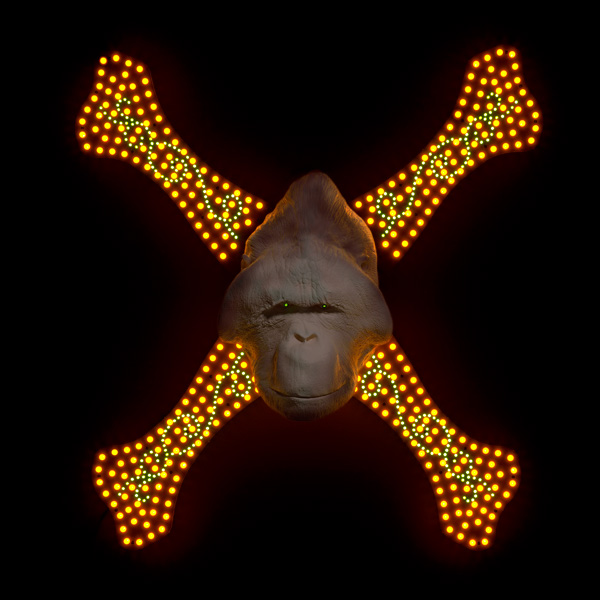
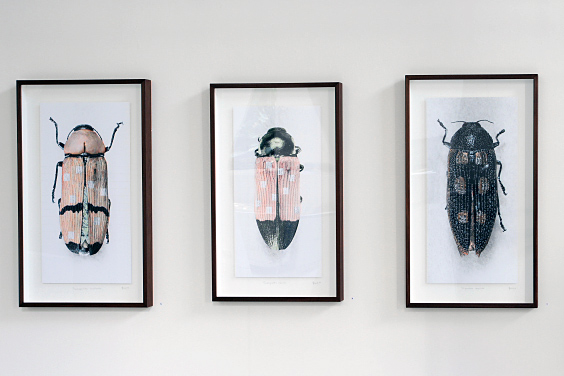
John Beard (Australian born Wales, b. 1943) 'Darwin' 2009 from the exhibition 'John Beard: After Image' paintings at John Buckley Gallery, Melbourne, May - June, 2009


John Beard (Australian born Wales, b. 1943)
Darwin
2009


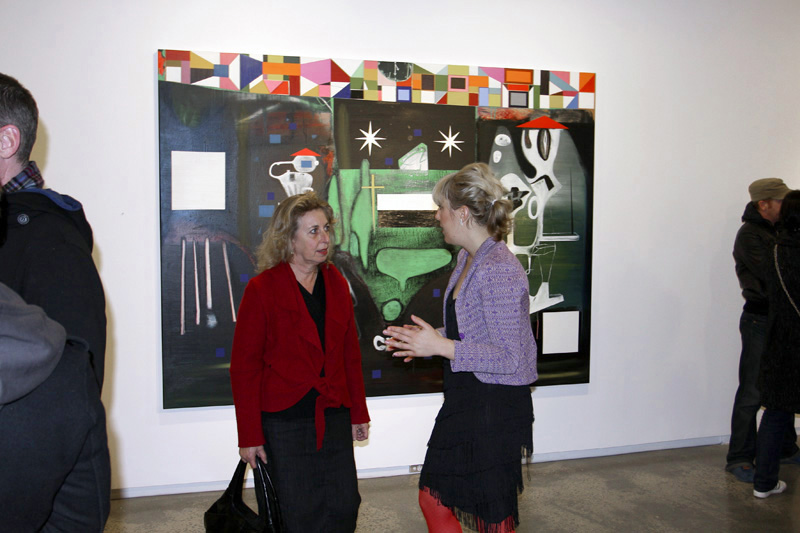
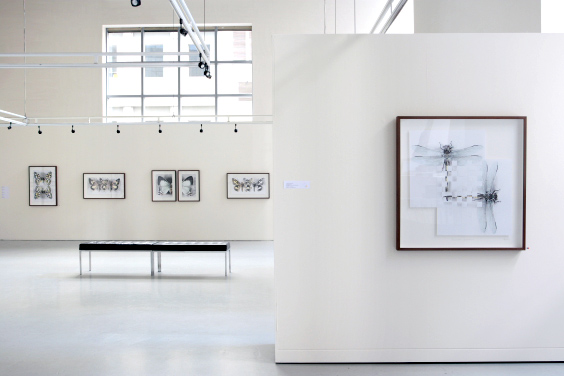
The final exhibition of the afternoon were the ephemeral images of John Beard at John Buckley Gallery, Melbourne. This was an enthralling show that I enjoyed tremendously. Beard draws in a multitude of cultural sources for his paintings often referencing painters, scientists, animals and evolution. His work has an intimate sense of knowing, a meditative mediation on the essence of the object being painted, the very presence of the thing itself. The marks on the canvas may be intuitive but it is an informed intuition that results in works that hover at the edge of consciousness. As much as the works are after images, or ghost images, they are also about the persistence of vision, the persistence of the artists vision in addressing issues of collective memory and cultural history that draw emotive responses from the viewer.

These images may be ‘on the verge of disappearance’ as an after-image but they are also pre-images as well, conjured from the mind of the artist and layered with complexity, presence and holistic wholeness. Their seduction, if I may use that word, is that they draw from the viewer peripheral memories and emotions that flit at the edges of consciousness. As Portugese curator Isabel Carlos has noted, “… Beard recreates a ‘figural’ space where the essence of the thing represented lies beyond its singular physical evidence.”1

Beard’s fragmented surfaces form a rhizomic web of dissolved pixellation, their structure almost fractal like in their linked hyper-real intimacies. These in between spaces open up the possibility of subversive commentaries that, on one level, bring a sense of disquiet to the holistic presence of the work. As Mark Poster has noted of the work of Deleuze and Guittari and which can be aptly applied to the work of John Beard,

“Deleuze and Guittari configure the social as a complex of bodily intensities in a state of continuous nonlinear movement. The logic they present is multidimensional, shifting, discontinuous. They speak of strata, assemblages, territorializations, lines of flight, abstract machines, a congerie of terms that disrupts the function of concepts to control a field through discursive articulations. Their categories cut through the normal lines of comprehension, the binary logic that governs modern social theory to present a picture of reality from the perspective of a sort of primitive life force. It is as if the earth itself were to describe the changes on its surface in the course of human history, a vantage point quite remote from the ego of the individual or from the disciplined consciousness of the social scientist.”2


Nonlinear, logical, shifting territorializations in multidimensional environments that hover below the edge of consciousness, investigations into the binary of presence / absence in the dreams of the imaginary. Powerful and poetic these works irradiate the viewer with their visceral presence.

Dr Marcus Bunyan


1/ Isabel Carlos quoted in Wright, William. HEADLANDS: John Beard works 1993-2008. Catalogue essay

2/ Poster, Mark. The Mode of Information: Poststructuralism and Social Context. Cambridge: Polity Press, 1990, pp. 135-137


Many thankx to John Buckley Gallery for allowing me to publish the art work in the posting. Please click on the photographs for a larger version of the image.


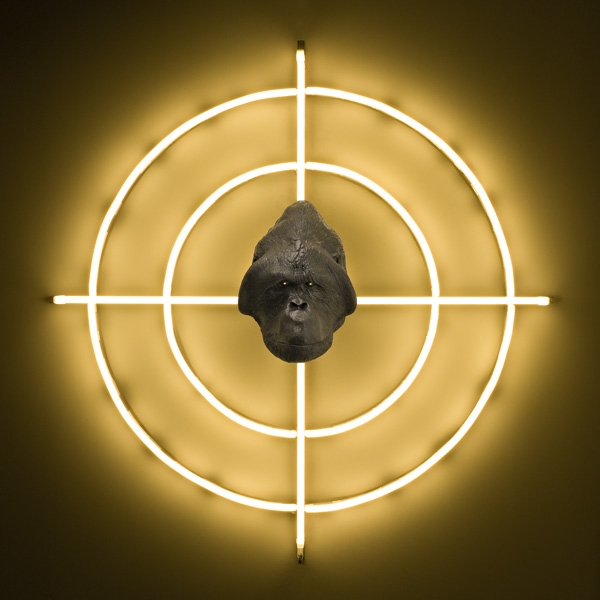
John Beard (Australian born Wales, b. 1943) 'Gorilla' 2007 from the exhibition 'John Beard: After Image' paintings at John Buckley Gallery, Melbourne, May - June, 2009


John Beard (Australian born Wales, b. 1943)
Gorilla
2007


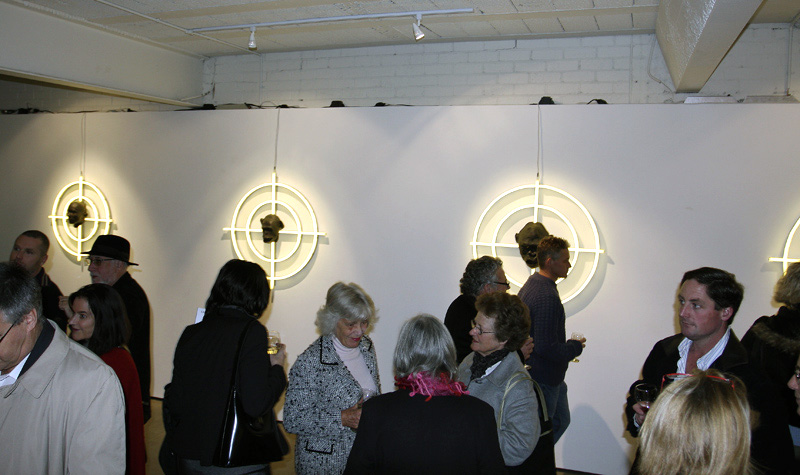
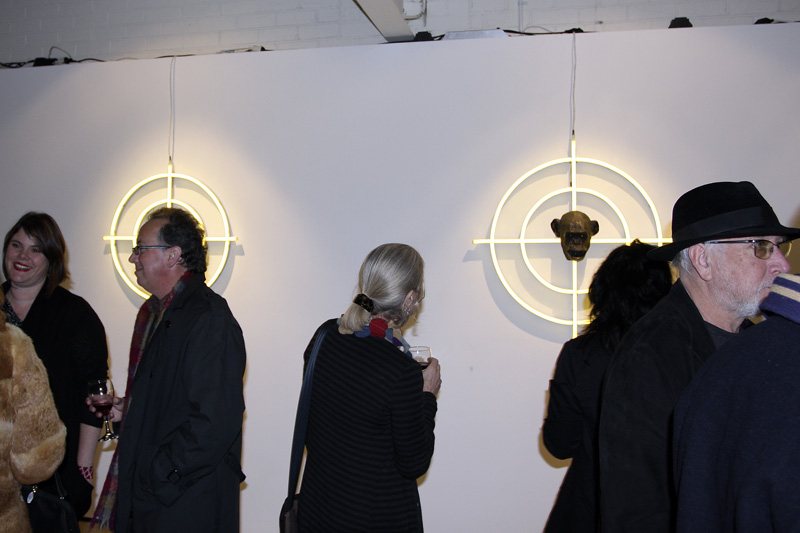
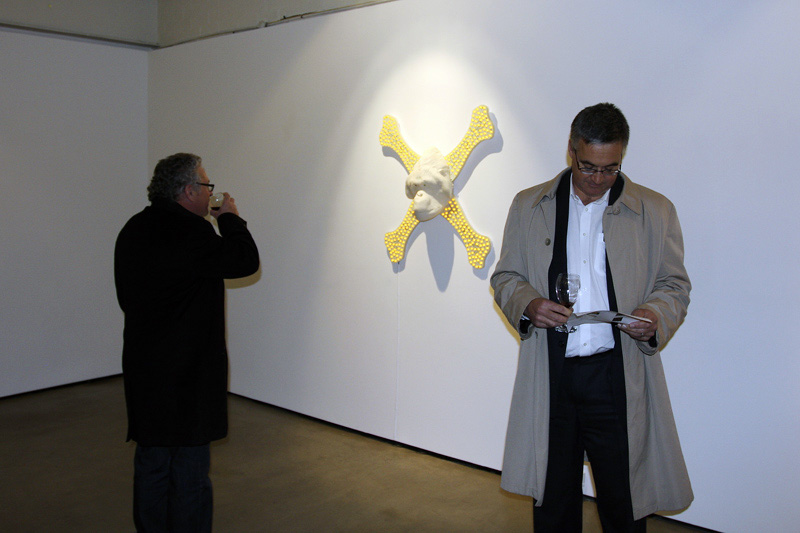
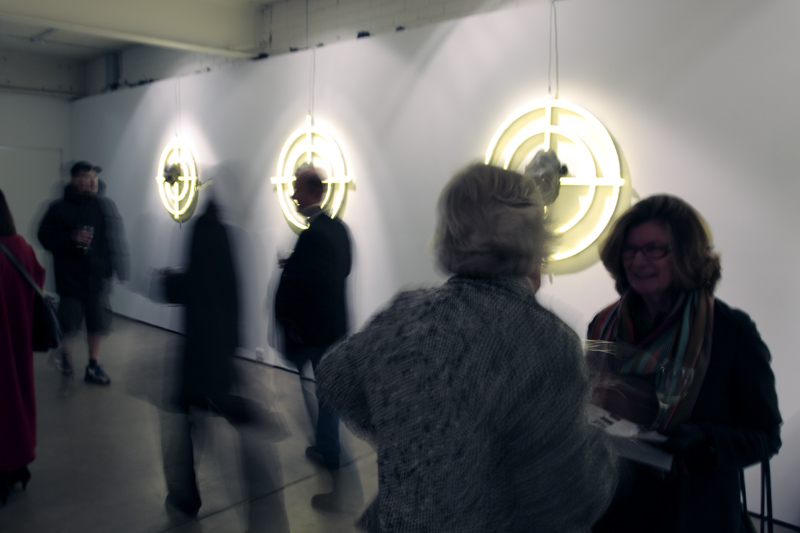
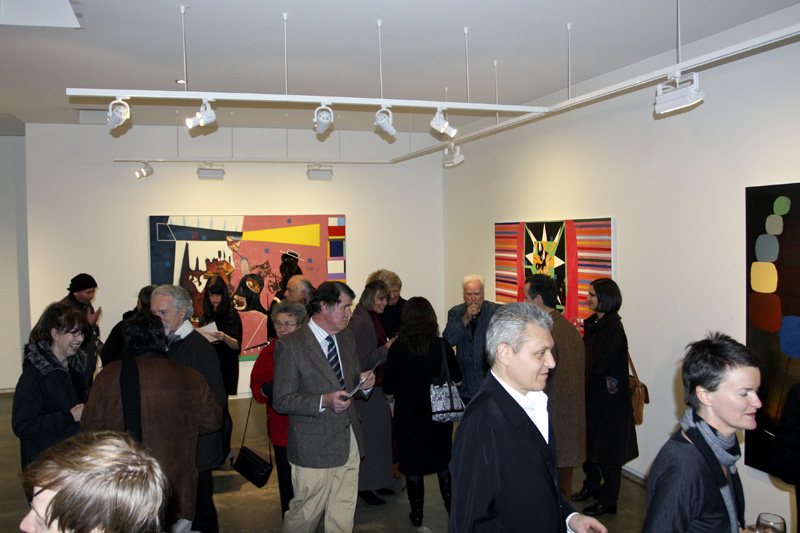
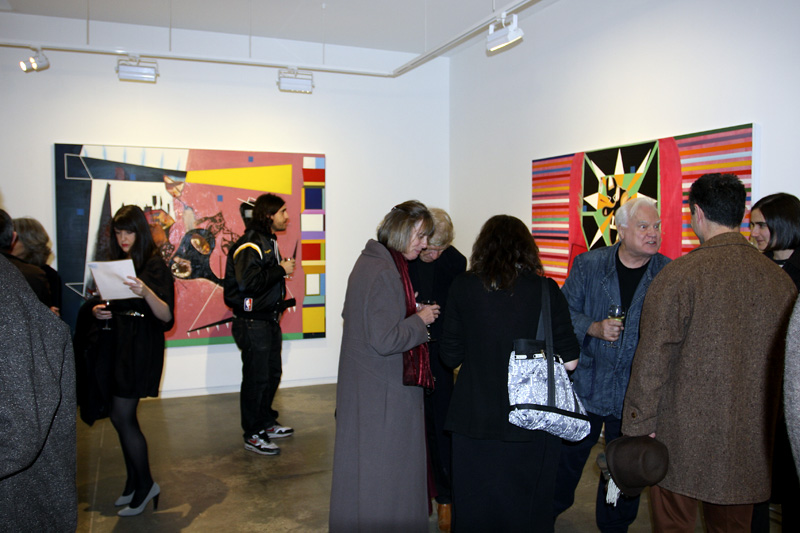
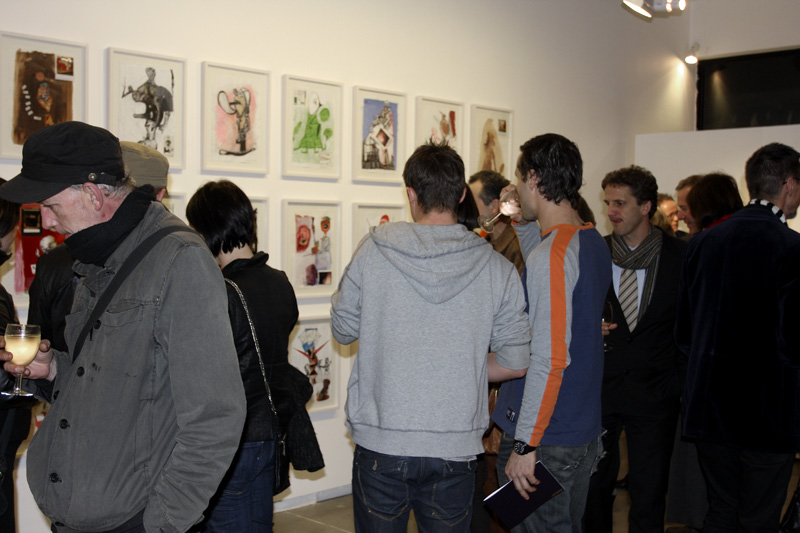
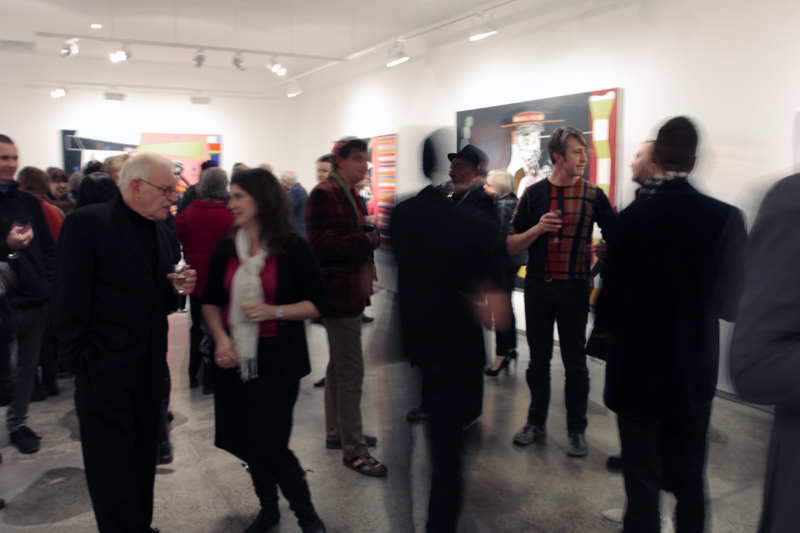
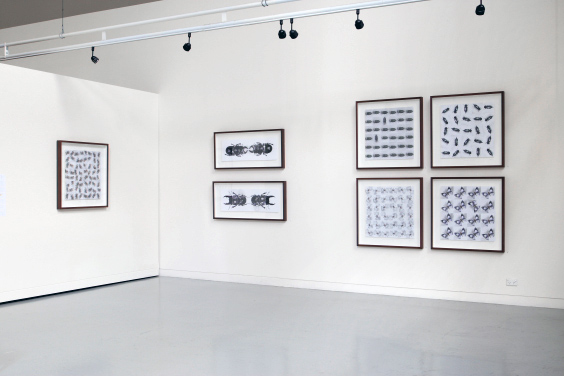
Installation view of John Beard's exhibition 'After image' at John Buckley Gallery, Melbourne


Installation view of John Beard’s exhibition After image at John Buckley Gallery, Melbourne


John Beard (Australian born Wales, b. 1943) 'Hand 6' 2009


John Beard (Australian born Wales, b. 1943)
Hand 6
2009


John Beard (Australian born Wales, b. 1943) 'Head SP3' 2004


John Beard (Australian born Wales, b. 1943)
Head SP3
2004


“Beard’s paintings often convey an overpowering sense of brooding stillness, but equally this volatile effervescence of light-reverberant phenomena, where head, headland, the Adraga rock, are no longer object so much as apparition, a painted parallel existence, a material presence invoking nature’s own organic processes …

There is a distinctive sense when encountering a body of John Beard’s works of entering into a site of composure, withheld, of images silently bespeaking truths both personal and historical; hovering presences each conveying some species quality of time-less recognition.”

William Wright 
from the catalogue essay HEADLANDS: John Beard works 1993-2008 [Online] Cited 29/05/2009. No longer available online


John Beard (Australian born Wales, b. 1943) 'Rose' 2007


John Beard (Australian born Wales, b. 1943)
Rose
2007


John Beard (Australian born Wales, b. 1943) 'Einstein 2' 2009


John Beard (Australian born Wales, b. 1943)
Einstein 2
2009


John Beard (Australian born Wales, b. 1943) 'Rembrandt' 2009


John Beard (Australian born Wales, b. 1943)
Rembrandt
2009


John Buckley Gallery

This gallery is now closed.

LIKE ART BLART ON FACEBOOK

Back to top

Review: ‘McLean Edwards: Songs from the Ghost Ship’ at Karen Woodury Gallery, Melbourne

Exhibition dates: 20th May – 13th June, 2009


McLean Edwards (Australian, b. 1972) 'Fifty-Fifty' 2009 from the exhibition 'McLean Edwards: Songs from the Ghost Ship' at Karen Woodury Gallery, Melbourne, May - June, 2009


McLean Edwards (Australian, b. 1972)
Fifty-Fifty
2009


The next show on our marvellous walkabout were the eclectic paintings of McLean Edwards at Karen Wodbury Gallery, Melbourne. Continuing the carnivalesque theme from the previous review these heterogeneous paintings are a knockout with their wonderful, layered presence – they really command the viewer to look at them and celebrate the characters within them. Whimsical, ironic and full of humour these phantasmagorical images of creatures cast adrift with the night sky as background are fabulous assemblages of colour, form and storytelling.

Further to the evidences noted in the text on the website (the coils, the curling smoke, the starry night sky) one can also say other things about the paintings. There is an effervescence of colour within the blocking of clothing areas. There is the disproportionate size of the hands and bulbous noses of the characters, the shortening of the feet so that the figures almost become caricatures – but hold back from this through the mastery of the painting, through the intent of the artist. There is the symbology of other elements within the pictures: a doll with pins stuck in it’s body being clasped in a clumpy hand, a small house protruding over the protagonists shoulder (Fifty-Fifty); beetles on tree stumps with human faces (Hey, Bastard, Hey); and flowers, teapots and small humans appearing from around the edges of the larger characters in several of the works (Julia 1 and Night Nurse #2 for example). The numbers in the paintings were also puzzling but it turns out that they represent the age of the artist when he painted the works.

Finally one must acknowledge the carnivalesque in the paintings – their fun at playing dress-ups, the almost Alice in Wonderland fantasy and humour of the characterisations. There is an almost androgynous feeling to these characters as some of the female faces seem almost male. Personally I had a feeling that the artist is investigating the subconscious of Carl Jung’s ‘anima’ and ‘animus’ – the feminine inner personality of the male (anima) and the masculine inner personality of the female (animus). These states are manifested by appearing as figures in dreams and so they seem here: the anima or animus vies for attention by projecting itself onto others, here projecting itself outwards onto the painted surface.

My friend and I really enjoyed this exhibition. We were captivated by these songs, going back to the work again and again to tease out the details, to feel connection to the work. These are not lonely isolated figures but sublime emanations of inner states of being expertly rendered in glorious colour. And they made us laugh – what more could you ask for!

Dr Marcus Bunyan


Many thankx to Karen Woodbury Gallery for allowing me to publish the art work in the posting. Please click on the photographs for a larger version of the image.


Installation view of the exhibition  'McLean Edwards: Songs from the Ghost Ship' at Karen Woodbury Gallery, Melbourne

Installation view of the exhibition  'McLean Edwards: Songs from the Ghost Ship' at Karen Woodbury Gallery, Melbourne


Installation views of McLean Edwards: Songs from the Ghost Ship at Karen Woodbury Gallery, Melbourne


McLean Edwards (Australian, b. 1972) 'Venus' 2009 from the exhibition 'McLean Edwards: Songs from the Ghost Ship' at Karen Woodury Gallery, Melbourne, May - June, 2009


McLean Edwards (Australian, b. 1972)
Venus
2009


McLean Edwards (Australian, b. 1972) 'Hey, Bastard, Hey' 2009


McLean Edwards (Australian, b. 1972)
Hey, Bastard, Hey
2009


McLean Edwards (Australian, b. 1972) 'Restoration' 2009


McLean Edwards (Australian, b. 1972)
Restoration
2009


“McLean’s works are theatrical, comical, eccentric and often political with the employment of symbolic imagery. His painting technique involves a painterly layering to create a defined and textured surface.

In this most recent series, Songs from the Ghost Ship, semi-fictional characters are set against the dark starry night sky. The exhibition includes nine oil paintings in addition to four works on paper. One of the works on paper shares its name with the exhibition, depicting a jumpered man with a white ghost looking over his shoulder.

The ink on paper work introduces a theme prominent throughout the exhibition, that of wafting smoke. Emanating either from a clasped cigarette or an iconic green curled mosquito coil, the smoke, in elegant strokes of white, grey, tan or black, draw the eye to the face of the central figures. The figures, often with the light of the moon or stars behind them only partially illuminating their faces, stare into the distance or coyly at the viewer, almost unaware of their solitary state against the night sky. The coil appears elsewhere, surreptitiously working its way into the dark pink weave of Twiggy’s jacket, or the blue and red dress of Venus, in the tyre marks of the Arctic Traveller or the grassy landscape in Hey, Bastard, Hey. The soft curl and filigree detail of both the smoke and the mosquito coil are similarly echoed by elements in other works, through the organic features of flowers, leaves and bugs.

Adrift at night, these haunting figures are about to embark on a journey, either from the wharf at the edge of an ocean, as in Venus, or across the vast ice of the Arctic, through the mist and smoke.”

Text from the Karen Woodbury website [Online] Cited 28/05/2009. No longer available online


McLean Edwards (Australian, b. 1972) 'For Elsa (Twiggy)' 2009


McLean Edwards (Australian, b. 1972)
For Elsa (Twiggy)
2009


McLean Edwards (Australian, b. 1972) 'Night Nurse #2' 2009


McLean Edwards (Australian, b. 1972)
Night Nurse #2
2009


Karen Woodbury Gallery

This gallery is now closed.

LIKE ART BLART ON FACEBOOK

Back to top

Review: ‘Desire’ paintings and video by Judith Wright at Sophie Gannon Gallery, Melbourne

Exhibition dates: 19th May – 13th June, 2009


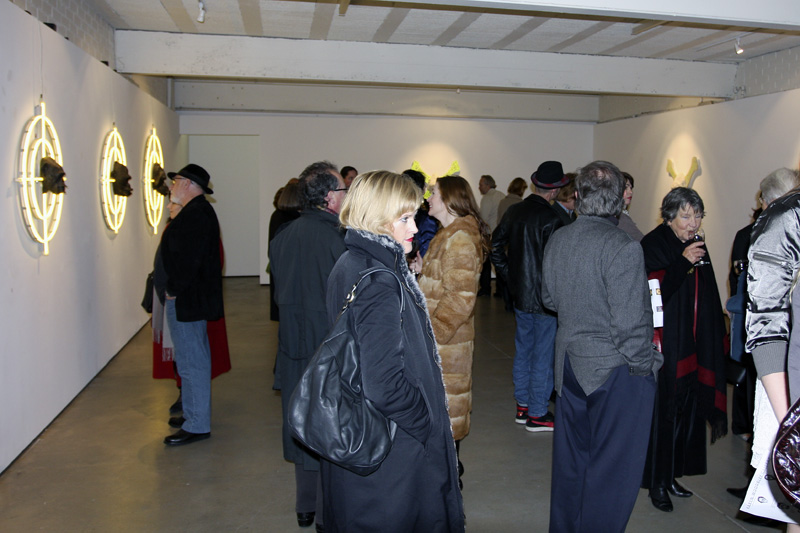
Installation view of Judith Wright's exhibition 'Desire' at Sophie Gannon Gallery, Melbourne

Installation view of Judith Wright's exhibition 'Desire' at Sophie Gannon Gallery, Melbourne


Installation views of Judith Wright’s exhibition Desire at Sophie Gannon Gallery, Melbourne


On a beautiful sunny Autumn afternoon in Melbourne I made a visit to Space Furniture on Church Street to ogle at the wondrous designs and then to the galleries of Albert Street in Richmond for three outstanding painting exhibitions: John Beard at John Buckley Gallery, McLean Edwards at Karen Woodbury Gallery and Judith Wright at Sophie Gannon Gallery. First cab off the rank is Judith Wright but reviews of the other two shows will follow…

There is a part in Jim Jarmusch’s film Ghost Dog: The Way of the Samurai (1999) where the anti-hero stares into the eyes of a dog and Jarmusch just holds the scene for what seems like an eternity. The camera observes the infinite bond between human and animal, an almost palpable connection across time and space, with an unflinching eye. The same can be said of Judith Wright’s encaustic paintings (also known as hot wax painting, involves using heated beeswax to which coloured pigments are added) but here she pushes the relationship further – into an investigation of the animal in the human and vice versa, and their erotic charge when placed together. Here is the carnivalesque at it most daring, most paired back, revealing in quiet Zen like compositions the dissolution of boundaries between both states of being.

Nominally based on the symbology of characters presented in two videos in the exhibition (masked figures playing with each other, a comical goats head with horns being one figure) the paintings are much more interesting than the videos. Painted on Japanese paper in wax and acrylic the biomorphic forms of babies heads, torsos and sculpted free forms and designs suggestive of living organisms address the title of the exhibition: desire!

Wright plays with scale and form, using earth tones and a luminous palette of oranges, yellows and pinks. Her shape-shifting paintings work to unhinge stagnant systems of thought that surround identity and the body. The waxed Japanese paper adds to the sensuality of the skin-like work. A baby seems to feed on a double nipple but the nipple has missed the mouth and is invading the eye. Forms intersect and the sensual shapes slip over each other: as in the Zen idea of ‘satori’ or enlightenment attained when two circles intersect here we have the intersection of an erotic enlightenment.

As Russian theorist Mikhail Bakhtin notes the carnivalesque is the contravention of normal laws of behaviour, “and he proposes that the carnivalesque is also the home of the grotesque, where otherwise antithetical properties or characteristics are matched together in the same being: beast with human, youth with age, male with female.”1

“The carnival offers the chance to have a new outlook on the world, to realise the relative nature of all that exists, and to enter a completely new order of things.”2


And this is what these paintings propose: a new order of things, a chance for desires formed of new pleasures.

As Michel Foucault has observed,

“The possibility of using our bodies as a possible source of very numerous pleasures is something that is very important. For instance, if you look at the traditional construction of pleasure, you see that bodily pleasure, or pleasures of the flesh, are always drinking, eating and fucking. And that seems to be the limit of the understanding of our bodies, our pleasures … It is very interesting to note, for instance, that for centuries people generally, as well as doctors, psychiatrists, and even liberation movements, have always spoken about desire, and never about pleasure. “We have to liberate our desire,” they say. No! We have to create new pleasure. And then maybe desire will follow.”3


In their luminosity, in their skin-like textures, in their balance between the colour of the paper, the dark voids and the brown of babies heads we feel the sharp intake of the cold breathe of winter on the nostrils – we feel an evocation of new pleasure, of possible desires within us and the loosening of the grip of conformity. Like the perfect placement of rocks in a Japanese garden and the ripples of the gravel, of a reality that swirls around them these paintings open hearts and minds to inner states of being unexperienced before. And yes, I did enjoy the ride.

Dr Marcus Bunyan


Many thankx to Sophie Gannon Gallery for allowing me to publish the art work in the posting. Please click on some of the photographs for a larger version of the image.


1/ Buchbinder, David. Masculinities and Identities. Melbourne: Melbourne University Press, 1994, p. 53. For a discussion of carnivalesque see Bakhtin, Mikhail. Rabelais and his World (trans. Hélène Iswolsky). Bloomington: Indiana University Press, 1984, pp. 196-277, 303-367.

2/ Bakhtin, Mikhail. Rabelais and his World (trans. Hélène Iswolsky). Bloomington: Indiana University Press, 1984, p. 34.

3/ Gallagher, Bob and Wilson, Alexander. “Sex and the Politics of Identity: An Interview with Michel Foucault,” in Thompson, Mark. Gay Spirit: Myth and Meaning. New York: St. Martin’s Press, 1987, p. 31.


Judith Wright video installation


Judith Wright (Australian, b. 1945) 'Desire [14]' 2009 from the exhibition 'Desire' paintings and video by Judith Wright at Sophie Gannon Gallery, Melbourne, May - June, 2009


Judith Wright (Australian, b. 1945)
Desire [14]
2009
Acrylic and wax on Japanese paper
200 x 200cm


Judith Wright (Australian, b. 1945) 'Desire [5]' 2009 from the exhibition 'Desire' paintings and video by Judith Wright at Sophie Gannon Gallery, Melbourne, May - June, 2009


Judith Wright (Australian, b. 1945)
Desire [5]
2009
Acrylic and wax on Japanese paper
100 x 100cm


Judith Wright (Australian, b. 1945) 'Desire [7]' 2009


Judith Wright (Australian, b. 1945)
Desire [7]
2009
Acrylic and wax on Japanese paper
100 x 100cm


Judith Wright (Australian, b. 1945) Desire [16]' 2009


Judith Wright (Australian, b. 1945)
Desire [16]
2009
Acrylic and wax on Japanese paper
300 x 300cm


Judith Wright (Australian, b. 1945) 'The Gift [2]' 2009


Judith Wright (Australian, b. 1945)
The Gift [2]
2008
Acrylic and wax on Japanese paper


Judith Wright (Australian, b. 1945) 'The Gift [7]' 2008


Judith Wright (Australian, b. 1945)
The Gift [7]
2008
Acrylic and wax on Japanese paper


Sophie Gannon Gallery
2, Albert Street, Richmond, Melbourne
Phone: +61 3 9421 0857

Opening hours:
Tuesday – Saturday 11am – 5pm

Sophie Gannon Gallery website

LIKE ART BLART ON FACEBOOK

Back to top

International Sculpture Conference accepting proposals: ‘What is Sculpture in the 21st Century?

May 2009

22nd International Sculpture Conference

7th – 9th April, 2010 London, United Kingdom


Chris Burden
Flying Steamroller
2006


Call for papers

The ISC’s 22nd International Sculpture Conference will explore and consider the potential of sculpture in the 21st century – to provide an opportunity to both celebrate its vitality and diversity, its capacity to challenge, and to examine its current position, function and production.

Themes include The Languages of Sculpture, Public Perception and Investment and The State of Education.


LIKE ART BLART ON FACEBOOK

Back to top

Exhibition: ‘Inheritance’ at the Australian Centre for Photography, Sydney

Exhibition dates: 1st May – 6th June, 2009

Artists: Bindi Cole, Tamara Dean, Lee Grant, June Indrefjord, Bronek Kozka, Ka-Yin Kwok, Tracey Moffatt, Fiona Morris, Aaron Seeto, Martin Smith and Toni Wilkinson

Installation photographs of the exhibition can be found on the Lee Grant – Photography blog website


Many thankx to the ACP for allowing me to publish the photographs in the posting. Please click on some of the photographs for a larger version of the image.


June Indrefjord. 'Piano' from the series 'Landaas' 2005


June Indrefjord
Piano
2005
From the series Landaas


Aaron Seeto (Australian) 'Oblivion' 2006


Aaron Seeto (Australian)
Oblivion
2006
From the series Oblivion
Daguerreotype


Aaron Seeto makes alternate historical positions and experiences visible through an exploration of archives, family photo albums and photographic records. In recent bodies of work Fortress and Oblivion, Seeto has utilised the daguerreotype, one of the earliest and most primitive photographic techniques, to highlight the malleability of narratives within archive records. Not only is the chemical process itself highly toxic and temperamental but the daguerreotype’s mirrored surface means the image appears as both positive and negative, depending on the angle of view. For Seeto, this mutability captures the essence of our experience of history and memory, reflecting how images degrade, how stories are formed and privileged, how knowledge and history are written. …

For his ongoing series Oblivion Seeto sourced details from images of the Cronulla riots – beachside riots around race and territory – of 2005 found on the internet. In reproducing these as daguerrotypes he seeks less to represent the incident than to look at how it was reported, understood and remembered. The instability of the virtual information found online is echoed in the photographic process.

Text from the Stills Gallery website [Online] Cited 14/02/2019


Tracey Moffatt (Australian, b. 1960) 'Useless 1974' 1994 from the exhibition 'Inheritance' at the Australian Centre for Photography, Sydney, May - June, 2009


Tracey Moffatt (Australian, b. 1960)
Useless 1974
1994
From the series Scarred for Life


Useless, 1974 is a photo-lithograph by the Australian artist Tracey Moffatt. The work shows a girl stooping down to wash a car, with one hand wiping a headlight with a sponge and the other resting on the bonnet. She looks towards the camera rather than at the car, her face bearing a serious and potentially hurt or angry expression. The caption accompanying the photograph explains that ‘Her father’s nickname for her was “useless”‘. Despite this, it seems that in this picture she is being put to use, and perhaps the car she washes is her father’s. The caption, her expression and the direction of her gaze may suggest that the viewer occupies the position of the girl’s father looking down on and supervising his daughter while she carries out her chore. …

The work’s title is a reference to the cruel nickname given to the girl in the photograph, and the date in the title, 1974, suggests the year according to which the photograph has been styled by Moffatt, who employs actors and constructed scenes to create her photographs. Curator Filippo Maggia has compared Moffatt’s photographic method to that of a film director, stating that she ‘often does not take the photographs herself but directs a sort of bona fide movie set that she organises and controls after having pictured it in her mind again and again, meticulously decomposing and recomposing it’ (Maggia 2006, p.12). As the artist has stated, ‘I often use technicians when I make my pictures. I more or less direct them. I stand back and call the shots.’ (Quoted in Maggia 2006, p.12.)

Moffatt’s photographic series often deal with themes such as race, gender and the politics of identity. Drawing on memories from the artist’s childhood, the Scarred for Life series mimics photo spreads from the American magazine Life, with their explanatory captions and focus on the family environment. The captions’ terse descriptions hint at the traumatic stories behind the images. Moffatt has commented: ‘a person can make a passing comment to you when you are young and this can change you forever. You can be “scarred for life” but it isn’t necessarily a bad thing. The photographs can be read as both tragic and comic – there is a thin line between both.’ (Quoted in display caption, Tracey Moffatt, Birth Certificate 1994, Tate P78101, accessed 28 August 2015.) Furthermore, Maggia has argued that the Scarred for Life series ‘gives us life as it is, the harshness and aridity of human relations, adolescence with its fears of not being accepted’ (Maggia 2006, p.13).

Louise Hughes
August 2015

Filippo Maggia, Tracey Moffatt: Between Dreams and Reality, exhibition catalogue, Spazio Oberdan, Milan 2006, p. 13, reproduced p. 117.

Extract from Louise Hughes. “Useless, 1974,” on the Tate website [Online] Cited 14/02/2019


Lee Grant (Korean-Australian, b. 1973) 'The Day Meg Wore a Dress '2007 from the exhibition 'Inheritance' at the Australian Centre for Photography, Sydney, May - June, 2009


Lee Grant (Korean-Australian, b. 1973)
The Day Meg Wore a Dress from the series Brothers and Sisters
2007


“You can choose your friends, but you can’t choose your family.”

From the tight nuclear unit to the multi-generational extended family, from refuges for the homeless to middle class suburbia, Inheritance examines the way our families shape the person we become; for better or for worse.

Taking Tracey Moffatt’s acclaimed series Scarred for Life as a starting point, the exhibition includes the work of eleven Australian artists who explore the modern family through a range of photographic disciplines, including documentary, portraiture and video. Sometimes serious and sometimes satirical, Inheritance is a family album that celebrates the skeletons and the psychodramas alongside the newborns and the nuptials.

Text from the Australian Centre for Photography website [Online] Cited 20/05/2009. No longer available online


Lee Grant (Australian, b. 1973) 'Nathan & Mac, BMX bros' 2009


Lee Grant (Australian, b. 1973)
Nathan & Mac, BMX bros
2009
Archival pigment print
60 x 60cm
Edition of 8 + 2 AP


Bindi Cole Chocka (Australian / Wathaurung, b. 1975) 'Wathaurung Mob' 2008


Bindi Cole Chocka (Australian / Wathaurung, b. 1975)
Wathaurung Mob
2008
From the series Not really Aboriginal
Pigment print on rag paper
1035 x 1235cm


Our Past Is Our Strength – Culture and Identity

I’ve always been told that l was Aboriginal. I never questioned it because of the colour of my skin or where I lived. My Nan, one of the Stolen Generation, was staunchly proud and strong. She made me feel the same way. My traditional land takes in Ballarat, Geelong and Werribee and extends west past Cressy to Derrinallum. I’m from Victoria and I’ve always known this. All the descendants of traditional Victorian Aboriginal people are now of mixed heritage. I’m not black. I’m not from a remote community. Does that mean I’m not really Aboriginal? Or do Aboriginal people come in all shapes, sizes and colours and live in all areas of Australia, remote and urban?

Bindi Cole Chocka, Wathaurung text from the Culture Victoria website [Online] Cited 14/02/2019


Wathaurung Mob is a group portrait depicting members of Cole’s family sitting in their lounge room, their faces blackened with minstrel paint, and wearing red headbands traditionally worn by indigenous elders. The controversial practice of “blackfacing” refers to the populist minstrel shows of the 19th and 20th centuries in which a white actor put on blackface, then performed a racist caricature.

As we stand before the work, Alessi says he finds it confronting and uncomfortable. “Wathaurung Mob is quite powerful because what stands out are the eyes of each sitter; they look directly at the viewer, so you can’t help but feel challenged by that,” he says.

“There is also something quite uncomfortable about the work because, in some ways, you are being implicated in Andrew Bolt’s view, as white Australians having to own up to the broader history of the relationship between white and indigenous Australia.

“And more broadly it is about coming to grips with what is still a major issue in Australia around reconciliation and the way that we treat indigenous people. In one single frame this photograph captures 200 years of history, and I think it is an area that people like Bindi Cole are really courageous to navigate through because they have been open to criticism by people like Andrew Bolt, which is completely unfounded.”

Extract from Bronwyn Watson. “Facing up to the stereotypes,” on The Australian website November 16, 2013 [Online] Cited 14/02/2019


Fiona Morris. 'Sean and Jade, Wesley Mission' 2006


Fiona Morris (Australian)
Sean and Jade, Wesley Mission
2006


Sean with his daughter Jade outside their tempoary accomodation provided by Wesley Mission. They can only stay their for a maximum of two months. Leah and Sean became homeless with their children after increasing rent rises in Sydney and the cost of living.


Tamara Dean (Australian, b. 1976) 'Alex and Maeve' 2006


Tamara Dean (Australian, b. 1976)
Alex and Maeve
2006


Australian Centre for Photography

This gallery has now closed.

Lee Grant website

Tracey Moffatt on the Rosyln Oxley9 Gallery website

LIKE ART BLART ON FACEBOOK

Back to top

Exhibition: ‘Thomas Ruff. Surfaces, Depths’ at Kunsthalle Wien, Vienna

Exhibition dates: 21st May – 13th September, 2009


Thomas Ruff (German, b. 1958) 'Interieur 2D (Tegernsee)' 1982 from the exhibition 'Thomas Ruff. Surfaces, Depths' at Kunsthalle Wien, Vienna, May - Sept, 2009


Thomas Ruff (German, b. 1958)
Interieur 2D (Tegernsee)
1982
Chromogenic print
Courtesy der Künstler / the artist
© VBK, Wien 2009


An exhibition of the work of the renowned photographer Thomas Ruff that concentrates on his new Cassini and Zycles series. His clinical photographs with their catatonic rigidity promote stupor in the viewer. The viewer becomes complicit in a platonic relationship (of forms) with the non-reality presented by the camera, directed by Ruff’s ironic, surgical gaze. Ruff corrupts and disturbs traditional binaries of presence / absence, truth / reality, surfaces / depths to challenge the very basis of seeing, the very basis of photography’s link to indexicality and presence in a contemporary digital world, something that William Eggleston seems to have lost the art of doing (please see the previous post).

As Maurice Blanchot has observed,

“The image has nothing to do with signification, meaning, as implied by the existence of the world, the effort of truth, the law and the brightness of the day. Not only is the image of an object not the meaning of that object and of no help in comprehending it, but it tends to withdraw it from its meaning by maintaining it in the immobility of a resemblance that it has nothing to resemble.”1


There is no single truth; there are only competing narratives and interpretations of a world that cannot be wholly, accurately described.2 In the splitting apart of image and meaning there is a crisis in control: it becomes illusory and is marked by doubt.

In Ruff’s photographs the relationship between image and context, between cause and effect becomes further layered until the very act of seeing is no longer framed or presupposed through relations of distance or perspective.3 Ruff’s photographs become a struggle of and for positionality in the physical, mental and emotional conflicts evidenced in the viewer as we look, askance? with a paradoxical intent? at these unemotional images.

Dr Marcus Bunyan


1/ Blanchot, Maurice. The Gaze of Orpheus. New York: Barrytown, 1981, p. 85

2/ Townsend, Chris. Vile Bodies: Photography and the Crisis of Looking. Munich: Prestel, 1998, p. 10

3/ Burnett, Ron. Cultures of Vision: Images, Media, & the Imaginary. Bloomington: Indiana University Press, 1995, pp. 137-138


Many thankx to Kunsthalle Wien for allowing me to publish the photographs in the posting. Please click on the photographs for a larger version of the image.


Thomas Ruff (German, b. 1958) 'Zycles 3048' 2008 from the exhibition 'Thomas Ruff. Surfaces, Depths' at Kunsthalle Wien, Vienna, May - Sept, 2009


Thomas Ruff (German, b. 1958)
Zycles 3048
2008
Chromogenic print
Courtesy der Künstler / the artist
© VBK Wien, 2009


Thomas Ruff (German, b. 1958) 'Zycles 3045' 2008


Thomas Ruff (German, b. 1958)
Zycles 3045
2008
Chromogenic print
Courtesy der Künstler / the artist
© VBK Wien, 2009


Thomas Ruff (German, b. 1958) 'Cassini 01' 2008


Thomas Ruff (German, b. 1958)
Cassini 01
2008
Chromogenic print
Courtesy der Künstler / the artist and Mai 36 Galerie, Zürich
© Thomas Ruff


Thomas Ruff (German, b. 1958) 'Cassini 06' 2008


Thomas Ruff (German, b. 1958)
Cassini 06
2008
Chromogenic print
Courtesy der Künstler / the artist and Mai 36 Galerie, Zürich
© Thomas Ruff


Thomas Ruff (German, b. 1958) 'Cassini 08' 2008


Thomas Ruff (German, b. 1958)
Cassini 08
2008
Chromogenic print
Courtesy der Künstler / the artist and Mai 36 Galerie, Zürich
© Thomas Ruff


Thomas Ruff (German, b. 1958) 'Cassini 03' 2008


Thomas Ruff (German, b. 1958)
Cassini 03
2008
Chromogenic print
Courtesy der Künstler / the artist and Mai 36 Galerie, Zürich
© Thomas Ruff


Yet Ruff has always treated the medium of photography with skepticism: for him, the photographic surface is a thin foil which tricks the viewer with its illusion of extreme realism and at the same time reveals the fundamental impossibility of experiencing the world in our digital age. Ruff’s images seem emphatically to deny photography’s main attribute – that is, the offer of a reliable record of reality. Instead, through his mute images devoid of all emotion, Ruff presents us with a contemporary subjectivity defined by amnesia.

Text from the Castello di Rivoli website [Online] Cited 24/05/2009. No longer available online


Thomas Ruff (German, b. 1958) 'Portrait (A. Siekmann)' 1987


Thomas Ruff (German, b. 1958)
Portrait (A. Siekmann)
1987
Chromogenic print
210 x 165cm (82 11/16 x 64 15/16 in.)
Courtesy der Künstler / the artist
© VBK, Wien 2009


During the late 1980s Ruff photographed his fellow students at the Düsseldorf Academy of Art, combining the typological mode of his teacher Bernd Becher with the serial progressions and primary structures of Minimalism. The large scale and technical perfection of Ruff’s portraits refer to both the museum and the street – to billboards and heroic painting – while elevating the anonymous sitter to the stature and visibility of a public figure. Instead of presuming to depict the transcendent, individual essence of the sitter, however, Ruff’s portraits deliberately assume the neutrality of the mug shot, physiognomic study, and identity card, and, by extension, the entire brightly lit world of surveillance in which his subjects were raised. The age and milieu of his sitters are crucial to the pictures’ meaning: these young media-savvy people are not threatened by the camera eye but adjust themselves comfortably yet firmly to its probing vision. The results are both seductive and subtly disquieting, like studying a human specimen whose every pore and hair is available for careful study, yet whose thoughts and feelings are always just out of reach.

Text from the Metropolitan Museum of Art website


Thomas Ruff (German, b. 1958) 'Portrait (A. Kachold)' 1987


Thomas Ruff (German, b. 1958)
Portrait (A. Kachold)
1987
Chromogenic print
Courtesy der Künstler / the artist
© VBK, Wien 2009


Thomas Ruff (German, b. 1958) 'Portrait (S. Weirauch)' 1988


Thomas Ruff (German, b. 1958)
Portrait (S. Weirauch)
1988
Chromogenic print
Courtesy der Künstler / the artist
© VBK, Wien 2009


“The reality in front of the camera is reality of the first degree, the representation of the reality in front of the camera is reality of the second degree, and then come any number of possible gradations and distortions.”

“The difference between my predecessors and me is that they believed to have captured reality and I believe to have created a picture. We all lost, bit by bit, the belief in this so-called objective capturing of real reality.”


Thomas Ruff


“To try to see more and better is not a matter of whim or curiosity or self-indulgence. To see or to perish is the very condition laid upon everything that makes up the universe, by reason of the mysterious gift of existence.”


Teilhard de Chardin, “Seeing” 1947


The work of Thomas Ruff, who numbers among today’s most important photographers, focuses our attention on such diverse everyday subjects as people, architecture, the universe, and the Internet. With its extensive solo presentation with a total of about 150 exhibits from 11 groups of works, Kunsthalle Wien offers a first comprehensive survey of the artist’s manifold oeuvre in Austria.

Thomas Ruff studied at the Dusseldorf Academy of Arts, graduating as a student of Bernd and Hilla Becher besides Andreas Gursky, Candida Höfer, Axel Hütte, and Thomas Struth, all of them celebrating an international career these days. The photographer strikes us as a sharp and concentrated observer of his motifs. To him, objectivity is nothing neutral though, but has to be redefined with each new photograph. The series of large-scale portraits which Ruff started working on in 1986 and for which he became known internationally, for example, fascinates us because of the determined detachment with which he captured his models that were mostly acquainted with him. This approach makes for a hyper-precise, chirurgic gaze reproducing everything down to the last detail as equivalent. It also demonstrates the degree of the artist’s interest in the history of photography, how critically he considers its subject, and the skeptical attitude he sometimes adopts toward the medium.

From his stereoscopic views of the urban development myth of Brasilia and his apparently anti-essayistic architectural photographs of buildings by Herzog & de Meuron, which are based on instructions, to his digital processing of images of the planet Saturn available free of charge on the NASA website, the artist explores the concepts of the exemplary, of objectivity, of reality, and of zeitgeist. Based on half of his about twenty thematic groups of works created so far, the exhibition examines the concept pair surface / depth, which seems to be quite simple at first sight, but reveals itself as strongly discursive on closer inspection, and focuses the attention on formal aspects one comes upon again and again in his entire oeuvre.

Right in time for the International Year of Astronomy 2009, Thomas Ruff presents works from his most recent series Cassini – subtly manipulated pictures of Saturn and its moons taken by the Cassini spacecraft. It was the Italian astronomer Galileo Galilei who opened a window to the skies with his telescope 400 years ago. He thus revolutionised man’s image of himself in regard to the universe, but also his understanding of and his way of dealing with the concepts of nearness and distance, surface and depth.

Thomas Ruff. Surfaces, Depths conveys what these concepts, translated into pictures, do to the viewer on a phenomenological level and how they challenge him. The curves of Ruff’s zycles, distorted into the three-dimensional sphere, unfold the sensory experience of roaming virtual depths only reserved to the human eye. Yet, gazing at the represented motifs also elucidates the artist’s contextual objective of providing a critical comment on the various possibilities of the photographic apparatus to depict and manipulate reality.

Press release from the Kunsthalle Wien website [Online] Cited 24/05/2009. No longer available online


Thomas Ruff numbers among today’s most important photographers, his oeuvre encompassing such diverse subject areas as people, architecture, the universe, and the Internet. With its extensive solo exhibition presenting a total of about 150 works, the Kunsthalle Wien offers the first comprehensive survey of the artist’s manifold production in Austria.

Thomas Ruff strikes us as a sharp and concentrated observer rendering his motifs with a hyper-precise, chirurgic gaze. To him, the objective representation of reality is no neutral process, but something questioned with each new photograph. Running through the exhibition like a thread is the apparent pair of opposites of surface and depth and its highly variable manifestations. Next to his series of large-format portraits from the 1980s, for which Ruff received international acclaim, and his architectural photographs of buildings by Herzog & de Meuron, which are based on instructions, the show focuses on his most recent cassini and zycles series. Digitally processing images of the planet Saturn and its moons from the NASA website, the artist explores the notions of the exemplary, of reality, and of zeitgeist. Also depicting the pair of concepts surfaces/depths, the seemingly three-dimensional curves of Ruff’s zycles unfold the sensory experience of roaming virtual depths reserved to the human eye alone.

Text from the Kunsthalle Wien website


Thomas Ruff (German, b. 1958) 'Herzog & de Meuron, Ricola Mulhouse' 1994


Thomas Ruff (German, b. 1958)
Herzog & de Meuron, Ricola Mulhouse
1994
Chromogenic print
Courtesy der Künstler / the artist
© Thomas Ruff


Thomas Ruff (German, b. 1958) 'House Nr. 11 III' 1990


Thomas Ruff (German, b. 1958)
House Nr. 11 III
1990
Chromogenic print
Courtesy der Künstler / the artist
© VBK, Wien 2009


Thomas Ruff first became known through his portraits of houses and factory buildings, as well as the night sky, portrayed in a natural and objective manner. Ruff photographed the buildings either in strict frontality or at right angles to one another, always paying attention to regular sharpness and neutral lighting, and from the same standpoint. With his controversially discussed nudes of erotic, sometimes pornographic scenes from the Internet, which he projected onto unsharp large formats, he expanded the borders of photography in 1999. Since then, his Internet blow-ups with clearly emphasised pixel structures have been regarded as his ‘trademark’. Thomas Ruff started concerning himself with the medium of the image at the very beginning of his artistic career. In addition to self-produced analogue and digital photographs, he worked from the basis of existing pictures. He liked working with unspectacular, historically typical motifs and elaborated the images on the computer, whereby he was particularly interested in the technical side of photography. Often, a new group of works would start with the choice of a specific technique, for example, the night sky pictures from 1992 to 1995 which were made with the help of a camera and a night vision enhancer. Since the night vision enhancer is a visual instrument developed for the Gulf War, this series is a subliminal play on the medial dimension created by this war.

After digitally creating the Substrat series of 2002 abstract, psychedelic colour images from Manga comics, he began his latest zycles series, in which he worked with far more complexly abstract dimensions. These consisted of large-format inkjet prints on canvas that already created a furore at this year’s Art Unlimited in Basel. It is hard to believe that these compositions, which consisted of curved lines and were spread all over the image, originated in mathematics, or more precisely, in antiquated 19th century books on electro-magnetism that portrayed magnetic fields on copperplates. Thomas Ruff was particularly interested in translating these drawings into three-dimensional space. For this he used a 3D computer programme that translated mathematic formulas into complex, three-dimensional linear structures. Ruff recorded different detailed views from these virtually produced linear structures. The weave of lines developed in front of an open space of unspecified depth, sometimes filigree, sometimes accentuated. Their dynamics are reminiscent of the lines of magnetic fields, but also of informal line drawings. Either way, they invite the viewers to play with their own perceptions.

Text by Dominique von Burg; translation: Maureen Oberli-Turner from the Mai 36 Galerie website [Online] Cited 24/05/2009. No longer available online


Thomas Ruff (German, b. 1958) 'Jpeg icbm05' 2007


Thomas Ruff (German, b. 1958)
Jpeg icbm05
2007
Chromogenic print


Kramer has argued that appropriating images helps Ruff draw attention to the materiality of pictures, writing in his introduction to his book that doing so accentuates “the conceptual knowledge gain, since it is not the ‘artistic’ picture, but the structures and characteristics of the medium itself that come into focus.” Ruff, for his part, says appropriating images allows him to investigate contemporary photographic practice, in an era where images are more numerous, and more easily shared, than ever before. He started his nudes in 1999, for example, just as the internet was coming into more widespread usage, bringing online pornography into the mainstream.

“What I always want to do is comment on the state of where photography is right now,” he says. “So if the structure of photography changes from grain to pixel, yes I will make a research on the structure of the image. But if you have the pixel as the smallest element the construction of a picture, you also have [the fact that] if you compress the image you can send it easily out into the world via email. So we have the distribution too. We not only have the structure of the image, there are several issues to pull out. That’s one of the things I want to make obvious or visible.”

Diane Smyth. “From the BJP Archive: Thomas Ruff,” originally published April 2012 on the British Journal of Photography website 27th September, 2017 [Online] Cited 14/07/2025


Thomas Ruff (German, b. 1958) 'Jpeg rl104' 2007


Thomas Ruff (German, b. 1958)
Jpeg rl104
2007
Chromogenic print


Kunsthalle Wien
Museumsplatz 1
A-1070 Vienna

Opening hours:
Tuesday – Sunday 11am – 7pm
Thursdays 11am – 9pm

Mai 36 Galerie, Zurich website

Kunsthalle Wien website

LIKE ART BLART ON FACEBOOK

Back to top

Exhibition: ‘William Eggleston, Paris’ at Fondation Cartier, Paris

Exhibition dates: 4th April – 21st June, 2009


William Eggleston (American, b. 1939) 'Untitled', Paris series, 2006-2008 from the exhibition 'William Eggleston, Paris' at Fondation Cartier, Paris, April - June, 2009


William Eggleston (American, b. 1939)
Untitled from the Paris series
2006-2008
Colour print
27.9 x 35.6cm
Series of 32 works: 27 colour prints, 4 diptychs and 1 painting
Commission for the exhibition William Eggleston, Paris, Fondation Cartier pour l’art contemporain, Paris, 2009
Gift of the artist 2009
© Eggleston Artistic Trust, Memphis


Perhaps it’s just me, but I seem to have become a little jaded towards the recent photographs of William Eggleston.

Other than the green reflection of lights in rainwater (above) the photographs seem to have lost their unique voice, the social insight that gave his earlier work it’s zing – provocative images that challenged how we live through a meditation on subject matter, construction of space, and tone of “colour”. How the colour that surrounds us inflects our very being.

In these photographs it feels like there has been little development in his style over the years with a consequent lessening of their visual impact. Now Eggleston’s colour just feels like a party trick, performed by rote with little consequential meaning to either the colour or the image. Perhaps the way we look at the world (and how we picture it) has finally overtaken the director’s prescient creative vision – his auteurship, his authorship.

Dr Marcus Bunyan


Many thankx to the Fondation Cartier for allowing me to publish the photographs in the posting.


“In Eggleston’s best work, the work that made him famous, color is intrinsic to the meaning of the photograph. Its not simply a garnish to draw the eye. His best photographs are not ‘about’ the color; they are about larger issues that the color is used in the service of.  This is whats missing in his Paris pictures. The color here is pure ornament, eye candy to seduce you into forgetting that the picture has nothing to say.”

Anonymous. “William Eggleston Mails It In From Paris,” on the Leicaphilia website April 21, 2014 [Online] Cited 06/02/2019


William Eggleston (American, b. 1939) 'Untitled', Paris series, 2006-2008 from the exhibition 'William Eggleston, Paris' at Fondation Cartier, Paris, April - June, 2009


William Eggleston (American, b. 1939)
Untitled from the Paris series
2006-2008
Colour print
27.9 x 35.6cm
Series of 32 works: 27 colour prints, 4 diptychs and 1 painting
Commission for the exhibition William Eggleston, Paris, Fondation Cartier pour l’art contemporain, Paris, 2009
Gift of the artist 2009
© Eggleston Artistic Trust, Memphis


William Eggleston (American, b. 1939) 'Untitled', Paris series, 2006-2008


William Eggleston (American, b. 1939)
Untitled from the Paris series
2006-2008
Colour print
27.9 x 35.6cm
Series of 32 works: 27 colour prints, 4 diptychs and 1 painting
Commission for the exhibition William Eggleston, Paris, Fondation Cartier pour l’art contemporain, Paris, 2009
Gift of the artist 2009
© Eggleston Artistic Trust, Memphis


William Eggleston (American, b. 1939) 'Untitled', Paris series, 2006-2008


William Eggleston (American, b. 1939)
Untitled from the Paris series
2006-2008
Colour print
27.9 x 35.6cm
Series of 32 works: 27 colour prints, 4 diptychs and 1 painting
Commission for the exhibition William Eggleston, Paris, Fondation Cartier pour l’art contemporain, Paris, 2009
Gift of the artist 2009
© Eggleston Artistic Trust, Memphis


William Eggleston (American, b. 1939) 'Untitled', Paris series, 2006-2008


William Eggleston (American, b. 1939)
Untitled from the Ωris series
2006-2008
Colour print
27.9 x 35.6cm
Series of 32 works: 27 colour prints, 4 diptychs and 1 painting
Commission for the exhibition William Eggleston, Paris, Fondation Cartier pour l’art contemporain, Paris, 2009
Gift of the artist 2009
© Eggleston Artistic Trust, Memphis


For the last three years, American photographer William Eggleston has photographed the city of Paris as part of a commission for the Fondation Cartier pour l’art contemporain. Taken throughout different seasons, these new images by one of the fathers of colour photography portray the local and the cosmopolitan, the glamorous and the gritty, the everyday and the extraordinary.

This exhibition also provides an exceptional occasion to bring together William Eggleston’s distinctive pictures and his recent paintings, an unknown aspect of his work that has never before been presented to the public.

Text from the Fondation Cartier website


William Eggleston (American, b. 1939) 'Untitled', Paris series, 2006-2008


William Eggleston (American, b. 1939)
Untitled from the Paris series
2006-2008
Colour print
35.6 x 27.9cm
Series of 32 works: 27 colour prints, 4 diptychs and 1 painting
Commission for the exhibition William Eggleston, Paris, Fondation Cartier pour l’art contemporain, Paris, 2009
Gift of the artist 2009
© Eggleston Artistic Trust, Memphis


William Eggleston (American, b. 1939) 'Untitled', Paris series, 2006-2008


William Eggleston (American, b. 1939)
Untitled from the Paris series
2006-2008
Colour print
35.6 x 27.9cm
Series of 32 works: 27 colour prints, 4 diptychs and 1 painting
Commission for the exhibition William Eggleston, Paris, Fondation Cartier pour l’art contemporain, Paris, 2009
Gift of the artist 2009
© Eggleston Artistic Trust, Memphis


William Eggleston (American, b. 1939) 'Untitled', Paris series, 2006-2008


William Eggleston (American, b. 1939)
Untitled from the Paris series
2006-2008
Colour print
35.6 x 27.9cm
Series of 32 works: 27 colour prints, 4 diptychs and 1 painting
Commission for the exhibition William Eggleston, Paris, Fondation Cartier pour l’art contemporain, Paris, 2009
Gift of the artist 2009
© Eggleston Artistic Trust, Memphis


William Eggleston’s recent book Paris, published by Steidl and commissioned by Foundation Cartier, is a collective body of work that comprises his oeuvre of color drawings and recent Paris photographs. Similar to Ben Shahn, Charles Scheeler, Diego Rivera, Man Ray, Robert Rauschenberg and Ed Ruscha, Eggleston has reached out beyond photography to express his creative talents.

The photographs and drawings are intertwined throughout the book, creating an interesting visual cadence. The page spreads illustrate various layout designs, including a single image of either a photograph or drawing on a spread, pairs of drawings and photographs and pairs of drawing facing a photograph. All of the drawings and photographs are contained within the boundaries of the page. …

We know mostly of Eggleston’s photographs, but from the dating on one of the drawings included in this book, we can determine that Eggleston has been working with the drawing medium since 1968. It is interesting to speculate as to how one medium may have influenced the other for Eggleston. As an example, the earlier photographs by Shahn and Scheeler seem to have had an influence on how these two artists subsequently worked their framing, pictorial space, mass & line quality in their subsequent paintings.

The Paris photographs that Eggleston made of graffiti or his tight framing in conjunction with a longer lens to compress the pictorial space are visually similar in style to his drawings. The subjects he photographs are framed to create similar vibrant color masses and lines as his drawing, abstracting reality into basic graphic components. …

Eggleston’s photographs are constructed like spontaneous glances; partial views of what might be consider a traditional subject, creating color abstractions of lines, patterns and mass. Trees, pipes, people, walls, garbage, décor, wall paper, display windows are bisected and truncated, with edges and lines following out of the photographs borders. These images seem to be created by a restless and nervous energy.

With these drawings, paintings and photographs, Eggleston shows a interesting handling of these mediums and offers an insight as to how influential the period of Abstract Expressionism is to his photographic process.

Extract from Douglas Stockdale. “William Eggleston – Paris,” on The PhotoBook Journal website September 12, 2009 [Online] Cited 06/02/2019


William Eggleston (American, b. 1939) 'Untitled', Paris series, 2006-2008


William Eggleston (American, b. 1939)
Untitled from the Paris series
2006-2008
Colour print
35.6 x 27.9cm
Series of 32 works: 27 colour prints, 4 diptychs and 1 painting
Commission for the exhibition William Eggleston, Paris, Fondation Cartier pour l’art contemporain, Paris, 2009
Gift of the artist 2009
© Eggleston Artistic Trust, Memphis


William Eggleston (American, b. 1939) 'Untitled', Paris series, 2006-2008


William Eggleston (American, b. 1939)
Untitled from the Paris series
2006-2008
Colour print
35.6 x 27.9cm
Series of 32 works: 27 colour prints, 4 diptychs and 1 painting
Commission for the exhibition William Eggleston, Paris, Fondation Cartier pour l’art contemporain, Paris, 2009
Gift of the artist 2009
© Eggleston Artistic Trust, Memphis


Fondation Cartier
261, Boulevard Raspail
75014 Paris, France

Opening hours:
Open from Tuesday to Sunday, from 11am – 8pm
Closed on Mondays
Late closing on Tuesday, at 10 pm

Fondation Cartier website

LIKE ART BLART ON FACEBOOK

Back to top

Exhibition: ‘Diane Arbus’ at the National Museum of Wales, Cardiff

Exhibition dates: 9th May – 31st August, 2009


Diane Arbus (American, 1923-1971) 'Tattooed Man at a Carnival, Md.' 1970 from the exhibition 'Diane Arbus' at the National Museum of Wales, Cardiff, may-  Aug, 2009


Diane Arbus (American, 1923-1971)
Tattooed Man at a Carnival, Md.
1970
Gelatin silver print
15 x 14 5/8 in. (38.3 x 37.3 cm)


Diane Arbus is one of my favourite photographs – how I would love to see this exhibition!

I have posted some photographs from the exhibition, including all ten images from the Box of Ten 1971 that features in the show.

Dr Marcus Bunyan


Many thankx to the National Museum of Wales for allowing me to publish the photographs in the posting. Please click on the photographs for a larger version of the image.


“A photograph is a secret about a secret. The more it tells you, the less you know.”


Diane Arbus


Diane Arbus (American, 1923-1971) 'A young man in curlers at home on West 20th St., N.Y.C. 1966' 1966 from the exhibition 'Diane Arbus' at the National Museum of Wales, Cardiff, may-  Aug, 2009


Diane Arbus (American, 1923-1971)
A young man with curlers at home on West 20th Street, N.Y.C.
1966
Gelatin silver print


One of National Museum Cardiff’s main art exhibitions in 2009 reveals the work of legendary New York photographer Diane Arbus (1923 -1971), who transformed the art of photography. Diane Arbus, which comprises 69 black and white photographs including the rare and important portfolio of ten vintage prints: Box of Ten, 1971, is one of the best collections of Arbus’s work in existence. A large selection of these images will be on display at the Museum from 9 May until 31 August 2009.

Capturing 1950s and 1960s America, Arbus is renowned for portraits of people who were then classed on the outskirts of society nudists, transvestites, circus performers and zealots. In one of her most famous works, Identical Twins, Roselle, NJ of 1967, the twins are photographed as if joined at the shoulder and hip with only three arms between them.

Her powerful, sometimes controversial, images often frame the familiar as strange and the strange or exotic as familiar. This singular vision and her ability to engage in such an uncompromising way with her subjects has made Arbus one of the most important and influential photographers of the twentieth century.

This singular vision and her ability to engage in such an uncompromising way with her subjects has made Arbus one of the most important and influential photographers of the twentieth century.

Text from the National Museum of Cardiff website [Online] Cited 18/05/2009. No longer available online


Diane Arbus (American, 1923-1971) 'A Jewish Giant at home with his parents in the Bronx' 1967


Diane Arbus (American, 1923-1971)
A Jewish Giant at home with his parents in the Bronx
1967
Gelatin silver print


From 1969 to 1971 Arbus was absorbed in the creation of a limited edition portfolio, A box of ten photographs. The portfolio was intended to present her work as an artist in the manner of the special print editions offered by new artists’ presses such as Crown Point and Universal Limited Art Editions (ULAE). This group of pictures and its presentation was a very conscious statement of what she stood for, and how she regarded her own photography. The pictures range from the relatively early ones of the Nudists in their summer home and Xmas tree in a living room in Levittown, L.I., both of 1963; through the now iconic Identical twins, Roselle, N.J., 1967 and Westchester Couple sunning themselves on their lawn, to the later pictures of the Jewish giant, the Mexican Dwarf in his hotel room, N.Y.C. and the King and Queen of a senior citizens’ dance, N.Y.C., all of 1970. There is clearly an attempt to be representative of the general idea, the larger plan behind her work. There is also a significant stylistic range, from the graceful daylight in the picture of the older couple in the nudist camp, to the later picture of the elderly king and queen, whom she photographed with sharp flash. She included Xmas tree, a work without human subjects. The prints for this portfolio were selected three years after the New Documents exhibition, before there was thought of another show. But the pictures constituted a kind of exhibition in and of themselves, to be examined one at a time, rather than all at once. From her letters, we know that the idea of a clear box was very important; it was to serve as both a container and a display case allowing the owner to reorder and display the pictures easily. Just as she had wanted the black border of the print to show in the New Documents exhibition, here she wished to exhibit the entire print as it appeared on the photographic paper …

Most of the pictures in the portfolio either depict families or refer to the family. Even the corner of the cellophane-looking room in Levittown is made by peering over the two outstretched arms of a family armchair, posed like the trousered knees of the empty chair in the picture of the Jewish giant. The idea of the family album was a private but expressive metaphor for her. As in a family album, each member is part of the larger group; they are related, perhaps even tolerated, and harmony may be rare and perhaps even uninteresting. But they are all considered with the same intelligent and human regard. She photographed the Jewish giant as a mythic figure, enclosed in a modest Bronx living room, an unconventional member of an otherwise conventional family: ‘I know a Jewish giant who lives in Washington Heights or the Bronx with his little parents. He is tragic with a curious bitter somewhat stupid wit. The parents are orthodox and repressive and classic and disapprove of his carnival career…They are truly a metaphorical family. When he stands with his arms around each he looks like he would gladly crush them. They fight terribly in an utterly typical fashion which seems only exaggerated by their tragedy… Arrogant, anguished, even silly.’

Sandra S. Phillips, senior curator of photography at the San Francisco Museum of Modern Art from the book Diane Arbus Revelations.1

1/ Phillips, Sandra. “The Question of Belief,” in Diane Arbus Revelations. London: Random House, 2003, pp. 66-67.


Diane Arbus (American, 1923-1971) 'Mexican dwarf in his hotel room N.Y.C. 1970' 1970


Diane Arbus (American, 1923-1971)
Mexican Dwarf in his hotel room, N.Y.C.
1970
Gelatin silver print


Diane Arbus (American, 1923-1971) 'Xmas tree in a living room in Levittown, L.I. 1963' 1963


Diane Arbus (American, 1923-1971)
Xmas tree in a living room in Levittown, L.I.
1963
Gelatin silver print


Diane Arbus (American, 1923-1971) 'Identical twins, Roselle, N.J., 1966' 1966


Diane Arbus (American, 1923-1971)
Identical twins, Roselle, N.J.
1967
Gelatin silver print


Diane Arbus (American, 1923-1971) 'King and Queen of a senior citizens' dance, N.Y.C.' 1970


Diane Arbus (American, 1923-1971)
King and Queen of a senior citizens’ dance, N.Y.C.
1970
Gelatin silver print


Diane Arbus (American, 1923-1971) 'A family on their lawn one Sunday in Westchester, N.Y.,' 1968


Diane Arbus (American, 1923-1971)
A family on their lawn one Sunday in Westchester, N.Y., 1968
1968
Gelatin silver print


Diane Arbus (American, 1923-1971) 'Retired man and his wife at home in a nudist camp one morning, N.J.' 1963


Diane Arbus (American, 1923-1971)
Retired man and his wife at home in a nudist camp one morning, N.J.
1963
Gelatin silver print


Diane Arbus (American, 1923-1971) 'Boy with a straw hat waiting to march in a pro-war parade, N.Y.C., 1967' 1967


Diane Arbus (American, 1923-1971)
Boy with a straw hat waiting to march in a pro-war parade, N.Y.C., 1967
1967
Gelatin silver print


Diane Arbus (American, 1923-1971) 'A young Brooklyn family going for a Sunday outing, NYC., 1966' 1966


Diane Arbus (American, 1923-1971)
A young Brooklyn family going for a Sunday outing, NYC., 1966
1966
Gelatin silver print


Diane Arbus (American, 1923-1971) 'A child crying, N.J.' 1967


Diane Arbus (American, 1923-1971)
A child crying, N.J.
1967
Gelatin silver print


Diane Arbus (American, 1923-1971) 'A young man and his pregnant wife in Washington Square Park, N.Y.C., 1965' 1965


Diane Arbus (American, 1923-1971)
A young man and his pregnant wife in Washington Square Park, N.Y.C., 1965
1965
Gelatin silver print


Diane Arbus (American, 1923-1971) 'Untitled (1)' 1970-1971


Diane Arbus (American, 1923-1971)
Untitled (1)
1970-1971
Gelatin silver print


Diane Arbus (American, 1923-1971) 'Untitled (1)' 1970-1971


Diane Arbus (American, 1923-1971)
Untitled
1970-1971
Gelatin silver print


National Museum of Wales, Cardiff
Cathays Park, Cardiff CF10 3NP

Opening hours:
Tuesday – Sunday, 10 – 5pm

National Museum of Wales website

LIKE ART BLART ON FACEBOOK

Back to top

Review: ‘Exotic Queensland: Recent Painting’ by Anne Marie Graham at Gallery 101, Melbourne

Exhibition dates: 6th May – 30th May, 2009


Anne Marie Graham (Australian born Austria, b. 1925) 'Jungle with Cassowary' 2008


Anne Marie Graham (Australian born Austria, b. 1925)
Jungle with Cassowary
2008
Oil on Linen
106 x 150cm
National Museum for Women in Arts, Washington


I was walking around Anne Marie Graham’s new exhibition of painting at Gallery 101, Melbourne having read a review of her work on the gallery wall where the reviewer compared the structure of the work to the essentialness of the paintings of Giotto. A lady approached me and said, “You don’t want to believe everything that you read.”

And I said, “I don’t. I make up my own mind.”

This was the artist Anne Marie Graham.

We had a wonderful conversation about her work talking about space, colour and form. This is what Graham’s work is about. No conceptual arguments are needed. The work addresses the landscape in a magical way, drawing the viewer into the compositions like a piece of music. The viewer finds entrances and passageways, spaces through the images which open up a dialogue with the landscape.

Using repeated patterns and layered construction, from bottom to top, from front to back, the images subtly push and pull the viewer: space quietly recedes and comes towards the viewer. Complimentary bands of colours are muted except for stunning highlight colours – the red of flowers, the blue of leaves or the unexpected pink or yellow of a background. The forms and textures delight. Dr Sheridan Palmer is correct, these paintings have an almost hypnotic effect, meditative and peaceful. They make you feel good!

Their presence is undeniable. For such complex paintings, which on the surface seem very simple (a difficult task to accomplish); for such essential representations that address the heart of the matter… their affect is powerful.

Graham’s refined aesthetic allows the viewer to engage with the poetic spaces she creates, allowing them to appreciate the colour fields, plants and landscapes she orchestrates and to be subsumed into their fold. Here we come to understand the diverse empathy of an artist who lays it all ‘on the line’ and knows how to do so in a brilliant way.

A talented artist and a nice lady as well – what more can you ask for!

Dr Marcus Bunyan


Installation view of Anne Marie Graham's exhibition 'Exotic Queensland: Recent Painting' at Gallery 101, Melbourne

Installation view of Anne Marie Graham's exhibition 'Exotic Queensland: Recent Painting' at Gallery 101, Melbourne


Exotic Queensland: Recent Painting installation views at Gallery 101, Melbourne


These landscapes are inspired by the areas around Noosa, the Glasshouse Mountains and the Botanic Gardens in Cairns. Look at the bromeliads, those cousins of the pineapple that store pools of water in their depths. And the helliconias – they’re also called lobster-claw plants and you can see why! Look at the massive scarlet tassels set against tropical green – and not just the one green but the subtlest of shades and tones in combination.

‘If there’s a God, it must be there’, says Anne of the Cairns Botanical Gardens. ‘The inventiveness and colours, the lushness and tropical exuberance and shapes. I still can’t overcome this enthusiasm’. There is an analogy with Eugene von Guérard here. Like Ann, he was born in Vienna and was also a precisely scientific observer of nature, ever mindful that the world is a thing far greater than us: that the hand of God (for want of a better word) can be found in very leaf and every grain of sand.

How much further in both place and mood could Anne possibly have travelled from the order and long humanist traditions of her childhood home in Austria? In these Queensland paintings you’ll discover cockatoos, a water dragon, a fat goanna, ibises in the lotus pond, and the shy endangered cassowary almost hidden in the jungle. And look at the sky in that painting – the rosiest pink of a twilight had tells us tomorrow will be a perfect day.

Jane Clark
Senior Research Curator, Museum of Old and New Art, Hobart

Extract from speech given at the opening of the exhibition Exotic Queensland, Gallery 101 Melbourne May 2009


Anne Marie Graham (Australian born Austria, b. 1925) 'Water Dragon with Banksias' 2008


Anne Marie Graham (Australian born Austria, b. 1925)
Water Dragon with Banksias
2008


Anne Marie Graham (Australian born Austria, b. 1925) 'Heliconia No. 1' 2008


Anne Marie Graham (Australian born Austria, b. 1925)
Heliconia No. 1
2008
Oil on Linen
106 x 150cm


Anne Marie Graham (Australian born Austria, b. 1925) 'Variations in Green and Mauve' 2008


Anne Marie Graham (Australian born Austria, b. 1925)
Variations in Green and Mauve
2008
Oil on linen
106 x 150cm


“Anne Marie Graham’s painting career now spans more than six decades. Observed with a penetrating and affectionate gaze, her images are beautiful records of Australia’s vast landscape. Each work is an engagingly optimistic view, evoking the mystery and fragility of Australia’s rich environment. This survey of recent paintings concentrates on the tropical Queensland landscapes around Noosa and the Cairns Botanic Gardens.

As she casts he vision over mountains, rain forests and panoramic vistas or as she leads us into an intimate world of gardens, winding pathways and potted plants, we find ourselves amongst large succulents, variegated foliage, ferns and brilliant flowers, visually engaging at a Lilliputian level in her richly orchestrated fields and forests. In these locations she constructs marvellous labyrinthine worlds that reveal layers of muted colours, folding forms and textures that induce a most extraordinary hypnotic spell.”

Dr Sheridan Palmer, Art Curator, from the catalogue essay


Anne Marie Graham (Australian born Austria, b. 1925) 'Heliconia No. 2' 2008


Anne Marie Graham (Australian born Austria, b. 1925)
Heliconia No. 2
2008


GALLERY 101

This gallery has now closed.

LIKE ART BLART ON FACEBOOK

Back to top