Review: ‘Polixeni Papapetrou: Eden’ at Stills Gallery, Sydney

Exhibition dates: 3rd September – 1st October, 2016


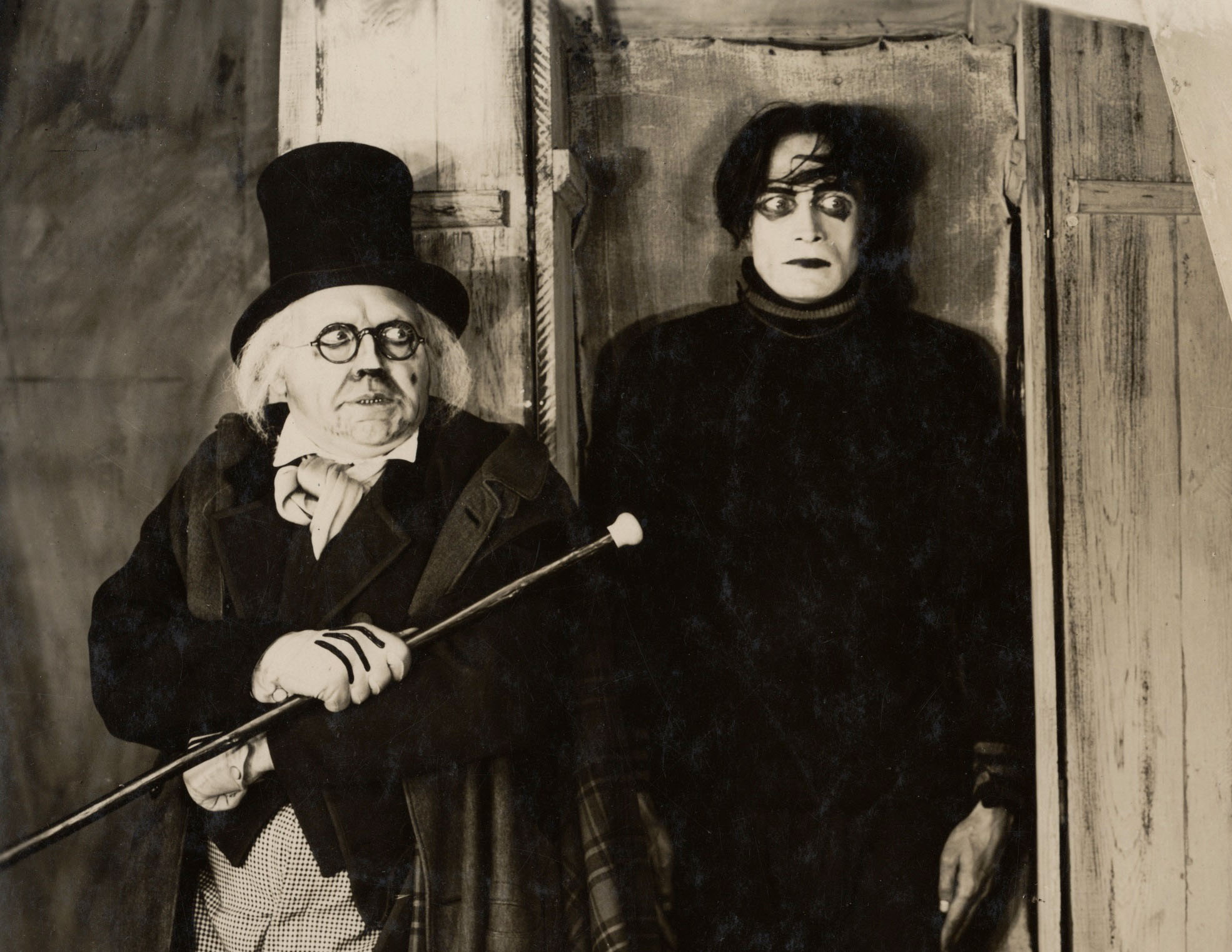
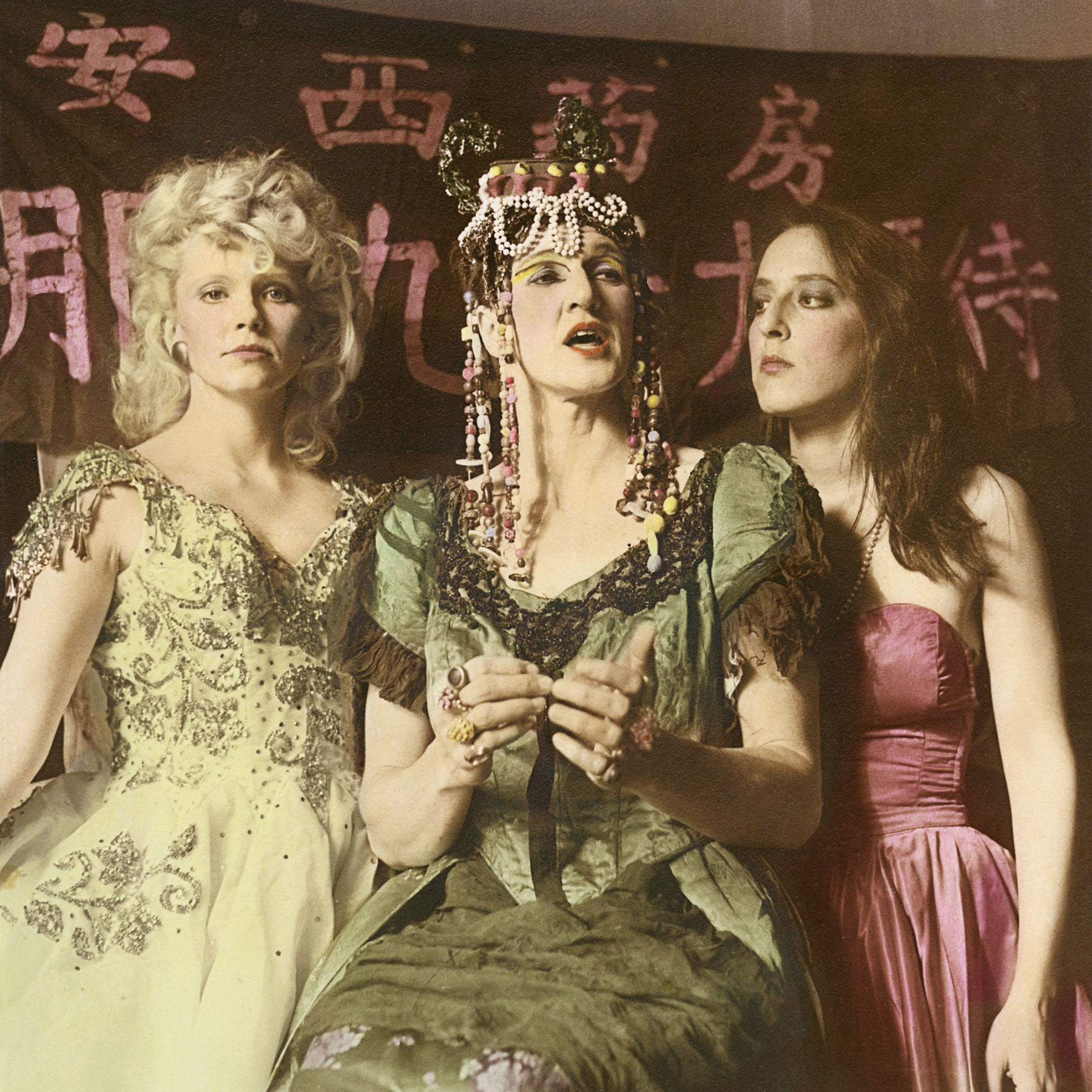
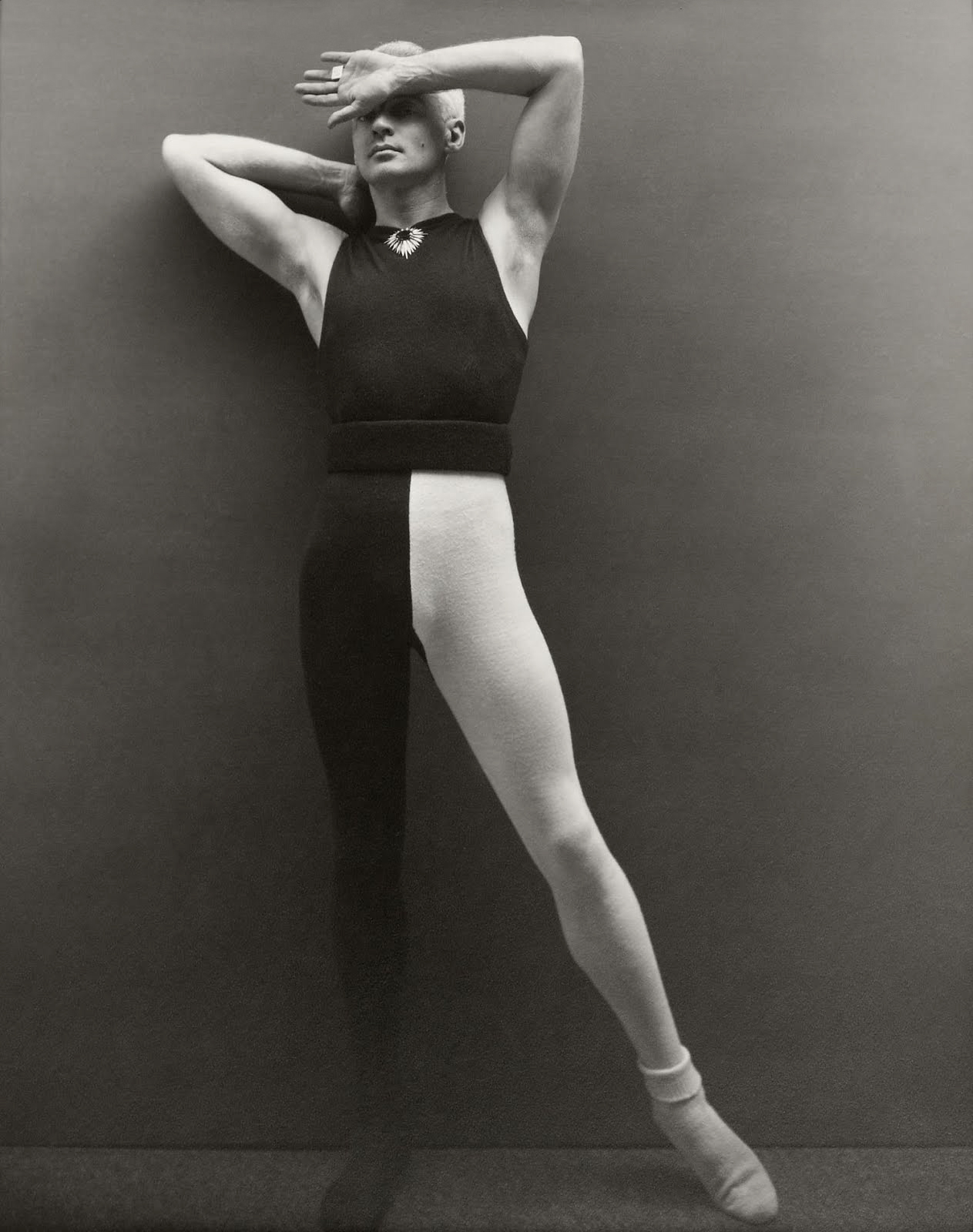
Polixeni Papapetrou (Australian, 1960-2018) 'Drag queen wearing cut out dress' 1993 from the exhibition 'Polixeni Papapetrou: Eden' at Stills Gallery, Sydney, Sept - Oct, 2016


Polixeni Papapetrou (Australian, 1960-2018)
Drag queen wearing cut out dress
1993
Gelatin silver photograph
28.5 x 28.5cm
Courtesy the artist and Nellie Castan Gallery, Melbourne and Stills Gallery, Sydney


This end of (life) cycle is the last body of work that Polixeni Papapetrou will make. It is the completion of an imaginative, bold and strong body of work that stretches from the late 1980s through to this series, Eden. Papapetrou has remained true to her vision as an artist, one that documents performative identities within constructed landscapes.

In the series Eden Papapetrou again cleverly stitches together space and time: flowers stitched together in wreaths; prints of period dresses; and further prints in the backdrop made from postwar backcloth. This “fabrication” of the picture plane has been a constant throughout the artistic life of Papapetrou. If we look at the formal construction of an early work, Drag queen wearing cut out dress (1993, below), we can still see the same concerns for flattened perspective in this new series. The wrapping up of space (fabric, dress, flowers, body) in an intricately overlapping, planar field of view with no vanishing point.

The work desires to celebrate the beauty of nature and honour its transience through the symbology of beauty and death associated with flowers. But for me, the use of facsimiles or simulacra – prints of flowers on dresses and repeated patterns of flowers on cloth – diminishes the relationship between the sitters and the flowers, thus undermining the conceptualisation of the series. The sitter is no longer embedded in the cycles of life and, on this level, the work fails to engage with the idea of, how we are nature. The sitters exist in a masked reality (like the wreaths in front of the girls faces), which is a masquerade or act, a disguise which takes us away from our true being. As in much of Papapetrou’s work, camouflage – to hide or disguise the presence of (a person, animal, or object) – is to the fore, but this time these photographs fail to transcend their origins as studio set pieces.

Further, I have never been a great fan of “dead pan” photography and what I find curious here is the closed nature of the girls. They are stiff, focused inwards, looking off into nowhere. They don’t feel that they are in a state of reflection. For a series that seeks to show “the condition of becoming from childhood to adolescence to adulthood”, the photographs seem to lack the energy vital for such a journey. The exuberance of nature doesn’t seem to extend beyond the prints and flowers. As I said of her work in an earlier posting, “what springs to mind, with the use of masks to disguise youth positioned within the decorous landscape, is the notion of “passing”. Passing on (as in dying), passing through (as in travelling), in passing (as in an aside) and just “passing” (passing yourself off as someone or something else) to hide your true character or feelings.” Like a bower bird collecting colourful things for its nest, there are bits of all of that and more in this new series.

This is not my favourite body of Papapetrou’s work. No matter. What we should do is honour this talented and determined artist for creating memorable images over the years, for following her passion and her heart with courage and conviction. For the rest of my life I will always remember the spaces, the ambiguous vistas, the fantastical archetypes, the fables of her work. Images of drag queens and Dreamkeepers, Ghillies and goblins are etched in my memory. I will always remember them. You can’t ask much more from the work of an artist than that.

Dr Marcus Bunyan


Many thankx to Poli and Stills Gallery for allowing me to publish the photographs in the posting. Please click on the photographs for a larger version of the image.


“If I do live again I would like it to be as a flower – no soul but perfectly beautiful. Perhaps for my sins I shall be made a red geranium!”


Oscar Wilde


The loss of Eden is
personally experienced by
every one of us as we leave
the wonder and magic and
also the pain and terrors
of childhood.


Dennis Potter


Polixeni Papapetrou (Australian, 1960-2018) 'Blinded' from 'Eden', 2016 from the exhibition 'Polixeni Papapetrou: Eden' at Stills Gallery, Sydney, Sept - Oct, 2016


Polixeni Papapetrou (Australian, 1960-2018)
Blinded
2016
From the series Eden
Pigment print
127.3 x 85cm
Courtesy of the artist and STILLS Gallery, Sydney


Polixeni stitches space together in the same way that flowers are stitched together in a wreath – the one wand entwined within the space of the other – or vines or branches are woven on a trellis. The very word bower derives from a knot, a bow (as Shakespeare acknowledges with his ‘pleached bower’),[1] a tying together around an armature, where strands are interwoven, locked in, both strengthened and encumbered with their unity. They are ‘Together intertwin’d and trammel’d fresh’,[2] as the romantic poet Keats expressed it in his Endymion, a heady poem itself enmeshed with flowers and vine. In Polixeni’s photographs, however, the trammelled armature is the human herself…

In Eden, Polixeni weaves together much more than space but metaphor, metaphors of growth, nature, life-cycles, the sacred, the ideal; and even the all-over aesthetic field constitutes a kind of metaphor, the rhapsodic, the imaginary, the connected. The space that she has created is almost nothing but a metaphor, ‘her close and consecrated bower’;[13]…

Polixeni’s bower is fantastic in old and new ways: old, because it has forms of painting and sculpture within it where blooms and other plant-matter are brought together; and new because they gesture to a place so far beyond the studio…

This exclusivity along gender lines, like the image of the unicorn in the garden of a virgin, is also metaphoric: it stands for the preserve of the individual, the quintessentially safe place that is the interior, the inner realm of thought, the preserve of an unaffected psyche, an emotional haven, a bower of immanence. It has love in it, but deferred, otherworldly, imaginary and eternal.

Extract from Robert Nelson “Rhapsodies from the bower: Polixeni Papapetrou’s ‘Eden'” on the Polixeni Papapetrou website 2016 [Online] Cited 16/02/2023


Polixeni Papapetrou (Australian, 1960-2018) 'Delphi' 2016


Polixeni Papapetrou (Australian, 1960-2018)
Delphi
2016
From the series Eden
Pigment print
127.3 x 85cm
Courtesy of the artist and STILLS Gallery, Sydney


The name Delphoi comes from the same root as δελφύς delphys, “womb” and may indicate archaic veneration of Gaia… In Greek mythology, Gaia (/ˈɡ.ə/ or /ˈɡ.ə/ from Ancient Greek Γαῖα, a poetical form of Γῆ , “land” or “earth”) also spelled Gaea, is the personification of the Earth and one of the Greek primordial deities. Gaia is the ancestral mother of all life: the primal Mother Earthgoddess.


Polixeni Papapetrou (Australian, 1960-2018) 'Heart' 2016


Polixeni Papapetrou (Australian, 1960-2018)
Heart
2016
From the series Eden
Pigment print
127.3 x 85cm
Courtesy of the artist and STILLS Gallery, Sydney


Polixeni Papapetrou (Australian, 1960-2018) 'Flora' 2016


Polixeni Papapetrou (Australian, 1960-2018)
Flora
2016
From the series Eden
Pigment print
127.3 x 85cm
Courtesy of the artist and STILLS Gallery, Sydney


In Roman mythology, Flora (Latin: Flōra) was a Sabine-derived goddess of flowers and of the season of spring – a symbol for nature and flowers (especially the may-flower). While she was otherwise a relatively minor figure in Roman mythology, being one among several fertility goddesses, her association with the spring gave her particular importance at the coming of springtime, as did her role as goddess of youth. Her name is derived from the Latin word “flos” which means “flower”. In modern English, “Flora” also means the plants of a particular region or period.


Polixeni Papapetrou (Australian, 1960-2018) 'Psyche' 2016


Polixeni Papapetrou (Australian, 1960-2018)
Psyche
2016
From the series Eden
Pigment print
127.3 x 85cm
Courtesy of the artist and STILLS Gallery, Sydney


Psyche (/ˈsk/, Greek: Ψυχή, “Soul” or “Breath of Life”). The basic meaning of the Greek word ψυχή (psūkhē) was “life” in the sense of “breath”, formed from the verb ψύχω (psukhō, “to blow”). Derived meanings included “spirit”, “soul”, “ghost”, and ultimately “self” in the sense of “conscious personality” or “psyche … Portrayals of Psyche alone are often not confined to illustrating a scene from Apuleius, but may draw on the broader Platonic tradition in which Love was a force that shaped the self.


Colourful, abundant and compelling, Polixeni Papapetrou’s new series Eden arose out of a commission by the Centre for Contemporary Photography (CCP) in Melbourne to create works in response to the Melbourne General Cemetery. Papapetrou, photographed flowers obtained from the cemetery against a black backdrop to invoke ideas about mourning and remembrance. For Papapetrou, whose own plot is in the cemetery, and who, through illness, has faced her own mortality, it was a challenging and thought provoking assignment.

The commission led Papapetrou to delve into the language of flowers. The history of art is replete with images of flowers and they have a rich metaphorical resonance. In true Papapetrou spirit, what she has created in Eden, following on from the CCP work, is positive, philosophical and beautiful. Eden invites us to celebrate the beauty of nature and honour its transience. We, like flowers, are subject to seasons of growth, blossoming, and wilting. The young women in the photographs, in the Springtime of their lives, are surrounded by flowers; on backdrops, on dresses; held or worn, they adorn and overrun them. The lush colours and patterns are interrupted only by the faces and arms of the sitters, their expressions solemn and thoughtful, in contrast to the extravagance of the blooms.

Papapetrou has returned to photograph these subjects, including her daughter Olympia, at different stages of their lives. Eden uses the language of flowers to explore life itself, reflecting on the young womens’ metamorphosis from child to adolescent and adolescent to adult, and a oneness with the world, fertility and the cycles of life. They are enclosed in a floral embrace that symbolises their unity and acceptance of this miraculous thing we call life.

In addition to Eden, we will also exhibit a small selection of Papapetrou’s early Phantomwise works. These large-scale black and white photographs feature her young daughter Olympia between the ages of four and six wearing Victorian masks and performing various identities. As with Eden, these early works consider the potential for metamorphosis and the ambiguity between the ‘real’ and the ‘imaginary’, an ambiguity inherent in photography itself.

Press release from Stills Gallery


Polixeni Papapetrou (Australian, 1960-2018) 'Amaranthine' 2016


Polixeni Papapetrou (Australian, 1960-2018)
Amaranthine
2016
From the series Eden
Pigment print
127.3 x 85cm
Courtesy of the artist and STILLS Gallery, Sydney


The word is taken from ancient Greek and means everlasting or immortal (the same as the amaranth flower)


Polixeni Papapetrou (Australian, 1960-2018) 'Amaryllus' 2016


Polixeni Papapetrou (Australian, 1960-2018)
Amaryllus
2016
From the series Eden
Pigment print
127.3 x 85cm
Courtesy of the artist and STILLS Gallery, Sydney


Polixeni Papapetrou (Australian, 1960-2018) 'Eden' 2016


Polixeni Papapetrou (Australian, 1960-2018)
Eden
2016
From the series Eden
Pigment print
127.3 x 85cm
Courtesy of the artist and STILLS Gallery, Sydney


Traditionally, the favoured derivation of the name “Eden” was from the Akkadian edinnu, derived from a Sumerian word meaning “plain” or “steppe”. Eden is now believed to be more closely related to an Aramaic root word meaning “fruitful, well-watered.” The Hebrew term is translated as “pleasure” in Sarah’s secret saying in Genesis 18:12


Polixeni Papapetrou (Australian, 1960-2018) 'Rhodora' 2016


Polixeni Papapetrou (Australian, 1960-2018)
Rhodora
2016
From the series Eden
Pigment print
127.3 x 85cm
Courtesy of the artist and STILLS Gallery, Sydney


Ralph Waldo Emerson (1803-1882) "The Rhodora" from 'Poems' 1847


Ralph Waldo Emerson (American, 1803-1882)
“The Rhodora” from Poems
1847


Polixeni Papapetrou (Australian, 1960-2018) 'Spring' 2016


Polixeni Papapetrou (Australian, 1960-2018)
Spring
2016
From the series Eden
Pigment print
127.3 x 85cm
Courtesy of the artist and STILLS Gallery, Sydney


Stills Gallery

This gallery has now closed.

Stills Gallery website

LIKE ART BLART ON FACEBOOK

Back to top

Exhibition: ‘Danny Lyon: Message to the Future’ at the Whitney Museum of American Art, New York

Exhibition dates: 17th June – 25th September, 2016

Curator: Julian Cox


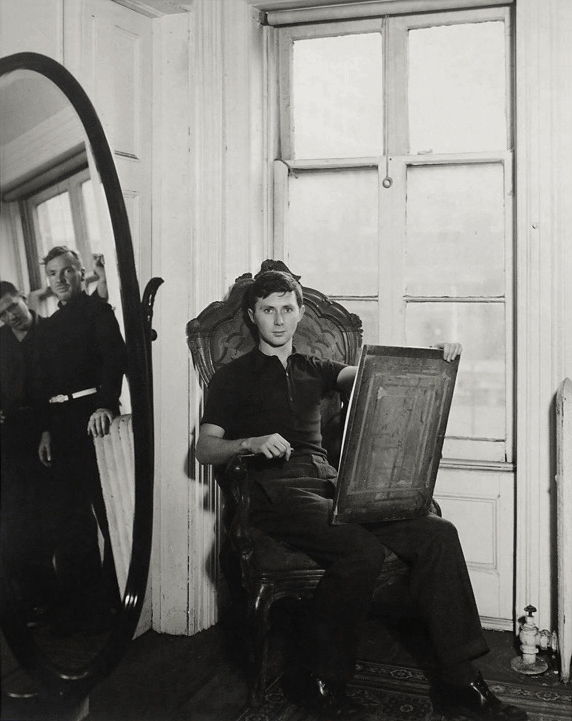
Danny Lyon (American, b. 1942) 'Self-portrait, Chicago' 1965/1995  from the exhibition 'Danny Lyon: Message to the Future' at the Whitney Museum of American Art, New York, June - Sept, 2016


Danny Lyon (American, b. 1942)
Self-portrait, Chicago
1965/1995
Gelatin silver print montage
Image: 31.2 x 27.8cm (12 1/4 x 10 15/16 in.)
Mount: 50.8 x 40.6cm (20 x 16 in.)
Collection of the artist


This man is a living legend. What a strong body of socially conscious work he has produced over a long period of time. Each series proposes further insight into the human condition – and adds ‘value’ to series that have gone before. It is a though the artist possesses the intuition for a good story and the imagination to photograph it to best advantage, building the story over multiple encounters and contexts to form a thematic whole.

In a press release for a currently showing parallel exhibition titled Journey at Edwynn Houk Gallery the text states, “Continuing in the tradition of Walker Evans and Robert Frank, Lyon forged a new style of realistic photography, described as “New Journalism,” where the photographer immerses himself in his subject’s world.” This reference to immersion is reinforced by the second quotation below, where “the power of Lyon’s work has often derived from his willingness of immerse himself entirely in the cultures and communities he documents.”

While the observation is correct that the artist immerses himself in the cultures and communities he documents, this is different to the tradition of Robert Frank and to a lesser extent, Walker Evans. Frank was a Swiss man who imaged his impressions of America on a road trip across the country. His “photographs were notable for their distanced view of both high and low strata of American society” which pictured the culture as both alienating and strange, “skeptical of contemporary values and evocative of ubiquitous loneliness”. This is why The Americans had so much power and caused so much consternation when it was first released in 1959 in America, for it held up a mirror to an insular society, one not used to looking at itself especially from the position of an “outsider” – where the tone of the book was perceived as derogatory to national ideals – and it didn’t like what it saw. The American Walker Evans was also an outsider photographing outsiders, journeying through disparate towns and communities documenting his impressions how I can I say, subjectively with an objective focus, at one and the same time. He never immersed himself in the culture but was an active observer and documenter, never an insider.

Lyon was one of the first “embedded” social documentary photographers of the American street photography movement of the 1960s who had the free will and the social conscience to tell it like it is. His self-proclaimed “advocacy journalism” is much more than just advocacy / journalism. It is a vitality of being, of spirit, an inquiry of the mind that allows the artist to get close, both physically and emotionally, to the problems of others through becoming one with them – and then to picture that so that others can see their story, so that he can “change history and preserve humanity.” But, we must acknowledge, that humanity is mainly (good looking) males: outlaw motorcycle clubs, mainly male prisons, mainly male civil rights, tattoo shops, and male Uptown, Chicago. Women are seemingly reduced to bit-players at best, singular portraits or standing in the background at funerals. This is a man’s world and you better not forget it…

Having said that, can you imagine living the life, spending four years as a member of the Chicago Outlaw Motorcycle Club. How exhilarating, how enmeshed with the culture you would become – the people, the travel, the ups and downs, the life, the danger – and then when you get photographs like Funny Sonny Packing with Zipco, Milwaukee (1966, below) with the manic look in Funny Sonny’s eyes, how your heart would sing. If I had to nominate one image that is for me the epitome of America in the 1960s it would be this: Crossing the Ohio River, Louisville (1966, below): all Easy Rider (an 1969 American road movie) encapsulated in one image. The structure and modernism / of the two bridges frames / the speeding / wicked bike / helmet lodged over the headlight; the man / wearing a skull and crossbones emblazoned jacket / helmet-less / head turned / behind / hair flying in the wind / not looking where / he is going / as though his destiny: unknown.

Danny Lyon IS one of the great artists working in photography today. He is a rebel with his own cause. Through his vital and engaging images his message to the future is this: everyone has their own story, their own trials and tribulations, each deserving of empathy, compassion, and non-judgemental acceptance. Prejudice has no voice here, a lesson never more pertinent than for America today as it decides who to elect – a woman who has fought every inch of the way or a narcissistic megalomaniac who preaches hate to minorities.

Dr Marcus Bunyan


Many thankx to the Whitney Museum of American Art for allowing me to publish the photographs in the posting. Please click on the photographs for a larger version of the image.


“Closeness, both physical and emotional, is a recurring theme throughout the 175 works in “Message to the Future,” Lyon’s Whitney Museum retrospective, a quietly brilliant affair curated with panache by Julian Cox. (Later this year, the show will travel to the Fine Arts Museums in San Francisco, which organized it; Elisabeth Sussman oversaw the Whitney installation.) We see here a photographer who was witness to a changing America and, occasionally, other places in the world. Since the early ’60s, Lyon has been infiltrating outsider groups – talking to and photographing bikers, Texas prison inmates, and hippies, and learning from them by becoming close with them. It’s as if Lyon has no sense of personal space. That, as this revelatory show proves, is his greatest attribute…

Lyon is a deft stylist who cares deeply about his subjects, to the point of exchanging letters with them for years after taking their pictures. What results is something more intimate, more political, and, in some ways, better than traditional photojournalism – a fuller portrait of America since the ’60s.”


Alex Greenberger. “Close Encounters: The Danny Lyon Retrospective at the Whitney Museum Is Quietly Brilliant,” on the ARTnews website August 17, 2016 [Online] Cited 16/02/2023


“Self-taught, and driven by his twin passions for social change and the medium of photography, the power of Lyon’s work has often derived from his willingness of immerse himself entirely in the cultures and communities he documents. This was evident early on in his series ‘Bikeriders’ (1968; reissued in 2003 by Chronicle Books), which evolved from four years spent as a member of the Chicago Outlaw Motorcycle Club. And ‘Conversations with the Dead’ derived from his close study of the Texas prison system; it also revealed Lyon’s novel and distinctive approach to the photobook, which often sees him splicing images with texts drawn from various sources, including interviews, letters, and even fiction.”


Text from the Edwynn Houk Gallery website [Online] Cited 21/09/2016. No longer available online


Danny Lyon (American, b. 1942) 'Self-Portrait, New Orleans 1964' 1964 'Danny Lyon: Message to the Future' at the Whitney Museum of American Art, New York


Danny Lyon (American, b. 1942)
Self-Portrait, New Orleans, 1964
1964
Gelatin silver print
18.2 x 12.2cm (7 3/16 x 4 13/16 in.)
Collection of the artist


In his 1981 book, “Danny Lyon: Pictures From the New World,” he wrote of starting out in the early ’60s. “Photography then seemed new and exciting, and all America, which I regarded with mystery and reverence, lay before me.”

That sense of newness and excitement fills the show. What we’re discovering now, Lyon was discovering then – not just seeing or observing, but discovering, with the sense of revelation that brings. Mystery and reverence are here, too, but complicatedly. Framing them – debating with them? – are the clarity of precision the camera affords and a skepticism born of a forthrightly ’60s sensibility. Several photographs of the Occupy movement attest to how vigorous that sensibility remains…

He was working as a documentarian but not a photojournalist. That’s an important distinction. These images are implicitly polemical – inevitably polemical, too. Rarely in our nation’s history has the distinction between what’s right and what’s wrong been as clear cut. Yet then as now, people matter more to Lyon than any ideological stance. Outsiders attract Lyon and populate the show: civil rights demonstrators, transgender people (in Galveston, Texas, of all places), lower Manhattan demolition crews, inmates, undocumented workers, Indians, Appalachian whites transplanted to Chicago, motorcycle gangs…

Enclosure and entrapment are not for Lyon – nor, for that matter, is the absence of people (a very rare condition in his work). A larger restlessness in Lyon’s career reflects the energy so often evident within the frame – within the frame being another form of enclosure and entrapment. The South, Chicago, lower Manhattan, Texas, New Mexico, China, Haiti, Latin America share space in the show. Even so, sense of place doesn’t signify as much for Lyon as a sense of a place’s inhabitants. More likely he’d say that the two are indistinguishable. Looking at his pictures, you can see why he’d think so.”

Mark Feeney. “Outsiders fill compelling Danny Lyon photography show,” on the Boston Globe website 8th July 2016 [Online] Cited 10/09/2016


Danny Lyon (American, b. 1942) 'Arrest of Eddie Brown, Albany, Georgia' 1962


Danny Lyon (American, b. 1942)
Arrest of Eddie Brown, Albany, Georgia
1962
Gelatin silver print
Image: 22 x 31.7cm (8 5/8 x 12 1/2 in.)
Sheet: 27.9 x 35.6cm (11 x 14 in.)
Collection of the artist


Eddie Brown former gang leader and movement activist is arrested.

“The first sit-in arrests I see and photograph are those of Eddie Brown, a former Albany gang leader, and a visitor from the North. Both have volunteered to be arrested for the photographs. The picture of Eddie Brown, calmly being carried off by the Albany police, is widely distributed as the image of the classic non-violent arrest, Georgia.”

~ Danny Lyon


“Eddie Charles Brown, Jr., a great-souled human being committed to fighting the oppression of all people from Mississippi to South Africa, died at his home on November 23, 2011. In political circles, Ed was respected for his enduring commitment to our people. As a consequence of his tireless devotion to, and success in advancing the culture and economic progress of poor black folk, Ed Brown was widely recognised as among the most, incorruptible, responsible, resourceful and effective of the activist leaders of the Movement. As his SNCC colleagues said of him, “More than most, Ed’s life embodies and exemplifies to a remarkable degree, the principle of undying love for our people both here and in the Motherland.” …

A native of Louisiana, Ed was born on August 19, 1941, in New Orleans and raised in Baton Rouge to Thelma Warren and Eddie Charles Brown, Sr. Ed’s historical efforts to fight segregation and all forms of oppression as well as to empower Black people started in 1960 as a young student at Louisiana’s Southern University. He and 16 other classmates confronted the University and staged a sit-in protesting the racial segregation prevalent in Louisiana at the time. After he and the others were arrested, expelled and banned from enrolling in any university in Louisiana Ed began the ongoing struggle for justice, which would define his entire life. This expulsion led Ed to Howard University in Washington, D.C. in 1961, where he landed on the front line of the Civil Rights Movement. Ed was an active member of the Nonviolent Action Group, the SNCC affiliate at Howard.

As a leader and field secretary for the Student Nonviolent Coordinating Committee (SNCC) he fought to win constitutional rights for Blacks and all disenfranchised people. Ed always proclaimed that he was “fighting fire with a feather,” but he knew he would prevail because he often said, ironically, he was protected by “asbestos gloves.””

Anonymous. “In Memoriam: Eddie Charles Brown, Jr.,” on the SNCC Legacy Project website Nd [ONline] Cited 04/04/2024


The most comprehensive retrospective of the work of American photographer, filmmaker, and writer Danny Lyon in twenty-five years debuts at the Whitney on June 17, 2016. The first major photography exhibition to be presented in the Museum’s downtown home, Danny Lyon: Message to the Future is organised by the Fine Arts Museums of San Francisco, where it will make its West Coast debut at the de Young Museum on November 5, 2016. The exhibition assembles approximately 175 photographs and is the first to assess the artist’s achievements as a filmmaker. The presentation also includes a rare look at works from Lyon’s archives, including vintage prints, unseen 16mm film footage made inside Texas prisons, and his personal photo albums. A leading figure in the American street photography movement of the 1960s, Lyon has distinguished himself by the personal intimacy he establishes with his subjects and the inventiveness of his practice.

Photographer, filmmaker, and writer Danny Lyon (b. 1942) has over the past five decades presented a charged alternative to the sanitised vision of American life presented in the mass media. Throughout, he has rejected the standard detached humanism of the traditional documentary approach in favour of a more immersive, complicated involvement with his subjects. “You put a camera in my hand,” he has explained, “I want to get close to people. Not just physically close, emotionally close, all of it.” In the process he has made several iconic bodies of work, which have not only pictured recent history but helped to shape it.

Lyon committed intensively to photography from the beginning. In 1962, while still a student at the University of Chicago, he hitchhiked to the segregated South to make a photographic record of the civil rights movement. He went on to photograph biker subcultures, explore the lives of the incarcerated, and document the architectural transformation of Lower Manhattan. He has travelled to Latin America and China, and has lived for years in New Mexico; the work he has made throughout these journeys demonstrates his respect for the people he photographs on the social and cultural margins.

Message to the Future, shaped in collaboration with the artist, incorporates seldom-exhibited materials from Lyon’s archive, including rare vintage prints, previously unseen 16mm film footage made inside the Texas prisons, his personal photo albums, and related documents and ephemera. In his roles as a photographer, filmmaker, and writer, Lyon has reinvented the expectations for how the still photographic image can be woven together with journalism, books, films, and collage to present a diverse record of social customs and human behaviour. His work, which he continues to make today, reveals a restless idealist, digging deep into his own life and those of his subjects to uncover the political in the personal and the personal in the political.

Text from the Whitney Museum of American Art


Civil rights

In the summer of 1962, Lyon hitchhiked to Cairo, Illinois, to witness demonstrations and a speech by John Lewis, chairman of the Student Nonviolent Coordinating Committee (SNCC), one of the most important organisations driving the civil rights movement of the early 1960s. Inspired to see the making of history firsthand, Lyon then headed to the South to participate in and photograph the civil rights movement. There, SNCC executive director James Forman recruited Lyon to be the organisation’s first official photographer, based out of its Atlanta headquarters. Traveling throughout the South with SNCC, Lyon documented sit-ins, marches, funerals, and violent clashes with the police, often developing his negatives quickly in makeshift darkrooms.

Lyon’s photographs were used in political posters, brochures, and leaflets produced by SNCC to raise money and recruit workers to the movement. Julian Bond, the communications director of SNCC, wrote of Lyon’s pictures, “They put faces on the movement, put courage in the fearful, shone light on darkness, and helped make the movement move.”


Danny Lyon (American, b. 1942) 'Student Nonviolent Coordinating Committee (SNCC) Sit-In, Atlanta' 1963


Danny Lyon (American, b. 1942)
Student Nonviolent Coordinating Committee (SNCC) Sit-In, Atlanta
1963
Gelatin silver print
Image: 16.1 x 24cm (6 3/8 x 9 1/2 in.)
Sheet: 20.3 x 25.4cm (8 x 10 in.)
Collection of the artist


Danny Lyon (American, b. 1942) 'The Leesburg Stockade, Leesburg, Georgia' 1963


Danny Lyon (American, b. 1942)
The Leesburg Stockade, Leesburg, Georgia
1963
Gelatin silver print
Image: 17.5 x 26cm (6 7/8 x 10 3/16 in.)
Sheet: 27.9 x 35.6cm (11 x 14 in.)
Collection of the artist


Danny Lyon (American, b. 1942) 'Abernathy, Shuttlesworth (SCLC), King and Wilkinson (NAACP)' 1963


Danny Lyon (American, b. 1942)
Abernathy, Shuttlesworth (SCLC), King and Wilkinson (NAACP)
1963
Gelatin silver print


Danny Lyon (American, b. 1942) 'Voting Rights Demonstration, Organized by the Student Nonviolent Coordinating Committee (SNCC), Selma, Alabama' October 7, 1963


Danny Lyon (American, b. 1942)
Voting Rights Demonstration, Organized by the Student Nonviolent Coordinating Committee (SNCC), Selma, Alabama
October 7, 1963
Gelatin silver print
Image: 18.3 x 26.8cm (7 3/16 x 10 9/16 in.)
Sheet: 27.8 x 35.4cm (10 15/16 x 13 15/16 in.)
Whitney Museum of American Art, New York; purchase with funds from the Photography Committee


Danny Lyon (American, b. 1942) 'Sheriff Jim Clark Arresting Demonstrators, Selma, Alabama' October 7, 1963


Danny Lyon (American, b. 1942)
Sheriff Jim Clark Arresting Demonstrators, Selma, Alabama
October 7, 1963
Gelatin silver print
Image: 18.4 x 27cm (7 1/4 x 10 5/8 in.)
Sheet: 27.8 x 35.4cm (10 15/16 x 13 15/16 in.)
Whitney Museum of American Art, New York; purchased with funds from the Photography Committee


Danny Lyon (American, b. 1942) 'Stokely Carmichael, Confrontation with National Guard, Cambridge, Maryland' 1964


Danny Lyon (American, b. 1942)
Stokely Carmichael, Confrontation with National Guard, Cambridge, Maryland
1964
Gelatin silver print
Image: 16.5 x 22.2cm (6 1/2 x 8 3/4 in.)
Sheet: 20.3 x 25.4cm (8 x 10 in.)
Collection of the High Museum of Art, Atlanta; purchase with funds from Joan N. Whitcomb


Danny Lyon (American, b. 1942) 'Woman Holds Off a Mob, Atlanta' 1963


Danny Lyon (American, b. 1942)
Woman Holds Off a Mob, Atlanta
1963
Gelatin silver print


Danny Lyon (American, b. 1942) 'Bob Dylan behind the SNCC office, Greenwood, Mississippi' 1963


Danny Lyon (American, b. 1942)
Bob Dylan behind the SNCC office, Greenwood, Mississippi
1963
Gelatin silver print


Danny Lyon (American, b. 1942) 'Arrest of Taylor Washington, Atlanta' 1963


Danny Lyon (American, b. 1942)
Arrest of Taylor Washington, Atlanta
1963
Gelatin silver print
24 x 16cm (9 7/16 x 6 1/4 in.)
Collection of the artist


Atlanta, Georgia. High school student Taylor Washington is arrested at Lebs Delicatessen. His eighth arrest.

“One of Taylor Washington’s numerous arrests is immortalised as he yells while passing before me. The photograph became the cover of SNCC’s photo book, The Movement, and was reproduced in the former Soviet Union in Pravda, captioned “Police Brutality USA.””

~ Danny Lyon


The Civil Rights movement of the 1960’s was a widespread effort to end racial segregation and discrimination against African Americans. News coverage of sit-ins and freedom rides dominated the cultural and political landscape of the United States. At this time Danny Lyon was in his early 20s and an undergraduate student at the University of Chicago. After meeting John Lewis, the chairman of the Student Nonviolent Coordinating Committee’s (SNCC’s) in Cairo, Illinois, Lyon then traveled to Mississippi, to cover voter registrations, and soon he was present at almost all of the major SNCC events during the movement. Lyon served as SNCC’s photographer from 1962 to 1964 and later documented his experiences in his book Memories of the Southern Civil Rights Movement.

Text from the Minneapolis Institute of Art Collection website


Danny Lyon (American, b. 1942) 'The March on Washington' August 28, 1963


Danny Lyon (American, b. 1942)
The March on Washington
August 28, 1963
Gelatin silver print
29.8 x 20.8cm (11 3/4 x 8 3/16 in.)
Museum of Modern Art, New York; Gift of Anne Ehrenkranz


Galveston


Danny Lyon (American, b. 1942) 'Pumpkin and Roberta, Galveston, Texas' 1967


Danny Lyon (American, b. 1942)
Pumpkin and Roberta, Galveston, Texas
1967
Gelatin silver print
Image: 23.8 x 16.1cm (6 3/8 x 9 3/8 in.)
Sheet: 20.3 x 25.4cm (8 x 10 in.)
Collection of the artist


Prisons

In 1967, Lyon applied to the Texas Department of Corrections for access to the state prisons. Dr. George Beto, then director of the prisons, granted Lyon the right to move freely among the various prison units, which he photographed and filmed extensively over a fourteen-month period. The result is a searing record of the Texas penal system and, symbolically, of incarceration everywhere.

Lyon’s aim was to “make a picture of imprisonment as distressing as I knew it to be in reality.” This meant riding out to the fields to follow prisoners toiling in the sun, as well as visiting the Wynne Treatment Centre, which housed primarily convicts with mental disabilities. He befriended many of the prisoners, listening to their stories and finding the humanity in their experiences, and still maintains contact with some of them.


Danny Lyon (American, b. 1942) 'Weight Lifters, Ramsey Unit, Texas' 1968


Danny Lyon (American, b. 1942)
Weight Lifters, Ramsey Unit, Texas
1968
Gelatin silver print
Image: 22.4 x 33.2cm (8 7/8 x 13 1/16 in.)
Sheet: 27.7 x 35.6cm (11 x 14 in.)
Collection of the artist


Danny Lyon (American, b. 1942) 'New Arrivals from Corpus Christi, The Walls, Texas' 1968


Danny Lyon (American, b. 1942)
New Arrivals from Corpus Christi, The Walls, Texas
1968
Gelatin silver print
Image: 21.4 x 32cm (8 7/16 x 12 5/8 in.)
Sheet: 27.9 x 35.6cm (11 x 14 in.)
Collection of the artist


Danny Lyon (American, b. 1942) 'Contents of Arriving Prisoner’s Wallet, Diagnostic Unit, The Walls, Huntsville, Texas' 1968


Danny Lyon (American, b. 1942)
Contents of Arriving Prisoner’s Wallet, Diagnostic Unit, The Walls, Huntsville, Texas
1968
Gelatin silver print
Image: 24.3 x 17.5cm (9 9/16 x 6 3/4 in.)
Sheet: 25.4 x 20.3cm (10 x 8 in.)
Collection of the artist


Danny Lyon (American, b. 1942) 'Six-Wing Cell Block, Ramsey Unit, Texas' 1968


Danny Lyon (American, b. 1942)
Six-Wing Cell Block, Ramsey Unit, Texas
1968
Gelatin silver print
Image: 16 x 24cm (6 5/16 x 9 7/16 in.)
Sheet: 20.3 x 25.4cm (8 x 10 in.)
Collection of the artist


Danny Lyon (American, b. 1942) 'Charlie Lowe, Ellis Unit, Texas' 1968


Danny Lyon (American, b. 1942)
Charlie Lowe, Ellis Unit, Texas
1968
Gelatin silver print
Image: 16.2 x 23.8cm (6 3/8 x 9 3/8 in.)
Sheet: 20.3 x 25.4cm (8 x 10 in.)
Collection of the artist


Danny Lyon (American, b. 1942) 'Shakedown, Ellis Unit, Texas' 1968


Danny Lyon (American, b. 1942)
Shakedown, Ellis Unit, Texas
1968
Gelatin silver print
21.6 x 31.3cm (8 1/2 x 12 1/4 in.)
Museum of Modern Art, New York; purchase


Danny Lyon (American, b. 1942) 'Shakedown, Ramsey Unit, Texas' 1968


Danny Lyon (American, b. 1942)
Shakedown, Ramsey Unit, Texas
1968
Gelatin silver print
Image: 17 x 24.2cm (6 5/8 x 9 9/16 in.)
Sheet: 20.3 x 25.4cm (8 x 10 in.)
Collection of the artist


Danny Lyon (American, b. 1942) 'Convict With a Bag of Cotton, Texas' 1968


Danny Lyon (American, b. 1942)
Convict With a Bag of Cotton, Texas
1968
Gelatin silver print


Danny Lyon (American, b. 1942) 'Two Inmates, Goree Unit, Texas' 1968


Danny Lyon (American, b. 1942)
Two Inmates, Goree Unit, Texas
1968
Gelatin silver print
Image: 16.8 x 24cm (6 5/8 x 9 91/6 in.)
Sheet: 20.3 x 25.4cm (8 x 10 in.)
Collection of the artist


The destruction of Lower Manhattan

In late 1966 and into the summer of 1967, starting from his loft at the corner of Beekman and William Streets near City Hall Park, Lyon documented the demolition of some sixty acres of predominantly nineteenth-century buildings below Canal Street in lower Manhattan. With funding from the New York State Council on the Arts, he photographed most of the buildings that would be torn down to make way for the World Trade Center. Lyon recalled later: “I wanted to inhabit [the buildings] with feelings and give them and their demise a meaning.”

Moving from the outside of the buildings to their deserted interiors, Lyon also took pictures of the workers involved in the demolition. The photographs, together with Lyon’s journal entries, became a book, published by Macmillan in 1969 and dedicated to his close friend, sculptor Mark di Suvero. The volume’s significance lies in part in its depiction of a city – and, more broadly, a culture – cannibalising its own architectural history for the sake of development.


Danny Lyon (American, b. 1942) 'View South from 100 Gold Street, New York' 1967


Danny Lyon (American, b. 1942)
View South from 100 Gold Street, New York
1967
Gelatin silver print
18.3 x 18.2cm (7 1/4 x 7 3/16 in.)
Collection of Melissa Schiff Soros and Robert Soros


Danny Lyon (American, b. 1942) 'Self-Portrait in Susquehanna Hotel, Third-Floor Room with Grass, New York' 1967


Danny Lyon (American, b. 1942)
Self-Portrait in Susquehanna Hotel, Third-Floor Room with Grass, New York
1967
Gelatin silver print
18.2 x 18.2cm (7 3/16 x 7 3/16 in.)
Collection of Melissa Schiff Soros and Robert Soros


Danny Lyon (American, b. 1942) 'Ruins of 100 Gold Street, New York' 1967


Danny Lyon (American, b. 1942)
Ruins of 100 Gold Street, New York
1967
Gelatin silver print
23.6 x 23.4cm (9 5/16 x 10 7/16 in.)
Collection of Melissa Schiff Soros and Robert Soros


The Bikeriders

Lyon purchased his first motorcycle – a 1953 Triumph TR6 – in 1962, after spending weekends watching college friend and motorcycle racer Frank Jenner compete at informal dirt track races across the Midwest. When he returned to Chicago in 1965 after leaving SNCC, Lyon joined the hard-riding, hard-drinking Chicago Outlaws Motorcycle Club and began making photographs with a goal to “record and glorify the life of the American bike rider.” With clubs like the Hells Angels making headlines for their criminal and vigilante activities at the time, bike riders were simultaneously feared for their anarchism and romanticised for their independence.

Riding with the Outlaws, Lyon attempted to capture their way of life from the inside out. Their unapologetic pursuit of freedom and libertine pleasures compelled him to get close to them as people. Lyon’s images are intimate and familiar, whether taken during rides or at clubhouse meetings. He also used a tape recorder to document the bikers speaking for themselves, unobtrusively capturing their collective voice. The resulting photographs were gathered into the now classic book of the same name, published in 1968, combining his pictures with an edited transcription of the interviews.


Danny Lyon (American, b. 1942) 'Racer, Schererville, Indiana' 1965


Danny Lyon (American, b. 1942)
Racer, Schererville, Indiana
1965
Gelatin silver print
13.9 x 20.3cm (5 1/2 x 8 in.)
Silverman Museum Collection


Danny Lyon (American, b. 1942) 'Crossing the Ohio River, Louisville' 1966


Danny Lyon (American, b. 1942)
Crossing the Ohio River, Louisville
1966
Gelatin silver print
20.3 x 31.8cm (8 x 12 1/2 in.)
Silverman Museum Collection


Danny Lyon (American, b. 1942) 'Route 12, Wisconsin' 1963


Danny Lyon (American, b. 1942)
Route 12, Wisconsin
1963
Gelatin silver print
15.6 x 23.8cm (6 1/8 x 9 1/8 in.)
Silverman Museum Collection


Danny Lyon (American, b. 1942) 'Sparky and Cowboy, Schererville, Indiana' 1965


Danny Lyon (American, b. 1942)
Sparky and Cowboy, Schererville, Indiana
1965
Gelatin silver print
Image: 16.1 x 23.9cm (6 3/8 x 9 3/8 in.)
Sheet: 20.3 x 25.4cm (8 x 10 in.)
Collection of the artist


Danny Lyon (American, b. 1942) 'Untitled (Close Up of Cal on the Road)' 1966


Danny Lyon (American, b. 1942)
Untitled (Close Up of Cal on the Road)
1966
Gelatin silver print


Danny Lyon (American, b. 1942) 'Renegade's funeral, Detroit' 1966


Danny Lyon (American, b. 1942)
Renegade’s funeral, Detroit
1966
Gelatin silver print


Danny Lyon (American, b. 1942) 'Funny Sonny Packing with Zipco, Milwaukee' 1966


Danny Lyon (American, b. 1942)
Funny Sonny Packing with Zipco, Milwaukee
1966
Gelatin silver print


Danny Lyon (American, b. 1942) 'Kathy, Chicago' 1965 (printed 1966)


Danny Lyon (American, b. 1942)
Kathy, Chicago
1965 (printed 1966)
Gelatin silver print
25.8 x 25.5cm (10 1/8 x 10 1/16 in.)
Collection of the artist


Danny Lyon (American, b. 1942) 'Cal on the Springfield Run, Illinois' 1966 (printed 2003)


Danny Lyon (American, b. 1942)
Cal on the Springfield Run, Illinois
1966 (printed 2003)
Cibachrome print
Image: 22.8 x 32.5cm (9 x 13 1/4 in.)
Sheet: 27.9 x 35.6cm (11 x 14 in.)
Collection of the artist


Danny Lyon (American, b. 1942) 'Cowboy, Rogue's Picnic, Chicago' 1966


Danny Lyon (American, b. 1942)
Cowboy, Rogue’s Picnic, Chicago
1966
Gelatin silver print
Image: 23.5 x 15.9cm (9 1/4 x 6 1/4 in.)
Mount: 50.8 x 40.6cm (20 x 16 in.)
Collection of the artist


Danny Lyon (American, b. 1942) 'Benny, Grand and Division, Chicago' 1965


Danny Lyon (American, b. 1942)
Benny, Grand and Division, Chicago
1965
Gelatin silver print
24.5 x 17.2cm (9 5/8 x 6 3/4 in.)
Collection of the artist


New Mexico and the West

Lyon headed west from New York in 1969. Tired of the hectic pace of the big city and in search of new surroundings, he settled in Sandoval County, New Mexico. He developed a great admiration for the region’s close knit communities of Native Americans and Chicanos. Lyon’s photographs and, increasingly, his films reflected his growing understanding of the cross-cultural flow between these disparate groups and how they interacted with the geography of the Southwest.

With the help of his good friend, a migrant labourer named Eduardo Rivera Marquez, Lyon built a traditional adobe home for his family in Bernalillo, in the Rio Grande Valley just north of Albuquerque. As Lyon’s family grew, his children also became a frequent subject, often depicted against the dramatic Western landscape. Though Lyon moved back to New York in 1980, New Mexico would remain a centre of gravity for the artist, who returned every summer with his family to photograph and make films.


Danny Lyon (American, b. 1942) 'Eddie, New Mexico' 1972


Danny Lyon (American, b. 1942)
Eddie, New Mexico
1972
Gelatin silver print
Image: 23 x 34.5cm (9 x 13 5/8 in.)
Sheet: 27.9 x 35.6cm (11 x 14 in.)
Collection of the artist


Danny Lyon (American, b. 1942) 'Navajo Boy, Gallup, New Mexico' 1971


Danny Lyon (American, b. 1942)
Navajo Boy, Gallup, New Mexico
1971
Gelatin silver print
Image: 23.3 x 33.8cm (9 1/8 x 13 5/16 in.)
Sheet: 27.9 x 35.6cm (11 x 14 in.)
Collection of the artist


Danny Lyon (American, b. 1942) 'Maricopa County, Arizona' 1977


Danny Lyon (American, b. 1942)
Maricopa County, Arizona
1977
Gelatin silver print
Image: 22.8 x 33.5cm (9 x 13 3/16 in.)
Sheet: 27.9 x 35.6cm (11 x 14 in.)
Collection of the artist


Danny Lyon (American, b. 1942) 'Stephanie, Sandoval County, New Mexico' 1969/1975


Danny Lyon (American, b. 1942)
Stephanie, Sandoval County, New Mexico
1969/1975
Gelatin silver print (decorated)
Image: 16.7 x 25cm (6 9/16 x 9 3/4 in.)
Sheet: 27.9 x 35.6cm (11 x 14 in.)
Collection of the artist


Danny Lyon (American, b. 1942) 'El Paso, Texas' 1975 (printed 2015)


Danny Lyon (American, b. 1942)
El Paso, Texas
1975 (printed 2015)
Pigmented inkjet print
Image: 27.9 x 40.6cm (11 x 16 in.)
Sheet: 33 x 45.7cm (13 x 18 in.)
Collection of the artist


Danny Lyon (American, b. 1942) 'El Paso, Texas' 1975


Danny Lyon (American, b. 1942)
El Paso, Texas
1975


Films and montages

Lyon started making 16mm films in earnest in the 1970s, focusing on marginalised communities and injustice as he had in his photographs. His subjects included Colombian street kids in Los Niños Abandonados (1975) and undocumented workers from Mexico in El Mojado (1974) and El Otro Lado (1978). Lyon has explained that after leaving the Texas prisons he struggled to move forward, feeling that there were “no more worlds to conquer” in creating photography books. Filmmaking became the means by which he could continue to make sense of the beauty and inequality he saw in the world around him.

Lyon did not give up photography completely, however. He turned to assembling family albums and creating collaged works that he describes as montages, referencing the filmmaking practice of juxtaposing disparate images to form a continuous whole. Lyon’s montages combine multiple images and materials sourced from his archives. Initially meant as vehicles for reflection and, in the case of the albums, as family heirlooms, these deeply personal works bridge past generations of his family with his present.


Danny Lyon (American, b. 1942)
Los Niños Abandonados
1975


Danny Lyon (American, b. 1942)
El Mojado
1974
New Mexico, colour, 14 minutes [The Wetback]
English and Spanish with subtitles
A portrait of a hard-working undocumented labourer from Mexico produced by J.J. Meeker


Danny Lyon (American, b. 1942)
El Otro Lado
1978
Mexico and Arizona, colour, 60 minutes [The Other Side]
Spanish with English subtitles
An honest film infused with poignant beauty, without political rhetoric


Danny Lyon (American, b. 1942)
Dear Mark
1981, New York and France, colour and b&w, 15 minutes
A comedy in which the artist’s voice has been replaced by Gene Autry’s
Lyon’s homage to his friend, sculptor Mark di Suvero, from footage shot in 1965 and 1975.


Danny Lyon (American, b. 1942)
Soc Sci 127
1969
Houston, color and b&w, 21 minutes
A comedy – Danny Lyon’s first film with the late great Bill Sanders and his “painless” tattoo shop.


Danny Lyon (American, b. 1942)
Willie
1985
New Mexico, color, b&w, 82 minutes
Willie is a realistic film made in Bernalillo, home of Willie Jaramillo and filmmakers Danny and Nancy Weiss Lyon
Defiantly individual and implacable in the face of authority, Willie is repeatedly thrown into jail for relatively minor offences. The filmmakers gain access to jail cells, day rooms, lunatic wards, and the worst cellblock in the penitentiary where Willie is locked up next to his childhood friend and convicted murderer, Michael Guzman.


Knoxville


Danny Lyon (American, b. 1942) 'Knoxville' 1967


Danny Lyon (American, b. 1942)
Knoxville
1967
Gelatin silver print


Danny Lyon (American, b. 1942) 'Knoxville, Tennessee' 1967


Danny Lyon (American, b. 1942)
Knoxville, Tennessee
1967
Gelatin silver print


Danny Lyon (American, b. 1942) 'Leslie, Downtown Knoxville' 1967


Danny Lyon (American, b. 1942)
Leslie, Downtown Knoxville
1967
Gelatin silver print
Image: 28.7 x 19.1cm (11 1/4 x 7 1/2 in.)
Mount: 56.2 x 45.7cm (22 1/8 x 18 in.)
Art Institute of Chicago; gift of Mr. Danny Lyon


Tattoo


Danny Lyon (American, b. 1942) 'Bill Sanders, Tattoo Artist, Houston, Texas' 1968


Danny Lyon (American, b. 1942)
Bill Sanders, Tattoo Artist, Houston, Texas
1968
Gelatin silver print
Image: 20.7 x 20.7cm (8 3/16 x 8 3/16 in.)
Sheet: 35.6 x 27.9cm (14 x 11 in.)
Collection of the artist


Chicago


Danny Lyon (American, b. 1942) 'Two youths in Uptown, Chicago, Illinois, a neighborhood of poor white southerners' 1974


Danny Lyon (American, b. 1942)
Two youths in Uptown, Chicago, Illinois, a neighborhood of poor white southerners
1974


Danny Lyon (American, b. 1942) 'Children at an apartment entrance' 1965


Danny Lyon (American, b. 1942)
Children at an apartment entrance
1965
From series Uptown, Chicago
Gelatin silver print


Danny Lyon (American, b. 1942) 'Kathy, Uptown, Chicago' 1965


Danny Lyon (American, b. 1942)
Kathy, Uptown, Chicago
1965
Gelatin silver print
Image: 24.1 x 23.9cm (9 1/2 x 9 3/8 in.)
Sheet: 35.6 x 27.9cm (14 x 11 in.)
Collection of the artist


Danny Lyon (American, b. 1942) 'Uptown, Chicago' 1965


Danny Lyon (American, b. 1942)
Uptown, Chicago
1965
Gelatin silver print
Image: 16.4 x 16.4cm (6 1/2 x 6 1/2 in.)
Mount: 50.8 x 40.6cm (20 x 16 in.)
Collection of the artist


New York


Danny Lyon (American, b. 1942) 'Subway, New York' 1966 (printed 2015)


Danny Lyon (American, b. 1942)
Subway, New York
1966 (printed 2015)
Pigmented inkjet print
Image: 23.7 x 24.1cm (9 5/16 x 9 1/2 in.)
Sheet: 28.8 x 29.2cm (11 5/16 x 11 1/2 in.)
Collection of the artist


Danny Lyon (American, b. 1942) 'Self-Portrait in Mary Frank’s Bathroom, New York' 1969


Danny Lyon (American, b. 1942)
Self-Portrait in Mary Frank’s Bathroom, New York
1969
Gelatin silver print
Image: 15.6 x 23.5cm (6 1/8 x 9 1/4 in.)
Sheet: 20.3 x 25.2cm (8 x 9 15/16 in.)
Whitney Museum of American Art, New York; purchase with funds from Joanna Leonhardt Casullo, Niko Elmaleh, Lauren DePalo, Julia Macklowe, and Fern Kaye Tessler


Danny Lyon (American, b. 1942) 'John Lennon and Danny Seymour, The Bowery, New York' 1969 (printed c. 2005)


Danny Lyon (American, b. 1942)
John Lennon and Danny Seymour, The Bowery, New York
1969 (printed c. 2005)
Gelatin silver print, printed later
Image: 22.3 x 33.3cm (8 13/16 x 13 1/8 in.)
Sheet: 27.6 x 35.4cm (11 x 14 in.)
Collection of the artist


Danny Lyon (American, b. 1942) 'Mark di Suvero and Danny Lyon, Hyde Park, Chicago' 1965


Danny Lyon (American, b. 1942)
Mark di Suvero and Danny Lyon, Hyde Park, Chicago
1965
Gelatin silver print
Image: 23.9 x 16.2cm (9 3/8 x 6 3/8 in.)
Sheet: 25.4 x 20.3cm (10 x 8 in.)
Collection of the artist


Colombia


Danny Lyon (American, b. 1942) 'Mary, Santa Marta, Colombia' 1972


Danny Lyon (American, b. 1942)
Mary, Santa Marta, Colombia
1972
Gelatin silver print
Image: 17.1 x 25.3cm (6 3/4 x 10 in.)
Sheet: 27.9 x 35.6cm (11 x 14 in.)
Collection of the artist


Danny Lyon (American, b. 1942) 'Tesca, Cartagena, Colombia' 1966 (printed 2008)


Danny Lyon (American, b. 1942)
Tesca, Cartagena, Colombia
1966 (printed 2008)
Cibachrome print
Image: 25.7 x 25.7cm (10 1/8 x 10 1/8 in.)
Sheet: 35.6 x 27.9cm (14 x 11 in.)
Collection of the artist


The most comprehensive retrospective of the work of American photographer, filmmaker, and writer Danny Lyon in twenty-five years debuted at the Whitney on June 17, 2016. The first major photography exhibition to be presented in the Museum’s downtown home, Danny Lyon: Message to the Future is organised by the Fine Arts Museums of San Francisco, where it will make its West Coast debut at the de Young Museum on November 5, 2016.

The exhibition assembles approximately 175 photographs and is the first to assess the artist’s achievements as a filmmaker as well as a photographer. The presentation also includes many objects that have seldom or never been exhibited before and offers a rare look at works from Lyon’s archives, including vintage prints, unseen 16mm film footage made inside Texas prisons, and his personal photo albums.

A leading figure in the American street photography movement of the 1960s, Lyon has distinguished himself by the personal intimacy he establishes with his subjects and the inventiveness of his practice. With his ability to find beauty in the starkest reality, Lyon has presented a charged alternative to the vision of American life presented in the mass media. Throughout, he has rejected the traditional documentary approach in favour of a more immersive, complicated involvement with his subjects. “You put a camera in my hand,” he has explained, “I want to get close to people. Not just physically close, emotionally close, all of it.” In the process he has made several iconic bodies of work, which have not only pictured recent history, but helped to shape it.

“We are delighted to partner with the Fine Arts Museums of San Francisco on Danny Lyon: Message to the Future,” stated Adam D. Weinberg, the Alice Pratt Brown Director of the Whitney Museum of American Art. “Since the early 1960s, Lyon’s photographs and films have upturned conventional notions of American life. The Whitney has long championed Lyon’s work and we are thrilled to present this retrospective, which encompasses more than half a century of important work.”

In 1962, while still a student at the University of Chicago, Lyon hitchhiked to the segregated South to make a photographic record of the Civil Rights movement. His other projects have included photographing biker subcultures, exploring the lives of individuals in prison, and documenting the architectural transformation of Lower Manhattan. Lyon has lived for years in New Mexico, and his commitment to personal adventure has taken him to Mexico and other countries in Latin America, China, and the less-traveled parts of the American West.

“Danny Lyon is one of the great artists working in photography today,” said Julian Cox, Founding Curator of Photography for the Fine Arts Museums of San Francisco and Chief Curator at the de Young Museum. “Lyon’s dedication to his art and his conviction to produce work underpinned by strong ethical and ideological motivations sets him apart from many of his peers.

Press release from the Whitney Museum of American Art


Ongoing activism

Lyon’s first encounter with Latin America was through a trip to Colombia in February 1966, during which he photographed extensively in and around Cartagena. In the 1970s and 1980s, Lyon’s self-described “advocacy journalism” took him to Bolivia, where he captured the hard lives of rural miners; Mexico, where he photographed undocumented workers moving back and forth across the U.S. – Mexico border; back to Colombia, where he made the film Los Niños Abandonados, chronicling the lives of street children; and to Haiti, where he witnessed firsthand the violent revolution overthrowing Jean-Claude Duvalier’s dictatorship.

More recently, Lyon made six trips between 2005 and 2009 to Shanxi province in northeast China. Aided by a guide, he photographed the people living in this highly polluted coal-producing region. As in his work in the civil rights movement and the Texas prisons, Lyon’s photographs from his travels are examples of his advocacy journalism, part of his effort to “change history and preserve humanity.”


Danny Lyon (American, b. 1942) 'Boulevard Jean-Jacques Dessalines, Port-au-Prince, Haiti' February 7, 1986


Danny Lyon (American, b. 1942)
Boulevard Jean-Jacques Dessalines, Port-au-Prince, Haiti
February 7, 1986
Gelatin silver print
Image: 21.3 x 32.1cm (8 3/8 x 12 5/8 in.)
Sheet: 27.9 x 35.6cm (11 x 14 in.)
Collection of the artist


Occupy


Danny Lyon (American, b. 1942) 'Occupy Demonstration on Broadway, Los Angeles' 2011


Danny Lyon (American, b. 1942)
Occupy Demonstration on Broadway, Los Angeles
2011
Inkjet print
Image: 24.5 x 32.9cm (9 5/8 x 12 15/16 in.)
Sheet: 32.7 x 40cm (13 x 15 3/4 in.)
Collection of the artist


Danny Lyon (American, b. 1942) 'Occupy Oakland, City Hall, Oakland' 2011


Danny Lyon (American, b. 1942)
Occupy Oakland, City Hall, Oakland
2011
Pigmented inkjet print
Image: 24.6 x 33cm (9 3/4 x 13 in.)
Sheet: 27.3 x 38cm (10 3/4 x 15 in.)
Collection of the artist


Whitney Museum of American Art
99 Gansevoort Street
New York, NY 10014
Phone: (212) 570-3600

Opening hours:
Wednesday – Monday: 10.30am – 6pm
Tuesdays: Closed

Whitney Museum of American Art website

LIKE ART BLART ON FACEBOOK

Back to top

Exhibition: ‘Painting with Light: Art and Photography from the Pre-Raphaelites to the Modern Age’ at Tate Britain, London

Exhibition dates: 11th May – 25th September, 2016

Curators: Dr Carol Jacobi, Curator of British Art 1850-1915 at Tate Britain, and Dr Hope Kingsley, Curator, Education and Collections, Wilson Centre for Photography, with Tim Batchelor, Assistant Curator at Tate Britain


Peter Henry Emerson (British, 1856-1936) 'Haymaker with Rake' c. 1888, published 1890 from the exhibition 'Painting with Light: Art and Photography from the Pre-Raphaelites to the Modern Age' at Tate Britain, London, May - Sept, 2016


Peter Henry Emerson (British, 1856-1936)
Haymaker with Rake
c. 1888, published 1890
From Pictures of East Anglian Life portfolio
Photogravure on paperImage: 277 x 196mm
Victoria and Albert Museum
Gift from the photographer


An interesting concept for an exhibition. I would have liked to have seen the exhibition to make a more informed comment. Parallels can be drawn, but how much import you put on the connection is up to you vis-à-vis the aesthetic feeling and formal construction of each medium. It is fascinating to note how many of the original art works are photographs with the painting following at a later date, or vice versa. Photographically, Julia Margaret Cameron and John Cimon Warburg are the stars.

Photographs have always been used by artists as aide-mémoire since the birth of photograph. Eugené Atget called his photographs of Paris “Documents pour artistes”, declaring his modest ambition to create images for other artists to use as source material … but I take that statement with a pinch of salt. Perhaps a salt print from a calotype paper negative!

Dr Marcus Bunyan


Many thankx to the Tate for allowing me to publish the art work and photographs in the posting. Please click on the photographs for a larger version of the image.


Tate Britain presents the first major exhibition to celebrate the spirited conversation between early photography and British art. It brings together photographs and paintings including Pre-Raphaelite, Aesthetic and British impressionist works. Spanning 75 years across the Victorian and Edwardian ages, the exhibition opens with the experimental beginnings of photography in dialogue with painters such as J.M.W. Turner and concludes with its flowering as an independent international art form.

Stunning works by John Everett Millais, Dante Gabriel Rossetti, JAM Whistler, John Singer Sargent and others will for the first time be shown alongside ravishing photographs by pivotal early photographers such as Julia Margaret Cameron, which they inspired and which inspired them.


John Everett Millais (English, 1829-1896) 'The Woodman's Daughter' 1850-1851 from the exhibition 'Painting with Light: Art and Photography from the Pre-Raphaelites to the Modern Age' at Tate Britain, London, May - Sept, 2016


John Everett Millais (English, 1829-1896)
The Woodman’s Daughter
1850-51
Oil paint on canvas
889 x 648mm
Guildhall Art Gallery, City of London


Minna Keene (Canadian born Germany, 1861-1943) 'Decorative Study' c. 1906


Minna Keene (Canadian born Germany, 1861-1943)
Decorative Study
c. 1906
© Royal Photographic Society / National Media Museum/ Science & Society Picture Library


Dante Gabriel Rossetti (English, 1828-1882) 'Proserpine' 1874


Dante Gabriel Rossetti (English, 1828-1882)
Proserpine
1874
Oil on canvas
Support: 1251 x 610mm
Frame: 1605 x 930 x 85mm
Presented by W. Graham Robertson 1940


Zaida Ben-Yusuf (American born England, 1869-1933) 'The Odor of Pomegranates' 1899


Zaida Ben-Yusuf (American born England, 1869-1933)
The Odor of Pomegranates
1899, published 1901
Photogravure on paper
Tate


Zaida Ben-Yusuf (American born England, 1869-1933)

Zaida Ben-Yusuf (21 November 1869 – 27 September 1933) was a New York-based portrait photographer noted for her artistic portraits of wealthy, fashionable, and famous Americans of the turn of the 19th-20th century. She was born in London to a German mother and an Algerian father, but became a naturalised American citizen later in life. In 1901 the Ladies Home Journal featured her in a group of six photographers that it dubbed, “The Foremost Women Photographers in America.” In 2008, the Smithsonian National Portrait Gallery mounted an exhibition dedicated solely to Ben-Yusuf’s work, re-establishing her as a key figure in the early development of fine art photography…

In 1896, Ben-Yusuf began to be known as a photographer. In April 1896, two of her pictures were reproduced in The Cosmopolitan Magazine, and another study was exhibited in London as part of an exhibition put on by The Linked Ring. She travelled to Europe later that year, where she met with George Davison, one of the co-founders of The Linked Ring, who encouraged her to continue her photography. She exhibited at their annual exhibitions until 1902.

In the spring of 1897, Ben-Yusuf opened her portrait photography studio at 124 Fifth Avenue, New York. On 7 November 1897, the New York Daily Tribune ran an article on Ben-Yusuf’s studio and her work creating advertising posters, which was followed by another profile in Frank Leslie’s Weekly on 30 December. Through 1898, she became increasingly visible as a photographer, with ten of her works in the National Academy of Design-hosted 67th Annual Fair of the American Institute, where her portrait of actress Virginia Earle won her third place in the Portraits and Groups class. During November 1898, Ben-Yusuf and Frances Benjamin Johnston held a two-woman show of their work at the Camera Club of New York.

In 1899, Ben-Yusuf met with F. Holland Day in Boston, and was photographed by him. She relocated her studio to 578 Fifth Avenue, and exhibited in a number of exhibitions, including the second Philadelphia Photographic Salon. She was also profiled in a number of publications, including an article on female photographers in The American Amateur Photographer, and a long piece in The Photographic Times in which Sadakichi Hartmann described her as an “interesting exponent of portrait photography”.

1900 saw Ben-Yusuf and Johnston assemble an exhibition on American women photographers for the Universal Exposition in Paris. Ben-Yusuf had five portraits in the exhibition, which travelled to Saint Petersburg, Moscow, and Washington, D.C. She was also exhibited in Holland Day’s exhibition, The New School of American Photography, for the Royal Photographic Society in London, and had four photographs selected by Alfred Stieglitz for the Glasgow International Exhibition of 1901, Scotland.

In 1901, Ben-Yusuf wrote an article, “Celebrities Under the Camera”, for the Sunday Evening Post, where she described her experiences with her sitters. By this stage she had photographed Grover Cleveland, Franklin Roosevelt, and Leonard Wood, amongst others. For the September issue of Metropolitan Magazine she wrote another article, “The New Photography – What It Has Done and Is Doing for Modern Portraiture”, where she described her work as being more artistic than most commercial photographers, but less radical than some of the better-known art photographers. The Ladies Home Journal that November declared her to be one of the “foremost women photographers in America”, as she began the first of a series of six illustrated articles on “Advanced Photography for Amateurs” in the Saturday Evening Post.

Ben-Yusuf was listed as a member of the first American Photographic Salon when it opened in December 1904, although her participation in exhibitions was beginning to drop off. In 1906, she showed one portrait in the third annual exhibition of photographs at Worcester Art Museum, Massachusetts, the last known exhibition of her work in her lifetime.

Text from the Wikipedia website


In the Studio

Many photographers trained as painters. They set up studios and employed artists’ models, skilled at holding poses for the time it took to take a picture. Later in the century, improved photographic negatives required shorter exposure times and it became easier to stage and capture difficult positions and spontaneous gestures.

Painters and illustrators used photographs as preparatory studies and as substitutes for props, costumes and models, and art schools created photographic archives for their students. Photographs commissioned and sold by institutions such as the British Museum made classical sculpture and old master paintings more accessible, inspiring both painters and photographers.


Henry Wallis (British, 1830-1916) 'Chatterton' 1856


Henry Wallis (British, 1830-1916)
Chatterton
1856
Oil paint on canvas
Support: 622 x 933mm
Frame: 905 x 1205 x 132mm
Tate
Bequeathed by Charles Gent Clement 1899


Chatterton is Wallis’s earliest and most famous work. The picture created a sensation when it was first exhibited at the Royal Academy in 1856, accompanied by the following quotation from Marlowe:

Cut is the branch that might have grown full straight
And burned is Apollo’s laurel bough.


Ruskin described the work in his Academy Notes as ‘faultless and wonderful’.

Thomas Chatterton (1752-1770) was an 18th Century poet, a Romantic figure whose melancholy temperament and early suicide captured the imagination of numerous artists and writers. He is best known for a collection of poems, written in the name of Thomas Rowley, a 15th Century monk, which he copied onto parchment and passed off as mediaeval manuscripts. Having abandoned his first job working in a scrivener’s office he struggled to earn a living as a poet. In June 1770 he moved to an attic room at 39 Brooke Street, where he lived on the verge of starvation until, in August of that year, at the age of only seventeen, he poisoned himself with arsenic. Condemned in his lifetime as a forger by influential figures such as the writer Horace Walpole (1717-1797), he was later elevated to the status of tragic hero by the French poet Alfred de Vigny (1797-1863).

Wallis may have intended the picture as a criticism of society’s treatment of artists, since his next picture of note, The Stonebreaker (1858, Birmingham City Museum and Art Gallery), is one of the most forceful examples of social realism in Pre-Raphaelite art. The painting alludes to the idea of the artist as a martyr of society through the Christ-like pose and the torn sheets of poetry on the floor. The pale light of dawn shines through the casement window, illuminating the poet’s serene features and livid flesh. The harsh lighting, vibrant colours and lifeless hand and arm increase the emotional impact of the scene. A phial of poison on the floor indicates the method of suicide. Following the Pre-Raphaelite credo of truth to nature, Wallis has attempted to recreate the same attic room in Gray’s Inn where Chatterton had killed himself. The model for the figure was the novelist George Meredith (1828-1909), then aged about 28. Two years later Wallis eloped with Meredith’s wife, a daughter of the novelist Thomas Love Peacock (1785-1866).

Frances Fowle. “Chatterton,” on the Tate website December 2000 [Online] Cited 16/02/2023


James Robinson. 'The Death of Chatterton' 1859


James Robinson
The Death of Chatterton
1859
Two photographs, hand-tinted albumen prints on paper mounted on card
Collection Dr Brian May

THIS STEREOCARD IS NOT IN THE EXHIBITION


James Robinson. 'The Death of Chatterton' 1859 (detail)


James Robinson
The Death of Chatterton (detail)
1859
Two photographs, hand-tinted albumen prints on paper mounted on card
Collection Dr Brian May

THIS STEREOCARD IS NOT IN THE EXHIBITION


One of the most famous paintings of Victorian times was Chatterton, 1856 (Tate) by the young Pre-Raphaelite-style artist, Henry Wallis (1830-1916). Again, the tale of the suicide of the poor poet, Thomas Chatterton, exposed as a fraud for faking medieval histories and poems to get by, had broad appeal. Chatterton was also an 18th-century figure, but Wallis set his picture in a bare attic overlooking the City of London which evoked the urban poverty of his own age. The picture toured the British Isles and hundreds of thousands flocked to pay a shilling to view it. One of these was James Robinson, who saw the painting when it was in Dublin. He immediately conceived a stereographic series of Chatterton’s life. Unfortunately Robinson started with Wallis’s scene (The Death of Chatterton, 1859). Within days of its publication, legal procedures began, claiming his picture threatened the income of the printmaker who had the lucrative copyright to publish engravings of the painting. The ensuing court battles were the first notorious copyright cases. Robinson lost, but strangely, in 1861, Birmingham photographer Michael Burr published variations of Death of Chatterton with no problems. No other photographer was ever prosecuted for staging a stereoscopic picture after a painting and the market continued to thrive…

Robinson’s The Death of Chatterton illustrates the way this uncanny quality [the ability to record reality in detail] distinguishes the stereograph from even the immaculate Pre-Raphaelite style of Wallis’s painting of the same subject. The stereograph represented a young man in 18th-century costume on a bed. The backdrop was painted, but the chest, discarded coat and candle were real. Again, the light and colour appear crude in comparison with the painting but the stereoscope records ‘every stick, straw, scratch’ in a manner that the painting cannot. The torn paper pieces, animated by their three-dimensionality, trace the poet’s recent agitation, while the candle smoke, representing his extinguished life, is different in each photograph due to their being taken at separate moments. The haphazard creases of the bed sheet are more suggestive of restless movement, now stilled, than Wallis’s elegant drapery. Even the individuality of the boy adds potency to his death.

Extract from the essay by Carol Jacobi. “Tate Painting and the Art of Stereoscopic Photography,” on the Tate website 17th October, 2014 [Online] Cited 14/02/2015


Dante Gabriel Rossetti (English, 1828-1882) 'Beata Beatrix' c. 1864-1870


Dante Gabriel Rossetti (English, 1828-1882)
Beata Beatrix
c. 1864-1870
Oil on canvas
Support: 864 x 660mm
Frame: 1212 x 1015 x 104mm
Presented by Georgiana, Baroness Mount-Temple in memory of her husband, Francis, Baron Mount-Temple 1889


Rossetti draws a parallel in this picture between the Italian poet Dante’s despair at the death of his beloved Beatrice and his own grief at the death of his wife Elizabeth Siddal, who died on 11 February 1862. Dante Alighieri (1265-1321) recounted the story of his unrequited love and subsequent mourning for Beatrice Portinari in the Vita Nuova. This was Rossetti’s first English translation and appeared in 1864 as part of his own publication, The Early Italian Poets.

The picture is a portrait of Elizabeth Siddall in the character of Beatrice. It has a hazy, transcendental quality, giving the sensation of a dream or vision, and is filled with symbolic references. Rossetti intended to represent her, not at the moment of death, but transformed by a ‘sudden spiritual transfiguration’ (Rossetti, in a letter of 1873, quoted in Wilson, p.86). She is posed in an attitude of ecstasy, with her hands before her and her lips parted, as if she is about to receive Communion. According to Rossetti’s friend F.G. Stephens, the grey and green of her dress signify ‘the colours of hope and sorrow as well as of love and life’ (‘Beata Beatrix by Dante Gabriel Rossetti’, Portfolio, vol. 22, 1891, p. 46).

In the background of the picture the shadowy figure of Dante looks across at Love, portrayed as an angel and holding in her palm the flickering flame of Beatrice’s life. In the distance the Ponte Vecchio signifies the city of Florence, the setting for Dante’s story. Beatrice’s impending death is evoked by the dove – symbol of the holy spirit – which descends towards her, an opium poppy in its beak. This is also a reference to the death of Elizabeth Siddall, known affectionately by Rossetti as ‘The Dove’, and who took her own life with an overdose of laudanum. Both the dove and the figure of Love are red, the colour of passion, yet Rossetti envisaged the bird as a messenger, not of love, but of death. Beatrice’s death, which occurred at nine o’clock on 9th June 1290, is foreseen in the sundial which casts its shadow over the number nine. The picture frame, which was designed by Rossetti, has further references to death and mourning, including the date of Beatrice’s death and a phrase from Lamentations 1:1, quoted by Dante in the Vita Nuova: ‘Quomodo sedet sola civitas’ (‘how doth the city sit solitary’), referring to the mourning of Beatrice’s death throughout the city of Florence.

Frances Fowle. “Beata Beatrix,” on the Tate website December 2000 [Online] Cited 16/02/2023


Julia Margaret Cameron (British born India, 1815-1879) 'Call, I Follow, I Follow, Let Me Die!' 1867

Julia Margaret Cameron (British born India, 1815-1879) 'Call, I Follow, I Follow, Let Me Die!' 1867


Julia Margaret Cameron (British born India, 1815-1879)
Call, I Follow, I Follow, Let Me Die!
1867
© Royal Photographic Society / National Media Museum / Science & Society Picture Library


In late 1865, Julia Margaret Cameron began using a larger camera. It held a 15 x 12 inch glass negative, rather than the 12 x 10 inch negative of her first camera. Early the next year she wrote to Henry Cole with great enthusiasm – but little modesty – about the new turn she had taken in her work. Cameron initiated a series of large-scale, closeup heads that fulfilled her photographic vision. She saw them as a rejection of ‘mere conventional topographic photography – map-making and skeleton rendering of feature and form’ in favour of a less precise but more emotionally penetrating form of portraiture. Cameron also continued to make narrative and allegorical tableaux, which were larger and bolder than her previous efforts.

In this image, Cameron concentrates upon the head of her maid Mary Hillier by using a darkened background and draping her in simple dark cloth. The lack of surrounding detail or context obscures references to narrative, identity or historical context. The flowing hair, lightly parted lips and exposed neck suggest sensuality. The title, taken from a line in the poem ‘Lancelot and Elaine’ from Alfred Tennyson’s ‘Idylls of the King’, transforms the subject into a tragic heroine.

Anonymous. “Call, I Follow, I Follow, Let Me Die!,” on the V&A website [Online] Cited 16/02/2023


New truths

Mid-nineteenth century innovations in science and the arts became part of intense debates about ‘truth’ – variously defined as objective observation and as individual artistic vision. Inspired by artist and critic John Ruskin, the Pre-Raphaelite circle took a new approach to nature, discovering meaning in details previously overlooked, ‘rejecting nothing, selecting nothing’.

As the quality of paints and lenses improved, painters and photographers tested the bounds of perception and representation. They moved out of the studio, to explore light and other atmospheric effects as well as geological subjects, landscape and architecture. New photographic materials like glass plate negatives and coated printed papers offered greater accuracy and photography became a valuable aid for painters.


John Brett (British, 1831-1902) 'Glacier of Rosenlaui' 1856


John Brett (British, 1831-1902)
Glacier of Rosenlaui
1856
Oil on canvas
Height: 445 mm (17.52 in)
Width: 419 mm (16.5 in)
Tate Britain
Purchased 1946
Photo: Tate, London, 2011


Thomas Ogle (British, 1813 - about 1882) 'The Bowder Stone in Our English Lakes, Mountains and Waterfalls as seen by William Wordsworth by A.W. Bennett' Published 1864


Thomas Ogle (British, 1813 – about 1882)
The Bowder Stone in Our English Lakes, Mountains and Waterfalls as seen by William Wordsworth by A.W. Bennett
Published 1864
Tate


View taken by Thomas Ogle of the Bowder Stone in Borrowdale, Cumbria, illustrating Our English Lakes, Mountains, And Waterfalls, as seen by William Wordsworth (1864). The book juxtaposes photographs of the Lake District with poems by the English Romantic poet. The Bowder Stone, an enormous boulder, was probably deposited by glaciation during the last Ice Age. It rests in Borrowdale, a valley of woods and crags in the Lake District whose scenic beauty inspired artists, writers and poets of the Romantic Movement in the late 18th and early 19th centuries. Wordsworth (1770-1850) was among them, and the photograph of the Bowder Stone accompanies his poem, Yew-Trees (1803), from which the following passage is taken:

“…But worthier still of note
Are those fraternal four of Borrowdale,
Joined in one solemn and capacious grove;
Huge trunks! – and each particular trunk a growth
Of intertwined fibres serpentine
Up-coiling, and inveterately convolved, –
Nor uninformed with phantasy, and looks
That threaten the profane; – a pillared shade,
Upon whose grassless floor of red-brown hue,
By sheddings from the pining umbrage tinged
Perenially – beneath whole sable roof
Of boughs, as if for festal purpose, decked
With unrejoicing berries, ghostly shapes
May meet at noontide – Fear and trembling Hope,
Silence and Foresight – Death the skeleton
And Time the shadow…”

Text from the British Library website [Online] Cited 18/09/2016


Atkinson Grimshaw (English, 1836-1893) 'Bowder Stone, Borrowdale' c. 1863-1868


Atkinson Grimshaw (English, 1836-1893)
Bowder Stone, Borrowdale
c. 1863-1868
Oil on canvas
Support: 400 x 536mm
Frame: 662 x 709 x 100mm
Purchased with assistance from the Friends of the Tate Gallery 1983


Tate Britain uncovers the dynamic dialogue between British painters and photographers; from the birth of the modern medium to the blossoming of art photography. Spanning over 70 years, the exhibition brings together nearly 200 works – many for the first time – to reveal their mutual influences. From the first explorations of movement and illumination by David Octavius Hill (1802-1870) and Robert Adamson (1821-1848) to artful compositions at the turn-of-the-century, the show discovers how painters and photographers redefined notions of beauty and art itself.

The dawn of photography coincided with a tide of revolutionary ideas in the arts, which questioned how pictures should be created and seen. Photography adapted the Old Master traditions within which many photographers had been trained, and engaged with the radical naturalism of JMW Turner (1775-1851), the Pre-Raphaelites, and their Realist and Impressionist successors. Turner inspired the first photographic panoramic views, and, in the years that followed his death, photographers and painters followed in his footsteps and composed novel landscapes evoking meaning and emotion. The exhibition includes examples such as John Everett Millais’s (1829-1896) nostalgic The Woodman’s Daughter and John Brett’s (1831-1902) awe inspiring Glacier Rosenlaui. Later in the century, PH Emerson (1856-1936) and TF Goodall’s (c. 1856-1944) images of rural river life allied photography to Impressionist painting, while JAM Whistler (1834-1903) and Alvin Langdon Coburn (1882-1966) created smoky Thames nocturnes in both media.

The exhibition celebrates the role of women photographers, such as Zaida Ben-Yusuf (1869-1933) and the renowned Julia Margaret Cameron (1815-1879). Cameron’s artistic friendships with George Frederic Watts (1817-1904) and Dante Gabriel Rossetti (1830-94) are recognised in a room devoted to their beautiful, enigmatic portraits of each other and shared models, where works including Cameron’s Call, I Follow, I Follow, Let Me Die and Rossetti’s Beata Beatrix are on display.

Highlights of the show include examples of three-dimensional photography, which incorporated the use of models and props to stage dramatic tableaux from popular works of the time, re-envisioning well-known pictures such as Henry Wallis’s (1830-1916) Chatterton. Such stereographs were widely disseminated and made art more accessible to the public, often being used as a form of after-dinner entertainment for middle class Victorian families. A previously unseen private album in which the Royal family painstakingly re-enacted famous paintings is also exhibited, as well as rare examples of early colour photography.

Carol Jacobi, Curator British Art 1850-1915, Tate Britain says: “Painting with Light offers new insights into Britain’s most popular artists and reveals just how vital painting and photography were to one another. Their conversations were at the heart of the artistic achievements of the Victorian and Edwardian era.”

Painting with Light: Art and Photography from the Pre-Raphaelites to the Modern Age is curated by Dr Carol Jacobi, Curator of British Art 1850-1915 at Tate Britain, and Dr Hope Kingsley, Curator, Education and Collections, Wilson Centre for Photography, with Tim Batchelor, Assistant Curator at Tate Britain. The exhibition is accompanied by a fully illustrated catalogue from Tate Publishing and a programme of talks and events in the gallery.”

Press release from Tate Britain


‘Whisper of the Muse’

As the nineteenth century progressed, some artists moved away from the clarity and detail that had been the aim of earlier Pre-Raphaelite art, turning instead to a search for pure beauty. The aesthetic movement, as this tendency came to be known, emphasised the sensual qualities of art and design and explored imaginative themes and effects.

In London and on the Isle of Wight, a community of artists forged closer links between the visual arts, music and literature. This circle included the photographer Julia Margaret Cameron, painters George Frederic Watts and Dante Gabriel Rossetti, and the poet Alfred Tennyson. Rossetti and Cameron worked with similar subjects, many inspired by Tennyson’s poetry. Together with Watts they developed a newly-intimate form of portraiture, exploring emotional and psychological states. They also shared models, whose striking looks introduced new types of modern beauty.


Julia Margaret Cameron (British born India, 1815-1879) 'Whisper of the Muse' 1865


Julia Margaret Cameron (British, 1815-1879)
Whisper of the Muse
1865
Photograph, albumen print on paper
325 x 238mm
Wilson Centre for Photography


Dante Gabriel Rossetti (English, 1828-1882) 'Mariana' 1870


Dante Gabriel Rossetti (English, 1828-1882)
Mariana
1870
Oil on canvas
Aberdeen Art Gallery & Museum Collection


Into Light and Colour

In the second half of the nineteenth century Japanese culture became an important influence in Britain. Japanese goods were sold in London in new department stores such as Liberty, while the Japanese Village, established in Knightsbridge in 1885, attracted more than a million visitors.

Japanese props and motifs appeared in art and design and the vogue for Japanese prints inspired painters and photographers. Painters experimented with new colour palettes, flattened picture planes and condensed, cropped formats, innovations also important to later British impressionist works. Such experiments in light and colour were paralleled in photography with the 1907 introduction of the autochrome, the first practical colour photographic process.


John Cimon Warburg (British, 1867-1931) 'Peggy in the Garden' 1909, printed 2016


John Cimon Warburg (British, 1867-1931)
Peggy in the Garden
1909, printed 2016
Photograph, transparency on lightbox from autochrome
Royal Photographic Society / National Media Museum / Science and Society Picture Library


John Cimon Warburg (1867-1931) British photographer born to a wealthy family dedicated his whole life to photography. In 1897, he joined the Royal Photographic Society. During his photographic career, John Cimon Warburg used a wide range of photographic processes, but excelled especially in autochromes. Best known for his atmospheric landscapes and its fascinating studies of his children, Warburg lectured and written about the process and explained his autochromes the annual exhibition of the Royal Photographic Society.

Text from the Autochrome website [Online] Cited 18/09/2016. No longer available online


Patented by the Lumière brothers in 1903, Autochrome produced a colour transparency using a layer of potato starch grains dyed red, green and blue, along with a complex development process. Autochromes required longer exposure times than traditional black-and-white photos, resulting in images with a hazy, blurred atmosphere filled with pointillist dots of colour.


John Singer Sargent (American, 1856-1925) 'Carnation, Lily, Lily, Rose' 1885-1886


John Singer Sargent (American, 1856-1925)
Carnation, Lily, Lily, Rose
1885-1886
Oil paint on canvas
1740 x 1537 mm
Tate. Presented by the Trustees of the Chantrey
Bequest 1887


The inspiration for Carnation, Lily, Lily, Rose came during a boating expedition Sargent took on the Thames at Pangbourne in September 1885, with the American artist Edwin Austin Abbey, during which he saw Chinese lanterns hanging among trees and lilies. He began the picture while staying at the home of the painter F.D. Millet at Broadway, Worcestershire, shortly after his move to Britain from Paris. At first he used the Millets’s five-year-old daughter Katharine as his model, but she was soon replaced by Polly and Dorothy (Dolly) Barnard, the daughters of the illustrator Frederick Barnard, because they had the exact hair-colour Sargent was seeking.

He worked on the picture, one of the few figure compositions he ever made out of doors in the impressionist manner, from September to early November 1885, and again at the Millets’s new home, Russell House, Broadway, during the summer of 1886, completing it some time in October. Sargent was able to work for only a few minutes each evening when the light was exactly right. He would place his easel and paints beforehand, and pose his models in anticipation of the few moments when he could paint the mauvish light of dusk.

As autumn came and the flowers died, he was forced to replace the blossoms with artificial flowers. The picture was both acclaimed and decried at the 1887 Royal Academy exhibition. The title comes from the song The Wreath, by the eighteenth-century composer of operas Joseph Mazzinghi, which was popular in the 1880s. Sargent and his circle frequently sang around the piano at Broadway. The refrain of the song asks the question ‘Have you seen my Flora pass this way?’ to which the answer is ‘Carnation, Lily, Lily, Rose’.

Terry Riggs. “Carnation, Lily, Lily, Rose,” on the Tate website February 1998 [Online] Cited 16/02/2023


Unknown photographer. 'H.R.H. Princess Alexandra, H.R.H. Princess Victoria & Mr. Savile, “Two’s company and three’s none” in Tableaux Vivants Devonport' c. 1892-1893


Unknown photographer
H.R.H. Princess Alexandra, H.R.H. Princess Victoria & Mr. Savile, “Two’s company and three’s none” in Tableaux Vivants Devonport
c. 1892-1893
Bound volume. Displayed open at Marcus C. Stone’s ‘Two’s Company, Three’s None”
Photograph, albumen print on paper
360 x 480 x 58mm – book closed
Wilson Centre for Photography


Unknown photographer. 'H.R.H. Princess Alexandra, H.R.H. Princess Victoria & Mr. Savile, “Two’s company and three’s none” in Tableaux Vivants Devonport' c. 1892-1893 (detail)


Unknown photographer
H.R.H. Princess Alexandra, H.R.H. Princess Victoria & Mr. Savile, “Two’s company and three’s none” in Tableaux Vivants Devonport (detail)
c. 1892-1893
Bound volume. Displayed open at Marcus C. Stone’s ‘Two’s Company, Three’s None”
Photograph, albumen print on paper
360 x 480 x 58mm – book closed
Wilson Centre for Photography


Thomas Armstrong (English, 1832-1911) 'The Hay Field' 1869


Thomas Armstrong (English, 1832-1911)
The Hay Field
1869
© Victoria and Albert Museum, London


Atmosphere and Effect

The relationship between landscape painting and photography continued to develop into the twentieth century. The etchings and nocturnes of James Abbott McNeill Whistler inspired photographers, who adopted his atmospheric subjects and aesthetics. While photography had achieved a technical sophistication that allowed photographers to produce highly resolved, realistic images, many chose to pursue soft-focus effects rather than detail and precision. Such photographs paralleled the unpeopled landscapes of painters like John Everett Millais and the gas-lit cityscapes of John Atkinson Grimshaw.


James Abbott McNeill Whistler (American, 1834-1903) 'Three Figures Pink and Grey' 1868-1878


James Abbott McNeill Whistler (American, 1834-1903)
Three Figures Pink and Grey
1868-1878
Oil paint on canvas
Support: 1391 x 1854mm
Frame: 1701 x 2158 x 75mm
Tate
Purchased with the aid of contributions from the International Society of Sculptors, Painters and Gravers as a Memorial to Whistler, and from Francis Howard 1950


This picture derives from one of six oil sketches that Whistler produced in 1868 as part of a plan for a frieze, commissioned by the businessman F.R. Leyland (1831-1892), founder of the Leyland shipping line. Known as the ‘Six Projects’, the sketches (now in the Freer Art Gallery, Washington) were all scenes with women and flowers, and all six were strongly influenced by his admiration for Japanese art. Another precedent for these works was The Story of St George, a frieze that Edward Burne-Jones (1833-1898) executed for the artist and illustrator Myles Birket Foster (1825-1899) in 1865-1867. The series of large pictures was destined for Leyland’s house at Prince’s Gate, but never produced, and only one – The White Symphony: Three Girls (1867) was finished, but was later lost. Whistler embarked on a new version, Three Figures: Pink and Grey, but was never satisfied with this later painting, and described it as, ‘a picture in no way representative, and in its actual condition absolutely worthless’ (quoted in Wilton and Upstone, p. 117). He followed the original sketch closely, but made a number of pentimenti which suggest that the picture is not simply a copy of the lost work. In spite of Whistler’s dissatisfaction, it has some brilliant touches and a startlingly original composition.

Although the three figures are clearly engaged in tending a flowering cherry tree, Whistler’s aim in this picture is to create a mood or atmosphere, rather than to suggest any kind of theme. Parallels have been drawn with the work of Albert Moore, whose work of this period is equally devoid of narrative meaning. The design is economical and the picture space is partitioned like a Japanese interior. The shallow, frieze-like arrangement, the blossoming plant and the right-hand figure’s parasol are also signs of deliberate Japonisme. Whistler has suppressed some of the details in the oil sketch, effectively disrobing the young girls by depicting them in diaphanous robes. The painting is characterised by pastel shades, a ‘harmony’ of pink and grey, punctuated by the brighter reds of the flower pot and the girls’ bandannas, and the turquoise wall behind. It has been suggested that Whistler derived his colour schemes, and even the figures themselves, in their rhythmically flowing drapery, from polychrome Tanagra figures in the British Museum, which was opposite his studio in Great Russell Street.

Frances Fowle. “Three Figures: Pink and Grey,” on the Tate website December 2000 [Online] Cited 16/02/2023


John Cimon Warburg (British, 1867-1931) 'The Japanese Parasol' c. 1906


John Cimon Warburg (British, 1867-1931)
The Japanese Parasol
c. 1906
Autochrome
711 x 559mm
© Royal Photographic Society / National Media
Museum/ Science & Society Picture Library


Life and Landscape

The 1880s brought a renewed interest in landscape. Rural scenes provided common ground for British painters and photographers. Their distinctive style derived from French realism and impressionism, which had been introduced by independent galleries, and by artists such as George Clausen and Henry La Thangue who studied in Paris. This new approach was shared by their friend and fellow painter Thomas Goodall, and influenced his collaboration with the photographer Peter Henry Emerson. Emerson and Goodall’s first project, a photographic series on the Norfolk Broads, focused on the life of working people, as described in their album Life and Landscape on the Norfolk Broads, published in 1887.


Sir George Clausen (British, 1852-1944) 'Winter Work' 1883-1884


Sir George Clausen (British, 1852-1944)
Winter Work
1883-1884
Oil on canvas
Frame: 1075 x 1212 x 115mm
Support: 775 x 921mm
Purchased with assistance from the Friends of the Tate Gallery 1983
© The estate of Sir George Clausen


In the 1880s Clausen devoted himself to painting realistic scenes of rural work after seeing such pictures by the French artist Jules Bastien-Lepage (1848-1884). In this picture he shows a family of field workers topping and tailing swedes for sheep fodder. It was painted at Chilwick Green near St Albans, where the artist had moved in 1881. He uses subdued colouring to capture the dull light and cold of winter, and manages to convey the hard reality of country work. Such unromanticised scenes of country life were often rejected by the selectors of the Royal Academy annual exhibitions.


Thomas Frederick Goodall (British, 1856-1944) and Peter Henry Emerson (British, 1856-1936) 'Setting the Bow-Net, in Life and Landscape on the Norfolk Broads' 1885, published 1887


Thomas Frederick Goodall (British, 1856-1944) and Peter Henry Emerson (British, 1856-1936)
Setting the Bow-Net, in Life and Landscape on the Norfolk Broads
1885, published 1887
Book – open at The Bow Net
Photograph, platinum print on paper
300 x 420mm (book closed)
Private collection


Thomas Frederick Goodall (British, 1856-1944) 'The Bow Net' 1886


Thomas Frederick Goodall (British, 1856-1944)
The Bow Net
1886
Oil paint on canvas
838 x 1270mm
National Museums Liverpool, Walker Art Gallery


Roger Fenton (British, 1819-1869) 'The Water Carrier' 1858


Roger Fenton (British, 1819-1869)
The Water Carrier
1858
Albumen Print, Wilson Center for Photography


Frederick Goodall (English, 1822-1904), R.A. 'The Song of the Nubian Slave' 1863


Frederick Goodall (English, 1822-1904), R.A.
The Song of the Nubian Slave
1863
Diploma Work, accepted 1863
71.2 x 92 x 2.3cm
Oil on canvas
Photo credit: © Royal Academy of Arts, London; Photographer: John Hammond


Out of the Shadows

In the late nineteenth century, painters and photographers pursued the representation of an idealised beauty, inspired by Italian Renaissance artists such as Michelangelo and Leonardo da Vinci. Themes of allegory and myth were widely explored in the arts at this time, particularly in Britain in the writings of Walter Pater and Oscar Wilde.

At the turn of the century painting and photography were part of a wider artistic search for harmony between subject matter and expression. Artists found inspiration in each other’s practice and continued to share ideas through illustrated books and journals. This spirit of collaboration and interchange led photographer Fred Holland Day to claim that ‘the photographer no longer speaks the language of chemistry, but that of poetry’.


Alvin Langdon Coburn (American, 1882-1966) 'Regent's Canal' c. 1904-1905, published 1909


Alvin Langdon Coburn (American, 1882-1966)
Regent’s Canal
c. 1904-1905, published 1909
Photogravure on paper
Image: 206 x 161 mm
Frame: 508 x 406 mm

Wilson Centre for Photography


Arthur Hacker (English, 1858-1919) 'A Wet Night at Piccadilly Circus' 1910


Arthur Hacker (English, 1858-1919)
A Wet Night at Piccadilly Circus
1910
Oil on canvas
710 x 915mm
Royal Academy of Arts, London


Alvin Langdon Coburn (American, 1882-1966) 'Leicester Square (The Old Empire Theatre)' 1908, published 1909


Alvin Langdon Coburn (American, 1882-1966)
Leicester Square (The Old Empire Theatre)
1908, published 1909
Photogravure on paper
Image: 206 x 172mm
Frame: 508 x 406mm
Wilson Centre for Photography


Edward Linley Sambourne (English, 1844-1910) 'Ethel Warwick, Camera Club, 2 August 1900'


Edward Linley Sambourne (English, 1844-1910)
Ethel Warwick, Camera Club, 2 August 1900
Photograph, cyanotype on paper
Dimensions
Image: 165 x 120mm
Frame: 507 x 855mm
18 Stafford Terrace, The Royal Borough of Kensington and Chelsea


Tate Britain
Millbank, London SW1P 4RG
United Kingdom
Phone: +44 20 7887 8888

Opening hours:
Daily 10.00am – 18.00pm

Tate Britain website

LIKE ART BLART ON FACEBOOK

Back to top

Exhibition: ‘The Intimate World of Josef Sudek’ at Jeu de Paume, Paris

Exhibition dates: 7th June – 25th September, 2016


Josef Sudek (Czech, 1896-1976) 'St. Vitus cathedral, Prague, Czech Republic' c. 1926 from the exhibition 'The Intimate World of Josef Sudek' at Jeu de Paume, Paris, June - Sept, 2016


Josef Sudek (Czech, 1896-1976)
St. Vitus cathedral, Prague, Czech Republic
c. 1926
Silver gelatin print


A poetry of the everyday

Josef Sudek, a one-armed man lugging around a large format camera, is one of my top ten photographers of all time.

His photographs, sometimes surreal, always sensitive, have a profound sensibility that affect the soul. Melancholy and mysterious by turns, they investigate the inner life of objects which stand as metaphors for the inner life of the artist. A form of healing after his horrific injuries and the loss of his arm during the First World War, the photographs purportedly look outwards upon the world but are actually interior meditations on life, death and the nature of being. Light emerges from the darkness; understanding from tribulation; and Sudek, in Jungian terms, integrates his ego into his soul through the process of (photographic) individuation – whereby the personal and collective unconscious (his hurt and damage) are brought into consciousness (eg. by means of dreams, active imagination, or free association) to be assimilated into the whole personality. It is a completely natural process necessary for the integration of the psyche and, in Sudek’s life, was integral to his healing from the vicissitudes of war.

Using Pictorialism as the starting point for his exploration of the world, Sudek never abandons the creation of “atmosphere” in his photographs, even as the images become modernist, surrealist and offer a new way of seeing the world. Having myself photographed extensively at night, and from the interior of my flat, I can understand Sudek’s fascination with both locations: the quiet of night, the stillness, the clarity of vision and thought; the interior as exterior, the projection of interior thoughts onto an external surface reflected back into the camera lens. “Nature, architecture, streets and objects are magnified by his sensitivity and mastery of the effects of light, contrasting with the impenetrable cloak of darkness.” Except the cloak of darkness is not impenetrable, as light cannot exist without darkness.

Pace, his photographs are breath / taking. They are exhalations of the spirit.

Sudek’s ability to transcend the literal, his ability to transform the objectal quality of photography ranks him as one of the top photographers of all time. He synthesises  a poetry of objects, a poetry of the everyday, and projects the folds of his mind onto the visual field (through “tears” of condensation on the window, through labyrinths of paper and glass, such as in Labyrinth on my table, 1967, below). As a form of self-actualisation – the desire to become everything that one is capable of becoming – Sudek’s photographs interrogate that chthonic darkness that lurks in the heart of everyone of us, our dark night of the soul.

In that process of discovery (who am I, what kind of human being am I, how can I heal myself), he finds redemption.

Dr Marcus Bunyan


Many thankx to Jeu de Paume for allowing me to publish the photographs in the posting. Please click on the photographs for a larger version of the image.


“I like to tell stories about the life of inanimate objects, to relate something mysterious: the seventh side of a dice. Everything around us, dead or alive, in the eyes of a crazy photographer mysteriously takes on many variations, so that a seemingly dead object comes to life through light or by its surroundings.”


Josef Sudek


Josef Sudek at Jeu de Paume

“The Intimate World of Josef Sudek”, exhibition at Jeu de Paume Paris, from 07 June 2016 until 25 September 2016

Entitled “The Intimate World of Josef Sudek”, this exhibition is the first of this scale to revisit the life and work of Josef Sudek (Kolin, 1896 – Prague, 1976) within its socio-geographical and historical context: Prague during the first half of the twentieth century, at a time when the Czech capital was a veritable hub of artistic activity.

The exhibition features a selection of 130 works spanning the totality of Sudek’s career, from 1920 to 1976, and allows the public to examine the extent to which his photography was a reflection of his personal relationship to the surrounding world. On display are works that are the result of Sudek’s photographic experiments carried out within the privacy of his own studio, images of the garden seen from his window, and photographs of adventures further afield. The artist enjoyed meandering through the streets of Prague and its surrounding suburbs, and made frequent excursions to the nearby countryside.

Sudek’s enduring fascination with light, and its absence, is at the root of some of the most haunting photographs of the twentieth century. Nature, architecture, streets and objects are magnified by his sensitivity and mastery of the effects of light, contrasting with the impenetrable cloak of darkness.

Text from the Jeu de Paume Vimeo website


On display are works that are the result of Sudek’s photographic experiments carried out within the privacy of his own studio, images of the garden seen from his window, and photographs of adventures further afield. The artist enjoyed meandering through the streets of Prague and its surrounding suburbs, and made frequent excursions to the nearby countryside. Sudek’s enduring fascination with light, and its absence, is at the root of some of the most haunting photographs of the twentieth century. Nature, architecture, streets and objects are magnified by his sensitivity and mastery of the effects of light, contrasting with the impenetrable cloak of darkness.

As a photographer, Sudek was particularly concerned with the quality of the photographic print, an essential component in terms of the expressive potential of an image. His mastery of the pigment printing process enabled him to produce highly atmospheric and evocative images, thereby reaping all of the reflective and descriptive power of the gelatin silver print. The exhibition presents work from Sudek’s early career, but also features photographs from a pivotal period of experimentation and innovation, beginning in the 1940s. Focusing on the technical and formal aspects of the medium of photography, Sudek created pigment prints, halftone prints, puridlos (photographs between two windows) and veteše (photographs inserted into old frames), techniques which allowed him to transform the objectal quality of photography.

The loss of his right arm during the First World War and the difficulties he now encountered in transporting his view camera did not dampen his passion for photography. Sudek’s studio window became an object of abiding fascination – rather like the surface of a canvas – reflecting moments of exquisite tenderness and hope when a flowering branch brushed against its pane, or of poignant melancholy when he observed the world beyond his window transformed by the playful infinity of mist. His room with a view allowed him to capture, on film, his love of Prague. His photographs demonstrate both a precision and a depth of feeling, fitting odes to the rich history and architectural complexity of the Czech capital.

Like many artists of his generation marked by their experience of war, Sudek expresses a particularly acute awareness of the dark and tormented aspects of human existence – feelings that would inspire some of his most melancholy and most moving pictures. A photograph taken at night, through the glass pane of his window, shows a city plunged into darkness during the Occupation of the Second World War, and communicates a sentiment of unspeakable despair – a dramatic illustration of Sudek’s technical ability to transcend the literal.

The first part of the exhibition features images that herald the photographer’s later work, showing his early landscapes, portraits of fellow patients at Invalidovna, the Prague hospice for war invalids like Sudek, his hesitant foray into modernism, and his interior shots of St. Vitus Cathedral. Through images that recount the narrative of his life, the viewer gains access to Sudek’s inner world, and an insight into his immediate environment, the views and objects he loved, his studio and garden. His endless walks in Prague found expression in the views of the city and its surroundings, as well as in photographs of its more sordid “suburbs”, a subject explored by other Prague artists. The eastern and northern areas of Bohemia, the Beskid Mountains and the Mionší forest were other destinations close to the photographer’s heart. The exhibition “The Intimate World of Josef Sudek” provides a fascinating panorama of the work of this unique artist.

Text from the Jeu de Paume website


Beginnings

Sudek’s first photographic prints – small and largely assembled in albums – were mainly views of the countryside taken along the Elbe River when he travelled from Prague to Kolín to visit his mother between 1916 and 1922.

Using processes such as gelatin silver and bromoil he showed a talent for printing his pictures in a style that favoured soft edges and broad swathes of tone. Here Sudek was not so much studying the effects of light as he was observing the conventions of Pictorialism, a photography movement that straddled the last decade of the nineteenth century and the first decades of the twentieth century, and was based on a strong Romantic ethos. Pictorialist photographers enhanced atmospheric effects with such processes as carbon and gum bichromate. Sudek began using the carbon process regularly and in a personally expressive manner in the late 1940s.

His Invalidovna and St. Vitus Cathedral series in Prague, begun in the first half of the 1920s, show him exploring interior spaces where light emphasises both the profane and the sacred. The play of bands of sunlight and darkness is a central feature of the composition and, indeed, of the life of the photograph.


Josef Sudek (Czech, 1896-1976) 'Dimanche après-midi à l'île Kolín' [Sunday afternoon at Kolín island] c. 1922–1926


Josef Sudek (Czech, 1896-1976)
Dimanche après-midi à l’île Kolín [Sunday afternoon at Kolín island]
c. 1922-1926
Gelatin silver print
28.4 × 28.7cm
Musée des beaux-arts du Canada, Ottawa. Achat, 2000
© Succession de Josef Sudek


“… [Sudek] referred to photography as meteorology to describe the significance of the atmosphere, and how a photographer must predict the right conditions for photographing and enlarging prints. His work became sharper with richer tones, and his compositions became more illusive. The foregrounds and backgrounds of his photographs, particularly in his “Window” series began to oscillate. These achievements were perhaps made more attainable by his focus on inanimate objects over which he had more control than living things. Most of his cityscapes became deserted, as he directed his camera at statues or replaced what would have been a living subject with such emulative sculptures.

In effect, Sudek’s substitution of the inanimate for the animate brought the objects he photographed to life in his mind. He called the enormous decaying trees in the woods of Bohemia “sleeping giants” and would take portraits of masks and statuary heads, transforming them into frozen, worn grotesqueries. His personification of objects is even more vivid in his studio photography, particularly after 1939, the oncoming of World War II and the Nazi occupation of Prague. As the city was oppressed by German troops, the artist retreated into his studio and insulated himself sentimentally with still lifes. To an interviewer, he explained, “I love the life of objects. When the children go to bed, the objects come to life. I like to tell stories about the life of inanimate objects.” He devoted endless hours to arranging and photographing the everyday – apples, eggs, bread, and shells – and special objects given to him by friends, such as feathers, spectacles, and watches, which he called “remembrances” of that person. A photograph from his series “Remembrances of Architect Rothmayer, Mr. Magician,” for example, portrays objects respectfully placed in a row on a desk, as if artifacts from an archeological site, from which the history of a life or character of a man could be divined.

“Everything around us, dead or alive, in the eyes of a crazy photographer mysteriously takes on many variations,” Sudek said, “so that a seemingly dead object comes to life through light or by its surroundings.” This statement is perhaps telling of Sudek’s relationship to death and life, as a result of the loss of his arm and the manner in which he suffered the loss. In the 1963 film, “Zit Svuj Zivot” (Living Your Life), a documentary portrait of Sudek by Evald Strom, we see a sensitive man describing his efforts to photograph the reality of the objects around him, not as if he were bringing the objects to life, but as if it was his purpose to represent the lives of objects as they truly are. Of the image of a vase of wildflowers, he says “This is a photograph of wildflowers, my attempt to photograph wildflowers,” and of an old lamp, “This is a celebrated lamp; it holds a lot of memories.””

Ashley Booth Klein, “Josef Sudek and The Life of Objects,” in Obelisk Vol. 2 Issue 1, Winter 2015 [Online] Cited 18/09/2016. No longer available online


Josef Sudek (Czech, 1896-1976) 'Rue de Prague' 1924


Josef Sudek (Czech, 1896-1976)
Rue de Prague
1924
Gelatin silver print
8.3 × 8.2cm
Musée des beaux-arts du Canada, Ottawa. Don anonyme, 2010
© Succession de Josef Sudek


Josef Sudek (Czech, 1896-1976) 'Portrait de mon ami Funke' [Portrait of my friend Funke] 1924


Josef Sudek (Czech, 1896-1976)
Portrait de mon ami Funke [Portrait of my friend Funke]
1924
Gelatin silver print
28.5 × 22.6cm
Musée des beaux-arts du Canada, Ottawa. Achat, 1985
© Succession de Josef Sudek


“Josef Sudek: The World at My Window” is the first exhibition in France since 1988 to cover Sudek’s entire career and spotlight the different phases of his work. Coming in the wake of several exhibitions at the Jeu de Paume devoted to Eastern European photographers of the early twentieth century, among them André Kertész and Francois Kollar, this one comprises some 130 vintage prints by the Czech artist. Bringing to bear a vision at once subjective and timeless, Sudek captures the ongoing changes in Prague’s natural world and landscapes.

His early profession as a bookbinder came to an abrupt halt when he was conscripted into the Austro-Hungarian army in Bohemia and sent to the Italian front. After the First World War he came back to Prague wounded; the loss of his right arm meant abandoning bookbinding, and he turned to photography. After revisiting the battlefield in Italy once more he returned, in despair, to Prague: “I found the place,” he recounted, “but my arm wasn’t there. Since then I’ve never gone anywhere. I didn’t find what I was looking for.”

A study grant enabled him to train at the state-run school of graphic arts in Prague, where he mixed with practitioners of Pictorialism, a photographic movement aiming at achieving colour and texture effects similar to those of painting. He started concentrating on architectural details, always waiting until the light was absolutely perfect. Little by little he gave up the Pictorialist ambiences of his views of St Vitus’s cathedral, opting for a pure, straightforward approach which the American photographer Alfred Stieglitz summed up as “maximum detail for maximum simplification”.

During the Second World War Sudek began photographing the window giving onto his garden, the result being the celebrated Window of My Studio series. He then shifted his focus to the accumulated jumble of objects in the studio, producing a further series titled Labyrinths. Light was an inexhaustible theme in his work, orchestrating the seasons, making the invisible visible and transporting us into another world. As if to escape the leaden context of the War and then of Communism, Sudek took refuge in music, especially that of his compatriot Leoš Janáček. A true music lover, he gradually built up a substantial collection of recordings which he played to his friends during improvised concerts in his studio.

The second half of his career saw Sudek abandon photography’s traditional subjects as he explored the outskirts of Prague with his black view camera on his shoulder. Known as “the poet of Prague”, he became an emblematic figure in the Czech capital. Discreet and solitary, he gradually withdrew from the city’s art scene, leaving his studio only to prowl the streets at night with his imagination as his guide.

Sudek’s photographs rarely include people; his focus was more on empty urban and rural spaces. Fascinated by the streets of Prague, the city’s deserted parks and public gardens, and the wooded Bohemian landscapes his mastery of light rendered sublime, he preferred the un-enlarged contact print as a means of preserving all the detail and authenticity of the places he roamed through.  His work moved towards experiments with light. In photographs shot through with simplicity and sensitivity, Sudek foregrounds a kind of poetry of the everyday, using the interplay of light and shade to achieve a kind of fluctuation between interior and exterior.

Text from Jeu de Paume


Josef Sudek (Czech, 1896-1976) 'La Fenêtre de mon atelier' [The window of my studio] c. 1940-1948


Josef Sudek (Czech, 1896-1976)
La Fenêtre de mon atelier [The window of my studio]
c. 1940-1948
Gelatin silver print
17 × 11.2cm
Musée des beaux-arts du Canada, Ottawa. Don anonyme, 2010
© Succession de Josef Sudek


Josef Sudek (Czech, 1896-1976) 'La Fenêtre de mon atelier' [The window of my studio] c. 1940–1954


Josef Sudek (Czech, 1896-1976)
La Fenêtre de mon atelier [The window of my studio]
c. 1940-1954
Gelatin silver print
22.9 × 16.8cm
Musée des beaux-arts du Canada, Ottawa. Don anonyme, 2010
© Succession de Josef Sudek


Josef Sudek (Czech, 1896-1976) 'La Fenêtre de mon atelier' [The window of my studio] c. 1940-1950


Josef Sudek (Czech, 1896-1976)
La Fenêtre de mon atelier [The window of my studio]
c. 1940-1950
Gelatin silver print
28.1 × 22.9cm
Musée des beaux-arts du Canada, Ottawa. Don anonyme, 2010
© Succession de Josef Sudek


The world from my window

Sudek was not content with making single, unrelated images. He generally worked in projects or series, creating extended visual explorations of the phenomena and scenes he viewed – often from the closed window of his studio, which separated his private studio-home from the exterior world. In the series From My Window it was the endlessly varying states of transformation of droplets of water that he watched streaming down his windowpane. His images invite us to contemplate, with great fascination, the physical cycles of water and the phenomenon of rivulets coursing down a surface – like human tears. Reminding us even of [Paul] Verlaine’s “There is weeping in my heart like the rain upon the city…” Sometimes the melancholy mood of these images is leavened by a rose in a vase on the windowsill or tendrils of leaves announcing the arrival of spring.


There is weeping in my heart
like the rain falling on the town.
What is this languor
that pervades my heart?

Oh the patter of the rain
on the ground and the roofs!
For a heart growing weary
oh the song of the rain!

There is weeping without cause
in this disheartened heart.
What! No betrayal?
There’s no reason for this grief.

Truly the worst pain
is not knowing why,
without love or hatred,
my heart feels so much pain.

Paul Verlaine. “Il pleure dans mon coeur”


Josef Sudek (Czech, 1896-1976) 'Quatre saisons: l'été' [Four seasons: summer] c. 1940-1954


Josef Sudek (Czech, 1896-1976)
Quatre saisons: l’été [Four seasons: summer]
c. 1940-1954
From the series “La Fenêtre de mon atelier” [The window of my studio]
Gelatin silver print
22.6 × 17.1cm
Musée des beaux-arts du Canada, Ottawa. Don anonyme, 2010
© Succession de Josef Sudek


Josef Sudek (Czech, 1896-1976) 'La Dernière Rose' [The Last Rose] 1956


Josef Sudek (Czech, 1896-1976)
La Dernière Rose [The Last Rose]
1956
Gelatin silver print
28.2 x 23.2cm
Musée des beaux-arts du Canada, Ottawa. Don anonyme, 2010
© Succession Josef Sudek


Night walks

Sudek’s preoccupation with darkness dates to the Nazi Occupation of Prague from March 1939 until the end of the war. Experiencing his city plunged into nights of enforced darkness Sudek explored the absence of light in his pictures. We know that this was more than a technical exercise, for he wrote “Memories” and “Restless Night” on the verso of one nocturnal photograph dated 1943.

The curfews imposed on citizens at the time made it unlikely that Sudek ventured out into the city after dark during wartime. Neither agile nor inconspicuous with his large-format camera slung over his increasingly hunched back, Sudek would have risked his life had he done so. The small courtyard of his studio on Ujezd street was hidden from the road, however, and one or two lights in neighbouring apartments served as beacons. Well after sundown he would photograph the syncopated play of blurs of light against the wall of impenetrable blackness.

The spirit of place

Sudek visited and photographed places that held either personal or spiritual significance for him: the landscape along the Elbe River, Invalidovna, St. Vitus Cathedral, his studio, Prague’s complex streets and open squares, the majestic Prague Castle, the city’s surrounds, and Frenštát pod Radhoštĕm where he spent summers with friends. Hukvaldy, home of Leoš Janaček, the composer whose music he loved, was a particularly favoured haunt. This was true also of the ancient Mionší Forest where he navigated his way through dense brush and forests by way of shortcuts that he created and playfully named. The Beskid Mountains also served as spiritual retreat. Although he was an urbanite in many respects, Sudek’s love of nature and sense of despair for its desecration is strongly expressed in Sad Landscapes, his series of images made in the Most region where industrialisation ravaged the countryside in the 1950s.

The life of objects

Sudek collected everything. Today he would be known as a hoarder. But his obsession served him well, for out of the chaos of his small studio and living spaces he carefully selected a variety of these objects to photograph. From delicate feathers to crumpled paper and tinfoil, multi-faceted drinking glasses, flowers, fruit, seashells, envelopes, flasks, frames, prisms, candelabras, string and shoe moulds, the subjects ranged from the mundane to the exotic. Once chosen, the set-up was lovingly composed – often in subtly changed configurations with other objects – and carefully lit before being memorialised in either pigment or gelatin silver prints.


Josef Sudek (Czech, 1896-1976) 'Le Jardin Royal' [The Royal Garden] c. 1940-1946


Josef Sudek (Czech, 1896-1976)
Le Jardin Royal [The Royal Garden]
c. 1940-1946
Procédé pigmentaire au papier charbon [Carbon pigment on paper]
16.1 × 11.7cm
Musée des beaux-arts du Canada, Ottawa. Don anonyme, 2010
© Succession de Josef Sudek


Josef Sudek (Czech, 1896-1976) 'Prague pendant la nuit' [Prague at night] 1950


Josef Sudek (Czech, 1896-1976)
Prague pendant la nuit [Prague at night]
1950
Gelatin silver print
22.8 × 29cm
Musée des beaux-arts du Canada, Ottawa. Don anonyme, 2010
© Succession de Josef Sudek


Josef Sudek (Czech, 1896-1976) 'Prague pendant la nuit' [Prague at night] c. 1950-1959


Josef Sudek (Czech, 1896-1976)
Prague pendant la nuit [Prague at night]
c. 1950-1959
Gelatin silver print
12 × 16.7cm
Musée des beaux-arts du Canada, Ottawa. Don anonyme, 2010
© Succession de Josef Sudek


Josef Sudek (Czech, 1896-1976) 'Prague pendant la nuit' [Prague at night] c. 1950-1959


Josef Sudek (Czech, 1896-1976)
Prague pendant la nuit [Prague at night]
c. 1950-1959
Gelatin silver print
12.2 × 17.3cm
Musée des beaux-arts du Canada, Ottawa. Don anonyme, 2010
© Succession de Josef Sudek


Josef Sudek (Czech, 1896-1976) 'Le Jardin de Rothmayer' [The Rothmayer Garden] 1954-1959


Josef Sudek (Czech, 1896-1976)
Le Jardin de Rothmayer [The Rothmayer Garden]
1954-1959
Gelatin silver print
16.9 × 22.9cm
Musée des beaux-arts du Canada, Ottawa. Don anonyme, 2010
© Succession de Josef Sudek


Entitled “The Intimate World of Josef Sudek”, this exhibition is the first of this scale to revisit the life and work of Josef Sudek (Kolín, 1896 – Prague, 1976) within its socio-geographical and historical context: Prague during the first half of the twentieth century, at a time when the Czech capital was a veritable hub of artistic activity. The exhibition features a selection of 130 works spanning the totality of Sudek’s career, from 1920 to 1976, and allows the public to examine the extent to which his photography was a reflection of his personal relationship to the surrounding world. On display are works that are the result of Sudek’s photographic experiments carried out within the privacy of his own studio, images of the garden seen from his window, and photographs of adventures further afield. The artist enjoyed meandering through the streets of Prague and its surrounding suburbs, and made frequent excursions to the nearby countryside. Sudek’s enduring fascination with light, and its absence, is at the root of some of the most haunting photographs of the twentieth century. Nature, architecture, streets and objects are magnified by his sensitivity and mastery of the effects of light, contrasting with the impenetrable cloak of darkness.

As a photographer, Sudek was particularly concerned with the quality of the photographic print, an essential component in terms of the expressive potential of an image. His mastery of the pigment printing process enabled him to produce highly atmospheric and evocative images, thereby reaping all of the reflective and descriptive power of the gelatin silver print.

The exhibition presents work from Sudek’s early career, but also features photographs from a pivotal period of experimentation and innovation, beginning in the 1940s. Focusing on the technical and formal aspects of the medium of photography, Sudek created pigment prints, halftone prints, puridlos (photographs between two windows) and veteše (photographs inserted into old frames), techniques which allowed him to transform the objectal quality of photography. The loss of his right arm during the First World War and the difficulties he now encountered in transporting his view camera did not dampen his passion for photography.

Sudek’s studio window became an object of abiding fascination – rather like the surface of a canvas – reflecting moments of exquisite tenderness and hope when a flowering branch brushed against its pane, or of poignant melancholy when he observed the world beyond his window transformed by the playful infinity of mist. His room with a view allowed him to capture, on film, his love of Prague. His photographs demonstrate both a precision and a depth of feeling, fitting odes to the rich history and architectural complexity of the Czech capital.

Like many artists of his generation marked by their experience of war, Sudek expresses a particularly acute awareness of the dark and tormented aspects of human existence – feelings that would inspire some of his most melancholy and most moving pictures. A photograph taken at night, through the glass pane of his window, shows a city plunged into darkness during the Occupation of the Second World War, and communicates a sentiment of unspeakable despair – a dramatic illustration of Sudek’s technical ability to transcend the literal.

Through images that recount the narrative of his life, the viewer gains access to Sudek’s inner world, and an insight into his immediate environment, the views and objects he loved, his studio and garden. His endless walks in Prague found expression in the views of the city and its surroundings, as well as in photographs of its more sordid “suburbs”, a subject explored by other Prague artists. The eastern and northern areas of Bohemia, the Beskid Mountains and the Mionší forest were other destinations close to the photographer’s heart.

Text from Jeu de Paume


New ways of seeing

Although more influenced by prevailing photographic conventions in the beginning, Sudek came to show an openness to experimenting with new ways of composing and printing his images. In the late 1920s, Sudek photographed objects designed by modernist Ladislav Sutnar, thus creating angled views of furniture with reflective surfaces and ceramics of pure form.

Sudek’s most successful foray into modernism is his experimentation with grotesque (surreal) subjects such as mannequins, decaying sculptures and the accoutrements of the architect Otto Rothmayer’s garden. There is little doubt that in the fragmented figurative sculptures Sudek was recalling some of the human devastation that he witnessed on the battlefields of the First World War.


Josef Sudek (Czech, 1896-1976) 'Statue' c. 1948-1964


Josef Sudek (Czech, 1896-1976)
Statue
c. 1948-1964
Gelatin silver print
9 × 14cm
Musée des beaux-arts du Canada, Ottawa. Don anonyme, 2010
© Succession de Josef Sudek


Josef Sudek (Czech, 1896-1976) 'Dans le jardin' [In the garden] 1954-1959


Josef Sudek (Czech, 1896-1976)
Dans le jardin [In the garden]
1954-1959
Gelatin silver print
17 × 23.3cm
Musée des beaux-arts du Canada, Ottawa. Don anonyme, 2010
© Succession de Josef Sudek


Josef Sudek (Czech, 1896-1976) 'Labyrinthe sur ma table' [Labyrinth on my table] 1967


Josef Sudek (Czech, 1896-1976)
Labyrinthe sur ma table [Labyrinth on my table]
1967
Gelatin silver print
39 × 22.9cm
Musée des beaux-arts du Canada, Ottawa. Don anonyme, 2010
© Succession de Josef Sudek


Josef Sudek (Czech, 1896-1976) 'Labyrinthe de verre' [Glass Maze] around 1968-1972


Josef Sudek (Czech, 1896-1976)
Labyrinthe de verre [Glass Maze]
around 1968-1972
Gelatin silver print
39 × 22.9cm
Musée des beaux-arts du Canada, Ottawa. Don anonyme, 2010
© Succession de Josef Sudek


Josef Sudek (Czech, 1896-1976) 'Sans titre (Nature morte sur le rebord de la fenêtre)' [Untitled (Still life on the windowsill)] 1951


Josef Sudek (Czech, 1896-1976)
Sans titre (Nature morte sur le rebord de la fenêtre) [Untitled (Still life on the windowsill)]
1951
Montage par le photographe c. 1960.
Two silver gelatin prints, glass plate, lead
48.2 × 39.2cm
Musée des arts décoratifs, Prague.
© Succession de Josef Sudek


Jeu de Paume
1, Place de la Concorde
75008 Paris
métro Concorde
Phone: 01 47 03 12 50

Opening hours:
Tuesday: 11.00 – 21.00
Wednesday – Sunday: 11.00 – 19.00
Closed Monday

Jeu de Paume website

LIKE ART BLART ON FACEBOOK

Back to top

Exhibition: ‘Ken Domon: Master of Japanese Realism’ at the Museo dell’Ara Pacis, Rome

Exhibition dates: 27th May – 18th September, 2016

Curators: Rossella Menegazzo, Professor of East Asian Art History at the University of Milan and Takeshi Fujimori, Japanese photographer and Artistic Director of the Ken Domon Museum of Photography


Ken Domon (Japanese, 1909-1990) 'Allenamento degli allievi del corpo della Marina [Students of the Navy training]' 1936 from the exhibition 'Ken Domon: Master of Japanese Realism' at the Museo dell'Ara Pacis, Rome, May - Sept, 2016


Ken Domon (Japanese, 1909-1990)
Allenamento degli allievi del corpo della Marina [Students of the Navy training]
1936
Yokosuka
535 x 748mm
Ken Domon Museum of Photography


Social Realism

I love most Japanese photography of the post-war period (1950s-1970s) and this artist’s work is no exception. What an absolute master of photography, not just of Japanese photography, he was.

Direct, focused, gritty, unflinching, the work of this initiator of social realist photography lays bare “the direct connection between the camera and the subject” in the most forthright way. While professing that the photographs are “an absolutely non-dramatic snapshot” (just like the Bechers professed that their gridded, ordered photographs were just about form and nothing else), this artist produced quality work that narrates a transcendent story of life in Japan. His images are music, and visions, from the heart of a nation. You only have to look at the photograph Gemella non vedente (1957, below) from the series Hiroshima to understand what I mean. There is just this feeling in your synapses about his pictures, as though you yourself were holding the camera …

In his portrait photographs there is quietness and contemplation; in his other work anger, sadness, joy, humour. A direct connection to reality is at the forefront of his understanding. This connection is miraculously (as in, something that apparently contravenes known laws governing the universe) transformed into other spaces and feelings – the twirling of umbrellas, the lizard on the head, the raised arms and white gloves of the traffic policeman (shot from a crouching position).

While he is not an artist who creates change he certainly documents the results of change in a magnificent way. I love them all.

Dr Marcus Bunyan


Many thankx to the Museo dell’Ara Pacis for allowing me to publish the photographs in the posting. Please click on the photographs for a larger version of the image.


Ken Domon (Japanese, 1909-1990) 'Esercitazioni delle crocerossine' [Red Cross exercises] 1938 from the exhibition 'Ken Domon: Master of Japanese Realism' at the Museo dell'Ara Pacis, Rome, May - Sept, 2016


Ken Domon (Japanese, 1909-1990)
Esercitazioni delle crocerossine [Red Cross exercises]
1938
Azabu, Tokyo
535 x 748mm
Ken Domon Museum of Photography


For the first time ever outside Japan, an exhibition of work by Ken Domon (1909-1990), recognised as a master of realism and one of the most important figures in the history of modern Japanese photography, is being held in Rome at the Museo dell’Ara Pacis. It features about 150 photographs taken in black and white as well as colour between the 1920s and the 1970s, which illustrate the author’s path towards social realism. From the first shots of the period before and during World War II, which display a vision linked to photojournalism and propaganda, through photography of the social sphere, the exhibit follows Ken Domon’s production up to the crucial work documenting the tragedy of Hiroshima, which the photographer undertook as though in response to a call and a humanitarian duty.

Regarded as an absolute master of Japanese photography and initiator of the realistic movement, Ken Domon marked a pivotal chapter in the history of post-war Japanese photography, laying the foundations for contemporary photographic production and remaining a constant point of reference for Japanese enthusiasts. According to Domon, “The fundamental gift of quality work lies in the direct connection between the camera and the subject.” The master’s aim was indeed always to capture a wholly realistic image devoid of drama. Against the background of the renewed spirit of the post-war period, he focused on society in general and everyday life: “I am immersed in the social reality of today but at the same time in the classical culture and traditions of Nara and Kyoto. This twofold involvement has the common denominator of a search for the point at which the two realities are linked to the destinies of people, the anger, sorrow and joy of the Japanese people.”

The realistic photograph, described as “an absolutely non-dramatic snapshot”, therefore plays the leading part in an exhibition thematically laid out to illustrate the master’s vast production, transversally encompassing the whole of Japanese culture. From the early work of a photojournalistic nature and at the service of pre-war propaganda and the cultural promotion of Japan overseas (Photojournalism and Pre-War Propaganda; The Post-War Period: Towards Social Realism) to a focus on recording everyday life and the city’s transformation and westernisation with ever-greater attention to social themes. His social realism is expressed in particular through two series emblematic of this period, namely Hiroshima (1958), regarded by the Nobel laureate Kenzaburō Ōe as the first great modern work of Japan, and The Children of Chikuhō, a series on poverty in the mining villages of southern Japan with a broad range of lively portraits of children encountered in the streets.

This is followed by Portraits, comprising photographs of famous figures in the worlds of art, literature, culture and science such as Yukio Mishima, Jun’ichirō Tanizaki, Tarō Okamoto and Yusaku Kamekura. The final section is devoted to his most important series, Pilgrimage to Ancient Temples, photographs of Buddhist sculptures, buildings and treasures as well as views of landscapes taken on journeys throughout Japan in search of the beauty of the sacred places of the past. Landscapes that conjure up the fascination of cultural diversity and the exotic.

Ken Domon’s work can be described as autobiographical, documentation that is private rather social, always selected on personal criteria that transform the shot into a moment of dialogue with the subject. His vision of the subject, be it a landscape, a sculpture, a person or an object, is a vehicle of the universal beauty seen through the lens, which does not omit the physical characteristics of the form captured. A multifaceted figure whose photography embraces the whole of Japanese culture before and after the war, Ken Domon is also the first photographer to have a personal museum devoted entirely to his vast work in his hometown of Sakata, inaugurated in 2003. Together with friends and other leading figures in the Japanese world of art, he initiated the cultural renewal that enabled Japan to emerge definitively from the defeat in war and led to the contemporary aesthetic that is still a point of reference for the entire world.

The show is part of a vast programme of events that will represent the cultural and technological world of Japan in Italy all through 2016: major exhibitions of art, productions from the great tradition of Noh and puppet theatre (bunraku), concerts, performances of modern and traditional dance, film festivals, exhibits of architecture, design, comics, literature, sport and so much else. The occasion is the celebration of the 150th anniversary of the first treaty of friendship and trade between Italy and Japan, signed on 25 August 1866, which initiated diplomatic relations between the two countries.

Press release from the Museo dell’Ara Pacis


Ken Domon (Japanese, 1909-1990) 'Pesca all'ayu' 1936


Ken Domon (Japanese, 1909-1990)
Pesca all’ayu
1936
Izu, Prefettura di Shizuoka
457 x 560mm
Ken Domon Museum of Photography


Ken Domon. 'Bambini che fanno roteare gli ombrelli [Kids twirling umbrellas]' c. 1937


Ken Domon (Japanese, 1909-1990)
Bambini che fanno roteare gli ombrelli [Kids twirling umbrellas]
c. 1937
Dalla serie Bambini (Kodomotachi)
From the series Children (Kodomotachi)
Ogōchimura
535 x 748mm
Ken Domon Museum of Photography


The pre-war period

From photojournalism to propaganda photography

Domon began to work in photography in 1933 at the age of 24, carrying out the humble duties of an apprentice at Miyauchi Kōtarō’s studio in Ueno. Right from the start he won prizes and began to write for photography magazines and journals, publishing his first photo in Asahi Camera in August 1935. The 10th of October of the same year marked an important turning point in his career. He replied to an advertisement published by the Nippon Kōbō studio in Ginza, which was looking for a photo technician. Founded by Natori Yōnosuke (1910-1962) when he returned from his experience in Berlin at the Berliner Illustrierte Zeitung, the studio spread in Japan for the first time concepts such as editing and reporting and a new system of production based on the collaboration between photographer and graphic designer under the supervision of an art director, which led to the large-scale diffusion of photojournalism.

Domon began his first reportage for the magazine Nippon, published in English in order to promote Japanese culture abroad with a mix of information and propaganda. The first photographic reportage was on the traditional Shichigosan Festival on the occasion of the presentation of children in the Meiji Jingu shrine, realised with his model C Leica. This was followed by services that presented handicrafts, traditions, industrial and military progress and the progressive aspects of Japan, which in the 1930s had become increasingly nationalistic.

The war years and the bunraku puppet theatre

During the years of maximum Japanese expansion in the Pacific, immediately prior to the Second World War, even photography had to comply with the strict rules of military policy. Only few selected professional photographers could obtain photographic materials for assignments deemed to be “essential”, and naturally the “essential” photographic services were subject to the requirements of government propaganda, the Ministry of Foreign Affairs, the International Tourism Agency and the International Cultural Relations Company.

Thus many photographic publications were discontinued, with economic repercussions for photographers. In fact, Domon had difficulty maintaining a family of seven. He also had the added anxiety of the probable arrival of a “red card” that would have called him to arms and probably to the front in a group of photo-reporters. In response to this critical situation, Domon decided to retire from the public scene, dedicating himself to culture, in particular to Buddhist temples and the bunraku puppet theatre.

On the 8th of December, 1941 he was in the backstage of the Yotsubashi Bunraku Theatre in Osaka when he read the special edition of a newspaper announcing the declaration of war to the United States. It was not easy to gain the respect and collaboration of the master puppeteers – national living treasures such as Yoshida Bungorō, Yoshida Eiza and Kiritake Monjūrō – in the key moment of taking the shot with a camera that did not go unnoticed due to its size and long exposure times. However, by 1943 he had shot about 7,000 negatives, which were collected in the book entitled Bunraku published in 1972.


Ken Domon (Japanese, 1909-1990) 'Esercitazioni delle crocerossine [Red Cross exercises]' 1938


Ken Domon (Japanese, 1909-1990)
Esercitazioni delle crocerossine [Red Cross exercises]
1938
Azabu, Tokyo
535 x 748mm
Ken Domon Museum of Photography


Ken Domon (Japanese, 1909-199 'Foto commemorativa della cerimonia di diploma del corpo della Marina' [Commemorative photo of the Marine Corp graduation ceremony] 1944


Ken Domon (Japanese, 1909-1990)
Foto commemorativa della cerimonia di diploma del corpo della Marina [Commemorative photo of the Marine Corp graduation ceremony]
1944
Tsuchiura, Ibaragi
1047 x 747mm
Ken Domon Museum of Photography


Ken Domon (Japanese, 1909-1990) 'Vigile urbano a Ginza 4-chōme' [Traffic policeman in Ginza 4-chōme] 1946


Ken Domon (Japanese, 1909-1990)
Vigile urbano a Ginza 4-chōme [Traffic policeman in Ginza 4-chōme]
1946
Tokyo
457 x 560mm
Ken Domon Museum of Photography


The postwar period

The affirmation of realism in photography

The tragic events related to the Second World War and to the defeat of Japan, marked by the atrocities of the atomic bomb, revealed the great deception of the war propaganda. Defeat led to the collapse of the imperial myth and state Shintoism, which had been the basis of military ideology.

If on the one hand, by the end of the 1940s there had been considerable intellectual rebirth leading to a rapid resumption of the diffusion of magazines, publications, exhibitions and artistic circles, on the other hand there was no language that seemed suitable for expressing such a tragic reality. There was a need to document a society undergoing profound change and in this sense Domon became the promoter of realistic photography, becoming a landmark for amateur photographers. He embraced the western trends that had taken over the city, but also the alleys and the poorest sectors of the population.

The high point of the realist tendency was reached around 1953, thanks to the exhibition, Photography Today: Japan and France, held in 1951 at the National Museum of Modern Art in Tokyo, provided the opportunity to make comparisons with names such as Cartier Bresson, Brassai, Doisneau. Domon’s last word on realism appeared in the magazine Photo Art in 1957 with an article that debated the two fundamental concepts of photography: jijitsu, reality, and shinjitsu, truth.


Ken Domon (Japanese, 1909-1990) 'Pescatrici di perle (ama san)' [Pearl fisherwomen] 1948


Ken Domon (Japanese, 1909-1990)
Pescatrici di perle (ama san) [Pearl fisherwomen]
1948
457 x 559mm
Ken Domon Museum of Photography


Ken Domon (Japanese, 1909-1990) 'Donne a passeggio' [Women walking] 1950


Ken Domon (Japanese, 1909-1990)
Donne a passeggio [Women walking]
1950
Sendai
457 x 560mm
Ken Domon Museum of Photography


Ken Domon (Japanese, 1909-1990) 'L'attrice Yamaguchi Yoshiko' [The actress Yoshiko Yamaguchi] 1952


Ken Domon (Japanese, 1909-1990)
L’attrice Yamaguchi Yoshiko [The actress Yoshiko Yamaguchi]
1952
535 x 748mm
Ken Domon Museum of Photography


Yoshiko Yamaguchi (Japanese, 1920-2014)

Yoshiko Yamaguchi (山口 淑子, Yamaguchi Yoshiko, February 12, 1920 – September 7, 2014) was a Japanese singer, actress, journalist, and politician. Born in China, she made an international career in film in China, Hong Kong, Japan and the United States.

Early in her career, the Manchukuo Film Association concealed her Japanese origin and she went by the Chinese name Li Hsiang-lan (李香蘭), rendered in Japanese as Ri Kōran. This allowed her to represent China in Japanese propaganda movies. After the war, she appeared in Japanese movies under her real name, as well as in several English language movies under the stage name, Shirley Yamaguchi.

After becoming a journalist in the 1950s under the name Yoshiko Ōtaka (大鷹 淑子, Ōtaka Yoshiko), she was elected as a member of the Japanese parliament in 1974, and served for 18 years. After retiring from politics, she served as vice president of the Asian Women’s Fund.

Text from the Wikipedia website


Ken Domon (Japanese, 1909-1990) 'Sit-in studentesco a Tachikawa contro l'ampliamento della base americana' [Student sit-in in Tachikawa against the expansion of US base] 1955


Ken Domon (Japanese, 1909-1990)
Sit-in studentesco a Tachikawa contro l’ampliamento della base americana [Student sit-in in Tachikawa against the expansion of US base]
1955
Tokyo
457 x 560mm
Ken Domon Museum of Photography


Ken Domon (Japanese, 1909-1990) 'Sorelline orfane, Rumie e Sayuri' [Orphan sisters, Rumie and Sayuri] 1959


Ken Domon (Japanese, 1909-1990)
Sorelline orfane, Rumie e Sayuri [Orphan sisters, Rumie and Sayuri]
1959
Dalla serie I bambini di Chikuhō (Chikuhō no kodomotachi)
From the series Children of  Chikuhō
457 x 560mm
Ken Domon Museum of Photography


Children and miners’ villages

Domon adored children. His first services for Nippon were focused on the Shichigosan Festival and then on children fishing in Izu. But in 1952 he began to photographing children all over Japan, capturing the vitality of the streets and of the poorer neighbourhoods in Tokyo, Ginza, Shinbashi, Nagoya and Osaka and in particular in the Kōtō area where he lived. Probably due to the loss of his second child in 1946 in an accident, Domon moved increasingly toward a realist if not a socialist approach, which allowed him to deal with current themes in an indirect way through the innocent eyes of children.

Several books were dedicated to this theme: The Children of Kōtō (Kōtō no kodomotachi), whose publication was stopped by Domon himself, dissatisfied with his work in 1956; The Children of Chikuhō (Chikuhō no kodomotachi), published in January 1960, and its continuation which followed in November, The Father of Little Rumie is Dead (Rumie chan has otōsan ga shinda), which showed the miserable conditions of children in the villages of the mining area on the island of Kyūshū, and in particular the story of two orphan sisters, whose story moved Japan becoming a best seller. Lastly, the collection Children (Kodomotachi), published in 1976 by master of graphics and friend, Yūsaku Kamekura, and published by Nikkor Club, the amateur photographers’ association linked to Nikon and Domon.


Ken Domon (Japanese, 1909-1990) 'Rumie' 1959


Ken Domon (Japanese, 1909-1990)
Rumie
1959
Dalla serie I bambini di Chikuhō (Chikuhō no kodomotachi)
From the series Children of  Chikuhō
457 x 560mm
Ken Domon Museum of Photography


Ken Domon (Japanese, 1909-1990) 'Lucertola [Lizard]' 1955


Ken Domon (Japanese, 1909-1990)
Lucertola [Lizard]
1955
Dalla serie I bambini di Kōtō (Kōtō no kodomotachi)
From the series Children of  Chikuhō
Tokyo
457 x 560mm
Ken Domon Museum of Photography


Ken Domon (Japanese, 1909-1990) 'Pioggerella' [Drizzle] 1952-1954


Ken Domon (Japanese, 1909-1990)
Pioggerella [Drizzle]
1952-1954
Dalla serie Bambini (Kodomotachi)
From the series Children (Kodomotachi)
Atami
457 x 560mm
Ken Domon Museum of Photography


Ken Domon (Japanese, 1909-1990) 'Bagno presso il fiume davanti allo Hiroshima Dome' [Bath at the river in front of the Hiroshima Dome] 1957


Ken Domon (Japanese, 1909-1990)
Bagno presso il fiume davanti allo Hiroshima Dome [Bath at the river in front of the Hiroshima Dome]
1957
From the series Hiroshima
535 x 748mm
Ken Domon Museum of Photography


Hiroshima

Published in March 1958, the year prior to the first brain haemorrhage to strike Domon Ken, the Hiroshima collection presents 180 photographs introduced by a short explanatory essay. The work, completed thirteen years after the dropping of an atomic bomb on Hiroshima and then on Nagasaki, focused the attention of the world once again on the still open but almost forgotten wounds of Hiroshima, with a strong social impact.

The importance of this event in the life of the photographer is also evidenced by Domon’s recording in his notebook in the day and time of his arrival: July 23rd, 1957, 2.40 pm. From then until November he went there six times, for thirty-six days, producing more than 7,800 negatives, of which Hiroshima is only the synthesis. Domon realised that until then he had ignored and been afraid of what Hiroshima had actually meant. With his 35mm camera he revealed the places and people directly and indirectly affected by the atomic bomb, coldly recording with tears in his eyes the material damage, physical injuries, scars, deformations, and the plastic surgery and transplants undergone by the victims of the bomb, dedicating 14 pages at the beginning of the book to the progress made in the field of plastic surgery, which became a real photographic dossier.

The public shock that followed the publication of the dossier made him the object of harsh criticism that, however, failed to undermine his determination to represent reality. In an article published in the magazine Shinchō in 1977 the Nobel Prize winner Ōe Kenzaburō defined Hiroshima as the first work of modern art that dealt with the theme of the atomic bomb, talking about the living instead of the dead.


Ken Domon (Japanese, 1909-1990) 'La morte di Keiji' [The death of Keiji] 1957


Ken Domon (Japanese, 1909-1990)
La morte di Keiji [The death of Keiji]
1957
From the series Hiroshima
457 x 560mm
Ken Domon Museum of Photography


Ken Domon (Japanese, 1909-1990) 'Paziente in ospedale' [Hospital patient] 1957


Ken Domon (Japanese, 1909-1990)
Paziente in ospedale [Hospital patient]
1957
From the series Hiroshima
457 x 560mm
Ken Domon Museum of Photography


Ken Domon (Japanese, 1909-1990) 'Donna in cura per le lesioni da bomba atomica' [Women being treated for injuries from atomic bomb] 1957


Ken Domon (Japanese, 1909-1990)
Donna in cura per le lesioni da bomba atomica [Women being treated for injuries from atomic bomb]
1957
From the series Hiroshima
457 x 560 mm
Ken Domon Museum of Photography


Ken Domon (Japanese, 1909-1990) 'Gemella non vedente' [Blind twin (female)] 1957


Ken Domon (Japanese, 1909-1990)
Gemella non vedente [Blind twin (female)]
1957
From the series Hiroshima
457 x 560mm
Ken Domon Museum of Photography


Ken Domon (Japanese, 1909-1990) 'Autoritratto' [Self-portrait] 1958


Ken Domon (Japanese, 1909-1990)
Autoritratto [Self-portrait]
Published in the November issue of the magazine Sankei Camera
457 x 560mm
Ken Domon Museum of Photography


Portraits (Fūbō)

In 1953 the publication of the Portraits (Fūbō) collection of photographs, which came out in paperback the following year, concluded fifteen years of work dedicated to the portrait that had begun with the first photograph in May 1936 portraying the writer Takeda Rintarō, continuing during the war and until the year in which the collection was published. Domon gathered in a single volume 83 portraits of friends and acquaintances, personalities from the world of entertainment, literature, theatre and politics, stressing in the introduction that they were ” […] people I respect and like and am close to […] The choice of people was surprisingly subjective and random and no claim to any strictly historical or cultural meaning can be made.”

It seems that the initial choice of the faces to be included in the collection was made by Domon with a list written in ink on a sliding door on the second floor of his house in 1948. This list was subjected to the comments and opinions of friends and publishers who went to his house and subsequently underwent substitutions and changes. Through familiar faces and less well-known personalities, Domon bears witness to a crucial era in Japan, one of great writers such as Mishima, Kawabata and Tanizaki, of actors and directors of the caliber of Mifune and Ozu, of great artists who were often his friends and gave rise to a new important artistic trends in the country, such as the sculptor Noguchi, the graph artist Kamekura, the founder of the Ikebana School, Sōgetsu Teshigahara, or painters like Fujita, Umehara, Okamoto. Each picture is accompanied by the name of the subject, their occupation and the date it was taken. There are also short texts describing the relationship between Domon and the person depicted, in addition to the atmosphere created during the shooting.

Sometimes subjects were exasperated by the professional stubbornness of Domon, as is clear in the portrait of Umehara that reveals an air of irritation close to intolerance. Outrightness and instantaneousness, which were always Domon’s objectives, became easier to achieve thanks to technological developments. He passed from a camera assembled for cabinet card portraits – with a dry plate and flash that worked with magnesium powder, used before the war – to a small Leica in the post-war period.


Ken Domon (Japanese, 1909-1990) 'Shiga Naoya' (scrittore/writer) 1951


Ken Domon (Japanese, 1909-1990)
Shiga Naoya (scrittore/writer)
1951
457 x 560mm
Ken Domon Museum of Photography


Naoya Shiga (志賀直哉, Shiga Naoya, February 20, 1883 – October 21, 1971) was a Japanese writer active during the Taishō and Shōwa periods of Japan, whose work was distinguished by its lucid, straightforward style and strong autobiographical overtones.


Ken Domon (Japanese, 1909-1990) 'Shiga Kiyoshi (medico ricercatore/medical researcher)' 1949


Ken Domon (Japanese, 1909-1990)
Shiga Kiyoshi (medico ricercatore/medical researcher)
1949
457 x 560mm
Ken Domon Museum of Photography


Kiyoshi Shiga (志賀 潔, Shiga Kiyoshi, February 7, 1871 – January 25, 1957) was a Japanese physician and bacteriologist. He had a well-rounded education and career that led to many scientific discoveries. In 1897, Shiga was credited with the discovery and identification of the Shigella dysenteriae microorganism which causes dysentery, and the Shiga toxin which is produced by the bacteria. He conducted research on other diseases such as tuberculosis and trypanosomiasis, and made many advancements in bacteriology and immunology.

Text from the Wikipedia website


Ken Domon (Japanese, 1909-1990) 'Takami Jun (scrittore/writer)' 1948


Ken Domon (Japanese, 1909-1990)
Takami Jun (scrittore/writer)
1948
457 x 560mm
Ken Domon Museum of Photography


Jun Takami (Japanese, 1907-1965)

Jun Takami (高見 順, Takami Jun, 30 January 1907 – 17 August 1965) was the pen-name of a Japanese novelist and poet active in Shōwa period Japan. His real name was Takami Yoshio.

Takami was interested in literature from youth, and was particularly attracted to the humanism expressed by the Shirakaba writers. On entering Tokyo Imperial University he joined a leftist student arts group, and contributed to their literary journal (Sayoku Geijutsu). After graduation, he went to work for Columbia Records, and continued his activities as a Marxist writer, as part of the proletarian literature movement.

In 1932, he was arrested with other communists and suspected members of the Japan Communist Party under the Peace Preservation Laws, and was released six months later after being coerced into recanting his leftist ideology. An auto-biographical account of his experience appeared in Kokyu Wasureubeki (“Should Auld Acquaintance Be Forgot”, 1935), which, although considered wordy, was nominated for the first Akutagawa Prize. The theme of ironic self-pity over the weakness that led to his “conversion” and his subsequent intellectual confusion were recurring themes in his future works.

He gained a popular following in the pre-war years with Ikanaru Hoshi no Moto ni (“Under Whatever Star”, 1939-1940)., a story set in the Asakusa entertainment district of Tokyo.

During and immediately after World War II, Takami served as Director of the Investigation Bureau of the Japanese Literature Patriotic Association. After the war, he suffered from poor health, but continued to write poetry from his sickbed.

In 1962, Takami helped establish the Museum of Modern Japanese Literature. In 1964, his poetry collection Shi no Fuchi yori (“From the Abyss of Death”, 1964) won the Noma Prize. The same year, he also published, Takami Jun Nikki, (“The Diaries of Takami Jun”), an extremely detailed account of over 3000 pages, in which he described his experiences during the war and immediately afterwards.

Takami Jun lived in Kamakura, Kanagawa prefecture from 1943 until his death of esophageal cancer. His grave is at the temple of Tōkei-ji in Kamakura.

Text from the Wikipedia website


Ken Domon (Japanese, 1909-1990) 'Kuga Yoshiko (attrice/actress) and Ozu Yasujirō (regista/director)' 1958


Ken Domon (Japanese, 1909-1990)
Kuga Yoshiko (attrice/actress) and Ozu Yasujirō (regista/director)
1958
457 x 560mm
Ken Domon Museum of Photography


Yoshiko Kuga (Japanese, 1931-2024)

Yoshiko Kuga (久我 美子, Kuga Yoshiko, 1931-2024) is a Japanese actress. Kuga was born in Tokyo, Japan. Her father, Michiaki Koga (久我通顕), was a marquis and a member of the House of Peers.

In 1946, while still attending Gakushuin Junior High School, she became an actress for Toho studios. In June 1946, Toho had sponsored a search for “new faces”, choosing Kuga as one of 48 new actresses and actors from 4,000 applicants. In 1947, she made her debut as one of the lead actresses in the omnibus movie Four Love Stories (四つの恋の物語, Yottsu no Koi no Monogatari). She was one of the actors active in the 1948 union strike at Toho studios. In the 1950s, she started working independently and starred in many productions of the Shochiku studios under the direction of Keisuke Kinoshita. Other important directors include Kenji Mizoguchi (The Woman in the Rumor), Yasujirō Ozu (Equinox Flower), and Tadashi Imai (An Inlet of Muddy Water). In 1954, she co-founded the film production company Ninjin Club (Bungei purodakushon ninjin kurabu) with actresses Keiko Kishi and Ineko Arima to enable better working conditions for actors within the studio system. Since the 1970s, she appeared mainly on television and on stage.

Kuga was married to actor Akihiko Hirata from 1961 until his death in 1984.

Text from the Wikipedia website


Yasujirō Ozu (Japanese, 1903-1963)

Yasujirō Ozu (小津 安二郎, Ozu Yasujirō, 12 December 1903 – 12 December 1963) was a Japanese film director and screenwriter. He began his career during the era of silent films, and his last films were made in colour in the early 1960s. Ozu first made a number of short comedies, before turning to more serious themes in the 1930s. The most prominent themes of Ozu’s work are family and marriage, and especially the relationships between generations. His most widely beloved films include Late Spring (1949), Tokyo Story (1953), and An Autumn Afternoon (1962).

Widely regarded as one of the world’s greatest and most influential filmmakers, Ozu’s work has continued to receive acclaim since his death. In the 2012 Sight & Sound poll, Ozu’s Tokyo Story was voted the third-greatest film of all time by critics world-wide. In the same poll, Tokyo Story was voted the greatest film of all time by 358 directors and film-makers world-wide.

Text from the Wikipedia website


Ken Domon (Japanese, 1909-1990) 'Ushi (Bue), dai dodici guardiani (jūnishinshō) del Murōji' [Ushi (Ox), one of the twelve guardians (jūnishinshō) of Muroji] 1941-1943


Ken Domon (Japanese, 1909-1990)
Ushi (Bue), dai dodici guardiani (jūnishinshō) del Murōji [Ushi (Ox), one of the twelve guardians (jūnishinshō) of Muroji]
1941-1943
Murōji, Nara
535 x 748mm
Ken Domon Museum of Photography


Pilgrimage to the ancient temples (Kojijunrei)

Murōji

The Murōji temple, small and immersed in the greenery of the Nara mountains, was for Domon the first stage of a “pilgrimage to the ancient temples”, a sort of journey of the soul that accompanied him throughout his life and from which came the encyclopaedic work Kojijunrei (Pilgrimage to the Ancient Temples). It all began in 1939 with a simple excursion, suggested by friend and art historian Mizusawa Sumio (1905-1975): an experience that changed his life. In the first year alone he returned more than forty times and on many more occasions over the course of the following years.

At first Domon focused his photographic work on buildings, from the five-story pagoda – the smallest in Japan – to the architectural details, focusing on the sculptures inside, but also on the imposing profile of the Miroku Buddha of Ōnodera, excavated on the rocky wall facing the river along the road that leads to Murōji. Later he concentrated on wooden statues (kōninbutsu) of the Heian era (794-1185) inside the temple and starting with wide, overall shots he then moved on to capture the most minute details of the wood, so as to emphasize the folds and hems of the vestments and the gestures of the hands and eyes. His favourite statue was of Buddha Shaka, enthroned Mirokudō, who with his “beautiful and compassionate face” was, he claimed, the “most beautiful man on earth.”

For this particular job he used a basic Konishiroku (now Konika) camera made of wood, especially suitable for cabinet card portraits that he had purchased in 1941, but also an Eyemo with a tripod, often carried by his assistants. Evidence of Domon’s numerous pilgrimages and countless photographs can be found in the 1954 Murōji collection. The expanded, definitive edition of this work, Nyonin Takano Murōji, was published in 1978 and includes photographs taken subsequently with the new post-war techniques.

Around the temples

The thousands of shots that Domon took in 39 temples from 1939 to the seventies made up the Pilgrimage to the Ancient Temples (Kojijunrei), the masterpiece of his career for which, even today, he is known worldwide. It consists of five volumes published over a number of years (the first in 1963, the second in 1965, the third in 1968, the fourth in 1971 and the fifth in 1975) which put together 462 colour pictures and 325 photogravures of temples and statues built between the seventh and the sixteenth century, following a subjective criterion and not expecting such large proportions. It is first and foremost a work that documents the beauty of architecture, sculpture, gardens and landscapes around the temples and shrines selected by Domon. And yet it is also a testimony of the progression of photographic technique in those years, such as the transition to colour film of 1958, and of Domon’s health problems that influenced his choices.

In December 1959 he suffered a brain haemorrhage that paralysed the right part of his body, thus making it impossible to hold the camera, even after a long period of rehabilitation. Therefore, he resolved to use a tripod. He suffered a second haemorrhage on the June 22nd, 1968, which this time confined him to a wheelchair. And even with this umpteenth misfortune he did not stop taking photographs. With the help of assistants and by moving his point of view further down, he continued to work. He had a third haemorrhage in 1979, followed by a long stay in hospital and his death on the September 15th, 1990.


Ken Domon (Japanese, 1909-1990) 'Hitsuji (Pecora), dai dodici guardiani (jūnishinshō) del Murōji' [Hitsuji (Sheep), one of the twelve guardians (jūnishinshō) of Muroji] 1941-1943


Ken Domon (Japanese, 1909-1990)
Hitsuji (Pecora), dai dodici guardiani (jūnishinshō) del Murōji [Hitsuji (Sheep), one of the twelve guardians (jūnishinshō) of Muroji]
1941-1943
Murōji, Nara
535 x 748mm
Ken Domon Museum of Photography


Ken Domon (Japanese, 1909-1990) 'Buddha Shaka ligneo a figura intera presso il Mirokudō del Murōji [Buddha Shaka wooden full-length at the Mirokudō Muroji]' c. 1943


Ken Domon (Japanese, 1909-1990)
Buddha Shaka ligneo a figura intera presso il Mirokudō del Murōji [Buddha Shaka wooden full-length at the Mirokudō Muroji]
c. 1943
Nara
457 x 560mm
Ken Domon Museum of Photography


Ken Domon (Japanese, 1909-1990) 'Ōnodera, campana e ciliegi [Onodera, bell and cherry trees]' 1977


Ken Domon (Japanese, 1909-1990)
Ōnodera, campana e ciliegi [Onodera, bell and cherry trees]
1977
Nara
535 x 748mm
Ken Domon Museum of Photography


Ken Domon (Japanese, 1909-1990) 'Pagoda del Murōji con la neve [Pagoda Muroji with snow]' 1978


Ken Domon (Japanese, 1909-1990)
Pagoda del Murōji con la neve [Pagoda Muroji with snow]
1978
Nara
535 x 748mm
Ken Domon Museum of Photography


Museo dell’Ara Pacis
Lungotevere in Augusta, Rome

Opening hours:
Daily 9.30am – 19.30pm

Museo dell’Ara Pacis website

LIKE ART BLART ON FACEBOOK

Back to top

Exhibition: ‘Moholy-Nagy: Future Present’ at the Solomon R. Guggenheim Museum, New York

Exhibition dates: 27th May – 7th September, 2016

Curator: Karole P. B. Vail, Guggenheim’s exhibition curator, in collaboration with co-organisers Carol S. Eliel (LACMA) and Matthew S. Witkovsky (Art Institute of Chicago)


Installation view: 'Moholy-Nagy: Future Present', Solomon R. Guggenheim Museum, New York, May 27–September 7, 2016 showing at left, 'B-10 Space Modulator' (1942)


Installation view of Moholy-Nagy: Future Present at the Solomon R. Guggenheim Museum, New York, May 27 – September 7, 2016 showing at left, B-10 Space Modulator (1942, below)
Photo: David Heald © Solomon R. Guggenheim Foundation


“To understand the production of art at the end of tradition, which in our lifetime means art at the end of modernism, requires, as the postmodern debate has shown, a careful consideration of the idea of history and the notion of ending. Rather than just thinking ending as the arrival of the finality of a fixed chronological moment, it can also be thought as a slow and indecisive process of internal decomposition that leaves in place numerous deposits of us, in us and with us – all with a considerable and complex afterlife. In this context all figuration is prefigured. This is to say that the design element of the production of a work of art, the compositional, now exists prior to the management of form of, and on, the picture plane. Techniques of assemblage, like montage and collage – which not only juxtaposed different aesthetics but also different historical moments, were the precursors of what is now the general condition of production.”

Fry, Tony. “Art Byting the Dust,” in Hayward, Phillip. Culture, Technology and Creativity in the Late Twentieth Century. London: John Libbey and Company, 1990, pp. 169-170.


Many thankx to the Solomon R. Guggenheim Museum for allowing me to publish the photographs in the posting. Please click on the photographs for a larger version of the image.


In order to understand the present we must link it to the self transforming urges of the past. We must see it as an evolutionary urge toward a transformation of all traditional notions, as a gradual process of growth in which several earlier currents have penetrated one another and thus have changed their very essence.


László Moholy-Nagy


László Moholy-Nagy (Hungarian, 1895-1946) 'B-10 Space Modulator' 1942


László Moholy-Nagy (Hungarian, 1895-1946)
B-10 Space Modulator
1942
Oil and incised lines on Plexiglas, in original frame
Plexiglas: 42.9 × 29.2cm
Frame: 82.9 × 67.6cm
Solomon R. Guggenheim Museum, New York, Solomon R. Guggenheim Founding Collection
© 2016 Hattula Moholy-Nagy/VG Bild-Kunst, Bonn/Artists Rights Society (ARS), New York


László Moholy-Nagy. 'Room of the Present (Raum der Gegenwart)' constructed in 2009 from plans and other documentation dated 1930

László Moholy-Nagy. 'Room of the Present (Raum der Gegenwart)' constructed in 2009 from plans and other documentation dated 1930

László Moholy-Nagy. 'Room of the Present (Raum der Gegenwart)' constructed in 2009 from plans and other documentation dated 1930


László Moholy-Nagy (Hungarian, 1895-1946)
Room of the Present (Raum der Gegenwart)
Constructed in 2009 from plans and other documentation dated 1930
Van Abbemuseum, Eindhoven
© 2016 Hattula Moholy-Nagy/VG Bild-Kunst, Bonn/Artists Rights Society (ARS), New York
Photo: Peter Cox, courtesy Art Resource, New York


Installation view: 'Moholy-Nagy: Future Present', Solomon R. Guggenheim Museum, New York, May 27–September 7, 2016 showing at right, 'A II (Construction A II)' (1924)


Installation view of Moholy-Nagy: Future Present at the Solomon R. Guggenheim Museum, New York, May 27 – September 7, 2016 showing at right, A II (Construction A II) (1924, below)
Photo: David Heald © Solomon R. Guggenheim Foundation


László Moholy-Nagy (Hungarian, 1895-1946) 'A II' 1924 from the exhibition 'Moholy-Nagy: Future Present' at the Solomon R. Guggenheim Museum, New York, May - Sept, 2025


László Moholy-Nagy (Hungarian, 1895-1946)
A II (Construction A II)
1924
Oil and graphite on canvas
115.8 × 136.5cm
Solomon R. Guggenheim Museum, New York, Solomon R. Guggenheim Founding Collection
© 2016 Hattula Moholy-Nagy/VG Bild-Kunst, Bonn/Artists Rights Society (ARS), New York


Installation view: 'Moholy-Nagy: Future Present', Solomon R. Guggenheim Museum, New York, May 27–September 7, 2016

Installation view: 'Moholy-Nagy: Future Present', Solomon R. Guggenheim Museum, New York, May 27–September 7, 2016

Installation view: 'Moholy-Nagy: Future Present', Solomon R. Guggenheim Museum, New York, May 27–September 7, 2016

Installation view: 'Moholy-Nagy: Future Present', Solomon R. Guggenheim Museum, New York, May 27–September 7, 2016


Installation views of Moholy-Nagy: Future Present at the Solomon R. Guggenheim Museum, New York, May 27 – September 7, 2016
Photo: David Heald © Solomon R. Guggenheim Foundation


László Moholy-Nagy (Hungarian, 1895-1946) 'Dual Form with Chromium Rods' 1946 (installation view)


László Moholy-Nagy (Hungarian, 1895-1946)
Dual Form with Chromium Rods (installation view)
1946
Plexiglas and chrome-plated brass
92.7 × 121.6 × 55.9cm
Solomon R. Guggenheim Museum, New York, Solomon R. Guggenheim Founding Collection
© 2016 Hattula Moholy-Nagy/VG Bild-Kunst, Bonn/Artists Rights Society (ARS), New York


László Moholy-Nagy (Hungarian, 1895-1946) 'Dual Form with Chromium Rods' 1946 from the exhibition 'Moholy-Nagy: Future Present' at the Solomon R. Guggenheim Museum, New York, May - Sept, 2025


László Moholy-Nagy (Hungarian, 1895-1946)
Dual Form with Chromium Rods
1946
Plexiglas and chrome-plated brass
92.7 × 121.6 × 55.9cm
Solomon R. Guggenheim Museum, New York, Solomon R. Guggenheim Founding Collection
© 2016 Hattula Moholy-Nagy/VG Bild-Kunst, Bonn/Artists Rights Society (ARS), New York
Photo: Kristopher McKay © Solomon R. Guggenheim Foundation, New York


From May 27 to September 7, 2016, the Solomon R. Guggenheim Museum presents the first comprehensive retrospective in the United States in nearly fifty years of the work of pioneering artist and educator László Moholy-Nagy (1895-1946). Organised by the Solomon R. Guggenheim Foundation, the Art Institute of Chicago, and the Los Angeles County Museum of Art, Moholy-Nagy: Future Present examines the full career of the utopian modernist who believed in the potential of art as a vehicle for social transformation, working hand in hand with technology. Despite Moholy-Nagy’s prominence and the visibility of his work during his lifetime, few exhibitions have conveyed the experimental nature of his work, his enthusiasm for industrial materials, and his radical innovations with movement and light. This long overdue presentation, which encompasses his multidisciplinary methodology, brings together more than 300 works drawn from public and private collections across Europe and the United States, some of which have never before been shown publicly in this country. After its debut presentation in New York, the exhibition will travel to the Art Institute of Chicago (October 2, 2016 – January 3, 2017) and the Los Angeles County Museum of Art (February 12 – June 18, 2017).

Moholy-Nagy: Future Present provides an opportunity to examine the full career of this influential Bauhaus teacher, founder of Chicago’s Institute of Design, and versatile artist who paved the way for increasingly interdisciplinary and multimedia work and practice. Among his radical innovations were his experiments with cameraless photographs (which he dubbed “photograms”); use of industrial materials in painting and sculpture that was unconventional for his time; researching with light, transparency, and movement; his work at the forefront of abstraction; and his ability to move fluidly between the fine and applied arts. The exhibition is presented chronologically up the Guggenheim’s rotunda and features collages, drawings, ephemera, films, paintings, photograms, photographs, photomontages, and sculptures. The exception to the sequential order is Room of the Present (Raum der Gegenwart) in the High Gallery, a contemporary fabrication of a space originally conceived by Moholy-Nagy in 1930 but never realised in his lifetime. Constructed by designers Kai-Uwe Hemken and Jakob Gebert, the large-scale work contains photographic reproductions, films, slides, documents, and replicas of architecture, theater, and industrial design, including a 2006 replica of his kinetic Light Prop for an Electric Stage (Lichtrequisit einer elektrischen Bühne, 1930). Room of the Present illustrates the artist’s belief in the power of images and his approach to the various means with which to view them – a highly relevant paradigm in today’s constantly shifting and evolving technological world. Room of the Present will be on display at all three exhibition venues and for the first time in the United States. The Guggenheim installation is designed by Kelly Cullinan, Senior Exhibition Designer, and is inspired by Moholy-Nagy’s texts on space and his concept of a “spatial kaleidoscope” as applied to the experience of walking up the ramps.

Born in 1895 in Austria-Hungary (now southern Hungary), Moholy-Nagy moved to Vienna briefly and then to Berlin in 1920, where he encountered Dada artists, whose distinctive visual attributes of the urban industrial landscape had already entered his work. He was also influenced by the Constructivists, and exhibited work on several occasions at Berlin’s Der Sturm gallery. During this time, Moholy-Nagy experimented with metal constructions, photograms, and enamel paintings. At the same moment, in his ongoing quest to depict light and transparency, he painted abstract canvases composed of floating geometric shapes. While teaching at the Bauhaus in Weimar and then Dessau, he and Walter Gropius pioneered the Bauhaus Books series, which advanced Moholy-Nagy’s belief that arts education and administration went hand in hand with the practice of art making. Around this period, the artist became temporarily disenchanted with the limitations of traditional painting. Photography took on greater importance for him, and he described the photogram as “a bridge leading to new visual creation for which canvas, paint-brush and pigment cannot serve.” He fashioned photomontages by combining photographs (usually found) and newspaper images into absurd, satirical, or fantastical narratives. When he moved back to Berlin in 1928, he enjoyed success as a commercial artist, exhibition and stage designer, and typographer, examples of which will be on display in Moholy-Nagy: Future Present. Adolf Hitler’s rise to power made life increasingly difficult for the avant-garde in Germany; thus, in 1934 Moholy-Nagy moved with his family to the Netherlands and then to London. Once he moved to Chicago in 1937, he never returned to Europe.

Moholy-Nagy immigrated to Chicago to become founding director of the New Bauhaus, known today as the Institute of Design at the Illinois Institute of Technology. He also made some of his most original and experimental work during this time, pursuing his longtime fascination with light, shadow, transparency, and motion. He continued to make photograms, created his Space Modulators (hybrids of painting and sculpture made from Plexiglas), and pioneered 35 mm colour slide photography, shown as projections in the exhibition. He gave his full attention to American exhibition venues before his untimely death of leukaemia in 1946, showing nearly three dozen times across the United States – including in four solo shows.

Moholy-Nagy was a central figure in the history of the Guggenheim Museum. His work was included in the museum’s founding collection, and he held a special place at the Museum of Non-Objective Painting, the forerunner of the Guggenheim Museum. He was among the first artists director Hilla Rebay exhibited and collected in depth, and the museum presented a memorial exhibition shortly after his death. Moholy-Nagy: Future Present highlights the artist’s interdisciplinary and investigative approach, migrating from the school to the museum or gallery space, consistently pushing toward the Gesamtwerk, the total work, which he sought to achieve throughout his lifetime.

Press release from the Solomon R. Guggenheim Museum


László Moholy-Nagy (Hungarian, 1895-1946) 'Nickel Sculpture with Spiral' 1921 (installation photograph)


László Moholy-Nagy (Hungarian, 1895-1946)
Nickel Sculpture with Spiral (installation view)
1921
Nickel-plated iron, welded
35.9 x 17.5 x 23.8cm
The Museum of Modern Art, New York, Gift of Mrs. Sibyl Moholy-Nagy 1956
© 2016 Hattula Moholy-Nagy/VG Bild-Kunst, Bonn/Artists Rights Society (ARS), New York


László Moholy-Nagy (Hungarian, 1895-1946) 'A 19' 1927 from the exhibition 'Moholy-Nagy: Future Present' at the Solomon R. Guggenheim Museum, New York, May - Sept, 2025


László Moholy-Nagy (Hungarian, 1895-1946)
A 19
1927
Oil and graphite on canvas
80 x 95.5cm
Hattula Moholy-Nagy, Ann Arbor, MI
© 2016 Hattula Moholy-Nagy/VG Bild-Kunst, Bonn/Artists Rights Society (ARS), New York


László Moholy-Nagy (Hungarian, 1895-1946) 'Photogram' 1941


László Moholy-Nagy (Hungarian, 1895-1946)
Photogram
1941
Gelatin silver photogram
28 x 36cm
The Art Institute of Chicago, gift of Sally Petrilli, 1985
© 2016 Hattula Moholy-Nagy/VG Bild-Kunst, Bonn/Artists Rights Society (ARS), New York


László Moholy-Nagy (Hungarian, 1895-1946) 'Space Modulator' 1939-1945


László Moholy-Nagy (Hungarian, 1895-1946)
Space Modulator
1939-1945
Oil and incised lines on Plexiglas, in original frame
Plexiglas: 63.2 × 66.7cm
Frame: 88.6 × 93cm
Solomon R. Guggenheim Museum, New York, Solomon R. Guggenheim Founding Collection
© 2016 Hattula Moholy-Nagy/VG Bild-Kunst, Bonn/Artists Rights Society (ARS), New York


László Moholy-Nagy (Hungarian, 1895-1946) 'Papmac' 1943


László Moholy-Nagy (Hungarian, 1895-1946)
Papmac
1943
Oil and incised lines on Plexiglas, in original frame
Plexiglas: 58.4 × 70.5cm
Frame: 91.1 × 101.9cm
Private collection
© 2016 Hattula Moholy-Nagy/VG Bild-Kunst, Bonn/Artists Rights Society (ARS), New York


László Moholy-Nagy (Hungarian, 1895-1946) 'CH BEATA I' 1939


László Moholy-Nagy (Hungarian, 1895-1946)
CH BEATA I
1939
Oil and graphite on canvas
118.9 × 119.8cm
Solomon R. Guggenheim Museum, New York, Solomon R. Guggenheim Founding Collection
© 2016 Hattula Moholy-Nagy/VG Bild-Kunst, Bonn/Artists Rights Society (ARS), New York


László Moholy-Nagy (Hungarian, 1895-1946) 'Construction AL6 (Konstruktion AL6)' 1933-1934


László Moholy-Nagy (Hungarian, 1895-1946)
Construction AL6 (Konstruktion AL6)
1933-1934
Oil and incised lines on aluminium
60 × 50cm
IVAM, Institut Valencià d’Art Modern, Generalitat
© 2016 Hattula Moholy-Nagy/VG Bild-Kunst, Bonn/Artists Rights Society (ARS), New York


László Moholy-Nagy (Hungarian, 1895-1946) 'Photogram' 1926


László Moholy-Nagy (Hungarian, 1895-1946)
Photogram
1926
Gelatin silver photogram
23.8 x 17.8cm
Los Angeles County Museum of Art, Ralph M. Parsons Fund
© 2016 Hattula Moholy-Nagy/VG Bild-Kunst, Bonn/Artists Rights Society (ARS), New York
Photo: © Museum Associates/LACMA


László Moholy-Nagy (Hungarian, 1895-1946) 'Cover and design for Vision in Motion' (Paul Theobald, 1947)


László Moholy-Nagy (Hungarian, 1895-1946)
Cover and design for Vision in Motion (Paul Theobald, 1947)
Bound volume
28.6 × 22.9cm
The Hilla von Rebay Foundation Archive
© 2016 Hattula Moholy-Nagy/VG Bild-Kunst, Bonn/Artists Rights Society (ARS), New York


Solomon R. Guggenheim Museum
1071 5th Avenue (at 89th Street)
New York

Opening hours:
Sunday – Friday 11am – 6pm
Saturday 11am – 8pm

Solomon R. Guggenheim Museum website

LIKE ART BLART ON FACEBOOK

Back to top

Exhibition: ‘A History: Contemporary Art from the Centre Pompidou’ at the Haus der Kunst, Munich

Exhibition dates: 25th March – 4th September, 2016

Curator: Christine Macel

Artists include: Pawel Althamer/ Maja Bajević / Yto Barrada / Jean-Michel Basquiat / Taysir Batniji / Christian Boltanski / Erik Boulatov / Mohammed Bourouissa / Frédéric Bruly Bouabré / Sophie Calle and Greg Shephard / Mircea Cantor / Chen Zhen / Hassan Darsi / Destroy All Monsters / Atul Dodiya / Marlene Dumas / Ayşe Erkmen / Fang Lijun / Harun Farocki and Andrei Ujica / Samuel Fosso / Michel François / Coco Fusco und Paula Heredia / Regina José Galindo / Kendell Geers / Liam Gillick / Fernanda Gomes / Dominique Gonzalez-Foerster / Felix Gonzalez-Torres / Renée Green / Subodh Gupta / Andreas Gursky / Hans Haacke / Petrit Halilaj / Edi Hila / Gregor Hildebrandt / Thomas Hirschhorn / Nicholas Hlobo / Carsten Höller / Pierre Huyghe / Fabrice Hyber / Isaac Julien / Oleg Kulik / Glenn Ligon / Robert Longo / Sarah Lucas / Gonçalo Mabunda / David Maljković / Chris Marker / Ahmed Mater / Mike Kelley and Paul McCarthy / Annette Messager / Rabih Mroué / Zanele Muholi / Jun Nguyen-Hatsushiba / Roman Ondák / Gabriel Orozco / Damián Ortega / Philippe Parreno / Nira Pereg / Dan Perjovschi / Wilfredo Prieto / Tobias Putrih / Walid Raad / Sara Rahbar / Tobias Rehberger / Nick Relph und Oliver Payne / Pipilotti Rist / Chéri Samba / Anne-Marie Schneider / Santiago Sierra / Mladen Stilinović / Georges Tony Stoll / Wolfgang Tillmans / Rirkrit Tiravanija / Danh Vo / Marie Voignier / Akram Zaatari / Zhang Huan


Thomas Hirschhorn (Swiss, b. 1957) 'Outgrowth' 2005 from the exhibition 'A History: Contemporary Art from the Centre Pompidou' at the Haus der Kunst, Munich, March - Sept, 2016


Thomas Hirschhorn (Swiss, b. 1957)
Outgrowth
2005
Wood, plastic, newspaper clipping, tape, metal, bubble wrap
Installation: 374 x 644 x 46cm
Minimum dimensions of the rail: 400 x 670cm
Achat en 2006, Ankauf / Purchase
Collection Centre Pompidou, Paris
Musée national d’art moderne – Centre de création industrielle
Crédit photographique: © Centre Pompidou, MNAM-CCI/Georges Meguerditchian/Dist. RMN-GP
Copyright de l’oeuvre: © VG Bild-Kunst, Bonn 2016


Take your pick: some interesting, some not. My favourite: Annette Messager Mes voeux (1989, below) … such a strong, creative and inspiring artist.

I’m not writing so much as I have bad RSI in my left wrist at the moment.

Dr Marcus Bunyan


Many thankx to Haus der Kunst for allowing me to publish the art work in the posting. Please click on the photographs for a larger version of the image.


In 2016, two prominent exhibition projects explore the pressing question of which factors remain relevant to the writing of art history. While “Postwar – Art between the Pacific and Atlantic, 1945-1965” concentrates on the time immediately after World War II, “A History: Contemporary Art from the Centre Pompidou” provides an overview of contemporary art since the 1980s with 160 works by more than 100 artists.

The year 1989 marked a break with the past and the start of a new era. The fall of the Berlin Wall toppled divisions in the world of European art, while the events of Tiananmen Square focused attention on a new China. The ongoing globalisation allows for an unprecedented mobility. The static understanding of identity, once based on origin and nationality, has since given way to a more transnational and variable narrative. Contemporary artistic proposals, which arise from the new “decolonised subjectivity”, are also based on a new understanding of site-specificity. For example, in the 1960s and 1970s the protagonists of Land Art still understood landscapes primarily as post-industrial ruins. In contemporary artistic practice, however, space is defined above all socially and politically – by traumatic historical events, home country, exile, diaspora and hybrid identities, such as African-American, Latino, Turkish-German, African-Brazilian, and so forth. The new presentation of the Centre Pompidou contemporary collections at Haus der Kunst focuses particularly on this altered geography, notably the former Eastern Europe, China, Lebanon, and various Middle Eastern countries, India, Africa, and Latin America. This is the first time such a large-scale view of the Centre Pompidou collection has been presented outside France.


Lijun Fang (Chinese, b. 1963) 'Sans titre' 2003 from the exhibition 'A History: Contemporary Art from the Centre Pompidou' at the Haus der Kunst, Munich, March - Sept, 2016


Lijun Fang (Chinese, b. 1963)
Sans titre
2003
Woodcut on paper
400 x 854cm
Each panel: 400 x 120cm
Achat en 2004, Ankauf / Purchase
Collection Centre Pompidou, Paris
Musée national d’art moderne – Centre de création industrielle


Marlene Dumas (South African, b. 1953) 'The Missionary' (Le Missionnaire) 2002-2004


Marlene Dumas (South African, b. 1953)
The Missionary (Le Missionnaire)
2002-2004
Oil on canvas
60 x 230cm
Don de la Clarence Westbury Foundation, 2005
Collection Centre Pompidou, Paris
Musée national d’art moderne – Centre de création industrielle
Crédit photographique: © Centre Pompidou, MNAM-CCI/Philippe Migeat/Dist. RMN-GP
Copyright de l’oeuvre: © Marlene Dumas


Jean-Michel Basquiat (American, 1960-1988) 'Slave Auction (Vente aux enchères d’esclaves)' 1982


Jean-Michel Basquiat (American, 1960-1988)
Slave Auction (Vente aux enchères d’esclaves)
1982
Acrylic paint, oil pastel and collages
Collage of crumpled papers, oil pastel and acrylic paint on canvas
183 x 305.5cm
Don de la Société des Amis du Musée national d’art moderne, 1993
Collection Centre Pompidou, Paris
Musée national d’art moderne – Centre de création industrielle
Crédit photographique: © Centre Pompidou, MNAM-CCI/Philippe Migeat/Dist. RMN-GP
Copyright de l’oeuvre: © The estate of Jean-Michel Basquiat / VG Bild-Kunst, Bonn 2016


Fabrice Hyber (French, b. 1961) 'Peinture homéopathique n° 10 (Guerre désirée)' (Homeopathic painting n° 10 (Desired war)) 1983-1996


Fabrice Hyber (French, b. 1961)
Peinture homéopathique n° 10 (Guerre désirée) (Homeopathic painting n° 10 (Desired war))
1983-1996
Mixed media on canvas
Graphite lead, charcoal, coloured pencil, resin, gouache, India ink, acrylic, pastel, watercolour, felt-tip pen, adhesive tape, on paper, photocopy, photographs and tissue paper pasted on canvas
225 x 450cm
Each panel: 225 x 225cm
Achat en 1996, Ankauf / Purchase
Collection Centre Pompidou, Paris
Musée national d’art moderne – Centre de création industrielle
Crédit photographique: © Centre Pompidou, MNAM-CCI/Jacques Faujour/Dist. RMN-GP
Copyright de l’oeuvre: © Adagp, Paris


Hans Haacke (German, b. 1936) 'MetroMobiltan' 1985


Hans Haacke (German, b. 1936)
MetroMobiltan
1985
Fibreglass, photography, hardboard, polyester fabric, aluminum, acrylic paint
Fibreglass pediment, 1 fibreglass plate with English text, 1 black and white photograph in 5 parts laminated on hardboard, 3 banners in synthetic polyester fabric each mounted on 2 aluminium tubes: on the left and on the right 2 banners blue with English text (letters in cut and sewn white polyester fabric), in the centre 1 brown banner with photographic enlargement in cut and sewn fabric and English text), platform in 8 elements of acrylic painted fibreglass
Installation: 355.6 x 609.6 x 152.4cm
Achat en 1988, Ankauf / Purchase
Collection Centre Pompidou, Paris
Musée national d’art moderne – Centre de création industrielle
Crédit photographique: © Centre Pompidou, MNAM-CCI/Georges Meguerditchian/Dist. RMN-GP
Copyright de l’oeuvre: © VG Bild-Kunst, Bonn 2016


Chéri Samba (Democratic Republic of Congo, b. 1956) 'Marche de soutien à la campagne sur le SIDA' 1988


Chéri Samba (Democratic Republic of Congo, b. 1956)
Marche de soutien à la campagne sur le SIDA
1988
Oil and glitter on prepared canvas
134.5 x 200cm
Purchase in 1990
Collection Centre Pompidou, Paris Musée national d’art moderne – Centre de création industrielle
© Chéri Samba, photo © Centre Pompidou, MNAM-CCI/Philippe Migeat/Dist. RMN-GP


Haus der Kunst is pleased to present A History: Contemporary Art from Centre Pompidou, an exhibition originally curated by Christine Macel at the Centre Pompidou, Paris. With approximately 160 works by more than 100 artists from across the world, “A History: Contemporary Art from the Centre Pompidou” provides an incisive overview of artistic positions since the 1980s in painting, sculpture, installation, video, photography, and performance.

The Centre Pompidou’s collection of contemporary art has rarely been presented so comprehensively outside France. The selected works on view date from the 1980s to the present raising two significant questions: What factors are relevant for ensuring that art history is written in a specific way, and what does an ever changing understanding of the term ‘contemporary’ mean for public museums and their collections? Still, the concentration on Euro- American domains, which many museums formerly pursued in the acquisition of works for their collections, can hardly be sustained today and is no longer the aspiration of most museums. Globalisation, with its expanded narratives, has recently become too determining for the position of contemporary art to ignore. Curator Christine Macel defines her intention accordingly: to present ‘one’ among many possible histories of contemporary art.

With the progression of globalisation – understood here as the consolidation of economic, technological and financial systems, but also the questioning of linear history, and hegemonic cultural narratives – our perception of identity has changed. Since the first globally-oriented biennial in Havana in 1986, exhibition organisers and larger museums in Europe and North America have strived to display art created beyond the Western artistic circuit. The static understanding of identity as something based in origins and a “home base” has largely given way to a transnational and variable one.

The turning point for Centre Pompidou was its 1989 exhibition “Les Magiciens de la Terre”, in which curator Jean-Hubert Martin aimed to confront the problematic phenomenon of “one hundred percent of exhibitions that ignore eighty percent of the world.” Half the participating artists came from non-Western countries, while the other half came from the West. In addition, all exhibiting artists were – without exception – still active, making the presentation truly contemporary. Since then, the Centre Pompidou, like many large museums, has had to confront the reality of the expanded circuits of contemporary art. Over the years the museum gradually changed its acquisition practices and has increasingly opened its focus toward Eastern Europe, China, Lebanon, the Middle East, India, Congo, Nigeria, South Africa, Cameroon, Mexico and Brazil.

Meanwhile, our understanding of the term “origins” has continued to evolve. Consequently, the definition of “site-specific” has also changed. In the 1960s and 70s, artists of the Land Art movement still essentially regarded landscapes as post-industrial ruins. By contrast, Okwui Enwezor, director of Haus der Kunst believes that, in today’s artistic practice, space is defined by impermanence, by the mutability of politically and socially grounded positions, by aesthetic pluralism, and by cultural differences. Furthermore, colonial and postcolonial experiences shaped by traumatic historical events, home, exile, diaspora produced hybrid identities – such as African-American, Euro- American, Latino, Turkish-German, French-Arabic, African-Brazilian, etc. Consequently new forms of cosmopolitanism and provincialism jostle next to one another. It is no coincidence that the exhibition practice of today can already look back on a number of shows that focused on borders and issues of migration.

Against this backdrop of dynamism and permanent transition the exhibition is divided into seven chapters:

The Artist as Historian

An interest in the historical document and a more general obsession with the past, have led to the nostalgic excavation and re-enactments of existing works of art. Artists from the Arab speaking world are increasingly present in the art world; having borne witness to the Gulf War in 1991, these artists have developed new practices around the examination of history.

The Artist as Archivist

A passion for the archive initially led to a demand for completeness and later to an acceptance of the fragmentary, resulting on the one hand in concurrence of taxonomic efforts and endless accumulation, and, on the other, in an insight into the accelerated loss of memory. On a higher level, both coincide: Archives are especially useful in helping to identify and address wounds in the collective memory.

Sonic Boom

Trying to capture the sensation of listening to music in an image has a long tradition. Yet, even for artists who take their works to the edge of physical dissolution, listening often moves to the fore. Further, changes in the music industry and music production have reinforced the permeability of art and composition.

The Artist as Producer: The “Traffic” Generation

The concept of artwork is transformed through its dematerialisation. An awareness of temporality, volatility, and process shifts to the foreground. Artists develop new forms of collaboration and collective creation, and make aesthetic use of clips, sampling, and film narrative (which is also regarded as an exhibition platform). As a result, copyright as an object of reflection has come into focus.

The Artist as Documentarist: As Close as Possible to the Real

The proliferation of the Internet in the context of a market economy and consumer society has led to a greater interest in the real, in the status quo of the observer and the reporter and generally in an engagement with all areas of human life. The artist takes on the role of a witness who accepts the subjectivity of his observations.

Artist and Object

Between 1980 and 1990, artists turned to an exploration of the everyday and the object; the 1990’s can be considered as the ultimate epoch of the aesthetic of the mundane. The now-famous video, “The Way Things Go” by Fischli and Weiss (1986-87) sings this song of songs to the everyday. No less iconic is Gabriel Orozco’s modified Citroën (La DS, 1993). The confrontation with consumer society is manifested in photography in detailed and richly coloured compositions like Gursky’s 99 Cent (1999), and in sculpture with the integration of found objects. The common denominator is the attention artists pay to excessive consumption – as an opportunity or as a fact.

The Artist and the Body

Video and photography seem to be particularly fitting mediums for artists whose works include a performative element. The theme of the human body – wounded or damaged by oppression – returns as a theme with a vengeance. Many works with erotic and sexual overtones emerge. New technical possibilities, either through plastic surgery or image manipulation, bring the grotesque into the fold.

Press release from Haus der Kunst


Fischli and Weiss
The Way Things Go
1986-1987


Erik Boulatov (Russian, b. 1933) 'Printemps dans une maison de repos des travailleurs' 1988


Erik Boulatov (Russian, 1933-2025)
Printemps dans une maison de repos des travailleurs
1988
Oil on canvas
169.2 x 239 x 4cm
Purchased in 1989
Collection Centre Pompidou, Paris Musée national d’art moderne – Centre de création industrielle
© VG Bild-Kunst, Bonn 2016,
Photo © Centre Pompidou, MNAM-CCI/Philippe Migeat/Dist. RMN-GP


Michel François (Belgian, b. 1956) 'Affiche Cactus' 1997


Michel François (Belgian, b. 1956)
Affiche Cactus
1997
Print on paper
120 x 178cm
Don de l’artiste en 2003
Collection Centre Pompidou
Paris Musée national d’art moderne – Centre de création industrielle
© VG Bild-Kunst, Bonn 2016
Photo © Centre Pompidou, MNAM-CCI/Philippe Migeat/Dist. RMN-GP


Pawel Althamer (Polish, b. 1967) 'Tecza' (Rainbow) 2004


Pawel Althamer (Polish, b. 1967)
Tecza (Rainbow)
2004
Metal, cotton, felt, rubber, cork, plastic
120 x 185 x 57cm
Purchased in 2006
Collection Centre Pompidou, Paris Musée national d’art moderne – Centre de création industrielle
© Pawel Althamer
Photo © Centre Pompidou, MNAM-CCI/Service de la documentation photographique du MNAM/Dist. RMN-GP


Samuel Fosso (Nigerian born Cameroon, b. 1962) 'La Femme américaine libérée des années 70' 1997


Samuel Fosso (Nigerian born Cameroon, b. 1962)
La Femme américaine libérée des années 70
1997
Chromogenic print
127 x 101cm
Crédit photographique: © Centre Pompidou, MNAM-CCI/Philippe Migeat/Dist. RMN-GP
Copyright de l’oeuvre: © Samuel Fosso, courtesy J.M. Patras, Paris
Achat en 2004, Ankauf / Purchase
Collection Centre Pompidou, Paris
Musée national d’art moderne – Centre de création industrielle


Atul Dodiya (Indian, b. 1959) 'Charu' 2004


Atul Dodiya (Indian, b. 1959)
Charu
2004
Enamel paint and synthetic varnish on plywood
183 x 122cm
Don de la Société des Amis du Musée national d’art moderne, 2013
Collection Centre Pompidou, Paris
Musée national d’art moderne – Centre de création industrielle
Crédit photographique: © Centre Pompidou, MNAM-CCI/Philippe Migeat/Dist. RMN-GP
Copyright de l’oeuvre: © Atul Dodiya


Huan Zhang (Chinese, b. 1966) 'Family Tree' 2000


Huan Zhang (Chinese, b. 1966)
Family Tree
2000
9 chromogenic prints
396 x 318cm
Each print 132 x 106cm
Montage of the nine prints
Collection Centre Pompidou, Paris
Musée national d’art moderne – Centre de création industrielle,
Purchased in 2004
© droits réservés, photo © Centre Pompidou, MNAM-CCI/Philippe Migeat/Dist. RMN-GP


Huan Zhang (Chinese, b. 1966) 'Family Tree' 2000 (detail)

Huan Zhang (Chinese, b. 1966) 'Family Tree' 2000 (detail) 'Family Tree' 2000 (detail)


Huan Zhang (Chinese, b. 1966)
Family Tree (details)
2000
9 chromogenic prints
396 x 318cm
Each print 132 x 106cm
Montage of the nine prints
Musée national d’art moderne – Centre de création industrielle,
Achat en 2004
© droits réservés, photo
© Centre Pompidou, MNAM-CCI/Philippe Migeat/Dist. RMN-GP


Andreas Gursky (German, b. 1955) 'Madonna I' 2001


Andreas Gursky (German, b. 1955)
Madonna I
2001
Chromogenic print
282 x 213 x 6.5cm
Achat en 2003, Ankauf / Purchase
Collection Centre Pompidou, Paris
Musée national d’art moderne – Centre de création industrielle
Crédit photographique: © Centre Pompidou, MNAM-CCI/Georges Meguerditchian/Dist. RMN-GP
Copyright de l’oeuvre: © Courtesy: Monika Sprüth Galerie, Cologne / VG Bild-Kunst, Bonn 2016


Ahmed Mater (Saudi, b. 1979) 'From the Real to the Symbolic City' 2012


Ahmed Mater (Saudi, b. 1979)
From the Real to the Symbolic City
2012
Digital proof
292 x 245cm
Don de Athr Gallery, avec le soutien de Sara Binladin et Zahid Zahid, Sara Alireza et Faisal Tamer, Abdullah Al-Turki, 2013
Collection Centre Pompidou, Paris
Musée national d’art moderne – Centre de création industrielle
Crédit photographique: © Centre Pompidou, MNAM-CCI/Georges Meguerditchian/Dist. RMN-GP
Copyright de l’oeuvre: © droits réservés


Annette Messager (French, b. 1943) 'Mes voeux' 1989


Annette Messager (French, b. 1943)
Mes voeux
1989
263 gelatin silver prints framed under glass held in place by black adhesive paper and hung on the wall by long strings
Overall dimensions: 320 x 160cm
1 épreuve 24 x 17cm, 50 épreuves 20 x 14cm, 57 épreuves 15 x 11cm, 49 épreuves 13 x 9cm, 106 épreuves 8 x 6cm
Collection Centre Pompidou, Paris
Musée national d’art moderne – Centre de création industrielle
Achat en 1990
© VG Bild-Kunst, Bonn 2016, photo Centre Pompidou, MNAM-CCI/Philippe Migeat/Dist. RMN-GP


Annette Messager (French, b. 1943) 'Mes voeux' 1989 (detail)


Annette Messager (French, b. 1943)
Mes voeux (detail)
1989
263 gelatin silver prints framed under glass held in place by black adhesive paper and hung on the wall by long strings
Overall dimensions: 320 x 160cm
1 épreuve 24 x 17cm, 50 épreuves 20 x 14cm, 57 épreuves 15 x 11cm, 49 épreuves 13 x 9cm, 106 épreuves 8 x 6cm
Collection Centre Pompidou, Paris
Musée national d’art moderne – Centre de création industrielle
Achat en 1990
© VG Bild-Kunst, Bonn 2016, photo Centre Pompidou, MNAM-CCI/Philippe Migeat/Dist. RMN-GP


Ayse Erkmen (Turkish, b. 1949) 'Netz' 2006


Ayse Erkmen (Turkish, b. 1949)
Netz
2006
Cotton garment labels, nails
Installation: 220 x 60 x 20cm
Purchased in 2012
Collection Centre Pompidou, Paris
Musée national d’art moderne – Centre de création industrielle
© Ayse Erkmen
Photo © Centre Pompidou, MNAM-CCI/Georges Meguerditchian/Dist. RMN-GP


Wolfgang Tillmans (German, b. 1968) 'Suzanne & Lutz, white dress, army skirt' 1993


Wolfgang Tillmans (German, b. 1968)
Suzanne & Lutz, white dress, army skirt
1993
Chromogenic print
99 x 66 x 2cm
Donation de la Caisse des Dépôts en 2006
Collection Centre Pompidou, Paris
Musée national d’art moderne – Centre de création industrielle
© Wolfgang Tillmans
Photo © Centre Pompidou, MNAM-CCI/Philippe Migeat/Dist. RMN-GP


Gabriel Orozco (Mexican, b. 1962) 'La D.S.' 1992

Gabriel Orozco (Mexican, b. 1962) 'La D.S.' 1992 'La D.S.' 1992


Gabriel Orozco (Mexican, b. 1962)
La D.S.
1992
Centre national des arts plastiques, FNAC 94003
© Gabriel Orozco/CNAP, courtesy photo Galerie Crousel-Robelin-Bama


Gonçalo Mabunda (Mozambique, b. 1975) 'O trono de um mundo sem revoltas (Le trône d’un monde sans révolte)' 2011


Gonçalo Mabunda (Mozambique, b. 1975)
O trono de um mundo sem revoltas (Le trône d’un monde sans révolte) (The throne of the world without revolt)
2011
Recycled iron, weapons of the civil war in Mozambique
79 x 88 x 49cm
Don de la Société des Amis du Musée national d’art moderne, 2012. Projet pour l’art contemporain 2011, avec le soutien de Nathalie Quentin-Mauroy
Collection Centre Pompidou, Paris
Musée national d’art moderne – Centre de création industrielle
Crédit photographique: © Centre Pompidou, MNAM-CCI/Georges Meguerditchian/Dist. RMN-GP
Copyright de l’oeuvre: © Gonçalo Mabunda


Chen Zhen (Chinese-French, 1955-2000) 'Paris Round Table' 1995


Chen Zhen (Chinese-French, 1955-2000)
Paris Round Table
1995
Wood, metal
180cm, diameter 550cm
Purchased in 2002
Dépôt du Centre national des arts plastiques, 2002
Collection Centre Pompidou, Paris
Musée national d’art moderne – Centre de création industrielle
© VG Bild-Kunst, Bonn 2016, Présentation dans “Extra Large”, Grimaldi Forum, Monaco, juillet 2012
Photo © Centre Pompidou, MNAM-CCI/Philippe Migeat/Dist. RMN-GP


Yto Barrada (Franco-Moroccan, b. 1971) 'Sans titre' 1998-2004


Yto Barrada (Franco-Moroccan, b. 1971)
Sans titre
1998-2004
Chromogenic print
73 x 73cm
Donation de la Caisse des Dépôts en 2006
Collection Centre Pompidou, Paris
Musée national d’art moderne – Centre de création industrielle
© Yto Barrada
Photo © Centre Pompidou, MNAM-CCI/Georges Meguerditchian/Dist. RMN-GP


Haus der Kunst
Prinzregentenstraße 1
80538 Munich
Germany
Phone: +49 89 21127 113

Opening hours:
Mon | Wed | Fri | Sat | Sun 10am – 8pm
Thurs 10am – 10pm
Tues closed

Haus der Kunst website

LIKE ART BLART ON FACEBOOK

Back to top

Exhibition: ‘The Memory of the Future. Photographic Dialogues between Past, Present and Future’ at the Musée de l’Elysée, Lausanne

Exhibition dates: 25th May – 28th August, 2016

Curator: Tatyana Franck, Director, Musée de l’Elysée, assisted by Lydia Dorner and Emilie Delcambre

Artists: Takashi Arai / Israel Ariño / Anna Atkins / Patrick Bailly-Maître-Grand Pierre Cordier / Bernd and Hilla Becher / Martin Becka / Binh Danh /Jayne Hinds Bidaut John Dugdale / Jean-Gabriel Eynard / Joan Fontcuberta / Dennis Gabor / Loris Gréaud / JR Idris Khan / Laure Ledoux / Gustave Le Gray / Gabriel Lippmann / Vera Lutter / Christian Marclay / Mathew Brady / Vik Muniz / Oscar Muñoz / Eadweard Muybridge / France Scully Osterman and Mark Osterman Andreas / Andreas Müller-Pohle / Florio Puenter Benjamin Recordon / Dino Simonett / Jerry Spagnoli / Joni Sternbach / James Turrell Martial Verdier / Paul Vionnet / Pierre Wetzel / Victoria Will / Nancy Wilson-Pajic


3D Digitisation of Jean-Gabriel Eynard (Swiss, 1775-1863) 'Charles et Mathilde Horngascher-Odier' 1845 from the exhibition 'The Memory of the Future. Photographic Dialogues between Past, Present and Future' at the Musée de l'Elysée, Lausanne, May - August, 2016


3D Digitisation of Jean-Gabriel Eynard (Swiss, 1775-1863)
Charles and Mathilde Horngascher-Odier
1845
© Musée de l’Elysée, Lausanne


Gabriel Lippmann (colour photography) and Dennis Gabor (holograms). Eadweard Muybridge (movement) and Pierre Cordier (chemigrams). Daguerreotypes, calotypes, negatives on dry waxed paper, tintypes, ambrotypes, cyanotypes. Heliogravure, ferrotype, collage and carbon printing. 3D digitisations that “light up” the image from every angle.

What’s old is new again. Then and now, here and there. The memory of future past.

Dr Marcus Bunyan


Many thankx to the Musée de l’Elysée for allowing me to publish the photographs in the posting. Please click on the photographs for a larger version of the image.


Oscar Muñoz (Colombian, b. 1951) 'Ante la Imagen' 2009 from the exhibition 'The Memory of the Future. Photographic Dialogues between Past, Present and Future' at the Musée de l'Elysée, Lausanne, May - August, 2016


Oscar Muñoz (Colombian, b. 1951)
Ante la Imagen
2009
© Oscar Muñoz, courtesy of the artist and Mor charpentier gallery


Oscar Muñoz’s work combines photography, engraving, drawing, installation, video and sculpture, defying all attempts at categorisation. Using non-conventional techniques, his work is a reflection on social concerns and addresses the themes of memory and forgetting, appearance and disappearance, loss and the insecurity of human life. In his work El Coleccionista, the artist uses a triple video projection to show a figure that is sorting, organising and grouping what appears to be personal archives. Oscar Muñoz evokes here the ability of images to be part of multiple narratives, from one image to another, from one context to another. These images propose multiple narrations that overlap and intermingle between the past and present, memory and time.

For Ante la Imagen, Muñoz uses the portrait of the chemist Robert Cornelius (1809-1893), known for having reduced the exposure time of the photographic process of the daguerreotype and for producing one of the first self-portraits, to demonstrate the effectiveness of his method. Muñoz reproduces this portrait by engraving it on a reflecting metallic surface, like a daguerreotype. With each manipulation, the viewer sees the portrait of Cornelius superimposed on his own. The work is composed and decomposed and questions the interior multiplicity of one and the same image. Muñoz replaces this frozen image by a constantly-changing one, vulnerable to deterioration under the effect of air, like life itself.


Gabriel Lippmann (Franco-Luxembourgish, 1845-1921) 'Selfportrait' c. 1892


Gabriel Lippmann (Franco-Luxembourgish, 1845-1921)
Selfportrait
c. 1892
© Musée de l’Elysée, Lausanne


Professor of physics at the Sorbonne, a member of the French Academy of Sciences and author of many scientific works, the international renown of Gabriel Lippmann Is mainly due to his invention of colour photography using the interferential method. He was awarded the Nobel Prize in physics in 1908.

In 1891, he presented his invention, which would revolutionise photography, to the public. Lippmann developed the “wave theory of light”, which held that light bodies vibrate (like sound) and that light is propagated by waves of different speeds. The variations in wavelengths lead to changes in colour. To prove the validity of his theory, Lippmann worked for five years to find a method that would fix these interferences. To do so, he developed a device that made it possible to place a special photographic plate (made of layers proportional to the wavelengths) in contact with a mercury mirror, a very complicated process. The sensitive layer of an average wavelength, green, for example, has 4,000 bright points per millimetre in its thickness, separated by dark intervals. The Musée de l’Elysée has the largest collection of Lippmann prisms in the world.


McDonnell Douglas Corp. / Spindler & Hoyer. 'Portrait of Dennis Gabor' 1975


McDonnell Douglas Corp. / Spindler & Hoyer
Portrait of Dennis Gabor
1975
© Jonathan Ross Hologram Collection


Engineer and physicist, Dennis Gabor is known for having invented the hologram in 1947, for which he was awarded the Holweck prize in 1970, and then the Nobel Prize in physics in 1971. Fascinated by Abbé’s theory of the microscope and Gabriel Lippmann’s method of colour photography, he studied electron optics, which led him to propose the concept of holography that he referred to as “wavefront reconstruction” at the time. The initial project consisted of an electron microscope capable of visualising atom networks and the atoms themselves, but that was not put into practice until 20 years later, whereas the hologram as a photographic process would have to wait for the invention of the laser in the 1960s, the light source necessary for the hologram. Subsequently, Emmett Leith and Juris Upatnieks in the United States and Yuri Denisyuk in Russia contributed to the improvement of Gabor’s invention and presented three-dimensional holograms. Since then, holograms are widely know to the general public through advertising, the production of packaging materials and jewellery items.

The life-size version of the portrait of Gabor can be seen at the offices of the McDonnell Douglas Corporation in the United States, one of the first companies to have attempted to market the holograph. The reduced-size copy presented here was made several years later by Spindler & Hoyer, a German optical company.


Eadweard Muybridge (English, 1830-1904) 'Animal Locomotion, Plate 597' 1887


Eadweard Muybridge (English, 1830-1904)
Animal Locomotion, Plate 597
1887
© Musée de l’Elysée, Lausanne


Christian Marclay (American-Swiss, b. 1955) 'Memento (Survival of the Fittest)' 2008


Christian Marclay (American-Swiss, b. 1955)
Memento (Survival of the Fittest)
2008
© Christian Marclay, courtesy Paula Cooper Gallery, New York


A well-known filmmaker and multimedia artist, Christian Marclay made his mark on the contemporary art scene by combining the visual arts, film and musical culture. In 2007, he began a project that explores the interactions between sound and vision, as well as the manipulation and the conservation of different forms of recordings. He initiated a series together with the Graphicstudio, University of South Florida involving the use of two archaic recording systems – the cyanotype photography process and the audiotape.

He adopted and adapted the subject of the audiotape, which has become just about obsolete as a result of technological developments, and placed it at the center of his visual abstraction to capture the old soundtracks of hundreds of cassette tapes unfurled like so many streamers, using the cyanotype process. “We assume, because we’re able to capture sounds or images, that they will exist forever – when, in fact, obsolescence makes you feel the limit of those assumptions.” By combining these two mediums, the artist brilliantly explores the resonances between the past and present.


JR. 'UNFRAMED, Man Ray revu par JR, Femme aux cheveux longs, 1929, Vevey, Suisse' 2010


JR
UNFRAMED, Man Ray revu par JR, Femme aux cheveux longs, 1929, Vevey, Suisse
2010
© JR / Musée de l’Elysée, Lausanne


JR has “the largest art gallery in the world”. Thanks to the technique of photo collage, he freely exhibits his work on walls worldwide, thus attracting the attention of those who rarely or never go to museums. His work is a mixture of art and action and deals with commitment, freedom, identity and limits. After finding a camera in the Paris Metro in 2001, he travelled throughout Europe to meet other people whose mode of artistic expression involved the use of the walls and façades that give form to our cities. After observing the people he met and listening to their message, JR pasted their portraits up in streets and basements and on the roof tops of Paris.

JR thus creates “pervasive art” that he puts up on buildings in the Paris suburbs, on walls in the Middle East, on broken bridges in Africa and in the favelas of Brazil. These artistic actions make no distinction between the actors and the spectators. JR’s approach presented here is a mixture of the reinterpretation and recontextualisation of the icons of the history of photography taken from the collections of the Musée de l’Elysée of Lausanne, which he applies to the façades of buildings in the city of Vevey. He thus crops and enlarges the photos of Robert Capa, Man Ray, Gilles Caron and Helen Levitt so that the city becomes a gigantic open-air museum.


Binh Danh (American born Vietnam, b. 1979) 'Sphinxes' (by Arthur Putnam, 1912) 2014


Binh Danh (American born Vietnam, b. 1979)
Sphinxes (by Arthur Putnam, 1912)
2014
Artist and Haines Gallery courtesy, San Francisco
© Binh Danh


“Landscape is what defines me. When I am somewhere new or unfamiliar, I am constantly in dialogue with the past, present and my future self. When I am thinking about landscape, I am thinking about those who have stood on this land before me. Whoever they are, hopefully history recorded their makings on the land for me to study and contemplate.”

Born in Viet Nam, Binh Danh addresses themes of collective and personal memories, history, heritage and mortality. Known for printing his works on unconventional supports such as leaves or grass, he experiments with the photographic process of the daguerreotype in his most recent creations in order to document the history of the city of San Francisco.

Reminiscent of the work of photographic pioneers such as Eadweard Muybridge (1830-1904), Charles Marville (1813-1879) and Eugène Atget (1857-1927), Binh Danh explores the complexities of a constantly evolving city, from the first major expansion in recent years of Silicon Valley. He places San Francisco, cliché of the culture of technology and success, in another time space in order to incite the viewer to reflect on the rapid pace of changes in a city. By choosing the daguerreotype, the artist works on the reflecting surface of the process to incorporate the spectator into his work and to thus transform it into a shared experience.


Paul Vionnet (Swiss, 1830-1914) 'La cure d'Etoy' 1870


Paul Vionnet (Swiss, 1830-1914)
La cure d’Etoy
1870
Tirage sur papier aristotype
13.4 × 17.8cm
Collection iconographique vaudoise
© Musée de l’Elysée, Lausanne


With the exhibition The Memory of the Future. Photographic Dialogues between Past, Present and Future, the Musée de l’Elysée encourages contemporary artists to take a close look at photography as a medium, innovates as it reveals a 3D digitisation technology developed by a spin-off from Lausanne’s Swiss Federal Institute of Technology (EPFL), and displays its unique visual heritage. 

The Memory of the Future. Photographic Dialogues between Past, Present and Future is the first exhibition that Director Tatyana Franck has curated at the Musée de l’Elysée. It opens up a dialogue between the work of the pioneers of photographic techniques (the past), those of contemporary artists that breathe new life into these skills (the present), and avant-garde technologies that update these early processes (the future). Works from the museum’s collections, contemporary artists and new technologies come face to face and join forces to give a brand new vision of the history of photography. The Memory of the Future aims to configure the present by reconfiguring the past in order to prefigure the future.

Techniques over time

First of all, early photographic processes such as ambrotypes, daguerreotypes, ferrotypes, cyanotypes, etc. are displayed next to works by contemporary artists who breathe life into them. The technical innovations of the past are fertile ground for contemporary art and design. The exhibition includes a waxed paper negative by Gustave Le Gray in dialogue with those by Martin Becka, while cyanotypes by Anna Atkins and Paul Vionnet converse with those by Christian Marclay, Nancy Wilson-Pajic and John Dugdale. Jean-Gabriel Eynard’s daguerreotypes from the museum’s collections are exhibited next to portraits by Takashi Arai and Patrick Bailly-Maître-Grand and landscapes by Binh Danh and Jerry Spagnoli. And as for contemporary ferrotypes, The Memory of the Future shows the work of Joni Sternbach and Jayne Hinds Bidaut as well as portraits taken by Victoria Will at the Sundance Independent Film Festival in 2014.

Works of two scientists who won a Nobel Prize and invented a photographic technique also have pride of place – a self portrait by Gabriel Lippmann (Nobel Prize in Physics in 1908) who invented color photography using the interferential method and a portrait of Dennis Gabor (Nobel Prize in Physics in 1971), the inventor of the holographic process, a photographic technique in relief – echoing a holographic picture by James Turrell, a contemporary artist primarily concerned with light. Lastly, and as a point of convergence for all these photographic processes to fix an image on to a support, the camera obscura is presented through the works of Florio Puenter, Dino Simonett and Vera Lutter. Loris Gréaud – an artist invited to present an original installation capturing the spirit of the Musée de l’Elysée by recording its shadows and light – also explores this technique.

Homage and metamorphosis

The exhibition also presents the “mise en abyme” of iconic pictures from the history of photography reinterpreted by contemporary artists whose works examine the very notion of time or memory.

The earliest photograph in history – by Nicéphore Niépce and dating back to 1826 – is thus transformed by Joan Fontcuberta (Googlegramme Niépce, 2005) using PhotoMosaïque freeware connected online to the Google search engine, and by Andreas Müller-Pohle (Digital Scores VI). The first photographic self portrait in history – by Robert Cornelius in 1839 – is reproduced on a series of mirrors by Oscar Muñoz in 2009 to examine the paradox of the aging of the photographic support, which is, however, supposed to record an image for eternity. While Pierre Cordier pays homage to Eadweard Muybridge’s photographic breaking down of movement, Idris Khan (who took part in the reGeneration exhibition in 2005) pays homage to the iconic photographs of Bernd and Hilla Becher.

Innovating to preserve and showcase

Having launched a campaign in 2014 to digitise its photography books – 1500 books have been scanned so far – the Musée de l’Elysée is continuing to explore techniques to dematerialise its visual heritage for conservation and promotion purposes. Launched in 2015 thanks to the Engagement Migros development fund, an ambitious three dimensional digitisation project puts the Musée de l’Elysée at the forefront of museum innovation.

A venue for exhibitions, conservation and now an experimentation, as part of the exhibition La Mémoire du futur the Musée de l’Elysée is proposing for the first time a space dedicated to the presentation of digitised virtual objects from its collections. This innovative project aims to introduce new collaborative and interactive experiences using the Museum’s collections to a wide range of audiences – whether they be photography enthusiasts, curators or researchers.

Thanks to the Engagement Migros development fund, Innovation partner of the Musée de l’Elysée, the public is invited to experimentally test the first 3D digitisations carried out in partnership with the start-up Artmyn, created at EPFL’s Audiovisual Communications Laboratory (LCAV) led by Martin Vetterli. It will thus be possible to look at the works in 3D with unprecedented precision, but above all, to make the different textures of which they are composed appear on screen by lighting up the digital replicas from any angle.

This new technology comes in the form of a scanner made up of a dome on which are fixed several small lamps of precisely-adjusted intensity that switch on and off in turn depending on each picture scanned. “We are returning to an ancient theory of vision that imagined the eye’s projection towards the world, allowing the spectator once again to become an actor in the photographic experience,” explains Martin Vetterli in the exhibition catalogue.

Preliminary work was carried out with the Collections Department to select the processes that would most benefit from this scanning technology – heliogravure, ambrotype, ferrotype, collage and carbon printing. The first results will be presented in the exhibition. A tactile device supplemented by a video tour of the work presents a collage by René Burri from the René Burri Foundation housed at the Musée de l’Elysée. Rendered in real time and very high resolution, the images that have been cut out and superimposed by the artist can be freely explored so that the visitor can appreciate the visual richness of the work. Visitor experience appraisal is an integral part of the project to optimise presentation techniques and create a digital experimentation area in the museum.

The active participation of visitors to the Museum is an essential step for this first test phase: the interactions and different perceptions of the benefits of the prototype presented will be taken into account for the purpose of developing teaching and learning tools that will subsequently be used to refine and expand the user’s experience and to develop a digital, educational discovery space within the exhibition areas.

Press release from the Musée de l’Elysée


Paul Vionnet (Swiss, 1830-1914) 'Lausanne, le pont Chauderon en construction' 1904


Paul Vionnet (Swiss, 1830-1914)
Lausanne, le pont Chauderon en construction
1904
Tirage au gélatino-bromure d’argent
39.5 × 23.0cm
Collection iconographique vaudoise
© Musée de l’Elysée, Lausanne


Paul Vionnet, a local photographic pioneer, is at the origin of the Iconographic Collection of the Canton of Vaud. This collection, devoted to the history of the Vaud, is at the very foundation of the creation of the Musée de l’Elysée in 1985 as a museum dedicated to the image. During his childhood, Paul Vionnet spent his vacations at his grandparents’ home in Aubonne and was a frequent visitor of Adrien Constant Delessert (1806-1876), a neighbour and renowned Vaud photographer. During his stays there in 1845, Delessert taught him photographic techniques and the calotype.

Fascinated by the sciences, nature and his canton, Paul Vionnet took it upon himself to collect the greatest number of iconographic documents possible concerning the history, landscapes and monuments of the region for the purpose of enriching the collection of the Historical Monuments Service in Lausanne. The documents that he was not able to acquire himself were reproduced using photography. Following in his father’s footsteps, he was ordained pastor in 1856, and assigned to Granges de Sainte-Croix, near Aubonne, and then to Pampigny in 1858. He nevertheless continued to take photographs, having since adopted the wet collodion technique, documenting landscapes and monuments during his free time.

He retired in 1896 and founded the Collection historiographique vaudoise that would house his documents. In 1903, Paul Vionnet bequeathed his private collection to the canton of Vaud, forming the fifth section of the Musée Cantonal des Antiquités. He was named assistant curator, and several years later, the municipality commissioned him to take the photographs for Lausanne à travers les âges.


Anna Atkins (English, 1799-1871) 'Adiantum tenerum (Jamaica)' c. 1852


Anna Atkins (English, 1799-1871)
Adiantum tenerum (Jamaica)
c. 1852
© Wilson Centre for Photography


A British photographer considered to be the first woman to create a photograph, Anna Atkins is also known to have published the first books on botany illustrated with cyanotypes. Passionately interested in science and art, she became a member of the Botanical Society of London in 1839 and realised that the photographic process could be used to obtain precise and detailed botanical images and to provide information at all levels of a society increasingly eager for knowledge.

Anna Atkins drew her inspiration from the inventor of photography, William Henry Fox Talbot (1800-1877), and from a close family friend, John Herschel (1792-1871), a scientist known for the invention and the improvement of the cyanotype. She subsequently developed the process on her own that would allow her to obtain authentic and inexpensive photographic reproductions and that would make her part of the great tradition of her teachers. In 1843, she published her work, British Algae: Cyanotype Impressions, the first volume of which preceded the famous work of Talbot, The Pencil of Nature, by several months. In 1853, she applied the same process to ferns and published Cyanotypes of British and Foreign Ferns,a page of which is presented here.


Anonymous. 'Portrait of a young girl' 1860-1870


Anonymous
Portrait of a young girl
1860-1870
© Musée de l’Elysée, Lausanne


This exhibition is an odyssey into the history of photography where different eras are juxtaposed and where artists and their methods dialogue with each other. Through a selection of historic photographic processes and the works of contemporary artists, the spectator is encouraged to observe the influence of the past on today’s artistic creations. The exhibition The Memory of the Future proposes a three-pronged vision: that of the past with the works of the pioneers of photographic techniques, that of the present with contemporary works that revive this know-how, and that of the future with technologies that give a new perspective on the works of the past.

Through century-old processes such as daguerreotypes, calotypes, negatives on dry waxed paper, tintypes, ambrotypes, cyanotypes and including holograms, The Memory of the Future celebrates the founding fathers of photographic techniques by establishing a dialogue between them and contemporary artists. From Gabriel Lippmann to James Turrell, including Robert Cornelius and Oscar Muñoz, this exhibition brings together for the first time some one hundred works whose common thread is their ability to withstand time. The Memory of the Future also proposes a selection of works from the Musée de l’Elysée’s collections that have never before been presented to the public.

After having launched a campaign to digitise its photography books in 2014 – 1,500 books have been digitised as of this time – the Musée de l’Elysée continues to explore techniques to dematerialise its visual heritage in order to preserve and enhance it. Consistent with its ambition to not only preserve works of value but to prospect for new ones, the Musée de l’Elysée has undertaken a 3D digitisation project of its works using a prototype developed by the EPFL (Ecole Polytechnique Fédérale de Lausanne). This technology of the future is presented in this exhibition in the form of a touch screen monitor.

Press release from the Musée de l’Elysée, Lausanne


John Dugdale. 'The Clandestine Mind' 1999


John Dugdale (American, b. 1960)
The Clandestine Mind
1999
© The John Dugdale Studio


John Dugdale (American, b. 1960) 'Mourning Tulips' 1999


John Dugdale (American, b. 1960)
Mourning Tulips
1999
© The John Dugdale Studio


John Dugdale’s interest in photography goes back to his childhood when he received his first camera at the age of 12 and dreamed of becoming one of the major photographers of the 20th century. After a brilliant career as a fashion photographer, the year 1993 marked the turning point in the life of the artist who lost his sight following a stroke and CMV retinitis. Dugdale nevertheless refused to give up photography and began to take an interest in 19th century photographic techniques, using his family and friends as assistants. He discovered the large format and decided to use the cyanotype process, considering it to be the most direct and the easiest to use.

In his blue works, he portrays his everyday life by reversing the roles. Dugdale poses with a simplistic spirituality that could appear to be in contradiction with the 21st century. Generally posing in the nude, he considers that “life is transient. Once you leave this world, you fly into the universe without clothes. I want people to learn you cannot protect yourself by hiding behind clothes.”

Thanks to its low toxicity, the use of this process allows him to be involved in the printing of his photographs. His sensitivity to historic techniques emphasises the poetry of his work and the transitory nature of time and place. In the hopes of sharing his experience and his healing, Dugdale creates a new body of art by “showing the beauty of life and how one should act around illness.


Jerry Spagnoli (American, b. 1956) 'Glass 10/9/12' 2012


Jerry Spagnoli (American, b. 1956)
Glass 10/9/12
2012
© Jerry Spagnoli


When the photographer Jerry Spagnoli discovered a daguerreotype at a flea market, he described it as the most perfect photograph he had ever seen, a discovery that would influence the rest of his work. After familiarising himself with the process in his studio in San Francisco, the artist experimented with it using equipment from the 19th century and studying the effects obtained in order to understand the technical aspects as well as the visual and expressive potential.

By studying the body and the roots of photographic imagination in his series Anatomical Studies, the portrait, objects and contemporary street scenes, events and non-events in his series The Last Great Daguerreian Survey of the Twentieth Century, Spagnoli attempts to highlight the qualities of the daguerreotype – uniqueness, richness of detail – through the four series presented here, in order to allow a contemporary public to rediscover its virtues. It is also a way for him to approach the optical essence of photography. “With other processes the material substrate of the image can be intrusive, but when you look at a daguerreotype, there is a transparency to the depiction as if you were looking through the lens itself.”


Vik Muniz (Brazilian, b. 1961) 'The Steerage (After Alfred Stieglitz)' 2000


Vik Muniz (Brazilian, b. 1961)
The Steerage (After Alfred Stieglitz)
2000
from the Pictures of Chocolate series


When the photographer Jerry Spagnoli discovered a daguerreotype at a flea market, he described it as the most perfect photograph he had ever seen, a discovery that would influence the rest of his work. After familiarising himself with the process in his studio in San Francisco, the artist experimented with it using equipment from the 19th century and studying the effects obtained in order to understand the technical aspects as well as the visual and expressive potential.

By studying the body and the roots of photographic imagination in his series Anatomical Studies, the portrait, objects and contemporary street scenes, events and non-events in his series The Last Great Daguerreian Survey of the Twentieth Century, Spagnoli attempts to highlight the qualities of the daguerreotype – uniqueness, richness of detail – through the four series presented here, in order to allow a contemporary public to rediscover its virtues. It is also a way for him to approach the optical essence of photography. “With other processes the material substrate of the image can be intrusive, but when you look at a daguerreotype, there is a transparency to the depiction as if you were looking through the lens itself.”


Pierre Cordier (Belgian, b. 1933) 'Photo-Chimigramme 17/6/76 I "Hommage à Muybridge 1972"' 1976


Pierre Cordier (Belgian, b. 1933)
Photo-Chimigramme 17/6/76 I “Hommage à Muybridge 1972”
1976
© Pierre Cordier


Pierre Cordier is a Belgian artist known as the father of the chemigram and for its development as a means of artistic expression. In 1956, writing a dedication with nail polish on photographic paper to a young German woman, Pierre Cordier discovered what he later called the chemigram. This technique “combines the physics of painting (varnish, oil, wax) and the chemistry of photography (photosensitive emulsion, developer and fixer), without the use of a camera or enlarger, and in full light.”

He worked for 30 years as a lecturer on the history of photography at the École Nationale des Arts Visuels in Brussels. When he gave up photography in 1968 to devote himself exclusively to the chemigram, he wanted to pay tribute to the great photography pioneers – Muybridge in 1972 and Marey in 1975. The Homage to Muybridge presented here was inspired by Allan Porter, chief editor of the Swiss revue Camera, one of the most prominent revues in the history of photography. In the issue of Camera of October 1972, we can read: “Cordier used Muybridge’s famous sequence, The Horse in Motion, which he transformed in three different ways: 1. Still subject and mobile camera. 2. Mobile subject and still camera. 3. Subject and camera, both mobile. He then combined the three sequences into one and treated it according to the photochemigram process.”


Andreas Muller-Pohle (German, b. 1951) 'Digital scores V (after Nicephore Niepce)' 2001


Andreas Muller-Pohle (German, b. 1951)
Digital scores V (after Nicephore Niepce)
2001
Inkjet print
Image: 10 7/8 in x 11 in
Mat: 16 1/8 in x 20 1/8 in
Paper: 12 1/8 in x 12 1/8 in


Andreas Müller-Pohle is one of the key figures involved in the ontological as well as the representational nature of photography. Since the 1990s, he has reflected on the radical changes in the essence of technical images. His first artistic project focused on questions of photographic perception and on the recycled photograph.

In the mid-1990s, Müller-Pohle began to explore the use of digital, genetic and political codes. He is one of the first artists to have broken down and translated the analog and the digital codes of images. In his series Digital Scores (after Nicéphore Niépce), he takes us back to the origin of analog photography by translating the photograph of Niépce, View from the Window at Le Gras (taken from a window of his house in 1826), into alphanumeric code. The complete binary transcription of this photograph is then distributed over eight panels.


Martin Becka (Czech, b. 1956) 'Le Parc' 2002


Martin Becka (Czech, b. 1956)
Le Parc
2002
© Martin Becka


After studying photography, Martin Becka worked as a print developer for the Sepia Agency before becoming an independent news photographer. As of the beginning of the 1980s, he began doing research on the history of photography and the pre-industrial photographic processes that he incorporated into his personal creative work. By using traditional processes to photograph ultramodern cities like Dubai and business districts such as La Défense in Paris, the artist proposes a sort of “archeology of the present”, making the spectator reflect on the period in which he lives, the future, and the multiplication of images at a time when their reproducibility is unlimited. He sees photography as a means to “bend time in every possible direction.”

In his installation Le Parc (the André Citroën Public Park in Paris), Becka establishes a dialogue between the past and the present by paying homage to the photographic work of Alfred-Nicolas Normand (1822-1909) and the dry waxed paper negative process developed in 1851 by Gustave Le Gray (1820-1884). By choosing this century-old technique that requires an approach to work that is radically different from those currently in vogue, he is able to obtain negatives with a density adapted to a presentation by transparency and to create and control movement and unique atmospheres. Becka thus encourages the spectator to reflect on the notion of the photographic object.


Bernd and Hilla Becher (German, 1931-2007/1934-2015) 'Gas Tank: Essen-Karnap D' 1973


Bernd and Hilla Becher (German, 1931-2007/1934-2015)
Gas Tank: Essen-Karnap D
1973
Gelatin silver print


Bernd and Hilla Becher (German, 1931-2007/1934-2015) 'Gasbehälter bei Wuppertal (Gas tank near Wuppertal)' 1966


Bernd and Hilla Becher (German, 1931-2007/1934-2015)
Gasbehälter bei Wuppertal (Gas tank near Wuppertal)
1966
Gelatin silver print


Born during the period of industrial archeology, the Bechers’ work consists, in the words of Pierre Restany, “of an optical pilgrimage at the roots of the industrial world”. The couple proposes a way do see industrial architecture by taking an approach based on inventory methodology. Their work is a reflection on the creation of heritage and raises the question of the heritage value of industrial objects, which is inseparable from their artistic value.

With a focus on archiving and industrial memory, Bernd and Hilla Becher’s approach consists of establishing a detailed inventory and keeping track of industrial structures by photographing sites threatened by obsolescence and often abandoned. The series Gas Tanks includes nine photographs from the period between 1965 and 1973, taken according to the extremely stringent protocol that is characteristic of their work (frontal view, centring of the subject, mid-height, absence of light, etc.). The composition of each portrait is standardised and identical, with emphasis on the frontal aspect and the monumentality of industrial constructions classified according to their functionality and form.

Taking advantage of the extremely reproducible nature of the photograph, the Bechers reveal the massive diffusion and production of images that contribute to erasing our memories of their origins and their authors. In doing so, they observe a civilisation on the decline and highlight the production of an era, vestiges of the human imagination and life.


Idris Khan (British, b. 1978) 'Every ... Bernd and Hilla Becher Spherical Type Gasholder' One panel triptych, 2003


Idris Khan (British, b. 1978)
Every … Bernd and Hilla Becher Spherical Type Gasholder
One panel triptych, 2003
Lambda Digital C print mounted on aluminium
20 1/2 x 26 1/2 inches


Idris Khan (British, b. 1978) 'Every ... Bernd and Hilla Becher Prison Type Gasholder' 2004


Idris Khan (British, b. 1978)
Every … Bernd and Hilla Becher Prison Type Gasholder
2004
Lambda Digital C print mounted on aluminium
80 × 65 inches


“I try to capture the essence of the building – something that’s been permanently imprinted in someone’s mind, like a memory.”

Idris Khan is fascinated by the photographic medium. Fuelled by images and influential theoretical essays on the history of photography, he re-appropriates the works that had an impact on him and subjects them to a series of transformations in order to see them from a different perspective. His work is a reflection on the passage of time, the accumulation of experiences and, as such, the decrease of unique moments. In his series Homage…, he presents rephotographed works, enlarged and superimposed in multiple layers. He uses digital tools to play with the opacity of the layers so as to strengthen the mystery of the original objects whose layering reveals new details. The work Homage to Bernd Becher shown here reproduces and compiles the photographs that correspond to the Bechers’ typology in order to celebrate the vestiges of these vanished industrial infrastructures.

Fascinated by the ability of the photographic medium to capture the soul as well as the body image, Idris Khan, in his series Rising Series… After Eadweard Muybridge “Human and Animal Locomotion”, pays homage to Muybridge’s early scientific experiments using the camera to sequentially record human and animal movement. Beyond the tribute paid to photography that is defined here as a compilation of knowledge, Idris Khan positions himself with respect to a medium laden with history and with a bright future ahead of it.


Victoria Will (American, b. 1980) 'Kristen Stewart' 2014


Victoria Will (American, b. 1980)
Kristen Stewart
2014
© Victoria Will


Kristen Stewart poses for a tintype (wet collodion) portrait at The Collective and Gibson Lounge, during the 2014 Sundance Film Festival in Park City, Utah. (Photo by Victoria Will/Invision/AP)

Victoria Will began her career as a staff photographer for the New York Post.Specialized at the time in portraits and fashion, her photographs were disseminated worldwide by the magazines W, the New York Times and Vogue. When she was invited for the fourth time to the Sundance Film Festival, an American independent film festival, she decided to try something new and to replace her digital reflex camera with the century-old tintype process to make portraits of movie stars. Following her success, she renewed the experience in the following years and gradually improved this complex technique.

Overcoming the difficulties of the process, its sensitivity to time and the danger of the chemical products involved, the photographer successively made portraits in 7 to 8 minutes of actors such as Vincent Cassel, Robert Redford, Jennifer Connelly, Spike Lee and Ethan Hawke. “What I love about the process is how raw it is,” says Victoria. “We live in an age of glossy magazines and overly retouched skin. But there is no lying with tintypes. You can’t get rid of a few wrinkles like in Photoshop.”

Both the photographer and her public “appreciate the honesty of these photographs. Development leaves a lot of room for the unexpected: we discover a face that we thought was familiar while being the contrary of digital portraits. The stages in the darkroom contribute to the idea of creating something unique and refreshing.”


The Musée de l’Elysée
18, avenue de l’Elysée
CH - 1014 Lausanne
Phone: + 41 21 316 99 11

Opening hours:
Tuesday – Sunday, 11am – 6pm
Closed Monday, except for bank holidays

The Musée de l’Elysée website

LIKE ART BLART ON FACEBOOK

Back to top

Review: ‘Henry Talbot: 1960s Fashion Photographer’ at The Ian Potter Centre: NGV Australia, Melbourne

Exhibition dates: 7th May – 21st August, 2016

Curator: Susan van Wyk


Henry Talbot (Germany 1920 - Australia 1999, Australia from 1940) 'No title (Fashion illustration for Lisal of Melbourne)' 1971, printed 2016 (installation view)


Henry Talbot (Germany 1920 – Australia 1999, Australia from 1940)
No title (Fashion illustration for Lisal of Melbourne) (installation view)
1971, printed 2016
Inkjet print
Henry Talbot Fashion Photography Archive
Photo: © Marcus Bunyan and the National Gallery of Victoria


To be frank, this handsomely installed exhibition of the work of Australian fashion photographer Henry Talbot is a bit of a let down. The images look terribly dated, and while historically they have some significance in terms of the time and context from which they emerged – the movement towards en plein air photography, taking the model from the studio to the street – most of the photographs are not very good. The prints are either commercial vintage prints with all their faults (dust, scratches, poor printing, over exposure, lack of burning in etc.) evidencing a lack of care and attention to detail, or modern inkjet reproductions from original negatives and even then some of the printing is poor: for example, the hair of the model in Fashion illustration for Blunden Wool, models Joan Crellin and Bruce Anderson (1961, below) is completely blown out with no detail retained in the highlights. Some of the angles in his images (the positioning of the figure) are just off, the cropping of the negatives (the space above and below the figure) often does not work and framing of the prints is also less than exemplary. But we must remember Talbot was a commercial photographer from the 1960s and that’s just what these photographs are: commercial fashion photographs that fulfil a client brief.

Talbot was no experimenter. Too often his images are really basic, a basic visualisation, and he has a fixed idea for a shot and goes with that idea and variations of it, even when it is evident that the photograph is not working. Any photographer worth their salt would recognise such a situation and be flexible enough to change it up but with Talbot this does not happen. Positioning his model centrally, he usually uses low depth of field so that everything falls out of focus behind. In this sense he still seems to possess a studio mindset. While professing his love of free-moving fashion, his photographs seem stilted and conformist, even as they are taken out of doors. His proof sheets are evidence of a “team” oriented focus in order to fulfil a client brief, but in these very proof sheets we see uneven exposures and severe cropping into the frame to get the final image. And while he was more romantic than the hard edged Helmut Newton, his photographs only ever project a surface and rarely show any true emotion. Without doubt his best two photographs are Fashion illustration for Fibremakers, model Maggi Eckardt (1966, below) taken at the Altona Petrochemical Company. The photographs are a symphony of form, movement and light. They possess a “feeling” a lot of his other photographs simply cannot, and do not, contain.

There is no catalogue to the exhibition so this posting will have to serve historically to document the exhibition and Talbot’s work. Thus, there is an in depth interview included with Australian curator, artist and photography collector Joyce Evans who ran Church Street Photographic Centre in Melbourne from 1976 and who showed Talbot’s work in her gallery. It is all very well that I have an opinion on the work but what I write needs to be an informed opinion, and the interview with Joyce provides valuable background with regard to the people, the era and the context from which these photographs emerged. One thing noted in the conversation is that Talbot photographed strong, independent women like Janice Wakeley and Maggie Taberer… something that is not mentioned at all in the wall text and press release that accompanies the exhibition. I would have thought it vital that a curator would have linked the presence of these independent women in fashion photography to the work of art photographers such as Australian artist Carol Jerrems who published her seminal book A Book About Australian Women in 1975.

Another insight into the times is provided by a friend Ian Lobb who knew Talbot:

“People said he was good, and he charged enough, but he just thought he was having fun, fun with a certain quality. I don’t think he had any grand ideas about his talent, but he was quite prepared to sell a print or sell his time if someone wanted to pay. Henry knew the fun he was having wasn’t going to last beyond his life. And now, it is weird and very country town that his work should be regurgitated. His work looks poor because people are making him into something he wasn’t.

There is a seminal incident that can help with the context of the Henry Talbot, Athol Shmith and Helmut Newton generation. Athol Shmith was giving a print critique at Prahran, and someone had left a glass of fixer on the shelf of the room. Athol finished his critique and drank it. Rushed to hospital of course. But think of that from all its angles. The world in which these photographers worked and the stories from those times reveal a world that was flying by the seat of its pants – just.”

Talbot is a solid photographer, no more. While the exhibition gives some sense of depth to the quality of work that was coming out of Melbourne at that time, perhaps it would have been best to let sleeping dogs lie.

Dr Marcus Bunyan


Many thankx to the National Gallery of Victoria for allowing me to publish the photographs in the posting. Please click on the photographs for a larger version of the image. Some installation photographs as noted © Marcus Bunyan and the National Gallery of Victoria. All the rest as noted taken by Brooke Holm for the National Gallery of Victoria.


In conversation with Australian curator, artist and photography collector Joyce Evans about the Australian photographer Henry Talbot

17/07/2016

MB: Just before we started this conversation you said to me Joyce that Talbot was a gentle man. Can you explain what you meant by that please?

JE: I use the word gentle in comparison to his one-time partner Helmut Newton, who I found to be an aggressive man.

MB: So they were in partnership together before Newton left for Europe

JE: Yes

MB: So Talbot was intelligent, he knew his field and understood the history of the genre that he was working in, he could speak well, and was well liked both by clients, models and the society in which he worked.

JE: Well, he was not a superficial person. When he spoke he researched things properly, he had the depth of knowledge which came from a sort of European intellect. This intellect was broadly read, and he was also a person that listened.

MB: And he was also a good teacher as well…

JE: In his commercial work, Henry photographed his women (as far as I could see), with the idea of having a client, and he was displaying clothes on the women, which was part of the old tradition. In an environment where, if you wanted to make a living, that’s what you had to do. If he had been, however, in a place like New York – which was avant-garde as compared to Melbourne, which was not avant-garde – he may well have gone the same way as Helmut Newton. The very big difference, though, is in the personality of the two men.

Helmut Newton went out and he was an aggressive man. He had charm, but it was an aggressive charm, it wasn’t a gentle charm. He had intelligence and he knew how to handle his women so that he got aggression out of his women, that’s what he wanted.

MB: Whereas Talbot was doing it for a job?

JE: Talbot A was doing it for a job and B, he had a gentle nature. He was not an aggressive man and actually if you look at those photographs you can see that he liked the women that he photographed and he lived in an environment where fashion was still, fairly soft, in many ways. You can see in things like the swimwear industry and the sports industry there was quite a lot of Australian independence, but he, combined with Athol Shmith in Melbourne, took his models out into the street, they interacted with the environment, and he did not depend on the studio.

MB: When I look at his photographs they are quite modernist, they are quite clean, but his vision seems to me to be quite limited… in the sense that he uses a central female figure (sometimes two central figures), low depth of field, out of focus background. And then you look at the proof sheets and you can see that he is not an experimenter. From shot to shot there is a slight change in angle of a hand or the tilt of a head but he really doesn’t push the boundaries of what he is trying to say with the image. He has his set idea (for the shot, for the location) and then he does slight variants in the proof sheet towards that idea. Very rarely do you get a feeling, a sense of atmosphere in his images – of the outdoors in the sense of the outdoors enveloping the model. The models seem to be isolated within their environment…

JE: But who does what is asked of him, at that time? You can compare him to Avedon or Athol Shmith, but you cannot compare him to today. You cannot ask someone to work outside of his own time. You can ask him to lead in his own time and the leading that occurred at that time, by both Shmith and Talbot, was that they took models out into the city and the environment and away from the studio. This was something that Avedon did and these two photographers did also. The big argument is, did Talbot do it effectively? Who chose his proofs? Which ones got published?

MB: But also, a quite organised and restricted view of the world, even though he was pushing the boundaries by taking fashion photography outdoors, he still seems to be in a studio mindset when he was outside.

JE: What you did in those days, is that you would do the shoot, you would come in with your proof sheets, and the art director would go over it with the red crayon with the team – it tended often to be team work. So he’s working to a brief …. and you are the instrument of the team. The art director sets everything up and you do the shoot. Now, when you get a name like Talbot had, you could start to begin to influence what the art director was doing. Now, how much and when and at what time and what effect – I really don’t know.

MB: Did he photograph strong women? You mentioned Maggie Taberer and Janice Wakeley.

JE: Maggie Taberer and Janice Wakeley – both educated women, well read women – Talbot would have chosen his own models and they were two of his favourites. Or been offered models, depending on the control of the art director and what they desired.

MB: Today, all we can do is try and understand the history of these photographs, and the time and context from which they emerged. From today’s standpoint they look rather dated and stilted.

JE: You have to see them from a decade earlier, looking at fashion photography in Australia from the 1930s and 1940s to see what was happening. The 1930s fashion stuff was very very largely in the studio. Very little of it was en plein air.

MB: But that doesn’t negate his aesthetic choices to shoot with so low a depth of field that the context of the outdoors becomes more or less irrelevant. Yes, you have the images of the oil refinery behind with the movement of the women, in my opinion some of his best photographs, that are more romantic in feel… and these tend to work better than other more prosaic shots.

JE: He was more of a romantic than Newton was. Newton was very hard edged and he managed to get that extra particular something out of his women…

MB: Even in his Melbourne images?

JE: Well, we don’t know Newton’s Melbourne images, because he has denied them all.

MB: Yes exactly, that’s the thing.

JE: Thinking about Talbot, he was part of a movement. He wasn’t the leader of it or the only one, but he was part of the early evolution of the movement.

MB: Does that mean his photographs stand up to scrutiny today?

JE: I have this feeling that when you only look at the top of the cake, you don’t know what the cake is all about. I don’t know whether I would put him as the fairy on top of the cake or one of the really nice pieces of icing. I think that Athol Shmith is a stronger photographer.

MB: What about the Australian photographer Bruno Benini? I find him incredibly strong in terms of his style, his lighting.

JE: My understanding of Bruno is that he is a decade younger that Talbot…

MB: So 1950s?

JE: Yes I think so

MB: So he has a more classical influence…

JE: It’s not that, he’s like John Eaton is to Pictorialism, he’s a very good photographer – but he’s not a groundbreaker, he’s not of the beginning of Pictorialism. I think Benini is a very good fashion photographer and I think he is working on other people’s shoulders. I think Athol Shmith is stronger and if I had a choice about having to show one, but I like the fact that we have shown Talbot, because it gives some sense of depth to the quality of work that was coming out of Melbourne. Places like Sportscraft were exceptionally good at encouraging talent, both in design and in photography.

MB: All I can do is understand the history and the context and what was going on at the time and then, as I was thinking the other day, all I can write is what I see.

JE: Compare this… Athol Shmith had Bambi. Bambi was the most exquisite women you would ever find in your whole life. I remember her when I was a teenager, me and my girlfriend were both sitting in a room and she was there, both in our late teens / early 20s, and I remember saying to my friend that I feel as though I have ten feet – and I am so clumsy when I look at her. She is so beautiful. Now Janice Wakeley was also a stunning looking women as was Maggie Taberer. But the number one model with Athol was Bambi and then there were really other top people that he had. And he, I think, had a much broader base to work with – not only his models, but his clientele was broader. Talbot was predominantly clothing as compared to Shmith who did a whole stack of things other than fashion. His love of music, he did a lot of musicians, he did some amazing portraiture. Shmith did H.G. Wells etc…

MB: His breadth was greater than Talbot. My concern with Talbot is 1/ the dating of the images, and 2/ his aesthetic choices when taking those photographs which may be a team decision but, the fact that he didn’t experiment that much. When looking at his proof sheets there are only slight changes to the positioning of the model…

JE: He’s got an idea and he goes for it.

MB: And that just really shows a lack of flexibility in his vision.

JE: No, I don’t think so I just think that it shows that he knows what he wants and that’s it.

MB: I think that is where we differ.

JE: He is very professional. How many shots of a person do you make at a time?

MB: I work on a ratio of 10 to 1, so if you take 10 shots you will get one, possibly two excellent shots. Talbot must have been thinking I need one good shot and he kept shooting and shooting, even though some of his exposures are poor, even though he radically crops the full frame image to get the final shot. It shows he was not as confident as you think about getting the shot, because he is hedging his bets with his in camera framing, relying on cropping later.

JE: He knows he wants her getting this feeling, and he goes bang, bang, bang, head turned slightly, arm down slightly and that’s it… and he knew what he wanted at the beginning and then he just saw the variations to fine tune it. And that’s what every photographer tends to do.

MB: And that’s where I really think there is a problem with his photography. Most of his images don’t really work – and yet he never recognised that fact at the time, when he was taking or setting up the shot, that it was not working. Any good photographer worth his salt, worth his previsualisation of the shot, must know how to adapt and be flexible enough to change on the run. He didn’t recognise that they weren’t working and change the idea. That’s the problem I have with him. It shows a fixed mindset in terms of not being able to see through the viewfinder when a shot is not working.

JE: That’s another story…

MB: Let’s leave it there. Thank you Joyce so very much for your thoughts.


“Well man, this is 1966 and in this game you have to be open to, and live, contemporary influences to a certain degree. The younger generation is very strong in fashion – very much in command. They’re spending a great deal of money in the garment industry, so fashion is geared to the young. There is, of course, in this “with it” idea itself, certain conformity to non-conformity, to a non-conformity standard. But, as a photographer, you must accept this idea as far as you can and that probably reflects to some extent in your own behaviour and dress.”


Henry Talbot, 1966


“I always tried to show models in a free-moving fashion. I avoided stiff poses and I tried to keep up with what the great fashion photographers overseas were doing”


Henry Talbot


Installation view of the exhibition 'Henry Talbot: 1960s Fashion Photographer' at The Ian Potter Centre: NGV Australia, Melbourne

Installation view of the exhibition 'Henry Talbot: 1960s Fashion Photographer' at The Ian Potter Centre: NGV Australia, Melbourne

Installation view of the exhibition 'Henry Talbot: 1960s Fashion Photographer' at The Ian Potter Centre: NGV Australia, Melbourne

Installation view of the exhibition 'Henry Talbot: 1960s Fashion Photographer' at The Ian Potter Centre: NGV Australia, Melbourne

Installation view of the exhibition 'Henry Talbot: 1960s Fashion Photographer' at The Ian Potter Centre: NGV Australia, Melbourne

Installation view of the exhibition 'Henry Talbot: 1960s Fashion Photographer' at The Ian Potter Centre: NGV Australia, Melbourne


Installation views of the exhibition Henry Talbot: 1960s Fashion Photographer at The Ian Potter Centre: NGV Australia, Melbourne
Photos: © Marcus Bunyan and the National Gallery of Victoria


Henry Talbot (Germany 1920 - Australia 1999, Australia from 1940) 'Collection of proof sheets 1958-1972'

Henry Talbot (Germany 1920 - Australia 1999, Australia from 1940) 'Collection of proof sheets 1958-1972'

Henry Talbot (Germany 1920 - Australia 1999, Australia from 1940) 'Collection of proof sheets 1958-1972'

Henry Talbot (Germany 1920 - Australia 1999, Australia from 1940) 'Collection of proof sheets 1958-1972' (installation view)


Henry Talbot (Germany 1920 – Australia 1999, Australia from 1940)
Collection of proof sheets (installation view)
1958-1972
Gelatin silver photographs
Henry Talbot Fashion Photography Archive
Photos: © Marcus Bunyan and the National Gallery of Victoria


Henry Talbot (Germany 1920 - Australia 1999, Australia from 1940) 'No title (Fashion illustration for Blunden Wool, models Joan Crellin and Bruce Anderson)' 1961, printed 2016 (installation view)


Henry Talbot (Germany 1920 – Australia 1999, Australia from 1940)
No title (Fashion illustration for Blunden Wool, models Joan Crellin and Bruce Anderson) (installation view)
1961, printed 2016
Photographed on location at the National Gallery of Victoria
Inkjet print
Henry Talbot Fashion Photography Archive

Henry Talbot (Germany 1920 – Australia 1999, Australia from 1940)
No title (Fashion illustration for Blunden Wool, models Joan Crellin and Bruce Anderson) (installation view)
1961, printed 2016
Photographed on location at the National Gallery of Victoria
Inkjet print
Henry Talbot Fashion Photography Archive

Henry Talbot (Germany 1920 – Australia 1999, Australia from 1940)
No title (Fashion illustration for Blunden Wool, models Joan Crellin and Bruce Anderson) (installation view)
1961, printed 2016
Photographed on location at the National Gallery of Victoria
Inkjet print
Henry Talbot Fashion Photography Archive

Photo: © Marcus Bunyan and the National Gallery of Victoria


Henry Talbot (Germany 1920 - Australia 1999, Australia from 1940) 'No title (Fashion illustration for Watersun ski wear)' 1970, printed 2016 (installation view)


Henry Talbot (Germany 1920 – Australia 1999, Australia from 1940)
No title (Fashion illustration for Watersun ski wear) (installation view)
1970, printed 2016
Inkjet print
Henry Talbot Fashion Photography Archive

Henry Talbot (Germany 1920 – Australia 1999, Australia from 1940)
No title (Fashion illustration for Watersun ski wear) (installation view)
1970, printed 2016
Inkjet print
Henry Talbot Fashion Photography Archive

Henry Talbot (Germany 1920 – Australia 1999, Australia from 1940)
No title (Fashion illustration for Watersun ski wear) (installation view)
1970, printed 2016
Inkjet print
Henry Talbot Fashion Photography Archive

Photo: © Marcus Bunyan and the National Gallery of Victoria


Henry Talbot (Germany 1920 - Australia 1999, Australia from 1940) 'No title (Fashion illustration for the Australian Wool Board) (installation photo)' 1968, printed 2016 (installation view)


Henry Talbot (Germany 1920 – Australia 1999, Australia from 1940)
No title (Fashion illustration for the Australian Wool Board) (installation view)
1968, printed 2016
Inkjet print
Henry Talbot Fashion Photography Archive
Photo: © Marcus Bunyan and the National Gallery of Victoria


“There is little an Australian fashion photographer can do that has not been done overseas, and often better. But one thing they do not have is our Australian environment. I use it a great deal because the idea makes it possible to come up with something uniquely different.”

Henry Talbot 1966


“The striking and youthful fashion of 1960s Melbourne is the starring subject of more than eighty photographs by fashion photographer Henry Talbot, many of which have never been exhibited before. Showcasing the shifting face of fashion from a time that has captured popular imagination, many of the images have never been seen since their original publication 50 years ago and offer an insight into the styles and attitudes of the 1960s. The photographs on display have been carefully selected from an extraordinary archive of 35,000 negatives that Talbot gifted to the NGV in the 1980s.

“Henry Talbot’s photography captures the exuberance and changing times of a generation. His modern photographs depict an emerging youth culture and offer an insider’s look into a thriving cultural scene during the 1960s,” said Tony Ellwood, Director, NGV.

A European émigré artist from Germany, Talbot brought an invigorating internationalism to Australian photography and partnered with Helmut Newton. Their Flinders Lane studio was very successful enterprise and secured major clients including the Australian Wool Board and Sportscraft. It was during the 1960s that Talbot established his place as a dynamic force in Australian fashion photography and his work was regularly published in Australian Vogue.

The exhibition includes some of Talbot’s beautiful fashion spreads from 1960s Australian Vogue, providing a visual history that chronicles the magazine’s first decade in Australia. The photographs will be presented alongside a display of early edition Australian Vogue magazines, including those in which Talbot’s photographs originally appeared, offering an insight into the aspirational fashion and lifestyle choices of Australians living in this era. Talbot’s photography also highlights the public’s affinity with uniquely Australian brands, such as Qantas and Holden. Fast cars and air travel were aspirational luxury experiences in the 1960s and, as a result, airports, planes and brand new cars were the glamorous setting for many of Talbot’s photographs, demonstrating his astute understanding of current trends and consumer culture.

From an outback sheep station, to lamp-lit streets of Melbourne, Australian cityscapes and landscapes also provided the backdrop to some of Talbot’s most arresting photographs. Shot on location around Melbourne, these photographs showcase Talbot’s adventurous style and ability to transform 1960s Melbourne into scenes that looked like Paris, London, New York – a testament to his ‘international eye’. A photographer with an astute vision, Talbot also ingeniously transformed Altona Petrochemical Company into an intergalactic, futuristic setting that captured the public’s fascination with space travel during the ‘space race’ of the 1960s. This exciting suite of images demonstrates the ways in which space travel permeated popular culture, including space-age fashion trends.

The exhibition will open during the NGV’s landmark 200 Years of Australian Fashion exhibition and together, these two exhibitions will offer a comprehensive and fresh new look at Australian fashion in the 1960s.”

Press release from the National Gallery of Victoria


Henry Talbot (Australian born Germany, 1920-1999)

Henry Talbot was born in Germany in 1920. As a young man he studied graphic design and photography in Berlin and Birmingham. After leaving Germany in 1939, he arrived in Australia in 1940. Following a period of internment, Talbot then served in the Australian army. In the postwar years he left Australia, travelling to South America and Europe, before returning to Melbourne in 1950. At the time Melbourne was the most important centre of fashion in Australia because of the abundance of textile and garment manufacturing in Flinders Lane; boutiques in the Paris End of Collins Street, and major department stores around the city.

Talbot worked in some of the leading Melbourne photographic studios and quickly established a reputation as a major fashion photographer in Melbourne. In 1956 he was invited to go into partnership with Helmut Newton. Newton was already renowned for his innovate fashion images and this partnership offered Talbot recognition for his talent in this field. In 1973 Talbot closed his studio, and ten years later presented the NGV with what is now known as the Henry Talbot Fashion Photography Archive. Works in this exhibition at taken from this remarkable collection, comprising 35,000 black-and-white negatives, photographs and contact prints.

Wall text


Installation view of the National Gallery of Victoria’s 'Henry Talbot: 1960s Fashion Photographer' exhibition at NGV Australia at Federation Square with at left, 'No title (Fashion illustration, model Janice Wakely)' (1961) (installation view)


Installation view of the National Gallery of Victoria’s Henry Talbot: 1960s Fashion Photographer exhibition at NGV Australia at Federation Square with at left, No title (Fashion illustration, model Janice Wakely) (1961, below) (installation view)
Photo: Brooke Holm


Henry Talbot (Germany 1920 - Australia 1999, Australia from 1940) 'No title (Fashion illustration, model Janice Wakely)' 1961 from the exhibition 'Henry Talbot: 1960s Fashion Photographer' at The Ian Potter Centre: NGV Australia, Melbourne, May - August, 2016


Henry Talbot (Germany 1920 – Australia 1999, Australia from 1940)
No title (Fashion illustration, model Janice Wakely)
1961
Gelatin silver photograph
24.3 x 19.3cm
Henry Talbot Fashion Photography Archive
© Lynette Anne Talbot


Working with the right model was as important to the success of Talbot’s images as choosing the right location. Like most photographers he had his favourite models, and often worked with Janice Wakely, Maggie Tabberer, Helen Homewood, Maggi Eckardt and Margot McKendry.

Talbot’s philosophy was simple, as he explained it in 1995: “I’ve always held that if you can establish a definite emotional rapport with a model you’re halfway toward producing good photographs. My own favourite method  of fashion working is to explain roughly what I am after then leave the model more or less free to interpret the garment she’s to show. A good model will absorb and become part of what she is wearing almost completely. Whilst shooting away I may suggest minor changes, the model senses what I’m after, and then really good shots happen.”


Henry Talbot (Germany 1920 - Australia 1999, Australia from 1940) 'No title (Fashion illustration for Sportscraft on location Yarra River near Princes Bridge)' 1961 from the exhibition 'Henry Talbot: 1960s Fashion Photographer' at The Ian Potter Centre: NGV Australia, Melbourne, May - August, 2016


Henry Talbot (Germany 1920 – Australia 1999, Australia from 1940)
No title (Fashion illustration for Sportscraft on location Yarra River near Princes Bridge)
1961
Gelatin silver photograph
24.4 x 19.0cm
Henry Talbot Fashion Photography Archive
© Lynette Anne Talbot


Henry Talbot (Germany 1920 - Australia 1999, Australia from 1940) 'No title (Fashion illustration model wearing long feather dress)' 1961-1966


Henry Talbot (Germany 1920 – Australia 1999, Australia from 1940)
No title (Fashion illustration model wearing long feather dress)
1961-1966
Gelatin silver photograph
24.2 x 19.4cm
Henry Talbot Fashion Photography Archive
© Lynette Anne Talbot


Henry Talbot (Germany 1920 - Australia 1999, Australia from 1940) 'No title (Fashion illustration model wearing a three-quarter length coat)' 1961-1966


Henry Talbot (Germany 1920 – Australia 1999, Australia from 1940)
No title (Fashion illustration model wearing a three-quarter length coat)
1961-66
Gelatin silver photograph
25.0 x 19.1cm
Henry Talbot Fashion Photography Archive
© Lynette Anne Talbot


‘Forsaking city airs for cool country breezes, she previews the three day event at Oaklands Hunt Club which will finish the Melbourne Cup season, wearing a three-quarter oat of palest blue pearl lamb.’

Descriptive caption, 1966


Installation view of the National Gallery of Victoria’s 'Henry Talbot: 1960s Fashion Photographer' exhibition at NGV Australia at Federation Square showing 3 photographs: 'No title (Fashion illustration)' 1963 (installation view)


Installation view of the National Gallery of Victoria’s Henry Talbot: 1960s Fashion Photographer exhibition at NGV Australia at Federation Square

Henry Talbot (Germany 1920 – Australia 1999, Australia from 1940)
No title (Fashion illustration) (installation view)
1963, printed 2016
Inkjet print
40.7 x 40.6cm (image)
67.4 x 61.1cm (sheet)
Henry Talbot Fashion Photography Archive
© Lynette Anne Talbot

Henry Talbot (Germany 1920 – Australia 1999, Australia from 1940)
No title (Fashion illustration) (installation view)
1963, printed 2016
Inkjet print
40.7 x 40.6cm (image)
67.4 x 61.1cm (sheet)
Henry Talbot Fashion Photography Archive
© Lynette Anne Talbot

Henry Talbot (Germany 1920 – Australia 1999, Australia from 1940)
No title (Fashion illustration) (installation view)
1963, printed 2016
Inkjet print
50.9 x 50.8cm (image)
72.4 x 61.0cm (sheet)
Henry Talbot Fashion Photography Archive
© Lynette Anne Talbot

Photo: Brooke Holm


Henry Talbot (Germany 1920 - Australia 1999, Australia from 1940) 'No title (Fashion illustration)' 1963, printed 2016


Henry Talbot (Germany 1920 – Australia 1999, Australia from 1940)
No title (Fashion illustration)
1963, printed 2016
Inkjet print
40.7 x 40.6cm (image)
67.4 x 61.1cm (sheet)
Henry Talbot Fashion Photography Archive
© Lynette Anne Talbot


The locations used by Talbot were an important aspect of his image making; they played a significant role in the implicit narratives he constructed in his fashion photography. Talbot’s work, like most fashion photographs, presents an aspirational ideal. In his case a picture of the modern woman – at an opening night; arriving at the airport; on the streets of London; visiting an art gallery; or in a beatnik coffee bar – who looks effortlessly up to date and glamorous because she has bought the perfect garment.

Despite Talbot’s assertion that using Australian settings gave his work an edge, some of his most successful photographs artfully disguise the familiar streets of Melbourne. The streets of the city are transformed in Talbot’s photographs to look like Fifth Avenue, New York or Hyde Park in London.

Wall text


Henry Talbot (Germany 1920 - Australia 1999, Australia from 1940) 'No title (Fashion illustration)' 1963, printed 2016


Henry Talbot (Germany 1920 – Australia 1999, Australia from 1940)
No title (Fashion illustration)
1963, printed 2016
Inkjet print
50.8 x 50.3cm (image and sheet)
Henry Talbot Fashion Photography Archive
© Lynette Anne Talbot


Henry Talbot (Germany 1920 - Australia 1999, Australia from 1940) 'No title (Fashion illustration)' 1963, printed 2016


Henry Talbot (Germany 1920 – Australia 1999, Australia from 1940)
No title (Fashion illustration)
1963, printed 2016
Inkjet print
50.9 x 50.8cm (image)
72.4 x 61.0cm (sheet)
Henry Talbot Fashion Photography Archive
© Lynette Anne Talbot


The 1960s was a period of social turbulence, when youth-led movements changed the world. In Australia it was a time of prosperity: employment rates were high and, for many, the opportunities seemed boundless. The fashions of the day, including mini skirts and hipster pants, reflected the “youthquake” that was shaking up the status quo. Photography studios made the transition to the 1960s by creating images with a fresh, contemporary edge, and increasingly worked on location rather than in the studio.

Henry Talbot began to work in fashion photography in the 1950s, but it was in the 1960s that he established himself as a leading force in Melbourne’s fashion industry. He worked for designers and manufacturers, department stores and boutiques, as well as on the job for the Australian Wool Bureau, taking photographs that showed Australian fashion to the world.

Wall text


Henry Talbot (Germany 1920 - Australia 1999, Australia from 1940) 'No title (Fashion illustration for Classweave Fabric, models Uschi Huber, Ellen Neudal and Heather Ceembruger)' 1963, printed 2016


Henry Talbot (Germany 1920 – Australia 1999, Australia from 1940)
No title (Fashion illustration for Classweave Fabric, models Uschi Huber, Ellen Neudal and Heather Ceembruger)
1963, printed 2016
Inkjet print
50.9 x 50.8cm (image)
72.5 x 61.1cm (sheet)
Henry Talbot Fashion Photography Archive
© Lynette Anne Talbot


‘The magic carpet revisited: Classweave takes to the air. Classweave deny weaving the magic carpet, but [the] chic three disagree, find Classweave fabrics magic. Feel like flying,and choose Qantas.’

Advertising copy, Australian Vogue, 1963


Installation view of the National Gallery of Victoria’s 'Henry Talbot: 1960s Fashion Photographer' exhibition at NGV Australia at Federation Square


Installation view of the National Gallery of Victoria’s Henry Talbot: 1960s Fashion Photographer exhibition at NGV Australia at Federation Square
Photo: Brooke Holm


Henry Talbot (Germany 1920 - Australia 1999, Australia from 1940) 'No title (Fashion illustration for Pelaco shirts and Ford Falcon, models Margot McKendry and Murray Rose)' 1963, printed 2016


Henry Talbot (Germany 1920 – Australia 1999, Australia from 1940)
No title (Fashion illustration for Pelaco shirts and Ford Falcon, models Margot McKendry and Murray Rose)
1963, printed 2016
Inkjet print
41.0 x 40.6cm (image)
67.5 x 61.1cm (sheet)
Henry Talbot Fashion Photography Archive
© Lynette Anne Talbot


‘They’re going places, the Pelaco Pair – and riding the crest all the way. They live their life with a style and carefree assurance that many envy. They know and demand the best this modern world has to offer, a personal formula for success that shows in everything they do. You can see it in the clothes they wear (he doesn’t own a shirt that isn’t Pelaco; she collects Lady Pelaco, secretly feels they were created especially for her). You can see it in the cars they drive – always, a trim, taut, terrific Falcon.’

Advertising copy, Vogue Australia, April/May 1963


Murray Rose (Australian, 1939-2012)

Iain Murray Rose, AM (6 January 1939 – 15 April 2012) was an Australian swimmer, actor, sports commentator and marketing executive. He was a six-time Olympic medalist (four gold, one silver, one bronze), and at one time held the world records in the 400-metre, 800-metre, and 1500-metre freestyle (long course). He made his Olympic debut at the 1956 Summer Olympics as a 17-year-old and won three Olympic medals, all gold. Four years later, as a 21-year-old, he won three Olympic medals (one gold, one silver, one bronze) at the 1960 Summer Olympics.

At the age of 17, Rose participated in the 1956 Summer Olympics in Melbourne. He won the 400-metre and 1500-metre freestyle races and was a member of the winning team in the 4×200-metre freestyle relay. Winning three gold medals in his home country immediately made him a national hero. He was the youngest Olympian to be awarded three gold medals in one Olympic Games. Afterwards, Rose moved to the United States to accept an athletic scholarship at the University of Southern California where he received a Bachelor of Arts degree in Business/Communications.

He continued competing while at USC, and graduated in 1962. At the 1960 Summer Olympics in Rome, Italy, Rose again won an Olympic gold medal in the 400m freestyle, as well as a silver in the 1500m freestyle and a bronze in the 4 x 200m freestyle relay, bringing his haul to six Olympic medals. In addition to his Olympic medals, he won four gold medals at the 1962 Commonwealth Games in Perth, Australia. He eventually set 15 world records, including the world record in the 800-metre freestyle in 1962, which was not broken until Semyon Belits-Geiman set a new record in 1966. Rose continued to compete as a masters swimmer. During the 1960s, he also pursued an acting career, starring in two Hollywood films and making guest appearances on television shows.

In addition, Rose worked as an Australian sports commentator for the Nine Network, plus each of the major US networks, participating in seven consecutive Olympic Games.

Text from the Wikipedia website


Installation view of the National Gallery of Victoria’s 'Henry Talbot: 1960s Fashion Photographer' exhibition at NGV Australia at Federation Square

Installation view of the National Gallery of Victoria’s 'Henry Talbot: 1960s Fashion Photographer' exhibition at NGV Australia at Federation Square


Installation views of the National Gallery of Victoria’s Henry Talbot: 1960s Fashion Photographer exhibition at NGV Australia at Federation Square
Photos: Brooke Holm


Henry Talbot (Germany 1920 - Australia 1999, Australia from 1940) 'No title (Fashion illustration, model Maggie Tabberer)' (1960s), printed 2016


Henry Talbot (Germany 1920 – Australia 1999, Australia from 1940)
No title (Fashion illustration, model Maggie Tabberer)
(1960s), printed 2016
Inkjet print
61.2 x 47.4cm (image)
86.3 x 60.9cm (sheet)
Henry Talbot Fashion Photography Archive (119664)
© Lynette Anne Talbot


Maggie Tabberer (Australian, 1936-2024)

Maggie Tabberer AM (also known as Maggie T; born 11 December 1936 – died 6 December 2024) is a dual Gold Logie-winning Australian fashion, publishing and media / television personality. Maggie’s first modelling job was a one-off assignment at the age of 14, after a photographer spotted her at her sister’s wedding. She attended a modelling school in her early twenties, and at the age of 23 was discovered by photographer Helmut Newton, who mentored her and launched a highly successful modelling career. While living in Melbourne in 1960, she won ‘Model of the Year’, and moved to Sydney to take advantage of the modelling opportunities there, but she chose to end her modelling career at the age of 25 after she began to lose her slim figure.

Tabberer stayed well connected to the fashion industry, however. In 1967 she started a public relations company, Maggie Tabberer & Associates, which took on many fashion-related clients and assignments. In 1981, she launched a plus-size clothing label called Maggie T. A portrait of her by Australian artist Paul Newton was a finalist in the 1999 Archibald Prize.

Publishing work

Tabberer began working in publishing when she wrote a fashion column, “Maggie Says”, for Sydney’s Daily Mirror newspaper in 1963. She remained with the paper for sixteen years, until billionaire Kerry Packer asked her to become fashion editor of Australian Women’s Weekly magazine in 1981, and she soon became the public face of the magazine, frequently appearing on its cover and television advertising. Tabberer stayed with Women’s Weekly for fifteen years until 1996.

Television work

Tabberer began appearing on television in 1964, as the “beauty” on panel talk show Beauty and the Beast (the “beast” being the show’s host: Eric Baume until 1965, and then Stuart Wagstaff). Tabberer’s appearances on Beauty and the Beast made her a household name, and she began hosting her own daily chat show, Maggie, for which she won two consecutive Gold Logies, in 1970 and 1971. She was the first person to win back-to-back awards, although Graham Kennedy had already won three non-consecutive Gold Logies by 1970.

Since 2005, she has hosted her own television interview show, Maggie… At Home With on Australian pay TV channel Bio. (formerly The Biography Channel). On her show she “visits the homes of various Australian celebrities and elites to discuss their lives, careers, tragedies, and triumphs.”

Text from the Wikipedia website


Henry Talbot (Germany 1920 - Australia 1999, Australia from 1940) 'No title (Fashion illustration for Fibremakers, model Maggi Eckardt)' 1966, printed 2016


Henry Talbot (Germany 1920 – Australia 1999, Australia from 1940)
No title (Fashion illustration for Fibremakers, model Maggi Eckardt)
1966, printed 2016
Inkjet print
54.45 x 50.8cm (image)
72.5 x 61.0cm (sheet)
Henry Talbot Fashion Photography Archive
© Lynette Anne Talbot


Henry Talbot (Germany 1920 - Australia 1999, Australia from 1940) 'No title (Fashion illustration for Fibremakers, model Maggi Eckardt)' 1966, printed 2016


Henry Talbot (Germany 1920 – Australia 1999, Australia from 1940)
No title (Fashion illustration for Fibremakers, model Maggi Eckardt)
1966, printed 2016
Inkjet print
Henry Talbot Fashion Photography Archive
© Lynette Anne Talbot


“Fibres for fashions future. Its theme was fibres for the present and the future … pictures taken by Melbourne photographer Henry Talbot – a man who is as sophisticated as James Bond and always a jump ahead of ‘now’. The visiting ‘Venusians’ in Mr Talbot’s photographs (Maggi Eckardt and Jackie Holme) are gyrating at the Altona Petrochemical Company in Victoria.”

Australian Fashion News, March 1967


Henry Talbot (Germany 1920 - Australia 1999, Australia from 1940) 'No title (Fashion illustration for Fibremakers, model Maggi Eckardt)' 1966, printed 2016


Henry Talbot (Germany 1920 – Australia 1999, Australia from 1940)
No title (Fashion illustration for Fibremakers, model Maggi Eckardt) (installation view)
1966, printed 2016
Inkjet print
Henry Talbot Fashion Photography Archive
© Lynette Anne Talbot

Henry Talbot (Germany 1920 – Australia 1999, Australia from 1940)
No title (Fashion illustration for Fibremakers, model Maggi Eckardt) (installation view)
1966, printed 2016
Inkjet print
Henry Talbot Fashion Photography Archive
© Lynette Anne Talbot

Photo: Brooke Holm


Maggi had been brought up on Sydney’s northern beaches and went to a ladies’ college in Manly. She had the proud, sultry looks of a flamenco dancer. Her distinctive appearance limited her potential in Australian modelling but she was heaven-sent for elegant Parisian designers such as Balenciaga and Givenchy and was transformed through the worshipping lens of American photographer Richard Avedon into an international icon. After seven years overseas, Maggi returned to Sydney in 1972 to be embraced as a TV personality and high-profile fashion adviser to David Jones.

Text from Gerald Stone. “The six wives of Singo,” on The Sydney Morning Herald website July 27, 2002 [Online] Cited 09/10/2021


During the 1960s Maggi Eckhardt was one of the world’s most sought after models. Her modelling career began in 1958 when she was selected to model for celebrated British designer Norman Hartnell. He offered her a job in his London salon and she never looked back. The brunette beauty rapidly shot to international fame modelling top designer brands including Dior and Balenciaga. She posed for a string of famous photographers such as Richard Avedon and Helmut Newton and graced the covers of Australian and French Vogue.

Text from “Australia’s 25 top models named” on the News.com.au website [Online] Cited 17/08/2016. No longer available online


Henry Talbot (Germany 1920 - Australia 1999, Australia from 1940) 'No title (Fashion illustration for Sportscraft)' 1967, printed 2016 (installation view)


Henry Talbot (Germany 1920 – Australia 1999, Australia from 1940)
No title (Fashion illustration for Sportscraft) (installation view)
1967, printed 2016
Inkjet print
Henry Talbot Fashion Photography Archive
© Lynette Anne Talbot

Henry Talbot (Germany 1920 – Australia 1999, Australia from 1940)
No title (Fashion illustration for Sportscraft) (installation view)
1967, printed 2016
Inkjet print
Henry Talbot Fashion Photography Archive
© Lynette Anne Talbot

Henry Talbot (Germany 1920 – Australia 1999, Australia from 1940)
No title (Fashion illustration for Sportscraft) (installation view)
1967, printed 2016
Inkjet print
Henry Talbot Fashion Photography Archive
© Lynette Anne Talbot

Photo: Brooke Holm


Henry Talbot (Germany 1920 - Australia 1999, Australia from 1940) 'Swimwear model' 1968 (installation view)


Henry Talbot (Germany 1920 – Australia 1999, Australia from 1940)
Swimwear model (installation view)
1968
Gelatin silver photograph
Henry Talbot Fashion Photography Archive
© Lynette Anne Talbot

Henry Talbot (Germany 1920 – Australia 1999, Australia from 1940)
Swimwear model (installation view)
1968
Gelatin silver photograph
Henry Talbot Fashion Photography Archive
© Lynette Anne Talbot

Photo: Brooke Holm


Henry Talbot (Germany 1920 - Australia 1999, Australia from 1940) 'No title (Fashion illustration for Blunden Wool, models Joan Crellin and Bruce Anderson)' 1961, printed 2016 (installation view)


Henry Talbot (Germany 1920 – Australia 1999, Australia from 1940)
No title (Fashion illustration for Blunden Wool, models Joan Crellin and Bruce Anderson) (installation view)
1961, printed 2016
Photographed on location at the National Gallery of Victoria
Inkjet print
Henry Talbot Fashion Photography Archive

Henry Talbot (Germany 1920 – Australia 1999, Australia from 1940)
No title (Fashion illustration for Blunden Wool, models Joan Crellin and Bruce Anderson) (installation view)
1961, printed 2016
Photographed on location at the National Gallery of Victoria
Inkjet print
Henry Talbot Fashion Photography Archive

Henry Talbot (Germany 1920 – Australia 1999, Australia from 1940)
No title (Fashion illustration for Blunden Wool, models Joan Crellin and Bruce Anderson) (installation view)
1961, printed 2016
Photographed on location at the National Gallery of Victoria
Inkjet print
Henry Talbot Fashion Photography Archive

Photo: Brooke Holm


Henry Talbot (Germany 1920 - Australia 1999, Australia from 1940) 'No title (Fashion illustration, model wearing cotton capri pants and cropped sleeveless top on location in Papua New Guinea)' 1961-1966


Henry Talbot (Germany 1920 – Australia 1999, Australia from 1940)
No title (Fashion illustration, model wearing cotton capri pants and cropped sleeveless top on location in Papua New Guinea)
1961-1966
Gelatin silver photograph
Henry Talbot Fashion Photography Archive
© Lynette Anne Talbot


‘Discovering the hidden charms of New Guinea in the obvious attributes of Swiss cotton… she wears a cropped top and lean slack in sunny yellow, embroidered in diamond panels of white.’ Descriptive caption, 1966


Henry Talbot (Germany 1920 - Australia 1999, Australia from 1940) 'No title (Fashion illustration model wearing cropped pants and jacket, Papua New Guinea)' 1961-1966


Henry Talbot (Germany 1920 – Australia 1999, Australia from 1940)
No title (Fashion illustration model wearing cropped pants and jacket, Papua New Guinea)
1961-1966
Gelatin silver photograph
22.4 x 19.1cm
Henry Talbot Fashion Photography Archive
© Lynette Anne Talbot


Henry Talbot (Germany 1920 - Australia 1999, Australia from 1940) 'No title (Fashion illustration for Stella Ricks, model wearing coat and hat)' 1960s


Henry Talbot (Germany 1920 – Australia 1999, Australia from 1940)
No title (Fashion illustration for Stella Ricks, unknown model wearing coat and hat)
1960s
Gelatin silver photograph
Henry Talbot Fashion Photography Archive
© Lynette Anne Talbot


‘Town and country, sport and travel are words enough to place this American style coat in the all-purpose group, and its colour is the outstanding feature – honey bamboo saddle stitched with white. Loose and casual it has fly-away cuffs on sleeves, hip, and breast pockets, and a tailored revere collar. By Stella Ricks.’ Descriptive caption, 1960s


Henry Talbot (Germany 1920 - Australia 1999, Australia from 1940) 'No title (Fashion illustration model wearing plaid kilt style skirt, Spring Street, Melbourne)' 1956-1960


Henry Talbot (Germany 1920 – Australia 1999, Australia from 1940)
No title (Fashion illustration model wearing plaid kilt style skirt, Spring Street, Melbourne)
1956-1960
Gelatin silver photograph
24.4 X 21.0cm
Henry Talbot Fashion Photography Archive
© Lynette Anne Talbot


Henry Talbot (Germany 1920 - Australia 1999, Australia from 1940) 'No title (Fashion illustration model wearing hip length fur jacket, photographed at the National Gallery of Victoria)' 1960s


Henry Talbot (Germany 1920 – Australia 1999, Australia from 1940)
No title (Fashion illustration model wearing hip length fur jacket, photographed at the National Gallery of Victoria)
1960s
Gelatin silver photograph
24.3 x 19.1cm
Henry Talbot Fashion Photography Archive
© Lynette Anne Talbot


Henry Talbot (Germany 1920 - Australia 1999, Australia from 1940) 'No title (Fashion illustration, model Maggie Tabberer wearing ocelot coat)' 1961-1966


Henry Talbot (Germany 1920 – Australia 1999, Australia from 1940)
No title (Fashion illustration, model Maggie Tabberer wearing ocelot coat)
1961-66
Gelatin silver photograph
24.0 x 19.0cm
Henry Talbot Fashion Photography Archive
© Lynette Anne Talbot


Henry Talbot (Germany 1920 - Australia 1999, Australia from 1940) 'No title (Fashion illustration, model Janice Wakely standing in front of wool bale)' 1961-1966


Henry Talbot (Germany 1920 – Australia 1999, Australia from 1940)
No title (Fashion illustration, model Janice Wakely standing in front of wool bale)
1961-66
Gelatin silver photograph
24.5 x 18.8cm
Henry Talbot Fashion Photography Archive
© Lynette Anne Talbot


Henry Talbot (Germany 1920 - Australia 1999, Australia from 1940) 'No title (Fashion illustration for Sportscraft, Treasury Gardens, Melbourne)' 1960-1961


Henry Talbot (Germany 1920 – Australia 1999, Australia from 1940)
No title (Fashion illustration for Sportscraft, Treasury Gardens, Melbourne)
1960-61
Gelatin silver photograph
24.3 x19.1cm
Henry Talbot Fashion Photography Archive
© Lynette Anne Talbot


Henry Talbot (Germany 1920 - Australia 1999, Australia from 1940) 'No title (Fashion illustration, model Maggie Tabberer)' 1960


Henry Talbot (Germany 1920 – Australia 1999, Australia from 1940)
No title (Fashion illustration, model Maggie Tabberer)
1960
Gelatin silver photograph
24.4 x 19.1cm
Henry Talbot Fashion Photography Archive
© Lynette Anne Talbot


Henry Talbot (Germany 1920 - Australia 1999, Australia from 1940) 'No title (Fashion illustration for Sportscaft, model Janice Wakely)' 1956-1961


Henry Talbot (Germany 1920 – Australia 1999, Australia from 1940)
No title (Fashion illustration for Sportscaft, model Janice Wakely)
1956-61
Gelatin silver photograph
24.1 x 19.1cm
Henry Talbot Fashion Photography Archive
© Lynette Anne Talbot


Janice Wakely (Australian, 1935-2022)

Janice Wakely, fashion model and photographer, graduated from Sydney’s Mannequin Academy in 1952 and began her modelling career in Melbourne two years later. Dismissed as ‘too thin’ by various Australian agencies after working on a Department of Trade-sponsored fashion tour to New Zealand in 1956, she decamped for London. Within ten days, Wakely snared a shoot with Marie Claire in Paris and St Tropez; soon, she was dubbed ‘The Girl of the Moment’ with ‘The Look of 1958’.

The Australian Women’s Weekly reported that, in the competitive English market, her “fragile but tough and oh, so carefully casual” look had set her apart – for the time being – from “the thousands from Commonwealth countries who invade Britain each year to see something of the world before they settle down to marriage and the building of a home and family.”

Returning to Australia in 1958, Wakely commandeered the camera herself, proceeding to capture photographers such as Helmut Newton, Athol Shmith and Henry Talbot while they worked with models on location. During this time, Wakely maintained a strong presence in front of the camera. Photographed by Terence Donovan in London in 1960, in 1961 and 1962, she starred in the All-Australian Fashion Parades, was featured on the cover of The Women’s Weekly, was Model of the Year and wore the Gown of the Year.

Then, in 1963, she stepped down from the catwalk, establishing the Penthouse modelling agency and photographic studio in Flinders Lane, Melbourne with co-model Helen Homewood. After an overseas tour in 1965, Wakely returned to Melbourne and set up a studio with fashion photographer Bruno Benini, who, according to People magazine, had “given many other girls a helping hand up the ladder to success”.

Wakely commented in 1968 that “the Australian sense of fashion is appalling”.

Extract from “Treasure Trove: Janice Wakely, fashion icon,” on the ABC Canberra website 11 October, 2012 [Online] Cited 30/07/2016. No longer available online


The Ian Potter Centre: NGV Australia
Federation Square
Corner of Russell and 
Flinders Streets, Melbourne

Opening hours:
Open daily 10am – 5pm

National Gallery of Victoria website

LIKE ART BLART ON FACEBOOK

Back to top

Exhibition: ‘Emanations: The Art of the Cameraless Photograph’ at the Govett-Brewster Art Gallery/Len Lye Centre, New Plymouth, New Zealand Part 2

Exhibition dates: 29th April – 14 August, 2016

Curator: Geoffrey Batchen


Installation view of the exhibition 'Emanations: The Art of the Cameraless Photograph' at the Govett-Brewster Art Gallery


Installation view of the exhibition Emanations: The Art of the Cameraless Photograph at the Govett-Brewster Art Gallery with at left, Christian Marclay and at right, Hiroshi Sugimoto


Part 2 of a posting on the wonderful exhibition Emanations: The Art of the Cameraless Photograph at the Govett-Brewster Art Gallery / Len Lye Centre, New Plymouth, New Zealand. See Part 1 of the posting.


While there is no doubt as to the quality and breadth of the work on display, nor how it has been curated or installed in these beautiful contemporary spaces, I question elements of the conceptual rationale that ground the exhibition. Curator Geoffrey Batchen correctly notes that “artists are coming back to the most basic and elemental chemistry of photography, hands on, making unique images where there is a direct relationship between the thing being imaged and then image itself” as a response to the dematerialisation of the image that occurs in a digital environment and the proliferation of reproductions of digital images, but his assertion in a Radio New Zealand interview that the cameraless photograph has a direct relationship to the world, unmediated – through the unique touch of the object on the photographic paper – is an observation that seems a little disingenuous.

Batchen observes, “it’s as if nature represents itself, completely unmediated and directly. In some ways … [this] is far more realist, far more true to the original object than any camera picture could be.” Note how he qualifies his assertion and position by the statement “in some ways”.

The reality of the situation is that every photograph is mediated to one degree or another, whether through the use of the camera, the choice of developer, photographic paper, size, perspective and so forth. The physicality of the actual print and the context of capture and display are also mediated, in each instance and on every occasion. Every photograph is mediated through the choices of the photographer, even more so in the production of cameraless photographs (what to choose to photograph, where to position the object, what to draw with the light) because the artist has the ultimate control on what is being pictured (unlike the reality of the world). To say that cameraless photographs have a more direct and unmediated relationship to the world than analogue and digital photographs could not be further from the truth – it is just that the taxonomic system of ordering “reality” is of a different order.

Batchen further states in the Radio new Zealand interview that “in these photographs the object is still there, that’s the strange thing about cameraless photographs. There is a sense of presentness to this kind of photograph. … Cameraless photographs seem to exist in a kind of eternal present, and in that sense they complicate our understanding both of photography but also to the world that is being represented here.”

This is a contentious observation that argues for some special state of being that exists within the cameraless photograph which I believe does not exist. I argue that EVERY photograph possesses the POSSIBILITY of a sense of presentness of the object being photographed (whether it be landscape, portrait, street, abstract, etc…). It just depends whether the photographer is attuned to what is present before their eyes, whether they are attuned to the mediation of the camera and whether the print reveals what has been captured in the negative. Minor White’s “revelation of spirit”.

A “hands on” process does not guarantee a more meaningful form of photographic authenticity, or cameraless photographs possess some inherent authentic reality (the appeal to the aura of the object, Benjamin), any more than analogue or digitally reproduced photographs do. They are all representations of a mediated reality in one form or another. Some photographs will simply not capture that “presence” no matter how hard you try, be they cameraless or not.

Further, every photograph exists in an eternal present, bringing past time to present and, in the process of existence, transcending time. In this regard, to claim special status for cameraless photographs is a particularly incongruous and elliptical argument, an argument which posits an obfuscation of the theoretical history of photography.

Dr Marcus Bunyan

PS. I particularly love Len Lye’s work for its visual dexterity and robustness.


Many thankx to the Govett-Brewster Art Gallery for allowing me to publish the photographs in the posting. Please click on the photographs for a larger version of the image. All images are photographed by Bryan James.


“You assume that the image caught by the camera is “the” image, but of course a camera is ultimately a device – about from the Renaissance on – in which perspective is organised within a box using a lens, based on a principle that light travels in straight lines. So what you get when you use a camera is a mediated image, an image constructed according to certain conventions developed during the Renaissance and beyond in which the world is developed … according to the rules of perspective, and we’ve learnt to accept those rules as, as reality itself. But … when you put an object directly onto a piece of paper without any mediation [of a machine], it’s as if nature represents itself, completely unmediated and directly. In some ways … [this] is far more realist, far more true to the original object than any camera picture could be.”


Geoffrey Batchen


Geoffrey Batchen: Cameraless Photography

From Standing Room Only, 2:25 pm on 17 April 2016 Radio New Zealand

Today, if you have a smartphone, you have a camera with you wherever you go. But how were the first ever photos taken?  Professor of Art History at Victoria University and world-renowned historian Geoffrey Batchen is the curator of ‘Emanations: The Art of the Cameraless Photograph’ exhibition at the Govett-Brewster Art Gallery and Len Lye Centre in New Plymouth.


Installation view of the exhibition Emanations: The Art of the Cameraless Photograph at the Govett-Brewster Art Gallery showing Christian Marclay's 'Large Cassette Grid No. 6', 2009 (left) and 'Allover (Rush, Barbra Streisand, Tina Turner, and Others)', 2008 (right)


Installation view of Christian Marclay’s Large Cassette Grid No. 6, 2009 (left) and Allover (Rush, Barbra Streisand, Tina Turner, and Others), 2008 (right)


Christian Marclay (US) 'Large Cassette Grid No. 6' 2009 from the exhibition 'Emanations: The Art of the Cameraless Photograph' at the Govett-Brewster Art Gallery/Len Lye Centre, New Plymouth, New Zealand, April - August, 2016


Christian Marclay (American, b. 1955)
Large Cassette Grid No. 6
2009
Cyanotype photograph


Christian Marclay (American, b. 1955) 'Allover (Rush, Barbra Streisand, Tina Turner, and Others)' 2008


Christian Marclay (American, b. 1955)
Allover (Rush, Barbra Streisand, Tina Turner, and Others)
2008
Cyanotype photograph


Using hundreds of cassette tapes bought in thrift stores, Christian Marclay has scattered the entangled strands of the tapes across large sheets of specially prepared blueprint paper, deliberately adopting the “action painter” techniques of Jackson Pollock and similar artists. He then exposed them, sometimes multiple times, under a high-powered ultraviolet lamp. In other cases, the cassettes themselves were stacked in translucent grids to make a minimalist composition.


Installation view of the exhibition 'Emanations: The Art of the Cameraless Photograph' at the Govett-Brewster Art Gallery with at left, Christian Marclay and at right, Hiroshi Sugimoto


Installation view of the exhibition Emanations: The Art of the Cameraless Photograph at the Govett-Brewster Art Gallery with at left, Christian Marclay and at right, Hiroshi Sugimoto


Walead Beshty (American, b. 1976) 'Two Sided Picture (RY), January 11, 2007, Valencia, California, Fujicolor Crystal Archive, 2007' from the exhibition 'Emanations: The Art of the Cameraless Photograph' at the Govett-Brewster Art Gallery/Len Lye Centre, New Plymouth, New Zealand, April - August, 2016


Walead Beshty (American, b. 1976)
Two Sided Picture (RY), January 11, 2007, Valencia, California, Fujicolor Crystal Archive, 2007
Chromogenic photograph


In the series from which this work comes American photographic artist Walead Beshty cut and folded sheets of photographic paper into three-dimensional forms and then exposed each side to a specific colour of light, facilitating the production of multi-faceted prints with the potential to exhibit every possible colour combination. The trace of this process remains visible, with the original folds transformed into a network of contours on the surface of the print.


Hiroshi Sugimoto (Japanese, b. 1948) 'Lightning Fields 168' 2009 (installation view)


Hiroshi Sugimoto (Japanese, b. 1948)
Lightning Fields 168 (installation view)
2009


Hiroshi Sugimoto (Japanese, b. 1948) 'Lightning Fields 168' 2009


Hiroshi Sugimoto (Japanese, b. 1948)
Lightning Fields 168
2009
Gelatin silver photograph


Hiroshi Sugimoto’s photographs of static electricity were inspired by his unsuccessful efforts to banish such discharges from the surface of his negatives during the printing process. Sugimoto decided instead to try and harness such discharges for the purposes of image making. Utilising a Van der Graaf generator, he directed as many as 40,000 volts onto metal plates on which rested unexposed film. He soon changed tactics when he discovered that immersing the film in saline water during the discharge gave much better results.


Installation view of the exhibition 'Emanations: The Art of the Cameraless Photograph' at the Govett-Brewster Art Gallery

Installation view of the exhibition 'Emanations: The Art of the Cameraless Photograph' at the Govett-Brewster Art Gallery

Installation view of the exhibition 'Emanations: The Art of the Cameraless Photograph' at the Govett-Brewster Art Gallery


Installation views of the exhibition Emanations: The Art of the Cameraless Photograph at the Govett-Brewster Art Gallery with at left, Andreas Müller-Pohle Digital Scores (after Nicéphore Niépce) 1995, and to the right in the second and third images, Susan Purdy


In 1995 the German artist Andreas Müller-Pohle took the digital code generated by a scan of the supposed “first photograph,” Nicéphore Niépce’s 1827 heliograph View from the window at Le Gras, and spread it across eight panels as a messy swarm of numbers and computer notations. Each of Müller-Pohle’s separations represents an eighth of a full byte of memory, a computer’s divided remembrance of the first photograph. The Scores are therefore less about Niépce’s photograph than about their own means of production (as the title suggests, they bear the same abstracted relation to an image as sheet music has to sound). We see here, not a photograph, but the new numerical rhetoric of digital imaging.


Installation view of Ian Burn (Australian, 1939-1993) 'Xerox book # 1', 1968 from the exhibition 'Emanations: The Art of the Cameraless Photograph' at the Govett-Brewster Art Gallery


Installation view of Ian Burn (Australian, 1939-1993) Xerox book # 1, 1968 from the exhibition Emanations: The Art of the Cameraless Photograph at the Govett-Brewster Art Gallery


In the 1960s a number of artists sought to distil artwork from the new imaging technologies becoming commonly available. Ian Burn, an Australian artist then living in New York, made a series of Xerox Books in 1968 in which he churned out 100 copies of a blank sheet of white paper on a Xerox 660 photocopying machine, copying each copy in turn until the final sheet was filled with the speckled visual noise left by the machine’s own imperfect operations.


Installation view of the exhibition 'Emanations: The Art of the Cameraless Photograph' at the Govett-Brewster Art Gallery


Installation view of the exhibition Emanations: The Art of the Cameraless Photograph at the Govett-Brewster Art Gallery


Installation view of the exhibition 'Emanations: The Art of the Cameraless Photograph' at the Govett-Brewster Art Gallery with at left, the cyanotypes of Anna Atkins

Installation view of the exhibition 'Emanations: The Art of the Cameraless Photograph' at the Govett-Brewster Art Gallery

Installation view of the exhibition 'Emanations: The Art of the Cameraless Photograph' at the Govett-Brewster Art Gallery with in foreground display case, Herbert Dobbie's illustrated cyanotype books 'New Zealand Ferns (148 Varieties)' 1880, 1882, 1892 and background, the cyanotypes of Anna Atkins


Installation views of the exhibition Emanations: The Art of the Cameraless Photograph at the Govett-Brewster Art Gallery with in foreground display case, Herbert Dobbie’s illustrated cyanotype books New Zealand Ferns (148 Varieties) 1880, 1882, 1892 and background, the cyanotypes of Anna Atkins


Herbert Dobbie, a railway station master and amateur botanist who emigrated to New Zealand from England in 1875, made cyanotype contact prints of specimens of all 148 known species of fern in his new country in 1880 and sold them in album form. Dobbie was responding to a fashion for collecting and displaying ferns among his local audience, a fashion driven in part by a nostalgia for a pre-modern style of life and in part by a developing nationalism. The end result is a group of images that hover somewhere between science and art, between popular aesthetic enjoyment and commercial profit.


Anna Atkins (English, 1799-1871) 'Untitled' (from the disassembled album 'Cyanotypes of British and Foreign Flowering Plants and Ferns') c. 1854


Anna Atkins (English, 1799-1871)
Untitled (from the disassembled album Cyanotypes of British and Foreign Flowering Plants and Ferns)
c. 1854
Cyanotype photographs


The English photographer Anna Atkins issued albums of cyanotype prints of seaweed and algae from 1843, and these are often regarded as the earliest photographic books.

In the 1850s, Atkins collaborated with her friend Anne Dixon to produce at least three presentation albums of cyanotype contact prints, including Cyanotypes of British and Foreign Ferns (1853) and Cyanotypes of British and Foreign Flowering Plants and Ferns (1854). These albums included examples from places like Jamaica, New Zealand and Australia – a reminder that, for an English observer, all these places were but an extension of home, a part of the British Empire. These cyanotypes look as if they were made yesterday, offering a trace from the past that nevertheless always remains contemporary.


William Henry Fox Talbot (British, 1800-1877) 'Lace' c. 1845


William Henry Fox Talbot (British, 1800-1877)
Floral patterned lace
c. 1845
Salted paper print
23.0 x 18.8 cm (irregular)


During the 1850s, William Henry Fox Talbot focused his energies on the invention of a way of producing photographic engravings on metal plates, so that permanent ink on paper imprints could be taken from them. In April 1858, having found a way to introduce an aquatint ground to the process, he filed a patent for a system which he called photoglyphic engraving.

Talbot described his invention in terms of an ability to make accurate photographic impressions without a camera: “The objects most easily and successfully engraved are those which can be placed in contact with the metallic plate, – such as the leaf of fern, the light feathery flowers of a grass, a piece of lace, etc. In such cases the engraving is precisely like the object; so that it would almost seem to any one, before the process was explained to him, as if the shadow of the object had itself corroded the metal, – so true is the engraving to the object.”

This photograph was made using the calotype process, patented in 1841 by its inventor, the English gentleman William Henry Fox Talbot. The increased exposure speeds allowed by the process made it easier to print positive photographs from a negative image, so that multiple versions of that image could be produced. In this case, a positive photograph has been made from a contact print of a piece of lace.


Installation view of the exhibition 'Emanations: The Art of the Cameraless Photograph' at the Govett-Brewster Art Gallery

Installation view of the exhibition 'Emanations: The Art of the Cameraless Photograph' at the Govett-Brewster Art Gallery featuring Len Lye's cameraless photographic portraits

Installation view of the exhibition 'Emanations: The Art of the Cameraless Photograph' at the Govett-Brewster Art Gallery

Installation view of the exhibition 'Emanations: The Art of the Cameraless Photograph' at the Govett-Brewster Art Gallery

Installation view of the exhibition 'Emanations: The Art of the Cameraless Photograph' at the Govett-Brewster Art Gallery


Installation views of the exhibition Emanations: The Art of the Cameraless Photograph at the Govett-Brewster Art Gallery featuring Len Lye’s cameraless photographic portraits


Len Lye (New Zealand, 1901-1980) 'Georgia O'Keeffe' 1947


Len Lye (New Zealand, 1901-1980)
Georgia O’Keeffe
1947
Courtesy of the Len Lye Foundation Collection
Govett-Brewster Art Gallery/Len Lye Centre


Len Lye (New Zealand, 1901-1980) 'Le Corbusier' 1947


Len Lye (New Zealand, 1901-1980)
Le Corbusier
1947
Courtesy of the Len Lye Foundation Collection and Archive
Govett-Brewster Art Gallery/Len Lye Centre


Lye’s subjects included notable artists such as Joan Miró, Hans Richter, and Georgia O’Keeffe (who brought some deer antlers to the shoot), the architect Le Corbusier, the jazz musician Baby Dodds, the scientist Nina Bull, and the writer W. H. Auden. But they also included a baby and a young woman who remain unnamed; Lye’s new partner, Ann Hindle; and Albert Bishop, a plumber who had come by to do some repairs. (Referencing the history of “silhouette” art)


Len Lye (New Zealand, 1901-1980) 'Marks and Spencer in a Japanese Garden (Pond People)' 1930


Len Lye (New Zealand, 1901-1980)
Marks and Spencer in a Japanese Garden (Pond People)
1930
Courtesy of the Len Lye Foundation Collection and Archive
Govett-Brewster Art Gallery/Len Lye Centre


Len Lye’s earliest cameraless photographs were made around 1930 as he settled into the London art scene and before he emerged as a leading figure in experimental cinema. His practice was eclectic during this period. He exhibited paintings, batiks, photographs and sculpture as part of the Seven and Five Society, Britain’s leading avant-garde group. During a visit to Mallorca with his friends Robert Graves and Laura Riding, Lye made a number of photograms with plasticine and cellophane shapes arranged over the photographic paper. Two of these, Self-Planting at Night (Night Tree) and Watershed, were exhibited in the 1936 International Surrealist Exhibition in London.


Installation view of the exhibition 'Emanations: The Art of the Cameraless Photograph' at the Govett-Brewster Art Gallery featuring James Cant's 'Six Signed Artist's Prints' 1948


Installation view of the exhibition Emanations: The Art of the Cameraless Photograph at the Govett-Brewster Art Gallery featuring James Cant’s Six Signed Artist’s Prints 1948


James Cant (Australian, 1911-1982) 'The struggle for life' 1948


James Cant (Australian, 1911-1982)
The struggle for life
1948
Cliché verre print (cyanotype blueprint from one hand-drawn glass plate)
35 x 29.6cm sheet


A number of Australian artists, some working in Melbourne and some in London, issued prints in the 1940s and early 50s using architectural blueprint (or cyanotype) paper, perhaps because, during the deprivations that attended the aftermath of World War Two, it was a cheap and available material for this purpose. James Cant, an artist interested in both Surrealism and Australian Aboriginal art, brought the two together in his designs for a portfolio of Six Signed Artist’s Prints that he issued in a print run of 150 in 1948. Each image was painted on a sheet of glass and then this glass was contact printed onto the blueprint paper to create a photograph.

In August 1834, while resident in Geneva, William Henry Fox Talbot had a friend make some drawings on sheets of varnished glass exposed to smoke, using an engraver’s needle to scratch through this darkened surface. The procedure came to be known as cliché verre.


Kilian Breier (German, 1931-2011) 'Kilian Breier: Fotografik 1953-1990' 1991 (cover)


Kilian Breier (German, 1931-2011)
Kilian Breier: Fotografik 1953-1990 (cover)
1991


The German artist Kilian Breier began making abstract photographs in the 1950s, some by folding his photographic paper and others by allowing rivulets of developer to flow across and stain it. A 1991 exhibition catalogue, Kilian Breier: Fotografik 1953-1990, gave the artist an opportunity to make a provocative gesture in line with his dedication to the self-generated image; he included in it a loose unfixed piece of signed photographic paper that continues to develop every time it is exposed to light. It therefore inhabits the book that protects it like a ghost, unable to be seen but nonetheless always present.


Max Dupain (Australian, 1911-1992) 'Untitled rayograph [with water]' 1936


Max Dupain (Australian, 1911-1992)
Untitled rayograph [with water]
1936
Gelatin silver photograph


The Australian modernist photographer Max Dupain was a great admirer of the work of Man Ray. In 1935 Dupain reviewed a book of the American’s photographs for The Home magazine in Sydney, declaring that “He is alone. A pioneer of the 20th century who has crystallised a new experience in light and chemistry.” With this book as his inspiration, Dupain himself made a number of experimental cameraless photographs in the later 1930s.


Běla Kolářová (Czechoslovakia, 1923-2010) 'Pecky broskve' (z 'cyklu' Stopy) 'Peach Stones' (From 'Traces' series) 1961


Běla Kolářová (Czechoslovakia, 1923-2010)
Pecky broskve (z cyklu Stopy)
Peach Stones
(From Traces series)
1961
Gelatin silver photograph from an artificial negative


Taking up photography in 1956 during the Cold War, the Czech artist Běla Kolářová wrote about the need to photograph things normally beneath the notice of photography, the negligible detritus of everyday life. Her initial experiments along these lines involved the making of prints from what she called “artificial negatives.” Collecting all sorts of discarded items (onion peels, peach pits), she either placed her scraps directly on celluloid or embedded them in a layer of paraffin, projecting the resulting image onto bromide paper using an enlarger. Kolářová also began to produce photographic images by placing her light-sensitive paper on a record turntable, rotating it at varying speeds, and allowing the light to produce a series of overlapping and wavy concentric circles.


Installation view of György Kepes (Hungarian, 1906-2001) 'Black, great and white light composition', 1949; 'Black and white calligraphy', 1951; 'Fluid patterns', 1938; '(Calligraphic light)', 1948; 'Optical transformation', 1938; 'Hieroglyphic body', 1942; '(Magnetic pattern)', 1938


Installation view of
György Kepes (Hungarian, 1906-2001)
Black, great and white light composition, 1949
Black and white calligraphy, 1951
Fluid patterns, 1938
(Calligraphic light), 1948
Optical transformation, 1938
Hieroglyphic body, 1942
(Magnetic pattern), 1938
Gelatin silver photographs (printed c. 1977)


The Hungarian-born artist György Kepes moved to the United States in the late 1930s, where he published a series of interdisciplinary books concerned with the “language of vision.” Informed by his study of psychological theory, Kepes particularly favoured the cameraless photograph as offering a kind of universal language, stressing the need for images that combined “transparency and interpenetration… the order of our time is to knead together the scientific and technical knowledge required, into an integrated whole on the biological and social plane.” Even when they appear to be abstractions, Kepes’s own photograms were intended as an expression of the interdependence of natural and manmade structures and as an advocacy for the interrelationship of art, science, and technology.


Installation view of the exhibition 'Emanations: The Art of the Cameraless Photograph' at the Govett-Brewster Art Gallery showing the work of Herbert Matter (left), Chargesheimer (centre), and Roger Catherineau (right)


Installation view of the work of Herbert Matter (left), Chargesheimer (centre), and Roger Catherineau (right)


Herbert Matter (American born Switzerland, 1907-1984) 'Untitled' c. 1939-1943


Herbert Matter (American born Switzerland, 1907-1984)
Untitled
c. 1939-1943
Gelatin silver photograph


Born in Switzerland, Herbert Matter studied with Fernand Léger in Paris before working there and in Switzerland as a graphic designer, incorporating photographic images into his many posters. In 1935 he moved to the United States, involving himself in the design and art world he found there, with a special interest in the work of abstract painters. He produced a number of experimental photographs in this period, deliberately designed to break with what he called “the chains of documentation.” These included a calligraphic image made in 1944 by tracing brush strokes on a wet emulsion plate charged by an electrical current and a series of sinuous, painterly photographs, perhaps made by pouring chemicals on sheets of glass already marked with a resist and then printing from them.


Chargesheimer (German, 1924-1972) 'Scenarium' 1961


Chargesheimer (German, 1924-1972)
Scenarium
1961
Gelatin silver chemigram


In 1961, the German artist Karl-Heinz Hargesheimer, who went by the single name of Chargesheimer, published a limited-edition book titled Lichtgrafik [Light Graphic]. He described the ten unique prints gathered in it as photochemische Malereien or “photo-chemical paintings,” inducing their strange combinations of gestural calligraphic marks and organic-looking surface using only developer and fixer on gelatin silver photographic paper.


Roger Catherineau (French, 1925-1962) 'Photogramme' 1957


Roger Catherineau (French, 1925-1962)
Photogramme
1957
Gelatin silver photograph


Starting in the 1950s, French artist Roger Catherineau drew on his interest in sculpture and dance to produce sinuous, layered photograms that look more like graphics than paintings. Their ambiguous depths were made even more elusive by the addition of coloured inks to their surfaces.


Installation view of the exhibition 'Emanations: The Art of the Cameraless Photograph' at the Govett-Brewster Art Gallery with at left, Marco Breuer and at right, Lynn Cazabon


Installation view of the exhibition Emanations: The Art of the Cameraless Photograph at the Govett-Brewster Art Gallery with at left, Marco Breuer and at right, Lynn Cazabon


Installation view of Danica Chappell (Australia) 'Slippery Image #1' 2014-2015 'Slippery Image #2' 2014-2015 and 'Traversing Edges & Corners (Orange #9)' 2014 'Traversing Edges & Corners (Orange #10)' 2014 tintype


Installation view of
Danica Chappell (Australian, b. 1972)
Slippery Image #1, 2014-2015
Slippery Image #2, 2014-2015
Daguerreotype

Danica Chappell (Australian, b. 1972)
Traversing Edges & Corners (Orange #9), 2014
Traversing Edges & Corners (Orange #10), 2014
Tintype


The work of Australian artist Danica Chappell brings together the formal experiments of early modernist avant-garde groups, such as the Russian Constructivists and the German Bauhaus, with some of photography’s earliest techniques, resulting in geometrically patterned daguerreotypes and tintypes. These patterns of light and shadow animate the surface of Chappell’s metallic photographs, while also recording her work in the darkroom, her negotiation of radiation, object, body and time.


Installation view of Lynn Cazabon (American, b. 1964) 'Diluvian' 2010-2013


Installation view of
Lynn Cazabon (American, b. 1964)
Diluvian
2010-2013
40 unique silver gelatin solar photographs


Diluvian, by American artist Lynn Cazabon, comprises a grid of unique contact prints, with their imagery and the means of its production both being directly generated by the work’s subject matter. Embedded in a simulated waste dump, covered with discarded cell phones and computer parts as well as organic material, expired sheets of gelatin silver paper were sprayed with baking soda, vinegar and water, sandwiched under a heavy sheet of glass, and left in direct sunlight for up to six hours, four prints at a time. The chemical reactions that ensued left visual traces – initially vividly coloured and then gradually fading when fixed – of our society’s flood of toxic consumer items, produced by the decomposing after-effects of those very items.


Installation view of works by Marco Breuer (German, b. 1966) Untitled (C-1378), 2013; Untitled (C-1598), 2014; Untitled (C-1526), 2014; Untitled (C-1338), 2013


Installation view of
Marco Breuer (German, b. 1966)
Untitled (C-1378), 2013
Untitled (C-1598), 2014
Chromogenic paper, embossed/burned/scraped

Marco Breuer (German, b. 1966)
Untitled (C-1526), 2014
Chromogenic paper, burned/scraped

Marco Breuer (German, b. 1966)
Untitled (C-1338), 2013
Chromogenic paper, burned


By folding, scoring, burning, scouring, abrading, and/or striking his pieces of photographic paper, German-born, US-based artist Marco Breuer coaxes a wide range of colours, markings and textures from his chosen material. Both touched and tactile, Breuer’s photographs have become surrogate bodies, demonstrating the same fragility and relationship to violence as any other organism. And like any other body, they also bear the marks of time, not of a single instant from the past, like most photographs, but rather of a duration of actions that have left accumulated scars.


Installation view of the exhibition 'Emanations: The Art of the Cameraless Photograph' at the Govett-Brewster Art Gallery with at left, the work of Anne Noble

Installation view of the exhibition 'Emanations: The Art of the Cameraless Photograph' at the Govett-Brewster Art Gallery with at centre, the work of Anne Noble


Installation views of the exhibition Emanations: The Art of the Cameraless Photograph at the Govett-Brewster Art Gallery with at centre, the work of Anne Noble


Anne Noble (New Zealand, b. 1954) 'Bruissement: Bee Wing Photograms #10' 2015


Anne Noble (New Zealand, b. 1954)
BruissementBee Wing Photograms #10
2015
Pigment print on Canson baryta paper
320 x 110cm
Courtesy of the artist, Wellington


In recent times, the New Zealand artist Anne Noble has made a number of works that address the calamitous collapse of the global honeybee population. In these two cameraless photographs, cascading vertically down the wall like Chinese scroll paintings, we get to see the imprint of thousands of detached bee wings, their determined hum stilled by disease, human interference and a toxic ecology. The haunting beauty of these delicate traceries and strange shadows is also a warning. A beekeeper herself, Noble looks at bees as a living system under stress but also as a model for our own society; as she says, “what is happening to the bees we are likely doing to ourselves.”


Installation view of works by Alison Rossiter (American, b. 1953) Agfa Cykora, expired January 1942, processed 2013; Eastman Kodak Velox, expired March 1919a, processed 2014; Eastman Kodak Medalist E2, expired September 1956, processed 2010; Eastman Kodak Velox, expired March 1919b, processed 2014; Eastman Kodak PMC No.11, expired September 1937, processed 2013; Defender Argo, exact expiration date unknown, c. 1910, processed 2013; Velox T4, expiry date October 1, 1940, processed 2008

Installation view of works by Alison Rossiter (American, b. 1953) Agfa Cykora, expired January 1942, processed 2013; Eastman Kodak Velox, expired March 1919a, processed 2014; Eastman Kodak Medalist E2, expired September 1956, processed 2010; Eastman Kodak Velox, expired March 1919b, processed 2014; Eastman Kodak PMC No.11, expired September 1937, processed 2013; Defender Argo, exact expiration date unknown, c. 1910, processed 2013; Velox T4, expiry date October 1, 1940, processed 2008


Installation views of
Alison Rossiter
(American, b. 1953)
Agfa Cykora, expired January 1942, processed 2013
Eastman Kodak Velox, expired March 1919a, processed 2014
Eastman Kodak Medalist E2, expired September 1956, processed 2010
Eastman Kodak Velox, expired March 1919b, processed 2014
Eastman Kodak PMC No.11, expired September 1937, processed 2013
Defender Argo, exact expiration date unknown, c. 1910, processed 2013
Velox T4, expiry date October 1, 1940, processed 2008
Unique gelatin silver photographs


Since 2007, American photographic artist Alison Rossiter has been buying old expired packets of unexposed film at auction or on the internet, some of them dating from as early as 1900. She then develops these sheets in her darkroom with no further exposure to light, never quite sure what the resulting object-image will look like. The one inscribed Velox T4, expiry date October 1, 1940, for example, was developed in 2008, and displays a Mark Rothko-like grid of pale impressions on a dark ground. These are the chemical traces left behind by the wrapping paper that once protected it from light. We’re looking, then, at an exposure – to chemicals as well as to leaked light – of approximately seventy years.


Installation view of works by Matt Higgins (Australia) Untitled 134-5, 2014; Untitled 254-5, 2014; Untitled 287-5, 2014; Untitled 292-5, 2014


Installation view of
Matt Higgins (Australia)
Untitled 134-5, 2014
Untitled 254-5, 2014
Untitled 287-5, 2014
Untitled 292-5, 2014
Unique chemigram on gelatin silver photographic paper


Australian artist Matt Higgins makes what are called ‘chemigrams,’ created by the interplay of various manual and chemical processes on a single sheet of photographic paper or film. Higgins also uses resists to help create his patterned surfaces, from soft organic substances such as apple syrup to industrial compounds such as epoxy enamel. He thereby returns photography to its historical roots: the desire to coax images from a chemical reaction to light.


Installation view of the exhibition 'Emanations: The Art of the Cameraless Photograph' at the Govett-Brewster Art Gallery

Installation view of the exhibition 'Emanations: The Art of the Cameraless Photograph' at the Govett-Brewster Art Gallery

Installation view of the exhibition 'Emanations: The Art of the Cameraless Photograph' at the Govett-Brewster Art Gallery

Installation view of the exhibition 'Emanations: The Art of the Cameraless Photograph' at the Govett-Brewster Art Gallery

Installation view of the exhibition 'Emanations: The Art of the Cameraless Photograph' at the Govett-Brewster Art Gallery

Installation view of the exhibition 'Emanations: The Art of the Cameraless Photograph' at the Govett-Brewster Art Gallery

Installation view of the exhibition 'Emanations: The Art of the Cameraless Photograph' at the Govett-Brewster Art Gallery


Installation views of the exhibition Emanations: The Art of the Cameraless Photograph at the Govett-Brewster Art Gallery


Govett-Brewster Art Gallery/Len Lye Centre
Queen St, New Plymouth, New Zealand
Phone: +64 6 759 6060
Email: info@govettbrewster.com

Opening hours:
Daily 10am – 5pm

Govett-Brewster Art Gallery/Len Lye Centre website

LIKE ART BLART ON FACEBOOK

Back to top