Exhibition: ‘Italian Futurism, 1909-1944: Reconstructing the Universe’ at the Solomon R. Guggenheim Museum, New York

Exhibition dates: 21st February – 1st September, 2014

Curator: Vivien Greene, Senior Curator of 19th- and Early 20th-Century Art at the Guggenheim


Many thankx to the Solomon R. Guggenheim Museum for allowing me to publish the art work in the posting. Please click on the photographs for a larger version of the art.


Giacomo Balla (Italian, 1871-1958) 'The Hand of the Violinist (The Rhythms of the Bow)' (La mano del violinista [I ritmi dell’archetto]) 1912 from the exhibition 'Italian Futurism, 1909-1944: Reconstructing the Universe' at the Solomon R. Guggenheim Museum, New York, February - September, 2014


Giacomo Balla (Italian, 1871-1958)
The Hand of the Violinist (The Rhythms of the Bow) (La mano del violinista [I ritmi dell’archetto])
1912
Oil on canvas
56 x 78.3cm
Estorick Collection, London
© 2014 Artists Rights Society (ARS), New York / SIAE, Rome


Giacomo Balla (Italian, 1871-1958)

Around 1902, [Balla] taught Divisionist techniques to Umberto Boccioni and Gino Severini. Influenced by Filippo Tommaso Marinetti, Giacomo Balla adopted the Futurism style, creating a pictorial depiction of light, movement and speed. He was a signatory of the Futurist Manifesto in 1910. Typical for his new style of painting is Dynamism of a Dog on a Leash (1912) and his 1914 work Abstract Speed + Sound (Velocità astratta + rumore) (below). In 1914, he began to design Futurist furniture, as well as so-called Futurist “antineutral” clothing. Balla also began working as a sculptor, creating, in 1915, the well-known work titled Boccioni’s Fist, based on ‘lines of force’ (Linee di forza del pugno di Boccioni).

During World War I, Balla’s studio became a meeting place for young artists.

Balla’s most famous works, such as his 1912 Dynamism of a Dog on a Leash where efforts to express movement – and thus the passage of time – through the medium of painting. One of Balla’s main inspirations was the chronophotography of Étienne-Jules Marey. Balla’s 1912 The Hand of the Violinist (above) depicts the frenetic motion of a musician playing, and draws on inspiration from Cubism and the photographic experiments of Marey and Eadweard Muybridge.

In his abstract 1912-1914 series Iridescent Interpenetration, Balla attempts to separate the experience of light from the perception of objects as such. Abstract Speed + Sound (1913-14, below) is a study of speed symbolised by the automobile. Originally, it may have been part of a triptych.

Text from the Wikipedia website


Giacomo Balla (Italian, 1871-1958) 'Abstract Speed + Sound' (Velocità astratta + rumore) 1913-1914 from the exhibition 'Italian Futurism, 1909-1944: Reconstructing the Universe' at the Solomon R. Guggenheim Museum, New York, February - September, 2014


Giacomo Balla (Italian, 1871-1958)
Abstract Speed + Sound (Velocità astratta + rumore)
1913-1914
Oil on unvarnished millboard in artist’s painted frame
54.5 x 76.5cm
The Solomon R. Guggenheim Foundation, Peggy Guggenheim Collection, Venice 76.2553.31
© 2014 Artists Rights Society (ARS), New York / SIAE, Rome
Photo: Courtesy Solomon R. Guggenheim Foundation, New York


Francesco Cangiullo (italian, 1884-1977) 'Large Crowd in the Piazza del Popolo' (Grande folla in Piazza del Popolo) 1914


Francesco Cangiullo (italian, 1884-1977)
Large Crowd in the Piazza del Popolo (Grande folla in Piazza del Popolo)
1914
Watercolour, gouache, and pencil on paper
58 x 74cm
Private collection
© 2014 Artists Rights Society (ARS), New York / SIAE, Rome


Francesco Cangiullo (Italian, 1884-1977)

Neapolitan writer and painter who made an important contribution to Futurism’s experiments in poetry and drama.

The Napolitano artist was born on January 27th, 1884 and was largely self-taught. He joined the Futurist movement in 1910 and took part in the important Futurist exhibition in Rome in 1914, creating art collaboratively with both Filippo Tommaso Marinetti and Giacomo Balla. Cangiullo created his best-known artwork in 1915; in Café-Concert: Unexpected Alphabet he playfully portrays a lively evening at the theatre in his hometown of Naples in which the singers, dancers, acrobats, and comedians are composed of letters, numbers, and mathematical sings. In 1924 he distanced himself form the Futurists, but still continued a friendship with Marinetti. Fondly reminiscing on his experiences with the art movement, Cangiullo published Futurist Evenings recounting his memories with the group.


Filippo Masoero (Italian, 1894-1969) 'Descending over Saint Peter' (Scendendo su San Pietro) c. 1927-1937 (possibly 1930-1933)


Filippo Masoero (Italian, 1894-1969)
Descending over Saint Peter (Scendendo su San Pietro)
c. 1927-1937 (possibly 1930-1933)
Gelatin silver print
24 x 31.5cm
Touring Club Italiano Archive


Ivo Pannaggi (Italian, 1901-1981) 'Speeding Train' (Treno in corsa) 1922


Ivo Pannaggi (Italian, 1901-1981)
Speeding Train (Treno in corsa)
1922
Oil on canvas
100 x 120cm
Fondazione Carima – Museo Palazzo Ricci, Macerata, Italy
Photo: Courtesy Fondazione Cassa di risparmio della Provincia di Macerata


Ivo Pannaggi (Italian, 1901-1981)

Futurism

Pannaggi joined the Futurist movement in 1918, but left soon after because of disagreements with Fillippo Marinetti. In 1922, he and Vinicio Paladini [it] published their “Manifesto of Futurist Mechanical Art.” The manifesto emphasised the importance of machine aesthetics (arte meccanica), which became one of the dominant strands of Futurism in the 1920s. He and Paladini also staged the Mechanical Futurist Ballet (Ballo meccano futurista) at Anton Giulio Bragaglia’s Casa d’Arte.

Around the same time he painted Speeding Train (Treno in corsa), perhaps his most famous work (above). He also created many photomontage works. In Postal Collages (1925), Pannaggi created a series of unfinished photomontages that would be completed through the inevitable addition of stamps and seals by postal workers – an early instance of mail art.

Germany and the Bauhaus

In 1927, Pannaggi traveled to Berlin, where he would live until 1929. He became friends with Kurt Schwitters and Walter Benjamin and published photomontage works in German newspapers. Between 1932 and 1933, Pannaggi attended the Bauhaus, the only Futurist other than Nicolaj Diugheroff to do so.

Text from the Wikipedia website


Bruno Munari (Italian, 1907-1998) and Torido Mazzotti (Italian, 1895-1988) 'Antipasti Service' (Piatti Servizio Antipasti) 1929-1930


Bruno Munari (Italian, 1907-1998) and Torido Mazzotti (Italian, 1895-1988)
Antipasti Service (Piatti Servizio Antipasti)
1929-1930
Glazed earthenware (manufactured by Casa Giuseppe Mazzotti, Albisola Marina)
Six plates: 21.6 x 21.6cm diameter each; one vase: 11.7 x 7.6cm
The Wolfsonian-Florida International University, Miami Beach, The Mitchell Wolfson, Jr. Collection
© Bruno Munari, courtesy Corraini Edizioni
Photo: Lynton Gardiner


From February 21 through September 1, 2014, the Solomon R. Guggenheim Museum presents Italian Futurism, 1909-1944: Reconstructing the Universe, the first comprehensive overview in the United States of one of Europe’s most important 20th-century avant-garde movements. Featuring over 360 works by more than 80 artists, architects, designers, photographers, and writers, this multidisciplinary exhibition examines the full historical breadth of Futurism, from its 1909 inception with the publication of Filippo Tommaso Marinetti’s first Futurist manifesto through its demise at the end of World War II. The exhibition includes many rarely seen works, some of which have never traveled outside of Italy. It encompasses not only painting and sculpture, but also the advertising, architecture, ceramics, design, fashion, film, free-form poetry, photography, performance, publications, music, and theatre of this dynamic and often contentious movement that championed modernity and insurgency.

About Futurism

Futurism was launched in 1909 against a background of growing economic and social upheaval. In Marinetti’s “The Founding and Manifesto of Futurism,” published in Le Figaro, he outlined the movement’s key aims, among them: to abolish the past, to champion modernisation, and to extol aggression. Although it began as a literary movement, Futurism soon embraced the visual arts as well as advertising, fashion, music and theatre, and it spread throughout Italy and beyond. The Futurists rejected stasis and tradition and drew inspiration from the emerging industry, machinery, and speed of the modern metropolis. The first generation of artists created works characterised by dynamic movement and fractured forms, aspiring to break with existing notions of space and time to place the viewer at the centre of the artwork. Extending into many mediums, Futurism was intended to be not just an artistic idiom but an entirely new way of life. Central to the movement was the concept of the opera d’arte totale or “total work of art,” in which the viewer is surrounded by a completely Futurist environment.

More than two thousand individuals were associated with the movement over its duration. In addition to Marinetti, central figures include: artists Giacomo Balla, Benedetta (Benedetta Cappa Marinetti), Umberto Boccioni, Carlo Carrà, Fortunato Depero, and Enrico Prampolini; poets and writers Francesco Cangiullo and Rosa Rosà; architect Antonio Sant’Elia; composer Luigi Russolo; photographers Anton Giulio Bragaglia and Tato (Guglielmo Sansoni); dancer Giannina Censi; and ceramicist Tullio d’Albisola. These figures and other lesser-known ones are represented in the exhibition.

Futurism is commonly understood to have had two phases: “heroic” Futurism, which lasted until around 1916, and a later incarnation that arose after World War I and remained active until the early 1940s. Investigations of “heroic” Futurism have predominated and comparatively few exhibitions have explored the subsequent life of the movement; until now, a comprehensive overview of Italian Futurism had yet to be presented in the U.S. Italian art of the 1920s and ’30s is little known outside of its home country, due in part to a taint from Futurism’s sometime association with Fascism. This association complicates the narrative of this avant-garde and makes it all the more necessary to delve into and clarify its full history.

Exhibition overview

Italian Futurism unfolds chronologically, juxtaposing works in different mediums as it traces the myriad artistic languages the Futurists employed as their practice evolved over a 35-year period. The exhibition begins with an exploration of the manifesto as an art form, and proceeds to the Futurists’ catalytic encounter with Cubism in 1911, their exploration of near-abstract compositions, and their early efforts in photography. Ascending the rotunda levels of the museum, visitors follow the movement’s progression as it expanded to include architecture, clothing, design, dinnerware, experimental poetry, and toys.

Along the way, it gained new practitioners and underwent several stylistic evolutions – shifting from the fractured spaces of the 1910s to the machine aesthetics (or arte meccanica) of the ’20s, and then to the softer, lyrical forms of the ’30s. Aviation’s popularity and nationalist significance in 1930s Italy led to the swirling, often abstracted, aerial imagery of Futurism’s final incarnation, aeropittura. This novel painting approach united the Futurist interest in nationalism, speed, technology, and war with new and dizzying visual perspectives. The fascination with the aerial spread to other mediums, including ceramics, dance, and experimental aerial photography.

The exhibition is enlivened by three films commissioned from documentary filmmaker Jen Sachs, which use archival film footage, documentary photographs, printed matter, writings, recorded declamations, and musical compositions to represent the Futurists’ more ephemeral work and to bring to life their words-in-freedom poems. One film addresses the Futurists’ evening performances and events, called serate, which merged “high” and “low” culture in radical ways and broke down barriers between spectator and performer. Mise-en-scène installations evoke the Futurists’ opera d’arte totale interior ensembles, from those executed for the private sphere to those realized under Fascism.

Italian Futurism concludes with the five monumental canvases that compose the Syntheses of Communications (1933-1934) by Benedetta (Benedetta Cappa Marinetti), which are being shown for the first time outside of their original location. One of few public commissions awarded to a Futurist in the 1930s, the series of paintings was created for the Palazzo delle Poste (Post Office) in Palermo, Sicily. The paintings celebrate multiple modes of communication, many enabled by technological innovations, and correspond with the themes of modernity and the “total work of art” concept that underpinned the Futurist ethos.

Text from the Solomon R. Guggenheim Museum website


Tullio Crali (Italian, 1910-2000) 'Before the Parachute Opens' (Prima che si apra il paracadute) 1939


Tullio Crali (Italian, 1910-2000)
Before the Parachute Opens (Prima che si apra il paracadute)
1939
Oil on panel
141 x 151cm
Casa Cavazzini, Museo d’Arte Moderna e Contemporanea, Udine, Italy
© 2014 Artists Rights Society (ARS), New York/SIAE, Rome
Photo: Claudio Marcon, Udine, Civici Musei e Gallerie di Storia e Arte


Tullio Crali (Italian, 1910-2000)

Aeropittura

In 1928 Crali flew for the first time. His enthusiasm for flying and his experience as a pilot influenced his art. In 1929, through Sofronio Pocarini, he made contact with Marinetti, the founder of Futurism, and joined the movement. In the same year aeropittura was launched in the manifesto, Perspectives of Flight, signed by Benedetta, Depero, Dottori, Fillia, Marinetti, Prampolini, Somenzi and Guglielmo Sansoni (Tato). The manifesto stated that “The changing perspectives of flight constitute an absolutely new reality that has nothing in common with the reality traditionally constituted by a terrestrial perspective” and that “Painting from this new reality requires a profound contempt for detail and a need to synthesise and transfigure everything.”

Despite his relative youth, Crali played a significant part in aeropittura. His earliest aeropitture represent military planes, Aerial Squadron and Aerial Duel (both 1929). In the 1930s, his paintings became realistic, intending to communicate the experience of flight to the viewer. His best-known work, Nose Dive on the City (1939), shows an aerial dive from the pilot’s point of view, the buildings below drawn in dizzying perspective.

Crali exhibited in Trieste and Padua. In 1932 Marinetti invited him to exhibit in Paris in the first aeropittura exhibition there. He participated in the Rome Quadrennial in 1935, 1939 and 1943 and the Venice Biennale of 1940. At that time Crali was researching signs and scenery, leading in 1933 to his participation in the film exhibition Futuristi Scenotecnica in Rome. In 1936 he exhibited with Dottori and Prampolini in the International Exhibition of Sports Art at the Berlin Olympics.

Crali’s declamatory abilities and his friendship with Marinetti led him to organise Futurist evenings at Gorizia, Udine and Trieste, where he read the manifesto Plastic Illusionism of War and Protecting the Earth which he had co-authored with Marinetti. He also published a Manifesto of Musical Words – Alphabet in Freedom.

After the Second World War

Crali lived in Turin after the war, where he continued to promote Futurist events. Despite the ending of the Futurist movement with the death of Marinetti in 1944 and its Fascist reputation, Crali remained attached to its ideals and aesthetic.

Between 1950 and 1958 he lived in Paris, making occasional visits to Britain. He moved to Milan in 1958 where he remained (apart from a five-year period teaching at the Italian Academy of Fine Arts, Cairo) for the rest of his life. In Milan he began to collect and catalogue documents relating to his life and work. He donated his archive and several of his works to the Museo di arte moderna e contemporanea di Trento e Rovereto.

Text from the Wikipedia website


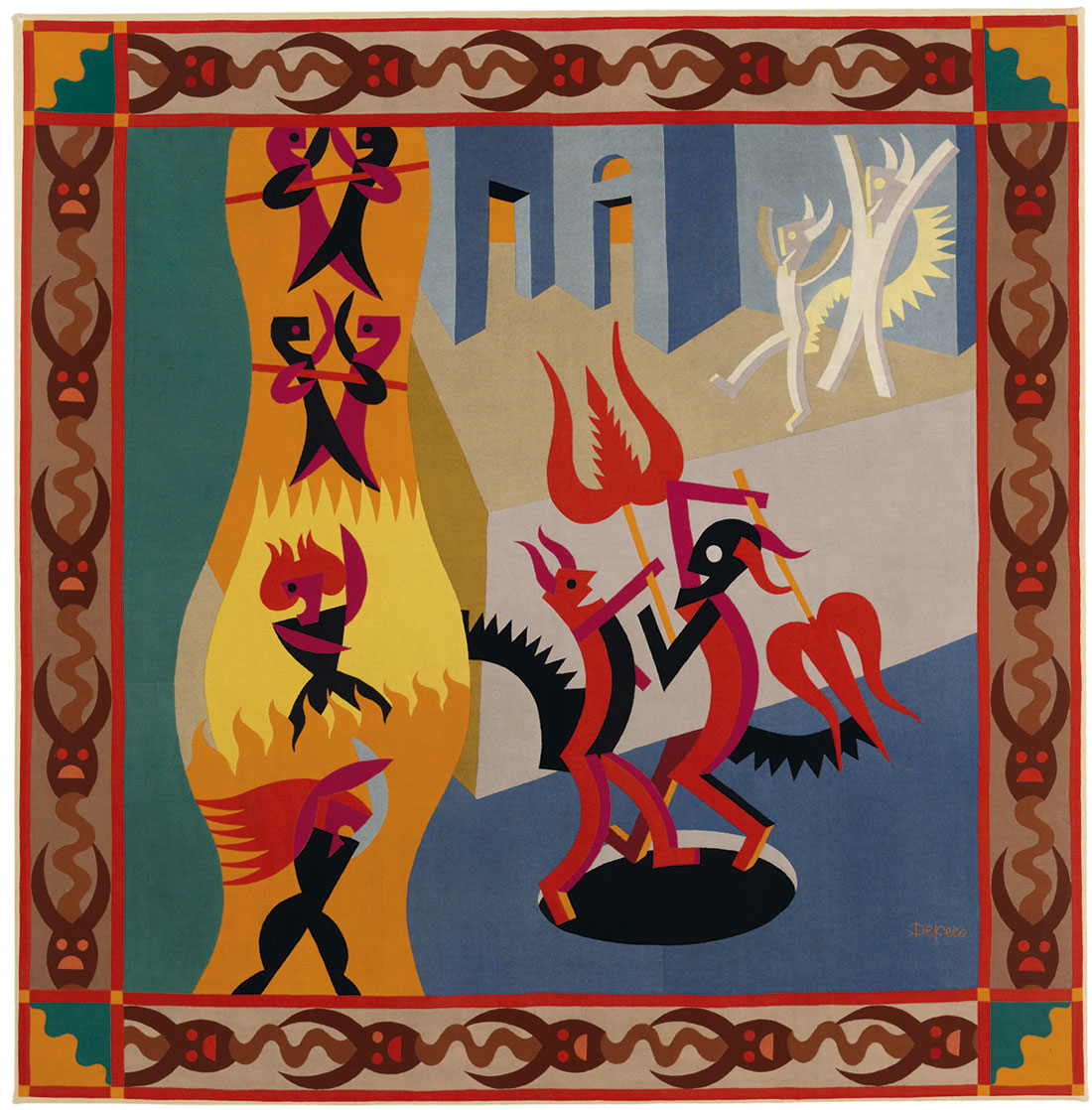
Fortunato Depero (Italian, 1892-1960) 'Little Black and White Devils, Dance of Devils' (Diavoletti neri e bianchi, Danza di diavoli) 1922-1923


Fortunato Depero (Italian, 1892-1960)
Little Black and White Devils, Dance of Devils (Diavoletti neri e bianchi, Danza di diavoli)
1922-1923
Pieced wool on cotton backing
184 x 181cm
MART, Museo di arte moderna e contemporanea di Trento e Rovereto, Italy
© 2014 Artists Rights Society (ARS), New York / SIAE, Rome
Photo: © MART, Archivio fotografico


Gerardo Dottori (Italian, 1884-1977) 'Cimino Home Dining Room Set' (Sala da pranzo di casa Cimino) early 1930s


Gerardo Dottori (Italian, 1884-1977)
Cimino Home Dining Room Set (Sala da pranzo di casa Cimino)
early 1930s
Table, chairs, buffet, lamp, and sideboard; wood, glass, crystal, copper with chrome plating, leather, dimensions variable
Private collection
© 2014 Artists Rights Society (ARS), New York / SIAE, Rome the Peggy Guggenheim Collection, Venice
Photo: Daniele Paparelli, courtesy Archivi Gerardo Dottori, Perugia, Italy


Gerardo Dottori (Italian, 1884-1977)

Gerardo Dottori (11 November 1884 – 13 June 1977) was an Italian Futurist painter. He signed the Futurist Manifesto of Aeropainting in 1929. He was associated with the city of Perugia most of his life, living in Milan for six months as a student and in Rome from 1926-39. Dottori’s’ principal output was the representation of landscapes and visions of Umbria, mostly viewed from a great height. Among the most famous of these are Umbrian Spring and Fire in the City, both from the early 1920s; this last one is now housed in the Museo civico di Palazzo della Penna in Perugia, with many of Dottori’s other works. His work was part of the art competitions at the 1932 Summer Olympics and the 1936 Summer Olympics.

Text from the Wikipedia website


Umberto Boccioni (Italian, 1882-1916) 'Elasticity (Elasticità)' 1912


Umberto Boccioni (Italian, 1882-1916)
Elasticity (Elasticità)
1912
Oil on canvas
100 x 100cm
Museo del Novecento, Milan
© Museo del Novecento, Comune di Milano (all legal rights reserved)
Photo: Luca Carrà


Umberto Boccioni (Italian, 1882-1916)

Umberto Boccioni (19 October 1882 – 17 August 1916) was an influential Italian painter and sculptor. He helped shape the revolutionary aesthetic of the Futurism movement as one of its principal figures. Despite his short life, his approach to the dynamism of form and the deconstruction of solid mass guided artists long after his death. His works are held by many public art museums, and in 1988 the Metropolitan Museum of Art in New York City organised a major retrospective of 100 pieces. …

Boccioni moved to Milan in 1907. There, early in 1908, he met the Divisionist painter Gaetano Previati. In early 1910 he met Filippo Tommaso Marinetti, who had already published his Manifesto del Futurismo (“Manifesto of Futurism”) in the previous year. On 11 February 1910 Boccioni, with Balla, Carlo Carrà, Luigi Russolo and Severini, signed the Manifesto dei pittori futuristi (“Manifesto of Futurist painters”), and on 8 March he read the manifesto at the Politeama Chiarella theatre in Turin.

Boccioni became the main theorist of the artistic movement. “Only when Boccioni, Balla, Severini and a few other Futurists traveled to Paris toward the end of 1911 and saw what Braque and Picasso had been doing did the movement begin to take real shape.” He also decided to be a sculptor after he visited various studios in Paris, in 1912, including those of Georges Braque, Alexander Archipenko, Constantin Brâncuși, Raymond Duchamp-Villon, August Agero and, probably, Medardo Rosso. In 1912 he exhibited some paintings together with other Italian futurists at the Galerie Bernheim-Jeune, and the following year returned to show his sculptures at the Galerie La Boétie: all related to the elaboration of what Boccioni had seen in Paris, where he had visited the studios of Cubist sculptors, including those of Constantin Brâncuși, Raymond Duchamp-Villon and Alexander Archipenko to further his knowledge of avant-garde sculpture.

In 1914 he published Pittura e scultura futuriste (dinamismo plastico) explaining the aesthetics of the group:

“While the impressionists paint a picture to give one particular moment and subordinate the life of the picture to its resemblance to this moment, we synthesise every moment (time, place, form, colour-tone) and thus paint the picture.”

Development of Futurism

Boccioni worked for nearly a year on La città sale or The City Rises, 1910, a huge (2m by 3m) painting, which is considered his turning point into Futurism. “I attempted a great synthesis of labor, light and movement” he wrote to a friend. Upon its exhibition in Milan in May 1911, the painting attracted numerous reviews, mostly admiring. By 1912 it had become a headline painting for the exhibition traveling Europe, the introduction to Futurism. It was sold to the great pianist, Ferruccio Busoni for 4,000 lire that year, and today is frequently on prominent display at the Museum of Modern Art in New York, at the entrance to the paintings department.

La risata (1911, The Laugh) is considered Boccioni’s first truly Futurist work. He had fully parted with Divisionism, and now focused on the sensations derived from his observation of modern life. Its public reception was quite negative, compared unfavourably with Three Women, and it was defaced by a visitor, running his fingers through the still fresh paint. Subsequent criticism became more positive, with some considering the painting a response to Cubism. It was purchased by Albert Borchardt, a German collector who acquired 20 Futurist works exhibited in Berlin, including The Street Enters the House (1911) which depicts a woman on a balcony overlooking a busy street. Today the former also is owned by the Museum of Modern Art, and the latter by the Sprengel Museum in Hanover.

Boccioni spent much of 1911 working on a trilogy of paintings titled “Stati d’animo” (“States of Mind”), which he said expressed departure and arrival at a railroad station – The Farewells, Those Who Go, and Those Who Stay. All three paintings were originally purchased by Marinetti, until Nelson Rockefeller acquired them from his widow and later donated them to the Museum of Modern Art in New York.

Beginning in 1912, with Elasticità or Elasticity (above), depicting the pure energy of a horse, captured with intense chromaticism, he completed a series of Dynamist paintings: Dinamismo di un corpo umano (Human Body), ciclista (Cyclist), Foot-baller, and by 1914 Dinamismo plastico: cavallo + caseggiato (Plastic Dynamism: Horse + Houses). While continuing this focus, he revived his previous interest in portraiture. Beginning with L’antigrazioso (The antigraceful) in 1912 and continuing with I selciatori (The Street Pavers) and Il bevitore (The Drinker) both in 1914.

In 1914 Boccioni published his book, Pittura, scultura futuriste (Futurist Painting and Sculpture), which caused a rift between himself and some of his Futurist comrades. As a result, perhaps, he abandoned his exploration of Dynamism, and instead sought further decomposition of a subject by means of colour. With Horizontal Volumes in 1915 and the Portrait of Ferruccio Busoni in 1916, he completed a full return to figurative painting. Perhaps fittingly, this last painting was a portrait of the maestro who purchased his first Futurist work, The City Rises.

Text from the Wikipedia website


Enrico Prampolini and Maria Ricotti, with cover by Enrico Prampolini. 'Program for the Theater of Futurist Pantomime' (Théâtre de la Pantomine Futuriste) Illustrated leaflet (Paris: M. et J. De Brunn, 1927)


Enrico Prampolini and Maria Ricotti, with cover by Enrico Prampolini
Program for the Theater of Futurist Pantomime (Théâtre de la Pantomine Futuriste)
Illustrated leaflet (Paris: M. et J. De Brunn, 1927)
27.5 x 22.7cm
Fonds Alberto Sartoris, Archives de la Construction Moderne-Ecole polytechnique fédérale de Lausanne (EPFL), Switzerland
By permission of heirs of the artist
Photo: Jean-Daniel Chavan


Carlo Carrà (Italian, 1881-1966) 'Interventionist Demonstration' (Manifestazione Interventista) 1914


Carlo Carrà (Italian, 1881-1966)
Interventionist Demonstration (Manifestazione Interventista)
1914
Tempera, pen, mica powder, paper glued on cardboard
38.5 x 30cm
Gianni Mattioli Collection, on long-term loan to the Peggy Guggenheim Collection, Venice
© 2014 Artists Rights Society (ARS), New York / SIAE, Rome
Photo: Courtesy Solomon R. Guggenheim Foundation, New York


Carlo Carrà (Italian, 1881-1966)

Carlo Carrà (Italian, February 11, 1881 – April 13, 1966) was an Italian painter and a leading figure of the Futurist movement that flourished in Italy during the beginning of the 20th century. In addition to his many paintings, he wrote a number of books concerning art. He taught for many years in the city of Milan.

In 1899-1900, Carrà was in Paris decorating pavilions at the Exposition Universelle, where he became acquainted with contemporary French art. He then spent a few months in London in contact with exiled Italian anarchists, and returned to Milan in 1901. In 1906, he enrolled at Brera Academy (Accademia di Brera) in the city, and studied under Cesare Tallone. In 1910 he signed, along with Umberto Boccioni, Luigi Russolo and Giacomo Balla the Manifesto of Futurist Painters, and began a phase of painting that became his most popular and influential.

Text from the Wikipedia website


Luigi Russolo (Italian, 1885-1947) "The Art of Noises: Futurist Manifesto" ("L'arte dei rumori: Manifesto futurista") Leaflet (Milan: Direzione del Movimento Futurista, 1913)
 

Luigi Russolo (Italian, 1885-1947)
“The Art of Noises: Futurist Manifesto” (“L’arte dei rumori: Manifesto futurista”)
Leaflet (Milan: Direzione del Movimento Futurista, 1913)
29.2 x 23cm
Wolfsoniana – Fondazione regionale per la Cultura e lo Spettacolo, Genoa
By permission of heirs of the artist
Photo: Courtesy Wolfsoniana – Fondazione regionale per la Cultura e lo Spettacolo, Genoa


Luigi Russolo (Italian, 1885-1947)

Luigi Carlo Filippo Russolo (30 April 1885 – 6 February 1947) was an Italian Futurist painter, composer, builder of experimental musical instruments, and the author of the manifesto The Art of Noises (1913). He is often regarded as one of the first noise music experimental composers with his performances of noise music concerts in 1913–14 and then again after World War I, notably in Paris in 1921. He designed and constructed a number of noise-generating devices called Intonarumori.

Luigi Russolo was perhaps the first noise artist. His 1913 manifesto, L’Arte dei Rumori (The Art of Noises), stated that the industrial revolution had given modern men a greater capacity to appreciate more complex sounds. Russolo found traditional melodic music confining, and he envisioned noise music as its future replacement.

Russolo designed and constructed a number of noise-generating devices called Intonarumori, and assembled a noise orchestra to perform with them. A performance of his Gran Concerto Futuristico (1917) was met with strong disapproval and violence from the audience, as Russolo himself had predicted.

Text from the Wikipedia website


Mino Somenzi, ed., with words-in-freedom image Airplanes (Aeroplani) by Pino Masnata. 'Futurismo 2, no. 32' (Apr. 16, 1933) Journal (Rome, 1933)


Mino Somenzi, ed., with words-in-freedom image Airplanes (Aeroplani) by Pino Masnata
Futurismo 2, no. 32 (Apr. 16, 1933)
Journal (Rome, 1933)
64 x 44cm
Fonds Alberto Sartoris, Archives de la Construction Moderne–Ecole polytechnique fédérale de Lausanne EPFL), Switzerland
Photo: Jean-Daniel Chavan


Fortunato Depero (Italian, 1892-1960) 'Heart Eaters' (Mangiatori di cuori) 1923


Fortunato Depero (Italian, 1892-1960)
Heart Eaters (Mangiatori di cuori)
1923
Painted wood
36.5 x 23 x 10cm
Private collection
© 2014 Artists Rights Society (ARS), New York / SIAE, Rome
Photo: Vittorio Calore


Umberto Boccioni (Italian, 1882-1916) 'Unique Forms of Continuity in Space' (Forme uniche della continuità nello spazio) 1913 (cast 1949)


Umberto Boccioni (Italian, 1882-1916)
Unique Forms of Continuity in Space (Forme uniche della continuità nello spazio)
1913 (cast 1949)
Bronze
121.3 x 88.9 x 40cm
The Metropolitan Museum of Art, New York, Bequest of Lydia Winston Malbin, 1989
© The Metropolitan Museum of Art
Image Source: Art Resource, New York


Benedetta (Cappa Marinetti) (Italian, 1897-1977) 'Synthesis of Aerial Communications' (Sintesi delle comunicazioni aeree) 1933-1934


Benedetta (Cappa Marinetti) (Italian, 1897-1977)
Synthesis of Aerial Communications (Sintesi delle comunicazioni aeree)
1933-1934
Tempera and encaustic on canvas
324.5 x 199cm
Il Palazzo delle Poste di Palermo, Sicily, Poste Italiane
© Benedetta Cappa Marinetti, used by permission of Vittoria Marinetti and Luce Marinetti’s heirs
Photo: AGR/Riccardi/Paoloni


Benedetta Cappa (Italian, 1897-1977)

Benedetta Cappa (14 August 1897 – 15 May 1977) was an Italian futurist artist who has had retrospectives at the Walker Art Center and the Solomon R. Guggenheim Museum. Her work fits within the second phase of Italian Futurism.

Though she was an artist active in Futurist circles, Cappa felt labels were restrictive and initially rejected the designation. In a 1918 correspondence with F.T. Marinetti she writes, “I am too free and rebellious – I do not want to be restricted. I want only to be me.” Despite entering her marriage with such determined independence, the considerable contributions made by Cappa are often overshadowed by the figure of Marinetti and the vociferous manner with which he directed the movement. Cappa’s body of work spanned a range of media that included pen, paper, paint, metal and textiles. She wrote poetry and prose, signed, and spoke as an individual, but only recently has she garnered independent recognition.

In 1919, Cappa published Spicologia di 1 Uomo, a collection of poetry which incorporates “unusual word placement, typographic experimentation, and visual and auditory correspondences.” Subsequently published in 1924, Le Forze Umane: Romanzo Astratto con Sintesi Grafiche (Human Forces: Abstract Novel with Graphic Synthesis), has a similar structure presented in an extrapolated form. Two images from this novel provide an interesting conceptual contrast. The first, Forze Feminile: Spirale di Dolcezza + Serpe di Fascino (Feminine Forces: Spiral of Sweetness + Serpent of Charm) consists simply of three curved lines, one of which provides a central axis for the other two. The linear composition of the second drawing, Forze Maschili: Armi e Piume (Masculine Forces: Weapons and Feathers), has numerous straight lines and arcs arranged in an impenetrable tangle.

Cappa’s publication of Le Forze Umane was one of three books she has written. The release of her book made many futurists question her allegiance with Futurism, for her book seemed to align more with Neo-Plasticism at the time by many male Futurists who have written reviews on Cappa’s book. Cappa collected all of the reviews in her Librone which can be found at the Getty Research Institute. It was a decision made from many reviewers that Cappa’s first book represents the unwillingness from the reviewers to accept a women’s work as part of Futurism.

The action and aesthetic of the machine age is a trope within Futurism that appears frequently in Cappa’s artwork. One early abstract painting, Velocità di Motoscafo, (Velocity of a Motorboat), (1923-24), contains many of the elements that would come to mark Cappa’s painting style. Well defined, curvilinear shapes, painted in gradient tones are compositionally arranged to imply objects in motion: “… the interplay of ‘force lines,’ become the subject.” The artist’s exploration of the machine continued with Luci + Rumori di un Treno Notturno, (Lights + Sounds of a Night Train), (c. 1924) and with Aeropittura (1925). A trip to Latin America in 1926 was followed by a series of abstract paintings done in gouache on paper.

As Cappa developed her artistic practice, her influence within the Futurist Movement expanded. Between the end of World War I and the early 1930s, there was an ideological transformation which led to the period commonly known as Second Wave Futurism. The notably misogynistic tone of the foundation texts was largely muted as the number of female Futurists increased. Several other themes, such as Technology, Speed, and Mechanisation carried over into this new incarnation of Futurism. For this reason, Cappa’s oil painting Il Grande X (1931) is considered the culmination of one era and the prelude to another. In the two decades since F.T. Marinetti’s manifesto, the brash avant-garde movement had largely become the establishment.

It was the Futurists’ affiliation with the state establishment that would lead to one of Cappa’s most recognisable paintings, her mural series for the Conference Room at the Palazzo delle Poste in Palermo, Sicily. The building is an amalgam of works by several Futurist artists. Designed by the Rationalist architect, Angiolo Mazzoni, the Poste Italiane houses tile wall mosaics by Luigi Colombo Filìa and Enrico Prampolini in addition to the murals by Benendetta. The shared themes of synthesis and communication are critical to the aesthetic program of the Futurist structure. Completed between 1933 and 1934, each painting depicts a form of information transfer, including terrestrial, maritime, aerial, radio, telegraphic and telephonic communication. The pale blue and green colour palette, along with the use of tempera and encaustic media, were designed to invoke resonances with Pompeian frescos. The collection represents the idealised speed and efficiency of message delivery in the modern world.

Text from the Wikipedia website


Solomon R. Guggenheim Museum
1071 5th Avenue (at 89th Street)
New York

Opening hours:
Sunday – Monday 11am – 6pm
Wednesday – Friday 11am – 6pm
Saturday 11am – 8pm
Closed Tuesday

Solomon R. Guggenheim Museum website

LIKE ART BLART ON FACEBOOK

Back to top

Review / Interview: Simon Maidment, co-curator of the exhibition ‘David McDiarmid: When This You See Remember Me’ at NGV Australia, Melbourne

Exhibition dates: 9th May – 31st August, 2014

Co-curators: Simon Maidment, NGV and Dr Sally Gray, guest curator


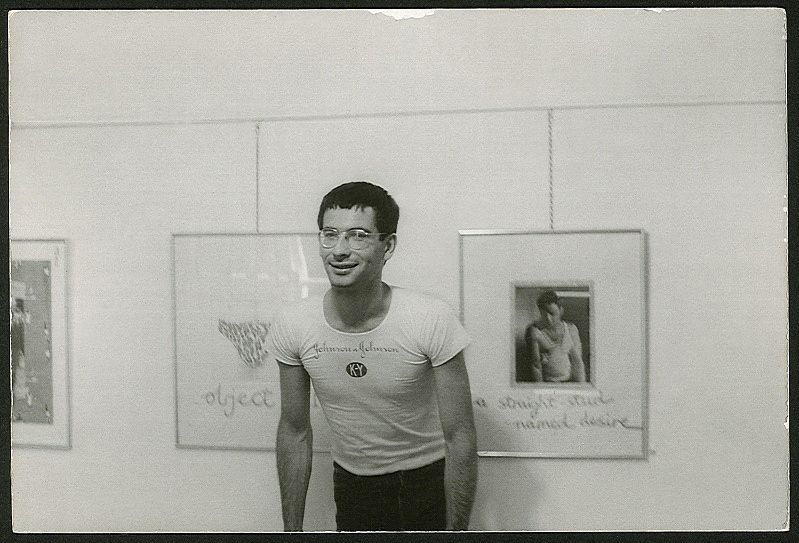
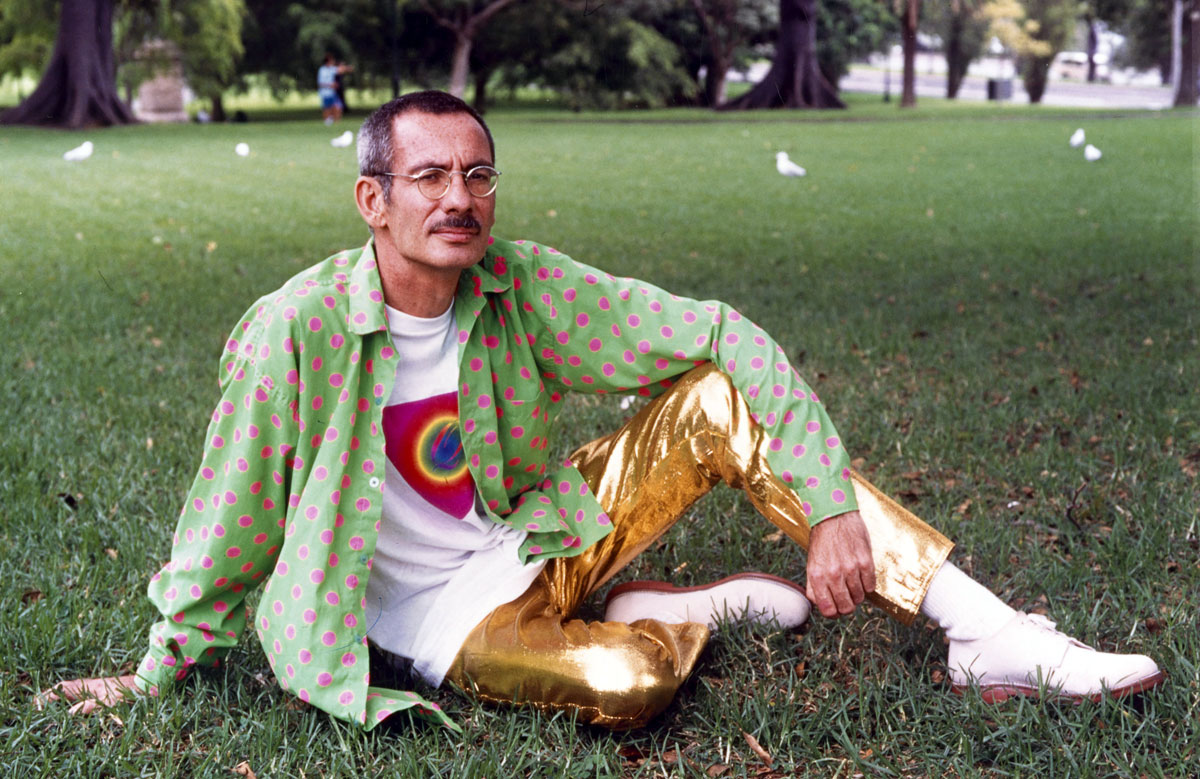
Unidentified photographer. 'David McDiarmid at his first one-man show 'Secret Love', Hogarth Gallery, Sydney, 1976' 1976 from the exhibition 'David McDiarmid: When This You See Remember Me' at NGV Australia, Melbourne, May-  August, 2014


Unidentified photographer
David McDiarmid at his first one-man show ‘Secret Love’, Hogarth Gallery, Sydney, 1976
1976
Silver gelatin photograph
Dennis Altman Collection, Australian Lesbian and Gay Archives (ALGA)


Here’s winking at you, sweetie…

My apologies for the slightly out of focus nature of some of the installation photographs, but I had to take them quickly as I walked through the gallery with co-curator Simon Maidment. If you relied on the nine press images supplied by the NGV (bottom of the posting), you would have no idea of the complexity of this artists work nor would you possess an understanding of the scale, intimacy, brashness, beauty and confrontational visibility of the art. You would also have no idea what a stunning installation the NGV has produced to display the work.

Simply put, this is the best exhibition I have seen in Melbourne this year.

David McDiarmid – activist (the first gay person ever to be arrested in Australia) and multi-dimensional artist – proves the personal IS political AND influential. His work moves from early personal narratives through decorative to visually commanding and confrontational art. As homosexual identity transits from camp to gay to queer, McDiarmid deconstructs and redefines this identity using context as a FOIL for his art making. As Robert Nelson in his excellent review of the exhibition in The Age newspaper observes, “McDiarmid’s expression of the erotic is an act of protest as well as festivity. When McDiarmid began in full fervour, gay sex was not only reviled but illegal; and as he ended his career, homosexuality seemed to pass from the police to the undertaker. He began his expose of gay eroticism in the spirit of a demonstration and ended it as an act of compassion.”1

Well said. Homosexuality was illegal were McDairmid started making art and was deathly when he himself succumbed to the Grim Reaper. But during the journey that he took the key thing to remember is that McDiarmid never “passed” as something he was not. He was always up front, out there, doing his thing since he was first arrested in 1971. He was always pushing the boundaries, offering a wider perspective on social histories and political contexts. He questioned the marginalisation of minorities (Secret Love, 1976), the boundaries of self and society and examined taboo and transgression in a conservative society. He lived at the cutting edge of culture. Later, he waged a life and death struggle for HIV/AIDS funding, awareness and compassion with a fierce determination combined with sparkling wit, humour and sardonic aphorisms. Sexual politics and safe sex campaigns went hand in hand.

Of course, sexuality and sexual identity were at the core of his creativity. He explored the urban gay male world and the struggle for gay rights, sexual and emotional sensibilities and the cultural politics of HIV/AIDS. Early work was influenced by time spent in New York (where he knew Keith Haring) and San Francisco, where he experienced the development of the clone scene and the music of the clubs. His mode of construction has a lot in common with folk and women’s art (in particular patchwork and quilting) coupled with the use of contemporary materials (such as holographic foil).

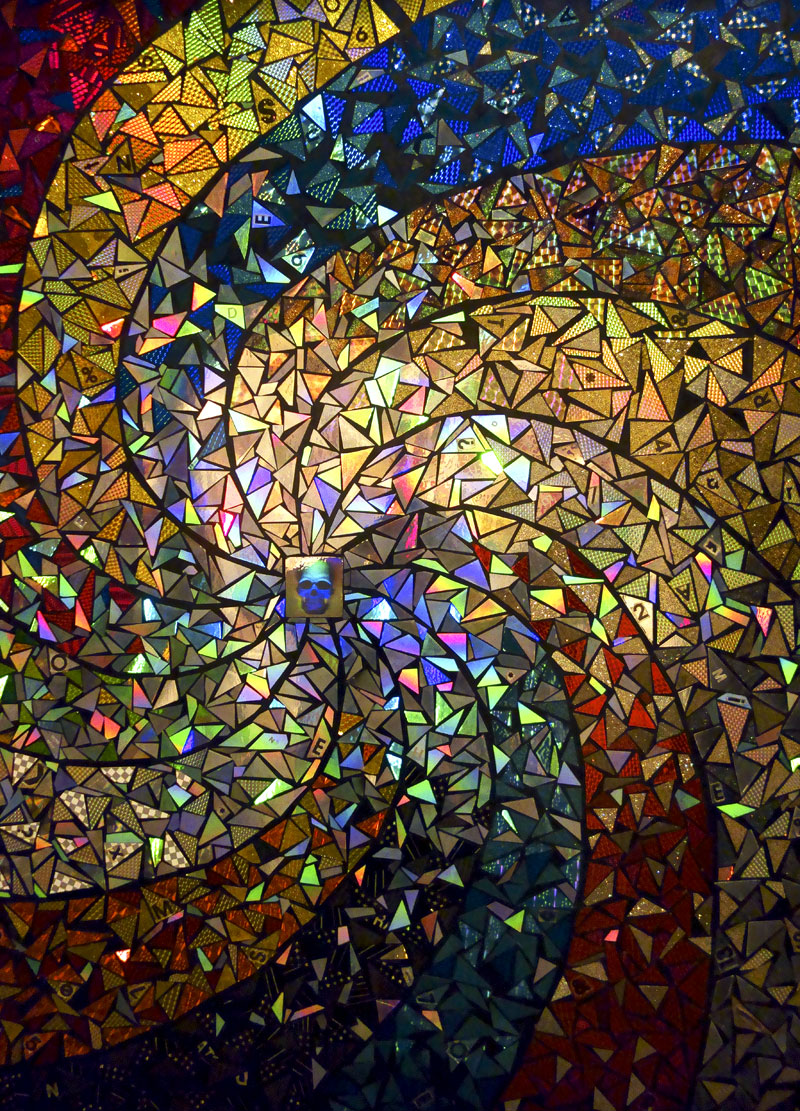
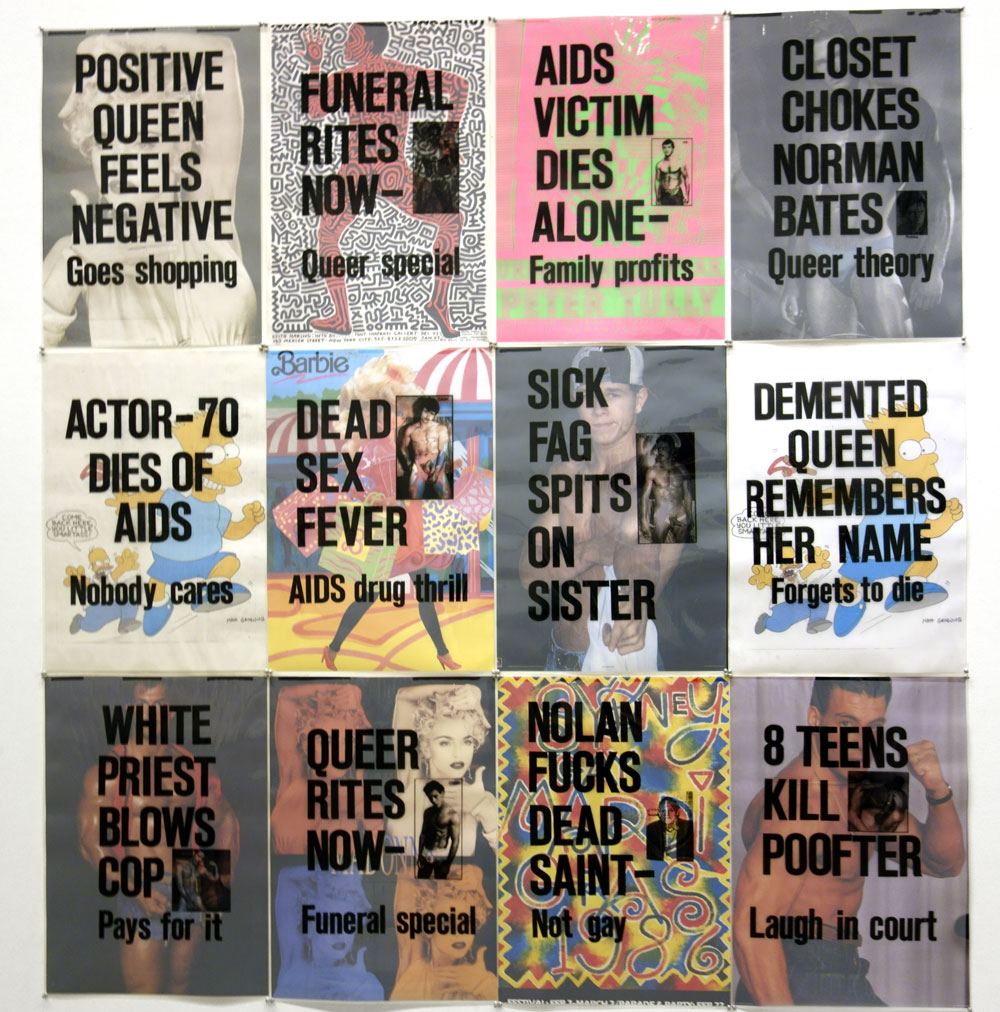
McDiarmid’s later work becomes more symbolic and universal but still contains that cutting edge of the personal (DEMENTED QUEEN REMEMBERS HER NAME – forgets to die; POSITIVE QUEEN FEELS NEGATIVE – goes shopping). In the most amazing room of art I have seen this year, McDiarmid uses reflective cut and tiled holographic foils to create moving tribute and biting comment on the HIV/AIDS epidemic. In this darkened room the viewer is surrounded by tiles that “scintillate in spectral transience, changing their colours holographically according to your movement. The image is blunt and horny but also melancholy and scary; and similarly the medium impenetrable, deflecting the gaze and forcing you to change perspective.” (Robert Nelson)

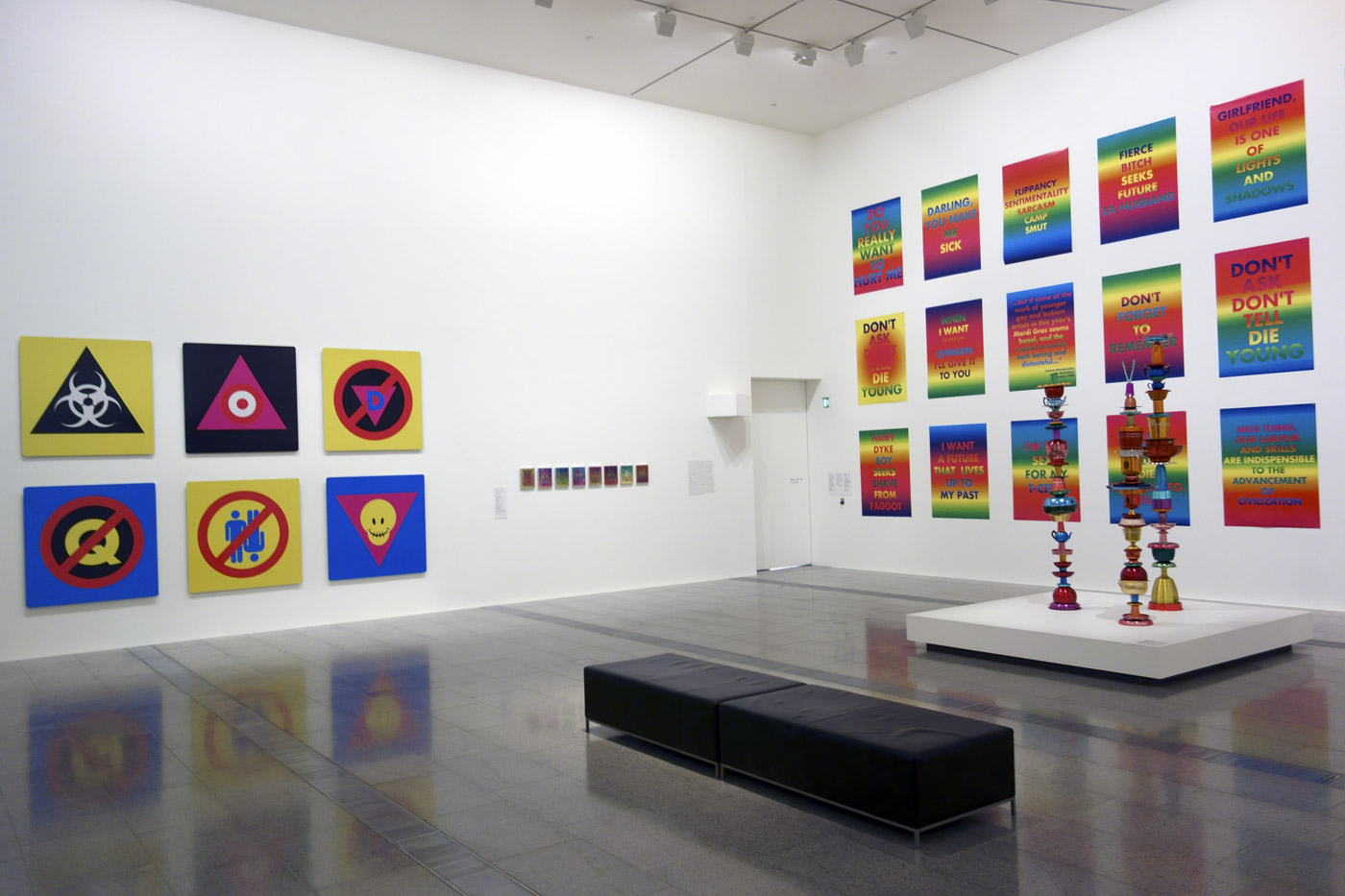
But it’s more than that. You are surrounded by metallic flesh and embedded amongst the iridescence is both love and hate, life and death, winking eyes and holographic rainbow coloured skulls. Body language (1990, below) contains the names of McDairmid’s dead lovers woven into its fabric, a Swastika with the word AIDS for a head and the desire for the anus as a man pulls his arse cheeks apart. But here’s the rub – the tiny, puckered hole contains a holographic image of a winking eye, inviting you in, sharing the death/life joke with you. It’s a classic. In this room it feels as though you are surrounded by the fires of hell as the opalescence of the work changes from footstep to footstep, from positive to negative, from love to hate – and the pure beauty of the work is overwhelming. These are absolutely stunning works of art by any mark of the imagination, up there with the very best art ever made in Australia. His famous Rainbow Aphorisms series 1994 (below) are strong but they are are not a patch on the silver foil works. Less successful are the textile and costume designs, the weakest part of the exhibition.

One question springs to mind. Would his art have been as strong without the impetus of “death art” behind it? What would it have looked like?

I wonder which direction his art would have taken after his initial investigation of gay male identity had he not contracted HIV / AIDS and started making art about the disease. This strong focus gives the work the impetus and grunt it needed to move from the purely decorative and graphic, ney camp in some cases, to work with serious gravitas. In these later works McDiarmid lays it all on the line and just goes for it. I am so glad he did. They are powerful, concise, confrontational, beautiful, shimmering renditions of a soul living life to the full while he still had time.

It’s a pity the NGV has not advertised and promoted this exhibition more extensively. With a stunning catalogue, insightful research, amazing installation and world class art this is one exhibition you shouldn’t miss in Melbourne this winter.

Dr Marcus Bunyan

ART BLART: THE ONLY PLACE TO SEE INSTALLATION PHOTOGRAPHS OF THIS EXHIBITION ON THE WEB.


Many thankx to Simon for allowing me to take the installation photographs during our discussion and to the NGV for allowing me to publish them, along with the nine press images at the bottom of the posting. All installation photographs © Marcus Bunyan and the National Gallery of Victoria. Please click on the photographs for a larger version of the image.


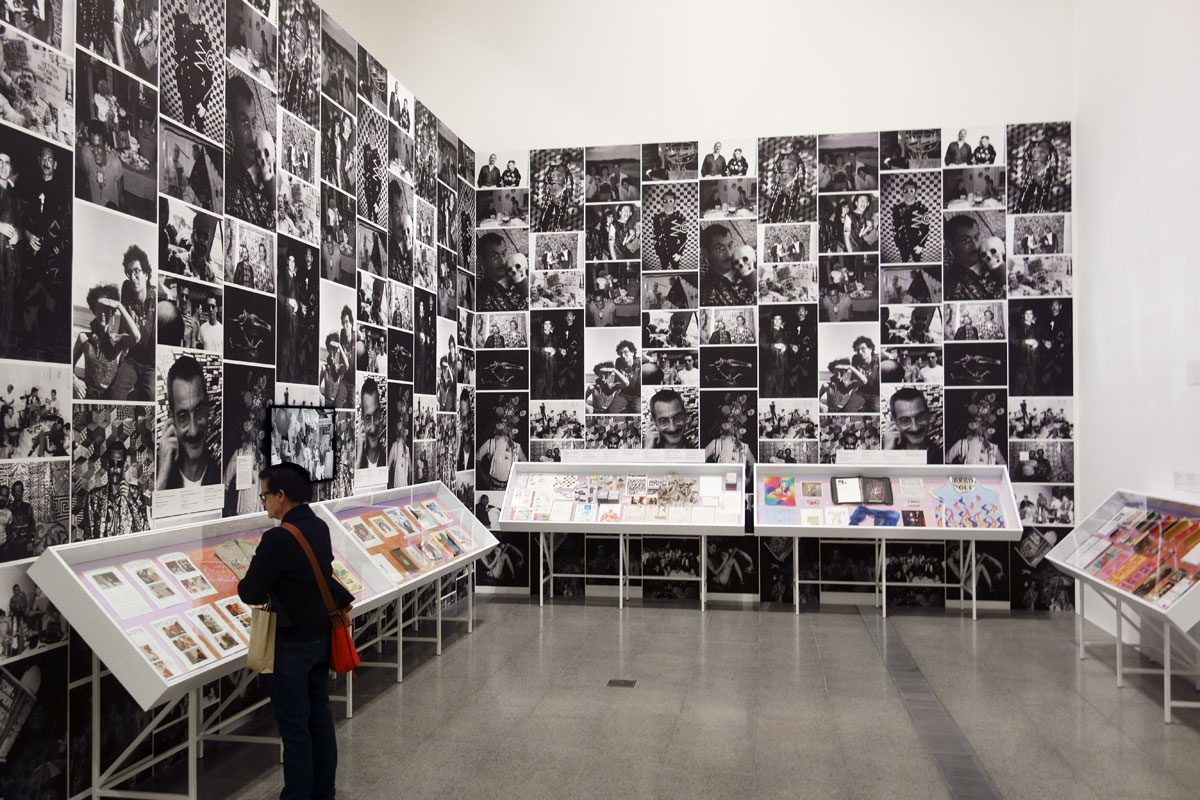
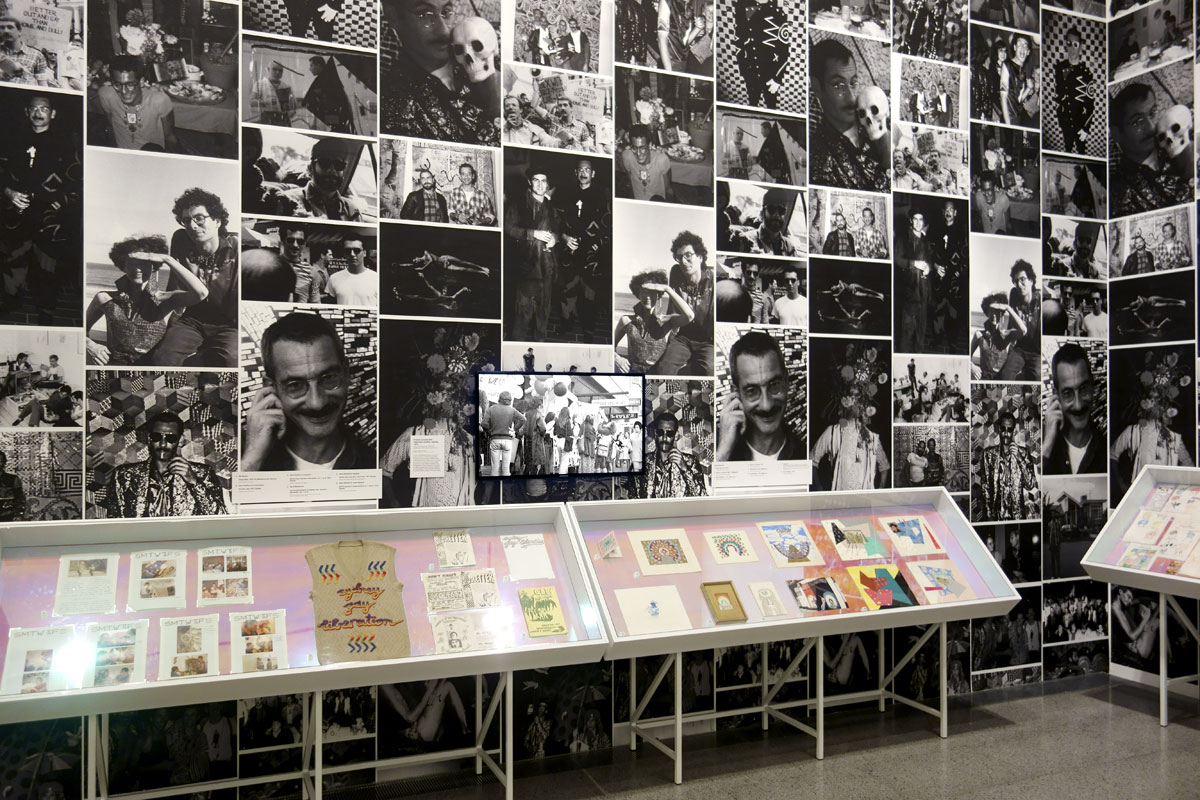
Installation photograph of early works by David McDiarmid in the exhibition 'David McDiarmid: When This You See Remember Me' at NGV Australia, Melbourne

Installation photograph of early works by David McDiarmid in the exhibition 'David McDiarmid: When This You See Remember Me' at NGV Australia, Melbourne


David McDiarmid (Australian 1952-1995, worked in United States 1979-1987)
Installation photograph of early works including, in the case, Vest (c. 1972), hand-embroidered by McDiarmid with the words ‘sydney gay liberation’ as a gift for John Lee with photographs of McDiarmid and artist Peter Tully used as a wallpaper on the wall behind at the exhibition David McDiarmid: When This You See Remember Me at NGV Australia, Melbourne
Photos: Marcus Bunyan


Installation photograph of early works including 'Secret Love art show, poster' (1976, far left), 'Secret Love' (1976, top centre left), 'Ken's Karate Klub' (1976, centre below left) and 'Tube of joy' (1976, above right) - all from the 'Secret Love' series, 1976 except KKK by David McDiarmid in the exhibition 'David McDiarmid: When This You See Remember Me' at NGV Australia, Melbourne


David McDiarmid (Australian 1952-1995, worked in United States 1979-1987)
Installation photograph of early works including Secret Love art show, poster (1976, far left), Secret Love (1976, top centre left), Ken’s Karate Klub (1976, centre below left) and Tube of joy (1976, above right) – all from the Secret Love series, 1976 except KKK – at the exhibition David McDiarmid: When This You See Remember Me at NGV Australia, Melbourne
Photo: Marcus Bunyan


David McDiarmid. 'Secret Love' 1976 (installation view)


David McDiarmid (Australian 1952-1995, worked in United States 1979-1987)
Secret Love (installation view)
1976
From the Secret Love series, 1976
Metallic paint, red fibre-tipped pen, coloured pencil, collage of cut photo-offset lithograph and red and black ink on graph paper
78 x 66cm
Collection of Paul Menotti and Bryce Kerr, Sydney
Photo: Marcus Bunyan


David McDiarmid. 'Secret Love' 1978 (installation view)


David McDiarmid (Australian 1952-1995, worked in United States 1979-1987)
Secret Love (installation view)
1978
Collage of cut colour photo-offset lithographs on plastic, metal and plastic
135 x 142.8cm
Collection of Bernard Fitzgerald, Sydney
Photo: Marcus Bunyan


David McDiarmid. 'Secret Love' 1978 (installation view detail)


David McDiarmid (Australian 1952-1995, worked in United States 1979-1987)
Secret Love (installation view detail)
1978
Collage of cut colour photo-offset lithographs on plastic, metal and plastic
135 x 142.8cm
Collection of Bernard Fitzgerald, Sydney
Photo: Marcus Bunyan


Various artworks by David McDiarmid from 1978 (installation view) in the exhibition 'David McDiarmid: When This You See Remember Me' at NGV Australia, Melbourne


David McDiarmid (Australian 1952-1995, worked in United States 1979-1987)
Installation view of various artworks from 1978 including Strangers in the night (top second left), Mardi Gras (top fourth left), Juicy fruit (top second right) and Real confessions (bottom second left)
All National Gallery of Victoria
Photo: Marcus Bunyan


Bush Couture, Sydney (fashion house) Linda Jackson (designer) David McDiarmid (painter) 'Paua kimono' 1984 (installation view)


Bush Couture, Sydney (fashion house) (front)
Linda Jackson (designer)
David McDiarmid (Australian 1952-1995, worked in United States 1979-1987) (painter)
Paua kimono (installation view)
1984
National Gallery of Victoria, Melbourne
Photo: Marcus Bunyan


Interview with co-curator Simon Maidment

MB: First of all Simon, can I ask how long have you been at the National Gallery of Victoria and what brought you to the institution?

SM: I’ve been at the NGV since June 2013 and I joined because of a new vision for the gallery which is making contemporary art a priority, both in collecting practices in the exhibitions that the NGV holds. Recently, there has been a real push for change, precipitated by the appointment of Max Delany who is a friend and colleague I respect a lot and who has been really supportive of my career.

MB: So what was your background in terms of training?

SM: I studied as an artist and immediately before coming to the NGV I was undertaking my PhD at The University of Melbourne’s Victorian College of the Arts Centre for Ideas with Elizabeth Presa as one of my supervisors.

MB: And what new knowledge was your PhD based around?

SM: It investigated curatorial practices that could be thought of as context responsive, looking at artists who seek to enact some sort of social and/or political change.

MB: So this exhibition would be perfect to fit into that…

SM: Yes, indeed… so largely my background has been working with living artists. I have done a few shows in which I have worked with existing bodies of work, but I have done a lot of shows where I have been facilitating artists works. I started as an artist working in media arts – sound, video, projection and digital technologies – and often worked as a studio assistant for more senior artists, people like Sue Ford, Susan Fereday, Ian de Gruchy and my role with them became more and more about facilitation. Then the directorship of Westspace came up and I got that, and my focus turned more from collaboration and working as a studio assistant to facilitation. I became a curator because basically that is what I was doing.

MB: So can you tell me Simon, what was the lead in time for this exhibition? I know it was postponed and delayed at various times, what were the reasons for that?

SM: It was kind of before my time so I am not really sure, but there have been different curators at different times from the NGV involved with the project. So Ted Gott was involved with the exhibition, even before he began work at the NGV. Ted was involved with David’s estate with Sally Gray, my co-curator, right from the start, so he’s been an advisor to Sally right from the start of this long journey. I think the initial discussion about the show was with Ted, and then when Jason Smith was in my position he was involved in this project. When I was talking with Sally the very first discussions about holding the exhibition at the NGV was maybe 15 years ago…

MB: So to finally get it here and up on the walls…

SM: So when I started 11 months ago there was really very little in place. So Max Delany and Sally started a conversation about working towards this show probably about 14 months ago. When Tony Ellwood started he was like, “We’re doing this show.” He’s a big fan of David McDiarmid. He was very familiar with his work so I think that helped speed things along and he really facilitated getting this exhibition done. It was scheduled for 2011.

MB: To get it together from start to finish in 14 months is pretty amazing really…

SM: It was a lot of work but bearing in mind how familiar Sally is with the material we kind of had a real head start.

MB: But then you have to pull it all together from lenders and institutions that hold works and that would have been very intensive. Then to design it all and to make it look like it does. It looks fantastic! Everyone at the opening was just smiling and having a good time, looking at the work, remembering.

SM: I knew the work en masse would blow people away.

MB: Reading the catalogue, you can see that David comes from a period where there was a ground swell of social movements, which was almost like one movement. Everybody went to everyone else’s rallies and they all protested together. David McDiarmid was the very first gay person to get arrested in Australia and at the moment I am digitally restoring the image of him being marched away by two policemen at the ABC protest in Sydney. It is so degraded it will take a long time to restore but it is a really important image. Out of that there comes a real social conscience, fighting for your rights and freedom. So leading on from that, when you think about having this exhibition here now (after Ted Gott’s seminal exhibition Don’t Leave Me This Way: Art in the Age of AIDS at the National Gallery of Australia in 1994), you observe that marginalised voices rarely enter institutional centres of art, rarely enter the mainstream art. It’s usually ARI’s or small public galleries. Not that the artist is gay (because they are just artists) but that the CONTENT addresses gay issues – which is why it’s so fantastic to see this exhibition here at the NGV.

So were there any barriers here to doing David’s show?

SM: No, not really. I think one of the really important things to note is that they show would not have really happened without the large gift from the estate. Becoming the key holder and custodian of David McDiarmid’s work added extra emphasis and responsibility about doing the right thing. At that point the organisation is implicated in that legacy and somehow we have to disseminate the work out into the community.

MB: It is quite a confronting show, how do you think the general public will respond to it?

SM: I have done a couple of tours of people through the exhibition, members and other, and one of the things that has been surprising to me, in a way, which has only become apparent when I have been describing the show in which David makes work in response to particular social and political conditions and contexts… is how different things are. AIDS is now not a terminal illness. To speak to a younger generation than even myself, they have no idea about dying from lack of a viable treatment, of AIDS being a death sentence.

MB: Last night I had a cry for all the people I had loved and lost. But it’s not just the public coming in to see this exhibition, it’s young gay men who don’t ever see anybody ill, don’t understand about the side effects of taking the medication, about what living with HIV is like. They don’t understand the struggle that went on for them to live as they do now. Do you think they will engage with that?

SM: We have structured the show in a way that teases those things out. One of the aspects of McDiarmid as a figure that I find very interesting is that, in 20 short years of practice, he spanned incredible key moments and periods of change in broader society and also within gay society. The legal, medical, institutional change… and really looking at that 20 years is looking at a period of immense social change. The narrative of the exhibition is then to reflect on that broader cultural shift through the biography of one person.

MB: It’s interesting when I looked at the show, when you start making work as an artist it’s always about personal narratives – lovers, friends, places – which then widens out into more universal concerns. You can see in David’s early work him scribbling, writing and really intimately notating his world, investigating his self and his relations to the world around him. And then to take that insight and then to mould it into these reflective images into the Rainbow Aphorisms at the end is an incredible journey. Stephen Alkins was saying to be last night that even the last works were still grounded in this humorous, ironic look at life. He as a really important multimedia artist when you actually study the work.

SM: Just to pick up on one aspect that you are mentioning, and going back into my own background, one of things that Max Delany and I have been talking about that has in some ways illuminated this project is that, in the 1970s and 80s that saying ‘The personal is political’, is very important. David’s work is talking very much about the political as his own biography. Perhaps there is a shift in his later work to a more symbolic realm, and I would argue that nowadays artists working in a political and social context and to affect social change is not so much now as a personal identity – a woman, a black man, a gay man – it’s not necessarily about individual identities anymore, in some ways those battles seem to have been won within Western society. Actually for artists now in this context it’s more about neo-liberalism or capitalism. So it tends to be more on an institutional level and people tackling that in a much more symbolic realm. For instance I am thinking of such people as Jeremy Deller, an English artist who engages with British history and in particular his Battle of Orgreave, a reenactment of the actual Battle of Orgreave which occurred during the UK miners’ strike in 1984.

MB: People like Tom Nicholson in Australia, then, who did the Monument for the flooding of Royal Park (2008-2010), a proposition for the scattering of nardoo sporocarp throughout Royal Park, a vast Park in Melbourne’s inner north which was Burke and Wills departure point, now commemorated by a small cairn.

SM: Exactly. Artists like Tom are working in very propositional ways about memory, social imagination, monuments and memorialisation. All those kind of things are very much within a symbolic realm now. McDiarmid’s work fills the personal and then moves into the symbolic.

MB: But then Stephen Alkins said it was always personal to David, still based in the personal. He was very loyal to his friends, he was a very quiet person, very loving person with great energy. But he didn’t suffer fools gladly, and I think that this comes out of that culture of standing up for yourself and being strong because of the stuff we had to go through to where we are today. Seeing this exhibition actually shows you that difference and what we had to fight for.

SM: There’s a real drive there in that last room. He made so much work, across so much media, at the end of his life – that impending death drive was the source of so much creativity.

MB: McDiarmid was heavily influenced by international artists such as Keith Haring but he never really showed overseas. What do you think about that diaspora, that going overseas and then returning home to then begin exhibiting?

SM: Well the earlier work is, as you say, heavily influenced by the New York scene, the clone scene that was prevalent in the 80s – San Francisco, New York – so he’s definitely channelling those places… Interestingly, unlike many other artists, his art practice is nearly all Australian.

MB: Finally, what do you think is is his legacy in terms of his standing as an artist?

SM: In the last ten years of his life he was heavily involved as a community artist. He was incredibly busy and incredibly involved with things like the organisation of the Sydney Gay Mardi Gras and the design of the posters and floats. He was director of Mardi Gras from 1988-90 and he worked up float designs for various groups. You really get a sense of, as you said, of the solitary work of an artist and a real commitment to that work. In terms of his legacy as an artist, I don’t think that we will know until the exhibition is over. His work, such as the Rainbow Aphorisms, has been distributed widely but not really in an art context, and certainly not in a museum show such as this. People have not had the opportunity to visualise his work as a whole body of work until now.

MB: That brings me to the international context. The Keith Haring Foundation relentlessly promotes his work through books, exhibitions and conferences throughout the world. Do you think that you will start promoting his work overseas to other galleries and getting it into international exhibitions?

SM: I think the book will open a lot of doors. Because his work reproduces so well, because his writing is so interesting there is a broad range of voices for the scholars to investigate. But I think because the work reproduces so beautifully that will be hugely important. One of the aspects that the book will hopefully communicate to a younger audience is that of an infected muscular, sexually active, virile man not an emaciated artist… but to understand that and where that came from, and how radical that was at the time. I think that is one of the legacies that people will take away from David’s work. He is one of the artists that has been really instrumental in redefining that imaginary representation of a dying gay man.

MB: I remember seeing those + and – posters in gay sex venues, and thinking to myself, wow those are so amazing, who did those!

SM: Yes, those posters are about not closing down, about always been open to possibilities.

MB: Thank you so much Simon for taking the time to talk to me, it’s been great.

SM: Always a pleasure.


Dr Marcus Bunyan with Simon Maidment for Art Blart, June 2014

Simon Maidment is Curator of Contemporary Art at the NGV.


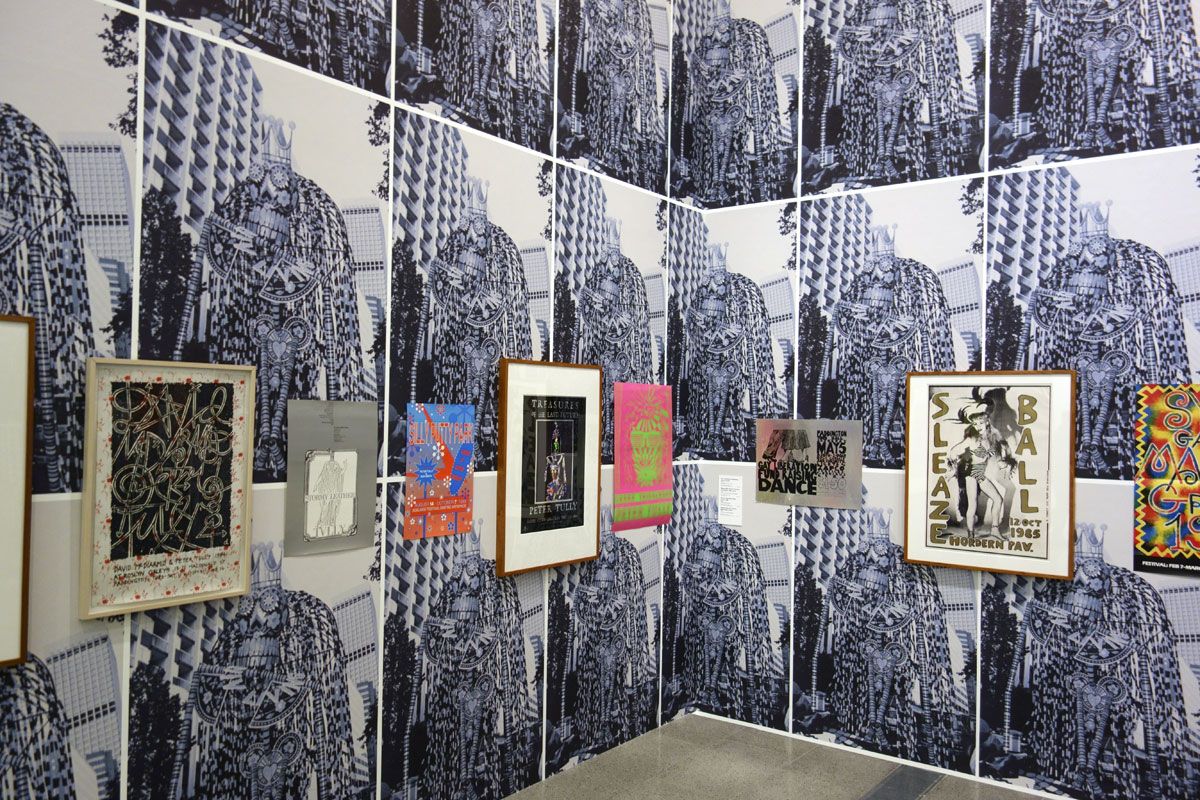
Installation view by David McDiarmid of various Sydney party posters with a black and white background wallpaper of David and the HIV Living group's 'Day of the dead skeleton for the Sydney Gay and Lesbian Mardi Gras, 1992' in the exhibition 'David McDiarmid: When This You See Remember Me' at NGV Australia, Melbourne

Installation view by David McDiarmid of various Sydney party posters with a black and white background wallpaper of David and the HIV Living group's 'Day of the dead skeleton for the Sydney Gay and Lesbian Mardi Gras, 1992' in the exhibition 'David McDiarmid: When This You See Remember Me' at NGV Australia, Melbourne


David McDiarmid (Australian 1952-1995, worked in United States 1979-1987)
Installation views of various Sydney party posters with a black and white background wallpaper of David and the HIV Living group’s Day of the dead skeleton for the Sydney Gay and Lesbian Mardi Gras, 1992 (commissioned by the AIDS Council of NSW) at the exhibition David McDiarmid: When This You See Remember Me at NGV Australia, Melbourne
Photos: Marcus Bunyan


David McDiarmid (Australian 1952-1995, worked in United States 1979-1987) 'Sleaze Ball, Horden Pavilion, 12 October 1985' 1985 (installation view)


David McDiarmid (Australian 1952-1995, worked in United States 1979-1987)
Sleaze Ball, Horden Pavilion, 12 October 1985 (installation view)
1985
Screenprint printed in black and gold ink
91.2 x 65cm (sheet)
National Gallery of Australia, Canberra
Gift of the artist, 1991
Photo: Marcus Bunyan


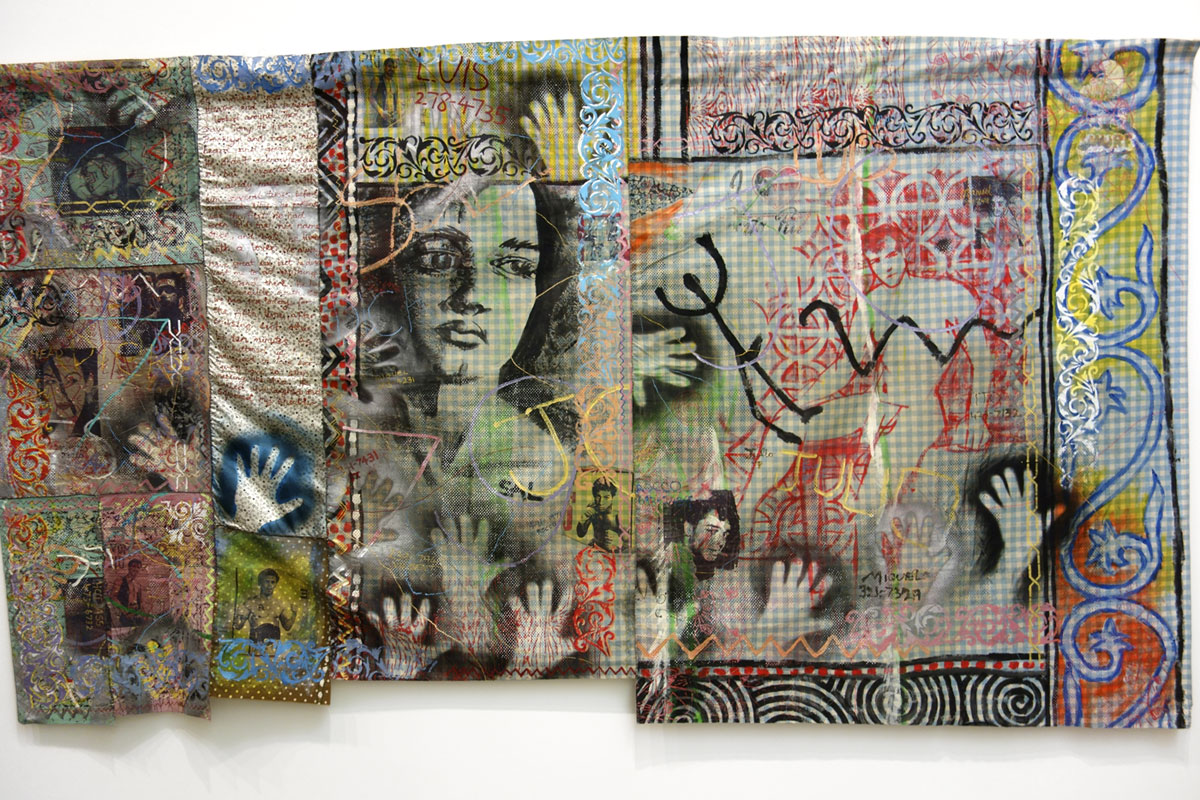
David McDiarmid (Australian 1952-1995, worked in United States 1979-1987) 'So I walked into the theatre' 1984-1985 (installation view)


David McDiarmid (Australian 1952-1995, worked in United States 1979-1987)
So I walked into the theatre (installation view)
1984-1985
Synthetic polymer paint, iron-on transfer, and cotton thread on cotton
Heide Museum of Modern Art, Melbourne
Gift of the Estate of David McDiarmid, 1998
Photo: Marcus Bunyan


David McDiarmid (Australian 1952-1995, worked in United States 1979-1987) 'So I walked into the theatre' 1984-1985 (installation view detail)


David McDiarmid (Australian 1952-1995, worked in United States 1979-1987)
So I walked into the theatre (installation view detail)
1984-1985
Synthetic polymer paint, iron-on transfer, and cotton thread on cotton
Heide Museum of Modern Art, Melbourne
Gift of the Estate of David McDiarmid, 1998
Photo: Marcus Bunyan


So I walked into the

theatre and lit a cigarette

I looked around. Then I

saw Tony. He lives in

Brooklyn and has a nice

beard and greasy hair.

He didn’t acknowledge

me, but I expected that.

I’d already made it with

him several times before

and each time, he pretended

was the first. He had

even told me his name

once, and that he lived

with a lover. We always

have great sex, but he doesn’t

want me to do anything

but stand there. He has

an incredible mouth…


David McDiarmid (Australian 1952-1995, worked in United States 1979-1987) 'Disco kwilt' c. 1980 (installation view)


David McDiarmid (Australian 1952-1995, worked in United States 1979-1987)
Disco kwilt (installation view)
c. 1980
Artbank collection
Photo: Marcus Bunyan


Installation view of works by David McDiarmid, mainly from the series 'Kiss of Light', 1990-1992 including at left 'Mighty real' 1991 from the exhibition 'David McDiarmid: When This You See Remember Me' at NGV Australia, Melbourne


David McDiarmid (Australian 1952-1995, worked in United States 1979-1987)
Installation view of works from the series Kiss of Light, 1990-1992 including at left Mighty real 1991 with Kiss of Light 1990 right at the exhibition David McDiarmid: When This You See Remember Me at NGV Australia, Melbourne
Collage of cut self-adhesive holographic film on enamel paint on plywood
Photo: Marcus Bunyan


David McDiarmid (Australian 1952-1995, worked in United States 1979-1987) 'Mighty real' (detail) 1991 (installation view detail)


David McDiarmid (Australian 1952-1995, worked in United States 1979-1987)
Mighty real (installation view detail)
1991
From the Kiss of light series 1990-1992
Collage of cut self-adhesive holographic film on enamel paint on plywood
144.5 x 123.6cm
Collection of Bernard Fitzgerald, Sydney
Photo: Marcus Bunyan


Detail of one of David McDiarmid's holographic film art works showing the winking eyes


Detail of one of David McDiarmid’s holographic film art works showing the winking eyes
Photo: Marcus Bunyan


David McDiarmid (Australian 1952-1995, worked in United States 1979-1987) 'Body language' 1990 (installation view)


David McDiarmid (Australian 1952-1995, worked in United States 1979-1987)
Body language (installation view)
1990
From the Kiss of light series 1990-1992
Collage of cut self-adhesive holographic film on enamel paint on plywood
152.4 x 121.8cm
National Gallery of Victoria, Melbourne
Photo: Marcus Bunyan


There is a holographic winking eye in the arsehole of this work


David McDiarmid (Australian 1952-1995, worked in United States 1979-1987) 'Thinking of you' 1990 (installation view detail)


David McDiarmid (Australian 1952-1995, worked in United States 1979-1987)
Thinking of you (installation view detail)
1990
Collage of cut self-adhesive holographic film on enamel paint on plywood
140 x 120cm
Collection of Steven Alkins, Mullumbimby, New South Wales
Photo: Marcus Bunyan


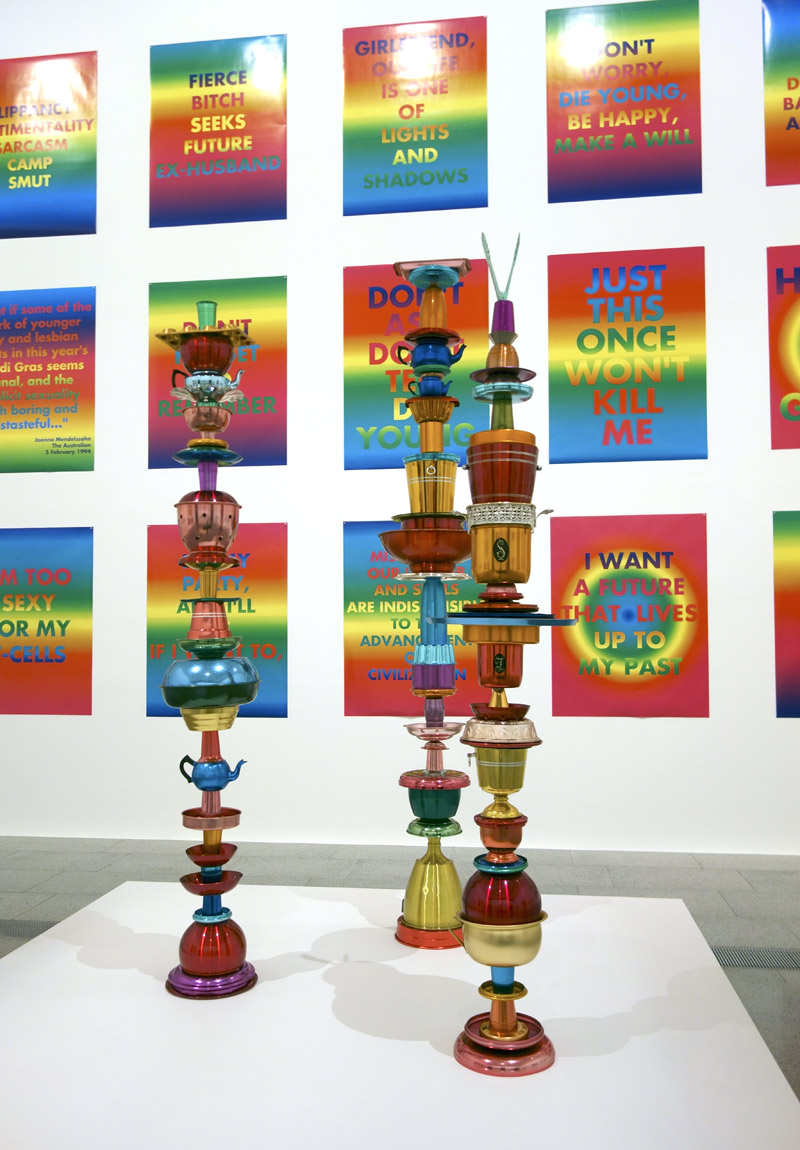
Installation photograph of the last room in the exhibition 'David McDiarmid: When This You See Remember Me' at NGV Australia, Melbourne showing, at left on the wall, work from the 'Rainbow Aphorisms' series 1994 with in front 'Totem works' 1992-1995


Installation photograph of the last room showing, at left on the wall, work from the Rainbow Aphorisms series 1994 with in front Totem works 1992-1995 at the exhibition David McDiarmid: When This You See Remember Me at NGV Australia, Melbourne
Photo: Marcus Bunyan


David McDiarmid (Australian 1952-1995, worked in United States 1979-1987) 'Standard bold condensed' 1994 (installation view)


David McDiarmid (Australian 1952-1995, worked in United States 1979-1987)
Standard bold condensed (installation view)
1994
Screenprint on mylar on colour laser print
255.7 x 242.3cm (overall)
National Gallery of Victoria, Melbourne
Gift of the Estate of David McDiarmid, 1998
Photo: Marcus Bunyan


Peter Tully (Australian, 1947-1992), David McDiarmid (Australian 1952-1995, worked in United States 1979-1987), Ron Smith (Australian, b. 1950s) 'Totem works' 1992-1995 (installation view)

Peter Tully (Australian, 1947-1992), David McDiarmid (Australian 1952-1995, worked in United States 1979-1987), Ron Smith (Australian, b. 1950s) 'Totem works' 1992-1995 (installation view)


David McDiarmid (Australian 1952-1995, worked in United States 1979-1987)
Works from the Rainbow Aphorisms series (installation views)
1994, printed 2014
Computer generated colour inkjet prints
149.1 x 110cm (image and sheet each)
Collection of the McDiarmid Estate, Sydney
Photos: Marcus Bunyan


Peter Tully (Australian, 1947-1992)

David McDiarmid (Australian 1952-1995, worked in United States 1979-1987)
Lived in United States 1979-1987

Ron Smith (Australian, b. 1950s)
Totem works
1992-1995
Anodised aluminium, found objects (installation)
Dimensions variable
Collection of Ron Smith, Woonona, New South Wales


Installation photograph of the last room in the exhibition 'David McDiarmid: When This You See Remember Me' at NGV Australia, Melbourne showing, at right on the wall, work from the 'Rainbow Aphorisms' series 1994 with in front 'Totem works' 1992-1995, then at left on the wall 'Pictograms' 1995


Installation photograph of the last room showing, at right on the wall, work from the Rainbow Aphorisms series 1994 with in front Totem works 1992-1995, then at left on the wall Pictograms 1995 at the exhibition David McDiarmid: When This You See Remember Me at NGV Australia, Melbourne
Photo: Marcus Bunyan


David McDiarmid (Australian 1952-1995, worked in United States 1979-1987) 'Pictograms' 1995 (installation view)


David McDiarmid (Australian 1952-1995, worked in United States 1979-1987)
Pictograms
1995
Vinyl and reflective plastic on aluminium
Photo: Marcus Bunyan


“I never saw art as being a safe thing. I know that exists but that’s not something that involves me.”

~ David McDiarmid, 1993


The vibrant, provocative and pioneering work of leading Australian artist, designer and gay activist David McDiarmid will be presented in a retrospective exhibition at the National Gallery of Victoria. Defying classification, McDiarmid’s work encompasses the complex and interconnected histories of art, craft, fashion, music, sex, gay liberation and identity politics.

David McDiarmid: When This You See Remember Me will bring together more than 200 works, including the artist’s early gay liberation work; New York graffiti and disco quilts; fashion collaborations with Linda Jackson; his pioneering Rainbow aphorisms and Gothic aphorisms digital work; material he produced as Sydney Mardi Gras Artistic Director; posters created for the AIDS Council of NSW; and, his significant and highly influential international campaigns developed in the context of AIDS, sexual politics and safe sex in the 1990s.

Tony Ellwood, Director, NGV, said, “The NGV is pleased to be staging this retrospective of an artist whose work had enormous impact on both the gay liberation movement and the international dialogue around AIDS, and whose clear messages of liberation, equality and emancipation continue to resonate today. David McDiarmid: When This You See Remember Me explores the social history, as well as political and art historical context, that informed McDiarmid’s work, which inspires through its courage, poetry, exuberance and cultural impact.”

Defying classification, the work of David McDiarmid encompasses the complex and interconnected histories of art, craft, fashion, music, sex, gay liberation and identity politics; happily residing in the spaces between high and low art, popular culture and community engagement. At once kaleidoscopic, celebratory and darkly humorous in tone, the artist’s idiosyncratic, highly personal and at times, confessional work highlights the redefinition and deconstruction of identities – “from camp to gay to queer” – drawing on the experiences of a life intensely lived in Melbourne, Sydney and New York. Charting the shifts in politics and individual and community expression that unfold across the decades of the 1970s, 80s and 90s, this exhibition also reveals McDiarmid’s artistic and grassroots political response to the impact of HIV/AIDS during the 1980s and beyond, for which he is best known internationally.

Recognising the cultural climate in which the artist worked, including the burgeoning of the gay rights movement, and a decade later, the advent of the AIDS crisis, the playful and provocative nature of McDiarmid’s work was critically related to changes that were occurring throughout this time to sexual identity and politics in Australia.

Dr Sally Gray, Guest Curator, said, “McDiarmid’s work speaks so eloquently of its time yet its importance and relevance endures today. David McDiarmid: When This You See Remember Me is the first exhibition in which the full scope of McDiarmid’s creative oeuvre is on display and is the culmination of painstaking research, with the support of many of his collaborators, friends and fans.”

David McDiarmid: When This You See Remember Me will coincide with the 20th International AIDS Conference in Melbourne in July 2014.

This exhibition includes coarse language and sexual content. Press release from the NGV


William Yang (Australian, b. 1943) 'Artist David McDiarmid' May 1995


William Yang (Australian, b. 1943)
Artist David McDiarmid photographed at the Art Gallery of New South Wales adjacent to his giant ‘Q’ artwork on the gallery’s facade for ‘Perspecta’ May, 1995
1995
© Reproduced with permission of William Yang


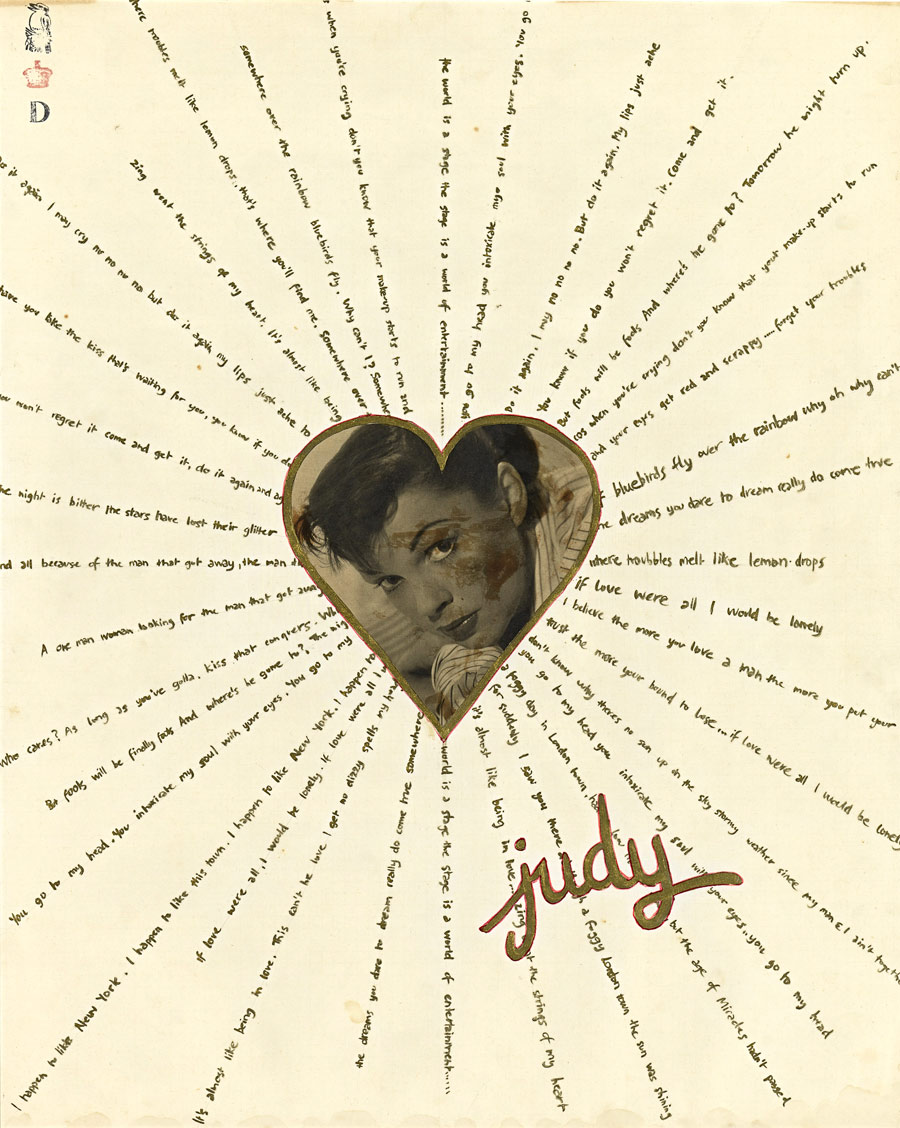
David McDiarmid (Australian 1952-1995, worked in United States 1979-1987) 'Judy' 1976


David McDiarmid (Australian 1952-1995, worked in United States 1979-1987)
Judy
1976
From the Secret love series 1976
Metallic paint, red fibre-tipped pen, cut photo-offset lithograph and red and black ink on graph paper
78.0 x 66.0cm
Collection of Paul Menotti and Bryce Kerr, Sydney
© Reproduced with the permission of the David McDiarmid estate


David McDiarmid (Australian 1952-1995, worked in United States 1979-1987) 'Strangers in the night' 1978 (installation view)


David McDiarmid (Australian 1952-1995, worked in United States 1979-1987)
Strangers in the night (installation view)
1978
Collage of cut coloured paper and photocopy on mulberry paper
62.6 x 50.7cm
National Gallery of Victoria, Melbourne
Proposed acquisition
© Reproduced with the permission of the David McDiarmid estate


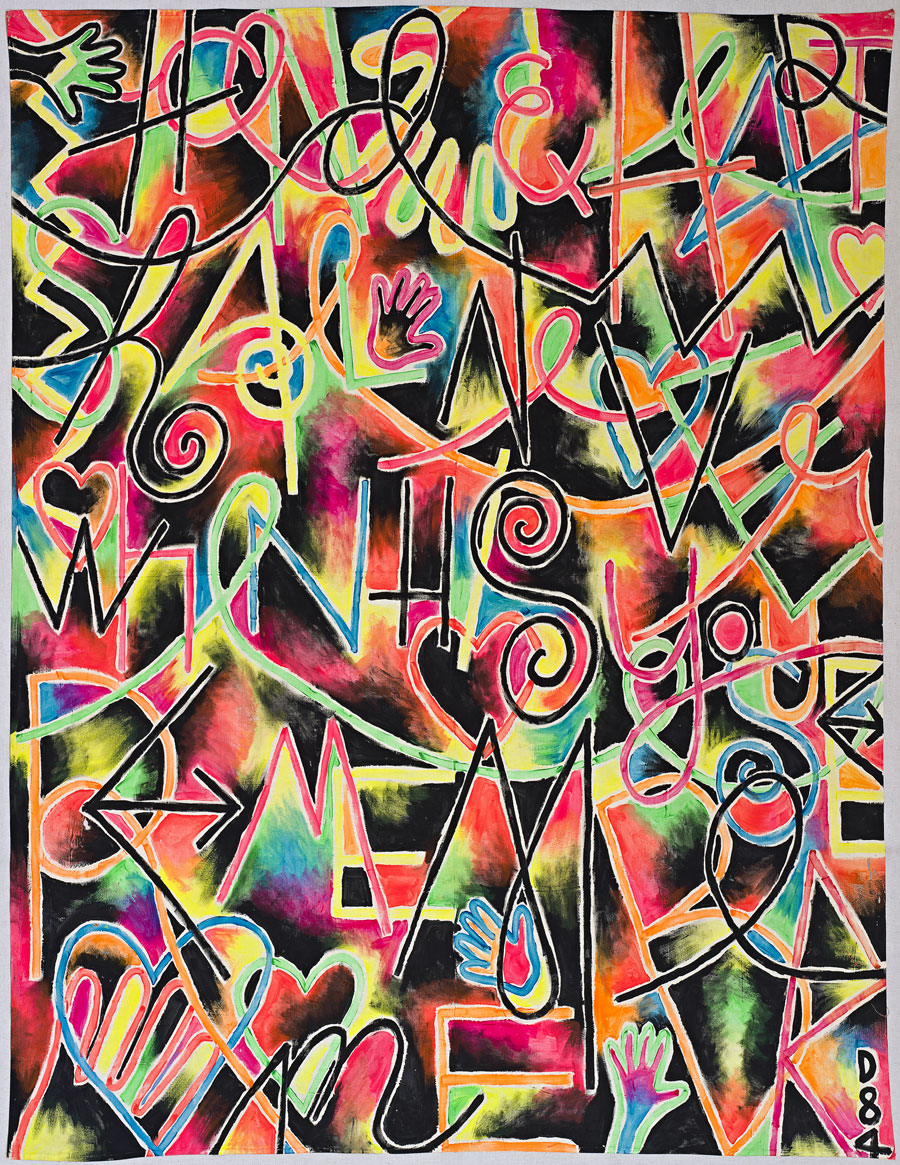
David McDiarmid (Australian 1952-1995, worked in United States 1979-1987) 'Hand and heart' 1984


David McDiarmid (Australian 1952-1995, worked in United States 1979-1987)
Hand and heart
1984
Synthetic polymer paint on cotton
250.0 x 230.0cm
Powerhouse Museum, Sydney
Gift of the Estate of the late David McDiarmid, 1998
© Reproduced with the permission of the David McDiarmid estate


David McDiarmid (Australian 1952-1995, worked in United States 1979-1987) 'Sydney Gay and Lesbian Mardi Gras, poster' 1989-1990


David McDiarmid (Australian 1952-1995, worked in United States 1979-1987)
Sydney Gay and Lesbian Mardi Gras, poster
1989-1990
Colour photo-offset lithograph
69 x 49cm
Powerhouse Museum, Sydney
Gift of Sydney Gay & Lesbian Mardi Gras Limited, 1995
© Reproduced with the permission of the David McDiarmid estate


David McDiarmid (Australian 1952-1995, worked in United States 1979-1987) 'Untitled' 1990-1995


David McDiarmid (Australian 1952-1995, worked in United States 1979-1987)
Untitled
1990-1995
Self-adhesive holographic film and self-adhesive colour plastic on plastic
122.7 x 122.7cm
Collection of Bernard Fitzgerald, Sydney
© Reproduced with the permission of the David McDiarmid estate


David McDiarmid (Australian 1952-1995, worked in United States 1979-1987) 'Discard after use' 1990


David McDiarmid (Australian 1952-1995, worked in United States 1979-1987)
Discard after use
1990
From the Kiss of light series 1990-1992
Collage of self-adhesive holographic film on enamel paint on plywood
61.2 x 61.2cm
National Gallery of Victoria, Melbourne
Gift from the Estate of David McDiarmid, 1998
© Reproduced with the permission of the David McDiarmid estate


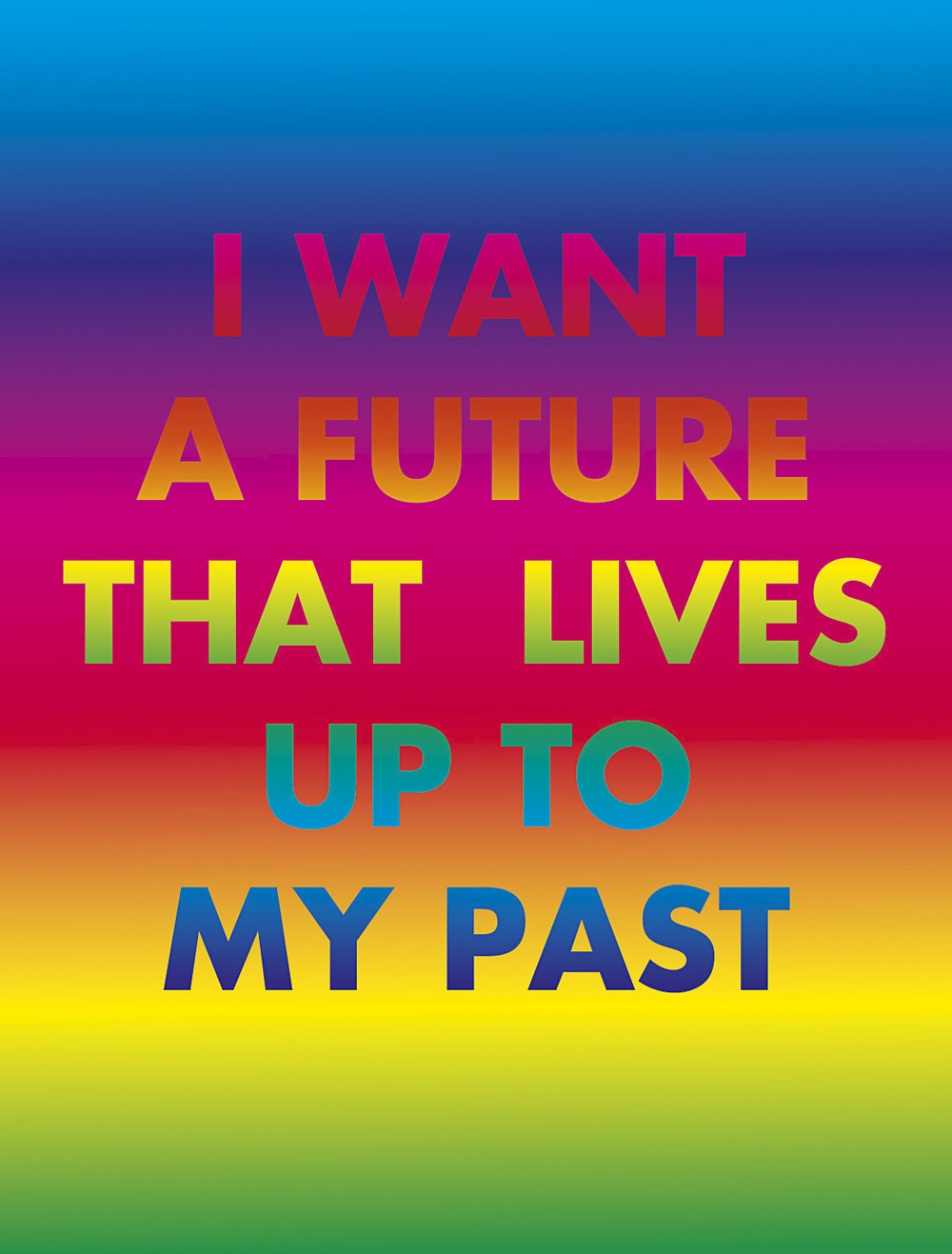
David McDiarmid (Australian 1952-1995, worked in United States 1979-1987) 'I want a future that lives up to my past' From the 'Rainbow aphorisms' series 1994, printed 2014


David McDiarmid (Australian 1952-1995, worked in United States 1979-1987)
I want a future that lives up to my past
From the Rainbow aphorisms series 1994, printed 2014
Computer generated colour inkjet prints
149.1 x 110.0cm
Collection of the McDiarmid Estate, Sydney
© Reproduced with the permission of the David McDiarmid estate


David McDiarmid (Australian 1952-1995, worked in United States 1979-1987) 'Q' From the 'Rainbow aphorisms' series 1994, printed 2014


David McDiarmid (Australian 1952-1995, worked in United States 1979-1987)
Q
From the Rainbow aphorisms series 1994, printed 2014
Computer generated colour inkjet prints
149.1 x 110.0cm
Collection of the McDiarmid Estate, Sydney
© Reproduced with the permission of the David McDiarmid estate


The Ian Potter Centre: NGV Australia
Federation Square
Corner of Russell and 
Flinders Streets, Melbourne

Opening hours:
Daily 10am – 5pm

National Gallery of Victoria website

LIKE ART BLART ON FACEBOOK

Back to top

Exhibition: ‘Blow-Up: Antonioni’s Film Classic and Photography’ at the Albertina, Vienna

Exhibition dates: 30th April – 17th August, 2014

Curator: Walter Moser


Arthur Evans (British, 1908-1994) 'David Hemmings in "Blow Up" (directed by Michelangelo Antonioni)' 1966 from the exhibition 'Blow-Up: Antonioni's Film Classic and Photography' at the Albertina, Vienna, April - August, 2014


Arthur Evans (British, 1908-1994)
David Hemmings in “Blow Up” (directed by Michelangelo Antonioni)
1966
Film still
Courtesy Philippe Garner
© Neue Visionen Filmverleih GmbH/Turner Entertainment Co. – A Warner Bros Entertainment Company. All rights reserved.


The act of looking and the gaze through the eye of a photographer’s camera are the central motifs of Blow-Up.

“Don McCullin created the iconographic photographs that in the film are blown up by Thomas to discover something about the alleged crime. However, the blow-ups only offer ambivalent proof as they become more and more blurred and abstract by the continuous enlarging. Even photography that supposedly represents reality like no other form of media cannot help in shedding any light on the mysterious events in the park. Pictorial reality – thus Antonioni’s conclusion – is only ever constructed by the medium itself.” (Press release)

Then, look at Don Mcullin’s photograph British Butcher, East London (c. 1965, below). The Union Jack hat, the knife being sharpened and the contrast of the image. Savage. Not home grown but “Home killed”. Pictorial reality constructed by the medium but not just by the medium – but also by the aesthetic choices and the imagination of the photographer.

Dr Marcus Bunyan


Many thankx to the Albertina for allowing me to publish the photographs in the posting. Please click on the photographs for a larger version of the image.


Arthur Evans (British, 1908-1994) 'David Hemmings in "Blow Up" (directed by Michelangelo Antonioni)' 1966 from the exhibition 'Blow-Up: Antonioni's Film Classic and Photography' at the Albertina, Vienna, April - August, 2014


Arthur Evans (British, 1908-1994)
David Hemmings in “Blow Up” (directed by Michelangelo Antonioni)
1966
Film still
Private collection Vienna
Courtesy: New Visions Film Distribution GmbH


Arthur Evans (British, 1908-1994) 'David Hemmings in "Blow Up" (directed by Michelangelo Antonioni)' 1966


Arthur Evans (British, 1908-1994)
David Hemmings in “Blow Up” (directed by Michelangelo Antonioni)
1966
Film still
Private collection Vienna
Courtesy: New Visions Film Distribution GmbH


Arthur Evans (British, 1908-1994) 'David Hemmings in "Blow Up" (directed by Michelangelo Antonioni)' 1966


Arthur Evans (British, 1908-1994)
David Hemmings in “Blow Up” (directed by Michelangelo Antonioni)
1966
Film still
Private collection Vienna
Courtesy: New Visions Film Distribution GmbH


Anonymous. 'Promotional image for "Blow-Up"' 1966


Anonymous
Promotional image for “Blow-Up”
1966
Courtesy Philippe Garner
© New Visions Film Distribution GmbH / Turner Entertainment Co. – A Warner Bros. Entertainment Company. All rights reserved


The cult film Blow-Up by Michelangelo Antonioni (1966) occupies a central position in the history of film as well as that of art and photography. No other film has shown and sounded out the diverse areas of photography in such a differentiated way. Shot in London, this film, which tells the story of a fashion photographer who happens to photograph a murder in a park, has become a classic. Its relevance and the unabated fascination it evokes are partially due to the remarkable range of themes it deals with. While Antonioni’s description of the social and artistic environment of his protagonist in 1960’s London can be understood as a visual document of the Swinging Sixties, the eponymous photographic blow-ups meticulously examined by the photographer to find something out about an alleged crime prompted a theoretical discourse on the representation and ambiguity of pictures from the first showing of the film. Both themes, the historical outline as well as the media reflexions, concern the main focus of the film: photography.

For the first time the exhibition in the Albertina presents in several chapters the diverse and differentiated connections between film and photography, thus allowing a trenchant profile of the photographic trends of the 1960s.

Photography in Blow-Up

The photographic range of Blow-Up is highly diversified and ranges from fashion photography and social reportage to abstract photography. Film stills are shown next to works that can actually be seen in Blow-Up, as well as pictures that illuminate the cultural and artistic frame of the film production, London in the Swinging Sixties.

The meaning of photography for the film Blow-Up is most apparent when Antonioni uses it to characterise his main character Thomas. Played by David Hemmings, the protagonist is not only a fashion photographer, but is also working on an illustrated book with photographs of social reportage. In order to depict both the main figure and its two areas of work in an authentic way, Antonioni is guided by real photographers of the time; before starting to shoot the film he meticulously researched the work as well as environment of the British fashion (photography) scene.

In the course of his preparations Antonioni sent out questionnaires to fashion photographers and visited them in their studios. Thus the main character is modelled after various photographers like David Bailey, John Cowan and Don McCullin; some of them Antonioni asked to cooperate on his film. He also integrated their works, for example Don McCullin’s reportage photographs that the protagonist browses through in the film, or fashion photographs by John Cowan that in the film can be seen in the protagonist’s studio.

In addition Don McCullin created the iconographic photographs that in the film are blown up by Thomas to discover something about the alleged crime. However, the blow-ups only offer ambivalent proof as they become more and more blurred and abstract by the continuous enlarging. Even photography that supposedly represents reality like no other form of media cannot help in shedding any light on the mysterious events in the park. Pictorial reality – thus Antonioni’s conclusion – is only ever constructed by the medium itself.

Antonioni used the photographs seen in the film for media-theoretical reflections and thus set stills and moving pictures in a differentiated context. This complex connection between film and photography is made very clear by the film stills that were created for Blow-Up. These still photographs are based on an elaborate process whereby the photographer has certain scenes re-enacted for the photo camera thus transforming the film from moving images into something static. The manifold references of Blow-Up are once more condensed into photographs in the film stills, as the pictures reflect the real context of fashion photography in 1960’s London through the depiction of the photographer, of well-known fashion models and the use of clothes to match.

Artistic references

The photographic references in Blow-Up are also set in relation to other art forms. This contextualisation is essential for Antonioni’s understanding of photography. Antonioni was, unlike most other film directors, committed to the applied arts which he showed already in 1964 with his film Deserto Rosso, its abstract compositions based on Mark Rothko’s paintings. In Blow-Up an artistic reference of this nature becomes apparent in the character of the protagonist’s neighbour, an abstract painter named Bill, who is modelled on British artist Ian Stephenson. Also the oil paintings in the film were created by Ian Stephenson. They show abstract motifs that in the film are compared with the stylistically related ‘blow-ups’.

The Swinging Sixties

Michelangelo Antonioni filmed Blow-Up at the height of the Swinging Sixties, the social and artistic trends of which are rendered in the film. The agitation of youth culture so characteristic of this time í and not least of all initiated by the Beatles í is shown as well as its trendsetting figures. Thus a concert by the British band The Yardbirds, with Jimmy Page, the subsequent founder of Led Zeppelin, served as a filming location. The scene of the infamous Pot-Party in the film was shot in the apartment of the art and antique dealer Christopher Gibbs, who shaped the fashion look of the Swinging Sixties.

British art of the 1960s was also essential for Antonioni as it anticipated many of those abstract tendencies that set the tone for Blow-Up. There was, for instance, the pop art artist Richard Hamilton who created blow-ups from ordinary postcards, thus reducing motifs to dots. Or Nigel Henderson, a member of the Independent Group, who had already produced photos in the 1950s, in which he pointed out their material qualities by creasing them and using special procedures for the negatives.

As much as Antonioni’s work is rooted in the 1960s, it is nevertheless a timeless classic that is still relevant for today’s art. This becomes apparent in the exhibition by means of selectively chosen contemporary works that refer to Blow-Up. Particularly the filmic outline on the representation of images and their ambiguity serves as the artistic basis for the creations of various contemporary photographers. Blow-Up has lost none of its relevance for art since its creation in 1966.

Press release from the Albertina website


Don McCullin (British, b. 1935) 'Thomas' blow-ups from the Park' 1966


Don McCullin (British, b. 1935)
Thomas’ blow-ups from the Park
1966
Courtesy Philippe Garner
© New Visions Film Distribution GmbH / Turner Entertainment Co. – A Warner Bros. Entertainment Company. All rights reserved.


Don McCullin (British, b. 1935) 'Thomas' blow-ups from the Park' 1966


Don McCullin (British, b. 1935)
Thomas’ blow-ups from the Park
1966
Courtesy Philippe Garner
© New Visions Film Distribution GmbH / Turner Entertainment Co. – A Warner Bros. Entertainment Company. All rights reserved.


Patrick Hunt. 'David Bailey on the set of G.G. Passion' 1966


Patrick Hunt
David Bailey on the set of G.G. Passion
1966
Courtesy Philippe Garner


Arthur Evans (British, 1908-1994) 'Veruschka von Lehndorff with David Hemmings in "Blow Up" (directed by Michelangelo Antonioni)' 1966


Arthur Evans (British, 1908-1994)
Veruschka von Lehndorff with David Hemmings in “Blow Up” (directed by Michelangelo Antonioni)
1966
Film still
Private collection Vienna
Courtesy: New Visions Film Distribution GmbH


David Bailey (British, b. 1938) 'Brian Epstein (Box of Pin-Ups)' 1965


David Bailey (British, b. 1938)
Brian Epstein (Box of Pin-Ups)
1965
V & A Images / Victoria and Albert Museum
© David Bailey


Shezad Dawood (British, b. 1974) 'Make it big (Blow-Up)' 2002/2003


Shezad Dawood (British, b. 1974)
Make it big (Blow-Up)
2002/2003
Film still
Courtesy of the artist and Paradise Row, London


Richard Hamilton (British, 1922-2011) 'Swinging London III' 1972


Richard Hamilton (British, 1922-2011)
Swinging London III
1972
Kunstmuseum Winterthur
© Swiss Institute for Art Research, Zurich, Jean-Pierre Kuhn purchase in 1997


Exhibition texts

Shot in London in 1966, Michelangelo Antonioni’s masterpiece Blow-Up confronts its audience with the manifold genres of photography and their different social references with a precision like no other feature film. The director involved some of the most interesting photographers of the day in the production of the film. The photojournalist Don McCullin was on set as were the fashion photographers John Cowan and David Montgomery as well as the paparazzo Tazio Secchiaroli. They served as models for Antonioni’s protagonist, took photographs for Blow-Up, and, not least, made their work available to the filmmaker.

Set against the social and artistic backdrop of London’s Swinging Sixties, Blow-Up tells us about a fashion photographer by the name of Thomas (David Hemmings) who secretly photographs two lovers in a park. He later enlarges these pictures and believes that he has coincidentally documented a murder. The blow-ups reveal a man lurking in the trees with a gun and, as Thomas supposes, a corpse. Fashion shootings and Thomas’s work on a book with reportage photographs featuring homeless people in London provide two further strands of reference in the film.

Presenting these contexts in five thematic sections, the exhibition in the Albertina offers a pointed cross-section of tendencies in the photography of the 1960s. The show not only explores the photo-historical circumstances under which Blow-Up was made but also presents real works of art Antonioni integrated into his film, as well as photographs he commissioned for the story. The visual translation of the film into stills constitutes another important field thematised in the exhibition. A selection of more recent works of art highlights the timelessness of Antonioni’s film.

Making film stills

Making film stills involves a complex production process in the course of which scenes of a film are specially reenacted in front of the still photographer’s camera. The difficulties the photographer is faced with result from the difference between film and photography as media. He has to transform the contents of a medium that renders movements and sequences of events in time into a photograph that freezes them in a single static moment.

Arthur Evans’s stills for Blow-Up go far beyond the genre’s traditional function of promoting a film. Evans created series of pictures which allow us to reconstruct certain sequences of movement and depict scenes not shown in the film. Hence his stills for Blow-Up are meta-pictures that shed light on the film from another perspective.

Voyeurism

The act of looking and the gaze through the eye of a photographer’s camera are the central motifs of Blow-Up, which becomes particularly evident in the famous scene in the park. This part of the film depicts the dynamics resulting from a camera focusing on persons and capturing them in a picture. Antonioni presents his protagonist as a paparazzo and voyeur secretly photographing people in the tradition of Alfred Hitchcock’s Rear Window (1954). Hidden behind shrubs, trees, and a fence, he watches a pair of lovers. The camera serves as an instrument for peeping through the keyhole, as it were. The dialogic dimension between photographer and model is revealed when the woman (Vanessa Redgrave) spots the photographer. She defends herself against Thomas’s invasive gaze, bites his hand, and runs away. The aesthetic of Thomas’s photographs shot in the park corresponds to the situation of their taking. The pictures are imbued with the instantaneousness and spontaneity deriving from the photographers wish to wrest a single picture from a dynamic context in a fraction of a second.

It is no coincidence that the photographer Tazio Secchiaroli was present on set in the very hours this scene was shot. Secchiaroli was an Italian paparazzo who had been after the suspects in a still unresolved murder case, the Montesi scandal, with his camera. Made against the background of this political scandal, Federico Fellini’s film La dolce vita (1960) features pushy photo reporters modelled after Secchiaroli.

Blow-Ups

The blow-ups of Thomas’s photographs shot in the park are the most famous pictures featured in Antonioni’s film. The filmmaker entrusted the renowned photojournalist Don McCullin with taking them. Following Antonioni’s instructions, McCullin had to position himself in the same places as Thomas in the film to reproduce his perspectives. He also used the same Nikon F camera the protagonist works with in Blow-Up. In order to ensure that the process of taking the pictures we see in the film corresponds with the photographer’s results, McCullin advised the actor David Hemmings on how to proceed. The actor learned how to handle the 35-mm camera correctly and was instructed about the body language connected with using it.

Fashion photography

The metropolis of London was the center of a new kind of fashion photography in the 1960s – a renown inseparably bound up with three names to this day: David Bailey, Terence Donovan, and Brian Duffy, also known as Black Trinity. Relying on 35-mm cameras, which had hitherto mainly been used for reportage photographs and ensured a supposedly spontaneous and dynamic pictorial language, these three photographers staged their models in unusual places outside their studios.

In preparing his film, Antonioni had meticulously researched the photographer’s living and working conditions by means of a several-page questionnaire in which he even inquired into their love relationships and eating habits. It was David Bailey who served as a model for the protagonist of Blow-Up. For his dynamic body language in the fashion shootings, for instance, Thomas took the cue from him. The style of clothes Thomas wears is indebted to that of the British fashion photographer John Cowan. Cowan made his studio available to Antonioni for the studio shots and acted as the filmmaker’s adviser. The photographs seen on the studio wall in Blow-Up are fashion photographs by Cowan which Antonioni chose for the film.

David Montgomery

David Montgomery is a US-American fashion photographer living in London. Before shooting his film, Antonioni visited him in his studio to watch him working with Veruschka, Jill Kennington, and Peggy Moffitt – the models he would subsequently cast for Blow-Up. David Montgomery has a cameo appearance in the beginning of the film: we see him taking pictures of the model Donyale Luna on Hoxton Market in London’s East End. When this scene was shot, he actually made the fashion photographs featuring Luna which he pretends to take in the film. Since Montgomery was no actor by his own account, he had to really take pictures in order to be able to play the scene in a convincing manner.

Arthur Evan’s fashion photographs

Arthur Evans, the still photographer, depicted the models appearing in Blow-Up in groups and in individual portraits. These pictures taken on set are very unusual for a still photographer, because they do not show scenes of the film, but are independently staged fashion photographs. The models’ costumes were designed by Jocelyn Rickards, the hats were made by James Wedge. Evans translated the linear patterns characteristic of both designers into graphic compositions in his photos.

Social reportage

Michelangelo Antonioni characterises his film’s protagonist also as a social reportage photographer who, for a book project on London he is working on, secretly takes pictures in a homeless shelter. A scene of the film has Thomas showing his publisher a dummy of the volume. The portraits in it were made by the photojournalist Don McCullin; their originals are presented in the exhibition for the very first time.

The pictures were taken in London’s East End in the early 1960s, when the area was notorious for its residents’ poverty, miserable housing conditions, and racial unrest. The photographer provides a cross-section of its inhabitants whom he mainly characterises through their occupation. The two-fold orientation of the film’s protagonist as fashion and reportage photographer is based on fact, as illustrated by both David Bailey and David Montgomery. The stylistic boundaries between the two genres blur in their works. The strategy of picturing models in urban surroundings with a 35-mm camera, for example, is clearly rooted in reportage photography.

Swinging London: Art and Life

Michelangelo Antonioni filmed Blow-Up in the heyday of London’s Swinging Sixties whose social and artistic trends are depicted in the film. He captured the youth culture and its agitation so characteristic of these years – which was not least triggered by the Beatles – as well as the protagonists of the scene. One location he chose was a concert of the Yardbirds, a British band counting Jimmy Page, who would found Led Zeppelin, among its players. The famous pot-party in Blow-Up was shot in the art and antique dealer Christopher Gibbs’ flat, who determined the fashion look of the Swinging Sixties to a remarkable degree.

The British art of the 1960s was also very important to Antonioni, as it already anticipated many of the abstract tendencies informing Blow-Up. The Pop artist Richard Hamilton, for example, used to enlarge everyday picture postcards, reducing their motifs to an abstract dot matrix. Nigel Henderson, a member of the Independent Group, had already emphasised the material qualities of his photos in the 1950s by folding his prints and employing negative techniques. Antonioni integrated works by British artists: for example a picture by Peter Sedgley, a representative of Op art, and oil paintings by Ian Stephenson into his film.

Ian Stephenson

Antonioni’s understanding of photography was informed by painting í an influence that becomes manifest in the character of the protagonist’s neighbour, in Blow-Up a painter named Bill. Antonioni compares the neighbour’s abstract paintings with the photographer’s blow-ups. When Thomas and his neighbour talk about the paintings, Bill maintains that he does not see much in them while painting them and only finds meaning in them later on. This form of reception tallies with Thomas’s attempt to determine the meaning of his similarly abstract enlargements.

The character of the painter is based on the British artist Ian Stephenson. Antonioni visited the artist in his studio before he started shooting Blow-Up. He watched the painter at work and selected the paintings he wanted to use in the film.

Blow-Up

The photographs central to Antonioniés film are the blow-ups of the pictures which the protagonist has taken in the park and which he examines meticulously. The enlargements reveal a man with a pistol lurking in the trees and a mass in the grass, which Thomas interprets as a lifeless body. To make the presumed corpse more visible Thomas enlarges the photograph again and again until it shows nothing but its grain and materiality, despite the photographs inherent relation to reality.

Antonioni uses the blow-ups to question the representation of reality by media and their specific modes of perception. He interlinks these considerations with the film. The final scene of Blow-Up shows Thomas coming upon a group of mimes playing an imaginary game of tennis. When the (invisible) ball lands behind the fence, Thomas joins in the mimes’ game, picks up the ball from the lawn and throws it back to the players. A camera pan traces the trajectory of the invisible ball. In evoking the ball without showing it, Antonioni confronts us with the most radical abstraction: the motif is not rendered as an abstract or blurry form like in the enlargements, but is altogether absent. The media-theoretical implications of Blow-Up are still the subject of conceptual photographs today. Like Antonioni, the Italian Ugo Mulas and the American Allan McCollum, for example, question photography’s relation to reality in their blow-ups.

Le montagne incantate

The nucleus for the blow-ups in the film is to be found in a series of artworks titled Le montagne incantate (The Enchanted Mountains), which Antonioni started working on in the mid-1950s. The filmmaker photographically enlarged his small-format abstract watercolours, making the material qualities of the paper and the application of the paint visible. Consequentially, Antonioni recommended the use of a magnifying glass – as used by the protagonist in Blow-Up – as the ideal instrument for viewing these pictures.

Text from the Albertina website


Brian Duffy (English, 1933-2010) 'Jane Birkin' 1960s


Brian Duffy (English, 1933-2010)
Jane Birkin
1960s
© Brian Duffy Archive


Eric Swayne (British, 1932-2007) 'Grace and Telma, Italian Vogue, 1966' 1966


Eric Swayne (British, 1932-2007)
Grace and Telma, Italian Vogue, 1966
1966
Courtesy Tom Swayne
© Eric Swayne


Terence Donovan (English, 1936-1996) 'The Secrets of an Agent' 1961


Terence Donovan (English, 1936-1996)
The Secrets of an Agent
1961
© Terence Donovan Archive


Ian Stephenson (English, 1934-2000) 'Still Life Abstraction D1' 1957


Ian Stephenson (English, 1934-2000)
Still Life Abstraction D1
1957
© Kate Stephenson, widow of Ian Stephenson


Jill Kennington (British, b. 1943) "Blow-Up" 1966


Jill Kennington (British, b. 1943)
“Blow-Up”
1966
© New Visions Film Distribution GmbH / Turner Entertainment Co. – A Warner Bros. Entertainment Company. All rights reserved.


Don McCullin (British, b. 1935) 'Down-and-out begging for help, Aldgate, 1963' 1963


Don McCullin (British, b. 1935)
Down-and-out begging for help, Aldgate, 1963
1963
© Don McCullin, courtesy Hamiltons Gallery, London


Don McCullin (British, b. 1935) 'British Butcher, East London' c. 1965


Don McCullin (British, b. 1935)
British Butcher, East London
c. 1965
© Don McCullin Courtesy Hamiltons Gallery, London


Terry O'Neill (British, 1938-2019) 'David Bailey photographing Moyra Swan' 1965


Terry O’Neill (British, 1938-2019)
David Bailey photographing Moyra Swan
1965
© Terry O’Neill – Courtesy Philippe Garner


Tazio Secchiaroli (Italian, 1925-1998) 'David Hemmings and Veruschka von Lehndorff in "Blow-Up" (directed by Michelangelo Antonioni)' 1966


Tazio Secchiaroli (Italian, 1925-1998)
David Hemmings and Veruschka von Lehndorff in “Blow-Up” (directed by Michelangelo Antonioni)
1966
Filmstill
Source: BFI stills
© New Visions Film Distribution GmbH / Turner Entertainment Co. – A Warner Bros. Entertainment Company. All rights reserved.


David Montgomery (American, b. 1937) 'Donyale Luna on the set of "Blow-Up"' 1966


David Montgomery (American, b. 1937)
Donyale Luna on the set of “Blow-Up”
1966
© David Montgomery


Albertina
Albertinaplatz 1
1010 Vienna, Austria
Phone: +43 (0)1 534 83-0

Opening hours:
Daily 10am – 6pm
Wednesday and Friday 10am – 9pm

Albertina website

LIKE ART BLART ON FACEBOOK

Back to top

Exhibition: ‘Art and Alchemy. The Mystery of Transformation’ at the Stiftung Museum Kunstpalast (SMKP), Düsseldorf, Germany

Exhibition dates: 5th April – 10th August, 2014

Curators: Dedo von Kerssenbrock-Krosigk and Beat Wismer, with additional curatorial input from Anita Hachmann for the contemporary section


Theodor Galle nach Jan van der Straet (Stradanus) (Belgium, 1523-1605) 'Destillierlabor' (from the series "Nova reperta") c. 1589 - c. 1593 from the exhibition 'Art and Alchemy. The Mystery of Transformation' at the Stiftung Museum Kunstpalast (SMKP), Düsseldorf, Germany, April - August, 2014
 

Theodor Galle nach Jan van der Straet (Stradanus) (Belgium, 1523-1605)

Destillierlabor
c. 1589 – c. 1593
From the series Nova reperta
Stiftung Museum Kunstpalast, Düsseldorf
Photo: Horst Kolberg, Neuss


Since I have 7 alchemy symbols tattooed on my right bicep in a vertical line to represent the 7 chakras, I thought this was a suitable exhibition for a posting.

I love anything alchemical, magical, spiritual – in art and in life. I have just had a couple of snowflakes tattooed on my forearms, one blue / green and the red / orange for an ice / fire combination. Each snowflake is unique and ephemeral, here and gone in the blink of an eye, just like we are. That is their, and our, magic.

The photographer Minor White said it is not just the images that matter, but the space between them that causes an ice / fire frisson. When looking at an exhibition I note how images play off of each other – in pairs, sequences and across the gallery space. It is a relatively simple thing for a photographer to take one good image, more difficult to put a pair of images together that actually says something, but when you get to a sequence of images (as in MW) or a body of work, this is were a lot of artists wane. The intertextual narrative, one woven from the imagination of the artist, does not resolve itself into a satisfying, stimulating whole. How many exhibitions do I see that have some good images but do not access the magic of the music.

Further, we must also remember that in Psychology and Alchemy, Volume 12 in The Collected Works of C. G. Jung, alchemy is central to Jung’s hypothesis of the collective unconscious. “Jung reminds us of the dual nature of alchemy, comprising both the chemical process and a parallel mystical component. He also discusses the seemingly deliberate mystification of the alchemists. Finally, in using the alchemical process to provide insights into individuation, Jung emphasises the importance of alchemy in relating to us the transcendent nature of the psyche.” (Wikipedia)

Jung sees alchemy as an early form of psychoanalysis. The melting of base metal in a crucible and its reforming into gold can be seen as a form of individuation – the dissolution of the ego and its integration into the whole self. Basically the recasting or reforming of identity into a new Self. As the instructive text on Wikipedia notes,

“For the alchemist trying to understand matter and develop base metals into their purest form, gold, substances are grouped as being alike based on their perceived value. Jung documents as these alchemists collectively come to understand that they themselves must embody the change they hope to effect within their materials: for instance, if they hope to achieve the philosopher’s stone that can redeem ‘base’ or ‘vulgar’ metals, then the alchemist too must become a redeemer figure. It became apparent to the alchemists that they were trying to redeem nature as Christ had redeemed man, hence the identification of the Lapis Philosophorum with Christ the Redeemer. The Opus (work) of alchemy, viewed through this interpretation, becomes a symbolic account of the fundamental process the human psyche undergoes as it re-orients its value system and creates meaning out of chaos. The opus beginning with the nigredo (blackening, akin to depression or nihilistic loss of value) in order to descend back into the manipulable prima materia and proceeding through a process of spiritual purification that must unite seemingly irreconcilable opposites (the coniunctio) to achieve new levels of consciousness.”


Much of my early black and white work was based on an understanding of the magical nature of the (art)work. This is a fascinating area of enquiry for all artists because this is what they do – they see the world differently, reform it through their art and present it as a pathway for the future.

Dr Marcus Bunyan

PS The catalogue to this exhibition is excellent with lots of interesting essays.


Many thankx to the Stiftung Museum Kunstpalast for allowing me to publish the art work in the posting. Please click on the photographs for a larger version of the image.


Marcus new tattoos February 2014


Marcus new tattoos February 2014


Pieter Brueghel the Younger (Belgium, 1564-1636) (after Pieter Brueghel the Elder) 'The Alchemist' c. 1600 from the exhibition 'Art and Alchemy. The Mystery of Transformation' at the Stiftung Museum Kunstpalast (SMKP), Düsseldorf, Germany, April - August, 2014


Pieter Brueghel the Younger (Belgium, 1564-1636)
after Pieter Brueghel the Elder
The Alchemist
c. 1600
Oil on wood
68.8 x 96cm
Private collection


David Teniers d.J. (Flemish, 1610-1690) 'Alchemist in his Workshop' c. 1650


David Teniers d.J. (Flemish, 1610-1690)
Alchemist in his Workshop
c. 1650
Courtesy of Roy Eddleman, Chemical Heritage Foundation Collections
Photo: Will Brown


Adriaen van Ostade (Dutch, 1610-1685) 'The Alchemist' 1661


Adriaen van Ostade (Dutch, 1610-1685)
The Alchemist
1661
The National Gallery, London, Bought 1871
© The National Gallery, London, 2013


Hendrick Goltzius (Dutch, born Germany 1558-1617) 'Allegory of the Arts' 1611


Hendrick Goltzius (Dutch, born Germany 1558-1617)
Allegory of the Arts
1611
Oil on canvas
181 x 256.6cm
Kunstmuseum Basel
© Kunstmuseum Basel
Photo: Martin P. Bühler


Johan Moreelse (Dutch, 1603-1634) 'The Alchemist' 1630


Johan Moreelse (Dutch, 1603-1634)
The Alchemist
1630
Oil on canvas
90.5 x 107.5cm
Robilant + Voena, London und Mailand


Giovanni Antonio Grecolini (Italian, 1675-1725) 'The Education of Cupid by Venus and Vulcan' 1719


Giovanni Antonio Grecolini (Italian, 1675-1725)
The Education of Cupid by Venus and Vulcan
1719
Oil on canvas
48.9 × 64cm
Museum Kunstpalast
Photo: Horst Kolberg


Neo Rauch (German, b. 1960) 'Goldgrube' [Goldmine] 2007


Neo Rauch (German, b. 1960)
Goldgrube [Goldmine]
2007
Oil on canvas
80 x 160cm
Private collection
© Courtesy Galerie EIGEN + ART Leipzig/Berlin / VG Bild-Kunst, Bonn 2014
Photo: Uwe Walter, Berlin


For the first time in Germany, an exhibition spanning all epochs and genres will be introducing the exciting link between art and alchemy in past and present times. 250 works from antiquity to the present, encompassing Baroque art, Surrealism, through to contemporary art from collections and museums in the USA, Great Britain, France, Mexico and Israel reveal the fascination which alchemy exerted for many visual artists. Artists featured in the exhibition, such as Joseph Beuys, Jan Brueghel the Elder, Lucas Cranach the Elder, Max Ernst, Hendrick Goltzius, Rebecca Horn, Anish Kapoor, Yves Klein, Sigmar Polke, Rembrandt van Rijn, Peter Paul Rubens and David Teniers the Younger invite visitors to explore the mystery of transformation.

Alchemy was invariably practised in secret, but was by no means a rare occurrence until well into the 18th century: Eminent personalities, including Paracelsus, Isaac Newton and Johann Wolfgang von Goethe, were alchemists, too. It was not until the Age of the Enlightenment that alchemy was ousted and became intermingled with occultism, sorcery and superstition. In connection with 19th and early 20th-century psychoanalysis alchemy was brought to new life.

The exhibition is divided into two major periods: pre-Enlightenment art, in particular works from the 16th and 17th centuries and the art of the 20th and 21st centuries.

In the pre-Enlightenment era both artists and alchemists laid claim to the ability to not only imitate nature but to even perfect it. This ambition is illustrated in the exhibition by casts from nature made by Bernard Palissy and Wenzel Jamnitzer. Their lizards and other creatures are extraordinarily life-like and yet have been immortalised in precious metal or ceramic as if petrified. The circumstance that artists and alchemists were ultimately rivals is exemplified by the Dutch artist Adriaen van Ostade with his painting depicting an alchemist in his laboratory, having failed to produce gold.

By contrast, the exhibition also includes works by artists presenting alchemy in a favourable light, such as portraits by Rubens and David Teniers the Younger, allegorical paintings by Jan Brueghel the Elder and Hendrick Goltzius, as well as three copies of the “Splendor Solis”, the most richly illuminated manuscript in the history of alchemy. Furthermore, an original manuscript by physicist Isaac Newton, contributed by the Chemical Heritage Foundation in Philadelphia, will be presented here for the first time in Europe.

The modern section of the show begins with Surrealism. Max Ernst, for instance, repeatedly took up the theme of the “Chymical Wedding” in his work. A particular highlight is the painting “The Creation of the Birds”, a key work by the Surrealist artist Remedios Varo. The Androgyne is an important theme, for instance, in the exhibits by Rebecca Horn. Joseph Beuys will be represented by a number of sculptures, drawings and collages, as well as a film and photo documentation of his action at the 1982 documenta. Moreover, the exhibition includes works by Anish Kapoor displaying his characteristic use of intensely coloured pigments. Further exhibits include selected works by representatives of contemporary art, such as Anselm Kiefer, Yves Klein, Alicja Kwade, Sigmar Polke, Neo Rauch and Gerda Steiner and Jörg Lenzlinger.

The exhibition was conceived by Museum Kunstpalast in cooperation with the research group “Art and Knowledge in Pre-Modern Europe” at the Max Planck Institute for the History of Science in Berlin, as well as a group of experts at the Chemical Heritage Foundation in Philadelphia, which also provided many pieces on loan. A Wunderkammer of curious and exotic treasures from flora and fauna is offered for visitors to explore. In an extensive accompanying programme the subject of art and alchemy will be expanded upon by means of lectures, talks and guided tours.

Press release from the SMKP website


Jörg Breu the Elder (German, 1475-1537) (attributed) (attributed) 'Splendor Solis' (Splendor of the Sun) 1531/1532


Jörg Breu the Elder (German, 1475-1537) (attributed)
Splendor Solis (Splendor of the Sun)
1531-1532
Manuscript; parchment, miniatures in opaque color; calfskin cover
33.1 × 22.8cm
Staatliche Museen zu Berlin – Preussischer Kulturbesitz, Kupferstichkabinett
© bpk – Bildagentur für Kunst, Kultur und Geschichte / Staatliche Museen zu Berlin – Kupferstichkabinett
Photo: Jörg P. Anders


Rembrandt Harmenszoon van Rijn (Dutch, 1606-1669) 'Sogenannter Faust' [Allegedly Faust] c. 1651‑1653


Rembrandt Harmenszoon van Rijn (Dutch, 1606-1669)
Sogenannter Faust [Allegedly Faust]
c. 1651‑1653
Drypoint
21.1 × 16.2cm
Stiftung Museum Kunstpalast, Düsseldorf, Sammlung der Kunstakademie (NRW)
Photo: Horst Kolberg, Neuss


Francois-Marius Granet (French, 1775-1849) 'The Alchemist' 1st half of the 19th century


Francois-Marius Granet (French, 1775-1849)
The Alchemist
1st half of the 19th century
Oil on canvas
61 x 48.3cm
Gift of Roy Eddleman Chemical Heritage Foundation Collections, Philadelphia
Photo: Will Brown


Max Ernst (German, 1891-1976) 'Men Shall Know Nothing of This' 1923


Max Ernst (German, 1891-1976)
Men Shall Know Nothing of This
1923
Oil on canvas
80.3 x 63.8cm
Tate, London
Photo: © Tate, London 2013, VG Bild-Kunst, Bonn 2014


Victor Brauner (Romanian, 1903-1966) 'Le Surréaliste' (“The Surrealist”) 1947


Victor Brauner (Romanian, 1903-1966)
Le Surréaliste (“The Surrealist”)
1947
Oil on canvas
60 x 45cm
Peggy Guggenheim Collection, Venice (Solomon R. Guggenheim Foundation, NY)
© Peggy Guggenheim Collection, Venice (Solomon R. Guggenheim Foundation, NY) / VG Bild-Kunst, Bonn 2014


Rebecca Horn (German, b. 1944) 'Zen of Ara' 2011


Rebecca Horn (German, b. 1944)
Zen of Ara
2011
Springs, motor, brass, electrical
D: 73cm
Private collection Rebecca Horn
Photo: Karin Weyrich
© VG Bild-Kunst, Bonn 2014


Yves Klein (French, 1928-1962) 'Relief éponge bleu (RE 18)' (blue sponge relief [re 18]) 1960


Yves Klein (French, 1928-1962)
Relief éponge bleu (RE 18) (blue sponge relief [re 18])
1960
Wood, sponges, pigment dissolved in acetone
230 × 154cm
Museum Kunstpalast, Düsseldorf, Modern Art
© Stiftung Museum Kunstpalast, Düsseldorf / ARTOTHEK / Photo: Horst Kolberg, Neuss / VG Bild-Kunst, Bonn 2014


Richard Meitner (Dutch born America, b. 1949) 'Reductio ad Absurdum' 1977


Richard Meitner (Dutch born America, b. 1949)
Reductio ad Absurdum
1977
Glass and gold
25 x 80cm
Privatsammlung
Photo: Ron Zijlstra
© Richard Meitner


John Isaacs (British, b. 1968) 'Thinking about it' 2002


John Isaacs (British, b. 1968)
Thinking about it
2002
Wax, wire, plaster of paris
15 1/2 x 12 x 13 inches (30 x 30 x 50cm)
Olbricht collection, Germany


Stiftung Museum KunstPalast
Ehrenhof 4-5, 40479
Düsseldorf, Germany
+49 211 56642100

Opening hours:
Tuesday – Sunday 11am – 6pm
Thursday 11am – 9pm
Closed on Monday

Stiftung Museum Kunstpalast website

LIKE ART BLART ON FACEBOOK

Back to top

Exhibition: ‘Francis Bacon & Henry Moore: Terror and Beauty’ at the Art Gallery of Ontario (AGO), Toronto

Exhibition dates: 5th April – 20th July, 2014

Curator: Dr Dan Adler, Associate Professor of Art History at York University


Francis Bacon (British, 1909-1992) 'Second Version of Triptych 1944' 1988


Francis Bacon (British, 1909-1992)
Second Version of Triptych 1944
1988
Oil and alkyds on canvas
Each panel 198 x 147.5cm (each panel)
Tate Modern, London
© Estate of Francis Bacon / SODRAC (2013)


Like the my earlier posting on the exhibition ‘Caravaggio – Bacon’ at Gallery Borghese, Rome, what an inspired curatorial decision this is. I would have never have thought to have brought Bacon and Moore together, but the synergy between the two artists work is undeniable.

Personally, I don’t think that Moore is as immobile and measurable as Radoslaw Kudlinski states in the quotation below: while rooted in anthropological concerns his anthropomorphic “nightmares” have a heft and gravitas that move you, not physically, but in the pit of your stomach. Look at the open mouth of Reclining Figure (1951, below) and tell me you are not drawn down into the bowls of the soul through the pointed tit of mother earth. Tactile, yes. Immobile and measurable, NO!

Moore moves you from within. His roots are from an ancient and emotional landscape, one of decay, time and change. His works are like embryonic sacs, pushing out at you from different points. The holes in his work are like looking into a black hole. The spaces he creates with his sculptures DENY a perfect formal economy, for they are really awkward images that impinge on a space. Never stationary, his sculptures move you from within in the most powerful way. A perfect counterbalance to the external, cinematic rambunctiousness of Bacon.

Dr Marcus Bunyan


Many thankx to the Art Gallery of Ontario for allowing me to publish the photographs in the posting. Please click on the photographs for a larger version of the image.


Francis Bacon (British, 1909-1992) 'Second Version of Triptych 1944' 1988 (detail)


Francis Bacon (British, 1909-1992)
Second Version of Triptych 1944 (detail)
1988
Oil and alkyds on canvas
Each panel 198 x 147.5cm (each panel)
Tate Modern, London
© Estate of Francis Bacon / SODRAC (2013)


Francis Bacon (British, 1909-1992) 'Second Version of Triptych 1944' 1988 (detail)


Francis Bacon (British, 1909-1992)
Second Version of Triptych 1944 (detail)
1988
Oil and alkyds on canvas
Each panel 198 x 147.5cm (each panel)
Tate Modern, London
© Estate of Francis Bacon / SODRAC (2013)


“While Moore’s figures are sustaining themselves entirely from within, Bacon’s are disengaged fugitives from history. Bacon is already “after” when Moore is still “before.”

And while Moore’s nightmares are still rooted in anthropological concerns – corporeal and measurable – Bacon’s subject is a phantom without a name, without a past, because a collectivised subject is only and always an abstract fragment of a person.

But we need Moore’s confrontation with Bacon. Moore is a guardian of our sanity. His forms are stationary – despite the refined movement of all their structural lines, and their impeccable pronunciation of architectural tempo, as well as their perfect formal economy, they are going nowhere.

And because of Moore’s immobility, tactility and measurability, I welcome his presence with relief. He defends us from Bacon’s radical, cinematic mobility, forever escaping our grasp.

Bacon’s state of convulsive stasis is an illusion, because looking at his canvas you have an impression that between the two or three takes, there are more frames, as in a movie, trapped in the same space. There is also a sense that this trapping of multiplicity is not a conscious choice, but the consequence of there being nowhere else to go.

Bacon is the scandal of the flesh, the existential strip-tease – even a post-flesh, post-body concept of a person. He is a fugitive, and his natural state is motion, appearance and disappearance. He belongs to non-materiality, to cyberspace – and this is his paradox, because together with the sensuality of his pictorial matter, the materiality of subject is gone. That’s why Bacon is so relevant today.”

Radoslaw Kudlinski. “Serious Scary: Francis Bacon and Henry Moore in Toronto,” on the Canadian Art website, May 7, 2014 [Online] Cited 05/07/2014. No longer available online. Used under fair use conditions for the purposes of education and research


Bill Brandt (German-British, 1904-1983) 'Francis Bacon' Nd


Bill Brandt (German-British, 1904-1983)
Francis Bacon
Nd
Gelatin silver print
20.9 x 18.7cm
© The Bill Brandt Archive, London / Courtesy Edwynn Houk Gallery, New York / Zürich


Francis Bacon (British, 1909-1992) 'Study for Portrait VI' 1953


Francis Bacon (British, 1909-1992)
Study for Portrait VI
1953 
Oil on canvas
152 x 117cm
The Minneapolis Institute of Arts,
The Miscellaneous Works of Art Purchase Fund © Estate of Francis Bacon / SODRAC (2013)


Francis Bacon (British, 1909-1992) 'Study for Portrait II (After the life mask of William Blake)' 1955


Francis Bacon (British, 1909-1992)
Study for Portrait II (After the life mask of William Blake)
1955
Oil on canvas
61 x 51cm
Tate Modern, London
© Estate of Francis Bacon / SODRAC (2013)


Francis Bacon (British, 1909-1992) 'Two Figures in a Room' 1959


Francis Bacon (British, 1909-1992)
Two Figures in a Room 
1959
Oil on canvas
198 x 140.5cm
Robert & Lisa Sainsbury Collection, Sainsbury Centre for Visual Arts, University of East Anglia, UK
© Estate of Francis Bacon / SODRAC (2013)


Francis Bacon (British, 1909-1992) 'Study for Portrait on Folding Bed' 1963


Francis Bacon (British, 1909-1992)
Study for Portrait on Folding Bed
1963
Oil on canvas
198.1 x 147.3cm
Tate Britain, London
© Estate of Francis Bacon / SODRAC (2013)


Francis Bacon (British, 1909-1992) 'Portrait of Isabel Rawsthorne' 1966


Francis Bacon (British, 1909-1992)
Portrait of Isabel Rawsthorne
1966
Oil on canvas
81 x 69cm
Tate Modern, London
© Estate of Francis Bacon / SODRAC (2013)


Francis Bacon (British, 1909-1992) 'Lying Figure in a Mirror' 1971


Francis Bacon (British, 1909-1992)
Lying Figure in a Mirror
1971
Oil on canvas
198.5 x 147.5cm
Museo de Bellas Artes Bilbao
© Estate of Francis Bacon / SODRAC (2013)


Francis Bacon (British, 1909-1992) 'Three Figures and a Portrait, 1975' 1975


Francis Bacon (British, 1909-1992)
Three Figures and a Portrait, 1975
1975
Oil and acrylic on canvas
198.1 x 147.3cm
Tate Britain, London
© Estate of Francis Bacon / SODRAC (2013)


Francis Bacon (British, 1909-1992) 'Untitled (Kneeling Figure)' 1982


Francis Bacon (British, 1909-1992)
Untitled (Kneeling Figure)
1982
Oil on canvas
212 x 161cm
The Estate of Francis Bacon
© Estate of Francis Bacon / SODRAC (2013)


The tortured British painter Francis Bacon, whose triptych recently set a new record for the most expensive artwork ever sold at auction, makes his Canadian debut this spring at the Art Gallery of Ontario (AGO) alongside rarely-seen works by the British sculptor Henry Moore in the exhibition Francis Bacon & Henry Moore: Terror and Beauty. Featuring more than 130 artworks, including paintings, sculptures, drawings, photographs and archival materials, the exhibition explores the two artists’ shared fascination with the human form in relation to the violence of the Second World War and other key events of the 20th century.

Although they were neither friends nor collaborators, Bacon (b. 1909) and Moore (b. 1898) were contemporaries who shared an obsession with expressing themes of violence, trauma and conflict, both social and personal. Drawing on the artists’ personal experiences during the London Blitz and other conflicts, the exhibition examines how confinement and angst fostered their extraordinary creativity and unique visions. Bacon, whose dark depictions of human torment have inspired several characters in popular culture, including the appearance of Heath Ledger’s Joker in The Dark Knight, was a sado-masochist who sought to process the trials of humanity through his canvases. Moore, a British war artist, was one of the most renowned sculptors of his time. His works evoke endurance and stability, but when considered in light of his wartime experience, they read as an effort to rebuild and redeem the fragile human psyche and body.

Curated for the AGO by Dan Adler, associate professor of art history at York University, Francis Bacon and Henry Moore: Terror and Beauty is the first Canadian exhibition of Bacon’s work and includes rarely seen Moore pieces, from both the AGO collection and elsewhere. Moore’s works are a cornerstone of the AGO collection, and pairing them with those by Francis Bacon sets them in a new light. The exhibition also presents more than 30 archival photographs by acclaimed German-born British photographer Bill Brandt. Loans for the exhibition have also been secured from several institutions, including MoMA, Tate Britain and the Museum of Contemporary Art, Chicago.

Press release from the AGO website


Henry Moore (English, 1898-1986) 'Spanish Prisoner' 1939


Henry Moore (English, 1898-1986)
Spanish Prisoner
1939
Lithograph on paper
36.5 x 30.5cm
Art Gallery of Ontario, Toronto
© The Henry Moore Foundation. All Rights Reserved, DACS / SODRAC (2013)


Bill Brandt (German-British, 1904-1983) 'Henry Moore in his Studio at Much Hadham, Hertfordshire' 1940


Bill Brandt (German-British, 1904-1983)
Henry Moore in his Studio at Much Hadham, Hertfordshire
1940
Gelatin silver print
22.8 x 19.6cm
© The Bill Brandt Archive, London / Courtesy Edwynn Houk Gallery, New York / Zürich


Henry Moore (English, 1898-1986) 'Sleeping Positions' 1940-1941


Henry Moore (English, 1898-1986)
Sleeping Positions
1940-1941
Mixed media on wove paper
20.4 x 16.5cm
The Henry Moore Foundation
© The Henry Moore Foundation. All Rights Reserved, DACS / SODRAC (2013)


Henry Moore (English, 1898-1986) 'Three Fates' 1941


Henry Moore (English, 1898-1986)
Three Fates
1941
Watercolour
29.7 x 19.9cm
Royal Pavilion and Museums, Brighton & Hove
© The Henry Moore Foundation. All Rights Reserved, DACS / SODRAC (2013)


Henry Moore (English, 1898-1986) 'Maquette for Strapwork Head' 1950


Henry Moore (English, 1898-1986)
Maquette for Strapwork Head
1950
Bronze edition of 9
10cm high (excluding base)
The Henry Moore Foundation
© The Henry Moore Foundation. All Rights Reserved, DACS / SODRAC (2013)


Henry Moore (English, 1898-1986) 'Reclining Figure' 1951


Henry Moore (English, 1898-1986)
Reclining Figure
1951
Plaster cast
Length: 228.5cm
Art Gallery of Ontario, Toronto
Courtesy Craig Boyko, AGO
© The Henry Moore Foundation. All Rights Reserved, DACS / SODRAC (2013)


Henry Moore (English, 1898-1986) 'Helmet Head and Shoulders' 1952


Henry Moore (English, 1898-1986)
Helmet Head and Shoulders
1952 
Bronze
19 x 20.5 x 15cm
Tate Modern, London
© The Henry Moore Foundation. All Rights Reserved, DACS / SODRAC (2013)


Henry Moore (English, 1898-1986) 'Mother and Child' 1953


Henry Moore (English, 1898-1986)
Mother and Child
1953
Plaster
Art Gallery of Ontario, Toronto
© The Henry Moore Foundation. All Rights Reserved, DACS / SODRAC (2013)


Henry Moore (English, 1898-1986) 'Falling Warrior' 1956-1957


Henry Moore (English, 1898-1986)
Falling Warrior
1956-1957
Bronze
65 x 154 x 85cm
Tate Modern, London
© The Henry Moore Foundation. All Rights Reserved, DACS / SODRAC (2013)


Art Gallery of Ontario
Musée des beaux-arts de l’Ontario

317 Dundas Street West
Toronto Ontario Canada M5T 1G4

Opening hours:
Tuesday – Sunday 10.30am – 5.30pm
Closed Mondays

Art Gallery of Ontario website

LIKE ART BLART ON FACEBOOK

Back to top

Exhibition: ‘View from the Window’ at Edmund Pearce Gallery, Melbourne

Exhibition dates: 2nd – 19th July, 2014

Curated by: Vivian Cooper Smith and Jason McQuoid

Artists include: Sean Barrett, Danica Chappell, Kim Demuth, Jackson Eaton, Mike Gray, Megan Jenkinson, Benjamin Lichtenstein, Phuong Ngo, Izabela Pluta, Kate Robertson, Jo Scicluna, Vivian Cooper Smith, Melanie Jayne Taylor and Justine Varga


Installation view of the exhibition 'View from the Window' at Edmund Pearce Gallery, Melbourne, July 2014 showing at right the work of Justine Varga including 'Morning' and 'Evening' from the series 'Sounding Silence' (both 2014)


Installation view of the exhibition View from the Window at Edmund Pearce Gallery, Melbourne, July 2014 showing at right the work of Justine Varga including Morning and Evening from the series Sounding Silence (both 2014, below)


Photography can be anything your heart desires (or so they say)…

Another stimulating exhibition at Edmund Pearce Gallery, Melbourne.

My personal favourites are the works of Jo Scicluna and the two large “sculptural” photographs by Kim Demuth, but every artist in the exhibition had something interesting to offer.

Dr Marcus Bunyan


Many thankx to Edmund Pearce Gallery for allowing me to publish the photographs in the posting. Please click on the photographs for a larger version of the image.


Justine Varga (Australian, b. 1984) 'Morning' from the series 'Sounding Silence' 2014 from the exhibition 'View from the Window' at Edmund Pearce Gallery, Melbourne, July 2014


Justine Varga (Australian, b. 1984)
Morning from the series Sounding Silence
2014
Type C print
77 x 61cm
Edition of 6 + 1AP
Images courtesy of the artist, Stills Gallery, Sydney and Hugo Michell Gallery, Adelaide


Justine Varga (Australian, b. 1984) 'Evening' from the series 'Sounding Silence' 2014


Justine Varga (Australian, b. 1984)
Evening from the series Sounding Silence
2014
Type C print
47 x 38.5cm
Edition of 6 + 1AP
Images courtesy of the artist, Stills Gallery, Sydney and Hugo Michell Gallery, Adelaide


Izabela Pluta (Australian born Poland, b. 1979) 'Study for a sham ruin #7 and #8' 2012 (installation view)


Izabela Pluta (Australian born Poland, b. 1979)
Left: Study for a sham ruin #7, pigment print, 50 x 50cm, 2012 (installation view)
Right: Study for a sham ruin #8, acrylic on pigment print, 50 x 50cm, 2012 (installation view)
Images courtesy of the artist, Dianne Tanzer Gallery + Projects, Melbourne and Galerie pompom, Sydney


Izabela Pluta (Australian born Poland, b. 1979) 'Study for a sham ruin #7 and #8' 2012 from the exhibition 'View from the Window' at Edmund Pearce Gallery, Melbourne, July 2014


Izabela Pluta (Australian born Poland, b. 1979)
Left: Study for a sham ruin #7, pigment print, 50 x 50cm, 2012
Right: Study for a sham ruin #8, acrylic on pigment print, 50 x 50cm, 2012
Images courtesy of the artist, Dianne Tanzer Gallery + Projects, Melbourne and Galerie pompom, Sydney


Megan Jenkinson (New Zealand, b. 1958) 'Promise – Morrell’s Islands' 2009


Megan Jenkinson (New Zealand, b. 1958)
Promise – Morrell’s Islands
2009
Type lenticular
22.6 x 38cm
Edition of 5
Image courtesy the artist and Stills Gallery, Sydney


Megan Jenkinson (New Zealand, b. 1958) 'Solace – Morrell's Islands' 2009


Megan Jenkinson (New Zealand, b. 1958)
Solace – Morrell’s Islands
2009
Type lenticular
21.7 x 38cm
Edition of 5
Image courtesy the artist and Stills Gallery, Sydney


View from the Window presents current thinking around photography (if we can even talk of something called photography any more).

The exhibition adapts its name from the oldest existing camera photograph, View from the Window at Le Gras by Nicéphore Niépce. Created with a cumbersome process using Bitumen of Judeah, it remains a trace of a day nearly two hundred years ago and a fragile, enigmatic object today. Since that time, photography has undergone continual seismic shifts in its short history. Given its technological foundations it was inevitable that as new processes and techniques were discovered they would influence current photographic practice. From daguerreotypes, cyanotypes through to Kodachrome, C-41, digital negatives and Photoshop just about everything has changed how we engage with the medium.

With the ubiquity of the modern photographic image View from the Window attempts to highlight the need for considered reflection upon the place and value of current photographic practices. The artists respond to this by considering what ‘photography’ is, and in doing so re-shape, re-imagine, expand and break it down. They explore new thinking with traditional techniques and invent new methods of image making. The work is digital and analogue, flat and sculptural, conceptual and experiential, whole and fragmented. Despite all this, the photographic ‘idea’ remains – reshaping the way we see the world.

Press release from the Edmund Pearce Gallery website


Installation view of the exhibition 'View from the Window' at Edmund Pearce Gallery, Melbourne, July 2014 showing in the background works by Jo Scicluna


Installation view of the exhibition View from the Window at Edmund Pearce Gallery, Melbourne, July 2014 showing in the background works by Jo Scicluna


Jo Scicluna (Australian, b. 1969) 'Where A Circle Meets A Line (#4)' 2014 (installation view)


Jo Scicluna (Australian, b. 1969)
Where A Circle Meets A Line (#4) (installation view)
2014
Archival pigment ink on cotton rag, victorian ash timber, tinted acrylic
37.5 x 37.5cm
Edition of 5
Image courtesy of the artist


Jo Scicluna (Australian, b. 1969) 'Where I Have Always Been (An Island)' 2014 (detail)


Jo Scicluna (Australian, b. 1969)
Where I Have Always Been (An Island) (detail)
2014
Archival pigment ink on cotton rag, Victorian Ash timber, acrylic
45 x 45cm
Edition of 5
Image courtesy of the artist


Extracts from the catalogue essay View from the Window

Over 180 years ago, the French inventor Nicéphore Niépce produced View from the Window at Le Gras. Depicting the view over a series of buildings and the countryside surrounding a French estate, this fragile work was produced in a camera obscura by focusing light onto a pewter plate coated with Bitumen of Judea. Its archaic form and production seem far removed from the digitally-augmented, large-scale work of many contemporary artists, yet it still haunts photography. As well as recalling the origins of photography, it indicates a number of enduring polarities: analogue and digital; image and object; physical darkroom practices and digital post-production; personal and institutional or collective experiences; and duration and snapshot…

As these artists’ works demonstrate, the field of contemporary photography is fundamentally multifarious, constantly eluding attempts to delimit and define it. Despite the diversity of these practices, they share a sense of critical inquiry. Whether working with analogue photographs in darkrooms or digital images in post-production, building physical objects or emphasising the immaterial, these artists all foreground the capacity for photography to interrogate our understanding of the world. Consequently these practices recall art historian Bernd Stiegler’s vision of photography as a ‘reflective medium’.5 By this term Stiegler refers to the inextricable link between photography and realism, but importantly not a form of realism understood as naïve mimesis. Rather, for Stiegler, photography reflects upon the structures and assumptions through which we perceive the world, it ‘plumbs the conditions and limits of our understanding of reality’.6 More than a veridical document or hollow simulacrum, photography thus exists as image, object and process, potentially all simultaneously.

The complexity of these works signals a second common element: the investment of time. All these artists expend considerable time and effort in producing their work, as do any dedicated artists. However, the relevance of this observation is that this temporal investment differentiates such work from the overwhelming glut of photographic images that circulate through the electronic networks of globalised society. Although it would be disingenuous and insensitive to claim that tourist snaps of well-travelled monuments are only meaningless ephemera or signs of globalised homogeneity,7 the near ubiquity of photographic images highlights the need for considered reflection upon the place and value of photographic practices. Committed to extended periods of observation and experimentation, these artists display the patience and persistence to interrogate the problems and possibilities of photography. At their gentle request we repay this dedication through our own extended viewing, for without the time to look we might lose the time to think.

Christopher Williams-Wynn
2014

Christopher Williams-Wynn is an art history honours graduate of The University of Melbourne, and co-founder and co-editor of Dissect Journal.


5/ Bernd Stiegler, “Photography as the Medium of Reflection,” in Robin Kelsey and Blake Stimson (eds), The Meaning of Photography. Williamstown, MA: Sterling and Francine Clark Art Institute, 2008, pp. 194-197
6/ Ibid., p. 197
7/ John Urry and Jonas Larsen, The Tourist Gaze 3.0. London: SAGE Publications, 2011, pp. 155-187


Kim Demuth (Australian born England) '12.16am 18.02.2009' 2012


Kim Demuth (Australian born England)
12.16am 18.02.2009
2012
Sculptural photography
110 x 92 x 6.5cm
Edition of 3
Image courtesy of the artist


Kim Demuth (Australian born England) '9.55am 11.06.2008' 2012


Kim Demuth (Australian born England)
9.55am 11.06.2008
2012
Sculptural photography
110 x 88 x 6.5cm
Edition of 3
Image courtesy of the artist


Sean Barrett. 'Cool Aether' 2014


Sean Barrett
Cool Aether
2014
Duratrans on blackwood lightbox
80 x 60cm
Edition of 3
Image courtesy of the artist


Sean Barrett. 'Bright Swarm' 2014


Sean Barrett
Bright Swarm
2014
Duratrans on blackwood lightbox
80 x 60cm
Edition of 3
Image courtesy of the artist


Sean Barrett. 'Dual Aurora' 2014


Sean Barrett
Dual Aurora
2014
Duratrans on blackwood lightbox
80 x 60cm
Edition of 3
Image courtesy of the artist


Edmund Pearce Gallery

This gallery has now closed.

LIKE ART BLART ON FACEBOOK

Back to top

Exhibition: ‘Fútbol: The Beautiful Game’ at the Los Angeles County Museum of Art (LACMA)

Exhibition dates: 2nd February – 20th July, 2014

Curator: Franklin Sirmans


Dario Escobar (Guatemalan, b. 1971) 'Obverse & Reverse XIV' 2013 (installation view)


Dario Escobar (Guatemalan, b. 1971)
Obverse & Reverse XIV (installation view)
2013
Latex, leather, string and steel
11 1/2 × 6 9/16 × 6 9/16 ft. (349.89 × 199.94 × 199.94cm)
Dario Escobar
Courtesy of the artist and Josée Bienvenu Gallery, New York


In honour of the World Cup final and a wonderful tournament, here is a glorious posting to celebrate The Beautiful Game!

PS. So much of this work is conceptual graphic design, doesn’t anybody make art anymore?

Marcus

Many thankx to the Los Angeles County Museum of Art (LACMA) for allowing me to publish the photographs in the posting. Please click on the photographs for a larger version of the image.


On the eve of the World Cup – which, like the Olympics, takes place every four years – this exhibition celebrates football, the world’s game, and its richness as a field for metaphorical inquiry. Just as the World Cup brings together athletes and fans from around the globe, Fútbol: The Beautiful Game explores some of the ties that bind us as humans. Focusing on a simple game allows for a direct conversation about the communication and (more often) miscommunication that characterise our collective life, while celebrating one thing that most of the planet holds its breath for: the quadrennial event held to crown a nation as world champion of football. The sport has often been cited as a metaphor for nations, for cultures, and even for life, as is suggested by a statement attributed to the writer Albert Camus: “After many years in which the world has afforded me many experiences, what I know most surely about morality and obligations, I owe to football.” Camus believed that the simple rules governing the game often had more to teach us about life than did politicians and philosophers.

Fútbol: The Beautiful Game presents the work of more than 30 artists who address the game through its imagery, signs, symbols, and sounds while also touching on larger issues well apart from the field of play. These themes include masculinity and the construction of heroes; ritual and worship; marketing and power; and current political, social, and cultural phenomena.


Nelson Leirner (Brazil, 1932-2020) 'Maracana' 2003 (installation view)

In the background: Andreas Gursky (German, b. 1955) 'Maracana' 2003 and Andreas Gursky 'Amsterdam, EM Arena I' 2000. In the foreground: Nelson Leirner (Brazil, 1932-2020) 'Maracana' 2003 (installation view)


In the background: Andreas Gursky (German, b. 1955)
Amsterdam, EM Arena I (installation view)
2000
Chromogenic print
108 1/4 × 80 11/16 × 2 7/16 in. (275 × 205 × 6.2cm)
Gagosian Gallery
Andreas Gursky, Courtesy Gagosian Gallery


Nelson Leirner (Brazil, 1932-2020) 'Maracana' 2003 (installation view detail)

Nelson Leirner (Brazil, 1932-2020) 'Maracana' 2003 (installation view detail)


Nelson Leirner (Brazil, 1932-2020)
Maracana (installation view details)
2003
Plaster, plastic, ceramic, wood
120 x 130 3/4 x 9.5 in.
Brooklyn Museum


Installation view of the exhibition 'Fútbol: The Beautiful Game' at the Los Angeles County Museum of Art (LACMA)

Installation view of the exhibition 'Fútbol: The Beautiful Game' at the Los Angeles County Museum of Art (LACMA)

Satch Hoyt (Anglo-Afro-Jamaican, b. 1957) 'Kick That' 2006 (in case) and George Afedzi Hughes (Ghanaian-born American, b. 1962) 'Parallel' 2009-2011


In case: Satch Hoyt (Anglo-Afro-Jamaican, b. 1957)
Kick That (installation view)
2006
Mixed media with sound
Satch Hoyt
Courtesy of the artist

In the background: George Afedzi Hughes (Ghanaian-born American, b. 1962)
Parallel (installation view)
2009-2011
Acrylic, oil, enamel on canvas
72 x 120 in. (182.88 x 304.8cm)
Skoto Gallery
Collection of the artist, Courtesy Skoto Gallery


George Afedzi Hughes (Ghanaian-born American, b. 1962) 'Parallel' 2009-2011 from the exhibition 'Fútbol: The Beautiful Game' at the Los Angeles County Museum of Art (LACMA), February - July, 2014


George Afedzi Hughes (Ghanaian-born American, b. 1962)
Parallel
2009-2011
Acrylic, oil, enamel on canvas
72 x 120 in. (182.88 x 304.8cm)
Skoto Gallery
Collection of the artist, Courtesy Skoto Gallery


Stephen Dean (French-American, b. 1968) 'Volta' 2002-2003 (installation view)


Stephen Dean (French-American, b. 1968)
Volta (installation view)
2002-2003
Single-channel color DVD installation (9′) with audio and fabric enclosure
Collection of Ruth and William True


Right on floor: Mary Ellen Carroll (American, b. 1961) 'FREE THROW' 1984 (installation view)


Right on floor: Mary Ellen Carroll (American, b. 1961)
FREE THROW (installation view)
1984
Mannequin bottom and basketball with rubberised paint
4 x 3 x 1 ft. (121.91 x 91.44 x 30.48cm)
Mary Ellen Carroll
Courtesy of the artist, 3rd Streaming-NYC, Galerie Hubert Winter-Vienna, Austria


Installation view of the exhibition 'Fútbol: The Beautiful Game' at the Los Angeles County Museum of Art (LACMA)

At centre: Wendy White (American, b. 1971) 'Clavado' 2013 (installation view)


Centre: Wendy White (American, b. 1971)
Clavado (installation view)
2013
Acrylic on canvas, wood, enamel
74 1/2 × 74 1/2 in. (189.23 × 189.23cm)
Andrew Rafacz Gallery
Courtesy of the artist and Andrew Rafacz


Kehinde Wiley (American, b. 1977) 'Samuel Eto'o' 2010 (installation view)


Kehinde Wiley (American, b. 1977)
Samuel Eto’o (installation view)
2010
Oil on Canvas
76 x 60 in.
Roberts & Tilton Gallery
© Kehinde Wiley
Image courtesy of the artist, and Roberts & Tilton, Culver City


Kehinde Wiley (American, b. 1977) 'Samuel Eto'o' 2010 from the exhibition 'Fútbol: The Beautiful Game' at the Los Angeles County Museum of Art (LACMA), February - July, 2014


Kehinde Wiley (American, b. 1977)
Samuel Eto’o
2010
Oil on Canvas
76 x 60 in.
Roberts & Tilton Gallery
© Kehinde Wiley
Image courtesy of the artist, and Roberts & Tilton, Culver City


Installation view of the exhibition 'Fútbol: The Beautiful Game' at the Los Angeles County Museum of Art (LACMA)

At right: Nery Gabriel Lemus (American, b. 1977) 'Thank You for the Game' 2013 (installation view)


Right: Nery Gabriel Lemus (American, b. 1977)
Thank You for the Game (installation view bottom image)
2013
Serigraph
36 x 50 in. (91.44 x 127cm)
Self Help Graphics & Art, Professional Printmaking Program, 2013. On loan from the Self Help
Graphics & Art Collection
© Nery Gabriel Lemus


Nery Gabriel Lemus (American, b. 1977) 'Thank You for the Game' 2013


Nery Gabriel Lemus (American, b. 1977)
Thank You for the Game
2013
Serigraph
36 x 50 in. (91.44 x 127cm)
Self Help Graphics & Art, Professional Printmaking Program, 2013. On loan from the Self Help
Graphics & Art Collection
© Nery Gabriel Lemus


At right: Dewey Tafoya (American) 'Olmeca 1370 BCE' 2013 (installation view)


Right: Dewey Tafoya (American)
Olmeca 1370 BCE (installation view)
2013
Serigraph
36 × 50 in. (91.44 × 127cm)
Self-Help Graphics
Self Help Graphics & Art, Professional Printmaking Program, 2013. On loan from the Self Help
Graphics & Art Collection


Installation view of the exhibition 'Fútbol: The Beautiful Game' at The Los Angeles County Museum of Art (LACMA)


Installation view of the exhibition Fútbol: The Beautiful Game at The Los Angeles County Museum of Art (LACMA)


The Los Angeles County Museum of Art (LACMA) presents Fútbol: The Beautiful Game, an exhibition examining the sport of fútbol, or soccer, as it is known in the United States. Featuring approximately 50 works by nearly 30 artists on the subject of Fútbol – often referred to as “the beautiful game” – the exhibition looks at issues of nationalism, identity, globalism, and mass spectacle as well as the shared human experience between spectators from a multitude of cultures. In anticipation of the 2014 World Cup that takes place in Brazil this summer, LACMA’s exhibition considers the sport through video, photography, painting, sculpture, and large-scale installation.

“A globally beloved sport celebrated in the context of a museum: what a great opportunity to explore the international scope of soccer through the lens of art,” said Michael Govan, CEO and Wallis Annenberg Director of LACMA. “Fútbol should excite all, especially as it coincides with the World Cup in Brazil in summer 2014.”

“When people watch a game, they feel inspired by the spirit of the team, the fans, and the sense of community,” remarked Franklin Sirmans, Terri and Michael Smooke Curator and department head of contemporary art at LACMA, “We, the fans, create the spirit of the team via our rituals. Witnessing a game is one of the few occasions during which a collective sense of enthusiasm is still possible. This exhibition explores that energy.”

Exhibition overview

Two room-sized video installations anchor Fútbol: The Beautiful Game. The first, Zidane: A 21st Century Portrait by the artists Philippe Parreno and Douglas Gordon, provides an intimate portrait of Zinedine Zidane – one of the greatest soccer players in the history of the sport – during the course of a single match. Meanwhile, Stephen Dean’s Volta, set to samba music, directs its gaze at stadium crowds and draws attention to both the pandemonium and organised ritual of mass audiences.

Other works by artists including Robin Rhode, Kehinde Wiley, Petra Cortright, Andy Warhol, Mark Bradford, Mary Ellen Carroll, Hassan Hajjaj, and Andreas Gursky, among others, provide a sense of the possibilities of the sport as a universal conversation piece. With artists hailing from as far afield as Morocco, Germany, Mexico, and South Africa – in addition to several Los Angeles–based artists – the geographic range represented in Fútbol: The Beautiful Game reflects the global reach of the sport.

Gustavo Artigas’s The Rules of the Game examines the ways in which communities that play different sports (basketball, soccer, and football) perceive one another, while Miguel Calderón’s video Mexico vs. Brasil dramatically unfolds during an unlikely victory for Mexico. Chris Beas harkens back to classical modes of presentation in his paintings: his athletic figures are depicted in a celebratory, almost mythic light. Meanwhile, the athletes featured in Generic Art Solutions’ works are almost caricatures caught in moments of extreme dramatisation.

In collaboration with LACMA, a new edition of prints has been commissioned by Self Help Graphics under the direction of executive director, Evonne Gallardo. The new prints by Carolyn Castano, Nery Gabriel Lemus, Ana Serrano, Dewey Tafoya, Ami Motevelli and Mario Ybarra, Jr. address varied aspects of the game – from a commemoration for the Colombian soccer player Andres Escobar who was shot and killed shortly after the 1994 World Cup, seemingly for his mistaken own goal, to references to the Olmec culture of the first major civilisation in Mexico.

As a nod to the imminent World Cup, the exhibition’s design alludes to the Brazilian flag with graphic symbolism as it evokes the environs of the sport – sun, sky, and grass – through a vibrant yellow, blue, and green.

Press release from the LACMA website


Lyle Ashton Harris (American, b. 1965) 'Verona #2' 2001-2004


Lyle Ashton Harris (American, b. 1965)
Verona #2
2001-2004
Silver gelatin print
16 x 20 in.
The Robert E. Holmes Collection
© Lyle Ashton Harris


Stephen Dean (French-American, b. 1968) 'VOLTA' 2002-2003 (still)


Stephen Dean (French-American, b. 1968)
VOLTA (still)
2002-2003
Single-channel color DVD installation (9′) with audio and fabric enclosure
Collection of William and Ruth True, Seattle
Courtesy of the artist and Baldwin Gallery, Aspen
© Stephen Dean


Miguel Calderón (Mexican, b. 1971) 'Mexico vs Brasil' 2004 (video still)


Miguel Calderón (Mexican, b. 1971)
Mexico vs Brasil (video still)
2004
Video transferred to DVD
Duration: 1 hrs. 30 minutes
Courtesy of the artist and kurimanzutto, Mexico City
© Miguel Calderón


Antoni Muntadas (Spanish, b. 1942) 'Celebracions' 2009


Antoni Muntadas (Spanish, b. 1942)
Celebracions
2009
DVD
Blake Byrne
Collection of Blake Byrne, Los Angeles


Chris Beas (American) 'Sir Bobby' 2007


Chris Beas (American)
Sir Bobby
2007
Acrylic on Canvas
24 x 25 3/8 in.
Courtesy of the artist and Martha Otero Gallery
© Chris Beas


Ana Serrano (American, b. 1983) 'Narco Soccer' 2013


Ana Serrano (American, b. 1983)
Narco Soccer
2013
Serigraph
50 × 36 in. (127 × 91.44cm)
Self-Help Graphics
Self Help Graphics & Art, Professional Printmaking Program, 2013. On loan from the Self Help
Graphics & Art Collection


Generic Art Solutions. 'Pieta' 2008


Generic Art Solutions
Pieta
2008
Photograph
36 x 36 in.
Courtesy of Jonathan Ferrara Gallery, New Orleans
© Generic Art Solutions


Andy Warhol (American, 1928-1987) 'Pele' 1978


Andy Warhol (American, 1928-1987)
Pele
1978
Silkscreen
40 x 40 in.
University of Maryland Art Gallery, College Park, MD
© Andy Warhol Foundation/Artists Rights Society (ARS), New York


Philippe Parreno (French, b. 1964) and Douglas Gordon (Scottish, b. 1966) 'Zidane: A 21st Century Portrait' 2006


Philippe Parreno (French, b. 1964) and Douglas Gordon (Scottish, b. 1966)
Zidane: A 21st Century Portrait
2006
© Philippe Parreno and Douglas Gordon


Philippe Parreno (French, b. 1964) and Douglas Gordon (Scottish, b. 1966) 'Zidane: A 21st Century Portrait' 2006


Philippe Parreno (French, b. 1964) and Douglas Gordon (Scottish, b. 1966)
Zidane: A 21st Century Portrait
2006
© Philippe Parreno and Douglas Gordon


Philippe Parreno (French, b. 1964) and Douglas Gordon (Scottish, b. 1966) 'Zidane: A 21st Century Portrait' 2006


Philippe Parreno (French, b. 1964) and Douglas Gordon (Scottish, b. 1966)
Zidane: A 21st Century Portrait
2006
© Philippe Parreno and Douglas Gordon


Los Angeles County Museum of Art (LACMA)
5905 Wilshire Boulevard (at Fairfax Avenue)
Los Angeles, CA, 90036
Phone: 323 857 6000

Opening Hours:
Monday, Tuesday, Thursday: 11am – 6pm
Friday: 11am – 8pm
Saturday, Sunday: 10am – 7pm
Closed Wednesday

LACMA website

LIKE ART BLART ON FACEBOOK

Back to top

Exhibition: ‘Transmissions: Archiving HIV/AIDS – Melbourne 1979-2014’ at George Paton Gallery, The University of Melbourne

Exhibition dates: 14th July – 25th July 214

Curators: Michael Graf and Russell Walsh

Artists include: Marcus Bunyan, Juan Davila, Andrew Foster, Brent Harris, Mathew Jones, Peter Lyssiotis, Lex Middleton, Andi Nellsün, Marcus O’Donnell, Scott Redford, and Ross T Smith.

Opening: Wednesday 16 July 5.30 pm – 7.30 pm


Unknown photographer. 'ACT UP D-Day on the steps of Flinders St. Station, 6 June 1991' 1991 from the exhibition 'Transmissions: Archiving HIV/AIDS – Melbourne 1979-2014' at George Paton Gallery, The University of Melbourne, July 2014


Unknown photographer
ACT UP D-Day on the steps of Flinders St. Station, 6 June 1991
1991
Image courtesy of the Australian Queer Archives


Another important exhibition to coincide with the 20th International AIDS Conference to be held in Melbourne this July. The exhibition – which focuses on the seminal exhibition Don’t Leave Me This Way: Art In The Age Of AIDS, curated by Ted Gott at the National Gallery of Australia in Canberra in 1994 – is supported by an extensive program of public events (see below) some of which I hope to get to. The community lost so many good people.

I just want to say ‘good on ya, Andi’, hope your smiling up there somewhere!

Dr Marcus Bunyan


Many thankx to Michael Graf and The George Paton Gallery for allowing me to publish the art work in the posting. Please click on the photographs for a larger version of the image. The exhibition will be open until 9pm on Wednesday 23 July as part of the Nite Art Walk.


Andi Nellsün (Australian) 'Matr'x' 1993


Andi Nellsün (Australian)
Matr’x
1993


To coincide with the 20th International AIDS Conference to be held in Melbourne in July, TRANSMISSIONS | Archiving HIV/AIDS | Melbourne 1979-2014 is an exhibition of artworks, manuscripts, and other material from private collections and public archives. It will focus on the partnership between government, health professionals, and Melbourne’s gay community, and on relations between activism, art and design.

Australia is recognised for having implemented one the world’s most successful HIV/AIDS prevention campaigns. The exhibition and conference, however, coincide with a twenty-year high in infection rates. To be able to reach a younger generation,current health promotion campaigns have become increasingly sophisticated. TRANSMISSIONS will investigate several of these campaigns in relation to others from the past thirty years.

TRANSMISSIONS will feature artworks by Marcus Bunyan, Juan Davila, Andrew Foster, Brent Harris, Mathew Jones, Peter Lyssiotis, Lex Middleton, Andi Nellsün, Marcus O’Donnell, Scott Redford, and Ross T Smith.

A publication and a comprehensive public program will accompany this two-week exhibition.

Exhibition curated by Michael Graf and Russell Walsh.


Andi Nellsün (Australian) 'Synergy' 1993


Andi Nellsün (Australian)
Synergy
1993


Free Public program

~ Wednesday 16 July 5.30 pm – 7.30 pm – Exhibition Launch

~ Thursday 17 July, 5.30 pm – 6.30 pm – Introduction to the archives

Nick Henderson (Australian Queer Archives) and Katie Wood (University of Melbourne Archives) in conversation with Russell Walsh.

~ Friday 18 July, 5.30 pm – 6.30 pm – Activism, archives and history

Graham Willett (Australian Lesbian & Gay Archives) in conversation with Russell Walsh.

~ Saturday 19 July, 3 pm – 4 pm – Curator floor-talk with Michael Graf and Russell Walsh

~ Wednesday 23 July – exhibition open till 9pm for Nite Art Walk

~ Wednesday 23 July 7.00 pm – 8.00 pm – Hares and Hyenas Word is Out presents: Charles Roberts, Infected Queer – 20 years on

Melbourne writer Javant Biarujia will read from the polemical AIDS diary that he helped edit and publish in 1994.

~ Thursday 24 July, 5.30 pm – 6.30 pm – Don’t Leave Me This Way: Art In The Age Of AIDS: 20 years on

Ted Gott, Curator of the seminal exhibition at the National Gallery of Australia in 1994, in conversation with Michael Graf, with several of the exhibition’s artists present for comment.

~ Friday 25 July, 5.30 pm – 6.30 pm – The Face of HIV/AIDS: Photographic Portraiture and HIV/AIDS 1984-1994

Susannah Seaholm-Rolan reflecting on why many of the artists featured in Don’t Leave Me This Way: Art In The Age Of AIDS worked in the medium of photographic portraiture and self-portraiture (includes exhibition closing drinks).

Please note: all events will commence sharply at advertised times owing to the early closure of the Student Union Building


Lex Middleton (Australian) 'Gay Beauty Myth' 1992


Lex Middleton (Australian)
Gay Beauty Myth
1992
Gelatin silver photographs


Juan Davila (Chilean-Australian, b. 1946) 'LOVE' 1988


Juan Davila (Chilean-Australian, b. 1946)
LOVE
1988
Oil on canvas
© Juan Davila, Courtesy Kalli Rolfe Contemporary Art


The central theme of the exhibition is the response from Melbourne’s LGBT community to the HIV/AIDS epidemic. It will contain artworks from this period as well as activist, government and other cultural responses – some of the works have never been exhibited before.

Michael Graf is co-curator of Transmissions, along with Russell Walsh. Both Graf and Walsh have spent the past seven months trawling through the Australian Queer Archives (AQuA) and the University of Melbourne Archives, where they have discovered some of the most moving and unique stories in Melbourne’s LGBT history.

“We wanted to focus on some of the cultural responses to the crisis,” Graf says. “The main part of that has been Ted Gott’s exhibition at the National Gallery of Australia in 1994: Don’t leave me this way: art in the age of AIDS. That exhibition became an incredibly important event for a lot of people. The NGA actually thought they would get 10,000 people through the space in four or five months – they got 140,000 people.

“It became a kind of pilgrimage for people from Melbourne and Sydney and other places around Australia. They went to Canberra specifically to see that exhibition. It was the first time a national gallery anywhere in the world put on an exhibition about HIV/AIDS.”

Transmissions includes copies of the visitors books from Don’t leave me this way: art in the age of AIDS. As the exhibition became a place where people remembered those they had lost, they poured their emotions and their experiences of the exhibition into the visitors books.

“There are some extraordinary accounts,” Graf says. “They had this experience in a national gallery to actually grieve.”

Graf and Walsh also tracked down artists from this exhibition. While many concede that Don’t leave me this way has been long forgotten, the milieu surrounding Transmissions is that it is time for this work to be considered again.

“They [the artists] have also said this is the perfect time to remember it,” Graf says. “Sometimes these things have to wait until they have receded enough back into history before they can be looked at again.” …

Graf hopes people visiting Transmissions will take away the richness of these collections. He also hopes they attract a younger audience as well as those who will remember what life was like in the gay community at the height of the HIV/AIDS epidemic.

“We’re hoping people might be inspired to access places such as the Australia Lesbian and Gay Archives and for a younger generation of people in Melbourne to be exposed to this incredible important history.”

Rachel Cook. “Transmissions: Archiving HIV/AIDS – Melbourne 1979 – 2014,” on the Gay News Network website, 2nd July 2014 [Online] Cited 06/07/2014. No longer available online. Used under fair use conditions for the purposes of education and research


Marcus Bunyan (Australian, b. 1958) 'How will it be when you have changed' 1994 from the exhibition 'Transmissions: Archiving HIV/AIDS – Melbourne 1979-2014' at George Paton Gallery, The University of Melbourne, July 2014


Marcus Bunyan (Australian, b. 1958)
How will it be when you have changed
1994
Silver gelatin photograph


Marcus Bunyan (Australian, b. 1958) 'Tell me your face before you were born' 1994


Marcus Bunyan (Australian, b. 1958)
Tell me your face before you were born
1994
Silver gelatin photograph


George Paton Gallery
Level 1 Arts and Cultural Building
Monash Road, the University of Melbourne

Opening hours:
Monday – Friday 11am – 5pm

George Paton Gallery website

The University of Melbourne website
Australian Queer Archives website
Nite Art Melbourne website
George Paton Gallery
University of Melbourne Student Union
The Ian Potter Museum of Art

LIKE ART BLART ON FACEBOOK

Back to top

Review: ‘Polaroid Project’ at Arts Project Australia, Melbourne

Exhibition dates: 14th June – 12th July, 2014

Curators: Peter Atkins and Alan Constable


Alan Constable creating one of the cameras for the 'Polaroid Project'


Alan Constable creating one of the cameras for the Polaroid Project


Polaroid Project is a vaguely disappointing exhibition at Arts Project Australia. The intentions and concept are good but the work sits rather silently and uneasily in the gallery space.

Constable’s anthropomorphised cameras are as lumpy and charismatic as ever, but the black colour does them no favours. Instead of transporting the viewer they become rather heavy and dull. They loose most of their transformative appeal.

Atkins’ boxes, “readymade abstractions” – his first attempt at sculpture – needed to be pushed further. While his painting practice uses distinctive graphic, jazz and minimalist colour forms, what makes them so watchable and mesmerising is that the eye has to attempt to go beyond the two-dimensional plane, to interrogate the juxtaposition of shape and space. The MDF cubes hand painted with auto acrylic paint deny the eye the ability to probe beyond the surface because the surface is already three dimensional. These boxes, these gestures of appropriation (devoid of text) just become perfect simulacra and, in reality, they really don’t take you anywhere.

Here’s an idea (or two): as Constable has had to take the camera out of the boxes – interior becomes exterior – what about carving into the MDF boxes in a series of steps that move inwards – exterior becomes interior! The colours would then move away from you. Not in all of them, just a few. It would certainly add more life and movement to the ensemble. And then, for good measure, paint a couple of the walls in the colours of the boxes – the whole goddam wall. THEN, place the cameras and cubes against this neon pop surface and see what happens… WHAM! KAPOW! Now we have something to think about, not this side by side act of representation that is really rather awkward.

Just me rabbiting on with some ideas, but as I said at the beginning, the whole exhibition is too silent and deadly. The whole shebang needs a good jolt of electricity to get the juices flowing. After all these ARE pop colours and these ARE Polaroid cameras – which produced the most popular form of instantaneous photograph, and representation in a physical form, so far invented. Ah, that speed and velocity of transmission.

Dr Marcus Bunyan


Many thankx to Arts Project Australia for allowing me to publish the photographs in the posting. Please click on the photographs for a larger version of the image. As noted installation photographs © Marcus Bunyan


Complete reference forms for Polaroid Project


Polaroid camera inspiration


Polaroid camera inspiration


Polaroid camera inspiration


Polaroid Project is an in-depth collaborative project between celebrated Melbourne based artists Alan Constable and Peter Atkins which examines both artists shared interests in the reinterpretation of existing forms, offering the viewer an opportunity to experience the complimentary ways these diverse artists view their distinctive worlds. This significant exhibition sees both artists responding to a collection of twelve original Polaroid cameras and packaging manufactured in the 1960s and 1970s.

Alan Constable (Arts Project Australia, Melbourne)

Alan Constable is both a painter and a ceramicist who has exhibited in Australian and International galleries for over 25 years and has been a finalist in a number of significant contemporary art awards. Based on imagery from newspapers and magazines, his recent paintings are notable for their vibrant kaleidoscopic effects and strong sense colour and patterning. Though Constable’s works are often centred on political events and global figures, his thematic concerns are frequently subjugated by the pure visual experience of colour and form. Despite the occasional gravity of his subject matter, there is a genuine sense of joy within Constable’s paintings.

Constable’s ceramic works reflect a life-long fascination with old cameras, which began with his making replicas from cardboard cereal boxes at the age of eight. The sculptures are lyrical interpretations of technical instruments, and the artist’s finger marks can be seen clearly on the clay surface like traces of humanity. In this way, Alan Constable cameras can be viewed as extensions of the body, as much as sculptural representations of an object. Alan Constable’s clay cameras were recently exhibited in Melbourne Now at the National Gallery of Victoria. All thirteen cameras displayed were subsequently acquired by the National Gallery of Victoria for their permanent collection.

Peter Atkins (Tolarno Galleries, Melbourne)

Peter Atkins is a leading Australian contemporary artist and an important representative of Australian art in the International arena. Over the past twenty-five years he has exhibited in Australia, New Zealand, England, France, Spain, Italy, Japan, Korea, Taiwan and Mexico. His practice has centred around the appropriation and reinterpretation readymade abstract forms and patterns that are collected within his immediate environment, either within a local or international context. This material becomes the direct reference source for his work, providing tangible evidence to the viewer of his relationship and experience within the landscape. Particular interest is paid to the cultural associations of forms that have the capacity to trigger within the viewer, memory, nostalgia or a shared history of past experiences. Recent projects including ‘Disney Color Project’, ‘The Hume Highway Project’, ‘Monopoly Project’ and ‘In Transit’ all reference this collective cultural recall and shared experience.

Peter Atkins has held over 40 solo exhibitions with his survey exhibition titled Big Paintings 1990-2003 touring regional galleries during 2003-04. He has been represented in over fifty significant group exhibitions, including The Loti and Victor Smorgan Gift of Australian Contemporary Art at the Museum of Contemporary Art in Sydney, Uncommon World: Aspects of Contemporary Australian Art and Home Sweet Home: Works from the Peter Fay Collection, both at the National Gallery of Australia, Canberra and more recently in the prestigious Clemenger Contemporary Art Award at the National Gallery of Victoria in 2009/2010. His work is represented in the collections of every major Australian State Gallery as well as prominent Institutional, Corporate and Private collections both Nationally and Internationally. In 2010 his solo exhibition for Tolarno Galleries at the Melbourne Art Fair titled Hume Highway Project was purchased for The Lyon Collection in Melbourne.

Text from the Arts Project Australia website


Peter Atkins with Alan Constable in the Arts Project Australia Studio in Northcote


Peter Atkins with Alan Constable in the Arts Project Australia Studio in Northcote


Alan Constable work in progress at Arts Project Australia Studio in Northcote. The cameras are inspired by a collection of retro Polaroid cameras collected by Peter Atkins


Alan Constable work in progress at Arts Project Australia Studio in Northcote. The cameras are inspired by a collection of retro Polaroid cameras collected by Peter Atkins


Installation view of the exhibition 'Polaroid Project' at Arts Project Australia, Melbourne

Installation view of the exhibition 'Polaroid Project' at Arts Project Australia, Melbourne


Installation views of the exhibition Polaroid Project at Arts Project Australia, Melbourne
Photos: Marcus Bunyan


Two Takes On The Pop Object

Polaroid Project, which brings together Peter Atkins’ re-creations of Polaroid camera packaging and Alan Constable’s versions of the cameras found within those boxes, demonstrates the continued relevance of how artists engage with the objects of consumer culture fifty years after the advent of Pop Art. At first glance, Peter Atkins and Alan Constable seem like unlikely collaborators. Atkins is a painter and Constable is best known as a sculptor, a maker of ceramic cameras. Atkins is invested in reproducing the clean lines and abstract, colourful design of the advertising industry in exacting detail. The lines of Constable’s cameras are never clean. His forms are inherently exaggerated, and the cameras themselves showcase the thumbing, handling, and kneading of the clay medium. If Atkins goes out of his way to convince us that his Polaroid box paintings-cum-sculptures share the near-seamlessness of the real thing, Constable seems to do just the opposite with his cameras. The latter are obviously NOT real cameras: their comic-book personalities, decidedly handmade disposition, their larger-than-life scale, and the fact that they wear their ceramic qualities so proudly (glazed in any number of colours) collectively proclaim their fiction. Despite the apparent disparity of the two artists, both rely exclusively on their own hands to create their work, even when that labour replicates the aesthetic of mechanical reproduction, in the case of Atkins. If we dig deep, we can ascertain a pronounced kinship shared by the two artists that dates back to early Pop in the United States – before the advent of Warhol’s screenprinting techniques that relied on the photograph. Both Atkins and Constable inhabit the handmade rather than the machine-produced realm of Pop, and signal to us that such strategies are still surprisingly timely today despite the digital and highly mediated culture we inhabit.

For nearly 20 years, Peter Atkins has been painting design forms on tarpaulin canvases (occasionally using other supports as well) appropriated from a range of sources including outdoor advertising, record albums, matchbooks, paperback books, product packaging, and street signage. Atkins reduces the essential forms of selected designs by deleting accompanying text and focusing completely on the graphic qualities of the image itself. Atkins has labelled his engagement with the graphic design of packaging and signage ‘readymade abstraction’ – utilising imagery that already exists in the world to transpose and distil into pared-down paintings. Steeped in the gesture of appropriation that has concerned artists for a century now (the readymade made its debut at the 1913 Armory Show when Marcel Duchamp displayed a porcelain urinal as a sculpture), Atkins has worked exclusively as a painter until recently.

Atkins has long been a collector of the objects on which he bases his paintings and the genesis of Polaroid Project firmly demonstrates this. Struck by the iconic graphic design of bright rainbow colour patterns on the original containers for Polaroid instant cameras, Atkins began collecting the camera boxes in earnest about three years ago (the original cameras were still inside the packaging). All of the packages and cameras date between 1969 and 1978; the colour spectrum / rainbow motif evident on the packages is not only indicative of graphic design of the period, but also alludes to the purported chromatic vibrancy of Polaroid film. Atkins knew he wanted to make a body of work using the boxes and was aware that he would be breaking new ground within the evolution of his practice by painting three-dimensionally. Atkins acknowledges that he first ignored what was inside the boxes he was collecting – the cameras themselves. Fetishising the veneer surrounding the product rather than the thing itself, Atkins almost forgot that the purpose of the packaging was to sell cameras. Halfway through the development of the project, Atkins began to marvel at the engineering elegance of the cameras and a light bulb went off in his head – the Arts Project Australia studio artist Alan Constable, recognised for his ceramic sculptures of cameras, would be an inspired collaborator for the project. If Atkins explores the visual language of how we are drawn to things, thereby making images designed for the masses his own, Constable’s skill lies in personalising what is inside the box, transforming a mass-produced consumer product into an idiosyncratic object.

Polaroid Project marks the first time Atkins has focused on replicating consumer packaging in 3D, creating what Donald Judd might have termed ‘specific objects’, art objects that incorporate aspects of painting and sculpture, but do not fit neatly into either category. As Atkins admits himself, his transformed Polaroid camera containers are difficult to categorise: Are they 3D paintings or sculptures? Similarly, they exist in the interstices of Pop and Minimalism, referencing images taken from advertisements, but eliminating descriptive text, distilling ads to abstraction. If it were not for Alan Constable’s cameras exhibited nearby, the viewer would most likely be unable to make the associative leap that these brightly coloured objects are in fact based on commercial packaging that housed and marketed cameras. In order to create boxes that appear as realistic as possible while still retaining proper rigidity as a support for a painting, Atkins used 6mm thick MDF board that he painstakingly sanded, infilling any gaps or surface blemishes with epoxy in order to simulate paper packing material as closely as possible. He then masked out the designs with tape and finally painted the Polaroid signature designs using carefully matched automobile spray paint. What looks machine-printed and fabricated is actually the product of artistic labour. Atkins’ boxes are the same size as the original packaging and are seemingly authentic in every way except for his decision not to reproduce text or photographic imagery, concentrating only on the colourful designs and the cubic format of the container.

Alan Constable’s glazed ceramic cameras lack precise lines and angles; their handmade wonkiness imbues them with a sentience, as if each sculpture is a character, a refugee from a cartoon narrative. If Philip Guston was a ceramicist, these are the kind of objects he would make. Constable has had a near life-long fascination with cameras. He made his first cameras from cardboard at the age of eight. The ceramic cameras have ranged from accordion-style devices to digital cameras to Polaroids, and all share the noticeable imprint of the artist’s hands and fingers, and quite often, an enlargement of scale compared to their real-world counterparts. Constable is legally blind and has pinhole vision so must work close-up during the creative process. For objects whose very existence are predicated on recording the visible, Constable’s cameras are created far more out of a sense of touch than sight. In Constable’s hands, cameras, which we usually associate with the optical, are transformed into the tactile.

Constable’s cameras are made by adding, subtracting, forming, and inscribing clay. A viewfinder or dial might be modelled separately from the camera body and then grafted on later and finally secured in the firing process. Viewfinders and lenses may be actual apertures or voids, but sometimes (as in the case of Constable’s copies of digital cameras) the display might feature an incised drawing of an imagined landscape, Constable’s take on trompe l’oeil realism. Constable also incises line work onto the camera’s surface to suggest dimension and detail. Constable’s cameras are structurally engineered from the inside out, containing internal chambers and walls to provide inherent stability, but also, perhaps, as a nod to speculative authenticity. Constable usually makes his cameras based on magazine advertisements; for Polaroid Project he had the rare opportunity of using real cameras as models for his sculptures.

Atkins is firmly situated within the handmade domain of the pop object / painting, as his renditions of Polaroid boxes are fabricated and painted only by him not by mechanical means, although the precise and seamless nature of his paint application replicates the look of commercial printing nearly exactly. While Alan Constable also relies on his hands in an endeavour to create a rendering of a commercial product, he does not in any way attempt to copy the Polaroid camera perfectly, or at least the results of his labour do not suggest a desire for verisimilitude. In a certain sense, Atkins plays Roy Lichtenstein to Constable’s Claes Oldenburg – two masters of early 1960s Pop. Lichtenstein made paintings of mass-produced printed imagery – notably comics – enlarging the image to reveal the building block of newsprint, the Ben Day dot. While Atkins does not necessarily play with scale the way Lichtenstein did, he shares with Lichtenstein a keen interest in exploring the imagery of popular culture, transposing it in paint to mimic commercial printing. In his installation The Store (1961), Claes Oldenburg riffed on the consumer products of the day creating handmade, cartoonish objects of exaggerated scale. While Constable forms his cameras out of clay, Oldenburg made his renditions of consumer goods from plaster-soaked muslin formed over wire frames, then painted in enamel – making no attempt to ape the real. Oldenburg’s objects have more in common with paintings than Constable’s cameras, but both amplify scale and instil an animated sensibility in the work, anthropomorphising objects. Lichtenstein and The Store-era Oldenburg represent the extremes of how Pop artists engaged with representation – mimicking commercial printing technology through exacting paintings, on the one hand, versus reproducing commercial goods through awkward handcraft on the other. The pairing of Atkins and Constable shows that the Lichtenstein / Oldenburg diametric is alive and well today and that artists continue to explore different registers of the real in depicting the pop object, relying solely on their own hands.

© ALEX BAKER 2014
Director Fleisher/Ollman Gallery, Philadelphia USA

Reproduced with permission


Alan Constable (Australian, b. 1956) and Peter Atkins (Australian, b. 1963) 'Square Shooter 2 #2' 2014 (installation view) from the exhibition 'Polaroid Project' at Arts Project Australia, Melbourne, June - July, 2014


Alan Constable (Australian, b. 1956) and Peter Atkins (Australian, b. 1963)
Square Shooter 2 #2 (installation view)
2014
Ceramic camera and auto acrylic on MDF
Box: 16.7 x 16.7 x 18.4cm
Camera: 16 x 14 x 16cm
Photo: Marcus Bunyan


Alan Constable (Australian, b. 1956) and Peter Atkins (Australian, b. 1963) 'Super Shooter' 2014 (installation view)


Alan Constable (Australian, b. 1956) and Peter Atkins (Australian, b. 1963)
Super Shooter (installation view)
2014
Ceramic camera and auto acrylic on MDF
Box: 16 x 17.5 x 18cm
Camera: 16 x 14 x 16cm
Photo: Marcus Bunyan


Alan Constable (Australian, b. 1956) and Peter Atkins (Australian, b. 1963) 'Colorpack ll' 2014 (installation view)


Alan Constable (Australian, b. 1956) and Peter Atkins (Australian, b. 1963)
Colorpack ll (installation view)
2014
Ceramic camera and auto acrylic on MDF
Box: 16.7 x 16.7 x 19.8cm
Camera: 15.5 x 16 x 20cm
Photo: Marcus Bunyan


Alan Constable (Australian, b. 1956) and Peter Atkins (Australian, b. 1963) 'Colorpack ll' 2014 (installation view detail)

Alan Constable (Australian, b. 1956) and Peter Atkins (Australian, b. 1963) 'Colorpack ll' 2014 (installation view detail)


Alan Constable (Australian, b. 1956) and Peter Atkins (Australian, b. 1963)
Colorpack ll (installation view details)
2014
Ceramic camera and auto acrylic on MDF
Camera: 15.5 x 16 x 20cm
Photos: Marcus Bunyan


Alan Constable (Australian, b. 1956) and Peter Atkins (Australian, b. 1963) 'The Clincher' 2014 (installation view detail)


Alan Constable (Australian, b. 1956) and Peter Atkins (Australian, b. 1963)
The Clincher (installation view detail)
2014
Ceramic camera and auto acrylic on MDF
Camera: 17.5 x 18 x 18cm
Photo: Marcus Bunyan


Alan Constable (Australian, b. 1956) and Peter Atkins (Australian, b. 1963) 'Colorpack 82' 2014 (catalogue view)


Alan Constable (Australian, b. 1956) and Peter Atkins (Australian, b. 1963)
Colorpack 82 (catalogue view)
2014
Ceramic camera and auto acrylic on MDF
Box: 16.7 x 16.7 x 18.4cm
Camera: 16.5 x 14.5 x 20cm


Alan Constable (Australian, b. 1956) and Peter Atkins (Australian, b. 1963) 'Super Color Swinger' 2014 (catalogue view) from the exhibition 'Polaroid Project' at Arts Project Australia, Melbourne, June - July, 2014


Alan Constable (Australian, b. 1956) and Peter Atkins (Australian, b. 1963)
Super Color Swinger (catalogue view)
2014
Ceramic camera and auto acrylic on MDF
Box: 16.7 x 16.7 x 18.4cm
Camera: 17 x 15 x 15cm


Alan Constable (Australian, b. 1956) and Peter Atkins (Australian, b. 1963) 'Square Shooter 2 (with flash)' 2014 (catalogue view)


Alan Constable and Peter Atkins
Square Shooter 2 (with flash) (catalogue view)
2014
Ceramic camera and auto acrylic on MDF
Box: 16.7 x 16.7 x 18.4cm
Camera: 17 x 14 x 18cm


Arts Project Australia

Studio
24 High Street
Northcote Victoria 3070
Phone: + 61 3 9482 4484

Gallery
Level 1 Perry Street building
Collingwood Yards
Enter via 35 Johnson Street or 30 Perry Street, Collingwood
Phone: +61 477 211 699

Opening hours:
Wednesday – Friday 11am – 5pm
Saturday & Sunday 12 – 4pm

Arts Project Australia website

LIKE ART BLART ON FACEBOOK

Back to top

Exhibition: ‘Ana Mendieta: Traces’ at the Museum der Moderne Salzburg

Exhibition dates: 29th March – 6th July 2014

Curators: Stephanie Rosenthal (Chief Curator of the Hayward Gallery, London) and Sabine Breitwieser (Director, Museum der Moderne Salzburg), with Tina Teufel (Curator, Museum der Moderne Salzburg)

PLEASE NOTE: THIS POSTING CONTAINS PHOTOGRAPHS WHICH MAY BE DISTRESSING TO SOME PEOPLE


Ana Mendieta (Cuban-American, 1948-1985) 'Untitled (Facial Hair Transplant)' 1972 from the exhibition Ana Mendieta: Traces' at the Museum der Moderne Salzburg, March - July, 2014


Ana Mendieta (Cuban-American, 1948-1985)
Untitled (Facial Hair Transplant)
1972
Suite of seven colour photographs, estate prints 1997
© The Estate of Ana Mendieta Collection, L.L.C.
Courtesy Galerie Lelong, New York and Paris and Alison Jacques Gallery, London


If I had half of this artists courage, I might not even have a quarter of her talent.

Dr Marcus Bunyan


Many thankx to the Museum der Moderne Salzburg for allowing me to publish the photographs and text in the posting. Please click on the photographs for a larger version of the image.

View the catalogue essays Ana Mendieta: Traces by Stephanie Rosenthal and Embers by Adrian Heathfield (2.66Mb pdf)


“Art is a material act of culture, but its greatest value is its spiritual role, and that influences society, because it’s the greatest contribution to the intellectual and moral development of humanity that can be made”

“My art is grounded on the belief in one universal energy which runs through everything; from insect to man, from man to spectre, from spectre to plant, from plant to galaxy.”

“To me, the work has existed on different levels. It existed on the level of being in nature and eventually being eroded away. But obviously when it’s shown to someone as a photograph, that’s what it is.”


Ana Mendieta


The few women working with the body at that time were in instant affinity with each other… The struggle for all of us was to keep the sensuousness of the body and to de-eroticize it in terms of cultural expectations. It was gratifying and exciting to discover her work. Those of us who had already been situating the body as central to our visual aesthetic could also anticipate the resistance that would be around her.

I see her death as part of some larger denial of the feminine. Like a huge metaphor saying, we don’t want this depth of feminine eroticism, nature, absorption, integration to happen. It’s too organic. It’s too sacral. In a way, her death also has a symbolic trajectory. More than Ana dies, when she dies.”


Carolee Schneeman quoted in Camhi, Leslie. “ART; Her Body, Herself,” on the New York Times website published June 20, 2004 [Online] Cited 20/06/2014. Used under fair use conditions for the purposes of education and research


“You do feel the sadness that she’s not with us and you wonder where she would have gone with her work.”


Raquelin
 Mendieta


Ana Mendieta (Cuban-American, 1948-1985) 'Untitled (Facial Cosmetic Variations)' 1972 (detail)


Ana Mendieta (Cuban-American, 1948-1985)
Untitled (Facial Cosmetic Variations) (detail)
1972
Suite of eight colour photographs (estate prints, 1997)
Each 50.8 x 406cm
The Estate of Ana Mendieta Collection; courtesy Galerie Lelong, New York and Paris


Ana Mendieta (Cuban-American, 1948-1985) 'Rape' 1973


Ana Mendieta (Cuban-American, 1948-1985)
Rape
1973
Colour photograph (lifetime print)
20.4 x 25.4cm
The Estate of Ana Mendieta Collection; courtesy Galerie Lelong, New York and Paris


Ana Mendieta (Cuban-American, 1948-1985) 'Rape Scene' 1973


Ana Mendieta (Cuban-American, 1948-1985)
Rape Scene
1973
Colour photograph (lifetime print)
39.8 x 31 x 3.2cm (framed)
Tate
Presented by the American Patrons of Tate, courtesy of the Latin American Acquisitions Committee 2010


Rape Scene (1973) was part of series of works devised in response to the rape and murder of a fellow student on the Iowa University campus, where Mendieta completed her BA, MA (painting) and an MFA (inter-media). She invited friends and fellow students to her apartment. The viewer entered through a slightly ajar door into a dark apartment into a room where the artist appeared under a single source of light revealing Mendieta stripped from the waist down. The artist stood slouched and bound over a table, nude from the waist down with her body smeared in blood. Around her was an assemblage of broken plates and blood on the floor. Her direct identification with a specific victim meant that she could not be seen as an anonymous object in a theatrical tableau.


Ana Mendieta (Cuban-American, 1948-1985) 'Untitled (Self-Portrait with Blood)' 1973 (detail)


Ana Mendieta (Cuban-American, 1948-1985)
Untitled (Self-Portrait with Blood) (detail)
1973
Suite of six colour photographs (estate prints 1997)
Each 50.8 x 40.6cm
Private collection, London; Courtesy Alison Jacques Gallery, London


Ana Mendieta (Cuban-American, 1948-1985) 'Untitled (Body Tracks)' 1974


Ana Mendieta (Cuban-American, 1948-1985)
Untitled (Body Tracks)
1974
Colour photograph, lifetime print
Collection of Igor DaCosta
© The Estate of Ana Mendieta Collection, L.L.C.
Courtesy Galerie Lelong, New York and Paris and Alison Jacques Gallery, London


Ana Mendieta (Cuban-American, 1948-1985) 'Untitled (Glass on Body Imprints)' 1972 from the exhibition Ana Mendieta: Traces' at the Museum der Moderne Salzburg, March - July, 2014


Ana Mendieta (Cuban-American, 1948-1985)
Untitled (Glass on Body Imprints)
1972
Suite of six colour photographs, estate prints
© The Estate of Ana Mendieta Collection, L.L.C.
Courtesy Galerie Lelong, New York and Paris and Alison Jacques Gallery, London


Ana Mendieta (Cuban-American, 1948-1985) 'Untitled' 1973


Ana Mendieta (Cuban-American, 1948-1985)
Untitled
1973
Lifetime colour photograph
Collection Walker Art Center, Minneapolis, T. B. Walker Acquisition Fund, 2011
© The Estate of Ana Mendieta Collection, L.L.C.
Courtesy Galerie Lelong, New York and Paris and Alison Jacques Gallery, London


Ana Mendieta (Cuban-American, 1948-1985) 'Blood and Feathers #2' 1974


Ana Mendieta (Cuban-American, 1948-1985)
Blood and Feathers #2
1974
Colour photograph, lifetime print
Collection Raquelín Mendieta Family Trust
© The Estate of Ana Mendieta Collection, L.L.C.
Courtesy Galerie Lelong, New York and Paris and Alison Jacques Gallery, London


Ana Mendieta (Cuban-American, 1948-1985) 'Imagen de Yagul' 1973


Ana Mendieta (Cuban-American, 1948-1985)
Imagen de Yagul
1973
Lifetime colour photograph
Glenstone
© The Estate of Ana Mendieta Collection, L.L.C.
Courtesy Galerie Lelong, New York and Paris and Alison Jacques Gallery, London


Ana Mendieta: Traces is the first comprehensive survey of this influential artist’s work to be presented in Great Britain or the German-speaking world. It persuasively demonstrates that her art, while very much rooted in the concerns of her day, maintains a powerful connection to our present moment. Born in Cuba in 1948, Mendieta was forced to immigrate to the United States as a child due to her father’s political situation, and much of her work is obliquely haunted by the exile’s sense of displacement, while also reflecting her position as a double minority in North America’s largely white, male art world of the 1970s and 1980s. From the beginning, motifs of transience, absence, violence, belonging, and an identity in flux animated her multidisciplinary art, which ranged nomadically across practices associated with body art, land art, performance, sculpture, photography and film. At its core lay her recurring use of her own body – its physical and photographic traces – and her interest in marginal outdoor sites and elemental materials.

Spanning her brief, yet remarkably productive, career, this exhibition explores the many distinct facets of her practice. It captures her powerfully visceral evocation of ritual and sacrifice, as well as cycles of life and decay, while also highlighting her pioneering role as a conceptual border-crosser. Including photographs, drawings, sculptures, Super-8 films and a substantial selection of photographic slides, most of which have not been exhibited until now, Ana Mendieta: Traces reveals an artist whose underlying concerns led her to bravely re-work and re-combine genres, to draw on different cultures, both archaic and contemporary, while challenging the limits of the art discourse of her time. Her work continues to profoundly challenge, disturb, influence and inspire.

The Museum der Moderne Salzburg will open an extensive retrospective of the work of Ana Mendieta, one of our era’s most important and influential artists. Mendieta was born to a politically active family in Havana, Cuba in 1948. In the wake of the Cuban revolution, when she was only twelve years old, her parents sent her together with her sister to the United States. In 1985, at just thirty-six years old, she died under tragic circumstance in New York. During her short yet prolific career, she developed a unique visual language that is mesmerising in its intimacy, and equally challenging. Her pioneering work has been acknowledged by large retrospectives in the United States and Europe, and is represented in the collections of major museums.

According to Sabine Breitwieser, director at the Museum der Moderne Salzburg, who has arranged the exhibition, “a comprehensive exhibition in the German-speaking area, especially in Austria, and the German monograph on Ana Mendieta are long overdue. The artist’s distinctive work, in which she stages her body within the landscape, seems to be ideally exhibited at this site, where nature and the theatrical take on such a major role. Due to the fragility of the work, this could possibly be one of the last extensive Mendieta exhibitions.”

Among the central themes in Mendieta’s artistic work are exile and cultural displacement. In her search for identity and finding her place in the world, she attempted to create a dialogue between the landscape and the female body. Her work reveals numerous points of contingency with the emerging art movements of the 1960s and 1970s – Conceptual art, land art, and performance art. Nonetheless, it refuses any kind of categorisation and instead addresses missing links or gaps between different media and art forms. “Through my art I want to express the immediacy of life and the eternity of nature,” wrote Mendieta in 1981. Using her own body and elementary materials, such as blood, fire, earth, and water, she created transitory pieces that combine rituals with metaphors for life, death, rebirth, and spiritual transformation. Her disembodied “earth body” sculptures were private, meditative ceremonies in nature documented in the form of slides and films. From them, Mendieta developed the so-called Siluetas (silhouettes), which form the core of her work. In the 1980s, Mendieta’s body disappeared from her artworks and she started to generate indoor works for galleries. Her engagement with nature continued in her sculptures and drawings, which she created as lasting works.

The exhibition presents roughly 150 works, which are organised throughout twelve spaces; two of these spaces are reconstructions of the original exhibitions by the artist. The works shown are in a multitude of media ranging from photography, film, and sculpture through to drawing. A further section will present the artist’s archive. Slides and photographs, notebooks and postcards offer insight into Mendieta’s working methods. The concern of Stephanie Rosenthal, chief curator of the Hayward Gallery London, is “to show Ana Mendieta’s outstanding work in all of its facets, and to place her artistic process at the center.”

While the artistic media that Mendieta utilises in her works could not be any more diverse, the pictures that she produces are characterised by an unmistakable, overwhelming and mystical poetry. This exhibition makes clear that almost thirty years after the artist’s premature death, her work has lost none of its singularity and uniqueness.

Text from the Museum der Moderne Salzburg website


Ana Mendieta (Cuban-American, 1948-1985) 'Untitled (Silueta Series)' 1978


Ana Mendieta (Cuban-American, 1948-1985)
Untitled (Silueta Series)
1978
Gelatin silver print
20.3 x 25.4cm
Solomon R. Guggenheim Museum


Ana Mendieta (Cuban-American, 1948-1985) 'Alma, Silueta en Fuego' (Soul, Silhouette on Fire) 1975 (still)


Ana Mendieta (Cuban-American, 1948-1985)
Alma, Silueta en Fuego (Soul, Silhouette on Fire) (still)
1975
Super-8 colour, silent film transferred to DVD
3:07 minutes
The Estate of Ana Mendieta Collection; Courtesy Galerie Lelong, New York and Paris, and Alison Jacques Gallery, London


Ana Mendieta (Cuban-American, 1948-1985) 'Anima, Silueta de Cohetes (Firework Piece)' 1976 (still)


Ana Mendieta (Cuban-American, 1948-1985)
Anima, Silueta de Cohetes (Firework Piece)
(still)
1976
(Soul, Silhouette of Fireworks)
Super-8 colour, silent film transferred to DVD
2:22 minutes
The Estate of Ana Mendieta Collection; courtesy Galerie Lelong, New York and Paris


Ana Mendieta (Cuban-American, 1948-1985) 'Untitled (Cuilapán Niche)' 1973


Ana Mendieta (Cuban-American, 1948-1985)
Untitled (Cuilapán Niche)
1973
Black and white photograph (lifetime print)
25.4 x 20.4cm
Private collection, London; Courtesy Gallery Lelong, New York and Paris, and Alison Jacques Gallery London


Ana Mendieta died at just 36 years old, but the imprint of her life digs deeper than most. Mendieta’s work occupies the indeterminate space between land, body and performance art, refusing to be confined to any one genre while working to expand the horizons of them all. With the immediacy of a fresh wound and the weightlessness of a half-remembered song, Mendieta’s artwork remains as haunting and relevant today as ever.

Her haunting imagery explores the relationship between earth and spirit while tackling the eternally plaguing questions of love, death and rebirth. Like an ancient cave drawing, Mendieta’s art gets as close as possible to her subject matter allowing no excess, using primal and visceral means to navigate her themes. Decades after her death, the Museum der Moderne Salzburg will show a retrospective of the late feminist artist’s work, simply titled “Ana Mendieta: Traces.”

Mendieta, who was born in Havana, Cuba in 1948, moved to the U.S. at 12 years old to escape Castro’s regime. There she hopped between refugee camps and foster homes, planting inside her an obsession with ideas of loss, belonging and the impermanence of place. As an artist in the 1970s, Mendieta embarked upon her iconic series “Silhouettes,” in which she merged body and earthly material, making nature both canvas and medium. In her initial “Silhouette,” Mendieta lay shrouded in an ancient Zapotec grave, letting natural forms eat up her diminutive form.

Her “earth-body” sculptures, as they came to be known, feature blood, feathers, flowers and dirt smothered and stuck on Mendieta’s flesh in various combinations. In “Imagen de Yagul,” speckled feverishly in tiny white flowers, she appears as ethereal and disembodied as Ophelia, while in “Untitled Blood and Feathers” Mendieta looks simultaneously the helpless victim and the guilty culprit. “She always had a direction – that feeling that everything is connected,” Ana’s sister Raquelin said of her work.

An uncertain mythology runs throughout Mendieta’s oeuvre, a feeling at once primal, pagan and feminine. Admirers have cited the Afro-Cuban religion of Santeria as an influence, as well as the ancient rituals of Mexico, where Mendieta made much of her work. Yet many of Mendieta’s pieces removed themselves from the spiritual realm to address present day events, for example “Rape Scene,” a 1973 performance based off the rape and murder of a close friend. For the piece Mendieta remained tied to a table for two hours, motionless, her naked body smeared with cow’s blood. In another work, Mendieta smushes her face and body against glass panes, like a child eager to peek into an off-limits locale, or a bug that’s crashed into a windshield. Against the glass, her scrambled facial features almost resemble a Cubist artwork.

Mendieta died tragically young in 1985, falling from her New York City apartment window onto a delicatessen below. She was living with her husband of eight months, minimalist sculptor Carl Andre at the time. Andre was convicted of murder following the horrific incident and later acquitted. Though the art world remains captivated by the mysterious nature of Mendieta’s passing, her sister emphasised the importance of removing Ana’s work from her life story. “I don’t want it to get in the way of the work,” she said. “Her death has really nothing to do with her work. Her work was about life and power and energy and not about death.”

Fellow feminist performance artist Carolee Schneeman disagrees, however, telling The New York Times in 2004: “I see her death as part of some larger denial of the feminine. Like a huge metaphor saying, we don’t want this depth of feminine eroticism, nature, absorption, integration to happen. It’s too organic. It’s too sacral. In a way, her death also has a symbolic trajectory.”

Since many of Mendieta’s artworks were bodily performances, the ephemera that remain are but traces of her original endeavours. For an artist whose career was built on imprints, ghosts and impressions, this seems aptly fitting. Visceral yet distant, bodily yet spiritual, Mendieta’s images speak a language very distant from the insular artistic themes that so often populate gallery and museum walls. Mendieta’s works present the female body turned out, at once vulnerable and all-powerful, frail and supernatural. As her retrospective makes obvious, her artistic traces are still oozing lifeblood.

Priscilla Frank. “The Haunting Traces Of Ana Mendieta Go On View (NSFW),” on the Huffington Post website February 4, 2014 [Online] Cited 30/06/2014. Used under fair use conditions for the purposes of education and research


Ana Mendieta (Cuban-American, 1948-1985) 'Untitled' 1976 "Silueta Series, Mexico"


Ana Mendieta (Cuban-American, 1948-1985)
Untitled
1976
“Silueta Series, Mexico”
Colour photograph (lifetime print)
39.8 x 31 x 3.2cm (framed)
Tate
Presented by the American Patrons of Tate, courtesy of the Latin American Acquisitions Committee 2010


Mendieta formed a silueta on the beach at La Ventosa, Mexico, filling it with red tempera that was ultimately washed away by the ocean waves. The artist documented the obliteration of the figure by the tide in a sequence of 35 mm slides.


Ana Mendieta (Cuban-American, 1948-1985) 'Tree of Life' 1976


Ana Mendieta (Cuban-American, 1948-1985)
Tree of Life
1976
Colour photograph, lifetime print
Collection Raquelín Mendieta Family Trust
© The Estate of Ana Mendieta Collection, L.L.C.
Courtesy Galerie Lelong, New York and Paris and Alison Jacques Gallery, London


Ana Mendieta (Cuban-American, 1948-1985) 'Untitled' 1978 "Silueta Series, Iowa"


Ana Mendieta (Cuban-American, 1948-1985)
Untitled
1978
“Silueta Series, Iowa”
Colour photograph (lifetime print)
25.4 x 20.3cm
The Estate of Ana Mendieta Collection; courtesy Galerie Lelong, New York and Paris


Ana Mendieta (Cuban-American, 1948-1985) 'Itiba Cahubaba (Esculturas Rupestres)' [Old Mother Blood (Rupestrian Sculptures)] 1982


Ana Mendieta (Cuban-American, 1948-1985)
Itiba Cahubaba (Esculturas Rupestres) [Old Mother Blood (Rupestrian Sculptures)]
1982
Black and white photograph, box mounted, exhibition copy
Collection Ignacio C. Mendieta
© The Estate of Ana Mendieta Collection, L.L.C.
Courtesy Galerie Lelong, New York and Paris and Alison Jacques Gallery, London


Ana Mendieta (Cuban-American, 1948-1985) 'Untitled' 1982


Ana Mendieta (Cuban-American, 1948-1985)
Untitled
1982
Graphite on leaf of a copey tree (Clusia major)
E. Righi Collection
© The Estate of Ana Mendieta Collection, L.L.C.
Courtesy Galerie Lelong, New York and Paris and Alison Jacques Gallery, London


Ana Mendieta with 'Untitled' wood sculpture, 1984-1985


Ana Mendieta with Untitled wood sculpture, 1984-1985
© The Estate of Ana Mendieta Collection, L.L.C.
Courtesy Galerie Lelong, New York and Paris and Alison Jacques Gallery, London


Ana Mendieta (Cuban-American, 1948-1985) 'El Laberinto de Venus' (Labyrinth of Venus) 1985


Ana Mendieta (Cuban-American, 1948-1985)
El Laberinto de Venus (Labyrinth of Venus)
1985
Acrylic on paper
Collection Raquelín Mendieta Family Trust
© The Estate of Ana Mendieta Collection, L.L.C.
Courtesy Galerie Lelong, New York and Paris and Alison Jacques Gallery, London


Museum der Moderne Salzburg
Mönchsberg 32
5020 Salzburg
Phone: +43 662 842220

Opening hours:
Tuesday – Sunday: 10.00am – 6.00pm
Wednesday: 10.00am – 8.00pm
Monday: closed

Museum der Moderne website

LIKE ART BLART ON FACEBOOK

Back to top