Review: ‘Wildcards: Bill Henson shuffles the deck’ at Monash Gallery of Art, Wheelers Hill, Melbourne

Exhibition dates: 1st February – 30th March, 2014

Curator: Bill Henson

Warning: Aboriginal and Torres Strait Islander viewers should be aware that the following posting may contain images of deceased persons.

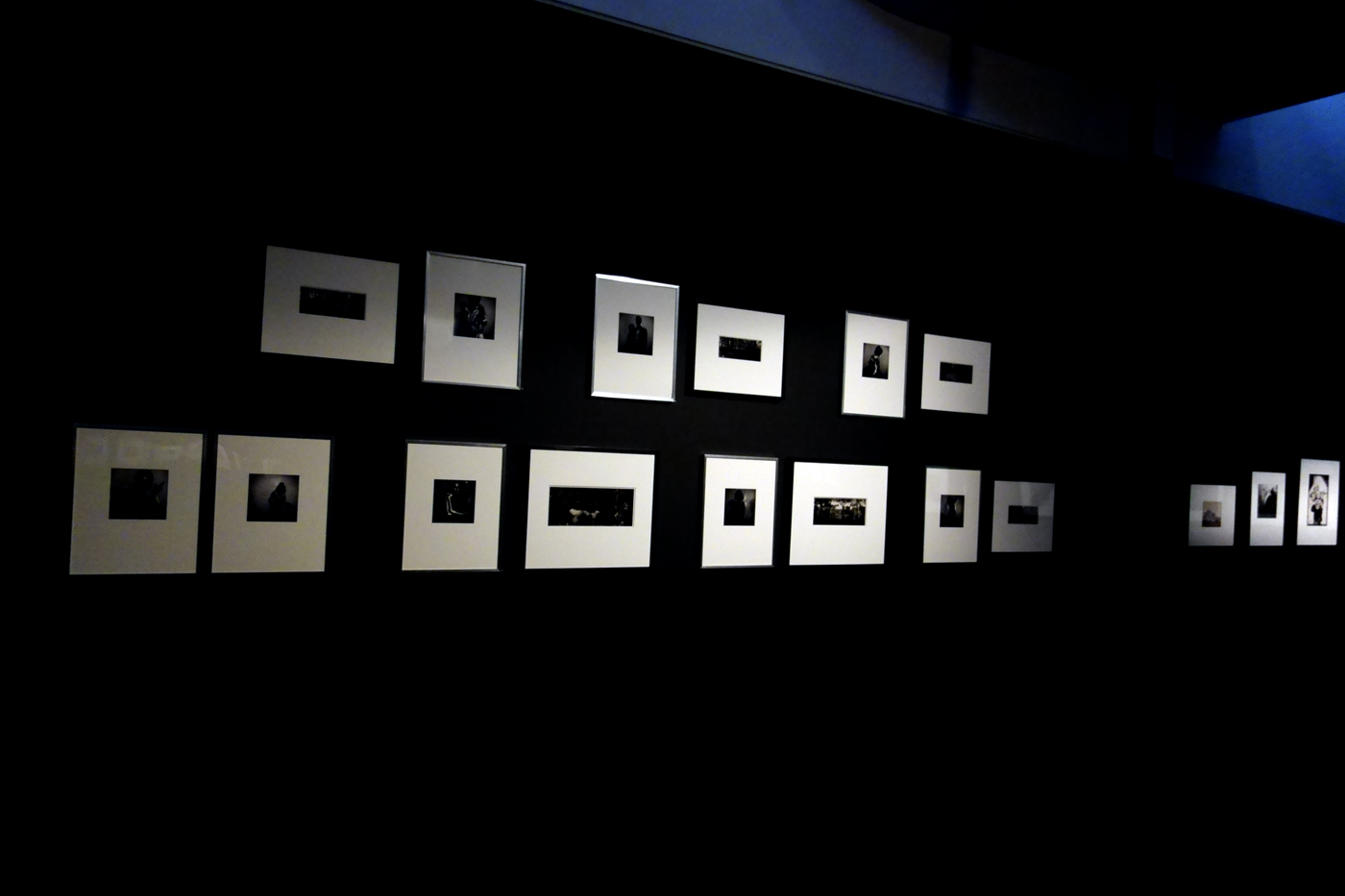
 

Installation photograph of 'Wildcards: Bill Henson shuffles the deck' at the Monash Gallery of Art

Installation photograph of 'Wildcards: Bill Henson shuffles the deck' at the Monash Gallery of Art


Installation photographs of Wildcards: Bill Henson shuffles the deck at the Monash Gallery of Art
Photos: Marcus Bunyan

1/ stygian gloom
2/large grouping of 14 works by Wesley Stacey


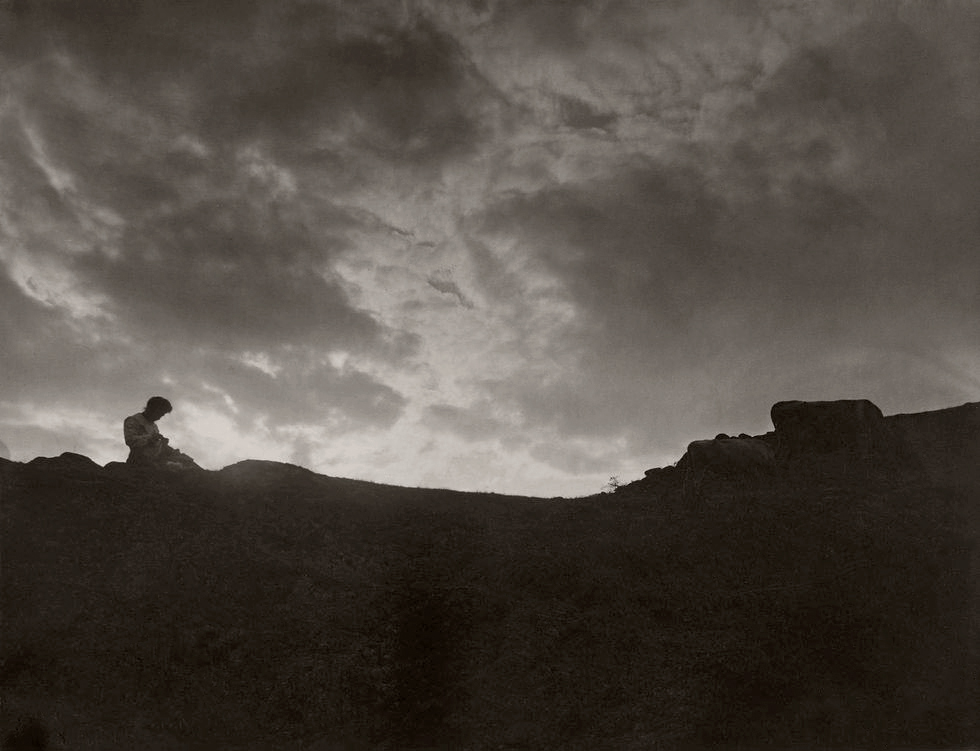
Unknown photographer. 'Untitled' c. 1900


Unknown photographer
Untitled
c. 1900
Cyanotype print
Monash Gallery of Art, City of Monash Collection
Acquired 2012


vapid [vap-id]
adjective
lacking or having lost life, sharpness, or flavour

Origin:
1650-60;  Latin vapidus;  akin to va·por [vey-per]
noun
a visible exhalation, as fog, mist, steam, smoke diffused through or suspended in the air; particles of drugs that can be inhaled as a therapeutic agent


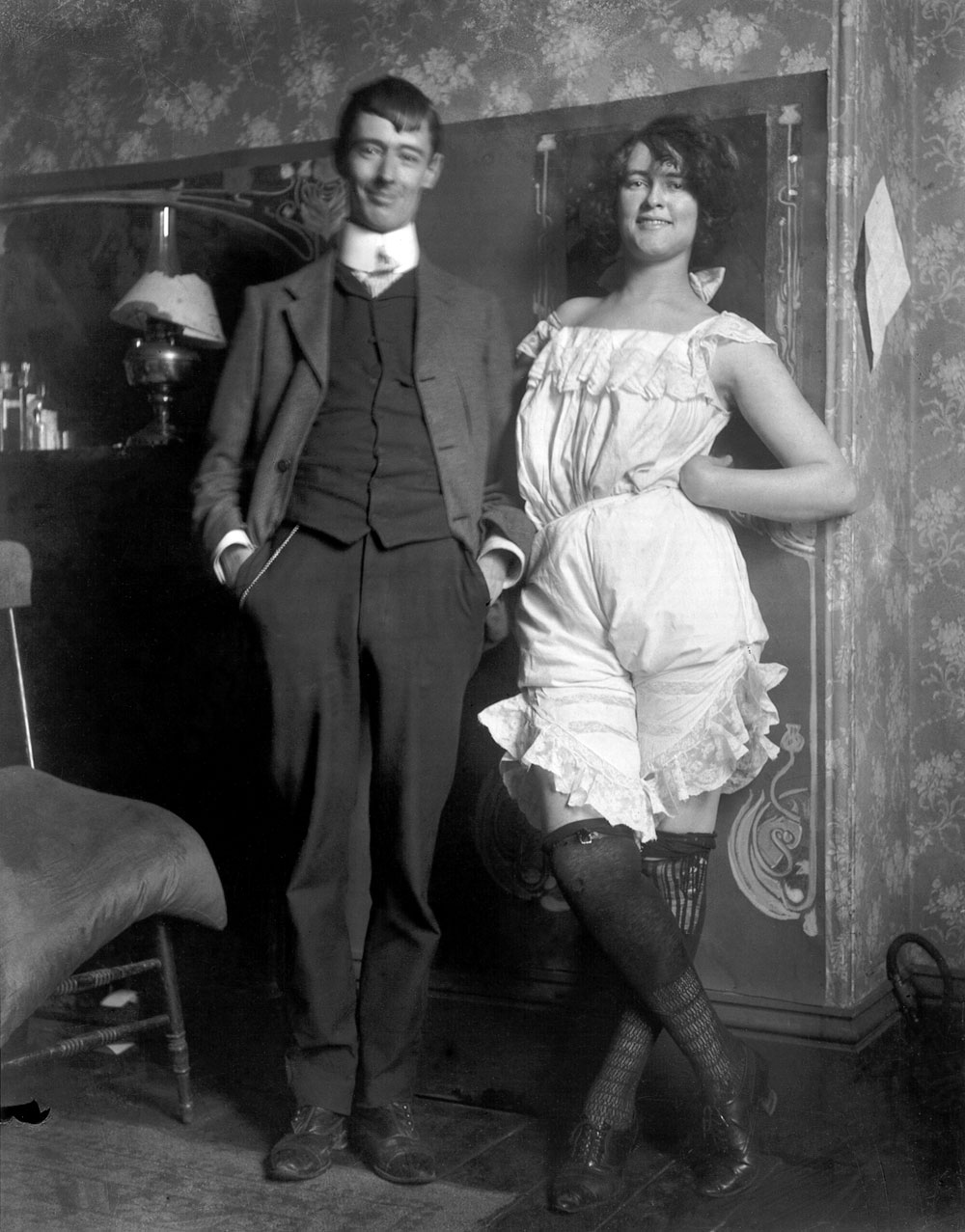
This is an unexceptional exhibition, one that lacks jouissance in the sense of a transgressive kind of enjoyment, an investigation of the subject that gives pleasure in taking you to unexpected places. At times I felt like a somnambulist walking around this exhibition of photographs from the Monash Gallery of Art collection curated by Bill Henson, pitched into stygian darkness and listening to somewhat monotonous music. It was a not too invidious an exercise but it left me with a VAPID feeling, as though I had inhaled some soporific drug: the motion of the journey apparently not confined by a story, but in reality that story is Henson’s mainly black and white self-portrait. The photographs on the wall, while solid enough, seemed to lack sparkle. There were a couple of knockout prints (such as David Moore’s Himalaya at dusk, Sydney, 1950 below; the Untitled cyanotype c. 1900, above; and Mark Hinderaker’s delicate portrait of Fiona Hall, 1984 below) and some real bombs (the large Norman Lindsay photographs, modern reproductions printed many times their original size were particularly nauseous). And one has to ask: were the images chosen for how they were balanced on the wall or were they chosen for content?

Henson states that there was no concept or agenda when picking the 88 photographs for this exhibition, simply his INTENSITY of feeling and intuition, his intuitive response to the images when he first saw them – to allow “their aesthetics to determine their presence… our whole bodies to experience these photographs – objects as pictures as photographs.”1 Henson responded as much as possible to the thing which then becomes an iconography (which appeals to his eye) as he asks himself, why is one brush stroke compelling, and not another? The viewer can then go on a journey in which MEANING comes from FEELING, and SENSATIONS are the primary stuff of life.

One of Henson’s preoccupations, “is an interest in the photograph as an object, in the physical presence of the print or whatever kind of technology is being used to make it.”2 He would like us to acknowledge the presence and aura (Walter Benjamin) of the photograph as we stand in front of it, responding with our whole bodies to the experience, not just our eyes. He wants us to have an intensity of feeling towards these works, responding to their presence and how he has hung the works in the exhibition. “There are no themes but rather images that appeal to the eye and, indeed, the whole body. Because photographs are first and foremost objects, their size, shape grouping and texture are as important as the images they’re recording.”3

Henson insists that there was no preconceived conceptual framework for picking these particular photographs but this is being disingenuous. Henson was invited to select images from the MGA collection with the specific idea of holding an exhibition, so this is the conceptual jumping off point; he then selected the images intuitively only to then group and arrange then intuitively/conceptually – by thinking long and hard about how these images would be grouped and hung on the wall of the gallery. I would like to believe that Henson was thinking about MUSIC when he hung this exhibition, not photography. Listen to Henson talk about the pairing of Leonie Reisberg’s Portrait of Peggy Silinski, Tasmania (c. 1976, below) and Beverley Veasey’s Study of a Calf, Bos taurus (2006, below) in this video, and you will get the idea about how he perceives these photographs relate to each other, how they transcend time and space.

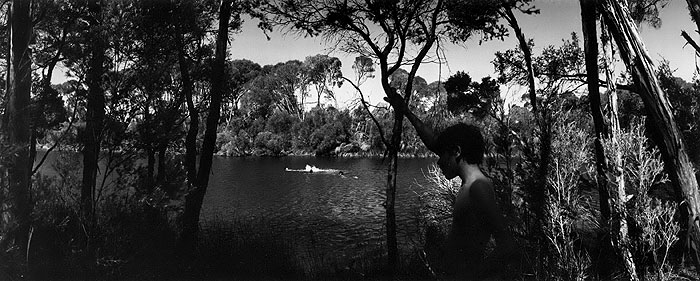
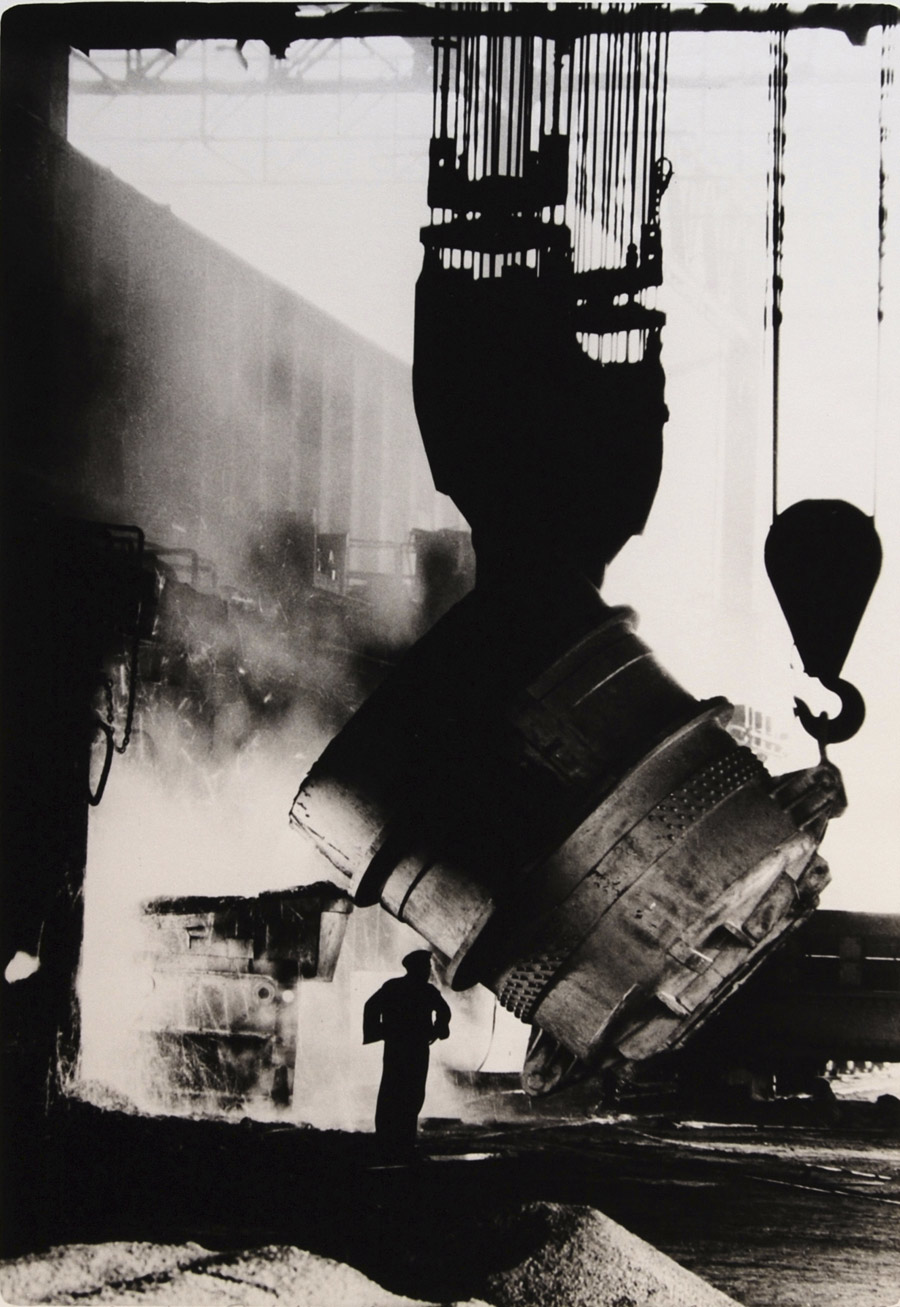
This is one of the key elements of the exhibition: how Henson pushes and pulls at time and space itself through the placing of images of different eras together. The other two key elements are how the music rises and falls through the shape of the photographs themselves; and how the figures within the images are pulled towards or pushed away from you. With regard to the rise and fall, Henson manipulates the viewer through the embodiedness of both horizontal and vertical photographs, reminding me of a Japanese artist using a calligraphy brush (see the second installation image above, where the photographs move from the vertical to the square and then onto panoramic landscape). In relation to the content of the images, there seems to be a preoccupation (a story, a theme?) running through the exhibition with the body being consumed by the landscape or the body being isolated from the landscape but with the threat of being consumed by it. Evidence of this can be seen in Wesley Stacey’s Willie near Mallacoota (1979, below) where the body almost melts into the landscape and David Moore’s Newcastle steelworks (1963, below) where the kids on the bicycles are trying to escape the encroaching doom that hovers behind them.

One of the key images in the exhibition for me also reinforces this theme – a tiny Untitled cyanotype (c. 1900, above) in which two Victorian children are perched on a bank near a stream with the bush beyond – but there are too many of this ilk to mention here: either the figures are pulled towards the front of the frame or pushed back into the encroaching danger, as though Henson is interrogating, evidencing un / occupied space. Overall, there is an element of control and lyrical balance in how he has grouped and hung these works together, the dark hue of the gallery walls allowing the photographs to exist as objects for themselves. Henson puts things next to each other in sequences and series to, allegedly, promote UNEXPECTED conversations and connections through a series of GESTURES.

As Henson notes,

“Maybe it’s the fact that the photographs have the ability to suggest some other thing and that’s what draws you in – that’s that feeling, the thing that slips away from thought. These are really the same things that apply to our meetings with any work of art, whether it’s a piece of music or a sculpture or anything else. There’s something compelling, there’s something there that sort of animates your speculative capacity, causes you to wonder. Other times, or most of the time, that’s not the case. Certainly most of the time that’s not the case with photography.”4

.
For me, there was little WONDER in this exhibition, something that you would go ‘oh, wow’ at, some way of looking at the world that is interesting and insightful and fractures the plaisir of cultural enjoyment and identity. While the photographs may have been chosen intuitively and then hung intuitively/conceptually, I simply got very little FEELING, no ICE/FIRE  (as Minor White would say) – no frisson between his pairings, groupings and arrangements. It was all so predictable, so ho-hum. Everything I expected Henson to do… he did!

There were few unexpected gestures, no startling insight into the human and photographic condition. If as he says, “Everything comes to you through your whole body, not just through your eyes and ears,”5 and that photographs are first and foremost objects, their size, shape, grouping and texture as important as the images they’re recording THEN I wanted to be moved, I wanted to feel, to be immersed in a sensate world not a visible exhalation (of thought?), a vapor that this exhibition is. Henson might have painted an open-ended self-portrait but this does not make for a very engaging experience for the viewer. In this case, the sharing of a story has not meant the sharing of an emotion.

Dr Marcus Bunyan


1/ Interview with Bill Henson by Toby Fehily posted 01 Feb 2014 on the Art Guide Australia website [Online] Cited 18/02/2014. No longer available online

2/ Ibid.,

3/ Fiona Gruber. “Review of Wildcards, Bill Henson Shuffles the Deck” on the Guardian website, Wednesday 12 February 2014 [Online] Cited 16/03/2014

4/ Fehily op. cit.,

5/ Fehily op. cit.,


Many thankx to the Monash Gallery of Art for allowing me to publish the photographs in the posting. Please click on the photographs for a larger version of the image.


MGA Collection: Bill Henson on Leonie Reisberg and Beverley Veasey

Bill Henson talks about the photographs of Leonie Reisberg and Beverley Veasey from the MGA Collection in WILDCARDS: BILL HENSON SHUFFLES THE DECK, Monash Gallery of Art, 1 February to 30 March 2014.
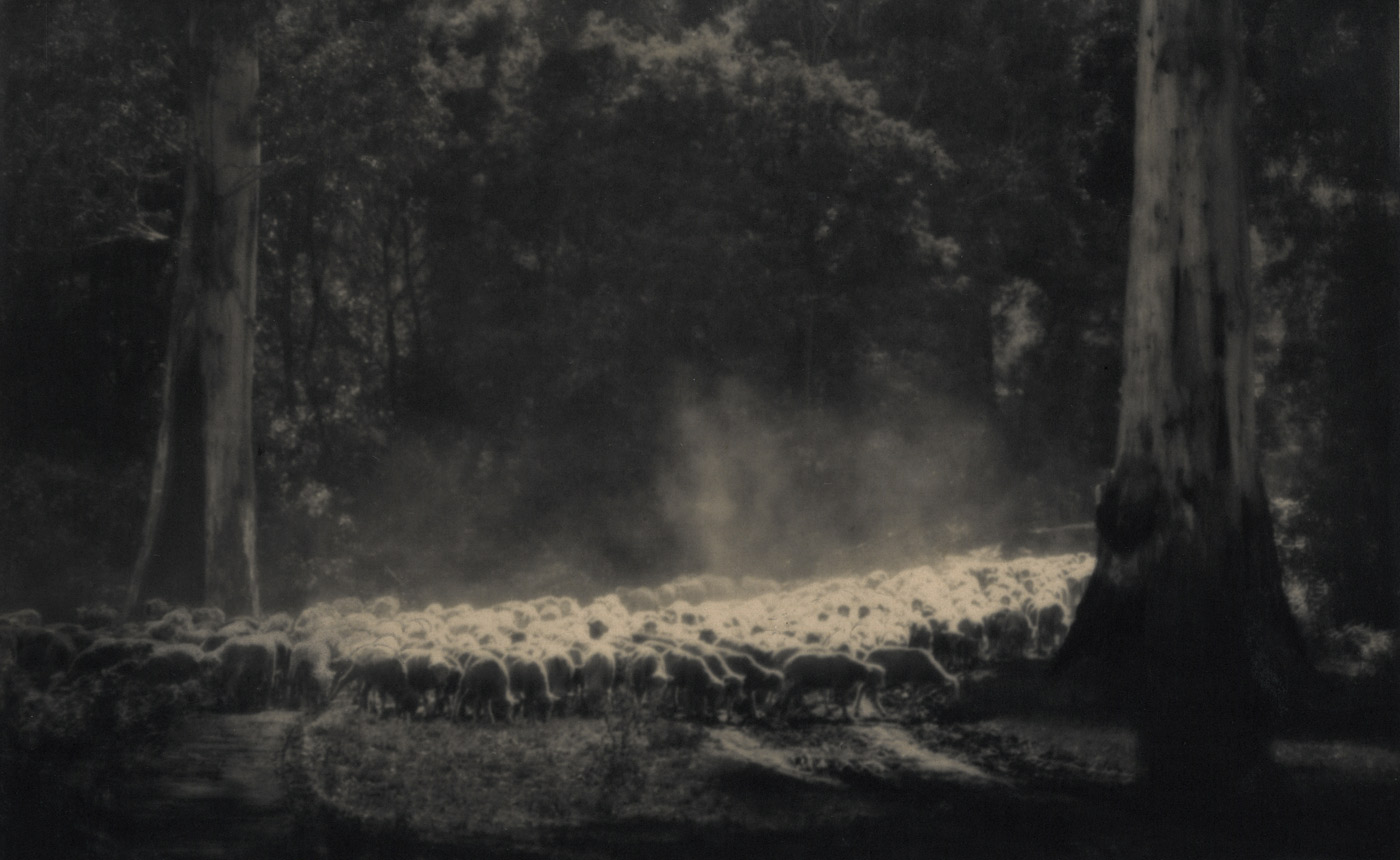
 

John Eaton (born United Kingdom 1881; arrived Australia 1889; died 1967) 'Sheep in clearing' c. 1920s


John Eaton (born United Kingdom 1881; arrived Australia 1889; died 1967)
Sheep in clearing
c. 1920s
Gelatin silver print
15.6 x 23.8cm
Monash Gallery of Art, City of Monash Collection
Donated by Janice Hinderaker through the Australian Government’s Cultural Gifts Program 2003


Fred Kruger (born Germany 1831; arrived Australia 1860; died 1888) 'Queen Mary and King Billy outside their mia mia' c. 1880


Fred Kruger (born Germany 1831; arrived Australia 1860; died 1888)
Queen Mary and King Billy outside their mia mia
c. 1880
Albumen print
13.4 x 20.8cm
Monash Gallery of Art, City of Monash Collection acquired 2012


David Moore (Australia 1927-2003) 'Himalaya at dusk, Sydney' 1950


David Moore (Australia 1927-2003)
Himalaya at dusk, Sydney
1950
Gelatin silver print, printed 2005
24.5 x 34.25cm
Monash Gallery of Art, City of Monash Collection donated by the Estate of David Moore 2006
Courtesy of the Estate of David Moore (Sydney)


Wesley Stacey (Australia, b. 1941) 'Willie near Mallacoota' 1979


Wesley Stacey (Australia, b. 1941)
Willie near Mallacoota
1979
From the series Koorie set
Gelatin silver print
Monash Gallery of Art, City of Monash Collection
Donated through the Australian Government’s Cultural Gifts Program by Christine Godden 2011

Published under fair use for the purpose of art criticism


David Moore (Australia, 1927-2003) 'Newcastle steelworks' 1963


David Moore (Australia, 1927-2003)
Newcastle steelworks
1963
Gelatin silver print
Monash Gallery of Art, City of Monash Collection
Acquired 1981

Published under fair use for the purpose of art criticism


One of those preoccupations is an interest in the photograph as an object, in the physical presence of the print or whatever kind of technology is being used to make it. Part of the reason for that is that photography, more than any other medium, suffers from a mistake or misunderstanding people have when they’ve seen a reproduction in a magazine or online: they think they’re seeing the original. A certain amount of photography is made with its ultimate intention being to be seen in a magazine or online, but most photography, historically, ended up in its final form as a print – a cyanotype, or a tin type or a daguerreotype or whatever it might be.”

Interview with Bill Henson by Toby Fehily posted 01 Feb 2014 on the Art Guide Australia website [Online] Cited 18/02/2014. No longer available online. Used under fair use for the purposes of education and research.


Leonie Reisberg (Australia, b. 1955) 'Portrait of Peggy Silinski, Tasmania' c. 1976


Leonie Reisberg (Australia, b. 1955)
Portrait of Peggy Silinski, Tasmania
c. 1976
Gelatin silver print
Monash Gallery of Art, City of Monash Collection
Donated by Janice Hinderaker through the Australian Government’s Cultural Gifts Program 2003


Beverley Veasey (Australia, b. 1968) 'Study of a Calf, Bos taurus' 2006


Beverley Veasey (Australia, b. 1968)
Study of a Calf, Bos taurus
2006
Chromogenic print
Monash Gallery of Art, City of Monash Collection
Acquired 2006


I think when you look through any collection, you’re often struck by the kind of pointlessness and banality of photography. It doesn’t matter which museum in the world you look at. It’s like, “is there any need for this thing to exist at all?”. It probably comes back to the capacity of the object, the image to suggest things, the suggestive potential rather than the prescriptive, which is a given in photography of course, the evidential authority of the medium preceding any individual reading we have of particular pictures. Maybe it’s the fact that the photographs have the ability to suggest some other thing and that’s what draws you in – that’s that feeling, the thing that slips away from thought. These are really the same things that apply to our meetings with any work of art, whether it’s a piece of music or a sculpture or anything else. There’s something compelling, there’s something there that sort of animates your speculative capacity, causes you to wonder. Other times, or most of the time, that’s not the case. Certainly most of the time that’s not the case with photography.

Interview with Bill Henson by Toby Fehily posted 01 Feb 2014 on the Art Guide Australia website [Online] Cited 18/02/2014. No longer available online. Used under fair use for the purpose of education and research.


Axel Poigant (born United Kingdom 1906; arrived Australia 1926; died 1986) 'Jack and his family on the Canning Stock Route' 1942


Axel Poigant (born United Kingdom 1906; arrived Australia 1926; died 1986)
Jack and his family on the Canning Stock Route
1942
Gelatin silver print, printed 1986
Monash Gallery of Art, City of Monash Collection
Acquired 1991


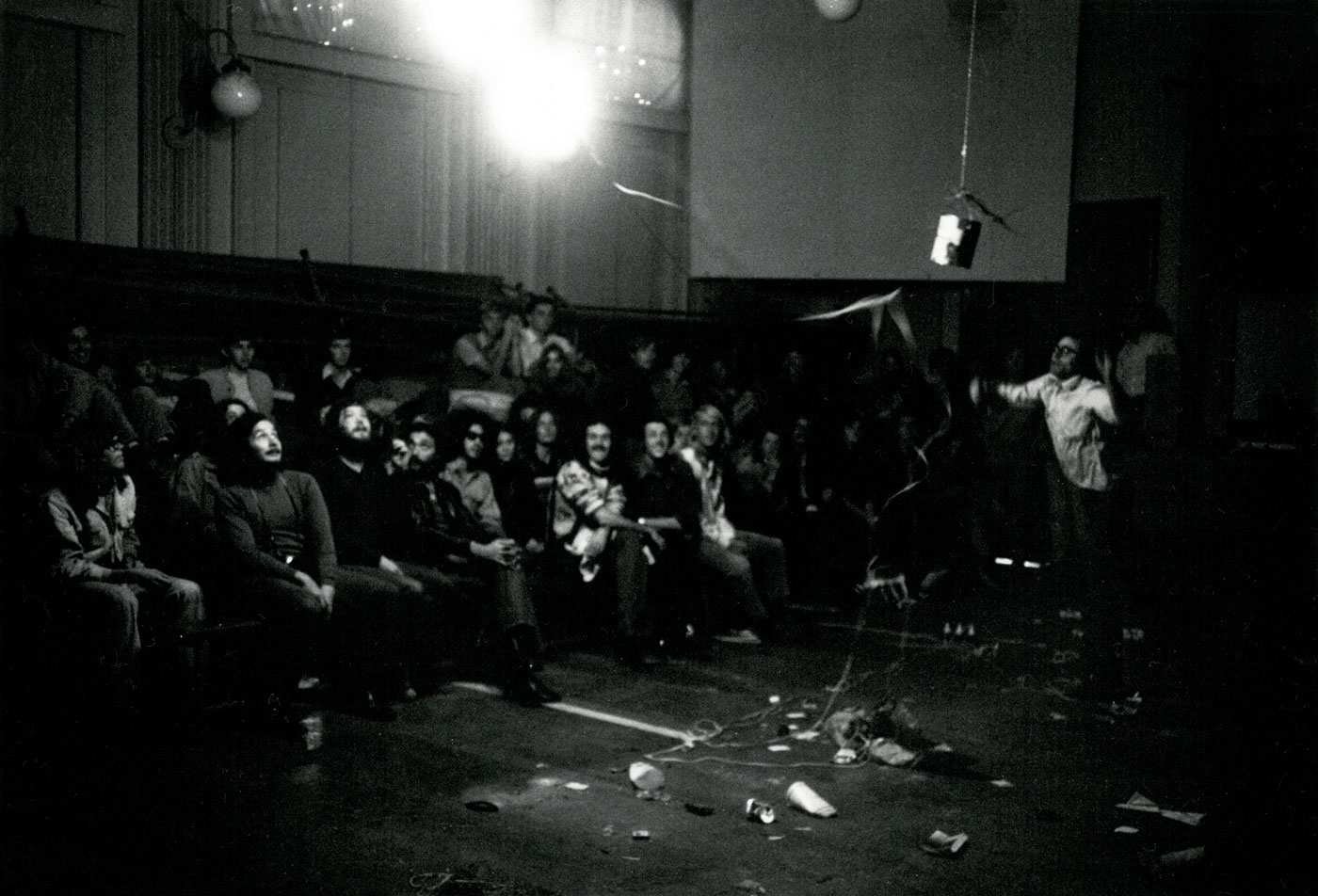
Tim Johson (Australia, b. 1947) 'Light performances' 1971-72


Tim Johson (Australia, b. 1947)
Light performances
1971-1972
Gelatin silver print
Monash Gallery of Art, City of Monash Collection
Acquired 2011


Cherine Fahd (Australia, b. 1974) 'Alicia' 2003


Cherine Fahd (Australia, b. 1974)
Alicia
2003
From the series A woman runs
Gelatin silver print
Monash Gallery of Art, City of Monash Collection
Donated through the Australian Government’s Cultural Gifts Program 2011


Wesley Stacey (Australia, b. 1941) 'Untitled' 1973


Wesley Stacey (Australia, b. 1941)
Untitled
1973
From the series Friends
Gelatin silver print
Monash Gallery of Art, City of Monash Collection
Donated by Bill Bowness 2013


That was one of the things that interested me and continues to interest me about photography: how these things inhabit the world as objects. And indeed we read them not just with our eyes but with how our whole bodies read and encounter and negotiate these objects, which happen to be photographs. And that’s very much a thing that interests me in the way that I work. I feel sometimes that I only happen to make photographs myself and that it’s a means to an end… So there’s a sense in which I’m interested in these objects that happen to be photographs and the way that they inhabit the same space that our bodies inhabit. Everything comes to you through your whole body, not just through your eyes and ears – it’s a vast amount of information. Watching something get bigger as you draw closer to it, not just matters of proximity, but texture or the way objects sit in a space when they’re lit a certain way – all of this is very interesting to me, always has been.”

Interview with Bill Henson by Toby Fehily posted 01 Feb 2014 on the Art Guide Australia website [Online] Cited 18/02/2014. Used under fair use for the purpose of art criticism. No longer available online.


Mark Hinderaker (born United States of America 1946; arrived Australia 1970; died 2004) 'Fiona Hall' 1984


Mark Hinderaker (born United States of America 1946; arrived Australia 1970; died 2004)
Fiona Hall
1984
Gelatin silver print
Monash Gallery of Art, City of Monash Collection
Donated by Janice Hinderaker through the Australian Government’s Cultural Gifts Program 2003


Lionel Lindsay (Australia 1874-1961) 'Norman Lindsay and Rose Soady, Bond Street studio' c. 1909


Lionel Lindsay (Australia 1874-1961)
Norman Lindsay and Rose Soady, Bond Street studio
c. 1909
Gelatin silver print, printed 2000
Monash Gallery of Art, City of Monash Collection
Donated by Katherine Littlewood 2000


Mark Strizic (born Germany 1928; arrived Australia 1950; died 2012) 'BHP steel mill, Port Kembla, 1959'


Mark Strizic (born Germany 1928; arrived Australia 1950; died 2012)
BHP steel mill, Port Kembla, 1959
1959
Gelatin silver print, printed 1999
Monash Gallery of Art, City of Monash Collection
Donated by the Bowness Family through the Australian Government’s Cultural Gifts Program 2008


Monash Gallery of Art
860 Ferntree Gully Road, Wheelers Hill
Victoria 3150 Australia
Phone: + 61 3 8544 0500

Opening hours:
Tue – Fri: 10am – 5pm
Sat – Sun: 10pm – 4pm
Mon/public holidays: closed

Monash Gallery of Art website

LIKE ART BLART ON FACEBOOK

Back to top

Exhibition preview: ‘Out of the closets, into the streets: gay liberation photography 1971-73’ at Edmund Pearce Gallery, Melbourne

Exhibition dates: 22nd July – 26th July, 2014

Opening: Tuesday 22nd July 6-8pm
Nite Art: Wednesday 23rd July until 11pm
Artists represented: Philip Potter, John Storey, John Englart, Barbara Creed, Ponch Hawkes, Rennie Ellis

Curated by Dr Marcus Bunyan and Nicholas Henderson


Rennie Ellis (Australian, 1940-2003 'Confrontation, Gay Pride Week Picnic, Botanical Gardens 1973' 1973, printed later from the exhibition 'Out of the closets, into the streets: gay liberation photography 1971-73' at Edmund Pearce Gallery, Melbourne, July 2014


Rennie Ellis (Australian, 1940-2003)
Confrontation, Gay Pride Week Picnic, Botanical Gardens 1973
1973, printed 2014
Silver gelatin photograph
© Rennie Ellis


Five days, that’s all you’ve got! Just five days to see this fabulous exhibition, so make a note of it now in your diaries…

The exhibition Out of the closets, into the streets: gay liberation photography 1971-73 pictures the very beginning of the gay liberation movement in Australia through the work of Philip Potter, John Storey, John Englart, Barbara Creed, Ponch Hawkes and Rennie Ellis. The exhibition examines for the first time images from the period as works of art as much as social documents. The title of the exhibition is a slogan from the period.

As gay people found their voice in the early 1970s artists, often at the very beginning of their careers, were there to capture meetings in lounge rooms, consciousness raising groups and street protests. The liberation movement meant ‘being there’, putting your body on the line. “It was a key feature of the new left that this embodied politics couldn’t stop in the streets: that is, the public arena as conventionally understood. ‘Being there’ politically also applied to households, classrooms, sexual relations, workplaces and the natural environment.”1

Curated by Dr Marcus Bunyan and Nicholas Henderson and with catalogue essays by Professor Dennis Altman and Dr Marcus Bunyan, the show is a stimulating experience for those who want to be inspired by the history and art of the early gay liberation movement in Australia.

The exhibition coincides with AIDS 2014: 20th International AIDS Conference (20-25 July 2014) and Nite Art which occurs on the Wednesday night (23rd July 2014). The exhibition will travel to Sydney to coincide with the 14th Australia’s Homosexual Histories Conference in November at a venue yet to be confirmed.

Dr Marcus Bunyan


1/ Connell, Raewyn. “Ours is in colour: the new left of the 1960s,” in Carolyn D’Cruz and Mark Pendleton (eds.,). After Homosexual: The Legacies of Gay Liberation. Perth: UWA Publishing, 2013, p. 43.


Many thankx to all the artists for allowing me to publish the photographs in the posting. Please click on the photographs for a larger version of the image.


Phillip Potter (Australian) 'Queens' 1971 from the exhibition 'Out of the closets, into the streets: gay liberation photography 1971-73' at Edmund Pearce Gallery, Melbourne, July 2014


Phillip Potter (Australian)
Queens
1971, printed 2014
Digital C type print on Kodak Endura Matte
© Phillip Potter


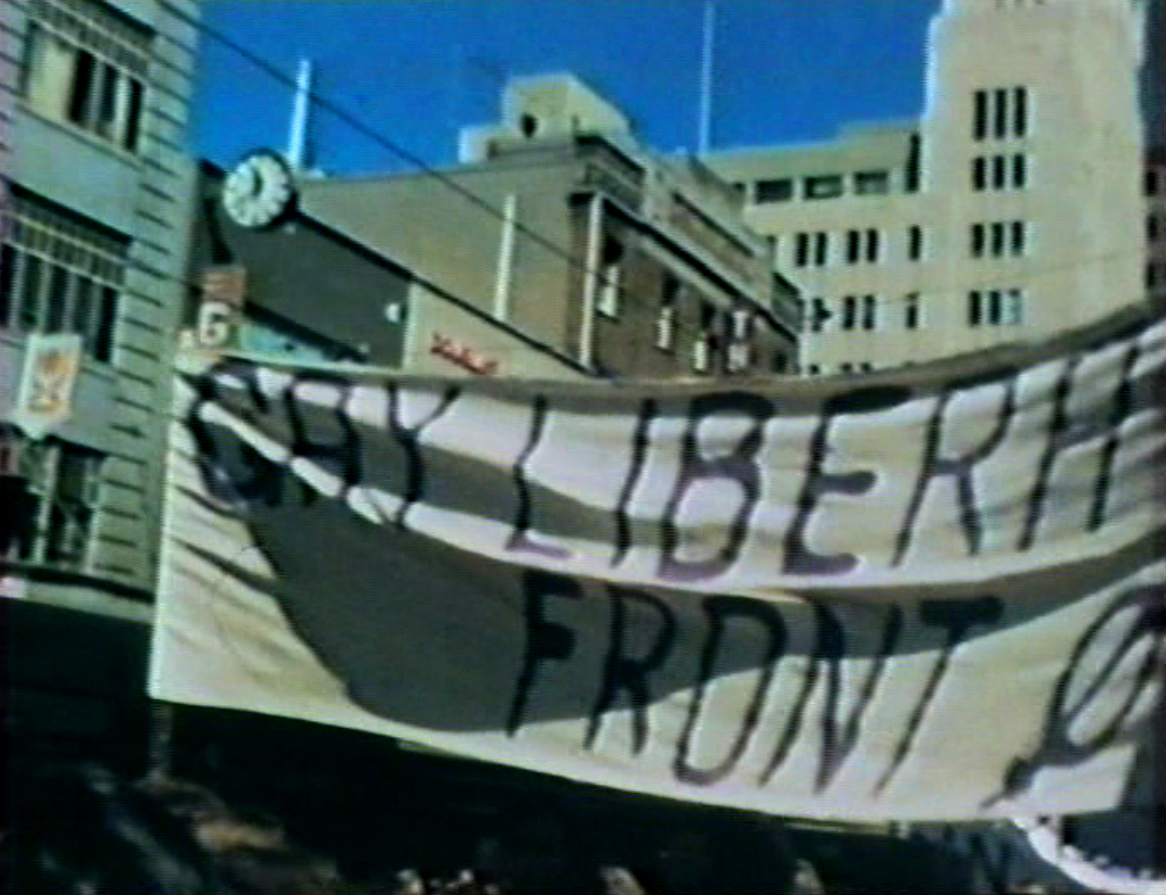
From a series of photographs of the very first gay rights demonstration which attracts 70 people outside NSW Liberal Party headquarters in support of the pre-selection of Tom Hughes against a right wing challenge following his support for homosexual law reform.


Unknown artist. 'Cricket is homosexual' Melbourne, c. 1971 - 1973


Unknown artist
Cricket is homosexual!
Melbourne, c. 1971-1973, printed 2014
Giclee print on Hahnemuhle william turner 310gsm
© Australian Lesbian and Gay Archives


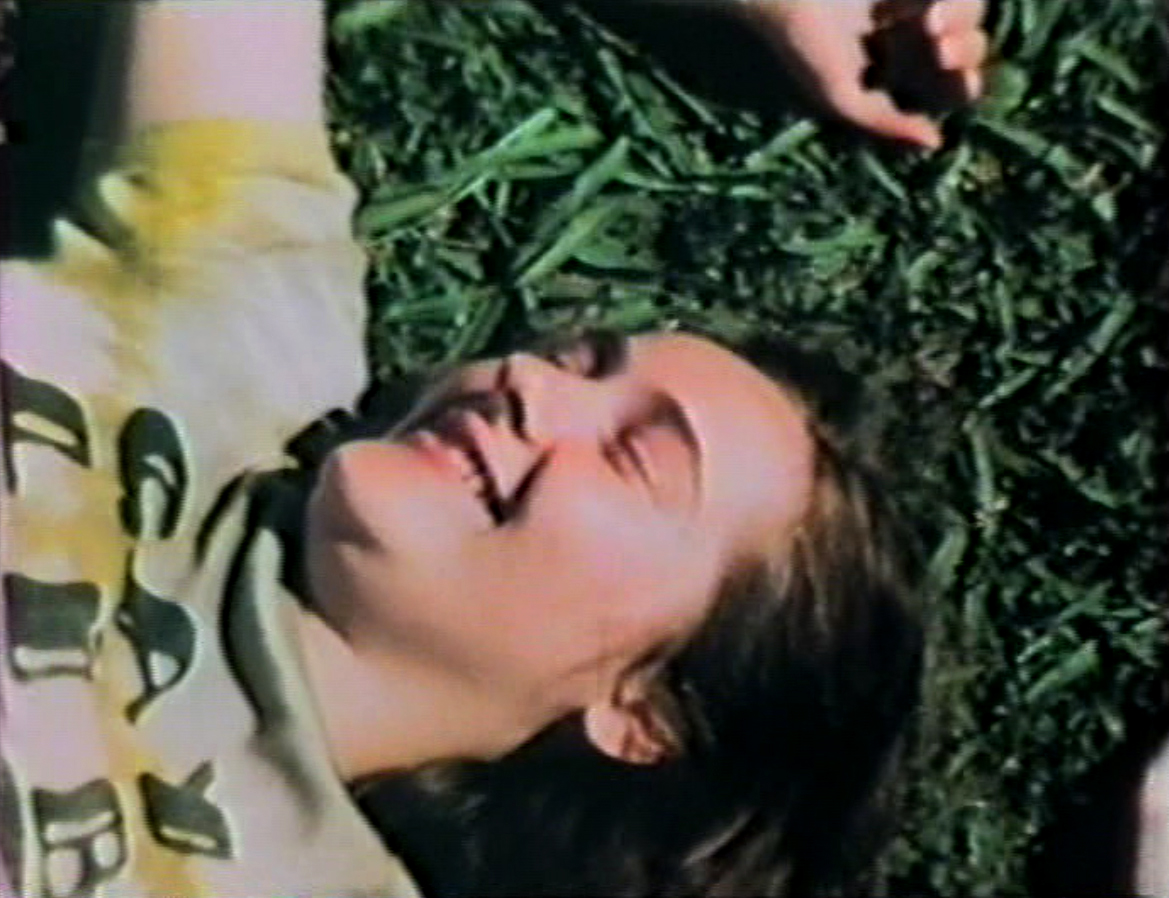
Barbara Creed (Australian, b. 1943) 'Stills from a Super 8mm film of a Women’s Liberation march' Melbourne, 1973


Barbara Creed (Australian, b. 1943)
Stills from a Super 8mm film of a Women’s Liberation march
Melbourne, 1973, printed 2014
Still from a Super 8mm film
Digital C type print on Kodak Endura Matte
© Barbara Creed


Still from a super 8mm movie of a Women’s Liberation march, Melbourne, 1973.


Barbara Creed (Australian, b. 1943) 'Stills from a Super 8mm film of a Women’s Liberation march' Melbourne, 1973


Barbara Creed (Australian, b. 1943)
Stills from a Super 8mm film of a Women’s Liberation march
Melbourne, 1973, printed 2014
Still from a Super 8mm film
Digital C type print on Kodak Endura Matte
© Barbara Creed


Still from a super 8mm movie of a Women’s Liberation march, Melbourne, 1973.


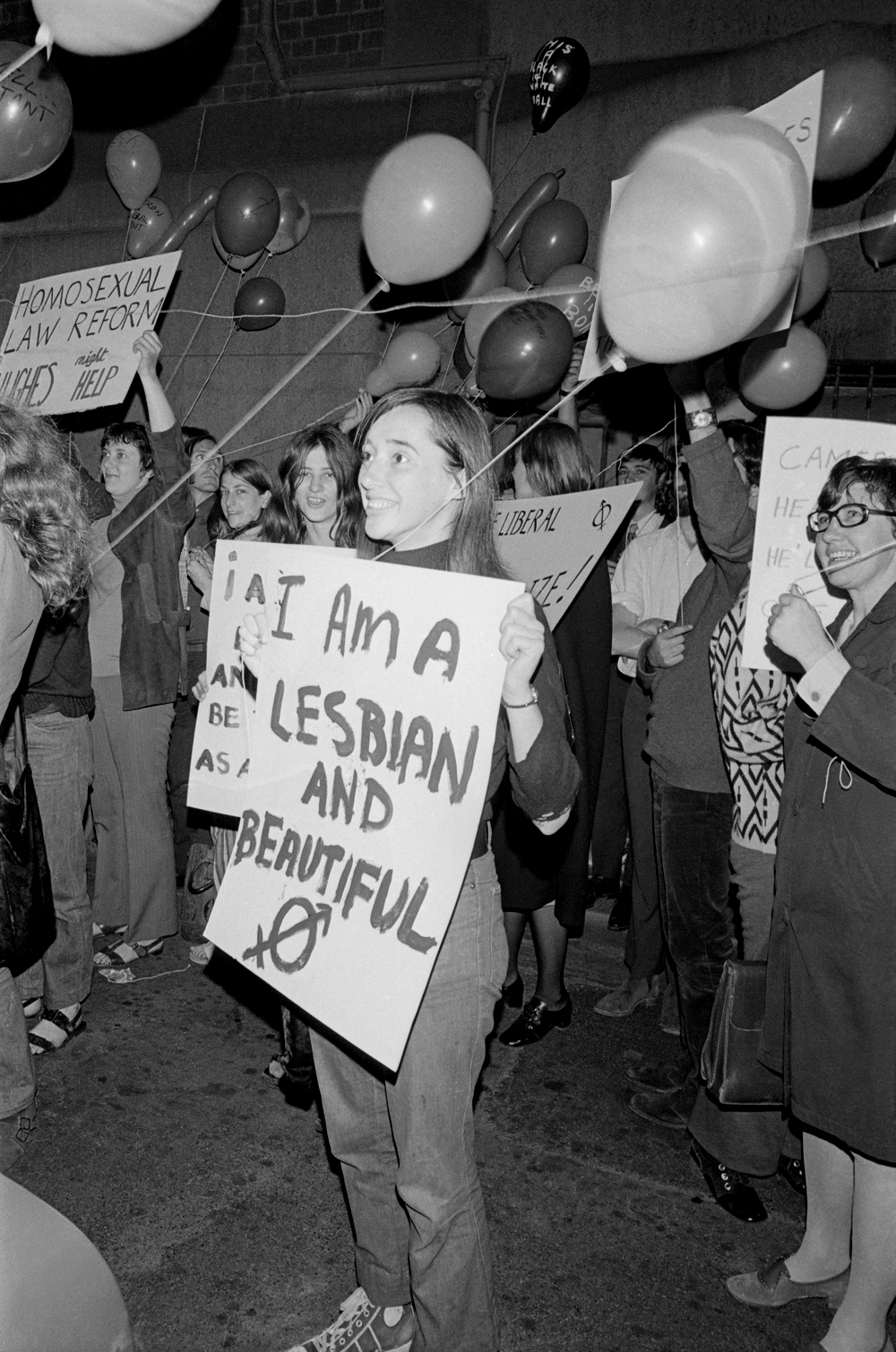
John Storey (Australian, 1950-2019) 'I am a Lesbian and Beautiful' 1971, printed 2014


John Storey (Australian, 1950-2019)
I am a Lesbian and Beautiful
1971, printed 2014
Digital C type print on Kodak Endura Matte
© John Storey


From a series of photographs of the very first gay rights demonstration which attracts 70 people outside NSW Liberal Party headquarters in support of the pre-selection of Tom Hughes against a right wing challenge following his support for homosexual law reform.


Phillip Potter (Australian) 'Policeman reading 'Camp Ink' magazine' 1971


Phillip Potter (Australian)
Policeman reading ‘Camp Ink’ magazine
1971, printed 2014
Digital C type print on Kodak Endura Matte
© Phillip Potter


From a series of photographs of the very first gay rights demonstration which attracts 70 people outside NSW Liberal Party headquarters in support of the pre-selection of Tom Hughes against a right wing challenge following his support for homosexual law reform.


Sponsored by

CPL Digital logo

For photographic services in Australia, Art Blart highly recommends CPL Digital (03) 8376 8376 cpldigital.com.au

Art Blart logo

Dr Marcus Bunyan and the best cultural archive in Australia sponsor this event artblart.com

ALGA logo

AQUA actively collects and preserves lesbian and gay material from across Australia
queerarchives.org.au

Supported by

Rennie Ellis logo

Rennie Ellis is an award winning photographer and writer (03) 9525 3862 www.rennieellis.com.au


AIDS 2014: 20th International AIDS Conference
20 July – 25 July 2014
Melbourne, Australia

Edmund Pearce Gallery

This gallery has now closed.

LIKE ART BLART ON FACEBOOK

Back to top

Exhibition: ‘See the Light – Photography, Perception, Cognition: The Marjorie and Leonard Vernon Collection’ at The Los Angeles County Museum of Art (LACMA)

Exhibition dates: 27th October, 2013 – 23rd March, 2014

Curator: Britt Salvesen, Department Head and Curator of the Wallis Annenberg Photography Department and Prints and Drawings at LACMA


William Henry Fox Talbot (England, 1800-1877) 'Articles of China' c. 1844 from the exhibition 'See the Light – Photography, Perception, Cognition: The Marjorie and Leonard Vernon Collection' at The Los Angeles County Museum of Art (LACMA), October 2013 - March 2014


William Henry Fox Talbot (English, 1800-1877)
Articles of China
c. 1844
Calotype
5 3/8 x 7 1/8 in. (13.65 x 18.1cm)
The Marjorie and Leonard Vernon Collection, gift of The Annenberg Foundation, acquired from Carol Vernon and Robert Turbin


It is a real joy to bring these beautiful images to you!

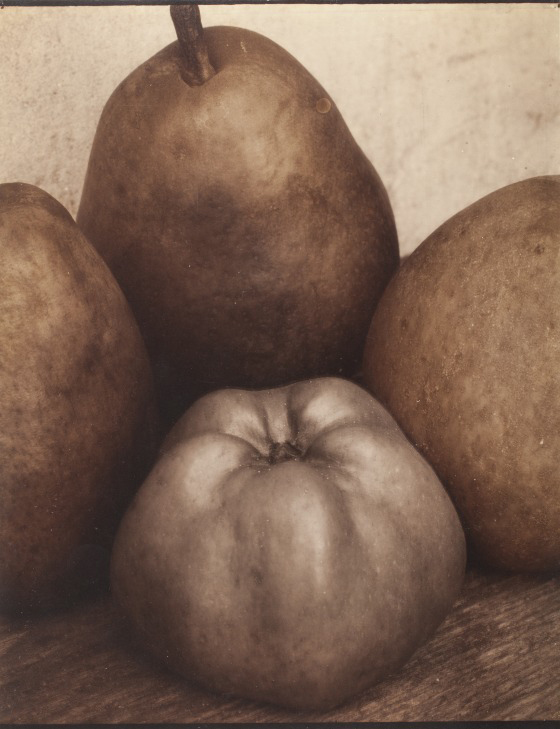
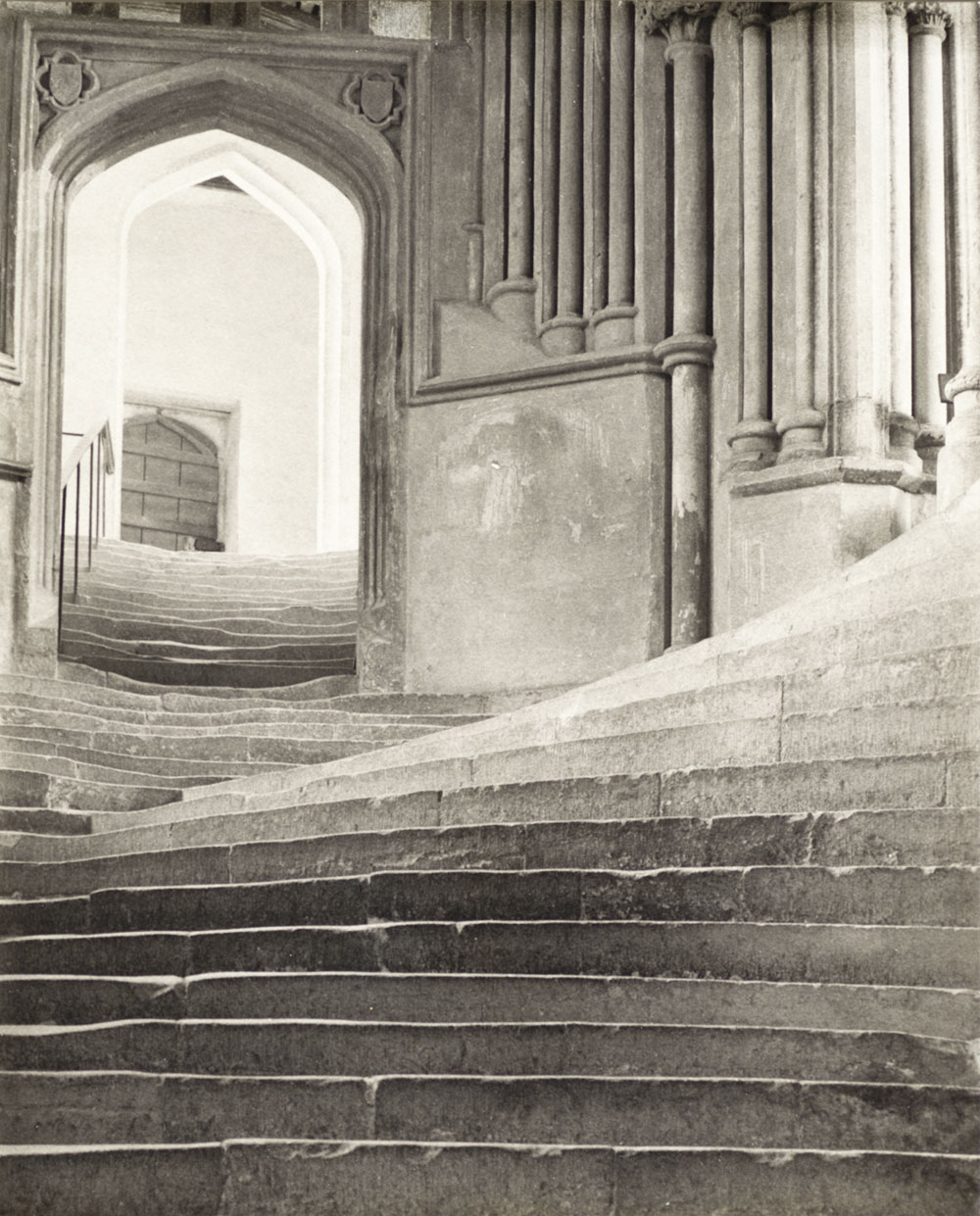
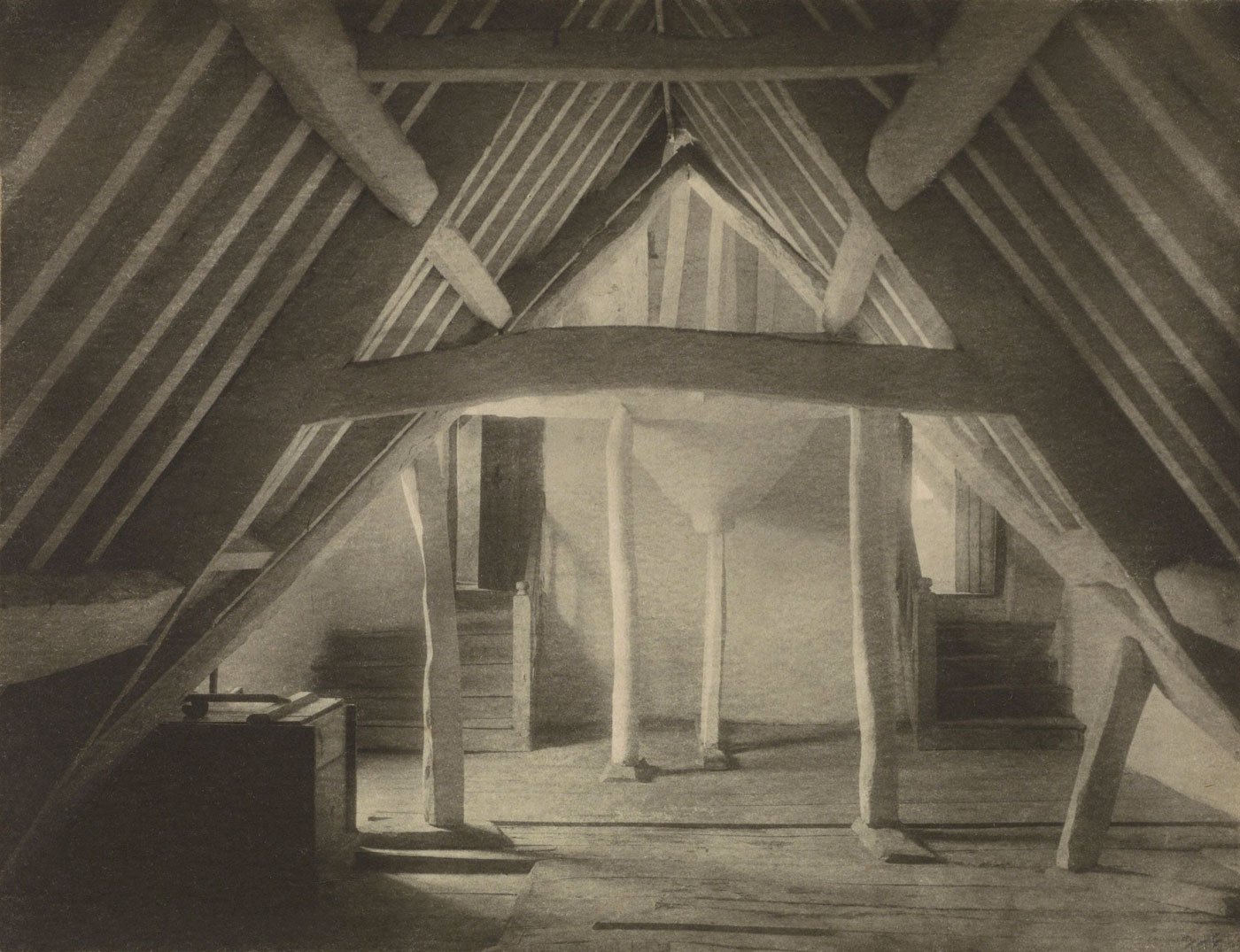
Frederick H. Evans A Sea Of Steps – Wells Cathedral (England, 1903, below) is one of my favourite photographs of all time, up there in my top 20 or so. But you wouldn’t knock back any of these for your collection, especially Imogen Cunningham’s Magnolia Blossom (1925, below) and Edward Steichen’s Three Pears & An Apple (1921, below).

Dr Marcus Bunyan


Many thankx to The Los Angeles County Museum of Art for allowing me to publish the photographs in the posting. Please click on the photographs for a larger version of the image.


Linnaeus Tripe (England, 1822-1902) 'The Elliot Marbles, Central Museum, Madras' India, 1858 from the exhibition 'See the Light – Photography, Perception, Cognition: The Marjorie and Leonard Vernon Collection' at The Los Angeles County Museum of Art (LACMA), October 2013 - March 2014


Linnaeus Tripe (English, 1822-1902)
The Elliot Marbles, Central Museum, Madras
India, 1858
Albumen photograph
10 1/2 × 13 in. (26.67 × 33.02cm)
The Marjorie and Leonard Vernon Collection, gift of The Annenberg Foundation, acquired from Carol Vernon and Robert Turbin


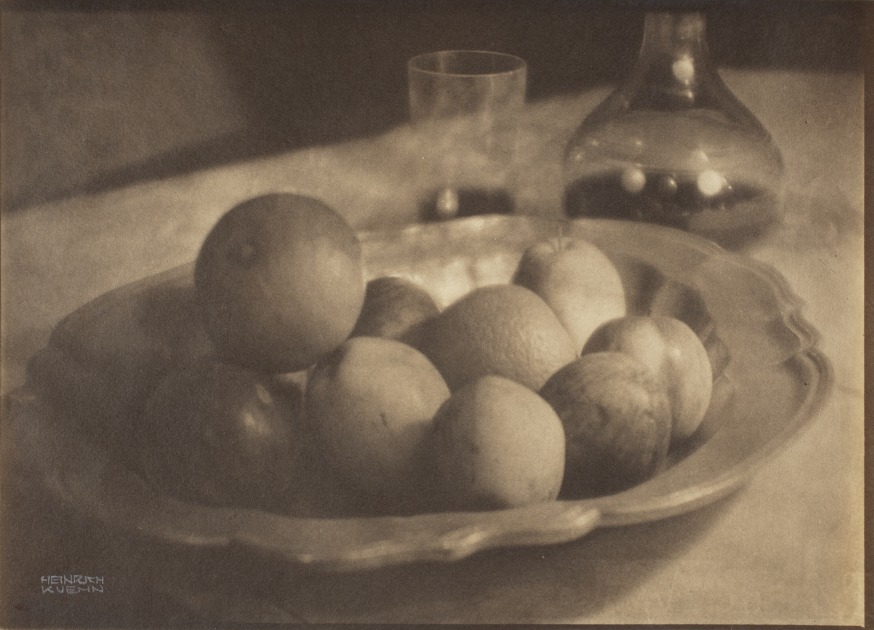
Carl Christian Heinrich Kühn (Germany, active Austria, 1866-1944) 'Still Life' c. 1905


Carl Christian Heinrich Kühn (Germany, active Austria, 1866-1944)
Still Life
c. 1905
Bromoil print
8 1/4 × 11 1/2 in. (20.96 × 29.21cm)
The Marjorie and Leonard Vernon Collection, gift of The Annenberg Foundation, acquired from Carol Vernon and Robert Turbin
© Estate of Heinrich Kühn


Imogen Cunningham (United States, 1883-1976) 'Magnolia Blossom' 1925


Imogen Cunningham (United States, 1883-1976)
Magnolia Blossom
1925
Gelatin silver print
The Marjorie and Leonard Vernon Collection, gift of The Annenberg Foundation, acquired from Carol Vernon and Robert Turbin
© 1925, 2013 Imogen Cunningham Trust


Charles Harbutt (United States, New Jersey, Camden, born 1935) 'Triptych' 1978, printed 1978


Charles Harbutt (United States, New Jersey, Camden, born 1935)
Triptych
1978, printed 1978
Gelatin silver prints
8 x 12″
The Marjorie and Leonard Vernon Collection, gift of The Annenberg Foundation, acquired from Carol Vernon and Robert Turbin
© Charles Harbutt. All rights reserved, Courtesy Peter Fetterman Gallery


The Los Angeles County Museum of Art (LACMA) presents See the Light – Photography, Perception, Cognition: The Marjorie and Leonard Vernon Collection, an exhibition celebrating an extraordinary collection and exploring parallels between photography and the science of vision. Since the invention of photography in the late 1830s, the medium has evolved in relation to theories about vision, perception, and cognition. The exhibition takes a historical perspective, identifying correlations between photography and the science of vision during four chronological periods. See the Light is comprised of 220 works by more than 150 artists, including Ansel Adams, Julia Margaret Cameron, Imogen Cunningham, William Henry Fox Talbot, Edward Steichen, Edward Weston, Minor White, and many more.

The exhibition draws entirely from the Marjorie and Leonard Vernon Collection, a key collection within LACMA’s Wallis Annenberg Photography Department. Acquired in 2008, the collection represents the diversity of photographic processes from the medium’s invention in 1839 to the 21st century. See the Light is accompanied by a free mobile-phone multimedia tour featured on mobile.lacma.org with commentary by the Vernons’ daughter, Carol Vernon; curator Britt Salvesen; artist James Welling; expert in computational vision Pietro Perona; and others. A 208-page catalogue, published by LACMA and DelMonico Books / Prestel, includes an essay by Britt Salvesen with contributions from Todd Cronan, Antonio Damasio, Alan Gilchrist, Pietro Perona, Barbara Maria Stafford, and James Welling. A new web page features excerpts from LACMA’s Vernon Oral History Project, an ongoing series of interviews with prominent artists, curators, dealers, and scholars who worked closely with the Vernons.

“Photography is often approached from either the artistic or the technological point of view, but these two aspects of the medium have been intertwined since its invention,” said Britt Salvesen, Department Head and Curator of the Wallis Annenberg Photography Department. “As a scientific instrument, the camera operates as an infallible eye, augmenting physiological vision, and as an artist’s tool, it channels the imagination, recording creative vision. The Marjorie and Leonard Vernon Collection offers unparalleled scope to the spirit of both science and art.”

The Marjorie and Leonard Vernon Collection

Through a groundbreaking gift from Wallis Annenberg and the Annenberg Foundation, and with the support of Carol Vernon and Robert Turbin, LACMA acquired the Marjorie and Leonard Vernon Collection in 2008. Comprising of more than 3,600 prints by almost 700 artists, the Marjorie and Leonard Vernon Collection at LACMA constitutes one of the finest collections of photography spanning the 19th and 20th centuries. LACMA’s acquisition of this collection makes it possible for the museum to represent photography’s breadth in the context of its encyclopaedic collections.

Marjorie and Leonard Vernon were avid collectors in the Los Angeles and Southern California communities. The Vernons built their collection beginning around 1975, cultivating a group of works with global significance, with a special emphasis on West Coast photography of the early and mid-20th century. The collection grew over the years to include works by international photographers, with the earliest photographs dating from the 1840s and the latest to 2001.

Exhibition organisation

See the Light is organised thematically and traces the trajectory of advanced research on cognition and perception in relation to the art of photography. Four approaches within photography are identified: descriptive naturalism, subjective naturalism, experimental modernism, and romantic modernism.

Descriptive naturalism

Early advocates of photography (from the 1840s through around 1880) were eager to recruit the authority of science without sacrificing the romance of art. The notion that the camera could make a pure transcription of nature, undistorted by human error, took hold at precisely the moment with research in physiological optics revealed the complexities of the human visual system. The depiction of far-off landscapes was one of photography’s key functions in its descriptive naturalist phase, as in Carleton Watkins’s commanding views of the American West, which recorded the natural splendour of the landscape and its settlement.

Subjective naturalism

In the late 19th century, experimental psychology, a newly defined scientific discipline, addressed the progression of sensation into interpretation. At the same time, champions of artistic photography introduced the possibilities of expression, ambiguous form, and abstraction into a medium previously valued for its descriptive functions. Heinrich Kühn’s mastery of painterly techniques, for example, led to the creation of photographs on par with paintings or charcoal drawings. Ultimately Kühn’s photographs depict dreams or memories as much as physical reality.

Experimental Modernism

After World War I, photography became a key tool for avant-garde artists determined to deploy technology in a positive rather than destructive manner, thus restoring balance within the individual psyche and within society at large. The abstract works of György Kepes, influenced by Gestalt psychology, represent a European version of this tendency, which he and other emigrés brought to the United States. A later heir to this tradition is Barbara Kasten, who uses photography to explore key interests including transparency, colour, light, and structure.

Romantic Modernism

Inspired by nature, romantic modernism isolated moments of direct personal contact with the world, and explored the specific capabilities of photography. Despite an apparent divergence of art and science following World War II, photography was a site of connection. Ansel Adams believed in the artist’s unique vision, while also advocating technical precision to realise it. Concurrently, scientists were focusing on contrast perception, the neurological mechanisms by which we distinguish objects and make sense of spatial arrangements. Scientists and photographers alike had to understand the visual system and its responses to black and white.”

Press release from the LACMA website


Edward Steichen (Luxembourg, active United States, 1879-1973) 'Three Pears & An Apple' 1921, printed 1921 from the exhibition 'See the Light – Photography, Perception, Cognition: The Marjorie and Leonard Vernon Collection' at The Los Angeles County Museum of Art (LACMA), October 2013 - March 2014


Edward Steichen (Luxembourg, active United States, 1879-1973)
Three Pears & An Apple
1921, printed 1921
Gelatin silver print
9 5/8 × 7 1/2 in. (24.45 × 19.05cm)
The Marjorie and Leonard Vernon Collection, gift of The Annenberg Foundation and promised gift of Carol Vernon and Robert Turbin
© The Estate of Edward Steichen


William Henry Fox Talbot (England, 1800-1877) 'Lace' 1841


William Henry Fox Talbot (England, 1800-1877)
Lace
1841
Calotype
7 1/2 × 9 1/4 in. (19.05 × 23.5cm)
The Marjorie and Leonard Vernon Collection, gift of The Annenberg Foundation and promised gift of Carol Vernon and Robert Turbin


Andrew Young (England, active 1870-1879) 'Plane at Aberdour, in Old Avenue' Scotland, late 1870s


Andrew Young (English, active 1870-1879)
Plane at Aberdour, in Old Avenue
Scotland, late 1870s
Woodbury type
9 1/8 × 7 3/8 in. (23.18 × 18.73cm)
The Marjorie and Leonard Vernon Collection, gift of The Annenberg Foundation, acquired from Carol Vernon and Robert Turbin


Frederick H. Evans (England, 1853-1943) 'A Sea Of Steps - Wells Cathedral' England, 1903


Frederick H. Evans (English, 1853-1943)
A Sea Of Steps – Wells Cathedral
England, 1903
Platinum print
9 x 7 1/4 in. (22.86 x 18.44cm)
The Marjorie and Leonard Vernon Collection, gift of The Annenberg Foundation and Carol Vernon and Robert Turbin
© Frederick H. Evans, courtesy Janet B. Stenner


Jaroslav Rössler (Bohemia, Havlíčkův Brod, 1902-1990) 'Still Life with Small Bowl' Czechoslovakia (now Czech Republic), 1923


Jaroslav Rössler (Bohemia, Havlíčkův Brod, 1902-1990)
Still Life with Small Bowl
Czechoslovakia (now Czech Republic), 1923
Gelatin silver print
8 7/8 × 9 3/8 in. (22.54 × 23.81cm)
The Marjorie and Leonard Vernon Collection, gift of The Annenberg Foundation and promised gift of Carol Vernon and Robert Turbin


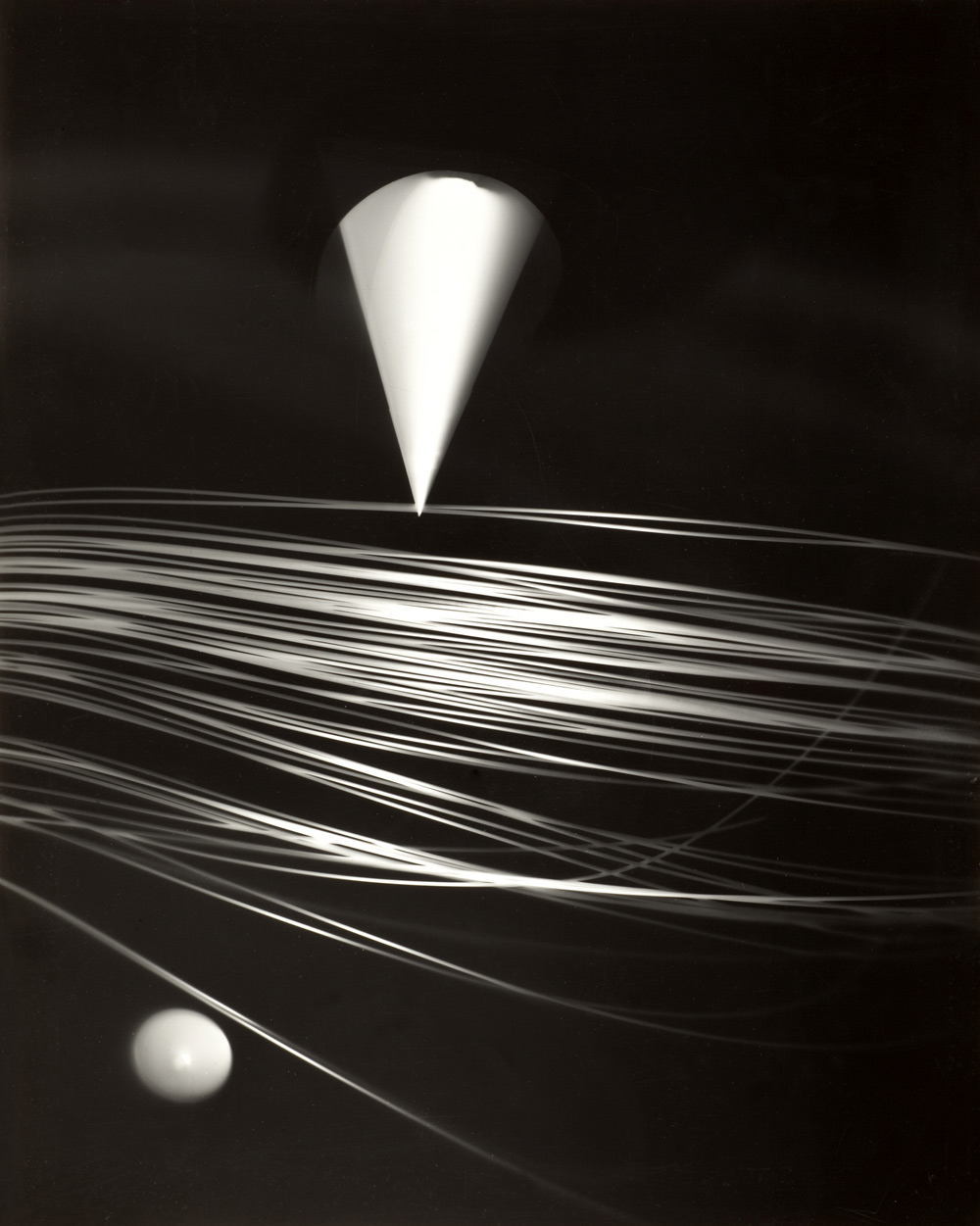
György Kepes (Hungary, active United States, 1906-2001) 'Balance' 1942, printed 1942


György Kepes (Hungary, active United States, 1906-2001)
Balance
1942, printed 1942
Gelatin Silver Print
The Marjorie and Leonard Vernon Collection, gift of The Annenberg Foundation, acquired from Carol Vernon and Robert Turbin
© The György Kepes Estate


Los Angeles County Museum of Art (LACMA)
5905 Wilshire Boulevard (at Fairfax Avenue)
Los Angeles, CA, 90036
Phone: 323 857-6000

Opening Hours:
Monday – Tuesday, Thursday 11am – 6pm
Friday 11am – 8pm
Saturday – Sunday 10am – 7pm
Closed Wednesday

LACMA website

LIKE ART BLART ON FACEBOOK

Back to top

Exhibition: ‘Only in England: Photographs by Tony Ray-Jones and Martin Parr’ at Media Space at Science Museum, London

Exhibition dates: 21st September, 2013 – 16th March, 2014

Curators: Greg Hobson (Curator of Photographs at the National Media Museum) and photographer Martin Parr


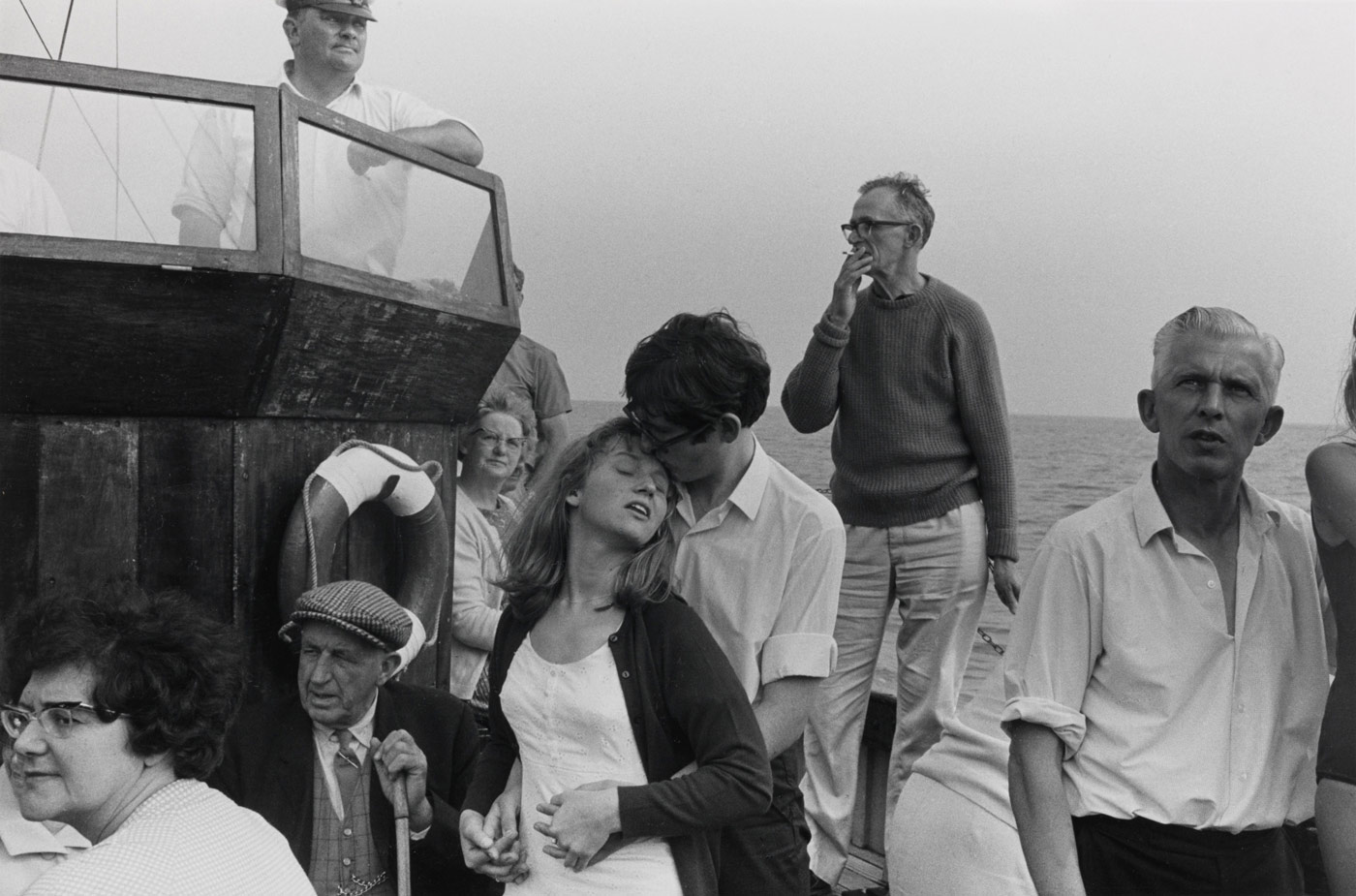
Tony Ray-Jones (English, 1941-1972) 'Beachy Head Tripper Boat, 1967' 1967 from the exhibition 'Only in England: Photographs by Tony Ray-Jones and Martin Parr' at Media Space at Science Museum, London, September 2013 - March 2014


Tony Ray-Jones (English, 1941-1972)
Beachy Head Tripper Boat, 1967
1967
© National Media Museum


“Be more aware of composition

Don’t take boring pictures

Get in closer

Watch camera shake

Don’t shoot too much”


Tony Ray-Jones from his diaries


Growing up in the 1960s we used to get taken to Butlins holiday camps (Billy Butlin founded the company, a chain of large holiday camps in the United Kingdom, to provide affordable holidays for ordinary British families). It was a great treat to be away from the farm, to be by the sea, even if the beach was made of stones. Looking back on it now you realise how seedy it was, how working class… but as a kid it was oh, so much fun!

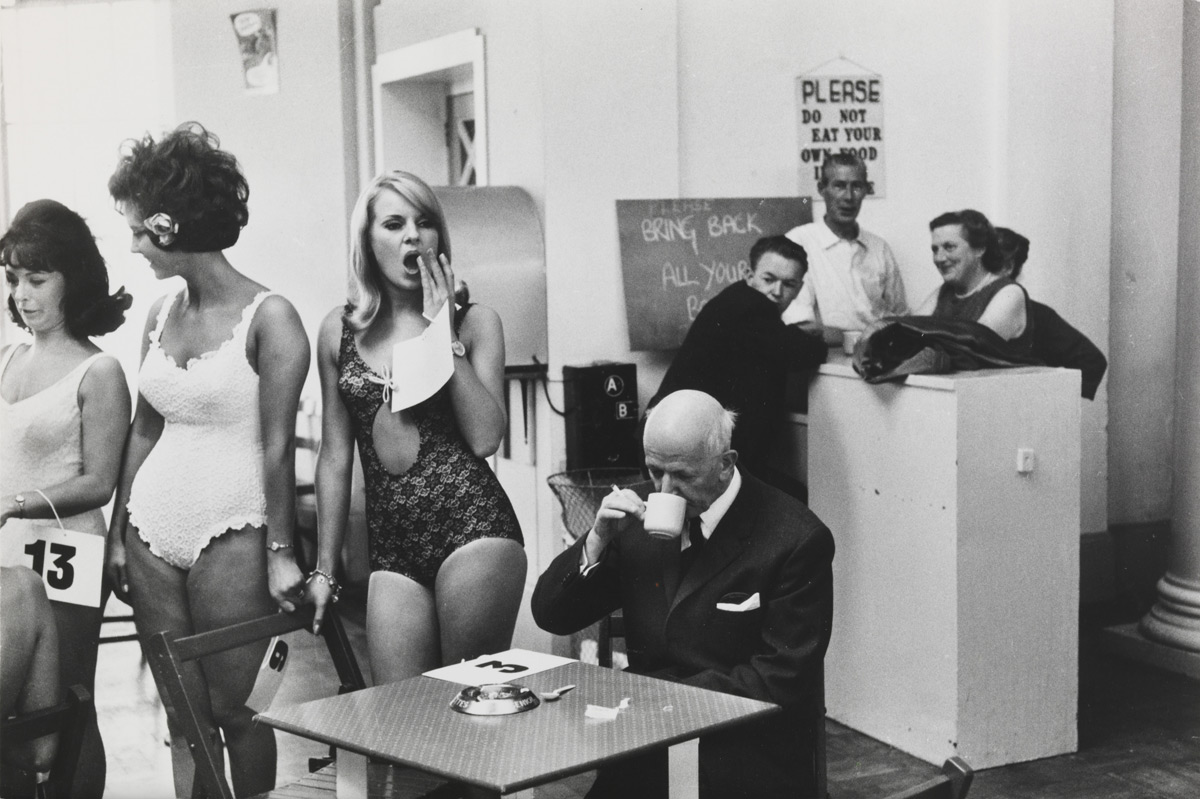
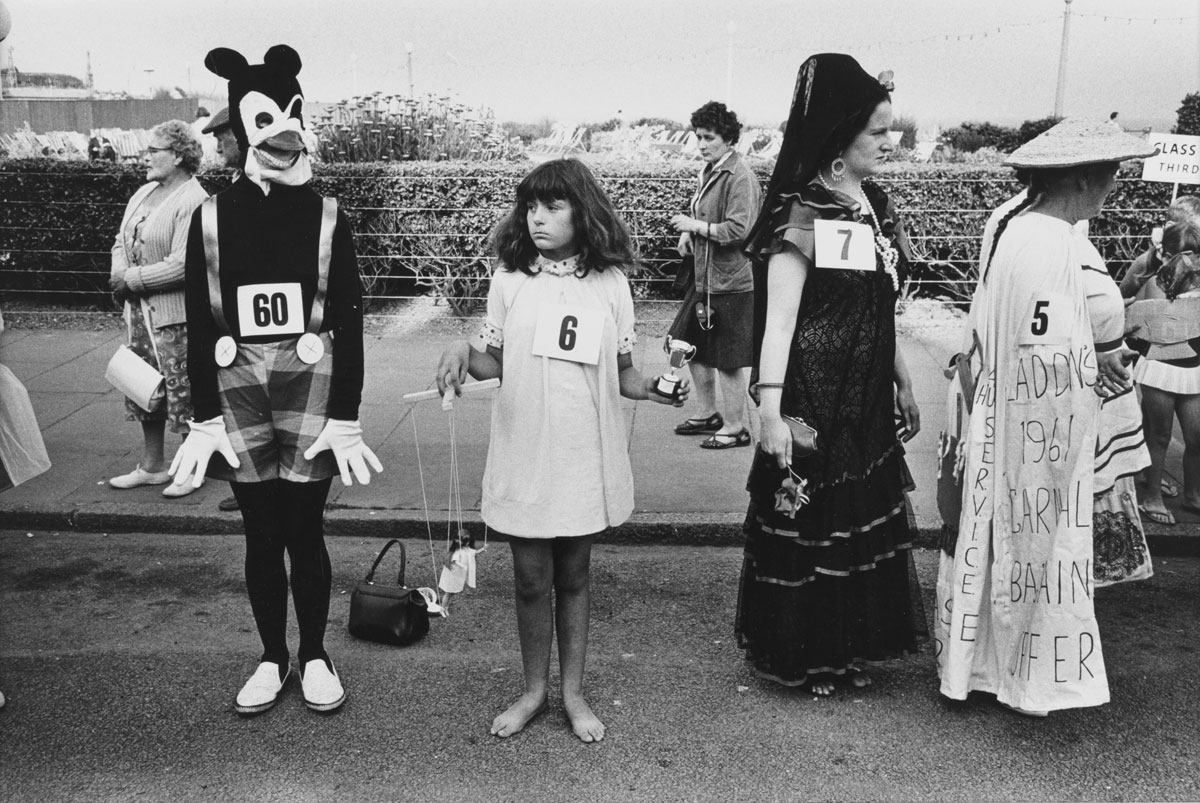
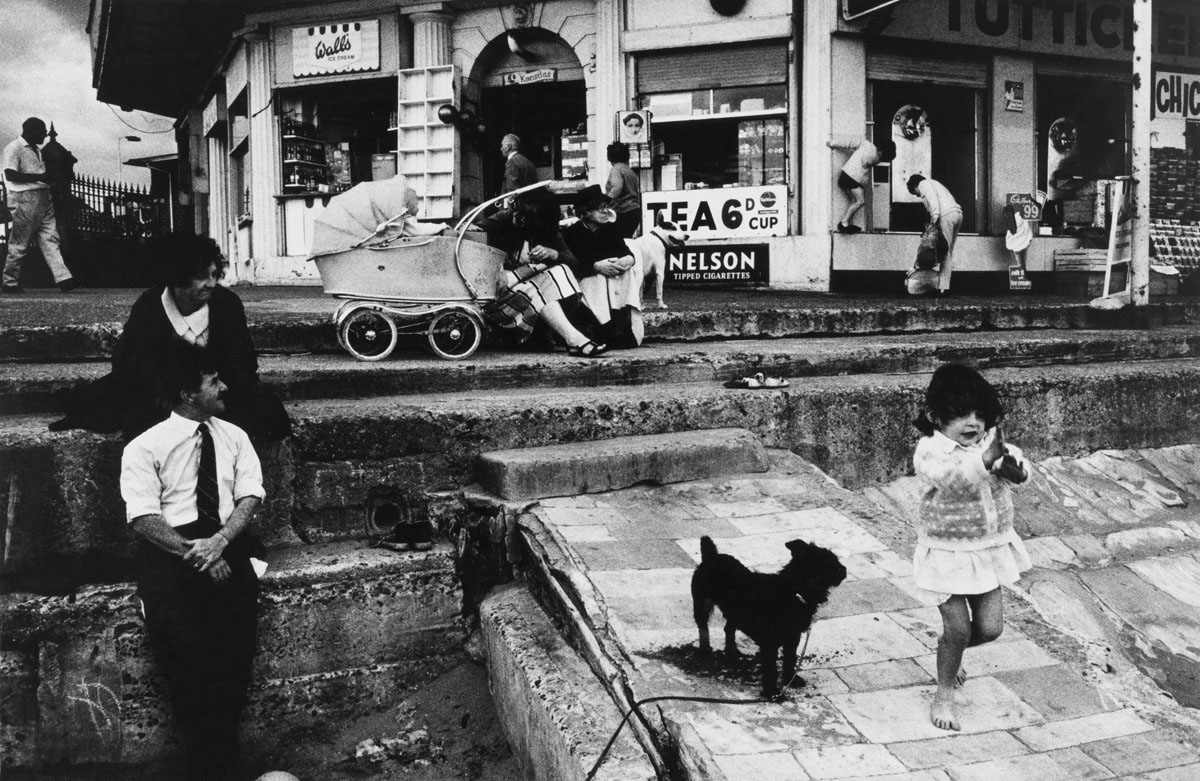
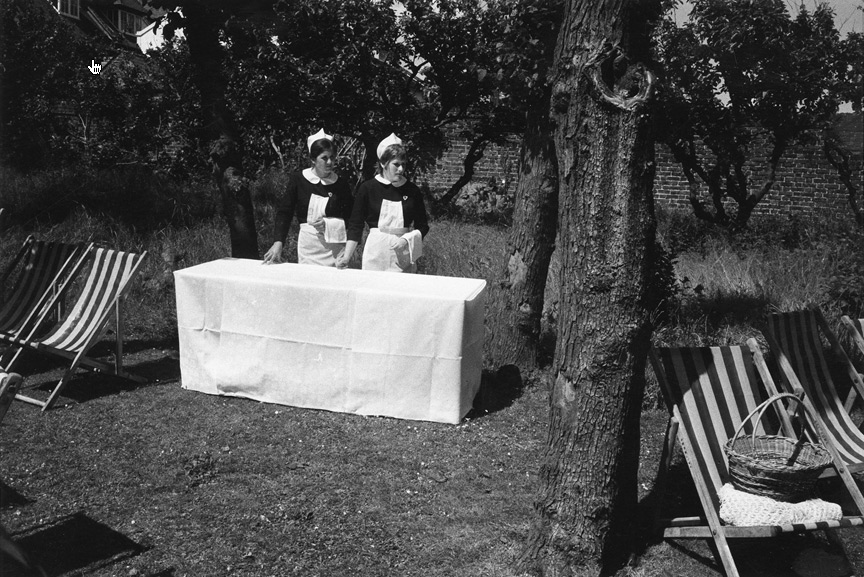
Tony Ray-Jones photographed these environments (mainly the British at play by the sea) and their opposites – afternoon tea taken at Glyndebourne opera festival for example (Glyndebourne, 1967, below) – drawing on the tradition of great British social documentary photography by artists such as Bill Brandt. TRJ even pays homage to Brandt in one of his photographs, Dickens Festival, Broadstairs, c. 1967 (below) which echoes Brandt’s famous photograph Parlourmaid and Under-parlourmaid Ready to Serve Dinner, 1933 by changing “point of view” from up close, personal, oppressive and interior to distance, isolation, leisure/work and exterior.

Through his photographs Ray-Jones adds his own style and humour, using “a new conception of photography as a means of expression, over and above its accepted role as a recorder.” He does it all as an intimate expression of his own personality, his maverick, outsider, non-conformist self. I feel – and that is the key word with his art – that he had a real empathy with his subject matter. There is a twinkle in his eye that becomes embedded in his photographs. There is an honesty, integrity and respect for the people he is photographing, coupled with a wicked sense of humour and the most amazing photographic eye. What an eye he had!

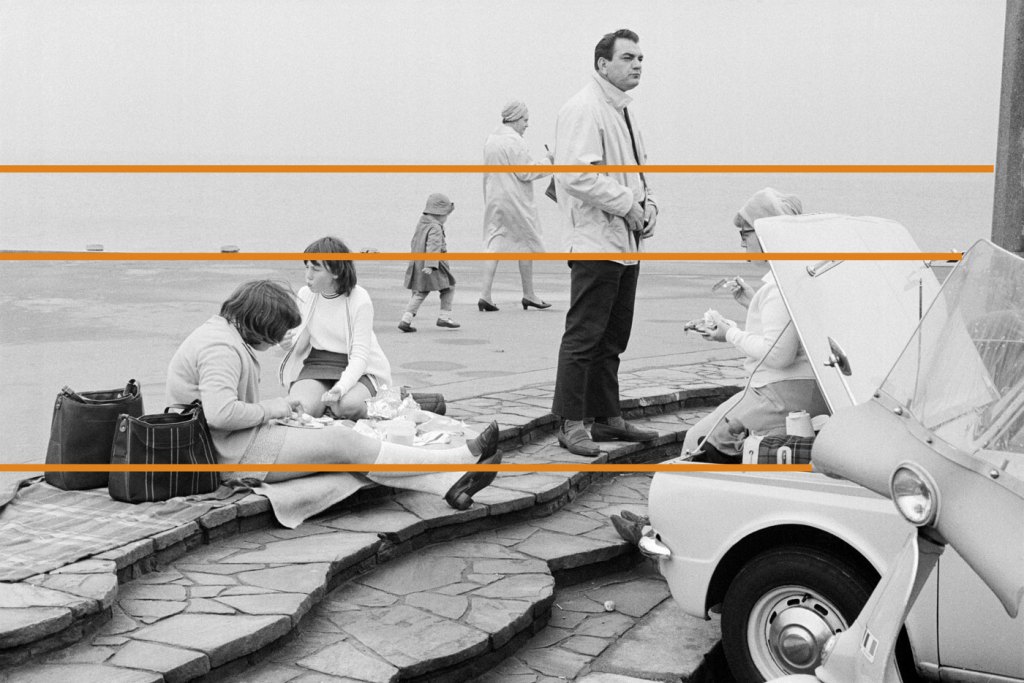
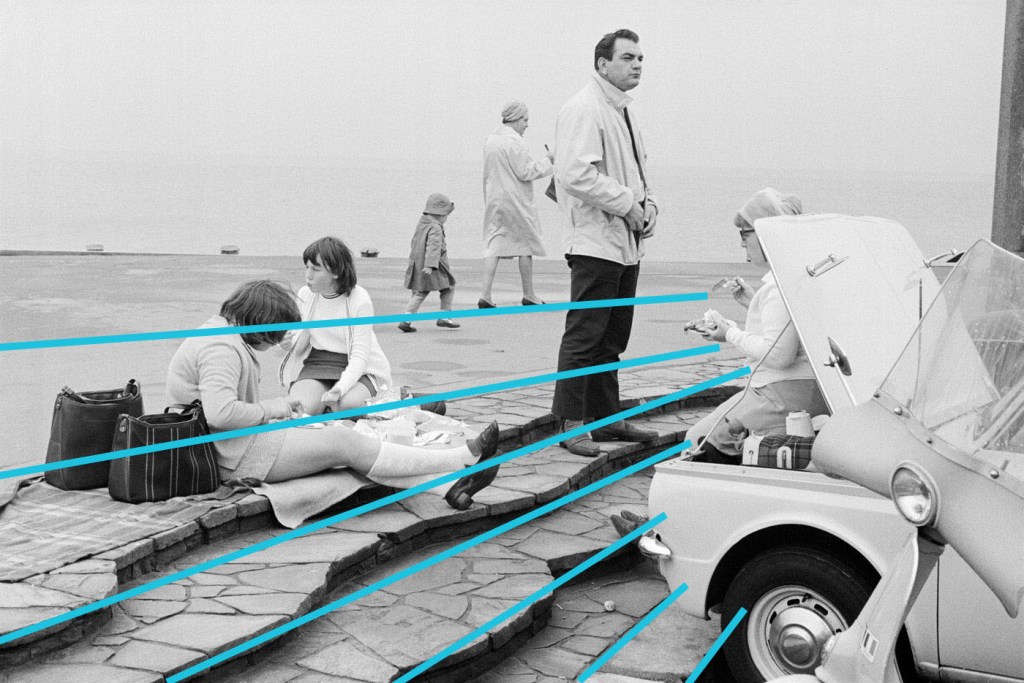
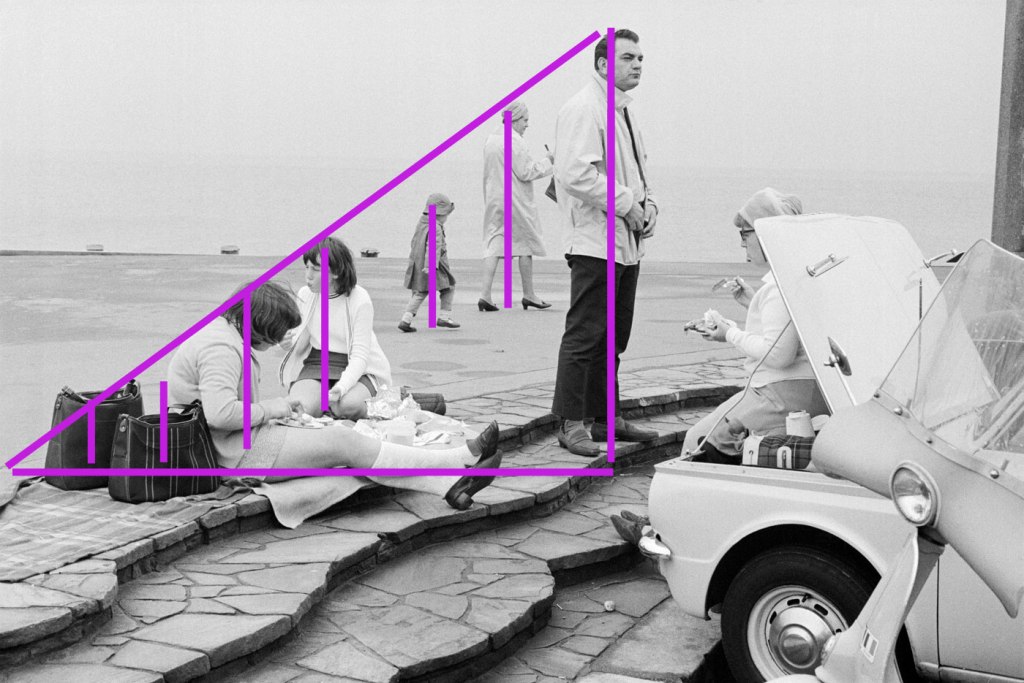
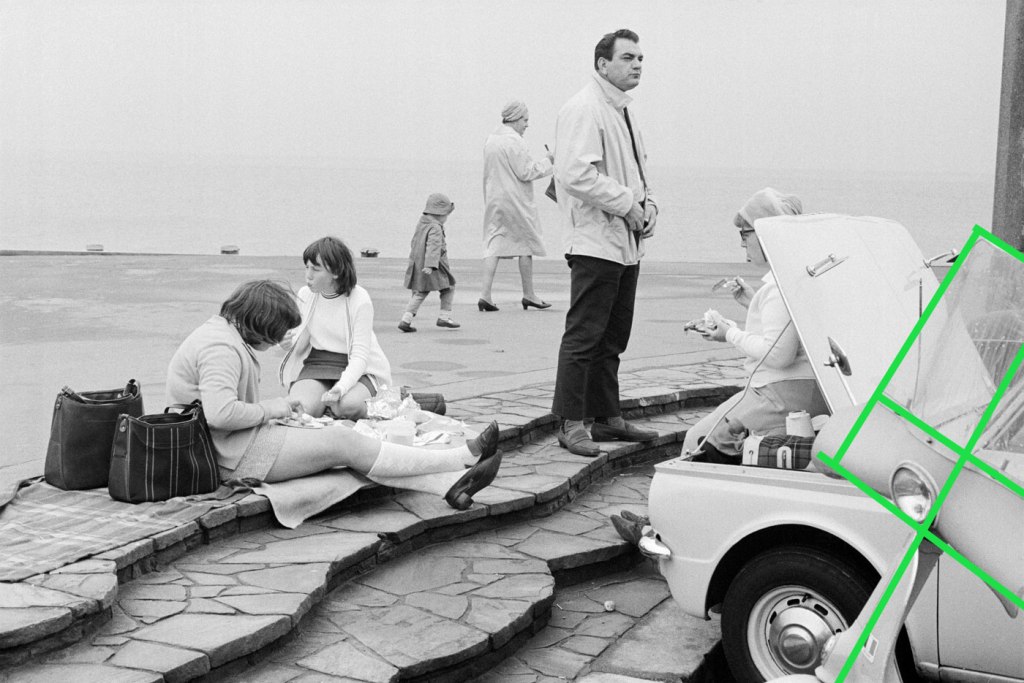
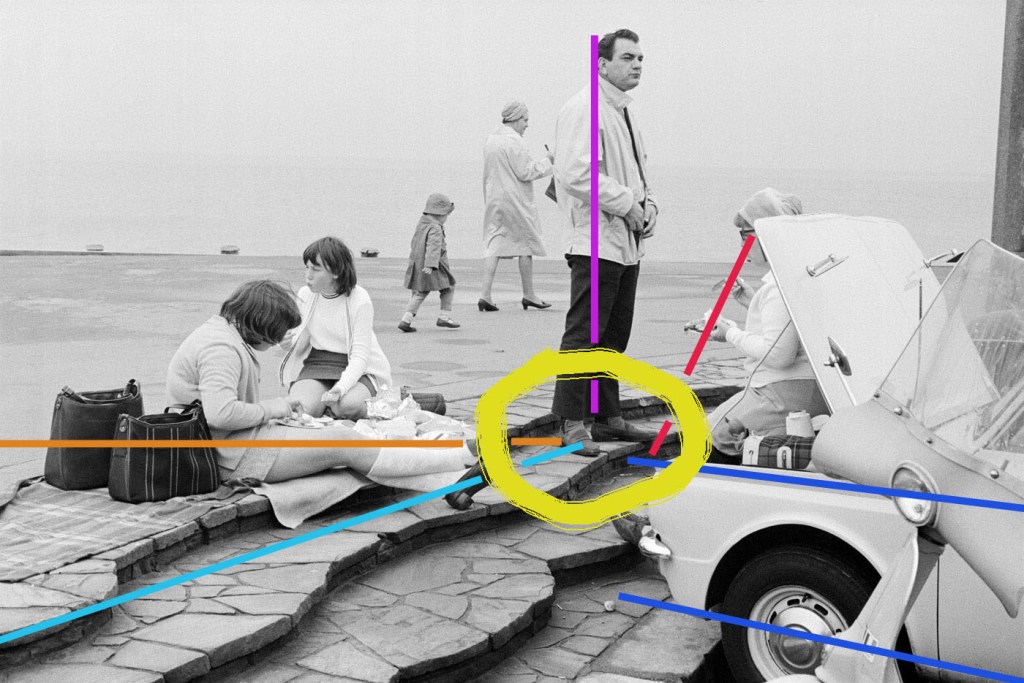
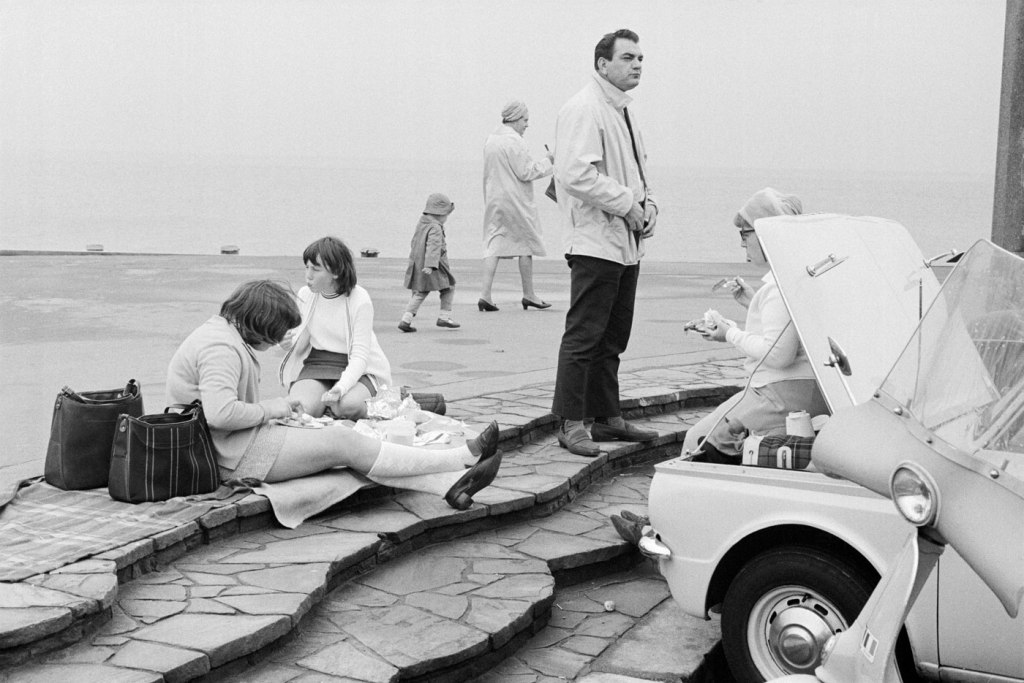
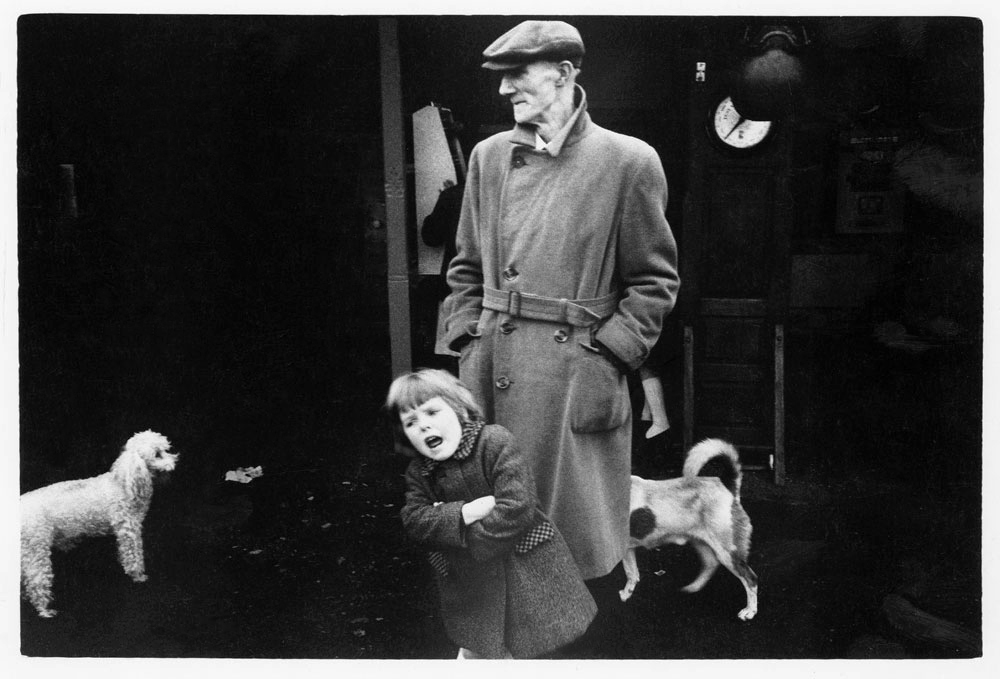
To be able to sum up a scene in a split second, to previsualise (think), intuitively compose, frame and shoot in that twinkle of an eye, and to balance the images as he does is truly the most incredible gift, the quintessential British “decisive moment”. Look at the structural analysis of Location unknown, possibly Worthing (1967-1968, below) that I have presented in a slide show. This will give you a good idea of the visual complexity of Ray-Jones’ images… and yet he makes the sum of all components seem grounded (in this case by the man’s feet) and effortless. Devon Caranicas has observed that TRJ possessed a quick wit and adeptness for reducing a complex narrative into a single frame, the photographed subjects transformed into social actors of supreme stereotypes. The first part is insightful, but social actors of supreme stereotypes? I think not, because these people are not acting, this is their life, their humanity, their time out from the hum-drum of everyday working class life. They do not pose for TRJ, it’s just how they are. Look at the musicality of the first five images in the posting – how the line rises and falls, moves towards you and away from you. Only a great artist can do that, instinctively.

I cannot express to you enough the utmost admiration I have for this man’s art. In my opinion he is one of greatest British photographers that has ever lived (Julia Margaret Cameron, William Henry Fox Talbot, Roger Fenton, Francis Bedford, Frederick H. Evans, Cecil Beaton, Peter Henry Emerson and Herbert Ponting would be but a few others that spring to mind). He photographed British customs and values at a time of change and pictured a real affection for the lives of ordinary working class people. Being one of the them, he will always hold a special place in my heart.

Dr Marcus Bunyan


Many thankx to Media Space at Science Museum for allowing me to publish the photographs in the posting. Please click on the photographs for a larger version of the image.


“Although the entirety of the images from Only in England were shot throughout the politically and socially turbulent late 60’s and early 70’s both artists shy away from depicting the culture clashes that so often visually defined this period. Instead, they each opted to turn their lens onto the quintessential country side, and in doing so, pay homage to a traditional type of English life that was becoming a sort of sub-culture in itself – a way of living that was not yet touched by the encroaching globalisation, or “americanisation,” of the UK.”

Anonymous text on the ART WEDNESDAY website September 26th, 2013 [Online] Cited 05/03/2014. No longer available online


“Ray-Jones printed his black and white pictures small, in a dark register of tonally very dense prints. The National Media Museum has lots of these, and perhaps to devote the cavernous new space only to such small pictures would have been a mistake. Even backed up with a mass of supporting material, including the fascinating pages from Ray-Jones’ diaries, the prints would struggle to fill the space. So only the first section is devoted to about 50 beautiful little Ray-Jones vintage prints. Two whole sections have been added to the exhibition to flesh it out…

[Parr] has unfortunately chosen to print them [Ray-Jones prints] in a way quite alien to anything Ray-Jones ever made: they are printed in Parr’s own way, as larger, paler, more diffuse things in mid-tones that Ray-Jones would never have countenanced. They are printed, inevitably, by digital process…

Sadly, these Ray-Jones by Parr prints add up to an appropriation of the former by the latter: they are Martin Parr pictures taken from Tony-Ray Jones negatives, and it would have been better not to have shown them so. They are fine images, but they should have been seen in some other way: on digital screens, perhaps, or as modern post-cards. Anything to make quite explicit the clear break with Ray-Jones’ own prints. That the images they contain are very fine is not in doubt. But I take leave to question whether they “present a new way of thinking through creative use of the collections”. They are well labelled and for specialists there will be no difficulty in knowing that they are not by Ray-Jones. But for the public I am not so sure. Suddenly two-thirds of the show are in this larger, modern, digitally printed form, either by Parr himself or by Ray-Jones-through-Parr. It looks as if that is the dominant group…”

Extract from Francis Hodgson. “Two Exhibitions of Tony Ray-Jones – Two Ways of Giving Context to Photographs,” on the Photomonitor website, September 2013 Cited 05/03/2014. No longer available online. Used under fair use conditions for the purposes of education and research


Tony Ray-Jones (English, 1941-1972) 'Beauty contestants, Southport, Merseyside, 1967' 1967 from the exhibition 'Only in England: Photographs by Tony Ray-Jones and Martin Parr' at Media Space at Science Museum, London, September 2013 - March 2014


Tony Ray-Jones (English, 1941-1972)
Beauty contestants, Southport, Merseyside, 1967 
1967
© National Media Museum


Tony Ray-Jones (English, 1941-1972) 'Brighton Beach, West Sussex, 1966' 1966


Tony Ray-Jones (English, 1941-1972)
Brighton Beach, West Sussex, 1966
1966
© National Media Museum


Tony Ray-Jones (English, 1941-1972) 'Eastbourne Carnival, 1967' 1967


Tony Ray-Jones (English, 1941-1972)
Eastbourne Carnival, 1967
1967
© National Media Museum


Tony Ray-Jones (English, 1941-1972) 'Blackpool, 1968' 1968


Tony Ray-Jones (English, 1941-1972)
Blackpool, 1968
1968
© National Media Museum


Tony Ray-Jones (English, 1941-1972) 'Location unknown, possibly Worthing' 1967-1968


Tony Ray-Jones (English, 1941-1972)
Location unknown, possibly Worthing
1967-1968
© National Media Museum


Tony Ray-Jones Location unknown, possibly Worthing (1967-68) picture analysis by Dr Marcus Bunyan. Please click on the images to see the sequence


Fascinated by the eccentricities of English social customs, Tony Ray-Jones spent the latter half of the 1960s travelling across England, photographing what he saw as a disappearing way of life. Humorous yet melancholy, these works had a profound influence on photographer Martin Parr, who has now made a new selection including over 50 previously unseen works from the National Media Museum’s Ray-Jones archive. Shown alongside The Non-Conformists, Parr’s rarely seen work from the 1970s, this selection forms a major new exhibition which demonstrates the close relationships between the work of these two important photographers.

The first ever major London exhibition of work by British Photographer, Tony Ray-Jones (1941-1972) will open at Media Space on 21 September 2013. The exhibition will feature over 100 works drawn from the Tony Ray-Jones archive at the National Media Museum alongside 50 rarely seen early black and white photographs, The Non-Conformists, by Martin Parr (1952).

Between 1966 and 1969 Tony Ray-Jones created a body of photographic work documenting English customs and identity. Humorous yet melancholy, these photographs were a departure from anything else being produced at the time. They quickly attracted the attention of the Institute of Contemporary Arts (ICA), London where they were exhibited in 1969. Tragically, in 1972, Ray-Jones died from Leukaemia aged just 30. However, his short but prolific career had a lasting influence on the development of British photography from the 1970s through to the present.

In 1970, Martin Parr, a photography student at Manchester Polytechnic, had been introduced to Ray-Jones. Inspired by him, Parr produced The Non-Conformists, shot in black and white in Hebden Bridge and the surrounding Calder Valley. This project started within two years of Ray-Jones death and demonstrates his legacy and influence.

The exhibition will draw from the Tony Ray-Jones archive, held by the National Media Museum.  Around 50 vintage prints will be on display alongside an equal number of photographs which have never previously been printed. Martin Parr has been invited to select these new works from the 2700 contact sheets and negatives in the archive. Shown alongside these are Parr’s early black and white work, unfamiliar to many, which has only ever previously been exhibited in Hebden Bridge itself and at Camerawork Gallery, London in 1981.

Tony Ray-Jones was born in Somerset in 1941. He studied graphic design at the London School of Printing before leaving the UK in 1961 to study on a scholarship at Yale University in Connecticut, US. He followed this with a year long stay in New York during which he attended classes by the influential art director Alexey Brodovitch, and became friends with photographers Joel Meyerowitz and Garry Winogrand. In 1966 he returned to find a Britain still divided by class and tradition. A Day Off – An English Journal, a collection of photographs he took between 1967-1970 was published posthumously in 1974 and in 2004 the National Media Museum held a major exhibition, A Gentle Madness: The Photographs of Tony Ray-Jones.

Martin Parr was born in Epsom, Surry in 1952. He graduated from Manchester Polytechnic in 1974 and moved to Hebden Bridge in West Yorkshire, where he established the ‘Albert Street Workshop’, a hub for artistic activity in the town. Fascinated by the variety of non-conformist chapels and the communities he encountered in the town he produced The Non-Conformists. In 1984 Parr began to work in colour and his breakthrough publication The Last Resort was published in 1986. A Magnum photographer, Parr is now an internationally renowned photographer, filmmaker, collector and curator, best-known for his highly saturated colour photographs critiquing modern life.

Only in England: Photographs by Tony Ray-Jones and Martin Parr will run at Media Space, Science Museum from 21 September 2013 – 16 March 2014. The exhibition will then be on display at the National Media Museum from 22 March – 29 June 2014. The exhibition is curated by Greg Hobson, curator of Photographs at the National Media Museum, and Martin Parr has been invited to select works from the Tony Ray-Jones archives.

Greg Hobson, curator of Photographs at the National Media Museum says, “The combination of Martin Parr and Tony Ray-Jones’ work will allow the viewer to trace an important trajectory through the history of British photography, and present new ways of thinking about photographic histories through creative use of our collections.” Martin Parr says, “Tony Ray-Jones’ pictures were about England. They had that contrast, that seedy eccentricity, but they showed it in a very subtle way. They have an ambiguity, a visual anarchy. They showed me what was possible.”

The Tony Ray-Jones archive comprises of approximately 700 photographic prints, 1700 negative sheets, 2700 contact sheets, 600 boxes of Ektachrome / Kodachrome transparencies. It also includes ephemera such as notebooks, diary pages, and a maquette of England by the Sea made by Tony Ray-Jones.

Media Space is a collaboration between the Science Museum (London) and the National Media Museum (Bradford). Media Space will showcase the National Photography Collection of the National Media Museum through a series of exhibitions. Alongside this, photographers, artists and the creative industries will respond to the wider collections of the Science Museum Group to explore visual media, technology and science.

Press release from the Science Museum website


Tony Ray-Jones (English, 1941-1972) 'Bacup coconut dancers, 1968' 1968


Tony Ray-Jones (English, 1941-1972)
Bacup coconut dancers, 1968
1968
© National Media Museum


Tony Ray-Jones (English, 1941-1972) 'Bournemouth, 1969' 1969 from the exhibition 'Only in England: Photographs by Tony Ray-Jones and Martin Parr' at Media Space at Science Museum, London, September 2013 - March 2014


Tony Ray-Jones (English, 1941-1972)
Bournemouth, 1969
1969
Vintage Gelatin Silver Print
16 x 25cm (6 x 10 inches)
© National Media Museum


Tony Ray-Jones (English, 1941-1972) 'Location unknown, possible Morecambe, 1967-68' 1967-1968


Tony Ray-Jones (English, 1941-1972)
Location unknown, possible Morecambe, 1967-68
1967-1968
© National Media Museum


Tony Ray-Jones (English, 1941-1972) 'Mablethorpe, 1967' 1967


Tony Ray-Jones (English, 1941-1972)
Mablethorpe, 1967
1967
Vintage Gelatin Silver Print
14 x 21cm (6 x 8 inches)
© National Media Museum


Tony Ray-Jones (English, 1941-1972) 'Ramsgate, 1967' 1967


Tony Ray-Jones (English, 1941-1972)
Ramsgate, 1967
1967
© National Media Museum


Tony Ray-Jones (English, 1941-1972) 'Mankinholes Methodist Chapel, Todmorden' 1975


Tony Ray-Jones (English, 1941-1972)
Mankinholes Methodist Chapel, Todmorden
1975
© Martin Parr/ Magnum


Tony Ray-Jones (English, 1941-1972) 'Cruft's Dog Show, London, 1966' 1966


Tony Ray-Jones (English, 1941-1972)
Cruft’s Dog Show, London, 1966
1966
© National Media Museum


Tony Ray-Jones (English, 1941-1972) 'Dickens Festival, Broadstairs, c. 1967' c. 1967


Tony Ray-Jones (English, 1941-1972)
Dickens Festival, Broadstairs, c. 1967
c. 1967
© National Media Museum


Tony Ray-Jones (English, 1941-1972) 'Dickens Festival, Broadstairs, c. 1967' c. 1967


Tony Ray-Jones (English, 1941-1972)
Dickens Festival, Broadstairs, c. 1967
c. 1967
© National Media Museum


Tony Ray-Jones (English, 1941-1972) 'Wormwood Scrubs Fair, London, 1967' 1967


Tony Ray-Jones (English, 1941-1972)
Wormwood Scrubs Fair, London, 1967
1967
© National Media Museum


Tony Ray-Jones (English, 1941-1972) 'Untitled' 1960s


Tony Ray-Jones (English, 1941-1972)
Untitled
1960s
© National Media Museum


Tony Ray-Jones (English, 1941-1972) 'Trooping the Colour, London, 1967' 1967


Tony Ray-Jones (English, 1941-1972)
Trooping the Colour, London, 1967
1967
© National Media Museum


Tony Ray-Jones (English, 1941-1972) 'Untitled' 1960s


Tony Ray-Jones (English, 1941-1972)
Untitled
1960s
© National Media Museum


Tony Ray-Jones (English, 1941-1972) 'Glyndebourne, 1967' 1967


Tony Ray-Jones (English, 1941-1972)
Glyndebourne, 1967
1967
© National Media Museum


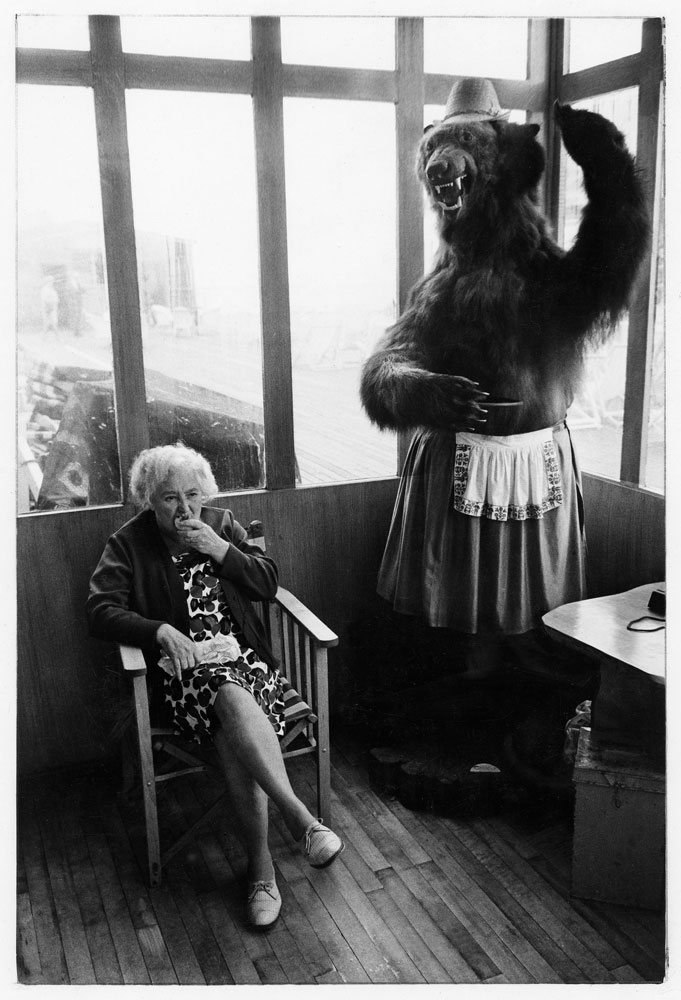
Tony Ray-Jones (English, 1941-1972) 'Elderly woman eating pie seated in a pier shelter next to a stuffed bear, 1969' 1969


Tony Ray-Jones (English, 1941-1972)
Elderly woman eating pie seated in a pier shelter next to a stuffed bear, 1969
1969
© National Media Museum


Tony Ray-Jones (English, 1941-1972) 'Blackpool, 1968' 1968


Tony Ray-Jones (English, 1941-1972)
Blackpool, 1968
1968
Vintage Gelatin Silver Print
21 x 14.5cm (8.25 x 5.70 ins)


Tony Ray-Jones (English, 1941-1972) 'Tom Greenwood cleaning' 1976


Tony Ray-Jones (English, 1941-1972)
Tom Greenwood cleaning
1976
© Martin Parr/ Magnum


Media Space at Science Museum
Exhibition Road, South Kensington,
London SW7 2DD

Opening hours:
Open seven days a week, 10.00 – 18.00

Media Space at Science Museum website

LIKE ART BLART ON FACEBOOK

Back to top

Exhibition: ‘Félix Thiollier (1842-1914), photographs’ at the Musée d’Orsay, Paris

Exhibition dates: 13th November, 2013 – 10th March, 2014

Curator: Thomas Galifot


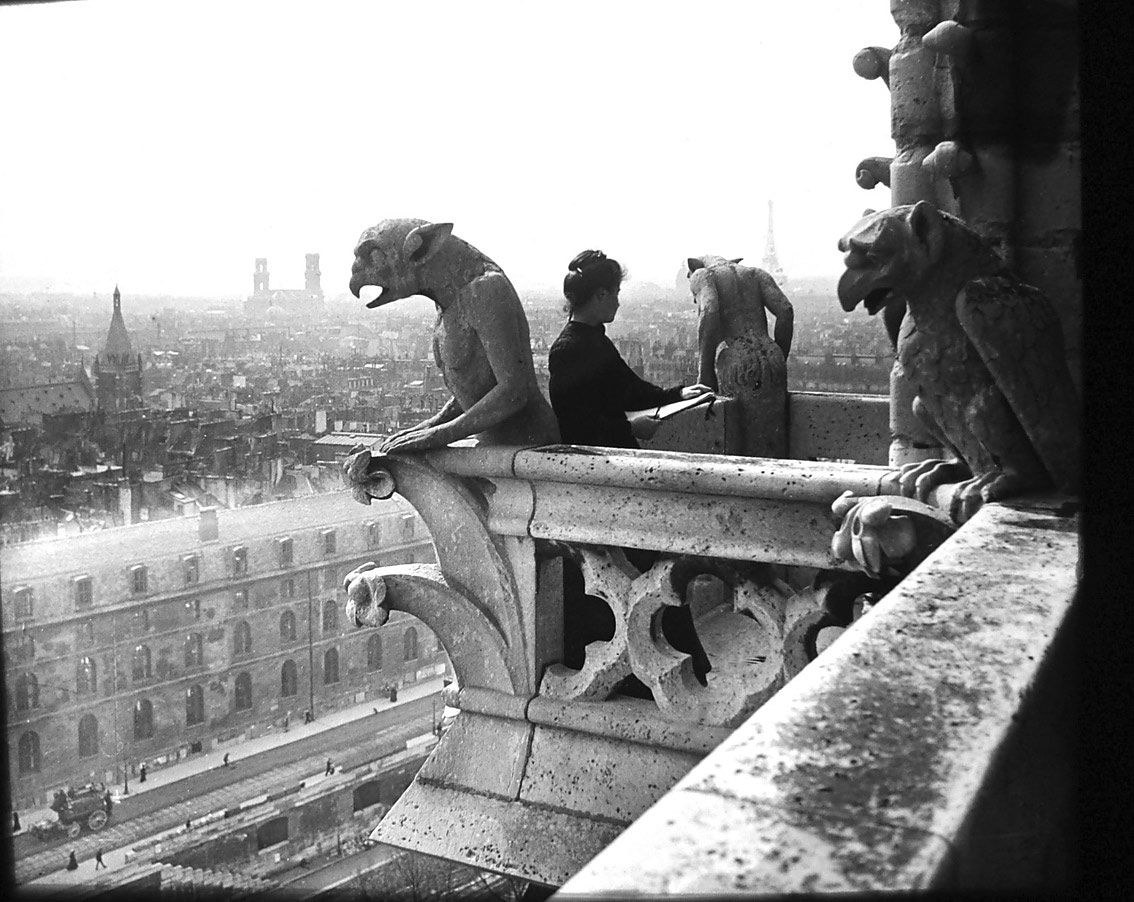
Félix Thiollier (French, 1842-1914) 'Emma Thiollier painting on top of one of the towers of Notre Dame, photographed by her father Félix Thiollier' 1907 from the exhibition 'Félix Thiollier (1842-1914), photographs' at the Musée d'Orsay, Paris, November 2013 - March 2014


Félix Thiollier (French, 1842-1914)
Emma Thiollier painting on top of one of the towers of Notre Dame, photographed by her father Félix Thiollier
1907


“Why is the price of justice so high?”


Maheude, Germinal


“Beneath the blazing of the sun, in that morning of new growth, the countryside rang with song, as its belly swelled with a black and avenging army of men, germinating slowly in its furrows, growing upwards in readiness for harvests to come, until one day soon their ripening would burst open the earth itself.”


Émile Zola. Germinal (1885)


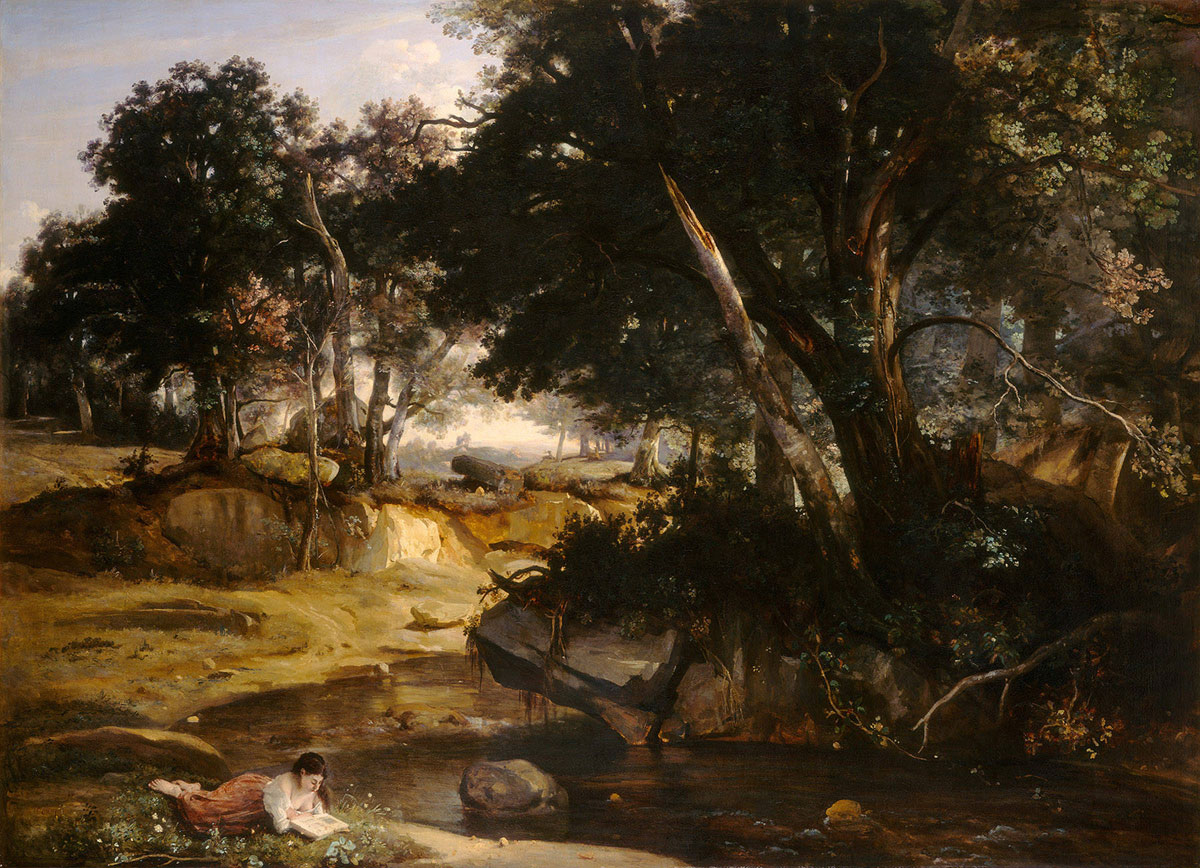
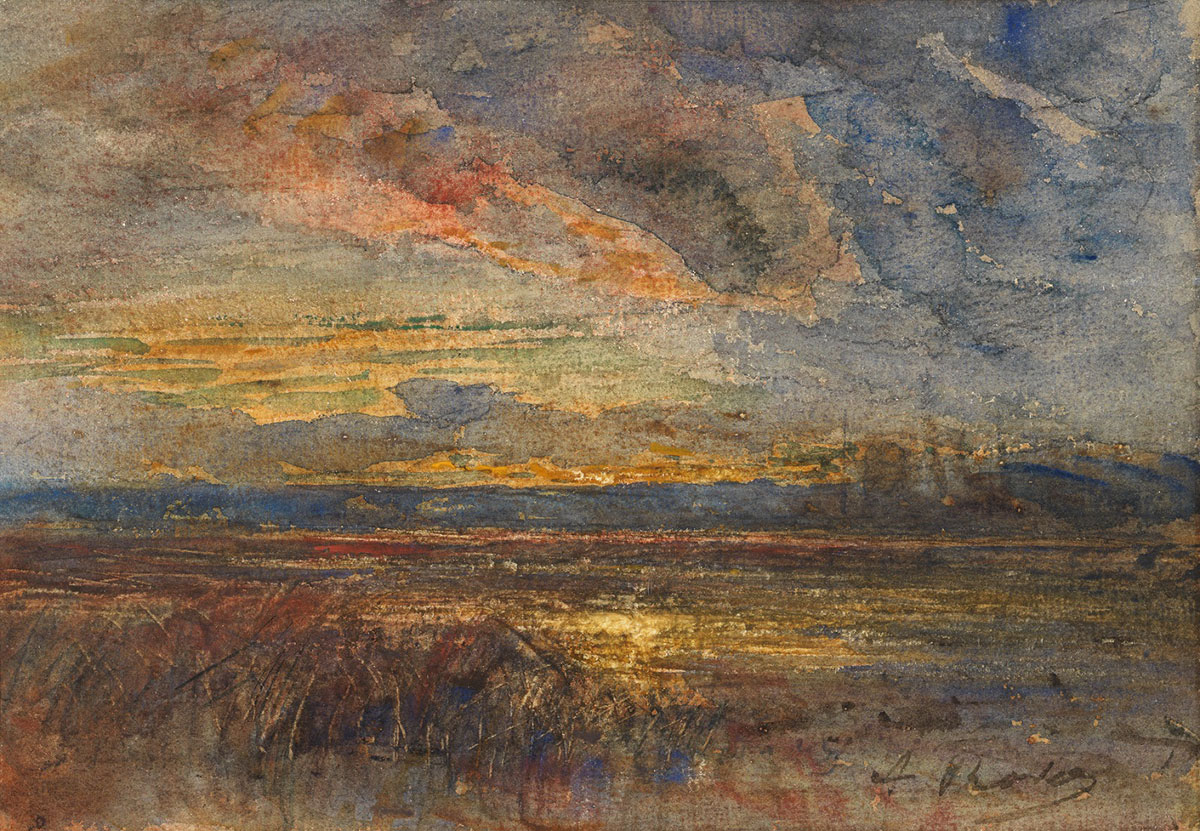
This is the biggest collection of photographs by the French photographer Félix Thiollier available on the Internet. I spent hours cleaning up the photographs to a presentable standard (mixing them with appropriate paintings by Corot and Francois-Auguste Ravier which are not in the exhibition), so I hope you enjoy the posting.

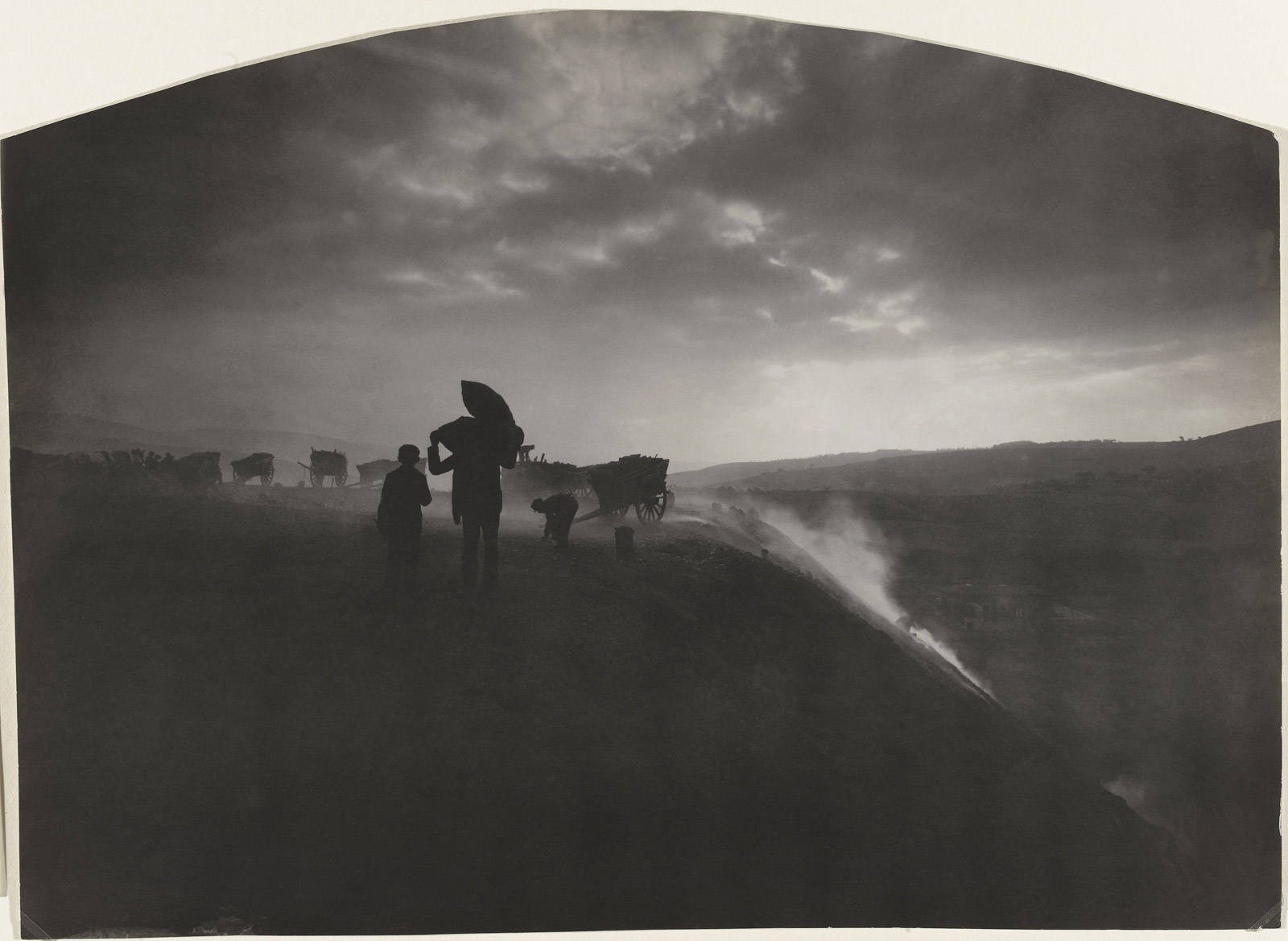
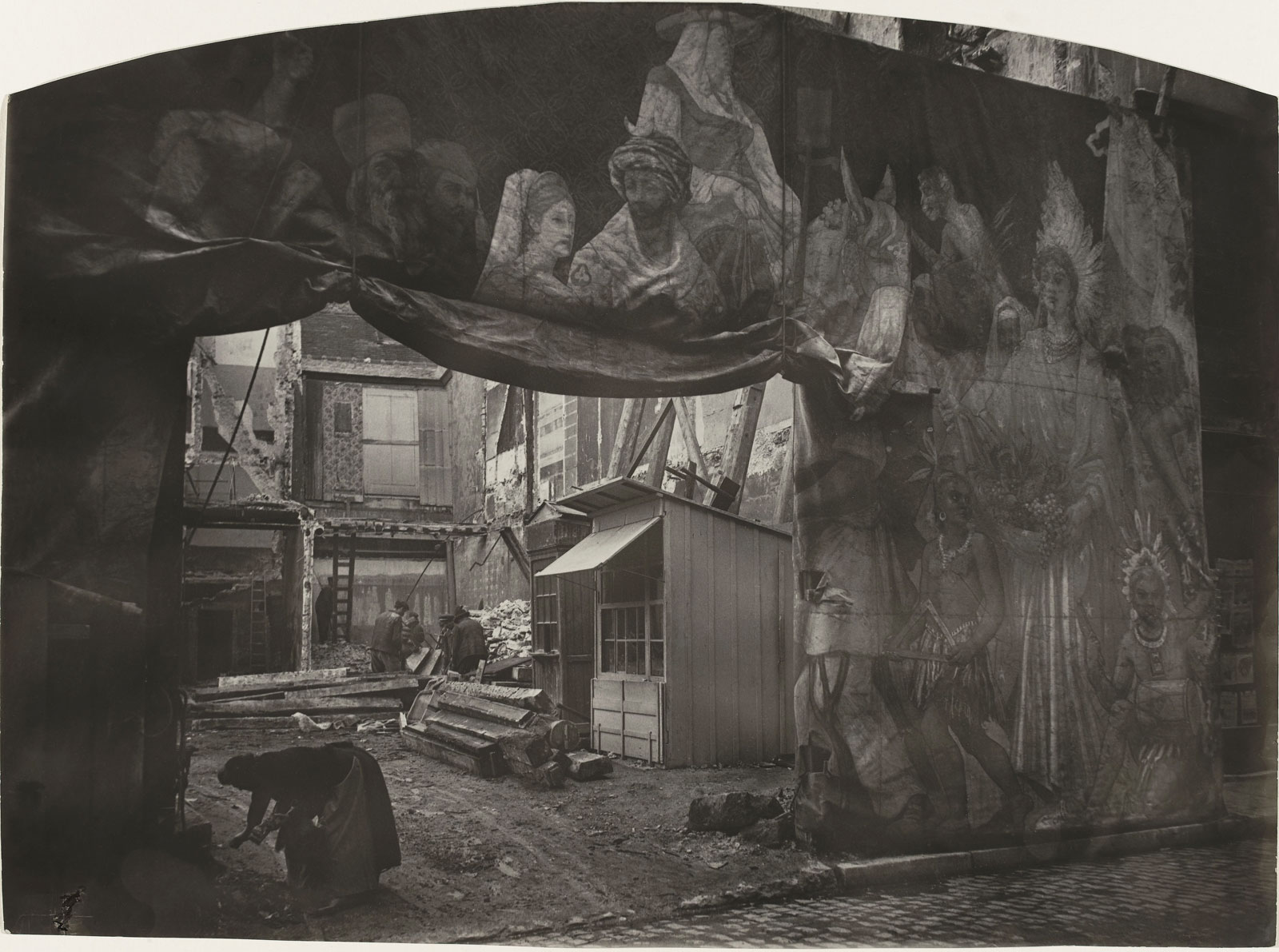
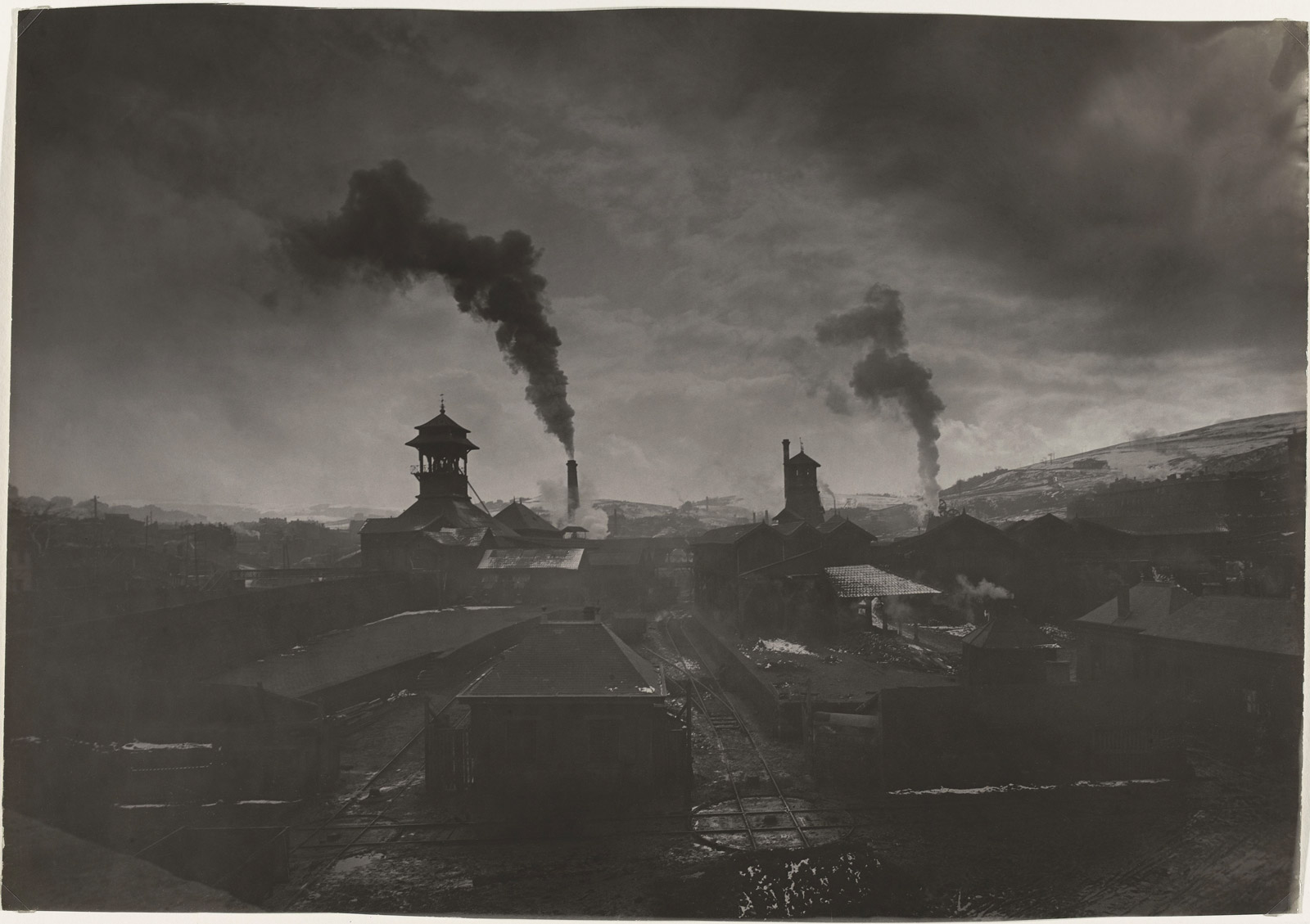
While the bucolic photographs of ruins, pastoral landscapes and shepherdess (bucolic – via Latin from Greek boukolikos, from boukolos ‘herdsman’) are relatively straight forward, it is Thiollier’s sensitive portrayal of the “industrial image” – of the mines and factories of Forez – that hold weight here. Thiollier emphasises the theatrical aspects of the landscape (he loved shooting at dusk), finding new subject matter among the photogenic nature of industrial sites “his last images… extolling these new “worthless” locations that included scrapheaps, wasteland and abandoned pitheads, such were the ruins of modern Forez, that met his melancholy and clear-sighted gaze.”

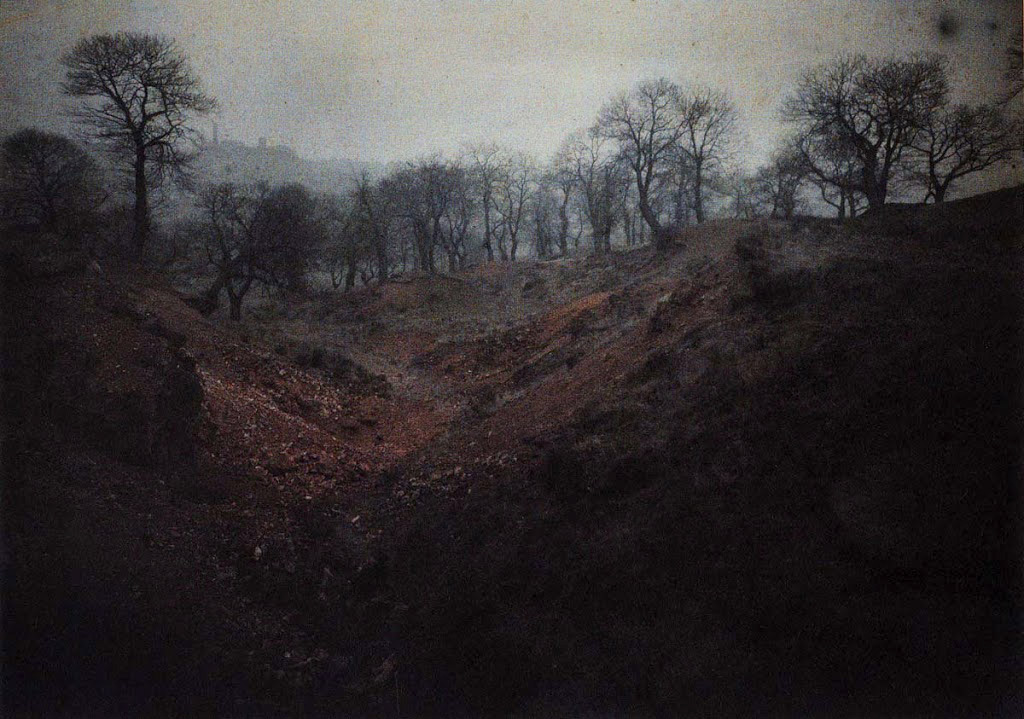
His photographs of the “black city” are atmospheric, vivid and powerful. Post-Romantic lyricism is still present in these images but is now coupled with a unique vision that has more earthy, psychological overtones. The anonymous figures of workers or coal pickers toiling away in oppressive landscapes are never better realised than in the line of figures silhouetted against the dying light in Mining Landscape, Saint-Etienne (1895-1910, below); the solitary figure caught in the rising dust on the side of the hill in Mining Landscape, Saint-Etienne (1895-1910, below – enlarge the image to see the figure). The desolation of an industrial revolution mining town is also perfectly captured in Mining Landscape, The Chatelus Pit at Saint-Etienne (1907-1912, below).

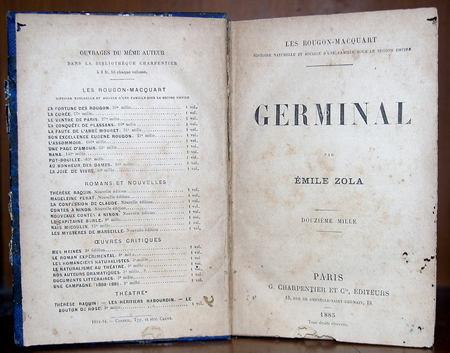
All three images remind me of the epic film Germinal staring Gerard Depardieu, based on the novel of the same name by Émile Zola.

I’m sure that Thiollier would have been familiar with the book, it being a sensation upon original publication (1885). The book may well have appealed to Thiollier because he was a wealthy man, an industrialist who had reinvented himself as a gentleman farmer, who finally leaves the picturesque behind to photograph, “atmospheric phenomena studies, the architectural and mineral landscape created by the hard work of men, and how the human figure related to this.” In all its hope and misery.

Thiollier becomes so much more than an amateur photographer. His impressions of a dark, hidden drama beating at the heart of industrial, fin de siècle France provided him with the opportunity to become a progenitor of modernism, “ten years before the photogenic nature of industrial sites would be elevated into a credo of photographic modernism.” (Fin de siècle has connotations of both the closing and onset of an era, as the end of the 19th century was felt to be a period of degeneration, but at the same time a period of hope for a new beginning).

Finally, despite his willingness to remain on the sidelines, Thiollier may well be getting the approbation he deserves.

Dr Marcus Bunyan


Please click on the photographs for a larger version of the image.


Émile Zola (French, 1840-1902) 'Germinal' Title page of the 1885 edition


Émile Zola (French, 1840-1902)
Germinal
Title page of the 1885 edition


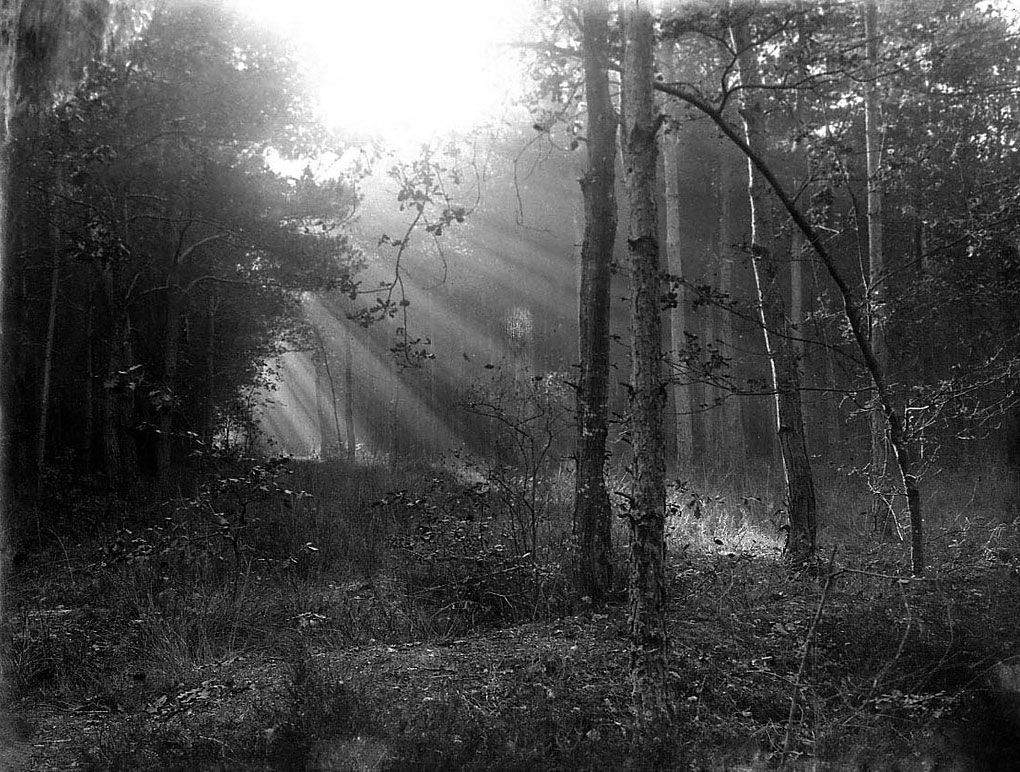
Félix Thiollier (French, 1842-1914) 'Undergrowth in Forez' (Sous-bois en Forez) Nd from the exhibition 'Félix Thiollier (1842-1914), photographs' at the Musée d'Orsay, Paris, November 2013 - March 2014


Félix Thiollier (French, 1842-1914)
Undergrowth in Forez (Sous-bois en Forez)
Nd
© Félix Thiollier


Félix Thiollier (French, 1842-1914) 'Around Saint-Etienne (Environs Saint-Etienne)' 1907-1912


Félix Thiollier (French, 1842-1914)
Around Saint-Etienne (Environs Saint-Etienne)
1907-1912
Autochrome


Jean-Baptiste-Camille Corot (French, 1796-1875) 'Forest of Fontainebleau' 1834


Jean-Baptiste-Camille Corot (French, 1796-1875)
Forest of Fontainebleau
1834
Oil on canvas
69 1/8 x 95 1/2 in. (175.6 x 242.6cm)


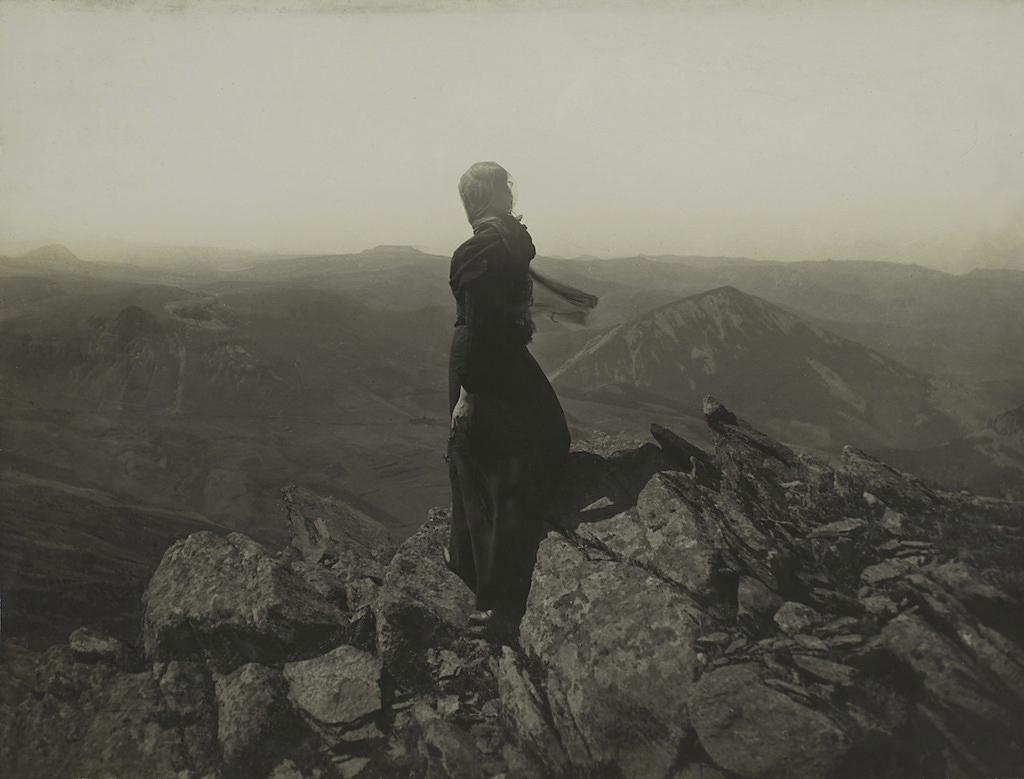
Félix Thiollier (French, 1842-1914) 'Figure contemplating the mountains of Menzenc (Emma Thiollier, daughter of the photographer)' 1895-1905


Félix Thiollier (French, 1842-1914)
Figure contemplant les monts du Menzenc (Emma Thiollier, fille du photographe)
Figure contemplating the mountains of Menzenc (Emma Thiollier, daughter of the photographer)

1895-1905
Collection Julien Laferrière
© Musée d’Orsay (dist. RMN) / Patrice Schmidt


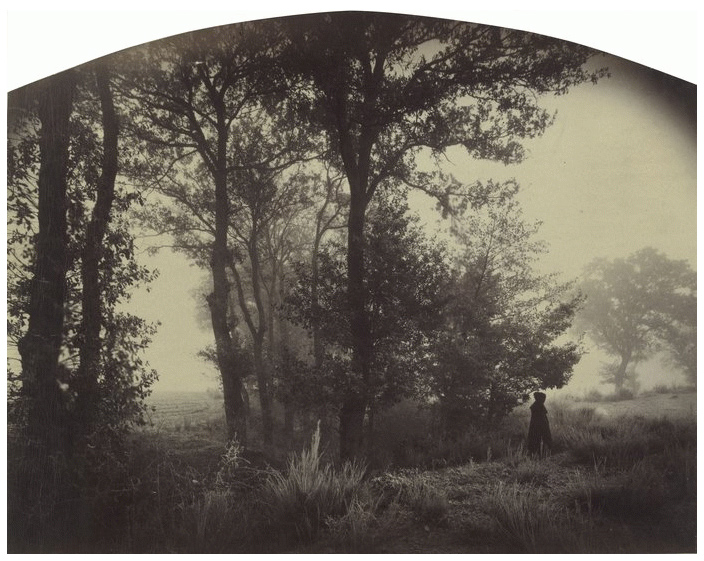
Félix Thiollier (French, 1842-1914) 'Landscape with Figure, Forez (Loire)' c. 1880-1882


Félix Thiollier (French, 1842-1914)
Landscape with Figure, Forez (Loire)
c. 1880-1882
Silver gelatin dry plate print on barium paper from a silver gelatin dry plate glass negative
H. 18.5; W. 22cm
Paris, Musée d’Orsay
Gift of Mr and Mrs Noël Sénéclauze, 2007
© Musée d’Orsay (dist. RMN)


Félix Thiollier (French, 1842-1914) 'Landscape with Figure, Forez (Loire)' c. 1880-1882 (detail)


Félix Thiollier (French, 1842-1914)
Landscape with Figure, Forez (Loire) (detail)
c. 1880-1882
Silver gelatin dry plate print on barium paper from a silver gelatin dry plate glass negative
H. 18.5; W. 22cm
Paris, Musée d’Orsay
Gift of Mr and Mrs Noël Sénéclauze, 2007
© Musée d’Orsay (dist. RMN)


Francois-Auguste Ravier (French, 1814-1895) 'Landscape with Setting Sun' Nd


Francois-Auguste Ravier (French, 1814-1895)
Landscape with Setting Sun
Nd
Oil on canvas


Félix Thiollier (French, 1842-1914) 'Mining Landscape, Saint-Etienne' 1895-1910


Félix Thiollier (French, 1842-1914)
Mining Landscape, Saint-Etienne
1895-1910
Silver gelatin dry plate print on barium paper from a silver gelatin dry plate glass negative
H. 28; W. 39.5cm
Paris, Musée d’Orsay
© Musée d’Orsay (dist. RMN)


Félix Thiollier

Although the talent of photographer Félix Thiollier was still unrecognised twenty years ago, this is mainly because it never occurred to him to seek recognition as such. When, at the age of 35, he decided to live off his private income, this ribbon manufacturer from Saint-Étienne intended to devote himself to art and archaeology. But feeling restricted in his role as scholar of the local area, Thiollier very quickly started publishing illustrated books. This enterprise, intended to promote both the rich natural environment and cultural heritage of Forez and the work of his artist friends, seemed to take up most of his energy, when he was not otherwise involved with initiatives to protect the local heritage of Saint-Étienne or promote the culture of the area.

It was his activities in these two latter fields that brought him both regional and national recognition, and until recently his reputation was based on these activities alone. Today, his resolute determination to remain on the fringes of the photographic circles of his time seems consistent with Thiollier’s passion for this medium that he would practise continuously for over half a century. In addition to showing the rich variety of subjects that inspired him, this exhibition seeks to give the viewer an appreciation of the originality of an approach based wholly on an inexhaustible passion for the picturesque: guiding his photographical machine, this mechanics of looking would lead him from bucolic landscapes and scenes of rural life to sensitive images of an industrial environment largely ignored by the amateur photographers at the turn of the 20th century.

“At an age when I deluded myself into believing that it was possible to combine the picturesque and archaeology…”

Thiollier’s intellectual and aesthetic background was typical of that section of the provincial elite in the 19th century who took a keen interest in art and archaeology, and had a great love of books. When, at the end of the 1850s, senior figures encouraged him to take photographs of notable sites and monuments in the Forez area, they already had a project in mind to produce a book about this ancient province which, celebrated by Honoré d’Urfé in L’Astrée (1607-1627), extended right across the department of the Loire into parts of the Haute-Loire and Puy-de-Dôme. They were all steeped in the Romantic tradition of the illustrated picturesque book, a tradition that would flourish in the second half of the century through many regional publications, like many local responses in this search for the identity of the regions of France. Illustrated with his early and more recent photographs, Thiollier’s Le Forez pittoresque et monumental, published in 1889, is one of the last and most outstanding examples of these.

Perpetuating the rustic ideal

In leaving the town and his activities as an industrialist, Thiollier did not just move closer to the monuments and landscapes he had undertaken to describe. Having acquired two modest country estates –  a hunting lodge near the ponds around Précivet, and the former commandery of the Order of Saint John of Jerusalem at Verrières – he also reinvented himself as a gentleman farmer in the heart of this arcadian Forez countryside, which, in his view, was under threat. Heavily influenced by the example of the Barbizon artists whose paintings he collected along with those of his naturalist painter friends, he never tired of capturing the disappearing traces of traditional skills and ways of life with the eye of a painter. However, it required a certain poetic detachment for photographs to complete this grief. This was usually achieved with the loyal help of his daughter, who appeared in his photographs whenever he wanted to draw attention to the timeless nature of peasant genre scenes.

“Stylistic Landscapes”

Although Thiollier had nursed an ambition to become a landscape photographer before he met Ravier in 1873, it is essential to recognise the influence of this painter from Morestel – who had been practising photography since the 1850s – in order to understand why Thiollier moved towards a more committed, if unrevealed, artistic approach to the medium. After many sessions spent “photographicking” together, their shared vision is expressed in the resulting images of autumnal and winter landscapes, which, devoid of any human presence, offer many light-filled variations on the handful of motifs chosen by the painter: still pools or the banks of streams, solitary outlines of dead trees, undergrowth and country paths, it is a complete repertoire of images of the Dauphiné region that stimulated Thiollier’s desire to extol the natural beauty of the Forez. Although he had to include riverscapes and mountain panoramas to reflect the true variety of this beautiful area, he almost always concentrate on the sky and studies of clouds, ideally enhanced by reflections playing on the still water.

The range of effects Thiollier developed, although intended in part to transpose the Post-Romantic lyricism which, in Ravier’s work, was conveyed through blazing colours and highly skilful brush- work, nonetheless indicates that his images of the countryside were produced with a perfect understanding of his medium. In pushing for a rapprochement with contemporary artistic photography, the main feature of his style was thus the expressiveness of the contrasts in values. It is this preference for representing nature in monochrome that partly explains his liking for snowscapes, and also prompted him to undertake almost systematic research into contre-jour, the most appropriate effect for both synthesising his motifs and revealing the theatrical aspects of the landscape. Indeed, the all-revealing clarity of broad daylight was far less of an inspiration to Thiollier than the atmosphere of solitude and silence that came with the dusk. As he often noted in his descriptions, it was when the shadows were at their most dramatic that the countryside cast its strongest spell over him.

Territories of intimacy

Alongside the search for effects that so often excited this landscape photographer, Thiollier’s solitary wanderings too were a source of more physical, more earthy themes that reveal a personal shift in the sensitive approach towards the territory. Although the traditional picturesque approach, which he had adopted until the 1880s, had been fuelled by Romanticism, it was also partly because it implied a way of considering the environment as a spectacle and thus relied heavily on the subjectivity of the first viewer that chose to depict it.

It was this look at the landscape that Thiollier now seems to stage, finding that this, far more than the self-portrait, offered him a way to incorporate himself into the landscape that he claimed as his own, and in doing so, into his work. Admittedly, the natural world he shows us is always uninhabited, but this makes it now all the better to fill with the presence of the photographer: the bleaker his selected locations, in relation to the accepted picturesque aesthetic, the more personal these choices turn out to be. Swept along by the rapid improvements in photographic techniques, the snap shot practitioner was freed from the pictorial tradition that restricted him to this side of Alberti’s “window”: his images are those of someone taking a stroll into the heart of the countryside, or more precisely, pausing at some point, seized by the desire to capture forever the emotion that had prompted him to set up his equipment right in the middle of the pathway, or, as often happened, in a quiet corner of his garden.

The picturesque as developer: the photogeneity of the black city

Forty years after having made the first important choices of his life, learning photography at the same time when he renounced a career as a mine engineer, the former ribbon manufacturer discovered a photographic passion for Saint-Étienne, “a lively and animated city (…) to which the local industries brought a special picturesque character”. It was not easy to break away from a code of aesthetic appreciation, which, at a deeper level, was also a way of recognising the world.

The mines and factories in the cradle of the first French industrial revolution were, moreover, particularly appropriate subjects for what came to absorb him more than ever: atmospheric phenomena studies, the architectural and mineral landscape created by the hard work of men, and how the human figure related to this. It was as if the anonymous figures of workers or coal pickers had come just at the right moment, not only to enhance that “impression (…) of a sort of hidden drama” that best reveals the continuing influence of Ravier in his work, but also to fuel his inexhaustible desire for the picturesque. Besides, how could the poor people of this black town have concealed the exotic charm of their poverty from the lens of this bourgeois citizen who, in spite of himself, was still Thiollier?

Although Thiollier’s interest in photography gradually developed until eventually it became much more than the project to promote the natural and archaeological treasures of the area, it was perhaps because this industrialist turned gentleman farmer had realised intuitively that “machine art” (Delacroix) could be the way to resolve, in images, this tension between two worlds that lived side by side – the rural and traditional on one side and the industrial and contemporary on the other – and he belonged to both. The union of the picturesque and photography was sealed and could not be broken until his project as the editor of Le Forez pittoresque et monumental was completed, and this meant the aesthetic appropriation of the mental and identitarian territory of Forez as he saw it, reconciled with itself in the context of the “industrial image”. The choice of medium, precisely because Thiollier officially refused to give it any artistic legitimacy, would not however be made without consequences.

By admitting the creative superiority of the eye over the hand, the mechanised tool for reproducing images would gradually enable him to establish an independent vision, with a boldness that would burst into colour: ten years before the photogenic nature of industrial sites would be elevated into a credo of photographic modernism, his last images were extolling these new “worthless” locations that included scrapheaps, wasteland and abandoned pitheads, such were the ruins of modern Forez, that met his melancholy and clear-sighted gaze.

Text from the Musée d’Orsay website


Félix Thiollier (French, 1842-1914) '4 am Roche-La-Moliere, Forez' c. 1870


Félix Thiollier (French, 1842-1914)
4 am Roche-La-Moliere, Forez (4H du matin vers Roche-La-Moliere, Forez)
c. 1870


Félix Thiollier (French, 1842-1914) 'Mining Landscape, Saint-Etienne' 1895-1910


Félix Thiollier (French, 1842-1914)
Mining Landscape, Saint-Etienne
1895-1910
Paris, Musée d’Orsay
© RMN (Musée d’Orsay) / Hervé Lewandowski


Félix Thiollier (French, 1842-1914) 'Decor for a fete or fair, Saint-Etienne' (Décor de fête ou de foire, Saint-Etienne) 1890-1910


Félix Thiollier (French, 1842-1914)
Decor for a fete or fair, Saint-Etienne (Décor de fête ou de foire, Saint-Etienne)
1890-1910
Paris, Musée d’Orsay
© RMN (Musée d’Orsay) / Hervé Lewandowski


Félix Thiollier (French, 1842-1914) 'Mining Landscape, The Chatelus Pit at Saint-Etienne' 1907-1912


Félix Thiollier (French, 1842-1914)
Mining Landscape, The Chatelus Pit at Saint-Etienne
1907-1912
Silver gelatin dry plate print on barium paper from a silver gelatin dry plate glass negative
H. 28; W. 40cm
Paris, Musée d’Orsay
© Musée d’Orsay (dist. RMN)


Francois-Auguste Ravier (French, 1814-1895) 'A Marsh at Sunset' Nd


Francois-Auguste Ravier (French, 1814-1895)
A Marsh at Sunset
Nd
Oil on canvas


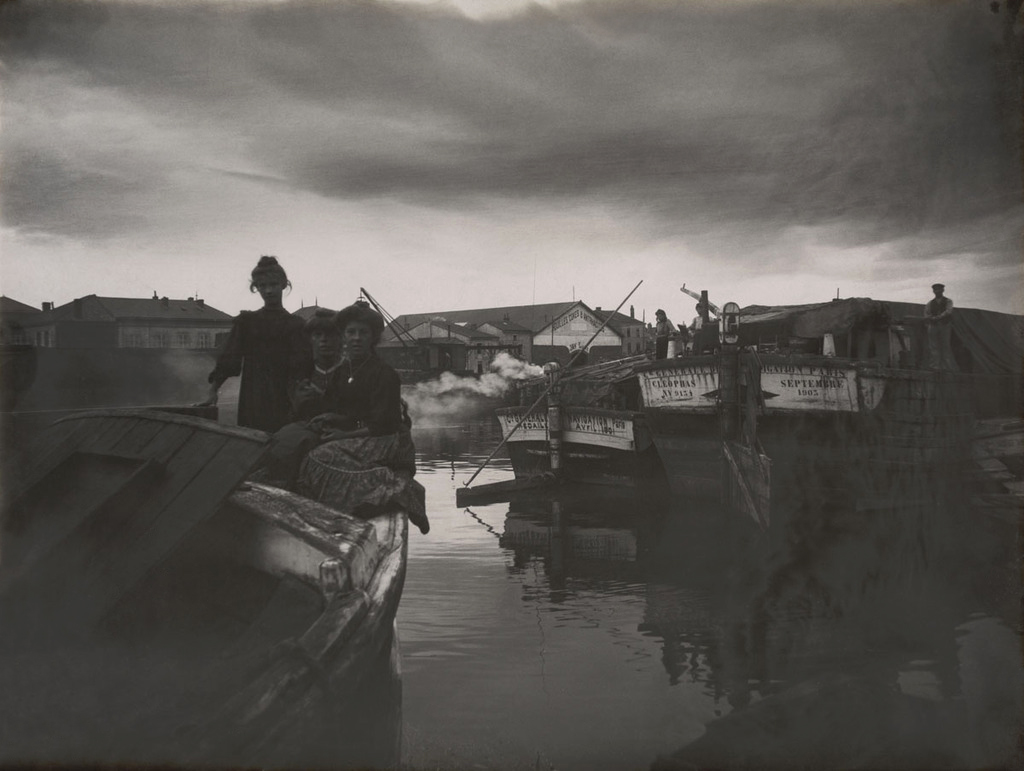
Félix Thiollier (French, 1842-1914) 'Boats on the Seine, Paris' 1903-1905


Félix Thiollier (French, 1842-1914)
Boats on the Seine, Paris (Bateaux sur la Seine, Paris)
1903-1905
Silver gelatin print
29.7 x 39.4 cm


Félix Thiollier (French, 1842-1914) 'Shepherdess and Flock' 1890-1910


Félix Thiollier (French, 1842-1914)
Shepherdess and Flock
1890-1910
Silver gelatin dry plate print on barium paper from a silver gelatin dry plate glass negative
H. 29.2; W. 38.4cm
Paris, Musée d’Orsay
© Musée d’Orsay (dist. RMN) / Patrice Schmidt


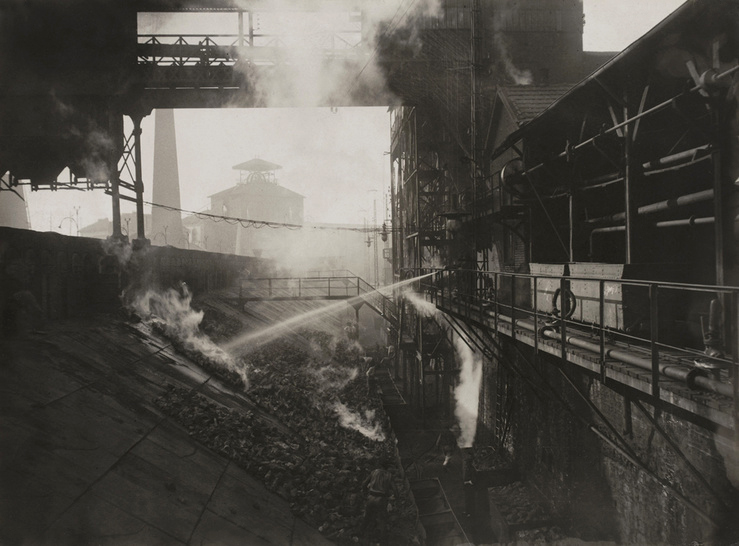
Félix Thiollier (French, 1842-1914) 'The Verpilleux Coking Plant, near Saint-Etienne' 1895-1910


Félix Thiollier (French, 1842-1914)
The Verpilleux Coking Plant, near Saint-Etienne
1895-1910
Silver gelatin dry plate print on barium paper from a silver gelatin dry plate glass negative
H. 39.3; W. 29.9cm
Paris, Julien-Laferrière collection
© Musée d’Orsay / Patrice Schmidt


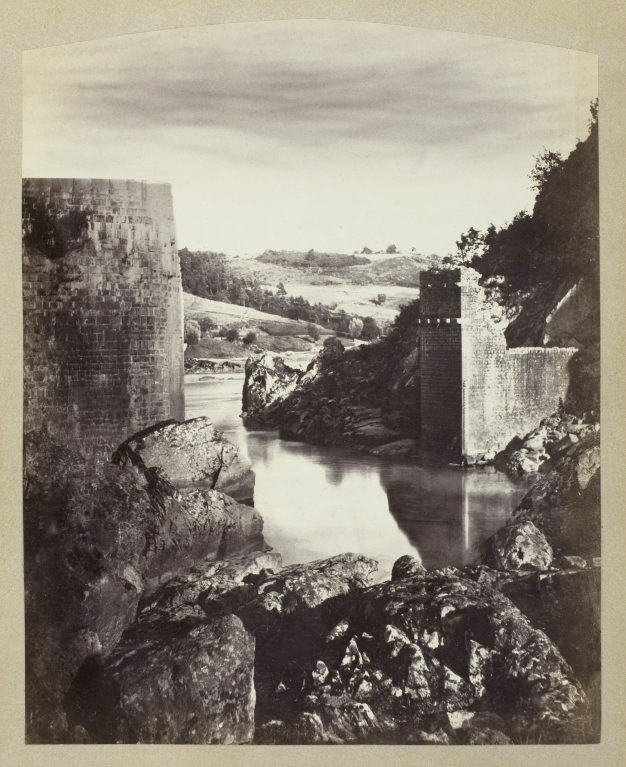
Félix Thiollier (French, 1842-1914) 'Landscape with Ruin' c. 1870


Félix Thiollier (French, 1842-1914)
Landscape with Ruin
c. 1870


Biography

1842
Maurice Félix Thiollier is born in Saint-Étienne into a wealthy family of ribbon manufacturers who espouse the values of social Catholicism.

1847
The Thiollier family moves to Paris. A French priest, l’abbé Paul Lacuria, is engaged as a tutor for Félix’s older brothers.

1851-52
The Thiollier family returns to Saint-Étienne. Félix Thiollier goes to school at the Collège Saint-Thomas d’Acquin in Oullins near Lyon.

1858
Eligible to take the competitive entrance test for the École des Mines de Saint-Étienne, Félix Thiollier chooses to train at the ribbon factory. He takes up photography, and possibly receives technical advice at this time from Stéphane Geoffray, a photographer from Roanne.

1867
At the age of 25, he sets up his own ribbon factory in Saint-Étienne.

1869
Through the painter Henri Baron, his father’s cousin, he is offered a place in the studio of the painter Louis Français, which he turns down for family reasons.

1870
Marries Cécile Testenoire-Lafayette, daughter of Claude-Philippe Testenoire-Lafayette, a lawyer and local scholar from Saint-Étienne, and president of La Diana – the Historical and Archaeo-logical Society of Forez (1870-1879).

1873
Meets the Dauphinois painter Auguste Ravier and soon gives up hope of becoming a professional painter.

1879
Decides to live off his private income. Becomes a member of La Diana.

1881
Publication of the first book to be illustrated with his photographs, Le Poème de l’âmeby his friend the painter Louis Janmot.

1885
First exhibition of his photographs, presented in the great hall belonging to La Diana in Montbrison, on the occasion of the 52nd congress of the Société Française d’Archéologie. Becomes a member of this society, which awards him its silver medal.

1886
Publication of Château de la Bastie d’Urfé et ses seigneurs.

1889
Publication of Forez pittoresque et monumental. Receives a silver medal for his illustrated books at the universal exhibition in Paris.

1894
Becomes a non-resident member of the Committee for Historic and Scientific Works at the Ministry for Public Instruction.

1895
Receives the Légion d’Honneur for his work as a photographer.

1897
Receives the title of honorary curator of the Saint-Étienne Museum of Art and Industry.

1900
Receives another silver medal for his illustrated books at the universal exhibition in Paris.

1902
Publication of L’Histoire de Saint-Etienne by Claude-Philippe Testenoire Lafayette, illustrated with photographs by Félix Thiollier.

1914
Death of Félix Thiollier on 12 May at Saint-Étienne.

1917
Publication of his biography by Sébastien Mulsant.


Musée d’Orsay
62, rue de Lille
75343 Paris Cedex 07
France

Opening hours:
Tuesday – Sunday 9.30am – 6pm
Closed on Mondays

Musée d’Orsay website

LIKE ART BLART ON FACEBOOK

Back to top

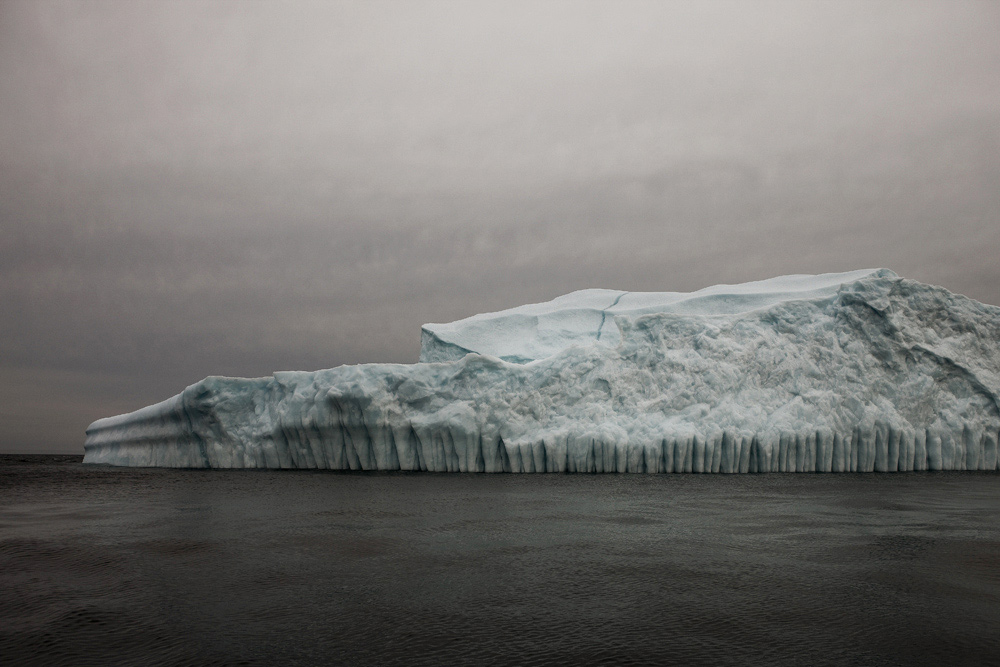
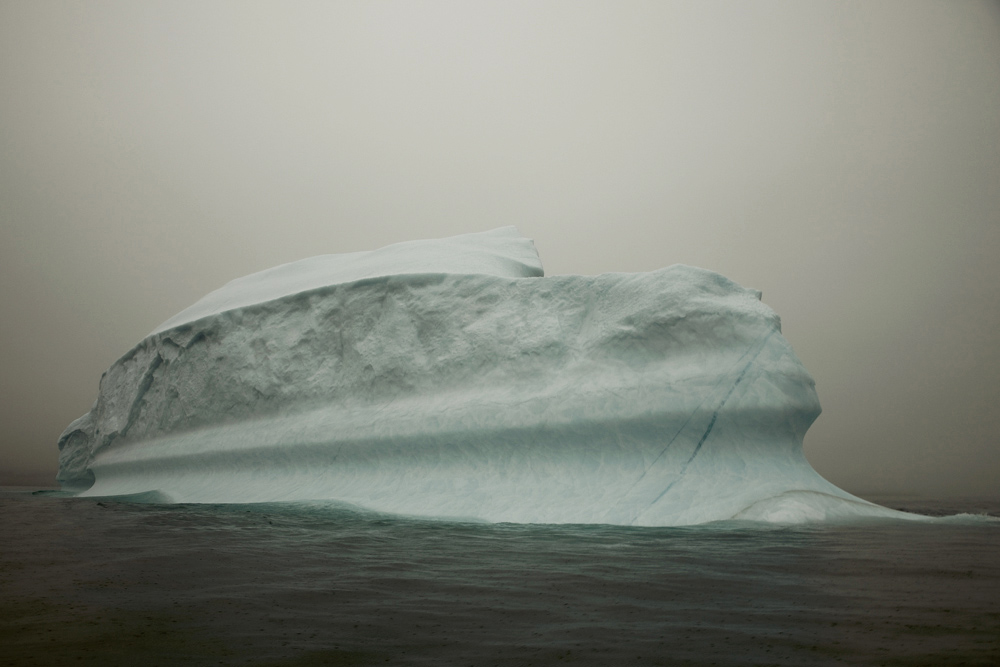
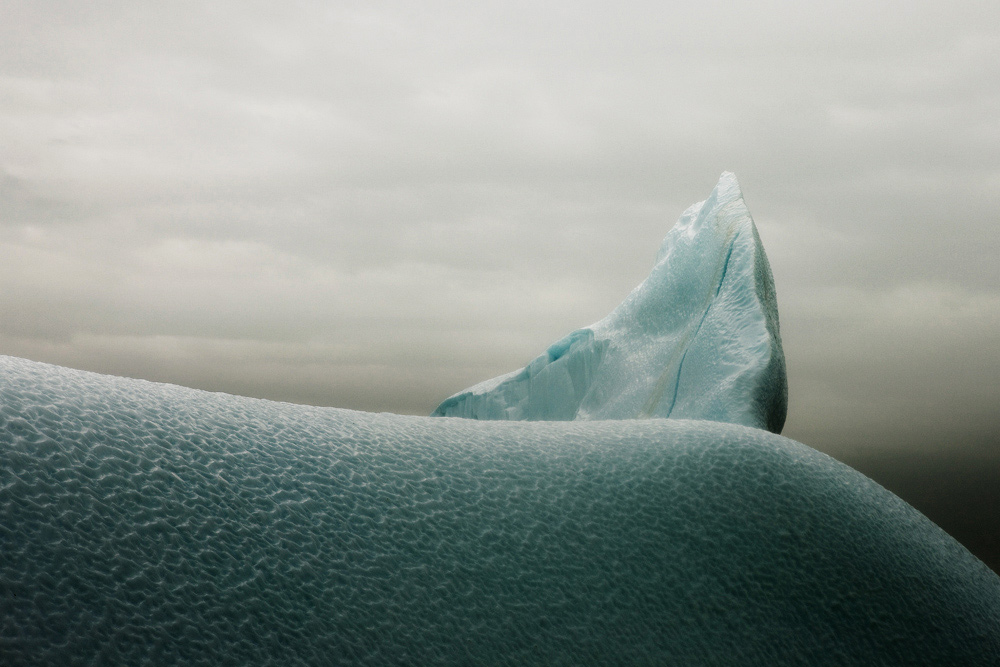
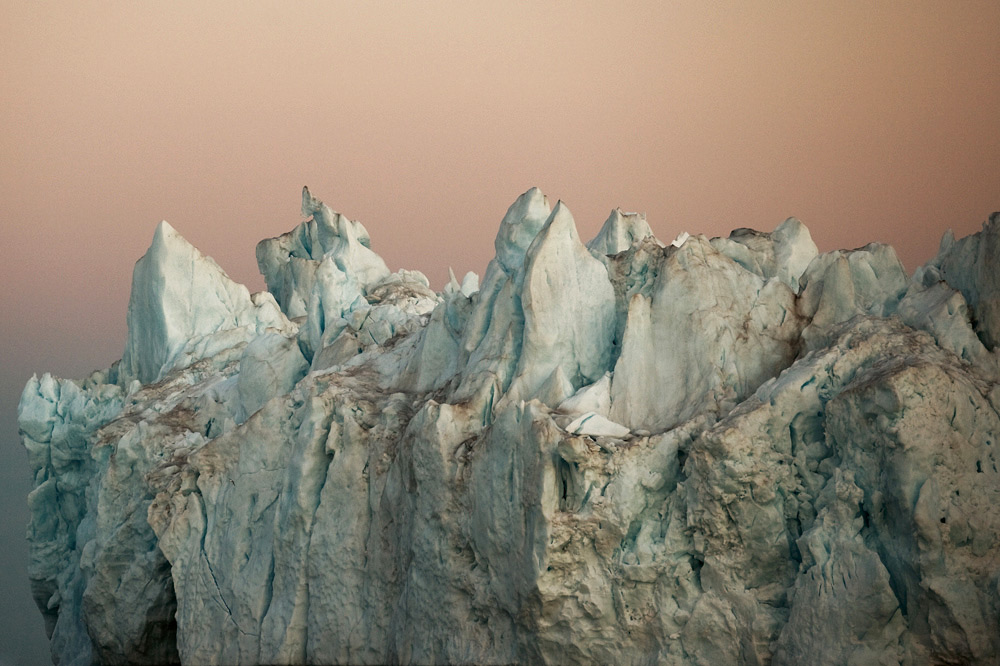
Review: ‘Simon Harsent / Melt: Portrait of an Iceberg’ at Edmund Pearce Gallery, Melbourne

Exhibition dates: 5th February – 1st March, 2014


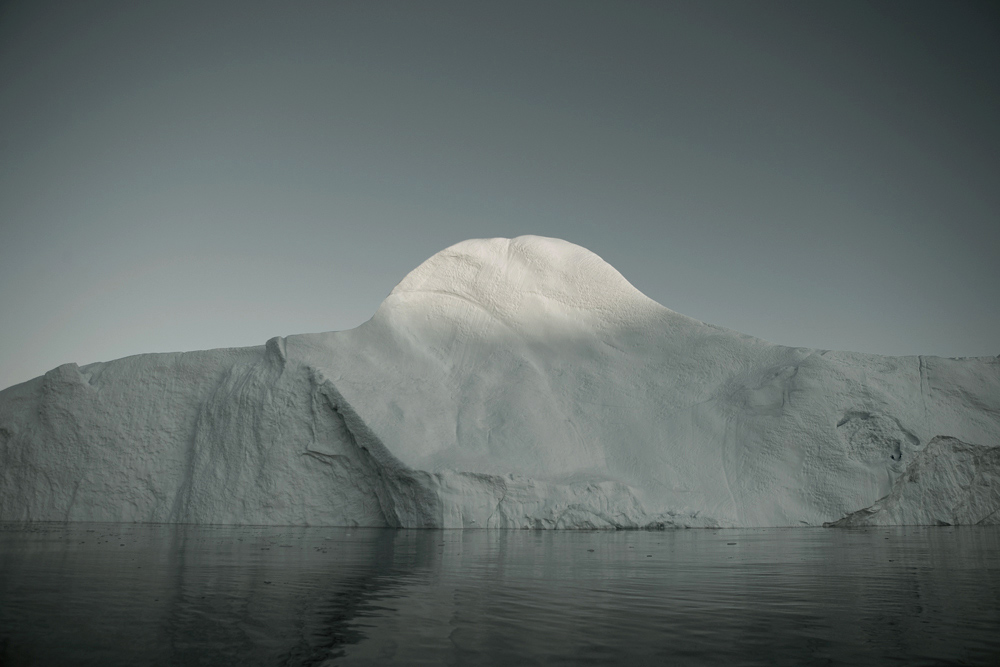
Simon Harsent (British, b. 1965) 'Melt #028a' 2008


Simon Harsent (British, b. 1965)
Melt #028a
2008
Archival Pigment Print
58.5 x 86cm
Edition of 25


A solid exhibition by Simon Harsent to open the year at Edmund Pearce Gallery, Melbourne.

Things I felt and observed

~ Harsent shows me sculptural photographs of icebergs as I have never seen them before

~ The photographs are well printed and framed, have great colour variation and work at both sizes the images are presented at

~ The horizon line of the sea rises and falls throughout the series, allowing the viewer to levitate and drop as you walk around the gallery

~ The ecological component of the exhibition, while inherent, is not overpowering. Which is a good thing

~ The non-chronological hang benefits the exhibition immensely. If the exhibition had been hung from large to small iceberg, the effect would have been too didactic

~ The Brancusi-esque forms held more interest for me, such as Melt #029, Melt #036 and Melt #039 (seen with a photograph of Brancusi’s The Newborn 1920, below), together with the intense, close-up abstract forms such as Melt #014 and Melt #023. These are superb!

Things I wanted to feel and observe

~ When viewing the series I didn’t feel Harsent’s metaphorical reflection upon his own mortality. Only in two images, Melt #042 and Melt #09 (where the sunlight hits the top of the iceberg deliciously) did I feel an anthropomorphic link to humanity

~ I didn’t feel the grandeur of these icebergs. Perhaps just one image at the largest size possible would have shook me from my reverie

~ I didn’t feel the personality of each iceberg in its own journey. In the exhibition I never knew which large iceberg had metamorphosed into which smaller iceberg. Therefore I was unsure of each iceberg’s life-span and story. For that reason these are not ontological portraits concerned with the nature and relations (the relation of one photograph and the next) of being

~ Finally, I wanted the images to push forward, to take me further on the journey. Taking the adage that two-thirds of the iceberg is always below water, I never really felt the psychological power of these objects, something dark that is hidden beneath the sea. All the icebergs are photographed in clear, calm weather. Some photographed in storms, in mist or fog, or at night would have added ineffably to the atmosphere


These are not sublime photographs. I never got that feeling from viewing the work. They come nowhere close to Alain de Botton’s wonderful prose on the significance of sublime places:

“If the world is unfair or beyond our understanding, sublime places suggest it is not surprising things should be thus. We are the playthings of the forces that laid out the oceans and chiselled the mountains. Sublime places acknowledge limitations that we might otherwise encounter with anxiety or anger in the ordinary flow of events. It is not just nature that defies us. Human life is as overwhelming, but it is the vast spaces of nature that perhaps provide us with the finest, the most respectful reminder of all that exceeds us. If we spend time with them, they may help us to accept more graciously the great unfathomable events that molest our lives and will inevitably return us to dust.”(de Botton, Alain. The Art of Travel. London: Penguin, 2002, p. 178-179.)

I never felt that the photographs transported the viewer on an emotional journey that furthers our understanding of the fragility of life both of the planet and of ourselves. And that is the one thing I wished they had of done.

Dr Marcus Bunyan


Many thankx to Edmund Pearce Gallery for allowing me to publish the photographs in the posting. Please click on the photographs for a larger version of the image.


Simon Harsent (British, b. 1965) 'Melt #026' 2008


Simon Harsent (British, b. 1965)
Melt #026
2008
Archival Pigment Print
58.5 x 86cm
Edition of 25


Simon Harsent (British, b. 1965) 'Melt #029' 2008


Simon Harsent (British, b. 1965)
Melt #029
2008
Archival Pigment Print
110 x 160cm
Edition of 10


Simon Harsent (British, b. 1965) 'Melt #039' 2008


Simon Harsent (British, b. 1965)
Melt #039
2008
Archival Pigment Print
58.5 x 86cm
Edition of 10


Simon Harsent (British, b. 1965) 'Melt #036' 2008


Simon Harsent (British, b. 1965)
Melt #036
2008
Archival Pigment Print
58.5 x 86cm
Edition of 25


Constantin Brancusi (Romanian, 1876-1957) 'The Newborn'. Version I 1920 (close to the marble of 1915)


Constantin Brancusi (Romanian, 1876-1957)
The Newborn. Version I
1920 (close to the marble of 1915)
Bronze
14.6cm x 21cm x 14.6cm
Acquired through the Lillie P. Bliss request
© 2010 Artists Rights Society (ARS), New York / ADAGP, Paris

Used under conditions of fair use for the purpose of art criticism


Simon Harsent (British, b. 1965) 'Melt #037' 2008


Simon Harsent (British, b. 1965)
Melt #037
2008
Archival Pigment Print
58.5 x 86cm
Edition of 25


Simon Harsent (British, b. 1965) 'Melt #042' 2008


Simon Harsent (British, b. 1965)
Melt #042
2008
Archival Pigment Print
58.5 x 86cm
Edition of 25


After successful exhibitions in Australia and abroad, Simon Harsent’s sublime photographic series Melt: Portrait of an Iceberg makes its Melbourne premiere at Edmund Pearce this February. The exhibition and accompanying monograph present portraits of icebergs as they travel Greenland’s Ilulissat Icefjord. The ecological story is self-evident; more sections are breaking away from the arctic ice cap and melting faster due to global warming. But the chronicle of the iceberg is, for the artist, a metaphorical reflection upon his own mortality.

Harsent states; “Seeing them first overpowering in grandeur and then, later, about to be absorbed back into the flux from which they came, is both beautiful and humbling: a metamorphosis that endows them with a life-span, each with its own personality, each with its own story.”

Born in England Simon Harsent studied photography at Watford College before moving to Australia in 1988 to establish himself as one of the country’s leading photographers. Currently based in New York, Harsent’s career has seen him win numerous national and international awards including, Cannes Lions, One Show, Clio, D&AD, and Australia’s first Cannes Grand Prix – making him one of the most awarded photographers in the world. His work is included in the permanent collection of the Queensland Art Gallery and The Powerhouse Museum. Melt: Portrait of an Iceberg was published in late 2009 to critical acclaim, reinforced by its inclusion in the prestigious D&AD and PDN Photo Annuals.

Text from the Edmund Pearce Gallery website


Simon Harsent (British, b. 1965) 'Melt #023' 2008


Simon Harsent (British, b. 1965)
Melt #023
2008
Archival Pigment Print
58.5 x 86cm
Edition of 25


Simon Harsent (British, b. 1965) 'Melt #014' 2008


Simon Harsent (British, b. 1965)
Melt #014
2008
Archival Pigment Print
58.5 x 86cm
Edition of 25


Simon Harsent (British, b. 1965) 'Melt #021' 2008


Simon Harsent (British, b. 1965)
Melt #021
2008
Archival Pigment Print
58.5 x 86cm
Edition of 25


Simon Harsent (British, b. 1965) 'Melt #010' 2008


Simon Harsent (British, b. 1965)
Melt #010
2008
Archival Pigment Print
58.5 x 86cm
Edition of 25


Simon Harsent (British, b. 1965) 'Melt #09' 2008


Simon Harsent (British, b. 1965)
Melt #09
2008
Archival Pigment Print
58.5 x 86cm
Edition of 25


Simon Harsent (British, b. 1965) 'Melt #020' 2008


Simon Harsent (British, b. 1965)
Melt #020
2008
Archival Pigment Print
58.5 x 86cm
Edition of 25


Simon Harsent (British, b. 1965) 'Melt #05' 2008


Simon Harsent (British, b. 1965)
Melt #05
2008
Archival Pigment Print
58.5 x 86cm
Edition of 25


Simon Harsent (British, b. 1965) 'Melt #03' 2008


Simon Harsent (British, b. 1965)
Melt #03
2008
Archival Pigment Print
58.5 x 86cm
Edition of 25


Simon Harsent (British, b. 1965) 'Melt #07' 2008


Simon Harsent (British, b. 1965)
Melt #07
2008
Archival Pigment Print
110 x 160cm
Edition of 10


Edmund Pearce Gallery

This gallery has now closed.

LIKE ART BLART ON FACEBOOK

Back to top

Research at the State Library of Victoria further update

Date: 22nd February 2014

Research experience on the charles marville photographs at the state library of victoria further update


Dear readers

An interesting email arrived from the Collection Services Manager further questioning why I actually want to see the Marville prints in the State Library’s Collection.

In part the email says, and I precis: the prints are fragile and very rare; the Library has digitised all the prints and provided high resolution images available for free download from our website; the careful storage of the original prints and the provision of digital files is the Library’s standard approach to achieve that delicate balance between access and preservation. The email goes on to ask, “I would be interested to understand more about your research needs with this collection and why it is important for you to view the original prints out of their protective enclosures.”


They still don’t get it do they?

Vintage prints have to be seen in the flesh. Anyone who knows anything about photography understands this but not, apparently, the State Library of Victoria. Why do you even need to explain this to them? When looking at vintage photographs you actually have to see the physical print, the surface of the print, not some simulacra hidden behind plastic or a high res scan online!

As Bill Henson insightfully observes in an interview about his current selection of images at the Monash Gallery of Art in the exhibition Wildcards,

“One of those preoccupations is an interest in the photograph as an object, in the physical presence of the print or whatever kind of technology is being used to make it. Part of the reason for that is that photography, more than any other medium, suffers from a mistake or misunderstanding people have when they’ve seen a reproduction in a magazine or online: they think they’re seeing the original. A certain amount of photography is made with its ultimate intention being to be seen in a magazine or online, but most photography, historically, ended up in its final form as a print – a cyanotype, or a tin type or a daguerreotype or whatever it might be… [This] continues to interest me about photography: how these things inhabit the world as objects. And indeed we read them not just with our eyes but with how our whole bodies read and encounter and negotiate these objects, which happen to be photographs.”

 “They’ve seen a reproduction in a magazine or online: they think they’re seeing the original… we read them not just with out eyes but with how our whole bodies read and encounter and negotiate these objects, which happen to be photographs.”1

Well said.

Perhaps the State Library needs to read Walter Benjamin’s 1936 essay The Work of Art in the Age of Mechanical Reproduction in which he discusses the aura of the original and

“the concept of authenticity, particularly in application to reproduction. “Even the most perfect reproduction of a work of art is lacking in one element: its presence in time and space, its unique existence at the place where it happens to be.” He argues that the “sphere of authenticity is outside the technical” so that the original artwork is independent of the copy, yet through the act of reproduction something is taken from the original by changing its context. He thus introduces the idea of the “aura” of a work and its absence in a reproduction.”2

In other words, there is nothing like standing in front of a jewel-like Vermeer and feeling the aura of the original, not one shielded behind glass (or plastic in this case). By making many reproductions, including online copies, you substitute a plurality of copies for a unique existence. This is why I was so looking forward to seeing the Marville’s, to FEEL THEIR PRESENCE…

Of course I am as guilty as anyone through this archive of disseminating reproductions around the world, and I freely admit that. The photographs I reproduce are not the originals and should never stand for them. Even in this age of infinitely reproducible digital images there is still that aura of standing in front of a print in a gallery and feeling its eternal value and mystery.

As Walter Benjamin writes, “the authenticity of a thing is the essence of all that is transmissible from its beginning, ranging from its substantive duration to its testimony to the history which it has experienced.”

And you need to see and feel that history.

Finally, I wonder how many people the State Library of Victoria have coming in to see these prints? When was the last time anyone actually physically saw them that wanted to? I would think very, very, few people indeed. The “delicate balance” between access and conservation is obviously well weighted towards the former.

It will be interesting to see how the State Library of Victoria responds and whether they can “Cry ‘Havoc!’, and let slip the photographs of Marville.” Even for an instant. To facilitate my research in this time, in this space where one can admire the beauty of an object without compromising the need to preserve – no, lets think of better words: retain, possess, guard, protect, shield – the prints.

Dr Marcus Bunyan


1/ Bill Henson. “Wildcards: Bill Henson shuffles the deck,” Monash Gallery of Art, 1 February – 30 March 2014 quoted on the Art Guide Australia website Nd [Online] Cited 20/02/2014. No longer available online

1/ Walter Benjamin (1968). Hannah Arendt, ed. “The Work of Art in the Age of Mechanical Reproduction”, Illuminations. London: Fontana. pp. 214-218 quoted in “The Work of Art in the Age of Mechanical Reproduction” on the Wikipedia website

All Charles Marville photographs in the State Library of Victoria Pictures Collection


Charles Marville (French, 1813-1879) 'Parc Monceau' c. 1853 - c. 1870


Charles Marville (French, 1813-1879)
Parc Monceau
c. 1853 – c. 1870
In collection: Photographic views of Paris
Undated, dates assigned from time of Haussman’s renovation of Paris
Photographic print mounted on cardboard : albumen silver
32 x 26cm
Gift; Government of France; 1880
In the State Library of Victoria Pictures Collection


State Library of Victoria
328 Swanston St,
Melbourne VIC 3000
Phone: (03) 8664 7000

Opening hours:
Sunday 10.00am – 6.00pm
Monday 10.00am – 9.00pm
Tuesday 10.00am – 9.00pm
Wednesday 10.00am – 9.00pm
Thursday 10.00am – 9.00pm
Friday 10.00am – 6.00pm
Saturday 10.00am – 6.00pm

State Library of Victoria website

LIKE ART BLART ON FACEBOOK

Back to top

Exhibition: ‘Walker Evans American Photographs’ at The Museum of Modern Art (MoMA), New York

Exhibition dates: 19th July, 2013 – 9th March, 2014

Curators: Sarah Hermanson Meister, Curator in the Department of Photography, and Drew Sawyer, Curatorial Fellow


Walker Evans (American, 1903-1975) 'City Lunch Counter, New York' 1929 from the exhibition 'Walker Evans American Photographs' at The Museum of Modern Art (MoMA), New York, July 2013 - March 2014


Walker Evans (American, 1903-1975)
City Lunch Counter, New York
1929
Gelatin silver print
4 3/16 x 6 5/16″ (10.7 x 16.1cm)
Gift of the photographer
© 2013 Walker Evans Archive, Metropolitan Museum of Art


Picture this

Picture this is what Walker Evans does in his unique, forthright way.

He shows you what he is seeing in a very straight forward way – directly, purposefully, in images where the artist seems to have no presence, no ego to impart.

As artist Chris Killip observes, “Walker Evans is serious and smart and purposeful. He is trying to show you very clearly what he is seeing. It is very unadorned, as if nobody had taken the photograph. He conveys what is in front of him as clearly as possible.”1

But further than this, Evans presents us with a photographic version of Tomas Tranströmer’s poems which were seen by his English admirers in terms of “deep image”, a vaguely Jungian concept which suggests that “poetry could state absolute truths if only the images poets evoked welled up from deep enough sources uncontaminated by history and the follies of reason.”2

Evans direct, plainspoken images picture reality whilst hovering above the void – flirting with the duality of narrative truth and metaphysical inquiry. Whether Evans was consciously aware of this elemental antinomy is unlikely. Nevertheless we can read it in his images, even if we cannot read it in his prosaic words. You only have to look at the jet-black trees on a rainy day in Main Street, Saratoga Springs, New York (1931, below), or the justly famous Sharecropper’s Family, Hale County, Alabama (March 1936, below).

The people in the photograph have been posed but there is an intimate relationship here between the artist and his subjects. It is a loving photograph, for Evans cares for the dignity of these people in their naked condition. The grandmother wary of the camera with clasped hands, the weary husband, stick thin with glazed eyes, the young girl child with sallow stare, and the pensive mother with sleeping baby staring directly into camera, all of them dirty and in rags. In this absolute reality there is a nobility to these people and there, buried in the image, a relationship to the metaphysical essence of what it is to be human – the pictures of children on the back wall with text I can’t quite make out; the glorious arrangement of feet that run along the bottom of the image in all different angles and positions, the mothers folded under her almost collapsing with the weight of her burden; and what is that black shape prostrate on the floor? A rag? death? No! A cat.

The blackest most thinnest small cat that you ever seen, lingering on the edge of starvation, hovering in the void of existence.

As Thomas Sleigh writes of his first meeting with Tomas Tranströmer as he stepped from a small plane onto the ground, “I don’t mind large planes or middle-sized planes (his English was slightly guttural, his intonations lilting in a mild brogue), but small planes – you feel too much of the air under you.”3

And so with Evans if you know where to look.

Dr Marcus Bunyan


PS. For a fascinating insight into how these photographs were hung in the 1938 exhibition at MoMA see installation views of “Walker Evans American Photographs” at the Museum of Modern Art, New York City, 1938 on the ASX website. Notice the smallness of the photographs, their different sizes, the juxtaposition of disparate images, some double or triple hung one above the other, some printed in the centre of white sheets of photographic paper, others displayed on dark walls. The image that I describe above, Sharecropper’s Family, Hale County, Alabama (March 1936) is shown in an installation photograph below. Notice how small the image is and what affect this size of image has on the viewer, its shear concentration and intensity.

A friend Christopher Young tells me, “The install was done by Evans himself the night before and very chaotically. I love the poetry of the 1938 opening in that he got to the front door and couldn’t enter the show. He instead circled the block a number of times before going home…” Sounds like my early exhibitions. I could be found next door in a cafe playing pinball, I couldn’t face the crowd!


Footnotes

1/ Interview with Chris Killip about his exhibition Work at Museo Nacional Centro de Arte Renia Sofia, October 2013 [Online] Cited 11/02/2021

2/ Sleigh, Tom. “Too Much of the Air: Tomas Tranströmer,” 2005, on the Poets.org website [Online] Cited 15/02/2014. No longer available online

3/ Ibid.,


Many thankx to The Museum of Modern Art for allowing me to publish the photographs in the posting. Please click on the photographs for a larger version of the image.


Installation view of "Walker Evans American Photographs" at the Museum of Modern Art, New York City, 1938

Installation view of "Walker Evans American Photographs" at the Museum of Modern Art, New York City, 1938


Installation views of “Walker Evans American Photographs” at the Museum of Modern Art, New York City, 1938 with at bottom right, Sharecropper’s Family, Hale County, Alabama (March 1936)
© Walker Evans Archive, The Metropolitan Museum of Art

Images used under conditions of fair use for the purpose of art criticism.


Walker Evans (American, 1903-1975) '42nd Street, New York' 1929 from the exhibition 'Walker Evans American Photographs' at The Museum of Modern Art (MoMA), New York, July 2013 - March 2014


Walker Evans (American, 1903-1975)
42nd Street, New York
1929
Gelatin silver print
4 1/4 x 6 1/2″ (10.8 x 16.6cm)
Purchase
© 2013 Walker Evans Archive, Metropolitan Museum of Art


Walker Evans (American, 1903-1975) 'Church Organ and Pews, Alabama' 1936


Walker Evans (American, 1903-1975)
Church Organ and Pews, Alabama
1936
Gelatin silver print, printed 1970
7 9/16 x 9 1/8″ (19.2 x 23.2cm)
Printer: James Dow
Mr. and Mrs. John Spencer Fund


Walker Evans (American, 1903-1975) 'Sharecropper's Family, Hale County, Alabama' March 1936


Walker Evans (American, 1903-1975)
Sharecropper’s Family, Hale County, Alabama
March 1936
Gelatin silver print
7 5/8 x 9 5/8″ (19.4 x 24.4cm)
Gift of the Farm Security Administration


Walker Evans (American, 1903-1975) 'Sharecropper's Family, Hale County, Alabama' March 1936 (detail)


Walker Evans (American, 1903-1975)
Sharecropper’s Family, Hale County, Alabama (detail)
March 1936
Gelatin silver print
7 5/8 x 9 5/8″ (19.4 x 24.4cm)
Gift of the Farm Security Administration


Walker Evans (American, 1903-1975) 'Sharecropper's Family, Hale County, Alabama' (detail) March 1936


Walker Evans (American, 1903-1975)
Sharecropper’s Family, Hale County, Alabama (detail)
March 1936
Gelatin silver print
7 5/8 x 9 5/8″ (19.4 x 24.4cm)
Gift of the Farm Security Administration


This installation celebrates the 75th anniversary of the first one-person photography exhibition in MoMA’s history, and the accompanying landmark publication, which established the potential of the photographer’s book as an indivisible work of art. Through these projects Walker Evans created a collective portrait of the eastern United States during a decade of profound transformation – one that coincided with the flood of everyday images, both still and moving, from an expanding mass culture, and the construction of a Modernist history of photography. As Lincoln Kirstein wrote in his essay for the book, “After looking at these pictures with all their clear, hideous and beautiful detail, their open insanity and pitiful grandeur, compare this vision of a continent as it is, not as it might be or as it was, with any other coherent vision that we have had since the war. What poet has said as much? What painter has shown as much? Only newspapers, the writers of popular music, the technicians of advertising and radio have in their blind energy accidentally, fortuitously, evoked for future historians such a powerful monument to our moment. And Evans’s work has, in addition, logic, continuity, climax, sense and perfection.”

Comprising approximately 60 prints from the Museum’s collection that were included in the 1938 exhibition or the accompanying publication, the current installation maintains the bipartite presentation of the originals; the first section portrays American society through images of its individuals and social environments, while the second consists of photographs of the relics that constitute expressions of an American cultural identity – the architecture of Main streets, factory towns, rural churches, and wooden houses. The pictures provide neither a coherent narrative nor a singular meaning, but rather create connections through the repetition and interplay of pictorial structures and subject matter. Its placement on the fourth floor of the Museum – between galleries featuring the paintings of Robert Rauschenberg, Jasper Johns, Jackson Pollock, and Andy Warhol – underscores the continuation of prewar avant-garde practices in America and the unique legacy of Evans’s explorations of signs and symbols, commercial culture, and the vernacular. Their profound impact on not only photography, but also film, literature, and the visual arts, reverberates today.

Text from The Museum of Modern Art website


Walker Evans (American, 1903-1975) 'American Legionnaire' 1936


Walker Evans (American, 1903-1975)
American Legionnaire
1936
Gelatin silver print
5 3/4 x 5 1/8″ (14.6 x 13cm)
Gift of the Farm Security Administration


Walker Evans (American, 1903-1975) 'Interior Detail of Portuguese House' 1930


Walker Evans (American, 1903-1975)
Interior Detail of Portuguese House
1930
Gelatin silver print
7 15/16 x 6 1/8″ (20.2 x 15.5cm)
Purchase
© 2013 Walker Evans Archive, Metropolitan Museum of Art


Walker Evans (American, 1903-1975) 'Penny Picture Display, Savannah, Georgia' 1936


Walker Evans (American, 1903-1975)
Penny Picture Display, Savannah, Georgia
1936
Gelatin silver print
8 5/8 x 6 15/16″ (21.9 x 17.6cm)
Gift of Willard Van Dyke
© 2013 Walker Evans Archive, The Metropolitan Museum of Art


Walker Evans (American, 1903-1975) 'Main Street, Saratoga Springs, New York' 1931


Walker Evans (American, 1903-1975)
Main Street, Saratoga Springs, New York
1931
Gelatin silver print
7 1/16 x 5 9/16″ (18 x 14.2cm)
Gift of the photographer
© 2013 Walker Evans Archive, Metropolitan Museum of Art


Walker Evans (American, 1903-1975) 'Negro Church, South Carolina' 1936


Walker Evans (American, 1903-1975)
Negro Church, South Carolina
1936
Gelatin silver print
9 x 6 15/16″ (22.9 x 17.6cm)
Gift of Willard Van Dyke


The Museum of Modern Art
11 West 53 Street
New York, NY 10019
Phone: (212) 708-9400

Opening hours:
10.30am – 5.30pm
Open seven days a week

MoMA website

LIKE ART BLART ON FACEBOOK

Back to top

Exhibition: ‘In Focus: Architecture’ at the J. Paul Getty Museum, Getty Center, Los Angeles

Exhibition dates: 15th October, 2013 – 2nd March, 2014

Curator: Amanda Maddox, Assistant Curator of Photographs


William Henry Fox Talbot (English, 1800-1877) 'Boulevard des Italiens, Paris' 1843 from the exhibition 'In Focus: Architecture' at the J. Paul Getty Museum, Getty Center, Los Angeles, October 2013 - March 2014


William Henry Fox Talbot (English, 1800-1877)
Boulevard des Italiens, Paris
1843
Salted paper print from a Calotype negative
16.8 x 17.3cm
The J. Paul Getty Museum, Los Angeles


Another gem of a photography exhibition from the Getty. These In Focus exhibitions are just a treasure: from Making a Scene, Still Life and The Sky to Los Angeles, Picturing the Landscape and now Architecture. All fabulous. To have a photography collection such as the Getty possesses, and to use it. To put on these fantastic exhibitions…

I like observing the transition between epochs (or, in more architectural terms, ‘spans’ of time), photographers and their styles. From the directness and frontality of Fox Talbot’s Boulevard des Italiens, Paris (1843, below) to the atmospheric ethereality of Atget’s angular The Panthéon (1924, below) taken just three years before he died; from the lambent light imbued in Frederick Evans’ architectural study of the attic at Kelmscott Manor (1896, below) to the blocked, colour, geometric facade of William Christenberry’s Red Building in Forest, Hale County, Alabama (1964, below).

I love architecture, I love photography. Put the two together and I am in heaven.

Dr Marcus Bunyan


Many thankx to the J. Paul Getty Museum for allowing me to publish the photographs in the posting. Please click on the photographs for a larger version of the image.


Eugéne Atget (French, 1857-1927) 'The Panthéon' 1924 from the exhibition 'In Focus: Architecture' at the J. Paul Getty Museum, Getty Center, Los Angeles, October 2013 - March 2014


Eugéne Atget (French, 1857-1927)
The Panthéon
1924
Gelatin silver chloride print on printing-out paper
Image: 17.8 x 22.6cm
The J. Paul Getty Museum, Los Angeles


Eugène Atget made this atmospheric study across the place Sainte-Geneviève toward the back of the Panthéon, a church boldly designed to combine the splendour of Greece with the lightness of Gothic churches. The church’s powerful colonnaded dome, Atget’s primary point of interest, hovers in the background, truncated by the building in the left foreground.

In order to make the fog-veiled Panthéon visible when printing this negative, Atget had to expose the paper for a long period of time. As a consequence of the long printing, the two buildings in the foreground are overexposed, appearing largely as black silhouettes. Together they frame the Panthéon, rendered entirely in muted greys. This photograph exceeds documentation to become more a study of mood and atmospheric conditions than of architecture.


Frederick H. Evans (British, 1863-1943) 'Kelmscott Manor: In the Attics (No. 1)' 1896


Frederick H. Evans (British, 1863-1943)
Kelmscott Manor: In the Attics (No. 1)
1896
Platinum print
15.6 x 20.2cm
© Mrs Janet M. Stenner, sole granddaughter of Frederick H, Evans
The J. Paul Getty Museum, Los Angeles


Frederick Evans’s architectural study of the attic at Kelmscott Manor, a medieval house, part of which dates from 1280, is a visual geometry lesson. The composition is all angles and intersections, formed not only by the actual structure but also by the graphic definition of light within the space. Soft illumination bathes the area near the stairs, while the photograph’s foreground plunges into murky darkness. The sharp angles of intersecting planes are mediated by the rough-hewn craftsmanship of the beams and posts, almost sensuous in their sinewy imperfection and plainly wrought by hand. The platinum print medium favoured by Evans provides softened tonalities that further unify the triangles, squares, and diagonal lines of the dynamic composition.


William Christenberry (American, b. 1936) 'Red Building in Forest, Hale County, Alabama' 1964


William Christenberry (American, b. 1936)
Red Building in Forest, Hale County, Alabama
1964
44.5 x 55.9cm
© William Christenberry
The J. Paul Getty Museum, Los Angeles


William Christenberry began photographing this makeshift wooden structure in his native Alabama in 1974. Since that time, he has made nearly annual trips to document the facade of this isolated dwelling, located deep in the Talladega National Forest. Such vernacular structures were uncommon photographic subjects until Walker Evans, Ed Ruscha, William Eggleston, and other twentieth-century photographers elevated their stature. Like the edifices photographed by Eugène Atget, Bernd and HIlla Becher, and others, the buildings Christenberry recorded in the southern United States were often in disrepair and in danger of disappearing altogether.


Soon after its invention in 1839, photography surpassed drawing as the preferred artistic medium for recording and presenting architecture. Novel photographic techniques have kept pace with innovations in architecture, as both media continue to push artistic boundaries. In Focus: Architecture, on view October 15, 2013 – March 2, 2014 at the J. Paul Getty Museum, Getty Center, traces the long, interdependent relationship between architecture and photography through a selection of more than twenty works from the Museum’s permanent collection, including recently acquired photographs by Andreas Feininger, Ryuji Miyamoto, and Peter Wegner.

“Architectural photography was an integral part of the early days of the medium, with the construction of many of the world’s most important and magnificent structures documented from start to finish with the camera,” explains Timothy Potts, director of the J. Paul Getty Museum. “This exhibition demonstrates how architectural photography has grown from straightforward documentary style photographs in its early days to genre-bending works like those of Peter Wegner from 2009.”

Beginnings of Architectural Photography

Recognised for their accuracy and precision, photographs could render architectural details as never before and show the built environment during construction, after completion, or in ruin. Nineteenth-century photographers were eager to utilise the new medium to document historic sites and structures, as well as buildings that rose alongside them, or in their place. In 1859, Gustave Le Gray photographed the Mollien Pavilion, a structure that constituted part of the “New Louvre,” a museum expansion completed during the reign of Napoleon III. Le Gray’s picturesque composition highlighted the Pavilion’s ornamented façade and other intricate details that could inform the work of future architects. Louis-Auguste Bisson, a trained architect, worked with his brother Auguste-Rosalie to photograph grand architectural spaces such as Interior of Saint-Ouen Church in Rouen (1857). The Bisson brothers produced a monumental print, derived from a glass negative of the same size, to feature the nave of the structure in an interior view rarely depicted in 19th century photographs.

A burgeoning commercial market for tourist photographs emerged toward the end of the nineteenth century. Views of architectural landmarks and foreign ruins became popular souvenirs and tokens of the ancient world. Artists such as J.B. Greene, who ventured to exotic destinations, provided visions of historic sites in Egypt, while Louis-Émile Durandelle took a series of photographs that documented the construction of the Eiffel Tower in the years before it became a symbol of the modern era at the World’s Exposition of 1889. Durandelle’s frontal view of the structure underscored its perfect geometric form, and his photographs were the earliest of what became a popular motif for amateur and professional photographers. Other noted photographers of this period included Eugène Atget, who obsessively documented the streets and buildings of Paris before its modernisation, and Frederick H. Evans, who created poetic photographs of Romanesque and Gothic cathedrals.

The Rise of Modern Architectural Photography

As the commercial market for photographs expanded and technologies advanced, representations of architectural forms began to evolve as well. In the twentieth century, images of buildings developed in conjunction with the rise of avant-garde, experimental, documentary, and conceptual modes of photographic expression.

Andreas Feininger, who studied architecture in Weimar, followed what Bauhaus instructor László Moholy-Nagy called a “new vision” of photography as an autonomous artistic practice with its own laws of composition and lighting. In Portal in Greifswald (1928), Feininger created a negative print, or a photograph with reversed tonalities, resulting in a high contrast image that enhanced the mystery of the architectural subject and removed it from its ecclesiastical context.

“The experimental spirit that permeated photography in the first half of the twentieth century inspired new ways to look at architectural forms,” says Amanda Maddox, assistant curator of photographs at the J. Paul Getty Museum and curator of the exhibition. “As photographs could present buildings in abstracted, close-up, or fragmented views, they encouraged viewers to see the built environment around them as never before.”

At the same time the Bauhaus was influencing photographers throughout Europe, Walker Evans was at the forefront of vernacular photography in the United States, which elevated ordinary objects and events to photographic subjects. In keeping with this trend, architectural photography shifted its focus to ordinary domestic and functional buildings. Derelict and isolated dwellings feature prominently in the work of William Christenberry, whose photograph and “building construction” of Red Building in Forest, Hale County, Alabama (1994) will be on display in the exhibition.

Architecture as a photographic subject became more malleable at the end of the twentieth century, as artists continued to explore the symbolism and vitality of the modern cityscape. This transition is exemplified in Peter Wegner’s 32-part Building Made of Sky III (2009), in which the spaces between skyscrapers in New York, San Francisco and Chicago create buildings of their own. Wegner described the series as “the architecture of air, the space defined by the edges of everything else.” When presented as a grid, the works form a new, imaginary city.

Press release from the J. Paul Getty website


Gustave Le Gray (French, 1820 - 1884) 'Mollien Pavilion, the Louvre' 1859


Gustave Le Gray (French, 1820-1884)
Mollien Pavilion, the Louvre
1859
Albumen silver print
Image: 36.7 x 47.9cm
The J. Paul Getty Museum, Los Angeles


Standing opposite a newly built pavilion of the Louvre, Gustave Le Gray made this photograph when the sun’s position allowed him to best capture the details of the heavily ornamented facade, from the fluted columns on the ground level to the figurative group on the nearest gable. Paving stones lead the viewer’s eye directly to the corner of the pavilion, where the sunlit facade is further highlighted beside an area blanketed in shadow.

Though the extensive art collections of the Louvre had first been opened to the public in 1793, after the French Revolution, it was not until 1848 that the museum became the property of the state. Le Gray’s image shows the exuberance of the architecture undertaken shortly thereafter, during the reign of Napoléon III, when large sections of the building housed government offices.


Ryuji Miyamoto (Japanese, b. 1947) 'Kowloon Walled City' 1987


Ryuji Miyamoto (Japanese, b. 1947)
Kowloon Walled City
1987
Gelatin silver print
34.4 x 51.1cm
The J. Paul Getty Museum, Los Angeles
© Ryuji Miyamoto


Robert Adams (American, b. 1937) 'Longmont, Colorado' 1973


Robert Adams (American, b. 1937)
Longmont, Colorado
1973
Gelatin silver print
15.2 x 19.4cm
The J. Paul Getty Museum, Los Angeles
© Robert Adams


The long, interdependent relationship between photography and architecture is the subject of this survey drawn from the Getty Museum’s collection. Spanning the history of the medium, the exhibition features twenty-four works by such diverse practitioners as William Henry Fox Talbot, Eugène Atget, Walker Evans, Bernd and Hilla Becher, and Ryuji Miyamoto. Seen together, the varied photographic representations of secular and sacred structures on display reveal how the medium has impacted our understanding and perception of architecture.

In the nineteenth century, photography surpassed drawing as the preferred artistic medium for recording and presenting architecture. Recognised for their accuracy and precision, photographs could render architectural elements as never before. The intricate ornamented facade, the sprawling sunlit Napoléon Courtyard, and the classical design of the Louvre appear in magnificent detail in Gustave Le Gray’s picturesque image of the Mollien Pavilion, a structure completed in the 1850s during the reign of Napoléon III.

Photographers working in the nineteenth century documented historic structures on the verge of disappearance as well as contemporary buildings erected before their eyes. They also captured the built environment during construction, after completion, and in ruin. This photograph by Louis-Émile Durandelle shows the Eiffel Tower, the centrepiece of the 1889 World Exposition, in November 1888 when only its four columns, piers, and first two platforms were in place.

With the advancement of photographic technologies and the modernisation of the built environment around the turn of the twentieth century came innovative representations of architecture. Compositions and photographic processes began to reflect the avant-garde and modernist sensibilities of the time, and photographs of buildings, churches, homes, and other structures often showcased these developments. Andreas Feininger, who trained as an architect, utilised an experimental printing technique to depict gothic St. Nikolai cathedral in Greifswald in a nontraditional way.

Images of architecture by contemporary photographers Robert Adams, William Christenberry, and others working in the documentary tradition often underscore the temporality of buildings. Vernacular structures found in his native Alabama are among the subjects Christenberry has systematically recorded for the past six decades. By returning year-after-year to photograph the same places, such as the red building shown above, Christenberry chronicles the decay (and sometimes the ultimate disappearance) of stores, tenant houses, churches, juke joints, and other rural buildings.

Experimental and conceptual approaches toward the representation of architecture have been embraced by photographers. Peter Wegner used skyscrapers in New York, San Francisco, and Chicago as his framing devices to feature the spaces between high rises that form buildings of their own. By upending images of these canyons, he created buildings made of sky. When presented as a grid, they form a new, imaginary city.

Text from the J. Paul Getty website


Henri Le Secq (French, 1818 - 1882) 'Tour de Rois à Rheims' ('Tower of the Kings at Rheims Cathedral') 1851


Henri Le Secq (French, 1818-1882)
Tour de Rois à Rheims (Tower of the Kings at Rheims Cathedral)
1851
Salted paper print
35.1 x 25.9cm
The J. Paul Getty Museum, Los Angeles


Louis-Émille Durandelle (French, 1839 - 1917) 'The Eiffel Rower: State of Construction' 1888


Louis-Émille Durandelle (French, 1839-1917)
The Eiffel Rower: State of Construction
1888
Albumen silver print
43.2 x 34.6cm
The J. Paul Getty Museum, Los Angeles


The Centennial Exposition of 1889 was organised by the French government to commemorate the French Revolution. Bridge engineer Gustave Eiffel’s 984-foot (300-meter) tower of open-lattice wrought iron was selected in a competition to erect a memorial at the exposition. Twice as high as the dome of St. Peter’s in Rome or the Great Pyramid of Giza, nothing like it had ever been built before. This view was made about four months short of the tower’s completion. Louis-Émile Durandelle photographed the tower from a low vantage point to emphasise its monumentality. The massive building barely visible in the far distance is dwarfed under the tower’s arches. Incidentally, the tower’s innovative glass-cage elevators, engineered to ascend on a curve, were designed by the Otis Elevator Company of New York, the same company that designed the Getty Center’s diagonally ascending tram.


Andreas Feininger (American born France, 1906-1999) 'Portal in Greifswald' 1928


Andreas Feininger (American born France, 1906-1999)
Portal in Greifswald
1928
Gelatin silver print
23.4 x 17.5cm
The J. Paul Getty Museum, Los Angeles
© Estate of Gertrud E. Feininger


William Eggleston (American, b. 1939) '(Untitled)' Negative about 1967-1974; print 1974


William Eggleston (American, b. 1939)
(Untitled)
Negative about 1967-1974; print 1974
Chromogenic print
Image: 22.2 x 15.2cm
The J. Paul Getty Museum, Los Angeles
© Eggleston Artistic Trust


The J. Paul Getty Museum
1200 Getty Center Drive
Los Angeles, California 90049

Opening hours:
Tues – Friday 10am – 5.30pm
Saturday 10am – 8pm
Sunday 10am – 5.30pm
Monday closed
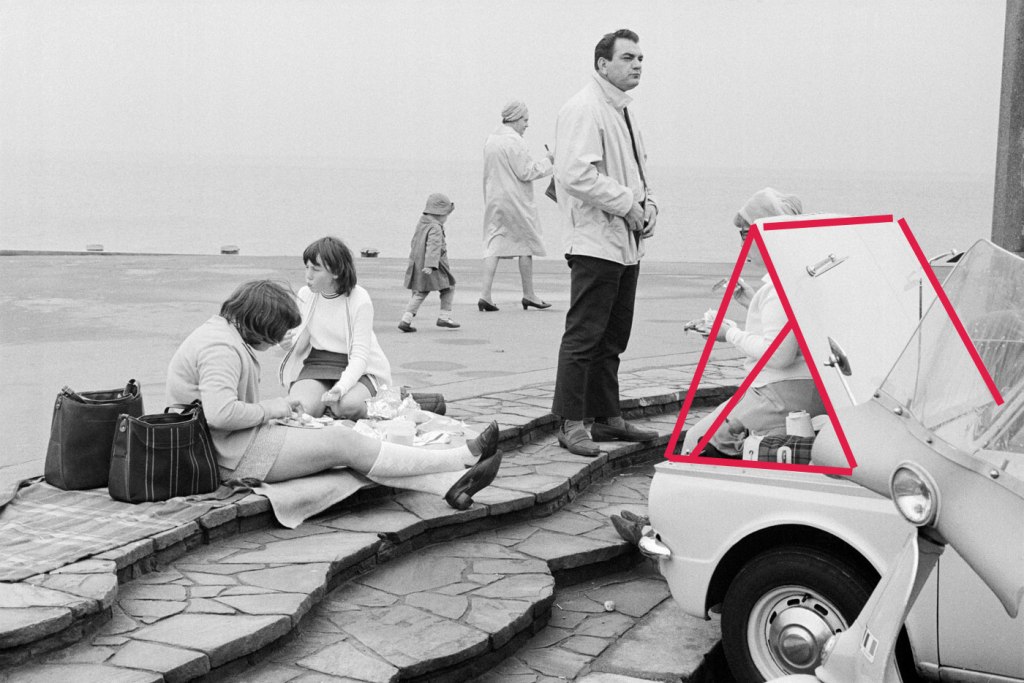
The J. Paul Getty Museum website

LIKE ART BLART ON FACEBOOK

Back to top

New photographic prize: The Prix Elysée with the support of Parmigiani Fleurier

Applications open: 3rd February 2014
Applications close: 25th April 2014


The Prix Elysée with the support of Parmigiani Fleurier


About the Prix Elysée

At the Musée de l’Elysée, we think that supporting photographers in the evolution of their career is as important as preserving their art for future generations. It is in a shared commitment to foster creativity and support the production of new work that the Musée de l’Elysée enters into a partnership with Parmigiani Fleurier to launch the Prix Elysée.

Who can apply

The prize is open to promising photographers or artists using photography, of all nationalities, who have already enjoyed their first exhibitions and publications. There is no imposed theme or preference for any particular photographic genre or technique. Applications are open from February 3 to April 25, 2014.

What can you win?

The winner and nominees of the Prix Elysée will all benefit from important exposure and the Museum’s expert guidance. The winner is invited to produce an original and new project as well as its related book. Both the project and book will be presented at one of the Musée de l’Elysée’s most important events, the Nuit des images.

How to apply

Photographers must be recommended by a reputed professional in the fields of photography, cinema, fashion, journalism, publishing or contemporary art. The Musée de l’Elysée will select eight nominees based upon their entry portfolios. Each will receive a contribution of CHF 5’000 towards the initial presentation of their project in a dedicated edition of the Prix Elysée magazine. This magazine will accompany the nominees’ complete portfolios in the final consideration before the jury of experts. The winner will receive CHF 80’000 to be divided between the completion of the proposed project and the publication of the accompanying book within one year. A curator from the Musée de l’Elysée will advise the winner throughout this process.
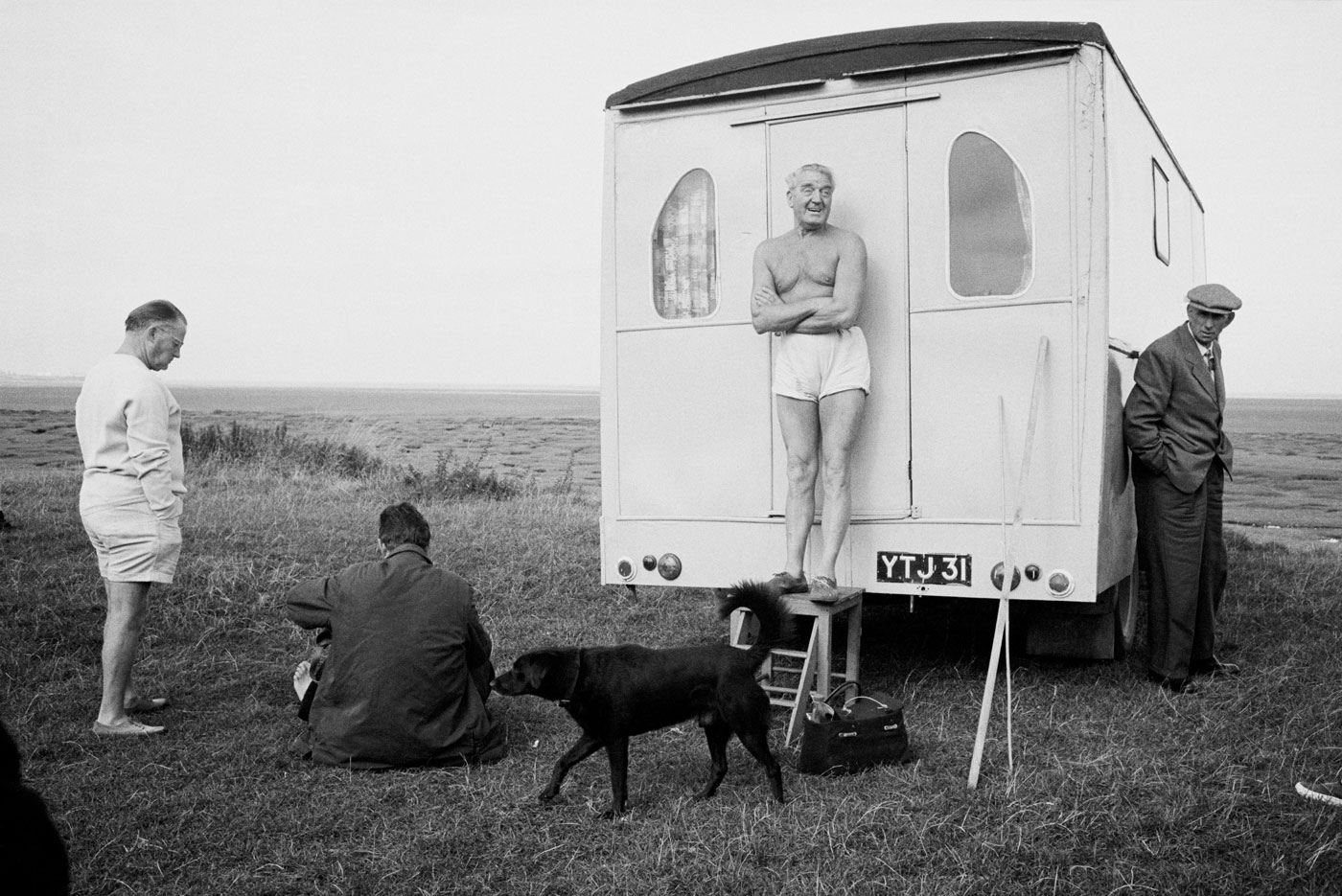
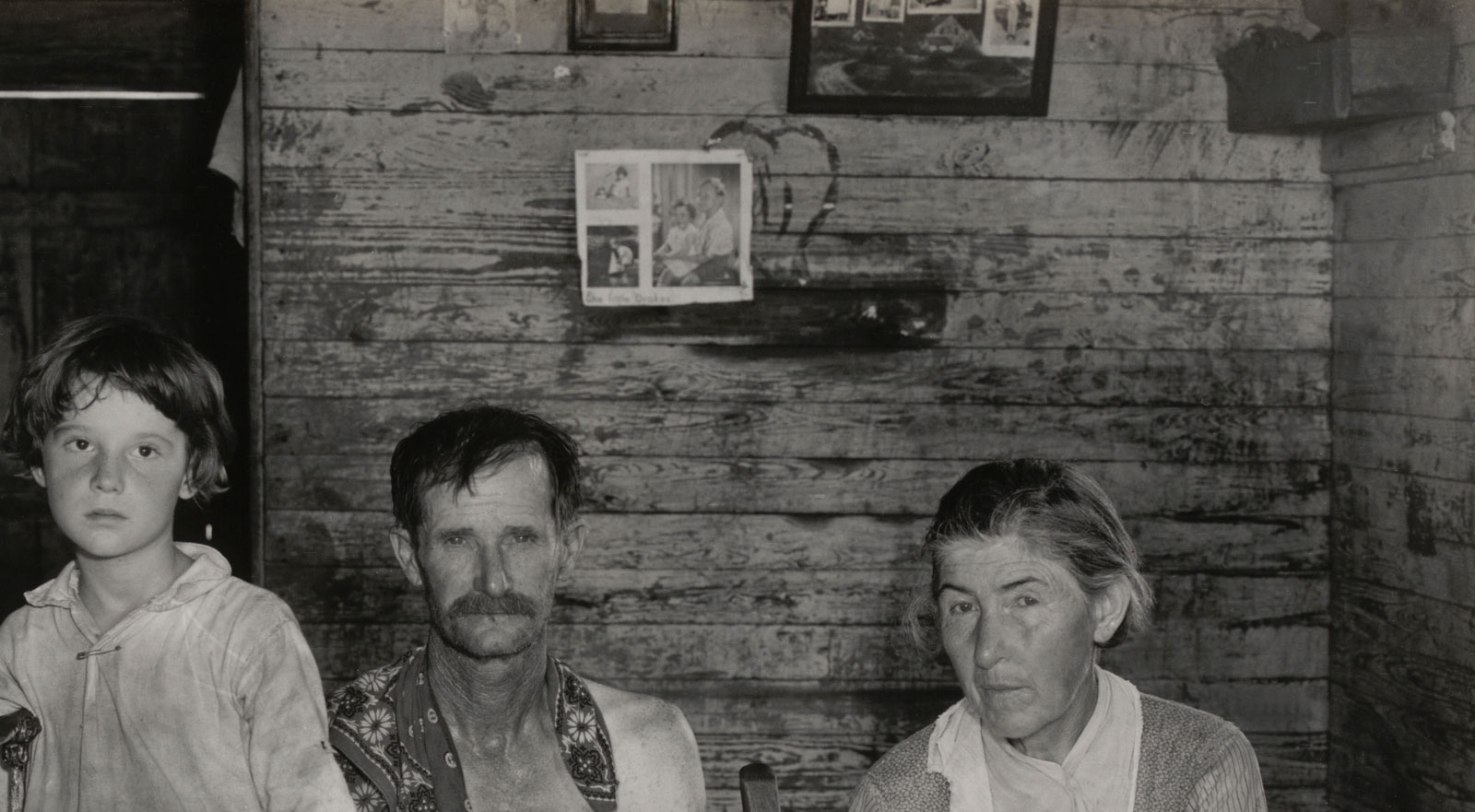
The call for applications will take place biennially. The first edition of the Prix Elysée is launched in February 2014 and concludes in June 2016.
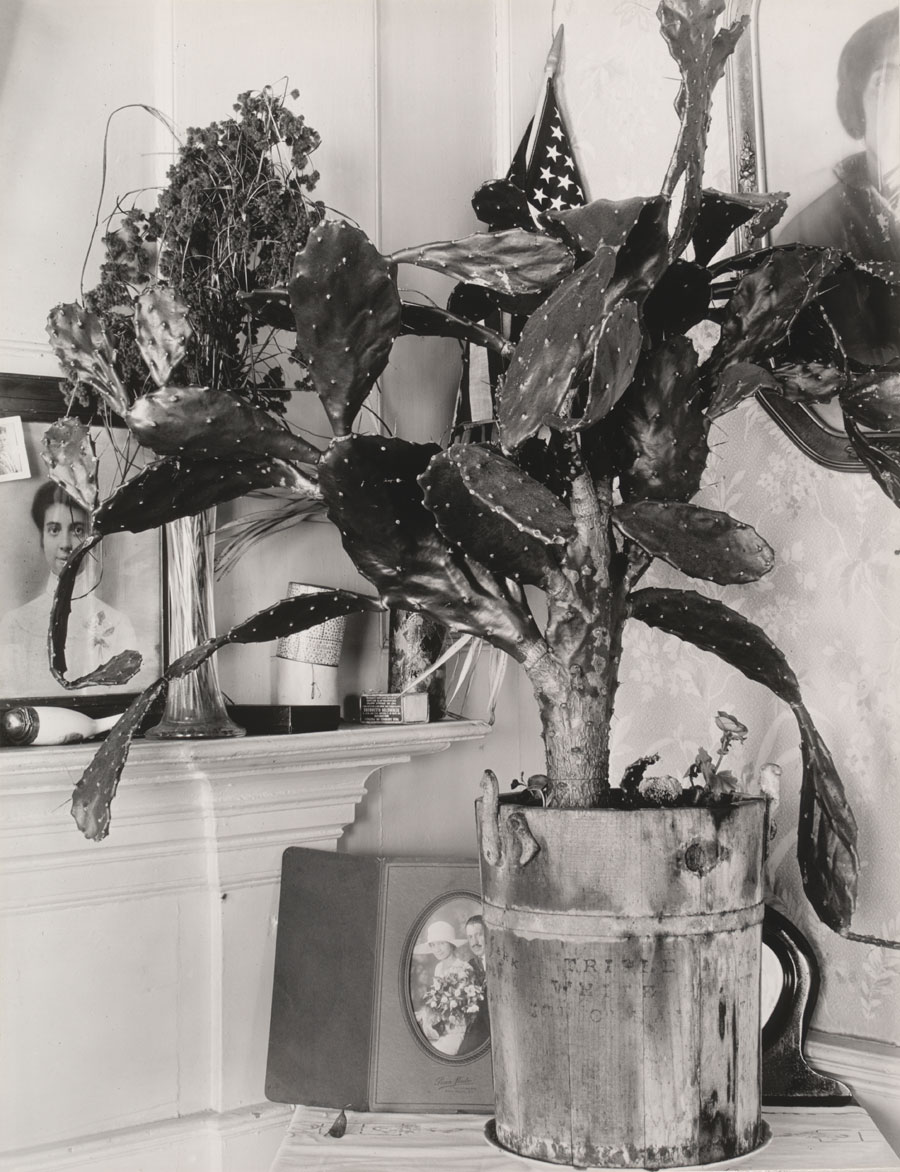
Applicants may download the official rules for le Prix Elysée at www.prixelysee.ch.


Yves André. 'Musée de l'Elysée' Nd


Yves André
Musée de l’Elysée
Nd
© Yves André


Musée de l'Elysée logo

Musée de l’Elysée
Avenue de l’Elysée 18
CH-1014 Lausanne
Phone: +41 21 316 99 27

Musée de l’Elysée website

LIKE ART BLART ON FACEBOOK

Back to top