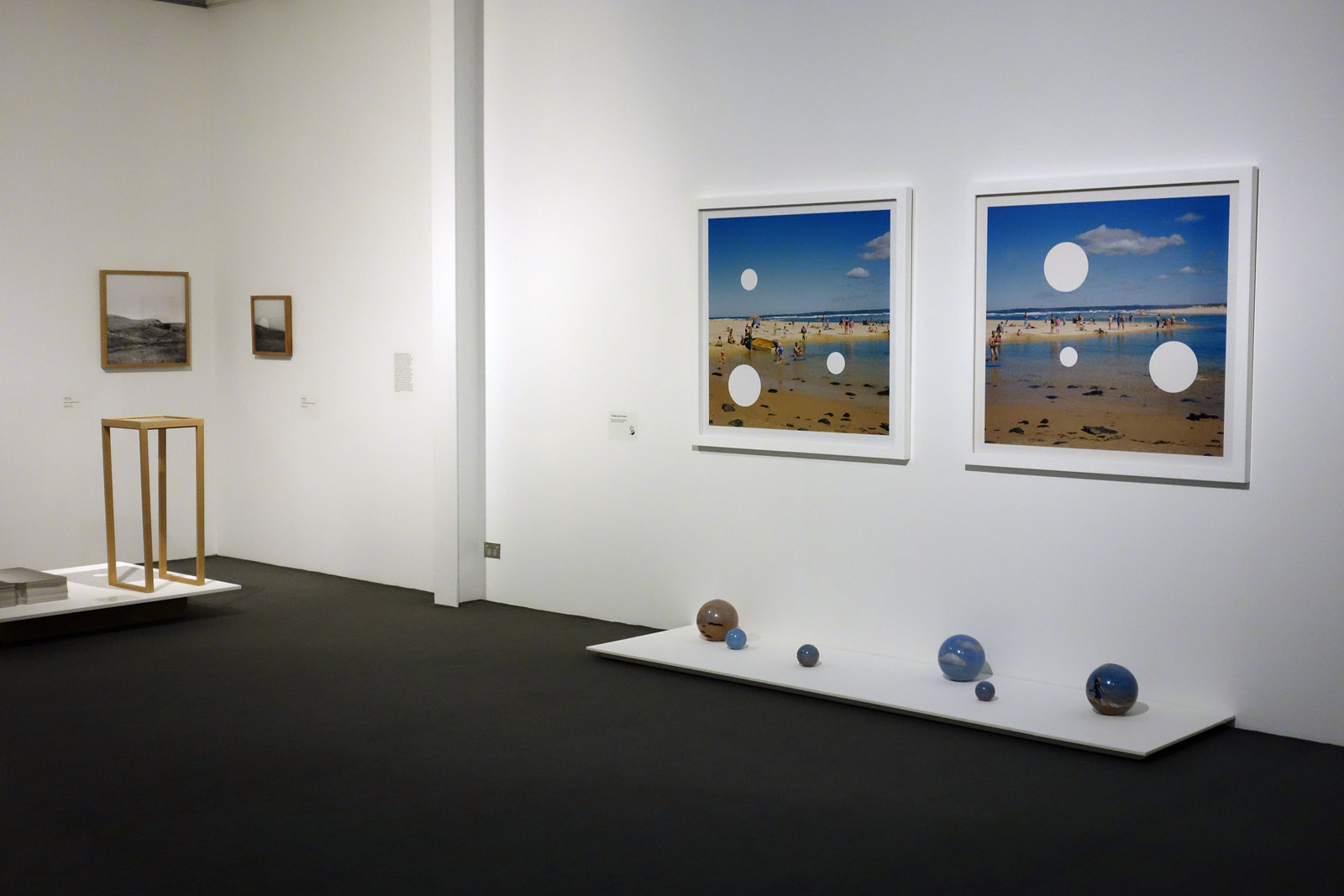
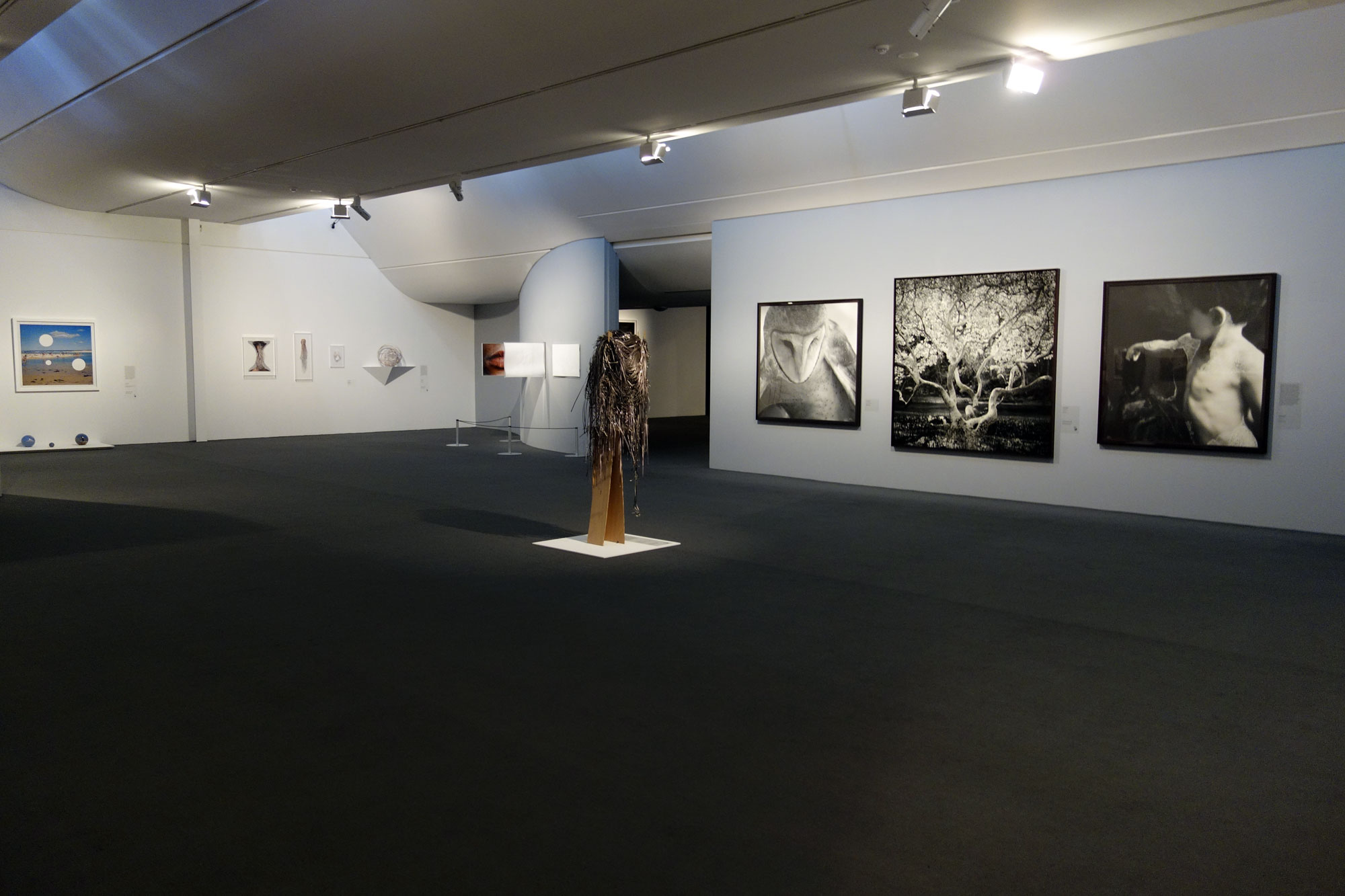
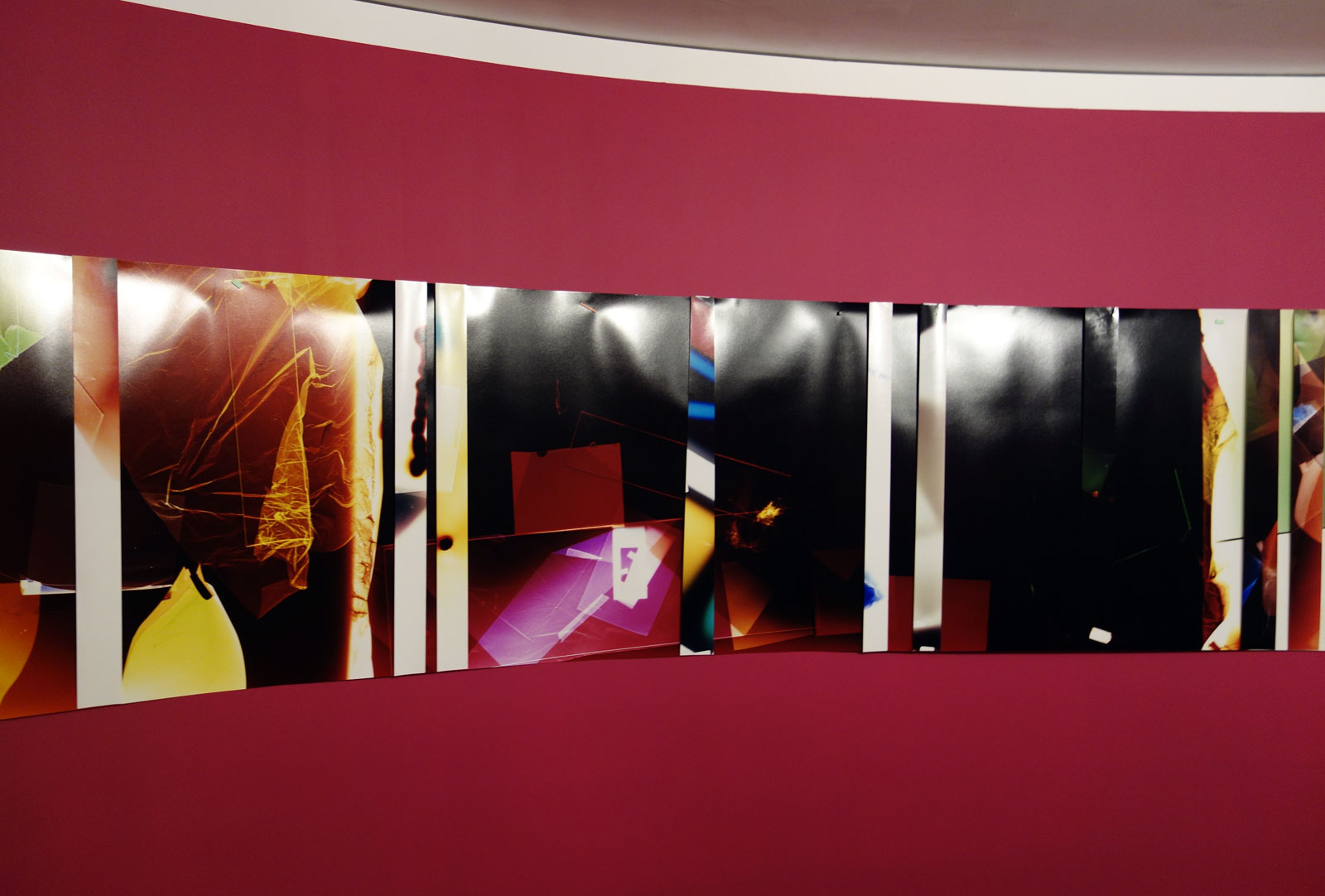
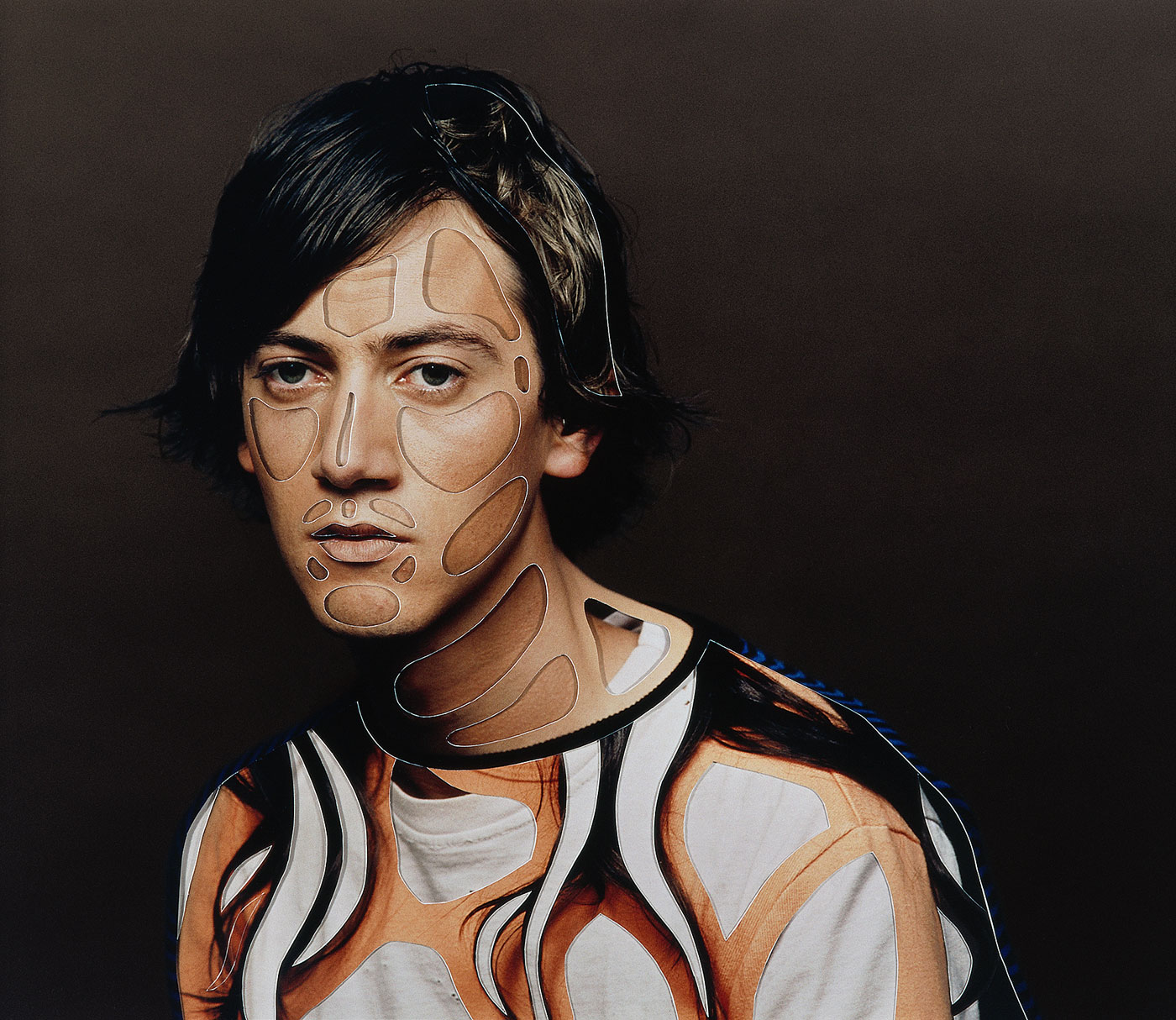
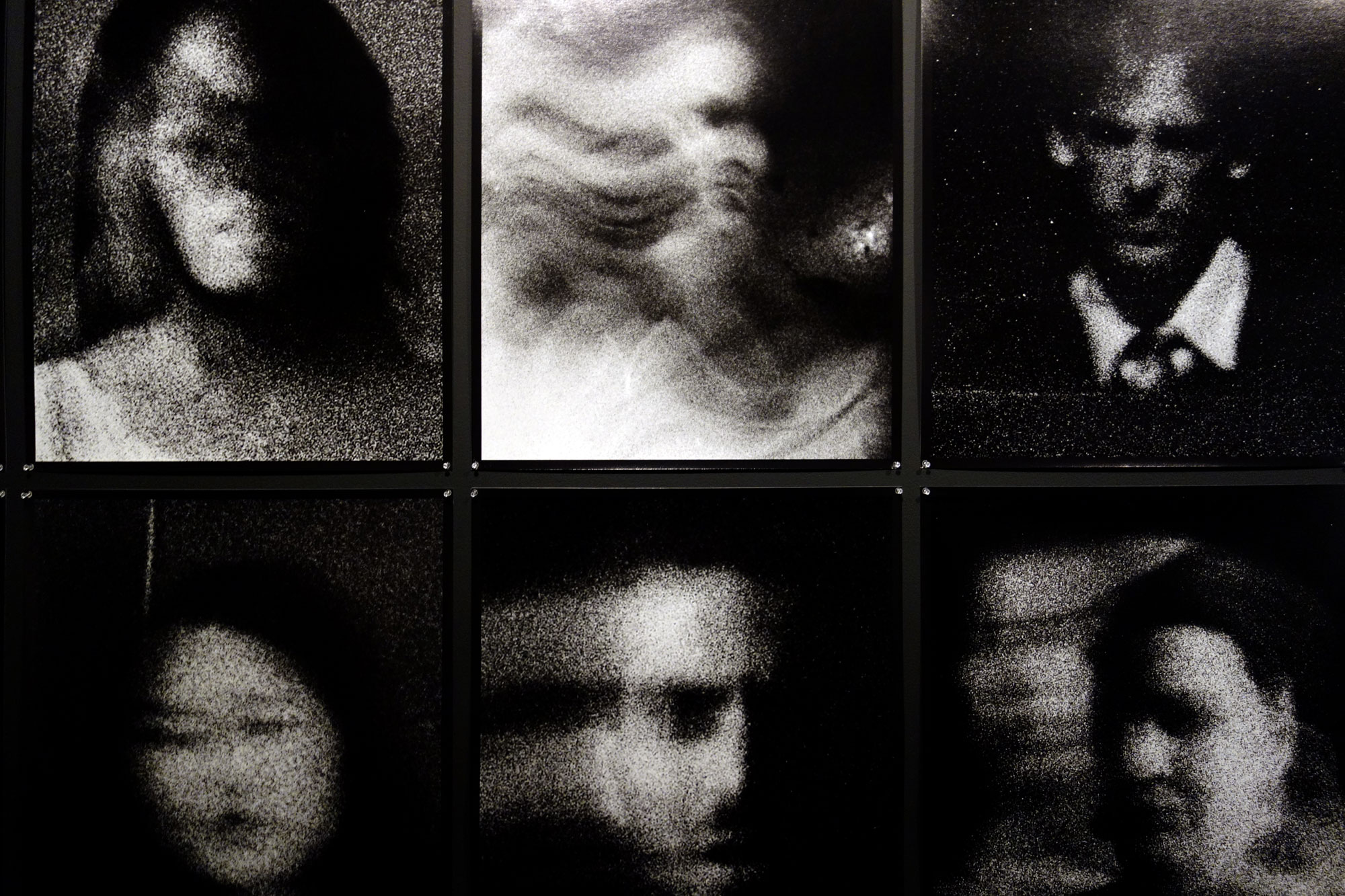
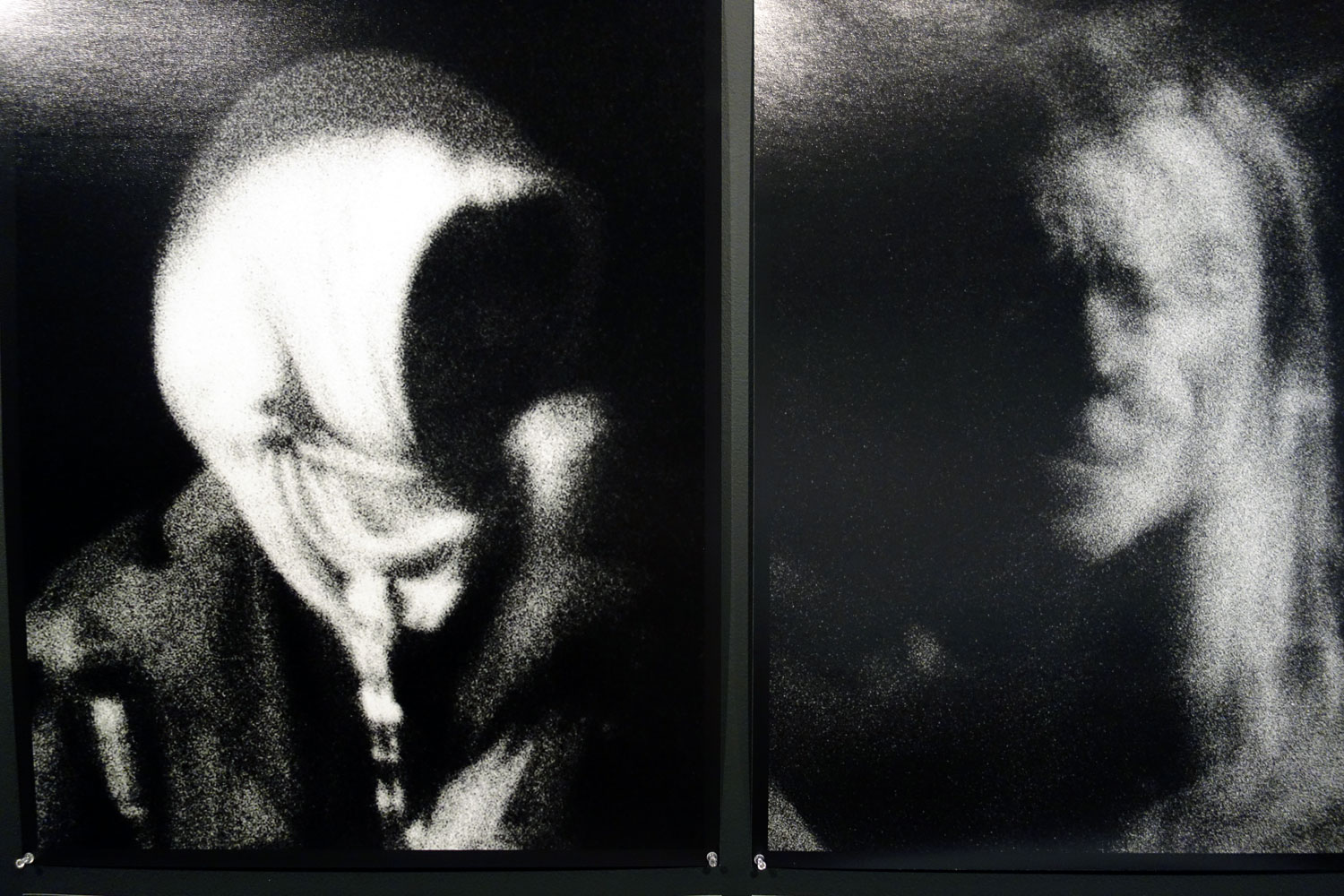
Exhibition: ‘The world is beautiful: photographs from the collection’ at the National Gallery of Australia, Canberra

Exhibition dates: 4th December, 2015 – 10th April, 2016

Curators: Dr. Shaune Lakin, Senior Curator of Photography at NGA with collaborator Anne O’Hehir, Curator of Photography at NGA


Man Ray (United States of America 1890 - France 1976) 'No title (Woman with closed eyes)' c. 1928 from the exhibition 'The world is beautiful: photographs from the collection' at the National Gallery of Australia, Canberra, Dec 2015 - April 2016


Man Ray (United States of America 1890 – France 1976)
No title (Woman with closed eyes)
c. 1928
Gelatin silver photograph
Not signed, not dated. Stamp, verso, l.r., “Man Ray / 81 bis. Rue / Campagne Premiere / Paris / XIV”.
Image: 8.9 x 12.8cm
National Gallery of Australia, Canberra, purchased 1984


Despite a focus on the camera’s relationship to the beauty and pure form of the modern world – “the attraction and charm of the surface” – these photographs are more than just being skin deep. In their very straightforwardness the photographs propose a “rigorous sensitivity to form revealed patterns of beauty and order in the natural and man-made alike.” But more than the portrayal of something we would not see if it were not for the eye of the photographer, the lens of the camera, the speed of the film, the sensitivity of the paper, the design of the architect, the genetics of nature … is the mystery of life itself.

Modernist structures and mass-produced objects can never beat a good mystery. Just look at Man Ray’s Woman with closed eyes (c. 1928, above) or the look in the eyes of Robert Frank’s son, Pablo. You can never pin that down.

While form may be beauty, mystery will always be beautiful.

Dr Marcus Bunyan


Please click on the photographs to view a larger version of the image.


Walker Evans (United States of America, 1903-1975) 'Graveyard and steel mill, Bethlehem, Pennsylvania' 1935 from the exhibition 'The world is beautiful: photographs from the collection' at the National Gallery of Australia, Canberra, Dec 2015 - April 2016


Walker Evans (United States of America, 1903-1975)
Graveyard and steel mill, Bethlehem, Pennsylvania
1935
Gelatin silver photograph
Image: 19.1 h x 24.0cm
Sheet: 20.2 x 25.2cm
National Gallery of Australia, Canberra, purchased 1980


The world is beautiful is an exhibition of photographs taken over the last 100 years from the National Gallery of Australia’s magnificent photography collection, including work by Diane Arbus, Henri Cartier-Bresson, Max Dupain, Bill Henson, Robert Mapplethorpe, Man Ray, Cindy Sherman and many more.

It draws its title from one of the twentieth-century’s great photographic moments, the publication of Albert Renger-Patzsch’s book The world is beautiful in 1928. Renger-Patzsch’s approach embodied his belief that ‘one should surely proceed from the essence of the object and attempt to represent it with photographic means alone’.

Inspired by this confidence in the medium, the exhibition looks at the way the camera interacts with things in the world. One of photography’s fundamental attributes is its capacity to adopt a range of relationships with its subject, based on the camera’s physical proximity to it. Indeed, one of the most basic decisions that a photographer makes is simply where he or she places the camera. The pictures in this exhibition literally take you on a photographic trip, from interior worlds and microscopic detail to the cosmic: from near to far away.

Together, these photographs capture some of the delight photographers take in turning their cameras on the world and re-imaging it, making it beautiful through the power of their vision and their capacity to help us see the world in new ways.”

Text from the National Gallery of Australia website


Near

Close up, the world can be surprising. There is an undeniable intensity and focus that comes with getting up close to people and objects. It is rude to stare, but photography has no such scruples.

Pioneers of the medium attempted to photograph organic forms through a microscope, making once-hidden worlds accessible. The pleasure photographers take in getting up close to their subject has followed the medium’s progress. This was especially the case during the twentieth century, when advances in photographic technology and profound shifts in our relationship to space brought about by events such as war often turned our attention away from the outside world.

For many photographers, the camera’s capacity to subject people and objects to close scrutiny has provided a way of paring back vision to its essence, to view the world unencumbered by emotion and sentiment. For others, getting up close is not just about physical proximity; it is also about psychological and emotional states that are otherwise difficult to represent. Experiences such as intimacy, love and emotional connection, as well as disquiet, anxiety and hostility, can all be suggested through the use of the close-up. Photographers have also used it literally to turn inwards, escaping into the imagination to create dreamworlds. The camera-eye really can see what the human eye cannot.

Text from the National Gallery of Australia website


Albert Renger-Patzsch (German, 1897-1966) 'Mantelpavian [Hamadryas Baboon]' c. 1925 from the exhibition 'The world is beautiful: photographs from the collection' at the National Gallery of Australia, Canberra, Dec 2015 - April 2016


Albert Renger-Patzsch (German, 1897-1966)
Mantelpavian [Hamadryas Baboon]
c. 1925
Gelatin silver photograph
23.8 x 16.8cm
National Gallery of Australia, Canberra


“In photography one should surely proceed from the essence of the object and attempt to represent it with photographic terms alone.”

~ Albert Renger-Patzsch


Renger-Patzsch’s primary interest was in the object as a document, removed from its usual context and unencumbered with sentiment. Die Welt ist schön [The world is beautiful], published in Munich in 1928, is one of the great photographic books in the history of photography and its influence across the world was profound. It is an astounding study of the world, celebrating beauty wherever the photographer found it – in modernist structures and mass-produced objects or in plants and animals. The connection and continuity of industry to the natural world is conveyed by emphasising underlying structural and formal similarities. The Gallery has a major holding of works by Renger-Patzsch, including a copy of Die Welt ist schön and 121 vintage prints, most of which were reproduced in the book.

Renger-Patzsch was always firmly committed to the principle of the photograph as a document or record of an object. While the title for his most famous contribution to photography came from his publisher, he wanted his now-iconic 1928 book Die Welt ist schön (The world is beautiful) to be titled simply Die Dinge (Things). In 1937 he wrote that the images in his book, ‘consciously portray the attraction and charm of the surface’. Indeed, the power of these pictures resides in their straightforwardness.

Text © National Gallery of Australia, Canberra


“German photographer Albert Renger-Patzsch was a pioneering figure in the New Objectivity movement, which sought to engage with the world as clearly and precisely as possible.

Rejecting the sentimentality and idealism of a previous generation, Neue Sachlichkeit (New Objectivity) emerged as a tendency in German art, architecture and literature in the 1920s. Applying this attitude to the field of photography, Renger-Patzsch espoused the camera’s ability to produce a faithful recording of the world. ‘There must be an increase in the joy one takes in an object, and the photographer should be fully conscious of the splendid fidelity of reproduction made possible by his technique’, he wrote.

This selection reflects the range of subjects that Renger-Patzsch returned to throughout his career. It includes his early wildlife and botanical studies, images of traditional craftsmen, formal studies of mechanical equipment, commercial still lifes, and landscape and architectural studies. His images of the Ruhr region, where he moved in 1928, document the industrialisation of the area in almost encyclopaedic detail. All of his work demonstrates his sustained interest in the camera’s relationship to the beauty and complexity of the modern world.

In 1928 Renger-Patzsch published The World is Beautiful, a collection of one hundred photographs whose rigorous sensitivity to form revealed patterns of beauty and order in the natural and man-made alike. Embodying a new, distinctly modern way of looking at the world, the book established Renger-Patzsch as one of the most influential photographers of the twentieth century.”

Text by Emma Lewis on the Tate website [Online] Cited 01/04/2016. No longer available online


Edward Weston (American, 1886-1958) 'Guadalupe de Rivera, Mexico' 1924


Edward Weston (American, 1886-1958)
No title (Guadalupe, Mexico, 1924): from “Edward Weston fiftieth anniversary portfolio 1902-1952”
1924
Gelatin silver photograph
20.7 x 17.8cm
National Gallery of Australia, Canberra, purchased 1981


In 1923 Weston travelled from San Francisco to Mexico City with his son, Chandler and his model and lover, Tina Modotti. The photographs he made there represented a startling, revolutionary breakthrough. Everything got stripped down to its essence, with objects isolated against neutral backgrounds. For these heroic head shots, he moved out of the studio, photographing in direct sunlight, from below and with a hand-held camera. They are monumental but still full of life: Weston was excited by the idea of capturing momentary expressions, in people he found ‘intense and dramatic’.

Text © National Gallery of Australia, Canberra


Robert Frank (Swiss-American, 1924-2019) 'Pablo' 1959


Robert Frank (Swiss-American, 1924-2019)
Pablo
1959
Gelatin silver photograph
Image: 20.8 x 31.0cm
Sheet: 27.0 x 35.4cm
National Gallery of Australia, Canberra, purchased 1980


Frank set out on a two-year road trip across the States in 1955. The images he made of race and class divisions, poverty, alienated youth and loneliness expose America’s dark soul. Others, such as this haunting image of his son, Pablo, were more personal. A selection appeared in The Americans, published in Paris in 1958 and in the States the following year. Many saw it as a bitter indictment of the American Dream, others saw an evocative, melancholic vision of humanity that is deeply moving. As Jack Kerouac commented in his introduction to the American edition, Frank ‘sucked a sad, sweet, poem out of America’

Text © National Gallery of Australia, Canberra


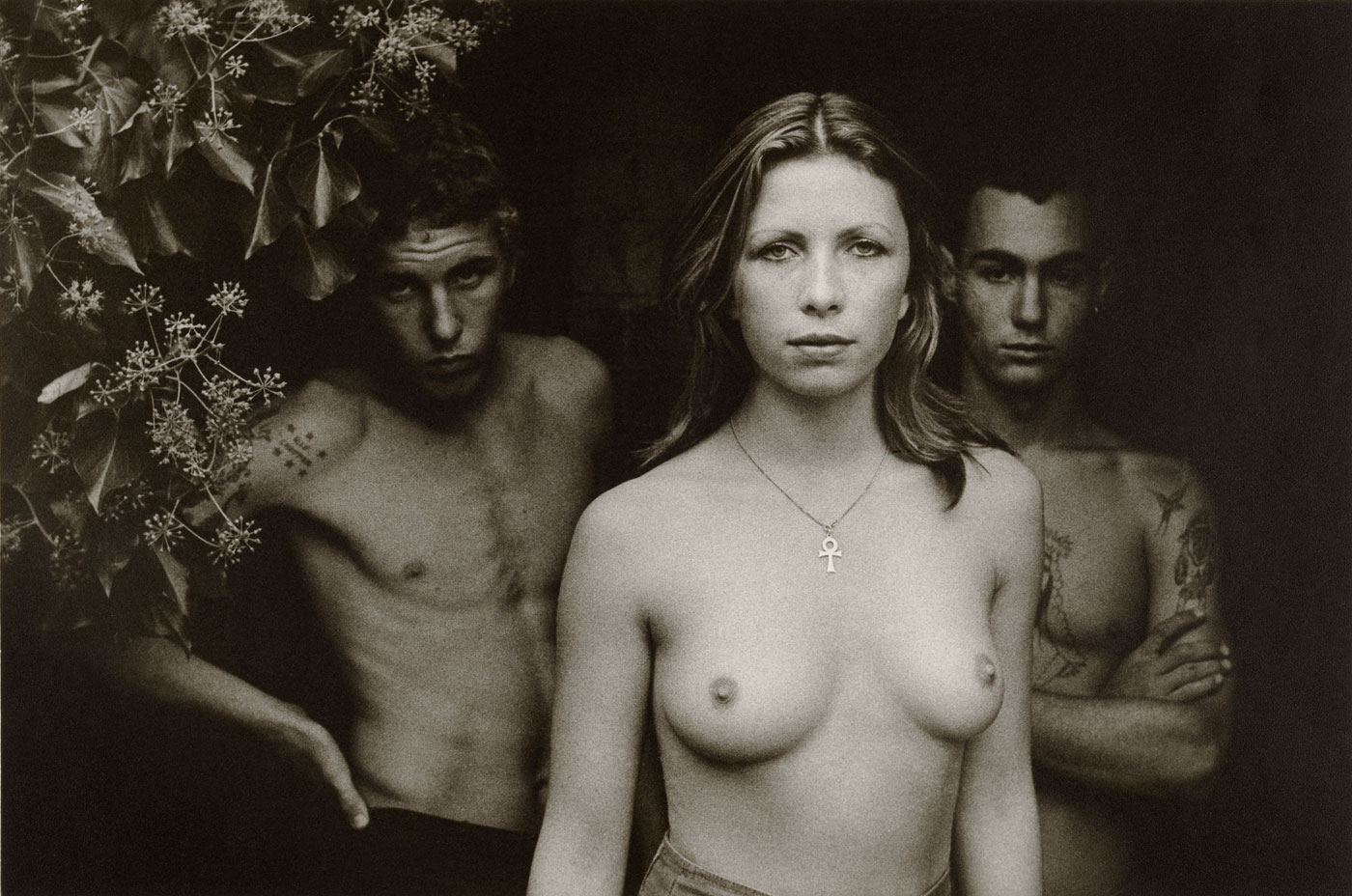
Carol Jerrems (Australian, 1949-1980) 'Vale Street' 1975


Carol Jerrems (Australian, 1949-1980)
Vale Street
1975
St Kilda, Melbourne, Victoria, Australia
Gelatin silver photograph
Image: 20.2 x 30.3cm
Sheet: 40.5 x 50.4cm
Gift of the Philip Morris Arts Grant 1982
© Ken Jerrems and the Estate of Lance Jerrems
National Gallery of Australia, Canberra


“I try to reveal something about people, because they are so separate, so isolated, maybe it’s a way of bringing people together I don’t want to exploit people. I care about them.”

~ Carol Jerrems, 1977


Carol Jerrems became prominent in the 1970s as part of a new wave of young photographers. Influenced by the counter-culture values of the 1960s, they used art to comment on social issues and engender social change. Jerrems photographed associates, actors and musicians, always collaborating with her subjects, thereby declaring her presence as the photographer. Vale Street raises interesting questions about what is artifice and what is real in photography. She deliberately set up this image, employing her aspiring actress friend and two young men from her art classes at Heidelberg Technical School. Vale Street has achieved an iconic status in Australian photography; the depiction of a confident young woman taking on the world is an unforgettable one. It is an intimate group portrait that is at once bold and vulnerable. In 1975 it was thought to be an affirmation of free love and sexual licence. The image also appears to be about liberation from society’s norms and taboos – ‘we are all three bare-chested, we have tattoos and so what?’

The implication that this scene is perfectly natural is reinforced by locating the figures in a landscape. The young woman is strong and unafraid of the judgement of the viewer. The necklace around her neck is an ankh – a symbol of the new spiritualty of the Age of Aquarius and a re-affirmation of the ancient powers of women.

Text © National Gallery of Australia, Canberra 2010
From: Anne Gray (ed.,). Australian art in the National Gallery of Australia. National Gallery of Australia, Canberra, 2002


Paul Outerbridge (United States of America, 1896-1958; Paris 1925-1928, Berlin and London 1928) 'Nude lying on a love seat' c. 1936


Paul Outerbridge (United States of America, 1896-1958; Paris 1925-1928, Berlin and London 1928)
Nude lying on a love seat
c. 1936
Carbro colour photograph
30.2 x 41cm
National Gallery of Australia, Canberra, purchased 1980


Like the Australian-born Anton Bruehl, Paul Outerbridge studied at the Clarence White School of Photography in New York. White was keen to see photography establish itself as a practical art that could be used in the service of the rapidly expanding picture magazine industry. Within a year of enrolling in the school, Outerbridge’s work was appearing in Vogue and Vanity Fair. During his lifetime, Outerbridge was known for his commercial work, particularly his elegant, stylish still-life compositions which show the influence of earlier studies in painting. He was also admired for the excellence of his pioneering colour work, which was achieved by means of a complicated tri-colour carbro process.

Much of Outerbridge’s fame now rests on work that he made following more private obsessions. His fetishistic nude photographs of women are influenced primarily by eighteenth-century French painters such as Ingres. Although the depiction of nudes was a genre pursued from the inception of photography, Outerbridge’s interest in breaking down taboos resulted in this material, if known at all, being passed over or vilified in his lifetime. Outerbridge sought to express what he described as an ‘inner craving for perfection and beauty’ through these often mysterious, languid and richly toned images.

Text © National Gallery of Australia, Canberra 2014


Cindy Sherman (American, b. 1954) 'Untitled #92' 1981


Cindy Sherman (American, b. 1954)
Untitled #92
1981
Type C colour photograph
61.5 x 123.4cm
National Gallery of Australia, Canberra, purchased 1983


This is one of 12 Centerfolds made by Sherman in 1981. The Centerfolds present Sherman posing in a range of situations, each suggesting heightened emotional states and violent narratives; these associations are augmented by the uncomfortably tight framing and the panoramic format used by Sherman across the series. Initially commissioned for the art magazine Artforum, the Centerfolds were never published because they were deemed, with their apparently voyeuristic points of view, to reaffirm misogynist views of women.

Text © National Gallery of Australia, Canberra


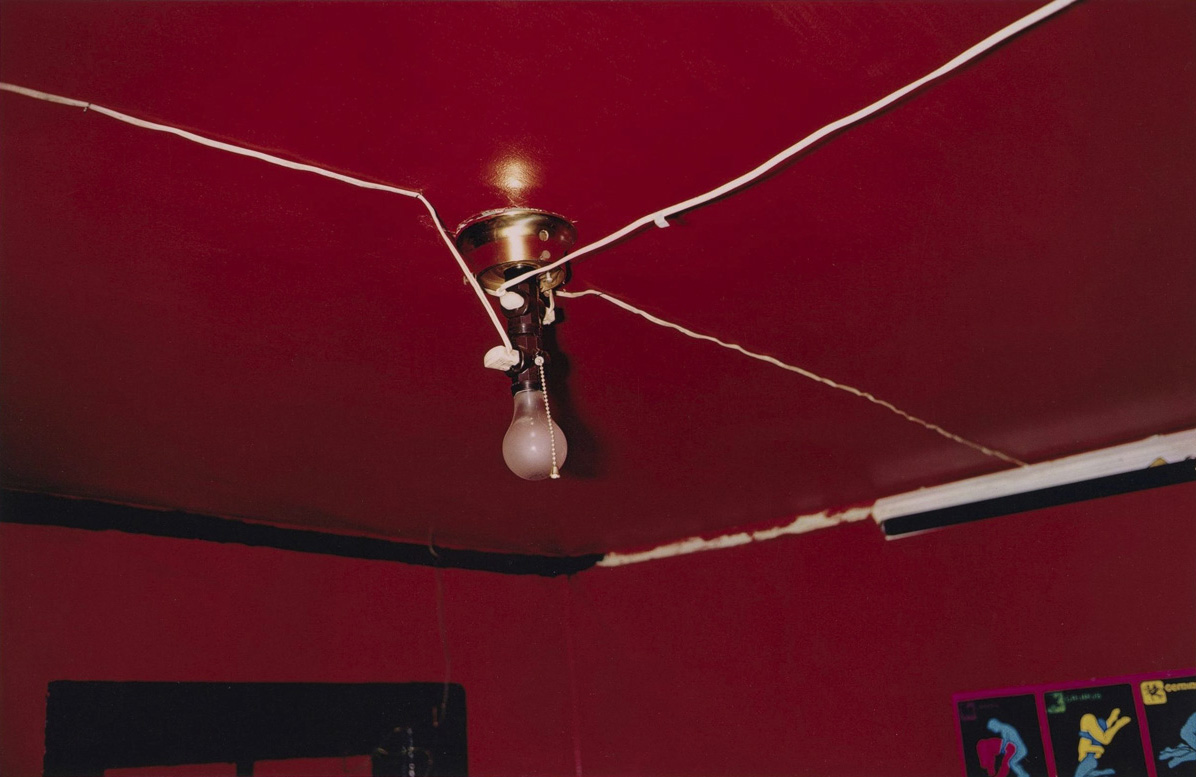
William Eggleston (American, b. 1939) 'Untitled (Greenwood, Mississippi)' 1980


William Eggleston (American, b. 1939)
Greenwood, Mississippi
1973, printed 1979
Dye transfer colour photograph
Image: 29.5 x 45.4cm
Sheet: 40.2 x 50.8cm
National Gallery of Australia, Canberra, purchased 1980


With its intense red, Eggleston’s picture of the spare room in a friend’s home is one of the most iconic of all colour photographs. Often called The red room, this photograph was intended to be shocking: Eggleston described the effect of the colour as like ‘red blood that is wet on the wall’. But the radicalness of the picture is not just in its juicy (and impossible to reproduce) redness; it is also found in the strange view it provides of a domestic interior, one that Eggleston has described as a ‘fly’s eye view’.

Text © National Gallery of Australia, Canberra


Imogen Cunningham (American, 1883-1976) 'Magnolia Blossom' 1925


Imogen Cunningham (American, 1883-1976)
Magnolia Blossom
1925
Gelatin silver photograph
Image: 17.1 x 34.6cm
Mount: 38.2 x 50.7cm
National Gallery of Australia, Canberra, purchased 1978


During the 1920s, raising three young sons, Cunningham began to focus on her immediate surroundings. This restricted environment encouraged Cunningham to develop a new way of working, as she began to place her camera closer to the subject: to zebras on a trip to the zoo, to snakes brought to her by her sons, and perhaps most famously to the magnolia blossoms and calla lilies she grew in her garden. Observing what she termed the ‘paradox of expansion via reduction’, the intensity and focus attendant to this way of seeing flooded her work with sensuality and reductive power.

Text © National Gallery of Australia, Canberra


Olive Cotton (Australian, 1911-2003) 'Skeleton Leaf' 1964


Olive Cotton (Australian, 1911-2003)
Skeleton leaf
1964
Gelatin silver photograph
Image: 50.4 x 40.8cm
Sheet: 57.8 x 47.6cm
National Gallery of Australia, Canberra, purchased 1987


This leaf skeleton – a leaf that has had its pulp removed with heat and soda – was probably photographed in front of a window in Cotton’s home near Cowra, NSW. Since the 1930s Cotton had been drawn to the close study of nature, and many of her best photographs feature close-ups of flowers, tufts of grass and foliage. This photograph is notable because it was taken in the studio, and reflects the austerity and simplicity that pervaded Cotton’s work in the decades after the Second World War.

Text © National Gallery of Australia, Canberra


Lee Friedlander (American, b. 1934) 'Nashville, 1963' 1963


Lee Friedlander (American, b. 1934)
Nashville, 1963
1963
Gelatin silver photograph
Image: 28.2 x 18.7cm
Sheet: 35.3 x 27.8cm
National Gallery of Australia, Canberra, purchased 1981


Middle distance

The further away we move from a subject, the more it and its story open up to us. While the close-up or compressed view tends to be very frontal (the camera presses up against the subject), the defining characteristic of much mid-century photography was its highly mobile relationship to space: its extraordinary capacity to survey and to organise the world.

The space between the camera and its subject can suggest impartiality and detachment. Documentary photographers and photojournalists, for example, open their cameras up to their subjects, as if to ‘let them speak’. But the depiction of the space between the camera and its subject, and the way that it is rendered through the camera’s depth of field, can also reflect decision making on the part of the photographer. By adjusting the camera’s settings, and thus choosing to render part of the subject in focus, the photographer can direct our focus and attention to certain parts of an image. In this way, photographers put forward an argument based on their world view. Photography can change the way we think about the world.

Text from the National Gallery of Australia website


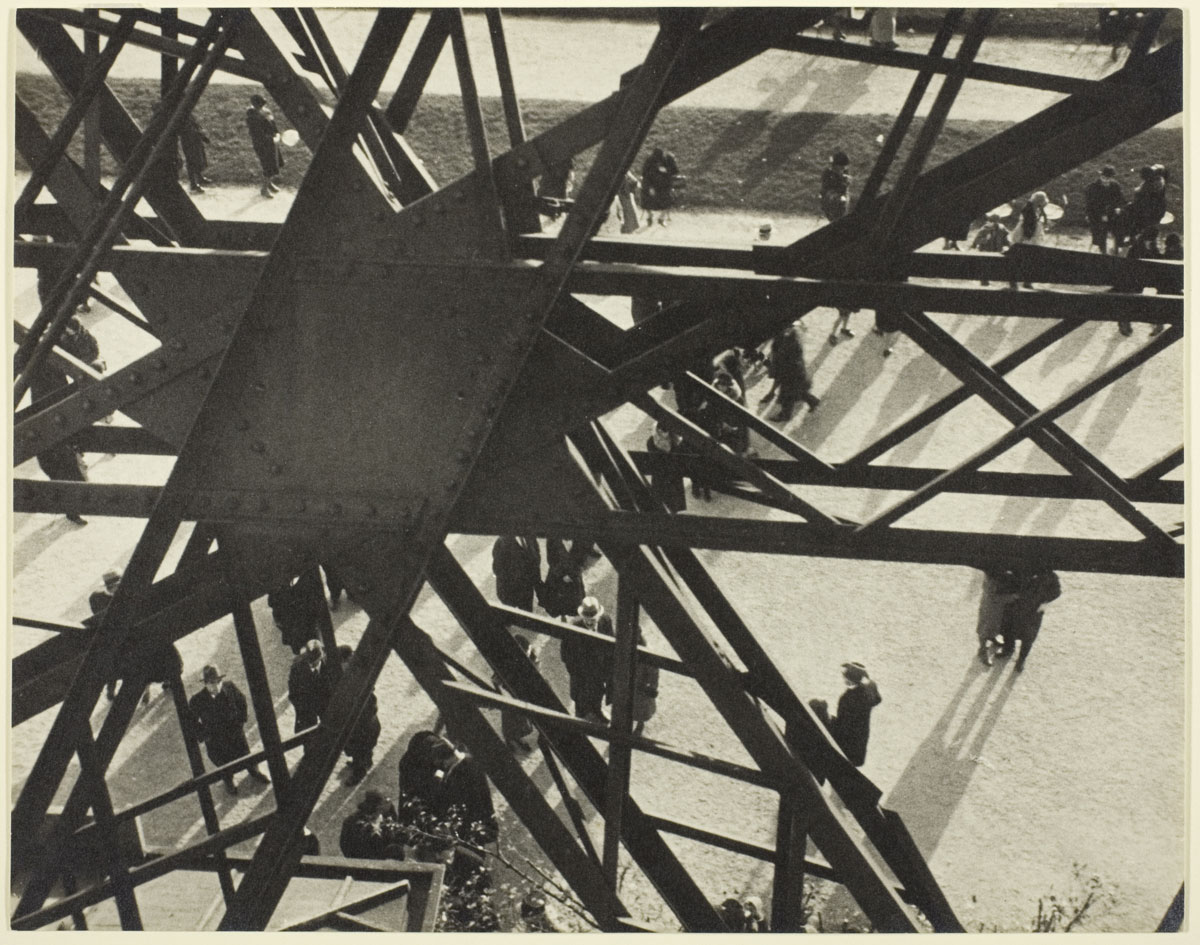
Ilse Bing (Germany 1899 - United States of America 1998; France 1930-1941 United States from 1941) 'Eiffel Tower, Paris, 1931' 1931


Ilse Bing (Germany 1899 – United States of America 1998; France 1930-1941 United States from 1941)
Eiffel Tower, Paris
1931
Gelatin silver photograph
Signed and dated recto, l.r., pen and ink “Ilse Bing/ 1931”
Image: 22.3 x 28.2cm
National Gallery of Australia, Canberra, purchased 1989


Bing took up photography in 1928 and quickly developed a reputation as a photojournalist and photographer of modernist architecture. Inspired by an exhibition of modern photography and the work of Paris-based photographer Florence Henri, Bing moved to Paris 1930 and quickly became associated with the city’s photographic avant-garde. Bing worked exclusively with the fledgling Leica 35mm-format camera; her interest in the pictorial possibilities of the hand-held Leica can clearly be seen in this striking view of the Eiffel Tower.

Text © National Gallery of Australia, Canberra


Garry Winogrand (American, 1928-1984) 'World´s Fair', New York, 1964


Garry Winogrand (American, 1928-1984)
World’s Fair, New York
1964
Gelatin silver photograph
Image: 21.8 x 32.7cm
Mount: 37.4 x 50.1cm
Image rights: © The Estate of Garry Winogrand, courtesy Fraenkel Gallery, San Francisco
National Gallery of Australia, Canberra, purchased 1978


Winogrand had a tremendous capacity to photograph people in public spaces completely unawares. This image records a group of visitors to the 1964 World’s Fair; it focuses on three young women – Ann Amy Shea, whispering into the ear of Janet Stanley, while their friend Karen Marcato Kiaer naps on Stanley’s bosom. The figures fill the space between the picture’s fore- and middle-grounds, to the extent of allowing the viewer to examine people’s expressions and interactions in close detail. This in turn allows us to encroach on the personal space of people we don’t know.

Text © National Gallery of Australia, Canberra


Diane Arbus (American, 1923-1971) 'Child with a toy hand grenade in Central Park, N.Y.C. 1962'


Diane Arbus (American, 1923-1971)
Child with toy hand grenade, in Central Park, New York City
1962
Gelatin silver photograph
Image: 20 x 17.2cm
Sheet: 32.8 x 27.6cm
National Gallery of Australia, Canberra, purchased 1980


During workshops with Lisette Model, Arbus was encouraged to develop a direct, uncompromising approach to her subjects. She did this using the square configuration of a medium-format camera which Arbus most usually printed full frame with no cropping. Model also convinced Arbus, who had been interested in myth and ritual, that the more specific her approach to her subjects, the more universal the message. In many ways this image of a boy caught hamming it up in Central Park, with his contorted body and grimacing face, captures and prefigures many of the anxieties of America during the sixties, a country caught in an unwinnable war in Vietnam and undergoing seismic social change.

Text © National Gallery of Australia, Canberra


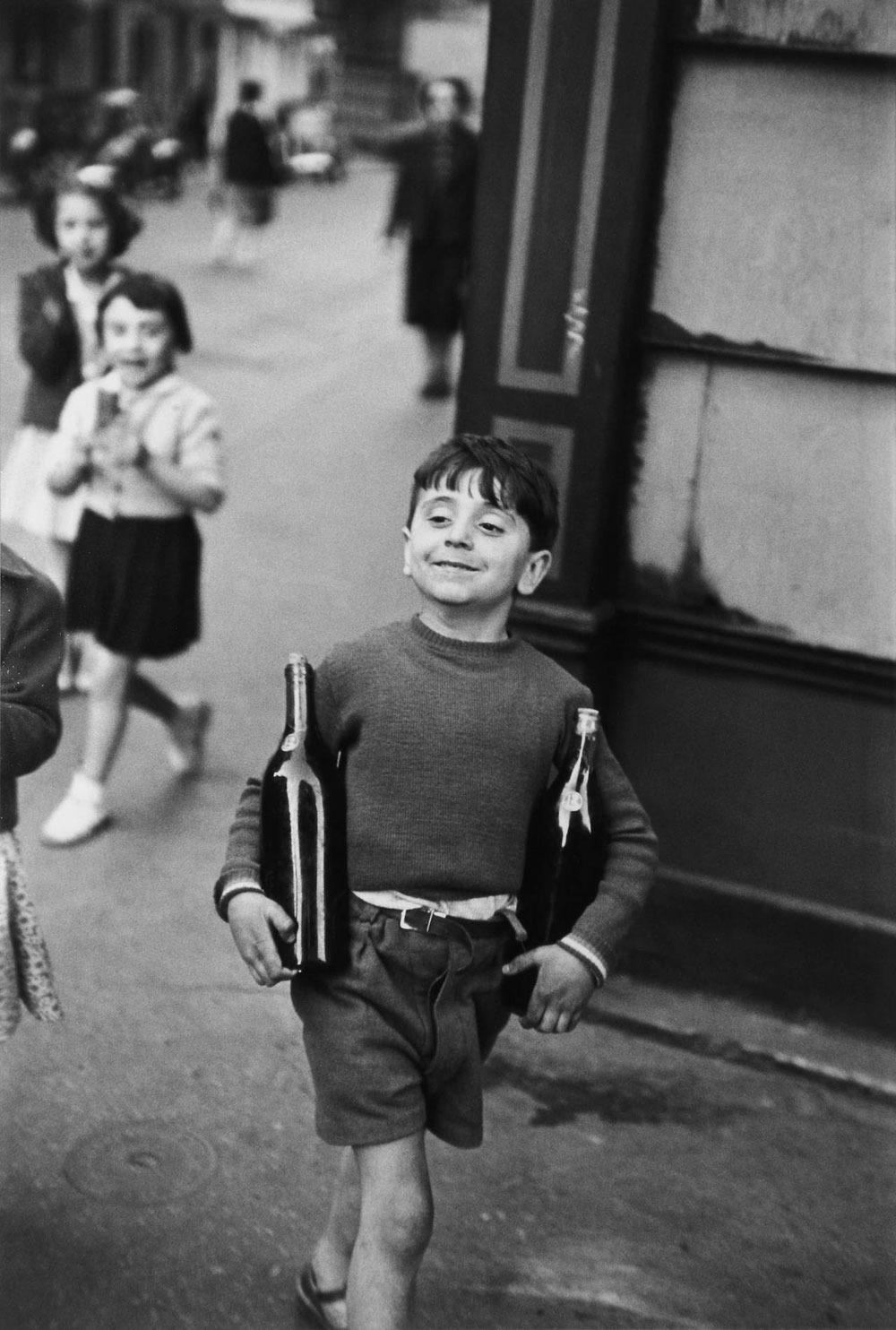
Henri Cartier-Bresson (French, 1908-2004) 'Rue Mouffetard, Paris' 1954 prtd c. 1980


Henri Cartier-Bresson (French, 1908-2004)
Rue Mouffetard, Paris
1954, printed c. 1980
Gelatin silver photograph
Image: 35.9 x 24.2cm
Sheet: 39.4 x 29.6cm
National Gallery of Australia, Canberra, purchased 1982


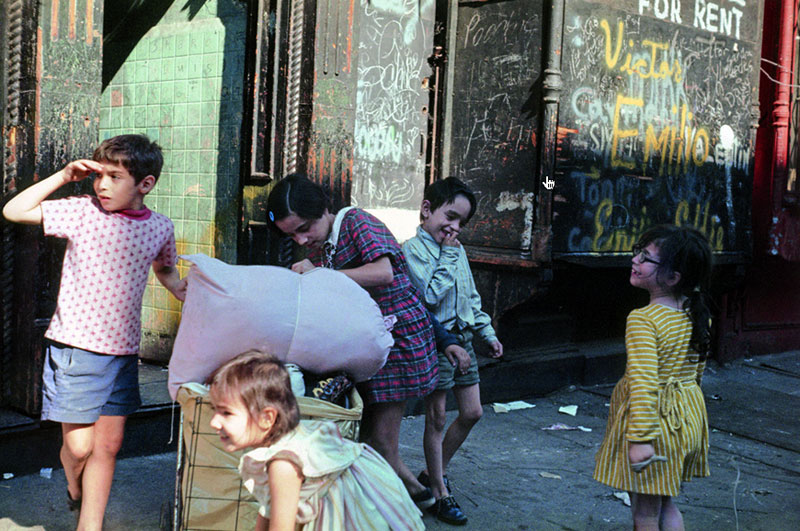
Helen Levitt (United States of America, 1913 - 2009) 'New York' 1972


Helen Levitt (United States of America, 1913 – 2009)
New York
1972
Dye transfer colour photograph
Image: 23.9 x 36.2cm
Sheet: 35.6 x 42.9cm
National Gallery of Australia, Canberra, purchased 1984


“The streets of the poor quarters of the great cities are, above all, a theatre and a battleground.”

~ Helen Levitt


Inspired by seeing work by Walker Evans and Henri Cartier-Bresson in 1935, Levitt took to the streets. Children became her most enduring subject. Like Evans, Levitt was famously shy and self-effacing, seeking to shoot unobserved by fitting a prism finder on her Leica. Her approach eschews the sensational; instead she is interested in capturing small, idiosyncratic actions in the everyday. Her images were often shot through with a gentle, lyrical humour though a dark strangeness also surfaces at times.

Text © National Gallery of Australia, Canberra


Helen Levitt (American, 1913-2009) 'New York' c. 1972


Helen Levitt (American, 1913-2009)
New York
1972
Dye transfer colour photograph
Image: 23.4 x 35.6cm
Sheet: 35.4 x 42.9cm
National Gallery of Australia, Canberra, purchased 1984


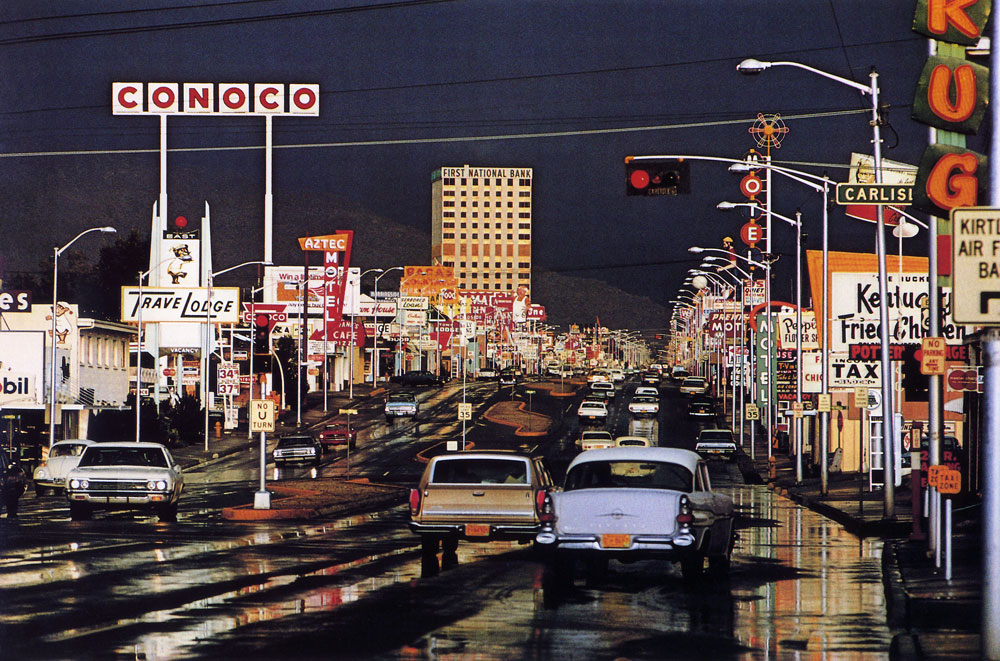
Ernst Haas (Austria 1921 - United States of America 1986; United States from 1951) 'Route 66, Albuquerque, New Mexico, USA' 1969


Ernst Haas (Austria 1921 – United States of America 1986; United States from 1951)
Albuquerque, New Mexico
1969
Dye transfer colour photograph
Image: 44.9 x 67.8cm
Sheet: 52.3 x 75.7cm
National Gallery of Australia, Canberra, purchased 2000


For Haas, colour photography represented the end of the grey and bitter war years and he started seriously working in the medium after moving to America in 1951. Work on his photoessay, Land of Enchantment and film stills assignments for The Misfits, The Bible and Little Big Man took Haas to the Southwest. The desert landscape of Albuquerque, located on Route 66, had been totally transformed by progress since the 1920s. Photographing the street after rain, Haas has signified that evolution by way of his distinctive ability to translate the world into shimmering energy.

Text © National Gallery of Australia, Canberra


Faraway

Photography has a long-standing interest in faraway places. In 1840, right in photography’s infancy, astronomical photography was launched when the first photograph of the moon was made. As photographic imaging technology has improved, so has the medium’s capacity to make faraway places accessible to us.

Photography can bring foreign places and people closer to home, or collect together images of places and structures that are located in different places. It can also attempt to give a picture to experiences that are otherwise difficult to grasp or represent, such as complex weather events or transcendental phenomena.

Against the odds, there are photographers who make images that are about what cannot be seen. Faraway is often used as a metaphor for thinking about the ineffable and the inexplicable. Science and spirit go hand-in-hand. ‘The most beautiful thing we can experience is the mysterious’, Albert Einstein believed. Photographers can take us to new worlds.

Text from the National Gallery of Australia website


Ansel Adams (American, 1902-1984) 'Moonrise, Hernandez, New Mexico' 1941


Ansel Adams (San Francisco, California, United States of America 1902 – Carmel, California, United States of America 1984)
Moonrise, Hernandez, New Mexico
1941
Ansel Adams Museum Set
Gelatin silver photograph
Image: 38.6 x 49cm
Mount: 55.6 x 71cm
National Gallery of Australia, Canberra, purchased 1980


Adams became the most famous landscape photographer in the world on the back of his images of America’s West. While mass tourism was invading these wilderness areas, Adams’s photographs show only untouched natural splendour. His landscapes are remarkable for their deep, clear space, distinguishable by an uncanny stillness and clarity. The story of Moonrise is legendary: driving through the Chama River Valley toward Española, Adams just managed by a few seconds to catch this fleeting moment before the dying sunlight stopped illuminating the crosses in the graveyard. Through hours of darkroom manipulation and wizardry, Adams created an image of almost mystical unworldliness.

Text © National Gallery of Australia, Canberra


Tracey Moffatt (Australian, b. 1960) 'Up in the sky' 1997


Tracey Moffatt (Australian, b. 1960)
Up in the sky [Up in the sky – a set of 25 photolithographs]
1997
No. 8 in a series of 25
Photolithograph
Image: 61.0 x 76.0cm
Sheet: 72.0 x 102.0cm
KODAK (Australasia) PTY LTD Fund 1997
National Gallery of Australia, Canberra


Up in the sky is unusual in Moffatt’s oeuvre for being shot out of doors on location. Her photomedia practice is informed by an upbringing watching television, fascinated by film and pop culture. This series takes many of its visual cues from Pier Paolo Pasolini’s Accattone of 1961 as well as the Mad Max series – the references, twisted and re-imagined, are like half-forgotten memories. She addresses race and violence, presenting a loose narrative set against the backdrop of an outback town. The sense of unease is palpable: Moffatt here is a masterful manipulator of mood.

Text © National Gallery of Australia, Canberra


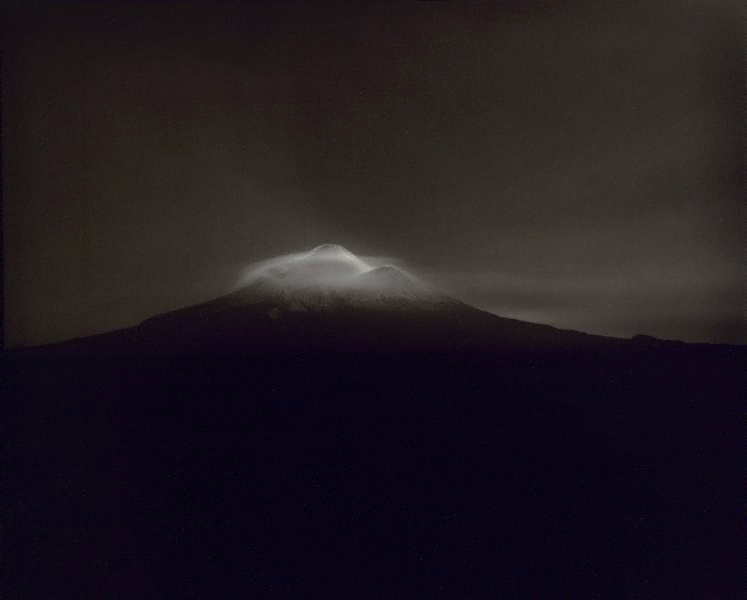
Laurence Aberhart (Aotearoa New Zealand, b. 1949) 'Taranaki, from Oeo Road, under moonlight, 27-28 September 1999' 1999


Laurence Aberhart (Aotearoa New Zealand, b. 1949)
Taranaki, from Oeo Road, under moonlight, 27-28 September 1999
1999
Gelatin silver photograph
19.4 x 24.3cm
Gift of Peter Fay 2005
National Gallery of Australia, Canberra


For four decades, Aberhart has photographed the Taranaki region of New Zealand’s North Island, including its settled landscape and its most distinctive feature, the sacred TeMounga (Mount) Taranaki. Using an 8 x 10-inch view camera, Aberhart has over time built up an important archive documenting the social geography and landscape of the Taranaki. Aberhart describes the conical mountain as a ‘great physical and spiritual entity’ and sees his photographs of it as a counterbalance to the countless images of the mountain that circulate on tea towels and postcards.

Text © National Gallery of Australia, Canberra


National Gallery of Australia
Parkes Place, Canberra
Australian Capital Territory 2600
Phone: (02) 6240 6411

Opening hours:
Open daily 10.00am – 5.00pm
(closed Christmas day)

National Gallery of Australia website

LIKE ART BLART ON FACEBOOK

Back to top

Exhibition: ‘Cosa Mentale: Art and Telepathy in the 20th century’ at the Centre Pompidou-Metz, Paris

Exhibition dates: 28th October, 2015 – 28th March, 2016

Curator: Pascal Rousseau, Professor of Contemporary History of Art at the University of Paris I Panthéon Sorbonne


Louis Darget (French, 1847-1923) 'Fluidic Thought-Image Photography' 1896 from the exhibition 'Cosa Mentale: Art and Telepathy in the 20th century' at the Centre Pompidou-Metz, Paris, Oct 2015 - March 2016


Louis Darget (French, 1847-1923)
Fluidic Thought-Image Photography
1896

(L) Inscribed: “Photo… of thought. Head obtained by Mr. Henning, having a plate wrapped in black paper on his forehead while he played the piano. Opposite him on the piano was a portrait of Beethoven. Could this be that [same] portrait reflected by the brain onto the plate through the black paper. Comt. Darget”

(R) “Photograph of a Dream: The Eagle.” 25 June, 1896.
Inscribed: “Obtained by placing a photographic plate above the forehead of Mme Darget while she was asleep.”


Telepathic art in the 20th century. What a fascinating subject for a spiritual, phantasmagoric exhibition which explores artists’ fascination with the direct transmission of thought and emotion. A lot of phenomena – for example telepathy, X-rays, psychoanalysis – were named or discovered in the last half of the nineteenth century or are concepts and things that began to gain popularity in the collective consciousness at that time, such as the unconscious mind, the anima and animus, the study of signs, photographs of thought, photographs of hysteria (Charcot) and notes and photographs on unexplained paranormal experiences.

“The exhibition enables the spectator to understand how, throughout the 20th century, attempts to give material and visible form to thought processes coincide with the experiments of avant-garde artists. This fantasy of a direct projection of thought not only had a decisive impact on the birth of abstraction but also influenced surrealism and its obsession with the collective sharing of creation and, in the post war period, it gave rise to numerous visual and sound installations inspired by the revolution in information technology, leading to the declaration of “the dematerialisation of art” in conceptual practices.”

Love the work of Émile Cohl and Len Lye, both a revelation to me.

Dr Marcus Bunyan


Many thankx to the Centre Pompidou-Metz for allowing me to publish the photographs in the posting. Please click on the photographs for a larger version of the image.


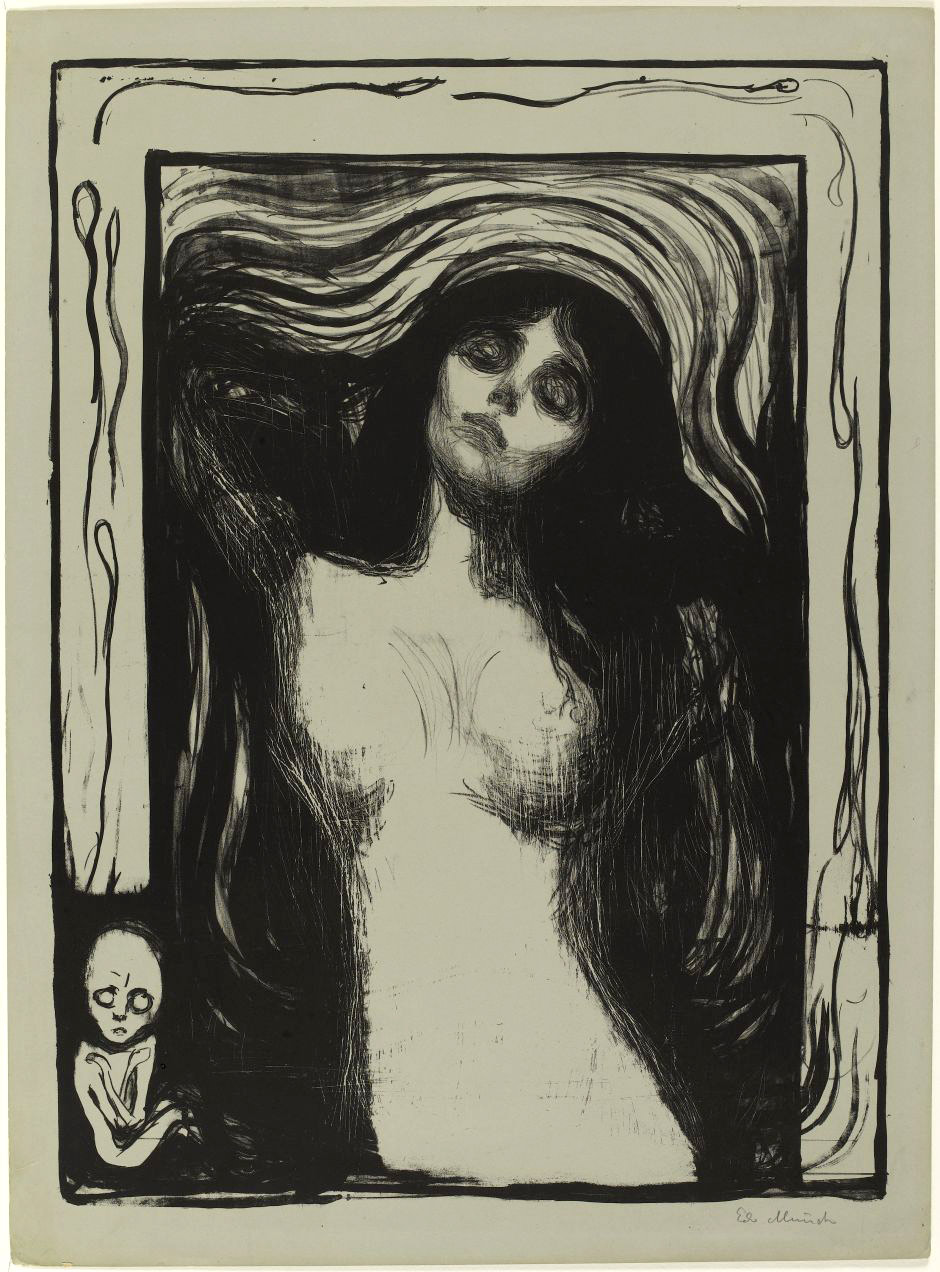
Edvard Munch (Norwegian, 1863-1944) 'Madonna' 1895 from the exhibition 'Cosa Mentale: Art and Telepathy in the 20th century' at the Centre Pompidou-Metz, Paris, Oct 2015 - March 2016
 

Edvard Munch (Norwegian, 1863-1944)
Madonna
1895
Paris, Centre Pompidou, Musée national d’Art moderne
© Centre Pompidou, MNAM-CCI, Dist. RMN-Grand Palais / Georges Meguerditchian


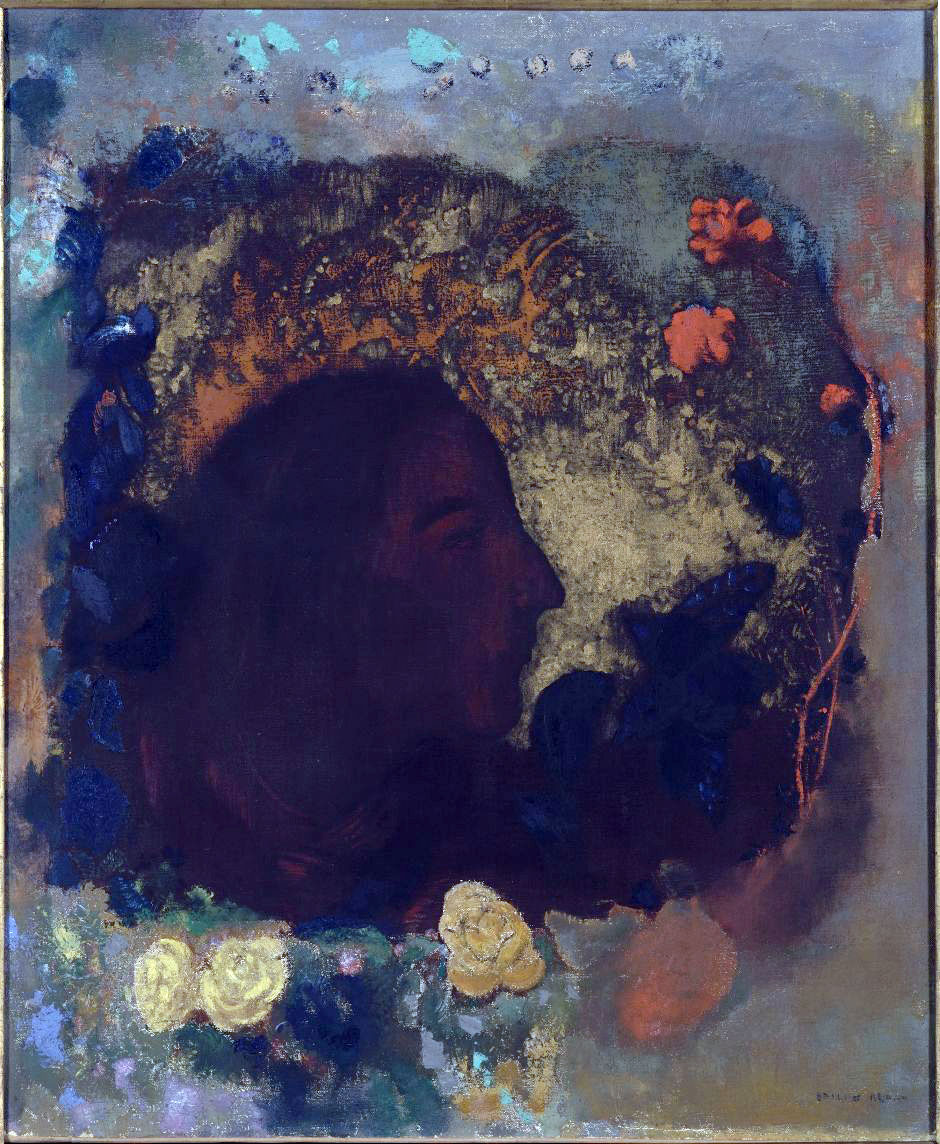
Odilon Redon (French, 1840-1916) 'Portrait de Paul Gauguin' 1903-1906


Odilon Redon (French, 1840-1916)
Portrait of Paul Gauguin
1903-1906
Paris, Musée d’Orsay
© RMN-Grand Palais (musée d’Orsay) / Hervé Lewandowski


Émile Cohl (French, 1857-1938)
Le retapeur de cervelles (The creators brain)
1910


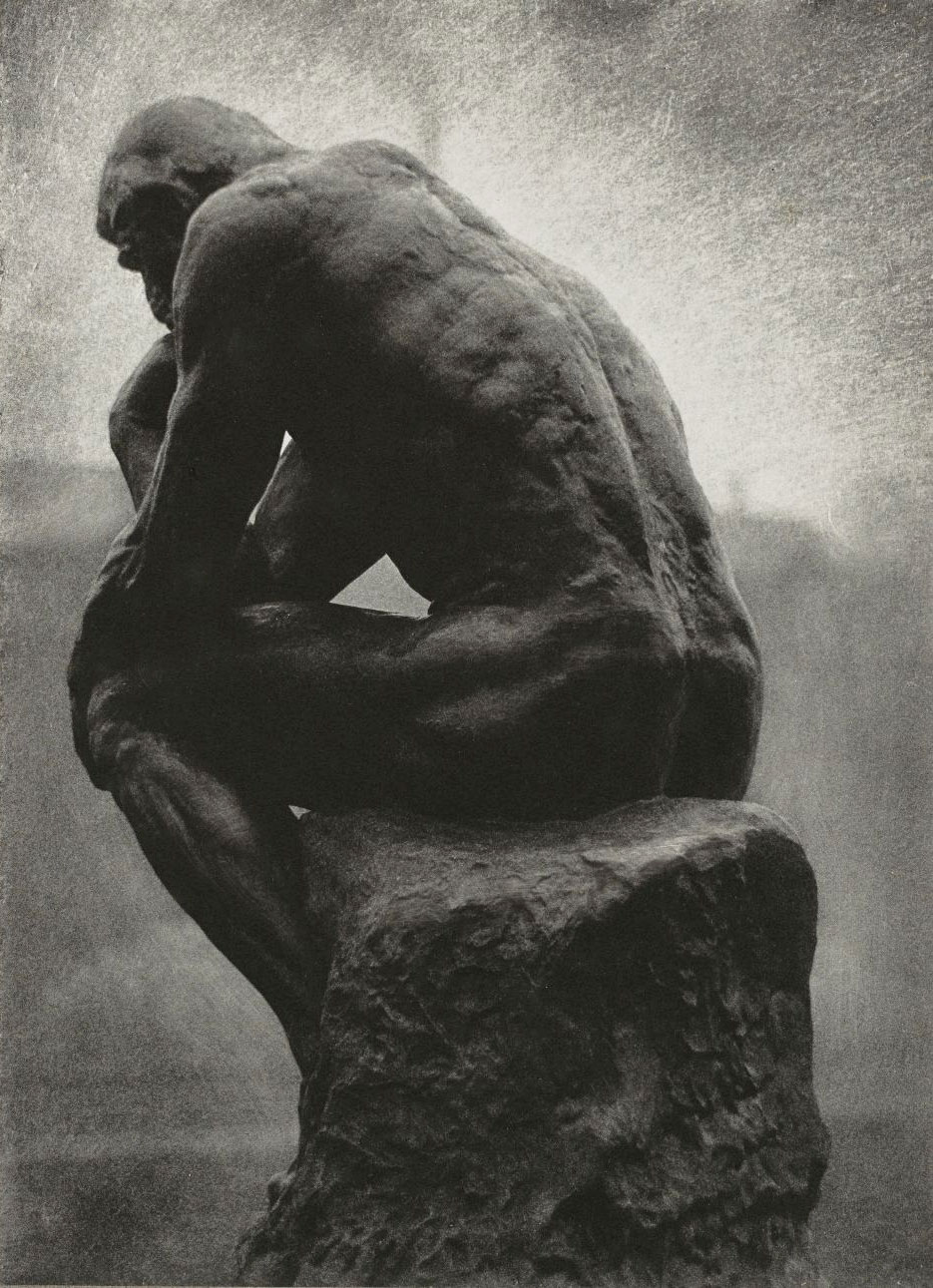
Auguste Rodin (French, 1840-1917) 'Le Penseur [The Thinker]' 1903


Auguste Rodin (French, 1840-1917)
Le Penseur [The Thinker]
1903
Plâtre patiné / patinated plaster
72 x 37 x 57.50cm
© Photographe: Christian Baraja
© Musée Rodin, Paris


When conceived in 1880 in its original size (approx. 70cm) as the crowning element of The Gates of Hell, seated on the tympanum, The Thinker was entitled The Poet. He represented Dante, author of the Divine Comedy which had inspired The Gates, leaning forward to observe the circles of Hell, while meditating on his work. The Thinker was therefore initially both a being with a tortured body, almost a damned soul, and a free-thinking man, determined to transcend his suffering through poetry. The pose of this figure owes much to Carpeaux’s Ugolino (1861) and to the seated portrait of Lorenzo de Medici carved by Michelangelo (1526-31).

While remaining in place on the monumental Gates of Hell, The Thinker was exhibited individually in 1888 and thus became an independent work. Enlarged in 1904, its colossal version proved even more popular: this image of a man lost in thought, but whose powerful body suggests a great capacity for action, has became one of the most celebrated sculptures ever known. Numerous casts exist worldwide, including the one now in the gardens of the Musée Rodin, a gift to the City of Paris installed outside the Panthéon in 1906, and another in the gardens of Rodin’s house in Meudon, on the tomb of the sculptor and his wife.

Text from the Rodin Museum website [Online] Cited 22/03/2016. No longer available online


Stephen Haweis (British, 1878-1969) and Henry Coles 'Le Penseur' c. 1903-1904


Stephen Haweis (British, 1878-1969) and Henry Coles
Le Penseur
c. 1903-1904
Epreuve au charbon / Charcoal
23 x 16.60cm
© Musée Rodin, Paris


Cosa Mentale is a unique exhibition that offers a re-reading of the history or art from 1990 to modern day by exploring artists’ fascination with the direct transmission of thought and emotion. It invites the spectator to re-live one of the unexpected adventures of modernity: telepathic art in the 20th century. This exhibition traces a chronological path from symbolism to conceptual art with a collection of some one hundred works by major artists, ranging from Edvard Munch to Vassily Kandinsky, and from Joan Miró to Sigmar Polke. These artists provide innovative ways of communicating with spectators that take us beyond conventional linguistic codes.

The exhibition enables the spectator to understand how, throughout the 20th century, attempts to give material and visible form to thought processes coincide with the experiments of avant-garde artists. This fantasy of a direct projection of thought not only had a decisive impact on the birth of abstraction but also influenced surrealism and its obsession with the collective sharing of creation and, in the post war period, it gave rise to numerous visual and sound installations inspired by the revolution in information technology, leading to the declaration of “the dematerialisation of art” in conceptual practices.

The exhibition begins with the invention of the term “telepathy” in 1882, at a time when the study of psychology interacted with rapid developments in telecommunications. Endeavours ranged from the creation of “photographs of thought” in 1895 to the first “encephalograms” in 1924 (the year when the Surrealist Manifesto was published) and it was the actual activity of the brain which was to be shown in all its transparency, which encouraged artists to reject the conventions of representation by suppressing all restrictions of translation. Telepathy was far from remaining an obscure paranormal fantasy and consistently intrigued and enthralled artists throughout the 20th century. Always present in the world of science fiction, it resurfaced in psychedelic and conceptual art in the period from 1960 to 1970 before reappearing today in contemporary practices enraptured by technologies of “shared knowledge” and the rapid development of neuroscience.

Curator

Pascal Rousseau, professor of contemporary history of art at the University of Paris I Panthéon Sorbonne. Pascal Rousseau has also curated Robert Delaunay exhibitions: From impressionism to abstraction, 1906-1914, at the Centre Pompidou (1999) and To the origins of abstraction (1800-1914) at the Musée d’Orsay (2003).

Press release from the Centre Pompidou-Metz


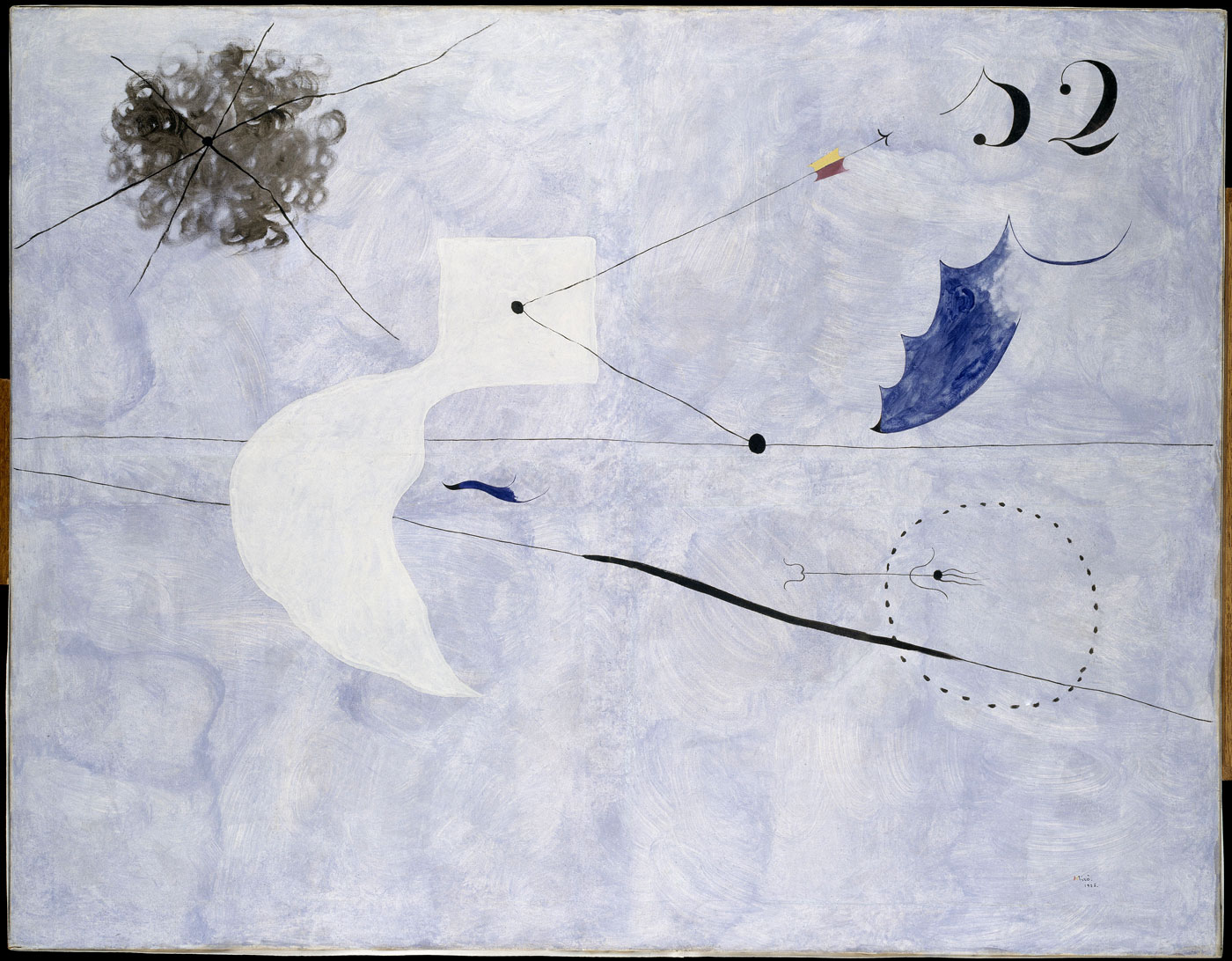
Joan Miró (Spanish, 1893-1983) 'La Sieste' July-September 1925


Joan Miró (Spanish, 1893-1983)
La Sieste
July – September 1925
© Successió Miró/ ADAGP, Paris, 2015


Vassily Kandinsky (Russian, 1866-1944) 'Bild mit rotem Fleck [Tableau à la tache rouge / Image with red spot]' 25 February 1914


Vassily Kandinsky (Russian, 1866-1944)
Bild mit rotem Fleck [Tableau à la tache rouge / Image with red spot]
25 February 1914
Paris, Centre Pompidou – Musée national d’art moderne
© Centre Pompidou, MNAM-CCI, Dist. RMN-Grand Palais / Adam Rzepka


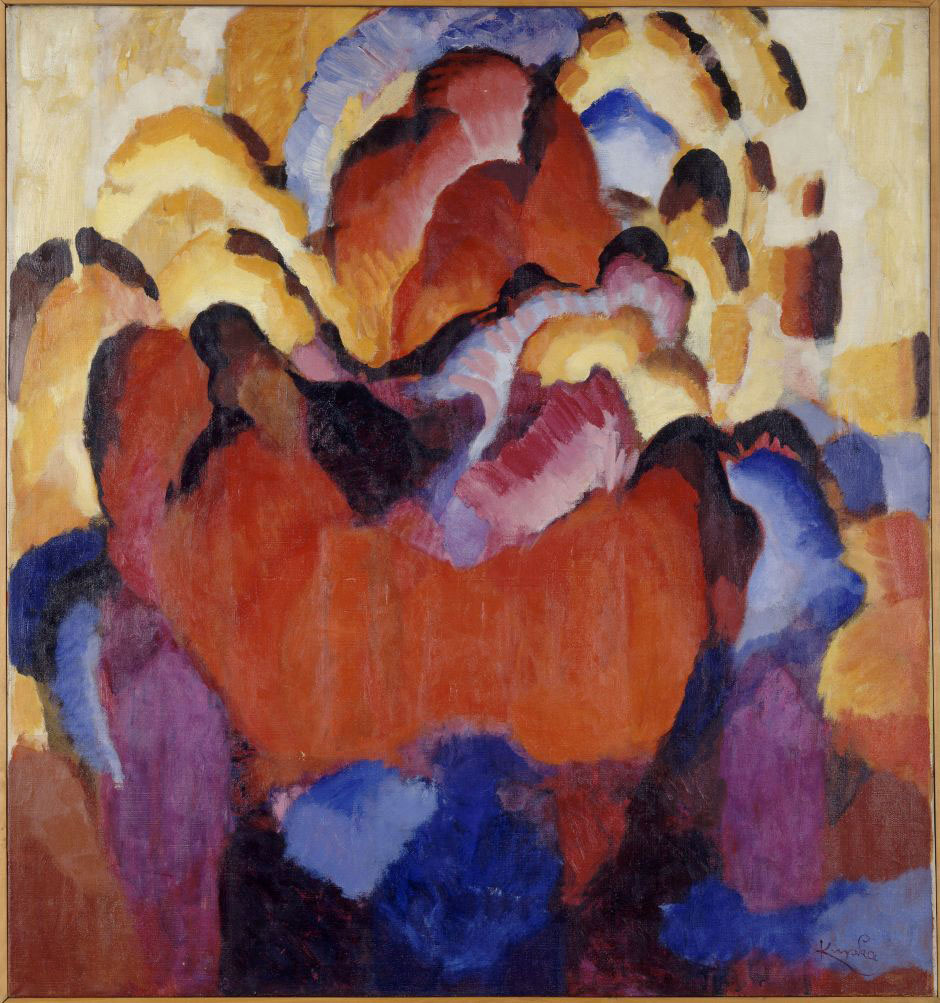
Frantisek Kupka (Czech, 1871-1957) 'Facture robuste' 1920


Frantisek Kupka (Czech, 1871-1957)
Facture robuste
1920
Strasbourg, Musée d’Art moderne et contemporain
© ADAGP, Paris, 2015
© Centre Pompidou, MNAM-CCI, Dist. RMN-Grand Palais / Jacques Faujour


Len Lye (New Zealand/America, 1901-1980)
Tusalava
1929
Film
10 min. 5 sec.


As a student, Lye became convinced that motion could be part of the language of art, leading him to early (and now lost) experiments with kinetic sculpture, as well as a desire to make film. Lye was also one of the first Pākehā artists to appreciate the art of Māori, Australian Aboriginal, Pacific Island and African cultures, and this had great influence on his work. In the early 1920s Lye travelled widely in the South Pacific. He spent extended periods in Australia and Samoa, where he was expelled by the New Zealand colonial administration for living within an indigenous community.

Working his way as a coal trimmer aboard a steam ship, Lye moved to London in 1926. There he joined the Seven and Five Society, exhibited in the 1936 International Surrealist Exhibition and began to make experimental films. Following his first animated film Tusalava, Lye began to make films in association with the British General Post Office, for the GPO Film Unit. He reinvented the technique of drawing directly on film, producing his animation for the 1935 film A Colour Box, an advertisement for “cheaper parcel post”, without using a camera for anything except the title cards at the beginning of the film. It was the first direct film screened to a general audience. It was made by painting vibrant abstract patterns on the film itself, synchronising them to a popular dance tune by Don Baretto and His Cuban Orchestra. A panel of animation experts convened in 2005 by the Annecy film festival put this film among the top ten most significant works in the history of animation (his later film Free Radicals was also in the top 50).

Text from the Wikipedia website


Rudolf Steiner (Austrian, 1861-1925) 'Untitled (drawing on blackboard at a conference of 14 May 1924)' Dornach, 14 May 1924


Rudolf Steiner (Austrian, 1861-1925)
Untitled (drawing on blackboard at a conference of 14 May 1924)
Dornach, 14 May 1924
Chalk on black paper
Rudolf Steiner Archive, Dornach
© Rudolf Steiner Archiv, Dornach
© ADAGP, Paris, 2015


A room of the exhibition features ten blackboards by Rudolf Steiner. They are the instructions of a new design language that the artist wants to develop. Steiner believes in the development of a supersensible consciousness, a big change for the future of humanity. He gives many lectures in which he details his research on the concept of transmission and its influence on the social. Whether true or not, artists such as Piet Mondrian, Wassily Kandinsky and others are interested in the complex graphics of Steiner and his research. Mondrian will even write: “Art is a way of development of mankind.”

Text from the Culture Box website translated from the French


Victor Brauner (Romanian, 1903-1966) 'Signe' 1942-1945


Victor Brauner (Romanian, 1903-1966)
Signe
1942-45
© ADAGP, Paris, 2015


Exhibition layout

Introduction

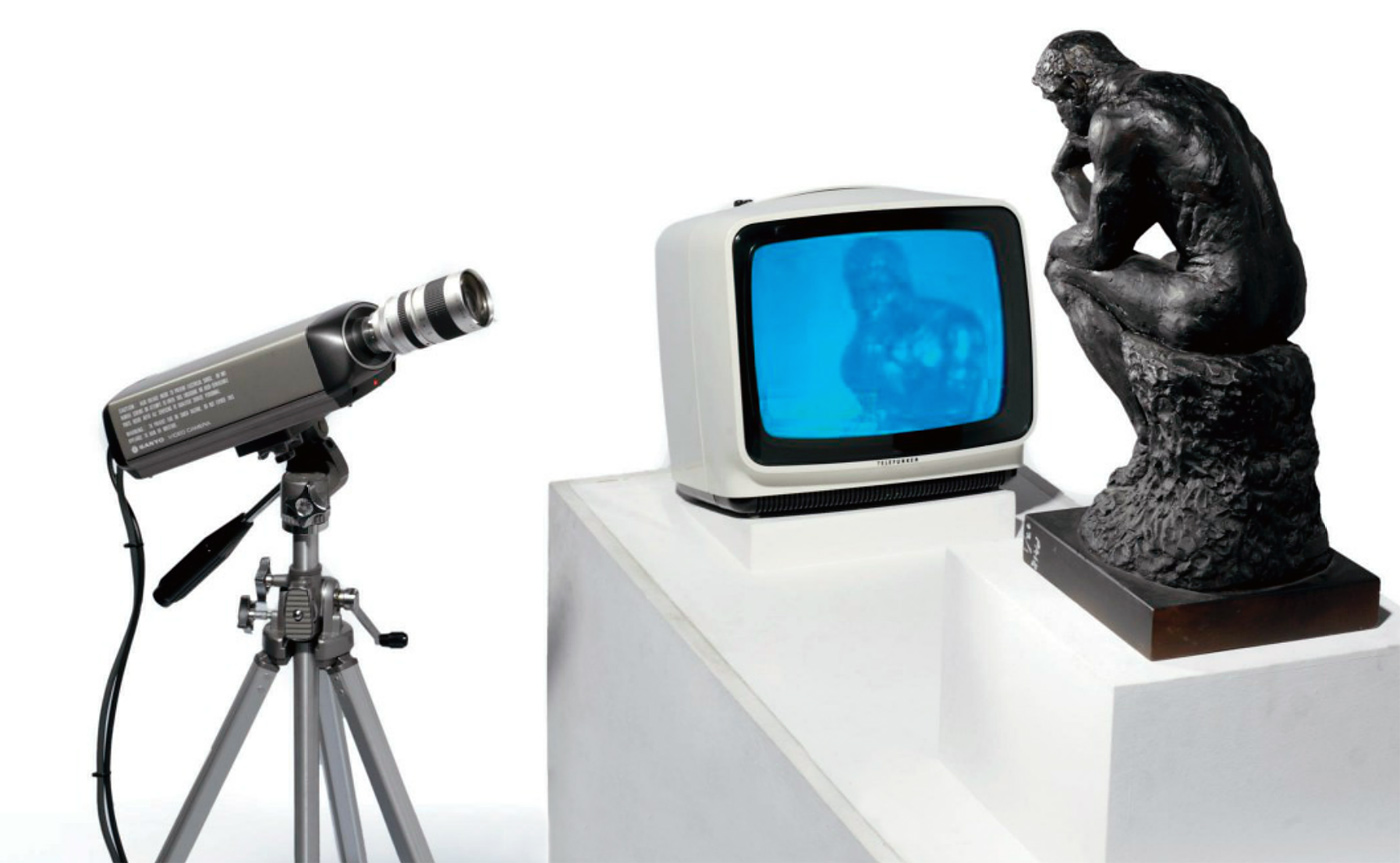
The exhibition starts with a version of the famous figure of Rodin’s Thinker, set off against a sequence of seven photographs from the start of the century, in which the Pictorialist dimension seems to attempt to show lighting emissions produced by the cerebral concentration of the subject. This collection is presented opposite TV Rodin, a video installation created by the artist Nam June Paik who, in the 1970s, reinterpreted electromagnetic animation of closed-circuit thought, when interest in cybernetics was at its peak.

Auras

The direct visualisation of thought and emotional states and the impact of this on the beginnings of abstraction at the start of the 20th century.

The first room focuses on the passion during the century for “photography of thought.” As a direct response to the discovery of radiography by Röntgen, in 1895, numerous amateur researchers attempted to produce images of the brain on photosensitive plates. Since it was possible to see through opaque bodies, why not try to see through the skull, which was now transparent? A curiosity cabinet presents the photographic experiments of Hippolyte Baraduc and Louis Darget with “psychic ones” or “images of thought.” This selection of photographs interacts with two film animation extracts by Émile Cohl, showing, with some humour, the direct projection of thought onto the big screen with the arrival of the cinema.

In the second room, a collection of engravings from the theosophical works of Annie Besant and Charles Leadbeater, presented by the American artist Christian Sampson, reveals the close relationship between the representation of emotional states (thought-patterns) and early abstract painting. They inspired many pioneers of abstract painters, including Kupka and Kandinsky. A group of auras and halos is shown, associated with a colour code for different effects, captured by Kandinsky in order to paint authentic abstract (auto) portraits. In the same vein, paintings by Wilhelm Morgner, Janus de Winter and Jacob Bendien present “psychic portraits” which illustrate a psychological range of emotions by means of chromatic signs.

The third room presents a sequence of ten “blackboards” by Rudolph Steiner, the founder of anthroposophy (the “science of the mind” that was a major influence on some of the members of the avant-garde abstract movement), showing how he developed his theories of the “mental body” and “psychic force”. Next to this is a collection of watercolours by the Swedish painter Hilma af Klint, a pioneer of abstract art. Around this area a multimedia installation by the artist Tony Oursler has been specially created for this exhibition reinterpreting the historical imagination of these “mental projections”.

Magnetic fields

The spread of telepathy in the inter-war period and its influence on surrealism.

In 1924, André Breton published the Surrealist Manifesto (1924) just when the neurologist Hans Berger invented the first electroencephalogram as a result of experimental research into telepathy: this being a less than accidental coincidence, relating to automated transcriptions of the mind. The “exquisite corpses” or “communicated drawings” of the surrealists are linked to experiments that took place at that time into the telepathic transfer of images.

The first room presents a sequence of photographs of the surrealist group in poses in which heads and bodies communicate with each other to produce a collective work under the mysterious influence of “magnetic fields.” Tusalava (1929), a film by the Australian artist Len Lye, illustrates the cinematographic solution found to make mental activity visible, in the form of abstract ideograms taken from aboriginal language.

The second room shows a collection of photographs from the 1920s, some of which are presented by the artist Frédéric Vaesen, relating to the materialisation of psychic entities, the famous “ectoplasms” which give a more tangible reality to imponderable thought. Next to this is a series of works by Joan Miró, in which the painter depicts coloured auras, including a mental map of emotional states, a “photograph of his dreams”.

Mind expander

With the reconstruction of the post war period, divided between the cybernetic model and psychedelic liberation, telepathy remained more than ever a creative horizon for artists in search of perception extended to the electromagnetic manifestations of consciousness.

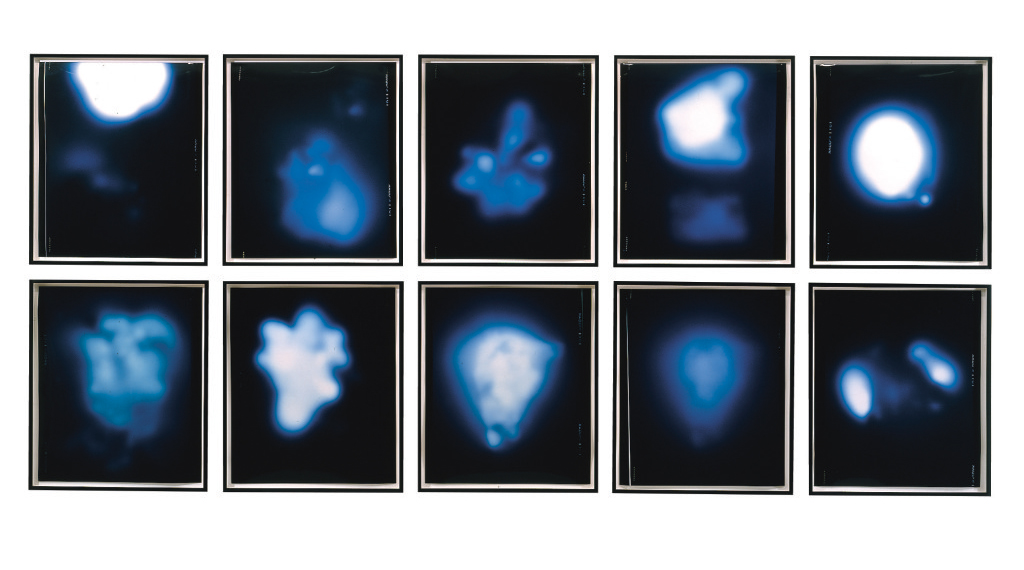
The New Age spirit of the 1960s witnessed the curious revival of “photographs of thought” (Ted Serios and Salas Portugal), which influenced experimental cinema and psychedelic video (Jordan Belson), a well as some photographic practices (Anna and Bernhard Blume, Dieter Appelt, Suzanne Hiller, John Baldessari and Sigmar Polke).

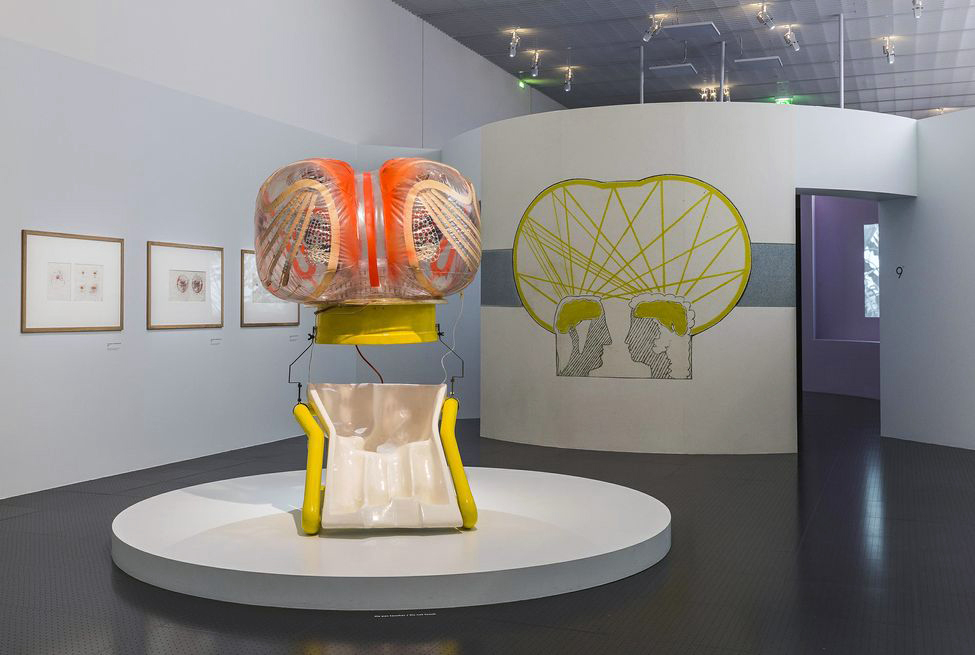
Under the influence of psychotropic drugs or immersed in highly intense audiovisual devices, electric thought in motion is captured with a penetrating eye. Experimental and radical architectural patterns embody “expanded consciousness”, as is seen in the Mind Expander project (1967) by the Austrian group Haus Rucker Co, which invites the spectator to venture into “superception.” Music has its role here, with the rise in “biomusic” at the end of the 1960s, led by Alvin Lucier, Pierre Henry and David Rosenboom, who produced authentic “brain symphonies,” by means of the sound transcription of the activity of electric waves emitted by the brain, directly captured by electrodes.

Telepathy

The establishment of telepathic art in the 1970s influenced by conceptual practices.

On the margins of pop art, avant-garde artists in the 1970s produced a critique of both form and the art market, by means of strategies that emphasised language and sociological discourse. This also involved a major project in the dematerialisation of art works in which telepathy could be an ideal model for a new non-standard form of communication.

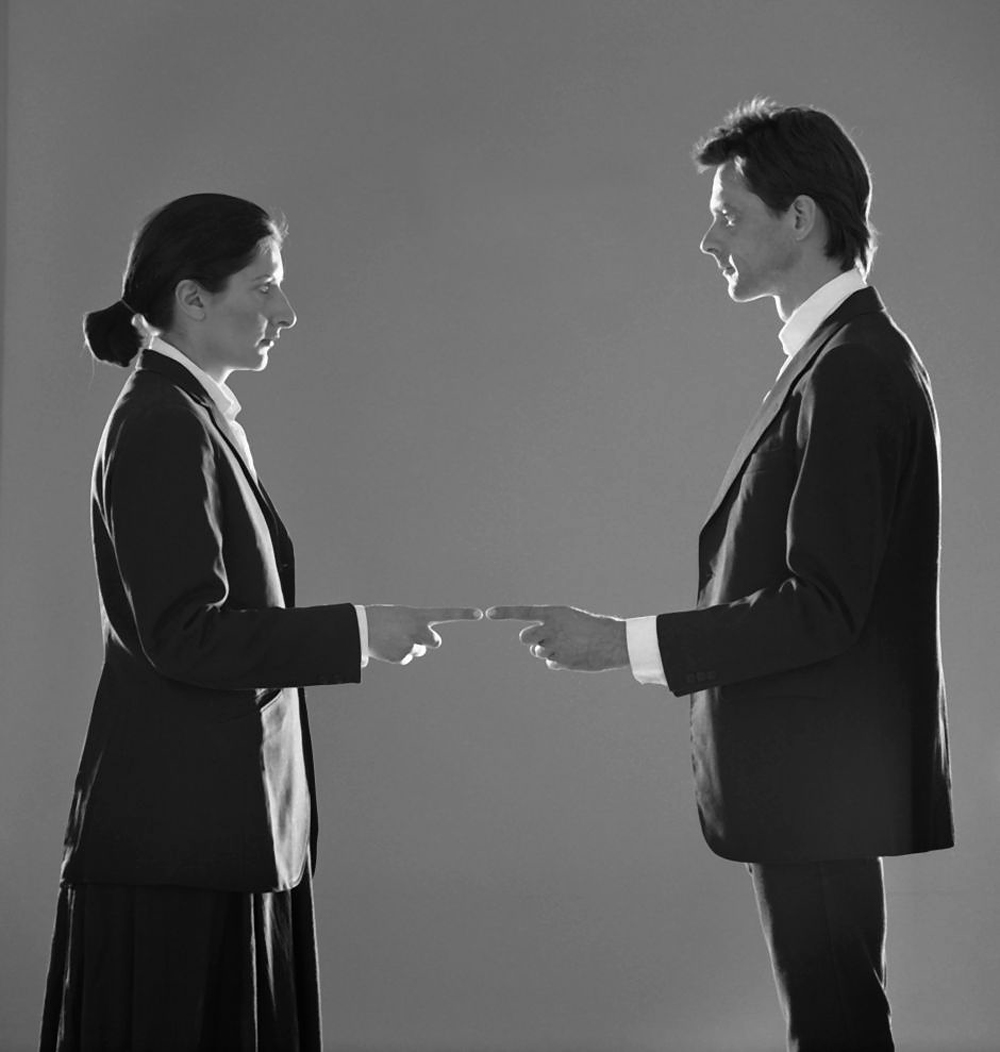
The American artist Robert Morris produced his own Autoportrait in the form of an encephalogram (EEG Portrait) at the same time as his compatriot Robert Barry, a central figure in conceptual art, produced Telepathic Pieces (1969) and Vito Acconci explored extra sensory perception through the form of video (Remote Control, 1971). Against this backdrop, we see considerable new interest in a utopia of shared creation (Robert Filliou and Marina Abramovic) in the era of global communication and the “noosphere” prophetically declared by Teilhard de Chardin and Marshall McLuhan.

The exhibition ends with a vast installation by the artist Fabrice Hyber, a major figure of contemporary art in France, with experimental telepathic booths, paintings, drawings and “prototypes of operating objects” (POF). Hyber invites the spectator to participate, alone or in groups, in an experience which has several surprises, reminding us how, today, under the influence of information networks, neuroscience and the globalised internet, telepathy (ultra democratic and utopian yet also obscure) is more topical than ever and can be explored by artists with the same spirit of derision or anticipation.

Press release from the Centre Pompidou-Metz


Haus-Rucker-Co (Viennese, founded 1967) Laurids, Zamp and Pinter with 'Environment Transformern (Flyhead, Viewatomizer and Drizzler)' 1968, from the 'Mind Expander project'


Haus-Rucker-Co (Viennese, founded 1967)
Laurids, Zamp and Pinter with Environment Transformern (Flyhead, Viewatomizer and Drizzler)
1968
From the Mind Expander project
Photo: Gert Winkler


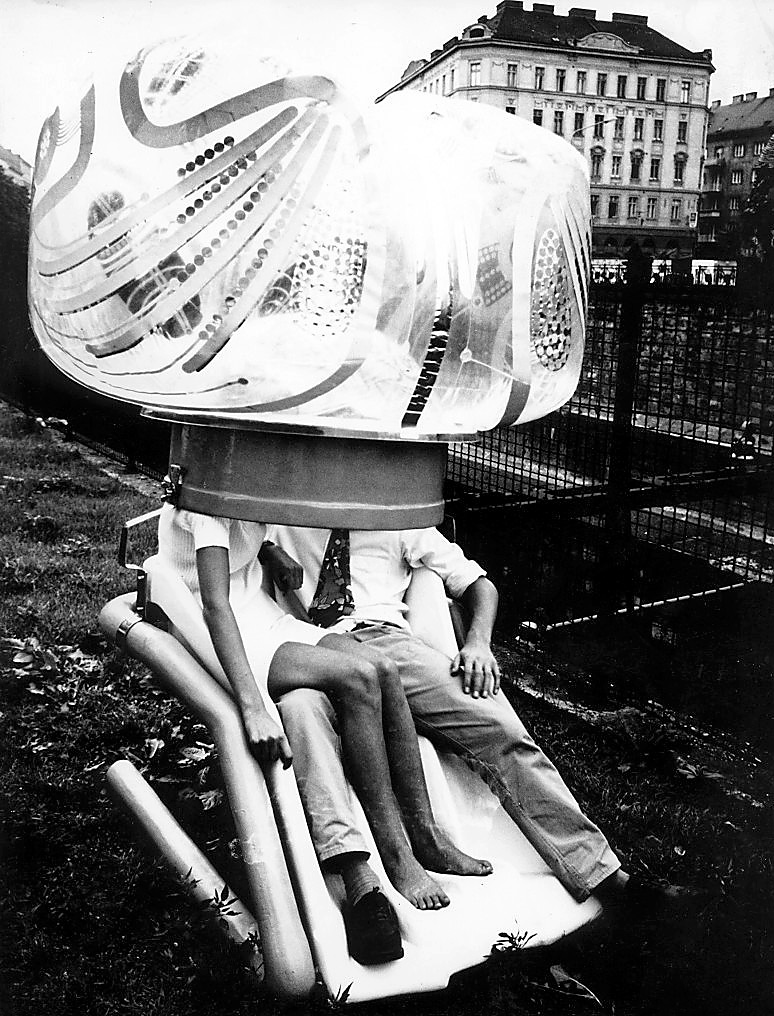
Taking their cue from the Situationist’s ideas of play as a means of engaging citizens, Haus-Rucker-Co created performances where viewers became participants and could influence their own environments, becoming more than just passive onlookers. These installations were usually made from pneumatic structures such as Oase No. 7 (1972), which was created for Documenta 5 in Kassel, Germany. An inflatable structure emerged from the façade of an existing building creating a space for relaxation and play, of which contemporary echoes can be found in the ‘urban reserves’ of Santiago Cirugeda. The different versions of the Mind Expander series (1967-1969), consisted of various helmets that could alter the perceptions of those wearing them, for example the ‘Fly Head’ disoriented the sight and hearing of the wearer to create an entirely new apprehension of reality; it also produced one of their most memorable images.

Haus-Rucker-Co’s installations served as a critique of the confined spaces of bourgeois life creating temporary, disposable architecture, whilst their prosthetic devices were designed to enhance sensory experience and highlight the taken-for-granted nature of our senses, seen also in the contemporaneous work of the Brazilian artist Lygia Clark. Contemporary versions of such work can be found in the pneumatic structures favoured by Raumlabor and Exyzt.

Anonymous text from the Spatial Agency website [Online] Cited 22/03/2016.


Installation view of Haus-Rucker-Co, 'Mindexpander 1' 1967 in the exhibition 'Cosa mentale' at the Centre Pompidou-Metz


Installation view of Haus-Rucker-Co, Mindexpander 1 1967 in the exhibition Cosa mentale at the Centre Pompidou-Metz.
Photo Pompidou Centre. MNAM CCI-distrib. RMN / G. Meguerditchian.


In 1968, the Austrian collective Haus-Rucker-Co designed the Mind Expander as an immersive capsule propelling the audience into a new mode of perception of reality: the “Superception”. This, then, is a synthesis of avant-garde utopias, throughout the twentieth century, influenced by the imagination that gave rise to the development of telecommunications, seeking to develop a way of live transmission of emotion. Its aim was to invent a new, immediate, relationship between the artist and the viewer.


Haus-Rucker-Co. 'Mind Expander' 1967


Haus-Rucker-Co (Viennese, founded 1967)
Mind Expander
1967 Vienna
Epreuve gélatino-argentique
Photo: Michael Plitz. Haus-Rucker-Co.


David Rosenboom (American, b. 1947) 'Portable Gold and Philosophers' Stones in Paris 1' 1975


David Rosenboom (American, b. 1947)
Portable Gold and Philosophers’ Stones in Paris 1
1975
© David Rosenboom 1975
All rights reserved


Pianist-composer J.B. Floyd, a long-time collaborator with David Rosenboom is seen with electrodes attached to his head while performing a solo version of Rosenboom’s brainwave music composition Portable Gold and Philosophers’ Stones at Centre Culturel Americain in Paris on 7 January 1975. The equipment shown includes a brainwave monitoring device and an ARP 2600 Synthesizer. The performance occurred simultaneously with a lecture given by David Rosenboom in a presentation titled Biofeedback and the Arts. Artist Jacqueline Humbert, who also participated in the performance, is seated off to the right of the picture frame.


Nam June Paik (American, 1932-2006) 'TV Rodin' 1976-1978 (detail)


Nam June Paik (American, 1932-2006)
TV Rodin (detail)
1976-1978
Plaster, video camera, tripod, monitor, pedestal
132 x 110 x 115 cm


Long considered the most important video artist since the advent of the form in the late 1960s, Nam June Paik’s TV Rodin is one of several related works that involve sculpture – in this case, a cast of Auguste Rodin’s Thinker, studying itself in a small video monitor via closed circuit television. As museum visitors walk around the work and look over the sculpture’s shoulder, their image also appears on the screen. Paik’s influential vision of television as a global cultural force found intelligent and witty form in his videotapes, video sculptures, and intercontinental satellite performances.

Text from the Carnegie Museum of Art website [Online] Cited 22/03/2016.


Nam June Paik (American, 1932-2006) 'TV Rodin' 1976-1978


Nam June Paik (American, 1932-2006)
TV Rodin
1976-1978
Plaster, video camera, tripod, monitor, pedestal
132 x 110 x 115cm
Photo: Primae / Claude Germain. The Estate of Nam June Paik


Marina Abramovic (Serbian, b. 1946) and Ulay (Frank Uwe Laysiepen) (German, 1943-2020) 'That Self – Point of Contact' 1980


Marina Abramovic (Serbian, b. 1946) and Ulay (Frank Uwe Laysiepen) (German, 1943-2020)
That Self – Point of Contact
1980
Performance au De Appel Art Centre, Amsterdam
© Adagp, Paris 2015
Courtesy Marina Abramovic Archives


Sigmar Polke (German, 1941-2010) 'Untitled (Blue)' 1992


Sigmar Polke (German, 1941-2010)
Untitled (Blue)
1992
Set of 10 Cibachromes trials
61 x 51cm
The estate of Sigmar Polke / ADAGP, Paris, 2015


Fabrice Hyber (French, b. 1961) 'screen+télépathy' 2013


Fabrice Hyber (French, b. 1961)
screen+télépathy
2013
Watercolour, charcoal on paper
76 x 57cm
Collection of the artist
© Photographie Marc Domage


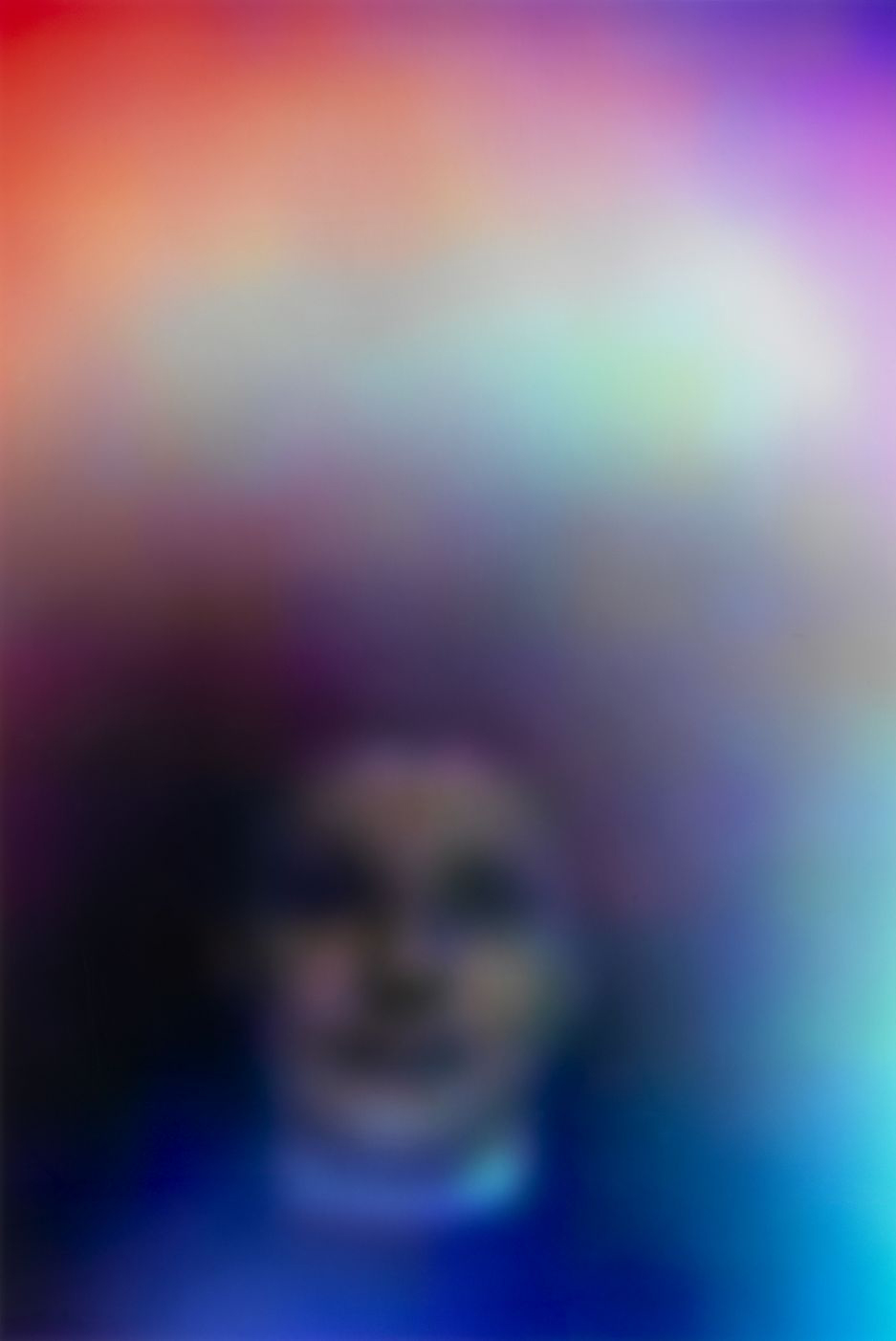
Susan Hiller (American, 1940-2019) 'Homage to Marcel Duchamp: Aura (Blue Boy)' 2011


Susan Hiller (American, 1940-2019)
Homage to Marcel Duchamp: Aura (Blue Boy)
2011
© Susan Hiller


Centre Pompidou-Metz
1, parvis des Droits-de-l’Homme
CS 90490
F-57020 Metz Cedex 1
Phone: +33 (0)3 87 15 39 39

Opening hours:
Monday 10am – 6pm
Tuesday closed
Wednesday 10am – 6pm
Thursday 10am – 6pm
Friday 10am – 7pm
Saturday 10am – 7pm
Sunday 10am – 7pm

Centre Pompidou-Metz website

LIKE ART BLART ON FACEBOOK

Back to top

Exhibition: ‘Gilbert & George: The Art Exhibition’ at the Museum of Old and New Art (MONA), Hobart

Exhibition dates: 28th November, 2015 – 28th March, 2016

Curators: Gilbert & George with organising curators, Mona’s Co-Directors of Exhibitions and Collections, Olivier Varenne and Nicole Durling


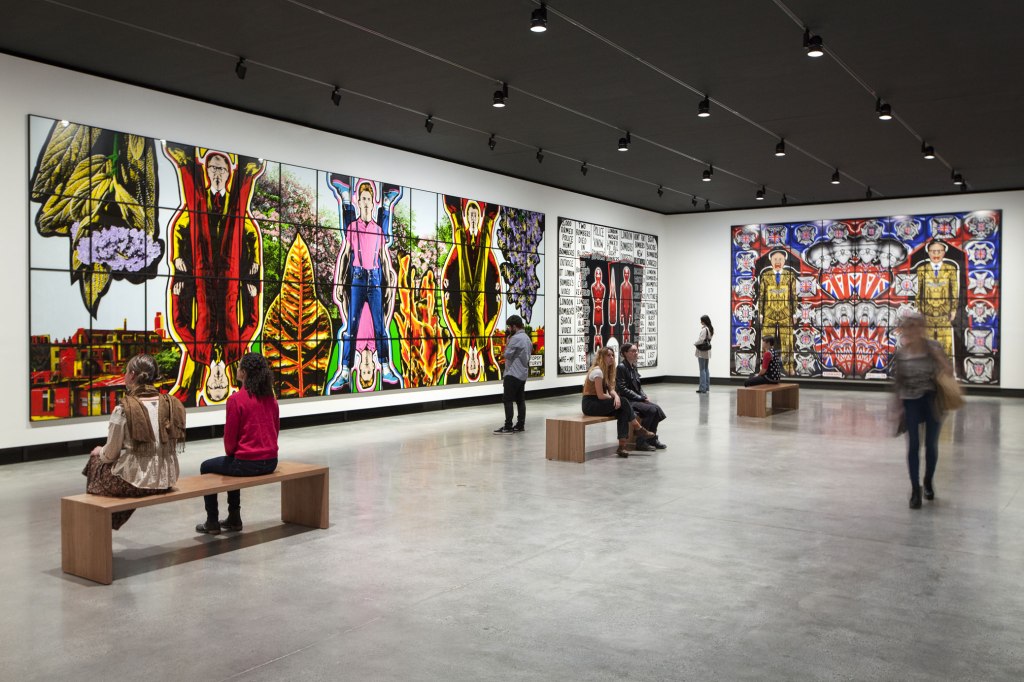
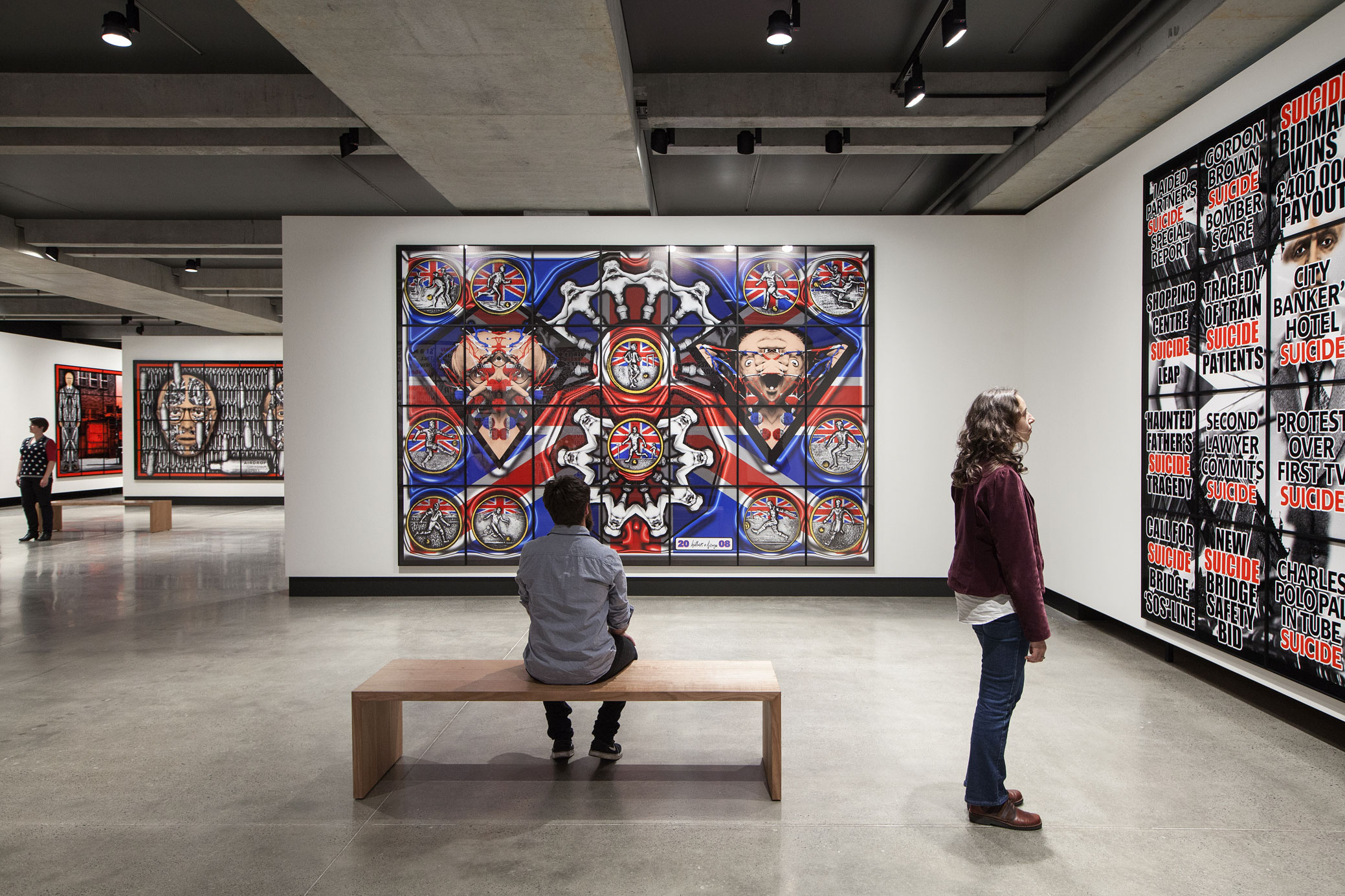
Gilbert & George (Gilbert Prousch, British born Italy, 1943; George Passmore, British, b. 1942) 'FORWARD' 2008 from the exhibition 'Gilbert & George: The Art Exhibition' at the Museum of Old and New Art (MONA), Hobart, Nov 2015 - March 2016


Gilbert & George (Gilbert Prousch, British born Italy, 1943; George Passmore, British, b. 1942)
FORWARD
2008
Mixed media
381 x 604cm
Courtesy of the artists and White Cube


Gentlemen of the gutter

While I admire the mythology of Gilbert and George, that ever so British pair of deviant artists, they have never been among my favourites.

They had a tough road. Imagine meeting in 1967, pre-Stonewall and the beginning of gay liberation, and then moving into the roughest part of London, the East End, to live together and make art, dressed as a pair of besuited businessmen. The prejudice and the abuse would have been intense, but they stuck together, they stuck to their path as artists, and they stuck to each other as human beings. It is fascinating to see the trajectory of their development, to follow the development of the grid, the introduction of one colour and then multiple colours.

I understand what they do, empathise with their endeavour (anti-nationalism, religion, bigotry, racism, homophobia etc etc…) but wonder whether they have not painted themselves and their art into a corner. They are so well known for their long running performance – their vaudeville act reminding me of a contemporary Hieronymus Bosch with text ripped from the headlines / images riffed from hell (portraits of cut up reflections assembled to make surreal creatures with gaping mouths), the gridded works, the colours, the content AS graphic gothic cathedral with stained glass windows – that they seem incapable or willing to push themselves and their art further. To shock us in an altogether different way? Now that would be a greater surprise, than just semen, spit and shit.

What I am saying is that they have got their schtick down pat. They worked hard for their anti-establishment schlock horror. The work has presence and they do know how to reach people with a picture but with each repetition, with each ritual performance the cracks grow ever larger. As John McDonald observes, “They are iconoclastic non-entities making art that attracts and repels.”

What actually lies underneath all of this rhetoric. Two caring human beings, two compassionate souls? I think not, therefore I am.**

As can be seen in many of their works, the emperors literally have no clothes…

Dr Marcus Bunyan

** Perhaps it should have been “I care not, therefore I am” … because they don’t really give a dam what people think. This is part of the problem: their rather mean spirited view of the world.


Many thankx to MONA for allowing me to publish the photographs in the posting. Please click on the photographs for a larger version of the image.


“We are unhealthy, middle-aged, dirty-minded, depressed, cynical, empty, tired-brained, seedy, rotten, dreaming, badly-behaved, ill-mannered, arrogant, intellectual, self-pitying, honest, successful, hard-working, thoughtful, artistic, religious, fascistic, blood-thirsty, teasing, destructive, ambitious, colourful, damned, stubborn, perverted and good. We are artists.”


“Art has just become decoration for the very, very rich. We manage to keep our feet on the ground. We have never been part of an elitist art group. Our art is so confrontational that a lot of collectors would never touch it because they don’t want a naked shit picture in their living room… More and more it is difficult to speak as an artist. Nobody hears you because there are too many and there are too many different ways of making art today that there didn’t use to be when we started out in 1969.”


“We never go to the cinema, the theatre, or the ballet or opera. We stopped 40 years ago. We just didn’t want to become contaminated. We know what we’re interested in, we know how we can reach people with a picture. We have a feeling, what we put in that picture that will mean something to somebody.”


Gilbert & George


Gilbert & George: The Art Exhibition


Gilbert & George In Conversation With Olivier Varenne


Two people, but one artist: the legendary Gilbert & George’s first ever exhibition in Australasia, Gilbert & George: The Art Exhibition, is now open at the Museum of Old and New Art in Tasmania, Australia, until March 28, 2016.

Gilbert & George: The Art Exhibition is a major retrospective, including pictures spanning five decades; dating from 1970 to most recent pictures of 2014. Curated by Gilbert & George with organising curators, Mona’s Co-Directors of Exhibitions and Collections, Olivier Varenne and Nicole Durling, the pictures are installed across the entirety of Mona’s touring galleries, 14 metres underground.

“Our pictures deal with the great universals: death, hope, life, fear, sex, money, race and religion. Seeing is believing. See for yourself: Gilbert & George: The Art Exhibition. This is your very first – and last – chance to see one hundred of our pictures, at the wonderful Museum of Old and New Art in Hobart, Tasmania.” ~ Gilbert & George


Since first meeting at St Martin’s school of Art, London, in 1967, Gilbert & George have lived and worked together as one single and fiercely independent artist, dedicated solely to the creation of their art. They have no allegiance to any other trend, school, movement, doctrine, theory or style of art.

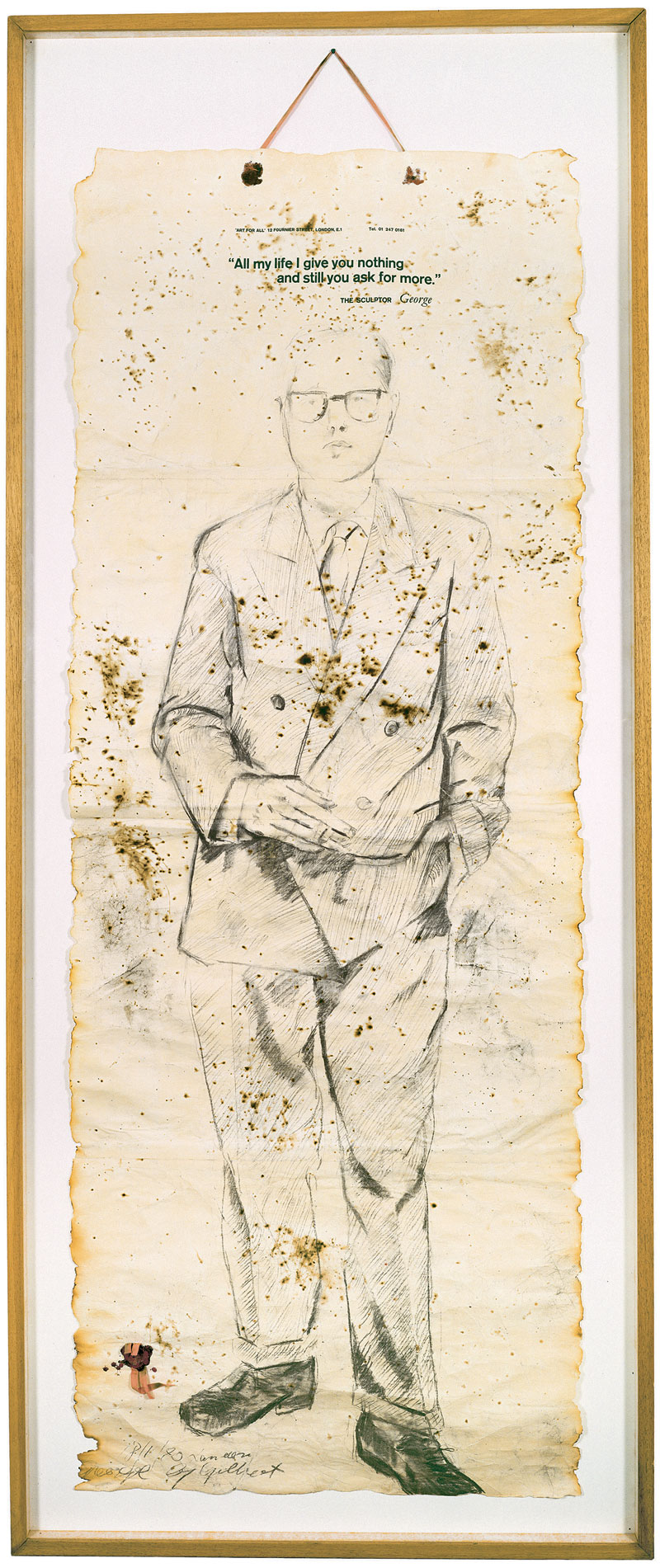
Gilbert & George already knew that they were seeking for a form of art that was to them entirely rooted in the real world – in the streets and clamour and traffic and buildings and hearts of strangers: an “Art for All.”

Today, their art continues to be multi-allusive, contemporary and contentious, as their subject is literally at their feet – along countless streets, the thoroughfares of the passage of millions of lives, and dense with the sedimentary tracings of social existence.

Text from MONA


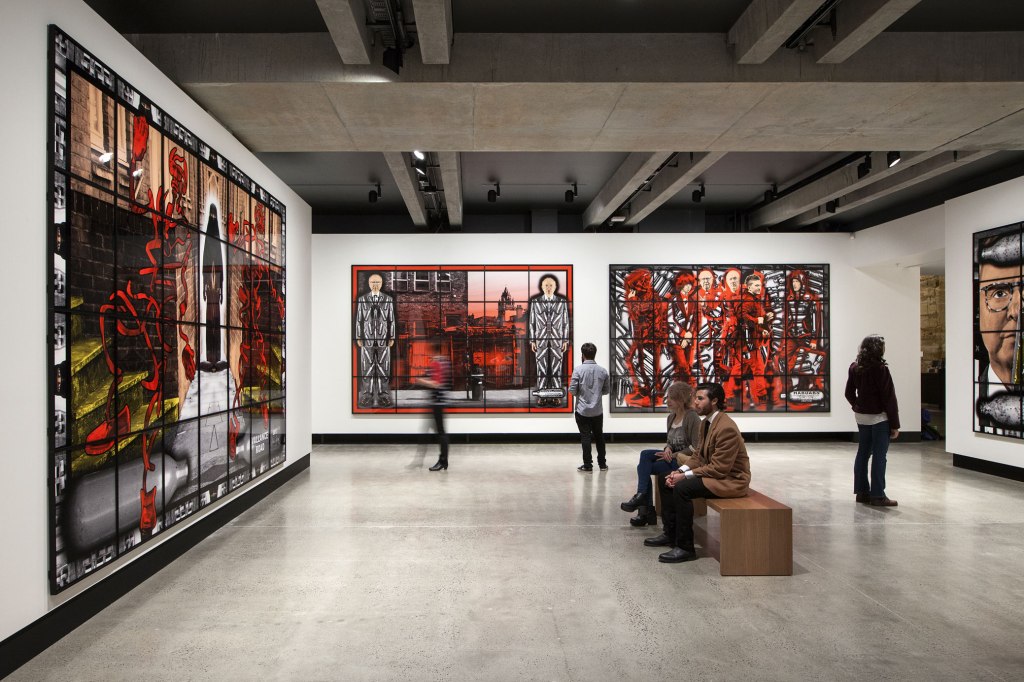
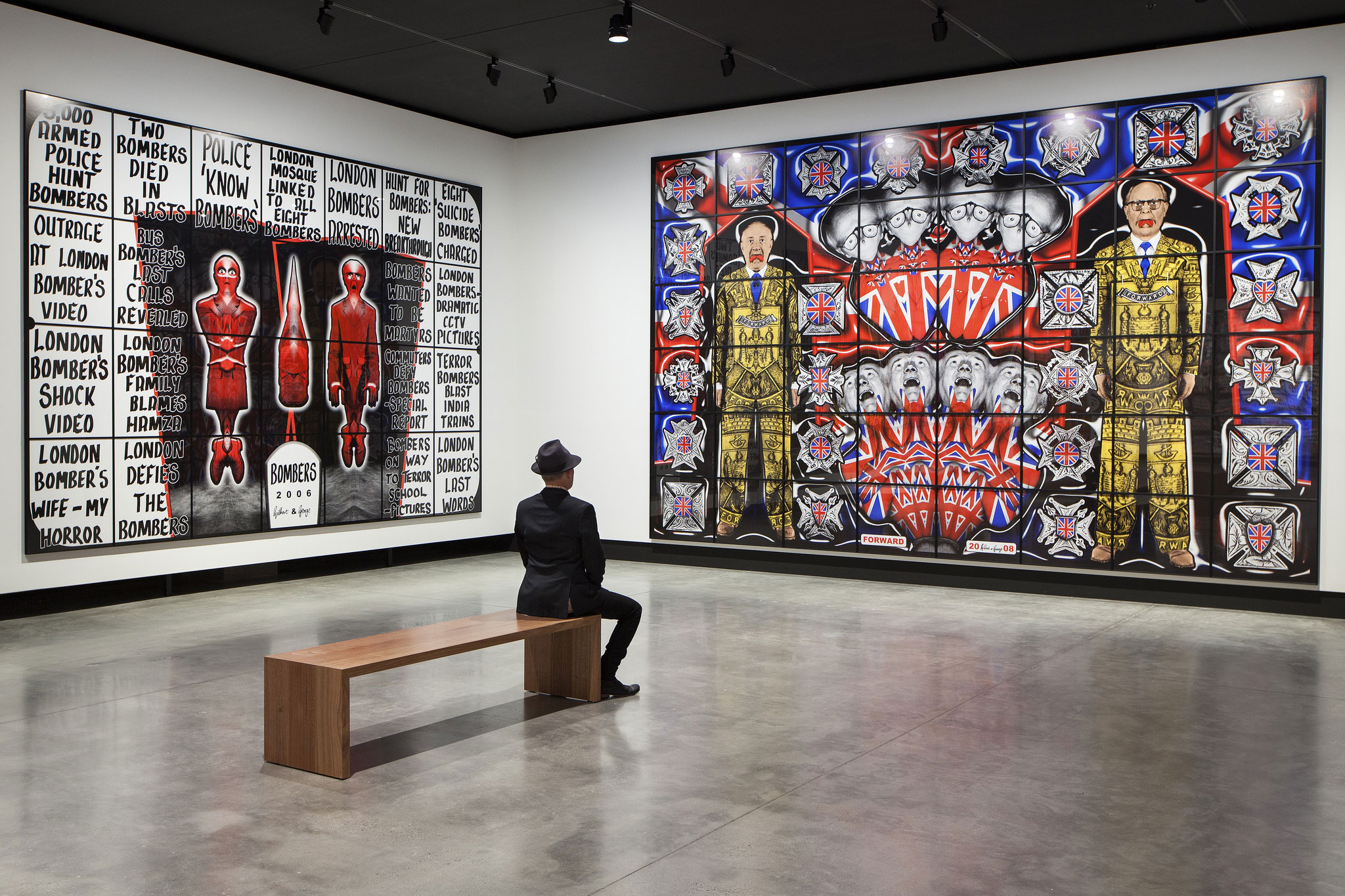
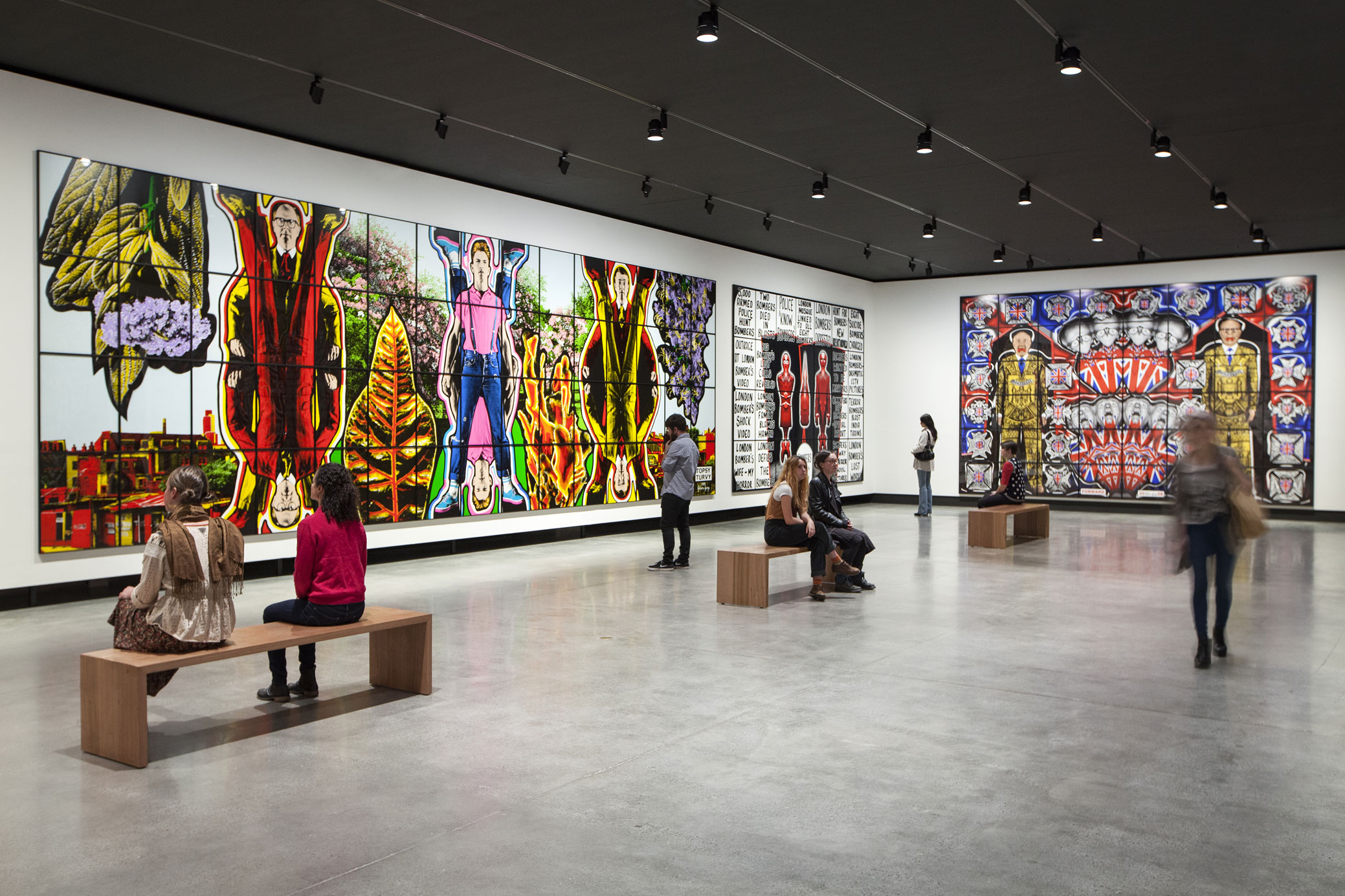
Installation view of the exhibition ‘Gilbert & George: The Art Exhibition’ at the Museum of Old and New Art, Hobart showing at left, 'BOMBERS' (2006), and at right, 'FORWARD' (2008)


Installation view of the exhibition Gilbert & George: The Art Exhibition at the Museum of Old and New Art, Hobart showing at left, BOMBERS (2006), and at right, FORWARD (2008)


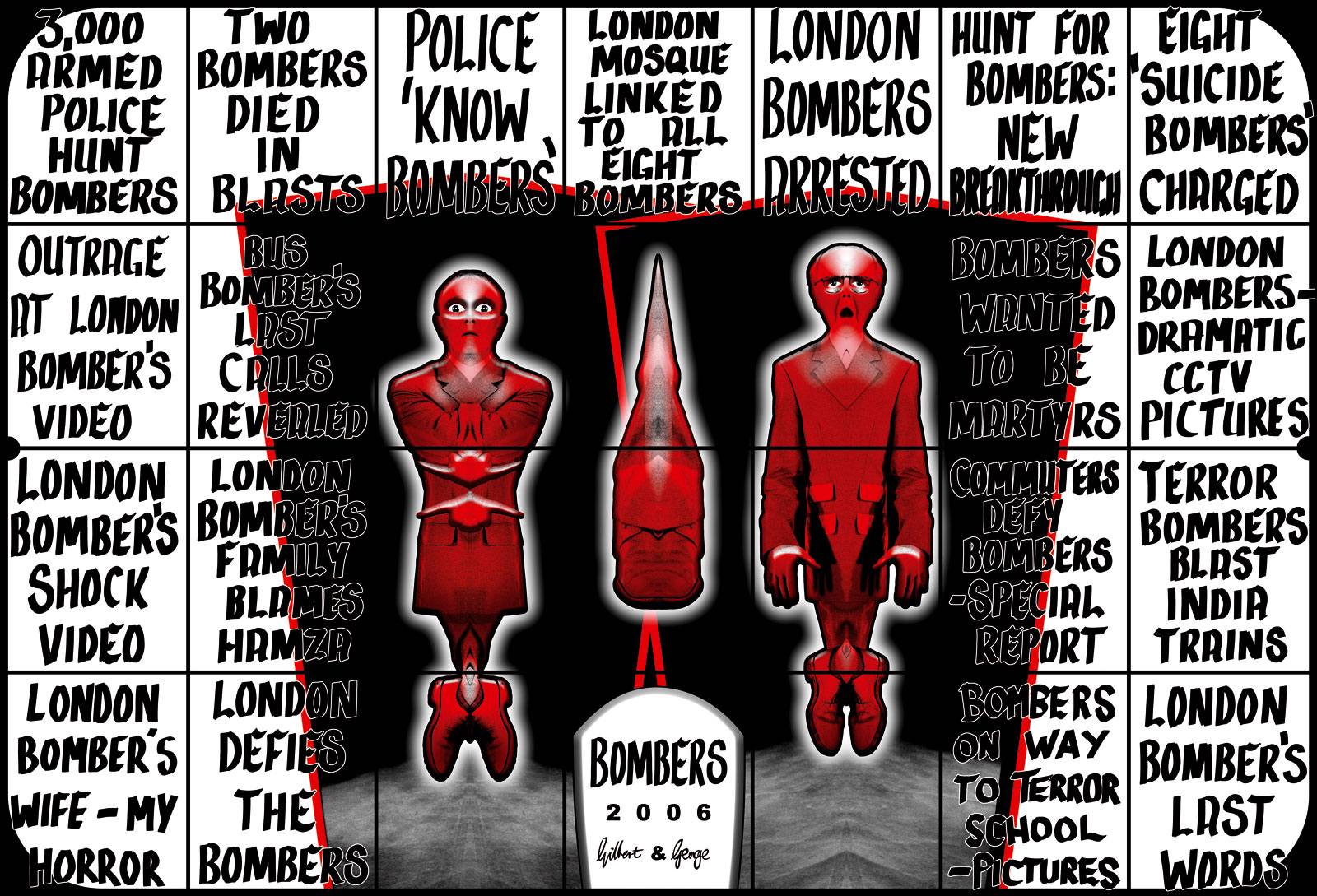
Gilbert & George (Gilbert Prousch, British born Italy, 1943; George Passmore, British, b. 1942) 'BOMBERS' 2006 from the exhibition 'Gilbert & George: The Art Exhibition' at the Museum of Old and New Art (MONA), Hobart, Nov 2015 - March 2016


Gilbert & George (Gilbert Prousch, British born Italy, 1943; George Passmore, British, b. 1942)
BOMBERS
2006
From Bomb Pictures
Mixed media
336 x 493cm
Courtesy of the artists and White Cube


Gilbert & George created an important group of six pictures for their major retrospective at Tate Modern. The six Bomb Pictures, the only pictures created by the artists in 2006, comprise a 14 metre triptych entitled Bomb and five other pictures: Bombs; Bomber; Bombers; Bombing; and Terror. The artists have described this group of pictures as their most chilling to date. The artists intend the pictures to be seen as modern townscapes reflecting the daily exposure in urban life to terror alerts.

Barry Grayshon. “Gilbert and George – The Bomb Pictures (2006),” on the Pinterest website [Online] Cited 16/03/2016


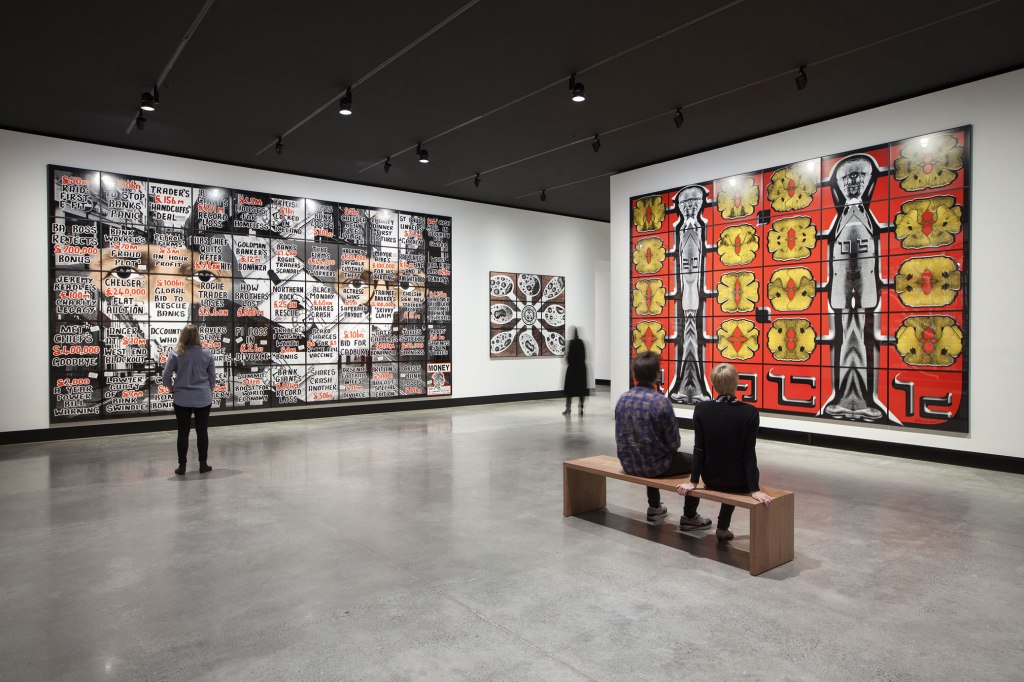
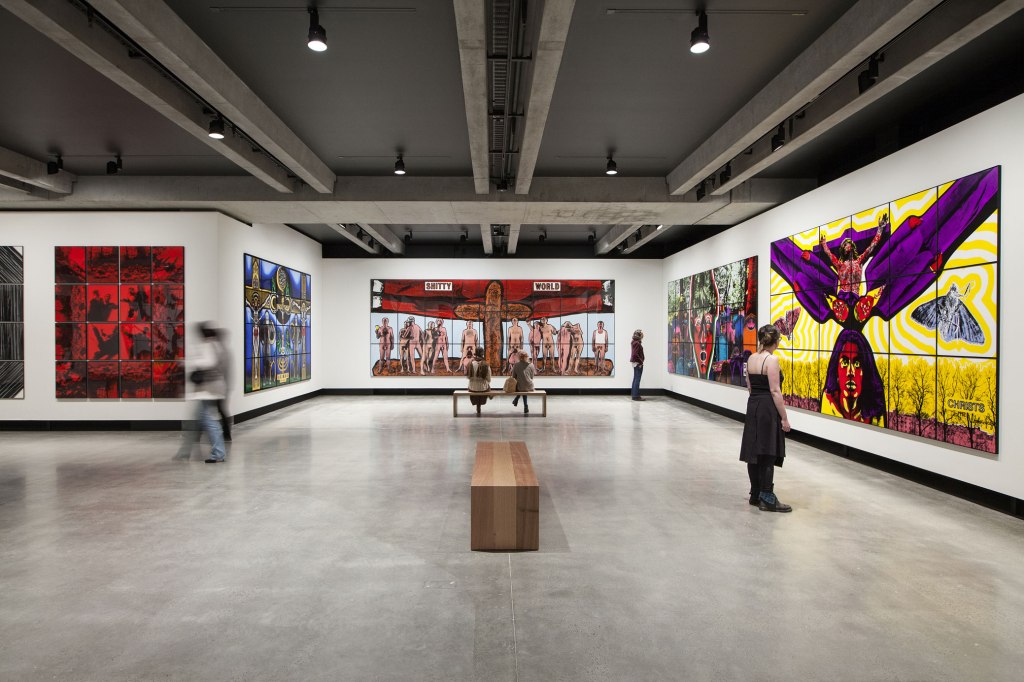
Installation view of the exhibition ‘Gilbert & George: The Art Exhibition’ at the Museum of Old and New Art, Hobart showing at left, 'TOPSY TURVY' (1989) from 'The Cosmological Pictures'


Installation view of the exhibition Gilbert & George: The Art Exhibition at the Museum of Old and New Art, Hobart showing at left, TOPSY TURVY (1989) from The Cosmological Pictures


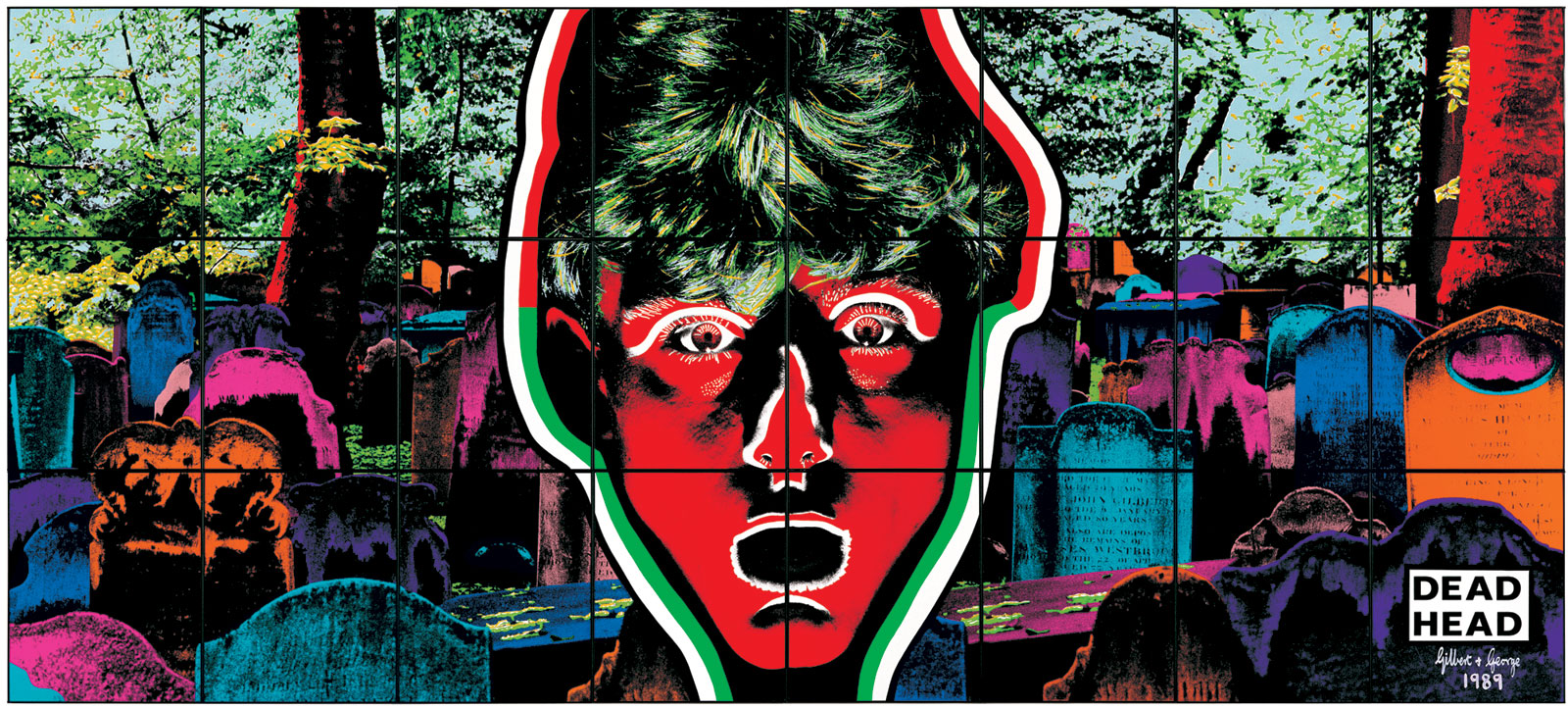
Gilbert & George (Gilbert Prousch, British born Italy, 1943; George Passmore, British, b. 1942) 'DEAD HEAD' 1989


Gilbert & George (Gilbert Prousch, British born Italy, 1943; George Passmore, British, b. 1942)
DEAD HEAD
1989
From The Cosmological Pictures
Picture courtesy of the artists and Mona, Museum of Old and New Art, Tasmania, Australia


With this body of work Gilbert & George stress the power of human thought to remake life and so create the future through a process of communication, discussion and questioning, stimulated by the pictures. The word ‘cosmology’ derives from the Greek words for ‘world’ and ‘discourse’. Since September 1991, The Cosmological Pictures have been touring many European cities. Gilbert and George’s aim – to speak to many people in all of these cities – is at the heart of their cosmology.

Barry Grayshon. “Gilbert and George – The Cosmological Pictures (1989),” on the Pinterest website [Online] Cited 16/03/2016


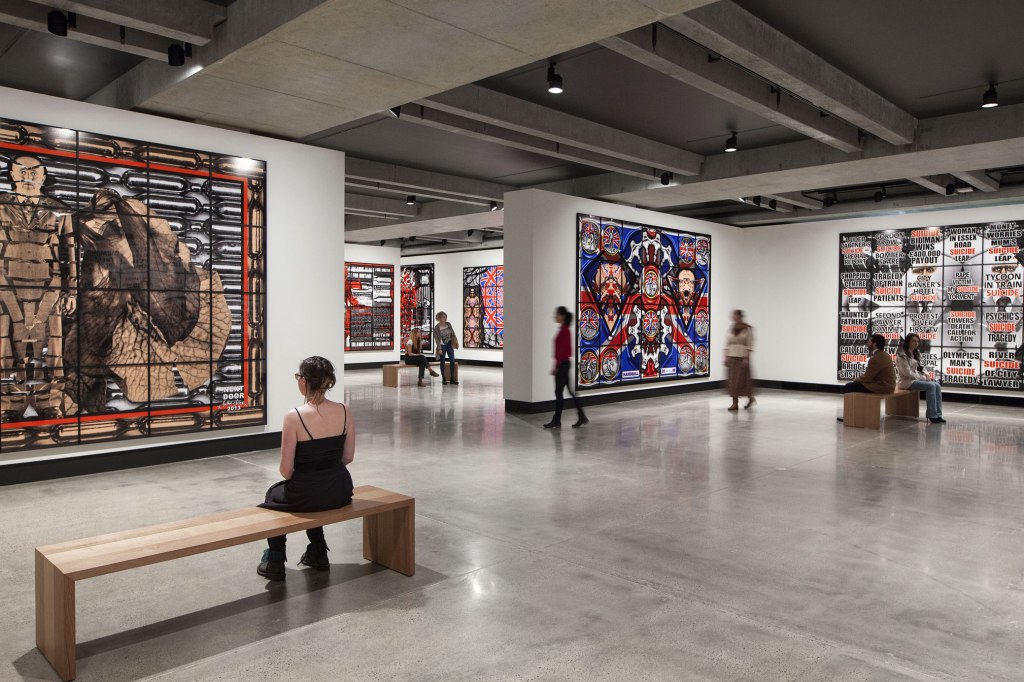
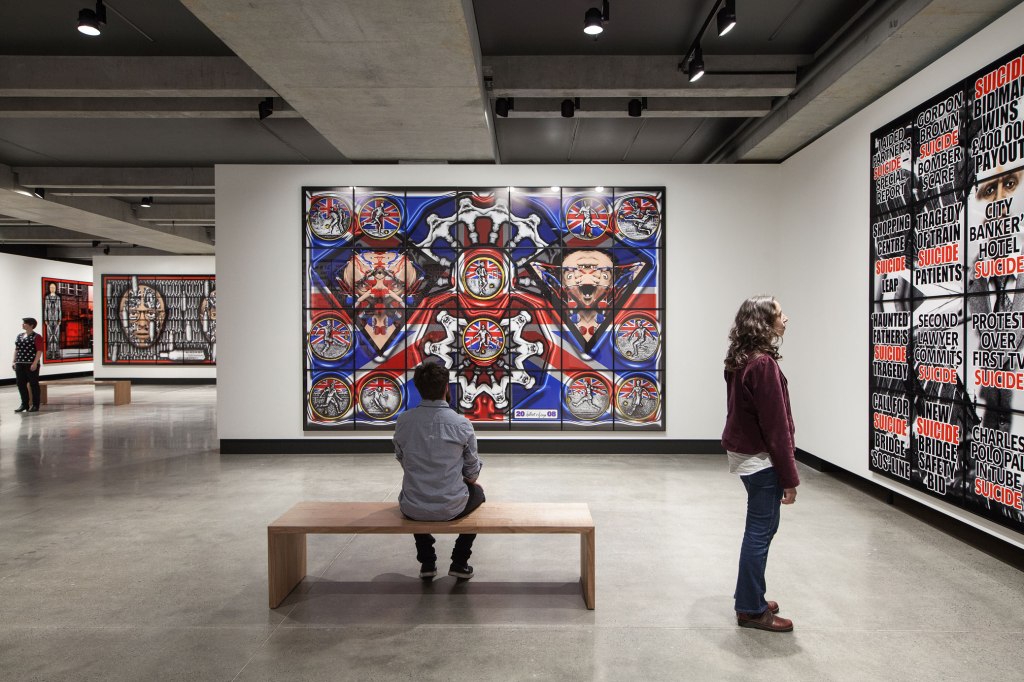
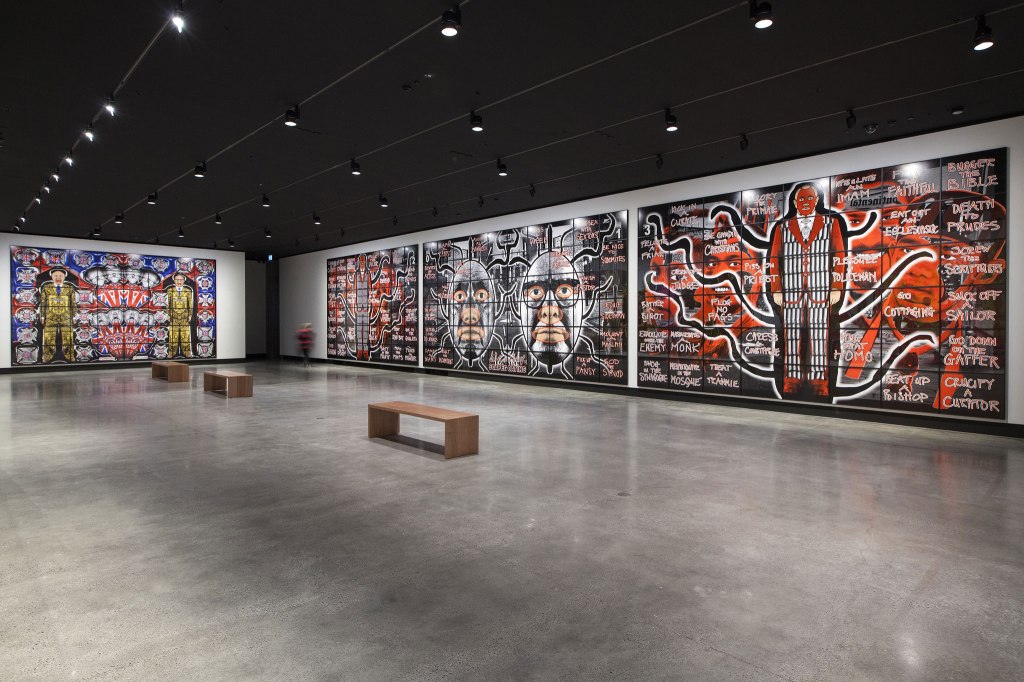
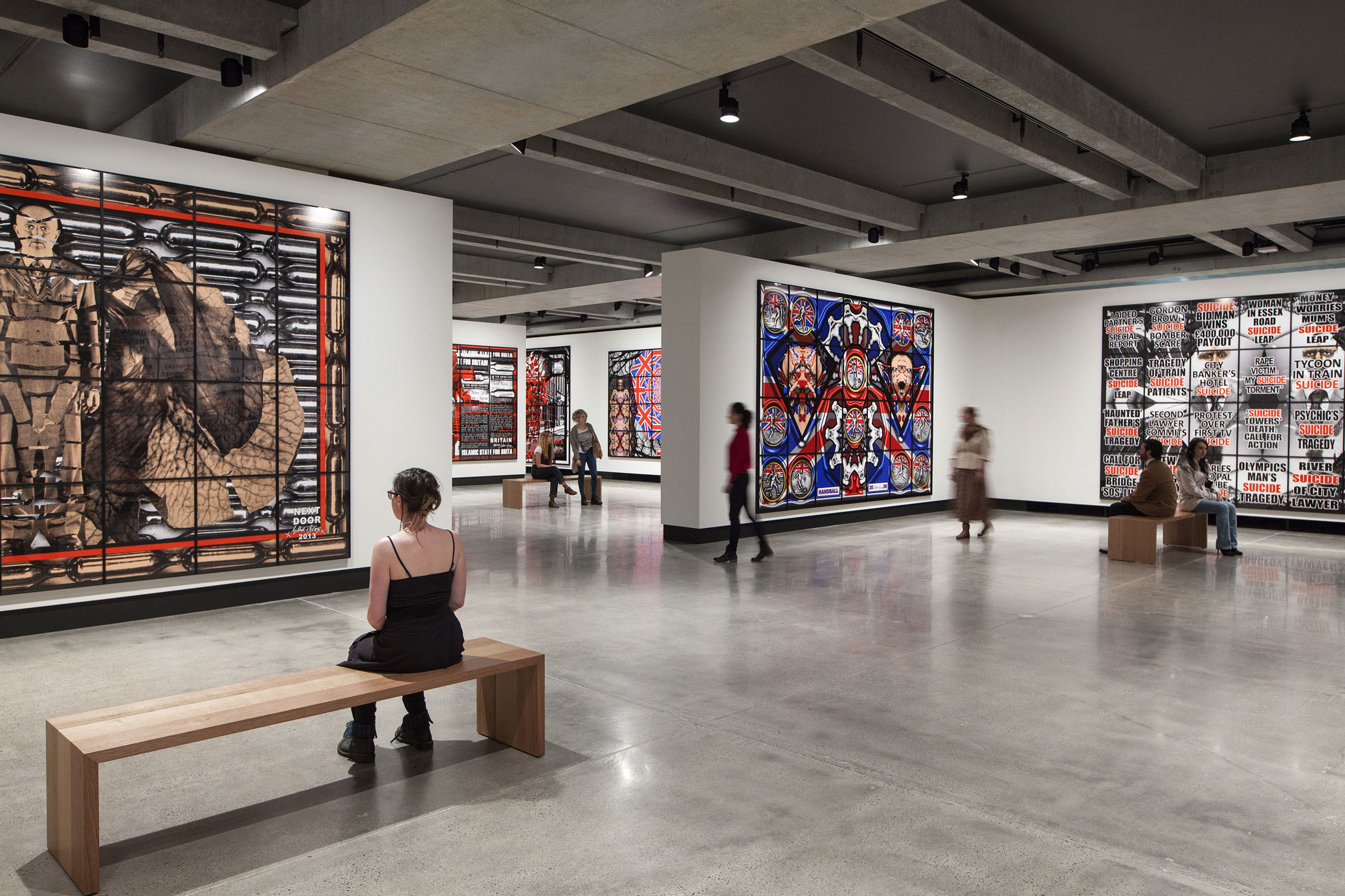
Installation view of the exhibition ‘Gilbert & George: The Art Exhibition’ at the Museum of Old and New Art, Hobart showing at left, 'NEXT DOOR' (2013), in the middle 'HANDBALL' (2008), and at right, 'SUICIDE STRAIGHT' (2011) from 'The London Pictures'


Installation view of the exhibition Gilbert & George: The Art Exhibition at the Museum of Old and New Art, Hobart showing at left, NEXT DOOR (2013), in the middle HANDBALL (2008), and at right, SUICIDE STRAIGHT (2011) from The London Pictures


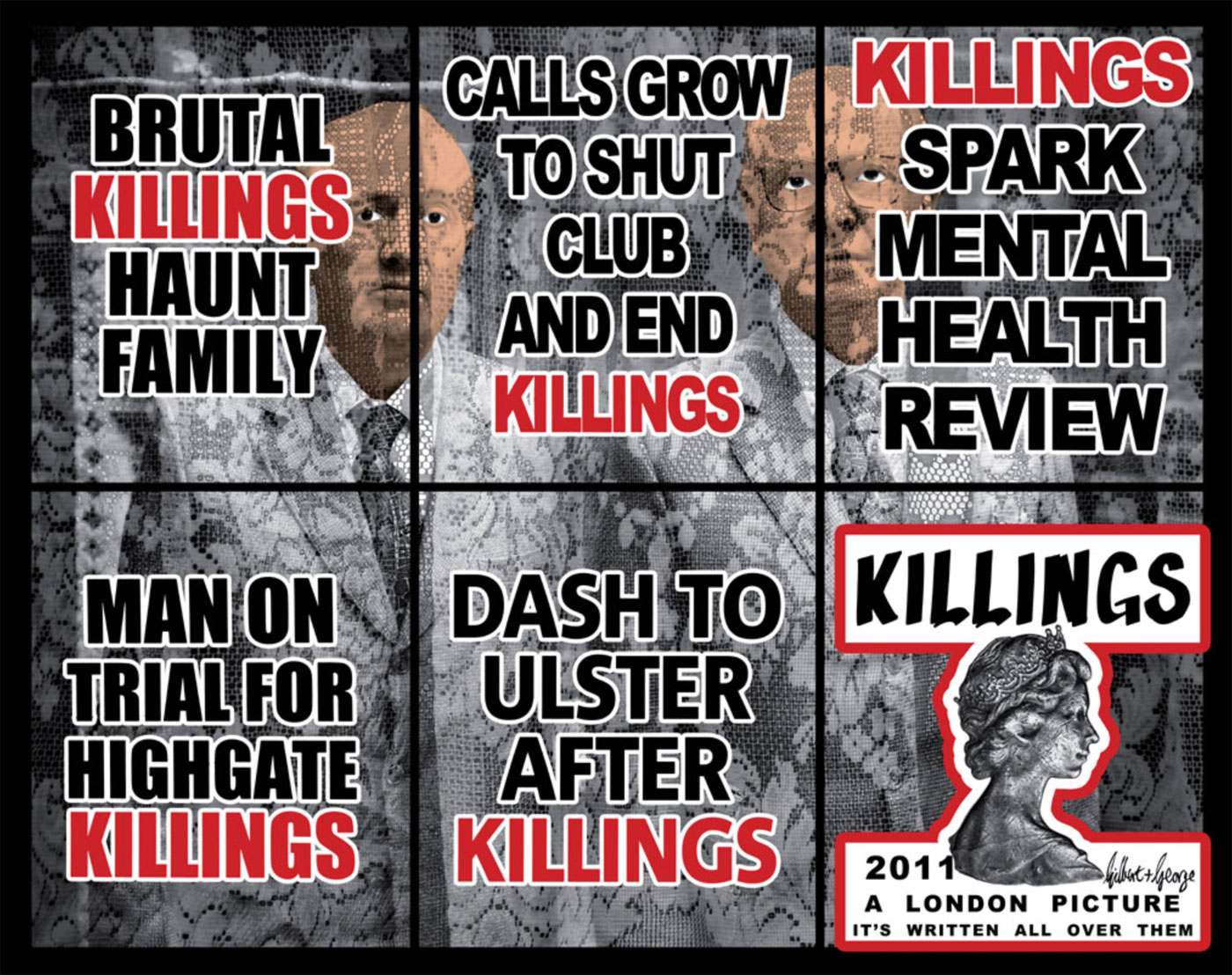
Gilbert & George (Gilbert Prousch, British born Italy, 1943; George Passmore, British, b. 1942) 'KILLERS STRAIGHT' 2011


Gilbert & George (Gilbert Prousch, British born Italy, 1943; George Passmore, British, b. 1942)
KILLERS STRAIGHT
2011
From The London Pictures


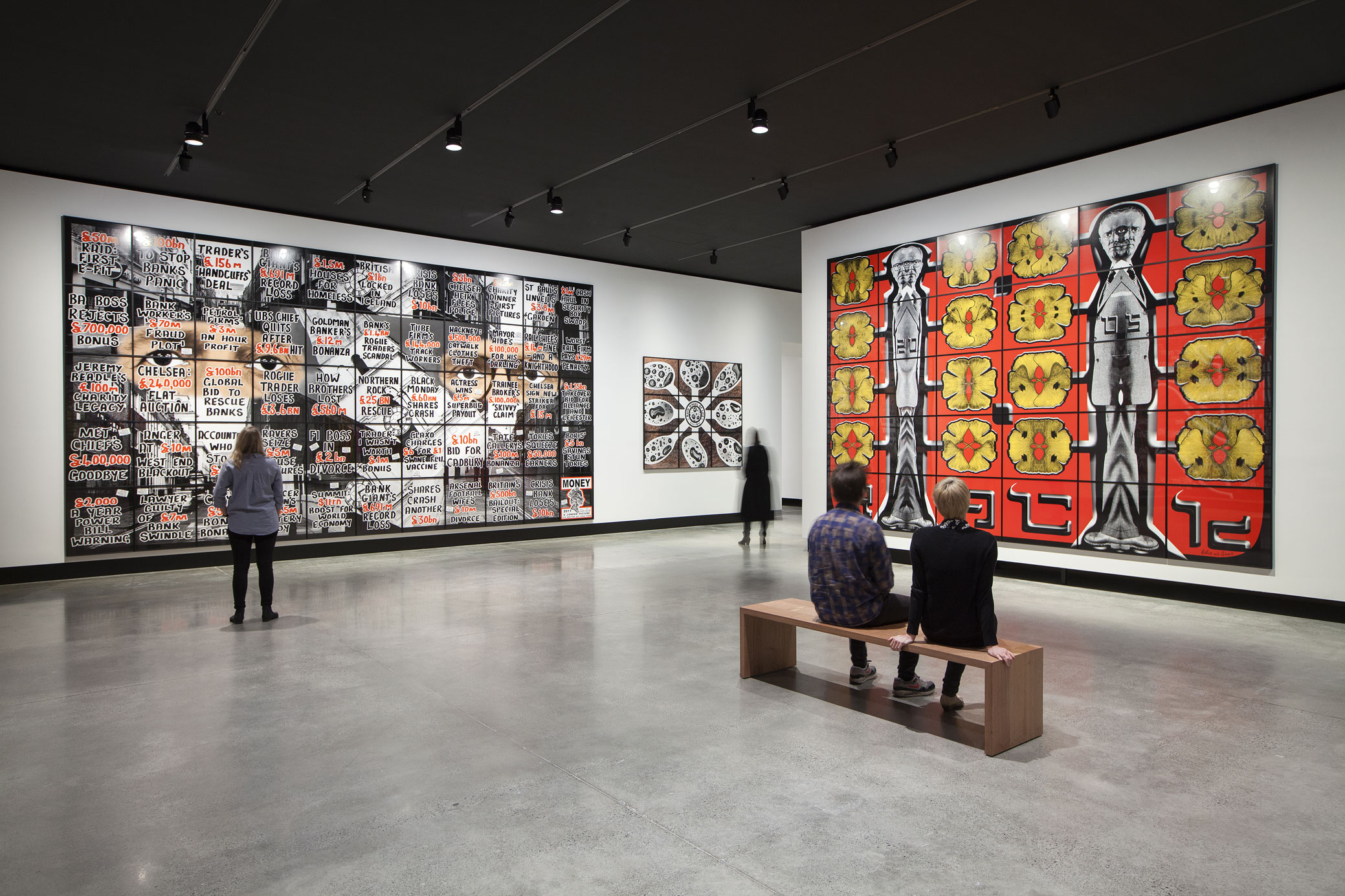
The London Pictures are made up of 292 of the 3,712 newspaper ‘bills’ the pair have doggedly pilfered from outside London newsagents over many years. The pictures present an epic survey of modern urban life in all its volatility, tragedy, absurdity and routine violence. They are Dickensian in scope and ultra-modern in sensibility.

Barry Grayshon. “Gilbert and George – London Photos (2011),” on the Pinterest website [Online] Cited 16/03/2016


Installation view of the exhibition ‘Gilbert & George: The Art Exhibition’ at the Museum of Old and New Art, Hobart showing in the middle 'HANDBALL' (2008), and at right, 'SUICIDE STRAIGHT' (2011) from 'The London Pictures'


Installation view of the exhibition Gilbert & George: The Art Exhibition at the Museum of Old and New Art, Hobart showing in the middle HANDBALL (2008), and at right, SUICIDE STRAIGHT (2011) from The London Pictures


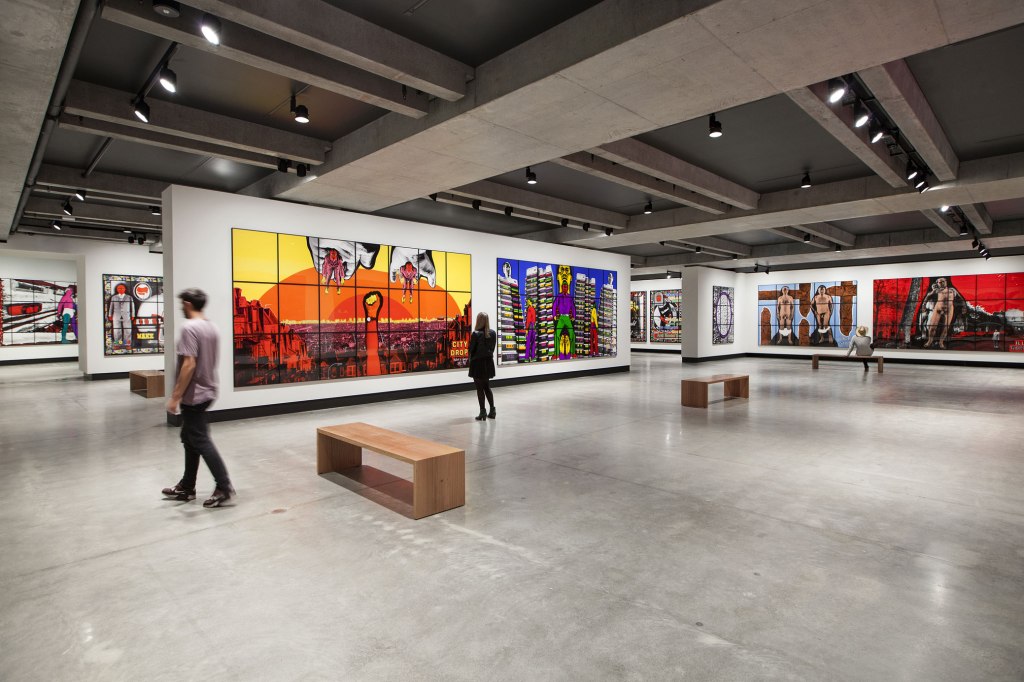
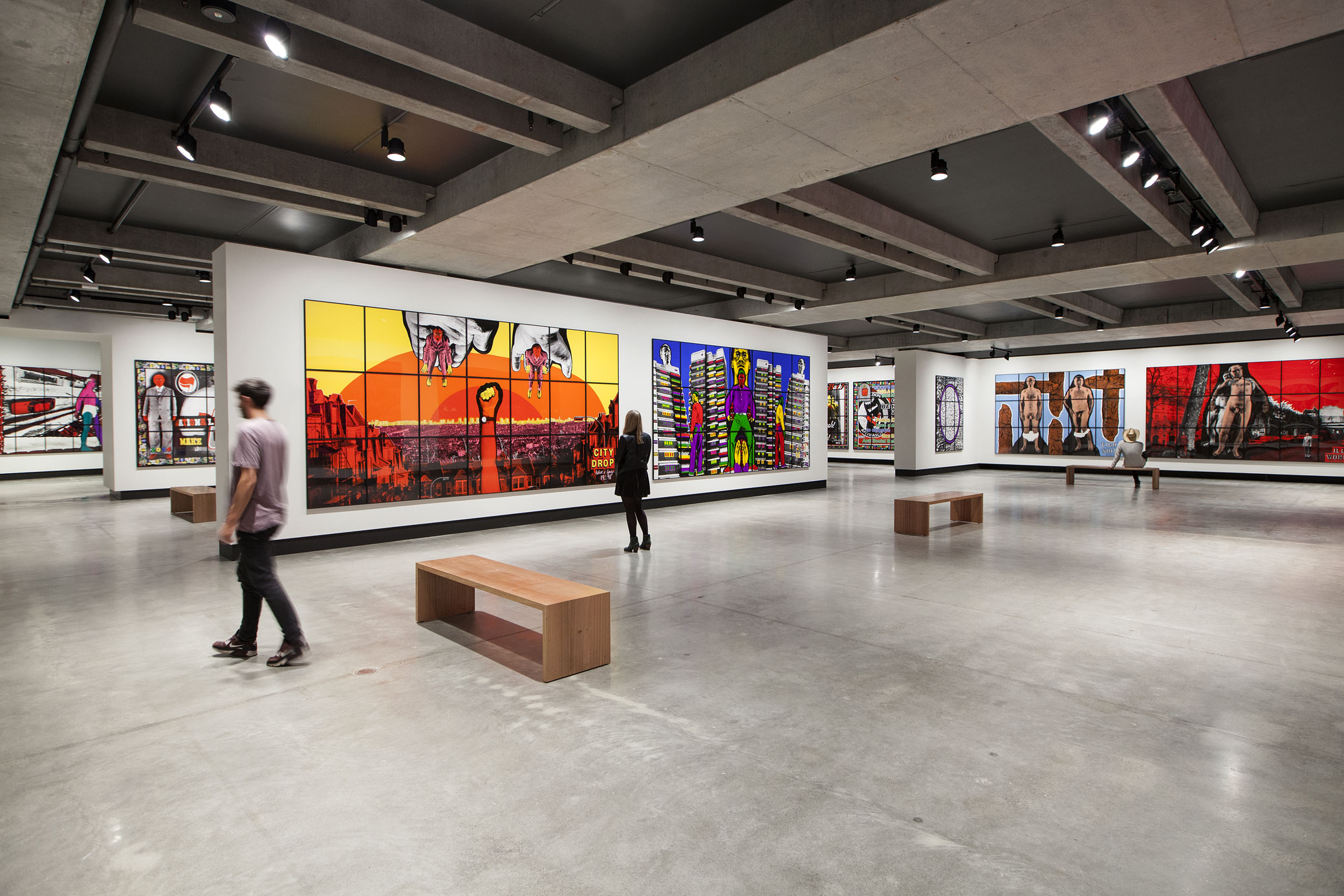
Installation view of the exhibition ‘Gilbert & George: The Art Exhibition’ at the Museum of Old and New Art, Hobart showing from left (large pictures), 'CITY DROP' (1991), 'FLAT MAN' (1991), 'EIGHT SHITS' (1994) and 'ILL WORLD' (1994), both from 'The Naked Shit Pictures'


Installation view of the exhibition Gilbert & George: The Art Exhibition at the Museum of Old and New Art, Hobart showing from left (large pictures), CITY DROP (1991), FLAT MAN (1991), EIGHT SHITS (1994) and ILL WORLD (1994), both from The Naked Shit Pictures


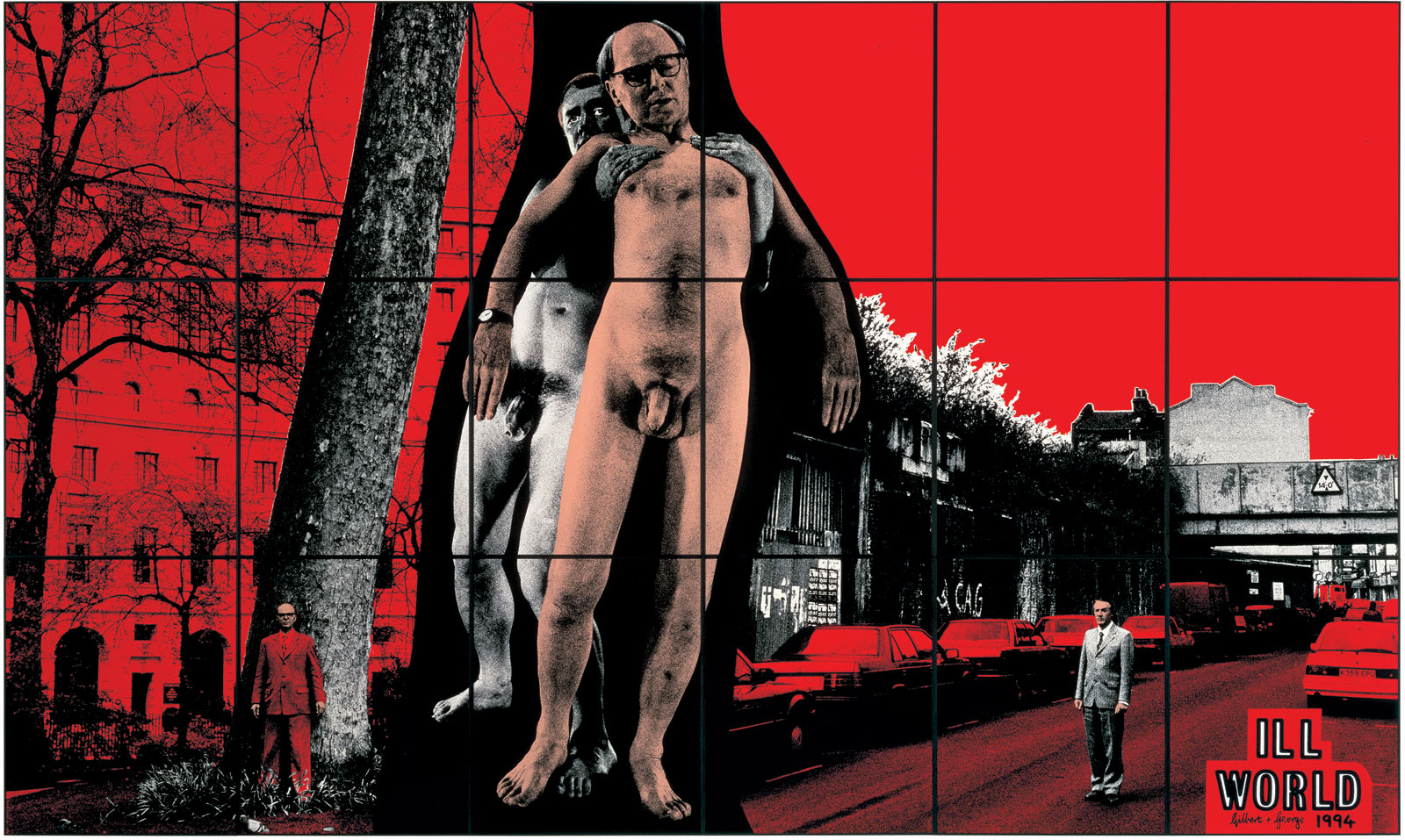
Gilbert & George (Gilbert Prousch, British born Italy, 1943; George Passmore, British, b. 1942) 'ILL WORLD' 1994


Gilbert & George (Gilbert Prousch, British born Italy, 1943; George Passmore, British, b. 1942)
ILL WORLD
1994
Mixed media
253 x 426cm
Courtesy of the artists


The frieze-like composition of The Naked Shit Pictures, with its striking contrasts of scale, was displayed high on the gallery walls. As the title indicates, works in the group depict the artists naked, or semi-dressed, often in conjunction with scaled-up images of faeces. These primary motifs are juxtaposed with urban/parkland scenes, giant anonymous suited bodies and the artists, or set against colour grounds. Marked contrasts in scale are a dominant feature in the series.

Barry Grayshon. “Gilbert and George – The Naked Shit Pictures (1994),” on the Pinterest website [Online] Cited 16/03/2016


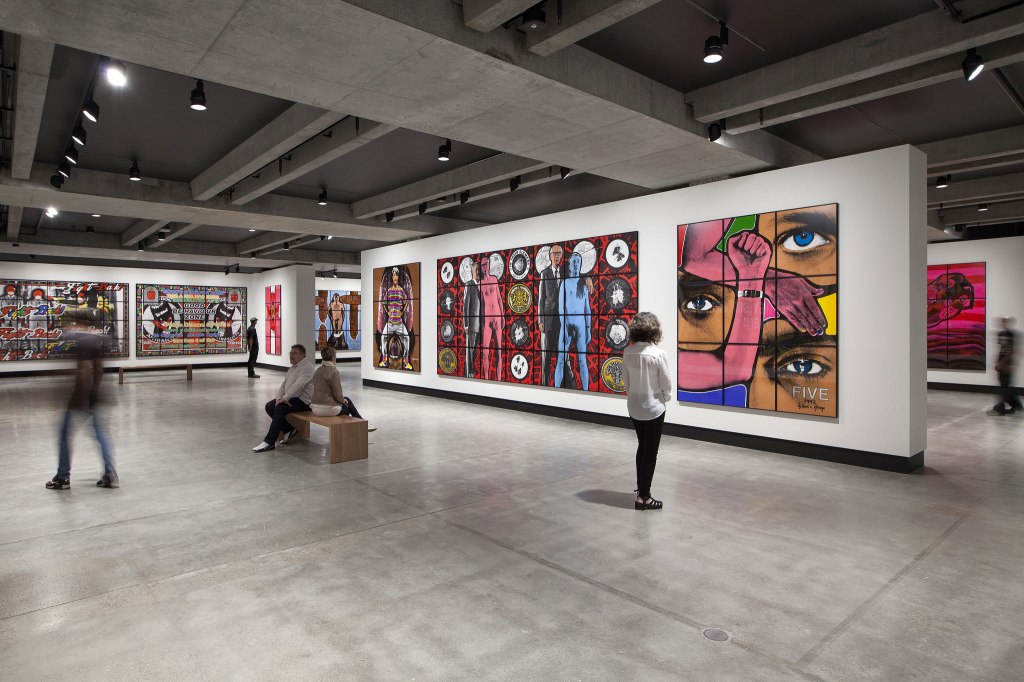
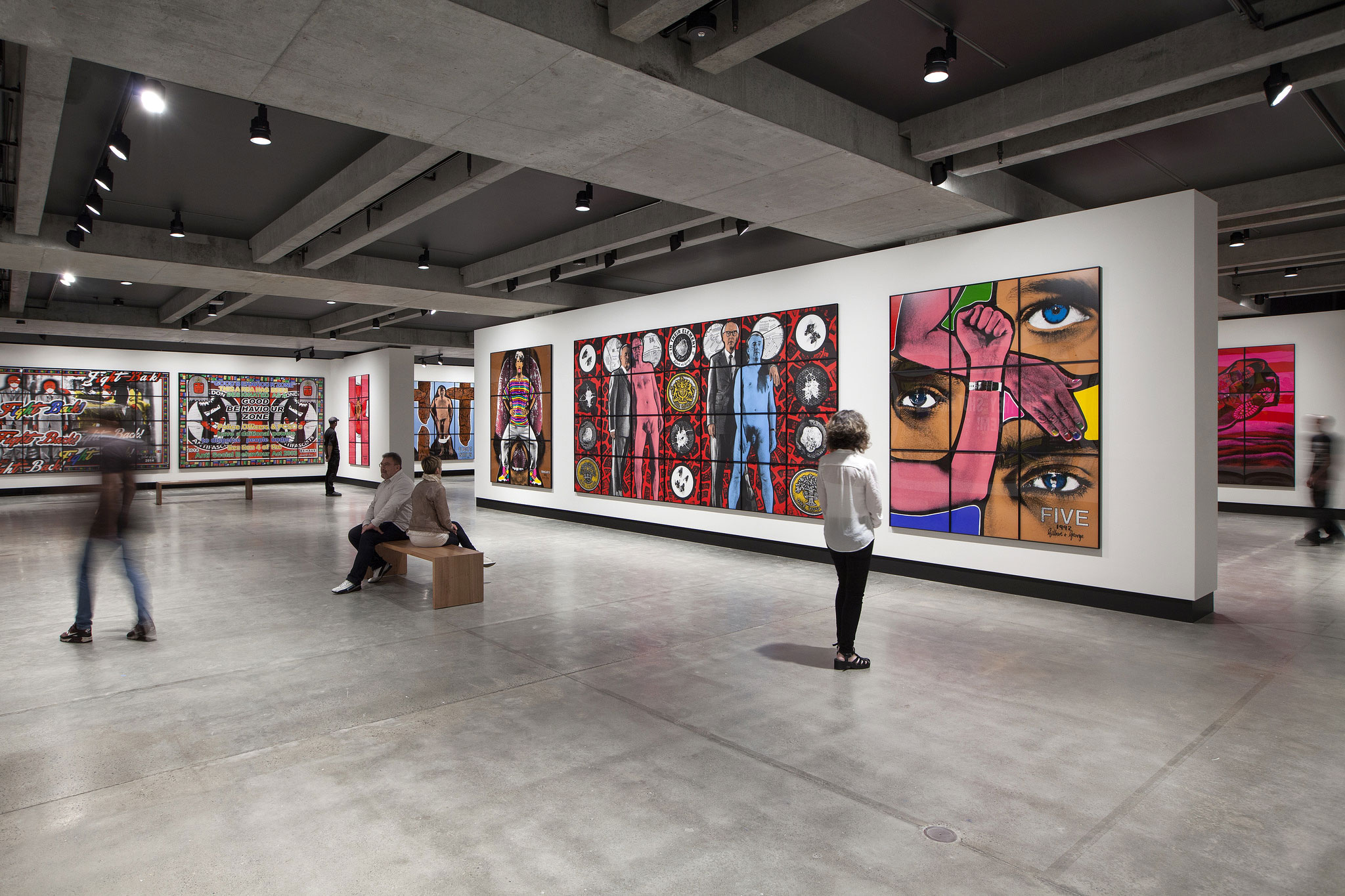
Installation view of the exhibition ‘Gilbert & George: The Art Exhibition’ at the Museum of Old and New Art, Hobart showing at middle, 'IN THEIR ELEMENT' (1998) from the series 'The Rudimentary Pictures' (1998) followed by 'FIVE' (1992)


Installation view of the exhibition Gilbert & George: The Art Exhibition at the Museum of Old and New Art, Hobart showing at middle, IN THEIR ELEMENT (1998) from the series The Rudimentary Pictures (1998) followed by FIVE (1992)


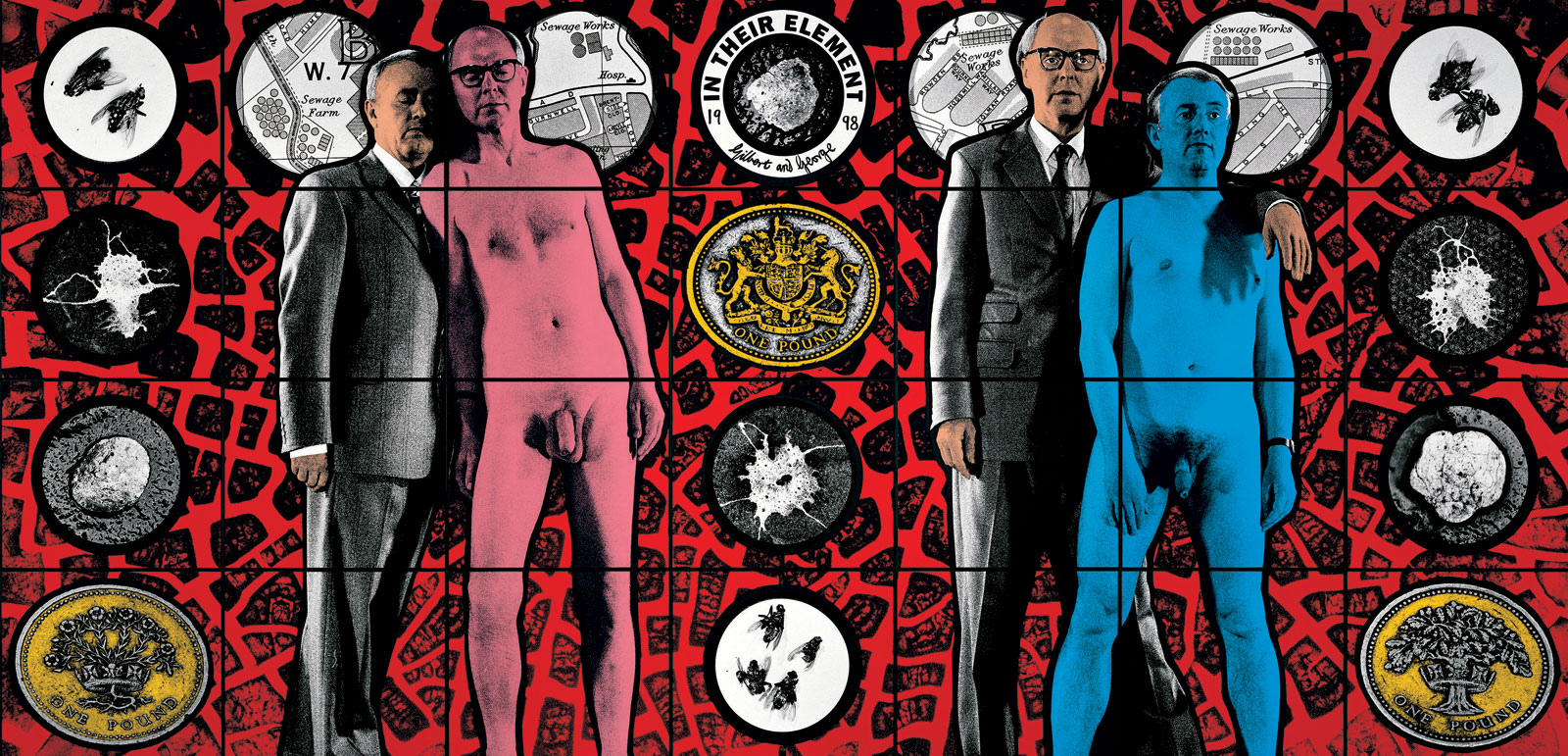
Gilbert & George (Gilbert Prousch, British born Italy, 1943; George Passmore, British, b. 1942) 'IN THEIR ELEMENT' 1988


Gilbert & George (Gilbert Prousch, British born Italy, 1943; George Passmore, British, b. 1942)
IN THEIR ELEMENT
1988
From the series The Rudimentary Pictures
Mixed media
254 x 528 cm
Courtesy of the artists


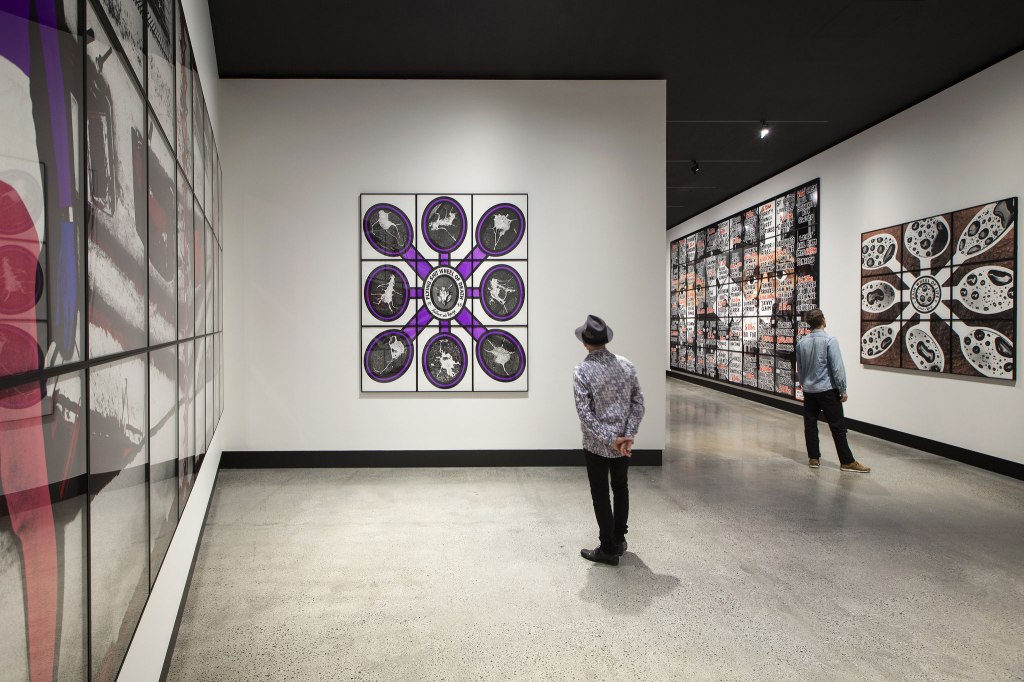
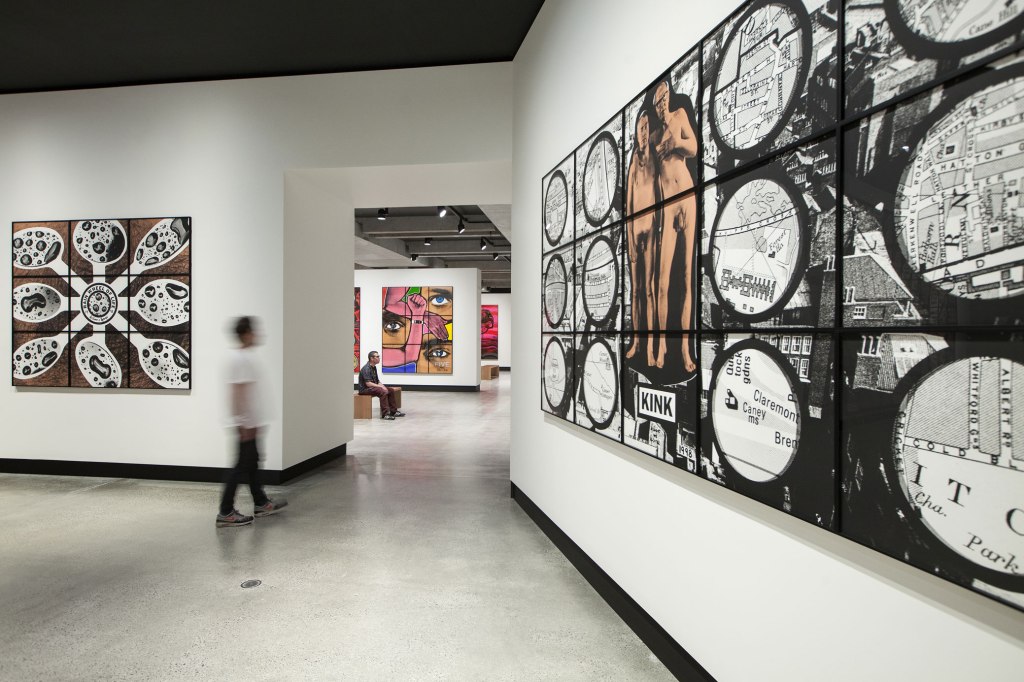
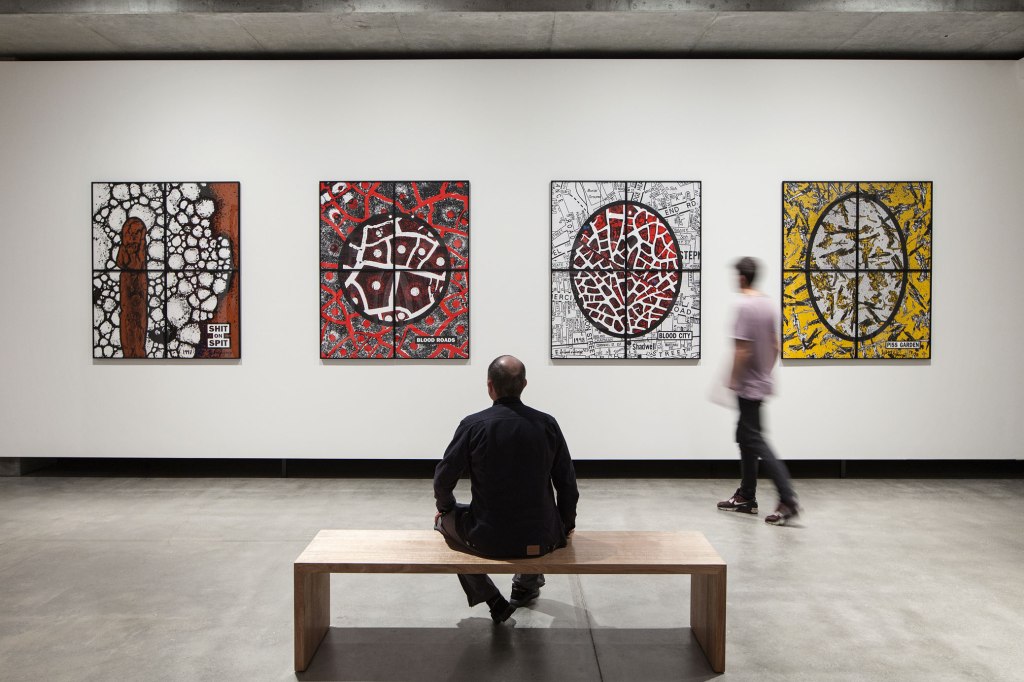
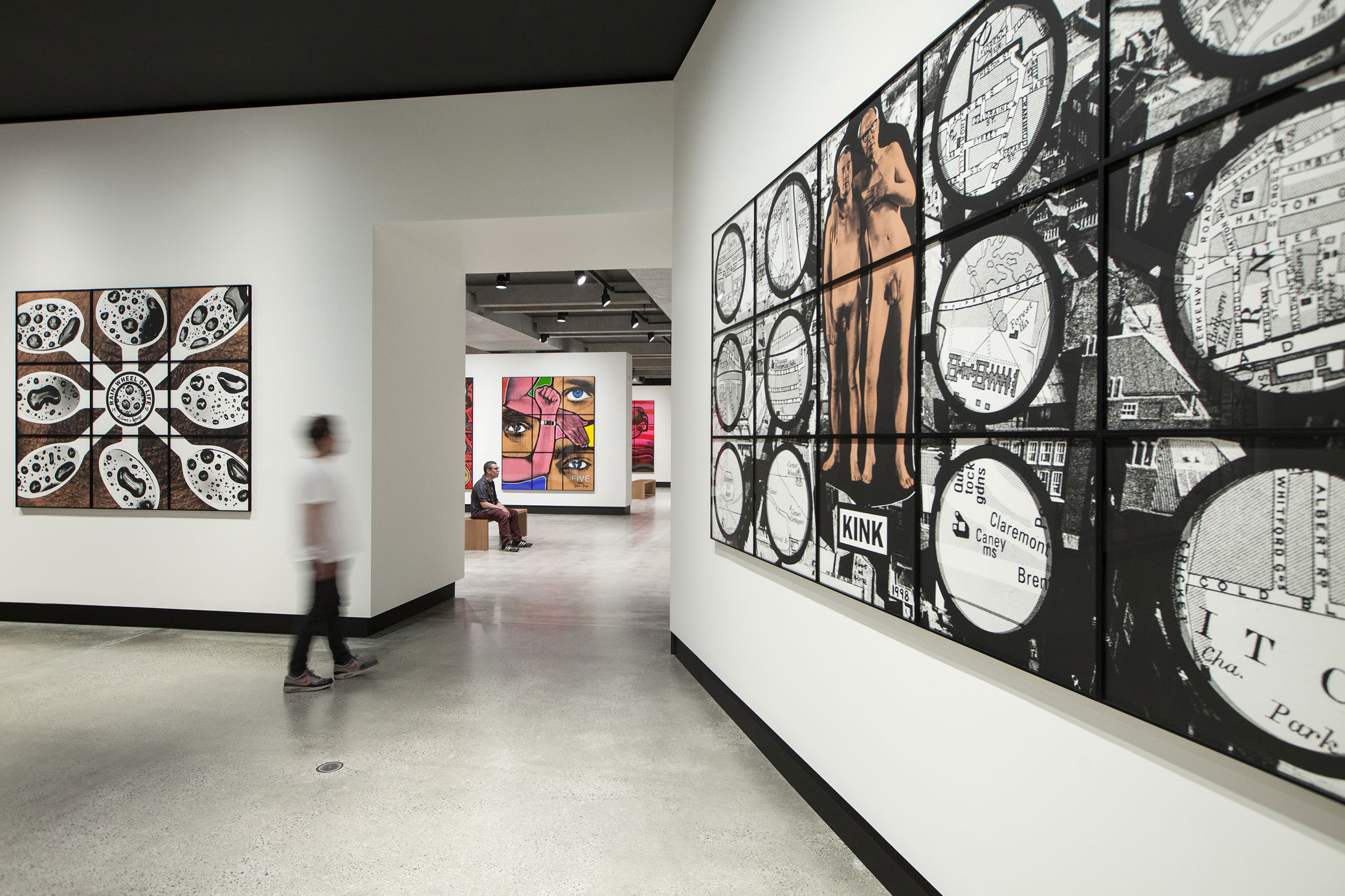
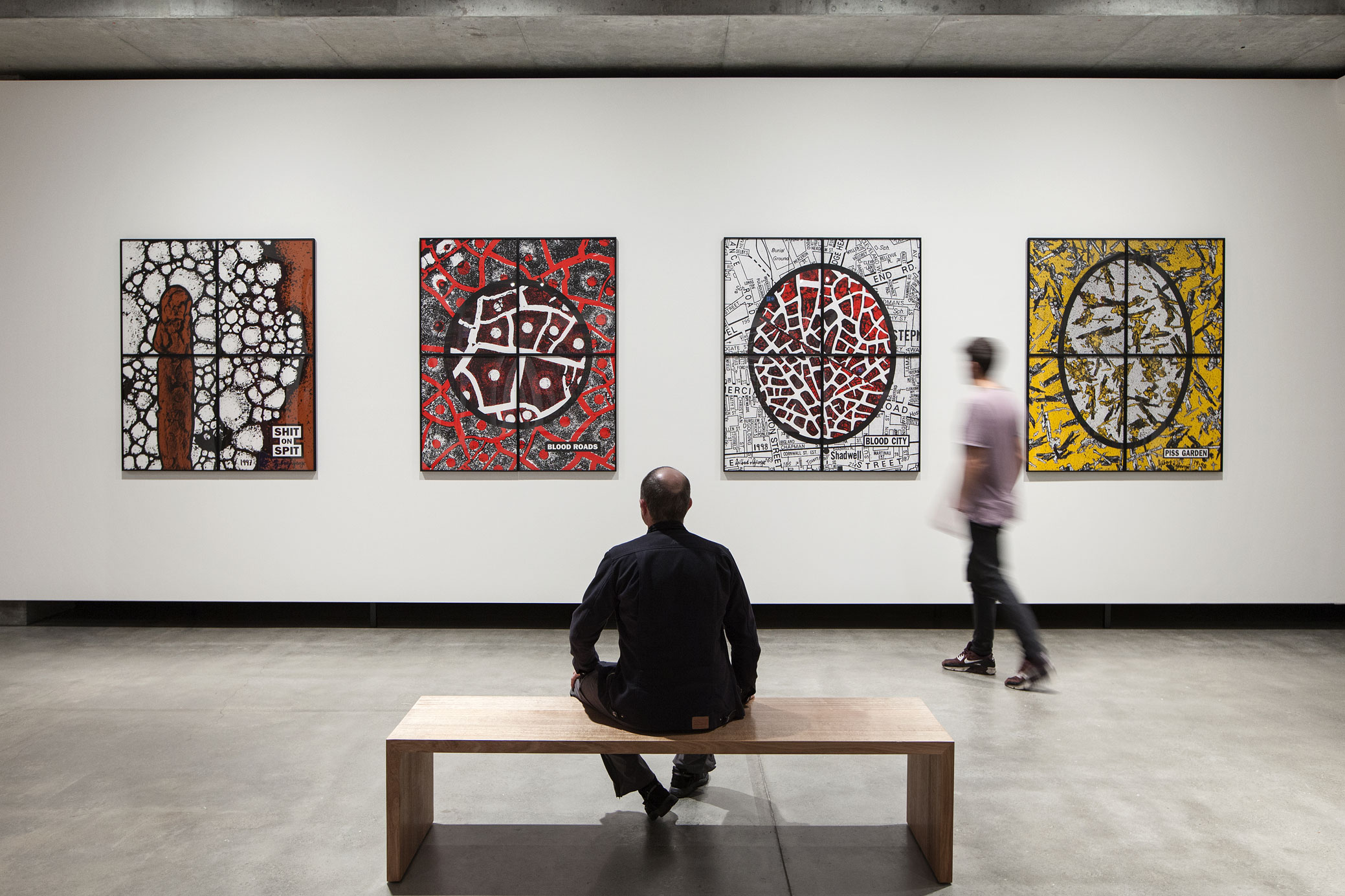
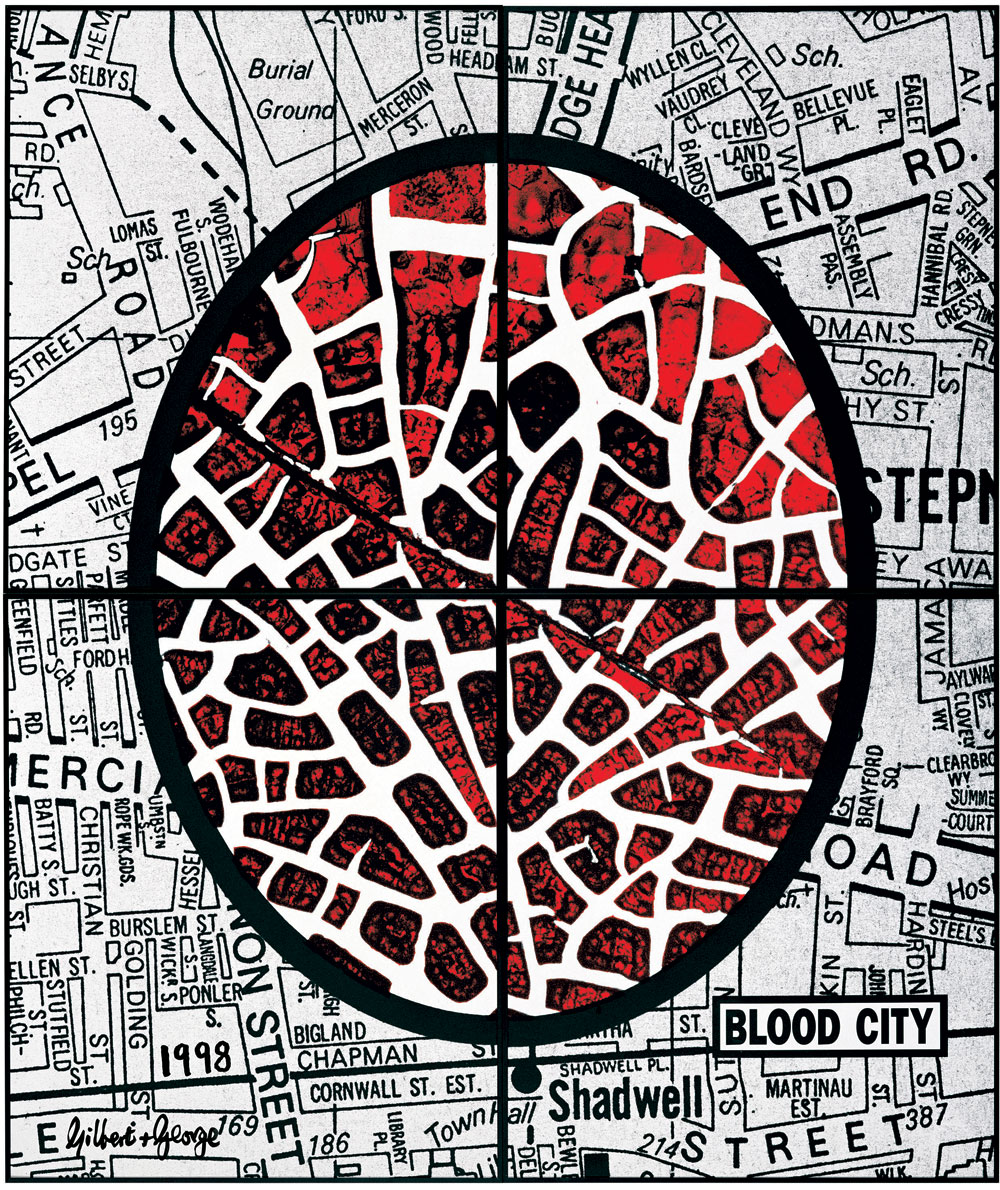
The Rudimentary Pictures, presents thirty-three new works, in which they explore such themes as alienation, sex, race, and human existence. Many of these striking pictures extend the distinctive range of images they have created exploring city life. In Gum City, City Sweat, Money City, Blood City, Piss City, Sex City and Crying City, backgrounds of London street plans are combined with map-like microscopic details of blood, sweat, tears, urine and semen, together with themselves.

Barry Grayshon. “Gilbert and George – The Rudimentary Pictures (1998),” on the Pinterest website [Online] Cited 16/03/2016


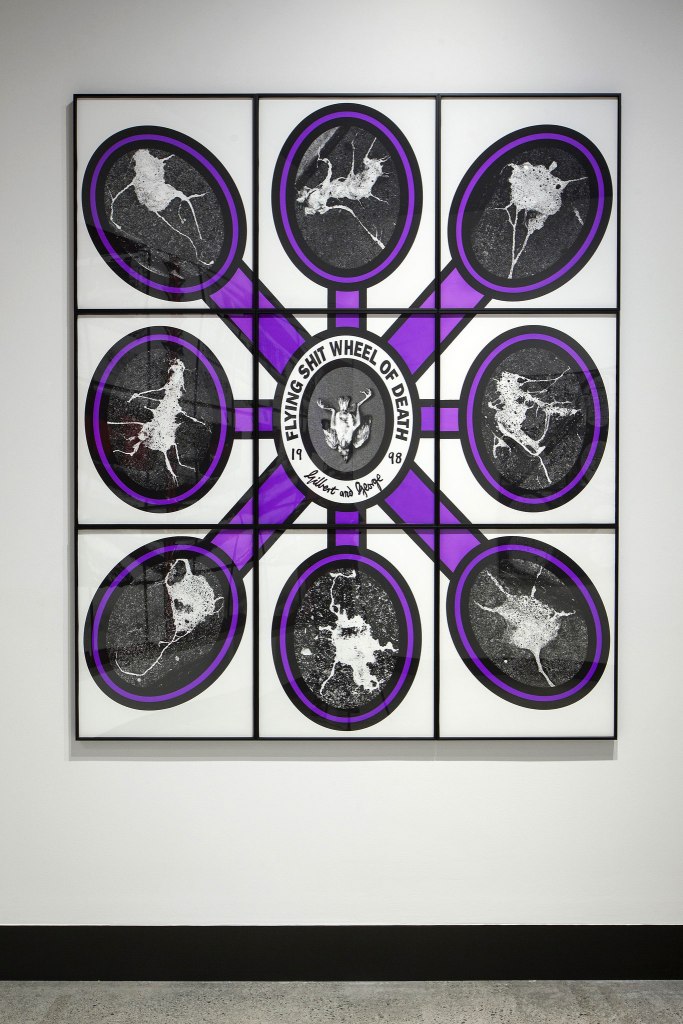
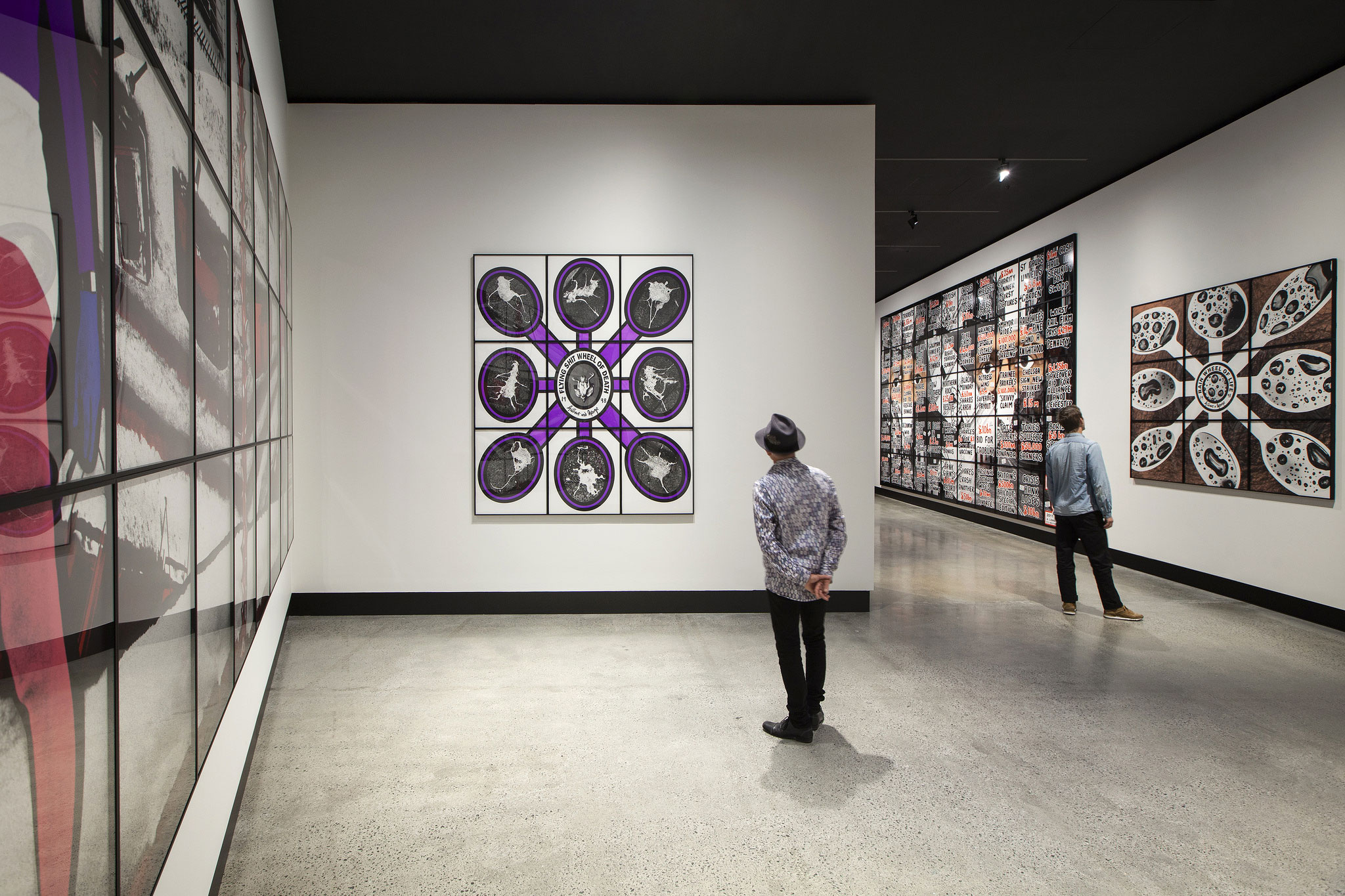
Installation view of the exhibition ‘Gilbert & George: The Art Exhibition’ at the Museum of Old and New Art, Hobart showing at middle, 'FLYING SHIT WHEEL OF DEATH' (1998); and at right, 'RAIN WHEEL OF LIFE' (1998), both from 'The Rudimentary Pictures'


Installation view of the exhibition Gilbert & George: The Art Exhibition at the Museum of Old and New Art, Hobart showing at middle, FLYING SHIT WHEEL OF DEATH (1998) and, at right, RAIN WHEEL OF LIFE (1998), both from The Rudimentary Pictures


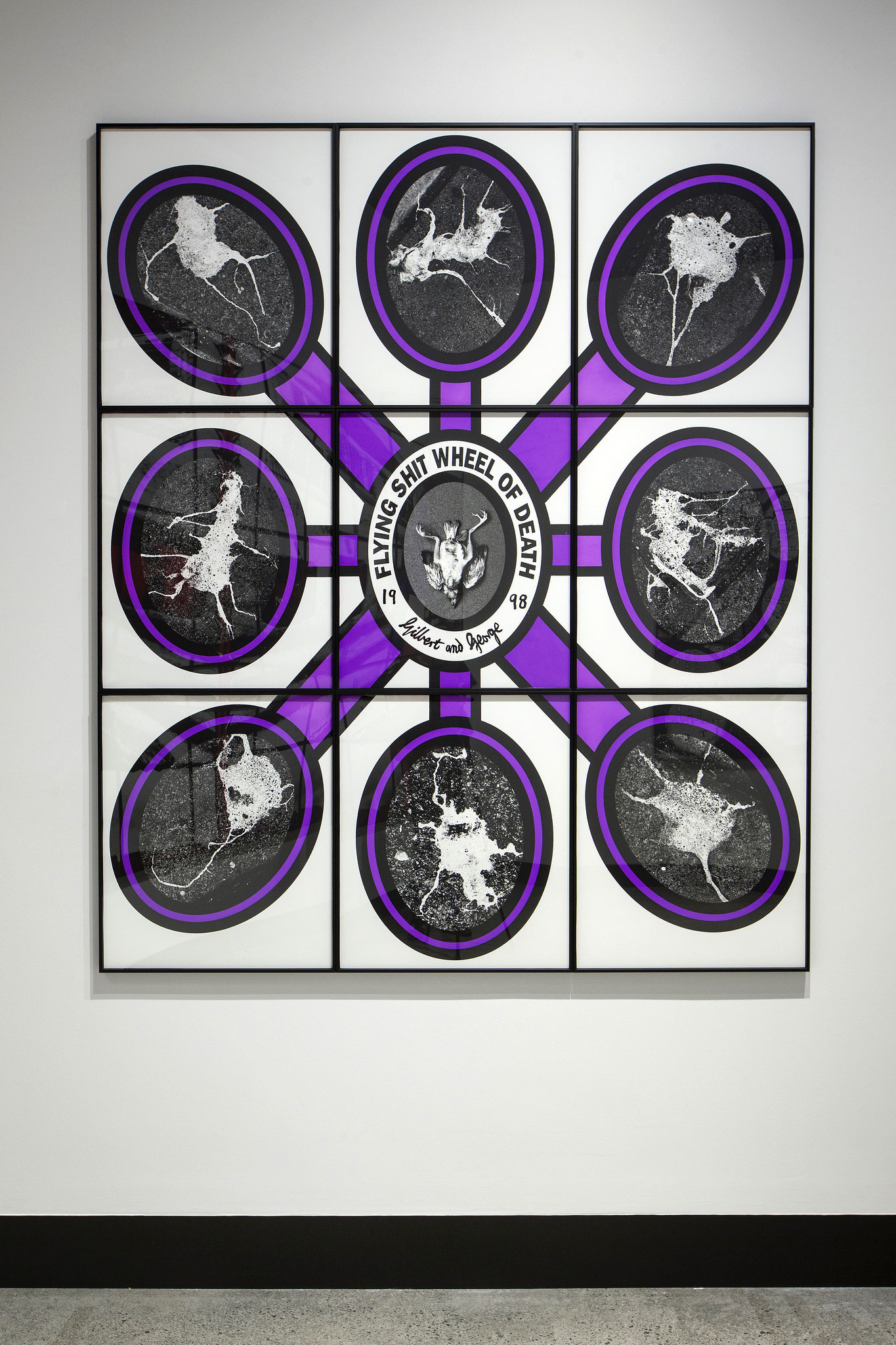
Gilbert & George (Gilbert Prousch, British born Italy, 1943; George Passmore, British, b. 1942) 'FLYING SHIT WHEEL OF DEATH' 1998 (installation view)


Gilbert & George (Gilbert Prousch, British born Italy, 1943; George Passmore, British, b. 1942)
FLYING SHIT WHEEL OF DEATH (installation view)
1998
from the series The Rudimentary Pictures


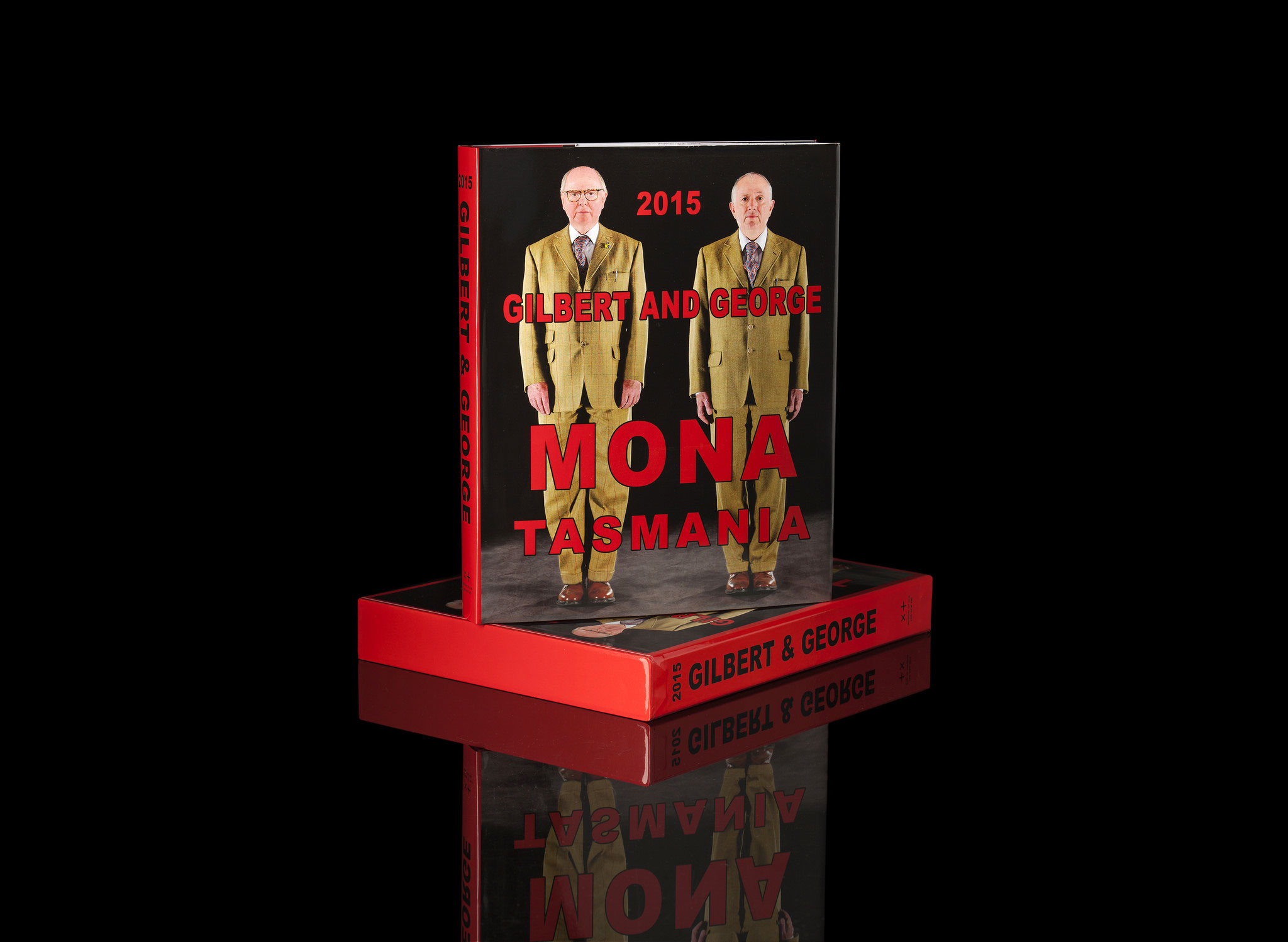
Gilbert & George hardcover catalogue from MONA


Gilbert & George hardcover catalogue
Photo Credit: Mona/Rémi Chauvin
Image Courtesy Mona, Museum of Old and New Art, Hobart, Tasmania, Australia


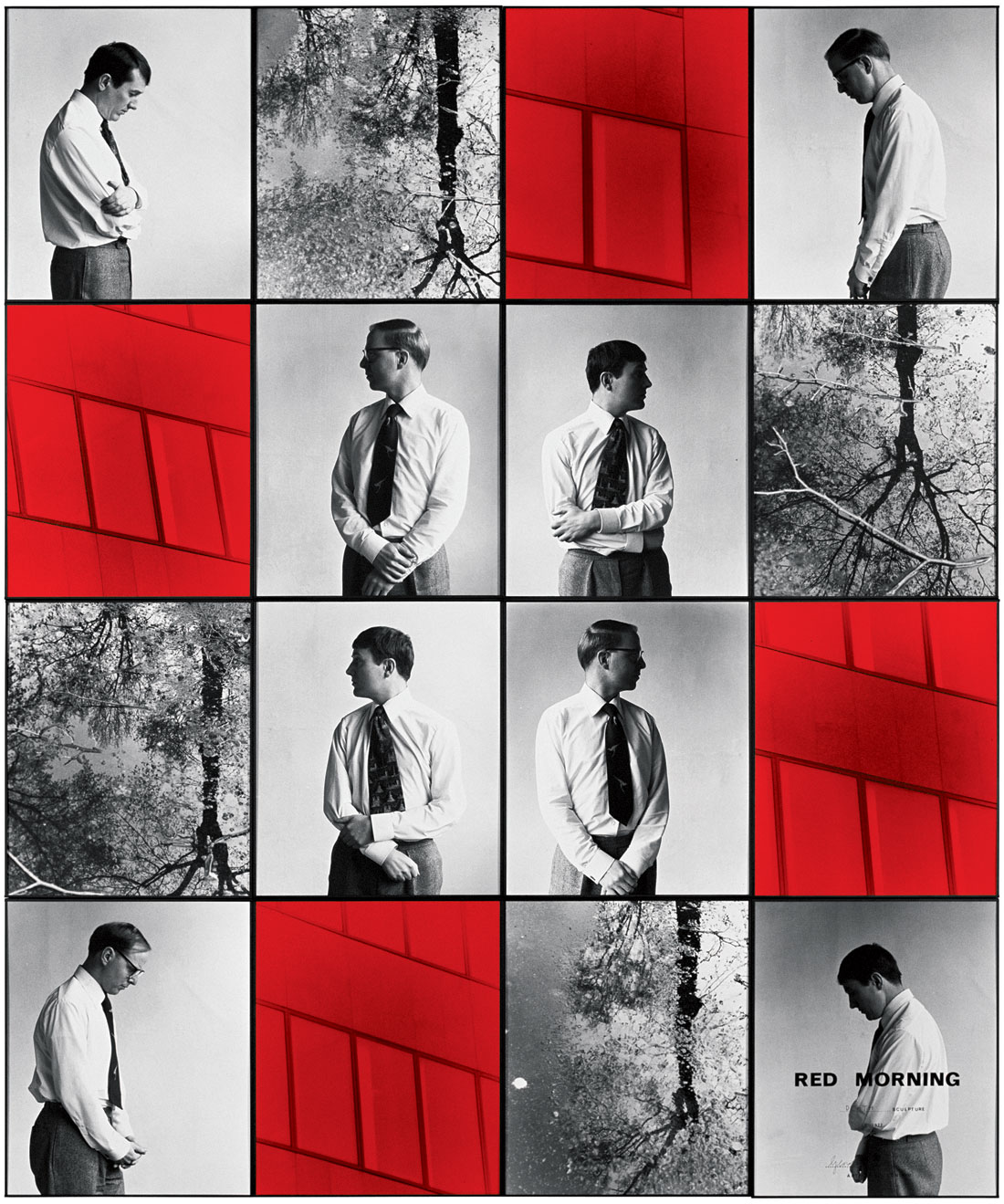
Gilbert & George (Gilbert Prousch, British born Italy, 1943; George Passmore, British, b. 1942) 'RED MORNING DEATH' 1977


Gilbert & George (Gilbert Prousch, British born Italy, 1943; George Passmore, British, b. 1942)
RED MORNING DEATH
1977
Mixed media
241 x 201cm
Private collection


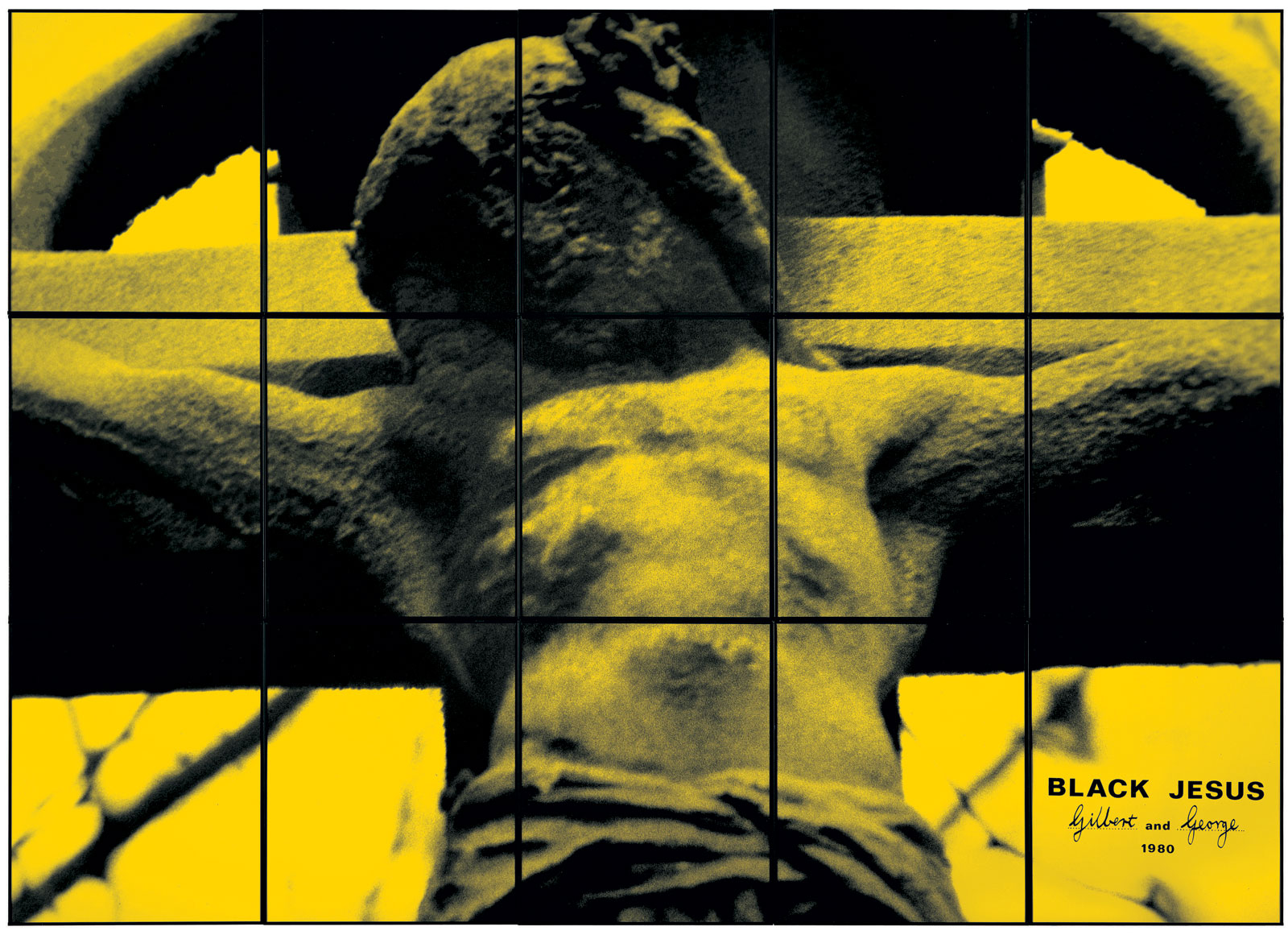
Gilbert & George (Gilbert Prousch, British born Italy, 1943; George Passmore, British, b. 1942) 'BLACK JESUS' 1980


Gilbert & George (Gilbert Prousch, British born Italy, 1943; George Passmore, British, b. 1942)
BLACK JESUS
1980
Mixed media
181 x 251cm
Private collection


In the early 1980s, Gilbert & George began to add a range of bright colours to their photographic images. They dramatically expanded their palette although black & white still remained. The series of photo-pieces that emerge during this vibrant period display a heightened reality, moving away from the earlier naturalism. They also began photographing each other as gargoyles, producing large close-ups of their faces, lit from below, grimacing horribly.

Barry Grayshon. “Gilbert and George – Mixed Media (1980),” on the Pinterest website [Online] Cited 16/03/2016


“… In a show as vast as the MONA survey, one sees the shit pictures as only a small chapter in their catalogue of would-be outrages. There are microscopic close-ups of their own sweat, blood, piss and sperm, presented as a form of decorative art. There are galleries of handsome young men, lined up like homoerotic altarpieces. There are works that excoriate religion – all forms of religion – and nationalism.

It would be an understatement to say these works sail close to the edge – they have plunged joyously over the precipice, beyond any conventions of good or bad taste. The “moral dimension” Gilbert & George seek is a systematic attempt to explode everything they see as false morality and hypocrisy. Homophobia is a constant target, as is racism and religious dogmatism. They are not the first to see organised religion as the root of all evil, but few artists or thinkers have been so consistently, so violently anti-religious.

The joke, of course, is that they look and act like conservative businessmen. Even their most confronting works are as bold and colourful as advertising billboards, or perhaps stained glass windows. They are iconoclastic non-entities making art that attracts and repels.

From behind a façade of consummate Englishness they set out to expose the grossness and depravity of the world around them. The Jack Freak Pictures (2008) use images of the Union Jack combined with grotesque morphings of their own figures that make them look like demons or mutants. The London Pictures (2011) use hundreds of daily newspaper banners, purloined from newsagents, to produce a chorus of sordidness and sensationalism.

We see two deadpan comedians enjoying the adolescent humour of exposing themselves to an audience, making wall-sized images of all those things not spoken of in ‘polite’ society. I could almost accept the idea of Gilbert & George as two overgrown children, intent on making mischief, but every so often they hit the mark with surprising force.”

John McDonald. “Gilbert & George,” on the John McDonald website December 4, 2015 [Online] Cited 11/03/2016.


Installation view of the exhibition ‘Gilbert & George: The Art Exhibition’ at the Museum of Old and New Art, Hobart showing at left, 'MONEY' (2011) from 'The London Pictures' and, at right, 'Raack' (2005) from 'Ginkgo Pictures'


Installation view of the exhibition Gilbert & George: The Art Exhibition at the Museum of Old and New Art, Hobart showing at left, MONEY (2011) from The London Pictures and, at right, Raack (2005) from Ginkgo Pictures


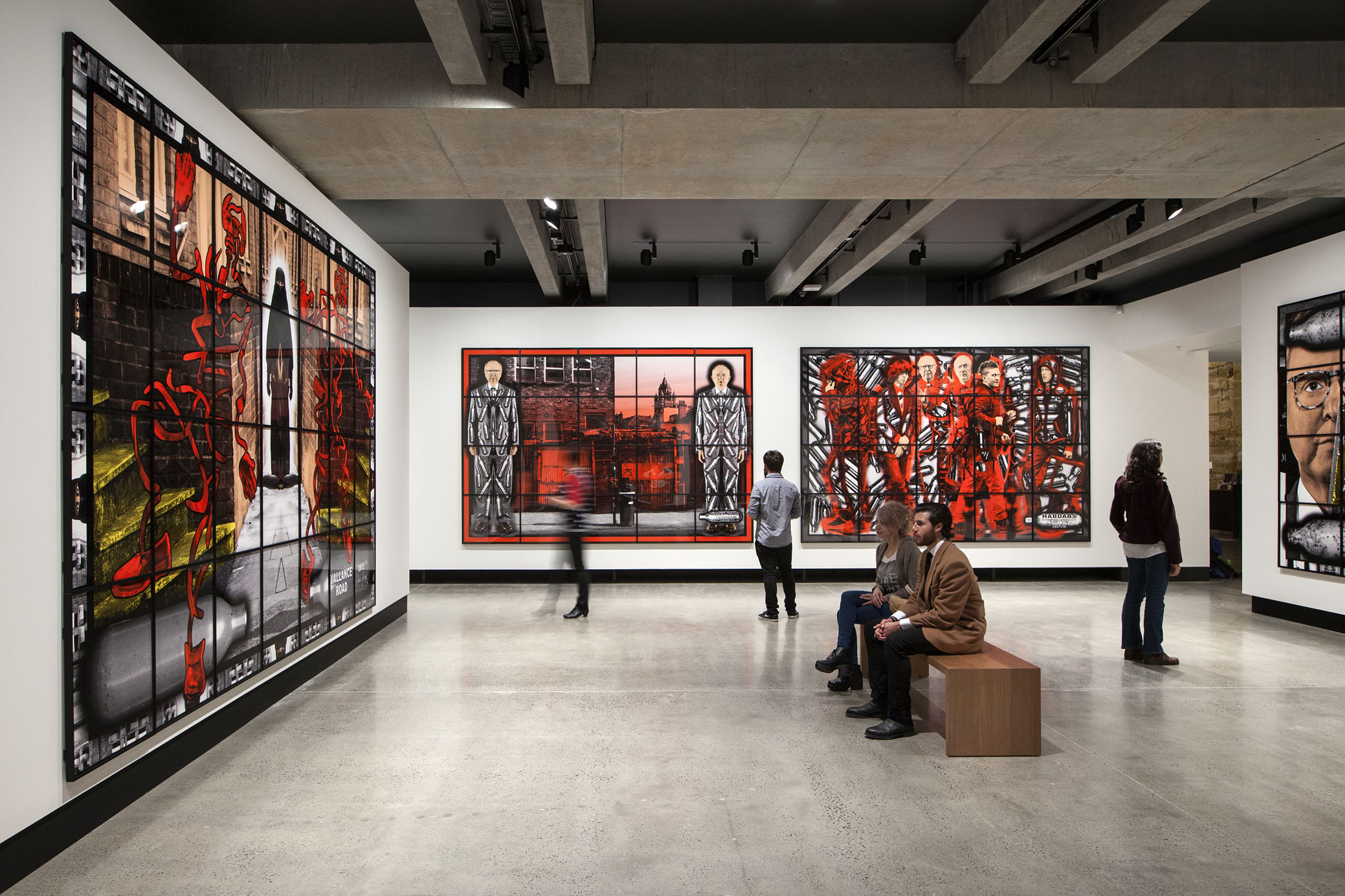
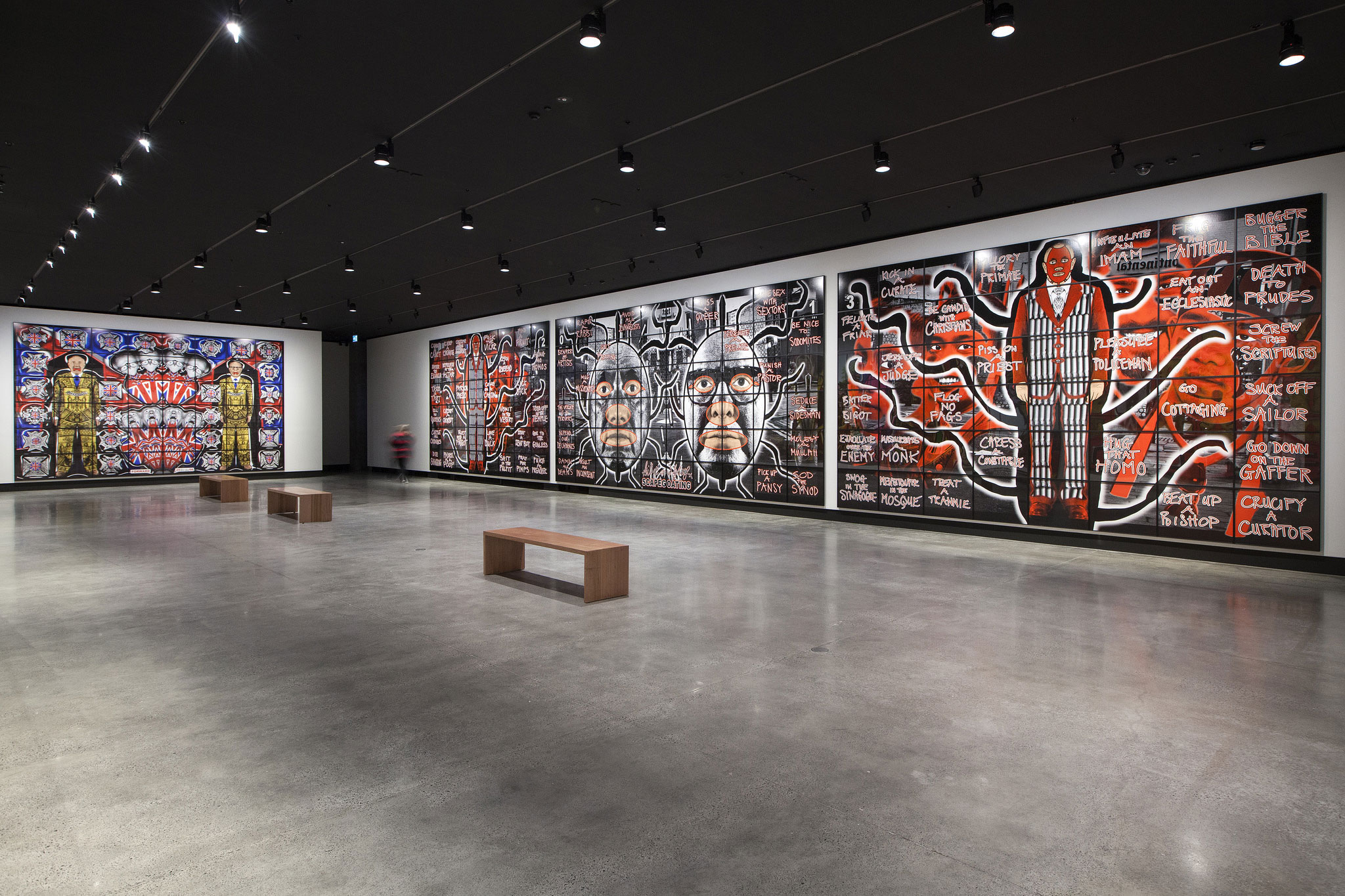
Installation view of the exhibition ‘Gilbert & George: The Art Exhibition’ at the Museum of Old and New Art, Hobart showing at left, 'VALLANCE ROAD' (2013); at centre left 'RIDLEY ROAD' (2013) and at centre right 'HABDABS' (2013) all from the series 'Scapegoating Pictures'


Installation view of the exhibition Gilbert & George: The Art Exhibition at the Museum of Old and New Art, Hobart showing at left, VALLANCE ROAD (2013); at centre left RIDLEY ROAD (2013) and at centre right HABDABS (2013) all from the series Scapegoating Pictures


There are 292 pieces in this series featuring whippets and hippy crack (laughing gas). The SCAPEGOATING PICTURES unflinchingly describe the volatile, tense, accelerated and mysterious reality of our increasingly technological, multi-faith and multi-cultural world. It is a world in which paranoia, fundamentalism, surveillance, religion, accusation and victimhood become moral shades of the city’s temper.

Barry Grayshon. “Gilbert and George – Scapegoating Pictures for London (2013),” on the Pinterest website [Online] Cited 16/03/2016


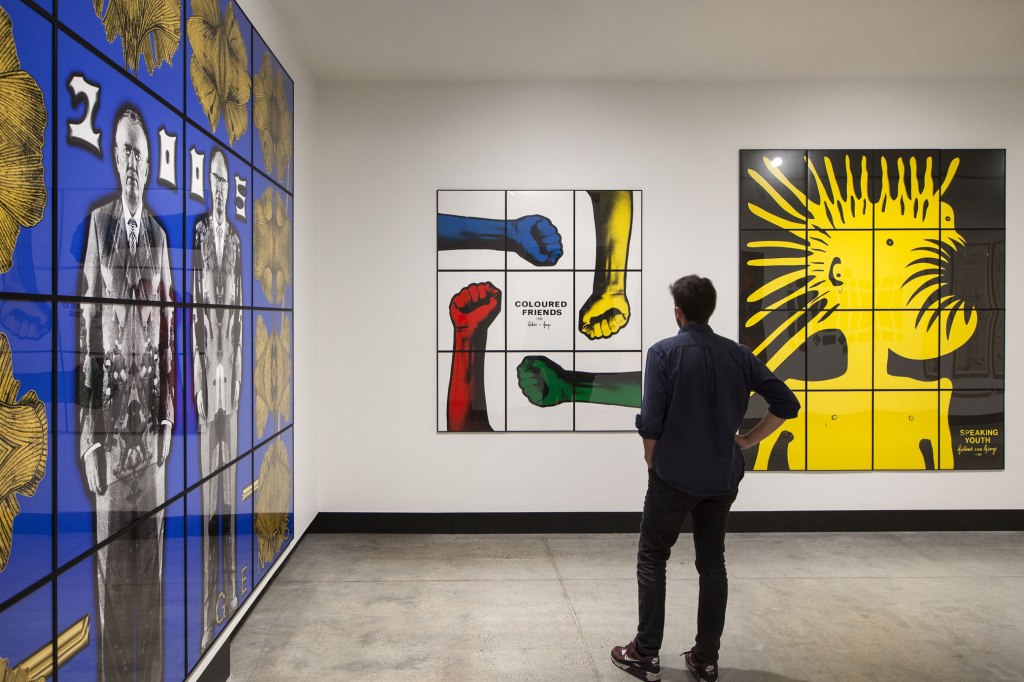
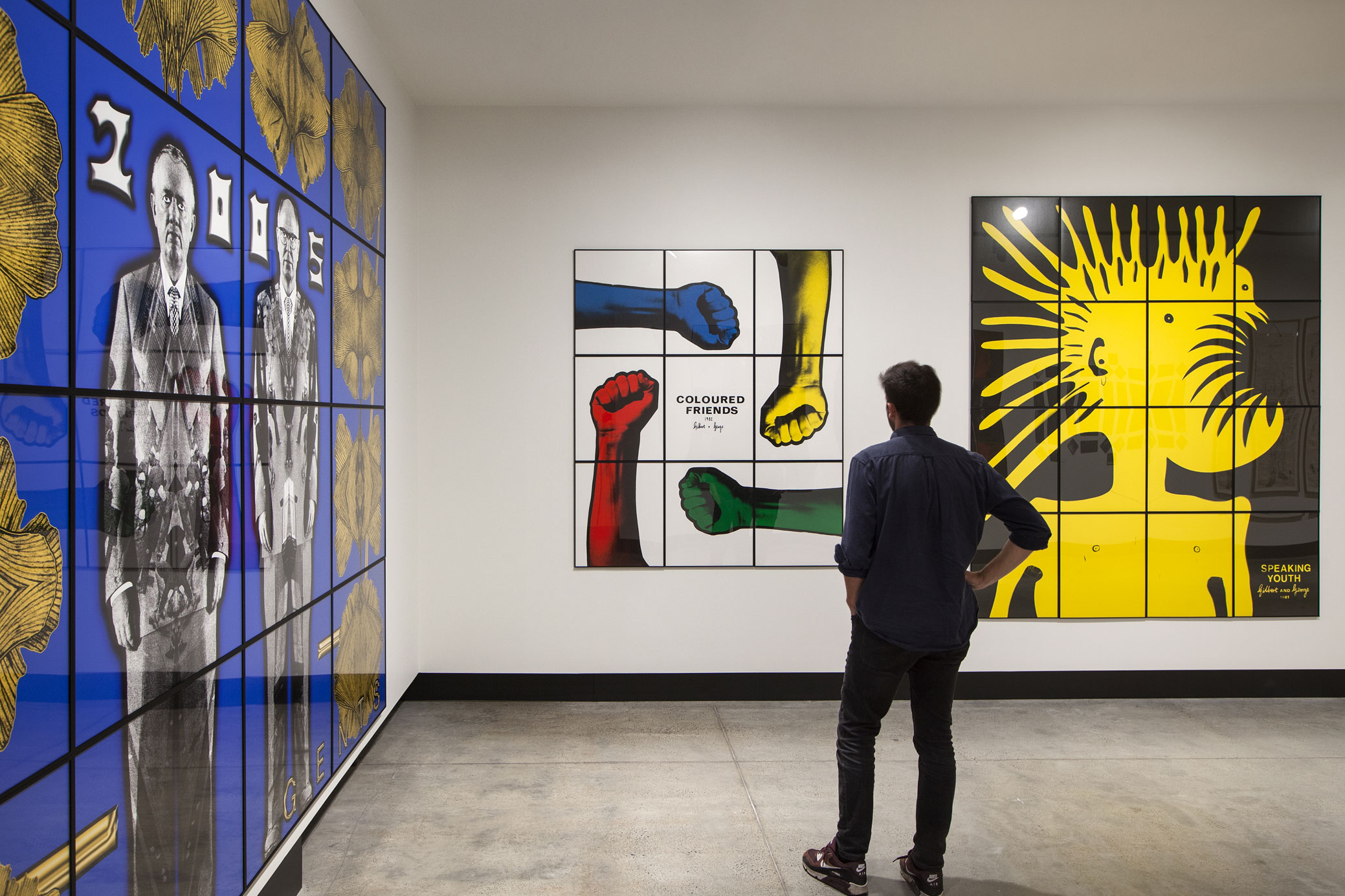
Installation view of the exhibition ‘Gilbert & George: The Art Exhibition’ at the Museum of Old and New Art, Hobart showing at left, 'Citied Gents' (2005) from 'Ginkgo Pictures'; at left rear, 'COLOURED FRIENDS' (1982); and at right rear 'SPEAKING YOUTH' (1981)


Installation view of the exhibition Gilbert & George: The Art Exhibition at the Museum of Old and New Art, Hobart showing at left, Citied Gents (2005) from Ginkgo Pictures; at left rear, COLOURED FRIENDS (1982); and at right rear SPEAKING YOUTH (1981)


Installation view of the exhibition ‘Gilbert & George: The Art Exhibition’ at the Museum of Old and New Art, Hobart showing at left, 'RAIN WHEEL OF LIFE' (1998), and at right 'KINK' (1998), both from 'The Rudimentary Pictures'


Installation view of the exhibition Gilbert & George: The Art Exhibition at the Museum of Old and New Art, Hobart showing at left, RAIN WHEEL OF LIFE (1998), and at right KINK (1998), both from The Rudimentary Pictures


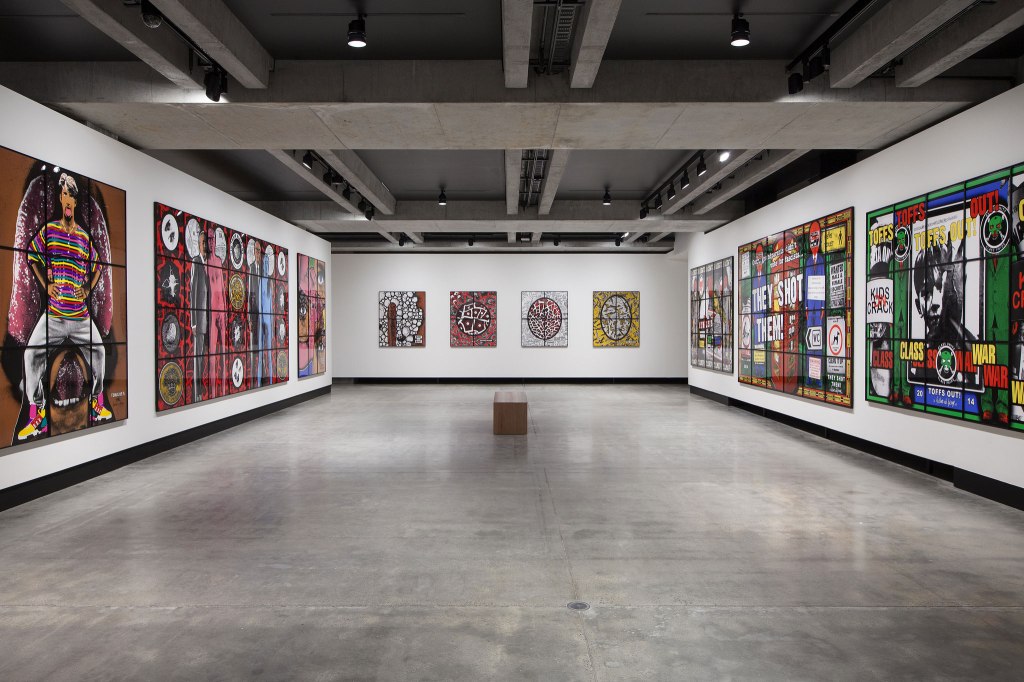
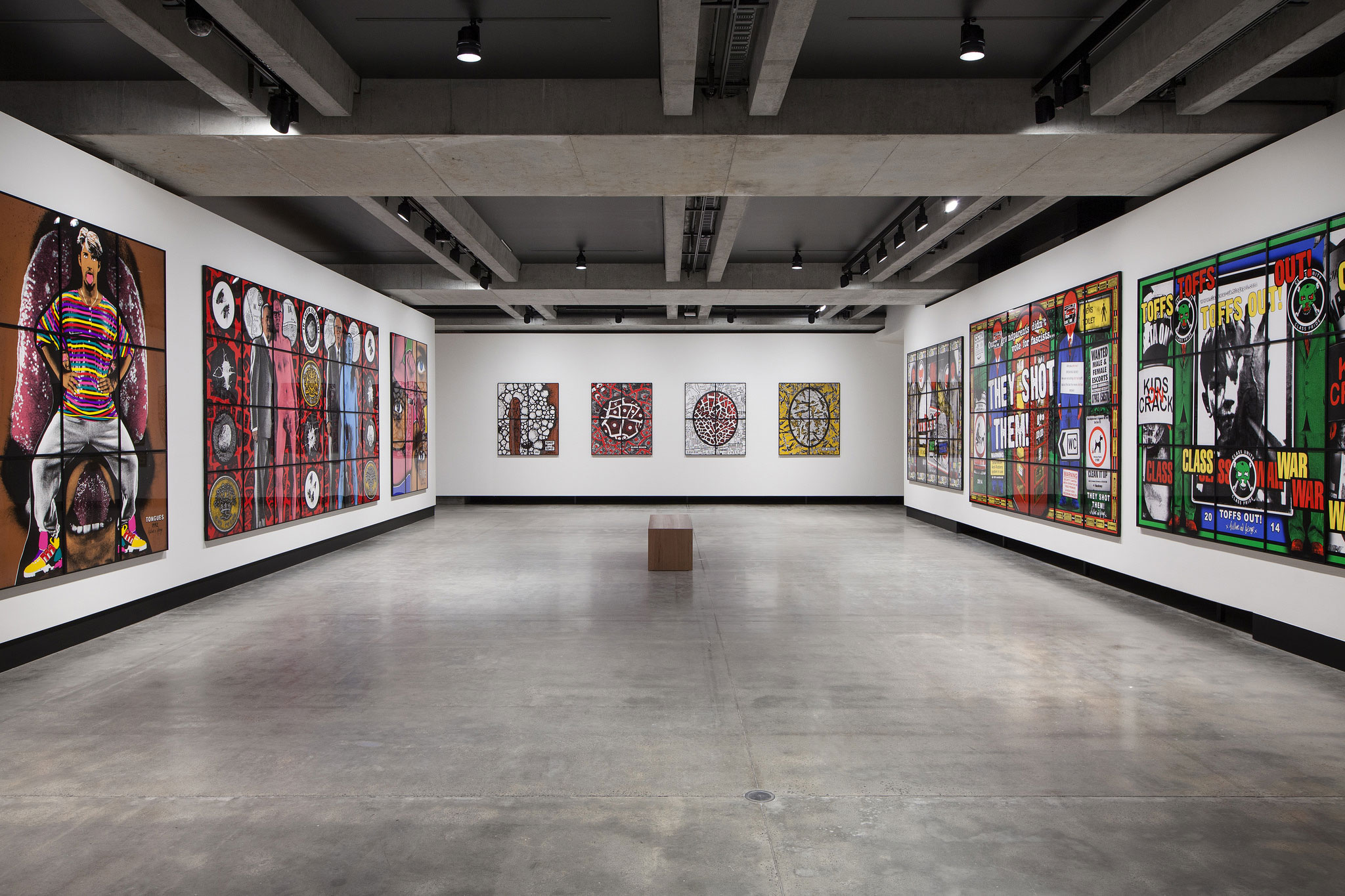
Installation view of the exhibition ‘Gilbert & George: The Art Exhibition’ at the Museum of Old and New Art, Hobart showing at left, 'TONGUES' (1992) followed by 'IN THEIR ELEMENT' (1998) from the series 'The Rudimentary Pictures' followed by 'FIVE' (1992); to the right 'TOFF'S OUT!' (2014) followed by 'THEY SHOT THEM!' (2014), both from the series 'Utopian Pictures'


Installation view of the exhibition Gilbert & George: The Art Exhibition at the Museum of Old and New Art, Hobart showing at left, TONGUES (1992) followed by IN THEIR ELEMENT (1998) from the series The Rudimentary Pictures followed by FIVE (1992); to the right TOFF’S OUT! (2014) followed by THEY SHOT THEM! (2014), both from the series Utopian Pictures


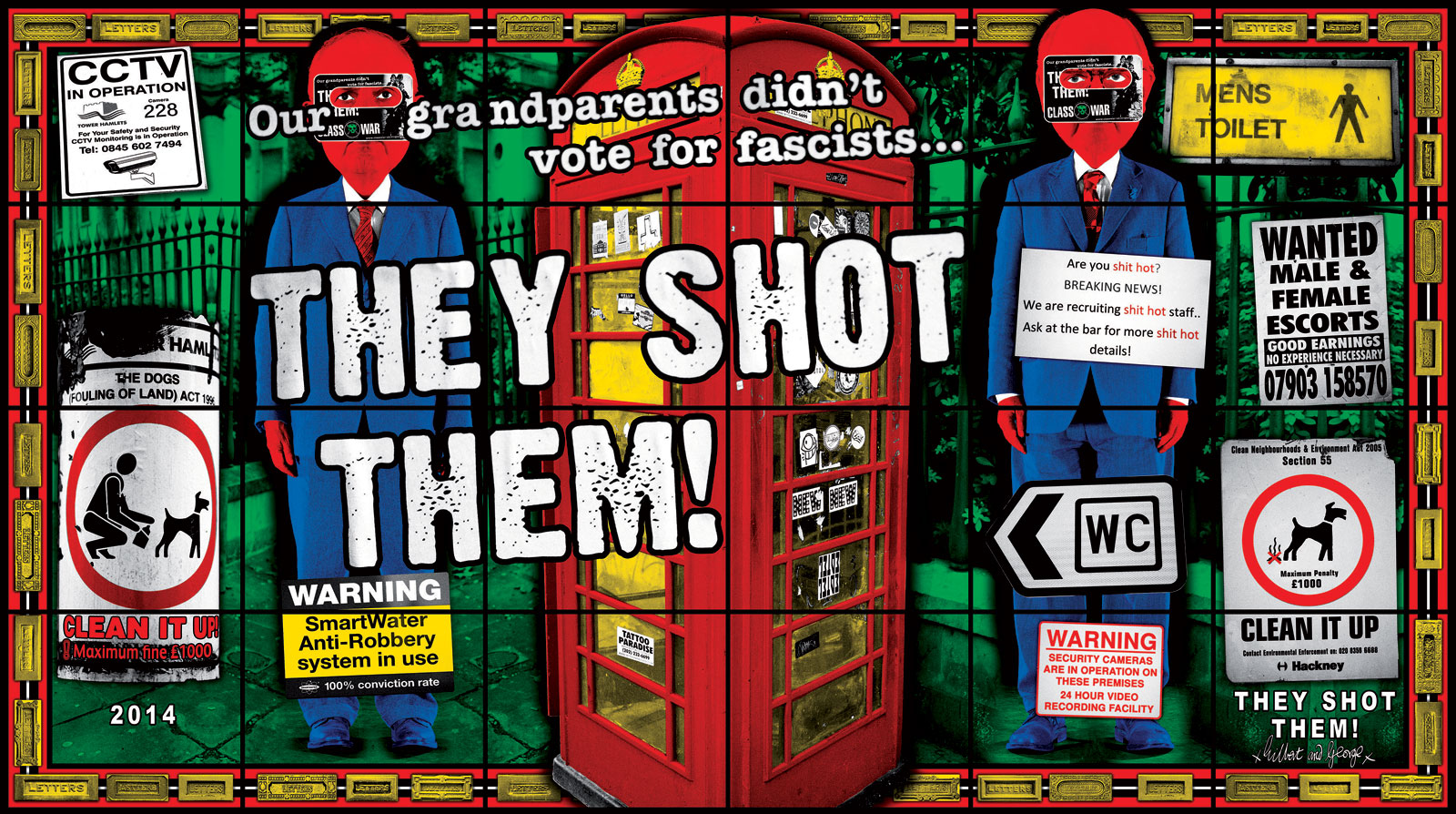
Gilbert & George (Gilbert Prousch, British born Italy, 1943; George Passmore, British, b. 1942) 'THEY SHOT THEM!' 2014


Gilbert & George (Gilbert Prousch, British born Italy, 1943; George Passmore, British, b. 1942)
THEY SHOT THEM!
2014
Mixed media
254 x 453 cm
Courtesy of ARNDT and Gilbert & George


The 26 UTOPIAN PICTURES convey, like an energy storm, the frenetic forces of an endlessly embattled state: between the voices of authority and civic order. These pictures depict a modern world in which authority and the resentment of authority, rules and rebellion, advertising and public information, dogma and warning, boasts and threats co-exist in seemingly endless proclamations.

Barry Grayshon. “Gilbert and George – Utopian Pictures (2014),” on the Pinterest website [Online] Cited 16/03/2016


Installation view of the exhibition ‘Gilbert & George: The Art Exhibition’ at the Museum of Old and New Art, Hobart showing from left to right, 'SHIT ON SPIT' (1997) from 'The New Testamental Pictures', 'BLOOD ROADS' (1998), 'BLOOD CITY' (1998) and 'PISS GARDEN' (1998) from 'The Rudimentary Pictures'


Installation view of the exhibition Gilbert & George: The Art Exhibition at the Museum of Old and New Art, Hobart showing from left to right, SHIT ON SPIT (1997) from The New Testamental Pictures, BLOOD ROADS (1998), BLOOD CITY (1998) and PISS GARDEN (1998) from The Rudimentary Pictures


Gilbert & George (Gilbert Prousch, British born Italy, 1943; George Passmore, British, b. 1942) 'BLOOD CITY' 1988


Gilbert & George (Gilbert Prousch, British born Italy, 1943; George Passmore, British, b. 1942)
BLOOD CITY
1988
Mixed media
151 x 127 cm
Courtesy of the artists


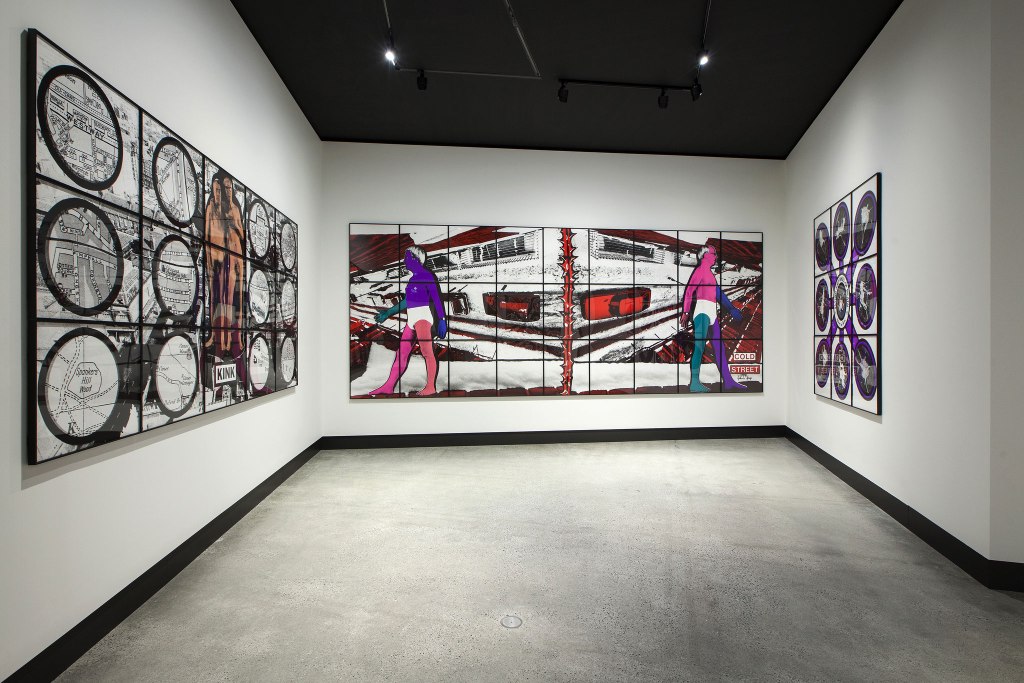
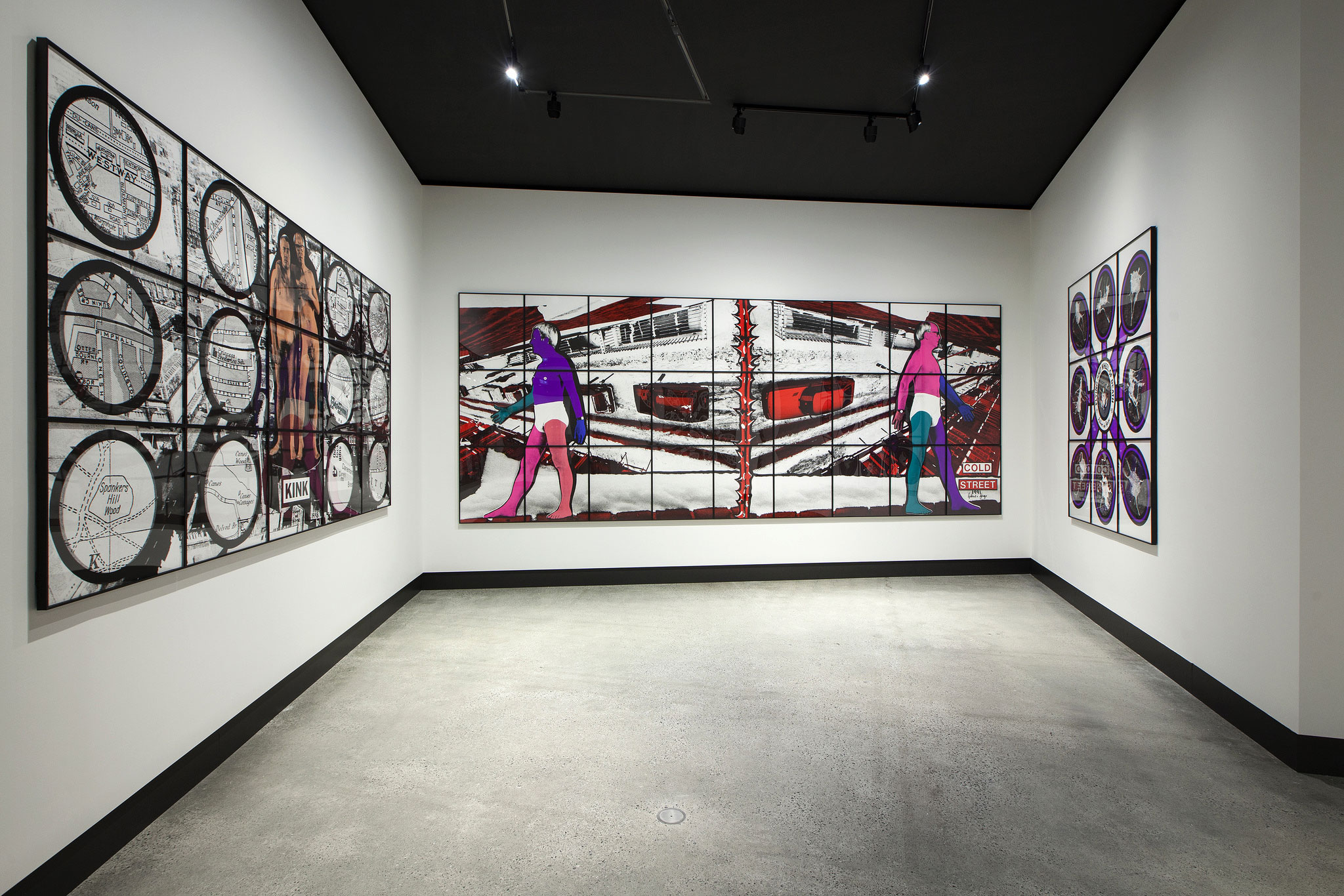
Installation view of the exhibition ‘Gilbert & George: The Art Exhibition’ at the Museum of Old and New Art, Hobart showing at left, 'KINK' (1998), and at rear, 'COLD STREET' (1991)


Installation view of the exhibition Gilbert & George: The Art Exhibition at the Museum of Old and New Art, Hobart showing at left, KINK (1998), and at rear, COLD STREET (1991)


Installation view of the exhibition ‘Gilbert & George: The Art Exhibition’ at the Museum of Old and New Art, Hobart showing from left to right, 'BLOODY LIFE No. 4' (1975), 'AKIMBO' (2005) from 'Sonofagod Pictures', 'SHITTY WORLD' (1994), 'DEAD HEAD' (1989), and 'CHRISTS' (1992) from 'The China Pictures'


Installation view of the exhibition Gilbert & George: The Art Exhibition at the Museum of Old and New Art, Hobart showing from left to right, BLOODY LIFE No. 4 (1975), AKIMBO (2005) from Sonofagod Pictures, SHITTY WORLD (1994), DEAD HEAD (1989), and CHRISTS (1992) from The China Pictures


In the BLOODY LIFE pictures, from 1975, Gilbert & George strike poses with clenched fists and legs kicking. Even the introspective image of the artists in BLOODY LIFE NO.3 is embedded within a frame of alcohol and the boxing ring. The brutality of these pictures reflects their experience at the time. ‘We went through this big destructive period of the drunken scenery, exploring ourselves, exploring our dark side, going out, getting drunk, all those destructive elements’.

Barry Grayshon. “Gilbert and George – Bloody Life (1975),” on the Pinterest website [Online] Cited 16/03/2016


The SONOFAGOD PICTURES consist of 20 paintings that possess a darkly graven strangeness, at once archaic and ultra-modern, in which their temper no less than their signage appears deeply contemporary, ritualistic and disturbed and have all of the dramatic visual impact which one might expect to find in neo-Gothic medievalism.

Christs shows a local youth imagining a butterfly Christ with Gilbert and George wings.


Installation view of the exhibition ‘Gilbert & George: The Art Exhibition’ at the Museum of Old and New Art, Hobart showing at left, 'FORWARD' (2008) and in the middle right, 'SCAPEGOATING' (2013)


Installation view of the exhibition Gilbert & George: The Art Exhibition at the Museum of Old and New Art, Hobart showing at left, FORWARD (2008) and in the middle right, SCAPEGOATING (2013)


Gilbert & George (Gilbert Prousch, British born Italy, 1943; George Passmore, British, b. 1942) 'ASTRO STAR' 2013


Gilbert & George (Gilbert Prousch, British born Italy, 1943; George Passmore, British, b. 1942)
ASTRO STAR
2013
From Scapegoating Pictures
Picture courtesy of the artists and Mona, Museum of Old and New Art, Tasmania, Australia


There are 292 pieces in this series featuring whippets and hippy crack (laughing gas). The SCAPEGOATING PICTURES unflinchingly describe the volatile, tense, accelerated and mysterious reality of our increasingly technological, multi-faith and multi-cultural world. It is a world in which paranoia, fundamentalism, surveillance, religion, accusation and victimhood become moral shades of the city’s temper.

Barry Grayshon. “Gilbert and George – Scapegoating Pictures for London (2013),” on the Pinterest website [Online] Cited 16/03/2016


Gilbert & George (Gilbert Prousch, British born Italy, 1943; George Passmore, British, b. 1942) 'FIGHT BACK' 2014


Gilbert & George (Gilbert Prousch, British born Italy, 1943; George Passmore, British, b. 1942)
FIGHT BACK
2014
From the series Utopian Pictures
Mixed media
254 x 377cm
Courtesy of ARNDT and Gilbert & George


Gilbert & George (Gilbert Prousch, British born Italy, 1943; George Passmore, British, b. 1942) 'ONE WORLD' 1988


Gilbert & George (Gilbert Prousch, British born Italy, 1943; George Passmore, British, b. 1942)
ONE WORLD
1988
Mixed media
226 x 254cm
Courtesy of the artists


Gilbert & George (Gilbert Prousch, British born Italy, 1943; George Passmore, British, b. 1942) 'ALL MY LIFE I GIVE YOU NOTHING AND STILL YOU ASK FOR MORE' 1970 (Gilbert)


Gilbert & George (Gilbert Prousch, British born Italy, 1943; George Passmore, British, b. 1942)
ALL MY LIFE I GIVE YOU NOTHING AND STILL YOU ASK FOR MORE (Gilbert)
1970
Mixed media
Each 193 x 75cm
Private collection


Gilbert & George (Gilbert Prousch, British born Italy, 1943; George Passmore, British, b. 1942) 'ALL MY LIFE I GIVE YOU NOTHING AND STILL YOU ASK FOR MORE' 1970 (George)


Gilbert & George (Gilbert Prousch, British born Italy, 1943; George Passmore, British, b. 1942)
ALL MY LIFE I GIVE YOU NOTHING AND STILL YOU ASK FOR MORE (George)
1970
Mixed media
Each 193 x 75cm
Private collection


Museum of Old and New Art
655 Main Road Berriedale
Hobart Tasmania 7011, Australia

Opening hours:
Daily 10am – 6pm

MONA website

LIKE ART BLART ON FACEBOOK

Back to top

Exhibition: ‘Photo-Poetics: An Anthology’ at the Solomon R. Guggenheim Museum, New York

Exhibition dates: 20th November, 2015 – 23rd March, 2016

Curators: Jennifer Blessing, Senior Curator, Photography, with Susan Thompson, Assistant Curator, Solomon R. Guggenheim Museum


Photo-Poetics image


My apologies, I am feeling very poorly at the moment, so just a small comment on this exhibition.

After the trilogy of 19th century photography, now for something completely different… two consecutive postings on contemporary photography.

In this art, the photograph becomes a conceptual “speech” act, where the artists speak with photographs, working with the context of the image – the image as concept, as talk.

It’s not just that the artists make photographic objects, they push what the medium can do. As the press release observes, “Theirs is a sort of “photo poetics,” an art that self-consciously investigates the laws of photography and the nature of photographic representation, reproduction, and the photographic object.” It is art that requires contemplation and meditation on source by Self. I have included several videos and extra text to illuminate aspects of the work in the posting.

I like the intertextuality that the artists employ when pushing the boundaries of photographic practice and representation, particularly Claudia Angelmaier’s series Works on Paper (2008-) and Lisa Oppenheim’s series The Sun is Always Setting Somewhere Else (2006).

Dr Marcus Bunyan


Many thankx to the Solomon R. Guggenheim Museum for allowing me to publish the photographs in the posting. Please click on the photographs for a larger version of the image.


99 SECONDS OF: PHOTO-POETICS: An Anthology / Guggenheim New York


The exhibition and its accompanying catalogue examine an important new development in contemporary photography, offering an opportunity to define the concerns of a younger generation of artists and contextualise their work within the history of art and visual culture. Drawing on the legacies of Conceptualism, these artists pursue a largely studio-based approach to still-life photography that centres on the representation of objects, often printed matter such as books, magazines, and record covers. The result is an image imbued with poetic and evocative personal significance – a sort of displaced self-portraiture – that resonates with larger cultural and historical meanings. Driven by a profound engagement with the medium of photography, these artists investigate the nature, traditions, and magic of photography at a moment characterised by rapid digital transformation. They attempt to rematerialise the photograph through meticulous printing, using film and other disappearing photo technologies, and creating artist’s books, installations, and photo-sculptures. While they are invested in exploring the processes, supports, and techniques of photography, they are also deeply interested in how photographic images circulate. Theirs is a sort of “photo poetics,” an art that self-consciously investigates the laws of photography and the nature of photographic representation, reproduction, and the photographic object.

Text from the exhibition web page.


Anne Collier (American, b. 1970) 'Crying' 2005 from the exhibition 'Photo-Poetics: An Anthology' at the Solomon R. Guggenheim Museum, New York, Nov 2015 - March 2016


Anne Collier (American, b. 1970)
Crying
2005
Chromogenic print
99.1 x 134cm
Solomon R. Guggenheim Museum, New York
Purchased with funds contributed by Mr. and Mrs. Aaron M. Tighe
© Anne Collier


Collier’s photographs offer a straightforward presentation of found images and printed ephemera, and explore themes of appropriation, iconography, and surrogacy… Though implicitly layered with feminist critiques of mass media, Collier’s images of famous women – especially those of other artists, like Cindy Sherman, for example – can also be interpreted as oblique self-portraits.

Text from the Guggenheim artist’s web page


“Ephemera and mediation are at the quiet center of Collier’s Crying, one of her works in the exhibition. Seen from across the room, “Crying” looks like a photograph overlaid upon a painted surface, or perhaps a portrait integrated within a two-dimensional space. The image, indeed a photo, is divided horizontally; the upper two-thirds are white, the bottom third is black, and on the left-hand side there is a small square close-up of a distraught woman crying. The woman is Ingrid Bergman, and this is the cover of the LP that accompanied her 1943 film For Whom the Bell Tolls. The LP is upright, facing the viewer dead-on, and up close we can see that there are a number of records behind it and that the flat spaces above and below are actually a white wall and black floor. The work is in no way overwhelming; there is nothing bombastic about it. Rather, the thrill of it comes from the reading it requires. Collier deploys her references strategically – this brings to mind abstract painting, Bas Jan Ader’s I’m Too Sad to Tell You, Bergman’s films and unconventional life, and the joy of the collector in the record store. Should that not be enough, it also awakens the empathy centers that begin firing when we see someone cry. Crying is part of a series involving records – others are of The Smiths and Sylvia Plath – but it contains the tensions within all of her work: advertising and fine art, nostalgia and distance, the camera and the eye. Collier has said she is interested in photographing objects that have “had previous lives… been handed and used,” and these rely on a kind of slow intertextuality; the gradual unfolding of meaning and feeling working towards a dizzying remove. It’s disorienting and evocative, a poetics in which the camera is not just the set-up but the punchline, and all the previous lives can be felt lurking beneath the surface.”

Anonymous text from “Woman with Camera: Anne Collier’s Feminist Image Critique,” on the Deutsche Bank ArtMag 88 website Nd [Online] Cited 13/03/2016. No longer available online


Moyra Davey (American, b. 1958) 'Les Goddesses' 2011 from the exhibition 'Photo-Poetics: An Anthology' at the Solomon R. Guggenheim Museum, New York, Nov 2015 - March 2016


Moyra Davey (American, b. 1958)
Les Goddesses (still)
2011
HD colour video, with sound, 61 min.
Courtesy the artist and Murray Guy, New York
© Moyra Davey


In the mid-2000s, the moving image took on a renewed prominence in Davey’s work. Inspired by her deep interest in the process of reading and writing, the artist’s essayistic video practice layers personal narrative with detailed explorations of the texts and lives of authors and thinkers she admires, such as Walter Benjamin, Jean Genet, and Mary Wollstonecraft. Davey’s own writing is central to her videos. The transcript of Fifty Minutes (2006), in which the artist reflects on her years in psychoanalysis, was published as a personal essay in the artist book Long Life Cool White: Photographs and Essays by Moyra Davey (2008), and her text “The Wet and the Dry” formed the basis of the narration of Les Goddesses (2011).

Text from the Guggenheim artist’s web page


Erin Shirreff (Canadian, b. 1975) 'UN 2010' 2010


Erin Shirreff (Canadian, b. 1975)
UN 2010 (still)
2010
HD color video, silent, 17 min.
Solomon R. Guggenheim Museum, New York
Purchased with funds contributed by Erica Gervais
© Erin Shirreff


Erin Shirreff (Canadian, b. 1975)
UN 2010 (excerpt)
2010
HD color video, silent, 17 min.
Solomon R. Guggenheim Museum, New York
Purchased with funds contributed by Erica Gervais
© Erin Shirreff


Shirreff’s work in photography, video, and sculpture reflects on the distance between an object and its representation, exploring the capacities of photography in conveying a sculptural experience.

Since scale and presence were central concerns of much mid-century abstract sculpture, Shirreff often draws on images of such works as she explores the disjunction between photographs and their subjects. Sculpture Park (Tony Smith) (2006), Shirreff’s first video work, features small cardboard maquettes the artist made of five Tony Smith sculptures. Filmed against a black background, their dark forms become discernible only as “snow” (Styrofoam) slowly accumulates on their surfaces. For subsequent video works, including Ansel Adams, RCA Building, circa 1940 (2009), Roden Crater (2009), and UN 2010 (2010), Shirreff photographed printed pictures of her subjects – often landscapes or iconic modernist buildings – under varying lighting conditions in the studio, inputting the resultant images into video editing software. These videos appear at first to be long, static shots of the subjects pictured, but eventually belie their own artifice as the viewer becomes gradually aware of the texture of the image surface.

Text from the Guggenheim artist’s web page


Lisa Oppenheim (American, b. 1975) 'The Sun is Always Setting Somewhere Else' 2006 (detail)


Lisa Oppenheim (American, b. 1975)
The Sun is Always Setting Somewhere Else (detail)
2006
Slide projection of fifteen 35 mm slides, continuous loop, dimensions variable
Solomon R. Guggenheim Museum, New York
Purchased with funds contributed by the Photography Committee


Oppenheim’s work explores the interactions between an image, its source, and the context in which it is encountered. The Sun is Always Setting Somewhere Else (2006) originates from photographs of the setting sun taken by U.S. soldiers in Iraq, which Oppenheim found on the image-sharing website Flickr. Holding each photograph at arm’s length in such a way that it aligns with the horizon of the setting sun in the artist’s native New York, the artist reshot the images as the sun set within the frame. Presented as a 35 mm slide show, the significance of seemingly quotidian sunsets shifts with the knowledge of who captured them and where.

Text from the Guggenheim artist’s web page


Guggenheim Examines New Developments in Contemporary Photography with Photo-Poetics: An Anthology

The Solomon R. Guggenheim Museum presents Photo-Poetics: An Anthology, an exhibition documenting recent developments in contemporary photography and consisting of photographs, videos, and slide installations by ten international artists. With more than 70 works by Claudia Angelmaier, Erica Baum, Anne Collier, Moyra Davey, Leslie Hewitt, Elad Lassry, Lisa Oppenheim, Erin Shirreff, Kathrin Sonntag, and Sara VanDerBeek, the exhibition runs from November 20, 2015 – March 23, 2016, and presents a focused study into the nature, traditions, and magic of photography in the context of the rapid digital transformation of the medium.

Organised by Jennifer Blessing, Senior Curator, Photography, with Susan Thompson, Assistant Curator, Solomon R. Guggenheim Museum, Photo-Poetics: An Anthology offers an opportunity to define the concerns of a new generation of photographic artists and contextualise their work within the history of art and visual culture. These artists mainly pursue a studio-based approach to still-life photography that centres on the representation of objects, often printed matter such as books, magazines, and record covers. The result is often an image imbued with poetic and evocative personal significance that resonates with larger cultural and historical meanings.

The artists in the exhibition attempt to rematerialise the photograph through meticulous printing, using film and other disappearing photo technologies. Drawing on the legacies of Conceptualism and invested in exploring the processes and techniques of photography, they are also deeply interested in how photographic images circulate. Theirs is a sort of “photo poetics,” an art that self-consciously investigates the laws of photography and the nature of photographic representation, reproduction, and the photographic object. The works in the exhibition, rich with detail, reward close and prolonged regard; they ask for a mode of looking that is closer to reading than the cursory scanning fostered by the clicking and swiping functionalities of smartphones and social media. Both the exhibition and its accompanying catalogue are conceived as anthologies, as independent vehicles to introduce each artist’s important and unique practice. #photopoetics

Press release from the Solomon R. Guggenheim Museum


Sara VanDerBeek (American, b. 1976) 'From the Means of Reproduction' 2007


Sara VanDerBeek (American, b. 1976)
From the Means of Reproduction
2007
Chromogenic print
101.6 x 76.2cm
Solomon R. Guggenheim Museum, New York
Purchased with funds contributed by the Photography Committee
© Sara VanDerBeek


VanDerBeek’s photographs utilise a variety of formal strategies and references yet remain consistently engaged with issues of memory and the experience of time and space.

VanDerBeek first became known in the mid-2000s for photographs featuring her own makeshift sculptural configurations in which appropriated photos were combined into collages that resounded with personal and political meaning. Constructed in the studio out of found images and pieces of wood, metal, and string, these works, such as From the Means of Reproduction (2007) and Calder and Julia (2006), were created solely for the camera and were disassembled after being photographed.

Text from the Guggenheim artist’s web page


Kathrin Sonntag (German, b. 1981) 'Mittnacht' 2008 (detail)


Kathrin Sonntag (German, b. 1981)
Mittnacht (detail)
2008
Slide projection of eighty one 35 mm slides, continuous loop, dimensions variable
Solomon R. Guggenheim Museum, New York
Purchased with funds contributed by the Photography Committee and Manuel de Santaren
© Kathrin Sonntag


Kathrin Sonntag (German, b. 1981) 'Mittnacht' 2008 (detail)


Kathrin Sonntag (German, b. 1981)
Mittnacht (detail)
2008
Slide projection of eighty one 35 mm slides, continuous loop, dimensions variable
Solomon R. Guggenheim Museum, New York
Purchased with funds contributed by the Photography Committee and Manuel de Santaren
© Kathrin Sonntag


Encompassing sculpture, photography, film, and drawing, Sonntag’s work offers a complex analysis of the nature of objects and the division between fiction and reality. Using stools, tripods, tables, and mirrors to create unusual perspectives, her installations strip meaning from readily identifiable objects via photographic experiments within the confines of her studio. Mittnacht (2008) comprises eighty-one slides of found images of paranormal phenomena photographed among the artist’s studio tools and furniture. The supernatural elements are enhanced by their disorienting placement within the studio, which both creates illusions and allows errors and smudges in processing to cast an eerie shadow on certain images in the series.

Text from the Guggenheim artist’s web page


Claudia Angelmaier (German, b. 1972) 'Betty' 2008


Claudia Angelmaier (German, b. 1972)
Betty
2008
Chromogenic print, face-mounted to acrylic
130 x 100cm
Solomon R. Guggenheim Museum, New York
Purchased with funds contributed by the Photography Committee with additional funds contributed by Mr. and Mrs. Aaron M. Tighe, and Rona and Jeffrey Citrin
© Claudia Angelmaier


Taking art historical masterpieces – and, by extension, art history itself – as her referents, Angelmaier traces the photographic representation of artworks across the pages of textbooks, classroom slides, coffee table monographs, and postcards. Cognisant that major artworks are most often encountered via reproduction rather than in person, she highlights the analogue media that have facilitated the circulation of such images for many decades…

The larger scope of Angelmaier’s concerns is particularly evident in the series Works on Paper (2008- ). Here, the artist photographs the backlit versos of postcards from museum gift shops. The artwork pictured on a card’s front appears muted yet faintly discernible, while the caption information and museum insignia on the back remain fully legible. By foregrounding the text, logos, and barcodes, Angelmaier not only examines the material realities of the postcard, but the social and economic systems both the souvenir and the work it depicts inhabit.

Text from the Guggenheim artist’s web page


Erica Baum (American, b. 1961) 'Jaws' (from the series 'Naked Eye'), 2008


Erica Baum (American, b. 1961)
Jaws (from the series Naked Eye)
2008
Inkjet print
47 x 41.6cm
Solomon R. Guggenheim Museum, New York
Purchased with funds contributed by Mr. and Mrs. Aaron M. Tighe
© Erica Baum


Baum takes the printed page as her primary subject, photographing fragments of found language at close range. Commingling image and text, her works often operate simultaneously as both photograph and poem… For the Naked Eye series (2008- ), Baum directs her camera into the partially opened pages of stipple-edged paperbacks from the 1960s and ’70s, capturing slivers of image and text separated by the vertical striations of adjacent pages’ brightly dyed edges. Although the compositions are each the result of a single, unaltered photograph, they operate visually as collages and veer toward abstraction.

Text from the Guggenheim artist’s web page


Elad Lassry (Israeli-American, b. 1977) 'Bengal' 2011


Elad Lassry (Israeli-American, b. 1977)
Bengal
2011
Chromogenic print in painted frame
36.8 x 29.2 x 3.8cm
A.P. 1/2, edition of 5
Solomon R. Guggenheim Museum, New York, Purchased with funds contributed by the Photography Committee
© Elad Lassry. Photo: Kristopher McKay © Solomon R. Guggenheim Foundation


Elad Lassry (Israeli-American, b. 1977) 'Untitled (Woman, Blond)' 2013


Elad Lassry (Israeli-American, b. 1977)
Untitled (Woman, Blond)
2013
Chromogenic print in walnut frame with four-ply silk
36.8 x 29.2 x 3.8cm
Solomon R. Guggenheim Museum, New York
Purchased with funds contributed by the Photography Committee
© Elad Lassry


Lassry positions his photographic works as “pictures,” entities that operate simultaneously as both objects and images. In doing so, he shifts their relationship to the viewer, inviting a broader examination of how photographs are seen and understood.

Lassry regularly presents his photographs in lacquered frames that match the colours of his bright, saturated images, or in warm walnut frames in the case of his work in black and white. The artist used this approach as early as 2008, in works such as Wolf (Blue) (2008). The continuity between frame and photo, heightened by the absence of matting, highlights the physicality of the picture without disrupting the illusion of depth in the photographic image. Lassry’s pictures derive from his own studio-based photographs as well as appropriated imagery. In both cases, the images reference the language of advertising and stock photography – and the attendant notions of desire therein. However, the would-be product is either obscured or excluded, removing the sense of purpose that drives such imagery. The artist sometimes employs techniques such as double exposure, blurring, superimposition, or collage that create an unsettling instability within his pictures. In more recent works, Lassry has incorporated sculptural elements, most often silk valances that cover significant sections of the image, as in Untitled (Woman, Blond) (2013), or looping coloured wires that penetrate it, as in Untitled (Dolphins, Two) (2014).

Text from the Guggenheim artist’s web page


Leslie Hewitt (American, b. 1977) 'Riffs on Real Time (3 of 10)', 2006-2009


Leslie Hewitt (American, b. 1977)
Riffs on Real Time (3 of 10)
2006-09
Chromogenic print
76.2 x 61cm
Solomon R. Guggenheim Museum, New York
Purchased with funds contributed by the Photography Committee


Commingling photography and sculpture, Hewitt’s works often present arrangements of personally and politically charged materials – including historically significant books and magazines from the 1960s and ’70s as well as family photos (not necessarily her own) – that conjure associative meaning through juxtaposition.

In Hewitt’s series Riffs on Real Time (2006-2009), snapshots lay atop appropriated printed matter shot against a wood floor or carpet so that the contrasting textures of these layered materials build up and outward toward the viewer. In Hewitt’s various photo-sculptural series, the photographs begin to pointedly inhabit the space of the viewer. Positioned on the floor, their frames lean against the gallery walls, asserting their own materiality and calling attention to the space of the gallery.

Text from the Guggenheim artist’s web page


Solomon R. Guggenheim Museum
1071 5th Avenue (at 89th Street)
New York

Opening hours:
Sunday – Friday 11am – 6pm
Saturday 11am – 8pm

Solomon R. Guggenheim Museum website

LIKE ART BLART ON FACEBOOK

Back to top

Review: ‘On the beach’ at the Mornington Peninsula Regional Art Gallery, Mornington

Exhibition dates: 11th December, 2015 – 28th February, 2016

Curator: Wendy Garden


Installation view of the exhibition 'On the beach' at the Mornington Peninsula Regional Art Gallery


Installation view of the exhibition On the beach at the Mornington Peninsula Regional Art Gallery
Photo: © Marcus Bunyan and the Mornington Peninsula Regional Art Gallery


This is another solid thematic group exhibition at the Mornington Peninsula Regional Art Gallery (curator Wendy Garden), following on from their recent success, Storm in a teacup.

The exhibition is not as successful as Storm in a teacup, mainly because most of the works are based on the monolithic, monosyllabic representation of beach culture, and its figuration, during the early decades of the twentieth century (White Australia policy, Australian stereotypes of the interwar period) and the re-staging of these ideas in the contemporary art presented through a diachronic (through/time), performative discourse.

There is so much re-staging in this exhibition I was left to wonder whether there was any original art work being produced that does not quote sources of history, memory, identity, representation and art from past generations. Daniel Boyd re-stages Captain Cook’s landing at Botany Bay with said hero as a pirate. Stephen Bowers replicates the Minton willow pattern motif and early paintings of kangaroos. Leanne Tobin re-stages Bungaree’s disrobing on the beach during his journey with Matthew Flinders. Diane Jones re-stages Max Dupain’s Sunbaker replacing the anonymous prostrate man with her head looking into the camera, or Dupain’s Form at Bondi with her head turned towards the camera. Worst offender is Anne Zahalka who re-states Dupain’s Sunbaker (again!) as a red-headed white women on the beach; or re-presents Charles Meere’s Australian beach pattern (1940, below) not once but twice – the first time in The bathers (1989) broadening the racial background of people to depict multicultural Australia in the 1980s, the second time in The new bathers (2013) broadening the mix even further. Most successful of these re-stagings is Michael Cook’s series of photographs Undiscovered in which the artist subverts deeply ingrained understandings of settlement, that of terra nullius, by depicting Captain Cook as black and positioning him in high-key, grey photographs of impressive beauty and power, surveying the land he has ‘discovered’ while perched upon an invisibly balanced ladder.

But with all of the works that quote from the past there is a sense that, even as the artists are critiquing the culture, they are also buying into the system of patriarchy, racism and control that they seek to comment on. They do not subvert the situation, merely (and locally) extrapolate from it. The idealised, iconic representation of early 20th century Australia culture in the paintings from the 1920-30s and the photographs from the 1940s-70s – specimens of perfect physical beauty – are simply shifted to a new demographic – that of iconic, individual figures in the same poses as the 1940s but of a different ethnicity. The colour of the figure and the clothing might have changed, but the underlying structure remains the same. And if you disturb one of the foundation elements, such as the base figure in one of George Caddy’s balancing beachobatics photographs, the whole rotten edifice of a racism free, multicultural Australia will come tumbling down, just as it did during the Cronulla Riot.

What I would have liked to have seen in this exhibition was a greater breadth of subject matter. Where are the homeless people living near the beach, the sex (for example, as portrayed in Tracey Moffat’s voyeuristic home video Heaven which shows footage of male surfers changing out of their wetsuits in car parks – “shot by Moffatt and a number of other women as if they were making a birdwatching documentary” – which challenges the masculinity of Australian surf culture and the ability of women to stare at men, instead of the other way around), death (drownings on beaches, the heartbreak of loss), and debauchery (the fluxus of Schoolies, that Neo-Dada performance of noise and movement), the abstract nature of Pictorialist photographs of the beach, not to mention erosion and environmental loss due to global warming. The works presented seem to have a too narrowly defined conceptual base, and a present narrative constructed on a coterie of earlier works representing what it is to be Australian at the beach. The contemporary narrative does not address the fluidity of the landscape in present time (in works such as Narelle Autio’s series Watercolours or The place in between).

The dark underside of the beach, its abstract fluidity, its constant movement is least well represented in this exhibition. Although I felt engaged as a viewer the constant re-quoting and rehashing of familiar forms left me a little bored. I wanted more inventiveness, more insight into the conditions and phenomena of beach culture in contemporary Australia. An interesting exhibition but an opportunity missed.

Dr Marcus Bunyan


Many thankx to the Mornington Peninsula Regional Art Gallery for allowing me to publish most of the photographs in the posting. Other photographs come from Art Blart’s archive and those freely available online. Thankx also go to Manuela Furci, Director of the Rennie Ellis Photographic Archive for allowing me to publish his photographs in the posting. Please click on the photographs for a larger version of the image. All text comes from the wall labels to the exhibition. Images noted © Marcus Bunyan and the Mornington Peninsula Regional Art Gallery.


Installation view of the exhibition 'On the beach' at the Mornington Peninsula Regional Art Gallery with Daniel Boyd's 'We call them pirates out here' (2006)


Installation view of the exhibition On the beach at the Mornington Peninsula Regional Art Gallery with Daniel Boyd’s We call them pirates out here (2006, below)
Photo: © Marcus Bunyan and the Mornington Peninsula Regional Art Gallery


Daniel Boyd (Australian, b. 1982) 'We call them pirates out here' 2006 (installation view)


Daniel Boyd (Australian, b. 1982)
We call them pirates out here (installation view)
2006
Museum of Contemporary Art
Purchased with funds provided by the Coe and Mordant families, 2006
Photo: © Marcus Bunyan and the Mornington Peninsula Regional Art Gallery


“The landing of Captain Cook in Botany Bay, 1770 by E. Phillips Fox is such an iconic and important image relating to the birth of Australia. Shifting the proposed view of Fox’s painting to something that was an indigenous person’s perspective allowed for me to challenge the subjective history that has been created.”

Daniel Boyd, 2008


In this painting Daniel Boyd parodies E. Phillips Fox’s celebrated painting which was commissioned in 1902 by the Trustees of the National Gallery of Victoria to commemorate federation. No longer an image valorising colonial achievement, Boyd recasts the scene as one of theft and invasion. Captain Cook is depicted as a pirate to contest his heroic status in Australia’s foundation narratives. Smoke in the distance is evidence of human occupation and is a direct retort to the declaration that Australia was ‘terra nullius’ – land belonging to no-one, which was used to justify British possession.


Stephen Bowers (Australian, b. 1952) Peter Walker (board maker) (Australian, b. 1961) 'Antipodean willow surfboard' 2012 'Antipodean willow surfboard (Mini Simmons)' 2012 (installation view)


Stephen Bowers (Australian, b. 1952)
Peter Walker (board maker) (Australian, b. 1961)
Antipodean willow surfboard (installation view)
2012
Antipodean willow surfboard (Mini Simmons) (installation view)
2012
Hollow core surfboard, Paulownia wood, fibreglass, synthetic polymer paint
Courtesy of the artist and Lauraine Diggins Fine Art, Caulfield
Photo: © Marcus Bunyan and the Mornington Peninsula Regional Art Gallery


Stephen Bowers (Australian, b. 1952) Peter Walker (board maker) (Australian, b. 1961) 'Antipodean willow surfboard (Mini Simmons)' 2012 (installation view detail)


Stephen Bowers (Australian, b. 1952)
Peter Walker (board maker) (Australian, b. 1961)
Antipodean willow surfboard (Mini Simmons) (installation detail)
2012
Hollow core surfboard, Paulownia wood, fibreglass, synthetic polymer paint
Courtesy of the artist and Lauraine Diggins Fine Art, Caulfield
Photo: © Marcus Bunyan and the Mornington Peninsula Regional Art Gallery


In these works Bowers combines the willow pattern motif, a ready-made metaphor of hybridity, with an image of a kangaroo as envisioned by George Stubbs in 1772. The willow pattern as an English invention, created by Thomas Minton in 1790. It is an imaginative geography and, like the first known European painting of a kangaroo, considers other lands as strange, exotic places. In this work the imagery of colonial occupation is visualised as a fusion of cultures underpinned by half-truths, fantasy and desire.


Leanne Tobin (Australian, b. 1961) 'Clothes don't always maketh the man' 2012 (installation view)

Leanne Tobin (Australian, b. 1961) 'Clothes don't always maketh the man' 2012 (installation view detail)


Installation views of Leanne Tobin’s Clothes don’t always maketh the man (2012)


Leanne Tobin (Australian, b. 1961)
Clothes don’t always maketh the man (installation details)
2012
Sand, textile, wood
Collection of the artist
Photos: © Marcus Bunyan and the Mornington Peninsula Regional Art Gallery


Bungaree (c. 1755-1830) was a Garigal man who circumnavigated the continent of Australia with Matthew Flinders on the H.M.S. Investigator between 1802-1803. Unlike Bennelong, who attempted to assimilate with British ways and Pemulwuy, who resisted, Bungaree made the decision to navigate a relationship with the British while still maintaining his cultural traditions. He played an important role as an envoy on Flinder’s voyages, negotiating with the different Aboriginal groups they encountered. A skilled mediator, Bungaree was adept at living between both worlds. When coming ashore he would shed his white man’s clothes so that he could conduct protocol relevant to the local elders. In this respect the beach became a zone of transformation and exchange.


Installation view of the exhibition 'On the beach' at the Mornington Peninsula Regional Art Gallery with in the foreground, Leanne Tobin's 'Clothes don't always maketh the man' (2012), and in the background left, photographs from Michael Cook's 'Undiscovered' series (2010)

Installation view of the exhibition 'On the beach' at the Mornington Peninsula Regional Art Gallery with in the foreground, Leanne Tobin's 'Clothes don't always maketh the man' (2012), and in the background right, photographs from Michael Cook's 'Undiscovered' series (2010)


Installation views of the exhibition On the beach at the Mornington Peninsula Regional Art Gallery with in the foreground, Leanne Tobin’s Clothes don’t always maketh the man (2012), and in the background photographs from Michael Cook’s Undiscovered series (2010, below)
Photos: © Marcus Bunyan and the Mornington Peninsula Regional Art Gallery


Michael Cook (Australian, b. 1968) 'Undiscovered 4' 2010 from the exhibition 'On the beach' at the Mornington Peninsula Regional Art Gallery, Mornington, Dec 2015 - Feb 2016


Michael Cook (Australian, b. 1968)
Undiscovered 4
2010
inkjet print on Hahnemuhle paper
124.0 x 100.0cm
Australian National Maritime Museum


A selection of works from a series of ten photographs in which Michael Cook contests the idea of ‘discovery’ that underpins narratives of the British settlement of Australia… Cook depicts the historic Cook as an Aboriginal man replete in his British naval officers attire. His ship, the famed Endeavour, is anchored in the sea behind him. By mimicking the moment of first discovery Cook subverts deeply ingrained understandings of settlement and asks us to consider what type of national Australia would be if the British had acknowledged Aboriginal people’s prior ownership.


Installation view of the exhibition 'On the beach' at the Mornington Peninsula Regional Art Gallery showing, at top left, Max Dupain's 'Form at Bondi' (1939); to the right of that Dupain's 'At Newport' (1952); to the right upper is George Caddy's 'Chest strength and breathing exercise, 20 February 1937'; followed at far right by Rennie Ellis' 'St Kilda Lifesavers' (1968, top) and David Moore's 'Lifesavers at Manly' (1959, bottom)


Installation view of the exhibition On the beach at the Mornington Peninsula Regional Art Gallery showing, at top left, Max Dupain’s Form at Bondi (1939); to the right of that Dupain’s At Newport (1952, below); to the right upper is George Caddy’s Chest strength and breathing exercise, 20 February 1937 (below); followed at far right by Rennie Ellis’ St Kilda Lifesavers (1968, top) and David Moore’s Lifesavers at Manly (1959, bottom)
Photo: © Marcus Bunyan and the Mornington Peninsula Regional Art Gallery


Max Dupain (Australian, 1911-1992) 'At Newport' 1952, Sydney from the exhibition 'On the beach' at the Mornington Peninsula Regional Art Gallery, Mornington, Dec 2015 - Feb 2016


Max Dupain (Australian, 1911-1992)
At Newport
1952, Sydney
Silver gelatin photograph


George Caddy (Australian, 1914-1983) 'Chest strength and breathing exercise, 20 February 1937' 1937


George Caddy (Australian, 1914-1983)
Chest strength and breathing exercise, 20 February 1937
1937
Digital print on paper
Paul Caddy collection
Courtesy of Paul Caddy


Like Max Dupain, who was three years his senior, Caddy was interested in the new modernist approach to photography. During 1936 he read magazines such as Popular Photography from New York and US Camera rather than Australasian Photo-Review which continued to champion soft-focus pictorialism. This photograph was taken the same year as Dupain’s famous Sunbather photograph. The framing and angle is similar reflecting their common interest in sharp focus, unusual vantage points and cold composition.


George Caddy (Australian, 1914-1983) 'Freshwater Surf Life Saving Club reel team march past, 3 April 1938' 1938


George Caddy (Australian, 1914-1983)
Freshwater Surf Life Saving Club reel team march past, 3 April 1938
1938
Digital print
Collection of the Mitchell Library, State Library of New South Wales
Purchased from Paul Caddy, 2008


This photograph was taken only months after an infamous rescue at Bondi. On 6 February 1938 a sand bar collapsed sweeping two hundred people out to sea. 80 lifesavers rescued all but 5 people in a day subsequently described as Black Sunday. By 1938 the Surf Life Saving Association, which incorporated clubs from around Australia, had rescued 39,149 lives in its 30 year history. In 1938 alone there were 3,442 rescues. Up until the events of Black Sunday no one had drowned while lifesavers were on duty at Australian beaches. In comparison 2,000 people drowned in England each year.1

1/ Alan Davies, Bondi Jitterbug: George Caddy and his amera, Sydney: State Library of New South Wales, p. 13.


Installation view of the exhibition 'On the beach' at the Mornington Peninsula Regional Art Gallery showing at far left, Anne Zahalka's 'The sunbather #2' (1989) and, at right, a selection of George Caddy's beachobatics photographs


Installation view of the exhibition On the beach at the Mornington Peninsula Regional Art Gallery showing at far left, Anne Zahalka’s The sunbather #2 (1989, below) and, at right, a selection of George Caddy’s beachobatics photographs
Photo: © Marcus Bunyan and the Mornington Peninsula Regional Art Gallery


Installation view of the exhibition 'On the beach' at the Mornington Peninsula Regional Art Gallery showing at far left, Max Dupain's 'Sunbaker' (1937, top) with Diane Jones 'Sunbaker' (2003, below); in the centre Anne Zahalka's 'The sunbather #2' (1989); then Max Dupain's 'Form at Bondi' (1939, top) with Diane Jones 'Bondi' (2003) underneath


Installation view of the exhibition On the beach at the Mornington Peninsula Regional Art Gallery showing at far left, Max Dupain’s Sunbaker (1937, top) with Diane Jones Sunbaker (2003, below); in the centre Anne Zahalka’s The sunbather #2 (1989, below); then Max Dupain’s Form at Bondi (1939, top) with Diane Jones Bondi (2003) underneath
Photo: © Marcus Bunyan and the Mornington Peninsula Regional Art Gallery


Anne Zahalka (Australian, b. 1957) 'The sunbather #2' 1989


Anne Zahalka (Australian, b. 1957)
The sunbather #2
1989
From the series Bondi: playground of the Pacific 1989
Type C photograph


Installation photograph of Charles Meere's painting 'Australian beach pattern' (1940) and Anne Zahalka's photograph 'The bathers' (1989) from the series 'Bondi: playground of the Pacific' 1989


Installation photograph of Charles Meere’s painting Australian beach pattern (1940, below) and Anne Zahalka’s photograph The bathers (1989) from the series Bondi: playground of the Pacific 1989
Photo: © Marcus Bunyan and the Mornington Peninsula Regional Art Gallery


Zahalka restates Charles Meere’s painting in order to subvert the narrow stereotype of the Australian ideal… In this work Zahalka broadens the racial background of people depicted to create a more representative image of multicultural Australia in the 1980s


Charles Meere (Australian born England, 1890-1961) 'Australian beach pattern' 1940 (installation view detail)


Charles Meere (Australian born England, 1890-1961)
Australian beach pattern (installation view detail)
1940
Oil and wax on canvas
Collection of Joy Chambers-Grundy and Reg Grundy AC OBE
Photo: © Marcus Bunyan and the Mornington Peninsula Regional Art Gallery


A now iconic representation of early 20th century Australia culture… The scene is dominated by a mass of suntanned bodies: muscular, square-jawed white Australians – specimens of perfect physical beauty – enjoying the strenuous physical activities of the beach. A glorification of the strong, healthy, racially pure Australian ideal of the 1930s, it is eerily reminiscent of Nazi German Aryan propaganda between the wars.

Notably, the figures themselves all appear anonymous and disconnected, with indistinct facial features that show no acknowledgement of their fellow beach-goers. Their identities are overwhelmed by Meere’s obsession with arrangement. Rather than reflect real life, the figures are placed to create an idealised work of perfect balance. It is fascinating to consider that this iconic representation of Australian beach culture actually came from the imagination of an Englishman, who had only lived in Australia since the mid-1930s and who, according to his apprentice, ‘never went to the beach’ and ‘made up most of the figures’.1

1/ Freda Robertshaw quoted in Linda Slutzkin, Charles Meere 1890-1961. Sydney: S. H. Ervin Gallery, 1987, p. 6.


Installation view of the exhibition 'On the beach' at the Mornington Peninsula Regional Art Gallery showing at far left, George Caddy's beachobatic photographs, and on the far wall Sidney Nolan's 'Bathers' (1943) and Jeffrey Smart's 'Surfers Bondi' (1963)


Installation view of the exhibition On the beach at the Mornington Peninsula Regional Art Gallery showing at far left, George Caddy’s beachobatic photographs, and on the far wall Sidney Nolan’s Bathers (1943, below) and Jeffrey Smart’s Surfers Bondi (1963, below)
Photo: © Marcus Bunyan and the Mornington Peninsula Regional Art Gallery


Sidney Nolan (Australian, 1917-1992) 'Bathers' 1943 (installation view)


Sidney Nolan (Australian, 1917-1992)
Bathers (installation view)
1943
Ripolin enamel on canvas
Headed Museum of Modern Art, Melbourne
Bequest of John and Sunday Reed, 1982
Photo: © Marcus Bunyan and the Mornington Peninsula Regional Art Gallery


Jeffrey Smart (Australian, 1921-2013) 'Surfers Bondi' 1963 (installation view)


Jeffrey Smart (Australian, 1921-2013)
Surfers Bondi
1963
Oil on board
Private collection


When bans on daylight bathing were lifted in 1902, the beach became a prime leisure destination. The beach became not only as a public space of recreation but also as a place where the Australian identity was developing, for many epitomising the liberties of Australia’s society. On the beach brings together 76 outstanding and iconic paintings, photographs and installations to consider the defining relationship we have to the shore.

Works by artists including Vernon Ah Kee, Arthur Boyd, Gordon Bennett, Daniel Boyd, Max Dupain, Charles Meere, Tracey Moffatt, David Moore, Sidney Nolan, Polixeni Papapetrou, John Perceval, Scott Redford, Jeffrey Smart, Albert Tucker, Guan Wei and Anne Zahalka, as well as outstanding recently discovered works by George Caddy (see above). A champion jitterbug dancer, Caddy’s photographs of ‘beachobatics’ were kept undisturbed in a shoebox for 60 years until they were ‘discovered’ by his son after his death. They capture the exuberance and optimism of Australian society between the wars.

The beach first became a prime leisure destination in the early decades of the twentieth century. Up to Federation many artists had looked to the bush to galvanise a fledging nationalism, but during the interwar years this shifted and increasingly the beach became the site of Australian identity. Already by 1908 one Melbourne newspaper commented upon the ‘vast throng of holidaymakers all along the coast.’ In the years following the First World War, against a backdrop of a growing interest in physical fitness, the beach was seen as a place for creating ‘a fine healthy race of men.’ Understandings of the beach as an Australian way of life emerged during this period and increasingly the Australian type was associated with bronzed athletic bodies on the beach.

On the beach looks at artists’ responses to the stereotype of the interwar period and juxtaposes modernist works with contemporary artists’ responses to include a more culturally diverse mix of people. Other artists in the exhibition challenge understandings of the beach as a benign space and consider the history of violence that is latent.

Press release from the Mornington Peninsula Regional Art Gallery


Photographer Joyce Evans looking at two colour photographs by Rennie Ellis in the exhibition 'On the beach' at the Mornington Peninsula Regional Art Gallery


Photographer Joyce Evans looking at two colour photographs by Rennie Ellis in the exhibition
Photo: © Marcus Bunyan and the Mornington Peninsula Regional Art Gallery


Installation view of the exhibition 'On the beach' at the Mornington Peninsula Regional Art Gallery showing on the wall left hand side, photographs by Rennie Ellis


Installation view of the exhibition On the beach at the Mornington Peninsula Regional Art Gallery showing on the wall left hand side, photographs by Rennie Ellis
Photo: © Marcus Bunyan and the Mornington Peninsula Regional Art Gallery


Installation view of the exhibition 'On the beach' at the Mornington Peninsula Regional Art Gallery showing on the wall right hand side, photographs by Rennie Ellis; and at right, Fiona Foley's 'Nulla 4 eva IV' (2009)


Installation view of the exhibition On the beach at the Mornington Peninsula Regional Art Gallery showing on the wall right hand side, photographs by Rennie Ellis; and at right, Fiona Foley’s Nulla 4 eva IV (2009)
Photo: © Marcus Bunyan and the Mornington Peninsula Regional Art Gallery


Rennie Ellis (Australian, 1940-2003) 'Union Jack, Lorne' c. 1968


Rennie Ellis (Australian, 1940-2003)
Union Jack, Lorne
c. 1968
Silver gelatin selenium toned fibre-based print
Rennie Ellis Photographic Archive


Rennie Ellis (Australian, 1940-2003) 'Four Sunbathers, Lorne' c. 1968


Rennie Ellis (Australian, 1940-2003)
Four Sunbathers, Lorne
c. 1968
Type C photograph (ed. AP)
Rennie Ellis Photographic Archive


Rennie Ellis (Australian, 1940-2003) 'Bondi, New South Wales' 1997


Rennie Ellis (Australian, 1940-2003)
Bondi, New South Wales
1997


“On the beach we chuck away our clothes, our status and our inhibitions and engage in rituals of sun worship and baptism. It’s a retreat to our primal needs.”

Rennie Ellis


Vernon Ah Kee (Australian, b. 1967; Kuku Yalandji, Waanji, Yidinji and Gugu Yimithirr) 'cantchant' 2007-2009 (installation view)

Vernon Ah Kee (Australian, b. 1967; Kuku Yalandji, Waanji, Yidinji and Gugu Yimithirr) 'cantchant' 2007-2009 (installation view detail)

Vernon Ah Kee (Australian, b. 1967; Kuku Yalandji, Waanji, Yidinji and Gugu Yimithirr) 'cantchant' 2007-2009 (installation view detail)

Vernon Ah Kee (Australian, b. 1967; Kuku Yalandji, Waanji, Yidinji and Gugu Yimithirr) 'cantchant' 2007-2009 (installation view detail)

Vernon Ah Kee (Australian, b. 1967; Kuku Yalandji, Waanji, Yidinji and Gugu Yimithirr) 'cantchant' 2007-2009 (installation view detail)

Vernon Ah Kee (Australian, b. 1967; Kuku Yalandji, Waanji, Yidinji and Gugu Yimithirr) 'cantchant' 2007-2009 (installation view detail)

Vernon Ah Kee (Australian, b. 1967; Kuku Yalandji, Waanji, Yidinji and Gugu Yimithirr) 'cantchant' 2007-2009 (installation view detail)

Vernon Ah Kee (Australian, b. 1967; Kuku Yalandji, Waanji, Yidinji and Gugu Yimithirr) 'cantchant' 2007-2009 (installation view detail)

Vernon Ah Kee (Australian, b. 1967; Kuku Yalandji, Waanji, Yidinji and Gugu Yimithirr) 'cantchant' 2007-2009 (installation view detail)


Installation views of Vernon Ah Kee’s cantchant 2007-09


Vernon Ah Kee (Australian, b. 1967; Kuku Yalandji, Waanji, Yidinji and Gugu Yimithirr)
cantchant (installation views)
2007-2009
Synthetic polymer paint and resin over digital print on roamer, vinyl
Courtesy of the artist and Milani Gallery, Brisbane
Photos: © Marcus Bunyan and the Mornington Peninsula Regional Art Gallery


Vernon Ah Kee’s response to the events at Cronulla (the Cronulla Riot) us a powerful retort to the racists and their mantra ‘we grew here, you flew here’ chanted on the beach during the riots. Ah Kee takes issue pointing out the hypocrisy in their statement.

“We grew here, you flew here is an insincere statement and they were chanting it over and over again. It’s a way to exercise racism. I’m like ‘WE’ grew here, say what you want, but we’re the fellas that grew here.”

The surfboards are printed with Yidinji shield designs and the portraits are members of the artists family. The work was exhibited in the Australian Pavilion at the 2009 Venice Biennale.


Installation view of the exhibition 'On the beach' at the Mornington Peninsula Regional Art Gallery showing on the far wall, Charles Blackman's 'Sunbather' (c. 1954) and Arthur Boyd's 'Kite flyers (South Melbourne)' (1943)


Installation view of the exhibition On the beach at the Mornington Peninsula Regional Art Gallery showing on the far wall, Charles Blackman’s Sunbather (c. 1954, below) and Arthur Boyd’s Kite flyers (South Melbourne) (1943, below)
Photo: © Marcus Bunyan and the Mornington Peninsula Regional Art Gallery


Charles Blackman (Australian, b. 1928) 'Sunbather' c. 1954 (installation view)


Charles Blackman (Australian, b. 1928)
Sunbather (installation view)
c. 1954
Oil on board
Private collection, Melbourne
Photo: © Marcus Bunyan and the Mornington Peninsula Regional Art Gallery


This is one of a number of paintings and drawings made in response to Blackman’s observations of life on Melbourne’s beaches. Blackman moved from Sydney to Melbourne in 1945 to be part of Melbourne’s burgeoning art scene, making friends with John Perceval, Joy Hester and John and Sunday Reed amongst others.

During this period Blackman regularly took the tram to St Kilda beach to swim and paint. Although he enjoyed spending time on the beach, there is a sinister overtone to this painting of a prostrate figure lying on the sand. A bleak, grey palette articulates the pallid lifeless flesh amplifying a sense of death. The hollow slits that substitute for eyes further accentuate the corpse-like appearance. It is a stark contrast to many paintings of the era that emphasise physical vitality and wellbeing. Rather the sense of isolation and heavy treatment of shadows and water creates a painting that is psychologically disturbing. This painting can be seen as a response to his wife, Barbara’s developing blindness. It has been noted that as the ‘darkness grew in her life, his pictures got darker.’1 Blackman stated many years later ‘I was trying to paint pictures which were unseeable.’2

1/ Barry Humphries quoted in Peter Wilmoth. “An artist in wonderland,” in The Age, 21 May 2006
2/ Charles Blackman interviewed by James Gleeson, 28 April 1979


Arthur Boyd (Australian, 1920-1999) 'Kite flyers (South Melbourne)' 1943 (installation view)


Arthur Boyd (Australian, 1920-1999)
Kite flyers (South Melbourne) (installation view)
1943
Oil on canvas mounted on cardboard
46.3 x 60.9cm
National Gallery of Victoria
The Arthur Boyd Gift, 1975
Photo: © Marcus Bunyan and the Mornington Peninsula Regional Art Gallery


Installation view of the exhibition 'On the beach' at the Mornington Peninsula Regional Art Gallery showing in the centre, Brett Whiteley's 'Balmoral' (1975-1978). To the left of this painting is Nancy Kilgour's 'Figures on Manly Beach' (1930) and to the right Norma Bull's 'Bathing Beach' (c. 1950-1960s) with at bottom, George W. Lambert's 'Anzacs bathing in the sea' (1915)

Installation view of the exhibition 'On the beach' at the Mornington Peninsula Regional Art Gallery showing in the centre, Brett Whiteley's 'Balmoral' (1975-1978). To the left of this painting is Nancy Kilgour's 'Figures on Manly Beach' (1930) and to the right Norma Bull's 'Bathing Beach' (c. 1950-1960s) with at bottom, George W. Lambert's 'Anzacs bathing in the sea' (1915)

Installation view of the exhibition 'On the beach' at the Mornington Peninsula Regional Art Gallery showing in the centre, Brett Whiteley's 'Balmoral' (1975-1978). To the left of this painting is Nancy Kilgour's 'Figures on Manly Beach' (1930) and to the right Norma Bull's 'Bathing Beach' (c. 1950-1960s) with at bottom, George W. Lambert's 'Anzacs bathing in the sea' (1915)


Installation views of the exhibition On the beach at the Mornington Peninsula Regional Art Gallery showing in the centre, Brett Whiteley’s Balmoral (1975-1978, below). To the left of this painting is Nancy Kilgour’s Figures on Manly Beach (1930, below) and to the right Norma Bull’s Bathing Beach (c. 1950-1960s, below) with at bottom, George W. Lambert’s Anzacs bathing in the sea (1915, below)
Photos: © Marcus Bunyan and the Mornington Peninsula Regional Art Gallery


Brett Whiteley (Australian, 1939-1992) 'Balmoral' 1975-1978 (installation view detail)


Brett Whiteley (Australian, 1939-1992)
Balmoral (installation detail)
1975-1978
Oil and collage on canvas
180 x 204cm
Collection of the Hunter-Dyer family
Photo: © Marcus Bunyan and the Mornington Peninsula Regional Art Gallery


Nancy Kilgour (Australian, 1904-1954) 'Figures on Manly Beach' c. 1930


Nancy Kilgour (Australian, 1904-1954)
Figures on Manly Beach
c. 1930
Oil on canvas
76 x 117cm
Manly Art Gallery and Museum, Sydney
Purchase with the assistance of the NSW Ministry for the Arts, 1986


Nancy Kilgour’s artificial arrangement of figures is believed to have been painted in the 1930s before Charles Meere painted his highly contrived composition Australian Beach Pattern, 1940. The staged poses create a tableau of Australians enjoying the freedoms of life on the beach. What is interesting about Kilgour’s painting is that a number of people are depicted fully clothed. so the emphasis is not so much on toned physiques but rather the pleasures of relaxing on the beach. The painting is also unusual because, whereas most beach scenes are cast in brilliant sunshine, the figures in the foreground in this painting are rendered in shadow suggesting the presence of the towering Norfolk Island Pine trees which form a crescent along the Manly foreshore.


Norma Bull (Australian, 1906-1980) 'Bathing Beach' c. 1950-1960s


Norma Bull (Australian, 1906-1980)
Bathing Beach
c. 1950s-60s
Oil on aluminium
30.5 x 40cm
Collection of the Warrnambool Art Gallery, Victoria


Norma Bull began her career at the National Gallery School in 1929, Receiving acclaim for her portraits she won the Sir John Longstaff Scholarship in 1937 and travelled to London where she worked as a war artist during the Second World War. After nine years in Europe, Bull returned to Australia and spent the next year following Wirth’s Circus, painting acrobats, clowns and scenes from circus life. She settled in the Melbourne suburb of Surrey Hills and spent her summer holidays at Anglesea which provided the opportunity to paint seascapes and beach scenes.


George W. Lambert (Australian, 1867-1930) 'Anzacs bathing in the sea' 1915 (installation view)

George W. Lambert (Australian, 1867-1930) 'Anzacs bathing in the sea' 1915 (installation view detail)


George W. Lambert (Australian, 1867-1930)
Anzacs bathing in the sea (installation full and detail)
1915
Oil on canvas
25 x 34cm
Mildura Arts Centre
Senator R.D. Elliott Bequest, presented to the City of Mildura by Mrs Hilda Elliott, 1956
Photos: © Marcus Bunyan and the Mornington Peninsula Regional Art Gallery


George Lambert, Australia’s official war artist, travelled to Gallipoli where he created detailed studies of large battle scenes. He also painted a number of smaller, more intimate works which were execute rapidly on the spot such as this scene of men bathing in the sea. Lambert’s focus is the musculature of their bodies. They are depicted as exemplars of heroic Australian masculinity. Historian C.E.W. Bean reflected in the 1920s that it was through the events on Anzac Cove on 25th April 1915 ‘that the consciousness of Australian nationhood was born.’1 In this respect the painting can be seen to have baptismal overtures.

1/ C.E.W. Bean, Official history of Australia in the War of 1914-1918 Volume 2, Sydney: Angus and Robertson, 1934, p. 346.


Installation view of the exhibition 'On the beach' at the Mornington Peninsula Regional Art Gallery showing at second left, Anne Zahalka's 'The girls #2, Cronulla Beach' (2007); at left on the far wall John Anderson's 'Abundance' (2015) followed by John Hopkins 'The crowd' (1970)


Installation view of the exhibition On the beach at the Mornington Peninsula Regional Art Gallery showing at second left, Anne Zahalka’s The girls #2, Cronulla Beach (2007, below); and at left on the far wall John Anderson’s Abundance (2015, below) followed by John Hopkins The crowd (1970, below)
Photo: © Marcus Bunyan and the Mornington Peninsula Regional Art Gallery


Anne Zahalka (Australian, b. 1957) 'The girls #2, Cronulla Beach' 2007 from the series 'Scenes from the Shire' 2007


Anne Zahalka (Australian, b. 1957)
The girls #2, Cronulla Beach
2007
From the series Scenes from the Shire 2007
Type C photograph
73.3 x 89.2cm
Mornington Peninsula Regional Art Gallery
Gift of the artist, 2012


John Anderson (Australian, b. 1947) 'Abundance' 2015 (installation view detail)


John Anderson (Australian, b. 1947)
Abundance (installation view detail)
2015
Oil on linen
Courtesy of the artist and Australian Galleries, Melbourne and Sydney
Photo: © Marcus Bunyan and the Mornington Peninsula Regional Art Gallery


John Hopkins (Australian, b. 1943) 'The crowd' 1970


John Hopkins (Australian, b. 1943)
The crowd
1970
Synthetic polymer paint on canvas
172.7 x 245.2cm
Mornington Peninsula Regional Art Gallery
Gift of the artist, 1974


Polixeni Papaetrou (Australian, 1960-2018) 'Ocean Man' 2013


Polixeni Papaetrou (Australian, 1960-2018)
Ocean Man
2013
From the series The Ghillies 2012-13
National Gallery of Victoria, Melbourne
Purchased NGV Foundation, 2013


The ghillie suit is a form of camouflage originally used by hunters and the military. Recently popularised in the video game, Call of duty, the ghillie suit is worn by Papapetrou’s son, Solomon, who poses on the beach at Queenscliff. Appearing neither man nor nature, his indistinct form speaks of transformation and becoming – of prison and absence. By depicting the figure as some sort of monster emerging from the depths of the ocean, Papapetrou creates an image that draws upon Jungian understanding of the sea as a symbol of the collective unconscious – both a source of life and return.


Mornington Peninsula Regional Art Gallery
Civic Reserve, Dunns Road, Mornington

Opening hours:
Tuesday – Sunday 10am – 5pm

Mornington Peninsula Regional Art Gallery website

LIKE ART BLART ON FACEBOOK

Back to top

Exhibition: ‘The Younger Generation: Contemporary Japanese Photography’ at The J. Paul Getty Museum, Getty Centre, Los Angeles

Exhibition dates: 6th October, 2015 – 21st February, 2016

Curator: Amanda Maddox, assistant curator in the Museum’s Department of Photographs


Otsuka Chino (Japanese, b. 1972) ‘1976 and 2005, Kamakura, Japan’ 2005 from the exhibition 'The Younger Generation: Contemporary Japanese Photography' at The J. Paul Getty Museum, Getty Centre, Los Angeles, Oct 2015 - Feb 2016


Otsuka Chino (Japanese, b. 1972)
1976 and 2005, Kamakura, Japan
2005
From the series Imagine Finding Me
Chromogenic print
12.7 x 18.1cm (5 x 7 1/8 in.)
Wilson Centre for Photography
© Otsuka Chino


I’ll leave you to make up your own mind about these works by contemporary Japanese photographers. I particularly like Sawada Tomoko’s OMIAI ♡ (2001, below). The J. Paul Getty Museum recently acquired the series for their collection.

Dr Marcus Bunyan


Many thankx to the J. Paul Getty Museum for allowing me to publish the photographs in the posting. Please click on the photographs for a larger version of the image.


The history of Japanese photography, long dominated by men, experienced a dramatic change at the turn of the 21st century. Challenging the tradition that relegated women to the role of photographic subject, a number of young women photographers rose to prominence during this period by turning their cameras on themselves. The resulting domestic, private scenes and provocative self-portraits changed the landscape of the Japanese art world. The Younger Generation: Contemporary Japanese Photography, on view at the Getty Center October 6, 2015 – February 21, 2016, features works by five contemporary photographers born in Japan who emerged in the 1990s and 2000s: Kawauchi Rinko, Onodera Yuki, Otsuka Chino, Sawada Tomoko, and Shiga Lieko.

“These photographers bring a variety of approaches to their explorations of living in contemporary Japan and how they observe and respond to their country’s deep cultural traditions,” says Timothy Potts, director of the J. Paul Getty Museum. “From quiet morning rituals to scenes of matchmaking and marriage, this body of work provides a rich perspective on Japan’s ongoing examination of its cultural uniqueness and place in the wider world.”

As these younger photographers began to emerge at the end of the 20th century they were often viewed collectively and their work labelled onnanoko shashin, or “girl photographs,” despite their wide-ranging aesthetics and interests. This term, coined by critic Iizawa Kōtarō, was largely perceived as derisive, though some considered it a celebration of these women’s achievements. Countering the idea that “girl photography” could define a generation of practitioners, The Younger Generation showcases the breadth of work made by five mid-career photographers during the past twenty years. Selected images from one series by each of the five photographers will be featured in the exhibition, including recent acquisitions of photographs by Sawada Tomoko and Shiga Lieko made possible by the support of the Getty Museum Photographs Council.


The Photographers


Kawauchi Rinko (Japanese, b. 1972) ‘Untitled’ 2005 from the exhibition 'The Younger Generation: Contemporary Japanese Photography' at The J. Paul Getty Museum, Getty Centre, Los Angeles, Oct 2015 - Feb 2016


Kawauchi Rinko (Japanese, b. 1972)
Untitled
2005
From the series Cui Cui
Chromogenic print
24.5 x 24.5cm (9 5/8 x 9 5/8 in.)
Courtesy of and © Kawauchi Rinko


Kawauchi Rinko (Japanese, b. 1972) ‘Untitled’ 2005 from the exhibition 'The Younger Generation: Contemporary Japanese Photography' at The J. Paul Getty Museum, Getty Centre, Los Angeles, Oct 2015 - Feb 2016


Kawauchi Rinko (Japanese, b. 1972)
Untitled
2005
From the series Cui Cui
Chromogenic print
24.5 x 24.5cm (9 5/8 x 9 5/8 in.)
Courtesy of and © Kawauchi Rinko


Kawauchi Rinko (Japanese, b. 1972) ‘Untitled’ 2005


Kawauchi Rinko (Japanese, b. 1972)
Untitled
2005
From the series Cui Cui
Chromogenic print
24.5 x 24.5cm (9 5/8 x 9 5/8 in.)
Courtesy of and © Kawauchi Rinko


Kawauchi Rinko (Japanese, b. 1972) ‘Untitled’ 2005


Kawauchi Rinko (Japanese, b. 1972)
Untitled
2005
From the series Cui Cui
Chromogenic print
24.5 x 24.5cm (9 5/8 x 9 5/8 in.)
Courtesy of and © Kawauchi Rinko


In 2001, Kawauchi Rinko burst onto the Japanese photography scene with her signature snapshot style of photographing moments of everyday life that frequently escape notice. Using color film and often employing a 6×6 cm Rolleiflex camera, she presents the world around her in quiet, fragmentary scenes, as if suspended in a dreamlike state. In the featured project Cui Cui, named after the French onomatopoeia for the twitter sound made by birds, Kawauchi concentrated on the passage of time as it relates to her family and hometown. Some photographs feature ordinary objects and everyday rituals such as meals and prayer, while other images record significant events that constitute turning points in Kawauchi’s life.


Otsuka Chino (Japanese, b. 1972) ‘1982 and 2005, Paris, France’ 2005


Otsuka Chino (Japanese, b. 1972)
1982 and 2005, Paris, France
2005
From the series Imagine Finding Me
Chromogenic print
9.5 x 14cm (3 3/4 x 5 1/2 in.)
Wilson Centre for Photography
© Otsuka Chino


Otsuka Chino (Japanese, b. 1972) ‘1979 and 2006, Kitakamakura, Japan’ 2006


Otsuka Chino (Japanese, b. 1972)
1979 and 2006, Kitakamakura, Japan
2006
From the series Imagine Finding Me
Chromogenic print
14 x 9.8cm (5 1/2 x 3 7/8 in.)
Wilson Centre for Photography
© Otsuka Chino


Otsuka Chino (Japanese, b. 1972) ‘1980 and 2009, Nagayama, Japan’ 2009


Otsuka Chino (Japanese, b. 1972)
1980 and 2009, Nagayama, Japan
2009
From the series Imagine Finding Me
Chromogenic print
14 x 9.5cm (5 1/2 x 3 3/4 in.)
Wilson Centre for Photography
© Otsuka Chino


Caught between two cultures for much of her life after leaving Japan to study in England at the age of ten, Otsuka Chino draws upon the intersection of her Japanese and British identities for many of her photographic projects. The “double self-portraits” from Otsuka’s series Imagine Finding Me, a selection of which will be featured in The Younger Generation, were motivated by her curiosity about the prospect of speaking with her younger self. With the help of a digital retoucher, Otsuka seamlessly inserts contemporary self-portraits into old photographs of herself from a family photo album. The results combine pictures from different ages and moments in her life. In this context, the photograph acts as a portal to the past, a time machine that allows the artist to become a tourist in her own memory.


Shiga Lieko (Japanese, b. 1980) ‘Rasen Kaigan 21’ 2012


Shiga Lieko (Japanese, b. 1980)
Rasen Kaigan 21
2012
From the series Rasen Kaigan (Spiral Shore)
Chromogenic print
60 x 90cm (23 5/8 x 35 7/16 in.)
The J. Paul Getty Museum, Los Angeles, Purchased with funds provided by the Photographs Council
© Shiga Lieko


Shiga Lieko (Japanese, b. 1980) ‘Rasen Kaigan 39’ 2009


Shiga Lieko (Japanese, b. 1980)
Rasen Kaigan 39
2009
From the series Rasen Kaigan (Spiral Shore)
Chromogenic print
60 x 90cm (23 5/8 x 35 7/16 in.)
The J. Paul Getty Museum, Los Angeles, Purchased with funds provided by the Photographs Council
© Shiga Lieko


Shiga Lieko (Japanese, b. 1980) ‘Portrait of Cultivation’ 2009


Shiga Lieko (Japanese, b. 1980)
Portrait of Cultivation
2009
From the series Rasen Kaigan (Spiral Shore)
Chromogenic print
120 x 180cm (47 1/4 x 70 7/8 in.)
The J. Paul Getty Museum, Los Angeles, Purchased with funds provided by the Photographs Council
© Shiga Lieko


Shiga Lieko (Japanese, b. 1980) ‘Candy Castle’ 2011


Shiga Lieko (Japanese, b. 1980)
Candy Castle
2011
From the series Rasen Kaigan (Spiral Shore)
Chromogenic print
90 x 60cm (35 7/16 x 23 5/8 in.)
The J. Paul Getty Museum, Los Angeles, Purchased with funds provided by the Photographs Council
© Shiga Lieko


Shiga Lieko (Japanese, b. 1980) ‘Mother’s Gentle Hands’ 2009


Shiga Lieko (Japanese, b. 1980)
Mother’s Gentle Hands
2009
From the series Rasen Kaigan (Spiral Shore)
Chromogenic print
90 x 60cm (35 7/16 x 23 5/8 in.)
The J. Paul Getty Museum, Los Angeles, Purchased with funds provided by the Photographs Council
© Shiga Lieko


In her practice, Shiga Lieko works with local communities, immersing herself in them and incorporating their histories and myths into her photographs. In 2008 Shiga moved to the Tōhoku region in northern Japan, a largely rural area known for its association with Japanese folklore. Working out of a small studio in Kitakama, she became the official photographer of the town, documenting local events, festivals, and residents. After much of Kitakama was devastated by the 2011 Tōhoku earthquake and tsunami, Shiga continued to photograph, recording the impact on the land and people. Made between 2008 and 2012, the series Rasen Kaigan (Spiral Shore) showcases the chaos and mysteriousness of this strange place. With a history associated with mythology, natural disaster, and trauma, Kitakama resembles an otherworldly, post-apocalyptic site. Six works from Rasen Kaigan will be on display, including photographs made after the disaster in Tōhoku, during which Shiga was forced to flee her home.”


Onodera Yuki (Japanese, b. 1962) ‘Portrait of Second-hand Clothes No. 1’ 1994


Onodera Yuki (Japanese, b. 1962)
Portrait of Second-hand Clothes No. 1
1994
Gelatin silver print
41.9 x 40.6cm (16 1/2 x 16 in.)
Courtesy of the artist and Yossi Milo Gallery, New York
© Onodera Yuki, Courtesy Yossi Milo Gallery, New York


Onodera Yuki (Japanese, b. 1962) ‘Portrait of Second-hand Clothes No. 42’ 1997


Onodera Yuki (Japanese, b. 1962)
Portrait of Second-hand Clothes No. 52
1997
Gelatin silver print
41.9 x 41.3 cm (16 1/2 x 16 1/4 in.)
Courtesy of the artist and Yossi Milo Gallery, New York
© Onodera Yuki, Courtesy Yossi Milo Gallery, New York


Onodera Yuki (Japanese, b. 1962) ‘Portrait of Second-hand Clothes No. 52’ 1997


Onodera Yuki (Japanese, b. 1962)
Portrait of Second-hand Clothes No. 42
1997
Gelatin silver print
41.9 x 41.3cm (16 1/2 x 16 1/4 in.)
Courtesy of the artist and Yossi Milo Gallery, New York
© Onodera Yuki, Courtesy Yossi Milo Gallery, New York


Onodera Yuki (Japanese, b. 1962) ‘Portrait of Second-hand Clothes No. 8’ 1994


Onodera Yuki (Japanese, b. 1962)
Portrait of Second-hand Clothes No. 8
1994
Gelatin silver print
41.9 x 41.9cm (16 1/2 x 16 1/2 in.)
Courtesy of the artist and Yossi Milo Gallery, New York
© Onodera Yuki, Courtesy Yossi Milo Gallery, New York


Born in Tokyo, but based in France, Onodera Yuki pursued photography after her disenchantment with the fashion industry. Interested in subverting the notion that photography represents the world accurately – the Japanese word for photography, shashin, translates as “to copy reality” – Onodera uses the medium to generate surrealistic images that defy reality. On view in the exhibition will be photographs from her series Portrait of Second-hand Clothes, wherein Onodera repurposes garments she collected from Dispersion, an installation by the artist Christian Boltanski that contained large piles of clothing for visitors to take home and “disperse.” Onodera photographed each piece against an open window in her apartment in Montmartre, and her use of flash enhances the ghostlike quality of the garments.


Sawada Tomoko (Japanese, b. 1977) ‘OMIAI ♡’ 2001


Sawada Tomoko (Japanese, b. 1977)
OMIAI
2001
Chromogenic print
12.2 x 9.7cm (4 13/16 x 3 13/16 in.)
The J. Paul Getty Museum, Los Angeles, Purchased with funds provided by the Photographs Council
© Sawada Tomoko


Sawada Tomoko (Japanese, b. 1977) ‘OMIAI ♡’ 2001


Sawada Tomoko (Japanese, b. 1977)
OMIAI 
2001
Chromogenic print
31.7 x 25.1cm (12 1/2 x 9 7/8 in.)
The J. Paul Getty Museum, Los Angeles, Purchased with funds provided by the Photographs Council
© Sawada Tomoko


Sawada Tomoko (Japanese, b. 1977) ‘OMIAI ♡’ 2001


Sawada Tomoko (Japanese, b. 1977)
OMIAI 
2001
Chromogenic print
46.4 x 36.7cm (18 1/4 x 14 7/16 in.)
The J. Paul Getty Museum, Los Angeles, Purchased with funds provided by the Photographs Council
© Sawada Tomoko


Sawada Tomoko (Japanese, b. 1977) ‘OMIAI ♡’ 2001


Sawada Tomoko (Japanese, b. 1977)
OMIAI 
2001
Chromogenic print
46.4 x 36.7cm (18 1/4 x 14 7/16 in.)
The J. Paul Getty Museum, Los Angeles, Purchased with funds provided by the Photographs Council
© Sawada Tomoko


Sawada Tomoko (Japanese, b. 1977) ‘OMIAI ♡’ 2001


Sawada Tomoko (Japanese, b. 1977)
OMIAI 
2001
Chromogenic print
46.4 x 36.7cm (18 1/4 x 14 7/16 in.)
The J. Paul Getty Museum, Los Angeles, Purchased with funds provided by the Photographs Council
© Sawada Tomoko


Sawada Tomoko (Japanese, b. 1977) ‘OMIAI ♡’ 2001


Sawada Tomoko (Japanese, b. 1977)
OMIAI 
2001
Chromogenic print
46.4 x 36.7cm (18 1/4 x 14 7/16 in.)
The J. Paul Getty Museum, Los Angeles, Purchased with funds provided by the Photographs Council
© Sawada Tomoko


Sawada Tomoko (Japanese, b. 1977) ‘OMIAI ♡’ 2001


Sawada Tomoko (Japanese, b. 1977)
OMIAI 
2001
Chromogenic print
70.6 x 56cm (27 13/16 x 22 1/16 in.)
The J. Paul Getty Museum, Los Angeles, Purchased with funds provided by the Photographs Council
© Sawada Tomoko


Sawada Tomoko (Japanese, b. 1977) ‘OMIAI ♡’ 2001


Sawada Tomoko (Japanese, b. 1977)
OMIAI 
2001
Chromogenic print
70.8 x 56cm (27 13/16 x 22 1/16 in.)
The J. Paul Getty Museum, Los Angeles, Purchased with funds provided by the Photographs Council
© Sawada Tomoko


Sawada Tomoko (Japanese, b. 1977) ‘OMIAI ♡’ 2001


Sawada Tomoko (Japanese, b. 1977)
OMIAI 
2001
Chromogenic print
70.8 x 56cm (27 13/16 x 22 1/16 in.)
The J. Paul Getty Museum, Los Angeles, Purchased with funds provided by the Photographs Council
© Sawada Tomoko


Sawada Tomoko (Japanese, b. 1977) ‘OMIAI ♡’ 2001


Sawada Tomoko (Japanese, b. 1977)
OMIAI 
2001
Chromogenic print
83 x 65.6cm (32 11/16 x 25 13/16 in.)
The J. Paul Getty Museum, Los Angeles, Purchased with funds provided by the Photographs Council
© Sawada Tomoko


Born and raised in Kobe, Japan, Sawada Tomoko has used self-portraiture to explore identity. She transforms into various characters with the help of costumes, wigs, props, makeup, and weight gain, all of which drastically alter her appearance. Her work – a cross between portraiture and performance – plays upon stereotypes and cultural traditions in order to showcase modes of individuality and self-expression. Her project OMIAI♡, recently acquired by the J. Paul Getty Museum, includes thirty self-portraits, each one made in the same photo studio but intended to represent a different kind of woman. These images mimic photographs traditionally produced as part of the Japanese custom of omiai, or a formal meeting that occurs as part of the arranged marriage tradition. This unique set of OMIAI♡ includes vintage frames selected by Sawada to represent how such portraits would traditionally be displayed in the windows of local photo studios in Japan.

“Sawada’s playful, charming self-portraits belie a deeper commentary on her culture,” says Amanda Maddox, assistant curator in the Department of Photographs at the J. Paul Getty Museum and curator of the exhibition. “With OMIAI♡ she reminds us how such traditions still play a significant role in Japanese society.”

Press release from the J. Getty Museum website


The J. Paul Getty Museum
1200 Getty Center Drive
Los Angeles, California 90049

Opening hours:
Daily 10am – 5am

The J. Paul Getty Museum website

LIKE ART BLART ON FACEBOOK

Back to top

Exhibition: ‘Cutting edge: 21st-century photography’ at the Monash Gallery of Art, Wheelers Hill, Melbourne

Exhibition dates: 26th November, 2015 – 21st February, 2016

Artists: Danica Chappell, Peta Clancy, Eliza Hutchison, Megan Jenkinson, Justine Khamara, Paul Knight, Derek Kreckler, Luke Parker, Emidio Puglielli, David Rosetzky, Jo Scicluna, Martin Smith, Vivian Cooper Smith, James Tylor and Joshua Yeldham


Installation photograph of the exhibition 'Cutting edge: 21st-century photography' at the Monash Gallery of Art


Installation photograph of the exhibition Cutting edge: 21st-century photography at the Monash Gallery of Art
Photo: © Marcus Bunyan and the Monash Gallery of Art


This is a solid if slightly dour exhibition at the Monash Gallery of Art which examines the phenomena of the deconstruction of the physicality of the photograph. It “features the work of contemporary artists who disrupt the seamless uniformity of screen-based photography by cutting, pinning, folding and puncturing photographic prints. These are photographs that need to be engaged with in physical space, rather than contemplated on a screen; this is an exhibition about making rather than taking photographs.”

Therein lies the rub. If you start such an exercise (the physical deformation of the surface of the print), without caring about the quality of the base image, then you are automatically starting from a bad position. It’s like printing a black and white print from an underexposed negative. Further, much as many of these works are interesting conceptual exercises, most of them lead to emotional dead ends.

A friend of mine, Ian Lobb, has a good analogy: imagine standing on a bridge with a fast running stream flowing underneath, and dropping a pebble off the bridge. And then another, and another. Unless they cluster around each other to form an ongoing enquiry by a group of people – such as Australian women’s hand-coloured photography of the 1970sINTO ONE IDEA (in the 1970s it was feminism and the urban environment), then they will be washed away. And this is the feeling I get from this exhibition: every idea possible is up for grabs (in an earnest kind of way), but nothing sticks memorably in the mind. That is the world in which we live today.

To my mind the best work in the exhibition is the simplest and most eloquent. Out of Joshua Yeldham’s trio of images, it is Owl of tranquillity (2015, below) which is the standout. The base image is beautiful and the careful incision work just adds to the magical resonance of the image. A truly knockout piece that would be a joy in any collection. The other two works suffer from the base image being taken on a mobile phone… the quality of the image is just not there to start with, and to then print and work the image at such great scale (see installation images below) means both images tend to loose cohesiveness. You can get away with it once, but not three times.

I also very much liked the concept and execution of the installation by Jo Scicluna (below). The photographs were well printed, the alterations intellectually and visually challenging, the framing and construction of the installation effective with the use of wood and shadow, and the whole had a wonderful resonance in the corner of the gallery. Plus you got a free poster of the work to take away with you!

Dr Marcus Bunyan


Many thankx to the Monash Gallery of Art for allowing me to publish the photographs in the posting. Please click on the photographs for a larger version of the image. All text from the Monash Gallery of Art. All installation photographs © Marcus Bunyan and the Monash Gallery of Art


Installation photograph of the exhibition 'Cutting edge: 21st-century photography' at the Monash Gallery of Art

Installation photograph of the exhibition 'Cutting edge: 21st-century photography' at the Monash Gallery of Art

Installation photograph of the exhibition 'Cutting edge: 21st-century photography' at the Monash Gallery of Art


Installation photographs of the exhibition Cutting edge: 21st-century photography at the Monash Gallery of Art
Photos: © Marcus Bunyan and the Monash Gallery of Art


In the early years of the 21st century many cultural commentators were excited by the prospect of photography becoming a truly global art form. With cameras, computers and printers all communicating seamlessly through digital networks, and with the internet providing a worldwide platform for sharing photographs, it looked like the photographic medium might transcend the specificities of both place and materials.

While global digital networks have clearly impacted photography generally, the work of many art photographers has taken a different turn. Instead of embracing the seamless space of digital production, or the expanded horizon of online galleries, artists working with photography have found a range of ways to ground their practices in the material world.

Cutting edge: 21st-century photography features the work of contemporary artists who disrupt the seamless uniformity of screen-based photography by cutting, pinning, folding and puncturing photographic prints. These are photographs that need to be engaged with in physical space, rather than contemplated on a screen; this is an exhibition about making rather than taking photographs.”

Text from the Monash Gallery of Art


Installation photograph of Danica CHAPPELL. 'Light shadow (5 days + 5 hrs in 8 parts + test strips)' 2012-2015 (detail)


Installation photograph of Danica Chappell. Light shadow (5 days + 5 hrs in 8 parts + test strips) 2012-2015 (detail)
Photo: © Marcus Bunyan and the Monash Gallery of Art


Danica Chappell‘s practice belongs to a long artistic tradition of visual abstraction, which rejects representation in favour of sensual and experimental processes. While this tradition is dominated by painters, Chappell employs the light-sensitive chemistry of traditional photography to generate her images. Even though Chappell’s practice can be described as ‘photographic’, she doesn’t use a camera to produce her work. This helps turn photography into something abstract, rather than representational, but it also allows Chappell to distance herself from the ‘instamatic moment’ and foreground an extended process of creative intuition with colour and form. The work being exhibited here, Light shadow (5 days + 5 hrs in 8 parts + test strips), was created in a colour darkroom over several hours. Approaching this as a type of unseeable performance, Chappell arranged and rearranged scraps of paper and other off-cuts on the light sensitive paper while exposing it to light for different periods of time. Chappell’s final installation of this work incorporates test strips, which have been placed at intervals over the print. The test strips, which were integral in the making of the work, interrupt the fl ow of the underlying print, adding an extra layer of abstraction and temporality.


Danica CHAPPELL. 'Light shadow (5 days + 5 hrs in 8 parts + test strips)' 2012-2015 (detail)

Danica CHAPPELL. 'Light shadow (5 days + 5 hrs in 8 parts + test strips)' 2012-2015 (detail)

Danica CHAPPELL. 'Light shadow (5 days + 5 hrs in 8 parts + test strips)' 2012-2015 (detail)

Danica CHAPPELL. 'Light shadow (5 days + 5 hrs in 8 parts + test strips)' 2012-2015 (detail)


Danica Chappell (Australian, b. 1972)
Light shadow (5 days + 5 hrs in 8 parts + test strips) (details)
2012-2015
Chromogenic prints
Collection of the artist
Photos: © Marcus Bunyan and the Monash Gallery of Art


Installation view of David ROSETZKY. 'Aaron I' 2004 'Hamish' 2004


Installation view of David Rosetzky. Aaron I 2004 and Hamish 2004
Photo: © Marcus Bunyan and the Monash Gallery of Art


David Rosetzky (Australian, b. 1970) 'Hamish' 2004


David Rosetzky (Australian, b. 1970)
Hamish
2004
Chromogenic prints
Courtesy of the artist and Sutton Gallery (Melbourne)
Monash Gallery of Art, City of Monash Collection acquired 2005


David Rosetzky‘s practice encompasses a range of media, including video and photography, and typically explores themes of identity and interpersonal relationships. Throughout his career, Rosetzky has created photographic series and has periodically returned to work on photographic cut-out and collaged portraits. To produce these images, Rosetzky creates cool studio portraits of young models, referencing the style of photography found in advertising and fashion magazines. He then layers as many as three photographic portraits on top of each other before hand cutting sections to reveal parts of the underlying prints (above). Through these works Rosetzky represents his subjects as being multi-layered and highlights the idea that identity is fragile, changeable and often concealed. The crumpled paper, represented in his more recent portraits (below), suggests that surfaces are dynamic thresholds rather than superficial masks. Used in a photographic context, the crumpled paper can also be seen as a reference to photography’s power to transform and elaborate a person’s social identity.


David Rosetzky (Australian, b. 1970) 'Pieces #1' 2015 (installation view)


David Rosetzky (Australian, b. 1970)
Pieces #1 (installation view)
2015
Chromogenic prints
Collection of Ten Cubed
Collection of the artist
Photo: © Marcus Bunyan and the Monash Gallery of Art


David Rosetzky (Australian, b. 1970) 'Pieces #2' 2015


David Rosetzky (Australian, b. 1970)
Pieces #2
2015
Chromogenic prints
Courtesy of the artist and Sutton Gallery (Melbourne)
Collection of Ten Cubed
Collection of the artist


Megan Jenkinson (New Zealand, b. 1958) 'meniscus' 2014 (installation view detail)


Megan Jenkinson (New Zealand, b. 1958)
meniscus (installation view detail)
2014
From the series Transfigurations
Pigment ink-jet print
Collection of the artist
Photo: © Marcus Bunyan and the Monash Gallery of Art


Megan Jenkinson began working with lenticular printing technologies in 2007. Lenticular printing combines multiple still images to give the impression of movement and three-dimensionality. The work on display here is from Jenkinson’s Transfigurations series, which employs a handmade form of lenticular photography to evoke the transience of the natural world. This large-scale image of water foliage is composed of two separate photographs that have been digitally spliced together and printed on a single sheet of paper. The artist has then hand-folded the photograph to create a concertinaed surface that can only be seen in its complete form when viewed from multiple angles. As a consequence, viewers need to physically interact with the photographic object, walking from side-to-side in order to experience the artwork. This form of photography disrupts traditional expectations of two-dimensional photography and introduces a tactile aspect to digital production.


Megan Jenkinson (New Zealand, b. 1958) 'meniscus' 2014 (installation view detail)

Megan Jenkinson (New Zealand, b. 1958) 'meniscus' 2014 (installation view detail)


Megan Jenkinson (New Zealand, b. 1958)
meniscus (installation view details)
2014
From the series Transfigurations
Pigment ink-jet print
Collection of the artist
Photos: © Marcus Bunyan and the Monash Gallery of Art


Installation view of works by Justine Khamara. 'Looping #3' 2014; 'Distended #2' 2013; 'Ghosting's ghost #2' 2010; 'Orbital spin trick #2' 2013


Installation view of works by Justine Khamara

Looping #3 2014
Distended #2 2013
Ghosting’s ghost #2 2010
Orbital spin trick #2 2013
Photo: © Marcus Bunyan and the Monash Gallery of Art


In a world where photographs are often viewed on screens, Justine Khamara is interested in the physicality of the photographic surface and how this affects the meaning of an image. Her works begin as two-dimensional photographic portraits, which she then sculpts into three-dimensional forms that protrude from walls or stand alone in exhibition spaces. To create these works, Khamara cuts her photographic prints, either by hand or using a laser cutter. She then manipulates the intricately shredded surfaces by hand to give them a sculptural form. This involves an array of different techniques, such as adhering part of the photograph to a backing board and allowing the filleted paper to hang loosely from the top. In other instances she pulls and weaves the segmented photograph to create more purposeful geometric shapes. By working in this way, Khamara invests the photographic still with a sense of movement and playful elaboration, which effaces the mechanical nature of photographic reproduction.


Justine Khamara (born Australia 1971) 'Orbital spin trick #2' 2013


Justine Khamara (born Australia 1971)
Orbital spin trick #2
2013
UV print on plywood
50.0 x 50.0 x 50.0cm
Reproduction courtesy of the artist and ARC ONE Gallery (Melbourne)
Collection of the artist


Justine Khamara (Australian, b. 1971) 'Orbital spin trick #2' 2013 (installation view detail)

Justine Khamara (Australian, b. 1971) 'Orbital spin trick #2' 2013 (installation view detail)

Justine Khamara (Australian, b. 1971) 'Orbital spin trick #2' 2013 (installation view detail)


Justine Khamara (Australian, b. 1971)
Orbital spin trick #2 (installation view details)
2013
UV print on plywood
Collection of the artist
Photos: © Marcus Bunyan and the Monash Gallery of Art


Justine Khamara (Australian, b. 1971) 'Looping #3' 2014 (installation view detail)

Justine Khamara (Australian, b. 1971) 'Looping #3' 2014 (installation view detail)


Justine Khamara (Australian, b. 1971)
Looping #3 (installation view details)
2014
Chromogenic prints
Collection of the artist
Photos: © Marcus Bunyan and the Monash Gallery of Art


Luke Parker (Australian, b. 1975) 'Screen memory' 2014 (installation view)


Luke Parker (Australian, b. 1975)
Screen memory (installation view)
2014
From the series Screen memory
Mixed media
Collection of Mikala Dwyer and David Corben
Collection of the artist
Photo: © Marcus Bunyan and the Monash Gallery of Art


Luke Parker works across a range of media, his practice is largely concerned with giving a sense of metaphysical weight to everyday events and chance encounters. The works on display here are made up of Parker’s own photographs combined with found images that he has collected over the past 20 years. To create these works, Parker categorised seemingly disparate images according to formal patterns and poetic associations. He then arranged the images onto a unifying background and used a needle and thread to stitch them into a type of artistic circuit board. Parker created this series as a way of making sense of his own image archive as well as the proliferation of images encountered in everyday life.

In a world where images are increasingly set adrift from specific economies of meaning, to circulate freely through digital networks, Parker’s works function as conceptual nets that encourage viewers to think about photographs rather than just watch them pass by.


Martin Smith (born Australia 1972) 'After seeing every episode twice' 2006 (installation view)

Martin Smith (born Australia 1972) 'After seeing every episode twice' 2006 (installation view)


Martin Smith (born Australia 1972)
After seeing every episode twice (installation views)
2006
Chromogenic print
Monash Gallery of Art, City of Monash Collection acquired 2008
Photos: © Marcus Bunyan and the Monash Gallery of Art


Martin Smith‘s practice revolves around the integration of photography and text. Using photographs that have been recovered from family albums or personal archives, Smith incorporates texts into the visual fi eld of the image. The texts, which have no obvious relationship with the content of the photographs, recall personal memories or lyrics from popular songs. To incorporate the texts, Smith hand-cuts letters out of the photographic prints, often leaving the letters scattered beneath the image. The disconnect between the text and the image is a deliberate attempt to combine two discrete methods of storytelling – image and text – while also emphasising the way memories of an event are usually different from the original experience. By cutting letters out of the photograph, Smith complicates the viewer’s ability to believe in either the text or the image, and opens up a space that encourages new interpretations.


Martin Smith (born Australia 1972) 'pleasure / storage' 2012 (installation view)

Martin Smith (born Australia 1972) 'pleasure / storage' 2012 (installation view)


Martin Smith (born Australia 1972)
pleasure / storage (installation views)
2012
Pigment ink-jet prints
Collection of the artist
Photos: © Marcus Bunyan and the Monash Gallery of Art


Installation view of Paul KNIGHT. 'Untitled (PK_10_05)' 2010 and 'Untitled (PK_10_02)' 2010


Installation view of Paul Knight. Untitled (PK_10_05) 2010 and Untitled (PK_10_02) 2010
Photo: © Marcus Bunyan and the Monash Gallery of Art


Paul Knight‘s style of his photographs is influenced by his background in commercial photography; they are technically proficient and almost illustrative in their documentary clarity. These cool formal qualities, however, are unsettled by the subject matter, which is often about private desires and passions. Knight’s 2010-11 untitled series of folded photographs document couples embracing in bed. The series reflects Knight’s broader interest in photographing moments of candour and intimacy between lovers, which remains a preoccupation of his practice. In this series, however, Knight has folded the photographic prints to frustrate any expectation we might have about a photograph’s capacity to show or reveal its subject. Instead of offering a crude, voyeuristic perspective, the intimacy documented in these images is obscured and concealed in the folds of the print.


Paul Knight (born Australia 1976) 'Untitled (PK_10_02)' 2010 (installation view)


Paul Knight (born Australia 1976)
Untitled (PK_10_02) (installation view)
2010
Chromogenic prints
Monash Gallery of Art, City of Monash Collection acquired 2010
Photo: © Marcus Bunyan and the Monash Gallery of Art


Emidio Puglielli (born Australia 1964) 'Colourful mountain disruption' 2009 (installation view)


Emidio Puglielli (born Australia 1964)
Colourful mountain disruption (installation view)
2009
Chromogenic print, pins
Collection of the artist
Photo: © Marcus Bunyan and the Monash Gallery of Art


Emidio Puglielli‘s work focuses on the relationship between the photograph as a material object and the photograph as an image. He is particularly interested in old photographs and their continued resonance in contemporary society. Puglielli finds and collects vernacular photography to use as the starting point for his works. He then highlights the materiality of the photographs by drawing attention to their surface and structure. To do this he employs strategies such as rubbing off the emulsion or piercing the surface with map pins. Puglielli is interested in the way such interventions alter the meaning of a photograph and offer new readings of images.

By damaging the smooth surface of the print, he is able to disrupt the illusion of the photographic image, but his interventions also embellish the photographs in sympathetic ways. This is particularly evident in Snow disruption, where the pins appear as snowflakes, and Shadow disruption where pins become eyeballs in the shadow of the unknown photographer. Puglielli’s works therefore seek to question the nature of photography and the way in which photographs are viewed and reinterpreted.


Installation view of Vivian Cooper SMITH. 'Timeless' 2013


Installation view of Vivian Cooper Smith. Timeless 2013
Photo: © Marcus Bunyan and the Monash Gallery of Art


Vivian Cooper Smith‘s artistic practice revolves around photography. Timeless (2013) explores identity and conceptions of self while also reflecting on the nature of photography. To create this work, Smith photographed film noir classics directly from an old television screen. He then printed the images and hand-cut them to fit pieces of irregularly shaped plywood. Smith created this work during a period of personal turmoil and felt that the film noir genre of the post-war period resonated with his own desire to remake himself after a relationship breakdown. As is common to his practice, Smith has interfered with the photograph’s smooth, seamless surface, in this case by dissecting it and creating a three dimensional sculpture. By focussing on the materiality of the photograph, Smith aims to highlight its artificial or constructed nature.


Vivian Cooper Smith (born New Zealand 1974; arrived Australia 1987) 'Timeless' 2013 (installation view detail)

Vivian Cooper Smith (born New Zealand 1974; arrived Australia 1987) 'Timeless' 2013 (installation view detail)


Vivian Cooper Smith (born New Zealand 1974; arrived Australia 1987)
Timeless (installation view details)
2013
Chromogenic prints
Collection of the artist
Photos: © Marcus Bunyan and the Monash Gallery of Art


Installation view of Derek KRECKLER. 'Holey 1' 2003


Installation view of Derek Kreckler. Holey 1 2003
Photo: © Marcus Bunyan and the Monash Gallery of Art


Derek Kreckler originally trained as a sculptor and established himself as a performance and sound artist during the 1990s, he has more recently concentrated on producing photographic and installation work. Kreckler’s Holey series consists of beach scenes and seascapes that have been punctured with circular apertures. The excised sections of the images have been transformed into spherical objects that sit in front of the two photographs, as if the photographs have spawned offspring from their holey orifices. This sculptural configuration challenges the notion that photography offers a straightforward document of time and place. Instead, the photograph has been turned into a type of puzzle that the viewer is encouraged to investigate and solve. To further deepen the viewing experience, Holey 1 is a diptych. The two photographs show the same location; the right side captured a short time after the left side. A number of the subjects in the photographs, beach goers on a summer’s day, are displaced by time. Some have remained static, some seem to have meandered between beach and sand, whilst others have disappeared from the scene altogether.


Derek Kreckler (Australian, b. 1952) 'Holey 1' 2003 (installation view)

Derek Kreckler (Australian, b. 1952) 'Holey 1' 2003 (installation view detail)

Derek Kreckler (Australian, b. 1952) 'Holey 1' 2003 (installation view detail)

Derek Kreckler (Australian, b. 1952) 'Holey 1' 2003 (installation view detail)


Derek Kreckler (Australian, b. 1952)
Holey 1 (installation view details)
2003
Chromogenic prints, spun aluminium spheres and cast vinyl
South Australian Government Grant 2004
Art Gallery of South Australia
Photos: © Marcus Bunyan and the Monash Gallery of Art


Installation view of the work of Jo Scicluna in the exhibition 'Cutting edge: 21st-century photography'


Installation view of the work of Jo Scicluna in the exhibition Cutting edge: 21st-century photography
Photo: © Marcus Bunyan and the Monash Gallery of Art


Jo Scicluna works with a range of media, including photography, video, sculpture and installation, often combining these art forms to bring photography into the space of lived experience. Dissatisfied with the way photography, as a documentary device, is almost always tied to past events, Scicluna encourages viewers to engage with the presence of photographic objects. By cutting into the smooth surface of a photographic print, she disrupts the notion that a photograph is a window into the past. She also elaborates conceptual relationships between different photographic objects in her installations. In doing this, Scicluna activates the space between the photographic print, the sculptural form and the phenomenology of a gallery space. For Scicluna, the experience of being in-between things is related to her personal experience of migration and geographic rupture. Scicluna is not interested in using photography to create documents of specific times and places but uses the medium in a conceptual way to evoke sensations that are not as easy to represent in a literal sense.


Jo Scicluna (born Australia 1969) 'Where I have always been an island #4' 2014 (installation view)


Jo Scicluna (born Australia 1969)
Where I have always been an island #4 (installation view)
2014
Pigment ink-jet prints
Collection of the artist
Photo: © Marcus Bunyan and the Monash Gallery of Art


Jo Scicluna (born Australia 1969) 'When our horizons meet' 2013


Jo Scicluna (born Australia 1969)
When our horizons meet
2013
Pigment ink-jet prints
60 x 60cm
Collection of the artist


Jo Scicluna (born Australia 1969) 'Where we begin (sunless)' 2014 (installation view detail)

Jo Scicluna (born Australia 1969) 'Where we begin (sunless)' 2014 (installation view detail)


Jo Scicluna (born Australia 1969)
Where we begin (sunless) (installation view details)
2014
Pigment ink-jet print, acrylic, timber
Collection of the artist
Photos: © Marcus Bunyan and the Monash Gallery of Art


Installation view of the work of Joshua Yeldham in the exhibition 'Cutting edge: 21st-century photography'

Installation view of the work of Joshua Yeldham in the exhibition 'Cutting edge: 21st-century photography'


Installation views of the work of Joshua Yeldham in the exhibition Cutting edge: 21st-century photography
Photos: © Marcus Bunyan and the Monash Gallery of Art


Joshua Yeldham uses a range of media, his practice is focused on exploring the landscape and elaborating spiritual and symbolic narratives around his engagement with the natural world. He captures photographic images on a smart phone before blowing them up and printing them on cotton paper. He then uses tools to physically carve into the paper, disrupting the smooth surface of the photographic image and adding a personal, handmade effect. It is as if the artist is tattooing his own map or story into the skin of the image. The intricate carving creates a textured pattern of lightness over his otherwise dark and mysterious photographs. The technique allows Yeldham to explore history and mythology in the landscape and imbue his works with elements of both the real and the imagined. It also allows him to reference the passing of time as well as the weather and destruction that the natural environment endures on a daily basis.


Joshua Yeldham (born Australia 1970) 'Owl of tranquillity' 2015 (installation view detail)


Joshua Yeldham (born Australia 1970)
Owl of tranquillity (installation view detail)
2015
Pigment ink-jet print
Collection of the artist
Photo: © Marcus Bunyan and the Monash Gallery of Art


Joshua Yeldham (born Australia 1970) 'Resonance' 2015 (installation view detail)

Joshua Yeldham (born Australia 1970) 'Resonance' 2015 (installation view detail)


Joshua Yeldham (born Australia 1970)
Resonance (installation view details)
2015
Mixed media
Collection of the artist
Photos: © Marcus Bunyan and the Monash Gallery of Art


Monash Gallery of Art
860 Ferntree Gully Road, Wheelers Hill
Victoria 3150 Australia
Phone: + 61 3 8544 0500

Opening hours:
Tue – Fri: 10am – 5pm
Sat – Sun: 10pm – 4pm
Mon/public holidays: closed

Monash Gallery of Art website

LIKE ART BLART ON FACEBOOK

Back to top

Review: ‘Trent Parke: The camera is god’ at the Monash Gallery of Art, Melbourne

Exhibition dates: 26th November, 2015 – 21st February, 2016

Curators: Angela Connor, MAPh Senior Curator working with Stella Loftus-Hills, MAPh Curator


Trent Parke (Australian, b. 1971) 'The camera is god (street portrait series)' 2013 (installation view)


Trent Parke (Australian, b. 1971)
The camera is god (street portrait series) (installation view)
2013
Pigment prints
Collection of the artist
Photo: © Marcus Bunyan and the Monash Gallery of Art


Ghost in the machine

This is a disappointing first solo exhibition in Victoria by internationally renowned Australian photojournalist Trent Parke, the main body of the exhibition made up of his “internationally celebrated series, consisting of anonymous portraits taken on the streets of Adelaide.” (Wall text from the exhibition)

Seriously, who writes this stuff?

Sure, Parke is Australia’s only member of the Magnum photo agency but I have been commenting on photography for many years now, and have never heard of this series before, neither locally and definitely not internationally.

From the ironic title, The camera is god, critiquing the all seeing eye of the camera, to the work itself – a large grid of black and white digital prints from film negatives, the images taken when Parke, “fixed his camera on a tripod and set it to take multiple shots (up to 30 shots in eight-second bursts) when the pedestrian lights changed.” Parke then extracted, “individual portraits from these photographs of street traffic, Parke allowed motion-blur and film grain to obscure the identity of his subjects” – the series feels like a university photography course exercise into the study of motion. While the installation works better from a distance, the gridded layout forming a holistic whole of ambiguous individuals, the closer you get the more the integrity of the images naturally falls apart with golf ball sized grain. Unfortunately, not all the grain is from the film negative. Some of it is digital noise, and the combination of film grain and digital pixellation does not sit well with the images. If you are going to shoot analogue film, why then destroy its characteristics by printing digitally, and introducing an entirely different element into the equation?

Photographs of anonymous people in the city have a long presence in the history of photography. They disavow what is known as the ‘civil contract of photography’1 that is, a relation between formally equal parties (the photographer and the sitter), whose equality lies in their shared participation in the act of being photographed, in what Ariella Azoulay terms, the community of ‘the governed’.2 As Daniel Palmer and Jessica Whyte note, “Photography is one of the ways in which we are able to establish a distance from power and observe its actions from a position that is not already marked as one of subjection.”3 In other words, the photographer can photograph from a position of freedom and not of surveillance and control (by state power). Of course, this does not negate the power of the photographer to choose what to photograph, who to make subjective to their whim and control… with or without permission (to photograph).

Early examples in this genre are works by Paul Strand taken between 1915-1917, close-up portraits of anonymous urban subjects. Next we have portraits of anonymous New York subway commuters taken by Walker Evans with a hidden camera between 1938-41 (see below). Other photographers include Harry Callahan and his Chicago series of 1950 and, in Australia, Bill Henson’s Untitled 1980/82 series of crowds, taken with a telephoto lens to flatten the pictorial plane.

Commenting on the work of Walker Evans, the author Max Kozloff observes in his highly recommended book, The Theatre of the Face: Portrait Photography Since 1900,

“From around 1938 to 1941 this ‘penitent spy and apologetic voyeur’, as he later styled himself, photographed passengers with a hidden camera, a cable release trailing down his coat sleeve to his itchy hand. This had been a devious, unsavoury thing to do, and he knew it; but the result was spectacular in its disclosure of the miscellaneous, anonymous, quotidian texture of metropolitan life, solemn or comic by turns. It was made up of figures whose collective presence he retroactively implied by experimentally sequencing his pictures, cropped and in grids. Evans did not see what his camera saw, and his subjects were oblivious to his design.”4

Sound familiar? sequencing his pictures, cropped and in grids…

The key here is an annunciation, a spiritual exposition, of the quotidian texture of metropolitan life through the photography of anonymous human beings. Human beings who have not given their permission to be photographed but who are captured anyway in the passions of life, the angst of existence, in a slightly devious way. Let’s get this straight: this series is not about the camera being god, it is about the photographer actively choosing to press the shutter release of the camera, the photographer choosing what to crop out of the image, about the photographer choosing what to print and how to arrange and sequence the work. It is about the photographer as (an absent) god … for he neither looks through the lens of the camera, nor is there at the exhibition. But he is an omnipresent, omni-prescient force, forever surveilling the field of view, dominating the subject and presenting his choice. The photograph is framed by the photographer’s (absent, but controlling) eye. It is about his ego, not the cameras, as to what is represented. Commenting on his own work, Walker Evans observes,

“A distinct point, though, is made in the lifting of these objects from their original settings. The point is that this lifting, is, in the raw, exactly what the photographer is doing with his machine, the camera, anyway, always. The photographer, the artist, “takes” a picture: symbolically he lifts an object or a combination of objects, and in so doing he makes a claim for that object or that composition, and a claim for his act of seeing in the first place. The claim is that he has rendered his object in some way transcendent, and that in each instance his vision has penetrating validity”5

Further, as Annete Kuhn notes, the eye of the camera is neutral, it sees the world as it is:

“Photographs are coded, but usually so as to appear uncoded. The truth / authenticity potential of photography is tied in with the idea that seeing is believing. Photography draws on an ideology of the visible as evidence. The eye of the camera is neutral, it sees the world as it is: we look at a photograph and see a slice of the world. To complete the circuit of recording, visibility and truth set up by the photograph, there has to be someone looking at it …”6 (My italics)

Caroline Blinder suggests that,

“… transcendental ethos is aligned with the camera’s ability to capture the real and the spiritual, the native and the universal simultaneously. Hence, Evans’s images of vernacular America, of regional architecture, objects, signs, and people become representative of a “moment of seeing” in which a secular vision of America is given sacred implications.

“The idea of reinserting a sacred purpose into the photographic project became part of the era’s [1930-40s] attempts to codify photography as a medium with far-reaching metaphoric, aesthetic, and cultural ramifications. In this context, the combination of a self-effacing aspect with a moment of total vision – “I am nothing; I see all” – in itself suggests a constant oscillation between positions behind and in front of a metaphorical camera; positions which, incidentally, also mimic and reflect the role of the critic vis-à-vis the subject of photography.”7

There is no penetrating validity to be seen here, for the series seems to have been codified (in absentia) as a form of post-human conceptualisation, undermining the 1930s attempt to codify the medium with a spiritual dimension. Unlike the photographs of Walker Evans, or Bill Henson, where I am fascinated with the object of the photographers attention (what were they thinking, where were they going, what was their life about?), in this case the object of the artist’s attention – “the transience of street life and the photographer’s own experience of being adrift in the world of light and movement” – does not carry me along for the journey, has not become existential, transcendent. It is not the ghost in the machine of the camera (its ability to capture things that humans cannot see) that is present, but the ghost in the machine of the human that becomes apparent in these images… that of an unresolved idea, a floating bit of code.

Personally, I found the rendered object not worth a second glance. The images did not, and will not, reveal themselves to you over weeks and years. Of much more interest was the single, whole image from which the detail is taken. If I had been surrounded by the light and energy of works such as the only complete image shown (see below) – say 15 of them in a darkened room – then I would have been excited, surprised, challenged and enlightened. Go with he source!

These images remain a promise unfulfilled. They could have been so much more “than the closed-off beings of our own mediations, of our own mirrors, our machines.”8

Dr Marcus Bunyan


Footnotes

1/ Azoulay, Ariella (2008), The Civil Contract of Photography (trans. Rela Mazali and Ruvik Danieli), New York: Zone Books.

2/ Palmer, Daniel and Whyte, Jessica. “‘No Credible Photographic Interest’: Photography restrictions and surveillance in a time of terror,” in Philosophy of Photography Volume 1 Number 2, Intellect Limited 2010, p. 178.

3/ Ibid., p. 179.

4/ Kozloff, Max. The Theatre of the Face: Portrait Photography Since 1900. London: Phaidon Press, 2007, p. 149.

5/ Walker Evans quoted in Thompson, J. L. (ed.,). Walker Evans at Work. London: Thames and Hudson, 1984, p. 229 in Caroline Blinder. “”The Transparent Eyeball”: On Emerson and Walker Evans,” in Mosaic : a Journal for the Interdisciplinary Study of Literature. Winnipeg: Dec 2004. Vol. 37, Iss. 4; pg. 149, 15 pgs.

6/ Kuhn, Annette. The Power of the Image: Essays on Representation and Sexuality. London: Routledge and Kegan Paul, 1985, pp. 27-28.

7/ Blinder, Caroline. “”The Transparent Eyeball”: On Emerson and Walker Evans,” in Mosaic : a Journal for the Interdisciplinary Study of Literature. Winnipeg: Dec 2004. Vol. 37, Iss. 4; pg. 149, 15 pgs.

8/ Kozloff, op. cit. p. 89.


Many thankx to the Monash Gallery of Art for allowing me to publish the photographs in the posting. Please click on the photographs for a larger version of the image. All photographs © Marcus Bunyan and the Monash Gallery of Art


“Walker Evans once wrote a friend: “Stare. It is the way to educate your eye, and more. Stare, pry, listen, eavesdrop. Die knowing something. You are not here long.” Evans’ insistence on staring as the main road to learning included making pictures of subway riders with a hidden camera, but he felt so guilty about being an unobserved observer that he withheld publication for years. This compunction still dogs many photographers but seldom stops them.”


Goldberg, Vicki. “Voyeurism, Exposed,” on the Artnet website [Online] Cited 06/02/2016


MGA provides Victorians with their first opportunity to see a significant exhibition of work by Trent Parke, the internationally renowned Australian photojournalist. Over the past two decades Parke has brought his highly poetic sensibility to traditional documentary photography. Alongside a range of Parke’s work recently purchased for the MGA collection this exhibition features his 2013 series, The camera is god (street portrait series), which puts a metaphysical spin on street photography.


Trent Parke (Australian, b. 1971) 'The camera is god (street portrait series)' 2013 (installation view)

Trent Parke (Australian, b. 1971) 'The camera is god (street portrait series)' 2013 (installation view)

Trent Parke (Australian, b. 1971) 'The camera is god (street portrait series)' 2013 (installation view)


Trent Parke (Australian, b. 1971)
The camera is god (street portrait series) (installation views)
2013
Pigment prints
Collection of the artist
Photos: © Marcus Bunyan and the Monash Gallery of Art


Trent Parke (Australian, b. 1971) 'The camera is god (street portrait series)' 2013 (installation view)


Trent Parke (Australian, b. 1971)
The camera is god (street portrait series)
2013
Pigment prints
Collection of the artist
Photo: © Marcus Bunyan and the Monash Gallery of Art


During the late 1990s Trent Parke turned away from his career as a press photographer to concentrate on using the visual language of documentary photography to explore personal interests. Continuing to work in the manner of a photojournalist – venturing into the world with a 35mm film camera hanging from his neck – Parke’s artistic practice is a type of existential journey.

Trent Parke: the camera is god is the first solo exhibition of Parke’s work in Victoria, and provides an opportunity to appreciate the trajectory of his practice over the last 15 years.

At the heart of this exhibition is Parke’s The camera is god (street portrait series) of 2014. This internationally celebrated series consists of anonymous portraits, taken on the streets of Adelaide. To capture these images Parke fixed his camera on a tripod and set it to take multiple shots (up to 30 shots in eight-second bursts) when the pedestrian lights changed. Extracting individual portraits from these photographs of street traffic, Parke allowed motion-blur and film grain to obscure the identity of his subjects. As such, this series is not really about individuals, but about the transience of street life and the photographer’s own experience of being adrift in the world of light and movement.

Wall text from the exhibition


Walker Evans (American, 1903-1975) 'Subway Passengers, New York' 1938


Walker Evans (American, 1903-1975)
Subway Passenger, New York
1938
Silver gelatin photograph


Walker Evans (American, 1903-1975) 'Subway Passengers, New York' 1938


Walker Evans (American, 1903-1975)
Subway Passenger, New York
1938
Silver gelatin photograph


Walker Evans (American, 1903-1975) 'Subway Passengers, New York' 1938


Walker Evans (American, 1903-1975)
Subway Passenger, New York
1938
Silver gelatin photograph


Walker Evans (American, 1903-1975) 'Subway Passenger, New York' 1938


Walker Evans (American, 1903-1975)
Subway Passenger, New York
1938
Silver gelatin photograph


Walker Evans (American, 1903-1975) 'Subway Passengers, New York' 1938


Walker Evans (American, 1903-1975)
Subway Passenger, New York
1938
Silver gelatin photograph


Walker Evans (American, 1903-1975) 'Subway Passengers, New York' 1938


Walker Evans (American, 1903-1975)
Subway Passenger, New York
1938
Silver gelatin photograph


Harry Callahan (American, 1912-1999) 'Chicago' 1950


Harry Callahan (American, 1912-1999)
Chicago
1950
Gelatin silver print
8 1/16 x 12 15/16 in. (20.48 x 32.86cm)


Harry Callahan (American, 1912-1999) 'Chicago' 1950


Harry Callahan (American, 1912-1999)
Chicago
1950
Gelatin silver print
8 3/8 x 12 3/8 in. (21.27 x 31.43cm)


Harry Callahan (American, 1912-1999) 'Chicago' 1950


Harry Callahan (American, 1912-1999)
Chicago
1950
Gelatin silver print
8 3/8 x 12 1/2 in. (21.27 x 31.75cm)


Harry Callahan (American, 1912-1999) 'Chicago' 1950


Harry Callahan (American, 1912-1999)
Chicago
1950
Gelatin silver print
7 7/8 x 12 3/4 in. (20 x 32.39cm)


Bill Henson (Australian, b. 1955) 'Untitled' 1980/82


Bill Henson (Australian, b. 1955)
Untitled 1980/82
Gelatin silver chlorobromide print
From a series of 220
57.5 × 53.4cm
Courtesy the artist and Roslyn Oxley9 Gallery, Sydney


Bill Henson (Australian, b. 1955) 'Untitled' 1980/82


Bill Henson (Australian, b. 1955)
Untitled 1980/82
Gelatin silver chlorobromide print
From a series of 220
57.5 × 53.4cm
Courtesy the artist and Roslyn Oxley9 Gallery, Sydney


Trent Parke (Australian, b. 1971) 'The camera is god (street portrait series)' 2013 (installation view detail)

Trent Parke (Australian, b. 1971) 'The camera is god (street portrait series)' 2013 (installation view detail)

Trent Parke (Australian, b. 1971) 'The camera is god (street portrait series)' 2013 (installation view detail)

Trent Parke (Australian, b. 1971) 'The camera is god (street portrait series)' 2013 (installation view detail)

Trent Parke (Australian, b. 1971) 'The camera is god (street portrait series)' 2013 (installation view detail)

Trent Parke (Australian, b. 1971) 'The camera is god (street portrait series)' 2013 (installation view detail)

Trent Parke (Australian, b. 1971) 'The camera is god (street portrait series)' 2013 (installation view detail)

Trent Parke (Australian, b. 1971) 'The camera is god (street portrait series)' 2013 (installation view detail)

Trent Parke (Australian, b. 1971) 'The camera is god (street portrait series)' 2013 (installation view detail)

Trent Parke (Australian, b. 1971) 'The camera is god (street portrait series)' 2013 (installation view detail)

Trent Parke (Australian, b. 1971) 'The camera is god (street portrait series)' 2013 (installation view detail)

Trent Parke (Australian, b. 1971) 'The camera is god (street portrait series)' 2013 (installation view detail)

Trent Parke (Australian, b. 1971) 'The camera is god (street portrait series)' 2013 (installation view detail)

Trent Parke (Australian, b. 1971) 'The camera is god (street portrait series)' 2013 (installation view detail)

Trent Parke (Australian, b. 1971) 'The camera is god (street portrait series)' 2013 (installation view detail)

Trent Parke (Australian, b. 1971) 'The camera is god (street portrait series)' 2013 (installation view detail)

Trent Parke (Australian, b. 1971) 'The camera is god (street portrait series)' 2013 (installation view detail)


Trent Parke (Australian, b. 1971)
The camera is god (street portrait series) (installation view details)
2013
Pigment prints
Collection of the artist
Photos: © Marcus Bunyan and the Monash Gallery of Art


Monash Gallery of Art
860 Ferntree Gully Road, Wheelers Hill
Victoria 3150 Australia
Phone: + 61 3 8544 0500

Opening hours:
Tue – Fri: 10am – 5pm
Sat – Sun: 10am – 4pm
Mon/public holidays: closed

Monash Gallery of Art website

LIKE ART BLART ON FACEBOOK

Back to top

Photographs: ‘Andrew Follows: Carmania’

February 2016


Andrew Follows (Australian, d. 2019) 'XB Faclon 500 coupe John Goss special 1975' 2016


Andrew Follows (Australian, d. 2019)
XB Faclon 500 coupe John Goss special 1975
2016
From the series Carmania
Digital photograph


Australian vernacular

Hats off to my photographer friend Andrew Follows for a stunning set of Australian automobile photographs.

These photographs, taken during daylight at the BP station before the West Gate Bridge in Melbourne, and at twilight on the opposite side of the freeway at the corresponding BP station after the cars have returned from their drive to Frankston, are superb.

Andrew and I have an intense passion for cars. Only through this true immersion and engagement can you get photographs that are so evocative of subject matter, that are so atmospheric of place, space and the cars themselves. These are some of the best car photographs I have seen in a very long time… a kind of Australian vehicular vernacular.

I have sequenced these photographs for Andrew so that they tell a story, a modernist story of light, form and design, interspersed with vibrations of energy (punctum) such as Buick 1956 or XA Ford Faclon coupe GT 1974 Faze 4. Look at the crack in the concrete of this image as it leads into the car which both crouches down and seems to float in the air. Then just look at the clean presence of XB Faclon 500 coupe John Goss special 1975 or the space and light in the image VE Valiant sedan with red Ford pick up truck. God I love them…

To then finish the sequence with that classic Aussie car, HDT Holden LH Torana L34 1978, captured in such an eloquent image of movement and light. Just sensational.

Andrew, you could make a living taking photographs of car art!

Marcus

** Please make sure you enlarge these images to see them to best advantage. **


Many thankx to Andrew Follows for allowing me to publish the photographs in the posting. Please click on the photographs for a larger version of the image. All images © Andrew Follows 2016.


Andrew Follows (Australian, d. 2019) 'Ford Falcon S Pack 1982' 2016


Andrew Follows (Australian, d. 2019)
Ford Falcon S Pack 1982
2016
From the series Carmania
Digital photograph


Andrew Follows (Australian, d. 2019) 'HQ Holden Monaro GTS 1972' 2016


Andrew Follows (Australian, d. 2019)
HQ Holden Monaro GTS 1972
2016
From the series Carmania
Digital photograph


Andrew Follows (Australian, d. 2019) 'VH Holden Commodore SL/E 1983' 2016


Andrew Follows (Australian, d. 2019)
VH Holden Commodore SL/E 1983
2016
From the series Carmania
Digital photograph


Andrew Follows (Australian, d. 2019) 'Ford XY Fairmont 1969' 2016


Andrew Follows (Australian, d. 2019)
Ford XY Fairmont 1969
2016
From the series Carmania
Digital photograph


Andrew Follows (Australian, d. 2019) 'XW GT Ford Falcon 1968' 2016


Andrew Follows (Australian, d. 2019)
XW GT Ford Falcon 1968
2016
From the series Carmania
Digital photograph


Andrew Follows (Australian, d. 2019) 'HK Holden Monaro GTS 127ci' 2016


Andrew Follows (Australian, d. 2019)
HK Holden Monaro GTS 127ci
2016
From the series Carmania
Digital photograph


Andrew Follows (Australian, d. 2019) 'Cadillac Coupe de Ville 1965' 2016


Andrew Follows (Australian, d. 2019)
Cadillac Coupe de Ville 1965
2016
From the series Carmania
Digital photograph


Andrew Follows (Australian, d. 2019) 'Ford Mustang Fastback 1966' 2016


Andrew Follows (Australian, d. 2019)
Ford Mustang Fastback 1966
2016
From the series Carmania
Digital photograph


Andrew Follows (Australian, d. 2019) 'Ford Mustang 302 Boss 1970' 2016


Andrew Follows (Australian, d. 2019)
Ford Mustang 302 Boss 1970
2016
From the series Carmania
Digital photograph


Andrew Follows (Australian, d. 2019) 'Ford Mustang 2 door hardtop' 2016


Andrew Follows (Australian, d. 2019)
Ford Mustang 2 door hardtop
2016
From the series Carmania
Digital photograph


Andrew Follows (Australian, d. 2019) 'Buick 1956' 2016


Andrew Follows (Australian, d. 2019)
Buick 1956
2016
From the series Carmania
Digital photograph


Andrew Follows (Australian, d. 2019) 'Black Ford pick up truck' 2016


Andrew Follows (Australian, d. 2019)
Black Ford pick up truck
2016
From the series Carmania
Digital photograph


Andrew Follows (Australian, d. 2019) 'VE Valiant sedan with red Ford pick up truck' 2016


Andrew Follows (Australian, d. 2019)
VE Valiant sedan with red Ford pick up truck
2016
From the series Carmania
Digital photograph


Andrew Follows (Australian, d. 2019) 'VF Valiant coupe 1969' 2016


Andrew Follows (Australian, d. 2019)
VF Valiant coupe 1969
2016
From the series Carmania
Digital photograph


Andrew Follows (Australian, d. 2019) 'VF Valiant coupe 1969' 2016


Andrew Follows (Australian, d. 2019)
VF Valiant coupe 1969
2016
From the series Carmania
Digital photograph


Andrew Follows (Australian, d. 2019) 'XA Ford Faclon coupe GT 1974 Faze 4' 2016


Andrew Follows (Australian, d. 2019)
XA Ford Faclon coupe GT 1974 Faze 4
2016
From the series Carmania
Digital photograph


Andrew Follows (Australian, d. 2019) 'HQ Holden Kingswood wagon 1972' 2016


Andrew Follows (Australian, d. 2019)
HQ Holden Kingswood wagon 1972
2016
From the series Carmania
Digital photograph


Andrew Follows (Australian, d. 2019) 'VK Chrysler Valiant 1976' 2016


Andrew Follows (Australian, d. 2019)
VK Chrysler Valiant 1976
2016
From the series Carmania
Digital photograph


Andrew Follows (Australian, d. 2019) 'HDT Holden LH Torana L34 1978' 2016


Andrew Follows (Australian, d. 2019)
HDT Holden LH Torana L34 1978
2016
From the series Carmania
Digital photograph


Andrew Follows Photographer website

LIKE ART BLART ON FACEBOOK

Back to top

Exhibitions: ‘Coney Island: Visions of an American Dreamland, 1861-2008’ and ‘Forever Coney: Photographs from the Brooklyn Museum Collection’ at the Brooklyn Museum, New York

Exhibition dates: 20th November, 2015 – 13th March, 2016

Curator of Coney Island exhibition: Dr Robin Jaffee Frank


Samuel S. Carr (American, 1837-1908). 'Beach Scene' c. 1879 from the exhibition 'Coney Island: Visions of an American Dreamland, 1861-2008', Nov 2015 - March 2016


Samuel S. Carr (American, 1837-1908)
Beach Scene
c. 1879
Oil on canvas
12 x 20 in. (30.5 x 50.8cm)
Smith College Museum of Art, Northampton, Massachusetts; Bequest of Annie Swan Coburn (Mrs. Lewis Larned Coburn)


The first posting of 2016, and it is a doozy – a multimedia extravaganza of sight and sound showcasing exhibitions that focus on that eclectic playground, Coney Island.

Featuring images supplied by the gallery – plus videos, other art work featured in the exhibitions and texts that I sourced myself – this posting documents “the luridness of the sideshow acts, the drunk sailors, the amorous couples and the scantily dressed bathers who were so much a part of the allure and menace of Coney Island.” I spent many hours scouring the internet, undertaking research and cleaning poor quality images to bring this selection to you.

The exhibition is divided into five sections, and I have attempted to keep the posting in this chronological order.

~ Down at Coney Isle, 1861-1894
~ The World’s Greatest Playground, 1895-1929
~ The Nickel Empire, 1930-1939
~ A Coney Island of the Mind, 1940-1961
~ Requiem for a Dream, 1962-2008


There are some interesting art works in both exhibitions. The correspondence between elephant / handler and mural is delightful in Edgar S. Thomson’s Coney Island (1897, below), while Joseph Stella’s Battle of Lights, Coney Island, Mardi Gras (1913-1914, below) is a revelation to me, considering the date of production and the portrayal of contemporary life which is akin to our own. Walker Evans’ Couple at Coney Island, New York (1928, below) seems staged and confused in its pictorial construction, not one of his better photographs, while Edward J. Kelty’s photographs of sideshow revues including a “coloured revue” are interesting for their social context and formalism.

Paul Cadmus’ satirical view of American vacationers Coney Island (1934, below) is a riot of colour, movement and social commentary, including references to homosexuality and Hitler, while his friend Reginald Marsh’s effusive Coney Island paintings play with “reimagined bathers and sideshow audiences in poses derived from Michelangelo and Rubens” packed into compressed, collage like spaces. Particular favourites are photographs by Garry Winograd, Bruce Davidson, Diane Arbus and Robert Frank. Surprise of the posting are the black and white photographs of Morris Engel.

Dr Marcus Bunyan


Many thankx to the Brooklyn Museum for allowing me to publish the photographs in the posting. Please click on the photographs for a larger version of the image.


Strobridge Lithographing Company. 'The great Forepaugh & Sells Brothers shows combined' c. 1899 from the exhibition 'Coney Island: Visions of an American Dreamland, 1861-2008', Nov 2015 - March 2016


Strobridge Lithographing Company
The great Forepaugh & Sells Brothers shows combined. Terrific flights over ponderous elephants by a company of twenty five splendid artists in a great contest for valuable prizes, introducing high, long distance, layout, twisting, single and double somersault leapers, enlivened by mirth provoking comedy surprises.
c. 1899
Promotional poster for Forepaugh & Sells Brothers circus
Colour lithograph poster


“The mixed-media exhibit captures Coney Island’s campy, trippy aesthetic with a hodgepodge of photographs by the likes of Walker Evans, Weegee, Bruce Davidson, and Diane Arbus (since Coney Island was basically tailor-made for a Diane Arbus photo shoot). Also on view are pastoral seascapes from the 1800s; sideshow posters galore; a turn-of-the-century gambling wheel and carousel animals presented like sculpture; film stills from Woody Allen’s Annie Hall and Darren Aronofsky’s Requiem for a Dream; and a modernist abstract composition by Frank Stella. With red and yellow stripes around a blue square, Stella distills the sand and sea and sun into a primary-colored flag for Brooklyn’s most famous destination.

In these pictures, Coney Island serves as a microcosm of American mass culture as a whole, and the chronology of 140 art objects here chart major societal shifts, from the dawn of the Great Depression to desegregation. “The modern American mass-culture industry was born at Coney Island, and the constant novelty of the resort made it a seductively liberating subject for artists,” Dr Robin Jaffee Frank, curator of the exhibit, which Wadsworth Athenaeum helped organize, said in a statement. “What these artists saw from 1861 to 2008 at Coney Island, and the varied ways in which they chose to portray it, mirrored the aspirations and disappointments of the era and the country. Taken together, these tableaux of wonder and menace, hope and despair, dreams and nightmares become metaphors for the collective soul of a nation.”

Carey Dunne. “Dreamland as Muse: A Look Back at 150 Years of Coney Island Art, Photography, and Film,” on the Brooklyn Magazine website 17/08/2015 [Online] Cited 02/01/2016


Strobridge Lithographing Company. 'The Barnum & Bailey Greatest Show on Earth /The Great Coney Island Water Carnival /Remarkable Head-Foremost Dives from Enormous Heights into Shallow Depths of Water' 1898


Strobridge Lithographing Company
The Barnum & Bailey Greatest Show on Earth /The Great Coney Island Water Carnival /Remarkable Head-Foremost Dives from Enormous Heights into Shallow Depths of Water
1898
Colour lithograph poster
30 1/6 x 38 3/4 in. (76.6 x 98.4 cm)
Cincinnati Art Museum; Gift of the Strobridge Lithographing Company


Strobridge Lithographing Company. 'Beach and boardwalk scenes, Coney Island' c. 1898


Strobridge Lithographing Company
Beach and boardwalk scenes, Coney Island
c. 1898
Colour lithograph foldout poster
approx. 21 feet long


George Bradford Brainerd (American, 1845-1887). 'Bathers, Steel Pier, Coney Island' c. 1880–1885


George Bradford Brainerd (American, 1845-1887)
Bathers, Steel Pier, Coney Island
c. 1880-1885, printed 1940s
Gelatin silver photograph
7 5/8 x 12 in. (19.4 x 30.5cm)
Brooklyn Museum, Brooklyn Museum Collection
Photo: Sarah DeSantis, Brooklyn Museum


Edgar S. Thomson (American, active 1890s-1900s) 'Coney Island' 1897


Edgar S. Thomson (American, active 1890s-1900s)
Coney Island
1897
Gelatin dry glass plate negative
4 x 5 in. (10.2 x 12.7cm)
Brooklyn Museum, Brooklyn Museum/Brooklyn Public Library, Brooklyn Collection
Photo: Althea Morin, Brooklyn Museum


Edgar S. Thomson (American, active 1890s-1900s) 'Coney Island' 1897 (detail)


Edgar S. Thomson (American, active 1890s-1900s)
Coney Island (detail)
1897
Gelatin dry glass plate negative
4 x 5 in. (10.2 x 12.7cm)
Brooklyn Museum, Brooklyn Museum/Brooklyn Public Library, Brooklyn Collection
Photo: Althea Morin, Brooklyn Museum


William Merritt Chase (American, 1849-1916). 'Landscape, near Coney Island' c. 1886


William Merritt Chase (American, 1849-1916)
Landscape, near Coney Island
c. 1886
Oil on panel
8 1/8 x 12 5/8 in. (20.6 x 32cm)
The Hyde Collection, Glens Falls, New York; Gift of Mary H. Beeman to the Pruyn Family Collection


Joseph Stella (American born Italy, 1877-1946) 'Battle of Lights, Coney Island, Mardi Gras' 1913-1914


Joseph Stella (American born Italy, 1877-1946)
Battle of Lights, Coney Island, Mardi Gras
1913-1914
Oil on canvas
77 by 84 3/4 inches
Yale University Art Gallery, New Haven, Conn.


“In 1913, to celebrate Mardi Gras, Joseph Stella took a bus ride to Coney Island that changed his life. The Italian immigrant painter remembered that up until this point he had been “struggling … working along the lines of the old masters, seeking to portray a civilization long since dead.” He continued:

“Arriving at the Island I was instantly struck by the dazzling array of lights. It seemed as if they were in conflict. I was struck with the thought that here was what I had been unconsciously seeking for so many years… On the spot was born the idea for my first truly great picture.” (Joseph Stella, “I Knew Him When (1924),” in Barbara Haskell, ed., Joseph Stella, New York, Whitney Museum of American Art, distributed by Harry N. Abrams, 1994, p. 206)


The result of Stella’s revelation, the enormous oil painting Battle of Lights, Coney Island, Mardi Gras (1913-1914), was the inspiration for the traveling exhibition Coney Island: Visions of an American Dreamland, 1861-2008

If the broken planes and neon coloring of Stella’s painting suggest the exhilaration of contemporary life, they also express dislocation and alienation. Stella himself spoke of the “dangerous pleasures” of Coney Island, implying that its unleashing of desires could provoke anxiety (Joseph Stella, “Autobiographical Notes (1946),” in Barbara Haskell, ed., Joseph Stella, p. 213). And yet for all of the dynamism of Stella’s aesthetic, his painting’s sweeping arabesques are checked by the rectangle of the picture plane, and its decorative unity distances the disruptive power of its discordant subjects. The contained anarchy of Stella’s painting is the perfect metaphor for Coney Island’s manipulation and control of the unruly masses, who, at the end of the day, go back to their homes and their ordered existence.

Looking closely at Battle of Lights we might be able to make out fragments of actual rides and even shapes that suggest people, but Stella’s abstraction obscures the luridness of the sideshow acts, the drunk sailors, the amorous couples and the scantily dressed bathers who were so much a part of the allure and menace of Coney Island.”

Text from Jonathan Weinberg “Coney Island Forever,” on the Art in America website, October 1st 2015 [Online] Cited 14/12/2015.


Irving Underhill (American, 1872-1960). 'Luna Park and Surf Avenue, Coney Island' 1912


Irving Underhill (American, 1872-1960)
Luna Park and Surf Avenue, Coney Island
1912
Gelatin dry glass plate negative
Brooklyn Museum, Brooklyn Museum/Brooklyn Public Library, Brooklyn Collection
Photo: Althea Morin, Brooklyn Museum


Irving Underhill (American, 1872-1960). 'Luna Park and Surf Avenue, Coney Island' 1912 (detail)


Irving Underhill (American, 1872-1960)
Luna Park and Surf Avenue, Coney Island (detail)
1912
Gelatin dry glass plate negative
Brooklyn Museum, Brooklyn Museum/Brooklyn Public Library, Brooklyn Collection
Photo: Althea Morin, Brooklyn Museum


Roscoe Fatty Arbuckle (director)
Fatty Arbuckle and Buster Keaton (actors)
Coney Island
1917
25 mins – short, comedy


The 5th film starring the duo of Buster Keaton & Fatty Arbuckle, who also directed. Taking place at the Coney Island amusement park of New York City, it’s notable as the only film where Buster Keaton is seen laughing as this is before he developed his “Great Stoneface” persona.


Gambling Wheel, 1900-1920


Gambling Wheel
1900-1920
Wood, glass, metal
65 x 14 in. (165.1 x 35.6cm)
Collection of The New-York Historical Society; Purchase


Charles Carmel (American born Russia, 1865-1931) 'Carousel Horse with Raised Head, Coney Island, Brooklyn, New York' c. 1914


Charles Carmel (American born Russia, 1865-1931)
Carousel Horse with Raised Head, Coney Island, Brooklyn, New York
c. 1914
Paint on wood, jewels, glass eyes, horsehair tail
62 x 58 x 14 in. (157.5 x 147.3 x 36.6cm)
Collection of American Folk Art Museum, New York; Gift of Laura Harding


Born in Russia in 1865, Charles Carmel and his young bride immigrated to the U.S. in 1883 and lived in Brooklyn for most of their lives. Charles was a perfectionist in his work and a disciplinarian with his family. Their home was located close to Prospect Park and its stable of riding horses, which served as a source of inspiration for Charles’ carousel horse carving work. It is generally accepted that Charles Carmel carved carousel horses from 1905 to 1920, and sold his work to all of the major carousel manufacturers of the time including Dolle, Borelli, Murphy, and Mangels.

In 1911 Charles invested most of his money in a newly constructed carousel that he intended to operate on Coney Island. The day before the park was to open, a fire totally destroyed the amusement park along with the uninsured carousel. This was a devastating financial blow to the Carmel family. Later his health deteriorated due to diabetes and arthritis until Charles closed his shop and carved a few hours a day at home, filling orders. Charles died in 1933 of cancer, but his legacy lives on with the exquisite carousel animals that he produced throughout his life.

Text from the Gesa Carousel of Dreams website [Online] Cited 01/01/2016. No longer available online


Anonymous artist. 'Looping the Loop, Coney Island' 1901-1910


Anonymous artist
Looping the Loop, Coney Island
1901-1910
Postcard
Private Collection


Walker Evans (American, 1903-1975) 'Couple at Coney Island, New York' 1928


Walker Evans (American, 1903-1975)
Couple at Coney Island, New York
1928
Gelatin silver print
8 x 5 13/16 inches
The Metropolitan Museum of Art, New York, Ford Motor Company Collection. Gift of Ford Motor Company and John C. Waddell, 1987


Edward J. Kelty (American, 1888-1967) 'X-ray of Ajax, the sword swallower' 1928


Edward J. Kelty (American, 1888-1967)
X-ray of Ajax, “The Sword Swallower”
1928
20 x 20 inches
Collection of Ken Harck


Edward J. Kelty (American, 1888-1967) 'Wonderland Circus Sideshow, Coney Island' 1929


Edward J. Kelty (American, 1888-1967)
Wonderland Circus Sideshow, Coney Island
1929
Collection of Ken Harck
© Edward J. Kelty


Edward J. Kelty (American, 1888-1967) 'Harlem Black Birds, Coney Island' 1930


Edward J. Kelty (American, 1888-1967)
Harlem Black Birds, Coney Island
1930
12 x 20 in. (30.5 x 50.8cm)
Collection of Ken Harck
© Edward J. Kelty


Edward J. Kelty (American, 1888-1967) 'Harlem Black Birds, Coney Island' 1930 (detail)


Edward J. Kelty (American, 1888-1967)
Harlem Black Birds, Coney Island (detail)
1930
12 x 20 in. (30.5 x 50.8cm)
Collection of Ken Harck
© Edward J. Kelty


Milton Avery (American, 1885-1965) 'The Steeplechase, Coney Island' 1929


Milton Avery (American, 1885-1965)
The Steeplechase, Coney Island
1929
Oil on canvas, 32 x 40 in. (81.3 x 101.6cm)
The Metropolitan Museum of Art, New York; Gift of Sally M. Avery, 1984
Photo: © The Metropolitan Museum of Art, courtesy of Art Resource, New York
© 2013 Milton Avery Trust/Artists Rights Society (ARS), New York


Paul Cadmus (American, 1904-1999) 'Coney Island' 1934


Paul Cadmus (American, 1904-1999)
Coney Island
1934
Oil on canvas
32 7/16 x 36 5/16 inches
Los Angeles County Museum of Art. Gift of Peter Paanakker


Paul Cadmus’s “Coney Island” takes a satirical view of American vacationers. The fleshy members of the human pyramid seem carefree and frivolous in light of the ominous rise to power of the Nazi Party in Germany (Hitler’s face can be seen printed on the magazine resting on the sleeping man’s chest at the bottom of the painting).


“… Paul Cadmus, who shared Marsh’s use of old-master forms and techniques but not his heterosexuality, filled his beach painting with purposely ugly women and mostly beautiful men. The main action in Cadmus’s Coney Island (1934) is the human pyramid of men and women at its center. And yet the Adonis who lies on his stomach in the foreground has no interest in this heterosexual game. Instead, he looks off at another muscular youth farther down the beach. For Marsh, Cadmus and their fellow Coney Island artists, the chance to gaze unabashedly at the body of a stranger was one of the great pleasures of the milieu.

… traditional figuration, like that of Cadmus and Marsh, is so dominant that the exhibition arguably offers an alternate history of American art – one in which the modernist painting of Milton Avery or Frank Stella seems like a sideshow. Breaking out of the canon of modernism, “Coney Island” puts new focus on neglected realist painters like Harry Roseland, Robert Riggs, George Tooker and a particular favorite of mine, Henry Koerner.”

Text from Jonathan Weinberg “Coney Island Forever,” on the Art in America website, October 1st 2015 [Online] Cited 14/12/2015.


Curator notes

Coney Island was the first painting Cadmus made after he ceased working for the federally sponsored Public Works of Art Project. It is typical of his paintings of the period in both theme and form. Cadmus viewed the prosaic activity of bathing on a beach in devastatingly satirical terms. Poking fun at the bathers’ carefree pleasures, Cadmus accumulated an odd assortment of bulging, burnt bodies. The bathers are oblivious to their ridiculous appearance and uncouth behaviour. Swarming the beach, their bodies are strangely intertwined, their faces smiling inanely. Everything is exaggerated, the color verging on the garish to intensify their grossness. In the 1930s Cadmus used oil paint almost as if it were a graphic medium, consequently Coney Island looks more like a tinted drawing than a painting. His small, exacting brushstrokes impart a flickering quality to the surface, which intensifies the impression that the figures are in constant motion. Cadmus actually began to sketch the scene on Martha’s Vineyard, before he visited Coney Island. He was attracted to the Brooklyn beach because it offered him the opportunity to delineate the human figure with as little clothing as possible. Moreover, he considered the beach scene to be a classical subject. His treatment, however, is rather baroque.

As was his friend Reginald Marsh, Cadmus was attracted to the elaborate compositions of old master paintings. Coney Island, with its seminude figures arranged in complex groupings, their bodies twisted and in constant motion, was for Cadmus the twentieth-century version of a baroque allegorical composition. Cadmus claimed that his intent was not to be sensational, but when the painting was exhibited in the Whitney Museum of American Art’s second biennial, it suffered the same hostile reception as did his earlier The Fleet’s In!. The Coney Island Showmen’s League, a local trade group, denounced the painting as offensive and inaccurate and threatened a libel suit if the painting was not removed from the exhibition. According to the artist’s incomplete records, it seems that the painting was rejected from several annual exhibitions to which it was submitted soon after it was shown at the Whitney biennial, probably because of the controversy it stirred. In 1935 Cadmus produced an etching from a photograph of the painting in the hope that it would reach a larger public. In the etching the image is reversed but otherwise differs only in a few minor details.

Exhibition Label, 1997

Cadmus was one of the most controversial American artists of the 1930s. His satirical perspective made people uncomfortable, and consequently reviewers sometimes questioned the decency of his rollicking scenes of New York City life. Coney Island, with its amusement park and beach on the south shore of Brooklyn, was a favourite destination of working-class people. Rather than glamorise labourers enjoying their day off, Cadmus poked fun at these beachgoers and their bulging, entangled bodies. They seem oblivious to their sunburnt flesh and the silliness of their activities. Coney Island met a particularly hostile reception when it was first exhibited. A businessman organisation associated with the amusement park denounced the painting as offensive, resulting in its rejection from subsequent exhibitions. Cadmus’s meticulous painting technique – pigments applied with thin, pencil like strokes – enabled him to delineate minute detail. For example, the viewer can read the headline about Hitler in the newspaper held by the reclining man in the foreground. This subtle reference to the horrifying political developments abroad underscores the inanities of the beachgoers. Carved in wood, this simple frame was rubbed with pigment rather than gilded, a treatment that came into fashion during World War I, as gold became scarce.

Text from the LACMA website [Online] Cited 01/01/2016.


Reginald Marsh (American, 1898-1954) 'Pip and Flip' 1932


Reginald Marsh (American, 1898-1954)
Pip and Flip
1932
Tempera on paper mounted on canvas
48 1/4 x 48 1/4 in.
Terra Foundation for American Art, Chicago
Daniel J. Terra Collection


“Such bodies were the great subjects of Reginald Marsh. Instead of Stella’s spirals of lights abstracted and seen from a distance, Marsh’s George C. Tilyou’s Steeplechase Park (1936) gives us a close-up view of the Human Roulette Wheel where young women are spun into all kinds of unladylike postures. For the Yale-educated Marsh, Coney Island was a chance to go “slumming,” to mingle with the lower classes on the beach and in the amusement parks. Hostile to modernism and abstract art, he reimagined bathers and sideshow audiences in poses derived from Michelangelo and Rubens. And yet, like Stella, Marsh overpacked his Coney Island paintings so that every inch is activated and in motion like a carnival ride. The highly compressed space of a Marsh painting like Pip and Flip (1932, above)with its collage-like play of rectangular billboards advertising human-oddity sideshows, would be unthinkable without the precedent of Cubism that he supposedly detested.”

Text from Jonathan Weinberg “Coney Island Forever,” on the Art in America website, October 1st 2015 [Online] Cited 14/12/2015.


Human Roulette Wheel at Steeplechase Park, Coney Island, early 1900s


Reginald Marsh (American, 1898-1954). 'Wooden Horses' 1936


Reginald Marsh (American, 1898-1954)
Wooden Horses
1936
Tempera on board, 24 x 40 in. (61 x 101.6cm)
Wadsworth Atheneum Museum of Art, Hartford, Connecticut; The Dorothy Clark Archibald and Thomas L. Archibald Fund, The Krieble Family Fund for American Art, The American Paintings Purchase Fund, and The Ella Gallup Sumner and Mary Catlin Sumner Collection Fund
Photo: © 2013 Estate of Reginald Marsh/Art Students League, New York/Artists Rights Society (ARS), New York


Reginald Marsh (American, 1898-1954) 'George Tilyou's Steeplechase Park' 1936


Reginald Marsh (American, 1898-1954)
George Tilyou’s Steeplechase Park
1936
Oil and egg tempera on linen mounted on fiberboard
30 1/8 x 40 1/8 in. (76.5 x 101.8cm)
Smithsonian American Art Museum
Gift of the Sara Roby Foundation


Steeplechase Mechanical Horse Ride at Steeplechase Park, Coney Island, early 1900s


The spirit of Coney Island comes alive with Coney Island: Visions of an American Dreamland, 1861-2008 on view at the Brooklyn Museum. The exhibition traces the evolution of the Coney Island phenomenon from tourist destination during the Civil War to the World’s Greatest Playground to a site of nostalgia. Covering a period of 150 years, the exhibition features 140 objects, including paintings, drawings, photographs, prints, posters, artefacts, carousel animals, ephemera, and film clips. Also on view is Forever Coney, 42 photographs from the Brooklyn Museum collection.

An extraordinary array of artists have viewed Coney Island as a microcosm of the American experience and used their works to investigate the area as both a place and an idea. Coney Island: Visions of an American Dreamland offers up early depictions of “the people’s beach” by Impressionists William Merritt Chase and John Henry Twachtman; modernist depictions of the amusement park by Joseph Stella; Depression-era scenes of cheap thrills by Reginald Marsh; photographs by Walker Evans, Diane Arbus, Weegee, and Bruce Davidson; and contemporary works by Daze and Swoon.

“The modern American mass-culture industry was born at Coney Island, and the constant novelty of the resort made it a seductively liberating subject for artists,” said Dr Robin Jaffee Frank, exhibition curator. “What these artists saw from 1861 to 2008 at Coney Island, and the varied ways in which they chose to portray it, mirrored the aspirations and disappointments of the era and the country. Taken together, these tableaux of wonder and menace, hope and despair, dreams and nightmares become metaphors for the collective soul of a nation.”

Coney Island: Visions of an American Dreamland, 1861-2008 is organised by the Wadsworth Atheneum Museum of Art, Hartford, Connecticut. The Brooklyn presentation is organised by Connie H. Choi, Assistant Curator, Arts of the Americas and Europe, Brooklyn Museum. A fully illustrated 304-page catalogue, co-published by Yale University Press and the Wadsworth Athenaeum, incorporates the first continuous visual analysis of great works of art about Coney Island by Dr Frank as well as essays by distinguished cultural historians.

Forever Coney

As one of America’s first seaside resorts, Coney Island has attracted adventurous visitors and undergone multiple transformations, inspiring photographers since the mid-nineteenth century. Forever Coney: Photographs from the Brooklyn Museum Collection features forty-two images that celebrate the people and places that make up Coney Island. The earliest works, taken by photographers such as George Bradford Brainerd and Irving Underhill, document the resort from the post-Civil War period through the turn of the twentieth century. Later artists such as Harry Lapow and Stephen Salmieri have photographed the many personalities that have passed through the site.

The photographers included in this exhibition are George Bradford Brainerd, Lynn Hyman Butler, Anita Chernewski, Victor Friedman, Kim Iacono, Sidney Kerner, Harry Lapow, Nathan Lerner, Jack Lessinger, H.S. Lewis, John L. Murphy, Ben Ross, Stephen Salmieri, Edgar S. Thomson, Arthur Tress, Irving Underhill, Breading G. Way, Eugene Wemlinger, and Harvey R. Zipkin. Forever Coney: Photographs from the Brooklyn Museum Collection is organized by Connie H. Choi, Assistant Curator of American Art, Brooklyn Museum. It is presented in conjunction with the exhibition Coney Island: Visions of an American Dreamland, 1861-2008.

Text from the Brooklyn Museum website


Morris Engel (American, 1918-2005). 'Coney Island Embrace, New York City' 1938


Morris Engel (American, 1918-2005)
Coney Island Embrace, New York City
1938
Gelatin silver print
10 9/16 x 11 1/2 inches
Orkin/Engel Film and Photo Archive, New York
© Morris Engel


Morris Engel (American, 1918-2005) 'Mother with Children' 1938


Morris Engel (American, 1918-2005)
Mother with Children
1938
Gelatin silver print
8 x 10 inches
Orkin/Engel Film and Photo Archive, New York


Nieman Studios, Inc., Chicago. 'Shackles the Great' 1940


Nieman Studios, Inc., Chicago
Shackles the Great
1940
Sideshow banner
118 x 108 inches
Collection of Ken Harck


'Quito, Human Octopus' 1940


Quito, Human Octopus
1940
Sideshow banner
140 x 117 inches
Collection of Ken Harck


Anonymous maker. 'Steeplechase Funny Face' Nd


Steeplechase Funny Face
Nd
Painted metal
23 inches
Collection of Ken Harck


Henry Koerner (American born Austria, 1915-1991) 'The Barker’s Booth' 1948-1949


Henry Koerner (American born Austria, 1915-1991)
The Barker’s Booth
1948-1949
Oil on Masonite
26 x 40 1/2 in. (66 x 102.9cm)
Collection of Alice A. Grossman


George Tooker (American, 1920-2011) 'Coney Island' 1948


George Tooker (American, 1920-2011)
Coney Island
1948
Egg tempera on gesso panel
19 1/4 x 26 1/4 inches
Curtis Galleries, Minneapolis


George Tooker’s thought-provoking “Coney Island” places traditional beach goers in a Pietà tableau.


Weegee (Arthur Fellig) (American, 1899-1968) 'Coney Island' 1940


Weegee (Arthur Fellig) (American, 1899-1968)
Coney Island Beach
1940
Gelatin silver print
8 1/8 x 10 inches
The Metropolitan Museum of Art, New York. Ford Motor Company Collection, Gift of Ford Motor Company and John C. Waddell, 1987


Looking at Weegee’s photograph, it is easy to be carried away with longing for what seems like a simpler and happier time. Undoubtedly, the picture’s sense of naïve jubilation was part of its appeal for Red Grooms, who essentially copied the image in paint for Weegee 1940 (1998-1999). And yet, like much at Coney Island, Weegee’s photograph is an illusion. Taken when Europe was already at war and the Depression had not yet ended, its merriment was only a momentary respite.

Text from Jonathan Weinberg “Coney Island Forever,” on the Art in America website, October 1st 2015 [Online] Cited 14/12/2015.


Unknown artist. 'Modern Venus of 1947' Coney Island, 1947


Unknown artist
Modern Venus of 1947
Coney Island, 1947
Gelatin silver photograph
10 3/4 x 13 7/8 in. (27.3 x 35.2cm)
Brooklyn Museum, Brooklyn Museum Collection
Photo: Christine Gant, Brooklyn Museum


Unknown artist. 'Modern Venus of 1947, Coney Island, 1947' (detail)


Unknown artist
Modern Venus of 1947 (detail)
Coney Island, 1947
Gelatin silver photograph
10 3/4 x 13 7/8 in. (27.3 x 35.2cm)
Brooklyn Museum, Brooklyn Museum Collection
Photo: Christine Gant, Brooklyn Museum


Homer Page (American, 1918-1985). 'Coney Island' July 30, 1949


Homer Page (American, 1918-1985)
Coney Island
July 30, 1949
Gelatin silver print
11 x 14 in. (27.9 x 35.6cm)
The Nelson-Atkins Museum of Art, Kansas City, Missouri; Gift of the Hall Family Foundation
© Homer Page
Photo: John Lamberton


Morris Engel (American, 1918-2005) 'Little Fugitive', production still, 1953


Morris Engel (American, 1918-2005)
Under the Boardwalk, Coney Island [Production still from Little Fugitive]
1953
Gelatin silver print
8 x 10 inches
Orkin/Engel Film and Photo Archive, New York


Raymond Abrashkin (as “Ray Ashley”), Morris Engel and Ruth Orkin (directors)
Little Fugitive
1953


Joey, a young boy, runs away to Coney Island after he is tricked into believing he has killed his older brother. Joey collects glass bottles and turns them into money, which he uses to ride the rides.

Little Fugitive (1953), one of the most beautiful films featured in the exhibition, conveys the feeling of moving through the enormous crowds in Weegee’s photographThe creation of two master still photographers, Morris Engel and Ruth Orkin, and writer Ray Ashley, the film tells the story of Joey, a seven-year-old boy who runs away to Coney Island. But if Joey initially exalts in the freedom of being lost in the crowd, he feels abandoned when the amusement park closes down. Robert Frank’s photograph from the same year of a man asleep on a deserted beach with the Parachute Tower at his back [see below] echoes the film’s invocation of the resort’s fleeting joys. When Coney Island empties out it reveals the superficiality and pathos of the fantasies it evokes. In 1894, even before the big amusement parks were built, Stephen Crane mused about how in winter the “mammoth” hotels became “gaunt and hollow, impassively and stolidly suffering from an enormous hunger for the public.” (Stephen Crane, “Coney Island’s Failing Days,” in A Coney Island Reader, p. 69).”

Text from Jonathan Weinberg “Coney Island Forever,” on the Art in America website, October 1st 2015 [Online] Cited 14/12/2015.


Installation of view of the exhibition 'Coney Island: Visions of an American Dreamland, 1861-2008' at the Brooklyn Museum

Installation of view of the exhibition 'Coney Island: Visions of an American Dreamland, 1861-2008' at the Brooklyn Museum

Installation of view of the exhibition 'Coney Island: Visions of an American Dreamland, 1861-2008' at the Brooklyn Museum

Installation of view of the exhibition 'Coney Island: Visions of an American Dreamland, 1861-2008' at the Brooklyn Museum

Installation of view of the exhibition 'Coney Island: Visions of an American Dreamland, 1861-2008' at the Brooklyn Museum

Installation of view of the exhibition 'Coney Island: Visions of an American Dreamland, 1861-2008' at the Brooklyn Museum

Installation of view of the exhibition 'Coney Island: Visions of an American Dreamland, 1861-2008' at the Brooklyn Museum showing at centre left, 'Cyclops Head from Spook-A-Rama' c. 1955

Installation of view of the exhibition 'Coney Island: Visions of an American Dreamland, 1861-2008' at the Brooklyn Museum showing 'Cyclops Head from Spook-A-Rama' c. 1955


Installation of views of the exhibition Coney Island: Visions of an American Dreamland, 1861-2008 at the Brooklyn Museum, New York


Cyclops Head from Spook-A-Rama
c. 1955
Mixed media
60 x 47 x 42 inches
The Vourderis Family. Deno’s Wonder Wheel


Garry Winogrand (American, 1928-1984) 'Coney Island, New York City, N.Y.,' 1952


Garry Winogrand (American, 1928-1984)
Coney Island, New York City, N.Y.,
1952
Silver bromide
8 1/2 x 13 inches
Yale University Art Gallery, New Haven, Conn. Gift of Barbara and James L. Melcher


Bruce Davidson (American, b. 1933) 'Two Youths, Coney Island'From the series 'Brooklyn Gang, 1958' print c. 1965


Bruce Davidson (American, b. 1933)
Untitled (Cathy and Cigarette Machine), from the series Brooklyn Gang
1959, printed later
Gelatin silver print
Image: 8 3/8 x 12 5/8
Sheet: 11 x 14 inches
Yale University Art Gallery, New Haven, Conn. The Heinz Family Fund


Diane Arbus (American, 1923-1971) ‘The House of Horrors’ 1961


Diane Arbus (American, 1923-1971)
The House of Horrors
1961
Gelatin silver print
14 1/2 x 14 inches
Fraenkel Gallery, San Francisco


“As its carnival rides and sideshows became increasingly dated in the 1960s, Coney Island was unable to maintain even the phony thrills that Miller derided in the 1930s. In Diane Arbus’s The House of Horrors (1961)the fake skeleton and the cartoon ape mask aren’t as scary as the ride’s sorry state and the impression that something terrible has driven all the people away. (The 1970 low-budget slasher film Carnival of Blood, not included in the exhibition, brilliantly uses this seediness to create a sense of uncanny doom.) In Arnold Mesches’s painting Anomie 1991: Winged Victory (1991), the creaky rides mingle with images of war, turning dreamland into an apocalyptic nightmare.”

Text from Jonathan Weinberg “Coney Island Forever,” on the Art in America website, October 1st 2015 [Online] Cited 14/12/2015.


Diane Arbus (American, 1923-1971) 'Couple Arguing, Coney Island, N.Y.,' 1960


Diane Arbus (American, 1923-1971)
Couple Arguing, Coney Island, N.Y.,
1960
Vintage gelatin silver print
Image: 8 1/2 x 6 5/8 inches
Sheet: 14 x 11 inches
Collection Thomas H. Lee and Ann Tenenbaum


Robert Frank (American, 1924-2019) ‘Coney Island' 4th of July, 1958


Robert Frank (American, 1924-2019)
Coney Island
July 4, 1958
15 5/8 x 11 9/16 inches
Gelatin silver print
National Gallery of Art, Washington, D.C., Robert Frank Collection. Gift of the Richard Florsheim Art Fund and an Anonymous Donor


Frank Stella (American, b. 1936) 'Coney Island' 1958


Frank Stella (American, b. 1936)
Coney Island
1958
Oil on canvas
85 1/4 x 78 3/4 inches
Yale University Art Gallery, New Haven, Conn. Gift of Larom B. Munson, B.A. 1951


Harry Lapow (American, 1909-1982) 'Untitled (Buried Alive)' c. 1960s or 1970s


Harry Lapow (American, 1909-1982)
Untitled (Buried Alive)
c. 1960s or 1970s
Gelatin silver photograph
12 1/8 x 9 1/16 in. (30.8 x 23cm)
Brooklyn Museum, Gift of the artist
© Estate of Harry Lapow
Photo: Sarah DeSantis, Brooklyn Museum


Harry Lapow began frequenting Coney Island to capture quirks of the beach and boardwalk after receiving a Ciroflex camera on his forty-third birthday. He was intrigued by the camera’s ability to isolate details and fleeting moments of everyday life. Here, a toddler’s crossed legs appear above the head of a buried woman whose eyes are covered by a floral towel. In cropping this beach sighting, Lapow crafts a surprising juxtaposition, forming an unlikely dynamic between the lively child and the masked adult.


Bruce Davidson (American, b. 1933) 'Untitled' July 4, 1962


Bruce Davidson (American, b. 1933)
Untitled
July 4, 1962
Gelatin silver print
11 x 14 inches
Howard Greenberg Gallery, New York


Stephen Salmieri (American, b. 1945) 'Coney Island' 1971


Stephen Salmieri (American, b. 1945)
Coney Island
1971
Gelatin silver photograph
8 x 10 1/8 in. (20.3 x 25.7cm)
Brooklyn Museum, Gift of Edward Klein
© Stephen Salmieri
Photo: Sarah DeSantis, Brooklyn Museum


Harvey Stein (American, b. 1941) 'The Hug: Closed Eyes and Smile' 1982


Harvey Stein (American, b. 1941)
The Hug: Closed Eyes and Smile
1982
Digital, inkjet archival print
13 x 19 in. (33 x 48.3cm)
Collection of the artist
© Harvey Stein, 2011


Red Grooms (American, b. 1937) 'Weegee 1940' 1998-1999


Red Grooms (American, b. 1937)
Weegee 1940
1998-1999
Acrylic on paper
56 1/8 x 62 in. (142.6 x 157.5cm)
Private Collection
© 2013 Red Grooms/Artists Rights Society (ARS), New York
Photo: Courtesy of Marlborough Gallery, New York


Arnold Mesches (American, 1923-2016) 'Anomie 1991: Winged Victory' 1991


Arnold Mesches (American, 1923-2016)
Anomie 1991: Winged Victory
1991
Acrylic on canvas
92 x 135 in. (233.7 x 342.9cm)
The San Diego Museum of Art; Museum purchase with partial funding from the Richard Florsheim Art Fund
© 2013 Arnold Mesches


Daze (American, b. 1962) 'Coney Island Pier' 1995


Daze (American, b. 1962)
Coney Island Pier
1995
Oil on canvas
60 x 80 in. (152.4 x 203.2cm)
Collection of the artist


Daze (American, b. 1962) 'Kiddlyand Spirits' 1995


Daze (American, b. 1962)
Kiddyland Spirits
1995
Oil on canvas
42 x 71 inches
Collection of the artist


'Requiem for a Dream', production still, directed by Darren Aronofsky, 2000


Requiem for a Dream, production still, directed by Darren Aronofsky, 2000


Marie Roberts (American, b. 1954) 'A Congress of Curious Peoples' 2005


Marie Roberts (American, b. 1954)
A Congress of Curious Peoples
2005
Acrylic on unstretched canvas
84 x 120 in. (213.4 x 304.8cm)
Collection of Liz and Marc Hartzman


Swoon. 'Coney, Early Evening' 2005


Swoon
Coney, Early Evening
2005
Linoleum print on Mylar
Variable; overall: 213 x 39 x 113 inches
Brooklyn Museum. Healy Purchase Fund B, Emily Winthrop Miles Fund, and Designated Purchase Fund


Swoon’s “Coney, Early Evening” suspends youthful figures intertwined throughout the iconic tracks of a Coney Island roller coaster.


Frederick Brosen (American, b. 1954) 'Fortune Teller, Jones Walk, Coney Island' 2008


Frederick Brosen (American, b. 1954)
Fortune Teller, Jones Walk, Coney Island
2008
Watercolor over graphite on paper
17 7/8 x 11 1/4 in. (45.4 x 28.6cm)
Courtesy of Hirschl & Adler Modern, New York
© 2013 Frederick Brosen/Artists Rights Society (ARS), New York
Photo: Joshua Nefsky, courtesy of Hirschl & Adler Modern, New York


Brooklyn Museum
200 Eastern Parkway
Brooklyn, NY 11238-6052
Phone: (718) 638-5000

Opening hours:
Wednesday – Sunday 11am – 5pm
Closed Thanksgiving, Christmas, and New Year’s Day

Brooklyn Museum website

LIKE ART BLART ON FACEBOOK

Back to top