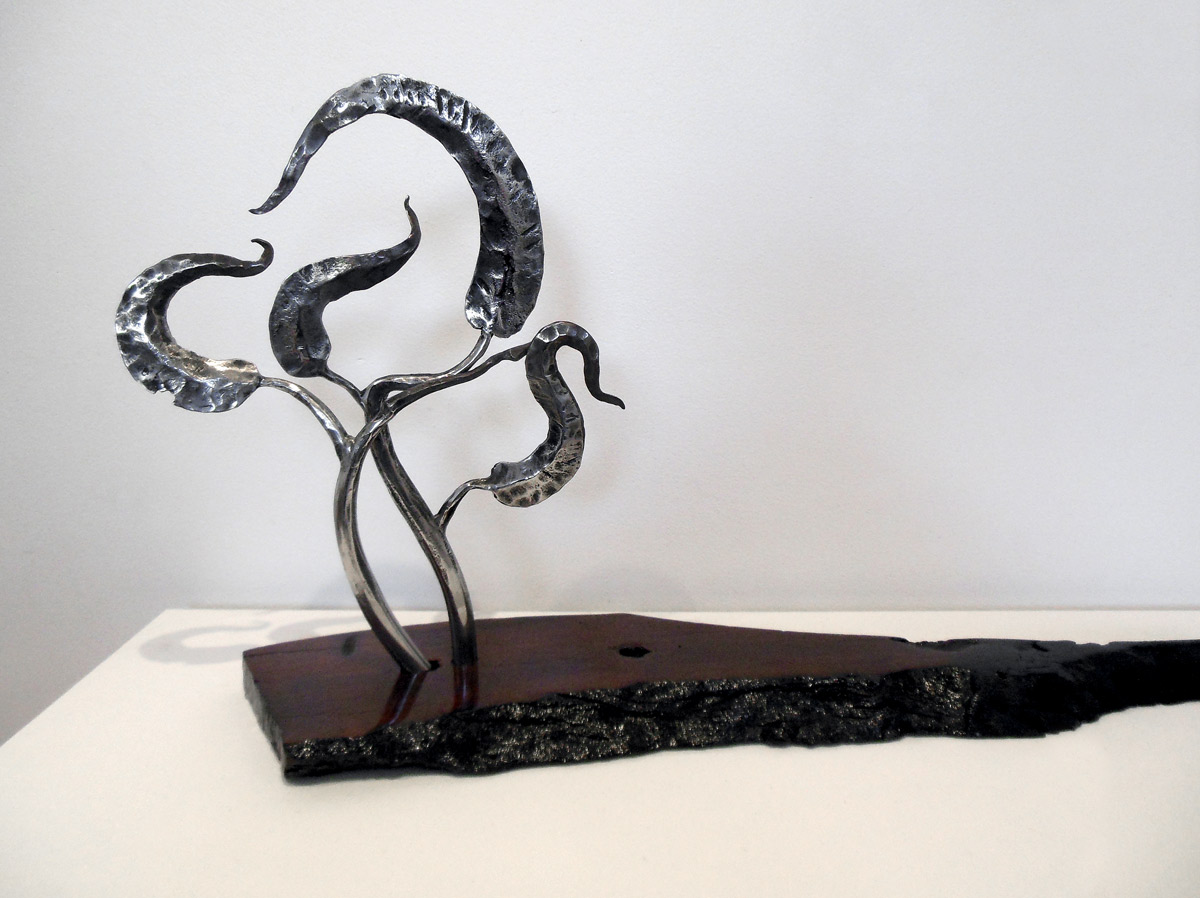
David Wood (Australian) Ghost Gum Three
2013
Stainless steel and red gum
76 x 310 x 44cm Photo: Marcus Bunyan
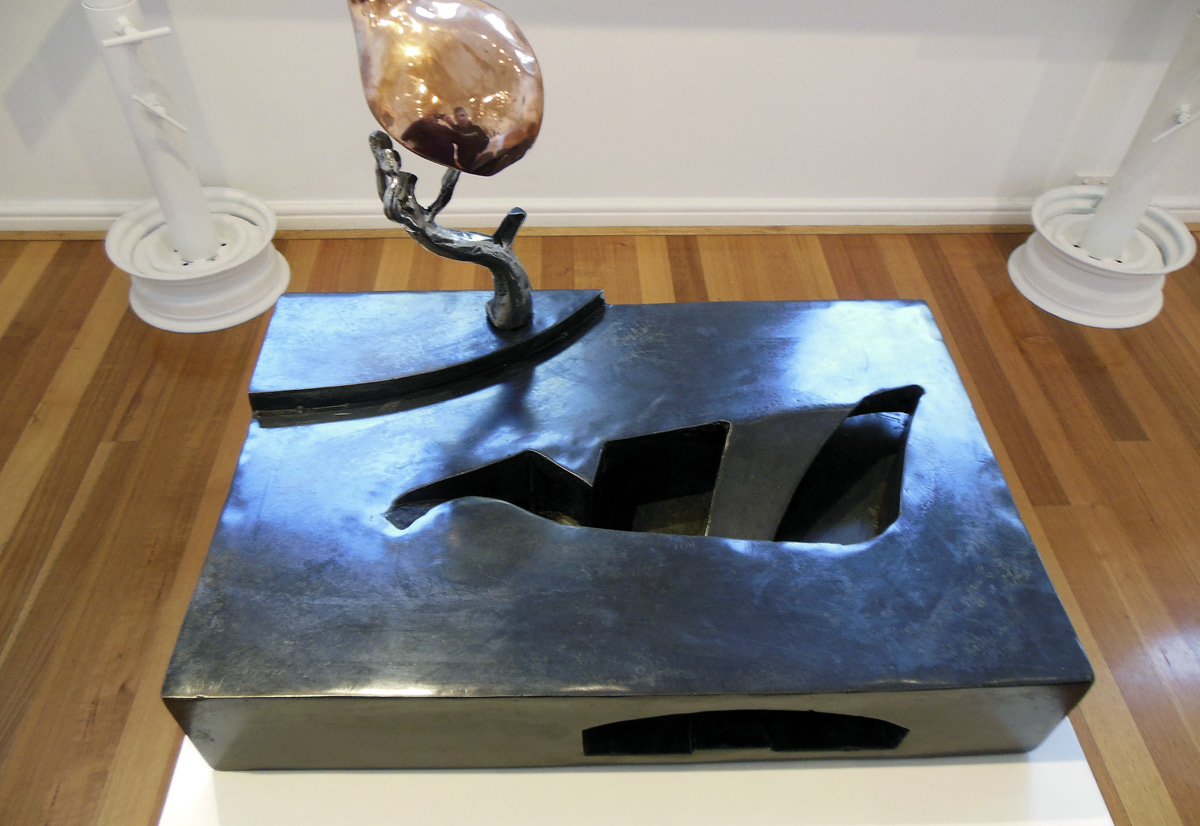
A solid first solo exhibition from my friend David Wood at Gasworks Arts Park. Conceptually the show needed a little tightening but technically the work is outstanding (as you would expect from the owner of Bent Metal and one of Melbourne’s best blacksmiths) and aesthetically pleasing. I particularly liked the topographic remapping of both Port Phillip Bay and St Kilda Junction.
Anyone who knows Melbourne intimately would recognise the ramps and walkways that bisect the interior of the junction even in their abstract form, especially the tram ramp ascending from Dandenong Road to St Kilda Road. I also admired the Nardoo sentinels, which are to be made at full size for a public park in Berwick later in the year.
Dr Marcus Bunyan
Many thankx to Woody for allowing me to publish the photographs in the posting. Please click on the photographs for a larger version of the image.
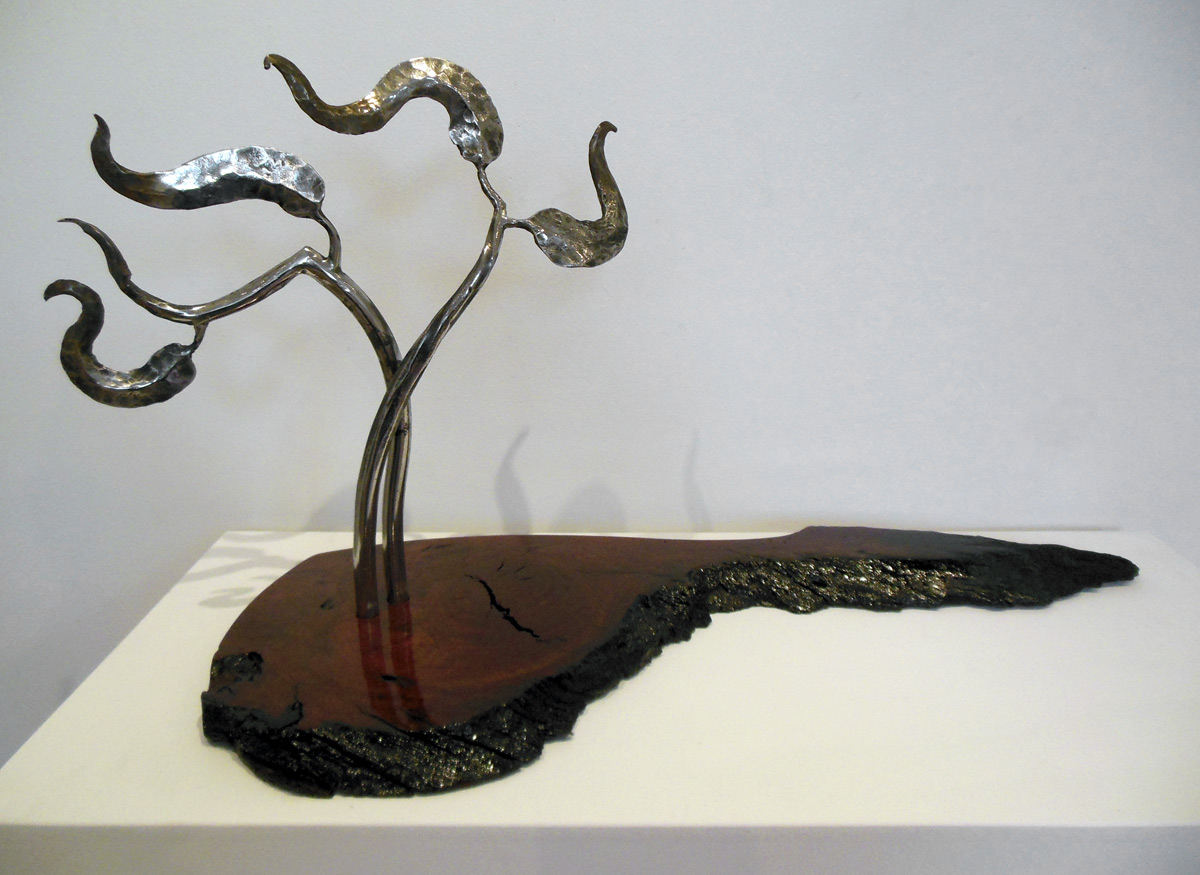
David Wood (Australian) Ghost Gum One
2013
Stainless steel and red gum
72 x 170 x 39cm Photo: Marcus Bunyan
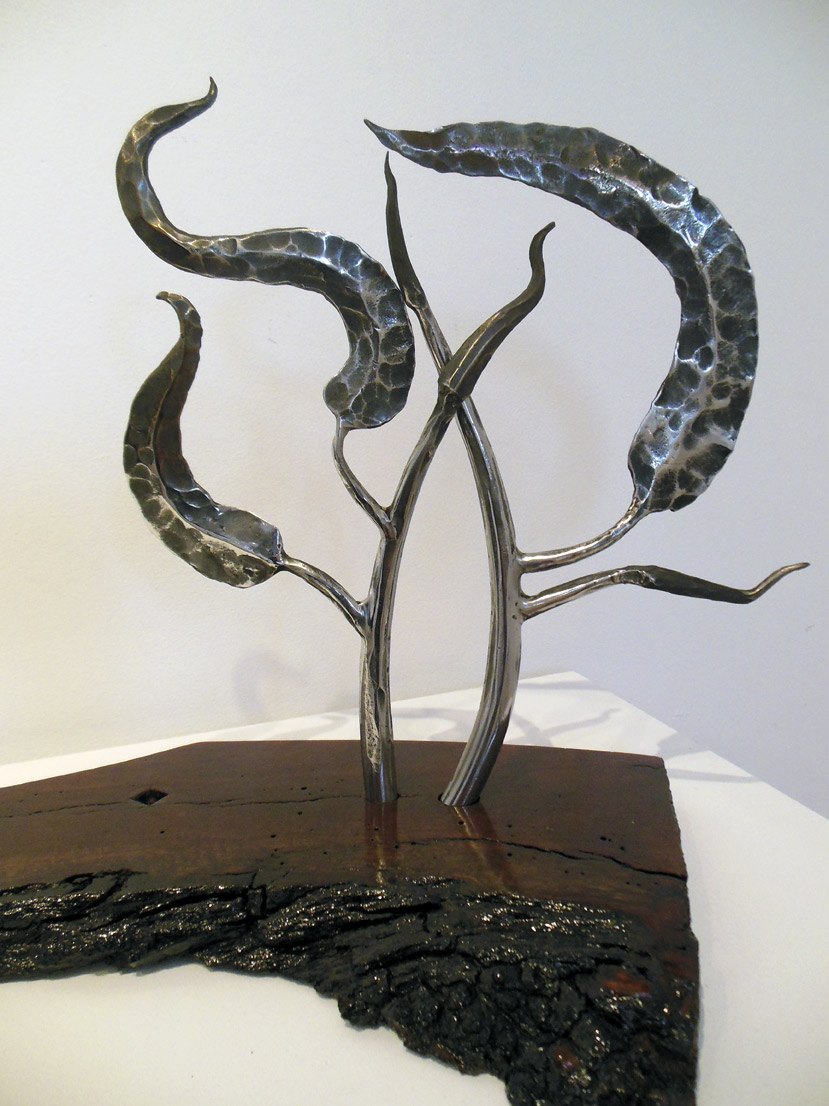
David Wood (Australian) Ghost Gum Two
2013
Stainless steel and red gum
78 x 24 x 36cm Photo: Marcus Bunyan
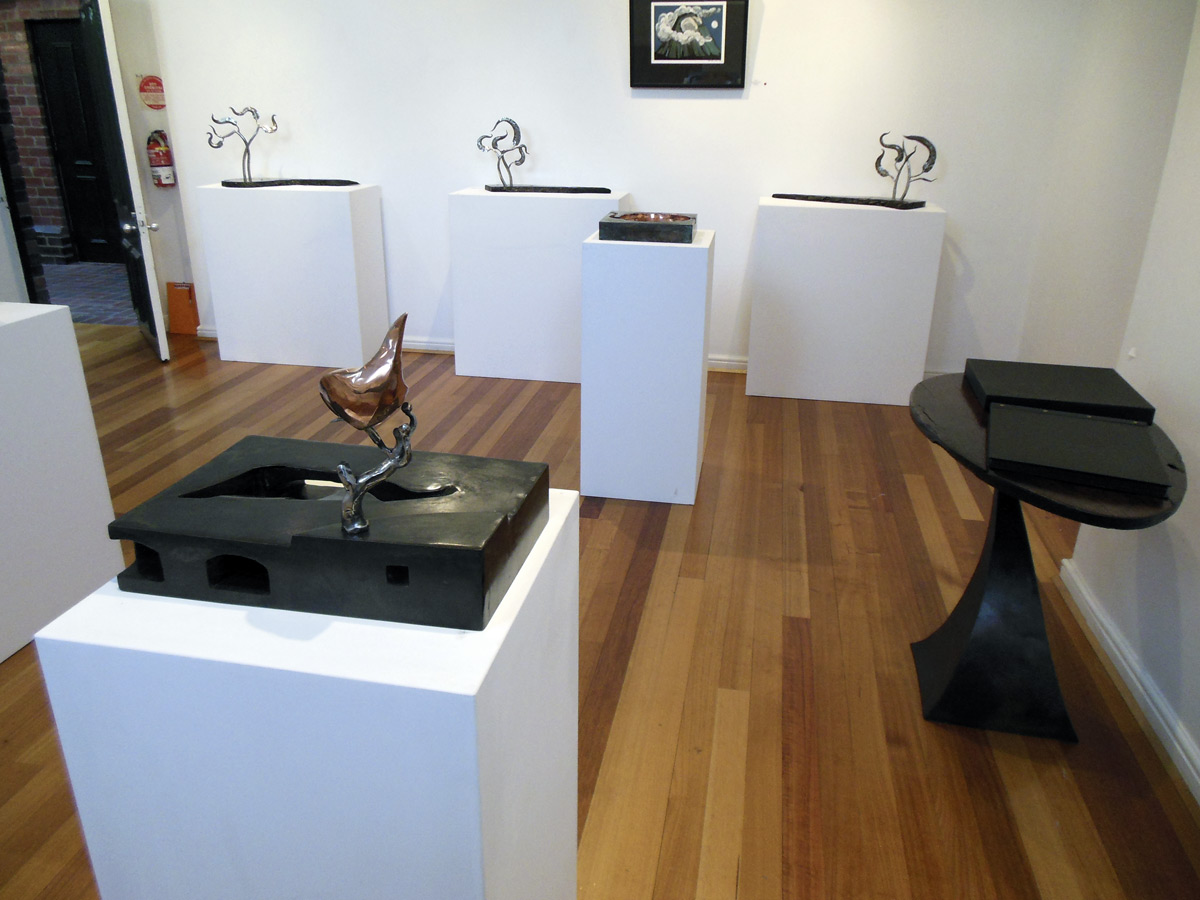
Installation view of the exhibition Sentinels by David Wood at Gasworks Art Park Photo: Marcus Bunyan
My work has two main driving forces – a desire to explore and continue a blacksmithing inheritance and investigating place and how we interact with the physical world. I am interested in how landmarks within landscape can shape, reflect and define our Nation’s ethos and their place as sentinels within our history.
I use traditional forging techniques and prefer to leave hammer marks and traces of process exposed, as testament, on the finished sculpture. The medium itself represents an industry crucial to our economy but detrimental to our landscape.
This current group of work, inspired by the burning of two ghost gums in the Northern Territory is a personal muse on Australian culture. The burning of the ghost gums made famous by Albert Namatjira was a terrible act of vandalism. Small silvery ghostly gum trees stand upon burnt timber bases intended to evoke images of landscape and cultural practice, both ancient and current. Forged vessels take inspiration from the ghost gums’ colour and form.
The pieces are abstract representations in metals and timber of trees, mountain ranges and land formations. Mountain ranges are used to survey our cities and towns. They collect our water and are harvested for their riches. Once they were homes to spiritual beings.
I was born at the base of mount Baw Baw and have created homage. This mountain for me is a keeper of secrets. As an adult I live upon the shores of Port Phillip Bay, a quiet sleeping giant. St Kilda junction is a lyrical gesture to paths crossing and the corroboree tree that still watches over this site.
Bought together, the sculptures encapsulate a personal sense of belonging to a place. They also endeavour to explore greater cultural notions of ownership.
Artist statement by David Wood
David Wood (Australian) Port Phillip Bay
2013
Copper
33 x 33 x 70cm Photo: Marcus Bunyan
David Wood (Australian) St Kilda Junction
2013
Stainless steel, mild steel and copper
27 x 40 x 32cm Photo: Marcus Bunyan
David Wood (Australian) St Kilda Junction (detail)
2013
Stainless steel, mild steel and copper
27 x 40 x 32cm Photo: Marcus Bunyan
David Wood (Australian) Nardoo sentinels (detail) 2013
Mild steel Photos: Marcus Bunyan
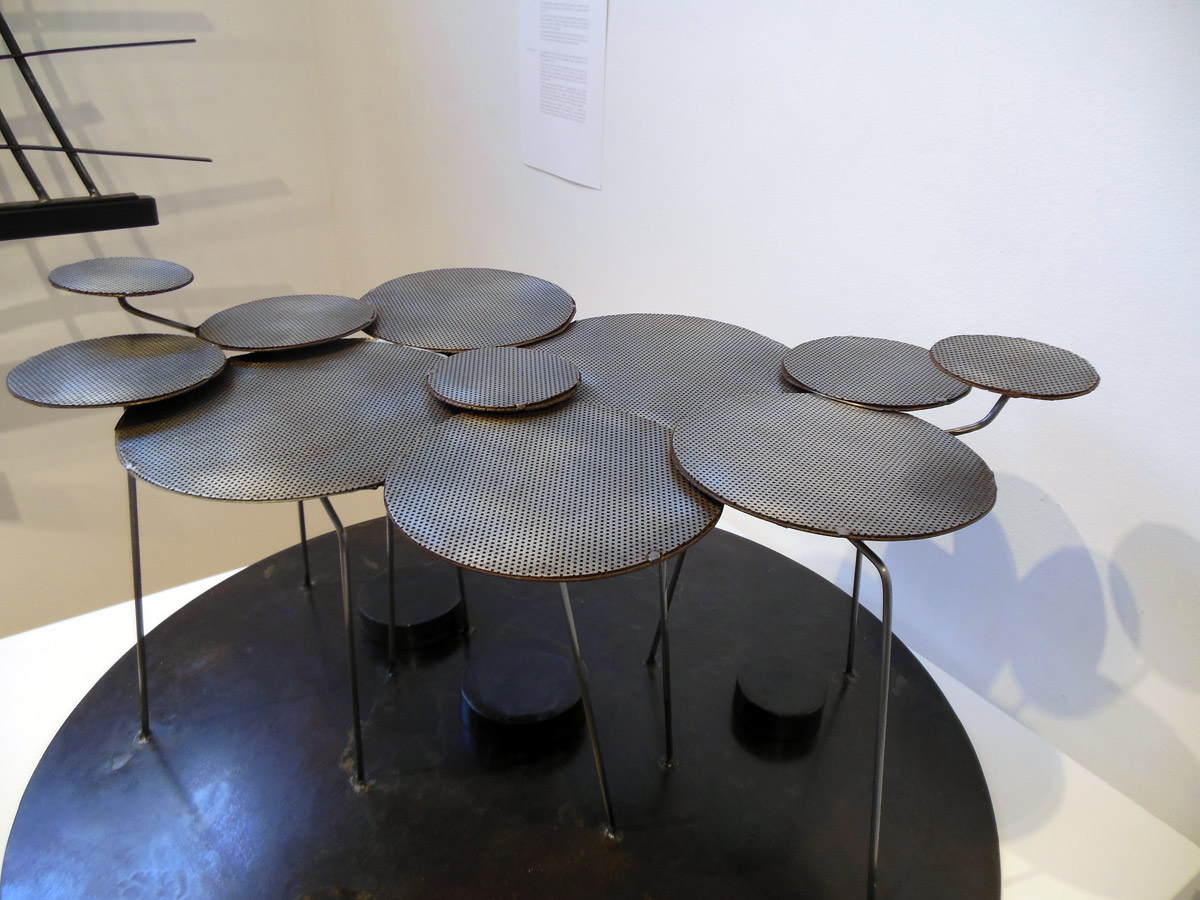
Nardoo sentinels
Inspired by classical structures within great gardens, in particular the Temple of the Winds in the Royal Melbourne Botanic Gardens, this functional sculpture reflects the transparency of our native landscape, significant in shaping our cultural ethos. Mirroring a cluster of trees with their canopy hovering above, it defines its space and surrounds. This group of sentinels stand together to offer protection from the elements.
The singular motif takes the form of nardoo, a native water and food plant. Its finishes mimicking its natural colours and hues. Intended to be a water collector, the shelter is engineered to allow rainwater to drain through its canopy and channel down its stems. Visibility of water flow adds a kinetic dimension to the sculpture. Commissioned exclusively by Pask Development Group, via Tract Landscape Architects, this rotunda is a central feature for a public park. It will stand proud later this year.
David Wood (Australian) Nardoo sentinels (left) and Reed Rotunda (right) 2013
Mild steel Photo: Marcus Bunyan
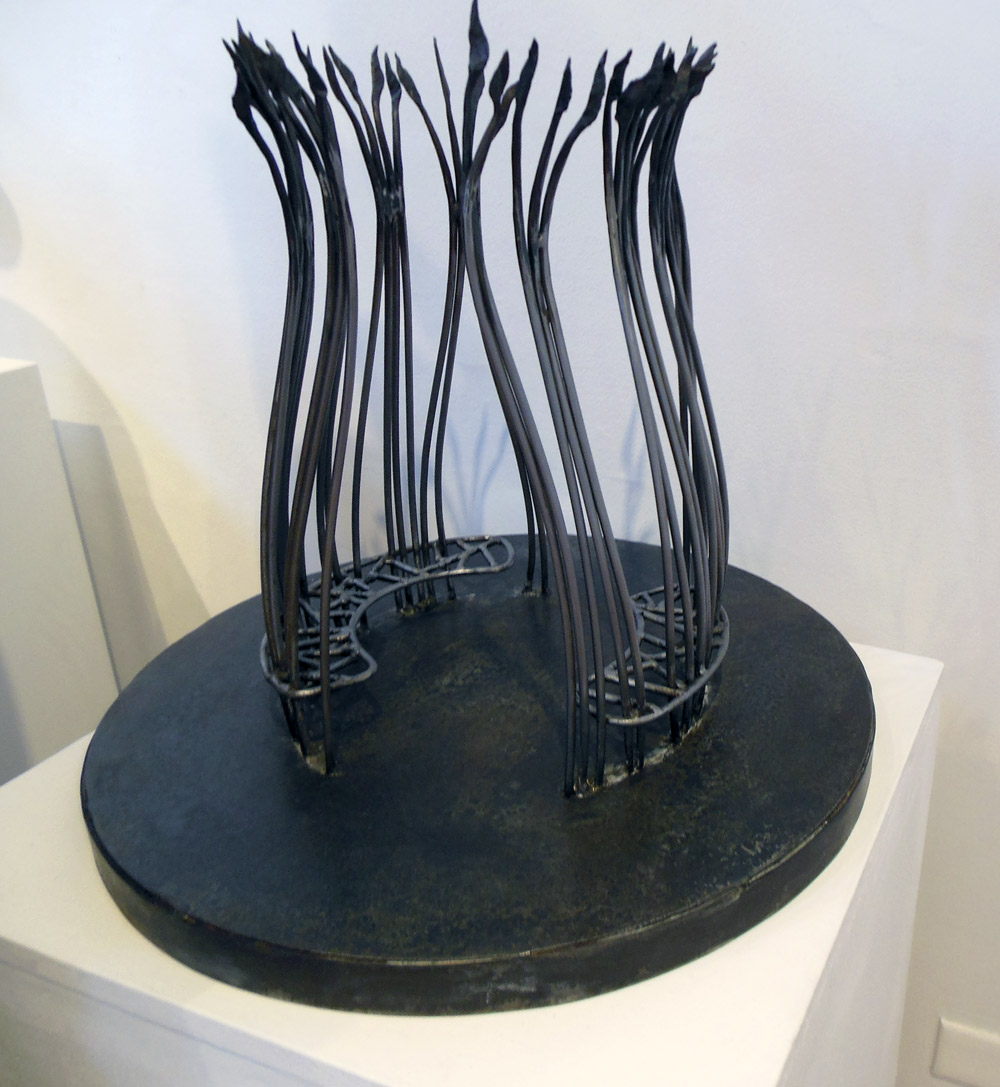
David Wood (Australian) Reed rotunda
2013
Mild steel
70 x 70 x 46cm Photo: Marcus Bunyan
Reed rotunda
The design derives a motif from the natural growth of the Phragmite Australis reeds, a wetland plant indigenous to our continent home.
The common reed is known to everyone and surrounds us. It plays an integral role in conservation as habitat and a guardian for wildlife. A natural purifier, removing toxins from our creeks and wetlands. A reed standing alone may be insignificant, but when congregating on mass, it becomes a formidable force in both structure and function. An organic organism that frames and protects the landscape, moves and changes colour with the seasons, rides the wind and plays with light and shade.
Often overlooked as a feature of landscape or viewed as slightly raggedy, this piece invites visitors to celebrate these reeds as something beautiful and to use them as a metaphor for community, refuge and purification of the spirit and soul.
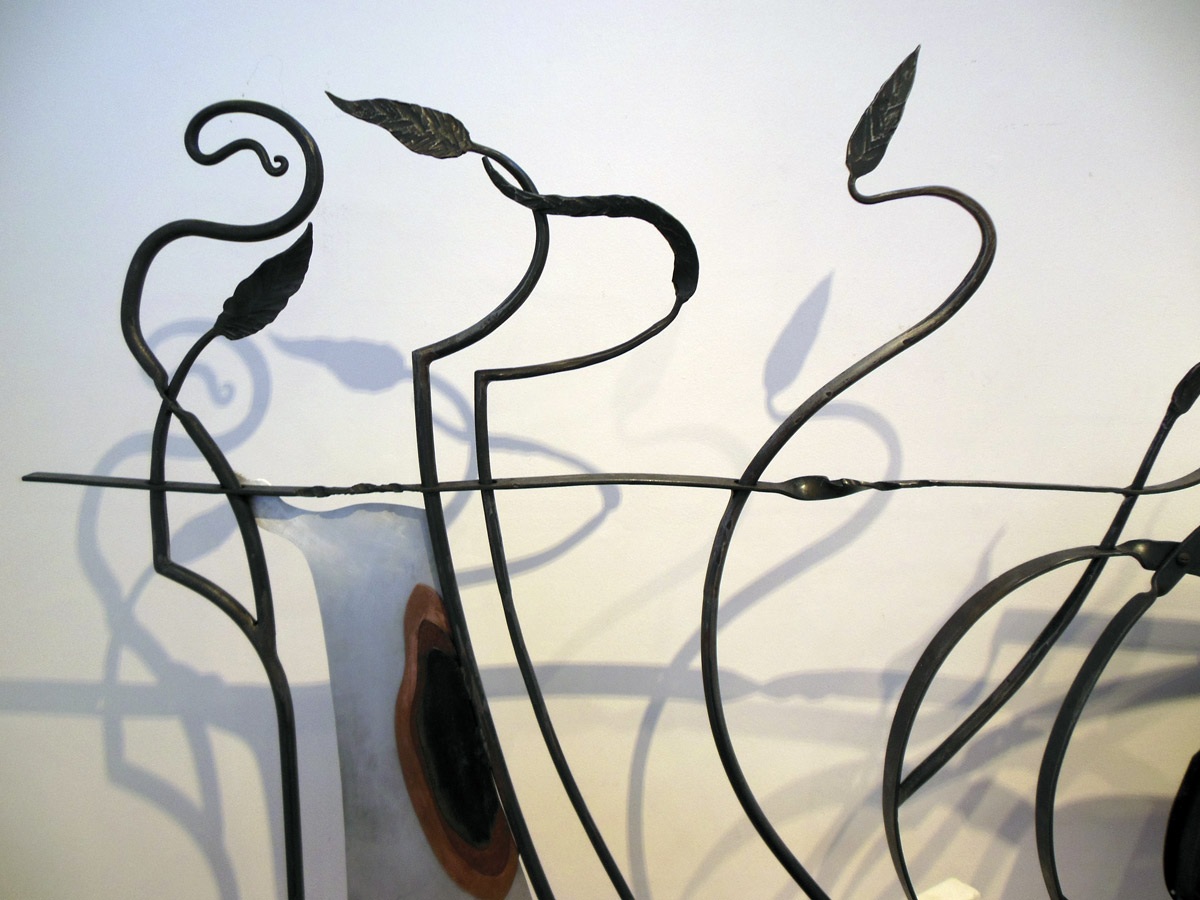
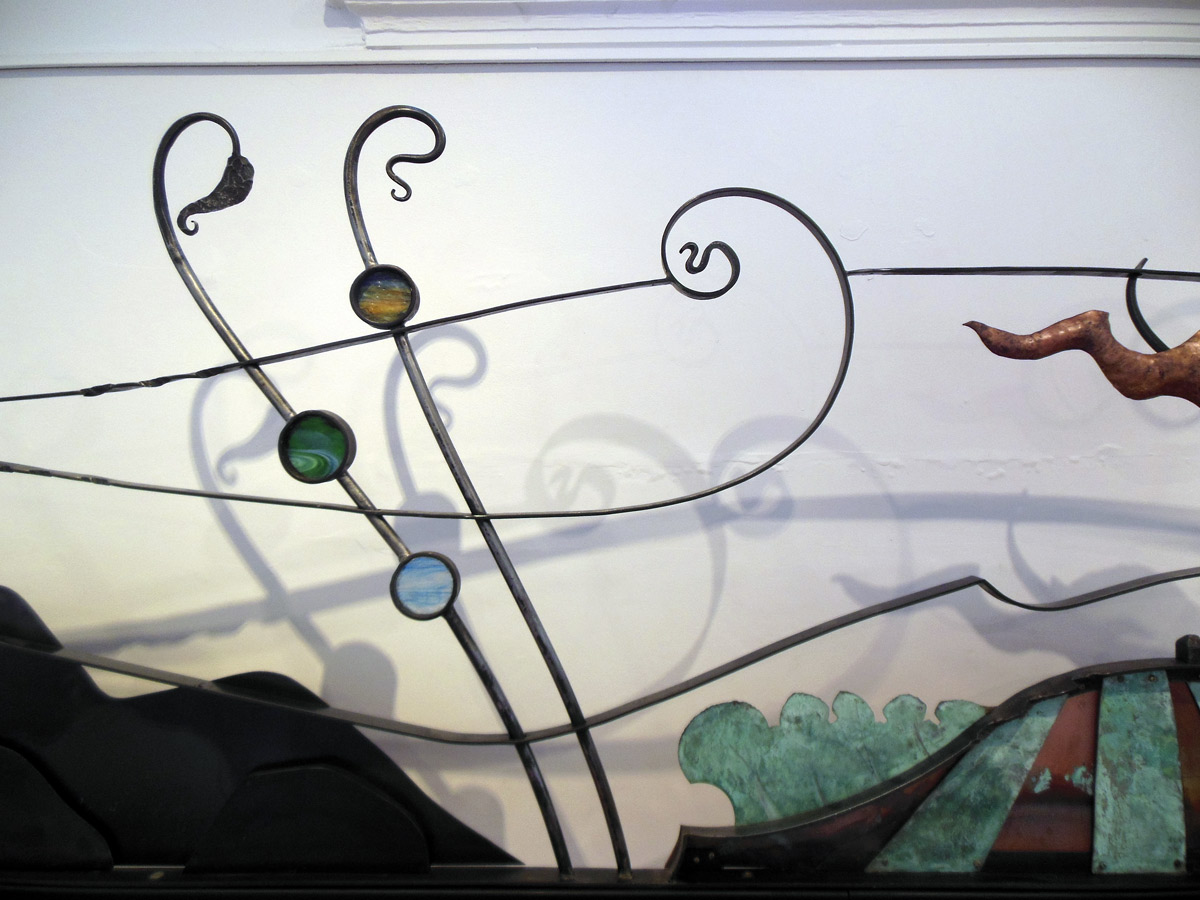
David Wood (Australian) Baw Baw wall feature (detail)
2013
Mild steel, stainless steel, copper, brass, aluminium and glass
6200 x 500 x 70cm Photos: Marcus Bunyan
Gasworks Arts Park
21 Graham Street
Albert Park VIC 3206 Phone: (03) 8606 4200
I don’t often say this about an artist but OMG, I am in love!
Five years before Wassily Kandinsky (he of the book Concerning the Spiritual In Art1910), before Piet Mondrian and Kazimir Malevich, the images of Carl Jung (The Red Book) and Rudolf Steiner (Blackboard Drawings 1919-1924) – who dismissed her ideas as wrong – was this revolutionary artist and abstractionist, Hilma af Klint, possibly the first purely abstract painter to produced non-objective works in the early 1900’s. While her more conventional painting became the source of her financial income her ‘life’s work’ remained a quite separate practice and hidden from view. She worked in isolation with little knowledge of the Avant-garde movement in Europe and requested that her complex and articulate paintings not be shown until 20 years after her death.
“Through her work with the group “the Five” af Klint created experimental automatic drawing as early as 1896, leading her towards an inventive geometric visual language capable of conceptualising invisible forces both of the inner and outer worlds. Quite apart from their diagrammatic purpose the paintings have a freshness and a modern aesthetic of tentative line and hastily captured image: a segmented circle, a helix bisected and divided into a spectrum of lightly painted colours. She continued prolifically to add to the body of work amounting to over 1000 pieces until 1941. She requested that it should not be shown until 20 years after the end of her life. In 1970 her paintings were offered as a gift to Moderna Museet in Stockholm, which declined the donation.” (Text from Wikipedia)
Ironic then is it not, that this first major exhibition of Hilma af Klint’s life’s work is at Moderna Museet in Stockholm. How times and attitudes change. And yes, I have ordered the catalogue…
Dr Marcus Bunyan
Many thankx to Moderna Museet for allowing me to publish the artwork in the posting. Please click on the photographs for a larger version of the image.
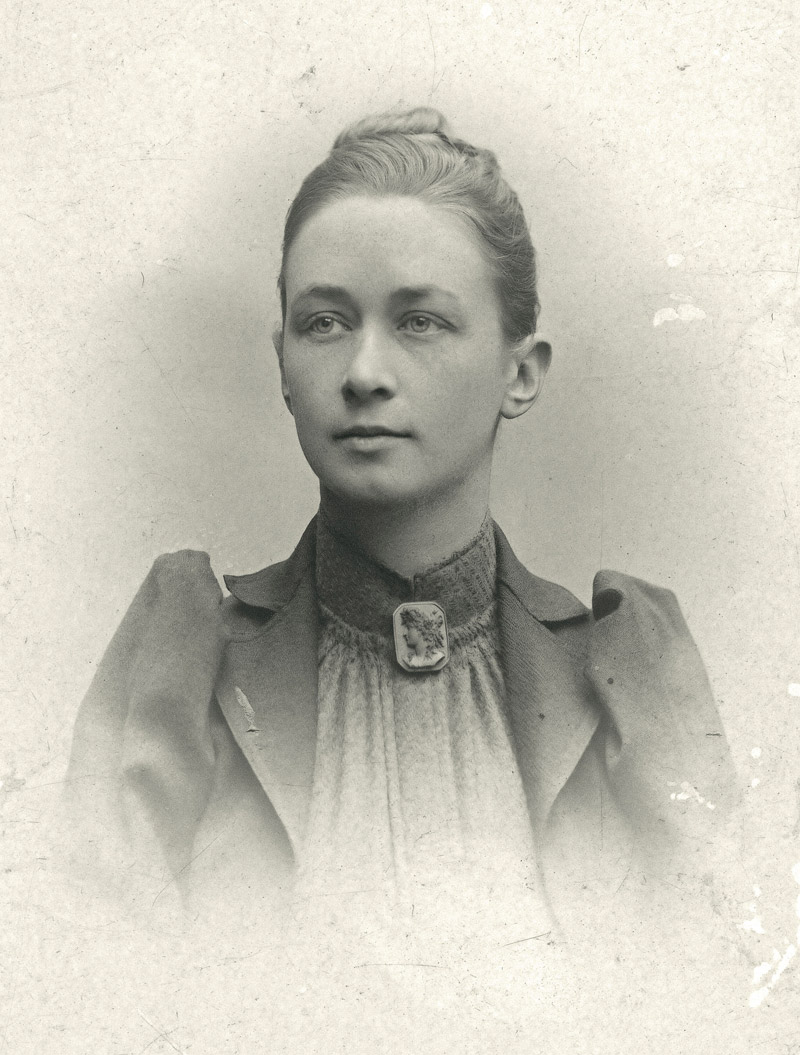
Photographer unknown Portrait of Hilma af Klint Nd
“Negotiating around the masculine domain of art making by working through automatism and spiritual séances, Hilma af Klint appears to allow herself more freedom and reverence by working directly through ‘High Masters’ in their masculine form; through instructed spiritualist experience. Influenced heavily by the infamous Madame Blavatsky, the co-founder of The Theosophical Society and writer of ‘The Secret Doctrine’, af Klint’s ‘High Masters’ guided her hand in an attempt to gain spiritual knowledge of the self and of the universe…
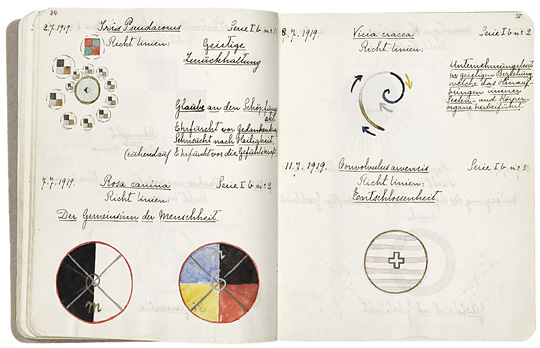
Her occult diaries containing symbols of crosses, mystical vowels, dead sea scrolls, astral and metaphysical planes, mystical initials, strange vowels cross over to the larger works, continuing to make the viewer work hard at understanding what message is being sent. It is then that you notice the rest of the space with painting after painting hung mainly in series, working their way with fluidity around the many walls contained within the exhibiting space. Cubicles of watercolours denoting The Tree of Life, Studies of world religions, paintings for the temple, they are all there. It is clear that af Klint was prolific in her secretive world but it is hard to imagine how she managed to keep all these vast works hidden from view.
It is clear that Klint has some understanding of scientific breakthroughs in her time however her occult physics, chemistry and mathematical understanding appears ahead of its time. Her provocative nature appears to ask questions of sexuality, suggests male and female equality and is probably through this enquiry, still seen as revolutionary. In light of this, af Klint experienced continuous dismissal of her working practices and ideas linked to the scientific and mathematical study of spiritual knowledge. Her friends describe her work as ‘inappropriate’ and her contemporary Rudolph Steiner, founder of The Anthroposophical Society dismissed her ideas as wrong when asked by personal invitation to view them, claiming that she couldn’t have contact with spirits in that way although he doesn’t appear to state clearly for what reason.”
Open College for the Arts tutor Hayley Lock on the We Are OCA website [Online] Cited 20/05/2013
Hilma af Klint – A Pioneer of Abstraction | Introduction
In the spring of 2013, the Moderna Museet is showing Hilma af Klint (1862-1944) in a large format with many works that have never been shown before. This retrospective exhibition presents Hilma af Klint as one of the greatest Swedish artists.
Hilma af Klint was a pioneer in abstract art, as early as 1906 she left a representational painting behind. Between 1906 and 1915, nearly 200 abstract paintings of partly monumental formats were added. Similar to Wassily Kandinsky, Piet Mondrian and Kazimir Malevich, who until now have been regarded as the foreground figures of abstraction, Hilma af Klint was interested in spiritual currents of her time such as spiritualism, theosophy and later anthroposophy. Hilma af Klint’s art is about the consciousness of a spiritual dimension, something that was marginalized in an increasingly materialistically oriented world.
Moderna Museet’s retrospective exhibition presents Hilma af Klint’s most important abstract works as well as paintings and works on paper that have never been shown before.
In Spring 2013 Moderna Museet is dedicating a major exhibition to Hilma af Klint (1862-1944), featuring many works that have never before been shown in public. This retrospective exhibition of a Swedish pioneer of abstract art is Moderna Museet’s tribute to Hilma af Klint as one of the greatest Swedish artists. A woman artist whose work is still far too unknown to a wider public, Hilma af Klint eschewed representational painting as early as 1906. Between 1906 and 1915, she produced nearly 200 abstract paintings, some of which are in monumental formats.
Like Vassily Kandinsky, Piet Mondrian and Kazimir Malevich, who have previously been regarded as the main protagonists of abstract art, Hilma af Klint was influenced by contemporary spiritual movements, such as spiritism, theosophy and, later, anthroposophy. Hilma af Klint’s oeuvre builds on the awareness of a spiritual dimension of consciousness, an aspect that was being marginalised in an increasingly materialistic world. When she painted, she believed that a higher consciousness was speaking through her. In her astonishing works she combines geometric shapes and symbols with ornamentation. Her multifaceted imagery strives to give insights into the different dimensions of existence, where microcosm and macrocosm reflect one another.
Hilma af Klint’s groundbreaking images were created in the early years of the 20th century – before the dawn of abstract art in Russia and Europe. Her works are not concerned with abstraction of colour and shapes for its own sake, but are an attempt to portray that which is not visible. Kandinsky, Malevich and Mondrian also explored a spiritual dimension. Kandinsky moved away from Expressionism and gradually left visible reality behind. He had a great interest in the occult and published On the Spiritual in Art in 1911. Malevich arrived via Cubism and Futurism at his suprematist, abstract and exceedingly spiritual images. Mondrian successively turned his back on figurative portrayals of that which the eye can see, reducing his compositions to a play of vertical and horizontal lines, and to the primary colours red, yellow and blue, with white and black. As a theosophist, he was striving for a purely spiritual expression of the eternal ideas beyond the visible world. Spiritual searching was thus an essential element to many of the modernists who moved towards an abstract imagery. Unlike Hilma af Klint, Kandinsky, Malevich and Mondrian did not claim to be acting as mediums in their creative process. This was an experience, however, that she had in common with artists such as the artists František Kupka (1871-1957), Emma Kunz (1892-1963) and the writer Victor Hugo (1802-1885).
Hilma af Klint left more than 1,000 paintings, watercolours and sketches. Although she exhibited her early, representational works, she refused to show her abstract paintings during her lifetime. In her will, she stipulated that these groundbreaking works must not be shown publicly until 20 years after her death. She was convinced that only then would the world be fully and completely ready to understand their significance.
Moderna Museet’s retrospective exhibition presents Hilma af Klint’s most important abstract works, as well as paintings and works on paper that have never before been presented publicly, enhancing our understanding of her oeuvre. Her extensive diaries and notebooks have been included in the research for this exhibition, which comprises some 200 paintings and works on paper and will tour internationally in 2013-2015.
About the artist
Hilma af Klint (1862-1944) was a pioneer of art that turned away from visible reality. By 1906, she had developed an abstract imagery. This was several years before Wassily Kandinsky (1866-1944), Piet Mondrian (1872-1944) and Kazimir Malevich (1878-1935), who are still regarded as the pioneers of abstract 20th-century art. Hilma af Klint assumed that there was a spiritual dimension to life and aimed at visualising contexts beyond what the eye can see. When painting, she believed that she was in contact with a higher consciousness that spoke and conveyed messages through her. Like many of her contemporaries, she was influenced by spiritual movements, especially spiritualism, theosophy and later anthroposophy. Through her paintings, she sought to understand and communicate the various dimensions of human existence.
In her will, Hilma af Klint wrote that her abstract works must not be made accessible to the public until at least twenty years after her death. She was convinced that their full meaning could not be understood until then. One hundred years ago, Hilma af Klint painted pictures for the future.
A Woman Artist at the Turn of the Century
Hilma af Klint began her art studies at Tekniska Skolan in Stockholm and also had lessons in portrait painting. Between 1882 and 1887, she was a student at the Royal Academy of the Fine Arts. After graduating and until 1908, she had a studio at Kungsträdgården in central Stockholm. She painted and exhibited portraits and landscapes in a naturalist style. In the late 1870s, Hilma af Klint attended séances, where a medium contacted the dead. There was a great fascination for invisible phenomena at the time. This can be seen in relation to scientific discoveries, such as x-rays that could reveal internal human organs, and electromagnetic waves that led to the development of radio and telephony.
In 1896, Hilma af Klint and four other women formed the group “De Fem” [The Five]. They made contact with “high masters” from another dimension, and made meticulous notes on their séances. This led to a definite change in Hilma af Klint’s art. She began practising automatic writing, which involves writing without consciously guiding the movement of the pen on the paper. She developed a form of automatic drawing, predating the surrealists by decades. Gradually, she eschewed her naturalist imagery, in an effort to free herself from her academic training. She embarked on an inward journey, into a world that is hidden from most people.
Hilma af Klint’s imagery is full of symbols, letters and words. Symbols are like doors into another dimension. For Hilma af Klint, her entire work was about conveying the messages she received, and to shed light on the great existential issues.
It would be pointless to translate the symbols and letters in Hilma af Klint’s works into definite, unambiguous terms. They must always be seen in relation to the entire context. In her notebook Symboler, Bokstäver och Ord tillhörande Hilma af Klints målningar [Notes on Letters and Words pertaining to Works by Hilma af Klint] she attempts to clarify the complex meanings of the various signs. Here are a few general explanations:
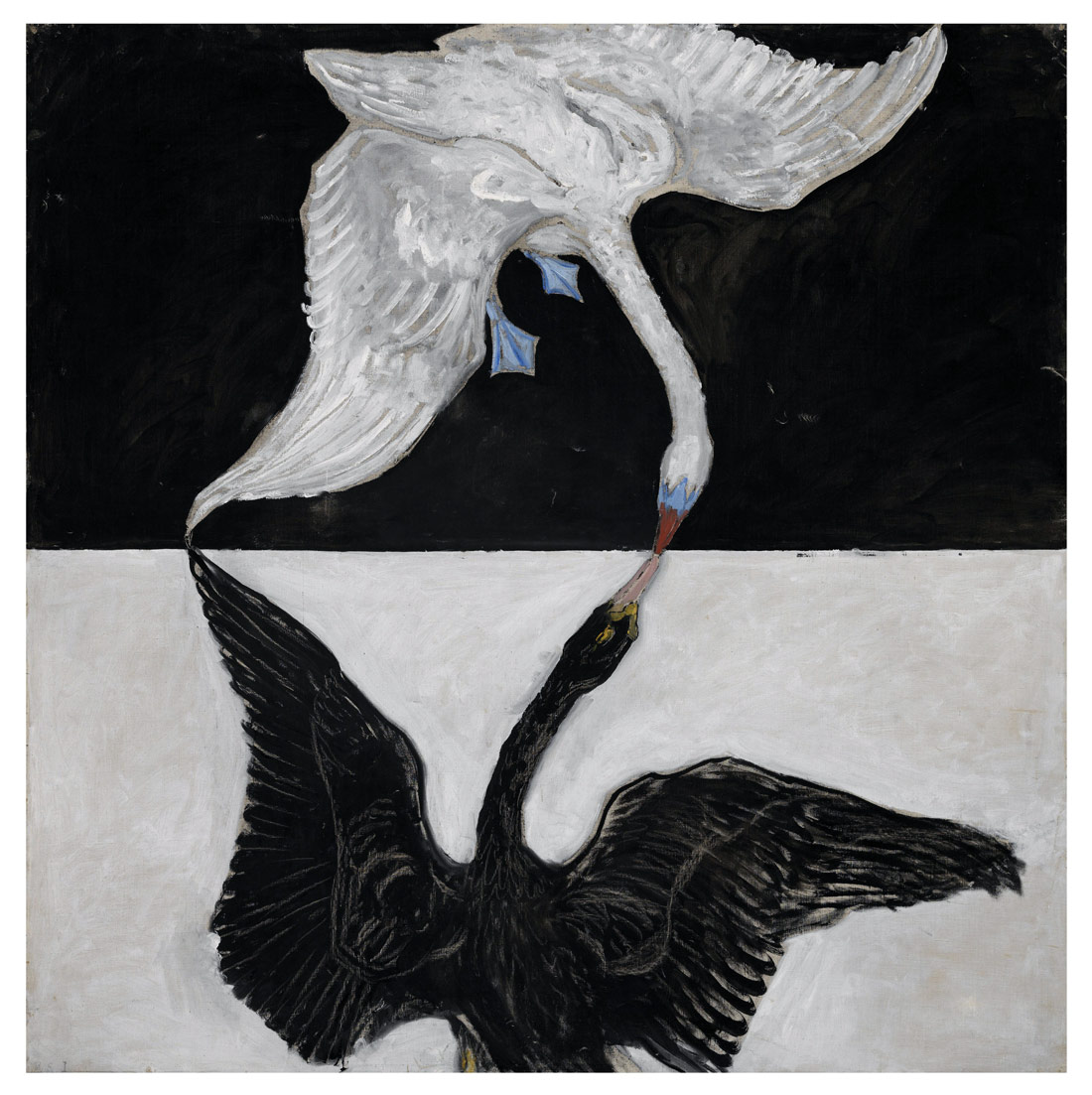
The snail or spiral represents development or evolution. The eyelet and the hook,blue and yellow, and the lily and the rose represent femininity and masculinity respectively. W stands for matter, while U stands for spirit. The almond shape arising when two circles overlap is called the vesica piscis and is an ancient symbol for the development towards unity and completion. The swan represents the ethereal in many mythologies and religions and stands for completion in the alchemical tradition. In Christianity, the dove represents the holy spirit and love.
Terminology
Esoteric and occult denote “the science of the hidden dimensions”. Western esotericism is a mixture of Neoplatonism, Hermeticism, Jewish kabbalah and the three occult “sciences” of astrology, magic and alchemy.
Spiritualism shares the conviction that it is possible to make contact with the spirits of the deceased. Modern spiritism was spread thanks to the Fox sisters in the USA in 1848.
Theosophy is a general doctrine incorporating inspiration from various religions and spiritism. The religions are regarded as different expressions of one fundamental truth. Theosophy teaches that the origin of everything, divinity, is inherent in every being. The Theosophical Society was founded in New York in 1875 by Helena Blavatsky and others. There is also an older form of theosophy that is significantly different to the newer version.
Anthroposophy is a life philosophy that originated in theosophy. Rudolf Steiner, who was the leader of the German branch of the Theosophical Society, left theosophy in 1913 to set up the anthroposophical movement. The two philosophies have a great deal in common, but anthroposophy in general has a stronger Christian element.
According to legend, the Rosicrucians were an esoteric society in Germany who engaged in alchemy in the early 17th century. Today, there are many secret orders that claim to uphold the Rosicrucian traditions.
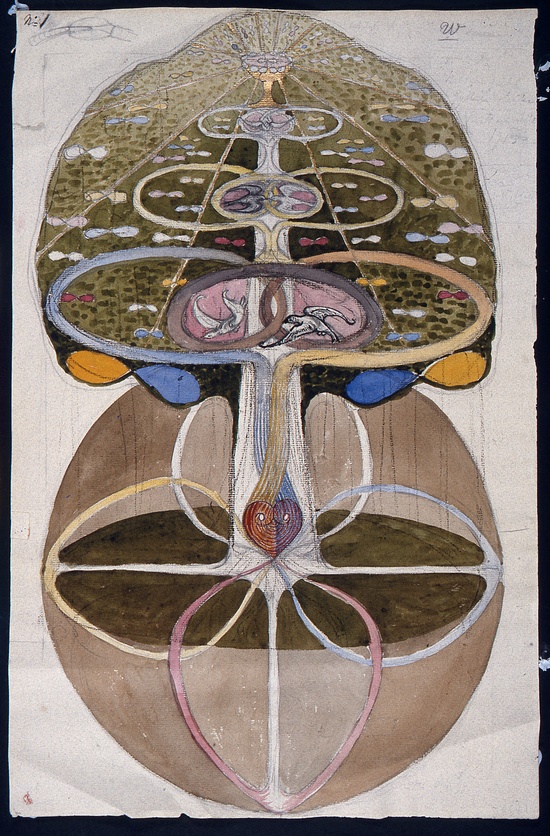
Hilma af Klint (Swedish, 1862-1944) Tree of Knowledge
1913
Moderna Museet is ten minutes away from Kungsträdgården, and twenty minutes from T-Centralen or Gamla Stan. Walk past Grand Hotel and Nationalmuseum on Blasieholmen, opposite the Royal Palace. After crossing the bridge to Skeppsholmen, continue up the hill. The entrance to Moderna Museet and Arkitekturmuseet is on the left-hand side.
Anonymous photographer Hardstrasse with Hardbrücke in construction 1972
Gelatin silver print
8.8 x 12.6cm
Baugeschichtliches Archiv der Stadt Zürich
When creating this archive, so much of my time is spent cleaning up clearly inadequate media images, an example of which can be seen below. I have become very adept at this process and my thoughts are this: would you want to be the artist whose work is displayed to the public in a remarkably decomposed manner, one not up to a standard of any artist who cares about their prints and reputation? I certainly would not. It is a wonder to me that museums and galleries spend thousands of dollars staging exhibitions and producing costly catalogues and yet cannot spend a tiny proportion of time, money and care on their media images to promote artist and said exhibition. I had to spend a lot of time on over half of these images to bring them up to presentable standard.
Having said that, there are some cracking photographs in this posting. The Sugimoto is sublime, Walker Evans so muscular, Lucien Hervé a masterpiece of light and texture, and Moriz Nähr a symphony of light and tone, to name but a few. I hope you enjoy all the effort it takes to bring these images to you.
Dr Marcus Bunyan
Many thankx to the Fotomuseum Winterthur, Zurich for allowing me to publish the photographs in the posting. Please click on the photographs for a larger version of the image.
Michael Wesely (born 1963 in Munich) is a German art photographer who is best known for his photos of cities, buildings, landscapes, and still lives of flowers taken with a special ultra-long exposure technique. …
Wesely’s works deal with the subject of time and the change that takes place over time. Due to the extremely long exposure and the special bulb he uses, those elements that move the least dominate his images, while those moving will later be seen as transparent figures or the outlines of newly erect buildings overlapping. The pictures “reveal the passage of time by showing the changing skyline, the skeletons of cranes. the rise of new buildings, and the disappearance of others. Beams of sunlight, the residue of the ever-changing positions (tithe earth and sun, are also evident, like a palimpsest of seasons”. Everything that ever happened on the scene during exposure (during weeks, months, or even up to two or three years) will be seen in one single picture. Wesely’s photographs have been described as a metaphor on the change of Berlin after 1989 because “at once strikingly energetic and ghostly and uninhabited. This formal paradox aptly describes Berlin, which had only been unified for ten years at the time the images were taken. In that way, the photographs offer a larger commentary on time’s passage.”
William Henry Fox Talbot (English, 1800-1877)
The Bridge of Sighs, St. John’s College, Cambridge 1845
Salt print from calotype negative
16.4 x 20.6cm
Museum Folkwang Essen
Charles Marville (French, 1813-1879)
24, Rue Bièvre, Paris 1865-1869
Albumin print
27.4 x 36.6cm
Collection Thomas Walther
Lucien Hervé is considered to be one of the great architectural photographers of the 20th century. He collaborated with Le Corbusier from 1949 until the architect’s death in 1965, developing a great rapport. Le Corbusier even once pronounced Hervé to have ‘the soul of an architect.’ In 1949, Hervé travelled from Paris to Marseille to see Le Corbusier’s recently designed housing complex, Unité d’Habitation. Awed by the groundbreaking modern design, Hervé took 650 photographs of it in a single day and it was from then onwards they worked closely with one another.
Through light and shadow, he defined the dialogue between substance and form. By delineating a strong contrast between the light and shadows in his subject as well as placing emphasis on building details, Hervé was able to communicate the depth of a room, the surface of a wall, or the strength of a building’s framework.
Born 1910 in Hungary, Hervé (born László Elkán) moved to Paris at the age of 19 and earned French citizenship in 1938. During World War II, he was captured by the Germans, escaped and became a member of the French Resistance under the name of Lucien Hervé, which he kept thereafter. After the war he left politics behind to write for art journals. It was one of his editors, in fact, who suggested he visit Unité d’Habitation. Hervé began experimenting with photography, over or underexposing images and often severely cropping them to attain unusual compositions following the work of avant-garde artists such as Piet Mondrian, László Moholy-Nagy, and Alexander Rodchenko.
Laurence Bonvin (born 1967 in Sierre) is a Swiss photographer and director living between Berlin, Valais and Lisbon. Her documentary approach has for many years focused on the phenomena of transformation in urban and natural environments.
Architectures and cities are both volumes and images alike. We experience them directly, physically and sensually, as well as through pictures. Pictures speak a language of their own. They offer a discourse that is quite unlike the physical experience of architecture. They transform volume into surface; distil matter into forms and signs – rarely, if ever, leaving it as it is. That is probably why so many architects try to get involved in determining the image of their buildings. Concrete – Photography and Architecture seeks to approach the singular and complex relationship between architecture and photography in light-hearted, narrative and dialectical ways. The exhibition explores issues of history and ideology, as well as the specifics of form and material, in the photographic image.
The visual appeal of destroyed or dilapidated buildings is also addressed, as are their powerful demonstrations of power and exclusivity, fragility and beauty. To what extent does photography influence not only the way architecture is perceived, but also the way it is designed? How does an image bring architecture to life, and at what point does it become uncanny? How do settlements develop into cities? Or, in sociological terms: how do work and life interconnect differently in, say, Zurich and Winterthur, as opposed to, say, Calcutta? And how do skyscrapers and living spaces translate into the flat, two-dimensional world of photography?
Concrete – Photography and Architecture is not, however, chronologically arranged. Instead, it is based on compelling positions, counterpositions and thematic fields that connect various concrete, fundamental and historical aspects. Alongside everyday buildings and prestigious architecture, structured by horizontal and vertical axes, alongside homes and houses, utopian fantasies, design and reality, an important aspect of the exhibition is the compelling appeal of architectural decay due to the passage of time, through both natural and deliberate destruction. It is almost as though photography were providing a moral reminder even such magnificence and presence, whether hewn in stone or cast in concrete, has its weaknesses too.
Architecture has always been an important platform for the frequently heated discussion of ideas and views, zeitgeist and weltanschauung, everyday life and aesthetics. Architecture is the bold materialisation of private and public visions, functionality and avant-garde art alike. It is, as Slavoj Žižek puts it, ideology in stone. Photography and architecture both play an undisputed role in our everyday lives. They confront us on a daily basis, often without our even noticing, and they influence how we think, act and live in subliminal and lasting ways. Concrete – Photography and Architecture provides visual answers to the question of what it is that makes up the intimate yet complex relationship between architecture and photography, architect and photographer.
The exhibition presents more than 400 photographs and groups of works from the 19th, 20th and 21st centuries, including William Henry Fox Talbot, Domenico Bresolin and Charles Marville as well as Germaine Krull, Lucia Moholy and Julius Shulman, and spanning an arc to contemporary works by Georg Aerni, Iwan Baan, Luisa Lambri and Hiroshi Sugimoto. Projects such as the long-term observations of Schlieren photography or Wolfgang Scheppe’s Migropolis show how the art of photography is playing an increasingly important role as an instrument of research and knowledge. The exhibition is accompanied by a lavishly illustrated book published by Scheidegger & Spiess, with some 300 colour and black-and-white pictures, essays by Jochen Becker, Johannes Binotto, Verena Huber Nievergelt, Michael Jakob, Nicoletta Leonardi, Lorenzo Rocha, Caspar Schärer, Aveek Sen and Urs Stahel as well as a conversation with Annette Gigon, Meret Ernst and Armin Linke.
Press release from the Fotomuseum Winterthur website
Guido Guidi (born January 1, 1941) is an Italian photographer. His work, spanning over more than 40 years, has focused in particular on rural and suburban geographies in Italy and Europe. He photographs places that are normally overlooked. His published works include In Between Cities, Guardando a Est, A New Map of Italy and Veramente. …
Guidi began experimenting in the late 1960s with pseudo-documentary images that interrogated photography’s objectivity. Influenced by neorealist film and conceptual art, in the 1970s he began investigating Italy’s man-altered landscape. Working in marginal and decayed spaces with an 8×10 large format camera, he creates dense sequences intended as meditations on the meaning of landscape, photography, and seeing. Later he investigated the life and death of modernist architecture, with projects on Scarpa, van der Rohe, and Le Corbusier. Photography for Guidi is something autobiographical. It is synonymous with inhabiting, and the camera is the instrument that allows him to observe, appropriate and collect what lies beyond his doorstep.
“Guidi was a leading voice in the resurgence of Italian photography of the 1970s and 1980s”. “Since then, working mostly in colour with a large-format camera, he has patiently returned to the same places – his native Romagna and the area around Venice – documenting the shift from a rural to a post-industrial landscape.”
Moriz Nähr (Austrian, 1859-1945) Stiegenhaus im Haus Stonborough-Wittgenstein [Staircase in the house Stonborough-Wittgenstein] (composite cleaned)
1928
Moriz Nähr (1859-1945) is one of the most important innovators of photography in “Vienna around 1900”. His photographic oeuvre is mentioned today in the same breath as that of the famous Parisian photographer Eugène Atget. Nähr enjoyed a life-long artist’s friendship with Gustav Klimt and was connected with the artist through a special network of eminent personalities from the arts, culture and philosophy. Numerous portrait photographs of Klimt emphatically document the two artists’ bond. Klimt was also inspired by Nähr’s photographic motifs, as illustrated by the conformities in the photographer’s pictures and Klimt’s painting Beech Forest I created in 1902. The legends surrounding Moriz Nähr are based on the one hand on his close ties with Gustav Klimt and the Vienna Secession and on the other hand on his connections with the family of Ludwig Wittgenstein and the imperial Habsburg family, especially with the heir to the throne Archduke Franz Ferdinand, who appointed him court photographer in 1908. Owing to his work as a freelance photographer as well as to his various commissions, he has left behind a multi-faceted oeuvre comprising not only landscape-, architecture-, and portrait photography but also street photography (Scenes from the Naschmarkt, 1918) as well as photographs documenting exhibitions (Vienna Secession).
Haus Wittgenstein, also known as the Stonborough House and the Wittgenstein House) is a house in the modernist style designed and built on the Kundmanngasse, Vienna, by the Austrian architect Paul Engelmannand the Austrian philosopher Ludwig Wittgenstein.
In November 1925, Wittgenstein’s sister Margaret Stonborough-Wittgenstein commissioned Engelmann to design and build a large townhouse. Margaret also invited her brother to help with the design in part to distract him from an incident that had happened while he had been a primary school teacher: he had hit a boy for getting an answer wrong and the boy had collapsed. The architect was Paul Engelmann, someone Wittgenstein had come to know while training to be an Artillery Officer in Olmutz. Engelmann designed a spare modernist house after the style of Adolf Loos: three rectangular blocks. Wittgenstein showed a great interest in the project and in Engelmann’s plans and poured himself into the project for over two years. He focused on the windows, doors, door knobs, and radiators, demanding that every detail be exactly as he specified, to the point where everyone involved in the project was exhausted. One of the architects, Jacques Groag, wrote in a letter: “I come home very depressed with a headache after a day of the worst quarrels, disputes, vexations, and this happens often. Mostly between me and Wittgenstein.” When the house was nearly finished he had a ceiling raised 30mm so the room had the exact proportions he wanted.
Waugh writes that Margaret eventually refused to pay for the changes Wittgenstein kept demanding, so he bought himself a lottery ticket in the hope of paying for things that way. It took him a year to design the door handles, and another to design the radiators. Each window was covered by a metal screen that weighed 150 kg, moved by a pulley Wittgenstein designed. Bernhard Leitner, author of The Architecture of Ludwig Wittgenstein, said of it that there is barely anything comparable in the history of interior design: “It is as ingenious as it is expensive. A metal curtain that could be lowered into the floor.”
The house was finished by December 1928, and the family gathered there that Christmas to celebrate its completion. Describing the work, Ludwig’s eldest sister, Hermine, wrote: “Even though I admired the house very much, I always knew that I neither wanted to, nor could, live in it myself. It seemed indeed to be much more a dwelling for the gods than for a small mortal like me”. Paul Wittgenstein, Ludwig’s brother, disliked it, and when Margaret’s nephew came to sell it, he reportedly did so on the grounds that she had never liked it either. Wittgenstein himself found the house too austere, saying it had good manners, but no primordial life or health. He nevertheless seemed committed to the idea of becoming an architect: the Vienna City Directory listed him as “Dr Ludwig Wittgenstein, occupation: architect” between 1933 and 1938.
After World War II, the house became a barracks and stables for Russian soldiers. It was owned by Thomas Stonborough, son of Margaret until 1968 when it was sold to a developer for demolition. For two years after this the house was under threat of demolition. The Vienna Landmark Commission saved it – after a campaign by Bernhard Leitner – and made it a national monument in 1971, and since 1975 it has housed the cultural department of the Bulgarian Embassy.
Lala Aufsberg (actually, Ida Louise Aufsberg, born 26 February 1907 in Sonthofen, May 18, 1976) was a well-known art photographer. After attending primary school and six years of school for Higher daughters in Immenstadt she began training for the 1932 photo dealer in Oberstdorf. After completion of the training Lala Aufsberg moved to Nuremberg, where she worked in the photographers’ studios of Seitz and Rosemary. In 1931 she joined the photo club of friends of photography in Nuremberg.
From April 1938 Lala Aufsberg attended the State School of Applied Arts and Crafts in Weimar, Department Lichtbildnerei at Walter Hege. In July 1938, she passed the exam for the master photographer’s craft, and in the same year returned to Sonthofen and opened a photographic studio. In the years 1937 and 1938 she documented the Nazi Party rallies in Nuremberg (see above photograph). She received her first artistic job in the years 1941-1942, in which she photographed the murals in churches and monasteries in Carinthia and Styria. Owned by the University of Marburg “German documentation center for art history” – Bildarchiv Foto Marburg (listed in UNESCO Archives Portal) acquired 1976/1977 and 1996, the Lala-Aufsberg archive with about 46,000 art history, black and white negatives in sizes 6 x 6 and 9 x 12 and 103,000 photos.
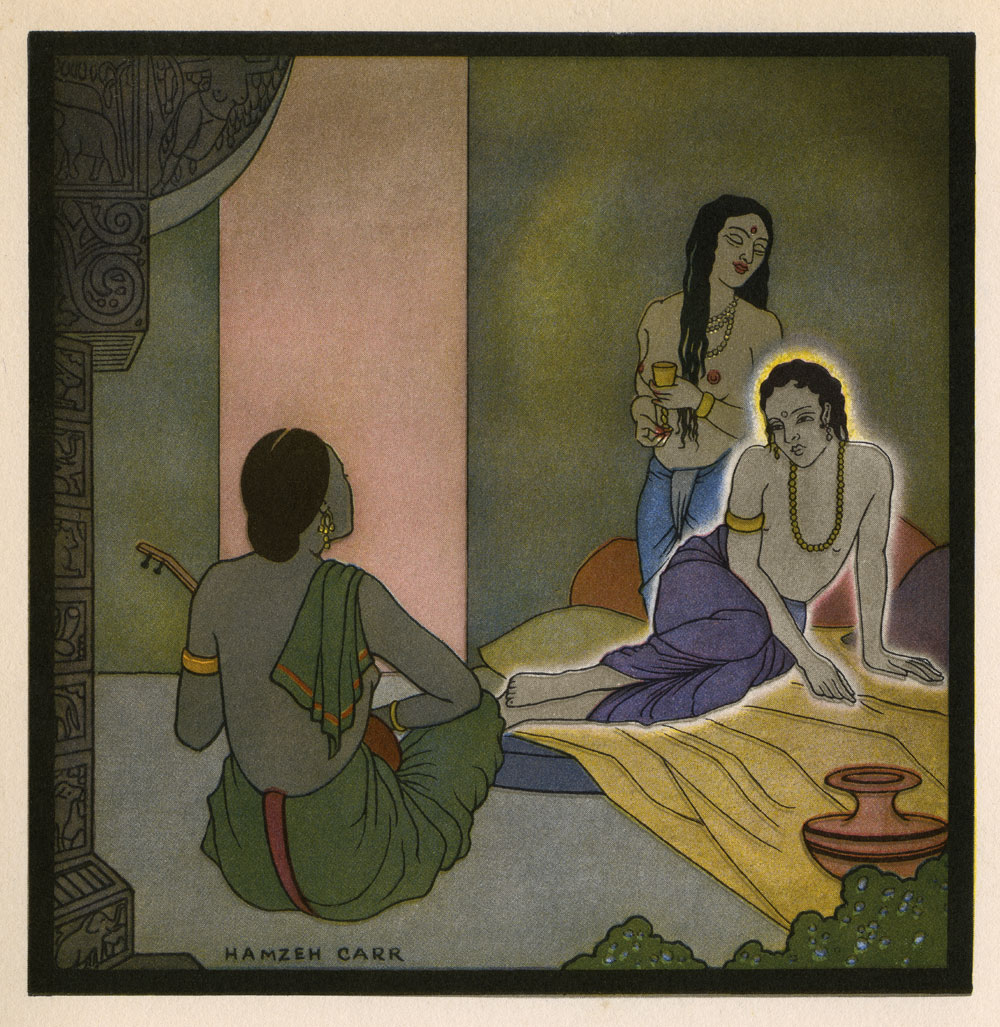
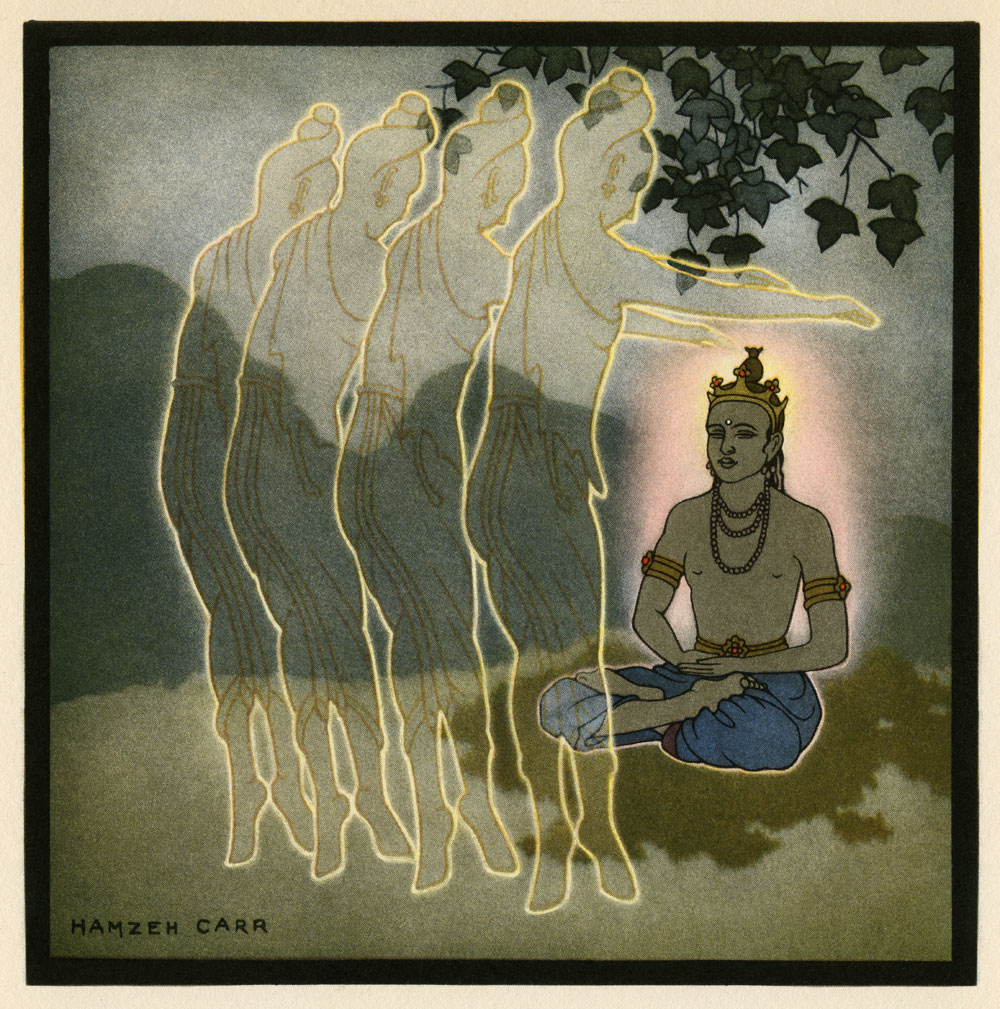
Hamzeh Carr And some maid told an ancient tale 1926
From Sir Edwin Arnold. The Light of Asia. London: John Lane The Bodley Head Ltd, 1926, p. 44
Limited edition of 3,000 copies
In the flesh, the colouring and radiance of these plates has to be seen to be believed.
I shall be posting more of these stunning works. Please click on the artwork for a larger version of the image.
Join CCP to reflect on the inscrutable and relevant question: What makes a great photograph?
As part of the 2012 Kodak Salon, CCP presents an evening of confident and wildly divergent points of view on this topic. A photography editor, a couple of curators, designers, a creative director, writers and artists will reveal their passionate choices on the night!
Speakers include: Serena Bentley, Marcus Bunyan, Helen Frajman, Natalie King, Bronek Kozka, Tin and Ed, Tom Mosby, and John Waricker. Chaired by Naomi Cass, CCP Director.
Exhibition dates: 30th November 2012 – 17th March 2013
Installation view of Thomas Demand at NGVI showing, at right, Lichtung / Clearing 2003 Photo: Marcus Bunyan
You saw it here first on Art Blart!
Beautiful installation shots of the new Thomas Demand exhibition at NGVI. Jeff Wall installation photographs to follow in the next posting on Saturday. Reviews to follow in due course.
These are all cardboard models created in Thomas Demand’s studio and then photographed. The models are destroyed afterwards leaving the photographs as artefacts and remembrances, both a performance in their own right, but also a record of another performance, that of the creation of the models. Double self, double performativity, double ritual.
Many thankx to Jemma Altmeier and all the media team at NGV for all their wonderful help and congratulations to the curators, Susan van Wyk and Dr Isobel Crombie, for their restrained yet contemporary installations and for getting the exhibitions to Melbourne. They look magnificent. Well done!
Thomas Demand is regarded as one of the world’s leading contemporary artists whose work in photography and, most recently stop-animation films, is at the forefront of contemporary art. Demand initially worked as a sculptor who used photography to document his ephemeral creations. From 1993 his creative practice changed and, from then on, he made sculptures for the sole purpose of photographing them. Demand begins with an image, often taken from media sources and frequently dealing with traumatic or politically important events, and creates a life-size replica of the image using paper and cardboard. The effect of these uncanny reconstructions is to destabilise our understanding of the sites which we ‘know’ so well through reproduction. This exhibition features a selection of photographs and 35mm films as chosen by the artist.
Jeff Wall & Thomas Demand: In Conversation, National Gallery of Victoria
When you step through the door into the Thomas Demand exhibition you enter a realm that was conceived, meticulously planned, and built to his exacting specifications. Demand designed every aspect of this exhibition. Having selected the photographs and films that he wanted to show in Melbourne, he then went on to design the exhibition space itself.
He was quite specific that the secondary walls had to be full height to create a sense of beautiful rooms rather than a space that has been partitioned. Once this was done he began work on the layout of the show. He carefully planned the sequence in which you would encounter each work, setting up an interesting play between the works. How we read these is an entirely individual experience. Recently someone said to me that they thought the placement of Lichtung / Clearing next to Paneel / Pegboard was an interesting comment on forest clearing and the devastating impact that pulp mills can have on the environment. Until then I had never seen those works in that way.
In conversation during the installation, Thomas explained that he was not interested in putting together an exhibition that then toured around the world. The usual practice of curating an exhibition and then ‘fitting’ it into different exhibition spaces in a number of venues holds little interest for him. So each time you see a Thomas Demand exhibition it has been curated, designed and installed for that particular space.
This is perhaps most obvious when you enter the rooms where the films are showing. From the brightly lit first room you can see through the door way into a darkened room lined with floor to ceiling curtains, but not really. What you see is a darkened room hung with wallpaper that the artist made to look like the kind of sweeping curtains that you might find in a cinema or theatre. It’s theatrical and spectacular but once you enter this space the real treat is Demands films.
Susan van Wyk, 6 February 2013 on the NGV website [Online] Cited 05/09/2020
One of the world’s most influential contemporary artists, Thomas Demand, will be the subject of a new exhibition announced by the National Gallery of Victoria.
The exhibition will be the first major Australian survey of the artist’s work and will comprise large scale photographs and films never before shown in Australia.
NGV Director, Tony Ellwood said the addition of Thomas Demand to the NGV’s exhibition schedule is part of an exciting and ambitious summer program.
“When the opportunity came up to hold an exhibition of Thomas Demand’s work this summer, it was just too good to miss. Thomas Demand will be part of a great summer program at the NGV and has been timed to coincide with the Jeff Wall Photographs exhibition being held at NGV Australia.
“We are offering a two-for-one ticket for Thomas Demand and Jeff Wall Photographs, so visitors to the NGV can experience the work of two major artists of international contemporary photography for one ticket price,” said Mr Ellwood.
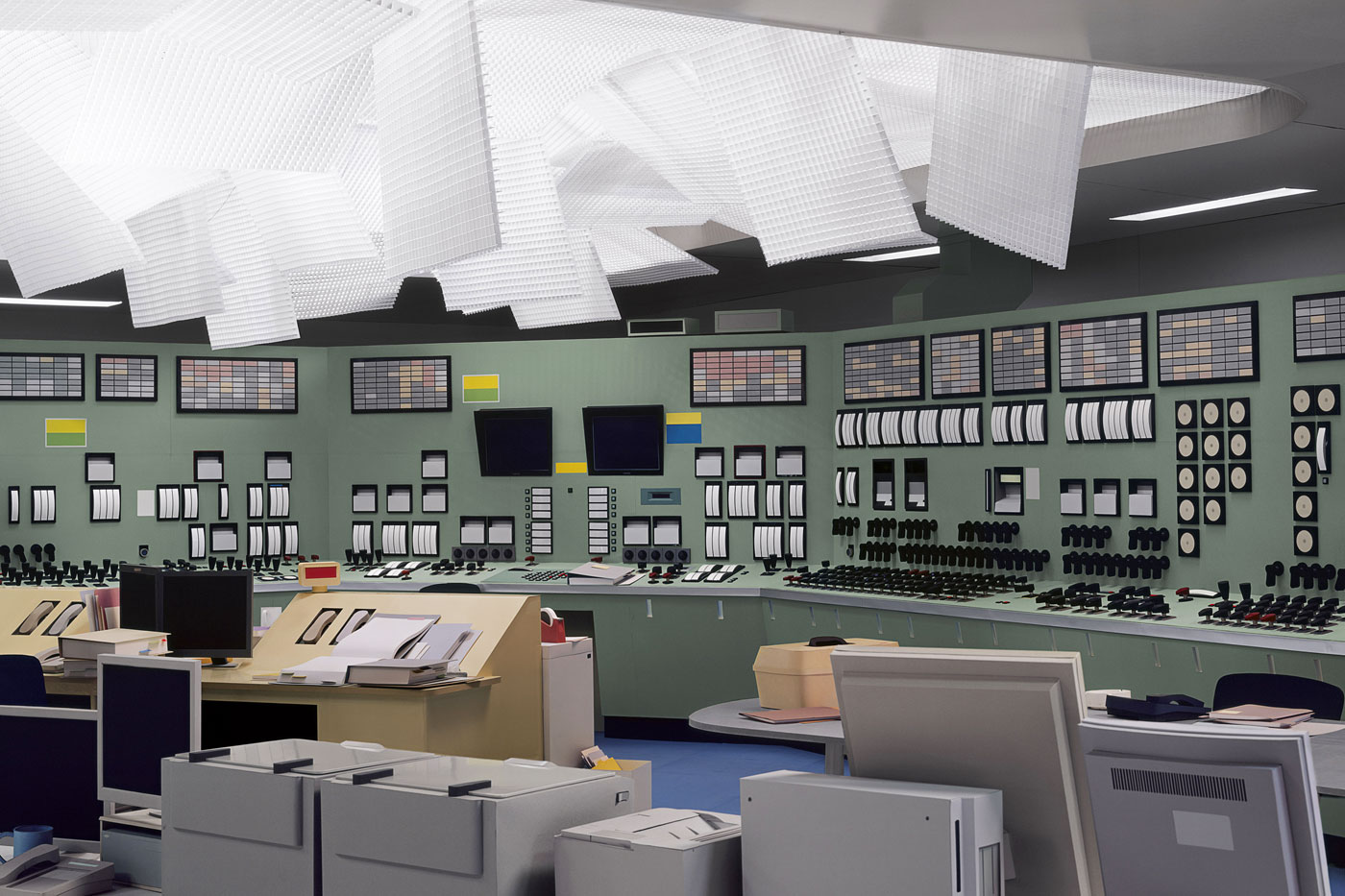
Works in the exhibition will span the artist’s career from 1997 to 2012. Recent works presented in the exhibition include Control Room (pictured below), which depicts the Fukushima Daiichi nuclear power plant and Tribute, a work based on images taken at the site of tragic mass panic at Europe’s biggest rave party.
Susan van Wyk, NGV Curator of Photography said Thomas Demand is widely regarded as one of the world’s leading contemporary artists.
“Thomas has a unique style in which he creates paper models of objects and scenes, often taken from media sources like flickr or newspaper reports. These intricate life size models are then photographed.
“The results are disquieting images that subvert our understanding of reality and fiction and draws attention to how we engage with the media and modern technologies,” said Ms Van Wyk.
Press release from the NGV website
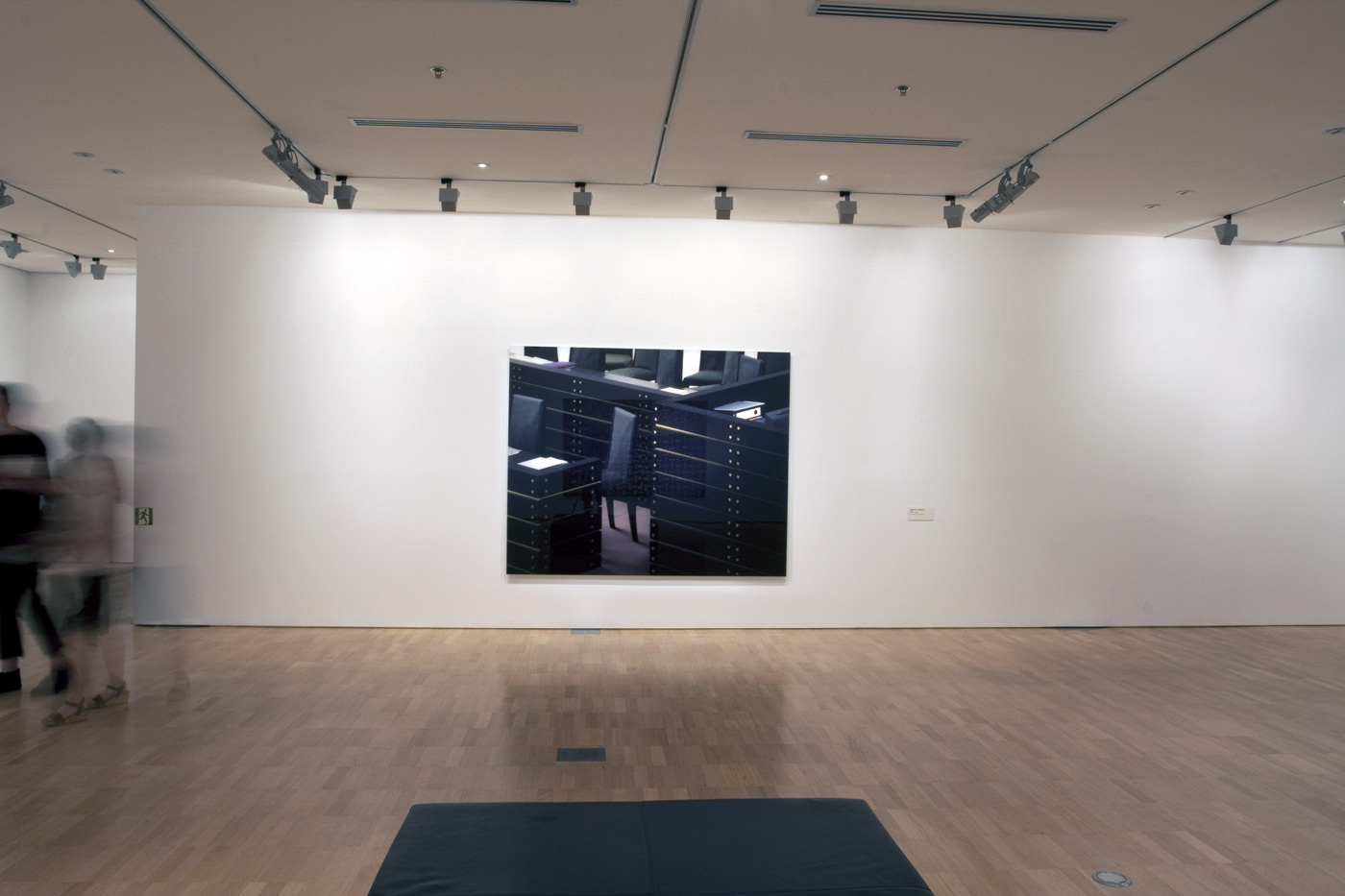
Installation view of Thomas Demand at NGVI showing, at left, Vault 2012 and, at centre, Kontrollraum / Control Room 2011 Photo: Marcus Bunyan
Hamzeh Carr So the Bright Ones came
1926
from Sir Edwin Arnold. The Light of Asia. London: John Lane The Bodley Head Ltd, 1926, p.19
Limited edition of 3,000 copies
Absolutely divine. In the flesh, the colouring and radiance of these plates has to be seen to be believed.
God they knew how to print back then!
I shall be posting more of these stunning works. They deserve to be seen and meditated upon. Please click on the artwork for a larger version of the image.
Exhibition dates: 11th January – 16th December 2012
Model of a U-boat (Unterseeboot) used in the film Das Boot and multimedia screens at the exhibition
One of the greatest minds of the 20th century (code breaking, computers, intelligent machines, artificial intelligence), persecuted to death for being a homosexual. In 2010 there is an apology for Turing’s conviction as a homosexual: Prime Minister Gordon Brown speaks for the British people when he says that he is sorry for the treatment meted out to Alan Turing:
“You deserved so much better!”
Better late than never.
Many thankx to the Heinz Nixdorf Museums Forum for allowing me to publish some of the photographs in the posting. I have supplemented their media images with other images that can be found on the Internet: the plugboard of an Enigma machine, a logic machine by Gisbert Hasenjäger, the Pilot ACE (Automatic Computing Engine), installation photographs of Hello, world! by Yunchul Kim, Alan Turing with two colleagues at the Ferranti Mark I computer and installation photograph of Love Letters_1.0 by David Link.
All photographs have been attributed where possible. The use of these photographs has led to an infinitely better posting that gives a greater insight into the exhibition, the work of the brilliant Alan Turing, and other work based on his ideas. Please click on the photographs for a larger version of the image.
Dr Marcus Bunyan
Enigma machine lampboard and keyboard detail
Enigma machine rotor detail
Enigma and the Battle of the Atlantic
1939. The UK Government Code and Cipher School appoints one of the country’s best mathematicians, Alan Turing, to a post at its Bletchley Park headquarters, where the German enemy’s intercepted radio messages are to be deciphered. Operation ULTRA begins.
1940. The Atlantic becomes a major theatre of war, with German submarines attacking Allied supply lines. This first topic examines the secret communications between German submarines and the naval high command in Berlin. Messages are encrypted using the Enigma machine. They are intercepted at British listening posts and sent to Bletchley Park to be deciphered.
The HNF is exhibiting the original model of the submarine from the film Das Boot, as well as a Marine 4-rotor Enigma. Further prominent exhibits which help relate this exciting story include radio technology items, codebooks and an interactive cipher rotor.
A three-rotor Enigma machine with (from below rotors), lampboard, keyboard and plugboard (front of machine)
The Enigma was an electro-mechanical rotor machine used for the encryption and decryption of secret messages. It was developed in Germany in the 1920s. The repeated changes of the electrical pathway from the keyboard to the lampboard implemented a polyalphabetic substitution cipher, which turned plaintext into ciphertext and back again. Used properly, this provided a very high degree of security. The Enigma’s scrambler contained rotors with 26 electrical contacts on each side, whose wiring diverted the current to a different position on the two sides. On depressing a key on the keyboard, an electrical current flowed through an entry drum at the right-hand end of the scrambler, then through the set of rotors to a reflecting drum (or reflector) which turned it back through the rotors and entry drum, and out to cause one lamp on the lampboard to be illuminated.
At each key depression, at least one of the rotors (the right-hand or “fast” rotor) advanced one position, which caused the encipherment to alter. At a certain point, the right-hand rotor caused the middle rotor to advance and in a similar way, the middle rotor caused the left-hand (or “slow”) rotor to advance. Each rotor caused the “turnover” of the rotor to its left after a full rotation. The Enigma operator could rotate the wheels by hand to change the letter of the alphabet showing through a window, to set the start position of the rotors for enciphering a message. This three-letter sequence was “message key”. There were 26 × 26 × 26 = 17,576 possible positions of the set of three rotors, and hence different message keys. By opening the lid of the machine and releasing a compression bar, the set of three rotors on their spindle could be removed from the machine and their sequence (called the “wheel order” at Bletchley Park) could be altered. Multiplying 17,576 by the six possible wheel orders gives 105,456 different ways that the scrambler could be set up.
The plugboard of an Enigma machine, showing two pairs of letters swapped: S↔O and J↔A. During World War II, ten plugboard connections were made. The plugboard (Steckerbrett) is positioned at the front of the machine, below the keys. When in use, there can be up to 13 connections.
Photograph from WikipediaunderCreative Commons GNU Free Documentation License
National Codes Centre and the National Museum of Computing (contemporary) Government Code and Cypher School (GC&CS) (World War Tw0) Bletchley Park Buckinghamshire, England
British Tabulating Machine Company Turing Bombe wiring at back (detail)
1940-1945
The Codebreakers of Bletchley Park
Up to 10,000 people are working hard to decipher German radio messages at Bletchley Park, and Alan Turing is one of their leading lights. He achieves the crucial breakthrough: his decryption device known as the Bombe can calculate Enigma code settings automatically, quickly and reliably. The rotors of up to 200 Bombes now run day and night, with radio messages able to be cracked within hours, while they are still of military relevance. This gives Winston Churchill and his military officers in London a priceless advantage.
The second topic of the HNF Turing year includes exhibits not previously seen in Germany, such as components of an original US Bombe owned by the NSA as well as loans of a functional checking machine and Bombe rotors from Bletchley Park. The entire communications chain is presented to visitors, from the German submarine radio operator all the way to the clear text message received by the British Prime Minister.
British Tabulating Machine Company Turing Bombe
1940-1945
7 feet (2.1 m) wide, 6 feet 6 inches (1.98 m) tall, 2 feet (0.61 m) deep
The working rebuilt bombe at Bletchley Park museum. Each of the rotating drums simulates the action of an Enigma rotor. There are 36 Enigma-equivalents and, on the right hand end of the middle row, three indicator drums. John Harper led the ‘Phoenix’ team that built this. It was officially switched on by the Duke of Kent, patron of the British Computer Society on 17 July 2008.
British Tabulating Machine Company Turing Bombe rotors (detail)
1940-1945
The international scientific focus in 2012 will be firmly on Alan Turing. This legendary British mathematician and computer pioneer was born in London on 23 June 1912. His 100th birthday will be marked by numerous events, primarily in his native country, but also in the USA, Brazil, China and elsewhere. Germany’s Heinz Nixdorf MuseumsForum in Paderborn is to pay tribute to the achievements of this equally academic and awkward scientist with an ambitious exhibition entitled Eminent & enigmatic – 10 aspects of Alan Turing. Its aim is to present Alan Turing’s outstanding achievements to visitors in the form of original exhibits and innovative and artistic installations alike.
Turing’s research made a huge contribution towards deciphering German radio messages encrypted using the Enigma machine during World War II. Thus he played a vital role in the Battle of the Atlantic, as well as in other major theatres of war. His theoretical work, which still forms the basis of information technology to this day, is equally significant. While his contemporaries could not see beyond the pure calculating capabilities of the computer, Turing designed the model of a universal machine capable of solving every algorithmic problem.
The exhibition at the Heinz Nixdorf MuseumsForum will focus on Turing’s achievements in breaking the Enigma code and his basic work as a computer and computer science pioneer, while also shedding light on his views on the subjects of artificial intelligence and spacial pattern formation, as well as on the tragedy of his untimely death and his legacy.
This marks the first time that an exhibition will be shown in stages, with the ten exhibition topics portrayed in successive monthly presentations. The exhibition will open on 10 January 2012 with the topic Enigma and the Battle of the Atlantic. It will be followed as of 14 February with exhibits and presentations on The code breakers of Bletchley Park, the UK’s National Codes and Cipher Centre during World War II. The remaining topics will also be shown for a period of around one month until the exhibition closes on 16 December 2012.
“The multi-part exhibition format will allow us to provide our visitors with insights into aspects of Alan Turing’s life and works all year long,” said HNF managing director and project manager Norbert Ryska of this unusual approach in the first public presentation of EMINENT & ENIGMATIC. “This was the only way to attract significant and highly sought-after loans from at home and abroad, including exhibits from the US National Security Agency, the Science Museum in London, Bletchley Park and IBM. So regular visits to the HNF will be more worthwhile than ever in 2012.”
The exhibition will be held in a specially constructed pavilion in the foyer. In addition to the technical and scientific exhibits, artistic installations are to shed light on Alan Turing’s work and thinking. “We want to pay tribute to Alan Turing with a series of presentations because he was the mastermind of the digital age as well as an exceptional personality,” said Ryska of the exhibition concept. Turing’s achievements will open up several unusual avenues into the HNF permanent exhibition. It can be accessed via a special Turing tour and workshops for schools, making the special exhibition a great stepping stone into the world’s biggest computer museum, in which a section in the Hall of Fame has been dedicated to Turing since its opening in 1996.
Turing, who died on 7 June 1954 under mysterious circumstances, has only been properly appreciated by the public at large during recent years, although experts have sung his praises for decades. In 1952 Alan Turing was sentenced to a degrading 12-month course of oestrogen treatment designed to combat his homosexuality. He took his own life by eating a cyanide-laced apple one year after completion of the treatment, on 7 June 1954.
Exhibition topics and selected exhibits
~ 11.1.-12.2.2012 Enigma and the Battle of the Atlantic (Enigma, submarine model, radio equipment)
~ 15.2.-11.3.2012 The code breakers of Bletchley Park (Enigma, Bombe drums, Enigma rotor model)
~ 14.3.-8.4.2012 The Turing test (model of the brain, Turing test terminal)
~ 11.4.-6.5.2012 From Turbochamp to Deep Blue (Deep Blue Chip/Board, Turing chess engine)
~ 9.5.-8.7.2012 The history of intelligent machines (Robo Thespian)
~ 28.7.-26.8.2012 The Turing machine (HNF functional model, historic Turing machine)
~ 29.8.-23.9.2012 Pattern formation (Interactive Plant Growing)
~ 26.9.-21.10.2012 The Pilot ACE computer (UNIVAC delay line memory, Pilot ACE component)
~ 24.10.-18.11.2012 Love Letters/Mark I (installation by David Link)
~ 21.11.-16.12.2012 Tragedy and legacy – Turing today (Turing Award)
Short biography of Alan Turing (1912-1954)
Alan Turing was born on 23 June 2012 in London. From 1931 to 1934 he studied mathematics at King’s College, Cambridge, where he was elected a fellow in 1935. During World War II he worked at the Government Code and Cipher School at Bletchley Park, developing methods of deciphering German radio messages encrypted using the Enigma machine. At the end of the war Turing turned his attention towards computer development, first at the National Physical Laboratory in Teddington (1945-1947), where he developed the concept of the Automatic Computing Engine (ACE), and then (as of 1948) as deputy director of the computing laboratory at Manchester University.
Although Alan Turing did not have too deep an impact on the invention of the first computers in the 1940s and 1950s, his theoretical concepts earned him a place in computer history: The Turing machine still provides an important basis for research into theoretical computer science today, and the Turing test proposed by him in 1950 in response to the question “Can machines think?” lent impetus to the development of artificial intelligence.
Turing, who died on 7 June 1954 under mysterious circumstances, has only been properly appreciated by the public at large during recent years, although experts have sung his praises for decades. In 1952 Alan Turing was sentenced to a degrading 12-month course of oestrogen treatment designed to combat his homosexuality. He took his own life by eating a cyanide-laced apple one year after completion of the treatment, on 7 June 1954.
In 2010 British Prime Minister Gordon Brown expressed his regret at Turing’s persecution on behalf of the British Government and paid tribute to his exceptional contribution during World War II. US President Barack Obama placed Turing on a par with Newton, Darwin and Einstein during his recent state visit to London.
Text from the HNF website
British Tabulating Machine Company Turing Bombe (details)
1940-1945
7 feet (2.1 m) wide, 6 feet 6 inches (1.98 m) tall, 2 feet (0.61 m) deep
The Turing Test
In 1950 Alan Turing proposes a new type of test. He is researching the question of when a machine can be described as “intelligent”, using the human brain as a model. According to the Turing test, a machine is intelligent if it can convince a human interlocutor that it is itself “human”. This deception must succeed with the required frequency in repeated tests.
From Turochamp to Deep Blue
What do the contemporary luminaries Konrad Zuse, Claude Shannon, John von Neumann and Alan Turing have in common? They all want to play chess against calculating machines that they themselves have devised. But the history of computer chess began as early as the end of the 19th century, when Spanish engineer Torres Quevedo presented a chess-playing automaton whose rook and king could reliably checkmate the opponent’s king. The fourth topic is all about computer chess.
Turing defines his own rules for a chess algorithm, but his Turochamp program loses its first game in 1952 – played “by hand,” rather than run on a computer – against his friend Alick Glennie. It is not until 1997 that reigning chess world champion Garry Kasparov is defeated by a calculating machine, in the form of the IBM supercomputer Deep Blue. The HNF is exhibiting original hardware from the machine and the original chessboard from this “final” game in the Turing pavilion – the first time these have been on show in Germany.
Processor board of Deep Blue, 1997
RoboThespian I am a Machine
RoboThespian demonstrates his acting skills – moving from robotic to fluid and emotional humanoid robot
The History of Intelligent Machines
“Can machines think?” It is 1950 when Alan Turing asks this provocative question and founds a new field of research along with significant contemporaries of the likes of Claude Shannon, Norbert Wiener and Joseph Weizenbaum: that of “artificial intelligence (AI).” To this day, the development of the “intelligent machine” has been marked by excessive expectations as well as important advancements.
The humanoid robot RoboThespian relates the history of AI as the fifth topic of our Turing year. RoboThespian is a prominent visitor to the Turing pavilion. With his love of theatrical appearances, he is more than happy to answer questions or cheekily imitate the gestures of visitors. An entire section of the permanent exhibition is devoted to AI and robotics. Our networked computers are becoming more powerful all the time. It is still unclear when precisely a team of robots will beat the human world champions – an event predicted by experts for some time.
The Turing Machine
Mathematician Kurt Gödel turns the world of numbers on its head in 1931, when he proves that there are some logical statements that are neither true nor false. Inspired by this revolutionary finding, Alan Turing takes up the baton and publishes the concept of the Turing machine in 1936. He demonstrates that his simple but universal theoretical machines can calculate everything that can be calculated by any machine or computer.
The HNF has built a mechanical Turing machine that can be tried and tested by visitors to the Turing pavilion. The logic machines of the Münster School are on show for the first time ever: in the 1960s Gisbert Hasenjäger and Dieter Rödding use spare parts from the German Federal Post Office to construct somewhat bizarre devices for logical calculations (see photographs below).
Gisbert Hasenjäger (German, 1919-2006) Logic machine
c. 1960s
A logic machine by Gisbert Hasenjäger based on Turing’s work Provided by Family Hasenjäger
Photographs from “Intelligenz ist ein soziales Produkt: Alan Mathison Turing zum 100. Geburtstag” on the Heise online website [Online] Cited 03/09/2020.
Die Turing-Maschine ist im Grunde keine konkrete Konstruktion, sondern ein mathematisches Konzept zum Nachweis der algorithmischen Berechenbarkeit einer Funktion. Dennoch sind anhand von Turings Arbeiten sehenswerte konstruktionstechnische Umsetzungen entstanden (The Turing machine has basically no concrete construction, but a mathematical concept for the detection of algorithmic computability of a function. Nevertheless, based on Turing’s work remarkable constructional reactions are caused).
The Automatic Computing Engine (ACE)
The war is over, with Germany having been defeated by the Allies. Alan Turing makes the transition from codebreaker to computer pioneer at the National Physical Laboratory. He designs the Automatic Computing Engine, known as ACE, entirely on his own. New features of this vacuum tube computer include its delay-line memories – very fast memories for digital data and programs. James H. Wilkinson builds the machine and presents the Pilot ACE builds the machine and presents the Pilot ACE to the public in 1950 as the world’s fastest computer.
At this point, Turing is already working on his next groundbreaking computer project, a new computer for the University of Manchester. The eighth topic is all about the new memory technology of the ACE. How can data be saved as sound waves? This question is answered not only with the help of an original ACE component, but also via the artistic installation Hello, world by Yunchul Kim, a three-metre sculpture made from copper pipes. This object acts as an analogue memory location for digital data.
Alan Turing (designer) James H. Wilkinson (builder) Pilot ACE (Automatic Computing Engine) (Science Museum, London)
1950
Photograph by Antoine Taveneaux from Wikipedia under Creative Commons Attribution-Share Alike 3.0 Unported license
The Pilot ACE had 1450 thermionic valves (vacuum tubes), and used mercury delay lines for its main memory. Each of the 12 delay lines could store 32 instructions or data words of 32 bits. This ran its first program on May 10, 1950, at which time it was the fastest computer in the world with a clock speed of 1MHz.
Yunchul Kim Hello, world! 2006
Prix Ars Electronica 2006, Honorary Mention Interactive Art
Photographs from Marc Wathieu’s Flickr photostream Creative Commons Attribution-NonCommercial-ShareAlike 2.0 Generic
Hello, world! is an interesting take on long- and short-lived data storage media. It uses acoustic signals to store data. A codified auditory signal (feedback) circulates in a closed system consisting of a computer, a loudspeaker, 246 meters of copper tubing and a microphone. Due to the acoustic delay in the tubing system, it’s possible to save data, whereby the rule is: the longer the copper tubing, the longer the time delay and the greater the memory capacity. In addition to this a screen shows a visual representation of the information traveling around the system. If a participant makes noises near the installation or hits the copper piping it interferes with the audio signal loop.
There is some instability in the system. If you go up to the sculpture you can hear the sounds (every sign of the ASCII code has its own sine wave frequency thus translating it in an acoustic signal) travelling through the copper piping. But a loud noise in the exhibition space or a vibrational disturbance from passing traffic or low frequency rumble effects the lettering on the screen and the text and Hello, World! starts to tremble as the quality of the signal degenerates and recovers.
Love Letters from a Machine
While in Manchester, Alan Turing writes the programming manual for the Ferranti Mark I, an early British digital computer, and trains staff as programmers. The Mark I no longer saves data and programs on punched tape, but instead uses a new system of a line of dots on a Williams tube display. Its storage capacity, which was huge for the time, gave users plenty of scope for new experiments, such as initial chess and draughts programs as well as digital musical compositions. The penultimate topic in our Alan Turing year includes a display of the interactive installation Love Letters by David Link, who has created a fully functioning replica of the Ferranti Mark I using original components. The machine program generates personal love letters with the help of an algorithm. Christopher Strachey originally wrote the code for the love letters program in the 1950s.
Alan Turing with two colleagues at the Ferranti Mark I computer
1951
Photograph from the Love Letters website [Online] Cited November 2012. No longer available online
David Link Love Letters_1.0. MUC=Resurrection. A Memorial
2009-
Photographs from the Love Letters website [Online] Cited November 2012. No longer available online
From August 1953 to May 1954 strange love-letters appeared on the notice board of Manchester University’s Computer Department:
DARLING SWEETHEART
YOU ARE MY AVID FELLOW FEELING. MY AFFECTION CURIOUSLY CLINGS TO YOUR PASSIONATE WISH. MY LIKING YEARNS FOR YOUR HEART. YOU ARE MY WISTFUL SYMPATHY: MY TENDER LIKING.
YOURS BEAUTIFULLY
M. U. C.
The acronym M.U.C. stood for “Manchester University Computer”, the earliest electronic, programmable and universal calculating machine worldwide; the fully functional prototype was completed in June 1948 and was based on Williams tubes as means of volatile storage. One of the very first software developers, Christopher Strachey (1916-1975), had used the built-in random generator of the Ferranti Mark I, the first industrially produced computer of this kind, to generate texts that are intended to express and arouse emotions.
Tragedy and Legacy: “You deserved so much better!”
Alan Turing dies at not quite 42 years of age, after eating a poisoned apple, as in the fairytale. His incredibly influential body of work remains, and has left its mark on the discipline known as computer science today. The tenth and final topic looks back on the Alan Turing year of 2012. For twelve months, Turing has been the focus of international conferences, events and exhibitions, which the HNF now reviews. We follow in Turing’s footsteps, visiting places where he worked and where his presence is still felt.
At the end comes an apology for Turing’s conviction as a homosexual: in 2010 Prime Minister Gordon Brown speaks for the British people when he says that he is sorry for the treatment meted out to Alan Turing: “You deserved so much better.” Queen Elizabeth visits Bletchley Park in 2011. The Turing Award is now the biggest of its kind in the world of computer science.
Elliott & Fry Alan Mathison Turing
1951
Alan Turing at the time of his election to a Fellowship of the Royal Society.
Photograph was taken at the Elliott & Fry studio on 29 March 1951.
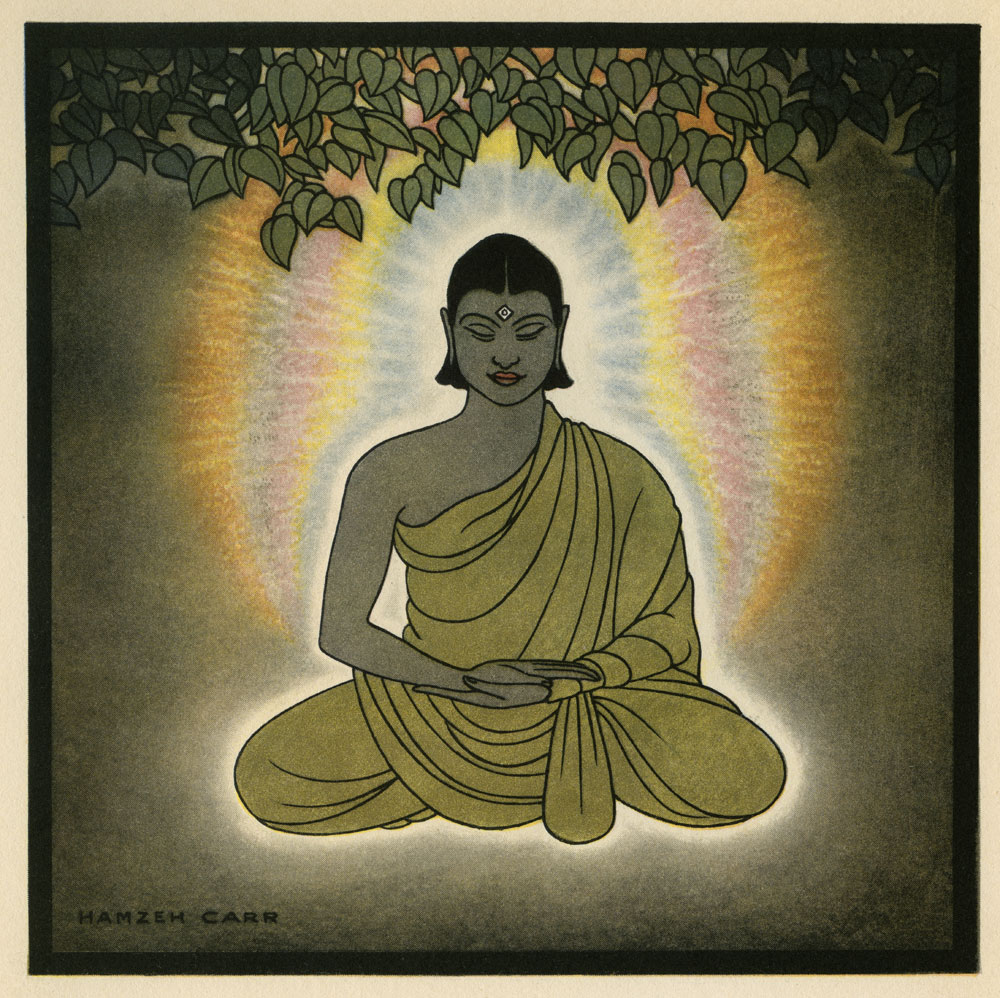
Hamzeh Carr Lord Buddha
1926
Frontispiece
From Sir Edwin Arnold. The Light of Asia. London: John Lane The Bodley Head Ltd
Limited edition of 3,000 copies
Absolutely divine. In the flesh, the colouring and radiance of these plates has to be seen to be believed.
God they knew how to print back then!
I shall be posting more of these stunning works over the coming weeks. They deserve to be seen and meditated upon. Please click on the artwork for a larger version of the image.
Marcus
Please click on the image for a larger version of the art work.
insidious adj.
Proceeding in a gradual, subtle way, but with harmful effects
There is a lot to celebrate living in Australia, the lucky country, especially if you are a white kid growing up in the perfect world of Cottees advertising. I have been viewing these TV commercials since 1986 and have yet to see an Indian, Asian, Aboriginal or child from a Muslim family in any of them. As far as I can see it is only white children of middle class suburban families that can “seize the day” in Cottee’s vision of contemporary Australia.
I ask my readers, do they think that these adverts promulgate a form of insidious racism? Are these adverts a form of racism by exclusion, rather than one by outright declamation?
Is this exclusion a form of societal system of oppression?
I leave the answer for you to decide.
Perhaps they should have said, “No matter how many white kids end up in your backyard, there’s always enough Cottee’s to go around…”
“We’re all responsible for naming, and saying no to, racism. We must call it when we see it… Race hate, racism, careless words – can harm entire populations. They can change the way that we live together… Racism can only be resisted, and eradicated, through solidarity, and cooperation. There are no exceptions. History has no bystanders – only participants.”
Graeme Innes AM, Race Discrimination Commissioner at the Australian Human Rights Commission, August 2011
VIDEO NO LONGER AVAILABLE
Cottees There’s a lot to celebrate (2012)
“This Sunday will see the launch of a new campaign for Cottee’s cordial. Created by George Patterson Y&R Melbourne, the commercial aims to take the brand back to its roots by celebrating the simple goodness of childhood – and the fact that no matter how many kids end up in your back yard at the end of the day, there’s always enough Cottee’s to go around.
Says Troy McKinna, advertising manager at Cottee’s: “We’re hoping the generation of Australians who grew up with classic ‘My dad picks the fruit’‚ ad will share this new Cottee’s classic with the next one.””






















 Art Blart _ art and cultural memory archive
You must be logged in to post a comment.