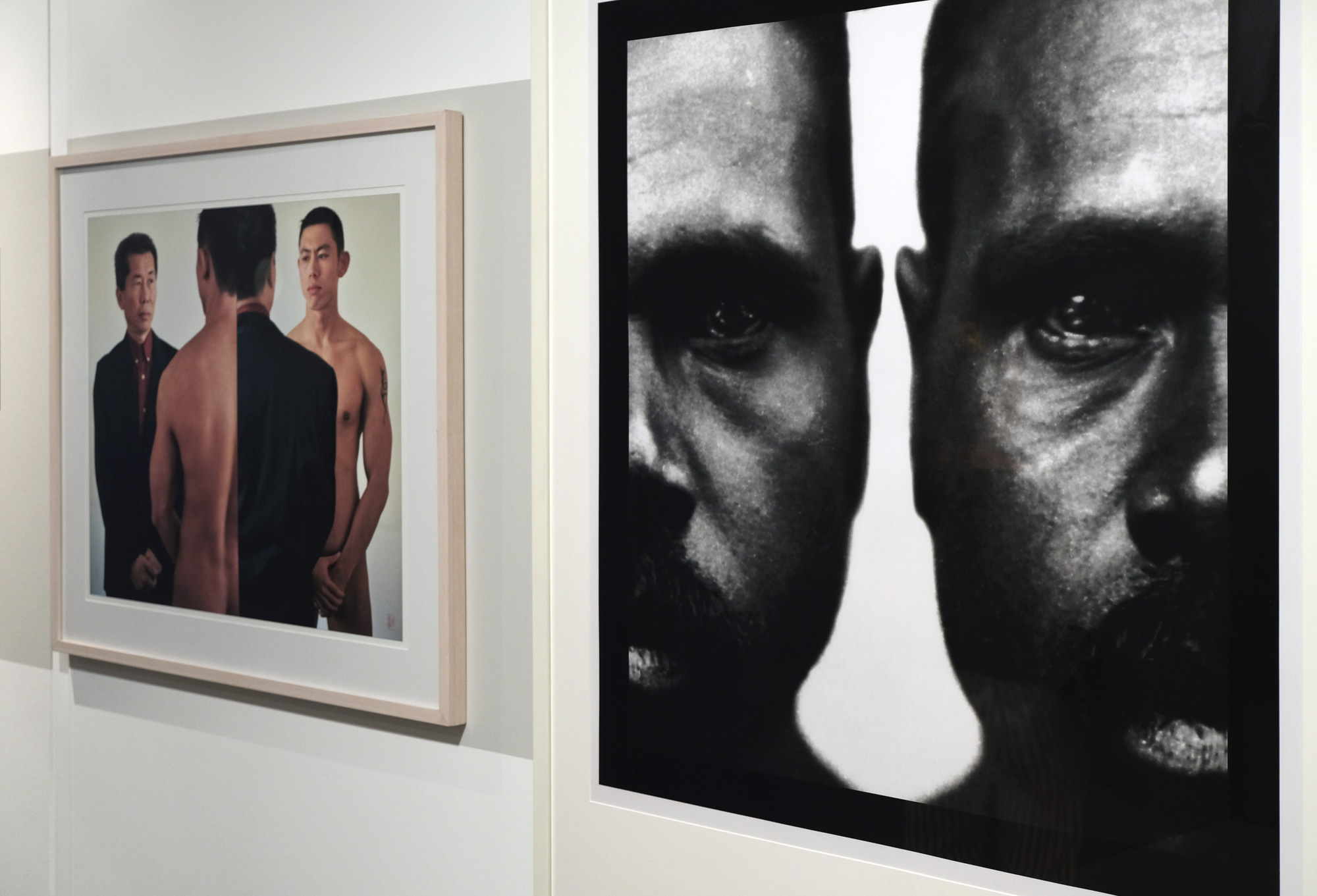
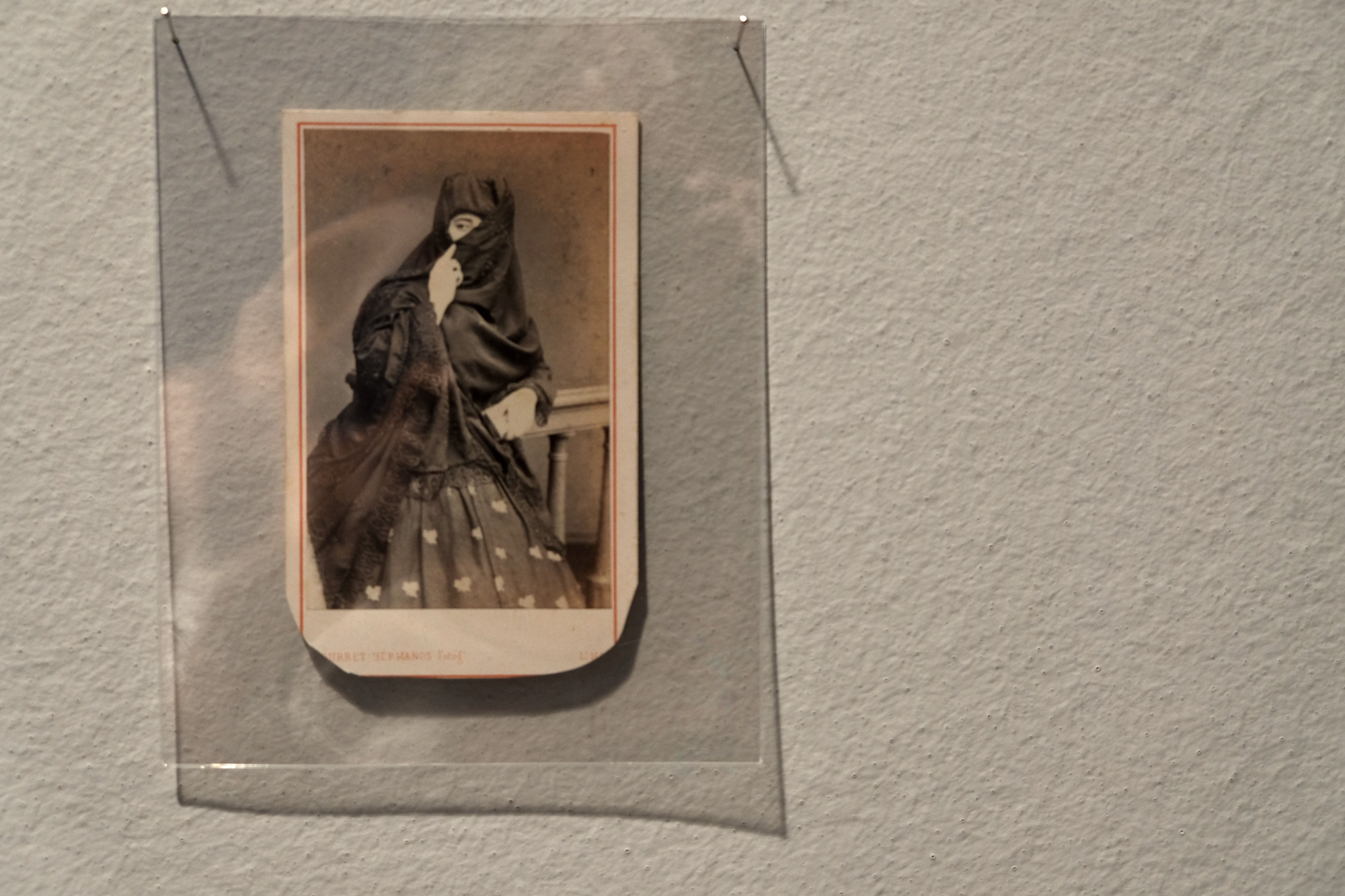
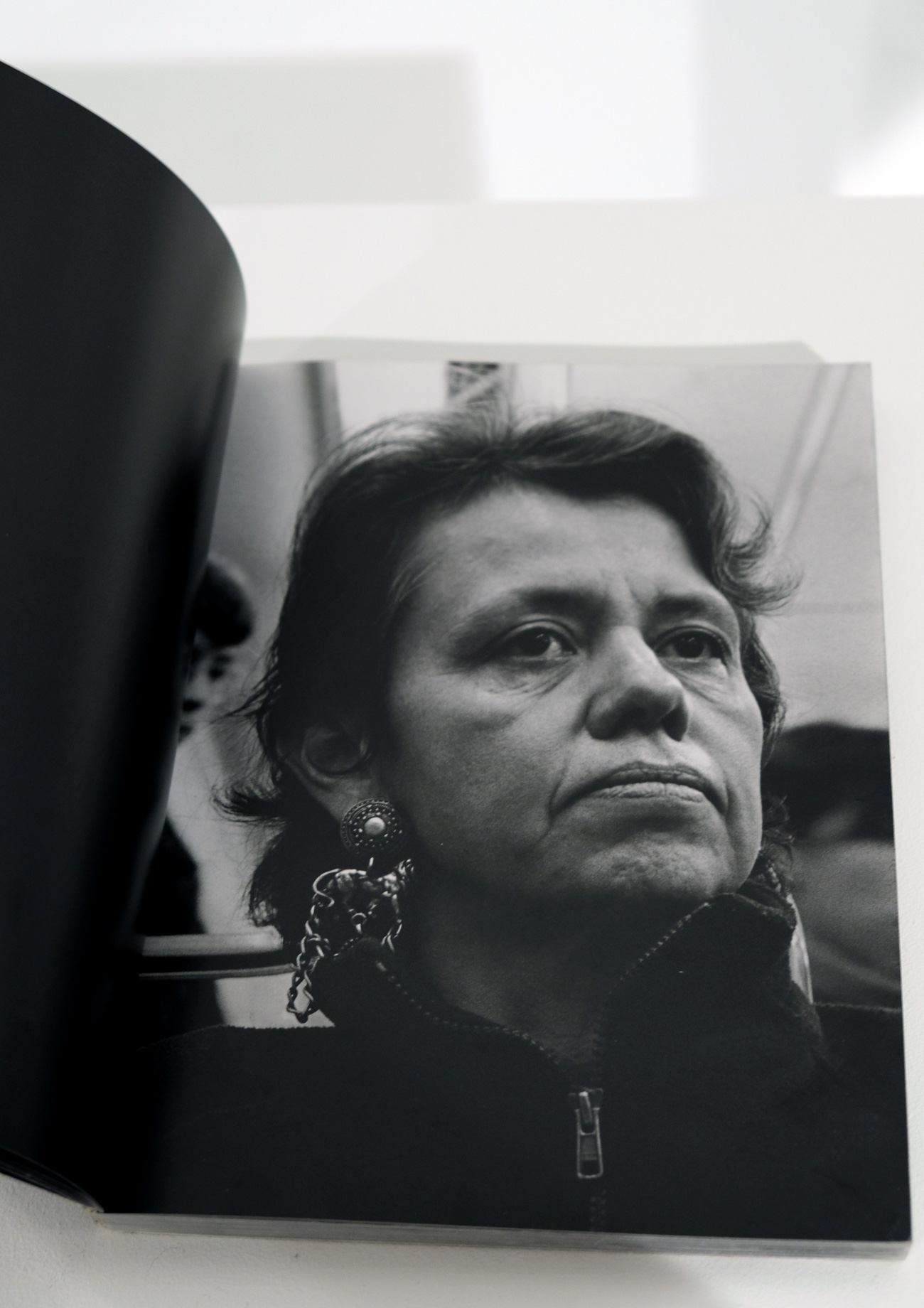
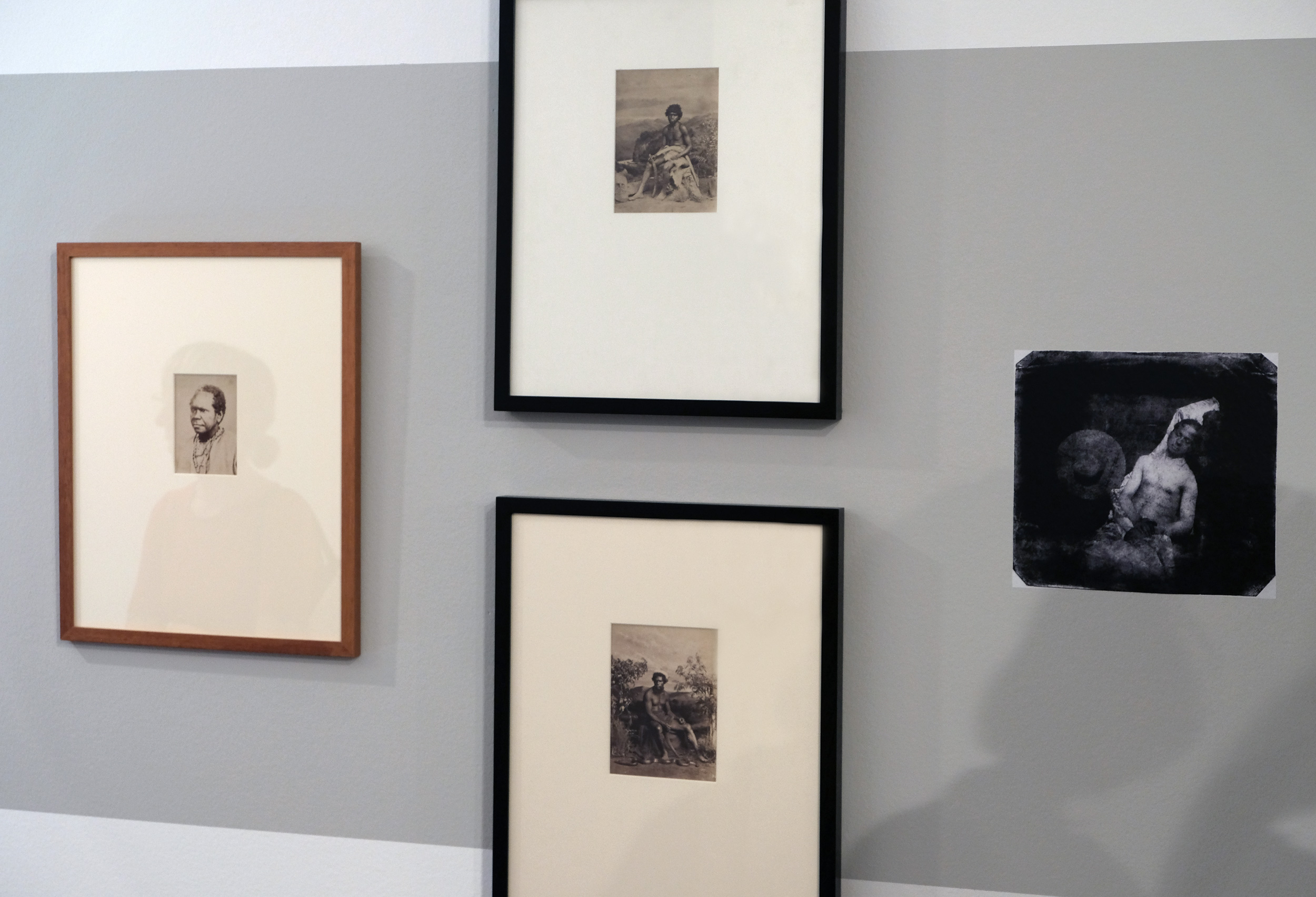
Review: ‘WHO ARE YOU: Australian Portraiture’ at NGV Australia, Federation Square, Melbourne

Exhibition dates: 25th March – 21st August, 2022
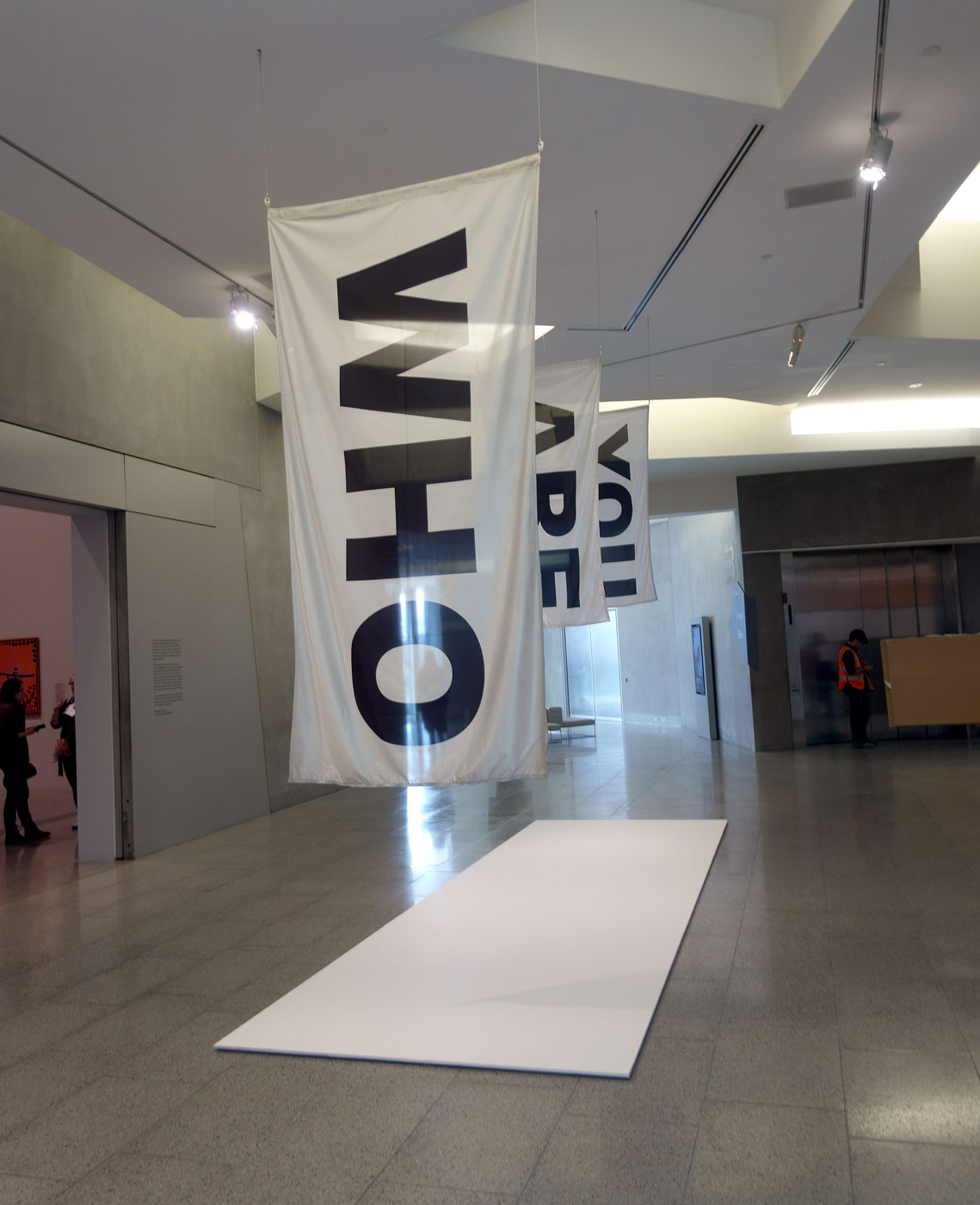
 

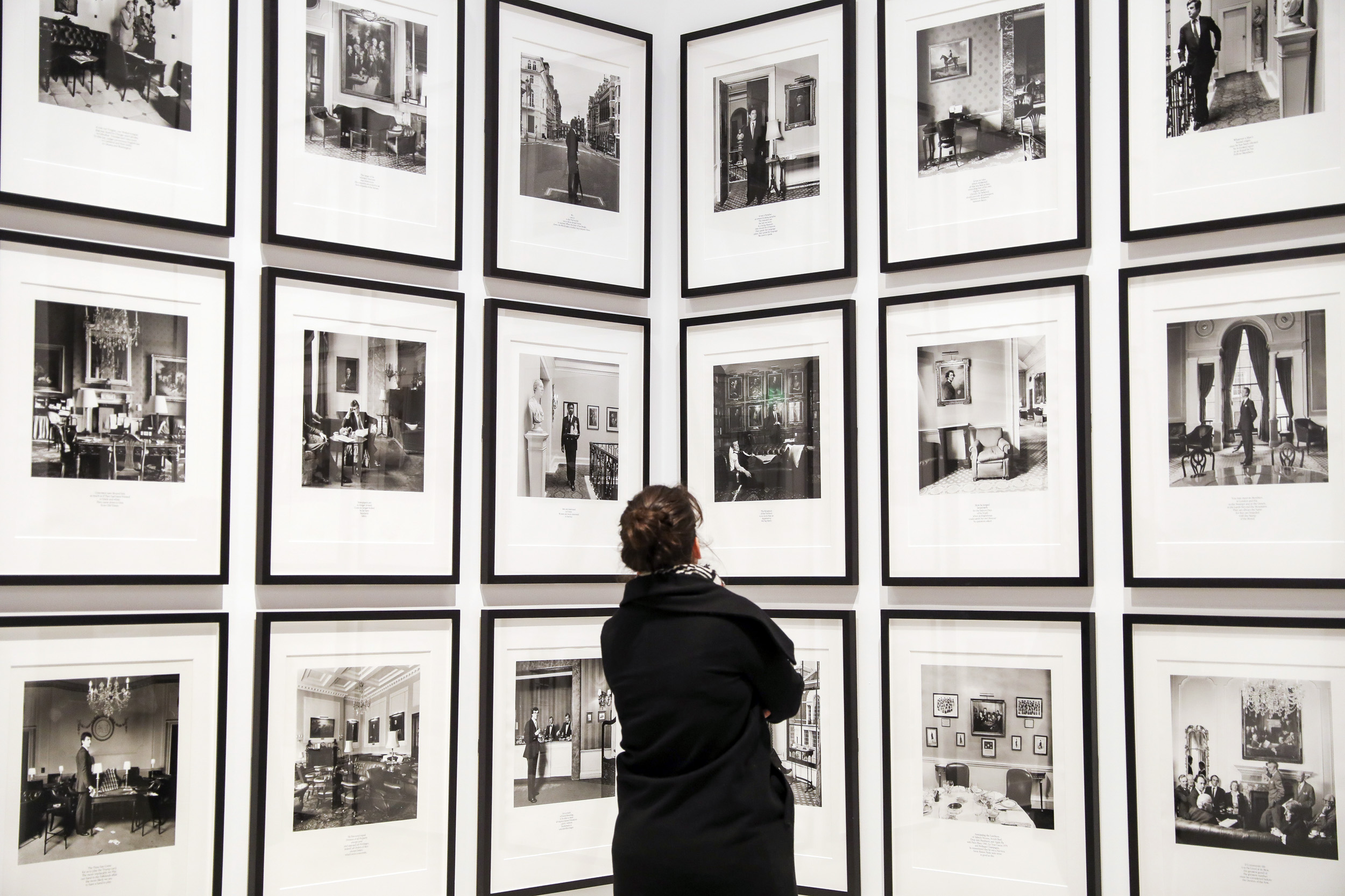
Entrance of the exhibition 'WHO ARE YOU: Australian Portraiture' at NGV Australia, Federation Square, Melbourne


Entrance of the exhibition WHO ARE YOU: Australian Portraiture at NGV Australia, Federation Square, Melbourne
Photo: Marcus Bunyan


The black and white show

This is a challenging and stimulating exhibition at NGV Australia, Federation Square that attempts to answer the question: “who are you” when coming to terms with what it is to be an Australian.

WHO ARE YOU: Australian Portraiture is one of the most comprehensive explorations of portraiture ever mounted in Australia and the first exhibition to bring together the collections of the National Gallery of Victoria (NGV) and the National Portrait Gallery, Canberra… [it] considers portraiture in Australia across time and media, as well as the role of the portraiture genre in the development of a sense of Australian national identity… The exhibition also questions what actually constitutes portraiture by examining the surprising and sometimes unconventional ways of representing likeness… Presented across five thematic sections, the exhibition raises challenging and provocative questions about who we are and how we view others – historically, today and into the future…

The exhibition opens by considering the connection between people and place, reflecting on the relationship between artists, sitters and the environment, as well as the personification of the natural world… A further section explores the artistic tradition of the self-portrait and portraits of artists, as well as how this convention has been subverted or challenged by contemporary artists working today… Ideas of intimacy and alienation are juxtaposed through images of family and community presented alongside those of vulnerability and isolation… The exhibition also explores portraiture’s surprising capacity to reveal the inner worlds and mindsets of both the sitter and the artist… The final section of the exhibition interrogates Australian icons, identities and how we construct them.” (Press release)


This is an ambitious agenda for several large exhibitions, let alone cram so many ideas into one exhibition. And in the end the central question “who are you” is unknowable, unanswerable in any definitive way… for it all depends on your ancestry, and from what point of view you are looking and in what context – and these conditions can change from minute to minute, day to day, and era to era. Identity is always partially fixed and fluid at one and the same time. It is always a construction, a work in progress, governed by social and cultural relations.

“Identity is formed by social processes. Once crystallized, it is maintained, modified, or even reshaped by social relations. The social processes involved in both the formation and the maintenance of identity are determined by the social structure. Conversely, the identities produced by the interplay of the organism, individual consciousness and social structure react upon the given social structure, maintaining it, modifying it, or even reshaping it.”1


Identity construction is a self-referential system where identities are produced out of social systems. They (identities) then act upon those very systems to alter them, and then those systems re-act again forming anew, an ever changing identity. “The task of identity formation is to develop a stable, coherent picture of oneself that includes an integration of one’s past and present experiences and a sense of where one is headed in the future.”2 But that identity formation, while seeking to be stable, is both multiple and contestatory. It is through those contests that a future sense of self can challenge hegemonic power differentials. As Judith Butler observes,

“Thus every insistence on identity must at some point lead to a taking stock of the constitutive exclusions that reconsolidate hegemonic power differentials, exclusions that each articulation was forced to make in order to proceed. This critical reflection will be important in order not to replicate at the level of identity politics the very exclusionary moves that initiated the turn to specific identities in the first place … It will be a matter of tracing the ways in which identification is implicated in what it excludes, and to follow the lines of that implication for the map of future community that it might yield.”3


In other words, learn from the mistakes of the past and don’t let them repeat themselves in future identities! Do not exclude others in order to reconsolidate the hegemonic status quo. But people always form identities based on the “norm” – how can you change that? As A. David Napier states, “We rely, sometimes almost exclusively it seems, upon the construction and reconstruction of an evolutionary(?) sequence of events that simultaneously excludes outsiders and provides some basis for justifying our social rules and actions. Thus, we minimize diversity by reflecting on who we are, by achieving, that is, a self-conscious state that is not only accepted but considered desirable…”4

Critical reflection is thus so important in challenging who we are, both individually and collectively. In this sense, an exhibition like WHO ARE YOU is important in helping to reshape social relations, helping to challenge hegemonic power differentials, which in turn affects our personal identity construction by reflecting on who we are and changing our point of view, so that we become more informed, and more empathetic, towards different cultures and different people. So that we do not exclude other people and other points of view.

But all is not roses and light in this exhibition with regard to exclusion.

Whilst a lot of people acknowledge and empathise with First Nations people we can have NO IDEA of the ongoing pain and hurt centuries of invasion, disenfranchisement, genocide, massacres, Stolen Generation, lack of health care, massive incarceration, suicide rates and shorter life expectancy, land loss, cultural loss that the violence of the white Anglo gaze has inflicted on the oldest living culture on Earth. While there are moves afoot (as there have been for years) for Aboriginal constitutional recognition through a Voice to Parliament, a permanent body representing First Nations people that would advise government on Indigenous policy; and a treaty that would help secure sovereignty and self-determination, enabling First Nations people make their own decisions and control their own lives, economy and land, free from the effects of changing governments – personally I believe until there is a complete acknowledgement of the pain invasion has caused Aboriginal people by the whole of Australia, nothing will ever change.

Having said that, contemporary Australia is now the most multicultural country it as ever been. According to the Australian Bureau of Statistics 2021 Census, 27.6 per cent of the population were born overseas and the top 5 countries of birth (excluding Australia) were, in order, England, India, China, New Zealand and the Philippines.5 In Australia, 812,000 people identified as Aboriginal and/or Torres Strait Islander in the 2021 Census of Population and Housing. Aboriginal and Torres Strait Islander people represented 3.2% of the population.6

It is interesting to note that when looking through the art works in this exhibition – nearly all of which can be seen in this posting – how much of it is (historical) white art and how much of it is contemporary Aboriginal art, with a sop being made to art made by, or mentioning, other people including Chinese, Afghan, Muslim and Sudanese. Chinese people have been living in Australia for centuries, Afghan people similarly. Greek and Italian people arrived in droves in the 1950s-1960s, Vietnamese boat people in the 1970s, Sudanese, Indian and Sri Lankan people in the late 20th century. More (historical and contemporary) work from these people was needed in this exhibition because they inform the construction of modern Australian identities.

Obviously the inclusion of so much contemporary Aboriginal work is a deliberate curatorial decision, but its disproportionate representation in this exhibition makes it feel like a “catch all”. Why do the curators feel the need to include so much Indigenous work? Is that how they truly see Australian identity? Also, does the inclusion of this art mean it is the best contemporary art that is available in Australia at the moment, or does its inclusion simply exclude other voices from different nationalities and ethnic and religious backgrounds that are just as important in the construction of contemporary Australian identities? While there is no denying the historical significance of invasion there needs to be a balance in such representation, especially in an exhibition purporting to investigate “who are you” over a broad range of references. As it stands the inclusion of so much Indigenous work feels like an agenda, a set point of departure, perhaps even an apologia for white guilt. As the critic John McDonald noted recently, we are living “at a time when museums and commercial galleries have gone completely gaga for such [that is, Aboriginal] work.”

Personally, I would have liked to have seen a greater range of voices expressing themselves in this exhibition. It struck me that the inclusion of so much (historical) white art and so much contemporary Aboriginal art formed a rather limited framework in which to examine “who are you”. Rather, I would have liked a more balanced representation through art of the many voices that contribute to the formation of evolving Australian identities, which ultimately could lead to a greater insight into the construction of our own self-portrait. That is the truly important aspect of any navel gazing exercise.

Dr Marcus Bunyan

Word count: 1,450


1/ Peter Berger and Thomas Luckmann. The Social Construction of Reality: A Treatise in the Sociology of Knowledge. Allen Lane, London, 1967, p. 194.

2/ Erickson, E. Identity: Youth in Crisis. Norton, New York, 1968

3/ Judith Butler. Bodies That Matter. Routledge, New York, 1993, pp. 118-119

4/ A. David Napier. Foreign Bodies: Performance Art, and Symbolic Anthropology. University of California press, Berkeley, 1992, p.143

5/ “Cultural diversity: Census” 2021 on the Australian Bureau of Statistics website 28/06/2022 [Online] Cited 12/08/2022

6/ “Australia: Aboriginal and Torres Strait Islander population summary” 2021 on the Australian Bureau of Statistics website 28/06/2022 [Online] Cited 12/08/2022


Many thankx to the National Gallery of Victoria for allowing me to publish some of the photographs in the posting. All installation images © Marcus Bunyan and the National Gallery of Victoria. Please click on the photographs for a larger version of the image.
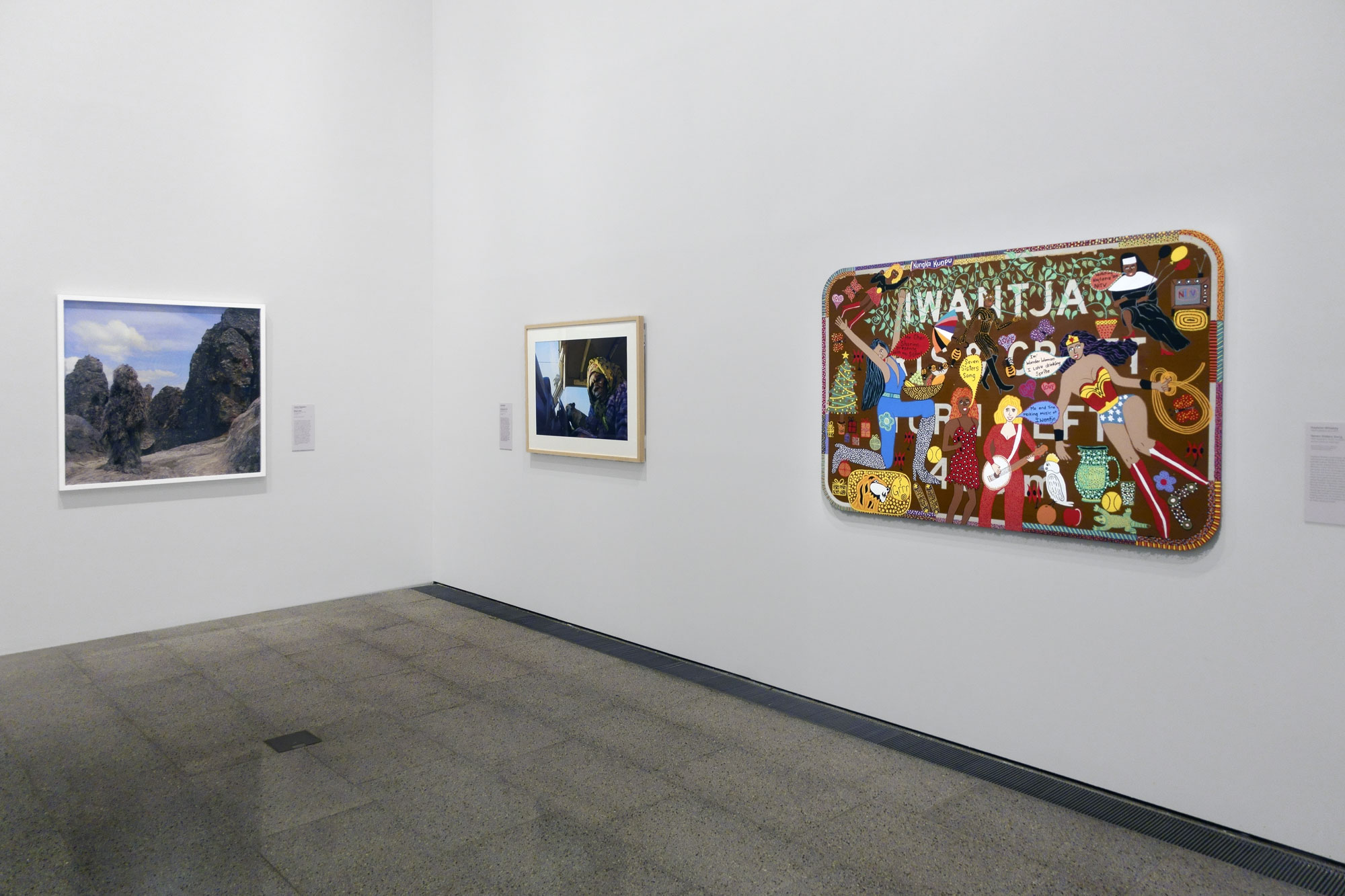


Installation view of the exhibition 'WHO ARE YOU: Australian Portraiture' at NGV Australia, Federation Square, Melbourne showing from left to right, Polixeni Papapetrou's 'Magma Man' (2012); Karla Dickens' 'Mrs Woods and 'Ere' (2013); and Kaylene Whiskey's 'Seven Sisters Song' (2021)


Installation view of the exhibition WHO ARE YOU: Australian Portraiture at NGV Australia, Federation Square, Melbourne showing from left to right, Polixeni Papapetrou’s Magma Man (2012, below); Karla Dickens’ Mrs Woods and ‘Ere (2013, below); and Kaylene Whiskey’s Seven Sisters Song (2021, below)
Photo: Marcus Bunyan
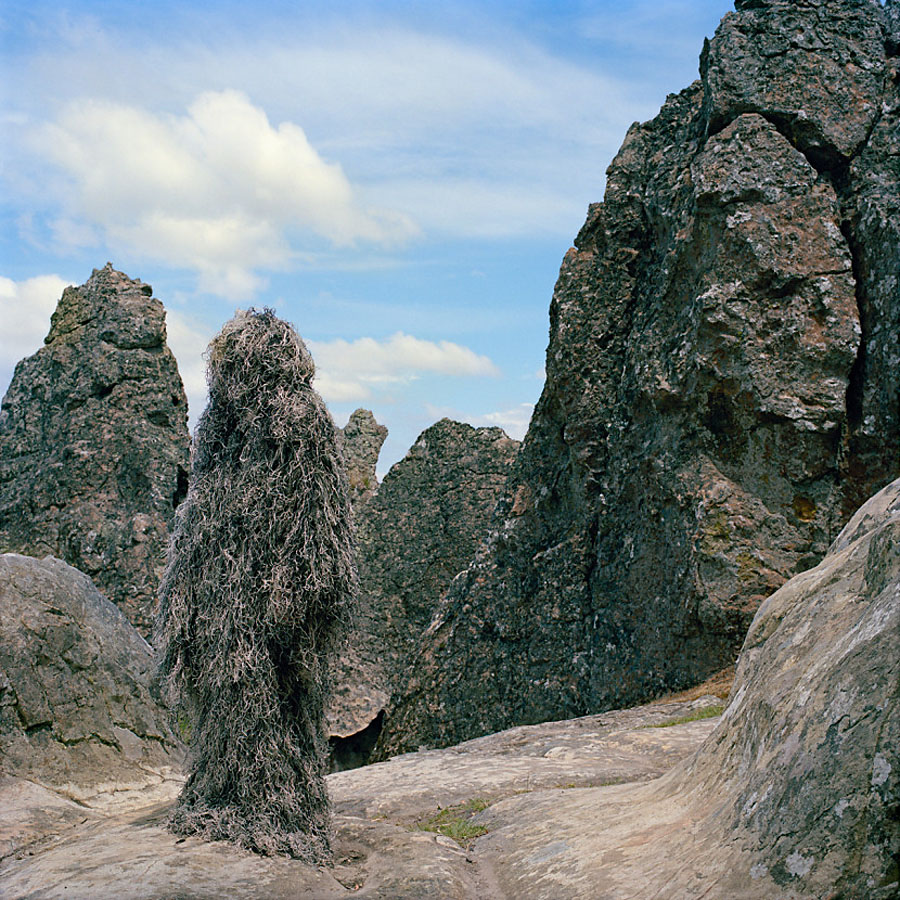
 

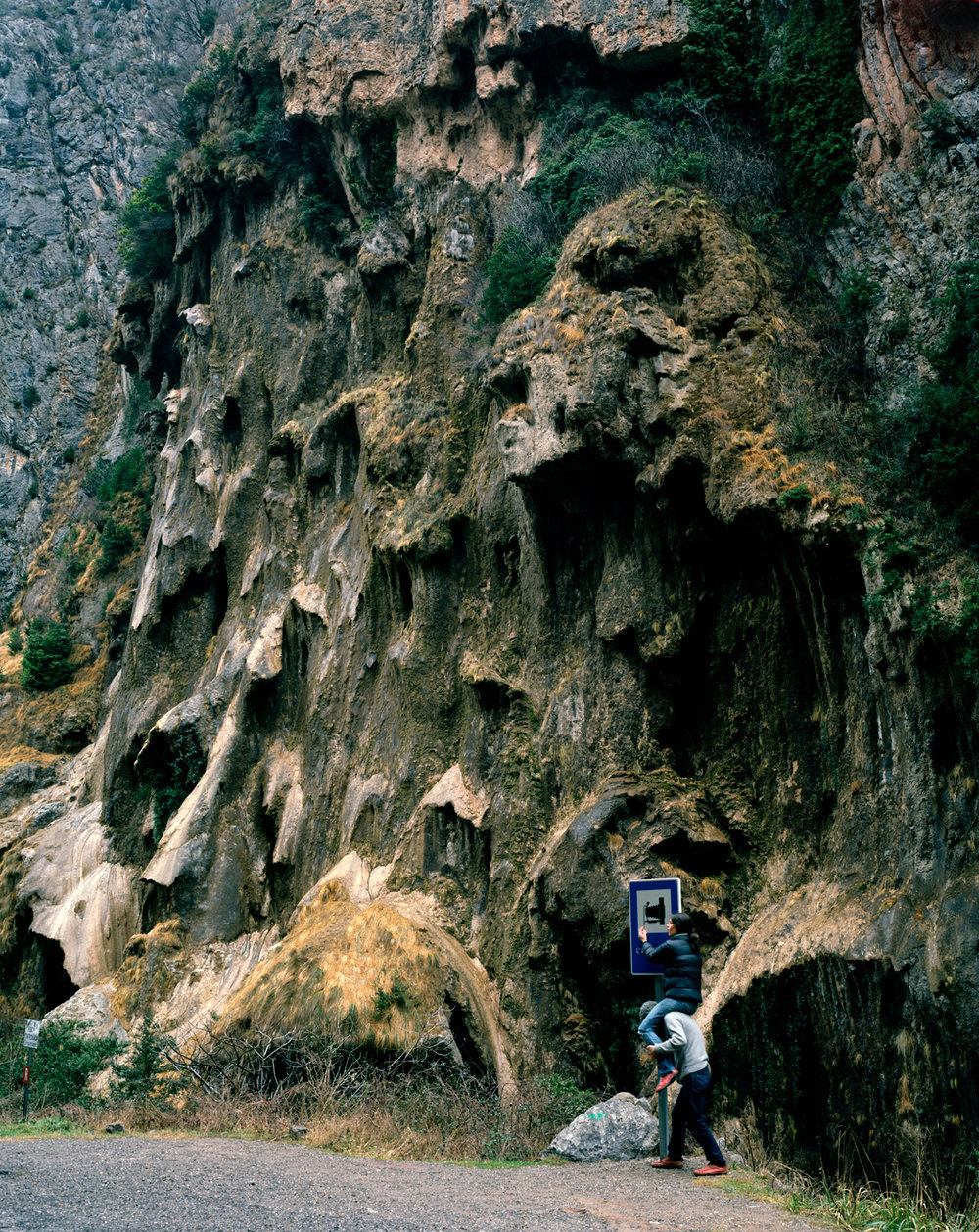
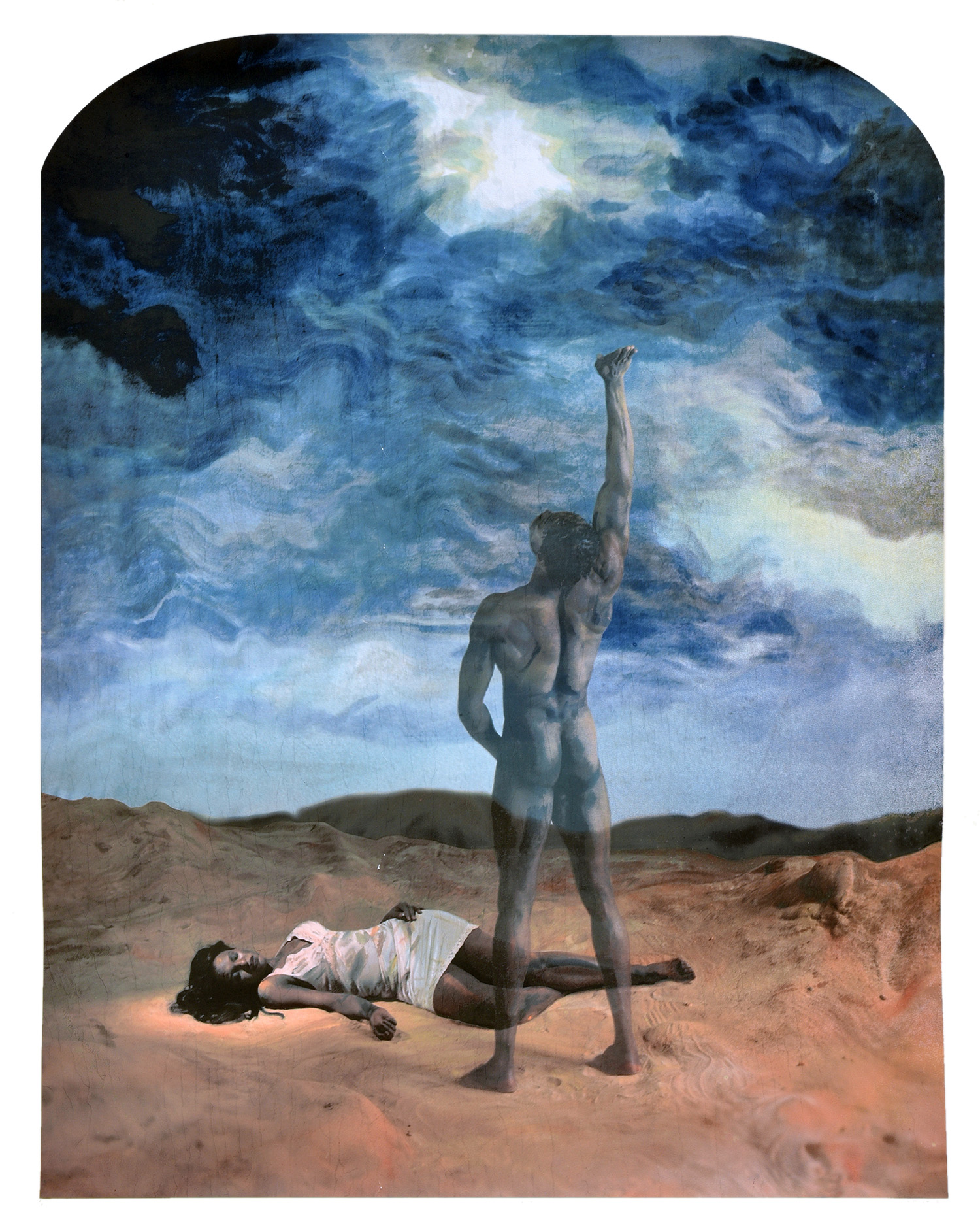
Polixeni Papapetrou (Australian, 1960-2018) 'Magma Man' 2012 from the exhibition 'WHO ARE YOU: Australian Portraiture' at NGV Australia, Federation Square, Melbourne, march - August, 2022


Polixeni Papapetrou (Australian, 1960-2018)
Magma Man
2012
From the series The Ghillies 2013
Inkjet print
120.0 x 120.0cm
National Gallery of Victoria, Melbourne
Purchased NGV Foundation, 2013
© Polixeni Papapetrou/Administered by VISCOPY, Sydney
Photo: © National Gallery of Victoria


Polixeni Papapetrou’s series The Ghillies shows the artist’s son wearing extreme camouflage costumes that are used by the defence forces to blend in with their environment. The photographs reflect on the passing of childhood, and the journey out of a maternally centred world into a wider existence. Papapetrou proposes that this is a significant moment for many young men as they seek to separate themselves from their mothers, and assume the costumes and identities of masculine stereotypes, often hiding themselves in the process. Papapetrou photographed her children fro most of her career, and explored a range of stereotypes that surround childhood. These works examine the placement of children and adolescents in a society which is determined and defined by adults.

Wall text from the exhibition


Karla Dickens (Australian / Wiradjuri, b. 1967) 'Mrs Woods and 'Ere' 2013 from the exhibition 'WHO ARE YOU: Australian Portraiture' at NGV Australia, Federation Square, Melbourne, march - August, 2022


Karla Dickens (Australian / Wiradjuri, b. 1967)
Mrs Woods and ‘Ere
2013
Inkjet print on paper, ed. 3/10
Image: 66.0 x 100.cm
Sheet: 76.5 x 110.0 cm
National Portrait Gallery, Canberra
Purchased 2019
© Karla Dickens/Copyright Agency, 2022


Tjayanka Woods (c. 1935-2014) was a senior Pitjantjatjara artist, born near Kalaya Pirti (Emu Water) near Mimili and Wataru, South Australia. She was a cultural custodian, leader and held significant knowledges regarding cultural law and medicine. As an artist, Woods often referred to the Kungkarrangkalpa Tjurkurpa (Seven Sisters) within her artworks. The Kungkarrangkalpa Tjurkurpa is an epic and ancient creation story revolving around the start cluster, also known as Pleiades. In 2013, Wiradjuri artist Karla Dickens, spent several weeks with Woods and other senior Pitjantjatjara artists research the creation story. During her time in Pitjantjatjara Country, Dickens photographed Woods as the aware and intelligent cultural leader she was, with dignity and strength.

Wall text from the exhibition


Kaylene Whiskey (Australian / Anangu Pitjantjatjara Yankunytjatjara, b. 1976) 'Seven Sisters Song' 2021 from the exhibition 'WHO ARE YOU: Australian Portraiture' at NGV Australia, Federation Square, Melbourne, march - August, 2022


Kaylene Whiskey (Australian / Anangu Pitjantjatjara Yankunytjatjara, b. 1976)
Seven Sisters Song
2021
Enamel paint on road sign
120.0 x 180.0cm irreg.
National Gallery of Victoria, Melbourne
Purchased, Victorian Foundation for Living Australian Artists, 2021
© Kaylene Whiskey. Courtesy of the artist, Iwantja Arts and Roslyn Oxley9 Gallery, Sydney


Kaylene Whiskey seamlessly combines references to daily life in Indulkana with popular culture. Painted on an old road sign, Seven Sisters Song celebrates Whiskey’s witty sense of humour and personal reflection of Kungkarangkalpa Tjukurpa, the Seven Sisters creation story. Imbued within the work themes of sisterhood and kinship bonds, Whiskey brings together two vastly different worlds. Strong female characters including Wonder Woman, Whoopi Goldberg and Dolly Parton are situated within a desert landscape and seen interacting with native plants and wildlife, including traditional Anangu activities like hunting, collecting bush tucker, and cultivating mingkulpa (a native tobacco plant).

Wall text from the exhibition


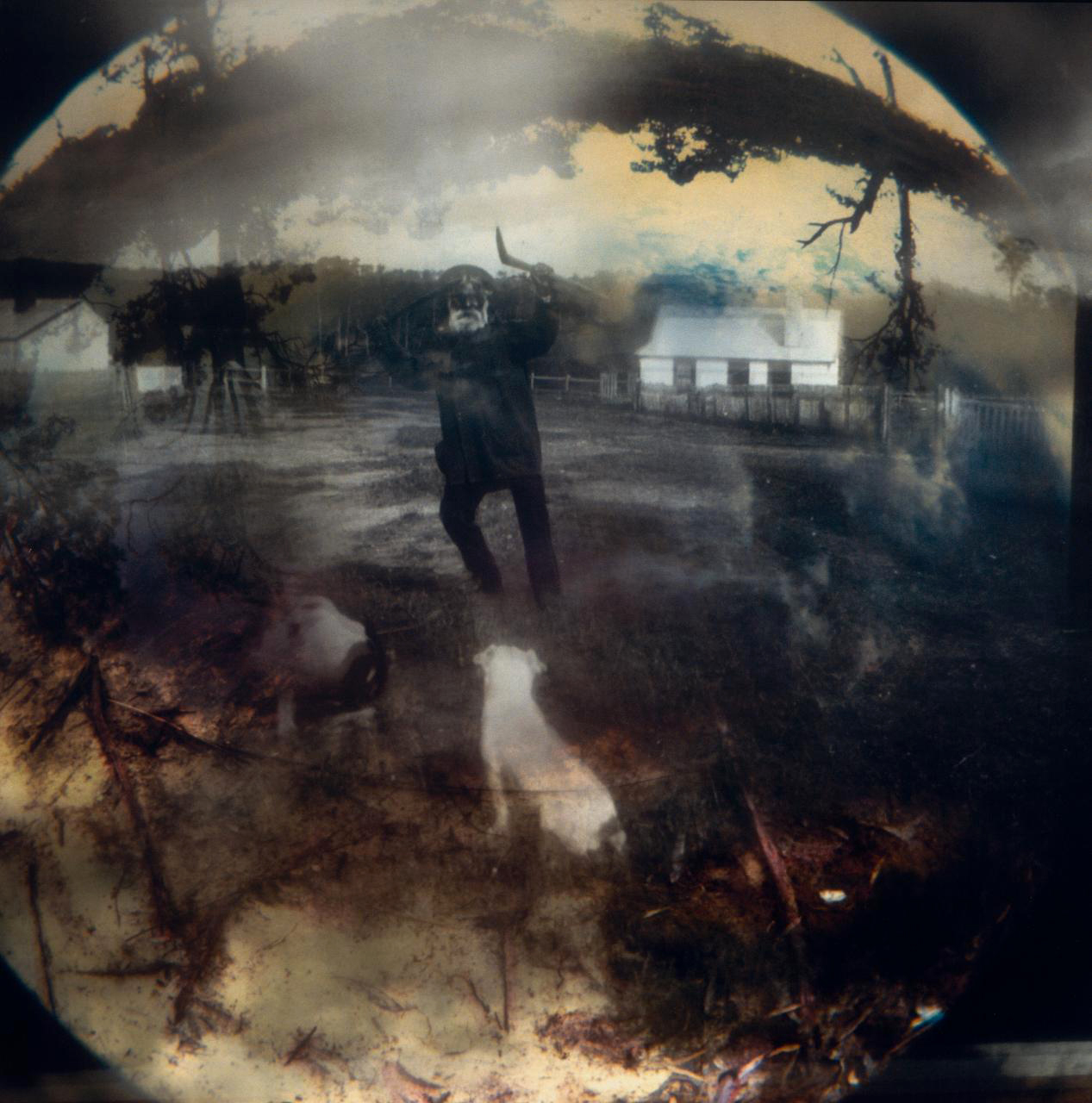
Johannes Heyer (Australian, 1872-1945) 'William Barak at work on the drawing 'Ceremony' at Coranderrk' 1902 from the exhibition 'WHO ARE YOU: Australian Portraiture' at NGV Australia, Federation Square, Melbourne, march - August, 2022


Johannes Heyer (Australian, 1872-1945)
William Barak at work on the drawing ‘Ceremony’ at Coranderrk
1902
Gelatin silver photograph, sepia toned on paper
8.7 x 8.7cm
National Portrait Gallery, Canberra
Purchased with the assistance of the Australian Decorative and Fine Arts Society 2000


Wurundjeri artist and ngurungaeta (Head Man) William Barak was an important cultural leader, diplomat and activist. Barak lived near Coranderrk Aboriginal Station, near Healesville, from 1863 until 1903, becoming an influential spokesman for the rights of his people and an informant on Wurundjeri cultural lore. The people of Coranderrk, however, were officially forbidden from observing traditional practices, so Barak began recording them in drawings, often using ochre and charcoals to depict ceremonies and aspects of Wurundjeri culture before colonisation. His artworks are significant expressions of cultural practice, and he is regarded as an important figure int he history of Indigenous Australian art.

Wall text from the exhibition


Beruk (William Barak) (1824-1903), an elder of the Wurundjeri clan of the Woi-worung, was the most famous Aboriginal person in Victoria in the 1890s. After attending the Reverend George Langhorne’s mission school, Barak joined the Native Police in 1844 and remained there until at least 1851. From 1863 until his death he lived at the government reserve at Coranderrk, at a site near the Yarra River in Victoria. The history of the reserve is one of official interference and mismanagement, and Barak played a significant part in representing the wishes of his community to the government. In the decade of the 1880s he made many paintings and artefacts, mostly of Aboriginal ceremonial subjects.


Beruk (1824-1903), artist, activist, leader and educator, was a Wurundjeri man of the Woiwurrung people, one of the five Kulin Nations whose Country encompasses Narrm (Melbourne). It is said that Beruk was present at the signing of the so-called treaty with which John Batman reckoned he’d acquired 240,000 hectares of Wurundjeri land in 1835. In reality, the men with whom Batman negotiated, including one of Beruk’s uncles, had not transferred ownership, but merely given Batman permission to stay temporarily. Beruk was given the name William Barak (a European mispronunciation) in 1844 when he joined the Native Police. He was among the group of people from across Victoria who were the first to join the settlement at Coranderrk, near Healesville, established by the Aboriginal Protection Board in 1863 following several years of petitioning by community leaders. Beruk emerged as a leader at Coranderrk, which developed into a self-sufficient agricultural settlement. Following the passing of his cousin Simon Wonga in 1874, Beruk became Ngurungaeta (head man) of the Wurundjeri people. During the same period, when European pastoral interests started lobbying for Coranderrk to be broken up and sold off, Beruk led the campaign to prevent the settlement’s closure. It was gazetted as a ‘permanent reservation’ in 1881.

By this time, Beruk was recognised as a leader of his people and as a revered custodian of language and cultural knowledge. As the people at Coranderrk were officially forbidden from observing their traditional ceremonies, including corroborees, Beruk began recording his knowledge in drawings, utilising introduced methods and materials including paper, cardboard, and watercolour to preserve and communicate important stories and aspects of culture and spirituality. On the one hand, his drawings and the artefacts he made functioned as a commodity and were sold as souvenirs to increasing numbers of tourists. Museums in Europe began acquiring examples of his work in the late nineteenth century. On the other hand, and more significantly, Beruk’s drawings represent a profound assertion of pride in his heritage and identity, and the survival of a rich and complex culture in the face of concerted attempts to diminish it. As Wurundjeri elder and Beruk’s great-great niece Aunty Joy Wandin Murphy says: “We believe that what he wanted was for people to remember those ceremonies, so that if he painted them … then people would always know about the ceremonies on Coranderrk and of Wurundjeri people.”

This photograph of Beruk was taken by Johannes Heyer, a Presbyterian clergyman called to the parish of Yarra Glen and Healesville in 1900. The drawing that Beruk is shown working on in the photograph is now in the collection of the Art Gallery of South Australia, Adelaide.

Anonymous text. “William Barak at work on the drawing ‘Ceremony’ at Coranderrk,” on the National Portrait Gallery website Nd [Online] Cited 18/06/2022


David Moore (Australia 1927-2003) 'Migrants arriving in Sydney' 1966


David Moore (Australia 1927-2003)
Migrants arriving in Sydney
1966
Gelatin silver print
National Gallery of Victoria, Melbourne
Purchased, 1961


WHO ARE YOU: Australian Portraiture is the first exhibition to comprehensively bring together the rich portrait holdings of both the National Gallery of Victoria, Melbourne, and the National Portrait Gallery, Canberra. Revealing the artistic synergies and contrasts between the two institutions’ collections, this co-curated exhibition considers portraiture in Australia across time and media.

Through the examination of diverse and sometimes unconventional ways of representing likeness, WHO ARE YOU will question what actually constitutes portraiture – historically, today and into the future. Examples of some of the more abstract notions of portraits in the exhibition include John Nixon’s Self-portrait, (1990), and Boris Cipusev’s typographic portrait of Jeff from The Wiggles, titled Jeff the wiggle, 2009-2013. Polixeni Papapetrou’s Magma man, 2013, a photograph that merges sitter and landscape until the two are almost indecipherable, and Shirley Purdie’s multi-panelled evocation of biography and Country, Ngalim-Ngalimbooroo Ngagenybe, 2018, further challenge the conventions of the genre and touch upon the intimate connection between artist, sitter and land. NGV Collection highlights include new acquisitions: Kaylene Whiskey’s Seven Sisters Song, 2021 – a playful take on portraiture by a living artist and Joy Hester’s Pauline McCarthy,1945, a rare example of Hester producing a portrait in oil.

WHO ARE YOU is the largest exhibition of Australian portraiture ever mounted by either the NGV or NPG, and is the first time the two galleries have worked collaboratively on such a large-scale project.

Text from the NGV International website


Installation view of the exhibition 'WHO ARE YOU: Australian Portraiture' at NGV Australia, Federation Square, Melbourne showing Lloyd Rees' 'Portrait of some rocks' 1948


Installation view of the exhibition WHO ARE YOU: Australian Portraiture at NGV Australia, Federation Square, Melbourne showing Lloyd Rees’ Portrait of some rocks (1948, below)
Photo: Marcus Bunyan
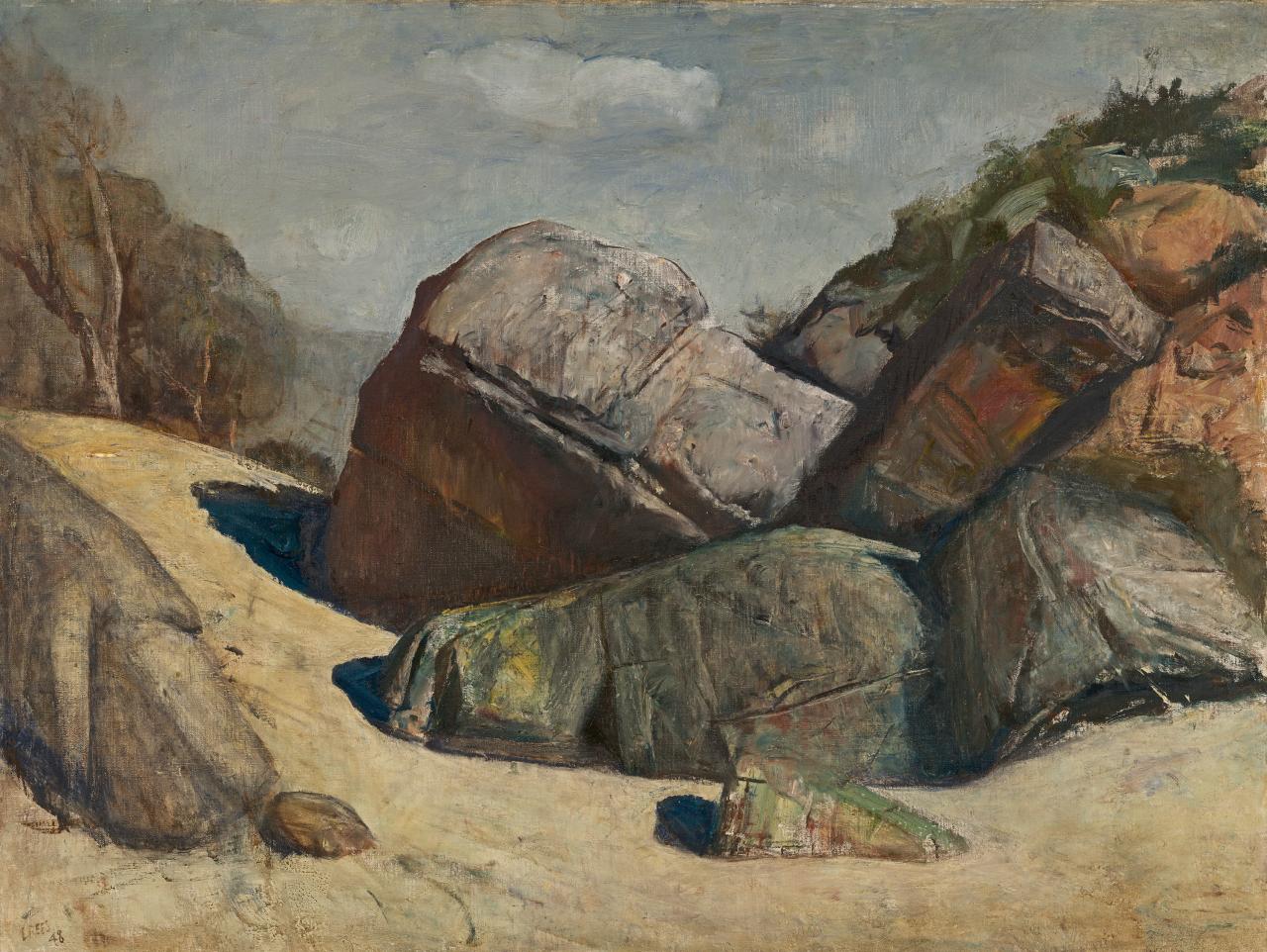
 

Lloyd Rees (Australian, 1895-1988) 'Portrait of some rocks' 1948


Lloyd Rees (Australian, 1895-1988)
Portrait of some rocks
1948
Oil on canvas
76.6 x 102.0cm
National Gallery of Victoria, Melbourne
Purchased, 1948
© Lloyd Rees/Licensed by Copyright Agency, Australia


One of Australia’s leading landscape artists of the mid-twentieth century, Lloyd Rees studied at Brisbane Technical College before moving to Sydney in 1917, where he worked as a commercial illustrator. In the early 1930s he concentrated solely on drawing, particularly the rocky landscapes around Sydney, but by the late 1930s he began painting in an increasingly romantic manner. Rocks were a meaningful subject for Rees because they evoked permanency and represented the constitution of the earth. Rees humanises his subject matter by using the word ‘portrait’ in the title, which suggests the rocks have shifted from inorganic to animate objects.

Wall text from the exhibition


Installation view of the exhibition 'WHO ARE YOU: Australian Portraiture' at NGV Australia, Federation Square, Melbourne showing at right, Marshall Claxton's 'An emigrant's thoughts of home' (1859)


Installation view of the exhibition WHO ARE YOU: Australian Portraiture at NGV Australia, Federation Square, Melbourne showing at right, Marshall Claxton’s An emigrant’s thoughts of home (1859, below)
Photo: Marcus Bunyan


Installation view of the exhibition 'WHO ARE YOU: Australian Portraiture' at NGV Australia, Federation Square, Melbourne showing at right, Marshall Claxton's 'An emigrant's thoughts of home' (1859)


Installation view of the exhibition WHO ARE YOU: Australian Portraiture at NGV Australia, Federation Square, Melbourne showing at right, Marshall Claxton’s An emigrant’s thoughts of home (1859, below)
Photo: Marcus Bunyan


Marshall Claxton (English, 1813-1881, worked in Australia 1850-1854) 'An emigrant's thoughts of home' 1859


Marshall Claxton (English, 1813-1881, worked in Australia 1850-1854)
An emigrant’s thoughts of home
1859
Oil on cardboard
60.7 × 47.0cm
National Gallery of Victoria, Melbourne
Presented by the National Gallery Women’s Association, 1974


Immigration underlies the European history of Australia. Between 1815 and 1840, more than 58,000 people, predominately from the British Isles, came to Australia in search of a better life. Women migrants were also assisted to curb a gender imbalance in the colonies, to work as domestic servants and to foster marriages and childbirth.

Text from the National Gallery of Victoria website


Immigration is central to the history of Australia. The wistful tilt of this young woman’s head and her thoughtful expression are powerful symbols of the intense nostalgia and fear of the unknown experienced by those in search of a new homeland. Despite its apparent simplicity and sentimentality, the painting captures the issues of poverty, deprivation and emigration that people, especially women, faced in the middle decades of the nineteenth century.

Wall text from the exhibition


Peter Drew (Australian, b. 1983) 'Monga Khan 1916' 2016, printed 2019


Peter Drew (Australian, b. 1983)
Monga Khan 1916
2016, printed 2019
From the Aussie series 2016
Brush and ink on screenprint
Image: 114.5 x 80.5cm
Sheet: 117.5 x 83.5cm
National Gallery of Victoria, Melbourne
Purchased, NGV Supporters of Prints and Drawings, 2020
© Peter Drew


Monga Khan was a hawker, and one of the thousands of people who applied for an exemption to the White Australia Policy, a law which came into effect in 1901. Exemptions were considered for cameleers, hawkers and other traders who were considered essential workers. Drew created this poster and others in the Aussie series using photographs from the National Archives of Australia, and pasted them around Australia’s cities.

He explains: ‘When you address the public through the street you’re entering into a tradition that emphasises our fundamental freedom of expression, over the value of property. I enjoy examining our collective identities and my aim is always to emphasise the connections that bind us, rather than the fractures that divide us’.

Wall text from the exhibition


Installation view of the exhibition 'WHO ARE YOU: Australian Portraiture' at NGV Australia, Federation Square, Melbourne showing at left, Maree Clarke's 'Walert – gum barerarerungar' (2020-2021); and at right, Uta Uta Tjangala's 'Ngurrapalangu' (1989)


Installation view of the exhibition WHO ARE YOU: Australian Portraiture at NGV Australia, Federation Square, Melbourne showing at left, Maree Clarke’s Walert – gum barerarerungar (2020-2021, below); and at right, Uta Uta Tjangala’s Ngurrapalangu (1989, below)
Photo: Marcus Bunyan


Uta Uta Tjangala (Australian / Puntupi, c. 1926-1990) 'Ngurrapalangu' 1989 (installation view)


Uta Uta Tjangala (Australian / Puntupi, c. 1926-1990)
Ngurrapalangu (installation view)
1989
Synthetic polymer paint on canvas
National Gallery of Victoria, Melbourne
Presented through the NGV Foundation by Elizabeth and Colin Laverty, Governors, 2001
Photo: Marcus Bunyan


Uta Uta Tjangala forged a new art form at Papunya during 1971-1972 with startling works such as this one. Working for the first time on a discarded scrap of composition board, artists at Papunya rendered visible and permanent ephemeral designs, formerly made only for use in closed and secret ceremonial contexts on bodies, objects or the ground. The painted designs are closely connected to the artist’s cultural identity, his understanding of Country, and of sacred men’s business, unknowable to uninitiated members of the community.

Wall text from the exhibition


Maree Clarke (Australian / Mutti Mutti/Wamba Wamba/Yorta Yorta/Boonwurrung, b. 1961) 'Walert – gum barerarerungar: Tipperary, Ireland Dunstable, Britain Yorta Yorta Trawlwoolway Boonwurrung, Muttu Mutti, Wamba Wamba' 2020-2021 (installation view)


Maree Clarke (Australian / Mutti Mutti/Wamba Wamba/Yorta Yorta/Boonwurrung, b. 1961)
Walert – gum barerarerungar: Tipperary, Ireland Dunstable, Britain Yorta Yorta Trawlwoolway Boonwurrung, Muttu Mutti, Wamba Wamba (installation view)
2020-2021
Possum pelts
National Gallery of Victoria, Melbourne
Purchase, Victorian Foundation for Living Australian Artists, 2021
Photo: Marcus Bunyan


Maree Clarke is recognised as one of the most respected possum skin cloak makers and teachers in the world. This work represents the first time Clarke produced a cloak to represent her own ancestral identity. Depicted on the cloak are seven important places, which her ancestors come from: Yorta Yorta Country, Trawlwoolway Country, Boonwurrung Country, Muttu Mutti Country and Wamba Wamba Country, as well as Tiperrary in Ideland, and Dunstable in Britain. Clarke has used a rare green ochre to represent her European ancestors. Together, these seven ancestral sites of significance inform Clarke’s identity.

Wall text from the exhibition


Maree Clarke (Australian / Mutti Mutti/Wamba Wamba/Yorta Yorta/Boonwurrung, b. 1961) 'Walert – gum barerarerungar: Tipperary, Ireland Dunstable, Britain Yorta Yorta Trawlwoolway Boonwurrung, Muttu Mutti, Wamba Wamba' 2020-2021 (installation view detail)


Maree Clarke (Australian / Mutti Mutti/Wamba Wamba/Yorta Yorta/Boonwurrung, b. 1961)
Walert – gum barerarerungar: Tipperary, Ireland Dunstable, Britain Yorta Yorta Trawlwoolway Boonwurrung, Muttu Mutti, Wamba Wamba (installation view detail)
2020-2021
Possum pelts
National Gallery of Victoria, Melbourne
Purchase, Victorian Foundation for Living Australian Artists, 2021
Photo: Marcus Bunyan


Portraiture

In its uniting of artist and sitter, the self-portrait is an intriguing facet of portraiture. The self-reflection is a format that appears to grant the viewer the assurance of revelation and intimate access to the artist’s psyche. However, what the artist intends to communicate to their audience through portraiture is highly varied, and the message each artist conveys is as individual as the artist themselves. Additionally, there is room for the viewer to question how the artist has chosen to depict their image.

Self-portraiture is a diverse genre: there are myriad ways an artist can present themselves. A typical way for the artist to portray themselves is in the role of ‘the artist’, including in the work a visual clue to their profession – for instance holding a brush or paint palette – or showing themselves at work in the studio. As part of an investigation of self, these representations can also communicate the complexities of status and gender. This selection of works explores what the artists intend to reveal or exclude about themselves through their self-representations, considering he environment in which the artists are placed, and the props and imagery they choose to include in the works.

Wall text from the exhibition


Pamela See (Australian, b. 1979) 'Making Chinese Shadows (sixteen silhouette portraits)' 2018 (installation view)


Pamela See (Australian, b. 1979)
Making Chinese Shadows (sixteen silhouette portraits) (installation view)
2018
Twelve of sixteen papercut silhouette drawings
National Portrait Gallery, Canberra
Purchased 2019
Photo: Marcus Bunyan


Brisbane-born Pamela See (Xue Mei-Ling) studied at the Queensland College of Art from 1997 to 1999. She began papercutting during a period when she was without access to a studio, and was subsequently awarded grants that enabled her to study the technique in several centres throughout China. Her method and style resemble Foshan papercutting, which is widely practices in the home of her maternal grandparents, in Guangdong province. These papercuts are from a series investigating the lives of Chinese-Australians who flourished prior to the introduction of the White Australia policy. The works connect and juxtapose European silhouette portraiture and Chinese papercutting traditions, exploring the notion that a silhouette profile provides a means of ‘measuring’ a sitter’s character with the totemic and floral symbols evoking personal narratives, identity and professions.

Wall text from the exhibition
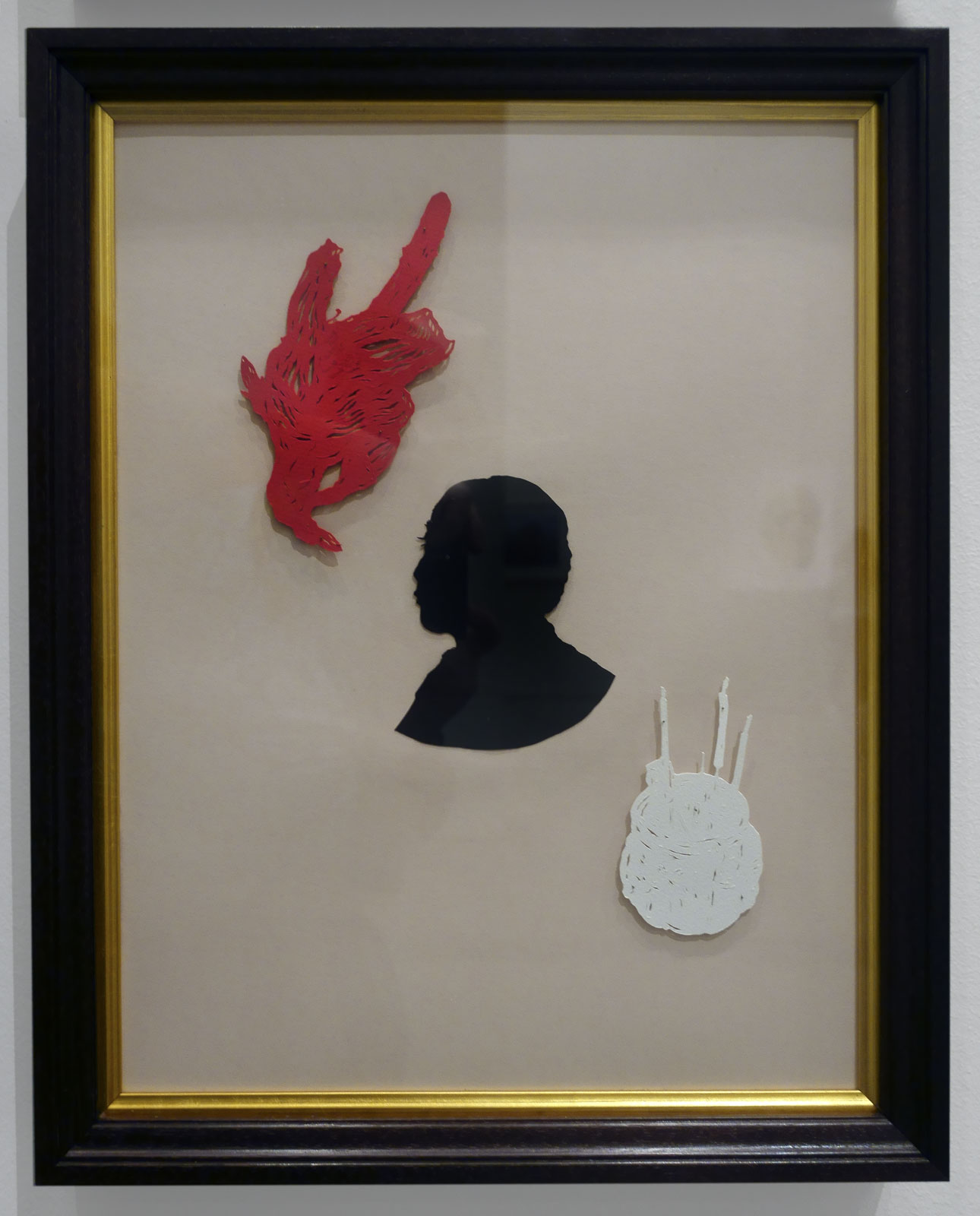
 

Pamela See (Australian, b. 1979) 'Making Chinese Shadows (sixteen silhouette portraits)' 2018 (installation view detail)


Pamela See (Australian, b. 1979)
Making Chinese Shadows (sixteen silhouette portraits) (installation view detail)
2018
Twelve of sixteen papercut silhouette drawings
National Portrait Gallery, Canberra
Purchased 2019
Photo: Marcus Bunyan


Various unknown photographers (Australian) 'William and Martha Mary Robertson and their children' 1860s-1870s (installation view)

Various unknown photographers (Australian) 'William and Martha Mary Robertson and their children' 1860s-1870s (installation view)

Various unknown photographers (Australian) 'William and Martha Mary Robertson and their children' 1860s-1870s (installation view)


Various unknown photographers (Australian)
William and Martha Mary Robertson and their children (installation views)
1860s-1870s
Eight cartes de visite, hand-coloured, contained in red leather presentation case
National Portrait Gallery, Canberra
Gift of Malcolm Robertson in memory of William Thomas Robertson 2018
Donated through the Australian Government’s Cultural Gifts Program
Photos: Marcus Bunyan


LIU Xiao Xian (Australian born China, b. 1963) 'My other lives, #7' 2000


LIU Xiao Xian (Australian born China, b. 1963)
My other lives, #7
2000
From the My other lives series 2000
Type C photograph
102.0 × 145.2cm irreg.
National Gallery of Victoria, Melbourne
Purchased with funds arranged by Loti Smorgon for Contemporary Australian Photography, 2002
© LIU Xiao Xian


Popular in nineteenth-century Australia, stereographs gave the illusion of three dimensions when placed in a handheld viewer. In this work, Liu Xiao Xian enlarges a typical example of this historical form of photographic portraiture and replaces the sitter’s face with his own on one side. Through this double-take, and the playful invitation to imagine an ‘other life’ for this sitter, this work is both a subtle self-portrait and a pointed reminder of the invisibility of the Chinese migrant experience in mainstream conceptions of Australian history and identity.

Wall text from the exhibition
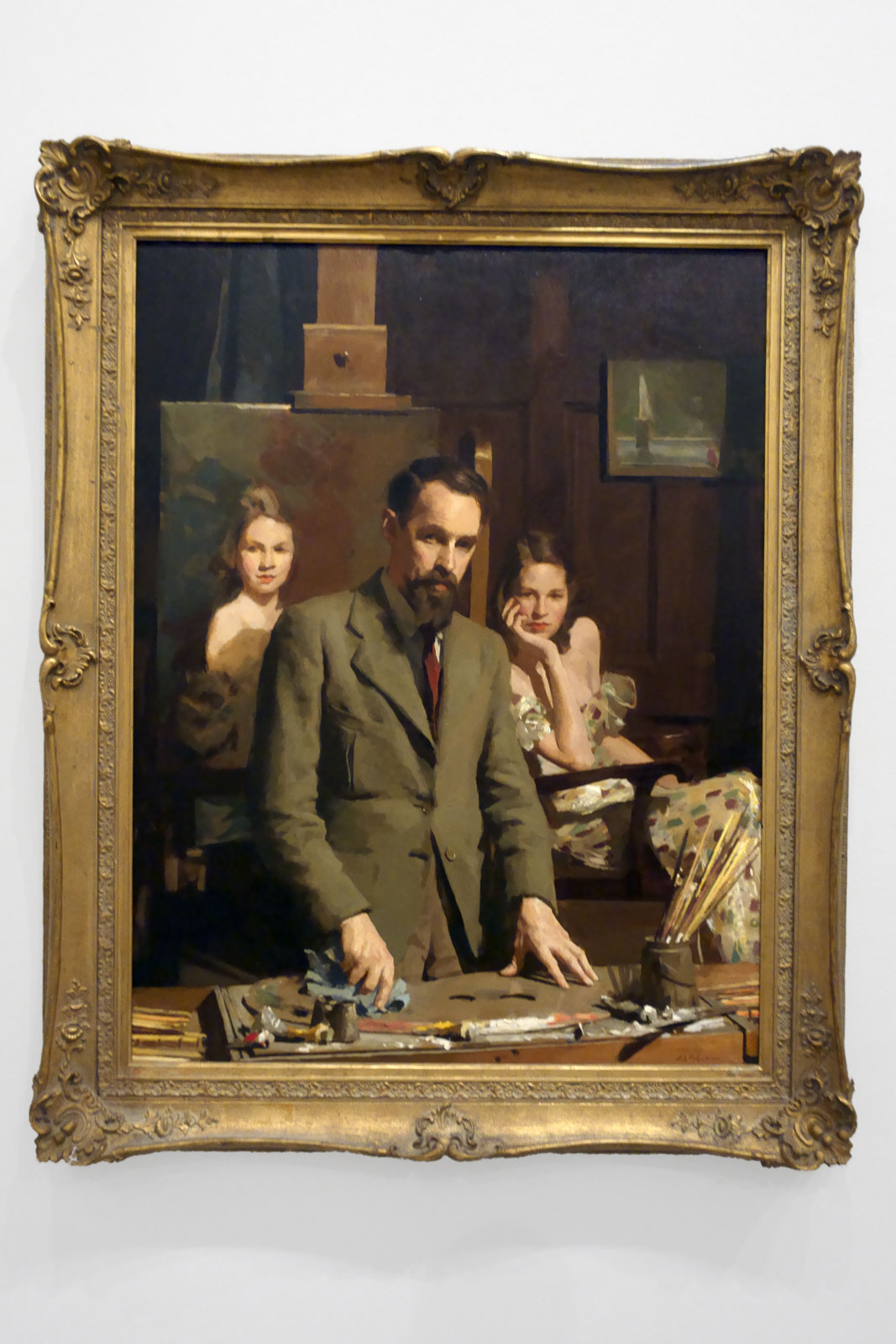
 

A. D. Colquhoun (Australian, 1894-1983) 'Artist and sitter' c. 1938 (installation view)


A. D. Colquhoun (Australian, 1894-1983)
Artist and sitter (installation view)
c. 1938
Oil on canvas
122.0 × 94.0cm
National Gallery of Victoria, Melbourne
Felton Bequest, 1940
© Dr Quentin Noel Porter
Photo: Marcus Bunyan


A. D. Colquhoun (Australian, 1894-1983) 'Artist and sitter' c. 1938


A. D. Colquhoun (Australian, 1894-1983)
Artist and sitter
c. 1938
Oil on canvas
122.0 × 94.0cm
National Gallery of Victoria, Melbourne
Felton Bequest, 1940
© Dr Quentin Noel Porter


Brush in hand, there is no mistaking A. D. Colquhoun’s occupation or the studio setting. The young, glamorous model is an essential part of this carefully orchestrated self-portrayal. By also including his painting of the model on the easel, Colquhoun presents himself in the company of not one, but two women whose presence asserts his own dominant masculinity. The artist’s gaze meets the viewer, placing them as the subject of the painter’s attention, creating a complex network of visual relationships between the artist, model and viewer.

Wall text from the exhibition


Installation view of the exhibition 'WHO ARE YOU: Australian Portraiture' at NGV Australia, Federation Square, Melbourne showing at right, Shirley Purdie's 'Ngalim-Ngalimbooroo Ngagenybe' (2018)


Installation view of the exhibition WHO ARE YOU: Australian Portraiture at NGV Australia, Federation Square, Melbourne showing at right, Shirley Purdie’s Ngalim-Ngalimbooroo Ngagenybe (2018, below)
Photo: Marcus Bunyan
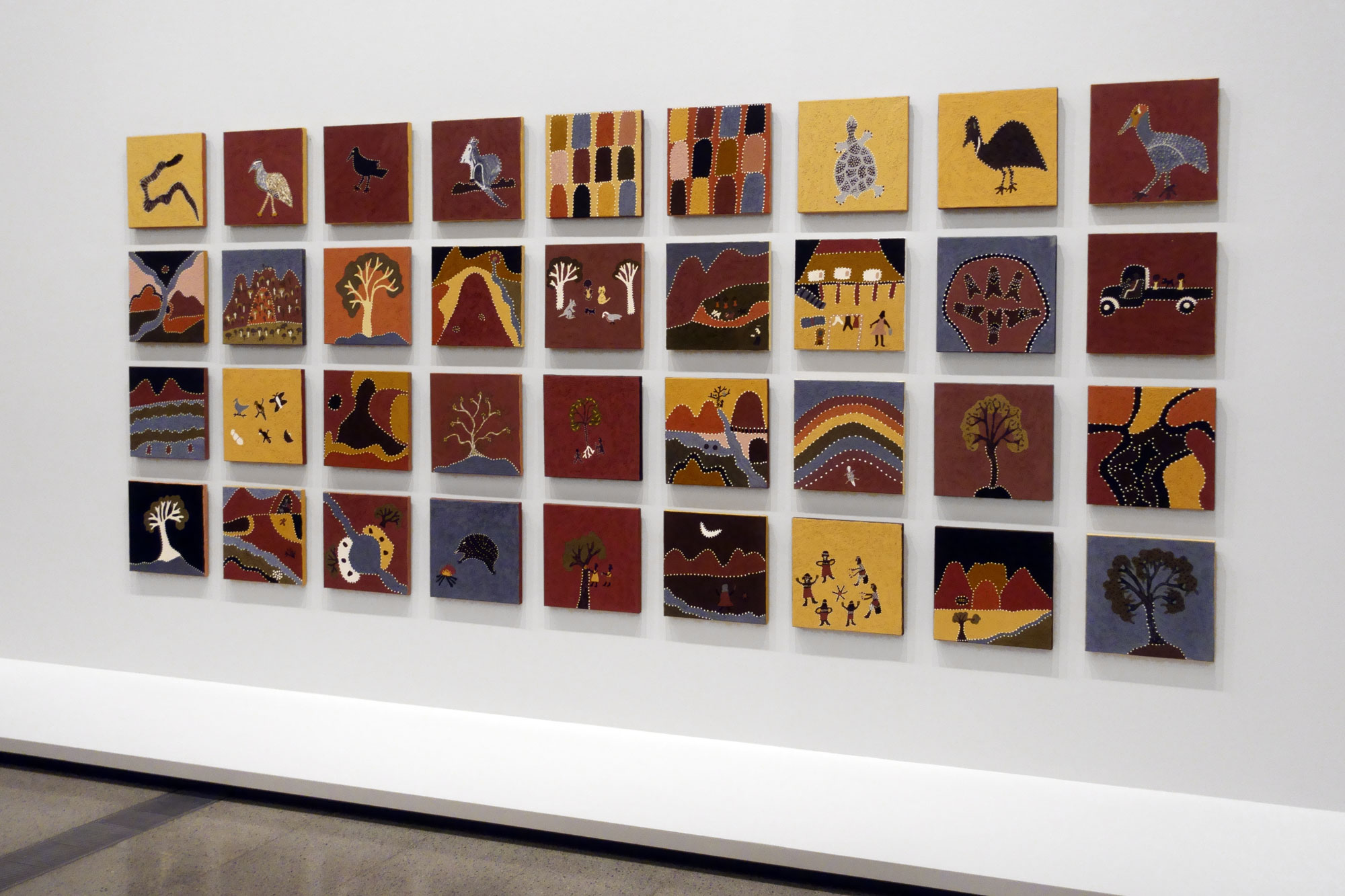
 

Shirley Purdie (Australian / Gija, b. 1947) 'Ngalim-Ngalimbooroo Ngagenybe' 2018 (installation view)


Shirley Purdie (Australian / Gija, b. 1947)
Ngalim-Ngalimbooroo Ngagenybe (installation view)
2018
Natural ochre and pigments on canvas (36 parts)
Each: 45 x 45cm
Overall: 225 x 525cm
National Portrait Gallery, Canberra
Purchased 2019
© Shirley Purdie/Copyright Agency, 2022
Photo: Marcus Bunyan


Shirley Purdie (b. 1947) is a senior Gija artist at the Warmun Art Centre who has been painting for more than twenty years. Purdie has lived on her Country, Western Australia’s East Kimberley, all her life. Inspired by senior Warmun artists, including her late mother, Madigan Thomas, she began to paint sites and narratives associated with her Country in the early 1990s. A prominent leader in the Warmun community, her cultural knowledge and artistic skill allow her to pass on Gija stories and language to the younger generations.

In 2018, Purdie was selected to contribute to the National Portrait Gallery’s 20th anniversary exhibition, So Fine: Contemporary Women Artists Make Australian History. Composed of 36 paintings, Purdie’s self-portrait Ngalim-Ngalimbooroo Ngaginbe is an eloquent and stunning visualisation of personal history, identity and connection to Country. ‘It’s good to learn from old people. They keep saying when you paint you can remember that Country, just like to take a photo … When the old people die, young people can read the stories from the paintings. They can learn from the paintings and maybe they want to start painting too.’ Using richly textured ochres collected on her Country, Purdie’s work is a kaleidoscope of traditional Gija stories and Ngarranggarni passed down to her.

Text from the National Portrait Gallery website


Shirley Purdie is senior Gija woman and a prominent leader within the Warmup Community in Western Australia’s East Kimberley. Combining her cultural knowledge with her art, Purdie creates visual depictions of Gija life and culture. Ngalim-Ngalimbooroo Ngagenybe, meaning ‘from my women’, is informed by Aboriginal ways of seeing, knowing and understanding oneself within the world. Each of the thirty-six panels shares a story about personal history, identity and Country to produce a non-representational self-portrait of the artist and her ongoing connection to women’s stories. By drawing on the significant women in her life, their relationships and histories, Purdie describes herself through these cultural connections and stories.

Wall text from the exhibition


Installation view of the exhibition 'WHO ARE YOU: Australian Portraiture' at NGV Australia, Federation Square, Melbourne showing Sam Jink's 'Divide (Self portrait)' (2011)


Installation view of the exhibition WHO ARE YOU: Australian Portraiture at NGV Australia, Federation Square, Melbourne showing Sam Jink’s Divide (Self portrait) (2011, below)
Photo: Marcus Bunyan


Sam Jinks (Australian, b. 1973) 'Divide (Self portrait)' 2011 (installation view)

Sam Jinks (Australian, b. 1973) 'Divide (Self portrait)' 2011 (installation view)


Sam Jinks (Australian, b. 1973)
Divide (Self portrait) (installation views)
2011
Silicone, resin, horse hair
National Portrait Gallery, Canberra
Purchased 2015
© Sam Jinks
Photos: Marcus Bunyan


Sam Jinks developed a talent for drawing and constructing his ideas alongside his father, a Melbourne cabinetmaker. Jinks worked as an illustrator before turning to sculpture. He worked in film and television special effects before becoming a fabricator for artist Patricia Piccinini. For the last ten years he has sculpted independently, working in silicone, fibreglass, resin and hair – human, animal and synthetic.


Max Martin (Australian, 1889-1965) 'Portrait group' 1922


Max Martin (Australian, 1889-1965)
Portrait group
1922
Oil on canvas
152.8 x 102.2cm
National Gallery of Victoria, Melbourne
Purchased through The Art Foundation of Victoria with the assistance of Dr Joseph Brown AO OBE, Honorary Life Benefactor, 1995
© Veronica Martin
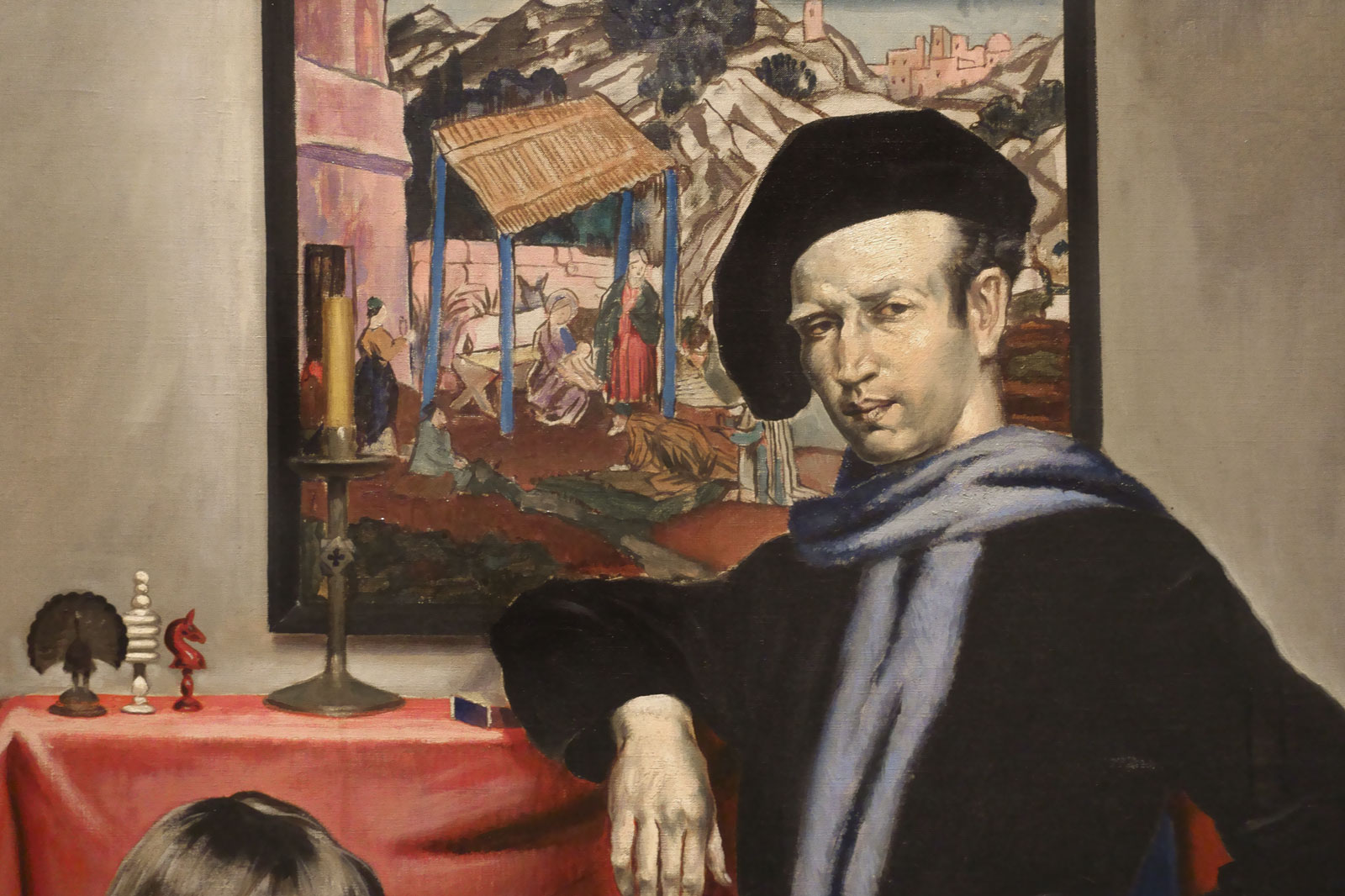
 

Max Martin (Australian, 1889-1965) 'Portrait group' 1922 (installation view detail)


Max Martin (Australian, 1889-1965)
Portrait group (installation view detail)
1922
Oil on canvas
152.8 x 102.2cm
National Gallery of Victoria, Melbourne
Purchased through The Art Foundation of Victoria with the assistance of Dr Joseph Brown AO OBE, Honorary Life Benefactor, 1995
© Veronica Martin
Photo: Marcus Bunyan
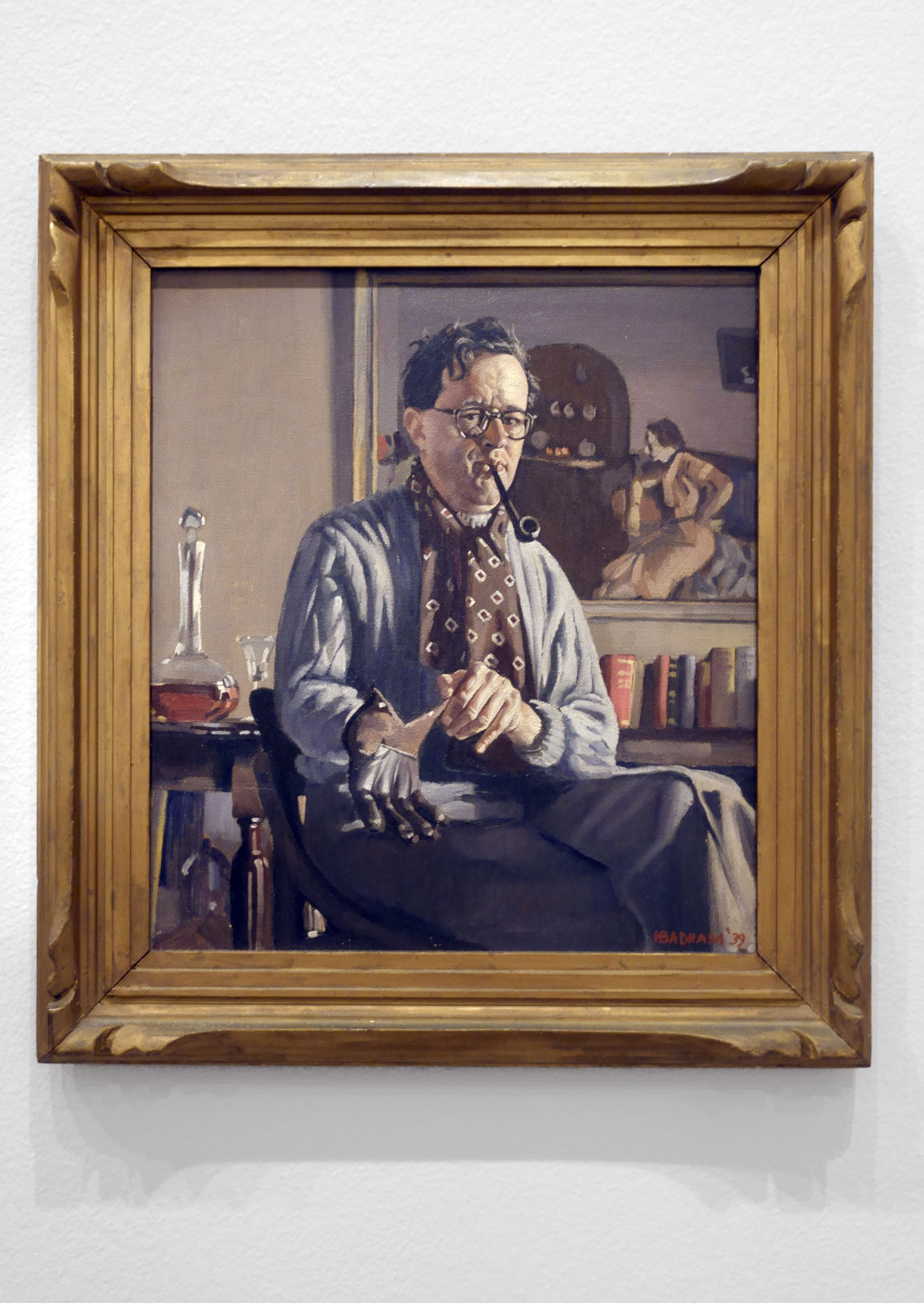
 

Herbert Badham (Australian, 1899-1961) 'Self portrait with glove' 1939 (installation view)


Herbert Badham (Australian, 1899-1961)
Self portrait with glove (installation view)
1939
Oil on canvas board
Frame: 44.4 x 40.7cm
National Portrait Gallery, Canberra
Purchased 1999
© Estate of Herbert Badham
Photo: Marcus Bunyan


Herbert Badham was an artist, writer and teacher who specialised in figures, urban life and beach scenes. Having studied for many years at the Julian Ashton School in the 1920s and 1930s, he produced a body of painting that typified the gentle, realist aspect of Sydney modernism of the prewar years. Head of the intermediate art department at East Sydney Tech from 1938 to 1961, he published the populist Study of Australian Art in 1949, and A Gallery of Australian Art in 1954. Badham’s work underwent a minor revival in the late 1980s, with a retrospective show held in Wollongong and Sydney, and three of his urban scenes were selected for the National Gallery’s Federation exhibition of 2001. Arguably the most interesting of several self-portraits of the artist, this painting was featured on the cover of the catalogue of the 1987 retrospective.

Text from the National Portrait Gallery website


Herbert Badham (Australian, 1899-1961) 'Self portrait with glove' 1939


Herbert Badham (Australian, 1899-1961)
Self portrait with glove
1939
Oil on canvas board
Frame: 44.4 x 40.7cm
National Portrait Gallery, Canberra
Purchased 1999
© Estate of Herbert Badham


Janet Dawson (Australian, b. 1935) 'Self Portrait' Between 1951 and 1953


Janet Dawson (Australian, b. 1935)
Self Portrait
Between 1951 and 1953
oil on cardboard
Frame: 57.0 x 47.5cm
National Portrait Gallery, Canberra
Gift of the artist 2000
© Janet Dawson/Copyright Agency, 2022


Janet Dawson (b. 1935) is best known for her contribution to abstract art in Australia. Following her family’s relocation from Forbes to Melbourne in the early 1940s, Dawson attended the private art school run by Harold Septimus Power. In 1951, aged sixteen, she enrolled at the National Gallery School and attended night classes with Sir William Dargie. Five years later, Dawson won a National Gallery of Victoria Travelling Scholarship and went to London, where she studied at the Slade School and the Central School. Returning to Melbourne in 1961, she held her first solo exhibition the same year and in 1963 set up an art school and workshop. Dawson was one of only three women included in the influential exhibition of Australian abstraction, The Field, at the National Gallery of Victoria in 1968. Her work is represented in all major public collections in Australia, and has been the subject of exhibitions at the NGV and the National Gallery of Australia.

Outside of her lyrical abstract work, Dawson always practised portraiture and won the Archibald Prize in 1973 with a portrait of her husband, the late writer, actor and playwright Michael Boddy. Painted during an evening class at the National Gallery School, this self portrait shows Dawson wearing an artist’s work shirt over her elegant day clothes, gazing confidently at the viewer.

Text from the National Portrait Gallery website
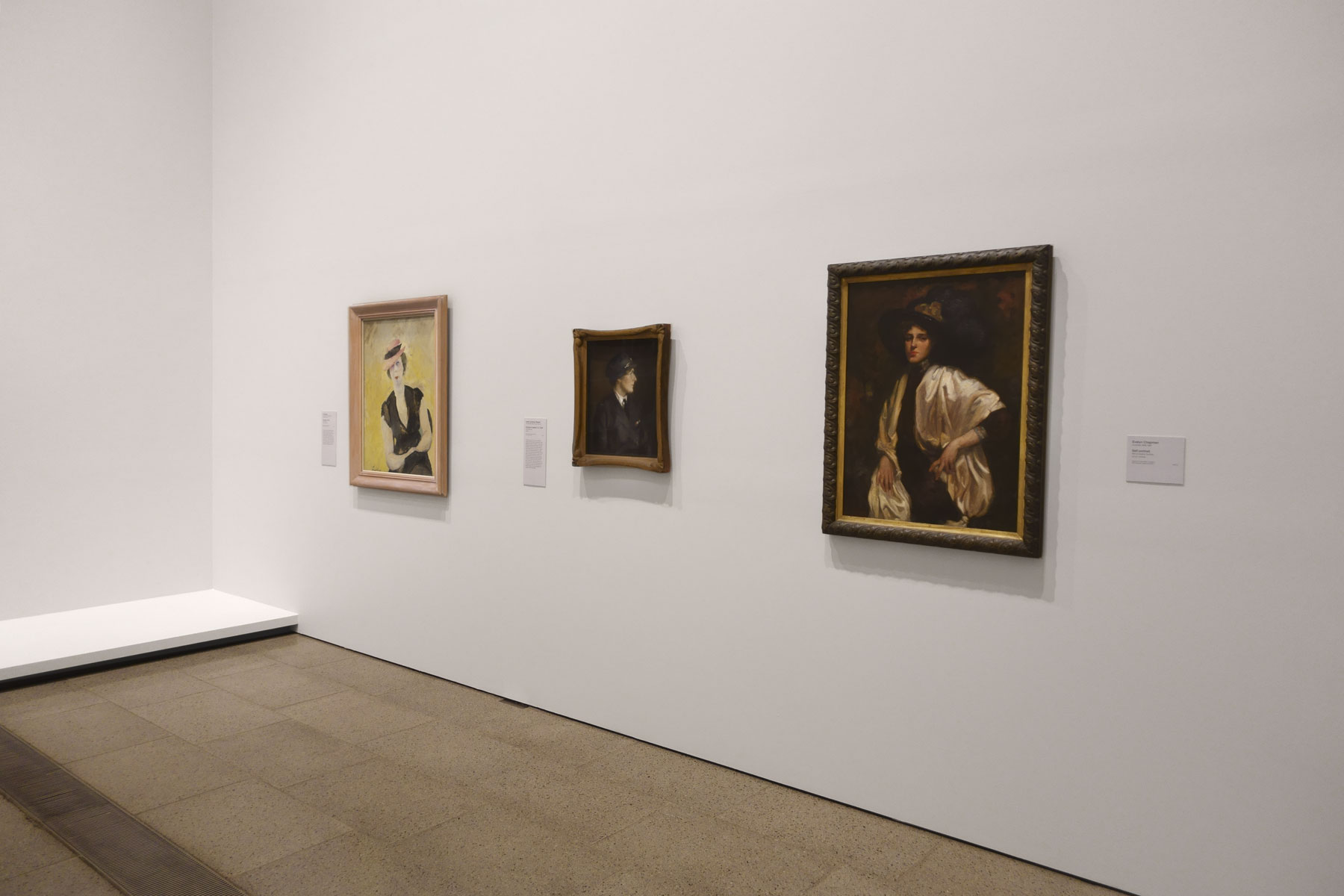
 

Installation view of the exhibition 'WHO ARE YOU: Australian Portraiture' at NGV Australia, Federation Square, Melbourne showing at left, Lina Bryans' 'The babe is wise' (1940); at middle, Janet Cumbrae Stewart's 'Portrait of Jessie C. A. Traill' (1920); and at right, Evelyn Chapman's 'Self portrait' (1911)


Installation view of the exhibition WHO ARE YOU: Australian Portraiture at NGV Australia, Federation Square, Melbourne showing at left, Lina Bryans’ The babe is wise (1940, below); at middle, Janet Cumbrae Stewart’s Portrait of Jessie C. A. Traill (1920, below); and at right, Evelyn Chapman’s Self portrait (1911, below)
Photo: Marcus Bunyan


Lina Bryans (Australian born Germany, 1909-2000) 'The babe is wise' 1940 (installation view)


Lina Bryans (Australian born Germany, 1909-2000)
The babe is wise (installation view)
1940
Oil on cardboard
National Gallery of Victoria, Melbourne
Gift of Miss Jean Campbell, 1962
Photo: Marcus Bunyan


Lina Bryans was an important part of the modern movement and a member of literary and artistic circles in Melbourne during the late 1930s and 1940s. Her vibrant paintings are characterised by bold brushwork and the expressive use of colour. In 1937, Bryans began painting portraits of her friends. Her most famous work, The babe is wise, is a portrait of the writer Jean Campbell, who had recently published a novel of the same name.

Wall text from the exhibition


Lina Bryans (Australian born Germany, 1909-2000) 'The babe is wise' 1940


Lina Bryans (Australian born Germany, 1909-2000)
The babe is wise
1940
Oil on cardboard
National Gallery of Victoria, Melbourne
Gift of Miss Jean Campbell, 1962


Janet Cumbrae Stewart (Australian, 1883-1960) 'Portrait of Jessie C. A. Traill' 1920


Janet Cumbrae Stewart (Australian, 1883-1960)
Portrait of Jessie C. A. Traill
1920
Pastel
Image and sheet: 55.5 × 45.4cm irreg.
National Gallery of Victoria, Melbourne
Gift of Jessie Traill, 1961
© Courtesy of the copyright holder


Chiefly known for her use of pastel, Janet Cumbrae Stewart devoted the most significant part of her career to producing sensuous studies of the female nude and portraits of women. Her portrait of fellow artist Jessie Traill shows Traill in the dress uniform of a Queen Alexandra Imperial Nurse. Nursing was one of the few options open to women wanting to serve in the First World War. Traill, who was living in France, volunteered and was stationed in Rouen in Northern France for three and a half years. Cumbrae Stewart and Traill were friends, both having grown up in Brighton, Victoria, and attended the National Gallery School alongside one another in the early 1900s.

Wall text from the exhibition


Evelyn Chapman (Australian, 1888-1961) 'Self portrait' 1911 (installation view)


Evelyn Chapman (Australian, 1888-1961)
Self portrait (installation view)
1911
Oil on canvas
National Portrait Gallery, Canberra
Gift of Pamela Thalben-Ball 2007
© Estate of Evelyn Chapman
Photo: Marcus Bunyan


 Evelyn Chapman (Australian, 1888-1961) 'Self portrait' 1911


Evelyn Chapman (Australian, 1888-1961)
Self portrait
1911
Oil on canvas
National Portrait Gallery, Canberra
Gift of Pamela Thalben-Ball 2007
© Estate of Evelyn Chapman


Evelyn Chapman, artist, studied with Antonio Dattilo Rubbo in Sydney and travelled overseas to paint in Paris, where she exhibited at the Salon. A few weeks after the end of World War 1 she took up the opportunity to visit the battlefields of France with her father, who was attached to the New Zealand War Graves Commission. Thus, she became the first Australian female artist to depict the devastated battlefields, towns and churches of the western front. Chapman remained overseas with her father, an organist who played in Dieppe, Venice and elsewhere, and married a brilliant organist, George Thalben-Ball, herself. After she married, she gave up painting, but she encouraged her daughter, Pamela, to pursue art. For the rest of her life, Chapman lived in England, only returning to Australia for a visit in 1960. The Art Gallery of New South Wales has her 1911 portrait of Dattilo Rubbo and a number of her paintings of France, Belgium and England. The Australian War Memorial, too, has several of her evocative French scenes.

Text from the National Portrait Gallery website


Installation view of the exhibition 'WHO ARE YOU: Australian Portraiture' at NGV Australia, Federation Square, Melbourne showing at left, William Yang's 'Self Portrait #2' (2007); and at centre in case, Alan Constable's earthenware cameras


Installation view of the exhibition WHO ARE YOU: Australian Portraiture at NGV Australia, Federation Square, Melbourne showing at left, William Yang’s Self Portrait #2 (2007, below); and at centre in case, Alan Constable’s earthenware cameras (see below)
Photo: Marcus Bunyan


William Yang (Australia b. 1943) 'Life Lines #3 – Self portrait #2 (1947)' 1947/2008


William Yang (Australian, b. 1943)
Self Portrait #2
2007
From the Self Portrait series
Inkjet print
Sheet: 84 x 50cm
National Gallery of Victoria, Melbourne
Purchased with funds donated by Ms Cora Trevarthen and Professor Andrew Reeves, 2013
© William Yang


William Yang shares childhood memories in this self-portrait. He recently reflected: ‘… I cal myself Australian, but I claim my Chinese heritage because that’s the way I look. Central to my art practice is my own story, which I tell in performances with projected images and music in theatres. My story is told against a backdrop of the times. This keys into my documentary-style photography. I have done a series of self-portraits of the same stories for exhibition in galleries. So my art and my life have become entwined and they both feed into each other. And I’ve come to terms with the way I look … It’s a great relief to feel comfortable in your own skin’.

Wall text from the exhibition


Installation view of the exhibition 'WHO ARE YOU: Australian Portraiture' at NGV Australia, Federation Square, Melbourne showing at left, Alan Constable's 'Green large format camera' (2013); and at right Alan Constable's 'Not titled (Black Mamiya large format camera)' (2013)


Installation view of the exhibition WHO ARE YOU: Australian Portraiture at NGV Australia, Federation Square, Melbourne showing at left, Alan Constable’s Green large format camera (2013, below); and at right Alan Constable’s Not titled (Black Mamiya large format camera) (2013, below)
Photo: Marcus Bunyan
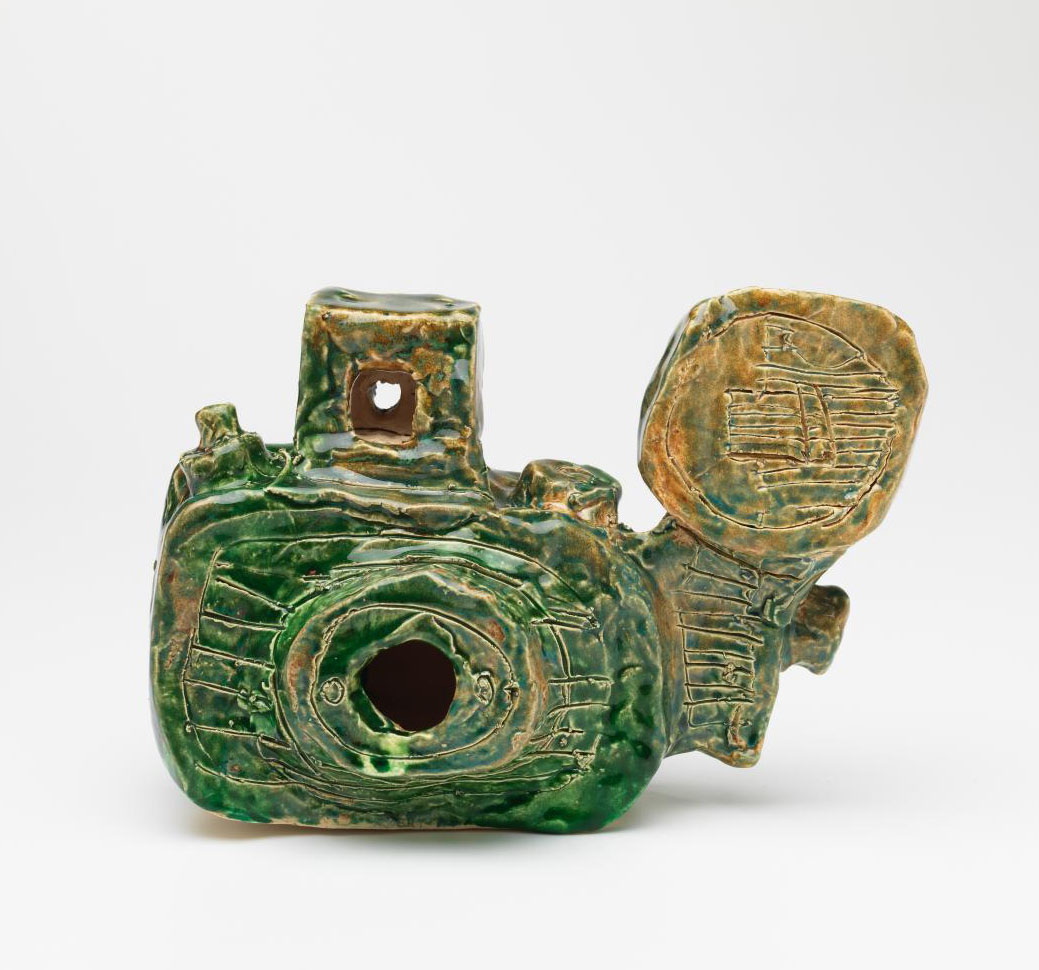
 

Alan Constable (Australian, b. 1956) 'Not titled (Green large format camera)' 2013


Alan Constable (Australian, b. 1956)
Not titled (Green large format camera)
2013
Earthenware
16.5 × 24.0 × 9.0cm
National Gallery of Victoria, Melbourne
Yvonne Pettengell Bequest, 2014
© Courtesy of the artist and Arts Project Australia, Melbourne
Photo: Marcus Bunyan
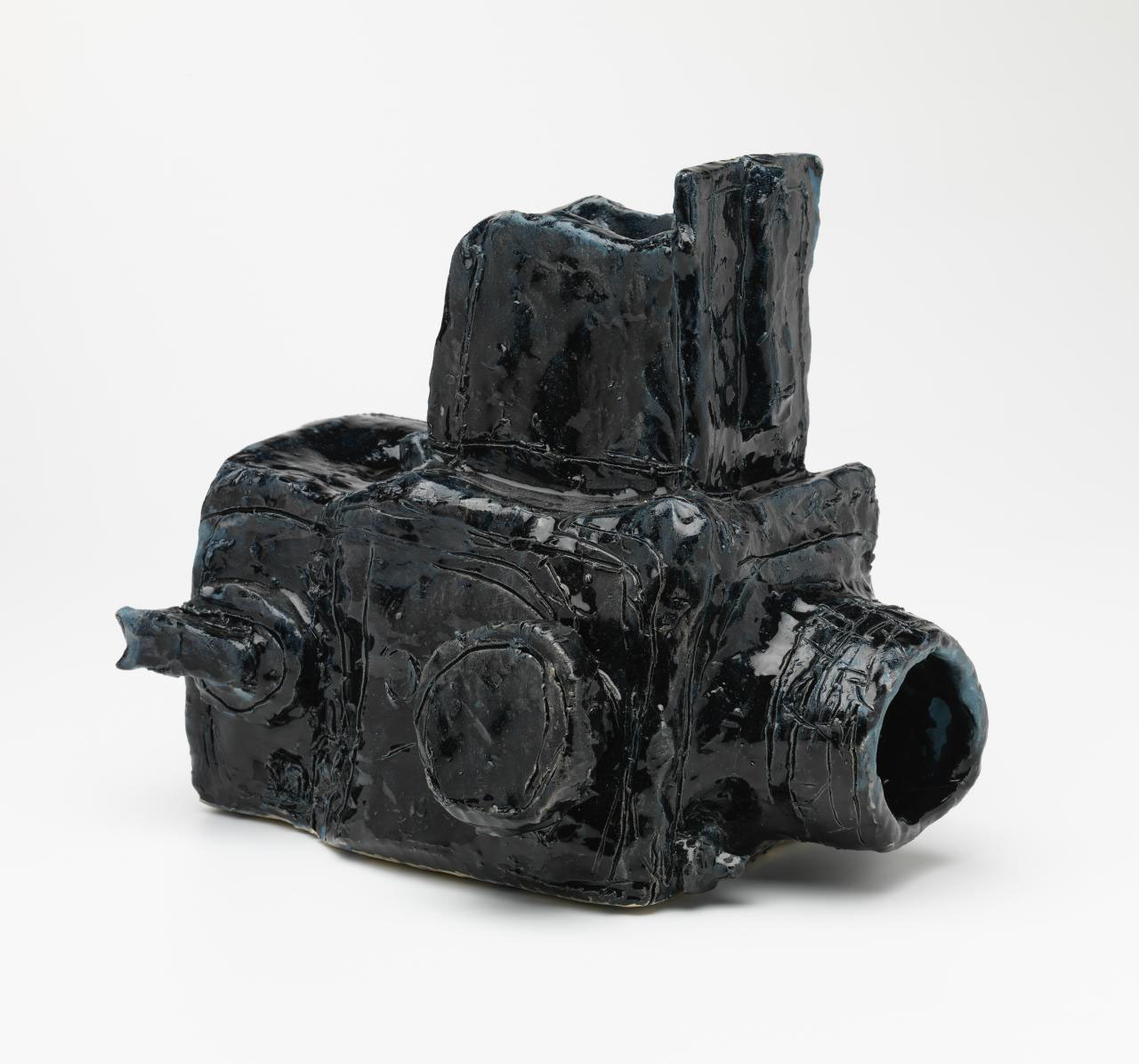
 

Alan Constable (Australian, b. 1956) 'Not titled (Black Mamiya large format camera)' 2013


Alan Constable (Australian, b. 1956)
Not titled (Black Mamiya large format camera)
2013
Earthenware
25.0 × 29.0 × 26.0cm
National Gallery of Victoria, Melbourne
Yvonne Pettengell Bequest, 2014
© Courtesy of the artist and Arts Project Australia, Melbourne
Photo: Marcus Bunyan


Alan Constable (Australian, b. 1956) 'Not titled (Box Brownie)' 2013 (installation view)


Alan Constable (Australian, b. 1956)
Not titled (Box Brownie)
2013
Earthenware
17.0 × 24.5 × 18.5cm
National Gallery of Victoria, Melbourne
Yvonne Pettengell Bequest, 2014
© Courtesy of the artist and Arts Project Australia, Melbourne
Photo: Marcus Bunyan


Alan Constable’s lifelong fascination with cameras began when he was just eight years old, as he sculpted the objects picture on cereal boxes. Legally blind, Constable’s sculptural practice sometimes extends to other optical objects, such as binoculars and video recorders. Constable’s method involves holding the camera millimetres from his eyes, as he scans and feels the object, before quickly rendering his impressions in clay. Constable has worked at Arts Project Australia since 1991 and held his first solo show in 2011. His works speak to the processes of seeing and looking, and self-reflexively capture the objects that capture the image.

Display case text from the exhibition


Christian Thompson (Australian / Bidjara, b. 1978) 'Othering the Explorer, James Cook' 2016


Christian Thompson (Australian / Bidjara, b. 1978)
Authoring the explorer, James Cook
2015, printed 2016
From the Museum of Others series 2015-2016
Type C photograph on metallic paper
National Gallery of Victoria, Melbourne
Gift of an anonymous donor through the Australian Government’s Cultural Gifts Program, 2017


‘Today, we are still conditioned by historical tropes such as the bust-style portraits of colonial men who had roles in furthering the position of colonial Britain at the height of the imperial pursuit for claiming new frontiers, at the expense of the Indigenous custodians of countries including Australia. However, as famous as these colonial figures still are, I try to demonstrate that it is never too late to pierce, subvert and re-stage the spectres of history to gain agency from the position of the other. Through the work, I am proposing: let us scrutinise your history, your identities, your flaws.’ ~ Christian Thompson, 2017

Wall text from the exhibition


WHO ARE YOU: Australian Portraiture is one of the most comprehensive explorations of portraiture ever mounted in Australia and the first exhibition to bring together the collections of the National Gallery of Victoria (NGV) and the National Portrait Gallery, Canberra. The exhibition will be on display in Melbourne from 25 March to 21 August 2022 and Canberra from 1 October 2022 to 29 January 2023.

Revealing the rich artistic synergies and contrasts between the two institutions’ collections, this co-curated exhibition considers portraiture in Australia across time and media, as well as the role of the portraiture genre in the development of a sense of Australian national identity.

Featuring more than two-hundred works by Australian artists including Patricia Piccinini, Atong Atem, Howard Arkley, Vincent Namatjira and Tracey Moffatt, and featuring sitters including Cate Blanchett, Albert Namatjira, Queen Elizabeth II, Eddie Mabo and David Gulpilil, the exhibition explores our inner worlds and outer selves, as well as issues of sociability, intimacy, isolation, celebrity and ordinariness.

The exhibition also questions what actually constitutes portraiture by examining the surprising and sometimes unconventional ways of representing likeness, such as the abstract self-portrait by John Nixon and Boris Cipusev’s typographic portrait of Jeff from The Wiggles. Polixeni Papapetrou’s Magma Man, a photograph which merges sitter and landscape until the two are almost indecipherable, and Shirley Purdie’s multi-panelled evocation of biography and Country further challenge the conventions of the genre and touch upon the intimate connection between artist, sitter and land. Alongside these works, iconic self-portraits will also be displayed by artists including John Brack, Nora Heysen and William Yang.

Tony Ellwood AM, Director, NGV, said: “This exhibition marks the first major partnership between the NGV and the National Portrait Gallery in Canberra. By combining our respective portraiture collections and curatorial expertise in this area, we have been able to stage the largest thematic portraiture exhibition in the history of either institution. This presentation will no doubt offer audiences an unprecedented insight into the genre and its place in Australian art history.”

Karen Quinlan AM, Director, National Portrait Gallery, said: “The NPG is thrilled to work with the NGV on this extensive exploration of Australian portraiture. The exhibition comes at a time when, in the current global COVID environment, stories from home, about home, and the artists and identities who have shaped and continue to shape our nation are more compelling and important than ever. It is a privilege to be able to present our collection in conversation with the NGV’s and to explore the idea of Australian identity and its many layers and facets through the lens of portraiture.”

Presented across five thematic sections, the exhibition raises challenging and provocative questions about who we are and how we view others – historically, today and into the future. The exhibition opens by considering the connection between people and place, reflecting on the relationship between artists, sitters and the environment, as well as the personification of the natural world. Highlight works include a conceptual map depicting self and Country by Wawiriya Burton, Ngayaku Ngura (My Country) 2009, as well as the NGV’s recent acquisition Seven Sisters Song 2021 by Kaylene Whiskey, a painted road sign that is filled with personally significant, autobiographical references to pop culture.

A further section explores the artistic tradition of the self-portrait and portraits of artists, as well as how this convention has been subverted or challenged by contemporary artists working today. Works include Hari Ho’s Dadang Christanto 2005, which depicts the artist buried to the neck in sand, referencing the brutal killings of Indonesians in the failed military coup of September 1965, and Alan Constable’s Not titled (Green large format camera) 2013, personifying the act of photography with a hand modelled, ceramic camera.

Ideas of intimacy and alienation are juxtaposed through images of family and community presented alongside those of vulnerability and isolation. Works include Pat Larter’s Marty 1995, a graphic collage depicting a male sex worker, challenging the ease with which society consumes images of female nudity, and Naomi Hobson’s Warrior without a weapon 2019, a photographic series in which the artist challenges stereotypes about Indigenous men from her home community in Coen, by using flowers as a metaphor for male vulnerability.

The exhibition also explores portraiture’s surprising capacity to reveal the inner worlds and mindsets of both the sitter and the artist, as exemplified by Eric Thake’s satirical vignettes of figures in dream-like settings, and Hoda Afshar’s Remain 2018, a video exploring Australia’s controversial border protection policy and the human rights of those seeking asylum.

The final section of the exhibition interrogates Australian icons, identities and how we construct them. Works featured in this section include Michael Riley’s Maria 1986 and Polly Borland’s HM Queen Elizabeth II 2002, two works displayed side by side, drawing connections between archetypal imagery of royalty, with negative renderings of ‘otherness’ found in historical ethnographic portraiture.

WHO ARE YOU: Australian Portraiture is presented by the NGV and the National Portrait Gallery and will be on display at The Ian Potter Centre: NGV Australia at Fed Square from 25 March to 21 August 2022 and the National Portrait Gallery, Canberra from 1 October 2022 to 29 January 2023.

WHO ARE YOU: Australian Portraiture is generously supported by Major Partner, Deakin University.

Press release from the National Gallery of Victoria International


Installation view of the exhibition WHO ARE YOU: Australian Portraiture at NGV Australia, Federation Square, Melbourne showing at centre left, Bert Flugelman's 'self portrait' (1985)


Installation view of the exhibition WHO ARE YOU: Australian Portraiture at NGV Australia, Federation Square, Melbourne showing at centre left, Bert Flugelman’s self portrait (1985, below). The legend of the artworks on the wall is below…
Photo: Marcus Bunyan


Installation view of the exhibition 'WHO ARE YOU: Australian Portraiture' at NGV Australia, Federation Square, Melbourne


Installation view of the exhibition WHO ARE YOU: Australian Portraiture at NGV Australia, Federation Square, Melbourne
Photo: Marcus Bunyan


Bert Flugelman (Australian born Austria, 1923-2013, Australia from 1938) 'Self portrait' c. 1985


Bert Flugelman (Australian born Austria, 1923-2013, Australia from 1938)
Self portrait
c. 1985
Stainless steel
National Portrait Gallery, Canberra
Gift of the artist 2009
Donated through the Australian Government’s Cultural Gifts Program
© Bert Flugelman/Copyright Agency, 2022


Herbert ‘Bert’ Flugelman, sculptor, painter and lecturer, came to Australia from his native Vienna in 1938, aged fifteen. In the late 1940s he trained at the National Art School; he travelled and studied overseas through the first half of the 1950s. In 1967 he won first prize at the Mildura Sculpture Triennial with a large cast-iron equestrian piece. His subsequent public commissions include the untitled copper and ceramic mosaic fountain at Bruce Hall at the Australian National University; Spheres 1977 (known locally as Bert’s Balls) for the Rundle Street Mall, Adelaide; and the Dobell Memorial 1978 for Martin Place, Sydney. Controversially, Tumbling cubes (Dice) (Untitled) 1978/1979, originally made for Cameron Offices in Belconnen ACT, was some years ago moved to a nearby park, according to the artist a ‘hopelessly inappropriate site’. Cones 1982 dominates the Sculpture Garden at the National Gallery of Australia, and the Winged figure (Lawrence Hargrave memorial) 1988 towers 6m high at Mt Keira, near Wollongong. Flugelman taught from 1973 to 1983 at the South Australian School of Art, and from 1984 to 1990 at the University of Wollongong, from which he received an honorary doctorate. There was a retrospective exhibition of his five decades’ work at the Drill Hall Gallery, Australian National University in 2009.

Text from the National Portrait Gallery, Canberra website Nd [Online] Cited 23/06/2022


Lewis Morley (Hong Kong 125 - Australia 2013, England 1945-1971, Australia from 1971) 'Self portrait in reflection' 1973 (installation view)


Lewis Morley (Hong Kong 125 – Australia 2013, England 1945-1971, Australia from 1971)
Self portrait in reflection (installation view)
1973
Gelatin silver photograph
National Portrait Gallery, Canberra
Gift of the artist 2003
Donated through the Australian Government’s Cultural Gifts Program
Photo: Marcus Bunyan


Lewis Morley (Hong Kong 125 - Australia 2013, England 1945-1971, Australia from 1971) 'Self portrait in reflection' 1973


Lewis Morley (Hong Kong 125 – Australia 2013, England 1945-1971, Australia from 1971)
Self portrait in reflection
1973
Gelatin silver photograph
National Portrait Gallery, Canberra
Gift of the artist 2003
Donated through the Australian Government’s Cultural Gifts Program
© Lewis Morley Archive LLC


Lewis Morley OAM (1925-2013)

Lewis Morley OAM (1925-2013), photographer, was born in Hong Kong and went to the United Kingdom with his family at the end of World War 2. He studied commercial art in London and spent time in Paris before taking up photography in 1954, initially working for magazines like Tatler, London Life and She. In 1961, he founded Lewis Morley Studios in Peter Cook’s London club, The Establishment. Here, he built his reputation with photographs of the celebrities that defined the hip spirit of London in the 1960s, among them Cook, Dudley Moore, Charlotte Rampling, Twiggy, Vanessa Redgrave and Jean Shrimpton. In 1963, Morley took one of the world’s most famous photographic portraits – that of Christine Keeler, short-term shared mistress of a British politician and a Soviet diplomat, naked on a Scandinavian chair. By 1971, Morley’s magazine and theatre work in London was petering out, and he emigrated to Australia, where, he said, ‘bingo! there was the sixties all over again’. Shooting increasingly in colour, Morley took many photographs for Dolly, POL, Belle and other publications that now afford an evocative record of changing Australian culture through the 1970s and 1980s. Many of Morley’s portraits from this era were shown in the National Portrait Gallery’s retrospective exhibition Lewis Morley: Myself and Eye in 2003. His work was also the subject of a major exhibitions staged by the National Portrait Gallery, London, in 1989-1990; and the Art Gallery of New South Wales in 2006.

Text from the National Portrait Gallery, Canberra website Nd [Online] Cited 23/06/2022


William Dargie (Australian, 1912-2003) 'Albert Namatjira' 1958 (installation view)


William Dargie (Australian, 1912-2003)
Albert Namatjira (installation view)
1958
Oil on canvas laid on composition board
National Portrait Gallery, Canberra
Purchased with funds donated by Marilyn Darling AC and the assistance of Philip Bacon Galleries 2000
Photo: Marcus Bunyan


Albert Namatjira was a descendant of the Western Arrant people of the Northern Territory. Inspired by the spectacular landforms and vivid colours around his home at the Hermannsuburg Mission in the 1930s, Namatjira fused Western-influenced style of watercolour with unique expressions of traditional sites and sacred knowledge. Sir William Dargie CBE described Namatjira as having ‘tremendous inner dignity’ and within this portrait, he located Namatjira in his country in the MacDonnell Ranges. Holding one of his own landscapes, the portrait represents the intrinsic connection between the artist’s painting and identity. Namatjira was, and still is, an important presence in Australian art and a leading figure in the development of Aboriginal rights.

Wall text from the exhibition


William Dargie (Australian, 1912-2003) 'Albert Namatjira' 1958 (installation view detail)


William Dargie (Australian, 1912-2003)
Albert Namatjira (installation view detail)
1958
Oil on canvas laid on composition board
National Portrait Gallery, Canberra
Purchased with funds donated by Marilyn Darling AC and the assistance of Philip Bacon Galleries 2000
Photo: Marcus Bunyan


Rennie Ellis (Australian, 1940-2003) 'Sharpies, Melbourne' 1973


Rennie Ellis (Australian, 1940-2003)
Sharpies, Melbourne
1973, printed c. 1977-1978
Gelatin silver print
National Gallery of Victoria, Melbourne
Purchased NGV Foundation, 2006


‘Rather than capturing the subjects unawares I have encouraged them to pause, and even pose, from the camera. In this way they have an opportunity to communicate directly with me and to project whatever image they believe suits them best.’ ~ Rennie Ellis

Wall text from the exhibition


Max Dupain (Australian, 1911-1992) 'Hera Roberts' 1936 (installation view)


Max Dupain (Australian, 1911-1992)
Hera Roberts (installation view)
1936
Gelatin silver photograph
23.6 cm x 21.4cm
Gift of Rex Dupain 2003
Donated through the Australian Government’s Cultural Gifts Program
Photo: Marcus Bunyan
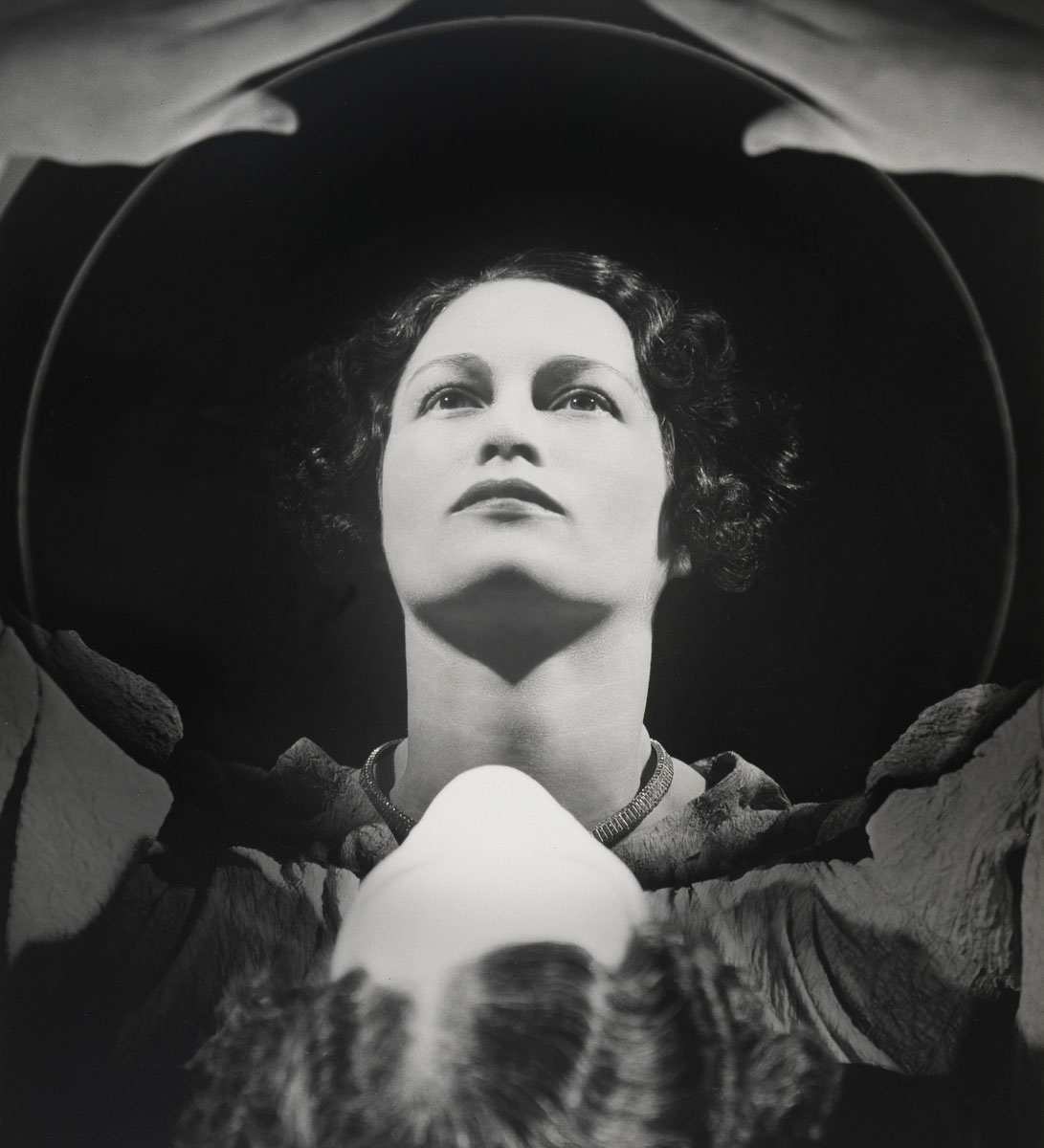
 

Max Dupain (Australian, 1911-1992) 'Hera Roberts' 1936


Max Dupain (Australian, 1911-1992)
Hera Roberts
1936
Gelatin silver photograph
23.6 cm x 21.4cm
Gift of Rex Dupain 2003
Donated through the Australian Government’s Cultural Gifts Program


Hera Roberts (life dates unknown) was a painter, illustrator, designer, commercial artist and milliner. During the 1920s and 30s she produced many covers for the Home magazine, and arranged photo spreads for the magazine promoting fashionable interiors and furniture. She designed a complete room for the Burdekin House exhibition of 1929, including furniture, and also designed furniture for her companion Sydney Ure Smith. Roberts was regarded as an authoritative commentator on matters of style. She was the student and cousin of the artist Thea Proctor, who was also part of the network of ‘lady artists’ who were able to make their careers in interior decorating and taste arbitration. Co-owner of a millinery shop in Pitt Street called ‘June’, Roberts was also one of the finest female fencers in the Southern Hemisphere, operating out of the Sydney Swords Club.

Text from the National Portrait Gallery, Canberra website Nd [Online] Cited 23/06/2022


Trevor Turbo Brown (Australian / Latje Latje, 1967-2017) 'Self-portrait, 'I am the Dingo Spirit'' 2015 (installation view)


Trevor Turbo Brown (Australian / Latje Latje, 1967-2017)
Self-portrait, ‘I am the Dingo Spirit’ (installation view)
2015
Synthetic polymer paint on canvas
National Gallery of Victoria, Melbourne
Photo: Marcus Bunyan


Trevor Turbo Brown, or ‘Turbo’ as he was known, was born in Mildura and grew up on Latje Latje Country. In 1981, Turbo moved to Melbourne were he became a celebrity in the Koori community. He trained as a boxer at the Fitzroy Stars Gym from 1986 to 1991 and would do breakdance street performances throughout Melbourne during the 1980s and 1990s. It was here that he got his nickname. Turbo was a regular character on the streets of Brunswick before he passed away in 2017. In this self-portrait Turbo impinges himself as a dingo, wild and free in the night.

Wall text from the exhibition
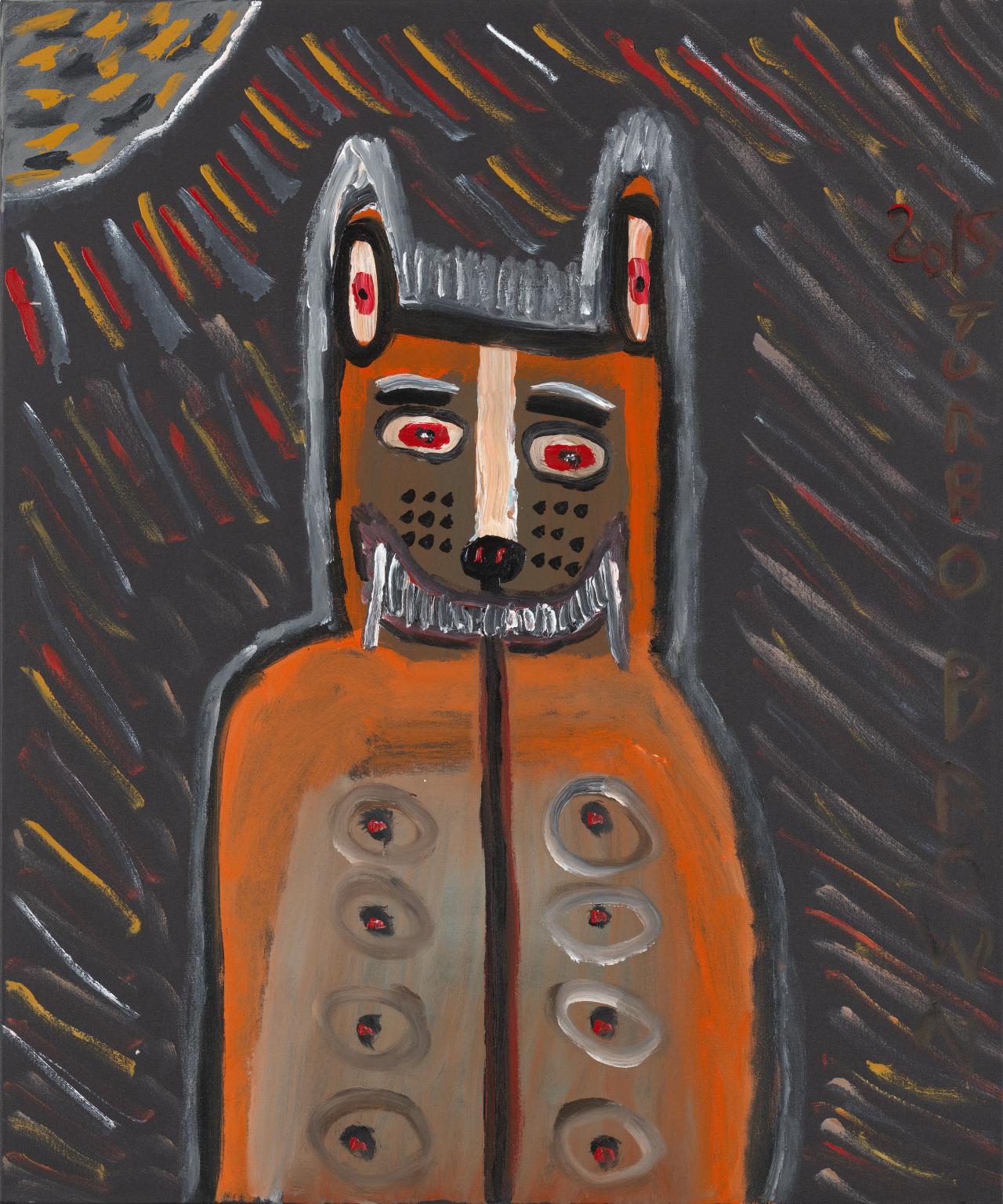
 

Trevor Turbo Brown (Australian / Latje Latje, b. 1967) Self-portrait, 'I am the Dingo Spirit' 2015


Trevor Turbo Brown (Australian / Latje Latje, b. 1967)
Self-portrait, ‘I am the Dingo Spirit’
2015
Synthetic polymer paint on canvas
122.3 x 102.2cm
National Gallery of Victoria, Melbourne
Gift of Vince Sinni in memory of Trevor Turbo Brown through the Australian Government’s Cultural Gifts Program, 2018
© the artist’s estate


John Brack. 'Self-portrait' 1955


John Brack (Australian, 1920-1999)
Self-portrait
1955
Oil on canvas
National Gallery of Victoria, Melbourne
Purchased with the assistance of the National Gallery Women’s Association, 2000


John Brack created images that explore the social rituals and realities of everyday living. Rendered in a subtle but complex colour scheme, with its subject stripped of vanity and dressed in early-morning attire, Self-portrait is a piercing study of a man engaged in the intimacy of shaving. Although images of women at their toilette have been recently depicted by both male and female Australian artists, it is unusual for men to be shown or to show themselves in this context.

Wall text from the exhibition
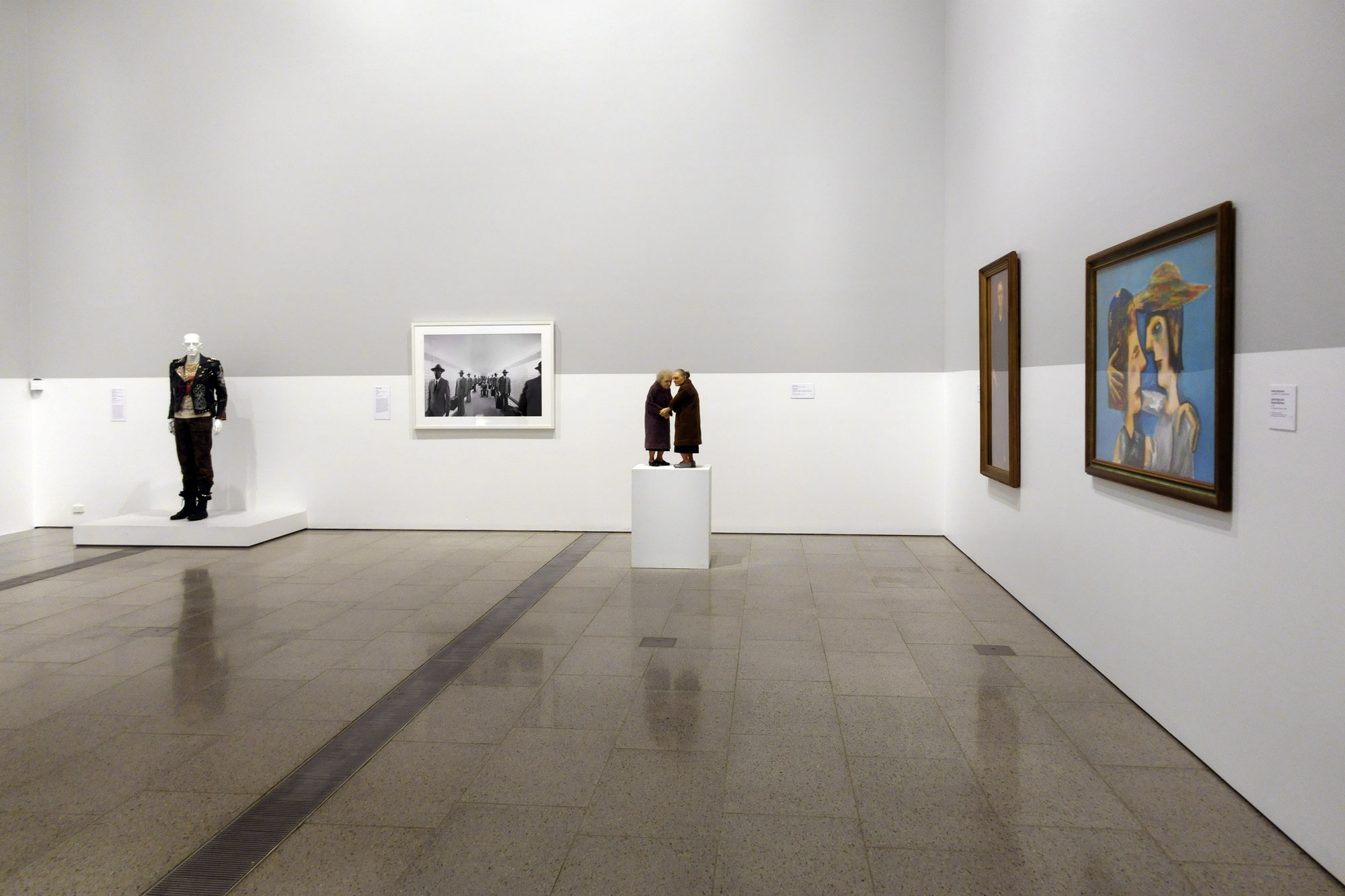
 

Installation view of the exhibition 'WHO ARE YOU: Australian Portraiture' at NGV Australia, Federation Square, Melbourne with second from left, Michael Cook's 'Tunnel No. 2' (2014); at third from left, Ron Mueck's 'Two Women' (2005)


Installation view of the exhibition WHO ARE YOU: Australian Portraiture at NGV Australia, Federation Square, Melbourne with second from left, Michael Cook’s Tunnel No. 2 (2014, below); at third from left, Ron Mueck’s Two Women (2005, below)
Photo: Marcus Bunyan


Michael Cook (Australian / Bidjara, b. 1968) 'Tunnel No. 2' 2014 (installation view)


Michael Cook (Australian / Bidjara, b. 1968)
Tunnel No. 2 (installation view)
2014
From the series Majority Rule
Inkjet print
National Gallery of Victoria, Melbourne
Ybonne Pettengell Bequest, 2014
Photo: Marcus Bunyan


‘In Majority Rule I created staged scenarios that question Australian history and the dominance of those in power. The series features the same anonymous Indigenous Man, multiplied over and over in each image. Australia’s Indigenous population comprises around three or four percent of our total population. My images seek to defy this reality and ask the viewer to speculate about an Australia where Aboriginal people constitute the majority of the country’s population; they paint a picture of a societal structure reversed … The works also serve as reminders fo the lack of Indigenous representation within Parliament, the judicial system and the business world.’ ~ Michael Cook, 2017

Wall text from the exhibition


Michael Cook (Australian / Bidjara, b. 1968) 'Tunnel No. 2' 2014


Michael Cook (Australian / Bidjara, b. 1968)
Tunnel No. 2
2014
From the series Majority Rule
Inkjet print
National Gallery of Victoria, Melbourne
Ybonne Pettengell Bequest, 2014
© Courtesy of the artist
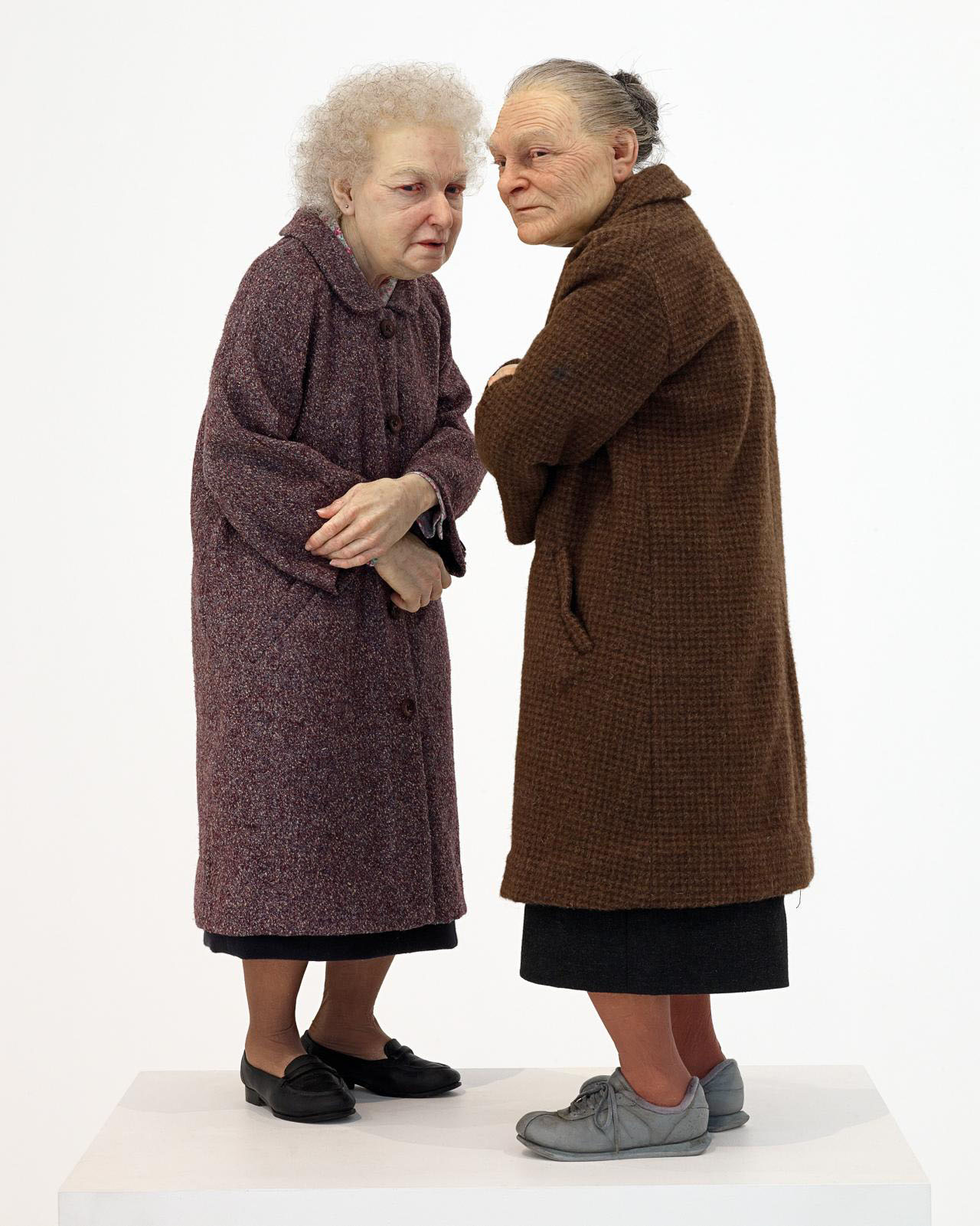
 

Ron Mueck. 'Two woman' 2005


Ron Mueck (Australian born England, b. 1958)
Two women
2005
Polyester resin, fibreglass, silicone, polyurethane, aluminium, wire, steel, cotton, nylon, synthetic hair, plastic, metal
National Gallery of Victoria, Melbourne
Purchased, Victorian Foundation for Living Australian Artists, 2007


Ron Mueck. 'Two woman' 2005 (detail)


Ron Mueck (Australian born England, b. 1958)
Two women (detail)
2005
Polyester resin, fibreglass, silicone, polyurethane, aluminium, wire, steel, cotton, nylon, synthetic hair, plastic, metal
National Gallery of Victoria, Melbourne
Purchased, Victorian Foundation for Living Australian Artists, 2007


Installation view of the exhibition 'WHO ARE YOU: Australian Portraiture' at NGV Australia, Federation Square, Melbourne showing at left, Pierre Mukeba's 'Impartiality' (2018); at second right, William Frater's 'Reclining nude' (c. 1933); and at right, Pat Larter's 'Marty' (1995)


Installation view of the exhibition WHO ARE YOU: Australian Portraiture at NGV Australia, Federation Square, Melbourne showing at left, Pierre Mukeba’s Impartiality (2018, below); at second right, William Frater’s Reclining nude (c. 1933, below); and at right, Pat Larter’s Marty (1995, below)
Photo: Marcus Bunyan
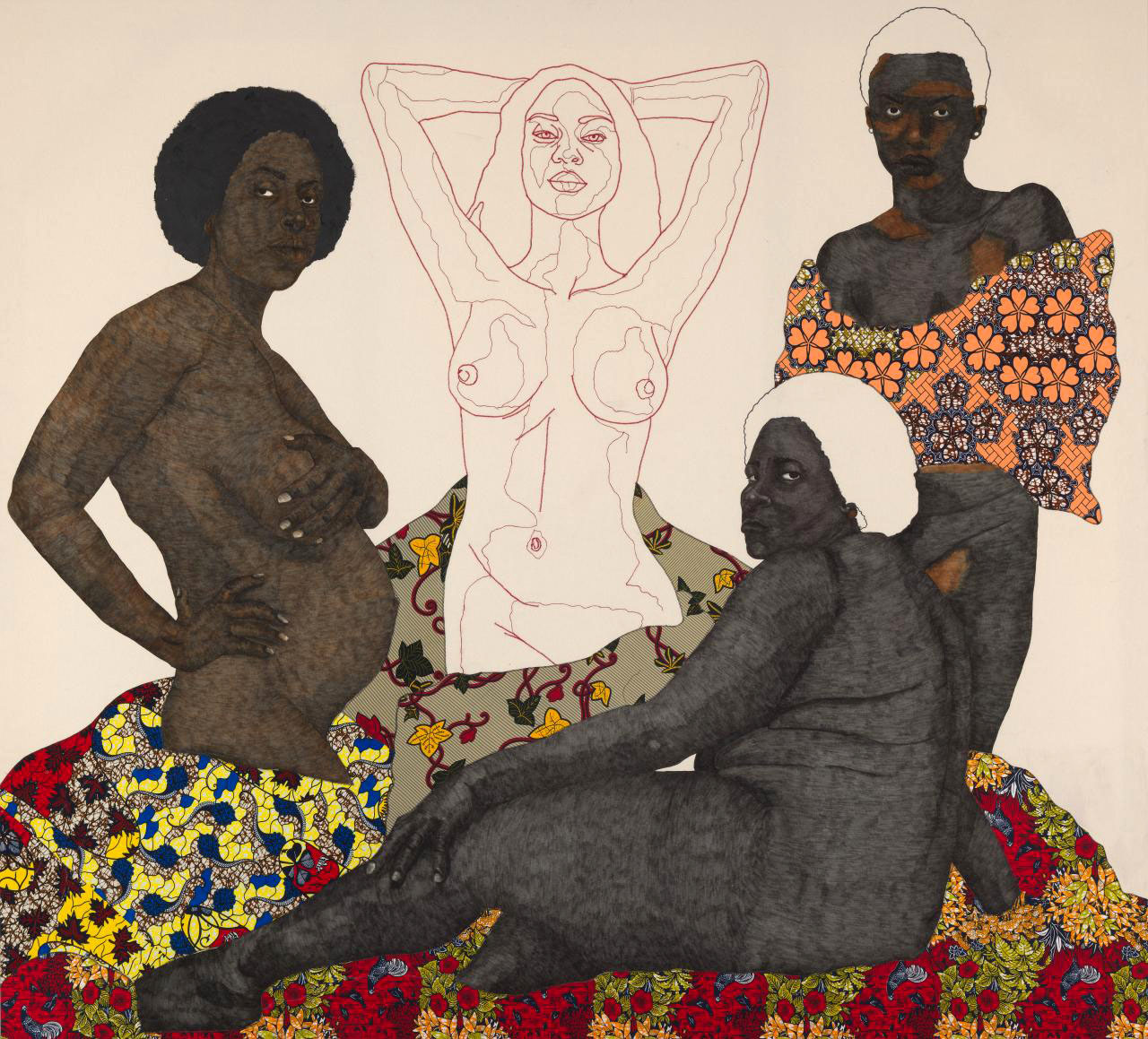
 

Pierre Mukeba (Australian born Democratic Republic of the Congo, b. 1995, Australia from 2006) 'Impartiality' 2018


Pierre Mukeba (Australian born Democratic Republic of the Congo, b. 1995, Australia from 2006)
Impartiality
2018
Fibre-tipped pen and printed fabric on cotton
245.0 × 270.0cm
National Gallery of Victoria, Melbourne
Purchased with funds donated by Anne Ross, 2018
© Pierre Mukeba, courtesy of GAGPROJECTS


Pierre Mukeba was a child when he fled with his family from the Democratic Republic of the Congo to Zambia, where they lived in a refugee camp before joining family in Zimbabwe. Following the Mugabe regime’s arrest order for non-nationals, the family applied for asylum through the Australian Embassy and relocated to Adelaide in 2006. In this work, Mukeba uses patterned Dutch wax print fabrics commonly perceived as being ‘African’, while in reality, they were appropriated from traditional Javanese bark by Dutch colonisers in the nineteenth century, mass produced in Europe and exported to Africa. This painting is part of a group of works by Mukeba, in which he draws on sociocultural standards of beauty and representations of his community.

Wall text rom the exhibition


William Frater (Australian born Scotland, 1890-1974, Australia from 1913) 'Reclining nude' c. 1933 (installation view)


William Frater (Australian born Scotland, 1890-1974, Australia from 1913)
Reclining nude (installation view)
c. 1933
Oil on canvas on cardboard
National Gallery of Victoria, Melbourne
Purchased, 1950
Photo: Marcus Bunyan


William Frater (Australian born Scotland, 1890-1974, Australia from 1913) 'Reclining nude' c. 1933 (installation view detail)


William Frater (Australian born Scotland, 1890-1974, Australia from 1913)
Reclining nude (installation view detail)
c. 1933
Oil on canvas on cardboard
National Gallery of Victoria, Melbourne
Purchased, 1950
Photo: Marcus Bunyan


William Frater (Australian born Scotland, 1890-1974) 'The artist's wife' 1915


William Frater (Australian born Scotland, 1890-1974)
The artist’s wife
1915
Oil on canvas on plywood
47.0 x 32.9cm
National Gallery of Victoria, Melbourne
The Joseph Brown Collection
Presented through the NGV Foundation by Dr Joseph Brown AO OBE, Honorary Life Benefactor, 2004


Pat Larter (Australian born England, 1936-1996, Australia from 1962) 'Marty' 1995 (installation view)


Pat Larter (Australian born England, 1936-1996, Australia from 1962)
Marty (installation view)
1995
Coloured inks, synthetic polymer paint, plastic, glitter and self-adhesive plastic collage on canvas
National Gallery of Victoria, Melbourne
Purchased, 1997
Photo: Marcus Bunyan


Throughout her career, Pat Larter produced performance art, photography and multimedia images that focus on the consumption of the naked body throughout the media. Often adapting pornographic images to encourage debate on art, the body and censorship, Larter actively looked to challenge society’s ideas of the nude by producing striking, and sometimes humorous images. Marty is part of a series for which Larter visited Sydney’s brothels to photograph male sex workers. By showing the model in a full frontal, active position, Larter reflects on the double standards of how society consumes nudity in art. Images of naked women are viewed with ease, while depictions of naked men cause shock and often outrage.

Wall text from the exhibition
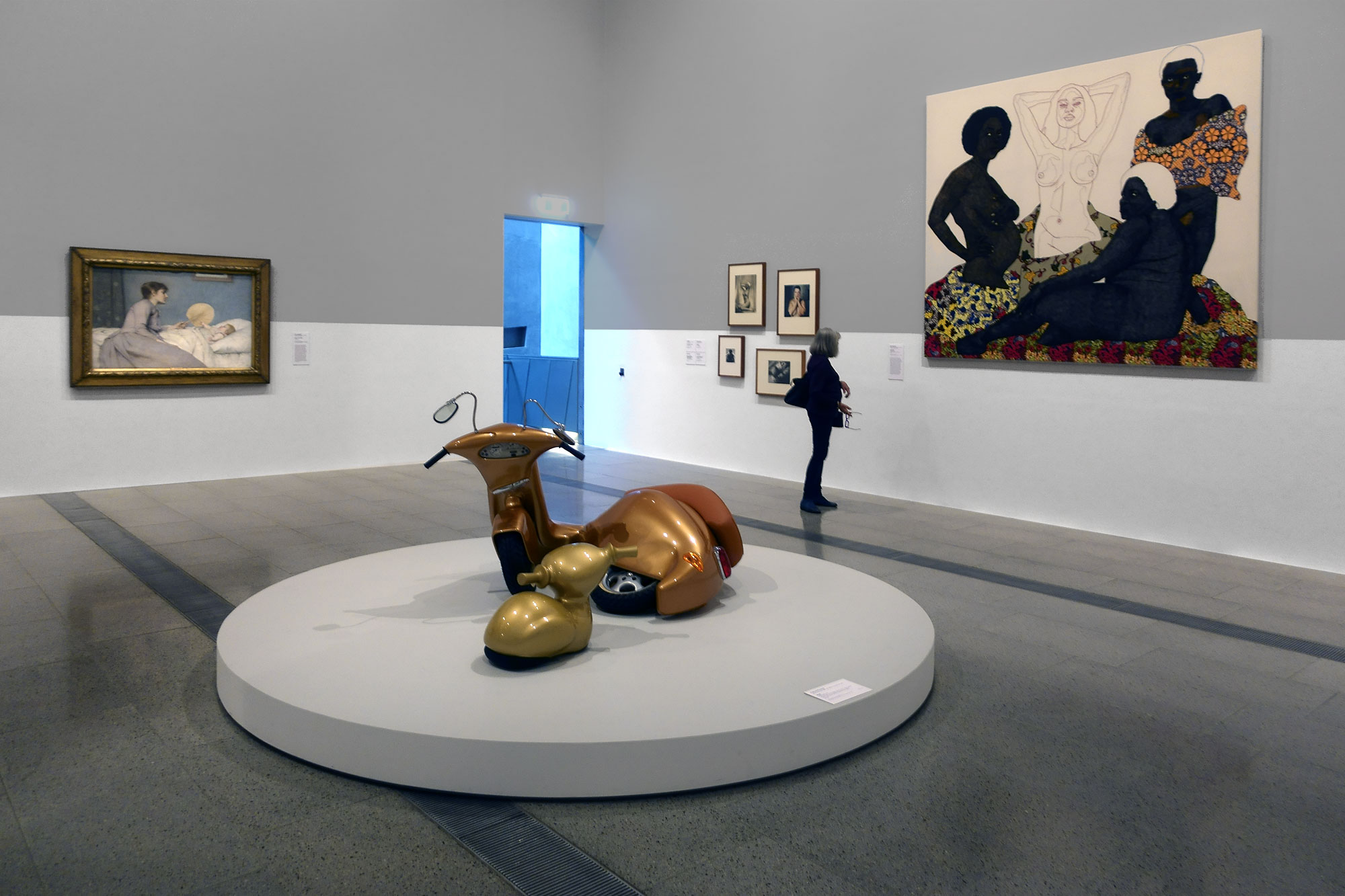
 

Installation view of the exhibition 'WHO ARE YOU: Australian Portraiture' at NGV Australia, Federation Square, Melbourne showing at left, John Longstaff's 'The young mother' (1891); at centre Patricia Piccinini's 'Nest' (2006); at second right, a group of four photographs one by each of Jack Cato, Virginie Grange, Olive Cotton and Athol Shmith; and at right Pierre Mukeba's 'Impartiality' (2018)


Installation view of the exhibition WHO ARE YOU: Australian Portraiture at NGV Australia, Federation Square, Melbourne showing at left, John Longstaff’s The young mother (1891, below); at centre Patricia Piccinini’s Nest (2006); at second right, a group of four photographs one by each of Jack Cato, Virginie Grange, Olive Cotton and Athol Shmith (see below); and at right Pierre Mukeba’s Impartiality (2018, above)
Photo: Marcus Bunyan


John Longstaff (Australian, 1861-1941, France and England 1887-1895, England 1901-1920) 'The young mother' 1891 (installation view)


John Longstaff (Australian, 1861-1941, France and England 1887-1895, England 1901-1920)
The young mother (installation view)
1891
Oil on canvas
National Gallery of Victoria, Melbourne
Purchased with funds donated by the NGV Women’s Association, Alan and Mavourneen Cowen, Paula Fox, Ken and Jill Harrison and donors to the John Longstaff Appeal, 2013
Photo: Marcus Bunyan


A gifted student, John Longstaff was awarded the National Gallery School’s inaugural travelling scholarship in 1887. Longstaff and Rosa Louisa (Topsy) Crocker married two months before departing to London in September 1887. An intimate depiction of motherhood, The young mother shows Topsy tenderly waving a palm fan over the outstretched arms of her son, Ralph, who was born in 1890. Topsy appears pale and slim after a long winter spent in their one-room apartment, divided by a curtain into sleeping and eating quarters. The subject of the mother and child has its origins in the depiction of the biblical Madonna and Child, and continued to be a popular subject for nineteenth-century artists recoding their personal and secular experiences with tenderness and conviction.

Wall text rom the exhibition


John Longstaff (Australian, 1861-1941, France and England 1887-1895, England 1901-1920) 'The young mother' 1891 (installation view detail)


John Longstaff (Australian, 1861-1941, France and England 1887-1895, England 1901-1920)
The young mother (installation view detail)
1891
Oil on canvas
National Gallery of Victoria, Melbourne
Purchased with funds donated by the NGV Women’s Association, Alan and Mavourneen Cowen, Paula Fox, Ken and Jill Harrison and donors to the John Longstaff Appeal, 2013
Photo: Marcus Bunyan


Patricia Piccinini (Australian, b. 1965) 'Nest' 2006 (installation view)


Patricia Piccinini (Australian, b. 1965)
Nest (installation view)
2006
Enamel paint on fibreglass, leather, plastic, metal, rubber, mirror, transparent synthetic polymer resin, glass
(a-b) 104.2 × 197.0 × 186.4cm (variable) (installation)
National Gallery of Victoria, Melbourne
Purchased, Victorian Foundation for Living Australian Artists, 2006
Photo: Marcus Bunyan


Patricia Piccinini (Australian, b. 1965) 'Nest' 2006


Patricia Piccinini (Australian, b. 1965)
Nest
2006
Enamel paint on fibreglass, leather, plastic, metal, rubber, mirror, transparent synthetic polymer resin, glass
(a-b) 104.2 × 197.0 × 186.4cm (variable) (installation)
National Gallery of Victoria, Melbourne
Purchased, Victorian Foundation for Living Australian Artists, 2006
© Courtesy of the artist


Installation view of the exhibition 'WHO ARE YOU: Australian Portraiture' at NGV Australia, Federation Square, Melbourne showing at top left, Jack Cato's 'No title (Nude model)' (c. 1928-1932); at top right, Virginie Grange's 'Untitled' (1990); at bottom left, Olive Cotton's 'The photographer’s shadow (Olive Cotton and Max Dupain)' (c. 1935); and at bottom right, Athol Shmith's 'No title (Nude portrait of woman on beanbag)' (1970s)


Installation view of the exhibition WHO ARE YOU: Australian Portraiture at NGV Australia, Federation Square, Melbourne showing at top left, Jack Cato’s No title (Nude model) (c. 1928-1932, below); at top right, Virginie Grange’s Untitled (1990, below); at bottom left, Olive Cotton’s The photographer’s shadow (Olive Cotton and Max Dupain) (c. 1935, below); and at bottom right, Athol Shmith’s No title (Nude portrait of woman on beanbag) (1970s)
Photo: Marcus Bunyan


Jack Cato (Australian, 1889-1971) 'No title (Nude model)' c. 1928-1932


Jack Cato (Australian, 1889-1971)
No title (Nude model)
c. 1928-1932
Gelatin silver photograph
Image and sheet: 44.1 × 33.7cm
Support: 49.1 × 37.8cm
Gallery of Victoria, Melbourne
Presented through the NGV Foundation by John Cato, Fellow, 2005


Virginie Grange (French; Australian, 1969-1990) 'Untitled' 1990


Virginie Grange (French; Australian, 1969-1990)
Untitled
1990
Type C photograph
35.0 × 35.1cm
Gallery of Victoria, Melbourne
Gift of the artist’s family, 1991
© Estate of the artist


Olive Cotton (Australian, 1911 - 2003) 'The photographer's shadow (Olive Cotton and Max Dupain)' c. 1935


Olive Cotton (Australian, 1911-2003)
The photographer’s shadow (Olive Cotton and Max Dupain)
c. 1935
Gelatin silver print
16.6 cm x 15.2cm
National Portrait Gallery, Canberra
Purchased 2010


Olive Cotton (1911-2003) and Max Dupain OBE (1911-1992) were pioneering modernist photographers. Cotton’s lifelong obsession with photography began at age eleven with the gift of a Kodak Box Brownie. She was a childhood friend of Dupain’s and in 1934 she joined his fledgling photographic studio, where she made her best-known work, Teacup Ballet, in about 1935. Throughout the 1930s, Dupain established his reputation with portraiture and advertising work and gained exposure in the lifestyle magazine The Home. Between 1939 and 1941, Dupain and Cotton were married and she photographed him often; her Max After Surfing is frequently cited as one of the most sensuous Australian portrait photographs. While Dupain was on service during World War II Cotton ran his studio, one of very few professional women photographers in Australia. Cotton remarried in 1944 and moved to her husband’s property near Cowra, New South Wales. Although busy with a farm, a family, and a teaching position at the local high school, Cotton continued to take photographs and opened a studio in Cowra in 1964. In the 1950s, Dupain turned increasingly to architectural photography, collaborating with architects and recording projects such as the construction of the Sydney Opera House. Dupain continued to operate his studio on Sydney’s Lower North Shore until he died at the age of 81. Cotton was in her seventies when her work again became the subject of attention. In 1983, she was awarded a Visual Arts Board grant to reprint negatives that she had taken over a period of forty years or more. The resulting retrospective exhibition in Sydney in 1985 drew critical acclaim and has since assured her reputation.

Text from the National Portrait Gallery, Canberra website Nd [Online] Cited 24/06/2022


Athol Shmith (Australian, 1914-1990) 'No title (Nude portrait of woman on beanbag)' 1970s


Athol Shmith (Australian, 1914-1990)
No title (Nude portrait of woman on beanbag)
1970s
Gelatin silver photograph
28.0 × 22.4cm
Gallery of Victoria, Melbourne
Presented through The Art Foundation of Victoria by the Shmith Family, Governor, 1995
© Estate of Athol Shmith


Installation view of the exhibition 'WHO ARE YOU: Australian Portraiture' at NGV Australia, Federation Square, Melbourne with at second left, Danila Vassielieff's 'Young girl (Shirley)' (1937)


Installation view of the exhibition WHO ARE YOU: Australian Portraiture at NGV Australia, Federation Square, Melbourne with at second left, Danila Vassielieff’s Young girl (Shirley) (1937, below)
Photo: Marcus Bunyan


Ruth Hollick (Australian, 1883-1977) 'Janet Armstrong, Woodbury Estate, Deniliquin, New South Wales' c. 1939


Ruth Hollick (Australian, 1883-1977)
Janet Armstrong, Woodbury Estate, Deniliquin, New South Wales
c. 1939
Gelatin silver photograph
21.6 × 28.8cm
National Gallery of Victoria, Melbourne
Gift of Mrs Lucy Crosbie Morrison, 1992
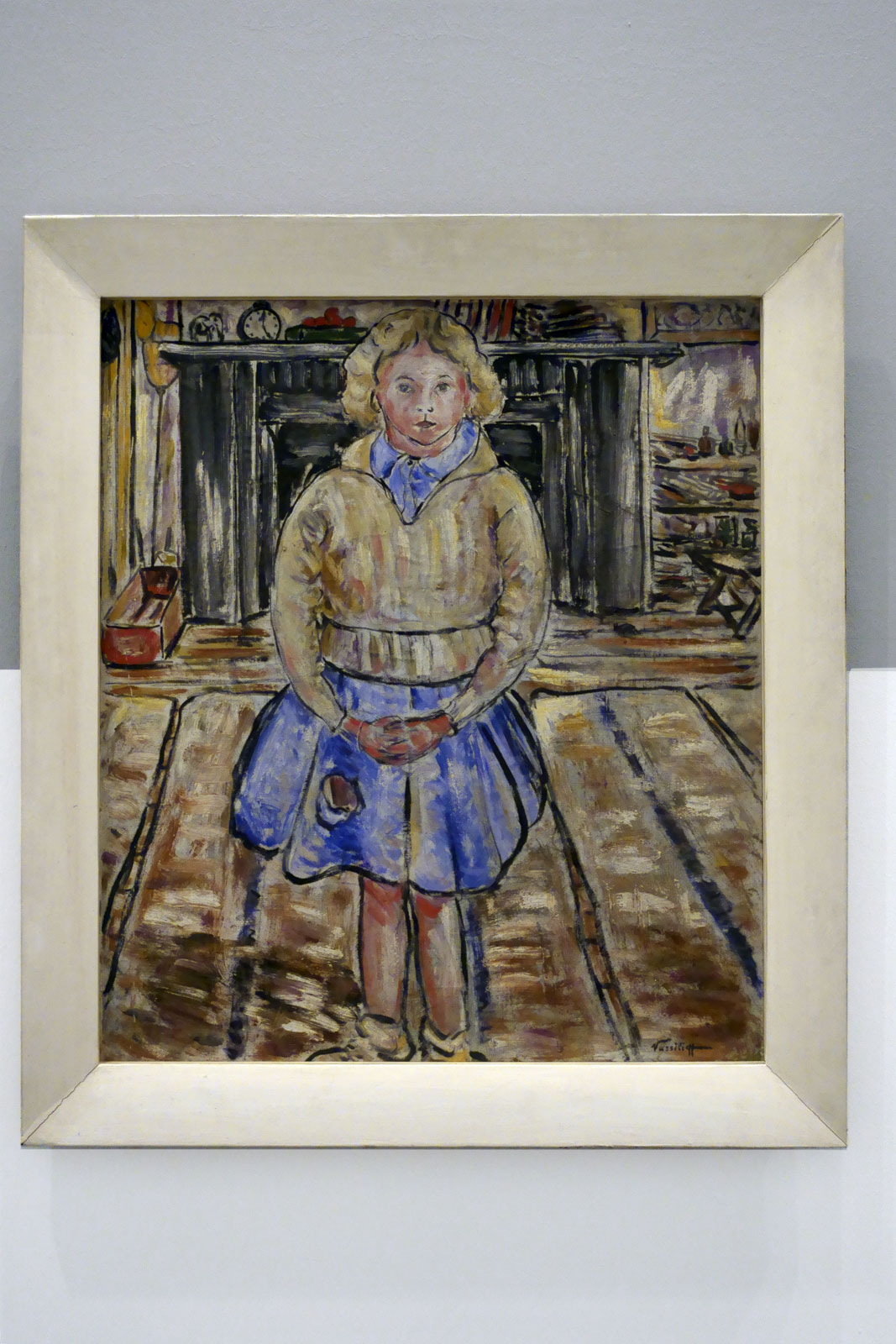
 

Danila Vassilieff (Australian born Russia, 1897-1958, Australia 1923-1929, Central and South America, Europe, England, 1929-1935, Australia from 1935) 'Young girl (Shirley)' 1937 (installation view)


Danila Vassilieff (Australian born Russia, 1897-1958, Australia 1923-1929, Central and South America, Europe, England, 1929-1935, Australia from 1935)
Young girl (Shirley) (installation view)
1937
Oil on canvas on composition board
National Gallery of Victoria, Melbourne
National Gallery Society of Victoria Century Fund, 1984
Photo: Marcus Bunyan
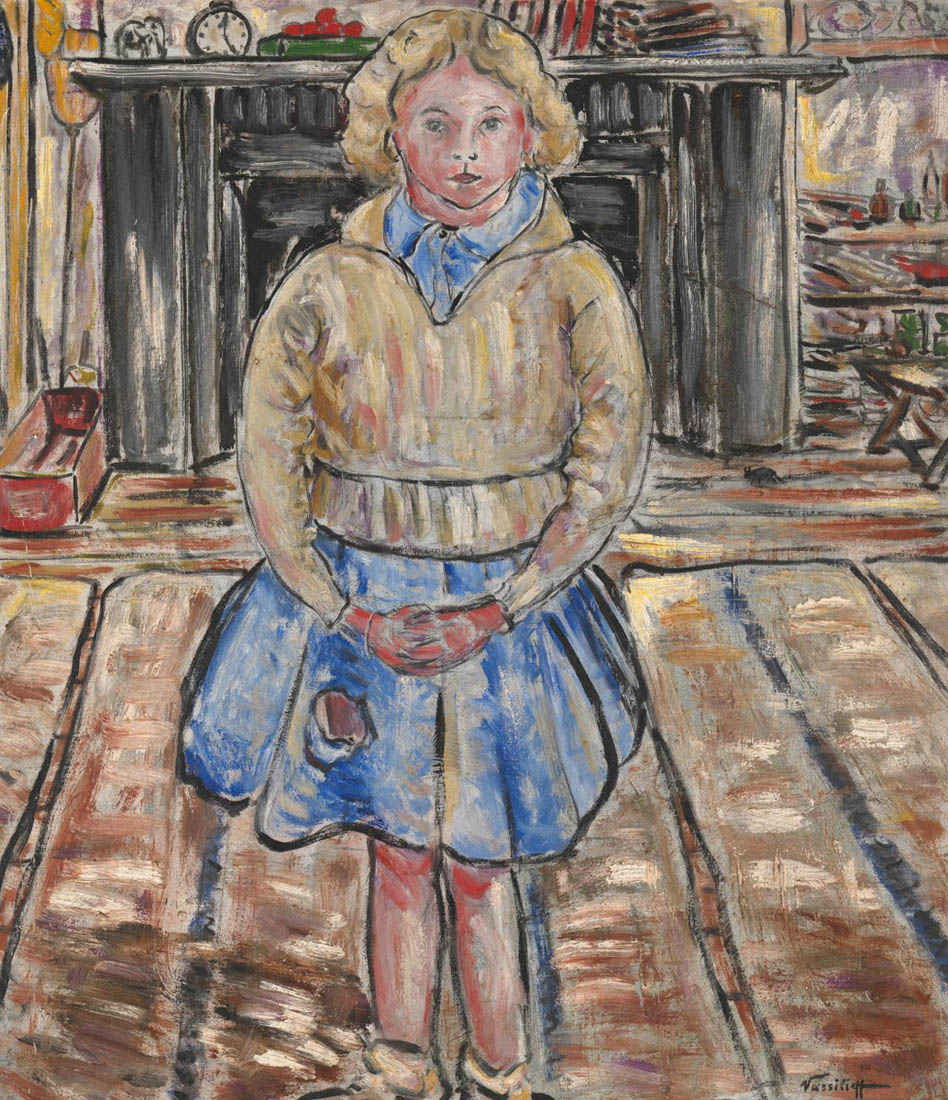
 

Danila Vassilieff (Australian born Russia, 1897-1958, Australia 1923-1929, Central and South America, Europe, England, 1929-1935, Australia from 1935) 'Young girl (Shirley)' 1937


Danila Vassilieff (Australian born Russia, 1897-1958, Australia 1923-1929, Central and South America, Europe, England, 1929-1935, Australia from 1935)
Young girl (Shirley)
1937
Oil on canvas on composition board
National Gallery of Victoria, Melbourne
National Gallery Society of Victoria Century Fund, 1984


Grace Cossington Smith (Australian, 1892-1984) 'Boys drawing' c. 1926-1927 (installation view)


Grace Cossington Smith (Australian, 1892-1984)
Boys drawing (installation view)
c. 1926-1927
Oil on plywood
National Gallery of Victoria, Melbourne
Purchased through The Art Foundation of Victoria with the assistance of the Marjorie Webster Memorial, Governor, 1983
© Estate of Grace Cossington Smith
Photo: Marcus Bunyan


Grace Cossington Smith (Australian, 1892-1984) 'Boys drawing' c. 1926-1927


Grace Cossington Smith (Australian, 1892-1984)
Boys drawing
c. 1926-1927
Oil on plywood
National Gallery of Victoria, Melbourne
Purchased through The Art Foundation of Victoria with the assistance of the Marjorie Webster Memorial, Governor, 1983
© Estate of Grace Cossington Smith


The 1920s saw the advancement of modernism in Australia, due in large part to the dedication of women artists such as Grace Cossington Smith to work in modern styles. Celebrated for her iconic urban images and luminous interiors, Cossington Smith first studied with Antonio Dattilo Rubbo in Sydney, and between 912 and 1914, she toured Germany and England with her family. Following her return to Rubbo’s school, Cossington Smith starting producing work in a cutting-edge Post-Impressionistic style. For several years Cossington Smith worked as a part-time teacher at Turramurra College, a day and boarding school for boys. During this period she developed a painting technique based on the idea that vibrations emanating from colour expressed a spiritual condition as well as optical movement.

Wall text rom the exhibition
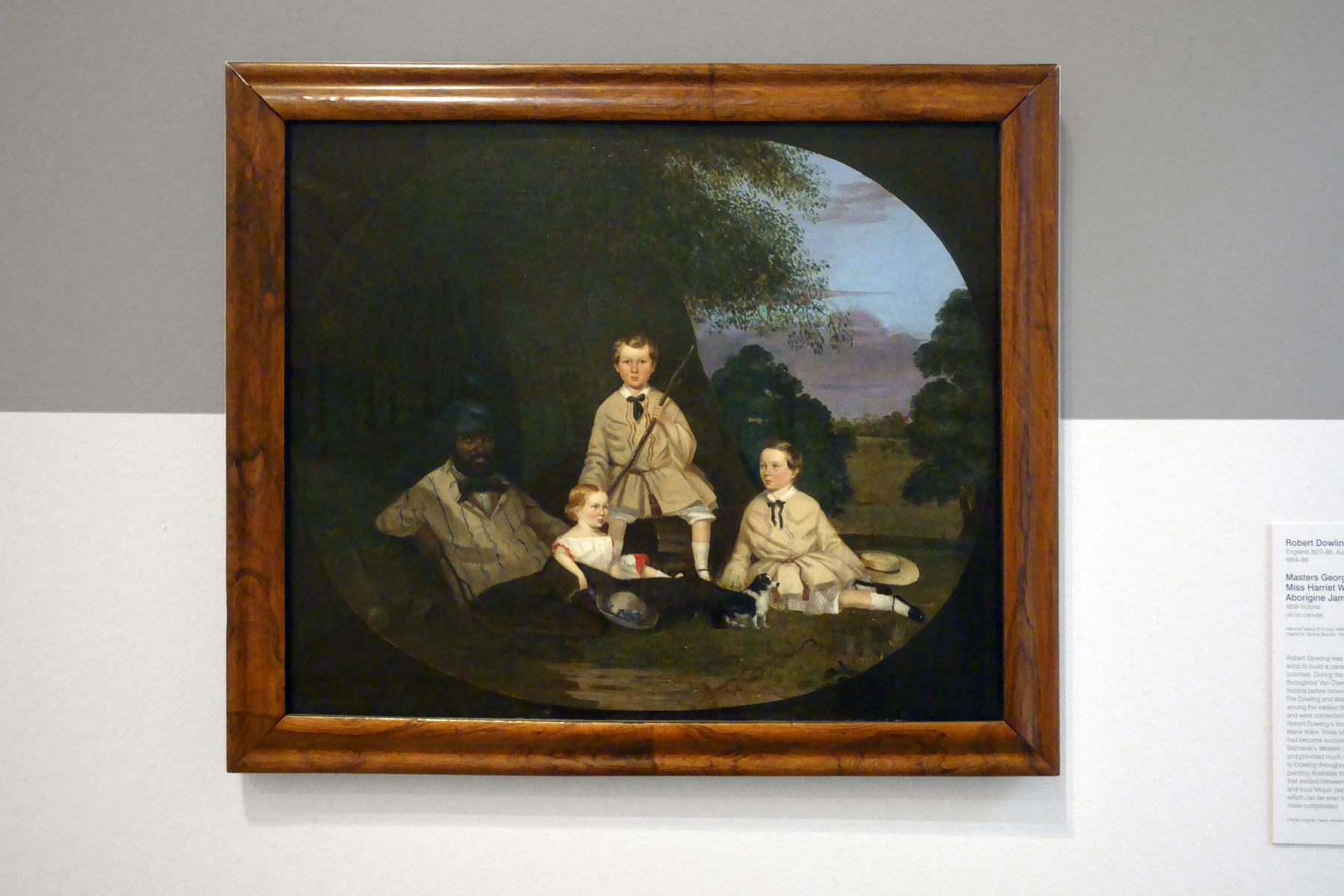
 

Robert Dowling (England 1827-1886, Australia 1834-1857, 1884-1886) 'Masters George, William and Miss Harriet Ware with the Aborigine Jamie Ware' 1856 (installation view)


Robert Dowling (England 1827-1886, Australia 1834-1857, 1884-1886)
Masters George, William and Miss Harriet Ware with the Aborigine Jamie Ware (installation view)
1856
Oil on canvas
63.7 × 76.4cm
National Gallery of Victoria, Melbourne
Eleanor M. Borrow Bequest, 2007
Photo: Marcus Bunyan


Robert Dowling (England 1827-86, Australia 1834-57, 1884-86) 'Masters George, William and Miss Harriet Ware with the Aborigine Jamie Ware' 1856


Robert Dowling (England 1827-1886, Australia 1834-1857, 1884-1886)
Masters George, William and Miss Harriet Ware with the Aborigine Jamie Ware
1856
Oil on canvas
63.7 × 76.4cm
National Gallery of Victoria, Melbourne
Eleanor M. Borrow Bequest, 2007


Installation view of the exhibition 'WHO ARE YOU: Australian Portraiture' at NGV Australia, Federation Square, Melbourne with at left, E. Phillips Fox's 'Dolly, daughter of Hammond Clegg Esq.' (1896); at second left, Nora Heysen's 'Self portrait' (1934); and at third right, Florence Fuller's 'Paper Boy' (1888)


Installation view of the exhibition WHO ARE YOU: Australian Portraiture at NGV Australia, Federation Square, Melbourne with at left, E. Phillips Fox’s Dolly, daughter of Hammond Clegg Esq. (1896, below); at second left, Nora Heysen’s Self portrait (1934, below); and at third right, Florence Fuller’s Paper Boy (1888, below)
Photo: Marcus Bunyan


Nora Heysen (Australian, 1911-2003, lived in England and Italy 1934-1937) 'Self portrait' 1934


Nora Heysen (Australian, 1911-2003, lived in England and Italy 1934-1937)
Self portrait
1934
Oil on canvas
43.1 x 36.3cm
National Portrait Gallery, Canberra
Purchased 1999
© Lou Klepac


Florence Fuller (Australian born South Africa, 1867-1946, Australia from 1868) '(Paper boy)' 1888 (installation view)


Florence Fuller (Australian born South Africa, 1867-1946, Australia from 1868)
(Paper boy) (installation view)
1888
Oil on canvas
61.2 × 45.5cm
National Gallery of Victoria, Melbourne
Gift of Krystyna Campbell-Pretty AM and Family through the Australian Government’s Cultural Gifts Program, 2020
Photo: Marcus Bunyan


Paper boys were prominent part of street life in nineteenth-century Melbourne. Mostly from disadvantaged circumstances, boys as young as eight would work long hours selling newspapers on the city’s streets, many supporting single mothers or siblings, or working to survive independently. The boys were exposed to crime and exploitation, and were seen as hardened and cheeky, yet Florence Fuller’s portrait is sensitive and nuanced. Her work is often focused on those living in poverty, which provides insight into Melbourne’s social diversity. Fuller worked as a professional artist throughout her life – encouraged by her parents and her uncle, artist Robert Dowling – and exhibited at the Paris Salon and the Royal Academy, London.

Wall text rom the exhibition


Josephine Muntz Adams (Australian, 1862-1950) 'Italian girl's head' 1913 (installation view)


Josephine Muntz Adams (Australian, 1862-1950)
Italian girl’s head (installation view)
1913
Oil on canvas
51.0 × 42.9cm
National Gallery of Victoria, Melbourne
Felton Bequest, 1936
Photo: Marcus Bunyan


Josephine Muntz Adams (Australian, 1862-1950) 'Italian girl's head' 1913


Josephine Muntz Adams (Australian, 1862-1950)
Italian girl’s head
1913
Oil on canvas
51.0 × 42.9cm
National Gallery of Victoria, Melbourne
Felton Bequest, 1936


Installation view of the exhibition 'WHO ARE YOU: Australian Portraiture' at NGV Australia, Federation Square, Melbourne showing the work of Simon Obarzanek from his series '80 Faces' (2002)


Installation view of the exhibition WHO ARE YOU: Australian Portraiture at NGV Australia, Federation Square, Melbourne showing the work of Simon Obarzanek from his series 80 Faces (2002, below)
Photo: Marcus Bunyan


Simon Obarzanek (Australian born Israel, b. 1968, United States 1995-2001) 'Untitled (80 faces) #78' 2002


Simon Obarzanek (Australian born Israel, b. 1968, United States 1995-2001)
Untitled (80 faces) #78
2002
Gelatin silver photograph
Gallery of Victoria, Melbourne
Gift of the artist through the Australian Government’s Cultural Gifts Program, 2013
© Simon Obarzanek


The black and white photographs from Simon Obarzanek’s 80 Faces series show frontal portraits of teenagers, captured from the shoulders up with a consistent, neutral backdrop. The sitters are all aged between fourteen and seventeen, the majority from Victoria’s state schools. When capturing their image, the artist only spends five minutes with each sitter, and discusses nothing about their life. In this body of work, Obarzanek explores the idea that the identity or appearance of an individual sitter reveals something new to the audience when viewed as part of a series.

Wall text rom the exhibition
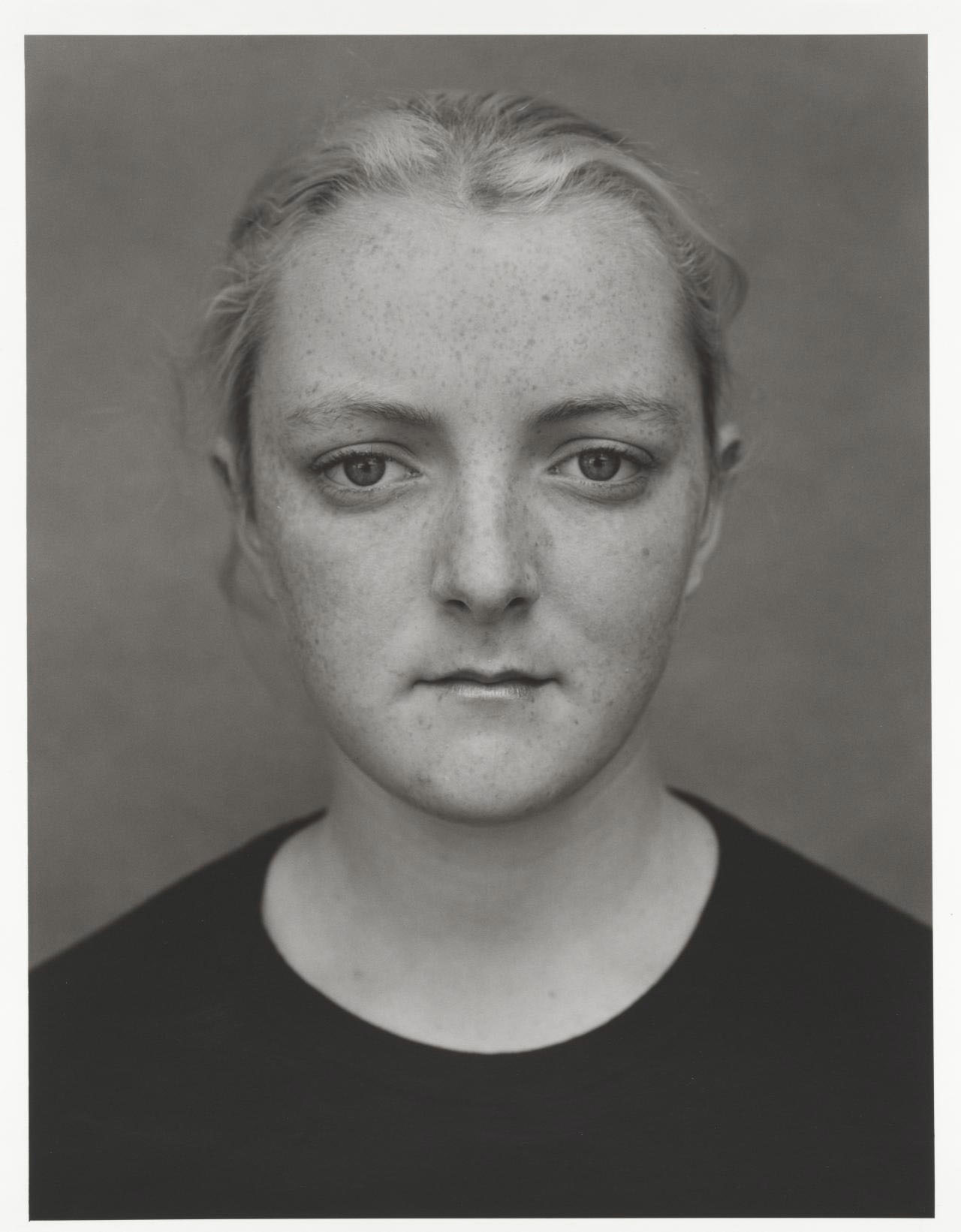
 

Simon Obarzanek (Australian born Israel, b. 1968, United States 1995-2001) 'Untitled (80 faces) #59' 2002


Simon Obarzanek (Australian born Israel, b. 1968, United States 1995-2001)
Untitled (80 faces) #59
2002
Gelatin silver photograph
Gallery of Victoria, Melbourne
Gift of the artist through the Australian Government’s Cultural Gifts Program, 2013
© Simon Obarzanek
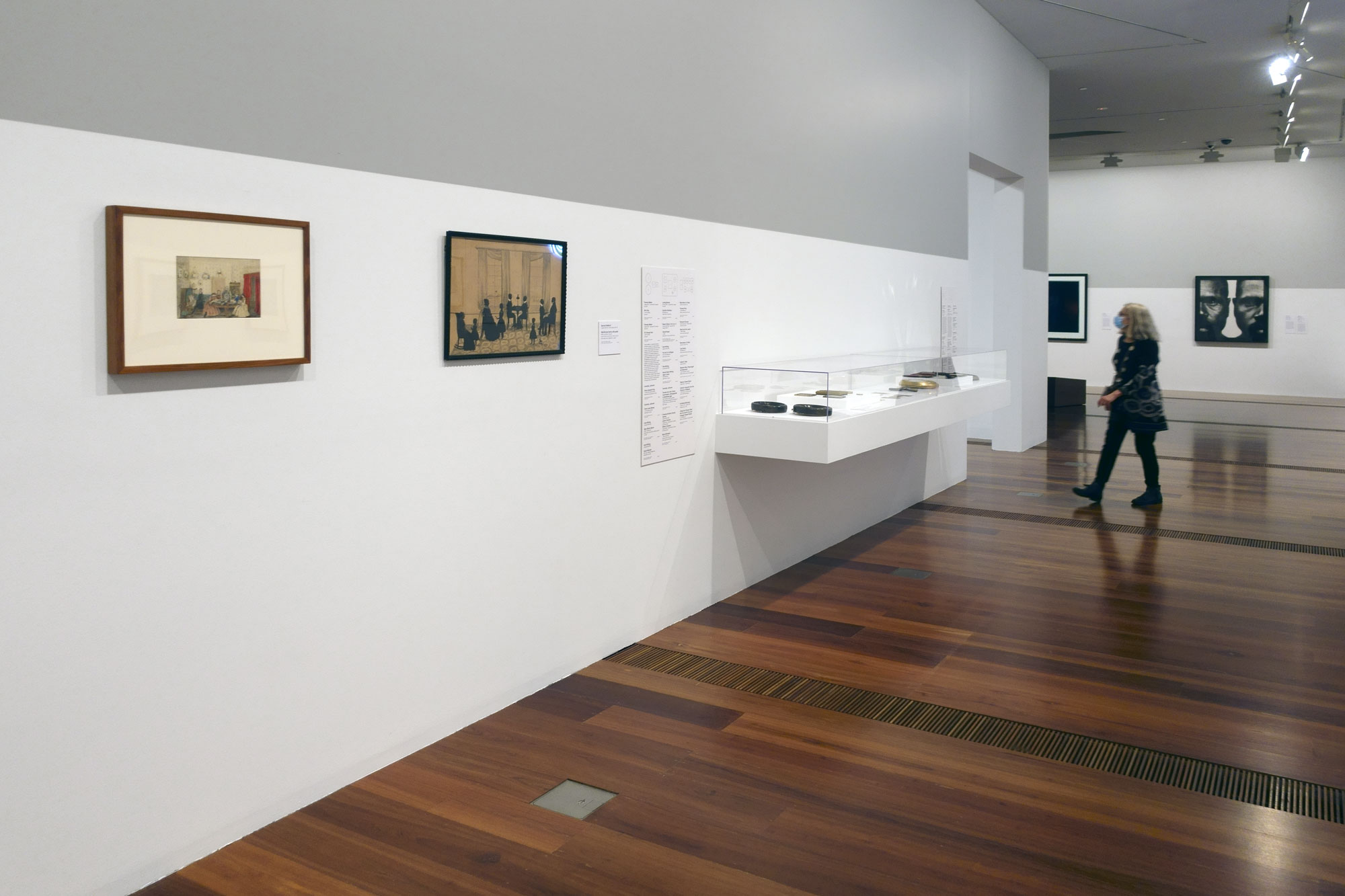
 

Installation view of the exhibition 'WHO ARE YOU: Australian Portraiture' at NGV Australia, Federation Square, Melbourne showing at left, Maria Brownrigg's 'An evening at Yarra Cottage, Port Stephens' (1857); and at second left, Samuel Metford's 'MacKenzie family silhouette' (1846)


Installation view of the exhibition WHO ARE YOU: Australian Portraiture at NGV Australia, Federation Square, Melbourne showing at left, Maria Brownrigg’s An evening at Yarra Cottage, Port Stephens (1857, below); and at second left, Samuel Metford’s MacKenzie family silhouette (1846, below)
Photo: Marcus Bunyan


Maria Brownrigg (Australian born Ireland 1812-1880, South Africa date unknown - c. 1852, Australia from 1852) 'An evening at Yarra Cottage, Port Stephens' 1857 (installation view)


Maria Brownrigg (Australian born Ireland 1812-1880, South Africa date unknown – c. 1852, Australia from 1852)
An evening at Yarra Cottage, Port Stephens (installation view)
1857
Watercolour and collage on paper
National Portrait Gallery, Canberra
Purchased, 2017
Photo: Marcus Bunyan


Maria Brownrigg (Australian born Ireland 1812-1880, South Africa date unknown - c. 1852, Australia from 1852) 'An evening at Yarra Cottage, Port Stephens' 1857


Maria Brownrigg (Australian born Ireland 1812-1880, South Africa date unknown – c. 1852, Australia from 1852)
An evening at Yarra Cottage, Port Stephens
1857
Watercolour and collage on paper
National Portrait Gallery, Canberra
Purchased, 2017


Maria Caroline Brownrigg came to New South Wales in 1852, when her husband was appointed superintendent of the Australian Agricultural Company’s operations in the Hunter River district. The family lived at Stroud and subsequently at Port Stephens, where Brownrigg made this portrait of her six children. It is the only known example of Brownrigg’s work. Though ‘amateur’, it is valuable to decorative arts and social historians, for its detailed documentation of an appropriately conducted mid nineteenth-century drawing room, and for what it reveals about Victorian gender ideals and aspirations to gentility.

Wall text rom the exhibition


Samuel Metford (England 1810-1890, lived in United States 1834-1844) 'MacKenzie family silhouette' 1846


Samuel Metford (England 1810-1890, lived in United States 1834-1844)
MacKenzie family silhouette
1846
Brush and ink, pen and ink, stencil cutout with watercolour highlights on paper
43.2 x 64.0cm
National Portrait Gallery, Canberra
Gift of the Estate of Nancy Wiseman


Samuel Metford was born in Glastonbury, into a Quaker family. In England he came to specialise in full-length silhouette likenesses, cut from black paper and embellished with gold and white paint. According to the standard text on British silhouettes, Metford made ‘some very fine family groups – Father and Mother surrounded by their children and pets, with hand-painted backgrounds of imposing rooms whose tall windows looked out on wide landscapes, or a seascape with a tall-funnelled steamship in a prominent position.’ Metford moved to America in about 1834, and spent some ten years there, working mostly in Connecticut but also in New York and South Carolina. He returned to England in the early 1840s, and lived there for the rest of his life, although he revisited America in 1869 and 1867. He died at Weston-Super-Mare.

Samuel Metford (1810-1896), specialised in full-length silhouette likenesses on hand-painted watercolour backgrounds, sometimes embellished with gold and white paint or featuring gentrified interiors. Born in Glastonbury, Somerset, he received tuition from French silhouette artist Augustin Edouart, before going to America and working for the next ten years in New York, Philadelphia and Boston. His return to England in the mid-1840s coincided with the downturn in demand for profile portraits occasioned by photography which, by the 1860s, had rendered art forms such as the silhouette passé. This silhouette depicts the family of Francis MacKenzie (1806-1851, seated far right) at Adlington Hall in Standish, Lancashire. Following Francis MacKenzie’s death, his widow, Maria (1810-1874, third from left) emigrated to Australia with her five children. Maria’s eldest son, John (1833-1917, seated, left, at the table), was Examiner of Coalfields in the Illawarra from 1863 and 1865, later becoming Examiner of Coalfields for NSW. Her sons Walter (1835-1886, seated, right, at the table) and Kenneth (d. 1903) are thought to have become clergymen. Her youngest daughter, Maria (1842-1917, second from left), married a doctor, Alexander Morson, in 1875. Another daughter, Caroline (1837-1922, fourth from left), remained unmarried and died at the family property near Dapto in 1922. Other sitters shown in the silhouette are Maria’s mother, Mrs Thomas Edwards (far left); and her youngest child, William, who died, aged six, in 1851. Maria MacKenzie died at Wallerawang in New South Wales in 1874. The silhouette was bequeathed to the Gallery by her great-grandaughter in 2007.

Text from the National Portrait Gallery, Canberra website updated 2018 [Online] Cited 28/06/2022


Installation view of the exhibition 'WHO ARE YOU: Australian Portraiture' at NGV Australia, Federation Square, Melbourne showing by unknown artists – at left, Anna Josepha King (c. 1826-1832); and at right, Fanny Jane Marlay (c. 1841)


Installation view of the exhibition WHO ARE YOU: Australian Portraiture at NGV Australia, Federation Square, Melbourne showing by unknown artists – at left, Anna Josepha King (c. 1826-1832, below); and at right, Fanny Jane Marlay (c. 1841, below)
Photo: Marcus Bunyan


Unknown artist. 'Anna Josepha King' c. 1826-1832


Unknown artist (Australia)
Anna Josepha King
c. 1826-1832
watercolour and gouache on ivory
Frame: 9.7 cm x 8.3cm
Sheet: 8.5 cm x 6.5cm
Image: 7.0 cm x 5.7cm
National Portrait Gallery, Canberra
Purchased 2018


Before the early 1840s, when photography began to take hold, portrait miniatures were a favoured means by which people might secure tangible and enduring mementos of their loved ones. Typically executed in watercolour on panels of ivory and contained in petite frames or mounted in pendants, brooches, rings, and lockets, miniatures were designed to be clutched, kissed, carried close to the heart or displayed on a bedside table. Many early Australian colonists brought British-made miniatures with them, but increasing numbers of free settlers from the 1820s onwards soon created demand for miniatures by local, readily-available artists.

Text from the National Portrait Gallery, Canberra website Nd [Online] Cited 28/06/2022


Unknown artist. 'Fanny Jane Marlay' c. 1841


Unknown artist (Australia)
Fanny Jane Marlay
c. 1841
watercolour on ivory
Frame: 7.5 cm x 6.3cm
National Portrait Gallery, Canberra
Purchased 2013


Fanny Jane Marlay (1819-1848) came to Sydney with her free-settler family around 1825. In 1838, she met John Lort Stokes (1812-1885), an explorer, naval officer and surveyor appointed to HMS Beagle, which was then engaged in a surveying voyage of the Australian coast. In the course of it, Stokes charted much of what is now the coast of the Northern Territory; gave Darwin its name (after his former shipmate, Charles Darwin); and surveyed the Gulf of Carpentaria, the Arafura Sea, the Torres Strait, the Western Australian coast, and Bass Strait. He and Fanny married in Sydney in January 1841. Later the same year, Stoke succeeded to the command of the Beagle. Their daughter was born in 1842. Fanny returned with Stokes to England in 1843 and died while en route to Sydney again in 1848. Back in England from 1851, Stokes was eventually promoted to admiral. He died at his home, Scotchwell, in Pembrokeshire, in June 1885, survived by his second wife, Louisa, whom he’d married in 1856, and by his daughter from his marriage to Fanny.

Text from the National Portrait Gallery, Canberra website Nd [Online] Cited 28/06/2022


Installation view of the exhibition 'WHO ARE YOU: Australian Portraiture' at NGV Australia, Federation Square, Melbourne


Installation view of the exhibition WHO ARE YOU: Australian Portraiture at NGV Australia, Federation Square, Melbourne
Photo: Marcus Bunyan
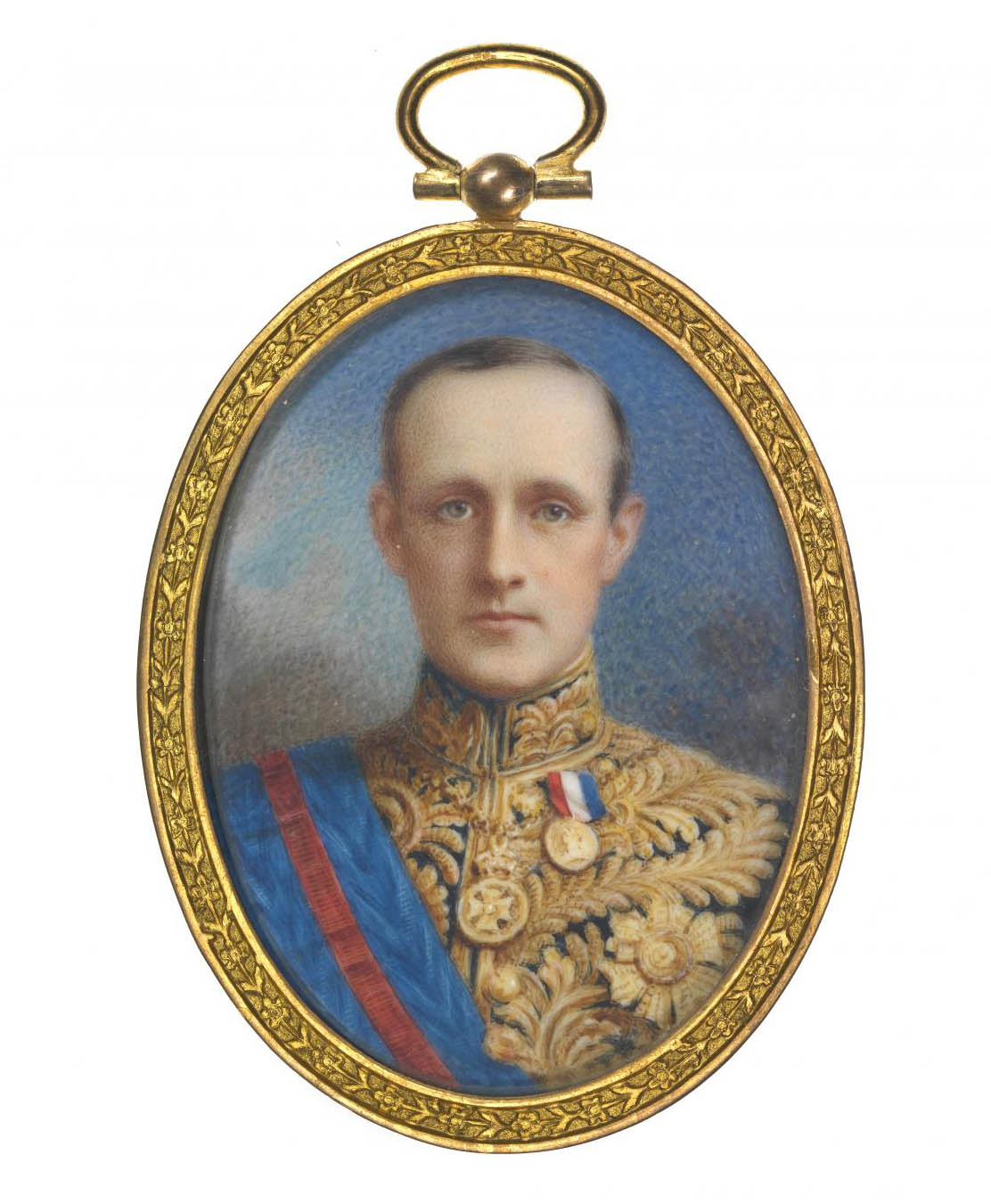
 

Ada Whiting (Australian, 1859-1953) 'The Earl of Linlithgow' 1901


Ada Whiting (Australian, 1859-1953)
The Earl of Linlithgow
1901
Watercolour on ivory
6.6 × 5.0cm
National Gallery of Victoria, Melbourne
Gift of Mrs Violet Whiting, 1989
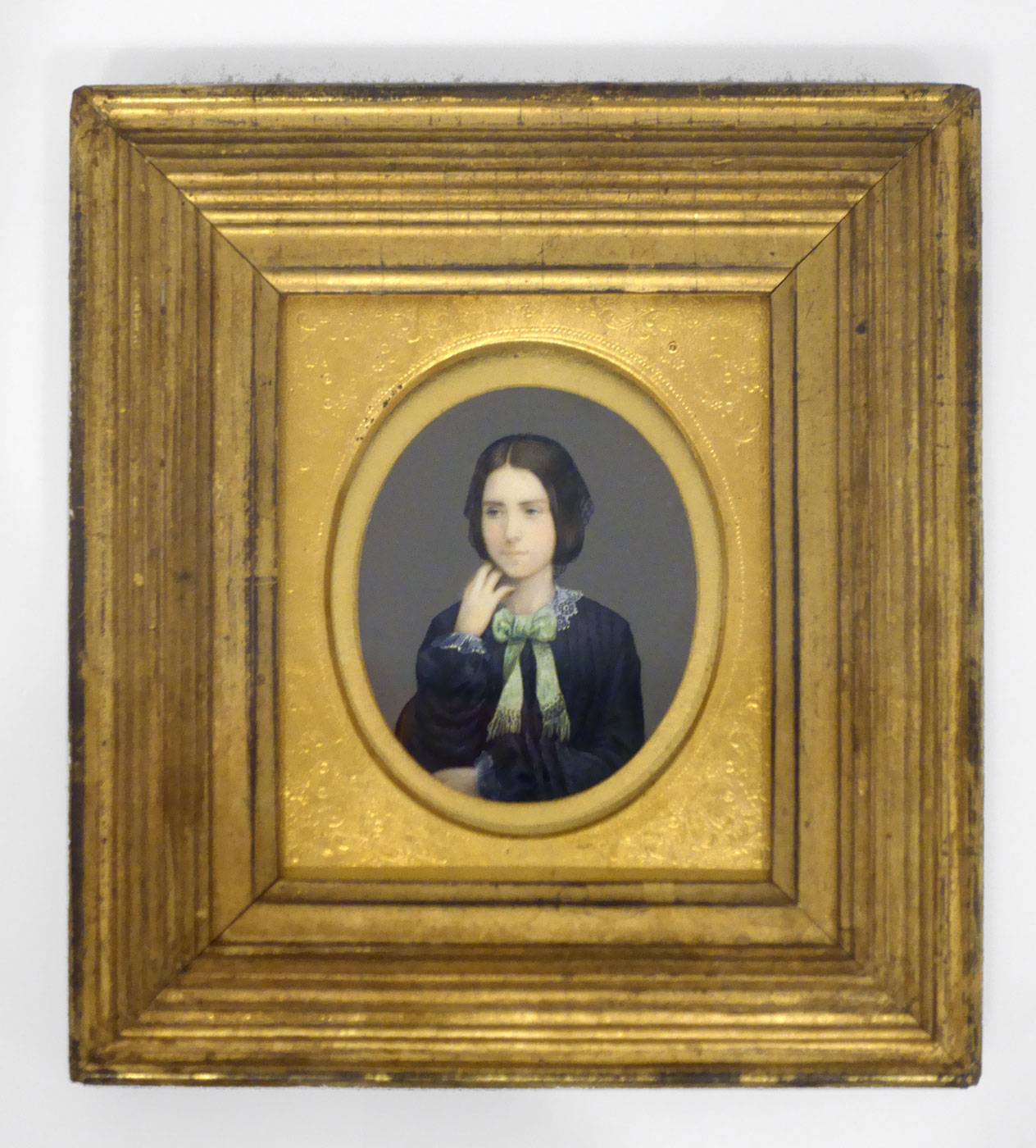
 

Ludwig Becker (Australian born Germany, 1808-1861) 'Caroline Davidson' 1854 (installation view)


Ludwig Becker (Australian born Germany, 1808-1861)
Caroline Davidson (installation view)
1854
Watercolour on fictile ivory
Image: 5.7 × 4.6cm
National Gallery of Victoria, Melbourne
Purchased, 1996
Photo: Marcus Bunyan


Unknown artist (Australia) 'Thomas and John Clarke, bushrangers, photographed in Braidwood gaol' 1867


Unknown artist (Australia)
Thomas and John Clarke, bushrangers, photographed in Braidwood gaol
1867
Albumen silver photograph laid down on a section cut from a nineteenth-century album page
National Portrait Gallery, Canberra
Purchased, 2019


John (c. 1846-1867) (left) and Thomas Clarke (c. 1840-1867), bushrangers, grew up near Braidwood and from a young age were schooled in nefarious activities including horse-theft. John was 17 when he first went to prison and Thomas was purported to have ridden with the infamous Ben Hall. In October 1865, Thomas escaped from gaol while awaiting trial for armed robbery; thereafter, aided by various mates, he embarked on a string of depredations around Braidwood, Araluen and further south. In April 1866, at Nerrigundah, the gang engaged in a hold-up that left a policeman dead. Thomas was outlawed in May, by which time John had joined him. Reports described them as ‘well-mounted, and armed to the teeth’. In September 1866 colonial secretary Henry Parkes sent four special constables to Braidwood ‘for the express purpose of hunting down the desperate marauders’. In January 1867, the four were murdered in an ambush at Jinden. The Clarkes were blamed immediately and the authorities offered rewards of £1000 each, alive or dead. Aided by an effective bush telegraph system, the brothers evaded capture until April 1867, when they were tracked to a hideout near Araluen, apprehended, and taken to Braidwood Gaol. There, an as yet unidentified photographer took portraits that were sold by a Goulburn bookseller for two shillings and sixpence each. The brothers were later tried in Sydney before Sir Alfred Stephen, who in sentencing them to death noted the more than 60 offences, excluding murders, of which they were suspected.

Text from the National Portrait Gallery, Canberra website Nd [Online] Cited 28/06/2022


Installation view of the exhibition 'WHO ARE YOU: Australian Portraiture' at NGV Australia, Federation Square, Melbourne showing a selction of cartes de visite: at top left, Freeman Brothers Studio, Sydney (Australia 1854-1900) 'Maria Windeyer' (c. 1865-1868); at second left top, Batchelder & O'Neill (Australia active 1857-1863) 'Frances Perry' (c. 1863); at second right top, Townsend Duryea (Australian born America, 1823-1888) 'Sarah and Ann Jacob' c. 1866; at top right, Batchelder & O’Neill (Australia active 1857-1863) 'Lady Barkly' (1863); at bottom left, James E. Bray (Australia 1832-1891) 'Madame Sibly, Phrenologist and Mesmerist' (c. 1870); at centre bottom, Stephen Edward Nixon (England 1842 - Australia 1910) 'Catholic clergymen from the Diocese of Adelaide' (c. 1862); and at bottom right, Archibald McDonald (Canada c. 1831 - Australia 1873, Australia from c. 1847) 'Chang the Chinese Giant with his wife Kin Foo and manager Edward Parlett' (c. 1871)


Installation view of the exhibition WHO ARE YOU: Australian Portraiture at NGV Australia, Federation Square, Melbourne showing a selction of cartes de visite: at top left, Freeman Brothers Studio, Sydney (Australia 1854-1900) Maria Windeyer (c. 1865-1868); at second left top, Batchelder & O’Neill (Australia active 1857-1863) Frances Perry (c. 1863); at second right top, Townsend Duryea (Australian born America, 1823-1888) Sarah and Ann Jacob c. 1866; at top right, Batchelder & O’Neill (Australia active 1857-1863) Lady Barkly (1863); at bottom left, James E. Bray (Australia 1832-1891) Madame Sibly, Phrenologist and Mesmerist (c. 1870); at centre bottom, Stephen Edward Nixon (England 1842 – Australia 1910) Catholic clergymen from the Diocese of Adelaide (c. 1862); and at bottom right, Archibald McDonald (Canada c. 1831 – Australia 1873, Australia from c. 1847) Chang the Chinese Giant with his wife Kin Foo and manager Edward Parlett (c. 1871)
Photo: Marcus Bunyan


James E. Bray (Australia, 1832-1891) 'Madame Sibly, Phrenologist and Mesmerist' c. 1870


James E. Bray (Australia, 1832-1891)
Madame Sibly, Phrenologist and Mesmerist
c. 1870
albumen silver carte de visite photograph
Mount: 10.1 cm x 6.2cm
Image: 9.4 cm x 5.5cm
National Portrait Gallery, Canberra
Purchased, 2017


Marie Sibly (c. 1830-1894), mesmerist and phrenologist, performed in towns throughout Australia for nearly twenty years. Purportedly French-born, she arrived in Sydney around 1867 and worked as a clairvoyant, making her first stage appearances in 1868. By 1871 she was in Melbourne, ‘manipulating heads’ for packed houses at Weston’s Opera House on Bourke Street before embarking on a tour of Victoria. Through the 1870s she toured New South Wales and Queensland, her shows incorporating séances, phrenological readings and hypnotisms whereby audiences members were induced to fight, dance, sing or behave absurdly. A report of one performance described how she convinced two men to fetch a leg of lamb from the butcher; she then made them think they were dogs and they ate it. Her later repertoire included ‘baby exhibitions’ in which prizes were awarded to the specimens with the best mental and physical capacity. She took up land at Parkes in 1877 but continued touring regardless. By the mid-1880s she was in New South Wales again, performing with her daughter, ‘Zel the Magnetic Lady’, and advertising her range of remedies for conditions such as gout, rheumatism and neuralgia. She was known by various names throughout her career although it is unclear how many husbands she had. Having ‘retired from the platform’ she ran a store at Drake, near Tenterfield, where she died in April 1894.

James E Bray ran a business called the ‘Prince of Wales Photographic Gallery’ on George Street, Sydney, which was sold in late 1865. He then went to Victoria, and by early 1868 was reported as ‘having an extensive gallery built at his place of business, Camp Street, Beechworth’. There, he was enabled to ‘execute Every Variety of Photographic Portraiture’, including ‘Cartes de Viste, Tinted or Fully Colored in Water Colors’. He appears to have stocked portraits of international celebrities (such as the conman Arthur Orton, aka The Tichborne Claimant) in addition to taking likenesses for local citizens. Notably, he was among the photographers who documented the Kelly gang and their off-shoots: such as the 22 men of Irish descent who were banged up in Beechworth Gaol for four months without charge in 1879 on the off-chance they might be Kelly sympathisers. Another of Bray’s cartes shows constable Alexander Fitzpatrick, whose attempt to arrest Dan Kelly had initiated the gang’s formation in the first place. Marie Sibly performed in the Beechworth area on several occasions during Bray’s time there. Her reading of certain gentlemen’s heads in Eldorado in August 1871 was judged so accurate that it was assumed she’d ‘received some private information about the parties’; and at a séance in Wangaratta that year, ‘a young man, while under mesmeric influence’ had ‘rudely seized’ the wife of another chap, who struck said young man with a stick. In winter 1879 Sibly was in Beechworth, Chiltern, Corowa, Bright and other towns, variously causing offence, sensation or consternation, it seems, wherever she went – and thus becoming a ‘sure card’ for photographers.

Text from the National Portrait Gallery, Canberra website Nd [Online] Cited 28/06/2022


Installation view of the exhibition 'WHO ARE YOU: Australian Portraiture' at NGV Australia, Federation Square, Melbourne


Installation view of the exhibition WHO ARE YOU: Australian Portraiture at NGV Australia, Federation Square, Melbourne
Photo: Marcus Bunyan
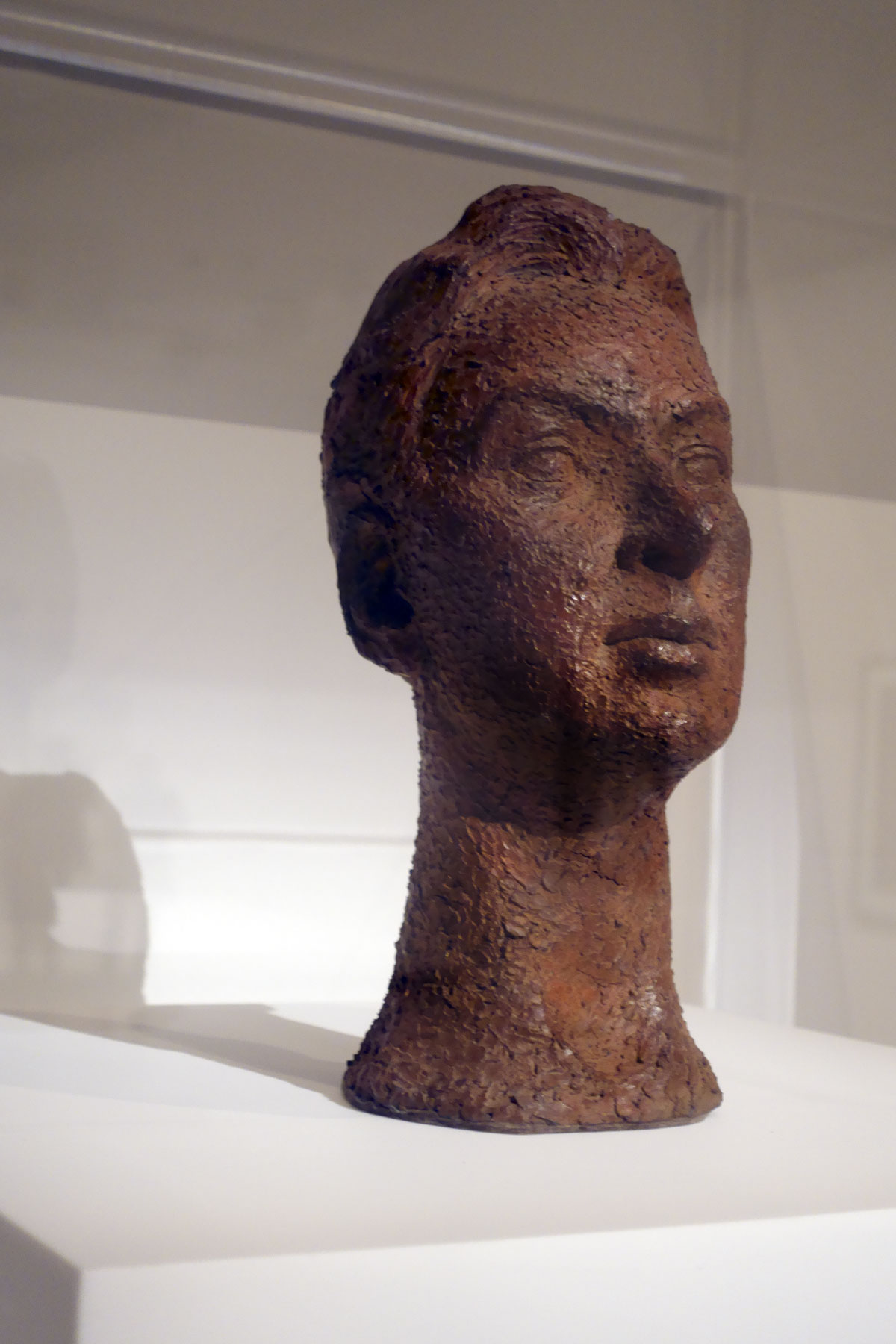
 

Ola Cohn (Australian, 1892-1964) 'Lina' 1958 (installation view)


Ola Cohn (Australian, 1892-1964)
Lina (installation view)
1958
Earthenware
34.4 x 14.9 x 21.0cm
National Gallery of Victoria, Melbourne
Gift of Mrs Lina Bryans, 1969
© Centre for Adult Education & Box Hill Institute
Photo: Marcus Bunyan


Ola Cohn (Australian, 1892-1964) 'Lina' 1958


Ola Cohn (Australian, 1892-1964)
Lina
1958
Earthenware
34.4 x 14.9 x 21.0cm
National Gallery of Victoria, Melbourne
Gift of Mrs Lina Bryans, 1969
© Centre for Adult Education & Box Hill Institute


Ah Xian (Australian born China, b. 1960) 'Dr John Yu' 2004 (installation view)


Ah Xian (Australian born China, b. 1960)
Dr John Yu (installation view)
2004
Glazed ceramic
42.0 x 42.0 depth 31.0cm
Commissioned with funds provided by Marilyn Darling AC 2004
Photo: Marcus Bunyan


Ah Xian came to Australia from Beijing in 1989, having already gained some recognition and experience as an artist here. His application for permanent residency took many years to process, and he worked for a long time as a house painter. He began casting porcelain busts and painting them with traditional Chinese designs in 1997; an artist-in-residency followed, he sold a bust to Sydney’s Powerhouse Museum, and he held his first solo show in Melbourne in 2000. The following year, he won the National Gallery of Australia’s inaugural National Sculpture Prize with his life-size painted cloisonne enamel figure Human human: “Human Human : Lotus Cloisonne Figure 1 (2000-2001)”.

Dr John Yu (b. 1934), retired paediatrician and hospital administrator, was born in Nanking, China and moved to Australia with his parents when he was three years old. Educated in Sydney, from 1961 he worked at the Royal Alexandra Hospital for Children (which became the New Children’s Hospital, Westmead), becoming Head of Medicine and serving as its Chief Executive for 19 years before retiring in 1997. For many years he chaired and served on diverse bodies related to children’s health, education, medicine and the arts. From 2004 he was Chair of VisAsia, promoting appreciation of Asian visual arts and culture. He has published a number of books and many papers on paediatrics, hospital management and the decorative arts. Accepting his Australian of the Year Award in 1996, Yu said, ‘I am proud of my Chinese heritage but even prouder to be an Australian’.

In his celadon bust, Ah Xian depicts Yu life-size with his eyes closed while four colourful miniature children clamber over him. In Chinese tradition, children indicate great prosperity and happiness. As Yu noted: ‘A lot of Chinese sculptures have young children climbing all over the subject. I was really pleased because it related to and reflected on my life work as a paediatrician.’

Text from the National Portrait Gallery, Canberra website updated 2018 [Online] Cited 28/06/2022


Ah Xian celebrates a once-threatened Chinese artisanal tradition of porcelain-ming and decoration. His portraits are a statement of creative freedom and his Chinese-Australian identity, which he shares with his sitter. The mould for this bust was cast in plaster from life – ‘a funny spooky feeling’ according to the subject, who was 1996 Australian of the Year, Dr John Yu. Yu observed of his portrait, ‘people might assume that the first thing that remains me of my heritage is my facial appearance. But it’s not. It’s actually the children … A lot of Chinese sculptures have young children climbing all over the subject. I was really pleased because it related to and reflected on my life work as a paediatrician’.

Wall text rom the exhibition


Ah Xian (Australian born China, b. 1960) 'Dr John Yu' 2004


Ah Xian (Australian born China, b. 1960)
Dr John Yu
2004
Glazed ceramic
42.0 x 42.0 depth 31.0cm
Commissioned with funds provided by Marilyn Darling AC 2004
© Ah Xian


Ricardo Idagi (Australian / Meriam Mir, b. 1957) False Evidence Appearing Real 2012 (installation view)


Ricardo Idagi (Australian / Meriam Mir, b. 1957)
False Evidence Appearing Real (installation view)
2012
Earthenware, under glaze, wood, steel, plastic and glassMeasurements
60.0 × 37.0 × 27.0cm
National Gallery of Victoria, Melbourne
Purchased, Victorian Foundation for Living Australian Artists, 2013
Photo: Marcus Bunyan


Brook Andrew. 'I Split Your Gaze' 1997


Brook Andrew (Australian, b. 1970)
I Split Your Gaze
1997, printed 2005
Gelatin silver photograph
National Gallery of Victoria, Melbourne
Purchased with funds from the Victorian Foundation for Living Australian Artists, 2005


‘I’ve cut the image in half and then reversed it so you can’t actually look at the person straight on. And I suppose that’s what racism is about. It’s about cutting racism down the centre. It’s about cutting differences down the centre. Neither part of the portrait in I split your gaze is whole and in being simultaneously halved and doubled the viewer is forced to stare blankly through the image, rather than making eye contact with the subject. Identity becomes mutable through repetition and we observe the man without really looking at him. The work operates as a metaphor for Australia as a society divided on issues concerning race relations.’ ~ Brook Andrew, 2005

Wall text from the exhibition


Mike Parr (Australian, b. 1945) John Loane (printer) (Australian, b. 1950) '12 untitled self portraits (set 3)' 1990 (installation view)


Mike Parr (Australian, b. 1945)
John Loane (printer) (Australian, b. 1950)
12 untitled self portraits (set 3) (installation view)
1990
Drypoint on 12 sheets of paper, unique state prints on paper
National Portrait Gallery, Canberra
Gift of Sara Kelly 2010. Donated through the Australian Government’s Cultural Gifts Program
Photo: Marcus Bunyan


In the early 1980s Mike Parr embarked no his ‘Self Portrait Project’, exploring representation of the psychological self. An artist who works across live performance, photography, works on paper, sculpture and installation, Parr said: ‘I am constantly finding ways to perform the alienation of likeness’. In this work, Parr’s self-image simultaneously coalesces and violently disintegrates across the drypoint plates. The work’s burrs – jagged edges where the needle has ripped through the metal – record the violence of the printing process. The butts hold more ink, creating the deep black lines and a ferocious visualisation of internal turmoil and chaos.

Wall text from the exhibition
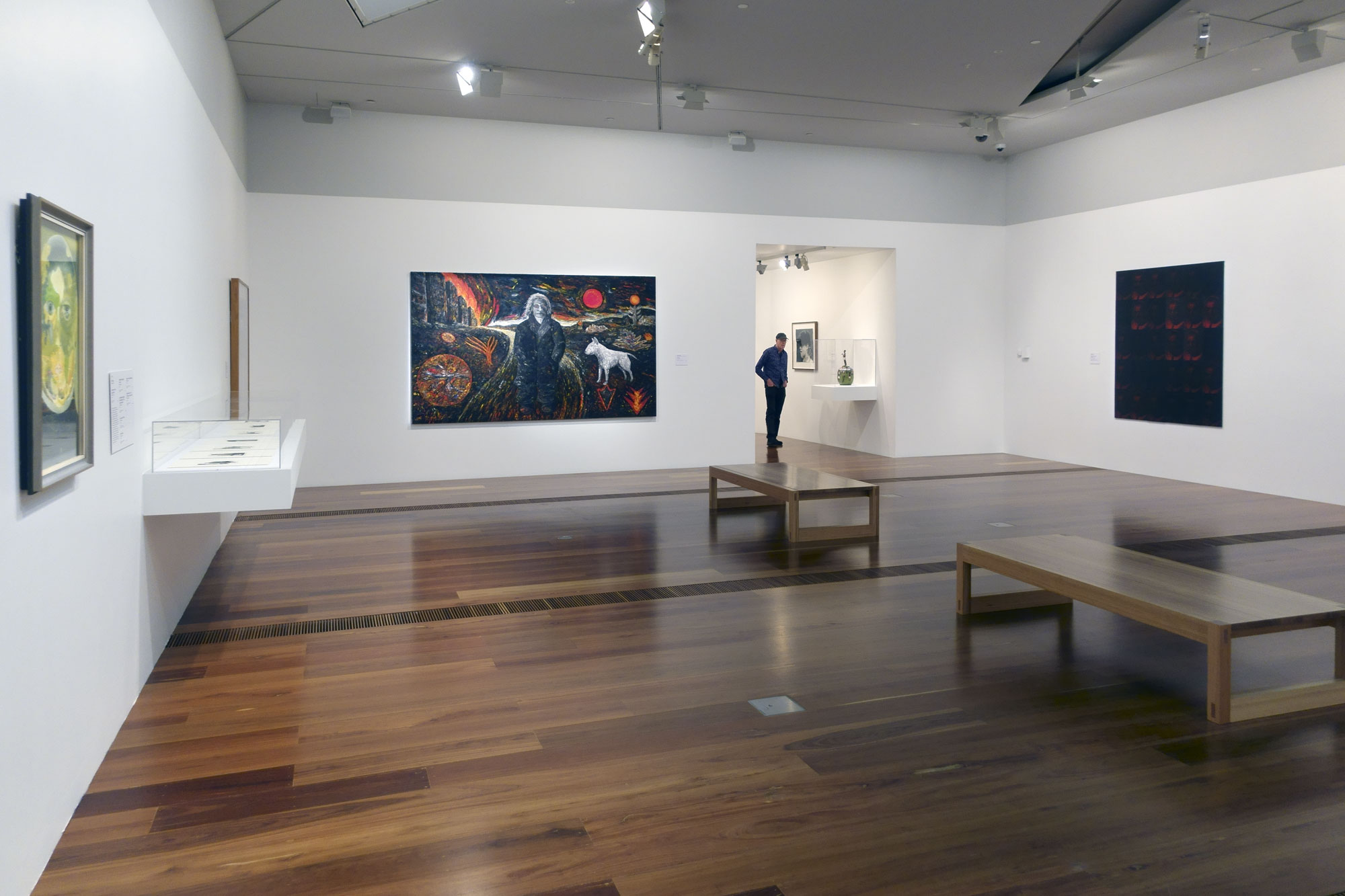
 

Installation view of the exhibition 'WHO ARE YOU: Australian Portraiture' at NGV Australia, Federation Square, Melbourne


Installation view of the exhibition WHO ARE YOU: Australian Portraiture at NGV Australia, Federation Square, Melbourne showing at centre, Peter Booth’s Painting (1977, below)
Photo: Marcus Bunyan


Peter Booth (Australian, b. 1940) 'Painting' 1977


Peter Booth (Australian, b. 1940)
Painting
1977
Oil on canvas
182.5 × 304.0cm
National Gallery of Victoria, Melbourne
Gift of the artist in memory of Les Hawkins, 1978
© Peter Booth/Licensed by Copyright Agency, Australia


Installation view of the exhibition 'WHO ARE YOU: Australian Portraiture' at NGV Australia, Federation Square, Melbourne showing at left, Selina Ou's 'Anita ticket seller' (2002); and at right, Peter Booth's 'Painting' (1977)


Installation view of the exhibition WHO ARE YOU: Australian Portraiture at NGV Australia, Federation Square, Melbourne showing at left, Selina Ou’s Anita ticket seller (2002m below); and at right, Peter Booth’s Painting (1977, above)
Photo: Marcus Bunyan


Selina Ou (Australian born Malaysia, b. 1977) 'Anita ticket seller' 2002, printed 2005


Selina Ou (Australian born Malaysia, b. 1977)
Anita ticket seller
2002, printed 2005
From the Enclosure series 2002
type C photograph
Image: 100.6 × 99.3cm irreg.
Sheet: 126.6 × 119.3cm
National Gallery of Victoria, Melbourne
Purchased with funds arranged by Loti Smorgon for Contemporary Australian Photography, 2005
© Selina Ou, represented by Sophie Gannon Gallery, Melbourne
Photo: Marcus Bunyan


Installation view of the exhibition 'WHO ARE YOU: Australian Portraiture' at NGV Australia, Federation Square, Melbourne showing at second left, Petrina Hicks' 'Lauren' (2003); at third right, Christian Waller's 'Destiny' (1916); at second right, Charles Dennington's 'Adut Akech' (2018); and at right, Tony Kearney's 'Gill Hicks' (2016)


Installation view of the exhibition WHO ARE YOU: Australian Portraiture at NGV Australia, Federation Square, Melbourne showing at second left, Petrina Hicks‘ Lauren (2003, below); at third right, Christian Waller‘s Destiny (1916, below); at second right, Charles Dennington‘s Adut Akech (2018, below); and at right, Tony Kearney‘s Gill Hicks (2016, below)
Photo: Marcus Bunyan


Petrina Hicks (Australian, b. 1972) 'Lauren' 2003


Petrina Hicks (Australian, b. 1972)
Lauren
2003
From the Lauren series 2003
Lightjet photograph
152.7 x 127.0cm (image and sheet)
National Gallery of Victoria, Melbourne
Purchased with funds arranged by Loti Smorgon for Contemporary Australian Photography, 2006
© Petrina Hicks. Courtesy of Michael Reid, Sydney; and This Is No Fantasy, Melbourne


In this series, Petrina Hicks draws on the tension between perfection and imperfection, the ideal and the real. The model, Lauren, has a look of serenity and otherworldliness – her pale skin, white hair and angelic pose are suggestive of a sculptural marble bust. However, what appears to be a picture of absolute perfection, is a skilfully manipulated image using complex studio lighting and digital technologies, techniques common to glamour and celebrity portraiture that subtly manipulate and remove physical imperfections. The result is a face that appears both fundamentally ‘real’ yet with a flawless quality, resulting in an uncanny and eerie element to the work.

Wall text from the exhibition


Christian Waller (1894-1954) 'Destiny' 1916


Christian Waller (Australian, 1894-1954)
Destiny
1916
Oil on canvas
National Gallery of Victoria, Melbourne
Purchased with funds donated from the Estate of Ouida Marston, 2011


Destiny, personified by a female figure, blows gently into a large bowl of water in which can be seen hundreds of tiny need figures floating within fragile bubbles. An allegory of unpredictable foreign, Destiny would have had a particular relevance in the early years of the First World War, a time when Australians were becoming aware of the scale of loss of life the war would bring. Painted in 1916 soon after the artist’s marriage to Napier Waller in late 1915, and in the same years that Waller left for active service in France, Destiny may also have had more personal associations for the artist.

Wall text from the exhibition


Charles Dennington (Australian, b. 1982) 'Adut Akech' 2018, printed 2020 (installation view)


Charles Dennington (Australian, b. 1982)
Adut Akech (installation view)
2018, printed 2020
Inkjet print on paper
Image: 94.9 x 71.3cm
Sheet: 111.2 x 80cm
Gift of the artist 2020
© Charles Dennington
Photo: Marcus Bunyan


Charles Dennington (Australian, b. 1982) 'Adut Akech' 2018, printed 2020


Charles Dennington (Australian, b. 1982)
Adut Akech
2018, printed 2020
Inkjet print on paper
Image: 94.9x 71.3cm
Sheet: 111.2 x 80cm
Gift of the artist 2020
© Charles Dennington


Adut Akech Bior (b. 1999), supermodel, was born in South Sudan and spent the first several years of her life in the UN’s Kakuma refugee camp in north-west Kenya, after her family fled from civil war. They came to Australia in 2008 and settled in Adelaide. Her break-out modelling assignment came at the age of sixteen, when she walked the runway for Yves Saint Laurent at Paris Fashion Week 2016. In 2017, she became only the second woman of colour to model bridal gowns for Chanel. The following year she featured in the Pirelli calendar, and made 33 appearances at Paris Fashion Week. She was selected by the Duchess of Sussex to feature in British Vogue’s ‘Forces for Change’ edition in 2019, which profiled her activism on humanitarian issues, the rights of asylum seekers, and racial and gender equality.

Charles Dennington’s portrait of Akech was originally taken for the December 2018 issue of Vogue Australia. Dennington discussed plans for the shoot with Akech in advance, giving him a deeper insight into the model’s personal life. This conceptual portrait is one of a group of images that present a funky and upbeat glimpse of the Sudanese-Australian model and her family at home in Adelaide.

Text from the National Portrait Gallery, Canberra website Nd [Online] Cited 28/06/2022


Tony Kearney (Australian, b. 1958) 'Gill Hicks' 2016


Tony Kearney (Australian, b. 1958)
Gill Hicks
2016
Inkjet print on paper, edition 1/5
Image: 129.3 cm x 101.5cm
Sheet: 138.0 cm x 110.0cm
Purchased 2016
© Tony Kearney


Gill Hicks AM MBE (b. 1968) is a peace advocate, author, musician and artist. Having grown up in Adelaide, she moved to London in 1991 and worked as publishing director for architectural magazine Blueprint and as a senior curator with the Design Council. On 7 July 2005 Hicks set out for work as usual; within hours, she was the last living casualty rescued from one of three Underground trains attacked by terrorists in the ‘7/7’ London bombings. Having lost 80 per cent of her blood, she was not expected to live. Both her legs were amputated below the knee. As soon as she was able to walk on prosthetics, Hicks visited Beeston, where three of the bombers had come from, and met members of their community, who embraced her. She returned to Adelaide in 2012, where she has continued her work within the arts, launching a studio and online business, M.A.D Minds.

Tony Kearney took this photograph of Hicks in a dark basement in one of Port Adelaide’s old woolstores. Although she was in pain, Kearney notes: ‘We worked together for more than two hours, Gill uncomplaining and cheerful. Sometimes she would need to sit absolutely still for up to sixteen seconds in order to achieve the right exposure.’

Text from the National Portrait Gallery, Canberra website Nd [Online] Cited 28/06/2022


James Gleeson (Australian, 1915-2008) 'We inhabit the corrosive littoral of habit' 1940 (installation detail)


James Gleeson (Australian, 1915-2008)
We inhabit the corrosive littoral of habit (installation detail)
1940
Oil on canvas
National Gallery of Victoria, Melbourne
Anonymous gift, 1941
Photo: Marcus Bunyan


As an artist, writer and curator, James Gleeson was a key exponent of Surrealism in Australia. In 1937 he studied at Sydney Teachers’ College where he encountered the psychoanalytical theory of Sigmund Freud, and developed an interest in the art and literature of European artists associated with the Dada and Surrealist movements. He produced his first Surrealist paintings and poem-drawings soon after, in 1938. Although his style and subject matter continued to transform, Gleeson was committed to Surrealism throughout his sixty-year career and unsettling, dreamlike imagery remained a consistent thread in his work.

Wall text from the exhibition


Del Kathryn Barton (Australian, b. 1972) 'inside another land 13' 2017 (installation view)


Del Kathryn Barton (Australian, b. 1972)
inside another land 13 (installation view)
2017
Synthetic polymer paint on inkjet print
National Gallery of Victoria, Melbourne
Purchased, Victorian Foundation for Living Australian Artists, 2018
Photo: Marcus Bunyan


In this montage, Del Kathryn Barton creates post-human imagery where the female body is both human and plant. Artists belonging to the early twentieth century art movement Dadaism used collage to access the Freudian domain of the unconscious mind, and the great Dada artist Hannah Höch was a key proponent of photomontage in her exploration of the role of women in a changing world. Similarly, Barton uses collage to critique the illusion of an orderly world, in favour of absurdity. The visual delirium induces a kind of hallucinatory experience in which new creatures seem possible. In part, Barton incorporates imagery of the flower as a widely understood symbol of female sexuality: their physical resemblance to women’s genitalia is coupled with an associate significance in their blooming, invoking the creation of new life.

Wall text from the exhibition


Del Kathryn Barton (Australian, b. 1972) 'inside another land 13' 2017


Del Kathryn Barton (Australian, b. 1972)
inside another land 13
2017
Synthetic polymer paint on inkjet print
National Gallery of Victoria, Melbourne
Purchased, Victorian Foundation for Living Australian Artists, 2018


Rona Panangka Rubuntja (Australian / Arrente, b. 1970) 'I'm black (Nicky Winmar), covered vase' 2015 (installation view)


Rona Panangka Rubuntja (Australian / Arrente, b. 1970)
I’m black (Nicky Winmar), covered vase (installation view)
2015
Earthenware
(a-b) 53.1 x 24.8cm diameter (overall)
National Gallery of Victoria, Melbourne
Purchased, Victorian Foundation for Living Australian Artists, 2015
© Rona Panangka Rubuntja/Licensed by Copyright Agency, Australia
Photo: Marcus Bunyan


Rona Panangka Rubuntja (Australian / Arrente, b. 1970) 'I'm black (Nicky Winmar), covered vase' (2015)


Rona Panangka Rubuntja (Australian / Arrente, b. 1970)
I’m black (Nicky Winmar), covered vase
2015
Earthenware
(a-b) 53.1 x 24.8cm diameter (overall)
National Gallery of Victoria, Melbourne
Purchased, Victorian Foundation for Living Australian Artists, 2015
© Rona Panangka Rubuntja/Licensed by Copyright Agency, Australia


Rona Panangka Rubuntja joined the Hermannsberg Potters in 1988 and has since established herself as a prominent ceramic artist. This work celebrates legendary AFL star Nicky Winmar, who in 1993 defiantly protested racial taunts by pointing to his skin colour. Winner’s action held widespread attention across Australian media and called to action the ongoing issues of racism in Australian sport. As the artist recalls, ‘I remember when Nicky Winmar lifted his shirt to show that he was black. We will always support Nicky Winmar’.

Wall text from the exhibition


Installation view of the exhibition 'WHO ARE YOU: Australian Portraiture' at NGV Australia, Federation Square, Melbourne showing at left, Adelaide Perry's 'Rachel Roxburgh' (1939); at second left, Joy Hester's 'Pauline McCarthy' (1945); at second right, Sybil Craig's 'Peggy' (c. 1932); and at right, Constance Stokes' 'Portrait of a woman in a green dress' (1930)


Installation view of the exhibition WHO ARE YOU: Australian Portraiture at NGV Australia, Federation Square, Melbourne showing at left, Adelaide Perry‘s Rachel Roxburgh (1939, below); at second left, Joy Hester‘s Pauline McCarthy (1945, below); at second right, Sybil Craig‘s Peggy (c. 1932, below); and at right, Constance StokesPortrait of a woman in a green dress (1930, below)
Photo: Marcus Bunyan


Installation view of the exhibition 'WHO ARE YOU: Australian Portraiture' at NGV Australia, Federation Square, Melbourne showing at left, Adelaide Perry's 'Rachel Roxburgh' (1939); at second left, Joy Hester's 'Pauline McCarthy' (1945)


Installation view of the exhibition WHO ARE YOU: Australian Portraiture at NGV Australia, Federation Square, Melbourne showing at left, Adelaide Perry‘s Rachel Roxburgh (1939, below); at second left, Joy Hester‘s Pauline McCarthy (1945, below)
Photo: Marcus Bunyan


Adelaide Perry (Australian 1891-1973) 'Rachel Roxburgh' 1939


Adelaide Perry (Australian 1891-1973)
Rachel Roxburgh
1939
Oil on canvas
Frame: 77.0 cm x 67.0cm
National Portrait Gallery, Canberra
Purchased 2018


Adelaide Perry held her first solo exhibition in Sydney in 1927, when she was described by Art in Australia magazine as ‘better equipped perhaps than any of the artist of her generation in this country’. The recipient, in 1920, of the National Gallery of Victoria Travelling Scholarship, Perry had studied in Paris and at the Royal Academy Schools, and became a founding member of the Contemporary Group after settling in Sydney in 1926. In 1933 she established the Adelaide Perry School of Art. Artist and conservationist Rachel Roxburgh studies there and, like Perry, exhibited with the Society of Artists, the Contemporary Group and at the Macquarie Galleries in the 1930s.

Wall text from the exhibition


Rachel Roxburgh BEM (1915-1991), artist, educator, conservationist, and heritage campaigner, was born in Sydney and studied at East Sydney Technical College and the Adelaide Perry Art School in the early 1930s. Subsequently, she exhibited with the Contemporary Group, the Society of Artists and at the Macquarie Galleries, and in 1940 organised an exhibition in aid of the Sydney Artists’ and Journalists’ Fund. During World War II she joined a Voluntary Aid Detachment and qualified as a nurse at Sydney Hospital. After the war she spent time in Europe, furthering her studies at the London Central and Hammersmith Art Schools and travelling and sketching in France, Italy, Spain and south-west England. She held her first solo exhibition after returning to Sydney in 1956 and the same year became a member of the newly-formed Potters Society with whom she also exhibited. During the same period she joined the National Trust of Australia (NSW), later becoming a member of its council (1961-1976) and executive (1961-1963). She also served on the Trust’s women’s committee and as a member of the survey committee worked to identify and classify the colonial architectural heritage of New South Wales. A school art teacher for over twenty years, Roxburgh also wrote several articles and books on colonial Australian architecture.

Text from the National Portrait Gallery, Canberra website Nd [Online] Cited 28/06/2022


Joy Hester (Australian, 1920-1960) 'Pauline McCarthy' 1945


Joy Hester (Australian, 1920-1960)
Pauline McCarthy
1945
Oil on cardboard
45.7 x 26.0cm
National Gallery of Victoria, Melbourne
June Sherwood Bequest, 2021
© Joy Hester Estate/Licensed by Copyright Agency, Australia


Joy Hester is known for her distinctive style of portraiture, charged with great emotion and dramatic feeling. Hester’s preferred techniques were drawing and brush and ink, and this portrait of Pauline McCarthy is a rare painting in oils by the artist. From 1938 until 1947 Hester was part of the circle of artists now known as the Angry Penguins and was associated with the group who gathered at the home of Sunday and John Reed. Hester was also a regular visitor to Pauline and Jack McCarthy’s Fitzroy bookshop and private lending library, Kismet. When Hester was diagnosed with Hodgkin’s disease at the age of twenty-seven, McCarthy provided her with both emotional and physical support. Hester died from the illness at forty years of age.

Wall text from the exhibition
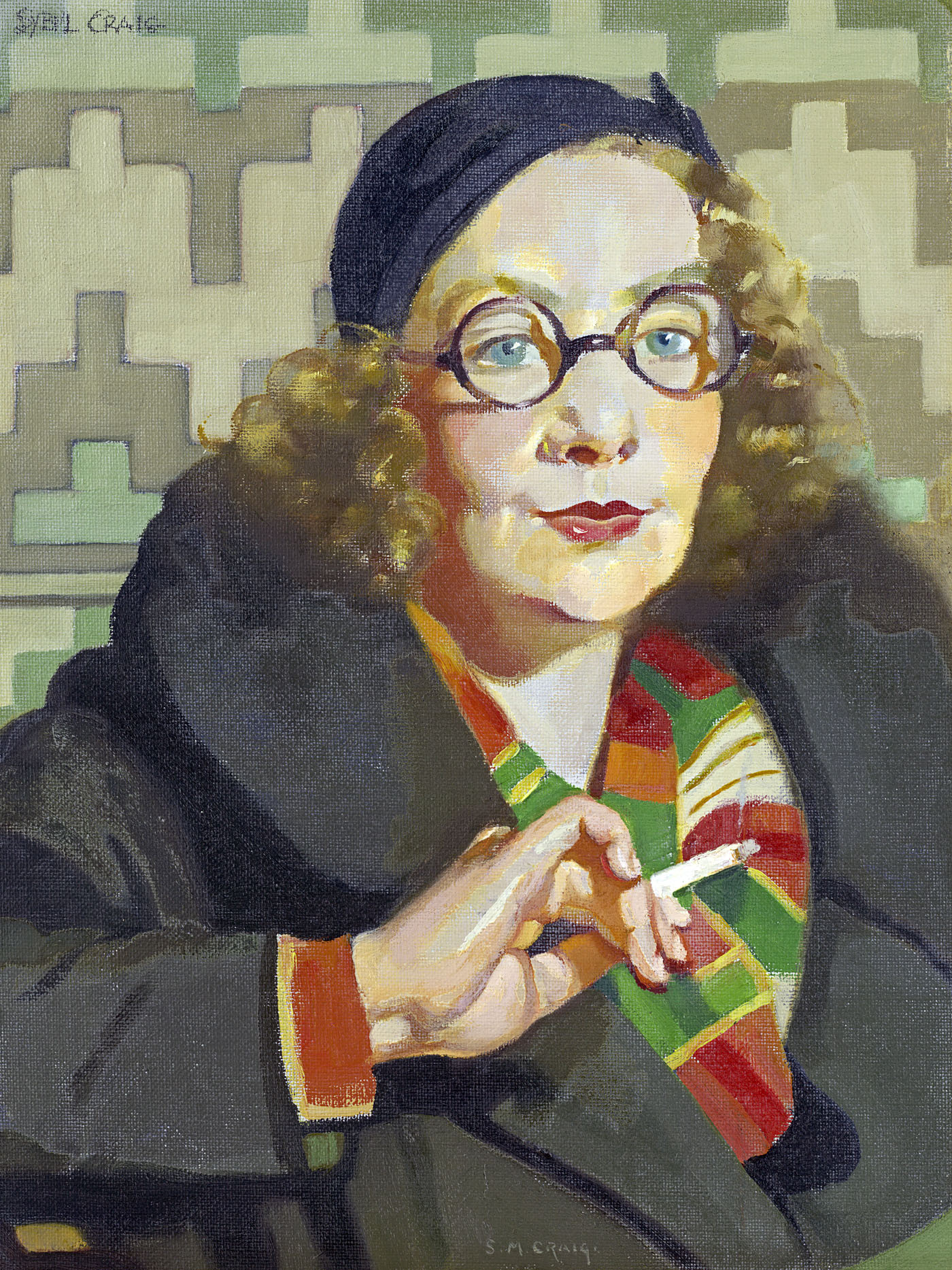
 

Sybil Craig (England 1901 - Australia 1909, Australia from 1902) 'Peggy' c. 1932


Sybil Craig (England 1901 – Australia 1909, Australia from 1902)
Peggy
c. 1932
Oil on canvas
40.4 x 30.4cm
National Gallery of Victoria, Melbourne Purchased, 1978
© The Estate of Sybil Craig


Constance Stokes (Australian, 1906-1991) 'Portrait of a woman in a green dress' 1930 (installation view)


Constance Stokes (Australian, 1906-1991)
Portrait of a woman in a green dress (installation view)
1930
Oil on canvas
National Gallery of Victoria, Melbourne
Bequest of Michael Niall, 2019
Photo: Marcus Bunyan


Installation view of the exhibition 'WHO ARE YOU: Australian Portraiture' at NGV Australia, Federation Square, Melbourne showing at second left, Polly Borland's 'HM Queen Elizabeth II' (2002); at second right, Atong Atem's 'Adut' (2015); and at right, Treahna Hamm's 'Barmah Forest breastplate' (2005)


Installation view of the exhibition WHO ARE YOU: Australian Portraiture at NGV Australia, Federation Square, Melbourne showing at second left, Polly Borland’s HM Queen Elizabeth II (2002, below); at second right, Atong Atem’s Adut (2015, below); and at right, Treahna Hamm’s Barmah Forest breastplate (2005)
Photo: Marcus Bunyan


Polly Borland (Australia, b. 1959, England 1989-2011, United States from 2011) 'HM Queen Elizabeth II' 2002


Polly Borland (Australia, b. 1959, England 1989-2011, United States from 2011)
HM Queen Elizabeth II
2002
Type C photograph on paper
National Portrait Gallery, Canberra
Purchased, 2002
© Polly Borland. Reproduced courtesy of Polly Borland and Anna Schwartz Gallery


Atong Atem (South Sudanese born Ethiopia, b. 1994) 'Adut' 2015, printed 2019


Atong Atem (South Sudanese born Ethiopia, b. 1994)
Adut
2015, printed 2019
From the Studio series 2015
Digital type C print
Image: 59.4 x 84.1cm
Sheet: 63.6 x 92.7cm
ed. 3/10
National Gallery of Victoria, Melbourne
Purchased, Victorian Foundation for Living Australian Artists, 2019
© Atong Atem, courtesy Mars Gallery, Melbourne


‘The Studio series … has developed into an exploration of my blackness and my identity and culture through African cultural iconography, black visual languages, and diasporic traditions represented in the act of posing for a photograph. The photos are traditional, staged studio photographs similar to those found in my family albums and the photo albums of many people in the diaspora – they’re bright, colourful and depict a very precarious moment in African history between traditionalism and cultural changes brought on by colonialism … This Studio series responds to the ethnographic gaze of colonial photographs of black people and speaks to the importance of creating and owning one’s own narrative and depictions.’ ~ Atong Atem, 2019

Wall text from the exhibition


Vincent Namatjira (Australian / Anangu Pitjantjatjara Yankunytjatjara, b. 1983) 'Australia in black and white' 2018 (installation view)

Vincent Namatjira (Australian / Anangu Pitjantjatjara Yankunytjatjara, b. 1983) 'Australia in black and white' 2018 (installation view)


Vincent Namatjira (Australian / Anangu Pitjantjatjara Yankunytjatjara, b. 1983)
Australia in black and white (installation views)
2018
Ink on paper
(a-p) 56.0 x 38.0cm (each)
National Gallery of Victoria, Melbourne
Purchased, Victorian Foundation for Living Australian Artists, 2019
© Vincent Namatjira/Copyright Agency, Australia
Photos: Marcus Bunyan


I’m interested in people and their stories, and how someone from today is connected with the past. I like to paint people who are famous, and paint them here in my community. Painting them in the desert puts them into an unexpected place. Having just a little bit of humour can take the power out of a serious situation, whether something is happening to you right now, or it happened long ago – it lets you be in a little bit of control again, you can get a bit of cheeky revenge. A sense of humour and a paintbrush is a powerful thing.’ ~ Vincent Namatjira

Wall text from the exhibition


Vincent Namatjira (Australian / Anangu Pitjantjatjara Yankunytjatjara, b. 1983) 'Australia in black and white' 2018 (detail)


Vincent Namatjira (Australian / Anangu Pitjantjatjara Yankunytjatjara, b. 1983)
Australia in black and white (detail)
2018
Ink on paper
(a-p) 56.0 x 38.0cm (each)
National Gallery of Victoria, Melbourne
Purchased, Victorian Foundation for Living Australian Artists, 2019
© Vincent Namatjira/Copyright Agency, Australia


Installation view of the exhibition 'WHO ARE YOU: Australian Portraiture' at NGV Australia, Federation Square, Melbourne showing centre on the pedestal, Charles Summers' 'Edmund FitzGibbon and Sarah FitzGibbon' (1877); at left, Howard Arkley's 'Nick Cave' (1999); at second left, Julie Dowling's 'Federation 1901-2001' series (2001) and at second right, Julie Rrap's 'Persona and shadow: Madonna' (1984)


Installation view of the exhibition WHO ARE YOU: Australian Portraiture at NGV Australia, Federation Square, Melbourne showing centre on the pedestal, Charles Summers’ Edmund FitzGibbon and Sarah FitzGibbon (1877); at left, Howard Arkley’s Nick Cave (1999, below); at second left, Julie Dowling’s Federation 1901-2001 series (2001, below and at second right, Julie Rrap’s Persona and shadow: Madonna (1984, below)
Photo: Marcus Bunyan


Julie Dowling (Australian / Badimaya, b. 1969) 'Federation series: 1901-2001' 2001 (installation view)

Julie Dowling (Australian / Badimaya, b. 1969) 'Federation series: 1901-2001' 2001 (installation view)


Julie Dowling (Australian / Badimaya, b. 1969)
Federation series: 1901-2001 (installation views)
2001
synthetic polymer paint, earth pigments, metallic paint and glitter on canvas
(1) 60.3 × 50.5cm (Melbin 1901-1910)
(2) 60.4 × 50.5cm (Uncle Sam 1910-1920)
(3) 60.2 × 50.4cm (Auntie Dot 1920-1930)
(4) 60.3 × 50.5cm (Ruby 1930-1940)
(5) 60.2 × 50.5cm (Mollie 1940-1950)
(6) 60.4 × 50.5cm (George 1950-1960)
(7) 60.3 × 50.4cm (Nan 1960-1970)
(8) 60.3 × 50.4cm (Ronnie 1970-1980)
(9) 60.4 × 50.5cm (Carol 1980-1990)
(10) 60.4 × 50.5cm (Julie 1990-2001)
National Gallery of Victoria, Melbourne
Purchased through the NGV Foundation with the assistance of Rupert Myer, Governor, 2001
© Julie Dowling/Licensed by Copyright Agency, Australia
Photos: Marcus Bunyan


Julie Dowling’s Federation series: 1901-2001 is a series of history paintings produced in response to the Centenary of Federation. The work registers Dowling’s dismay that the Australian Constitution did not included First Nations people when the country was declared a Federation. The narrative cycle of ten canvases, each symbolising a particular diva, presents a profound and multidimensional First Peoples history of the twentieth century. Like a family tree of resilience, the series portrays the faces of ten individual members of Dowling’s family, each affected by policies and events of history.

Wall text from the exhibition


Julie Dowling (Australian / Badimaya, b. 1969) 'Federation series: 1901-2001' 2001


Julie Dowling (Australian / Badimaya, b. 1969)
Federation series: 1901-2001
2001
synthetic polymer paint, earth pigments, metallic paint and glitter on canvas
(1) 60.3 × 50.5cm (Melbin 1901-1910)
(2) 60.4 × 50.5cm (Uncle Sam 1910-1920)
(3) 60.2 × 50.4cm (Auntie Dot 1920-1930)
(4) 60.3 × 50.5cm (Ruby 1930-1940)
(5) 60.2 × 50.5cm (Mollie 1940-1950)
(6) 60.4 × 50.5cm (George 1950-1960)
(7) 60.3 × 50.4cm (Nan 1960-1970)
(8) 60.3 × 50.4cm (Ronnie 1970-1980)
(9) 60.4 × 50.5cm (Carol 1980-1990)
(10) 60.4 × 50.5cm (Julie 1990-2001)
National Gallery of Victoria, Melbourne
Purchased through the NGV Foundation with the assistance of Rupert Myer, Governor, 2001
© Julie Dowling/Licensed by Copyright Agency, Australia


Julie Dowling (Australian / Badimaya, b. 1969) 'Julie' 2001


Julie Dowling (Australian / Badimaya, b. 1969)
Julie
2001
From the Federation series: 1901-2001 2001
synthetic polymer paint, earth pigments, metallic paint and glitter on canvas
60.4 × 50.5cm
National Gallery of Victoria, Melbourne
Purchased through the NGV Foundation with the assistance of Rupert Myer, Governor, 2001
© Julie Dowling/Licensed by Copyright Agency, Australia


Julie Dowling (Australian / Badimaya, b. 1969) 'Nan' 2001 (detail)


Julie Dowling (Australian / Badimaya, b. 1969)
Nan (detail)
2001
From the Federation series: 1901-2001 2001
synthetic polymer paint, earth pigments, metallic paint and glitter on canvas
60.4 × 50.5cm
National Gallery of Victoria, Melbourne
Purchased through the NGV Foundation with the assistance of Rupert Myer, Governor, 2001
© Julie Dowling/Licensed by Copyright Agency, Australia
Photo: Marcus Bunyan


Installation view of the exhibition 'WHO ARE YOU: Australian Portraiture' at NGV Australia, Federation Square, Melbourne showing at second left, Brenda L. Croft's 'Matilda (Ngambri)' (2020); at third right, William Buelow Gould's 'John Eason' (1838); at second right, Augustus Earle's 'Captain Richard Brooks' (1826-1827); and at right, Augustus Earle's 'Mrs Richard Brooks' (1826-1827)


Installation view of the exhibition WHO ARE YOU: Australian Portraiture at NGV Australia, Federation Square, Melbourne showing at second left, Brenda L. Croft‘s Matilda (Ngambri) (2020, below); at third right, William Buelow Gould‘s John Eason (1838); at second right, Augustus Earle‘s Captain Richard Brooks (1826-1827); and at right, Augustus Earle‘s Mrs Richard Brooks (1826-1827)
Photo: Marcus Bunyan


Brenda L. Croft (Anglo-Australian / Gurindji/Malngin/Mudburra, b. 1964) Prue Hazelgrove (wet plate collodion process technical assistant) Richard Crampton (printer) 'Matilda (Ngambri)' 2020 (installation view detail)


Brenda L. Croft (Anglo-Australian / Gurindji/Malngin/Mudburra, b. 1964)
Prue Hazelgrove (wet plate collodion process technical assistant)
Richard Crampton (printer)
Matilda (Ngambri) (installation view detail)
2020
From the Naabami (Thou shall/will see): I am/we are Barangaroo series
Inkjet print (from original tintype, wet plate collodion process) on archival paper, ed. 4/5 + 3 A/P
Image: 119.7 x 90.9cm
Sheet: 140.3 x 99.9cm
National Portrait Gallery, Canberra
Purchased with funds provided by The Calvert-Jones Foundation 2020
© Brenda L. Croft/Copyright Agency, 2022
Photo: Marcus Bunyan


Ngambri woman, Dr Matilda House, is an activist who has dedicated her life to the pursuit of social justice and equity for First Nations peoples since the 1960s. Dr House is renowned for her work in establishing the Aboriginal Legal Service in Queanbeyan and her ongoing support for the Aboriginal Tent Embassy. Using a photographic technique known as a collodion wet plate process, Dr Brenda L. Croft created a powerful series honouring the spirit of Cammeraygal woman, Barangaroo (c. 1750-1791) – one of the Eora Nations earliest influential figures. This portrait of Dr House forms part of the suite, and like Barangaroo, her resilience, cultural authority and fiercely held connection to place continues to inspire many contemporary First Nations women.

Wall text from the exhibition


Brenda L. Croft (Anglo-Australian / Gurindji/Malngin/Mudburra, b. 1964) Prue Hazelgrove (wet plate collodion process technical assistant) Richard Crampton (printer) 'Matilda (Ngambri)' 2020


Brenda L. Croft (Anglo-Australian / Gurindji/Malngin/Mudburra, b. 1964)
Prue Hazelgrove (wet plate collodion process technical assistant)
Richard Crampton (printer)
Matilda (Ngambri)
2020
From the Naabami (Thou shall/will see): I am/we are Barangaroo series
Inkjet print (from original tintype, wet plate collodion process) on archival paper, ed. 4/5 + 3 A/P
Image: 119.7 x 90.9cm
Sheet: 140.3 x 99.9cm
National Portrait Gallery, Canberra
Purchased with funds provided by The Calvert-Jones Foundation 2020
© Brenda L. Croft/Copyright Agency, 2022


Installation view of the exhibition 'WHO ARE YOU: Australian Portraiture' at NGV Australia, Federation Square, Melbourne showing at left, William Buelow Gould's 'John Eason' (1838); at centre, Augustus Earle's 'Captain Richard Brooks' (1826-1827); and at right, Augustus Earle's 'Mrs Richard Brooks' (1826-1827)


Installation view of the exhibition WHO ARE YOU: Australian Portraiture at NGV Australia, Federation Square, Melbourne showing at left, William Buelow Gould‘s John Eason (1838); at centre, Augustus Earle‘s Captain Richard Brooks (1826-1827); and at right, Augustus Earle‘s Mrs Richard Brooks (1826-1827)
Photo: Marcus Bunyan


Installation view of the exhibition 'WHO ARE YOU: Australian Portraiture' at NGV Australia, Federation Square, Melbourne showing at second left background, AñA Wojak's 'Acacius (Stigmata) – Tony Carden' (1991); at centre background, Julie Rrap's 'Persona and shadow: Madonna' (1984); and at centre on pedestal, Charles Summers' 'Edmund FitzGibbon and Sarah FitzGibbon' (1877)


Installation view of the exhibition WHO ARE YOU: Australian Portraiture at NGV Australia, Federation Square, Melbourne showing at second left background, AñA Wojak‘s Acacius (Stigmata) – Tony Carden (1991, below); at centre background, Julie Rrap‘s Persona and shadow: Madonna (1984, below); and at centre on pedestal, Charles SummersEdmund FitzGibbon and Sarah FitzGibbon (1877)
Photo: Marcus Bunyan


Installation view of the exhibition 'WHO ARE YOU: Australian Portraiture' at NGV Australia, Federation Square, Melbourne showing at centre on pedestal, Charles Summers' 'Edmund FitzGibbon and Sarah FitzGibbon' (1877); at centre background, AñA Wojak's 'Acacius (Stigmata) – Tony Carden' (1991); and at right, Julie Rrap's 'Persona and shadow: Madonna' (1984)


Installation view of the exhibition WHO ARE YOU: Australian Portraiture at NGV Australia, Federation Square, Melbourne showing at centre on pedestal, Charles SummersEdmund FitzGibbon and Sarah FitzGibbon (1877); at centre background, AñA Wojak‘s Acacius (Stigmata) – Tony Carden (1991, below); and at right, Julie Rrap‘s Persona and shadow: Madonna (1984, below)
Photo: Marcus Bunyan


AñA Wojak (Australian, b. 1954) 'Acacius (Stigmata) – Tony Carden' 1991 (installation view)


AñA Wojak (Australian, b. 1954)
Acacius (Stigmata) – Tony Carden (installation view)
1991
Oil and gold leaf on cedar panel
Support: 121.5 x 103.0cm
Gift of Lesley Saddington 2015
© AñA Wojak
Photo: Marcus Bunyan


AñA Wojak describes themselves as a ‘cross-disciplinary artist working in performance, painting, assemblage, installation and theatre design, with a particular interest in site-specificity, ritual and altered states’. Born in Australia, they studied in Gdansk, Poland in the period of martial law, attaining a master’s degree in fine arts in 1983. Wojak has been an Archibald finalist twice, a Portia Geach finalist several times and a Sculpture by the Sea finalist four times; they won the Blake Prize for religious art in 2004.

Anthony Carden (1961-1995), activist, studied acting in New York in the early 1980s before returning home to work in theatre, film and television in Sydney and Melbourne. After being diagnosed with AIDS, he joined ACTUP (AIDS Coalition to Unleash Power) and became a lobbyist for better standards of medical care, improved hospital facilities, and effective safe sex education. An activist against discrimination in all its forms, he was a prominent advocate for people living with HIV/AIDS. With Clover Moore, then the Member for Bligh in the New South Wales Legislative Assembly, he helped raise $1 million for the refurbishment of St Vincent’s Hospital’s Ward 17 South, Australia’s first dedicated ward for HIV/AIDS patients. He died five years after his diagnosis.

AñA Wojak met Carden at an ACTUP meeting in 1991, at which time the artist had begun working on a series exploring ideas of sainthood and martyrdom. Wojak painted Carden in the guise of Saint Acacius, an early Christian martyr, as he was ‘someone who was working for the rights of others whilst at the same time suffering himself’. Employing gold leaf and a blue paint derived from lapis lazuli, the work is intended to evoke Byzantine icons and Italian Renaissance altarpieces. The portrait was displayed in Don’t Leave Me This Way: Art in the Age of AIDS at the National Gallery of Australia in 1994-1995; at Carden’s wake; and later in Ward 17 South before being purchased by Carden’s mother, Lesley Saddington.

Text from the National Portrait Gallery, Canberra website Nd updated 2021 [Online] Cited 02/07/2022


AñA Wojak (Australian, b. 1954) 'Acacius (Stigmata) – Tony Carden' 1991


AñA Wojak (Australian, b. 1954)
Acacius (Stigmata) – Tony Carden
1991
Oil and gold leaf on cedar panel
Support: 121.5 x 103.0cm
Gift of Lesley Saddington 2015
© AñA Wojak


Julie Rrap. 'Persona and shadow: Madonna' 1984


Julie Rrap (Australian, b. 1950)
Persona and shadow: Madonna
1984
Cibachrome photograph
Image and sheet: 194.7 × 104.6cm
National Gallery of Victoria, Melbourne
Michell Endowment, 1984
© Julie Rrap


Julie Rrap dissects and subverts conventional visions of women in art history, so often depicted as ‘the Madonna’. This work is from a series called Persona and Shadow in which Rrap responded to her experience of seeing so few women artists represented in major contemporary art shows in Europe during the early 1980s. Rap takes outlines from work by Edvard Munch and incorporates a fractured photographic self-portrait. Her resulting vision personally and powerfully counters the dominant narrative of women in the art world.

Wall text from the exhibition


Installation view of the exhibition 'WHO ARE YOU: Australian Portraiture' at NGV Australia, Federation Square, Melbourne showing at second left, John Citizen's 'Eddie Mabo (after Mike Kelley's 'Booth's Puddle' 1985, from Plato's Cave, Rothko's Chapel, Lincoln's Profile) No. 3' (1996); at third right, TextaQueen's 'Creature from the Black Platoon starring Gary Foley 2011' (2011); and at right, Guido Maestri's 'Geoffrey Gurrumul Yunupingu' (2009)


Installation view of the exhibition WHO ARE YOU: Australian Portraiture at NGV Australia, Federation Square, Melbourne showing at second left, John Citizen’s Eddie Mabo (after Mike Kelley’s ‘Booth’s Puddle’ 1985, from Plato’s Cave, Rothko’s Chapel, Lincoln’s Profile) No. 3 (1996, below); at third right, TextaQueen’s Creature from the Black Platoon starring Gary Foley 2011 (2011, below); and at right, Guido Maestri’s Geoffrey Gurrumul Yunupingu (2009, below)
Photo: Marcus Bunyan


John Citizen (Gordon Bennett, Australian 1955-2014) 'Eddie Mabo (after Mike Kelley's 'Booth's Puddle' 1985, from Plato's Cave, Rothko's Chapel, Lincoln's Profile) No. 3' 1996 (installation view)


John Citizen (Gordon Bennett, Australian 1955-2014)
Eddie Mabo (after Mike Kelley’s ‘Booth’s Puddle’ 1985, from Plato’s Cave, Rothko’s Chapel, Lincoln’s Profile) No. 3 (installation view)
1996
Synthetic polymer paint on canvas
Support: 168.0 x 152.5cm
Purchased with funds provided by L Gordon Darling AC CMG 1999
© Gordon Bennett Estate
Photo: Marcus Bunyan


John Citizen is the artistic alter ego of Australian artist Gordon Bennett (1955-2014), painter and multi-media artist, addressed issues of identity and power in a postcolonial context. Within two years of graduating from the Queensland College of Art in 1988 he was awarded the prestigious Moët and Chandon Fellowship. He had numerous solo exhibitions and was represented in many travelling exhibitions within Australia and overseas. Of indigenous Australian and Anglo-Celtic descent, he was concerned with the use of language in delineating ethnocentric boundaries, viewing his work as ‘history painting’ in that it indicated the ways in which history is constructed after the event. Bennett is represented under both John Citizen and Gordon Bennett in many state, regional and tertiary collections.

Koiki (Eddie) Mabo (1937-1992), Torres Strait Islander man, initiated a legal case for native title against the State of Queensland in 1982. Along with his fellow Meriam people, Mabo was convinced that he owned his family’s land on Murray Island (Mer) in Torres Strait. By contrast, Queensland Crown lawyers argued that on annexation in 1879, all the land had become the property of the Crown. In 1992, the seven Justices of the High Court found 6-1 in favour of Mabo and his co-plaintiffs, overturning the accepted view that Australia had been terra nullius (empty land) before white settlement. Mabo died before the historic decision, which was to lead to the Land Title Act of 1993, and permanently to alter the way Australians think about Aboriginal land ownership.

John Citizen is the artistic alter ego of Australian artist Gordon Bennett (1955-2014). Bennett, who worked under his own name and that of John Citizen, grew up in Nambour, Queensland and only learned of his mother’s Indigenous heritage in his early teens. He went to art school as a mature student. Stating early in his career that ‘the bottom line of my work is coming to terms with my Aboriginality,’ he continued to engage with questions of cultural and personal identity, interrogating Australia’s colonial past and postcolonial present through a succession of allusive postmodern works. He won the John McCaughey Memorial Art Prize of the National Gallery of Victoria in 1997, and the NGV mounted a touring exhibition, Gordon Bennett, in 2007-2008. Bennett said that when he began to think about Eddie Mabo he ‘could not think of him as a real person … I only [knew] the Eddie Mabo of the “mainstream” news media, a very two-dimensional “copy” of the man himself.’ In making his portrait of Mabo, he used a newspaper image and headlines from newspaper articles about the Native Title furore, and combined them with an image by the American artist Mike Kelley. ‘To me the image of Eddie Mabo stood like the eye of a storm,’ Bennett said, ‘calmly asserting his rights while all around him the storm, a war of words and rhetoric, raged.’

Text from the National Portrait Gallery, Canberra website Nd updated 2020 [Online] Cited 02/07/2022


TextaQueen (Australian, b. 1975) 'Creature from the Black Platoon starring Gary Foley 2011' 2011 (installation view)


TextaQueen (Australian, b. 1975)
Creature from the Black Platoon starring Gary Foley 2011 (installation view)
2011
From the series We don’t need another hero
Fibre-tipped pen on paper
Frame: 119.0 x 135.0cm
Sheet: 97.5 x 127.2cm
National Portrait Gallery, Canberra
Purchased, 2011
Photo: Marcus Bunyan


Through a series of fictional movie posters, TextaQueen explores a re-writing of colonial history by subverting roles of power. This work combines film posters to subvert the original leading white film cast, creating a mash-up of Gary Foley as a powerful Blak militia. Foley is a renowned Indigenous activist, known for his involvement in the black Power Movement in Australia, which saw the formation of the Aboriginal Legal Service and Medical Service Redfern in the 1970s to counter the problem of police harassment. Here, TextQueen poses Foley as an outlaw of his post-apocalypse, representing him as a survivor while simultaneously creating a platform for the Indigenous experiences of colonisation and racism to be acknowledged and recognised.

Wall text from the exhibition


Gary Foley (b. 1950) Indigenous activist and historian, has written extensively on Indigenous political movements and maintains the Koori History Website, an intensive history archive and education resource. Of Gumbainggir descent, at seventeen Foley moved from his native Grafton to Sydney. There, inspired by the biography of African-American human rights activist Malcolm X, he was instrumental in establishing Sydney’s Aboriginal Legal Service and Aboriginal Medical Service, and in 1972 he came to the Aboriginal Tent Embassy in Canberra. The first Indigenous Director of the Aboriginal Arts Board, he was Senior Curator for Southeastern Australia at Museum Victoria from 2001 to 2005. Since 2005 Foley has lectured and undertaken postgraduate research at the University of Melbourne.

TextaQueen’s (b. 1975) portrait of Gary Foley is from a series featuring ‘people of colour as outlaws of their post-apocalypse, drawn as if posters for fictional movies. As an artist of colour … I’ve sought out peers from various sociocultural and racial backgrounds to propose characters, costumes, and fictional surrounds to represent themselves as survivors of their Armageddon.’ Gary Foley launched the exhibition of the series in Melbourne.

Text from the National Portrait Gallery, Canberra website Nd [Online] Cited 02/07/2022


Guido Maestri (Australian, b. 1974) 'Geoffrey Gurrumul Yunupingu' 2009 (installation view)


Guido Maestri (Australian, b. 1974)
Geoffrey Gurrumul Yunupingu (installation view)
2009
Oil on linen
National Portrait Gallery, Canberra
Gift of the artist 2011
Donated through the Australian Government’s Cultural Gifts Program
Photo: Marcus Bunyan


Born blind, Geoffrey Gurrumul Yunupingu (1970-2017), was a talented musician with an extraordinary voice. Gurrumul was a self-taught instrumentalist, playing guitar, piano, drunks and yidaki. Growing up on the remote island of Gallwin’ku (Elcho Island), Gurrumul was taught all Yolngu culture in song, dance, art and ceremony. His gentle songs draw reference to these teachings of sacred animals, the sea and seasons, ancestors and reverence for the land. Guido Maestri’s portrait of the musician was created after the artist saw Gurrumul perform in Sydney on New Year’s Eve 2008. Using just one colour and applied by building upon layers of thin oil paint, this portrait plays homage ad respect to one of Australia’s most influential musicians.

Wall text from the exhibition
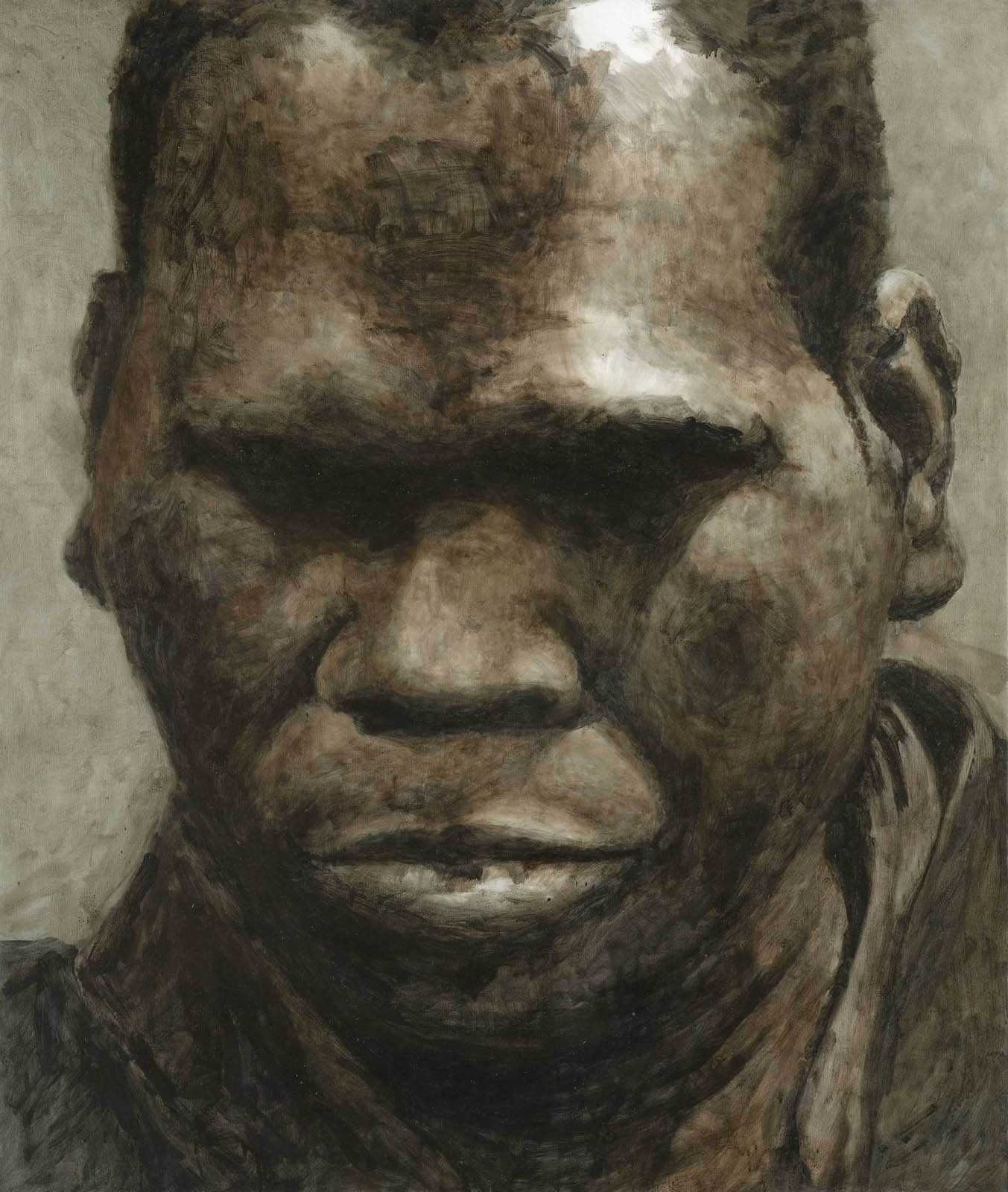
 

Guido Maestri (Australian, b. 1974) 'Geoffrey Gurrumul Yunupingu' 2009


Guido Maestri (Australian, b. 1974)
Geoffrey Gurrumul Yunupingu
2009
Oil on linen
National Portrait Gallery, Canberra
Gift of the artist 2011
Donated through the Australian Government’s Cultural Gifts Program


Ricky Maynard. ‘Arthur, Wik elder’, from the series ‘Returning to places that name us’ 2000


Ricky Maynard (Australian / Big River/Ben Lomond, b. 1953)
Arthur, Wik elder
2000
From the series Returning to places that name us
Gelatin silver photograph
96.1 × 121.3cm irreg.
National Gallery of Victoria, Melbourne
Gift of Milton and Penny Harris, 2007


Ricky Maynard (Australian, b. 1953) 'Gladys Tybingoomba' 2001


Ricky Maynard (Australian / Big River/Ben Lomond, b. 1953)
Wik Elder, Gladys Tybingoomba
2000
From the series Returning to places that name us
Gelatin silver photograph
95.5 × 123.0cm
National Gallery of Victoria, Melbourne
Gift of Milton and Penny Harris, 2007


These intimate portraits of Wik Elders from the community of Aurukun, Far North Queensland, were inspired by the hard-fought battle for custodianship and recognition of the Wik people’s connection to traditional land and waterways. In this image, Maynard documents cultural leader and activist Gladys Tybingoompa, who is remembered today as a prolific figure in the Wik vs Queensland Case and a trailblazer for Indigenous land rights across Australia.

Wall text from the exhibition


Installation view of the exhibition 'WHO ARE YOU: Australian Portraiture' at NGV Australia, Federation Square, Melbourne showing at left, Peter Corlett's 'The connoisseur II' (1984); at second left, Howard Arkley's 'Nick Cave' (1999)


Installation view of the exhibition WHO ARE YOU: Australian Portraiture at NGV Australia, Federation Square, Melbourne showing at left, Peter Corlett’s The connoisseur II (1984); at second left, Howard Arkley’s Nick Cave (1999, below)
Photo: Marcus Bunyan
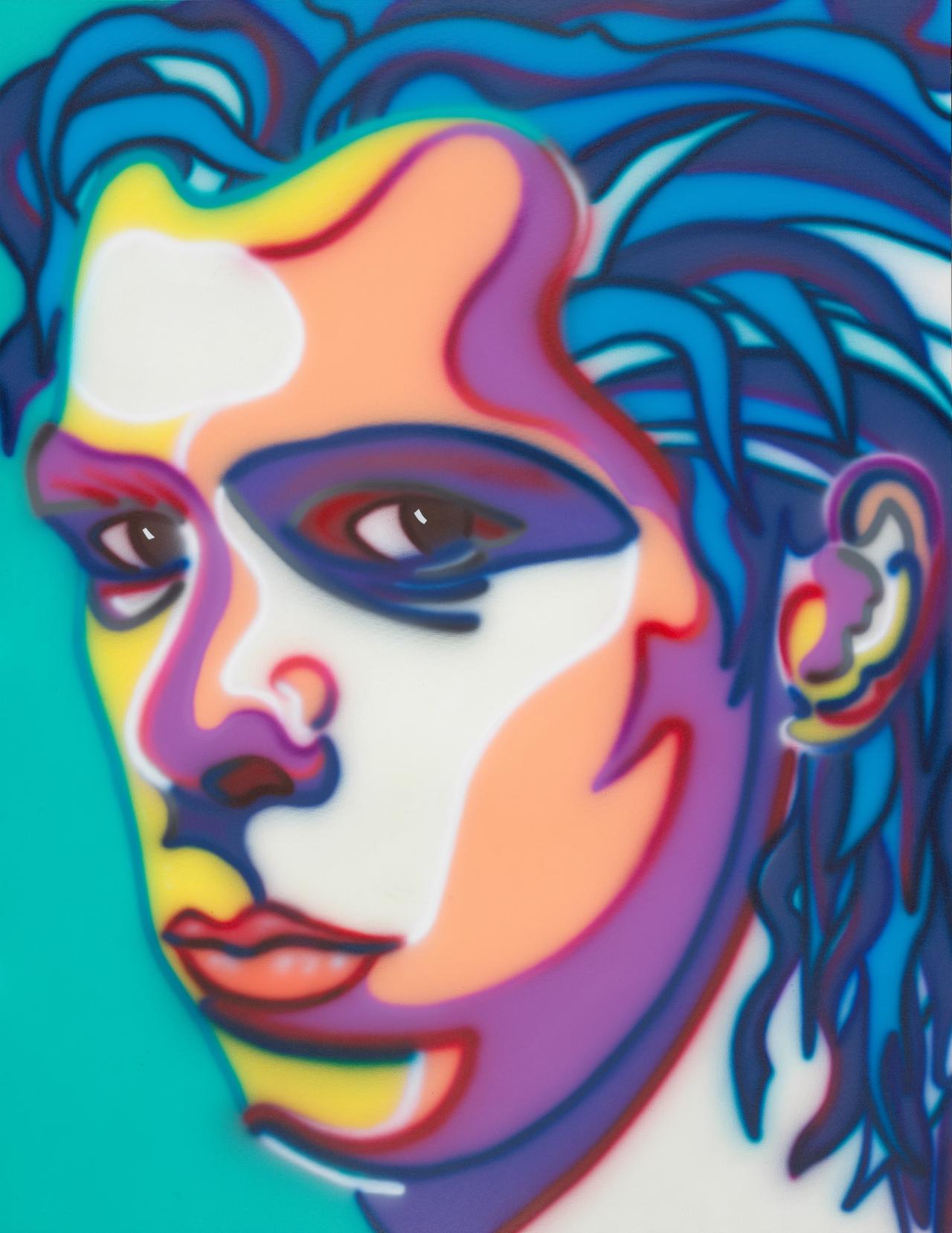
 

Howard Arkley (Australia 1951-1999) 'Nick Cave' 1999


Howard Arkley (Australia 1951-1999)
Nick Cave
1999
Synthetic polymer paint on canvas
175.2 x 135.2 x 4.3cm
National Portrait Gallery, Canberra
Commissioned with funds provided by L Gordon Darling AC CMG 1999
© Estate of Howard Arkley. Licensed by Kalli Rolfe Contemporary Art


Anne Zahalka (Australian, b. 1957) 'The surfers' 1989 (installation view)


Anne Zahalka (Australian, b. 1957)
The surfers (installation view)
1989
Type C photograph
76.4 x 92.5cm
National Gallery of Victoria, Melbourne
Purchased, 1991
© Anne Zahalka/Licensed by Copyright Agency, Australia
Photo: Marcus Bunyan


Anne Zahalka is best known for her photographs that address issues such as racial stereotyping, gender and difference. Using images largely drawn from art historical sources to create elaborately constructed sets, Zahalka’s work raises questions about identity, place and nationhood. The daughter of European immigrants displaced during the war, themes of belonging and national identity are intrinsic to Zahalka’s practice, allowing her to comment on the changing role migration and multiculturalism have had in Australia throughout history. The surfers challenge stereotypical representations of Australian beach-goers, presenting them against a painted backdrop of surf and sand.

Wall text from the exhibition
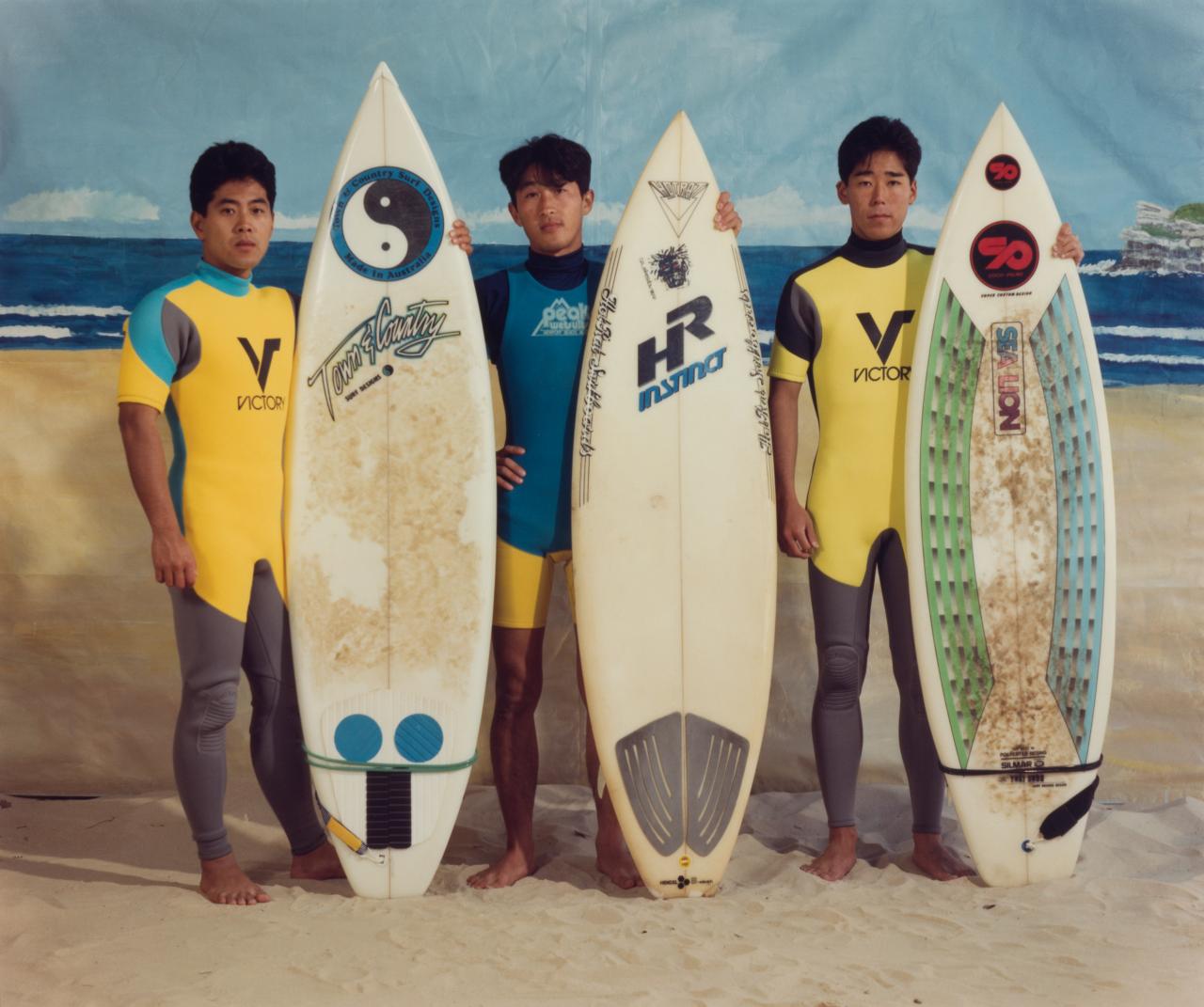
 

Anne Zahalka (Australian, b. 1957) 'The surfers' 1989


Anne Zahalka (Australian, b. 1957)
The surfers
1989
Type C photograph
76.4 x 92.5cm
National Gallery of Victoria, Melbourne
Purchased, 1991
© Anne Zahalka/Licensed by Copyright Agency, Australia


Tracey Moffatt (Australian, b. 1960) 'The Movie Star (David Gulpilil)' 1985


Tracey Moffatt (Australian, b. 1960)
The Movie Star (David Gulpilil)
1985
Type C photograph on paper
Image: 50.7 x 77.3cm
Frame: 74.5 x 99.0cm
Gift of the artist 1998. Donated through the Australian Government’s Cultural Gifts Program
Courtesy of the artist and Roslyn Oxley9 Gallery, Sydney
© Tracey Moffatt


One of Australia’s most acclaimed contemporary artists, Tracey Moffatt grew up in Brisbane and moved to Sydney after studying at the Queensland College of Art. She worked in photography, video and filmmaking, helped establish the Boomalli Aboriginal Artists Cooperative, and was part of the group of creatives engaged in reshaping the representation of First Nations peoples in the visual and performing arts. When Moffatt photographed him in 1985, Yolngu man David Gulpilil AM (1953-2021) had already appeared in several major film and television productions, including Walkabout (1971), Storm Boy (1976), The Last Wave (1977) and The Timeless Land (1980). This portrait of him was shown in NADOC ’86, which Wiradjuri / Kamilaroi artist Michael Riley described as the first exhibition where Aboriginal artists ‘were dictating … how they wanted to show images of their own people.’ Moffatt’s image of Gulpilil lazing at Bondi Beach might seem benignly tongue-in-cheek, but in fact makes an incisive reference to colonialism and the dispossession on which Australia’s supposedly egalitarian, laid-back lifestyle is based.

This work and Moffatt’s portrait of Nunukul and Yugambeh dancer Russell Page (1968-2002) were the first two photographs acquired by the National Portrait Gallery.

Text from the National Portrait Gallery, Canberra website Nd [Online] Cited 02/07/2022


Installation view of the exhibition 'WHO ARE YOU: Australian Portraiture' at NGV Australia, Federation Square, Melbourne showing photographs from Brenda L. Croft's 'A man about town' series 2004


Installation view of the exhibition WHO ARE YOU: Australian Portraiture at NGV Australia, Federation Square, Melbourne showing photographs from Brenda L. Croft’s A man bout town series (2004, below)
Photo: Marcus Bunyan


Brenda L. Croft (Australian / Gurindji/Mutpurra, b. 1965) 'A hostile landscape' 2003, printed 2004 (installation view)


Brenda L. Croft (Australian / Gurindji/Mutpurra, b. 1965)
A hostile landscape (installation view)
2003, printed 2004
From A man about town series 2004
84.0 × 124.8cm
National Gallery of Victoria, Melbourne
Purchased with funds arranged by Loti Smorgon for Contemporary Australian Photography, 2004
Photo: Marcus Bunyan


Brenda Croft stumbled upon the two photographs A hostile landscape and A man about town in 1997, while sorting the material possessions of her late father. As Croft has written, ‘I carried these images around in my mind for the next seven years, returning to them often and wondering about the city and countryscapes, the period in which they were set and the anonymous people in them’. The two photographs show Croft’s father as a solitary figure in the urban landscape. These depictions contrast with typical representations of the ‘businessman’ within society, which portray a white, middle-class man. These photographs also work to reposition prevailing imagery of Aboriginal Australians living purely in remote areas, as opposed to city environments.

Wall text from the exhibition


Brenda L. Croft (Australian / Gurindji/Mutpurra, b. 1965) 'A man about town' 2003


Brenda L. Croft (Australian / Gurindji/Mutpurra, b. 1965)
A man about town
2003, printed 2004
From A man about town series 2004
84.0 × 124.8cm
National Gallery of Victoria, Melbourne
Purchased with funds arranged by Loti Smorgon for Contemporary Australian Photography, 2004


Edward Schafer & Co., Melbourne (retailer) 'Belt buckle' c. 1900


Edward Schafer & Co., Melbourne (retailer)
Belt buckle
c. 1900
15 ct gold, garnets, enamel
(a-b) 6.2 x 8.3 x 1.8cm (overall)
National Gallery of Victoria, Melbourne
The Altmann Collection of Australian Silver
Presented through The Art Foundation of Victoria by John and Jan Altmann, Founder Benefactors, 1986


Michael Riley (Australian / Wiradjuri/Kamilaroi, 1960-2004) 'Maria' 1986, printed 2013


Michael Riley (Australian / Wiradjuri/Kamilaroi, 1960-2004)
Maria
1986, printed 2013
From the Michael Riley Portraits 1984-1990 series
Inkjet print on paper
39.1 x 40.9cm
National Portrait Gallery, Canberra.
Purchased 2013
© Michael Alan Riley/Copyright Agency, 2022
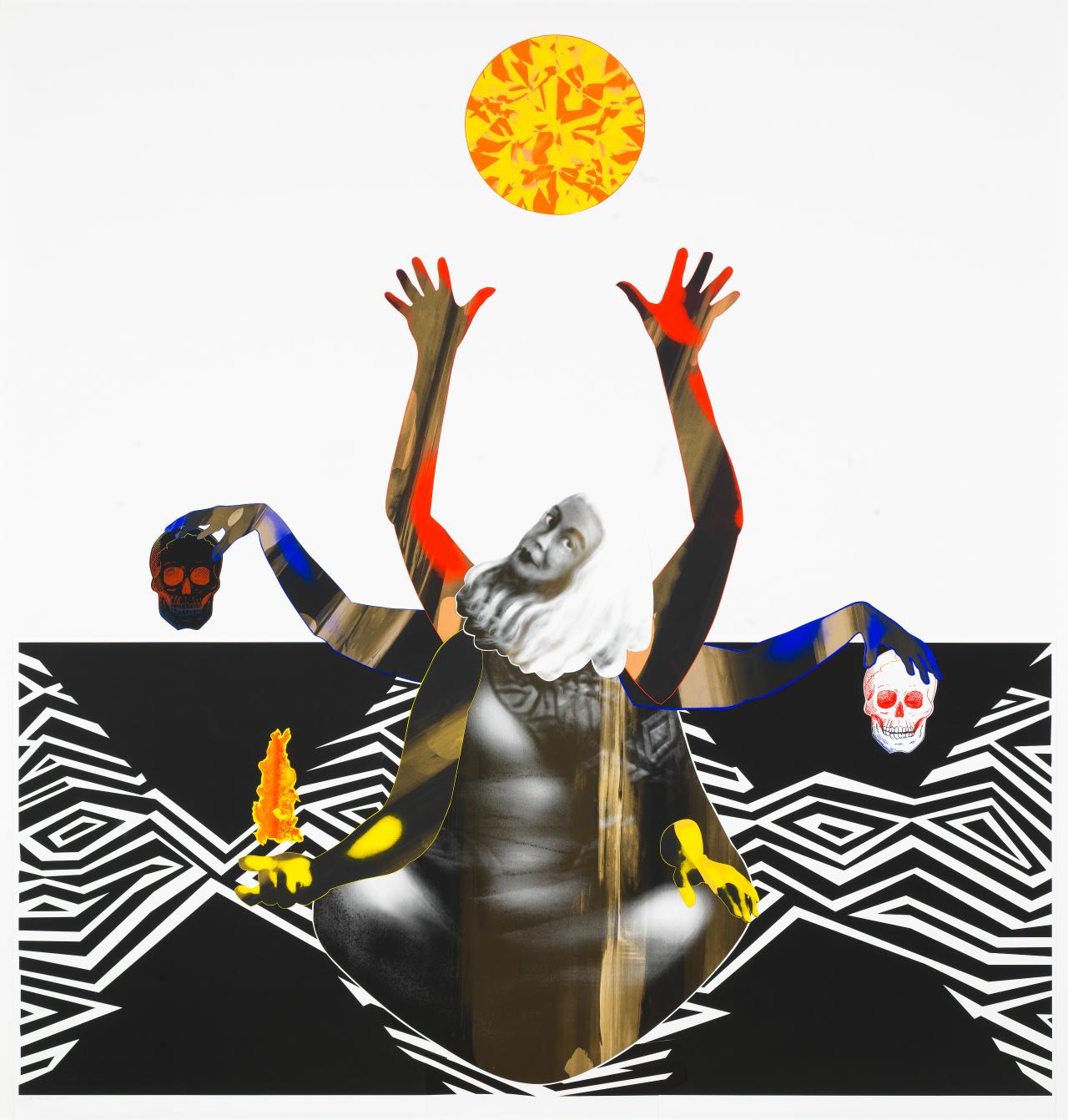
 

Brook Andrew (Australian, b. 1970) Trent Walter (printer) (Australian, b. 1980) 'Marcia Langton' 2009


Brook Andrew (Australian, b. 1970)
Trent Walter (printer) (Australian, b. 1980)
Marcia Langton
2009
Screenprint on paper
252.0 x 242.0 x 7.1cm
National Portrait Gallery, Canberra
Commissioned with funds provided by Marilyn Darling AC 2009
© Brook Andrew/Copyright Agency, 2022


John Nixon (Australian, b. 1949) 'Self Portrait (non-objective composition) (yellow cross)' 1990


John Nixon (Australian, b. 1949)
Self Portrait (non-objective composition) (yellow cross)
1990
Enamel paint on plywood
177.6 x 165.0cm
National Gallery of Victoria, Melbourne
Purchased through The Art Foundation of Victoria with the assistance of Chase Manhattan Overseas Corporation, Fellow, 1991
© Courtesy of the artist


The Ian Potter Centre: NGV Australia
Federation Square
Corner of Russell and 
Flinders Streets, Melbourne

Opening hours:
Daily 10am – 5pm

National Gallery of Victoria website

LIKE ART BLART ON FACEBOOK

Back to top

Exhibition: ‘In Focus: Sound’ at the J. Paul Getty Museum, Los Angeles

Exhibition dates: 28th June – 2nd October, 2022

Curator: Karen Hellman, assistant curator in the Department of Photographs.


Maker unknown (American) 'Phonograph Demonstration' about 1900-1905 from the exhibition 'In Focus: Sound' at the J. Paul Getty Museum, Los Angeles, June-  Oct, 2022


Maker unknown (American)
Phonograph Demonstration
about 1900-1905
Gelatin silver print
27 × 37.1cm (10 5/8 × 14 5/8 in)
Getty Museum


“Sometimes theory leads to an over determination. Something is gained but at a price. Finding images that evoke a sound can only be saved by paying the higher price of remembering how images look when their sound is removed.”

~ Ian Lobb


From my knowledge of photography, I have added further images that I can hear … but not in the exhibition that I know of. You may like to recall other photographs that you could include in the exhibition.

Dr Marcus Bunyan


Many thankx to the J. Paul Getty Museum for allowing me to publish the photographs in the posting. Please click on the photographs for a larger version of the image.


Though photographs are silent, photographers have long conjured sound in their images. Whether depicting crowded urban spaces, musicians performing, people engaged in conversations, or even more abstract depictions of sound, the pictures in this exhibition show photography’s power to communicate beyond the visual. The images date from the 19th century to the recent past, and in each, the audible plays as much of a role as the visual. As you look at these photographs, you are invited to imagine what you might “hear” as well.

Text from the J. Paul Getty Museum website


Florence Henri (American, 1893-1982) 'Columbia Records' 1931 from the exhibition 'In Focus: Sound' at the J. Paul Getty Museum, Los Angeles, June-  Oct, 2022


Florence Henri (American, 1893-1982)
Columbia Records
1931
Gelatin silver print
24.8 × 39.1cm (9 3/4 × 15 3/8 in)
Getty Museum
© Martini & Ronchetti, courtesy Archives Florence Henri


Gjon Mili (American born Albania, 1904-1984) 'Tap Dancer, September 29, 1949' 1949 from the exhibition 'In Focus: Sound' at the J. Paul Getty Museum, Los Angeles, June-  Oct, 2022


Gjon Mili (American born Albania, 1904-1984)
Tap Dancer, September 29, 1949
1949
Gelatin silver print
33.8 × 26cm (13 5/16 × 10 1/4 in)
Getty Museum
© Gjon Mili / The LIFE Picture Collection / Shutterstock


Photographs may be silent, but photographers have long conjured sound in their images.

Whether depicting crowded urban spaces, musicians performing, or people engaged in conversation, the pictures in this exhibition prove photography’s power to communicate beyond the visual.

Drawn from Getty’s permanent collection, In Focus: Sound, on view June 28 through September 2, 2022, unites two sensory perceptions – sight and sound – in photographs that record the visual while also imitating the audible.

“Photography and sound have more in common than one might expect,” says Karen Hellman, curator of the exhibition. “Photographs can evoke a sensory perception that they cannot actually depict. Looking at photographs while thinking about sound could provide a new way of viewing and appreciating photography.”

The 19th century saw a keen scientific and philosophical interest in reproducing ephemeral phenomena. This led to the development of the photograph as well as the phonograph. This interlinked history perhaps explains photography’s connection to sound and why photographers, even subconsciously, have endeavoured to picture it. In each image in this exhibition, which date from the 19th century to the recent past, the audible plays as much of a role as the visual.

This exhibition includes works by known and lesser-known makers from the 19th century to the recent past, including Julia Margaret Cameron, Walker Evans, Man Ray, Graciela Iturbide, Marco Breuer, Naoya Hatakeyama, and Christian Marclay.

In Focus: Sound will be on view June 28 through September 2, 2022, at the Getty Center.

Text from the J. Paul Getty Museum website


Naoya Hatakeyama (Japanese, b. 1958) 'Blast #0608' 1995


Naoya Hatakeyama (Japanese, b. 1958)
Blast #0608
1995
Chromogenic print
Getty Museum
Gift of James N. and Susan A. Phillips
© Naoya Hatakeyama


Man Ray (American, 1890-1976) 'Record' 1933


Man Ray (American, 1890-1976)
Record
1933
Gelatin silver print
28.9 × 22.5cm (11 3/8 × 8 7/8 in)
Getty Museum
© Man Ray Trust ARS-ADAGP


Albert Harlingue (French, 1879-1963) 'Abbot Rousselot's Collection of Tuning Forks' about 1924


Albert Harlingue (French, 1879-1963)
Abbot Rousselot’s Collection of Tuning Forks
about 1924
Gelatin silver print
17.9 × 12.7cm (7 1/16 × 5 in)
Getty Museum


Julia Margaret Cameron (British born India, 1815-1879) 'The Echo' 1868


Julia Margaret Cameron (British born India, 1815-1879)
The Echo
1868
Albumen silver print
27.1 × 22.7cm (10 11/16 × 8 15/16 in)
Getty Museum


Milton Rogovin (American, 1909-2011) 'Storefront Churches' 1958-1961


Milton Rogovin (American, 1909-2011)
Storefront Churches
1958-1961
Gelatin silver print
12.5 × 12cm (4 15/16 × 4 3/4 in.)
Getty Museum
Gift of Dr. John V. and Laura M. Knaus
© Milton Rogovin


Carrie Mae Weems (American, b. 1953) 'Untitled (Musical Score of "God Bless the Child")' 1995


Carrie Mae Weems (American, b. 1953)
Untitled (Musical Score of “God Bless the Child”)
1995
From the series From Here I Saw What Happened and I Cried
Chromogenic print with sandblasted musical notations on frame glass
45.6 × 45.6cm (17 15/16 × 17 15/16 in)
Getty Museum
Gift of Mary and Dan Solomon in honour of Weston Naef
© Carrie Mae Weems


Will Connell (American, 1898-1961) 'Sound' 1936


Will Connell (American, 1898-1961)
Sound
1936
Gelatin silver print
34.2 × 26.7cm (13 7/16 × 10 1/2 in)
Getty Museum
Gift of Trish and Jan de Bont
© Will Connell


Lisette Model (American born Austria, 1901-1983) '[Singer, Sammy's Bar, New York]' about 1940-1944


Lisette Model (American born Austria, 1901-1983)
[Singer, Sammy’s Bar, New York]
about 1940-1944
Gelatin silver print
Getty Museum
© Estate of Lisette Model, courtesy of Baudoin Lebon/Keitelman


“Bowery old-timers claim her voice has had no match for power and ferocity since Maggie Cline used to stun with “Knock ‘Em Down McCloskey”.”

The uncredited text, referring to this photograph of the bar singer known as “Tillie,” accompanied a group of Lisette Model’s photographs made at Sammy’s Bar that were reproduced in the September 1994 Harper’s Bazaar magazine. Taken from below and at a slight diagonal angle, the image captures the vitality and vibrancy of the performer belting it out on the stage at Sammy’s, a local favourite in the Bowery district of New York, also visited by photographers Weegee and Diane Arbus. The angle from which the photograph was made also emphasises the gleaming microphone, which seem to rise up to meet the challenge of projecting Tillie’s already powerful voice.

Text from the J. Paul Getty app


Ralph Eugene Meatyard (American, 1925-1972) 'Untitled ("Motion-Sound" Landscape)' Negative 1969


Ralph Eugene Meatyard (American, 1925-1972)
Untitled (“Motion-Sound” Landscape)
Negative 1969, printed 1974
Gelatin silver print
Gift of Weston J. and Mary M. Naef
©  Estate of Ralph Eugene Meatyard


Christian Marclay (American-Swiss, b. 1955) 'Untitled (Death)' 2020


Christian Marclay (American-Swiss, b. 1955)
Untitled (Death)
2020
Chromogenic print
Courtesy of the artist, and Fraenkel Gallery, San Francisco
© Christian Marclay


Further images that I can hear … but not in the exhibition that I know of (from Marcus)


Tracey Moffatt (Australian, b. 1960) 'The Movie Star (David Gulpilil)' 1985


Tracey Moffatt (Australian, b. 1960)
The Movie Star (David Gulpilil)
1985
Type C photograph on paper
Image: 50.7 x 77.3cm
Frame: 74.5 x 99.0cm
Gift of the artist 1998. Donated through the Australian Government’s Cultural Gifts Program
Courtesy of the artist and Roslyn Oxley9 Gallery, Sydney
© Tracey Moffatt


Marion Kalter (Austrian, b. 1951) 'John Cage chez Dorothea Tanning, Paris' 1979


Marion Kalter (Austrian, b. 1951)
John Cage chez Dorothea Tanning, Paris


Larry Fink (American, 1941-2023) 'Studio 54' 1977


Larry Fink (American, 1941-2023)
Studio 54, New York City
May 1977
Silver gelatin print


Alfred Stieglitz (American, 1864-1946) 'Songs of the Sky' 1924


Alfred Stieglitz (American, 1864-1946)
Songs of the Sky
1924
Gelatin silver print


Alfred Stieglitz (American, 1864-1946) 'Songs of the Sky' 1924


Alfred Stieglitz (American, 1864-1946)
Songs of the Sky
1924
Gelatin silver print


Eva Besnyö (Dutch, 1910-2003) 'Boy With Cello, Balaton, Hungary' 1931


Eva Besnyö (Dutch, 1910-2003)
Boy With Cello, Balaton, Hungary
1931
Gelatin silver print
42.5 x 39.2cm (16.7 x 15.4 in)


Arnold Newman (American, 1918-2006) 'Igor Stravinsky' 1945


Arnold Newman (American, 1918-2006)
Igor Stravinsky
1945
Gelatin silver contact sheet


Santu Mofokeng (South African, b. 1956) 'Opening Song, Hand Clapping and Bells' 1986


Santu Mofokeng (South African, b. 1956)
Opening Song, Hand Clapping and Bells
1986
From the series Train Church
Gelatin silver print
Image: 19 x 28.5cm


Minor White (American, 1908-1976) 'The Sound of One Hand Clapping, Pultneyville, New York' 1957


Minor White (American, 1908-1976)
The Sound of One Hand Clapping, Pultneyville, New York
1957
Gelatin silver print
24.4 x 25.1cm (9 5/8 x 9 7/8 in.)
Purchased in part with funds provided by Daniel Greenberg, Susan Steinhauser, and the Greenberg Foundation
Reproduced with permission of the Minor White Archive, Princeton University Art Museum
© Trustees of Princeton University


Eugène Atget (French, 1857-1927) 'Street diversions (or B organ)' 1898-1899


Eugène Atget (French, 1857-1927)
Street diversions (or B organ)
1898-1899
Albumen print


Walker Evans. 'Church Organ and Pews' 1936


Walker Evans (Walker Evans, 1903-1975)
Church Organ and Pews
1936
Gelatin silver print


Robert Frank. 'Bar, Las Vegas' 1955-1956


Robert Frank (Swiss-American, 1924-2019)
Bar, Las Vegas
1955-1956
Gelatin silver print


Robert Frank (Swiss-American, 1924-2019) 'Political Rally, Chicago' 1956


Robert Frank (Swiss-American, 1924-2019)
Political Rally, Chicago
1956
Gelatin silver print
35.1 x 23.7cm (13 13/16 x 9 5/16 in)


André Kertész (Hungarian, 1894-1985) 'Cellist' 1916


André Kertész (Hungarian, 1894-1985)
Cellist
1916
Gelatin silver print


André Kertész (Hungarian, 1894-1985) 'Violoniste ambulant, Abony' (Traveling violinist, Abony) 1921


André Kertész (Hungarian, 1894-1985)
Violoniste ambulant, Abony
Traveling violinist, Abony
1921
Gelatin silver print


André Kertész (Hungarian, 1894-1985) 'Eiffel Tower, Summer Storm' 1927


André Kertész (Hungarian, 1894-1985)
Eiffel Tower, Summer Storm
1927
Gelatin silver print


Platt D Babbitt. 'Niagara Falls from the American side' whole plate daguerreotype c.1855


Platt D Babbitt (American, 1822-1879)
Niagara Falls from the American side
c. 1855
Whole plate daguerreotype


Platt D. Babbitt. '[Scene at Niagara Falls]' c. 1855


Platt D Babbitt (American, 1822-1879)
[Scene at Niagara Falls]
c. 1855
Daguerreotype


Platt D. Babbitt. 'Niagara Falls', c. 1860


Platt D Babbitt (American, 1822-1879)
Niagara Falls
c. 1860
Daguerreotype


Henri Huet (French, 1927-1971)/AP ''Life' magazine photographer Larry Burrows (far left) struggles through elephant grass and the rotor wash of an American evacuation helicopter as he helps GIs carry a wounded soldier on a stretcher from the jungle to the chopper in Mimot, Cambodia' 4 May 1970


Henri Huet (French, 1927-1971)/AP
‘Life’ magazine photographer Larry Burrows (far left) struggles through elephant grass and the rotor wash of an American evacuation helicopter as he helps GIs carry a wounded soldier on a stretcher from the jungle to the chopper in Mimot, Cambodia
4 May 1970
Gelatin silver print


Henri Huet, French (1927-1971) 'The body of an American paratrooper killed in action in the jungle near the Cambodian border is raised up to an evacuation helicopter, Vietnam' 1966


Henri Huet (French, 1927-1971)
The body of an American paratrooper killed in action in the jungle near the Cambodian border is raised up to an evacuation helicopter, Vietnam
1966
Gelatin silver print


James Barnor (Ghanian, b. 1929) 'E. K. Nyame, the legendary Ghanaian musician, photographed for a record cover, Accra' c. 1975


James Barnor (Ghanian, b. 1929)
E. K. Nyame, the legendary Ghanaian musician, photographed for a record cover, Accra
c. 1975
Gelatin silver print


Roger Scott (Australian, b. 1944) 'Ghost train' 1972


Roger Scott (Australian, b. 1944)
Ghost train
1972
Gelatin silver print


Diane Arbus. ‘The House of Horrors’ 1961


Diane Arbus (American, 1923-1971)
The House of Horrors
1961
Gelatin silver print


Diane Arbus (American, 1923-1971) 'A child crying, N.J.' 1967


Diane Arbus (American, 1923-1971)
A child crying, N.J.
1967
Gelatin silver print


Stephen Shore (American, b. 1947) 'Lookout Hotel, Ogunquit, Maine, July 16, 1974'


Stephen Shore (American, b. 1947)
Lookout Hotel, Ogunquit, Maine, July 16, 1974
1974
Chromogenic colour print, printed 2013
17 × 21 3/4 in. (43.2 × 55.2cm)
The Museum of Modern Art, New York
Acquired through the generosity of an anonymous donor
© 2017 Stephen Shore


Gordon Parks (American, 1912-2006) 'Shooting Victim in Cook County Morgue, Chicago, Illinois' 1957


Gordon Parks (American, 1912-2006)
Shooting Victim in Cook County Morgue, Chicago, Illinois
1957
Pigmented inkjet print, printed 2019
11 7/8 × 17 15/16″ (30.1 × 45.6cm)
The Museum of Modern Art, New York
The Family of Man Fund
© 2021 Gordon Parks Foundation


Robert H. Jackson (American, b. 1934) 'FATAL BULLET HITS OSWALD. Jack Ruby fires bullet point blank into the body of Lee Harvey Oswald at Dallas Police Station. Oswald grimaces in agony' November 24, 1963


Robert H. Jackson (American, b. 1934)
FATAL BULLET HITS OSWALD. Jack Ruby fires bullet point blank into the body of Lee Harvey Oswald at Dallas Police Station. Oswald grimaces in agony
November 24, 1963


Robert H. Jackson (American, b. 1934) 'Jack Ruby (52) shoots Lee Harvey Oswald (24) 24 November 1963' 1963


Robert H. Jackson (American, b. 1934)
Jack Ruby (52) shoots Lee Harvey Oswald (24)
24 November 1963


Originally published in the Dallas Times Herald, November 25, 1963. Cropped from the source image to the portion that was published in 1963. Winner of the 1964 Pulitzer Prize for Photography.


Unknown photographer. 'Survivors of the atomic bomb attack of Nagasaki walk through the destruction as fire rages in the background Aug. 9 1945'


Unknown photographer
Survivors of the atomic bomb attack of Nagasaki walk through the destruction as fire rages in the background Aug. 9 1945
1945


John Williams (1933- 2016) 'Open Air Shower, Bronte Beach' 1964


John Williams (Australian, 1933-2016)
Open Air Shower, Bronte Beach
1964
Gelatin silver print


Dorothea Lange (American, 1895-1965) 'Man Stepping from Cable Car, San Francisco' 1956


Dorothea Lange (American, 1895-1965)
Man Stepping from Cable Car, San Francisco
1956
Gelatin silver print


Ansel Adams (American, 1902-1984) 'Upper Yosemite Fall' 1946


Ansel Adams (American, 1902-1984)
Upper Yosemite Fall
1946
Gelatin silver print


Ansel Adams (American, 1902-1984) 'Nevada Fall Profile' 1946


Ansel Adams (American, 1902-1984)
Nevada Fall Profile
1946
Gelatin silver print


Kaho Yu (Australian) 'Untitled' from the series 'Infinitesimal Residual Vibration of An Unknown Sound' 2009-2011


Kaho Yu (Australian)
Untitled from the series Infinitesimal Residual Vibration of An Unknown Sound
2009-2011


Kaho Yu (Australian) 'Untitled' from the series 'Infinitesimal Residual Vibration of An Unknown Sound' 2009-2011


Kaho Yu (Australian)
Untitled from the series Infinitesimal Residual Vibration of An Unknown Sound
2009-2011


The photographs in this series were taken during a period when I was feeling existentially bored. Instead of distracting myself with activities and accumulating new sensations, I decided to “look” at boredom, to study, and perhaps to understand it. The most natural strategy was to observe the immediate environments where my daily activities take place – train stations, cubicles, copy machines room, etc. I carried a medium format camera on a tripod and spent the odd hours wandering alone through those familiar spaces.

My “study” did not lead me to any revelation or answer. Instead, I found myself spending a lot of time waiting in a long silence, between the opening and the closing of the camera shutter.

Charles Babbage, a scientist in 1837, postulated that every voice and sound, once imparted on the air particles, does not dissipate but remains in the diffused movements of all the particles in the atmosphere. Thus, there might one day come a person equipped with the right mathematical knowledge of these motions who will be able to capture the infinitesimal vibrations and to trace back to their ultimate source.

Taking a long exposure, letting the light slowly accumulate an image on the celluloid surface, to me, is not unlike a sound seeker searching in the air particles, for the tiny residual movements that have been conveyed through the history of mankind, from the beginning of time.

Kaho Yu artist statement


… i listen to the wind that obliterates my traces


… i listen to the wind that obliterates my traces brings together a collection of early photographs related to music, a group of 78rpm recordings, and short excerpts from various literary sources that are contemporary with the sound and images. It is a somewhat intuitive gathering, culled from artist Steve Roden’s collection of thousands of vernacular photographs related to music, sound, and listening. The subjects range from the PT Barnum-esque Professor McRea – “Ontario’s Musical Wonder” (pictured with his complex sculptural one man band contraption) – to anonymous African-American guitar players and images of early phonographs. The images range from professional portraits to ethereal, accidental, double exposures – and include a range of photographic print processes, such as tintypes, ambrotypes, cdvs, cabinet cards, real photo postcards, albumen prints, and turn-of-the-century snapshots.

The two CDs display a variety of recordings, including one-off amateur recordings, regular commercial releases, and early sound effects records. there is no narrative structure to the book, but the collision of literary quotes (Hamsun, Lagarkvist, Wordsworth, Nabokov, etc.). Recordings and images conspire towards a consistent mood that is anchored by the book’s title, which binds such disparate things as an early recording of an American cowboy ballad, a poem by a Swedish Nobel laureate, a recording of crickets created artificially, and an image of an itinerant anonymous woman sitting in a field, playing a guitar. The book also contains an essay by Roden.

Text from the Dust to Digital website Nd [Online] Cited 23/07/2022. Published by Dust-to-Digital, 2011. The book is out of stock but available on Abe.com website.


'... i listen to the wind that obliterates my traces' book cover (2011)


… i listen to the wind that obliterates my traces book cover (2011)


The J. Paul Getty Museum
1200 Getty Center Drive
Los Angeles, California 90049

Opening hours:
Daily 10am – 5pm

The J. Paul Getty Museum website

LIKE ART BLACK ON FACEBOOK

Back to top

Exhibition: ‘Masculinities: Liberation through Photography’ at the Barbican Art Gallery, London

Exhibition dates: 20th February – 17th May 2020? Coronavirus

Participating artists: Bas Jan Ader, Laurie Anderson, Kenneth Anger, Knut Åsdam, Richard Avedon, Aneta Bartos, Richard Billingham, Cassils, Sam Contis, John Coplans, Jeremy Deller, Rienke Dijkstra, George Dureau, Thomas Dworzak, Hans Eijkelboom, Fouad Elkoury, Rotimi Fani-Kayode, Hal Fischer, Samuel Fosso, Anna Fox, Masahisa Fukase, Sunil Gupta, Peter Hujar, Liz Johnson Artur, Isaac Julien, Kiluanji Kia Henda, Karen Knorr, Deana Lawson, Hilary Lloyd, Robert Mapplethrope, Peter Marlow, Ana Mendieta, Anenette Messager, Duane Michals, Tracey Moffat, Andrew Moisey, Richard Mosse, Adi Nes, Catherine Opie, Elle Pérez, Herb Ritts, Kalen Na’il Roach, Collier Schorr, Paul Mpagi Sepuya, Clarie Strand, Michael Subotzky, Larry Sultan, Hank Willis Thomas, Wolfgang Tillmans, Piotr Uklański, Andy Warhol, Karlheinz Weinberger, Marianne Wex, David Wojnarowicz, Akram Zaatari.


Sunil Gupta (Indian, b. 1953) 'Untitled #22' 1976 from the exhibition 'Masculinities: Liberation through Photography' at the Barbican Art Gallery, London, Feb - May, 2020


Sunil Gupta (Indian, b. 1953)
Untitled #22
1976
From the series Christopher Street
Courtesy the artist and Hales Gallery
© Sunil Gupta. All Rights Reserved, DACS 2019


“As a writer Berger recognised that experience – whether it be personal, historical or aesthetic – will never conform to theories and systems. To read him today is to accept his failures and detours as a unique willingness to take risks.”


John MacDonald. “John Berger,” in the Sydney Morning Herald, 6 June, 2020


D-Construction: deliberate masculinities in a discontinuous world

Reviewers of this exhibition (see quotations below) have noted the preponderance of images of “traditional masculinity” – defined as “idealised, dominant (and) heterosexual” – and the paucity of images that show men as working, intelligent, sensitive human beings, “that men ever earned a living, cooked a meal or read a book… scarcely anything about the heart or intellect. Men are represented here almost entirely in terms of their bodies, sexuality or supposed type.” I need make no further comment. What I will say is that I believe the title of the exhibition to be a misnomer: a person cannot be “liberated” through photography, for photography is only a tool of a personal liberation. Liberation comes through an internal struggle of acceptance (thence liberation), one that is foremost FELT (for example, the double life one leads before you acknowledge that you are gay; or experiencing discrimination aimed at others and by proxy, yourself) and SEEN (the bashing of a mother as seen by a small child). Photographs picture the outcomes of this struggle for liberation, are a tool of that process not, I would argue, liberation itself.

What I can say is that I believe in masculinities, plural. Fluid, shifting, challenging, loving, working, intimate, spiritual masculinities that challenge normalcy and hegemonic masculinity, which is defined as “a practice that legitimises men’s dominant position in society and justifies the subordination of the common male population and women, and other marginalised ways of being a man.”

What I don’t believe in is masculinities, plural, that seek to fit into this [dis]continuous world (for we are born and then die) through the stability of their outward appearance, conforming to theories and systems – personal, historical or aesthetic – without reference to subversion, small intimacies, the toil of work, love and the passion of sexual bodies. In other words, masculinities that are not afraid to push the boundaries of being and becoming. To take risks, to experience, to feel.

While I was overjoyed at the “YES” vote on gay marriage that took place in December 2017 in Australia because I felt it was a victory for love, and equality… another part of me rejected as anathema the concept of a gay person buying into a historically patriarchal, heterosexual and monogamous institution such as marriage – too honour and obey. This is an untenable concept for a person who wants to be liberated. Coming out as I did in 1975, only 6 short years after the Stonewall Riots, the last thing I EVER wanted to be, was to be the same as a “straight” person. I was different. I fought for my difference and still believe in it.

Of course, in 2020 it’s another world. Today we all mix in together. But there is still something about “masculinities”, which in some varieties, have a sense of privilege and entitlement. Of power and control over others; of violence towards women, trans, other men and anyone who threatens their little ego, who leaves them, or jilts them. Their jealousy, their ego, bruised – they are so insecure, so insular, that they can only see their own world, their own minuscule problems (but massive in their eyes), and enforce their will on others.

My advice to “masculinities’, in fact any human being, is to go out, get yourself informed, experience, accept, and be the person that nobody thinks you can be. Be a human being. Examine your inner self, look at your dark side, your other side, your empathetic side, and try and understand the journey that you are on. Then, and only then, you might begin on that great path of personal enlightenment, that golden path on which there is no turning back.

Below I discuss some of these ideas with my good friend Nicholas Henderson, curator and archivist at the Australian Lesbian and Gay Archives.


Dr Marcus Bunyan


Many thankx to the Barbican Art Gallery for allowing me to publish the photographs in the posting. Please click on the photographs for a larger version of the image.


Masculinities: Liberation through Photography is a major group exhibition that explores how masculinity is experienced, performed, coded and socially constructed as expressed and documented through photography and film from the 1960s to the present day.

Through the medium of film and photography, this major exhibition considers how masculinity has been coded, performed, and socially constructed from the 1960s to the present day. Examining depictions of masculinity from behind the lens, the Barbican brings together the work of over 50 international artists, photographers and filmmakers including Laurie Anderson, Sunil Gupta, Rotimi Fani-Kayode, Isaac Julien and Catherine Opie.

In the wake of #MeToo the image of masculinity has come into sharper focus, with ideas of toxic and fragile masculinity permeating today’s society. This exhibition charts the often complex and sometimes contradictory representations of masculinities, and how they have developed and evolved over time. Touching on themes including power, patriarchy, queer identity, female perceptions of men, hypermasculine stereotypes, tenderness and the family, the exhibition shows how central photography and film have been to the way masculinities are imagined and understood in contemporary culture.


In fact, while there are a few gender-fluid figures here, they’re vastly outnumbered by manifestations of “traditional masculinity” – defined as “idealised, dominant (and) heterosexual”. Lebanese militiamen (in Fouad Elkoury’s perky full-length portraits from 1980), US marines (in Wolfgang Tillmans’ epic montage Soldiers – The Nineties), Taliban fighters, SS generals, Israel Defence Force grunts, footballers, cowboys and bullfighters fairly spring out of the walls from every direction. And what’s evident from the outset isn’t so much their diversity, as a unifying demeanour: a threatening intentness that comes wherever men are asked to perform their masculinity, but also a childlike vulnerability.  …

Masculinity, the viewer is made to feel, criminalises men (Mikhael Subotzky’s images of South African gangsters on morgue slabs); isolates them (Larry Sultan’s poignant image of his elderly father practising his golf swing in his sitting room); renders them stupid (Richard Billingham’s excruciating, but now classic photo essay on his alcoholic father, ‘Ray’s a Laugh’). To be a man, it seems, is to be condemned to endlessly act out archetypal “masculine” behaviour, whether you’re an elderly drunk in a Birmingham high-rise or the elite American students taking part in the shouting competition staged by Irish photographer Richard Mosse.


Mark Hudson. “Does the Barbican’s Masculinities exhibition have important things to say about men?” on the Independent website Friday 21 February 2020 [Online] Cited 03/03/2020


There is not much here about work – unless you count the wall of Hollywood actors playing Nazis. You would never think, from this show, that men ever earned a living, cooked a meal or read a book (though there is a sententious vitrine of ‘Men Only’ magazines). Beyond the exceptions given, there is scarcely anything about the heart or intellect. Men are represented here almost entirely in terms of their bodies, sexuality or supposed type.


Laura Cumming. “Masculinities: Liberation Through Photography review – men as types,” on the Guardian website Sun 23 Feb 2020 [Online] Cited 03/03/2020


“The body can be taken as a reflection of the self because it can and should be treated as something to be worked upon … in order to produce it as a commodity. Overweight, slovenliness and even unfashionability, for example, are now moral disorders,” notes Don Slater

“The state of the body is seen as a reflection of the state of its owner, who is responsible for it and could refashion it. The body can be taken as a reflection of the self because it can and should be treated as something to be worked upon, and generally worked upon using commodities, for example intensively regulated, self-disciplined, scrutinized through diets, fitness regimes, fashion, self-help books and advice, in order to produce it as a commodity. Overweight, slovenliness, and even unfashionability, for example, are now moral disorders; even acute illnesses such as cancer reflect the inadequacy of the self and indeed of its consumption. One gets ill because one has consumed the wrong (unnatural) things and failed to consume the correct (‘natural’) ones: self, body, goods and environment constitute a system of moral choice.”


Slater, Don. Consumer Culture and Modernity. London: Polity Press, 1997, p. 92.


Installation view of 'Masculinities: Liberation through Photography' at Barbican Art Gallery on February 19, 2020 in London, England showing John Coplans' work 'Self-portrait, Frieze No 2, Four Panels' 1994

Installation view of 'Masculinities: Liberation through Photography' at Barbican Art Gallery on February 19, 2020 in London, England showing John Coplans' work 'Self-portrait, Frieze No 2, Four Panels' 1994


Installation view of Masculinities: Liberation through Photography at Barbican Art Gallery on February 19, 2020 in London, England showing John Coplans’ work Self-portrait, Frieze No 2, Four Panels 1994
Photo: Tristan Fewings/Getty Images for Barbican Art Gallery


John Coplans (British, emigrated America 1960, 1920-2003) 'Self-portrait, Frieze No 2, Four Panels' 1994 from the exhibition 'Masculinities: Liberation through Photography' at the Barbican Art Gallery, London, Feb - May, 2020


John Coplans (British, emigrated America 1960, 1920-2003)
Self-portrait, Frieze No 2, Four Panels
1994
Tate
Presented by the American Fund for the Tate Gallery 2001
Photograph: © John Coplans Trust


Masculinities: Liberation through Photography


Plan of the 'Masculinities: Liberation through Photography' exhibition spaces


Plan of the Masculinities: Liberation through Photography exhibition spaces


Introduction

Masculinities: Liberation through Photography explores the diverse ways masculinity has been experienced, performed, coded and socially constructed in photography and film from the 1960s to the present day.

Simone de Beauvoir’s famous declaration that ‘one is not born a woman, but rather becomes one’ provides a helpful springboard for considering what it means to be a male in today’s world, as well as the place of photography and film in shaping masculinity. What we have thought of as ‘masculine’ has changed considerably throughout history and within different cultures. The traditional social dominance of the male has determined a gender hierarchy which continues to underpin societies around the world.

In Europe and North America, the characteristics and power dynamics of the dominant masculine figure – historically defined by physical size and strength, assertiveness and aggression – though still pervasive today, began to be challenged and transformed in the 1960s. Amid a climate of sexual revolution, struggle for civil rights and raised class consciousness, the growth of the gay rights movement, the period’s counterculture and opposition to the Vietnam War, large sections of society argued for a loosening of the straitjacket of narrow gender definitions.

Set against the backdrop of the #MeToo movement, when manhood is under increasing scrutiny and terms such as ‘toxic’ and ‘fragile’ masculinity fill endless column inches, an investigation of this expansive subject is particularly timely, especially given current global politics characterised by male world leaders shaping their image as ‘strong’ men.

Touching on queer identity, race, power and patriarchy, men as seen by women, stereotypes of dominant masculinity as well as the family, the exhibition presents masculinity in all its myriad forms, rife with contradictions and complexities. Embracing the idea of multiple ‘masculinities’ and rejecting the notion of a singular ‘ideal man’, the exhibition argues for an understanding of masculinity liberated from societal expectations and gender norms.

Room 1-4

Disrupting the Archetype

Over the last six decades, artists have consistently sought to destabilise the narrow definitions of gender that determine our social structures in order to encourage new ways of thinking about identity, gender and sexuality. ‘Disrupting the Archetype’ explores the representation of conventional and at times clichéd masculine subjects such as soldiers, cowboys, athletes, bullfighters, body builders and wrestlers. By reconfiguring the representation of traditional masculinity – loosely defined as an idealised, dominant heterosexual masculinity – the artists presented here challenge our ideas of these hypermasculine stereotypes.

Across different cultures and spaces, the military has been central to the construction of masculine identities – which has been explored through the work of Wolfgang Tillmans (below) and Adi Nes (below) among others, while Collier Schorr (below) and Sam Contis’s powerful works (below) address the dominant and enduring representation of the lone cowboy. Athleticism, often perceived as a proxy for strength which is associated with masculinity, is called into question by Catherine Opie’s and Rineke Dijkstra’s tender portraits (below). The male body, a cornerstone for artists such as John Coplans (above), Robert Mapplethorpe and Cassils (below), is meanwhile exposed as a fleshy canvas, constantly in flux.

Historically, the non-western male body has undergone a complex process of subjectification through the Western gaze – invariably presented as either warlike or sexually charged. Viewed against this context, the work of Fouad Elkoury and Akram Zaatari, as well as the found photographs of Taliban fighters that Thomas Dworzak discovered in Afghanistan (below), can be read as deconstructing the Orientalist gaze.


Installation view of 'Masculinities: Liberation through Photography' at Barbican Art Gallery on February 19, 2020 in London, England showing a detail from Wolfgang Tillmans' epic montage 'Soldiers – The Nineties'


Installation view of Masculinities: Liberation through Photography at Barbican Art Gallery on February 19, 2020 in London, England showing a detail from Wolfgang Tillmans’ epic montage Soldiers – The Nineties
Photo: Tristan Fewings/Getty Images for Barbican Art Gallery


Installation view of 'Masculinities: Liberation through Photography' at Barbican Art Gallery on February 19, 2020 in London, England showing a detail from trans masculine artist Cassils' series 'Time Lapse' 2011


Installation view of Masculinities: Liberation through Photography at Barbican Art Gallery on February 19, 2020 in London, England showing a detail from trans masculine artist Cassils’ series Time Lapse, 2011
Photo: Tristan Fewings/Getty Images for Barbican Art Gallery


Installation view of 'Masculinities: Liberation through Photography' at Barbican Art Gallery on February 19, 2020 in London, England showing at left a detail from trans masculine artist Cassils' series 'Time Lapse' 2011, and at right the work of Rineke Dijkstra


Installation view of Masculinities: Liberation through Photography at Barbican Art Gallery on February 19, 2020 in London, England showing at left a detail from trans masculine artist Cassils’ series Time Lapse, 2011, and at right the work of Rineke Dijkstra
Photo: Tristan Fewings/Getty Images for Barbican Art Gallery


Rineke Dijkstra (Dutch, b. 1959) 'Montemor, Portugal, May 1, 1994' 1994


Rineke Dijkstra (Dutch, b. 1959)
Montemor, Portugal, May 1, 1994
1994
Chromogenic print
90 x 72cm
© Rineke Dijkstra


Rineke Dijkstra (Dutch, b. 1959) 'Vila Franca de Xira, Portugal, May 8, 1994' 1994


Rineke Dijkstra (Dutch, b. 1959)
Vila Franca de Xira, Portugal, May 8, 1994
1994
Chromogenic print
90 x 72cm
© Rineke Dijkstra


Installation view of 'Masculinities: Liberation through Photography' at Barbican Art Gallery on February 19, 2020 in London, England showing photographs from Adi Nes' series 'Soldiers' 1999


Installation views of Masculinities: Liberation through Photography at Barbican Art Gallery on February 19, 2020 in London, England showing photographs from Adi Nes’ series Soldiers, 1999
Photo: Tristan Fewings/Getty Images for Barbican Art Gallery


Adi Nes (Israeli, b. 1966) 'Untitled' 2000


Adi Nes (Israeli, b. 1966)
Untitled
2000
From the series Soldiers
Courtesy Adi Nes & Praz-Delavallade Paris, Los Angeles


Adi Nes (Israeli, b. 1966) 'Untitled' 1999


Adi Nes (Israeli, b. 1966)
Untitled
1999
From the series Soldiers
Courtesy Adi Nes & Praz-Delavallade Paris, Los Angeles


Adi Nes was born in Kiryat Gat. His parents are Jewish immigrants from Iran. He is openly gay. Nes is notable for series “Soldiers”, in which he mixes masculinity and homoerotic sexuality, depicting Israeli soldiers in a fragile way.

Nes creates cinematic images that reference war, sexuality, life, and death with the kind of stylised polish you might expect from a photographer whose images have appeared in the pages of Vogue Hommes. His partially autobiographical work is deliberate and staged in an attempt to raise questions about sexuality, masculinity and identity in Israeli culture. “The beginning point of my art is who I am,” he says. “Since I’m a man and I’m an Israeli, I deal with issues of identity with ‘Israeli-ness’ and masculinity, but my photographs are multi-layered.”

“The challenge of the photographer is to catch the viewer for more than one second in front of the picture,” says Nes, explaining his provocative images. “If you catch the viewer in front of the picture, it can touch the viewer.”

Anonymous text “Adi Nes on masculinity, sexuality and war,” from the Phaidon website 2012 [Online] Cited 07/03/2020


Thomas Dworzak (Germany, b. 1972) 'Taliban portraits' 2002

Thomas Dworzak (Germany, b. 1972) 'Taliban portraits' 2002


Thomas Dworzak (Germany, b. 1972)
Taliban portraits
2002
Kandahar, Afghanistan


While covering the US invasion of Afghanistan in 2001, Magnum photographer Thomas Dworzak came across a handful of photo studios in Kandahar which despite the Taliban’s ban on photography had been authorised to remain open, for the sole purpose of taking identity photos. Complicating the conventional image of the hypermasculine soldier, the colour portraits Dworzak found in the back rooms of these studios depict Taliban fighters variously posing in front of scenic backdrops, holding hands, using guns or flowers as props or enveloped in a halo of vibrant colours, their eyes heavily made up with black kohl. These stylised photographs directly contradict the public image of the soldier in this overwhelmingly male-dominated patriarchal society.


Sam Contis (American, b. 1982) 'Untitled (Neck)' 2015


Sam Contis (American, b. 1982)
Untitled (Neck)
2015
© Sam Contis


'Masculinities: Liberation through Photography' catalogue cover


Masculinities: Liberation through Photography catalogue cover


Installation view of 'Masculinities: Liberation through Photography' at Barbican Art Gallery on February 19, 2020 in London, England showing photographs from Catherine Opie's series 'High School Football' 2007-2009


Installation view of Masculinities: Liberation through Photography at Barbican Art Gallery on February 19, 2020 in London, England showing photographs from Catherine Opie’s series High School Football, 2007-2009
Photo: Tristan Fewings/Getty Images for Barbican Art Gallery


Catherine Opie (American, b. 1961) 'Stephen' 2009


Catherine Opie (American, b. 1961)
Stephen
2009
From the series High School Football, 2007-2009
Courtesy Regen Projects, Los Angeles, and Thomas Dane Gallery, London
© Catherine Opie


Catherine Opie (American, b. 1961) 'Rusty' 2008


Catherine Opie (American, b. 1961)
Rusty
2008
From the series High School Football, 2007-2009
Courtesy Regen Projects, Los Angeles and Thomas Dane Gallery, London
© Catherine Opie


Catherine Opie (American, b. 1961) 'Football Landscape #17 (Waianae vs. Leilehua, Waianae, HI)' 2009


Catherine Opie (American, b. 1961)
Football Landscape #17 (Waianae vs. Leilehua, Waianae, HI)
2009
From the series High School Football, 2007-2009
Courtesy Regen Projects, Los Angeles, and Thomas Dane Gallery, London
© Catherine Opie


Kenneth Anger (American, b. 1927)
Kustom Kar Kommandos
1965
3 mins 22 secs


Collier Schorr (American, b. 1963) 'Americans #3' 2012


Collier Schorr (American, b. 1963)
Americans #3
2012
© Collier Schorr, courtesy 303 Gallery, New York


Room 5-6

Male Order: Power, Patriarchy and Space

‘Male Order’ invites the viewer to reflect on the construction of male power, gender and class. The artists gathered here have all variously attempted to expose and subvert how certain types of masculine behaviour have created inequalities both between and within gender identities. Two ambitious, multi-part works, Richard Avedon’s The Family, 1976, and Karen Knorr’s Gentlemen, 1981-1983, focus on typically besuited white men who occupy the corridors of power, while foregrounding the historic exclusion not only of women but also of other marginalised masculinities.

Male-only organisations, such as the military, private members’ clubs and college fraternities, have often served as an arena for the performance of ‘toxic’ masculinity, as chronicled in Andrew Moisey’s The American Fraternity: An Illustrated Ritual Manual, 2018. This startling book charts the misdemeanours of fraternity members alongside an indexical image bank of US Presidents, alongside leaders of government and industry who have belonged at one time or another to these fraternities. Richard Mosse’s film, Fraternity, 2007, takes a different tack by painting a portrait of male rage that is both playful and alarming.


Installation view of 'Masculinities: Liberation through Photography' at Barbican Art Gallery on February 19, 2020 in London, England showing photographs from Richard Avedon's series 'The Family' (1976)

Installation view of 'Masculinities: Liberation through Photography' at Barbican Art Gallery on February 19, 2020 in London, England showing photographs from Richard Avedon's series 'The Family' (1976)


Installation view of Masculinities: Liberation through Photography at Barbican Art Gallery on February 19, 2020 in London, England showing photographs from Richard Avedon’s series The Family (1976)
Photo: Tristan Fewings/Getty Images for Barbican Art Gallery


Early  in 1976, with both the post-Watergate political atmosphere and the approaching bicentennial celebration in mind, Rolling Stone asked Richard Avedon to cover the presidential primaries and the campaign trail. Avedon counter-proposed a grander idea – he had always wanted to photograph the men and women he believed to have constituted political, media and corporate elite of the United States.

For the next several months, Avedon traversed the country from migrant grape fields of California to NFL headquarters in Park Avenue and returned with an amazing portfolio of soldiers, spooks, potentates, and ambassadors that was too late for the bicentennial but published in Rolling Stone’s Oct. 21, 1976, just in time for the November elections.

Sixty-nine black-and-white portraits … were in Avedon’s signature style – formal, intimate, bold, and minimalistic. Appearing in them are President Ford and his three immediate successors – Carter, Reagan, and Bush. Other familiars of the American polity such as Kennedys and Rockefellers are here, and as are giants who held up the nation’s Fourth Pillar during that challenging decade: A. M. Rosenthal of the New York Times who decided to publish the Pentagon Papers, and Katharine Graham who led Woodward and Bernstein at Washington Post.

Alex Selwyn-Holmes. “The Family, 1976; Richard Avedon” on the Iconphotos website May 18, 2012 [Online] Cited 03/03/2020


Installation view of 'Masculinities: Liberation through Photography' at Barbican Art Gallery on February 19, 2020 in London, England showing at left photographs from Karen Knorr's series 'Gentlemen' 1981-1983; and at right, Piotr Uklanski's 'Untitled (The Nazis)' 1998, a collage of actors dressed as Nazis

Installation view of 'Masculinities: Liberation through Photography' at Barbican Art Gallery on February 19, 2020 in London, England showing photographs from Karen Knorr's series 'Gentlemen' 1981-1983

Installation view of 'Masculinities: Liberation through Photography' at Barbican Art Gallery on February 19, 2020 in London, England showing photographs from Karen Knorr's series 'Gentlemen' 1981-1983


Installation views of Masculinities: Liberation through Photography at Barbican Art Gallery on February 19, 2020 in London, England showing photographs from Karen Knorr’s series Gentlemen, 1981-1983
Photo: Tristan Fewings/Getty Images for Barbican Art Gallery


Karen Knorr (American, born Germany 1954) 'Newspapers are no longer ironed, Coins no longer boiled So far have Standards fallen' 1981-1983


Karen Knorr (American born Germany, b. 1954)
Newspapers are no longer ironed, Coins no longer boiled So far have Standards fallen
1981-1983
From the series Gentlemen
Tate: Gift Eric and Louise Franck London Collection 2013
© Karen Knorr


Installation view of 'Masculinities: Liberation through Photography' at Barbican Art Gallery on February 19, 2020 in London, England showing Piotr Uklanski's 'Untitled (The Nazis)' 1998, a collage of actors dressed as Nazis, courtesy of Massimo De Carlo

Installation view of 'Masculinities: Liberation through Photography' at Barbican Art Gallery on February 19, 2020 in London, England showing Piotr Uklanski's 'Untitled (The Nazis)' 1998, a collage of actors dressed as Nazis, courtesy of Massimo De Carlo

Installation view of 'Masculinities: Liberation through Photography' at Barbican Art Gallery on February 19, 2020 in London, England showing Piotr Uklanski's 'Untitled (The Nazis)' 1998, a collage of actors dressed as Nazis, courtesy of Massimo De Carlo


Installation view of Masculinities: Liberation through Photography at Barbican Art Gallery on February 19, 2020 in London, England showing Piotr Uklanski’s Untitled (The Nazis), 1998, a collage of actors dressed as Nazis, courtesy of Massimo De Carlo
Photo: Tristan Fewings/Getty Images for Barbican Art Gallery


Room 7-8

Too Close to Home: Family and Fatherhood

Since its invention photography has been a powerful vehicle for the construction and documentation of family narratives. In contrast to the conventions of the traditional family portrait, the artists gathered here deliberately set out to record the ‘messiness’ of life, reflecting on misogyny, violence, sexuality, mortality, intimacy and unfolding family dramas, presenting a more complex and not always comfortable vision of fatherhood and masculinity.

Loss and the ageing male figure are central to the work of both Masahisa Fukase and Larry Sultan (both below). Their respective projects marked a new departure in the way men photographed each other, serving as a commentary on how old age engenders a loss of masculinity. An examination of everyday life, Richard Billingham’s tender yet bleak portraits of his father, as chronicled in Ray’s a Laugh, cast a brutally honest eye on his alcoholic father Ray against a backdrop of social decline (below).

Anna Fox’s disturbing autobiographical work undermines expectations of the traditional family album while revealing the mechanics of paternalistic power. Meanwhile, the father-daughter relationship is brought into sharp focus in Aneta Bartos’s sexually charged series Family Portrait which unsettles traditional family boundaries (below).


Masahisa Fukase (Japan, 1934-2012) 'Masahisa and Sukezo' 1972


Masahisa Fukase (Japan, 1934-2012)
Masahisa and Sukezo
1972
From the series Family, 1971-1990
© Masahisa Fukase Archives


Masahisa Fukase (Japan, 1934-2012) 'Upper row, from left to right: A, a model; Toshiteru, Sukezo, Masahisa. Middle row, from left to right: Akiko, Mitsue, Hisashi Daikoji. Bottom row, from left to right: Gaku, Kyoko, Kanako, and a memorial portrait of Miyako' 1985


Masahisa Fukase (Japan, 1934-2012)
Upper row, from left to right: A, a model; Toshiteru, Sukezo, Masahisa. Middle row, from left to right: Akiko, Mitsue, Hisashi Daikoji. Bottom row, from left to right: Gaku, Kyoko, Kanako, and a memorial portrait of Miyako
1985
From the series Family, 1971-1990
© Masahisa Fukase Archives


Masahisa Fukase (Japan, 1934-2012) 'Masahisa and Sukezo' 1985


Masahisa Fukase (Japan, 1934-2012)
Masahisa and Sukezo
1985
From the series Family, 1971-1990
© Masahisa Fukase Archives


‘A magnificent memorial to paternal love’.


Installation view of 'Masculinities: Liberation through Photography' at Barbican Art Gallery on February 19, 2020 in London, England showing the photographs of Larry Sultan from the series 'Pictures from Home'

Installation view of 'Masculinities: Liberation through Photography' at Barbican Art Gallery on February 19, 2020 in London, England showing the photographs of Larry Sultan from the series 'Pictures from Home'


Installation view of Masculinities: Liberation through Photography at Barbican Art Gallery on February 19, 2020 in London, England showing the photographs of Larry Sultan from the series Pictures from Home
Photo: Tristan Fewings/Getty Images for Barbican Art Gallery


Larry Sultan (American, 1946-2009) 'Dad on Bed' 1984


Larry Sultan (American, 1946-2009)
Dad on Bed
1984
From the series Pictures from Home
Chromogenic print
Courtesy the Estate of Larry Sultan, Yancey Richardson, Casemore Kirkeby, and Galerie Thomas Zander
© Estate of Larry Sultan


Larry Sultan (American, 1946-2009) 'Practicing Golf Swing' 1986


Larry Sultan (American, 1946-2009)
Practicing Golf Swing
1986
From the series Pictures from Home
Chromogenic print
Courtesy the Estate of Larry Sultan, Yancey Richardson, Casemore Kirkeby, and Galerie Thomas Zander
© Estate of Larry Sultan


Installation view of 'Masculinities: Liberation through Photography' at Barbican Art Gallery on February 19, 2020 in London, England showing Richard Billingham's photographs from the series 'Ray's a Laugh'


Installation view of Masculinities: Liberation through Photography at Barbican Art Gallery on February 19, 2020 in London, England showing Richard Billingham’s photographs from the series Ray’s a Laugh
Photo: Tristan Fewings/Getty Images for Barbican Art Gallery


Installation view of 'Masculinities: Liberation through Photography' at Barbican Art Gallery on February 19, 2020 in London, England showing the photographs of Aneta Bartos's sexually charged series 'Family Portrait'

Installation view of 'Masculinities: Liberation through Photography' at Barbican Art Gallery on February 19, 2020 in London, England showing the photographs of Aneta Bartos's sexually charged series 'Family Portrait'


Installation view of Masculinities: Liberation through Photography at Barbican Art Gallery on February 19, 2020 in London, England showing the photographs of Aneta Bartos’s sexually charged series Family Portrait
Photo: Tristan Fewings/Getty Images for Barbican Art Gallery


Aneta Bartos (Born Poland, lives New York) 'Mirror' 2015


Aneta Bartos (Born Poland, lives New York)
Mirror
2015
From the series Family Portrait
Archival inkjet print
30 x 30.65 inches


Aneta Bartos (Born Poland, lives New York) 'Apple' 2015


Aneta Bartos (Born Poland, lives New York)
Apple
2015
From the series Family Portrait
Archival inkjet print
30 x 30.65 inches


Since 2013 New York based artist Aneta Bartos has been traveling back to her hometown Tomaszów Mazowiecki, where she was raised by her father as a single parent from the age of eight until fourteen. Then 68 years old, and having spent a lifetime as a competitive body builder, Bartos’ father asked her to take a few shots documenting his physique before it degenerated and inevitably ran its course. The original request of her father inspired Bartos to transform his idea into a long-term project called Dad. A few summers later Dad developed into a new series of portraits, titled Family Portrait, exploring the complex dynamics between father and daughter.

Text from the Antwerp Art website [Online] Cited 01/03/2020


“The pastoral setting is a romanticised portal to Bartos’s past. Her father’s poses are often heroic; at times the pictures are playful and flirty, almost seductive. Seen together, they display the sadness of a man who knows he is ageing, with the subtext of his waning sexuality. They are bittersweet, images of time passing and memories being preserved.”

Elisabeth Biondi quoted on the Postmasters website 2017 [Online] Cited 01/03/2020


Installation view of 'Masculinities: Liberation through Photography' at Barbican Art Gallery on February 19, 2020 in London, England showing photographs from Peter Hujar's series 'Orgasmic Man' 1969

Installation view of 'Masculinities: Liberation through Photography' at Barbican Art Gallery on February 19, 2020 in London, England showing photographs from Peter Hujar's series 'Orgasmic Man' 1969


Installation views of Masculinities: Liberation through Photography at Barbican Art Gallery on February 19, 2020 in London, England showing photographs from Peter Hujar’s series Orgasmic Man 1969 (see below)
Photo: Tristan Fewings/Getty Images for Barbican Art Gallery


Room 9-12

Queer Masculinity

In defiance of the prejudice and legal constraints against homosexuality in Europe, the United States and beyond over the last century, the works presented in ‘Queering Masculinity’ highlight how artists from the 1960s onwards have forged a new politically charged queer aesthetic.

In the 1970s, artists such as Peter Hujar (below), David Wojnarowicz, Sunil Gupta (below) and Hal Fischer (below) photographed gay lifestyles in New York and San Francisco in a bid to claim public visibility and therefore legitimacy at a time when homosexuality was still a criminal offence. Reflecting on their own queer experience and creating sensual bodies of work, artists such as Rotimi Fani-Kayode (below) and Isaac Julien (below) portrayed black gay desire while Catherine Opie’s seminal work Being and Having, 1991 (below), documented members of the dyke, butch and BDSM communities in San Francisco playing with the physical attributes associated with hypermasculinity in order to overturn traditional binary understandings of gender.


Installation view of 'Masculinities: Liberation through Photography' at Barbican Art Gallery on February 19, 2020 in London, England showing photographs by Karlheinz Weinberger


Installation views of Masculinities: Liberation through Photography at Barbican Art Gallery on February 19, 2020 in London, England showing photographs by Karlheinz Weinberger
Photo: Tristan Fewings/Getty Images for Barbican Art Gallery


Karlheinz Weinberger (Swiss, 1921-2006) 'Horseshoe buckle' 1962


Karlheinz Weinberger (Swiss, 1921-2006)
Horseshoe buckle
1962
Courtesy Galerie Esther Woerdehoff
© Karlheinz Weinberger


Karlheinz Weinberger (Swiss, 1921-2006) 'Sitting boy with elvis necklace in KHW studio, Zurich' 1961


Karlheinz Weinberger (Swiss, 1921-2006)
Sitting Boy with Elvis Necklace in KHW studio, Zurich
1961
Courtesy Galerie Esther Woerdehoff
© Karlheinz Weinberger


Peter Hujar. 'Orgasmic Man' 1969


Peter Hujar (American, 1934-1987)
Orgasmic Man
1969
Gelatin silver print


Peter Hujar (American, 1934-1987) 'Orgasmic Man (I)' 1969


Peter Hujar (American, 1934-1987)
Orgasmic Man (I)
1969
Gelatin silver print


Peter Hujar. 'Orgasmic Man (II)' 1969


Peter Hujar (American, 1934-1987)
Orgasmic Man (II)
1969
Gelatin silver print


Peter Hujar (American, 1934-1987) 'David Brintzenhofe Applying Makeup (II)' 1982


Peter Hujar (American, 1934-1987)
David Brintzenhofe Applying Makeup (II)
1982
Courtesy Pace/MacGill Gallery, New York, and Fraenkel Gallery, San Francisco
© 1987 The Peter Hujar Archive LLC


Installation view of 'Masculinities: Liberation through Photography' at Barbican Art Gallery on February 19, 2020 in London, England showing photographs from Sunil Gupta's series 'Christopher Street' 1976


Installation view of Masculinities: Liberation through Photography at Barbican Art Gallery on February 19, 2020 in London, England showing photographs from Sunil Gupta’s series Christopher Street 1976
Photo: Tristan Fewings/Getty Images for Barbican Art Gallery


Sunil Gupta (Indian, b. 1953) 'Untitled #21' 1976


Sunil Gupta (Indian, b. 1953)
Untitled #21
1976
From the series Christopher Street
Courtesy the artist and Hales Gallery
© Sunil Gupta. All Rights Reserved, DACS 2019


Gupta went on to study under Lisette Model at the New School and take his place among the most accomplished photographers, editors, and curators of his generation, exploring the way identities flower under various sexual, geographical, and historical conditions. But Christopher Street is where it all began. His subjects are engaged in an unprecedented moment in which it seemed possible to build a world of their own. He shows inner lives, barely concealed within the downturned face of a mustachioed man with his hands in his pockets, and outer ones as well, as other men cruise the lens right back, or laugh with each other, unbothered by the stranger with the camera. They were often just engaged in the everyday and extraordinary act of simply existing as gay. In each photograph, Gupta somehow projects a protective and versatile desire: to remember and be remembered at once.

Extract from Jesse Dorris. “Christopher Street Revisited,” on the Aperture website May 30th, 2019 [Online] Cited 29/02/2020


Sunil Gupta (Indian, b. 1953) 'Untitled #56' 1976


Sunil Gupta (Indian, b. 1953)
Untitled #56
1976
From the series Christopher Street
Courtesy the artist and Hales Gallery
© Sunil Gupta. All Rights Reserved, DACS 2019


The 1976 Christopher Street series marks the first set of photographs Gupta made as a practicing artist, using the camera as a tool for open expression. His decision to use black and white film was partly aesthetic, yet also practical, as he was developing the prints in his bathroom. Although he uses a documentarian style, Gupta was by no means an impartial observer behind the camera, he was a participant, enthralled by his subjects.

The series … captures a specific moment in history – a cross section of a thriving community in one of New York’s most dynamic areas – Manhattan’s Christopher Street. Dressed in the latest fashions, moving confidently and relaxing on street corners, their visible presence is a signifier of a specific period of public consciousness. Un-staged and spontaneous, most of the artist’s subjects are unaware of the camera and are simply going about their day. Now, with hindsight, Gupta is struck by the routineness of the images, stating:

‘There is a poignancy they never had at the time… A few years later, the AIDS crisis took hold. The public nature of gay life was forced back into the shadows. Thousands of men died. New York shut down its bathhouses, gay parties became private, and this whole world became hidden again.’

Fusing the public with the personal, the Christopher Street series reflects the openness of the gay liberation movement, as well as Gupta’s own “coming out” as an artist. More than a nostalgic time capsule, the photographs reveal a community that shaped Gupta as a person and cemented his lifelong dedication to portraying people who have been denied a space to be themselves.

Extract from Anonymous. “Sunil Gupta: Christopher Street,” on the Monovisions website 24 May 2019 [Online] Cited 29/02/2020


Hal Fischer (American, b. 1950) 'Handkerchiefs' 1977


Hal Fischer (American, b. 1950)
Handkerchiefs
1977
From the series Gay Semiotics
Gelatin silver print


Hal Fischer (American, b. 1950) 'Street Fashion Jock' 1977


Hal Fischer (American, b. 1950)
Street Fashion Jock
1977
From the series Gay Semiotics
Gelatin silver print


Rotimi Fani-Kayode (Nigerian, 1955-1989) 'Untitled' c. 1985


Rotimi Fani-Kayode (Nigerian, 1955-1989)
Untitled
c. 1985
Courtesy of Autograph, London
© Rotimi Fani-Kayode


Installation view of 'Masculinities: Liberation through Photography' at Barbican Art Gallery on February 19, 2020 in London, England showing at left, photographs from Isaac Julien's series 'After Mazatlàn' 1999/2000


Installation view of Masculinities: Liberation through Photography at Barbican Art Gallery on February 19, 2020 in London, England showing at left, photographs from Isaac Julien’s series After Mazatlàn, 1999/2000
Photo: Tristan Fewings/Getty Images for Barbican Art Gallery


Isaac Julien (British, b. 1960) From 'After Mazatlàn III - VI' 1999/2000


Isaac Julien (British, b. 1960)
From After Mazatlàn III – VI
1999/2000
Colour photogravures
33 x 43.2cm; 13 x 17 in
Courtesy the artist and Victoria Miro, London/Venice
© Isaac Julien


Installation view of 'Masculinities: Liberation through Photography' at Barbican Art Gallery on February 19, 2020 in London, England showing Catherine Opie's series 'Being and Having' 1991


Installation view of Masculinities: Liberation through Photography at Barbican Art Gallery on February 19, 2020 in London, England showing Catherine Opie’s series Being and Having 1991
Photo: Tristan Fewings/Getty Images for Barbican Art Gallery


Catherine Opie (American, b. 1961) 'Bo from "Being and Having"' 1991


Catherine Opie (American, b. 1961)
Bo from “Being and Having”
1991
Collection of Gregory R. Miller and Michael Wiener
© Catherine Opie, Courtesy Regen Projects, Los Angeles; Thomas Dane Gallery, London; and Solomon R. Guggenheim Museum, New York


The exhibition brings together over 300 works by over 50 pioneering international artists, photographers and filmmakers such as Richard Avedon, Peter Hujar, Isaac Julien, Rotimi Fani-Kayode, Robert Mapplethorpe, Annette Messager and Catherine Opie to show how photography and film have been central to the way masculinities are imagined and understood in contemporary culture. The show also highlights lesser-known and younger artists – some of whom have never exhibited in the UK – including Cassils, Sam Contis, George Dureau, Elle Pérez, Paul Mpagi Sepuya, Hank Willis Thomas, Karlheinz Weinberger and Marianne Wex amongst many others. Masculinities: Liberation through Photography is part of the Barbican’s 2020 season, Inside Out, which explores the relationship between our inner lives and creativity.

Jane Alison, Head of Visual Arts, Barbican, said: ‘Masculinities: Liberation through Photography continues our commitment to presenting leading twentieth century figures in the field of photography while also supporting younger contemporary artists working in the medium today. In the wake of the #MeToo movement and the resurgence of feminist and men’s rights activism, traditional notions of masculinity has become a subject of fierce debate. This exhibition could not be more relevant and will certainly spark conversations surrounding our understanding of masculinity.’

With ideas around masculinity undergoing a global crisis and terms such as ‘toxic’ and ‘fragile’ masculinity filling endless column inches, the exhibition surveys the representation of masculinity in all its myriad forms, rife with contradiction and complexity. Presented across six sections by over 50 international artists to explore the expansive nature of the subject, the exhibition touches on themes of queer identity, the black body, power and patriarchy, female perceptions of men, heteronormative hypermasculine stereotypes, fatherhood and family. The works in the show present masculinity as an unfixed performative identity shaped by cultural and social forces.

Seeking to disrupt and destabilise the myths surrounding modern masculinity, highlights include the work of artists who have consistently challenged stereotypical representations of hegemonic masculinity, including Collier Schorr, Adi Nes, Akram Zaatari and Sam Contis, whose series Deep Springs, 2018 draws on the mythology of the American West and the rugged cowboy. Contis spent four years immersed in an all-male liberal arts college north of Death Valley meditating on the intimacy and violence that coexists in male-only spaces. Complicating the conventional image of the fighter, Thomas Dworzak‘s acclaimed series Taliban consists of portraits found in photographic studios in Kandahar following the US invasion of Afghanistan in 2001, these vibrant portraits depict Taliban fighters posing hand in hand in front of painted backdrops, using guns and flowers as props with kohl carefully applied to their eyes. Trans masculine artist Cassils‘ series Time Lapse, 2011, documents the radical transformation of their body through the use of steroids and a rigorous training programme reflecting on ideas of masculinity without men. Elsewhere, artists Jeremy Deller, Robert Mapplethorpe and Rineke Dijkstra dismantle preconceptions of subjects such as the wrestler, the bodybuilder and the athlete and offer an alternative view of these hyper-masculinised stereotypes.

The exhibition examines patriarchy and the unequal power relations between gender, class and race. Karen Knorr‘s series Gentlemen, 1981-83, comprised of 26 black and white photographs taken inside men-only private members’ clubs in central London and accompanied by texts drawn from snatched conversations, parliamentary records and contemporary news reports, invites viewers to reflect on notions of class, race and the exclusion of women from spaces of power during Margaret Thatcher’s premiership. Toxic masculinity is further explored in Andrew Moisey‘s 2018 photobook The American Fraternity: An Illustrated Ritual Manual which weaves together archival photographs of former US Presidents and Supreme Court Justices who all belonged to the fraternity system, alongside images depicting the initiation ceremonies and parties that characterise these male-only organisations.

With the rise of the Gay Liberation Movement through the 1960s followed by the AIDS epidemic in the early 1980s, the exhibition showcases artists such as Peter Hujar and David Wojnarowiz, who increasingly began to disrupt traditional representations of gender and sexuality. Hal Fischer‘s critical photo-text series Gay Semiotics, 1977, classified styles and types of gay men in San Francisco and Sunil Gupta’s street photographs captured the performance of gay public life as played out on New York’s Christopher Street, the site of the 1969 Stonewall Uprising. Other artists exploring the performative aspects of queer identity include Catherine Opie‘s seminal series Being and Having, 1991, showing her close friends in the West Coast’s LGBTQ+ community sporting false moustaches, tattoos and other stereotypical masculine accessories. Elle Pérez‘s luminous and tender photographs explore the representation of gender non-conformity and vulnerability, whilst Paul Mpagi Sepuya‘s fragmented portraits explore the studio as a site of homoerotic desire.

During the 1970s women artists from the second wave feminist movement objectified male sexuality in a bid to subvert and expose the invasive and uncomfortable nature of the male gaze. In the exhibition, Laurie Anderson‘s seminal work Fully Automated Nikon (Object/Objection/Objectivity), 1973, documents the men who cat-called her as she walked through New York’s Lower East Side while Annette Messager‘s series The Approaches, 1972, covertly captures men’s trousered crotches with a long-lens camera. German artist Marianne Wex‘s encyclopaedic project Let’s Take Back Our Space: ‘Female’ and ‘Male’ Body Language as a Result of Patriarchal Structures, 1977, presents a detailed analysis of male and female body language and Australian indigenous artist Tracey Moffatt‘s awkwardly humorous film Heaven, 1997, portrays male surfers changing in and out of their wet suits.

Further highlights include New York based artist Hank Willis Thomas, whose photographic practice examines the complexities of the black male experience; celebrated Japanese photographer Masahisa Fukase‘s The Family, 1971-1989, chronicles the life and death of his family with a particular emphasis on his father; and Kenneth Anger‘s technicolour experimental underground film Kustom Kar Kommandos, 1965, explores the fetishist role of hot rod cars amongst young American men.

Press release from the Barbican Art Gallery


Installation view of 'Masculinities: Liberation through Photography' at Barbican Art Gallery on February 19, 2020 in London, England showing Hank Willis Thomas' series 'Unbranded: Reflections in Black by Corporate America 1968-2008' 2005-2008


Installation view of Masculinities: Liberation through Photography at Barbican Art Gallery on February 19, 2020 in London, England showing Hank Willis Thomas’ series Unbranded: Reflections in Black by Corporate America 1968-2008 2005-2008 (below)
Photo: Tristan Fewings/Getty Images for Barbican Art Gallery


Room 13-14

Reclaiming the Black Body

Giving visual form to the complexity of the black male experience, this section foregrounds artists who over the last five decades have consciously subverted expectations of race, gender and the white gaze by reclaiming the power to fashion their own identities.

From Samuel Fosso’s playfully staged self-portraits, taken in his studio, in which he performs to the camera sporting flares and platforms boots or flirtatiously revealing his youthful male physique (below) to Kiluanji Kia Henda’s fictional scenarios in which he adopts the troubled personas of African men of power, the works presented here reflect on how black masculinity challenges the status quo (below).

The representation of black masculinity in the US is born out of a violent history of slavery and prejudice. Unbranded: Reflections in Black by Corporate America 1968-2008 by Hank Willis Thomas (below) draws attention to the ways in which corporate America has commodified the African American male experience while simultaneously perpetuating and reinforcing cultural stereotypes. Similarly, Deana Lawson’s powerful work Sons of Cush, 2016, highlights how the black male figure is often ‘idealised (in their physical beauty) and pathologised by the culture (as symbols of violence or fear)’.


Hank Willis Thomas (American, b. 1976) 'The Johnson Family' 1981/2006


Hank Willis Thomas (American, b. 1976)
The Johnson Family
1981/2006
From the series Unbranded: Reflections in Black by Corporate America 1968-2008
2005-08


Concerned with the literal and figural objectifications of the African American male body, in his complex series Unbranded Hank Willis Thomas redeploys magazine adverts featuring African Americans made between 1968 – a pivotal moment in the struggle for civil rights – and 2008, which witnessed the accession of Barack Obama to the US presidency. By digitally stripping the ads of all text, branding and logos, Thomas draws attention to the ways in which corporate America has commodified the African American experience while simultaneously perpetuating and reinforcing cultural stereotypes.


Hank Willis Thomas (American, b. 1976) 'It's the Real Thing!' 1978/2008


Hank Willis Thomas (American, b. 1976)
It’s the Real Thing!
1978/2008
From the series Unbranded: Reflections in Black by Corporate America 1968-2008
2005-2008


Samuel Fosso (Cameroonian, b. 1962) 'Self-portrait' 1975-1977


Samuel Fosso (Cameroonian, b. 1962)
Self-portrait
1975-1977
From the series 70s lifestyle
Courtesy Jean Marc Patras, Paris
© Samuel Fosso


Installation view of 'Masculinities: Liberation through Photography' at Barbican Art Gallery on February 19, 2020 in London, England showing a photograph from Kiluanji Kia Henda's series 'The Last Journey of the Dictator Mussunda Nzombo Before the Great Extinction Act I'


Installation view of Masculinities: Liberation through Photography at Barbican Art Gallery on February 19, 2020 in London, England showing a photograph from Kiluanji Kia Henda’s series The Last Journey of the Dictator Mussunda Nzombo Before the Great Extinction Act I
Photo: Tristan Fewings/Getty Images for Barbican Art Gallery


Hilary Lloyd (British, b. 1964) 'Colin #2' 1999


Hilary Lloyd (British, b. 1964)
Colin #2
1999
Courtesy Galerie Neu, Berlin; Sadie Coles HQ, London; Greene Naftali, New York
© Hilary Lloyd


Installation view of 'Masculinities: Liberation through Photography' at Barbican Art Gallery on February 19, 2020 in London, England showing part of Marianne Wex's encyclopaedic project 'Let's Take Back Our Space: 'Female' and 'Male' Body Language as a Result of Patriarchal Structures' 1977


Installation view of Masculinities: Liberation through Photography at Barbican Art Gallery on February 19, 2020 in London, England showing part of Marianne Wex’s encyclopaedic project Let’s Take Back Our Space: ‘Female’ and ‘Male’ Body Language as a Result of Patriarchal Structures, 1977
Photo: Tristan Fewings/Getty Images for Barbican Art Gallery


Room 15-16

Women on Men: Reversing the Male Gaze

As the second-wave feminist movement gained momentum through the 1960s and ’70s, female activists sought to expose and critique entrenched ideas about masculinity and to articulate alternative perspectives on gender and representation. Against this background, or motivated by its legacy, the artists gathered here have made men their subject with the radical intention of subverting their power, calling into question the notion that men are active and women passive.

In the early 1970s pioneers of feminist art such as Laurie Anderson (below) and Annette Messager consciously objectified the male body in a bid to expose the uncomfortable nature of the dominant male gaze. In contrast, filmmakers such as Tracey Moffatt (below) and Hilary Lloyd (above) turn the tables on male representations of desire to foreground the power of the female gaze.

In his humorous series The Ideal Man, 1978 (below), Hans Eijkelboom invited ten women to fashion him into their image of the ‘ideal’ man. Through this act Eijkelboom reverses the male to female power dynamic and inverts the traditional gender hierarchy.


Laurie Anderson (American, b. 1947) 'Man with a Cigarette' 1973


Laurie Anderson (American, b. 1947)
Man with a Cigarette
1973
From the series Fully Automated Nikon (Object/Objection/Objectivity)


Laurie Anderson (American, b. 1947) 'Two men in a car' 1973


Laurie Anderson (American, b. 1947)
Two men in a car
1973
From the series Fully Automated Nikon (Object/Objection/Objectivity)


Anderson photographed men who called to her or whistled her on the street.  In her artist statement she writes about one experience,

“As I walked along Houston Street with my fully automated Nikon. I felt armed, ready. I passed a man who muttered ‘Wanna fuck?’ This was standard technique: the female passes and the male strikes at the last possible moment forcing the woman to backtrack if she should dare to object. I wheeled around, furious. ‘Did you say that?’ He looked around surprised, then defiant ‘Yeah, so what the fuck if I did?’ I raised my Nikon, took aim began to focus. His eyes darted back and forth, an undercover cop? CLICK.

As it turned out, most of the men I shot that day had the opposite reaction. When i confronted them, the acted innocent, then offended, like some nasty invisible ventriloquist had ticked them into saying dirty words against their will. By the time I took their pictures they were posing, like taking their picture was the least I could do.”

“I decided to shoot pictures of men who made comments to me on the street. I had always hated this invasion of my privacy and now I had the means of my revenge. As I walked along Houston Street with my fully automated Nikon, I felt armed, ready. I passed a man who muttered ‘Wanna fuck?’ This was standard technique: the female passes and the male strikes at the last possible moment forcing the woman to backtrack if she should dare to object. I wheeled around, furious. ‘Did you say that?’ He looked around surprised, then defiant. ‘Yeah, so what the fuck if I did?’ I raised my Nikon, took aim, began to focus. His eyes darted back and forth, an undercover cop? CLICK.”

Anderson takes the power from her male pursuers, allowing them nothing more than the momentary fear that their depravity has just been captured in a picture.


Tracey Moffatt (Australian, b. 1960) 'Heaven' (still) 1997


Tracey Moffatt (Australian, b. 1960)
Heaven (still)
1997
Video tape (28 minutes)
© Tracey Moffatt / DACS Courtesy of the artist and Roslyn Oxley9 Gallery, Sydney, Australia


“A playful video that glories in the female gaze and objectification of men. It zeros in on the Australian national sport, surfing, and in particular on several dozen good-looking muscular men changing into or out of their swimming trunks. This ritual is usually conducted in parking lots or on sidewalks, always near cars and sometimes inside them; it usually but not always involves a beach towel wound carefully around the torso. Ms Moffatt begins by shooting her subject unseen from inside a house and gradually moves closer and closer, engaging some in conversations that are never heard. The soundtrack alternates between the ocean surf and the sounds of drumming and chanting, male rituals of another, more authentic Australian culture. By the tape’s end, the artist’s voyeurism has shifted to participation; the camera shows her free hand, the one not holding the camera, darting into view, trying to undo the towel of the last surfer.”

New York Times


Installation view of 'Masculinities: Liberation through Photography' at Barbican Art Gallery on February 19, 2020 in London, England showing part of Hans Eijkelboom's series 'The Ideal Man' 1978


Installation view of Masculinities: Liberation through Photography at Barbican Art Gallery on February 19, 2020 in London, England showing part of Hans Eijkelboom’s series The Ideal Man, 1978


Glossary of Terms by CN Lester

Homosociality: Typically non-romantic and/or non-sexual same-sex relationships and social groupings – may sometimes include elements of homoeroticism, as they are frequently interdependent phenomena.

Normativity: The process by which some groups of people, forms of expression and types of behaviour are classified according to a perceived standard of what is ‘normal’, ‘natural’, desirable and permissible in society. Inevitably, this process designates people, expressions and behaviours that do not fit these norms as abnormal, unnatural, undesirable and impermissible.

Hegemonic Masculinity: ‘Hegemonic’ means ‘ruling’ or ‘commanding’ – hegemonic masculinity, therefore, indicates male dominance and the forms of masculinity occupying and perpetuating this dominant position. The term was coined in the 1980s by the scholar R. W. Connell, drawing on the Marxist philosopher Antonio Gramsci’s notion of cultural hegemony.

Hierarchy: Across many cultures throughout history, and continuing into the present moment throughout large parts of the world, gender functions as a hierarchy: some gender categories and gender expressions are granted higher value and more power than others. Men are often higher up the gender hierarchy than women, but the gender hierarchy is affected by racism, disablism, ageism, transphobia and other factors; in the West, men in their thirties are likely to be considered higher up the gender hierarchy than men in their eighties, for example.

Gender roles: Specific cultural roles defined by the weight of gendered ideas, restrictions and traditions. Men and women are often expected, sometimes forced, to occupy oppositional gender roles: aggressor versus victim, protector versus nurturer and so on. Many gender roles are specific to intersections of race, class, sexuality, religion and disabled status – examples of these types of gender roles can be seen in the stereotypes of the Jezebel or the Dragon Lady.

Patriarchy: Literally ‘the rule of the father’, a patriarchy is a society or structure centred around male dominance and in which women (and those of other genders) are not treated as or considered equal.

Queer: A slur, a term of reclamation and a specific and radical site of community and activism in solidarity with many kinds of difference, and specifically opposed to heteronormativity and cisnormativity. Queer studies and queer theory are important emerging fields of study.

Gender identity: Identity refers to what, who, and how someone or something is, both in the way this is understood as selfhood by an individual, and also the self as it is shaped and positioned by the world. Gender identity can be a surprisingly difficult term to pin down and is perhaps best understood as the stated truth of a person’s gender (or lack of gender), which is in itself the sum of many different factors.

Fetishisation: To turn the subject into a fetish, sexually or otherwise. Fetishisation in terms of gender and desire frequently occurs in conjunction with objectification and power. Men and women of colour are frequently fetishised by white people, in society and in artistic practice, through different stereotypes and limitations. Trans and disabled people are also subject to fetishisation, particularly in bodily terms. Kobena Mercer’s critical essay on Robert Mapplethorpe, ‘Reading Radical Fetishism’,1 and David Henry Hwang’s play and afterword to M. Butterfly (1988) both explore the notion of fetishisation.

1/ Kobena Mercer, ‘Reading Racial Fetishism: The Photographs of Robert Mapplethorpe’, in Emily Apter and William Pietz, eds, Fetishism as Cultural Discourse (Ithaca, NY: Cornell University Press, 1993), pp. 307-29.

Critical race theory: A branch of scholarship emerging from the application of critical theory to the study of law in the 1980s, critical race theory (CRT) is now taken as an approach and theoretical foundation across both academic and popular discourse. CRT names, examines and challenges the social constructions and functions of race and racism. Rejecting the idea of race as a ‘natural’ category, CRT looks instead to the cultural, structural and legal creation and maintenance of difference and oppression. Scholars working in this field include Kimberlé Williams Crenshaw, Eduardo Bonilla-Silva and Patricia Williams.

Me Too movement: ‘#MeToo is a movement that was founded in 2006 to support survivors of sexual violence, in particular black and brown girls, who were in the program that we were running. It has grown since then to include supporting grown people, women, and men, and other survivors, as well as helping people to understand what community action looks like in the fight to end sexual violence’ – Tarana Burke, founder of the Me Too movement.

Male gaze: A term coined by film critic Laura Mulvey, the notion of the male gaze develops Jean-Paul Sartre’s concept of le regard (the gaze) to take into account the power differentials and gender stereotyping inherent in ways of looking within patriarchal, sexist culture. The male gaze refers to how the world – and women in particular – are looked at and presented from a cisgender, straight, frequently white male perspective. In visual art the male gaze can be understood in multiple ways, from the male creator of the work, to men within the work viewing women or the world around them, to the (assumed) male viewer of the work itself. Many women artists have countered the male gaze through deconstruction and through the creation and promotion of works that centre the ‘female gaze’.


Installation view of 'Masculinities: Liberation through Photography' at Barbican Art Gallery on February 19, 2020 in London, England

Installation view of 'Masculinities: Liberation through Photography' at Barbican Art Gallery on February 19, 2020 in London, England


Installation views of Masculinities: Liberation through Photography at Barbican Art Gallery on February 19, 2020 in London, England
Photo: Tristan Fewings/Getty Images for Barbican Art Gallery


Barbican Art Gallery
Silk Street, London
EC2Y 8DS

Opening hours:
Mon – Tue 12 noon – 6pm
Wed – Fri 12 noon – 9pm
Sat 10am – 9pm
Sun 10am – 6pm

Barbican Art Gallery website

LIKE ART BLART ON FACEBOOK

Back to top

Review: ‘An unorthodox flow of images’ at the Centre for Contemporary Photography (CCP), Melbourne Part 2

Exhibition dates: 30th September – 12th November, 2017

Curators: Naomi Cass and Pippa Milne

Living artists include: Laurence Aberhart, Brook Andrew, Rushdi Anwar, Warwick Baker, Paul Batt, Robert Billington, Christian Boltanski, Pat Brassington, Jane Brown, Daniel Bushaway, Sophie Calle, Murray Cammick, Christian Capurro, Steve Carr, Mohini Chandra, Miriam Charlie, Maree Clarke, Michael Cook, Bill Culbert, Christopher Day, Luc Delahaye, Ian Dodd, William Eggleston, Joyce Evans, Cherine Fahd, Fiona Foley, Juno Gemes, Simryn Gill, John Gollings, Helen Grace, Janina Green, Andy Guérif, Siri Hayes, Andrew Hazewinkel, Lisa Hilli, Eliza Hutchison, Therese Keogh, Leah King-Smith, Katrin Koenning, O Philip Korczynski, Mac Lawrence, Kirsten Lyttle, Jack Mannix, Jesse Marlow, Georgie Mattingley, Tracey Moffatt, Daido Moriyama, Harry Nankin, Jan Nelson, Phuong Ngo.

Historic photographers: Hippolyte Bayard (French, 1801-1887), Charles Bayliss (Australian born England, 1850-1897), Bernd and Hilla Becher (German; Bernd Becher 1931-2007, Hilla Becher 1934-2015), Lisa Bellear (Australian / Goernpil, 1962-2006), James E. Bray (Australian, 1832-1891), Jeff Carter (Australian, 1928-2010), Harold Cazneaux (Australian, 1878-1953), Olive Cotton (Australian, 1911-2003), Peter Dombrovskis (Australian, 1995-1996), Max Dupain (Australian, 1911-1992), Joyce Evans (Australian, 1929-2019), Walker Evans (American, 1903-1975), Sue Ford (Australian, 1943-2009), Marti Friedlander (New Zealand born Britain, 1928-2016), Kate Gollings (Australian, 1943-2017), André Kertész (Hungarian, 1894-1985), J. W. Lindt (Australian born Germany, 1845-1926), W. H. Moffitt (Australian, 1888-1948), David Moore (Australian, 1927-2003), Michael Riley (Australian / Wiradjuri/Kamilaroi, 1960-2004), Robert Rooney (Australian, 1937-2017), Joe Rosenthal (American, 1911-2006), Mark Strizic (Australian, 1928 -2012), Ingeborg Tyssen (Australian, 1945-2002), Aby Warburg (German, 1866-1929), Charles Woolley (Australian, 1834-1922).


J W Lindt (Australian, 1845-1926) 'Body of Joe Byrne, member of the Kelly Gang, hung up for photography Benalla' 1880 from the exhibition 'An unorthodox flow of images' at the Centre for Contemporary Photography (CCP), Melbourne, Sept - Dec, 2017


(1) J W Lindt (Australian, 1845-1926)
Body of Joe Byrne, member of the Kelly Gang, hung up for photography, Benalla
1880
Courtesy State Library Victoria, Pictures Collection


Thought to be the first press photograph in Australia, this shows Joe Byrne, a member of the Kelly Gang, strung up for documentation days after his death, which followed the siege at Glenrowan. Byrne is displayed for an unknown photographer and the painter Julian Ashton who is standing to the left with possibly a sketchbook under his arm. Lindt’s photograph captures not only the spectacle of Byrne’s body but the contingent of documentarians who arrived from Melbourne to record and widely disseminate the event for public edification.


Double take

I was a curatorial interlocutor for this exhibition so it was very interesting to see this exhibition in the flesh.

An unorthodox flow of images is a strong exhibition, splendidly brought to fruition by curators Naomi Cass and Pippa Milne at the Centre for Contemporary Photography (CCP), Melbourne. To be able to bring so many themes, images, ideas and people together through a network of enabling, and a network of images, is an impressive achievement.

The exhibition explores the notion of connectivity between images in our media saturated world – across context, time and space. “With a nod to networked image viewing behaviour and image sharing – in one long line – the flow also impersonates the form of a sentence.” While the viewer makes their own flows through the works on view, they must interpret the interpolation of images (much like a remark interjected in a conversation) in order to understand their underlying patterns of connection. Like Deleuze and Guattari’s horizontal rhizome theory1 – where the viewer is offered a new way of seeing: that of infinite plateaus, nomadic thought and multiple choices – here the relationship between the photograph and its beholder as a confrontation between self and other, and the dynamic relation between time, subjectivity, memory and loss is investigated … with the viewer becoming an intermediary in an endless flow of non-hierarchical images/consciousness.

In this throng of dialects, the exhibition meanders through different “sections” which are undefined in terms of their beginning and end. The starting point for this flow is the public demonstration of trauma for the edification of society (the photographs of the aftermath of the siege of Ned Kelly and his gang at Glenrowan), notably what is thought to be the first press photograph in Australia, J W Lindt’s Body of Joe Byrne, member of the Kelly Gang, hung up for photography, Benalla (1880, above), and the flow then gathers its associations through concepts such as studio work, the gaze, disruption, truth, performance and traces, to name just a few. The exhibition ceaselessly establishes connections between semiotic chains, organisations of power and contextual circumstances, moving forward and backwards in time and space, jumping across the gallery walls, linking any point to any point if the beholder so desires. In this sense (that of an expanded way of thinking laterally to create a democracy of sight and understanding), the exhibition succeeds in fostering connections, offering multiple entryways into the flow of images that proposes a new cultural norm.

For Deleuze and Guattari these assemblages (of images in this case), “… are the processes by which various configurations of linked components function in an intersection with each other, a process that can be both productive and disruptive. Any such process involves a territorialization; there is a double movement where something accumulates meanings (re-territorialization), but does so co-extensively with a de-territorialization where the same thing is disinvested of meanings.”2 Now here’s the rub (or the trade-off if you like) of this exhibition, for everything in life is a trade-off: the accumulation of new meaning that such a flow of images creates is balanced by what has been lost. Both an accumulation and disinvestment of meaning.

I have a feeling that in such a flow of images the emotion and presence of the subject has been lost, subsumed into a networked, hypermedia flow where, “images become more and more layered until they are architectural in design, until their relationship to the context from which they have grown cannot be talked about through the simple models offered by referentiality, or by attributions of cause and effect.”3 The linear perspective developed during the Renaissance and its attendant evidence of truth / objective reality (the logic of immediacy) is disrupted. It is no longer about being there, about the desire for presence, but about a logic of hypermediacy that privileges fragmentation, process, and performance. Of course, immediacy / hypermediacy are part of a whole and are not exclusionary to each other. But here contemporary art, and in particular contemporary photography, keeps coming back to the surface, redefining conceptual and aesthetic spaces.

This is where I was plainly unmoved by the whole exhibition. Conceptually and intellectually the exhibition is very strong but sequentially and, more importantly, emotionally – the flow of images failed to engage me. The dissociative association proposed – like a dissociative identity disorder – ultimately becomes a form of ill/literation, in which the images seem drained of their passion, a degenerative illness in which all images loose their presence and power. In a media saturated world what does it mean to pluck these images from a variable spatio-temporal dimensionality and sequence them together and hope they give meaning to each other? Ultimately, it’s a mental exercise of identity organisation that is pure construct.

Further, this (re)iteration is a repetition that is supposed to bring you successively closer to the solution of a problem: what is the relevance of the stream of image consciousness in contemporary society? What happens to the referentiality and presence of the individual image?

With this in mind, let us return to the first image in the flow of images, J W Lindt’s Body of Joe Byrne, member of the Kelly Gang, hung up for photography, Benalla (1880, above). Here Byrne is displayed for an unknown photographer and the painter Julian Ashton who is standing to the left with possibly a sketchbook under his arm. Amongst other things, the image is by a photographer taking a photograph of another photographer taking a photograph of the body of Joe Byrne. Immediately, the triangular relationship of camera / subject / viewer (cause and effect) is disrupted with the addition of the second photographer. There is a doubling of space and time within this one image, as we imagine the image the photographer in the photograph would have taken. And then we can see two variations of that internal photograph: Photographer unknown Joe Byrne’s Body, Benalla Gaol, 29 June 1880 (below) and William J. Burman’s Joe Byrne’s Body, Benalla Gaol, 29 June 1880 (1880, below) which 1/ appears to solve who the “photographer unknown” is (unless Burman purchase the rights to use another’s photographers’ negatives); and 2/ is a more tightly framed image than the first iteration. If you look at the top of the head in the second image the hair goes over the metal hinge of the door behind… so the photographer (the same one) has moved closer and dropped the height of the camera, so that the camera looks up more, at the body.

Other details fascinate. The ring on the left finger of Joe Byrne; his stripped shirt; the rope under his arms used to help support his weight; the rope disappearing out of picture to help string him up; and questions such as, how did they get his left hand to stay in that position? This is also, “an image of an audience as much as a portrait of the deceased … Members of the public are also documented; children, men – trackers perhaps, bearing witness to the public display of retribution that was intended to restore social order.” To the left we have what is presumably the photographers’ coat hung on a tree; a man wiping his nose with his thumb; and Aboriginal man; and a boy looking at the camera. Through his silhouette the Aboriginal man can probably be identified as Tracker Johnny, one of five trackers who helped track Ned Kelly, and we can see a portrait of him in an albumen photograph held by the Queensland Police Museum (1880, below). A picture of the ‘Other’, both outsiders, the outlaw and the Aboriginal, detailing the social order. The blurred image of the boy looking at the camera shows the length of the time exposure for the glass plate, but it is his “Janus-faced” visage that I am fascinated with… as he both looks forwards and backwards in time. Whilst most images within An unorthodox flow of images are conceptually grounded, they also evidence only one direct meaning in relationship to themselves within that network, “each one connected to those on either side,” – from point to point to point. Conversely, in this image the interpretation is open-ended, WITHIN THE ONE IMAGE. It is a network all of its own. I also remember, emotionally, the other images of the burnt out Glenrowan Inn, the place where the rails were taken up (I was there!), the bodies in the coffins, the preparation for the photograph of the Kelly Gang Armour laid out in a muddy field for documentation, and the burnt to a cinder, charred remains rescued from the ashes of the Glenrowan Inn laid out on a piece of wood. There is a physicality to these photographs, and an emotional charge, that no other photograph in this exhibition matches. I think, then, not of Joe Bryne’s lifeless body and its/the photographs morbidity, but of him as a younger man – standing legs crossed, one hand on hip, the other resting on the surface of a table, imagining his touch on that table in reality – a son, an outlaw, a living being.

I wish the curators had been braver. I wish that they had given these images more chance to breathe. I wish they had cut the number of images and sequenced them so that the space between them (what Minor White calls ice/fire, that frisson of space between two images that adds to their juxtaposed meaning) provided opportunity for a more emotional engagement with what was being presented. Yes, this is a strong exhibition but it could have been so much more powerful if the flow had not just meandered through the sentence, but cried out, and declaimed, and was quiet. Where was the punctum? Where was the life blood of the party, if only disappearing in a contiguous flow of images.

Dr Marcus Bunyan

Word count: 1,642


Footnotes

1/ Deleuze, Gilles and Guattari, Felix. A Thousand Plateaus: Capitalism and Schizophrenia. Minneapolis and London: University of Minneapolis Press, 1987

2/ Wood, Aylish. “Fresh Kill: Information technologies as sites of resistance,” in Munt, Sally (ed.,). Technospaces: Inside the New Media. London: Continuum, 2001, p. 166

3/ Burnett, Ron. Cultures of Vision: Images, Media, & the Imaginary. Bloomington: Indiana University Press, 1995, pp. 137-138.


Many thankx to the CCP for allowing me to publish the photographs in the posting. Please click on the photographs for a larger version of the image. The numbers in brackets refer to the number of the image in the field guide. The text is taken from the field guide to the exhibition [Online] Cited 01/11/2017. No longer available online.


J W Lindt (Australian, 1845-1926) 'Body of Joe Byrne, member of the Kelly Gang, hung up for photography Benalla' 1880 (detail)

J W Lindt (Australian, 1845-1926) 'Body of Joe Byrne, member of the Kelly Gang, hung up for photography Benalla' 1880 (detail)

J W Lindt (Australian, 1845-1926) 'Body of Joe Byrne, member of the Kelly Gang, hung up for photography Benalla' 1880 (detail)


J W Lindt (Australian, 1845-1926)
Body of Joe Byrne, member of the Kelly Gang, hung up for photography, Benalla (details)
1880
Courtesy State Library Victoria, Pictures Collection


An unorthodox flow of images commences with what is known as the first press photograph in Australia and unfurls through historic, press, portraiture, popular and art photography, some in their intended material form and others as reproductions. An unbroken thread connects this line of still and moving images, each tied to those on either side through visual, conceptual, temporal, material or circumstantial links.

This is a proposition about photography now. Relationships between images are sometimes real, and sometimes promiscuous. Unorthodox brings new contexts to existing artworks whilst celebrating the materiality of real photographs, in real time and critically, honouring the shared democratic experience of the public gallery space.

Text from the CCP website


Photographer unknown (Australian). 'Joe Byrne's Body, Benalla Gaol, 29 June' 1880


(2) Photographer unknown (Australian)
Joe Byrne’s Body, Benalla Gaol, 29 June
1880
Photographic print from glass plate
12 × 19.5cm
© Collection of Joyce Evans
Photo: Marcus Bunyan


This image appears to the one of the images taken by the photographer in J. W. Lindt’s Body of Joe Byrne, member of the Kelly Gang, hung up for photography, Benalla 1880 (above)


William J. Burman (Australian born England, 1814-1890) 'Joe Byrne's Body, Benalla Gaol, 29 June 1880' 1880 from the exhibition 'An unorthodox flow of images' at the Centre for Contemporary Photography (CCP), Melbourne, Sept - Dec, 2017


William J. Burman (Australian born England, 1814-1890)
Joe Byrne’s Body, Benalla Gaol, 29 June 1880
1880
At 209 Bourke Street, East Melbourne 1878-1888
Albumen carte de visite
6.5 × 10.5cm


This image appears to the one of the images taken by the photographer in J. W. Lindt’s Body of Joe Byrne, member of the Kelly Gang, hung up for photography, Benalla 1880.


Unknown photographer. 'Untitled [Portrait of Tracker Johnny from Maryborough District one of five trackers who helped track Ned Kelly]' c. 1880


Unknown photographer
Untitled [Portrait of Tracker Johnny from Maryborough District one of five trackers who helped track Ned Kelly] (detail, not in exhibition)
c. 1880
Albumen photograph
Queensland Police Museum
Non-commercial – Share Alike (cc)


J. E. Bray (Australian, 1832-1891) 'Kelly Gang Armour' 1880


(3) J. E. Bray (Australian, 1832-1891)
Kelly Gang Armour
1880
Albumen cabinet portrait
16.5 × 10.5cm
© Collection of Joyce Evans
Photo: Marcus Bunyan


“As objects of contemplation, images of the atrocious can answer to several different needs. To steel oneself against weakness. To make oneself more numb. To acknowledge the existence of the incorrigible.”

~ Susan Sontag, Regarding the Pain of Others (2003)


Unknown photographer. 'Place where rails were taken up by Kelly gang' 1880


(4) Unknown photographer
Place where rails were taken up by Kelly gang
1880
Albumen carte de visite
6.5 × 10.5cm
© Collection of Joyce Evans
Photo: Marcus Bunyan


J. E. Bray (Australian, 1832-1891) 'The Glenrowan Inn after the Kelly Siege' 1880


(5) J. E. Bray (Australian, 1832-1891)
The Glenrowan Inn after the Kelly Siege
1880
Albumen carte de visite
6.5 × 10.5cm
© Collection of Joyce Evans
Photo: Marcus Bunyan


J. E. Bray (Australian, 1832-1891) 'Charred remains from Kelly gang siege' 1880


(6) J. E. Bray (Australian, 1832-1891)
Charred remains from Kelly gang siege
1880
Albumen carte de visite
6.5 × 10.5cm
© Collection of Joyce Evans
Photo: Marcus Bunyan


In her comments on a related photograph by Bray, Helen Ennis writes, “What you see pictured, presumably as part of the official documentation are the thoroughly blackened remains of either Dan Kelly or Steve Hart… Relatives raked what remained of the bodies… from the ashes of the Glenrowan Inn. These were then photographed before family members took them home on horseback and buried them. … [These photographs] also underscore the brutality and barbarism of the post-mortem photographs – the violence physically enacted on the body in the first instance and then visually in terms of the photographic representation.”

Helen Ennis. “Portraiture in extremis” in Photogenic Essays / Photography / CCP 2000-2004, Daniel Palmer (ed.), 2005, CCP, pp. 23-39, p. 34


J. E. Bray (Australian, 1832-1891) 'Untitled ["McDonnell's Tavern opposite Railway Station, remains of Dan Kelly and Hart in coffins"]' 1880


(7) J. E. Bray (Australian, 1832-1891)
Untitled [“McDonnell’s Tavern opposite Railway Station, remains of Dan Kelly and Hart in coffins”]
1880
Albumen cabinet portrait
16.5 × 10.5cm
© Collection of Joyce Evans
Photo: Marcus Bunyan


W. E. (William Edward) Barnes (Australian, 1841-1916) 'Steve Hart' (1859-1880) c. 1878

W. E. (William Edward) Barnes (Australian, 1841-1916) 'Steve Hart' (1859-1880) c. 1878 (verso)


W. E. (William Edward) Barnes (Australian, 1841-1916)
Steve Hart (1859-1880) (front and verso, not in exhibition)
c. 1878
Albumen carte de visite
6.5 × 10.5cm
© Collection of Joyce Evans
Photo: Marcus Bunyan


W. E. (William Edward) Barnes (Australian, 1841-1916) 'Steve Hart' (1859-1880) c. 1878


W. E. (William Edward) Barnes (Australian, 1841-1916)
Steve Hart (1859-1880) (not in exhibition)
c. 1878
Albumen carte de visite
State Library of Victoria


Piero della Francesca (Italian, 1415-1492) 'Flagellation of Christ' 1455-1460


(9) Piero della Francesca (Italian, 1415-1492)
Flagellation of Christ
1455-1460
Oil and tempera on wood, reproduced as digital print on wallpaper
58.4 × 81.5 cm, reproduced at 20 × 30 cm


The meaning of della Francesca’s Flagellation and exact identity of the three foreground figures in fifteenth century dress, is widely contested. In the context of this flow of images, the painting represents the pubic display of suffering as punishment, for the edification of society. In both J.W. Lindt’s documentary photograph and the possibly allegorical Flagellation, the broken body of Joe Byrne and that of Christ are isolated from other figures and subject of conversation and debate by gathered figures. Other formal similarities include framing of the tableau into shallow and deep space the organising role of architecture in signifying the key subject.


Joosep Martinson. 'Police Hostage Situation Developing at the Lindt Café in Sydney' 2014


(10) Joosep Martinson
Police Hostage Situation Developing at the Lindt Café in Sydney
2014
Digital print on wallpaper
20 × 30cm


The scene outside the Lindt Cafe siege, caught by the photojournalist in a moment of public trauma. This bears formal resemblance to J.W. Lindt’s photograph of Joe Byrne, and even further back to Piero della Francesca.


Tracey Moffatt (Australian, b. 1960) 'I made a camera' 2003


(13) Tracey Moffatt (Australian, b. 1960)
I made a camera
2003
photolithograph
38 × 43cm, edition 201 of 750
Private collection


Returning to J.W. Lindt’s photograph in particular the hooded central figure photographing Joe Byrne – Tracey Moffatt’s picturing of children role-playing calls to mind the colonial photographer’s anthropological gesture.


Siri Hayes (Australian, b. 1977) 'In the far reaches of the familiar' 2011


(14) Siri Hayes (Australian, b. 1977)
In the far reaches of the familiar
2011
C-type print
88 × 70 cm, exhibition print
Courtesy the artist


The photographer’s hood is the photographer.


Janina Green (Australian born Germany, b. 1944) 'Self Portrait' 1996


(15) Janina Green (Australian born Germany, b. 1944)
Self Portrait
1996
Digital version of a hand-coloured work in early Photoshop
44 × 60cm
Courtesy the artist and M.33, Melbourne


Georgie Mattingly. 'Portrait IV' 2016


(16) Georgie Mattingly
Portrait IV (After Arthroplasty)
2016
Hand-tinted silver gelatin print
36 × 26cm
Unique hand print
Courtesy the artist


The photographer’s hood has become a meat-worker’s protective gear, tenderly hand-coloured. [And spattered with blood ~ Marcus]


Lisa Hilli (Makurategete Vunatarai (clan) Gunantuna / Tolai People, Papua New Guinea) 'In a Bind' 2015


(17) Lisa Hilli (Makurategete Vunatarai (clan) Gunantuna / Tolai People, Papua New Guinea)
In a Bind
2015
Pigment print on cotton rag
76 × 51.5cm
Courtesy the artist


‘The woven material that hoods the artist’s identity is a reference to collected Pacific artefacts, which are usually of a practical nature. Magimagi is a plaited coconut fibre used for reinforcing architectural structures and body adornment within the Pacific. Here it emphasises the artist’s feeling of being bound by derogatory Western and anthropological labels used by museums and the erasure of Pacific bodies and narratives within public displays of Pacific materiality.’  ~ Lisa Hilli 2017, in an email to the curator


In an era of ‘tumbling’ images, An unorthodox flow of images presents visual culture in a novel way: commencing with Australia’s first press photograph, 150 images unfurl in flowing, a-historical sequences throughout the gallery. Each work is connected to the one before through formal, conceptual or material links.

An unorthodox flow of images draws upon the photographic image in its many forms, from significant historical photographs by major Australian artists, such as J.W. Lindt, Olive Cotton and Max Dupain, through to contemporary international and Australian artists, such as Tracey Moffatt, Michael Parekowhai, Christian Boltanski and Daido Moriyama. This exhibition brings early career artists into the flow, including Georgie Mattingley, Jack Mannix and James Tylor.

Celebrating the breadth of photographic technologies from analogue through to digital, including hand made prints, a hand-held stereoscope, early use of Photoshop, iPhone videos and holography, An unorthodox flow of images propels the viewer through a novel encounter with technology, art, and the act of looking. Rather than a definitive narrative, this exhibition is a proposition about relationships between images: sometimes real and sometimes promiscuous, and is inevitably open to alternative readings. Contemporary culture necessitates quick, networked visual literacy. So viewers are invited to make their own readings of this unorthodox flow.

Akin to how images are experienced in our personal lives and perhaps to how artists are influenced by the multiverse of photography, this extraordinary gathering also includes spirited incursions from other kinds of images – rare prints of grizzly 19th century photojournalism abuts contemporary video first shared on Instagram, and surrealist French cinema nestles in with Australian image-makers.

This exhibition aims to bring new contexts to existing artworks to highlight networked image-viewing behaviour, whilst honouring the materiality of real photographs, in real time and critically, honouring the shared democratic experience of the public gallery space. An unorthodox flow of images is presented as part of the 2017 Melbourne Festival.

Press release from the CCP


Siri Hayes (Australian, b. 1977) 'Plein air explorers' 2008


(30)Siri Hayes (Australian, b. 1977)
Plein air explorers
2008
C-type print
108 × 135cm, edition 4 of 6
Collection of Jason Smith


An artist’s studio in the landscape.


Robyn Stacey (Australian, b. 1952) 'Wendy and Brett Whiteley's Library' 2016


(31) Robyn Stacey (Australian, b. 1952)
Wendy and Brett Whiteley’s Library
2016
From the series Dark Wonder
C-type print
110 × 159cm, edition of 5 + 3 artist proofs
Courtesy the artist and Jan Manton Gallery, Brisbane


The landscape brought into the studio by a camera obscura. Robyn Stacey captures the perfect moment of light and clarity, in this instance, also turning the egg-object into an orb of light.


Pat Brassington (Australian, b. 1942) 'Vedette' 2015


(37) Pat Brassington (Australian, b. 1942)
Vedette
2015
Pigment print
75 × 60cm, edition of 8,
Courtesy the artist and ARC ONE Gallery, Melbourne and Bett Gallery, Hobart


Two orbs, a positive and a negative space.


Anne Noble (New Zealand, b. 1954) 'Rubys Room 10' 1998-2004


(38) Anne Noble (New Zealand, b. 1954)
Ruby’s Room 10
1998-2004
Courtesy the artist and Two Rooms Gallery Auckland


Daido Moriyama (Japanese, b. 1938) 'DOCUMENTARY '78' 1986


(42) Daido Moriyama (Japanese, b. 1938)
DOCUMENTARY ’78
1986
Silver gelatin print
61 × 50.8cm
Private collection


Leah King-Smith (Australian / Bigambul, b. 1957) 'Untitled #3' 1991


(43) Leah King-Smith (Australian / Bigambul, b. 1957)
Untitled #3
1991
From the series Patterns of connection
C-type print
102 × 102cm, edition 6 of 25
Private collection


‘I was seeing the old photographs as both sacred family documents on one hand, and testaments of the early brutal days of white settlement on the other. I was thus wrestling with anger, resentment, powerlessness and guilt while at the same time encountering a sense of deep connectedness, of belonging and power in working with images of my fellow Indigenous human beings.’ ~ L King-Smith, White apron, black hands, Brisbane City Hall Gallery, 1994, p. 7. In this series, the artist superimposes the colonial portrait onto images of the subject’s own landscape, returning the dispossessed to country.


Unorthodox: a field guide

We could have started anywhere. Perhaps every image ever made connects with another image in some way. But, we have begun with what is known as the first press photograph in Australia – a grisly depiction of Kelly Gang member Joe Byrne, strung up some days after his execution, for a group of onlookers, including a group of documentarians who came in by train to record the event: a painter and several photographers. This is an image of an audience as much as a portrait of the deceased. A hooded photographer bends to his tripod, and a painter waits in line. Perhaps a seminal moment between competing technologies of record, magnificently captured by colonial photographer, J. W. Lindt (1845-1926): this is as decisive a moment as current technology permitted. Members of the public are also documented; children, men – trackers perhaps, bearing witness to the public display of retribution that was intended to restore social order.

From here, Unorthodox draws a thread of images together, each one connected to those on either side, whether through visual, conceptual, temporal, material or circumstantial ties, or by something even more diffuse and smoky – some images just conjure others, without a concrete reason for their bond. Spanning the entire gallery space, nearly 150 images unfurl with links that move through historic, press, portraiture, popular and art photography.

You are invited to wander through CCPs nautilus galleries, and make what you will of this flow because unlike a chain of custody, there is no singular narrative or forensic link: you are invited to explore not just connections between works but to see individual works in a new light.

At the core of this exhibition is an attempt to lay bare the way that images inform and seep into everyday life, underpinning the way that we see, interpret and understand the world. With a nod to networked image viewing behaviour and image sharing – in one long line – the flow also impersonates the form of a sentence.

The act of looking. Looking is a process, informed by context – where and when we see something, and what surrounds it. Here, images are unbuckled from their original context, indeed there are no museum labels on the wall. But this is often the way when viewing images on the internet, or reproduced in books, referenced in ads, reenacted in fashion shoots, or reinterpreted by artists. The notion of reproductions within photography is slippery, made more so by the rapid circulation of images whereby we sometimes only know certain originals through their reproductions. In this exhibition, sometimes we have the original images, at others we proffer ‘reproductions’, setting out a swathe of contemporary and historical approaches to the craft of photography and video, unhampered by traditional constraints of what we can or cannot show within a non-collecting contemporary art space.

This exhibition moves through a number of notional chapters, for example visual connections can be made between orbs made by soap bubbles (no. 32, 34) and moons (no. 33); eyes (no. 40, 41, 42), gaping mouths (no. 37), the balletic body in space (no. 45); and light from orbs (no. 44, 46) and then moonlight on the ocean (no. 47), which tumbles into salty connections, with photographs exposed by the light of the moon through seawater (no. 48) connecting to an image of salt mines (no. 50), and on to salt prints (no. 51).

We have been influenced by observing how audiences view exhibitions, traversing the space, seemingly drawing connections, making their own flows through works on view. In spite of its indexicality to the world, photography is particularly open to multiple readings due to its reproducibility and its vulnerability to manipulation. A key to this permeability is the intention of the photographer, which can become opaque over time. For example, installation artist Christian Boltanski’s found photograph (no. 137) has been taken out of its time and context so as to mean something quite different from what the photographer intended.

Importantly, due to their multiple readings, many works could be equally effective if placed in other sections of the exhibition. For example, of the many places to position Leah King-Smith’s Untitled #3 (no. 43), we have elected to locate it amongst compositions that include orbs. However, it is also a staged work; a constructed or collaged photograph; it embodies an Indigenous artist returning the colonial gaze and, due to the age of her source photograph, it represents a deceased person. And, in her own words King-Smith is responding to the trauma of settlement. ‘I was thus wrestling with anger, resentment, powerlessness… while at the same time encountering a sense of deep connectedness, of belonging and power in working with images of my fellow Indigenous human beings.’

A curious process indeed, we have been open to many repositories of images while gathering this flow – from our work with artists at CCP; to childhood memories of images and personal encounters with photography and video; to our trawling of the Internet and books; as well as conversations with writers, artists and collectors. From these stores, we have also considered which works were available in their material form, as opposed to reproductions on wallpaper, postcards and record covers. While we exhibit a broad timespan and multiple technologies, our primary desire as a contemporary art space is to create new contexts for the exhibition of contemporary photography and video.

Unorthodox is a proposition about relationships between images: sometimes real and sometimes promiscuous, and is inevitably open to alternative readings. It brings new contexts to existing artworks whilst celebrating the materiality of real photographs, in real time and critically, honouring the shared democratic experience of the public gallery space.

Naomi Cass and Pippa Milne


Brook Andrew (Australian, b. 1970) 'I Split Your Gaze' 1997


(62) Brook Andrew (Australian, b. 1970)
I Split Your Gaze
1997, printed 2005
Silver gelatin print
160 × 127cm
Private collection
Courtesy the artist and Tolarno Galleries, Melbourne; Roslyn Oxley9 Gallery, Sydney; and Galerie Nathalie Obadia, Paris and Brussels


Brassaï (French, 1899-1984) 'Young couple wearing a two-in-one suit at Bal De La Montagne Saint-Genevieve' 1931


(63) Brassaï (French, 1899-1984)
Young couple wearing a two-in-one suit at Bal De La Montagne Saint-Genevieve
c. 1931
Gelatin silver print
Reproduced as digital print on wallpaper
23.2 × 15.9cm, reproduced at 24.5 × 19cm


William Yang (Australian, b. 1943) 'Alter Ego' 2000


(64) William Yang (Australian, b. 1943)
Alter Ego
2000
from the series Self Portraits
Inkjet print, edition 2 of 30
68 × 88cm
Courtesy the artist


Sue Ford (Australian, 1943-2009) 'St Kilda' 1963


(65) Sue Ford (Australian, 1943-2009)
Lyn and Carol
1961
Silver gelatin print, edition 3 of 5
44 × 38cm
Courtesy Sue Ford Archive


Harold Cazneaux (Australian, 1878-1953) 'Spirit of endurance' 1937


(76) Harold Cazneaux (Australian, 1878-1953)
Spirit of Endurance
1937
Silver gelatin print
16.8 × 20.4cm
Private collection


In the following two works, a critical change of title by the artist reveals what, alone, the eye cannot see. This photograph had already achieved iconic status as a symbol of the noble Australian landscape when, following the loss of his son who died aged 21 at Tobruk in 1941, Cazneaux flipped the negative and presented the image under the new title Spirit of Endurance. The tree is now classified on the National Trust of South Australia’s Register of Significant Trees.


Jeff Carter (Australian, 1928-2010) 'The Eunuch, Marree, South Australia' 1964


(77) Jeff Carter (Australian, 1928-2010)
The Eunuch, Marree, South Australia
1964
Silver gelatin print
37.5 × 27.2cm
Private collection


Changing a title can dramatically alter the meaning of an image. This work has had several titles:

Morning Break 1964;
Dreaming in the sun at Marree, outside the towns single store 1966;
At times there is not too much to do except just sit in the sun… 1968;
‘Pompey’ a well known resident of Marree;
and finally The Eunuch, Marree, South Australia 2000

Under early titles, the photograph appeared to be a simple portrait of “Pompey”, a local Aboriginal man in Marree who worked at the town’s bakery. The final title draws viewers’ attention away from what might have seemed to be the man’s relaxed approach to life, and towards the violence enacted on Aboriginal communities in castrating young boys.


Persons Of Interest - ASIO surveillance 1949 -1980. 'Frank Hardy under awning Caption: Author Frank Hardy shelters under an awning, in the doorway of the Building Workers Industrial Union, 535 George St, Sydney, August 1955'


(82) Photographer undisclosed
Persons Of Interest – ASIO surveillance images
1949 -1980
‘Frank Hardy under awning Caption: Author Frank Hardy shelters under an awning, in the doorway of the Building Workers Industrial Union, 535 George St, Sydney, August 1955’
C-type prints
22 × 29cm each
Private collection


The Australian Security and Intelligence Organisation (ASIO) employed photographers to spy on Australian citizens. The photographs which were annotated to indicate persons of interest, were retained by ASIO along with other forms of material gathered through espionage.


Luc Delahaye (French, b. 1962) 'L'Autre' 1999 (detail)


(85) Luc Delahaye (French, b. 1962)
L’Autre (detail)
1999
Book published by Phaidon Press, London
17 × 22cm
Private collection


In the footsteps of Walker Evans’ classic candid series, Rapid Transit 1956


David Moore (Australian, 1927-2003) 'Migrants arriving in Sydney' 1966


(94) David Moore (Australian, 1927-2003)
Migrants arriving in Sydney
1966
Silver gelatin print
35.7 × 47cm
Private collection


In 2015, Judy Annear said of this famous photograph: “It’s great to consider that it’s not actually what it seems.” Years after the photo was published, it emerged that four of the passengers in it were not migrants but Sydneysiders returning home from holiday.


Joe Rosenthal (American, 1911-2006) 'Raising the Flag on Iwo Jima' 1945


(95) Joe Rosenthal (American, 1911-2006)
Raising the Flag on Iwo Jima
1945
Digital print on wallpaper, reproduced at 20 × 25cm


While not present at the the raising of the first flag over Iwo Jima, Rosenthal witnessed the raising of the replacement flag. Some maintain that this Pulitzer Prize winning photograph was staged, while others hold that it depicts the replacement of the first flag with a larger one.


Charles Kerry (Australian, 1857-1928) 'Aboriginal Chief' c. 1901-1907


(103) Charles Kerry (Australian, 1857-1928)
Aboriginal Chief
c. 1901-1907
Carte de visite
13.7 × 8.5 cm
Private collection


No name or details are recorded of this sitter from Barron River, QLD. He was a member of the touring Wild West Aboriginal troupe, which staged corroborees, weapon skills and tableaux of notorious encounters between armed Native Police and unarmed local communities.


Brook Andrew (Australian, b. 1970) 'Sexy and Dangerous' 1996


(104) Brook Andrew (Australian, b. 1970)
Sexy and Dangerous
1996
Computer-generated colour transparency on transparent synthetic polymer resin, included here as postcard of artwork
original 146.0 × 95.6cm, included here at 15.3 × 10.5cm
The artist is represented by Tolarno Galleries, Melbourne; Roslyn Oxley9 Gallery, Sydney; and Galerie Nathalie Obadia, Paris and Brussels


William Eggleston (American, b. 1939) 'Untitled (glass on plane)' 1965-1974


(116) William Eggleston (American, b. 1939)
Untitled (glass on plane)
1965-1974
C-type print
41 × 56cm
Private collection


Bill Culbert (New Zealand, b. 1935) 'Small glass pouring Light, France' 1997


(117) Bill Culbert (New Zealand, b. 1935)
Small glass pouring Light, France
1997
Silver gelatin print, edition of 25
40.5 × 40.5cm
Courtesy the artist and Roslyn Oxley9 Gallery, Sydney and Hopkinson Mossman Gallery, Auckland


Olive Cotton (Australian, 1911-2003) 'Teacup ballet' 1935, printed 1992


(118) Olive Cotton (Australian, 1911-2003)
Teacup Ballet
1935
Silver gelatin print
35.5 × 28cm
Courtesy Tony Lee


David Moore (Australian, 1927-2003) 'Sisters of Charity' 1956


(119) David Moore (Australian, 1927-2003)
Sisters of Charity
1956
Silver gelatin print
40.5 × 27.1cm
Private collection


Bernd and Hilla Becher (German; Bernd Becher 1931-2007, Hilla Becher 1934-2015) 'Kies-und Schotterwerke (Gravel Plants)' 2006


(120) Bernd and Hilla Becher (German; Bernd Becher 1931-2007, Hilla Becher 1934-2015)
Kies-und Schotterwerke (Gravel Plants)
2006
Silver gelatin print
99 × 121cm
Private collection


Max Dupain (Australian, 1911-1992) 'Backyard, Forster, New South Wales' 1940


(123) Max Dupain (Australian, 1911-1992)
Backyard, Forster, New South Wales
1940
Silver gelatin print
44 × 39cm
Private collection


Joyce Evans (Australian, 1929-2019) 'Budapest Festival' 1949


(138) Joyce Evans (Australian, 1929-2019)
Budapest Festival
1949
Inkjet print
7.6 × 7.6cm
Courtesy the artist


Jeff Wall (Canadian, b. 1946) 'A sudden gust of wind (after Hokusai)' 1993


(145) Jeff Wall (Canadian, b. 1946)
A sudden gust of wind (after Hokusai)
1993
Transparency on lightbox, included here as postcard of artwork
250 × 397 × 34cm, included here at 15.3 × 10.5cm
Artist is represented by Marian Goodman Gallery; Gagosian; and White Cube Gallery


Masayoshi Sukita (Japanese, b. 1938) 'David Bowie - Heroes' 1977


(147) Masayoshi Sukita (Japanese, b. 1938)
David Bowie – Heroes
1977
Record cover
31 × 31cm


Sukita: In gesture and gaze, Sukita’s photograph for David Bowie’s 1977 cover harks back 60 years to Weimar Republic artist, Erich Heckel’s 1917 painting, Roquairol, which is in Bowie’s art collection.


(148) Francis Alÿs (Belgian based Mexico, b. 1959)
Railings (Fitzroy square)
London, 2004
4.03 min.
Francis Alÿs website


We posit Fitzroy Square at this point; in honour of your journey through this unorthodox flow of images.


Centre for Contemporary Photography

No permanent exhibition space at the moment

Centre for Contemporary Photography website

LIKE ART BLART ON FACEBOOK

Back to top

Exhibition: ‘An unorthodox flow of images’ at the Centre for Contemporary Photography (CCP), Melbourne Part 1

Exhibition dates: 30th September – 12th November, 2017

Curators: Naomi Cass and Pippa Milne

Living artists include: Laurence Aberhart, Brook Andrew, Rushdi Anwar, Warwick Baker, Paul Batt, Robert Billington, Christian Boltanski, Pat Brassington, Jane Brown, Daniel Bushaway, Sophie Calle, Murray Cammick, Christian Capurro, Steve Carr, Mohini Chandra, Miriam Charlie, Maree Clarke, Michael Cook, Bill Culbert, Christopher Day, Luc Delahaye, Ian Dodd, William Eggleston, Cherine Fahd, Fiona Foley, Juno Gemes, Simryn Gill, John Gollings, Helen Grace, Janina Green, Andy Guérif, Siri Hayes, Andrew Hazewinkel, Lisa Hilli, Eliza Hutchison, Therese Keogh, Leah King-Smith, Katrin Koenning, O Philip Korczynski, Mac Lawrence, Kirsten Lyttle, Jack Mannix, Jesse Marlow, Georgie Mattingley, Tracey Moffatt, Daido Moriyama, Harry Nankin, Jan Nelson, Phuong Ngo.

Historic photographers: Hippolyte Bayard (French, 1801-1887), Charles Bayliss (Australian born England, 1850-1897), Bernd and Hilla Becher (German; Bernd Becher 1931-2007, Hilla Becher 1934-2015), Lisa Bellear (Australian / Goernpil, 1962-2006), James E. Bray (Australian, 1832-1891), Jeff Carter (Australian, 1928-2010), Harold Cazneaux (Australian, 1878-1953), Olive Cotton (Australian, 1911-2003), Peter Dombrovskis (Australian, 1995-1996), Max Dupain (Australian, 1911-1992), Joyce Evans (Australian, 1929-2019), Walker Evans (American, 1903-1975), Sue Ford (Australian, 1943-2009), Marti Friedlander (New Zealand born Britain, 1928-2016), Kate Gollings (Australian, 1943-2017), André Kertész (Hungarian, 1894-1985), J. W. Lindt (Australian born Germany, 1845-1926), W. H. Moffitt (Australian, 1888-1948), David Moore (Australian, 1927-2003), Michael Riley (Australian / Wiradjuri/Kamilaroi, 1960-2004), Robert Rooney (Australian, 1937-2017), Joe Rosenthal (American, 1911-2006), Mark Strizic (Australian, 1928 -2012), Ingeborg Tyssen (Australian, 1945-2002), Aby Warburg (German, 1866-1929), Charles Woolley (Australian, 1834-1922).


Installation photographs of the exhibition

The installation photographs (some of the 148 images in the exhibition) proceed in spatial order, in the flow that they appear in the gallery spaces. The numbers in brackets refer to the number of the image in the field guide. The text is taken from the field guide to the exhibition (Online cited 01/11/2017. No longer available online).

Dr Marcus Bunyan


Many thankx to the CCP for allowing me to publish the photographs in the posting. Please click on the photographs for a larger version of the image. All installation photographs © Dr Marcus Bunyan, the artists and the CCP.


An unorthodox flow of images commences with what is known as the first press photograph in Australia and unfurls through historic, press, portraiture, popular and art photography, some in their intended material form and others as reproductions. An unbroken thread connects this line of still and moving images, each tied to those on either side through visual, conceptual, temporal, material or circumstantial links.

This is a proposition about photography now. Relationships between images are sometimes real, and sometimes promiscuous. Unorthodox brings new contexts to existing artworks whilst celebrating the materiality of real photographs, in real time and critically, honouring the shared democratic experience of the public gallery space.

Text from the CCP website


Installation view of the exhibition 'An Unorthodox Flow of Images' at the Centre for Contemporary Photography (CCP), Melbourne, September - November 2017 with at right, wallpaper of J. W. Lindt's 'Body of Joe Byrne, member of the Kelly Gang, hung up for photography, Benalla' 1880, to open the exhibition


Installation view of the exhibition An Unorthodox Flow of Images at the CCP, Melbourne with at right, wallpaper of J. W. Lindt’s Body of Joe Byrne, member of the Kelly Gang, hung up for photography, Benalla 1880, to open the exhibition
Photo: Marcus Bunyan


J W Lindt (Australian, 1845-1926) 'Body of Joe Byrne, member of the Kelly Gang, hung up for photography Benalla' 1880 from the exhibition 'An unorthodox flow of images' at the Centre for Contemporary Photography (CCP), Melbourne, Sept - Dec, 2017


(1) J W Lindt (Australian, 1845-1926)
Body of Joe Byrne, member of the Kelly Gang, hung up for photography, Benalla
1880
Courtesy State Library Victoria, Pictures Collection


J W Lindt: Thought to be the first press photograph in Australia, this shows Joe Byrne, a member of the Kelly Gang, strung up for documentation days after his death, which followed the siege at Glenrowan. Byrne is displayed for an unknown photographer and the painter Julian Ashton who is standing to the left with possibly a sketchbook under his arm. Lindt’s photograph captures not only the spectacle of Byrne’s body but the contingent of documentarians who arrived from Melbourne to record and widely disseminate the event for public edification.


Installation view of the exhibition 'An Unorthodox Flow of Images' at the Centre for Contemporary Photography (CCP), Melbourne, September - November 2017 showing (3) J. E. Bray's 'Kelly Gang Armour' 1880 cabinet card


Installation view of the exhibition An Unorthodox Flow of Images at the CCP, Melbourne showing (3) J. E. Bray’s Kelly Gang Armour 1880 cabinet card © Collection of Joyce Evans
Photo: Marcus Bunyan


J. E. Bray: “As objects of contemplation, images of the atrocious can answer to several different needs. To steel oneself against weakness. To make oneself more numb. To acknowledge the existence of the incorrigible.”

~ Susan Sontag, Regarding the Pain of Others (2003)


Installation view of the exhibition 'An Unorthodox Flow of Images' at the Centre for Contemporary Photography (CCP), Melbourne, September - November 2017 showing (7) J. E. Bray's 'Untitled ["McDonnell's Tavern opposite Railway Station, remains of Dan Kelly and Hart in coffins"]' 1880 cabinet card (right) and (8) a photograph by an unknown photographer Hunters of Ned Kelly 1880 (left)


Installation view of the exhibition An Unorthodox Flow of Images at the CCP, Melbourne showing (7) J. E. Bray’s Untitled [“McDonnell’s Tavern opposite Railway Station, remains of Dan Kelly and Hart in coffins”] 1880 cabinet card (right) and (8) a photograph by an unknown photographer Hunters of Ned Kelly 1880 (left)
Photo: Marcus Bunyan


Installation view of the exhibition 'An Unorthodox Flow of Images' at the Centre for Contemporary Photography (CCP), Melbourne, September - November 2017 showing at right (13) Tracey Moffatt's 'I Made a Camera' 2003

Installation view of the exhibition 'An Unorthodox Flow of Images' at the Centre for Contemporary Photography (CCP), Melbourne, September - November 2017 showing (13) Tracey Moffatt's 'I Made a Camera' 2003


Installation views of the exhibition An Unorthodox Flow of Images at the CCP, Melbourne showing (13) Tracey Moffatt’s I Made a Camera 2003
Photos: Marcus Bunyan


Moffatt: Returning to J.W. Lindt’s photograph – in particular the hooded central figure photographing Joe Byrne – Tracey Moffatt’s picturing of children role-playing calls to mind the colonial photographer’s anthropological gesture.


Installation view of the exhibition 'An Unorthodox Flow of Images' at the Centre for Contemporary Photography (CCP), Melbourne, September - November 2017 showing (14) Siri Hayes' 'In the far reaches of the familiar' 2011 (right) and (15) Janina Green's 'Self Portrait' 1996 (left)


Installation view of the exhibition An Unorthodox Flow of Images at the CCP, Melbourne showing (14) Siri Hayes’ In the far reaches of the familiar 2011 (right) and (15) Janina Green’s Self Portrait 1996 (left)
Photo: Marcus Bunyan


Installation view of the exhibition 'An Unorthodox Flow of Images' at the Centre for Contemporary Photography (CCP), Melbourne, September - November 2017 showing (15) Janina Green's 'Self Portrait' 1996


Installation view of the exhibition An Unorthodox Flow of Images at the CCP, Melbourne showing (15) Janina Green’s Self Portrait 1996
Photo: Marcus Bunyan


Green: Although celebrated for her hand coloured prints, this is in fact made with the second version of Photoshop.


Installation view of the exhibition 'An Unorthodox Flow of Images' at the Centre for Contemporary Photography (CCP), Melbourne, September - November 2017 showing (16) Georgie Mattingley's 'Portrait IV (After Arthroplasty)' 2016 (right) and (17) Lisa Hilli's 'In a Bind' 2015 (middle)


Installation view of the exhibition An Unorthodox Flow of Images at the CCP, Melbourne showing (16) Georgie Mattingley’s Portrait IV (After Arthroplasty) 2016 (right) and (17) Lisa Hilli’s In a Bind 2015 (middle)
Photo: Marcus Bunyan


Mattingley: The photographer’s hood has become a meat-worker’s protective gear, tenderly hand-coloured.

Hilli: ‘The woven material that hoods the artist’s identity is a reference to collected Pacific artefacts, which are usually of a practical nature. Magimagi is a plaited coconut fibre used for reinforcing architectural structures and body adornment within the Pacific. Here it emphasises the artist’s feeling of being bound by derogatory Western and anthropological labels used by museums and the erasure of Pacific bodies and narratives within public displays of Pacific materiality.’  ~ Lisa Hilli 2017, in an email to the curator


Installation view of the exhibition 'An Unorthodox Flow of Images' at the Centre for Contemporary Photography (CCP), Melbourne, September - November 2017 showing (18) Fiona Pardington's 'Saul' 1986 (right), (19) Fiona MacDonald's '12 Artists' 1987 (postcard, middle), and (20) Jack Mannix's 'Still Life, Footscray' 2013 (left)


Installation view of the exhibition An Unorthodox Flow of Images at the CCP, Melbourne showing (18) Fiona Pardington’s Saul 1986 (right), (19) Fiona MacDonald’s 12 Artists 1987 (postcard, middle), and (20) Jack Mannix’s Still Life, Footscray 2013 (left)
Photo: Marcus Bunyan


Pardington: A portrait of Joe Makea in his beekeeper’s helmet.

MacDonald: A vintage Victorian Centre for Photography (VCP) postcard, prior to its change of name to CCP.

Mannix: A vanitas is a still life artwork which includes various symbolic objects designed to remind the viewer of their mortality and of the worthlessness of worldly goods and pleasures.


Installation view of the exhibition 'An Unorthodox Flow of Images' at the Centre for Contemporary Photography (CCP), Melbourne, September - November 2017 showing (27) Wolfgang Sievers' 'The writer Jean Campbell, in her flat in East Melbourne' 1950 (right); (26) André Kertész's 'Chez Mondrian, Paris' 1926 (middle top); (28) Gisèle Freund's 'Vita Sackville-West' 1938 (middle bottom); and (29) Anne Zahalka's 'Home #3 (mirror)' 1998 (left)


Installation view of the exhibition An Unorthodox Flow of Images at the CCP, Melbourne showing (27) Wolfgang Sievers’ The writer Jean Campbell, in her flat in East Melbourne 1950 (right); (26) André Kertész’s Chez Mondrian, Paris 1926 (middle top); (28) Gisèle Freund’s Vita Sackville-West 1938 (middle bottom); and (29) Anne Zahalka’s Home #3 (mirror) 1998 (left)
Photo: Marcus Bunyan


Sievers: Wolfgang’s inscription on the back of this particular print reads: The writer Jean Campbell in her near-eastern flat with her portrait by Lina Bryans.

Kertész: A studio is site for the artist’s gathering of images.

Freund: Vita Sackville-West’s writing studio was in an Elizabethan tower at Sissinghurst in Kent, overlooking her famous white garden. It remains, exactly as she left it.

Zahalka: The boundary between home and studio is often blurred when an artist has a small child.


Installation view of the exhibition 'An Unorthodox Flow of Images' at the Centre for Contemporary Photography (CCP), Melbourne, September - November 2017

Installation view of the exhibition 'An Unorthodox Flow of Images' at the Centre for Contemporary Photography (CCP), Melbourne, September - November 2017

Installation view of the exhibition 'An Unorthodox Flow of Images' at the Centre for Contemporary Photography (CCP), Melbourne, September - November 2017 showing (30) Siri Hayes' 'Plein air explorers' 2008


Installation views of the exhibition An Unorthodox Flow of Images at the CCP, Melbourne showing in the bottom image (30) Siri Hayes’ Plein air explorers 2008
Photos: Marcus Bunyan


Hayes: An artist’s studio in the landscape.


Installation view of the exhibition 'An Unorthodox Flow of Images' at the Centre for Contemporary Photography (CCP), Melbourne, September - November 2017 showing (31) Robyn Stacey's 'Wendy and Brett Whiteley's Library from the series Dark Wonder' 2016


Installation view of the exhibition An Unorthodox Flow of Images at the CCP, Melbourne showing (31) Robyn Stacey’s Wendy and Brett Whiteley’s Library from the series Dark Wonder 2016
Photo: Marcus Bunyan


Stacey: The landscape brought into the studio by a camera obscura. Robyn Stacey captures the perfect moment of light and clarity, in this instance, also turning the egg-object into an orb of light.


Installation view of the exhibition 'An Unorthodox Flow of Images' at the Centre for Contemporary Photography (CCP), Melbourne, September - November 2017 showing (33) NASA Images' 'A lunar disc as seen from the Apollo 15 spacecraft' 1971 (top); (34) Steve Carr's 'Smoke Bubble No. 30' 2010 (right); and (35) National Geographic Vol. 174, No. 6, December 1988 (left)


Installation view of the exhibition An Unorthodox Flow of Images at the CCP, Melbourne showing (33) NASA Images’ A lunar disc as seen from the Apollo 15 spacecraft 1971 (top); (34) Steve Carr’s Smoke Bubble No. 30 2010 (right); and (35) National Geographic Vol. 174, No. 6, December 1988 (left)
Photo: Marcus Bunyan


Carr: Smoke filled soap orb, reminiscent of a planet.

National Geographic: The subtitle to this special 1988 issue of National Geographic, which has a holographic front and back cover is: “As We Begin Our Second Century, the Geographic Asks: Can Man Save this Fragile Earth?”


Installation view of the exhibition 'An Unorthodox Flow of Images' at the Centre for Contemporary Photography (CCP), Melbourne, September - November 2017 showing (39) Jesse Marlow's 'Santa' 2002


Installation view of the exhibition An Unorthodox Flow of Images at the CCP, Melbourne showing (39) Jesse Marlow’s Santa 2002
Photo: Marcus Bunyan


Installation view of the exhibition 'An Unorthodox Flow of Images' at the Centre for Contemporary Photography (CCP), Melbourne, September - November 2017 showing (44) Susan Fereday's 'Köln' 2016


Installation view of the exhibition An Unorthodox Flow of Images at the CCP, Melbourne showing (44) Susan Fereday’s Köln 2016
Photo: Marcus Bunyan


Installation view of the exhibition 'An Unorthodox Flow of Images' at the Centre for Contemporary Photography (CCP), Melbourne, September - November 2017 showing (49) W. H. Moffitt's 'Beach Scene, Collard #3' c. 1944


Installation view of the exhibition An Unorthodox Flow of Images at the CCP, Melbourne showing (49) W. H. Moffitt’s Beach Scene, Collard #3 c. 1944
Photo: Marcus Bunyan


W. H. Moffitt: The bromoil process was invented in 1907 by Englishman C. Wellbourne Piper. A bromoil print is simply a black and white photograph printed on a suitable photographic paper from which the silver image is removed and lithography inks applied.


Installation view of the exhibition 'An Unorthodox Flow of Images' at the Centre for Contemporary Photography (CCP), Melbourne, September - November 2017 showing (51) Sarah Brown's 'Quietly' 2017 (right); (52) Robert Billington's 'Narrabeen Baths' 1994 (middle bottom); and (53) Trent Parke's 'Untitled #92' 1999-2000 (middle top)


Installation view of the exhibition An Unorthodox Flow of Images at the CCP, Melbourne showing (51) Sarah Brown’s Quietly 2017 (right); (52) Robert Billington’s Narrabeen Baths 1994 (middle bottom); and (53) Trent Parke’s Untitled #92 1999-2000 (middle top)
Photo: Marcus Bunyan


Brown: The salted paper technique was created in the mid-1830s by Henry Fox Talbot. He made what he called “sensitive paper for “photogenic drawing” by wetting a sheet of writing paper with a weak solution of ordinary table salt, blotting and drying it, then brushing one side with a strong solution of silver nitrate.


Installation view of the exhibition 'An Unorthodox Flow of Images' at the Centre for Contemporary Photography (CCP), Melbourne, September - November 2017 showing (55) Charles Bayliss' 'Ngarrindjeri people, Chowilla Station, Lower Murray River, South Australia' 1886 (right) and (56) Anne Noble's 'Antarctic diorama, Polaria Centre, Tromso, Norway' 2005 (left)

Installation view of the exhibition 'An Unorthodox Flow of Images' at the Centre for Contemporary Photography (CCP), Melbourne, September - November 2017 showing (55) Charles Bayliss' 'Ngarrindjeri people, Chowilla Station, Lower Murray River, South Australia' 1886 (right) and (56) Anne Noble's 'Antarctic diorama, Polaria Centre, Tromso, Norway' 2005 (left)


Installation view of the exhibition An Unorthodox Flow of Images at the CCP, Melbourne showing (55) Charles Bayliss’ Ngarrindjeri people, Chowilla Station, Lower Murray River, South Australia 1886 (right) and (56) Anne Noble’s Antarctic diorama, Polaria Centre, Tromso, Norway 2005 (left)
Photos: Marcus Bunyan


Bayliss: Water looks like glass in this colonial photograph where the subjects perform for Bayliss. “Bayliss here re-creates a ‘native fishing scene’ tableau, reminiscent of a museum diorama.”

Noble: Water is glass in this diorama; photographed as if it were from nature.


Installation view of the exhibition 'An Unorthodox Flow of Images' at the Centre for Contemporary Photography (CCP), Melbourne, September - November 2017 showing (55) Charles Bayliss' 'Ngarrindjeri people, Chowilla Station, Lower Murray River, South Australia' 1886


Installation view of the exhibition An Unorthodox Flow of Images at the CCP, Melbourne showing (55) Charles Bayliss’ Ngarrindjeri people, Chowilla Station, Lower Murray River, South Australia 1886
Photo: Marcus Bunyan


Installation view of the exhibition 'An Unorthodox Flow of Images' at the Centre for Contemporary Photography (CCP), Melbourne, September - November 2017 showing (58) Andrew Hazewinkel's 'Staring together at the stars, #1' 2013 (right); (59) Ian Dodd's 'Wet Hair' 1974 (second right); (60) Juno Gemes' 'One with the Land' 1978 (middle); (61) David Rosetzky's 'Milo' 2017 (upper left); and (62) Brook Andrew's 'I Split Your Gaze' 1997 (left)


Installation view of the exhibition An Unorthodox Flow of Images at the CCP, Melbourne showing (58) Andrew Hazewinkel’s Staring together at the stars, #1 2013 (right); (59) Ian Dodd’s Wet Hair 1974 (second right); (60) Juno Gemes’ One with the Land 1978 (middle); (61) David Rosetzky’s Milo 2017 (upper left); and (62) Brook Andrew’s I Split Your Gaze 1997 (left)
Photo: Marcus Bunyan


Gemes: The subtitle to this photograph in some collections reads: ‘waiting for the sacred fish the Dunya and Wanra to come in, Mornington Island, Queensland’.


Installation view of the exhibition 'An Unorthodox Flow of Images' at the Centre for Contemporary Photography (CCP), Melbourne, September - November 2017

Installation view of the exhibition 'An Unorthodox Flow of Images' at the Centre for Contemporary Photography (CCP), Melbourne, September - November 2017

Installation view of the exhibition 'An Unorthodox Flow of Images' at the Centre for Contemporary Photography (CCP), Melbourne, September - November 2017

Installation view of the exhibition 'An Unorthodox Flow of Images' at the Centre for Contemporary Photography (CCP), Melbourne, September - November 2017 showing at centre right in the bottom image (64) William Yang's 'Alter Ego' 2000


Installation views of the exhibition An Unorthodox Flow of Images at the CCP, Melbourne showing at centre right in the bottom image (64) William Yang’s Alter Ego 2000 and at right, Brook Andrew’s I Split Your Gaze 1997
Photos: Marcus Bunyan


Brook Andrew (Australian, b. 1970) 'I Split Your Gaze' 1997


Brook Andrew (Australian, b. 1970)
I Split Your Gaze
1997
Gelatin silver print


Installation view of the exhibition 'An Unorthodox Flow of Images' at the Centre for Contemporary Photography (CCP), Melbourne, September - November 2017 showing (65) Sue Ford's 'Lyn and Carol' 1961 (right)


Installation view of the exhibition An Unorthodox Flow of Images at the CCP, Melbourne showing (65) Sue Ford’s Lyn and Carol 1961 (right)
Photo: Marcus Bunyan


Sue Ford (Australian, 1943-2009) 'Lyn and Carol' 1961


Sue Ford (Australian, 1943-2009)
Lyn and Carol
1961
Gelatin silver print


Installation view of the exhibition 'An Unorthodox Flow of Images' at the Centre for Contemporary Photography (CCP), Melbourne, September - November 2017 showing (67) a stereoscope by an unknown photographer titled 'Affection' c. 1882


Installation view of the exhibition An Unorthodox Flow of Images at the CCP, Melbourne showing (67) a stereoscope by an unknown photographer titled Affection c. 1882
Photo: Marcus Bunyan


Kilburn Brothers, Littleton, N. H. (publisher): In the stereoscope, the double image combines to create the illusion of three-dimensional space. Compelled to make meaning from disrupted information, the brain merges two slightly different images into a seemingly single three-dimensional image.


Installation view of the exhibition 'An Unorthodox Flow of Images' at the Centre for Contemporary Photography (CCP), Melbourne, September - November 2017 showing (68) a photograph by an unknown photographer (Courret Hermanos Fotografía - Eugenio Courret 1841 - c. 1900) titled 'Lima Tapadas' c. 1887


Installation view of the exhibition An Unorthodox Flow of Images at the CCP, Melbourne showing (68) a photograph by an unknown photographer (Courret Hermanos Fotografía – Eugenio Courret 1841 – c. 1900) titled Lima Tapadas c. 1887
Photo: Marcus Bunyan


Installation view of the exhibition 'An Unorthodox Flow of Images' at the Centre for Contemporary Photography (CCP), Melbourne, September - November 2017 showing (76) Harold Cazneaux's 'Spirit of Endurance' 1937


Installation view of the exhibition An Unorthodox Flow of Images at the CCP, Melbourne showing (76) Harold Cazneaux’s Spirit of Endurance 1937
Photo: Marcus Bunyan


Cazneaux: In the following two works, a critical change of title by the artist reveals what, alone, the eye cannot see. This photograph had already achieved iconic status as a symbol of the noble Australian landscape when, following the loss of his son who died aged 21 at Tobruk in 1941, Cazneaux flipped the negative and presented the image under the new title Spirit of Endurance. The tree is now classified on the National Trust of South Australia’s Register of Significant Trees.


Harold Cazneaux (Australian born New Zealand, 1878-1953)
'Spirit of endurance' 1937


Harold Cazneaux (Australian born New Zealand, 1878-1953)
Spirit of endurance
1937
Gelatin silver print


Installation view of the exhibition 'An Unorthodox Flow of Images' at the Centre for Contemporary Photography (CCP), Melbourne, September - November 2017 showing (77) Jeff Carter's 'The Eunuch, Marree, South Australia' 1964 (NB. note reflections in the image from the gallery)


Installation view of the exhibition An Unorthodox Flow of Images at the CCP, Melbourne showing (77) Jeff Carter’s The Eunuch, Marree, South Australia 1964 (NB. note reflections in the image from the gallery)
Photo: Marcus Bunyan


Carter: Changing a title can dramatically alter the meaning of an image. This work has had several titles:

Morning Break 1964;
Dreaming in the sun at Marree, outside the towns single store 1966;
At times there is not too much to do except just sit in the sun… 1968;
‘Pompey’ a well known resident of Marree;
and finally The Eunuch, Marree, South Australia 2000

Under early titles, the photograph appeared to be a simple portrait of “Pompey”, a local Aboriginal man in Marree who worked at the town’s bakery. The final title draws viewers’ attention away from what might have seemed to be the man’s relaxed approach to life, and towards the violence enacted on Aboriginal communities in castrating young boys.


Jeff Carter (Australian 1928-2010) 'Morning Break, Marnee SA' 1964


Jeff Carter (Australian 1928-2010)
Morning Break, Marnee SA
1964
Silver gelatin print


Installation view of the exhibition 'An Unorthodox Flow of Images' at the Centre for Contemporary Photography (CCP), Melbourne, September - November 2017 showing (78) Lisa Bellear's 'The Black GST Protest at Camp Sovereignty' 2006


Installation view of the exhibition An Unorthodox Flow of Images at the CCP, Melbourne showing (78) Lisa Bellear’s The Black GST Protest at Camp Sovereignty 2006
Photo: Marcus Bunyan


Bellear (Minjungbul/Goernpil/Noonuccal/Kanak): Is the demonstrator leading the policeman? Is the policeman arresting this demonstrator? Or is this tenderness between two men? This is a photograph of a photograph. As was her practice, Lisa Bellear always gave the original to her subject.


Installation view of the exhibition 'An Unorthodox Flow of Images' at the Centre for Contemporary Photography (CCP), Melbourne, September - November 2017 showing (82) photographer undisclosed ASIO surveillance images 1949-1980

Installation view of the exhibition 'An Unorthodox Flow of Images' at the Centre for Contemporary Photography (CCP), Melbourne, September - November 2017 showing (82) photographer undisclosed ASIO surveillance images 1949-1980


Installation views of the exhibition An Unorthodox Flow of Images at the CCP, Melbourne showing (82) photographer undisclosed ASIO surveillance images 1949-1980
Photos: Marcus Bunyan


ASIO: The Australian Security and Intelligence Organisation (ASIO) employed photographers to spy on Australian citizens. The photographs which were annotated to indicate persons of interest, were retained by ASIO along with other forms of material gathered through espionage.


Installation view of the exhibition 'An Unorthodox Flow of Images' at the Centre for Contemporary Photography (CCP), Melbourne, September - November 2017 showing (83) O. Philip Korczynski's 'Unwanted Witness and Run' 1980s


Installation view of the exhibition An Unorthodox Flow of Images at the CCP, Melbourne showing (83) O. Philip Korczynski’s Unwanted Witness and Run 1980s
Photo: Marcus Bunyan


Installation view of the exhibition 'An Unorthodox Flow of Images' at the Centre for Contemporary Photography (CCP), Melbourne, September - November 2017 showing (85) pages from Luc Delahaye's book 'L'Autre' 1999

Installation view of the exhibition 'An Unorthodox Flow of Images' at the Centre for Contemporary Photography (CCP), Melbourne, September - November 2017 showing (85) pages from Luc Delahaye's book 'L'Autre' 1999

Installation view of the exhibition 'An Unorthodox Flow of Images' at the Centre for Contemporary Photography (CCP), Melbourne, September - November 2017 showing (85) pages from Luc Delahaye's book 'L'Autre' 1999

Installation view of the exhibition 'An Unorthodox Flow of Images' at the Centre for Contemporary Photography (CCP), Melbourne, September - November 2017 showing (85) pages from Luc Delahaye's book 'L'Autre' 1999


Installation views of the exhibition An Unorthodox Flow of Images at the CCP, Melbourne showing (85) pages from Luc Delahaye’s book L’Autre 1999
Photos: Marcus Bunyan


Delahaye: In the footsteps of Walker Evans’ classic candid series, Rapid Transit 1956.


Installation view of the exhibition 'An Unorthodox Flow of Images' at the Centre for Contemporary Photography (CCP), Melbourne, September - November 2017 showing (88) Tracey Lamb's 'Surveillance Image #3' 2015


Installation view of the exhibition An Unorthodox Flow of Images at the CCP, Melbourne showing (88) Tracey Lamb’s Surveillance Image #3 2015
Photo: Marcus Bunyan


Installation view of the exhibition 'An Unorthodox Flow of Images' at the Centre for Contemporary Photography (CCP), Melbourne, September - November 2017 showing (89) Walker Evans' 'Family Snapshots on Farmhouse Wall' 1936 (right) with (91) Photographer unknown 'Lee family portrait before the funeral' c. 1920 (top left); and (92) Photographer unknown 'Lee family portrait with portrait of dead father added' c. 1920 (bottom left)


Installation view of the exhibition An Unorthodox Flow of Images at the CCP, Melbourne showing (89) Walker Evans’ Family Snapshots on Farmhouse Wall 1936 (right) with (91) Photographer unknown Lee family portrait before the funeral c. 1920 (top left); and (92) Photographer unknown Lee family portrait with portrait of dead father added c. 1920 (bottom left)
Photo: Marcus Bunyan


Evans: During his celebrated work for the Farm Security Administration documenting the effects of the Great Depression, Walker Evans secretly removed these photographs from the home of his subject, and seemingly hurriedly pinned them to the exterior wall of the house, and photographed them without permission.


Installation view of the exhibition 'An Unorthodox Flow of Images' at the Centre for Contemporary Photography (CCP), Melbourne, September - November 2017 showing (90) photographer unknown 'In memoriam' album 1991


Installation view of the exhibition An Unorthodox Flow of Images at the CCP, Melbourne showing (90) photographer unknown In memoriam album 1991
Photo: Marcus Bunyan


Memoriam: Double exposure enables the impossible in this personal memorial album.


Installation view of the exhibition 'An Unorthodox Flow of Images' at the Centre for Contemporary Photography (CCP), Melbourne, September - November 2017 showing (91) Photographer unknown. 'Lee family portrait before the funeral' c. 1920 (top) and (92) photographer unknown. 'Lee family portrait with portrait of dead father added' c. 1920 (bottom)


Installation view of the exhibition An Unorthodox Flow of Images at the CCP, Melbourne showing (91) Photographer unknown Lee family portrait before the funeral c. 1920 (top) and (92) photographer unknown Lee family portrait with portrait of dead father added c. 1920 (bottom)
Photo: Marcus Bunyan


Funeral: When the family photographer arrived at the Lee home – the day of grandfather’s funeral – he asked them to pose with smiles so that, in the absence of a family portrait, he could create a composite portrait, which was given to the family some days later.


Installation view of the exhibition 'An Unorthodox Flow of Images' at the Centre for Contemporary Photography (CCP), Melbourne, September - November 2017 showing (93) Kate Gollings' 'Lee family portrait' 1986 (right) and (94) David Moore's 'Migrants arriving in Sydney' 1966 (left)


Installation view of the exhibition An Unorthodox Flow of Images at the CCP, Melbourne showing (93) Kate Gollings’ Lee family portrait 1986 (right) and (94) David Moore’s Migrants arriving in Sydney 1966 (left)
Photo: Marcus Bunyan


Gollings: A studio portrait of the Lee family, some 60 years following the previous two photographs. The young man is now grandfather. Still the photographer continues to craft the family, in this case through positioning the subjects, in ways which may or may not reflect actual family relationships.

Moore: In 2015, Judy Annear said of this famous photograph: “It’s great to consider that it’s not actually what it seems.” Years after the photo was published, it emerged that four of the passengers in it were not migrants but Sydneysiders returning home from holiday.


Installation view of the exhibition 'An Unorthodox Flow of Images' at the Centre for Contemporary Photography (CCP), Melbourne, September - November 2017 showing (98) Hippolyte Bayard's 'Self-portrait as a Drowned Man' 1840 (right); (99) J. W. Lindt's 'Untitled (Seated Aboriginal man holding Boomerangs)' c. 1874 (top middle); (100) J. W. Lindt's 'Untitled (Aboriginal man with Snake)' c. 1875 (bottom middle); and (101) Charles Woolley's 'Truccanini, last female Aborigine of Tasmania with shell necklace' 1886 (left)


Installation view of the exhibition An Unorthodox Flow of Images at the CCP, Melbourne showing (98) Hippolyte Bayard’s Self-portrait as a Drowned Man 1840 (right); (99) J. W. Lindt’s Untitled (Seated Aboriginal man holding Boomerangs) c. 1874 (top middle); (100) J. W. Lindt’s Untitled (Aboriginal man with Snake) c. 1875 (bottom middle); and (101) Charles Woolley’s Truccanini, last female Aborigine of Tasmania with shell necklace 1886 (left)
Photo: Marcus Bunyan


Bayard: With its telling title, this staged image is the first instance of intentional photographic fakery, made in protest by Bayard because he felt aggrieved that his role in the invention of photography was unrecognised.

Lindt: For white colonialists, photography became “a vehicle for recording new and exotic lands and informing the ‘unexotic’ Europe of the strange landscape, flora, fauna, and people. In the case of the postcard print fashion from around 1900; to entice tourists to cruise to [exotic] places … Ultimately and blatantly however, photography became another tool of colonialism, to label, control, dehumanise and disempower their subjects who could only reply in defiant gaze at the lens controlled by someone else.” ~ Djon Mundine from Fiona Foley: River of Corn, exh. cat. University of South Florida Contemporary Art Museum, Tampa, USA, 2001


Installation view of the exhibition 'An Unorthodox Flow of Images' at the Centre for Contemporary Photography (CCP), Melbourne, September - November 2017 showing (101) Charles Woolley's 'Truccanini, last female Aborigine of Tasmania with shell necklace' 1886 (right); (102) Christian Thompson's '(Bidjara) Untitled (self portrait) Image No 1' from 'Emotional Striptease' 2003 (middle); (103) Charles Kerry's 'Aboriginal Chief' c. 1901-1907 (top left); and (104) Brook Andrew's 'Sexy and Dangerous' 1996 (bottom left)


Installation view of the exhibition An Unorthodox Flow of Images at the CCP, Melbourne showing (101) Charles Woolley’s Truccanini, last female Aborigine of Tasmania with shell necklace 1886 (right); (102) Christian Thompson’s (Bidjara) Untitled (self portrait) Image No 1 from Emotional Striptease 2003 (middle); (103) Charles Kerry’s Aboriginal Chief c. 1901-1907 (top left); and (104) Brook Andrew’s Sexy and Dangerous 1996 (bottom left)
Photo: Marcus Bunyan


Thompson: Contemporary Indigenous artists return the colonial photographer’s gaze. “For Indigenous people the camera’s central role has been in transforming but really stereotyping our cultures.” In more recent times, “Indigenous people have moved behind the camera, firstly replacing the documenter, then creatively reinterpreting their photographic history.” ~ Djon Mundine from Fiona Foley: River of Corn, exh. cat. University of South Florida Contemporary Art Museum, Tampa, USA, 2001

Kerry: No name or details are recorded of this sitter from Barron River, QLD. He was a member of the touring Wild West Aboriginal troupe, which staged corroborees, weapon skills and tableaux of notorious encounters between armed Native Police and unarmed local communities.


Installation view of the exhibition 'An Unorthodox Flow of Images' at the Centre for Contemporary Photography (CCP), Melbourne, September - November 2017 showing (105) Fiona Foley's '(Badtjala) Wild Times Call 2' 2001 (right); (106) Murray Cammick's 'Bob Marley p owhiri, White Heron Hotel, April 1979' 1979 (second right); and (107) Kirsten Lyttle's '(Waikato, Tainui A Whiro, Ngāti Tahinga) Twilled Work' 2013 (middle left)


Installation view of the exhibition An Unorthodox Flow of Images at the CCP, Melbourne showing (105) Fiona Foley’s (Badtjala) Wild Times Call 2 2001 (right); (106) Murray Cammick’s Bob Marley p owhiri, White Heron Hotel, April 1979 1979 (second right); and (107) Kirsten Lyttle’s (Waikato, Tainui A Whiro, Ngāti Tahinga) Twilled Work 2013 (middle left)
Photo: Marcus Bunyan


Foley: Referencing Hollywood’s representation of the Wild West, Fiona Foley stands with Seminole Indians.

Lyttle: This is woven using the Maori raranga (plaiting) technique for making kete whakario (decorated baskets). According to Mick Pendergrast, the pattern is not named, but attributed to Te Hikapuhi, (Ngati Pikiao), late 19th Century. ~ Pendergrast, M (1984), Raranga Whakairo, Coromandel Press, NZ, pattern 19.


Installation view of the exhibition 'An Unorthodox Flow of Images' at the Centre for Contemporary Photography (CCP), Melbourne, September - November 2017 showing (107) Kirsten Lyttle's '(Waikato, Tainui A Whiro, Ngāti Tahinga) Twilled Work' 2013 (right) and (108) Michael Riley's '(Wiradjuri/Kamilaroi) Maria' 1985 (left)


Installation view of the exhibition An Unorthodox Flow of Images at the CCP, Melbourne showing (107) Kirsten Lyttle’s (Waikato, Tainui A Whiro, Ngāti Tahinga) Twilled Work 2013 (right) and (108) Michael Riley’s (Wiradjuri/Kamilaroi) Maria 1985 (left)
Photo: Marcus Bunyan


Installation view of the exhibition 'An Unorthodox Flow of Images' at the Centre for Contemporary Photography (CCP), Melbourne, September - November 2017 showing (109) Maree Clarke's '(Mutti Mutti, Yorta Yorta, BoonWurrung) Nan's House' (detail of installation) 2017 (right); (110) photographer unknown. 'Writer, Andre Malraux poses in his house of the Boulogne near Paris working at his book Le Musee Imaginaire or Imaginary Museum 2nd volume' 1953 (middle top); and (111) Clare Rae's 'Law Library' 2016 (bottom left)


Installation view of the exhibition An Unorthodox Flow of Images at the CCP, Melbourne showing (109) Maree Clarke’s (Mutti Mutti, Yorta Yorta, BoonWurrung) Nan’s House (detail of installation) 2017 (right); (110) photographer unknown Writer, Andre Malraux poses in his house of the Boulogne near Paris working at his book Le Musee Imaginaire or Imaginary Museum 2nd volume 1953 (middle top); and (111) Clare Rae’s Law Library 2016 (bottom left)
Photo: Marcus Bunyan


Clarke: This work is currently on display at the National Gallery of Australia, Canberra, as a hologram of the artist’s grandmother’s house, as remembered by the artist.

Unknown: ‘The imaginary museum’ or ‘the museum without walls’ (as it is often translated) is a collection reflecting Andre Malraux’s eurocentric conception of art history.


Installation view of the exhibition 'An Unorthodox Flow of Images' at the Centre for Contemporary Photography (CCP), Melbourne, September - November 2017 showing (117) Bill Culbert's 'Small glass pouring Light, France' 1997 (right) and (119) David Moore's 'Sisters of Charity' 1956 (left)


Installation view of the exhibition An Unorthodox Flow of Images at the CCP, Melbourne showing (117) Bill Culbert’s Small glass pouring Light, France 1997 (right) and (119) David Moore’s Sisters of Charity 1956 (left)
Photo: Marcus Bunyan


David Moore (Australian, 1927-2003) 'Sisters of Charity' 1956


David Moore (Australian, 1927-2003)
Sisters of Charity
1956
Gelatin silver print


Installation view of the exhibition 'An Unorthodox Flow of Images' at the Centre for Contemporary Photography (CCP), Melbourne, September - November 2017 showing (119) David Moore's 'Sisters of Charity' 1956 (bottom right); (118) Olive Cotton's 'Teacup Ballet' c. 1935 (top right); and (120) Bernd and Hilla Becher's 'Kies-und Schotterwerke' (Gravel Plants) 2006 (left)

Installation view of the exhibition 'An Unorthodox Flow of Images' at the Centre for Contemporary Photography (CCP), Melbourne, September - November 2017 showing (119) David Moore's 'Sisters of Charity' 1956 (bottom right); (118) Olive Cotton's 'Teacup Ballet' c. 1935 (top right); and (120) Bernd and Hilla Becher's 'Kies-und Schotterwerke' (Gravel Plants) 2006 (left)


Installation view of the exhibition An Unorthodox Flow of Images at the CCP, Melbourne showing (119) David Moore’s Sisters of Charity 1956 (bottom right); (118) Olive Cotton’s Teacup Ballet c. 1935 (top right); and (120) Bernd and Hilla Becher’s Kies-und Schotterwerke (Gravel Plants) 2006 (left)
Photo: Marcus Bunyan


Olive Cotton (Australian, 1911-2003) 'Teacup Ballet' 1935


Olive Cotton (Australian, 1911-2003)
Teacup Ballet
c. 1935
Gelatin silver print


Installation view of the exhibition 'An Unorthodox Flow of Images' at the Centre for Contemporary Photography (CCP), Melbourne, September - November 2017 showing (120) Bernd and Hilla Becher's 'Kies-und Schotterwerke' (Gravel Plants) 2006


Installation view of the exhibition An Unorthodox Flow of Images at the CCP, Melbourne showing (120) Bernd and Hilla Becher’s Kies-und Schotterwerke (Gravel Plants) 2006
Photo: Marcus Bunyan


Installation view of the exhibition 'An Unorthodox Flow of Images' at the Centre for Contemporary Photography (CCP), Melbourne, September - November 2017 showing (120) Bernd and Hilla Becher's 'Kies-und Schotterwerke' (Gravel Plants) 2006 (right) and (121) Robert Rooney's 'Garments: 3 December - 19 March 1973' 1973 (left)


Installation view of the exhibition An Unorthodox Flow of Images at the CCP, Melbourne showing (120) Bernd and Hilla Becher’s Kies-und Schotterwerke (Gravel Plants) 2006 (right) and (121) Robert Rooney’s Garments: 3 December – 19 March 1973 1973 (left)
Photo: Marcus Bunyan


Installation view of the exhibition 'An Unorthodox Flow of Images' at the Centre for Contemporary Photography (CCP), Melbourne, September - November 2017 showing (122) Helen Grace's 'Time and motion study #1 'Women seem to adapt to repetitive-type tasks...'' 1980, printed 2011 (detail)


Installation view of the exhibition An Unorthodox Flow of Images at the CCP, Melbourne showing (122) Helen Grace’s Time and motion study #1 ‘Women seem to adapt to repetitive-type tasks…’ 1980, printed 2011 (detail)
Photo: Marcus Bunyan


Installation view of the exhibition 'An Unorthodox Flow of Images' at the Centre for Contemporary Photography (CCP), Melbourne, September - November 2017 showing (122) Helen Grace's 'Time and motion study #1 'Women seem to adapt to repetitive-type tasks...'' 1980, printed 2011 (detail, right) and (123) Max Dupain's 'Backyard Forster' 1940 (left)


Installation view of the exhibition An Unorthodox Flow of Images at the CCP, Melbourne showing (122) Helen Grace’s Time and motion study #1 ‘Women seem to adapt to repetitive-type tasks…’ 1980, printed 2011 (detail, right) and (123) Max Dupain’s Backyard, Forster 1940 (left)
Photo: Marcus Bunyan


Max Dupain (Australian, 1911 - 1992) 'Backyard, Forster, New South Wales' 1940


Max Dupain (Australian, 1911-1992)
Backyard, Forster, New South Wales
1940
Gelatin silver print


Installation view of the exhibition 'An Unorthodox Flow of Images' at the Centre for Contemporary Photography (CCP), Melbourne, September - November 2017 showing (123) Max Dupain's 'Backyard Forster' 1940 (right) and (124) Marie Shannon's 'Pussy' 2016 (left)


Installation view of the exhibition An Unorthodox Flow of Images at the CCP, Melbourne showing (123) Max Dupain’s Backyard Forster 1940 (right) and (124) Marie Shannon’s Pussy 2016 (left)
Photo: Marcus Bunyan


Shannon: Also a trace of the cat.


Installation view of the exhibition 'An Unorthodox Flow of Images' at the Centre for Contemporary Photography (CCP), Melbourne, September - November 2017 showing (127) Mac Lawrence's 'Five raised fingers' 2016


Installation view of the exhibition An Unorthodox Flow of Images at the CCP, Melbourne showing (127) Mac Lawrence’s Five raised fingers 2016
Photo: Marcus Bunyan


Lawrence: Watery trace.


Installation view of the exhibition 'An Unorthodox Flow of Images' at the Centre for Contemporary Photography (CCP), Melbourne, September - November 2017 showing (136) Simon Terrill's 'Arsenal vs Fenerbahce' 2009


Installation view of the exhibition An Unorthodox Flow of Images at the CCP, Melbourne showing (136) Simon Terrill’s Arsenal vs Fenerbahce 2009


Terrill: The long exposure leaves only a trace of the football crowd, that has disappeared for the day.


Installation view of the exhibition 'An Unorthodox Flow of Images' at the Centre for Contemporary Photography (CCP), Melbourne, September - November 2017 showing (137) Christian Boltanski's 'L'ecole de la Große Hamburger Straße, Berlin 1938' 1993


Installation view of the exhibition An Unorthodox Flow of Images at the CCP, Melbourne showing (137) Christian Boltanski’s L’ecole de la Große Hamburger Straße, Berlin 1938 1993
Photo: Marcus Bunyan


Boltanski: Photography records the passing or death of a particular moment. This is a photograph of a Jewish School in Berlin in 1938.


Installation view of the exhibition 'An Unorthodox Flow of Images' at the Centre for Contemporary Photography (CCP), Melbourne, September - November 2017 showing (138) Joyce Evans' 'Budapest Festival' 1949 (top) and (139) photographer unknown. 'Nina Dumbadze, Honoured Master of Sports of the USSR, world champion in discus throwing from the series Women of the Soviet Georgia' c. 1953 (bottom)


Installation view of the exhibition An Unorthodox Flow of Images at the CCP, Melbourne showing (138) Joyce Evans’ Budapest Festival 1949 (top) and (139) photographer unknown Nina Dumbadze, Honoured Master of Sports of the USSR, world champion in discus throwing from the series Women of the Soviet Georgia c. 1953 (bottom)
Photo: Marcus Bunyan


Installation view of the exhibition 'An Unorthodox Flow of Images' at the Centre for Contemporary Photography (CCP), Melbourne, September - November 2017 showing (139) photographer unknown. 'Nina Dumbadze, Honoured Master of Sports of the USSR, world champion in discus throwing from the series Women of the Soviet Georgia' c. 1953


Installation view of the exhibition An Unorthodox Flow of Images at the CCP, Melbourne showing (139) photographer unknown Nina Dumbadze, Honoured Master of Sports of the USSR, world champion in discus throwing from the series Women of the Soviet Georgia c. 1953
Photo: Marcus Bunyan


Installation view of the exhibition 'An Unorthodox Flow of Images' at the Centre for Contemporary Photography (CCP), Melbourne, September - November 2017 showing (141) Harry Burrell's 'Thylacine or Tasmanian Tiger', cover image for 'The Australian Magazine' 1958, September, Vol 12, No 11 1958


Installation view of the exhibition An Unorthodox Flow of Images at the CCP, Melbourne showing (141) Harry Burrell’s Thylacine or Tasmanian Tiger, cover image for The Australian Magazine 1958, September, Vol 12, No 11 1958
Photo: Marcus Bunyan


Burrell: Published in this museum journal, there is now some contention as to whether Burrell’s series of photographs of the extinct thylacine were made from life, or staged using a taxidermied animal.


Installation view of the exhibition 'An Unorthodox Flow of Images' at the Centre for Contemporary Photography (CCP), Melbourne, September - November 2017 showing (148) Francis Alÿs' 'Fitzroy Square' 2004 (video still)

Installation view of the exhibition 'An Unorthodox Flow of Images' at the Centre for Contemporary Photography (CCP), Melbourne, September - November 2017 showing (148) Francis Alÿs' 'Fitzroy Square' 2004 (video still)


Installation view of the exhibition An Unorthodox Flow of Images at the CCP, Melbourne showing (148) Francis Alÿs’ Fitzroy Square 2004 (video stills)
Photos: Marcus Bunyan


(148) Francis Alÿs
Railings (Fitzroy square)
London, 2004
4.03 min.
Francis Alÿs website


We posit Fitzroy Square at this point; in honour of your journey through this unorthodox flow of images.


Centre for Contemporary Photography

No permanent exhibition space at the moment

Centre for Contemporary Photography website

LIKE ART BLART ON FACEBOOK

Back to top

Exhibition: ‘The world is beautiful: photographs from the collection’ at the National Gallery of Australia, Canberra

Exhibition dates: 4th December, 2015 – 10th April, 2016

Curators: Dr. Shaune Lakin, Senior Curator of Photography at NGA with collaborator Anne O’Hehir, Curator of Photography at NGA


Man Ray (United States of America 1890 - France 1976) 'No title (Woman with closed eyes)' c. 1928 from the exhibition 'The world is beautiful: photographs from the collection' at the National Gallery of Australia, Canberra, Dec 2015 - April 2016


Man Ray (United States of America 1890 – France 1976)
No title (Woman with closed eyes)
c. 1928
Gelatin silver photograph
Not signed, not dated. Stamp, verso, l.r., “Man Ray / 81 bis. Rue / Campagne Premiere / Paris / XIV”.
Image: 8.9 x 12.8cm
National Gallery of Australia, Canberra, purchased 1984


Despite a focus on the camera’s relationship to the beauty and pure form of the modern world – “the attraction and charm of the surface” – these photographs are more than just being skin deep. In their very straightforwardness the photographs propose a “rigorous sensitivity to form revealed patterns of beauty and order in the natural and man-made alike.” But more than the portrayal of something we would not see if it were not for the eye of the photographer, the lens of the camera, the speed of the film, the sensitivity of the paper, the design of the architect, the genetics of nature … is the mystery of life itself.

Modernist structures and mass-produced objects can never beat a good mystery. Just look at Man Ray’s Woman with closed eyes (c. 1928, above) or the look in the eyes of Robert Frank’s son, Pablo. You can never pin that down.

While form may be beauty, mystery will always be beautiful.

Dr Marcus Bunyan


Please click on the photographs to view a larger version of the image.


Walker Evans (United States of America, 1903-1975) 'Graveyard and steel mill, Bethlehem, Pennsylvania' 1935 from the exhibition 'The world is beautiful: photographs from the collection' at the National Gallery of Australia, Canberra, Dec 2015 - April 2016


Walker Evans (United States of America, 1903-1975)
Graveyard and steel mill, Bethlehem, Pennsylvania
1935
Gelatin silver photograph
Image: 19.1 h x 24.0cm
Sheet: 20.2 x 25.2cm
National Gallery of Australia, Canberra, purchased 1980


The world is beautiful is an exhibition of photographs taken over the last 100 years from the National Gallery of Australia’s magnificent photography collection, including work by Diane Arbus, Henri Cartier-Bresson, Max Dupain, Bill Henson, Robert Mapplethorpe, Man Ray, Cindy Sherman and many more.

It draws its title from one of the twentieth-century’s great photographic moments, the publication of Albert Renger-Patzsch’s book The world is beautiful in 1928. Renger-Patzsch’s approach embodied his belief that ‘one should surely proceed from the essence of the object and attempt to represent it with photographic means alone’.

Inspired by this confidence in the medium, the exhibition looks at the way the camera interacts with things in the world. One of photography’s fundamental attributes is its capacity to adopt a range of relationships with its subject, based on the camera’s physical proximity to it. Indeed, one of the most basic decisions that a photographer makes is simply where he or she places the camera. The pictures in this exhibition literally take you on a photographic trip, from interior worlds and microscopic detail to the cosmic: from near to far away.

Together, these photographs capture some of the delight photographers take in turning their cameras on the world and re-imaging it, making it beautiful through the power of their vision and their capacity to help us see the world in new ways.”

Text from the National Gallery of Australia website


Near

Close up, the world can be surprising. There is an undeniable intensity and focus that comes with getting up close to people and objects. It is rude to stare, but photography has no such scruples.

Pioneers of the medium attempted to photograph organic forms through a microscope, making once-hidden worlds accessible. The pleasure photographers take in getting up close to their subject has followed the medium’s progress. This was especially the case during the twentieth century, when advances in photographic technology and profound shifts in our relationship to space brought about by events such as war often turned our attention away from the outside world.

For many photographers, the camera’s capacity to subject people and objects to close scrutiny has provided a way of paring back vision to its essence, to view the world unencumbered by emotion and sentiment. For others, getting up close is not just about physical proximity; it is also about psychological and emotional states that are otherwise difficult to represent. Experiences such as intimacy, love and emotional connection, as well as disquiet, anxiety and hostility, can all be suggested through the use of the close-up. Photographers have also used it literally to turn inwards, escaping into the imagination to create dreamworlds. The camera-eye really can see what the human eye cannot.

Text from the National Gallery of Australia website


Albert Renger-Patzsch (German, 1897-1966) 'Mantelpavian [Hamadryas Baboon]' c. 1925 from the exhibition 'The world is beautiful: photographs from the collection' at the National Gallery of Australia, Canberra, Dec 2015 - April 2016


Albert Renger-Patzsch (German, 1897-1966)
Mantelpavian [Hamadryas Baboon]
c. 1925
Gelatin silver photograph
23.8 x 16.8cm
National Gallery of Australia, Canberra


“In photography one should surely proceed from the essence of the object and attempt to represent it with photographic terms alone.”

~ Albert Renger-Patzsch


Renger-Patzsch’s primary interest was in the object as a document, removed from its usual context and unencumbered with sentiment. Die Welt ist schön [The world is beautiful], published in Munich in 1928, is one of the great photographic books in the history of photography and its influence across the world was profound. It is an astounding study of the world, celebrating beauty wherever the photographer found it – in modernist structures and mass-produced objects or in plants and animals. The connection and continuity of industry to the natural world is conveyed by emphasising underlying structural and formal similarities. The Gallery has a major holding of works by Renger-Patzsch, including a copy of Die Welt ist schön and 121 vintage prints, most of which were reproduced in the book.

Renger-Patzsch was always firmly committed to the principle of the photograph as a document or record of an object. While the title for his most famous contribution to photography came from his publisher, he wanted his now-iconic 1928 book Die Welt ist schön (The world is beautiful) to be titled simply Die Dinge (Things). In 1937 he wrote that the images in his book, ‘consciously portray the attraction and charm of the surface’. Indeed, the power of these pictures resides in their straightforwardness.

Text © National Gallery of Australia, Canberra


“German photographer Albert Renger-Patzsch was a pioneering figure in the New Objectivity movement, which sought to engage with the world as clearly and precisely as possible.

Rejecting the sentimentality and idealism of a previous generation, Neue Sachlichkeit (New Objectivity) emerged as a tendency in German art, architecture and literature in the 1920s. Applying this attitude to the field of photography, Renger-Patzsch espoused the camera’s ability to produce a faithful recording of the world. ‘There must be an increase in the joy one takes in an object, and the photographer should be fully conscious of the splendid fidelity of reproduction made possible by his technique’, he wrote.

This selection reflects the range of subjects that Renger-Patzsch returned to throughout his career. It includes his early wildlife and botanical studies, images of traditional craftsmen, formal studies of mechanical equipment, commercial still lifes, and landscape and architectural studies. His images of the Ruhr region, where he moved in 1928, document the industrialisation of the area in almost encyclopaedic detail. All of his work demonstrates his sustained interest in the camera’s relationship to the beauty and complexity of the modern world.

In 1928 Renger-Patzsch published The World is Beautiful, a collection of one hundred photographs whose rigorous sensitivity to form revealed patterns of beauty and order in the natural and man-made alike. Embodying a new, distinctly modern way of looking at the world, the book established Renger-Patzsch as one of the most influential photographers of the twentieth century.”

Text by Emma Lewis on the Tate website [Online] Cited 01/04/2016. No longer available online


Edward Weston (American, 1886-1958) 'Guadalupe de Rivera, Mexico' 1924


Edward Weston (American, 1886-1958)
No title (Guadalupe, Mexico, 1924): from “Edward Weston fiftieth anniversary portfolio 1902-1952”
1924
Gelatin silver photograph
20.7 x 17.8cm
National Gallery of Australia, Canberra, purchased 1981


In 1923 Weston travelled from San Francisco to Mexico City with his son, Chandler and his model and lover, Tina Modotti. The photographs he made there represented a startling, revolutionary breakthrough. Everything got stripped down to its essence, with objects isolated against neutral backgrounds. For these heroic head shots, he moved out of the studio, photographing in direct sunlight, from below and with a hand-held camera. They are monumental but still full of life: Weston was excited by the idea of capturing momentary expressions, in people he found ‘intense and dramatic’.

Text © National Gallery of Australia, Canberra


Robert Frank (Swiss-American, 1924-2019) 'Pablo' 1959


Robert Frank (Swiss-American, 1924-2019)
Pablo
1959
Gelatin silver photograph
Image: 20.8 x 31.0cm
Sheet: 27.0 x 35.4cm
National Gallery of Australia, Canberra, purchased 1980


Frank set out on a two-year road trip across the States in 1955. The images he made of race and class divisions, poverty, alienated youth and loneliness expose America’s dark soul. Others, such as this haunting image of his son, Pablo, were more personal. A selection appeared in The Americans, published in Paris in 1958 and in the States the following year. Many saw it as a bitter indictment of the American Dream, others saw an evocative, melancholic vision of humanity that is deeply moving. As Jack Kerouac commented in his introduction to the American edition, Frank ‘sucked a sad, sweet, poem out of America’

Text © National Gallery of Australia, Canberra


Carol Jerrems (Australian, 1949-1980) 'Vale Street' 1975


Carol Jerrems (Australian, 1949-1980)
Vale Street
1975
St Kilda, Melbourne, Victoria, Australia
Gelatin silver photograph
Image: 20.2 x 30.3cm
Sheet: 40.5 x 50.4cm
Gift of the Philip Morris Arts Grant 1982
© Ken Jerrems and the Estate of Lance Jerrems
National Gallery of Australia, Canberra


“I try to reveal something about people, because they are so separate, so isolated, maybe it’s a way of bringing people together I don’t want to exploit people. I care about them.”

~ Carol Jerrems, 1977


Carol Jerrems became prominent in the 1970s as part of a new wave of young photographers. Influenced by the counter-culture values of the 1960s, they used art to comment on social issues and engender social change. Jerrems photographed associates, actors and musicians, always collaborating with her subjects, thereby declaring her presence as the photographer. Vale Street raises interesting questions about what is artifice and what is real in photography. She deliberately set up this image, employing her aspiring actress friend and two young men from her art classes at Heidelberg Technical School. Vale Street has achieved an iconic status in Australian photography; the depiction of a confident young woman taking on the world is an unforgettable one. It is an intimate group portrait that is at once bold and vulnerable. In 1975 it was thought to be an affirmation of free love and sexual licence. The image also appears to be about liberation from society’s norms and taboos – ‘we are all three bare-chested, we have tattoos and so what?’

The implication that this scene is perfectly natural is reinforced by locating the figures in a landscape. The young woman is strong and unafraid of the judgement of the viewer. The necklace around her neck is an ankh – a symbol of the new spiritualty of the Age of Aquarius and a re-affirmation of the ancient powers of women.

Text © National Gallery of Australia, Canberra 2010
From: Anne Gray (ed.,). Australian art in the National Gallery of Australia. National Gallery of Australia, Canberra, 2002


Paul Outerbridge (United States of America, 1896-1958; Paris 1925-1928, Berlin and London 1928) 'Nude lying on a love seat' c. 1936


Paul Outerbridge (United States of America, 1896-1958; Paris 1925-1928, Berlin and London 1928)
Nude lying on a love seat
c. 1936
Carbro colour photograph
30.2 x 41cm
National Gallery of Australia, Canberra, purchased 1980


Like the Australian-born Anton Bruehl, Paul Outerbridge studied at the Clarence White School of Photography in New York. White was keen to see photography establish itself as a practical art that could be used in the service of the rapidly expanding picture magazine industry. Within a year of enrolling in the school, Outerbridge’s work was appearing in Vogue and Vanity Fair. During his lifetime, Outerbridge was known for his commercial work, particularly his elegant, stylish still-life compositions which show the influence of earlier studies in painting. He was also admired for the excellence of his pioneering colour work, which was achieved by means of a complicated tri-colour carbro process.

Much of Outerbridge’s fame now rests on work that he made following more private obsessions. His fetishistic nude photographs of women are influenced primarily by eighteenth-century French painters such as Ingres. Although the depiction of nudes was a genre pursued from the inception of photography, Outerbridge’s interest in breaking down taboos resulted in this material, if known at all, being passed over or vilified in his lifetime. Outerbridge sought to express what he described as an ‘inner craving for perfection and beauty’ through these often mysterious, languid and richly toned images.

Text © National Gallery of Australia, Canberra 2014


Cindy Sherman (American, b. 1954) 'Untitled #92' 1981


Cindy Sherman (American, b. 1954)
Untitled #92
1981
Type C colour photograph
61.5 x 123.4cm
National Gallery of Australia, Canberra, purchased 1983


This is one of 12 Centerfolds made by Sherman in 1981. The Centerfolds present Sherman posing in a range of situations, each suggesting heightened emotional states and violent narratives; these associations are augmented by the uncomfortably tight framing and the panoramic format used by Sherman across the series. Initially commissioned for the art magazine Artforum, the Centerfolds were never published because they were deemed, with their apparently voyeuristic points of view, to reaffirm misogynist views of women.

Text © National Gallery of Australia, Canberra


William Eggleston (American, b. 1939) 'Untitled (Greenwood, Mississippi)' 1980


William Eggleston (American, b. 1939)
Greenwood, Mississippi
1973, printed 1979
Dye transfer colour photograph
Image: 29.5 x 45.4cm
Sheet: 40.2 x 50.8cm
National Gallery of Australia, Canberra, purchased 1980


With its intense red, Eggleston’s picture of the spare room in a friend’s home is one of the most iconic of all colour photographs. Often called The red room, this photograph was intended to be shocking: Eggleston described the effect of the colour as like ‘red blood that is wet on the wall’. But the radicalness of the picture is not just in its juicy (and impossible to reproduce) redness; it is also found in the strange view it provides of a domestic interior, one that Eggleston has described as a ‘fly’s eye view’.

Text © National Gallery of Australia, Canberra


Imogen Cunningham (American, 1883-1976) 'Magnolia Blossom' 1925


Imogen Cunningham (American, 1883-1976)
Magnolia Blossom
1925
Gelatin silver photograph
Image: 17.1 x 34.6cm
Mount: 38.2 x 50.7cm
National Gallery of Australia, Canberra, purchased 1978


During the 1920s, raising three young sons, Cunningham began to focus on her immediate surroundings. This restricted environment encouraged Cunningham to develop a new way of working, as she began to place her camera closer to the subject: to zebras on a trip to the zoo, to snakes brought to her by her sons, and perhaps most famously to the magnolia blossoms and calla lilies she grew in her garden. Observing what she termed the ‘paradox of expansion via reduction’, the intensity and focus attendant to this way of seeing flooded her work with sensuality and reductive power.

Text © National Gallery of Australia, Canberra


Olive Cotton (Australian, 1911-2003) 'Skeleton Leaf' 1964


Olive Cotton (Australian, 1911-2003)
Skeleton leaf
1964
Gelatin silver photograph
Image: 50.4 x 40.8cm
Sheet: 57.8 x 47.6cm
National Gallery of Australia, Canberra, purchased 1987


This leaf skeleton – a leaf that has had its pulp removed with heat and soda – was probably photographed in front of a window in Cotton’s home near Cowra, NSW. Since the 1930s Cotton had been drawn to the close study of nature, and many of her best photographs feature close-ups of flowers, tufts of grass and foliage. This photograph is notable because it was taken in the studio, and reflects the austerity and simplicity that pervaded Cotton’s work in the decades after the Second World War.

Text © National Gallery of Australia, Canberra


Lee Friedlander (American, b. 1934) 'Nashville, 1963' 1963


Lee Friedlander (American, b. 1934)
Nashville, 1963
1963
Gelatin silver photograph
Image: 28.2 x 18.7cm
Sheet: 35.3 x 27.8cm
National Gallery of Australia, Canberra, purchased 1981


Middle distance

The further away we move from a subject, the more it and its story open up to us. While the close-up or compressed view tends to be very frontal (the camera presses up against the subject), the defining characteristic of much mid-century photography was its highly mobile relationship to space: its extraordinary capacity to survey and to organise the world.

The space between the camera and its subject can suggest impartiality and detachment. Documentary photographers and photojournalists, for example, open their cameras up to their subjects, as if to ‘let them speak’. But the depiction of the space between the camera and its subject, and the way that it is rendered through the camera’s depth of field, can also reflect decision making on the part of the photographer. By adjusting the camera’s settings, and thus choosing to render part of the subject in focus, the photographer can direct our focus and attention to certain parts of an image. In this way, photographers put forward an argument based on their world view. Photography can change the way we think about the world.

Text from the National Gallery of Australia website


Ilse Bing (Germany 1899 - United States of America 1998; France 1930-1941 United States from 1941) 'Eiffel Tower, Paris, 1931' 1931


Ilse Bing (Germany 1899 – United States of America 1998; France 1930-1941 United States from 1941)
Eiffel Tower, Paris
1931
Gelatin silver photograph
Signed and dated recto, l.r., pen and ink “Ilse Bing/ 1931”
Image: 22.3 x 28.2cm
National Gallery of Australia, Canberra, purchased 1989


Bing took up photography in 1928 and quickly developed a reputation as a photojournalist and photographer of modernist architecture. Inspired by an exhibition of modern photography and the work of Paris-based photographer Florence Henri, Bing moved to Paris 1930 and quickly became associated with the city’s photographic avant-garde. Bing worked exclusively with the fledgling Leica 35mm-format camera; her interest in the pictorial possibilities of the hand-held Leica can clearly be seen in this striking view of the Eiffel Tower.

Text © National Gallery of Australia, Canberra


Garry Winogrand (American, 1928-1984) 'World´s Fair', New York, 1964


Garry Winogrand (American, 1928-1984)
World’s Fair, New York
1964
Gelatin silver photograph
Image: 21.8 x 32.7cm
Mount: 37.4 x 50.1cm
Image rights: © The Estate of Garry Winogrand, courtesy Fraenkel Gallery, San Francisco
National Gallery of Australia, Canberra, purchased 1978


Winogrand had a tremendous capacity to photograph people in public spaces completely unawares. This image records a group of visitors to the 1964 World’s Fair; it focuses on three young women – Ann Amy Shea, whispering into the ear of Janet Stanley, while their friend Karen Marcato Kiaer naps on Stanley’s bosom. The figures fill the space between the picture’s fore- and middle-grounds, to the extent of allowing the viewer to examine people’s expressions and interactions in close detail. This in turn allows us to encroach on the personal space of people we don’t know.

Text © National Gallery of Australia, Canberra


Diane Arbus (American, 1923-1971) 'Child with a toy hand grenade in Central Park, N.Y.C. 1962'


Diane Arbus (American, 1923-1971)
Child with toy hand grenade, in Central Park, New York City
1962
Gelatin silver photograph
Image: 20 x 17.2cm
Sheet: 32.8 x 27.6cm
National Gallery of Australia, Canberra, purchased 1980


During workshops with Lisette Model, Arbus was encouraged to develop a direct, uncompromising approach to her subjects. She did this using the square configuration of a medium-format camera which Arbus most usually printed full frame with no cropping. Model also convinced Arbus, who had been interested in myth and ritual, that the more specific her approach to her subjects, the more universal the message. In many ways this image of a boy caught hamming it up in Central Park, with his contorted body and grimacing face, captures and prefigures many of the anxieties of America during the sixties, a country caught in an unwinnable war in Vietnam and undergoing seismic social change.

Text © National Gallery of Australia, Canberra


Henri Cartier-Bresson (French, 1908-2004) 'Rue Mouffetard, Paris' 1954 prtd c. 1980


Henri Cartier-Bresson (French, 1908-2004)
Rue Mouffetard, Paris
1954, printed c. 1980
Gelatin silver photograph
Image: 35.9 x 24.2cm
Sheet: 39.4 x 29.6cm
National Gallery of Australia, Canberra, purchased 1982


Helen Levitt (United States of America, 1913 - 2009) 'New York' 1972


Helen Levitt (United States of America, 1913 – 2009)
New York
1972
Dye transfer colour photograph
Image: 23.9 x 36.2cm
Sheet: 35.6 x 42.9cm
National Gallery of Australia, Canberra, purchased 1984


“The streets of the poor quarters of the great cities are, above all, a theatre and a battleground.”

~ Helen Levitt


Inspired by seeing work by Walker Evans and Henri Cartier-Bresson in 1935, Levitt took to the streets. Children became her most enduring subject. Like Evans, Levitt was famously shy and self-effacing, seeking to shoot unobserved by fitting a prism finder on her Leica. Her approach eschews the sensational; instead she is interested in capturing small, idiosyncratic actions in the everyday. Her images were often shot through with a gentle, lyrical humour though a dark strangeness also surfaces at times.

Text © National Gallery of Australia, Canberra


Helen Levitt (American, 1913-2009) 'New York' c. 1972


Helen Levitt (American, 1913-2009)
New York
1972
Dye transfer colour photograph
Image: 23.4 x 35.6cm
Sheet: 35.4 x 42.9cm
National Gallery of Australia, Canberra, purchased 1984


Ernst Haas (Austria 1921 - United States of America 1986; United States from 1951) 'Route 66, Albuquerque, New Mexico, USA' 1969


Ernst Haas (Austria 1921 – United States of America 1986; United States from 1951)
Albuquerque, New Mexico
1969
Dye transfer colour photograph
Image: 44.9 x 67.8cm
Sheet: 52.3 x 75.7cm
National Gallery of Australia, Canberra, purchased 2000


For Haas, colour photography represented the end of the grey and bitter war years and he started seriously working in the medium after moving to America in 1951. Work on his photoessay, Land of Enchantment and film stills assignments for The Misfits, The Bible and Little Big Man took Haas to the Southwest. The desert landscape of Albuquerque, located on Route 66, had been totally transformed by progress since the 1920s. Photographing the street after rain, Haas has signified that evolution by way of his distinctive ability to translate the world into shimmering energy.

Text © National Gallery of Australia, Canberra


Faraway

Photography has a long-standing interest in faraway places. In 1840, right in photography’s infancy, astronomical photography was launched when the first photograph of the moon was made. As photographic imaging technology has improved, so has the medium’s capacity to make faraway places accessible to us.

Photography can bring foreign places and people closer to home, or collect together images of places and structures that are located in different places. It can also attempt to give a picture to experiences that are otherwise difficult to grasp or represent, such as complex weather events or transcendental phenomena.

Against the odds, there are photographers who make images that are about what cannot be seen. Faraway is often used as a metaphor for thinking about the ineffable and the inexplicable. Science and spirit go hand-in-hand. ‘The most beautiful thing we can experience is the mysterious’, Albert Einstein believed. Photographers can take us to new worlds.

Text from the National Gallery of Australia website


Ansel Adams (American, 1902-1984) 'Moonrise, Hernandez, New Mexico' 1941


Ansel Adams (San Francisco, California, United States of America 1902 – Carmel, California, United States of America 1984)
Moonrise, Hernandez, New Mexico
1941
Ansel Adams Museum Set
Gelatin silver photograph
Image: 38.6 x 49cm
Mount: 55.6 x 71cm
National Gallery of Australia, Canberra, purchased 1980


Adams became the most famous landscape photographer in the world on the back of his images of America’s West. While mass tourism was invading these wilderness areas, Adams’s photographs show only untouched natural splendour. His landscapes are remarkable for their deep, clear space, distinguishable by an uncanny stillness and clarity. The story of Moonrise is legendary: driving through the Chama River Valley toward Española, Adams just managed by a few seconds to catch this fleeting moment before the dying sunlight stopped illuminating the crosses in the graveyard. Through hours of darkroom manipulation and wizardry, Adams created an image of almost mystical unworldliness.

Text © National Gallery of Australia, Canberra


Tracey Moffatt (Australian, b. 1960) 'Up in the sky' 1997


Tracey Moffatt (Australian, b. 1960)
Up in the sky [Up in the sky – a set of 25 photolithographs]
1997
No. 8 in a series of 25
Photolithograph
Image: 61.0 x 76.0cm
Sheet: 72.0 x 102.0cm
KODAK (Australasia) PTY LTD Fund 1997
National Gallery of Australia, Canberra


Up in the sky is unusual in Moffatt’s oeuvre for being shot out of doors on location. Her photomedia practice is informed by an upbringing watching television, fascinated by film and pop culture. This series takes many of its visual cues from Pier Paolo Pasolini’s Accattone of 1961 as well as the Mad Max series – the references, twisted and re-imagined, are like half-forgotten memories. She addresses race and violence, presenting a loose narrative set against the backdrop of an outback town. The sense of unease is palpable: Moffatt here is a masterful manipulator of mood.

Text © National Gallery of Australia, Canberra


Laurence Aberhart (Aotearoa New Zealand, b. 1949) 'Taranaki, from Oeo Road, under moonlight, 27-28 September 1999' 1999


Laurence Aberhart (Aotearoa New Zealand, b. 1949)
Taranaki, from Oeo Road, under moonlight, 27-28 September 1999
1999
Gelatin silver photograph
19.4 x 24.3cm
Gift of Peter Fay 2005
National Gallery of Australia, Canberra


For four decades, Aberhart has photographed the Taranaki region of New Zealand’s North Island, including its settled landscape and its most distinctive feature, the sacred TeMounga (Mount) Taranaki. Using an 8 x 10-inch view camera, Aberhart has over time built up an important archive documenting the social geography and landscape of the Taranaki. Aberhart describes the conical mountain as a ‘great physical and spiritual entity’ and sees his photographs of it as a counterbalance to the countless images of the mountain that circulate on tea towels and postcards.

Text © National Gallery of Australia, Canberra


National Gallery of Australia
Parkes Place, Canberra
Australian Capital Territory 2600
Phone: (02) 6240 6411

Opening hours:
Open daily 10.00am – 5.00pm
(closed Christmas day)

National Gallery of Australia website

LIKE ART BLART ON FACEBOOK

Back to top

Exhibition: ‘The photograph and Australia’ at the Art Gallery of New South Wales, Sydney

Exhibition dates: 21st March – 8th June, 2015

Curator: Judy Annear, Senior curator of photographs, AGNSW


Judy Annear. 'The photograph and Australia'. Sydney: Art Gallery of New South Wales, 2015. p. 236


Judy Annear. The photograph and Australia. Sydney: Art Gallery of New South Wales, 2015. p. 236


“Cultural theorist Ross Gibson has written that ‘being Australian might actually mean being untethered or placeless … and appreciating how to live in dynamic patterns of time rather than native plots of space’. Photographs always enable imaginative time and space regardless of their size and how little we might know of the ostensible subject. When people are oriented toward the camera and photographer, there is a gap which the viewer intuitively recognises. The gap is time as much as space. Occasionally – as in an anonymous 1855 daguerreotype taken at Ledcourt, Victoria, of Isabella Carfrae on horseback where we see a servant standing on the verandah, shading her eyes, and in the 1877 Fred Kruger photograph of the white-clad cricketer at Coranderrk – a subject in the photograph presses so close to the picture plane that we know for the time of the exposure they look directly into an unknowable future and collide now with our gaze as we look back.”


Judy Annear. “Time,” in Judy Annear. ‘The photograph and Australia’. Sydney: Art Gallery of New South Wales, 2015. p. 19.


This is an important exhibition and book by Judy Annear and team at the Art Gallery of New South Wales, an investigation into the history of Australian photography that is worthy of the subject. Unfortunately, I could not get to Sydney to see the exhibition and I have only just received the catalogue. I have started reading it with gusto.

With regard to the exhibition all I have to go on is a friend of mine who went to see the exhibition, and whose opinion I value highly, who said that is was the messiest exhibition that she had seen in a long while, and that for a new generation of people approaching this subject matter for the first time it’s non-chronological nature would have been quite off putting.

But this is the nature of the beast (that being a thematic not chronological approach) and personally I believe that modern audiences are a lot more understanding of what was going on in the exhibition than she would give them credit for.

In the “Introduction” to the book, Annear rightly credits the work undertaken by colleagues – especially Gael Newton’s Shades of light: photography and Australia 1839-1988, published in 1988; Alan Davis’ The mechanical eye in Australia: photography 1841-1900, published in 1977; and Helen Ennis’ Photography and Australia, published in 2007.

As the latter did, this new book “emphasises the ways in which photographs, especially in the nineteenth century, function in social, cultural and political contexts, exploring photography’s role in representing relationships between Indigenous and settler cultures, the construction of Australia, and its critique.” (Annear, p. 10)

While Ennis’ book took a chronological approach, with sections titled First Photographs, Black to Blak, Land and Landscape, Being Modern, Made in Australia, Localism and Internationalism, The Presence of the Past – Annear’s book takes a more conceptual, thematic approach, one that crosses time and space, linking past and present work in classificatory sections titled Time, Nation, People, Place and Transmission.

Both books acknowledge the key issues that have to be dealt with when formulating a book on the photograph and Australia: “the medium itself, Australia’s history, and the relationship between them. Is Australian photography different? If so, how, and in relation to what? One has to look at places with not dissimilar histories, such as Canada and New Zealand. And other questions: what has preoccupied photographers working in relation to Australia at various points in time? Have their concerns been primarily commercial, aesthetic, historical, realist, interpretive, or theoretical? Have they developed projects unique to the photographic medium; for example, large-scale classificatory projects? What have they achieved, what did it mean then, and what does it mean now?” (Annear, p.10)

These questions are the nexus of Annear’s investigation and she seeks to answer them in the well researched chapters that follow, while being mindful of “preserving some of the slipperiness of the medium.” And there is the rub.

In order to define these classificatory sections in the exhibition and book, it would seem to me that Annear shoehorns these themes onto the fluid, mutable “state of being” of the photograph, imposing classifications to order the mass of photography into bite sized entities. While “the book encourages the reader to explore connections – between different forms of photography, people and place, past and present” it also, inevitably, imposes a reading on these historical photographs that would not have been present at the time of their production.

The press release for the book says, “The photograph and Australia investigates how photography was harnessed to create the idea of a nation.”

Now I find the use of that word “harnessed” – as in control and make use of – to be hugely problematic.

Personally, I don’t think that the slipperiness and mutability of photography can ever be controlled by anyone to help create the idea (imagination?) of a nation. Nations build nations, not photography. As a friend of mine said to me, it’s a long bow to draw… and I would agree.

The crux of the matter is that THERE ARE NO HANDLES, only the ones that we impose, later, from a distance. There is no definitive answer to anything, there are always twists and turns, always another possibility of how we look at things, of the past in the present.

Photography and photographs, “with its ability to capture both things of the world and those of the imagination,” are always unstable (which is why the photograph can still induce A SENSE OF WONDER) – always uncertain in their interpretation, then and now. Photographs do not belong to a dimension or a classification of time and space because you feel their being NOT their (historical) consequence. Hence, all of these classifications are essentially the same/redundant.

Perhaps it’s only semantics, but I think the word “utilises” – make practical and effective use of – would be a better word in terms of Annear’s enquiries. It also occurred to me to turn the question around: instead of “how photography was harnessed to create the idea of a nation”; instead, “how the idea of a nation helped change photography.” Think about it.

Finally, a comment on the book itself. Beautifully printed, of a good size and weight, the paper stock is of excellent quality and thickness. The type is simple and legible and the book is lavishly illustrated with photographs. The reproductions are a little ‘flat’ but the main point of concern is the size of the reproductions. Instead of reproducing carte de visite at 1:1 scale (that is, 64 mm × 100 mm), their mounted on card size – they are reproduced at 40 mm x 68 mm (see p. 236 of the catalogue below). Small enough already, this printing size renders the detailed reading of the images almost impossible. Worse, the images are laid out horizontally on a vertical page, with no size attribution of the original, nor whether they are 1/9th, 1/6th daguerreotype’s or ambrotypes, CDV’s or cabinet cards next to the image.

The reproduction size of the daguerreotypes and ambrotypes is even worse, making the images almost unreadable. For example, in an excellent piece of writing at the end of the first chapter, “Time”, Annear refers to “an anonymous 1855 daguerreotype taken at Ledcourt, Victoria, of Isabella Carfrae on horseback where we see a servant standing on the verandah, shading her eyes,”.

In the image in this posting (below) we can clearly see this woman standing on the verandah, but in the reproduction in the book (p. 139), she is reduced to a mere smudge in history, an invisibility caused by the size of the reproduction, thereby negating all that Annear comments upon.

Instead of the “subject in the photograph presses so close to the picture plane that we know for the time of the exposure they look directly into an unknowable future and collide now with our gaze as we look back,” there is no pressing, hers has no presence, and our gaze cannot collide with this vision from the future past. Why designers of photographic books consistently fall prey to these traps is beyond me.

Dr Marcus Bunyan


Many thank to the Art Gallery of New South Wales for allowing me to publish the photographs and text in the posting. Please click on the photographs for a larger version of the image.


Unknown photographer. 'Australian scenery, Middle Harbour, Port Jackson' c. 1865 from the exhibition 'The photograph and Australia' at the Art Gallery of New South Wales, Sydney, March - June, 2015


Unknown photographer
Australian scenery, Middle Harbour, Port Jackson
c. 1865
Carte de visite
Art Gallery of New South Wales, gift of Josef & Jeanne Lebovic, Sydney 2014


Unknown photographer. 'Australian scenery, Middle Harbour, Port Jackson' c. 1865 (verso)


Unknown photographer
Australian scenery, Middle Harbour, Port Jackson (verso)
c. 1865
Carte de visite
Art Gallery of New South Wales, gift of Josef & Jeanne Lebovic, Sydney 2014


The first large-scale exhibition of its kind to be held in Australia in 27 years, The photograph and Australia presents more than 400 photographs from more than 120 artists, including Richard Daintree, Charles Bayliss, Frank Hurley, Harold Cazneaux, Olive Cotton, Max Dupain, Sue Ford, Carol Jerrems, Tracey Moffatt, Robyn Stacey, Ricky Maynard and Patrick Pound.

The works of renowned artists are shown alongside those of unknown photographers and everyday material, such as domestic and presentation albums. These tell peoples’ stories, illustrate where and how they lived, as well as communicate official public narratives. Sourced from more than 35 major collections across Australia and New Zealand, including the National Gallery of Australia, the National Library of Australia and the Australian Museum, The photograph and Australia uncovers hidden gems dating from 1845 until now.

A richly illustrated publication accompanies the exhibition, reflecting the exhibition themes and investigating how Australia itself has been shaped by photography.

Extract from “Introduction”

“The task of this book is to formulate questions around Australian photography and its history, regardless of Australia’s, and the medium’s, permeable identity. While early photography in Australia made histories of the colonies visible, and a great deal can be read from the surviving photographic archives, interpretation of this material is often conjecture, and much remains oblique. Patrick Pound describes the sheer mass of photographs and images in the world today as an “unhinged album.”11 This dynamic of making, accumulating, ordering, disseminating, reinterpreting, re-collecting and re-narrating is an important aspect of photography. The intimate relationship, historically, between the photograph and the various arts and sciences, along with the adaptability to technological change and imaginative interpretations, allows for a constant montaging or weaving together of uses and meanings. This works against the conventional linear structure of classical histories and the idea of any progressive evolution of the medium. If what we are dealing with is a phenomenon rather than simply a form then analysing the phenomenon and its dynamic relationship to art, society, peoples, sciences, genres, and processes is critical to our modern understanding of ourselves and our place in the world as well as of the medium itself.12

In the 1970s, cultural theorist Roland Barthes wrote an essay entitled The photographic message.13 While he focussed primarily on press photography and made a distinction between reportage and ‘artistic’ photography, his pinpointing of the special status of the photographic image as a message without a code – one could say, even, a face without a name – and his understanding of photography as a simultaneously objective and invested, natural and cultural, is relevant in the colonial and post-colonial context.

We search for clues in photographs of our past and present. In some ways this is a melancholy activity, in other ways valuable detective work. In many cases it is both. Photography since its inception has belonged in a nether world of being and not being, legibility and opacity. This book preserves some of the slipperiness of the medium, while providing a series of texts touching on the photographs at hand. The history of the photograph and its relationship to Australia remains tantalisingly partial; the ever-burgeoning archives await further excavation.”14

Judy Annear. “Introduction,” in Judy Annear. The photograph and Australia. Sydney: Art Gallery of New South Wales, 2015. p. 13.


11/ See ‘Transmission’ pp. 227-33
12/ See Geoffrey Batchen, A Subject For, A History About, Photography accessed 23 December 2021
13/ Roland Barthes, ‘The photographic message’, Image, music, text, trans Stephen Heath, Flamingo, London, 1984, pp. 15-31
14/ Parts of this Introduction were in a paper delivered at the symposium, Border-lands: photography & cultural contest, Art Gallery of New South Wales, Sydney 31 Mar 2012


Time

The relationship of the photograph to ‘Time’ is discussed in chapter one, which examines how contemporary artists such as Anne Ferran, Rosemary Laing and Ricky Maynard reinvent the past through photography. The activities of nineteenth-century photographers such as George Burnell and Charles Bayliss are also discussed… The manipulation by artists and photographers of imaginative time – the time of looking at the photographic image – allows for consideration of the nexus between space and time, how subjects can be momentarily tethered and, equally, how they can float free.

Nation

Chapter two considers the idea of ‘Nation’: looking at the public role of the photograph in representing Australia at world exhibitions before Federation in 1901. Photography in this period enabled new classificatory systems to come into existence… Of particular importance was the use of the photograph to cement Darwinistic views that determined racial hierarchies according to superficial physical differences. The photograph also advertised the growing colonies to potential migrants and investors through the depiction of landscapes and amenities.

People

The third chapter, ‘People’, analyses the uncertain post-colonial heritage that all Australian inherit and how that can be evidenced and examined in photographs. The chapter encompasses portraits by Tracy Moffatt and George Goodman, for example, and considerations of where and how people lived and chose to be photographed. These include the people of the Kulin nation of Victoria, those who resided at Poonindie Mission in South Australia, the Yued people living at New Norcia mission in Western Australia, as well as the Henty family in Victoria, the Mortlocks of South Australia, the children living at The Bungalow in Alice Springs and the people of Tumut in New South Wales.

Place

‘Place’ is examined in chapter four, particularly in terms of the use of photography to enable exploration, whether to Antarctica (Frank Hurley), to map stars and further the natural sciences (Henry Chamberlain Russell, Joseph Turner), or to open up ‘wilderness’ for tourism or mining (JW Beattie, Nicholas Caire, JW Lindt, Richard Daintree) … Photographs are examined as both documents and imaginative interpretations of activity and place.

Transmission

Chapter five, ‘Transmission’, considers the traffic in photographs and the fascination with the medium’s reproducibility and circulation… The evidential aspect of the photograph has proven to be fleeting and only tangentially related to the thing it traces. The possibility of being able to fully decipher a photograph’s meaning is remote, even when it has been promptly ordered and annotated in some form of album. Each photographic form expands the possibility of instant and easy communication, but the swarm of material serves only to prove the impossibility of order, classification, and accuracy. The photograph as an aestheticised object continues regardless of platform, and the imaginative possibilities of the medium have not been exhausted.

Sections from Judy Annear. “Introduction,” in Judy Annear. The photograph and Australia. Sydney: Art Gallery of New South Wales, 2015. p. 12. Used under fair use conditions for the purposes of education and research


Charles Bayliss (Australian born United Kingdom, 1850-1897) 'Group of local Aboriginal people, Chowilla Station, Lower Murray River, South Australia' 1886 from the exhibition 'The photograph and Australia' at the Art Gallery of New South Wales, Sydney, March - June, 2015


Charles Bayliss (Australian born United Kingdom, 1850-1897)
Group of local Aboriginal people, Chowilla Station, Lower Murray River, South Australia
1886
From the series New South Wales Royal Commission: Conservation of water. Views of scenery on the Darling and Lower Murray during the flood of 1886
Albumen photograph
Art Gallery of New South Wales, purchased 1984


This tableaux of Ngarrindjeri people fishing was carefully staged by photographer Charles Bayliss in 1886. Not just subjects, they actively participated in the photography process. It was observed at the time that the fishermen arranged themselves into position, with “the grace and unique character of which a skilful artist only could show.”

“In one extraordinary image created in 1886 by the photographer Charles Bayliss, the Ngarrindjeri people of the lower Murray River were active participants in the staging of a fishing scene. Writing in his journal, Bayliss’s companion Gilbert Parker noted: “Without a word of suggestion, these natives arranged themselves in a group, the grace and unique character of which a skilful artist only could show.” Annear says the image looks like a museum diorama to modern eyes. “But these people were very active in deciding how they wanted to be photographed,” she says. “They were determined to create an image they felt was appropriate.”

The first photographs of indigenous Australians were formal, posed portraits, taken in blazing sunlight. The sitters are often pictured leaning against each other (stillness was required for long exposure times) with eyes turned to the camera and bodies wrapped in blankets or kangaroo skins. Some wore headdresses or necklaces that may or may not have belonged to them.

“Indigenous Australians agreed to be photographed out of curiosity, or perhaps for food,” says Judy Annear, curator of The photograph and Australia, a major new photography exhibition at the Art Gallery of New South Wales. “In the past, it was considered that these sorts of early pictures were indicative of the colonial gaze. But now there is a lot of research going on into how these early photos were made. Often, the local people would have been invited to come into a studio and they were paid. They would have been dressed up and told what to do.””

Text in quotations from Elissa Blake. “Art Gallery of NSW photography exhibition: Stories told in black and white,” on the the Sydney Morning Herald website April 2, 2015 [Online] Cited 28/05/2015. Used under fair use conditions for the purposes of education and research


Ernest B Docker (Australian, 1842-1923) 'The Three Sisters Katoomba – Mrs Vivian, Muriel Vivian and Rosamund 7 Feb 1898' 1898


Ernest B Docker (Australian, 1842-1923)
The Three Sisters Katoomba – Mrs Vivian, Muriel Vivian and Rosamund 7 Feb 1898
1898
Stereograph
Macleay Museum, The University of Sydney


Charles Nettleton (Australian, 1825-1902) 'Untitled' 1867-1874


Charles Nettleton (Australian, 1825-1902)
Untitled
1867-1874
Carte de visite
6.2 x 9.1cm image; 6.3 x 10.0cm mount card
Purchased 2014
Art Gallery of New South Wales


Charles Nettleton was a professional photographer born in the north of England who arrived in Australia in 1854, settling in Melbourne. He joined the studio of Townsend Duryea and Alexander McDonald, where he specialised in outdoor photography. Nettleton is credited with having photographed the first Australian steam train when the private Melbourne-Sandridge (Port Melbourne) line was opened on 12 September 1854. Nettleton established his own studio in 1858, offering the first souvenir albums to the Melbourne public. He worked as an official photographer to the Victorian government and the City of Melbourne Corporation from the late 1850s to the late 1890s, documenting Melbourne’s growth from a colonial town to a booming metropolis. He photographed public buildings, sewerage and water systems, bridges, viaducts, roads, wharves, and the construction of the Botanical Gardens. In 1861 he boarded the ‘Great Britain’ to photograph the first English cricket team to visit Australia and in 1867 was appointed official photographer of the Victorian visit of the Duke of Edinburgh. For the Victorian police he photographed the bushranger Ned Kelly in 1880. This is considered to be the only genuine photograph of the outlaw.


Tracey Moffatt (Australian, b. 1960) 'I made a camera' 2003


Tracey Moffatt (Australian, b. 1960)
I made a camera
2003
Photolithograph
Collection of the artist
© Tracey Moffatt, courtesy Roslyn Oxley9 Gallery, Sydney


The Art Gallery of New South Wales is proud to present the major exhibition The photograph and Australia, which explores the crucial role photography has played in shaping our understandings of the nation. It will run from 21 March to 8 June 2015.

Tracing the evolution of the medium and its many uses from the 1840s until today, this is the largest exhibition of Australian photography held since 1988 that borrows from collections nationwide. It presents more than 400 photographs by more than 120 artists, including Morton Allport, Richard Daintree, Paul Foelsche, Samuel Sweet, JJ Dwyer, Charles Bayliss, Frank Hurley, Harold Cazneaux, Olive Cotton, Max Dupain, Sue Ford, Carol Jerrems, Tracey Moffatt, Robyn Stacey, Ricky Maynard, Anne Ferran and Patrick Pound.

Iconic images are shown alongside works by unknown and amateur photographers, including photographic objects such as cartes de visite, domestic albums and the earliest Australian X-rays. The exhibition’s curator – Judy Annear, senior curator of photographs, Art Gallery of NSW – said:

“Weaving together the multiple threads of Australia’s photographic history, The photograph and Australia investigates how photography invented modern Australia. It poses questions about how the medium has shaped our view of the world, ourselves and each other. Audiences are invited to experience the breadth of Australian photography, past and present, and the sense of wonder the photograph can still induce through its ability to capture both things of the world and the imagination.”

The exhibition brings together hundreds of photographs from more than 35 private and public collections across Australia, England and New Zealand, including the National Gallery of Australia, the National Library of Australia and the State Library of Victoria. Highlights include daguerreotypes by Australia’s first professional photographer, George Goodman, and recent works by Simryn Gill. From mass media’s evolution in the 19th century to today’s digital revolution, The photograph and Australia investigates how photography has been harnessed to create the idea of a nation and reveals how our view of the world, ourselves and each other has been changed by the advent of photography. It also explores how photography operates aesthetically, technically, politically and in terms of distribution and proliferation, in the Australian context.

Curated from a contemporary perspective, the exhibition takes a thematic rather than a chronological approach, looking at four interrelated areas: Aboriginal and settler relations; exploration (mining, landscape and stars); portraiture and engagement; collecting and distributing photography. A lavishly illustrated 308-page publication, The photograph and Australia (Thames & Hudson, RRP $75.00), accompanies the exhibition, reflecting its themes and investigating the medium’s relationship to people, place, culture and history.

Press release from the Art Gallery of New South Wales


David Moore (Australian, 1927-2003) 'Migrants arriving in Sydney' 1966, printed later


David Moore (Australian, 1927-2003)
Migrants arriving in Sydney
1966, printed later
Gelatin silver photograph
30.2 x 43.5cm
Gift of the artist 1997
© Lisa, Karen, Michael and Matthew Moore


In this evocative image Moore condenses the anticipation and apprehension of immigrants into a tight frame as they arrive in Australia to begin a new life. The generational mix suggests family reconnections or individual courage as each face displays a different emotion.

Moore’s first colour image Faces mirroring their expectations of life in the land down under, passengers crowd the rail of the liner Galileo Galilei in Sydney Harbour was published in National Geographic in 1967.1 In that photograph the figures are positioned less formally and look cheerful. But it is this second image, probably taken seconds later, which Moore printed in black-and-white, that has become symbolic of national identity as it represents a time when Australia’s rapidly developing industrialised economy addressed its labour shortage through immigration. The strength of the horizontal composition of cropped figures underpinned by the ship’s rail is dramatised by the central figure raising her hand – an ambiguous gesture either reaching for a future or reconnecting with family. The complexity of the subject and the narrative the image implies ensured its public success, which resulted in a deconstruction of the original title, ‘European migrants’, by the passengers, four of whom it later emerged were Sydneysiders returning from holiday, alongside two migrants from Egypt and Lebanon.2 Unintentionally Moore’s iconic image has become an ‘historical fiction’, yet the passengers continue to represent an evolving Australian identity in relation to immigration.

1/ Max Dupain and associates. Accessed 17/06/2006. No longer available online
2/ Thomas D & Sayers A 2000, From face to face: portraits by David Moore, Chapter & Verse, Sydney

© Art Gallery of New South Wales Photography Collection Handbook, 2007


David Moore (Australian, 1927-2003) 'Redfern Interior' 1949


David Moore (Australian, 1927-2003)
Redfern Interior
1949
Silver gelatin print
26.7 x 35.4cm
Purchased with funds provided by the Art Gallery Society of New South Wales 1985


David Moore’s career spanned the age of the picture magazines (for example: Life, Time, The Observer) through to major commissions such as the Sydney Opera House, CSR, and self initiated projects like To build a Bridge: Glebe Island. The breadth and depth of his career means there is an extraordinary archive of material which describes and interprets the last 50 years of Australian life, the life of the region, and events in Britain and the United States. He was instrumental in advancing Australian photography throughout his career and in the early 1970s was active in setting up the Australian Centre for Photography, Sydney. From well-known images such as Migrants arriving in Sydney to Redfern interior, Moore has documented events and conditions in Sydney.


Charles Bayliss (England, Australia 1850-1897) Henry Beaufoy Merlin (England, Australia 1830-1873) 'Untitled' c. 1872


Charles Bayliss (England, Australia 1850-1897)
Henry Beaufoy Merlin (England, Australia 1830-1873)
Untitled
c. 1872
Albumen photograph
Dimensions
24.5 x 29.4cm image/sheet
Gift of Josef & Jeanne Lebovic, Sydney 2014


Paul Foelsche (Australian, 1831-1914) 'Adelaide River' 1887


Paul Foelsche (Australian, 1831-1914)
Adelaide River
1887
Albumen photograph
Art Gallery of New South Wales, gift of Josef & Jeanne Lebovic, Sydney 2014


This photo of people relaxing on the banks of the Adelaide River in the Northern Territory was taken by Paul Foelsche, a policeman and amateur anthropologist.

The collection of 19th century images brought together in The photograph and Australia show indigenous people in formal group portraits or as “exotic” subjects. They are photographed alongside early settlers, working as stockmen or holding tools. Amateur gentleman photographers such as the Scottish farmer John Hunter Kerr captured such images on his own property, Fernyhurst Station, in Victoria. Another amateur photographer, Paul Foelsche, the first policeman in the Northern Territory, took portraits of the Larrakia people, which have since become a priceless archive for their descendants.


NSW Government Printer. 'The General Post Office, Sydney' 1892–1900


NSW Government Printer
The General Post Office, Sydney
1892-1900
Albumen photograph
State Library of New South Wales, Sydney, presented 1969


Melvin Vaniman (American, 1866-1912) 'Panorama of intersection of Collins and Queen Streets, Melbourne' 1903


Melvin Vaniman (American, 1866-1912)
Panorama of intersection of Collins and Queen Streets, Melbourne
1903


Melvin Vaniman (American, 1866-1912)

Chester Melvin Vaniman (October 30, 1866 – July 2, 1912) was an American aviator and photographer who specialised in panoramic images. He shot images from gas balloons, ships masts, tall buildings and even a home-made 30-metre (98 ft) pole. He scaled buildings, hung from self-made slings, and scaled dangerous heights to capture his unique images.

Vaniman’s photographic career began in Hawaii in 1901, and ended some time in 1904. He spent over a year photographing Australia and New Zealand on behalf of the Oceanic Steamship Company, creating promotional images for the company, many as panoramas and which popularised the format in Australia, which was taken up with enthusiasm by Robert Vere Scott among others. During this time the New Zealand Government also commissioned panoramas.

Beginning in 1903, he spent over a year photographing Sydney and the surrounding areas. It was during this time that he created his best known work, the panorama of Sydney, shot from a hot air balloon he had specially imported from the United States. Vaniman is best known for his images of Hawaii, Australia, and New Zealand.

Text from the Wikipedia website


J. W. Lindt (Germany 1845 - Australia from 1862, Australia 1926) 'Body of Joe Byrne, member of the Kelly gang, hung up for photography, Benalla' 1880


J. W. Lindt (Germany 1845 – Australia from 1862, Australia 1926)
Body of Joe Byrne, member of the Kelly gang, hung up for photography, Benalla
1880
Gelatin silver print


Australia’s first ever press photograph pushed boundaries few journalists would transgress today. Captured by J.W, Lindt in 1880, the photo shows the dead body of a member of Ned Kelly’s infamous gang, strung up on a door outside the jail house in Benalla in regional Victoria.

Joe Byrne died from loss of blood after being shot in the groin during the siege of Glenrowan pub. Another photographer is pictured mid-shot, while an illustrator walks away from the new technology with his hat on and portfolio tucked under his arm. “We see this as the first Australian press photograph. It has that spontaneity media photographs have, and it’s also very evocative with many different stories in it,” the gallery’s senior curator of photographs, Judy Annear, said.

Text from Rose Powell. “First Australian press photo shows body of Kelly Gang member Joe Byrne,” on the Sydney Morning Herald website March 20, 2015 [Online] Cited 30/05/2015. Used under fair use conditions for the purposes of education and research


Richard Daintree (Australian, 1832-1878) 'Midday camp' 1864-1870


Richard Daintree (Australian, 1832-1878)
Midday camp
1864-1870
Albumen photograph, overpainted with oils
Queensland Museum, Brisbane


This image was an albumen photograph (using egg whites to bind chemicals to paper) which was then hand-coloured with oil paints to bring it to life. The photographer took it in the 1860s to advertise Australia as a land of opportunity.


Ricky Maynard (Australian, b. 1953) 'The Healing Garden, Wybalenna, Flinders Island, Tasmania' 2005


Ricky Maynard (Australian, b. 1953)
Ben Lomond, Tasmania , Cape Portland, Tasmania
The Healing Garden, Wybalenna, Flinders Island, Tasmania, from the series Portrait of a distant land
2005, printed 2009
Gelatin silver photograph, selenium toned
34 x 52cm
Art Gallery of New South Wales, purchased with funds provided by the Aboriginal Collection Benefactors’ Group and the Photography Collection Benefactors’ Program 2009


Ricky Maynard has produced some of the most compelling images of contemporary Aboriginal Australia over the last two decades. Largely self taught, Maynard began his career as a darkroom technician at the age of sixteen. He first established his reputation with the 1985 series Moonbird people, an intimate portrayal of the muttonbirding season on Babel, Big Dog and Trefoil Islands in his native Tasmania. The 1993 series No more than what you see documents Indigenous prisoners in South Australian gaols.

Maynard is a lifelong student of the history of photography, particularly of the great American social reformers Jacob Riis, Lewis Hines, Dorothea Lange and Walker Evans. Maynard’s images cut through the layers of rhetoric and ideology that inevitably couch black history (particularly Tasmanian history) to present images of experience itself. His visual histories question ownership; he claims that ‘the contest remains over who will image and own this history…we must define history, define whose history it is, and define its purpose as well as the tools used for the telling it’.

In Portrait of a distant land Maynard addresses the emotional connection between history and place. He uses documentary style landscapes to illustrate group portraits of Aboriginal peoples’ experiences throughout Tasmania. Each work combines several specific historical events, creating a narrative of shared experience – for example The Mission relies on historical records of a small boy whom Europeans christened after both his parents died in the Risdon massacre. This work highlights the disparity between written, oral and visual histories, as Maynard attempts to create ‘a combination of a very specific oral history as well as an attempt to show a different way of looking at history in general’.


JW Lindt (Australian born Germany, 1845-1926) 'No 37 Bushman and an Aboriginal man' 1873


JW Lindt (Australian born Germany, 1845-1926)
No 37 Bushman and an Aboriginal man
1873
Albumen photograph
Grafton Regional Gallery Collection, Grafton, gift of Sam and Janet Cullen and family 2004


Professional photographers such as the Frankfurt-born John William Lindt (who became famous for photographing the capture of the Kelly Gang at Glenrowan in 1880) took carefully posed tableaux images in his Melbourne studio. One set of Lindt photographs, taken between 1873 and 1874, show settlers and indigenous people posing with the tools of their trade. One unusual image shows a settler holding a spear and a local man holding a rifle.

Annear says the photographs speak of a time when early settlers and indigenous people were engaged in an exchange of cultures. “These photos weren’t just a passive, one-way process,” Annear says. “It wasn’t just about capture and exoticism. We are finding contemporaneous accounts that point to a level of exchange going on that was extremely important. These photos show who those people were, where they lived and what they were doing. They have a very powerful presence in that regard, and Aboriginal people today are going back through these photographs in order to trace their family trees.” …

Annear says she could have put together an exhibition of images of the “great suffering” experienced by Aboriginal people in Australia, but chose not to. “I found the 19th century material so rich and strong and most people aren’t aware of these images. It seemed like a great opportunity to bring them forward,” she says. “I don’t want to whitewash history, but I do want people to see how rich life was, how people were adapting, and then how that was removed. After Federation and the White Australia policy and other assimilation policies, photos of indigenous people seem to disappear. Why did they disappear? The people were still here. They were greatly diminished in many senses, but nonetheless they were still here.”

Elissa Blake. “Art Gallery of NSW photography exhibition: Stories told in black and white,” on the Sydney Morning Herald website, April 2, 2015 [Online] Cited 30/05/2015. Used under fair use conditions for the purposes of education and research


Charles Bayliss (Australian born England, 1850-1897) 'Lawrence Hargrave trochoided plane model' 1884


Charles Bayliss (Australian born England, 1850-1897)
Lawrence Hargrave trochoided plane model
1884
Albumen photograph
Museum of Applied Arts and Sciences, Sydney, gift of Mr William Hudson Shaw 1994


Unknown photographer. 'Duryea Gallery, Grenfell Street, Adelaide' c. 1865


Unknown photographer
Duryea Gallery, Grenfell Street, Adelaide
c. 1865
Carte de visite
State Library of South Australia, Adelaide


J. J. Dwyer (Australian, 1869-1928) 'Kalgoorlie's first post office' c. 1900


J. J. Dwyer (Australian, 1869-1928)
Kalgoorlie’s first post office
c. 1900
Gelatin silver photograph
Kerry Stokes Collection, Perth
Photo: Acorn Photo, Perth


Harold Cazneaux (Australian, 1878-1953) 'Spirit of endurance' 1937


Harold Cazneaux (Australian, 1878-1953)
Spirit of endurance
1937
Gelatin silver photograph
Art Gallery of New South Wales, gift of the Cazneaux family 1975


Keast Burke (New Zealand, Australia 1896-1974) 'Husbandry 1' c. 1940


Keast Burke (New Zealand, Australia 1896-1974)
Husbandry 1
c. 1940
Gelatin silver photograph, vintage
30.5 x 35.5cm image/sheet
Gift of Iris Burke 1989


Eric Keast Burke (16 January 1896 – 31 March 1974) was a New Zealand-born photographer and journalist.


Unknown photographer. 'Isabella Carfrae on horseback, Ledcourt, Stawell, Victoria' c. 1855 (detail)


Unknown photographer
Isabella Carfrae on horseback, Ledcourt, Stawell, Victoria
c. 1855
Daguerreotype, hand-tinted
National Gallery of Australia, Canberra, purchased 2012


Unknown photographer. 'Isabella Carfrae on horseback, Ledcourt, Stawell, Victoria' c. 1855


Unknown photographer
Isabella Carfrae on horseback, Ledcourt, Stawell, Victoria
c. 1855
Daguerreotype, hand-tinted
National Gallery of Australia, Canberra, purchased 2012


“In the late 19th century, cameras were taking us both inside the human body and all the way to the moon. By the 1970s the National Gallery of Victoria had begun collecting photographic art, and within another decade the digital revolution was underway. But this exhibition – the largest display of Australian photography since Gael Newton mounted the 900-work Shades of Light: Photography and Australia 1838-1988 at the National Gallery of Australia 27 years ago – is not chronological.

It opens with a salon hang of portraits of 19th and 20th century photographers, as if to emphasise their say in what we see, and continues with works grouped by themes: Aboriginal and settler relations; exploration; mining, landscape and stars; portraiture and engagement; collecting and distributing photography.

“A number of institutions and curators have tackled Australian photography from a chronological perspective and have done an extremely good job of it,” Annear says. “I have used their excellent research as a springboard into another kind of examination of the history of photography in this country. Nothing in photography was actually invented here, so I have turned it around and considered how photography invented Australia.”

Most of the photographs – about three quarters of the show, in fact – date from the first 60 years after Frenchman Louis Daguerre had his 1839 revelation about how to capture detailed images in a permanent form. Annear says the decades immediately following photography’s arrival in Australia provide a snapshot of all that has followed since.

“In terms of the digital revolution it is interesting to look back at the 19th century. What is going on now was all there then, it is just an expansion. There is a very clear trajectory from the birth of photography towards multiplication. After the invention of the carte de visite in the late 1850s they were made like there was no tomorrow. There are millions of cartes de visite in existence.”

There are quite a few of these small card-mounted photographs (the process was patented in Paris, hence the French) in the exhibition too, including one of a woman reflected in water at Port Jackson dating from circa 1865. With the trillions of images now in existence, it is easy to forget that once upon a time catching your reflection in the water, glass or a mirror was the only way to glimpse your own image (short of paying hefty sums for an artist to draw you).

After the invention of photography, people were quick to see how easily they could manipulate the impression created. While photographs are about fixing a moment in time, we can never be really sure just what it is they are fixing. “It’s not as simple as windows and mirrors – what we are looking at has always been constructed in some way,” Annear says. “What’s interesting about the medium is that you think it’s recording, fixing and capturing, but it is just creating an endless meditation on whatever a photograph’s relationship might be to whatever was real at the time it was taken.”

Extract from Megan Backhouse. “How the Photograph Shaped a Nation,” on the Art Guide Australia website, 20 April 2015 [Online] Cited 30/05/2015. No longer available online. Used under fair use conditions for the purposes of education and research


Sue Ford (Australian, 1943-2009) 'Self-portrait' 1986


Sue Ford (Australian, 1943-2009)
Self-portrait
1986
From the series Self-portrait with camera (1960-2006) 2008
Colour Polaroid photograph
Art Gallery of New South Wales, purchased with funds provided by the Paul & Valeria Ainsworth Charitable Foundation, Russell Mills, Mary Ann Rolfe, the Photography Collection Benefactors and the Photography Endowment Fund 2015
© Sue Ford Archive


George Goodman (Australian born England, 1815-1891) 'Caroline and son Thomas James Lawson' 1845


George Goodman (Australian born England, 1815-1891)
Caroline and son Thomas James Lawson
1845
Daguerreotype
State Library of New South Wales, Sydney, presented 1991


Olive Cotton (Australian, 1911-2003) 'Only to taste the warmth, the light, the wind' c. 1939


Olive Cotton (Australian, 1911-2003)
Only to taste the warmth, the light, the wind
c. 1939
Gelatin silver photograph
Art Gallery of New South Wales, purchased with funds provided by John Armati 2006


Unknown photographer. 'John Gill and Joanna Kate Norton' 1856


Unknown photographer
John Gill and Joanna Kate Norton
1856
Albumen photograph
Picture Collection, State Library of Victoria, Melbourne


Unknown photographer. 'Alfred and Fred Thomas, proprietors of the Ravenswood Hotel' 1880-1890


Unknown photographer
Alfred and Fred Thomas, proprietors of the Ravenswood Hotel
1880-1890
Tintype
State Library of Western Australia, Perth


Mervyn Bishop (Australian, b. 1945) 'Prime Minister Gough Whitlam pours soil into the hands of traditional land owner Vincent Lingiari, Northern Territory' 1975


Mervyn Bishop (Australian, b. 1945)
Prime Minister Gough Whitlam pours soil into the hands of traditional land owner Vincent Lingiari, Northern Territory
1975
Type R3 photograph
Art Gallery of New South Wales, Hallmark Cards Australian Photography Collection Fund 1991
© Mervyn Bishop. Department of the Prime Minister and Cabinet


Mervyn Bishop (born July 1945) is an Australian news and documentary photographer. Joining The Sydney Morning Herald as a cadet in 1962 or 1963, he was the first Aboriginal Australian to work on a metropolitan daily newspaper and one of the first to become a professional photographer. In 1971, four years after completing his cadetship, he was named Australian Press Photographer of the Year. He has continued to work as a photographer and lecturer.


Axel Poignant (England, Australia, England 1906-1986) 'Aboriginal stockman, Central Australia' c. 1947, printed 1982


Axel Poignant (England, Australia, England 1906-1986)
Aboriginal stockman, Central Australia
c. 1947, printed 1982
Type C photograph
35.6 x 24.4cm image/sheet
Purchased 1984
© Courtesy Roslyn Poignant


Though not born in Australia, Axel Poignant’s work is largely about the ‘Outback’, its flora and fauna and the traditions of Australian and Indigenous identity. Poignant was born in Yorkshire in 1906 to a Swedish father and English mother, and arrived in Australia in 1926 seeking work and adventure. After tough early years of unemployment and homelessness, he eventually settled in Perth and found work as a portrait photographer, before taking to the road and the bush in search of new subjects. Poignant became fascinated with the photo-essay as a means of adding real humanity to the medium, and much of his work is in this form. The close relationships he developed with Aborigines on his travels are recorded in compassionate portraits of these people and their lives – the low angles and closely cropped frames appear more natural and relaxed than the stark compositions of earlier ethnographic photography.


Nicholas Caire (Australian born England, 1837-1918) 'Fairy scene at the Landslip, Blacks' Spur' c. 1878


Nicholas Caire (Australian born England, 1837-1918)
Fairy scene at the Landslip, Blacks’ Spur
c. 1878
Albumen photograph
National Gallery of Victoria, Melbourne, purchased 1994


Nicholas John Caire (28 February 1837 – 13 February 1918) was an Australian photographer. Caire was born in Guernsey, Channel Islands, to Nicholas Caire and Hannah Margeret. As a boy Caire spoke French found he had a passion for photography that his parents encouraged. Caire moved to Adelaide, Australia, along with both his parents in 1860. Around this time Caire Found a mentor in Townsend Duryea. in 1867 he opened his own studio in Adelaide, Australia. He was married to Louisa Master in 1870 and then shortly after moved to Talbot, Victoria where he continued his photography and started to write for Life and Health Magazine. Caire died in 1918 in Armadale, Victoria.


Frank Styant Browne (Australian born England, 1854-1938) 'Hand' 1896


Frank Styant Browne (Australian born England, 1854-1938)
Hand
1896
X-ray
Queen Victoria Museum and Art Gallery collection, Launceston


Art Gallery of New South Wales
Art Gallery Road, The Domain
Sydney NSW 2000, Australia

Opening hours:
Open every day 10am – 5pm
except Christmas Day and Good Friday

Art Gallery of New South Wales website

LIKE ART BLART ON FACEBOOK

Back to top

Exhibition: ‘Ladies and Gentlemen: The Camera as a Mirror’ at the Moderna Museet, Malmö, Sweden

Exhibition dates: 18th February 2012 – 22nd April 2012

Curator: Magnus af Petersens

Many thankx to the Moderna Museet for allowing me to publish the photographs in the posting. Please click on the photographs for a larger version of the image.


Cindy Sherman (American, b. 1954) 'Untitled Film Still #56' 1980


Cindy Sherman (American, b. 1954)
Untitled Film Still #56
1980
© Cindy Sherman. Courtesy of the Artist and Metro Pictures


Tracey Moffatt (Australian, b. 1960) 'Something More #1' 1997


Tracey Moffatt (Australian, b. 1960)
Something More #1
1997
Cibachrome print
© Tracey Moffatt/BUS 2012


Samuel Fosso (Cameroon, b. 1962) 'Sans titre. De la série Années 70' 1970-1980


Samuel Fosso (Cameroon, b. 1962)
Sans titre. De la série Années 70
1970-1980
Gelatin silver print
© Samuel Fosso, Courtesy JM Patras/Paris


Robert Mapplethorpe (American, 1946-1989) 'Patti Smith' 1979


Robert Mapplethorpe (American, 1946-1989)
Patti Smith
1979
Gelatin silver print
© Robert Mapplethorpe Foundation


Robert Mapplethorpe (American, 1946-1989) 'Self Portrait' 1980


Robert Mapplethorpe (American, 1946-1989)
Self Portrait
1980
Gelatin silver print
© Robert Mapplethorpe Foundation


Malick Sidibé (Malian, 1936-2016) 'Danser le Twist' (Dance the Twist) 1965 


Malick Sidibé (Malian, 1936-2016)
Danser le Twist (Dance the Twist)
1965
Gelatin silver print


Seydou Keïta (Mali, 1921-2001) 'Untitled #419' 1950-1952


Seydou Keïta (Mali, 1921-2001)
Untitled #419
1950-1952
Gelatin silver print
© Seydou Keïta / SKPEAC


Seydou Keïta (Mali, 1921-2001) 'Untitled #420' 1950-1952


Seydou Keïta (Mali, 1921-2001)
Untitled #420
1950-1952
© Seydou Keïta / SKPEAC


This spring we will be showing more than forty photographs from the period 1950-90 taken by leading artists such as Andy Warhol, Cindy Sherman, Robert Mapplethorpe, Samuel Fosso, Tracey Moffatt, and Elina Brotherus. The exhibition focuses on the art of portrait photography and how the artist in his or her studio creates images that depict people not just as they actually are, but also as they would like to appear.

Moderna Museet’s collection of photography is among the foremost in Europe, it includes some of the most prominent figures in the history of photography. Andy Warhol, Cindy Sherman, and Robert Mapplethorpe are all big names in photography, artists whose work often revolves around concepts of identity, sexuality, and performativity. The photography studio is a place for masquerades and manipulations, a stage where various identities and roles can be tested. It therefore problematises the idea that a portrait is meant to convey some truth about the subject’s inner life. How do we distinguish a staged scene from reality? Is it even possible to make such a distinction? How free are we to form our own identity? If it’s a matter of choosing a role, what roles are available to us?

Andy Warhol’s Polaroid pictures, whose title, Ladies and Gentlemen, has also provided the name for the exhibition, are examples of his interest in – or rather his obsession with – celebrities. From industrial magnates to movie stars, from rock musicians to the “superstar” friends who hung out around the Factory, his fabled studio. In the world of pop art and popular culture, surface is everything. Robert Mapplethorpe’s photographs are instead classically composed – stylised and aesthetically formed. In the controlled environment and lighting of the photo studio, he strives not for realism but for beauty. Here role-play becomes a part of the picture’s constructed character.

In Cindy Sherman’s suite of images called Untitled Film Stills (1977-1980), she plays with film clichés. The scenes and characters in her photographs seem familiar, but in fact it’s always Sherman herself we see in the leading role. Using the camera as a mirror, she takes on and explores various roles. It’s a game of trying on identities that is familiar to teenagers in particular the world over, a game we play in an attempt to find ourselves, or rather to construct an individual identity. One of the many ways in which Sherman’s pictures have been interpreted is as a feminist critique of the limited number of roles available to women.

This exhibition also presents several works by Seydou Keïta, Malick Sidibé, and Samuel Fosso, studio photographers who work primarily with portrait photography. Keïta’s studio was next-door to a movie theater in Bamako, the capitol city of Mali. Sidibé takes pictures not just in his studio but also at weddings and other parties. His photographs from Bamako in the 1960s reflect the great hope that came with liberation from French colonial power. Fosso opened his studio in Bangui, in the Central African Republic, when he was still a teenager. He is best known for a series of self-portraits in which he dons a variety of outfits to assume different roles.

Press release from the Moderna Museet website


Elina Brotherus (Finnish, b. 1972) 'Honeymoon' 1997 (detail)


Elina Brotherus (Finnish, b. 1972)
Honeymoon (detail)
1997
© Elina Brotherus


Francesco Vezzoli (Italian, b. 1971) 'Portrait of H.R.H The Princess of Hanover (Before & After Salvador Dalí)' 2009


Francesco Vezzoli (Italian, b. 1971)
Portrait of H.R.H The Princess of Hanover (Before & After Salvador Dalí)
2009
© Francesco Vezzoli/BUS 2012


Andy Warhol (American, 1928-1987) 'Gianni Agnelli' 1972


Andy Warhol (American, 1928-1987)
Gianni Agnelli
1972
© Andy Warhol/BUS 2012


Andy Warhol (American, 1928-1987) 'John Chamberlain and Lorraine' 1978


Andy Warhol (American, 1928-1987)
John Chamberlain and Lorraine
1978
© Andy Warhol/BUS2012


Andy Warhol (American, 1928-1987) 'Ladies and Gentlemen (Wilhelmina Ross)' 1974


Andy Warhol (American, 1928-1987)
Ladies and Gentlemen (Wilhelmina Ross)
1974
© Andy Warhol/BUS 2012


Cindy Sherman. 'Untitled' 2008


Cindy Sherman (American, b. 1954)
Untitled
2008
© Cindy Sherman. Courtesy the Artist and Metro Pictures


Moderna Museet Malmö
Gasverksgatan 22 in Malmö

Moderna Museet Malmö is located in the city centre of Malmö. Ten minutes walk from the Central station, five minutes walk from Gustav Adolfs torg and Stortorget.

Opening hours:
Tuesday – Sunday 11 – 17
Mondays closed

Moderna Museet Malmö website

LIKE ART BLART ON FACEBOOK

Back to top

Exhibition: ‘TRACEY MOFFATT: narratives’ at Art Gallery of South Australia, Adelaide

Exhibition dates: 26th February – 20th March 2011

 Curators: Maria Zagala, Associate Curator of Prints, Drawings and Photographs, Art Gallery of South Australia and Stephen Zagala, Curator at Monash Gallery of Art


Tracey Moffatt (Australia, b. 1960) 'Something More (no. 3)' 
from the series of 9 photographs ‘Something More’ 1989


Tracey Moffatt (Australia, b. 1960)
Something More (no. 3)
From the series of 9 photographs Something More
1989
Direct positive colour photograph
98 × 127cm
Courtesy the artist and Roslyn Oxley9 Gallery, Sydney


Many thankx to the Art Gallery of South Australia for allowing me to publish the photographs in the posting. Please click on the photographs for a larger version of the image.


Tracey Moffatt: Narratives is the first major exhibition of this leading contemporary Australian artist to be held in Adelaide. The exhibition is a collaboration between the Monash Gallery of Art in Melbourne and the Art Gallery of South Australia and explores Moffatt’s interest in the history of cinema and the formal language of film and video in her construction of ‘photo-narratives’. It features seven of Moffatt’s multi-part photographic series, including Something More (1989), Scarred for Life I (1994) and II (1999), Up in the Sky (1997), Laudanum (1999), Invocations (2000), and The Adventure Series (2004).

In these series Moffatt uses photographic stills to build non-linear and open-ended stories. The narrative aspect of these series allows her to develop dream-like sequences, in which the real and the imaginary can unfold alongside each other. In this way, Moffatt invests the social reality of issues like race relations and domestic violence with uncertainty and subconscious dimensions. She presents disturbing subject matter in highly staged photographs which use the seductive language of film and popular culture to directly engage her audience.

The exhibition also includes Moffatt’s ground breaking films Nice Coloured Girls (1987), Night Cries (1990), Heaven (1997) and BeDevil (1993), and the critically acclaimed video montages produced with Gary Hillberg, Artist (2000), Revolution (2008) and Other (2009).

Text from the AGSA website


Tracey Moffatt (Australia, b. 1960) 'Something More (no. 5)' from the series of 9 photographs 'Something More' 1989


Tracey Moffatt (Australia, b. 1960)
Something More (no. 5)
From the series of 9 photographs Something More
1989
Direct positive colour photograph
98 × 127cm
Courtesy the artist and Roslyn Oxley9 Gallery, Sydney


Tracey Moffatt (Australian, b. 1960)
'Something More (no. 1)' 1997


Tracey Moffatt (Australian, b. 1960)
Something More (no. 1)
1997
From the series of 9 photographs Something More
1989
Direct positive colour photograph
98 × 127cm
Courtesy the artist and Roslyn Oxley9 Gallery, Sydney


Tracey Moffatt (Australia, b. 1960) 'Job hunt, 1976' 1994


Tracey Moffatt (Australia, b. 1960)
Job hunt, 1976
From the series of 10 prints Scarred for life I
1994
Colour photolithograph on paper
80 x 60cm
Monash Gallery of Art, City of Monash Collection
Courtesy of the artist and Roslyn Oxley9 Gallery, Sydney


Tracey Moffatt (Australia, b. 1960) 'Useless, 1974' 1994


Tracey Moffatt (Australia, b. 1960)
Useless, 1974
From the series of 10 prints Scarred for life I
1994
Colour photolithograph on paper
80 x 60cm
Monash Gallery of Art, City of Monash Collection
Courtesy of the artist and Roslyn Oxley9 Gallery, Sydney


Tracey Moffatt (Australia, b. 1960) 'Up in the sky (no. 1)' 1997


Tracey Moffatt (Australia, b. 1960)
Up in the sky (no. 1)
From the series of 25 prints Up in the sky
1997
colour photolithograph on paper
61 x 76cm
Monash Gallery of Art, City of Monash Collection
Courtesy of the artist and Roslyn Oxley9 Gallery, Sydney


Tracey Moffatt (Australia, b. 1960) 'Up in the sky' 1997


Tracey Moffatt (Australia, b. 1960)
Up in the sky
From the series of 25 prints Up in the sky
1997
colour photolithograph on paper
61 x 76cm
Monash Gallery of Art, City of Monash Collection
Courtesy of the artist and Roslyn Oxley9 Gallery, Sydney


Tracey Moffatt (Australia, b. 1960) 'Laudanum (no. 1)' 1998


Tracey Moffatt (Australia, b. 1960)
Laudanum (no. 1)
From the series of 19 prints Laudanum
1998
Photogravure on paper
76 × 57cm
Courtesy the artist and Roslyn Oxley9 Gallery, Sydney


Tracey Moffatt (Australia, b. 1960) 'Invocations (no. 2)' 2000


Tracey Moffatt (Australia, b. 1960)
Invocations (no. 2)
From the series of 13 prints Invocations
2000
Colour silkscreen on paper
146 x 122cm
Monash Gallery of Art, City of Monash
Collection 
Courtesy of the artist and Roslyn Oxley9 Gallery, Sydney


Tracey Moffatt (Australia, b. 1960) 'Invocations (no. 5)' 2000


Tracey Moffatt (Australia, b. 1960)
Invocations (no. 5)
From the series of 13 prints Invocations
2000
Colour silkscreen on paper
146 x 122cm
Monash Gallery of Art, City of Monash
Collection 
Courtesy of the artist and Roslyn Oxley9 Gallery, Sydney


Tracey Moffatt (Australia, b. 1960) 'Invocations (no. 7)' 2000


Tracey Moffatt (Australia, b. 1960)
Invocations (no. 7)
From the series of 13 prints Invocations
2000
Colour silkscreen on paper
146 x 122cm
Monash Gallery of Art, City of Monash
Collection 
Courtesy of the artist and Roslyn Oxley9 Gallery, Sydney


Tracey Moffatt (Australia, b. 1960) 'Adventure Series (no. 1)' 2004


Tracey Moffatt (Australia, b. 1960)
Adventure Series (no. 1)
from the series of 10 prints Adventure Series
2004
Inkjet print on paper
132 × 114cm
Courtesy the artist and Roslyn Oxley9 Gallery, Sydney


Tracey Moffatt (Australia, b. 1960) 'Adventure Series (no. 2)' 2004


Tracey Moffatt (Australia, b. 1960)
Adventure Series (no. 2)
From the series of 10 prints Adventure Series
2004
Inkjet print on paper
132 × 114cm
Courtesy the artist and Roslyn Oxley9 Gallery, Sydney


Art Gallery of South Australia
North Terrace Adelaide
Public information: 08 8207 7000

Opening hours:
Daily 10am – 5pm (last admissions 4.30pm)

Art Gallery of New South Wales website

LIKE ART BLART ON FACEBOOK

Back to top

Exhibition: ‘László Moholy-Nagy – Art of Light’ at Martin Gropius-Bau, Berlin

Exhibition dates: 4th November 2010 – 16th January 2011


László Moholy-Nagy (Hungarian, 1895-1946) 'Am 7 (26)' 1926 from the exhibition 'László Moholy-Nagy – Art of Light' at Martin Gropius-Bau, Berlin
 

László Moholy-Nagy (Hungarian, 1895-1946)
Am 7 (26)
1926
Oil on canvas
75.8 x 96cm
Ernst und Kurt Schwitters Stiftung/ Sprengel Museum, Hannover
© VG Bild-Kunst, Bonn 2010


My apologies for the paucity of reviews of local exhibitions on the archive recently. It’s not that I haven’t been going to exhibitions far from it, just that nothing has really struck me as worthy of an in depth review!

Recently I went to the new Monash University Gallery of Art (MUMA) and the opening exhibition of the gallery, CHANGE (until 18th December). This is a hotchpotch of an exhibition that showcases the “breadth and depth of the Monash University Collection, reflecting on the changing forms, circumstances and developments in contemporary art practice from the 1960s to the present day – from late modernism to our contemporary situation … the exhibition signals the potential for institutional change that MUMA’s new situation represents.” Avowing an appeal to the senses the exhibition has some interesting works, notably a large canvas by Howard Arkley, Family home – suburban exterior 1993, Daniel von Sturmer’s installation The Field Equation (2006), Mike Parr’s bloody, mesmeric performance Close the Concentration Camps (2002) that you just can’t take your eyes off and part of Tracey Moffatt’s haunting series Up In The Sky (1998), the “part” declamation leaving one unable to decipher the narrative of the work without seeing the whole series on the Roslyn Oxley9 website. This is symptomatic of the whole exhibition – somehow it doesn’t come together, one of the problems of large, non-thematically organised group exhibitions.

The spaces of the new gallery are interesting to wander through but seem a little pokey and confined. A series of smallish intersecting rooms to the left hand side of the gallery leads one around to a big gallery to the right hand side (the best space), before another small front room. Down the spine runs a narrow enclosed area with exposed trusses and ducts that is unimaginative in design and redundant as an exhibiting space. Overall the gallery feels claustrophobic being an almost hermetically sealed environment enclosed by several sliding glass doors at entry points (and yes, I do know that a gallery has to have regulated temperature, light and humidity). This is at odds with the idea of exhibiting fresh, exciting art that breathes life.

I also ventured to Anna Pappas Gallery to see the exhibition of photographic work Endless Days by Vin Ryan (until 23rd December). Nice idea but a disappointment. Featuring grided, colour-coded photographs of the physical artefacts used to plate 20 meals eaten by the Ryan family the information within the prints is almost indecipherable, the selection of plates, cups and objects so small as to become mere colour decoration. I struggled to see what the objects actually were; even in the 5 individual prints of a meal the definition of the objects was weak, the printing not up to standard. The moral of the story is this: if you are going to use the photographic medium for artwork make sure that a/ you know how to construct an image visually using the medium and b/ that you get someone who knows what they are doing to print the photographs for you if you can’t print them well yourself.

On to better things. In this posting there are some outstanding photographs: the imaginative camera angles of Moholy-Nagy (heavily influenced by Constructivism and Suprematism) where truly ground-breaking at the time. The iconic From the radio tower, Berlin (1928) is simply breathtaking in the photographs ability to flatten the pictorial landscape into abstract shape and form.

Dr Marcus Bunyan


Many thankx to Martin Gropius-Bau, Berlin for allowing me to publish the photographs in the posting. Please click on the photographs for a larger version of the image.


László Moholy-Nagy (Hungarian, 1895-1946) 'Eton. Eleves watching cricket from the pavilion on Agar’s Plough' c. 1930 from the exhibition 'László Moholy-Nagy – Art of Light' at Martin Gropius-Bau, Berlin


László Moholy-Nagy (Hungarian, 1895-1946)
Eton. Eleves watching cricket from the pavilion on Agar’s Plough
c. 1930
Gelatin silver print
15.7 x 20.7cm / 16.3 x 21.3cm
Achat 1994. Centre Pompidou, Paris Musée national d’art moderne / Centre de création industrielle
© VG Bild-Kunst, Bonn 2010


László Moholy-Nagy (Hungarian, 1895-1946) 'Photogram' c. 1938 from the exhibition 'László Moholy-Nagy – Art of Light' at Martin Gropius-Bau, Berlin


László Moholy-Nagy (Hungarian, 1895-1946)
Photogram
c. 1938
Original photogram from Chicago
204 x 252cm
Swiss Foundation of Photography, Winterthur
Donation in memoriam S. and Giedion Welcker
© VG Bild-Kunst, Bonn 2010


László Moholy-Nagy (Hungarian, 1895-1946) 'Untitled' 1940’s from the exhibition 'László Moholy-Nagy – Art of Light' at Martin Gropius-Bau, Berlin


László Moholy-Nagy (Hungarian, 1895-1946)
Untitled
1940’s
Fujicolor crystal archive print
27.9 x 35.6cm / 52.1 x 63.5cm
Courtesy László Moholy-Nagy Estate and Andrea Rosen Gallery Inc., New York
© VG Bild-Kunst, Bonn 2010


For Moholy-Nagy was always a theoretician and practitioner in equal measure, always wanting to be a holistic artist. He approached his work – painting, photography, commercial and industrial design, film, sculpture, scenography – from a wide variety of aspects and practised it as a radical, extreme experiment, by refusing to place his hugely differing works in any sort of aesthetic hierarchy. He also attached enormous importance to education, which is why, at the request of Walter Gropius, he worked in this field for the Bauhaus in Weimar (1923-1925) and Dessau (1925-1928). In Chicago, where he settled in 1937, he again assumed teaching duties and founded the “New Bauhaus”, which sought to realise the programmes of the German Bauhaus in the United States. Shortly afterwards he founded the Institute of Design in Chicago, where he was to remain active until his death in 1946. The institute was later incorporated in the Illinois Institute of Technology, which offers study courses to this day.

From Weimar to Chicago Moholy-Nagy retained his faith in his pedagogical ideal, which for him meant not only teaching, but the moral education of human beings. He believed in education as a means of developing all the abilities lying dormant in the students and as a means of paving the way to a “new, total human being.”

All of Moholy-Nagy’s theoretical contributions arose out of his artistic and pedagogical work. In his numerous writings he gradually presented his ideas, thus developing a complete artistic and pedagogical aesthetic. In his 1925 landmark essay “Painting, Photography, Film” he developed an aesthetic theory of light – light as a matrix of art and art as light. He applied his aesthetic theory of light not only to painting, photography and film, but also to theatrical and commercial design.

From that point on light became the foundation of Moholy-Nagy’s practical and theoretical work. For him art of whatever kind only acquired meaning when it reflected light. Painting was also reinterpreted on the basis of this criterion. Moholy-Nagy described his development as a painter as a shift away from “painting from transparency” to a painting that was free of any representational constraints and created the possibility of painting “not with colours, but with light.” This theory reached its full potential in photography and film. Etymologically, the word “photography” means “writing with light.” The artistic essence of film consists in the portrayal of “inter-related movements as revealed by light projections.” Although he was not in charge of the photography classes in the Bauhaus, it was there that he wrote Painting, Photography, Film, drawing upon his photographic experience. He invented the “photogram,” a purely light-based form of graphic representation, thus demonstrating an ability to create photographic images without a camera at the same time as the “Rayogram” was invented by Man Ray in Paris. He saw photography as a completely autonomous medium whose potential was still to be discovered. He criticised “pictoriality,” propagating an innovative, creative and productive photography. He regarded seriality as one of the main features of the practice of photography and opposed the “aura” of the one-off work in contrast to the infinite multifariousness of the photographic cliché, thus anticipating one of Walter Benjamin’s theses.

The distinction between production and reproduction is a basic theme of his art. A prominent aspect of every work is its ability to integrate the unknown. Works that only repeat or reproduce familiar relationships, are described as “reproductive,” while those that create or produce new relationships are “productive.” For Moholy-Nagy the ability of a work of art to create something new (a basic feature of Modernism) is a key criterion. He postulated for painting, photography and film a moral and aesthetic imperative – the New. Art had to confront new times and an industrial civilisation. In the systematic implementation of this thesis 1926 turned out to be the year in which his pictorial output was greater than his works in other fields, but 1927 witnessed a positive flood of photographic, scenographic, kinetic and film productions. Painting was something he never abandoned. He decided to drop the representational painting inherited from the past and to devote himself to non-representational or “pure” painting instead. The emergence of photography gave painting the perfect opportunity to free itself from all figurative or representative imperatives. Artists did not have to decide in favour of one medium or another, but should use all media to capture and master an optical creation.

Text from the Martin Gropius-Bau website [Online] Cited 26/11/2010 no longer available online


László Moholy-Nagy (Hungarian, 1895-1946) 'Oscar Schlemmer in Ascona' 1926 from the exhibition 'László Moholy-Nagy – Art of Light' at Martin Gropius-Bau, Berlin


László Moholy-Nagy (Hungarian, 1895-1946)
Oskar Schlemmer in Ascona
1926
Tokyo Metropolitan Museum of Photography, Tokio
© VG Bild-Kunst, Bonn 2010


László Moholy-Nagy (Hungarian, 1895-1946) 'Pneumatik' 1924 from the exhibition 'László Moholy-Nagy – Art of Light' at Martin Gropius-Bau, Berlin


László Moholy-Nagy (Hungarian, 1895-1946)
Pneumatik
1924
Collection E. Zyablov, Moskau
© VG Bild-Kunst, Bonn 2010


László Moholy-Nagy (Hungarian, 1895-1946) 'Flower' c. 1925-1927 from the exhibition 'László Moholy-Nagy – Art of Light' at Martin Gropius-Bau, Berlin


László Moholy-Nagy (Hungarian, 1895-1946)
Flower
c. 1925-1927
Centre Pompidou, Paris, Musée national d’art moderne / Centre de création industrielle
© VG Bild-Kunst, Bonn 2010


László Moholy-Nagy (Hungarian, 1895-1946) 'From the radio tower, Berlin' 1928 from the exhibition 'László Moholy-Nagy – Art of Light' at Martin Gropius-Bau, Berlin


László Moholy-Nagy (Hungarian, 1895-1946)
From the radio tower, Berlin
1928
Gelatin silver print
28 x 21.3cm
Private collection
© VG Bild-Kunst, Bonn 2010


László Moholy-Nagy (Hungarian, 1895-1946) 'Lago Maggiore, Ascona, Switzerland' c. 1930 from the exhibition 'László Moholy-Nagy – Art of Light' at Martin Gropius-Bau, Berlin


László Moholy-Nagy (Hungarian, 1895-1946)
Lago Maggiore, Ascona, Switzerland
c. 1930
Gelatin silver print
20.8 x 28.4cm
Collection Spaarnestad Photo/Nationaal Archief
© VG Bild-Kunst, Bonn 2010


László Moholy-Nagy (Hungarian, 1895-1946) / Paul Hartland. 'Carnival: Composition with two masks'
 c. 1934
 from the exhibition 'László Moholy-Nagy – Art of Light' at Martin Gropius-Bau, Berlin


László Moholy-Nagy (Hungarian, 1895-1946) / Paul Hartland
Carnival: Composition with two masks
c. 1934
Gemeentemuseum Den Haag
© VG Bild-Kunst, Bonn 2010


Martin-Gropius-Bau Berlin
Niederkirchnerstraße 7
Corner Stresemannstr. 110
10963 Berlin
Phone: +49 (0)30 254 86-0

Opening hours:
Wednesday to Monday 10.00am – 19.00pm
Tuesday closed

Martin-Gropius-Bau website

LIKE ART BLART ON FACEBOOK

Back to top