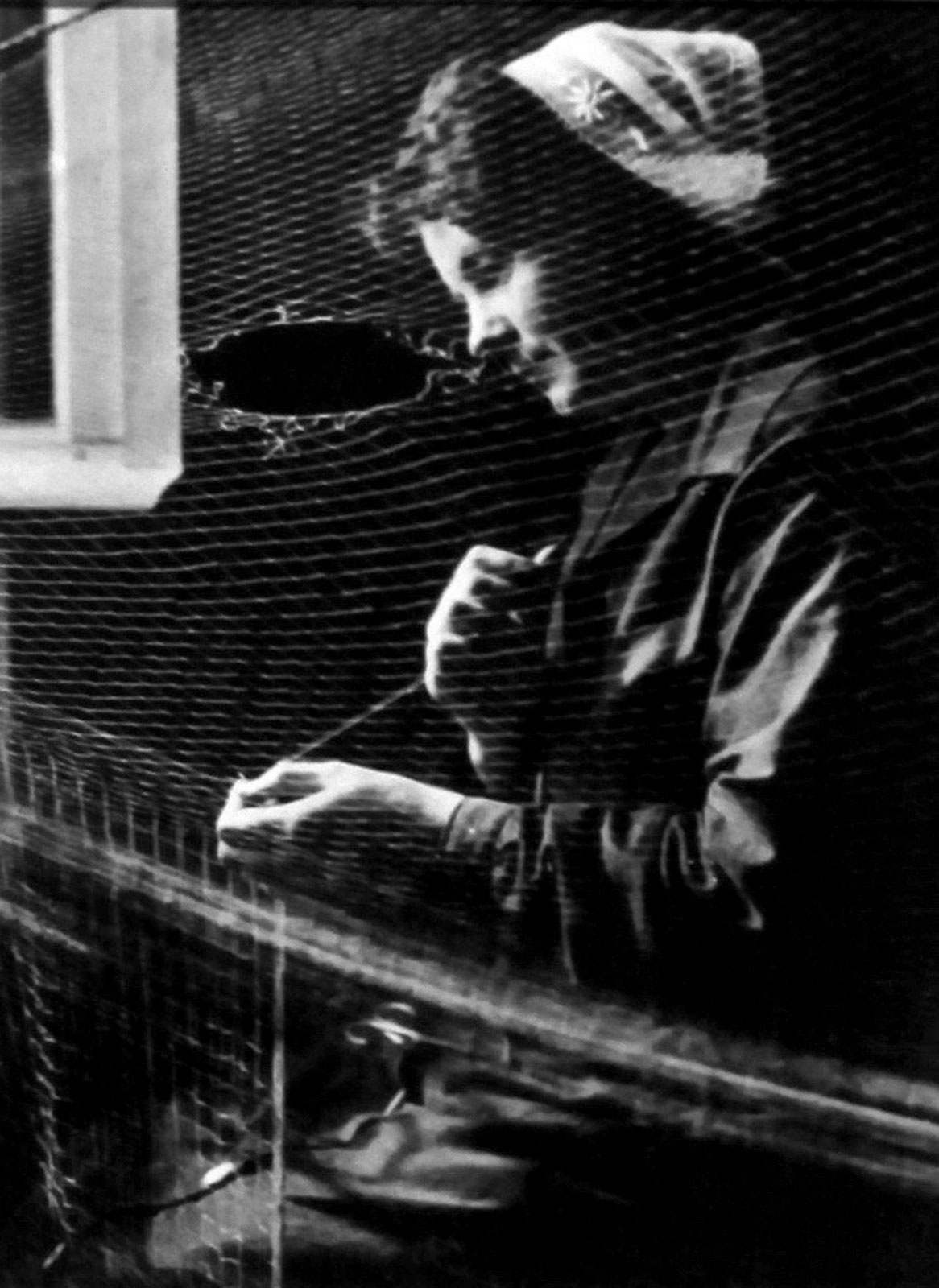
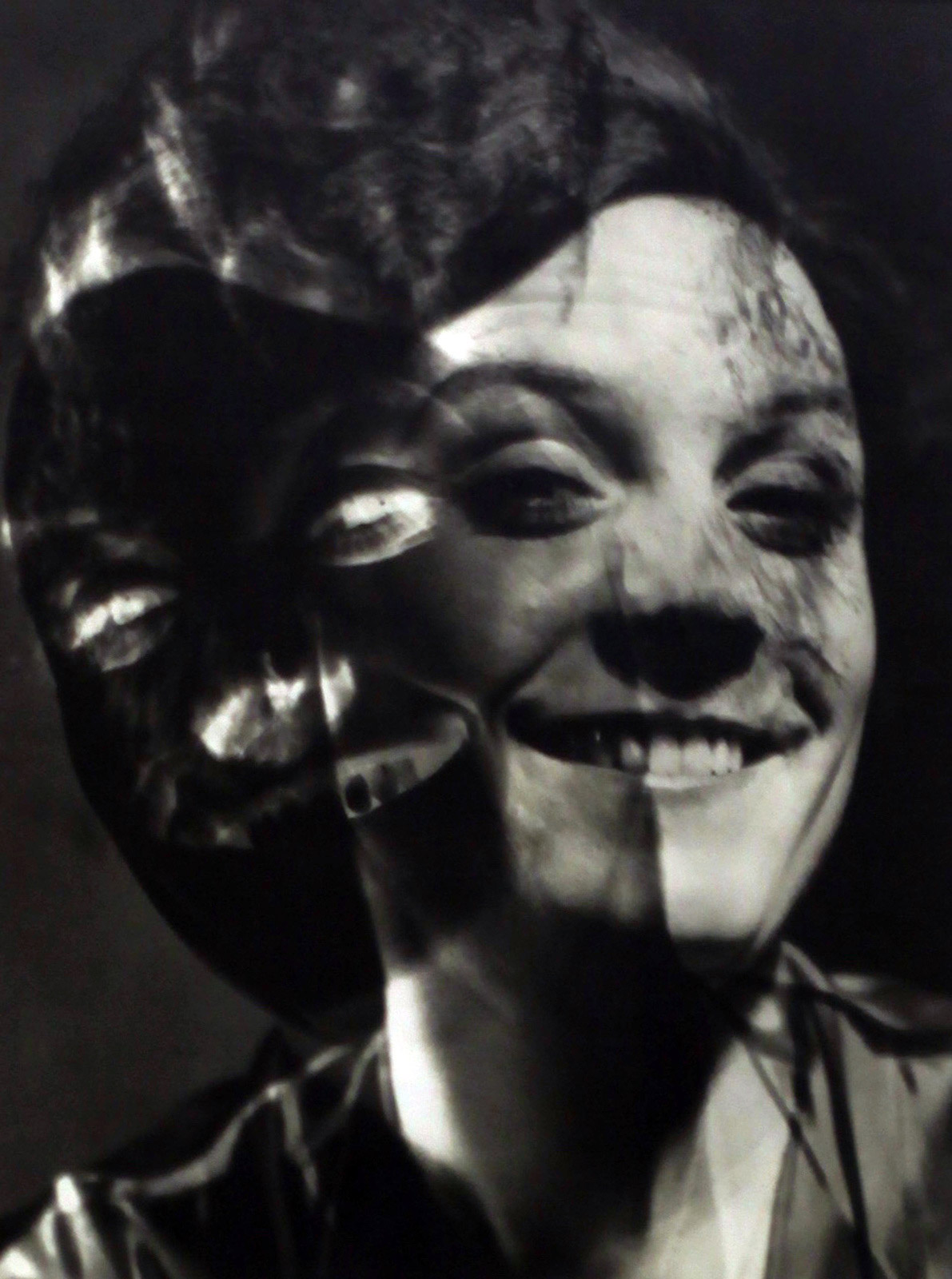
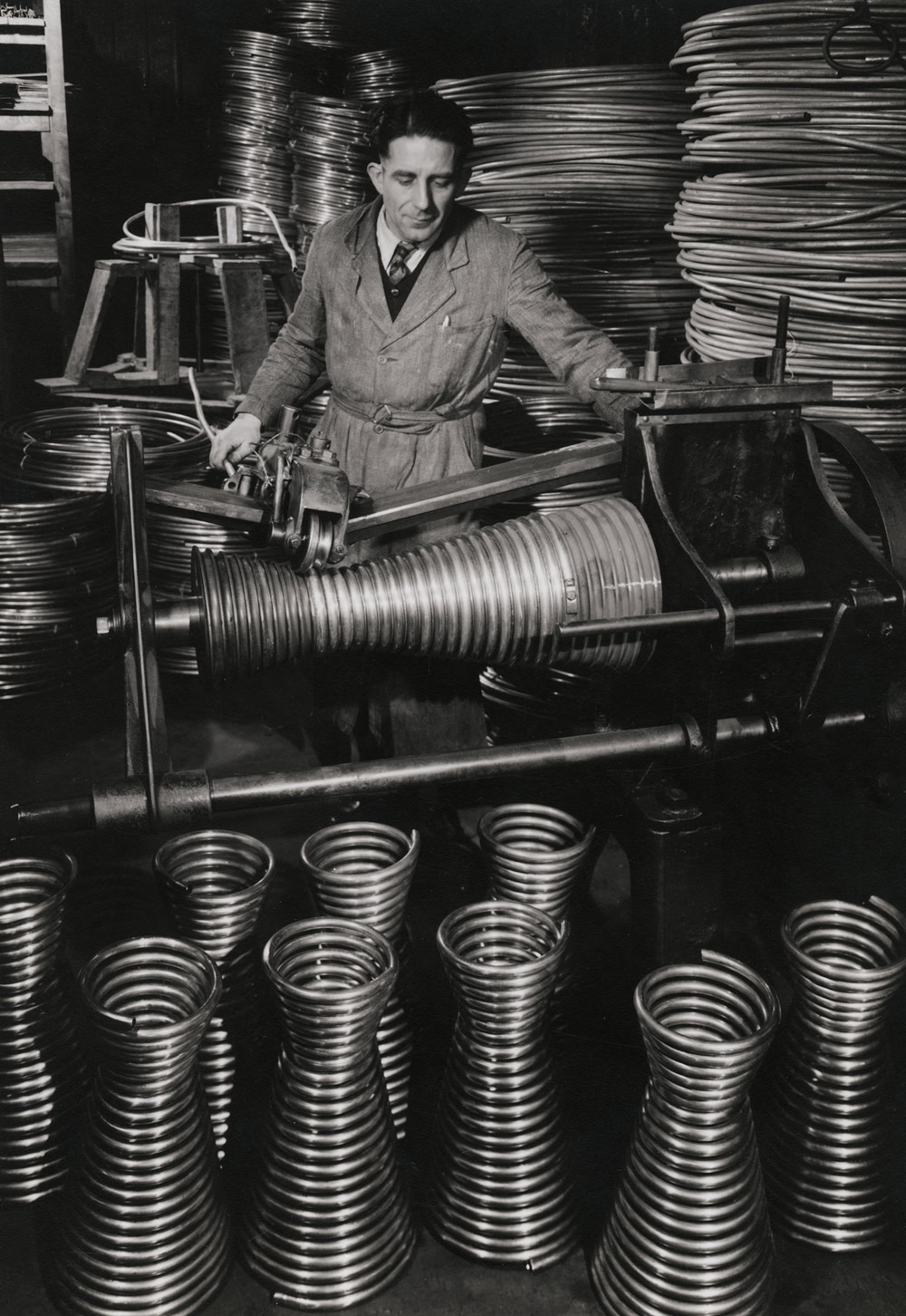
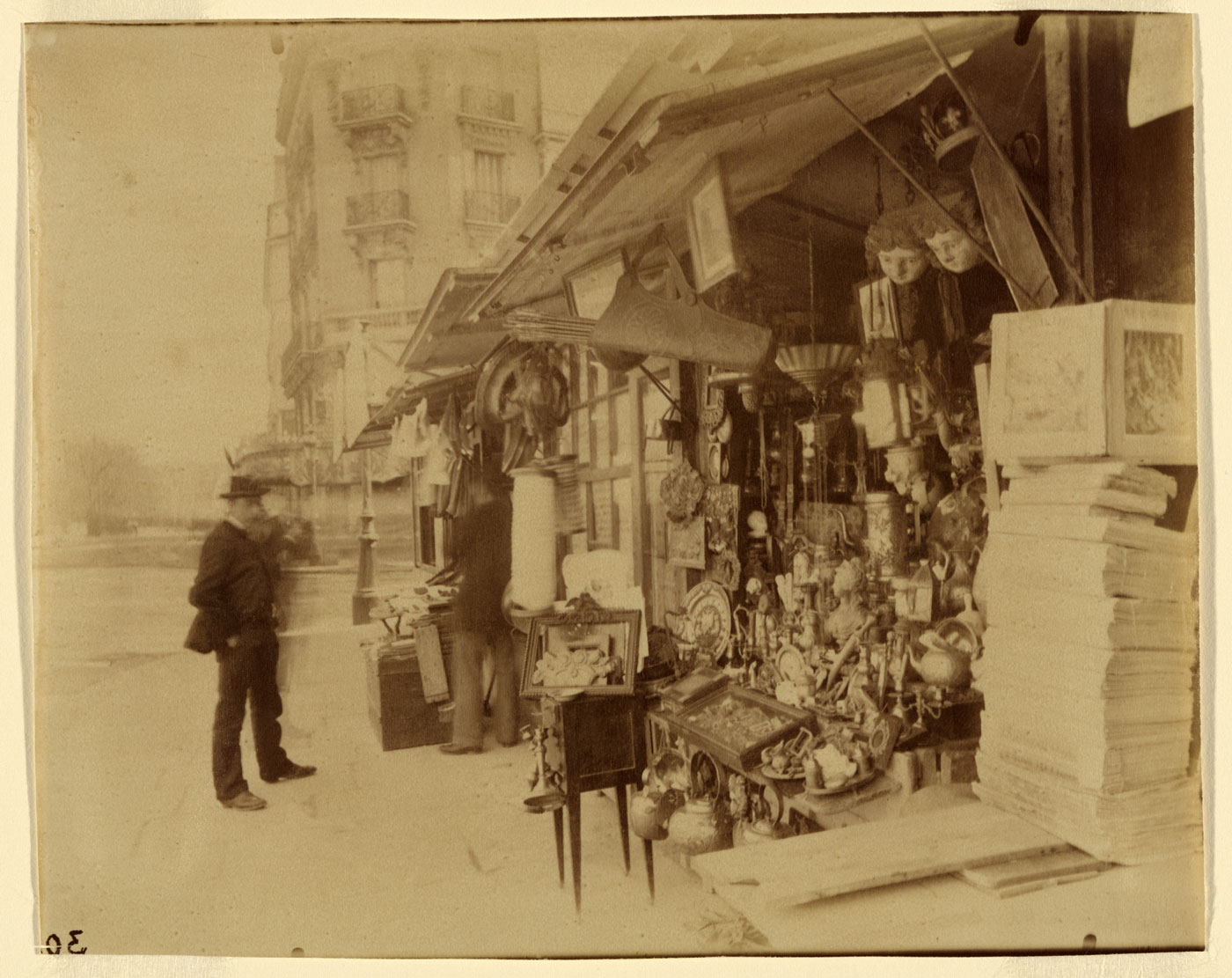
Exhibition: ‘Crime Stories: Photography and Foul Play’ at the Metropolitan Museum of Art, New York

Exhibition dates: 7th March – 31st July, 2016

Curators:  Jeff L. Rosenheim (Curator in Charge of the Department of Photographs), with Doug Eklund (Curator and a key organiser) and Mia Fineman (Associate Curator), with Beth Saunders (Curatorial Assistant)


Unknown photographer (American) '[Jeff Briggs, Robert Sims, Otis Hall, and Peter Pamphlet; Full-Length Mugshot from the Chicago Police Department]' 1936 from the exhibition 'Crime Stories: Photography and Foul Play' at the Metropolitan Museum of Art, New York, March - July, 2016


Unknown photographer (American)
[Jeff Briggs, Robert Sims, Otis Hall, and Peter Pamphlet; Full-Length Mugshot from the Chicago Police Department]
1936
Gelatin silver prints
Image: 5 15/16 × 9 1/8 in. (15.1 × 23.1cm)
Sheet: 6 1/8 × 9 5/16 in. (15.6 × 23.6cm)
Twentieth-Century Photography Fund, 2014


One wrong does not a life make

A very large posting on a fascinating subject, for an exhibition that examines “the numerous ways that photography has influenced that favourite human activity, speculating about crimes and the people who commit them.” As the press release notes, “Since the earliest days of the medium, photographs have been used for criminal investigation and evidence gathering, to record crime scenes, to identify suspects and abet their capture, and to report events to the public. This exhibition explores the multifaceted intersections between photography and crime…”

And all this history displayed in just two gallery spaces!

What the press release fails to note is that it is often the people in power (the police, judiciary, and even the photographer) who name and shame those whose likenesses are captured by the camera. In other words, the people in these photographs are already labelled – deviant, lifter, wife poisoner, forger, sneak thief; cracksman, pickpocket, burglar, highwayman; murderer, counterfeiter, abortionist – before their photograph is ever taken. They have already been dressed for the part.

This verdict is further reinforced when images, such as those by Weggee, appear in newspapers and, using Walker Evans phrase, the “Ladies and gentlemen of the jury” confirm what has been fed to them. As noted in the text in the posting about the photographs of Samuel G. Szabó, “Would the serious young man in the overcoat and silk top hat appear roguish without the caption “John McNauth alias Keely alias little hucks / Pick Pocket” below his portrait?” I think not (which is what the viewer does when confronted with the veracity of the photograph and the text supplied by those in a position of power)…

What strikes me about the “mugshot” photographs of Samuel G. Szabó and Alphonse Bertillon is the ordinariness of the people he captured – tailor, printer, accountant, photographer, seamstress – and how they have forever been labelled “anarchists”. Nothing is known of the rest of their lives and a search on the internet reveals nothing about them, except those people indelibly printed onto the fabric of history: Ravachol, murderer and anarchist who was bent on improving the conditions of the poor (no name or age under his photograph); and Félix Fénéon – head and eyes directed away from the camera whereas most others stare straight into the camera (upon direction) – all haughty superiority, as though the process of being photographed as an “anarchist” was beneath the witty critique (no name or age under his photograph as well). Only by this is it recorded that they are morally suspicious and this is done at the behest of the authorities. Whatever else they did in their life counts as if for nothing.

What also strikes me about the “en situ” photographs of the habitats of the murdered victims and the places where they were found, is again the mundanity of the interiors and places of execution. In the photographs that document the Assassination of Monsieur V. Lecomte, 74 Rue des Martyrs, 1902 we note the ephemera of human existence – the photographs standing on three-tiered wooden shelves, the open box on the table, the body on the floor – photographed from both directions, once with the camera pointing towards the windows, the other from 180 degrees, with the camera pointing into the room. And then we notice the mantlepiece photographed from another direction, with the open box on the table. And the bound and gagged man on the floor is still on the floor out of frame. And then another place of murder, that of the ending of a life, marked out in Bertillon’s photograph “Place where the corpse was found” by two pieces of wood laying on the ground and two pieces of wood propped at 45 degrees against the wall. As though this is all that is left of the existence of Mademoiselle Mercier along a street (Rue de l’Yvette) that still exists in Paris to this day … a photograph of pieces of wood and an empty space. Pace HEAD by Weggee.

It’s all about the stories, or the lack of them, that these photographs tell/sell. Weggee’s photographs of a sixteen-year old child killer, Frank Pape, are brutal in their exposure of this adolescent man. The way the horizontal negative has been cropped over and over again, to gain best effect, best value for the tabloid dollar, gives an idea of the pejorative pronunciation of guilt upon this individual before trial. What happened to Frank Pape? I’ve been digging, trying to find out… but nothing. Did he live, was he executed? What led him to that point and what happened to the rest of his life? This is the great unknown after the click of the shutter, the key in the lock, the silence of history. Here I am not advocating for the celebrity of the criminal, as in Richard Avedon’s photographs of the murderer Dick Hickock, but an acknowledgement that one wrong does not a life make.

But then again, for the victim, in shootings like that of Sen. Robert F. Kennedy – the pain of the photograph and the look in his eyes says it all. Here he is a victim, twice over (the victim of the assassin and the camera), and is to remain a victim for eternity, as long as people look at this photograph. This is such a sad and painful photograph. I remember the day it happened. I was ten years old at the time, and it’s one of those events that you will always remember the rest of you life, where you were, who you were with – like the moon landings or 9/11. I was in a car outside a small shop and the news came on the radio. Robert F. Kennedy had been shot – first aural, then visual on the black and white tv that night, then textual in the newspapers and then visual again with this photograph. The pain of the loss of those heady days of hope lessen not.

Today we live in a police state where surveillance and recognition are everything, where those in power seek to control and regulate ever more the freedom of the people, and the people are lost to anonymity and time.

Dr Marcus Bunyan

Word count: 1,046


Many thankx to the Metropolitan Museum of Art for allowing me to publish the photographs in the posting. Please click on the photographs for a larger version of the image.


“Crime Stories: Photography and Foul Play,” an exhibit currently on display at the Metropolitan Museum of Art, proposes to examine the numerous ways that photography has influenced that favorite human activity, speculating about crimes and the people who commit them. This would be an ambitious undertaking for a ten-room show; this one is limited to only two. The result is something of a hodgepodge, hemmed in by a vague set of constraints. The bulk of the photos were taken in the United States between the mid-nineteenth and mid-twentieth centuries, none after the seventies, and all are in black and white, as if to emphasize their historical remove from our own filtered times. But the aesthetic and ethical questions the exhibit raises – about the American attraction to criminal glamour, and our queasy, not always critical fascination with looking at violence – are the right ones to ask during the current vogue for “true crime,” that funny phrase we use for stories told in public about terrible things others suffer privately.


Alexandra Schwartz. “The Long Collusion of Photography and Crime,” on The New Yorker website April 9, 2016 [Online] Cited 03/10/2021


Since the earliest days of the medium, photographs have been used for criminal investigation and evidence gathering, to record crime scenes, to identify suspects and abet their capture, and to report events to the public. This exhibition explores the multifaceted intersections between photography and crime, from 19th-century “rogues’ galleries” to work by contemporary artists inspired by criminal transgression. The installation will feature some 70 works, drawn entirely from The Met collection, ranging from the 1850s to the present.

Among the highlights of the installation is Alexander Gardner’s documentation of the events following the assassination of President Lincoln, as well as rare forensic photographs by Alphonse Bertillon, the French criminologist who created the system of criminal identification that gave rise to the modern mug shot. Also on display is a vivid selection of vintage news photographs related to cases both obscure and notorious, such as a study of John Dillinger’s feet in a Chicago morgue in 1934; Jack Ruby shooting Lee Harvey Oswald in 1963; and Patty Hearst captured by bank surveillance cameras in 1974. In addition to exploring photography’s evidentiary uses, the exhibition will feature work by artists who have drawn inspiration from the criminal underworld, including Richard Avedon, Larry Clark, Walker Evans, John Gutmann, Andy Warhol, and Weegee.

Text from the Metropolitan Museum of Art website


Unknown photographer (American) '[John Dillinger's Feet, Chicago Morgue]' 1934 from the exhibition 'Crime Stories: Photography and Foul Play' at the Metropolitan Museum of Art, New York, March - July, 2016


Unknown photographer (American)
[John Dillinger’s Feet, Chicago Morgue]
1934
Gelatin silver print
4 11/16 x 7 13/16 in. (11.9 x 19.8cm)
Purchase, The Marks Family Foundation Gift, 2001
© Bettmann / CORBIS


This press photo of John Dillinger, the celebrity gangster from Chicago shot down at age 31, morbidly embodies the twentieth-century’s obsession with fame and hunger for physical contact with media personae. As the Depression era’s most successful bank robber, Dillinger had become a folk hero for his brash, cocky manner and disregard for authority. This unflinching view of Dillinger laid out on a slab in the Chicago morgue not only bares the facts but ironically recalls Mantegna’s The Lamentation Over the Dead Christ (c. 1490).


John Dillinger & “Baby Face” Nelson Hunted by FBI


Unknown photographer (American) '[Jeff Briggs, Robert Sims, Otis Hall, and Peter Pamphlet; Full-Length Mugshot from the Chicago Police Department]' 1936


Unknown photographer (American)
[Jeff Briggs, Robert Sims, Otis Hall, and Peter Pamphlet; Full-Length Mugshot from the Chicago Police Department]
1936
Gelatin silver prints
Image: 5 15/16 × 9 1/8 in. (15.1 × 23.1cm)
Sheet: 6 1/8 × 9 5/16 in. (15.6 × 23.6cm)
Twentieth-Century Photography Fund, 2014


The Chicago Police Department likely made these discarded file photographs when arrested suspects entered the precinct for booking. Each is accompanied by a typewritten caption recording the subjects’ names, vital statistics, and, in some cases, the crimes for which they were arrested (carrying concealed weapons, assault and robbery at gunpoint). With their subjects lined up theatrically against a dark velvet curtain, the images vividly evoke an era and milieu familiar to fans of film noir and hard-boiled detective fiction of the 1930s and 1940s.

A similar defiant dignity is evident in two booking photographs taken by the Chicago Police Department, part of a series made between 1936 and 1946. In the first, four black men in suits line up in front of what seems to be a theatre curtain. In the second, they strike the same pose, now in longer coats and with hats, as if auditioning for different parts in the same play. One of the men smiles affably, a flash of personality in a process meant to cloak it. The others look out evenly, returning the camera’s gaze and reminding whoever is behind the shutter that they, too, have the power to see.


Walker Evans (American, St. Louis, Missouri 1903–1975 New Haven, Connecticut) '[Subway Passengers, New York City]' 1938


Walker Evans (American, St. Louis, Missouri 1903 – 1975 New Haven, Connecticut)
[Subway Passengers, New York City]
1938
Gelatin silver print
12.2 x 15.0cm (4 13/16 x 5 15/16 in.)
Gift of Arnold H. Crane, 1971
© Walker Evans Archive, The Metropolitan Museum of Art


“Ladies and gentlemen of the jury,” Evans called his unwitting subjects. In this example, a smirking, vaguely menacing young man is engrossed in his copy of the Daily News. PAL TELLS HOW GUNGIRL KILLS, reads the headline. An obese woman, obviously not an acquaintance, sits miserably beside him.

During the winter months between 1938 and 1941, Evans strapped a camera to his midsection, cloaked it with his overcoat, and snaked a cable release down his suit sleeve to photograph New York City subway passengers unawares. In his book of these unposed portraits, Many Are Called (1966), the artist referred to his quarry as “the ladies and gentlemen of the jury.” What he was after stylistically, though, was more in keeping with the criminal mug shot: frontal and without emotional inflection. In this photograph, the tabloid headline “PAL TELLS HOW GUNGIRL KILLED” across the newspaper nods to Evans’s interest in vernacular source material.

Inspired by the incisive realism of Honoré Daumier’s Third-Class Carriage, Walker Evans sought to avoid the vanity, sentimentality, and artifice of conventional studio portraiture. The subway series, he later said, was “my idea of what a portrait ought to be: anonymous and documentary and a straightforward picture of mankind.”


Walker Evans’ candid photos of 1930s subway passengers are early conceptual art | Art, Explained

“I think it is one of the first conceptual art projects that I’m aware of.”

Art, Explained invites 100 curators from across the Museum to talk about 100 works of art that changed the way they see the world.


Weegee (Arthur Fellig) (American born Ukraine (Austria), Złoczów (Zolochiv) 1899 - 1968 New York) 'A Bunch of Cops' 1940s


Weegee (Arthur Fellig) (American born Ukraine (Austria), Złoczów (Zolochiv) 1899 – 1968 New York)
A Bunch of Cops
1940s
Gelatin silver print
Gift of Bruce A. Kirstein, in memory of Marc S. Kirstein, 1978
© Weegee / International Center of Photography


In Cold Blood – Trailer

IN COLD BLOOD dramatises actual events and people in a realistic, technically well-crafted fashion, based upon Truman Capote’s novel. The movie is a faithful docudrama about the real-life mass murder of the Clutter family, which took place in Holcomb, Kansas on November 15, 1959 by two psychopathic killers. © 1967, renewed 1995 Pax Enterprises, Inc. All Rights Reserved.


Richard Avedon (American, New York 1923 - 2004 San Antonio, Texas) 'Dick Hickock, Murderer, Garden City, Kansas' April 1960


Richard Avedon (American, New York 1923 – 2004 San Antonio, Texas)
Dick Hickock, Murderer, Garden City, Kansas
April 1960
Gelatin silver print
Image: 50.8 x 50.8cm (20 x 20 in.)
Frame: 59.7 x 59.7cm (23 1/2 x 23 1/2 in.)
Gift of the artist, 2002
© Richard Avedon


In April 1960 Avedon traveled to Garden City, Kansas, to photograph the individuals connected with the savage murder of the four-member Clutter family in their remote farmhouse. He came at the request of his friend Truman Capote, who was there gathering material for his groundbreaking true-crime novel In Cold Blood (1966). Working with a handheld Rolleiflex camera, Avedon made this striking photograph of one of the killers, Richard “Dick” Hickcock, while he was in jail awaiting trial. The mug shot-like portrait captures Hickock’s sullen, lopsided face with mesmerising clarity, as if searching for physiognomic clues to his criminal pathology.


“One of the show’s most striking pictures is a Richard Avedon portrait of Dick Hickock, one of the two murderers immortalized in Truman Capote’s true-crime touchstone “In Cold Blood.” Hickock and Perry Smith, both ex-convicts out on parole, had set out to rob the home of Herbert Clutter, a farmer in Holcomb, Kansas; when they didn’t find the safe they’d been looking for, they killed Clutter, his wife, and his two children. Looking at Hickock’s mug shot, Capote writes, the wife of the case’s investigator is reminded “of a bobcat she’d once seen caught in a trap, and of how, though she’d wanted to release it, the cat’s eyes, radiant with pain and hatred, had drained her of pity and filled her with terror.” Here, Hickock gets the soft-focus celebrity treatment, the line between notoriety and fame as blurred as ever. Hickock, according to Capote, had always been self-conscious about his long, lopsided face. His nose juts out at a Picasso angle, and while his right eye meets Avedon’s lens straight on, his smaller left one seems to look inward. The result is a double portrait, part persona, part awkward, vulnerable self, both haunted by Capote’s own verbal portrait of Hickock’s victims, the Clutter family, at their funeral: “The head of each was completely encased in cotton, a swollen cocoon twice the size of an ordinary blown-up balloon, and the cotton, because it had been sprayed with a glossy substance, twinkled like Christmas-tree snow.”

Alexandra Schwartz. “The Long Collusion of Photography and Crime,” on The New Yorker website April 9 2016 [Online] Cited 15/07/2016
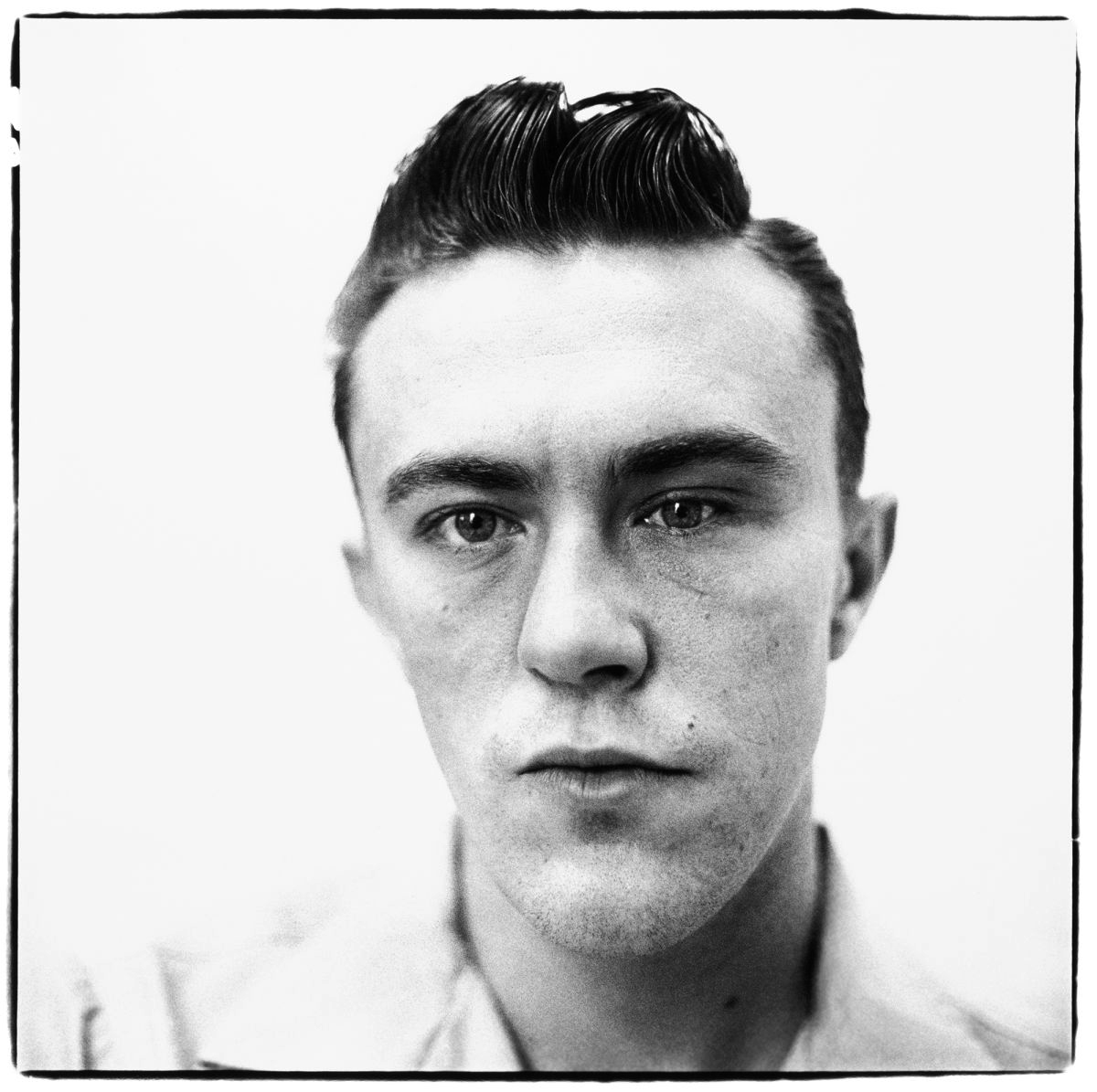
 

Richard Avedon (American, New York 1923 - 2004 San Antonio, Texas) 'Dick Hickock, Murderer, Garden City, Kansas' April 1960


Richard Avedon (American, New York 1923 – 2004 San Antonio, Texas)
Dick Hickock, Murderer, Garden City, Kansas
April 1960
Gelatin silver print
Image: 50.8 x 50.8cm (20 x 20 in.)
Frame: 59.7 x 59.7cm (23 1/2 x 23 1/2 in.)
Gift of the artist, 2002
© Richard Avedon


“Richard Avedon is represented by his 1960 portrait of Dick Hickock, the Kansas murderer who was one of the subjects of Truman Capote’s In Cold Blood. In his typical style, Avedon presents a large-scale investigation of Hickock’s face: the black greased pompadour combed just so, the slightly fleshy nose, the disturbingly engaging eyes, all of it ever so slightly skewed by the impression of Hickock’s inscrutable lopsided grievance. (Hickock had suffered a brain injury in an automobile accident when he was nineteen.) As with Gardner’s 1865 portrait of Lewis Powell (who was also executed by hanging for his crime), you sense how seriously Hickock takes being photographed, his wish to give something of himself, to influence, if not control, the emanations of his image and how he is being portrayed.”

Michael Greenberg. “Caught in the Act,” on The New York Review of Books website, April 7, 2016 [Online] Cited 22/06/2016
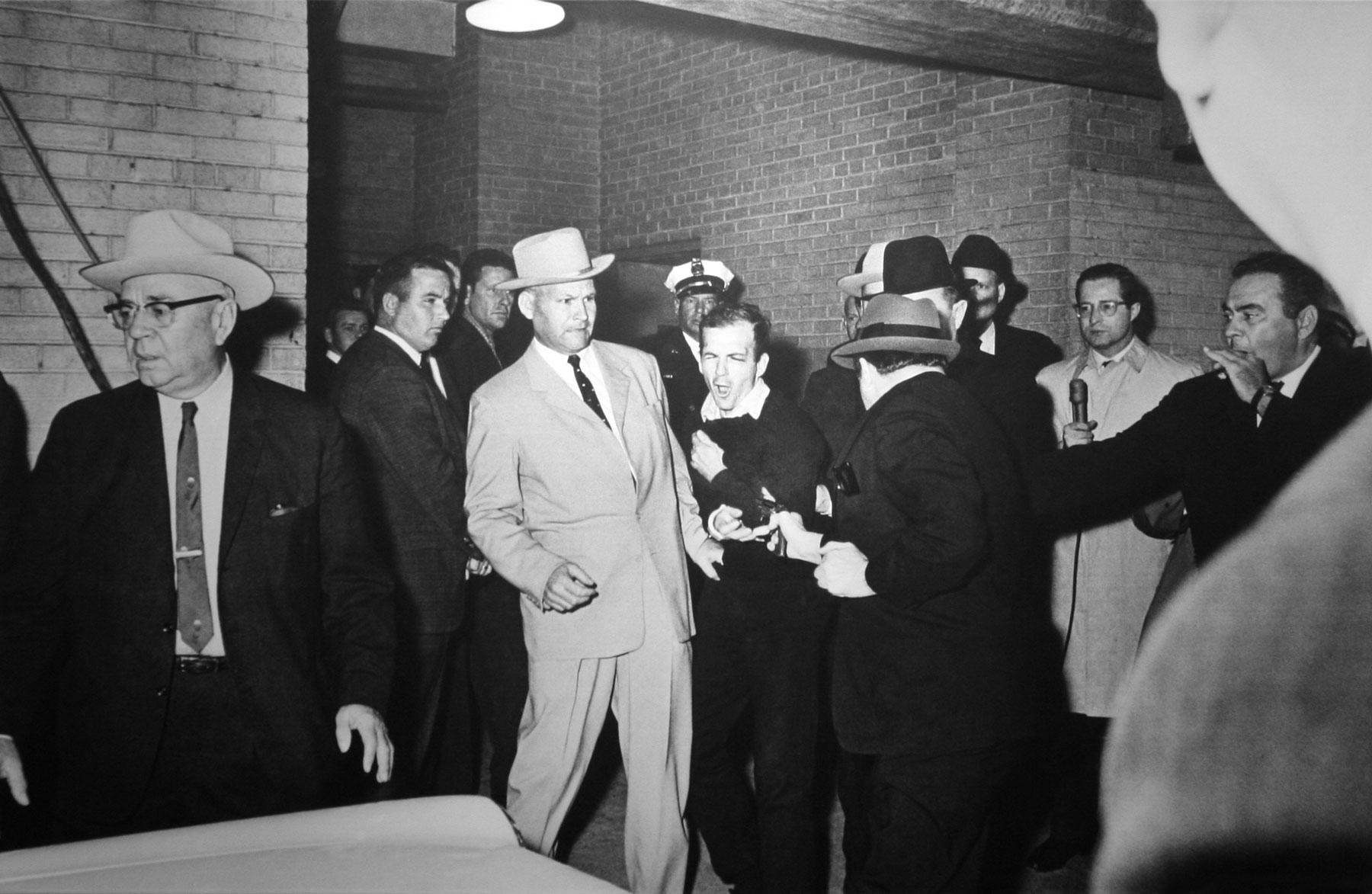
 

Robert H. Jackson (American, born 1934) 'FATAL BULLET HITS OSWALD. Jack Ruby fires bullet point blank into the body of Lee Harvey Oswald at Dallas Police Station. Oswald grimaces in agony' November 24, 1963


Robert H. Jackson (American, born 1934)
FATAL BULLET HITS OSWALD. Jack Ruby fires bullet point blank into the body of Lee Harvey Oswald at Dallas Police Station. Oswald grimaces in agony
November 24, 1963
Gelatin silver print
Image: 16.8 x 19.5 cm (6 5/8 x 7 11/16 in.)
Sheet: 20.5 x 20.1 cm (8 1/16 x 7 15/16 in.)
Twentieth-Century Photography Fund, 2011


Before today’s fast-paced twenty-four hour news cycle, an eager American public followed the development of criminal investigations through the grey tones of press photographs. News outlets used a wire service to send images via in-house or portable transmitters, converting black-and-white tones into electrical pulses that were instantaneously received and printed using the same technology. Mundane courtroom proceedings, such as arraignments and evidence display, became newsworthy through the immediacy of reportage. Every small detail was devoured by a public impatient for news about notorious bank robbers and murderers – some of whom, like John Dillinger, were elevated to the status of folk heroes. In other instances, such as the assassinations of Robert F. Kennedy and Lee Harvey Oswald, newspapers and television brought the drama and intensity of firsthand observation into people’s homes.
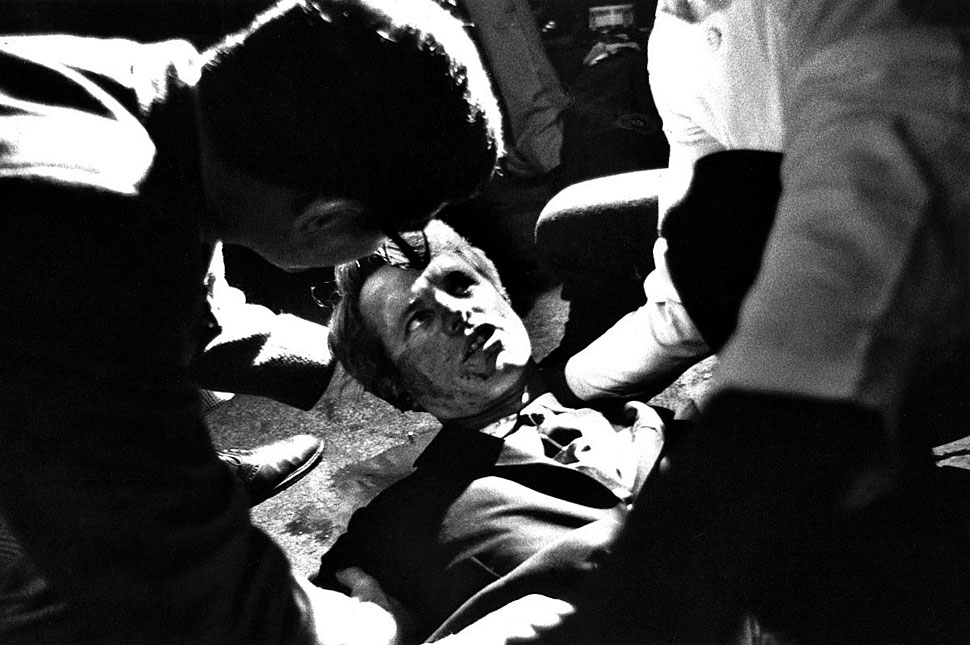
 

Boris Yaro/Los Angeles Times. 'The assassination of Robert F. Kennedy' 1968


Boris Yaro (American, 1938-2020)
LOS ANGELES. KENNEDY MOMENTS AFTER SHOOTING. Sen. Robert F. Kennedy Lies Gravely Wounded on the floor at the Ambassador Hotel in Los Angeles shortly after midnight today, moments after he was shot during a celebration of his victory in yesterday’s California primary election
June 5, 1968
Gelatin silver print
17.2 x 21.1cm (6 3/4 x 8 5/16 in.)
Twentieth-Century Photography Fund, 2010


June 5, 1968: “Presidential candidate Robert F. Kennedy lies on the floor at the Ambassador Hotel in Los Angeles moments after he was shot in the head. He had just finished his victory speech upon winning the California primary. Times photographer Boris Yaro was standing 3 feet from Kennedy when the shooting began. “The gunman started firing at point-blank range. Sen. Kennedy didn’t have a chance,” Yaro recounted in a June 6, 1968, story for The Times. The Democratic senator, 42, was alive for more than 24 hours and was declared dead on the morning of June 6. The shooter was later identified as Sirhan B. Sirhan, who was found guilty of Kennedy’s assassination on April 17, 1969. His motives remain a mystery and controversy to this day.”

1964 Pulitzer Prize, Photography, Robert Jackson, Dallas Times Herald November 22, 1963


Andy Warhol (American, Pittsburgh, Pennsylvania 1928 - 1987 New York) 'Electric Chair' 1971


Andy Warhol (American, Pittsburgh, Pennsylvania 1928 – 1987 New York)
Electric Chair
1971
Printer: Silkprint Kettner, Zurich
Publisher: Bruno Bischofberger
Portfolio of ten screenprints
35 1/2 x 48 inches (90.2 x 121.9cm)
Gift of Robert Meltzer, 1972


Alphonse Bertillon (French, 1853-1914) '[Album of Paris Crime Scenes]' 1901-1908

Alphonse Bertillon (French, 1853-1914) '[Album of Paris Crime Scenes]' 1901-1908 (detail)


Assassination of Monsieur V. Lecomte, 74 Rue des Martyrs, 1902 (and detail)


Alphonse Bertillon (French, 1853-1914) '[Album of Paris Crime Scenes]' 1901-1908

Alphonse Bertillon (French, 1853-1914) '[Album of Paris Crime Scenes]' 1901-1908 (detail)


Assassination of Monsieur V. Lecomte, 74 Rue des Martyrs, 1902 (and detail)


Alphonse Bertillon (French, 1853-1914) '[Album of Paris Crime Scenes]' 1901-1908

Alphonse Bertillon (French, 1853-1914) '[Album of Paris Crime Scenes]' 1901-1908 (detail)


Assassination of Monsieur V. Lecomte, 74 Rue des Martyrs, 1902 (and detail)


Alphonse Bertillon (French, 1853-1914) '[Album of Paris Crime Scenes]' 1901-1908

Alphonse Bertillon (French, 1853-1914) '[Album of Paris Crime Scenes]' 1901-1908 (detail)


Assassination of Monsieur V. Lecomte, 74 Rue des Martyrs, 1902 (and detail)


Alphonse Bertillon (French, 1853-1914) '[Album of Paris Crime Scenes]' 1901-1908

Alphonse Bertillon (French, 1853-1914) '[Album of Paris Crime Scenes]' 1901-1908 (detail)


Murder of Madame Veuve Bol, Projection on a Vertical Plane (and detail)


Alphonse Bertillon (French, 1853-1914) '[Album of Paris Crime Scenes]' 1901-1908

Alphonse Bertillon (French, 1853-1914) '[Album of Paris Crime Scenes]' 1901-1908 (detail)


1st November 1902. Assassination of Mademoiselle Mercier, Rue de l’Yvette á Bouvry la Reine. Photograph of the corpse.


Alphonse Bertillon (French, 1853-1914) '[Album of Paris Crime Scenes]' 1901-1908

Alphonse Bertillon (French, 1853-1914) '[Album of Paris Crime Scenes]' 1901-1908 (detail)


Place where the corpse was found (and detail)


Alphonse Bertillon (French, 1853-1914) '[Album of Paris Crime Scenes]' 1901-1908

Alphonse Bertillon (French, 1853-1914) '[Album of Paris Crime Scenes]' 1901-1908 (detail)


House of the victim (and detail)


Attributed to Alphonse Bertillon (French, 1853-1914)
[Album of Paris Crime Scenes]
1901-1908
Gelatin silver prints
Overall: 24.3 x 31cm (9 9/16 x 12 3/16in.)
Page: 23 x 29cm (9 1/16 x 11 7/16 in.)
Gilman Collection, Purchase, The Howard Gilman Foundation Gift, 2001


Alphonse Bertillon, the chief of criminal identification for the Paris police department, developed the mug shot format and other photographic procedures used by police to register criminals. Although the images in this extraordinary album of forensic photographs were made by or under the direction of Bertillon, it was probably assembled by a private investigator or secretary who worked at the Paris prefecture. Photographs of the pale bodies of murder victims are assembled with views of the rooms where the murders took place, close-ups of objects that served as clues, and mug shots of criminals and suspects. Made as part of an archive rather than as art, these postmortem portraits, recorded in the deadpan style of a police report, nonetheless retain an unsettling potency.


Samuel G. Szabó (Hungarian, active America c. 1854-1861) 'Rogues, a Study of Characters' c. 1860

Samuel G. Szabó (Hungarian, active America c. 1854-1861) 'Rogues, a Study of Characters' c. 1860

Samuel G. Szabó (Hungarian, active America c. 1854-1861) 'Rogues, a Study of Characters' c. 1860

Samuel G. Szabó (Hungarian, active America c. 1854-1861) 'Rogues, a Study of Characters' c. 1860

Samuel G. Szabó (Hungarian, active America c. 1854-1861) 'Rogues, a Study of Characters' c. 1860


Samuel G. Szabó (Hungarian, active America c. 1854-1861)
Rogues, a Study of Characters
c. 1860
Salted paper prints from glass negatives
From 8.8 x 6.6cm (3 7/16 x 2 5/8 in.) to 11.5 x 8.8cm (4 1/2 x 3 7/16 in.)
Gilman Collection, Purchase, Ann Tenenbaum and Thomas H. Lee Gift, 2005
The Metropolitan Museum of Art


Lifter, wife poisoner, forger, sneak thief; cracksman, pickpocket, burglar, highwayman; murderer, counterfeiter, abortionist – each found a place in this gallery of rogues. Photography was first put to service for the identification and apprehension of criminals in the late 1850s. In New York, for example, 450 photographs of known criminals could be viewed by the public in a real rogues’ gallery at police headquarters, the portraits arranged by category, such as “Leading pickpockets, who work one, two, or three together, and are mostly English.”

Little is known of Samuel G. Szabó, his methods or his intentions. He appears to have left his native Hungary in the early or mid-1850s by necessity, but the reason for his exile remains a mystery.

In the United States Szabó moved frequently. Between May 1857 and his return to Europe in July 1861 he traveled to New Orleans, Cincinnati, Chicago, Saint Louis, Philadelphia, and New York, settling for a brief period in Baltimore, where he was listed in the city directory as a daguerreotypist. His whereabouts when he made this album are unknown. One may speculate that Szabó made these portraits while working for, or with the cooperation of, the police, and some of the 218 prints in the album appear to be copy prints made from other photographic portraits.

But this is more than a collection of mug shots; it is a study of characters by a “photogr[aphic] artist,” as Szabó signed the title page of this album. Just as Mathew Brady believed that portraits of America’s great men and women held clues to the nobility of their character and could serve as moral and political exemplars to those who contemplated them, others attempted to discern in photographs such as Szabó’s physical characteristics of the criminal psyche. Yet, as in Hugh Diamond’s portraits of the insane (no. 30), the reading of individual portraits is not always self-evident. Would the serious young man in the overcoat and silk top hat appear roguish without the caption “John McNauth alias Keely alias little hucks / Pick Pocket” below his portrait?


Alphonse Bertillon (French, 1853 - 1914) Tableau synoptic des traits physionomiques: pour servir a l'étude du "portrait parlé" c. 1909

Alphonse Bertillon (French, 1853 - 1914) Tableau synoptic des traits physionomiques: pour servir a l'étude du "portrait parlé" c. 1909 (detail)


Eyebrows, eyelids, globes, orbits, wrinkles
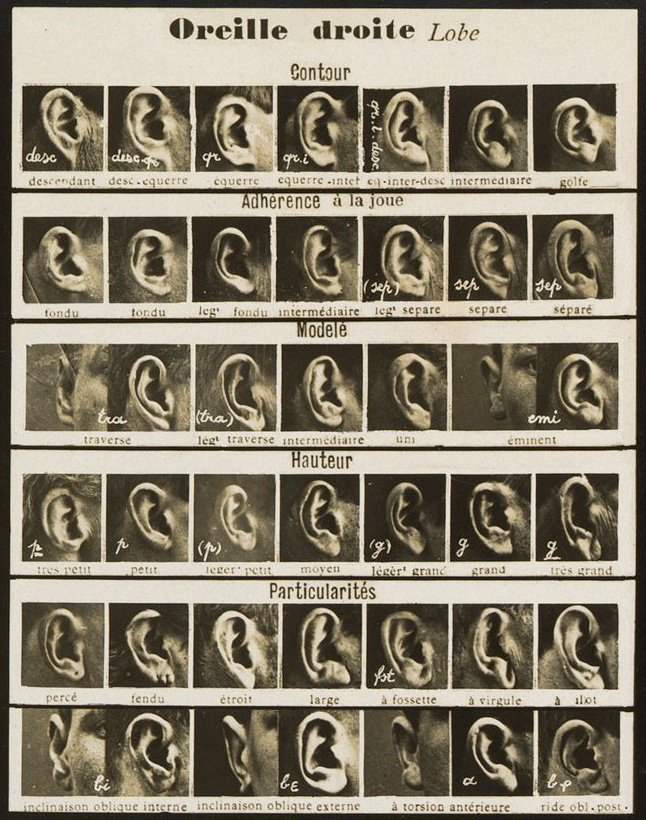
 

Alphonse Bertillon (French, 1853 - 1914) Tableau synoptic des traits physionomiques: pour servir a l'étude du "portrait parlé" c. 1909 (detail)

Alphonse Bertillon (French, 1853 - 1914) Tableau synoptic des traits physionomiques: pour servir a l'étude du "portrait parlé" c. 1909 (detail)


Alphonse Bertillon (French, 1853-1914)
Tableau synoptic des traits physionomiques: pour servir a l’étude du “portrait parlé” (and details)
c. 1909
Gelatin silver print
39.4 x 29.5cm (15 1/2 x 11 5/8 in.)
The Metropolitan Museum of Art, New York
Twentieth-Century Photography Fund, 2009


Nineteenth-century police headquarters were host to disorganised “rogues’ galleries” swollen with photographic portraits of criminals, which turned even the simplest of searches into a Sisyphean labor. As a response, police clerk Alphonse Bertillon introduced a rigorous system of classification, or signalment, to help organise archives, a process that included not only quantitative anthropometric measurements of the head, body, and extremities but also qualitative descriptions of the face. Photography’s potential for exactitude made it a crucial tool for Bertillon’s system, and his portrait parlé – the basis for today’s mugshot – posited a powerful analogy between a photographic likeness and the ink fingerprint.

Akin to a cheat-sheet for police clerks, this composite photograph illustrates how the mugshot could yield a series of classifications, dividing the male criminal’s face into discrete units of information. Such points of identification include the precise differentiation between left ear and right, the angle of inclination of the chin, and the pattern of the folds on the brow. Although intended merely as a filing aide, this image of the human face in all its striations of repetition and difference renders surveillance as a terrifying manifestation of the modern sublime.


“Bertillon’s other major legacy in the field of forensics was his invention of the mug shot. In the mid-nineteenth century, criminal photography focussed on identifying types of offenders; the exhibit’s earliest images are from an album of “rogues,” taken around 1860 in the United States by the photographer Samuel G. Szabó, who sought to distinguish the physiognomy of a counterfeiter from that of a “sneak thief,” a burglar, and a pickpocket. (Whatever revealing differences Szabó may have discerned, his subjects all look mad as hell to be stuck in his perp pictures.) Bertillon countered this hypothetical typology with empirical method, taking “anthropometric” measurements – determining the length of a convict’s middle finger, for example – as well as making elaborate verbal descriptions of a subject’s physical aspect, covering everything from his wrinkles to his eyelids, and two standardised photographs of his face, one from the front, one in profile.”

Alexandra Schwartz. “The Long Collusion of Photography and Crime,” on The New Yorker website April 9 2016 [Online] Cited 15/07/2016


Alphonse Bertillon (French, 1853 - 1914) 'Véret. 0ctave-Jean. 19 ans, né à Paris XXe. Photographe. Anarchiste. 2/3/94.' 1894


Alphonse Bertillon (French, 1853-1914)
Véret. 0ctave-Jean. 19 ans, né à Paris XXe. Photographe. Anarchiste. 2/3/94
1894
Albumen silver print from glass negative
10.5 x 7 x 0.5cm (4 1/8 x 2 3/4 x 3/16 in.)
Gilman Collection, Museum Purchase, 2005
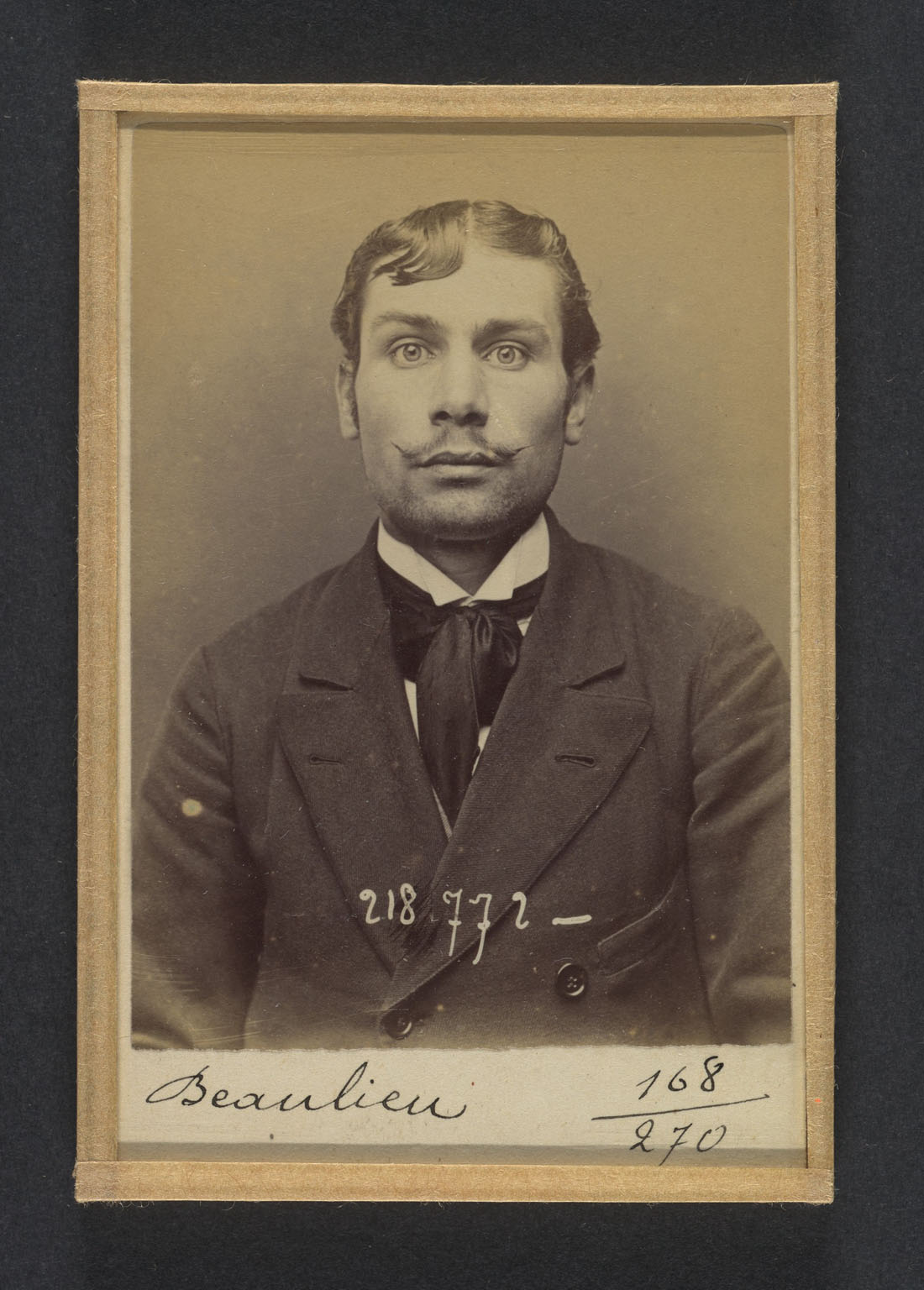
 

Alphonse Bertillon (French, 1853 - 1914) 'Beaulieu. Henri, Félix, Camille. 23 ans, né le 30/11/70 à Paris Ve. Comptable. Anarchiste. 23/5/94.' 1894


Alphonse Bertillon (French, 1853-1914)
Beaulieu. Henri, Félix, Camille. 23 ans, né le 30/11/70 à Paris Ve. Comptable. Anarchiste. 23/5/94
1894
Albumen silver print from glass negative
10.5 x 7 x 0.5cm (4 1/8 x 2 3/4 x 3/16 in.)
Gilman Collection, Museum Purchase, 2005


Alphonse Bertillon (French, 1853 - 1914) 'Soubrier. Annette (femme Chericotti). 28 ans, né Paris Ille. Coutiére. Anarchiste. 25/3/94' 1894


Alphonse Bertillon (French, 1853-1914)
Soubrier. Annette (femme Chericotti). 28 ans, né Paris Ille. Coutiére. Anarchiste. 25/3/94
1894
Albumen silver print from glass negative
10.5 x 7 x 0.5cm (4 1/8 x 2 3/4 x 3/16 in.)
Gilman Collection, Museum Purchase, 2005


Alphonse Bertillon (French, 1853 - 1914) 'Schulé. Armand. 21 ans, né le 28/2/73 Choisy-le-Roi. Comptable. Anarchiste. 2/7/94' 1894


Alphonse Bertillon (French, 1853-1914)
Schulé. Armand. 21 ans, né le 28/2/73 Choisy-le-Roi. Comptable. Anarchiste. 2/7/94
1894
Albumen silver print from glass negative
10.5 x 7 x 0.5cm (4 1/8 x 2 3/4 x 3/16 in.)
Gilman Collection, Museum Purchase, 2005


Alphonse Bertillon (French, 1853 - 1914) 'Roobin. Joseph. 40 ans, né Bourgneuf (Loire-Inférieure). Terrassier. Anarchiste. 2/3/94' 1894


Alphonse Bertillon (French, 1853-1914)
Roobin. Joseph. 40 ans, né Bourgneuf (Loire-Inférieure). Terrassier. Anarchiste. 2/3/94
1894
Albumen silver print from glass negative
10.5 x 7 x 0.5cm (4 1/8 x 2 3/4 x 3/16 in.)
Gilman Collection, Museum Purchase, 2005


Alphonse Bertillon (French, 1853 - 1914) 'Robillard. Guillaume, Joseph. 24 ans, né le 17/11/68 Vaucresson. Fondeur en cuivre. Anarchiste. 2/7/94' 1894


Alphonse Bertillon (French, 1853-1914)
Robillard. Guillaume, Joseph. 24 ans, né le 17/11/68 Vaucresson. Fondeur en cuivre. Anarchiste. 2/7/94
1894
Albumen silver print from glass negative
10.5 x 7 x 0.5cm (4 1/8 x 2 3/4 x 3/16 in.)
Gilman Collection, Museum Purchase, 2005


Alphonse Bertillon (French, 1853 - 1914) 'Ravachol. François Claudius Kœnigstein. 33 ans, né St-Chamond (Loire). Condamné le 27/4/92' 1892


Alphonse Bertillon (French, 1853-1914)
Ravachol. François Claudius Kœnigstein. 33 ans, né St-Chamond (Loire). Condamné le 27/4/92
1892
Albumen silver print from glass negative
10.5 x 7 x 0.5 cm (4 1/8 x 2 3/4 x 3/16 in.)
Gilman Collection, Museum Purchase, 2005


Condemned 27/04/1892


François Claudius Koenigstein, known as Ravachol (1859-1892), was a French anarchist. He was born on 14 October 1859, at Saint-Chamond, Loire and died guillotined on 11 July 1892, at Montbrison.

François Koenigstein was born in Saint-Chamond, Loire as the eldest child of a Dutch father (Jean Adam Koenigstein) and a French mother (Marie Ravachol). As an adult, he adopted his mother’s maiden name as his surname, following years of struggle after his father abandoned the family when François was only 8 years old. From that time on he had to support his mother, sister, and brother; he also looked after his nephew. He eventually found work as a dyer’s assistant, a job which he later lost. He was very poor throughout his life. For additional income he played accordion at society balls on Sundays at Saint-Étienne.

Ravachol became politically active. He joined the anarchists as well as groups organising to improve working conditions. Labor unrest resulted in fierce reprisals by police. On 1 May 1891, at Fourmies, a workers demonstration took place for the eight-hour day; confrontations with the police followed. The Police opened fire on the crowd, resulting in nine deaths amongst the demonstrators. The same day, at Clichy, serious incidents erupted in a procession in which anarchists were taking part. Three men were arrested and taken to the commissariat of police. There they were interrogated (and brutalised with beatings, resulting in injuries). A trial (the Clichy Affair (fr)) ensued, in which two of the three anarchists were sentenced to prison terms (despite their abuse in jail.

In addition to these events, authorities kept up repression of the communards, which had continued from the time of the insurrection of the Paris Commune of 1871. Ravachol was aroused to take action in 1892 against members of the judiciary. He placed bombs in the living quarters of the Advocate General, Léon Bulot (executive of the Public Ministry), and Edmond Benoît, the councillor who had presided over the Assises Court during the Clichy Affair.

An informant told of his actions, and Ravachol was arrested on 30 March 1892 for his bombings at the Restaurant Véry. The day before the trial, anarchists bombed the restaurant where the informant worked. Ravachol was tried at the Assises Court of Seine on 26 April. He was convicted and condemned to prison for life. On 23 June, Ravachol was condemned to death in a second trial at the Assises Court of Loire for three murders. His participation in two of them is disputed (he confessed only to the murder of the hermit of Montbrison, claiming it was due to his own poverty). On 11 July 1892, Ravachol was publicly guillotined.

Text from the Wikipedia website


Cover page of "Le Petit Journal" illustrating the arrest of French anarchist and assassin Ravachol


Cover page of “Le Petit Journal” illustrating the arrest of French anarchist and assassin Ravachol (1859-1892)
Bibliothèque nationale de France


Alphonse Bertillon (French, 1853-1914) 'Rampin. Pierre. 3/7/94' 1894


Alphonse Bertillon (French, 1853-1914)
Rampin. Pierre. 3/7/94
1894
Albumen silver print from glass negative
10.5 x 7 x 0.5cm (4 1/8 x 2 3/4 x 3/16 in.)
Gilman Collection, Museum Purchase, 2005


Alphonse Bertillon (French, 1853- 914) 'Peticolin. Henri. 23 ans, nŽ le 8/6/71 ˆGoersdorf (Bas-Rhin). Vernisseur. Anarchiste. 2/7/94' 1894

Alphonse Bertillon (French, 1853-1914) 'Peticolin. Henri. 23 ans, né le 8/6/71 Goersdorf (Bas-Rhin). Vernisseur. Anarchiste. 2/7/94' 1894 (verso)


Alphonse Bertillon (French, 1853-1914)
Peticolin. Henri. 23 ans, né le 8/6/71 Goersdorf (Bas-Rhin). Vernisseur. Anarchiste. 2/7/94
1894
Albumen silver print from glass negative
10.5 x 7 x 0.5cm (4 1/8 x 2 3/4 x 3/16 in.)
Gilman Collection, Museum Purchase, 2005


Varnisher. Anarchist.


Alphonse Bertillon (French, 1853-1914) 'Olguéni Gustave. 24 ans, né à Sala (Suède) le 24-5-69. Artiste-peintre. Anarchiste. 14-3-94' 1894


Alphonse Bertillon (French, 1853-1914)
Olguéni Gustave. 24 ans, né à Sala (Suède) le 24-5-69. Artiste-peintre. Anarchiste. 14-3-94
1894
Albumen silver print from glass negative
10.5 x 7 x 0.5cm (4 1/8 x 2 3/4 x 3/16 in.)
Gilman Collection, Museum Purchase, 2005


Olguéni Gustave. 24 years old, born in Sala (Sweden) on 24-5-69. Painter. Anarchist. 14-3-94
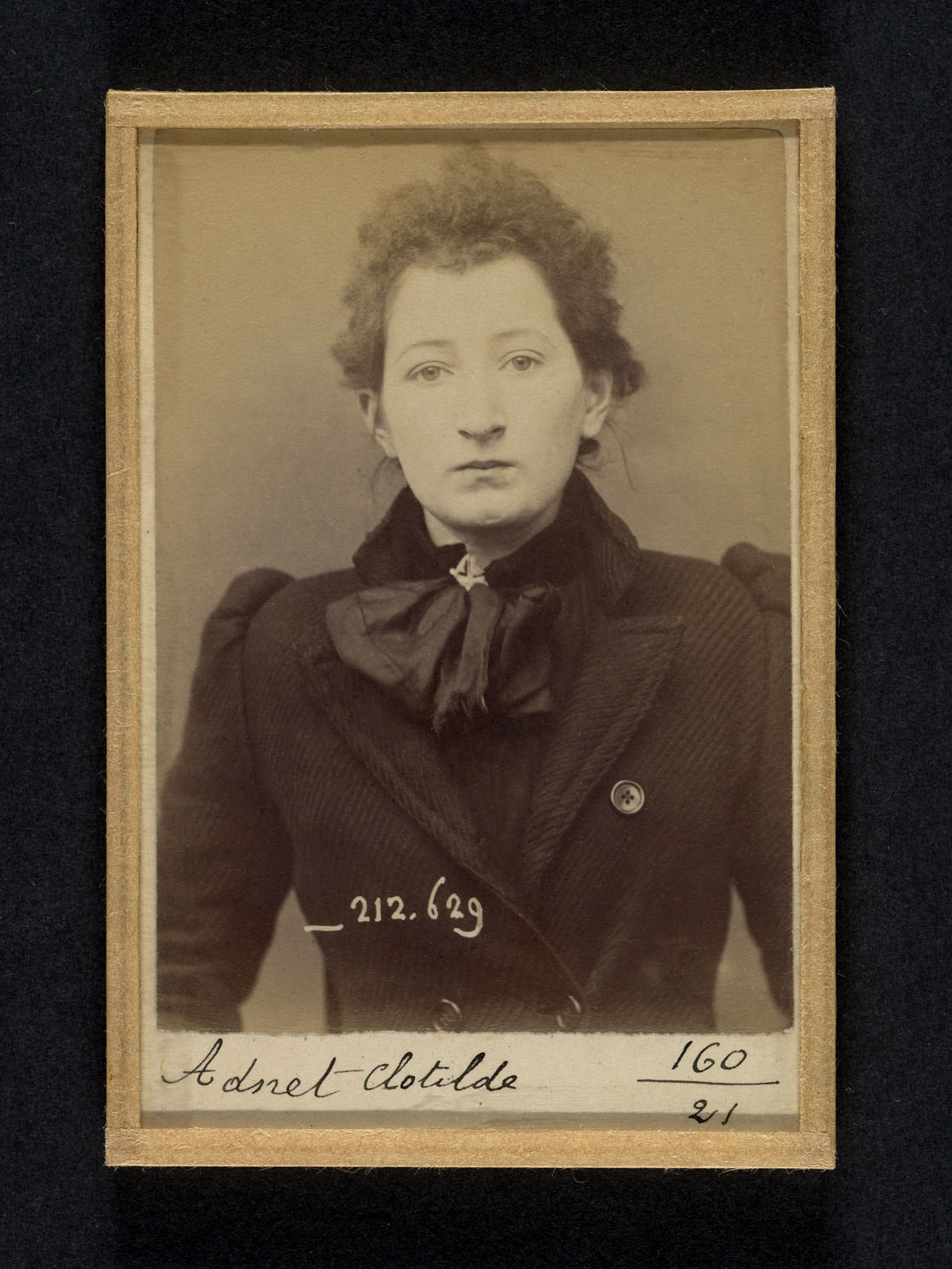
 

Alphonse Bertillon (French, 1853-1914) 'Adnet. Clotilde. 19 ans, née en décembre 74 à Argentant (Orne). Brodeuse. Anarchiste. Fichée le 7/1/94' 1894


Alphonse Bertillon (French, 1853-1914)
Adnet. Clotilde. 19 ans, née en décembre 74 à Argentant (Orne). Brodeuse. Anarchiste. Fichée le 7/1/94
1894
Albumen silver print from glass negative
10.5 x 7 x 0.5cm (4 1/8 x 2 3/4 x 3/16 in.)
Gilman Collection, Museum Purchase, 2005


Embroiderer. Anarchist.


Alphonse Bertillon (French, 1853-1914) 'Nic. Celestin. 20 ans, né Conflans-St-Honorine (Seine & Oise). Emballeur. 26/2/94' 1894


Alphonse Bertillon (French, 1853-1914)
Nic. Celestin. 20 ans, né Conflans-St-Honorine (Seine & Oise). Emballeur. 26/2/94
1894
Albumen silver print from glass negative
10.5 x 7 x 0.5cm (4 1/8 x 2 3/4 x 3/16 in.)
Gilman Collection, Museum Purchase, 2005
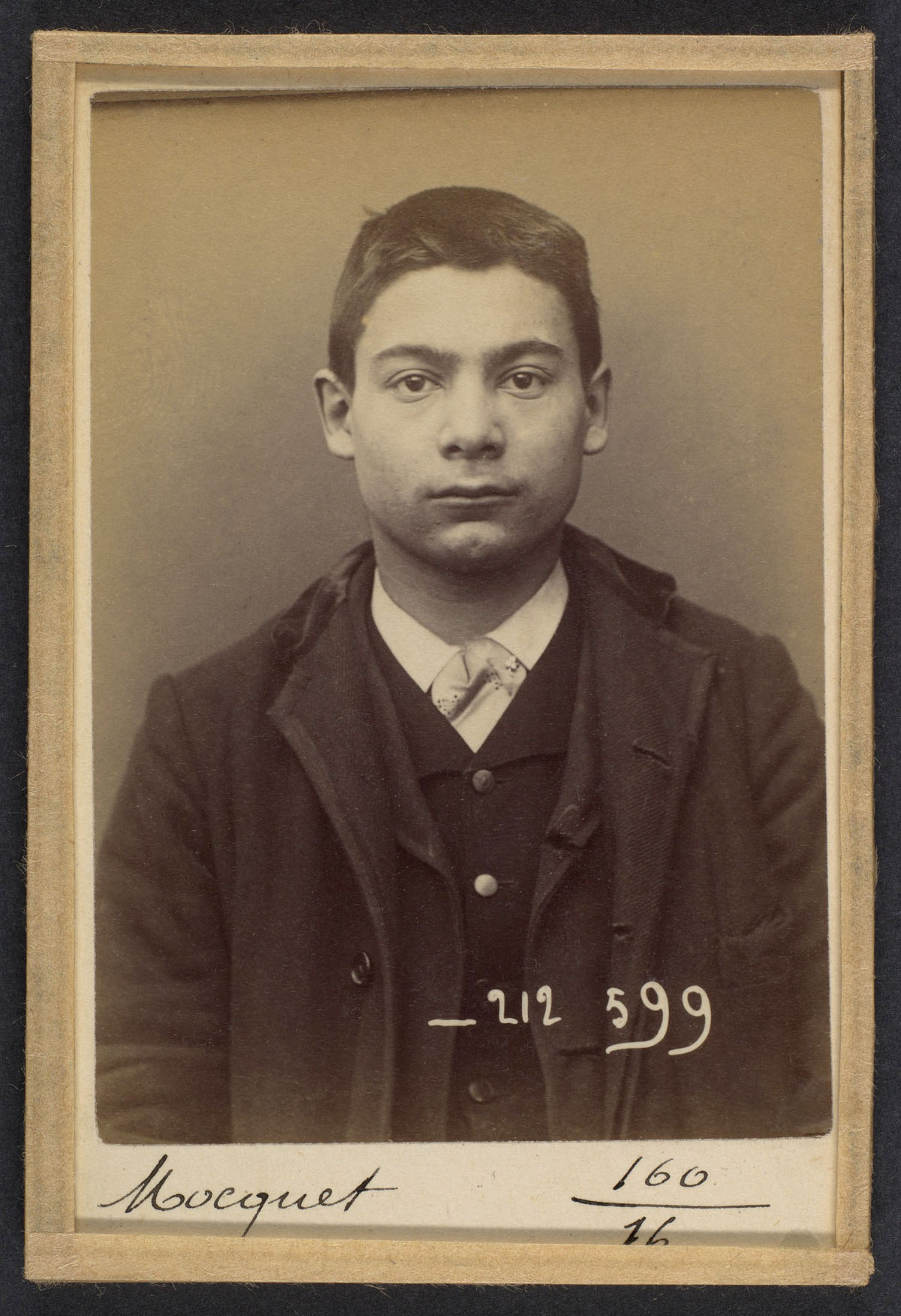
 

Alphonse Bertillon (French, 1853-1914) 'Mocquet. Georges, Gustave. 17 ans, né le 17/5/76 Paris IXe. Tapissier. Anarchiste. 6/1/94' 1894


Alphonse Bertillon (French, 1853-1914)
Mocquet. Georges, Gustave. 17 ans, né le 17/5/76 Paris IXe. Tapissier. Anarchiste. 6/1/94
1894
Albumen silver print from glass negative
10.5 x 7 x 0.5cm (4 1/8 x 2 3/4 x 3/16 in.)
Gilman Collection, Museum Purchase, 2005


Alphonse Bertillon (French, 1853-1914) 'Feneon. Felix. Clerk of the Galerie Berheim Jeune' 1894-1895


Alphonse Bertillon (French, 1853-1914)
Feneon. Felix. Clerk of the Galerie Berheim Jeune
1894-1895
Albumen silver print from glass negative
10.5 x 7 x 0.5cm (4 1/8 x 2 3/4 x 3/16 in.)
Gilman Collection, Museum Purchase, 2005


Félix Fénéon (22 June 1861, Turin, Italy – 29 February 1944, Châtenay-Malabry) was a Parisian anarchist and art critic during the late 19th century. He coined the term “Neo-Impressionism” in 1886 to identify a group of artists led by Georges Seurat, and ardently promoted them.

Felix Fénéon was a prominent literary stylist, art critic, and anarchist born in Turin, Italy in 1861. He was later raised in Burgundy, presumably because his father was a travelling salesman. After placing first in the competitive exams for jobs, Fénéon moved to Paris to work for the War Office where he achieved the rank of chief clerk. During his time in the war office he edited many works, including those of Rimbaud and Lautréamont, as well as helped to advance the fledgling pointillist movement under Georges Seurat. He was also a regular at Mallarmé’s salons on Tuesday evenings as well as active in anarchist circles.

Fénéon, ironically, worked 13 years at the War Office while remaining heavily active in supporting anarchist circles and movements. In March 1892 French police talked about Fénéon as an ‘active Anarchist’, and they had him shadowed. In 1894 Fénéon was arrested on suspicion of conspiracy because of an anarchist bombing of the Foyot restaurant, a popular haunt of politicians. He was also suspected of connection with the assassination of the French President, Sadi Carnot, by an Italian anarchist. He and twenty-nine others were arrested under charges of conspiracy in what became known as the “Trial of Thirty”. Fénéon was acquitted with many of the original thirty. However, the trial was a high point in publicity for Fénéon, normally behind the scenes, as he championed his wit to the amusement of the jury. Of the courtroom scene, Julian Barnes writes, “When the presiding judge put it to him that he had been spotted talking to a known anarchist behind a gas lamp, he replied coolly: Can you tell me, Monsieur le Président, which side of a gas lamp is its behind?”

After the trial, Fénéon became even more elusive. In 1890, the Neo-Impressionist Paul Signac asked to produce a portrait of the lauded critic. Fénéon refused several times before agreeing, on the condition that Signac produced a full face effigy. Signac naturally refused, painting instead a famous profile of Fénéon with his characteristic goatee, a picture that largely became a symbol of the movement, spawning many variations. Fénéon, though displeased, hung the picture on his wall until Signac’s death 45 years later. Aside from Novels in Three Lines that first appeared as clippings in the Parisian Le Matins in 1906 and later as a collection, only because his mistress Camille Pateel had collected them in an album, Fénéon published only a 43-page monograph in Les Impressionists (1886). When asked to produce Les Nouvelles en Trois Lignes as a collection, Fénéon famously replied with an angry “I aspire only to silence”. As Luc Sante points out, Fénéon, one might say, is invisibly famous, having affected so much without being recognisable to many.

Text from the Wikipedia website


Alphonse Bertillon (French, 1853-1914) 'Dupuis. Augustin. 53 ans, né le 24/6/41 Dourdan (Seine & Oise). Charron, forgeron. Anarchiste. 3/7/94' 1894


Alphonse Bertillon (French, 1853-1914)
Dupuis. Augustin. 53 ans, né le 24/6/41 Dourdan (Seine & Oise). Charron, forgeron. Anarchiste. 3/7/94
1894
Albumen silver print from glass negative
10.5 x 7 x 0.5cm (4 1/8 x 2 3/4 x 3/16 in.)
Gilman Collection, Museum Purchase, 2005


Wheelwright, blacksmith. Anarchist.


Alphonse Bertillon (French, 1853-1914) 'Charrié. Cyprien. 26 ans, né le 7/10/67 Paris XVIlle. Imprimeur. Anarchiste 2/7/94' 1894


Alphonse Bertillon (French, 1853-1914)
Charrié. Cyprien. 26 ans, né le 7/10/67 Paris XVIlle. Imprimeur. Anarchiste 2/7/94
1894
Albumen silver print from glass negative
10.5 x 7 x 0.5cm (4 1/8 x 2 3/4 x 3/16 in.)
Gilman Collection, Museum Purchase, 2005


Alphonse Bertillon (French, 1853-1914) 'Bellemans. Eugène (ou Michel). 23 ans, né à Gand (Belgique). Tailleur d'habits. Anarchiste. 9/3/94' 1894


Alphonse Bertillon (French, 1853-1914)
Bellemans. Eugène (ou Michel). 23 ans, né à Gand (Belgique). Tailleur d’habits. Anarchiste. 9/3/94
1894
Albumen silver print from glass negative
10.5 x 7 x 0.5cm (4 1/8 x 2 3/4 x 3/16 in.)
Gilman Collection, Museum Purchase, 2005


Born into a distinguished family of scientists and statisticians, Bertillon began his career as a clerk in the Identification Bureau of the Paris Prefecture of Police in 1879. Tasked with maintaining reliable police records of offenders, he developed the first modern system of criminal identification. The system, which became known as Bertillonage, had three components: anthropometric measurement, precise verbal description of the prisoner’s physical characteristics, and standardised photographs of the face.

In the early 1890s Paris was subject to a wave of bombings and assassination attempts carried out by anarchist proponents of “propaganda of the deed.” One of Bertillon’s greatest successes came in March 1892, when his system of criminal identification led to the arrest of an anarchist bomber and career criminal who went by the name Ravachol. The publicity surrounding the case earned Bertillon the Legion of Honor and encouraged police departments around the world to adopt his anthropometric system.


Unknown photographer (American) '[Broadside for the Capture of John Wilkes Booth, John Surratt, and David Herold]' 1865


Unknown photographer (American)
[Broadside for the Capture of John Wilkes Booth, John Surratt, and David Herold]
Artist: Alexander Gardner (American, Glasgow, Scotland 1821 – 1882 Washington, D.C.)
Photography Studio: Silsbee, Case & Company (American, active Boston)
Photography Studio: Unknown
April 20, 1865
Ink on paper with three albumen silver prints from glass negatives
Sheet: 60.5 x 31.3cm (23 13/16 x 12 5/16 in.)
Each photograph: 8.6 x 5.4cm (3 3/8 x 2 1/8 in.)
Gilman Collection, Purchase, The Horace W. Goldsmith Foundation Gift, through Joyce and Robert Menschel, 2005


On the night of April 14, 1865, just five days after Lee’s surrender to Grant at Appomattox, John Wilkes Booth shot Lincoln at the Ford Theatre in Washington, D.C. Within twenty-four hours, Secret Service director Colonel Lafayette Baker had already acquired photographs of Booth and two of his accomplices. Booth’s photograph was secured by a standard police search of the actor’s room at the National Hotel; a photograph of John Surratt, a suspect in the plot to kill Secretary of State William Seward, was obtained from his mother, Mary (soon to be indicted as a fellow conspirator), and David Herold’s photograph was found in a search of his mother’s carte-de-visite album. The three photographs were taken to Alexander Gardner’s studio for immediate reproduction. This bill was issued on April 20, the first such broadside in America illustrated with photographs tipped onto the sheet.

The descriptions of the alleged conspirators combined with their photographic portraits proved invaluable to the militia. Six days after the poster was released Booth and Herold were recognised by a division of the 16th New York Cavalry. The commanding officer, Lieutenant Edward Doherty, demanded their unconditional surrender when he cornered the two men in a barn near Port Royal, Virginia. Herold complied; Booth refused. Two Secret Service detectives accompanying the cavalry, then set fire to the barn. Booth was shot as he attempted to escape; he died three hours later. After a military trial Herold was hanged on July 7 at the Old Arsenal Prison in Washington, D.C.

Surratt escaped to England via Canada, eventually settling in Rome. Two years later a former schoolmate from Maryland recognised Surratt, then a member of the Papal Guard, and he was returned to Washington to stand trial. In September 1868 the charges against him were nol-prossed after the trial ended in a hung jury. Surratt retired to Maryland, worked as a clerk, and lived until 1916.


Alexander Gardner (American, Glasgow, Scotland 1821 - 1882 Washington, D.C.) 'Lewis Powell [alias Lewis Payne]' April 27, 1865


Alexander Gardner (American, Glasgow, Scotland 1821 – 1882 Washington, D.C.)
Lewis Powell [alias Lewis Payne]
April 27, 1865
Albumen silver print from glass negative
22.4 × 17.4cm (8 13/16 × 6 7/8 in.)
Gilman Collection, Purchase, The Horace W. Goldsmith Foundation Gift, through Joyce and Robert Menschel, 2005


Alexander Gardner’s 1865 portrait of Lewis Powell, a conspirator with John Wilkes Booth. At roughly the same time that John Wilkes Booth shot President Lincoln, Lewis Paine attempted unsuccessfully to murder Secretary of State William Seward. The son of a Baptist minister from Alabama, Paine (alias Wood, alias Hall, alias Powell) was one of at least five conspirators who planned with Booth the simultaneous assassinations of Lincoln, Vice President Andrew Johnson, and Seward. A tall, powerful man, Paine broke into the secretary’s house, struck his son Frederick with the butt of his jammed pistol, brutally stabbed the bedridden politician, and then escaped after stabbing Seward’s other son, Augustus.

Four days later, Paine was caught in a sophisticated police dragnet and arrested at the H Street boarding house of fellow conspirator Mary Surratt. Detained aboard two iron-clad monitors docked together on the Potomac, Paine and seven other presumed conspirators were photographed by Alexander Gardner on April 27. Gardner made full-length, profile, and full-face portraits of each of the men, presaging the pictorial formula later adopted by law-enforcement photographers. Of the ten known photographs of Paine, six show him against a canvas awning on the monitor’s deck, the others against the dented gun turret. In this portrait, Paine, towering more than a head above the deck officer, appears menacingly free of handcuffs. He was twenty years old.


Alexander Gardner (American, Glasgow, Scotland 1821 - 1882 Washington, D.C.) 'Execution of the Conspirators' July 7, 1865


Alexander Gardner (American, Glasgow, Scotland 1821 – 1882 Washington, D.C.)
Execution of the Conspirators
July 7, 1865
Albumen silver print from glass negative
16.8 x 24.2cm (6 5/8 x 9 1/2 in.)
Gilman Collection, Purchase, The Horace W. Goldsmith Foundation Gift, through Joyce and Robert Menschel, 2005


Alexander Gardner’s intimate involvement in the events following President Lincoln’s assassination would have challenged even the most experienced twentieth-century photojournalist. In just short of four months, Gardner documented in hundreds of portraits and views one of the most complex national news stories in American history. The U.S. Secret Service provided Gardner unlimited access to individuals and places unavailable to any other photographer. Free to retain all but one of his negatives-a portrait of Booth’s corpse-Gardner attempted to sell carte-de-visite and large-format prints of the whole picture story. America, still wounded from the four-year war, was less than interested.

The photographs of the execution of Mary Surratt, Lewis Paine, David Herold, and George Atzerodt on July 7, 1865, were, however, highly sought after by early collectors of Civil War ephemera beginning in the 1880s. This photograph shows the final preparations on the scaffolding in the yard of the Old Arsenal Prison. The day was extremely hot and a parasol shades Mary Surratt, seated at the far left of the stage. (She would become the first woman in America to be hanged.) Two soldiers stationed beneath the stage grasp the narrow beams that hold up the gallows trapdoors. The soldier on the left would later admit he had just vomited, from heat and tension. Only one noose is visible, slightly to the left of Surratt; the other three nooses moved during the exposure and are registered by the camera only as faint blurs. Members of the clergy crowd the stage and provide final counsel to the conspirators. A private audience of invited guests stands at the lower left. Minutes after Gardner’s exposure, the conspirators were tied and blindfolded and the order was given to knock out the support beams.


Unknown photographer (American). 'Policeman Posing with Four "Collared" Thugs' c. 1875


Unknown photographer (American)
Policeman Posing with Four “Collared” Thugs
c. 1875
Tintype
Image: 4 5/8 × 3 9/16 in. (11.7 × 9cm), visible
Plate: 5 7/16 × 4 1/16 in. (13.8 × 10.3cm), approx.
Gift of Stanley B. Burns, MD and The Burns Archive, in honour of Elizabeth A. Burns, 2016


This rare narrative tintype of a policeman posing with four criminals handcuffed to one another may be viewed as an occupational portrait of sorts. The officer’s police cap and gleaming badge indicate his profession, while his pose and central placement emphasise his authority.


Unknown photographer (American). '[Five Members of the Wild Bunch]' c. 1892


Unknown photographer (American)
[Five Members of the Wild Bunch]
c. 1892
Tintype
Image: 8.4 x 6.2cm (3 5/16 x 2 7/16 in.)
Gilman Collection, Gift of The Howard Gilman Foundation, 2005


The Wild Bunch was the largest and most notorious band of outlaws in the American West. Led by two gunmen better known by their aliases, Butch Cassidy (Robert LeRoy Parker) and Kid Curry (Harvey Logan), the Wild Bunch was an informal trust of thieves and rustlers that preyed upon stagecoaches, small banks, and especially railroads from the late 1880s to the first decade of the twentieth century.

This crudely constructed tintype portrait of five members of the gang dressed in bowler hats and city clothes shows, clockwise, from the top left, Kid Curry, Bill McCarty, Bill (Tod) Carver, Ben Kilpatrick, and Tom O’Day. Without their six shooters and cowboy hats the outlaws appear quite civilised and could easily be mistaken for the sheriffs and Pinkerton agents who pursued them in a “Wild West” already much tamed by the probable date of this photograph. Gone was the open range – instead, homesteads and farms dotted the landscape and barbed-wire fences frustrated the cattleman’s drive to market. Gone too was the anonymity associated with distance, as the camera and the telegraph conspired to identify criminals. Bank and train robbery were still lucrative, but the outlaw’s chances for escape gradually shifted in favour of the sheriff’s chances for arrest and conviction.

By 1903 the Wild Bunch had disbanded. A few members of the gang followed Butch Cassidy to South America, while the majority remained in the West, trying to avoid capture. McCarty was shot dead in 1893, in a street in Delta, Colorado, after a bank robbery; Carver died in prison; Kilpatrick was killed during a train robbery in 1912; Tom O’Day was captured by a Casper, Wyoming, sheriff in 1903; and Kid Curry died either by his own hand in Parachute, Colorado, in 1904, or, as legend has it, lived until he was killed by a wild mule in South America in 1909. The photograph comes from the collection of Camillus S. Fly, a pioneer photographer in Tombstone, Arizona, in the 1880s and sheriff of Cochise County in the 1890s.


Tom Howard (American, 1894-1961) '[Electrocution of Ruth Snyder, Sing Sing Prison, Ossining, New York]' 1928


Tom Howard (American, 1894-1961)
[Electrocution of Ruth Snyder, Sing Sing Prison, Ossining, New York]
1928
Gelatin silver print
24 x 19.3cm (9 7/16 x 7 5/8 in.)
Twentieth-Century Photography Fund, 2008
© The New York Daily News Archive / Getty Images


In spite of the universal ban on cameras in American death chambers, news editors have long recognised the public’s hunger for eyewitness images of high-profile executions. In January 1928 Tom Howard made tabloid history when he photographed, using a miniature camera strapped to his ankle, the electrocution of the convicted murderer Ruth Snyder at Sing Sing prison in Ossining, New York. The sensational picture ran under banner headlines on the front page of the New York Daily News two days in a row.

“In 1925, Snyder, a housewife from Queens Village, Queens, New York City, began an affair with Henry Judd Gray, a married corset salesman. She then began to plan the murder of her husband, enlisting the help of her new lover, though he appeared to be very reluctant. Her distaste for her husband apparently began when he insisted on hanging a picture of his late fiancée, Jessie Guishard, on the wall of their first home, and named his boat after her. Guishard, whom Albert described to Ruth as “the finest woman I have ever met”, had been dead for 10 years.

Ruth Snyder first persuaded her husband to purchase insurance, with the assistance of an insurance agent (who was subsequently fired and sent to prison for forgery) “signed” a $48,000 life insurance policy that paid extra (“double indemnity”) if an unexpected act of violence killed the victim. According to Henry Judd Gray, Ruth had made at least seven attempts to kill her husband, all of which he survived. On March 20, 1927, the couple garrotted Albert Snyder and stuffed his nose full of chloroform-soaked rags, then staged his death as part of a burglary. Detectives at the scene noted that the burglar left little evidence of breaking into the house; moreover, that the behaviour of Mrs. Snyder was inconsistent with her story of a terrorised wife witnessing her husband being killed.

Then the police found the property Ruth claimed had been stolen. It was still in the house, but hidden. A breakthrough came when a detective found a paper with the letters “J.G.” on it (it was a memento Albert Snyder had kept from former love Jessie Guishard), and asked Ruth about it. A flustered Ruth’s mind immediately turned to her lover, whose initials were also “J.G.,” and she asked the detective what Gray had to do with this. It was the first time Gray had been mentioned, and the police were instantly suspicious. Gray was found upstate, in Syracuse. He claimed he had been there all night, but eventually it turned out a friend of his had created an alibi, setting up Gray’s room at a hotel. Gray proved far more forthcoming than Ruth about his actions. He was caught and returned to Jamaica, Queens and charged along with Ruth Snyder. Dorothy Parker told Oscar Levant that Gray tried to escape the police by taking a taxi from Long Island to Manhattan, New York, which Levant noted was “quite a long trip.” According to Parker, in order “not to attract attention, he gave the driver a ten-cent tip.” …

Snyder became the first woman executed in Sing Sing since 1899. She went to the electric chair only moments before her former lover. Her execution (by “State Electrician” Robert G. Elliott) was caught on film, by a photograph of her as the electricity was running through her body, with the aid of a miniature plate camera custom-strapped to the ankle of Tom Howard, a Chicago Tribune photographer working in cooperation with the Tribune-owned New York Daily News. Howard’s camera was owned for a while by inventor Miller Reese Hutchison, then later became part of the collections of the Smithsonian’s National Museum of American History.”

Text from the Wikipedia website


Unknown photographer (French) Publisher: Le Petit Parisien (French, active 1876-1944) 'Marius Bourotte' 1929


Unknown photographer (French)
Publisher: Le Petit Parisien (French, active 1876–1944)
Marius Bourotte
1929
Gelatin silver print with applied colour
11.6 x 16.2cm (4 9/16 x 6 3/8 in.)
Purchase, The Horace W. Goldsmith Foundation Gift, through Joyce and Robert Menschel, 1996


These photographs of thieves and assassins were heavily retouched with ink and gouache to facilitate their reproduction in illustrated newspapers and magazines. Although they were not conceived as typological studies, the cropping and retouching deliberately intensified their sinister aspect, producing caricatures of criminality that satisfied the sensationalism of the picture press.


Unknown photographer (American) '[Automobile Murder Scene]' c. 1935


Unknown photographer (American)
[Automobile Murder Scene]
c. 1935
Gelatin silver print
24.3 x 20.1cm (9 9/16 x 7 15/16 in.)
Twentieth-Century Photography Fund, 2008


This picture is a master class in the aesthetics of the crime photograph. As the writer Luc Sante has noted, photography stops time, while crime photography shows the stopped time of an individual life cut short. The anonymous cameraman (whose shadow can be seen in the image) may have worked for the police but was more likely a newspaper photographer. His editors must have considered this an absolute bull’s-eye combination of titillation, voyeurism, and fig-leaf moralising that lets readers have their cake and eat it too. Most importantly, the stopped time of the crime photograph imparts a heightened significance to all the details within the frame, which could either be clues or random accident.
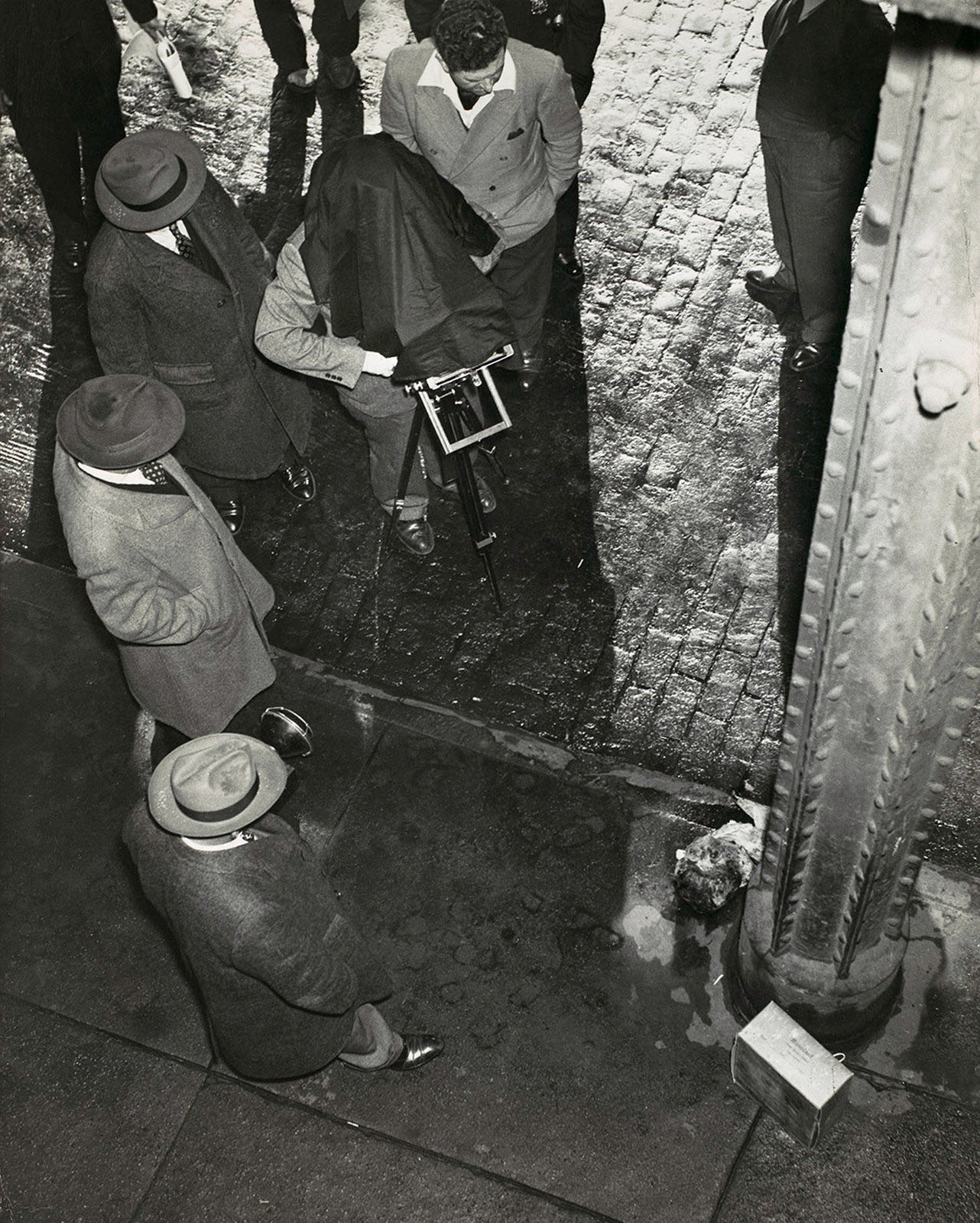
 

Weegee (American, born Ukraine (Austria), Złoczów (Zolochiv) 1899 - 1968 New York) 'Human Head Cake Box Murder' c. 1940


Weegee (Arthur Fellig) (American born Ukraine (Austria), Złoczów (Zolochiv) 1899 – 1968 New York)
Human Head Cake Box Murder
c. 1940
Gelatin silver print
33.6 x 26.9cm (13 1/4 x 10 9/16 in.)
Ford Motor Company Collection, Gift of Ford Motor Company and John C. Waddell, 1987
© Weegee / International Center of Photography


It is hard to decide which of the several mysteries contained in this macabre photograph is the most bizarre: the murder to which the title alludes, the headless bodies standing flat-footedly around a bodyless head, the “scriptboy” who enters at upper left, how the police photographer can be both rooted to the spot and levitating above it, why he wears his hat as he works, or where Weegee is standing.


John Gutmann (American (born Germany), Breslau 1905 - 1998 San Francisco) "X Marks the Spot Where Ralph Will Die" 1938


John Gutmann (American born Germany, Breslau 1905 – 1998 San Francisco)
“X Marks the Spot Where Ralph Will Die”
1938
Gelatin silver print
23.4 x 17.8cm (9 3/16 x 7 in.)
Ford Motor Company Collection, Gift of Ford Motor Company and John C. Waddell, 1987
© 1998 Center for Creative Photography, Arizona Board of Regents


Trained as a painter, Gutmann fled Germany for America in 1933. In need of money, the artist began photographing across the country as a foreign correspondent for the tremendously popular picture magazines of his homeland, which had an insatiable appetite for all things American. What began as an assignment in exile – travelling from New York, Chicago, and Detroit to New Orleans and San Francisco – became a remarkable lifelong career in a new medium and country.

One of the earliest and most inventive practitioners of street photography, Gutmann was one of the great poets and chroniclers of a particularly American kind of city life – the endless supply of characters and spontaneous dramas set against a backdrop of skyscrapers, signs, and graffiti.


Weegee Tells How

Arthur Fellig, better known as Weegee, was a New York city freelance news photographer from the 1930s to the 1950s. Here he talks about his career and gives advice to those wanting to become news photographers.


Weegee (American, born Ukraine (Austria), Złoczów (Zolochiv) 1899 - 1968 New York) '[Outline of a Murder Victim]' 1942


Weegee (Arthur Fellig) (American born Ukraine (Austria), Złoczów (Zolochiv) 1899 – 1968 New York)
[Outline of a Murder Victim]
1942
Gelatin silver print
33.9 x 27.4cm (13 3/6 x 10 13/16 in.)
Gift of Bruce A. Kirstein, in memory of Marc S. Kirstein, 1978
© Weegee / International Center of Photography


Working as a freelance press photographer in New York City during the mid-1930s and 1940s, Weegee achieved notoriety through sensational photographs of a crime-ridden metropolis. Although his nickname derived from an earlier job as a “squeegee boy” drying photographic prints in a professional darkroom, through brazen self-styling he designated himself a human Ouija board, who always seemed to know where the next big scoop would be. In fact, he lived across the street from police headquarters and used a department-issued radio. Here, Weegee distills the genre of the crime scene photograph into a minimalist trace: the camera’s flashbulb illuminates a hastily drawn chalk outline bearing the stark label “HEAD.”


Weegee (Arthur Fellig) 'Man Escorting Frank Pape, Arrested for Strangling Boy to Death, New York. November 10, 1944' 1944


Weegee (Arthur Fellig) (American born Ukraine (Austria), Złoczów (Zolochiv) 1899 – 1968 New York)
Man Escorting Frank Pape, Arrested for Strangling Boy to Death, New York. November 10, 1944
1944
Gelatin silver print
9 1⁄2 × 7 9/16″ (24.1 × 19.2cm)
International Center of Photography. Bequest of Wilma Wilcox
© 2014 Weegee/ International Center of Photography/Getty Images

PHOTOGRAPH NOT IN EXHIBITION.
Taken prior to the famous image by Weggee below.


The first of these 8 by 10s (above), although not without its pleasures (the sad ambivalence registered on Pape’s face; the awkward delicacy with which he toys with his cap; the encroaching elbow at right announcing the crowdedness of the photographic field here), is utterly banal. It is “photojournalism” as generally understood, an ostensibly uncomplicated document relating the newsworthy event, its composition dictated only by the informational concern of Pape’s bittersweet apprehension in the wake of the false accusation of the victim’s older brother.

Jason E. Hill, “In the Police Wagon, in the Press, and in The Museum of Modern Art (A Note on Weegee’s Frank Pape, Arrested for Homicide, November 10, 1944)”


Weegee (American, born Ukraine (Austria), Złoczów (Zolochiv) 1899 - 1968 New York) 'Frank Pape, Arrested for Homicide' 1944


Weegee (Arthur Fellig) (American born Ukraine (Austria), Złoczów (Zolochiv) 1899 – 1968 New York)
Frank Pape, Arrested for Homicide
1944
Gelatin silver print
33.6 x 26.4cm (13 1/4 x 10 3/8 in.)
Anonymous Gift, 2005


“For Weegee… a photographic print was usually nothing more than a by-product. Weegee’s prints served as the matrices from which halftone and gravure printing plates were made (by others) for reproduction in magazines, books, and newspapers. Weegee intended these mass-produced multiples, and not the photographic prints themselves, to be the final forms of his imagery… He did not expect or intend his work to be experienced in the form of photographic prints.”

A. D. Coleman, “Weegee as Printmaker: An Anomaly in the Marketplace,” in Tarnished Silver: After the Photo Boom. New York: Midmarch, 1996, p. 28. (Emphasis added.) quoted in Jason E. Hill.


The subject of this photograph, a sixteen-year-old boy, confessed to tying up and strangling four-year-old William Drach in the Bronx on October 29, 1944, allegedly mimicking what he had seen in a movie. Here, Weegee adapts the traditional tropes of portraiture, in which the sitter’s hands and facial features are of the utmost importance, to present a caged criminal still armed with his weapons. Exploiting the cramped quarters of the police van, Weegee frames the boy’s placid face within the crisscross of the chain-linked fence. The boy’s hands – the presumed tools of his crime – are eerily dismembered from his body.

“On November 9, 1944, the American photographer Weegee made three exposures of Frank Pape, moments after the sixteen year old was arraigned on homicide charges for the accidental strangling death of a four-year-old neighbor and as he was escorted into a police wagon outside the Manhattan Police Headquarters, on Centre Market Place, en route to the 161st Street courthouse in the Bronx.1 Of these, the third expo- sure, which pictures the young Pape through the luminously articulated mesh of that police wagon’s grated rear window and is the basis for Frank Pape, Arrested for Homicide, November 10, 1944 in the Thomas Walther Collection, now stands among the photographer’s best-known and most widely collected and reproduced works.”

1/ On October 29, 1944, four-year-old Billy Drach was found by his father and eight-year-old brother, Bobby, bound and gagged in the basement of the apartment building where the family lived. Initially Bobby confessed that he had tied Billy up while playing “commando,” and the police ruled the death accidental. The Drach family, however, pressed for further investigation, which ultimately led to the confession of Pape, who lived nearby. Pape said that he had wanted to mimic a scene from a movie he had just seen, had found Billy drawing with chalk on the street, and had asked him, “Want to play tie-up?” As the tabloid story that accompanied the publication of Weegee’s photograph recounts (see fig. 9), Pape claimed he panicked when Billy began to struggle, and he left the younger boy bound with rope in the basement, with a handkerchief in his mouth and a burlap sack over his head. See “Neighbor Boy Admits Tying Bobby Drach,” PM, November 10, 1944, p. 15.


For more on the creation and dissemination of this print, see Jason E. Hill, “In the Police Wagon, in the Press, and in The Museum of Modern Art (A Note on Weegee’s Frank Pape, Arrested for Homicide, November 10, 1944)”

The original negative was horizontal and was cropped in various proportions, photographs taken from the above article by Jason E. Hill:


Weegee (Arthur Fellig) 'Frank Pape, Arrested for Strangling Boy to Death, New York' 1944


Weegee (Arthur Fellig) (American born Ukraine (Austria), Złoczów (Zolochiv) 1899 – 1968 New York)
Frank Pape, Arrested for Strangling Boy to Death, New York
1944
Photographic negative (digitally scanned and inverted)
4 x 5″ (10.2 x 12.7cm)
International Center of Photography
© 2014 Weegee/International Center of Photography/Getty Images

PHOTOGRAPH NOT IN EXHIBITION


Weegee (Arthur Fellig) 'Frank Pape, Arrested for Strangling Boy to Death, New York' 1944 indicating cropping variants


This print, made by Sid Kaplan in 1983, shows the entire view of Weegee’s original negative for the third exposure he took of Frank Pape in November 1944. Coloured frames indicate the cropping of prints, now in various collections, derived from the negative: Sid Kaplan’s portfolio of Weegee’s prints, International Center of Photography, New York (red); Frank Pape, Arrested for Homicide, J. Paul Getty Museum, Los Angeles (blue); Sixteen-Year-Old Boy Who Strangled a Four-Year-Old Child to Death, Museum of Fine Arts, Boston (dark green); Frank Pape, Arrested for Homicide, November 10, 1944, National Gallery of Art, Washington, D.C. (brown); Frank Pape, Arrested for Homicide, November 10, 1944, The Museum of Modern Art, New York (orange); Frank Pape, Arrested for Strangling Boy to Death, New York, International Center of Photography (yellow); the image as it was first published in PM (white); the image as it appeared in Weegee’s 1945 book, Naked City (light green).


William Klein (American, 1928-2022). 'Gun 1, New York' 1955


William Klein (American, 1928-2022)
Gun 1, New York
1954, printed 1986
Gelatin silver print
45.4 x 33.3cm (17 7/8 x 13 1/8 in.)
Gift of the artist, in honor of his mother, Mrs. Helen Klein, 1987


Upon his return home in the late 1940s after eight years abroad in the army, Klein found his native New York City familiar but strange. Commissioned by Vogue to create a photographic book about the city, Klein recorded its vibrancy and grittiness, producing an uncompromising portrait that the magazine ultimately rejected. He subsequently took his photographs to Paris and published them under the title Life is Good & Good for You in New York. For this photograph, Klein asked two boys on Upper Broadway to pose. One pointed a gun at the camera, his face erupting with rage, mimicking the stereotypical poses of criminals in our image-saturated society.


United Press International (American) Person in Photograph: Patricia Hearst (American, born 1954) 'SAN FRANCISCO. Fugitive newspaper heiress Patricia Hearst and three other members of the Symbionese Liberation Army (SLA) were reported captured in the Mission District here 9/18, bringing to an end one of the most bizarre criminal cases in U.S. History. In this photo released by the FBI 4/15/74, a girl resembling Miss Hearst is shown with a weapon in hand during a robbery of the Hibernia Bank' 1974


United Press International (American)
Person in Photograph: Patricia Hearst (American, b. 1954)
SAN FRANCISCO. Fugitive newspaper heiress Patricia Hearst and three other members of the Symbionese Liberation Army (SLA) were reported captured in the Mission District here 9/18, bringing to an end one of the most bizarre criminal cases in U.S. History. In this photo released by the FBI 4/15/74, a girl resembling Miss Hearst is shown with a weapon in hand during a robbery of the Hibernia Bank
1974
Gelatin silver print
22.4 x 17.5cm (8 13/16 x 6 7/8 in.)
Gift of Alan L. Paris, 2011


The newspaper heiress Patricia Hearst in a 1974 shot from a bank surveillance camera.

The kidnapping of newspaper heiress Patty Hearst by the Symbionese Liberation Army (SLA) was one of the most sensational news stories of the twentieth century. As part of its mission to dismantle the U.S. government and its capitalist values, the SLA abducted Hearst, an act that catapulted the terrorist group onto an international stage. A few months later, the SLA released tapes of Hearst declaring that she had joined their crusade, and within weeks she was photographed participating in a San Francisco bank robbery. The bank’s surveillance camera captured the photographs, vividly demonstrating the power of the medium to render a dramatic image of an event, even without a person behind the lens.
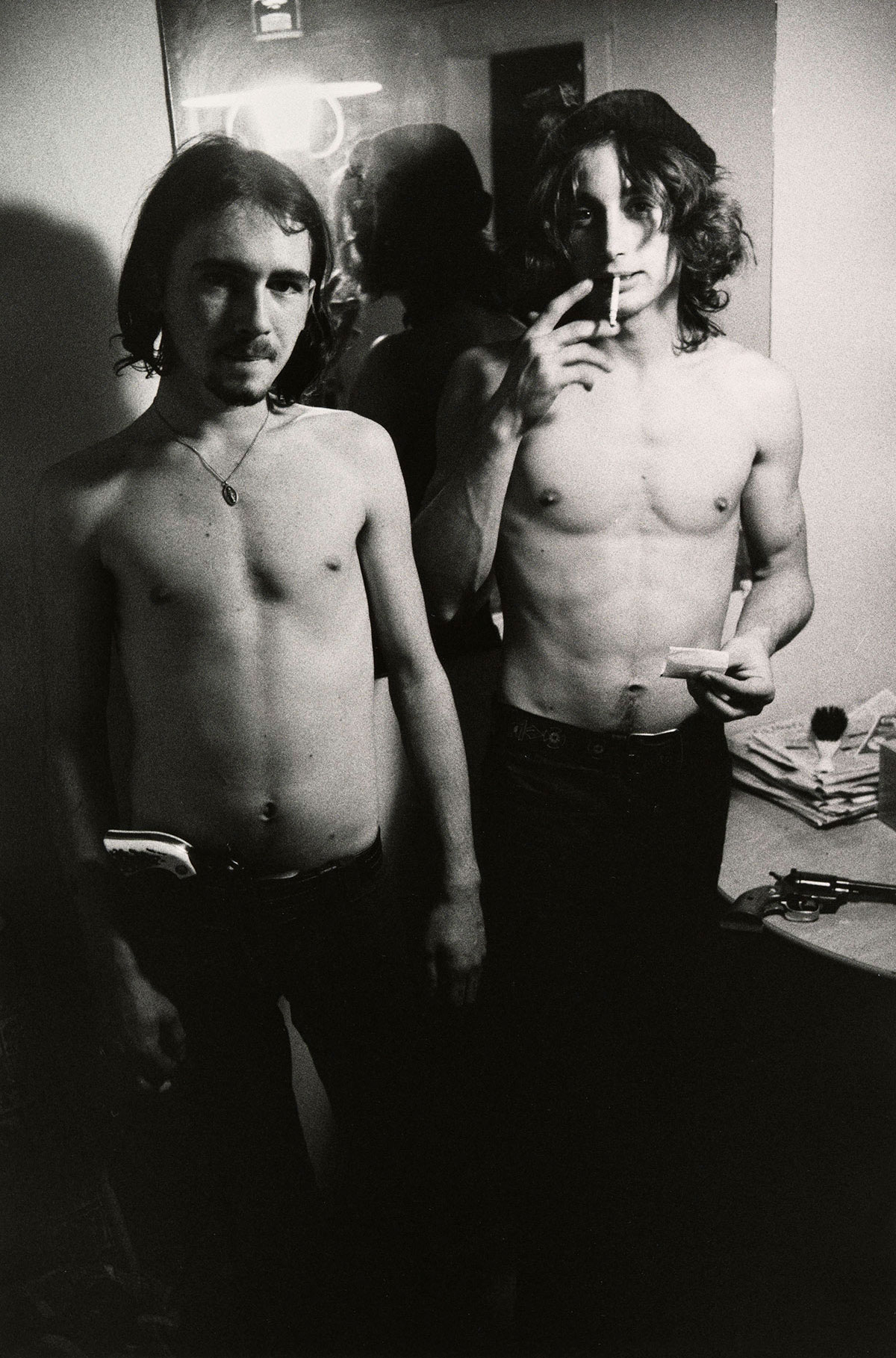
 

Larry Clark (American, born 1943) 'Armed Robbers, Oklahoma City' 1975, printed 1981


Larry Clark (American, b. 1943)
Armed Robbers, Oklahoma City
1975, printed 1981
Gelatin silver print
30.5 x 20.2cm (12 x 7 15/16 in.)
Purchase, The Horace W. Goldsmith Foundation Gift, through Joyce and Robert Menschel, 1994
© Larry Clark


A child of Eisenhower’s strait laced and conformist 1950s America, Clark saw the camera as a way to “turn back the years” and photograph a younger crowd doing the kinds of things he either did or wanted to have done when he himself was a teenager – shooting drugs, shacking up with prostitutes, and committing all manner of crimes. Because of the nature of who and what he was photographing, almost all of Clark’s work from this period would become memorial in nature. This double portrait makes manifest the dangerous allure that is often attached to portrayals of criminality.


United Press International (American) '[Bank Robber Aiming at Security Camera, Cleveland, Ohio]' March 8, 1975


United Press International (American)
[Bank Robber Aiming at Security Camera, Cleveland, Ohio]
March 8, 1975
Gelatin silver print
Image: 6 7/8 × 4 13/16 in. (17.4 × 12.2cm)
Sheet: 7 1/2 × 5 7/8 in. (19.1 × 15cm)
Twentieth-Century Photography Fund, 2015


This startling photograph captures a robber firing his pistol at a bank camera to prevent it from recording his identity. Although he and his accomplices absconded with $11,600 in the heist, the gunman was too slow for the ever-watchful eye of the security camera, which caught his face right before the shot rang out, enabling authorities to identify their suspect.


The Metropolitan Museum of Art
1000 Fifth Avenue at 82nd Street
New York, New York 10028-0198
Phone: 212-535-7710

Opening hours:
Sunday – Tuesday and Thursday: 10am – 5pm
Friday and Saturday: 10am – 9pm
Closed Wednesday

The Metropolitan Museum of Art website

LIKE ART BLART ON FACEBOOK

Back to top

Exhibition: ‘François Kollar. A Working Eye’ at Jeu de Paume, Paris

Exhibition dates: 9th February – 22nd May, 2016

Curators: Matthieu Rivallin, collections officer, Médiathèque de l’architecture et du patrimoine, Paris, and Pia Viewing, curator – researcher at the Jeu de Paume, Paris.


François Kollar (French born Slovakia, 1904-1979) 'Nettoyage des lampes. Société des mines de Lens. Lens (Pas-de-Calais)' 1931-1934 from the exhibition Exhibition: 'François Kollar. A Working Eye' at Jeu de Paume, Paris, Feb - May, 2016
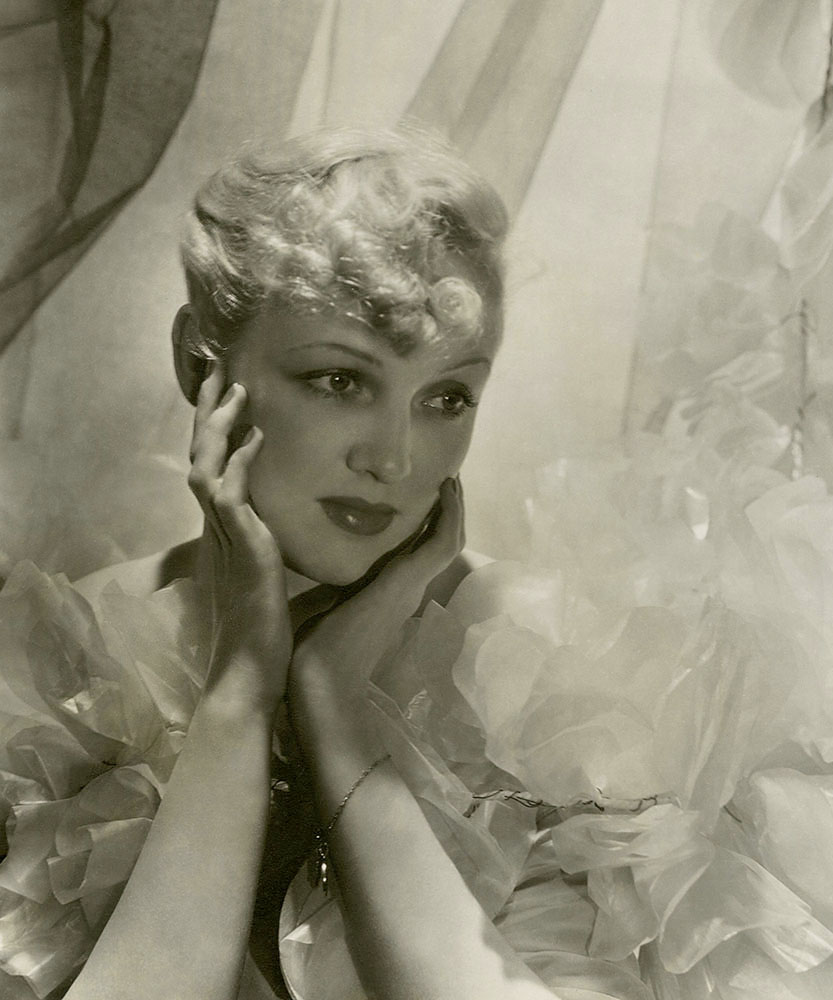
 

François Kollar (French born Slovakia, 1904-1979)
Nettoyage des lampes. Société des mines de Lens. Lens (Pas-de-Calais)
Cleaning lamps. The mining company of Lens. Lens (Pas-de-Calais)
1931-1934
From the booklets La France travaille
Vintage silver gelatin photograph
18 x 24cm
Bibliothèque Forney. Ville de Paris
© François Kollar / Bibliothèque Forney / Roger-Viollet


François Kollar is a magnificent photographer. He produced strong images that possess few histrionics, even less ego. They simply just are.

People quoted in this posting comment that in his photographs “human measure is omnipresent”; that you never loose the sense of scale; that there are “frequent contrasts between near and far, the intimate and the monumental”; that his photographs are “an anthropological investigation into the behaviour, gestures and postures of people at work”; that “Men and women and their functions and roles in the production process are recurrent elements.”

All these statements are true.

Further, his images are sensitive, beautiful, show no traces of any social movements, and little sign of emotion. As Dominique Vautrin observes, “François Kollar is a photographer who resembles his images: somewhat mysterious, beautiful, and discreet…” And as the text from Jeu de Paume states, “He revealed himself to be a temperate photographer, somewhere between the barebones modernism of Bauhaus and a humanist approach to photography.” Other photographers who could fit into this playlist could be Bill Brandt in England, Walker Evans in America and Wolfgang Sievers in Australia.

But what a splendid description – a “temperate photographer”. Showing moderation and self-restraint… there is far too little of that in contemporary photography. A humanist with an avant-garde edge, a photographer whose vision was clear and consistent throughout his oeuvre, who could turn his hand to anything: advertising, fashion, avant-garde, double exposures, solarisation, photomontage, documentary reportage, surrealism, constructivism, modernism.

Joseph Nechvatal comments that Kollar’s work is poignant. This is an incorrect word to describe the work, for the photographs never evoke a keen sense of sadness or regret. They are of a different order altogether. Let me explain.

There is a wonderful stoicism about the people who Kollar chooses to photograph, who inhabit his world of work. The endurance of work without the display of feelings and without complaint. Labour is not represented in any glorified way, not as a noble undertaking, and certainly not heroic (although the worker can be represented as intimate and monumental). The workers are represented as an adjunct to the machine but not in a cyborg fashion. In his photographs there is a distinctness about the worker which sets the human apart from the machine, even as he is “deeply embedded within their functions and roles in the production process.” I don’t believe that people understand this separation, preferring instead to comment on the embedding of the human within machine processes. But something was bothering me when I looked at these images and I have pondered long and hard over how to interpret them. There was something I could not put my finger on and it is this…

In the work of Lewis Hine, the workers are in the present looking to the future. In the work of François Kollar there is no justification for the work it is just work… being there in the present. No ego, no elevation of experience or emotion, and the photographs are just so. Just being in the world. The thing itself. Nothing more, nothing less. It seems simple when you say it like that, but the concept is very complex – to allow the photograph to materialise from consciousness, as a sort of previsualisation of experience – of being a poor, working class immigrant (which Kollar was) picturing his own.

That he achieved such photographs “with his 5 x 7 large-format camera and cumbersome lighting equipment” is a testament to the dedication to his craft, to his work, and to his roots – a connection to the working man and woman. These are honest and forthright photographs of what most humans do for most of their life: work at a job they may not like – to pay the bills, to put food on the table. The lighting is superb, the compositions eloquent, the characters in his images unforgettable (Kollar particularly likes portraits of men shot from below with their arms folded) but it is the balance between the subjective and objective which is so finely honed in his work. The dispassionate nature of humans when at work is balanced by the aesthetics of the artist and the humanity of the individual.

Dr Marcus Bunyan


Many thankx to Jeu de Paume for allowing me to publish the photographs in the posting. Please click on the photographs for a larger version of the image. View an interesting video of the exhibition and the work of François Kollar on Vimeo.


This retrospective features an ensemble of 130 vintage prints, some of which are previously unseen, as well as others from the photographer’s family’s bequest to the state. It puts Kollar’s work in the spotlight and shows how he managed to lift the veil on the working world in the 20th century. As visitors discover the documentary, artistic and historical qualities of the material on show, they will be able to observe how individuals found their place in society by the means of their occupation and realise the profound changes that took place in industry between the 1930s and the 1960s.


François Kollar. Courtesy Jeu de Paume


François Kollar. Courtesy Jeu de Paume


“Without falling into hammy Socialist Realism style, Kollar rendered French working class heroes in beautiful, discreet, lush black-and-white tones. These images of the working person endow them with qualities of excellence, nobility, and respect, and evoked in me mixed sensations of hard materialistic capability and human tenderness. These images of men and women, such as “Nettoyage des lampes. Société des mines de Lens, Lens (Pas-de-Calais)” [1931-34, below], show people deeply embedded within their functions and roles in the production process. In that sense, they contrast with Dorothea Lange’s famous and beautiful Migrant Mother series and the uninhabited, rigorously stark industrial scenes photographed by Bernd and Hilla Becher…

Kollar’s distinctive aesthetic provides a strong, sweet spot amid the sour struggles for employment taking place today in economies shaped by histories of slavery, colonialism, union-busting, sexual exploitation, and corporate capitalism. His artistic style, one that colorlessly abstracts, unifies, and embeds the worker within his or her technological environment, broadens the social politics of employment beyond the heroic human. Rather, he depicts through his unifying, ashen tones the conjunction of laborer and machine. In these photographs, the human worker is bound up with non-human apparatuses in cyborg fashion, depicting a complex technological laborer who is no less real and worthy of our aesthetic delectation.”


Joseph Nechvatal. “A Photographer Who Captured Workers Without Romanticizing Them,” on the Hyperallergic website May 4, 2016 [Online] Cited 11/05/2016


François Kollar (French born Slovakia, 1904-1979) 'Porteur de rails. Arles' 1933 from the exhibition Exhibition: 'François Kollar. A Working Eye' at Jeu de Paume, Paris, Feb - May, 2016


François Kollar (French born Slovakia, 1904-1979)
Porteur de rails. Arles
1933
Reproduction d’après négatif original sur plaque de verre
Print from the original glass plate negative
13 x 18cm
Bibliothèque Forney. Ville de Paris
© François Kollar / Bibliothèque Forney / Roger-Viollet


François Kollar (French born Slovakia, 1904-1979) 'Construction des grands paquebots, Rivetage de tôles d‘un pont de navire, chantier et ateliers de Saint-Nazaire à Penhoët' (Construction of large ships, riveting the sheets of a ships deck, site workshops of Saint Nazaire Penhoët) 1931-1932


François Kollar (French born Slovakia, 1904-1979)
Construction des grands paquebots, Rivetage de tôles d’un pont de navire, chantier et ateliers de Saint-Nazaire à Penhoët
Construction of large ships, riveting the sheets of a ships deck, site workshops of Saint Nazaire Penhoët
1931-1932
Vintage silver gelatin photograph
28.9 x 23.5cm
Donation François Kollar, Médiathèque de l’architecture et du patrimoine


François Kollar: “A Working Eye” from 09 February 2016 until 22 May 2016 at Jeu de Paume, Paris


François Kollar (French born Slovakia, 1904-1979) 'Dans le port, à bord. Super Ile de France: cisaillage au chalumeau oxhydrique' (In port, on board. Super Ile de France: cutting using the welding torch. Company building sites and workshops of Saint Nazaire Penhoët) 1931


François Kollar (French born Slovakia, 1904-1979)
Dans le port, à bord. Super Ile de France: cisaillage au chalumeau oxhydrique. Société des chantiers et ateliers de Saint-Nazaire à Penhoët
In port, on board. Super Ile de France: cutting using the welding torch. Company building sites and workshops of Saint Nazaire Penhoët

1931
Vintage silver gelatin photograph


François Kollar (French born Slovakia, 1904-1979) 'Dans le port, à bord. Champlain : grattage du pont' (In port, on board. Champlain: scraping the bridge. Company building sites and workshops of Saint Nazaire Penhoët) 1931


François Kollar (French born Slovakia, 1904-1979)
Dans le port, à bord. Champlain: grattage du pont. Société des chantiers et ateliers de Saint-Nazaire à Penhoët
In port, on board. Champlain: scraping the bridge. Company building sites and workshops of Saint Nazaire Penhoët

1931
Vintage silver gelatin photograph


François Kollar (French born Slovakia, 1904-1979) 'Dans le port, à bord. "Negre" soutier, Bordeaux (Gironde)' (In port, on board. "Negro" help, Bordeaux (Gironde)) 1931


François Kollar (French born Slovakia, 1904-1979)
Dans le port, à bord. “Negre” soutier, Bordeaux (Gironde)
In port, on board. “Negro” help, Bordeaux (Gironde)
1931
Vintage silver gelatin photograph


François Kollar was born in Szenc, Hungary in 1904 (now the Slovakian town of Senec) and died in Créteil, France in 1979. He was first employed on the railways in his native country and then worked as a lathe operator at Renault’s Boulogne-Billancourt factory, before becoming a professional photographer at the age of 24 after gaining solid experience as a studio manager at the Parisian printer’s, Draeger. His in-depth knowledge of the world of work, in sectors as diverse as advertising, fashion, industry, handicrafts and agriculture, allowed him to portray tools, materials and gestures with exceptional professional expertise.

This retrospective features an ensemble of 130 vintage prints, some of which are previously unseen, as well as others from the photographer’s family’s bequest to the state. It puts Kollar’s work in the spotlight and shows how he managed to lift the veil on the working world in the 20th century. As visitors discover the documentary, artistic and historical qualities of the material on show, they will be able to observe how individuals found their place in society by the means of their occupation and realise the profound changes that took place in industry between the 1930s and the 1960s.

In 1930 Kollar got married and set up his own studio in Paris. His wife, who was his first model, worked faithfully by his side throughout his life. He worked for advertising agencies and famous luxury brands and excelled in showcasing the qualities of his models, forms and fabrics thanks to his feeling for light and texture. François Kollar worked with several fashion magazines, notably Harper’s Bazaar for which, over the course of more than fifteen years, he produced many photographic series, particularly images shot on location. Whether he was photographing the period’s fashion celebrities (Coco Chanel, Elsa Schiaparelli, Pierre Balmain) or models and adverts for the major fashion houses (Hermès, Molyneux, Oméga, Christofle and Worth et Coty perfumes…), he experimented with a wide variety of modern photographic techniques, freely creating original compositions using backlighting, double exposures, overprinting and solarisation…

In 1930, after exhibiting at “Das Lichtbild”, an international photography exhibition in Munich alongside Florence Henri, André Kertész, Germaine Krull and Ergy Landau, François Kollar received a major commission from a publishing company, Horizons de France entitled La France travail (1931-1934) that would establish his reputation as one of the period’s greatest industrial reporters. During the war he refused to collaborate with the powers that be during the German occupation and left the public eye, moving with his wife and three children to the Poitou-Charentes region and only returning to photography in 1945 on his return to Paris. In the 1950s and 1960s, Kollar covered numerous industrial subjects in France and abroad.

Text from the Jeu de Paume website


François Kollar (French born Slovakia, 1904-1979) 'La Tour Eiffel' (The Eiffel Tower) 1930


François Kollar (French born Slovakia, 1904-1979)
La Tour Eiffel (The Eiffel Tower)
1930
Montage of a negative and interpositive, period photomontage
18 x 24cm
Donation François Kollar, Médiathèque de l’architecture et du patrimoine


François Kollar (French born Slovakia, 1904-1979) 'Aux sources de l'énergie. Enseignes lumineuses. Paris' (The sources of energy. Neon signs. Paris) 1931


François Kollar (French born Slovakia, 1904-1979)
Aux sources de l’énergie. Enseignes lumineuses. Paris
The sources of energy. Neon signs. Paris
1931
Vintage silver gelatin photograph
18 x 24cm
Bibliothèque Forney. Ville de Paris
© François Kollar / Bibliothèque Forney / Roger-Viollet


François Kollar (French born Slovakia, 1904-1979) 'Bouche du tunnel Sainte-Catherine, Sotteville-lés-Rouen' (St. Catherine tunnel mouth, Sotteville-lés-Rouen) 1931-1932


François Kollar (French born Slovakia, 1904-1979)
Bouche du tunnel Sainte-Catherine, Sotteville-lés-Rouen
St. Catherine tunnel mouth, Sotteville-lés-Rouen
1931-1932
Vintage silver gelatin photograph
Donation François Kollar, Médiathèque de l’architecture et du patrimoine


François Kollar (French born Slovakia, 1904-1979) 'Étude publicitaire pour Magic Phono, portrait de Marie Bell en photomontage' (Advertising study for Magic Photo, Marie Bell portrait photomontage) 1930


François Kollar (French born Slovakia, 1904-1979)
Étude publicitaire pour Magic Phono, portrait de Marie Bell en photomontage
Advertising study for Magic Photo, Marie Bell portrait photomontage

1930
Vintage silver gelatin photograph
Donation François Kollar, Médiathèque de l’architecture et du patrimoine


François Kollar (French born Slovakia, 1904-1979) 'Publicité pour machine à écrire Hermès' (Advertising for the Hermes typewriter) 1930


François Kollar (French born Slovakia, 1904-1979)
Publicité pour machine à écrire Hermès
Advertising for the Hermes typewriter
1930
Vintage silver gelatin photograph
30.1 x 23.7cm
Donation François Kollar, Médiathèque de l’architecture et du patrimoine


François Kollar (French born Slovakia, 1904-1979) 'Escalier chez Chanel' (Staircase at Chanel) 1937


François Kollar (French born Slovakia, 1904-1979)
Escalier chez Chanel
Staircase at Chanel

1937
Vintage silver gelatin photograph
Donation François Kollar, Médiathèque de l’architecture et du patrimoine


François Kollar (French born Slovakia, 1904-1979) 'Gabrielle Chanel' 1938


François Kollar (French born Slovakia, 1904-1979)
Gabrielle Chanel
1938
Silver gelatin photograph


François Kollar (French born Slovakia, 1904-1979) 'Le mannequin Muth, Balenciaga' (The model Muth, Balenciaga) 1930


François Kollar (French born Slovakia, 1904-1979)
Le mannequin Muth, Balenciaga
The model Muth, Balenciaga
1930
Vintage silver gelatin photograph
Donation François Kollar, Médiathèque de l’architecture et du patrimoine


François Kollar (French born Slovakia, 1904-1979) 'Haute couturière Elsa Schiaparelli in a window of her showroom at 21 Place Vendôme in Paris' 1938


François Kollar (French born Slovakia, 1904-1979)
Haute couturière Elsa Schiaparelli in a window of her showroom at 21 Place Vendôme in Paris
1938
Vintage silver gelatin photograph
Courtesy Jeu de Paume


The design of the three large exhibition halls, which sometimes suffers from inadequate lighting, is completed by numerous documents (leaflets, magazines, personal albums) and an extensive slide show. The rooms are color-coded: white, blue-grey, and light beige, corresponding to the curators’ pedagogical intention. The beige in the last room is particularly interesting because it nearly blends in with the wooden frames, thereby intensifying the magical black-and-white tones in François Kollar’s work.

In addition to the documentary dimension of his work, the power of this photographer lies in his evocation of a “journey”: hence the exhibition walls are brimming with gems such as Les enseignes lumineuses (“Illuminated signs”, above), La bouche du tunnel (“The entrance of the tunnel”, above), or La fabrique à papier (“Paper factory”), advertisements for Hermès or Chanel (above), and many other photographs which, I have no doubt, will resonate with the visitor.

François Kollar is a photographer who resembles his images: somewhat mysterious, beautiful, and discreet, such as his small picture of a river outside the city of Abidjan. A Working Eye which conveys the nobility of men who, one day, had to travel far from home to earn their living.

Dominique Vautrin. “Paris : Francois Kollar, A Working Eye,” on The Eye of Photography website February 18, 2016 [Online] Cited 12/05/2016.


François Kollar (French born Slovakia, 1904-1979) 'Alsthom: assemblage des volants alternateurs de Kembs. Société Alsthom. Belfort (Territoire de Belfort)' (Alsthom: assembly of alternator flywheels at Kembs. Société Alsthom. Belfort) 1931-1934


François Kollar (French born Slovakia, 1904-1979)
Alsthom: assemblage des volants alternateurs de Kembs. Société Alsthom. Belfort (Territoire de Belfort)
Alsthom: assembly of alternator flywheels at Kembs. Société Alsthom. Belfort
1931-1934
Reproduction d’après négatif original sur plaque de verre
Print from the original glass plate negative
13 x 18cm
Bibliothèque Forney. Ville de Paris
© François Kollar / Bibliothèque Forney / Roger-Viollet


François Kollar (French born Slovakia, 1904-1979) 'Automobiles Renault. D'une main l'ouvrier fait tomber le sable. Billancourt (Hauts-de-Seine)' (Renault automobiles. Using his hand the worker brings down the sand. Billancourt (Hauts-de-Seine)) 1931-1934


François Kollar (French born Slovakia, 1904-1979)
Automobiles Renault. D’une main l’ouvrier fait tomber le sable. Billancourt (Hauts-de-Seine)
Renault automobiles. Using his hand the worker brings down the sand. Billancourt (Hauts-de-Seine)
1931-1934
Reproduction d’après négatif original sur plaque de verre
Print from the original glass plate negative
13 x 18cm
Bibliothèque Forney. Ville de Paris
© François Kollar / Bibliothèque Forney / Roger-Viollet


François Kollar (French born Slovakia, 1904-1979) 'Untitled' 1931-1934


François Kollar (French born Slovakia, 1904-1979)
Untitled
1931-1934
Vintage silver gelatin photograph
Courtesy Jeu de Paume
© Photo Éric Simon


LA FRANCE TRAVAILLE, 1931-1934

François Kollar was commissioned by the publishers Horizons de France for a major documentary investigation into the world of work. He took a large number of photos, a part of which were published in a work that has since become famous: La France travaille. This ensemble comprises the main part of the exhibition. The photographer criss-crossed the whole of France, observing the country through the prism of work. Kollar delivered more than 2,000 images covering agricultural and industrial activity in twenty regions of France, including Paris and its suburbs. Horizons de France published La France travaille between 1932 and 1934 in the form of fifteen separate booklets, which are presented in the exhibition in relation to a selection of around sixty prints. The images are organised by theme. Each theme corresponds to a type of raw material used in industry: coal, iron, products of the sea, glass, textiles etc. Slideshows are used to underline the extent of this archive and the variety of photos it contains, as well as analysing it from a contemporary point of view.

The fifteen booklets that comprise La France Travaille constitute “an anthropological investigation into the behaviour, gestures and postures of people at work” (Jean-François Chevrier, ‘La France travaille: les vertus de l’illustration’, Jeu de Paume, Editions de La Martinière). These fifteen volumes touch on the revolutions taking place across the country – factories, hydroelectric installations etc – as well as the place of the workers in these infrastructures. Apart from the recognition that he had earned in the world of fashion and luxury products, it was through his work to fulfil this commission, the most important in France in the 1930s, that Kollar distinguished himself as a photographer and an ‘industrial reporter’.

Text from Jeu de Paume


François Kollar (French born Slovakia, 1904-1979) 'La trieuse reste coquette. Lens, Pas-de-Calais. Société des mines de Lens' (The sorter remains coquette. Lens, Pas-de-Calais. Mining company of Lens) 1931-1934


François Kollar (French born Slovakia, 1904-1979)
La trieuse reste coquette. Lens, Pas-de-Calais. Société des mines de Lens
The sorter remains coquette. Lens, Pas-de-Calais. Mining company of Lens
1931-1934
Reproduction d’après négatif original sur plaque de verre
Print from the original glass plate negative
13 x 18cm
Bibliothèque Forney. Ville de Paris
© François Kollar / Bibliothèque Forney / Roger-Viollet


François Kollar (French born Slovakia, 1904-1979) 'Untitled [mine worker]' 1931-1934


François Kollar (French born Slovakia, 1904-1979)
Untitled [mine worker]
1931-1934
Reproduction d’après négatif original sur plaque de verre
Print from the original glass plate negative
13 x 18cm
Bibliothèque Forney. Ville de Paris
© François Kollar / Bibliothèque Forney / Roger-Viollet


François Kollar (French born Slovakia, 1904-1979) 'Pêcheurs. Femme de pêcheurs, Sardinier Breton. Audiernes' (Fishermen. Woman fishing, sardine canner Breton. Audiernes) 1931


François Kollar (French born Slovakia, 1904-1979)
Pêcheurs. Femme de pêcheurs, Sardinier Breton. Audiernes
Fishermen. Woman fishing, sardine canner Breton. Audiernes

1931
Reproduction d’après négatif original sur plaque de verre
Print from the original glass plate negative
13 x 18cm
Courtesy Jeu de Paume
© Photo Éric Simon


From 1931 to 1934, just before the major protests led by the Popular Front, François Kollar (1904-1979) traveled across France meeting its working population. This wide-ranging survey of the working world, which featured 1400 illustrations, was published in 1934 in booklets entitled La France Travaille (France at Work). With his 5 x 7 large-format camera and cumbersome lighting equipment, this Slovak immigrant of humble origins convinced miners, winemakers, boatmen and railroad men to pose for him during their daily routines. The images from La France Travaille, negatives and positives, are preserved at the Bibliothèque Forney and distributed exclusively by the Agence Roger-Viollet.

Text from The Eye of Photography website


François Kollar (French born Slovakia, 1904-1979) 'Le bâtiment. Pose des ardoises. Paris. Entreprise Ch. Lavillauguet' (Building. Laying slate. Paris. Company Ch. Lavillaugouet) 1931


François Kollar (French born Slovakia, 1904-1979)
Le bâtiment. Pose des ardoises. Paris. Entreprise Ch. Lavillauguet
Building. Laying slate. Paris. Company Ch. Lavillaugouet

1931
Reproduction d’après négatif original sur plaque de verre
Print from the original glass plate negative
13 x 18cm
Bibliothèque Forney. Ville de Paris
© François Kollar / Bibliothèque Forney / Roger-Viollet


François Kollar (French born Slovakia, 1904-1979) 'Vignerons. Porteurs de bénatons. Bourgogne, Morey-Saint-Denis (Côte- d'Or)' (Winemakers. Carriers of grapes. Burgundy Morey-Saint-Denis (Côte- d'Or)) 1931


François Kollar (French born Slovakia, 1904-1979)
Vignerons. Porteurs de bénatons. Bourgogne, Morey-Saint-Denis (Côte- d’Or)
Winemakers. Carriers of grapes. Burgundy Morey-Saint-Denis (Côte- d’Or)

1931
Reproduction d’après négatif original sur plaque de verre
Print from the original glass plate negative
13 x 18cm
Bibliothèque Forney. Ville de Paris
© François Kollar / Bibliothèque Forney / Roger-Viollet


François Kollar’s body of work covers two major periods in photographic history and the history of the 20th century: the 1930s and the 1950s-1960s. This retrospective at the Jeu de Paume is part of a cycle of exhibitions devoted to the emblematic photographers of the period, such as Laure Albin Guillot, André Kertész, Claude Cahun and Germaine Krull. The exhibition gives pride of place to the photographer’s three children’s bequest of negatives, prints, magazines, press cuttings and advertising pamphlets that was accepted by the French state in 1987.

The exhibition is organised chronologically following the photographer’s life and career, starting with his experimentations in the 1930s (self-portraits and photomontages) with his wife and close collaborator, Fernande. Right from the start of his photographic work in the field of advertising and fashion, François Kollar asserted his talent with photo shoots for Oméga, Christofle, Hermès and Worth et Coty perfumes. For many years he worked with such magazines as Harper’s Bazaar, L’Illustration, VUVoilà, Le Figaro Illustré and Plaisir de France. Following his coverage of the transformation of the working world in the 1930s, during the 1950s and 60s industrial reports in French West Africa and in France set the tempo for the later years of his career.

Thanks to his experience as a manual worker in Renault, François Kollar’s photography demonstrates his awareness of the world of industry and industrial spaces. ‘Un ouvrier du regard’ bears witness to his high level of technical expertise, both in the studio and on location and his deep-seated interest for industrial trades. It highlights the wide variety of subjects photographed by François Kollar throughout his career, a variety that is mirrored in the techniques he used, as well as the evolutions in the working world as it transitioned from handicrafts and cottage industries to industrial production.

The central part of the exhibition is devoted to the high point of François Kollar’s career, La France travaille. This commission from the publishing company Horizons de France comprises some fifteen booklets produced between 1931 and 1934. The reports, indexed by sector – from agriculture to the steel industry, including the maritime industry and electricity production – were produced with the aim of showcasing France’s leading companies and the figure of the working man, contributing in this way to idealising the image of men and women at work. Taken as a whole, these reports constitute a unique chronicle in images of the world of work and French society from the beginning of the 1930s up until the 1960s. During this entire period, François Kollar endeavoured to photograph the mechanised world of serial production, standardisation and the rationalisation of production.

Through a play with light, transparency and chiaroscuro effects, as well as compositions that highlighted different textures, François Kollar managed to reveal a sensitive side to industrial landscapes. He revealed himself to be a temperate photographer, somewhere between the barebones modernism of Bauhaus and a humanist approach to photography. At the beginning of his career, François Kollar had immortalised dresses, jewellery and objets d’art for Harper‘s Bazaar in a manner that demonstrated his attention to the gesture and the ‘intelligence of the hand’. Kollar’s work is characterised by an approach that is simultaneously sensitive and distant: sensitive to shape and light in the situations in which objects and human bodies are portrayed; distant because of this lens between him and the general population. The camera’s lens distanced him from the ordinary men and women and their demands, which explains why his work shows no traces of any social movements, although they were frequent at the time (1929 and 1931-1936).

The retrospective provides the means to fully-apprehend the diversity of a photographer who was himself a ‘worker’ (ouvrier) at the service of his clients – whether advertising companies, clients from the world of fashion and the media, or industrialists – but who nevertheless managed to preserve a strong photographic identity and a unique view on his times. Throughout his body of work, François Kollar bears witness to the ideology of progress that drives the capitalist economy, whilst preserving his characteristic objectivity.

First part

The first part of the exhibition features Kollar’s experimental period including self-portraits taken in his Parisian studio, as well as his work for advertising firms and the fashion industry. This section is made up of photos that reflect the spirit of the modern world he lived in and bear witness to Kollar’s desire to develop an experimental and expressive style of photography through an almost playful approach to his models, objects, lighting and composition. Detailed documentary resources enable visitors to understand the context of his advertising work and the photos for the blossoming illustrated magazine sector, which were published in L’Illustration, Vu, Voilà, Art et Médecine and Plaisir de France, amongst others.

Second part

The central part of the exhibition, devoted to La France travaille (1931-1934), features vintage prints and slideshows, as well as archives and publications. This photographic commission constitutes a unique record of the world of work in the 1930s. Kollar photographed every sector of activity: industry, agriculture, aviation, handicrafts, as well as the automobile, maritime and railway industries. Men and women and their functions and roles in the production process are recurrent elements in François Kollar’s images. Published in the form of fifteen themed booklets, printed in photogravure by Editions Horizons de France, Kollar’s photographs were used to illustrate texts by popular authors from the period (Paul Valéry, Pierre Hamp, Lucien Favre…) dealing with the main professions in French industry.

Third part

The third part of the exhibition presents works by Kollar from the period following on from La France travaille, notably fashion photography and commissions for industrial reporting assignments. Thanks to his reputation as a talented advertising photographer, François Kollar was much in demand for portrait work and he notably photographed Coco Chanel, Elisa Schiaparelli and the Duchess of Windsor. Although his collaboration with Harper’s Bazaar came to an end in 1955, Kollar continued to enjoy a successful career in industrial photography. Amongst his numerous photographic series, the Jeu de Paume has chosen to show in particular the 1951 commission from the French State for a report on French West Africa (now Burkina Faso, Ivory Coast, Mali and Senegal), as well as a series of photos showing the workshops of the Union Aéromaritime de Transport. In this way, the exhibition highlights the transformations in the world of work during the 20th century and the place occupied by men and women at a time when the world was in a state of upheaval because of global conflicts, as well as in the midst of rebuilding itself.

Text from Jeu de Paume


François Kollar (French born Slovakia, 1904-1979) 'Untitled' 1930


François Kollar (French born Slovakia, 1904-1979)
Untitled
1930


François Kollar (French born Slovakia, 1904-1979) 'Untitled' 1930


François Kollar (French born Slovakia, 1904-1979)
Untitled
1930


François Kollar (French born Slovakia, 1904-1979) 'Ciel' 1931


François Kollar (French born Slovakia, 1904-1979)
Ciel (Sky)
1931
Courtesy Jeu de Paume
© Photo Éric Simon


François Kollar (French born Slovakia, 1904-1979) 'Fleur d'ail' (Garlic flower) 1930


François Kollar (French born Slovakia, 1904-1979)
Fleur d’ail (Garlic flower)
1930
Vintage silver gelatin photograph
29.4 x 22.6cm
Donation François Kollar, Médiathèque de l’architecture et du patrimoine


François Kollar (French born Slovakia, 1904-1979) 'Untitled' Nd


François Kollar (French born Slovakia, 1904-1979)
Untitled
Nd
Silver gelatin photograph
Courtesy Jeu de Paume
© Photo Éric Simon


François Kollar (French born Slovakia, 1904-1979) 'Untitled' Nd


François Kollar (French born Slovakia, 1904-1979)
Untitled
Nd
Silver gelatin photograph
Courtesy Jeu de Paume
© Photo Éric Simon


Portrait of François Kollar


Portrait of François Kollar


FRENCH WEST AFRICA (A.O.F.) COMMISSION ED BY THE FRENCH STATE, 1951

When France invested massively in the 1950s in the construction of infrastructures in French West Africa, Kollar went to document this milestone in the relationship between France and its colonies, notably today’s Burkina Faso, Ivory Coast, Mali and Senegal. His photos were published in the magazines of French West Africa to portray France’s initiatives in a positive light. Continuing to play his part in the ‘manufacture’ of consensual, positive images, Kollar continued his career by taking photos of men and women at work in factories, building roads or on ships plying their trade… “What François Kollar wants to portray is a sort of gradual disengagement of the colonial power, (…) but also how behind the ‘modernity’ (which is the subject of his remit) lies a form of tradition, rather as if he wanted to show how the two aspects are in contradiction with each other” (Pascal Blanchard, ‘Francois Kollar. Afrique 50. Dans l’oeil de la propagande’, Jeu de Paume, Editions de La Martinière).

Text from Jeu de Paume


INDUSTRIAL REPORTS 1950-1960

Back in Paris in 1945, François Kollar re-established his contacts and started receiving commissions from French industry once more. His photos powerfully document the relationship between the human body, the machine and the working environment. “In Kollar’s images, the human measure is omnipresent; one almost never loses the sense of scale […] with frequent contrasts between near and far, the intimate and the monumental”. (Jean-François Chevrier, ‘La France travaille: les vertus de l’illustration’, Jeu de Paume, Editions de La Martinière). Indeed the design of new industrial buildings took the question of ergonomics into account, which went hand-in-hand with the evolutions in the roles and tasks of factory workers. Amongst others, François Kollar worked for the Union Aéromaritime de Transport, (an airline that mainly served Africa, and French West Africa in particular, later to become UTA); the potash mines of Alsace; Moulinex; Christofle; and Poliet-et-Chausson. Kollar, who learnt how to use colour photography techniques early on, used this new medium for some of these reports.

Text from Jeu de Paume


François Kollar (French born Slovakia, 1904-1979) 'Chaussures Bata, Rufisque, Senegal' (Bata Shoes, Rufisque, Senegal) 1951


François Kollar (French born Slovakia, 1904-1979)
Chaussures Bata, Rufisque, Senegal
Bata Shoes, Rufisque, Senegal
1951
Vintage silver gelatin photograph
22.6 x 24.8cm
Donation François Kollar, Médiathèque de l’architecture et du patrimoine


François Kollar (French born Slovakia, 1904-1979) 'Poliet et Chausson, Gargenville' 1957-1958


François Kollar (French born Slovakia, 1904-1979)
Poliet et Chausson, Gargenville
1957-1958
Vintage silver gelatin photograph
29.7 x 21.6cm
Donation François Kollar, Médiathèque de l’architecture et du patrimoine


François Kollar (French born Slovakia, 1904-1979) Untitled [Emplacement de traverses, usine Cima, Croix]' [Replacement of sleepers, Cima factory, Croix] c. 1954


François Kollar (French born Slovakia, 1904-1979)
Untitled [Emplacement de traverses, usine Cima, Croix] [Replacement of sleepers, Cima factory, Croix]
c. 1954
Vintage silver gelatin photograph
29.7 x 21.6cm
Donation François Kollar, Médiathèque de l’architecture et du patrimoine


François Kollar (French born Slovakia, 1904-1979) 'Type de laiterie dans une ferme Normande' (Type of dairy farm in Normandy) 1950


François Kollar (French born Slovakia, 1904-1979)
Type de laiterie dans une ferme Normande
Type of dairy farm in Normandy
1950
Vintage silver gelatin photograph
15.5 x 11.5cm
Donation François Kollar, Médiathèque de l’architecture et du patrimoine


François Kollar (French born Slovakia, 1904-1979) 'Fabrication de corps de chauffe de chauffe-eau, usine Brandt, France' (Manufacturing water heater, heater factory Brandt, France) 1950


François Kollar (French born Slovakia, 1904-1979)
Fabrication de corps de chauffe de chauffe-eau, usine Brandt, France
Manufacturing water heater, heater factory Brandt, France
1950
Vintage silver gelatin photograph
13.6 x 8.9cm
Donation François Kollar, Médiathèque de l’architecture et du patrimoine


François Kollar (French born Slovakia, 1904-1979) 'Untitled [Fabrication des moulins à légumes, usine Moulinex, Alençon]' [Production of vegetable mills, Moulinex factory, Alençon] 1950


François Kollar (French born Slovakia, 1904-1979)
Untitled [Fabrication des moulins à légumes, usine Moulinex, Alençon] [Production of vegetable mills, Moulinex factory, Alençon]
1950
Vintage silver gelatin photograph
29.6 x 21.6cm
Donation François Kollar, Médiathèque de l’architecture et du patrimoine


François Kollar (French born Slovakia, 1904-1979) 'Untitled [Emboutissage des couverts, Christofle, France]' [Stamping cutlery, Christofle, France] 1957-1958


François Kollar (French born Slovakia, 1904-1979)
Untitled [Emboutissage des couverts, Christofle, France] [Stamping cutlery, Christofle, France]
1957-1958
Vintage silver gelatin photograph
30 x 21.6cm
Donation François Kollar, Médiathèque de l’architecture et du patrimoine


Other François Kollar photographs


François Kollar (French born Slovakia, 1904-1979) 'Untitled' 1931


François Kollar (French born Slovakia, 1904-1979)
Untitled
1931
Silver gelatin photograph


François Kollar (French born Slovakia, 1904-1979) 'Untitled' 1936


François Kollar (French born Slovakia, 1904-1979)
Untitled
1936
Silver gelatin photograph


François Kollar (French born Slovakia, 1904-1979) 'Construction' 1936


François Kollar (French born Slovakia, 1904-1979)
Construction
1936
Silver gelatin photograph


Jeu de Paume
1, Place de la Concorde
75008 Paris
métro Concorde
Phone: 01 47 03 12 50

Opening hours:
Tuesday: 11.00 – 21.00
Wednesday – Sunday: 11.00 – 19.00
Closed Monday

Jeu de Paume website

LIKE ART BLART ON FACEBOOK

Back to top

Exhibition: ‘Impressions of Paris: Lautrec, Degas, Daumier, Atget’ and ‘Impressions of Melbourne’ at the Monash Gallery of Art, Melbourne

Exhibition dates: 17th July – 20th September, 2015

National Gallery of Australia touring exhibition

Curator of Impressions of Paris: Jane Kinsman, National Gallery of Australia’s Senior Curator of International Prints


Eugène Atget (France, 1857-1927) 'No title (Brocanteur)' c. 1898-1905 from the exhibition 'Impressions of Paris: Lautrec, Degas, Daumier, Atget' and 'Impressions of Melbourne' at the Monash Gallery of Art, Melbourne, July - Sept, 2015


Eugène Atget (France, 1857-1927)
No title (Brocanteur)
c. 1898-1905
Albumen silver photograph
17.8 x 21.9cm
National Gallery of Australia, Canberra
Purchased 1980


Impressions of Paris: Lautrec, Degas, Daumier, Atget is a particularly dry and uninspiring National Gallery of Australia touring exhibition, which was only enlivened for me by the enlightened presence of 20 or so vintage Eugène Atget photographs, specifically added for this showing at the Monash Gallery of Art, the home of Australian photography.

Atget’s photographs have an almost ether/real quality to them in their visual representation and, physically, an ephemeral feel to the quality of the paper – as though the images are about to dissolve into nothing – even as he photographs solid objects such as stairways, doors and door knockers. Observe the photographs Hôtel du Maréchal de Tallard, 78 rue des Archives (c. 1898-1905), A la Grâce de Dieu, 121 rue Montmartre (c. 1900) and Heurtoir, 6 rue du Parc Royal (c. 1901-1914), below, to witness this shimmering phenomenon. It is as if the emulsion of the plate is insufficient to capture the light of life.

In an accompanying exhibition in the smaller gallery, Impressions of Melbourne, photographs by Nicholas Caire, Charles Kerry, Max Dupain, Mark Strizic and Noel Jones investigate the city of Melbourne… but it is the stunning photographs by Atget that make the long drive out to Wheeler’s Hill worth the visit.

Dr Marcus Bunyan


Many thankx to the Monash Gallery of Art for allowing me to publish the photographs in the posting. Please click on the photographs for a larger version of the image.


Eugène Atget (France, 1857-1927) 'Versailles, Grand Trianon' c. 1901-1925 from the exhibition 'Impressions of Paris: Lautrec, Degas, Daumier, Atget' and 'Impressions of Melbourne' at the Monash Gallery of Art, Melbourne, July - Sept, 2015


Eugène Atget (France, 1857-1927)
Versailles, Grand Trianon
c. 1901-1925
Gold-toned silver chloride photograph
17.6 x 22cm
National Gallery of Australia, Canberra
Purchased 1980


Eugène Atget (France, 1857-1927) 'Hôtel du Maréchal de Tallard, 78 rue des Archives' c. 1898-1905


Eugène Atget (France, 1857-1927)
Hôtel du Maréchal de Tallard, 78 rue des Archives
c. 1898-1905
Gold-toned silver chloride photograph
22 x 18.1cm
National Gallery of Australia, Canberra
Purchased 1980


Eugène Atget (France, 1857-1927) 'A la Grâce de Dieu, 121 rue Montmartre' c. 1900


Eugène Atget (France 1857-1927)
A la Grâce de Dieu, 121 rue Montmartre
c. 1900
Printing out paper photograph
22 x 17.7cm
National Gallery of Australia, Canberra
Purchased 1984


Eugène Atget (France, 1857-1927) 'Heurtoir, 6 rue du Parc Royal' c. 1901-1914


Eugène Atget (France, 1857-1927)
Heurtoir, 6 rue du Parc Royal
c. 1901-1914
Gold-toned silver chloride photograph
21.9 x 17.8cm
National Gallery of Australia, Canberra
Purchased 1980


Monash Gallery of Art is delighted to present its major international exhibition of 2015, Impressions of Paris: Lautrec, Degas, Daumier, Atget featuring over 120 prints, posters and photographs drawn from the collection of the National Gallery of Australia.

Impressions of Paris: Lautrec, Degas, Daumier, Atget examines the major contribution to French art made by key figures: Honoré-Victorin Daumier (1808-1879), Edgar Degas (1834-1917), Henri de Toulouse-Lautrec (1864-1901) and includes a selection of photographs by Eugène Atget (1857-1927) specially conceived for Monash Gallery of Art.

Newly appointed Gallery Director Kallie Blauhorn states, “I’m thrilled that for my first exhibition at MGA we are able to present a major international show, Impressions of Paris. Residents of Monash and art lovers across Melbourne will experience the extraordinary works by household names, Toulouse Lautrec, Edgar Degas, Honore Daumier and the wonderful photographer Eugène Atget.”

“This is a first for MGA and a true testament to the reputation of the gallery that we can host this important and significant exhibition,” said Blauhorn.

A generation apart, Lautrec, Degas and Daumier were consummate draughtsmen whose innovative compositions and embrace of modern subject matter played a significant role in artistic developments in France over the nineteenth century. Atget, the only specialist photographer among these artists, spent much of his life documenting the streets of Paris as they underwent modernisation. His photographs show us how modern life was expressed in the architectural experience of France, giving us a glimpse of what modernity left behind.

The generation of French artists who followed Daumier in the nineteenth century were inspired by his critical observations, which became an extraordinary reservoir of ideas. Both Degas and then Lautrec were enthusiastic admirers of French caricature, delighting in its animated qualities, stylistic freedoms and contemporary themes. They were particularly enamoured of Daumier’s caricature.

Degas adopted themes of modern French life, the ballet, the race course, the café-concert and the demi-monde and played an important role in the rejection of mythological and historical subjects favoured by the Impressionists. Many of Degas’ ideas on composition and subjects were, in turn, drawn from Daumier. This French satirist was both extraordinarily gifted and prolific, making a name for himself by lampooning the affectations, stupidities and greed of members of the French bourgeois society in caricatures, which Degas avidly collected.

The youngest of the artists, Lautrec, who sadly dies before reaching 37, borrowed themes and compositions from Degas, an artist he much admired and emulated. Images of drinkers at a table, ballet and cabaret scenes and nudes reveal the powerful influence that Degas had on the younger artist, as well as Lautrec’s own considerable originality, particularly as a portrayer of individuals rather than the depiction of types often favoured by Degas.

For the most part, Atget’s pictures of streets, parks, courtyards, buildings and their ornamental motifs record remnants of Old Paris. While there is a nostalgic aspect to these views, for contemporary viewers these pictures were about modern Paris. They recorded and helped make sense of changes to the city as it struggled to cope with modernism. Atget’s views of modern Paris focussed on its intimate places, those spaces of the everyday in which people had always worked, loved and lived.

These four artists captured the spirit of Paris in their prints, posters and photographs. Through the examination of this work, we find clues as to why dramatic changes took place in French art over the nineteenth century. They formed part of other generations of artists who admired Daumier and who adapted the caricaturist’s critical lithographic observations. In this way Daumier’s legacy was a brilliant journalistic record of the modern capital and contributed to an era in France ripe for a new art.

Press release from the MGA website


Eugène Atget: growth and decay in the great city

After an unspectacular career in the theatre, Eugène Atget (1857-1927) began to take photographs of Paris in 1892. By 1897 he had established a successful business photographing the spaces that remained of Old Paris. In all, Atget made over 10,000 images of Paris and its surrounds, each taken with a straightforward approach that laid the basis for much of the documentary photography that followed. Atget’s pictures were immensely popular: he sold thousands of prints, satisfying a strong demand for views of a city undergoing massive social and architectural transformation.

For the most part, Atget’s pictures of streets, parks, courtyards, buildings and their ornamental motifs record remnants of pre-Revolutionary Paris. While there is a nostalgic aspect to these views, for contemporary viewers these pictures were about modern Paris. They recorded and helped make sense of changes to the city as it struggled to cope with modernism. Street traders and other workers are seen selling their wares along old streets and laneways; ancient buildings stand in laneways and courtyards undergoing physical transformation; cafes and shops await bustling crowds. Atget’s views of modern Paris focussed on its intimate places, those spaces of the everyday in which people had always worked, loved and lived.


Impressions of Melbourne

17th July 2015 – 20th September 2015

In response to the photographs by Eugène Atget (1857-1927) included in the National Gallery of Australia’s touring exhibition, Impressions of Paris, this exhibition offers views of Melbourne’s streets, laneways and urban landscape. Drawn from the Monash Gallery of Art, City of Monash Collection, this selection traverses a period from the late nineteenth century to the late twentieth century.

Atget photographed Paris during a time when the French capital was undergoing significant transformation. From the 1850s through to the 1920s, the dark medieval neighbourhoods of the city were demolished to make way for the wide avenues and open public spaces that Paris is known for today. Atget’s ambition was to produce clear and detailed photographs that would document the heritage of Paris before it disappeared. Typically taking his photographs in the early morning when the streets were empty, Atget imbued the city with ghostly nostalgia.

The earliest photographs in Impressions of Melbourne, taken by Nicholas Caire and Charles Kerry in the late nineteenth century, are contemporary to those of Atget. While Atget focused longingly on the past, however, these Australian photographers celebrated the civic accomplishments of modern progress in the colonies. The portrayal of Melbourne as a civilised metropolis, attractive to both immigrants and tourists, persisted through the twentieth century. Max Dupain captured the city as a lively and enterprising place, while Mark Strizic lingered on the shimmering ambience of window shopping and city strolling.

Impressions of Melbourne showcases a range of photographic responses to our urban environment, revealing some of Melbourne’s many moods and highlighting the city as a rich photographic subject. The exhibition includes photographs by Nicholas Caire, Charles Kerry, Max Dupain, Mark Strizic and Noel Jones.

Nicholas Caire

Nicolas Caire was born in Guernsey and arrived in Australia, settling in Adelaide, in 1858. He set up his first photographic studio in Adelaide in 1867. He moved to the Victorian goldmining town of Talbot in 1870 before relocating to Melbourne in 1876. At this time, Melbourne was the largest Australian city.

While Caire is best known for his picturesque landscape photographs of the Victorian countryside, he also produced photographs of major city thoroughfares, public buildings, parks and gardens. These subjects were common amongst photographers in the second half of the nineteenth century, conveying a sense of local pride and achievement. Caire’s photographs were often mounted in albums and accompanied by individual descriptive texts, a format that was popular amongst local and overseas visitors at the time.

Charles Kerry

Charles Kerry grew up in country New South Wales before moving to Sydney at the age of 17 to begin his photographic career. After a failed studio partnership, which left him with a lot of debt, Kerry rebuilt his business and by 1890 found himself running a successful studio that had a monopoly on the popular postcard market. By 1898 Kerry’s studio was the largest in Australia, housed in a three-storey building at 310 George Street, Sydney.

Throughout his career, Kerry photographed a broad range of subjects including social and sporting events, portraits of Indigenous people, city streets as well as the New South Wales countryside. He also spent a year documenting every station homestead in New South Wales. Kerry retired in 1913.


Nicholas Caire (born United Kingdom 1837; arrived Australia 1858; died 1918) 'View of Bourke Street, Melbourne' 1877-1878


Nicholas Caire (born United Kingdom 1837; arrived Australia 1858; died 1918)
View of Bourke Street, Melbourne
1877-1878
From the series Views of Victoria
Albumen print
13.4 x 18.7cm
Monash Gallery of Art, City of Monash Collection acquired 1987


Original album caption: Bourke Street is the principal business thoroughfare in the great City of Melbourne. It is about a mile in length, extending from the Parliament House to the Spencer Street Railway Station. On the left hand side of the picture is the Post Office, and at the extreme end of the street can be seen the Parliament House.


Nicholas Caire (born United Kingdom 1837; arrived Australia 1858; died 1918) 'The Government Domain of Victoria' 1877-1878


Nicholas Caire (born United Kingdom 1837; arrived Australia 1858; died 1918)
The Government Domain of Victoria
1877-1878
From the series The public buildings of Melbourne and suburbs
Albumen print Monash Gallery of Art, City of Monash Collection acquired 1987


Original album caption: The Governor’s Residence is on an eminence near the Botanical Gardens, and occupies one of the best positions around the City of Melbourne. Looking westward from the front of the Domain, a splendid view is obtained of Hobson’s Bay, with the townships of St Kilda, Emerald Hill, Sandridge, and Williamstown on the coast. On the north side can be seen the City of Melbourne, with its busy suburban towns – Hotham, Carlton and Fitzroy. From the rear of the building towards the east, in the distance, the retired towns of Richmond, Hawthorn, and Toorak can be distinguished. The building, as seen in the illustration, was completed in the year 1876. Sir G F Bowen, GCMG, being the Resident Governor at the time.


Nicholas Caire (born United Kingdom 1837; arrived Australia 1858; died 1918) 'The Royal Mint, Melbourne' 1877-1878


Nicholas Caire (born United Kingdom 1837; arrived Australia 1858; died 1918)
The Royal Mint, Melbourne
1877-1878
From the series The public buildings of Melbourne and suburbs
Albumen print
Monash Gallery of Art, City of Monash Collection acquired 1987


Original album caption: The Royal Mint of Victoria is situated in the north-easterly part of William Street, West Melbourne. This Government Building is not thrown open to the public for visitation at any time; but an inspection by visitors can be effected on an order from a Member of the Ministry, conditionally that there be no fewer than eight persons at each visitation; one of the number being required to become responsible for the conduct of the party.


Nicholas Caire (born United Kingdom 1837; arrived Australia 1858; died 1918) 'The Post Office, Melbourne' 1877-1878


Nicholas Caire (born United Kingdom 1837; arrived Australia 1858; died 1918)
The Post Office, Melbourne
1877-1878
From the series The public buildings of Melbourne and suburbs
Albumen print
Monash Gallery of Art, City of Monash Collection acquired 1987


Original album caption: This imposing structure is erected at the junction of Bourke and Elizabeth Streets, which may be considered perhaps the most central position in Melbourne. It is provided with a very long corridor for the posting and delivery of letters, & c. The Telegraph Department, as also the Post Office Savings Bank and Money Order Office, are all conducted in connection with the General Post office, Melbourne, of which the Hon. R Ramsay, MLA, is at present Postmaster-General.


Charles Kerry (Australia, 1858-1928) 'Collins Street, looking south' c. 1890


Charles Kerry (Australia, 1858-1928)
Collins Street, looking south
c. 1890
Albumen print
14.5 x 17.5cm
Monash Gallery of Art, City of Monash Collection acquired 1984


Max Dupain (Australia, 1911-1992) 'Melbourne with rain' 1946


Max Dupain (Australia, 1911-1992)
Melbourne with rain
1946
Gelatin silver print
Monash Gallery of Art, City of Monash Collection acquired 1987


Max Dupain

Max Dupain began his photographic career in 1930 as an apprentice in the studio of Cecil Bostock. In 1934 he established his own studio in Sydney and continued to produce a broad range of commercial work over the course of his life. Dupain was strongly influenced by modernist photographic principles and is renowned for his architectural photography as well as his iconic images of Australian beach culture.

While he primarily worked in Sydney, the photographs exhibited here are among several he took of otherAustralian cities. They highlight his interest in documenting city life as well as his use of light, shadow and aerial perspective. They were taken during the post war period; in the year that Dupain was commissioned by the Department of Information to photograph Australia’s way of life as part of a campaign to increase migration to Australia. This period marked a shift in Dupain’s practice, away from advertising and fashion toward social documentary.


Mark Strizic (born Germany 1928; arrived Australia 1950; died 2012) 'Near 101 Collins Street, Jan 1963' 1963


Mark Strizic (born Germany 1928; arrived Australia 1950; died 2012)
Near 101 Collins Street, Jan 1963
1963
Gelatin silver print
36 x 53.5cm
Monash Gallery of Art, City of Monash Collection
Donated by the Bowness Family through the Australian Government’s Cultural Gifts Program 2008
Reproduction courtesy of the artist


Mark Strizic (born Germany 1928; arrived Australia 1950; died 2012) 'Collins Street at McPherson's building - 1, 1967' 1967


Mark Strizic (born Germany 1928; arrived Australia 1950; died 2012)
Collins Street at McPherson’s building – 1, 1967
1967
Gelatin silver print
53.8 x 36cm
Monash Gallery of Art, City of Monash Collection
Donated by the Bowness Family through the Australian Government’s Cultural Gifts Program 2008
Reproduction courtesy of the artist


Mark Strizic

Mark Strizic was born in Berlin and migrated to Melbourne from Zagreb, Croatia in 1950. Strizic had no formal training in photography, but began taking photographs of Melbourne in the 1950s. He abandoned his studies in physics to become a full-time photographer in 1957, taking up subsequent commissions in architectural, industrial, interior design and portrait photography.

Among Strizic’s most widely recognised images are those he created of Melbourne between 1955 and 1970. Strizic documented the streets of Melbourne, showing many sides of the city, from derelict back alleyways to the grand arcades and buildings of Melbourne’s ‘Paris end’. Strizic’s photographs were produced during a period of dramatic change, a time when Melbourne’s Victorian-era buildings were being replaced by modern architectural developments. The images not only serve to document this change but also provide significant and important records of Melbourne pre-modernisation.


Monash Gallery of Art
860 Ferntree Gully Road, Wheelers Hill
Victoria 3150 Australia
Phone: + 61 3 8544 0500

Opening hours:
Tue – Fri: 10am – 5pm
Sat – Sun: 10pm – 4pm
Mon/public holidays: closed

Monash Gallery of Art website

LIKE ART BLART ON FACEBOOK

Back to top

Selection of images part 2

April 2015


Edward Weston (American, 1886-1958) 'Shipyard detail, Wilmington' 1935


Edward Weston (American, 1886-1958)
Shipyard detail, Wilmington
1935
Silver gelatin print


Another selection of interesting images.

My favourites: the weight of Weston’s Shipyard detail, Wilmington (1935, above); and the romanticism (Jean-François Millet-esque), sublime beauty of Boubat’s Lella, Bretagne, France (1947, below).

Dr Marcus Bunyan

Please click on the photographs for a larger version of the image.


Cecil Stoughton (American, 1920-2008) 'Pres. John F. Kennedy's Lincoln Continental' 1963


Cecil Stoughton (American, 1920-2008)
Pres. John F. Kennedy’s Lincoln Continental
1963
Silver gelatin print


Cecil Stoughton (American, 1920-2008) 'Pres. John F. Kennedy's Lincoln Continental' 1963


Cecil Stoughton (American, 1920-2008)
Pres. John F. Kennedy’s Lincoln Continental
1963
Silver gelatin print


Cecil Stoughton (American, 1920-2008) 'Pres. John F. Kennedy's Lincoln Continental' 1963


Cecil Stoughton (American, 1920-2008)
Pres. John F. Kennedy’s Lincoln Continental
1963
Silver gelatin print


Cecil Stoughton (American, 1920-2008)

Cecil William Stoughton (January 18, 1920 – November 3, 2008) was an American photographer. Born in Oskaloosa, Iowa, Stoughton is best known for being President John F. Kennedy’s photographer during his White House years.

Stoughton took the only photograph ever published showing John F. Kennedy, Bobby Kennedy and Marilyn Monroe together. Stoughton was present at the motorcade at which Kennedy was assassinated, and was subsequently the only photographer on board Air Force One when Lyndon B. Johnson was sworn in as the next President. Stoughton’s famous photograph of this event depicts Johnson raising his hand in oath as he stood between his wife Lady Bird Johnson and a still blood-spattered Jacqueline Kennedy.

Text from the Wikipedia website


Max Yavno (American, 1911-1985) 'Garage Doors, San Francisco' 1947


Max Yavno (American, 1911-1985)
Garage Doors, San Francisco
1947
Silver gelatin print


Max Yavno (American, 1911-1985)

Max Yavno (1911-1985) was a photographer who specialised in street scenes, especially in Los Angeles and San Francisco, California.

He did photography for the Works Progress Administration from 1936 to 1942. He was president of the Photo League in 1938 and 1939. Yavno was in the U.S. Army Air Corps from 1942 to 1945, after which he moved to San Francisco and began specialising in urban-landscape photography. Photographer Edward Steichen selected twenty of Yavno’s prints for the permanent collection at New York’s Museum of Modern Art in 1950, and the next year Yavno won a Guggenheim fellowship.

History professor Constance B. Schulz said of him:

For financial reasons he worked as a commercial advertising photographer for the next twenty years (1954-75), creating finely crafted still lifes that appeared in Vogue and Harper’s Bazaar. He returned to artistic landscape photography in the 1970s, when his introspective approach found a more appreciative audience.

Text from the Wikipedia website


Paul Strand (American, 1890-1976) 'Bombed Area, Gaeta, Italy' 1952


Paul Strand (American, 1890-1976)
Bombed Area, Gaeta, Italy
1952
Silver gelatin print


Ralph Steiner (American, 1899-1986) 'American Rural Baroque' 1929


Ralph Steiner (American, 1899-1986)
American Rural Baroque
1929
Silver gelatin print


Ralph Steiner (American, 1899-1986)

Ralph Steiner (February 8, 1899 – July 13, 1986) was an American photographer, pioneer documentarian and a key figure among avant-garde filmmakers in the 1930s.

Born in Cleveland, Steiner studied chemistry at Dartmouth, but in 1921 entered the Clarence H. White School of Modern Photography. White helped Steiner in finding a job at the Manhattan Photogravure Company, and Steiner worked on making photogravure plates of scenes from Robert Flaherty’s Nanook of the North. Not long after, Steiner’s work as a freelance photographer in New York began, working mostly in advertising and for publications like Ladies’ Home Journal. Through the encouragement of fellow photographer Paul Strand, Steiner joined the left-of-centre Film and Photo League around 1927. He was also to influence the photography of Walker Evans, giving him guidance, technical assistance, and one of his view cameras.

In 1929, Steiner made his first film, H2O, a poetic evocation of water that captured the abstract patterns generated by waves. Although it was not the only film of its kind at the time – Joris Ivens made Regen (Rain) that same year, and Henwar Rodekiewicz worked on his similar film Portrait of a Young Man (1931) through this whole period – it made a significant impression in its day and since has become recognised as a classic: H2O was added to theNational Film Registry in December 2005. Among Steiner’s other early films, Surf and Seaweed (1931) expands on the concept of H2O as Steiner turns his camera to the shoreline; Mechanical Principles (1933) was an abstraction based on gears and machinery.

Text from the Wikipedia website


Wilson A. Bentley (American, 1865-1931) 'Snowflake' c. 1920


Wilson A. Bentley (American, 1865-1931)
Snowflake
c. 1920
Gold-chloride toned microphotographs from glass plate negatives


Andre de Dienes (Hungarian, 1913-1985) 'Erotic Nude' 1950s


Andre de Dienes (Hungarian, 1913-1985)
Erotic Nude
1950s
Silver gelatin print


Andre de Dienes (Hungarian, 1913-1985)

Andre de Dienes (born Andor György Ikafalvi-Dienes) (December 18, 1913 – April 11, 1985) was a Hungarian-American photographer, noted for his work with Marilyn Monroe and his nude photography.

Dienes was born in Transylvania, Austria-Hungary, on December 18, 1913, and left home at 15 after the suicide of his mother. Dienes travelled across Europe mostly on foot, until his arrival in Tunisia. In Tunisia he purchased his first camera, a 35mm Retina. Returning to Europe he arrived in Paris in 1933 to study art, and bought a Rolleiflex shortly after.

Dienes began work as a professional photographer for the Communist newspaper L’Humanité, and was employed by the Associated Press until 1936, when the Parisian couturier Captain Molyneux noted his work and urged him to become a fashion photographer. In 1938 the editor of Esquire, Arnold Gingrich offered him work in New York City, and helped fund Dienes’ passage to the United States. Once in the United States Dienes worked for Vogue and Life magazines as well as Esquire.

When not working as a fashion photographer Dienes travelled the USA photographing Native American culture, including the Apache, Hopi, and Navajo reservations and their inhabitants. Dissatisfied with his life as a fashion photographer in New York, Dienes moved to California in 1944, where he began to specialise in nudes and landscapes.

Text from the Wikipedia website


George A. Tice (American, 1938-2025) 'Porch, Monhegan Island, Maine' 1971


George A. Tice (American, 1938-2025)
Porch, Monhegan Island, Maine
1971
Selenium-toned silver print


George A. Tice (American, 1938-2025)

George Tice (b. 1938) is an American photographer best known for his large-format black-and-white photographs of New Jersey, New York, and the Amish. Tice was born in Newark, New Jersey, and self-trained as a photographer. His work is included in major museum collections around the world and he has published many books of photographs, including Fields of Peace: A Pennsylvania German Album (1970), Paterson, New Jersey (1972), Seacoast Maine: People and Places (1973), Urban Landscapes: A New Jersey Portrait (1975), “Lincoln” (1984), Hometowns: An American Pilgrimage (1988), Urban Landscapes (2002), Paterson II (2006), Urban Romantic (1982), and George Tice: Selected Photographs 1953-1999 (2001).

Text from the Wikipedia website


Auguste Salzmann (French, 1824-1872) 'Jerusalem, Sainte Sepulchre, Colonne du Parvis' 1854


Auguste Salzmann (French, 1824-1872)
Jerusalem, Sainte Sepulchre, Colonne du Parvis
1854
Blanquart-Evrard salted paper print from a paper negative


Weegee (Arthur Fellig) (American, 1899-1968) 'Billie Dauscha and Mabel Sidney, Bowery Entertainers' December 4, 1944


Weegee (Arthur Fellig) (American, 1899-1968)
Billie Dauscha and Mabel Sidney, Bowery Entertainers
December 4, 1944
Silver gelatin print


Winston O. Link (American, 1914-2001) 'Luray Crossing, Luray, Virginia' 1956


Winston O. Link (American, 1914-2001)
Luray Crossing, Luray, Virginia
1956
Silver gelatin print


Paul J. Woolf (American, 1899-1985) 'Looking down on Grand Central Station' 1935


Paul J. Woolf (American, 1899-1985)
Looking down on Grand Central Station
1935
Silver gelatin print


Paul J. Woolf began his photographic career in London, taking pictures as a child. He attended the University of California, Berkeley and the Clarence White School of Photography. By 1942 he was established as a professional photographer who specialised in design and night-time photography. Woolf also maintained a practice as a clinical social worker while continuing his work as a photographer.


Henri Cartier-Bresson (French, 1908-2004) 'Alicante' 1933


Henri Cartier-Bresson (French, 1908-2004)
Alicante
1933
Silver gelatin print


Joel-Peter Witkin (American, b. 1939) 'Leda' 1986


Joel-Peter Witkin (American, b. 1939)
Leda
1986
Silver gelatin print


Roman Vishniac (Russian-American, 1897-1990) 'Father taking his son to the first day of cheder' 1937-1938


Roman Vishniac (Russian-American, 1897-1990)
Father taking his son to the first day of cheder
1937-1938
Silver gelatin print


Julia Margaret Cameron (British, 1815-1879) 'James Rogers' 1867


Julia Margaret Cameron (British, 1815-1879)
James Rogers
1867
Albumen print


Julia Margaret Cameron (British, 1815-1879) 'The Dream' 1869


Julia Margaret Cameron (British, 1815-1879)
The Dream
1869
Albumen print


Lewis W. Hine (American, 1874-1940) 'An Albanian Woman from Italy at Ellis Island' 1905


Lewis W. Hine (American, 1874-1940)
An Albanian Woman from Italy at Ellis Island
1905
Silver gelatin print


Lewis W. Hine (American, 1874-1940) 'Italian laborer, Ellis Island' 1905-1912


Lewis W. Hine (American, 1874-1940)
Italian laborer, Ellis Island
1905-1912
Silver gelatin print


Laure Albin-Guillot (French, 1879-1962) 'Opale' c. 1930


Laure Albin-Guillot (French, 1879-1962)
Opale
c. 1930
Silver gelatin print


Cecil Beaton (British, 1904-1980) 'Virginia Cherrill' 1930s


Cecil Beaton (British, 1904-1980)
Virginia Cherrill
1930s
Silver gelatin print


Édouard Boubat (French, 1923-1999) 'Lella, Bretagne, France' 1947


Édouard Boubat (French, 1923-1999)
Lella, Bretagne, France
1947
Silver gelatin print


Édouard Boubat (French, 1923-1999)

Édouard Boubat (1923-1999) was a French photojournalist and art photographer.

Boubat was born in Montmartre, Paris. He studied typography and graphic arts at the École Estienne and worked for a printing company before becoming a photographer. In 1943 he was subjected to service du travail obligatoire, forced labour of French people in Nazi Germany, and witnessed the horrors of World War II. He took his first photograph after the war in 1946 and was awarded the Kodak Prize the following year. He travelled the world for the French magazine Réalités and later worked as a freelance photographer. French poet Jacques Prévert called him a “peace correspondent” as he was apolitical and photographed uplifting subjects.

Text from the Wikipedia website


LIKE ART BLART ON FACEBOOK

Back to top

Exhibition: ‘Florence Henri. Mirror of the avant-garde 1927-1940’ at Jeu de Paume, Paris

Exhibition dates: 24th February – 17th May, 2015

Curator: Cristina Zelich


Florence Henri (New York 1893 - Compiègne 1982) 'Composition' 1928 from the exhibition 'Florence Henri. Mirror of the avant-garde 1927-1940' at Jeu de Paume, Paris, February - May, 2015


Florence Henri (New York 1893 – Compiègne 1982)
Composition
1928
Gelatin silver print, vintage
27.2 x 37.5cm
Bauhaus Archiv, Berlin
© Florence Henri / Galleria Martini & Ronchetti Photo
© Bauhaus Archiv


Objects in and of space, the two the same

Florence Henri is rapidly becoming one of my favourite photographers, an artist who emerged during one of the golden periods of photography, the avant-garde of the 1920s-30s. While we have seen some of these photographs before in a previous posting, there are some new and delightful images to enjoy here.

If you believe the text by Priscilla Frank, “Meet Florence Henri, The Under-Acknowledged Queen Of Surrealist Photography,” on the Huffington Post website [02/20/2015], you could be forgiven for thinking that her photography is based on Surrealist themes. Nothing could be farther from the truth. There is nothing about Henri’s photographs to suggest that they are based on the creative potential of the unconscious mind exemplified by the irrational juxtaposition of images. Henri’s photographs are quite logical and ordered, being an investigation into space, time and object using the “extension of the formal and structural aesthetics of Cubism, Purism and Constructivism.”

Her geometric abstractions “exploited the dialogue between realism and abstraction… and she explored spatial extension and fragmentation in her utter modern vocabulary. Her still life and abstract compositions achieved by balancing abstraction with a pure and essential subject were created in the spirit of the machine age. She viewed space as if it were elastic, distorting figure and ground and altering planes through the use of mirrors and lenses.”

Through attention and attentiveness to subject, Henri achieved her results by using created space to investigate the fragmentation and distortion of the world. Her art is not about the production of phenomena (the spectacle), but about the creation of volumes that are in an of space itself. As Donald Judd’s observes of his created volumes in 1981: “… familiar objects, objects as we habitually perceive them, assume physical neutrality because they and their environment are deactivated: “They are points in space, and space is an empty surround. Instead, what is needed is a created space, space made by someone, space that is formed as a solid, the two the same, with the space and the solid defining each other.” Objects in and of space, the two the same: this was the crux. Judd did more than set new solids into existing voids. He formed solids and their correlative spaces as an integrated operation, as if he were establishing an architecture from the ground up, creating the entire environment, intensifying it, saturating it with its own sensation.”1

In a photographic sense, Henri can be seen as a precursor to Judd’s volumes, creating her own worlds from the ground up, creating the entire environment where the space and the object are one and the same thing… only to then record and flatten that space into the essential nature of the photograph, its physicality. Her sensory affects “remain fixed in the concatenation of materials, structure and placement that generates it. They are the lived equivalent of those conditions, experienced as continuous in time – hence, timeless – remaining wholly the same until interrupted.”2 How appropriate for Henri’s photographs for they do indeed have a timeless “air”, a transcendence of the time and place they were taken, a transcendence of the space which her volumes inhabit. Objects in and of space, the two the same.

As Judd observes, “Time and space don’t exist [as idealised abstractions]; they are made by events and positions. Time and space can be made and don’t have to be found like stars in the sky or rocks on a hillside.” Time and space are grounded in being human: they exist when someone experiences them.”3 Here is the nub of the matter, for it matters that we experience Henri’s photographs each in its definite time and space. Henri’s being is immersed in these volumes and they hold our interest because the created environments are saturated with her own sensations.

Dr Marcus Bunyan


Footnotes

1/ Donald Judd quoted in Richard Shiff. “Sensous Thoughts,” in Marianne Stockebrand (ed.,). Donald Judd. The Multicolored Works. Yale University Press, 2014, p. 106

2/ Ibid.,

3/ Ibid., p. 107.


Many thankx to the Jeu de Paume for allowing me to publish the photographs in the posting. Please click on the photographs for a larger version of the image.


“With photography, what I really want to do is compose the image, as I do in painting. The volumes, lines, shadows and light should submit to my will and say what I would like them to say. All of this under the strict control of the composition, because I do not claim to be able to explain the world or to explain my own thoughts.”


Florence Henri in an interview with Attilio Colombo, “Specchio, essenzialità, geometría,” in ‘Florence Henri’ (Milan: Gruppo Editoriale Fabbri, 1983)


“Henri soon recognised the medium’s capacity as a pictorial language and outlet for creative expression. Upon returning to France [from the Bauhaus], Henri began to develop a large body of photographic work based upon her Bauhaus experience and an extension of the formal and structural aesthetics of Cubism, Purism and Constructivism. These non-objective principles forged an alternative to the then-dominant French art movement Surrealism. Henri transcended the avant-garde of one art form to that of another…

Henri’s greatest experimentation with geometric abstraction occurred during the period between 1929-1930… In the photographic work, Florence Henri exploited the dialogue between realism and abstraction, but always maintained a recognisable subject. She was concerned with transparency and movement, and she explored spatial extension and fragmentation in her utter modern vocabulary.

Her still life and abstract compositions achieved by balancing abstraction with a pure and essential subject were created in the spirit of the machine age. She viewed space as if it were elastic, distorting figure and ground and altering planes through the use of mirrors and lenses.”


Lynne Warren. ‘Encyclopedia of Twentieth-Century Photography’, 3-Volume set. Routledge, 2005, p. 691.


Florence Henri (New York 1893 - Compiègne 1982) 'Composition' 1928 from the exhibition 'Florence Henri. Mirror of the avant-garde 1927-1940' at Jeu de Paume, Paris, February - May, 2015


Florence Henri (New York 1893 – Compiègne 1982)
Composition
1928
Gelatin silver print, vintage
27 x 37.1cm
Museum Folkwang, Essen
© Florence Henri / Galleria Martini & Ronchetti


Florence Henri (New York 1893 - Compiègne 1982) 'Composition abstraite [Still-life composition]' 1929


Florence Henri (New York 1893 – Compiègne 1982)
Composition abstraite [Still-life composition]
1929
Collage, gelatin silver print cut and pasted on paper
12 x 14cm
Private collection, courtesy Florence Henri Archive, Genoa
© Florence Henri / Galleria Martini & Ronchetti


Florence Henri (New York 1893 - Compiègne 1982) 'Portrait Composition, Tulia Kaiser' c. 1930


Florence Henri (New York 1893 – Compiègne 1982)
Portrait Composition, Tulia Kaiser
c. 1930
Gelatin silver print, vintage
23 x 29.2cm
Achat grâce au mécénat de Yves Rocher, 2011
Ancienne collection Christian Bouqueret Centre Pompidou, Paris. Musée national d’art moderne / Centre de création industrielle
© Florence Henri / Galleria Martini & Ronchetti Photo
© Centre Pompidou, Mnam-Cci, Dist. Rmn-Grand Palais / Georges Meguerditchian


Summary of exhibition

Florence Henri. Mirror of the avantgarde illustrates the desire of the Jeu de Paume to highlight the important role played by women photographers from the 1920s to the 1950s, and follows on from previous exhibitions devoted to Claude Cahun, Kati Horna, Eva Besnyö, Berenice Abbott, Lisette Model, Laure Albin Guillot and indeed, Lee Miller.

The exhibition brings together, for the first time in France, over 130 vintage prints by Florence Henri, as well as rare documents and publications, revealing the artist’s photographic production. Influenced by Constructivism, Cubism and Surrealism, Florence Henri’s work is part of the exciting creative tenor of the period, during which, photography, like cinema or architecture, embodied a spirit of innovation and progress, as well as a certain unconventionality in terms of the dominant visual order.

Familiar with Bauhaus, Florence Henri was one of the figures of the European artistic intelligentsia of the time. Her friendship with Fernand Léger, the Delaunays, Hans Arp, László Moholy-Nagy and Theo van Doesburg would have a profound influence on her work. In 1929, Florence Henri opened a photography studio in Paris. It soon rivalled that of Man Ray’s. Her classes were very well-attended and her talents as a portrait photographer were quickly recognised.

It is not so much the image alone as the constant research that brings Florence Henri’s work to life. Lines and geometric compositions are recurring elements in her photographs. Over the years, she made her compositions increasingly complex through the use of mirrors, industrial and natural objects, or through collage and superposition. The exhibition attempts to both decipher and highlight the work of Florence Henri in terms of reflections, perspective, the depth of field and photomontage – key technical experimentations in the history of modern photography.


Florence Henri (New York 1893 - Compiègne 1982) 'Mannequin de tailleur [Tailor's mannequin]' 1930-1931


Florence Henri (New York 1893 – Compiègne 1982)
Mannequin de tailleur [Tailor’s mannequin]
1930-1931
Gelatin silver print, vintage
17.1 x 22.8cm
Private collection, courtesy Florence Henri Archive, Genoa
©Florence Henri / Galleria Martini & Ronchetti


Florence Henri (New York 1893 - Compiègne 1982) 'Composition Nature morte [Still-life composition]' 1931


Florence Henri (New York 1893 – Compiègne 1982)
Composition Nature morte [Still-life composition]
1931
Gelatin silver print dated 1977
23 x 30cm
Private collection, courtesy Florence Henri Archive, Genoa
© Florence Henri / Galleria Martini & Ronchetti


Florence Henri (New York 1893 - Compiègne 1982) 'Pont [Bridge]' 1930-1935


Florence Henri (New York 1893 – Compiègne 1982)
Pont [Bridge]
1930-1935
Gelatin silver print dated 1977
23.5 x 23.8cm
Private collection, courtesy Florence Henri Archive, Genoa
© Florence Henri / Galleria Martini & Ronchetti


Florence Henri (New York 1893 - Compiègne 1982) 'Composition, The Glory that was Greece' c. 1933


Florence Henri (New York 1893 – Compiègne 1982)
Composition, The Glory that was Greece
c. 1933
Photomontage, gelatin silver print dated 1975
23.5 x 29.5cm
Private collection, courtesy Florence Henri Archive, Genoa
© Florence Henri / Galleria Martini & Ronchetti


“All that I know, and how I know this, is primarily made up of abstract elements: spheres, planes, and grids whose parallel lines provide numerous opportunities, without taking into account the mirrors I use, to present the same object from several different angles within a single photograph, in order to yield, in the same way, different visions that complement and complete each other, and which when taken as a whole, are better able to explain it. Essentially, all of this is much more difficult to explain than to do.”


Florence Henri in an interview with Attilio Colombo, “Specchio, essenzialità, geometría,” in ‘Florence Henri’ (Milan: Gruppo Editoriale Fabbri, 1983)


Florence Henri (New York 1893 – Compiègne (France) 1982) was a multi-faceted artist, who was first known for her paintings before making a name for herself as a major figure in avant-garde photography between the end of the 1920s and the beginning of the 1940s. She lived in Silesia, Munich, Vienna, Rome and above all Berlin, before finally settling in Paris in 1924 and devoting herself to photography. This medium enabled her to experiment new relationships with space, in particular by the use of mirrors and other objects in her compositions.

The Jeu de Paume is presenting a vast panorama of Florence Henri’s photographic production from 1927 to 1940, including her self-portraits, abstract compositions, portraits of artists, nudes, photomontages, photocollages, as well as documentary photos taken in Rome, Paris and Brittany. The exhibition comprises vintage prints, various documents and published material.

When she was young, Florence Henri studied music and painting in England and Germany. In 1919, when she was a student at the Berlin Academy of Arts, she made the acquaintance of writer and art historian Carl Einstein and became friends with several figures of the avant-garde, including Hans Arp, Adrian Ludwig Richter, John Heartfield and Lázló Moholy-Nagy. She took classes with Paul Klee and Vassily Kandinsky at the Bauhaus in Weimar. In 1924 she moved to Paris, where she followed classes at the Académie Montparnasse, whose director was André Lhote, then at the Académie moderne (founded by Fernand Léger and Amédée Ozenfant). In 1927, after a visit to Bauhaus in Dessau, she abandoned painting in favour of photography. It was at this time that she produced her famous self-portraits in mirrors and her still lifes; the result of her first steps in the spatial research that she would carry out through the medium of photography.

Between the end of the 1920s and the beginning of the 1930s, three mythical exhibitions in terms of the history of European photography took place in Germany: “Fotografie der Gegenwart” at the Folkwang Museum in Essen (1929); “Film ind Foto” (Fifo) organised the same year by the Deutscher Werkbund in Stuttgart and “Das Lichtbild” held in Munich (1931). These exhibitions bore witness to the rapid expansion of new photographic concepts and a rupture with tradition. Fifo marked the zenith of the Neues Sehen (New Vision) movement of which László Moholy-Nagy was an exponent and “Das Lichtbild” marked the triumph of Neue Sachlichkeit (New Objectivity), whose leading representative was Albert Renger-Patzsch.

Florence Henri was invited to show an important number of prints at these three exhibitions in recognition of her photographic production during this fundamental period that saw the photography used to free our vision and open out onto new experiences.

Florence Henri’s studio rivalled that of Man Ray, even if she had also opened a school of photography where Lisette Model and Gisèle Freund, amongst others, would enrol. In fact, despite the central position that her oeuvre occupied in avant-garde photography at the end of the 1920s, her reputation as a portraitist in Paris, and the fact that her photos had been published in many of the period’s illustrated magazines such as Arts et Métiers and Lilliput etc, Florence Henri’s body of work remains largely unknown.

László Moholy-Nagy’s* comments are a perfect illustration of Florence Henri’s position: “With Florence Henri’s photos, photographic practice enters a new phase, the scope of which would have been unimaginable before today. Above and beyond the precise and exact documentary composition of these highly defined photos, research into the effects of light is tackled not only through abstract photograms, but also in photos of real-life subjects. The entire problem of manual painting is taken onboard by the photographic process and is manifestly given a whole new depth thanks to this new optical instrument. Reflections and spatial relationships, superposition and intersections are just some of the areas explored from a totally new perspective and viewpoint.”

*László Moholy-Nagy, “Zu den Fotografien von Florence Henri”, i10, No 17-18, Amsterdam, December 20, 1928.

Press release from the Jeu de Paume website


Florence Henri (New York 1893 - Compiègne 1982) 'Double portrait' 1927-1928


Florence Henri (New York 1893 – Compiègne 1982)
Double portrait
1927-1928
Gelatin silver print dated 1977
24 x 18cm
Private collection, courtesy Florence Henri Archive, Genoa
© Florence Henri / Galleria Martini & Ronchetti


Florence Henri (New York 1893 - Compiègne 1982) 'Autoportrait [Self-portrait]' 1928


Florence Henri (New York 1893 – Compiègne 1982)
Autoportrait [Self-portrait]
1928
Gelatin silver print, vintage
39.3 x 25.5cm
Staatliche Museen zu Berlin, Kunstbibliothek
© Florence Henri / Galleria Martini & Ronchetti


Her most well-known work is a self-portrait, in which Henri sits before a mirror, dolled up almost as if in drag. Two silver balls lay reflected up against the mirror, equivocal symbols of both testicles and breasts. Henri, influential in both her artistic style and personal styles, toyed with gender binaries, using her personal appearance to emphasise the performative nature of gender. The artist was married to a Swiss house servant, but went on to have other relationships with both men and women, including a longtime affair with artist and model Margarete Schall.

Henri established herself as a formidable photographer, and remained consistent in her work up until World War II. Then her work declined considerably, both due to lack of materials and the prohibitions imposed under the Nazi occupation. Henri briefly returned to painting, but her central period of output remained in the 1920s and 1930s. Her compositions, simultaneously warm, playful, clever and inquisitive, set the stage for future explorations into the limits of photography, or lack thereof.

Priscilla Frank. “Meet Florence Henri, The Under-Acknowledged Queen Of Surrealist Photography,” on the Huffington Post website, 20th February 2015 [Online] Cited 10/03/2015.


Florence Henri (New York 1893 - Compiègne 1982) 'Femme aux cartes [Woman with cards]' 1930


Florence Henri (New York 1893 – Compiègne 1982)
Femme aux cartes [Woman with cards]
1930
Gelatin silver print, vintage
39 x 28.5cm
Private collection, courtesy Florence Henri Archive, Genoa
© Florence Henri / Galleria Martini & Ronchetti


Florence Henri (New York 1893 - Compiègne 1982) 'Portrait Composition, Cora' 1931


Florence Henri (New York 1893 – Compiègne 1982)
Portrait Composition, Cora
1931
Gelatin silver print, vintage
13.6 x 11.4cm
Private collection, courtesy Florence Henri Archive, Genoa
© Florence Henri / Galleria Martini & Ronchetti


Florence Henri (New York 1893 - Compiègne 1982) 'Fernand Léger' 1934


Florence Henri (New York 1893 – Compiègne 1982)
Fernand Léger
1934
Gelatin silver print, vintage
30.4 x 24cm
Private collection, courtesy Archives Florence Henri, Genoa
© Florence Henri / Galleria Martini & Ronchetti


Earliest compositions

Her earliest compositions introduce an element that would be fundamental for her artistic investigations, namely the mirror. Using a very limited number of elements, Henri created extremely complex images characterised by the fragmentation of space and the use of multiple viewpoints. They include one of her best-known works, the self-portrait looking in the mirror with two metal spheres, which may be said to embody the spirit of freedom typical of that period, conveying the image of a modern and emancipated female artist, one who failed to conform to the societal status traditionally assigned to women.

Multiple exposure

Florence Henri uses methods such as multiple exposures when shooting, or a combination of several negatives, some inverted, to obtain abstract images, in which she manages to bestow static objects with a sense of dynamism. Florence Henri’s output during this early phase can be described as a perfect synthesis between abstract geometrical painting and the innovations of New Vision photography.

“Florence Henri’s work lured me to come to Paris in 1929. I wanted to live in a place where images were made that coincided with my own concepts.”

~ Ilse Bing, quoted in Gisèle Freund’s preface to Ilse Bing 1929/1955: Femmes de l’enfance à la vieillesse

Advertising photography

In the field of professional photography, Florence Henri stands out for her very personal approach to advertising photography. Indeed, her images are the natural extension of her photographic experimentation and investigations using objects and mirrors.

Collages

She quickly substitutes industrial objects with natural elements in her compositions. In addition, she introduces a new tool in her work: collage. She makes them with fragments of prints, and then reproduces them to create the final print. She also introduces a new technique into her work – collage – thereby underlining her interest in autonomous images that move away from a simple reproduction of reality, all the while emphasising the conceptual work of the artist.

Shadows

Her quest for experimentation leads Florence Henri to work on the shadows passing vertically through the frame, creating a dark gap that interrupts and fragments the continuity of the image.

Nu composition

Their aesthetic characteristics clearly place the works grouped under the title Nu composition as part of the formal research Florence Henri carried out from the early 1930s, where the mastery of the composition obviously remains the central concern of her work.

Here, the camera is positioned at a slight distance in order to capture the sensuality of the female form, while natural objects – hyacinths and shells – or other more enigmatic elements, such as a comb or cards, also appear in the frame.

Rome

In late 1931 and early 1932, Florence Henri visits Rome where she takes a series of photographs, notably at the Roman Forum, but also at Saint Peter’s Square, which she uses, upon her return to Paris, as material for numerous collages, developing the technique she had already used in certain of her still lifes.

Portrait composition

The series Portrait Composition, is characterised by the tight framing of the central figurer – though some are models, most are her friends, including Grete Willers, Sonia Delaunay, Woty Werner, Kurt Wilhelm-Kästner, Fernand Léger, and Tulia Kaiser. The artist often makes use of harsh lighting, which marks the traits or make-up of her subjects with a diagonal composition or even distorts the image.

Brittany

The photographs taken in Brittany, which at first glance could be seen as purely documentary, reveal a very carefully considered attention to structure. In some of the more general shots, Florence Henri inserts a blurred, graphic element between the lens and the landscape, thereby going against the idea of photography as merely capturing reality, and once again, reinforcing the notion of composition.

Store windows

When Florence Henri strolls through Paris with her camera, her images reveal a very different preoccupation to that of other photographers. Faithful to her attention to structure, in the reflections of store windows she finds the same spirit that brings life to her studio compositions using mirrors. In 1936, Florence Henri moves to the Rue Saint-Romain in Montparnasse, where she makes use of the terrace to work in natural light, and to pursue her study of the fragmentation of the image through the use of shadows and reflections. She also returns to her self-portrait work.


Florence Henri (New York 1893 - Compiègne 1982) 'Fenêtre [Window]' 1929


Florence Henri (New York 1893 – Compiègne 1982)
Fenêtre [Window]
1929
Gelatin silver print, vintage
37.3 x 27.5cm
Staatliche Museen zu Berlin, Kunstbibliothek
© Florence Henri / Galleria Martini & Ronchetti


Florence Henri (New York 1893 - Compiègne 1982) 'Jeanne Lanvin' 1929


Florence Henri (New York 1893 – Compiègne 1982)
Jeanne Lanvin
1929
Gelatin silver print, vintage
36.7 x 28.7cm
Collection particulière, courtesy Archives Florence Henri, Gênes
© Florence Henri / Galleria Martini & Ronchetti


Florence Henri (New York 1893 - Compiègne 1982) 'Composition Nature morte [Still-life composition]' 1931


Florence Henri (New York 1893 – Compiègne 1982)
Composition Nature morte [Still-life composition]
1931
Gelatin silver print, vintage
45.9 x 37.7cm
Private collection, courtesy Florence Henri Archive, Genoa
© Florence Henri / Galleria Martini & Ronchetti


Florence Henri (New York 1893 - Compiègne 1982) 'Composition Nature morte [Still-life composition]' c. 1933


Florence Henri (New York 1893 – Compiègne 1982)
Composition Nature morte [Still-life composition]
c. 1933
Photomontage, épreuve gélatino-argentique d’époque
29.4 x 24cm
Private collection, courtesy Florence Henri Archive, Genoa
© Florence Henri / Galleria Martini & Ronchetti


Florence Henri (New York 1893 - Compiègne 1982) 'Robert Delaunay' c. 1935


Florence Henri (New York 1893 – Compiègne 1982)
Robert Delaunay
c. 1935
Gelatin silver print, vintage
49.5 x 39.7cm
Private collection, courtesy Florence Henri Archive, Genoa
© Florence Henri / Galleria Martini & Ronchetti


Florence Henri (New York 1893 - Compiègne 1982) 'Robert Delaunay' c. 1935 'Bretagne [Brittany]' 1937-1940


Florence Henri (New York 1893 – Compiègne 1982)
Bretagne [Brittany]
1937-1940
Gelatin silver print, vintage
28.2 x 24.2cm
Private collection, courtesy Florence Henri Archive, Genoa
© Florence Henri / Galleria Martini & Ronchetti


Florence Henri (New York 1893 - Compiègne 1982) 'Structure (intérieur du Palais de l'Air, Paris, Exposition Universelle) [Structure (Interior of the Palais de l'Air, Paris, World's Fair)]' 1937


Florence Henri (New York 1893 – Compiègne 1982)
Structure (intérieur du Palais de l’Air, Paris, Exposition Universelle) [Structure (Interior of the Palais de l’Air, Paris, World’s Fair)]
1937
Gelatin silver print dated 1976
17.5 x 17.5cm
Private collection, courtesy Florence Henri Archive, Genoa
© Florence Henri / Galleria Martini & Ronchetti


Florence Henri (New York 1893 - Compiègne 1982) 'Autoportrait [Self-portrait]' 1938


Florence Henri (New York 1893 – Compiègne 1982)
Autoportrait [Self-portrait]
1938
Gelatin silver print dated 1970’s
24.8 x 23.1cm
Private collection, courtesy Florence Henri Archive, Genoa
© Florence Henri / Galleria Martini & Ronchetti


Jeu de Paume
1, Place de la Concorde
75008 Paris
métro Concorde
Phone: 01 47 03 12 50

Opening hours:
Tuesday: 12.00 – 21.00
Wednesday – Sunday: 10.00 – 19.00
Closed Monday

Jeu de Paume website

LIKE ART BLART ON FACEBOOK

Back to top

Exhibition: ‘In Focus: Play’ at the J. Paul Getty Museum at the Getty Center, Los Angeles

Exhibition dates: 23rd December, 2014 – 10th May, 2015

Curator: organised by assistant curator Arpad Kovacs in the Department of Photographs at the J. Paul Getty Museum


Herman F. Nielson (American, active Niagara Falls, New York 1883 - early 1900s) 'View of Niagara Falls in Winter' c. 1885 from the exhibition 'In Focus: Play' at the J. Paul Getty Museum at the Getty Center, Los Angeles, December 2014 - May 2015


Herman F. Nielson (American, active Niagara Falls, New York 1883 – early 1900s)
View of Niagara Falls in Winter
c. 1885
Gelatin silver print
19.1 x 24.3cm (7 1/2 x 9 9/16 in.)
The J. Paul Getty Museum, Los Angeles


The J. Paul Getty Museum always puts on the most interesting photography exhibitions. This looks to be no exception.

Marcus


Many thankx to the J. Paul Getty Museum for allowing me to publish some of the photographs in the posting. Please click on the photographs for a larger version of the image.


Platt D. Babbitt (American, 1823-1879, active Niagara Falls, New York 1853-1870) '[Scene at Niagara Falls]' c. 1855 from the exhibition 'In Focus: Play' at the J. Paul Getty Museum at the Getty Center, Los Angeles, December 2014 - May 2015


Platt D. Babbitt (American, 1823-1879, active Niagara Falls, New York 1853-1870)
[Scene at Niagara Falls]
c. 1855
Whole plate daguerreotype
The J. Paul Getty Museum
CC This work is in the public domain


In the 1800s Prospect Point at Niagara Falls was a popular destination for travellers in search of a transcendent encounter with nature. The falls were revered as a sacred place that was recognised by the Catholic Church in 1861 as a “pilgrim shrine,” where the faithful could contemplate the landscape as an example of divine majesty. Two well-dressed couples are seen from behind as they stand on the shore downstream from the falls, gazing at its majestic splendour. The silhouetted forms – women wearing full skirts and bonnets and carrying umbrellas and men in stovepipe hats – are sharply outlined against the patch of shore and expansive, white foam. Platt D. Babbitt would customarily set up his camera in an open-sided pavilion and photograph groups of tourists admiring the falls without their knowledge, as he appears to have done here. Later he would sell the unsuspecting subjects their daguerreotype likenesses alongside the natural wonder.


Roger Fenton (English, 1819-1869) 'The Billiard Room, Mentmore' c. 1858


Roger Fenton (English, 1819-1869)
The Billiard Room, Mentmore
c. 1858
Albumen silver print
Height: 303mm (11.93 in)
Width: 306mm (12.05 in).
The J. Paul Getty Museum
CC This work is in the public domain


A group of fashionable men and women enjoy a game of billiards in a richly furnished salon. The recently completed billiards room, which was designed as a conservatory, is flooded with sunlight, illuminating the lavish interior and creating a dramatic pattern of light and shadows. Indoor photography was rare in the mid-1800s, but the abundance of light and Fenton’s skill with the wet-collodion process created a remarkably detailed portrait of the space and its inhabitants. Behind the woman standing in the doorway at the very far end of the salon, a marble bust, mantelpiece, and mirror can be seen in an adjacent room.

Mentmore House was a country residence of the wealthy Rothschild family, but little is known as to how Fenton came to photograph its interior or who the depicted individuals might be. Fenton accepted commissions to document several other country homes, and his surviving photographs of Mentmore House – both interior and exterior views – may have formed part of a commissioned album. Like Fenton’s Orientalist scenes, this image reveals a high degree of staging. Only one figure actually holds a cue stick, and several of the women wear hats that seem unusual for the indoor setting.


Camille Silvy (French, 1834-1910, active in London) 'Group of their Royal Highnesses the Princess Clementine de Saxe Cobourg Gotha, her Sons and Daughter, the Duke d'Aumale, the Count d'Eu, the Duke d'Alencon, and the Duke de Penthievre [in England]' 1864


Camille Silvy (French, 1834-1910, active in London)
Group of their Royal Highnesses the Princess Clementine de Saxe Cobourg Gotha, her Sons and Daughter, the Duke d’Aumale, the Count d’Eu, the Duke d’Alencon, and the Duke de Penthievre [in England]
1864
Albumen silver print
10.2 x 17cm (4 x 6 11/16 in.)


Camille Silvy (French, 1834-1910, active in London) 'Group of their Royal Highnesses the Princess Clementine de Saxe Cobourg Gotha, her Sons and Daughter, the Duke d'Aumale, the Count d'Eu, the Duke d'Alencon, and the Duke de Penthievre [in England]' 1864 (detail)


Camille Silvy (French, 1834-1910, active in London)
Group of their Royal Highnesses the Princess Clementine de Saxe Cobourg Gotha, her Sons and Daughter, the Duke d’Aumale, the Count d’Eu, the Duke d’Alencon, and the Duke de Penthievre [in England] (detail)
1864
Albumen silver print
10.2 x 17cm (4 x 6 11/16 in.)


Man Ray (American, 1890-1976) '[Marcel Duchamp and Raoul de Roussy de Sales Playing Chess]' 1925


Man Ray (American, 1890-1976)
[Marcel Duchamp and Raoul de Roussy de Sales Playing Chess]
1925
Gelatin silver print
16.7 x 22.5cm (6 9/16 x 8 7/8 in.)
The J. Paul Getty Museum, Los Angeles
© Man Ray Trust ARS-ADAGP


Weegee (Arthur Fellig) (American born Austria, 1899-1968) '[Summer, The Lower East Side, New York City]' Summer 1937


Weegee (Arthur Fellig) (American born Austria, 1899-1968)
[Summer, The Lower East Side, New York City]
Summer 1937
Gelatin silver print 26.5 x 33.3cm (10 7/16 x 13 1/8 in.)
The J. Paul Getty Museum, Los Angeles
© International Center of Photography


André Kertész (American born Hungary, 1894-1985) '[Underwater Swimmer]' Negative 1917; print 1970s


André Kertész (American born Hungary, 1894-1985)
[Underwater Swimmer]
Negative 1917; print 1970s
Gelatin silver print 17 x 24.7cm (6 11/16 x 9 3/4 in.)
The J. Paul Getty Museum, Los Angeles
© Estate of André Kertész


In Focus: Play, on view at the J. Paul Getty Museum at the Getty Center from December 23, 2014 through May 10, 2015, presents photographs that explore how notions of leisure and play have been represented over the course of the medium’s history. The nearly thirty works from the Museum’s permanent collection highlight a wide range of amusing activities, from quiet games like chess to more boisterous forms of recreation like skateboarding and visits to amusement parks and circuses. All of the photographs included in the exhibition illustrate the many ways people have chosen to spend their free time. The images also demonstrate inventive and improvised approaches, like unusual vantage points and jarring juxtapositions that photographers have employed to help capture the spontaneity of playfulness.

Organised by assistant curator Arpad Kovacs in the Department of Photographs at the J. Paul Getty Museum, this exhibition spans almost 175 years of the medium’s history and features the work of a variety of well-known and lesser-known photographers, including Diane Arbus, Henri Cartier-Bresson, Imogene Cunningham, Larry Fink, T. Lux Feininger, Roger Fenton, Andre Kertész, Man Ray, Alexander Rodchenko, Masato Seto, Camille Silvy, and Weegee, among others.

“Capturing our everyday lives has been one of photography’s central themes ever since its invention in the mid-nineteenth century,” says Timothy Potts, Director of the J. Paul Getty Museum. “So it is no surprise that images of people playing games and having fun is a rich seam within the history of photography that this exhibition and accompanying book bring to life brilliantly. This is photography at its entertaining and uplifting best.”

The introduction of photography in 1839 coincided with a bourgeoning culture of leisure. Changes in working and living conditions brought on by the Industrial Revolution created an unprecedented amount of free time for large numbers of people in Europe and the United States. In the 1850s, photographic studios began to capitalize on the development and growth of the tourism industry, promoting recreation as a photographic subject. Technological advancements in film and camera equipment during the early twentieth century facilitated the recording of dynamic activities such as sports and visits to amusement parks. Domestic and public spaces alike became sites where people performed for the camera and documented a break from daily routines.

During the nineteenth century, the eminent photographer Roger Fenton, who was widely recognised for visually documenting the Crimean War (1853-1856), also photographed intimate scenes that reflected casual pastimes. Included in the exhibition is his photograph from 1858 entitled, The Billiard Room, Mentmore House, in which a group of six people act out a scene of domestic amusement in a billiard room lined with a row of large windows.

The desire for pictures of everyday life flourished during the early twentieth-century. The illustrated press, which had grown in popularity in the United States and Europe since the 1920s, was especially interested in photographs of recreation and leisure. Photojournalists often searched for high-impact images that could tell compelling or amusing stories. Weegee (Arthur Fellig), a well-known tabloid photographer, kept his camera focused on New York City’s neighbourhoods. In the photograph Summer, Lower East Side, New York City, 1937, he recorded the ecstatic faces of boys and girls cooling off in the water from an open fire hydrant as they briefly co-opted a street for their own delight.

Tourist destinations with sweeping vistas, like Niagara Falls and Yosemite Valley, had been attracting photographers continuously since the 1850s. In a 1980 photograph from his Sightseer series, Roger Minick comments on the phenomenon of taking in the sights through visual juxtaposition. A tourist, seen from behind, obstructs the famous view of Yosemite Valley from Inspiration Point, a spot that is practically synonymous with photography. The woman wears a souvenir headscarf illustrated with views of the valley, underscoring the commodification of nature that pervades modern life.

In the 1990s, the photographer Lauren Greenfield began an ambitious project documenting various subcultures in Los Angeles. These works examine the social pecking order and rites of passage associated with youth culture. In her photograph “Free Sex” Party Crew Party, East Los Angeles, 1993, one gets a glimpse into the potential dangers associated with these wild demonstrations of unrestricted freedom and machismo.

“The photographs chosen for this exhibition demonstrate the wide range of approaches photographers have employed to capture people at play, along with a variety of sites that have traditionally signalled leisure and entertainment,” said Kovacs. “Visiting a museum would be included on that list of leisure-time activities. I can’t think of a better way to spend an afternoon.”

In Focus: Play is on view at the J. Paul Getty Museum at the Getty Center beginning December 23, 2014, through May 10, 2015.

Press release from the J. Paul Getty Museum


Unknown photographer. '[Barnum and Bailey Circus Tent in Paris, France]' 1901-1902


Unknown photographer
[Barnum and Bailey Circus Tent in Paris, France]
1901-1902
Gelatin silver print
22.2 x 58.1cm (8 3/4 x 22 7/8 in.)
The J. Paul Getty Museum, Los Angeles


Max Yavno (American, 1911-1985) 'Card Players, Los Angeles, California' 1949


Max Yavno (American, 1911-1985)
Card Players, Los Angeles, California
1949
Gelatin silver print
26.5 x 27.9cm
© 1988 Center for Creative Photography, The University of Arizona Foundation


Joe Schwartz (American, 1913-2013) 'East L.A. Skateboarders' 1950s


Joe Schwartz (American, 1913-2013)
East L.A. Skateboarders
1950s
Toned gelatin silver print
30.2 x 39cm (11 7/8 x 15 3/8 in.)
The J. Paul Getty Museum, Los Angeles
© Joe Schwartz


Bill Owens (American, b. 1938) 'Untitled (Swimming Pool)' 1973 or before


Bill Owens (American, b. 1938)
Untitled (Swimming Pool)
1973 or before
Gelatin silver print
17.1 x 21.5cm (6 3/4 x 8 7/16 in.)
The J. Paul Getty Museum, Los Angeles, Gift of Robert Harshorn Shimshak and Marion Brenner
© Bill Owens


Hiromi Tsuchida (Japanese, b. 1939) 'Counting Grains of Sand, Tsuruga' Negative 1985; print May 15, 1990


Hiromi Tsuchida (Japanese, b. 1939)
Counting Grains of Sand, Tsuruga
Negative 1985; print May 15, 1990
Gelatin silver print
28.1 x 42.5cm (11 1/16 x 16 3/4 in.)
The J. Paul Getty Museum, Los Angeles
© Hiromi Tsuchida


Roger Minick (American, b. 1944) 'Woman with Scarf at Inspiration Point, Yosemite National Park' 1980


Roger Minick (American, b. 1944)
Woman with Scarf at Inspiration Point, Yosemite National Park
1980
Chromogenic print
38.1 x 43.5cm (15 x 17 1/8 in.)
The J. Paul Getty Museum, Los Angeles
© Roger Minick


Lauren Greenfield (American, b. 1966) '"Free Sex" Party Crew Party, East Los Angeles' 1993


Lauren Greenfield (American, b. 1966)
“Free Sex” Party Crew Party, East Los Angeles
1993
Dye destruction print
32.4 x 48.9cm (12 3/4 x 19 1/4 in.)
The J. Paul Getty Museum, Los Angeles, Gift of Allison Amon & Lisa Mehling
© Lauren Greenfield/INSTITUTE


Masato Seto (Japanese born Thailand, b. 1953) 'picnic #32' 2005


Masato Seto (Japanese born Thailand, b. 1953)
picnic #32
2005
From the series picnic
Silver-dye bleach print
43.2 x 55cm
© Masato Seto


Photographer Masato Seto’s series picnic, produced between 1996 and 2005, takes a particularly intimate approach. Seto’s photographs get inside Tokyo’s private pockets of outdoor space, a highly coveted respite from the busy thrum of the Japanese urban lifestyle. They give us a glimpse of the hard-won leisure of local couples escaping the cramped quarters of high-rise living for the scarce green space of public parks.

The couples’ reactions to the camera’s intrusion range from shielding their faces to outright defiance, to simple staring curiosity. We feel like we’ve caught them in the act of doing something that we shouldn’t see. Representing one family, couple, or individual at a time, Seto situates his subjects in a detached reality of their own. He creates what critic Hiro Koike referred to as “invisible rooms” – plots of grass often defined by the customary plastic sheet – in which intimate moments have been openly displayed and captured.

Melissa Abraham, “An Intimate View of Tokyo,” on The Getty Iris blog, August 5, 2014 [Online] Cited 03/03/2015. No longer available online. Used under fair use conditions for the purposes of education and research


T. Lux Feininger (American born Germany, 1910-2011) 'Am Strand (On the Beach)' c. 1929


T. Lux Feininger (American born Germany, 1910-2011)
Am Strand (On the Beach)
c. 1929
Gelatin silver print
23.8 x 17.8cm (9 3/8 x 7 in.)
The J. Paul Getty Museum, Los Angeles
© Estate of T. Lux Feininger


Brassaï (French born Hungary, 1899-1984) 'Kiss on the Swing' 1935-1937


Brassaï (French born Hungary, 1899-1984)
Kiss on the Swing
1935-1937
Gelatin silver print
29.7 x 23.3cm
© Estate Brassaï-RMN


Imogen Cunningham (American, 1883-1976) 'Self-Portrait with Grandchildren in Funhouse' 1955


Imogen Cunningham (American, 1883-1976)
Self-Portrait with Grandchildren in Funhouse
1955
Gelatin silver print
22.2 x 18.5cm (8 3/4 x 7 5/16 in.)
The J. Paul Getty Museum, Los Angeles
© Imogen Cunningham Trust


The J. Paul Getty Museum
1200 Getty Center Drive
Los Angeles, California 90049

Opening hours:
Daily 10am – 5pm

The J. Paul Getty Museum website

LIKE ART BLART ON FACEBOOK

Back to top

Exhibition: ‘Witness at a Crossroads: Photographer Marc Riboud in Asia’ at The Rubin Museum of Art, New York

Exhibition dates: 16th October, 2014 – 23rd March, 2015

Curator: Beth Citron, Assistant Curator at The Rubin Museum of Art


Marc Riboud (French, 1923-2016) 'Road to Khyber Pass' Afghanistan, 1956 from the exhibition 'Witness at a Crossroads: Photographer Marc Riboud in Asia' at The Rubin Museum of Art, New York, October 2014 - March 2015


Marc Riboud (French, 1923-2016)
Road to Khyber Pass
Afghanistan, 1956
60 x 94cm


I am not convinced by these. There are a couple of brilliant images in the posting, such as Forbidden City (Beijing, 1957), Darjeeling (Darjeeling, India, 1956), and Photography Fair 150 Kilometers from Tokyo (Japan, 1958) but the rest vary between plain (Between Konark and Puri, Orissa, India, 1956), kitsch or is it cheesy (Road to Khyber Pass, Afghanistan, 1956) to downright obvious (Cave Dwelling, between Urgup and Uchisar, Cappadocia, Turkey, 1955).

Dr Marcus Bunyan


Many thankx to The Rubin Museum of Art for allowing me to publish the photographs in the posting. Please click on the photographs for a larger version of the image.


Marc Riboud (French, 1923-2016) 'Photography Fair 150 Kilometers from Tokyo' Japan, 1958 from the exhibition 'Witness at a Crossroads: Photographer Marc Riboud in Asia' at The Rubin Museum of Art, New York, October 2014 - March 2015


Marc Riboud (French, 1923-2016)
Photography Fair 150 Kilometers from Tokyo
Japan, 1958
40 x 50cm


Marc Riboud (French, 1923-2016) 'Darjeeling' Darjeeling, India, 1956


Marc Riboud (French, 1923-2016)
Darjeeling
Darjeeling, India, 1956
30 x 40cm


Marc Riboud (French, 1923-2016) 'Forbidden City' Beijing, 1957


Marc Riboud (French, 1923-2016)
Forbidden City
Beijing, 1957
40 x 50cm


Marc Riboud (French, 1923-2016) 'Between Konark and Puri' Orissa, India, 1956


Marc Riboud (French, 1923-2016)
Between Konark and Puri
Orissa, India, 1956
Vintage print
18 x 27.2cm


Marc Riboud (French, 1923-2016) 'Camel Market' Nagaur, Rajasthan, India, 1956


Marc Riboud (French, 1923-2016)
Camel Market
Nagaur, Rajasthan, India, 1956
Vintage print
33.5 x 49.5cm


Marc Riboud’s first New York exhibition in over 25 Years chronicles the artist’s expeditions across Asia

Photography exhibition at Rubin Museum of Art offers rare glimpse into life at critical time in trans-regional Asian history

This October, the Rubin Museum of Art will open Witness at a Crossroads: Photographer Marc Riboud in Asia, a photography exhibition that chronicles the French artist’s journeys across Asia, with particular focus on his travels from 1955 through 1958. The first New York museum exhibition of Riboud’s work in over 25 years, Witness at a Crossroads will illustrate the artist’s perspective on the confluence of tradition and modern culture in mid-century Asia. On view from October 16, 2014 through March 23, 2015, Witness at a Crossroads will feature approximately 100 black-and-white photographs from the mid-to-late 1950s, as well as images from Riboud’s pioneering visit to China in the 1960s. The exhibition will also present ephemeral objects including press cards, contact sheets, and international magazines where photographs of Riboud’s travels were published.

Organised in thematic clusters – regionally and chronologically – the exhibition will examine Riboud’s travels across Turkey, Iran, Afghanistan, Pakistan, India, Nepal, China, and Japan. Riboud’s photographs provide an honest and accessible window into the daily lives of the diverse people of the region and illuminate the tension created by cultural shifts during this period. These early images provide important context for Riboud’s later works and illuminate the influence of his experience in Asia on his career.

“Marc Riboud captured a period of significant cultural transformation and postwar modernisation through the lives of everyday individuals, creating an important living document. The exhibition provides a broad lens through which to look at trans-regional Asian dynamics and history in these critical years,” said Beth Citron, Assistant Curator at the Rubin Museum of Art. “Witness at a Crossroads is the latest exhibition at the Rubin Museum of Art to illuminate the profound impact of cultures across Asia on the work of modern and contemporary artists from across the globe. Our latest exhibition affirms the institution’s commitment to providing a comprehensive view of artistic activity coming out of – and impacted by – these diverse cultures.”

Riboud left for Asia shortly after beginning his career at the photo agency Magnum. The photographer’s explorations were shaped in part by his correspondence with his mentor Henri Cartier-Bresson, the father of photojournalism, who provided insight to his protégé on engaging with new cultures. The exhibition highlights common themes in Riboud’s work and underscores the artist’s use of photography to investigate culture and his ability to capture intimate glimpses of everyday life. One of the first foreign photographers allowed into China after the country’s Cultural Revolution of 1949, Riboud was a pioneer in documenting the region, as demonstrated in images such as Forbidden City (1957), where a silhouette of a figure is framed by the angular rooftops, fences, and walls. A strong sense of composition is also apparent in images like On the Backs of Ganges (1956), where bathers relaxing after a swim are divided by a draping sheet in the centre of the photograph. Works like Darjeeling (1956), a look at the Indian city on a rainy day, demonstrate Riboud’s ability to create poetic and atmospheric images of the countries he explored.

About Marc Riboud

Before beginning his career as a photographer, Marc Riboud worked as a factory engineer until 1951. After a week on holiday, during which he covered the cultural festival of Lyon, Riboud dropped his engineering job for photography and moved to Paris in 1952. He was invited by Henri Cartier-Bresson and Robert Capa to join Magnum as an associate that same year.

In 1957, Riboud made his first trip to China. He returned multiple times, including a 1965 trio with writer K.S. Karol. In 1968, 1972, and 1976, Riboud made several reportages on North Vietnam in addition to continuing his travels all over the world, mostly in Asia, Africa, the U.S., and Japan. He is best known for his extensive reports on the East: The Three Banners of China (1966), Face of North Vietnam (1970), Visions of China (1981) and In China (1966). He has received many awards including two by the Overseas Press Clun, the Time-Life Achievement, the Lucie Award and the ICP Infinity Award.

Press release from The Rubin Museum of Art website


Marc Riboud (French, 1923-2016) 'Cave Dwelling, between Urgup and Uchisar' Cappadocia, Turkey, 1955


Marc Riboud (French, 1923-2016)
Cave Dwelling, between Urgup and Uchisar
Cappadocia, Turkey, 1955
24 x 30cm


Marc Riboud (French, 1923-2016) 'Istanbul' Istanbul, Turkey, 1955


Marc Riboud (French, 1923-2016)
Istanbul
Istanbul, Turkey, 1955
30 x 40cm


Marc Riboud (French, 1923-2016) 'Jaipur' Jaipur, India, 1956


Marc Riboud (French, 1923-2016)
Jaipur
Jaipur, India, 1956
23.2 x 33cm


Marc Riboud (French, 1923-2016) 'On a Train from Hong Kong to Guangzhou' China, January 1, 1957


Marc Riboud (French, 1923-2016)
On a Train from Hong Kong to Guangzhou
China, January 1, 1957
20.2 x 30cm


Marc Riboud (French, 1923-2016) 'Preparing Kites on a Sunday Morning' Ankara, Turkey, 1955


Marc Riboud (French, 1923-2016)
Preparing Kites on a Sunday Morning
Ankara, Turkey, 1955
Vintage print
17 x 25.3cm


Marc Riboud (French, 1923-2016) 'Untitled' Afghanistan, 1955


Marc Riboud (French, 1923-2016)
Untitled
Afghanistan, 1955
Vintage print
16.2 x 23.7cm


Marc Riboud (French, 1923-2016) 'Street Show' Beijing, China, 1957


Marc Riboud (French, 1923-2016)
Street Show
Beijing, China, 1957
Vintage print
20.4 x 29.9cm


The Rubin Museum of Art
150 West 17th Street
New York City

Opening hours:
Thursday 11.00am – 5.00pm
Friday 11.00am – 10.00pm
Saturday – Sunday 11.00am – 5.00pm
Closed Mondays – Wednesdays
The museum is closed on Christmas, Thanksgiving, and New Year’s Day

The Rubin Museum of Art website

LIKE ART BLART ON FACEBOOK

Back to top

Review: ‘Victor Hugo: Les Misérables – From Page to Stage’ at the State Library of Victoria, Melbourne

Exhibition dates: 18th July – 9th November, 2014

C0-curators: Anaïs Lellouche (lead curator), working alongside Tim Fisher (co-curator and editor of the exhibition)


Victor Hugo (French, 1802-1885) 'Les Misérables vol. 1' 1845-1862 from the exhibition 'Victor Hugo: Les Misérables - From Page to Stage' at the State Library of Victoria, Melbourne, July - November, 2014


Victor Hugo (French, 1802-1885)
Les Misérables vol. 1
1845-1862
Autograph manuscript
Bibliothèque nationale de France


Devour the main course but don’t stay for dessert

This is an exhibition in two galleries. In the first you are not allowed to take photographs but in the second you can take as many as you want. You are told this as you enter the exhibition but the import of this incantation only becomes apparent much later in your visit.

The first gallery is a profound experience: manuscripts, letters, photographs, paintings, and posters that all relate to the great man and his work Les Misérables. The Charles Marville photographs are sublime (as always) with the width of the vertical prints being the element that I noticed most on this viewing. The space that Marville manages to capture in these vertical images makes them seem almost as wide as they are high giving them an almost panoramic feel, as though the space of the image goes on forever, from side to side and into the distance. There is a wonderful sense of volume in the atmosphere, tones and textures of these images. One juxtaposition is particularly tantalising, the pairing of Marville’s Rue Tirechape (1865) with engravings such as the demolition work for constructing the Boulevard St. Germain by Maxine Lalanne (1827-1886). The illusion that one could be the other is enlightening, and there is an established association (especially in Pictorialist photography) between representation in etching and photography.1

As Philip Ebury observes,

“It has often been said that Pictorial photographs resemble works in other media. The analogy with etchings is especially striking and the comparison is more than physical. Between 1890 and the late 1920s, etching and Pictorial photography had a shared history and many similar aims. Parallels between the two disciplines in Australia had their antecedents in England. In the late nineteenth century many photographers in that country were consciously promoting artistic, as opposed to documentary work. At the same time, printmakers were reviving the art of original etching as an expressive rather than a reproductive medium.”2

But the Charles Marville photographs are not the star of the show, oh no. That is left to five things:

a) An album of which you can see only one leaf in the exhibition, Les Proscrits (‘The Exiles’) (1856, below), but that one leaf is enough. The enigma, light and intimacy of this one page is just magnificent.

b) Equally impressive are the very small intense portraits of Victor Hugo such as the silver gelatin photograph attributed to Arsène Garnier (1820-1909) – dark, atmospheric with Neo-classical sculptures and chandeliers reflected in expansive mirrors, VH propped up by a favourite chair; or Charles Hugo’s salted paper print from a collodion negative of his father in Jersey leaning on the back of a chair (1853-1855). The intensity of these portraits is remarkable.

c) Victor Hugo’s own paintings, usually pen and brown ink wash on paper, are also very powerful. In images such as Ma destinée (My destiny) (1867, below) where VH wrote in direct conversation with the ocean and The bowels of the Leviathan (1866) – dark, dank labyrinthine Parisian sewers – Hugo draws you into a world of the disenfranchised, the poor, the destitute and their (and his) destiny.

d) The beautiful theatre posters (1880s-1910s) worth the price of admission on their own

e) Leaving the best till last, the autographed manuscript Volume 1 of Les Misérables in all its glory (the first time it has ever left France), complete with revisions, crossings out and the final version in red, resting innocuously in a glass display cabinet. The psychological weight of the volume is immense. This is getting as close to the ‘source’ as you can possibly get without touching it. I remember once holding a first edition of Oscar Wilde’s The Ballad of Reading Gaol in my hand. This had that same spine tingling effect.


The first gallery assembles this incredible story and builds a glorious intensity of experience. I was on such an elevated level it was great.

And then, in literally two minutes, it was gone… No, no, no, no!

The second gallery is such a let down. It features costumes, posters, pamphlets and video in an exploration of the musical ‘phenomena’ this is the (Disney-fied) Les Misérables. A stage set from the musical with cut our heads so people can have their photo taken, and for performances; very poor quality black and white images of the sets of the theatrical productions of Les Misérables; a cardboard cut-out two-wheeled cart that is the worst thing that you could possibly see; and videos of workshops with men explaining how they are using a bandsaw to create the stage for the musical (as if I want to see that after what has gone before!). From the sublime to the ridiculous. I’m sure the kids might like it but after seeing such an amazing first half of the exhibition, for me this was like being tied with a ball and chain and dropped over the side to sink like a stone. Why do curators insist on doing this. Do they think that they always have to have a “popular” space for the family and the kids these days. That more is really more?

In this case it quite ruined what was up till then an incredible experience. So visit the exhibition for the main course (and don’t take any photos), but if I were you I would turn around after the first gallery and walk out the way I came in, thinking to myself ‘less is more!

Dr Marcus Bunyan


1/ See Ebury, Frances. “Engravers and Etchers, Pictorialists and Photographers,” Part 2, Chapter 2 in Making Pictures: Australian Pictorial Photography as Art 1897 – 1957 Volume 1. Phd thesis, The University of Melbourne, 2001, p. 73.

2/ Ibid.,


Many thankx to the State Library of Victoria for allowing me to publish the photographs in the posting. Please click on the photographs for a larger version of the image.


“As long as social damnation exists, through laws and customs, artificially creating hell at the heart of civilization and muddying a destiny that is divine with human calamity; as long as the three problems of the century – man’s debasement through the proletariat, woman’s demoralisation through hunger, the wasting of the child through darkness – are not resolved … as long as ignorance and misery exist in this world, books like the one you are about to read are, perhaps, not entirely useless.”


Victor Hugo, Hauteville House, 1 January 1862


Victor Hugo (French, 1802-1885) 'Title page of 'Les Misérables' vol. 1' 1845-1862


Victor Hugo (French, 1802-1885)
Title page ofLes Misérables vol. 1
1845-1862
Autograph manuscript
Bibliothèque nationale de France


Victor Hugo (French, 1802-1885) 'Paris' Paris, 1867


Victor Hugo (French, 1802-1885)
Paris
Paris, 1867
Maison Littéraire de Victor Hugo


Victor Hugo (French, 1802-1885) 'Ma destinée (My destiny)' 1867


Victor Hugo (French, 1802-1885)
Ma destinée (My destiny)
1867
Ink and brown-ink wash
© Maisons de Victor Hugo / Roger-Viollet


'Les Proscrits' ('The Exiles') 1856


Les Proscrits (‘The Exiles’)
1856
Album of photographs
Bibliothèque nationale de France


Album The Exiles – Victor Hugo and his circle of friends in exile started in Guernsey on the 1st January 1856. The album creates an allegorical portrait of VH. His family is represented by Victor Hugo’s hand (left), Adele’s hand (right), Marine Terrace their home in Jersey 1852-1856 (centre) and VH posing at his desk in his study at Hauterville House, Guernsey, where he completed Les Misérables surrounded by sunlight. The page appears in the posting the correct way up, as it appears in the album.


Les Proscrits ('The Exiles') album 1856 (detail of page)


Victor Hugo’s hand
From the albumLes Proscrits (‘The Exiles’) (detail of page)
1856
Album of photographs
Bibliothèque nationale de France


'Victor Hugo posing at his desk in his study at Hauterville House, Guernsey' From the album 'Les Proscrits' ('The Exiles') 1856 (detail of page)


Victor Hugo posing at his desk in his study at Hauterville House, Guernsey
From the albumLes Proscrits (‘The Exiles’) (detail of page)
1856
Album of photographs
Bibliothèque nationale de France


Edmond Bacot (French, 1814-1875) 'Victor Hugo en 1862' (Victor Hugo in 1862) 1862 from the exhibition 'Victor Hugo: Les Misérables - From Page to Stage' at the State Library of Victoria, Melbourne, July - November, 2014


Edmond Bacot (French, 1814-1875)
Victor Hugo en 1862 (Victor Hugo in 1862)
1862
Maison de Victor Hugo
Image © Edmond Bacot / Maisons de Victor Hugo / Roger-Viollet


Auguste Rodin (French, 1840-1917) 'Victor Hugo, buste dit À l'Illustre Maître' (Victor Hugo, bust known as 'To the illustrious master') 1883


Auguste Rodin (French, 1840-1917)
Victor Hugo, buste dit À l’Illustre Maître (Victor Hugo, bust known as ‘To the illustrious master’)
1883
Musée Rodin


Rodin states that Hugo would not pose. “I worked out on the veranda. I observed him swiftly, but carefully as he refused to pose. He accepted to be looked at, from all angles, but he would not pose. And so I looked at his conscience. And this is how I was able to capture the real Hugo.”


When the first two volumes of Les Misérables arrived in Paris in April 1862, all 6000 copies sold in a day. Public readings were organised when copies sold out. Everyone was reading it, from the literary intelligentsia to the common people. It was also quickly translated into nine languages to reach a global audience. After only three months, 100,000 authorised copies (and countless editions on the black market) had been sold worldwide, making the novel into an unprecedented literary bestseller of western literature. In 1870 after the fall of Napoleon III, Hugo returned to France and was hailed a national hero.

Victor Hugo’s legacy and the iconic story of Les Misérables endure to this day with various adaptations being created around the world. There have been at least 48 films, 14 animated films or TV series, radio plays, 12 television miniseries, numerous comic books, and at least 286 editions of Les Misérables published, sung and spoken. The stage musical of Boublil and Schönberg’s Les Misérables is in itself a worldwide phenomenon. It is the longest running theatre performance in London and has been seen by over 65 million people in 43 countries and in 21 languages. It returns to Melbourne in June 2014.

About Victor Hugo

Victor Hugo is considered one of the most important and influential authors of the 19th century. Through his transformative literary works and political activism, French society’s most vulnerable were given a voice in a nation ruled by those with power and privilege. Best known for his novels Les Misérables and The Hunchback of Notre Dame Hugo is also acclaimed for his theatre, essays, drawings and poetry.

Born in Besançon, France in 1802, Hugo was the son of an atheist and anti-monarchist French General and a Catholic pro-monarchist mother. A precocious talent, Hugo’s first work was published at the age of 15. His debut as a professional writer soon followed with the release of his first volume of romantic poems; Ode et poésies diverses in 1822Many of his early romantic works drew inspiration from his childhood sweetheart and wife Adele Foucher, with whom he had four children. Another powerful female influence on Hugo’s writings was his mistress of more than fifty years, Juliette Drouet.

As Hugo’s career progressed, his aptitude and fondness for romantic literature was matched by his passion for addressing themes of disadvantage and poverty. Hugo’s first major masterpiece The Hunchback of Notre Dame published in 1831 reflected his interest in highlighting such prejudices. However, it was his greatest masterpiece, Les Misérables, that first challenged and then changed the social and political understanding of poverty, disadvantage and inherited privilege in society. In Les Misérables Hugo casts an ex-convict, Jean Valjean, as the revered protagonist and paints a villain of the character representing authority and privilege, Inspector Javert.

Hugo dedicated 17 years of his life to plan and write the epic three part story beginning in the early 1840s and finally publishing the novel in 1862. In addition to his social and political sympathies, Hugo drew from many of his own personal experiences and professional turmoil to inform the characters and themes in Les Misérables. These included the tragic drowning of his eldest daughter, Leopoldine, in a boating accident in 1843, and Hugo’s exile from France by Louis Napoleon III in 1851 – a result of his public opposition to the increasingly authoritarian rule of the self-declared emperor.

From his exile on the Channel Islands of Jersey and Guernsey where he lived for 19 years, Hugo maintained his trenchent opposition to the political status quo and the death penalty, while also publishing widely and spending three years finishing his magnum opus Les Misérables. When Les Misérables finally hit the stands in Paris in 1862 the response by the public was explosive. All 6000 copies sold out in a day, and three months later the book was an international best seller and had been translated into nine languages. Following the success of Les Misérables Hugo returned to France in 1870 after the fall of Napoleon III and was hailed a national hero. He continued to work until he died on 22 May 1885. At his state funeral it was estimated that close to two million people attended. Hugo’s wish to be buried in a pauper’s coffin was granted and his body lay in state under the Arc de Triomphe until he was interred in the Panthéon.

Today Victor Hugo’s extraordinary legacy continues. Les Misérables has been published in at least 250 editions since 1862, 48 films have been made of the story and the Boublil and Schönberg Les Misérables musical has been seen by over 65 million people worldwide in 42 countries and 22 languages, and is one of the most popular musicals of all time. Victor Hugo is remembered as an international literary giant and a French national hero.

Themes

The possibility that the condemned can rise above poverty and degradation to become good and honourable, and perhaps above all to fight for freedom of body and soul.


Charles Marville (French, 1813-1879) 'Percement de l'avenue de l'Opéra' (Clearing of the Avenue de l'Opéra) c. 1876


Charles Marville (French, 1813-1879)
Percement de l’avenue de l’Opéra (Clearing of the Avenue de l’Opéra)
c. 1876
State Library of Victoria


Charles Marville (French, 1813-1879) 'Rue Soufflot (pendant la démolition)' (Rue Soufflot [during demolition]) c. 1876-1877


Charles Marville (French, 1813-1879)
Rue Soufflot (pendant la démolition) (Rue Soufflot [during demolition])
c. 1876-1877
State Library of Victoria


Charles Marville (French, 1813-1879) 'Avenue d'Iéna' c. 1877


Charles Marville (French, 1813-1879)
Avenue d’Iéna
c. 1877
State Library of Victoria


Charles Marville (French, 1813-1879) 'Boulevard Haussmann' c. 1877


Charles Marville (French, 1813-1879)
Boulevard Haussmann
c. 1877
State Library of Victoria


Charles Marville (French, 1813-1879) 'Cour du Dragon' c. 1863-1869


Charles Marville (French, 1813-1879)
Cour du Dragon, Rue de Taranne
c. 1863-1869
State Library of Victoria


Charles Marville (French, 1813-1879) 'Rue Tirechape' c. 1863-1869


Charles Marville (French, 1813-1879)
Rue Tirechape
c. 1863-1869
State Library of Victoria


Charles Marville (French, 1813-1879) 'Rue de Fontaines' c. 1863-1869


Charles Marville (French, 1813-1879)
Rue de Fontaines
c. 1863-1869
State Library of Victoria


Charles Marville (French, 1813-1879) 'Rue du Marche aux fleurs' c. 1863-1869


Charles Marville (French, 1813-1879)
Rue du Marche aux fleurs
c. 1863-1869
State Library of Victoria


Paul Carpentier (French, 1787-1877) 'Episode du 29 juillet 1830, rue Chilperic, face á la colonnade du Louvre' (Event of 29 July 1830, rue Chilperic, before the colonnade of the Louvre) 1830


Paul Carpentier (French, 1787-1877)
Episode du 29 juillet 1830, rue Chilperic, face á la colonnade du Louvre (Event of 29 July 1830, rue Chilperic, before the colonnade of the Louvre)
1830
© Musée Carnavalet / Roger-Viollet


Charles Méryon (French, 1821-1868) 'Le petit pont' (The little bridge) 1850


Charles Méryon (French, 1821-1868)
Le petit pont (The little bridge)
1850
National Gallery of Victoria, purchased 1891


Ottavio Rodella Tavio (Italian, 1864-1910) Poster for 'I Miserabili di Victor Hugo' (Les Misérables by Victor Hugo) 1890


Ottavio Rodella Tavio (Italian, 1864-1910)
Poster for I Miserabili di Victor Hugo (Les Misérables by Victor Hugo)
1890
Bibliothèque nationale de France


'Les Misérables by Victor Hugo' New York, Classics Illustrated No. 9, 1950


Les Misérables by Victor Hugo
New York, Classics Illustrated no. 9
1950
State Library of Victoria


Design by Slawomir Kitowski. 'Les Misérables poster' 1989-2000


Design bySlawomir Kitowski
Les Misérables
poster
1989-2000
Teatr Muzyczny, Gdynia, Poland
Courtesy Cameron Mackintosh Ltd


State Library of Victoria
328 Swanston St,
Melbourne VIC 3000
Phone: (03) 8664 7000

Opening hours:
10am – 6pm daily

State Library of Victoria website

LIKE ART BLART ON FACEBOOK

Back to top

Exhibition: ‘The World c. 1914. Colour Photography Before the Great War’ at Martin-Gropius-Bau Berlin

Exhibition dates: 1st August – 2nd November, 2014

Albert Kahn, Sergej M. Prokudin-Gorskii, Adolf Miethe


Stéphane Passet (French, 1875-1941) 'Morocco, Benguerir' December 1912 / January 1913 from the exhibition Exhibition: 'The World c. 1914. Colour Photography Before the Great War' at Martin-Gropius-Bau Berlin, August - November, 2014


Albert Kahn, Les Archives de la planète

Stéphane Passet (French, 1875-1941)
Morocco, Benguerir
December 1912 / January 1913
Autochrome
© Musée Albert-Kahn, Departement des Hauts-de-Seine


One of the most beautiful postings that I have ever done on the blog. The colours, the people, the faces, the places: magnificent.

This was Sarajevo two years before Archduke Franz Ferdinand of Austria was assassinated there, catalyst that sparked the beginning of The Great War. Bread and dirty clothes, rough hands and mud-stained shoes.

Can you imagine the journey of Stéphane Passet in those days with plate cameras:

Turkey: September 1912
Morocco: December 1912 / January 1913
China: May 1913
Mongolia: July 1913
India: December 1913 – January 1914
France: June 1914

Dr Marcus Bunyan


Many thankx to Martin-Gropius-Bau Berlin for allowing me to publish the photographs in the posting. Please click on the photographs for a larger version of the image.


Stéphane Passet (French, 1875-1941) 'Turkey, Istanbul September' 1912 from the exhibition Exhibition: 'The World c. 1914. Colour Photography Before the Great War' at Martin-Gropius-Bau Berlin, August - November, 2014


Albert Kahn, Les Archives de la planète

Stéphane Passet (French, 1875-1941)
Turkey, Istanbul
September 1912
Autochrome
© Musée Albert-Kahn, Departement des Hauts-de-Seine


Stéphane François Marie Passet (French, 1875-1941) was an amateur photographer and appointed operator on behalf of the Archives de la Planète (Archives of the Planet). This archival project began thanks to the rich French-based banker and philanthropist Albert Kahn (1860-1940), who became concerned about the Chinese cultural heritage after his part-business, part-pleasure trip to China between November 1908 and May 1909.

After his return to Paris, Kahn decided to launch the worldwide project Les Archives de la Planète. This three-decade long project distinguished itself from any other initiated at that time thanks to the compilation of a visual inventory of the world utilising ground-breaking types of media from that time, namely autochrome and film. With the utopian aim to ‘fix once and for all the aspects, the practices, and modes of human activity whose fatal disappearing is just a question of time’, Kahn hired a dozen operators to help him visualise the world, including Passet.

Biographical elements of Passet remain quite meagre. What is known is that he volunteered in the French Army for fifteen years, settled down in Paris in 1910, and worked for Kahn’s Archives de la Planète from 1912 onwards. The circumstances of his previous training as a photographer and cameraman, as well as his recruitment, remain unknown. The visual archive left to us today reveal that two trips were organised [to China] in 1912 (between May and August) and 1913 (between the end of May and the end of June). Passet and his team travelled across China, visiting and recording places such as Beijing (which composes a large part of the archive in China) and northern sites (Great Wall and Ming Tombs), Shenyang, Zhangjiakou, Qufu, Shanghai, places along the Yangtze River, and Mount Tai (hereinafter referred to as Taishan).

The Archives de la Planète ended in 1931 when Kahn was bankrupted.

Anonymous text. “Stéphane Passet,” on the Photography of China website Nd [Online] Cited 10/11/2022


Auguste Leon (French, 1857-1942) 'Bosnia-Herzegovina, Sarajevo' 15 October 1912 from the exhibition Exhibition: 'The World c. 1914. Colour Photography Before the Great War' at Martin-Gropius-Bau Berlin, August - November, 2014


Albert Kahn, Les Archives de la planète

Auguste Leon (French, 1857-1942)
Bosnia-Herzegovina, Sarajevo
15 October 1912
Autochrome
© Musée Albert-Kahn, Departement des Hauts-de-Seine


Auguste Leon (French, 1857-1942) 'Bosnia-Herzegovina, Sarajevo' 15 October 1912 (detail)

Auguste Leon (French, 1857-1942) 'Bosnia-Herzegovina, Sarajevo' 15 October 1912 (detail)


Albert Kahn, Les Archives de la planète

Auguste Leon (French, 1857-1942)
Bosnia-Herzegovina, Sarajevo (details)
15 October 1912
Autochrome
© Musée Albert-Kahn, Departement des Hauts-de-Seine


Auguste Leon (French, 1857-1942), French photographer who worked for the project “Archives of the Planet” (French: Les Archives de la Planète) of millionaire French banker and philanthropist Albert Kahn (1860-1940) since 1909. Together with Jean Brin, another French photographer, they visited Macedonia during the Balkan wars in the period of 1912-1913 where they made series of autochromes (very first colour photograps) which today are in the collection of Albert Kahn museum and were published later in the publication: Macedonia in 1913 – Autochromes from the collection of the Museum Albert Kahn.


Stéphane Passet (French, 1875-1941) 'Mongolia, near Ulaanbaatar' 17 July 1913


Albert Kahn, Les Archives de la planète

Stéphane Passet (French, 1875-1941)
Mongolia, near Ulaanbaatar
17 July 1913
Autochrome
© Musée Albert-Kahn, Departement des Hauts-de-Seine


Auguste Leon (French, 1857-1942) 'Egypt, Giza' 6 January 1914


Albert Kahn, Les Archives de la planète

Auguste Leon (French, 1857-1942)
Egypt, Giza
6 January 1914
Autochrome
© Musée Albert-Kahn, Departement des Hauts-de-Seine


Stéphane Passet (French, 1875-1941) 'India, Uttar Pradesh' 19 - 21 January 1914


Albert Kahn, Les Archives de la planète

Stéphane Passet (French, 1875-1941)
India, Uttar Pradesh
19 – 21 January 1914
Autochrome
© Musée Albert-Kahn, Departement des Hauts-de-Seine


Auguste Leon (French, 1857-1942) 'Bosnia-Herzegovina, Mostar' 29 April 1913


Albert Kahn, Les Archives de la planète

Auguste Leon (French, 1857-1942)
Bosnia-Herzegovina, Mostar
29 April 1913
Autochrome
© Musée Albert-Kahn, Departement des Hauts-de-Seine


The Archives of the Planet (French: Les Archives de la Planète) was photographical endeavour to document buildings and cultures.

In 1909, Kahn travelled with his chauffeur and photographer, Alfred Dutertre to Japan on business and returned with many photographs of the journey. On his return to Europe, he decided to go back, this time with the professional photographer Augustus Leon, for a second two-month trip to South America in 1909 where he visited Uruguay, Argentina, and Brazil. All materials became the first of the “Archives of the Planet” based in Paris: a collection of colour photographs (process autochrome plates, invented by the Lumiere brothers) and movies.

This prompted him to begin a project collecting a photographic record of the entire Earth. He appointed Jean Brunhes as the project director, and sent photographers to every continent to record images of the planet using the first colour photography, autochrome plates, and early cinematography.

Professional operators were recruited and sent around the world and in France to photograph (colour) and film (the movement) as evidence “aspects, practices and modes of human activity, including the fatal disappearance is only a matter of time.” Among them, the photographer Stéphane Passet conducted between 1912 and 1914, several trips to China, Mongolia and in the British Raj (India and Pakistan), yielding several thousand Autochromes and movies on the people and customs of these country. At the same time Kahn sent his operators, including Augustus Leon, to Scandinavia and more than twenty European countries on the eve of the Great War. Kahn’s photographers began documenting France in 1914, just days before the outbreak of World War I, and by liaising with the military managed to record both the devastation of war, and the struggle to continue everyday life and agricultural work. Other parts of France are not forgotten either, Kahn sending Brittany operators to take monochromes from 1909-1931. In 1926 and 1927, it was to Japan that he sends an operator, Roger Dumas.

Between 1909 and 1931 they collected 72,000 colour photographs and 183,000 meters of film. These form a unique historical record of 50 countries, known as The Archives of the Planet. Between 1909 and 1931, it is thus some 72,000 autochrome (first global fund of early colour photography), 4000 black-and-white, and a hundred hours of footage that will be reported from fifty country. These images are the iconographic side of a large documentation project that will take other forms (publications, documentation centres, etc.) and whose goal is a better understanding of other nations for a better deal in order to prevent conflicts. The images are also projected for this purpose to the guests, often prestigious people from around the world, as well as in higher education structures.

Translated from the French Wikipedia website


Stéphane Passet (French, 1875-1941) 'Mongolia, Ulaanbaatar' 25 July 1913


Albert Kahn, Les Archives de la planète

Stéphane Passet (French, 1875-1941)
Mongolia, Ulaanbaatar
25 July 1913
Autochrome
© Musée Albert-Kahn, Departement des Hauts-de-Seine


Stéphane Passet (French, 1875-1941) 'India, Bombay' 17 December 1913


Albert Kahn, Les Archives de la planète

Stéphane Passet (French, 1875-1941)
India, Bombay
17 December 1913
Autochrome
© Musée Albert-Kahn, Departement des Hauts-de-Seine


Stéphane Passet (French, 1875-1941) 'France, Paris' 24 June 1914


Albert Kahn, Les Archives de la planète

Stéphane Passet (French, 1875-1941)
France, Paris (Family in the Rue du Pot-de-Fer)
24 June 1914
Autochrome
© Musée Albert-Kahn, Departement des Hauts-de-Seine


Auguste Leon (French, 1857-1942) 'Serbia, Krusevac' 29 April 1913


Albert Kahn, Les Archives de la planète

Auguste Leon (French, 1857-1942)
Serbia, Krusevac
29 April 1913
Autochrome
© Musée Albert-Kahn, Departement des Hauts-de-Seine


Auguste Leon (French, 1857-1942) 'Serbia, Krusevac' (detail) 29 April 1913


Albert Kahn, Les Archives de la planète

Auguste Leon (French, 1857-1942)
Serbia, Krusevac (detail)
29 April 1913
Autochrome
© Musée Albert-Kahn, Departement des Hauts-de-Seine


In commemoration of the outbreak of the First World War, the Martin-Gropius-Bau is presenting an exhibition entitled The World c. 1914 – Colour Photography Before the Great War, which features nearly forgotten colour photographs and films commissioned by the French banker Albert Kahn (1860-1940) before the First World War. As the nations of Europe were already arming themselves for battle, Kahn, who was excited by the Lumière Brothers’ colour photography process, dispatched photographers out into the world to develop a unique photo archive. Over 70,000 colour photos have survived in this collection. They represent an immense ethnographic treasure and were also intended to perform a mission of peace: Bringing the outside world closer to home. Kahn’s activities were intended to help secure the fragile peace. The exhibition brings this treasure trove of images from a long forgotten world to light.

For Albert Kahn, knowledge of peoples, buildings, landscapes and lifestyles was directly related to his desire for global peace: People who know and respect one another, and who encounter one another face to face, do not need to wage war. In 1908/09, excited by the new autochrome process of the brothers August and Louis Lumière, Kahn commissioned his photographers to document the world with the goal of assembling an archive of colour photographs from Europe, Asia and Africa. They photographed local scenes and people in typical clothing as well as monuments of cultural history. From this global treasure trove, more than 160 images have been selected for this exhibition. The autochromes from the Kahn archive form the centrepiece. The exhibition also displays images and projections by Adolf Miethe (1862-1927) and Sergei M. Prokudin-Gorskii (1863-1944).

Adolf Miethe, the inventor of a panchromatic film-coating process and thus the creator of three-colour printing, played a significant role in the development of colour photography. His presentation before the Kaiser led to a commission to create a colour documentation of German landscapes for the St. Louis World’s Fair. His work also enjoyed great popularity as collectible pictures sold with chocolate bars. This resulted in the “Stollwerck Album” – Germany’s first coloured photographic album.

Moreover, the Miethe Process inspired the Russian photographer Sergei Mikhailovich Prokudin-Gorskii. His work is present in the form of approximately twenty-five colour prints and fifty projected photos. A special item is on loan from the German Museum in Munich: The original projector with which Sergei Prokudin-Gorskii exhibited his work to Nicholas II, the last tsar. In 1909, as a result of this presentation, Prokudin-Gorskii received a commission to record the Russian Empire in 10,000 photos. Between 1909 and 1915, Gorskii made several thousand photographs of great brilliance. He documented the cultural diversity of the tsarist empire from the Crimean Peninsula to Siberia.

Text from the Martin-Gropius-Bau website


Auguste Leon (French, 1857-1942) 'Egypt, Assuan' 20 January 1914


Albert Kahn, Les Archives de la planète

Auguste Leon (French, 1857-1942)
Egypt, Assuan
20 January 1914
Autochrome
© Musée Albert-Kahn, Departement des Hauts-de-Seine


Stéphane Passet (French, 1875-1941) 'Morocco, Fes' January 1913


Albert Kahn, Les Archives de la planète

Stéphane Passet (French, 1875-1941)
Morocco, Fes
January 1913
Autochrome
© Musée Albert-Kahn, Departement des Hauts-de-Seine


Stéphane Passet (French, 1875-1941) 'China, Beijing' 26 May 1913


Albert Kahn, Les Archives de la planète

Stéphane Passet (French, 1875-1941)
China, Beijing
26 May 1913
Autochrome
© Musée Albert-Kahn, Departement des Hauts-de-Seine


Stéphane Passet (French, 1875-1941) 'Turkey, Istanbul, Pera' (today: Beyoğlu) September 1912


Albert Kahn, Les Archives de la planète

Stéphane Passet (French, 1875-1941)
Turkey, Istanbul, Pera (today: Beyoğlu)
September 1912
Autochrome
© Musée Albert-Kahn, Departement des Hauts-de-Seine


Stéphane Passet (French, 1875-1941) 'Le Moulin Rouge, Boulevard de Clichy (18°) Paris' 24 June 1914


Albert Kahn, Les Archives de la planète

Stéphane Passet (French, 1875-1941)
Le Moulin Rouge, Boulevard de Clichy (18°), Paris
24th June 1914
Autochrome
© Musée Albert-Kahn, Departement des Hauts-de-Seine


Martin-Gropius-Bau Berlin
Niederkirchnerstraße 7
Corner Stresemannstr. 110
10963 Berlin
Phone: +49 (0)30 254 86-0

Opening hours:
Wednesday to Monday 10 – 19 hrs
Tuesday closed

Martin-Gropius-Bau website

LIKE ART BLART ON FACEBOOK

Back to top

Exhibition: ‘Florence Henri. Compositions’ at the Pinakothek der Moderne, Munich

Exhibition dates: 21st March – 14th September, 2014

Curator: Ann and Jürgen Wilde Foundation


Florence Henri (French born America, 1893-1982) 'Composition' Nd from the exhibition 'Florence Henri. Compositions' at the Pinakothek der Moderne, Munich, March - September, 2014


Florence Henri (French born America, 1893-1982)
Composition
Nd
Gelatin silver print


When I started experimenting with a camera in the early 80s, my first experiments were with mirrors, shoes, tripod legs, cotton buds and reflections of myself in mirrors (with bright orange hair). I still have the commercially printed colour photos from the chemist lab!

Henri’s sophisticated, avante-garde, sculptural compositions have an almost ‘being there’ presence: a structured awareness and way of looking at the world, a world in which the artist questions reality. She confronts the borders of an empirical reality (captured by a machine, the camera) through collage and mirrors, in order to take a leap of faith towards some form of transcendence of the real. Here she confronts the limitless freedom of creativity, of composition, to go beyond objectivity and science, to experience Existenz (Jaspers) – the realm of authentic being.*

These photographs are her experience of being in the world, of Henri observing the breath of being – the breath of herself, the breath of the objects and a meditation on those objects. There is a stillness here, an eloquence of construction and observation that goes beyond the mortal life of the thing itself. That is how these photographs seem to me to live in the world. I may be completely wrong, I probably am completely wrong – but that is how these images feel to me: a view, a perspective, the artist as prospector searching for a new way of authentically living in the world.

I really like them.

Dr Marcus Bunyan


*For his own existential philosophy, [Karl] Jaspers’ aim was to indirectly outline the metaphysical features of human Existenz – which means, what it’s like to experience being human in our full freedom – and to encourage every individual to realise his or her own authentic self-being by a subjective existential activity of thought which isn’t objectively describable.

“Existence in one sense refers to the sum total of reality, and in another sense, the elusive characteristic of being which differentiates real things from fictional ones.7 For Jasper, Existence as it pertains to Being is called Encompassing. It is the form of our awareness of being which underlies all our scientific and common-sense knowledge and which is given expression in the myths and rituals of religion. This awareness is not that of an object, but reflection on the subjective situation of being. Thus existence is about reflection upon the horizon of life, accepting the limitless possibilities in reality and also accepting that even though we can enlarge the extent of our knowledge, we can never escape the fact that it is fragmentary and has a limit.

He says:

“By reflecting upon that course (the limitless horizon of reality) we ask about being itself, which always seems to recede from us, in the very manifestation of all the appearances we encounter. This being we call the encompassing. But the encompassing is not the horizon of our knowledge at any particular moment. Rather, it is the source from which all new horizons emerge, without itself ever being visible even as a horizon.9″”

Jaspers Karl, Philosophy of Existence. (Philadelphia: University of Pennsylvanian Press, 1971), p. 18 quoted in Onyenuru Okechukwu. P. “The Theme of Existence in the Philosophy of Karl Jaspers,” No date, pp. 3-4 on the PhilPapers website [Online] Cited 16/06/2021. Used under fair use conditions for the purposes of education and research


Thankx to the Pinakothek der Moderne, Munich for allowing me to publish five of the photographs in the posting. The other images have all been sourced from the internet. Please click on the photographs for a larger version of the image.


Florence Henri (French born America, 1893-1982) 'Composition' 1931 from the exhibition 'Florence Henri. Compositions' at the Pinakothek der Moderne, Munich, March - September, 2014


Florence Henri (French born America, 1893-1982)
Composition
1931
Gelatin silver print


Florence Henri (French born America, 1893-1982 'Composition No 10' 1928


Florence Henri (French born America, 1893-1982)
Composition No 10
1928
Gelatin silver print


Florence Henri (French born America, 1893-1982) 'Abstract Composition' 1928


Florence Henri (French born America, 1893-1982)
Abstract Composition
1928
Gelatin silver print
Stiftung Ann und Jürgen Wilde, Pinakothek der Moderne, Munich


The photographs and photo-montages of Florence Henri (1893-1982) attest to her broad artistic education and an unusual openness for new currents in the art of the time.

The artist, who had studied the piano under Ferruccio Busoni in Rome and painting in Paris under Fernand Léger, in Berlin under Johann Walter-Kurau and in Munich under Hans Hofmann, spent a brief semester as a guest at the Bauhaus in Dessau in 1927. Although photography was not part of the curriculum at the Bauhaus at this time, lecturers such as László Moholy-Nagy and Georg Muche, as well as pupils including Walter Funkat and Edmund Collein experimented intensively with this medium. It was here that Florence Henri gained the inspiration to become a photographer herself.

That same year she returned to Paris, stopped painting and devoted herself thoroughly to photography. She created extensive series of still lifes and portrait and self-portrait compositions, in which the artist divided up the pictorial space using mirrors and reflective spheres, expanding it structurally. The fragmented images created this way point to the inspiration Florence Henri gained from Cubist and Constructivist pictorial concepts.

Through her experimental photography Florence Henri swiftly became a highly respected exponent of modern photography and participated in numerous international shows such as the trailblazing Werkbund exhibition ‘Film und Foto’ in 1929. After World War II, however, the artist no longer pursued her photographic interest with the same intensity as before, devoting herself instead almost exclusively to painting. This most certainly also contributed to her photographs largely falling into oblivion after 1945.

The emphasis in the exhibition Florence Henri. Compositions in the Pinakothek der Moderne has been placed on the artist’s compositions using mirrors and her photo-montages, It comprises some 65 photographs, including the portfolio published in 1974, as well as documents and historical publications from the holdings of the Ann and Jürgen Wilde Foundation. As such, Ann and Jürgen Wilde significantly contributed towards the rediscovery of this exceptional artist’s work. Her photographic oeuvre now has a permanent place within the art of the avant-garde.

Press release from the Pinakothek der Moderne website


Florence Henri (French born America, 1893-1982) 'Still-Life Composition' 1929


Florence Henri (French born America, 1893-1982)
Still-Life Composition
1929
Gelatin silver print


Florence Henri (French born America, 1893-1982) 'Abstract Composition' 1932


Florence Henri (French born America, 1893-1982)
Abstract Composition
1932
Gelatin silver print


Florence Henri (French born America, 1893-1982) Still-life with Lemon and Pear' c. 1929


Florence Henri (French born America, 1893-1982)
Still-life with Lemon and Pear
c. 1929
Gelatin silver print


Florence Henri (French born America, 1893-1982) 'Little Boot' 1931


Florence Henri (French born America, 1893-1982)
Little Boot
1931
Gelatin silver print


Florence Henri was born in New York on 28 June 1893; her father was French and her mother was German. Following her mother’s death in 1895, she and her father moved first to her mother’s family in Silesia; she later lived in Paris, Munich and Vienna and finally moved to the Isle of Wight in England in 1906. After her father’s death there three years later, Florence Henri lived in Rome with her aunt Anni and her husband, the Italian poet Gino Gori, who was in close touch with the Italian Futurists. She studied piano at the music conservatory in Rome.

During a visit to Berlin, Henri started to focus on painting, after meeting the art critic Carl Einstein and, through him, Herwarth Walden and other Berlin artists. In 1914, she enrolled at the Academy of Art in Berlin, and starting in 1922, trained in the studio of the painter Johannes Walter-Kurau. Before moving to Dessau, Henri studied painting with the Purists Fernand Léger and Amédée Ozenfant at the Académie Moderne in Paris. She arrived at the Bauhaus in Dessau in April 1927. She had already met the Bauhaus artists Georg Muche and László Moholy-Nagy and had developed a passion for Marcel Breuer’s tubular steel furniture. Up to July 1927, Henri attended the preliminary course directed by Moholy-Nagy, lived in the Hungarian artist’s house, and became a close friend of his first wife,Lucia Moholy, who encouraged her to take up photography. From the Moholy-Nagys, Henri learned the basic technical and visual principles of the medium, which she used in her initial photographic experiments after leaving Dessau. In early 1928, she abandoned painting altogether and from then on focused on photography, with which she established herself as a professional freelance photographer with her own studio in Paris – despite being self-taught.

Even during her first productive year as a photographer, László Moholy-Nagy published one of her unusual self-portraits, as well as a still life with balls, tyres, and a mirror, in i10. Internationale Revue. The first critical description of her photographic work, which Moholy-Nagy wrote to accompany the photos, recognises that her pictures represented an important expansion of the entire ‘problem of manual painting’, in which ‘reflections and spatial relationships, overlapping and penetrations are examined from a new perspectival angle’.

Mirrors become the most important feature in Henri’s first photographs. She used them both for most of her self-dramatisations and also for portraits of friends, as well as for commercial shots. She took part in the international exhibition entitled Das Lichtbild [The Photograph] in Munich in 1930, and the following year she presented her images of bobbins at a Foreign Advertising Photography exhibition in New York. The artistic quality of her photographs was compared with Man Ray, László Moholy-Nagy and Adolphe Baron de Mayer, as well as the with winner of the first prize at the exhibition, Herbert Bayer. Only three years after the new photographer had taken her first pictures, her self-portrait achieved the equal status with her male colleagues that she had been aiming for.

Up to the start of the Second World War, Henri established herself as a skilled photographer with her own photographic studio in Paris (starting in 1929). When the city was occupied by the Nazis, her photographic work declined noticeably. The photographic materials needed were difficult to obtain, and in any case Henri’s photographic style was forbidden under the Nazi occupation; she turned her attention again to painting. With only a few later exceptions, the peak of her unique photographic experiments and professional photographic work was in the period from 1927 to 1930.

Even in the 1950s, Henri’s photographs from the Thirties were being celebrated as icons of the avant-garde. Her photographic oeuvre was recognised during her lifetime in one-woman exhibitions and publications in various journals, including N-Z Wochenschau. She also produced photographs during this period, such as a series of pictures of the dancer Rosella Hightower. She died in Compiègne on 24 July 1982.

Text from the Florence Henri web page on the Bauhaus Online website [Online] Cited 06/07/2014. No longer available online. Used under fair use for the purposes of education and research


Florence Henri (French born America, 1893-1982) 'Parisian Window' 1929


Florence Henri (French born America, 1893-1982)
Parisian Window
1929
Gelatin silver print


Florence Henri (French born America, 1893-1982) 'The Forum' 1934


Florence Henri (French born America, 1893-1982)
The Forum
1934
Gelatin silver print


Florence Henri (French born USA, 1893-1982) 'Rome' 1933-1934


Florence Henri (French born USA, 1893-1982)
Rome
1933-1934
Gelatin silver print


Florence Henri (French born America, 1893-1982) 'Abstract Composition' 1929


Florence Henri (French born America, 1893-1982)
Abstract Composition
1929
Gelatin silver print


Florence Henri (French born America, 1893-1982) 'Self-portrait in a mirror' 1928


Florence Henri (French born America, 1893-1982)
Self-portrait in a mirror
1928
Gelatin silver print


Florence Henri (French born America, 1893-1982) 'A Bunch of Grapes' c. 1934


Florence Henri (French born America, 1893-1982)
A Bunch of Grapes
c. 1934
Gelatin silver print


Florence Henri (French born America, 1893-1982) 'Composition' 1932


Florence Henri (French born America, 1893-1982)
Composition
1932
Gelatin silver print
Stiftung Ann und Jürgen Wilde, Pinakothek der Moderne, Munich


Florence Henri (French born America, 1893-1982) 'Untitled, USA' 1940


Florence Henri (French born America, 1893-1982)
Untitled, USA
1940
Gelatin silver print


Florence Henri (French born America, 1893-1982) 'Paris Window' 1929


Florence Henri (French born America, 1893-1982)
Paris Window
1929
Gelatin silver print
Stiftung Ann und Jürgen Wilde, Pinakothek der Moderne, Munich


Florence Henri (French born America, 1893-1982) 'Portrait' 1928


Florence Henri (French born America, 1893-1982)
Portrait
1928
Gelatin silver print
Stiftung Ann und Jürgen Wilde, Pinakothek der Moderne, Munich


Florence Henri (French born America, 1893-1982) 'Self Portrait' 1928


Florence Henri (French born America, 1893-1982)
Self Portrait
1928
Gelatin silver print
Stiftung Ann und Jürgen Wilde, Pinakothek der Moderne, Munich


Pinakothek der Moderne
Barer Strasse 40
Munich

Opening hours:
Daily except Monday 10am – 6pm
Thursday 10am – 8pm

Pinakothek der Moderne website

LIKE ART BLART ON FACEBOOK

Back to top