Exhibition: ‘Salt and Silver: Early Photography 1840-1860’ at Tate Britain, London

Exhibition dates: 25th February – 7th June, 2015

Curators: Carol Jacobi, Curator, British Art 1850-1915, Tate Britain, Simon Baker, Curator, Photography and International Art, Tate, and Hannah Lyons, Assistant Curator, 1850-1915, Tate


'Salt and Silver' exhibition at Tate Britain


“Salt prints are the very first photographs on paper that still exist today. Made in the first twenty years of photography, they are the results of esoteric knowledge and skill. Individual, sometimes unpredictable, and ultimately magical, the chemical capacity to ‘fix a shadow’ on light sensitive paper, coated in silver salts, was believed to be a kind of alchemy, where nature drew its own picture.”


These salted paper prints, one of the earliest forms of photography, are astonishing. The delicacy and nuance of shade and feeling; possessing a soft, luxurious aesthetic that is astounding today… but just imagine looking at these images at the time they were taken. The shock, the recognition, the delight and the romance of seeing aspects of your life and the world around you, near and far, drawn in light – having a physical presence in the photographs before your eyes. The aura of the original, the photograph AS referent – unlike contemporary media saturated society where the image IS reality, endlessly repeated, divorced from the world in which we live.

The posting has taken a long time to put together, from researching the birth and death dates of the artists (not supplied), to finding illustrative texts and biographies of each artist (some translated from the French). But the real joy in assembling this posting is when I sequence the images. How much pleasure does it give to be able to sequence Auguste Salzmann’s Terra Cotta Statuettes from Camiros, Rhodes followed by three Newhaven fishermen rogues (you wouldn’t want to meet them on a dark night!), and then the totally different feel of Fenton’s Group of Croat Chiefs. Follow this up with one of the most stunning photographs of the posting, Roger Fenton’s portrait Captain Mottram Andrews, 28th Regiment (1st Staffordshire) Regiment of Foot of 1855 and you have a magnificent, almost revelatory, quaternity/eternity.

Dr Marcus Bunyan


Many thankx to Tate Britain for allowing me to publish the photographs in the posting. Please click on the photographs for a larger version of the image.


Calvert Jones (Welsh, December 4, 1804 - November 7, 1877) 'The Fruit Sellers' c. 1843 from the exhibition 'Salt and Silver: Early Photography 1840-1860' at Tate Britain, London, Feb - June, 2015


Calvert Jones (Welsh, December 4, 1804 – November 7, 1877)
The Fruit Sellers
c. 1843
Photograph, salted paper print from a paper negative


David Hill (Scottish, 1802-1870) and Robert Adamson (Scottish, 1821-1848) 'Five Newhaven fisherwomen' c. 1844 from the exhibition 'Salt and Silver: Early Photography 1840-1860' at Tate Britain, London, Feb - June, 2015


David Hill (Scottish, 1802-1870) and Robert Adamson (Scottish, 1821-1848)
Five Newhaven fisherwomen

c. 1844
Photograph, salted paper print from a paper negative


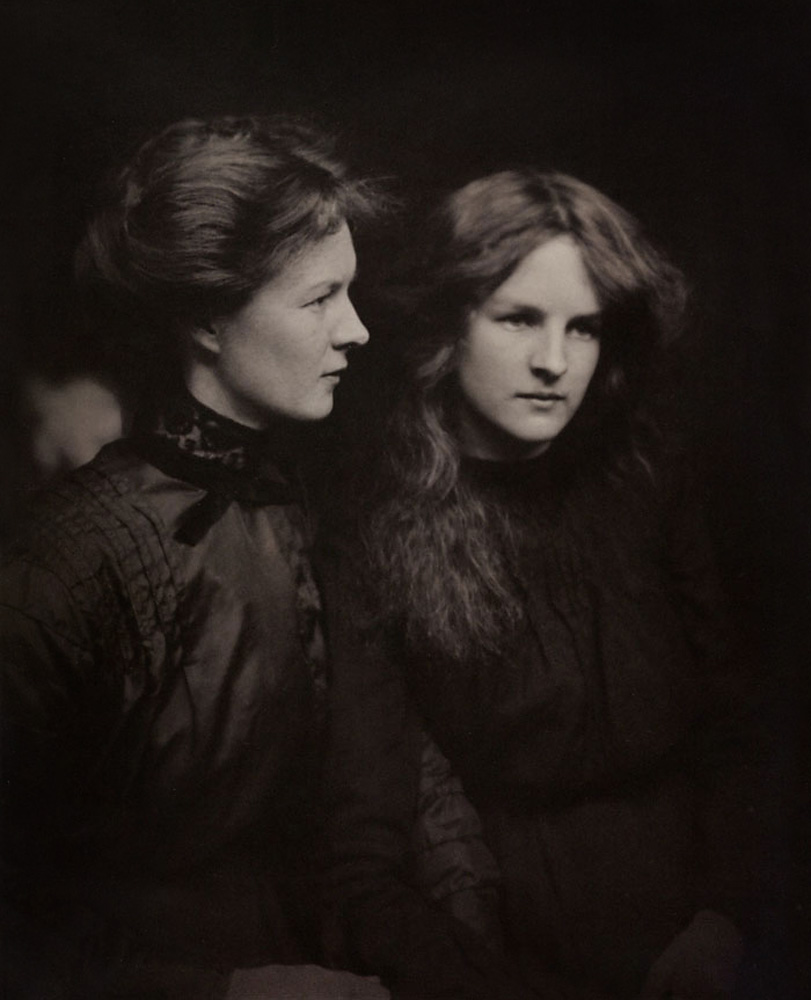
David Hill (Scottish, 1802-1870) and Robert Adamson (Scottish, 1821-1848) 'The Gowan [Margaret and Mary Cavendish]' c. 1843-1848


David Hill (Scottish, 1802-1870) and Robert Adamson (Scottish, 1821-1848)
The Gowan [Margaret and Mary Cavendish]
c. 1843-1844
Photograph, salted paper print from a paper negative


Salt and Silver: Early Photography 1840-1860 is the first major exhibition in Britain devoted to salt prints, the earliest form of paper photography. The exhibition features some of the rarest and best early photographs in the world, depicting daily activities and historic moments of the mid 19th century. The ninety photographs on display are among the few fragile salt prints that survive and are seldom shown in public. Salt and Silver: Early Photography 1840-1860 opens at Tate Britain on 25 February 2015.

In the 1840s and 50s, the salt print technique introduced a revolutionary new way of creating photographs on paper. It was invented in Britain and spread across the globe through the work of British and international photographers – artists, scientists, adventurers and entrepreneurs of their day. They captured historic moments and places with an immediacy not previously seen, from William Henry Fox Talbot’s images of a modern Paris street and Nelson’s Column under construction, to Linnaeus Tripe’s dramatic views of Puthu Mundapum, India and Auguste Salzmann’s uncanny studies of statues in Greece.

In portraiture, the faces of beloved children, celebrities, rich and poor were recorded as photographers sought to catch the human presence. Highlights include Fox Talbot’s shy and haunting photograph of his daughter Ela in 1842 to Nadar’s images of sophisticated Parisians and Roger Fenton’s shell-shocked soldiers in the Crimean war.

William Henry Fox Talbot unveiled this ground-breaking new process in 1839. He made the world’s first photographic prints by soaking paper in silver iodide salts to register a negative image which, when photographed again, created permanent paper positives. These hand-made photographs ranged in colour from sepia to violet, mulberry, terracotta, silver-grey, and charcoal-black and often had details drawn on like the swishing tail of a horse. Still lifes, portraits, landscapes and scenes of modern life were transformed into luxurious, soft, chiaroscuro images. The bold contrasts between light and dark in the images turned sooty shadows into solid shapes. Bold contrasts between light and dark turned shadows into abstract shapes and movement was often captured as a misty blur. The camera drew attention to previously overlooked details, such as the personal outline of trees and expressive textures of fabric.

In the exciting Victorian age of modern invention and innovation, the phenomenon of salt prints was quickly replaced by new photographic processes. The exhibition shows how, for a short but significant time, the British invention of salt prints swept the world and created a new visual experience.

Salt and Silver: Early Photography 1840 – 1860 is organised in collaboration with the Wilson Centre for photography. It is curated by Carol Jacobi, Curator, British Art 1850-1915, Tate Britain, Simon Baker, Curator, Photography and International Art, Tate, and Hannah Lyons, Assistant Curator, 1850-1915, Tate. ‘Salt and Silver’ – Early Photography 1840-1860 is published by Mack to coincide with the exhibition and will be accompanied by a programme of talks and events in the gallery.

Press release from the Tate website


William Henry Fox Talbot (British, 11 February 1800 - 17 September 1877) 'Scene in a Paris Street' 1843


William Henry Fox Talbot (British, 11 February 1800 – 17 September 1877)
Scene in a Paris Street
1843
Photograph, salted paper print from a paper negative


By 1841, Talbot had dramatically reduced, from many minutes to just seconds, the exposure time needed to produce a negative, and on a trip to Paris to publicise his new calotype process he took a picture from his hotel room window, an instinctive piece of photojournalism. The buildings opposite are rendered in precise and exquisite detail, the black and white stripes of the shutters neat alternations of light and shade. In contrast to the solidity of the buildings are the carriages waiting on the street below; the wheels, immobile, are seen in perfect clarity, while the skittish horses are no more than ghostly blurs.

Florence Hallett. “Salt and Silver, Tate Britain: Early photographs that brim with the spirit of experimentation,” on The Arts Desk website, Wednesday, 25 February 2015 [Online] Cited 03/06/2015. Used under fair use conditions for the purposes of education and research


William Henry Fox Talbot (British, 11 February 1800 - 17 September 1877) 'Nelson’s Column Under Construction, Trafalgar Square' 1844


William Henry Fox Talbot (British, 11 February 1800 – 17 September 1877)
Nelson’s Column Under Construction, Trafalgar Square
1844
Salted paper print from a glass plate negative


William Henry Fox Talbot (British, 11 February 1800 - 17 September 1877) 'Nelson's Column Under Construction, Trafalgar Square' 1844


William Henry Fox Talbot (British, 11 February 1800 – 17 September 1877)
Nelson’s Column Under Construction, Trafalgar Square
1844
Salted paper print from a glass plate negative


This is the first exhibition in Britain devoted to salted paper prints, one of the earliest forms of photography. A uniquely British invention, unveiled by William Henry Fox Talbot in 1839, salt prints spread across the globe, creating a new visual language of the modern moment. This revolutionary technique transformed subjects from still lifes, portraits, landscapes and scenes of daily life into images with their own specific aesthetic: a soft, luxurious effect particular to this photographic process. The few salt prints that survive are seldom seen due to their fragility, and so this exhibition, a collaboration with the Wilson Centre for Photography, is a singular opportunity to see the rarest and best early photographs of this type in the world.

“The technique went as follows: coat paper with a silver nitrate solution and expose it to light, thus producing a faint silver image. He later realised if you apply salt to the paper first and then spread on the silver nitrate solution the resulting image is much sharper. His resulting photos, ranging in colour from sepia to violet, mulberry, terracotta, silver-grey, and charcoal-black, were shadowy and soft, yet able to pick up on details that previously went overlooked – details like the texture of a horse’s fur, or the delicate silhouette of a tree.”

Priscilla Frank. “The First Paper Photographs Were Made With Salt, And They Look Like This,” on the Huffington Post website 03/06/2015 [Online] Cited 03/06/2015. Used under fair use conditions for the purposes of education and research


William Henry Fox Talbot (British, 11 February 1800 - 17 September 1877) 'Cloisters, Lacock Abbey' 1843


William Henry Fox Talbot (British, 11 February 1800 – 17 September 1877)
Cloisters, Lacock Abbey
1843


William Henry Fox Talbot (11 February 1800 – 17 September 1877)

William Henry Fox Talbot (11 February 1800 – 17 September 1877) was a British scientist, inventor and photography pioneer who invented the salted paper and calotype processes, precursors to photographic processes of the later 19th and 20th centuries. Talbot was also a noted photographer who made major contributions to the development of photography as an artistic medium. He published The Pencil of Nature (1844), which was illustrated with original prints from some of his calotype negatives. His work in the 1840s on photo-mechanical reproduction led to the creation of the photoglyphic engraving process, the precursor to photogravure. Talbot is also remembered as the holder of a patent which, some say, affected the early development of commercial photography in Britain. Additionally, he made some important early photographs of Oxford, Paris, Reading, and York.


William Henry Fox Talbot (British, 11 February 1800 - 17 September 1877) 'Study of China' 1844


William Henry Fox Talbot (British, 11 February 1800 – 17 September 1877)
Study of China
1844
© Wilson Centre for Photography


William Henry Fox Talbot (British, 11 February 1800 - 17 September 1877) 'Plaster Bust of Patroclus' before February 1846


William Henry Fox Talbot (British, 11 February 1800 – 17 September 1877)
Plaster Bust of Patroclus
before February 1846
© Wilson Centre for Photography
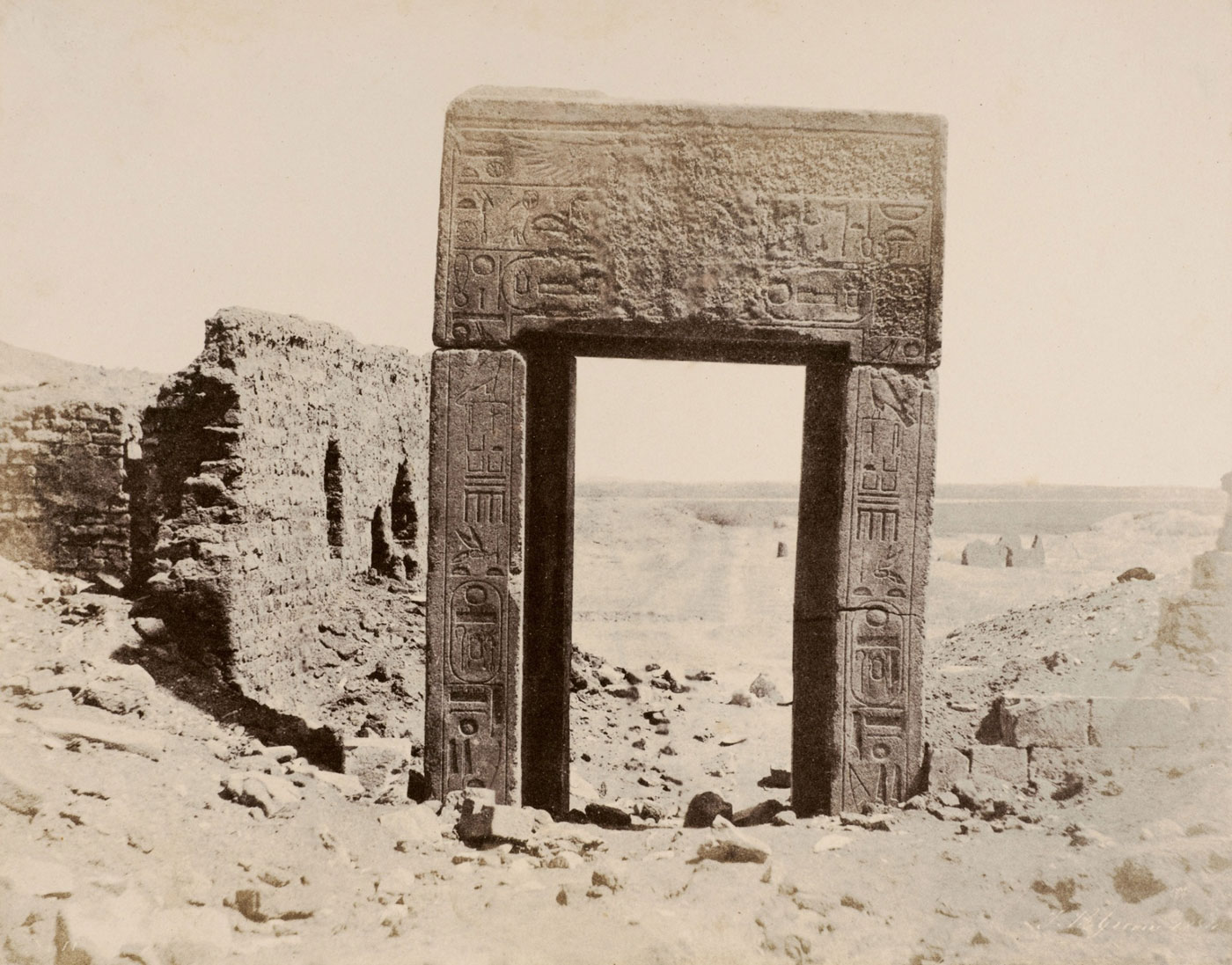
 

John Beasly Greene (French-American, 1832-1856) 'El Assasif, Porte de Granit Rose, No 2, Thébes' 1854


John Beasly Greene (French-American, 1832-1856)
El Assasif, Porte de Granit Rose, No 2, Thébes
1854
Salted paper print from a waxed plate negative


John Beasly Greene (French-American, 1832-1856)

A French-born archeologist based in Paris and a student of photographer Gustave Le Gray, John Beasly Greene became a founding member of the Société Française de Photographie and belonged to two societies devoted to Eastern studies. Greene became the first practicing archaeologist to use photography, although he was careful to keep separate files for his documentary images and his more artistic landscapes.

In 1853 at the age of nineteen, Greene embarked on an expedition to Egypt and Nubia to photograph the land and document the monuments and their inscriptions. Upon his return, Louis Désiré Blanquart-Evrard published an album of ninety-four of these photographs. Greene returned to Egypt the following year to photograph and to excavate at Medinet-Habu in Upper Egypt, the site of the mortuary temple built by Ramses III. In 1855 he published his photographs of the excavation there. The following year, Greene died in Egypt, perhaps of tuberculosis, and his negatives were given to his friend, fellow Egyptologist and photographer Théodule Devéria.

Text from the Getty Museum website


James Robertson (British, 1813-1888) and Felice Beato (Italian-British, 1832 - 29 January 1909) 'Pyramids at Giza' 1857


James Robertson (British, 1813-1888) and Felice Beato (Italian-British, 1832 – 29 January 1909)
Pyramids at Giza
1857
Photograph, salted paper print from a glass plate negative


James Robertson (British, 1813-1888)

James Robertson (1813-1888) was an English photographer and gem and coin engraver who worked in the Mediterranean region, the Crimea and possibly India. He was one of the first war photographers.

Robertson was born in Middlesex in 1813. He trained as an engraver under Wyon (probably William Wyon) and in 1843 he began work as an “engraver and die-stamper” at the Imperial Ottoman Mint in Constantinople. It is believed that Robertson became interested in photography while in the Ottoman Empire in the 1840s.

In 1853 he began photographing with British photographer Felice Beato and the two formed a partnership called Robertson & Beato either in that year or in 1854 when Robertson opened a photographic studio in Pera, Constantinople. Robertson and Beato were joined by Beato’s brother, Antonio on photographic expeditions to Malta in 1854 or 1856 and to Greece and Jerusalem in 1857. A number of the firm’s photographs produced in the 1850s are signed Robertson, Beato and Co. and it is believed that “and Co.” refers to Antonio.

In late 1854 or early 1855 Robertson married the Beato brothers’ sister, Leonilda Maria Matilda Beato. They had three daughters, Catherine Grace (born in 1856), Edith Marcon Vergence (born in 1859) and Helen Beatruc (born in 1861). In 1855 Robertson and Felice Beato travelled to Balaklava, Crimea where they took over reportage of the Crimean War from Roger Fenton. They photographed the fall of Sevastopol in September 1855. Some sources have suggested that in 1857 both Robertson and Felice Beato went to India to photograph the aftermath of the Indian Rebellion, but it is more probable that Beato travelled there alone. Around this time Robertson did photograph in Palestine, Syria, Malta, and Cairo with either or both of the Beato brothers.

In 1860, after Felice Beato left for China to photograph the Second Opium War and Antonio Beato went to Egypt, Robertson briefly teamed up with Charles Shepherd back in Constantinople. The firm of Robertson & Beato was dissolved in 1867, having produced images – including remarkable multiple-print panoramas – of Malta, Greece, Turkey, Damascus, Jerusalem, Egypt, the Crimea and India. Robertson possibly gave up photography in the 1860s; he returned to work as an engraver at the Imperial Ottoman Mint until his retirement in 1881. In that year he left for Yokohama, Japan, arriving in January 1882. He died there in April 1888.

Text from the Wikipedia website


James Robertson (British, 1813-1888) 'Base of the Obelisk of Theodosius, Constantinople' 1855


James Robertson (British, 1813-1888)
Base of the Obelisk of Theodosius, Constantinople
1855
Salted paper print from a glass plate negative


Exhibition of intriguing images that charts the birth of photography

Another week, another photography show about death. It’s not officially about death, mind you; it’s officially about the years 1840 to 1860, when photographers made their images on paper sensitised with silver salts. The process was quickly superseded, but the pictures created this way have a beautiful artistic softness and subtlety of tone, quite apart from the fact that every single new photograph that succeeded represented a huge leap forward in the development of the medium. You see these early practitioners start to grasp the scope of what might be possible. Their subjects change, from ivy-covered walls and carefully posed family groups to more exotic landscapes and subjects: Egypt, India, the poor, war.

By the time you get to Roger Fenton’s portrait Captain Lord Balgonie, Grenadier Guards of 1855 you have an inkling of how photography is changing how we understand life, for ever. Balgonie is 23. He looks 50. His face is harrowed by his service in the Crimean War, his eyes bagged with fatigue, fear and what the future may hold. He survived the conflict, but was broken by it, dying at home two years after this picture was taken. That is yet to come: for now, he is alive.

This sense of destiny bound within a picture created in a moment is what is new about photography, and you start to see it everywhere, not just in the images of war. It’s in William Henry Fox Talbot’s The Great Elm at Lacock: a huge tree against a mottled sky, battered by storms. It’s in John Beasly Greene’s near-abstract images of Egyptian statuary, chipped, cracked, alien. And it’s in the portraits of Newhaven fisherwomen by DO Hill and Robert Adamson (their cry was ‘It’s not fish, it’s men’s lives’). In a world where death is always imminent, photography arrives as the perfect way to preserve life, and the perfect way to leave your mark, however fleeting.

Chris Waywell. “Salt and Silver: Early Photography 1840-1860,” on the Time Out London website 22 July 2015 [Online] Cited 18/12/2022. Used under fair use conditions for the purposes of education and research


Eugene Piot (French, 1812-1890) 'Le Parthénon de l'Acropole d'Athens' 1852


Eugene Piot (French, 1812-1890)
Le Parthénon de l’Acropole d’Athens
1852
Photograph, salted paper print from a paper negative
© Wilson Centre for Photography


Eugène Piot was a French journalist, art critic, art collector and photographer. His pen name was Nemo. Piot was born in Paris.


Paul Marés. 'Ox cart in Brittany' c. 1857


Paul Marés (French)
Ox cart in Brittany
c. 1857
Photograph, salted paper print from a paper negative


One of the most beautiful photographs in this exhibition is Paul Marès Ox Cart, Brittany, c. 1857. At first it seems a picturesque scene of bucolic tranquillity, the abandoned cart an exquisite study in light and tone. But on the cottage wall are painted two white crosses, a warning – apparently even as recently as the 19th century – to passers-by that the household was afflicted by some deadly disease. Photography’s ability to indiscriminately aestheticise is a dilemma that has continued to present itself ever since, especially in the fields of reportage and war photography.

Florence Hallett. “Salt and Silver, Tate Britain: Early photographs that brim with the spirit of experimentation,” on The Arts Desk website, Wednesday, 25 February 2015 [Online] Cited 03/06/2015. Used under fair use conditions for the purposes of education and research


Jean-Baptiste Frénet (French - Lyon, 31 January 1814 - Charly, 12 August 1889) 'Horse and Groom' 1855


Jean-Baptiste Frénet (French – Lyon, 31 January 1814 – Charly, 12 August 1889)
Horse and Groom
1855
Salted paper print from a glass plate negative
© Wilson Centre for Photography


Around 1850 Frénet meets in Lyon personalities involved in the nascent photography, and he has to discover this technique to reproduce the frescoes he painted in Ainay. Curious, he is passionate about this new medium that offers him a respite space in the setbacks he suffers with his painting.

Frénet applies the stereotyped views taken of the time involving heavy stagings and is one of the first to practice the instant, the familiar and intimate subject. Five years before Nadar he produces psychological portraits and engages in close-up. He sees photography as an art, the opinion which has emerged in the first issue of the magazine La Lumière (The Light), text of the young and ephemeral gravure company founded in 1851. Frénet open a professional practice photography in 1866 and 1867 in Lyon. Unknown to the general public, his photographic work was discovered in 2000 at the sale of his photographic collection, many parts were purchased by the Musée d’Orsay.

Translated from the French Wikipedia website


Edouard Denis Baldus (French, 1813-1889) 'The Floods of 1856, Brotteaux Quarter of Lyon' 1856


Edouard Denis Baldus (French, 1813-1889)
The Floods of 1856, Brotteaux Quarter of Lyon
1856
Photograph, salted paper print from a waxed paper negative
© Wilson Centre for Photography


In June 1856, in the midst of his work at the Louvre, Baldus set out on a brief assignment, equally without precedent in photography, that was in many ways its opposite: to photograph the destruction caused by torrential rains and overflowing rivers in Lyon, Avignon, and Tarascon. From a world of magnificent man-made construction, he set out for territory devastated by natural disaster; from the task of re-creating the whole of a building in a catalogue of its thousand parts, he turned to the challenge of evoking a thousand individual stories in a handful of transcendent images. Baldus created a moving record of the flood without explicitly depicting the human suffering left in its wake. The “poor people, tears in their eyes, scavenging to find the objects most indispensable to their daily needs,” described by the local Courier de Lyon, are all but absent from his photographs of the hard-hit Brotteaux quarter of Lyon, as if the destruction had been of biblical proportions, leaving behind only remnants of a destroyed civilization.

Malcolm Daniel. “Édouard Baldus (1813-1889),” in Heilbrunn Timeline of Art History. New York: The Metropolitan Museum of Art, 2000 [Online] Cited 16/12/2022. Used under fair use conditions for the purposes of education and research


Auguste Salzmann (French, born April 14, 1824 in Ribeauvillé (Alsace) - died February 24, 1872 in Paris) 'Terra Cotta Statuettes from Camiros, Rhodes' 1863


Auguste Salzmann (French, born April 14, 1824 in Ribeauvillé (Alsace) – died February 24, 1872 in Paris)
Terra Cotta Statuettes from Camiros, Rhodes
1863
© Wilson Centre for Photography


Auguste Salzmann (French, 1824-1872) painter, photographer and archaeologist who pioneered the use of photography in the recording of historic sites. He excavated archaeological material in Rhodes in collaboration with Alfred Biliotti.


David Hill (Scottish, 1802-1870) and Robert Adamson (Scottish, 1821-1848) 'Newhaven fishermen' c. 1845


David Hill (Scottish, 1802-1870) and Robert Adamson (Scottish, 1821-1848)
Newhaven fishermen
c. 1845
Photograph, salted paper print from a paper negative
© Wilson Centre for Photography


Roger Fenton (British, 28 March 1819 - 8 August 1869) 'Cossack Bay, Balaclava' 1855


Roger Fenton (British, 28 March 1819 – 8 August 1869)
Cossack Bay, Balaclava
1855


It is likely that in autumn 1854, as the Crimean War grabbed the attention of the British public, that some powerful friends and patrons – among them Prince Albert and Duke of Newcastle, secretary of state for war – urged Fenton to go the Crimea to record the happenings. He set off aboard HMS Hecla in February, landed at Balaklava on 8 March and remained there until 22 June. The resulting photographs may have been intended to offset the general unpopularity of the war among the British people, and to counteract the occasionally critical reporting of correspondent William Howard Russell of The Times. The photographs were to be converted into woodblocks and published in the less critical Illustrated London News. Fenton took Marcus Sparling as his photographic assistant, a servant known as William and a large horse-drawn van of equipment…

Despite summer high temperatures, breaking several ribs in a fall, suffering from cholera and also becoming depressed at the carnage he witnessed at Sebastopol, in all Fenton managed to make over 350 usable large format negatives. An exhibition of 312 prints was soon on show in London and at various places across the nation in the months that followed. Fenton also showed them to Queen Victoria and Prince Albert and also to Emperor Napoleon III in Paris. Nevertheless, sales were not as good as expected.

Text from the Wikipedia website


Roger Fenton (British, 28 March 1819 - 8 August 1869) 'Group of Croat Chiefs' 1855


Roger Fenton (British, 28 March 1819 – 8 August 1869)
Group of Croat Chiefs
1855
Salted paper print from a glass plate negative


Roger Fenton (British, 28 March 1819 - 8 August 1869) 'Captain Mottram Andrews, 28th Regiment (1st Staffordshire) Regiment of Foot' 1855


Roger Fenton (British, 28 March 1819 – 8 August 1869)
Captain Mottram Andrews, 28th Regiment (1st Staffordshire) Regiment of Foot
1855
Salted paper print from a glass plate negative
© Wilson Centre for Photography


Roger Fenton (British, 28 March 1819 - 8 August 1869) 'Cantiniére' 1855


Roger Fenton (British, 28 March 1819 – 8 August 1869)
Cantiniére
1855
Salted paper print from a glass plate negative
© Wilson Centre for Photography


A woman who carries a canteen for soldiers; a vivandière.


Roger Fenton (British, 28 March 1819 - 8 August 1869) 'Captain Lord Balgonie, Grenadier Guards' 1855


Roger Fenton (British, 28 March 1819 – 8 August 1869)
Captain Lord Balgonie, Grenadier Guards
1855
Photograph, salted paper print from a paper negative


Roger Fenton (British, 28 March 1819 - 8 August 1869) 'Captain Lord Balgonie, Grenadier Guards' 1855


Roger Fenton (British, 28 March 1819 – 8 August 1869)
Captain Lord Balgonie, Grenadier Guards
1855
Photograph, salted paper print from a paper negative


If I had to choose a figure it would be the Franco-American, archaeological photographer John Beasly Greene. His career was short and dangerous, he died at 24, but he challenged the trend towards clarity that dominated his field. Instead, he used the limits of the medium – burn-out, shadow, halation and the beautiful grainy texture of the print itself – to explore the poetic ambiguity of Egyptian sites.

This revolutionary photographic process transformed subjects, still lifes, portraits, landscapes and scenes of daily life into images. It brings it’s own luxurious aesthetic, soft textures, matt appearance and deep rich red tones, the variations seen throughout this exhibition is fascinating to observe. It’s also an incredible opportunity to view the original prints in an exhibition format, which has never been done before on a scale like this before.

The process starts with dipping writing paper in a solution of common salt, then partly drying it, coating it with silver nitrate, then drying it again, before applying further coats of silver nitrate, William Henry Fox Talbot pioneered what became known as the salt print and the world’s first photographic print! The specifically soft and luxurious aesthetic became an icon of modern visual language.

The few salt prints that survive are rarely seen due to their fragility. This exhibition is extremely important to recognise this historical process as well as a fantastic opportunity to see the rarest and best up close of early photographs of this type in the world.

Anon. “Salt and Silver: Early Photography 1840-1860,” on the Films not dead website [Online] Cited 03/06/2015. No longer available online. Used under fair use conditions for the purposes of education and research
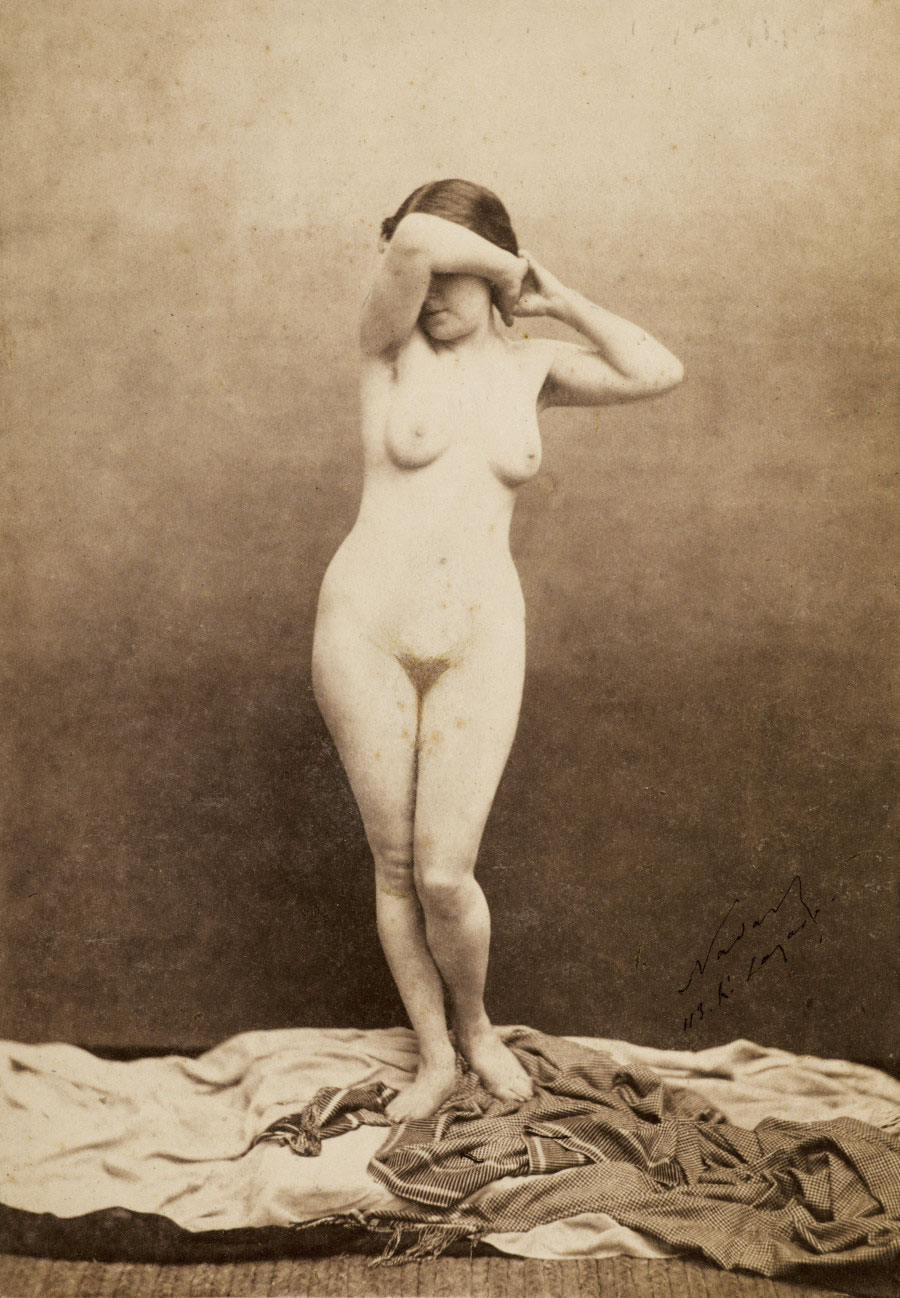
 

Félix Nadar (Gaspard Félix Tournachon) (French, 6 April 1820 - 23 March 1910) 'Mariette' c. 1855


Félix Nadar (Gaspard Félix Tournachon) (French, 6 April 1820 – 23 March 1910)
Mariette
c. 1855
Photograph, salted paper print from a glass plate negative
© Wilson Centre for Photography


Tournachon’s nickname, Nadar, derived from youthful slang, but became his professional signature and the name by which he is best known today. Poor but talented, Nadar began by scratching out a living as a freelance writer and caricaturist. His writings and illustrations made him famous before he began to photograph. His keenly honed camera eye came from his successful career as a satirical cartoonist, in which the identifying characteristic of a subject was reduced to a single distinct facet; that skill proved effective in capturing the personality of his photographic subjects.

Nadar opened his first photography studio in 1854, but he only practiced for six years. He focused on the psychological elements of photography, aiming to reveal the moral personalities of his sitters rather than make attractive portraits. Bust- or half-length poses, solid backdrops, dramatic lighting, fine sculpturing, and concentration on the face were trademarks of his studio. His use of eight-by-ten-inch glass-plate negatives, which were significantly larger than the popular sizes of daguerreotypes, accentuated those effects.

At one point, a commentator said, “[a]ll the outstanding figures of [the] era – literary, artistic, dramatic, political, intellectual – have filed through his studio.” In most instances these subjects were Nadar’s friends and acquaintances. His curiosity led him beyond the studio into such uncharted locales as the catacombs, which he was one of the first persons to photograph using artificial light.

Text from the Getty Museum website. For more information on this artist please see the MoMA website.


Lodoisch Crette Romet (1823-1872) 'A Lesson of Gustave Le Gray in His Studio' 1854


Lodoisch Crette Romet (1823-1872)
A Lesson of Gustave Le Gray in His Studio [Antoine-Emile Plassan]
1850-1853
24.2 x 17.7cm
Photograph, salted paper print from a paper negative


Jean-Baptiste Frénet (French - Lyon, 31 January 1814 - Charly, 12 August 1889) 'Women and girls with a doll' c. 1855


Jean-Baptiste Frénet (French – Lyon, 31 January 1814 – Charly, 12 August 1889)
Women and girls with a doll
c. 1855
© Wilson Centre for Photography


John S. Johnston (American, c. 1839 - December 17, 1899) 'One of Dr Kane’s Men [possibly William Morton]' c. 1857


John S. Johnston (American, c. 1839 – December 17, 1899)
One of Dr Kane’s Men [possibly William Morton]
c. 1857


John S. Johnston was a late 19th-century maritime and landscape photographer. He is known for his photographs of racing yachts and New York City landmarks and cityscapes. Very little is known about his life. He was evidently born in Britain in the late 1830s, and was active in the New York City area in the late 1880s and 1890s. He died in 1899.


William Morton

“Belief in the Open Polar Sea theory subsided until the mid-1800s, when Elisha Kent Kane set forth on a number of expeditions north with hopes of finding this theorised body of water. On an 1850s expedition organised by Kane, explorer William Morton, believing he discovered the Open Polar Sea, described a body of water containing

“Not a speck of ice… As far as I could discern, the sea was open… The wind was due N(orth) – enough to make white caps, and the surf broke in on the rocks in regular breakers.”

Morton, however, did not find the Open Polar Sea – he found a small oasis of water. Morton’s quote is likely tinged with a desire to raise the spirits of his boss, Kane, who saw the Polar Sea as a possible utopia, an area brimming with life amidst a harsh arctic world.”

Keith Veronese. “The Open Polar Sea, a balmy aquatic Eden at the North Pole?” on the Gizmodo website 4/20/12 [Online] Cited 03/06/2015. Used under fair use conditions for the purposes of education and research


David Hill (Scottish, 1802-1870) and Robert Adamson (Scottish, 1821-1848) 'Thought to be Elizabeth Rigby' c. 1844


David Hill (Scottish, 1802-1870) and Robert Adamson (Scottish, 1821-1848)
Thought to be Elizabeth Rigby
c. 1844
Photograph, salted paper print from a paper negative


Jean-Baptiste Frénet (French - Lyon, 31 January 1814 - Charly, 12 August 1889) 'Thought to be a Mother and Son' c. 1855


Jean-Baptiste Frénet (French – Lyon, 31 January 1814 – Charly, 12 August 1889)
Thought to be a Mother and Son
c. 1855
Photograph, salted paper print from a collodion negative transferred from glass to paper support


William Henry Fox Talbot (British, 11 February 1800 - 17 September 1877) 'The Photographer's Daughter, Ela Theresa Talbot' 1843-1844


William Henry Fox Talbot (British, 11 February 1800 – 17 September 1877)
The Photographer’s Daughter, Ela Theresa Talbot
1843-1844


Roger Fenton (British, 28 March 1819 - 8 August 1869) 'Portrait of a Woman' c. 1854


Roger Fenton (British, 28 March 1819 – 8 August 1869)
Portrait of a Woman
c. 1854
Photograph, salted paper print from a glass plate negative


John Wheeley Gough (British, 1809-1862) 'Gutch Abbey Ruins' c. 1858


John Wheeley Gough (British, 1809-1862)
Gutch Abbey Ruins
c. 1858
© Wilson Centre for Photography


John Wheeley Gough (British, 1809-1862)

John Wheeley Gough Gutch (1809-1862) was a British surgeon and editor. He was also a keen amateur naturalist and geologist, and a pioneer photographer.

In 1851, Dr. Gutch gave up his medical practice to become a messenger for Queen Victoria, and he began photographing the many cities he visited on his diplomatic missions. During a trip to Constantinople, he became seriously ill, resulting in permanent partial paralysis that ended his public service career. While undergoing experimental treatments in Malvern, England, Dr. Gutch again turned to photography as a cure for his melancholy. His works were exhibited throughout London and Edinburgh from 1856-1861, and he became a frequent contributor to the Photographic Notes publication. Dr. Gutch’s camera of choice was Frederick Scott Archer’s wet-plate camera because he liked the convenience of developing glass negatives within the camera, which eliminated the need for a darkroom. However, the camera proved too cumbersome for him to handle, and had to be manipulated by one of his photographic assistants. His photographs were printed on salt-treated paper and were placed into albums he painstakingly decorated with photographic collages.

Dr. Gutch’s “picturesque” photographic style was influenced by artist William Gilpin. Unlike his mid-nineteenth century British contemporaries who recorded urban expansion, he preferred focusing on ancient buildings, rock formations, archaeological ruins, and tree-lined streams. In 1857, an assignment for Photographic Notes took him to Scotland, northern Wales, and the English Lake District, where he photographed the lush settings, but not always to his satisfaction. Two years’ later, he aspired to photograph and document the more than 500 churches in Gloucestershire, a daunting and quite expensive task. He fitted his camera with a Ross Petzval wide-angle lens and managed to photograph more than 200 churches before illness forced him to abandon the ambitious project. Fifty-three-year-old John Wheeley Gough Gutch died in London on April 30, 1862.

Anonymous text. “John Wheeley Gough Gutch,” on the Historic Camera website Nd [Online] Cited 03/06/2015. Used under fair use conditions for the purposes of education and research


William Henry Fox Talbot (British, 11 February 1800 - 17 September 1877) 'The Great Elm at Lacock' 1843-1845


William Henry Fox Talbot (British, 11 February 1800 – 17 September 1877)
The Great Elm at Lacock
1843-1845
Photograph, salted paper print from a paper negative
© Wilson Centre for Photography


Tate Britain
Millbank, London SW1P 4RG
United Kingdom
Phone: +44 20 7887 8888

Opening hours:
10.00am – 18.00pm daily

Tate Britain website

LIKE ART BLART ON FACEBOOK

Back to top

Exhibition: ‘Carelton Watkins: The Stanford Albums’ at the Cantor Arts Center at Stanford University

Who are the interesting photographers anywhere who are alive now?

And my answer would be: there are very few who are alive now that are interesting.

Exhibition dates: 23rd April – 17th August 2014


Carleton Watkins (American, 1829-1916) 'Sugar Loaf Islands and Seal Rocks, Farallons' 1868-1869


Carleton Watkins (American, 1829-1916)
Sugar Loaf Islands and Seal Rocks, Farallons
1868-1869
From the album Photographs of the Pacific Coast
Albumen print
Lent by Department of Special Collections, Stanford University Libraries.


Who would you put in your top eleven photographers of all time?

(in no particular order)

  • Minor White
  • Eugene Atget
  • Frederick Sommer
  • Carelton Watkins
  • Julia Margaret Cameron
  • Walker Evans
  • Edward Weston
  • Lee Friedlander
  • Manuel Alvarez Bravo
  • Diane Arbus
  • Paul Strand

and then it gets a bit more difficult…

Is it a Josef Sudek, Robert Adams, Aaron Siskind, Man Ray, Berenice Abbott, Helen Levitt, Emmet Gowin, William Clift, Ernest Cole, William Eggleston, Lee Friedlander, Cindy Sherman, Charles Marville, Vivian Maier, Saul Leiter and suggestions from others – André Kertész, Josef Koudelka, Dorothea Lange, Henri Cartier-Bresson, Edouard Boubat, Paul Caponigro, etc …


What is more interesting is to ask:

Who are the interesting photographers anywhere who are alive now?

And my answer would be: there are very few who are alive now that are interesting.

That is – by looking at the ideas that are present in poetry, music, philosophy or even politics – who is there that is truly taking these ideas forward (or ideas that are as interesting).

Or who is arranging images with the elegance of a Sommer or an Atget or the dynamics of Arbus

= few if any.

In other words whose acts am I hanging upon, so that I am waiting with great anticipation to see what they are going to do next.

Only a few is my answer.

Which living photographers would I walk a mile to see their work?

= some (eg Lee Friedlander, Wolfgang Tillmans)


Which living Australian photographers would I walk an hour in the hot January sun to see?

= possibly two (Bill Henson, Rosemary Laing)

Dr Marcus Bunyan


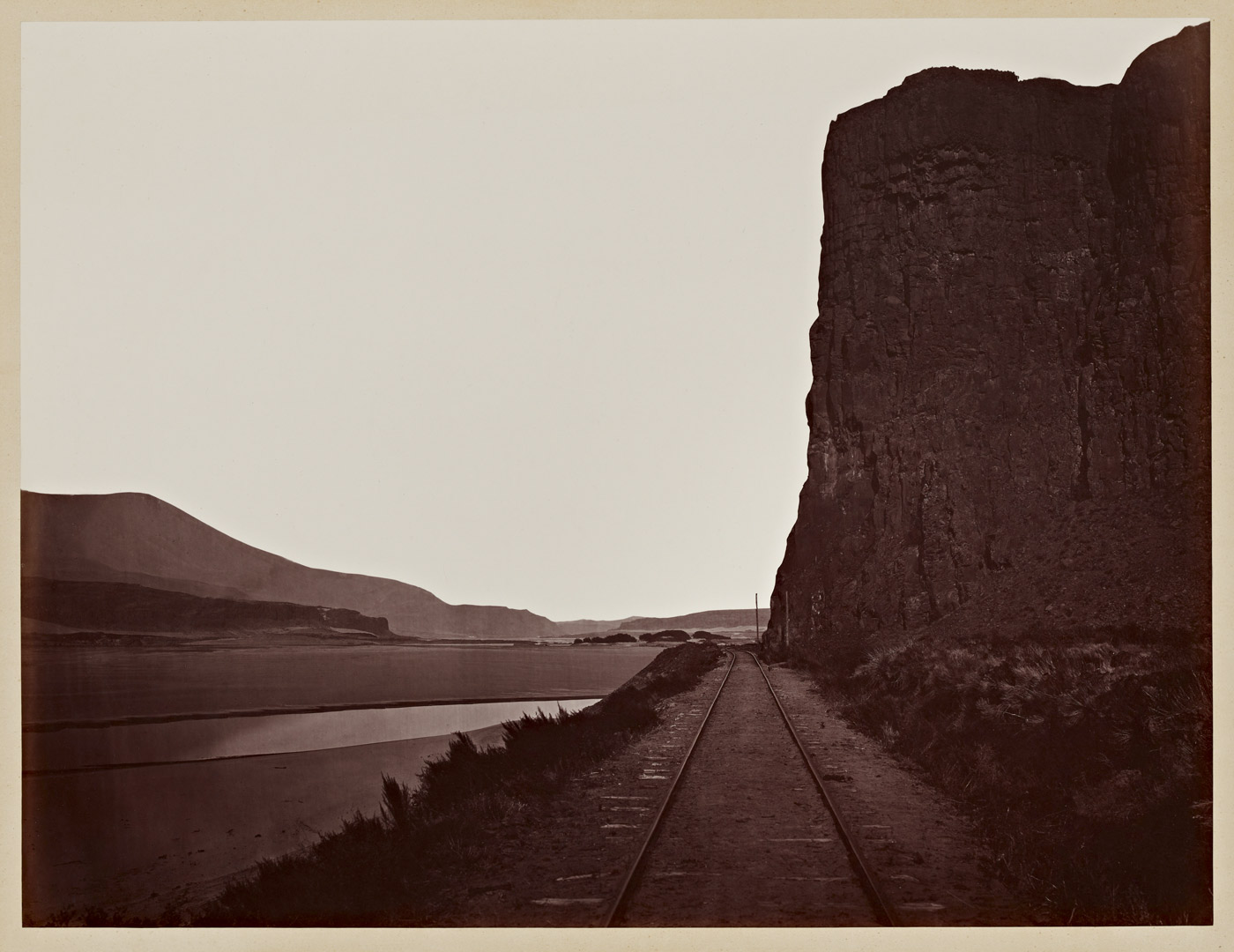
PS. Just look at Cape Horn, near Celilo (1867, below). You are not likely to see a more magnificent landscape photograph than this.

Many thankx to the Cantor Arts Center for allowing me to publish the photographs in the posting. Please click on the photographs for a larger version of the image.


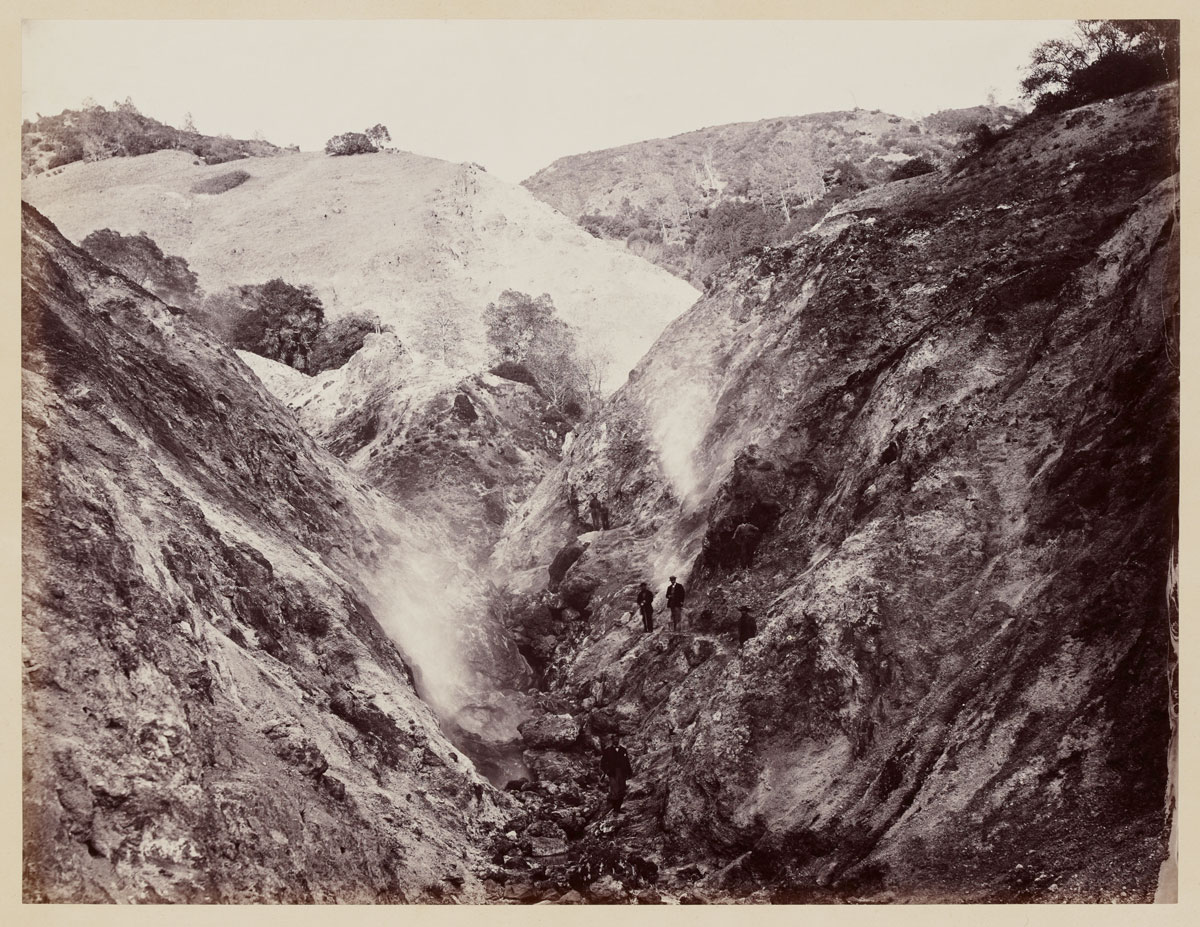
Carleton Watkins (American, 1829-1916) 'Devils' Cañon Geysers, Looking Up' c. 1867


Carleton Watkins (American, 1829-1916)
Devils’ Cañon Geysers, Looking Up
c. 1867
From the album Photographs of the Pacific Coast
Albumen print
Lent by Department of Special Collections, Stanford University Libraries


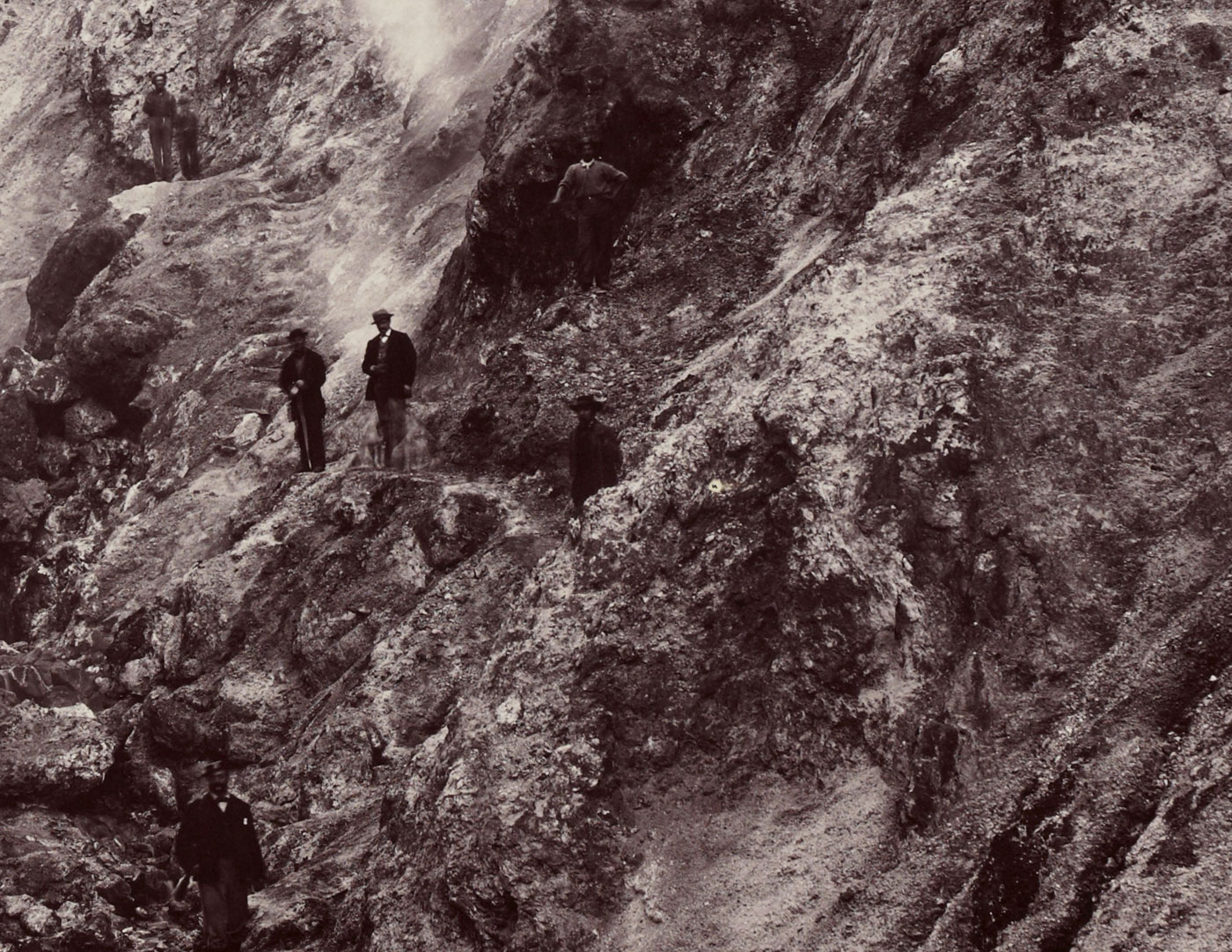
Carleton Watkins (American, 1829-1916) 'Devils' Cañon Geysers, Looking Up' (detail) c. 1867


Carleton Watkins (American, 1829-1916)
Devils’ Cañon Geysers, Looking Up (detail)
c. 1867
From the album Photographs of the Pacific Coast
Albumen print
Lent by Department of Special Collections, Stanford University Libraries


Carleton Watkins (American, 1829-1916) 'Alcatraz from North Point' 1862-1863


Carleton Watkins (American, 1829-1916)
Alcatraz from North Point
1862–1863
From the album Photographs of the Pacific Coast
Albumen print
Lent by Department of Special Collections, Stanford University Libraries


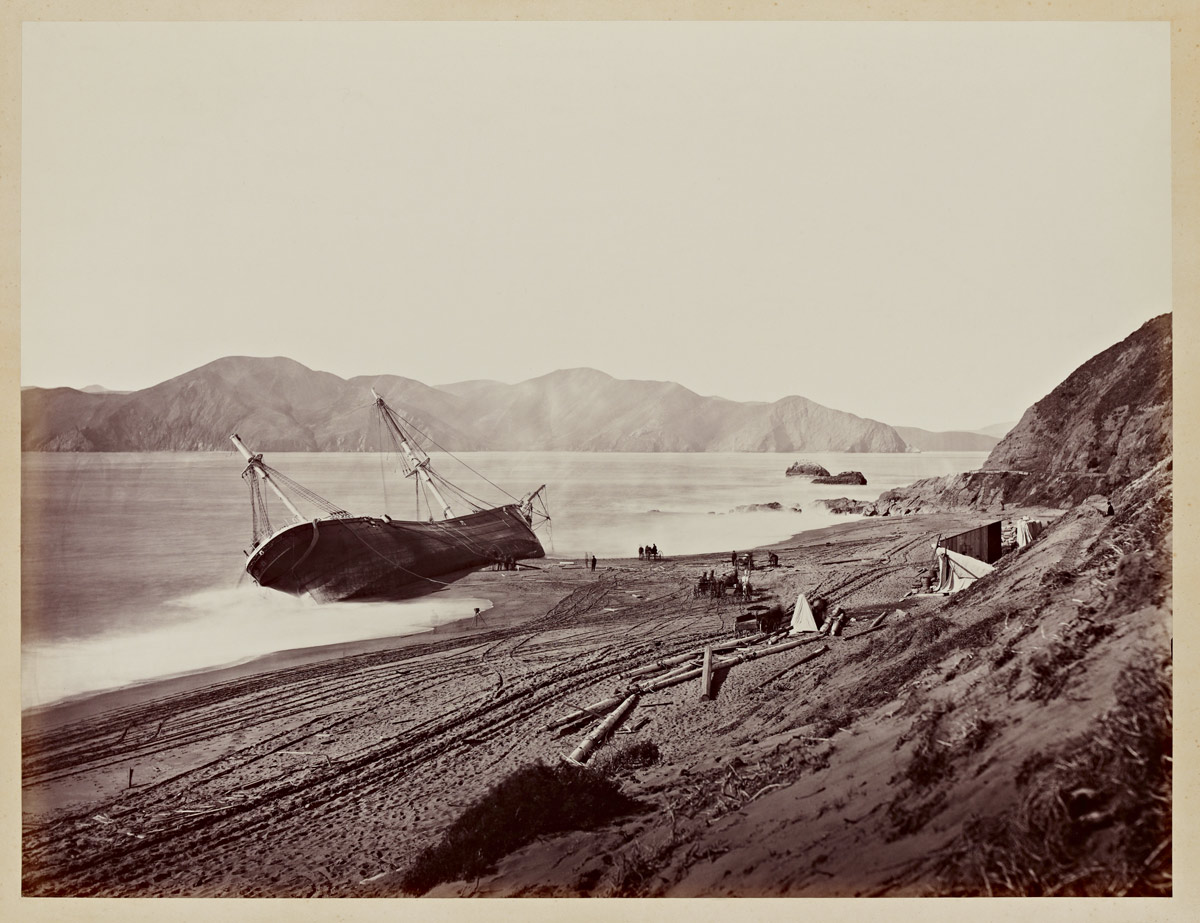
Carleton Watkins (American, 1829-1916) 'The Wreck of the Viscata' March 1868


Carleton Watkins (American, 1829-1916)
The Wreck of the Viscata
March 1868
From the album Photographs of the Pacific Coast
Albumen print
Lent by Department of Special Collections, Stanford University Libraries


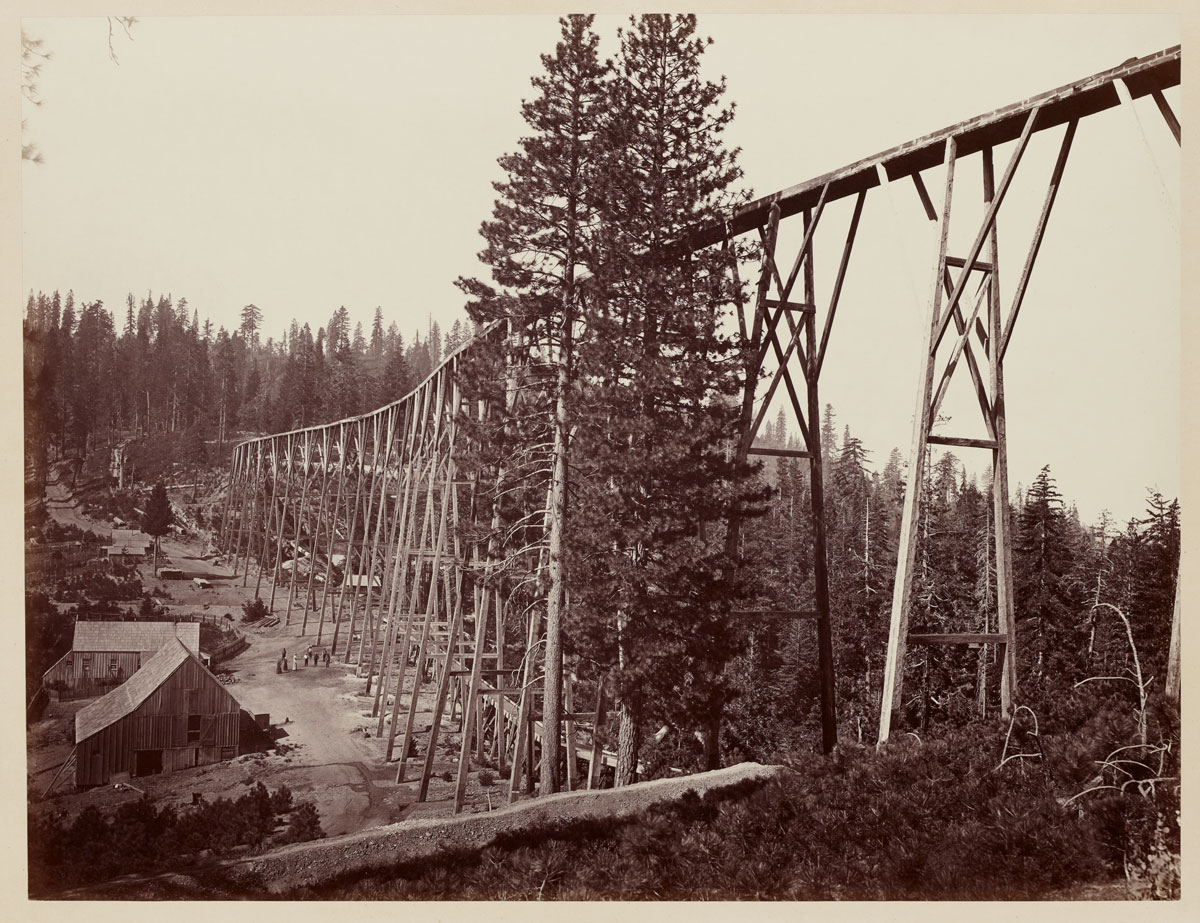
Carleton Watkins (American, 1829-1916) 'Magenta Flume Nevada Co. Cal.' c. 1871


Carleton Watkins (American, 1829-1916)
Magenta Flume Nevada Co. Cal.
c. 1871
From the album Photographs of the Pacific Coast
Albumen print
Lent by Department of Special Collections, Stanford University Libraries


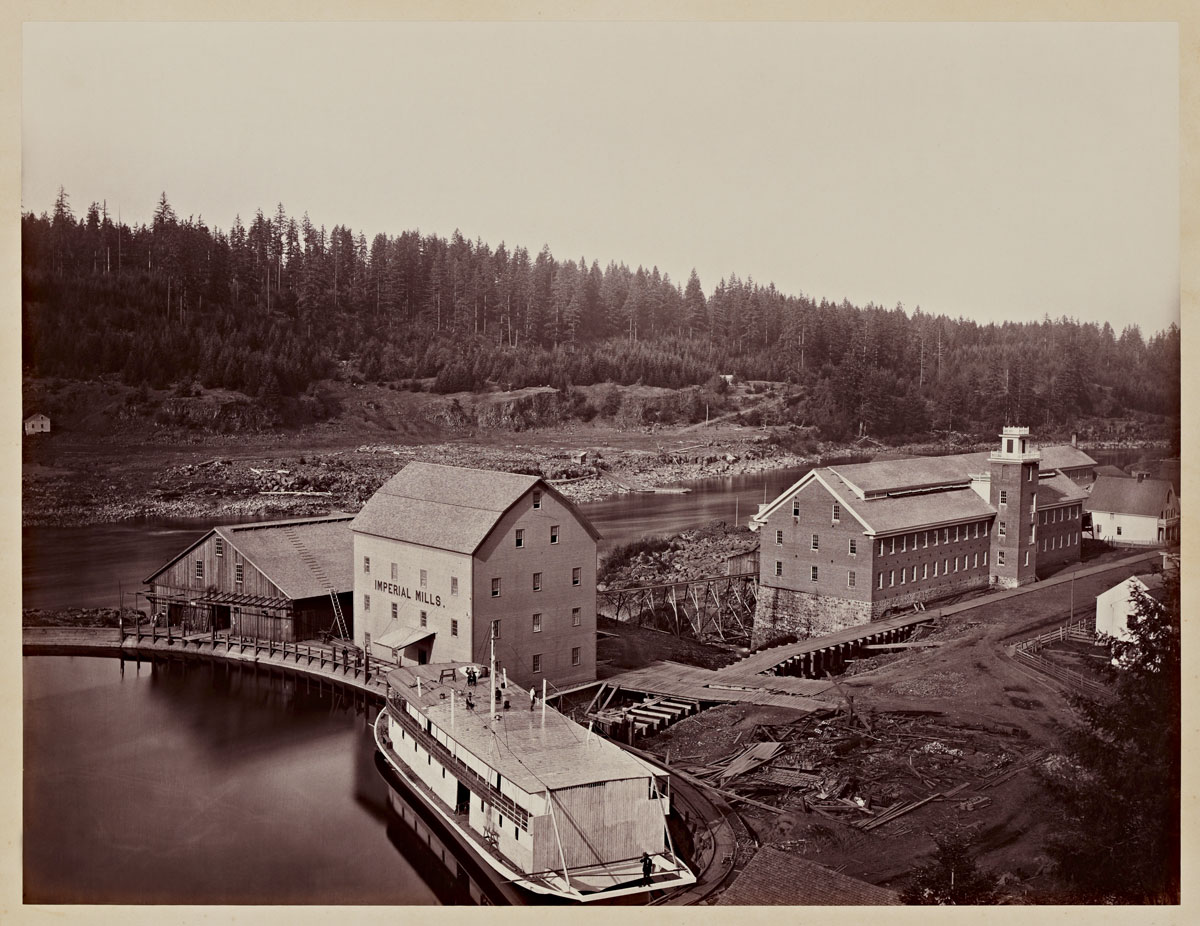
Carleton Watkins (American, 1829-1916) 'Flour and Woolen Mills, Oregon City' 1867


Carleton Watkins (American, 1829-1916)
Flour and Woolen Mills, Oregon City
1867
From the album Photographs of the Columbia River and Oregon
Albumen print. Lent by Department of Special Collections, Stanford University Libraries


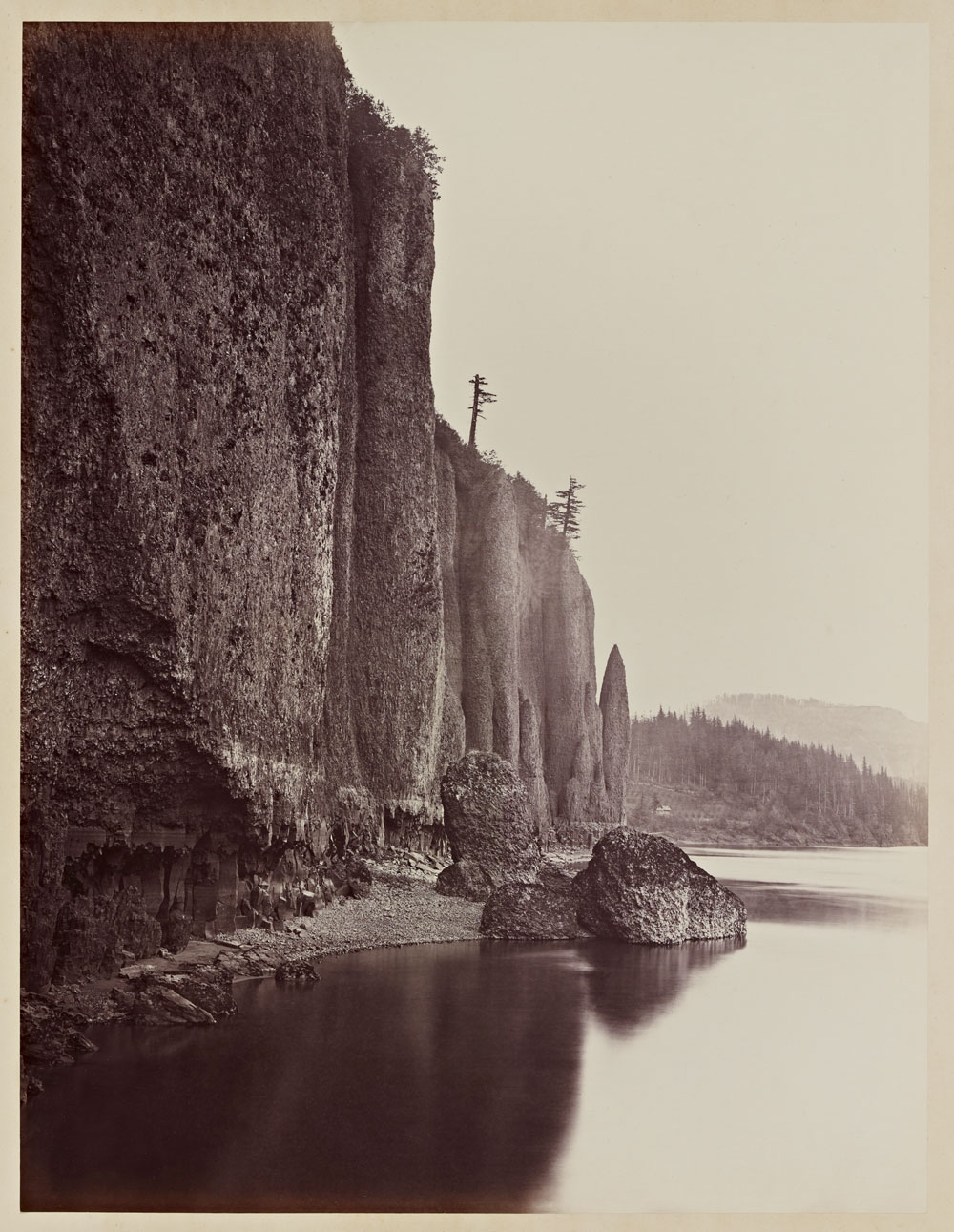
Carleton Watkins (American, 1829-1916) 'Cape Horn, Columbia River' 1867


Carleton Watkins (American, 1829-1916)
Cape Horn, Columbia River
1867
From the album Photographs of the Columbia River and Oregon
Albumen print
Lent by Department of Special Collections, Stanford University Libraries


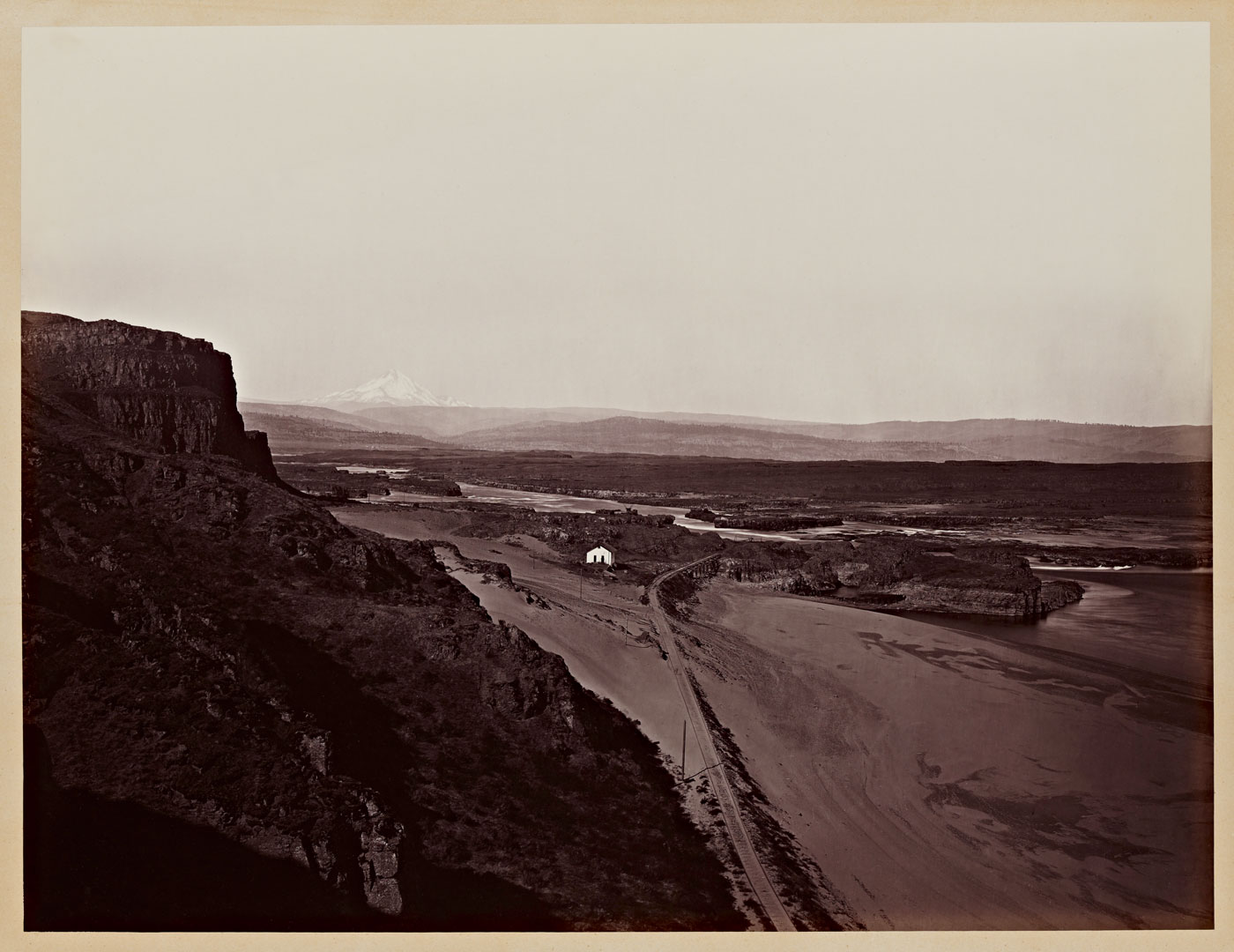
Carleton Watkins (American, 1829-1916) 'Mt. Hood and the Dalles, Columbia River' 1867


Carleton Watkins (American, 1829-1916)
Mt. Hood and the Dalles, Columbia River
1867
From the album Photographs of the Columbia River and Oregon
Albumen print
Lent by Department of Special Collections, Stanford University Libraries


Carleton Watkins (American, 1829-1916) 'Cape Horn, near Celilo' 1867


Carleton Watkins (American, 1829-1916)
Cape Horn, near Celilo
1867
From the album Photographs of the Columbia River and Oregon
Albumen print
Lent by Department of Special Collections, Stanford University Libraries


Carleton Watkins (American, 1829-1916) 'The Yosemite Valley from the "Best General View"' 1866


Carleton Watkins (American, 1829-1916)
The Yosemite Valley from the “Best General View”
1866
From the album Photographs of the Yosemite Valley
Albumen print
Lent by Department of Special Collections, Stanford University Libraries


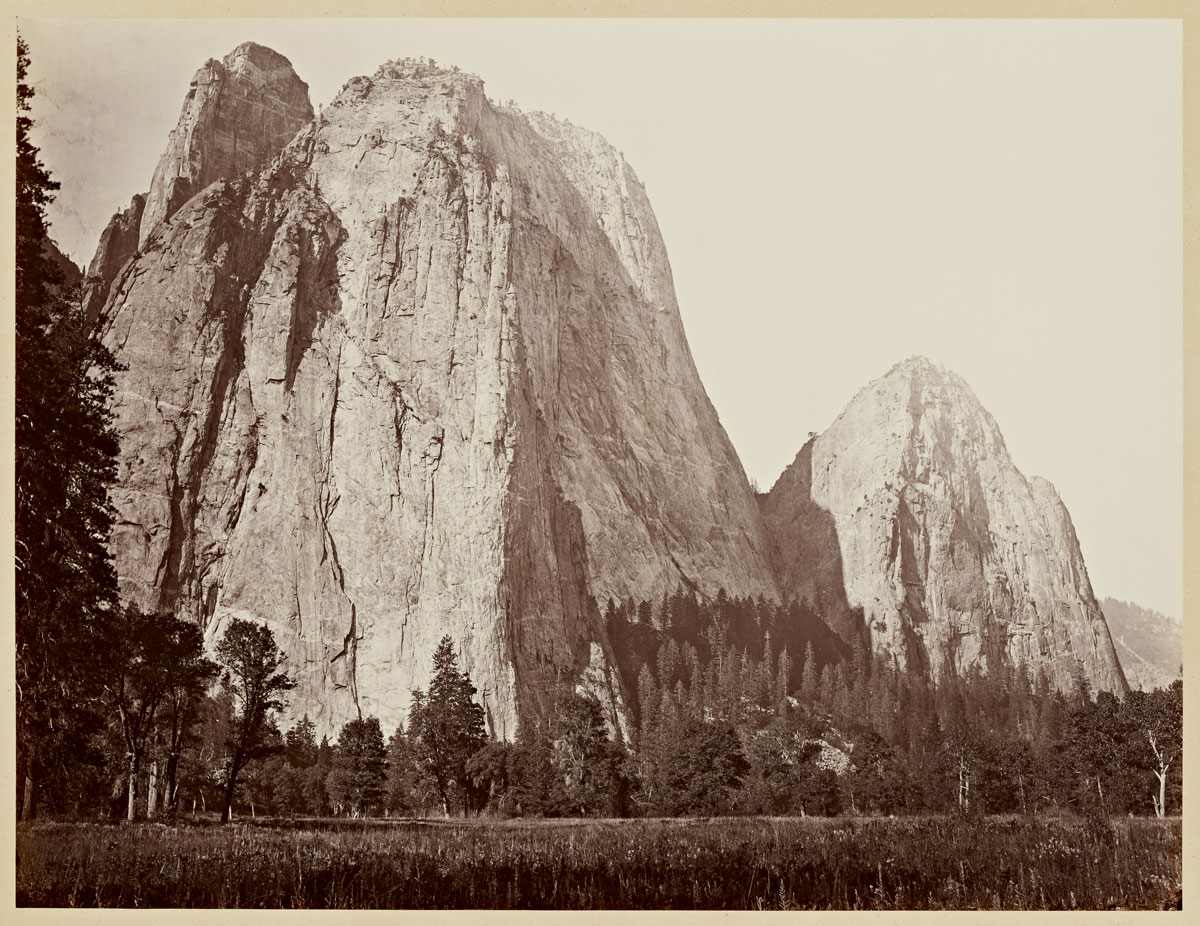
Carleton Watkins (American, 1829-1916) 'Cathedral Rocks, 2630 ft., Yosemite' 1865-1866


Carleton Watkins (American, 1829-1916)
Cathedral Rocks, 2630 ft., Yosemite
1865-1866
From the album Photographs of the Yosemite Valley
Albumen print
Lent by Department of Special Collections, Stanford University Libraries


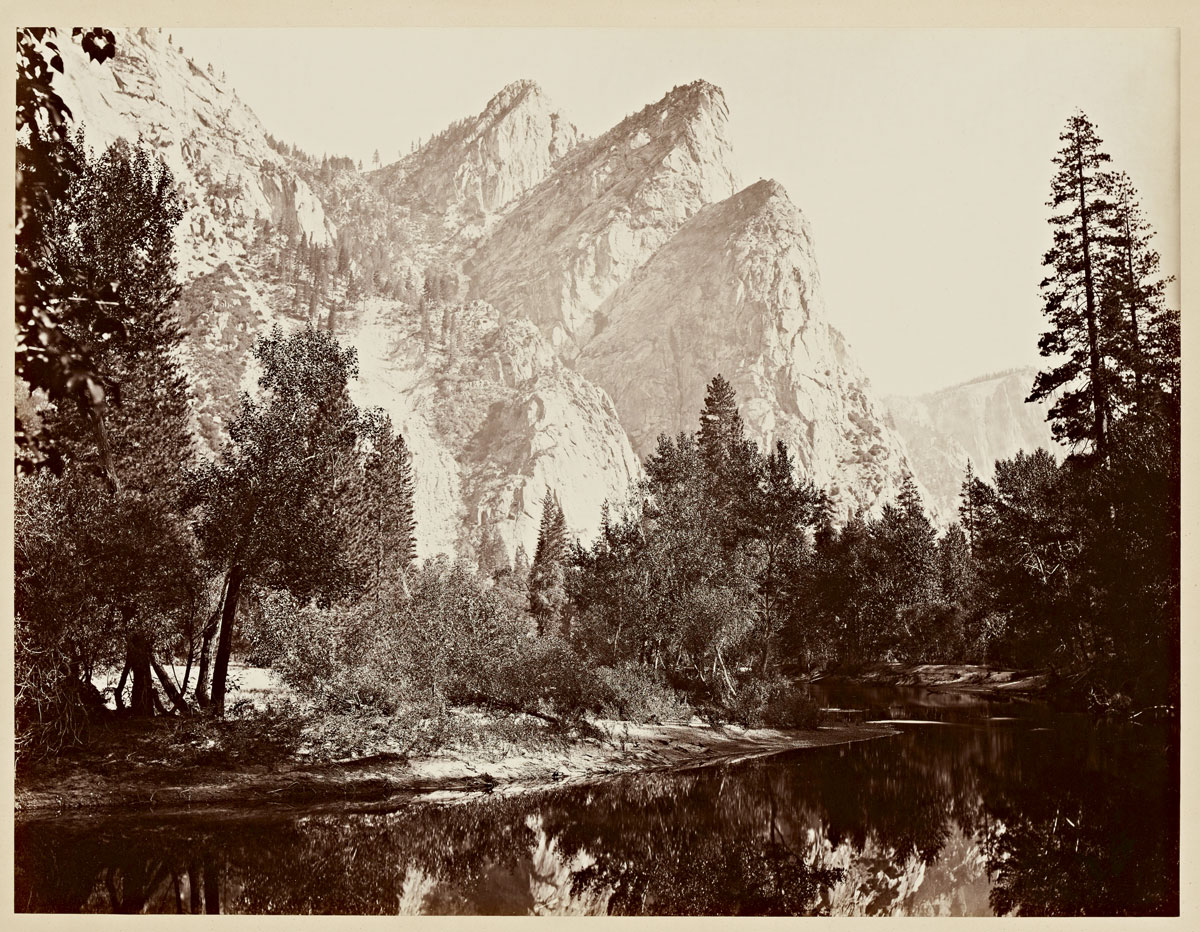
Carleton Watkins (American, 1829-1916) 'Pompompasos, the Three Brothers, Yosemite 4480 ft.' 1865-1866


Carleton Watkins (American, 1829-1916)
Pompompasos, the Three Brothers, Yosemite 4480 ft.
1865-1866
From the album Photographs of the Yosemite Valley
Albumen print
Lent by Department of Special Collections, Stanford University Libraries


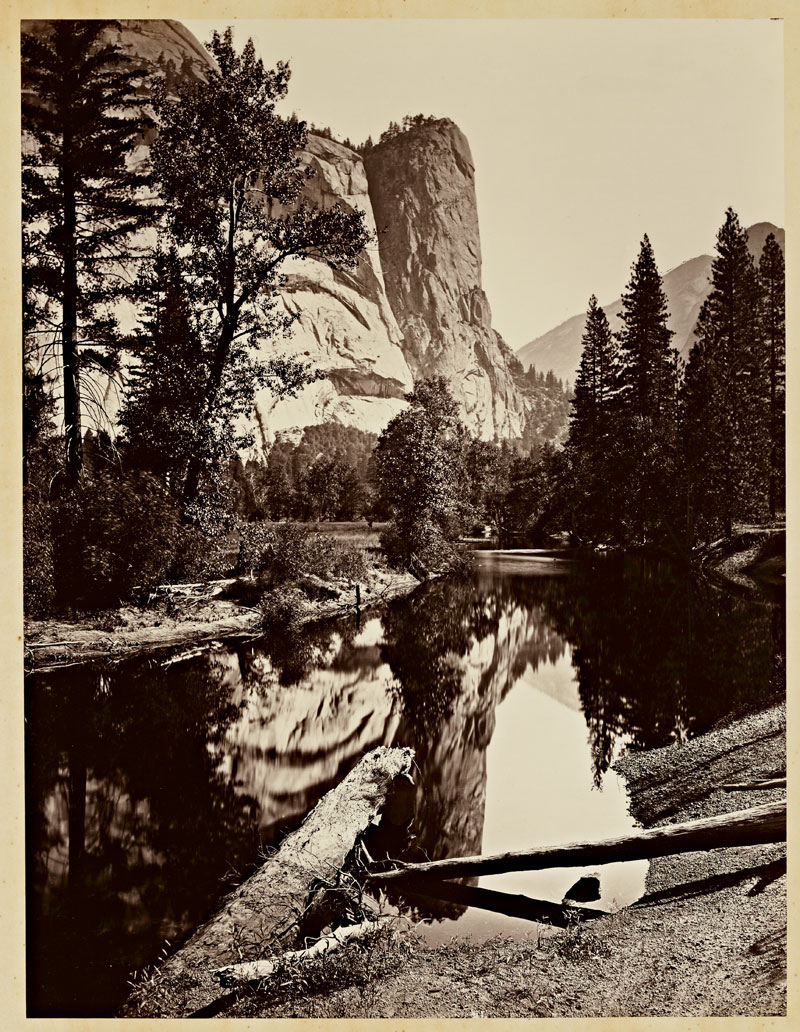
Carleton Watkins (American, 1829-1916) 'Mirror View of the North Dome, Yosemite' 1865-1866


Carleton Watkins (American, 1829-1916)
Mirror View of the North Dome, Yosemite
1865-1866
From the album Photographs of the Yosemite Valley
Albumen print
Lent by Department of Special Collections, Stanford University Libraries


Born in upstate New York, Carleton Watkins (1829-1916) ventured west in 1849 to strike it rich. But instead of prospecting for gold, Watkins developed a talent for photography – a medium invented only 22 years before. He documented the remote Pacific Coast in the 1860s and 1870s, capturing its vast scale and spirit with a custom-built camera that created “mammoth” 18 x 22-inch glass-plate negatives. In June 1864, his stunning photographs of Yosemite’s valley, waterfalls and peaks proved instrumental in convincing President Abraham Lincoln and the 38th U.S. Congress to pass the Yosemite Valley Grant Act, legislation that preserved the land for public use and set a precedent for America’s National Park System.

As the nation celebrates the 150th Anniversary of the Yosemite Grant, the Cantor Arts Center at Stanford University presents Carleton Watkins: The Stanford Albums, an exhibition featuring more than 80 original mammoth prints from three unique albums of Watkins’s work: Photographs of the Yosemite Valley (1861 and 1865-66), Photographs of the Pacific Coast (1862-76), and Photographs of the Columbia River and Oregon (1867 and 1870). The exhibition will be on view April 23 through August 17, 2014. Also featured will be cartographic visualisations developed in collaboration with Stanford’s Center for Spatial and Textual Analysis and the Bill Lane Center for the American West, which provide dynamic context for the geography and natural history of Watkins’s photographs. A fully illustrated publication will accompany the exhibition.

“The Cantor is thrilled to be leading such an innovative, interdisciplinary effort to look at Watkins’s work anew,” says Connie Wolf, the Cantor’s John & Jill Freidenrich Director. “These extraordinary albums from Stanford University Libraries’ singular collection provide us with an unparalleled opportunity to examine Watkins’s place in the history of photography, and to more fully understand the critical role photography played in the preservation, promotion, and development of the West. It is fascinating to note that Watkins and Leland Stanford were contemporaries. Watkins even photographed Stanford’s family, making this university a proud and apt home for these albums.”

The Albums

Photographs of the Yosemite Valley (1861 and 1865-1866)

In 1861, Watkins loaded up a team of mules with nearly a ton of photographic equipment including a mobile darkroom tent, a dangerous assortment of flammable chemicals, and an enormous custom-built camera that produced “mammoth” 18 x 22-inch glass-plate negatives. He headed 75 miles into the rugged and remote Yosemite Valley on a sometimes perilous journey to capture the natural wonders of the Sierra Nevada. The technical challenges of creating wet-plate negatives in the field were immense. Dust and grit could easily ruin the work as the plates were coated, exposed for up to an hour, and developed. Water had to be carried great distances. The sun warped and shrank camera parts. But the resulting suite of photographs became an international sensation – not only because they provided virtual access to one of America’s grandest wilderness areas but also for their extraordinary beauty. The New York Times declared in 1862 that “as specimens of the photographic art they are unequaled.”

Watkins’s album Photographs of the Yosemite Valley is sequenced to replicate the experience of entering the Mariposa Grove trail and traveling into the valley. From Cathedral Rocks to Half Dome, Watkins captures the quiet majesty of Yosemite’s natural monuments. The album contains images from both his initial expedition in 1861 and a subsequent visit as an ad hoc member of the California State Geological Survey team in 1865-66. Throughout his career, Watkins maintained close relationships with geologists as well as botanists who were deeply interested in his documentation of native tree species.

In Yosemite, Watkins found a spectacular natural laboratory for testing and refining his approach to landscape photography. His compositional choices were unique. In The Yosemite Valley from the “Best General View” (1866), for instance, Watkins cropped off the top of the lone tree in the foreground instead of framing it, lending a painterly quality to the image. By manipulating focus and perspective, Watkins also achieved an unusual balance of crispness against softer tonalities.

Watkins’s technical achievements under adverse conditions were unmatched and astonished his peers. The resolution of his photographs still rivals that of the high-end digital cameras of today. After 1861, capitalising on the success of his Yosemite pictures and his reputation as a landscape photographer, Watkins renamed his studio at 425 Montgomery Street in San Francisco the “Yo-Semite Gallery.” The exhibition features more than 30 photographs from the album Photographs of the Yosemite Valley including various views of Yosemite Valley; mountains and rock formations such as Cathedral Rocks, Half Dome, and El Capitan; waterfalls and water views such as Mirror Lake and Yosemite Falls; and photographs of Yosemite’s majestic trees.

Photographs of the Pacific Coast (1862-1876)

Watkins made his living mostly as a field photographer for hire, accepting commissions from logging companies and mining operations up and down the coast. Early in his career, Watkins’s photographs were often used to attract investors or as documentation in court evidence for land disputes. In the fast-developing West, photography was a means of establishing ‘truth claims’ to property and resource rights. And in a region where vast swaths of territory were rarely traveled by city dwellers, photography filled in the gaps.

Watkins added images from these underwritten trips to an album he called Photographs of the Pacific Coast. Along with his commercial photographs of smelting works at the New Almaden Mine in Santa Clara County and the hydraulic North Bloomfield mine in Nevada County, the album contains remarkable vistas of San Francisco including a dramatic photograph of the shipwreck Viscata on Ocean Beach, also images of the Devil’s Canyon geysers in Sonoma County and the Farallon Islands.

The album also includes images commissioned by California’s sixth governor, Milton Slocum Latham, of Latham’s mansion on San Francisco’s Rincon Hill. It was, in fact, Latham’s wife, Mollie, who commissioned the three albums now at Stanford. One of the original bindings is on display so visitors can appreciate its massive size and ornate details. With the Civil War raging in the eastern part of the country until 1865, Watkins’s images of the pristine Pacific Coast must have provided Americans a welcome alternative to the images of carnage issuing from the battlefield.

In the exhibition, there are more than 20 California photographs from the album Photographs of the Pacific Coast including scenes of San Francisco neighbourhoods, homes, and natural sites including the Farallon Islands; commissioned images of mining operations; and views of Mt. Shasta, Mendocino County, and Sonoma County.

Photographs of the Columbia River and Oregon (1867 and 1870)

While Watkins’s name is most closely associated with Yosemite, photographers often cite Watkins’s album Photographs of the Columbia River and Oregon as his crowning artistic achievement. No longer a novice, Watkins demonstrates mastery of his craft and a keen eye for composition in these images. A friend at the Oregon Steam Navigation Company arranged for Watkins to travel by rail up and down the Columbia River to photograph the company’s rail portages and scenic beauty to document the company’s progress. Watkins was the first to photograph this area and traveled for four months to do so.

In the resulting views of Portland, Oregon City, rail portages, river industry, and scenery, Watkins made art of the river landscapes and the railroad laid alongside it. Cape Horn, Near Celilo (1867), taken at the final point of his journey where the tracks ended, shows a stark horizon, suggesting both the far edge of the world and the determination of early industrial pioneers. In Mt. Hood and the Dalles, Columbia River (1867), a spectacular view of Mt. Hood and of the meandering river at the base of basalt cliffs is disrupted by the object of greatest focus – a tiny white outbuilding for the railroad.

The exhibition features more than 15 photographs from the album Photographs of the Columbia River and Oregon including views along the Columbia River of Cape Horn, Castle Rock and Mt. Hood; and images of Portland, Oregon City, and smaller towns and industries along the railroad.

Exploring Watkins’s Photographs with Digital Technology

Stanford’s Center for Spatial and Textual Analysis, the Bill Lane Center for the American West, the Branner Earth Sciences Library, and the Cantor worked together to create an innovative cartographic digital accompaniment for each album.

For Photographs of Yosemite Valley, the team – including select students – generated “viewsheds” of several of Watkins’s photographs that enable visitors to see where each was likely taken and what topographical elements are either illuminated or obscured in them. With Photographs of the Pacific Coast, fascinating before-and-after visualisations illustrate the incredible changes in the landscape of San Francisco over the last century and a half. Lastly, a cartographic accompaniment to Photographs of the Columbia River and Oregon details the early railroad routes Watkins traveled to take his photographs.

Carleton Eugene Watkins (1829-1916)

Born in upstate New York in 1829, Watkins ventured west to look for opportunities and settled in the Bay Area in 1852. While working for a photography studio, he was asked to step in for a photographer who had unexpectedly quit. Watkins quickly learned the daguerreotype process and within two years he was making ambrotypes and wet-plate collodion photographs.

Throughout his career, Watkins documented the remote American West, generating more than 7,000 photographs of its most majestic wilderness sites as well as the dramatic transformation of isolated territories caused by logging and mining industries. His photographs won awards throughout the United States and abroad. With his early success, he established a gallery in San Francisco on prestigious Montgomery Street in 1861.

But Watkins’s fortunes took a turn with the 1874 failure of the Bank of California and the resulting economic panic. Heavily in debt at the time, Watkins had to declare bankruptcy and lost both the gallery and the majority of his negatives to a competitor. Watkins rebuilt his inventory, continuing to travel and work into the 1890s, but never recovered financially. At one point he and his family lived in a rail car in Oakland. Watkins’s health also declined, and by 1903 he was nearly blind. Watkins died tragically. The 1906 earthquake and fire destroyed his studio and his life’s work, and he never got over the shock. His family eventually had him committed to Napa State Hospital. He died there in 1916.

Press release from the Cantor Arts Center website


Carleton Watkins (American, 1829-1916) 'Cape Horn, Columbia River' 1867


Carleton Watkins (American, 1829-1916)
Cape Horn, Columbia River
1867
From the album Photographs of the Columbia River and Oregon
Albumen print
Lent by Department of Special Collections, Stanford University Libraries


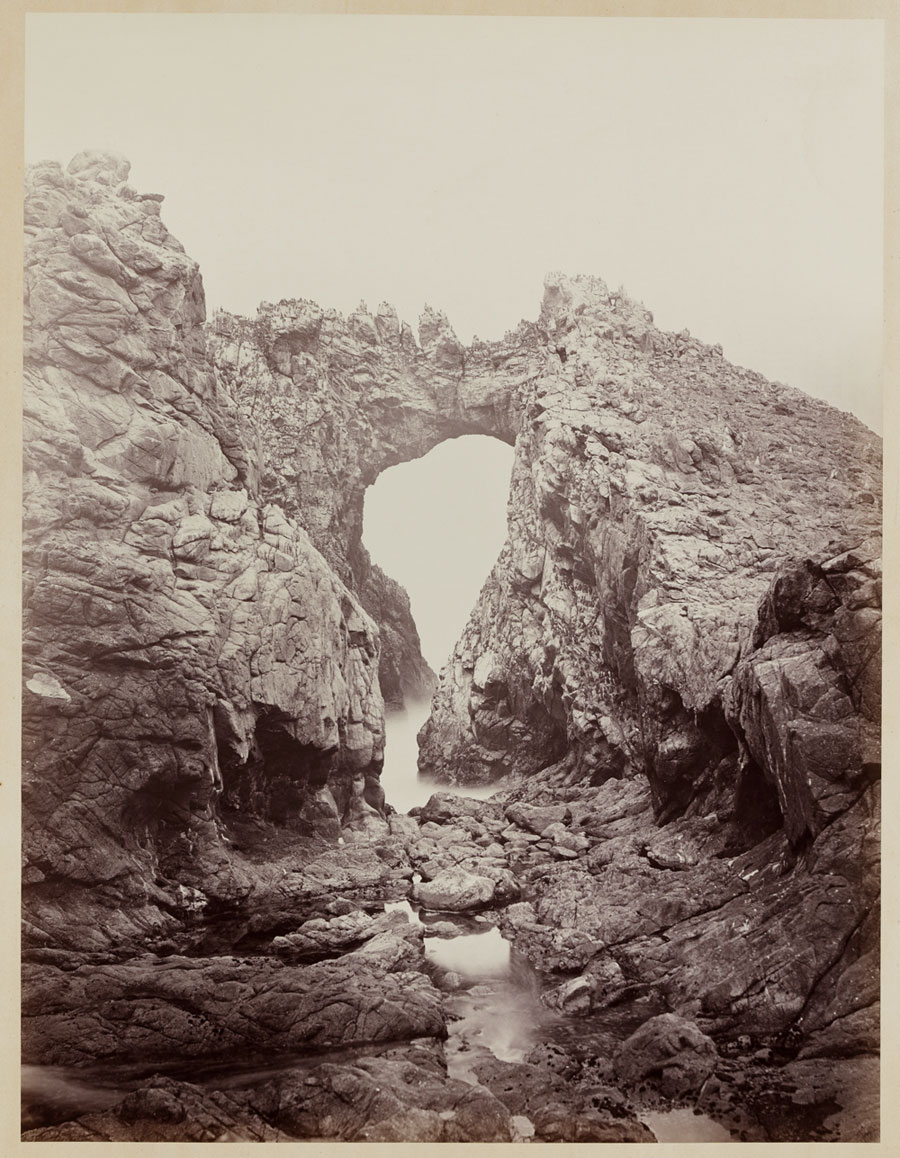
Carleton Watkins (American, 1829-1916) 'Arch at the West End, Farallones' 1868-1869


Carleton Watkins (American, 1829-1916)
Arch at the West End, Farallones
1868-1869
From the album Photographs of the Pacific Coast
Albumen print
Lent by Department of Special Collections, Stanford University Libraries


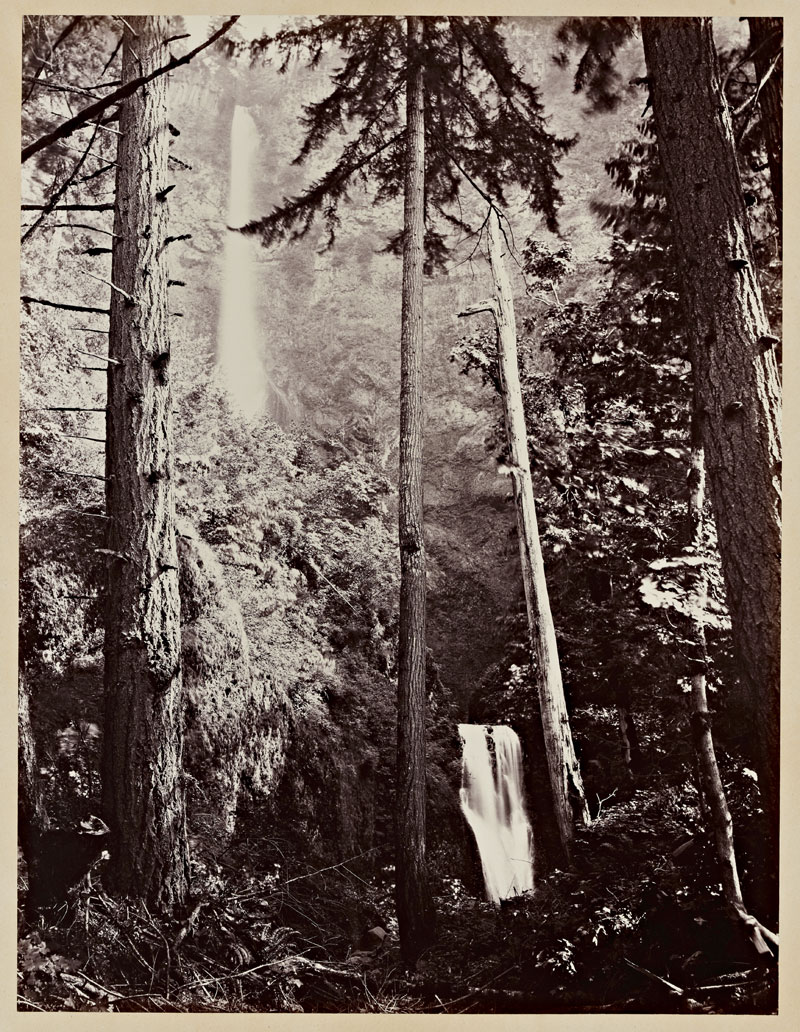
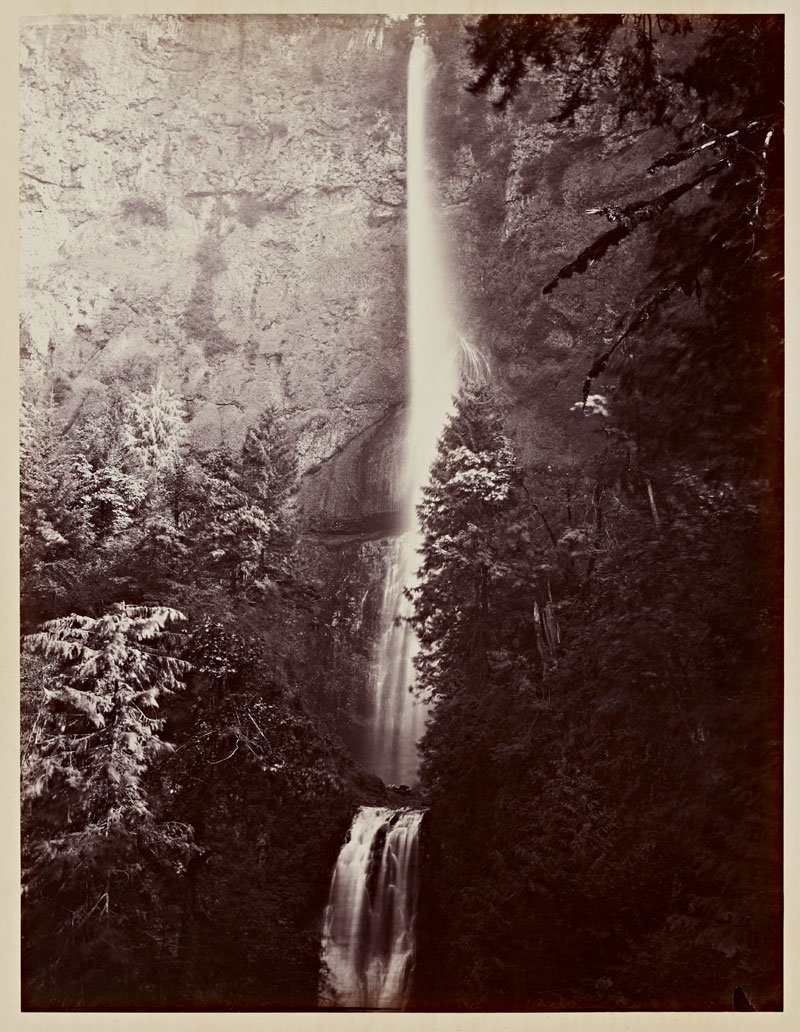
Carleton Watkins (American, 1829-1916) 'Multnomah Falls, Columbia River, Oregon' 1867


Carleton Watkins (American, 1829-1916)
Multnomah Falls, Columbia River, Oregon
1867
From the album Photographs of the Columbia River and Oregon
Albumen print
Lent by Department of Special Collections, Stanford University Libraries


Carleton Watkins (American, 1829-1916) 'Multnomah Falls, Cascades, Columbia River' 1867


Carleton Watkins (American, 1829-1916)
Multnomah Falls, Cascades, Columbia River
1867
From the album Photographs of the Columbia River and Oregon
Albumen print
Lent by Department of Special Collections, Stanford University Libraries


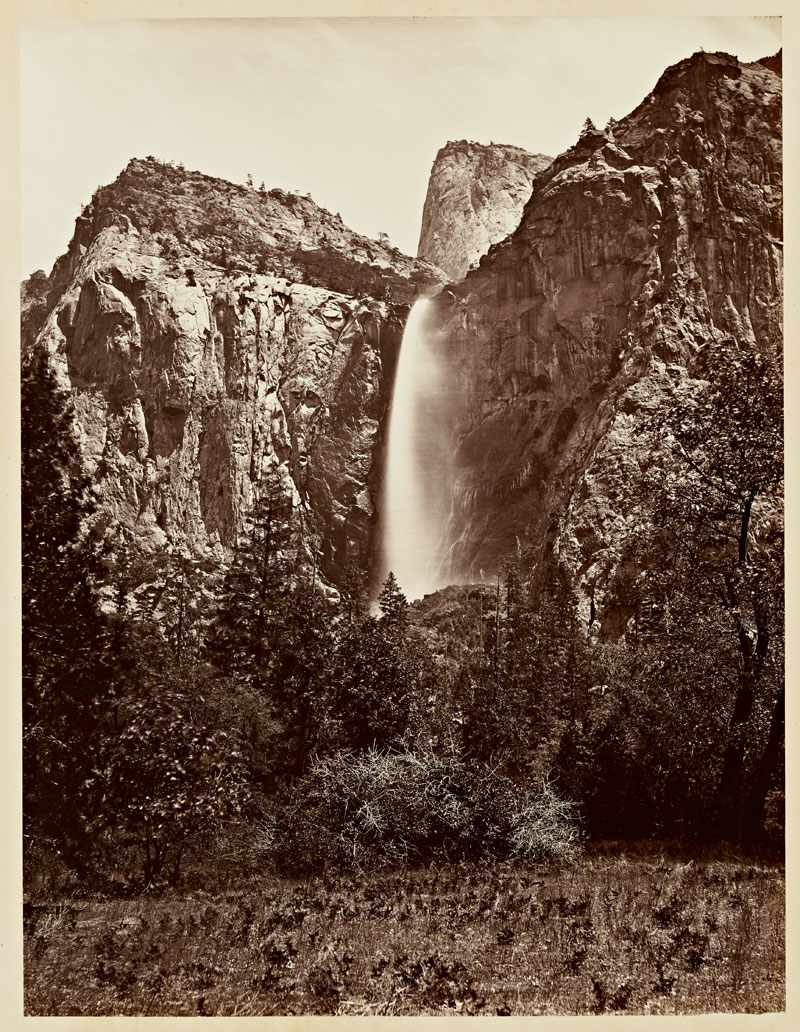
Carleton Watkins (American, 1829-1916) 'Pohono, the Bridal Veil, Yosemite 900 ft.' 1865-1866


Carleton Watkins (American, 1829-1916)
Pohono, the Bridal Veil, Yosemite 900 ft.
1865-1866
From the album Photographs of the Yosemite Valley
Albumen print
Lent by Department of Special Collections, Stanford University Libraries


Carleton Watkins (American, 1829-1916) 'The Lower Yosemite Fall, Yosemite' 1865-1866


Carleton Watkins (American, 1829-1916)
The Lower Yosemite Fall, Yosemite
1865-1866
From the album Photographs of the Yosemite Valley
Albumen print
Lent by Department of Special Collections, Stanford University Libraries


Carleton Watkins (American, 1829-1916) 'The Yosemite Falls, 2634 ft.' 1865-1866


Carleton Watkins (American, 1829-1916)
The Yosemite Falls, 2634 ft.
1865-1866
From the album Photographs of the Yosemite Valley
Albumen print. Lent by Department of Special Collections, Stanford University Libraries


Carleton Watkins (American, 1829-1916) 'Mirror View of El Capitan, Yosemite' 1865-1866


Carleton Watkins (American, 1829-1916)
Mirror View of El Capitan, Yosemite
1865-1866
From the album Photographs of the Yosemite Valley
Albumen print
Lent by Department of Special Collections, Stanford University Libraries


Carleton Watkins (American, 1829-1916) 'Washington Column, 2082 ft., Yosemite' 1865-1866


Carleton Watkins (American, 1829-1916)
Washington Column, 2082 ft., Yosemite
1865-1866
From the album Photographs of the Yosemite Valley
Albumen print
Lent by Department of Special Collections, Stanford University Libraries


Carleton Watkins (American, 1829-1916) 'The Ponderosa, Yosemite' 1866


Carleton Watkins (American, 1829-1916)
The Ponderosa, Yosemite
1866
From the album Photographs of the Yosemite Valley
Albumen print
Lent by Department of Special Collections, Stanford University Libraries


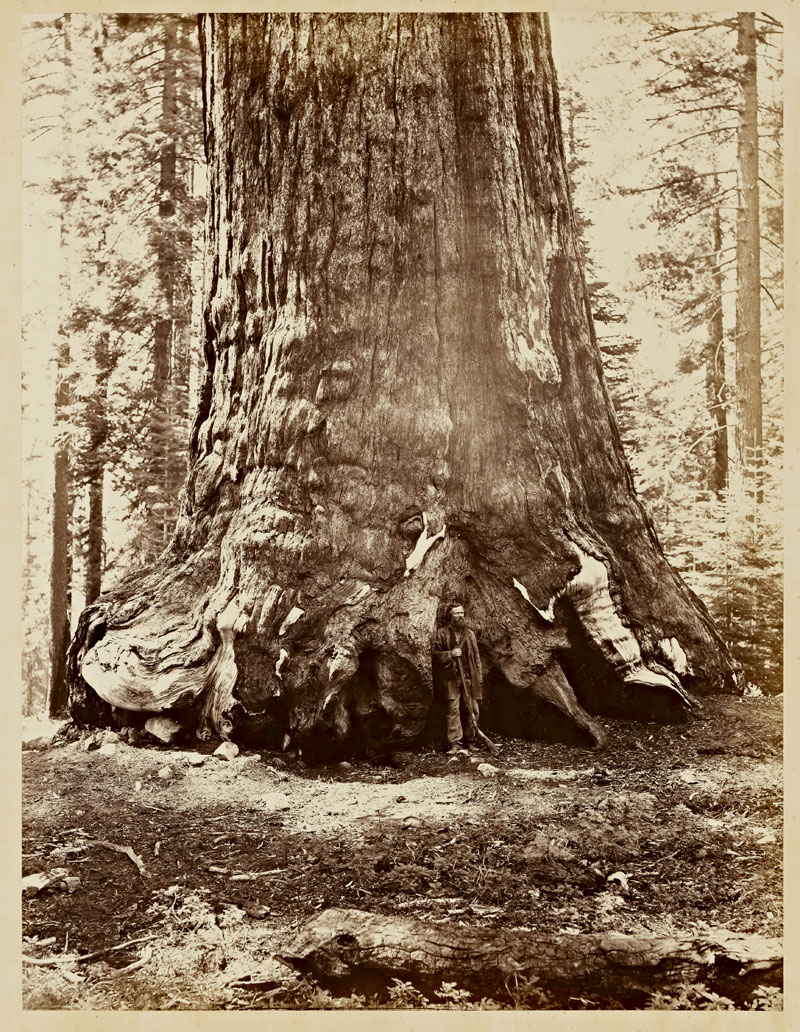
Carleton Watkins (American, 1829-1916) 'Section of the Grizzly Giant, 33 ft. diameter' 1865-1866


Carleton Watkins (American, 1829-1916)
Section of the Grizzly Giant, 33 ft. diameter
1865-1866
From the album Photographs of the Yosemite Valley
Albumen print. Lent by Department of Special Collections, Stanford University Libraries


Cantor Arts Center at Stanford University
328 Lomita Drive at Museum Way
Stanford, CA 94305-5060
Phone: 650-723-4177

Opening hours:
Wednesday – Sunday 11am – 5pm
Closed Monday and Tuesday

Cantor Arts Center at Stanford University website

LIKE ART BLART ON FACEBOOK

Back to top

Exhibition: ‘Photographic Wonders: American Daguerreotypes from The Nelson-Atkins Museum of Art’ at the Taft Museum of Art, Cincinnati

Exhibition dates: 17th May – 25th August 2013


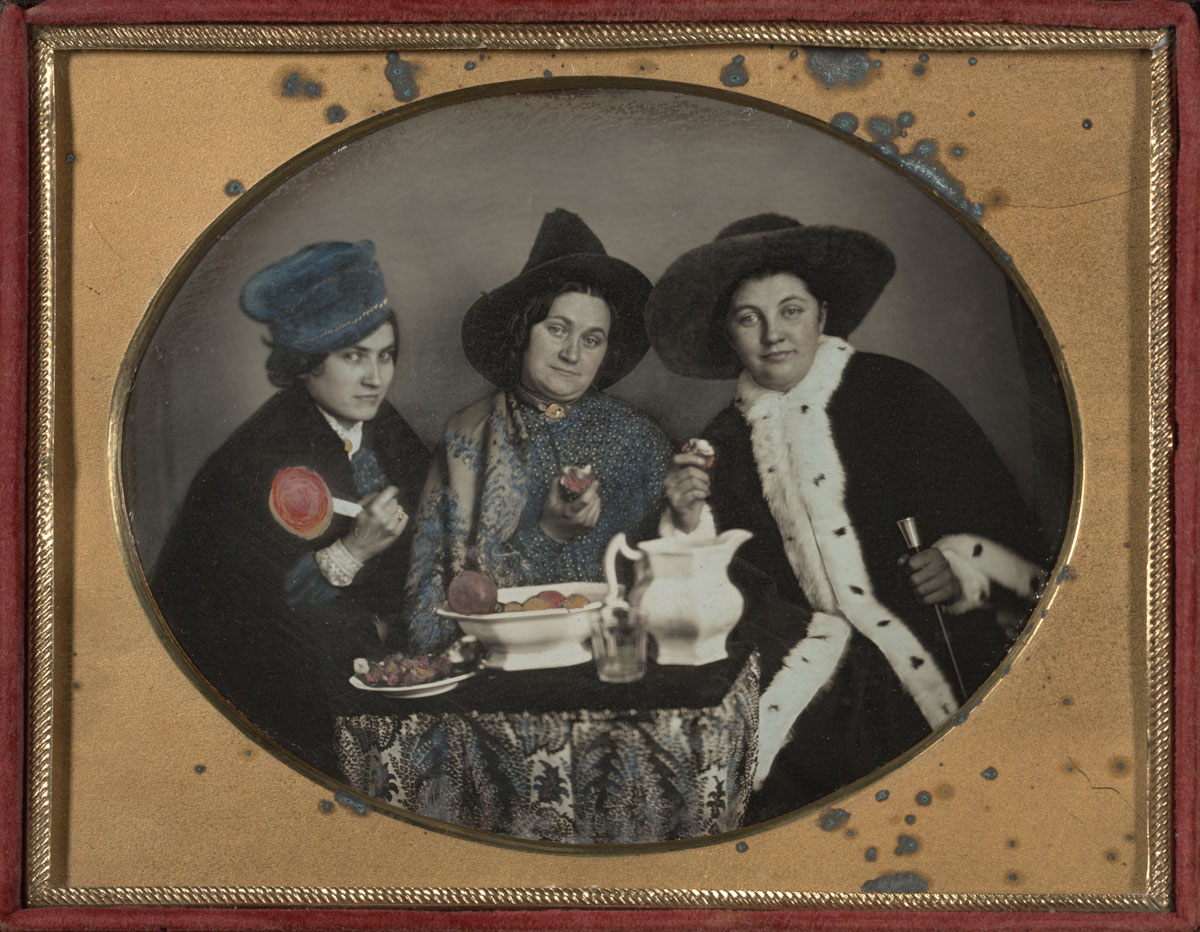
Unknown Maker (American) 'Three Lively Women' c. 1850


Unknown Maker (American)
Three Lively Women
c. 1850
Daguerreotype, quarter plate
3 1/4 x 4 1/4 inches
The Nelson-Atkins Museum of Art, Gift of Hallmark Cards, Inc.,
© Nelson Gallery Foundation


I love the word “occupationals” to describe portraits of individuals with the hallmarks of their trade.

Marcus


Many thankx to the Taft Museum of Art for allowing me to publish the photographs in the posting. Please click on the photographs for a larger version of the image.


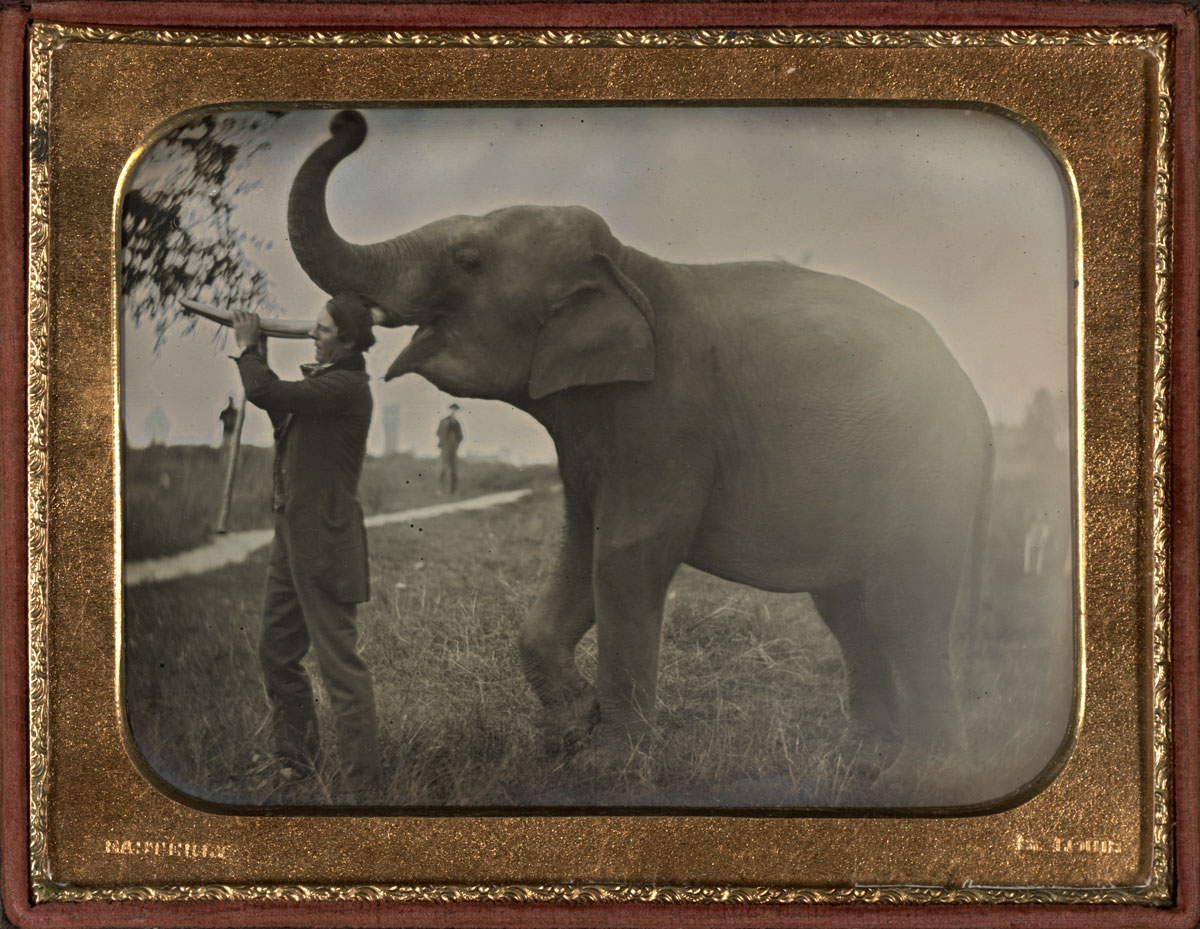
Thomas Easterly (American, 1809-1882) 'Man with Elephant' c. 1850


Thomas Easterly (American, 1809-1882)
Man with Elephant
c. 1850
Daguerreotype, quarter plate
3 1/4 x 4 1/4 inches
The Nelson-Atkins Museum of Art, Gift of Hallmark Cards, Inc.,
© Nelson Gallery Foundation


Thomas Martin Easterly

A sometime calligrapher and writing teacher, Vermont-born Thomas Martin Easterly (b. 1809 Guilford, Vermont, d. 1882) learned the daguerreotype process in New York between 1841 and 1844, possibly from Charles and Richard Meade. In 1844 Easterly sailed from New York City to New Orleans, where he made photographs before returning to Vermont the following year. He did not remain for long: by October, he had entered into a daguerreotype studio partnership in Iowa. He and his partner operated as traveling photographers working throughout Iowa and Missouri for several years. Some scholars have credited Easterly with making the first photographs of Plains Indians.

After the dissolution of the partnership, Easterly moved to Saint Louis and took over a studio in 1848. He had a successful career for ten years, but his loyalty to the daguerreotype process after the introduction of the ambrotype, tintype, and paper photograph processes caused his business to falter. By 1860 Easterly had begun to sell farm implements in addition to continuing his daguerreotype practice.

Text from the J. Paul Getty Museum website


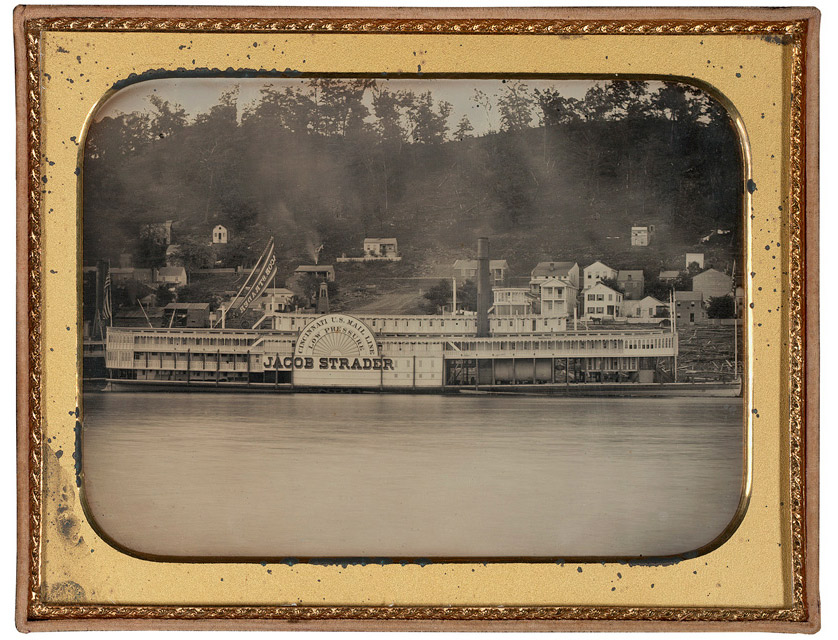
Attributed to Ezekiel Hawkins (American, 1808-1862) 'The Jacob Strader at Wharf, Cincinnati' c. 1853


Attributed to Ezekiel Hawkins (American, 1808-1862)
The Jacob Strader at Wharf, Cincinnati
c. 1853
Daguerreotype, half plate
4 1/4 x 5 1/2 inches
The Nelson-Atkins Museum of Art, Gift of Hallmark Cards, Inc.,
© Nelson Gallery Foundation


This daguerreotype of the side-wheel packet Jacob Strader was taken at the Cincinnati boatyard where she was built in 1853. Owned by the U.S. Mail Line Co., this steamboat was named to honour Jacob Strader, the company’s first president. The Jacob Strader ran regularly between Cincinnati and Louisville, however during the Civil War, because her large cabin contained 310 berths, she was frequently used to transport sick and wounded soldiers. This boat was dismantled in 1866.

As steamboats replaced flatboats and keelboats as the major mode of river transportation, travel along the Ohio River became faster and easier. By the middle of the nineteenth century, more than 3,000 steamboats arrived each year at the port of Cincinnati. The city’s prominent location along the river contributed to its rapid growth, and by 1850 Cincinnati became the sixth largest city in the country. The development of railroads slowly led to the decline of steamboats. They continued to operate on the Ohio River, but their numbers dwindled.

Text from the Ohio Memory Collection website


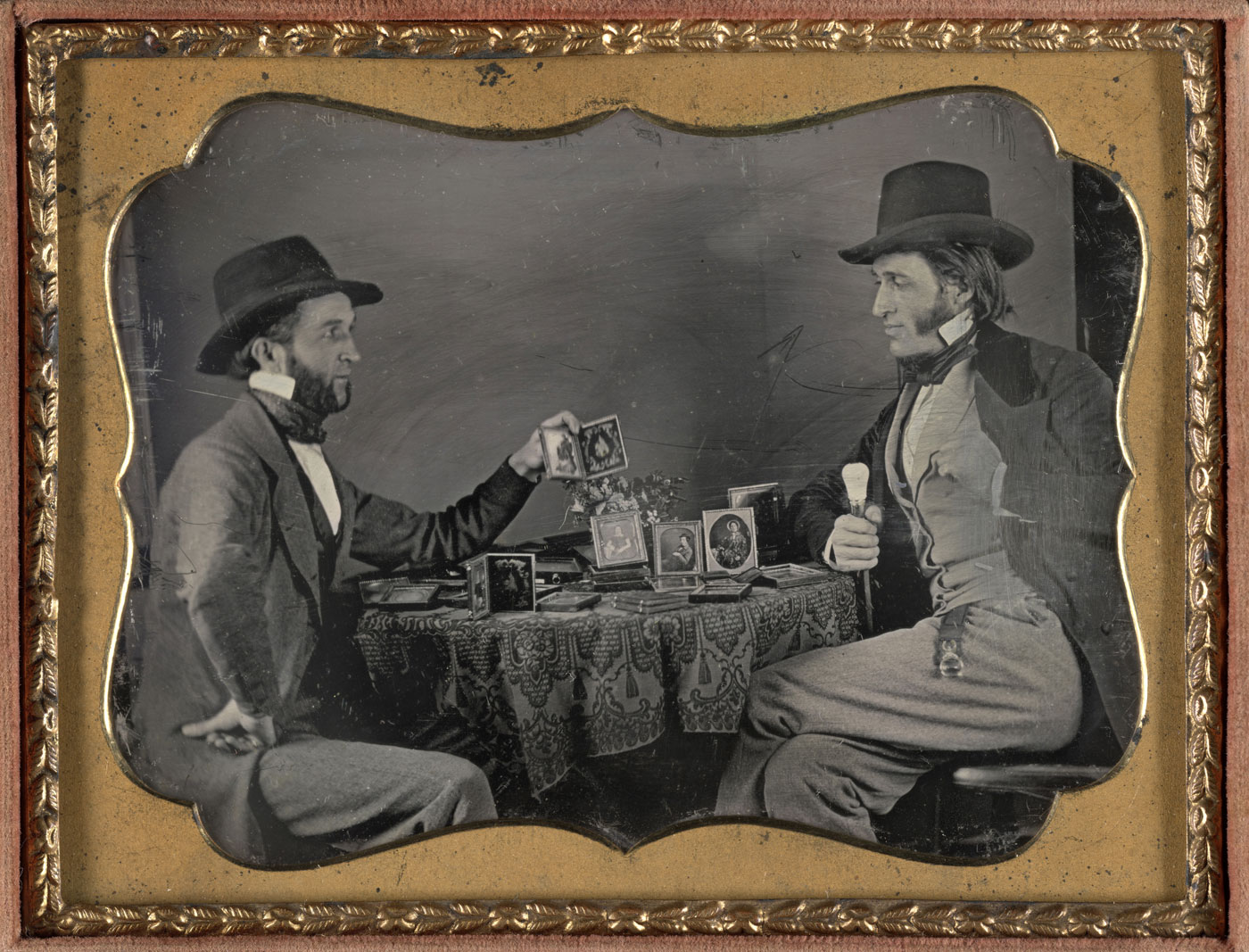
Unknown Maker (American) 'A Showing of Daguerreotypes' c. 1850


Unknown Maker (American)
A Showing of Daguerreotypes
c. 1850
Daguerreotype, quarter plate
3 1/4 x 4 1/4 inches
The Nelson-Atkins Museum of Art, Gift of Hallmark Cards, Inc.,
© Nelson Gallery Foundation


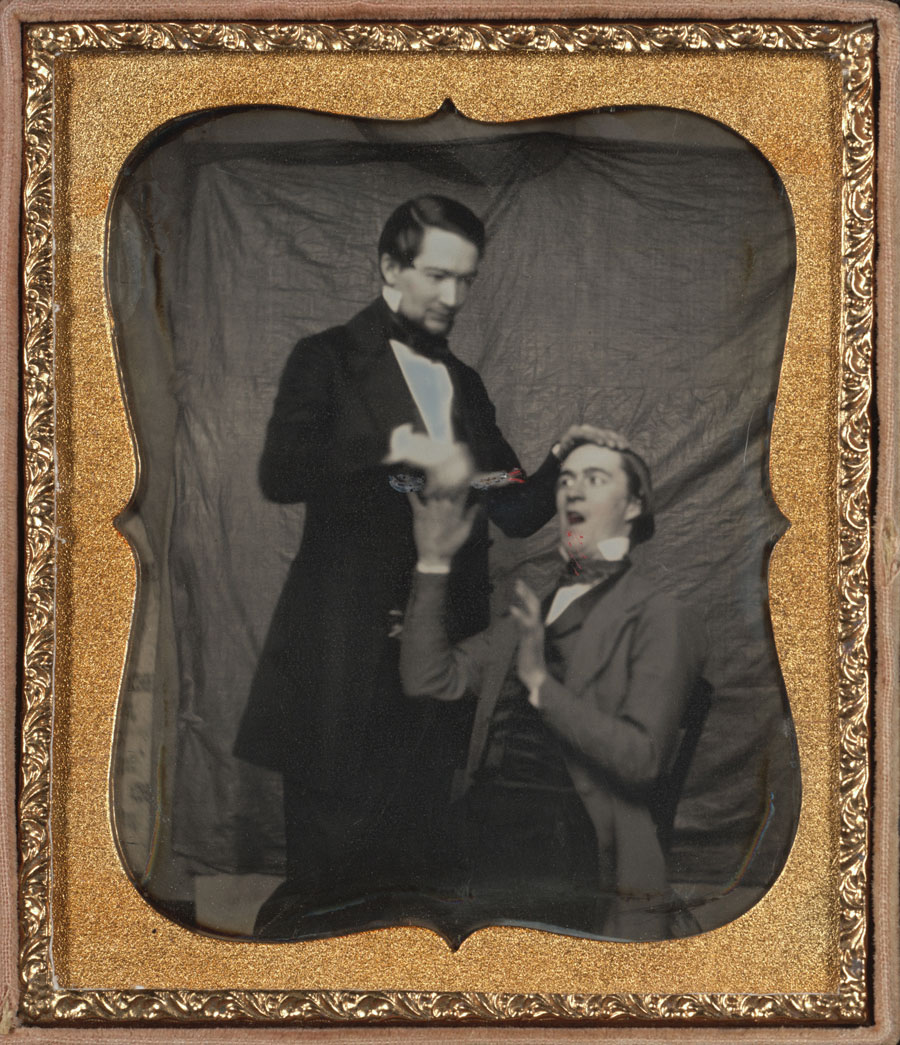
Unknown Maker (American) 'Comic Dentist' c. 1850


Unknown Maker (American)
Comic Dentist
c. 1850
Daguerreotype, sixth plate
3 1/4 x 2 3/4 inches
The Nelson-Atkins Museum of Art, Gift of Hallmark Cards, Inc.,
© Nelson Gallery Foundation


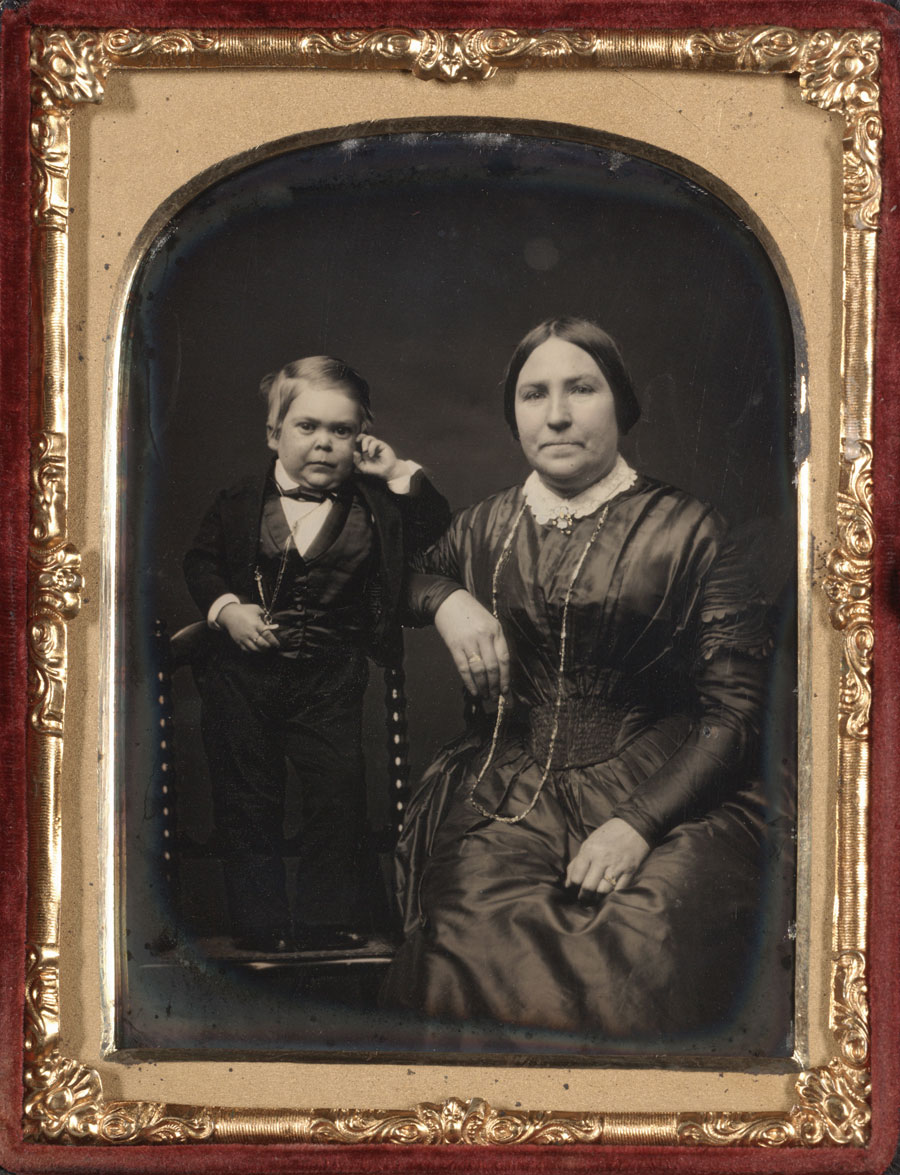
American Daguerreotypes from The Nelson-Atkins Museum of Art, on display May 17 – Aug. 25, features 82 astonishing images of life in 19th-century America. The exhibition includes rare images of such well-known Americans as Harriet Beecher Stowe, Frederick Douglass, and Tom Thumb.

By the middle of the 19th century, Cincinnati was the Queen City of the West. A transportation hub, the city was home to industry, art, and even a professional baseball team. Though there are numerous written accounts of life in the big city at this time, we are also fortunate to have images of this era because of the earliest “photographic” works, known as daguerreotypes. In 1839 the American public first encountered this exciting new invention. By 1843, daguerreotypists had set up shop in every major city in the United States. Visitors to the Taft will have the opportunity to view these remarkable works. This exhibition features about 90 daguerreotypes of exceptional quality and variety, with the high degree of resolution typical of these rare, one-of-a-kind photographs. Works by both famed and anonymous makers provide a window into mid-19th-century America: its occupations, trades, urban and rural scenery, and racial and ethnic diversity.

In 1839 the American public encountered the exciting new invention of photography in its earliest form, the daguerreotype. Together, these two Taft exhibitions present an in-depth look at the art of early photography, as well as candid, touching, and sometimes humorous image of life in mid-19th century America and Cincinnati. A daguerreotype is a unique image crafted on a silvered copper plate, a surface that acts like a mirror. While sometimes hard to view, this exhibition presents the works under perfect lighting conditions. The earliest daguerreotypes required exposures of up to thirty minutes. Within a few years, however, portraits could be made in about ten to twenty seconds.

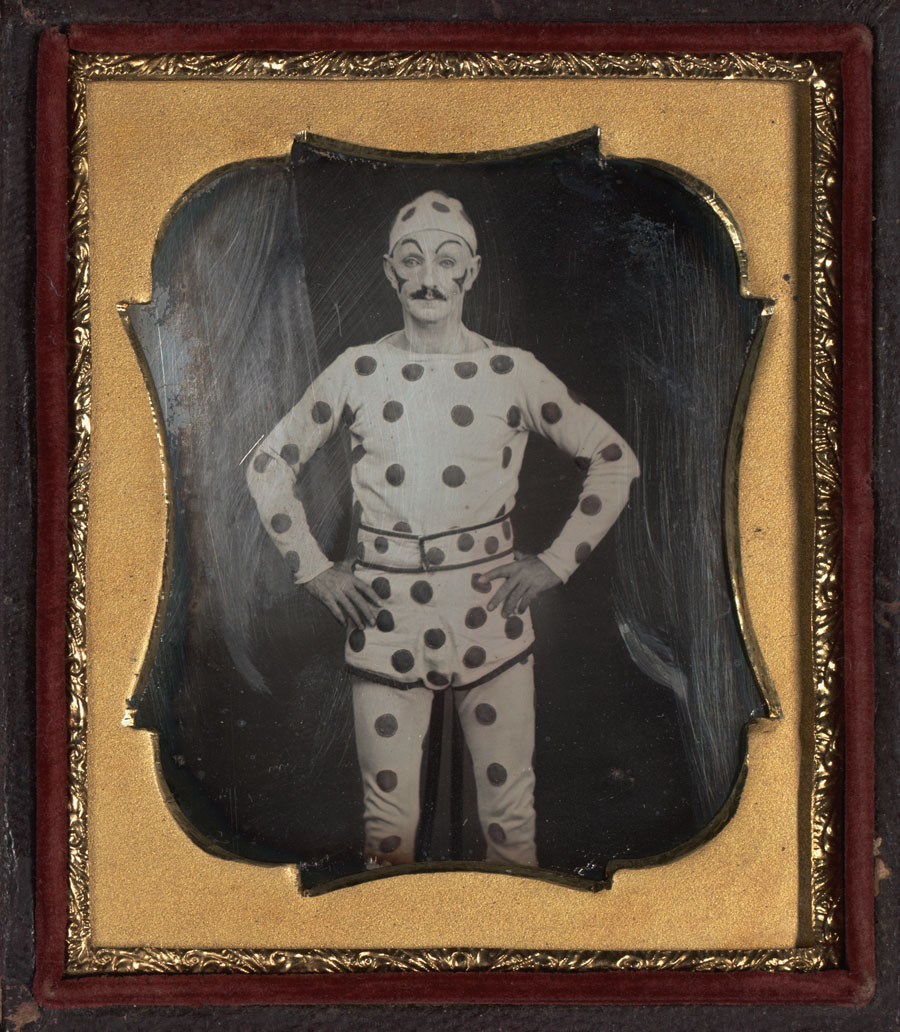
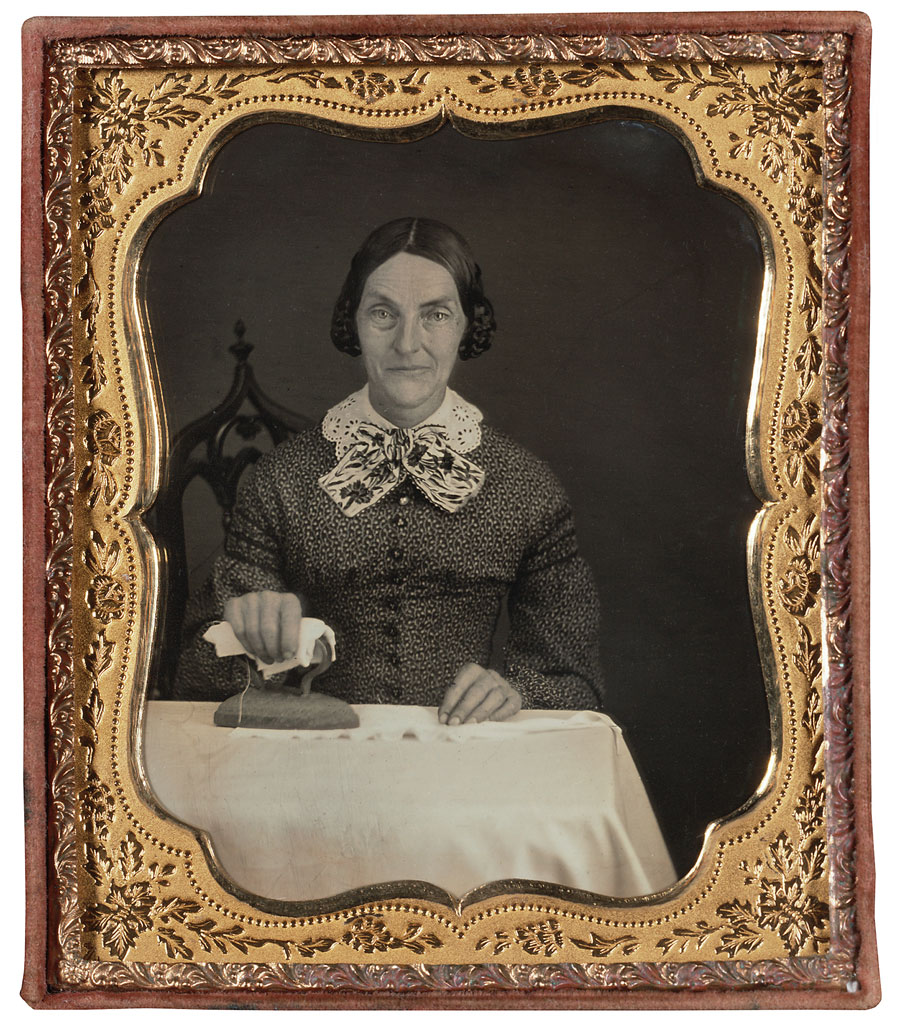
Among the exceptional daguerreotypes in Photographic Wonders are post-mortem images (portraits taken after death) that tell sorrowful stories, while The Comic Dentist and other humorous subjects still amuse today’s audiences. Portraits of individuals with the hallmarks of their trade (called occupationals), including a blacksmith with his tools, a woman ironing, and a clown in costume, show Americans’ pride in their work. Outdoor scenes reveal quaint towns and growing cities, while landscapes feature popular tourist destinations. The wide range of subjects offers something for every interest. The exhibited works in Photographic Wonders are part of an acclaimed collection that Hallmark Cards, Inc., donated in 2005 to The Nelson-Atkins Museum of Art.

The choice examples selected for the Taft date from about 1840 to about 1860, while Nicholas Longworth and his family lived in the historic house that is now the Taft Museum of Art. Local Exposures, a captivating “snapshot” of life in Cincinnati in the 1800s, will delight Cincinnati history enthusiasts. A rarely exhibited Cincinnati streetscape reveals what the city looked like in 1848, while business cards and advertisements for daguerreotype studios show the prominence of the industry in Cincinnati.

“These were the first photographs. Prior to this the only way you could preserve your image was through a painting or sketch. Imagine seeing yourself in a photograph for the first time – it would seem like magic, and that’s exactly the first reaction people had,” says installing curator, Tamera Muente. Taft Museum of Art Director/CEO, Deborah Emont Scott, says, “It’s an amazing experience to view these precious, one-of-a-kind photographs. The images are small and the viewing experience is an intimate one – you step back in time and share a rare mid-19th-century moment with the sitter.”

Press release from the Taft Museum of Art website


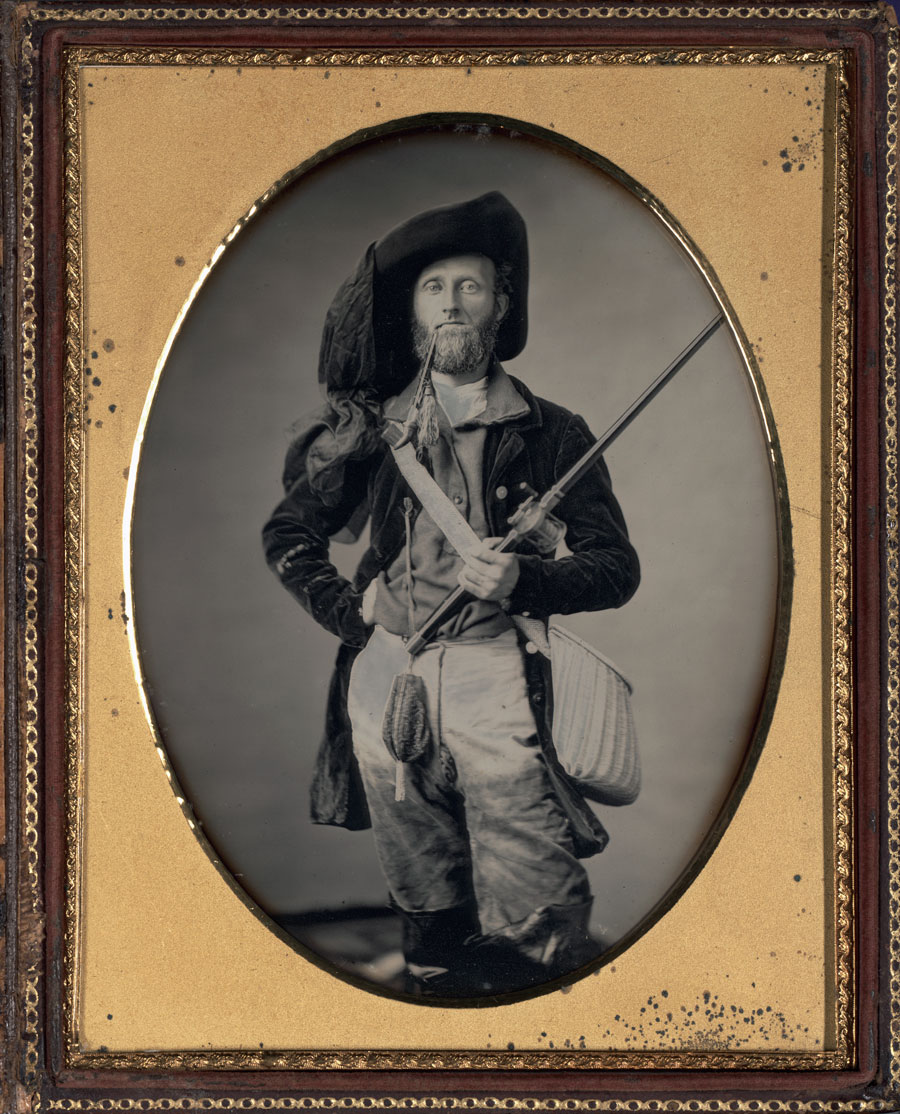
William C. North (American, 1814-1890) 'The Fisherman' c. 1850


William C. North (American, 1814-1890)
The Fisherman
c. 1850
Daguerreotype, half plate
5 1/2 x 4 1/2 inches
The Nelson-Atkins Museum of Art, Gift of Hallmark Cards, Inc.,
© Nelson Gallery Foundation


Unknown Maker (American) 'Clown' c. 1850-1855


Unknown Maker (American)
Clown
c. 1850-1855
Daguerreotype, sixth plate
2 1/4 x 2 3/4 inches
The Nelson-Atkins Museum of Art, Gift of Hallmark Cards, Inc.,
© Nelson Gallery Foundation


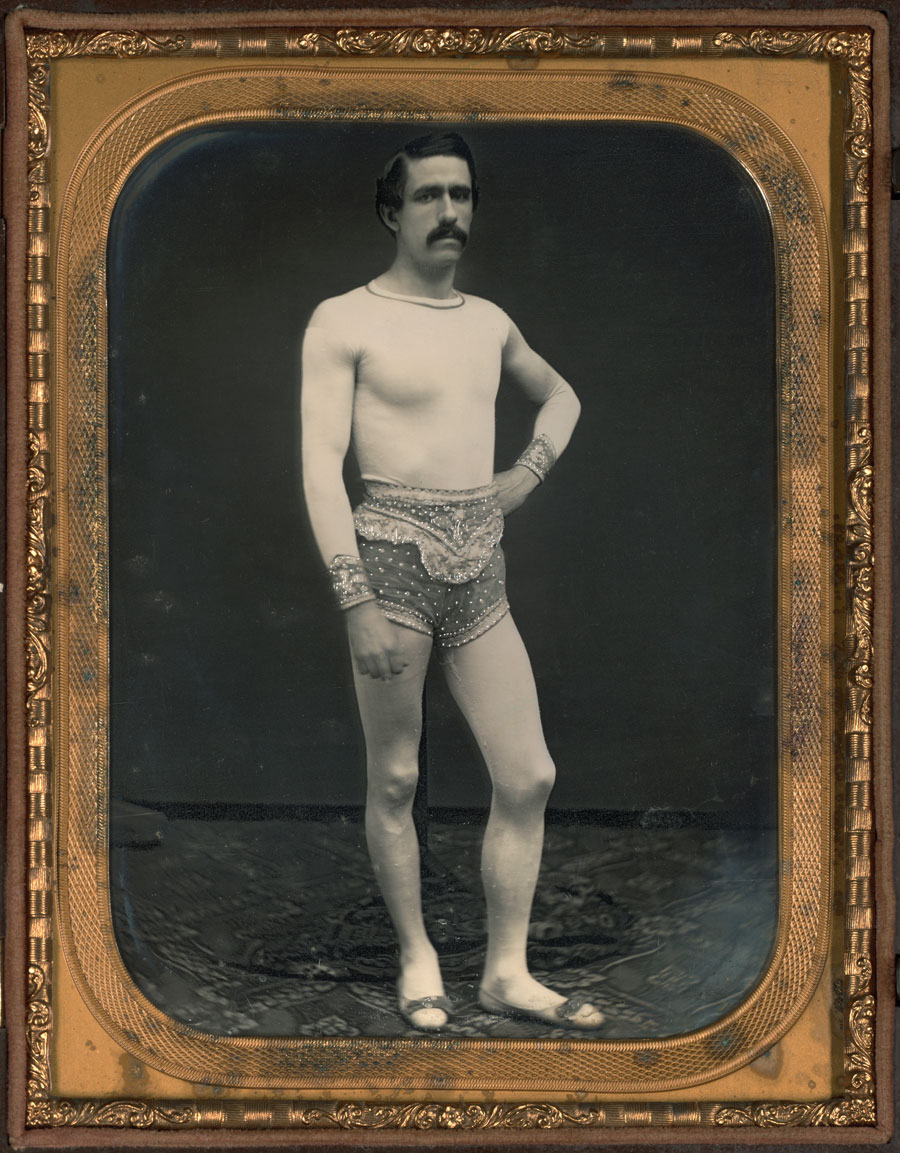
Unknown Maker (American) 'Tightrope Walker' c. 1855


Unknown Maker (American)
Tightrope Walker
c. 1855
Daguerreotype, half plate
5 1/2 x 4 1/2 inches
The Nelson-Atkins Museum of Art, Gift of Hallmark Cards, Inc.,
© Nelson Gallery Foundation


Unknown Maker (American) 'Tom Thumb and his Mother' c. 1850-1855


Unknown Maker (American)
Tom Thumb and his Mother
c. 1850-1855
Daguerreotype, quarter plate
4 1/4 x 3 1/4 inches
The Nelson-Atkins Museum of Art, Gift of Hallmark Cards, Inc.,
© Nelson Gallery Foundation


General Tom Thumb was the stage name of Charles Sherwood Stratton (January 4, 1838 – July 15, 1883), a little person who achieved great fame under circus pioneer P.T. Barnum.


Unknown Maker (American) 'Woman Ironing' c. 1850-55


Unknown Maker (American)
Woman Ironing
c. 1850-1855
Daguerreotype, sixth plate
3 1/4 x 2 3/4 inches
The Nelson-Atkins Museum of Art, Gift of Hallmark Cards, Inc.,
© Nelson Gallery Foundation


Unknown Maker (American) 'Profile Portrait of Frederick Douglass' c. 1858


Unknown Maker (American)
Profile Portrait of Frederick Douglass
c. 1858
Daguerreotype, sixth plate
3 1/4 x 2 3/4 inches
The Nelson-Atkins Museum of Art, Gift of Hallmark Cards, Inc.,
© Nelson Gallery Foundation


Frederick Douglass

Frederick Douglass (born Frederick Augustus Washington Bailey, c. February 1818 – February 20, 1895) was an African American social reformer, orator, writer and statesman. After escaping from slavery, he became a leader of the abolitionist movement, gaining note for his dazzling oratory and incisive antislavery writing. He stood as a living counter-example to slaveholders’ arguments that slaves did not have the intellectual capacity to function as independent American citizens. Many Northerners also found it hard to believe that such a great orator had been a slave.

Douglass wrote several autobiographies, eloquently describing his experiences in slavery in his 1845 autobiography, Narrative of the Life of Frederick Douglass, an American Slave, which became influential in its support for abolition. He wrote two more autobiographies, with his last, Life and Times of Frederick Douglass, published in 1881 and covering events through and after the Civil War. After the Civil War, Douglass remained active in the United States’ struggle to reach its potential as a “land of the free”. Douglass actively supported women’s suffrage. Without his approval, he became the first African American nominated for Vice President of the United States as the running mate of Victoria Woodhull on the impracticable and small Equal Rights Party ticket. Douglass held multiple public offices.

Douglass was a firm believer in the equality of all people, whether black, female, Native American, or recent immigrant, famously quoted as saying, “I would unite with anybody to do right and with nobody to do wrong.”(Text from Wikipedia)

“I have often been asked, how I felt when first I found myself on free soil. And my readers may share the same curiosity. There is scarcely anything in my experience about which I could not give a more satisfactory answer. A new world had opened upon me. If life is more than breath, and the ‘quick round of blood,’ I lived more in one day than in a year of my slave life. It was a time of joyous excitement which words can but tamely describe. In a letter written to a friend soon after reaching New York, I said: ‘I felt as one might feel upon escape from a den of hungry lions.’ Anguish and grief, like darkness and rain, may be depicted; but gladness and joy, like the rainbow, defy the skill of pen or pencil.”

Douglass, Frederick. Life and Times of Frederick Douglass. 1882, p. 170.


Taft Museum of Art
316 Pike Street at the east end of Fourth Street
across from Lytle Park, in downtown Cincinnati

Opening hours:
Wednesday – Sunday 11am – 4pm
Closed Mondays and Tuesdays

Taft Museum of Art website

LIKE ART BLART ON FACEBOOK

Back to top

Public talk: ‘This is not my favourite photograph’ by Dr Marcus Bunyan part of ‘What makes a great photograph?’ at the Centre for Contemporary Photography (CCP), Fitzroy

Wednesday 5th December 2012


We were asked to choose our favourite photograph, one that we could nominate as a great photograph. I chose a slightly different take on proceedings.

Marcus


Many thankx to my fellow speakers for their talks and to Director of the Centre for Contemporary Photography Naomi Cass for inviting me to speak at a wonderful evening. Please click on the photographs for a larger version of the image.


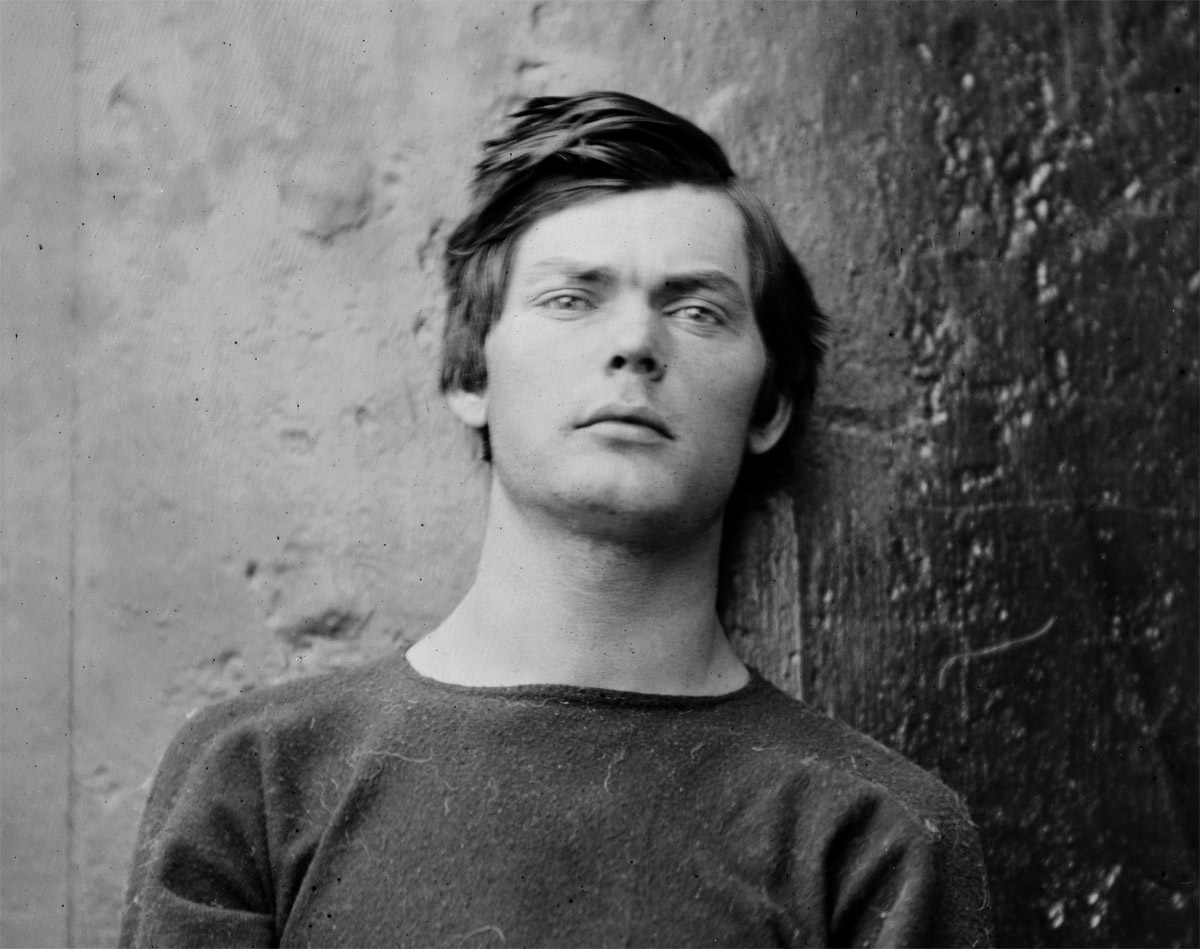
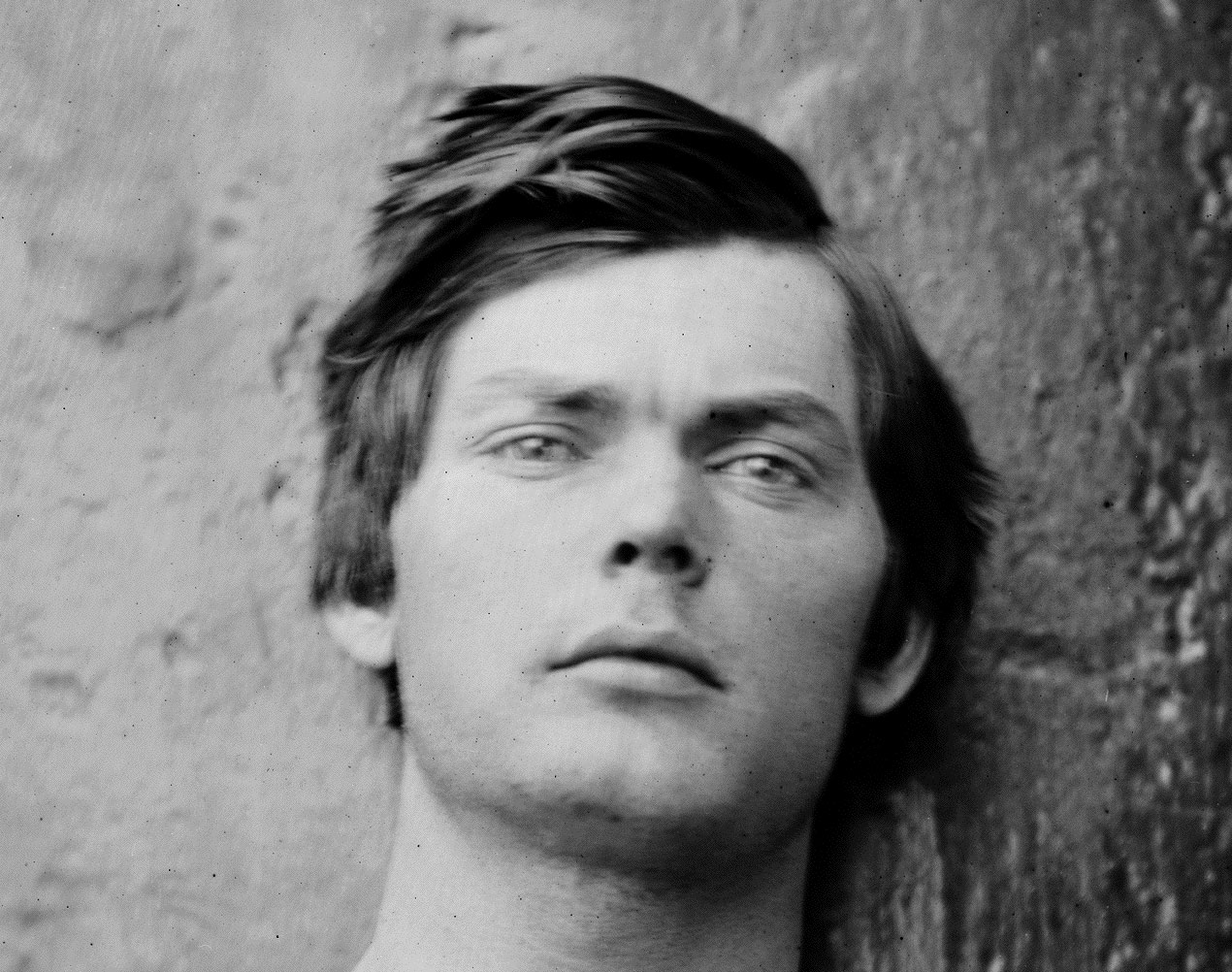
Alexander Gardner (American, 1821-1882) 'Lewis Paine' April 1865 (detail)


Alexander Gardner (American, 1821-1882) 'Lewis Paine' April 1865 (detail)


Alexander Gardner (American, 1821-1882) 'Lewis Paine' April 1865 (detail)


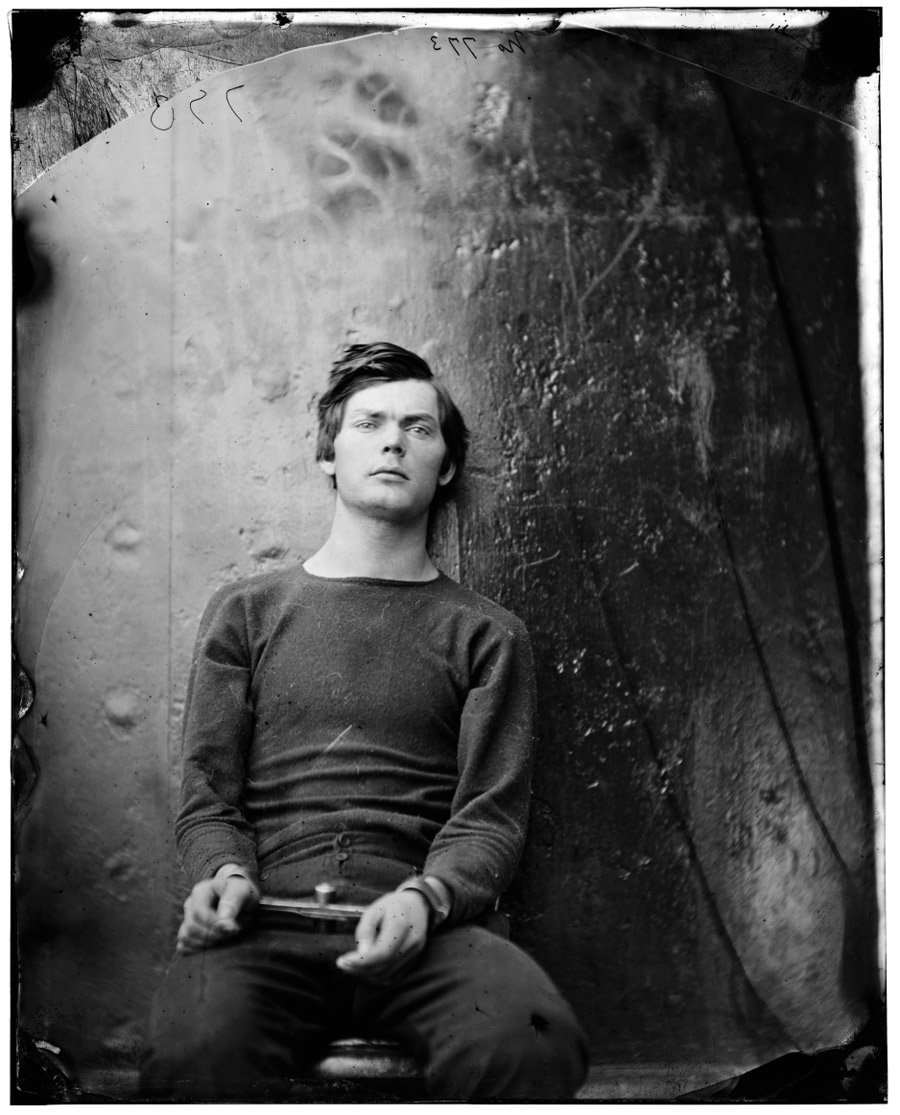
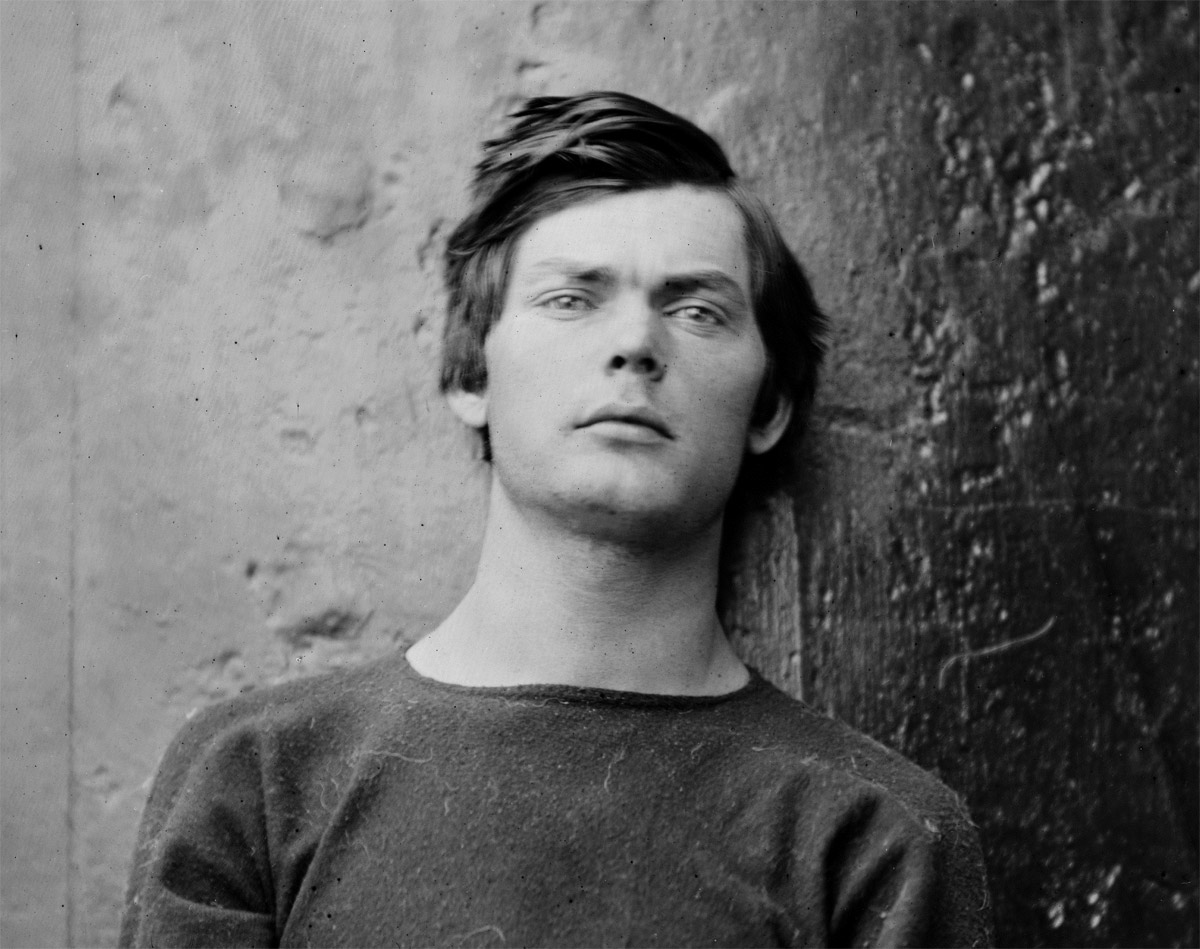
Alexander Gardner (American, 1821-1882) 'Lewis Paine' April 1865


Alexander Gardner (American, 1821-1882)
Lewis Paine
26th April, 1865
Albumen silver print from a Collodion glass plate negative


This is not my favourite photograph

A minute’s silence…


This is not my favourite photograph
Nor may it be a great photograph…
More interestingly to me, it is a remarkable photograph – one that you are able to make remarks on.
It is also a photograph that has haunted me for years.
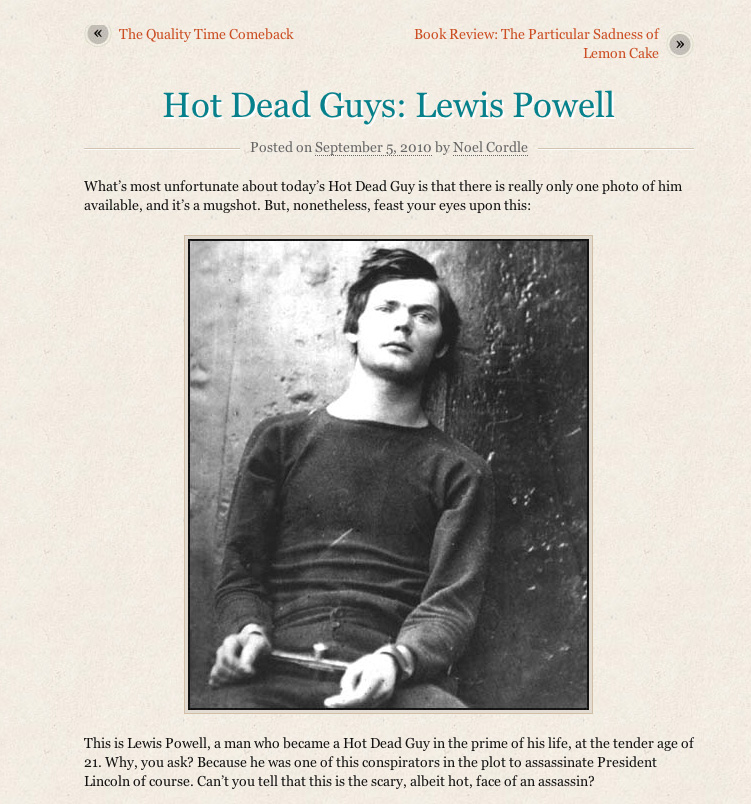
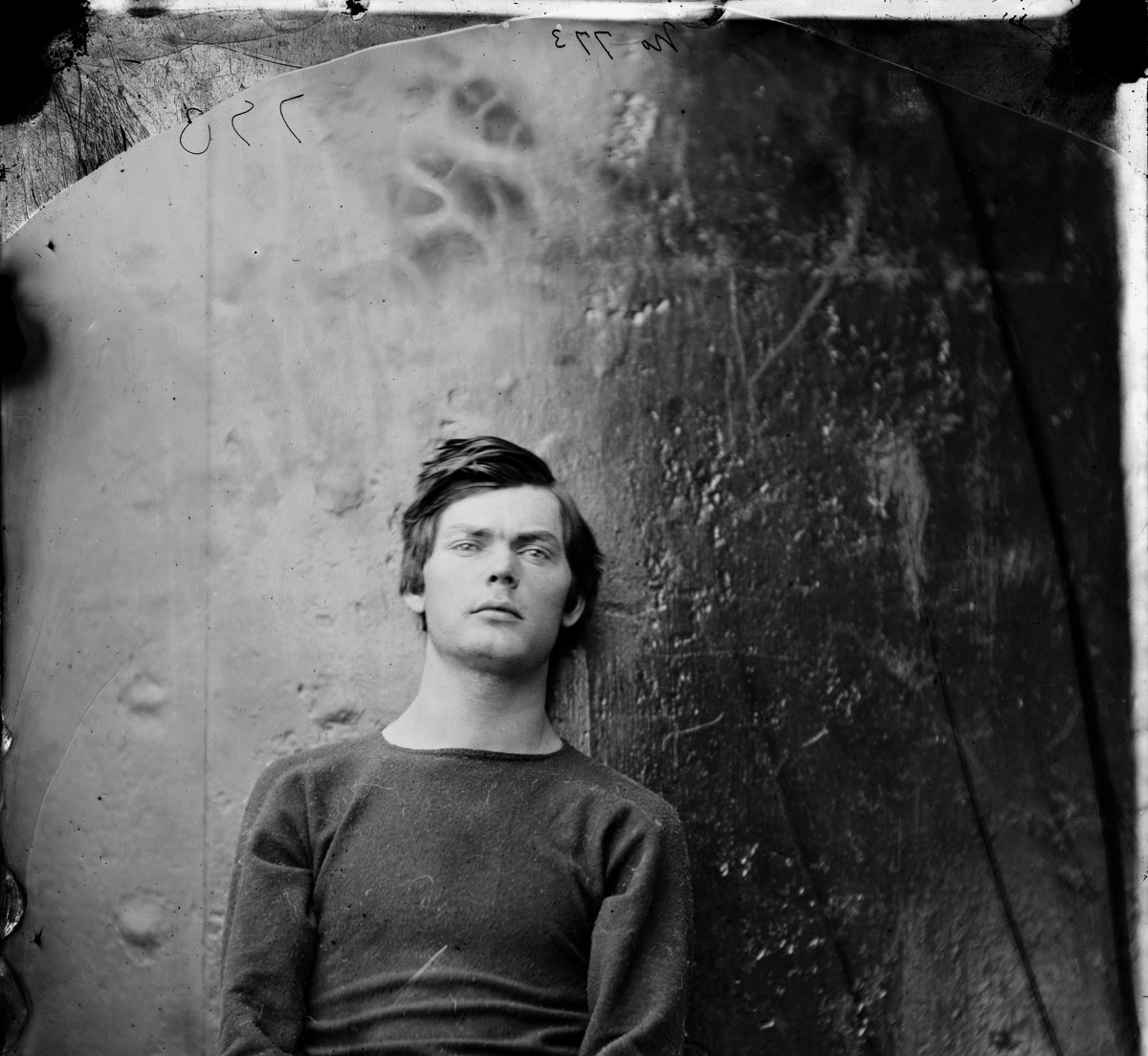
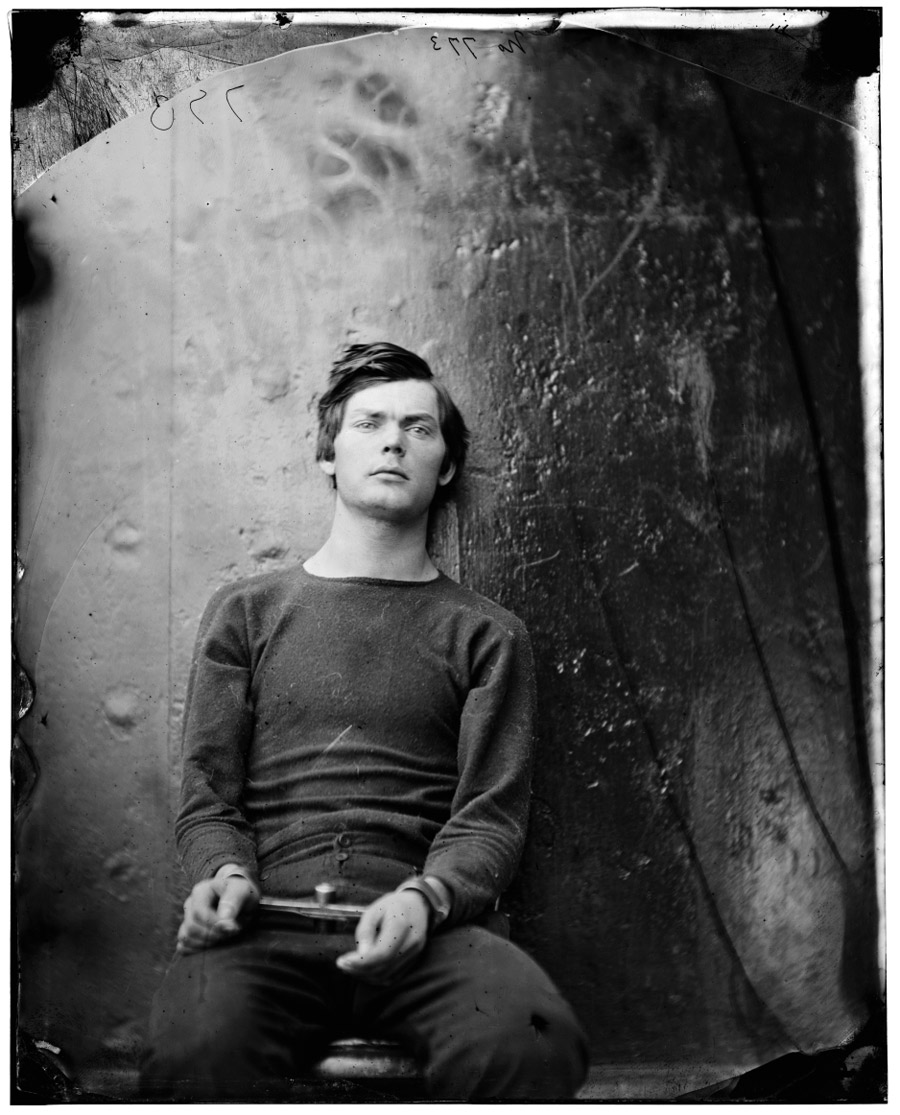
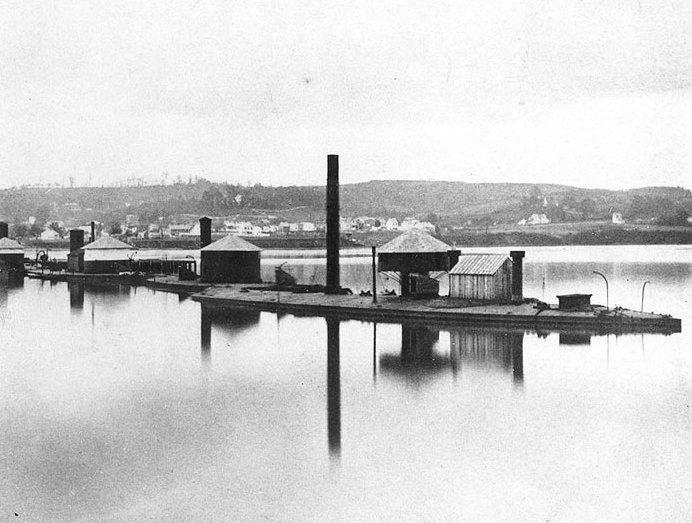
Taken by Alexander Gardner in April 1865, this photograph is a portrait of Lewis Thornton Powell (aka Lewis Payne or Paine) who was one of the conspirators in the assassination of Abraham Lincoln which had happened the same month. The photograph has a background of dark metal, and was taken on one of the ironclads U.S.S. Montauk or Saugus, where the conspirators were for a time confined. Paine was executed in July 1865 just eight short weeks later.


Alexander Gardner (American, 1821-1882) 'Lewis Paine' 26th April, 1865


Alexander Gardner (American, 1821-1882)
Three photographs of Lewis Paine
26th April, 1865


This is the triptych of photographs by Gardner in the form they are usually displayed, like a three-panel renaissance altar-piece. The left and right hand photographs were taken within minutes of each other, with the camera in the same position, whereas in the centre photograph the camera has been lowered to show more of the body, and the image has been cropped at the top. In the central plate the figure of Paine has been raised up in the frame – almost prematurely brought back to life by his placement.
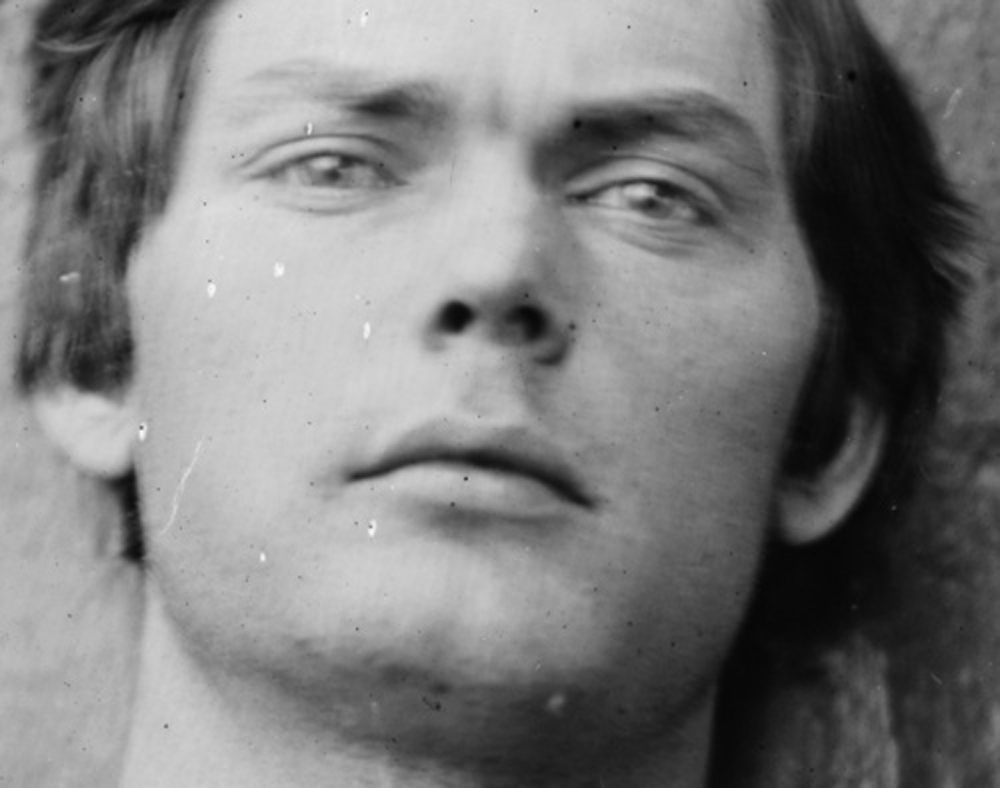
The centre image is the only one where Paine stares directly at the camera. He surveys the viewer with a gaze I find enigmatic.


Alexander Gardner (American, 1821-1882) 'Lewis Paine' April 1865 (detail)


This is a very modern face, a very contemporary face. His hair is just like Justin Beiber’s.
Who brushed his hair across for this picture, and would it normally be this long, or has it just been ignored because of his fate?
He still has good muscle tone – has he been exercising in his cell?
And finally his clothing – is it navy issue, as his top appears to have been given to him, perhaps the coarse, navy blue wool of the Northern states.
 
Noel Cordle. 'Hot Dead Guys: Lewis Powell' Posted on September 5th, 2010


Noel Cordle
Hot Dead Guys: Lewis Powell
Posted on September 5th, 2010
Mere Musings blog [Online] Cited 01/12/2012 no longer available online


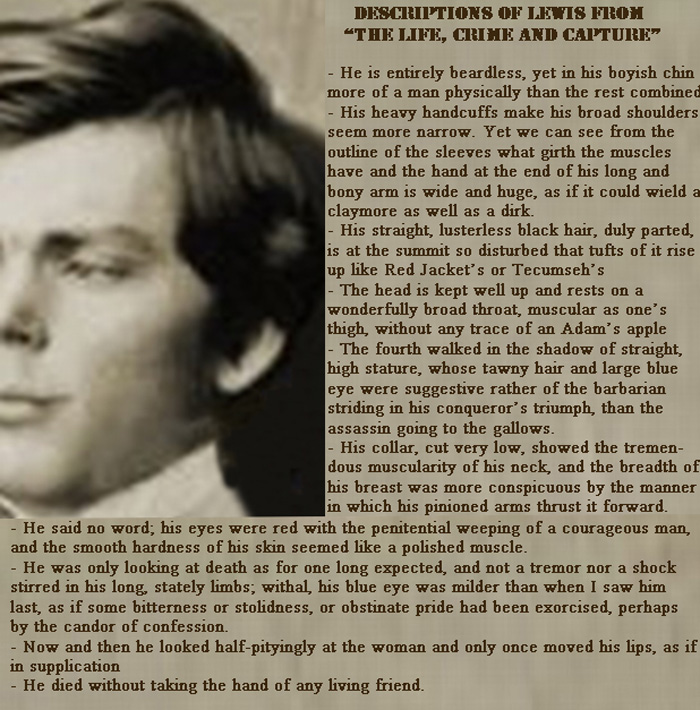
There’s even a web page dedicated to him on “hot dead guys” where there’s that awkward moment when one of Lincoln’s conspirators is so sexy its ridiculous…
He wasn’t all bad. Biographers of Powell describe him as a quiet, introverted boy who enjoyed fishing and caring for sick and injured animals. Apparently, Lewis was an intelligent, sensitive, soul with great potential.


Descriptions of Lewis from "The Life, Crime and Capture"


Descriptions of Lewis from “The Life, Crime and Capture”


Alexander Gardner (American, 1821-1882) 'Lewis Paine' April 1865 (detail)

.

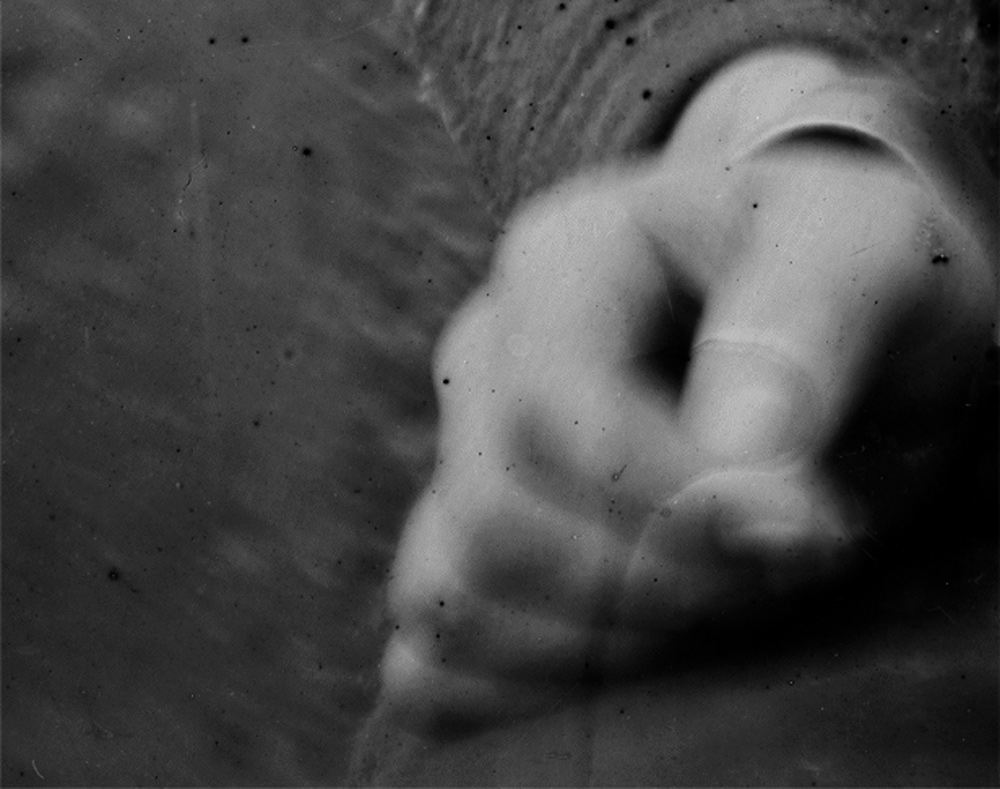
Alexander Gardner (American, 1821-1882) 'Lewis Paine' April 1865 (detail)


Alexander Gardner (American, 1821-1882)
Lewis Paine (detail)
26th April, 1865
Albumen silver print from a Collodion glass plate negative


Could we say that he is left-handed given the different size of his fingers (?)


Roland Barthes (French, 1915-1980) 'Camera Lucida (La Chambre claire)' 1980


Roland Barthes (French, 1915-1980)
Camera Lucida (La Chambre claire)
1980


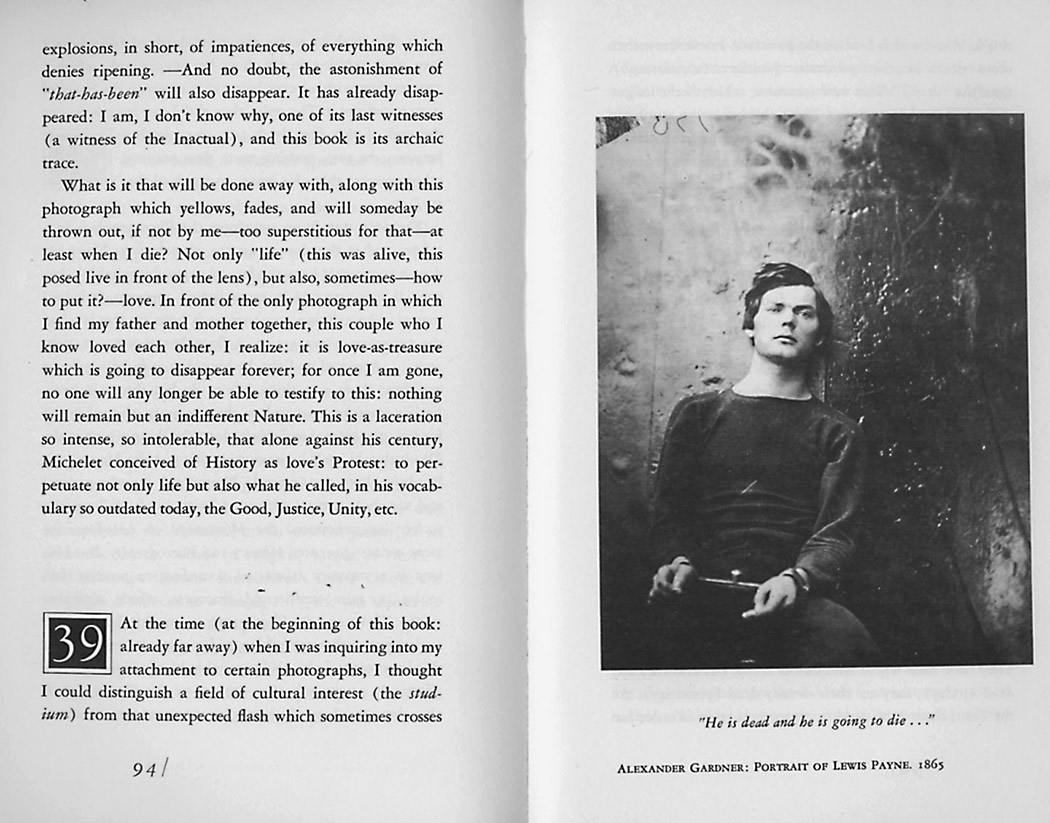
Roland Barthes in his seminal work Camera Lucida said in Section 39: “He is dead and he is going to die…
“The photograph is handsome, as is the boy: that is the studium. But the punctum is: he is going to die. I read at the same time: this will be and this has been; I observe with horror an anterior future of which death is the stake. By giving me the absolute past of the pose, the photograph tells me death in the future. What pricks me is the discovery of this equivalence.”


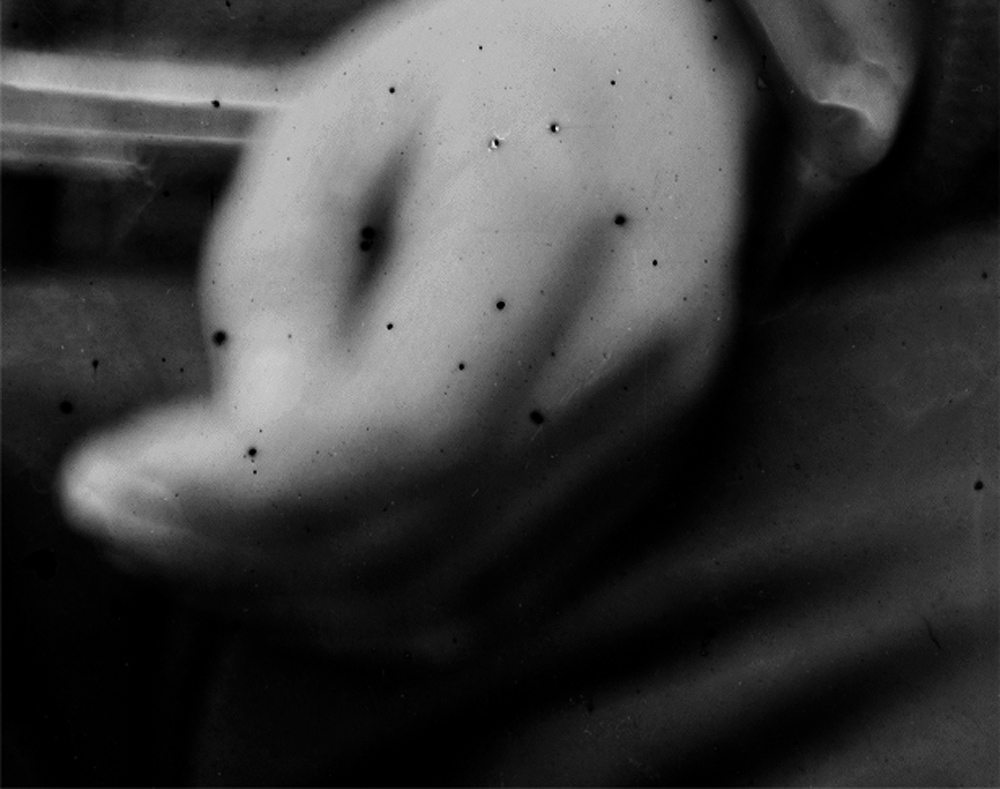
Alexander Gardner (American, 1821-1882) 'Lewis Paine' April 1865 (detail)


If we were to place this image within the metaphysical school of photography which peaked with Paul Caponigro and Minor White we could say:
Hovering above his head, has his spirit already begun to leave his body?


Alexander Gardner (American, 1821-1882) 'Lewis Paine' April 1865


One reading of his gaze is that he is really interested in what the photographer is doing – almost the gaze of an apprentice wanting to apply these skills in the future.
Given his fate is he insane because of his interest?
What is really going on in his mind – what is his perspective?
Another reading could be as looking out to the future in the hope of finding that he will be judged in another way.
And another is the immediacy of his gaze – it is a gaze that is happening now!
The other thing that I find quite mysterious is the distance of the photographer from the subject.
Was it fear that stopped him getting any closer or are there deck fittings we cannot see that prevented his approach?


Alexander Gardner (American, 1821-1882) 'Lewis Paine' April 1865 (detail)


What brought Paine to this place?

Michel Foucault calls the methods and techniques through which human beings constitute themselves, “Technologies of the self.” Foucault argued that we as subjects are perpetually engaged in processes whereby we define and produce our own ethical self-understanding. According to Foucault, technologies of the self are the forms of knowledge and strategies that “permit individuals to effect by their own means or with the help of others a certain number of operations on their own bodies and souls, thoughts, conduct, and way of being, so as to transform themselves in order to attain a certain state of immortality.”1
As we look into his eyes he knows that we know he is going to die, has already died but the intensity of that knowledge is brought into present time. What Paine emanates is a form of i-mortality.
I wonder, did Gardner ever show him the finished photographs before he died?


Alexander Gardner (American, 1821-1882) 'Lewis Paine' April 1865 (detail)


This is Barthes anterior future, a moment where truth is interpreted in the mind of the photographer, not out there but in here [points to head and heart], where past, present and future coalesce into single point in time – his death and our death are connected through his gaze, the knowledge of our discontinuity. Eons contracted into an eternal moment.
In this moment in time, what we are doing is we are making a list about the human condition when we talk about something that is remarkable. We are moving towards a language that defines the human condition…


Alexander Gardner (American, 1821-1882) 'Lewis Paine' April 1865 (detail)


But ultimately language can never fully describe the human condition, much as it may try… and this is why this photograph is remarkable, because it is ineffable, unknowable.
This photograph inhabits you, it haunts you like few others.
Early Wittgenstein described a world of facts pictured by thoughts. he said, “Don’t Think, But Look!”
I would add “Don’t think, but feel and look”

This photograph is a memoriam to a young man and his present death. As such it is a REMARKABLE photograph that haunts us all.

Dr Marcus Bunyan
December 2012


1/ Foucault, Michel. “Technologies of the self,” in L. H. Martin, H. Gutman and P. H. Hutton (eds.). Technologies of the self. Amherst: University of Massachusetts Press, 1988, p. 18.


Postscript

George Cook (American, 1819-1902) 'Union ironclads firing on Fort Moultrie, S.C.,' 8th September 1863


George Cook (American, 1819-1902)
Union ironclads firing on Fort Moultrie, S.C.,
8th September 1863
Photo courtesy of the Cook Collection, Valentine Richmond History


George Cook’s photograph of Union ironclads firing on Fort Moultrie, S.C., believed to be the world’s first combat photograph. Monitors engage Confederate batteries on Sullivan’s Island, Charleston, South Carolina. Photographed from one of the Confederate emplacements, the ships are identified as (from left to right): Weehawken, Montauk and Passaic. The monitor on the right appears to be firing its guns. Date is given as 8 September 1863, when other U.S. Navy ships were providing cover for Weehawken, which had gone aground on the previous day. She was refloated on the 8th after receiving heavy gunfire from the Confederate fortifications.


Kilburn Brothers (Edward and Benjamin Kilburn, American) 'Four monitors laid up in the Anacostia River, off the Washington Navy Yard' c. 1866


Kilburn Brothers (Edward and Benjamin Kilburn, American)
Four monitors laid up in the Anacostia River, off the Washington Navy Yard
c. 1866
Ships are (from left to right): USS Mahopac, USS Saugus, USS Montauk (probably), and either USS Casco or USS Chimo
Photo mounted on a stereograph card, marked: “Photographed and published by Kilburn Brothers, Littleton, N.H.”


Anonymous photographer. ''Montauk' at left, and 'Lehigh' at right, laid up at the Philadelphia Navy Yard, Pennsylvania' c. late 1902 or early 1903


Anonymous photographer
‘Montauk’ at left, and ‘Lehigh’ at right, laid up at the Philadelphia Navy Yard, Pennsylvania
c. late 1902 or early 1903
U.S. Naval Historical Center photograph


Anonymous photographer. 'Saugus, in Trent's Reach on the James River, Virginia' c. early 1865


Anonymous photographer
Saugus, in Trent’s Reach on the James River, Virginia
c. early 1865
Note the mine sweeping “rake” attached to her bow
U.S. Naval Historical Center photograph


Anonymous photographer. 'Officers pose on deck of the Saugus, in front of the gun turret, probably while the ship was serving on the James River, Virginia' c. early 1865


Anonymous photographer
Officers pose on deck of the Saugus, in front of the gun turret, probably while the ship was serving on the James River, Virginia
c. early 1865
Note ship’s bell and other details of the turret and deck fittings
U.S. Naval Historical Center photograph


Centre for Contemporary Photography

No permanent exhibition space at the moment

Centre for Contemporary Photography website

LIKE ART BLART ON FACEBOOK

Back to top

Exhibition: ‘Portraits of Renown: Photography and the Cult of Celebrity’ at the J. Paul Getty Museum, Los Angeles

Exhibition dates: 3rd April – 26th August 2012


Marie Cosindas (American, 1925-2017) 'Yves Saint Laurent, Paris' 1968


Marie Cosindas (American, 1925-2017)
Yves Saint Laurent, Paris
1968
Dye colour diffusion [Polaroid ®] print
The J. Paul Getty Museum, Los Angeles
© Marie Cosindas


On the Nature of Photography


“To get from the tangible to the intangible (which mature artists in any medium claim as part of their task) a paradox of some kind has frequently been helpful. For the photographer to free himself of the tyranny of the visual facts upon which he is utterly dependent, a paradox is the only possible tool. And the talisman paradox for unique photography is to work “the mirror with a memory” as if it were a mirage, and the camera is a metamorphosing machine, and the photograph as if it were a metaphor… Once freed of the tyranny of surfaces and textures, substance and form [the photographer] can use the same to pursue poetic truth.”


Minor White quoted in Beaumont Hewhall (ed.,). The History of Photography. Boston: Little, Brown, and Co., 1982, p. 281


“Carol Jerrems and I taught at the same secondary school in the 1970’s. In a classroom that was unused at that time, I remember having my portrait taken by her. She held her Pentax to her eye. Carols’ portraits all seemed to have been made where the posing of her subjects was balanced by an incisive naturalness (for want of a better description). As a challenge to myself I tried to look “natural”, but kept in my consciousness that I was having my portrait taken. Minutes passed and neither she nor her camera moved at all.

Then the idea slipped from my mind for just a moment, and I was straightaway bought back by the sound of the shutter. What had changed in my face? – probably nothing, or 1 mm of muscle movement. Had she seen it through the shutter? Or something else – I don’t know.”


Australian artist Ian Lobb on being photographed by the late Carol Jerrems


There is always something that you can’t quite put your finger on in an outstanding portrait, some ineffable other that takes the portrait into another space entirely. I still haven’t worked it out but my thoughts are this: forget about the pose of the person. It would seem to me to be both a self conscious awareness by the sitter of the camera and yet at the same time a knowing transcendence of the visibility of the camera itself. In great portrait photography it is almost as though the conversation between the photographer and the person being photographed elides the camera entirely. Minor White, in his three great mantras, the Three Canons, observes:


Be still with yourself
Until the object of your attention
Affirms your presence

Let the Subject generate its own Composition

When the image mirrors the man
And the man mirrors the subject
Something might take over


Freed from the tyranny of the visual facts something else emerges.

Celebrities know only too well how to “work” the camera but the most profound portraits, even of celebrities, are in those moments when the photographer sees something else in the person being photographed, some unrecognised other that emerges from the shadows – a look, a twist of the head, the poignancy of the mouth, the vibrancy of the dancer Josephine Baker, the sturdiness of the gaze of Walt Whitman with hands in pockets, the presence of the hands (no, not the gaze!) of Picasso. I remember taking a black and white portrait of my partner Paul holding a wooden finial like a baby among some trees, a most beautiful, revealing photograph. He couldn’t bear to look at it, for it stripped him naked before the lens and showed a side of himself that he had never seen before: vulnerable, youthful, beautiful.

Why do great portrait photographers make so many great portraits? Why can’t this skill be shared or taught? Why can’t Herb Ritts (for example) make a portrait that goes beyond a caricature? Why is it that what can be taught is so banal that it has no value?

In photography, maybe we edit out what is expected and then it seems that photography does something that goes beyond language; it goes beyond function that can be described as a part of speech, metonym or metaphor. When this something else takes over I think it is truly “unrecognised” in the best portraits (and landscape / urban photographs) – and it is fantastic and wonderful.

This is my understanding, then, of perception and vision (when spirit takes over) – [which is] the ability to see this certain something in the mind (previsualisation) before seeing it through the viewfinder and to then be able to reveal it in the physicality of the print. It is a liminal moment in time and space.

I believe this is the reality of photography itself in its absolute essential form – and here I am deliberately forgetting about post-photography, post-modernism, modernism, pictorialism, ism, ism – getting down to why I really like photography:

the BEYOND visualisation of a world, the transcendence of time and space that leads, in great photographs, to a recognition of the discontinuous nature of life but in the end, to its ultimate persistence.

This is as close as I have got so far…

Dr Marcus Bunyan
August 2012


Many thankx to the J. Paul Getty Museum for allowing me to publish the photographs in the posting. Please click on the photograph for a larger version of the image.


Mariana Cook (American, b. 1955) 'Barack and Michelle Obama, Chicago' May 26, 1996


Mariana Cook (American, b. 1955)
Barack and Michelle Obama, Chicago
May 26, 1996
Selenium-toned gelatin silver print
The J. Paul Getty Museum, Los Angeles


Marie Cosindas (American, 1925-2017) 'Andy Warhol' 1966


Marie Cosindas (American, 1925-2017)
Andy Warhol
1966
Dye colour diffusion [Polaroid ®] print
11.4 x 8.9cm
The J. Paul Getty Museum, Los Angeles
© Marie Cosindas


Marie Cosindas (American, 1925-2017) 'Yves St Laurent' 1968


Marie Cosindas (American, 1925-2017)
Yves St Laurent
1968
Dye colour diffusion [Polaroid ®] print
11.4 x 8.9cm
The J. Paul Getty Museum, Los Angeles
© Marie Cosindas


Andy Warhol (American, 1928-1987) 'Grace Jones' 1984


Andy Warhol (American, 1928-1987)
Grace Jones
1984
Polaroid Polacolor print
9.5 x 7.3cm
The J. Paul Getty Museum, Los Angeles
© 2011 The Andy Warhol Foundation for the Visual Arts / Artists Rights Society (ARS), New York


Edward Weston (American, 1889-1958) 'Igor Stravinsky' 1935


Edward Weston (American, 1889-1958)
Igor Stravinsky
1935
Gelatin silver print
The J. Paul Getty Museum, Los Angeles


Coy Watson Jr. (American, 1912-2009) 'Joe Louis – “The Brown Bomber”, Los Angeles, February 1935'


Coy Watson Jr. (American, 1912-2009)
Joe Louis – “The Brown Bomber”, Los Angeles, February 1935
1935
Gelatin silver print
The J. Paul Getty Museum, Los Angeles


Edward Steichen (American, 1879-1973) 'Gloria Swanson' 1924


Edward Steichen (American, 1879-1973)
Gloria Swanson
1924
Gelatin silver print
27.8 x 21.6cm (10 15/16 x 8 1/2 in.)
The J. Paul Getty Museum, Los Angeles
© Permission Joanna T. Steichen


Portraits of Renown surveys some of the visual strategies used by photographers to picture famous individuals from the 1840s to the year 2000. “This exhibition offers a brief visual history of famous people in photographs, drawn entirely from the Museum’s rich holdings in this genre,” says Paul Martineau, curator of the exhibition and associate curator of photographs at the J. Paul Getty Museum. “It also provides a broad historical context for the work in the concurrent exhibition Herb Ritts: L.A. Style, which includes a selection of Ritts’s best celebrity portraits.”

Photography’s remarkable propensity to shape identities has made it the leading vehicle for representing the famous. Soon after photography was invented in the 1830s, it was used to capture the likenesses and accomplishments of great men and women, gradually supplanting other forms of commemoration. In the twentieth century, the proliferation of photography and the transformative power of fame have helped to accelerate the desire for photographs of celebrities in magazines, newspapers, advertisements, and on the Internet. The exhibition is arranged chronologically to help make visible some of the overarching technical and stylistic developments in photography from the first decade of its invention to the end of the twentieth century.

A wide range of historical figures are portrayed in Portraits of Renown. A photograph by Alexander Gardner of President Lincoln documents his visit to the battlefield of Antietam during the Civil War. Captured by Nadar, a portrait of Alexander Dumas, best known for his novels The Count of Monte Cristo and The Three Musketeers, shows the author with an energetic expression, illustrating the lively personality that made his writing so popular. Baron Adolf De Meyer’s portrait of Josephine Baker, an American performer who became an international sensation at the Folies Bergère in Paris, showcases her comedic charm, a trait that proved central to her popularity as a performer. An iconic portrait of the silent screen actress, Gloria Swanson, created by Edward Steichen for Vanity Fair reveals both the intensity of its sitter and the skill of the artist. A picture of Pablo Picasso by his friend Man Ray portrays the master of Cubism with a penetrating gaze.

Yves St. Laurent, Andy Warhol, and Grace Jones are among the contemporary figures included in the exhibition. Fashion designer Yves St. Laurent was photographed by Marie Cosindas using instant color film by Polaroid. The photograph, made the year his first boutique in New York opened, graced the walls of the store for ten years. A Cosindas portrait of Andy Warhol shows the artist wearing dark sunglasses, which partially conceal his face. Warhol, who was fascinated by celebrity, delighted in posing public personalities like Grace Jones for his camera.

Press release from the J. Paul Getty Museum website


Man Ray (American, 1890-1976) 'Pablo Picasso' 1934


Man Ray (American, 1890-1976)
Pablo Picasso
1934
Gelatin silver print
25.2 x 20cm
The J. Paul Getty Museum, Los Angeles
© Man Ray Trust ARS-ADAGP


Berenice Abbott (American, 1898-1991) 'James Joyce' 1928


Berenice Abbott (American, 1898-1991)
James Joyce
1928
Gelatin silver print
The J. Paul Getty Museum, Los Angeles


Baron Adolf De Meyer (American born France, 1868-1946) 'Portrait of Josephine Baker' 1925


Baron Adolf De Meyer (American born France, 1868-1946)
Portrait of Josephine Baker
1925
Collotype print
39.1 x 39.7cm
The J. Paul Getty Museum, Los Angeles


In 1925 Josephine Baker, an American dancer from Saint Louis, Missouri, made her debut on the Paris stage in La Revue nègre (The Black Review) at the Théâtre des Champs-Elysées, wearing nothing more than a skirt of feathers and performing her danse sauvage (savage dance). She was an immediate sensation in Jazz-Age France, which celebrated her perceived exoticism, quite the opposite of the reception she had received dancing in American choruses. American expatriate novelist Ernest Hemingway called Baker “the most sensational woman anybody ever saw – or ever will.”

Baron Adolf de Meyer, a society and fashion photographer, took this playful portrait in the year of Baker’s debut. Given the highly sexual nature of her stage persona, this portrait is charming and almost innocent; Baker’s personality is suggested by her face rather than her famous body.

Text from the J. Paul Getty website


Edward Steichen (American, 1879-1973) 'John Barrymore as Hamlet' 1922


Edward Steichen (American, 1879-1973)
John Barrymore as Hamlet
1922
Gelatin silver print
The J. Paul Getty Museum, Los Angeles


Alfred Stieglitz (American, 1964-1946) 'Georgia O'Keeffe: A Portrait' 1918


Alfred Stieglitz (American, 1964-1946)
Georgia O’Keeffe: A Portrait
1918
Gelatin silver print
The J. Paul Getty Museum, Los Angeles


Arnold Genthe (American born Germany, 1869-1942) 'Anna Pavlowa' about 1915


Arnold Genthe (American born Germany, 1869-1942)
Anna Pavlowa
about 1915
Gelatin silver print
33.5 × 25.2cm (13 3/16 × 9 15/16 in.)
The J. Paul Getty Museum, Los Angeles


The Russian ballerina Anna Pavlowa (or Pavlova) so greatly admired Arnold Genthe’s work that she made the unusual decision to visit his studio, rather than have him come to her rehearsals. The resulting portrait of the prolific dancer, leaping in mid-air, is the only photograph to capture Pavlowa in free movement. Genthe regarded this print as one of the best dance photographs he ever made.

Text from the J. Paul Getty website


Alvin Langdon Coburn (British born United States, 1882-1966) 'Mark Twain (Samuel Langhorne Clemens)' Negative December 21, 1908; print 1913


Alvin Langdon Coburn (British born United States, 1882-1966)
Mark Twain (Samuel Langhorne Clemens)
Negative December 21, 1908; print 1913
Photogravure
20.6 × 14.8cm (8 1/8 × 5 13/16 in.)
The J. Paul Getty Museum, Los Angeles


Alfred Stieglitz (American, 1864-1946) '[Self-Portrait]' Negative 1907; print 1930


Alfred Stieglitz (American, 1864-1946)
[Self-Portrait]
Negative 1907; print 1930
Gelatin silver print
24.8 × 18.4cm (9 3/4 × 7 1/4 in.)
The J. Paul Getty Museum, Los Angeles


Edward Steichen (American 1879-1973) 'Rodin The Thinker' 1902


Edward Steichen (American, 1879-1973)
Rodin – Le Penseur (The Thinker)
1902
Gelatin-carbon print
The J. Paul Getty Museum, Los Angeles


Sarah Choate Sears (American, 1858-1935) '[Julia Ward Howe]' about 1890


Sarah Choate Sears (American, 1858-1935)
[Julia Ward Howe]
about 1890
Platinum print
23.5 × 18.6cm (9 1/4 × 7 5/16 in.)
The J. Paul Getty Museum, Los Angeles


Julia Ward Howe (May 27, 1819 – October 17, 1910) was an American poet and author, known for writing “The Battle Hymn of the Republic” and the original 1870 pacifist Mother’s Day Proclamation. She was also an advocate for abolitionism and a social activist, particularly for women’s suffrage.


Sarah Choate Sears (American, 1858-1935) 'John Singer Sargent' about 1890


Sarah Choate Sears (American, 1858-1935)
John Singer Sargent
about 1890
Gelatin silver print
The J. Paul Getty Museum, Los Angeles


Although John Singer Sargent was the most famous American portrait painter of his time, he apparently did not like to be photographed. The few photographs that exist show him at work, as he is here, sketching and puffing on a cigar. His friend Sarah Choate Sears, herself a painter of some note, drew many of her sitters for photographs from the same aristocratic milieu as Sargent did for his paintings.

Text from the J. Paul Getty website


Nadar [Gaspard Félix Tournachon] (French, 1820-1910) '[Sarah Bernhardt as the Empress Theodora in Sardou's "Theodora"]' Negative 1884; print and mount about 1889


Nadar (Gaspard Félix Tournachon) (French, 1820-1910)
[Sarah Bernhardt as the Empress Theodora in Sardou’s “Theodora”]
Negative 1884; print and mount about 1889
Albumen silver print
14.6 × 10.5 cm (5 3/4 × 4 1/8 in.)
The J. Paul Getty Museum, Los Angeles


J. Wood (American, active New York, New York 1870s-1880s) 'L.P. Federmeyer' 1879


J. Wood (American, active New York, New York 1870s-1880s)
L.P. Federmeyer
1879
Albumen silver print
14.8 × 10 cm (5 13/16 × 3 15/16 in.)
The J. Paul Getty Museum, Los Angeles


Julia Margaret Cameron (British born India, 1815-1879) 'Ellen Terry at Age Sixteen' 1864


Julia Margaret Cameron (British born India, 1815-1879)
Ellen Terry at Age Sixteen
Negative 1864; print about 1875
Carbon print
24.1cm (9 1/2 in.)
The J. Paul Getty Museum, Los Angeles


This image of Ellen Terry (1847-1928) is one of the few known photographs of a female celebrity by Julia Margaret Cameron. Terry, the popular child actress of the British stage, was sixteen years old when Cameron made this image. This photograph was most likely taken just after she married the eccentric painter, George Frederick Watts (1817-1904), who was thirty years her senior. They spent their honeymoon in the village of Freshwater on the Isle of Wight where Cameron resided.

Cameron’s portrait echoes Watt’s study of Terry titled Choosing (1864, National Portrait Gallery, London). As in the painting, Terry is shown in profile with her eyes closed, an ethereal beauty in a melancholic dream state. In this guise, Terry embodies the Pre-Raphaelite ideal of womanhood rather than appearing as the wild boisterous teenager she was known to be. The round (“tondo”) format of this photograph was popular among Pre-Raphaelite artists.

Cameron titled another print of this image Sadness (see 84.XZ.186.52), which may suggest the realisation of a mismatched marriage. Terry’s anxiety is plainly evident – she leans against an interior wall and tugs nervously at her necklace. The lighting is notably subdued, leaving her face shadowed in doubt. In The Story of My Life (1909), Terry recalls how demanding Watts was, calling upon her to sit for hours as a model and giving her strict orders not to speak in front of distinguished guests in his studio.

This particular version was printed eleven years after Cameron first made the portrait. In order to distribute this image commercially, the Autotype Company of London rephotographed the original negative after the damage had been repaired. The company then made new prints using the durable, non-fading carbon print process. Thus, this version is in reverse compared to Sadness. Terry’s enduring popularity is displayed by the numerous photographs taken of her over the years. Along with the two portraits by Cameron, the Getty owns three more of Terry by other photographers.

Adapted from Julian Cox. Julia Margaret Cameron, In Focus: Photographs from the J. Paul Getty Museum (Los Angeles: J. Paul Getty Museum, 1996), 12. ©1996 The J. Paul Getty Museum; with additions by Carolyn Peter, J. Paul Getty Museum, Department of Photographs, 2019.


Charles DeForest Fredricks (American, 1823-1894) '[Mlle Pepita]' 1863


Charles DeForest Fredricks (American, 1823-1894)
[Mlle Pepita]
1863
Albumen silver print
9 × 5.4cm (3 9/16 × 2 1/8 in.)
The J. Paul Getty Museum, Los Angeles


André Adolphe-Eugène Disdéri (French, 1819-1889) '[Rosa Bonheur]' 1861-1864


André Adolphe-Eugène Disdéri (French, 1819-1889)
[Rosa Bonheur]
1861-1864
Albumen silver print
8.4 × 5.2cm (3 5/16 × 2 1/16 in.)
The J. Paul Getty Museum, Los Angeles


Rosa Bonheur, born Marie-Rosalie Bonheur (16 March 1822 – 25 May 1899), was a French artist, mostly a painter of animals (animalière) but also a sculptor, in a realist style. Her best-known paintings are Ploughing in the Nivernais, first exhibited at the Paris Salon of 1848, and now at the Musée d’Orsay in Paris, and The Horse Fair (in French: Le marché aux chevaux), which was exhibited at the Salon of 1853 (finished in 1855) and is now in the Metropolitan Museum of Art, in New York City. Bonheur was widely considered to be the most famous female painter of the nineteenth century.

Text from the Wikipedia website


Mathew B. Brady (American, about 1823-1896) 'Walt Whitman' about 1870


Mathew B. Brady (American, about 1823-1896)
Walt Whitman
about 1870
Albumen silver print
14.6 x 10.3cm
The J. Paul Getty Museum, Los Angeles


Mathew B. Brady (American, about 1823-1896) 'Robert E. Lee' 1865


Mathew B. Brady (American, about 1823-1896)
Robert E. Lee
1865
Albumen silver print
The J. Paul Getty Museum, Los Angeles


John Robert Parsons (British, about 1826-1909) '[Portrait of Jane Morris (Mrs. William Morris)]' Negative July 1865; print after 1900


John Robert Parsons (British, about 1826-1909)
[Portrait of Jane Morris (Mrs. William Morris)]
Negative July 1865; print after 1900
Gelatin silver print
22.9 × 19.2cm (9 × 7 9/16 in.)
The J. Paul Getty Museum, Los Angeles


Nadar [Gaspard Félix Tournachon] (French, 1820-1910) 'George Sand (Amandine-Aurore-Lucile Dupin), Writer' c. 1865


Nadar (Gaspard Félix Tournachon) (French, 1820-1910)
George Sand (Amandine-Aurore-Lucile Dupin)
about 1865
Albumen silver print
The J. Paul Getty Museum, Los Angeles


Amandine-Aurore-Lucile Dudevant, née Dupin, took the pseudonym George Sand in 1832. She was a successful Romantic novelist and a close friend of Nadar, and during the 1860s he photographed her frequently. Her writing was celebrated for its frequent depiction of working-class or peasant heroes. She was also a woman as renowned for her romantic liaisons as her writing; here she allowed Nadar to photograph her, devoid of coquettish charms but nevertheless a commanding presence.

This portrait is a riot of textural surfaces. The sumptuous satin of Sand’s gown and silken texture of her hair have a rich tactile presence. Her shimmering skirt melts into the velvet-draped support on which she leans, creating a visual triangle with the careful centre part of her wavy hair. The portrait details the exquisite laces, beads, and buttons of her gown, but her face, the apex of the triangle, is out of focus. Sand was apparently unable to remain perfectly still throughout the exposure, and the slight blurring of her facial features erases the unforgiving details that the years had drawn upon her.

Text from the J. Paul Getty website


Alexander Gardner (American born Scotland, 1821-1882) 'President Lincoln, United States Headquarters, Army of the Potomac, near Antietam, October 4, 1862'


Alexander Gardner (American born Scotland, 1821-1882)
President Lincoln, United States Headquarters, Army of the Potomac, near Antietam, October 4, 1862
1862
Albumen silver print
21.9 x 19.7cm (8 5/8 x 7 3/4 in.)
The J. Paul Getty Museum, Los Angeles


Twenty-six thousand soldiers were killed or wounded in the Battle of Antietam on September 17, 1862, after which Confederate General Robert E. Lee was forced to retreat to Virginia. Just two weeks after the victory, President and Commander-in-Chief Abraham Lincoln conferred with General McClernand and Allan Pinkerton, Chief of the nascent Secret Service, who had organised espionage missions behind Confederate lines.

Lincoln stands tall, front and centre in his stovepipe hat, his erect and commanding posture emphasised by the tent pole that seems to be an extension of his spine. The other men stand slightly apart in deference to their leader, in postures of allegiance with their hands covering their hearts. The reclining figure of the man at left and the shirt hanging from the tree are a reminder that, although this is a formally posed picture, Lincoln’s presence did not halt the camp’s activity, and no attempts were made to isolate him from the ordinary circumstances surrounding the continuing military conflict.

Text from the J. Paul Getty website


Alexander Gardner (American born Scotland, 1821-1882) 'President Lincoln, United States Headquarters, Army of the Potomac, near Antietam, October 4, 1862' (detail)


Alexander Gardner (American born Scotland, 1821-1882)
President Lincoln, United States Headquarters, Army of the Potomac, near Antietam, October 4, 1862 (detail)
1862
Albumen silver print
21.9 x 19.7cm (8 5/8 x 7 3/4 in.)
The J. Paul Getty Museum, Los Angeles


Pierre Louis Pierson (French, 1822-1913) 'Napoleon III and the Prince Imperial' about 1859


Pierre Louis Pierson (French, 1822-1913)
Napoleon III and the Prince Imperial
about 1859
Albumen silver print from a wet collodion glass negative
21 × 16cm (8 1/4 × 6 5/16 in.)
The J. Paul Getty Museum, Los Angeles


The Prince Imperial, son of Napoleon III, sits strapped securely into a seat on his horse’s back, a model subject for the camera. An attendant at the left steadies the horse so that the little prince remains picture-perfect in the centre of the backdrop erected for the photograph. The horse stands upon a rug that serves as a formalising element, making the scene appear more regal. The Emperor Napoleon III himself stands off to the right in perfect profile, supervising the scene with his dog and forming a framing mirror-image of the horse and attendant on the other side.

Pierre-Louis Pierson placed his camera far enough back from the Prince to capture the entire scene and all the players, but this was not the version sold as a popular carte-de-visite. The carte-de-visite image was cropped so that only the Prince upon his horse was visible.

Text from the J. Paul Getty website


Nadar [Gaspard Félix Tournachon] (French, 1820-1910) 'Alexander Dumas [père] (1802-1870) / Alexandre Dumas' 1855


Nadar (Gaspard Félix Tournachon) (French, 1820-1910)
Alexander Dumas [père] (1802-1870) / Alexandre Dumas
1855
Salted paper print
Image (rounded corners): 23.5 x 18.7cm (9 1/4 x 7 3/8 in.)
The J. Paul Getty Museum, Los Angeles
Public domain


The writer Alexander Dumas was Nadar’s boyhood idol. Nadar’s father had published Dumas’s first novel and play, and a portrait of Dumas hung in young Nadar’s room. The son of a French revolutionary general and a black mother, Dumas arrived in Paris from the provinces in 1823, poor and barely educated. Working as a clerk, he educated himself in French history and began to write. In 1829 he met with his first success; with credits including The Three Musketeers and The Count of Monte Cristo, published in 1844 and 1845, respectively, his fame and popularity were assured.

Nadar was the first photographer to use photography to enhance the sitter’s reputation. Given Dumas’s popularity, this mounted edition print, signed and dedicated by him, was likely intended for sale.

Dumas is represented as a lively, vibrant man. The self-restraint of his crossed hands, resting on a chair that disappears into the shadows, seems like an attempt to contain an undercurrent of boundless energy that threatened to ruin the necessary stillness of the pose and appears to have found an outlet through Dumas’s hair. Around the time of this sitting, the prolific Dumas and Nadar were planning to collaborate on a theatrical spectacle, which was ultimately never staged.

Text from the J. Paul Getty website


Unknown maker (American) 'Portrait of Edgar Allan Poe' late May - early June 1849


Unknown maker (American)
Portrait of Edgar Allan Poe
1849
Daguerreotype
The J. Paul Getty Museum, Los Angeles
Public domain


“A noticeable man clad in black, the fashion of the times, close-buttoned, erect, forward looking, something separate in his bearing … a beautifully poetic face.” ~ Basil L. Gildersleeve to Mary E. Phillips, 1915 (his childhood recollection of Poe)


Many of Edgar Allan Poe’s contemporaries described him as he appears in this portrait: a darkly handsome and intelligent man who possessed an unorthodox personality. Despite being acknowledged as one of America’s greatest writers of poetry and short stories, Poe’s life remains shrouded in mystery, with conflicting accounts about poverty, alcoholism, drug use, and the circumstances of his death in 1849. Like his life, Poe’s poems and short stories are infused with a sense of tragedy and mystery. Among his best-known works are: The RavenAnnabel Lee, and The Fall of the House of Usher.

This daguerreotype was made several months before Poe’s death at age 40. After his wife died two years earlier in 1847, Poe turned to two women for support and companionship. He met Annie Richmond at a poetry lecture that he gave when visiting Lowell, Massachusetts. Although she was married, they developed a deep, mutual affection. Richmond is thought to have arranged and paid for this portrait sitting. Poe is so forcibly portrayed that historians have described his appearance as disheveled, brooding, exhausted, haunted, and melancholic.

For reasons that are not entirely clear, relatively few daguerreotypes of notable poets, novelists, or painters have survived from the 1840s, and some of the best we have are by unknown makers. The art of the daguerreotype was one in which the sitter’s face usually took priority over the maker’s name, and many daguerreotypists failed to sign their works. This is the case with the Getty’s portrait of Poe.

Adapted from getty.edu, Interpretive Content Department, 2009; and Weston Naef, The J. Paul Getty Museum Handbook of the Photographs Collection (Los Angeles: J. Paul Getty Museum, 1995), 35. © 1995 The J. Paul Getty Museum.


Charles Richard Meade (American, 1826-1858) 'Portrait of Louis-Jacques-Mandé Daguerre' 1848


Charles Richard Meade (American, 1826-1858)
Portrait of Louis-Jacques-Mandé Daguerre
1848
Daguerreotype, hand-coloured
The J. Paul Getty Museum, Los Angeles
Public domain


By New Year’s Day of 1840 – little more than one year after William Henry Fox Talbot had first displayed his photogenic drawings in London and just four to five months after the first daguerreotypes had been exhibited in Paris at the Palais d’Orsay in conjunction with a series of public demonstrations of the process – Daguerre’s instruction manual had been translated into at least four languages and printed in at least twenty-one editions. In this way, his well-kept secret formula and list of materials quickly spread to the Americas and to provincial locations all over Europe. Photography became a gold rush-like phenomenon, with as much fiction attached to it as fact.

Nowhere was the daguerreotype more enthusiastically accepted than in the United States. Charles R. Meade was the proprietor of a prominent New York photographic portrait studio. He made a pilgrimage to France in 1848 to meet the founder of his profession and while there became one of the very few people to use the daguerreotype process to photograph the inventor himself.

A daguerreotype was (and is) created by coating a highly polished silver plated sheet of copper with light sensitive chemicals such as chloride of iodine. The plate is then exposed to light in the back of a camera obscura. When first removed from the camera, the image is not immediately visible. The plate must be exposed to mercury vapours to “bring out” the image. The image is then “fixed” (or “made permanent on the plate”) by washing it in a bath of hyposulfite of soda. Finally it is washed in distilled water. Each daguerreotype is a unique image; multiple prints cannot be made from the metal plate.

Adapted from Weston Naef, The J. Paul Getty Museum Handbook of the Photographs Collection (Los Angeles: J. Paul Getty Museum, 1995), 33, © 1995 The J. Paul Getty Museum; with additions by Carolyn Peter, J. Paul Getty Museum, Department of Photographs, 2019.


The J. Paul Getty Museum
1200 Getty Center Drive
Los Angeles, California 90049

Opening hours:
Daily 10am – 5pm
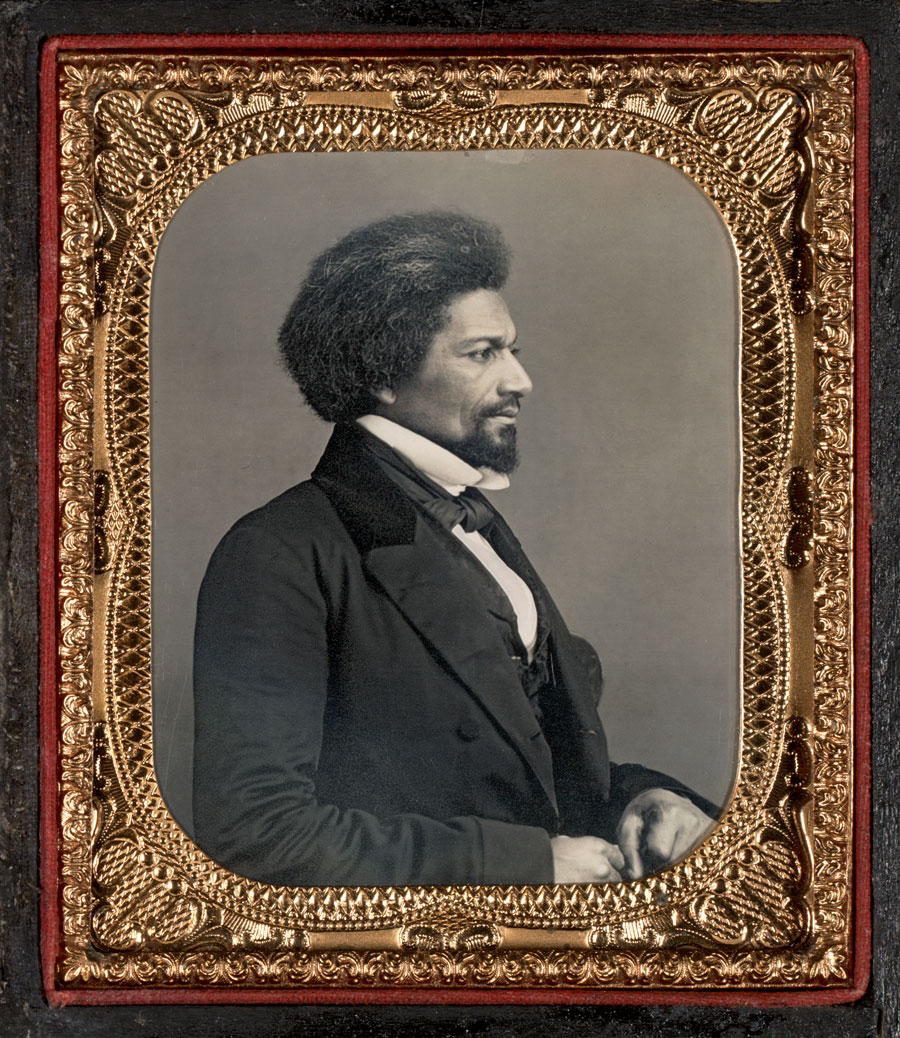
The J. Paul Getty Museum website

LIKE ART BLART ON FACEBOOK

Back to top

Exhibition: ‘Lincoln, Life-Size’ at The Bruce Museum, Greenwich, Connecticut

Exhibition dates: 13th February – 6th June, 2010

 Curators: Peter W. Kunhardt, Jr., Director of the Meserve-Kunhardt Foundation, and Robin Garr, Director of Education, Bruce Museum


Many thankx to Mike Horyczun, Director of Public Relations and the Bruce Museum for allowing me to publish the images in the posting. Please click on the photographs for even larger version of the image.

Marcus


Alexander Hesler (American, 1823-1895) 'Abraham Lincoln' June 3,1860 Springfield, Illinois from the exhibition 'Lincoln, Life-Size' at The Bruce Museum, Greenwich, Connecticut, February - June, 2010


Alexander Hesler (American, 1823-1895)
Abraham Lincoln
June 3, 1860 Springfield, Illinois


Alexander Hesler or Hessler (1823-1895) was an American photographer active in the U.S. state of Illinois. He is best known for photographing, in 1858 and 1860, definitive iconic images of the beardless Abraham Lincoln. …

Hesler’s known portraits include photographs of the two chief Illinois political figures of his day, Lincoln and federal senator Stephen A. Douglas. In the 1860 presidential election, Lincoln’s friends took steps to have Hesler’s images copied and recirculated, cementing their stature as works of Lincoln image-making.

Hesler was an award-winning photographer whose goal was to create photographs of lasting artistic value. He was recognised for the quality of both his portrait work and his outdoor photography. Upon Hesler’s retirement in 1865, he transferred his Chicago studio and negatives to a fellow photographer, George Bucher Ayres. Several of Hesler’s best-known images of Lincoln are platinum prints produced by Ayres from Hesler negatives.

Text from the Wikipedia website


Preston Butler. 'Abraham Lincoln' August 13, 1860 Springfield, Illinois from the exhibition 'Lincoln, Life-Size' at The Bruce Museum, Greenwich, Connecticut, February - June, 2010

Preston Butler. 'Abraham Lincoln' August 13, 1860 Springfield, Illinois


Preston Butler
Abraham Lincoln
August 13, 1860 Springfield, Illinois
Ambrotype
Plate 5 3/4 x 4 1/2 in
Library of Congress


Abraham Lincoln as candidate for United States president. Half-length portrait, seated, facing front.

Thought to be the last beardless portrait of Lincoln, this photo was “made for the portrait painter, John Henry Brown, noted for his miniatures in ivory. … ‘There are so many hard lines in his face,’ wrote Brown in his diary, ‘that it becomes a mask to the inner man. His true character only shines out when in an animated conversation, or when telling an amusing tale. … He is said to be a homely man; I do not think so.'” (Source: Ostendorf, p. 62)

Published in: Lincoln’s photographs: a complete album / by Lloyd Ostendorf. Dayton, OH: Rockywood Press, 1998, pp. 62-63.

Between 1856, the year of Preston Butler’s arrival in Springfield, and Feb. 11, 1861, when President-elect Abraham Lincoln departed from Springfield, Butler took at least 8 photographs of Lincoln and at least 1 photograph of Mary, Willie and Tad Lincoln. Also, in 1857 or 1858, Butler photographed each of the 4 sides of Springfield’s public square. These photographs are the primary source of information about the appearance of the public square in Lincoln’s Springfield.


Abraham B. Byers (American, 1836-1920) 'Abraham Lincoln' May 7, 1858 from the exhibition 'Lincoln, Life-Size' at The Bruce Museum, Greenwich, Connecticut, February - June, 2010


Abraham B. Byers (American, 1836-1920)
Abraham Lincoln
May 7, 1858 Beardstown, Illinois
Ambrotype


The Bruce Museum in Greenwich, Connecticut, presents its newest exhibition Lincoln, Life-Size, from February 13, 2010, through June 6, 2010. The exhibition features photographs of Abraham Lincoln reproduced full size, hanging alongside original 19th-century images and artefacts that tell the story of Lincoln’s tumultuous presidency. The exhibition is drawn from the Meserve-Kunhardt Collection which it has on loan from the Meserve-Kunhardt Foundation. Lincoln, Life-Size is supported by Fieldpoint Private Bank & Trust, New England Land Company, Ltd., a Committee of Honor co-chaired by Tom Clephane and Nat Day, and the Charles M. and Deborah G. Royce Exhibition Fund.

Lincoln, Life-Size is organised by guest curator Peter W. Kunhardt, Jr., Director of the Meserve-Kunhardt Foundation, and Robin Garr, Director of Education, Bruce Museum. Peter W. Kunhardt, Jr., is the great-great-grandson of Frederick Hill Meserve one of this country’s premiere Lincoln collectors. Frederick Hill Meserve’s passion for Lincoln was ignited in the 1880s when his father, William Neal Meserve, who had served in the Civil War, asked him to hunt for photographs to illustrate his handwritten war diary. Five generations of the family have preserved this massive historical record over the past century.
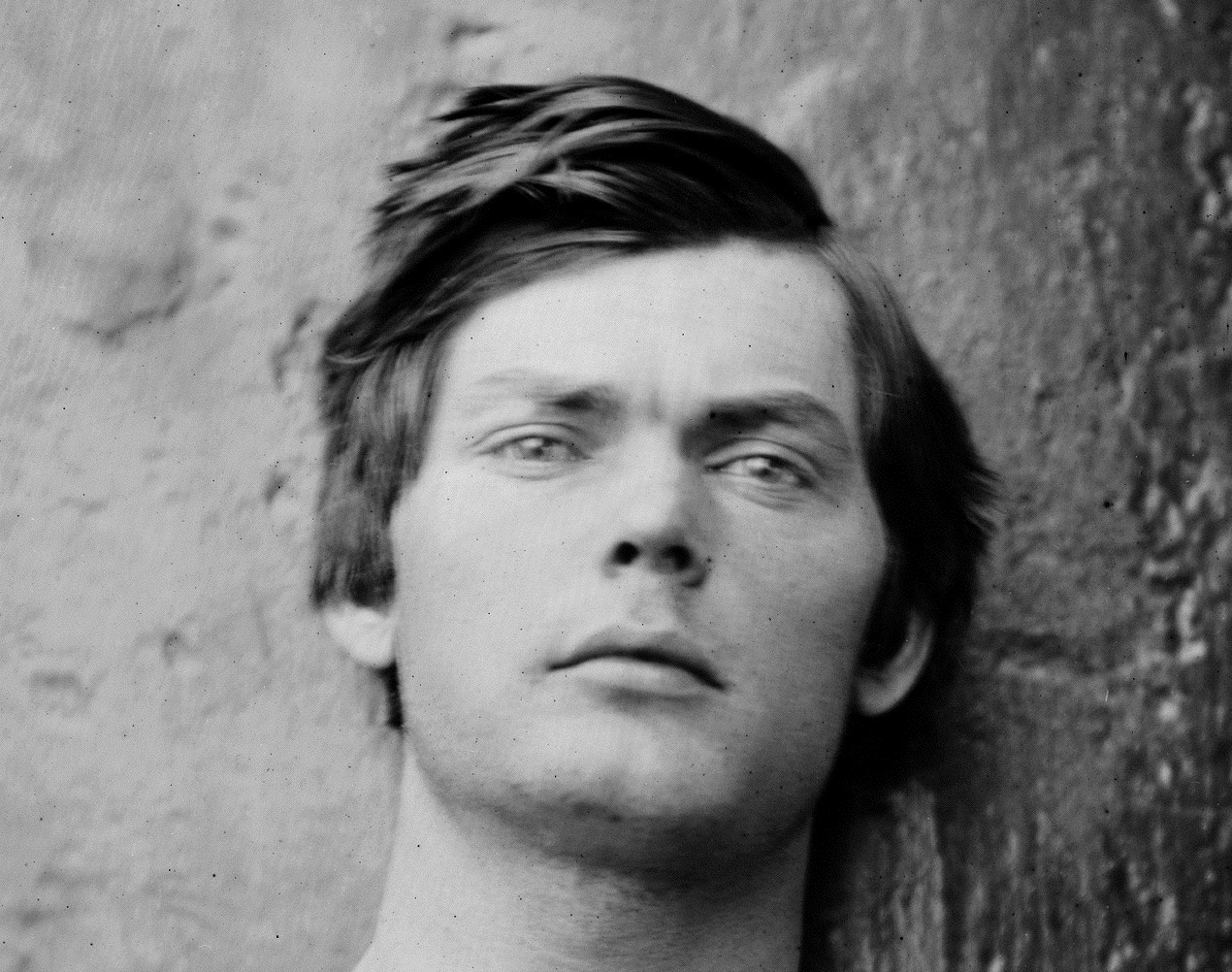
The exhibition chronicles the toll of war etched into the face of our 16th president. Life-size enlargements of Lincoln’s portraits circle the entire central gallery. Visitors will experience what it was like to stand before him and look into his eyes. Beneath this facial timeline of his presidency is a selection of photographs of people who touched his life and events that nearly wore him out.
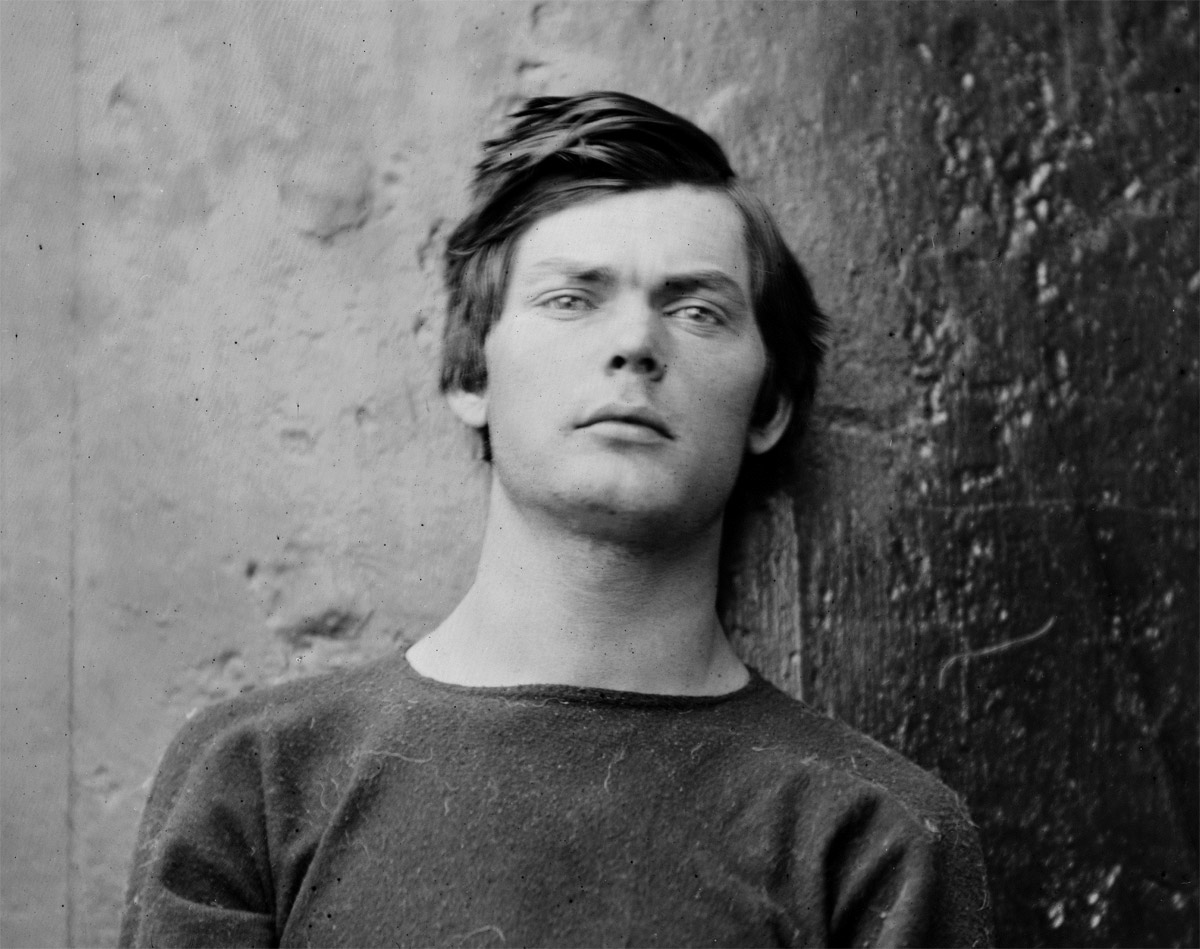
The show explores the time from Abraham Lincoln’s arrival in Washington in 1857 through his assassination in 1865. Photographs chronicle events as the war unfolds, his son dies, and he struggles with generals and mounting death tolls. In the photographs, Lincoln is revealed in a variety of poses, each bearing a significance that attests to the historic nature of his life, be it as he is grappling with emancipation or drafting words that would become sacred; serving as husband and father or being pulled in all directions by his constituents; and ultimately as he holds the country together throughout the turbulent times of the Civil War.
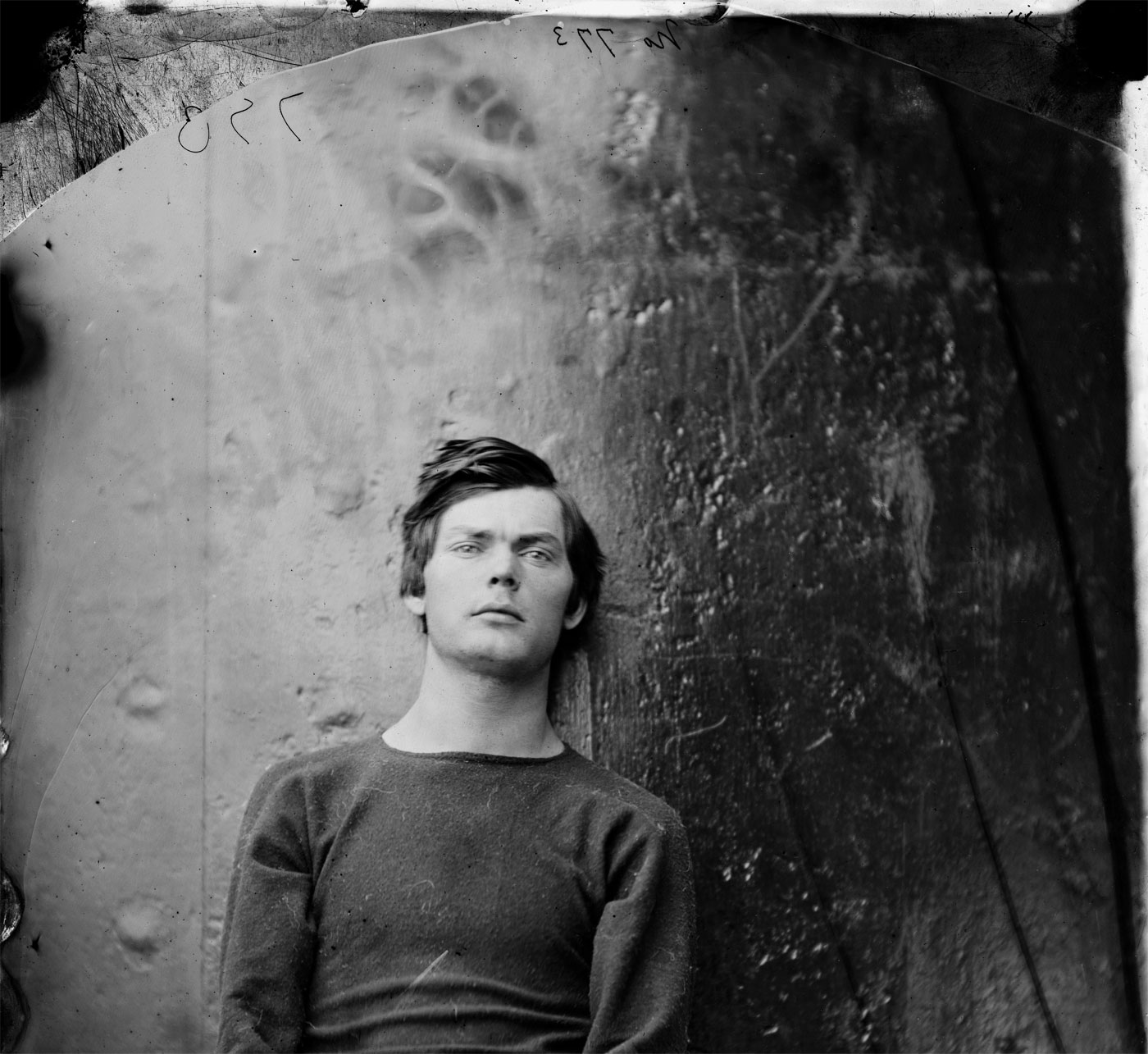
Highlights of the exhibition include Leonard Volk’s bronze life mask of Lincoln’s head and hands, glass negatives by Mathew Brady, original albumen war prints by Alexander Gardner and Timothy O’Sullivan, and carte-de-visites of Lincoln, his family, his cabinet, and his generals. Viewers can study official government war maps, view a Thomas Nast drawing depicting the slavery issue, and walk around an early “triptych” photograph that portrays Lincoln, Grant, or Sherman, depending on where the viewer stands. An oversize “imperial” print shows Lincoln just days before delivering his Gettysburg address. In another imperial print a lab technician’s thumb print obliterates Lincoln at his second inaugural, but what is visible is a spectator in the crowd who appears to be John Wilkes Booth. Another photograph of Booth has these words written on the back side: “Recognize him and kill him.” Lincoln, Life-Size also include artefact related to Lincoln and his era.

“We have presented these works so that viewers can see how the toll the war and personal tragedies aged him during his years in office,” said Peter W. Kunhardt, Jr. “In fact, he was just 56 years old when he was assassinated.” This is the first museum exhibition dedicated to the collection of the Meserve-Kunhardt Foundation, which is now housed on the campus of SUNY Purchase. The recent book, Lincoln, Life-Size, co-authored by Phillip B. Kunhardt III, Peter W. Kunhardt and Peter W. Kunhardt, Jr. is available in the Bruce Museum Store. A full array of exhibition programming related to the exhibition is scheduled.

Text from the Bruce Museum website [Online] Cited 01/06/2010. No longer available online


Mathew B. Brady (American, c. 1822-1896) 'Abraham Lincoln' January 8, 1864 Washington, DC
 

Mathew B. Brady (American, c. 1822-1896)
Abraham Lincoln
January 8, 1864 Washington, DC
National Archives and Records Administration


Anthony Berger (American born Germany, 1832 - after 1897) 'Abraham Lincoln' February 9, 1864 Washington, DC


Anthony Berger (American born Germany, 1832 – after 1897)
Abraham Lincoln
February 9, 1864 Washington, DC
Collodion negative
Quarter-plate glass transparency
10.9 x 8.7cm (case)
Brady’s National Photographic Portrait Galleries
Library of Congress


This is one of a series of photographs that Anthony Berger took of President Abraham Lincoln at the Brady Gallery in Washington in the winter of 1864, as the Civil War dragged on. Modern albumen print from 1864 wet-plated collodion negative. National Portrait Gallery.

“The Famous Profile” by Anthony Berger, manager of Brady’s Gallery, Washington D.C., made direct from an original collodion negative in the Meserve collection (M-82). One of seven poses taken by Berger on Tuesday February 9, 1864, it is perhaps the most familiar of Lincoln profiles, a more handsome pose than its companion view (0-89) because Lincoln’s profile is less severe and his left eyebrow is more visible.


Alexander Gardner (Scottish 1821-1882; emigrated America 1856) 'Abraham Lincoln' November 8, 1863 Washington, DC


Alexander Gardner (Scottish 1821-1882; emigrated America 1856)
Abraham Lincoln
November 8, 1863 Washington, DC
Library of Congress


Alexander Gardner (Scottish 1821-1882; emigrated America 1856) 'Abraham Lincoln' February 5, 1865 Washington, DC


Alexander Gardner (Scottish 1821-1882; emigrated America 1856)
Abraham Lincoln
February 5, 1865 Washington, DC
Library of Congress


Alexander Gardner was a Scottish photographer who immigrated to the United States in 1856, where he began to work full-time in that profession. He is best known for his photographs of the American Civil War, U.S. President Abraham Lincoln, and the execution of the conspirators to Lincoln’s assassination.

This is one of the last photos taken of Lincoln, who was assassinated ten weeks later, on April 14, 1865.


Alexander Gardner (Scottish 1821-1882; emigrated America 1856) 'Abraham Lincoln' February 5, 1865 Washington, DC (detail)


Alexander Gardner (Scottish 1821-1882; emigrated America 1856)
Abraham Lincoln (detail)
February 5, 1865 Washington, DC
Library of Congress


The Bruce Museum
1 Museum Drive in Greenwich, Connecticut, USA.

Opening hours:
Tuesday – Sunday 10am – 5pm
Closed Mondays and major holidays

The Bruce Museum website

LIKE ART BLART ON FACEBOOK

Back to top

Exhibition: ‘TruthBeauty: Pictorialism and the Photograph as Art, 1845-1945’ at George Eastman House, New York

Exhibition dates: 7th February – 31st May, 2009

Curator: Elsa Smithgall


George Davison (English, 1854-1930) 'The Onion Field' 1889 from the exhibition 'TruthBeauty: Pictorialism and the Photograph as Art, 1845-1945' at George Eastman House, New York, Feb - May, 2009


George Davison (English, 1854-1930)
The Onion Field
1889


George Davison (19 September 1854 – 26 December 1930) was an English photographer, a proponent of impressionistic photography, a co-founder of the Linked Ring Brotherhood of British artists and a managing director of Kodak UK. He was also a millionaire, thanks to an early investment in Eastman Kodak.


Pictorialism was simultaneously a movement, a philosophy, an aesthetic, and a style, resulting in some of the most spectacular photographs in the history of the medium. This exhibition shows the rise of Pictorialism in the late 19th century from a desire to elevate photography to an art form equal to painting, drawing, and watercolour, and extends the historical period generally associated with it by including its influential precursors, its persistent practitioners, and its seminal effect on photographic Modernism.

With 130 masterworks from such well-known photographers as Alvin Langdon Coburn, Edward Steichen, Alfred Stieglitz, Robert Demachy, Frederick Evans, and F. Holland Day, this remarkable exhibition will illustrate the Pictorialism movement’s progression from its early influences to its lasting impact on photography and art.

Text from the George Eastman House website [Online] Cited 26/01/2009. No longer available online


Many thankx to George Eastman House for allowing me to publish the photographs in the posting. Please click on the photographs for a larger version of the image.


In this video, Phillips Collection curator Elsa Smithgall introduces special exhibition TruthBeauty: Pictorialism and the Photograph as Art, 1845-1945, on view at The Phillips Collection Oct. 9, 2010 through Jan. 9, 2011.


Julia Margaret Cameron (British born India, 1815-1879) 'Prayer' 1866 from the exhibition 'TruthBeauty: Pictorialism and the Photograph as Art, 1845-1945' at George Eastman House, New York, Feb - May, 2009


Julia Margaret Cameron (British born India, 1815-1879)
Prayer
1866


Peter Henry Emerson (British, 1856-1936) 'Polling the Marsh Hay' c. 1885


Peter Henry Emerson (British, 1856-1936)
Polling the Marsh Hay
c. 1885


Henry Peach Robinson (English, 1830-1901) 'Carolling' 1890


Henry Peach Robinson (English, 1830-1901)
Carolling
1890


Fredrick Holland Day (American, 1864-1933) "I Thirst" 1898


Fredrick Holland Day (American, 1864-1933)
“I Thirst”
1898


Frederick Holland Day (American, 1864-1933) 'Ebony and Ivory' 1899


Frederick Holland Day (American, 1864-1933)
Ebony and Ivory
1899
Photogravure


Alfred Stieglitz (American, 1864-1946) 'Spring Showers' 1901


Alfred Stieglitz (American, 1864-1946)
Spring Showers
1901


Alfred Steiglitz (American, 1864-1946) 'Snapshot – In the New York Central Yards' Negative 1903; Printed 1910


Alfred Steiglitz (American, 1864-1946)
Snapshot – In the New York Central Yards
Negative 1903; Printed 1910
Photogravure


This photograph of a train departing from Grand Central Terminal was probably made from the 48th Street foot bridge, which crossed over the railroad yard.


Edward Steichen (American, 1879-1973) 'The Pond - Moonlight' Negative 1904; print 1906


Edward Steichen (American, 1879-1973)
The Pond – Moonlight
Negative 1904; print 1906
Photogravure


The Pond – Moonlight (also exhibited as The Pond – Moonrise) is a pictorialist photograph by Edward Steichen. The photograph was made in 1904 in Mamaroneck, New York, near the home of his friend art critic Charles Caffin. The photograph features a forest across a pond, with part of the moon appearing over the horizon in a gap in the trees. The Pond – Moonlight is an early photograph created by manually applying light-sensitive gums, giving the final print more than one colour. Only three known versions of The Pond – Moonlight are still in existence and, as a result of the hand-layering of the gums, each is unique.

Text from the Wikipedia website


Edward Steichen (American, 1879-1973) 'Grand Prix at Longchamp, After the Races' 1907


Edward Steichen (American, 1879-1973)
Grand Prix at Longchamp, After the Races
1907
Photogravure


About the Exhibition

Photographic Pictorialism, an international movement, a philosophy, and a style, developed toward the end of the 19th century. The introduction of the dry-plate process, in the late 1870s, and of the Kodak camera, in 1888, made taking photographs relatively easy, and photography became widely practiced. Pictorialist photographers set themselves apart from the ranks of new hobbyist photographers by demonstrating that photography was capable of far more than literal description of a subject. Through the efforts of Pictorialist organisations, publications, and exhibitions, photography came to be recognised as an art form, and the idea of the print as a carefully hand-crafted, unique object equal to a painting gained acceptance.

The forerunners of Pictorialism were early photographers like Henry Peach Robinson and Julia Margaret Cameron. Robinson found inspiration in genre painting; Cameron’s fuzzy portraits and allegories were inspired by literature. Like Robinson and Cameron, the Pictorialists made photographs that were more like paintings and drawings than the work of commercial portraitists or hobbyists. Pictorialist images were heavily dependent on the craft of nuanced printing. Some photographers, like Frederick H. Evans, a master of the platinum print, presented their work like drawings or watercolours, decorating their mounts with ruled borders filled with watercolour wash, or printing on textured watercolour paper, like Austrian photographer Heinrich Kühn. Kühn achieved painterly effects by using an artist’s brush to manipulate watercolour pigment, instead of silver or platinum, mixed with light-sensitised gum arabic.

The idea that the primary purpose of photography was personal expression lay behind Pictorialism’s “Secessionist” movement. Alfred Stieglitz’s “Photo-Secession” was the best-known secessionist group. Stieglitz and his magazine, Camera Work, with its high-quality photogravure illustrations, advocated for the acceptance of photography as a fine art.

Early in the 20th century, Pictorialism began losing ground to modernism: in 1911, Camera Work published drawings by Rodin and Picasso, and its final issue, in 1917, featured Paul Strand’s modernist photographs. Nevertheless, Pictorialism lived on. A second wave of Pictorialists included Clarence H. White, whose students included such photographers as Margaret Bourke-White, Paul Outerbridge, and Dorothy Lange. White’s colleague, Paul Anderson, continued the pictorial tradition until his death in 1956. Five prints of his Vine in Sunlight, 1944, display five different printing techniques, demonstrating how each process subtly shapes the viewer’s response to the image.

Organised by George Eastman House International Museum of Photography and Film, and Vancouver Art Gallery.

Text from the Phillips Collection website Nd [Online] Cited 10/06/2022


Alvin Langdon Coburn (British born United States of America, 1882-1966) 'Fifth Avenue from the St. Regis' c. 1905


Alvin Langdon Coburn (British born United States of America, 1882-1966)
Fifth Avenue from the St. Regis
c. 1905
Gum bichromate and platinotype on paper


Alvin Langdon Coburn (British born United States of America, 1882-1966) 'Wapping' 1904


Alvin Langdon Coburn (British born United States of America, 1882-1966)
Wapping
1904


Alvin Langdon Coburn (British born United States of America, 1882-1966) 'St. Paul's and Other Spires' 1908


Alvin Langdon Coburn (British born United States of America, 1882-1966)
St. Paul’s and Other Spires
1908


Alvin Langdon Coburn (British born United States of America, 1882-1966) 'The Tunnel Builders' 1908


Alvin Langdon Coburn (British born United States of America, 1882-1966)
The Tunnel Builders
1908


Eva Watson Schutze (American, 1867-1935) 'Woman with Lilly' 1905


Eva Watson Schutze (American, 1867-1935)
Woman with Lilly
1905


Eva Watson-Schütze (American, 1867-1935)

Eva Watson-Schütze (1867-1935) was an American photographer and painter who was one of the founding members of the Photo-Secession. …

Around the 1890s Watson began to develop a passion for photography, and soon she decided to make it her career. Between 1894 and 1896 she shared a photographic studio with Amelia Van Buren another Academy alumna in Philadelphia, and the following year she opened her own portrait studio. She quickly became known for her Pictorialist style, and soon her studio was known as a gathering place for photographers who championed this aesthetic vision.

In 1897 she wrote to photographer Frances Benjamin Johnston about her belief in women’s future in photography: “There will be a new era, and women will fly into photography.”

In 1898 six of her photographs were chosen to be exhibited at the first Philadelphia Photographic Salon, where she exhibited under the name Eva Lawrence Watson. It was through this exhibition that she became acquainted with Alfred Stieglitz, who was one of the judges for the exhibit.

In 1899 she was elected as a member of the Photographic Society of Philadelphia. Photographer and critic Joseph Keiley praised the work she exhibited that year, saying she showed “delicate taste and artistic originality”.

The following year she was a member of the jury for the Philadelphia Photographic Salon. A sign of her stature as a photographer at that time may be seen by looking at the other members of the jury, who were Alfred Stieglitz, Gertrude Kasebier, Frank Eugene and Clarence H. White.

In 1900 Johnston asked her to submit work for a groundbreaking exhibition of American women photographers in Paris. Watson objected at first, saying “It has been one of my special hobbies – and one I have been very emphatic about, not to have my work represented as ‘women’s work’. I want [my work] judged by only one standard irrespective of sex.” Johnston persisted, however, and Watson had twelve prints – the largest number of any photographer – in the show that took place in 1901.

In 1901 she married Professor Martin Schütze, a German-born and -trained lawyer who had received his Ph.D. in German literature from the University of Pennsylvania in 1899. He took a teaching position in Chicago, where the couple soon moved.

That same year she was elected a member of The Linked Ring. She found the ability to correspond with some of the most progressive photographers of the day very invigorating, and she began to look for similar connections in the U.S.

In 1902 she suggested the idea of forming an association of independent and like-minded photographers to Alfred Stieglitz. They corresponded several times about this idea, and by the end of the year she joined Stieglitz as one of the founding members of the famous Photo-Secession.

About 1903 Watson-Schütze began to spend summers in Woodstock at the Byrdcliffe Colony in the Catskill Mountains of New York. She and her husband later bought land nearby and built a home they called “Hohenwiesen” (High Meadows) where she would spend most of her summer and autumn months from about 1910 until about 1925.

In 1905 Joseph Keiley wrote a lengthy article about her in Camera Work saying she was “one of the staunchest and sincerest upholders of the pictorial movement in America.

Text from the Wikipedia website


Eva Watson Schutze (American, 1867-1935) 'Young girl seated on bench' c. 1910


Eva Watson Schutze (American, 1867-1935)
Young girl seated on bench
c. 1910


Anne Brigman (American, 1869-1960) The 'Heart of the Storm' 1902


Anne Brigman (American, 1869-1960)
The Heart of the Storm
1902


Anne Brigman (American, 1869-1960) 'The Pine Sprite' 1911


Anne Brigman (American, 1869-1960)
The Pine Sprite
1911


Frederick Evans (British, 1853-1943) 'York Minster: In Sure and Certain Hope' 1903


Frederick Evans (British, 1853-1943)
York Minster: In Sure and Certain Hope
1903
Photogravure


Frederick H. Evans (British, 1853-1943)

Frederick H. Evans (26 June 1853, London – 24 June 1943, London) was a British photographer, primarily of architectural subjects. He is best known for his images of English and French cathedrals. Evans began his career as a bookseller, but retired from that to become a full-time photographer in 1898, when he adopted the platinotype technique for his photography. Platinotype images, with extensive and subtle tonal range, non glossy-images, and better resistance to deterioration than other methods available at the time, suited Evans’ subject matter. Almost as soon as he began, however, the cost of platinum – and consequently, the cost of platinum paper for his images – began to rise. Because of this cost, and because he was reluctant to adopt alternate methodologies, by 1915 Evans retired from photography altogether.

Evans’ ideal of straightforward, “perfect” photographic rendering – unretouched or modified in any way – as an ideal was well-suited to the architectural foci of his work: the ancient, historic, ornate and often quite large cathedrals, cloisters and other buildings of the English and French countryside. This perfectionism, along with his tendency to exhibit and write about his work frequently, earned for him international respect and much imitation. He ultimately became regarded as perhaps the finest architectural photographer of his, or any, era – though some professionals privately felt that the Evans’ philosophy favouring extremely literal images was restrictive of the creative expression rapidly becoming available within the growing technology of the photographic field.

Evans was also an able photographer of landscapes and portraits, and among the many notable friends and acquaintances he photographed was George Bernard Shaw, with whom he also often corresponded. Evans was a member of the Linked Ring photographic society.

Text from the Wikipedia website


Frederick Evans (British, 1853-1943) 'Kelmscott Manor: Attics' c. 1896


Frederick Evans (British, 1853-1943)
Kelmscott Manor: Attics
c. 1896


Getrude Käsebier (American, 1852-1934) 'Woman seated under a tree' c. 1910


Getrude Käsebier (American, 1852-1934)
Woman seated under a tree
c. 1910


The hauntingly beautiful works of the Pictorialist movement are among the most spectacular photographs ever created. Beginning in the late nineteenth century, Pictorialist artists sought to elevate photography – until then seen largely as a scientific tool for documentation – to an art form equal to painting. Adopting a soft-focus approach and utilizing dramatic effects of light, richly coloured tones and bold technical experimentation, they opened up a new world of vision expression in photography. More than a hundred years later, their aesthetic remains highly influential.

TruthBeauty contains 121 stunning works by the form’s renowned artists, including Julia Margaret Cameron, Alvin Langdon Coburn, Robert Demachy, Peter Henry Emerson, Gertrude Käsebier, Heinrich Kühn, Edward Steichen and Alfred Stieglitz. Together, the collected works trace the evolution of Pictorialism over the three decades in which it predominated.

This is the only collection of Pictorialist photographs by artists from North America, the United Kingdom, continental Europe, Japan and Australia in a single publication. Scholarly essays, and a selection of historic texts by Pictoralist artists, complete this rich overview of the first truly international art movement.

Text from the Amazon website Nd [Online] Cited 10/06/2022


Robert Demachy (French, 1859-1936) 'Une Balleteuse' 1900


Robert Demachy (French, 1859-1936)
Une Balleteuse
1900
Gum bichromate print


Demachy was, with Émile Joachim Constant Puyo, the leader of the French Pictorial movement in France. His aesthetic sophistication and skill with the gum bichromate technique, which he revived in 1894 and pressed into the service of fine art photography, were internationally renowned. With the gum medium, he was able to achieve the appearance of a drawing or printmaking process-in this photograph, he has added marks characteristic of etching during intermediate stages of development-in order to advocate photography’s membership in the fine arts by revealing the intervention of the photographer’s hand in the printmaking stage of the photographic process. The result attested to Demachy’s mastery of his medium, but also proved his ability to unify a composition and select significant details from the myriad of facts available in his negatives. In this picture, Demachy has gently elided the background and erased the features of the left third of the image in order to emphasise the grace and delicacy of the ballet dancer that is its subject.

Text from the Metropolitan Museum of Art website [Online] Cited 26/01/2009


John Kauffmann (Australian, 1864-1942) 'Waterlily, Nymphaea Alba' c. 1930


John Kauffmann (Australian, 1864-1942)
Waterlily, Nymphaea Alba
c. 1930
Gelatin silver print
National Gallery of Australia


John Kauffmann was born in South Australia in 1865 and initially trained as an architect. In 1887 he travelled to Europe and became well connected to London’s artistic set, including the young Frank Brangwyn RA. In London and later Vienna, Kauffmann painted and learnt to take and print photographs, exhibiting in various salons and working with a number of important studios. In Austria, he became an enthusiast of Pictorialist photography and pursued studies in photographic chemistry. He returned to Adelaide in 1897 and was championed as the pioneer of Pictorialism in Australia. By 1914, Kauffmann had moved to Melbourne and established his own studio in Collins Street. Kauffmann died in South Yarra, Melbourne in 1942.

Text from the Monash Gallery of Art website


John Kauffmann (Australian, 1864-1942) 'The Silent Watcher' 1919


John Kauffmann (Australian, 1864-1942)
The Silent Watcher
Plate in in John Kauffmann, The Art of John Kauffmann
Melbourne: Alexander McCubbin, 1919 tipped-in plate (halftone)
National Gallery of Australia Research Library, Canberra


Pictorialism in Australia was established when photographic journals, such as the Australian Photographic Journal (APJ), launched in 1892, and the Australasian Photo-Review (APR), begun in 1894, appeared.1

In addition to providing technical advice the magazines covered the controversies in Britain and other centres over the new art photography. Articles on poetic picture making by British artists Henry Peach Robinson and Alfred Horsley Hinton, whose names were often cited by Australian Pictorialist photographers as major influences, were also included.

These magazines featured work by both professional and amateur photographers, and their editors took pride in the artistic quality of their reproductions; they also encouraged and supported the growth of new societies devoted to art photography.

The Photographic Society of New South Wales was duly established in Sydney in 1894, joining the older South Australian Photographic Society in Adelaide at the forefront of Pictorialism. The next decades saw a remarkable level of activity in the growing Pictorialist circles. …

In the years leading up to the war there was growing sentiment that Australian photographers were overly reliant on British models and had failed to advance the art of pictorial photography within an Australian context. A number of the more prominent Australian photographers and art commentators were also increasingly vocal about what they felt to be a decline in the quality of artistic practice despite the feverish activity of exhibitions and proliferation of camera clubs.

In 1916 a group of artists including Cazneaux, Cecil W. Bostock, a graphic artist who had recently set up a photography studio in Sydney, and James Stening formed the Sydney Camera Circle. They signed a pledge “to advance pictorial photography and to show our own Australia in terms of sunlight rather than those of greyness and dismal shadows.”10 …

Although it had largely waned in Europe and the United States by then, Pictorialism continued in Australia during the 1920s and 1930s. There was a new generation of artists showing their work alongside that of their more established colleagues in two large Pictorialist salons held in Sydney in 1924 and 1926 accompanied by catalogues called Cameragraphs (designed by Bostock). Perhaps because of the Depression, these salons did not continue.

Beginning in the 1920s Pictorialist and Modernist photography existed side by side with the professional photographers bridging both movements. Pictorialist photography would remain popular, particularly with the amateur members of the camera clubs up to the 1940s, ironically becoming increasingly conservative and backward looking in subject and execution.

However, the ascendancy of Modernist photography was now evident, even in the work of Cazneaux and Bostock, who would become active in the 1920s in commercial spheres.

Extract from Gael Newton. “Australian Pictorial Photography – Seeing The Light,” in TruthBeauty – Pictorialism and the Photograph as Art, 1845-1945. Essay originally published in the 2008 catalogue for the Vancouver Art Gallery exhibition [Online] Cited 12/06/2022


Cecil W. Bostock (Australian born England, 1884-1939) 'Nude Study' c. 1916

Cecil W. Bostock (Australian born England, 1884-1939)
Nude Study
c. 1916
Gelatin silver print


Cecil Westmoreland Bostock (1884-1939) was born in England. He emigrated to New South Wales, Australia, with his parents in 1888. His father, George Bostock, was a bookbinder who died a few years later in 1892.

Bostock had an important influence on the development of photography in Australia, initiating a response to the strong sunlight. He presided over the transition from Pictorialism to Modernism and was a mentor to several famous Australian photographers: notably Harold Cazneaux and Max Dupain.


The Sydney Camera Circle

On 28 November 1916, a group of six photographers met at Bostock’s ‘Little Studio in Phillip Street’ to form the Pictorialist “Sydney Camera Circle”. This initially included Cecil Bostock, James Stening, W. S. White, Malcolm McKinnon and James Paton, and they were later joined by Henri Mallard.

A “manifesto” was drawn up by Cecil and signed by all six attendees who pledged “to work and to advance pictorial photography and to show our own Australia in terms of sunlight rather than those of greyness and dismal shadows”. This established what was known as the ‘sunshine school’ of photography. The style of Pictorialism practiced by Australians was “concerned with the play of light, sunshine and shadow, and the attention to nature and the landscape, and had an affinity with the Heidelberg School of painters.”

Text from the Wikipedia website


Jack Cato (Australian, 1889-1971) 'Snorky' 1924


Jack Cato (Australian, 1889-1971)
Snorky
1924
Gelatin silver print


Jack Cato (1889-1971) was born in Tasmania and was introduced to photography by his cousin, renowned photographer John Watt Beattie. Cato trained and worked as a photographer in Launceston from 1901 to 1906 before establishing his own business in Hobart. He travelled to Europe in 1908 and worked in London as a theatre and society photographer from 1909 to 1914. He then spent six years photographing in South Africa. Cato received a fellowship at the Royal Photographic Society in 1917. He returned to Tasmania in 1920 and re-opened his portrait studio in Hobart. He moved his studio to Melbourne in 1927 and became known as a leader in Australian photography. Cato is particularly known for his pictorial portraits.

Text from the Monash Gallery of Art website


Olive Cotton (Australian, 1911-2003) 'Grass at sundown' 1939


Olive Cotton (Australian, 1911-2003)
Grass at Sundown
1939
Gelatin silver print


Olive Cotton (Australia 1911-2003) worked at Max Dupain’s Bond Street studio from 1934 to 1940. During this time she produced some of her best-known photographs. Her subjects ranged from nature to the built environment as well as still-life and portraiture. Cotton’s often geometric compositions reflect the modernist photographic styles of the time and illustrate her interest in light and shadow. She was included in the London Salon of Photography in 1935 and 1937, and in 1942 returned to the Bond Street studio as manager. She stayed until 1945 before moving to Koorawatha in country New South Wales where she raised her family. From 1964 to 1980, Cotton ran a small photographic studio in Cowra, New South Wales.

Text from the Monash Gallery of Art website


John B. Eaton (Australian born England, 1881-1966) 'Wet Day in Melbourne' 1920


John B. Eaton (Australian born England, 1881-1966)
Wet Day in Melbourne
1920
Gelatin silver print


John Eaton (b. 1881 England, arrived 1888 Australia, d. 1966) is the most prolific Pictorialist photographer to be based in Melbourne during the early twentieth century. He worked in his father’s picture framing business from a young age and expanded the family business to include fine art prints as his amateur interest in photography developed. He began exhibiting his work in 1917 and was frequently commended for his contributions to international photography exhibitions throughout his life. Eaton is most well-known for his ‘portraits’ of gum trees and his appreciation of the bucolic Victorian countryside.

Text from the Monash Gallery of Art website


John Bertram Eaton was born in England and migrated to Australia with his family eight years later. His father ran a small gallery and framing shop in Melbourne, where Eaton began work. In the early 1920s his photographs were included in local and international exhibitions and in 1921 he joined the Victorian Pictorial Workers Society. Four years later he held a solo exhibition of 124 photographs, nearly all of them landscapes. At this time Cazneaux called him ‘a fairly new man amongst the Pictorialists of today’.1 He became a foundation member of the Melbourne Camera Club and remained a prolific exhibitor into the late 1940s.

Jack Cato called Eaton ‘the Poet of the Australian landscape’.2 Among his contemporaries he was considered one of the most gifted interpreters of the landscape. When this photograph was exhibited at the Victorian Salon in 1936, the reviewer claimed that it already was a ‘picture too well known to need description’.3 Eaton’s reputation as an interpreter of the Australian landscape extended overseas, with one English reviewer noting, ‘when it comes to Australian landscape, we in England regard John B Eaton as its interpreter’.4 Like the painter Elioth Gruner, Eaton frequently depicts wide, expansive landscapes, denuded of trees, with low receding hills in the distance. He was very skilled at rendering atmosphere and it was probably his aerial, rather than linear, perspective – that sense of distance given by atmosphere which seems to veil and lighten certain parts of the landscape – which appealed so strongly to his admirers here and overseas.

1/ Cazneaux, H. 1925, ‘Review of the pictures’, in Harrington’s Photographic Journal, 1 Apr p. 20
2/ Cato, J. 1955, The story of the camera in Australia, Georgian House, Melbourne p. 156
3/ Baillot, L. A. 1936, ‘The sixth international exhibition of the Victorian Salon of Photography’, in Australasian Photo-Review, 1 May p. 226
4/ Dudley, Johnston J. 1936, ‘London news and doings’, in Australasian Photo-Review, 2 Nov p. 541

© Art Gallery of New South Wales Photography Collection Handbook, 2007 [Online] Cited 11/06/2022


Harold Cazneaux (Australian born New Zealand, 1878-1953) 'Slag Dump, Newcastle (NSW)' 1934


Harold Cazneaux (Australian born New Zealand, 1878-1953)
Slag Dump, Newcastle (NSW)
1934
Gelatin silver print


Harold Cazneaux (b. New Zealand 1878; a. Australia 1889; d. 1953) was a key figure of the Pictorialist movement in Australia. His career began in photographic studios, first in Adelaide, then Sydney. In Sydney, Cazneaux exhibited in local photographic competitions and held his first solo exhibition in 1909. His photographs, which were mostly portraits, city views and landscapes, show his interest in natural light and reflect his belief that photography should be used as a form of artistic expression. He was a founding member of the Sydney Camera Circle and through his photography, writing and teaching made a significant contribution to Australian photography in the early twentieth century.

Text from the Monash Gallery of Art website


Harold Cazneaux (Australian born New Zealand, 1878-1953) 'The Orphan Sisters' c. 1906


Harold Cazneaux (Australian born New Zealand, 1878-1953)
The Orphan Sisters
c. 1906
Gelatin silver print


May Moore (New Zealand, 1881-1931) and Mina Moore (New Zealand, 1882-1957) 'Portrait of an Actress ("Lily" Brayton)' c. 1916


May Moore (New Zealand, 1881-1931) and Mina Moore (New Zealand, 1882-1957)
Portrait of an Actress (“Lily” Brayton)
c. 1916
Gelatin silver print
19.9 x 15.2cm
National Gallery of Australia
Purchased 1989


May and Mina Moore were New Zealand-born photographers who made careers as professional photographers, first in Wellington, New Zealand, and later in Sydney and Melbourne, Australia. They are known for their Rembrandt-style portrait photography, and their subjects included famous artists, musicians, and writers of the era. …

In Australia

After only a few years, the sisters moved their business to Australia, running separate studios in Sydney (1910-1928) and Melbourne (1913-1918). May in Sydney continued to focus on studio portraits, while Mina in Melbourne moved into theatrical photography and portraits of interview subjects. Nonetheless, they continued to often cosign the work produced by their respective studios. Their photographs were frequently published in magazines such as Home and Triad.

Their styles were very consistent, and they used dramatic lighting to get the effect of making the subject’s face the centre of attention.

May in Sydney

In 1910, May took a holiday trip to Australia that resulted in her opening a new studio in Sydney. One of May’s notable images from the Sydney period was a portrait of cartoonist Livingston Hopkins.

May began writing articles for the Austral-Briton in 1916. In articles like “Photography for Women”, she encouraged more women to take up the medium. Her advocacy extended to her own business, where she mostly employed women. One exception to this rule was her husband, Henry Hammon Wilkes, a dentist whom she married on 13 July 1915 and who gave up his dental practice to help his wife with her photography business.

May was a member of the Lyceum Club, the Musical Association of New South Wales, the Society of Women Painters (Sydney), and the Professional Photographers’ Association of Australia.

Around 1928, May was forced into retirement by illness and turned her creative energies to painting landscapes. She died of cancer in her Pittwater home on 10 June 1931; her remains are at the Manly Cemetery. Six months after her death the Lyceum Club mounted a memorial exhibition of her work.

Mina in Melbourne

In 1913, Mina joined May in Australia, setting up shop in the Auditorium Building on Collins Street in downtown Melbourne and specialising in theatrical photography. Mina also formed an alliance with a freelance journalist, agreeing to photograph whomever the journalist planned to interview. These images were typically taken during the interview itself, affording a better opportunity to capture a subject’s natural expressions.

Mina married William Alexander Tainsh on 20 December 1916. When their daughter was born in 1918, Mina retired from professional photography. Her Auditorium Building studio was taken over by photographer Ruth Hollick. She came out of retirement briefly in 1927, when Shell commissioned her to do a series of portraits. At that point she was working out of a home darkroom and caring for an expanded family, so after the Shell series she decided against restarting her photography business.

Mina died in Croydon, Victoria on 30 January 1957. Her remains were cremated.

Text from the Wikipedia website


Elizabeth “Lily” Brayton (23 June 1876 – 30 April 1953) was an English actress and singer, known for her performances in Shakespeare plays and for her nearly 2,000 performances in the First World War hit musical Chu Chin Chow.


Mina and May Moore’s Actress Elizabeth ‘Lily’ Brayton [Mrs Oscar Asche]

Sisters Annie May (May) and Minnie Louise (Mina) Moore ran photographic studios, first in Wellington and then in Sydney and Melbourne. Their work was most often jointly stamped ‘May and Mina Moore’ and was remarkably consistent. They portrayed their subjects in head and shoulder shots, focusing attention exclusively on the face through the use of dramatic lighting and dark backgrounds.

From the 1880s until well after the turn of the century, women in photography were more commonly employed as retouchers and hand-colourists. The number of women running photographic studios, however, increased noticeably around 1910. This was an era in which the graceful and distant Edwardian ‘ladies’ shown in so many paintings of the late 19th and early 20th century were being replaced by the jazz age flappers and mass media celebrities. The Moore sisters were themselves typical ‘modern women’ of the 1910s-1930s in seeking their independence and social mobility through new types of careers in photography. They both mixed in artistic circles and May, in particular, was interested in the theatre. Their success surprised the critics even as late as the 1930s, when the Australian Worker in 1931 stated about May: ‘practically every artist, musician, critic, journalist, story-writer and poet of local celebrity was at some time or other a subject for her camera.’1

It is not clear which sister made this striking close-up of a stylish young woman (who may have been an actress or entertainer as the image was registered for copyright). She is shown in the recognisable Moore style but with particular verve as she stares straight into the camera, head slightly lowered in the femme fatale guise made popular in celebrity portraits and stills for the silent movies. Through the mass circulation of celebrity images everyone could have their favourite star for their wall.

Anne O’Hehir

1/ The Australian Worker, 24 June 1931, p. 1.

Text © National Gallery of Australia, Canberra 2010
From: Anne Gray (ed), Australian art in the National Gallery of Australia, National Gallery of Australia, Canberra, 2002


George Eastman House
900 East Avenue
Rochester, NY 14607

Opening hours:
Tues – Sat 10am – 5pm
Sunday 11am – 5pm

George Eastman House website

LIKE ART BLART ON FACEBOOK

Back to top