Exhibition dates: 22nd December, 2012 – 7th April, 2013
Curator: Peter Barberie, The Brodsky Curator of Photographs at the Philadelphia Museum of Art
Many thankx to the Philadelphia Museum of Art for allowing me to publish the photographs in the posting. Please click on the photographs for a larger version of the image.
William Henry Fox Talbot (British, 1800-1877) Group of Persons Selling Fruit and Flowers 1845 Salted paper print from a paper negative 6 11/16 x 8 1/4 inches (17 x 21cm) Philadelphia Museum of Art, Purchased with the Robert A. Hauslohner Fund, 1967
Felice Beato (English born Italy, 1825-1913) Confucius, Canton, April 1860 April 1860 Albumen silver print 10 x 12 inches (25.4 x 30.5cm) Philadelphia Museum of Art, Purchased with funds contributed by Dr. Chaoying Fang, Harvey S. Shipley Miller and J. Randall Plummer, and with the Alice Newton Osborn Fund, 1978
Dorothy Norman (American, 1905-1997) Harbor II, (Osterville), Cape Cod 1930s Gelatin silver print Sheet: 2 7/8 x 3 7/8 inches (7.3 x 9.8cm) Philadelphia Museum of Art, From the Collection of Dorothy Norman, 1980
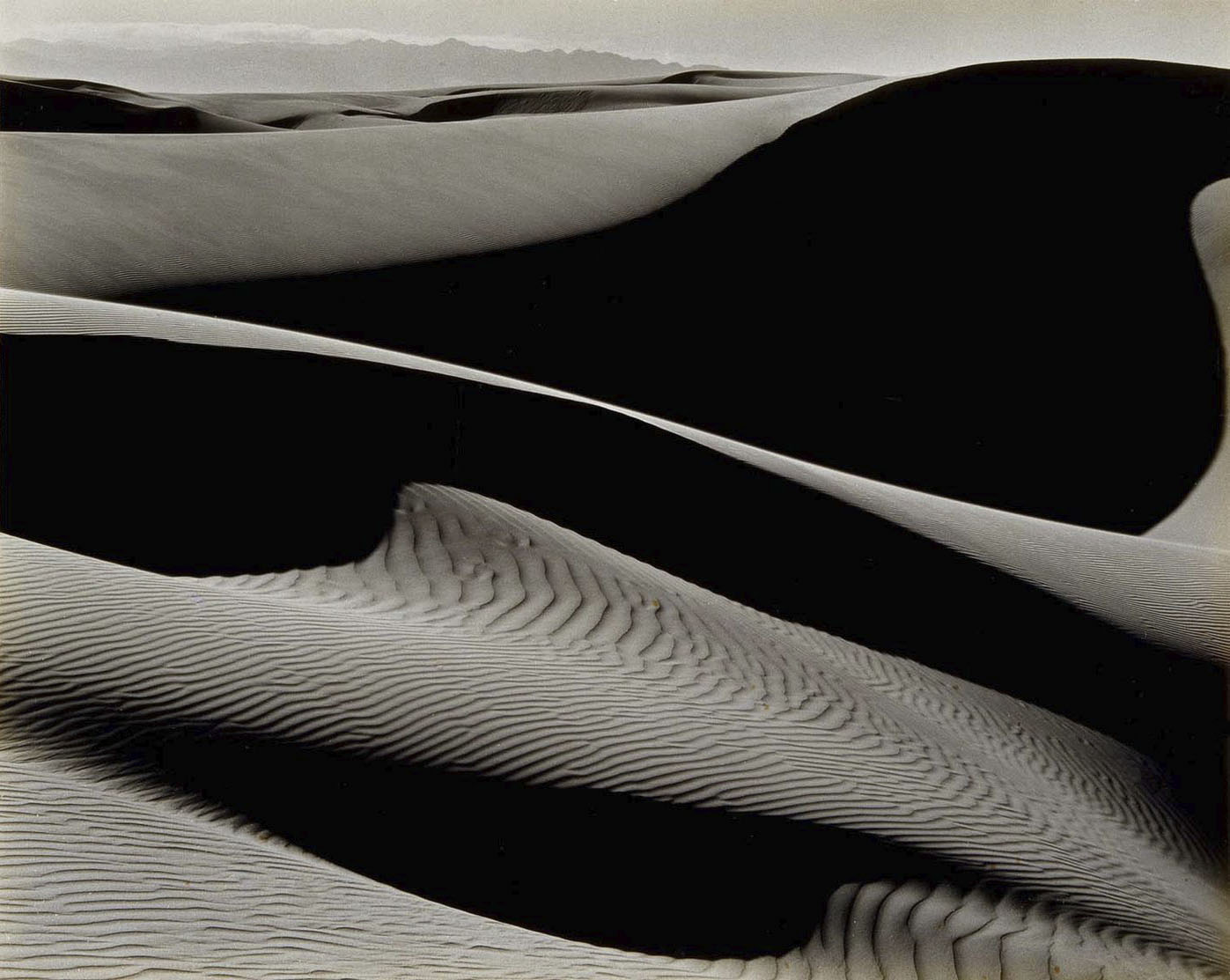
Edward Weston (American, 1886-1958) Dunes, Oceano 1936 Gelatin silver print Philadelphia Museum of Art
Louise Lawler (American, b. 1947) Living Room Corner Arranged by Mr. and Mrs. Burton Tremaine, Sr., 1984 Dye destruction print Sheet: 18 1/4 x 23 3/4 inches (46.4 x 60.3cm) Philadelphia Museum of Art, Gift of Henry S. McNeil, Jr., 1988
Richard Misrach (American, b. 1949) Pink Lightning, Salton Sea 1985 Chromogenic print 18 5/16 x 23 1/16 inches (46.5 x 58.6cm) Philadelphia Museum of Art, Gift of the Friends of the Philadelphia Museum of Art, 1986
Joachim Koester (Danish active United States, b. 1962) Room of Nightmares #1 2005 Chromogenic print 18 7/8 x 23 7/8 inches (47.9 x 60.6cm) Philadelphia Museum of Art, Gift of Lynne and Harold Honickman
This exhibition presents a survey of photographs from the permanent collection and includes an important group of works by Dorothy Norman and her mentor Alfred Stieglitz, one of the greatest figures in twentieth-century American art. There are also early masterworks by Gustave Le Gray, whose images of light and motion inspired the Impressionists; Edward Weston; Julia Margaret Cameron; and Charles Aubry. These striking images are complemented by an array of modern and contemporary works that trace the medium’s history as a visual art form, including recent acquisitions by artists such as Florence Henri, Roy DeCarava, and Hiroh Kikai, many on view for the first time in Philadelphia.
The mainly black-and-white photographs reflect the strengths of the Museum’s photography collection, ranging from the 1840s to 2005. Nineteenth-century photographs include works by William Henry Fox Talbot, an early inventor of photography; a group of views from Felice Beato’s 1860 album China; and Rue des Prêtres Saint‑Étienne, de la rue Descartes by Charles Marville, who documented the narrow quarters of nineteenth-century Paris.
Post-World War II American and Japanese photography is seen through a number of works by Robert Frank including Jehovah’s Witness, Los Angeles (1955), Diane Arbus’s Untitled (6) (1970-71), and Masahisa Fukase’s Untitled(1976). The exhibition continues with contemporary photography by a broad range of international artists, including Joachim Koester’s Room of Nightmares #1 (2005) and Gerhard Richter’s Guildenstern (Rhombus II) (1998), a cunning investigation of the shared terrain between painting and photography.
The works by Norman and Stieglitz were made during the years of their creative exchange, from 1929 until Stieglitz’s death in 1946. These include a number of portraits, such as Norman’s cropped close-up Alfred Stieglitz IX, New York (1933); cityscapes and landscapes, as seen in Stieglitz’s New York from the Shelton (1935), showing the interplay of light and shadow on the skyscrapers of a changing New York skyline; and Norman’s Harbor II, Osterville, Cape Cod (1930s), a study in line and composition. These images are complemented by photographs made by their contemporaries, including Man Ray’s surrealist Marquise Casati (1922) and Florence Henri’s Portrait (c. 1930).
Press release from the Philadelphia Museum of Art website
Charles Marville (French, 1816-1879) Rue des Prêtres Saint-Étienne, de la rue Descartes c. 1865 Albumen silver print Image and sheet: 12 13/16 x 10 3/8 inches (32.5 x 26.4cm) Philadelphia Museum of Art, Purchased with the Lola Downin Peck Fund, 2009
Dorothy Norman (American, 1905-1997) Alfred Stieglitz IX, New York 1933 Gelatin silver print Sheet: 2 5/8 x 2 11/16 inches (6.7 x 6.8cm) Philadelphia Museum of Art, From the Collection of Dorothy Norman, 1968
Francis Frith (English, 1822-1898) The Pyramids of Dahshoor, From the East 1857 Albumen silver print 11.6 x 16.2cm The J. Paul Getty Museum, Los Angeles
“Hence the photographer’s most important and likewise most difficult task is not learning to manage his camera, or to develop, or to print. It is learning to see photographically.”
Edward Weston. The Complete Photographer. January 20, 1943
Many thankx to the J. Paul Getty Museum, Los Angeles for allowing me to publish the photographs in the posting. Please click on the photographs for a larger version of the image.
Sir John Frederick William Herschel (British, 1792-1871) Valley of the Saltina near Brieg at Entrance of the Simplon 1821 Graphite drawing made with the aid of a camera lucida 19.7 x 29.7cm (7 3/4 x 11 11/16 in.) Gift of the Graham and Susan Nash Collection The J. Paul Getty Museum, Los Angeles
Dr Samuel A. Bemis (American, 1793-1881) View within Crawford Notch, New Hampshire c. 1840 Daguerreotype The J. Paul Getty Museum, Los Angeles
Boston dentist Samuel Bemis, one of the first Americans to use a daguerreotype outfit successfully, practiced photography during his summer months in the White Mountains of New Hampshire. His landscape views of the area are the earliest surviving American photographs to depict untamed nature. Here he depicts a scene of rugged beauty.
An innovative amateur, Bemis was not a masterful technician of the complicated daguerreotype process. The dark tone of the sky and the light areas along the slope of the mountain indicate inadequate processing of the daguerreotype plate.
John Beasly Greene (American, 1832-1856) Thebes, Village of Ghezireh 1853-1854 Salted paper print from a waxed paper negative 9 1/8 x 12 inches The J. Paul Getty Museum, Los Angeles
John Greene was an archaeologist, the well-to-do son of a banker from Boston who lived in Paris, and a photographer. By 1853 the twenty-one-year-old Greene had learned to use Le Gray’s waxed-paper process, the technique of choice for traveling Frenchmen. That same year he made the first of two expeditions to Egypt and Nubia, bringing back more than two hundred negatives of monuments and landscapes, some ninety-four of which, printed by Blanquart-Evrard in 1854, comprise the album “Le Nil, monuments, paysages, explorations photographiques par J. B. Greene.” So rare are these albums that we assume that Greene published them at his own expense. On his second trip, in 1854-1855, he not only photographed but also excavated, especially at Medinet-Habou. During an archaeological and photographic expedition to Algeria the following winter, this exceptionally talented young man died of an undisclosed illness.
Greene’s Egyptian landscapes are startlingly barren. Coalescing from large, softly nuanced tonal planes, the views seem to shimmer above the page almost to the point of evaporating, like distant desert mirages. Generally, Greene placed the geological or archeological structure of these pictures at a distance, surrounded by sand and sky. This, the most minimal of his visions, sums up the Egyptian landscape. Stretching between the great river and the endless expanse of sky, and between the great river and the desert, is a thin band of fertile earth – the ligament of life that gave rise to a great civilisation. That the picture functions like a diagram may owe to Greene’s knowledge of hieroglyphics; the Egyptian pictograph for “country” is a flat, floating disk, hardly more than a horizontal line.
Text from the Metropolitan Museum of Art website
Charles Marville (French, 1813-1879) Fontainebleau 1854 Salted paper print 15.9 x 21.3cm (6 1/4 x 8 3/8 in.) The J. Paul Getty Museum, Los Angeles
Francis Frith (English, 1822-1898) The Pyramids of Dashour 1856-1857 Albumen silver print 6.8 x 6.5cm (2 11/16 x 2 9/16 in.) The J. Paul Getty Museum, Los Angeles Gift of Weston J. and Mary M. Naef
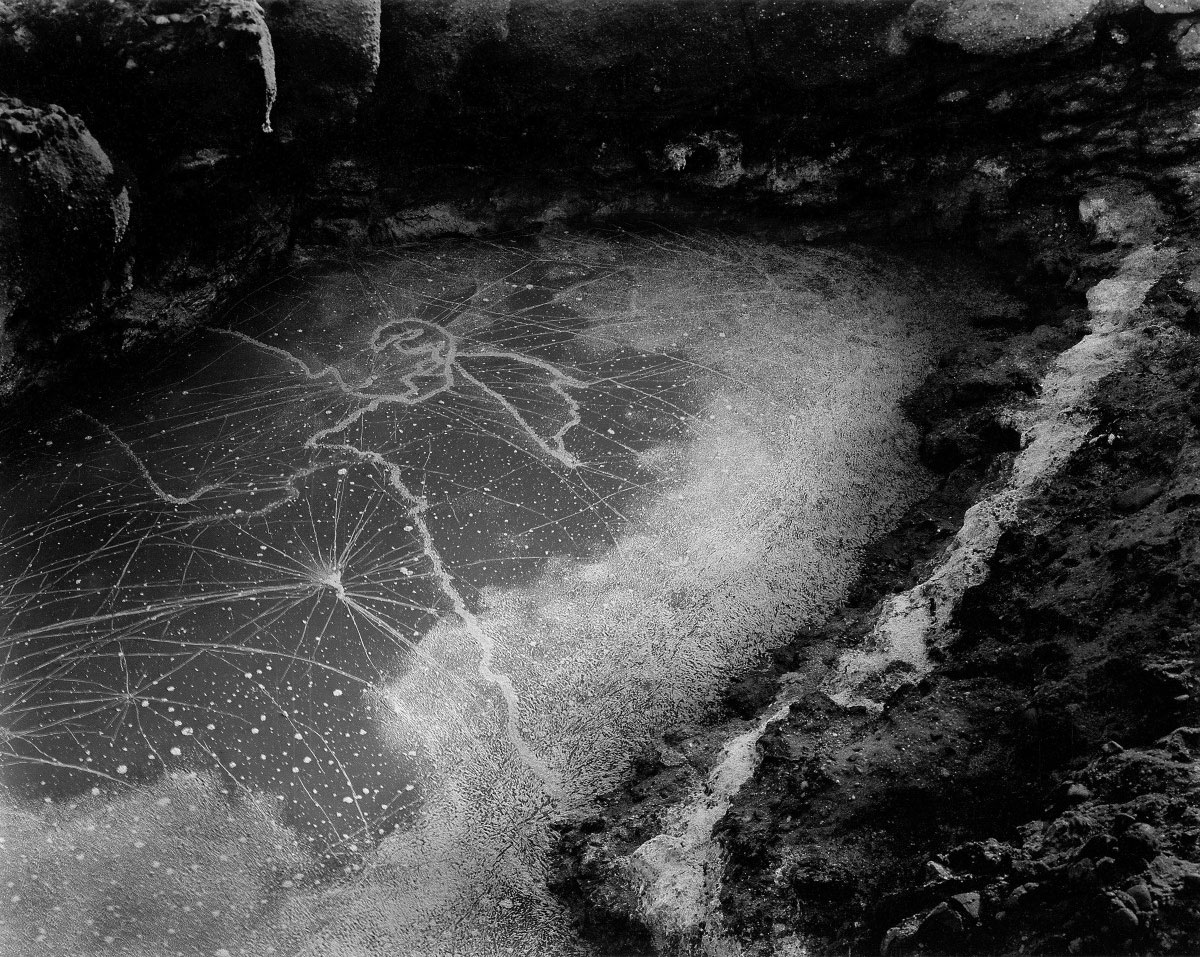
Edward Weston (American, 1886-1958) Kelp on Tide Pool, Point Lobos 1939 The J. Paul Getty Museum, Los Angeles
Rather than depicting a traditionally picturesque vista or capturing accurate perspective, photographers of the 20th century began to explore the various but particularly photographic ways that the natural world could be seen through the camera lens. Often this led to spatial experimentation. Taken at Point Lobos in California, this image by Edward Weston plays with the perception, and misperception, of space. The photographer cropped his photograph of a tide pool to show kelp puncturing the water’s surface in the foreground, while in the upper register an underwater landscape appears simultaneously near and far.
Callahan referred to this photograph, made shortly after an inspiring encounter with Ansel Adams, as “my first good picture.” Unlike Adams’s dramatic landscapes, Callahan’s composition focuses on an overlooked pedestrian setting in his native Detroit. Raising the horizon line, the artist achieved a delicate, calligraphic interplay among the reeds and telephone poles and their reflections across the surface of a bog.
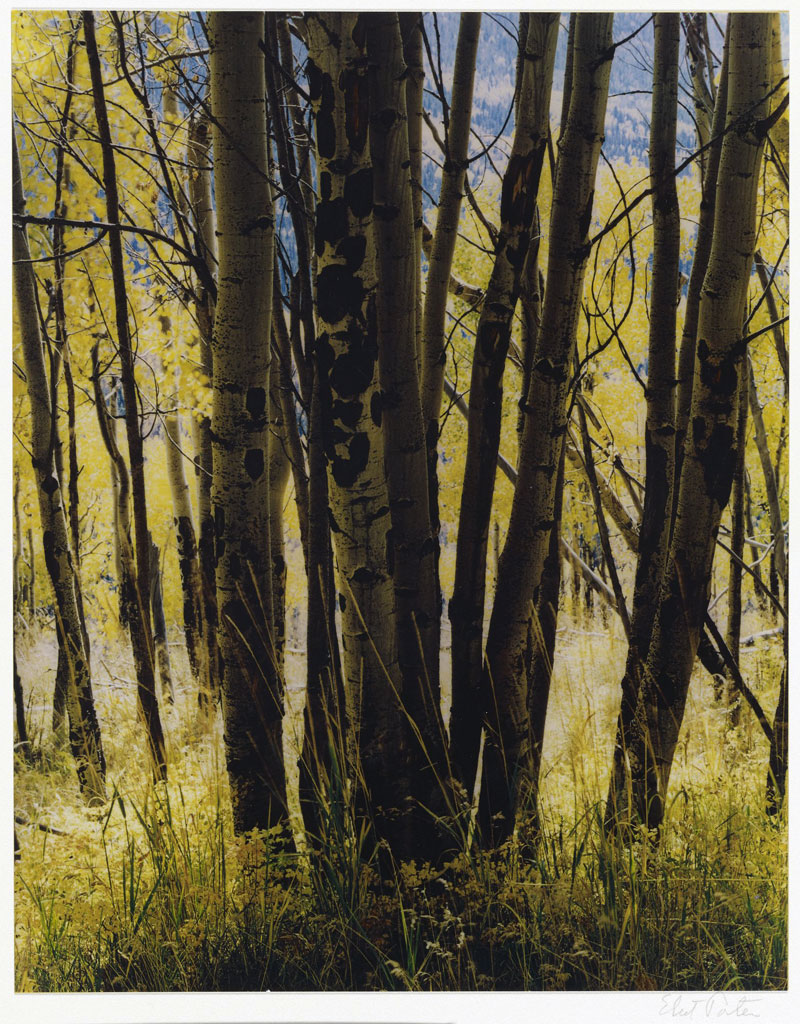
In Focus: Picturing Landscape, at the J. Paul Getty Museum, the Getty Center, May 22 – October 7, 2012, offers a rich trove of landscape photography from some of the most innovative photographers in the genre. Drawn exclusively from the Getty Museum’s permanent collection, the exhibition brings together the work of twenty photographers, spanning the medium from the mid-1800s to the current decade, including Ansel Adams, Robert Adams, Manuel Alvarez Bravo, Imogen Cunningham, William Garnett, John Beasly Greene, Eliot Porter, Clifford Ross, Toshio Shibata and Edward Weston.
“The range of photographs chosen for this exhibition were selected from hundreds of extraordinary landscape works in the Getty Museum’s photography collection with an eye towards the various ways that photographers have responded to the daunting challenge of depicting the natural landscape photographically,” says Karen Hellman, assistant curator, Department of Photographs, the J. Paul Getty Museum, and curator of the exhibition.
Since the invention of the medium, photographers have turned to the landscape as a source of inspiration. Changing artistic movements and continual technical advancements have provided opportunities for camera artists to approach the subject in diverse and imaginative ways. The Getty originally presented In Focus: The Landscape in June 2008, curated by Brett Abbott. Expanding on the first presentation of photographs, this second exhibition on landscape in the Getty Museum’s In Focus series examines how photographers have sought to capture the breadth and perspective of the landscape through a camera lens. The exhibition is organised around three main themes: nineteenth-century technical developments by photographers such as Francis Frith who captured intriguing views of the Egyptian Pyramids in the 1850s; works that show purely photographic approaches such as those by Edward Weston and Harry Callahan; and more recent ways in which photographers have framed the landscape to make environmental and conceptual statements.
One of the earliest works in the exhibition is actually not a photograph but a drawing made by Sir John Frederick Herschel in 1821 with the aid of a camera lucida, an optical device sometimes used as a drawing aid by artists of the period. The exhibition also includes a very early full-plate daguerreotype of a landscape made by Boston dentist Samuel Bemis in 1840. During the first decades of the 20th century, artistic experimentation flourished and tested the boundaries of the genre. Photographers such as Edward Weston and Harry Callahan sought to explore the landscape as abstraction and pure form. In the second half of the 20th century, photographers began to explore the landscape in more socially conscious ways. Eliot Porter devoted himself to publishing work in concert with conservation efforts. Virginia Beahan has delved into the landscape as a site of human history, rather than simply a subject of aesthetic contemplation.
Contemporary artists continue to be inspired by the rich tradition of landscape photography. Also included in the exhibition is a large-scale photograph by Clifford Ross from his 2006 Mountain series, produced from extremely high-resolution digital files in order to make prints that came as close as possible to replicating reality. Several works will be on view for the first time, including a photograph taken in the forest of Fontainebleau, outside of Paris, by Charles Marville in the 1850s, and a photograph from Point Lobos, California, by Wynn Bullock, as well as a work by the Japanese photographer Toshio Shibata acquired with funds from the Getty Museum Photographs Council.
In Focus: Picturing Landscape is the eleventh installation of the ongoing In Focus series of thematic presentations of photographs from the Getty’s permanent collection, and includes twenty-two works by twenty photographers.
Press release from the J. Paul Getty Museum website
Nature and photography have been linked since the inception of the medium. Whether driven by the challenge of capturing the expanse and perspective of a vista or by the myriad possibilities of creating a unique artistic experience, the act of depicting the natural landscape has inspired photographers from the 1800s to the present.
To create this image, photographer William Garnett piloted his plane over sand bars in Cape Cod. In addition to the natural beauty of the ocean, the photographer invites us to explore space and perception in a unique way. The undulating forms of the sandbars play with the boundaries between foreground and background. Changing tones of blue challenge us to know if we look at water, sky, or even a view from outer space.
Here Beahan and McPhee delve into the landscape as a site of human history and conflict. With the High Sierra as a backdrop, rusty remnants of the Manzanar relocation camp, used to detain Japanese Americans during World War II, occupy the foreground. In the middle ground stand the desiccated trunks of an orchard, part of an 1860s settlement that was abandoned after the land’s water was diverted in the 1920s to irrigate Los Angeles. The orchard, in turn, had uprooted a community of Paiute Indians, who had lived there for generations.
A persistent aspect of picturing a landscape has been the concept of the ideal. Recent photographers have framed nature not only to emphasise its beauty but also to highlight its unattainability in a modern context.
Photographer Clifford Ross was inspired to create this image of Mount Sopris while on a family holiday. In order to, as the photographer put it, “grab as much of the mountain as [he] possibly could in one shot,” Ross invented a camera, the R1, which exposes 9 x 18 inch aerial film. When processed by hand and scanned, the negatives produce files with a hundred times higher resolution than those made with the average professional digital camera. Yet even though he pursues a near replica of reality, Ross also manipulates the digital file to re-create the landscape as he remembers experiencing it. Viewers have the ability to examine the scene in greater detail than they might even in person.
The J. Paul Getty Museum 1200 Getty Center Drive Los Angeles, California 90049





![Harry Callahan (American, 1912-1999) '[Detroit]' 1941](https://artblart.com/wp-content/uploads/2012/10/harry-callahan-detroit.jpg "Harry Callahan (American, 1912-1999) '[Detroit]' 1941")



 Art Blart _ art and cultural memory archive
You must be logged in to post a comment.