Exhibition: ‘Hijacked III: Contemporary Photography from Australia and the UK’ at Perth Institute of Contemporary Art (PICA)

Exhibition dates:  18th February – 8th April 2012


Hijacked III Interview with writer Anthony Luvera


The photographs in this posting highlight the conceptual diversity in contemporary art practice and emphasise the talent of the practitioners working today. Just an observation: how serious are the portraits – it’s as if no’body’ is allowed to laugh or smile anymore. Perhaps this is a reflection of the times in which we live, full of malaise, anxiety and little wonder. Fear of being replaced, fear of discrimination, fear of growing up, fear of dying. Or dressed up in a women’s dress and pink hat, having the “courage” or ignorance (the opposite of fear?) to look like a stunned mullet with a blank expression on the face (deadpan photography that I really can’t stand). Or, perhaps, simple effacement: defiance as body becomes mannequin, body hidden behind a mask or completely cloaked from view. These grand photographs have the intensity, perhaps not a lightness of being.

Dr Marcus Bunyan


Many thankx to PICA for allowing me to publish the photographs in the posting. Please click on the photographs for a larger version of the image.


Trish Morrissey (Irish, b. 1967) 'Hayley Coles, June 17th, 2006' 2006


Trish Morrissey (Irish, b. 1967)
Hayley Coles, June 17th, 2006
2006
Courtesy of the artist and Elaine Levy Project, commissioned by Impressions Gallery

Review of Trish Morrissey on Art Blart


Front deals with the notion of borders, boundaries and the edge; using the family group and the beach setting as metaphors. For this work, the artist travelled to beaches in the UK and around Melbourne. There, she approached families and groups of friends who had made temporary encampments, or marked out territories and asked if she could be part of their family temporarily. Morrissey took over the role or position of a woman within that group – usually the mother figure. The artist asked to take the place of the mother figure, and to borrow her clothes. The mother figure then took over the artist’s role and photographed her family using a 4 x 5 camera (which Morrissey had already carefully set up) under the artist’s instruction. While Morrissey, a stranger on the beach, nestled in with the mother figure’s loved ones.

These highly performative photographs are shaped by chance encounters with strangers, and by what happens when physical and psychological boundaries are crossed. Ideas around the mythological creature the ‘shape shifter’ and the cuckoo are evoked. Each piece within the series is titled by the name of the woman who the artist replaced within the group.

Text from the PICA website


Bindi Cole (Australian, b. 1975) 'Ajay' 2009


Bindi Cole (Australian, b. 1975)
Ajay
2009
From the series Sistagirls
Courtesy of Nellie Castan Gallery

Review of Sistagirls on Art Blart


The term ‘Sistagirl’ is used to describe a transgender person in Tiwi Island culture. Traditionally, the term was ‘Yimpininni’. The very existence of the word provides some indication of the inclusive attitudes historically extended towards Aboriginal sexual minorities. Colonisation not only wiped out many Indigenous people, it also had an impact on Aboriginal culture and understanding of sexual and gender expression.

As many traditions were lost, this term became a thing of the past. Yimpininni were once held in high regard as the nurturers within the family unit and tribe much like the Faafafine from Samoa. As the usage of the term vanished, tribes’ attitudes toward queer Indigenous people began to resemble that of the western world and the religious right. Even today many Sistagirls are excluded from their own tribes and suffer at the hands of others.

Text from the PICA website


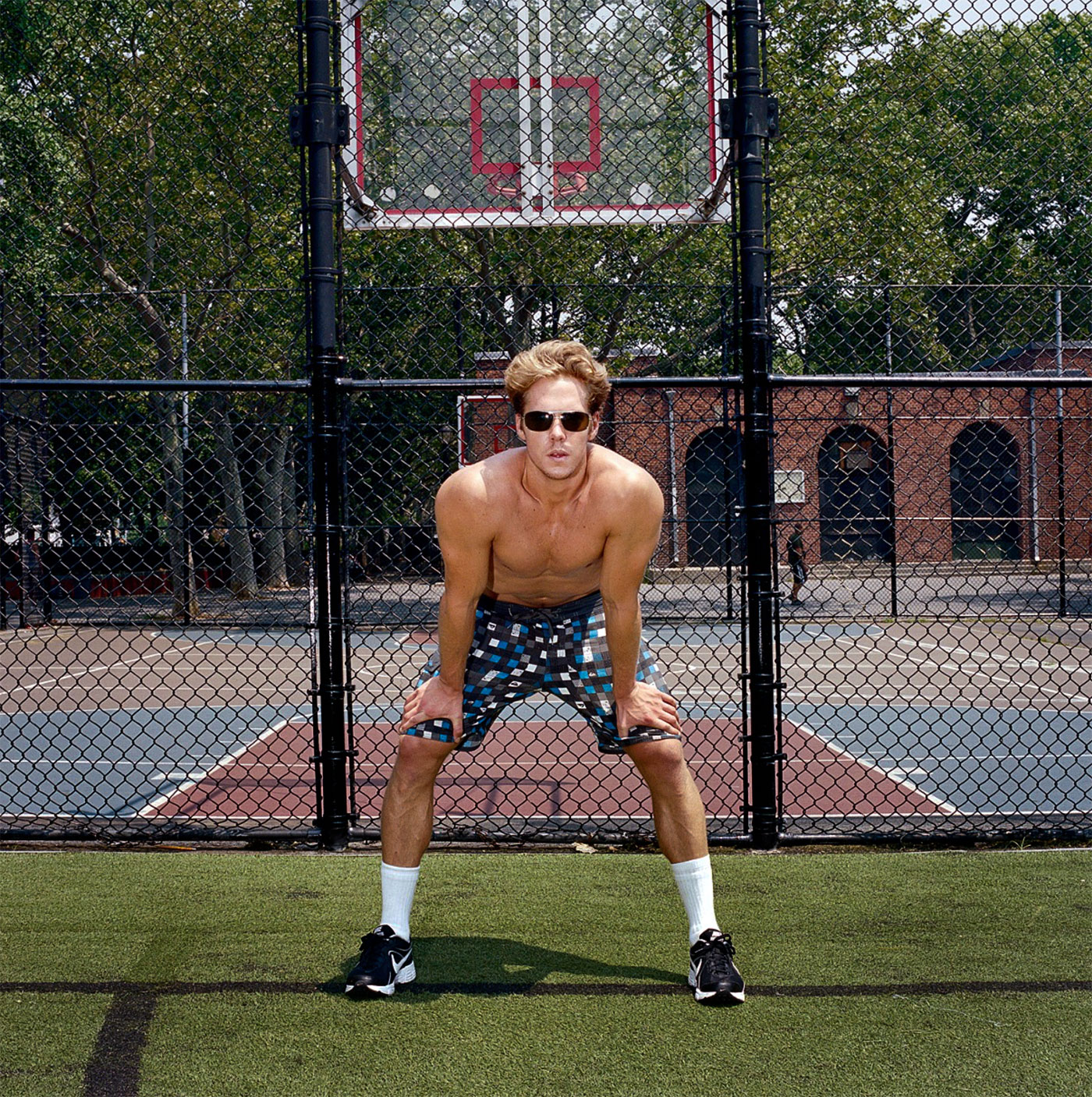
Maciej Dakowicz (Polish, b. 1976) 'Pink Hat, 23:42. Cardiff' 2006


Maciej Dakowicz (Polish, b. 1976)
Pink Hat, 23:42. Cardiff
2006
Courtesy of the artist and Third Floor Gallery


St Mary Street is one of the main streets in central Cardiff, the capital city of Wales; a city as any other in the UK. Unassuming during the day, on weekend nights it becomes the main scene of the city night life, fuelled by alcohol and emotions. Some of Cardiff’s most popular clubs and pubs are located there or in its vicinity. The very popular Chippy Lane, with its numerous chip and kebab shops, is just a stone’s throw away. Sooner or later most party-goers end up in that area, whether looking for another drink, some food or in search of another dance floor.

Everything takes place in this public arena – from drinking, fighting, kissing to crying and sleeping. Supermen chat up Playboy Bunnies, somebody lies on the pavement taking a nap, the hungry ones finish their portions of chips and the policemen stop another argument before it turns into a fight. Nobody seems to worry about tomorrow, what matters is here and now, punctuated by another week at work, until the next weekend rolls around again.

Text from the PICA website


Laura Pannack (British, b. 1985) 'Shay' 2010


Laura Pannack (British, b. 1985)
Shay
2010
Courtesy of the artist
Represented by Lisa Pritchard Agency


What’s so special about this picture are the details. The tattoo – not just what it says but the way it mimics the Nike Swoosh on her shirt – and the cigarette, that although it is not in focus, one imagines has a large line of ash on it, as if time has stopped. This is echoed in the expression on her face, deep intensity and focused on something ahead although the car is obviously stationary. From a distance one could be mistaken that this is an American photograph from the 70s but on closer inspection – the piercing, the Nike Swoosh, the car door handles – one realises that this is contemporary and British. And yet of course that stare is timeless.

Harry Hardie on the Foto8 website [Online] Cited 22/03/2012 no longer available online


Adam Broomberg and Oliver Chanarin. 'Culture3/Sheet72/Frame3' 2011


Adam Broomberg and Oliver Chanarin
Culture3/Sheet72/Frame3
2011
Courtesy of the artists & Paradise Row, London


HIJACKED III interview with PICA curator Leigh Robb


… Artists are notorious for their ability to hijack; meaning to stop and hold up, to seize control by use of force in order to divert or appropriate, a deliberate attempt to action a change of direction.

Hijacked III: Contemporary Photography from Australia the UK draws on the success and unique energy of Hijacked I (Australia and USA) and Hijacked II (Australia and Germany), to once again bring together two geographically distant but historically connected communities through a range of diverse photographic practices.

This exhibition will be simultaneously presented across two sites: PICA in Perth, Western Australia and QUAD Gallery in Derby, United Kingdom, and has been timed to coincide with the launch of the luscious, full colour and 420 page Hijacked III compendium, published by Big City Press. Utilising portraiture, digital collage, archival images, documentary snap shots, internet grabs and refined photographic tableaux, the 24 artists and over 120 works in this exhibition explore themes as diverse as curious weekend leisure pursuits, gender politics and displaced Indigenous culture.

Artists: Tony Albert, Warwick Baker, Broomberg & Chanarin, Natasha Caruana, Bindi Cole, Maciej Dakowicz, Christopher Day, Melinda Gibson, Toni Greaves, Petrina Hicks, Alin Huma, Seba Kurtis, David Manley, Tracey Moffatt, Trish Morrissey, Laura Pannack, Sarah Pickering, Zhao Renhui, Simon Roberts, Helen Sear, Justin Spiers, Luke Stephenson, Christian Thompson, Tereza Zelenkova, Michael Ziebarth.

Press release from PICA website


Sarah Pickering (British, b. 1972) 'Land mine' 2005


Sarah Pickering (British, b. 1972)
Land mine
2005
Courtesy of the artist and Meessen De Clercq, Brussels


The Explosion pictures document the literal theatre of war – the detailed level of artifice used to prepare men and women for combat on the front lines. They also reveal the minutiae of packaging war as entertainment. The beauty of the pictures lies in their perverse seductiveness, and this attraction underscores the distance most of us have from real combat.

Pickering’s Explosion images, by distilling an aspect of the war that is a fiction, question the reliability of seemingly objective historical accounts, such as news reports and photographs that influence how war is communicated and remembered. By extension they question how we come to know what we know about it. We learn about war from a variety of sources, from history books, first-hand accounts, news media, and movies, all of which can get confused and merged in our minds as memory.

The dual purpose of the explosives – training and re-enacting – forms a fitting parallel to how we cope with trauma, a process of both anticipation and reconciliation.”

Sarah Pickering website


Simon Roberts (British, b. 1974) 'We English No. 56' 2007


Simon Roberts (British, b. 1974)
We English No. 56
2007

More Simon Roberts We English on Art Blart


Simon Roberts travelled across England in a motorhome between 2007 and 2008 for this portfolio of large-format tableaux photographs of the English at leisure. We English builds on his first major body of work, Motherland (2005), with the same themes of identity, memory and belonging resonating throughout. Photographing ordinary people engaged in diverse pastimes, Roberts aims to show a populace with a profound attachment to its local environment and homeland. He explores the notion that nationhood – that what it means to be English – is to be found on the surface of contemporary life, encapsulated by banal pastimes and everyday leisure activities. The resulting images are an intentionally lyrical rendering of a pastoral England, where Roberts finds beauty in the mundane and in the exploration of the relationship between people and place, and of our connections to the landscapes around us.

Text from the Simon Roberts website
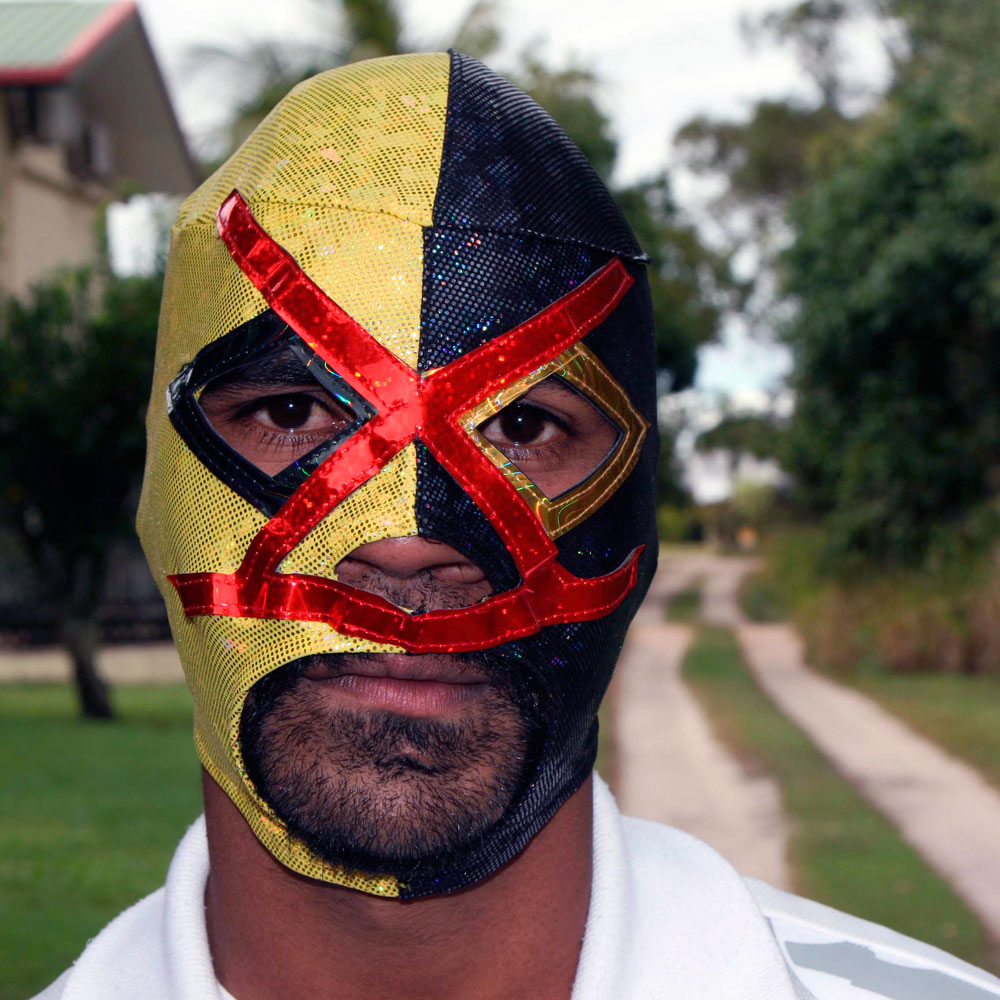
 

Tony Albert (Australian, b. 1981) 'No Place' 2009


Tony Albert (Australian, b. 1981)
No Place
2009
Courtesy of the artist


Tony Albert is a Girramay rainforest man from the Cardwell area… The No Place series references The Wizard of Oz ‘there’s no place like home’. For No Place Tony returns to his tropical paradise home with a group of Lucho Libre wrestling masks from Mexico. His family adorn these masks and again become warriors protecting their paradise. These seemingly playful masks share much with Aboriginal and particularly rainforest culture. Body and shield designs from this area represent animal gods or spirit beings. The use of these masks brings a prescient new layer of armour for a new generation of warrior.

The colour scheme of solid blocks of red, black and yellow also speak to traditional rainforest aesthetics. There are strong elements of the sublime and the fantastical within these works. Viewing Aboriginal people in iconic north Queensland locations masked in Mexican wrestling paraphernalia carries more than a hint of the surreal and absurd.

Anon. “Tony Albert and No Place,” on the Big Art website, 2010 [Online] Cited 22/03/2012 no longer available online


Christian Thompson (Australian / Bidjara, b. 1978) 'Untitled #7 from the King Billy Series' 2010


Christian Thompson (Australian / Bidjara, b. 1978)
Untitled #7 from the King Billy series
2010
Courtesy of the artist and Gallery Gabrielle Pizzi


King Billy, is an ode to his great great grandfather, King Billy of Bonnie Doon Lorne. The initial inspiration was a photograph of King Billy, standing alone wearing his ‘name plate’. Despite its colonial overtones, for Thompson, this image of the senior tribesman exudes wisdom and kindness and reminds him of his father. In much of Thompson’s work his processes are intuitive, he delves into a rich dream world and draws out fabulous images. He manifests his own mythological world. In this series his figures are clad in fabrics patterned with Indigenous motifs, mainly cheap hoodies in lurid colours; a modern / ancient skin for a magic youth culture. He has made a triptych, three views of a pink hooded figure spewing cascading pearl stands from the face; opulent, decadent, excessive and sensual.

Another image shows a crowned figure swathed in fabrics bearing the markings of various clans, perhaps indicating the domain of this regal form. In the hands a (poisoned?) chalice – the sawn off plastic bottle a warning about petrol sniffing? His self-portrait as psychedelic godhead/Carnaby Street dandy / flower child is spectacular and arresting. He is wearing a tailored suit, patterned with more Indigenous motifs and he cradles a bouquet. His skin is green and his eyes are purple flowers. What can this otherworldly creature tell us?

Thompson seems to emphasise a theme of disparity in this work; the ‘hoodie’ with the cascading pearls, the crown with the plastic bottle, the opulence with the desperate. These works are both beautiful and confronting.

Text from the PICA website


HIJACKED III interview with Christian Thompson


Petrina Hicks (Australian, b. 1972) 'Emily the Strange' 2011


Petrina Hicks (Australian, b. 1972)
Emily the Strange
2011
Courtesy of the artist and Stills Gallery


Petrina Hicks’ Beautiful Creatures appeals to our senses. Immediately alluring, the large-scale, hyper-real photographs, are all rendered so clearly and with such control they are reminiscent of advertisements. But with a series of little ruptures, within images and between them, Hicks disrupts our usually beguiled response to such artistry. For her, photography’s capability to both create and corrupt the process of seduction and consumption is of endless interest.

Hicks loads her images with history and associations but denies us a clear message. Along with the ambiguity, there is a visceral quality in these new works; her depiction of flesh, hair and veins stops the viewer short of being lulled into consumption. Hicks engages a playful yet confronting approach to confound our expectations. A cat, naked without fur, in the image Sphynx, contrasts a beautiful blonde with a face full of it in Comfort. In Emily the Strange the hairless creature reappears with a young girl whose piercing green eyes, skin-pink dress, and latent defiance, make her eerily akin to her pet. Alluded to, in the title of the exhibition, this duality is present in much of the work. Her subjects are not simply beautiful or simply creatures.

Text from the PICA website


HIJACKED III interview with photographer Petrina Hicks


Tereza Zelenkova (Czech, b. 1985) 'Cadaver' 2011


Tereza Zelenkova (Czech, b. 1985)
Cadaver
2011
Courtesy of the artist


Luke Stephenson (British, b. 1983) 'Diamond Sparrow #1' 2009


Luke Stephenson (British, b. 1983)
Diamond Sparrow #1
2009
Courtesy of the artist


Stephenson finds birds and the world surrounding them wonderfully fascinating. The birds he has photographed all belong to avid bird breeders who on the whole have been keeping birds their whole lives. It’s a hobby people generally don’t come into contact with, unless you are active within it. The artist does not keep birds but finds them beautiful in all their variations and colours, so has set out capture these birds in a way that would show them at their best.

There are many criteria to breeding a prize-winning bird, from shape and form to its pattern, and this is something Stephenson has tried to convey whilst also attempting to show some of their personalities. He set out to photograph every breed of bird within the ‘hobby’ of keeping birds but soon realised there were thousands of variations, so decided to keep this as an ongoing project; realising instalments every couple of years which people can collect and, hopefully one day, the dictionary will be complete.

Luke Stephenson website


Perth Institute of Contemporary Art (PICA)
Perth Cultural Centre
James Street Northbridge
Phone: + 61 (0) 8 9228 6300

Opening hours:
Tuesday – Sunday 10am – 5pm
Closed Mondays
PICA website

LIKE ART BLART ON FACEBOOK

Back to top

Review: The work of Robyn Hosking, ‘AT_SALON’ at Anita Traverso Gallery, Richmond

Exhibition dates: 6th March – 24th March 2012


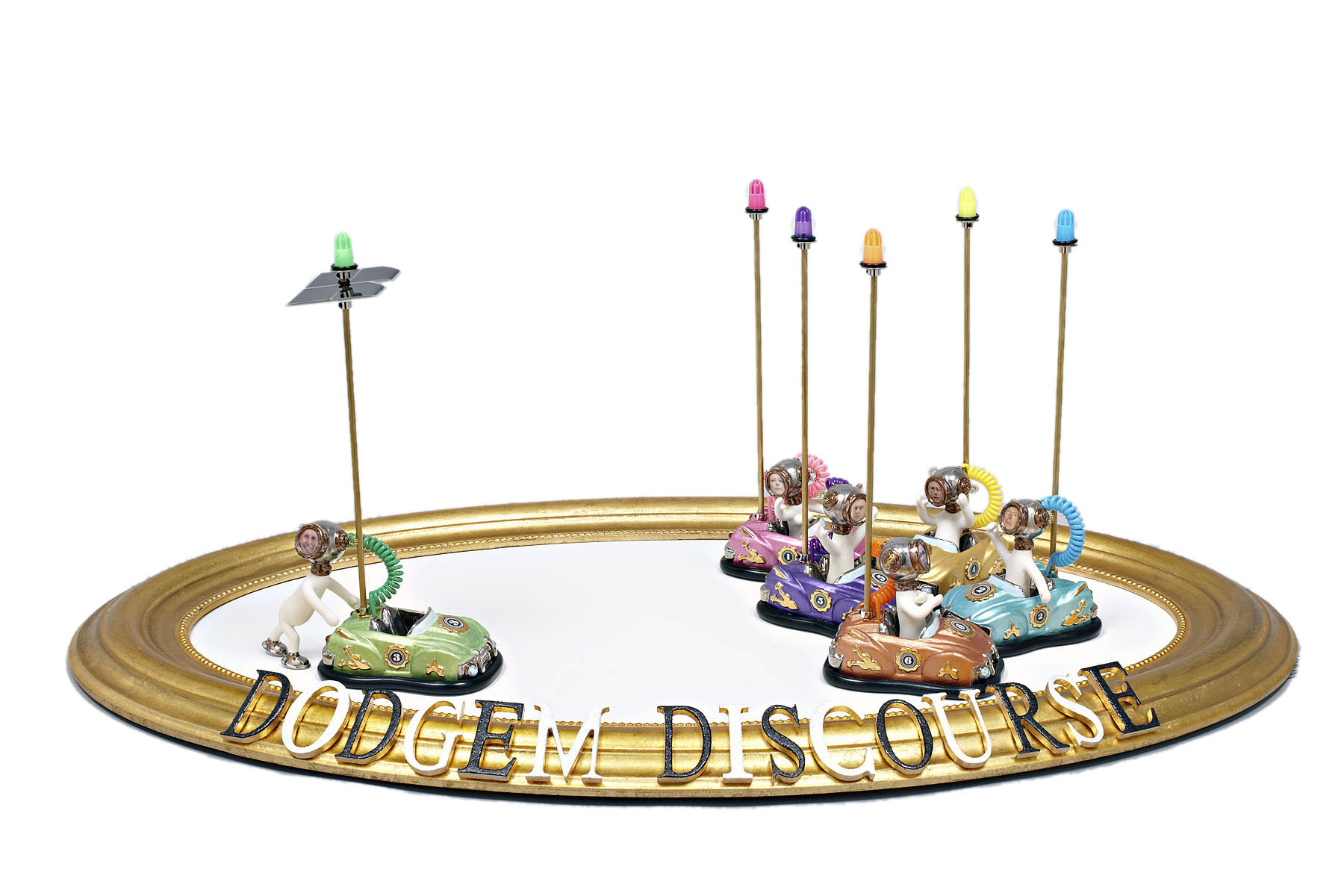
Robyn Hosking (Australian, b. 1948) 'Dodgem Discourse' 2011


Robyn Hosking (Australian, b. 1948)
Dodgem Discourse
2011
Mixed media


Although not the first to promote the concept, Anita Traverso Gallery must be congratulated for exhibiting nine unrepresented emerging and mid-career artists in the AT_SALON exhibition program. This inaugural exhibition features hand-picked artists practicing over a variety of media including ceramics, textiles, drawing, painting and photography allowing them to exhibit in a professional gallery environment which bridges the gap between artist-run spaces and full gallery representation.

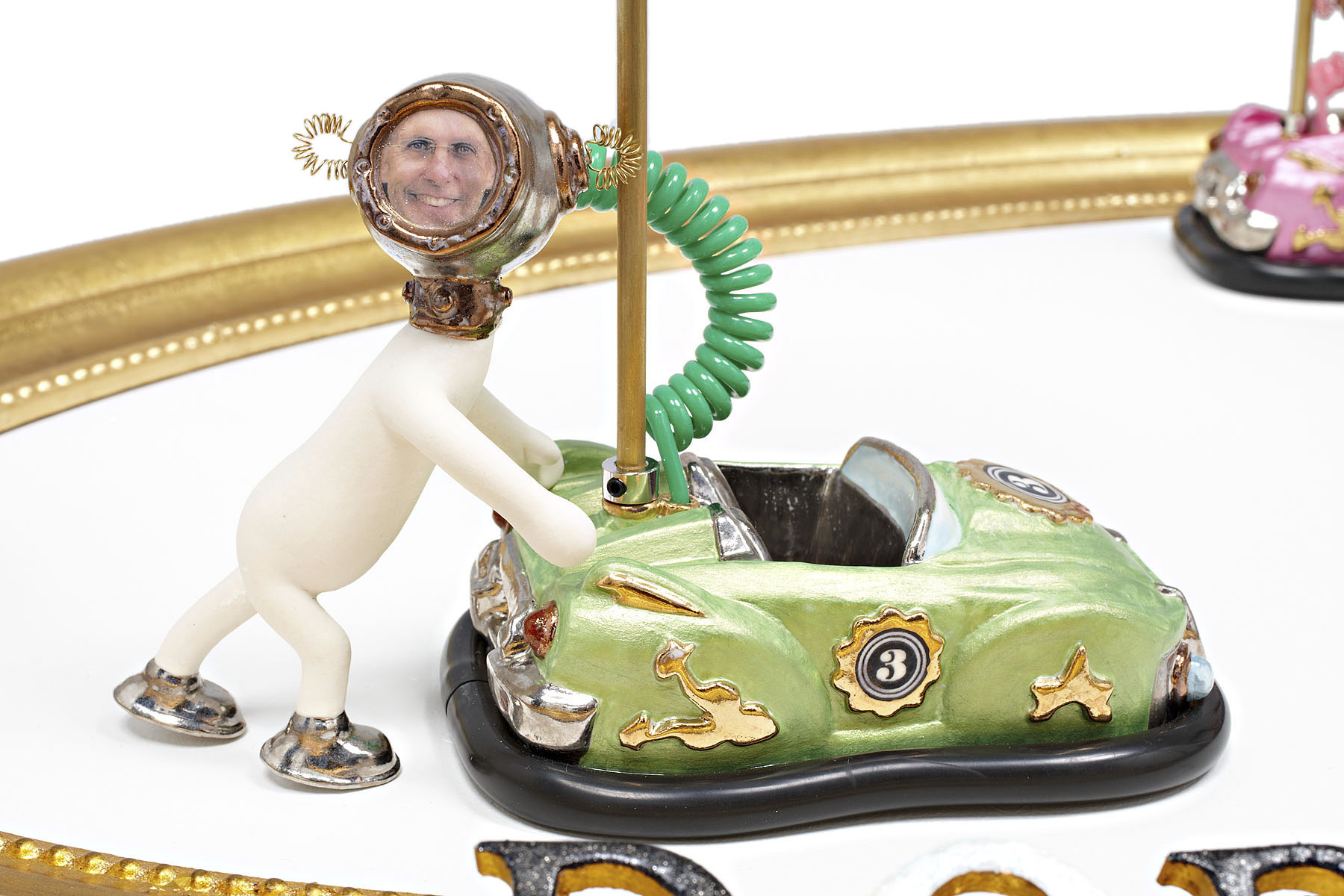
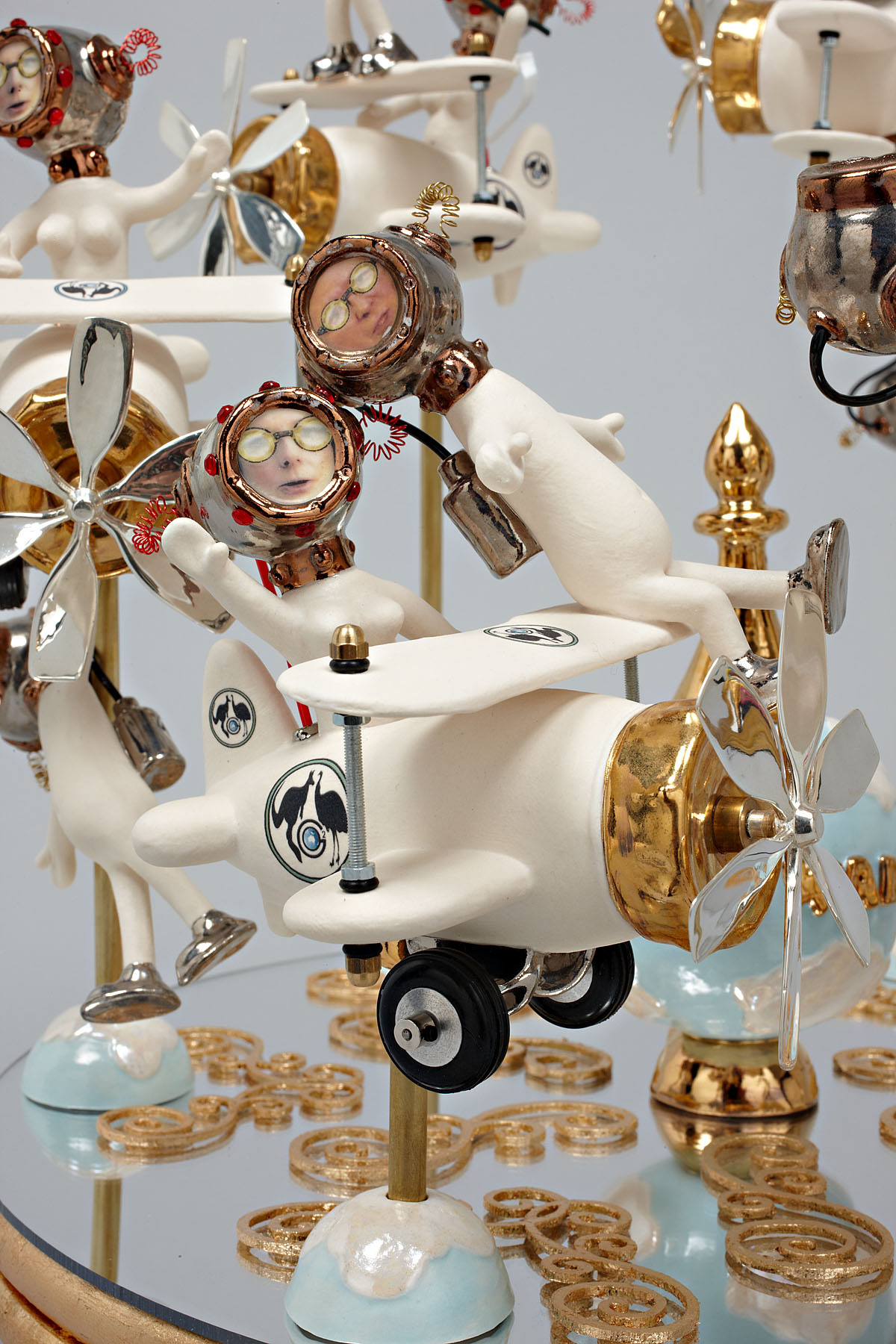
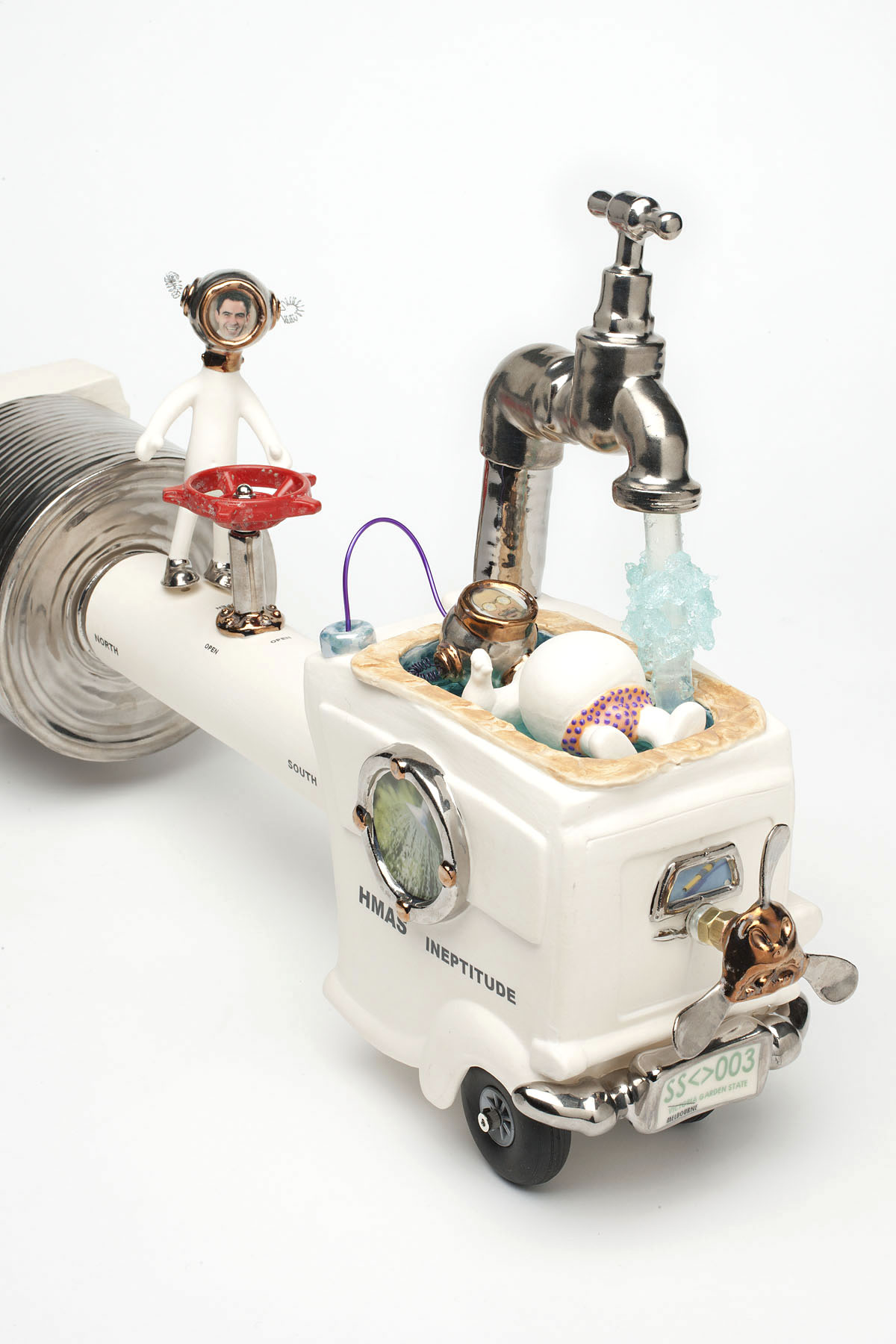
Out of the nine artists it was the hilarious work of Robyn Hosking that was the standout for me. While guffaw inducing one couldn’t help but be entranced by these waggish, chimerical creations and wonder at their technical brilliance. Every detail, every nuance is meticulously observed and the sculptures are beautifully made (mostly using glazed ceramics). Every observation on contemporary politics, war and beauty regimes is concisely conceptualised and executed with panache and humour. For example, in the work Dodgem Discourse (2011) Senator Bob Brown, leader of the Australian Greens, is the only diver figure not to be in his dodgem car while everyone else is bashing into each other, having got out to push his car because the solar power has failed. What you cannot see in the photograph is that the lights atop the dodgem poles flash on and off on every other car except his! While Julia Gillard’s car is emblazoned with the number 1 on its side, another gem is that the number plates say “Question Time” referring to question time in Parliament, but also a double entendre as the viewer questions the supposed wisdom of our elected officials.

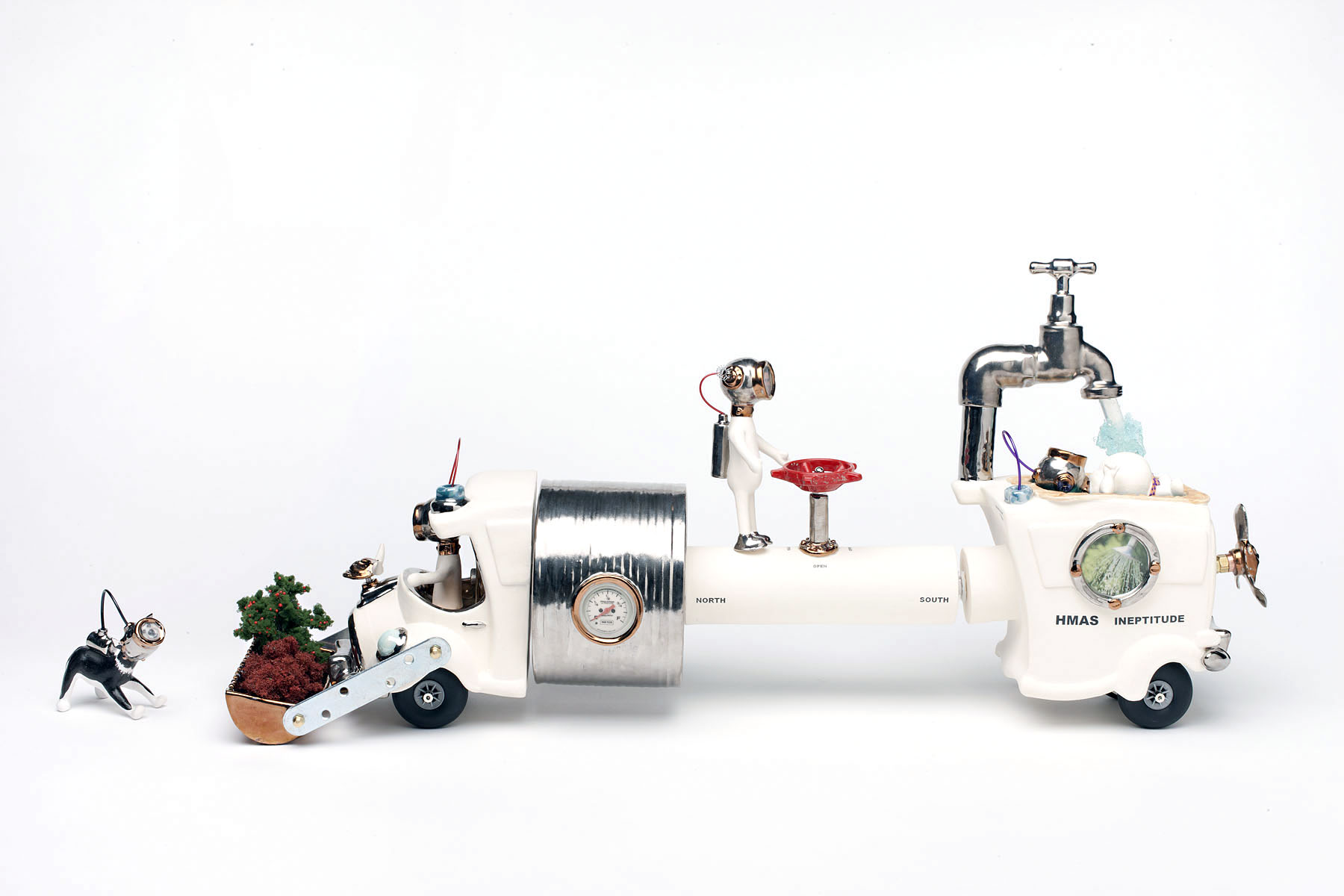
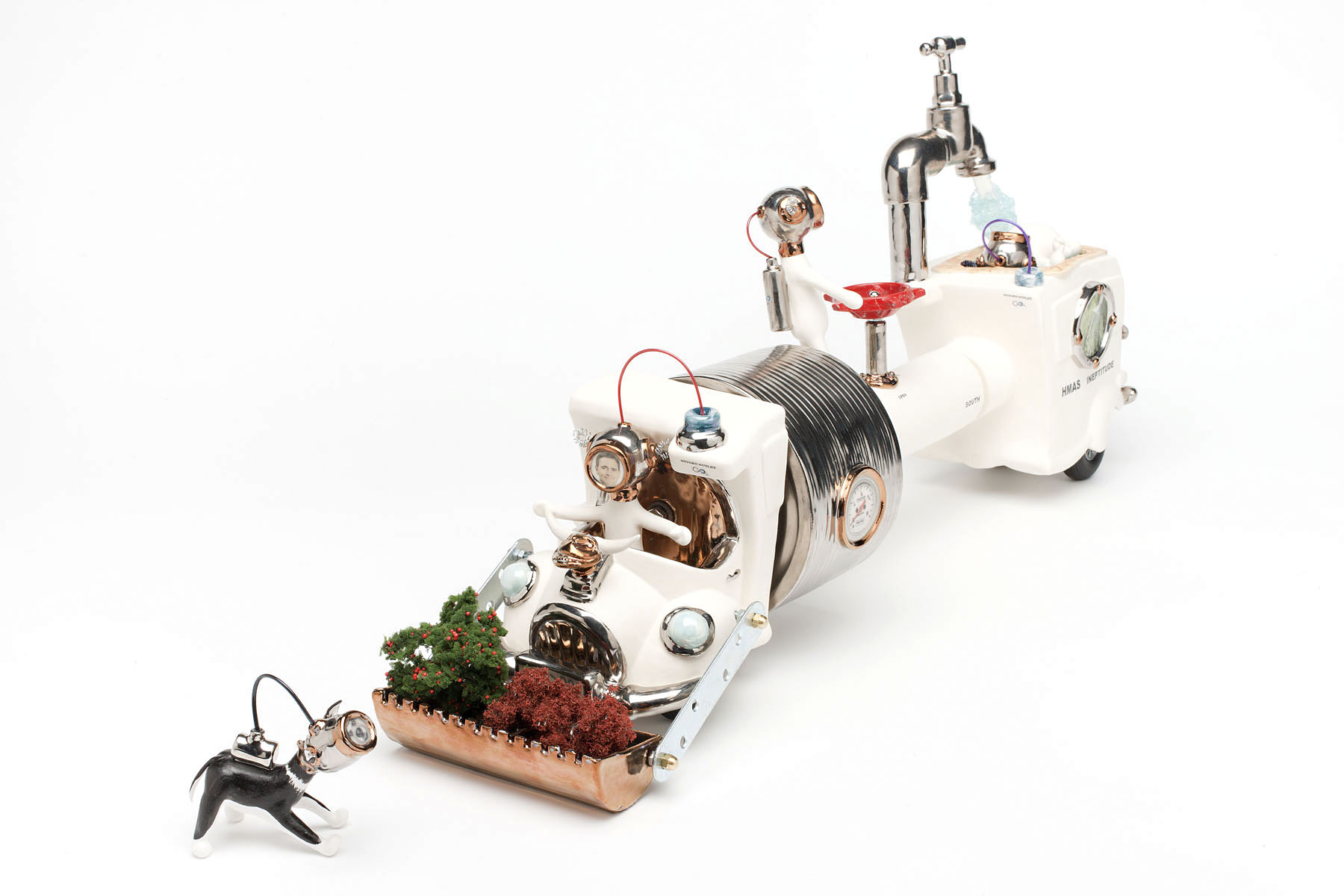
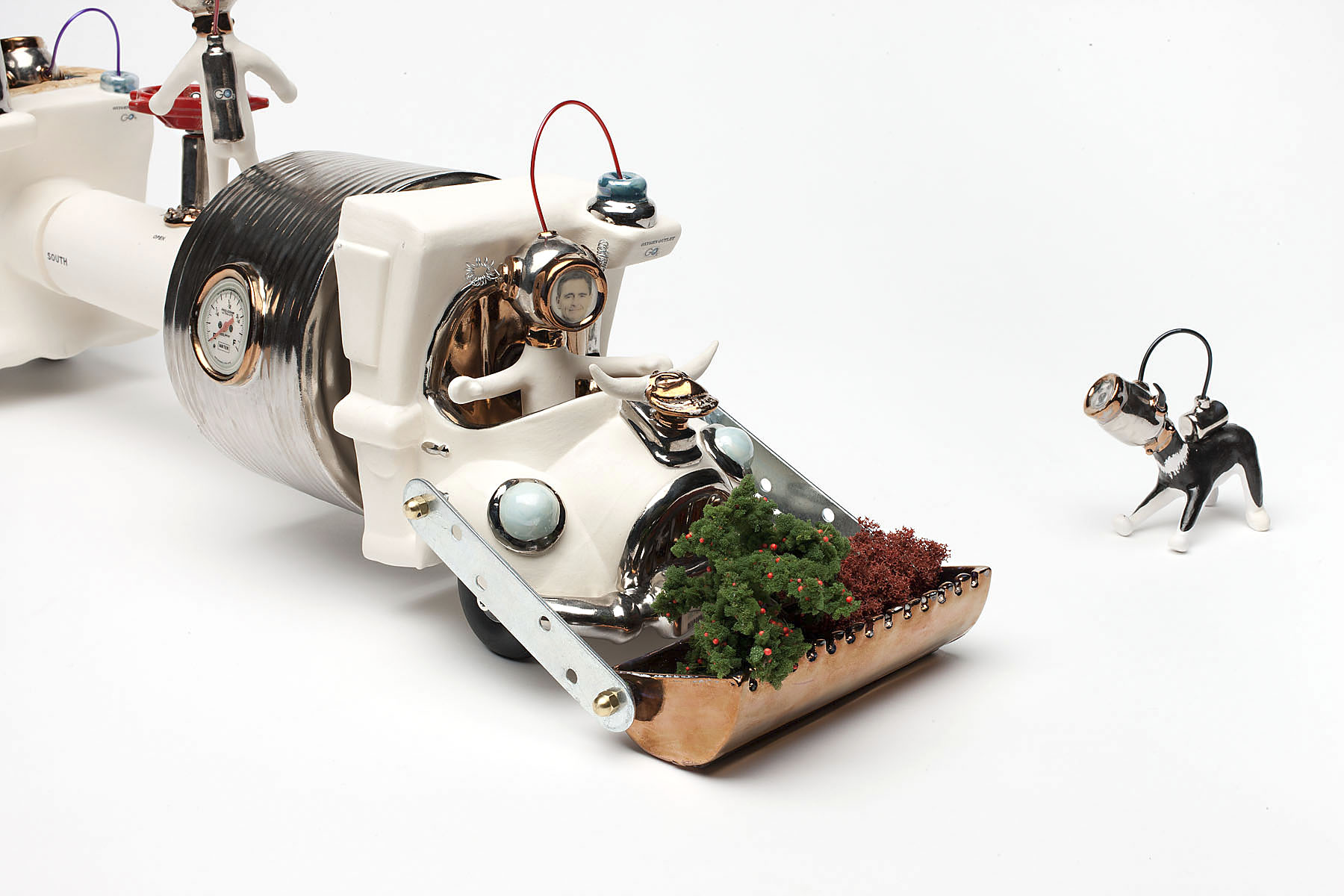
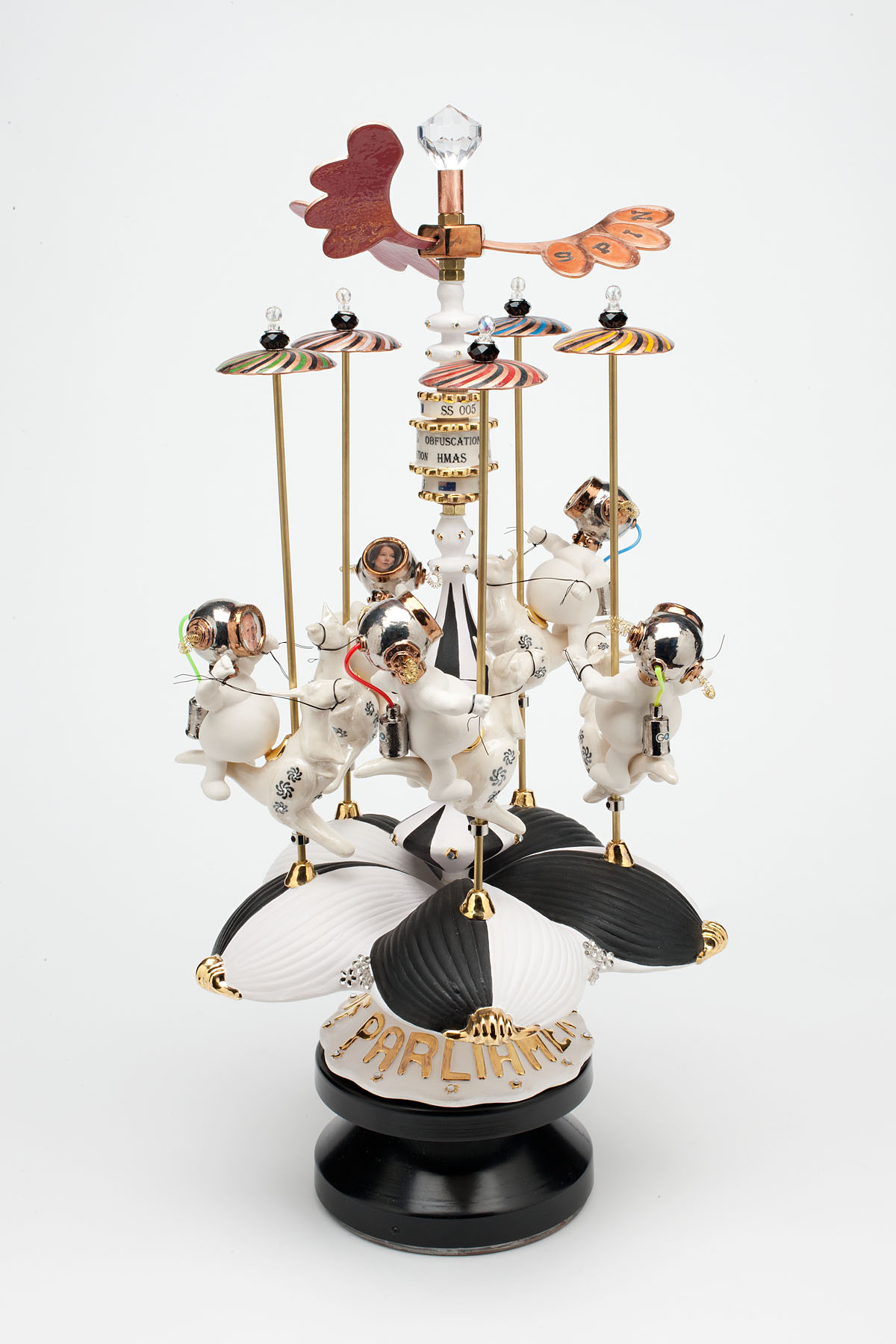
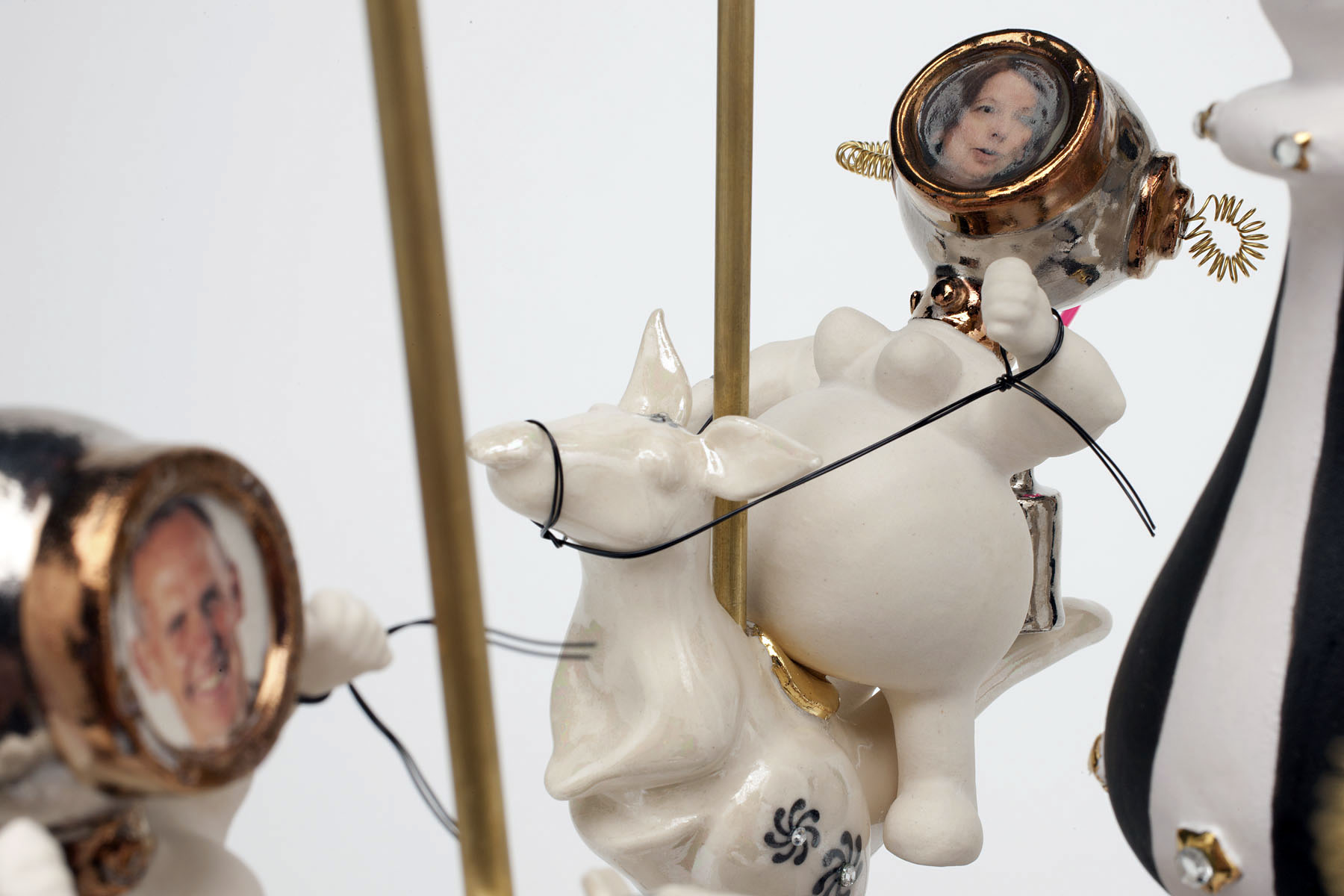
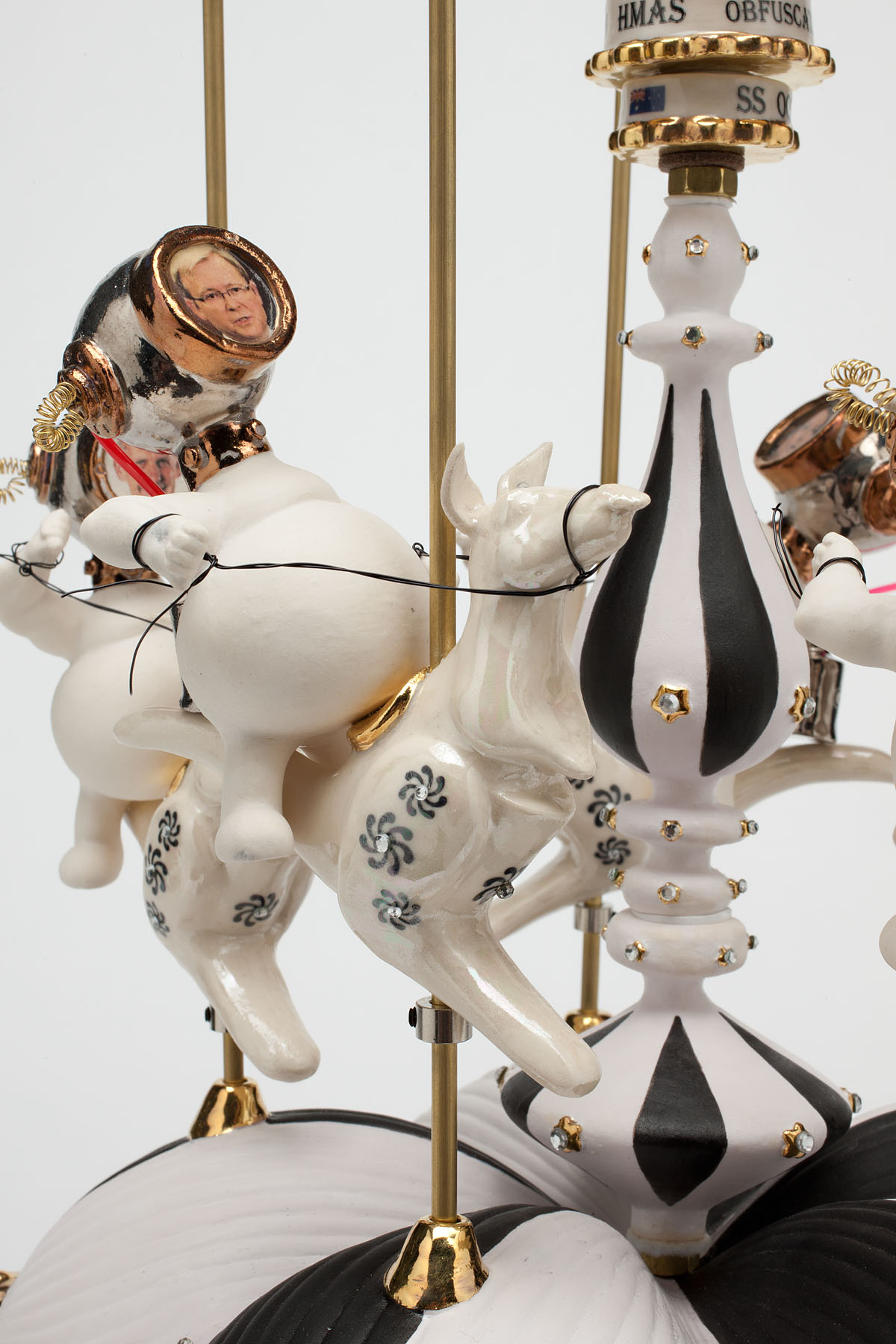
HMAS Ineptitude (2011) assiduously comments on the white elephant that is the North South pipeline while the slowly revolving HMAS Obfuscation (2011) – how I love that word: the hiding of intended meaning in communication, making communication confusing, wilfully ambiguous – spins the SPIN, spelt out on the wing-like form at the top of the sculpture, on the machinations of our politicians who are mounted on rearing ceramic kangaroos with the large, gold lettered word PARLIAMENT on the base. Profound, amusing and beautifully made.

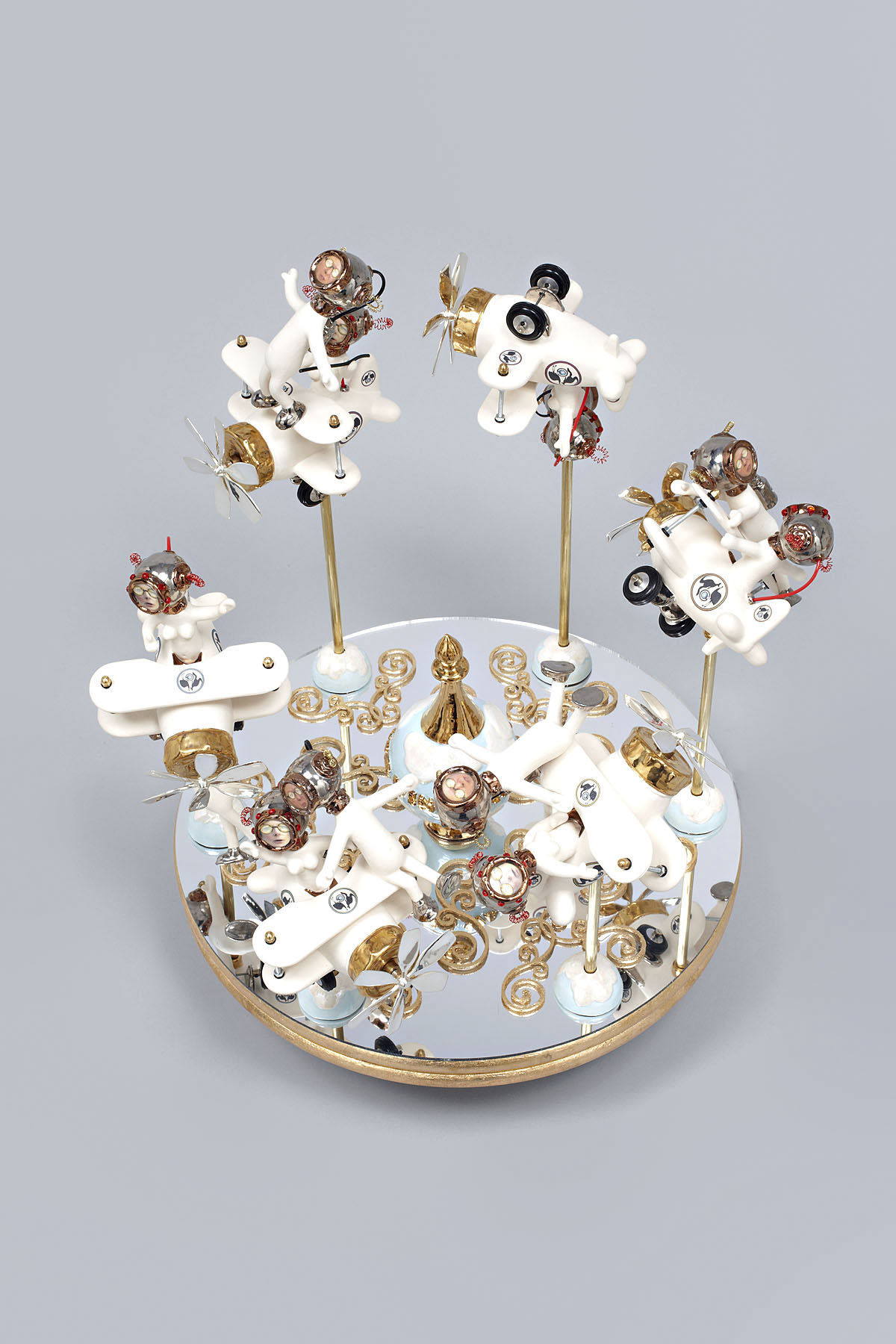
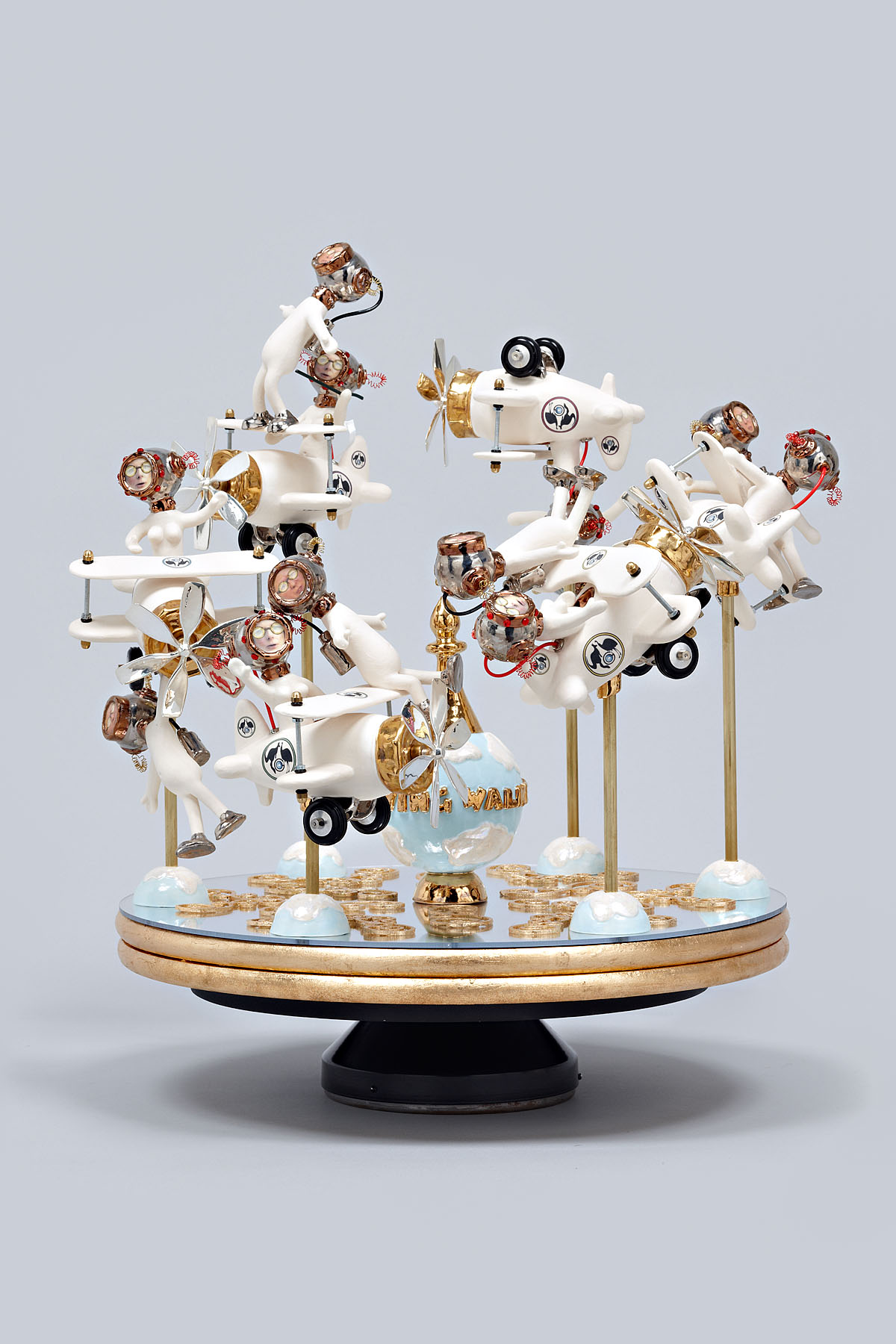
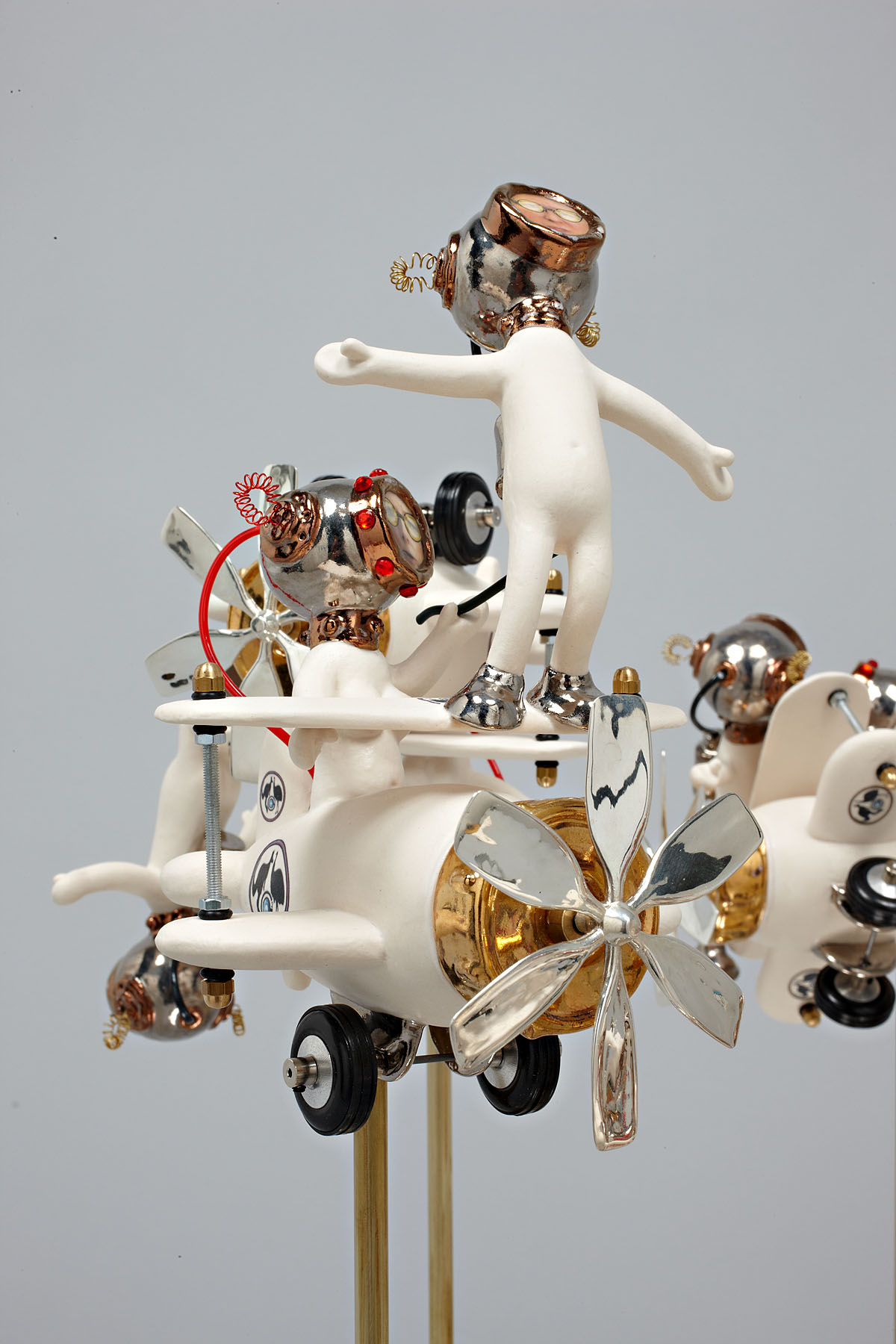
My favourite has to be The Wing Walker (2011) as an irate Julia Gillard tries to get rid of Kevin Rudd once and for all, even poking him with a stick to push him off the edge of the biplane. Balanced on a slowly revolving turntable with the world at its centre, this political merry-go round is panacea for the soul for people sick of politicians. This is brilliant political satire. The planes are all ends up and even when Julia thinks she has got rid of Kevin there he is, hanging on for dear life from the undercarriage of one of the planes. Priceless…

Reminding me of the fantasy creatures of Tom Moore, these whimsical manifestations deal with serious, life changing and challenging issues with purpose, feeling and a wicked sense of humour. I really enjoyed this art (and joy is the correct word) because it takes real world issues, melds fantasy and pointed observation and reflects it back, as the artist observes, in a funfair’s distorted mirror. Magic!

Dr Marcus Bunyan


Many thankx to Anita for allowing me to publish the photographs in the posting. Please click on the photographs for a larger version of the image.


Robyn Hosking (Australian, b. 1948) 'Dodgem Discourse' 2011 (detail)


Robyn Hosking (Australian, b. 1948)
Dodgem Discourse (detail)
2011
Mixed media


Robyn Hosking (Australian, b. 1948) 'The Wing Walker' 2011

Robyn Hosking (Australian, b. 1948) 'The Wing Walker' 2011


Robyn Hosking (Australian, b. 1948)
The Wing Walker
2011
Mixed media


Robyn Hosking (Australian, b. 1948) 'The Wing Walker' 2011 (detail)

Robyn Hosking (Australian, b. 1948) 'The Wing Walker' 2011 (detail)


Robyn Hosking (Australian, b. 1948)
The Wing Walker (detail)
2011
Mixed media


Robyn Hosking Artist Statement

My work launches a humorous, freewheeling attack on our desensitisation to the white noise and emptiness surrounding us. Looking like a hybrid between art, machine and toy, my sculptures maintain a circus-like sense of amusement and curiosity for the viewer, all the while sending up societal norms and politics.

I like to celebrate the lavishly eccentric design of past eras and the sense of possibility it embodied. As hackneyed as it sounds, a Brave New World is upon us, stranger perhaps than our imaginations can conceive of. While my work casts a disparaging eye at the use of technology for inane and selfish reasons – from Botox to weaponry – it retains a playful, humorous edge. I am not interested in producing depressingly macabre images. Every work becomes a caricature or parody, as though the world is being viewed in a funfair’s distorted mirror.


Robyn Hosking (Australian, b. 1948) 'HMAS Ineptitude' 2011

Robyn Hosking (Australian, b. 1948) 'HMAS Ineptitude' 2011


Robyn Hosking (Australian, b. 1948)
HMAS Ineptitude
2011
Mixed media


Robyn Hosking (Australian, b. 1948) 'HMAS Ineptitude' 2011 (detail)

Robyn Hosking (Australian, b. 1948) 'HMAS Ineptitude' 2011 (detail)


Robyn Hosking (Australian, b. 1948)
HMAS Ineptitude (detail)
2011
Mixed media


Robyn Hosking (Australian, b. 1948) 'HMAS Obfuscation' 2011


Robyn Hosking (Australian, b. 1948)
HMAS Obfuscation
2011
Mixed media


Robyn Hosking (Australian, b. 1948) 'HMAS Obfuscation' 2011 (detail)

Robyn Hosking (Australian, b. 1948) 'HMAS Obfuscation' 2011 (detail)


Robyn Hosking (Australian, b. 1948)
HMAS Obfuscation (detail)
2011
Mixed media


Anita Traverso Gallery

Anita Traverso Gallery website

LIKE ART BLART ON FACEBOOK

Back to top

marcus bunyan black and white archive: self-portraits and nudes, 1991-1992

January 2012


Marcus Bunyan (Australian, b. 1958) 'Self-portrait in Punk Jacket' 1991-1992


Marcus Bunyan (Australian, b. 1958)
Self-portrait in Punk Jacket
1991-1992
Silver gelatin print


I am scanning my negatives made during the years 1991-1997 to preserve them in the form of an online archive as a process of active memory, so that the images are not lost forever. These photographs were images of my life and imagination at the time of their making, the ideas I was thinking about and the people and things that surrounded me.

Dr Marcus Bunyan


All images © Marcus Bunyan. Please click the photographs for a larger version of the image; remember these are just straight scans of the negatives !

Photographs are available from this series for purchase. As a guide, a vintage 8″ x 10″ silver gelatin print costs $700 plus tracked and insured shipping. For more information please see my Store web page.


Marcus Bunyan (Australian, b. 1958) 'Marcus Sucking His Thumb' 1991-1992


Marcus Bunyan (Australian, b. 1958)
Marcus Sucking His Thumb
1991-1992
Silver gelatin print


Marcus Bunyan (Australian, b. 1958) 'Marcus in his Punk Jacket, Punt Road, South Yarra' 1991-1992


Marcus Bunyan (Australian, b. 1958)
Marcus in his Punk Jacket, Punt Road, South Yarra
1991-1992
Silver gelatin print


Marcus Bunyan (Australian, b. 1958) 'Marcus as The Fool (posing for the sculptor Fredrick White)' 1991-1992


Marcus Bunyan (Australian, b. 1958)
Marcus as The Fool (posing for the sculptor Fredrick White)
1991-1992
Silver gelatin print


Marcus Bunyan (Australian, b. 1958) 'Nude, in the Flat, Rear of Derelict House, 455, Punt Road, South Yarra' 1992


Marcus Bunyan (Australian, b. 1958)
Nude, in the Flat, Rear of Derelict House, 455, Punt Road, South Yarra
1992
Silver gelatin print


Marcus Bunyan (Australian, b. 1958) 'Self-portrait, nude with the mural 'Two boys on a car'' 1992


Marcus Bunyan (Australian, b. 1958)
Self-portrait, nude with the mural ‘Two boys on a car’
1992
Silver gelatin print


Marcus Bunyan (Australian, b. 1958) 'Nude on Floor (with Clifford Last)' 1992


Marcus Bunyan (Australian, b. 1958)
Nude on Floor (with Clifford Last)
1992
Silver gelatin print


Marcus Bunyan (Australian, b. 1958) 'Nude on Couch, Punt Road, South Yarra' 1992


Marcus Bunyan (Australian, b. 1958)
Nude on Couch, Punt Road, South Yarra
1992
Silver gelatin print


Marcus Bunyan (Australian, b. 1958) 'Nude on Couch, Punt Road, South Yarra' 1992


Marcus Bunyan (Australian, b. 1958)
Nude on Couch, Punt Road, South Yarra
1992
Silver gelatin print


Marcus Bunyan (Australian, b. 1958) 'Nude on Couch, Punt Road, South Yarra' 1992


Marcus Bunyan (Australian, b. 1958)
Nude on Couch, Punt Road, South Yarra
1992
Silver gelatin print


Marcus Bunyan (Australian, b. 1958) 'Nude on Couch, Punt Road, South Yarra' 1992


Marcus Bunyan (Australian, b. 1958)
Nude on Couch, Punt Road, South Yarra
1992
Silver gelatin print


Marcus Bunyan (Australian, b. 1958) 'Self-portrait, reflection' 1992


Marcus Bunyan (Australian, b. 1958)
Self-portrait, reflection
1992
Silver gelatin print


Marcus Bunyan black and white archive 1991-1997

LIKE ART BLART ON FACEBOOK

Back to top

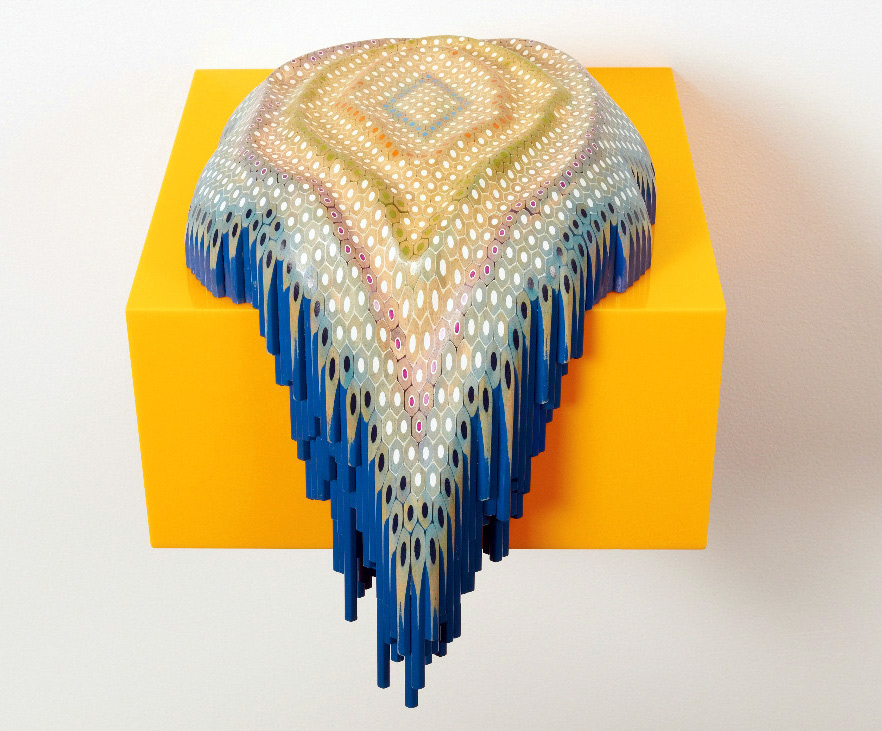
Review: ‘Lionel Bawden: Pattern spill’ at Karen Woodbury Gallery, Richmond

Exhibition dates: 23rd November – 17th December 2011


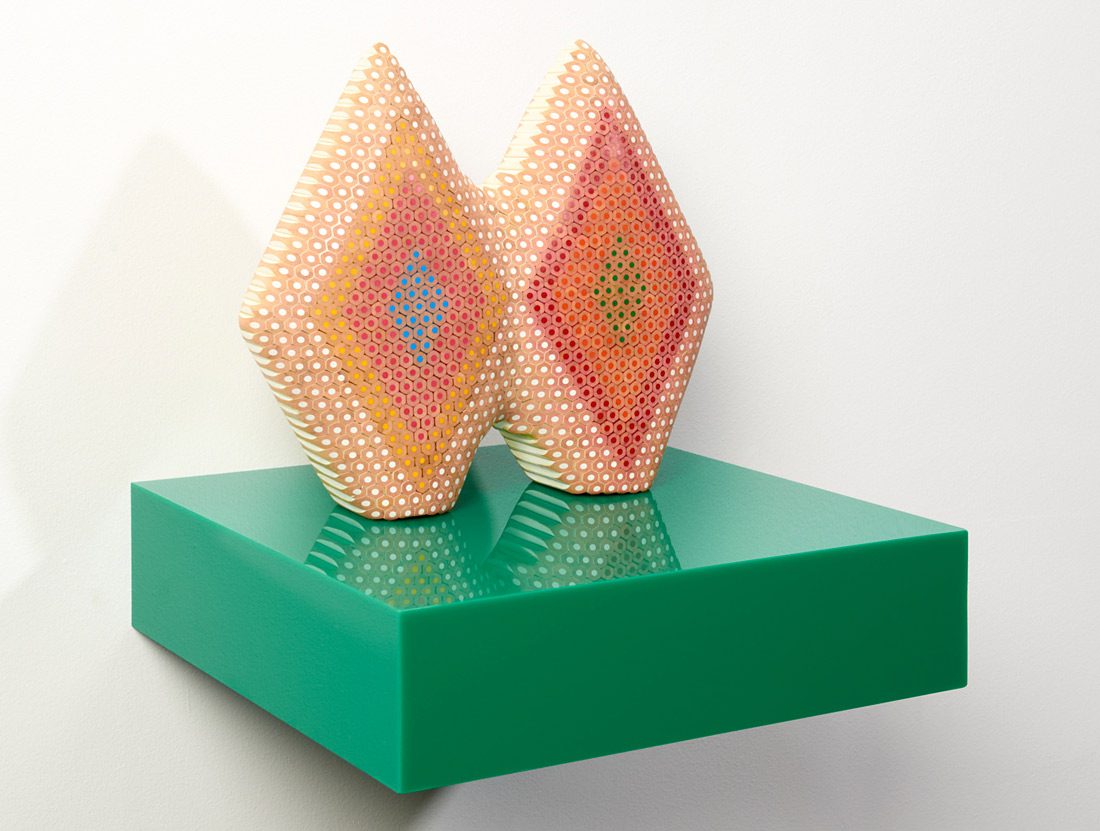
Lionel Bawden (Australian, b. 1974) 'Double Vision' 2011


Lionel Bawden (Australian, b. 1974)
Double Vision
2011
Coloured Staedtler pencils, epoxy, incralac on perspex shelf
Form: 23 x 26 x 7cm
Shelf: 7.5 x 30 x 30cm


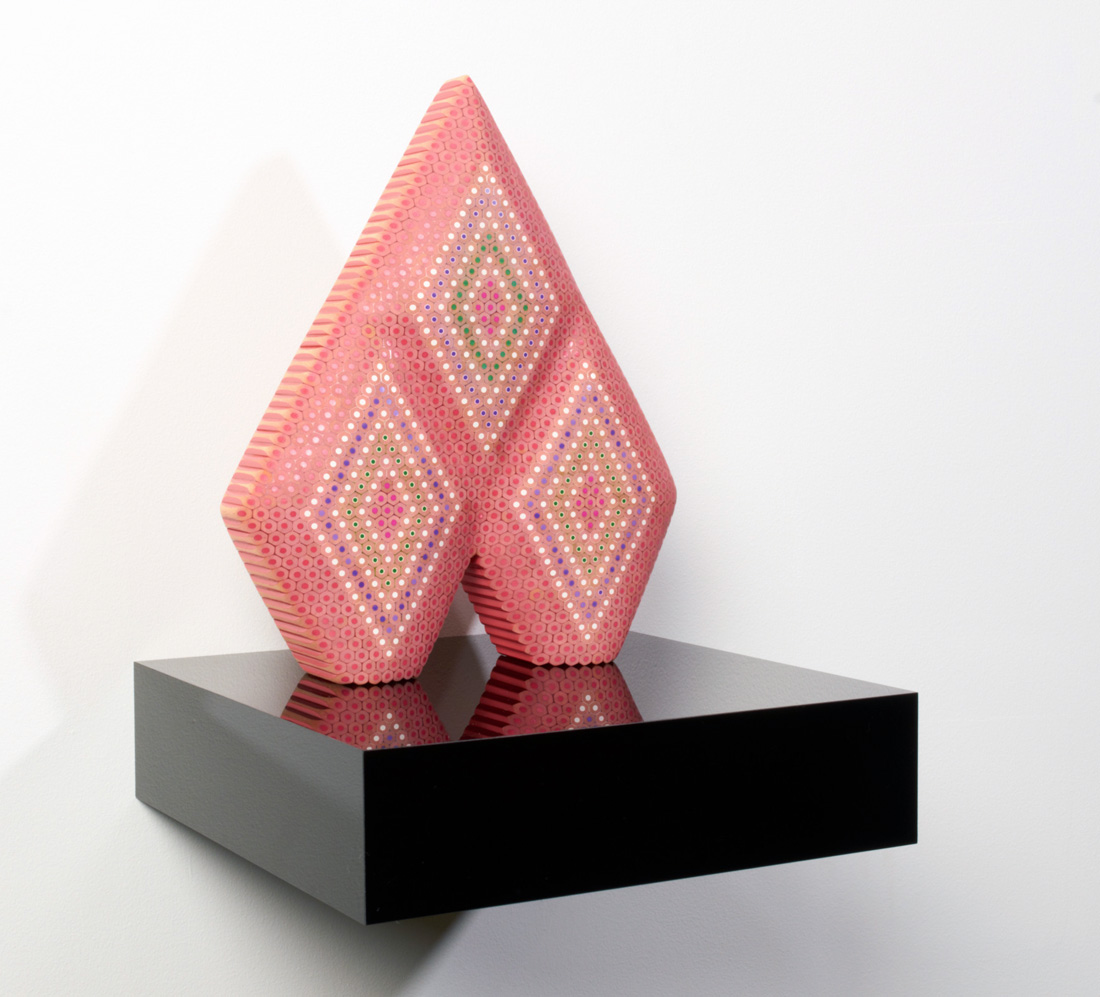
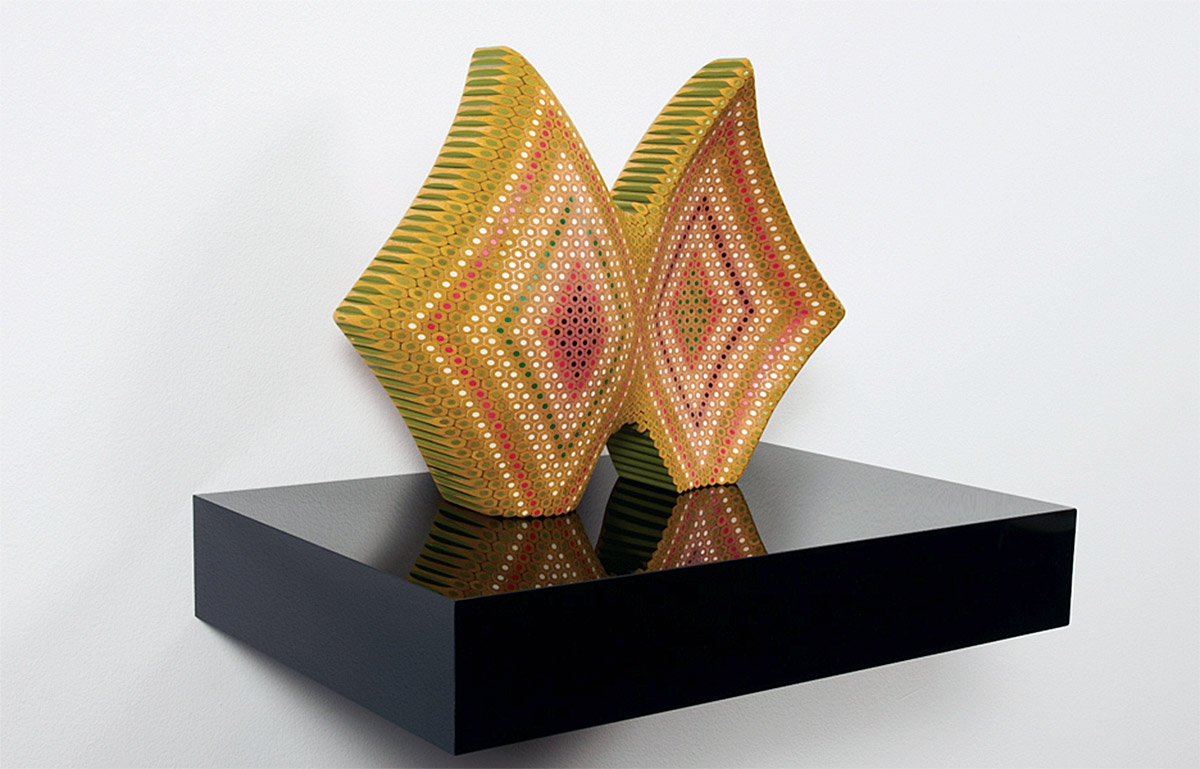
In the self contained world of commercial “art to go” galleries, this exhibition is the apotheosis of that form. The work is astonishingly beautiful, refined and self contained. Drawing on references to Islamic art, Brancusi (Endless Column), stalactites, wafting sea sponges and the changeable camouflage patterns of sea creatures, the sculptures are perfect in visualisation, creation, contemplation and containment.

Sitting on coloured perspex shelves the patterns spills of coloured Staedtler pencils explore “themes of flux, transformation and repetition as preconditions to our experience of the physical world.” The titles of the work hint at such an exploration: Double VisionTrance-muterSecretionLosing Containment, Pattern Spill.

How I wish, long, crave to own one and I am not alone: on the opening night nearly all the sculptures were already sold! Obviously people recognise the uniqueness and beauty of this work.

And yet …


Part of               me

longs
for    a
      broken
pencil,
a
snapped           t/wig,
something
                                           out of place
that puts
pattern to
shame.


For only in mutation is pattern given relevance (and this is what the irregularity of ‘spill’ is supposed to be about). The flow of the Pattern Spill sculptures are the only ones that get close to this mutation and that in a pretty, ordered way.

“What happens in the case of mutation? Consider the example of the genetic code. Mutation normally occurs when some random event (for example, a burst of radiation or a coding error) disrupts an existing pattern and something else is put in its place instead. Although mutation disrupts pattern, it also presupposes a morphological standard against which it can be measured and understood as mutation … Mutation is critical because it names the bifurcation point at which the interplay between pattern and randomness causes the system to evolve in a new direction…

The randomness to which mutation testifies is implicit in the very idea of pattern, for only against the background of nonpattern can pattern emerge. Randomness is the contrasting term that allows pattern to be understood as such.”1


Instead of pattern “something else is put in its place instead.” I don’t get that here. Yes, these are beautiful, contemplative sculptures but one wonders how they will go on revealing themselves over months and years. I yearn for the prick of their imperfection.

Dr Marcus Bunyan


1/ Hayles, Katherine. How We Became Posthuman: Virtual Bodies in Cybernetics, Literature, and Informatics. Chicago: University of Chicago Press, 1999, pp.30-33.


Many thankx to Karen Woodbury Gallery for allowing me to publish the photographs in the posting. Please click on the photographs for a larger version of the image.


Lionel Bawden (Australian, b. 1974) 'Trance-muter' 2011


Lionel Bawden (Australian, b. 1974)
Trance-muter
2011
Coloured Staedtler pencils, epoxy, incralac on perspex shelf
Form: 32 x 26 x 7.5cm
Shelf: 7.5 x 30 x 30cm


Lionel Bawden (Australian, b. 1974) 'Secretion' 2011


Lionel Bawden (Australian, b. 1974)
Secretion
2011
Coloured Staedtler pencils, epoxy, incralac on perspex shelf
Form: 31 x 25 x 17cm
Shelf: 7.5 x 45 x 30cm


Lionel Bawden (Australian, b. 1974) 'Flipside' 2011


Lionel Bawden (Australian, b. 1974)
Flipside
2011
Coloured Staedtler pencils, epoxy and incralac on perspex shelf
28 x 33 x 13cm
Image courtesy Karen Woodbury Gallery and the artist


Lionel Bawden (Australian, b. 1974) 'Crossing the mirror' 2011


Lionel Bawden (Australian, b. 1974)
Crossing the mirror
2011
Coloured Staedtler pencils, epoxy and incralac on perspex shelf
29.8 x 24.7 x 16.5cm
Image courtesy Karen Woodbury Gallery and the artist


Lionel Bawden (Australian, b. 1974) 'Losing Containment' 2011


Lionel Bawden (Australian, b. 1974)
Losing Containment
2011
Coloured Staedtler pencils, epoxy, incralac on perspex shelf
Form 1: 31.5 x 24 x 12cm
Form 2: 33.5 x 33 x 26cm
Shelf: 15 x 120 x 30cm


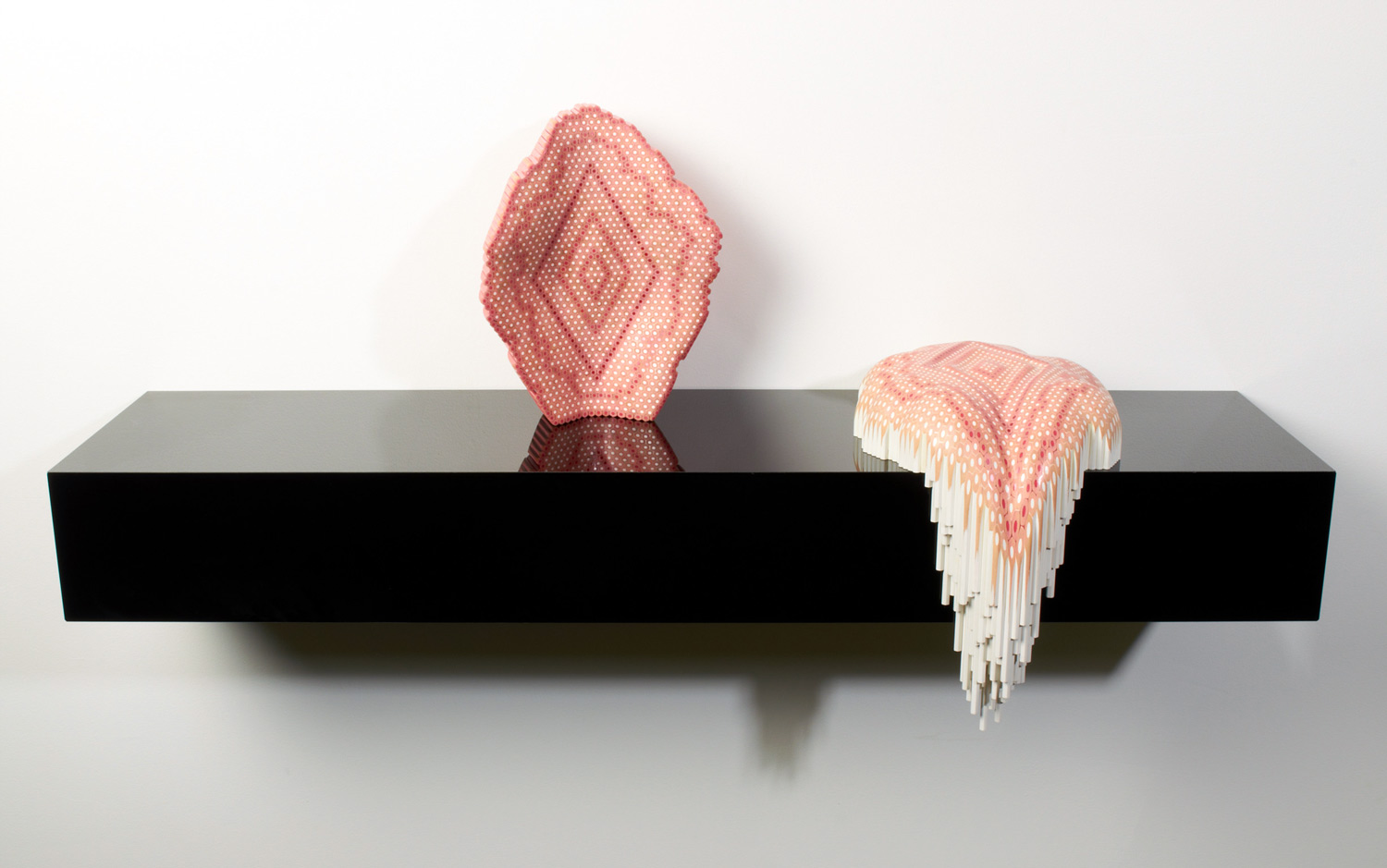
Lionel Bawden (Australian, b. 1974) 'The caverns of temporal suspension (between two sites)' 2011


Lionel Bawden (Australian, b. 1974)
The caverns of temporal suspension (between two sites)
2011
White Staedtler pencils, epoxy and incralac
45.5 x 63.5 x 8.0cm
Image courtesy Karen Woodbury Gallery and the artist


Lionel Bawden’s exhibition Pattern Spill will comprise of a range of small-scale objects created from vibrantly coloured pencils that are fused and sculpted together. By working with hexagonal coloured pencils as a sculptural material, Bawden is able to reconfigure and carve a range of amorphous shapes that convey movement and process. Bawden explores themes of flux, transformation and repetition as preconditions to our experience of the physical world.

This new body of work deals with ideas of control and collapse, surface and interior and organic patterns and energies through static three-dimensional objects. Bawden’s sculptures explore larger ideas beyond the work and relate to societal and natural systems, cycles and structures. Through his work, Bawden communicates macro ideas through micro detail. The works in Pattern spill become vessels for contemplation.

Alongside the sculptures there will also be a range of small meticulous drawings of vast hexagonal cells included in the exhibition. These drawings will act as companions to the sculptures, assisting to convey Bawden’s oblique explorations and meditations of the human condition.

Text from the Karen Woodbury Gallery website


Lionel Bawden (Australian, b. 1974) 'Pattern spill' 2014


Lionel Bawden (Australian, b. 1974)
Pattern spill
2014
Coloured Staedtler pencils, epoxy and incralac on perspex shelf
34 x 27 x 29cm
Image courtesy Karen Woodbury Gallery and the artist


Lionel Bawden (Australian, b. 1974) 'Pattern Spill' 2011


Lionel Bawden (Australian, b. 1974)
Pattern Spill
2011
Coloured Staedtler pencils, epoxy, incralac on perspex shelf
Form: 30 x 23.5 x 33cm
Shelf: 15 x 30 x 30cm


Lionel Bawden (Australian, b. 1974) 'Patttern Spill III' 2011


Lionel Bawden (Australian, b. 1974)
Patttern Spill III
2011
Coloured Staedtler pencils, epoxy, incralac on perspex shelf
Form: 31 x 23 x 34cm
Shelf: 15 x 30 x 30cm


Lionel Bawden (Australian, b. 1974) 'Secretion III' 2011


Lionel Bawden (Australian, b. 1974)
Secretion III
2011
Coloured Staedtler pencils, epoxy, incralac on perspex shelf
Form: 35 x 26.5 x 15cm
Shelf: 15 x 30 x 30cm


Lionel Bawden (Australian, b. 1974) 'Elevation' 2011


Lionel Bawden (Australian, b. 1974)
Elevation
2011
Coloured Staedtler pencils, epoxy, incralac on perspex shelf
Form: 42.5 x 15 x 7cm
Shelf: 7.5 x 30 x 30cm


Karen Woodbury Gallery

This gallery has now closed.

LIKE ART BLART ON FACEBOOK

Exhibition: ‘Bill Henson: early work from the MGA collection’ at the Anne & Gordon Samstag Museum of Art, Adelaide

Exhibition dates: 14th October – 16th December 2011


Many thankx to the Anne & Gordon Samstag Museum of Art for allowing me to publish the photographs in the posting. Please click on the photographs for a larger version of the image.


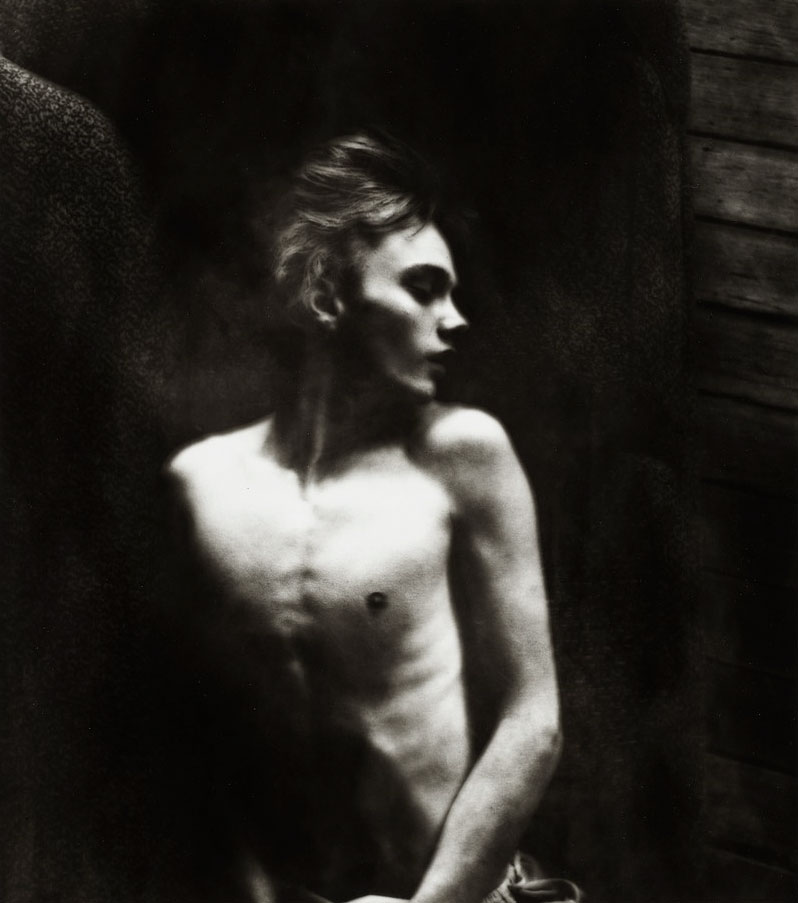
Bill Henson (Australian, b. 1955) 'Untitled 1977/78' 1977-1978


Bill Henson (Australian, b. 1955)
Untitled 1977/78
1977-1978
From the Untitled sequence 1977/78 series 1977-1978
From a series of 16 gelatin silver print
Monash Gallery of Art, City of Monash Collection
Donated by James Mollison AO through the
Australian Government’s Cultural Gifts Program 2008


Untitled 1977 is a series of black-and-white photographs that depict a naked adolescent male seemingly lost in a state of private reverie.

This early series highlights Henson’s interest in states of existence that are
indeterminate or ambiguous, which has remained a central concern of his practice over the years. In this body of work, a slightly androgynous youth seems to float in and out of consciousness. In later work, Henson continues to explore borderline states between night and day, dream and reality, childhood and adulthood.

Henson’s interest in ambiguity is also apparent at a formal level, with his use of lighting. Shadows swallow the figure’s contours and highlights dissolve the details, giving the youth a ghostly quality.

Stephen Zagala and Stella Loftus-Hills. Bill Henson: early work from the MGA collection Education Resource,” on the University of South Australia website 2010 [Online] Cited 18/12/2024


Bill Henson (Australian, b. 1955) 'Untitled 1977/78' 1977-1978


Bill Henson (Australian, b. 1955)
Untitled 1977/78
1977-1978
From the Untitled sequence 1977/78 series 1977-1978
From a series of 16 gelatin silver print
Monash Gallery of Art, City of Monash Collection


Bill Henson (Australian, b. 1955) 'Untitled 1977/78' 1977-1978


Bill Henson (Australian, b. 1955)
Untitled 1977/78
1977-1978
From the Untitled sequence 1977/78 series 1977-1978
From a series of 16 gelatin silver print
Monash Gallery of Art, City of Monash Collection


Bill Henson (Australian, b. 1955) 'Untitled 1977/78' 1977-1978


Bill Henson (Australian, b. 1955)
Untitled 1977/78
1977-1978
From the Untitled sequence 1977/78 series 1977-1978
From a series of 16 gelatin silver print
Monash Gallery of Art, City of Monash Collection


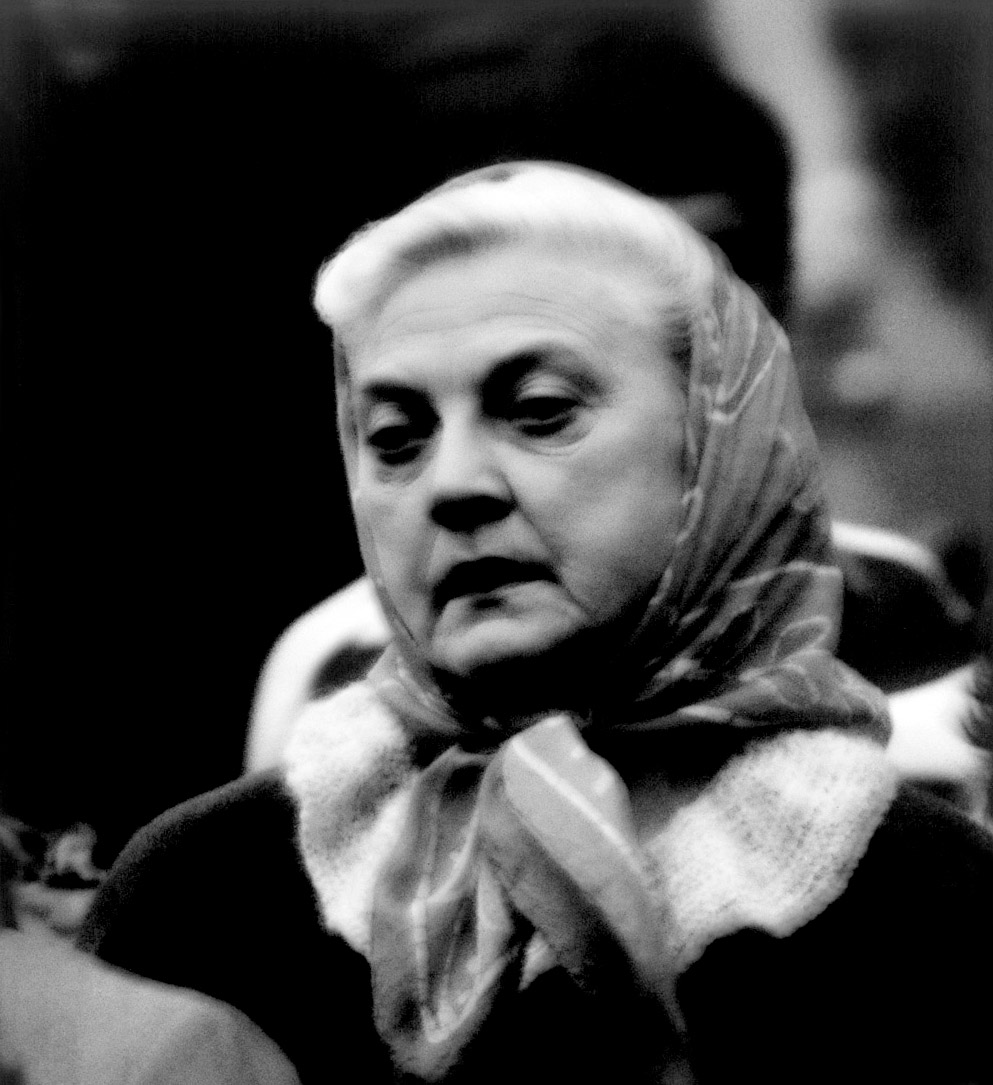
Bill Henson (Australian, b. 1955) 'Untitled 1980/82' 1980-1982


Bill Henson (Australian, b. 1955)
Untitled 1980-82
1980-82
From a series of 220 gelatin silver print
Monash Gallery of Art, City of Monash Collection


These five works come from a series that includes a total of 220 photographs, which are printed at various sizes. When exhibiting the full series, Henson arranges the works into small groupings that create an overall effect of aberrant movement and fragmentation. From within these bustling clusters of images, individual faces emerge like spectres of
humanity that will once again dissolve into the crowd.

Henson shot this series over several years in different cities around the world, capturing images of individuals, crowds and architectural details, all apparently adrift in the flow of urban life. The people in these images have an anonymity that allows them to represent universal human experiences of alienation, mortality and fatigue. The views of buildings, however, are more specific. They were photographed in Dresden and East Berlin in the 1970s, when Henson travelled to Germany specifically for the purpose of
documenting these world-weary structures. Taken together, the images remind us of how tragically fleeting a sense of belonging can be.

Stephen Zagala and Stella Loftus-Hills. Bill Henson: early work from the MGA collection Education Resource,” on the University of South Australia website 2010 [Online] Cited 18/12/2024


Bill Henson (Australian, b. 1955) 'Untitled 1980/82' 1980-1982


Bill Henson (Australian, b. 1955)
Untitled 1980-82
1980-82
From a series of 220 gelatin silver print
Monash Gallery of Art, City of Monash Collection


Bill Henson (Australian, b. 1955) 'Untitled 1980/82' 1980-1982


Bill Henson (Australian, b. 1955)
Untitled 1980-82
1980-82
From a series of 220 gelatin silver print
Monash Gallery of Art, City of Monash Collection


Bill Henson (Australian, b. 1955) 'Untitled 1980/82' 1980-1982


Bill Henson (Australian, b. 1955)
Untitled 1980-82
1980-82
From a series of 220 gelatin silver print
Monash Gallery of Art, City of Monash Collection


Bill Henson: early work from the MGA collection draws on work from the Monash Gallery of Art, City of Monash Collection. MGA holds one of the largest collections of Bill Henson’s photography. With its concentration of work from 1977-92, the collection provides a significant survey of Henson’s early career.

Bill Henson is one of Australia’s best-known artists. Many of us have heard his name. Some of us may also be familiar with his photographs. For many, the experience of Henson’s extraordinary work has probably been through reproduction of it in the media. However, it is important to view Henson’s actual photographs. This offers a much richer visual experience, and a deeper appreciation of his art. Henson printed all of the work in this exhibition in the darkroom by hand, using chemicals and carefully chosen paper stock. The uneven surfaces of the early black-and-white photographs are a result of this wet-printing process, and give the photographs a mysterious, almost alchemic quality. The larger colour photographs display a richness of tone and palette that is an artefact of the artist’s meticulous approach to the printing process. These material properties are not evident in reproductions of Henson’s images.

The other aspect that is lost in reproduction is the physical difficulty of seeing Henson’s pictures clearly. The darkness of Henson’s photographs appeals to the artist’s romantic sensibility. He tends to let shadows obscure visual detail so that enigmas lurk at the threshold of perception. Publishers like to override this quality of Henson’s work by adjusting the contrast and brightness of the images for print. Viewers of this exhibition will find themselves drawn into an inscrutable visual space of shadows and deep, reflective blacks.

Born in 1955, Bill Henson grew up in Glen Waverley, a burgeoning suburb of
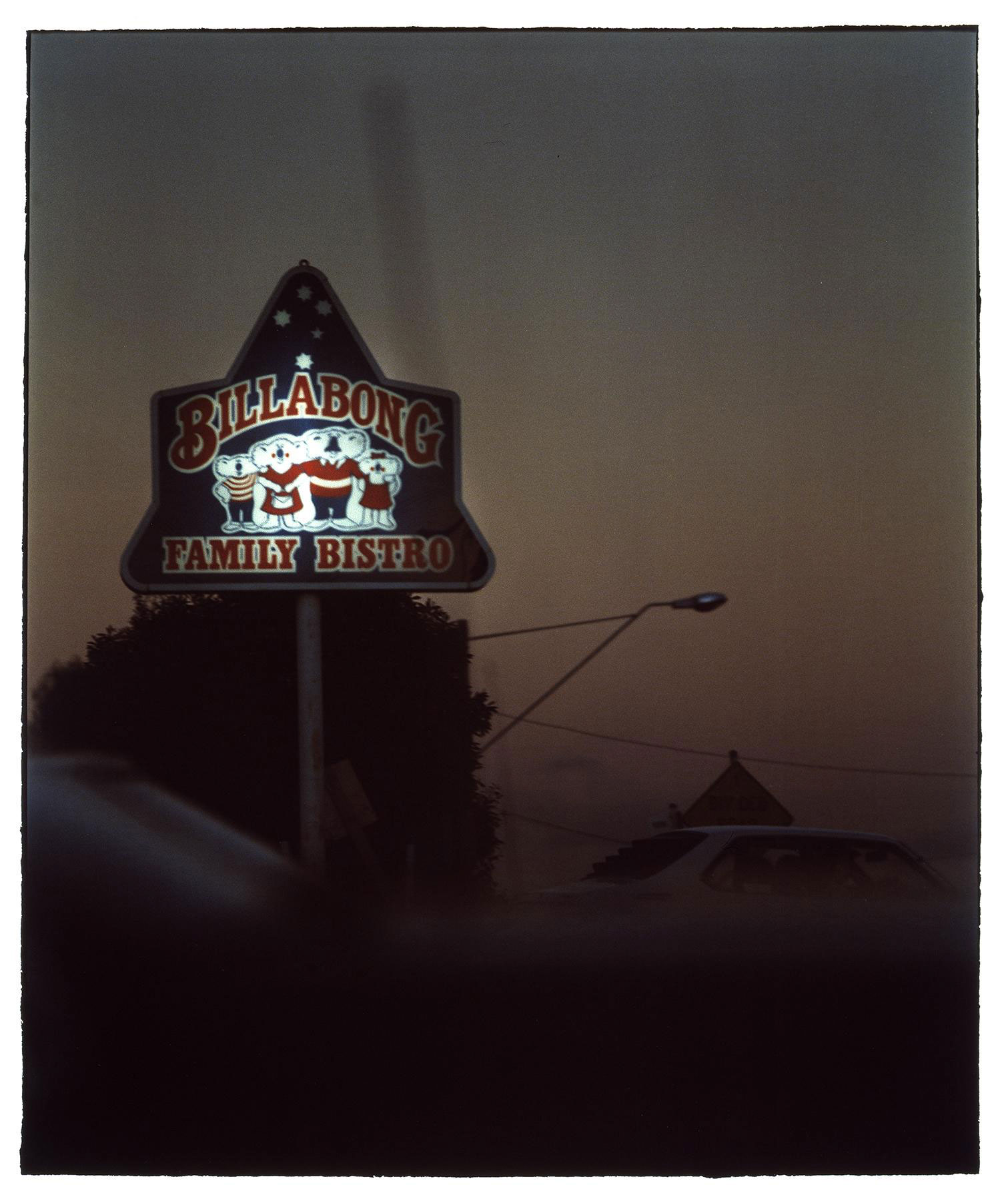
Melbourne. From the 1950s to the 1970s the area swelled beyond the termination of the Glen Waverley train line, urged on by the relative affordability, ease and comfort of car travel. Self-serve petrol stations appeared at major intersections, their brightly coloured signage adding their glow to the landscape.

The influence of expanding American suburbia on Australia continued with Glen Waverley becoming home to the first McDonalds restaurant in Victoria (1971). The 1980s saw an expansion of large international chains that offered ‘drive-thru’ services (from fast food to alcohol) favouring prominent roadside locations and large signage to stamp their corporate identities on the landscape.

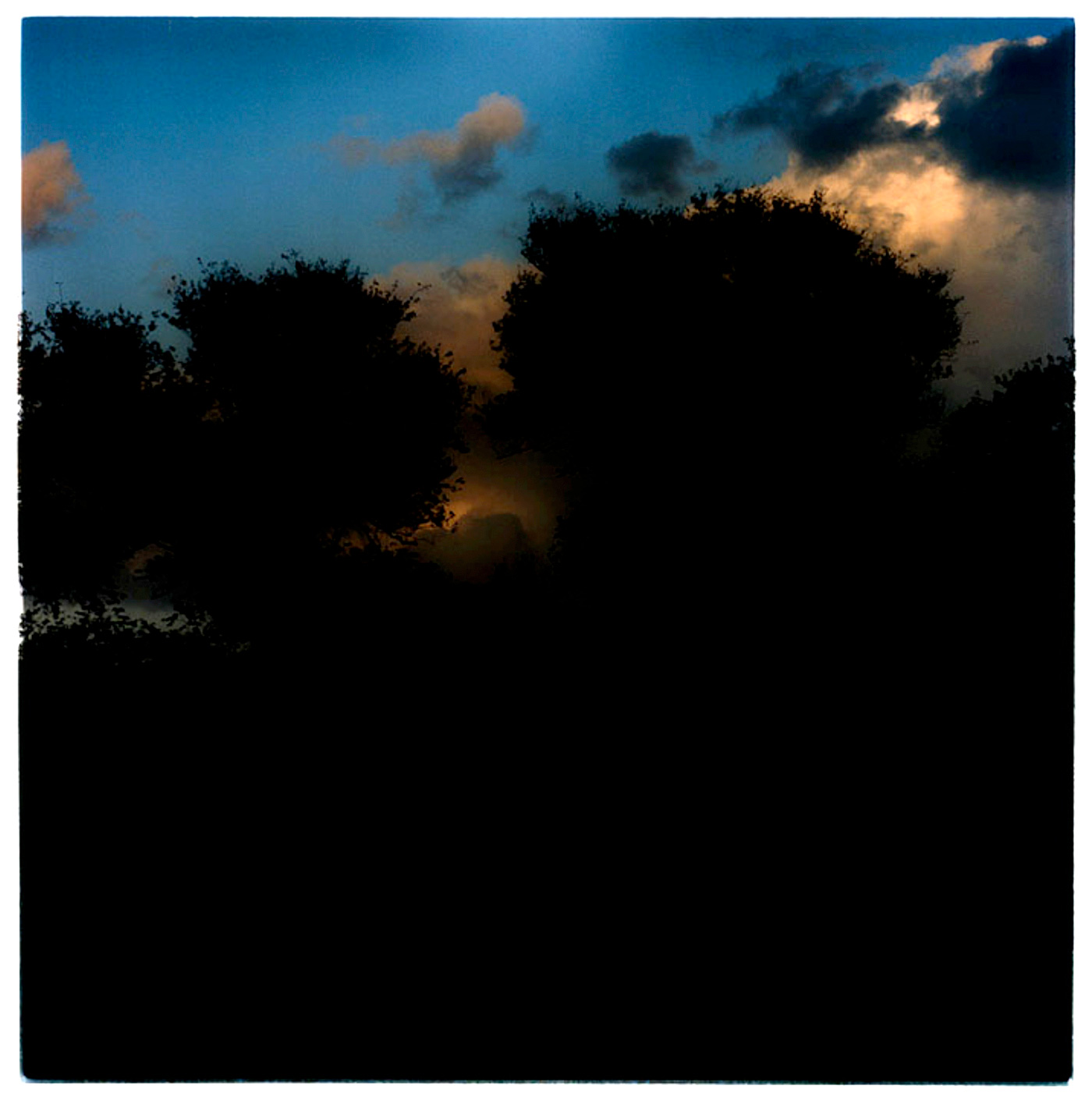
It is from within this ever changing and expanding landscape, between the end of the train line and country, that Henson’s vision was founded; a place where listless youth claim the vacant lots and preservations between estates as their own private worlds, lost in the evening shadows.

The youth that populate Henson’s images take on a strange, almost hollow look, their eyes becoming dark holes in their ghostly facades. Light and shadow compete to pull their bodies from one plane to the other, Henson seeks to capture this moment, the hovering between child and adult.

These liminal zones, the “intervals in the landscape”1 provided a backdrop for the developing artist. Bill Henson’s early work is undeniably – and perhaps unintentionally – a discussion of the changing landscape of suburbia and in turn the influence of international trends on what it meant to be growing up in Australia at that time. Henson’s early work is significant in Australian photography because of its depiction of this change in both this suburban landscape and the human condition.

1/ Bill Henson as quoted in Dominic Sidhu. “Nocturne: The photographs of Bill Henson (Interview with Bill Henson),” in EGO Magazine, New York, August 29, 2005. No longer available online.

Stephen Zagala and Stella Loftus-Hills. Bill Henson: early work from the MGA collection Education Resource,” on the University of South Australia website 2010 [Online] Cited 18/12/2024


Bill Henson (Australian, b. 1955) 'Untitled 57' 1985-1986


Bill Henson (Australian, b. 1955)
Untitled 57
1985-1986
From the series Untitled 1985-86
Chromogenic print
106 x 86cm
Monash Gallery of Art, City of Monash Collection
Courtesy of the artist and Roslyn Oxley9 Gallery, Sydney


Bill Henson (Australian, b. 1955) 'Untitled 61' 1985-1986


Bill Henson (Australian, b. 1955)
Untitled 61
1985-1986
From the series Untitled 1985-86
Chromogenic print
128 × 100cm
Monash Gallery of Art, City of Monash Collection
Courtesy of the artist and Roslyn Oxley9 Gallery, Sydney


Monash Gallery of Art (MGA) holds one of the largest collections of photographs by Bill Henson. With its concentration on work made between 1977 and 1992, the MGA collection represents a significant survey of Henson’s early career, from which twenty-nine works have been selected for the Bill Henson: early work from the MGA collection exhibition.

Henson has been described as a ‘passionate and visionary explorer’, and has been exhibited extensively nationally and internationally for over three decades, yet this is the first exhibition dedicated to this major artist’s work to be presented in Adelaide.

Passionate discussion about Henson’s work in the Australian media in recent times, has served to illuminate an important debate about the nature of art. But while many of us may be familiar with Henson’s images through reproduction, to view a museum exhibition of the artist’s photographs offers a much deeper appreciation of his art, and is a rare opportunity for audiences to themselves experience his work first hand.

The ‘in conversation’ event is a highlight to accompany a very special exhibition at the Samstag Museum from one of Australia’s most distinguished artists. Bill Henson: early work from the MGA Collection, with selected recent landscapes offers South Australians a unique opportunity to experience the power and beauty of the work of Bill Henson, Australia’s best-known contemporary photographer. This is the first exhibition dedicated to this major artist’s work ever to be presented in Adelaide.

The exhibition features twenty-nine iconic images from many of Henson’s major series from the 1970s through to the early 1990s, all drawn from the Monash Gallery of Art, who hold one of the largest collections of Henson’s work in the country.

For many, the experience of Henson’s extraordinary work has been through its reproduction in the media. However, it is important to view the actual photographs as this offers a much richer visual experience. All of the early work in the exhibition was printed by hand in the darkroom, and consequently the uneven surfaces of the black and white photographs have a mysterious, alchemic quality not present in reproductions of Henson’s images.

Alongside the MGA Collection exhibition, the Samstag Museum is presenting a selection of recent landscape photographs by Henson. These are works of compelling power and continue the artist’s fascination with a diverse range of subject matter. Through them we explore an island of rocky outcrops, monoliths rising dramatically from the ocean and waterfalls captured in a blaze of light.

Text and press release from the Anne and Gordon Samstag Museum of Art website


Bill Henson (Australian, b. 1955) 'Untitled 63' 1985-1986


Bill Henson (Australian, b. 1955)
Untitled 63
1985-1986
From the series Untitled 1985-86
Chromogenic print
106 x 86cm
Monash Gallery of Art, City of Monash Collection acquired 1991
Courtesy of the artist and Roslyn Oxley9 Gallery, Sydney


Bill Henson (Australian, b. 1955) 'Untitled 72' 1985-1986


Bill Henson (Australian, b. 1955)
Untitled 72
1985-1986
From the series Untitled 1985-86
Chromogenic print
106 x 86cm
Monash Gallery of Art, City of Monash Collection acquired 1991
Courtesy of the artist and Roslyn Oxley9 Gallery, Sydney


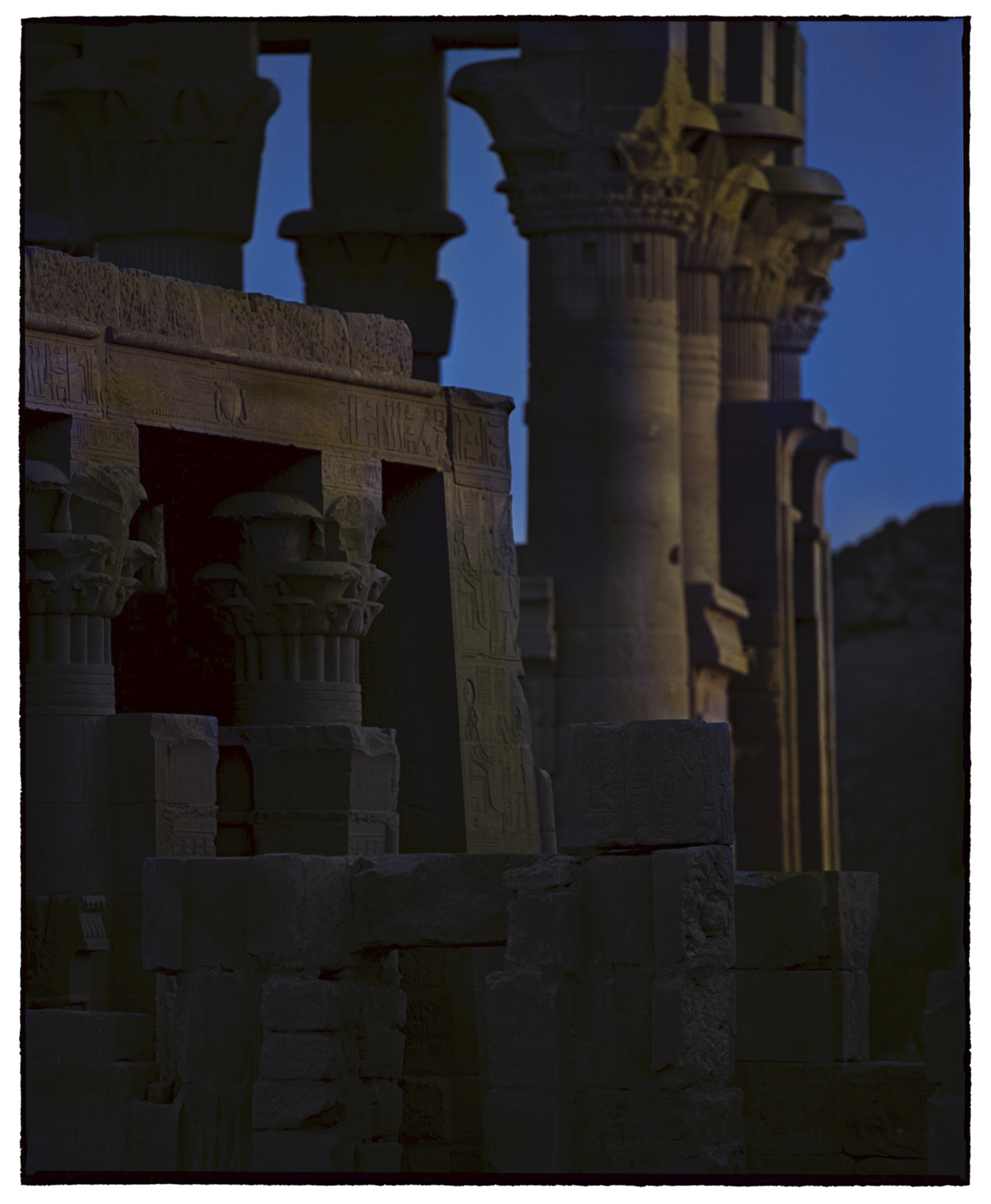
The series Untitled 1985-86 is constructed of 154 photographs that explore the psychological space of Henson’s youth. Henson grew up in Glen Waverley, in Melbourne’s South-east, and he has often spoken about the importance of maintaining a connection with the suburban environment that shaped his sensibilities. This series includes a range of specific references to the streetscapes of the area, often shot at night or dusk,
with fluorescent lights investing the darkness with a wistful glow.

Henson’s emphasis on nocturnal life alludes to his interest in treating real landscape as if it is a dreamscape, an idea that is underscored by the use of sleeping figures in this series. And, by juxtaposing suburbia with photographs of summertime girls and Egyptian temples, Henson takes us into the dreamy imaginings of an adolescent boy living on the outskirts of the city.

Stephen Zagala and Stella Loftus-Hills. Bill Henson: early work from the MGA collection Education Resource,” on the University of South Australia website 2010 [Online] Cited 18/12/2024


Bill Henson (Australian, b. 1955) 'Untitled 73' 1985-1986


Bill Henson (Australian, b. 1955)
Untitled 73
1985-1986
From the series Untitled 1985-86
Chromogenic print
106 x 86cm
Monash Gallery of Art, City of Monash Collection
Donated by the artist 1989
Courtesy of the artist and Roslyn Oxley9 Gallery, Sydney


Bill Henson (Australian, b. 1955) 'Untitled 137' 1985-1986


Bill Henson (Australian, b. 1955)
Untitled 137
1985-1986
From the series Untitled 1985-86
Chromogenic print
106 x 86cm
Monash Gallery of Art, City of Monash Collection
Courtesy of the artist and Roslyn Oxley9 Gallery, Sydney


Bill Henson. 'Untitled' 1990-91


Bill Henson (Australian, b. 1955)
Untitled
1990-1991
From the series Paris Opera Project
Type C photograph
130 × 130cm
Monash Gallery of Art, City of Monash Collection
Courtesy of the artist and Roslyn Oxley9 Gallery, Sydney


In 1990 Bill Henson was commissioned to produce a body of work that responded to the world-renown Opéra de Paris. He decided to focus on the audience, and while at the Opéra photographed the faces of people while they sat enveloped in darkness, their features softly illuminated by the reflected glow of stage lighting. The photographs shot in Paris subsequently became Henson’s source material, as he restaged the portraits in his Melbourne studio to accentuate the mood and atmosphere of an evening at the opera.

When the subsequent series of fifty photographs was first exhibited in Melbourne during 1991, they were hung floor-to-ceiling as if to suggest an auditorium of spectators. With their far-away eyes, gazing off toward something that is not revealed in the photographs, these faces express the sublime sensuality of a musical experience. And the atmospheric cloudscapes that punctuate the series allude to the rich horizons being opened up in the imaginations of the audience.

Stephen Zagala and Stella Loftus-Hills. Bill Henson: early work from the MGA collection Education Resource,” on the University of South Australia website 2010 [Online] Cited 18/12/2024


Bill Henson (Australian, b. 1955) 'Untitled' 1990-1991


Bill Henson (Australian, b. 1955)
Untitled
1990-1991
From the series Paris Opera Project
Type C photograph
130 × 130cm
Monash Gallery of Art, City of Monash Collection
Courtesy of the artist and Roslyn Oxley9 Gallery, Sydney


Bill Henson (Australian, b. 1955) 'Untitled 1-5 B' 1990-1991


Bill Henson (Australian, b. 1955)
Untitled 1-5 B
1990-1991
From the series Paris Opera Project
Type C photograph
130 × 130cm
Monash Gallery of Art, City of Monash Collection
Courtesy of the artist and Roslyn Oxley9 Gallery, Sydney


Bill Henson (Australian, b. 1955) 'Untitled' 1990-1991


Bill Henson (Australian, b. 1955)
Untitled
1990-1991
From the series Paris Opera Project
Type C photograph
130 × 130cm
Monash Gallery of Art, City of Monash Collection
Courtesy of the artist and Roslyn Oxley9 Gallery, Sydney


Anne & Gordon Samstag Museum of Art
Hawke Building, City West campus
University of South Australia
55 North Terrace, Adelaide
Phone: (08) 8302 0870

Opening hours:
Tuesday – Saturday 10am – 5pm

Anne & Gordon Samstag Museum of Art website

LIKE ART BLART ON FACEBOOK

Back to top

Photographs: Marcus Bunyan. ‘Vertical’ 2011

December 2011


This slideshow requires JavaScript.


Vertical

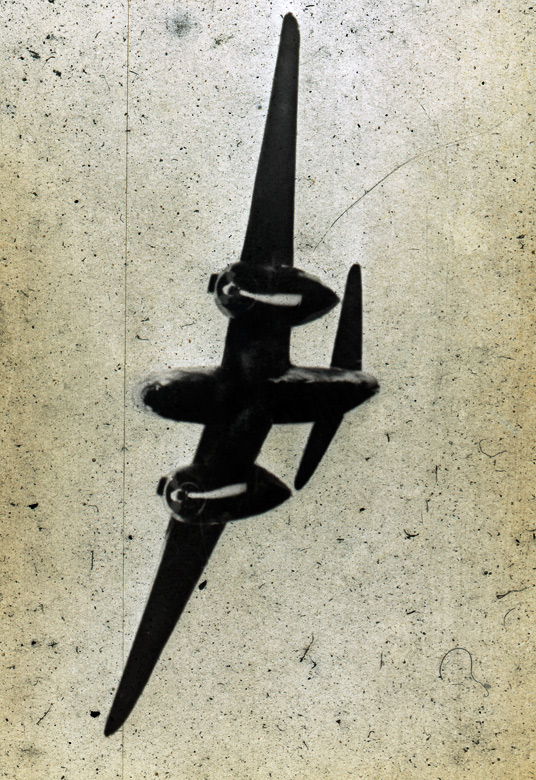
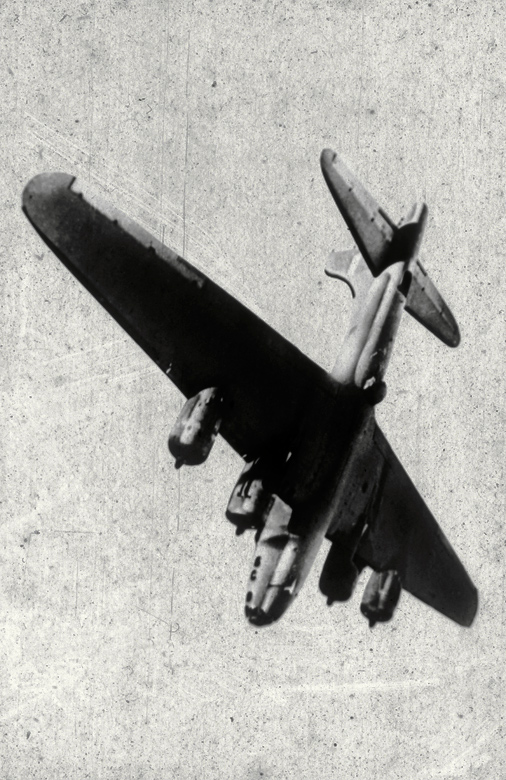
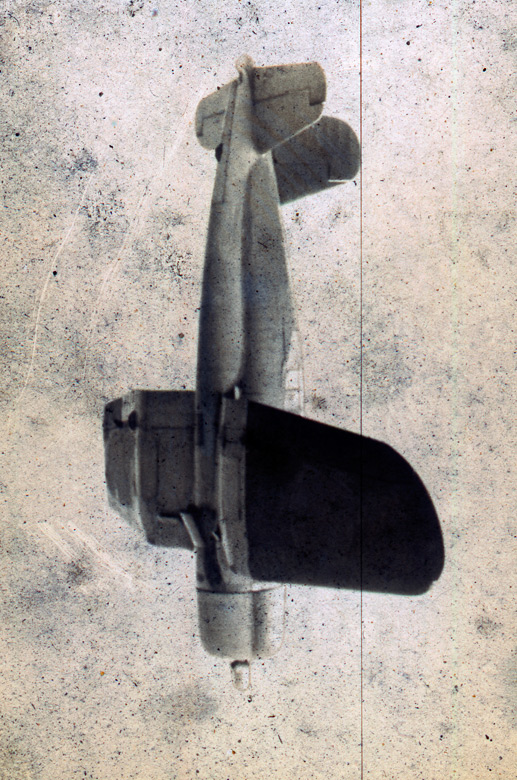
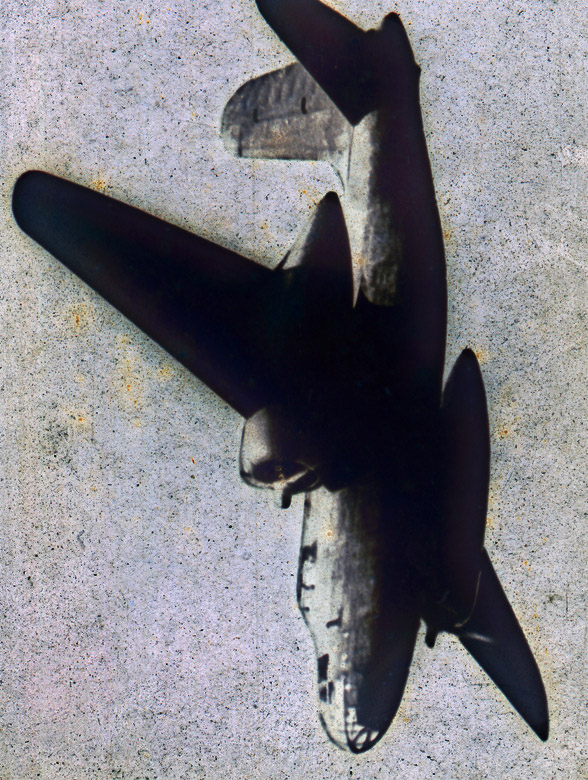
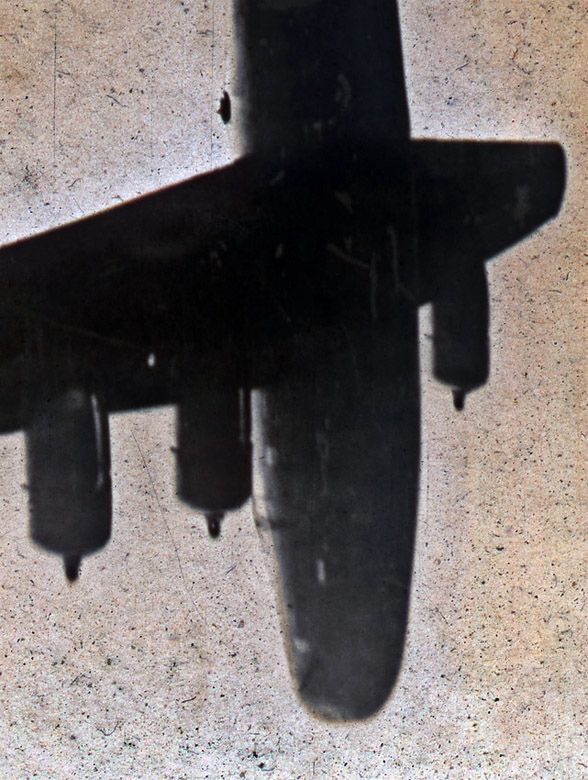
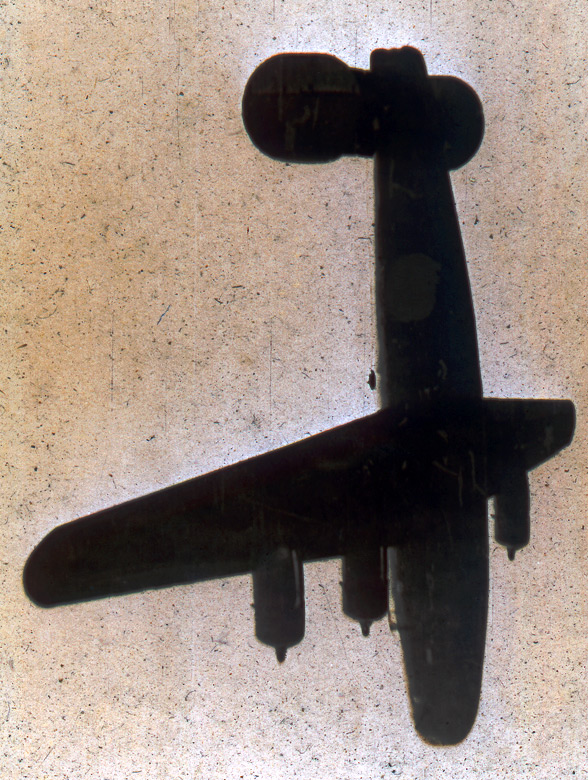
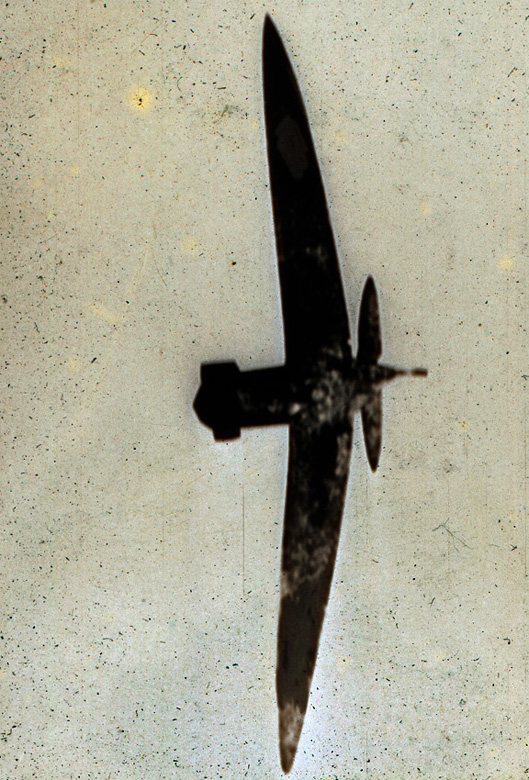
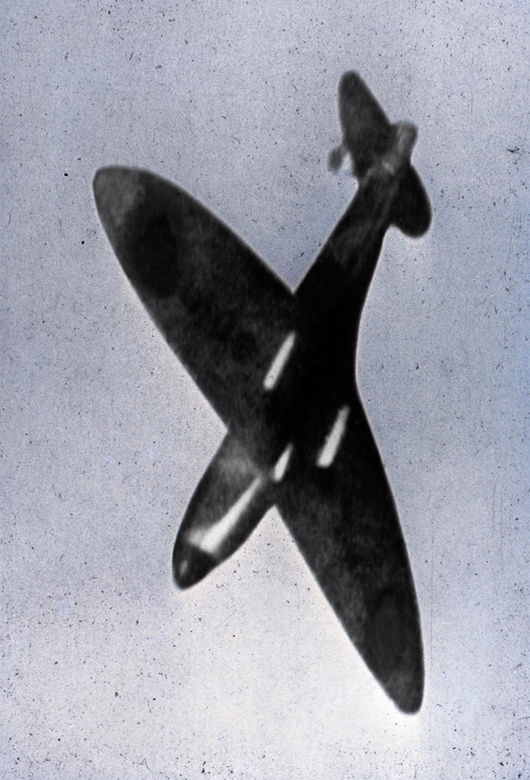
More planes, this time a series of work titled Vertical (2011). The series is now online on my website.

There are 22 images in the series formed as a sequence. Below is a selection of images from the series. I hope you like the work!

Marcus


Please click on the photographs for a larger version of the image.

Photographs are available from this series for purchase. As a guide, a digital colour 16″ x 20″ costs $1000 plus tracked and insured shipping. For more information please see my Store web page.


Marcus Bunyan (Australian, b. 1958) 'Untitled' from the series 'Vertical' 2011


Marcus Bunyan (Australian, b. 1958) 'Untitled' from the series 'Vertical' 2011


Marcus Bunyan (Australian, b. 1958) 'Untitled' from the series 'Vertical' 2011


Marcus Bunyan (Australian, b. 1958) 'Untitled' from the series 'Vertical' 2011


Marcus Bunyan (Australian, b. 1958) 'Untitled' from the series 'Vertical' 2011


Marcus Bunyan (Australian, b. 1958) 'Untitled' from the series 'Vertical' 2011


Marcus Bunyan (Australian, b. 1958) 'Untitled' from the series 'Vertical' 2011


Marcus Bunyan (Australian, b. 1958) 'Untitled' from the series 'Vertical' 2011


Marcus Bunyan (Australian, b. 1958)
Untitled
2011
From the series Vertical
Digital prints


Marcus Bunyan website

LIKE ART BLART ON FACEBOOK

Back to top

Review: ‘Selina Ou: New York’ at Sophie Gannon Gallery, Richmond

Exhibition dates: 25th October – 19th November 2011


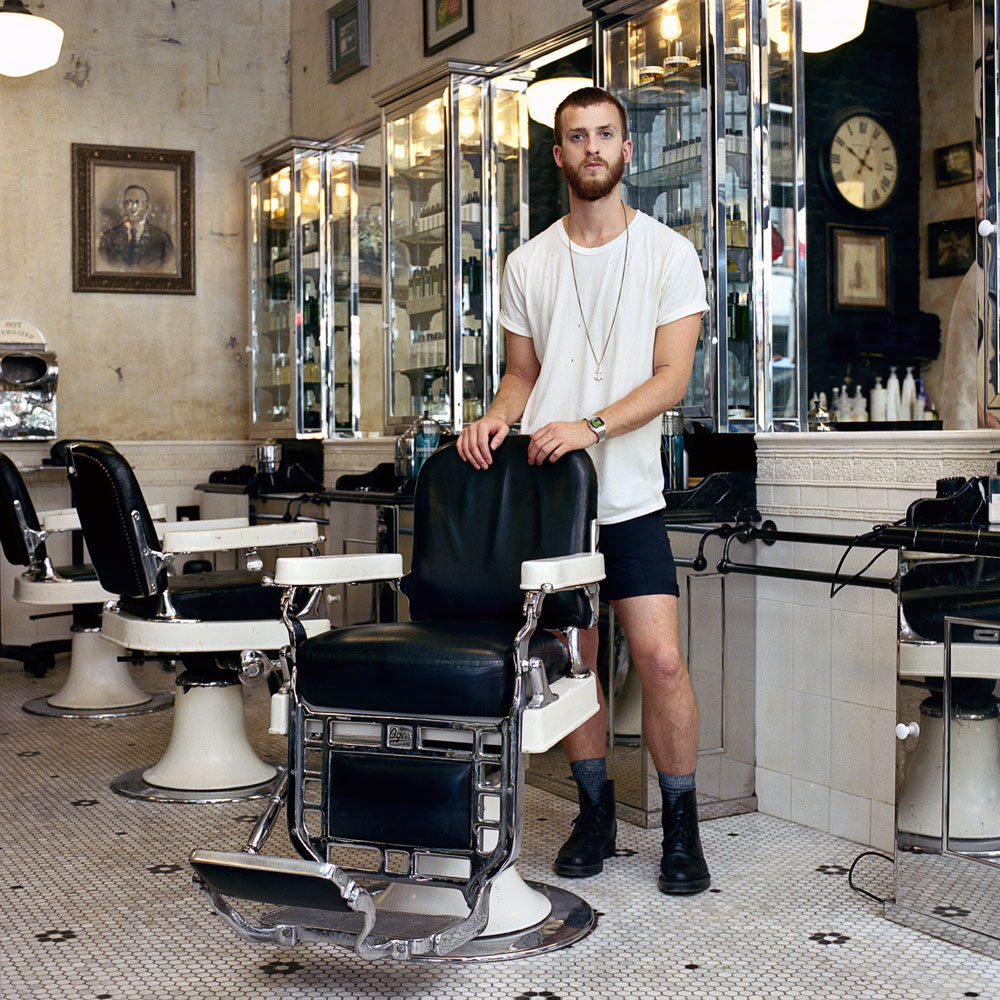
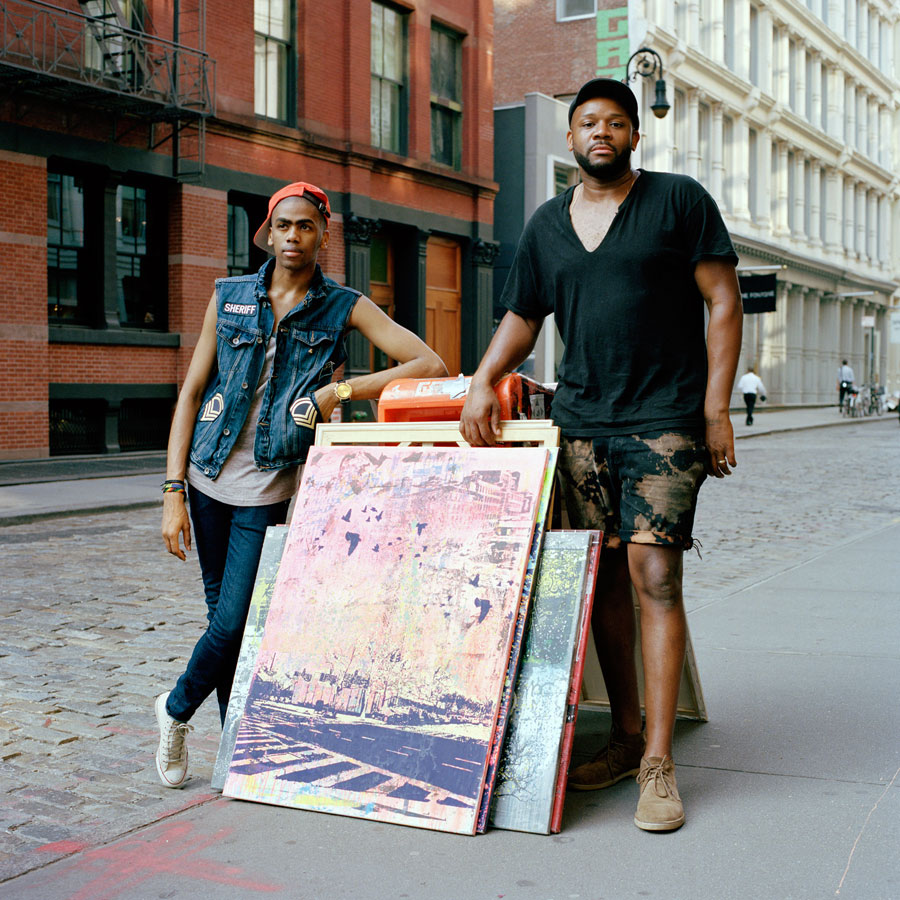
Selina Ou (Australian born Malaysia, b. 1977) 'Tim, Hair Stylist, Lower East Side, New York' 2011


Selina Ou (Australian born Malaysia, b. 1977)
Tim, Hair Stylist, Lower East Side, New York
2011
C-type print
100 x 100cm


A strong, nuanced body of work by Selina Au at Sophie Gannon Gallery in Richmond. In the flesh these large colour photographs have a wonderful, polyvocal presence. The solo portraits are stronger in terms of composition and intertextuality than the double portraits.

Derived from the Latin intertexto, meaning to intermingle while weaving, intertextuality is a term first introduced by French semiotician Julia Kristeva in the late sixties.1 Intertextuality “is always an iteration which is also a re-iteration, a re-writing which foregrounds the trace of the various texts it both knowingly and unknowingly places and dis-places.”2 Intertexuality is how a text is constituted. It fragments singular readings. The reader’s own previous readings, experiences and position within the cultural formation influences these re-inscriptions.

Reminding me of a contemporary redefinition of the work of Diane Arbus, Ou’s reconceptualisations of space “produce a plurality of meanings and signifying / interpretive gestures that escape the reduction of knowledge to fixed, monological re-presentations, or presences.”3 Through a process of materialisation, using the technique of assemblage, Ou weaves a lack of fixity into her photographs. She creates a kind of tapestry in the surfaces of her images, a play of pattern / randomness that redefines the significations of the body in the fold of inscription.

Take the first three portraits in this posting, for example. The photograph Tim, Hair Stylist, Lower East Side, New York weaves space, time and memory within the pictorial frame. The physical space between the portrait on the wall at rear, Tim and the clock at right is crucial to a reading of this photograph, as is the disjuncture between the appearance of the man in the framed photograph (in jacket and tie) and the casual attire of Tim. Just as important is the memorialisation of both men within the same space (where both presumably work/ed), the collapsing of past and present into a fluid space that is neither here nor there (the past of the man in the framed photograph, the moment of passing of Tim when the photograph was ‘taken’ and the present of the photograph being looked at). There is no fixed, monological representation here: the reading of this photograph hovers between past and present, between memory and reality and haunts the body of the subject, Tim.

Similarly, Raquel, Waitress and Fashion Designer, Nolita, New York and Jerome, Retail Assistant and Fashion Designer, Soho, New York offer radical re-iterations of space, this time with less temporal associations. In Raquel, two red chevrons at top left and right frame the face of the subject, playing off the colour-changing hair of the waitress/fashion designer, the title of the photograph an ironic comment on the intertextual nature of contemporary life: a waitress (low paid, menial labourer) and a fashion designer (famous, highly visible entrepreneur). The nonchalantly limp-wristed, ringed hand and over large glasses, coupled with the bedraggled threads of the black shorts – echoing the tousled nature of the subjects hair – also belies the statement “fashion designer.” The word Cervesas (beer) offers a dichotomy with the coloured bottles of flavoured water that surround the lower half of the subject while the reflection in the window behind Raquel provides a metaphorical vista into this distorted world view.

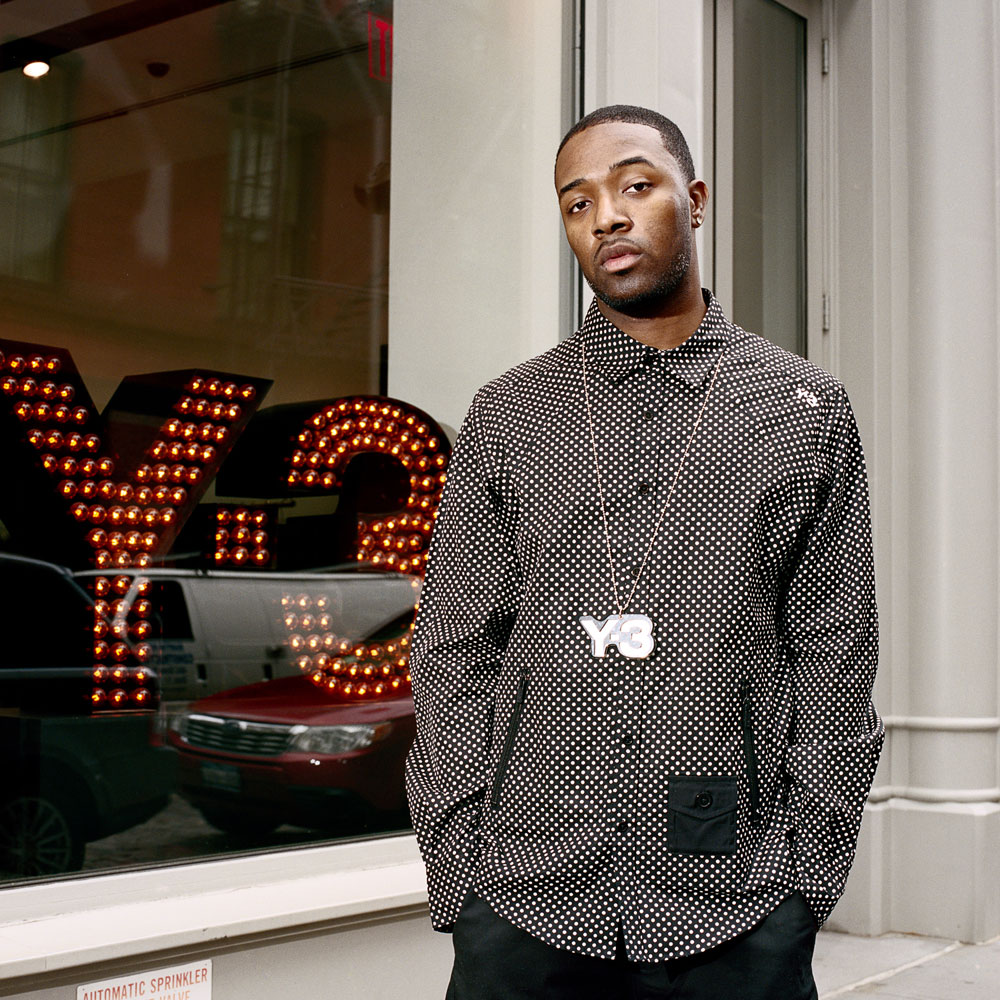
In Jerome, the same problem in a person’s relationship with self and others is evident: the context of Jerome as both a retail assistant (low paid, menial labourer) and a fashion designer (famous, highly visible entrepreneur). The narcissistic, self-importance of Jerome is beautifully portrayed by Ou as she balances the context of his body in space – his polka-dot shirt reflecting the dotted neon of the shops name, his logo emblazoned necklace doing the same, while the reflections in the shop window again hint at outside forces (the car and consumerism) and other worlds. The defiant, could not give a shit gaze of the subject into the camera lens hints at years of subjugation and unrequited ambition for this is not his shop, these are not his clothes despite the label “fashion designer.” He is just a retail assistant, the subject of his own con(text).

The strength of these photographs is that they blur the outlines of the fixed image dispersing an image of totality, “into an unbounded, illimitable tissue of connections and associations, paraphrases and fragments, texts and con-texts.”4 In this sense the solo portraits are much more successful than the rest of the work as Ou magically weaves the tapestry of life into her compositions, ready for the reader to bring their own experiences to these re-inscriptions. In a word these photographs are, literally, breath-taking.

Dr Marcus Bunyan


Many thankx to Sophie Gannon Gallery for allowing me to publish the photographs in the posting. Please click on the photographs for a larger version of the image.


Endnotes

1/ Keep, Christopher, McLaughlin, Tim and Parmar, Robin. “Intertextuality,” on The Electronic Labyrinth website [Online] Cited 13/11/2011. No longer available online

2/ Ibid.,

3/ Thumlert, Kurt. Intervisuality, Visual Culture, and Education. [Online] Cited 10/08/2006. No longer available online

4/ Keep Op cit.,


Selina Ou (Australian born Malaysia, b. 1977) 'Raquel, Waitress and Fashion Designer, Nolita, New York' 2011


Selina Ou (Australian born Malaysia, b. 1977)
Raquel, Waitress and Fashion Designer, Nolita, New York
2011
C-type print
100 x 100cm


Selina Ou (Australian born Malaysia, b. 1977) 'Jerome, Retail Assistant and Fashion Designer, Soho, New York' 2011


Selina Ou (Australian born Malaysia, b. 1977)
Jerome, Retail Assistant and Fashion Designer, Soho, New York
2011
C-type print
100 x 100cm


Selina Ou (Australian born Malaysia, b. 1977) 'Darren, Model and Carlito, Artist, Soho, New York' 2011


Selina Ou (Australian born Malaysia, b. 1977)
Darren, Model and Carlito, Artist, Soho, New York
2011
C-type print
100 x 100cm


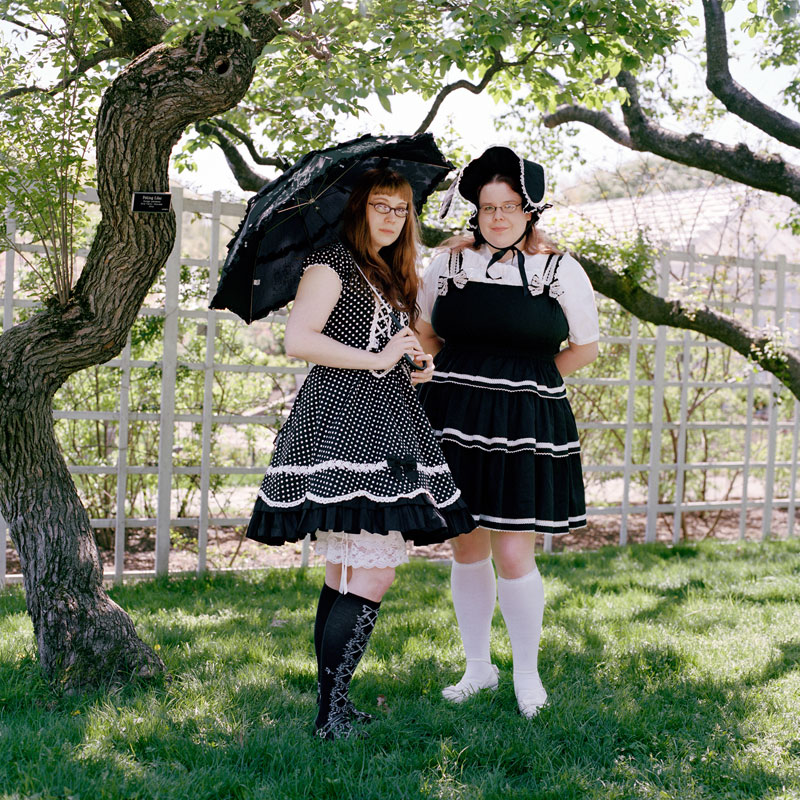
Selina Ou (Australian born Malaysia, b. 1977) 'Carolyn and Jane, Lolitas, Brooklyn Botanical Garden, New York' 2011


Selina Ou (Australian born Malaysia, b. 1977)
Carolyn and Jane, Lolitas, Brooklyn Botanical Garden, New York
2011
C-type print
100 x 100cm


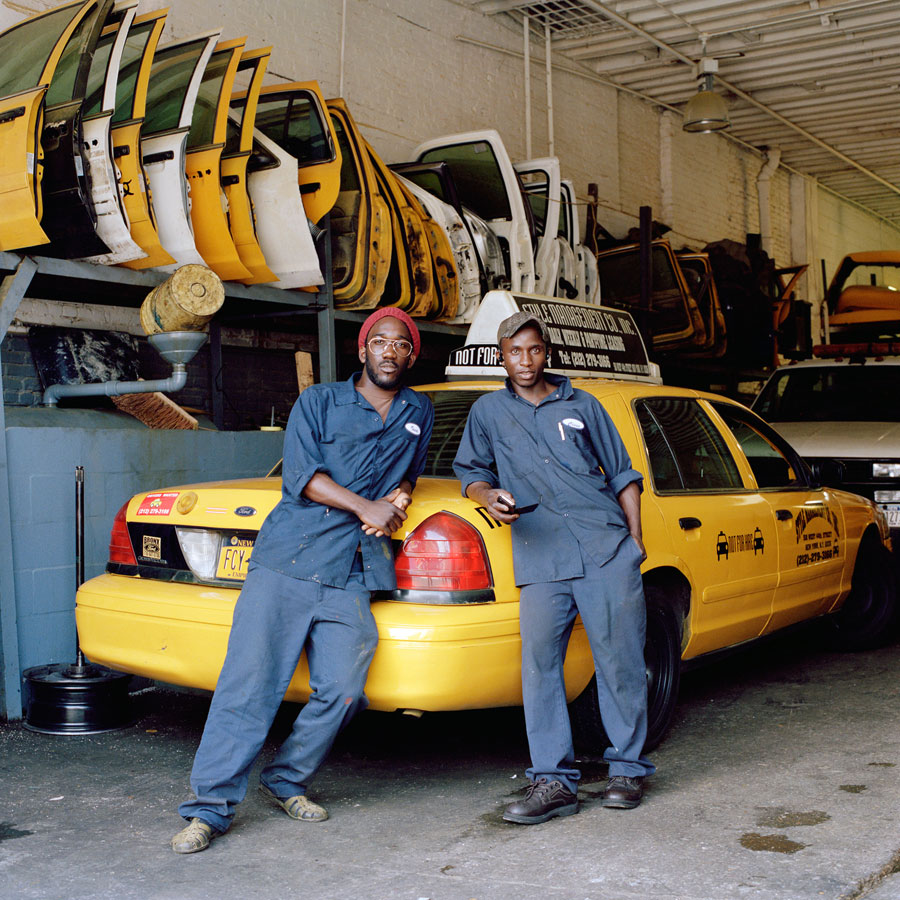
Selina Ou (Australian born Malaysia, b. 1977) 'Issa and Lamine, Taxi Mechanics, Upper West Side, New York' 2011


Selina Ou (Australian born Malaysia, b. 1977)
Issa and Lamine, Taxi Mechanics, Upper West Side, New York
2011
C-type print
100 x 100cm


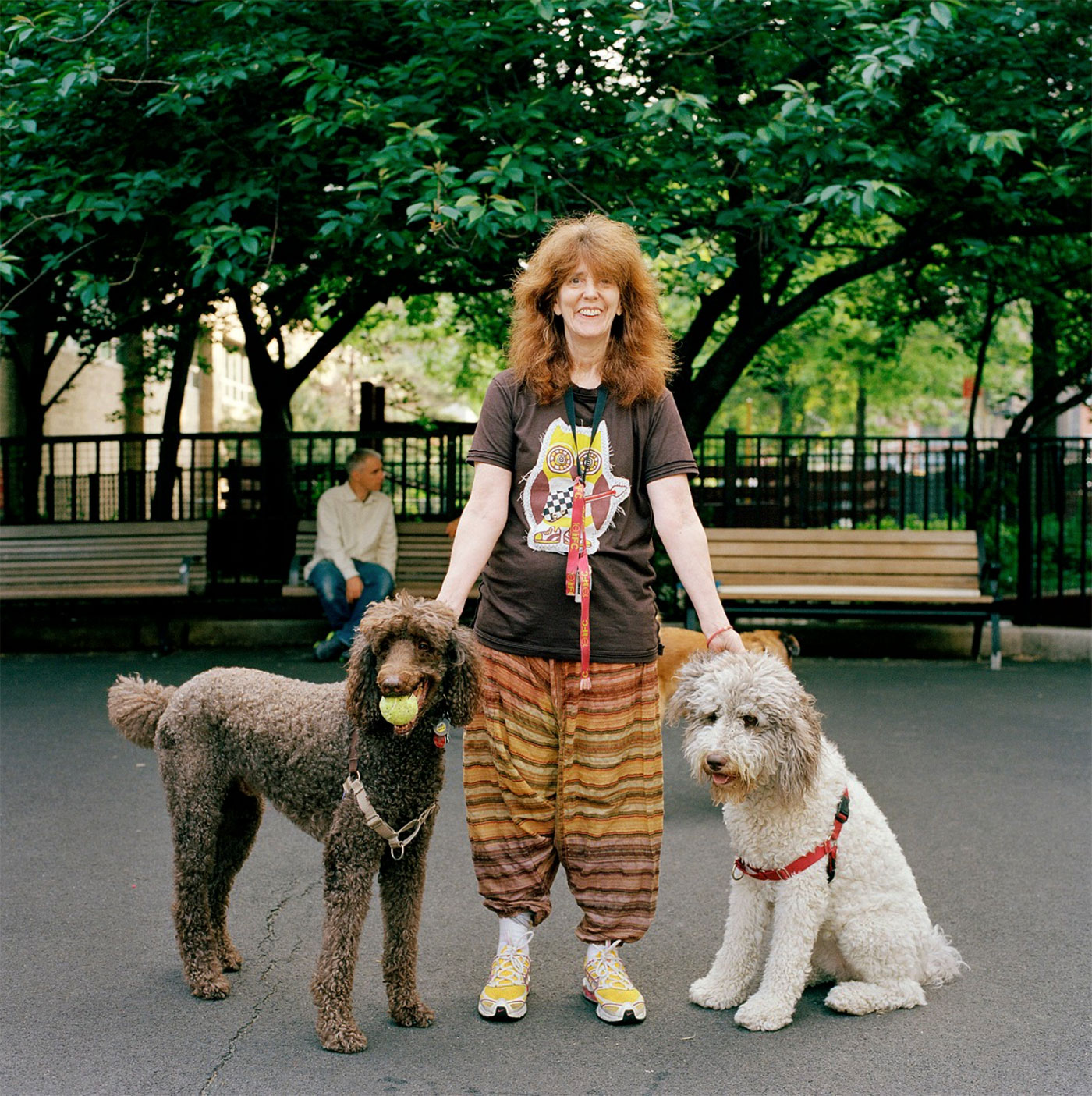
Selina Ou (Australian born Malaysia, b. 1977) 'Clementine, Liz and Billy Bob, Mercer-Houston Dog Run, Greenwich Village, New York' 2011


Selina Ou (Australian born Malaysia, b. 1977)
Clementine, Liz and Billy Bob, Mercer-Houston Dog Run, Greenwich Village, New York
2011
C-type print
100 x 100cm


Selina Ou (Australian born Malaysia, b. 1977) 'Derek, Student, Chrystie st, New York' 2011


Selina Ou (Australian born Malaysia, b. 1977)
Derek, Student, Chrystie st, New York
2011
Chromogenic photograph
100 x 100cm


Sophie Gannon Gallery
2, Albert Street
Richmond, Melbourne

Opening hours:
Tues – Saturday 11am – 5pm

Sophie Gannon Gallery website

LIKE ART BLART ON FACEBOOK

Back to top

Artwork: Alan Constable camera. Opening night photographs: ‘Movement and Emotion’ at Arts Project Australia, Melbourne

Exhibition dates: 20th October – 26th November 2011


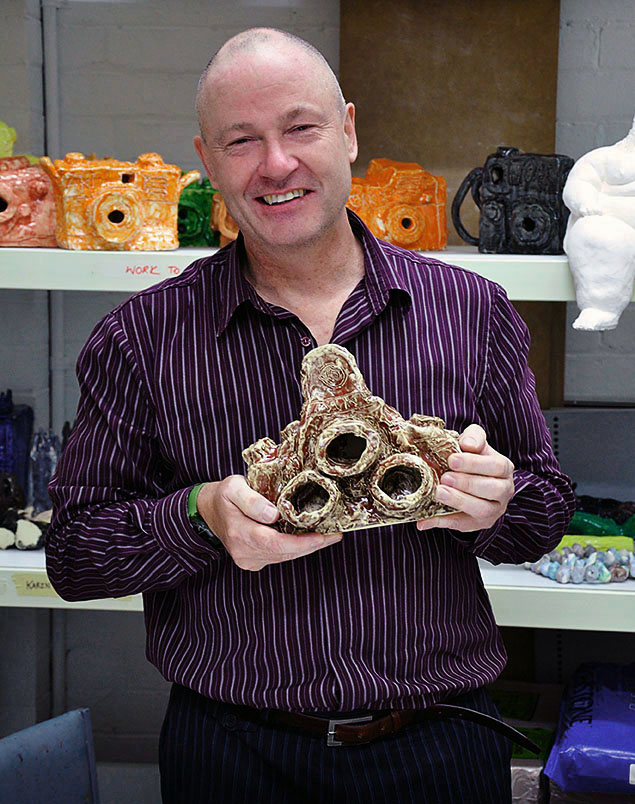
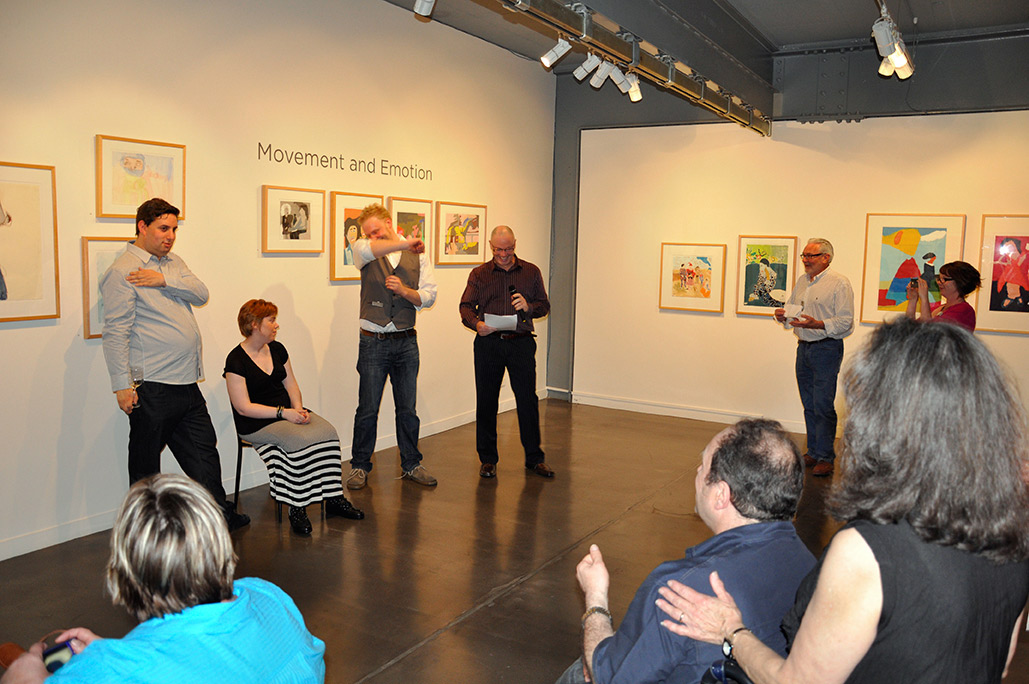
Dr Marcus Bunyan holdling his new Alan Constable camera at the opening of Movement and Emotion 2011. More of Alan's cameras can be seen behind.


Dr Marcus Bunyan holding his new Alan Constable camera at the opening of Movement and Emotion 2011.
More of Alan’s cameras can be seen behind.


I have added a new Alan Constable camera to my collection. Yah!

The one I have chosen is very unusual. The camera has a third eye and a stunning glaze. The exhibition features the work of three Arts Project Australia artists: Alan Constable, Chris O’Brien and Terry Williams. All three artists explore machine aesthetics within their practice.

I really do hope that the National Gallery of Victoria purchases some of these cameras. They are the most unusual and beautiful sculptural pieces I have seen in a long time.

Dr Marcus Bunyan


Many thankx to Art Project Australia for allowing me to publish the photographs in the posting. Please click on the photographs for a larger version of the image. See more images from the Movement and Emotion exhibition.


Alan Constable (Australian, b. 1956) 'Not titled (three lens red camera)' 2011


Alan Constable (Australian, b. 1956)
Not titled (three lens red camera)
2011


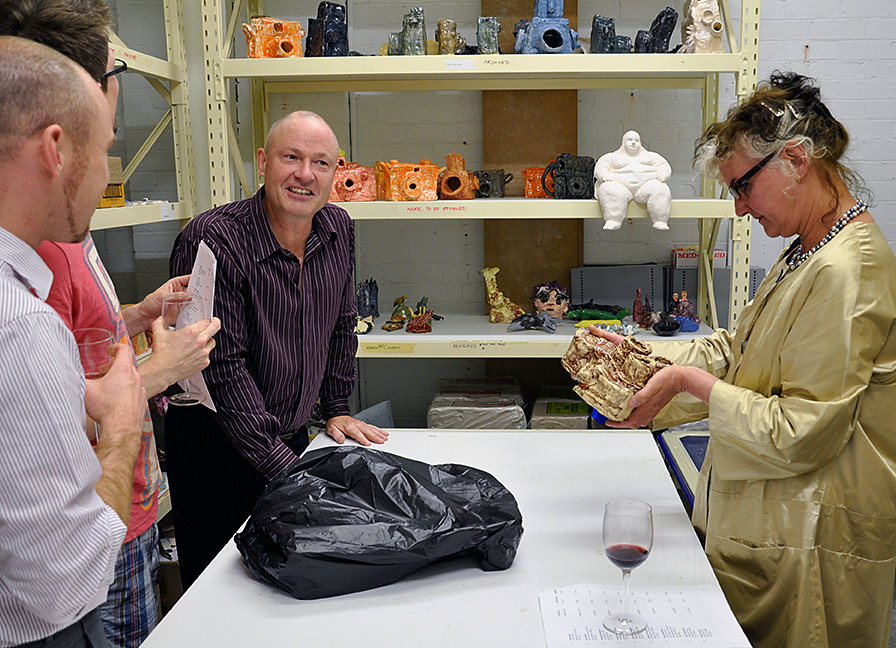
Marcus with jeweller Marianne Cseh at right looking at the Alan Constable camera


Marcus with jeweller Marianne Cseh at right looking at the Alan Constable camera


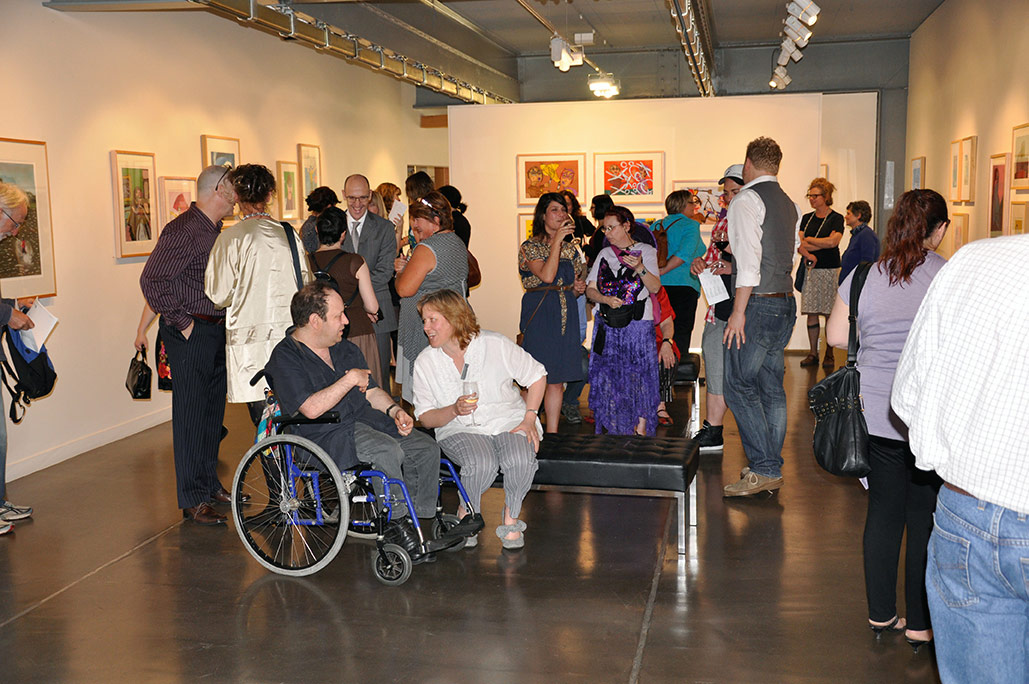
Opening night crowd at 'Movement and Emotion'


Opening night crowd at Movement and Emotion, Arts Project Australia


Opening night, with at left curator Paul Hodges, artist Jodie Noble (seated), myself and at right, Jonah Jones, President of the board of Arts Project Australia


Opening night, with at left curator and artist Paul Hodges, artist Jodie Noble (seated), myself and, at right, Jonah Jones, President of the board of Arts Project Australia


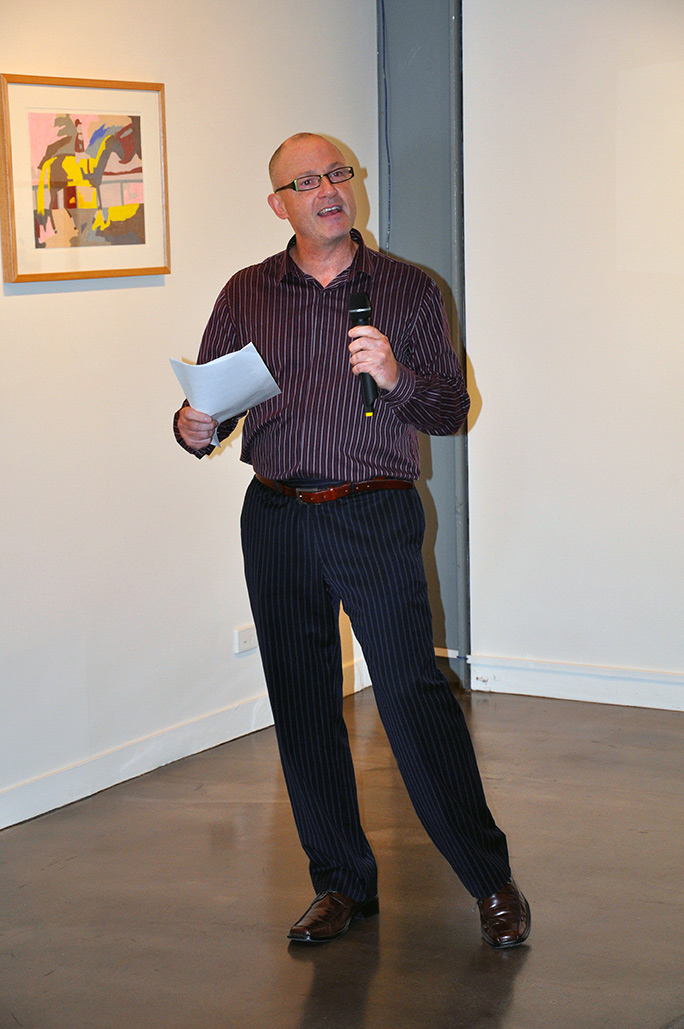
Dr Marcus Bunyan giving the opening night speech at the exhibition 'Movement and Emotion' at Arts Project Australia


Dr Marcus Bunyan giving the opening night speech for the exhibition Movement and Emotion. Read the opening night speech. I was so nervous my jeweller friend Marianne said she could see my hands shaking from where she was standing in the crowd!!


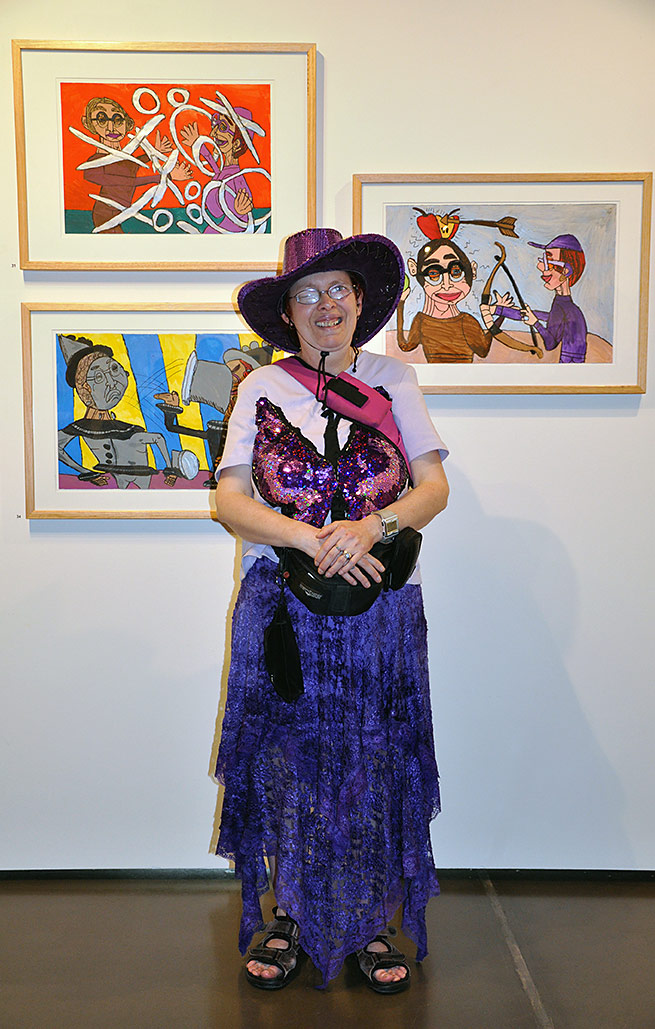
Artist Catherine Staughton standing in front of her work


Artist Catherine Staughton standing in front of her work


Arts Project Australia

Studio
24 High Street
Northcote Victoria 3070
Phone: + 61 3 9482 4484

Gallery
Level 1 Perry Street building
Collingwood Yards
Enter via 35 Johnson Street or 30 Perry Street, Collingwood
Phone: +61 477 211 699

Opening hours:
Wednesday – Friday 11am – 5pm
Saturday & Sunday 12 – 4pm

Arts Project Australia website

LIKE ART BLACK ON FACEBOOK

Back to top

Review: ‘ManStyle’ at the National Gallery of Victoria, Melbourne

Exhibition: 2 venues

NGV International (St Kilda Road) 11 March – 30 October 2011
NGV Australia (Federation Square) 11 March – 27 November 2011


Dr Marcus Bunyan at the opening of Manstyle in front of a two-piece c. 1949 Simpsons of Picadilly, London blue pin-stripped suit and 1940's tie from his collection


Dr Marcus Bunyan at the opening of Manstyle in front of a two-piece Simpsons of Picadilly, London blue pin-stripped suit c. 1949 and Van Heusen 1940’s tie loaned from his collection for the exhibition. Photograph courtesy of the National Gallery of Victoria.


The joy of this exhibition, spread across two NGV locations, is the creativity of local contemporary designers such Gavin Brown, Leigh Bowery, Peter Tully, Michael Glover and Sarah Thorn – a match for anything the international contingent has to offer. Another positive is the wonderful catalogue with its luscious colour plates, insightful essays and interviews with people such as Benny Castles, Luke Sales, Rick Owens and Walter Van Beirendonck.

Less enamouring is the prosaic way that the male attire is displayed – either hermetically sealed behind glass (look, but don’t touch!) or assembled in serried ranks on mannequins that make the clothes look two-dimensional. The display of these historical objects takes all the fun out of their being visually alive garments; it takes all the fun out of men “dressing up.” While acknowledging the conservation issues inherent when displaying such costume the display, the performance, the spectacle of male attire could have been better conveyed to the viewing public. Moving images, placing the work in context both locally and internationally, would have helped.

Continuing with these thoughts, what we wear can be seen as a spectacular, hypertextual construction. This construction comprises the authorship / designer of individual pieces (such as jacket, trousers, shirt) which can be seen as lexias, or nodal points, complimented by the wearer (reader) as author. The wearer appropriates and recasts individual garments, partially constructing the outfit through active choice, through a dissolution of the author-reader binary, through a very public characterisation of form: look at me, look at my style! Fashion can be seen as a “set of interconnecting and competing discourses than can never result in a single articulation,”1 discourses that generate and dissolve meaning. Men now use these discourses to enact the ‘performing self’, as it is known, which places greater emphasis on appearance.

“Within consumer culture … the new conception of self which has emerged, which we shall refer to as the ‘performing self’, places greater emphasis upon appearance, display and the management of impressions.”2

Appearance is critical to an understanding of self-concept. This self-concept consists of:

a/ the actual self (how a person perceives him/herself),
b/ the ideal self (how a person would like to perceive him/herself), and
c/ the social self (how a person presents him/herself to others).3


As Sproles and Burns observe, “Appearance is an extremely important part of the self-concept. Through personal appearance – dress, cosmetics, fashion expressions, body movements – an individual presents personal identity, attitudes, moods, and value or self-worth. In addition, individuals receive positive or negative evaluations from others with regard to appearance. Hence, appearance is one of the most prominent ways to display and reinforce a self-concept.”4

Appearance and the textuality of representation (stressing that representations are presentations entailing the use of codes and conventions of the available cultural forms of presentation),5 are continually being subverted throughout the history of fashion. In postmodernist fashion imitation and integration of an eclectic mixture of styles and periods into a new discourse (or montage, or collage, or bricolage)6 is critical to the constant regeneration of self using appearance as the embodiment of self-concept. Why this exhibition is so crucial is it shows that men are becoming more and more adept at manipulating their aesthetic style, not as something to be afraid of, not as something that they have to conform to, but as an expression of personal freedom. Which makes it all the more disappointing that the display of the male attire is so staid and reserved. The aesthetic display of these garments did not match up to the clothes exuberance.

Small things also irritated. At the opening a great deal was made of the multimedia element where local designers and celebrities talked about male style. In several of these videos, the men being interviewed mentioned how the shoe was always the basis for a good outfit. Fast forward to the exhibition and what do we find – photostated paper cut-outs of shoes on the mannequins instead of the real thing! Apparently the multimedia was shot after the design of the exhibition was finalised. Surely, if several people mention the basis of a good outfit is the shoe, and you promote the videos heavily, then you need to follow through on this concept. It is like putting the cart before the horse.

The fragmentary dis/locating mix and match eclecticism of contemporary male fashion needed more of a run in this exhibition, but as it stands it gives the viewer a solid overview of male attire throughout the centuries.

Dr Marcus Bunyan


Many thankx to the National Gallery of Victoria for allowing me to publish the photographs in the posting. Please click on the photographs for a larger version of the image.


Endnotes

1/ Johnson-Eilola cited in Mason, J.S. From Text To Hypertext [Online] Cited 28th May, 2003. No longer available online

2/ Lasch, C. The Culture of Narcissism. New York: Norton, 1979, quoted in Featherstone, Mike. “The Body in Consumer Culture,” in Featherstone, Mike; Hepworth, Mike and Turner, Bryan (eds.). The Body. London: Sage Publications, 1991, p. 187

3/ Sproles, George and Burns, Leslie Davis. Changing Appearances: Understanding Dress in Contemporary Society. New York: Fairchild Publications, 1994, pp. 208-209

4/ Ibid.,

5/ Dyer, Richard. The Matter of Images: Essays on Representations. London: Routledge, 1993, pp. 2-3

6/ Tseëlon, E. The Masque of Femininity: The Representation of Women in Everyday Life. London: Sage, 1995, pp. 132-133


H. Lehmann, Aldershot (tailor) 'Royal Gloucester Hussar's uniform' c. 1900


H. Lehmann, Aldershot (tailor)
active in England c. 1900
Royal Gloucester Hussar’s uniform
c. 1900
Wool, cotton, metal
(a) 51cm (centre back), 64cm (sleeve length) (jacket)
(b) 48cm (centre back), 44cm (width) (waistcoat)
National Gallery of Victoria, Melbourne
Gift of the Stone Family, 1963


England 'Coat' 1740s


England
Coat
1740s
Silk, wood, wool, linen
102cm (centre back), 65cm (sleeve length)
National Gallery of Victoria, Melbourne
Purchased, 1970


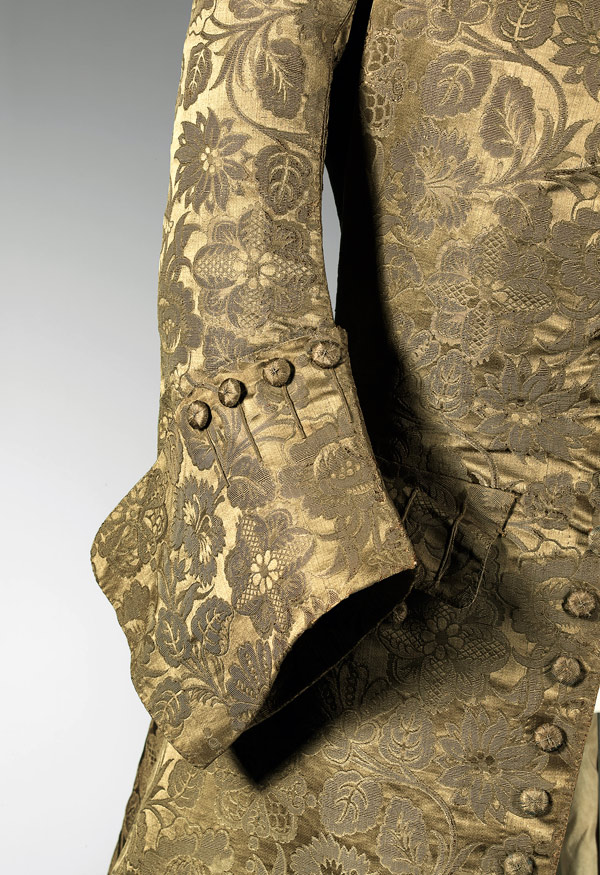
England 'Coat' 1740s (detail)


England
Coat (detail)
1740s
Silk, wood, wool, linen
102cm (centre back), 65cm (sleeve length)
National Gallery of Victoria, Melbourne
Purchased, 1970


France 'Coat' c. 1810


France
Coat
c. 1810
Wool, silk, wood
105.8cm (centre back), 70.5cm (sleeve length)
National Gallery of Victoria, Melbourne
Purchased, 1975


England 'Waistcoat' c. 1850


England
Waistcoat
c. 1850
Silk, cotton, leather, metal
65.5cm (centre back), 51.5cm (waist, flat)
National Gallery of Victoria, Melbourne
Gift of Mrs A. Butler, 1954


Nutters, London (tailor) est. 1968. Tommy Nutter (designer) 'Suit and tie 1971' (detail)


Nutters, London (tailor)
est. 1968
Tommy Nutter (designer)(Wales, b. 1943, lived in England c. 1952- )
Suit and tie 1971 (detail)
Wool, silk, cotton, acetate (lining), metal
(a) 77cm (centre back), 58cm (sleeve length) (jacket)
(b) 52cm (centre back), 40.4cm (waist, flat) (vest)
(c) 103cm (outer leg), 37cm (waist, flat) (trousers)
(d) 142 x 10.5cm (tie)
National Gallery of Victoria, Melbourne
Gift of Roger Evans, 1998


This March, the National Gallery of Victoria will showcase the first exhibition in Australia to focus on men’s fashion from the 18th century to the present day. Drawn largely from the NGV Collection, ManStyle will feature over 80 works including outfits and a selection of paintings exploring influential ideas in menswear over the past three centuries.

Charting a course between flamboyant display and absolute restraint, the exhibition begins in the 18th century with the evolution of the modern suit and concludes with contemporary outfits from today’s menswear designers. ManStyle will explore the elegantly honed lines and details of the dandy in the 19th century, a period which heralded the rise of tailoring with its focus on perfect cut and fit.

This exhibition will include recent works by contemporary designers such as Hedi Slimane for Dior Homme who have drawn upon this legacy of exacting tailoring for a new generation of young men. Roger Leong, Curator, International Fashion and Textiles, NGV said: “Men’s fashion is often seen as bound by tradition when, in fact, it has undergone a number of profound changes that reflect the shifting attitudes to class, sexuality, work and leisure over the past three centuries.

From the beginnings of the modern suit in the 18th century to 20th century sportswear, sub-cultural attire and street wear, men’s fashion has continued to transform in style and function to the present day,” said Mr Leong.

The most dramatic changes to men’s fashion occurred during the 1960s when designers such as Pierre Cardin challenged convention by creating streamlined Space-Age style outfits. Likewise, the ‘peacock revolution’ of this era reintroduced the phenomenon of the decorated man, adorned with colour, pattern and texture. Katie Somerville, Curator, Australian Fashion and Textiles, NGV said the House of Merivale was Australia’s answer to this new, colourful trend.

“Embodying the Carnaby Street look and style of bands like The Beatles, design houses such as Biba and the House of Merivale dressed men in flamboyant, body-hugging suits with wide flared trousers and shirts of contrasting patterns.

During this period, men ‘dressed up’, preened and flaunted their bodies in a new display of ostentatious masculine style.”

By the late 1970s, men’s style had fractured into a heady mix of alternatives. ManStyle features works by Vivienne Westwood and Malcolm McLaren, who defined the punk era with their ripped and distressed clothes plastered with offensive and anarchic slogans and symbols. This exhibition also captures the intense mood of the 1980s; which witnessed an outpouring of creativity across the spectrum of art, music and fashion, unleashing ideas from underground club cultures that reconfigured ideas about men’s sexuality.

“Today, new and traditional modes of dressing are continually merging to challenge our view of masculinity and contemporary style. ManStyle, it seems, offers greater possibilities than ever before,” said Ms Somerville.

Gerard Vaughan, NGV Director said: “By defining these periods in men’s fashion, visitors will be able to discover the contrasting identities men have experimented with over the past three centuries.

Visitors will be mesmerised and surprised by the richness of works in this Australia-first exhibition, showcasing the NGV’s magnificent Collection of this otherwise under-documented genre.”

ManStyle will be on display at the National Gallery of Victoria’s two locations. NGV Australia will look at transformations in the history of tailoring beginning with the notion of the dandy – a gallant man who put a lot of effort into a flawless appearance. The most famous dandy was Beau Brummell (1778-1840) who was always immaculately dressed, seeking to reflect an aristocratic style of life. The display at NGV International will focus on the peacock male, tracing a history of sartorial decoration and display that has its roots in the Renaissance and Tudor eras, and which was spectacularly revived during the 1960s when plain dark suits were discarded in favour of colour, cravats and frilled collars. Ever since then, the peacock phenomenon continues to surface with vivid intensity.

This exhibition will feature works by Vivienne Westwood, Jean Paul Gaultier, Morrissey & Edmiston, Leigh Bowery, Walter Van Beirendonck, Romance Was Born, Bernhard Willhelm, Rick Owens, Pierre Cardin, Biba and many more.

Press release from the National Gallery of Victoria website


WORLD, Auckland (fashion house) 'Percy shops at WORLD' 1999


WORLD, Auckland (fashion house)
est. 1989
Denise L’Estrange-Corbet (designer)(New Zealand, b. 1964)
Percy shops at WORLD
1999
Wool, acetate, raffia, leather, velcro, brass
(a) 68.1cm (centre back), 60cm (sleeve length) (jumper)
(b) 90 x 40cm (corset)
(c) 59.4cm (outer leg), 35.5cm (waist, flat) (knickerbockers)
(d) 120 x 4cm
(e-f) 40 x 11cm (each) (socks)
(g-h) 27 x 15 x 12cm (each) (sandals)
(i) 85cm (outer circumference), 22cm (height), 25.9cm (width) (hat)
National Gallery of Victoria, Melbourne
Purchased, 1999


Plain Jane, Melbourne (fashion house) Gavin Brown (designer) 'Indian snakes and ladders outfit' 1985


Plain Jane, Melbourne (fashion house)
Australia 1984-1987
Gavin Brown (designer)(Australia, b. 1964)
Indian snakes and ladders outfit
1985
Screenprinted cotton, metal, plastic, wood
(a) 109cm (centre back), 61cm (sleeve length) (frock shirt)
(b) 114cm (outer leg), 41cm (waist, flat) (pants)
(c) 52 x 20.5 x 4.5cm (necklace)
National Gallery of Victoria, Melbourne
Purchased NGV Foundation, 2009


Leigh Bowery (Australia 1961-1994, worked in England 1981-1994) 'Pregnant tutu head' 1992


Leigh Bowery (Australia 1961-1994, worked in England 1981-1994)
Pregnant tutu head
1992
Cotton, rayon, polyester, nylon, foam, leather
(a) 87cm (centre back), 25cm (sleeve length) (top)
(b) 130cm (length), 92cm (inner leg) (tights)
(c) 45cm (height), 130cm (outer circumference) (headpiece)
(d-e) 54 x 14cm irreg. (each) (gloves)
(f-g) 35 x 29.5 x 50cm (each) (shoes)
National Gallery of Victoria, Melbourne
Gift of Nicola Bateman Bowery, 1999


Sara Thorn, Melbourne (fashion house) 'Jacket and kilt' 1985


Sara Thorn, Melbourne (fashion house)
1983-1985
Sara Thorn (designer)(Australia, b. 1961)
Bruce Slorach (designer)(Australia, b. 1961)
Jacket and kilt
1985
Screenprinted cotton
(a) 57cm (centre back), 59cm (sleeve length) (jacket)
(b) 73cm (centre back), 43cm (waist, flat) (kilt)
National Gallery of Victoria, Melbourne
Presented by the National Gallery Women’s Association, 1995
© Courtesy of the artists


Vivienne Westwood, London (fashion house) 'Outfit' (detail) 1991 spring-summer 1991 'Cut and Slash' collection


Vivienne Westwood, London (fashion house)
est. 1985
Vivienne Westwood (designer)(England, b. 1941)
Outfit (detail)
1991
Spring-summer 1991 Cut and Slash collection
Cotton, polyester, metal buttons
(a) 62.5cm (centre back), 55cm (sleeve length) (jacket)
(b) 93.4cm (outer leg), 41.2cm (waist, flat) (jeans)
(c) 27 x 17cm (codpiece)
National Gallery of Victoria, Melbourne
Purchased, 1995


Peter Tully (Australia 1947-1992) 'Early flight attendant's vest' 1990


Peter Tully (Australia 1947-1992)
Early flight attendant’s vest
1990
Retrospectra graphic plastic, lamé, metallic thread, cotton
48.5cm (centre back), 48cm (width)
National Gallery of Victoria, Melbourne
Purchased from Admission Funds, 1991
© Courtesy of the artist’s Estate


NGV International
180 St Kilda Road

Opening hours:
Daily 10am – 5pm

The Ian Potter Centre: NGV Australia
Federation Square
Corner of Russell and 
Flinders Streets, Melbourne

Opening hours:
Daily 10am – 5pm

National Gallery of Victoria website

LIKE ART BLART ON FACEBOOK

Back to top

Exhibition: ‘A Perfect Price For Donny’ by Martin Smith at Ryan Renshaw Gallery, Brisbane

Exhibition dates: 12th October – 12th November 2011


Martin Smith (Australian, b. 1971) 'My Father Doesn't Relate Well With Other Men' 2011


Martin Smith (Australian, b. 1971)
My Father Doesn’t Relate Well With Other Men
2011


Martin Smith is one of my favourite photo artists working in Australia at the moment. Smith produces consistently intriguing, stimulating art. Having had a particularly fractious relationship with my own father I appreciate the pathos and humour that Smith achieves in his work. Fantastic!

Marcus


Many thankx to Ryan Renshaw gallery for allowing me to publish the photographs in the posting. Please click on the photographs for a larger version of the image.


Martin Smith (Australian, b. 1971) 'My Father is a Deeply Flawed Human Being' 2011


Martin Smith (Australian, b. 1971)
My Father is a Deeply Flawed Human Being
2011


Martin Smith’s artwork focuses on those small moments that glance into a life. Tending to gather photographs as opposed to taking them, his works offer wry observations rather than grand statements. The loss or absence inherent in photographic images, which are suggestive of another time and place, is echoed in the physical loss of the words cut into the surface of the works. One story is inscribed on another; just like one memory is laid upon another or one version of a story embellishes another. The resulting works are replete with the same ambiguity, melancholy and richness as one’s memory.

‘The storytelling came from when I started looking at my old family photos and thinking about what goes with them,’ Smith explains. ‘You know when you’re looking at family photos, there are particular stories that go with them – that’s that person, that’s the time when your uncle turned up for Christmas, and so on.’

Smith’s stories that are painstakingly hand-cut into the photographic image give a whimsical and highly personal account of his life, like his ill-fated attempt to become an actor with the Sandgate Amateur Theatre Group or the time he worked in the cutlery crew at Australian Airlines, combining the text of these stories with photographs. The scarring of the photographic image with Smith’s scalpel blade ensures a unique artwork, a notion at odds with the reproducible aspects of photography.

Martin’s exhibition stems from his reflection of his experiences as an actor in Roger Fagan’s play A Perfect Price For Donny and questions the legacy of what we ‘leave behind’ for others to read.

‘Tanya was from the past of my amateur theatre days when I was 17 years old and possessed with deluded dreams of being an actor. We were both new members of the Sacred Heart Players and we both landed the leads in the production of A Perfect Price for Donny written by Roger Fagan. Roger was an elderly member of the group and had joined years earlier to gain practical experience so he could finish his play. The Perfect Price for Donny was his first and only play. Roger had worked at the Railways for 32 years and had been writing A Perfect Price for Donny on and off over the 32 years. He had not started another play, he hadn’t written any short stories, prose or even a Haiku. Since he had retired two years ago he was finally able to realise his dream of finishing A Perfect Price for Donny at the age of 68′.
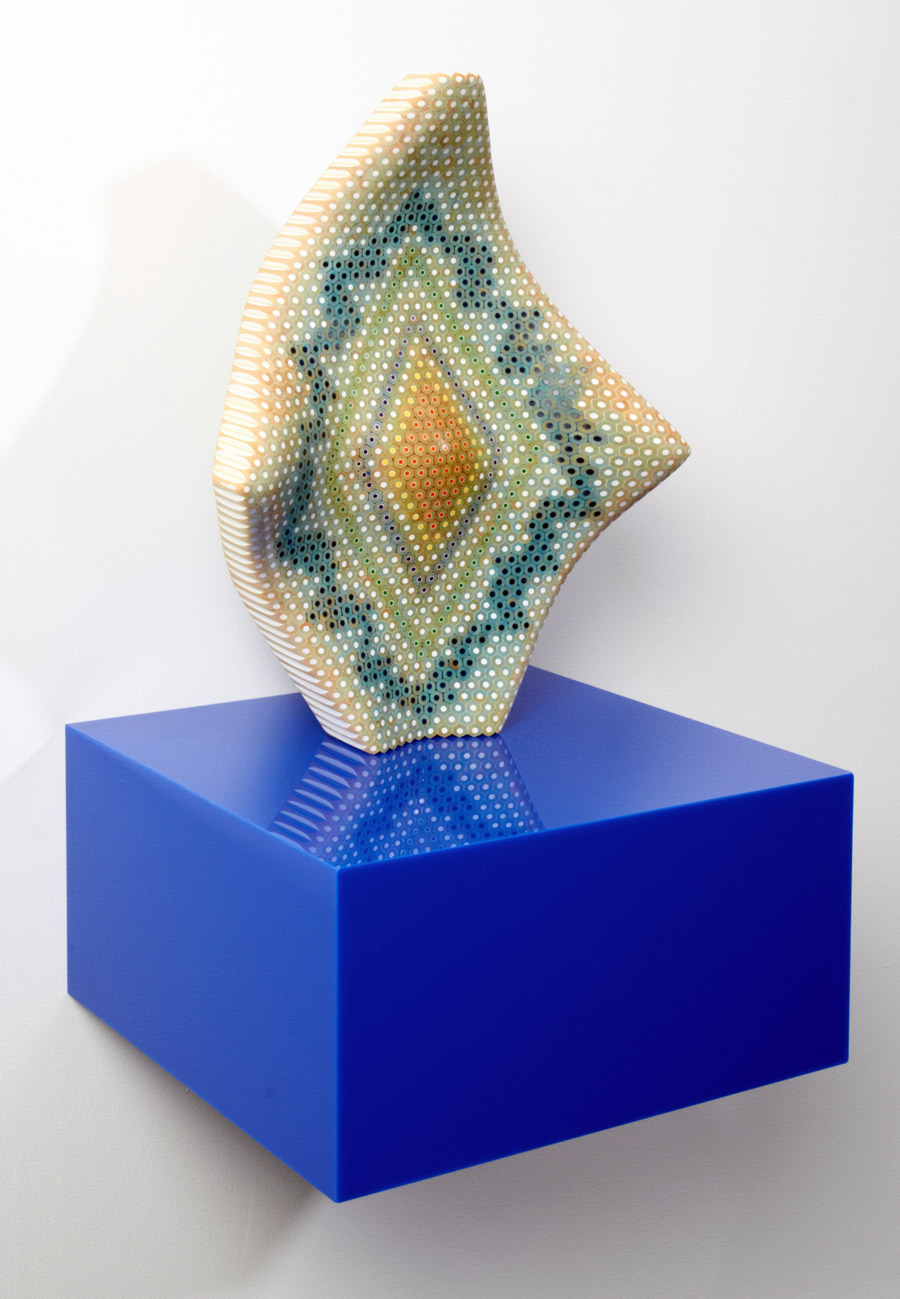
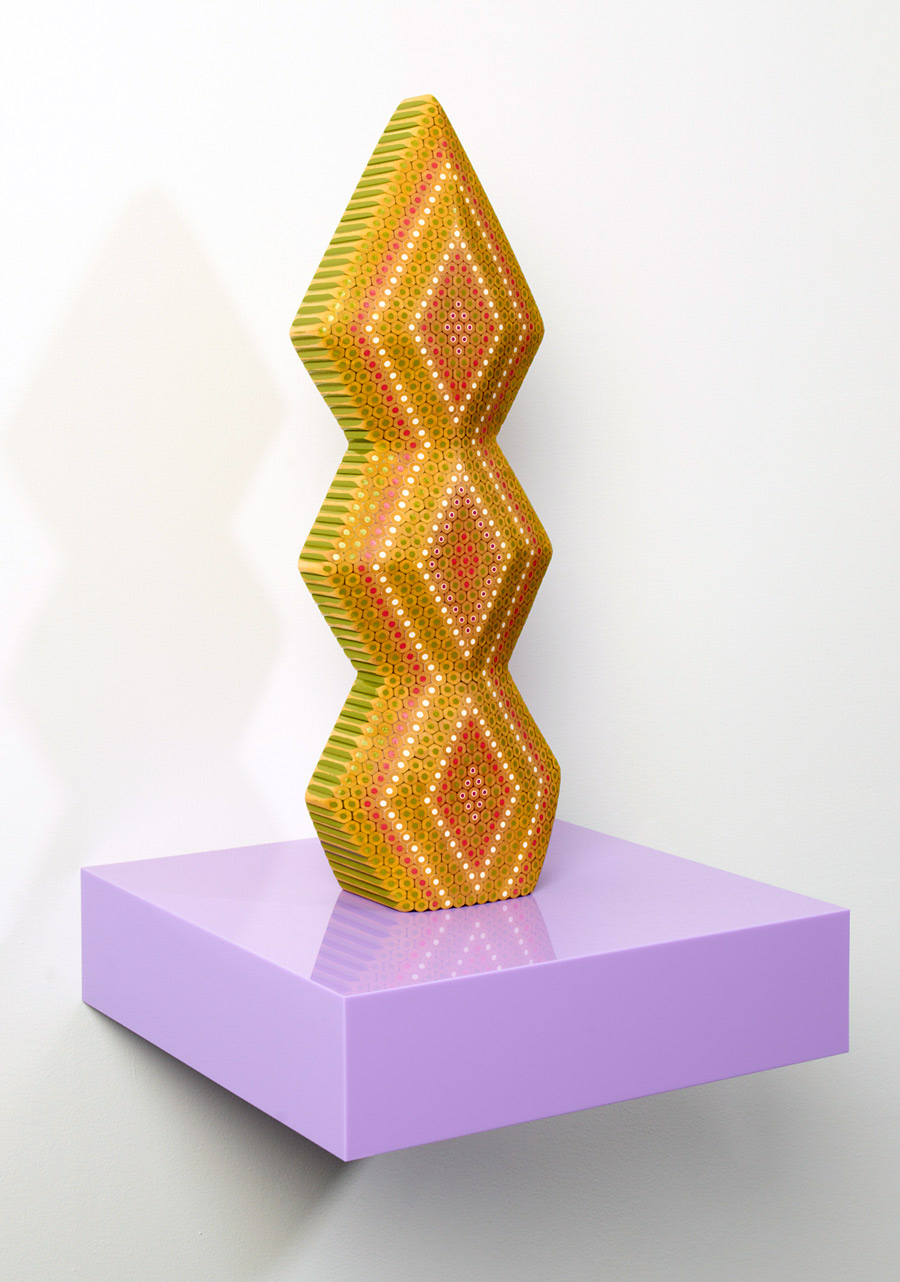
‘The memories are left behind and then reconstituted and turned into other things, it’s a language constantly getting churned up. Memories are things that inform taking the photo,’ Smith says ‘and I’m bringing some of the intrinsic aspects of the photograph with me. Photography captures the classic moments of life, like your first day at school,’ he continues, ‘but it doesn’t capture the other parts of your life that are sometimes way more significant.’

People spend a lot of time in a Martin Smith exhibition reading the works and then laughing or sighing in recognition. The photographs are all of fairly impersonal exteriors, almost crime scenes, not postcards, not picturesque snaps but odd disregarded corners of the world. In some way they are reminiscent of album covers or slightly lame posters but are brought into the present by Smith’s honest and often very funny tales of modern living.

Press release from the Ryan Renshaw Gallery website


Martin Smith (Australian, b. 1971) 'My Father's Talents Will Never Make Me Wealthy' 2011


Martin Smith (Australian, b. 1971)
My Father’s Talents Will Never Make Me Wealthy
2011


Martin Smith (Australian, b. 1971) 'My Father Fails' 2011


Martin Smith (Australian, b. 1971)
My Father Fails
2011


Martin Smith (Australian, b. 1971) 'Revelation #2' 2011


Martin Smith (Australian, b. 1971)
Revelation #2
2011


Ryan Renshaw Gallery

This gallery has now closed.

LIKE ART BLART ON FACEBOOK

Back to top