Exhibition dates: 20th October – 26th November, 2011
Curator: Paul Hodges
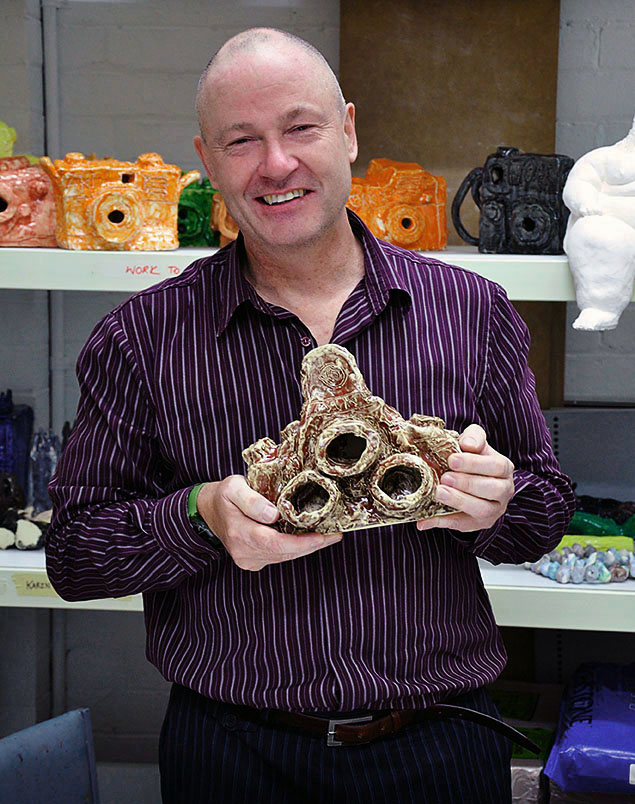
Dr Marcus Bunyan holding his new Alan Constable camera at the opening of Movement and Emotion 2011. More of Alan’s cameras can be seen behind.
I have added a new Alan Constable camera to my collection. Yah!
The one I have chosen is very unusual. The camera has a third eye and a stunning glaze. The exhibition features the work of three Arts Project Australia artists: Alan Constable, Chris O’Brien and Terry Williams. All three artists explore machine aesthetics within their practice.
I really hope that the National Gallery of Victoria purchases some of these cameras. They are the most unusual and beautiful sculptural pieces I have seen in a long time.
Dr Marcus Bunyan
Many thankx to Art Project Australia for allowing me to publish the photographs in the posting. Please click on the photographs for a larger version of the image. See more images from the Movement and Emotion exhibition.
Alan Constable (Australian, b. 1956) Not titled (three lens red camera) 2011
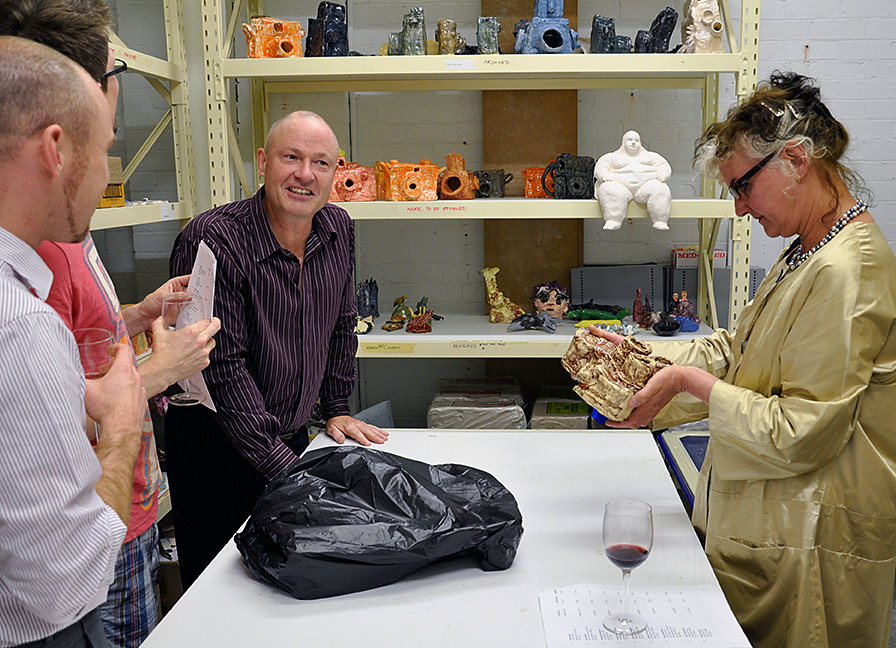
Marcus with jeweller Marianne Cseh at right looking at the Alan Constable camera
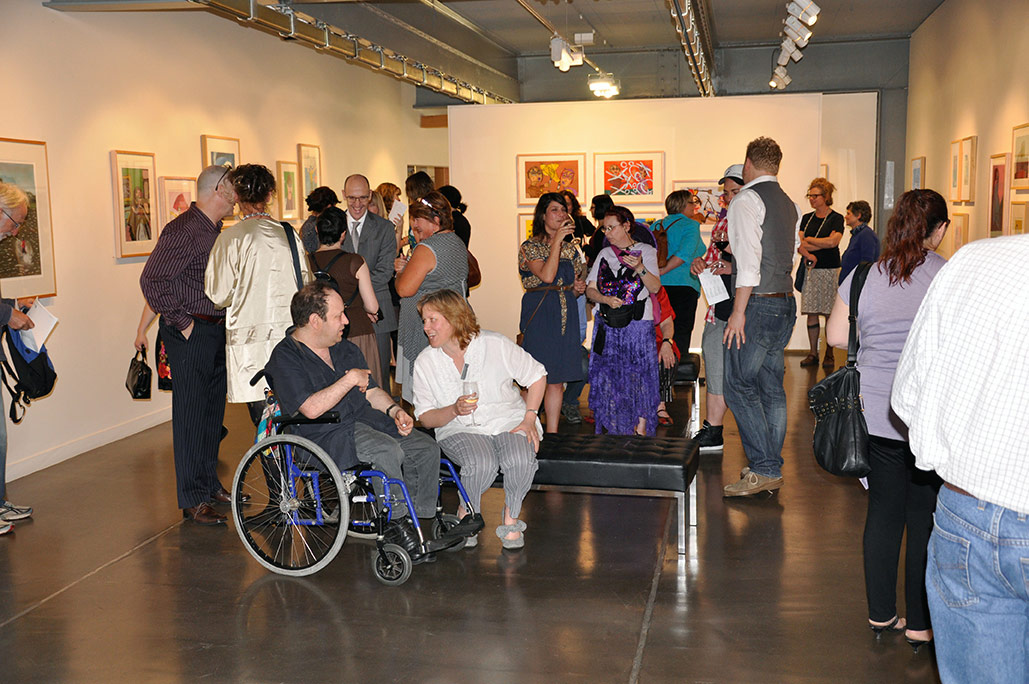
Opening night crowd at Movement and Emotion, Arts Project Australia
Opening night, with at left curator and artist Paul Hodges, artist Jodie Noble (seated), myself and, at right, Jonah Jones, President of the board of Arts Project Australia
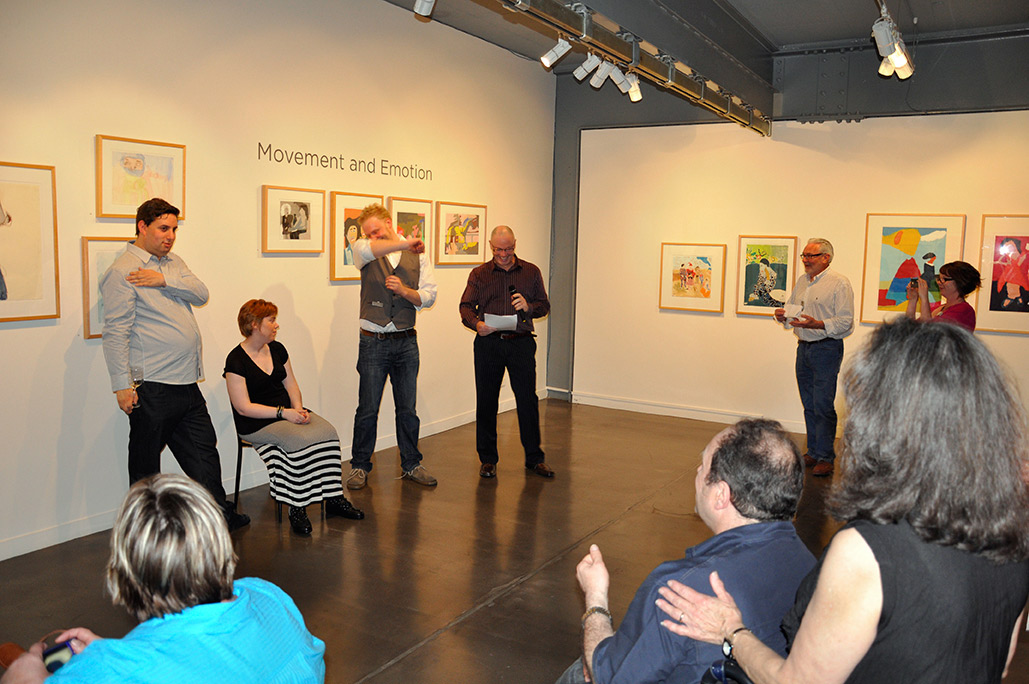
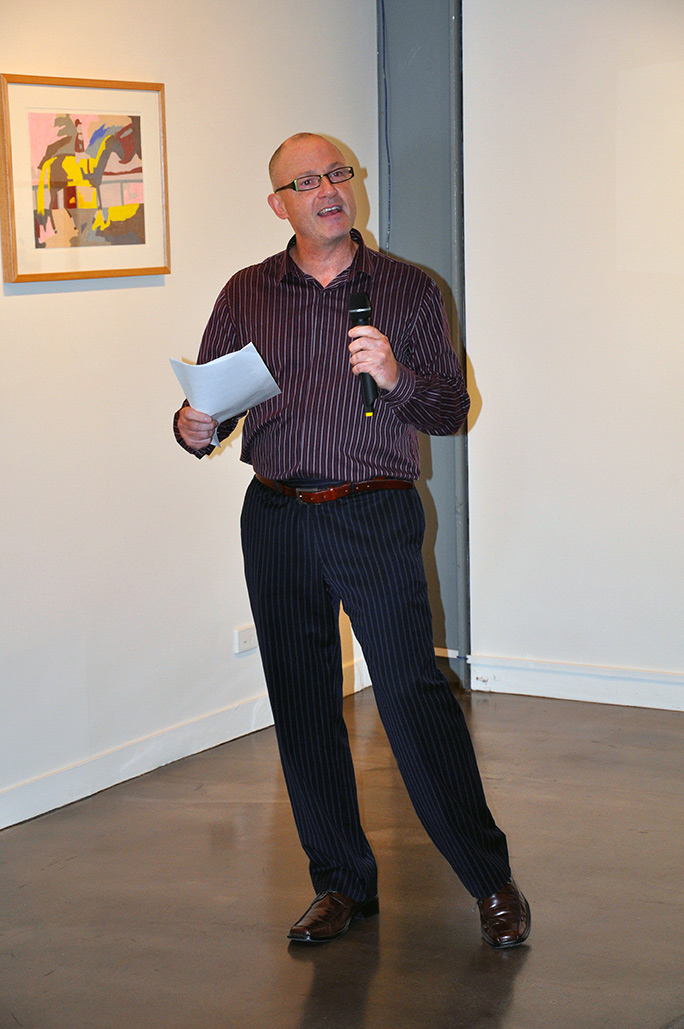
Dr Marcus Bunyan giving the opening night speech for the exhibition Movement and Emotion. Read the opening night speech. I was so nervous my jeweller friend Marianne said she could see my hands shaking from where she was standing in the crowd!!
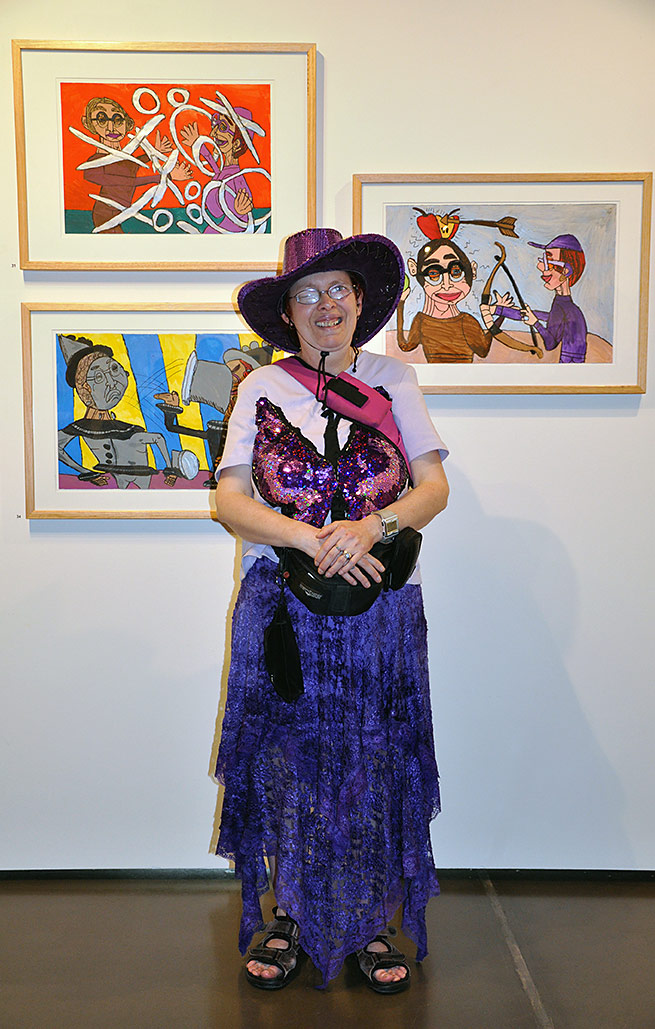
Artist Catherine Staughton standing in front of her work
Arts Project Australia
Studio 24 High Street Northcote Victoria 3070 Phone: + 61 3 9482 4484
Gallery Level 1 Perry Street building Collingwood Yards Enter via 35 Johnson Street or 30 Perry Street, Collingwood Phone: +61 477 211 699
Exhibition dates: 20th October – 26th November, 2011
Curator of Movement and Emotion: Paul Hodges
Artists: Steven Ajzenberg, Patrick Francis, Brigid Hanrahan, Paul Hodges, Chris Mason, Cameron Noble, Jodie Noble, Lisa Reid, Anthony Romagnano and Cathy Staughton
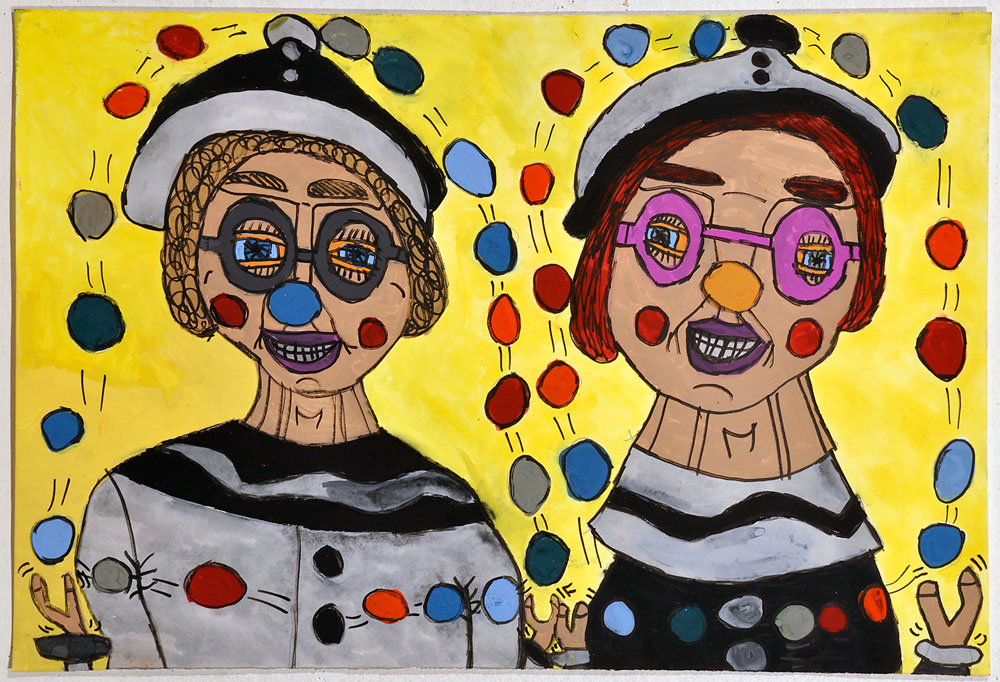
Catherine Staughton (Australian, b. 1968) Juggle Ball Hand Jump Roller 2011 Gouache and felt pen on paper 38 x 56cm
Opening night speech by Dr Marcus Bunyan
Thank you for your welcome to Arts Project Australia on this auspicious occasion, the first ever exhibition to be curated by an Arts Project artist, Paul Hodges. Together with the Jodie Noble solo exhibition in the front gallery I am sure you will agree that the gallery is full of vibrant work. There are some things that may be said about both bodies of work.
I asked Paul what had been the inspiration behind Movement and Emotion. He said that he often goes to the National Gallery of Victoria and looks at the pictures and imagines the artist painting. He wonders how they were feeling and he visualises the pictures coming to life, especially pictures of dancers in which he has a personal interest. He came back to Arts Project and started thinking about the work in the collection and after much thought made the selection you see here tonight. He used his imagination, his feelings and his understanding of the world to curate the exhibition.
Let’s consider the title Movement and Emotion.
Emotion can be defined as an agitation, a strong feeling, a departure from the normal calm state of an organism. The logos of emotion begins in the experience of ‘being moved’ in some manner. Any emotion holds within its structure some potential for movement, whether it be physical or mental. You can be physically still yet be mentally moved, causing you to have emotion. Some emotions occur over a period of seconds (for example, surprise), whereas others can last years (for example, love). In the word ’emotion’ is the very act of movement, namely motion. Hence e/motion is the root of this wonderful feeling that I get from these artworks. Emotion is movement. Emotion is feeling. Emotion is passion.1
And it is this very act that sustains the work in both exhibitions. The work is personal. It speaks from the heart. It is intimate, transcendent and enigmatic. It moves me like little contemporary art ever does. When I first saw the artwork in the space at the back of the gallery, when they were revealed to me I gasped at their simple, eloquent beauty. Whimsical and playful these works possess an element of the carnivalesque,2 a riot of colour and form that exist on the border of art and life. Mingling depictions of high culture and personal narrative the works have no pretence but a visceral immediacy: a direct connection from the artists imagination of the world, through the eyes to the hand and the paper to depict what is in the world. As Susan Sontag observes, “A work of art is a thing in the world, not just a text or commentary on the world…”3
Some of you may be familiar with the American photographer Walker Evans – his famous US Depression era pictures are a thing in the world, as well as text/commentary on the world. He refers to this working method as ‘transcendent documentary’4: a watchful intelligence that recognises a moment of seeing, a movement of emotion – and then describes it. Yes, a quest for ‘the thing itself’ but more than that, the imagination to describe the substance of our existence, the nature of reality. Objects, people and places are transformed from things seen to things that we known. Intimately. Inherently.
In their unique vision it is the artists relation to self, the nature of what they see and feel around them that creates e/motion. They transcend form while ordering it at the same time. It is both the immediate world, simply described, perceived as it stands with the whole of consciousness coupled with the imagination as always there, between our eyes and the world, for it is the imagination that defines our humanity, declares our consciousness. They imagine, they perceive the simple radiance of what is.
That is what these artists do.
Perceive.
What is.
In Movement and Emotion, and in the portraits of Jodie Noble we see what is and imagine what should be. The photographer Elliott Erwitt in his book Personal Exposures (1988) said, “The work I care about is terribly simple … I observe, I try to entertain, but above all I want pictures that are emotion.”5
Those pictures are here, e/motioning, all around us. I enjoy these pictures tremendously. Congratulations to all the artists for the experience that you have given us.
2/ Bakhtin, Mikhail. Rabelais and His World (trans. Helene Iswolsky). Cambridge: MIT Press, 1968, p. 7
3/ Sontag, Susan. “On Style,” in Against Interpretation and Other Essays. New York: Delta Book, 1966, pp. 21-22
4/ Anon. “”A Revolutionary Project” Brings Cuba to the Getty Museum,” on Cuban Art News [Online] 05/10/2011 Cited 08/10/2011. No longer available online
5/ Erwitt, Elliott. Personal Exposures. W. W. Norton & Company, 1988 quoted on Anon. “Photographer Elliott Erwitt’s Archive to be Housed at Harry Ransom Center,” on Harry Ransom Center: The University of Texas website [Online] 22/09/2011. Cited 08/10/2011. No longer available online
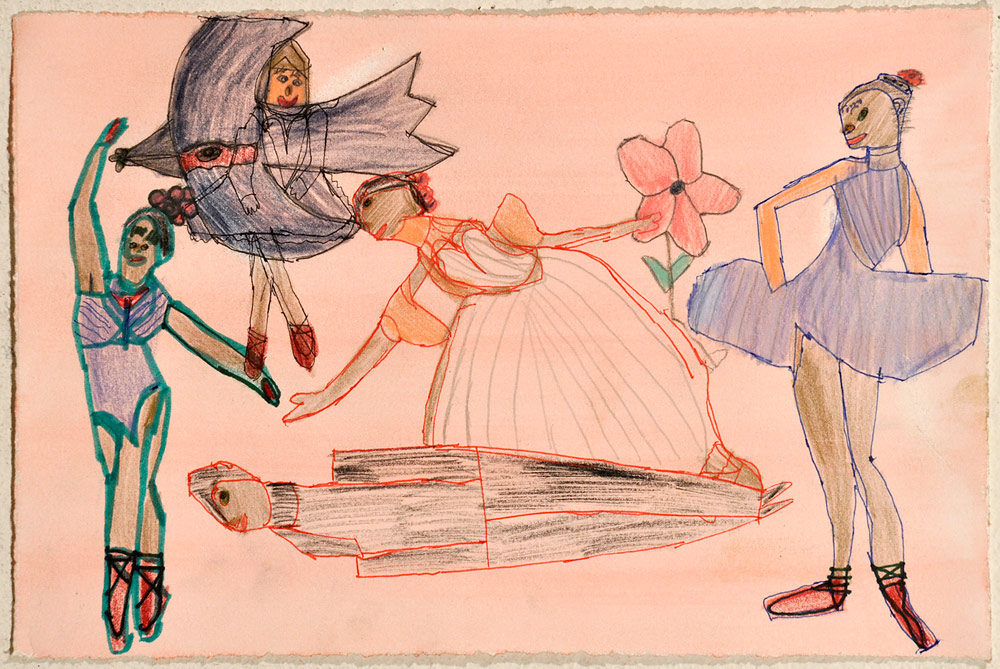
Brigid Hanrahan (Australian) Not titled (Ballet Dancers) 2009 Colour pencil and fineliner on paper 20 x 30cm
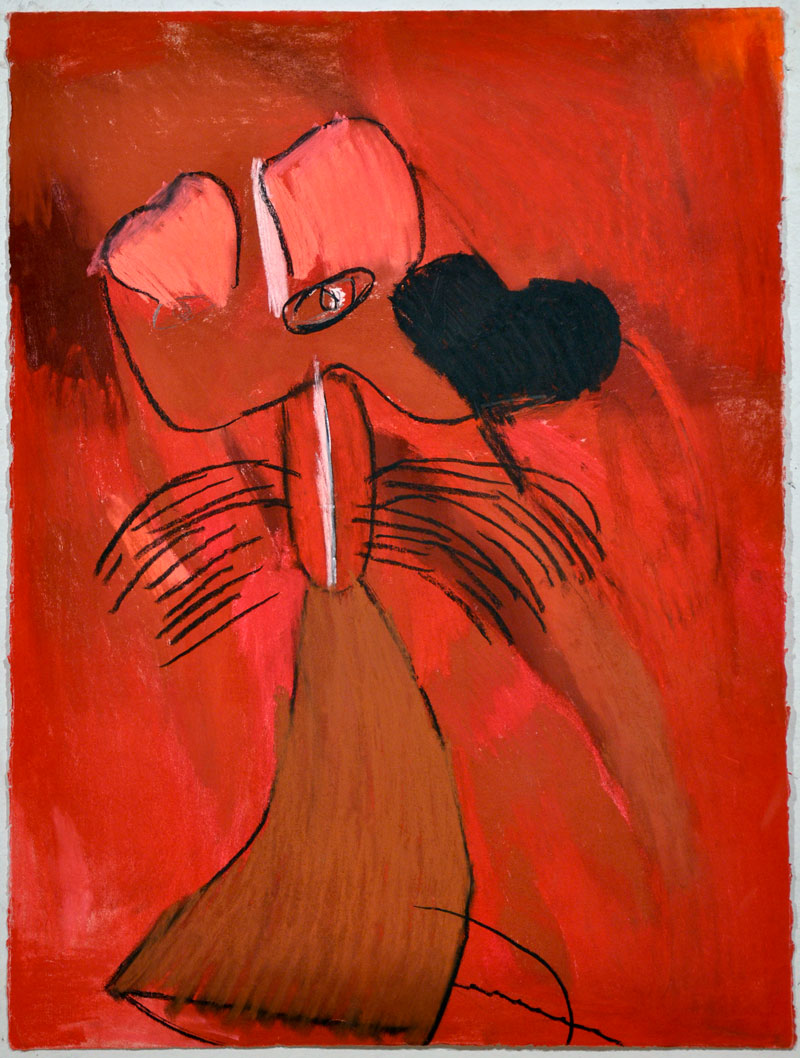
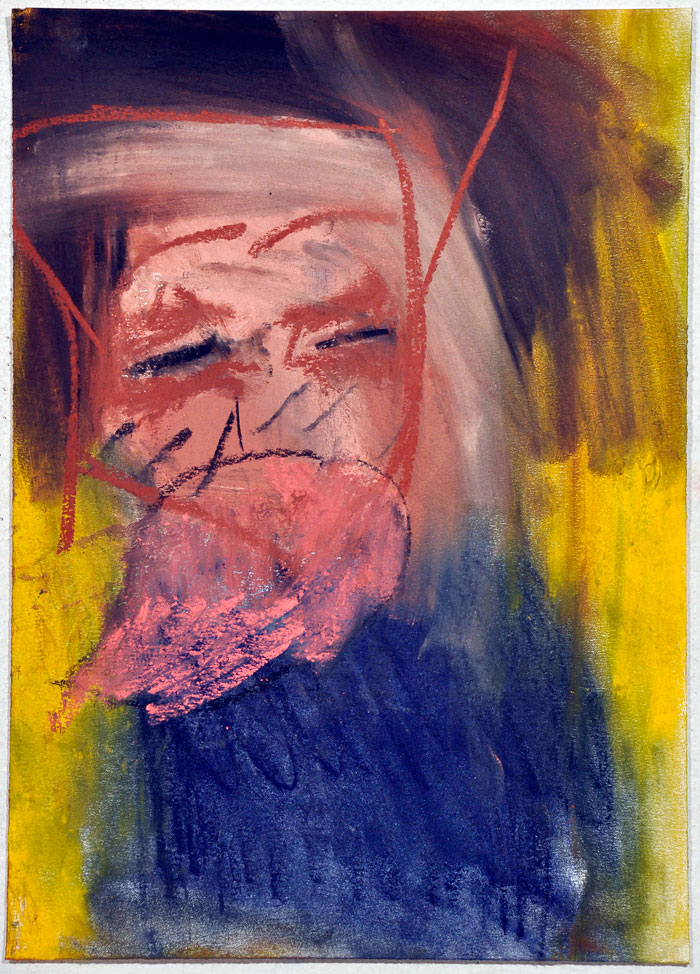
Jodie Noble (Australian) Not titled (red dog) 2006 Pastel on paper 76 x 57cm
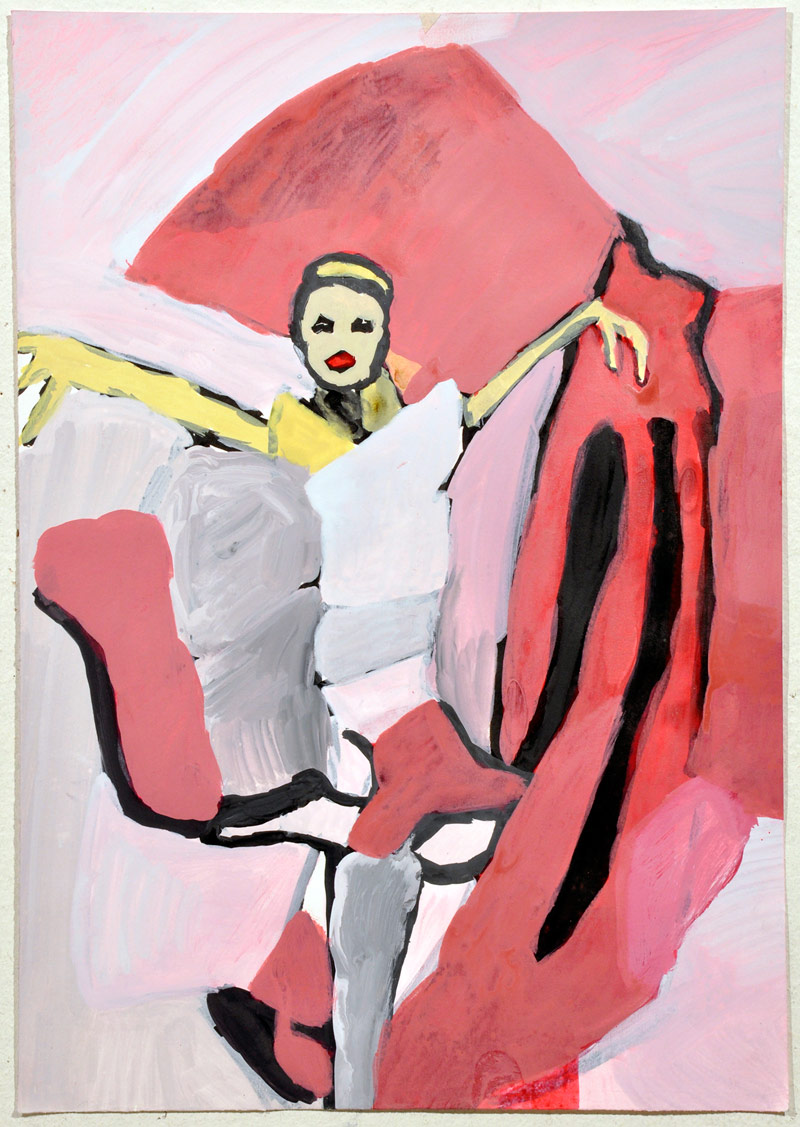
Paul Hodges (Australian, b. 1974) Not titled (Pink Dancer) 2010 Ink on paper 50 x 35cm
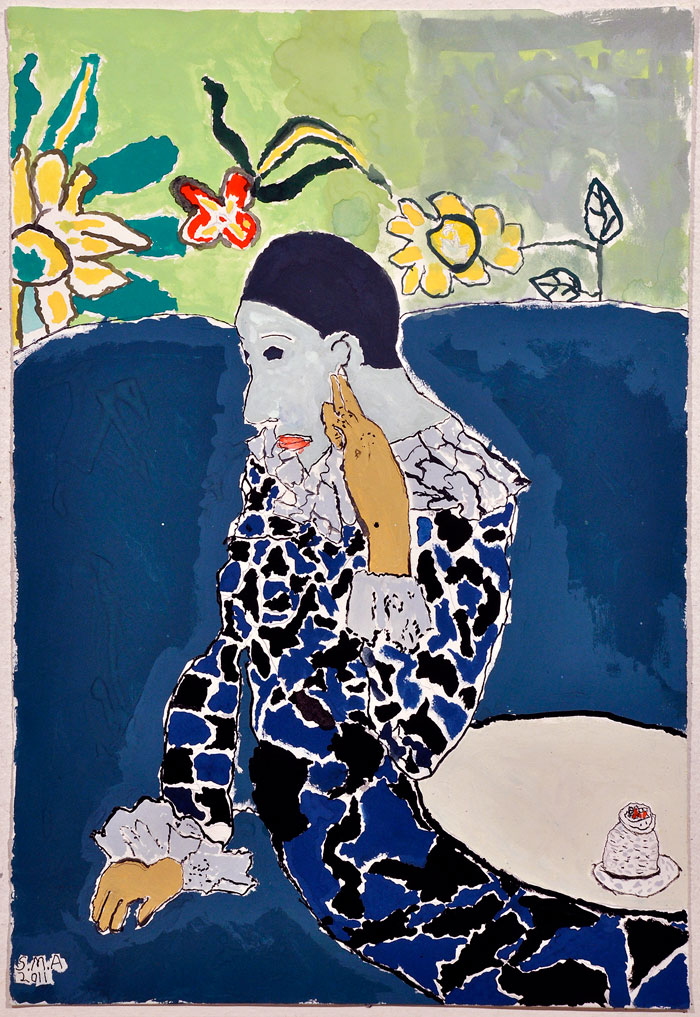
Steven Ajzenberg (Australian, b. 1964) Harlequin 2010 Gouache on paper 55.5 x 38cm
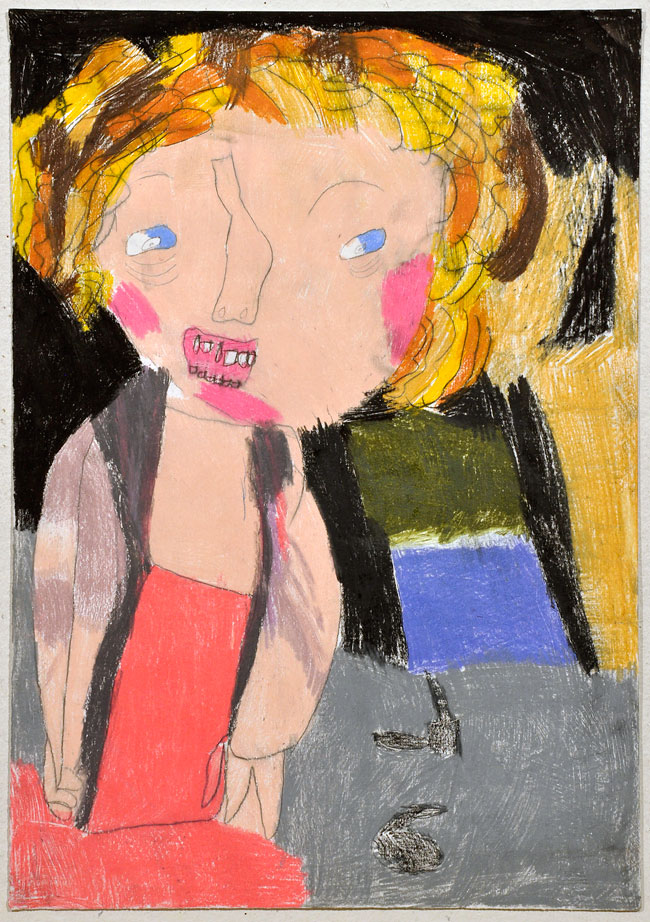
Jodie Noble (Australian) Not titled (girl wearing pink dress) 2010 Prisma colour pencil on paper 50 x 35cm
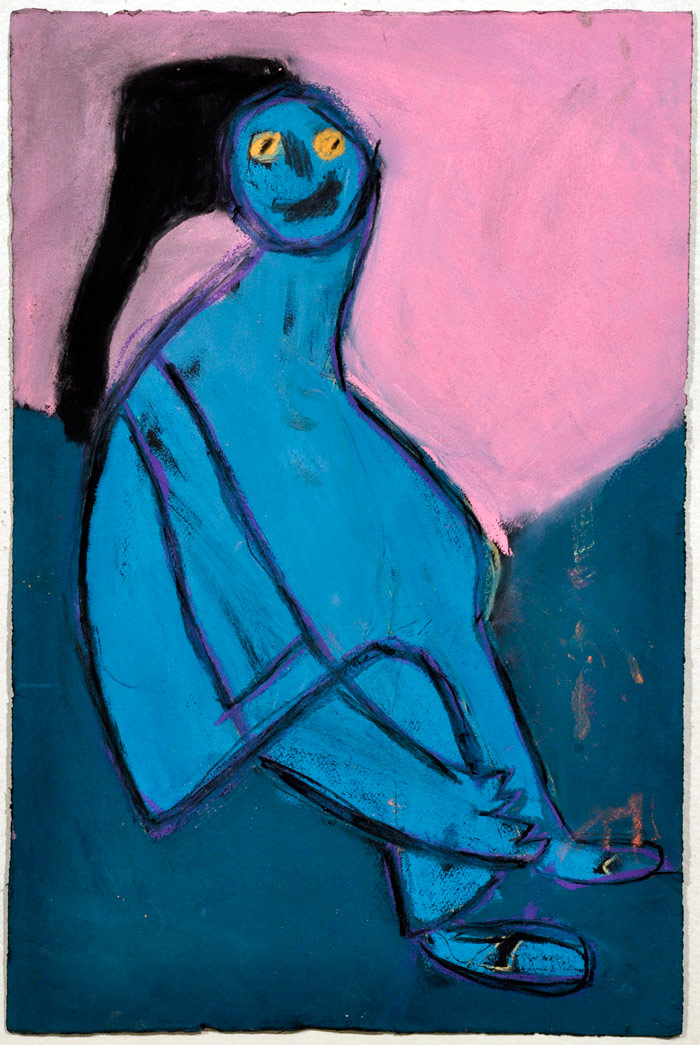
Cameron Noble (Australian) Not titled (Blue Lady) 2011 Dry pastel on paper 57 x 37.5cm
Jodie Noble (Australian) Geisha Girl 2011 Dry pastel on paper 35 x 25cm
Movement and Emotion
This exhibition will explore movement in paintings and the emotions of people in everyday life. These works are vibrant, expressive and each work is unique; they jump out at you. Key themes investigated include carnival, dance and portraits. This is the first exhibition Paul Hodges has curated.
“This is a wonderful show presenting movement and emotion in art by ten artists that I have collected from Arts Project Australia’s studio.”
Paul Hodges, 2011
“When I walk past Jodie Noble’s paintings I can almost feel what she is feeling … Jodie is telling us what she is feeling through her paintings.”
Paul Hodges 2010
Jodie Noble Solo
Jodie Noble’s current work is figurative and often incorporates an autobiographical narrative. While occasionally painting from life, her work also references popular culture. In particular, Noble is inspired by contemporary famous figures, from Frida Kahlo and Francisco Goya to Queen Elizabeth II. Noble’s work is descriptive, expressive and infused with a sense of physicality.
In this exhibition, Noble has selected a series of portraits on paper that are autobiographical and of people she knows in her life. This is Jodie’s second solo exhibition.
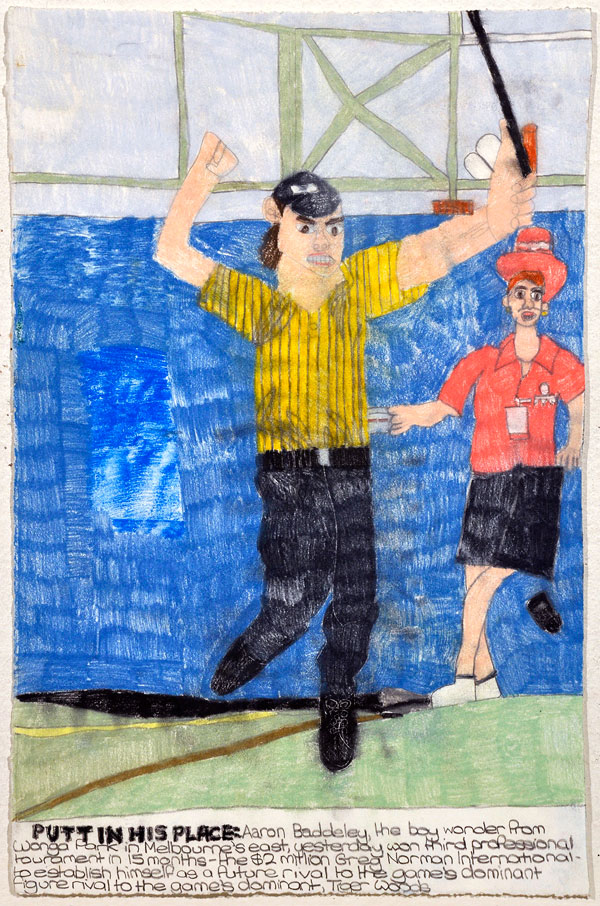
Lisa Reid (Australian, b. 1975) Not titled (Adam Baddeley) 2001 Pastel and pencil on paper 50 x 33cm
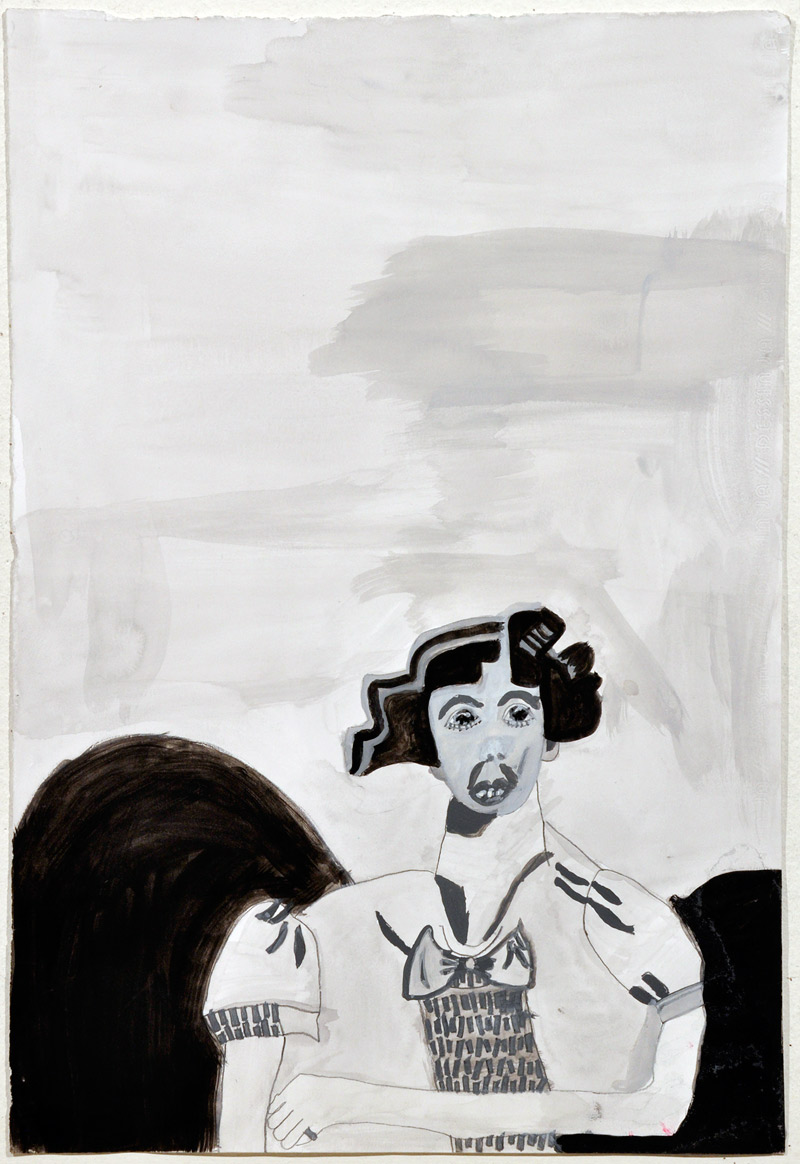
Lisa Reid (Australian, b. 1975) Great Aunt Edna 2003 Gouache on paper 55 x 37.5cm
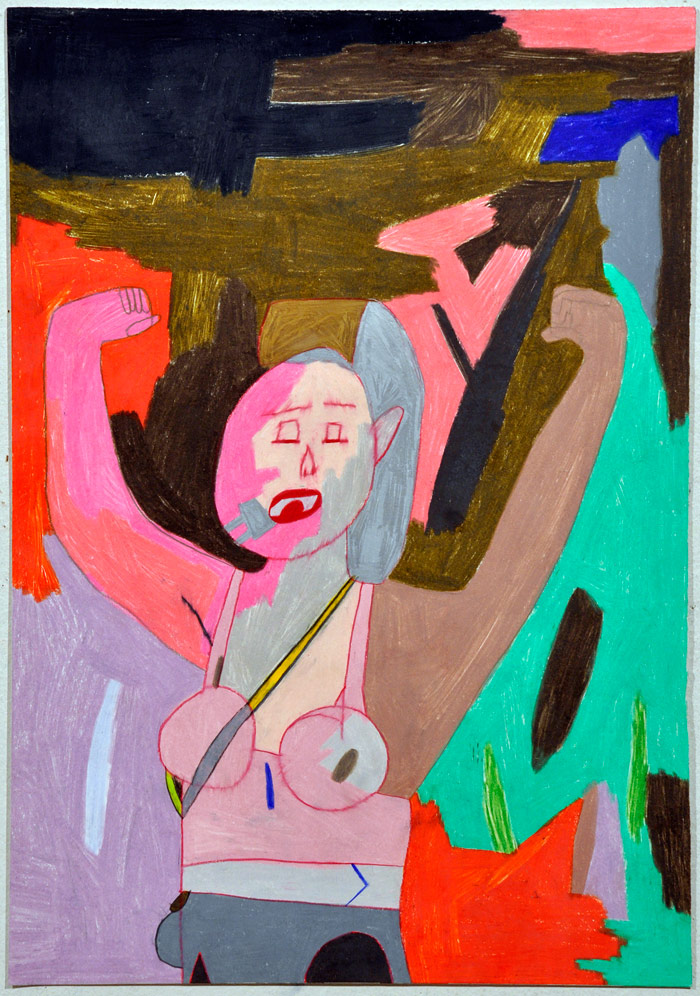
Anthony Romagnano (Australian, b. 1985) Madonna 2010 Prisma colour pencil on paper 50 x 35cm
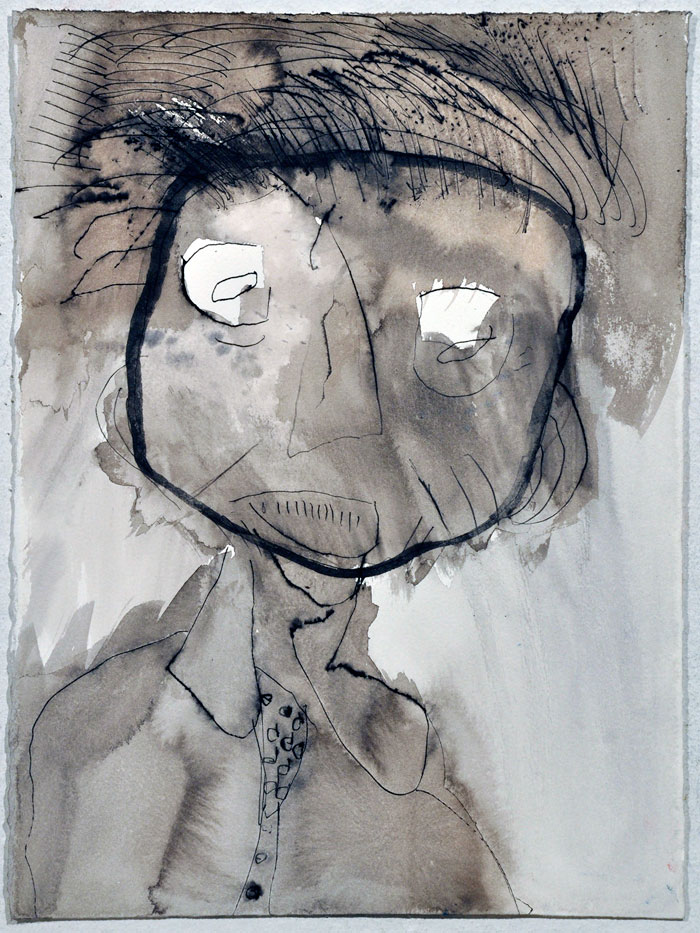
Jodie Noble (Australian) Not titled 2010 Ink and fine-liner on paper 38 x 28.5cm
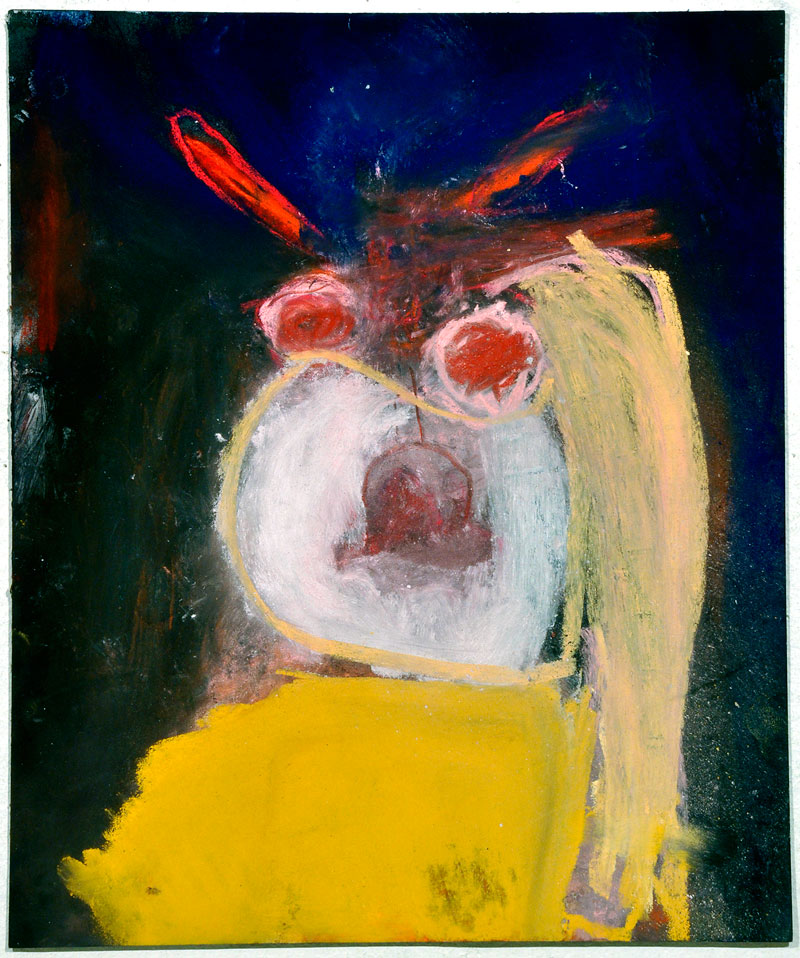
Cameron Noble (Australian) Not titled 2011 Dry pastel on paper 38.5 x 32.5cm
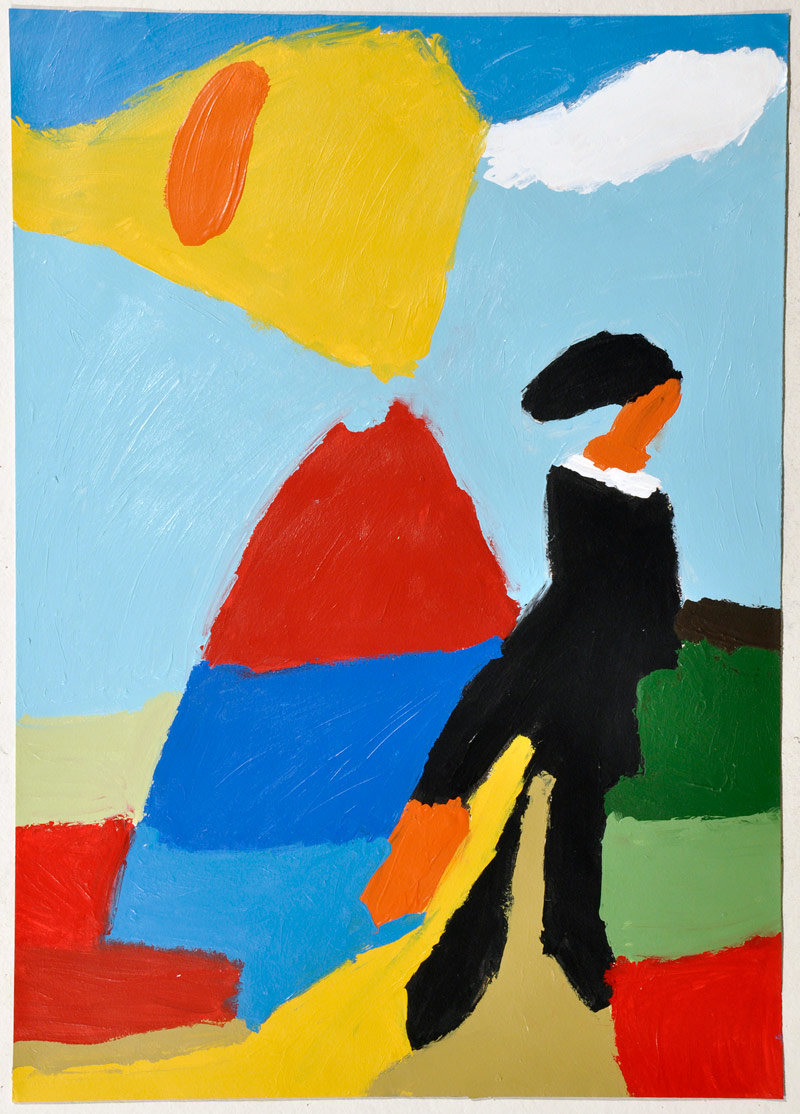
Patrick Francis (Australian, b. 1991) Not titled 2011 Acrylic on paper 70 x 50cm
Arts Project Australia 24 High Street Northcote Victoria 3070 Phone: + 61 3 9482 4484
Gallery location: Level 1 Perry Street Building, Collingwood Yards Enter via 35 Johnson Street or 30 Perry Street, Collingwood
Opening hours: Wed – Fri 11am – 5pm Sat & Sun 12 – 4pm
I am opening the exhibitions Movement and Emotion and Jodie Noble Solo at Arts Project Australia, Northcote on Wednesday 19th October 2011 from 6 – 8pm.
All welcome, would be great to see you there. Details on the flyer!




You must be logged in to post a comment.