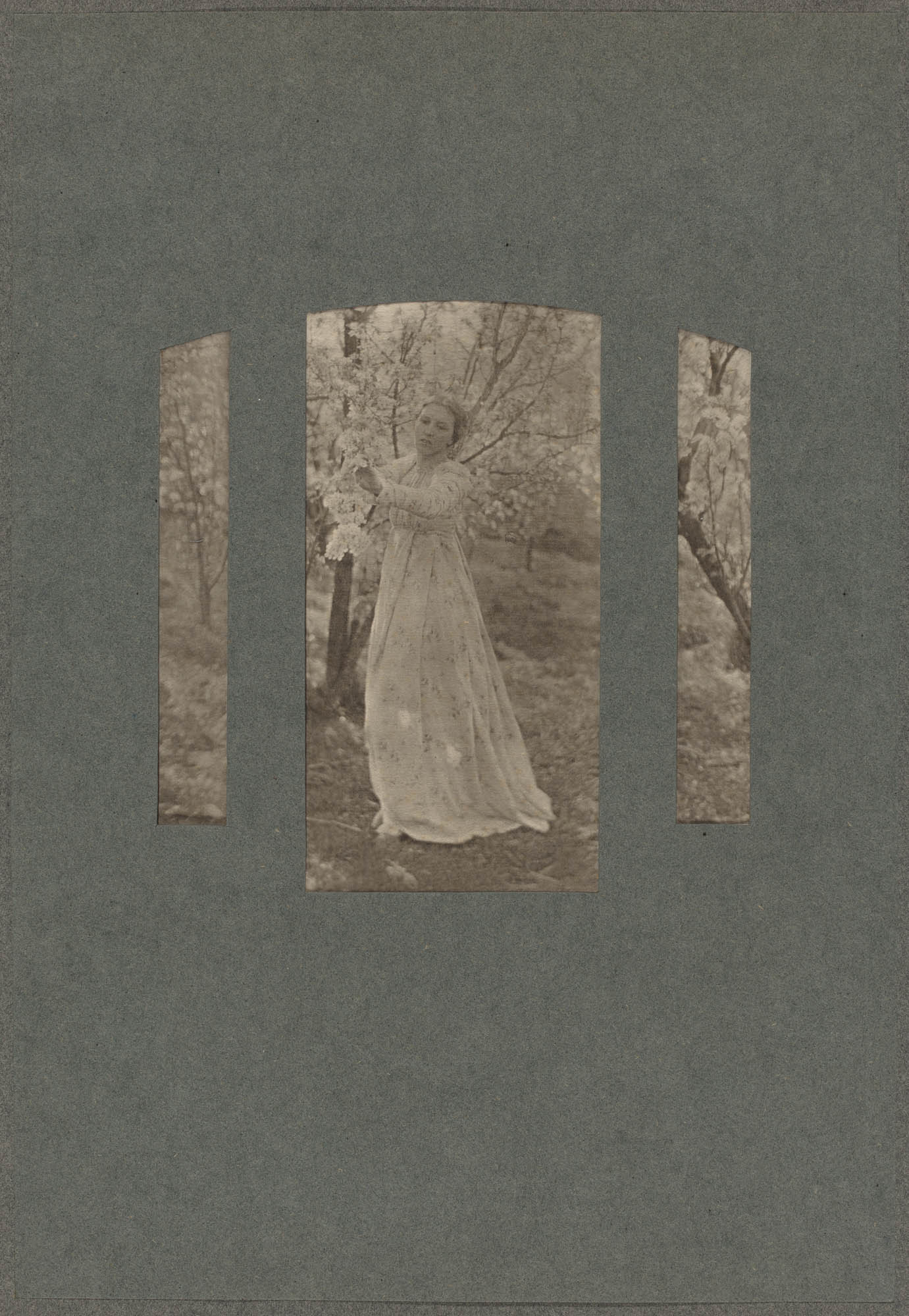
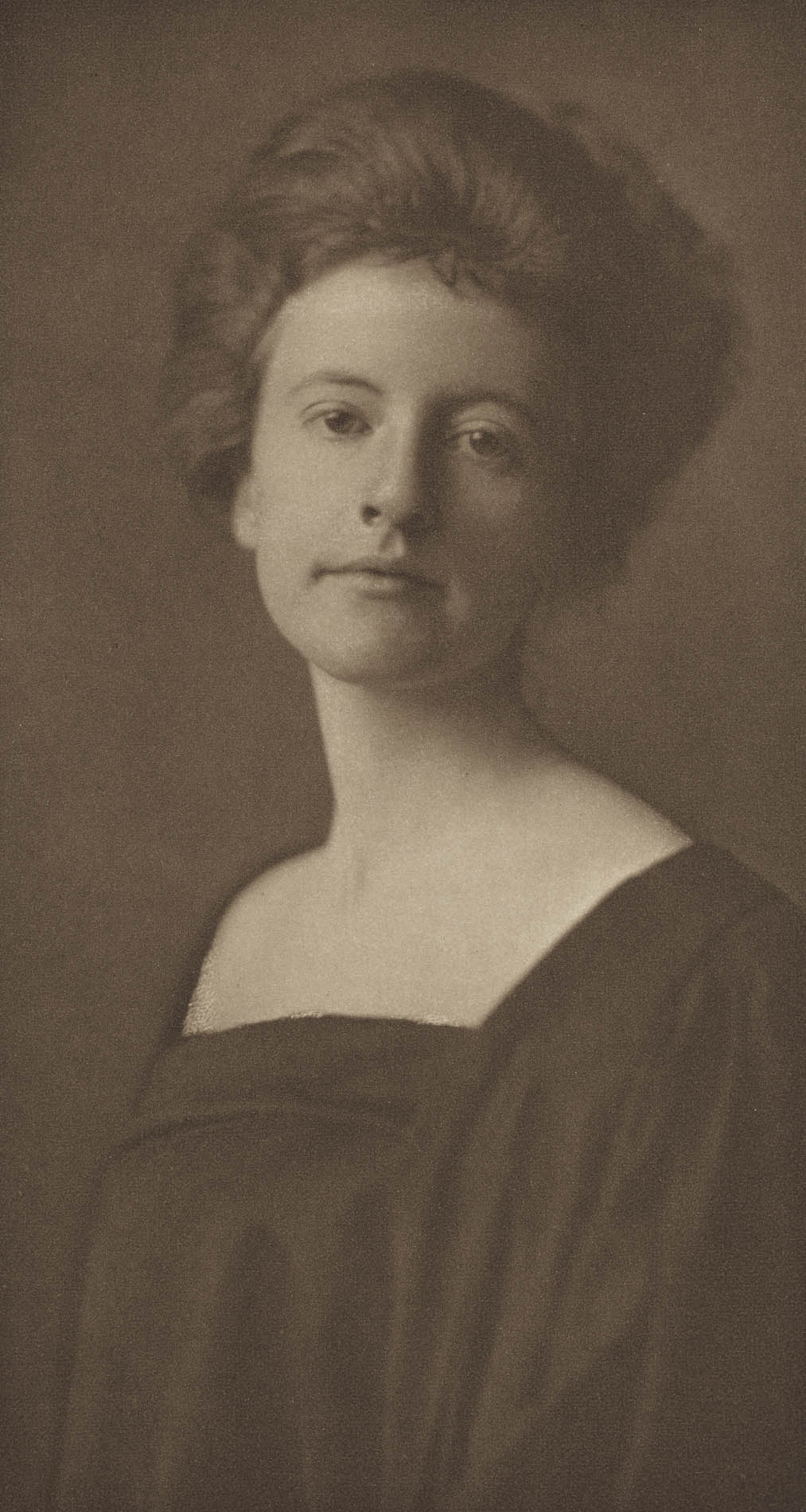
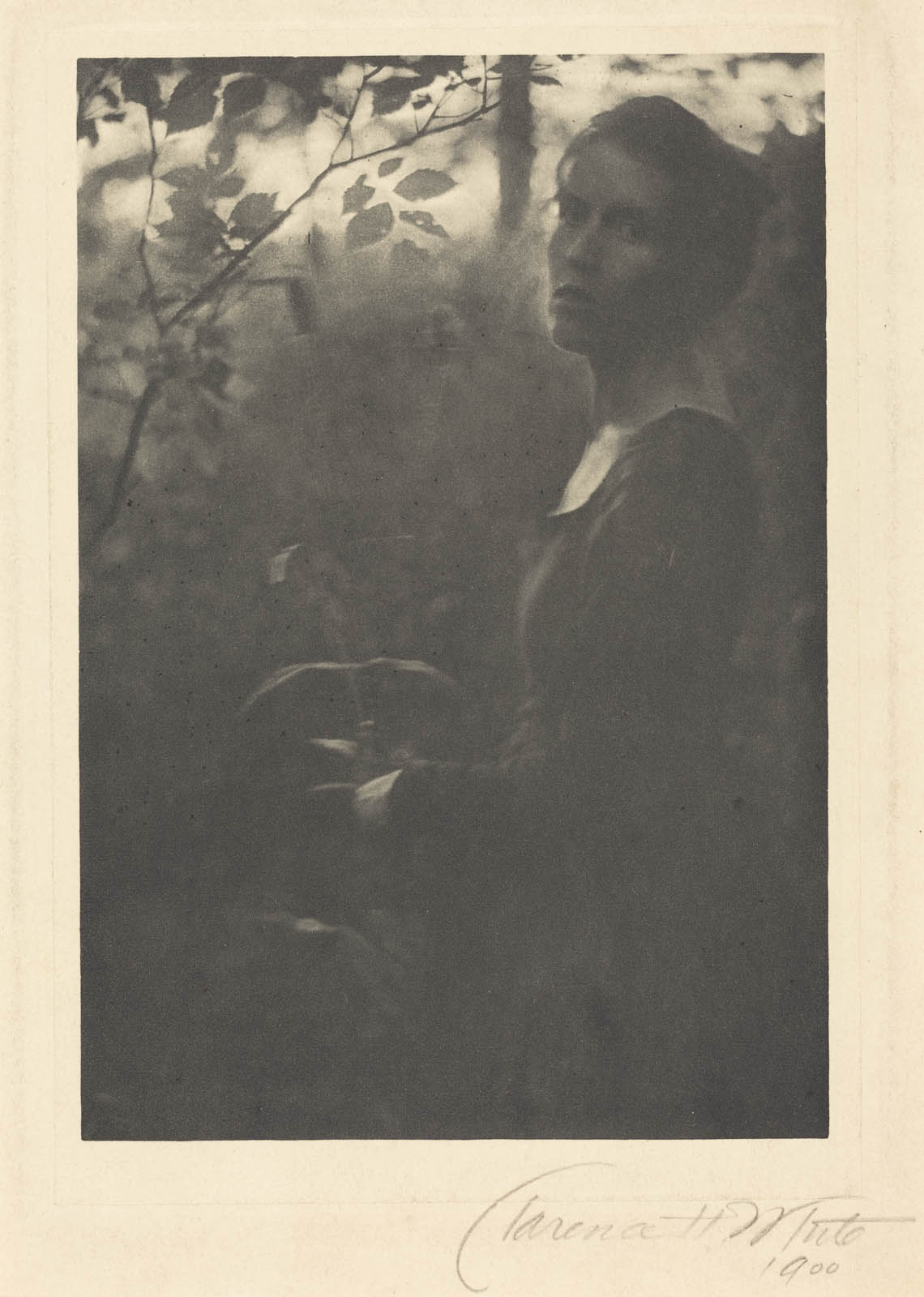
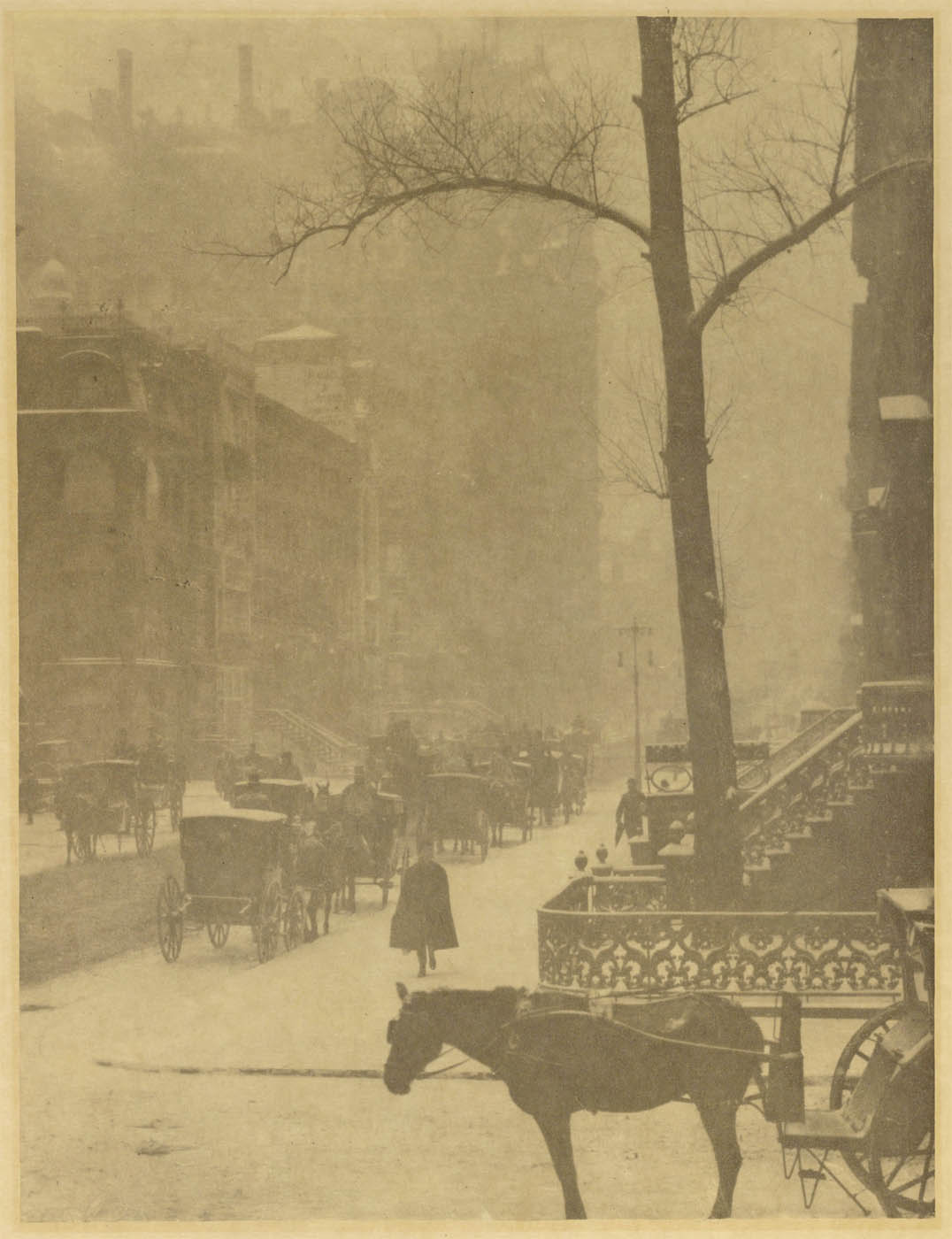
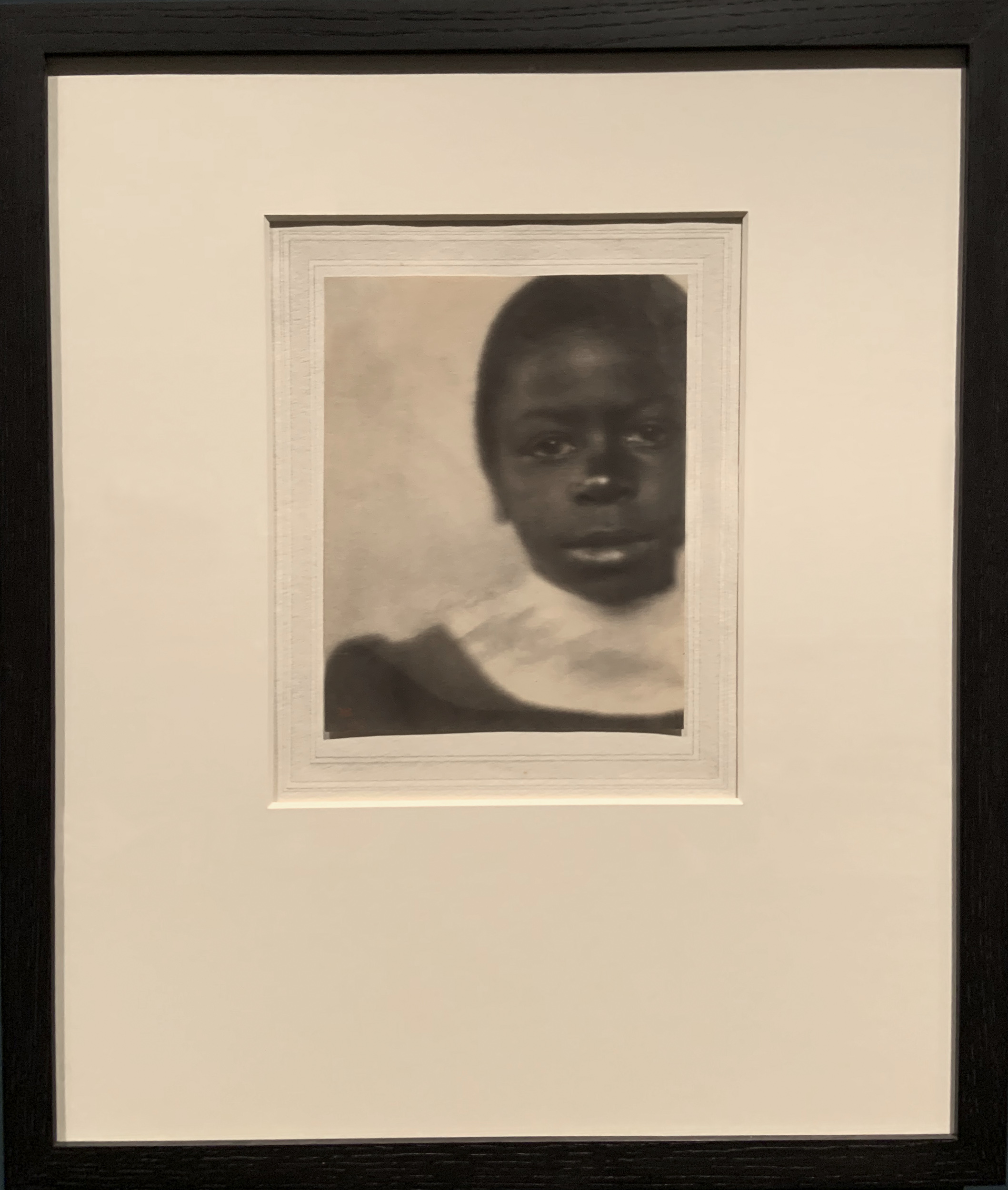
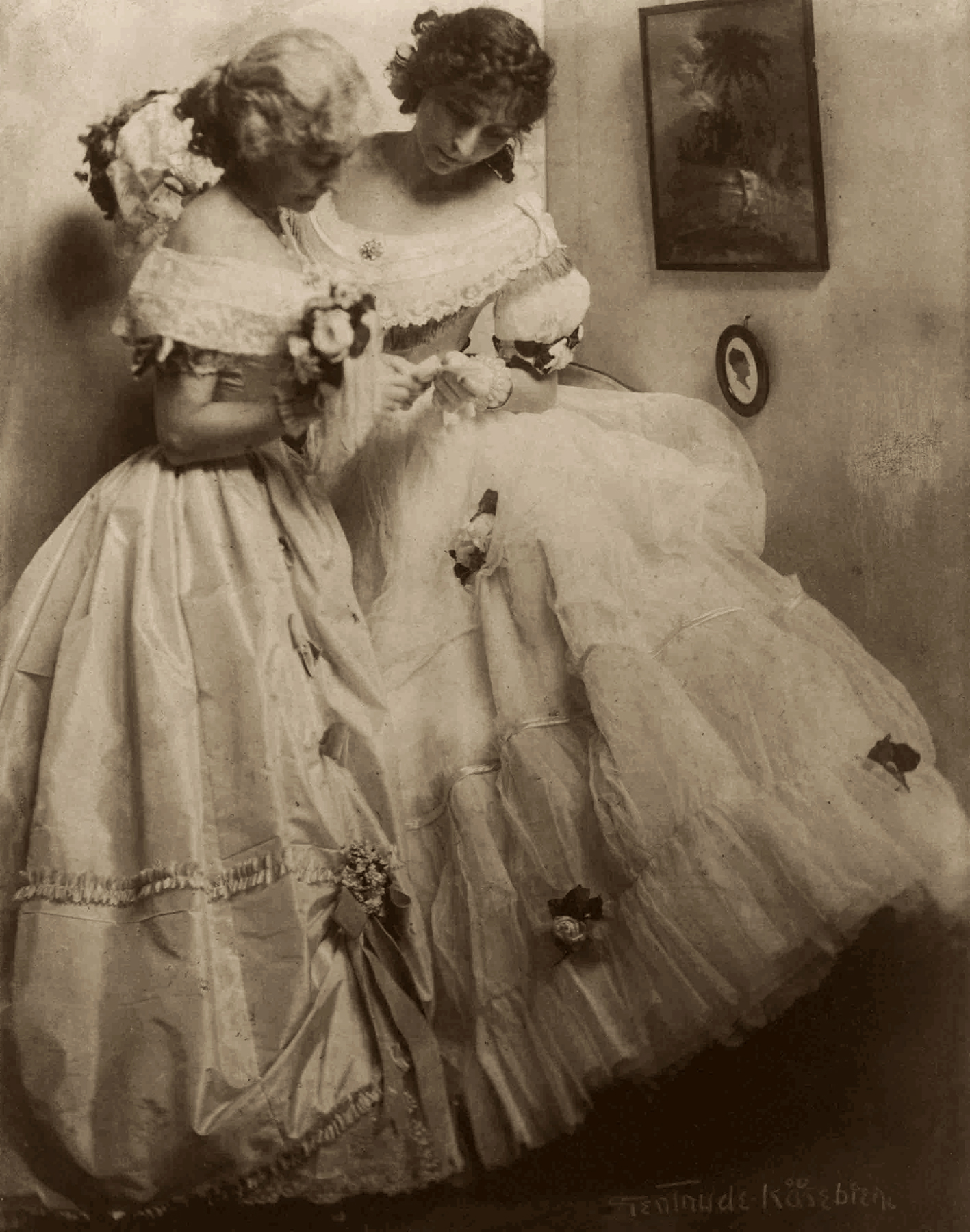
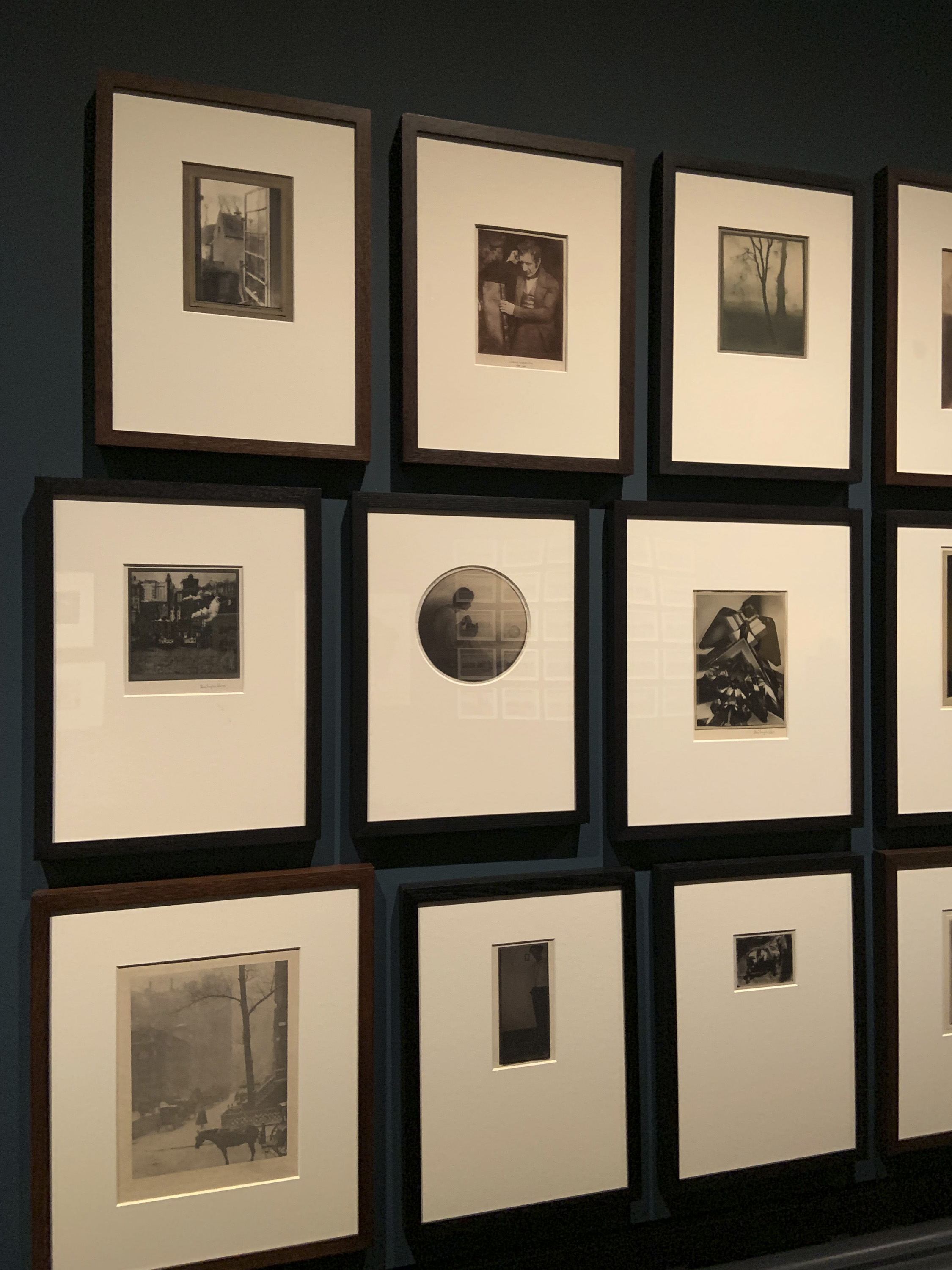
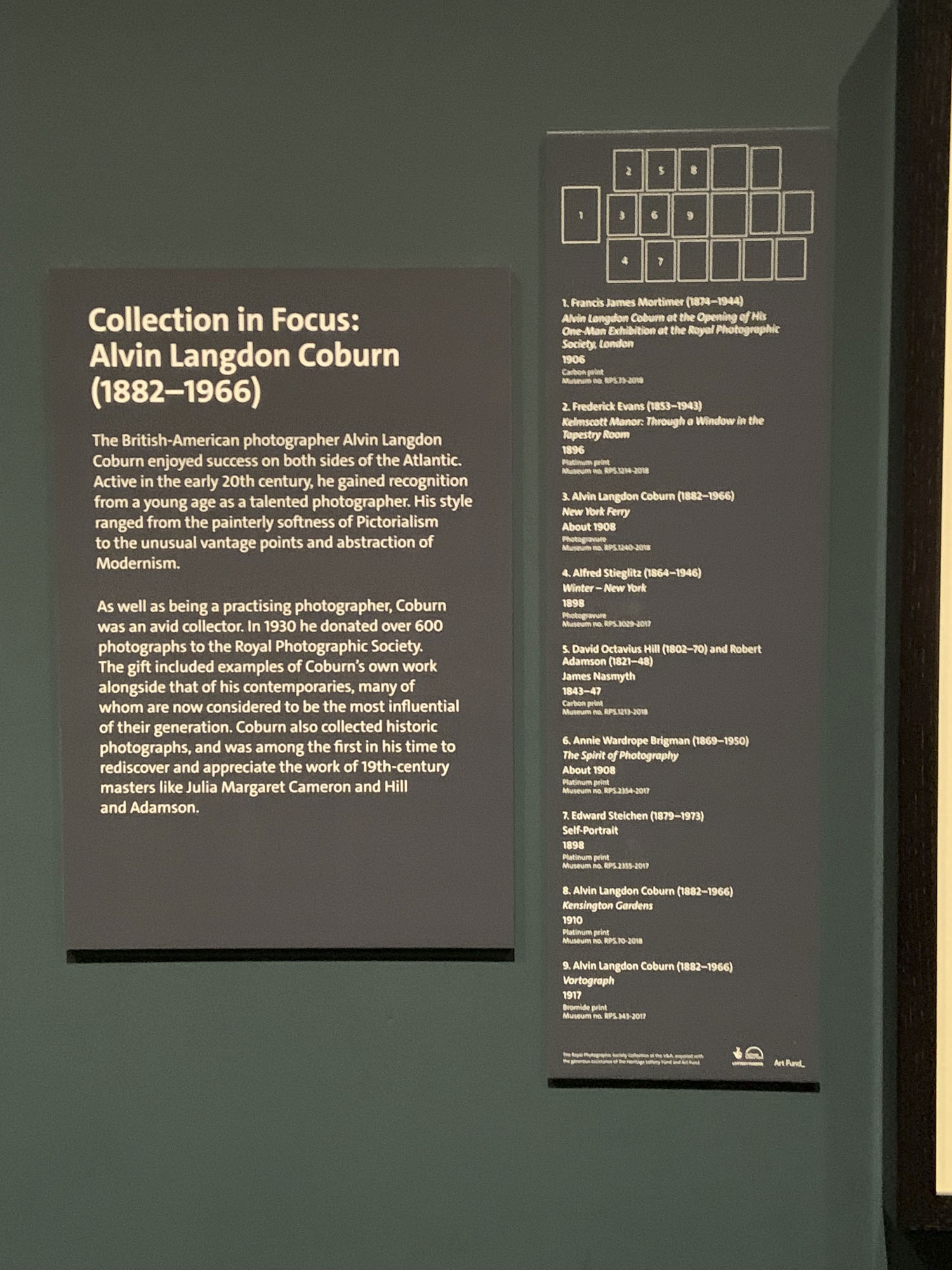
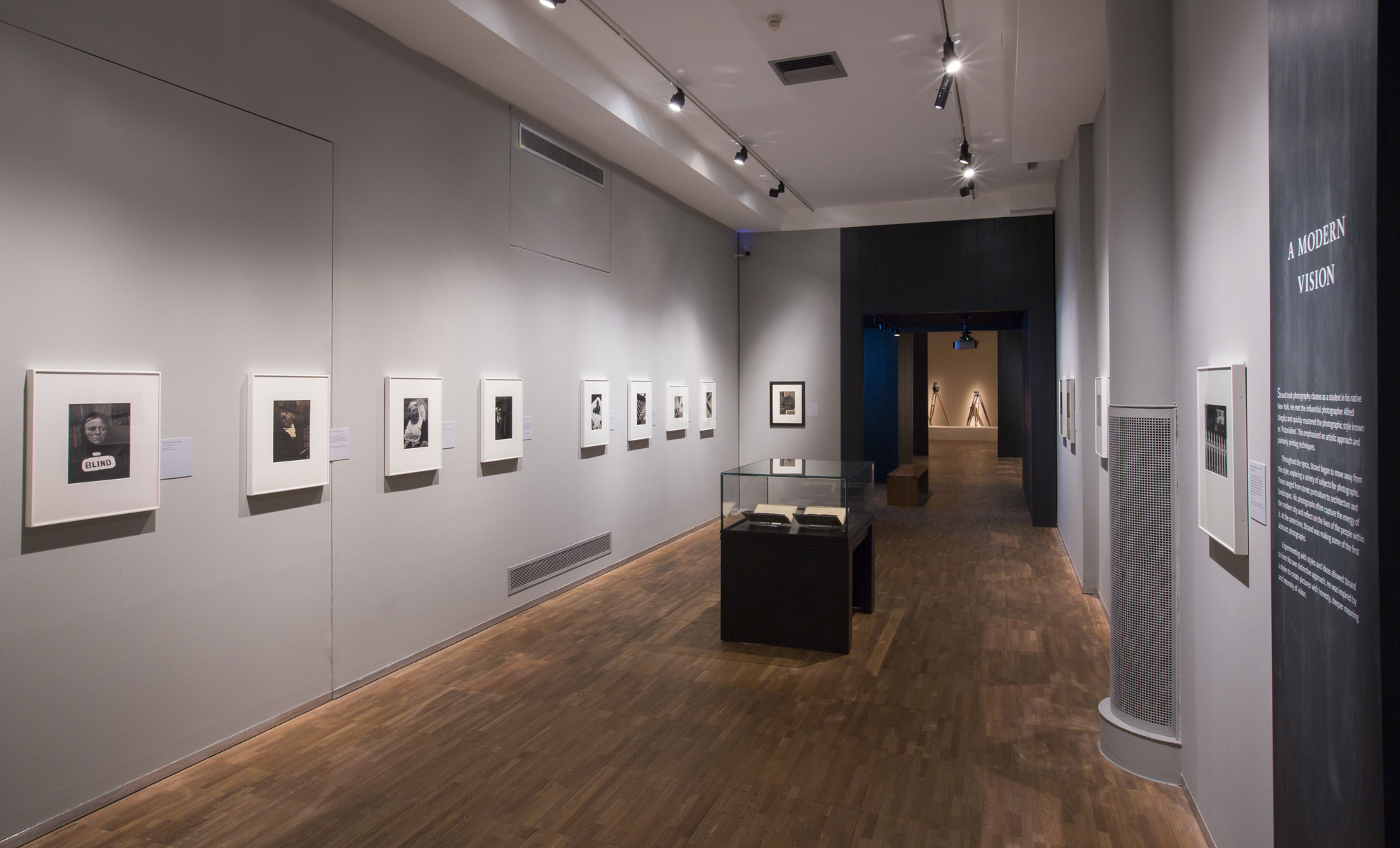
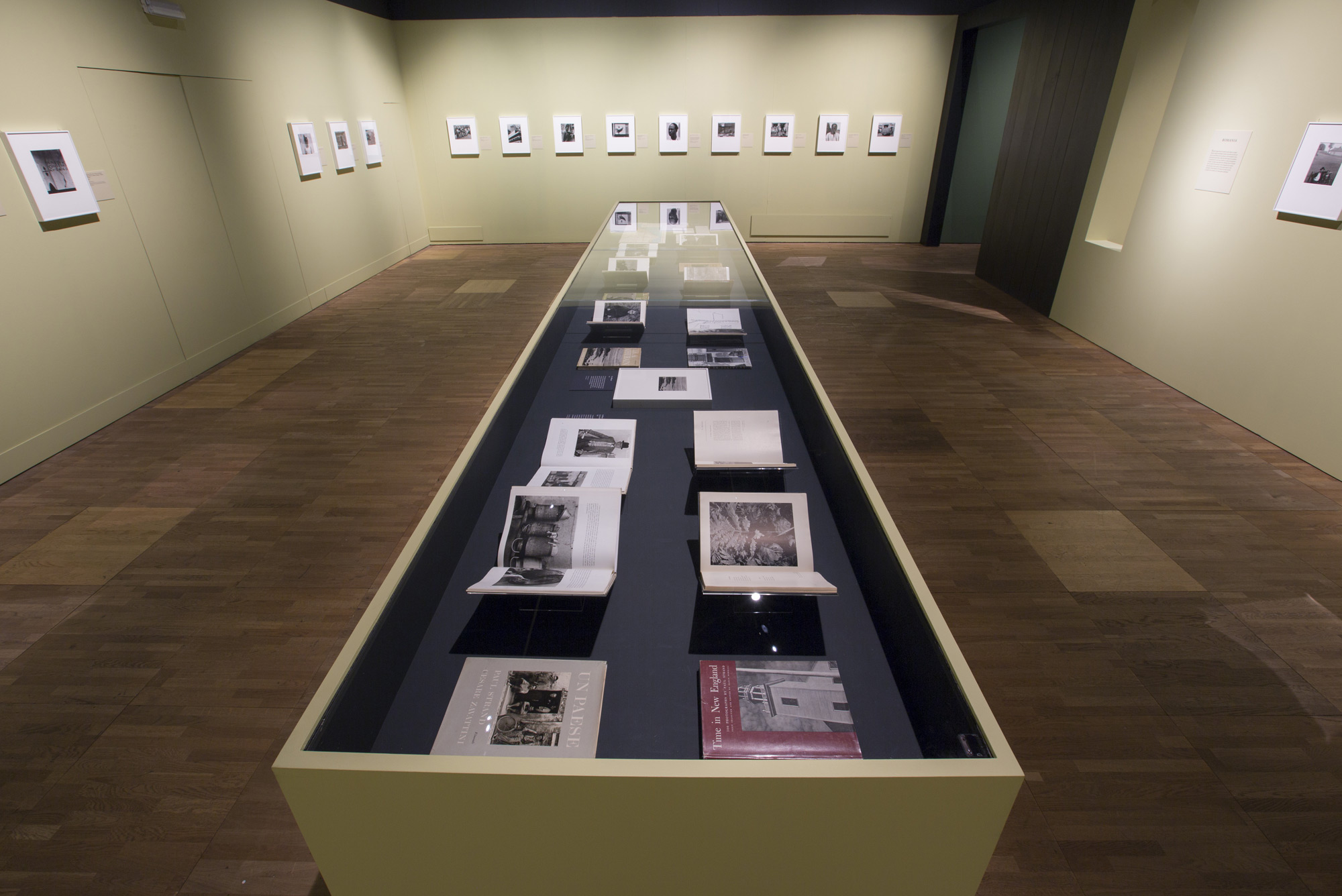
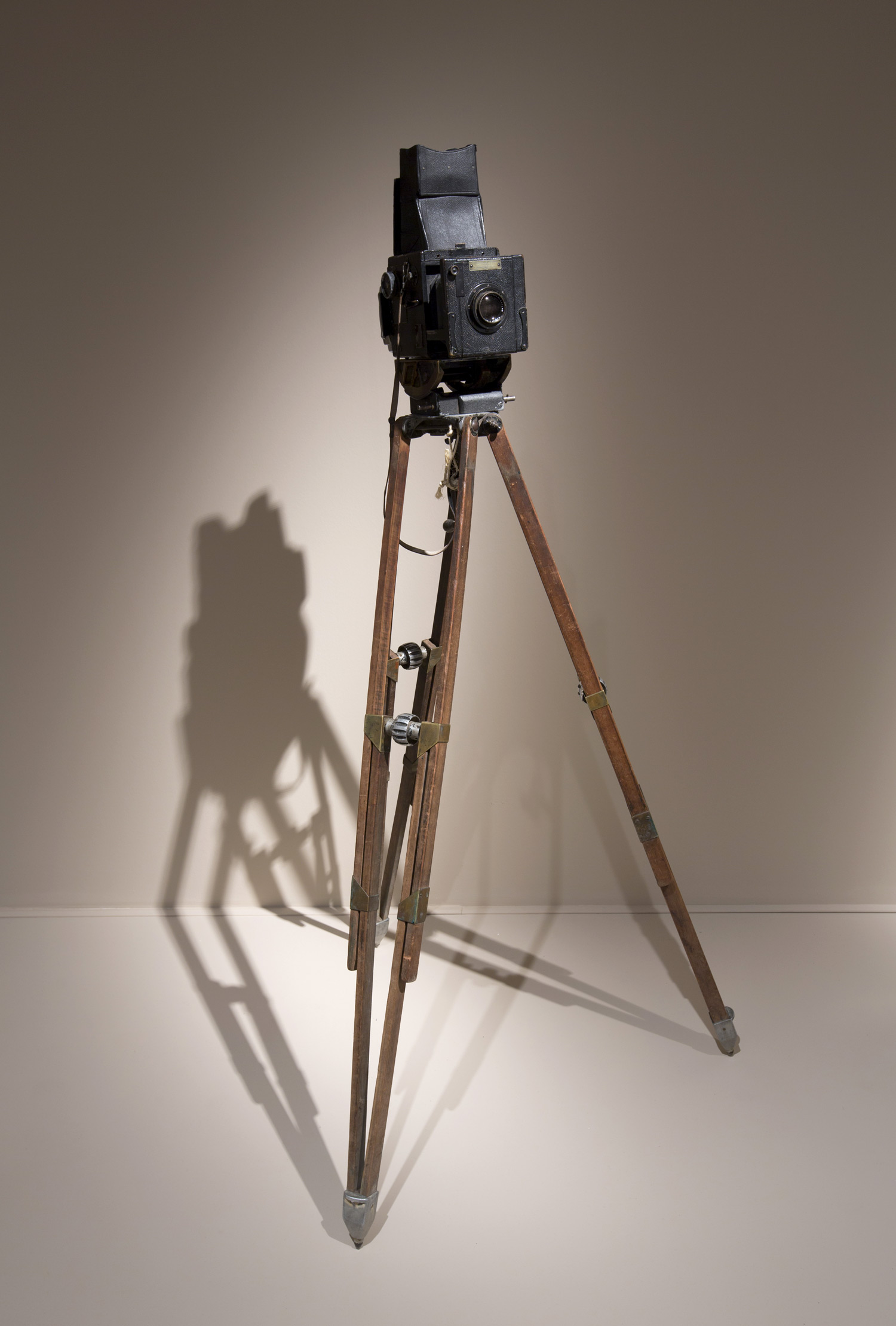
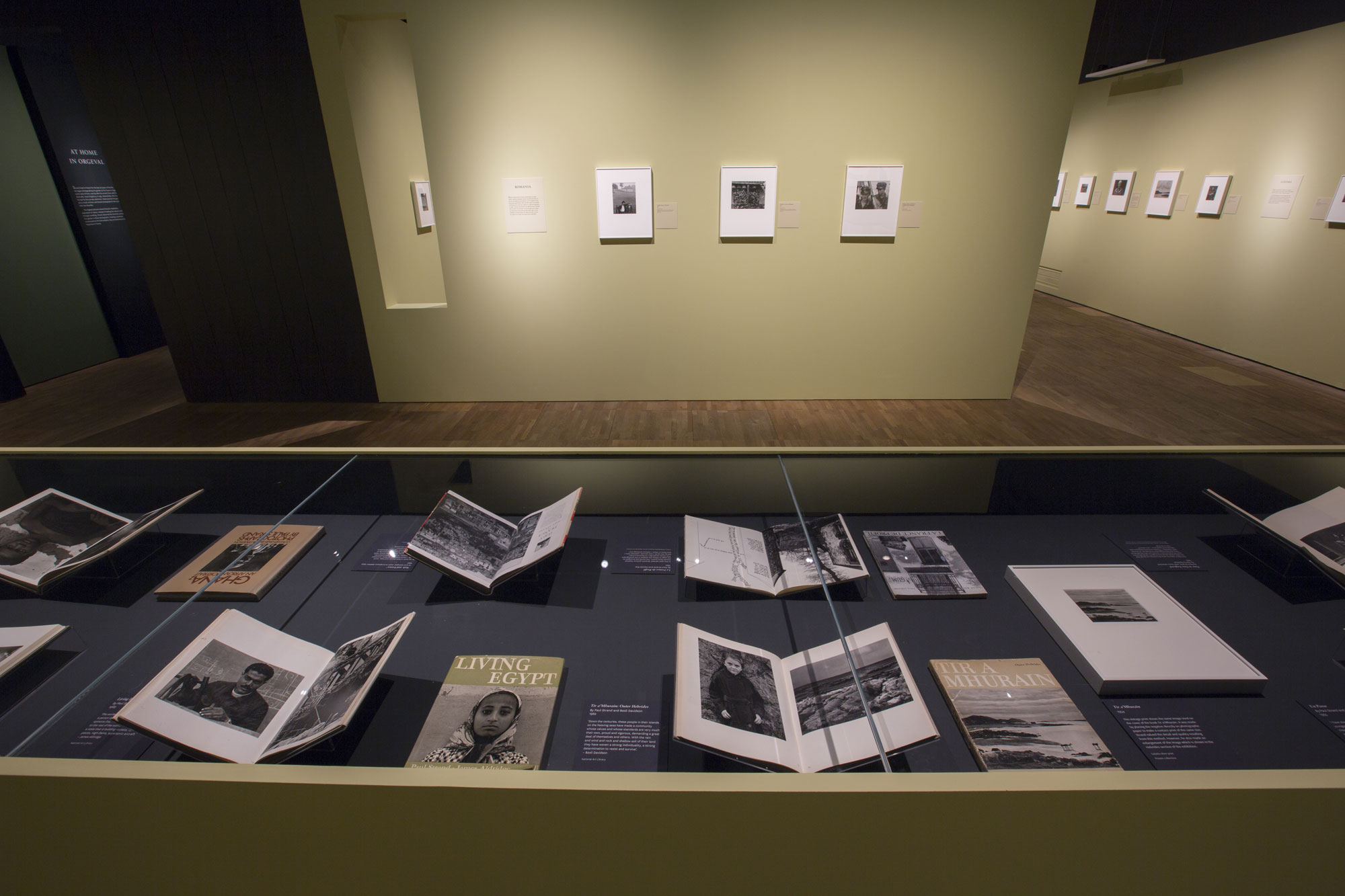
Exhibition: ‘Photo-Secession: Painterly Masterworks of Turn-of-the-Century Photography’ at the Utah Museum of Fine Arts, Salt Lake City

Exhibition dates: 24th August – 29th December 2024


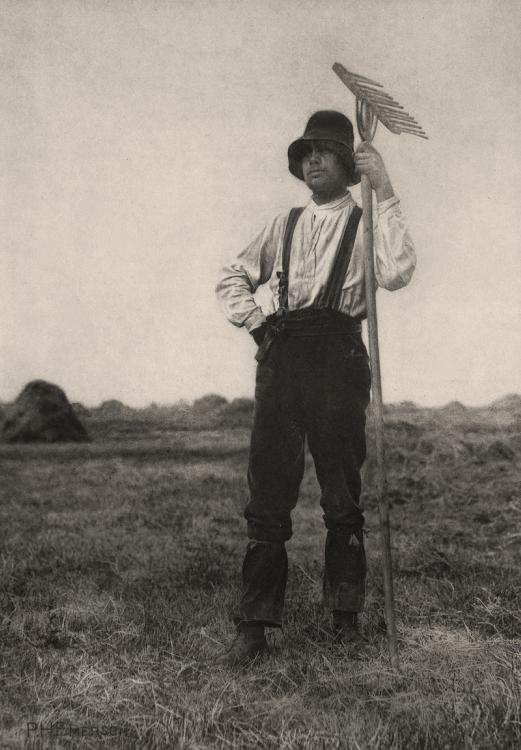
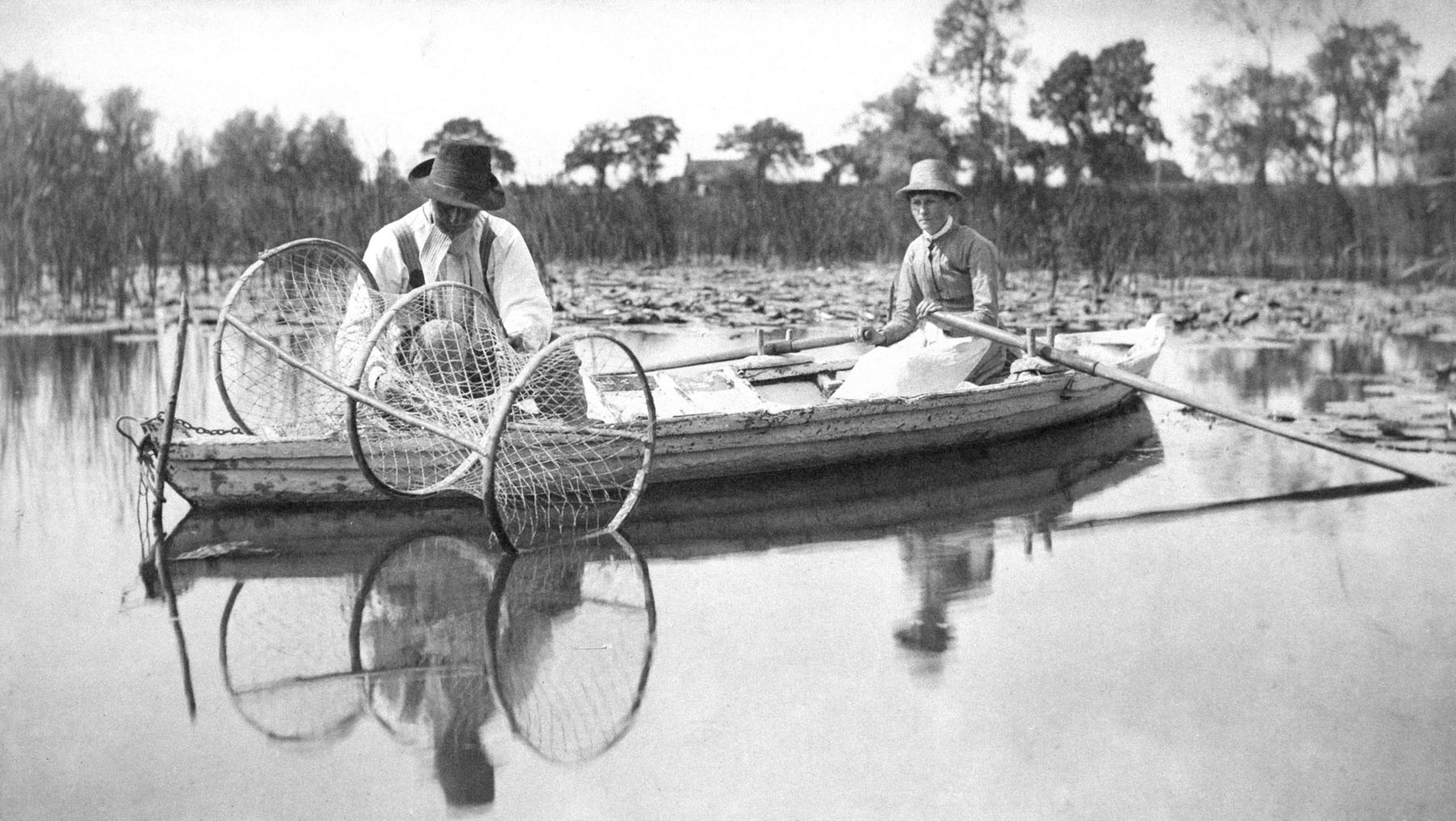
Peter Henry Emerson (British born Cuba, 1856-1936) 'Poling the Marsh Hay' c. 1885 from the exhibition 'Photo-Secession: Painterly Masterworks of Turn-of-the-Century Photography' at the Utah Museum of Fine Arts, Salt Lake City, August - December 2024


Peter Henry Emerson (British born Cuba, 1856-1936)
Poling the Marsh Hay
c. 1885
Platinum print on paper


Id est / that is

Voluptuous = relating to or characterised by luxury or sensual pleasure

Sensual = late Middle English (in the sense ‘sensory’): from late Latin sensualis, from sensus (see sense)

Sense = various; including:

~ a reasonable or comprehensible rationale i.e. the latent and emerging Modernism inherent in Photo-Secession photographs

~ the way in which a situation [in this case the “reading” of a photograph] can be interpreted i.e. the interpretation of Photo-Secession photographs as either Pictorialist, Modernist or a combination of both

~ a keen intuitive awareness of or sensitivity to the presence or importance of something i.e. the feeling of the photographer towards the object of their attention, revealed in the print, whether that be a nude, a building, pears and an apple or the side of a white barn

~ to be aware of (something) without being able to define exactly how one knows i.e. to be able to detect, recognise, and feel that ineffable “something” that emanates from the object of (y)our attention… in the act of creativity, in the act of seeing

Bringing something to our senses

Thus, the older I get the more I appreciate the faculty of feeling, thought and meaning that is revealed in these revolutionary photographs.

Dr Marcus Bunyan


Many thankx to the Utah Museum of Fine Arts for allowing me to publish the photographs in the posting. Please click on the photographs for a larger version of the image.


Quotes on Walls

“Why, Mr. Stieglitz, you won’t insist that a photograph can possibly be a work of art – you are a fanatic!”


Luigi Palma de Cesnola, Director of the Metropolitan Museum of Art, reportedly said to Alfred Stieglitz, 1902


“The painter need not always paint with brushes, he can paint with light itself. Modern photography has brought light under control and made it as truly art-material as pigment or clay. … The photographer has demonstrated that his work need not be mechanical imitation. He can control the quality of his lines, the spacing of his masses, the depth of his tones and the harmony of his gradations. He can eliminate detail, keeping only the significant. More than this, he can reveal the secrets of personality. What is this but Art?”


Arthur Wesley Dow, 1921


“The photographer’s problem therefore, is to see clearly the limitations and at the same time the potential qualities of his medium… without tricks of process or manipulation, through the use of straight photographic methods. … Photography is only a new road from a different direction but moving toward the common goal, which is Life.”


Paul Strand, 1917


“Pictorial photography owes its birth to the universal dissatisfaction of artist photographers in front of the photographic errors of the straight print. Its false values, its lack of accents, its equal delineation of things important and useless, were universally recognised and deplored by a host of malcontents… I consider that, from an art point of view, the straight print of today is not a whit better than the straight print of fifteen years ago. If it was faulty then it is still faulty now.”


Robert Demachy, 1907


“Gum, diffused lenses, (ultra) glycerining, were of experimental interest once. … Most of these are of more value historically than artistically. The prints are neither painting (or its equivalents) nor photographs. Let the photographer make a perfect photograph. It will be straight and beautiful – a true photograph.”


Alfred Stieglitz, 1919


Photo-Secession: Painterly Masterworks of Turn-of-the-Century Photography celebrates an intrepid group of photographers, led by preeminent photographer Alfred Stieglitz, who fought to establish photography as fine art, coequal with painting and sculpture at the turn of the 20th century. The Photo-Secession movement took cues from European modernists – who seceded from centuries-old academic traditions – to demonstrate photographic pictures’ aesthetic, creative, and skilful value as art. An homage to Stieglitz, Photo-Secession includes some of the very images that established the appreciation of photography’s artistic merits.

The UMFA will present this exhibition concurrently with Blue Grass, Green Skies: American Impressionism and Realism from the Los Angeles County Museum of Art to draw attention to the cyclical dialogue between painting and photography in the late 19th and early 20th centuries. During this period, photographers manipulated their images at various stages of production to imitate painterly effects, while painters worked and reworked their oils to imitate the immediacy of photography, demonstrating a remarkable reciprocity between these two art forms.

Text from the Utah Museum of Fine Arts website


Installation view of the exhibition 'Photo-Secession: Painterly Masterworks of Turn-of-the-Century Photography' at the Utah Museum of Fine Arts showing the work of Heinrich Kühn

Installation view of the exhibition 'Photo-Secession: Painterly Masterworks of Turn-of-the-Century Photography' at the Utah Museum of Fine Arts showing the work of Heinrich Kühn


Installation view of the exhibition Photo-Secession: Painterly Masterworks of Turn-of-the-Century Photography at the Utah Museum of Fine Arts showing the work of Heinrich Kühn
Image courtesy of the Utah Museum of Fine Arts


Installation view of the exhibition 'Photo-Secession: Painterly Masterworks of Turn-of-the-Century Photography' at the Utah Museum of Fine Arts showing at centre from left to right, Bernard Shea Horne 'Doorway Abstraction'; Drahomir Josef Ruzicka 'The Arch, Pennysylvannia Station' c. 1920; Arnold Genthe 'Acoma Pueblo, New Mexico' c. 1920; William E. Dassonville 'The Great Highway, San Francisco' c. 1905


Installation view of the exhibition Photo-Secession: Painterly Masterworks of Turn-of-the-Century Photography at the Utah Museum of Fine Arts showing at centre from left to right, Bernard Shea Horne Doorway Abstraction; Drahomir Josef Ruzicka The Arch, Pennysylvannia Station c. 1920; Arnold Genthe Acoma Pueblo, New Mexico c. 1920; William E. Dassonville The Great Highway, San Francisco c. 1905


Installation view of the exhibition 'Photo-Secession: Painterly Masterworks of Turn-of-the-Century Photography' at the Utah Museum of Fine Arts showing from top left to right, Edward Steichen 'Lotus, Mount Kisco' 1915; Edward Steichen 'Calla Lily' c. 1921; Edward Steichen 'Three pears and an apple' c. 1921; Edward Steichen 'Blossom of White Fingers' c. 1923


Installation view of the exhibition Photo-Secession: Painterly Masterworks of Turn-of-the-Century Photography at the Utah Museum of Fine Arts showing from top left to right, Edward Steichen Lotus, Mount Kisco 1915; Edward Steichen Calla Lily c. 1921; Edward Steichen Three pears and an apple c. 1921; Edward Steichen Blossom of White Fingers c. 1923


Installation view of the exhibition 'Photo-Secession: Painterly Masterworks of Turn-of-the-Century Photography' at the Utah Museum of Fine Arts

Installation view of the exhibition 'Photo-Secession: Painterly Masterworks of Turn-of-the-Century Photography' at the Utah Museum of Fine Arts


Installation view of the exhibition Photo-Secession: Painterly Masterworks of Turn-of-the-Century Photography at the Utah Museum of Fine Arts


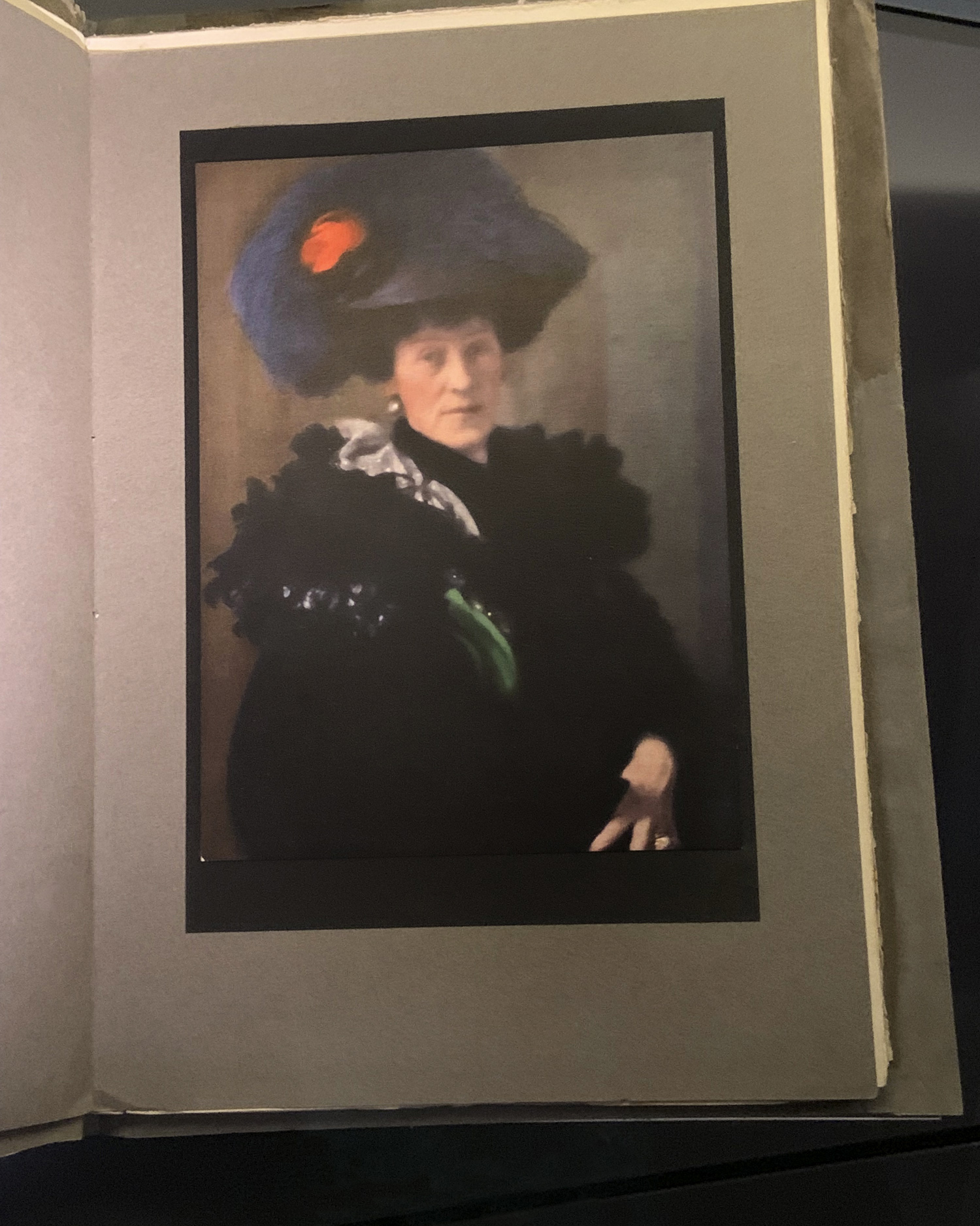
Installation view of the exhibition 'Photo-Secession: Painterly Masterworks of Turn-of-the-Century Photography' at the Utah Museum of Fine Arts showing in the display cabinet issues of the magazine 'Camera Work', 1903-1917. Edited by Alfred Stieglitz and Edward Steichen


Installation view of the exhibition Photo-Secession: Painterly Masterworks of Turn-of-the-Century Photography at the Utah Museum of Fine Arts showing in the display cabinet issues of the magazine Camera Work, 1903-1917. Edited by Alfred Stieglitz and Edward Steichen


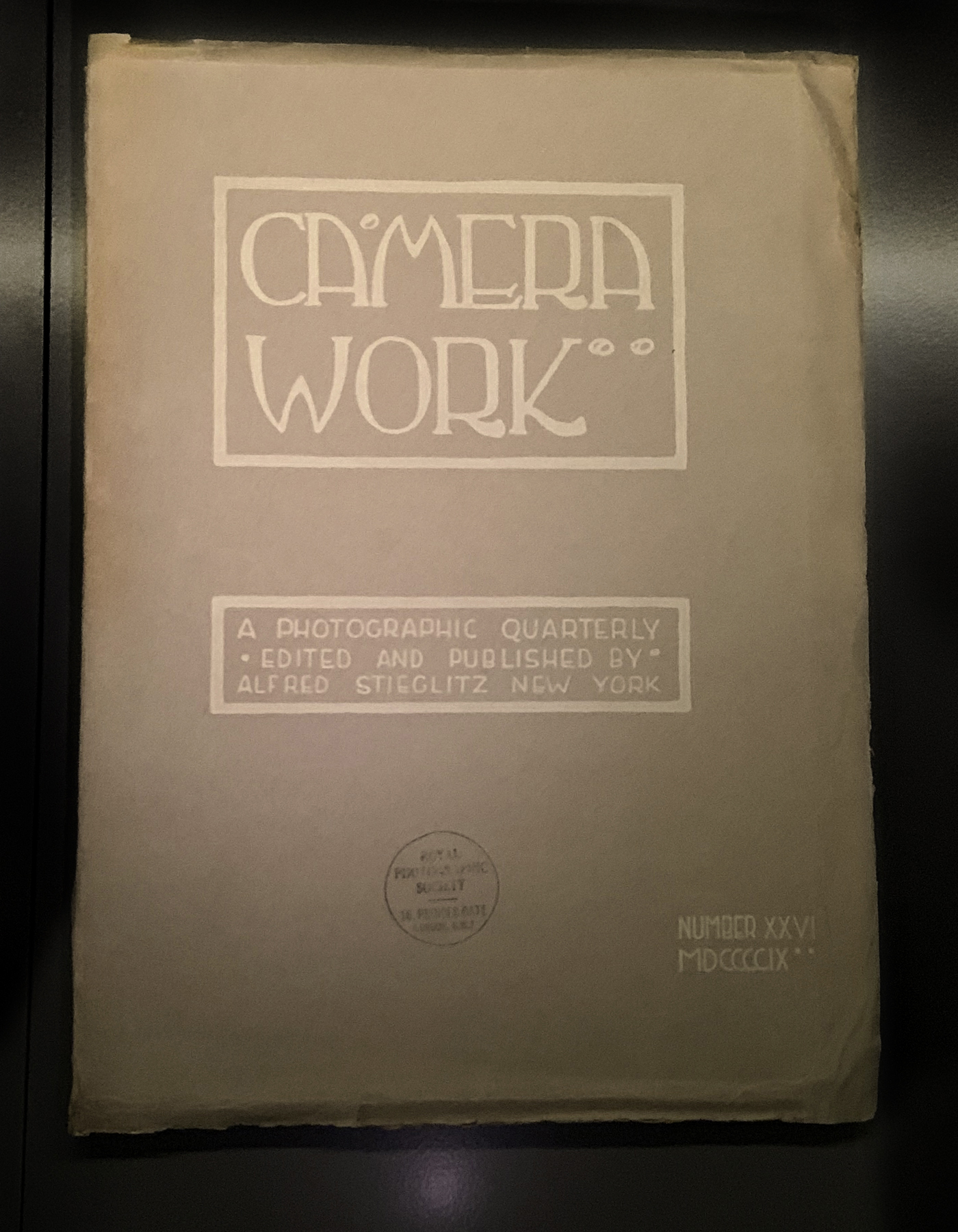
The Role of Camera Work

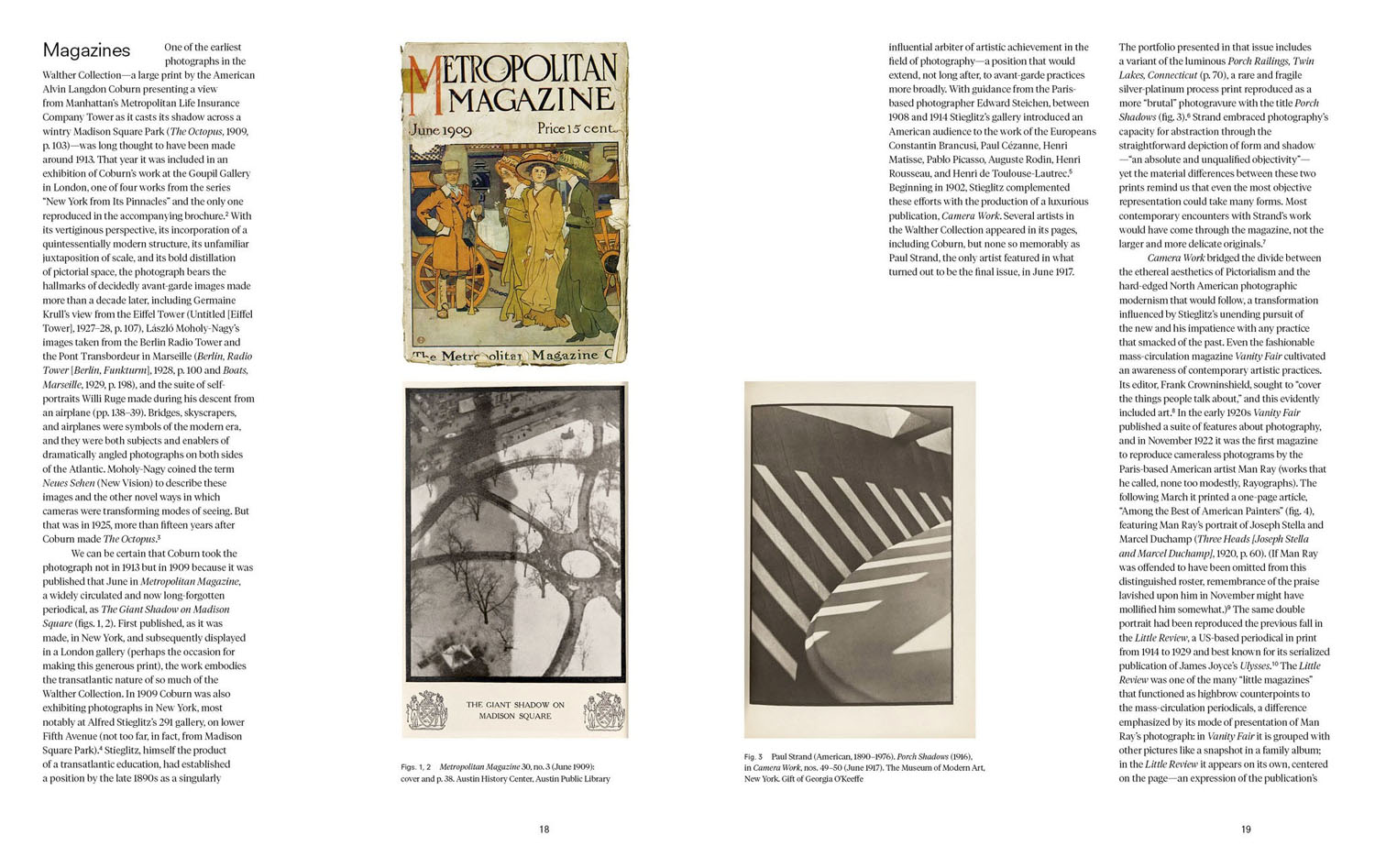
One of the key platforms for the Photo-Secession movement was the influential journal Camera Work, edited by Stieglitz and Steichen. Published from 1903 to 1917, Camera Work featured the work of Photo-Secessionists alongside essays and critiques that championed the artistic potential of photography. The journal played a crucial role in shaping public and critical perceptions of photography, providing a space for photographers to showcase their work and engage in intellectual discourse.

Adelaide Ryder. “The Photo-Secession Movement: Pioneering Artistry in Early Photography,” on the UMFA website Nd [Online] Cited 22/10/2024


Introduction

This exhibition celebrates 26 intrepid artists at the turn of the 20th century who sought to establish photography as a fine art equal to long-established media like painting, sculpture, drawing, and printmaking. This movement in the United States centred on the group dubbed the Photo-Secession. While each of the Photo-Secessionists had their distinctive approaches, their works are hand-crafted photographic prints of traditional artistic subjects, such as landscape, portraiture, figure study, and still life. This combination of painterly imagery and printmaking is also known as Pictorialism.

The passionate leader and tenacious advocate of the Photo-Secession was Alfred Stieglitz, who advanced the visions of the most ambitious photographers of the time, including Heinrich Kühn, Gertrude Käsebier, Edward Steichen, Paul Strand, and Clarence White. Stieglitz tirelessly promoted art photography through his exhibition space in New York City – the Little Galleries of the Photo-Secession and later called simply 291 – as well as through the journals he edited – Camera Notes (1897-1903) and Camera Work (1903-1917).

This exhibition also covers the breakup of the Photo-Secession, as some photographers rejected Pictorialism while others remained staunchly committed to it. The Photo-Secession itself irrevocably split apart around 1917. Artists led by Stieglitz, Steichen, and Strand switched to Straight Photography, an approach involving sharp focus and direct printing of the original shot. Artists led by Käsebier and White continued to innovate through painterly approaches using soft focus and manipulated prints.

The works in this exhibition represent some of the most influential artists and iconic images of the period as well as superb examples of a variety of photographic printing techniques, including platinum, gum-bichromate, carbon, cyanotype, and bromoil.

All works of art this exhibition are from the private collection of Michael Mattis and Judith Hochberg. This exhibition is organised by art2art Circulating Exhibitions.

The Rebirth of Art Photography in Europe

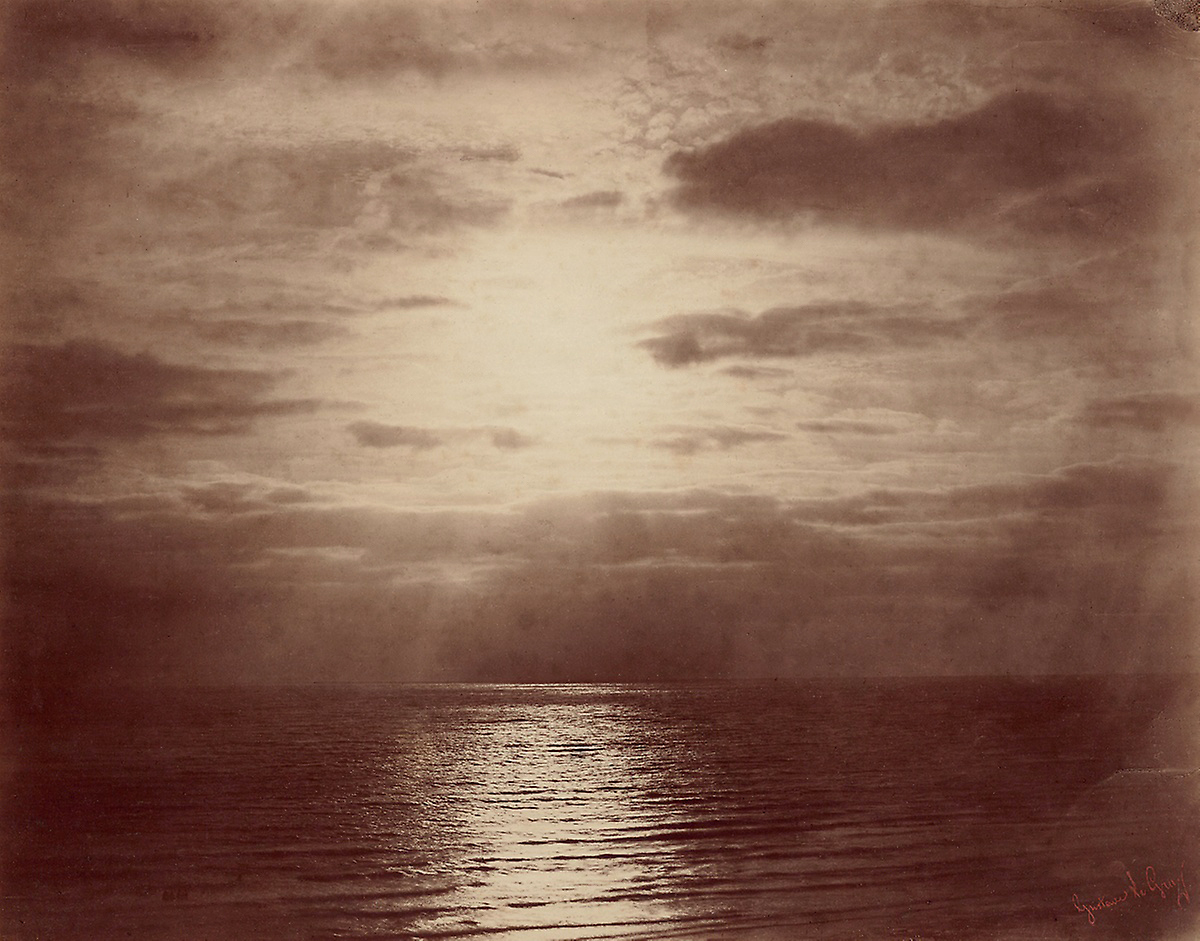
In the first few decades after the invention of photography in 1839, painters played an instrumental role in the development of this new medium. Artist-photographers like D.O. Hill in Edinburgh and Gustave Le Gray in Paris exhibited their photographs alongside paintings, drawings, and prints. The novelty of the photograph led to the proliferation of portrait studios and mass-produced views of famous monuments or exotic locales for the tourist trade. By the 1860s photography was considered a bourgeois technical profession. The Kodak camera, first issued in 1888, further popularised photography with its roll film, simple controls, and reasonable cost of one dollar (about $33 today).

Even as more and more individuals could access the means to make photos, artist-photographers advocated for the status of their medium and demanded a differentiation between their work and the products of point-and-shoot cameras. In 1889 Peter Henry Emerson published the book Naturalistic Photography for Students of the Art, which proposed a role for landscape photographers equal to esteemed painters like Camille Corot and Jean-François Millet. Emerson’s publication was a clarion call for a new generation of artistic photographers, and Pictorialism was born.

Pictorialist photographers enthusiastically pursued their new movement, pioneering soft-focus lenses and manipulatable printing methods. Soon they were forming regional clubs across Europe and resumed exhibiting their prints as art. The photographers that formed the t in London were particularly active and influential, and Pictorialism spread to other cultural centres like Paris, Berlin, and Vienna.

Alfred Stieglitz and the American Pictorialist Movement

Born in Hoboken, New Jersey, but educated largely in Germany, Alfred Stieglitz (1864-1946) watched the flowering of European Pictorialism with a mixture of aesthetic appreciation and fierce competitiveness, writing in 1892:

“Every unbiased critic will grant that we [American photographers] are still many lengths in the rear, apparently content to remain there, inasmuch as we seem to lack the energy to strive forward – to push ahead with that American will-power which is so greatly admired by the whole civilised world.”

Energised by European Pictorialism, Stieglitz championed juried photographic salons in Boston, New York, and Philadelphia. He also edited a series of increasingly ambitious journals about Pictorialist photography, starting with The American Amateur Photographer in 1893, then Camera Notes in 1897, and finally Camera Work starting in 1903. He inaugurated and named the Photo-Secession movement through the landmark exhibition he curated in 1903 at the National Arts Club in New York, which comprised 162 works by 32 artists. The name “Photo-Secession” referred to European avant-garde artistic movements, and in his own words, “Photo-Secession actually means a seceding from the accepted idea of what constitutes a photograph.” Eventually European artists would also be invited to join the Photo-Secession.

In 1905 Stieglitz opened a space at 291 Fifth Avenue in New York, the Little Galleries of the Photo-Secession, later simply called 291. It was the first retail gallery devoted to photography. He supported the venture with his own resources and generous assistance from others, and Edward Steichen was his steadfast associate. By 1915 Stieglitz was also showing avant-garde painting and sculpture at 291, including works by Pablo Picasso, Henri Matisse, and Constantin Brâncuși. Thus, he sought to demonstrate the idea that all art forms were on par with and informed one another.

Close Collaborations and the Sudden End of the Photo-Secession

From 1907 to 1910 Alfred Stieglitz and Clarence White closely collaborated on photographs and a landmark photography exhibition. In 1907 they made a series of 60 nudes, Stieglitz posing the models and White focusing the camera and making most of the prints. The following year, Stieglitz devoted an entire issue of Camera Work to White. In 1910 Stieglitz and White co-curated the International Exhibition of Pictorial Photography at Buffalo’s Albright Gallery (now Albright Knox Gallery). This historic project that included over 600 prints is now regarded as the apex of the Photo-Secession. It was also the final monument of the movement, as each of the major Pictorialists, White included, broke away from Stieglitz in the years that followed.

Significant reasons for the end of the Photo-Secession were Stieglitz’s authoritarian personality and disdain for photographers who needed to earn a living rather than exclusively pursue art for art’s sake. Philosophical differences also explain the rupture. Stieglitz had come to believe that Pictorialism had run its course. The irony was that the Photo-Secession had established photography as fine art through images that imitated other art forms by manipulation at every stage of the process – from lens to negative to print. Their pictures to varying degrees used methods that denied the very essence of photography. Stieglitz asserted that it was time to abandon the “painterly photograph” and to champion photography as fine art with compelling pictures that were truly photographic.

Late Pictorialism and the Clarence White School

As the artist Georgia O’Keeffe, Alfred Stieglitz’s partner for 30 years, acknowledged, “He was either loved or hated – there wasn’t much in between.” For reasons both personal and professional, most of the leading Photo-Secessionists chose not to follow Stieglitz and Paul Strand into Straight Photography. Many clustered instead around Clarence White, who in his gentle and encouraging manner was the antithesis of Stieglitz. In 1914 White founded the Clarence White School of Photography in New York City. In 1916 White along with Gertrude Käsebier and Alvin Langdon Coburn co-founded Pictorial Photographers of America; this new society welcomed members of all backgrounds and published the new journal Photo-Graphic Art.

The Clarence White School continued to be a locus for the training of new photographers until 1940, under the guidance of White’s widow Jane White after his death in 1925. Among the most prominent students of Clarence White are Karl Struss, Anne Brigman, Laura Gilpin, and Doris Ulmann, all of whom are represented in this exhibition. Other notable pupils of White include Margaret Bourke-White, Anton Bruehl, Paul Outerbridge, and Dorothea Lange.

Straight Photography, Edward Steichen, and Paul Strand

The final section of this exhibition focuses on Straight Photography and two of Alfred Stieglitz’s most notable protégés, Edward Steichen and Paul Strand. Between them, they pioneered leading branches of 20th-century American photography.

With the entry of the United States into World War I, both Steichen and Strand were drafted into the U.S. Army. Steichen was a photographer for the Army Air Service Signal Corps in Europe, and Strand was an X-ray technician in the Army Medical Corps. In the years immediately after WWI, they each turned their attention to photographing the natural world: flowers and fruit in Steichen’s case, and toadstools, grasses, and ferns in Strand’s. Both would return to photographing their gardens in the final years of their lives.

Outside the naturalist realm, Steichen and Strand’s paths diverged.

Steichen, an extrovert, pioneered modern fashion and advertising photography for the Condé Nast magazines Vogue and Vanity Fair. Later he was named Director of the Department of Photography at the Museum of Modern Art in New York, where he organised the landmark exhibition, Family of Man, which traveled to 37 countries on six continents and was seen by an estimated nine million people.

Strand, an introvert, traveled to remote places around the world, documenting the landscape, architecture, and people, his work exuding a respect for the dignity of the labouring class, which he absorbed from his mentor, Lewis Hine. Overall, Strand’s profoundly humanist scenes of everyday life influenced a generation of socially conscious photographers who documented the 20th-century crises of the Dust Bowl, the Great Depression, World War II, and more.

Heinrich Kühn

In the late 19th century, European Pictorialism was divided into two camps. On the one side were the purist photographers who, aside from a softening of the lens, opposed extensive manipulation of the negative or the print for artistic effect. On the other side were those who derided “button-pushers” and viewed the “straight” photograph as merely the raw material from which to create an artistic print through elaborate handiwork.

The leader of this latter camp was Heinrich Kühn (1866-1944). Eschewing Modernist tendencies, he chose traditional subject matter of painting from the 17th through 19th centuries: still life, figural studies, and genre scenes. His preference for gum-bichromate and bromoil printmaking techniques, which allowed for extensive manipulation, were intended to provoke the reaction in the viewer: is that really a photograph?

Born in Dresden, Kühn moved to Innsbruck, Austria, after youthful studies in science and medicine. Thanks to a sizeable inheritance, he could devote himself to artistic photography, joining both the Linked Ring in London and Stieglitz’s Photo-Secession in the United States. A trans-Atlantic correspondence with Stieglitz began in 1899 and lasted three decades. They congratulated one another on their latest triumphs and encouraged each other through professional and personal disappointments. In 1909, with Stieglitz’s assistance, Kühn organised the International Photographic Exhibition in Dresden, one of the high points of Pictorialism.

Later in life, Kühn filed multiple patents in photochemistry and camera technology related to Pictorialist photography, but none earned him any money. Tastes had changed, and the painterly photograph had become a quaint curiosity.

Gertrude Käsebier

Gertrude Käsebier (1852-1934) was 37 years old, married, and had three children by the time she began studying art at the Pratt Institute. She had originally purchased a camera to make portraits of her children, but Pratt encouraged its women students to earn a living in the arts. By 1897 she opened a one-room commercial portrait studio in New York City. Her ambition was to make “not maps of faces, but likenesses that are biographies, to bring out in each photograph the essential personality that is variously called temperament, soul, humanity.”

Recognition for Käsebier’s talent and ability came swiftly. In 1898 the painter William Merritt Chase, judging the Philadelphia Photographic Salon, called her work “as fine as anything that [Anthony] Van Dyck has ever done.” For Stieglitz, who organised her first solo show in 1899 at the Camera Club of New York, Käsebier was “beyond dispute the leading portrait photographer in this country.” That year, she sold one of her photographs for the unheard-of sum of $100 (almost $3,800 today).

However, by the time that the Brooklyn Museum honoured Käsebier with a career retrospective in 1929, Pictorialist photography had fallen so far out of fashion that the exhibition was not even reviewed in major journals.

Clarence Hudson White

Clarence Hudson White (1871-1925) was a modest, soft-spoken, entirely self-taught genius from America’s heartland. Raised in the small town of Newark, Ohio, he eked out a living as a bookkeeper for a wholesale grocer; each week he saved enough to purchase two glass plates for his camera. He specialised in gorgeously back-lit domestic interior scenes featuring his friends and members of his close-knit extended family.

White’s contributions to the 1898 Philadelphia Photographic Salon were so highly praised that, like Gertrude Käsebier, he was appointed a judge for the following year. The annual salons of the Newark Camera Club that he organised featured the nation’s preeminent Pictorialists and were the direct precursor to Stieglitz’s Photo-Secession. Indeed, the 1900 salon featured his friend and latest discovery, Edward Steichen of Milwaukee.

From 1907 onwards, both in New York City and during summers in rural Maine, White was also America’s foremost teacher of photography. Many of the leading American photographers of the 20th century studied at the Clarence White School.

Paul Strand

In 1915 Alfred Stieglitz found in the young Paul Strand (1890-1976) the leader of a remarkable new direction in photography. Strand had been a senior at the Ethical Culture High School in 1907 when he first visited Gallery 291 on a class trip with his photography teacher, Lewis Hine, whose poignant documents of immigrants and child labor were staples of the Progressive Movement. Eight years later, after thousands of hours in the darkroom at the New York Camera Club, Strand returned to 291 with a portfolio of platinum prints that pointed the way to a new era. Stieglitz deemed them “brutally direct, devoid of all flim-flam, devoid of trickery and of any ‘ism’. These photographs are the direct expression of today.” Stieglitz not only offered Strand an exhibition at 291, but also devoted the final two issues of Camera Work exclusively to him.

What was so compelling and inspiring to Stieglitz in Strand’s photography? His portfolio contained pictures of urban street life and architecture, as well as powerful close-ups of weathered New York faces (influenced by Lewis Hine), boldly composed still lifes, and shadow abstractions taken on a porch in Twin Lakes, Connecticut.

As for photography’s future, Strand and Stieglitz saw eye to eye. In his essay in Camera Work, Strand called for the universal adoption of Straight Photography “without tricks of process or manipulation.” In a provocative lecture at the Clarence White School, Strand condemned “this so-called pictorial photography, which is nothing but an evasion of everything photographic.”


Works by Emerson, Post, Evans, and Sutcliffe
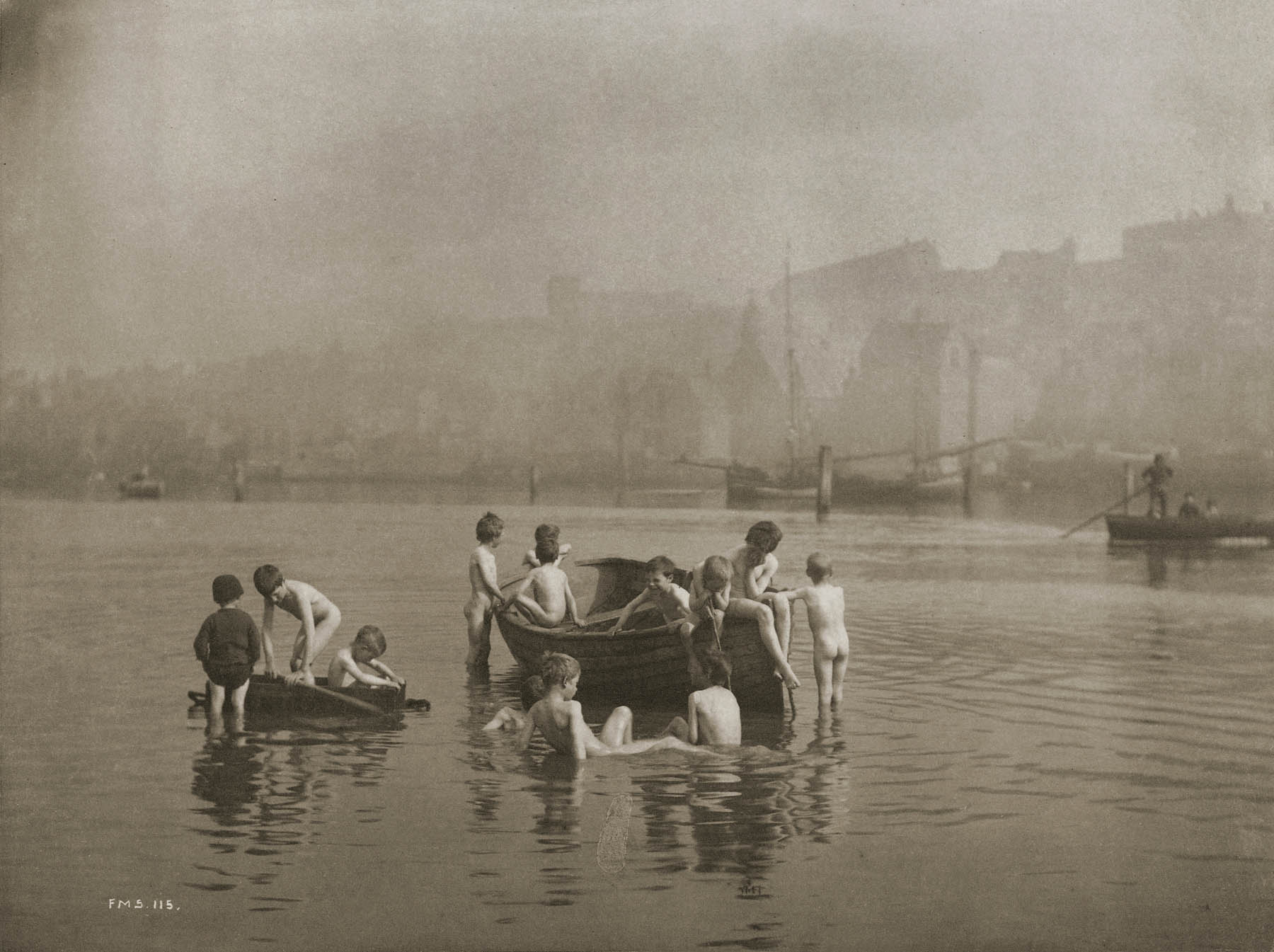
 

Frank Meadow Sutcliffe (British, 1853-1941) 'The Water Rats' 1886 from the exhibition 'Photo-Secession: Painterly Masterworks of Turn-of-the-Century Photography' at the Utah Museum of Fine Arts, Salt Lake City, August - December 2024


Frank Meadow Sutcliffe (British, 1853-1941)
The Water Rats
1886
Platinum print on paper


Sutcliffe was a member of the British photographic society the Linked Ring, which sought to make their work recognised as fine art. He operated a portrait studio in the seaside town of Whitby in North Yorkshire but is remembered for his charming, naturalistic depictions of local life. This photograph resulted in his excommunication by local clergy for its “corrupting” effects. Today this is his best-known photograph, regarded as a study of pure childhood joy.
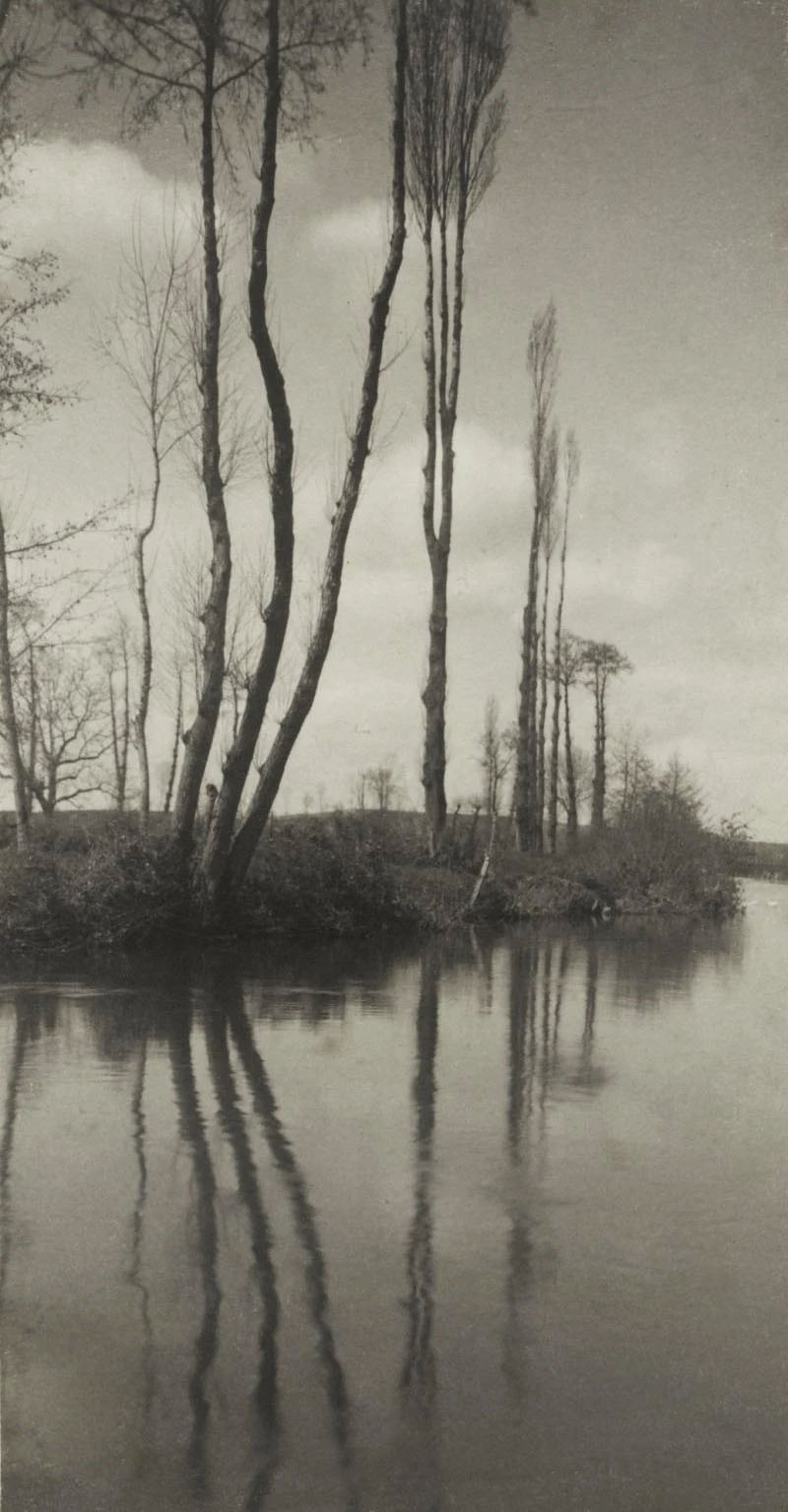
 

Frederick H. Evans (British, 1853-1943) 'Poplars on a French River' c. 1900


Frederick H. Evans (British, 1853-1943)
Poplars on a French River
c. 1900
Platinum print on paper
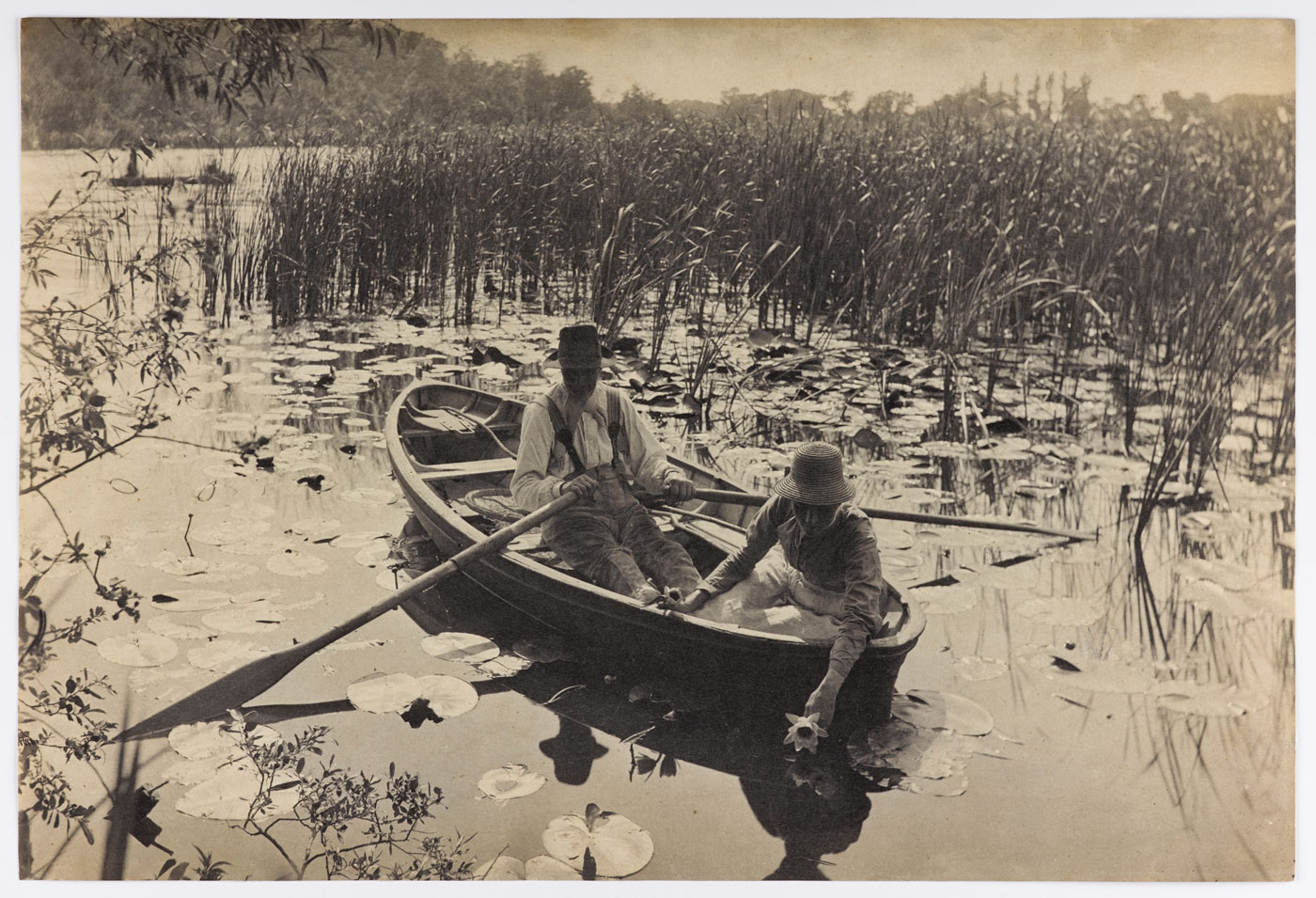
 

Peter Henry Emerson (British born Cuba, 1856-1936) 'Gathering Water Lilies' c. 1885


Peter Henry Emerson (British born Cuba, 1856-1936)
Gathering Water Lilies
c. 1885
Platinum print on paper


In addition to his photographic work, Emerson wrote persuasively that photography could match – and even surpass – painting as an emotive art form. His writings were influential to the young Alfred Stieglitz, with whom he corresponded over four decades.

All from the Collection of Michael Mattis and Judith Hochberg


Works by Thiollier
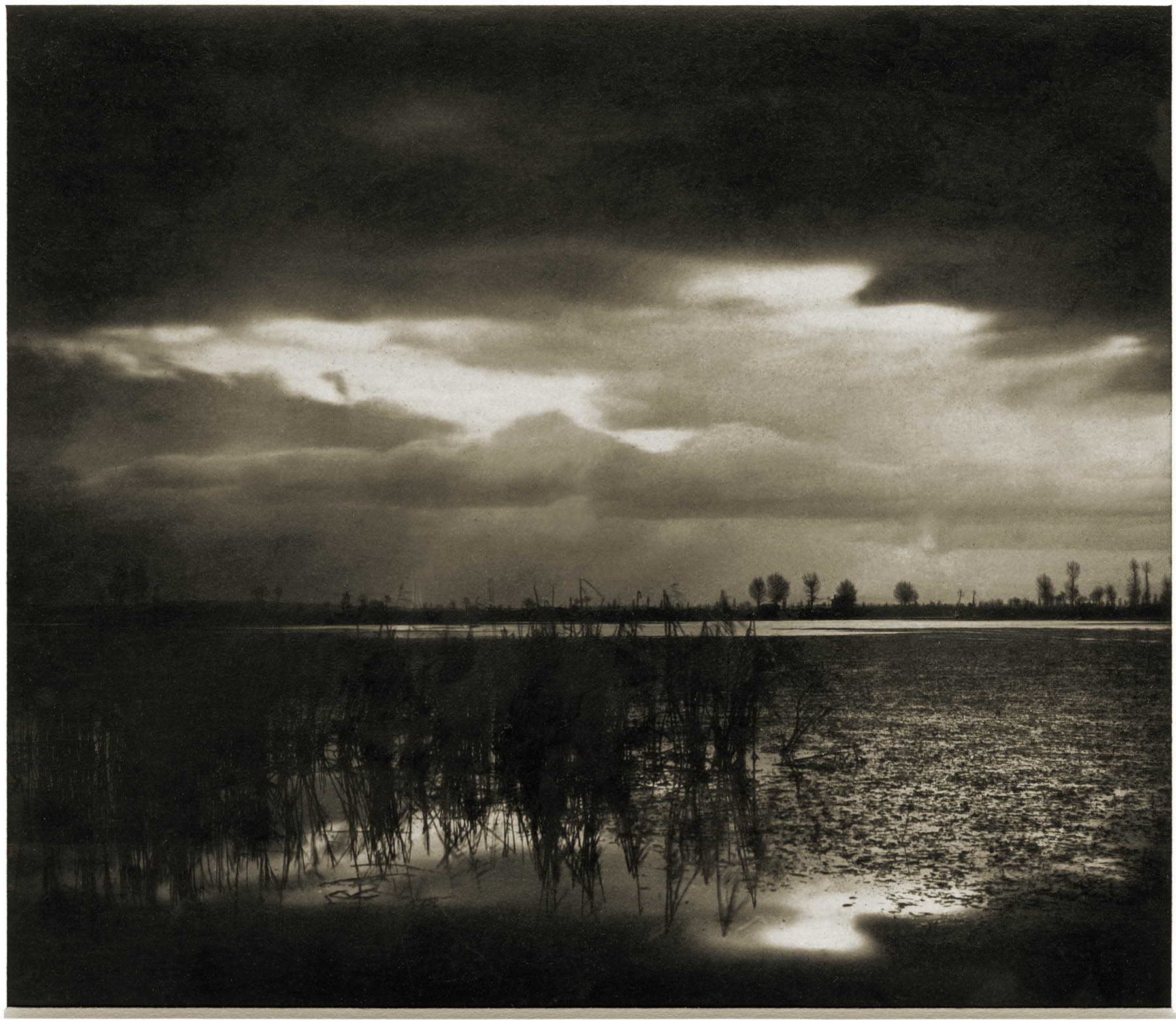
 

Félix Thiollier (French, 1842-1914) 'Landscape in Bugey' c. 1885


Félix Thiollier (French, 1842-1914)
Landscape in Bugey
c. 1885
Carbon print on paper


Thiollier’s photographic career is a fairly recent discovery, highlighted in the first ever retrospective of his career at the Musée d’Orsay in Paris in 2012.

From the Collection of Michael Mattis and Judith Hochberg


Works by Kühn


Heinrich Kühn (Austrian born Germany, 1866-1944) 'Nude in Morning Sun' c. 1920


Heinrich Kühn (Austrian born Germany, 1866-1944)
Nude in Morning Sun
c. 1920
Multiple bromoil transfer print on Japanese tissue paper


Heinrich Kühn (Austrian born Germany, 1866-1944) 'Female torso in sunlight' c. 1920


Heinrich Kühn (Austrian born Germany, 1866-1944)
Female torso in sunlight
c. 1920
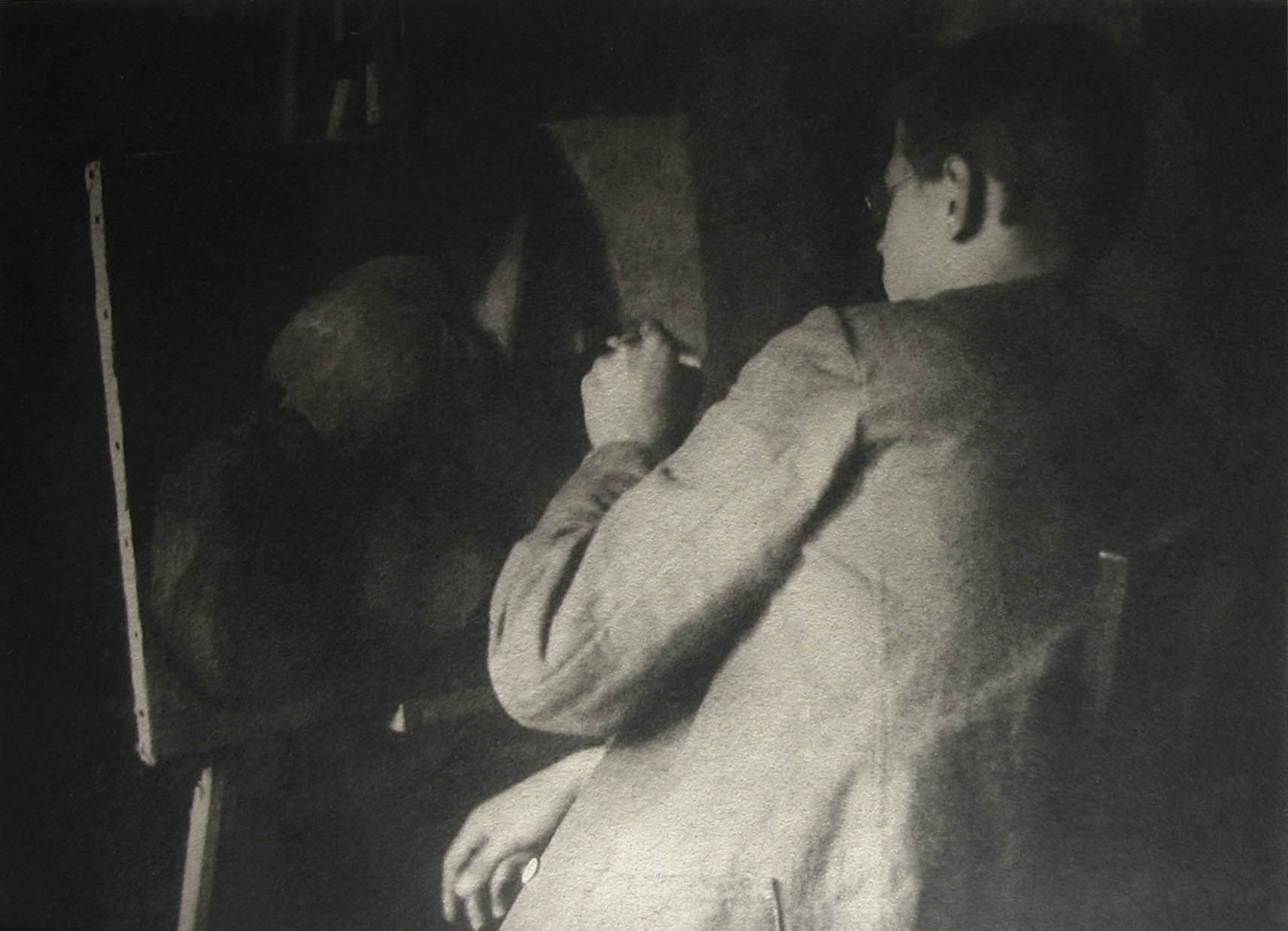
 

Heinrich Kühn (Austrian born Germany, 1866-1944) 'Walter at Easel' c. 1909


Heinrich Kühn (Austrian born Germany, 1866-1944)
Walter at Easel
c. 1909
Gum-bichromate print on paper


Heinrich Kühn (Austrian born Germany, 1866-1944) 'Still Life with Fruit and Pottery' c. 1896


Heinrich Kühn (Austrian born Germany, 1866-1944)
Still Life with Fruit and Pottery
c. 1896
Gum-bichromate print on paper with an applied watercolour wash


Kühn’s still lifes deliberately recall paintings from earlier centuries. This scene – his first published image – contains similar elements to 17th-century still-life compositions. He even included insects, which are traditional references to mortality called memento mori (reminders of death). Can you spot the housefly?

All from the Collection of Michael Mattis and Judith Hochberg


Portraits by Steichen


Edward Steichen (American born Luxembourg, 1879-1973) 'George Frederic Watts, London' 1901


Edward Steichen (American born Luxembourg, 1879-1973)
George Frederic Watts, London
1901
Varnished platinum print on paper


This dramatic profile portrait of the English Pre-Raphaelite painter was the first in what Steichen termed his “Great Men” series. Steichen wrote about his approach to portraiture, “I aim for the expression of something psychological. I am not satisfied with the mere reproduction of features and expression.”

Published in Camera Work, 14, 1906
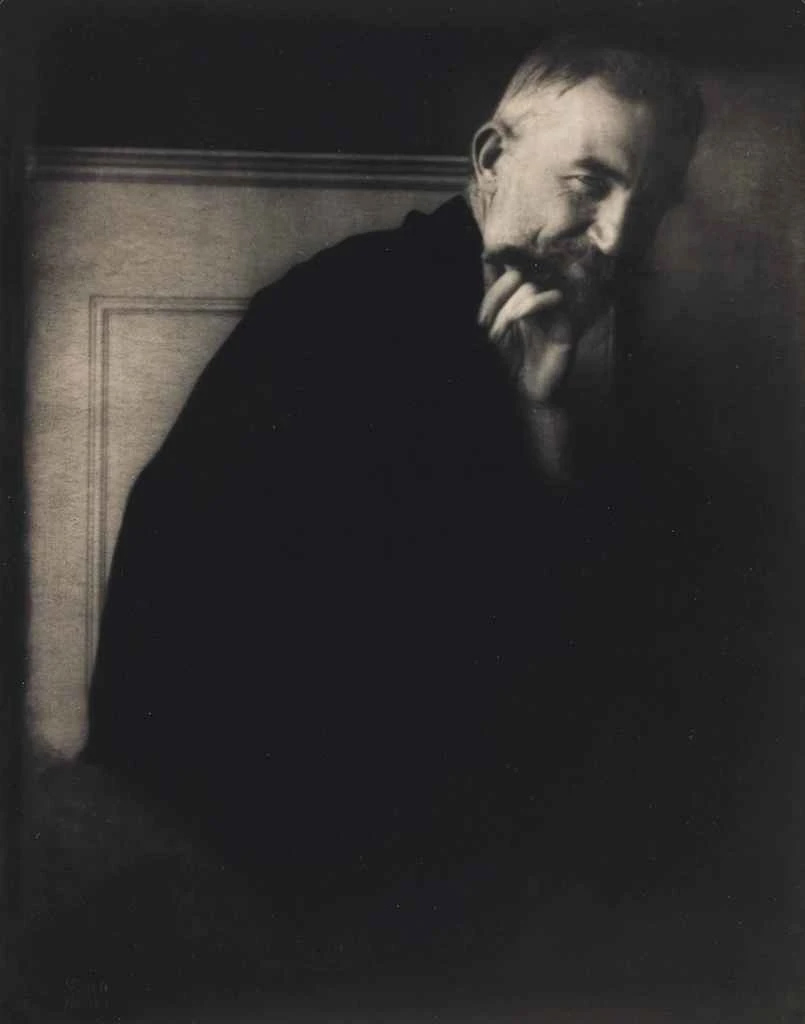
 

Edward Steichen (American born Luxembourg, 1879-1973) 'The Photographer's Best Model: George Bernard Shaw, London' 1907


Edward Steichen (American born Luxembourg, 1879-1973)
The Photographer’s Best Model: George Bernard Shaw, London
1907
Platinum print on paper


Steichen was elated after his photographic sitting with Shaw, writing to Stieglitz: “Well I’ve seen and done Shaw (photographically of course). He’s the nicest kind of fellow imaginable – genial and boyish – there is a little of the sardonic about him as you see him but when you get the camera at him you are tempted with possibilities in that way. He seems to know a lot about photography and certainly skilfully bluffs you into believing he knows it all.”

Published in Camera Work, 42/43, 1913

All from the Collection of Michael Mattis and Judith Hochberg


Glossary of Photographic Printing Methods and Terms from the History of Photography

Gelatin Silver Print

For over a century, from the 1880s until the digital era, the gelatin silver print was the most common technique for producing black-and-white photographs. The paper is coated with a binder layer of gelatin incorporating light-sensitive silver chloride or silver bromide. The paper is exposed under a negative, either by contact-printing or through an enlarger, then chemically developed, stopped, fixed, and dried. In the process, the silver salts are reduced to metallic silver, which carries the image. The overall color of the print can be altered through toning.

Cyanotype

A sheet of paper is sensitised in a solution of potassium ferricyanide and ferric ammonium citrate. After contact-printing under a negative, the iron compounds form an insoluble blue (“cyan”) dye known as Prussian blue. Apart from its occasional artistic use, the only regular use of the cyanotype was in copying architectural plans, thus called “blueprints.”

Platinum or Palladium Print

A platinum print is produced by sensitising a sheet of paper with platinum and iron salts. The sheet is then contact-printed under a negative until a faint image is visible. The print is developed in a potassium oxalate solution that dissolves unexposed iron salts and transforms the platinum salts into metallic platinum, which intensifies the image. Mercury chloride can be added to the solution to give a warmer tone. Unlike a silver print, where the image lives in a gelatin binder layer on top of the paper (akin to a watercolour), the image in a platinum print is embedded in the paper fibres (akin to an oil painting). The rich mid-tone range and matte surface made the platinum print the favoured medium for the Pictorialist photographers, from P.H. Emerson onward. When the price of platinum spiked during World War I, palladium was introduced as a more affordable (and generally warmer-toned) substitute.

Pigment Prints

The following processes are known as pigment prints, because the photographic image is carried by inks or pigments, rather than by metallic particles like silver, iron, or platinum.

Gum Bichromate Print

A sheet of paper is coated with diluted gum-arabic mixed with coloured pigment and light-sensitive potassium bichromate. During exposure under a negative, the bichromate causes the coloured gum-arabic to harden in proportion to the amount of light received. The areas not exposed to light remain soluble in water, and the print is developed by washing away the soluble areas, leaving a positive image on the paper. The prints can be exposed and reprinted numerous times with different coloured pigments, as well as manipulated by brushing away more pigmented gum during the washing stage.

Bromoil (Transfer) Print

This process does not begin with a negative, but rather with a gelatin silver print that is bleached in a solution of potassium bromide. The bleaching removes the silver-based image and selectively hardens the underlying gelatin in proportion to the image density. The sheet is then hand-coloured with an oil-based ink, which is selectively absorbed depending on the hardness of the gelatin: the softer areas contain more water, which repels the oil-based ink. An inked print is sometimes used as a kind of printing plate for transferring the image to another sheet of paper (a bromoil transfer print).

Photogravure

This is a sophisticated photomechanical process used for reproducing photographs in ink in a large edition. It is a form of intaglio printing, in which a photographic image is acid-etched into a copper plate. The relief image is then inked and printed. Alfred Stieglitz’s magazine Camera Work was largely printed in photogravure.

The Photo-Secession

This was the brief but influential artistic movement led by American Alfred Stieglitz during the years 1902–1915 that championed photography as an art form that was as aesthetic, creative, and skilful as traditional media like painting, drawing, watercolour, and printmaking. The European artistic movement Secessionism inspired the name Photo-Secession, and both movements were committed to Modernism by seceding from centuries-old academic traditions.

Pictorialism / Pictorialist

The approach to photography in which artists sought to make images that imitated the tradition of paintings through photographic prints. Pictorialist photographers used soft focus lenses and manipulated both their negatives and printing media to create their prints.

The Linked Ring

Also known as the Brotherhood of the Linked Ring, this photographic society founded in 1892 in London promoted photography as a form of art and was influential for the American society of the Photo-Secession.

Straight Photography

The approach to photography in which artists use sharp focus and print directly from their negatives with minimal or no manipulation.

Camera Notes

Camera Notes was the journal of the Camera Club of New York, edited by Alfred Stieglitz from 1897 to 1902. Under Stieglitz’s editorship, the purposes of Camera Notes were “to take cognisance also of what is going on in the photographic world at large, to review new processes and consider new instruments and agents as they come into notice; in short to keep our members in touch with everything connected with the progress and elevation of photography.”

Camera Work

Camera Work was the journal about contemporary photography that Alfred Stieglitz edited and published with the assistance of Edward Steichen from 1903 to 1917. The goal of this journal “devoted largely to the interests of pictorial photography” was “to issue quarterly an illustrated publication which will appeal to the ever-increasing ranks of those who have faith in photography as a medium of individual expression, and, in addition, to make converts of many at present ignorant of its possibilities.”

This glossary has been edited from primary sources and text by Ina Schmidt-Runke, Meike Harder, and Andreas Gruber.


The Photo-Secession Movement: Pioneering Artistry in Early Photography

By Adelaide Ryder, head photographer and digital assets manager at the UMFA

The Birth of the Photo-Secession Movement

This fall the Utah Museum of Fine Arts will exhibit Photo-Secession: Painterly Masterworks of Turn-of-the-Century Photography. This exhibition of art photography from the early 20th century will be on view from August 24 to December 29, 2024. Who were the Photo-Secessionists and why was their work so pivotal to the advancement of photography as an art form?

In the mid-19th century photography was regarded as a complex technical field that only a trained professional could do. By the 1880s, however, the hand-held camera had become affordable and easy to use, and the “snapshot” became commonplace. Smaller, easier-to-use cameras and the ability to send the film off to a lab for development gave the public accessibility to the medium in a new way. This technological advancement greatly affected the professional photography business, as people began to question the skills needed to make a photograph when “anyone could push a button.”

How did photographers respond to this shift in aesthetics and business? Many searched for ways to use photography to express abstract ideas or subjective points of view, shifting from using photography to document objective likeness to illustrating subjective conditions or the subject’s inner state. This helped elevate the photographer’s status, as the expressive ability of the person behind the camera became as important as the subject. Photographers embraced symbolism and started printing with complex techniques like gum bichromate to elevate their craft above the basic snapshot. Two significant movements were born from this struggle to gain recognition as a legitimate form of artistic expression rather than simply a means of mechanical documentation: Pictorialism and the Photo-Secession.

The camera was seen as a tool, and many felt that photographs visually lacked the “artist’s hand,” an essential factor in calling something “art.” The Photo-Secession movement, founded by Alfred Stieglitz in 1902, aimed to change this perception. Stieglitz and his contemporaries believed photography deserved the same artistic consideration as painting and sculpture. They aimed to elevate photography to fine art, emphasizing the photographer’s vision and creativity over mere technical skill. Stieglitz said the Photo-Secession was founded “loosely to hold together those Americans devoted to pictorial photography in their endeavour to compel its recognition, not as a handmaiden of art, but as a distinctive medium of individual expression.” (Camera Work, no. 6, April 1904.)

The Photo-Secession movement emerged from the broader Pictorialist movement, which dominated photographic art in the late 19th and early 20th centuries. While both movements sought to establish photography as an art form, the Photo-Secessionists emerged with their own philosophy.

Similarities

Artistic Expression: The Photo-Secession and Pictorialism emphasized the photographer’s role as an artist rather than a mere technician. They believed that photography should convey the photographer’s vision and emotional intent.

Aesthetic Quality: Both movements valued the aesthetic quality of photographs. They often employed techniques like soft focus, manipulation of light, and careful composition to create visually striking images.

Influence of Painting: Both were heavily influenced by the aesthetics of painting, particularly Impressionism and Symbolism. They sought to create images that were painterly in style, blurring the lines between photography and traditional fine arts.

Differences

Philosophical Focus: Pictorialism focused on creating images that looked like paintings, often using elaborate darkroom techniques to achieve a painterly effect. Photo-Secession, while also influenced by painting, emphasised the photographer’s personal expression and the inherent qualities of the photographic medium, sometimes even embracing the “snapshot” aesthetic if it helped to illustrate more hidden ideas and thoughts.

Technical Innovation: The Photo-Secessionists were more open to embracing the amateur artist and experimentation in techniques and technologies, whereas the Pictorialists held on to the traditional hierarchy of the European artistic schools of the time. Photo-Secessionists saw innovation as a means to expand photography’s artistic potential.

Subject Matter: Pictorialists focused on romanticized and idealized subjects, such as landscapes, portraits, and allegorical scenes. The Photo-Secessionists, on the other hand, explored a wider range of subjects, including urban scenes, modern life, and abstract forms. They embraced art movements like Cubism and Futurism, reflecting a broader and more progressive vision of art.

Exhibition and Display: The Photo-Secessionists were disenchanted with the outdated salons and gate-keeping ways of many photo schools commonly practiced in Europe. They began publications like The American Amateur Photographer, Camera Notes, and Camera Work to help give a platform to young photographers and people practicing these new ways of image making.

Adelaide Ryder. “The Photo-Secession Movement: Pioneering Artistry in Early Photography,” on the UMFA website Nd [Online] Cited 22/10/2024
 

Who were the Photo-Secessionists?

Works by Stieglitz

Alfred Stieglitz: The Visionary Leader

Alfred Stieglitz was a driving force behind the Photo-Secession movement. His passion for photography galvanized his dedication to promoting it as an art form. He saw photography as a means of personal expression. He helped catapult the idea that image-making can happen in the darkroom, during the printing process, as much as in the camera.

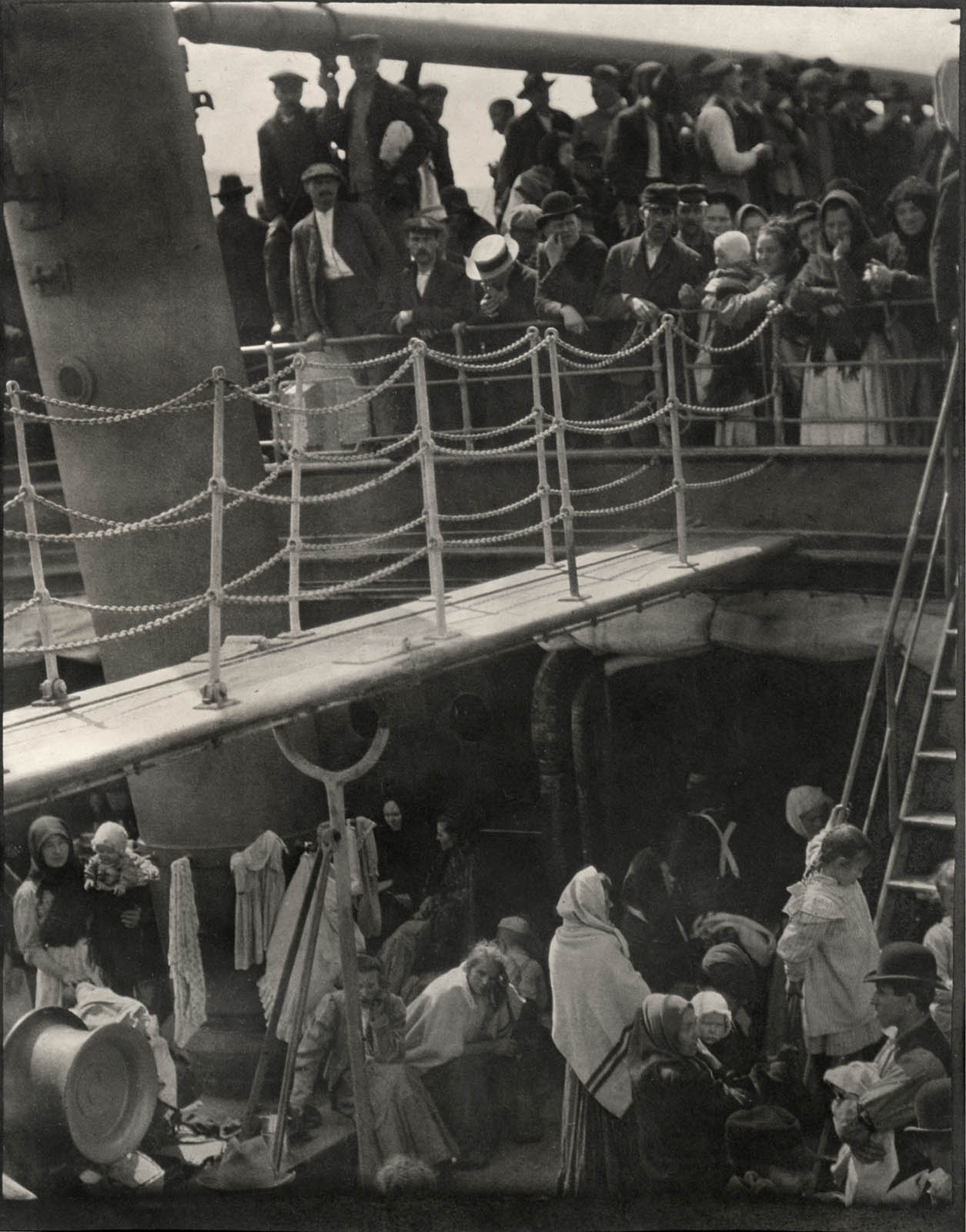
Stieglitz’s photograph The Steerage (1907, below) is one of the most iconic images in the history of photography. This powerful image captures the crowded lower deck of a transatlantic steamer, where people traveled in steerage class, the part of the ship with accommodations for those with the cheapest tickets. The Steerage is celebrated for its striking composition, which combines geometric shapes and human forms to create a dynamic and balanced visual narrative. Stieglitz considered this photograph one of his most outstanding achievements, as it encapsulated his transition to straight photography, which embraced photographs looking like photographs rather than the painterly qualities of Pictorialism. This photograph shows his ability to convey the complexity and depth of human experience through a single image. The photograph is a masterpiece of visual artistry and a compelling social document, reflecting the conditions and aspirations of early 20th century immigrants.

Adelaide Ryder. “The Photo-Secession Movement: Pioneering Artistry in Early Photography,” on the UMFA website Nd [Online] Cited 22/10/2024


Alfred Stieglitz (American, 1864-1946) 'The Steerage' 1907


Alfred Stieglitz (American, 1864-1946)
The Steerage
1907
Hand-pulled photogravure on paper


This photograph has become the iconic image of the Photo-Secession and has legendary status. In June 1907 he sailed to Europe to visit family and booked a first-class cabin. On a stroll around the ship, he encountered a bustling scene of labourers and their families traveling in steerage class, the part of the ship with accommodations for those with the cheapest tickets. With a single four-by-five-inch glass plate left in his camera, Stieglitz shot what would be regarded as a definitive masterpiece of both photography and Modernism.

About making this picture Stieglitz recalled: “There were men and women and children on the lower deck of the steerage. There was a narrow stairway leading to the upper deck of the steerage, a small deck right on the bow of the steamer. To the left was an inclining funnel and from the upper steerage deck there was fastened a gangway bridge that was glistening in its freshly painted state. It was rather long, white, and during the trip remained untouched by anyone. On the upper deck, looking over the railing, there was a young man with a straw hat. The shape of the hat was round. He was watching the men and women and children on the lower steerage deck. A round straw hat, the funnel leaning left, the stairway leaning right, the white drawbridge with its railing made of circular chains – white suspenders crossing on the back of a man in the steerage below, round shapes of iron machinery, a mast cutting into the sky, making a triangular shape. I saw shapes related to each other. I saw a picture of shapes and underlying that the feeling I had about life.”


Alfred Stieglitz (American, 1864-1946) 'The Hand of Man' 1902


Alfred Stieglitz (American, 1864-1946)
The Hand of Man
1902
Hand-pulled photogravure on paper

All from the Collection of Michael Mattis and Judith Hochberg


Works by Käsebier

Gertrude Käsebier: The Master of Portraiture

Gertrude Käsebier was known for her compelling portraits and allegorical imagery. Käsebier’s work transcended traditional portrait photography by infusing her images with a deep sense of intimacy and character. She believed that a photograph should reveal the inner essence of its subject, and her portraits are renowned for capturing the personality and spirit of the people she photographed.

Käsebier’s approach to portraiture was both innovative and empathetic. This image from the UMFA’s permanent collection is a perfect example of how she photographed women and children, presenting them with dignity and respect at a time when they were not the usual subjects of portraiture. Her work challenged conventional representations and highlighted her subjects’ emotional depth and individuality.

Adelaide Ryder. “The Photo-Secession Movement: Pioneering Artistry in Early Photography,” on the UMFA website Nd [Online] Cited 22/10/2024
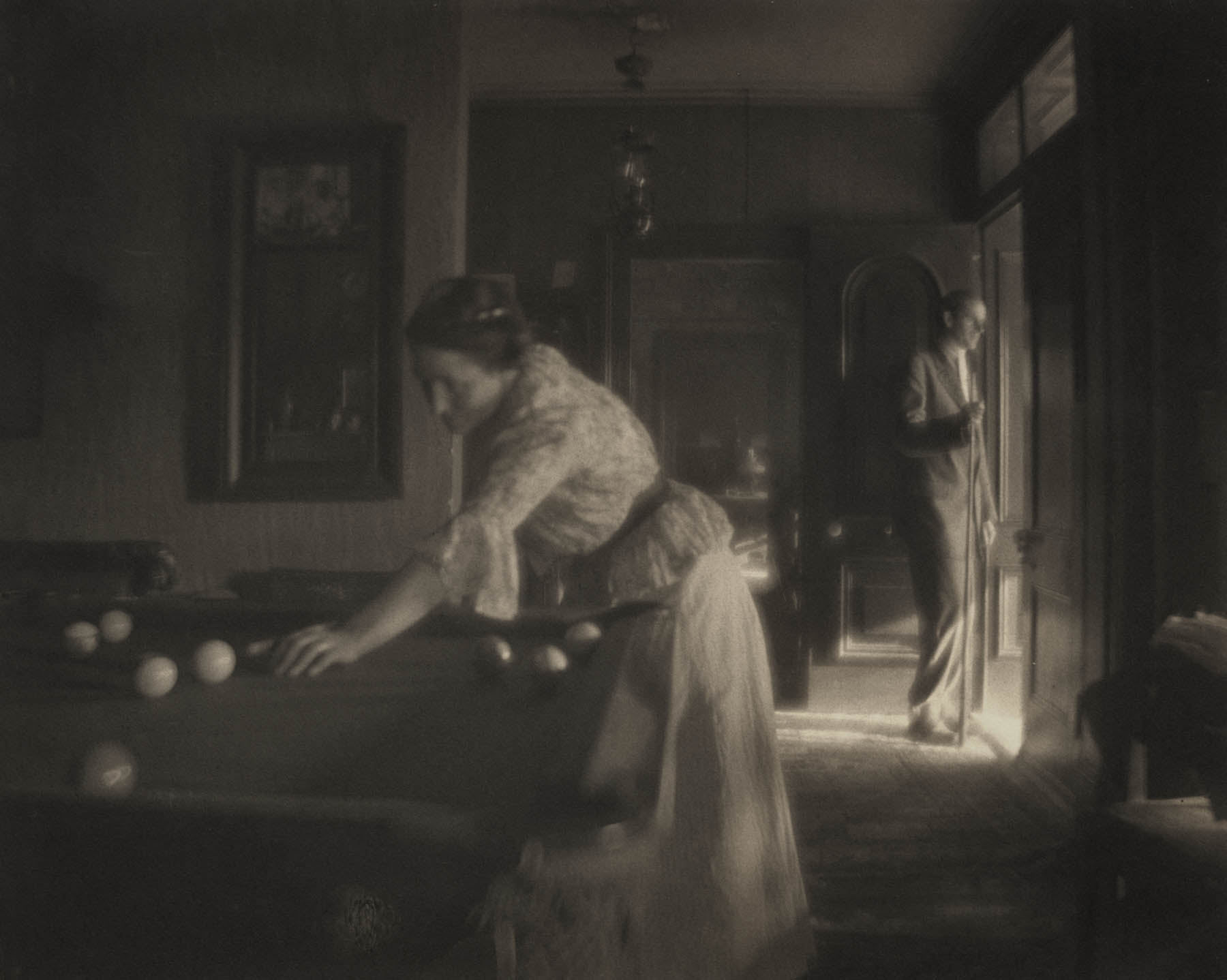
 

Gertrude Käsebier (American, 1852-1934) 'Untitled (Billiard Game)' c. 1909


Gertrude Käsebier (American, 1852-1934)
Untitled (Billiard Game)
c. 1909
Platinum print on paper
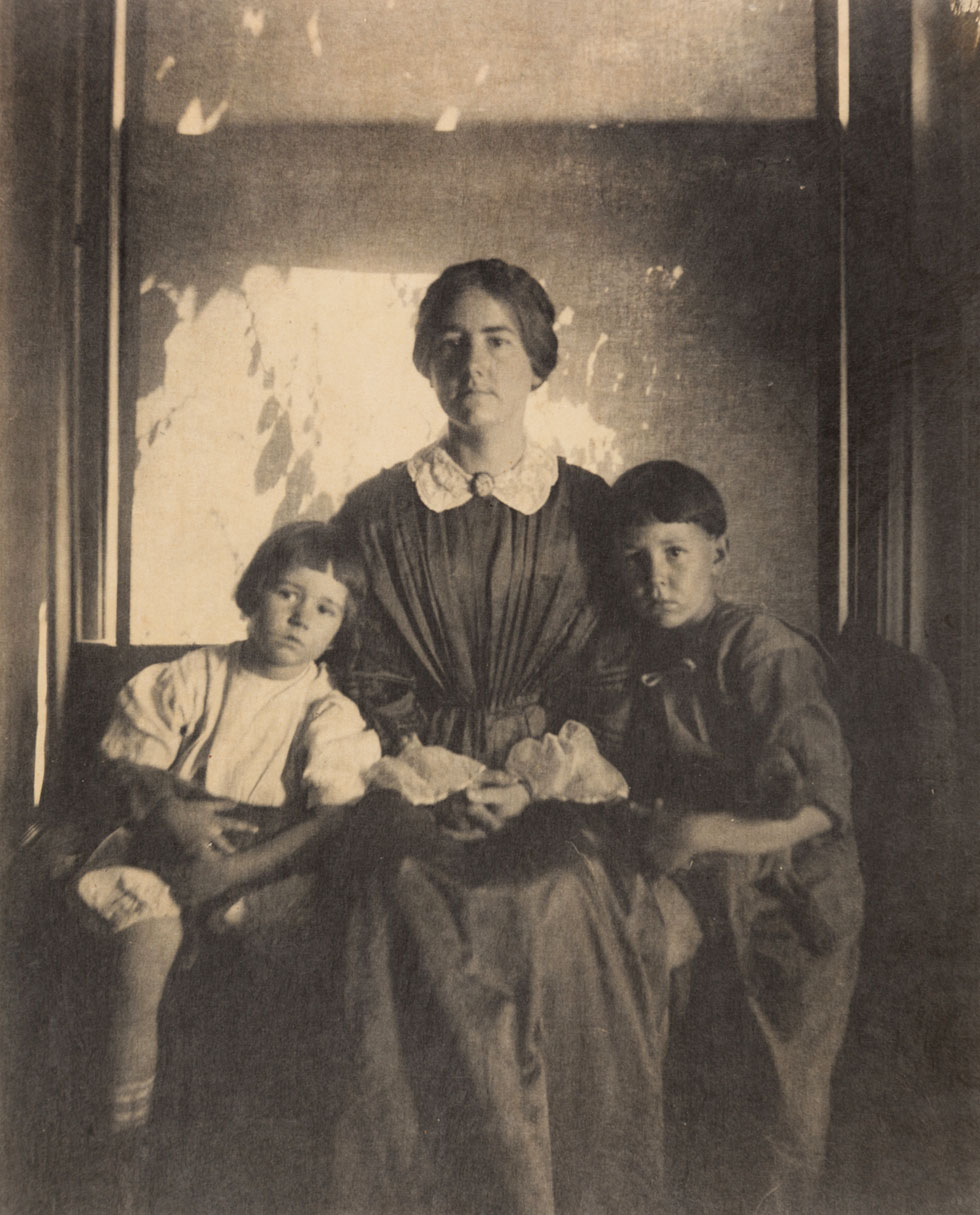
 

Gertrude Käsebier (American, 1852-1934) 'Mother and Two Children' 1899


Gertrude Käsebier (American, 1852-1934)
Mother and Two Children
1899
Platinum print on paper


Gertrude Käsebier (American, 1852-1934) 'Serbonne (A Day in France)' 1901


Gertrude Käsebier (American, 1852-1934)
Serbonne (A Day in France)
1901
Platinum print on paper


Both Pumpkin Pie, Voulangis and Serbonne (A Day in France) were set in France in 1901, when the artist was chaperoning art students. The young man in both scenes is Edward Steichen at age 22, whose interest in photography was then budding.

Serbonne is Käsebier’s chaste reference to Édouard Manet’s famous painting Le Déjeuner sur l’herbe (The Luncheon on the Grass) of 1863. An example of ultra-soft focus, this photo was reproduced in the inaugural issue of Camera Work, which was devoted to Käsebier.

Published in Camera Work, 1, 1903
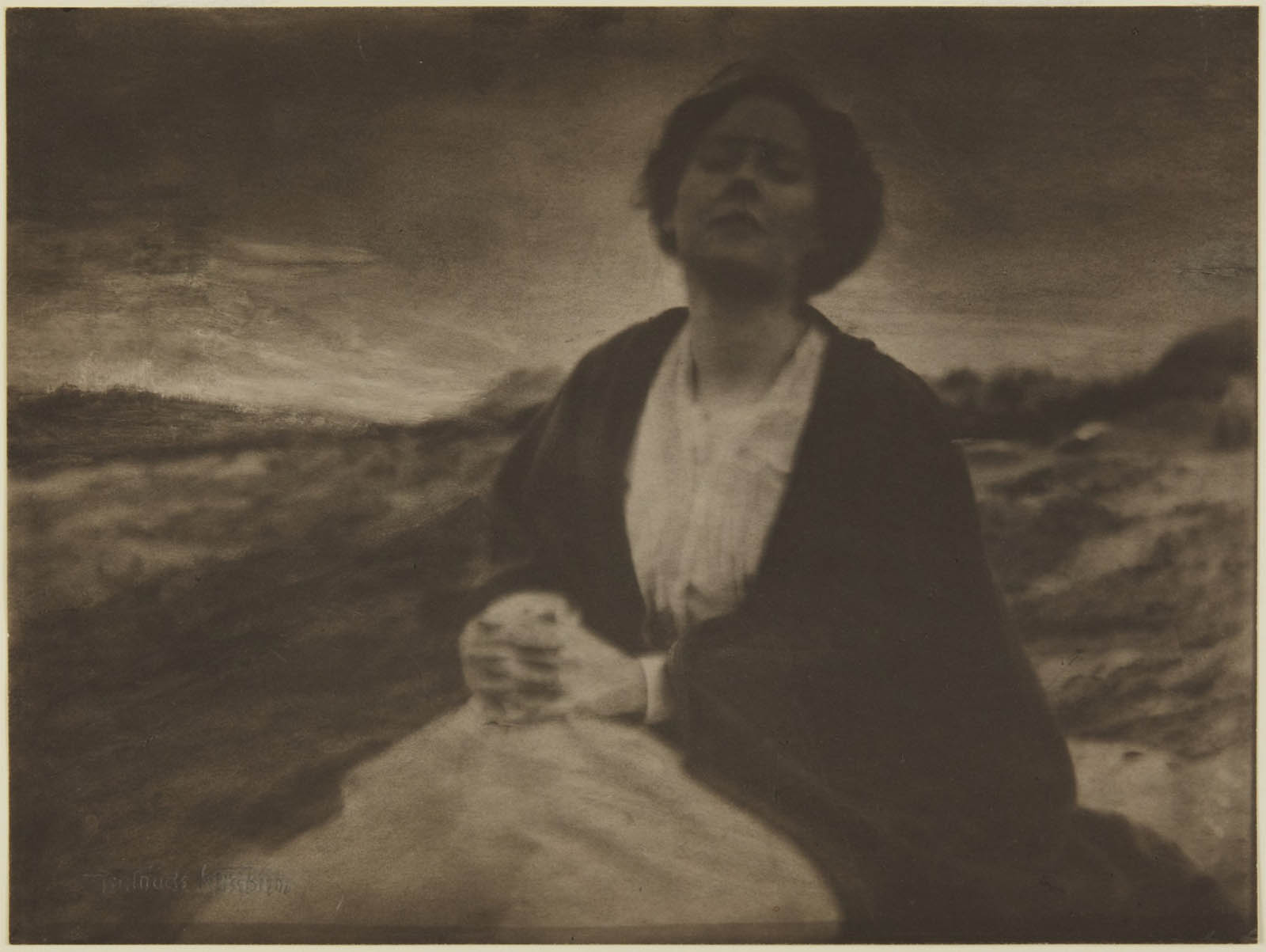
 

Gertrude Käsebier (American, 1852-1934) 'The Heritage of Motherhood' 1904


Gertrude Käsebier (American, 1852-1934)
The Heritage of Motherhood
1904
Gum-bichromate print on paper


This portrays the children’s book author Agnes Rand Lee in mourning after the sudden death of her daughter from illness. A contemporary photographer and critic deemed this image “one of the strongest things that Käsebier has ever done, and one of the saddest and most touching that I have ever seen.” Käsebier extensively manipulated the gum-bichromate process to make this print appear like a charcoal drawing.
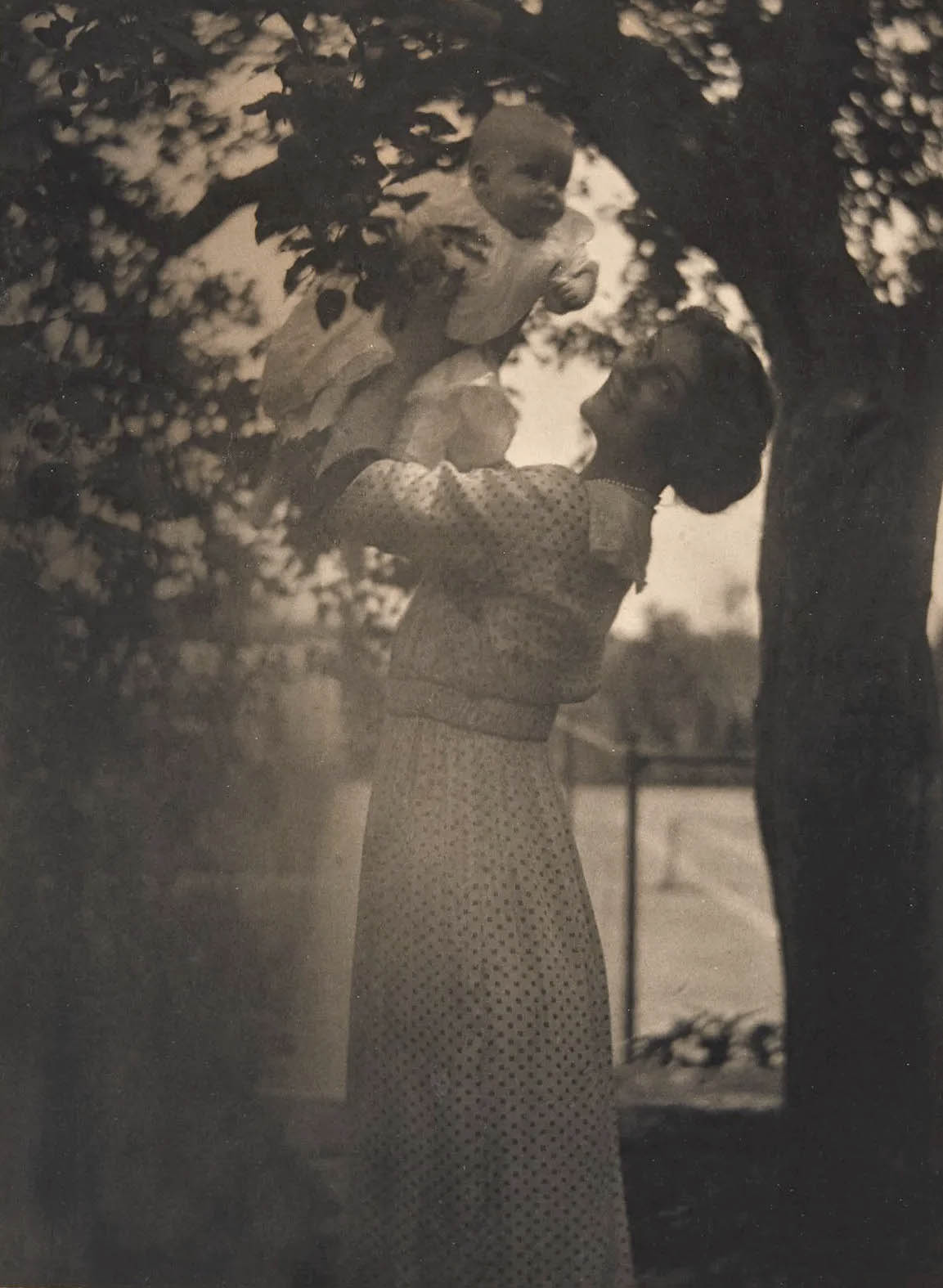
 

Gertrude Käsebier (American, 1852-1934) 'Mother and Child' c. 1900


Gertrude Käsebier (American, 1852-1934)
Mother and Child
c. 1900
Multiple gum-bichromate print on paper


The subject of mother and child was a frequent one for Pictorialists, especially Käsebier and Clarence White. The contrast between the tiny infant and the mighty tree gives this image additional symbolic meaning.


Gertrude Käsebier (American, 1852-1934) 'The Picture Book' 1903


Gertrude Käsebier (American, 1852-1934)
The Picture Book
1903
Platinum print on paper


Alfred Stieglitz had a print of this photograph in his personal collection, which he bequeathed to the Metropolitan Museum of Art in New York.

Published in Camera Work, 10, 1905

All from the Collection of Michael Mattis and Judith Hochberg


Works by Evans


Frederick Evans (British, 1853-1943) 'Aubrey Beardsley' 1893


Frederick H. Evans (British, 1853-1943)
Aubrey Beardsley
1893
Platinum print on paper


Evans, a member of the British art photography group the Linked Ring, was close friends with prominent authors and artists, such as George Bernard Shaw and Aubrey Beardsley. Portrayed here around age 20, Beardsley was a talented artist, designer, and illustrator, whose promising career was cut short by tuberculosis just five years after this photo was made.
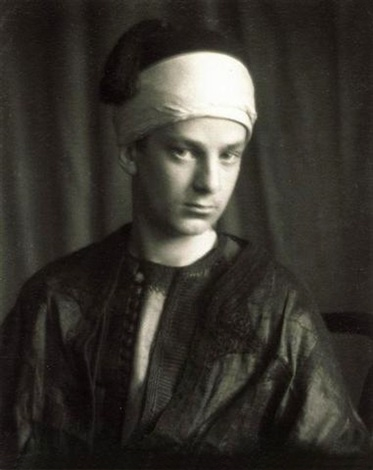
 

Frederick H. Evans (British, 1853-1943) 'Alvin Langdon Coburn in Eastern Clothing' 1901


Frederick H. Evans (British, 1853-1943)
Alvin Langdon Coburn in Eastern Clothing
1901
Platinum print on paper


Coburn was a precocious young American artist. An eighth birthday gift of a Kodak camera sparked his interest in photography. By age 16 Coburn had moved to London to work with his cousin the photographer F. Holland Day, whose portrait by Gertrude Käsebier is in this exhibition. After being included in a landmark exhibition at the Royal Photographic Society, Coburn returned to New York and apprenticed with Käsebier. By the tender age of 20, he became a founding member of the Photo-Secession and launched an international career dividing his time between New York, London, and Paris.

All from the Collection of Michael Mattis and Judith Hochberg


Works by Dow


Arthur Wesley Dow (American, 1857-1922) 'Silhouetted Trees' c. 1910


Arthur Wesley Dow (American, 1857-1922)
Silhouetted Trees
c. 1910
Cyanotype print on paper


A painter, printmaker, and photographer, Dow is mainly remembered today as a pioneering educator who taught in New York at the Pratt Institute, Art Students League, and Teacher’s College of Columbia University. Among Dow’s students were Gertrude Käsebier, Alvin Langdon Coburn, Charles Sheeler, and Georgia O’Keeffe. Dow also hired Clarence White to teach photography at Columbia, thereby launching White’s important teaching career.

From the Collection of Michael Mattis and Judith Hochberg


Works by Haviland
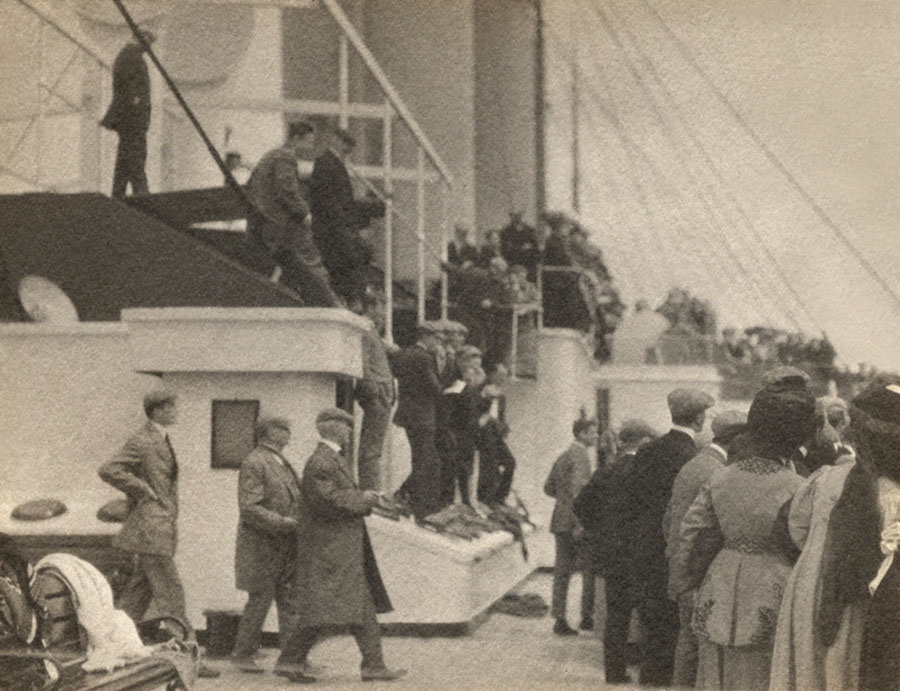
 

Paul Burty Haviland (American, 1880-1950) 'Ship Deck' 1910


Paul Burty Haviland (American, 1880-1950)
Ship Deck
1910
Platinum print on paper


Haviland was an amateur photographer from a young age and grew up immersed in the arts. His grandfather was an early photography critic in Paris, and his father owned Haviland porcelain factory in Limoges, France. As the New York representative of the family business, Haviland happened to meet Alfred Stieglitz in 1908. Just two years later he became associate editor of Camera Work and helped financially support Stieglitz’s gallery 291.

All from the Collection of Michael Mattis and Judith Hochberg


Works by Struss
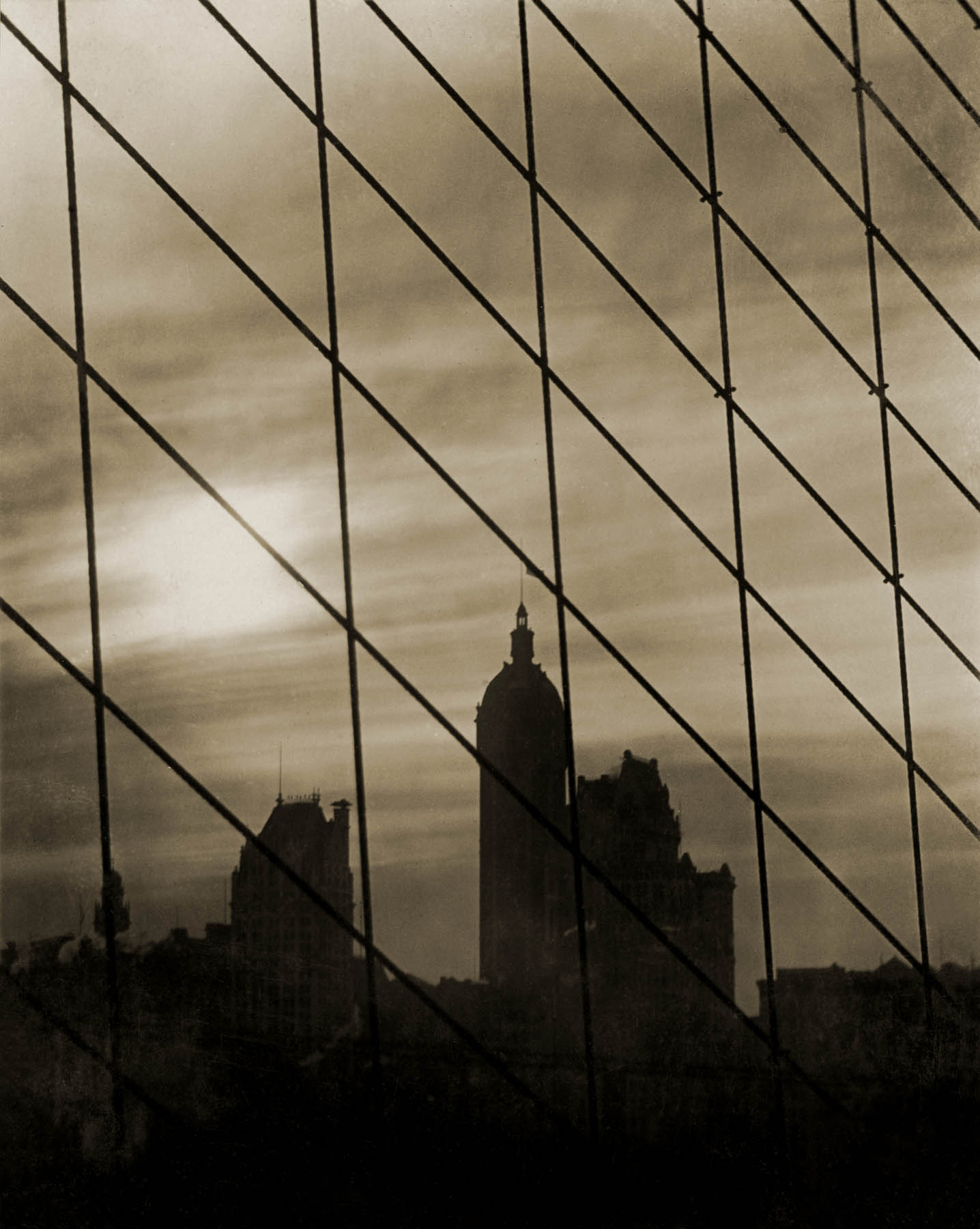
 

Karl Struss (American, 1886-1981) 'Cables' 1912


Karl Struss (American, 1886-1981)
Cables
1912
Gelatin silver print on paper


Struss was a star pupil of Clarence White and became a favourite of Alfred Stieglitz and the youngest member of the Photo-Secession. He is best known for his compelling cityscapes of New York, including the view of the Singer Building through the cables of the Brooklyn Bridge and the dramatic Flatiron Building, Twilight.


Karl Struss (American, 1886-1981) 'Flatiron Building, Twilight' c. 1915


Karl Struss (American, 1886-1981)
Flatiron Building, Twilight
c. 1915
Gelatin silver print on paper


Struss eventually broke away from Stieglitz and cofounded the society of the Pictorial Photographers of America along with Clarence White and Gertrude Käsebier in 1916. He … accepted a job as a cameraman for filmmaker Cecil B. DeMille. Struss would become one of the most prolific Hollywood cinematographers with 150 films, an Academy Award, and three Academy nominations to his credit.

All from the Collection of Michael Mattis and Judith Hochberg


Nudes by Stieglitz and White


Clarence Hudson White (American, 1871-1925) 'Reflected Nude' 1909


Clarence Hudson White (American, 1871-1925)
Reflected Nude
1909
Platinum print on paper
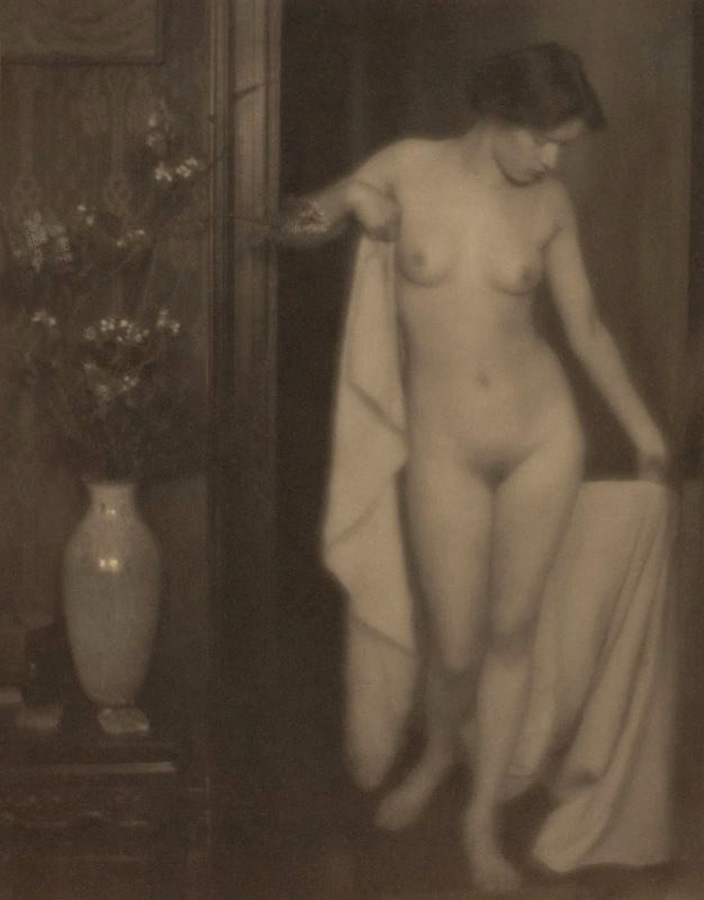
 

Alfred Stieglitz (American, 1864-1946) and Clarence Hudson White (American, 1871-1925) 'Nude Posed in Doorway (Miss Thompson)' 1907


Alfred Stieglitz (American, 1864-1946) and Clarence Hudson White (American, 1871-1925)
Nude Posed in Doorway (Miss Thompson)
1907
Platinum print on paper


Alfred Stieglitz (American, 1864-1946) and Clarence Hudson White (American, 1871-1925) 'The Torso' 1907


Alfred Stieglitz (American, 1864-1946) and Clarence Hudson White (American, 1871-1925)
The Torso
1907
Palladium print on paper


This is likely the most widely reproduced nude by Photo-Secession artists.

After their personal and professional rupture, Stieglitz wrote White a letter that specifically referred to their collaboration in 1907. Stieglitz insisted “that my name be not mentioned by you in connection with either the prints or the negatives” and further instructed White to erase his name from any prints they had jointly signed. Despite this vitriol, Stieglitz retained in his personal collection two prints of The Torso, one of them jointly signed in pencil.

Published in Camera Work, 27, 1909

All from the Collection of Michael Mattis and Judith Hochberg


Images of O’Keeffe by Stieglitz
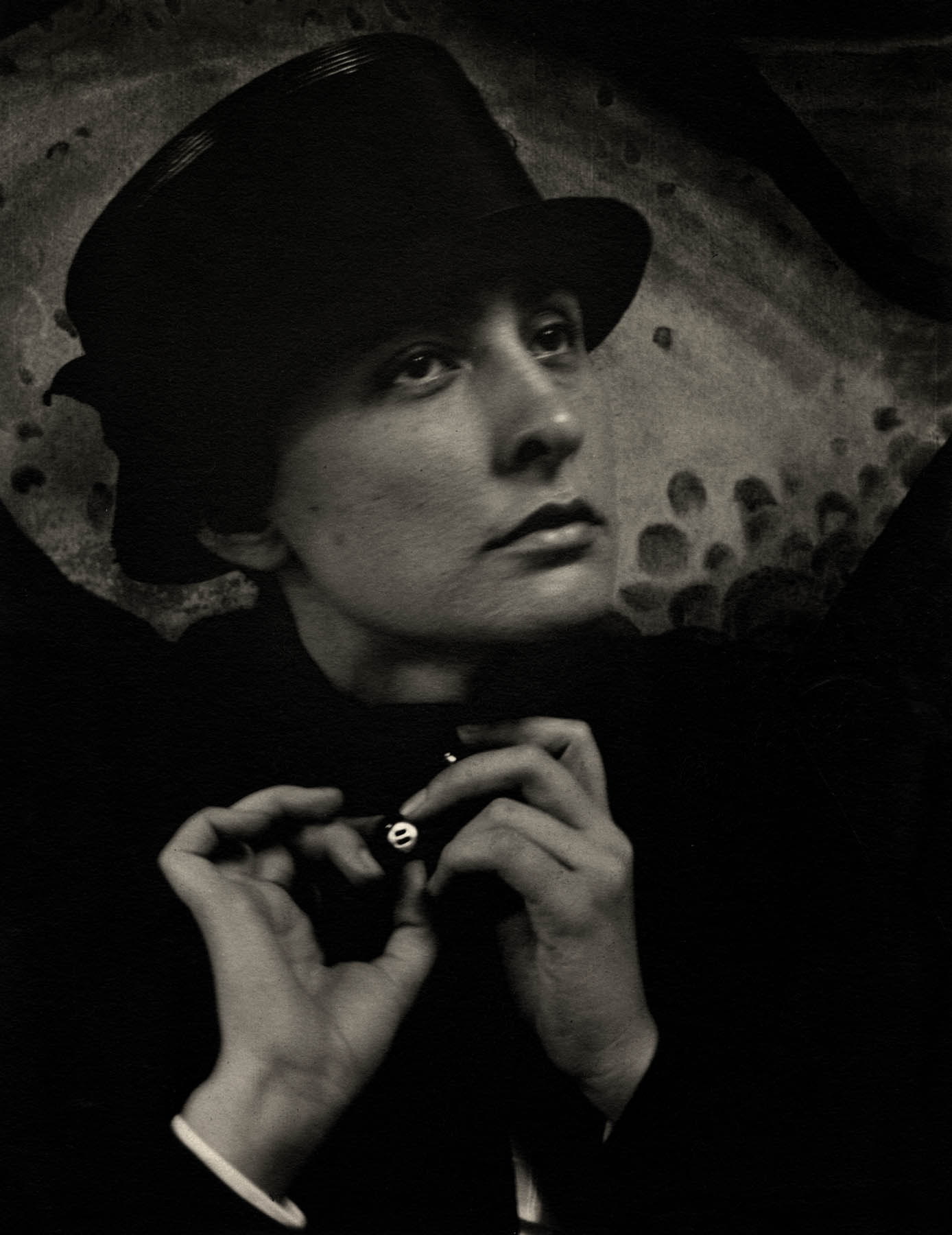
 

Alfred Stieglitz (American, 1864-1946) 'Georgia O'Keeffe' 1918


Alfred Stieglitz (American, 1864-1946)
Georgia O’Keeffe
1918
Palladium print on paper
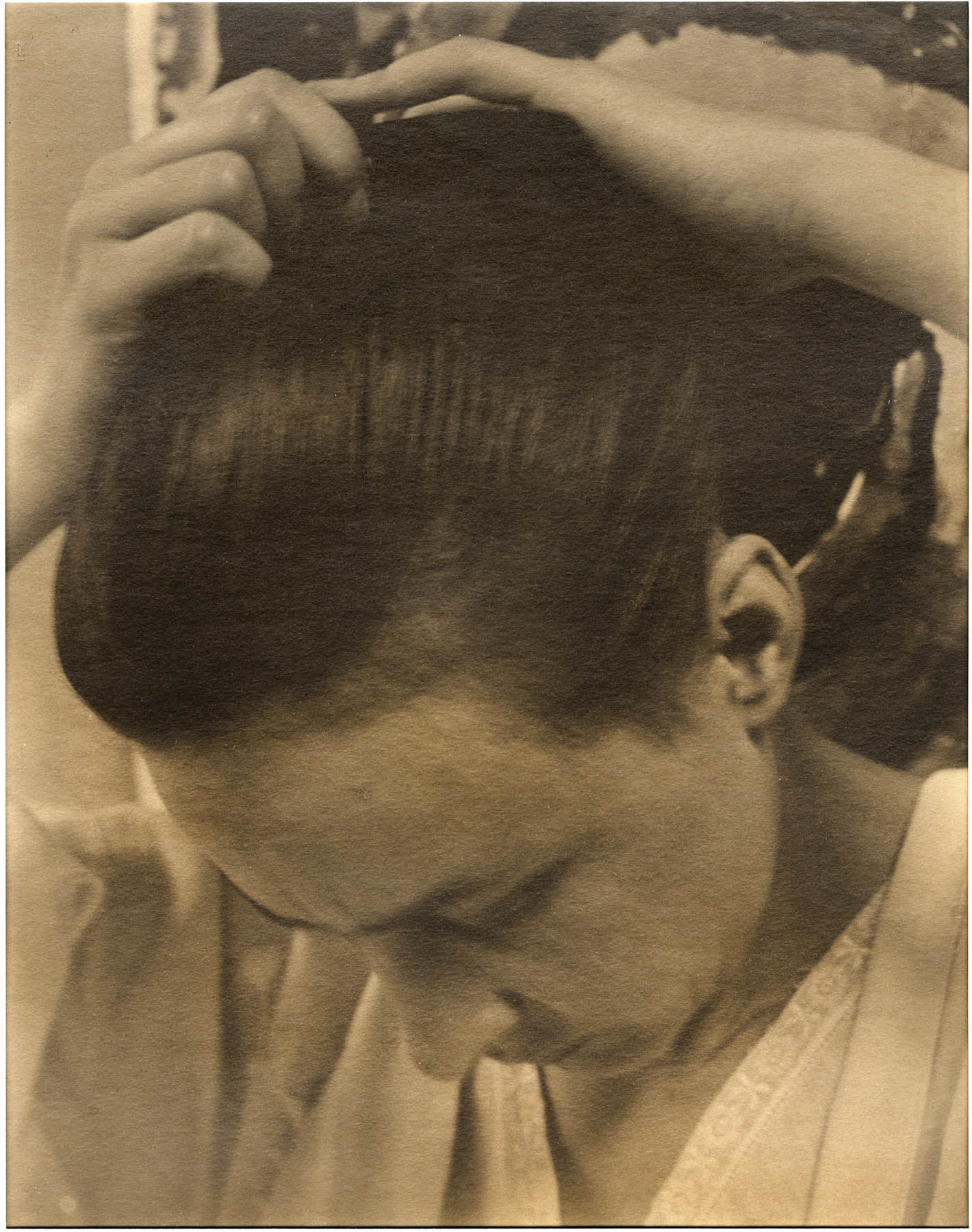
 

Alfred Stieglitz (American, 1864-1946) 'Georgia O'Keeffe (Fixing Hair)' 1919-1921


Alfred Stieglitz (American, 1864-1946)
Georgia O’Keeffe (Fixing Hair)
1919-1921
Palladium print on paper


Over two decades, Stieglitz made over 300 photos of O’Keeffe, producing an extraordinary and candid portrait of the artist. She recalled, “I was photographed with a kind of heat and excitement and in a way wondered what it was all about.” The directness and intimacy of this series of photos differ from the idealised nudes that Stieglitz and White made together during the heyday of the Photo-Secession.

All from the Collection of Michael Mattis and Judith Hochberg


Works by White

Clarence Hudson White: The Romantic

Clarence Hudson White was celebrated for his romanticised and intimate approach to photography. His 1904 image The Kiss perfectly illustrates his unique style. This platinum print on paper captures a tender moment with a soft focus and gentle lighting. The Kiss portrays an intimate scene imbued with a sense of emotional depth. White’s use of the platinum printing process, which provides a broad tonal range and exquisite detail, enhances the image’s delicate and dreamlike quality. His work reflects the movement’s early emphasis on creating photographs that evoke the emotional and aesthetic qualities of fine art while also paving the way for future explorations in photographic expression.

Adelaide Ryder. “The Photo-Secession Movement: Pioneering Artistry in Early Photography,” on the UMFA website Nd [Online] Cited 22/10/2024


Clarence H. White (American, 1871-1925) 'The Bubble' 1898, printed 1905


Clarence Hudson White (American, 1871-1925)
The Bubble
1898
Platinum print on paper


This image was exhibited at the 1898 Philadelphia Photographic Salon to great acclaim. Fellow photographer and critic Joseph Keiley commented, “Like most of Mr. White’s pictures, it is a well nigh perfect piece of composition whose subject with subtle poetry stimulates and leaves much to the imagination.”


Clarence Hudson White (American, 1871-1925) 'The Mirror' 1912


Clarence Hudson White (American, 1871-1925)
The Mirror
1912
Platinum print on paper
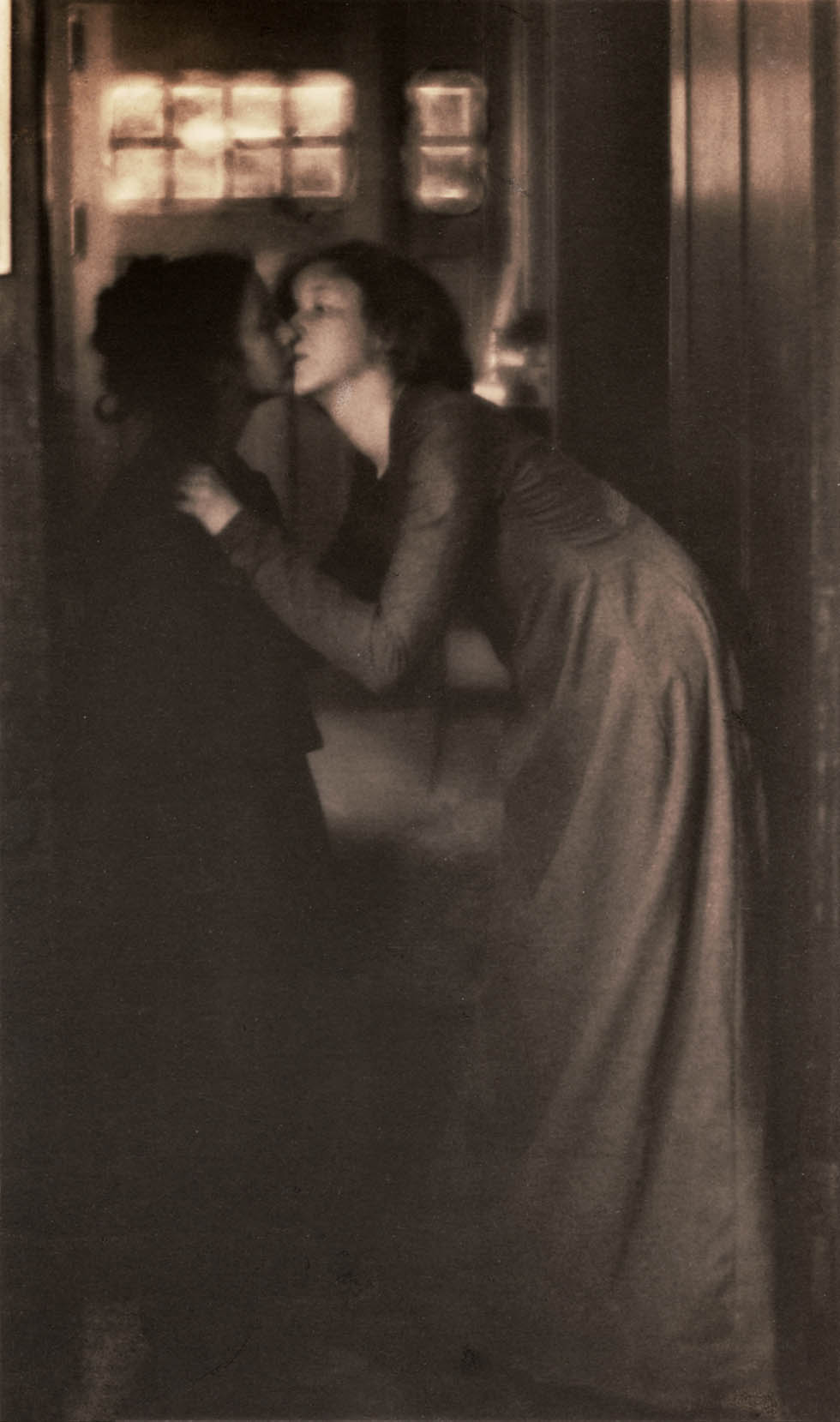
 

Clarence Hudson White (American, 1871-1925) 'The Kiss' 1904


Clarence Hudson White (American, 1871-1925)
The Kiss
1904
Platinum print on paper


This is one of White’s best known photographs. Despite his separation from White, Stieglitz kept prints of both The Kiss and The Bubble in his personal collection throughout his life.

All from the Collection of Michael Mattis and Judith Hochberg


Works by followers of White

Anne Brigman: The Feminine Mystic of Photo-Secession

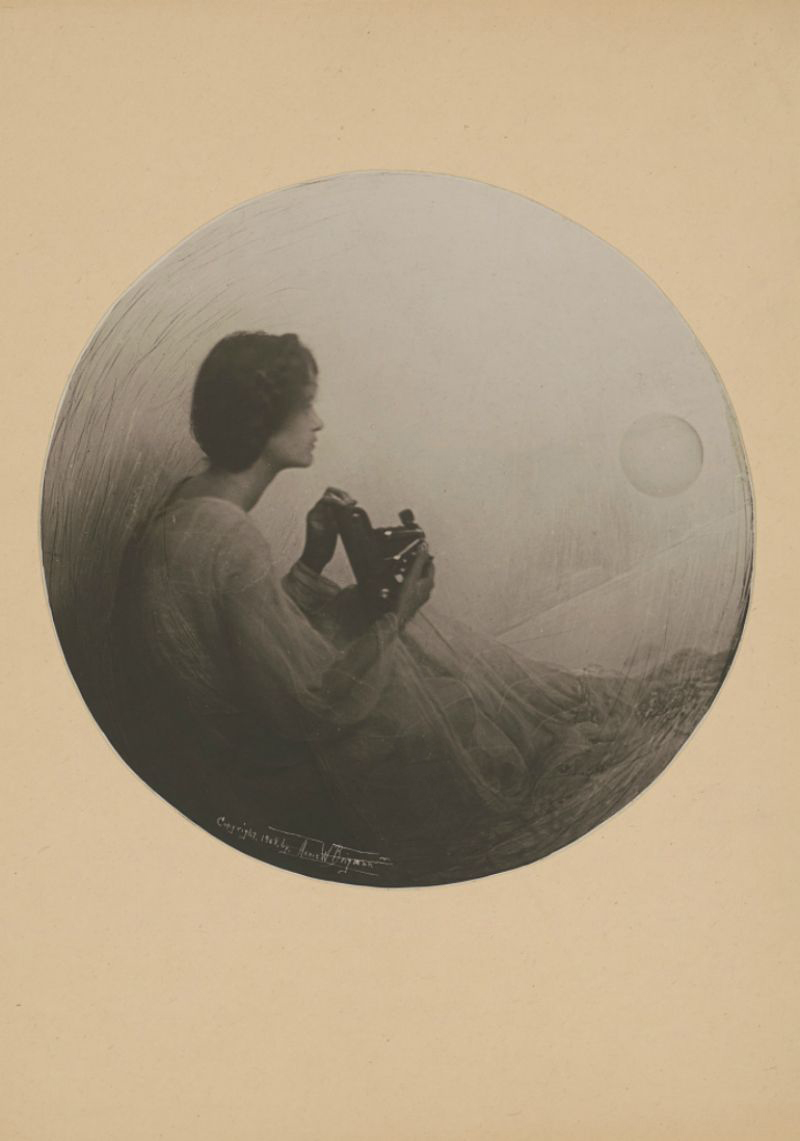
Anne Brigman was known for her evocative and mystical imagery. She often placed herself within her compositions, challenging traditional gender roles and expectations. Her connection to the Photo-Secession movement was cemented through her association with Alfred Stieglitz, who published her work in Camera Work and admired her innovative spirit.

Brigman’s 1911 photograph The Pine Sprite exemplifies her distinctive style. The image features a nude female figure intertwined with the natural landscape, blending the human form seamlessly with the rugged environment. This work reflects Brigman’s themes of femininity, nature, and freedom, aligning with the Photo-Secessionist emphasis on personal expression and artistic experimentation. Brigman’s contributions highlighted the movement’s inclusive spirit, showcasing how female photographers could assert their voices and artistic visions in a male-dominated field.

Adelaide Ryder. “The Photo-Secession Movement: Pioneering Artistry in Early Photography,” on the UMFA website Nd [Online] Cited 22/10/2024
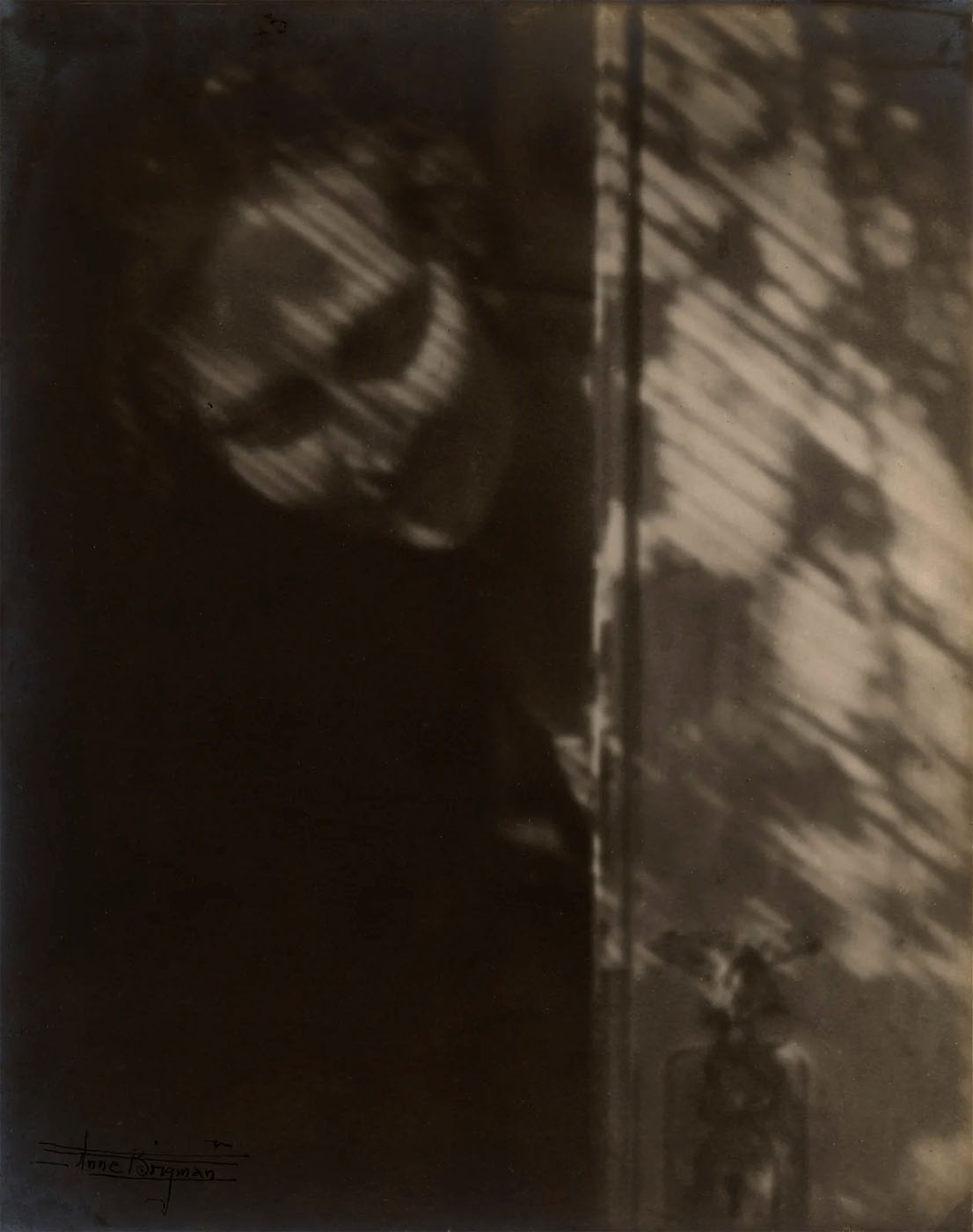
 

Anne Brigman (American, 1869-1950) 'The Shadow on My Door (Self Portrait)' 1921


Anne Brigman (American, 1869-1950)
The Shadow on My Door (Self Portrait)
1921
Gelatin silver print on paper
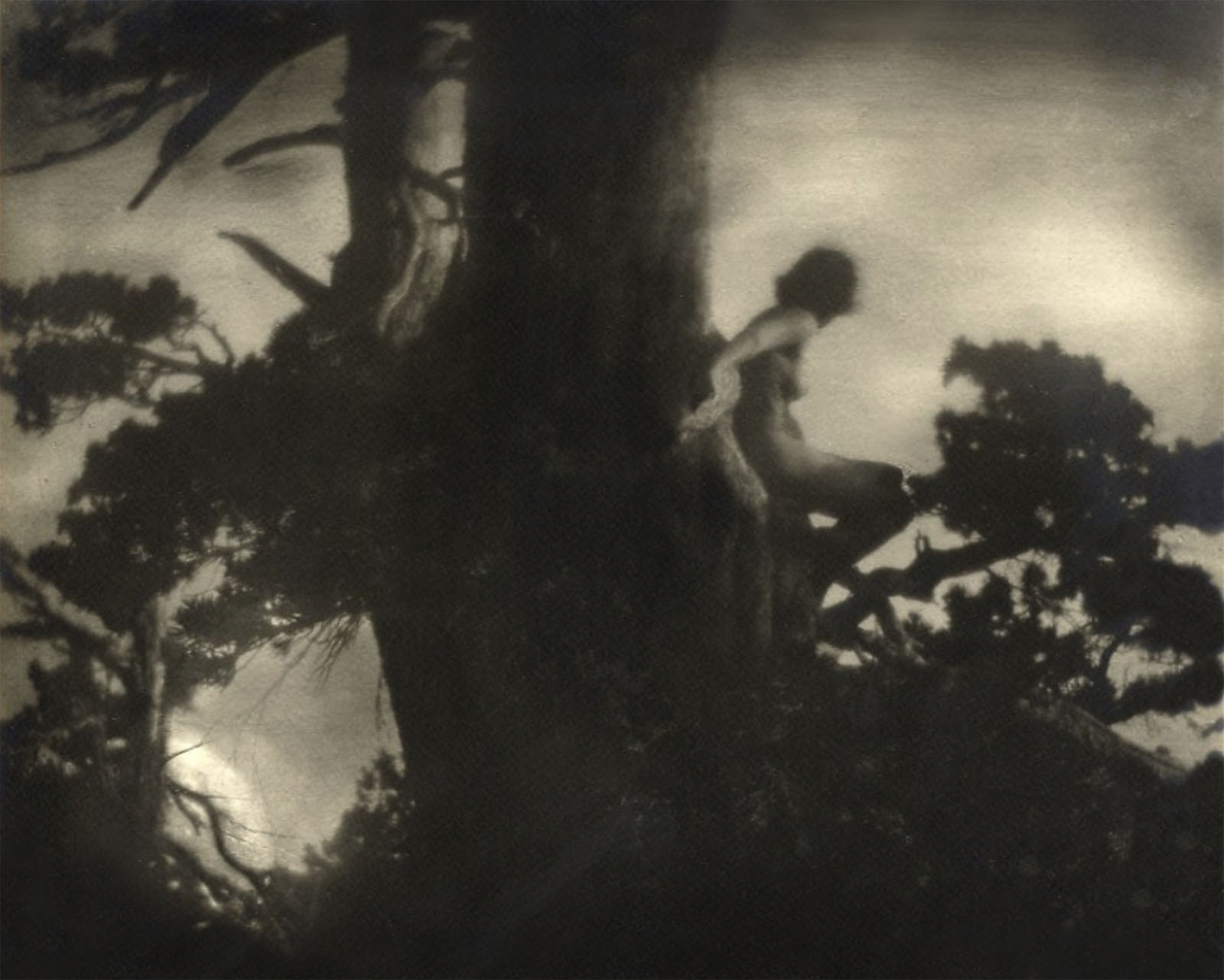
 

Anne Brigman (American, 1869-1950) 'The Pine Sprite' 1911 from the exhibition 'Photo-Secession: Painterly Masterworks of Turn-of-the-Century Photography' at the Utah Museum of Fine Arts, Salt Lake City, August - December 2024


Anne Brigman (American, 1869-1950)
The Pine Sprite
1911
Gelatin silver print on paper


Brigman was for a long time the only Californian member of the Photo-Secession. She was a free spirit and pagan whose woodsy nudes inspired by fantasy and folklore were frequently reproduced in Camera Work.


Laura Gilpin (American, 1891-1979) 'Ghost Rock, Garden of the Gods, Colorado' 1919


Laura Gilpin (American, 1891-1979)
Ghost Rock, Garden of the Gods, Colorado
1919
Palladium print on paper


An amateur photographer from Colorado Springs, Gilpin moved to New York to study with Clarence White in 1916. This photograph was one of Gilpin’s first successes after returning home in 1919, the beginning of her decades-long career as one of the most notable photographers of the West and Southwest.

All from the Collection of Michael Mattis and Judith Hochberg


In 1916 Gilpin enrolled at the Clarence H. White School of Photography in New York. Two years later, she returned to her native Colorado Springs and became one of the few women to pursue landscape photography.

This is her depiction of the Garden of the Gods, a scenic rock formation in Colorado Springs. It captures the stillness and otherworldly quality of the area. The photograph also reflects an emphasis on the evocation of mood rather than on descriptive detail.

Text from the National Gallery of Art Facebook page


Edward Steichen

Edward J. Steichen: The Innovator

Edward J. Steichen, a close associate of Stieglitz, brought a unique perspective to the Photo-Secession movement. Steichen was not only a photographer but also a painter, which influenced his photographic style. He experimented with various techniques, including soft focus and manipulation of light, to create both ethereal and visually striking images.

An avid gardener, Steichen propagated and grew a bountiful garden at his French country house. This image of a calla lily is rendered with exquisite detail and tonal richness. Steichen’s botanical images showcase his ability to find harmony between nature and art. His meticulous composition and sensitivity to light transform a simple flower into a work of art, reflecting his painterly approach to photography. His botanical works contributed to the Photo-Secession movement by highlighting the artistic potential of natural forms.

Adelaide Ryder. “The Photo-Secession Movement: Pioneering Artistry in Early Photography,” on the UMFA website Nd [Online] Cited 22/10/2024
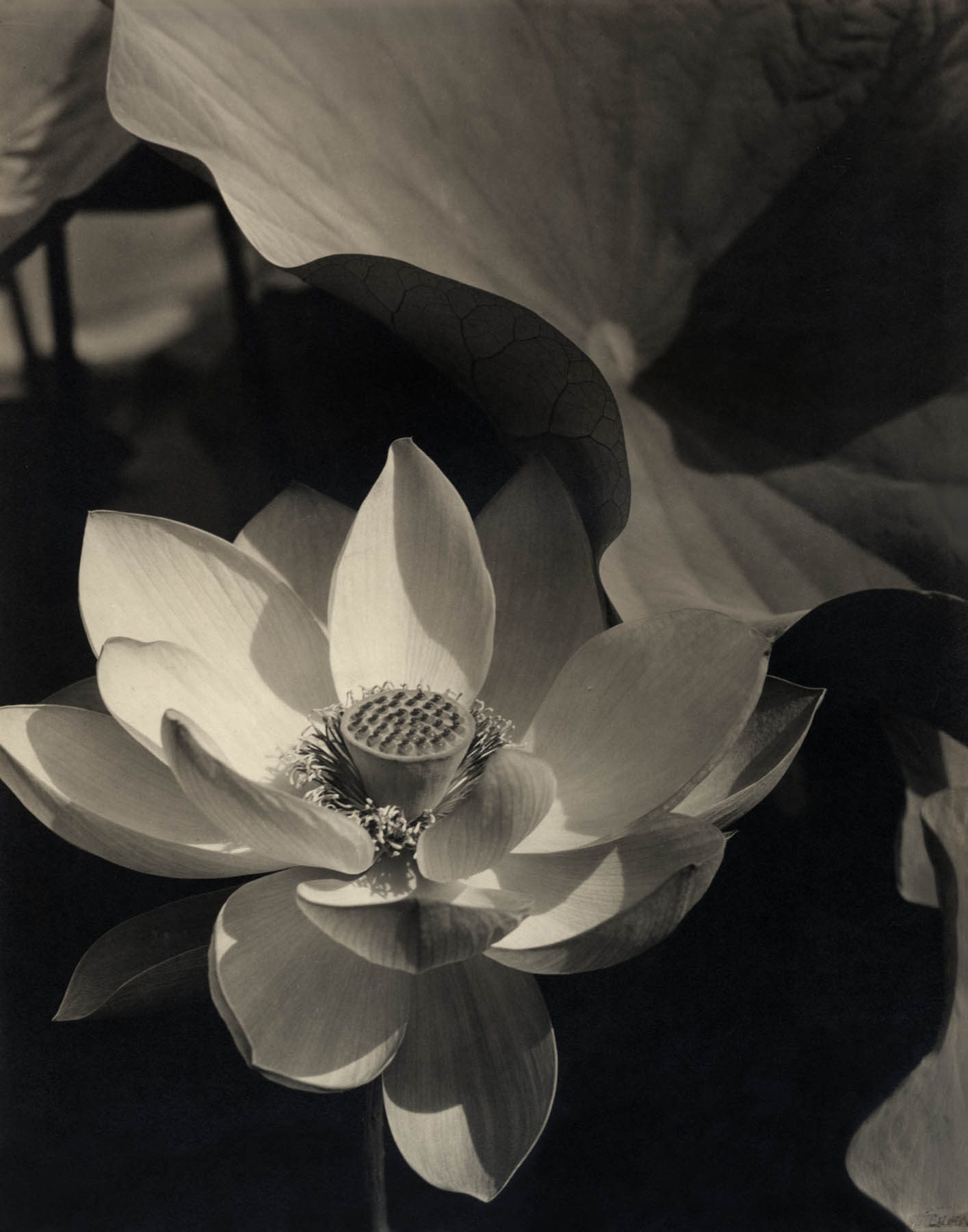
 

Edward Steichen (American born Luxembourg, 1879-1973) 'Lotus, Mount Kisco' 1915 from the exhibition 'Photo-Secession: Painterly Masterworks of Turn-of-the-Century Photography' at the Utah Museum of Fine Arts, Salt Lake City, August - December 2024


Edward Steichen (American born Luxembourg, 1879-1973)
Lotus, Mount Kisco
1915
Gelatin silver print on paper


Edward Steichen (American born Luxembourg, 1879-1973) 'Calla Lily' c. 1921


Edward Steichen (American born Luxembourg, 1879-1973)
Calla Lily
c. 1921
Platinum print on paper


Steichen had previously photographed flowers in compositions that placed delicate floral arrangements next to women figured as ideals of feminine beauty. In contrast, here he presents the lotus and calla lily in sharp focus and as singular subjects without overt metaphorical meaning.


Edward Steichen (American born Luxembourg, 1879-1973) 'Three Pears and an Apple' 1921


Edward Steichen (American born Luxembourg, 1879-1973)
Three Pears and an Apple
1921
Gelatin silver print on paper


On making this picture Steichen wrote: “I was particularly interested in a method of representing volume, scale, and a sense of weight. In my small greenhouse I constructed a tent of opaque blankets. From a tiny opening, I directed light against one side of the covering blanket, and this light, reflected from the blanket, was all. I made a series of exposures that lasted more than two days and one night. As the nights were cool, everything, including the camera, contracted and the next day expanded. Instead of producing one meticulously sharp picture, the infinitesimal movement produced a succession of slightly different sharp images, which optically fused as one. Here for the first time in a photograph, I was able to sense volume as well as form.”


Edward Steichen (American born Luxembourg, 1879-1973) 'Blossom of White Fingers' c. 1923


Edward Steichen (American born Luxembourg, 1879-1973)
Blossom of White Fingers
c. 1923
Gold-toned gelatin silver print on paper


This study of the graceful hands of Steichen’s wife with ultra-soft focus and high-key lighting and printed on gold-toned gelatin paper is one of the rare instances of Steichen using Pictorialist methods after the end of the Photo-Secession.
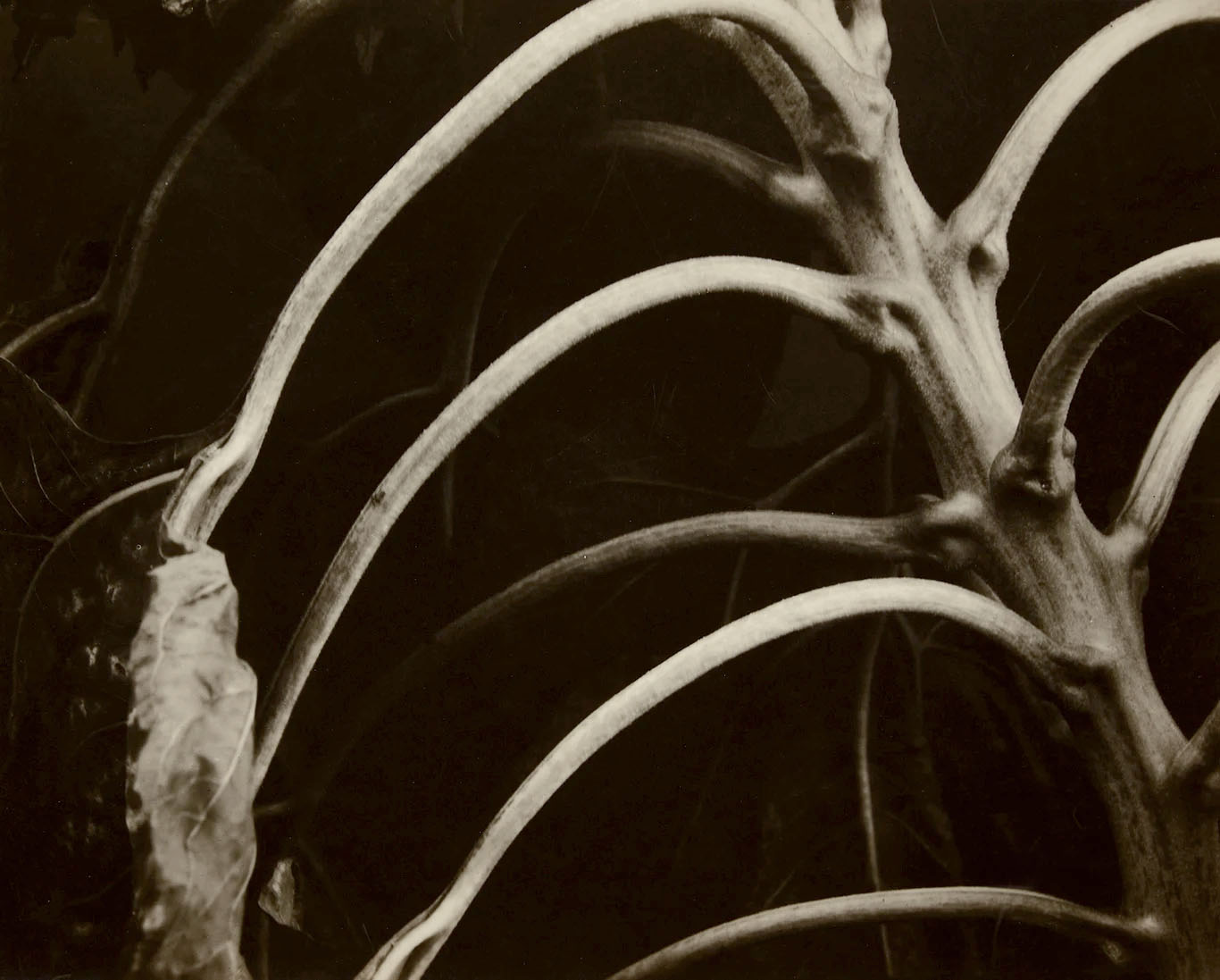
 

Edward Steichen (American born Luxembourg, 1879-1973) 'Backbone and Ribs of a Sunflower' c. 1920


Edward Steichen (American born Luxembourg, 1879-1973)
Backbone and Ribs of a Sunflower
c. 1920
Gelatin silver print on paper


Steichen was a knowledgeable botanist and spent five decades photographing the life cycle of sunflowers. This is one of his earliest studies of the plant. He became fascinated with spirals in nature, writing, “I found some form of the spiral in most succulent plants and in certain flowers, particularly in the seed pods of the sunflower.”


Edward Steichen (American born Luxembourg, 1879-1973) 'Advertising Study for Coty Lipstick' 1929


Edward Steichen (American born Luxembourg, 1879-1973)
Advertising Study for Coty Lipstick
1929
Gelatin silver print on paper


Steichen is credited as a founding figure of modern advertising and fashion photography. From 1923 to 1938, he served as chief photographer for the Condé Nast magazines Vogue and Vanity Fair. He had extensive experience in graphic design and advertising from his youth and earlier career. He had designed posters as a young man for a lithographic printer in Milwaukee. As Alfred Stieglitz’s associate on Camera Work from 1903 to 1917, Steichen produced the logo, typeface, and page layouts.

All from the Collection of Michael Mattis and Judith Hochberg


Works by Strand
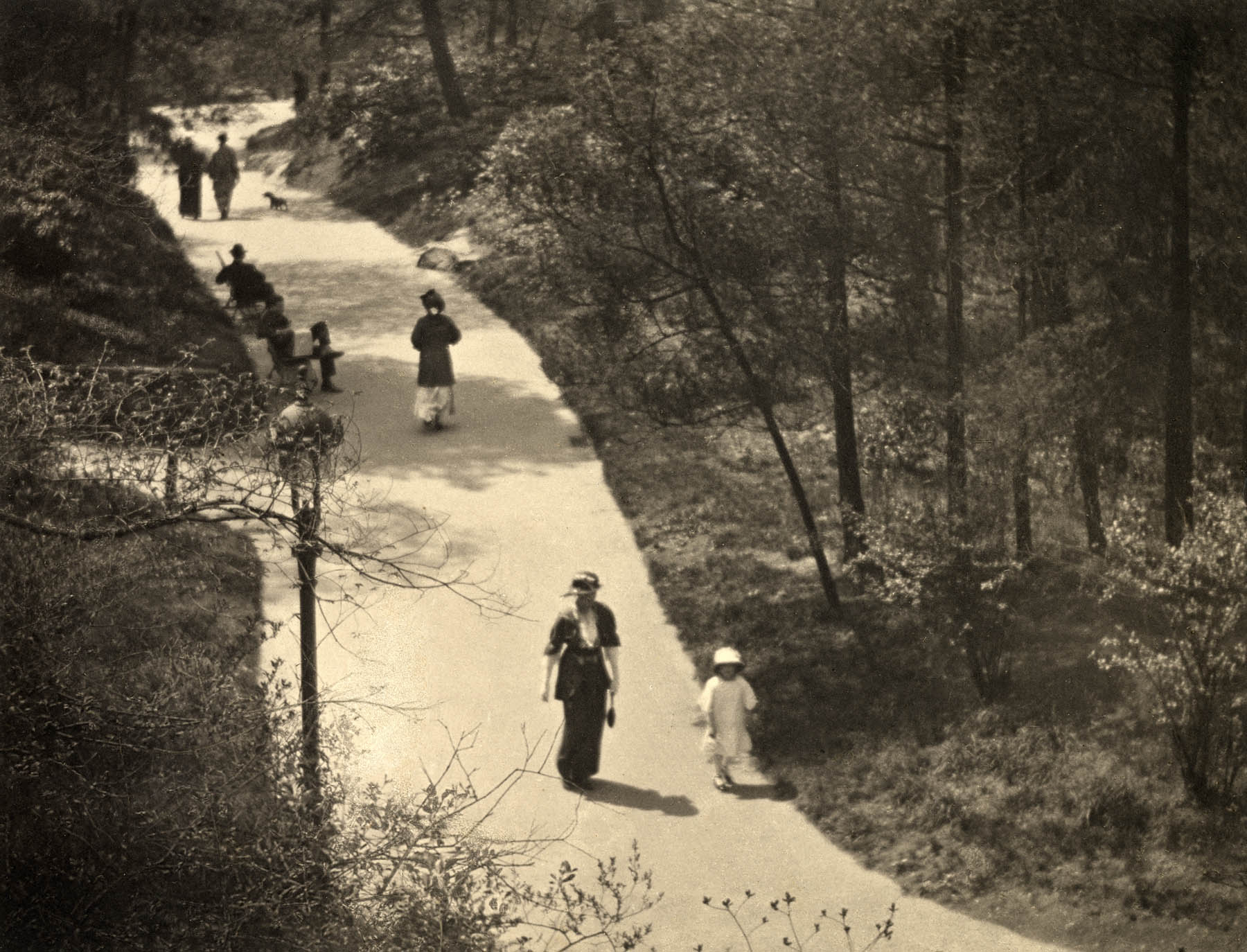
 

Paul Strand (American, 1890-1976) 'Central Park' 1915-1916 from the exhibition 'Photo-Secession: Painterly Masterworks of Turn-of-the-Century Photography' at the Utah Museum of Fine Arts, Salt Lake City, August - December 2024


Paul Strand (American, 1890-1976)
Central Park
1915-1916
Platinum print on paper


Urban life preoccupied Strand and in the 1920s would become a central subject of Modernist photographers around the world. From a Central Park overpass Strand identified this interesting composition with the bright, sinuous path dividing the picture plane. The decisive moment to snap the shutter occurred with the appearance of the two advancing figures and their angular shadows.
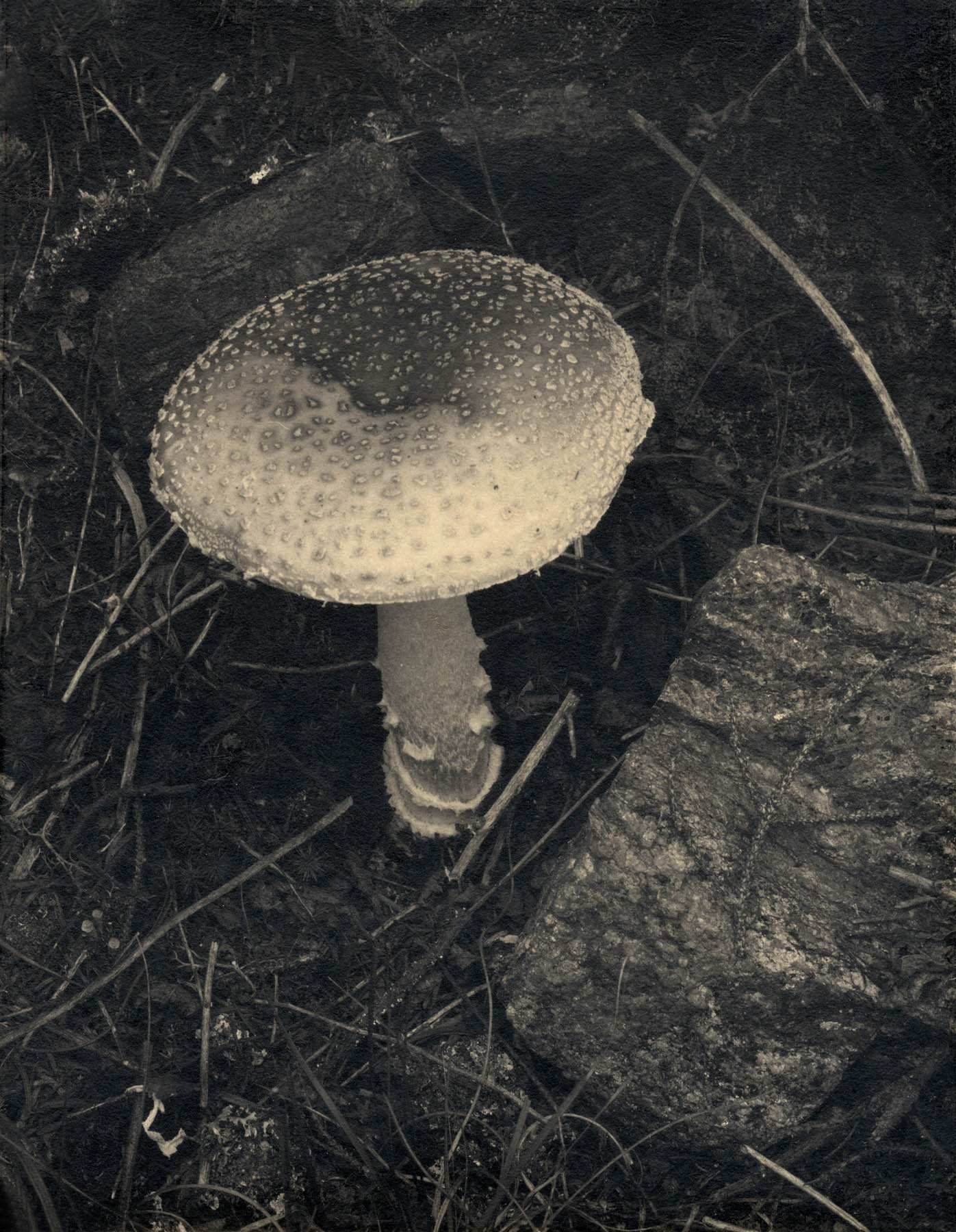
 

Paul Strand (American, 1890-1976) 'Speckled Toadstool, Georgetown, Maine' 1927


Paul Strand (American, 1890-1976)
Speckled Toadstool, Georgetown, Maine
1927
Waxed platinum print on paper


Strand continued to use platinum printing long after most other photographers adopted gelatin silver papers, which were more efficient and versatile and had a glossier surface. His prints in platinum are highly regarded for capturing minute detail and a wide range of tonal values.
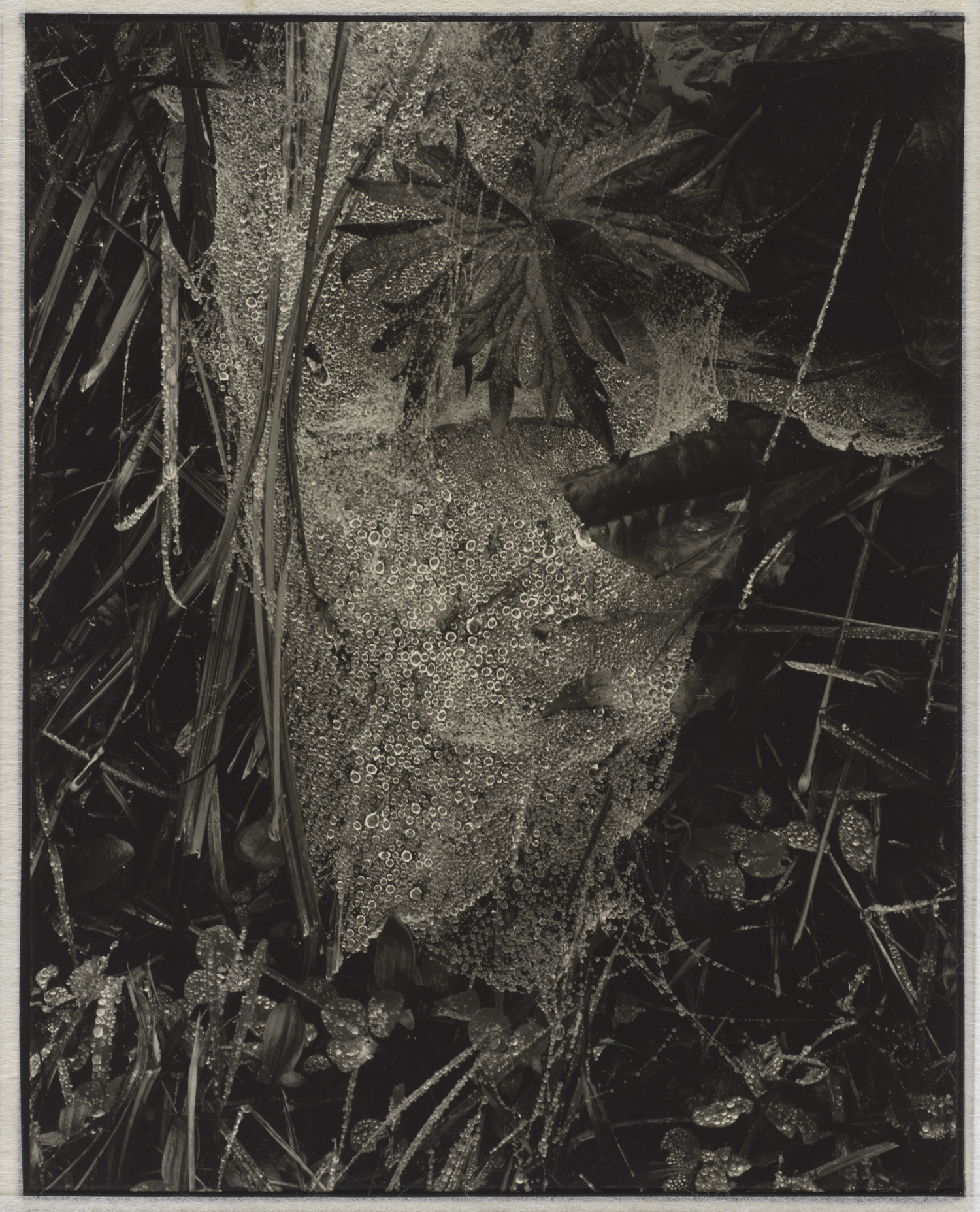
 

Paul Strand (American, 1890-1976) 'Cobweb in the Rain, Georgetown, Maine' 1928


Paul Strand (American, 1890-1976)
Cobweb in the Rain, Georgetown, Maine
1928
Gelatin silver print on paper

All from the Collection of Michael Mattis and Judith Hochberg


Works of Straight photography
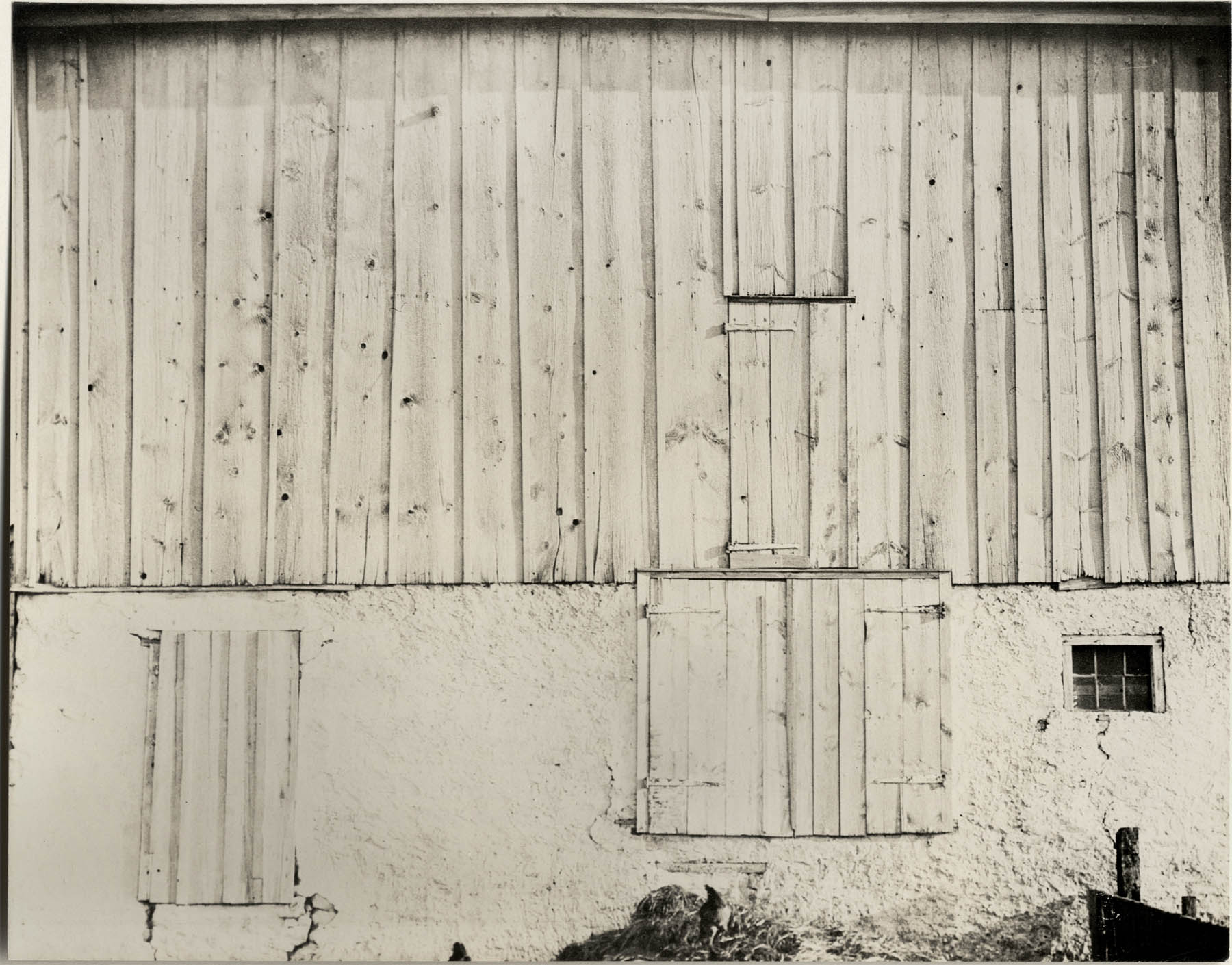
 

Charles Sheeler (American, 1883-1965) 'Side of White Barn, Bucks County' 1917


Charles Sheeler (American, 1883-1965)
Side of White Barn, Bucks County
1917
Gelatin silver print on paper


A painter and photographer, Sheeler became a close friend of Alfred Stieglitz as the Photo-Secession dissolved. This photographic study of line, shape, and tone recalls the hard-edged style of Sheeler’s paintings. Only the chickens appearing at the bottom edge give a sense of scale to the barn.


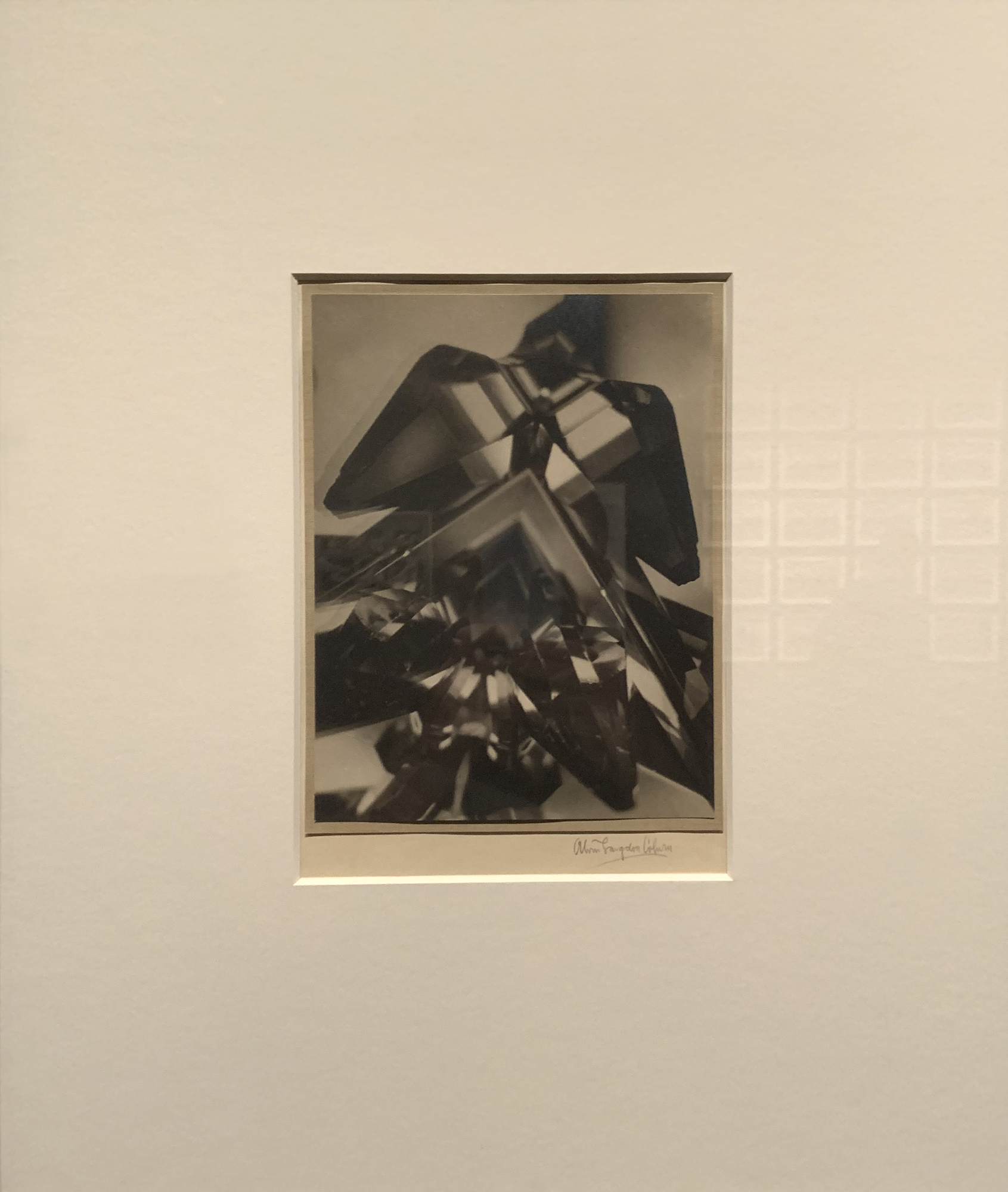
Alvin Langdon Coburn: The Avant-Garde Creator

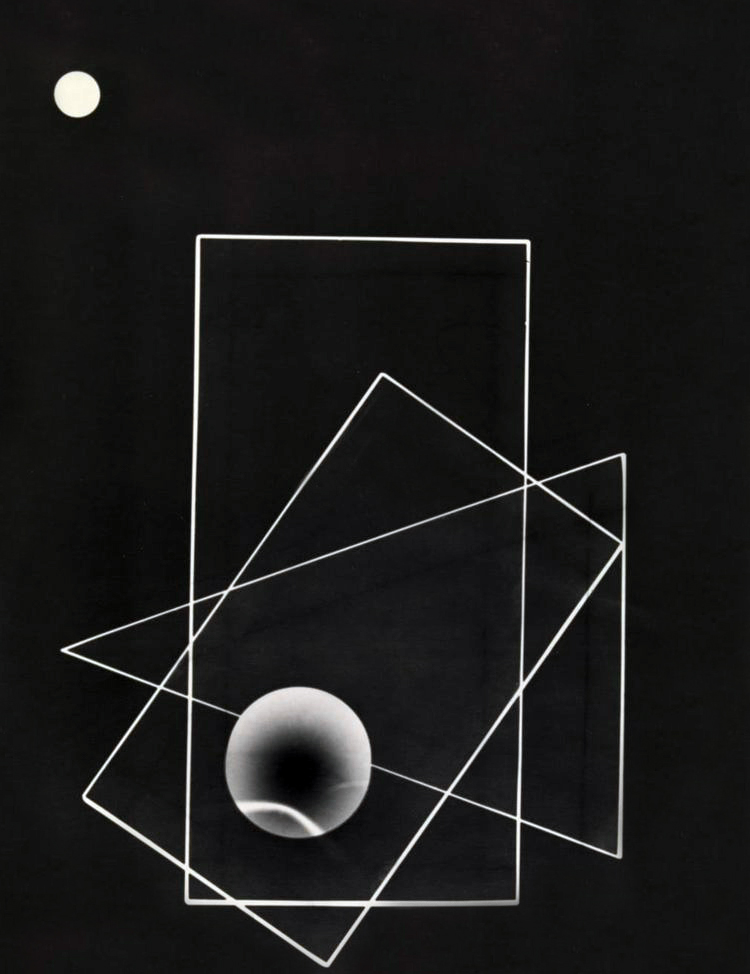
Alvin Langdon Coburn pushed the boundaries of photography with his innovative Vortographs, created in 1916-1917. These images are considered some of the first abstract photographs, born from Coburn’s desire to create art that combined the physical with the spiritual. By placing a vortoscope, a triangular arrangement of mirrors and prisms, over a camera’s lens, Coburn created complex images of kaleidoscopic and geometric patterns that simplify the photograph to the essential elements of light and form. This technique broke away from traditional photographic representation, emphasising form, structure, and abstraction. The Vortographs were influenced by the Vorticist movement, which celebrated dynamic and abstract art. Coburn’s pioneering work with these images marked a significant departure from Pictorialism, embracing modernist principles and demonstrating the artistic potential of photography beyond mere depiction. The Vortographs stand as a testament to Coburn’s visionary approach and contributions to the evolution of photographic art.

Adelaide Ryder. “The Photo-Secession Movement: Pioneering Artistry in Early Photography,” on the UMFA website Nd [Online] Cited 22/10/2024
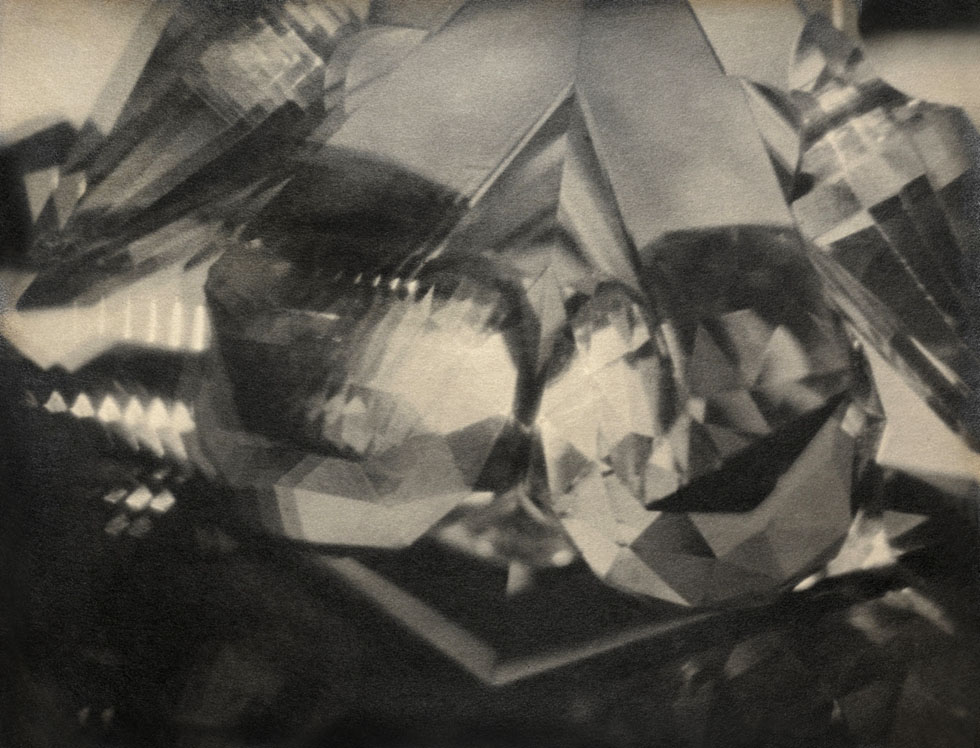
 

Alvin Langdon Coburn (British American, 1882-1966) 'Vortograph' 1917


Alvin Langdon Coburn (British American, 1882-1966)
Vortograph
1917
Gelatin silver print on paper


Coburn was one of the Photo-Secessionists who rejected Pictorialism. In his 1916 essay “The Future of Pictorial Photography,” he called for abstraction in photography, concluding, “it is my hope that photography may fall in line with all the other arts, and with her infinite possibilities, do things stranger and more fascinating than the most fantastic dreams.” Coburn created vortographs like this by placing a devise with three mirrors between his camera and subject. When he exhibited them to great fanfare in London in 1917, Ezra Pound proclaimed: “The Camera is freed from Reality!”

All from the Collection of Michael Mattis and Judith Hochberg


Utah Museum of Fine Arts
University of Utah campus
Marcia and John Price Museum Building
410 Campus Center Drive

Opening hours:
Tuesday – Sunday 10am – 5pm
Closed Mondays

Utah Museum of Fine Arts website

LIKE ART BLART ON FACEBOOK

Back to top

Exhibition: ‘Etched by Light: Photogravures from the Collection, 1840-1940’ at the National Gallery of Art, Washington

Exhibition dates: 15th October, 2023 – 4th February, 2024

Curators: The exhibition is curated by Sarah Greenough, senior curator and head of the department of photographs, with Andrea Coffman, collection manager in the department of photographs, both at the National Gallery of Art.


Charles Nègre (French, 1820-1880) 'Cathédrale de Chartres – Portique du Midi XIIe Siècle' c. 1854, printed c. 1857


Charles Nègre (French, 1820-1880)
Cathédrale de Chartres – Portique du Midi XIIe Siècle
c. 1854, printed c. 1857
Photogravure
Image: 53 x 73cm (20 7/8 x 28 3/4 in.)
Sheet: 59.3 x 80cm (23 3/8 x 31 1/2 in.)
National Gallery of Art, Washington, The Sarah and William L Walton Fund


The under appreciated photogravure process, which prints photographs in ink on paper, produces images of luscious lucidity.

In the “photomechanical process, which came to be called photogravure, a photographic image is etched into a printmaking plate, ink is rubbed into the etched surface, a damp sheet of paper is laid on top of the plate, and both are put through a printing press to transfer the ink to paper.” (Press release)
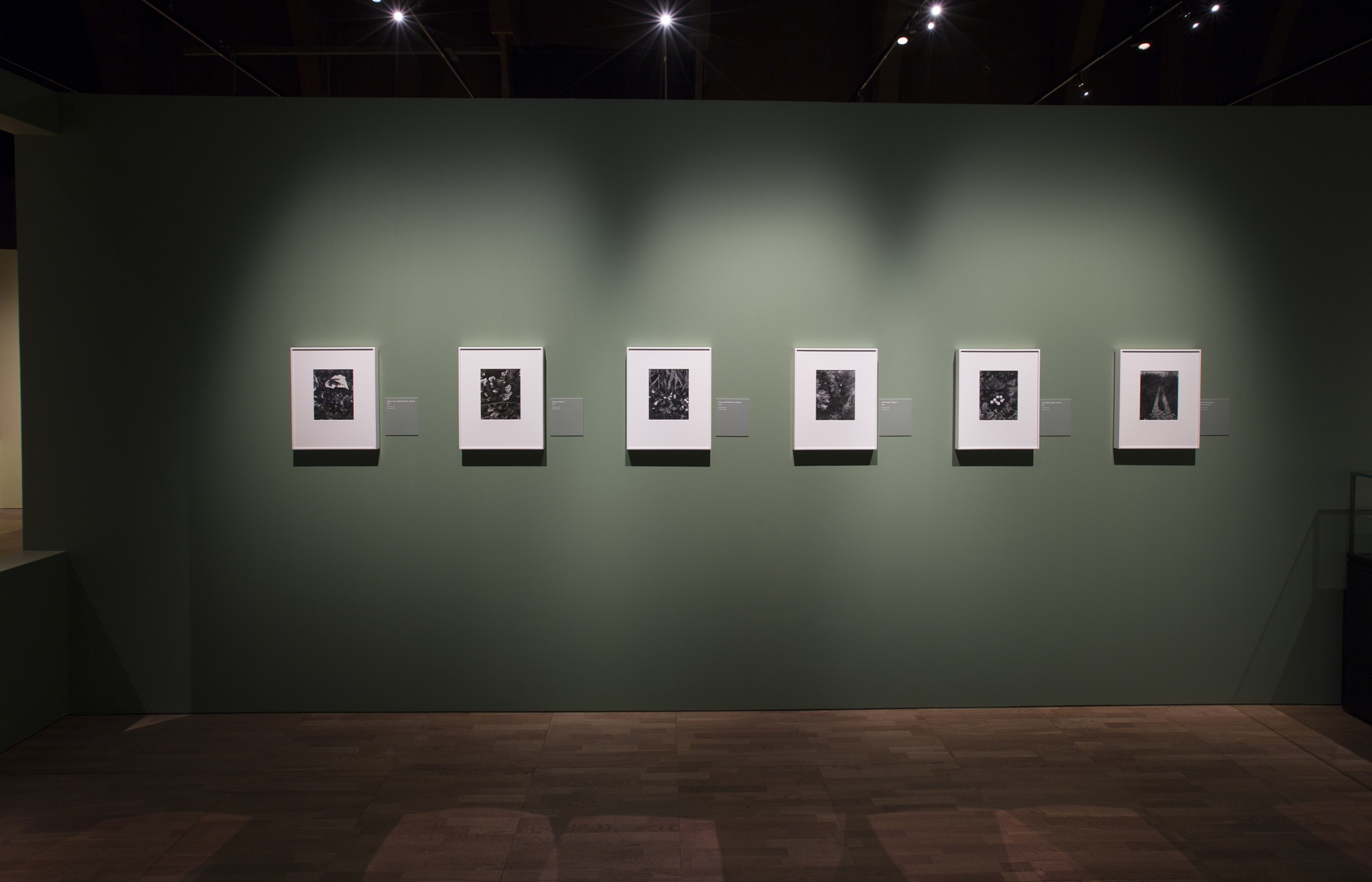
The prints are tonally rich and have a smooth, continuous tonal range and, depending on the choice of paper and inks, can be produced in a variety of colours and textures. While the process is time-consuming and labour-intensive nothing – except perhaps a platinum print developed in Amidol or alike whose negative has been developed in Pyro developer – comes close to the beauty and tonality of the gravure. “This intricate, painstaking and time-consuming method produces images with rich tones and a sense of light, depth, and realism.”

“The process offers the most sophisticated photomechanical means to reproduce large editions while still retaining the warm blacks and subtle shades of gray. It thrived into the 1930s, but World War II brought an end to its popularity due to costs and availability. As the spirit of hands-on experimentation returned to photography in the 1960s, Jon Goodman (b. 1953) is credited with its revival, and is lauded for creating sumptuous portfolios of the works of famed photographers Paul Strand (1890-1976) and Edward Steichen (1879-1973).”1


Some of the most beautiful photographs ever made are printed in the photogravure process. Alfred Stieglitz (American, 1864-1946), that pioneering artist, publisher and teacher, used them extensively in his influential quarterly photographic journal Camera Work (1903-1917).

One of my favourite photographs of all time, Paul Strand’s Wall Street (1915) is known only in two vintage platinum palladium prints, but is more commonly seen in reproduction as a photogravure print, notably in Stieglitz’s Camera Work Number 48 October 1916 (see below). “Wall Street became one of his most famous images because of his willingness to reproduce it in various photographic media and at different periods throughout his career.” (Philadelphia Museum of Art website)

Thus the reproducibility of the photogravure process led to the wider distribution of beautiful photographs. Crucially these hand printed photomechanical prints still retain an aura – of reality, presence and the hand of the artist, spirit if you like – unlike many reproductions in later photography books.

Dr Marcus Bunyan


1/ Robin O’Dell. “The Photogravure Process,” on the Florida Museum of Photographic Arts website Nov 15, 2020 [Online] Cited 26/01/2024


Many thankx to the National Gallery of Art for allowing me to publish the photographs in the posting. Please click on the photographs for a larger version of the image.


Paul Strand (American, 1890-1976) 'New York [Wall Street]' Negative 1915; print 1916 Photogravure

Paul Strand (American, 1890-1976) 'New York [Wall Street]' Negative 1915; print 1916 Photogravure


Paul Strand (American, 1890-1976)
New York [Wall Street]
Negative 1915; print 1916
Photogravure
From Camera Work. Number 48. Alfred Stieglitz (American, 1864-1946) publisher
Image: 13 × 16.2 cm (5 1/8 × 6 3/8 in.)
Sheet: 27.8 × 19.7 cm (10 15/16 × 7 3/4 in.)
The J. Paul Getty Museum, Los Angeles
Public domain

Please note: As far as I know, this photograph is not in the exhibition.


Discover an intriguing chapter in the history of photography, as innovative practitioners searched for and perfected a method to produce identical photographic prints in ink. The process, which came to be called photogravure, yielded some of the most beautiful photographs ever made – featuring delicate highlights, lush blacks, a remarkably rich tonal range, and a velvety matte surface. Etched by Light: Photogravures from the Collection, 1840-1940 tells the story of the first 100 years of this process. Artists and scientists working across Europe from the 1840s through the 1870s were dismayed to discover that identical silver-based photographic prints were not only difficult to make but also faded quickly. Building on one another’s discoveries, innovators such as William Henry Fox Talbot, Hippolyte Fizeau, and Charles Nègre perfected a way to etch a photographic image into a copperplate and print it in ink. In the late 19th and early 20th centuries, photographers such as James Craig Annan and Peter Henry Emerson utilised this process to demonstrate the artistic nature of photography while somewhat later photographers such as Alfred Stieglitz, Man Ray, and Laure Albin-Guillot used the technique to create large, bold pictures that they disseminated widely. Including 46 photogravures and 5 bound volumes illustrated with photogravures, many never before exhibited, Etched by Light shows how these works, through their proliferation, have helped shape our collective visual experience.


Bisson Frères. Louis-Auguste Bisson (French, 1814-1876) and Auguste-Rosalie Bisson (French, 1826-1900) 'Notre-Dame' 1850s


Bisson Frères. Louis-Auguste Bisson (French, 1814-1876) and Auguste-Rosalie Bisson (French, 1826-1900)
Notre-Dame
1850s
Heliogravure on chine colle
Sheet: 35.7 x 27.3cm (14 1/16 x 10 3/4 in.)
National Gallery of Art, Washington, Alfred H. Moses and Fern M. Schad Fund
Public domain


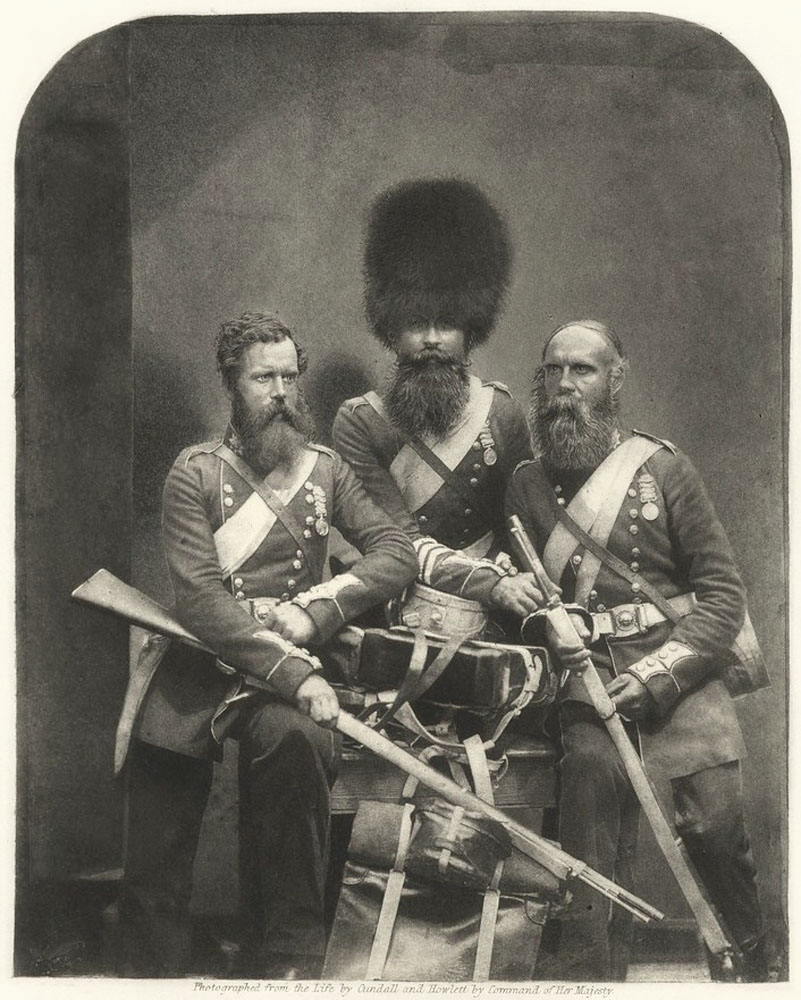
Joseph Cundall (British, 1818-1895) and Robert Howlett (British, 1831-1858) 'Crimean Braves – Men of the Trenches and Battlefields in the Crimea' 1856


Joseph Cundall (British, 1818-1895) and Robert Howlett (British, 1831-1858)
Crimean Braves – Men of the Trenches and Battlefields in the Crimea
1856
Photogalvanograph proof on chine collé
Plate: 31 x 25cm (12 3/16 x 9 13/16 in.)
Sheet: 55.8 x 38cm (21 15/16 x 14 15/16 in.)
National Gallery of Art, Washington, Alfred H. Moses and Fern M. Schad Fund
Public domain


Peter Henry Emerson (British, 1856-1936) 'A Winter's Morning' 1887


Peter Henry Emerson (British, 1856-1936)
A Winter’s Morning
1887
Photogravure
Image: 17.7 x 28.7cm (6 15/16 x 11 5/16 in.)
Sheet: 21.5 x 32.4cm (8 7/16 x 12 3/4 in.)
Mount: 40 x 50.8cm (15 3/4 x 20 in.)
National Gallery of Art, Washington, Carolyn Brody Fund and Robert B. Menschel and the Vital Projects


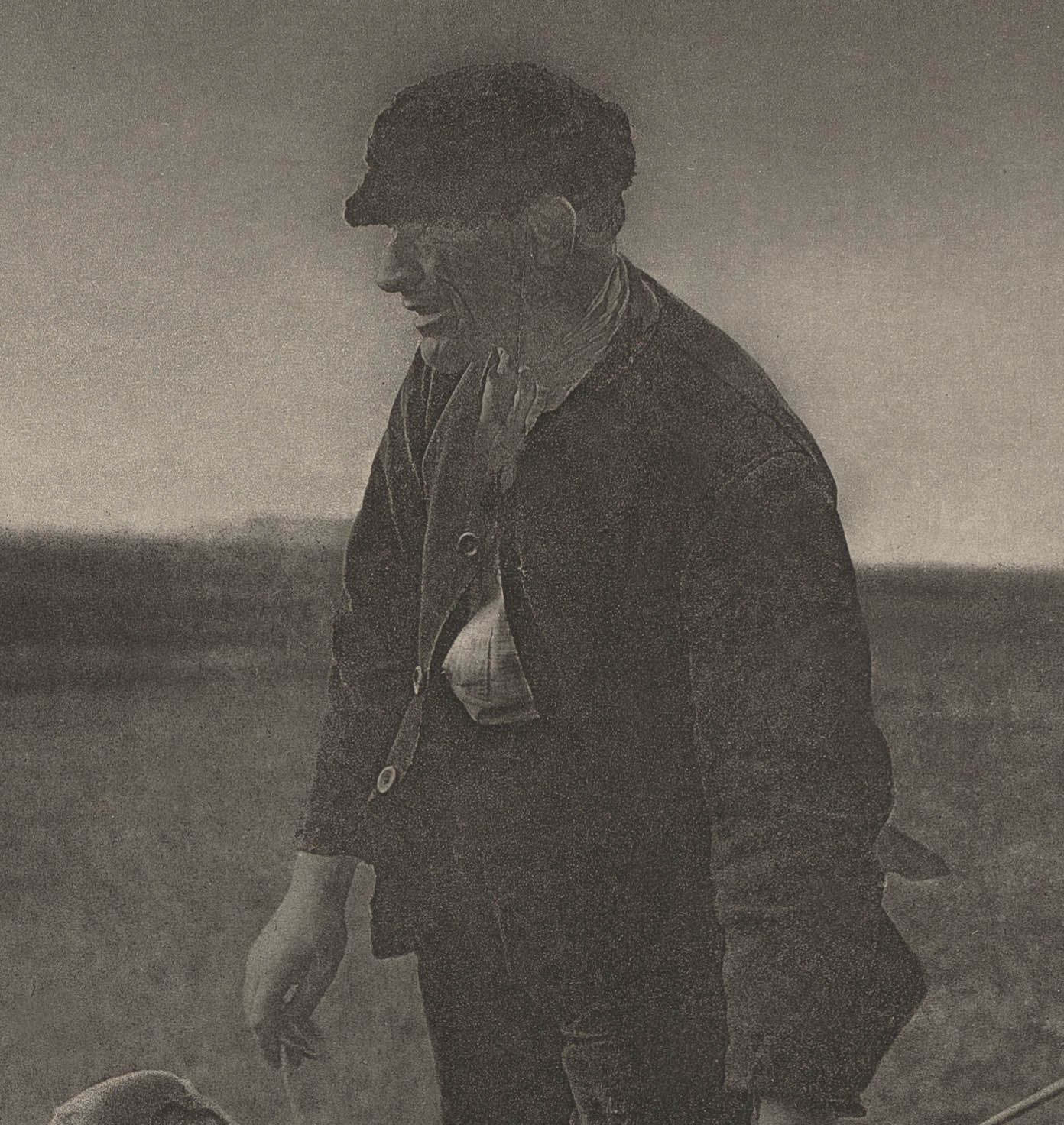
Peter Henry Emerson (British born Cuba, 1856-1936) 'The Poacher – A Hare in View' 1888


Peter Henry Emerson (British born Cuba, 1856-1936)
The Poacher – A Hare in View
1888
Photogravure
Image: 28.5 x 23.7cm (11 1/4 x 9 5/16 in.)
Sheet: 30.5 x 25.7cm (12 x 10 1/8 in.)
National Gallery of Art
Gift of Mary and Dan Solomon and Patrons’ Permanent Fund
Public domain


Peter Henry Emerson (British born Cuba, 1856-1936) 'The Poacher – A Hare in View' 1888 (detail)


Peter Henry Emerson (British born Cuba, 1856-1936)
The Poacher – A Hare in View (detail)
1888
Photogravure
Image: 28.5 x 23.7cm (11 1/4 x 9 5/16 in.)
Sheet: 30.5 x 25.7cm (12 x 10 1/8 in.)
National Gallery of Art
Gift of Mary and Dan Solomon and Patrons’ Permanent Fund
Public domain


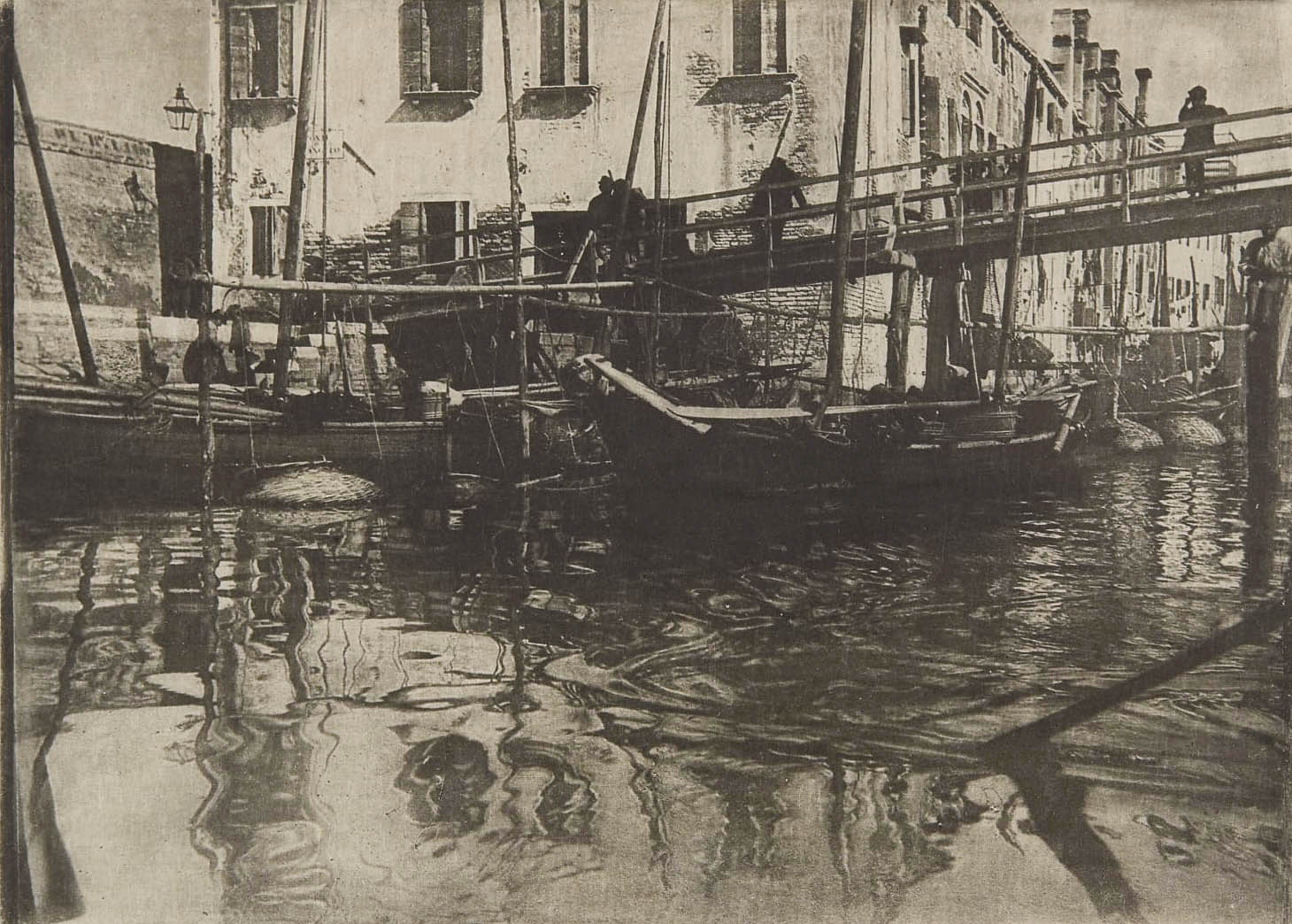
James Craig Annan (British, 1864-1946) 'A Black Canal' 1894


James Craig Annan (British, 1864-1946)
A Black Canal
1894
Photogravure
Image: 9.1 x 12.6cm (3 9/16 x 4 15/16 in.)
Sheet: 9.6 x 12.8cm (3 3/4 x 5 1/16 in.)
National Gallery of Art
Pepita Milmore Memorial Fund and Robert B. Menschel and the Vital Projects Fund


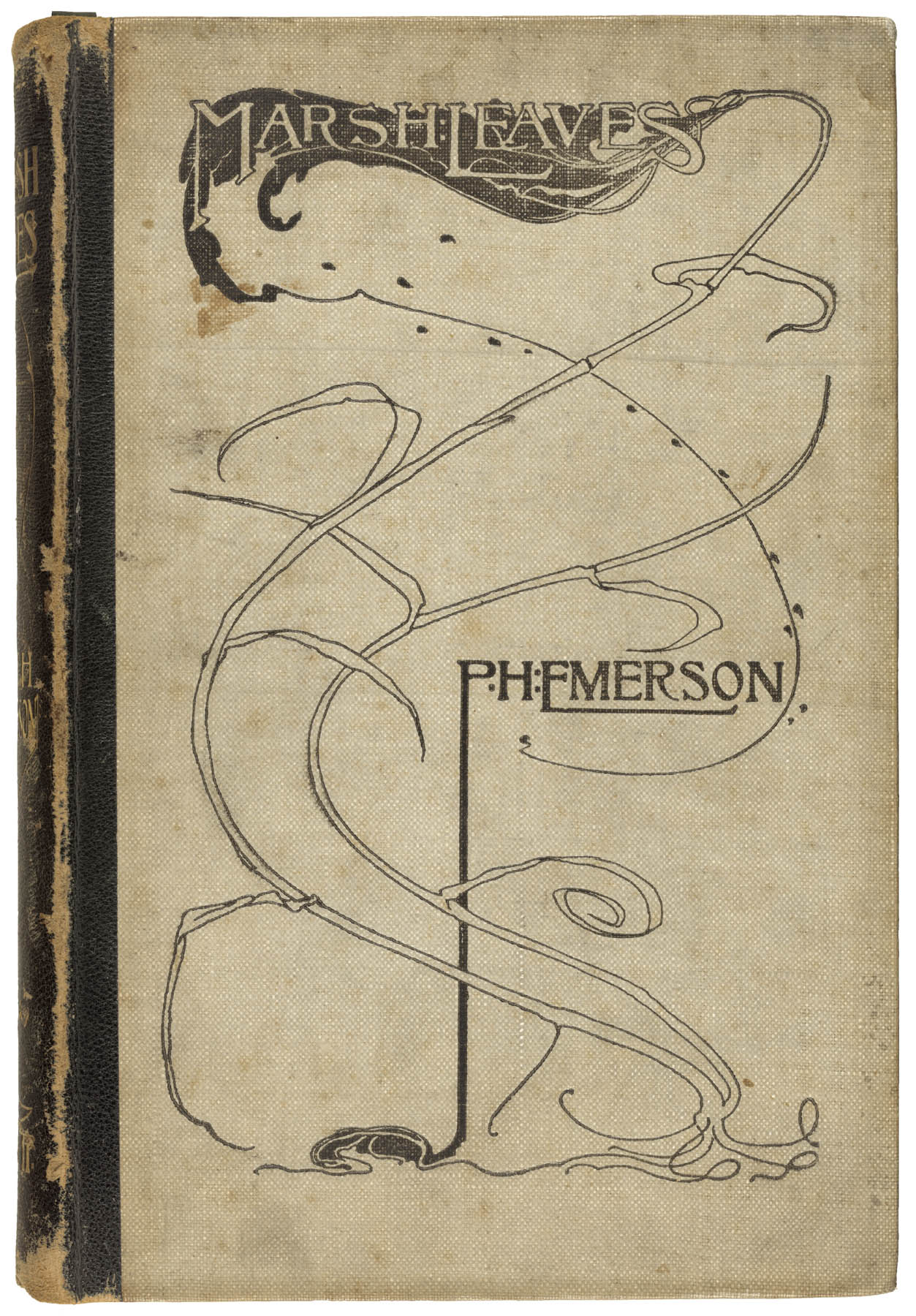
Peter Henry Emerson (British born Cuba, 1856-1936) 'Marsh Leaves' Published 1895


Peter Henry Emerson (British born Cuba, 1856-1936)
Marsh Leaves
Published 1895
1 vol: ill: 16 photogravures on wove paper
Page size: 28.4 x 18.4cm (11 3/16 x 7 1/4 in.)
National Gallery of Art, Washington, Gift of Harvey S. Shipley Miller and J. Randall Plummer, in Honor of the 50th Anniversary of the National Gallery of Art


Clarence H. White (American, 1871-1925) 'Spring' 1899


Clarence H. White (American, 1871-1925)
Spring
1899
Photogravure overmatted and mounted on gray wove paper
Image (sight): 12.9 x 13cm (5 1/16 x 5 1/8 in.)
Mat: 28.5 x 19.5cm (11 1/4 x 7 11/16 in.)
Mount: 38 x 27.8cm (14 15/16 x 10 15/16 in.)
National Gallery of Art, Washington, Anonymous Gift
Public domain


Mathilde Weil (American, 1872-1942) 'Beatrice' 1899


Mathilde Weil (American, 1872-1942)
Beatrice
1899
Photogravure in sepia on chine collé mounted on cream wove paper
Image: 16.7 x 9cm (6 9/16 x 3 9/16 in.)
Sheet: 18.8 x 10.4cm (7 3/8 x 4 1/8 in.)
Mount: 37.8 x 27.8cm (14 7/8 x 10 15/16 in.)
National Gallery of Art, Washington, Anonymous Gift


Clarence H. White (American, 1871-1925) 'Edge of the Woods, Evening' 1900


Clarence H. White (American, 1871-1925)
Edge of the Woods, Evening
1900
Photogravure
Image: 14.5 x 10.1cm (5 11/16 x 4 in.)
Sheet: 28.5 x 19.8cm (11 1/4 x 7 13/16 in.)
National Gallery of Art
Robert B. Menschel and the Vital Projects Fund
Public domain


Clarence H. White (American, 1871-1925) 'Morning' 1905


Clarence H. White (American, 1871-1925)
Morning
c. 1905
Photogravure
Image: 20.2 x 15.5cm (7 15/16 x 6 1/8 in.)
Mount: 20.7 x 16.2cm (8 1/8 x 6 3/8 in.)
National Gallery of Art Washington, Robert B. Menschel and the Vital Projects Fund
Public domain


Etched by Light: Photogravures from the Collection, 1840-1940 tells the fascinating story of the search to find and perfect a way to print photographs in ink. The process, which came to be called photogravure, resulted in some of the most beautiful photographs ever made – featuring delicate highlights, lush blacks, a remarkably rich tonal range, and a velvety matte surface. Presenting 40 photogravures and 4 bound volumes illustrated with them (many recently acquired and exhibited here for the first time), Etched by Light shows how this process enabled photographs to circulate widely and help shape our collective visual experience. The exhibition is on view from October 15, 2023, through February 4, 2024, in the West Building of the National Gallery of Art.

“Discover an intriguing chapter in the history of photography, as innovative practitioners developed a method to produce photographic prints in ink,” said Sarah Greenough, senior curator and head of the department of photographs at the National Gallery of Art. “Including photogravures from the National Gallery’s collection, this exhibition shows the pivotal role photogravures played in the history of photography by enabling the creation and widespread dissemination of tonally rich and lasting prints.”


About the Exhibition

From its very beginnings, photography revolutionised the way pictures were made and knowledge about the visual world was disseminated. But in the early 1840s, artists and scientists working across Europe discovered that it had drawbacks. The daguerreotype process, developed by Louis-Jacques-Mandé Daguerre, created astonishingly vivid images, but each one was unique and could only be copied by making another photograph. William Henry Fox Talbot’s negative / positive process held more promise, but his silver-chloride prints faded when exposed to light. Early practitioners also learned that it was hard to make numerous identical prints that could be tipped into books or journals, owing to variabilities in the paper and chemicals that were used to make prints. Such obstacles, at least initially, frustrated their hopes of fully realising the potential of this new medium.

Divided into three sections, Etched by Light traces the search – unfolding across 100 years – for a process to print photographs in ink, which were more stable than traditional silver-based photographic prints. It moves from the experiments in the 1840s and 1850s by French and British photographers such as Armand-Hippolyte-Louis Fizeau, Charles Nègre, and Talbot, who discovered the chemical and technical components necessary to print photographs in ink, to the successful solution invented by Talbot in the 1850s and perfected by Karl Klíč in 1879. In their photomechanical process, which came to be called photogravure, a photographic image is etched into a printmaking plate, ink is rubbed into the etched surface, a damp sheet of paper is laid on top of the plate, and both are put through a printing press to transfer the ink to paper. Favoured from the mid-1880s through the 1930s, revived in the 1980s and 1990s, and still popular today, photogravures have a smooth, continuous tonal range, although an extremely fine grain is evident under magnification.

The exhibition also shows how photographers working in the late 19th and early 20th centuries, including Peter Henry Emerson and Alfred Stieglitz, exploited the photogravure process for its artistic potential. They highlighted the individuality of their pictures through their choice of paper and inks, and even manipulated the photographic image itself. They also utilised the reproducibility of the process, inserting their photogravures into limited edition books, portfolios, and journals that they circulated in an effort to prove the artistic merit of photography.

The exhibition concludes with the work of modernist photographers, such as Alvin Langdon Coburn, Laure Albin Guillot, Man Ray, and Margaret Bourke-White, who used the process to enlarge small negatives, creating big, bold, and sometimes colourful photogravures. Circulating their photogravures widely in books and portfolios, as well as commercial advertisements, these artists demonstrated that photography could tackle new subjects, revitalising our view of life, art, and science, and in the process revealing critical new insights about the world around us.

The exhibition is organised by the National Gallery of Art, Washington

Press release from the National Gallery of Art


Alvin Langdon Coburn (British born United States, 1882-1966) 'Trafalgar Square' 1909


Alvin Langdon Coburn (British born United States, 1882-1966)
Trafalgar Square
1909
Photogravure
Image: 21.2 x 16.2cm (8 3/8 x 6 3/8 in.)
Sheet: 21.7 x 16.7cm (8 9/16 x 6 9/16 in.)
National Gallery of Art
Robert B. Menschel and the Vital Projects Fund


Alvin Langdon Coburn (British born United States, 1882-1966) 'Brooklyn Bridge' c. 1910


Alvin Langdon Coburn (British born United States, 1882-1966)
Brooklyn Bridge
c. 1910
Photogravure
Image: 19.9 x 14.7cm (7 13/16 x 5 13/16 in.)
Sheet: 21.2 x 15.3cm (8 3/8 x 6 in.)
National Gallery of Art
Robert B. Menschel and the Vital Projects Fund


Alvin Langdon Coburn (British born United States, 1882-1966) 'The Battery' c. 1909


Alvin Langdon Coburn (British born United States, 1882-1966)
The Battery
c. 1909
Photogravure
Image: 16 x 15.56cm (6 5/16 x 6 1/8 in.)
Sheet: 17.3 x 16.4cm (6 13/16 x 6 7/16 in.)
National Gallery of Art
Robert B. Menschel and the Vital Projects Fund


Alfred Stieglitz (American, 1864-1946) 'The Street - Design for a Poster / The Street – Fifth Avenue' 1896? / 1901-1902?, printed 1903


Alfred Stieglitz (American, 1864-1946)
The Street – Design for a Poster / The Street – Fifth Avenue
1896? / 1901-1902?, printed 1903
Photogravure
National Gallery of Art
Public domain


Alfred Stiegitz (American, 1864-1946) 'The Steerage' 1907


Alfred Stieglitz (American, 1864-1946)
The Steerage
1907, printed in or before 1913
Photogravure on cream moderately thick smooth wove Japanese paper
Image: 33.2 x 26.4cm (13 1/16 x 10 3/8 in.)
Sheet: 46.3 x 31.9cm (18 1/4 x 12 9/16 in.)
National Gallery of Art
Alfred Stieglitz Collection


Alfred Stieglitz (American, 1864-1946) 'Old and New New York' 1910, printed in or before 1913


Alfred Stieglitz (American, 1864-1946)
Old and New New York
1910, printed in or before 1913
Photogravure on beige thin slightly textured laid Japanese paper
Image: 33.3 x 25.7cm (13 1/8 x 10 1/8 in.)
Sheet: 40.3 x 28.3cm (15 7/8 x 11 1/8 in.)
National Gallery of Art
Alfred Stieglitz Collection


Alfred Stieglitz (American, 1864-1946) 'After Working Hours – The Ferry Boat' 1910, printed in or before 1913


Alfred Stieglitz (American, 1864-1946)
After Working Hours – The Ferry Boat
1910, printed in or before 1913
Photogravure
Image: 33.6 x 25.9cm (13 1/4 x 10 3/16 in.)
Sheet: 40.4 x 28.1cm (15 7/8 x 11 1/16 in.)
National Gallery of Art
Alfred Stieglitz Collection


Alfred Stieglitz (American, 1864-1946) 'The City of Ambition' 1910, printed in or before 1913


Alfred Stieglitz (American, 1864-1946)
The City of Ambition
1910, printed in or before 1913
Photogravure on beige thin slightly textured laid Japanese paper
Sheet (trimmed to image): 34 x 26cm (13 3/8 x 10 1/4 in.)
Mount: 43.3 x 32 cm (17 1/16 x 12 5/8 in.)
National Gallery of Art, Washington, Alfred Stieglitz Collection


Anne Brigman (American, 1859-1960) 'The Cleft of the Rock' 1912


Anne Brigman (American, 1859-1960)
The Cleft of the Rock
1912
Photogravure
Image: 21 x 16cm (8 1/4 x 6 5/16 in.)
National Gallery of Art, Washington, Gift of Mark Katzman and Hilary Skirboll


Alvin Langdon Coburn (British born United States, 1882-1966) 'The Tunnel Builders' 1913


Alvin Langdon Coburn (British born United States, 1882-1966)
The Tunnel Builders
1913
Photogravure
Image: 21 x 17cm (8 1/4 x 6 11/16 in.)
National Gallery of Art, Washington, Gift of Funds from John S. Parsley and Nancy Nolan Parsley


Man Ray (American, 1890-1976) 'Électricité' 1931


Man Ray (American, 1890-1976)
Électricité
1931
Photogravure
Image: 26 x 20.5cm (10 1/4 x 8 1/16 in.)
Mount: 37.5 x 27.5cm (14 3/4 x 10 13/16 in.)
National Gallery of Art, Washington, Gift of Robert B. Menschel


Man Ray (American, 1890-1976) 'Le Monde' 1931


Man Ray (American, 1890-1976)
Le Monde
1931
Photogravure
Image: 26 x 20.5cm (10 1/4 x 8 1/16 in.)
Mount: 37.5 x 27.5cm (14 3/4 x 10 13/16 in.)
National Gallery of Art, Washington, Gift of Robert B. Menschel


Man Ray (American, 1890-1976) 'The City' (Èlectricité - La Ville) 1931


Man Ray (American, 1890-1976)
La Ville (The City)
1931
Photogravure
Image: 26 x 20.5cm (10 1/4 x 8 1/16 in.)
Mount: 37.5 x 27.5cm (14 3/4 x 10 13/16 in.)
National Gallery of Art, Washington, Gift of Robert B. Menschel


Man Ray (American, 1890-1976) 'Le Souffle' (Breeze) 1931


Man Ray (American, 1890-1976)
Le Souffle (Breeze)
1931
Photogravure
Image: 26 x 20.2cm (10 1/4 x 7 15/16 in.)
Mount: 37.5 x 27.5cm (14 3/4 x 10 13/16 in.)
National Gallery of Art, Washington, Gift of Robert B. Menschel


Paul Strand (American, 1890-1976) 'Virgin San Felipe, Oaxaca, Mexico' (Virgen San Felipe, Oaxaca, Mexico) 1933


Paul Strand (American, 1890-1976)
Virgin, Sand Felipe, Oaxaca
1933, printed 1940
Photogravure
Image: 26.4 x 20.7cm (10 3/8 x 8 1/8 in.)
Sheet: 40.4 x 31.7cm (15 7/8 x 12 1/2 in.)
National Gallery of Art, Washington, Alfred H. Moses and Fern M. Schad Fund


Paul Strand. 'Men of Santa Ana, Lake Patzcuaro, Michoacan' 1933


Paul Strand (American, 1890-1976)
Men of Santa Anna, Michoacan
1933, printed 1940
Photogravure
Image: 16.1 x 12.7cm (6 5/16 x 5 in.)
Sheet: 40.4 x 31.7cm (15 7/8 x 12 1/2 in.)
National Gallery of Art, Washington, Alfred H. Moses and Fern M. Schad Fund


Paul Strand (American, 1890-1976) 'Boy, Uruapan, Michoacán, Mexico' (Niño, Uruapan, Michoacán, México) 1933


Paul Strand (American, 1890-1976)
Boy, Uruapan
1933, printed 1940
Photogravure
Image: 25.7 x 20.5cm (10 1/8 x 8 1/16 in.)
Sheet: 40.4 x 31.7cm (15 7/8 x 12 1/2 in.)
National Gallery of Art, Washington, Alfred H. Moses and Fern M. Schad Fund


Paul Strand. 'Cristo - Oaxaca' 1933


Paul Strand (American, 1890-1976)
Cristo, Tiacochoaya, Oaxaca
1933, printed 1940
Photogravure
Image: 26 x 20.4cm (10 1/4 x 8 1/16 in.)
Sheet: 40.4 x 31.7cm (15 7/8 x 12 1/2 in.)
National Gallery of Art, Washington, Alfred H. Moses and Fern M. Schad Fund


Paul Strand (American, 1890-1976) 'Cristo with Thorns, Huexotla' 1933, printed 1940


Paul Strand (American, 1890-1976)
Cristo with Thorns, Huexotla
1933, printed 1940
Photogravure
Image: 26 x 20.5cm (10 1/4 x 8 1/16 in.)
Sheet: 40.4 x 31.7cm (15 7/8 x 12 1/2 in.)
National Gallery of Art, Washington, Alfred H. Moses and Fern M. Schad Fund


Paul Strand (American, 1890-1976) 'Church, Coapiaxtla' 1933, printed 1940


Paul Strand (American, 1890-1976)
Church, Coapiaxtla
1933, printed 1940
Photogravure
Image: 16.2 x 12.7cm (6 3/8 x 5 in.)
Sheet: 40.4 x 31.7cm (15 7/8 x 12 1/2 in.)
National Gallery of Art, Washington, Alfred H. Moses and Fern M. Schad Fund


Doris Ulmann (American, 1882-1934) 'Plate 35' 1933


Doris Ulmann (American, 1882-1934)
Plate 35
1933
Photogravure
Image: 21 x 16cm (8 1/4 x 6 5/16 in.)
National Gallery of Art, Washington, Gift of Mary and Dan Solomon


Doris Ulmann (American, 1882-1934) 'Plate 47' 1933


Doris Ulmann (American, 1882-1934)
Plate 47
1933
Photogravure
Image: 16 x 21cm (6 5/16 x 8 1/4 in.)
National Gallery of Art, Washington, Pepita Milmore Memorial Fund


National Gallery of Art
National Mall between 3rd and 7th Streets
Constitution Avenue NW, Washington

Opening hours:
Daily 10am – 5pm

National Gallery of Art website

LIKE ART BLART ON FACEBOOK

Back to top

Exhibition: ‘Masterworks of Modern Photography 1900-1940: The Thomas Walther Collection at The Museum of Modern Art, New York’ at Jeu de Paume, Paris

Exhibition dates: 14th September, 2021 – 13th February, 2022

Curated by Sarah Meister, former Curator, Department of Photography, The Museum of Modern Art, New York and Quentin Bajac, Director, Jeu de Paume, with Jane Pierce, Carl Jacobs Foundation Research Assistant, The Museum of Modern Art, New York. Organised by the Museum of Modern Art, New York


Max Burchartz (German, 1887-1961) 'Lotte (Eye)' 1928 from the exhibition 'Masterworks of Modern Photography 1900-1940: The Thomas Walther Collection at The Museum of Modern Art, New York' at Jeu de Paume, Paris, Sept 2021 - Feb 2022


Max Burchartz (German, 1887-1961)
Lotte (Eye)
1928
Gelatin silver print
30.2 × 40cm
The Museum of Modern Art, New York. Thomas Walther Collection
Acquired through the generosity of Peter Norton © 2021 Max Burchartz/Artists Rights Society (ARS), New York/VG Bild-Kunst, Germany
Digital Image © 2021 The Museum of Modern Art, New York


A huge posting today that took hours to compile and all I can think of to say is – wow, I want them all in my collection!

If I had to specify one era of photography that is my favourite it would be the experimental, avant-garde photographs from the interwar period. There was such freedom, revolution and danger in the air which encouraged artists to produce radical art that defined a generation (and which ideological others found offensive and degenerate).

The tremendous diversity of “modern” photography is on show in the different sections of the exhibition – from portraiture to perspective, from science to magic realism, from interiority and surrealist dreams to new objective visions of self and the landscape – the works investigating how photographs transcend their conventional function of documentation through their social, psychological, and metaphysical implications.

I have added relevant biographical details and salient book covers and pages from the exhibition catalogue to enhance the viewing experience. My particular favourites in the posting are Willi Ruge’s vertiginous Seconds before Landing (1931, below); Stanisław Ignacy Witkiewicz’s unforgettable portrait of Anna Oderfeld, Zakopane (1911-1912, below); Lyonel Feininger’s almost-there, atmos/sphere Bauhaus (February 26, 1929 below); and Gertrud Arndt’s masterpiece, At the Masters’ Houses (1929-1930, below).

I hope you enjoy your Sunday looking at these stunning images.

Dr Marcus Bunyan


Many thankx to Jeu de Paume for allowing me to publish the photographs in the posting. Please click on the photographs for a larger version of the image.


Kate Steinitz (American born Poland, 1889-1975) 'Backstroke' 1930 from the exhibition 'Masterworks of Modern Photography 1900-1940: The Thomas Walther Collection at The Museum of Modern Art, New York' at Jeu de Paume, Paris, Sept 2021 - Feb 2022


Kate Steinitz (American born Poland, 1889-1975)
Backstroke
1930
Gelatin silver print
26.6 × 34.1cm
The Museum of Modern Art, New York. Thomas Walther Collection
Gift of Thomas Walther
Reprinted with permission of the Steinitz Family Art Collection
Digital Image © 2021 The Museum of Modern Art, New York


El Lissitzky (Russian, 1890-1941) 'Record' 1926


El Lissitzky (Russian, 1890-1941)
Runner in the City (Experiment for a Fresco for a Sports-Club)
1926
Gelatin silver print
26.7 × 22.4cm
The Museum of Modern Art, New York. Thomas Walther Collection
Gift of Thomas Walther
Digital Image © 2021 The Museum of Modern Art, New York


Lotte (Charlotte) Beese (German-Dutch, 1903-1988) 'Untitled (Bauhaus Weavers)' 1928


Lotte (Charlotte) Beese (German-Dutch, 1903-1988)
Untitled (Bauhaus Weavers)
1928
Gelatin silver print
8.4cm (diam.)
The Museum of Modern Art, New York. Thomas Walther Collection
Gift of Thomas Walther
Digital Image © 2021 The Museum of Modern Art, New York


Maurice Tabard (French, 1897-1984) 'Test for the Film "Culte Vaudou," Exposition 1937' 1936


Maurice Tabard (French, 1897-1984)
Test for the Film “Culte Vaudou,” Exposition 1937
1936
Gelatin silver print with cellophane sheet
29.3 × 23cm
The Museum of Modern Art, New York. Thomas Walther Collection
Gift of Shirley C. Burden, by exchange
Digital Image © 2021 The Museum of Modern Art, New York


Maurice Tabard (French, 1897–1984) 'Untitled (Self-Portrait with Roger Parry)' c. 1936


Maurice Tabard (French, 1897–1984)
Untitled (Self-Portrait with Roger Parry)
c. 1936
Gelatin silver print
9 1/4 × 6 5/8″ (23.5 × 16.8cm)
Thomas Walther Collection. Gift of Thomas Walther


Roger M. Parry (French, 1905-1977)

Born and educated in Paris, Roger Parry was originally interested in painting and worked as a draftsman after graduation. In 1928 he met Maurice Tabard, who taught him photography and for whom Parry worked as a darkroom assistant. Parry published his photographs in Art et Métiers Graphiques, a photographic annual, and Banalités, a book of poems. These publications gained the attention of André Malraux, with whom Parry became associated around 1930.

Parry worked for Malraux and the Gallimard publishers for more than forty years. In 1934 Gallimard published Parry’s photographs of Tahiti. During World War II Parry was a photography war correspondent for the news agency L’Express. He eventually became head of photography and art director for the Gallimard publication Nouvelle Revue Française.

Text from the J. Paul Getty website [Online] Cited 25/01/2022


Lotte Jacobi (American, 1896-1990) 'Franz Lederer' c. 1929


Lotte Jacobi (American, 1896-1990)
Franz Lederer
c. 1929
Gelatin silver print
21.3 × 15.5cm
The Museum of Modern Art, New York. Thomas Walther Collection
Grace M. Mayer Fund
© Lotte Jacobi Collection, University of New Hampshire
Digital Image © 2021 The Museum of Modern Art, New York


Francis Lederer (November 6, 1899 Prague – May 25, 2000) was a Czech-born American film and stage actor with a successful career, first in Europe, then in the United States. His original name was Franz (Czech František) Lederer.


Unknown photographer / Press-Photo G.M.B.H. 'Untitled (Cover illustration from 'Here Comes the New Photographer')' c. 1928-1929


Unknown photographer / Press-Photo G.M.B.H.
Untitled (Cover illustration from Here Comes the New Photographer)
c. 1928-1929
Gelatin silver print
21.9 × 16.2cm
The Museum of Modern Art, New York. Thomas Walther Collection
Gift of Edward Steichen, by exchange
Digital Image © 2021 The Museum of Modern Art, New York


Masterworks of MoMA

Introduction

In 2001 and 2017, The Museum of Modern Art in New York acquired more than 350 photographs from the collector Thomas Walther. This collection, which is now one of the pillars of MoMA’s modern collection, is presented for the first time in France in an exhibition of some 230 images.

Comprising iconic works from the first half of the twentieth century, the exhibition provides a history of the European and American photographic avant-gardes. Through the works of a hundred or so photographers, from Berenice Abbott to Karl Blossfeldt, from Claude Cahun to El Lissitzky, from Edward Weston to André Kertész, this fusion of masterpieces and lesser-known images traces the history of modernity in photography. Mixing genres and approaches – architecture and urban landscapes, portraits and nudes, reportage, photomontage, experimentation, etc. – the exhibition delves deep into the artistic networks of the inter-war period, from the Bauhaus to Surrealist Paris, via Moscow and New York.

In their visually radical inventiveness, these images capture perfectly the utopian spirit of those who wanted to change images in order to change the world; now we fully understand the words of the photographer and theoretician Lázló Moholy-Nagy who, a century ago, stated that “the illiterate of the future will be ignorant of the camera and the pen alike.”

The Exhibition

Life as an artist

While it is true that throughout the 20th century photographers took great pleasure in portraiture, the Thomas Walther Collection also illustrates the spirit of freedom that characterised the lives of these artists and the circles they moved in.

Marcel Duchamp once described the Paris of the 1920s as home to the first truly international community of artists. The body of photographs by André Kertész assembled by Thomas Walther offers a fine summary of the photographer’s affinities, empathies and networking during his Parisian years, while also reflecting his interest in abstract and post-Cubist art and the play of light on highly geometric volumes.

The period between the two World Wars saw the affirmation of a collective artistic adventure most strikingly evidenced by the Bauhaus – one of the main axes of the Thomas Walther collection. From Florence Henri to Lotte Beese and Umbo, many of the artists represented in the collection spent time there; and all of them practiced photography without necessarily being photographers. Thus the works relating to the Bauhaus here are essentially snapshots of documentary interest. Lázsló Moholy-Nagy and Lucia Moholy were both very active photographers, but while Lázsló’s work attracted considerable critical attention, this is less true of his wife, who, although not an official member of the school, took numerous photographs of architecture and portraits.

Similarly, Lyonel Feininger, a trained painter and head of the engraving workshop, and Gertrud Arndt and Lotte Beese, students in the weaving workshop, acquired skills through an intense photographic activity that went far beyond the official teaching.

Experiments with night photography, high- and low-angle shots, multiple exposures, distorting reflections: a large part of the vocabulary of the avant-gardes can be found at the Bauhaus.

The third body of work in this section documents these artistic networks and communities in a different way. The self-portrait plays a predominant role here, revealing the shaping of a new identity for the photographer via an emphasis on the camera that underscored photography’s mechanical character – an aspect often skirted by the art photographers of the previous generation.

Now, whether on a tripod or in the hand, the camera was omnipresent, to the point where it merged completely with the user as an artificial extension of the eye.

El Lissitzky redefined photography as a mental activity and the photographer as a “constructor”, a producer of images who must unify the work of eye and hand, in a context of photography become inseparable from graphics.

Here comes the new photographer!

Photography was the ideal medium for catching the feel of modern life in the aftermath of the First World War: looking both up and down – from planes, bridges and skyscrapers – photographers discovered unparalleled views and a new, dynamic visual language, free of convention.

A new thirst for photographic images took hold of the illustrated press between the wars, a period that saw the advent of reports and magazines built entirely around the photographic image. Another feature of this period was its passion for sport and speed. Advances in the sensitivity of photographic film and paper and the development of more manageable cameras allowed artists to capture movement as never before.

Totally unexpected points of view were thus created. One of the most famous is doubtless the aerial view, where the aviator embodies this new sporting modernity, as does the racing driver.

A sense of weightlessness and lightness is found in the images of Kate Steinitz and John Gutmann, both influenced by Dada and European Surrealism. Alexander Rodchenko’s images of divers emphasise the space that the body travels through as well as the athlete himself.

Their out-of-kilter framing, pushing the bodies into the corners of the image, attempts to summarise a rapid, complex movement in a single still image. While using an overtly avant-garde photographic grammar – high-angle, low angle – the themes of these photographs seem to be fully in line with the political context of the Soviet Union in the 1930s. Lissitzky too was fascinated by the figure of the athlete: his photomontage Rekord (Record), a model of a project for the photographic decoration of a sports club in Moscow, offers a modernist yet dreamlike vision in which the entire illuminated metropolis mutates into a sports arena.

Finally, this exaltation of a new humanity underlies in a much more literal way Leni Riefenstahl’s images of the 1936 Berlin Olympic Games. Armed with impressive technical and financial resources, photographer / filmmaker Riefenstahl directed Olympia, commissioned by the Hitler regime to hymn the new Aryan type. In images markedly avant-garde in style, one finds many features of the aesthetics of the Third Reich, from the references to antiquity to the celebration of the athlete-hero and the geometrisation and perfect synchronisation of figures in movement.

Discovering photography

In 1925, László Moholy-Nagy asserted that although photography had been invented a hundred years earlier, its true aesthetic potential had only just been discovered when he and other members of avant-garde circles adopted the medium. With their brief history and no connection to traditional fine arts disciplines, photography and film became true modernist instruments.

Moving away from the efforts of the art photographers of the previous generation, out to obscure the mechanical nature of the photographic print through various subterfuges – timeless subjects, use of blur, etc. – the photographic avant-gardes of the early 20th century drew on images from non-art spheres: X-rays, astronomy, medicine and science provided them with representations of the invisible; photojournalism revealed forms in motion, improbably frozen by the snapshot; amateur photography offered a repertoire of strange viewpoints and aberrations of perspective. See differently, that was the maxim.

They experimented every which way, playfully and undeterred by reversion to archaic forms and processes. The photogram is probably the best illustration of this new language. This camera-less technique, which simply prints images of objects directly onto sensitised paper that has been exposed to light, is the origin of photography. It was practiced by all of photography’s pioneers before falling into disuse except as a mere laboratory exercise. It was only after the First World War that it was rediscovered by a few enthusiasts and became a major avant-garde gambit.

Appreciated for its simplicity, playfulness, and undeniable visual impact, it also became a much appreciated tool in the field of applied photography. Moreover, in addition to the photogram as such, advertising, Industry, and publishing were becoming broadly receptive to the new avant-garde photographic language, just as photography was gradually beginning to oust graphic techniques in their respective fields.

At the same time the laboratory began to function as a venue for exploration of both the negative and the print. The stretching of exposure times, with the resultant blurring of movement, allows the representation of time to be modified by embedding duration and movement in the still image. In some cases – think Albert Renger-Patzsch and Jean Painlevé – the precision of a simple close-up framing a particular being or thing as closely as possible, sufficed to imbue the subject with fresh presence and reality.

Last but not least, the avant-gardes revelled in the construction of composite images, notably through collage and photomontage, using all the resources made available to them by the illustrated press and publishing of the time. To these image games we should add the multiple exposure, long considered as no more than a photographer’s failure. In this sense, this generation was the first to practice borrowing and reusing images and forms on such a scale, attesting to the – already – rapid circulation of images within the European avant-garde.

Magic Realisms

In the mid-1920s, members of European art movements ranging from Surrealism to New Objectivity moved away from a realist approach, seeking instead to highlight the strangeness of everyday life or to bring together dreams and unusual states of consciousness. Echoes of these preoccupations, centred on the human figure, can be found throughout the Thomas Walther collection.

The images in this section hijack two traditional photographic genres, the portrait and the nude, with the aid of various processes: close-ups, inversion of negative-positive values through solarisation, photograms, overprints. Many of the techniques employed by photographers close to Surrealism aimed to transform reality by pushing technique to the point of destroying the human form. The diffuse influence of Surrealism is of course particularly evident among Parisian photographers, as can be seen in the numerous, often virtuoso laboratory games of commercial, advertising or fashion photographers like Maurice Tabard or Aurel Bauh, and even André Kertész in the early 1930s. The “distortions” Kertész produced, using the countless optical possibilities offered by deforming mirrors, are part of a photographic tradition that goes back to the 19th century, but also remind us of the representation and deformation of the human body undertaken by Picasso and Dalí in the same years.

The press of the 1920s was fond of optical visual games, transforming the human body in line with a certain objectification: loss of scale and reference points, oddness induced by a detail or the texture of skin. Of all the parts of the body, it was undoubtedly the eye, the organ of sight, that attracted the attention of distinction between the real and the fantastic – and created interplay between the animate and the inanimate by approaching the human body through substitutes such as dolls, mannequins, or masks.

Symphony of a Great City

Like the cinema, photography in the first half of the 20th century achieved a fragmentation and recomposition of an increasingly insistent urban reality. In an era of rapidly advancing urbanisation, the big city was the stamping ground par excellence for photographers and filmmakers.

The period saw the emergence of a large number of films that treated the city as a living organism: Paul Strand’s Manhattan, Charles Sheeler on New York and Berlin, Walther Ruttmann’s Symphony of a Great City. Often consisting of short, rapidly edited shots, these films have obvious links with the photography of the time: the German photographer Umbo was involved in the making of Ruttmann’s film. The four images on display here play on some of the optical games dear to the avant-garde: the derealisation effected by the bird’s-eye view and cast shadows, the simultaneous transparency and reflection of store windows, and the repetitive geometry of certain urban spaces.

The advent of an architecture of mobility was exactly contemporary with that of the first Kodak-type cameras, which allowed the operator a hitherto unknown freedom and mobility. Photographers would take full advantage of all the new possibilities open to them by favouring symbols and places emblematic of the contemporary: factory chimneys and industry at work; the iron architecture of buildings like the Eiffel Tower in Paris or the Brooklyn Bridge in New York; subjects and objects in movement, such as cyclists caught in urban traffic; newly pullulating public spaces; and, of course, the omnipresent street. The city was indeed this dynamic organism, the locus of human encounters, of incongruous objects and visual signs, captured at random in its streets. Constantly on the lookout, the pedestrian-photographer of the inter-war period appears as a modern version of the Baudelairean flâneur of the preceding century. With its unprecedented vertical extension, the modern city offers a multitude of new points of view, high-angle or low-angle, magnifying the impression of vertigo or crushing weight.

The city allowed for all kinds of new visual and optical experiments. Iron architecture, by erasing the boundaries between interior and exterior, offered countless possibilities for framing, as in the work of Germaine Krull, a photographer particularly attentive to these exercises in “framing within the frame”. Night shots, which gave pride of place to lighting effects, renewed the experience of nocturnal vision to a point of near-abstraction, simple luminous inscriptions of objects in movement.

But the fragmenting dear to Walter Benjamin is probably nowhere more perceptible than in photomontage, with its fantasised, idealised or monstrous version of the urban and industrial universe. The visual chaos of Paul Citroën’s Metropolis, composed of some two hundred images pasted together, is a perfect example. Citroën evokes a city not in ruins but in pieces, a cacophonous space, all the elements piled up in an incoherent spirit close to Dada.

High fidelity

At a time when, in Europe, experimentation was being put forward as a core concept by the photographic avant-gardes, the Americans seem to have put more emphasis on a search for a truth of the world through exact representation. “High fidelity”, a term borrowed from the world of acoustics, was used to designate this approach and its taste for a clear and faithful image.

Pure photography is a discipline in search of perfection and technical mastery at all stages of the production of the image. It is in this near-contradictory tension between the “highly detailed” and the “abstract”, between the use of a large format camera combining an almost hyper-realistic rendering with simplified shooting strategies, that lies one of the main characteristics of a certain American modernist approach. It seems logical, then, that this aesthetic of attention to object, texture and form, quickly pervaded various spheres of American commercial photography of the time.

At Film und Foto, the flagship exhibition of the international photographic avant-garde, some people remarked on the extent to which the American section, with its “refined technique that can rightly be described as cultivated”, contrasted with the more raw work of the Europeans.

However, while straight photography remained a very American movement, it also had ramifications in Europe. In Germany, in the late 1920s and early 1930s, voices began to be raised in photographic circles against the expressive experiments of the previous decade, urging respect for reality and greater objectivity. Karl Blossfeldt’s direct and unmanipulated approach to plants, produced for documentary purposes as part of his teaching at the Berlin School of Applied Arts, was praised. At the same time, it was the sweeping aerial views of Germany taken by balloonist Robert Petschow that aroused the enthusiasm of avant-garde circles, which exhibited them and celebrated both their quasi-abstract singularity and their informative content, blended in the manner of a topographical survey.


Umbo (Otto Umbehr) (German, 1902-1980) 'View of Berlin's Department Store Karstadt' 1929


Umbo (Otto Umbehr) (German, 1902-1980)
View of Berlin’s Department Store Karstadt
1929
Gelatin silver print
23.7 × 15.5cm
The Museum of Modern Art, New York. Thomas Walther Collection
Gift of Shirley C. Burden, by exchange
© ADAGP, Paris, 2021
© 2021 Umbo/ Gallery Kicken Berlin/ Phyllis Umbehr/VG Bild-Kunst, Bonn
Digital Image © 2021 The Museum of Modern Art, New York


El Lissitzky (Russian, 1890-1941) 'Cover study for America: The Development of Style in New Buildings in the United States (New Ways of Building in the World)' 1929-1930


El Lissitzky (Russian, 1890-1941)
Cover study for America: The Development of Style in New Buildings in the United States (New Ways of Building in the World)
1929-1930
Gelatin silver print
10 1/4 × 7 5/8″ (26 × 19.4cm)
Thomas Walther Collection. Gift of Henri Cartier-Bresson, by exchange
© 2022 Artists Rights Society (ARS), New York / VG Bild-Kunst, Bonn


Berenice Abbott (American, 1898-1991) 'Fifth Avenue, Nos. 4, 6, 8, Manhattan' March 20, 1936


Berenice Abbott (American, 1898-1991)
Fifth Avenue, Nos. 4, 6, 8, Manhattan
March 20, 1936
Gelatin silver print
38.6 × 49.5cm
The Museum of Modern Art, New York. Thomas Walther Collection
Gift of Mr. Robert C. Weinberg, by exchange
© 2021 Estate of Berenice Abbott
Digital Image © 2021 The Museum of Modern Art, New York


Albert Renger-Patzsch (German, 1897-1966) 'Pitmen's houses in Essen, Stoppenberg' 1929


Albert Renger-Patzsch (German, 1897-1966)
Pitmen’s houses in Essen, Stoppenberg
1929
Gelatin silver print
10 3/4 × 14 13/16″ (27.3 × 37.6cm)
Thomas Walther Collection. Gift of James Thrall Soby, by exchange
© 2022 / Artists Rights Society (ARS), New York / VG Bild-Kunst, Germany


Aenne Biermann (German, 1898-1933) 'Summer Swimming' 1925-1930


Aenne Biermann (German, 1898-1933)
Summer Swimming
1925-1930
Gelatin silver print
17.8 × 20cm
The Museum of Modern Art, New York. Thomas Walther Collection
Bequest of Ilse Bing, by exchange
Digital Image © 2021 The Museum of Modern Art, New York


Aurel Bauh (Romanian, 1900-1964) 'Untitled' 1929-1932


Aurel Bauh (Romanian, 1900-1964)
Untitled
1929-1932
Gelatin silver print
29.4 × 23.3cm
The Museum of Modern Art, New York. Thomas Walther Collection
Gift of Thomas Walther
Digital Image © 2021 The Museum of Modern Art, New York


Karl Blossfeldt (German, 1865-1932) 'Acanthus mollis (Soft Acanthus, Bear's Breeches. Bracteoles with the Flowers Removed, Enlarged 4 Times)' 1898-1928


Karl Blossfeldt (German, 1865-1932)
Acanthus mollis (Soft Acanthus, Bear’s Breeches. Bracteoles with the Flowers Removed, Enlarged 4 Times)
1898-1928
Gelatin silver print
29.8 × 23.8cm
The Museum of Modern Art, New York. Thomas Walther Collection
Gift of Thomas Walther
Digital Image © 2021 The Museum of Modern Art, New York


Aenne Biermann (German, 1898-1933) 'Ficus elastica' 1926


Aenne Biermann (German, 1898-1933)
Ficus elastica
1926
Gelatin silver print
14 3/4 × 11 1/8″ (37.5 × 28.2cm)
Thomas Walther Collection. Gift of Thomas Walther


John Gutmann (American born Germany, 1905-1998) 'Classe (Marjorie Gestring, championne olympique 1936 de plongeon de haut vol)' Class (Marjorie Gestring, 1936 Olympic champion in high diving) 1935


John Gutmann (American born Germany, 1905-1998)
Classe (Marjorie Gestring, championne olympique 1936 de plongeon de haut vol)
Class (Marjorie Gestring, 1936 Olympic champion in high diving)

1935
Gelatin silver print
22.3 x 19.2cm
The Museum of Modern Art, New York. Thomas Walther Collection
© 2020 The Museum of Modern Art, New York/Scala, Florence


Aleksandr Rodchenko. 'Girl with Leica' 1932-1933


Aleksandr Rodchenko (Russian, 1891-1956)
Girl with a Leica
1932-1933
Gelatin silver print
30 x 20.3cm
The Museum of Modern Art, New York. Collection Thomas Walther
Gift of Shirley C. Burden, by exchange
© ADAGP, Paris 2021
Digital Image © 2021 The Museum of Modern Art, New York


Wanda Wulz (Italian, 1903-1984) 'Exercise' 1932


Wanda Wulz (Italian, 1903-1984)
Exercise
1932
Gelatin silver print
11 1/2 × 8 5/8″ (29.2 × 21.9cm)
Thomas Walther Collection
Abbott-Levy Collection funds, by exchange
© Fratelli Alinari Museum Collections-Studio Wulz Archive, Florence


George Hoyningen-Huene (American born Russia, 1900-1968) 'Henri Cartier-Bresson' 1935


George Hoyningen-Huene (American born Russia, 1900-1968)
Henri Cartier-Bresson
1935
Gelatin silver print
9 11/16 × 7 11/16″ (24.6 × 19.5cm)
Thomas Walther Collection
Abbott-Levy Collection funds, by exchange
© George Hoyningen-Huene Estate Archives


El Lissitzky (Russian, 1890-1941) 'Self-Portrait' 1924


El Lissitzky (Russian, 1890-1941)
Self-Portrait
1924
Gelatin silver print
5 1/2 × 3 1/2″ (13.9 × 8.9cm)
Thomas Walther Collection
Gift of Shirley C. Burden, by exchange
© 2022 Artists Rights Society (ARS), New York / VG Bild-Kunst, Bonn


The essence of New Vision photography is pointedly expressed in this picture, commonly known as The Constructor, which puts the act of seeing at center stage. Lissitzky’s hand, holding a compass, is superimposed on a shot of his head that explicitly highlights his eye: insight, it expresses, is passed through the eye and transmitted to the hand, and through it to the tools of production. Devised from six different exposures, the picture merges Lissitzky’s personae as photographer (eye) and constructor of images (hand) into a single likeness. Contesting the idea that straight photography provides a single, unmediated truth, Lissitzky held instead that montage, with its layering of one meaning over another, impels the viewer to reconsider the world. It thus marks a conceptual shift in the understanding of what a picture can be.

Gallery label from The Shaping of New Visions: Photography, Film, Photobook, April 16, 2012 – April 29, 2013


Aleksandr Rodchenko (Russian, 1891-1956) 'Demonstration' 1932


Aleksandr Rodchenko (Russian, 1891-1956)
Demonstration
1932
Gelatin silver print
11 5/8 × 9″ (29.6 × 22.8cm)
Thomas Walther Collection
Gift of Shirley C. Burden, by exchange


Alvin Langdon Coburn (American, 1882-1966) 'The Octopus' 1909


Alvin Langdon Coburn (American, 1882-1966)
The Octopus
1909
Gelatin silver print
22 1/8 × 16 3/4″ (56.2 × 42.6cm)
Thomas Walther Collection. Gift of Thomas Walther
© George Eastman House


Franz Roh (German, 1890-1965) 'Lightbulb' 1928-1933


Franz Roh (German, 1890-1965)
Lightbulb
1928-1933
Gelatin silver print
7 3/16 × 9 7/16″ (18.2 × 23.9cm)
Thomas Walther Collection. Gift of Willys P. Wagner and Mrs. Gerald F. Warburg, by exchange
© Estate Franz Roh, Munich


Hans Finsler (Swiss, 1891-1972) 'Incandescent Lamp' 1928


Hans Finsler (Swiss, 1891-1972)
Incandescent Lamp
1928
Gelatin silver print
14 1/2 × 9 3/4″ (36.9 × 24.7cm)
Thomas Walther Collection. Gift of Thomas Walther
© Stiftung Moritzburg, Kunstmuseum des Landes. Sachsen-Anhalt


Jaroslav Rössler (Czech, 1902-1990) 'Untitled' 1923-1925


Jaroslav Rössler (Czech, 1902-1990)
Untitled
1923-1925
Gelatin silver print
8 11/16 × 8 9/16″ (22.1 × 21.8cm)
Thomas Walther Collection. Horace W. Goldsmith Fund through Robert B. Menschel
© 2022 Sylva Vitove-Rösslerova


André Kertész (Hungarian, 1894-1985) 'Les Lunettes et la Pipe de Mondrian, Paris' 'Glasses and Pipe of Mondrian, Paris' 1926


André Kertész (Hungarian, 1894-1985)
Les Lunettes et la Pipe de Mondrian, Paris (Glasses and Pipe of Mondrian, Paris)
1926
Gelatin silver print
3 1/8 × 3 11/16″ (7.9 × 9.3cm)
Thomas Walther Collection. Grace M. Mayer Fund
© 2022 Estate of André Kertész


André Kertész (Hungarian, 1894-1985) 'Chez Mondrian, Paris' 1926


André Kertész (American, born Hungary. 1894-1985)
Chez Mondrian
1926
Gelatin silver print
4 1/4 × 3 1/16″ (10.8 × 7.8cm)
Thomas Walther Collection. Grace M. Mayer Fund and gift of the artist, by exchange
© 2022 Estate of André Kertész


Gertrud Arndt. 'At the Masters' Houses' (An den Meisterhäusern) 1929-1930


Gertrud Arndt (German, 1903-2000)
At the Masters’ Houses
1929-1930
Gelatin silver print
8 7/8 × 6 1/4″ (22.6 × 15.8cm)
Thomas Walther Collection. Gift of Thomas Walther
© 2022 Artists Rights Society (ARS), New York / VG Bild-Kunst, Bonn


Germaine Krull (Dutch born Germany, 1897-1985) 'Untitled' 1927-1928


Germaine Krull (Dutch born Germany, 1897-1985)
Untitled
1927-1928
Gelatin silver print
9 × 6 1/4″ (22.9 × 15.9cm)
Thomas Walther Collection. Gift of Thomas Walther
© Estate Germaine Krull, Museum Folkwang, Essen


Germaine Krull (Dutch born Germany, 1897-1985)

Germaine Krull was a pioneer in the fields of avant-garde photomontage, the photographic book, and photojournalism, and she embraced both commercial and artistic loyalties. Born in Wilda-Poznań, East Prussia, in 1897, Krull lived an extraordinary life lasting nine decades on four continents – she was the prototype of the edgy, sexually liberated Neue Frau (New Woman), considered an icon of modernity and a close cousin of the French garçonne and the American flapper. She had a peripatetic childhood before her family settled in Munich in 1912. She studied photography from 1916 to 1918 at Bayerische Staatslehranstalt für Lichtbildwesen (Instructional and Research Institute for Photography), and in 1919 opened her own portrait studio. Her early engagement with left-wing political activism led to her expulsion from Munich. Then, on a visit to Russia in 1921, she was incarcerated for her counterrevolutionary support of the Free French cause against Hitler. In 1926, she settled in Paris, where she became friends with artists Sonia and Robert Delaunay and intellectuals André Malraux, Jean Cocteau, Colette, and André Gide, who were also subjects of her photographic portraits.

Krull’s artistic breakthrough began in 1928, when she was hired by the nascent VU magazine,the first major French illustrated weekly. Along with photographers André Kertész and Éli Lotar, she developed a new form of reportage rooted in a freedom of expression and closeness to her subjects that resulted in intimate close-ups, all facilitated by her small-format Icarette, a portable, folding bed camera. During this period, she published the portfolio, Metal (Métal) (1928), a collection of 64 pictures of modernist iron giants, including cranes, railways, power generators, the Rotterdam transporter bridge, and the Eiffel Tower, shot in muscular close-ups and from vertiginous angles. Krull participated in the influential Film und Foto, or Fifo, exhibition (1929-1930), which was accompanied by two books, Franz Roh’s and Jan Tschichold’s Foto-Auge (Photo-Eye) and Werner Gräff’s Es kommt der neue Fotograf! (Here Comes the New Photographer!). Fifo marked the emergence of a new critical theory of photography that placed Krull at the forefront of Neues Sehen or Neue Optik (New Vision) photography, a new direction rooted in exploring fully the technical possibilities of the photographic medium through a profusion of unconventional lens-based and darkroom techniques. After the end of World War II, she traveled to Southeast Asia, and then moved to India, where, after a lifetime dedicated to recording some of the major upheavals of the twentieth century, she decided to live as a recluse among Tibetan monks.

Introduction by Roxana Marcoci, Senior Curator, Department of Photography, 2016, text from the MoMA website [Online] Cited 01/02/2022


Paul Citroen (Dutch born Germany, 1896-1983) 'Metropolis' 1923


Paul Citroen (Dutch born Germany, 1896-1983)
Metropolis (City of My Birth) (Weltstadt (Meine Geburtsstadt))
1923
Gelatin silver print
8 × 6″ (20.3 × 15.3cm)
Thomas Walther Collection
Gift of Thomas Walther
© 2022 Paul Citroen/Artist Rights Society (ARS), New York/Pictoright, Amsterdam


César Domela-Nieuwenhuis (Dutch, 1900-1992) 'Hamburg, Germany's Gateway to the World' 1930


César Domela-Nieuwenhuis (Dutch, 1900-1992)
Hamburg, Germany’s Gateway to the World
1930
Gelatin silver print
Dimensions
15 7/8 × 16 1/2″ (40.3 × 41.9cm)
Thomas Walther Collection
Abbott-Levy Collection funds, by exchange
© 2022 César Domela/ Artists Rights Society (ARS), New York / ADAGP, Paris


Masterworks of Modern Photography 1900-1940 book


'Masterworks of Modern Photography 1900-1940' book cover


'Masterworks of Modern Photography 1900-1940' book pages

'Masterworks of Modern Photography 1900-1940' book pages

'Masterworks of Modern Photography 1900-1940' book pages

'Masterworks of Modern Photography 1900-1940' book pages

'Masterworks of Modern Photography 1900-1940' book pages

'Masterworks of Modern Photography 1900-1940' book pages

'Masterworks of Modern Photography 1900-1940' book pages

'Masterworks of Modern Photography 1900-1940' book pages

'Masterworks of Modern Photography 1900-1940' book pages

'Masterworks of Modern Photography 1900-1940' book pages


The creative possibilities explored through photography were never richer or more varied than in the years between the two world wars, when photographers tested the medium with unmatched imaginative fervor. This moment of inventive approaches to documentary, abstract, and architectural subjects is dramatically captured in the more than three hundred and fifty photographs that constitute the Thomas Walther Collection at The Museum of Modern Art. The Museum acquired these photographs from Thomas Walther’s private collection, which includes exceptionally striking prints by towering figures in the field alongside lesser known treasures by more than one hundred other practitioners. This exhibition also highlights the artists whose work Walther collected in depth, including André Kertész, Germaine Krull, Franz Roh, Willi Ruge, Maurice Tabard, Umbo, and Edward Weston. Made on the street and in the studio, intended for avant-garde exhibitions and the printed page, these photographs provide unique insight into the radical objectives of their creators. The transatlantic circulation of ideas, images, objects, and people stimulated vibrant dialogues concerning the transformation of vision, and the varied uses and capacities of photography. Organised to explore thematic connections between the works, the exhibition testifies to the dynamic experience of modernity through genres such as portraiture, expressions of the urban experience, and techniques of estrangement and experimentation, including unfamiliar points of view and distortions.

Purisms

Beginning in the 1890s, in an attempt to distinguish their efforts from those of the growing ranks of professionals and the new hordes of Kodak-wielding amateurs, “artistic” photographers referred to themselves as Pictorialists. They embraced soft focus and painstakingly wrought prints to encourage an awareness of the preciousness of their photographs as objects, often emulating strategies from contemporary fine-art prints and drawings and choosing subjects that underscored the ethereal effects of their methods. Before long, however, some avant-garde photographers came to celebrate precise and distinctly photographic qualities as virtues, and by the early twentieth century, photographers on both sides of the Atlantic were transitioning from Pictorialism to Modernism – and occasionally blurring the distinction. Modernist photographers made exhibition prints using precious platinum or palladium, or, particularly after World War I, matte surfaces that mimicked those materials. These techniques are in evidence in the work of Edward Weston, whose suite of prints in the Walther Collection suggests the range of appearances achievable with unadulterated contact prints from large-format negatives.

Edward Weston (United States, 1886-1958)

In 1922, en route from his home in Los Angeles to New York City, where he planned to meet Alfred Stieglitz, Weston stopped to visit his sister in Ohio. There he made a series of pictures of the Armco Steel factory that signalled a break from the ethereal portrait practice that characterised his early professional work and an embrace of pure, industrial form. The following year Weston relocated to Mexico City, where he expanded his modernist vocabulary in the company of his apprentice, lover, and muse, the photographer Tina Modotti. In 1926, Weston returned to the United States, where he received increasingly international recognition for the formal rigour of his distilled subjects and the expressive luminosity of his prints.


Edward Weston (American, 1886-1958) 'Shells' 1927


Edward Weston (American, 1886-1958)
Shells
1927
Gelatin silver print
9 1/2 × 7 1/2″ (24.1 × 19cm)
Thomas Walther Collection. Purchase
© 1981 Center for Creative Photography, Arizona Board of Regents


Books and Magazines

The extraordinary fecundity of the photographic medium between the First and Second World Wars can be persuasively attributed to the dynamic circulation of people, ideas and images that was a hallmark of that era in Europe and the United States. Migration, a profusion of publications distributed and read on both sides of the Atlantic, and landmark exhibitions that brought artistic achievements into dialogue with one another all contributed to a period of innovation that was a creative peak both in the history of photography and in the field of arts and letters. Overall, only a small number of European photobooks made their way to the United States, but their significance was evidently appreciated by those Americans who encountered them. These publications signalled a recognition of the artistic potential of photography while also cementing its centrality in the popular imagination, as well as providing the opportunity to discover photographic works no matter the artist’s place of origin. Photographs also circulated in Europe and America through various types of publications such as avant-garde magazines and more widely circulated periodicals. The vast majority of magazines and reviews founded in the 1910s and 1920s did not survive the economic crisis of the end of the decade. This is not to say that the era of photographs in magazines was over – far from it. Life was founded in 1936, and its extraordinary success was followed, if not matched, by dozens of other magazines in the United States and Europe. These, however, did not embrace the experimental artistic and literary practices that had flourished on the pages of magazines and journals in the first quarter of the twentieth century.


László Moholy-Nagy, 'Painting, Photography, Film' 1925


Cover of László Moholy-Nagy (Hungarian, 1895-1946)
Painting, Photography, Film (Malerei, Fotografie, Film)
Munich: Albert Langen Verlag, 1925


Malerei Photographie Film (Painting Photography Film) marked the beginning of an explosively creative and influential decade of photography books. The book features the work of Walther Collection artists Paul Citroen, Georg Muche, and István Kerny in addition to Moholy-Nagy, and was the eighth in the Bauhausbücher (Bauhaus Books) publications series, which was edited by Moholy-Nagy and Walter Gropius, the German art school’s founding director. Although photography was central to the thinking of Moholy-Nagy and his fellow Bauhaus teacher Josef Albers, and each incorporated it into the school’s preliminary course, the medium was not formally made a part of the curriculum until 1929, when the Bauhaus hired photographer Walter Peterhans. Peterhans balanced a rigorous attention to technical detail with the reputational benefits of having his work circulate in publications and exhibitions, and he was responsible for teaching a significant number of Walther Collection photographers – from the Argentine Horacio Coppola to the German Umbo.

In 1922, Laszlo Moholy-Nagy published the short article “Produktion-Reproduktion” in the Dutch journal De Stijl, identifying the potential for the relatively new mediums of photography and film to transcend their conventional function of documentation. He advocated for their creative application – through multiple exposures, typographic interventions, montage, and oblique perspectives – to produce “new, as yet unfamiliar relationships” in the visual field. In the first half of the twentieth century, publications featuring photography were one of the primary outlets for expressing these new ways of seeing. Viewing these books and journals today provides a richer understanding of modernist photography and its impact on other mediums.

Text from the MoMA website


Werner Gräff. 'Es kommt der neue Fotograf!' (Here comes the new photographer!) 1929


Cover of Werner Gräff (German, 1901-1978)
Es kommt der neue Fotograf! (Here comes the new photographer!)
Berlin: H. Reckendorf, 1929


Es kommt der neue Fotograf! (Here Comes the New Photographer!) features eleven artists (and four artworks) of the Walther Collection, and was likewise designed as a primer for those interested in but unfamiliar with the experimental front lines of its medium. “The purpose of this book is to break down barriers, not create them,” wrote the author of the book Werner Gräff. He declared his bias in favour of “unconventional photographs,” including photomontage, which is featured in a dedicated section.


Cover of Franz Roh and Jan Tschichold. 'Foto-Auge: 76 Fotos der Zeit' (Photo-eye: 76 photos of the time) Stuttgart: F. Wedekind, 1929


Cover of Franz Roh (German, 1890-1965) and Jan Tschichold (German, 1902-1974)
Foto-Auge: 76 Fotos der Zeit (Photo-eye: 76 photos of the time)
Stuttgart: F. Wedekind, 1929
The Museum of Modern Art Library, New York
© 2014 Artists Rights Society (ARS), New York/VG Bild-Kunst, Bonn


Foto-Auge (Photo-Eye) features on its cover El Lissitzky’s work Self-Portrait (The Constructor), a complex photomontage that collapses pictorial and graphic space, merging image with text, geometry with human form, and the act of seeing with, as the title suggests, constructing. In 1931, just two years after it appeared, Foto-Auge was recognised as a vital publication by the American photographer Walker Evans. Evans wrote, “Photo-Eye is a nervous and important book. Its editors call the world not only beautiful but exciting, cruel, and weird. In intention social and didactic, this is an anthology of the ‘new’ photography; yet its editors knew where to look for their material, and print examples of the news photo, aerial photography, microphotography, astronomical photography, photomontage and the photogram, multiple-exposure and the negative print.”


Cover from August Sander and Alfred Döblin. 'Antlitz der Zeit. Sechzig Aufnahmen Deutscher Menschen Des 20. Jahrhunderts' (Face of our time: Sixty portraits of twentieth-century Germans) Munich: Transmare Verlag, 1929


Cover from August Sander (German, 1876-1964) and Alfred Döblin (German, 1878-1957)
Antlitz der Zeit. Sechzig Aufnahmen Deutscher Menschen Des 20. Jahrhunderts (Face of our time: Sixty portraits of twentieth-century Germans)
Munich: Transmare Verlag, 1929


By the mid-1920s, August Sander had fixed on a wildly ambitious (if not intentionally impossible) goal of publishing a synthetic portrait – Menschen des 20. Jahrhunderts (People of the Twentieth Century) – comprising hundreds of individual portraits of his fellow Germans. Although this project of capturing “an absolutely faithful historical picture of our time” would remain unrealised in his lifetime, Antlitz der Zeit (Face of Our Time), published in Munich in 1929, distilled his vision into a suite of sixty photographs accompanied by an essay by novelist Alfred Doblin.


Cover of Albert Renger-Patzsch. 'Die Welt ist schön' 1928


Cover of Albert Renger-Patzsch (German, 1897-1966)
Die Welt ist schön
1928
Munich: Kurt Wolff Verlag, 1928


Albert Renger-Patzsch (German, 1897-1966) 'Die Welt ist schön' 1928


Pages from Albert Renger-Patzsch (German, 1897-1966)
Die Welt ist schön. Einhundert photographische Aufnahmen (The world is beautiful: One hundred photographic images)
Munich: Kurt Wolff Verlag, 1928
The Museum of Modern Art Library, New York
© 2014/Artists Rights Society (ARS), New York/VG Bild-Kunst, Germany

Left: Albert Renger-Patzsch. Kauper, von unten gesehen. Hochofenwerk. Herrenwyk (Cowper, Seen from below. Blast furnace plant. Herrenwyk).
Right: Albert Renger-Patzsch. Bügeleisen für Schuhfabrikation (Iron shoe for fabrication).


Karl Blossfeldt (German, 1865-1932) .Urformen der Kunst' (Art forms in nature). Berlin: Ernst Wasmuth, 1928


Cover from Karl Blossfeldt (German, 1865-1932)
Urformen der Kunst (Art forms in nature) with original dust jacket
Berlin: Ernst Wasmuth, 1928
The Metropolitan Museum of Art, New York. Ford Motor Company Collection. Gift of Ford Motor Company and John C. Waddell
© 2014 Karl Blossfeldt/Artists Rights Society (ARS), New York


Karl Blossfeldt (German, 1865-1932) .Urformen der Kunst' (Art forms in nature). Berlin: Ernst Wasmuth, 1928


Pages from Karl Blossfeldt (German, 1865-1932)
Urformen der Kunst (Art forms in nature)
Berlin: Ernst Wasmuth, 1928
The Metropolitan Museum of Art, New York. Ford Motor Company Collection. Gift of Ford Motor Company and John C. Waddell
© 2014 Karl Blossfeldt/Artists Rights Society (ARS), New York

Left: Adiantum pedatum. Haarfarn
Right: Acanthus mollis. Akanthus. Bärenklau


Albert Renger-Patzsch’s Die Welt ist schön (The World Is Beautiful) and Karl Blossfeldt’s Urformen der Kunst (Art Forms in Nature) both appeared in 1928, published in Munich and Berlin, respectively. Renger-Patzsch and Blossfeldt represented two threads of the New Vision: the former was committed to unadulterated photographic depiction as the essence of a modern way of seeing, while the latter explored the intersection of mechanical processes and natural form. Neither chose the path of experimentation that Moholy-Nagy had defined earlier in the decade with Malerei Photographie Film, but in their embrace of the camera’s mechanical capacity, their work resonated with avant-garde practices.


Albert Renger-Patzsch was one of the most important promoters of modern photography in Weimar Germany. Die Welt ist Schön (The World is Beautiful) is his most well-known book, and the one that has come to define his career. It contains 100 closeup photographs of natural and man-made objects which are sequenced in progression from plants, animals, people, and the natural landscape, to turbines, girders, and other elements of industry before ending with a pair of hands clasped in prayer. The book was hugely popular at the time but received some criticism, particularly over the title which has contributed to a possible misreading of the work. In A Short History of Photography, Walter Benjamin wrote: ‘Therein is unmasked a photography which is able to relate a tin of canned food to the universe, yet cannot grasp a single one of the human connections in which that tin exists.’ Renger-Patzsch himself maintains that he would have preferred to have used the title Die Dinge (Things), which is more in keeping with his straight documentary approach. He maintained that his aesthetic arose from an interest in the precise nature of scientific photography and an interest in the composition of visual structures of the outside world, rather than from a desire to create a harmonic universal design. In a 1930 letter to Franz Roh he expressed his concern that Die Welt ist Schön was being interpreted philosophically, holding it up instead as his declared belief in optimism. To the end of his life Renger-Patzsch rejected any attempts to push photography toward total abstraction. He maintained his belief that photography was not an art but a means of documenting and recording, and that any attempt to compete with the graphic arts would cause photography to lose it own inherent characteristics of nuance and detail.

Text from the Oliver Wood Books website [Online] Cited 26/01/2022


Artist’s Life

Photography is particularly well suited to capture the distinctive nuances of the human face, and photographers delighted in portraiture throughout the twentieth century. In the Thomas Walther Collection, portraits and self-portraits of artists – as varied as the individuals portrayed – are complemented by works that convey a free-spirited sense of artists’ lives and communities, generously represented here through photographs made by André Kertész in Paris, and by students and faculty at the Bauhaus. When the Hungarian-born Kertész moved to the French capital in 1925, large sheets of photographic paper were a luxury he couldn’t afford. Choosing less expensive postcard stock instead, he made intimate prints that function as miniature windows into the lives of his bohemian circle of friends. The group of photographs made at the Bauhaus in the mid-1920s, before the medium was formally integrated into the school’s curriculum, includes playful and spontaneous snapshot-like pictures, as well as more considered compositions in which students explore their relationship to the architecture of the school and other aspects of their coursework.


Lucia Moholy (European, 1894-1989) 'Florence Henri' 1927


Lucia Moholy (European, 1894-1989)
Florence Henri
1927
Gelatin silver print
37.2 × 27.9cm
The Museum of Modern Art, New York. Thomas Walther Collection
Gift of Thomas Walther
© 2021 Lucia Moholy Estate/Artists Rights Society (ARS), New York/VG Bild-Kunst, Bonn.
Digital Image © 2021 The Museum of Modern Art, New York


Between 1924 and 1930, Moholy photographed dozens of Bauhaus students, masters, and their families, creating often startlingly close views with her large-format camera. Within very narrow parameters, Moholy conveys her sensitivity to her sitters. Having printed many enlargements for her husband, László Moholy-Nagy, she was well aware of the visual impact afforded by large prints, and she had the experience and talent required to produce them.

The glass plate negative from which this image was made is the largest Moholy used, exposed in a large wooden camera on a tripod. The advantage to working with these fragile and cumbersome glass plates is their exceptionally high resolution, as well as the possibility that one could retouch directly on the negative. Indeed, this print reveals extensive retouching, both in the negative and on the print.


Lyonel Feininger (German-American, 1871-1956) 'Bauhaus' February 26, 1929


Lyonel Feininger (German-American, 1871-1956)
Bauhaus
February 26, 1929; print 1929-1932
Gelatin silver print
7 × 8 1/2″ (17.8 × 21.6cm)
Thomas Walther Collection. Gift of Thomas Walther
© 2022 Artists Rights Society (ARS), New York / VG Bild-Kunst, Bonn


At the Bauhaus in Dessau, all members of the Feininger family (Lyonel, his wife, Julia, and their sons, Andreas, Laurence, and Theodore Lux) were active photographers. In 1927, Andreas built a darkroom in the Feininger basement. The year after, his father also took up photography, initially as an activity to enliven his long, solitary evening walks. Bauhaus is a view of the workshop wing of the school, carefully trimmed, retouched, and inscribed on the verso with the time and place it was taken. Feininger chose a matte paper that invites the eye to sink into the velvety blacks and allows the gradual discrimination of degrees of darkness within this nocturne.

In 1926, Lyonel Feininger, accompanied by his wife, Julia, and their adolescent sons, Andreas, Laurence, and Theodore Lux, moved into one of the double Masters’ Houses at the Dessau Bauhaus. In the other half of the house – designed by Walter Gropius, the director of the school – lived the photographer Lázsló Moholy-Nagy with his wife, Lucia Moholy, a skilled professional photographer. Moholy-Nagy enthusiastically advocated photography as the essential modern language, a message he broadcast in his influential book Malerei, Fotographie, Film (Painting, Photography, Film), which was published by the school in 1925 and reprinted in 1927. Feininger initially considered Moholy’s vigorous embrace of camera optics, new perspectives, and recombinant techniques to be outside the realm of art, but after a few years of living in the same house he changed his views: Moholy’s ideas and vitality had proved irresistible not only to the painter but to his three sons as well.

From the Feininger basement, where Andreas built a darkroom in 1927, emerged lively photographs of Bauhaus theatre productions, of the Bauhaus jazz band in which T. Lux and other students played, and of their friends involved in all manner of events. To enlarge their images, the young Feiningers fabricated a projector from a wood box, four lightbulbs, and a camera lens. They secured a glass negative to the front of the device and projected the negative’s image onto sheets of unexposed photographic paper pinned to an easel. The only signs of this procedure in the prints are the tiny white lines of shadow cast by the pins, which blocked the paper’s exposure to the light.

Prior to his arrival at the Bauhaus, in 1919, Feininger had shown his paintings with the artist group Blaue Reiter (Blue Rider), at the Galerie der Sturm and at the Galerie Dada. Because of these and other accomplishments, Gropius deferred to the somewhat older master and let him give up teaching and devote himself entirely to painting. In 1928 Feininger also took up photography, initially as an activity to enliven his long, solitary evening walks. Bauhaus is a view of the workshop wing of the school printed from a 4.5 by 6 centimeter (1 3/4 by 2 3/8 inch) glass-plate negative using the projection technique worked out by his sons. Feininger carefully trimmed, retouched, and inscribed this large print on the verso with the time and place it was taken.

In making his prints Feininger drew from his experience as a printmaker who knew the critical role of craft and materials – of inks and papers – and Lucia Moholy’s fine printing may also have made him especially attentive to print quality. Feininger chose a thin matte paper with a high rag content, which instead of reflecting light, as glossy papers do, absorbs it. This invites the viewer’s eye to sink into the velvety blacks and allows the gradual discrimination of degrees of darkness within these meditative nocturnes.

Lee Ann Daffner, Maria Morris Hambourg on the Object: Photo MoMA website [Online] Cited 26/01/202


Hajo Rose (German, 1910–1989) 'Untitled (Self-Portrait)' 1931


Hajo Rose (German, 1910-1989)
Untitled (Self-Portrait)
1931
Gelatin silver print
9 7/16 × 7 1/16″ (23.9 × 17.9cm)
Thomas Walther Collection. Gift of Thomas Walther
© 2022 Hajo Rose/ Artists Rights Society (ARS), New York / VG Bild-Kunst, Germany


Trained first as a graphic artist and introduced to photography only upon enrolling at the Bauhaus in 1930, Rose applied his talents with both disciplines to generate this superimposition made from two different negatives: the distinctive facade of the Bauhaus in Dessau circumscribed by a self-portrait. Photography was formally integrated into the Bauhaus curriculum with the appointment of Walter Peterhans to the faculty in 1929, and this image may have been Rose’s response to a Peterhans assignment. Like the school’s curriculum, the picture weaves together photography, graphic design, and architecture into a unique, instructive whole, suggesting the collective nature of the school and the inculcation of Constructivist ideals in the individuals that made up the student body.


Claude Cahun (Lucy Schwob) (French, 1894-1954), Marcel Moore (Suzanne Malherbe) (French, 1892-1972) 'Untitled' 1921-1922


Claude Cahun (Lucy Schwob) (French, 1894-1954), Marcel Moore (Suzanne Malherbe) (French, 1892-1972)
Untitled
1921-1922
Gelatin silver print
9 5/16 × 5 7/8″ (23.7 × 15cm)
Thomas Walther Collection. Gift of Mrs. Leon Dabo, by exchange
© 2022 Estate of Claude Cahun


Lucy Schwob was a writer, actress, and outspoken member of the lesbian community of Paris between the two world wars. She and her half-sister, Suzanne Malherbe, became partners in life, love, and art, and took the ambiguously gendered pseudonyms Claude Cahun and Marcel Moore for their theatrical and photographic works. These mostly depict Cahun, and sometimes Moore, in a variety of masculine, androgynous, and feminine personas in minimally staged scenes in their home. This cropped image shows just Cahun’s head. In the full negative she appears full-length as a dandy in a man’s evening suit, her stance brazen, with hand on hip and improper cigarette in hand.

Lucy Schwob was a writer, actress, and outspoken member of the Parisian lesbian community between the two world wars. She and Suzanne Malherbe, her stepsister, became partners in life, love, and art, and took the ambiguously gendered pseudonyms Claude Cahun and Marcel Moore for their collaborative theatrical and photographic works. The images they made mostly depict Cahun, and sometimes Moore, in a variety of masculine, androgynous, and feminine personas set in minimally staged scenes in their home.

This print is an enlargement from a negative that was cropped to frame Cahun’s face and torso; the full-length image reveals a dandy in a men’s evening suit, her stance brazen, with hand on hip and cigarette in hand. Cahun erased the visible traces of her femininity by shaving her head, wearing masculine clothes, and avoiding jewellery and makeup. Through her wide variety of self-portrayals, she undercut the notion of a fixed identity and challenged the concept of a strict gender binary. Cahun and Moore’s writings – particularly their 1930 book Aveux non avenus (Disavowals), where this photograph was reproduced – also explored a shifting, malleable concept of personhood. Cahun considered their self-imaging project to be never-ending, explaining, “Under this mask another mask. I will never finish removing all these faces.”

Publication excerpt from MoMA Highlights: 375 Works from The Museum of Modern Art, New York. New York: The Museum of Modern Art, 2019


Claude Cahun (1894-1954) 'Aveux Non Avenus' Paris- Éditions du Carrefour, 1930


Cover of Claude Cahun (Lucy Schwob) (French, 1894-1954)
Aveux Non Avenus
Paris- Éditions du Carrefour, 1930


Claude Cahun (1894-1954) 'Aveux Non Avenus' Paris- Éditions du Carrefour, 1930

Claude Cahun (1894-1954) 'Aveux Non Avenus' Paris- Éditions du Carrefour, 1930

Claude Cahun (1894-1954) 'Aveux Non Avenus' Paris- Éditions du Carrefour, 1930

Claude Cahun (1894-1954) 'Aveux Non Avenus' Paris- Éditions du Carrefour, 1930

Claude Cahun (1894-1954) 'Aveux Non Avenus' Paris- Éditions du Carrefour, 1930


Pages of Claude Cahun (Lucy Schwob) (French, 1894-1954)
Aveux Non Avenus
Paris- Éditions du Carrefour, 1930


Man Ray (Emmanuel Radnitzky) (American, 1890-1976) 'Three Heads – Joseph Stella and Marcel Duchamp' 1920


Man Ray (Emmanuel Radnitzky) (American, 1890-1976)
Three Heads – Joseph Stella and Marcel Duchamp
1920
Gelatin silver print
8 1/8 × 6 3/16″ (20.7 × 15.7cm)
Thomas Walther Collection. Gift of Thomas Walther
© 2022 Man Ray Trust / Artists Rights Society (ARS), New York / ADAGP, Paris


In 1920, collector-philanthropist Katherine Dreier and Marcel Duchamp cofounded the Société Anonyme, an organisation intended to promote and exhibit modern European and American art in New York. Various other artists assisted in this enterprise, including Man Ray, who photographed the art and artists for publicity and postcards, and the Italian Futurist Joseph Stella, who helped to select and hang the early exhibitions.

The presence of Stella and Duchamp together on the couch in this image reflects their close association with Dreier at this moment. Stella contrasts in joviality and girth with the monkish intensity of Duchamp; combined with the photograph of the woman smoking on the wall (an image also taken by Man Ray) this incidental pairing was just the sort of delicious, lightly barbed nonsense that delighted Man Ray. He referred to portrait photography, with which he would earn his living in Paris, as “taking heads”; that he considered the picture of the woman an essential part of this image is indicated by his title, Three Heads.


August Sander (German, 1876-1964) 'High School Student' 1926


August Sander (German, 1876-1964)
High School Student
1926
Gelatin silver print
10 3/16 × 7 3/8″ (25.8 × 18.7cm)
Thomas Walther Collection. Gift of Edward Steichen, by exchange
© 2022 Die Photographische Sammlung / SK Stiftung Kultur – August Sander Archiv, Cologne / ARS, NY


Around 1910 Sander began producing his monumental project, Menschen des 20. Jahrhunderts (People of the Twentieth Century): a photographic catalogue of the German people that traces the country’s transformation from agrarian society into modern industrialised nation, organised in seven categories: farmers, workers, women, professionals, artists, urbanites, and the “last people,” or those individuals on the fringe of society. In 1929, he published Antlitz der Zeit (Face of Our Time), a group of sixty of these photographs that outlined his ideas about the existing social order, but the project’s incompatibility with Nazi ideology eventually caught the attention of Third Reich censors, who destroyed the printing plates in 1936. This portrait appeared in Antlitz der Zeit, and was classified in Menschen des 20. Jahrhunderts as a representative image of a modern high school student.


Atelier Stone. Sasha Stone (Russian, 1895-1940) and Cami Stone (born Wilhelmine Schammelhout, Belgian 1892-1975) 'Woman Smoking' 1928


Atelier Stone. Sasha Stone (Russian, 1895-1940) and Cami Stone (born Wilhelmine Schammelhout, Belgian 1892-1975)
Woman Smoking
1928
Gelatin silver print
23 1/16 × 16 5/16″ (58.6 × 41.4cm)
Thomas Walther Collection. Committee on Photography Fund


Atelier Stone was a photography studio founded in Berlin by Sasha and Cami Stone, a married couple who collaborated professionally. Their pictures were disseminated in German magazines throughout the 1920s, and in 1929 their photographs were included in the exhibition Film und Foto. This large-scale print was almost certainly made for display, rather than reproduction. Oozing cool confidence, the figure portrayed here is emblematic of the Weimar-era “neue Frau,” or “new woman,” a social type whose independence, feminist outlook, and daring style challenged traditional gender expectations.

Magic Realisms

In the mid-1920s, members of European artistic movements ranging from Surrealism to New Objectivity shifted away from a realist approach, instead seeking to highlight the strangeness of everyday life or to mingle dreams and conscious states. Echoes of these concerns, centred on the human figure, can be found throughout the Walther Collection. Some photographers used anti-naturalistic methods – capturing hyperreal, close-up details, playing with scale, or rendering the body as landscape – to challenge the viewer’s perception. Others, in line with Sigmund Freud’s definition of “the uncanny” in 1919 as an effect resulting from the blurring of distinctions between the real and the fantastic, offered plays on life and the lifeless, the animate and the inanimate, engaging the human body through surrogates in the form of dolls, mannequins, and masks. Photographers influenced by Surrealism, such as Maurice Tabard, subjected the human figure to distortions and transformations by experimenting with photographic techniques while capturing the image or developing prints in the darkroom.

Maurice Tabard (France, 1897-1984)

Although he started out as a more conventional portrait photographer in the United States, Tabard made his name internationally as a magician of solarisation – a method that creates a hybrid image (part negative, part positive) by interrupting the development process to expose the image to an additional flash of light – and other darkroom manipulations. From 1928 to 1931 he was director of the photography lab at the Parisian type foundry Deberny & Peignot, which was at the forefront of the printing, advertising, and magazine trades, bringing him into contact with leading writers and artists of the day.


Herbert Bayer (American born Austria, 1900-1985) 'Humanly Impossible (Self-Portrait)' 1932


Herbert Bayer (American born Austria, 1900-1985)
Humanly Impossible (Self-Portrait)
1932
Gelatin silver print
38.9 × 29.3cm
The Museum of Modern Art, New York. Thomas Walther Collection
Acquired through the generosity of Howard Stein
© ADAGP, Paris, 2021
© 2021 Artists Rights Society (ARS), New York/VG Bild-Kunst, Bonn
Digital Image © 2021 The Museum of Modern Art, New York


In the case of the Germans Herbert Bayer and John Guttman, it is the photographer’s own body that is the object of this doubling. In his Humanly Impossible – part of a series of photomontages titled Man and Dream – Bayer calls up the themes of the double and the ancient. Mingling disbelief and horror, the photographer watches himself performing his own amputation. The reflection in the mirror shows him his own body turned into a statue, his own flesh transformed into marble, and the present reverting to antiquity.

From 1925 to 1928 Bayer led the workshop in printing and advertising at the Bauhaus. In 1928, he relocated to Berlin, where he became the art director of the German edition of Vogue magazine and of Dorland Studio, an international advertising agency. It is at that time that he started creating dramatic montages, including this one, in which Bayer observes his reflected double in a mirror. A slice of his arm is severed from his torso. Although the picture is playful, reflecting both Dada humour and Surrealist dream states, the horror on Bayer’s face could reflect something darker, perhaps the physical and psychological traumas of World War I and the growing fears that such a cataclysmic nightmare might recur.


Raoul Hausmann (Austrian, 1886-1971) 'Untitled' February 1931


Raoul Hausmann (Austrian, 1886-1971)
Untitled
February 1931; print 1931-1933
Gelatin silver print
5 3/8 × 4 7/16″ (13.7 × 11.3cm)
Thomas Walther Collection. Gift of Thomas Walther
© 2015 Raoul Hausmann / Artists Rights Society (ARS), New York / ADAGP, Pari


A key Berlin-based Dadaist, Hausmann exhibited assemblage sculptures, collages, and photomontages made with magazines and newspaper clippings between 1918 and 1922. By the late 1920s he had taken up photography in earnest, making straight camera-based images of landscapes and plants before turning to more experimental works on light and optics. Hausmann made this untitled image during these years of intense focus on photography. The model is his second wife, Hedwig Mankiewitz-Hausmann. The reflection in the shaving mirror magnifies the organ of vision, the eye, a strategy popular in avant-garde photography of that period. The round mirror becomes a metaphor for the camera’s mechanical lens, which enables the operator to see the world literally larger than life.


Jindřich Štyrský (Czech, 1899-1942) 'Untitled' 1934-1935


Jindřich Štyrský (Czech, 1899-1942)
Untitled
1934-1935
From Na jehlách těchto dní. On the Needles of These Days
Gelatin silver print
3 9/16 × 3 3/8″ (9 × 8.5cm)
Thomas Walther Collection. Abbott-Levy Collection funds, by exchange


Štyrský – an avant-garde poet, photographer, editor, painter, and collagist – was among the many avant-garde artists between the two world wars who were interested in the mannequin motif. Like the Surrealists in France, he was drawn to the bizarre, erotic, and morbid, and to the symbolic forms in which they appeared in popular culture. Štyrský trawled the streets of Paris and Prague, looking for such subjects. In 1941, in occupied Czechoslovakia, he published a clandestine edition of On the Needles of These Days, a book of photographs accompanied by Jindřich Heisler’s poems. This print of a mannequin in the window of a Prague shop comes from a maquette for the book.

“Na Jehlach Techto Dni (On the Needles of These Days)” published by Fr. Borovy v Praze, Prague in 1945 was preceded by the extremely scarce clandestine self-published edition of 1941 with original tipped-in silver gelatin prints. In “The Photobook: A History”, Parr and Badger write, “This remains a haunting photobook, 50 years after the war. It is a prime example of one of the photobook’s great truths – it’s not necessarily the individual pictures that count, but what you do with them”. Commenting in the book, “The Book of 101 Books: Seminal Photographic Books of the Twentieth Century”, Vince Aletti states, “On the Needles of These Days” is a Surrealist meditation on war and resistance the book’s aura of alienation, repression, and anxiety not only captured the war’s home front theatre of the absurd, it anticipated the depth of postwar pessimism.” Cited in all three reference books on photobooks: “The Book of 101 Books: Seminal Photographic Books of the Twentieth Century” by Andrew Roth and “The Photobook: A History”, by Parr and Badger, and “The Open Book” by Andrew Roth.

Text from the Abebooks website


Raoul Ubac (Belgian born Germany, 1910-1985) 'The Secret Gathering' 1938


Raoul Ubac (Belgian born Germany, 1910-1985)
The Secret Gathering
1938
Gelatin silver print
15 5/8 × 11 11/16″ (39.7 × 29.7cm)
Thomas Walther Collection
Abbott-Levy Collection funds, by exchange
© 2022 / Artists Rights Society (ARS), New York / ADAGP, Paris


At the time of his association with Surrealism in the 1930s, Ubac distinguished himself with deft darkroom manipulations, creating complex photographs through multiple experimental techniques. This image is from a series that has come to be associated with the legend of Penthesilea, the mythical queen of the Amazons. To construct this picture, Ubac carefully lit and posed his wife, Agui, and a friend in the studio. The resulting images were collaged into a new composition, which he rephotographed and solarised (exposed to an additional flash of light) to partially annihilate their forms. Recalling the transformative rituals of secret societies, the tangled mass of naked flesh and hair evokes unconscious sexual and aggressive drives, while the title suggests secret societies and subterfuge.


Stanisław Ignacy Witkiewicz (Polish, 1885-1939) 'Anna Oderfeld, Zakopane' 1911-1912


Stanisław Ignacy Witkiewicz (Polish, 1885-1939)
Anna Oderfeld, Zakopane
1911-1912
Gelatin silver print
6 11/16 × 4 3/4″ (17 × 12.1 cm)
Thomas Walther Collection. Gift of Mrs. Willard Helburn, by exchange


Writer, painter, and philosopher, Witkiewicz made extraordinary close-up portraits of himself, his parents, and his friends, including this elusive portrait of his lover, Anna Oderfeld. This photograph is an intimate record of a young man’s romantic obsession, yet the blurred image and extremely tight cropping look nothing like a traditional portrait of a sweetheart. As evidenced by the dark oval left by a negative clip in the top right corner, this is a contact print, and the light source – a paned window – is reflected in the dark of the subject’s eyes. Witkiewicz’s embrace of these technical “flaws” was not merely a signal of creative license; he was keenly attuned to their social, psychological, and metaphysical implications.


Iwao Yamawaki (Japanese, 1898-1987) 'Articulated Mannequin' 1931


Iwao Yamawaki (Japanese, 1898-1987)
Articulated Mannequin
1931
Gelatin silver print
9 1/16 × 6 13/16″ (23 × 17.3cm)
Thomas Walther Collection. Gift of Thomas Walther
© 2022 Makoto Yamawaki


Trained in architecture at the Tokyo School of Arts but disenchanted with architectural practice in his native country, Yamawaki applied to study architecture and interior design at the Bauhaus in Dessau. Once in Germany, however, he turned to photography, creating images of architecture, people, furniture, and objects. This image is a prime example of the exquisite sculptural quality Yamawaki could achieve in his photographs. Involved in designing and producing theatre and dance at the school, Yamawaki employed theatrical lighting to emphasise the voluminous forms of a commonly available artist’s mannequin.

Experiments in Form

In 1925 László Moholy-Nagy asserted that although photography had been invented one hundred years earlier, its true aesthetic possibilities were only then being discovered, as he and others in his avant-garde circles adopted the medium. As products of technological culture, with short histories and no connection to the old fine-art disciplines, photography and cinema were truly modern instruments with the greatest potential for transforming visual habits – a key goal of the New Vision, the movement of young photographers synthesised through Moholy’s writing. These ideas were distilled in widely circulated publications by Moholy-Nagy, Franz Roh, and others who deployed innovative combinations of text and image. From the photogram to solarisation, from negative prints to double exposures, New Vision photographers explored the medium in countless ways, rediscovering older techniques and inventing new ones. Echoing the cinematic experiments of the same period, their emerging photographic vocabulary was adopted by the advertising industry, which was quick to exploit the visual efficiency of its bold graphic simplicity.

Franz Roh (Germany, 1890-1965)

Roh was an art historian and a pioneering critic of the twentieth-century avant-garde, with a special interest in photography. In 1927, encouraged by his friend László Moholy-Nagy, whom he had visited at the Bauhaus in Dessau the year before, he started making his own experimental photos. Some of Roh’s favourite techniques were photomontage, which he often used to combine shots of nudes and of architecture in nonsensical compositions; negative printing; and sequenced contact prints that suggest a film-like narrative. He coauthored the seminal photography book Foto-Auge with the Dutch graphic designer Jan Tschichold in 1929 and launched Fotothek (Photo Library), a short-lived series of small books about new photographers, in 1930.


Florence Henri (European born America, 1893-1982) 'Composition No.19' 1928-1930


Florence Henri (European born America, 1893-1982)
Composition No.19
1928-1930
10 5/16 × 14 3/8″ (26.2 × 36.5cm)
Thomas Walther Collection. Gift of Shirley C. Burden, by exchange
© 2022 Florence Henri, Galleria Martini e Ronchetti, Genova, Italy


Henri arrived at the Bauhaus in Dessau in 1927 as a painter and left a few short months later as a photographer. Back in Paris in 1928 and influenced by Lucia Moholy’s ideas about photography, Henri started a series of still lifes with mirrors, playing with photography’s usual perspective. Every adjustment of mirrors and objects yielded fascinating new perceptions in this elastic environment. These images circulated in avant-garde magazines and major photography exhibitions of the day, including the 1929 exhibition Film und Foto.

“With photography, what I really want to do is compose the image, as I do in painting,” the artist Florence Henri has said about her artistic approach. “The volumes, lines, shadows and light should submit to my will and say what I would like them to say. All of this under the strict control of the composition, because I do not claim to be able to explain the world or to explain my own thoughts.” …

Henri turned to photography after spending a semester at the Bauhaus in Dessau, Germany, in 1927. Even though photography wasn’t introduced into the curriculum until 1929, it had already been used on campus for documentary, publicity, and experimental purposes for years. Henri’s professor, László Maholy-Nagy said, “With Florence Henri’s photos, photographic practice enters a new phase, the scope of which would have been unimaginable before today… Reflections and spatial relationships, superposition and intersections are just some of the areas explored from a totally new perspective and viewpoint.”

Though photography is a medium that uses light to capture the surfaces of physical objects, she manipulated light and manipulated objects to create a dialogue between realism and abstraction. Henri frequently experimented with mirror, angling them to create surreal still lives and self-portraits marked by spatial ambiguity. She also manipulated her images via photomontage, multiple exposures, and negative printing. This experimental work exemplified the New Vision movement (a term coined by Moholy-Nagy), and it earned its place on the walls of the prominent international photography exhibitions of the time, including Fotografie der Gegenwart (1929), Film und Foto (1929), and Das Lichtbild (1930).

In 1929, Henri established her own successful studio in Paris, and she taught photography to artists such as Gisèle Freund and Lisette Model. During the Nazi occupation, photographic supplies became difficult to acquire, and Henri’s experimental style was in danger of being deemed “degenerate” by the regime. Henri returned to painting, but it was her photographs, taken mainly between 1927 and 1940, that left lasting impressions on her contemporaries and later generations alike.

Jane Pierce, Carl Jacobs Foundation Research Assistant, Department of Photography. “Florence Henri,” on the MoMA website Nd [Online’ Cited 292/01/2022


The Modern World

Even before the introduction of the handheld Leica camera in 1925, photographers were avidly exploring the unique experience of capturing the world through a camera’s lens. Photography was ideally suited to express the tenor of modern life in the wake of World War I: looking both up and down (from airplanes, bridges, and skyscrapers), photographers found unfamiliar points of view and a new dynamic visual language, freed from convention. Improvements in the light sensitivity of photographic films and papers meant that photographers could capture motion as never before. At the same time, technological advances in printing resulted in an explosion of opportunities for photographers to present their work to ever-widening audiences. From inexpensive weekly magazines to extravagantly produced journals, periodicals exploited the potential of photographs and imaginative layouts to tell a story. It wasn’t just photojournalists like Willi Ruge whose work appeared in magazines and newspapers; the illustrated press was a primary means of distribution and circulation for most photographers of this era.


Leni Riefenstahl (German, 1902-2003) 'Schönheit im Olympischen Kampf'. Berlin: Deutschen Verlag 1937


Leni Riefenstahl (German, 1902-2003)
Schönheit im Olympischen Kampf
Berlin: Deutschen Verlag 1937


Having enjoyed success as a dancer and actress, Riefenstahl pivoted to directing films in the 1930s. Although never a formal member of the Nazi Party, she infamously made propaganda films for the Nazi Party and cultivated a close personal and professional relationship with Hitler. With the assistance of various cameramen Riefenstahl extensively documented the 1936 Olympics in Berlin in both still photography and film, using her technical virtuosity to craft an image of German triumph for an international audience. The resultant 1938 film Olympia broke ground with its innovative cinematography, and many photographs of the games taken by her and her team, including this one, were compiled in the 1936 multilingual publication Schönheit im Olympischen Kampf (Beauty in the Olympic Games) [above]. During post-war denazification proceedings, Riefenstahl was classified as a Nazi sympathiser.


Willi Ruge. 'Seconds before Landing' (Sekunden vor der Landung) 1931


Willi Ruge (German, 1892-1961)
Seconds before Landing
1931
From the series I Photograph Myself during a Parachute Jump
Gelatin silver print
20.4 × 14.1cm
The Museum of Modern Art, New York. Thomas Walther Collection
Gift of Thomas Walther
Digital Image © 2021 The Museum of Modern Art, New York


In 1931, the photojournalist Willi Ruge took a series of photographs during a parachute jump over Berlin, using a camera attached to his waist. The reportage was backed up by a number of more conventional shots from another plane and from the ground. The story was published in the Berliner Illustrierte Zeitung, at the time Germany’s leading magazine using photography. Such was the success of the story that it was subsequently picked up by other magazines ranging from England to the United States.

Oscillating between documentation and entertainment stunt, this series depicts a parachute jump made by press photographer Ruge in 1931 from the Staaken airfield, near Berlin. In addition to the photographs Ruge made during his descent using a camera strapped to his belt, published accounts included pictures made from a second plane, and by at least one other photographer on the ground before and after the jump. The images Ruge produced while jumping echo many of the concerns and qualities put forward by New Vision photographers, including taking a more personal and almost amateur approach; unusual, dynamic vantage points; unexpected cropping; fractured, collage-like images; and the exaltation of modern sporting heroism. Distributed by the Berlin-based press agency Fotoaktuell, the pictures were published in a variety of magazines, first in Germany and then in Great Britain.


Jeu de Paume
1, Place de la Concorde
75008 Paris
métro Concorde
Phone: 01 47 03 12 50

Opening hours:
Tuesday – Sunday 11am – 7pm
Closed Mondays

Jeu de Paume website

LIKE ART BLART ON FACEBOOK

Back to top

European photographic research tour: V&A Photography Centre, London

Visited October 2019 posted May 2020


Unknown photographer. 'Photograph of Allied War exhibition, Serbian Section, V&A' 1917 (installation view)


Unknown photographer
Photograph of Allied War exhibition, Serbian Section, V&A (installation view)
1917
Gelatin silver print
The Royal Photographic Society Collection at the V&A Museum
Photo: Marcus Bunyan


The older I grow, the more exponentially I appreciate and love these early photographs. Imagine having a collection like this!

Wonderful to see Edward Steichen’s Portrait – Lady H (1908, below) as I have a copy of Camera Work 22 in my collection.

Dr Marcus Bunyan


All iPhone images © Dr Marcus Bunyan. Please click on the photographs for a larger version of the image.


The V&A has been collecting photographs since 1856, the year the Museum was founded, and it was one of the first museums to present photography exhibitions. Since then the collection has grown to be one of the largest and most important in the world, comprising around 500,000 images. The V&A is now honoured to have added the Royal Photographic Society (RPS) collection to its holdings, which contains around 270,000 photographs, an extensive library, and 6,000 cameras and pieces of equipment associated with leading artists and photographic pioneers.

Take a behind-the-scenes look at our world class photography collection following the transfer of the Royal Photographic Society (RPS) Collection, which has enabled a dramatic reimagining of the way photography is presented at the V&A. The photographs curators introduce a series of five highlights that are on display in the new Photography Centre, which opened on 12th October 2018. The first phase of the centre will more than double the space dedicated to photography at the Museum.

Text from the V&A and YouTube websites


Unknown photographer. 'Photograph of Allied War exhibition, Serbian Section, V&A' 1917


Unknown photographer
Photograph of Allied War exhibition, Serbian Section, V&A (installation view)
1917
Gelatin silver print
The Royal Photographic Society Collection at the V&A Museum
Photo: Marcus Bunyan


The V&A has been collecting and exhibiting photographs since the 1850s. This image shows part o a photographic exhibition held over 100 years ago in the same galleries you are standing in today. The exhibition presented a densely packed display of images depicting the Allied Powers during the First World War.


Installation view of the V&A Photography Centre, London

Installation view of the V&A Photography Centre, London

Installation view of the V&A Photography Centre, London

Installation view of the V&A Photography Centre, London

Wall text from the V&A Photography Centre, London

Installation view of the V&A Photography Centre, London


Installation views of the V&A Photography Centre, London
Photos: Marcus Bunyan


Joseph Nicéphore Niépce (French, 1765-1833) 'Christ Carrying his Cross' 1827 (installation view)

Joseph Nicéphore Niépce (French, 1765-1833) 'Christ Carrying his Cross' 1827 (installation view)


Joseph Nicéphore Niépce (French, 1765-1833)
Christ Carrying his Cross (installation views)
1827
Heliograph on pewter plate
The Royal Photographic Society Collection at the V&A Museum
Photos: Marcus Bunyan


The French inventor Niépce made the earliest surviving photographic images, which he called ‘heliographs’ or ‘sun-writing’. Only 16 are thought to still exist. Although Niépce experimented with light-sensitive plates inside a camera, he made most of his images, including this one, by placing engravings of works by other artists directly onto a metal plate. He would probably have had the resulting heliographs coated in ink and printed.


Joseph Nicéphore Niépce (French, 1765-1833) 'Christ Carrying his Cross' 1827 (installation view)


Joseph Nicéphore Niépce (French, 1765-1833)
Christ Carrying his Cross (installation view)
1827
Heliograph on pewter plate
The Royal Photographic Society Collection at the V&A Museum
Photo: Marcus Bunyan


David Octavius Hill (Scottish, 1802-70) and Robert Adamson (Scottish, 1821-48) 'The Adamson Family' 1843-1845 (installation view)


David Octavius Hill (Scottish, 1802-1870) and Robert Adamson (Scottish, 1821-1848)
The Adamson Family (installation view)
1843-1845
Salted paper print
The Royal Photographic Society Collection at the V&A Museum
Photo: Marcus Bunyan


The partnership between Scottish painter Hill and chemist Adamson merged the art and science of photography. The pair initially intended to create preliminary studies for Hill’s paintings, but soon recognised photography’s artistic potential. With Hill’s knowledge of composition and lighting, and Adamson’s considerable sensitivity and dexterity in handling the camera, together they produced some of the most accomplished photographic portraits of their time.


William Henry Fox Talbot (British, 1800-77) 'The Haystack' 1844 from  the V&A Photography Centre, London 2019


William Henry Fox Talbot (British, 1800-1877)
The Haystack
1844
From The Pencil of Nature
Salted paper print
The Royal Photographic Society Collection at the V&A Museum


Benjamin Brecknell Turner (British, 1815-94) 'Hedgerow Trees, Clerkenleap' 1852-1854 (installation view)

Benjamin Brecknell Turner (British, 1815-94) 'Hedgerow Trees, Clerkenleap' 1852-1854 (installation view)


Benjamin Brecknell Turner (British, 1815-1894)
Hedgerow Trees, Clerkenleap (installation views)
1852-1854
Albumen print; Calotype negative
The Royal Photographic Society Collection at the V&A Museum
Photos: Marcus Bunyan


Turner took out a licence to practice ‘calotype’ photography from Talbot in 1848. He contact-printed positive images from paper negatives. The negative (below) and its corresponding positive (above) are reunited here to illustrate this process, but the pairing as you see them would not have been the photographer’s original intention for display. Although unique negatives were sometimes exhibited in their own right, only showing positive prints was the norm.


Benjamin Brecknell Turner (British, 1815-94) 'Hedgerow Trees, Clerkenleap' 1852-1854 (installation view)


Benjamin Brecknell Turner (British, 1815-1894)
Hedgerow Trees, Clerkenleap (installation view)
1852-1854
Albumen print; Calotype negative
The Royal Photographic Society Collection at the V&A Museum
Photo: Marcus Bunyan


Gustave Le Gray (French, 1820-84) 'The Road to Chailly, Forest of Fontainebleau' 1852 (installation view)


Gustave Le Gray (French, 1820-1884)
The Road to Chailly, Forest of Fontainebleau (installation view)
1852
Albumen print from a collodion glass negative
Bequeathed to the V&A by Chauncey Hare Townshend
Photo: Marcus Bunyan


Installation view of the V&A Photography Centre, London

Installation view of the V&A Photography Centre, London

Wall text from the V&A Photography Centre, London


Installation views of the V&A Photography Centre, London
Photos: Marcus Bunyan


Gustave Le Gray (French, 1820-84) 'The Marseillaise (The Departure of the Volunteers of 1792), by Francois Rude, 1833-35, Arc de Triomphe de l’Etoile, Paris' 1852 (installation view)


Gustave Le Gray (French, 1820-1884)
The Marseillaise (The Departure of the Volunteers of 1792), by Francois Rude, 1833-35, Arc de Triomphe de l’Etoile, Paris (installation view)
1852
Albumen print
Bequeathed to the V&A by Chauncey Hare Townshend
Photo: Marcus Bunyan


Gustave Le Gray (French, 1820-1884) 'The Marseillaise (The Departure of the Volunteers of 1792), by Francois Rude, 1833-1835, Arc de Triomphe de l’Etoile, Paris' 1852 (installation view)


Gustave Le Gray (French, 1820-1884)
The Marseillaise (The Departure of the Volunteers of 1792), by Francois Rude, 1833-35, Arc de Triomphe de l’Etoile, Paris (installation view)
1852
Albumen print
Bequeathed to the V&A by Chauncey Hare Townshend
Photo: Marcus Bunyan


Roger Fenton (British, 1819-1869) 'Parian Vase, Grapes and Silver Cup' 1860 (installation view)


Roger Fenton (British, 1819-1869)
Parian Vase, Grapes and Silver Cup (installation view)
1860
Albumen print
The Royal Photographic Society Collection at the V&A Museum
Photo: Marcus Bunyan


Fenton was one of the most versatile and technically brilliant photographers of the 19th century. He excelled at many subjects, including war photography, portraiture, architecture and landscape. He also made a series of lush still lives. Here, grapes, plums and peaches are rendered in exquisite detail, and the silver cup on the right reflects a camera tripod.


Roger Fenton (British, 1819-1869) 'Parian Vase, Grapes and Silver Cup' 1860 (installation view)


Roger Fenton (British, 1819-1869)
Parian Vase, Grapes and Silver Cup (installation view)
1860
Albumen print
The Royal Photographic Society Collection at the V&A Museum
Photo: Marcus Bunyan


Roger Fenton (British, 1819-1869) 'Parian Vase, Grapes and Silver Cup' 1860 (installation view)


Roger Fenton (British, 1819-1869)
Parian Vase, Grapes and Silver Cup (installation view)
1860
Albumen print
The Royal Photographic Society Collection at the V&A Museum
Photo: Marcus Bunyan


Roger Fenton (British, 1819-1869) 'Parian Vase, Grapes and Silver Cup' 1860 (installation view detail)


Roger Fenton (British, 1819-1869)
Parian Vase, Grapes and Silver Cup (installation view detail)
1860
Albumen print
The Royal Photographic Society Collection at the V&A Museum
Photo: Marcus Bunyan


Roger Fenton (British, 1819-1869) 'Still Life with Fruit and Decanter' 1860 from the V&A Photography Centre, London 2019


Roger Fenton (British, 1819-1869)
Still Life with Fruit and Decanter
1860
Albumen print
The Royal Photographic Society Collection at the V&A Museum


Oscar Gustaf Rejlander (British born Sweden, 1813-1875) 'Head of St John the Baptist on a Charger' c. 1856 (installation view)


Oscar Gustaf Rejlander (British born Sweden, 1813-1875)
Head of St John the Baptist on a Charger (installation view)
c. 1856
Albumen print
The Royal Photographic Society Collection at the V&A Museum
Photo: Marcus Bunyan


Rejlander probably intended this photograph to be part of a larger composition telling the biblical story of Salome, in which the severed head of John the Baptist was presented to her on a plate. Rejlander never made the full picture, however, and instead produced multiple prints of the head alone.


Oscar Gustaf Rejlander (British born Sweden, 1813-75) 'Head of St John the Baptist on a Charger' c. 1856 (installation view)


Oscar Gustaf Rejlander (British born Sweden, 1813-1875)
Head of St John the Baptist on a Charger (installation view)
c. 1856
Albumen print
The Royal Photographic Society Collection at the V&A Museum


Francis Frith (British, 1822-1898) 'Th', from Egypt, Sinai, and Jerusalem: A Series of Twenty Photographic Views by Francis Frith 1858 (published 1860 or 1862) (installation view)


Francis Frith (British, 1822-1898)
The Pyramids of Dahshoor [Dahshur], from the East, from Egypt, Sinai, and Jerusalem: A Series of Twenty Photographic Views by Francis Frith (installation view)
1858 (published 1860 or 1862)
Albumen print
The Royal Photographic Society Collection at the V&A Museum
Photo: Marcus Bunyan


Frith’s photographs were popular and circulated widely, both because of their architectural interest and because they often featured sites mentioned in the Bible. Photographs of places described in biblical stories brought a new level of realism to a Christian Victorian audience, previously only available through the interpretations of a painter or illustrator.


Francis Frith (British, 1822-1898) 'Th', from Egypt, Sinai, and Jerusalem: A Series of Twenty Photographic Views by Francis Frith 1858 (published 1860 or 1862) (installation view)


Francis Frith (British, 1822-1898)
The Pyramids of Dahshoor [Dahshur], from the East, from Egypt, Sinai, and Jerusalem: A Series of Twenty Photographic Views by Francis Frith (installation view)
1858 (published 1860 or 1862)
Albumen print
The Royal Photographic Society Collection at the V&A Museum
Photo: Marcus Bunyan


Francis Frith (British, 1822-98) 'The Pyramids of Dahshoor [Dahshur], from the East, from Egypt, Sinai, and Jerusalem: A Series of Twenty Photographic Views by Francis Frith' 1858 (published 1860 or 1862) from the V&A Photography Centre, London 2019


Francis Frith (British, 1822-1898)
The Pyramids of Dahshoor [Dahshur], from the East, from Egypt, Sinai, and Jerusalem: A Series of Twenty Photographic Views by Francis Frith
1858 (published 1860 or 1862)
Albumen print
The Royal Photographic Society Collection at the V&A Museum
Photo: Marcus Bunyan


Installation view of the V&A Photography Centre, London


Installation view of the V&A Photography Centre, London
Photo: Marcus Bunyan


Gustave Le Gray (French, 1820-1884) 'Solar Effect in the Clouds – Ocean' 1856-1859 (installation view)


Gustave Le Gray (French, 1820-1884)
Solar Effect in the Clouds – Ocean (installation view)
1856-1859
Albumen Print
Bequeathed to the V&A by Chauncey Hare Townshend
Photo: Marcus Bunyan


Gustave Le Gray (French, 1820-1884) 'Solar Effect in the Clouds – Ocean' 1856-1859


Gustave Le Gray (French, 1820-1884)
Solar Effect in the Clouds – Ocean
1856-1859
Albumen Print
Art Institute of Chicago
Creative Commons Zero (CC0)


Gustave Le Gray (French, 1820-1884) 'The Imperial Yacht, La Reine Hortense, Le Havre' 1856-1857 (installation view)


Gustave Le Gray (French, 1820-1884)
The Imperial Yacht, La Reine Hortense, Le Havre (installation view)
1856-1857
Albumen print
Bequeathed to the V&A by Chauncey Hare Townshend
Photo: Marcus Bunyan


Gustave Le Gray (French, 1820-1884) 'The Imperial Yacht, La Reine Hortense, Le Havre' 1856-1857 (installation view)


Gustave Le Gray (French, 1820-1884)
The Imperial Yacht, La Reine Hortense, Le Havre (installation view)
1856-1857
Albumen print
Bequeathed to the V&A by Chauncey Hare Townshend
Photo: Marcus Bunyan


Gustave Le Gray (French, 1820-1884) 'The Imperial Yacht, La Reine Hortense, Le Havre' 1856-1857


Gustave Le Gray (French, 1820-1884)
The Imperial Yacht, La Reine Hortense, Le Havre
1856-1857
Albumen print
The Metropolitan Museum of Art
Public domain


Gustave Le Gray (French, 1820-1884) 'Pavilion Richelieu, Louvre, Paris' 1857-1859 (installation view)


Gustave Le Gray (French, 1820-1884)
Pavilion Richelieu, Louvre, Paris (installation view)
1857-1859
Albumen print
Bequeathed to the V&A by Chauncey Hare Townshend
Photo: Marcus Bunyan


Gustave Le Gray (French, 1820-1884) 'Pavilion Richelieu, Louvre, Paris' 1857-1859 (installation view)


Gustave Le Gray (French, 1820-1884)
Pavilion Richelieu, Louvre, Paris (installation view)
1857-1859
Albumen print
Bequeathed to the V&A by Chauncey Hare Townshend
Photo: Marcus Bunyan


Roger Fenton (British, 1819-1869) 'Balaclava from Guard’s Hill, the Crimea' 1855 (installation view)


Roger Fenton (British, 1819-1869)
Balaclava from Guard’s Hill, the Crimea (installation view)
1855
Albumen print
Bequeathed to the V&A by Chauncey Hare Townshend
Photo: Marcus Bunyan


Roger Fenton (British, 1819-1869) 'Balaclava from Guard’s Hill, the Crimea' 1855 (installation view)


Roger Fenton (British, 1819-69)
Balaclava from Guard’s Hill, the Crimea (installation view)
1855
Albumen print
Bequeathed to the V&A by Chauncey Hare Townshend
Photo: Marcus Bunyan


Julia Margaret Cameron (British born India, 1815-1879) 'Lucia' 1864-1865 (installation view)


Julia Margaret Cameron (British, born India, 1815-1879)
Lucia (installation view)
1864-1865
Albumen print
The Royal Photographic Society Collection at the V&A Museum
Photo: Marcus Bunyan


Charles Lutwide Dodgson (also known as Lewis Carroll)(British, 1832-1898) 'Tea Merchant (On Duty)' and 'Tea Merchant (Off Duty)' 1873 (installation view)


Charles Lutwide Dodgson (also known as Lewis Carroll)(British, 1832-1898)
Tea Merchant (On Duty) and Tea Merchant (Off Duty) (installation view)
1873
Albumen prints
The Royal Photographic Society Collection at the V&A Museum
Photo: Marcus Bunyan


Lewis Carroll is best known as the author of Alice’s Adventures in Wonderland, but he was also an accomplished amateur photographer. Approximately half of his photographs are portraits of children, sometimes wearing foreign costumes or acting out scenes. Here, Alexandra ‘Xie’ Kitchen, his most frequent child sitter, poses in Chinese dress on a stack of tea chests.


Charles Lutwide Dodgson (also known as Lewis Carroll)(British, 1832-1898) 'Tea Merchant (On Duty)' 1873 (installation view)


Charles Lutwide Dodgson (also known as Lewis Carroll)(British, 1832-1898)
Tea Merchant (On Duty) (installation view)
1873
Albumen prints
The Royal Photographic Society Collection at the V&A Museum
Photo: Marcus Bunyan


Charles Lutwide Dodgson (also known as Lewis Carroll)(British, 1832-1898) 'Tea Merchant (Off Duty)' 1873 (installation view)


Charles Lutwide Dodgson (also known as Lewis Carroll)(British, 1832-1898)
Tea Merchant (Off Duty) (installation view)
1873
Albumen prints
The Royal Photographic Society Collection at the V&A Museum
Photo: Marcus Bunyan


Julia Margaret Cameron (British, born India, 1815-1879) 'Pomona' 1887 (installation view)


Julia Margaret Cameron (British, born India, 1815-1879)
Pomona (installation view)
1887
Albumen print
The Royal Photographic Society Collection at the V&A Museum
Photo: Marcus Bunyan


The South Kensington museum (now the V&A) was the only museum to collect and exhibit Julia Margaret Cameron’s during her lifetime. This is one of several studies she made of Alice Liddell, who as a child had modelled for the author and photographer Lewis Carroll and inspired his novel Alice’s Adventures in Wonderland. Cameron, Carroll and Liddell moved in overlapping artistic and intellectual circles. Here, surrounded by foliage, a grown-up Alice poses as the Roman goddess of orchards and gardens.


Julia Margaret Cameron (British, born India, 1815-1879) 'Pomona' 1887 (installation view)


Julia Margaret Cameron (British, born India, 1815-1879)
Pomona (installation view)
1887
Albumen print
The Royal Photographic Society Collection at the V&A Museum
Photo: Marcus Bunyan


Installation view of the V&A Photography Centre, London


Installation view of the V&A Photography Centre, London
Photo: Marcus Bunyan


Alvin Langdon Coburn (American 1882-1966) 'Frederick Holland Day' 1900 (installation view)


Alvin Langdon Coburn (American 1882-1966)
Frederick Holland Day (installation view)
1900
Gum platinum print
The Royal Photographic Society Collection at the V&A Museum
Photo: Marcus Bunyan


The British-American photographer Alvin Langdon Coburn enjoyed success on both sides of the Atlantic. Active in the early 20th century, he gained recognition from a young age as a talented photographer. His style ranged from the painterly softness of Pictorialism to the unusual vantage points and abstraction of Modernism. As well as being a practising photographer, Coburn was an avid collector. In 1930 he donated over 600 photographs to the Royal Photographic Society. The gift included examples of Coburn’s own work alongside that of his contemporaries, many of whom are now considered to be the most influential of their generation. Coburn also collected historic photographs, and was among the first in his time to rediscover and appreciate the work of 19th-century masters like Julia Margaret Cameron and Hill and Adamson.


Fredrick Holland Day (American, 1864-1933) 'Head of a Girl, Hampton, Virginia' 1905 (installation view)


Fredrick Holland Day (American, 1864-1933)
Head of a Girl, Hampton, Virginia (installation view)
1905
Gum platinum print
The Royal Photographic Society Collection at the V&A Museum
Photo: Marcus Bunyan


Day made this portrait when he visited the Hampton Institute in Virginia, which was founded after the American Civil War as a teacher-training school for freed slaves. The institute’s camera club invited Day to visit the school and critique the work of its students. Day’s friend and fellow photographer, Frederick Evans, donated this strikingly modern composition to the Royal Photographic Society in 1937.


Fredrick Holland Day (American, 1864-1933) 'Head of a Girl, Hampton, Virginia' 1905 (installation view)


Fredrick Holland Day (American, 1864-1933)
Head of a Girl, Hampton, Virginia (installation view)
1905
Gum platinum print
The Royal Photographic Society Collection at the V&A Museum
Photo: Marcus Bunyan


Fredrick Holland Day (American, 1864-1933) 'Head of a Girl, Hampton, Virginia' 1905 (installation view)


Fredrick Holland Day (American, 1864-1933)
Head of a Girl, Hampton, Virginia (installation view)
1905
Gum platinum print
The Royal Photographic Society Collection at the V&A Museum
Photo: Marcus Bunyan


Fredrick Holland Day (American, 1864-1933) 'Head of a Girl, Hampton, Virginia' 1905


Fredrick Holland Day (American, 1864-1933)
Head of a Girl, Hampton, Virginia
1905
Gum platinum print
The Royal Photographic Society Collection at the V&A Museum


Gertrude Käsebier (American, 1852-1934) 'The Letter' 1906


Gertrude Käsebier (American, 1852-1934)
The Letter
1906
Platinum print
The Royal Photographic Society Collection at the V&A Museum


Käsebier studied painting before opening a photography studio in New York. Her Pictorialist photographs often combine soft focus with experimental printing techniques. These sisters were dressed in historic costume for a ball, but their pose transforms a society portrait into a narrative picture. In a variant image, they turn to look at the framed silhouette on the wall.


Installation view of the V&A Photography Centre, London

Wall text from the V&A Photography Centre, London


Installation views of the V&A Photography Centre, London
Photo: Marcus Bunyan


Francis James Mortimer (British, 1874-1944) 'Alvin Langdon Coburn at the Opening of His One-Man Exhibition the Royal Photographic Society, London' 1906 (installation view)


Francis James Mortimer (British, 1874-1944)
Alvin Langdon Coburn at the Opening of His One-Man Exhibition the Royal Photographic Society, London (installation view)
1906
Carbon print
The Royal Photographic Society Collection at the V&A Museum
Photo: Marcus Bunyan


Annie Wardrope Brigman (American, 1869-1950) 'The Spirit of Photography' c. 1908


Annie Wardrope Brigman (American, 1869-1950)
The Spirit of Photography
c. 1908
Platinum print
The Royal Photographic Society Collection at the V&A Museum


Alvin Langdon Coburn (American 1882-1966) 'Kensington Gardens' 1910 (installation view)


Alvin Langdon Coburn (American 1882-1966)
Kensington Gardens (installation view)
1910
Platinum print
The Royal Photographic Society Collection at the V&A Museum
Photo: Marcus Bunyan


Cover of 'Camera Work'


Cover of Camera Work Number XXVI (installation view)
Photo: Marcus Bunyan


Edward Steichen (American, 1879-1973) 'Portrait – Lady H' 1908 from 'Camerwork 22'


Edward Steichen (American, 1879-1973)
Portrait – Lady H (installation view)
1908
Camera Work 22
1908
Photogravure
The Royal Photographic Society Collection at the V&A Museum
Photo: Marcus Bunyan


Edward Steichen (American, 1879-1973) 'Portrait – Lady H' 1908 from 'Camerwork 22'


Edward Steichen (American, 1879-1973)
Portrait – Lady H
1908
Camera Work 22
1908
Photogravure
The Royal Photographic Society Collection at the V&A Museum


Paul Strand (American, 1890-1976) 'New York' 1916 from 'Camerwork 48' (installation view)


Paul Strand (American, 1890-1976)
New York (installation view)
1916
Camera Work 48
1916
Photogravure
The Royal Photographic Society Collection at the V&A Museum
Photo: Marcus Bunyan


Alfred Stieglitz (American, 1864-1946) was an American photographer, publisher, writer and gallery owner. From 1903-1917, he published the quarterly journal Camera Work, which featured portfolios of exquisitely printed photogravures (a type of photograph printed in ink), alongside essays and reviews. Camera Work promoted photography as an art form, publishing the work of Pictorialist photographers who drew inspiration from painting, and reproducing 19th-century photographs. It also helped to introduce modern art to American audiences, including works by radical European painters such as Matisse and Picasso.


Alvin Langdon Coburn (American 1882-1966) 'Vortograph' 1917 (installation view)


Alvin Langdon Coburn (American 1882-1966)
Vortograph (installation view)
1917
Bromide print
The Royal Photographic Society Collection at the V&A Museum
Photo: Marcus Bunyan


Rudolph Koppitz. 'Movement Study' 1925


Rudolph Koppitz (American, 1884-1936)
Bewegungsstudie (Movement Study)
1926
Carbon print
The Royal Photographic Society Collection at the V&A Museum


Koppitz was a leading art photographer in Vienna between the two World Wars, as well as a master of complex printing processes, including the pigment, gum and broccoli process of transfer printing. Tis dynamic and sensual composition captures dancers from the Vienna State Opera Ballet frozen mid-movement.


Herbert Bayer (Austrian American, 1900-1985) 'Shortly Before Dawn' 1932-1939 (installation view)


Herbert Bayer (Austrian American, 1900-85)
Shortly Before Dawn (installation view)
1932-39
Gelatin silver print
The Royal Photographic Society Collection at the V&A Museum
Photo: Marcus Bunyan


Bayer had a varied and influential career as a designer, painter, photographer, sculptor, art director and architect. He taught at the Bauhaus school in Dessau, Germany, and later began to use photomontage, both in his artistic and advertising work. Using this process, he combined his photographs with found imagery, producing surreal or dreamlike pictures.


Herbert Bayer (Austrian American, 1900-1985) 'Shortly Before Dawn' 1932-1939 (installation view)


Herbert Bayer (Austrian American, 1900-85)
Shortly Before Dawn (installation view)
1932-39
Gelatin silver print
The Royal Photographic Society Collection at the V&A Museum
Photo: Marcus Bunyan


Bernard Eilers (Dutch, 1878-1951) 'Reguliersbreestraat, Amsterdam' 1934 (installation view)


Bernard Eilers (Dutch, 1878-1951)
Reguliersbreestraat, Amsterdam (installation view)
1934
Foto-choma Eilers
Given by Joan Luckhurst Eilers
Photo: Marcus Bunyan


In the 1930s, the Dutch photographer Bernard Eilers developed an experimental new photographic colour separation process known as ‘Foto-chroma Eilers’. Although the process was short-lived, Eilers successfully used this technique to produce prints like this of great intensity and depth of colour. Here, the misty reflections and neon lights create an atmospheric but modern view of a rain-soaked Amsterdam at night.


Bernard Eilers (Dutch, 1878-1951) 'Reguliersbreestraat, Amsterdam' 1934 (installation view)


Bernard Eilers (Dutch, 1878-1951)
Reguliersbreestraat, Amsterdam (installation view)
1934
Foto-choma Eilers
Given by Joan Luckhurst Eilers
Photo: Marcus Bunyan


Edward Weston (American, 1886-1958) 'Valentine to Charis' 1935 (installation view)


Edward Weston (American, 1886-1958)
Valentine to Charis (installation view)
1935
Gelatin silver print
The Royal Photographic Society Collection at the V&A Museum
Photo: Marcus Bunyan


When Weston met the model and writer Charis Wilson in 1934, he was immediately besotted. This valentine to her contains a cluster of objects arranged as a still life, including the photographer’s camera lens and spectacles. Some of the objects seem to hold a special significance that only the lovers could understand. The numbers on the right possibly refer to their ages – there were almost thirty years between them.


Horst P. Horst (German-American, 1906-1999) 'Portrait of Gabrielle ('Coco') Chanel' 1937 (installation view)


Horst P. Horst (German-American, 1906-1999)
Portrait of Gabrielle (‘Coco’) Chanel
1937
Gelatin silver print
The Royal Photographic Society Collection at the V&A Museum

Variant, American Vogue, 1 December 1937, p. 86: ‘Fashion: Mid-Season Prophecies’

Caption reads: Chanel in her fitted, three-quarters coat / Mademoiselle Chanel, in one of her new coats that are making the news – a three quarters coat buttoned tightly and trimmed with astrakham like her cap. 01/12/1937


Nickolas Muray (American, 1892-1965) 'Women with headscarf, 'McCall’s' Cover, July 1938' 1938 (installation view)


Nickolas Muray (American, 1892-1965)
Women with headscarf, McCall’s Cover, July 1938 (installation view)
1938
Tricolour carbro print
The Royal Photographic Society Collection at the V&A Museum


Berenice Abbott (American, 1898-1991) 'Hardware Store' 1938 (installation view)


Berenice Abbott (American, 1898-1991)
Hardware Store (installation view)
1938
Gelatin silver print
The Royal Photographic Society Collection at the V&A Museum
Photo: Marcus Bunyan


Between 1935 and 1939, the Federal Art Project emptied Abbott to make a series of photographs entitled Changing New York, documenting the rapid development and urban transformation of the city. This picture shows the facade of a downtown hardware store, its wares arranged in a densely-packed window display with extend onto the pavement.


Berenice Abbott (American, 1898-1991) 'Hardware Store' 1938 (installation view)


Berenice Abbott (American, 1898-1991)
Hardware Store (installation view)
1938
Gelatin silver print
The Royal Photographic Society Collection at the V&A Museum
Photo: Marcus Bunyan


Berenice Abbott (American, 1898-1991) 'Hardware Store' 1938


Berenice Abbott (American, 1898-1991)
Hardware Store
1938
Gelatin silver print
The Royal Photographic Society Collection at the V&A Museum


Walker Evans (American, 1903-1975) 'Photographs of African masks, from an exhibition entitled African Negro Art at the Museum of Modern Art, New York' 1935 (installation view)


Walker Evans (American, 1903-75)
Photographs of African masks, from an exhibition entitled African Negro Art at the Museum of Modern Art, New York (installation view)
1935
Gelatin silver prints
The Royal Photographic Society Collection at the V&A Museum
Photo: Marcus Bunyan


In 1935, the Museum of Modern Art commissioned Evans to photograph objects in its major exhibition of African art. Using his 8 x 10 inch view camera, he highlighted the artistry and detail of the objects, alternating between front, side and rear views. In total, Evans produced 477 images, and 17 complete sets of them were printed. Several of these sets were donated to colleges and libraries in America, and the V&A bought one set in 1936 to better represent African art in its collection.

The term ‘negro’ is given here in its original historical context.


Walker Evans (American, 1903-1975) 'Photograph of African mask, from an exhibition entitled African Negro Art at the Museum of Modern Art, New York' 1935 (installation view)


Walker Evans (American, 1903-75)
Photograph of African mask, from an exhibition entitled African Negro Art at the Museum of Modern Art, New York (installation view)
1935
Gelatin silver prints
The Royal Photographic Society Collection at the V&A Museum
Photo: Marcus Bunyan


Walker Evans (American, 1903-1975) 'Photograph of African mask, from an exhibition entitled African Negro Art at the Museum of Modern Art, New York' 1935 (installation view)


Walker Evans (American, 1903-75)
Photograph of African mask, from an exhibition entitled African Negro Art at the Museum of Modern Art, New York (installation view)
1935
Gelatin silver prints
The Royal Photographic Society Collection at the V&A Museum
Photo: Marcus Bunyan


Walker Evans (American, 1903-1975) 'Photograph of African mask, from an exhibition entitled African Negro Art at the Museum of Modern Art, New York' 1935 (installation view)


Walker Evans (American, 1903-75)
Photograph of African mask, from an exhibition entitled African Negro Art at the Museum of Modern Art, New York (installation view)
1935
Gelatin silver prints
The Royal Photographic Society Collection at the V&A Museum
Photo: Marcus Bunyan


Bill Brandt (British, 1904-1983) 'Dubuffet’s Right Eye, Alberto Giacometti’s Left Eye, Louise Nevelson’s Eye, Max Ernst’s Left Eye' 1960-1963 (installation view)


Bill Brandt (British, 1904-1983)
Dubuffet’s Right Eye
Alberto Giacometti’s Left Eye
Louise Nevelson’s Eye
Max Ernst’s Left Eye (installation view)
1960-1963
Gelatin silver print
The Royal Photographic Society Collection at the V&A Museum
Photo: Marcus Bunyan


Bill Brandt (British, 1904-1983) 'Dubuffet’s Right Eye' 1960-1963 (installation view)


Bill Brandt (British, 1904-83)
Dubuffet’s Right Eye (installation view)
1960-1963
Gelatin silver print
The Royal Photographic Society Collection at the V&A Museum
Photo: Marcus Bunyan


German-born Brandt moved to London in the 1930s. In his long and varied career, he made many compelling portraits of people including Ezra Pound, Dylan Thomas, the Sitwell family, Robert Graves and E.M. Forster. For this series he photographed the eyes of well-known artists over several years, creating a substantial collection of intense and unique portraits. The pictures play upon ideas of artistic vision and the camera lens, which acts as a photographer’s ‘mechanical eye’.


Josef Sudek (Czech, 1896-1976) 'Simple Still Life, Egg' 1950 (installation view)


Josef Sudek (Czech, 1896-1976)
Simple Still Life, Egg (installation view)
1950
Gelatin silver print
The Royal Photographic Society Collection at the V&A Museum
Photo: Marcus Bunyan


Throughout his career, Sudek used various photographic styles but always conveyed an intensely lyrical vision of the world. Here, his formal approach to a simple still life presents a poetic statement, and evokes an atmosphere of contemplation. Sudek’s motto and advice to his students – ‘hurry slowly’ – encapsulates his legendary patience and the sense of meditative stillness in his photographs.


Otto Steiner (German, 1915-1978) 'Luminogram' 1952 (installation view)


Otto Steiner (German, 1915-1978)
Luminogram (installation view)
1952
Gelatin silver print
The Royal Photographic Society Collection at the V&A Museum
Photo: Marcus Bunyan


Otto Steiner (German, 1915-1978) 'Luminogram' 1952 (installation view)


Otto Steiner (German, 1915-1978)
Luminogram (installation view)
1952
Gelatin silver print
The Royal Photographic Society Collection at the V&A Museum
Photo: Marcus Bunyan


Mark Cohen (American, b. 1943) 'True Color' 1974-1987 (installation view)

Mark Cohen (American, b. 1943) 'True Color' 1974-1987 (installation view)


Mark Cohen (American, b. 1943)
True Color (installation views)
1974-1987
Portfolio of thirty dye transfer prints, printed in 2007
American Friends of the V&A through the generosity of The Michael G. and C. Jane Wilson 2007 Trust
Photos: Marcus Bunyan


Known for his dynamic street photography, Cohen’s work presents a fragmented, sensory image of his hometown of Wiles-Barre, Pennsylvania. This set of pictures was taken at a time when colour photography was just beginning to be recognised as a fine art. Until the 1970s, colour had largely been associated with other advertising or family snapshots, and was not thought of as a legitimate medium for artists. Cohen and other photographers like William Eggleston transferred this perception using the dye-transfer printing process. Although complicated and time-consuming, the technique results in vibrant and high quality colour prints.


Mark Cohen (American, b. 1943) 'True Color' 1974-1987 (installation view detail)


Mark Cohen (American, b. 1943)
True Color (installation view detail)
1974-1987
Portfolio of thirty dye transfer prints, printed in 2007
American Friends of the V&A through the generosity of The Michael G. and C. Jane Wilson 2007 Trust
Photo: Marcus Bunyan


Mark Cohen (American, b. 1943) 'True Color' 1974-1987 (installation view detail)


Mark Cohen (American, b. 1943)
True Color (installation view detail)
1974-1987
Portfolio of thirty dye transfer prints, printed in 2007
American Friends of the V&A through the generosity of The Michael G. and C. Jane Wilson 2007 Trust
Photo: Marcus Bunyan


Graham Smith (British, b. 1947) 'What she wanted & who she got' 1982  (installation view)


Graham Smith (British, b. 1947)
What she wanted & who she got (installation view)
1982
Gelatin silver print
The Royal Photographic Society Collection at the V&A Museum
Photo: Marcus Bunyan


Since the 1980s, Graham Smith has been photographing his hometown of South Bank near Middlesbrough. His images convey his deep sensitivity towards the effects of changing working conditions on the former industrial north-east. In this photograph, despite the suggested humour of the title, we are left wondering who the couple are and what the nature of their relationship might be.


Jan Kempenaers (b. 1968) 'Spomenik #3' 2006


Jan Kempenaers (Belgian, b. 1968)
Spomenik #3
2006
C-type print


The Kosmaj monument in Serbia is dedicated to soldiers of the Kosmaj Partisan detachment from World War II.


Jan Kempenaers (b. 1968) 'Spomenik #4' 2007


Jan Kempenaers (Belgian, b. 1968)
Spomenik #4
2007
C-type print


This monument, authored by sculptor Miodrag Živković, commemorates the Battle of Sutjeska, one of the bloodiest battles of World War II in the former Yugoslavia.


Kempenaers toured the balkans photographing ‘Spomeniks’ – monuments built in former Yugoslavia in the 1960s and ’70s on the sites of Second World War battles and concentration camps. Some have been vandalised in outpourings of anger against the former regime, while others are well maintained. In Kempenaers’ photographs, the monuments appear otherworldly, as if dropped from outer space into a pristine landscape.


Installation view of the V&A Photography Centre, London


Installation view of the V&A Photography Centre, London
Photo: Marcus Bunyan


Victoria and Albert Museum
Cromwell Road
London
SW7 2RL
Phone: +44 (0)20 7942 2000

Opening hours:
Daily 10.00 – 17.45
Friday 10.00 – 22.00

V&A website

V&A Photography Centre website

LIKE ART BLART ON FACEBOOK

Back to top

Exhibition: ‘Aubrey Beardsley’ at Tate Britain, London

Exhibition dates: 4th March – 25th May, 2020

Curators: Caroline Corbeau-Parsons, Curator of British Art 1850-1915, and Stephen Calloway with Alice Insley, Assistant Curator, Historic British Art

#MuseumFromHome


Frederick Evans (British, 1853-1943) 'Aubrey Beardsley [with hands]' 1893 from the exhibition 'Aubrey Beardsley' at Tate Britain, London, March - May, 2020


Frederick Evans (British, 1853-1943)
Aubrey Beardsley [with hands]
1893
Platinum print and photogravure, mounted on opposing pages of a paper folio
Wilson Centre for Photography


While working as a clerk, Beardsley spent his lunchtimes browsing in Frederick Evans’ nearby second-hand bookshop. This had an important impact on his developing artistic and literary tastes. Beardsley became close friends with Evans, who was also a talented amateur photographer. The image on the left has become known as the ‘gargoyle portrait’ because Beardsley’s pose echoes the famous carved figure on Notre-Dame Cathedral in Paris. This portrait was used in early editions of Beardsley’s work and has become the defining image of the artist.


There he is

There he is, all aquiline nose, patrician air; thin wrists and hands that infinity strengthens,

Mannerist hands, hands like the buttresses of some great cathedral, supporting that noble face.

There he is, this genius of invention, this suave sophisticate, this pervader of decadent beauty,

this grotesque who produced a thousand drawings in seven years, who lived a thousand lives in just seven years.

There he is, this son of Blake, this offspring of Lautrec and japonaiserie,

all primed in subtle sexualities, shocking, fame, subversion… strange.

There he is, love of yellow, flowering enormous genitalia, erotic illustrations of distorting scale, women ambiguity,

as bold as life, diseased as death, driving his body on while his mind accretes mythologies.

Now he stands, a fantastical visionary, existing as product of unchecked imagination.

An illusion, a fabrication of the mind; an unrealisable dream, a fancy,

his utopia a grotesque, chimerical beauty.


Dr Marcus Bunyan


Many thankx to Tate Britain for allowing me to publish the media images in the posting. Please click on the photographs for a larger version of the image.


Tate Britain’s major new exhibition celebrates the brief but astonishing career of Aubrey Beardsley. Although he died tragically young at the age of just 25, Beardsley’s strange, sinuous black-and-white images have continued to shock and delight for over a century. Bringing together 200 spectacular works, this is the largest display of his original drawings in over 50 years and the first exhibition of his work at Tate since 1923.

Beardsley (1872-1898) became one of the enfants terribles of fin-de-siècle London, best remembered for illustrating Oscar Wilde’s controversial play Salomé. His opulent imagery anticipated the elegance of Art Nouveau but also alighted on the subversive and erotic aspects of life and legend, shocking audiences with a bizarre sense of humour and fascination with the grotesque. Beardsley was prolific, producing hundreds of illustrations for books, periodicals and posters in a career spanning just under seven years. Line block printing enabled his distinct black-and-white works to be easily reproduced and widely circulated, winning notoriety and admirers around the world, but the original pen and ink drawings are rarely seen. Tate Britain exhibits a huge array of these drawings, revealing his unrivalled skill as a draughtsman in exquisite detail.

The exhibition highlights each of the key commissions that defined Beardsley’s career as an illustrator, notably Malory’s Le Morte d’Arthur 1893-1894, Wilde’s Salomé 1893 and Alexander Pope’s The Rape of the Lock 1896, of which five of the original drawings are shown together for the first time. As art director of the daring literary quarterly The Yellow Book, the artist also created seminal graphic works that came to define the decadence of the era and scandalised public opinion. Bound editions and plates are displayed alongside subsequent works from The Savoy and illustrations for Volpone 1898 and Lysistrata 1896, in which Beardsley further explored his fascination with eroticism and the absurd.

Beardsley’s imagination was fuelled by diverse cultural influences, from ancient Greek vases and Japanese woodblock prints, to illicit French literature and the Rococo. He also responded to his contemporaries such as Gustave Moreau, Edward Burne-Jones and Toulouse Lautrec, whose works are shown at Tate Britain to provide context for Beardsley’s individual mode of expression. A room in the exhibition is dedicated to portraits of Beardsley and the artist’s wider circle, presenting him at the heart of the arts scene in London in the 1890’s despite the frequent confinement of his rapidly declining health. As notorious for his complex persona as he was for his work, the artist had a preoccupation with his own image, relayed throughout the exhibition by striking self-portraits and depictions by the likes of Walter Sickert and Jacques-Emile Blanche.

Additional highlights include a selection of Beardsley’s bold poster designs and his only oil painting. Charles Bryant and Alla Nazimova’s remarkable 1923 film Salomé is also screened in a gallery adjacent to Beardsley’s illustrations, showcasing the costume and set designs they inspired. The exhibition closes with an overview of Beardsley’s legacy from Art Nouveau to the present day, including Picasso’s Portrait of Marie Derval 1901 and Klaus Voormann’s iconic artwork for the cover of Revolver 1966 by the Beatles.

Aubrey Beardsley is organised by Tate Britain in collaboration with the Musée d’Orsay, Paris, with the generous support of the V&A, private lenders and other public institutions. It is curated by Caroline Corbeau-Parsons, Curator of British Art 1850-1915, and Stephen Calloway with Alice Insley, Assistant Curator, Historic British Art.

Press release from the Tate Britain website


Aubrey Beardsley at Tate Britain – Exhibition Tour | Tate

Join Tate curators Caroline Corbeau-Parsons and Alice Insley as they discuss the iconic illustrator’s short and scandalous career.

Before his untimely death aged twenty-five, Beardsley produced over a thousand illustrations. He drew everything from legendary tales featuring dragons and knights, to explicit scenes of sex and debauchery. His fearless attitude to art continues to inspire creatives more than a century after his death.


Aubrey Beardsley (British, 1872-98) 'Withered Spring' 1891 from the exhibition 'Aubrey Beardsley' at Tate Britain, London, March - May, 2020


Aubrey Beardsley (British, 1872-1898)
Withered Spring
1891
Graphite, ink and gouache on paper
National Gallery of Art, Washington, Rosenwald Collection


The framing of the main image by ornamental panels and lettering shows the influence of aesthetic movement illustrators, as well as that of Burne-Jones. The inscription on the gate behind the figure is partly obscured. In full it would read ‘Ars Longa Vita Brevis’ (‘art is long-lasting, life is short’). As Beardsley was diagnosed with tuberculosis aged seven, this Latin saying must have had personal resonance.


Introduction

Few artists have stamped their personality so indelibly on their era as Aubrey Beardsley. He died in 1898 at the age of just 25 but had already become one of the most discussed and celebrated artists in Europe. His extraordinary black-and-white drawings were instantly recognisable. Then, as now, he seemed the quintessential figure of 1890s decadence.

At the end of the 19th century, a period that had seen vast social and technological changes, many began to fear that civilisation had reached its peak and was doomed to crumble. ‘Decadent’ artists and writers retreated into the imagination. Severing the link between art and nature, they created a new sensibility based upon self-indulgence, refinement and often a love of the bizarre. No other artist captured the danger and the beauty, the cynicism and brilliance of the age as Beardsley did with pen and ink.

Beardsley was diagnosed with tuberculosis at the age of seven. The disease was then incurable, so he knew from childhood that his life would be a brief one. This led him to work at a hectic pace. One contemporary described his determination ‘to fill his few working years with the immediate echo of a great notoriety’. Moving rapidly from style to style, he created well over a thousand illustrations and designs in just five years. Beardsley was catapulted to fame in 1893 by an article about his work in The Studio magazine. He went on to illustrate Oscar Wilde’s play Salome and become art editor of The Yellow Book, a periodical that came to define the era.

Beardsley’s illustrations displayed remarkable skill and versatility, but few people ever saw his actual drawings. He always drew for publication and his work was seen primarily in books and magazines. He was one of the first artists whose fame came through the easy dissemination of images, his reputation growing day by day as his sensational designs appeared.

This exhibition offers a rare chance to see many of Beardsley’s original drawings. It also sets Beardsley in his social and artistic context. Works by other artists punctuate the exhibition, showing how he absorbed diverse artistic influences but always retained his own style.


Aubrey Beardsley (British, 1872-98) 'Incipit Vita Nova' 1892


Aubrey Beardsley (British, 1872-1898)
Incipit Vita Nova
1892
Graphite, ink and gouache on paper
Linda Gertner Zatlin


The title of this drawing refers to Dante Alighieri’s 1294 text La Vita Nuova and translates as ‘New Life Begins’. Some have seen the foetus as a potent symbol for Beardsley. Its significance is unclear beyond linking sexuality, life and death, all key themes in Beardsley’s work. It also reflects his fascination with shocking imagery and the grotesque, the term used traditionally to describe deliberate distortions and exaggerations of forms to create an effect of fantasy or strangeness. He once said, ‘if I am not grotesque I am nothing’.


Beginnings

Beardsley’s artistic career spanned just under seven years, between 1891 and 1898. When he was 18 he met the Pre-Raphaelite painter Edward Burne-Jones, an artist he deeply admired. Having seen Beardsley’s portfolio, Burne-Jones responded: ‘I seldom or never advise anyone to take up art as a profession, but in your case I can do nothing else.’ On his recommendation, for a short time Beardsley attended classes at Westminster School of Art.

Beardsley longed for fame and recognition. This went hand in hand with an intensely cultivated self-image and pose as a dandy-aesthete. This important aspect of his identity is illuminated through self-portraits and portraits by his contemporaries throughout the exhibition.

Witty, tall, ‘spotlessly clean & well-groomed’, Beardsley was soon noted for his dandyism. A delight in refinement and artificiality in both dress and manner, dandyism was integral to the decadent creed. Some contemporaries related the artist’s extreme thinness and fragile physical appearance to ideas of morbidity also associated with decadence.

While Beardsley rejected the label of decadence, his work explores many aspects of it, such as a fascination with the ‘anti-natural’ and the bizarre, with sexual freedom and gender fluidity. What present-day society refers to as LGBTQIA+ identities were only just beginning to be formulated and articulated during his lifetime. Beardsley was attracted to women, but he was a pioneer in representing what we might now call queer desires and identities. Though fascinated by all aspects of sexuality, it seems likely that his explorations of these interests were primarily through literature and art.


Aubrey Beardsley (British, 1872-98) 'Self-portrait' 1892


Aubrey Beardsley (British, 1872-1898)
Self-portrait
1892
Ink on paper
British Museum
Presented by Robert Ross in 1906


Apart from a few childish sketches, this is Beardsley’s first recorded self-portrait, made at the age of about 19. His newly adopted centre-parted fringe, fashionable high collar and large bow tie show that he had already formed a distinctive self-image. A few months earlier, he had described himself as having ‘a vile constitution, a sallow face and sunken eyes’.


Russell & Sons. 'Portrait of Aubrey Beardsley' c. 1893?


Russell & Sons (Photographers)
Portrait of Aubrey Beardsley
c. 1893?
Cartes de visite / cabinet card
Albumen print

Please note: This photograph is not in the exhibition


Edward Coley Burne-Jones (British, 1833-1898) 'The Finding of Medusa; The Death of Medusa (The Birth of Pegasus and Chrysaor); Perseus Pursued by the Gorgons' 1875-1876


Edward Coley Burne-Jones (British, 1833-1898)
The Finding of Medusa; The Death of Medusa (The Birth of Pegasus and Chrysaor); Perseus Pursued by the Gorgons
1875-1876
Gouache, paint and ink on paper
Tate. Presented by the Trustees of the Chantrey Bequest 1919
Image released under Creative Commons CC-BY-NC-ND (3.0 Unported)


This design forms part of Burne-Jones’s ambitious scheme for a series of large wall decorations on the theme of Perseus. Although the work was never completed as he intended, Burne-Jones still proudly displayed ten full-scale preparatory drawings for the panels in his garden studio. They must have made a strong impression on Beardsley when he visited Burne-Jones in August 1891.


Edward Coley Burne-Jones (British, 1833-1898) 'The Finding of Medusa' 1875-1876


Edward Coley Burne-Jones (British, 1833-1898)
The Finding of Medusa
1875-1876
Gouache, paint and ink on paper
Tate. Presented by the Trustees of the Chantrey Bequest 1919
Image released under Creative Commons CC-BY-NC-ND (3.0 Unported)


Edward Coley Burne-Jones (British, 1833-1898) 'The Death of Medusa (The Birth of Pegasus and Chrysaor)' 1875-1876


Edward Coley Burne-Jones (British, 1833-1898)
The Death of Medusa (The Birth of Pegasus and Chrysaor)
1875-1876
Gouache, paint and ink on paper
Tate. Presented by the Trustees of the Chantrey Bequest 1919
Image released under Creative Commons CC-BY-NC-ND (3.0 Unported)


Edward Coley Burne-Jones (British, 1833-1898) 'Perseus Pursued by the Gorgons' 1875-1876


Edward Coley Burne-Jones (British, 1833-1898)
Perseus Pursued by the Gorgons
1875-1876
Gouache, paint and ink on paper
Tate. Presented by the Trustees of the Chantrey Bequest 1919
Image released under Creative Commons CC-BY-NC-ND (3.0 Unported)


Perseus eventually discovers Medusa with her sisters, the Gorgons. Unlike her they are all immortal. Using Athena’s mirror to defend himself, Perseus beheads Medusa, at which point the winged horse Pegasus and the warrior Chrysaor spring from her decapitated body. When the Gorgons attempt to punish Perseus for killing their sister, he evades them by using the helmet given to him by the sea nymphs, thus becoming invisible.

Gallery label, June 1993


Aubrey Beardsley (British, 1872-98) 'The Litany of Mary Magdalen' 1891


Aubrey Beardsley (British, 1872-1898)
The Litany of Mary Magdalen
1891
Graphite on cream wove paper laid down on board
227 × 169 mm
The Art Institute of Chicago, The Charles Deering Collection
Public domain


The Italian painter Andrea Mantegna (c. 1431-1506) was a key reference for both Burne-Jones and Beardsley. At Burne-Jones’s suggestion, Beardsley particularly studied the early engravings after Mantegna’s designs. Throughout his life Beardsley kept a set of reproductions of these prints pinned to his wall. In this subject of his own invention, he freely borrows details of costume, pose and gesture from figures in various of Mantegna’s works, particularly The Entombment (c. 1465-1470).


Andrea Mantegna (Italian, c.  1431-1506) 'The Entombment of Christ' c. 1465-1475


Andrea Mantegna (Italian, c.  1431-1506)
The Entombment of Christ
c. 1465-1475
Engraving and drypoint; second state of two
11 7/16 × 16 3/8 in. (29 × 41.6cm)
The Metropolitan Museum of Art, Harris Brisbane Dick Fund, 1937
Public domain

Please note: This engraving is not in the exhibition


Aubrey Beardsley (British, 1872-98) 'Tannhäuser' 1891


Aubrey Beardsley (British, 1872-1898)
Tannhäuser
1891
Ink, wash and gouache on paper
National Gallery of Art, Washington, Rosenwald Collection
Public domain


Beardsley was an avid opera-goer. He attended several performances of Wagner’s works at this time, including Tannhäuser at Covent Garden in April or May 1891. He would return to Wagnerian subjects many times in his art and writings. The story of Tannhäuser was a particular favourite. He later made it the subject of his own erotic novella The Story of Venus and Tannhäuser. Here he shows the knight in pilgrim’s robes, among trees that appear like prison bars, trying to find his way back to the goddess’s enchanted realm, the Venusberg.


Aubrey Beardsley (British, 1872-98) 'Die Götterdämmerung' 1892


Aubrey Beardsley (British, 1872-1898)
Die Götterdämmerung
1892
Ink, wash and gouache on paper
Aubrey Beardsley Collection, Manuscripts Division, Department of Special Collections, Princeton University


Beardsley took this subject from Wagner’s opera, the title of which translates as ‘The Twilight of the Gods’. It has been suggested that the frieze-like composition depicts three different moments of the story. According to this interpretation, the scene to the right refers to the prologue, showing the Fates, with the bearded Wotan holding his magic spear. He also appears seated at the centre of the composition with Siegfried standing by him to tell his story to a group of hunters. Finally, Wotan may be represented again seated, in profile, wearing his Wanderer’s hat.


Götterdämmerung (Twilight of the Gods), is the last in Richard Wagner’s cycle of four music dramas titled Der Ring des Nibelungen (The Ring of the Nibelung, or The Ring for short). It received its premiere at the Bayreuth Festspielhaus on 17 August 1876, as part of the first complete performance of the Ring.

Die Götterdämmerung,” notes Emma Sutton in Aubrey Beardsley and British Wagnerism in the 1890s (2002), “Beardsley’s only drawing of the concluding part of the Ring cycle, was probably prompted by the first performance for a decade of the Ring in London in June and July 1892. It is extremely likely that he attended a performance of the drama; he certainly attended Siegfried, and produced drawings on Siegfried and Götterdämmerung, and of the principle singers, in this year.

No interpretation of the drawing has, to my knowledge, ever been offered, perhaps because its stylistics might suggest that it is an incomplete or experimental, Impressionistic work. The drawing is, however, an intricate and highly knowledgeable representation of Wagner’s work, demonstrating Beardsley’s comprehensive knowledge of Die Götterdämmerung (and, indeed, of the whole cycle) from the very start of the decade. Beardsley presents the gods shrouded in long drapes in a bleak forest setting; with their elongated limbs and enveloping robes they appear androgynous figures, listless and melancholy, entrapped by the sharp bare stems that rise from the border and ground around them.

Despite the undulating lines of the landscape, Die Gotterdammerung is a scene of desolate stasis, bleakly portraying Wagner’s Twilight of the Gods. A compression of several scenes from Wagner’s drama, the drawing is, I would suggest, an extraordinarily innovative and ambitious attempt to evoke concisely the narrative events and cumulative tone of the entire drama.”

~ Emma Sutton, Aubrey Beardsley and British Wagnerism in the 1890s (2002)


Anonymous. “Aubrey Beardsley’s “Die Götterdämmerung”,” on the Graphic Arts Collection, Princeton website [Online] Cited 02/03/2020


Le Morte Darthur

In early 1892, Beardsley received his first major commission. His friend, the photographer and bookseller Frederick H. Evans, introduced him to J.M. Dent. The energetic and enterprising publisher was looking for an illustrator for Le Morte Darthur, Sir Thomas Malory’s 15th-century version of the legends of King Arthur. Dent planned a substantial edition in the style of William Morris’s Kelmscott Press books. Between autumn 1892 and June 1894 Beardsley produced 353 drawings, including full and double-page illustrations, elaborate border designs and numerous small-scale ornamental chapter headings. He received £250 over the course of this commission. This freed him to leave his hated job as a clerk and focus on art-making.

Beardsley gradually grew weary of this colossal undertaking and went off-brief. Subversive details started to appear in his drawings. He also introduced incongruous characters such as mermaids and satyrs, goat-legged hybrid creatures from classical mythology.

His illustrations were reproduced using the relatively new and economical line block printing process in which drawings are transferred onto printing plates photographically. Beardsley was at first disappointed with the printing of his drawings, but he quickly adapted his style to suit the line block process. Uniquely, this could reproduce both the finest of lines and large, flat areas of black.

The works in this room demonstrate the development of Beardsley’s art over two years, and how he combined many different sources to create his own visual language.


Aubrey Beardsley (British, 1872-98) 'The Achieving of the Sangreal' 1892


Aubrey Beardsley (British, 1872-1898)
The Achieving of the Sangreal
1892
Ink and wash on paper
Private collection


This is the sample drawing that secured Beardsley the Morte Darthur commission. Dent declared it ‘a masterpiece’, and it was used as the frontispiece for Volume II. It seems to refer to the crucial episode of the book, in Chapter XIV, where Sir Percival kneels to make a prayer to Jesus in the presence of Sir Ector, and the Sangreal (popularly called the Holy Grail) appears to him, ‘borne by a maiden’.


Aubrey Beardsley (British, 1872-98) 'How Morgan Le Fay Gave a Shield to Sir Tristram' 1893


Aubrey Beardsley (British, 1872-1898)
How Morgan Le Fay Gave a Shield to Sir Tristram
1893
Ink on paper
The Syndics of the Fitzwilliam Museum, University of Cambridge


(Illustration from: Sir Thomas Malory, Le Morte d’Arthur. London: Dent, 1894)


Aubrey Beardsley (British, 1872-98) 'How la Beale Isoud Wrote to Sir Tristram' c. 1893


Aubrey Beardsley (British, 1872-1898)
How la Beale Isoud Wrote to Sir Tristram
c. 1893
Ink over graphite on paper
Alessandra and Simon Wilson


This drawing brings to mind the comment by the art historian John Rothenstein that ‘the greatest among Beardsley’s gifts was his power of assimilating every influence and yet retaining, nay developing, his own peculiar individuality’.

Isoud (Isolde) here resembles the Pre-Raphaelite figure Jane Morris. The German Renaissance form of her desk is borrowed from Albrecht Dürer’s engraving St Jerome in his Study (1513-1514). The simple, flattened construction of the space reflects Beardsley’s interest in Japanese prints. These contrast with the flowing lines of the sunflower border, a typical aesthetic motif.


Aubrey Beardsley (British, 1872-98) 'How Sir Tristram Drank of the Love Drink' 1893


Aubrey Beardsley (British, 1872-1898)
How Sir Tristram Drank of the Love Drink
1893
Ink on paper
Harvard Art Museums/Fogg Museum, Bequest of Scofield Thayer


This is one of Beardsley’s boldest and most rhythmic drawings. Tristram’s outstretched arm follows the movement of the hybrid flower. The flat outline of Isolde’s recoiling body parallels that of Tristram’s cloak, all against the strong vertical and horizontal lines formed by the curtains with their stylised rose border. Isolde’s long cape, seen from the back, is a forerunner of Beardsley’s famous Peacock Skirt in his Salome illustrations (on display later in this exhibition).


Aubrey Beardsley (British, 1872-98) 'How La Beale Isoud Nursed Sir Tristram' 1893


Aubrey Beardsley (British, 1872-1898)
How La Beale Isoud Nursed Sir Tristram
1893
Ink over graphite on paper
Harvard Art Museums/Fogg Museum, Bequest of Scofield Thayer


Aubrey Beardsley (British, 1872-1898) 'How King Arthur saw the Questing Beast, and thereof had great marvel' 1893


Aubrey Beardsley (British, 1872-1898)
How King Arthur saw the Questing Beast, and thereof had great marvel
1893
Ink and wash on paper
Victoria and Albert Museum


Together with Siegfried Act II (shown nearby), this drawing reflects the height of Beardsley’s fine ‘hair-line manner’. The drawing has great variety of treatment, showing that Beardsley’s style evolved while working on the commission. To alleviate boredom, he took great liberties with Malory’s text. He introduced mythological characters with little to do with the Arthurian legend, such as Pan, here. There are also discreet additions, including a treble clef top right, and even a phallus on the far left of the bank.


Something suggestive of Japan

The European craze for Japanese visual culture had begun in the 1860s after trade links were re-established. Beardsley grew up surrounded by western interpretations of Japanese art. In the summer of 1891, together with his sister Mabel, he visited the London mansion of the shipping magnate Frederick Leyland. There he saw the ‘Peacock Room’ created 15 years earlier by the expatriate North American artist James McNeill Whistler. Decorated with borrowed and reworked Japanese motifs, this masterpiece of the aesthetic movement had become one of the most celebrated interiors in London. Mesmerised by his visit, Beardsley began to introduce such details into his own drawings.

Japanese woodblock prints (Ukiyo-e) were also an important influence. Beardsley adopted their graphic conventions. His new style included areas of flat pattern contrasted with precisely drawn figures against abstracted or empty backgrounds. Like several artists at this time, he also favoured the distinctive, tall and narrow format of traditional Japanese kakemono scrolls.

In a letter to a friend, Beardsley bragged, ‘I struck for myself an entirely new method of drawing and composition, something suggestive of Japan… The subjects were quite mad and a little indecent.’


Aubrey Beardsley (British, 1872-1898) Design for a Frontispiece to 'Virgilius the Sorcerer' c. 1893


Aubrey Beardsley (British, 1872-98)
Design for a Frontispiece to Virgilius the Sorcerer
c. 1893
Ink over graphite on paper laid down on board
The Art Institute of Chicago, Gift of Robert Allerton


Following the glowing article in The Studio, many publishers approached Beardsley with commissions for illustrations and book covers. David Nutt, an old established publishing firm, generally specialised in early texts and folklore. Although made for Nutt’s ‘medieval legends’ series, Beardsley’s design is, somewhat incongruously, in the style of a Japanese print.


A New Illustrator

Beardsley first came to public notice in April 1893. He was the subject of the lead article, ‘A New Illustrator’, in the first issue of the new art magazine The Studio. In it, the graphic art expert Joseph Pennell praised Beardsley’s work as ‘quite as remarkable in its execution as in its invention: a very rare combination.’

Pennell welcomed Beardsley’s use of ‘mechanical reproduction for the publication of his drawings’. The article highlighted how photographic line block printing showed the true quality of an artist’s line.

The reproductions in The Studio article included both medieval and Pre-Raphaelite style illustrations for the forthcoming Le Morte Darthur and examples of Beardsley’s work inspired by Japanese woodblock prints. This displayed his versatility and led to further commissions for books and popular journals, such as the Pall Mall Magazine. J.M. Dent, the publisher of Le Morte Darthur, rightly worried Beardsley would get bored of that long-term project. To keep him interested, he invited him to create hundreds of tiny ‘grotesque’ illustrations for the Bon-Mots series, three miniature books of witty sayings. In this context, the term grotesque relates to distortion or exaggeration of form to create an effect of fantasy or strangeness. For Beardsley the idea was central to his way of seeing the world. Summing up his own art, he later said, ‘I am nothing if I am not grotesque.’

Grotesque

In art history, the grotesque – which originally referred to the decoration of grottoes – has come to denote a strand of Renaissance art composed of deliberately weird elements, often including imaginary hybrid forms. These often combine parts of human heads and bodies, animals and plants. Mermaids, satyrs, fauns and other mythical figures frequently appear in Beardsley’s art. But he also added foetuses, often with adult bodies, and other distorted figures to his grotesque repertoire. The resulting imagery is playful, irreverent and fantastical, but also has dark undertones. The grotesque lies at the heart of Beardsley’s art. He explained: ‘I see everything in a grotesque way. When I go to the theatre, for example, things shape themselves before my eyes just as a I draw them… They all seem weird and strange to me. Things have always impressed me in this way.’


Aubrey Beardsley (British, 1872-1898) 'The Kiss of Judas' 1893


Aubrey Beardsley (British, 1872-1898)
The Kiss of Judas
1893
Ink on paper
Victoria and Albert Museum


This drawing illustrates a short story by ‘X.L’ (the North American writer of horror fiction Julian Osgood Field). The macabre tale tells of a legend of the descendants of Judas, the disciple who betrayed Jesus in the Christian New Testament. It is written with the arch tone of much 1890s fiction:

‘They say that the children of Judas, lineal descendants of the arch traitor, are prowling about the world, seeking to do harm, and that they will kill you with a kiss.’ ‘Oh, how delightful!’ murmured the Dowager Duchess.


Smaller figures appear in many of Beardsley’s works, such as the nude in The Kiss of Judas. Some viewers have read these as representations of people with dwarfism. In most cases we do not know if this was Beardsley’s intention. He never strived for realism in his work. He played with scale, exaggerating and distorting lines and shapes, including in self-portraits. But the cultural stereotyping of people with dwarfism was prevalent in Beardsley’s lifetime. In the late 19th and early 20th century, they were predominantly seen as sources of entertainment in ‘freak shows’ and carnivals. These offensive attitudes almost certainly influenced Beardsley’s imagery to some extent.

Salomé

In 1892, Beardsley made a drawing in response to Salomé, Oscar Wilde’s play, originally written in French and based on the biblical story. Salomé falls in love with Iokanaan (John the Baptist). When he rejects her, she demands his head from her step-father, Herod Antipas, as a reward for performing the dance of the seven veils. Beardsley depicts her about to kiss Iokanaan’s severed head. Wilde admired the drawing and he and his publisher, John Lane, chose Beardsley to illustrate the English translation of the play. The illustrations weave together themes of sensuality and death, and explore a wide range of sexual desires. The play’s publication created a sensation, just as Beardsley and Wilde had hoped.

Beardsley delighted in hiding provocative elements in his drawings. Lane recalled, ‘one had, so to speak, to place his drawings under a microscope, and look at them upside down’. Nervously, he censored ‘problematic’ details in Beardsley’s title page and the illustration Enter Herodias and rejected two designs altogether from the first edition. Even so, Lane missed many erotic details and, surprisingly, also allowed publication of Beardsley’s teasing drawings that include caricatures of Wilde.

Beardsley produced 18 designs in total, of which only 10 appeared in the first printing of the play. The impressions exhibited here come from the portfolio which Lane issued in 1907, almost a decade after Beardsley’s death. This was the first edition to contain all the original designs and an additional one, Salome on Settle.


Aubrey Beardsley (British, 1872-1898) 'The Climax' 1893


Aubrey Beardsley (British, 1872-1898)
The Climax
1893
Line block print on paper
Stephen Calloway


The flowing, sinuous lines in this design demonstrate how much art nouveau is indebted to Beardsley. He abandoned the Japanese kakemono format and hairline style of his original version of the image J’ai baisé ta bouche, Iokanaan (also in this room). By simplifying the lines of the design, he creates a more powerful focus on the moment when Salome can finally kiss Jokanaan’s lips – now that he has been beheaded. The stream of blood forms an elegant ribbon, while the lily rising from the pool that the fluid creates symbolises his chastity.


The Climax

The Climax is an 1893 illustration by Aubrey Beardsley (1872-1898), a leading artist of the Decadent (1880-1900) and Aesthetic movements. It depicts a scene from Oscar Wilde’s play Salome, in which the femme fatale Salome has just kissed the severed head of John the Baptist, which she grasps in her hands. Elements of eroticism, symbolism, and Orientalism are present in the piece. This illustration is one of sixteen Wilde commissioned Beardsley to create for the publication of the play. The series is considered to be Beardsley’s most celebrated work, created at the age of 21. …

First published in 1894, The Climax consists of strong, precise lines, decorative motifs characteristic of the developing Art Nouveau style, and the use of only black ink. Beardsley’s style was influenced by Japanese woodcuts also known as Ukiyo-e, which comes through in the flatness of imagery, compositional arrangement, and the stylistic motifs. Elements of eroticism are also apparent.

The main focus of this illustration, Salome, floats in midair and in her hands she holds the head of John the Baptist just after she kissed it, depicting the final words said by Salome in the play “J’ai baisé ta bouche Iokanaan, j’ai baisé ta bouche” (“I have kissed your mouth, Jokannan, I have kissed your mouth”). Her hair billows in snake-like tendrils above her as she stares powerfully into the eyes of John the Baptist. His severed head drips blood that nourishes the phallic lily. The flower also symbolises purity. Composing the background behind these two figures is a white quarter section of the moon and a stylised depiction of peacock feathers, a signature motif in Beardsley’s illustrations, made of concentric circles.

Beardsley satirised Victorian values regarding sex, that at the time highly valued respectability, and men’s fear of female superiority, as the women’s movement made gains in economic rights and occupational and educational opportunities by the 1880s. Salome’s power over men can be seen in the way that Beardsley presents her as a monster-like figure, reminiscent of Medusa.

Reaction

Beardsley said of his drawing that rather than using thicker lines for the foreground than those for the background, he felt that the lines should be the same width. Morgan Meis of The New Yorker states that “his influence on the look of Art Nouveau, and then on early modernism, is hard to overstate. His thick black lines fused the graphical ideas of the past with the techniques and subject matter of a new age just on the horizon.” He was an inspiration to Japanese illustrators, graphic designers, and printmakers of the early 20th century Taishō period.

The Climax is described as among his finest works by Ian Fletcher and established him as one of the “Decadence”. It was not appreciated, though, by mainstream art critics of the time, who found the Salome drawings repulsive and unintelligible. Art historian Kenneth Clark said that it “aroused more horror and indignation than any graphic work hitherto produced in England.”

Text from the Wikipedia website


Aubrey Beardsley (British, 1872-1898) 'The Dancer’s Reward' 1893


Aubrey Beardsley (British, 1872-1898)
The Dancer’s Reward
1893
Line block print on paper
Stephen Calloway


Salome is contemplating her prize. Gaping, she tilts Jokanaan’s severed and bleeding head towards her. Once again, their expressions mirror each other. The elongated arm of the executioner holds up the platter on which the head rests. This drawing resonates with European symbolist art, in which the contemplation of a severed head is a recurring image.


Aubrey Beardsley (British, 1872-1898) 'The Toilette of Salome' (second version) 1893


Aubrey Beardsley (British, 1872-1898)
The Toilette of Salome (second version)
1893
Line block print on paper
Stephen Calloway


Aubrey Beardsley (British, 1872-1898) 'The Stomach Dance' 1893


Aubrey Beardsley (British, 1872-1898)
The Stomach Dance
1893
Line block print on paper
Stephen Calloway


Salome is shown performing her celebrated dance to the sounds produced by an impish musician. Wilde wrote appreciatively to Beardsley after Salome was published: ‘For Aubrey: for the only artist who, besides myself, knows what the dance of the seven veils is, and can see that invisible dance.’


Aubrey Beardsley (British, 1872-1898) 'The Eyes of Herod' 1893


Aubrey Beardsley (British, 1872-1898)
The Eyes of Herod
1893
Line block print on paper
Stephen Calloway


This illustrates the passage before Salome’s famous dance in exchange for the head of Jokanaan. Talking about Herod, Salome remarks pensively: ‘Why does the Tetrarch look at me all the while with his mole’s eyes under his shaking eyelids? It is strange that the husband of my mother looks at me like that. I know not what it means. Of a truth I know it too well.’


Aubrey Beardsley (British, 1872-1898) 'Enter Herodias' 1893


Aubrey Beardsley (British, 1872-1898)
Enter Herodias
1893 (published 1907)
Stephen Calloway


Enter Herodias is named after a stage direction in Oscar Wilde’s play Salomé. Wilde originally wrote the play in French, and he chose Beardsley to illustrate the English translation of the play. Beardsley drew erotic and satirical images, some of which were entirely unrelated to the plot of play.

Enter Herodias shows the moment when Salome’s mother enters the stage. To the bottom right there is a caricature of Oscar Wilde holding a copy of Salome and gesturing up at his own play. It also includes two nude figures. Herodias’s breasts are exposed but she is covered by the large cloak. John Lane, who was Beardsley’s publisher, demanded that Beardsley cover the page on the right’s genitalia with a fig-leaf. But he failed to spot the penis-shaped candles the artist had drawn in the foreground, and the erection of the figure to the left.

Beardsley’s obsession with the erotic played upon Victorian taboos. Beardsley was often deliberately trying to be provocative. Many people at the time thought that Beardsley’s obsession with erotic art came from the fact that he was young and ‘consumptive’. Today we call ‘consumption’ Tuberculosis (or TB). A strange, but frequent 19th century perception of TB was that it went hand in hand with an obsession about sex.


Aubrey Beardsley (British, 1872-1898) 'John and Salome' 1893


Aubrey Beardsley (British, 1872-1898)
John and Salome
1893
Line block print on paper
Stephen Calloway


This depicts a scene of powerful tension between Jokanaan (left) and Salome (right). By the use of mirrored poses and interlocking folds of drapery – like an image of yin and yang – he expresses the characters’ conflicted feelings of attraction and rejection. John Lane refused the design, either because of the partial nudity of Salome, or possibly because of the androgynous appearance of the Baptist who could here be Salome’s twin.


Aubrey Beardsley (British, 1872-1898) 'The Black Cape' 1893


Aubrey Beardsley (British, 1872-1898)
The Black Cape
1893
Line block print on paper
Stephen Calloway


Aubrey Beardsley (British, 1872-1898) 'The Peacock Skirt' 1893


Aubrey Beardsley (British, 1872-1898)
The Peacock Skirt
1893
Line block print on paper
Stephen Calloway


This is one of Beardsley’s most famous and acclaimed designs. It conflates two scenes from the play. In one, the page of Herodias warns the young Syrian about looking too much at Salome. In the other, Herod promises 50 of his white peacocks in exchange for Salome’s dance and imagines them forming a ‘great white cloud’ around her. The scene was abstracted by Beardsley in a flamboyant demonstration of his calligraphic skills.


Aubrey Beardsley (British, 1872-1898) 'J’ai baisé ta bouche Iokanaan' 1892-1893


Aubrey Beardsley (British, 1872-1898)
J’ai baisé ta bouche Iokanaan
1892-3
Ink and wash on paper
Aubrey Beardsley Collection, Manuscripts Division, Department of Special Collections, Princeton University


This is Beardsley’s first interpretation of Oscar Wilde’s play, before it was translated into English. It was reproduced in the first issue of The Studio, and it is characteristic of Beardsley’s intricate hairline style. It may well have been a bid to illustrate the play. If it was, it paid off, as Wilde did ask John Lane to commission Beardsley. The artist applied some green watercolour to the drawing after it was published.


Gustave Moreau. 'The apparition' 1874-1876 (detail)


Gustave Moreau (French, 1826-1898)
The Apparition (detail)
1874-1876
Watercolour on paper
Musée d’Orsay, Paris, gift of Charles Ayem


This watercolour made a strong impression on Oscar Wilde at the 1876 Paris Salon exhibition. It represents the bloody vision of John the Baptist’s head appearing while Salomé dances for Herod. It featured in Joris-Karl Huysmans’s 1884 novel À Rebours (Against Nature). In it, the reclusive hero contemplates this watercolour. Wilde could quote at length from this ‘bible’ of decadence. Both the novel and The Apparition played a part in the creation of Wilde’s own Salomé.


Alla Nazimova (1879-1945)
Charles Bryant (1879-1948)
Salomé
1923
Film, 35 mm, black and white
Running time: 1hr 12mins
Sets and costumes by Natacha Rambova, after Aubrey Beardsley


This 1923 silent “Salome” is probably the best filmed version of the scandalous Oscar Wilde one-act play. It’s basically a photographed avant-garde theatre production performed on a single set based on Aubrey Beardsley’s illustrations for the published play.


Alla Nazimova’s Salomé

This 1923 silent film is an adaptation of Oscar Wilde’s play. The imaginative set and costumes by Natacha Rambova are directly inspired by Beardsley’s drawings, and credited as such. The project was conceived and led by Alla Nazimova, a famous Hollywood actor during the silent movie era. She was drawn to Salome and financed its screen adaptation herself. Nazimova had relationships with women and her film reflects themes of same-sex desire present in Beardsley’s drawings. Charles Bryant, with whom she pretended to be married, was credited as the director, as women did not have equal status in Hollywood.

This film perpetuates some demeaning stereotypes that were current during Beardsley’s lifetime and beyond. This is reflected particularly in the portrayal of the musicians with dwarfism. At that time people with restricted growth were widely associated with servitude and treated as a source of spectacle.

Posters

When Beardsley first travelled to Paris in 1892, he was enthralled by the many posters that adorned the city. The French posters showed the possibilities of this new mass-produced outdoor format and the potential of large-scale colour reproduction. Beardsley was quick to embrace this. Understanding that posters would be viewed in passing, often at a distance, his designs experimented with bold, simplified forms and solid blocks of colour. For Beardsley, advertising was central to modern life and an opportunity to integrate art into everyday experience. As he put it, ‘Beauty has laid siege to the city’.

In the autumn of 1894, the first ever English exhibition of posters opened in London. Pictorial posters were enjoying a boom in Britain and were beginning to be recognised as an art form. The exhibition featured work by celebrated French artists such as Jules Chéret and Henri de Toulouse-Lautrec, known as the ‘fathers’ of the modern poster. Significantly, it also included several works by Beardsley. Not only did this place Beardsley’s posters on a par with the art that had inspired him, it also attested to his importance in the development of British poster design.


Henri de Toulouse-Lautrec (French, 1864-1901) Divan Japonais 1892


Henri de Toulouse-Lautrec (French, 1864-1901)
Divan Japonais
1892
Colour lithograph on paper
Victoria and Albert Museum


In Paris, Beardsley would have encountered Toulouse-Lautrec’s posters, including this one, on hoardings across the city. It advertises the popular cabaret nightspot, the Divan Japonais, and depicts two stars of Parisian nightlife, the singer Yvette Guilbert and the dancer Jane Avril. Beardsley was inspired as much by Toulouse-Lautrec’s vivid portrayal of modern life as his striking style, typified by dramatic blocks of colour, silhouettes and bold outlines. The admiration was mutual: Toulouse-Lautrec also expressed the wish to buy a copy of Salome.


Aubrey Beardsley (British, 1872-1898) 'The Pseudonym and Autonym Libraries' 1894


Aubrey Beardsley (British, 1872-1898)
The Pseudonym and Autonym Libraries
1894
Colour lithograph on paper
Victoria and Albert Museum


This poster shares its title with the series of novels and short story collections it promotes. The name was inspired by the publisher, T. Fisher Unwin’s, recognition that women often wrote under a pseudonym, whereas men used their actual name (autonym). The woman pictured here appears confident as she rushes towards the bookshop, implying that knowledge brings freedom.


Aubrey Beardsley (British, 1872-1898) 'Isolde' Printed 1899


Aubrey Beardsley (British, 1872-1898)
Isolde
Printed 1899
Colour lithograph and line block print on paper
Victoria and Albert Museum


Turning again to Wagner for inspiration, Beardsley depicts the tragic heroine, Isolde, on the brink of drinking the fateful love potion. She stands against a stage curtain, bright red in the original design and equally bold in the orange used for this first printing. Beardsley asserted, ‘I have no great care for colour, but [in posters] colour is essential’. This design was published as a colour lithograph supplement in The Studio in October 1895.


Aubrey Beardsley (British, 1872-1898) 'A Comedy of Sighs' 1894


Aubrey Beardsley (British, 1872-1898)
A Comedy of Sighs
1894
Colour lithograph on paper
Victoria and Albert Museum


This was Beardsley’s first poster design. It appeared on walls and hoardings around London shortly after the publication of Salome and introduced his art to an even wider audience. The poster stole the limelight from the performances of the two short plays it advertised. Critics were outraged by the woman’s ‘ugliness’ and the indecency of her plunging neckline. Punch magazine even punned, ‘Let’s “Ave-a-nue” Poster!’


Beardsley’s Circle

This room introduces the key figures in Beardsley’s life. The glowing article in The Studio and his success with Le Morte Darthur had brought him into the public eye at the age of 20. Following this, a sequence of fortuitous meetings with leading cultural figures of the day led him to the heart of avant-garde literary and artistic circles in 1890s London. Witty, talented and well-read, he was rapidly taken up by a group of young artists and writers who identified as aesthetes, acutely sensitive to art and beauty. These included the portrait painter William Rothenstein; Max Beerbohm, the essayist and caricaturist; and the art critic and dealer Robert Ross, the friend and former lover of Oscar Wilde. Beardsley’s fame grew with the publication of his illustrations to Wilde’s Salome in 1894 and his involvement in the fashionable magazine The Yellow Book, a period addressed in the following room. At this point his group of friends began to expand rapidly. But with the fall of Wilde early in 1895, Beardsley moved first to Dieppe, and thereafter spent little time in England.

In his last years his circle included fellow contributors to The Savoy magazine: the poets W.B. Yeats and Arthur Symons and the painter Charles Conder. The wealthy French-Russian poet and writer Marc-André Raffalovich became an important supporter and patron. His most significant friend in this period was Leonard Smithers, his endearing but unscrupulous publisher.

His mother and sister Mabel were constants throughout his brief life. They were with him when he died at Menton on the French Riviera in 1898.

This room nods at Beardsley’s orange and black decoration scheme in the Pimlico house that he and Mabel owned briefly in 1894. ‘Orangé’ was famously described as the chief decadent colour by Joris-Karl Huysmans in his 1884 novel À rebours (Against Nature), which may have informed Beardsley’s choice.


Aubrey Beardsley (British, 1872-1898) 'Professor Fred Brown' 1892


Aubrey Beardsley (British, 1872-1898)
Professor Fred Brown
1892
Graphite and ink on paper
Tate. Presented by Mrs Helen Thorp 1927


In 1891 Beardsley enrolled at the Westminster School of Art on the advice of Edward Burne-Jones. For just a few months he attended evening classes given by the school’s principal, the painter Fred Brown. Brown was a pillar of the avant-garde exhibiting society, the New English Art Club. Beardsley added the society’s initials to Brown’s name in the title of this drawing.


Jacques-Émile Blanche (French, 1861-1942) 'Charles Conder' 1904


Jacques-Émile Blanche (French, 1861-1942)
Charles Conder
1904
Oil paint on canvas
Tate, Presented by Georges A. Mevil-Blanche 1947


Conder specialised in painting fans and small pictures on silk depicting romanticised figures in 18th-century costume. He and Beardsley became close during the planning of The Savoy magazine in the summer of 1895 when many of their circle were gathered in Dieppe.

Jacques-Emile Blanche lived near Dieppe and was a friend of Degas, Manet and Renoir. However, he also made frequent visits to England, where he painted and exhibited and was well known in artistic and society circles. This is a portrait of the British painter Charles Conder (1868-1909), who was greatly interested in contemporary French art. Conder befriended Toulouse-Lautrec who helped him obtain an exhibition in Paris. Blanche first met Conder in Paris, but they became friends in 1895 when they both spent the summer in Dieppe. This portrait, which captures his flamboyant character, was painted in Conder’s house in London.

Gallery label, August 2004


Jacques-Émile Blanche (French, 1861-1942) 'Aubrey Beardsley' 1895


Jacques-Émile Blanche (French, 1861-1942)
Aubrey Beardsley
1895
Oil paint on canvas
National Portrait Gallery, London


The society painter Blanche welcomed many of the English artists and writers who visited Dieppe to his nearby family home. This portrait, painted during the summer of 1895, shows the extent to which Beardsley had adopted the dress and cultivated the manner of Parisian dandies such as Comte Robert de Montesquiou.


Walter Richard Sickert (British, 1860-1942) 'Aubrey Beardsley' 1894


Walter Richard Sickert (British, 1860-1942)
Aubrey Beardsley
1894
Tempera on canvas
Tate, Purchased with assistance from the Art Fund 1932


Sickert observed Beardsley in Hampstead churchyard following a ceremony for the unveiling of a bust commemorating the Romantic poet John Keats (1795-1821). Though angular and painfully thin, he was elegantly dressed as always. Keats had died young from tuberculosis. The parallel between the poet and the artist cannot have been lost on those friends, like Sickert, who knew of Beardsley’s condition.


Alvin Langdon Coburn (English, born America 1882-1966) 'W.B. Yeats' 1908


Alvin Langdon Coburn (English born America, 1882-1966)
W.B. Yeats
1908
Photo-etching on paper
National Portrait Gallery, London


Yeats was a leading figure of the Irish poetic and nationalist movement, the ‘Celtic Twilight’. He was also central as an activist in London literary circles. The idea of the poets, writers and artists of the 1890s as sensitive, decadent and doomed owes much to Yeats’s myth-making in his later memoirs. In these he painted a compelling picture of ‘The Tragic Generation’.


William Rothenstein (British, 1872-1945) 'Robbie Ross' 1895-1930


William Rothenstein (British, 1872-1945)
Robbie Ross
1895-1930
Oil on canvas
13 1/8 in. x 10 in. (333 mm x 254 mm)
Accepted in lieu of tax by H.M. Government and allocated to the Gallery, 2005
© National Portrait Gallery, London


The writer and art critic Robert Ross was a pivotal figure in the aesthetic and decadent culture of 1890s London. He was Oscar Wilde’s first male lover and later became his literary executor, working tirelessly to safeguard his works and re-establish his reputation. Ross also used his connections and influence to promote and protect many friends, including Beardsley and his family. His 1909 book on Beardsley was one of the first serious studies and remains a valuable source of insights.


Reginald Savage (British, 1886-1932) 'John Gray' c. 1896-1897


Reginald Savage (British, 1886-1932)
John Gray
c. 1896-1897
Lithograph on paper
National Portrait Gallery, London


As a young poet John Gray was initially a protégé of Oscar Wilde. He later moved away from the decadents and converted to Catholicism. He was ordained in 1901 and served for many years as the priest at St Peter’s Morningside, Edinburgh. The church was built by his lifelong companion Marc-André Raffalovich, a wealthy writer who provided Beardsley’s principal financial support in his last years.


The Yellow Book

In 1894, Beardsley became art editor of The Yellow Book, a magazine that would become the most iconic publication of the decade. Its distinctive appearance immediately set the tone. Yellow was fashionable, urban, ironic and risqué, recalling the yellow wrappers of popular French erotic novels. The first volume was an instant and controversial success. Notably, it put art and literature on an equal footing. But it was Beardsley’s drawings that stole the show and gave the magazine its avant-garde reputation. Their bold style and daring modernity received praise and scorn in equal measure. With each new volume, his notoriety increased. To many the publication embodied the decadent spirit, and, as one critic observed, ‘to most, Aubrey Beardsley is The Yellow Book.

However, Beardsley’s meteoric success was short-lived. In 1895, Oscar Wilde was put on trial for sexual relationships with men and prosecuted for ‘gross indecency’. As the scandal tore through London, the backlash turned towards the notorious magazine and its audacious art editor. In the public mind, Beardsley was already connected to Wilde through his Salome illustrations. When Wilde was seen at his arrest carrying a yellow book (in fact a French novel, not The Yellow Book), the link between the author and the artist was damning. Outraged crowds broke the windows of the publishing house. John Lane, the publisher, succumbed to pressure and sacked Beardsley.


Aubrey Beardsley (British, 1872-1898) 'Cover Design for 'The Yellow Book'' Vol.I 1894


Aubrey Beardsley (British, 1872-1898)
Cover Design for The Yellow Book Vol.I
1894
Ink on paper
Tate. Bequeathed by John Lane 1926


Beardsley instantly set the tone for the magazine with this design for the first volume. His highly stylised manner, dramatically setting pure white against flat black, was completely new. The subject, two masked revellers abandoning themselves to hedonism, was also bold. The overt sensuality of the laughing woman was particularly shocking for the time. Oscar Wilde described her as ‘a terrible naked harlot’.


Aubrey Beardsley (British, 1872-1898) 'The Yellow Book' Volume I 1894


Aubrey Beardsley (British, 1872-1898)
Edited by Aubrey Beardsley 1872-1898 (art) and Henry Harland 1861-1905 (literature)
The Yellow Book, Volume I
1894
Elkin Mathews & John Lane, London April 1894
Stephen Calloway


In 1894 Aubrey Beardsley became the first Art Editor for The Yellow Book, a new literary periodical. There were hostile reactions to The Yellow Book from the wider press, who were alarmed by the shocking and ‘immoral’ illustrations and writing. The Westminster Gazette even commented that the publication should be made illegal. Things only got worse for Beardsley and The Yellow Book in 1895. The trial and conviction of Oscar Wilde for ‘gross indecency’ with men became linked to the publication. The press mistakenly reported seeing Wilde leaving the Cadogan Hotel with a copy of The Yellow Book under his arm. In fact, he was carrying a French erotic novel, which often had yellow covers.

Beardsley, who had collaborated with Wilde on Salome and whose art was strongly linked with The Yellow Book, was caught up in the scandal. He was dismissed as editor for The Yellow Book. Having lost his regular source of income, he was forced to sell his house and he temporarily moved to France.


Aubrey Beardsley (British, 1872-1898) 'The Slippers of Cinderella' 1894


Aubrey Beardsley (British, 1872-1898)
The Slippers of Cinderella
1894
Ink and watercolour on paper
Mark Samuels Lasner Collection, University of Delaware Library, Museums and Press


This is one of the rare drawings in which Beardsley used colour. It was first printed in black and white as he added the watercolour later. When it was published in the second volume of The Yellow Book, it was accompanied by a caption, probably written by the artist himself. This outlined a darker version of the Cinderella story, in which she is poisoned by powdered glass from her own slippers.


Aubrey Beardsley (British, 1872-1898) 'La Dame aux Camélias' 1894


Aubrey Beardsley (British, 1872-1898)
La Dame aux Camélias
1894
Ink and watercolour on paper
Tate. Presented by Colonel James Lister Melvill at the request of his brother, Harry Edward Melvill 1931


Beardsley was fascinated with the depiction of women at their dressing-tables. Here, the woman gazing into the mirror is the tragic heroine of the novel La Dame aux Camélias (1848), by French writer Alexandre Dumas. Beardsley may have identified with her because she, like him, had tuberculosis. He added washes of watercolour to the drawing between 1894 and 1897, after it had been published in The Yellow Book.

The title refers to the novel by Alexandre Dumas fils, published in 1852, which tells the tragic story of a courtesan who sacrificed herself for her lover. The picture is part of a group of drawings of a woman at her dressing table and was originally published simply as Girl at Her Toilet. It is not clear whether Beardsley intended it from the outset to be a portrait of Madeleine Gautier, but it appears to relate to an earlier drawing of 1890, which is inscribed with the title of Dumas’s novel and bears some resemblance to this work in the silhouetted figure and treatment of the draperies. Beardsley may have identified with Madeleine Gautier, since, like her, he suffered from tuberculosis and would eventually also die of the disease.

The leitmotif of a woman admiring herself in a mirror recalls the paintings of Dante Gabriel Rossetti (1828-1882), which Beardsley would have known. He may also have had in mind the work of Edgar Degas (1834-1917), who devoted much of his later career to pictures of woman at their toilet. Like many of Beardsley’s drawings of this period the picture is highly stylised. A solid black mass envelops the lower half of the room and seems about to consume the figure. Her arms have disappeared altogether, and her face is barely revealed above the extravagant collar of her frilly overcoat. The influence of Japanese woodcuts, which Beardsley collected, is apparent in the broad flat areas of colour and the use of silhouette. The most carefully realised passages in the drawing are the objects on the dressing table and the floral pattern of the wallpaper, which depicts either roses or camellias. The woman’s profile reveals dark shadows under the narrowed eyes and a turned down mouth, giving the impression of either illness or dissipation. However, in general, realism and individuality are suppressed in favour of surface pattern and overall design.

The drawing was first published in the journal St Paul’s on 2 April 1894, and at the time it was one of Beardsley’s most popular works. Six months later it was illustrated with the present title in Volume Three of The Yellow Book, an avant-garde journal of which Beardsley was art editor. Between 1894 and 1897 Beardsley added watercolour washes of pinkish-purple to the drawing, reducing the clarity of the image.


Aubrey Beardsley (British, 1872-1898) 'The Black Cat' 1894-1895


Aubrey Beardsley (British, 1872-1898)
The Black Cat
1894-1895
Line block print on paper
Stephen Calloway


Commissioned by a North American publisher, Beardsley made four designs for the macabre tales of Edgar Allan Poe (1809-1849). This illustrates Poe’s story of a man who tries to cover up the murder of his wife by concealing her body in the wall. He is betrayed by the shrieks of his black cat, mistakenly enclosed in the wall as well. The fearsome cat appears out of the darkness, its form outlined in white and starkly contrasting with the white of the dead woman’s face.


Aubrey Beardsley (British, 1872-1898) 'Frontispiece to Chopin’s Third Ballade' 1895


Aubrey Beardsley (British, 1872-1898)
Frontispiece to Chopin’s Third Ballade
1895
Ink and wash on paper
Tate. Presented by the Patrons of British Art through the Tate Gallery Foundation 1999
Image released under Creative Commons CC-BY-NC-ND (3.0 Unported)


The Polish composer Frédéric Chopin (1810-1849) was one of Beardsley’s musical heroes. Beardsley emphasises his delicately pointed fingers here. This relates to Chopin’s reputation as a powerful and subtle pianist. Beardsley’s setting is not historically accurate. Instead it is reminiscent of 1870s aesthetic movement interiors. The position of the figure and the curtain recall Whistler’s celebrated portrait of his mother, copied by Beardsley in the letter nearby.

Private collection, Maas Gallery


The Third Ballade was one of the greatest compositions by the Polish pianist and composer Frédéric Chopin who died in 1849 at the age of thirty nine. While an initial viewing might suggest a simple equestrian portrait, there is an implicit subtext of female domination in the woman’s mastery of the horse. Her determined expression, and the disparity between the horse and rider, reinforce this. Although never published in his lifetime, this design was used to illustrate Beardsley’s obituary in The Studio in 1898.

Gallery label, August 2004


Aubrey Beardsley (British, 1872-1898) 'The Fat Woman' 1894


Aubrey Beardsley (British, 1872-1898)
The Fat Woman
1894
Ink on paper
Tate. Presented by Colonel James Lister Melvill at the request of his brother, Harry Edward Melvill 1931


John Lane refused to publish this drawing in The Yellow Book. The most likely reason is because it is an unflattering caricature of the artist Beatrice Whistler, James McNeill Whistler’s wife. Seated in the Café Royal, she is depicted as a domineering member of the demi-monde. Beardsley’s alternative title for the drawing – A Study in Major Lines – emphasises its artistic qualities but also jibes at Whistler’s musical titles.


Aubrey Beardsley (British, 1872-1898) Title page to 'The Story of Venus and Tannhäuser' 1895


Aubrey Beardsley (British, 1872-1898)
Title page to The Story of Venus and Tannhäuser
1895
Line block and letterpress print on paper
Victoria and Albert Museum


This design was planned as the frontispiece for Beardsley’s own novel. The story was an erotic and humorous version of the Tannhäuser legend, in which the poet discovers the home of Venus and becomes one of her worshippers. Beardsley had ambitions to be a writer and he continued to obsess over the ultimately unfinished novel until his death. He admitted early on that it progressed ‘tortoise fashion but admirably’. Initially Lane agreed to publish the novel, but in the aftermath of Wilde’s trial he did not dare.


Aubrey Beardsley (British, 1872-1898) 'The Mirror of Love' 1895


Aubrey Beardsley (British, 1872-1898)
The Mirror of Love
1895
Ink over traces of graphite on paper
Victoria and Albert Museum


Beardsley first met Marc-André Raffalovich, a poet and writer, in April 1895. It was not long afterwards that he drew this frontispiece for his collection of poems, The Thread and the Path. The figure in the mirror expresses the theme of the first poem: the quest towards a new ideal that transcended traditional definitions of gender and sexuality. However, the publisher, David Nutt, was shocked by the figure which he believed had both female and male attributes and refused to print it.


Aubrey Beardsley (British, 1872-1898) 'Venus between Terminal Gods' 1895


Aubrey Beardsley (British, 1872-1898)
Venus between Terminal Gods
1895
Ink on paper
Trustees of the Cecil Higgins Art Gallery (The Higgins Bedford)


This drawing was also intended as an illustration for Beardsley’s unrealised novel for John Lane. It depicts Venus framed by two statues of male gods in the form of herms. Frederic Leighton (1830-1896), then President of the Royal Academy, was interested in the rising generation of artists and often commissioned drawings from them. Beardsley recorded that Leighton was encouraging about his work and greatly admired this design.


Aubrey Beardsley (British, 1872-1898) 'Caprice' c. 1894


Aubrey Beardsley (British, 1872-1898)
Caprice
Verso: Masked Woman with a White Mouse
c. 1894
Oil paint on canvas
Tate. Purchased 1923


This is Beardsley’s only known oil painting. Unusually, it is double-sided. He began it in Walter Sickert’s studio, under his guidance. The subject on the front, Caprice, was painted first and relates closely to The Comedy Ballet of Marionettes I, displayed nearby. It shows a young woman being led through a doorway by an unfinished figure in a fanciful 18th-century costume. In the late-17th and 18th centuries, servants in European noble households included people of colour who were often enslaved and people with dwarfism. They were considered as ‘trophies’, demonstrating the power and status of those they served. Servants with dwarfism were often treated as ‘pets’, expected to amuse and entertain.


This is the only known oil painting by the illustrator Aubrey Beardsley and was painted in the studio of Walter Sickert. It comprises two pictures on one canvas. Caprice, in which a woman is invited through a doorway by a dwarf, and on the back, Woman with a White Mouse. Both are ambiguous scenes that appear to represent carnival. Caprice derives from the drawing Comedy Ballet of Marionettes I which appeared in The Yellow Book in 1894. Like Beardsley’s drawings, Caprice simplifies shape and colour to strengthen the effect.

Gallery label, February 2016


This is the only known oil painting by Beardsley and, unusually, it comprises two pictures on the one canvas. The first painting to be completed appears to have been A Caprice, a fanciful yet sinister work, depicting a woman in a black dress with green trimmings and a black dwarf in a red costume. On the other side, painted between the stretchers, is an almost surreal image of a masked woman with a white mouse. Both works are unfinished, and should be regarded as experimental

A Caprice appears to derive from the drawing Comedy Ballet of Marionettes I, one of a series of three which appeared in the avant-garde journal, The Yellow Book, in July 1894. In both drawing and painting the woman is being invited by the sinister dwarf to pass through a doorway. The sexual connotations of this gesture are made more overt in the drawing, where the phallic form of the door is emphasised. Beardsley was constantly challenging the conventional view of male-female relations and in the second drawing in the series the woman approaches a door symbolising the female sexual organs.

The symbolism of Woman with a White Mouse also appears to be sexual, and Wilson refers to Freud’s theory that in dreams such things as mice become a substitute for the penis. Nevertheless, although Reade, too, describes the symbolism in this picture as ‘Freudian’, he also points out that Freud’s work was unknown in England in 1894.

Aware of the dramatic potential of black and shadowed areas, Beardsley contrasts areas of dark and light to great effect in both works. He also employs his favourite complementaries, red and green, to provide a stronger colour note in A Caprice. Stylistically he may have been influenced in these paintings by the early work of William Rothenstein (1872-1945), with whom he shared a studio, and whose pictures are inhabited by similarly bold and gloomy saturated forms. He may also have had in mind the work of the Venetian artist Pietro Longhi (1702-1783).

The title A Caprice was invented by the Beardsley scholar R.A. Walker who was the picture’s first owner. The name invites associations with the work of the fin-de-siècle poet Théodore Wratislaw (1871-1933), who published a selection of poems entitled Caprices in 1893.

Frances Fowle
December 2000


Aubrey Beardsley (British, 1872-1898) 'Masked Woman with a White Mouse' c. 1894


Aubrey Beardsley (British, 1872-1898)
Masked Woman with a White Mouse
c. 1894
Oil paint on canvas
Tate. Purchased 1923


Masked Woman with a White Mouse was painted second. Beardsley seems to have preferred this side and hung it on the wall in the house he bought in Pimlico.


The Savoy

Dismissed from The Yellow Book, Beardsley faced the loss of his income and a newly hostile atmosphere in London. Despite his international fame, his financial situation was precarious, and he was forced to sell his house. Beardsley left England for Dieppe, the favourite French seaside resort of English writers and artists. There he encountered Leonard Smithers, an enterprising publisher (and occasional pornographer). Smithers proposed starting a new magazine to rival The Yellow Book.

With Beardsley as art editor and the poet Arthur Symons in charge of literature, The Savoy was launched in 1896, at first as a quarterly. After two issues, Smithers – perhaps unwisely – decided to publish monthly. The consequent strain on his resources meant The Savoy folded after just a year. However, over just eight numbers it became one of the most significant and most beautifully produced ‘little magazines’ of the period.

The Savoy was published in Britain, but social and artistic conservatism were on the rise there following Wilde’s trial. Smithers was the only publisher who would print work by Wilde or Beardsley at this time. Some booksellers, like W.H. Smith, refused to display works by Beardsley in their windows. W.B. Yeats famously declared that The Savoy had valiantly waged ‘warfare on the British public at a time when we had all against us’.


Aubrey Beardsley (British, 1872-1898) 'The Savoy', Number 1 1896


Aubrey Beardsley (British, 1872-1898)
The Savoy, Number 1
1896
Edited by Aubrey Beardsley 1872-1898 (art) and Arthur Symons 1865-1945 (literature)
Leonard Smithers, London, January 1896
Stephen Calloway


Aubrey Beardsley (British, 1872-1898) 'Third Tableau of Das Rheingold' c. 1896


Aubrey Beardsley (British, 1872-1898)
Third Tableau of Das Rheingold
c. 1896
Ink on paper
Lent by Museum of Art, Rhode Island School of Design, Providence, Museum Appropriation Fund


This drawing, like a play-within-a-play, illustrates an episode in Under the Hill in which the Abbé is ‘ravished with the wit and beauty’ of a performance of Wagner’s opera Das Rheingold.


Aubrey Beardsley (British, 1872-1898) 'The Savoy', Number 2 1896


Aubrey Beardsley (British, 1872-1898)
The Savoy, Number 2
1896
Edited by Aubrey Beardsley 1872-1898 (art) and Arthur Symons 1865-1945 (literature)
Leonard Smithers, London, April 1896
Stephen Calloway


Aubrey Beardsley (British, 1872-1898) 'Ave Atque Vale' 1896


Aubrey Beardsley (British, 1872-1898)
Ave Atque Vale
1896
Ink on paper
Private collection


This drawing accompanies Beardsley’s translation of the Hail and Farewell poem (Carmen CI) by Catullus (c. 84 – c. 54 BCE). In it, the Roman poet addresses his dead brother. Beardsley’s spare and beautiful composition captures the moving spirit of the poem. It attracted considerable praise when it appeared in the seventh number of The Savoy. Max Beerbohm wrote that ‘Catullus could not have craved a more finely emotional picture for his elegy’.


The Rape of Lock

Beardsley was a great admirer of the poet Alexander Pope (1688-1744). Oscar Wilde had ridiculed his poetic taste, claiming ‘there are two ways of disliking poetry; one way is to dislike it, the other is to like Pope’.

Yet in 1896 Beardsley embarked on the illustration of his mock-epic poem, The Rape of the Lock (1712). In Pope’s title, the word ‘rape’ is used in its original sense of theft or abduction, rather than referring to sexual assault. The poem makes fun of a real incident during which Lord Petre (renamed ‘the Baron’) cut off a lock of the hair of Arabella Fermor (‘Belinda’ in the poem) without her permission, causing a feud between their families.

Inspired by the linear intricacies of French 18th-century copper-plate engravings, which he admired and collected, Beardsley developed a new, highly decorative style. The title page amusingly credits him as having ’embroidered’ the illustrations.

This is the first time that so many of the original drawings for the book have been exhibited together.


Aubrey Beardsley (British, 1872-1898) 'The Dream' 1896


Aubrey Beardsley (British, 1872-1898)
The Dream
1896
Ink over graphite on paper
The J. Paul Getty Museum, Los Angeles


Beardsley drew this as the frontispiece for Pope’s poem. It illustrates Ariel, Belinda’s guardian sylph (a spirit of the air), by her bed, while she is still dreaming. Beardsley used his new ‘stippled manner’ or use of dots, to render the intricate patterns on the bed curtains.


Aubrey Beardsley (British, 1872-1898 'The Baron’s Prayer' 1896


Aubrey Beardsley (British, 1872-1898)
The Baron’s Prayer
1896
Ink and graphite on paper
Harvard Art Museums/Fogg Museum, Bequest of Scofield Thayer


The Baron is depicted kneeling at an altar made from a pile of books of love stories. He prays to the God of Love for help to obtain the prize of a lock of Belinda’s hair.


Aubrey Beardsley (British, 1872-1898 'The Rape of the Lock' 1896


Aubrey Beardsley (British, 1872-1898)
The Rape of the Lock
1896
Ink over graphite on paper
Private collection


The drawing illustrates the fateful moment when the Baron approaches to cut a lock of Belinda’s hair. She is unaware, her back turned to him. The fancifully dressed pageboy in the foreground (who may be a person with dwarfism) seems to reference a similar character in The Toilette scene in the Marriage A-la-mode series by William Hogarth (1697-1764). This adds an 18th-century connection to the work. He is the only figure to engage with the viewer, as if to point knowingly to the Baron’s mischief.


Aubrey Beardsley (British, 1872-1898) 'The Cave of Spleen' 1896


Aubrey Beardsley (British, 1872-1898)
The Cave of Spleen
1896
Ink on paper
Museum of Fine Arts, Boston. William Sturgis Bigelow Collection


Belinda, sitting to the right, across the drawing, has sought refuge in the Cave of Spleen. Umbriel, a gnome, is addressing her. Beardsley interpreted the author’s fantastical description of the cave and creatures within. This unleashed his delight in grotesque forms:

Unnumbered throngs on every side are seen
of bodies changed to various forms by Spleen.
Here living teapots stand, one arm held out,
One bent; the handle this, and that the spout…
Men prove with child, a powerful fancy works,
And maids, turned bottles, cry aloud for corks.


Aubrey Beardsley (British, 1872-1898) 'The Battle of the Beaux and the Belles' c. 1896


Aubrey Beardsley (British, 1872-1898)
The Battle of the Beaux and the Belles
c. 1896
Ink on paper
The Henry Barber Trust, the Barber Institute of Fine Art, The University of Birmingham


Belinda, furious at the theft of the lock of her hair, faces her attacker the baron. Beardsley chose to depict the moment in the poem just before she throws a pinch of snuff in his face and overpowers him. This drawing was praised for its dramatic action. Beardsley’s virtuosity as a draughtsman is seen in the close-laid lines of his Rape of the Lock illustrations which were particularly admired by his contemporaries. Many thought this series of designs his best work.


Mademoiselle de Maupin

Beardsley worked on illustrating Théophile Gautier’s novel Mademoiselle de Maupin (1835) for Leonard Smithers between February and October 1897. The hero of the story, D’Albert, searches for the ‘perfect’ woman. Instead he becomes overwhelmingly drawn to a young man. The object of his desire is eventually revealed to be Madelaine de Maupin, a woman who does not conform to gender expectations of the day, particularly through dress, and is attracted to both men and women. The plot reflects on an ideal unification of male and female attributes, a widely discussed idea in literary and artistic circles in 19th-century Europe.

In his preface, Gautier promoted ‘art for art’s sake’. This would become the doctrine of the aesthetic movement, which developed in the late 19th century to promote beauty over meaning or morality in art. D’Albert and de Maupin’s sexual encounter is described in terms of aesthetic perfection. However, de Maupin leaves D’Albert immediately afterwards.

Beardsley used watercolour in his drawings to create a new softer decorative style. His friend Robert Ross suggested that this technique was ‘less demanding’ at a time when his health was in rapid decline. But Beardsley later reverted to a more detailed approach, showing that he was simply exploring new modes of expression.


Aubrey Beardsley (British, 1872-1898) 'Mademoiselle de Maupin' 1898


Aubrey Beardsley (British, 1872-1898)
Mademoiselle de Maupin
1898
Photo-etching on paper
Stephen Calloway


This is Beardsley’s frontispiece for Mademoiselle de Maupin. It shows the heroine dressed in her preferred outfit, men’s clothes as imagined by Beardsley. This is the first illustration of just six that Beardsley completed for Smithers’s planned edition of Gautier’s novel. He had optimistically intended to draw 32 but was too unwell to fulfil this ambition.


Aubrey Beardsley (British, 1872-1898) 'The Lady with the Rose' 1897


Aubrey Beardsley (British, 1872-1898)
The Lady with the Rose
1897
Ink, wash and graphite on paper
Harvard Art Museums/Fogg Museum, Bequest of Scofield Thayer


D’Albert does not find Madelaine de Maupin straight away. He first embarks on an affair with a woman he calls Rosette, the subject of this illustration. Beardsley developed different ‘types’ of women in his work, defined by particular features. Here, Rosette, sultry with large, heavy-lidded eyes, conforms to Beardsley’s late ‘type’. The striped walls of the room recall the style of interior decoration that Beardsley had favoured in his own house at 114 Cambridge Street, Pimlico.


Curiosa

While recuperating in the south of England during the summer of 1896, Beardsley began his two most explicit series of drawings yet. These were both inspired by classical sources. The first was a set of eight designs for the Ancient Greek comedy, Lysistrata, by Aristophanes. In this famous satirical play, Athenian and Spartan women bring an end to conflict by refusing to have sex with their warring menfolk until there is peace between their two cities. Beardsley’s other, equally outrageous set of drawings was made for Juvenal’s Sixth Satire, a misogynistic attack on the morals and sexual habits of the women of Ancient Rome.

These subjects chimed with Beardsley’s own irreverent humour and fascination with all aspects of sexuality – and, perhaps, his own sexual frustrations. Smithers, who prided himself that he would ‘publish what all the others are afraid to touch’, no doubt encouraged him. Matching the exuberant eroticism of the texts, Beardsley adopted a starkly linear style for these drawings. This bold new direction was inspired by his knowledge of Ancient Greek vase painting and Japanese erotic prints.

Very few of Beardsley’s contemporaries would have known of these drawings. Their ‘indecency’ meant they could not be published and advertised in the usual way. Instead they were only made available by Smithers to a select group of like-minded collectors through private subscription. Even so, Beardsley seems to have had second thoughts, perhaps prompted by his growing Catholic faith. On his deathbed, he wrote to Smithers imploring him to destroy all his ‘obscene drawings’, a request that Smithers ignored.


Aubrey Beardsley (British, 1872-1898) 'Lysistrata Shielding her Coynte' 1896


Aubrey Beardsley (British, 1872-1898)
Lysistrata Shielding her Coynte
1896
Ink over graphite on paper
Victoria and Albert Museum


Beardsley made this as the frontispiece image for the book. It introduces the key themes of the play. Lysistrata, the women’s leader, turns her back on a statue of an aroused male deity, usually a symbol of fertility and virility. With one hand she seems to bar sexual relations or, perhaps, pleasure herself. With the other she holds an olive branch and delicately touches the top of an enormous phallus. The implication is that peace will bring an end to war and male sexual frustration. Her knowing smile reveals her control. Her sexual empowerment disrupts traditional Victorian views of male power and of female ignorance about sex.


Aubrey Beardsley (British, 1872-1898) 'Two Athenian Women in Distress' 1896


Aubrey Beardsley (British, 1872-1898)
Two Athenian Women in Distress
1896
Collotype print on paper
Victoria and Albert Museum


Beardsley referred to this scene as ‘the rampant women’. The play describes the women deserting Athens as abstinence begins to take its toll. One woman even tries to escape by flying on the back of a sparrow. The bird was used as a symbol for male virility and dominance in contemporary pornography, as Beardsley would have known. He subverts that association here by making the sparrow a symbol of female sexual liberation. The drawing for this illustration was destroyed in a fire in 1929. Fortunately, a set of full-size collotype photographic reproductions had been made shortly before.


Aubrey Beardsley (British, 1872-1898) 'Cinesias Entreating Myrrhina to Coition' 1896


Aubrey Beardsley (British, 1872-1898)
Cinesias Entreating Myrrhina to Coition
1896
Line block printed in purple on paper
Victoria and Albert Museum
Wikipedia Commons Public domain


Originally Beardsley wanted to print the Lysistrata series in purple ink, but Smithers abandoned this idea, probably for financial reasons. It depicts Myrrhina dashing away after teasing her husband, Cinesias. Myrrhina has provoked him to the point that he will do anything in return for sex. She has all the power while her husband is incapacitated by desire. Her clothes, particularly the thigh-high black stockings, suggest Beardsley was influenced by 18th-century pornography and more recent erotic works such as those of the Belgian artist Félicien Rops (1833-1898).


Aubrey Beardsley (British, 1872-1898) 'The Examination of the Herald' 1896


Aubrey Beardsley (British, 1872-1898)
The Examination of the Herald
1896
Ink over graphite on paper
Victoria and Albert Museum


Beardsley was greatly inspired by Japanese shunga (erotic) prints. He even hung a series by Utamaro (c. 1753-1806) on the walls of his house in Pimlico, London – to the shock of those that visited. His study of such art is apparent in his adoption of exaggeratedly large phalluses to dramatise the extent of the men’s sexual frustration. In this illustration, the herald’s arrival in Athens to announce that Sparta is prepared to make peace becomes a bawdy joke. The young Spartan is conspicuously vigorous and virile. In contrast, the Athenian is elderly and shrivelled. His close inspection could be read as desire for the younger man or an interest in restoring his own virility.


Aubrey Beardsley (British, 1872-1898) 'The Lacedaemonian Ambassadors' 1896


Aubrey Beardsley (British, 1872-1898)
The Lacedaemonian Ambassadors
1896
Ink over graphite on paper
Victoria and Albert Museum


The success of the women’s sex strike is apparent in this drawing. The Lacedaemonian (or Spartan) ambassadors arrive in Athens to make peace, their frustrated sexual desires evident in their absurdly enlarged erections. Beardsley subverts this symbol of male virility and power as it incapacitates the Spartans and makes them ridiculous. The drawing also reveals Beardsley’s knowledge of classical culture. In Ancient Greek comic stage performances, actors sometimes wore large stage-prop phalluses to signal aspects of their character to the more distant sections of the audience.


Aubrey Beardsley (British, 1872-1898) 'The Impatient Adulterer' 1896-1897


Aubrey Beardsley (British, 1872-1898)
The Impatient Adulterer
1896-7
Ink over graphite on paper
Victoria and Albert Museum


Beardsley described this drawing as ‘the adulterer fiddling with his foreskin in impatient expectation’. It illustrates Juvenal’s warning against Roman women who pretend to be ill, only so they can stay in bed and await their lovers. The man’s intention is clear, his toes are curled in desire and echo his insulting hand gesture, making the horns of a cuckold (a man whose wife is unfaithful). Contemporary viewers would also have identified his low brow as an indicator of an unintelligent and brutish character – perhaps a subtle signal that this is not his plot, but that of his scheming lover.


Aubrey Beardsley (British, 1872-1898) 'Messalina and her Companion' 1895


Aubrey Beardsley (British, 1872-1898)
Messalina and her Companion
1895
Graphite, ink and watercolour on paper
Tate. Presented by A.L. Assheton 1928


Messalina was the third wife of the Roman Emperor, Claudius I, and a shrewd political strategist. Yet historically she has been portrayed entirely in terms of her sexuality, either as a woman with no control over her desires or as a ruthless courtier using sex to achieve her goals. In his Sixth Satire, Juvenal perpetuated the myth that she secretly volunteered in a brothel. In this, Beardsley’s first depiction of the empress, he shows her disguised in a blonde wig and hooded cloak as she goes on one of her nightly visits. It was rejected from The Yellow Book as too daring.


Epilogue

After a wild spur-of-the-moment trip to Brussels in the spring of 1896, Beardsley suffered a much more severe haemorrhage of the lung from which he never fully recovered. Painfully aware of his own mortality, he moved from place to place in search of the ‘healthier’ air his doctors advised. Though the advance of his condition was relentless, with each change of location came new inspiration. His final years are characterised by a pattern of enthusiastically taking up new projects only to grow tired and abandon them. While his focus and energy gradually diminished, his late works show that his ambition, intellect, imagination and technical power did not.

Beardsley died in Menton in the south of France on 16 March 1898. He was 25 years old. As his friend Robert Ross commented: ‘there need be no sorrow for an “inheritor of unfulfilled renown.” Old age is no more a necessary complement to the realisation of genius than premature death. Within six years… he produced masterpieces he might have repeated but never surpassed.’


William Rothenstein (English, 1872-1945) 'Aubrey Beardsley' 1897


William Rothenstein (English, 1872-1945)
Aubrey Beardsley
1897 (published 1899)
Lithograph on paper
National Portrait Gallery, London


This sensitive portrait of Beardsley was drawn by Rothenstein, one of his closest friends. It was probably done while Beardsley was in Paris in April 1897. The city – with its promenades, shops and cafés – raised his spirits and temporarily revived his health.


Aubrey Beardsley (British, 1872-1898) 'Volpone Adoring his Treasure' 1898


Aubrey Beardsley (British, 1872-1898)
Volpone Adoring his Treasure
1898
Ink over graphite on paper
Aubrey Beardsley Collection, Manuscripts Division, Department of Special Collections, Princeton University Library


Beardsley’s final project was to illustrate Ben Jonson’s 17th-century play, Volpone or the Foxe. He had originally planned a sequence of 24 illustrations but died before the project was completed. This picture of Volpone worshipping at the altar of his wealth is a testament to Beardsley’s technical skill. Evoking 17th-century engravings, the drawing balances intricate linework with curving forms and blocks of white space. This was to be his last great drawing. It poignantly shows that Beardsley’s imagination and stylistic development continued even as his health was declining.


Monsieur Abel. 'Aubrey Beardsley in the room in which he died, Hôtel Cosmopolitain, Menton' 1897


Monsieur Abel
Aubrey Beardsley in the room in which he died, Hôtel Cosmopolitain, Menton
1897
Photograph, collodion printing-out paper print on paper
National Portrait Gallery, London


This photograph is the last portrait of Beardsley before his death. Despite his poor health, he is still dressed elegantly and languorously posed. The walls are covered with his cherished prints by Andrea Mantegna (c. 1431-1506). The bookshelf is lined with photographs of those he loved and admired: his mother and sister, Raffalovich and a likeness of Wagner. On his desk stands a crucifix, reflecting his recent conversion to Catholicism.


Aubrey Beardsley (British, 1872-1898) 'Ali Baba' 1897


Aubrey Beardsley (British, 1872-1898)
Ali Baba
1897
Line block print on paper
Victoria and Albert Museum


This is Beardsley’s only other completed design for Ali Baba and the Forty Thieves. It was made almost a year after his first drawing (shown nearby) and intended as the cover of the book. Ali Baba is shown, having discovered the cave of treasures, dripping in jewels and grown fat.


After Beardsley – The Early Years

The fall of Oscar Wilde was a blow from which the decadent artistic and literary world of the fin de siècle (‘end of century’) never fully recovered. But it was Beardsley’s death in 1898 that truly marked the end of an era. His friend Max Beerbohm caught this mood when he wrote of himself, ‘I belong to the Beardsley period’.

Beardsley’s drawings had been much imitated in his lifetime. Following his death, many young illustrators sought to step into his shoes. They worked in his style or, in some cases, made deliberate forgeries of his work. Few approached his skill as a draftsman or the rich fantasy of his imagination. Gathered here are some notable exceptions.

Collected editions of Beardsley’s drawings published after his death brought his work to an even wider audience. Alongside the illustrations to his most famous books, these included many of his drawings previously printed only in ephemeral publications. His designs proved influential for artists not only in Britain, but also throughout Europe and in Russia and Japan.


Charles Rennie Mackintosh (Scottish, 1868-1928) 'Poster for ‘The Glasgow Institute of Fine Arts’' 1894-1896


Charles Rennie Mackintosh (Scottish, 1868-1928)
Poster for ‘The Glasgow Institute of Fine Arts’
1894-1896
© The Hunterian, University of Glasgow


The large stylised flower held by the woman and the bold expressive lines used by Mackintosh in this poster were enough for contemporaries to make a link with Beardsley. The art dealer Alexander Reid exhibited posters and designs by Mackintosh, Beardsley and others together in his Glasgow gallery in 1895. This prompted a comparison between both artists in the press.


Harry Clarke (Irish, 1889-1931) 'The Hindu Maid' 1916


Harry Clarke (Irish, 1889-1931)
The Hindu Maid
1916
In Hans Christian Andersen, Fairy Tales, 1st edition, George Harrap & Co, London 1916
Private collection


Harry Clarke (Irish, 1889-1931) '‘Music! Music’ cried the Emperor. ‘You little precious golden bird, sing!’' 1916


Harry Clarke (Irish, 1889-1931)
‘Music! Music’ cried the Emperor. ‘You little precious golden bird, sing!’
1916
In Hans Christian Andersen, Fairy Tales, 1st edition, George Harrap & Co, London 1916
Private collection


The Irish artist Harry Clarke became known for his book illustrations and, later in his career, for his stained-glass windows. His illustrations for Hans Christian Andersen’s Fairy Tales were his first to be published, in 1916. They reveal a close observation of Beardsley’s intricate lines, but also of his subjects. ‘Music! Music’ … in particular seems to pay homage to Beardsley’s Self-portrait in Bed, published in The Yellow Book.


Harry Clarke (Irish, 1889-1931) ''I know what you want,' said the Sea Witch' 1916


Harry Clarke (Irish, 1889-1931)
‘I know what you want,’ said the Sea Witch
1916
In Hans Christian Andersen, Fairy Tales, 1st edition, George Harrap & Co, London 1916
Private collection
Wikipedia Commons Public domain


Tate Britain
Millbank, London SW1P 4RG
United Kingdom
Phone: +44 20 7887 8888

Opening hours:
10.00am – 18.00pm daily

Tate Britain website

LIKE ART BLART ON FACEBOOK

Back to top

Exhibition: ‘In Focus: Platinum Photographs’ at the J. Paul Getty Museum, Los Angeles

Exhibition dates: 21st January – 31st May, 2020

Curator: Arpad Kovacs, assistant curator of photographs at the museum


Peter Henry Emerson (British, born Cuba, 1856-1936) 'Coming Home from the Marshes' 1886 from the exhibition 'In Focus: Platinum Photographs' at the J. Paul Getty Museum, Los Angeles, Jan - May, 2020


Peter Henry Emerson (British born Cuba, 1856-1936)
Coming Home from the Marshes
1886
Platinum print
Image: 19.8 × 28.9cm (7 13/16 × 11 3/8 in.)
The J. Paul Getty Museum, Los Angeles


Glorious. adjective: having a striking beauty or splendour.

I have seen quite a few vintage platinum prints over the years, from Paul Strand to Robert Mapplethorpe (even though he didn’t print them himself). And there has always struck me about them a lusciousness, a pleasingly rich “atmosphere” which appeals strongly to the senses, through an almost erotic charge of intensity.

Contrary to the contemporary mania for pure blacks and whites in an image, platinum prints, with their wide gamut, can have an innumerable number of greys in their tonal range which form a holistic whole in the rendition of the subject. For example, Frederick H. Evans’ Kelmscott Manor: In the Attics (2) (1896, below) has a delicacy of description and a glowing aura seemingly emanating from the very depths of the image, which fetishises the photographic object, itself.

As in a drizzle of light rain – and emerging from Pictorialist conventions of sfumato – there is a liquidity to the tonality of platinum prints, as though there is mercury flowing under the surface of the paper. Glorious.

Dr Marcus Bunyan


Many thankx to the J. Paul Getty Museum for allowing me to publish the photographs in the posting. Please click on the photographs for a larger version of the image.


Admired for their velvety matte surface, wide tonal range, and neutral palette, platinum prints helped establish photography as a fine art. Introduced in 1873, the process was championed by prominent photographers until platinum’s use was restricted in World War I and manufacturers were forced to introduce alternatives. The process attracted renewed interest in the mid-twentieth century from a relatively small but dedicated community of practitioners. This exhibition draws from the Museum’s collection to showcase some of the most striking prints made with platinum and the closely related palladium processes.

Text from the J. Paul Getty Museum website


Eveleen W. H. Myers (British, 1856-1937) 'Leopold Hamilton Myers as 'The Compassionate Cherub'' about 1888-1891 from the exhibition 'In Focus: Platinum Photographs' at the J. Paul Getty Museum, Los Angeles, Jan - May, 2020


Eveleen W. H. Myers (British, 1856-1937)
Leopold Hamilton Myers as ‘The Compassionate Cherub’
about 1888-1891
Platinum print
Image: 24.4 × 29cm (9 5/8 × 11 7/16 in.)
The J. Paul Getty Museum, Los Angeles


Sarah Choate Sears (American, 1858-1935) 'Helen Sears' 1895


Sarah Choate Sears (American, 1858-1935)
Helen Sears
1895
Platinum print
Image: 22.8 × 18.7cm (9 × 7 3/8 in.)
The J. Paul Getty Museum, Los Angeles


Sarah Choate Sears (American, 1858-1935)

Sarah Choate Sears (1858-1935) was an American art collector, art patron, cultural entrepreneur, artist and photographer

About 1890 she began exploring photography, and soon she was participating in local salons. She joined the Boston Camera Club in 1892, and her beautiful portraits and still life attracted the attention of fellow Boston photographer F. Holland Day. Soon her work was gaining international attention.

At the same time she was pursuing her photography interest, she and her husband were hosting some of the most elegant cultural and artistic parties in Boston. They often featured private symphonic performances and included many international composers and performers, including Ignacy Paderewski, Serge Koussevitsky and Dame Nellie Melba.

In 1899 she was given a one-woman show at the Boston Camera Club, and in 1900 she had several prints in Frances Benjamin Johnson’s famous exhibition in Paris. In early 1900 she met American Impressionist Mary Cassatt, and the two continued to be friends for the remainder of their lives. During this same period she was elected as a member of the prestigious photographic associations: the Linked Ring in London and Alfred Stieglitz’s Photo-Secession in New York…

In 1907, two of her photographs were published in Camera Work, but by that time she had lost much of her interest in photography.

Text from the Wikipedia website


Frederick H. Evans (British, 1853-1943) 'Kelmscott Manor: In the Attics (2)' 1896


Frederick H. Evans (British, 1853-1943)
Kelmscott Manor: In the Attics (2)
1896
Platinum print
Image: 19.9 × 14.9cm (7 7/8 × 5 7/8 in.)
The J. Paul Getty Museum, Los Angeles


Gertrude Käsebier (American, 1852-1934) '[Gertrude O'Malley and son Charles]' 1900


Gertrude Käsebier (American, 1852-1934)
[Gertrude O’Malley and son Charles]
1900
Platinum print
Image: 20.2 × 15.6cm (7 15/16 × 6 1/8 in.)
The J. Paul Getty Museum, Los Angeles


Edward Steichen (American, born Luxembourg, 1879-1973) 'La Cigale' (The cicada) Negative 1901; print 1908


Edward Steichen (American, born Luxembourg, 1879-1973)
La Cigale (The cicada)
Negative 1901; print 1908
Waxed gum bichromate over platinum print
Image: 31.4 × 27cm (12 3/8 × 10 5/8 in.)
The J. Paul Getty Museum, Los Angeles


The J. Paul Getty Museum presents In Focus: Platinum Photographs, featuring more than two dozen striking prints made with platinum and the closely related palladium photographic process.

Drawn from the museum’s collection, the exhibition explores the wide variety of visual characteristics that have come to define the allure and beauty of this medium, which include a velvety matte surface, wide tonal range, and neutral palette. Introduced in 1873 by scientist William Willis Jr. (British, 1841-1923), the use of platinum was quickly embraced by both professional and amateur photographers alike and helped to establish photography as a fine art.

The visual qualities of each print could be individualised by changing the temperature of the developer or adding chemicals such as mercury or uranium. Photographers further enhanced their works by using an array of commercially available papers with rich textures and by employing inventive techniques such as the application of pigments and layered coatings to mimic effects associated with painting and drawing.

Platinum printing became widely associated with Pictorialism, an international movement and aesthetic style popular at the end of the 19th century. Advocates of Pictorialism favoured visible marks of the artist’s hand that might be achieved by manipulating either the negative or the print, or both. These hand-crafted prints differentiated themselves from the crisp images produced by commercial photographers and snapshots made with hand-held cameras recently introduced by Kodak.

Among the works on view is a triptych of a mother and child by Gertrude Käsebier (American, 1852-1934), one of the most technically innovative photographers associated with Pictorialism, an atmospheric nude by Edward Steichen (American, born Luxembourg, 1879-1973), and a view of Venice by Alvin Langdon Coburn (British, born United States, 1882-1966). Other images by Paul Strand (American, 1890-1976) and Karl Struss (American, 1886-1981) incorporate geometric forms or unusual vantage points to introduce abstraction into their compositions.

The popularity of platinum paper declined in the years leading up to the First World War. The soaring price of the metal forced manufacturers to introduce alternatives, including papers made with palladium and a platinum-and-silver hybrid. As platinum became crucial in the manufacture of explosives, governments prohibited its use for any purpose outside the defence industry. The scarcity of materials and eventual shifting aesthetic preferences led many photographers to abandon the process in favour of gelatin silver prints.

Interest in the process was renewed in the mid-20th century, and a relatively small but dedicated number of photographers continue to use the process today. The fashion photographer Irving Penn (American, 1917-2009) began hand coating papers with platinum in the 1960s and created prints that simultaneously emphasise intense and detailed shadows and subtle luminous highlights. More recent examples include a double portrait by artist Madoka Takagi (American, born Japan, 1956-2015) featuring herself, arms crossed and a shirtless man covered in tattoos, both gazing stoically into the camera’s lens; a suburban night scene by Scott B. Davis (American, born 1971); and an experiment in abstraction by James Welling (American, born 1951).

In Focus: Platinum Photographs is on view January 21-May 31, 2020 at the J. Paul Getty Museum. The exhibition is curated by Arpad Kovacs, assistant curator of photographs at the museum.

Press release from The J. Paul Getty Museum


Gertrude Käsebier (American, 1852-1934) 'Gertrude and Charles O'Malley: A Triptych, summer 1903' 1903


Gertrude Käsebier (American, 1852-1934)
Gertrude and Charles O’Malley: A Triptych, summer 1903
1903
Platinum print
Image: 19.4 × 15.2cm (7 5/8 × 6 in.)
Later overmat and mount -irregular: 58.3 × 71.1cm (22 15/16 × 28 in.)
The J. Paul Getty Museum, Los Angeles


Gertrude Käsebier (American, 1852-1934) 'Gertrude and Charles O'Malley: A Triptych, summer 1903' 1903


Gertrude Käsebier (American, 1852-1934)
Gertrude and Charles O’Malley: A Triptych, summer 1903
1903
Platinum print
Image: 18.7 × 14.9cm (7 3/8 × 5 7/8 in.)
Later overmat and mount -irregular: 58.3 × 71.1cm (22 15/16 × 28 in.)
The J. Paul Getty Museum, Los Angeles


Gertrude Käsebier (American, 1852-1934) 'Gertrude and Charles O'Malley: A Triptych, summer 1903' 1903


Gertrude Käsebier (American, 1852-1934)
Gertrude and Charles O’Malley: A Triptych, summer 1903
1903
Platinum print
Image: 20 × 14.8cm (7 7/8 × 5 13/16 in.)
Later overmat and mount -irregular: 58.3 × 71.1cm (22 15/16 × 28 in.)
The J. Paul Getty Museum, Los Angeles


Gertrude Käsebier (American, 1852-1934) 'Gertrude and Charles O'Malley: A Triptych, summer 1903' 1903


Gertrude Käsebier (American, 1852-1934)
Gertrude and Charles O’Malley: A Triptych, summer 1903
1903
Platinum print
Image: 19.4 × 15.2cm (7 5/8 × 6 in.)
Later overmat and mount -irregular: 58.3 × 71.1cm (22 15/16 × 28 in.)
The J. Paul Getty Museum, Los Angeles


Joseph Turner Keiley (American, 1869-1914) 'Untitled' 1900-1905


Joseph Turner Keiley (American, 1869-1914)
Untitled
1900-1905
Platinum print
The J. Paul Getty Museum, Los Angeles


Joseph Turner Keiley (American, 1869-1914)

Joseph Turner Keiley (26 July 1869 – 21 January 1914) was an early 20th-century photographer, writer and art critic. He was a close associate of photographer Alfred Stieglitz and was one of the founding members of the Photo-Secession. Over the course of his life Keiley’s photographs were exhibited in more than two dozen international exhibitions, and he achieved international acclaim for both his artistic style and his writing.

He began photographing in the mid-1890s and met fellow New York photographer Gertrude Käsebier, who at that time was engaged in photographing American Indians who were performing in Buffalo Bill’s Wild West Show. Keiley also photographed some of the same subjects, and in 1898 nine of his prints were exhibited in the Philadelphia Photographic Salon. One of the judges for the Salon was Stieglitz, who also wrote a glowing review of Keiley’s work.

Due to his success in Philadelphia the next year Keiley became the fourth American elected to the Linked Ring, which at that time was the most prominent photographic society in the world promoting pictorialism.

In 1900 he joined the Camera Club of New York and had a one-person exhibition in the Club’s gallery. At that time Stieglitz was serving as the Vice President of the Club and editor of the Club’s journal Camera Notes, and Keiley soon became his closest ally. Stieglitz asked him to become Associate Editor of the journal, and over the next few years Keiley was one of its most prolific writers, contributing articles on aesthetics, exhibition reviews and technical articles. He also had several of his photographs published in the journal.

While working with Stieglitz the two began experimenting with a new printing technique for glycerine-developed platinum prints, and they co-authored an article on the subject that was later published in Camera Notes.

In 1902 Stieglitz included Keiley as one of the founding members of the Photo-Secession, and he had fifteen of his prints (one more than Edward Steichen) included in the inaugural exhibition of the Photo-Secession at the National Arts Club.

When Stieglitz started Camera Work in 1903 he asked Keiley to become Associate Editor, and for the next eleven years he was second only to Stieglitz in the details of publishing the journal. He contributed dozens of essays, reviews and technical articles, and he advised Stieglitz about promising new photographers from Europe.

Keiley had seven gravures published in Camera Work, one in 1903 and six in 1907.

Text from the Wikipedia website


Alvin Langdon Coburn (British born United States, 1882-1966) 'Grand Canal, Venice' 1908


Alvin Langdon Coburn (British born United States, 1882-1966)
Grand Canal, Venice
1908
Platinum print
40.8 × 21.3cm (16 1/16 × 8 3/8 in.)
The J. Paul Getty Museum, Los Angeles


Alfred Stieglitz (American, 1864-1946) 'Georgia O'Keeffe - Hands' 1918


Alfred Stieglitz (American, 1864-1946)
Georgia O’Keeffe – Hands
1918
Palladium print
The J. Paul Getty Museum, Los Angeles


Doris Ulmann (American, 1882-1934) 'Landscape with Pump and Barn' about 1920-1934


Doris Ulmann (American, 1882-1934)
Landscape with Pump and Barn
about 1920-1934
Platinum print
The J. Paul Getty Museum, Los Angeles


Doris Ulmann (May 29, 1882 – August 28, 1934) was an American photographer, best known for her portraits of the people of Appalachia, particularly craftsmen and musicians, made between 1928 and 1934.


Tina Modotti (American, born Italy, 1896-1942) 'Hands Resting on Tool' 1927


Tina Modotti (American born Italy, 1896-1942)
Hands Resting on Tool
1927
Palladium print
Image: 19.7 × 21.6cm (7 3/4 × 8 1/2 in.)
The J. Paul Getty Museum, Los Angeles


Manuel Álvarez Bravo (Mexican, 1902-2002) '[Wounded Agaves]' Negative 1950; print late 1970s - early 1980s


Manuel Álvarez Bravo (Mexican, 1902-2002)
[Wounded Agaves]
Negative 1950; print late 1970s – early 1980s
Platinum print
Image: 16.7 × 21.2cm (6 9/16 × 8 3/8 in.)
The J. Paul Getty Museum, Los Angeles
Gift of Daniel Greenberg and Susan Steinhauser
© Archivo Manuel Álvarez Bravo, S.C.


Irving Penn (American, 1917-2009) 'Breton Onion Seller, London' Negative 1950; print 1967


Irving Penn (American, 1917-2009)
Breton Onion Seller, London
Negative 1950; print 1967
Platinum and palladium print
Image: 41 × 30.6cm (16 1/8 × 12 1/16 in.)
The J. Paul Getty Museum, Los Angeles
Partial gift of Irving Penn
© The Irving Penn Foundation


Robert Mapplethorpe (American, 1946 - 1989) 'Coral Sea' 1983


Robert Mapplethorpe (American, 1946 – 1989)
Coral Sea
1983
Platinum print
Image: 58.8 × 49.7cm (23 1/8 × 19 9/16 in.)
Jointly acquired by the J. Paul Getty Trust and the Los Angeles County Museum of Art, with funds provided by the J. Paul Getty Trust and the David Geffen Foundation
The J. Paul Getty Museum, Los Angeles
© Robert Mapplethorpe Foundation


Madoka Takagi (American, born Japan, 1956-2015) 'Untitled [Self-portrait with Bare-chested, Tattooed Latino Man]' 1986


Madoka Takagi (American born Japan, 1956-2015)
Untitled [Self-portrait with Bare-chested, Tattooed Latino Man]
1986
Platinum and palladium print
Image: 24.3 × 19.4cm (9 9/16 × 7 5/8 in.)
The J. Paul Getty Museum, Los Angeles
© Estate of Madoka Takagi


Scott B. Davis (American, b. 1971) 'Dana Point, California' Negative April 15, 2006; print April 25, 2010


Scott B. Davis (American, b. 1971)
Dana Point, California
Negative April 15, 2006; print April 25, 2010
Platinum and palladium print
Image: 40.6 × 50.3cm (16 × 19 13/16 in.)
The J. Paul Getty Museum, Los Angeles
Gift of the artist
© Scott B. Davis


James Welling (American, b. 1951) 'Untitled' 2013-2014


James Welling (American, b. 1951)
Untitled
2013-2014
Platinum print
The J. Paul Getty Museum, Los Angeles
Gift of the artist
© James Welling


James Welling (born 1951 in Hartford, Connecticut) is a postmodern artist. He earned both a BFA and an MFA at California Institute of the Arts in Valencia, California, where he studied with, among others, Dan Graham. He emerged in the 1970s as a post-conceptual artist for whom photographic norms and the representational field itself were and remain contested and problematised. Welling lives and works in Los Angeles.


The J. Paul Getty Museum
1200 Getty Center Drive
Los Angeles, California 90049

Opening hours:
Tues – Friday 10am – 5.30pm
Saturday 10am – 8pm
Sunday 10am – 5.30pm
Monday closed

The J. Paul Getty Museum website

LIKE ART BLACK ON FACEBOOK

Back to top

Exhibition: ‘Shape of Light: 100 Years of Photography and Abstract Art’ at Tate Modern, London

Exhibition dates: 2nd May – 14th October, 2018

Curators: Simon Baker, Senior Curator, International Art (Photography) and Shoair Mavlian, Assistant Curator, Tate Modern, with Emmanuelle de l’Ecotais, Curator for Photographs


Pierre Dubreuil (French, 1872-1944) 'Interpretation of Picasso, The Railway' 1911 from the exhibition 'Shape of Light: 100 Years of Photography and Abstract Art' at Tate Modern, London, May - Oct, 2018


Pierre Dubreuil (French, 1872-1944)
Interpretation Picasso, The Railway
1911
Gelatin silver print on paper
238 x 194mm
Centre Pompidou, Paris
Musée National d’Art Moderne / Centre de Création Industrielle
Purchased, 1987


An interesting premise –

“a premise is an assumption that something is true. In logic, an argument requires a set of (at least) two declarative sentences (or “propositions”) known as the premises or premisses along with another declarative sentence (or “proposition”) known as the conclusion” (Wikipedia)

– that the stories (the declarative sentences) of abstract art and abstract photography are intertwined (the conclusion). The two premises and one conclusion forms the basic argumentative structure of the exhibition.

Unfortunately in this exhibition, the abstract art and abstract photographs (declarations), seem to add up to less than the sum of its parts (conclusion).

Why is this so?


The reason these two bedfellows sit so uncomfortably together is that they are of a completely different order, one to the other.

Take painting for example. There is that ultimate linkage between brain, eye and hand as the artist “reaches out” into the unknown, and conjures an abstract representation from his imagination. This has a quality beyond my recognition. The closest that photography gets to this intuition is the cameraless Photogram, as the artist paints with light, from his imagination, onto the paper surface, the physical presence of the print.

Conversely, we grapple with the dual nature of photography, its relation to reality, to the real, and its interpretation of that reality through a physical, mechanical process – light entering a camera (metal, glass, digital chips, plastic film) to be developed in chemicals or on the computer, stored as a physical piece of paper or in binary code – but then we LOOK and FEEL what else a photograph can be. What it is, and what else it can be.

Initially, to take a photograph is to recognise something physical in the world which can then be abstracted. Here is a tree, a Platonic ideal, now here is the bark of the tree, or cracks in dried mud, or Aaron Siskind’s Pleasures and Terrors of Levitation in which, in our imagination, the body is no longer human. This archaeology of photography is a learnt behaviour (from the world, from abstract paintings) where ones learns to turn over the truth to something else, a recognition of something else. Where one digs a clod of earth, inspects it, and then turns it over to see what else it can be.

We can look at something in the world just for what it is and take a photograph of it, but then we can look at the same object for what else it can be (for example, Man Ray’s image Dust Breeding (1920), which is actually dust motes on the top of Duchamp’s Large Glass). Photographers love these possibilities within the physicality of the medium, its processes and outcomes. Photographers love changing scale, perspective, distortion using their intuition to perhaps uncover spiritual truths. Here I are not talking about making doodles – whoopee look what I can make as a photographer! it’s important because I can do it and show it and I said it’s important because I am an artist! the problem with lots of contemporary photography – it is something entirely different. It is the integrity of the emotional and intellectual process.

Not a reaching out through the arm and hand, but an unearthing (a reaching in?) of the possibilities of what else photography can be (other than a recording process). As Stieglitz understood in his Equivalents, and so Minor White espoused through his art and in one of his three canons:

When the image mirrors the man
And the man mirrors the subject
Something might take over


And that revelation is something completely different from the revelation of abstract art.

Dr Marcus Bunyan


Many thankx to the Tate Modern for allowing me to publish the art work in the posting. Please click on the photographs for a larger version of the image.


“Despite its roll call of stellar names, the show’s adrenaline soon slumps. A rhythm sets in, as each gallery offers perhaps a single non photographic work and dozens of medium format black and white abstracts arranged on an allied theme: extreme close ups, engineered structures, worms’ and birds’ eye views, moving light, the human body, urban fabric.

Individually each photograph is quite wonderful, but they echo each other so closely in their authors’ attraction to diagonal arrangements, rich surface textures, dramatic shadows, odd perspectives and close cropping, that the same ‘point’ is being made a dozen times with little to distinguish between the variants. …

By the present day, abstract photography has given in to its already Ouroboros-like tendencies, and swallowed itself whole, offering abstract photographs about the process of photography, and the action of light on its materials. This is a gesture I relished in Wolfgang Tillmans’s show in the same space this time last year, when it was broken up by a plethora of other ideas and perspectives on photography. Here it feels like another level of earnest self-absorption with a century-long backstory.”


Hettie Judah. “By halfway round I actually felt faint,” on the iNews website May 5th 2018 [Online] Cited 14/07/2018. No longer available online


For the first time, Tate Modern tells the intertwined stories of photography and abstract art. The birth of abstract art and the invention of photography were both defining moments in modern visual culture, but these two stories are often told separately.

Shape of Light is the first major exhibition to explore the relationship between the two, spanning the century from the 1910s to the present day. It brings to life the innovation and originality of photographers over this period, and shows how they responded and contributed to the development of abstraction.

Key photographs are brought together from pioneers including Man Ray and Alfred Stieglitz, major contemporary artists such as Barbara Kasten and Thomas Ruff, right up to exciting new work by Antony Cairns, Maya Rochat and Daisuke Yokota, made especially for the exhibition.


Shape of Light | First Look

Tate Curator, Simon Baker, meets Caroline von Courten from leading photography Magazine, Foam. Together they explore the exhibition Shape of Light: 100 Years of Photography and Abstract Art at Tate Modern.


Exhibition Review – Shape of Light: 100 years of Photography and Abstract Art at Tate Modern


Wyndham Lewis (British, 1882-1957) 'Workshop' c. 1914-1915 (installation view)


Wyndham Lewis (British, 1882-1957)
Workshop (installation view)
c. 1914-1915
Tate
Purchased 1974
© Wyndham Lewis and the estate of Mrs G A Wyndham Lewis by kind permission of the Wyndham Lewis Memorial Trust (a registered charity)


Percy Wyndham Lewis (18 November 1882 – 7 March 1957) was a British writer, painter, and critic. He was a co-founder of the Vorticist movement in art and edited BLAST, the literary magazine of the Vorticists.

His novels include Tarr (1918) and The Human Age trilogy, composed of The Childermass (1928), Monstre Gai (1955) and Malign Fiesta (1955). A fourth volume, titled The Trial of Man, was unfinished at the time of his death. He also wrote two autobiographical volumes: Blasting and Bombardiering (1937) and Rude Assignment: A Narrative of my Career Up-to-Date (1950).


Paul Strand (American, 1890-1976) 'Abstraction Bowls, Twin Lakes, Connecticut' 1916 from the exhibition 'Shape of Light: 100 Years of Photography and Abstract Art' at Tate Modern, London, May - Oct, 2018


Paul Strand (American, 1890-1976)
Abstraction Bowls, Twin Lakes, Connecticut
1916
Silver gelatin print


Alvin Langdon Coburn (American, 1882-1966) 'Vortograph' 1917


Alvin Langdon Coburn (American, 1882-1966)
Vortograph
1917
Gelatin silver print on paper
283 x 214mm
Courtesy of the George Eastman Museum NY
© The Universal Order


Installation view of the exhibition 'Shape of Light: 100 Years of Photography and Abstract Art' at Tate Modern, London showing László Moholy-Nagy's 'K VII' at centre


Installation view of the exhibition Shape of Light: 100 Years of Photography and Abstract Art at Tate Modern, London showing László Moholy-Nagy’s K VII at centre
Photo: © Tate / Andrew Dunkley


László Moholy-Nagy (Hungarian, 1895-1946) 'K VII' 1922


László Moholy-Nagy (Hungarian, 1895-1946)
K VII
1922
Oil paint and graphite on canvas
Frame: 1308 x 1512 x 80mm
Tate
Purchased 1961


The ‘K’ in the title of K VII stands for the German word Konstruktion (‘construction’), and the painting’s ordered, geometrical forms are typical of Moholy-Nagy’s technocratic Utopianism. The year after it was painted, he was appointed to teach the one year-preliminary course at the recently founded Bauhaus in Weimar. Moholy-Nagy’s appointment signalled a major shift in the school’s philosophy away from its earlier crafts ethos towards a closer alignment with the demands of modern industry, and a programme of simple design and unadorned functionalism.

Gallery label, April 2012


Man Ray (American, 1890-1976) 'Rayograph' 1922


Man Ray (American, 1890-1976)
Rayograph
1922
Gelatin silver print on paper
Private Collection
© Man Ray Trust/ADAGP, Paris and DACS, London 2018


El Lissitzky (Russian, 1890-1941) 'Proun in Material (Proun 83)' 1924


El Lissitzky (Russian, 1890-1941)
Proun in Material (Proun 83)
1924
Gelatin silver print on paper
140 x 102mm
© Imogen Cunningham Trust. All rights reserved


László Moholy-Nagy (Hungarian, 1895-1946) 'Photogram' c. 1925


László Moholy-Nagy (Hungarian, 1895-1946)
Photogram
c. 1925
Gelatin silver print on paper
Photo: Jack Kirkland Collection, Nottingham


Wassily Kandinsky (Russian, 1866-1944) 'Swinging' 1925


Wassily Kandinsky (Russian, 1866-1944)
Swinging
1925
Oil paint on board
705 x 502mm
Tate


Edward Steichen (American, 1879-1973) 'Bird in Space' [L'Oiseau dans l'espace] 1926


Edward Steichen (American, 1879-1973)
Bird in Space (L’Oiseau dans l’espace)
1926
Gelatin silver print on paper
253 x 202mm
Bequest of Constantin Brancusi, 1957
Centre Pompidou, Paris
Musée National d’Art Moderne / Centre de Création Industrielle


Installation view of the exhibition 'Shape of Light: 100 Years of Photography and Abstract Art' at Tate Modern, London showing at centre, Constantin Brancusi's bronze and stone sculpture 'Maiastra' (1911)


Installation view of the exhibition Shape of Light: 100 Years of Photography and Abstract Art at Tate Modern, London showing at centre, Constantin Brancusi’s bronze and stone sculpture Maiastra (1911)
Photo: © Tate / Andrew Dunkley


Imogen Cunningham (American, 1883-1976) 'Triangles' 1928


Imogen Cunningham (American, 1883-1976)
Triangles
1928, printed 1947-1960
Gelatin silver print on paper
119 x 93mm
Pierre Brahm
© Imogen Cunningham Trust. All rights reserved


Joan Miró (Spanish, 1893-1983) 'Painting' 1927


Joan Miró (Spanish, 1893-1983)
Painting
1927
Tempera and oil paint on canvas
972 x 1302mm
Tate
© Succession Miro/ADAGP, Paris and DACS, London 2018


Man Ray (American, 1890-1976) 'Anatomies' 1930


Man Ray (American, 1890-1976)
Anatomies
1930
Photo: © Man Ray Trust/ADAGP, Paris and DACS, London 2016


Aleksandr Rodchenko (Russian, 1891-1956) 'Radio Station Power' 1929


Aleksandr Rodchenko (Russian, 1891-1956)
Radio Station Power
1929
Gelatin silver print on paper
Lent by Jack Kirkland Collection, Nottingham
© A. Rodchenko and V. Stepanova Archive. DACS, RAO 2018


László Moholy-Nagy (Hungarian, 1895-1946) 'Xanti Schawinsky on the balcony of the Bauhaus' 1929


László Moholy-Nagy (Hungarian, 1895-1946)
Xanti Schawinsky on the balcony of the Bauhaus
1929
Gelatin silver print on paper


Luo Bonian (Chinese, 1911-2002) 'Untitled' 1930s


Luo Bonian (Chinese, 1911-2002)
Untitled
1930s
Gelatin silver print on paper
Courtesy The Three Shadows Photography Art Centre, Beijing
© Luo Bonian


Marta Hoepffner (German, 1912-2000) 'Homage to de Falla' 1937


Marta Hoepffner (German, 1912-2000)
Homage to de Falla
1937
Gelatin silver print on paper
387 x 278mm
Stadtmuseum Hofheim am Taunus
© Estate Marta Hoepffner


Nathan Lerner (American, 1913-1997) 'Light Tapestry' 1939


Nathan Lerner (American, 1913-1997)
Light Tapestry
1939
Gelatin silver print on paper
401 x 504mm
Musée d’Art Moderne de la Ville de Paris
Gift of Mrs Kiyoko Lerner, 2014
Photo: Nathan Lerner/© ARS, NY and DACS, London


Luigi Veronesi (Italian, 1908-1998) 'Construction' 1938


Luigi Veronesi (Italian, 1908-1998)
Construction
1938
Gelatin silver print on paper
286 x 388mm
Tate
Accepted under the Cultural Gifts Scheme by HM Government from Massimo Prelz Oltramonti and allocated to Tate 2015


Luigi Veronesi (Italian, 1908-1998) 'Photo n.145' 1940, printed 1970s


Luigi Veronesi (Italian, 1908-1998)
Photo n.145
1940, printed 1970s
Gelatin silver print on paper
310 x 280mm
Tate
Accepted under the Cultural Gifts Scheme by HM Government from Massimo Prelz Oltramonti and allocated to Tate 2015


Luigi Veronesi (Italian, 1908-1998) 'Photo n.152' 1940, printed 1970s


Luigi Veronesi (Italian, 1908-1998)
Photo n.152
1940, printed 1970s
Gelatin silver print on paper
320 x 298mm
Tate
Accepted under the Cultural Gifts Scheme by HM Government from Massimo Prelz Oltramonti and allocated to Tate 2015


A major new exhibition at Tate Modern will reveal the intertwined stories of photography and abstract art. Shape of Light: 100 Years of Photography and Abstract Art will be the first show of this scale to explore photography in relation to the development of abstraction, from the early experiments of the 1910s to the digital innovations of the 21st century. Featuring over 300 works by more than 100 artists, the exhibition will explore the history of abstract photography side-by-side with iconic paintings and sculptures.

Shape of Light will place moments of radical innovation in photography within the wider context of abstract art, such as Alvin Langdon Coburn’s pioneering ‘vortographs’ from 1917. This relationship between media will be explored through the juxtaposition of works by painters and photographers, such as cubist works by George Braque and Pierre Dubreuil or the abstract expressionism of Jackson Pollock and Otto Steinert’s ‘luminograms’. Abstractions from the human body associated with surrealism will include André Kertesz’s Distorsions, Imogen Cunningham’s Triangles and Bill Brandt’s Baie des Anges, Frances 1958, exhibited together with a major painting by Joan Miró. Elsewhere the focus will be on artists whose practice spans diverse media, such as László Moholy-Nagy and Man Ray.

The exhibition will also acknowledge the impact of MoMA’s landmark photography exhibition of 1960, The Sense of Abstraction. Installation photographs of this pioneering show will be displayed with some of the works originally featured in the exhibition, including important works by Edward Weston, Aaron Siskind and a series by Man Ray that has not been exhibited since the MoMA show, 58 years ago.

The connections between breakthroughs in photography and new techniques in painting will be examined, with rooms devoted to Op Art and Kinetic Art from the 1960s, featuring striking paintings by Bridget Riley and installations of key photographic works from the era by artists including Floris Neussis and Gottfried Jaeger. Rooms will also be dedicated to the minimal and conceptual practices of the 1970s and 80s. The exhibition will culminate in a series of new works by contemporary artists, Tony Cairns, Maya Rochat and Daisuke Yokota, exploring photography and abstraction today.

Shape of Light is curated by Simon Baker, Senior Curator, International Art (Photography) and Shoair Mavlian, Assistant Curator, Tate Modern, with Emmanuelle de l’Ecotais, Curator for Photographs, Musée d’Art Moderne de la Ville de Paris. The exhibition will be accompanied by a fully illustrated catalogue from Tate Publishing and a programme of talks and events in the gallery.

Press release from Tate Modern


Otto Steinert (German, 1915-1978) 'Composition of Forms' 1949


Otto Steinert (German, 1915-1978)
Composition of Forms
1949
Gelatin silver print on paper
290 x 227mm
Jack Kirkland Collection, Nottingham


Guy Bourdin (French, 1928-1991) 'Untitled' 1952


Guy Bourdin (French, 1928-1991)
Untitled
1952
Gelatin silver print on paper
277 x 164mm
Purchased with funds provided by the Photography Acquisitions Committee 2015
© The Guy Bourdin Estate


Guy Bourdin (French, 1928-1991) 'Untitled' 1952


Guy Bourdin (French, 1928-1991)
Untitled
1952
Gelatin silver print on paper
232 x 169mm
Purchased with funds provided by the Photography Acquisitions Committee 2015
© The Guy Bourdin Estate


Guy Bourdin (French, 1928-1991) 'Untitled' c. 1950s


Guy Bourdin (French, 1928-1991)
Untitled
c. 1950s
Gelatin silver print on paper
239 x 179mm
Purchased with funds provided by the Photography Acquisitions Committee 2015
© The Guy Bourdin Estate


Untitled c.1950s is a black and white photograph by the French photographer Guy Bourdin. The entirety of the frame is taken up by a close-up of peeling paint. The paint sections fragment the image into uneven geometric shapes, which are interrupted by a strip of the dark surface beneath that winds from the top to the bottom of the frame. There is little sense of scale or contextual detail, resulting in a near-abstract composition.

Bourdin is best known for his experimental colour fashion photography produced while working for French Vogue between 1955 and 1977. This photograph belongs to an earlier period of experimentation, before he began to use colour and work in fashion. Taken outside the studio, it shows Bourdin’s sensitivity to the natural world and his attempt to transform the everyday into abstract compositions, bridging the gap between surrealism and subjective photography. Bourdin’s early work was heavily influenced by surrealism, as well as by pioneers of photography as a fine art such as Edward Weston, Paul Strand and Bill Brandt. His surrealist aesthetic can be attributed to his close relationship with Man Ray, who wrote the foreword to the catalogue for Bourdin’s first solo exhibition of black and white photographs at Galerie 29, Paris, in 1952.

This and other early works in Tate’s collection (such as Untitled (Sotteville, Normandy) c. 1950s, Tate P81205, and Solange 1957, Tate P81216) are typical of Subjektive Fotografie (‘subjective photography’), a tendency in the medium in the late 1940s and early 1950s. Led by the German photographer and teacher Otto Steinert, who organised three exhibitions under the title Subjektive Fotografie in 1951, 1954 and 1958, the movement advocated artistic self-expression – in the form of the artist’s creative approach to composition, processing and developing – above factual representation. Subjektive Fotografie’s emphasis on, and encouragement of, individual perspectives invited both the photographer and the viewer to interpret and reflect on the world through images. Bourdin’s interest in this can be seen in his early use of texture and abstraction, evident in close-up studies of cracked paint peeling off an external wall or a piece of torn fabric. These still lives were often dark in subject matter and tone, highlighting Bourdin’s interest in surrealist compositions and the intersection between death and sexuality. The works made use of the photographer’s urban environment, with deep black and high contrast printing techniques employed to create a sombre mood.

This approach was also important for Bourdin’s early portraiture, which anticipated his subsequent work in fashion. The subject of his portraits – often Solange Gèze, to whom the artist was married from 1961 until her death in 1971 – is usually framed subtly, rarely appearing in the centre or as the main focus of the image. In these works the figure is secondary, showing how Bourdin let the natural or urban environment frame the subject and integrate the body into its immediate surroundings. Bourdin was meticulous about the creative process from start to finish, sketching out images on paper and then recreating them in the landscape, using the natural environment as a stage set for his work.

Shoair Mavlian
August 2014


Jackson Pollock (American, 1912-1956) 'Number 23' 1948


Jackson Pollock (American, 1912-1956)
Number 23
1948
Enamel on gesso on paper
575 x 784mm
Tate: Presented by the Friends of the Tate Gallery (purchased out of funds provided by Mr and Mrs H.J. Heinz II and H.J. Heinz Co. Ltd) 1960
© ARS, NY and DACS, London 2018


Installation view of the exhibition 'Shape of Light: 100 Years of Photography and Abstract Art' at Tate Modern, London showing  at left Jackson Pollock's 'Number 23' (1948)


Installation view of the exhibition Shape of Light: 100 Years of Photography and Abstract Art at Tate Modern, London showing  at left Jackson Pollock’s Number 23 (1948, above)
Photo: © Tate / Sepharina Neville


Installation view of the exhibition 'Shape of Light: 100 Years of Photography and Abstract Art' at Tate Modern, London showing at top left, Nathan Lerner's 'Light Tapestry'; and at centre right, Otto Steinert's 'Luminogram II' (1952)


Installation view of the exhibition Shape of Light: 100 Years of Photography and Abstract Art at Tate Modern, London showing at top left, Nathan Lerner’s Light Tapestry; and at centre right, Otto Steinert’s Luminogram II (1952, below)
Photo: © Tate / Sepharina Neville


Otto Steinert (German, 1915-1978) 'Luminogram II' 1952


Otto Steinert (German, 1915-1978)
Luminogram II
1952
Gelatin silver print on paper
302 x 401mm
Jack Kirkland Collection Nottingham
© Estate Otto Steinert, Museum Folkwang, Essen


Brett Weston (American, 1911-1993) 'Mud Cracks' 1955


Brett Weston (American, 1911-1993)
Mud Cracks
1955
Silver gelatin print
203 x 254mm
Lent by the Tate Americas Foundation, courtesy of Christian Keesee Collection 2013
© The Brett Weston Archive/CORBIS


Peter Keetman (German, 1916-2005) 'Steel Pipes, Maximilian Smelter' 1958


Peter Keetman (German, 1916-2005)
Steel Pipes, Maximilian Smelter
1958
Gelatin silver print on paper
508 x 427mm
F.C. Gundlach Foundation


Man Ray (American, 1890-1976) 'Unconcerned Photograph' 1959


Man Ray (American, 1890-1976)
Unconcerned Photograph
1959
Museum of Modern Art, New York
© Man Ray Trust/ADAGP, Paris and DACS, London 2018


Jacques Mahé de la Villeglé (French, 1926-2022) 'Jazzmen' 1961


Jacques Mahé de la Villeglé (French, 1926-2022)
Jazzmen
1961
Printed papers on canvas
2170 x 1770mm
Presented by the Friends of the Tate Gallery 2000
© Jacques Mahé de la Villeglé


The Jazzmen is a section of what Jacques Villeglé termed affiches lacérées, posters torn down from the walls of Paris. These particular ones were taken on 10 December 1961. Following his established practice, Villeglé removed the section from a billboard and, having mounted it on canvas, presented it as a work of art. In ‘Des Réalités collectives’ of 1958 (‘Collective Realities’, reprinted in 1960: Les Nouveaux Réalistes, pp. 259-60) he acknowledged that he occasionally tore the surface of the posters himself, although he subsequently restricted interventions to repairs during the mounting process. The large blue and green advertisements for Radinola (at the top right and lower left) provide the main visible surface for The Jazzmen. These establish a compositional unity for the accumulated layers. Overlaid are fragmentary music posters and fly-posters, some dated to September 1961, including the images of the red guitarists that lend the work its title. The artist’s records give the source as rue de Tolbiac, a thoroughfare in the 13th arrondissement in south-east Paris. Villeglé usually uses the street as his title, but has suggested (interview with the author, February 2000) that the title The Jazzmen may have been invented for the work’s inclusion in the exhibition L’Art du jazz (Musée Galliera, Paris 1967).

Villeglé worked together with Raymond Hains (b. 1926) in presenting torn posters as works of art. They collaborated on such works as Ach Alma Manetro, 1949 (Musée nationale d’art moderne, Centre Georges Pompidou, Paris), in which typography dominates the composition. They first showed their affiches lacérées in May 1957 at the Galerie Colette Allendy, Paris, in a joint exhibition named Loi du 29 juillet 1881 ou le lyrisme à la sauvette (The Law of 29 July 1881 or Lyricism through Salvage) in reference to the law forbidding fly-posting. Villeglé sees a social complexity in the developments in the style, typography and subject of the source posters. He also considers the processes of the overlaying and the pealing of the posters by passers-by to be a manifestation of a liberated art of the street. Both aspects are implicitly political. As Villeglé points out, anonymity differentiates the torn posters from the collages of the Cubists or of the German artist Kurt Schwitters. In ‘Des Réalités collectives’ Villeglé wrote: ‘To collages, which originate in the interplay of many possible attitudes, the affiches lacérées, as a spontaneous manifestation, oppose their immediate vivacity’. He saw the results as extending the conceptual basis of Marcel Duchamp’s readymades, whereby an object selected by an artist is declared as art. However, this reduction of the artist’s traditional role brought an end to Villeglé’s collaboration with Hains, who held more orthodox views of creative invention.

In 1960 Villeglé, Hains and François Dufrêne (1930-1982), who also used torn posters, joined the Nouveaux Réalistes group gathered by the critic Pierre Restany (b.1930). Distinguished by the use of very disparate materials and techniques, the Nouveaux Réalistes – who also included Arman (b.1928), Yves Klein (1928-1962) and Jean Tinguely (1925-1991) – were united by what Villeglé has called their ‘distance from the act of painting’ as characterised by the dominant abstraction of the period (interview February 2000). In this way, Klein’s monochrome paintings (see Tate T01513) and Villeglé’s affiches lacérées (lacerated posters) conform to the group’s joint declaration of 27 October 1960: ‘The Nouveaux Réalistes have become aware of their collective singularity. Nouveau Réalisme = new perceptual approaches to reality.’ The Jazzmen, of the following year, embodies Villeglé’s understanding of his ‘singularity’ as a conduit for anonymous public expression.

Matthew Gale
June 2000


Edward Ruscha (American, b. 1937) 'Gilmore Drive-In Theater - 6201 W. Third St.' 1967, printed 2013


Edward Ruscha (American, b. 1937)
Gilmore Drive-In Theater – 6201 W. Third St.
1967, printed 2013
Gelatin silver prints on paper
356 x 279mm
Courtesy Ed Ruscha and Gagosian Gallery
© Ed Ruscha


Installation view of the exhibition 'Shape of Light: 100 Years of Photography and Abstract Art' at Tate Modern, London


Installation view of the exhibition Shape of Light: 100 Years of Photography and Abstract Art at Tate Modern, London
Photo: © Tate / Andrew Dunkley


Installation view of the exhibition 'Shape of Light: 100 Years of Photography and Abstract Art' at Tate Modern, London showing Gregorio Vardanega's 'Circular Chromatic Spaces' 1967


Installation view of the exhibition Shape of Light: 100 Years of Photography and Abstract Art at Tate Modern, London showing Gregorio Vardanega’s Circular Chromatic Spaces 1967. Musée d’Art moderne de la Ville de Paris
Photo: © Tate / Andrew Dunkley


John Divola (American, b. 1949) '74V11' 1974


John Divola (American, b. 1949)
74V11
1974
Silver gelatin print
Jack Kirkland Collection, Nottingham
© John Divola


Barbara Kasten (American, b. 1936) 'Photogenic Painting, Untitled 74/13' (ID187) 1974


Barbara Kasten (American, b. 1936)
Photogenic Painting, Untitled 74/13 (ID187)
1974
Salted paper print
558 x 762mm
Courtesy the artist, Thomas Dane Gallery and Bortolami Gallery, New York
© Barbara Kasten


James Welling (American, b. 1951) 'Untitled' 1986


James Welling (American, b. 1951)
Untitled
1986
C-print on paper
254 x 203mm
Jack Kirkland Collection, Nottingham
© James Welling. Courtesy the artist and David Zwirner, New York/London/Hong Kong and Maureen Paley, London


Installation view of the exhibition 'Shape of Light: 100 Years of Photography and Abstract Art' at Tate Modern, London showing Sigmar Polke's 'Untitled (Uranium Green)' 1992


Installation view of the exhibition Shape of Light: 100 Years of Photography and Abstract Art at Tate Modern, London showing Sigmar Polke’s Untitled (Uranium Green) 1992. Hans Georg Näder © The Estate of Sigmar Polke / VG Bild-Kunst Bonn and DACS London, 2018
Photo: © Tate / Seraphina Neville


Sigmar Polke (German, 1941-1910) 'Untitled (Uranium Green)' 1992


Sigmar Polke (German, 1941-1910)
Untitled (Uranium Green) (detail)
1992
10 Photographs, C-print on paper
Image, each: 610 x 508mm
The Estate of Sigmar Polke / VG Bild-Kunst Bonn 2017
Photo: Adam Reich/The Estate of Sigmar Polke / VG Bild-Kunst Bonn and DACS London, 2018


Daisuke Yokota (Japanese, b. 1983) 'Untitled' 2014


Daisuke Yokota (Japanese, b. 1983)
Untitled
2014
from Abstracts series
© Daisuke Yokota
Courtesy of the artist and Jean-Kenta Gauthier Gallery


Process is at the core of Yokota’s photographs. For his black-and-white work, such as the series Linger or Site/Cloud, Yokota sifts through an archive of more than 10 years of photographs in his Tokyo apartment. When he finds something that speaks to him – a nude figure, a chair, a building, a grove of trees – he makes a digital image of it, develops it, and rephotographs the image up to 15 times, until it becomes increasingly degraded. He develops the film in ways that are intentionally “incorrect,” allowing light to leak in, or singeing the negatives, using boiling water, or acetic acid. The purported subject fades, and shadows, textures, spots and other sorts of visual noise emerge. For his recent colour work, trippy, sensual abstractions, the process is similar, except that it is cameraless; he doesn’t start with a preexisting image. “I wanted to focus on the emulsion, on the different textures, more than on a subject being photographed,” says Yokota.

IN THE STUDIO
Daisuke Yokota
By Jean Dykstra

November – December 2015. No longer available online


Antony Cairns (British, b. 1980) 'LDN5_051' 2017


Antony Cairns (British, b. 1980)
LDN5_051
2017
Courtesy of the artist
© Antony Cairns


Installation view of the exhibition 'Shape of Light: 100 Years of Photography and Abstract Art' at Tate Modern, London showing the installation 'A Rock Is A River', 2018 by the artist Maya Rochat


Installation view of the exhibition Shape of Light: 100 Years of Photography and Abstract Art at Tate Modern, London showing the installation A Rock Is A River, 2018 by the artist Maya Rochat. Courtesy Lily Robert and VITRINE, London | Basel © Maya Rochat
Photo: © Tate / Sepharina Neville


Maya Rochat (German, b. 1985) 'A Rock is a River (META CARROTS)' 2017


Maya Rochat (German, b. 1985)
A Rock is a River (META CARROTS)
2017
Courtesy Lily Robert
© Maya Rochat


Maya Rochat (German, b. 1985) 'A Rock is a River (META RIVER)' 2017


Maya Rochat (German, b. 1985)
A Rock is a River (META RIVER)
2017
Courtesy Lily Robert
© Maya Rochat


Tate Modern
Bankside
London SE1 9TG
United Kingdom

Opening hours:
Daily 10am – 5pm

Tate Modern website

LIKE ART BLART ON FACEBOOK

Back to top

Exhibition: ‘Quicksilver Brilliance: Adolf de Meyer Photographs’ at the Metropolitan Museum of Art, New York

Exhibition dates: 4th December, 2017 – 18th March, 2018

Curator: Beth Saunders, Assistant Curator in The Met’s Department of Photographs


Adolf de Meyer (American born France, 1868-1946) 'Water Lilies' c. 1906, printed 1912 from the exhibition 'Quicksilver Brilliance: Adolf de Meyer Photographs' at the Metropolitan Museum of Art, New York, Dec 2017 - March 2018


Adolf de Meyer (American born France, 1868-1946)
Water Lilies
c. 1906, printed 1912
Platinum print
26.1 x 35.2cm (10 1/4 x 13 7/8 in.)
Alfred Stieglitz Collection, 1933


The critic Charles H. Caffin described this photograph by de Meyer as “a veritable dream of loveliness.” It is one of several floral still life de Meyer made in London around 1906-1909, when he was in close contact with Alvin Langdon Coburn, a fellow photographer and member of the Linked Ring. Both men were inspired by the Belgian writer Maurice Maeterlinck’s 1906 book The Intelligence of Flowers, a mystical musing on the vitality of plant life. De Meyer exhibited several of his flower studies, including this platinum print, at Stieglitz’s influential Photo-Secession galleries in New York in 1909. The image also appeared as a photogravure in an issue of Stieglitz’s art and photography journal Camera Work.


While the “facts of Baron Adolf de Meyer’s early life have been obscured by contradictory accounts from various sources (including himself); he was born in Paris or Germany, spent his childhood in both France and Germany, and entered the international photographic community in 1894-1895,” by circa 1897-1900 he had assumed the title of “Baron.”

“In editions dating from 1898 until 1913, Whitaker’s Peerage stated that de Meyer’s title had been granted in 1897 by Frederick Augustus III of Saxony, though another source states “the photographer inherited it from his grandfather in the 1890s”. Some sources state that no evidence of this nobiliary creation, however, has been found.” (Wikipedia) He then married Donna Olga Caracciolo in 1899, “reputedly the illegitimate daughter of the British king Edward VII, who enjoyed a privileged position within the fashionable international set surrounding the monarch.” The marriage was one of convenience, since he was homosexual and she was bisexual or lesbian, but it was based on a perfect understanding and companionship between two people. As de Meyer observed in an unpublished biography, “Marriage based too much on love and unrestrained passion has rarely a chance to be lasting, whilst perfect understanding and companionship, on the contrary, generally make the most durable union.”

Meyer “gained recognition as a leading figure of Pictorialism and a member of the photographic society known as the Linked Ring Brotherhood in London. Alfred Stieglitz exhibited de Meyer’s work in his Little Galleries of the Photo-Secession and published his images as photogravures in his influential journal Camera Work.” In the early 20th century, he was famed for his photographic portraits and was the preeminent fashion photographer of the day; he was also the first official fashion photographer for the American magazine Vogue, appointed to that position in 1913-1914 until 1921. In 1922 de Meyer accepted an offer to become the Harper’s Bazaar chief photographer in Paris, spending the next 16 years there until he was forced out, his romantic style out of fashion with the modernist taste of the day.

I state these facts only to illustrate the idea that here was a “gay” of dubious lineage (reportedly born in Paris and educated in Dresden, Adolphus Meyer was the son of a German Jewish father and Scottish mother) who rose to associate with and photograph the upper echelons of society. He made it, and he made it good. His photographs of the well to do, film stars and fashion models are undoubtedly beautiful and his control of light magnificent, but they seem to me to be, well… constructed confections. His photographs of the elite and the fashion that they wore possess an ethereal beauty, de Meyer’s shimmering control of light adding to the photographs sense of enacted fantasy played out in the form of timeless classical elegance.

But there is that lingering doubt that these photographs were both his job and his entré (along with the connections and money of his wife) into high society. Look, for example, at the self-portrait of de Meyer in this posting. In the 1900 self-portrait in India when he was 32 and on his honeymoon, we see a coiffed, almost androgynous man who in his pose is as stiff as a board – his body contorted in the strangest way, the right hand gripping the arm of the cane chair, the left splayed and braced, ramrod straight against the seat and the feet crossed in the most unnatural manner. No matter the beautiful light and attractive setting, this is the image that this man wants to portray to the world, this is a man who thinks he has arrived. It is an affectation. And in the portrait of the aristocrat and patron of the avant-garde, Count Etienne de Beaumont (c. 1923, below), this is how he sees himself, as part of that elite. Because in the end, he was. But there is little feeling to any of his portrait work: style, surface, light, form and “the look” reign supreme. Only when he is so overwhelmed by stardust, such as in the brilliant photographs of Josephine Baker and her scintillating personality, does the mask of affection drop away.

Of more interest to me are his early photographs of Japan where you feel he has some personal investment in the work. The “tactile elegance of his early work” was influenced by “Japanese aesthetics, as well as the influence of the painter James McNeill Whistler, a key figure of the Aesthetic movement.” The photograph View Through the Window of a Garden, Japan (1900, below) is an absolute cracker, as are the Japanese influenced Water Lilies (c. 1906, below) and The Shadows on the Wall (Chrysanthemums) (1906, below). In her January 17, 2018 review of the exhibition “Quicksilver Brilliance: Adolf de Meyer Photographs @Met” on the Collector Daily website, Loring Knoblauch states, “While De Meyer’s scenes from Japan, his travel photos of his wife Olga at the Acropolis and in St. Moritz, and his experiments with autochromes in the early 1900s are also included in this eclectic sampler, these rarities aren’t particularly compelling or noteworthy, aside from their supporting role in filling out a broader picture of the artist and his life.” Aren’t particularly compelling! I beg to differ.

I don’t know how people look at photographs and interpret them so differently to how I see them. Perhaps I just feel the music, I see these photographs as if I were taking them, as a personal investment in their previsualisation. While I get very little from de Meyer’s fashion photographs I get a whole lot of pleasure and delight from his transcendent earlier work. I most certainly feel their energy. You only have to look at the reflection of the water lilies. Need I say more.

Dr Marcus Bunyan


Many thankx to the Metropolitan Museum of Art for allowing me to publish the photographs in the posting. Please click on the photographs for a larger version of the image.


Adolf de Meyer (American born France, 1868-1946) '[Nude Models Posing for a Painting Class]' 1890s from the exhibition 'Quicksilver Brilliance: Adolf de Meyer Photographs' at the Metropolitan Museum of Art, New York, Dec 2017 - March 2018


Adolf de Meyer (American born France, 1868-1946)
(Nude Models Posing for a Painting Class)
1890s
Gelatin silver print
Gift of Lunn Gallery, 1980


A member of the “international set” in fin-de-siècle Europe, Baron Adolf de Meyer (1868-1946) was also a pioneering photographer, known for creating works that transformed reality into a beautiful fantasy. Quicksilver Brilliance will be the first museum exhibition devoted to the artist in more than 20 years and the first ever at The Met. Some 40 works, drawn entirely from The Met collection, will demonstrate the impressive breadth of his career.

The exhibition will include dazzling portraits of well-known figures of his time: the American socialite Rita de Acosta Lydig; art patron and designer Count Étienne de Beaumont; aristocrat and society hostess Lady Ottoline Morrell; and celebrated entertainer Josephine Baker, among others. A highlight of the presentation will be an exceptional book – one of only seven known copies – documenting Nijinsky’s scandalous 1912 ballet L’Après-midi d’un faune. This rare album represents de Meyer’s great success in capturing the movement and choreography of dance, a breakthrough in the history of photography. Also on view will be the artist’s early snapshots made in Japan, experiments with colour processes, and inventive fashion photographs.

13 platinum prints, 1900, 1906, 1907, 1912, 1917
2 photogravures, 1908, 1912
2 carbon prints, 1900, 1925-1926
1 autochrome in lightbox (facsimile), 1908
4 gelatin silver prints, 1912, 1923, 1925, 1928
1 set of 9 gelatin silver prints (framed together), 1890s-1910
1 trichrome carbro print, 1929
6 collotypes, 1914 (with full collotype book showing 1 image in nearby vitrine, 1914)
4 magazine spreads (in bound volumes of Vogue and Harper’s Bazaar, 1913, 1919, 1927, in vitrine)

Text from The Metropolitan Museum of Art website


Adolf de Meyer (American born France, 1868-1946) '[Adolf de Meyer Photographing Olga in a Garden]' 1890s


Adolf de Meyer (American born France, 1868-1946)
(Adolf de Meyer Photographing Olga in a Garden)
1890s
Gelatin silver print
Gift of Lunn Gallery, 1980


Like many Pictorialist photographers, de Meyer became interested in the camera through collecting and making snapshots of family and close friends. Olga de Meyer (née Caracciolo) was his companion and muse until her death in 1931. Rumoured to be the illegitimate daughter of the British king Edward VII, she enjoyed a privileged position within the fashionable international set surrounding the monarch. De Meyer made numerous portraits of Olga throughout their famously chic and eccentric life together (in 1916 the couple changed their names to Gayne and Mharah on the advice of an astrologer).


Adolf de Meyer (American born France, 1868-1946) '[Self-Portrait in India]' 1900


Adolf de Meyer (American born France, 1868-1946)
(Self-Portrait in India)
1900
Platinum print
14.8 x 19.8cm (5 13/16 x 7 13/16 in.)
Gift of Isaac Lagnado, 1995


Adolf de Meyer (American born France, 1868-1946) '[Self-Portrait in India]' 1900 (detail)


Adolf de Meyer (American born France, 1868-1946)
(Self-Portrait in India) (detail)
1900
Platinum print
14.8 x 19.8cm (5 13/16 x 7 13/16 in.)
Gift of Isaac Lagnado, 1995


Adolf de Meyer (American born France, 1868-1946) '[Amida Buddah, Japan]' 1900


Adolf de Meyer (American born France, 1868-1946)
(Amida Buddah, Japan)
1900
Platinum print
19.2 x 14.3cm (7 9/16 x 5 5/8 in.)
Purchase, Mrs. Jackson Burke Gift, 1981


Adolf de Meyer (American born France, 1868-1946) 'Ueno Tōshō-gū, Tokyo, Japan' 1900


Adolf de Meyer (American born France, 1868-1946)
Ueno Tōshō-gū, Tokyo, Japan
1900
Platinum print
14.5 x 19.8cm (5 11/16 x 7 13/16 in.)
Purchase, Mrs. Jackson Burke Gift, 1981


Adolf de Meyer (American born France, 1868-1946) 'Olga de Meyer, Japan' 1900


Adolf de Meyer (American born France, 1868-1946)
Olga de Meyer, Japan
1900
Platinum print
19.3 x 15.1cm (7 5/8 x 5 15/16 in.)
Purchase, Mrs. Jackson Burke Gift, 1981


Framed by the gridded panels of a sliding screen door, Olga de Meyer pauses from her reading to look languidly at the camera. De Meyer made this affectionate photograph of his new wife while on their honeymoon to Japan. The composition suggests his interest in Japanese aesthetics, as well as the influence of the painter James McNeill Whistler, a key figure of the Aesthetic movement. In its rebellion against Victorian morals, the movement sought inspiration from outside the European tradition. De Meyer’s travels in Japan – as well as China, Ceylon, India, North Africa, Turkey, and Spain – nourished Orientalist fictions, and gave rise to the subjects and compositions of many of his photographs.


Adolf de Meyer (American born France, 1868-1946) '[View Through the Window of a Garden, Japan]' 1900


Adolf de Meyer (American born France, 1868-1946)
(View Through the Window of a Garden, Japan)
1900
Platinum print
13.8 x 20.3cm (5 7/16 x 8 in.)
Purchase, Mrs. Jackson Burke Gift, 1981


Adolf de Meyer (American born France, 1868-1946) 'The Shadows on the Wall (Chrysanthemums)' 1906


Adolf de Meyer (American born France, 1868-1946)
The Shadows on the Wall (Chrysanthemums)
1906
Platinum print
34.7 x 26.7cm (13 11/16 x 10 1/2 in.)
Alfred Stieglitz Collection, 1933


Focusing his camera not on a still life per se, but on its evanescent trace, de Meyer creates a composition that approaches abstraction. He later applied a similar handling of light and shadow to enhance the drama of his fashion photographs. Here, the shadow of a vase of flowers cast onto the wall has the effect of a Japanese lacquered screen.


Adolf de Meyer (American born France, 1868-1946) 'The Silver Cap' c. 1909, printed 1912


Adolf de Meyer (American born France, 1868-1946)
The Silver Cap
c. 1909, printed 1912
Gelatin silver print
45.7 x 27.6cm (18 x 10 7/8 in.)
Alfred Stieglitz Collection, 1933


Born in Paris, Baron Adolf de Meyer settled in London in 1896. With his wife, Donna Olga Caraciollo, he joined the elegant set surrounding the Prince of Wales, later Edward VII, Olga’s godfather. They entertained lavishly, including concerts and small fancy-dress balls, which gave de Meyer a chance to devise marvellous costumes for Olga. Likely inspired by the de Meyers’ involvement with the Ballets Russes and time spent at their villa on the Bosporus, this dress features Ottoman elements such as the full skirt and decorative trimmings yet conforms to the Western fitted waistline – a fine example of the 1910s fashion trend of exoticism.


A member of the “international set” in fin-de-siècle Europe, Baron Adolf de Meyer (1868-1946) was also a pioneering art, portrait, and fashion photographer, known for creating images that transformed reality into a beautiful fantasy. The “quicksilver brilliance” that characterised de Meyer’s art led fellow photographer Cecil Beaton to dub him the “Debussy of the Camera.” Opening December 4 at The Metropolitan Museum of Art,

Quicksilver Brilliance: Adolf de Meyer Photographs will be the first museum exhibition devoted to the artist in more than 20 years and the first ever at The Met. Some 40 works, drawn entirely from The Met collection, will reveal the impressive breadth of his career.

The exhibition will include dazzling portraits of well-known figures of his time: the American socialite Rita de Acosta Lydig; art patron and designer Count Étienne de Beaumont; aristocrat and society hostess Lady Ottoline Morrell; and celebrated entertainer Josephine Baker, among others. A highlight of the presentation will be an exceptional book – one of only seven known copies – documenting Nijinsky’s scandalous 1912 ballet L’Après-Midi d’un Faune. This rare album represents de Meyer’s great success in capturing the choreography of dance, a breakthrough in the history of photography. Also on view will be the artist’s early snapshots made in Japan, experiments with colour processes, and inventive fashion photographs.

Born in Paris and educated in Germany, de Meyer was of obscure aristocratic German-Jewish and Scottish ancestry. He and his wife, Olga Caracciolo, goddaughter of Edward VII, were at the centre of London’s café society.

After starting in photography as an amateur, de Meyer gained recognition as a leading figure of Pictorialism and a member of the photographic society known as the Linked Ring Brotherhood in London. Alfred Stieglitz exhibited de Meyer’s work in his Little Galleries of the Photo-Secession and published his images as photogravures in his influential journal Camera Work. At the outbreak of World War I, de Meyer settled in the United States and applied his distinctive pictorial style to fashion imagery, helping to define the genre during the interwar period.

The exhibition was organised by Beth Saunders, Assistant Curator in The Met’s Department of Photographs.

Press release from the Metropolitan Museum of Art


Adolf de Meyer (American born France, 1868-1946) 'Tamara Karsavina' c. 1908


Adolf de Meyer (American born France, 1868-1946)
Tamara Karsavina
c. 1908
Autochrome
9 x 11.9cm (3.5 x 4.6 in.)
Gilman Collection, Purchase, Harriette and Noel Levine Gift, 2005


De Meyer enthusiastically embraced the autochrome process at its inception in 1907, writing to Stieglitz the following year that his work in black and white no longer satisfied him. An ardent admirer of Diaghilev’s Ballets Russes, de Meyer created this image of Tamara Karasavina (1885-1978), a leading dancer and partner to Nijinksy, during one of the company’s visits to England. The photographer chose a background of bellflowers and arranged a brocaded shawl to enhance the exotic elegance of the dancer.

The autochrome, which retains in its minuscule prisms the particular luminosity of a misty English day in summer, was thought to represent the Marchioness of Ripon in her garden at Coombe, Surrey. An early patron of de Meyer, Lady Ripon was also a staunch supporter of Diaghilev, bringing the Ballets Russes to London in 1911. She frequently entertained Karasavina and Nijinsky at Coombe, where they danced for Alexandra, the queen consort, and de Meyer dedicated to her his album documenting Nijinsky’s production of L’Après-midi d’un faune. A companion image to this autochrome is in the collection of the Victoria and Albert Museum in London.


Adolf de Meyer (American born France, 1868-1946) '[Lady Ottoline Morrell]' c. 1912


Adolf de Meyer (American born France, 1868-1946)
(Lady Ottoline Morrell)
c. 1912
Platinum print
23.5 x 17.4cm (9 1/4 x 6 7/8 in.)
Gilman Collection, Purchase, Harriette and Noel Levine Gift, 2005


Adolph de Meyer’s portrait of Lady Ottoline Morrell, eccentric hostess to Bloomsbury, is a stunning summation of the character of this aristocratic lady who aspired to live “on the same plane as poetry and as music.” Rebelling against the narrow values of her class, Lady Ottoline Cavendish Bentinck (1873-1938) married Philip Morrell, a lawyer and liberal Member of Parliament, and surrounded herself in London and on their estate at Garsington with a large circle of friends, including Bertrand Russell, W. B. Yeats, D. H. Lawrence, T. S. Eliot, Katherine Mansfield, Lytton Strachey, Virginia Woolf, Aldous Huxley, and E. M. Forster. Tall, wearing fantastic, scented, vaguely Elizabethan clothes, Lady Ottoline made an unforgettable impression. With her dyed red hair, patrician nose, and jutting jaw, she could look, according to Lord David Cecil, at one and the same moment beautiful and grotesque. Henry James saw her as “some gorgeous heraldic creature – a Gryphon perhaps or a Dragon Volant.”

De Meyer made several portraits of Lady Ottoline. None went as far as this one in conjuring up the sitter’s flamboyant persona, capturing, through dramatic lighting and Pre-Raphaelite design, her untamed, baroque quality. “Her long, pale face, that she carried lifted up, somewhat in the Rossetti fashion, seemed almost drugged, as if a strange mass of thoughts coiled in the darkness within her.” D. H. Lawrence’s inspired description of the character based on Lady Ottoline in “Women in Love” finds a vivid counterpart in the photographer’s art.


Baron Adolf De Meyer (American, born France, 1868-1946) 'The Cup' c. 1910


Adolf de Meyer (American born France, 1868-1946)
The Cup
c. 1910
Gum bichromate print


Adolf de Meyer (American born France, 1868-1946) 'Olga de Meyer' c. 1912


Adolf de Meyer (American born France, 1868-1946)
Olga de Meyer
c. 1912
Platinum print
22.4 x 16.4cm (8 13/16 x 6 7/16 in.)
Gift of Paul F. Walter, 2009


Renowned for her beauty and style, de Meyer’s spouse was, in a sense, his first fashion model. Here, dramatic backlighting emphasises her sinuous form, enshrouded in shimmering fabric and fur. Her gaze conveys a haughty bemusement that elevates the tableau from costume play to regal sophistication.


Adolf de Meyer (American born France, 1868-1946) '[Dance Study]' c. 1912


Adolf de Meyer (American born France, 1868-1946)
(Dance Study)
c. 1912
Platinum print
32.7 x 43.5cm (12 7/8 x 17 1/8 in.)
Alfred Stieglitz Collection, 1933


De Meyer photographed the dancer Nijinsky and other members of Diaghilev’s troupe when “L’Après-midi d’un Faun” was presented in Paris in 1912. It has been suggested that this photograph, the only nude by de Meyer, has some connection to the Russian ballet, but if so, it remains mysterious. The image vibrates with an uneasy erotic tension, a product of the figure’s exposed torso, startled body language, and disguised identity.


Adolf de Meyer (American born France, 1868-1946) 'Le Prelude à l'Après-Midi d'un Faune' 1914


Adolf de Meyer (American born France, 1868-1946)
Le Prelude à l’Après-Midi d’un Faune
1914
Collotypes
Album: 15 1/4 x 11 5/8 inches
Gilman Collection, Museum Purchase, 2005


In 1912 de Meyer made a remarkable series of photographs related to the Ballets Russes production L’après-midi d’un faune (Afternoon of a Faun). The avant-garde dance was choreographed by famed Russian performer Vaslav Nijinsky, set to a score by Claude Debussy, and inspired by a poem by Symbolist writer Stéphane Mallarmé. It follows a young faun distracted from his flute-playing by bathing nymphs who seduce and taunt him, leaving behind a scarf with which he allays his desire. When the ballet premiered in Paris on May 29, 1912, the overtly sexual climactic scene and unconventional choreography scandalised audiences. Nijinsky based the angular movements and frieze-like staging on Greek vase paintings, but Ballets Russes founder Sergei Diaghilev also likened them to Cubism.

Thirty of de Meyer’s photographs of the ballet were published as collotypes (photomechanical ink prints) in a 1914 edition of one thousand luxurious handcrafted books. Only seven copies are known today. Using alternately complex and fragmentary compositions, de Meyer’s images generate a rhythm of gesture and form. The thin Japanese papers offer a tactile echo of the diaphanous costumes (designed by artist Léon Bakst), and the heavily manipulated negatives enshroud the angular figures in a dreamlike haze. An object of desire, the book itself embodies the spirit of Nijinsky’s ballet.


Adolf de Meyer (American born France, 1868-1946) 'Nijinsky [Plate from Le Prelude à l'Après-Midi d'un Faune]' 1912


Adolf de Meyer (American born France, 1868-1946)
Nijinsky [Plate from Le Prelude à l’Après-Midi d’un Faune]
1912


Adolf de Meyer (American born France, 1868-1946) 'Nijinsky [Plate from Le Prelude à l'Après-Midi d'un Faune]' 1914


Adolf de Meyer (American born France, 1868-1946)
Nijinsky (Plate from Le Prelude à l’Après-Midi d’un Faune)
1914


Adolf de Meyer (American born France, 1868-1946) '[Image from "Prelude à l'Après-Midi d'un faune"]' 1914


Adolf de Meyer (American born France, 1868-1946)
(Image from Prelude à l’Après-Midi d’un faune)
1914
Platinum print
4 3/16 × 7 1/16 in. (10.6 × 17.9cm)
Gilman Collection, Purchase, Mrs. Walter Annenberg and The Annenberg Foundation Gift, 2005


Adolf de Meyer (American born France, 1868-1946) 'Rita de Acosta Lydig' 1917


Adolf de Meyer (American born France, 1868-1946)
Rita de Acosta Lydig
1917
Platinum print
41.5 x 30.9cm (16 5/16 x 12 3/16 in.)
Gift of Mercedes de Acosta, 1952


De Meyer’s portrait of the socialite, art patron, “shoe queen,” and suffragette Rita de Acosta Lydig is striking in its simplicity of tone and contour. The image, which appeared in Vogue in 1917, resonates with the classical elegance epitomised in the paintings of society portraitists John Singer Sargent and Giovanni Boldini, who also depicted this so-called alabaster lady.


Adolf de Meyer (American born France, 1868-1946) 'Portrait of the Marchesa Casati' 1912


Adolf de Meyer (American born France, 1868-1946)
Portrait of the Marchesa Casati
1912
Plate from Camera Work No. XL August 1912


Luisa, Marchesa Casati Stampa di Soncino (23 January 1881 – 1 June 1957), also known as Luisa Casati, was an Italian heiress, muse, and patroness of the arts in early 20th-century Europe. …

A celebrity, the Marchesa was famed for eccentricities that dominated and delighted European society for nearly three decades. The beautiful and extravagant hostess to the Ballets Russes was something of a legend among her contemporaries. She astonished society by parading with a pair of leashed cheetahs and wearing live snakes as jewellery.

Text from the Wikipedia website


Adolf de Meyer (American born France, 1868-1946) 'Study for Vogue [Jan 1-1918, Betty Lee, Vogue, page 41]' 1918-1921


Adolf de Meyer (American born France, 1868-1946)
Study for Vogue (Jan 1 – 1918, Betty Lee, Vogue, page 41)
1918-1921
Gelatin silver print


Adolf de Meyer (American born France, 1868-1946) 'Dolores' 1921


Adolf de Meyer (American born France, 1868-1946)
Dolores
1921
Gelatin silver print


Adolf de Meyer (American born France, 1868-1946) 'Etienne de Beaumont [Count Etienne de Beaumont (French, 1883-1956)]' c. 1923


Adolf de Meyer (American born France, 1868-1946)
Etienne de Beaumont (Count Etienne de Beaumont (French, 1883-1956))
c. 1923
Gelatin silver print
23.7 x 18.6cm (9 5/16 x 7 5/16 in.)
Gift of Paul F. Walter, 2009


An aristocrat and patron of the avant-garde, Count Etienne de Beaumont (French, 1883-1956) cuts a dashing figure here, posed in one of the grand salons of his hôtel (grand townhouse) in Paris’s rue Masseran. The count hosted a series of legendary masquerade balls at his residence during the interwar period, attended by avant-garde artists such as Jean Cocteau, Pablo Picasso, and Man Ray. De Meyer described these parties, which he and Olga often attended, as “fêtes of unsurpassed magnificence” in a 1923 article for Harper’s Bazaar.


Adolf de Meyer (American born France, 1868-1946) 'Portrait of Josephine Baker' 1925


Adolf de Meyer (American born France, 1868-1946)
Portrait of Josephine Baker
1925


Adolf de Meyer (American born France, 1868-1946) 'Josephine Baker' 1925-1926


Adolf de Meyer (American born France, 1868-1946)
Josephine Baker
1925-1926
Direct carbon print
45.2 x 29.5cm (17 13/16 x 11 5/8 in.)
Ford Motor Company Collection, Gift of Ford Motor Company and John C. Waddell, 1987


The Saint Louis, Missouri-born Josephine Baker arrived in Paris in 1925 and quickly made a sensation as part of the all-black Revue Nègre, a musical entertainment that capitalised on the French craze for American Jazz. Famously donning a banana skirt for her danse sauvage, Baker crafted performances that astutely deployed the stereotypes white Europeans associated with blackness, recouping them as instruments of her own empowerment and success. Baker shines amid the glittering backdrop and soft focus of de Meyer’s photograph, creating an iconic image of stardom.


Gertrude Käsebier (American, 1852-1934) 'Baron Adolf de Meyer' 1903


Gertrude Käsebier (American, 1852-1934)
Baron Adolf de Meyer
1903
Platinum print
13 3/8 x 10″ (34 x 25.5cm)
Museum of Modern Art, Gift of Miss Mina Turner


Taken in the same photo session as the photograph below.


Gertrude Käsebier (American, 1852-1934) 'Baron Adolf de Meyer (Leaning Against Tree)' 1903


Gertrude Käsebier (American, 1852-1934)
Baron Adolph de Meyer (Leaning Against Tree)
1903
Platinum photograph
8.5 x 6.5 in.


Sarah Choate Sears (American, 1858-1935) 'A Mexican [Adolf de Meyer (American (born France), Paris 1868-1946 Los Angeles, California)]' 1905


Sarah Choate Sears (American, 1858-1935)
A Mexican (Adolf de Meyer (American born France, Paris 1868 – 1946 Los Angeles, California))
1905
Platinum print
24.2 x 18.7cm (9 1/2 x 7 3/8 in.)
Alfred Stieglitz Collection, 1933


With his brow arched beneath a tilted hat and hand elegantly grasping a stark white scarf, de Meyer dons a mysterious alter ego. Like de Meyer, Sears was involved with the two major groups devoted to art photography: the Photo-Secession and the Linked Ring Brotherhood. The two artists may have met through a mutual friend, the photographer F. Holland Day, who included their work in his exhibition “New School of American Photography,” on view in London in 1900 and Paris the following year. The title for this portrait follows a Photo-Secession tradition of withholding the sitter’s name when exhibiting publicly.


Sarah Choate Sears (1858-1935) was an American art collector, art patron, cultural entrepreneur, artist and photographer. …

About 1890 she began exploring photography, and soon she was participating in local salons. She joined the Boston Camera Club in 1892, and her beautiful portraits and still lifes attracted the attention of fellow Boston photographer F. Holland Day. Soon her work was gaining international attention. …

In 1899 she was given a one-woman show at the Boston Camera Club, and in 1900 she had several prints in Frances Benjamin Johnson’s famous exhibition in Paris. … In 1907, two of her photographs were published in Camera Work, but by that time she had lost much of her interest in photography.

Text from the Wikipedia website


The Metropolitan Museum of Art
1000 Fifth Avenue at 82nd Street
New York, New York 10028-0198
Phone: 212-535-7710

Opening hours:
Thursday – Tuesday 10am – 5pm
Closed Wednesday

The Metropolitan Museum of Art website

LIKE ART BLART ON FACEBOOK

Back to top

Exhibition: ‘Painting with Light: Art and Photography from the Pre-Raphaelites to the Modern Age’ at Tate Britain, London

Exhibition dates: 11th May – 25th September, 2016

Curators: Dr Carol Jacobi, Curator of British Art 1850-1915 at Tate Britain, and Dr Hope Kingsley, Curator, Education and Collections, Wilson Centre for Photography, with Tim Batchelor, Assistant Curator at Tate Britain


Peter Henry Emerson (British, 1856-1936) 'Haymaker with Rake' c. 1888, published 1890 from the exhibition 'Painting with Light: Art and Photography from the Pre-Raphaelites to the Modern Age' at Tate Britain, London, May - Sept, 2016


Peter Henry Emerson (British, 1856-1936)
Haymaker with Rake
c. 1888, published 1890
From Pictures of East Anglian Life portfolio
Photogravure on paperImage: 277 x 196mm
Victoria and Albert Museum
Gift from the photographer


An interesting concept for an exhibition. I would have liked to have seen the exhibition to make a more informed comment. Parallels can be drawn, but how much import you put on the connection is up to you vis-à-vis the aesthetic feeling and formal construction of each medium. It is fascinating to note how many of the original art works are photographs with the painting following at a later date, or vice versa. Photographically, Julia Margaret Cameron and John Cimon Warburg are the stars.

Photographs have always been used by artists as aide-mémoire since the birth of photograph. Eugené Atget called his photographs of Paris “Documents pour artistes”, declaring his modest ambition to create images for other artists to use as source material … but I take that statement with a pinch of salt. Perhaps a salt print from a calotype paper negative!

Dr Marcus Bunyan


Many thankx to the Tate for allowing me to publish the art work and photographs in the posting. Please click on the photographs for a larger version of the image.


Tate Britain presents the first major exhibition to celebrate the spirited conversation between early photography and British art. It brings together photographs and paintings including Pre-Raphaelite, Aesthetic and British impressionist works. Spanning 75 years across the Victorian and Edwardian ages, the exhibition opens with the experimental beginnings of photography in dialogue with painters such as J.M.W. Turner and concludes with its flowering as an independent international art form.

Stunning works by John Everett Millais, Dante Gabriel Rossetti, JAM Whistler, John Singer Sargent and others will for the first time be shown alongside ravishing photographs by pivotal early photographers such as Julia Margaret Cameron, which they inspired and which inspired them.


John Everett Millais (English, 1829-1896) 'The Woodman's Daughter' 1850-1851 from the exhibition 'Painting with Light: Art and Photography from the Pre-Raphaelites to the Modern Age' at Tate Britain, London, May - Sept, 2016


John Everett Millais (English, 1829-1896)
The Woodman’s Daughter
1850-51
Oil paint on canvas
889 x 648mm
Guildhall Art Gallery, City of London


Minna Keene (Canadian born Germany, 1861-1943) 'Decorative Study' c. 1906


Minna Keene (Canadian born Germany, 1861-1943)
Decorative Study
c. 1906
© Royal Photographic Society / National Media Museum/ Science & Society Picture Library


Dante Gabriel Rossetti (English, 1828-1882) 'Proserpine' 1874


Dante Gabriel Rossetti (English, 1828-1882)
Proserpine
1874
Oil on canvas
Support: 1251 x 610mm
Frame: 1605 x 930 x 85mm
Presented by W. Graham Robertson 1940


Zaida Ben-Yusuf (American born England, 1869-1933) 'The Odor of Pomegranates' 1899


Zaida Ben-Yusuf (American born England, 1869-1933)
The Odor of Pomegranates
1899, published 1901
Photogravure on paper
Tate


Zaida Ben-Yusuf (American born England, 1869-1933)

Zaida Ben-Yusuf (21 November 1869 – 27 September 1933) was a New York-based portrait photographer noted for her artistic portraits of wealthy, fashionable, and famous Americans of the turn of the 19th-20th century. She was born in London to a German mother and an Algerian father, but became a naturalised American citizen later in life. In 1901 the Ladies Home Journal featured her in a group of six photographers that it dubbed, “The Foremost Women Photographers in America.” In 2008, the Smithsonian National Portrait Gallery mounted an exhibition dedicated solely to Ben-Yusuf’s work, re-establishing her as a key figure in the early development of fine art photography…

In 1896, Ben-Yusuf began to be known as a photographer. In April 1896, two of her pictures were reproduced in The Cosmopolitan Magazine, and another study was exhibited in London as part of an exhibition put on by The Linked Ring. She travelled to Europe later that year, where she met with George Davison, one of the co-founders of The Linked Ring, who encouraged her to continue her photography. She exhibited at their annual exhibitions until 1902.

In the spring of 1897, Ben-Yusuf opened her portrait photography studio at 124 Fifth Avenue, New York. On 7 November 1897, the New York Daily Tribune ran an article on Ben-Yusuf’s studio and her work creating advertising posters, which was followed by another profile in Frank Leslie’s Weekly on 30 December. Through 1898, she became increasingly visible as a photographer, with ten of her works in the National Academy of Design-hosted 67th Annual Fair of the American Institute, where her portrait of actress Virginia Earle won her third place in the Portraits and Groups class. During November 1898, Ben-Yusuf and Frances Benjamin Johnston held a two-woman show of their work at the Camera Club of New York.

In 1899, Ben-Yusuf met with F. Holland Day in Boston, and was photographed by him. She relocated her studio to 578 Fifth Avenue, and exhibited in a number of exhibitions, including the second Philadelphia Photographic Salon. She was also profiled in a number of publications, including an article on female photographers in The American Amateur Photographer, and a long piece in The Photographic Times in which Sadakichi Hartmann described her as an “interesting exponent of portrait photography”.

1900 saw Ben-Yusuf and Johnston assemble an exhibition on American women photographers for the Universal Exposition in Paris. Ben-Yusuf had five portraits in the exhibition, which travelled to Saint Petersburg, Moscow, and Washington, D.C. She was also exhibited in Holland Day’s exhibition, The New School of American Photography, for the Royal Photographic Society in London, and had four photographs selected by Alfred Stieglitz for the Glasgow International Exhibition of 1901, Scotland.

In 1901, Ben-Yusuf wrote an article, “Celebrities Under the Camera”, for the Sunday Evening Post, where she described her experiences with her sitters. By this stage she had photographed Grover Cleveland, Franklin Roosevelt, and Leonard Wood, amongst others. For the September issue of Metropolitan Magazine she wrote another article, “The New Photography – What It Has Done and Is Doing for Modern Portraiture”, where she described her work as being more artistic than most commercial photographers, but less radical than some of the better-known art photographers. The Ladies Home Journal that November declared her to be one of the “foremost women photographers in America”, as she began the first of a series of six illustrated articles on “Advanced Photography for Amateurs” in the Saturday Evening Post.

Ben-Yusuf was listed as a member of the first American Photographic Salon when it opened in December 1904, although her participation in exhibitions was beginning to drop off. In 1906, she showed one portrait in the third annual exhibition of photographs at Worcester Art Museum, Massachusetts, the last known exhibition of her work in her lifetime.

Text from the Wikipedia website


In the Studio

Many photographers trained as painters. They set up studios and employed artists’ models, skilled at holding poses for the time it took to take a picture. Later in the century, improved photographic negatives required shorter exposure times and it became easier to stage and capture difficult positions and spontaneous gestures.

Painters and illustrators used photographs as preparatory studies and as substitutes for props, costumes and models, and art schools created photographic archives for their students. Photographs commissioned and sold by institutions such as the British Museum made classical sculpture and old master paintings more accessible, inspiring both painters and photographers.


Henry Wallis (British, 1830-1916) 'Chatterton' 1856


Henry Wallis (British, 1830-1916)
Chatterton
1856
Oil paint on canvas
Support: 622 x 933mm
Frame: 905 x 1205 x 132mm
Tate
Bequeathed by Charles Gent Clement 1899


Chatterton is Wallis’s earliest and most famous work. The picture created a sensation when it was first exhibited at the Royal Academy in 1856, accompanied by the following quotation from Marlowe:

Cut is the branch that might have grown full straight
And burned is Apollo’s laurel bough.


Ruskin described the work in his Academy Notes as ‘faultless and wonderful’.

Thomas Chatterton (1752-1770) was an 18th Century poet, a Romantic figure whose melancholy temperament and early suicide captured the imagination of numerous artists and writers. He is best known for a collection of poems, written in the name of Thomas Rowley, a 15th Century monk, which he copied onto parchment and passed off as mediaeval manuscripts. Having abandoned his first job working in a scrivener’s office he struggled to earn a living as a poet. In June 1770 he moved to an attic room at 39 Brooke Street, where he lived on the verge of starvation until, in August of that year, at the age of only seventeen, he poisoned himself with arsenic. Condemned in his lifetime as a forger by influential figures such as the writer Horace Walpole (1717-1797), he was later elevated to the status of tragic hero by the French poet Alfred de Vigny (1797-1863).

Wallis may have intended the picture as a criticism of society’s treatment of artists, since his next picture of note, The Stonebreaker (1858, Birmingham City Museum and Art Gallery), is one of the most forceful examples of social realism in Pre-Raphaelite art. The painting alludes to the idea of the artist as a martyr of society through the Christ-like pose and the torn sheets of poetry on the floor. The pale light of dawn shines through the casement window, illuminating the poet’s serene features and livid flesh. The harsh lighting, vibrant colours and lifeless hand and arm increase the emotional impact of the scene. A phial of poison on the floor indicates the method of suicide. Following the Pre-Raphaelite credo of truth to nature, Wallis has attempted to recreate the same attic room in Gray’s Inn where Chatterton had killed himself. The model for the figure was the novelist George Meredith (1828-1909), then aged about 28. Two years later Wallis eloped with Meredith’s wife, a daughter of the novelist Thomas Love Peacock (1785-1866).

Frances Fowle. “Chatterton,” on the Tate website December 2000 [Online] Cited 16/02/2023


James Robinson. 'The Death of Chatterton' 1859


James Robinson
The Death of Chatterton
1859
Two photographs, hand-tinted albumen prints on paper mounted on card
Collection Dr Brian May

THIS STEREOCARD IS NOT IN THE EXHIBITION


James Robinson. 'The Death of Chatterton' 1859 (detail)


James Robinson
The Death of Chatterton (detail)
1859
Two photographs, hand-tinted albumen prints on paper mounted on card
Collection Dr Brian May

THIS STEREOCARD IS NOT IN THE EXHIBITION


One of the most famous paintings of Victorian times was Chatterton, 1856 (Tate) by the young Pre-Raphaelite-style artist, Henry Wallis (1830-1916). Again, the tale of the suicide of the poor poet, Thomas Chatterton, exposed as a fraud for faking medieval histories and poems to get by, had broad appeal. Chatterton was also an 18th-century figure, but Wallis set his picture in a bare attic overlooking the City of London which evoked the urban poverty of his own age. The picture toured the British Isles and hundreds of thousands flocked to pay a shilling to view it. One of these was James Robinson, who saw the painting when it was in Dublin. He immediately conceived a stereographic series of Chatterton’s life. Unfortunately Robinson started with Wallis’s scene (The Death of Chatterton, 1859). Within days of its publication, legal procedures began, claiming his picture threatened the income of the printmaker who had the lucrative copyright to publish engravings of the painting. The ensuing court battles were the first notorious copyright cases. Robinson lost, but strangely, in 1861, Birmingham photographer Michael Burr published variations of Death of Chatterton with no problems. No other photographer was ever prosecuted for staging a stereoscopic picture after a painting and the market continued to thrive…

Robinson’s The Death of Chatterton illustrates the way this uncanny quality [the ability to record reality in detail] distinguishes the stereograph from even the immaculate Pre-Raphaelite style of Wallis’s painting of the same subject. The stereograph represented a young man in 18th-century costume on a bed. The backdrop was painted, but the chest, discarded coat and candle were real. Again, the light and colour appear crude in comparison with the painting but the stereoscope records ‘every stick, straw, scratch’ in a manner that the painting cannot. The torn paper pieces, animated by their three-dimensionality, trace the poet’s recent agitation, while the candle smoke, representing his extinguished life, is different in each photograph due to their being taken at separate moments. The haphazard creases of the bed sheet are more suggestive of restless movement, now stilled, than Wallis’s elegant drapery. Even the individuality of the boy adds potency to his death.

Extract from the essay by Carol Jacobi. “Tate Painting and the Art of Stereoscopic Photography,” on the Tate website 17th October, 2014 [Online] Cited 14/02/2015


Dante Gabriel Rossetti (English, 1828-1882) 'Beata Beatrix' c. 1864-1870


Dante Gabriel Rossetti (English, 1828-1882)
Beata Beatrix
c. 1864-1870
Oil on canvas
Support: 864 x 660mm
Frame: 1212 x 1015 x 104mm
Presented by Georgiana, Baroness Mount-Temple in memory of her husband, Francis, Baron Mount-Temple 1889


Rossetti draws a parallel in this picture between the Italian poet Dante’s despair at the death of his beloved Beatrice and his own grief at the death of his wife Elizabeth Siddal, who died on 11 February 1862. Dante Alighieri (1265-1321) recounted the story of his unrequited love and subsequent mourning for Beatrice Portinari in the Vita Nuova. This was Rossetti’s first English translation and appeared in 1864 as part of his own publication, The Early Italian Poets.

The picture is a portrait of Elizabeth Siddall in the character of Beatrice. It has a hazy, transcendental quality, giving the sensation of a dream or vision, and is filled with symbolic references. Rossetti intended to represent her, not at the moment of death, but transformed by a ‘sudden spiritual transfiguration’ (Rossetti, in a letter of 1873, quoted in Wilson, p.86). She is posed in an attitude of ecstasy, with her hands before her and her lips parted, as if she is about to receive Communion. According to Rossetti’s friend F.G. Stephens, the grey and green of her dress signify ‘the colours of hope and sorrow as well as of love and life’ (‘Beata Beatrix by Dante Gabriel Rossetti’, Portfolio, vol. 22, 1891, p. 46).

In the background of the picture the shadowy figure of Dante looks across at Love, portrayed as an angel and holding in her palm the flickering flame of Beatrice’s life. In the distance the Ponte Vecchio signifies the city of Florence, the setting for Dante’s story. Beatrice’s impending death is evoked by the dove – symbol of the holy spirit – which descends towards her, an opium poppy in its beak. This is also a reference to the death of Elizabeth Siddall, known affectionately by Rossetti as ‘The Dove’, and who took her own life with an overdose of laudanum. Both the dove and the figure of Love are red, the colour of passion, yet Rossetti envisaged the bird as a messenger, not of love, but of death. Beatrice’s death, which occurred at nine o’clock on 9th June 1290, is foreseen in the sundial which casts its shadow over the number nine. The picture frame, which was designed by Rossetti, has further references to death and mourning, including the date of Beatrice’s death and a phrase from Lamentations 1:1, quoted by Dante in the Vita Nuova: ‘Quomodo sedet sola civitas’ (‘how doth the city sit solitary’), referring to the mourning of Beatrice’s death throughout the city of Florence.

Frances Fowle. “Beata Beatrix,” on the Tate website December 2000 [Online] Cited 16/02/2023


Julia Margaret Cameron (British born India, 1815-1879) 'Call, I Follow, I Follow, Let Me Die!' 1867

Julia Margaret Cameron (British born India, 1815-1879) 'Call, I Follow, I Follow, Let Me Die!' 1867


Julia Margaret Cameron (British born India, 1815-1879)
Call, I Follow, I Follow, Let Me Die!
1867
© Royal Photographic Society / National Media Museum / Science & Society Picture Library


In late 1865, Julia Margaret Cameron began using a larger camera. It held a 15 x 12 inch glass negative, rather than the 12 x 10 inch negative of her first camera. Early the next year she wrote to Henry Cole with great enthusiasm – but little modesty – about the new turn she had taken in her work. Cameron initiated a series of large-scale, closeup heads that fulfilled her photographic vision. She saw them as a rejection of ‘mere conventional topographic photography – map-making and skeleton rendering of feature and form’ in favour of a less precise but more emotionally penetrating form of portraiture. Cameron also continued to make narrative and allegorical tableaux, which were larger and bolder than her previous efforts.

In this image, Cameron concentrates upon the head of her maid Mary Hillier by using a darkened background and draping her in simple dark cloth. The lack of surrounding detail or context obscures references to narrative, identity or historical context. The flowing hair, lightly parted lips and exposed neck suggest sensuality. The title, taken from a line in the poem ‘Lancelot and Elaine’ from Alfred Tennyson’s ‘Idylls of the King’, transforms the subject into a tragic heroine.

Anonymous. “Call, I Follow, I Follow, Let Me Die!,” on the V&A website [Online] Cited 16/02/2023


New truths

Mid-nineteenth century innovations in science and the arts became part of intense debates about ‘truth’ – variously defined as objective observation and as individual artistic vision. Inspired by artist and critic John Ruskin, the Pre-Raphaelite circle took a new approach to nature, discovering meaning in details previously overlooked, ‘rejecting nothing, selecting nothing’.

As the quality of paints and lenses improved, painters and photographers tested the bounds of perception and representation. They moved out of the studio, to explore light and other atmospheric effects as well as geological subjects, landscape and architecture. New photographic materials like glass plate negatives and coated printed papers offered greater accuracy and photography became a valuable aid for painters.


John Brett (British, 1831-1902) 'Glacier of Rosenlaui' 1856


John Brett (British, 1831-1902)
Glacier of Rosenlaui
1856
Oil on canvas
Height: 445 mm (17.52 in)
Width: 419 mm (16.5 in)
Tate Britain
Purchased 1946
Photo: Tate, London, 2011


Thomas Ogle (British, 1813 - about 1882) 'The Bowder Stone in Our English Lakes, Mountains and Waterfalls as seen by William Wordsworth by A.W. Bennett' Published 1864


Thomas Ogle (British, 1813 – about 1882)
The Bowder Stone in Our English Lakes, Mountains and Waterfalls as seen by William Wordsworth by A.W. Bennett
Published 1864
Tate


View taken by Thomas Ogle of the Bowder Stone in Borrowdale, Cumbria, illustrating Our English Lakes, Mountains, And Waterfalls, as seen by William Wordsworth (1864). The book juxtaposes photographs of the Lake District with poems by the English Romantic poet. The Bowder Stone, an enormous boulder, was probably deposited by glaciation during the last Ice Age. It rests in Borrowdale, a valley of woods and crags in the Lake District whose scenic beauty inspired artists, writers and poets of the Romantic Movement in the late 18th and early 19th centuries. Wordsworth (1770-1850) was among them, and the photograph of the Bowder Stone accompanies his poem, Yew-Trees (1803), from which the following passage is taken:

“…But worthier still of note
Are those fraternal four of Borrowdale,
Joined in one solemn and capacious grove;
Huge trunks! – and each particular trunk a growth
Of intertwined fibres serpentine
Up-coiling, and inveterately convolved, –
Nor uninformed with phantasy, and looks
That threaten the profane; – a pillared shade,
Upon whose grassless floor of red-brown hue,
By sheddings from the pining umbrage tinged
Perenially – beneath whole sable roof
Of boughs, as if for festal purpose, decked
With unrejoicing berries, ghostly shapes
May meet at noontide – Fear and trembling Hope,
Silence and Foresight – Death the skeleton
And Time the shadow…”

Text from the British Library website [Online] Cited 18/09/2016


Atkinson Grimshaw (English, 1836-1893) 'Bowder Stone, Borrowdale' c. 1863-1868


Atkinson Grimshaw (English, 1836-1893)
Bowder Stone, Borrowdale
c. 1863-1868
Oil on canvas
Support: 400 x 536mm
Frame: 662 x 709 x 100mm
Purchased with assistance from the Friends of the Tate Gallery 1983


Tate Britain uncovers the dynamic dialogue between British painters and photographers; from the birth of the modern medium to the blossoming of art photography. Spanning over 70 years, the exhibition brings together nearly 200 works – many for the first time – to reveal their mutual influences. From the first explorations of movement and illumination by David Octavius Hill (1802-1870) and Robert Adamson (1821-1848) to artful compositions at the turn-of-the-century, the show discovers how painters and photographers redefined notions of beauty and art itself.

The dawn of photography coincided with a tide of revolutionary ideas in the arts, which questioned how pictures should be created and seen. Photography adapted the Old Master traditions within which many photographers had been trained, and engaged with the radical naturalism of JMW Turner (1775-1851), the Pre-Raphaelites, and their Realist and Impressionist successors. Turner inspired the first photographic panoramic views, and, in the years that followed his death, photographers and painters followed in his footsteps and composed novel landscapes evoking meaning and emotion. The exhibition includes examples such as John Everett Millais’s (1829-1896) nostalgic The Woodman’s Daughter and John Brett’s (1831-1902) awe inspiring Glacier Rosenlaui. Later in the century, PH Emerson (1856-1936) and TF Goodall’s (c. 1856-1944) images of rural river life allied photography to Impressionist painting, while JAM Whistler (1834-1903) and Alvin Langdon Coburn (1882-1966) created smoky Thames nocturnes in both media.

The exhibition celebrates the role of women photographers, such as Zaida Ben-Yusuf (1869-1933) and the renowned Julia Margaret Cameron (1815-1879). Cameron’s artistic friendships with George Frederic Watts (1817-1904) and Dante Gabriel Rossetti (1830-94) are recognised in a room devoted to their beautiful, enigmatic portraits of each other and shared models, where works including Cameron’s Call, I Follow, I Follow, Let Me Die and Rossetti’s Beata Beatrix are on display.

Highlights of the show include examples of three-dimensional photography, which incorporated the use of models and props to stage dramatic tableaux from popular works of the time, re-envisioning well-known pictures such as Henry Wallis’s (1830-1916) Chatterton. Such stereographs were widely disseminated and made art more accessible to the public, often being used as a form of after-dinner entertainment for middle class Victorian families. A previously unseen private album in which the Royal family painstakingly re-enacted famous paintings is also exhibited, as well as rare examples of early colour photography.

Carol Jacobi, Curator British Art 1850-1915, Tate Britain says: “Painting with Light offers new insights into Britain’s most popular artists and reveals just how vital painting and photography were to one another. Their conversations were at the heart of the artistic achievements of the Victorian and Edwardian era.”

Painting with Light: Art and Photography from the Pre-Raphaelites to the Modern Age is curated by Dr Carol Jacobi, Curator of British Art 1850-1915 at Tate Britain, and Dr Hope Kingsley, Curator, Education and Collections, Wilson Centre for Photography, with Tim Batchelor, Assistant Curator at Tate Britain. The exhibition is accompanied by a fully illustrated catalogue from Tate Publishing and a programme of talks and events in the gallery.”

Press release from Tate Britain


‘Whisper of the Muse’

As the nineteenth century progressed, some artists moved away from the clarity and detail that had been the aim of earlier Pre-Raphaelite art, turning instead to a search for pure beauty. The aesthetic movement, as this tendency came to be known, emphasised the sensual qualities of art and design and explored imaginative themes and effects.

In London and on the Isle of Wight, a community of artists forged closer links between the visual arts, music and literature. This circle included the photographer Julia Margaret Cameron, painters George Frederic Watts and Dante Gabriel Rossetti, and the poet Alfred Tennyson. Rossetti and Cameron worked with similar subjects, many inspired by Tennyson’s poetry. Together with Watts they developed a newly-intimate form of portraiture, exploring emotional and psychological states. They also shared models, whose striking looks introduced new types of modern beauty.


Julia Margaret Cameron (British born India, 1815-1879) 'Whisper of the Muse' 1865


Julia Margaret Cameron (British, 1815-1879)
Whisper of the Muse
1865
Photograph, albumen print on paper
325 x 238mm
Wilson Centre for Photography


Dante Gabriel Rossetti (English, 1828-1882) 'Mariana' 1870


Dante Gabriel Rossetti (English, 1828-1882)
Mariana
1870
Oil on canvas
Aberdeen Art Gallery & Museum Collection


Into Light and Colour

In the second half of the nineteenth century Japanese culture became an important influence in Britain. Japanese goods were sold in London in new department stores such as Liberty, while the Japanese Village, established in Knightsbridge in 1885, attracted more than a million visitors.

Japanese props and motifs appeared in art and design and the vogue for Japanese prints inspired painters and photographers. Painters experimented with new colour palettes, flattened picture planes and condensed, cropped formats, innovations also important to later British impressionist works. Such experiments in light and colour were paralleled in photography with the 1907 introduction of the autochrome, the first practical colour photographic process.


John Cimon Warburg (British, 1867-1931) 'Peggy in the Garden' 1909, printed 2016


John Cimon Warburg (British, 1867-1931)
Peggy in the Garden
1909, printed 2016
Photograph, transparency on lightbox from autochrome
Royal Photographic Society / National Media Museum / Science and Society Picture Library


John Cimon Warburg (1867-1931) British photographer born to a wealthy family dedicated his whole life to photography. In 1897, he joined the Royal Photographic Society. During his photographic career, John Cimon Warburg used a wide range of photographic processes, but excelled especially in autochromes. Best known for his atmospheric landscapes and its fascinating studies of his children, Warburg lectured and written about the process and explained his autochromes the annual exhibition of the Royal Photographic Society.

Text from the Autochrome website [Online] Cited 18/09/2016. No longer available online


Patented by the Lumière brothers in 1903, Autochrome produced a colour transparency using a layer of potato starch grains dyed red, green and blue, along with a complex development process. Autochromes required longer exposure times than traditional black-and-white photos, resulting in images with a hazy, blurred atmosphere filled with pointillist dots of colour.


John Singer Sargent (American, 1856-1925) 'Carnation, Lily, Lily, Rose' 1885-1886


John Singer Sargent (American, 1856-1925)
Carnation, Lily, Lily, Rose
1885-1886
Oil paint on canvas
1740 x 1537 mm
Tate. Presented by the Trustees of the Chantrey
Bequest 1887


The inspiration for Carnation, Lily, Lily, Rose came during a boating expedition Sargent took on the Thames at Pangbourne in September 1885, with the American artist Edwin Austin Abbey, during which he saw Chinese lanterns hanging among trees and lilies. He began the picture while staying at the home of the painter F.D. Millet at Broadway, Worcestershire, shortly after his move to Britain from Paris. At first he used the Millets’s five-year-old daughter Katharine as his model, but she was soon replaced by Polly and Dorothy (Dolly) Barnard, the daughters of the illustrator Frederick Barnard, because they had the exact hair-colour Sargent was seeking.

He worked on the picture, one of the few figure compositions he ever made out of doors in the impressionist manner, from September to early November 1885, and again at the Millets’s new home, Russell House, Broadway, during the summer of 1886, completing it some time in October. Sargent was able to work for only a few minutes each evening when the light was exactly right. He would place his easel and paints beforehand, and pose his models in anticipation of the few moments when he could paint the mauvish light of dusk.

As autumn came and the flowers died, he was forced to replace the blossoms with artificial flowers. The picture was both acclaimed and decried at the 1887 Royal Academy exhibition. The title comes from the song The Wreath, by the eighteenth-century composer of operas Joseph Mazzinghi, which was popular in the 1880s. Sargent and his circle frequently sang around the piano at Broadway. The refrain of the song asks the question ‘Have you seen my Flora pass this way?’ to which the answer is ‘Carnation, Lily, Lily, Rose’.

Terry Riggs. “Carnation, Lily, Lily, Rose,” on the Tate website February 1998 [Online] Cited 16/02/2023


Unknown photographer. 'H.R.H. Princess Alexandra, H.R.H. Princess Victoria & Mr. Savile, “Two’s company and three’s none” in Tableaux Vivants Devonport' c. 1892-1893


Unknown photographer
H.R.H. Princess Alexandra, H.R.H. Princess Victoria & Mr. Savile, “Two’s company and three’s none” in Tableaux Vivants Devonport
c. 1892-1893
Bound volume. Displayed open at Marcus C. Stone’s ‘Two’s Company, Three’s None”
Photograph, albumen print on paper
360 x 480 x 58mm – book closed
Wilson Centre for Photography


Unknown photographer. 'H.R.H. Princess Alexandra, H.R.H. Princess Victoria & Mr. Savile, “Two’s company and three’s none” in Tableaux Vivants Devonport' c. 1892-1893 (detail)


Unknown photographer
H.R.H. Princess Alexandra, H.R.H. Princess Victoria & Mr. Savile, “Two’s company and three’s none” in Tableaux Vivants Devonport (detail)
c. 1892-1893
Bound volume. Displayed open at Marcus C. Stone’s ‘Two’s Company, Three’s None”
Photograph, albumen print on paper
360 x 480 x 58mm – book closed
Wilson Centre for Photography


Thomas Armstrong (English, 1832-1911) 'The Hay Field' 1869


Thomas Armstrong (English, 1832-1911)
The Hay Field
1869
© Victoria and Albert Museum, London


Atmosphere and Effect

The relationship between landscape painting and photography continued to develop into the twentieth century. The etchings and nocturnes of James Abbott McNeill Whistler inspired photographers, who adopted his atmospheric subjects and aesthetics. While photography had achieved a technical sophistication that allowed photographers to produce highly resolved, realistic images, many chose to pursue soft-focus effects rather than detail and precision. Such photographs paralleled the unpeopled landscapes of painters like John Everett Millais and the gas-lit cityscapes of John Atkinson Grimshaw.


James Abbott McNeill Whistler (American, 1834-1903) 'Three Figures Pink and Grey' 1868-1878


James Abbott McNeill Whistler (American, 1834-1903)
Three Figures Pink and Grey
1868-1878
Oil paint on canvas
Support: 1391 x 1854mm
Frame: 1701 x 2158 x 75mm
Tate
Purchased with the aid of contributions from the International Society of Sculptors, Painters and Gravers as a Memorial to Whistler, and from Francis Howard 1950


This picture derives from one of six oil sketches that Whistler produced in 1868 as part of a plan for a frieze, commissioned by the businessman F.R. Leyland (1831-1892), founder of the Leyland shipping line. Known as the ‘Six Projects’, the sketches (now in the Freer Art Gallery, Washington) were all scenes with women and flowers, and all six were strongly influenced by his admiration for Japanese art. Another precedent for these works was The Story of St George, a frieze that Edward Burne-Jones (1833-1898) executed for the artist and illustrator Myles Birket Foster (1825-1899) in 1865-1867. The series of large pictures was destined for Leyland’s house at Prince’s Gate, but never produced, and only one – The White Symphony: Three Girls (1867) was finished, but was later lost. Whistler embarked on a new version, Three Figures: Pink and Grey, but was never satisfied with this later painting, and described it as, ‘a picture in no way representative, and in its actual condition absolutely worthless’ (quoted in Wilton and Upstone, p. 117). He followed the original sketch closely, but made a number of pentimenti which suggest that the picture is not simply a copy of the lost work. In spite of Whistler’s dissatisfaction, it has some brilliant touches and a startlingly original composition.

Although the three figures are clearly engaged in tending a flowering cherry tree, Whistler’s aim in this picture is to create a mood or atmosphere, rather than to suggest any kind of theme. Parallels have been drawn with the work of Albert Moore, whose work of this period is equally devoid of narrative meaning. The design is economical and the picture space is partitioned like a Japanese interior. The shallow, frieze-like arrangement, the blossoming plant and the right-hand figure’s parasol are also signs of deliberate Japonisme. Whistler has suppressed some of the details in the oil sketch, effectively disrobing the young girls by depicting them in diaphanous robes. The painting is characterised by pastel shades, a ‘harmony’ of pink and grey, punctuated by the brighter reds of the flower pot and the girls’ bandannas, and the turquoise wall behind. It has been suggested that Whistler derived his colour schemes, and even the figures themselves, in their rhythmically flowing drapery, from polychrome Tanagra figures in the British Museum, which was opposite his studio in Great Russell Street.

Frances Fowle. “Three Figures: Pink and Grey,” on the Tate website December 2000 [Online] Cited 16/02/2023


John Cimon Warburg (British, 1867-1931) 'The Japanese Parasol' c. 1906


John Cimon Warburg (British, 1867-1931)
The Japanese Parasol
c. 1906
Autochrome
711 x 559mm
© Royal Photographic Society / National Media
Museum/ Science & Society Picture Library


Life and Landscape

The 1880s brought a renewed interest in landscape. Rural scenes provided common ground for British painters and photographers. Their distinctive style derived from French realism and impressionism, which had been introduced by independent galleries, and by artists such as George Clausen and Henry La Thangue who studied in Paris. This new approach was shared by their friend and fellow painter Thomas Goodall, and influenced his collaboration with the photographer Peter Henry Emerson. Emerson and Goodall’s first project, a photographic series on the Norfolk Broads, focused on the life of working people, as described in their album Life and Landscape on the Norfolk Broads, published in 1887.


Sir George Clausen (British, 1852-1944) 'Winter Work' 1883-1884


Sir George Clausen (British, 1852-1944)
Winter Work
1883-1884
Oil on canvas
Frame: 1075 x 1212 x 115mm
Support: 775 x 921mm
Purchased with assistance from the Friends of the Tate Gallery 1983
© The estate of Sir George Clausen


In the 1880s Clausen devoted himself to painting realistic scenes of rural work after seeing such pictures by the French artist Jules Bastien-Lepage (1848-1884). In this picture he shows a family of field workers topping and tailing swedes for sheep fodder. It was painted at Chilwick Green near St Albans, where the artist had moved in 1881. He uses subdued colouring to capture the dull light and cold of winter, and manages to convey the hard reality of country work. Such unromanticised scenes of country life were often rejected by the selectors of the Royal Academy annual exhibitions.


Thomas Frederick Goodall (British, 1856-1944) and Peter Henry Emerson (British, 1856-1936) 'Setting the Bow-Net, in Life and Landscape on the Norfolk Broads' 1885, published 1887


Thomas Frederick Goodall (British, 1856-1944) and Peter Henry Emerson (British, 1856-1936)
Setting the Bow-Net, in Life and Landscape on the Norfolk Broads
1885, published 1887
Book – open at The Bow Net
Photograph, platinum print on paper
300 x 420mm (book closed)
Private collection


Thomas Frederick Goodall (British, 1856-1944) 'The Bow Net' 1886


Thomas Frederick Goodall (British, 1856-1944)
The Bow Net
1886
Oil paint on canvas
838 x 1270mm
National Museums Liverpool, Walker Art Gallery


Roger Fenton (British, 1819-1869) 'The Water Carrier' 1858


Roger Fenton (British, 1819-1869)
The Water Carrier
1858
Albumen Print, Wilson Center for Photography


Frederick Goodall (English, 1822-1904), R.A. 'The Song of the Nubian Slave' 1863


Frederick Goodall (English, 1822-1904), R.A.
The Song of the Nubian Slave
1863
Diploma Work, accepted 1863
71.2 x 92 x 2.3cm
Oil on canvas
Photo credit: © Royal Academy of Arts, London; Photographer: John Hammond


Out of the Shadows

In the late nineteenth century, painters and photographers pursued the representation of an idealised beauty, inspired by Italian Renaissance artists such as Michelangelo and Leonardo da Vinci. Themes of allegory and myth were widely explored in the arts at this time, particularly in Britain in the writings of Walter Pater and Oscar Wilde.

At the turn of the century painting and photography were part of a wider artistic search for harmony between subject matter and expression. Artists found inspiration in each other’s practice and continued to share ideas through illustrated books and journals. This spirit of collaboration and interchange led photographer Fred Holland Day to claim that ‘the photographer no longer speaks the language of chemistry, but that of poetry’.


Alvin Langdon Coburn (American, 1882-1966) 'Regent's Canal' c. 1904-1905, published 1909


Alvin Langdon Coburn (American, 1882-1966)
Regent’s Canal
c. 1904-1905, published 1909
Photogravure on paper
Image: 206 x 161 mm
Frame: 508 x 406 mm

Wilson Centre for Photography


Arthur Hacker (English, 1858-1919) 'A Wet Night at Piccadilly Circus' 1910


Arthur Hacker (English, 1858-1919)
A Wet Night at Piccadilly Circus
1910
Oil on canvas
710 x 915mm
Royal Academy of Arts, London


Alvin Langdon Coburn (American, 1882-1966) 'Leicester Square (The Old Empire Theatre)' 1908, published 1909


Alvin Langdon Coburn (American, 1882-1966)
Leicester Square (The Old Empire Theatre)
1908, published 1909
Photogravure on paper
Image: 206 x 172mm
Frame: 508 x 406mm
Wilson Centre for Photography


Edward Linley Sambourne (English, 1844-1910) 'Ethel Warwick, Camera Club, 2 August 1900'


Edward Linley Sambourne (English, 1844-1910)
Ethel Warwick, Camera Club, 2 August 1900
Photograph, cyanotype on paper
Dimensions
Image: 165 x 120mm
Frame: 507 x 855mm
18 Stafford Terrace, The Royal Borough of Kensington and Chelsea


Tate Britain
Millbank, London SW1P 4RG
United Kingdom
Phone: +44 20 7887 8888

Opening hours:
Daily 10.00am – 18.00pm

Tate Britain website

LIKE ART BLART ON FACEBOOK

Back to top

Exhibition: ‘Paul Strand: Photography and Film for the 20th Century’ at the Victoria & Albert Museum, London

Exhibition dates: 19th March – 3rd July, 2016

Curator: Martin Barnes, Senior Curator of Photographs at the V&A


Paul Strand (American, 1890-1976) 'Wall Street, New York' 1915 from the exhibition 'Paul Strand: Photography and Film for the 20th Century' at the Victoria & Albert Museum, London, March - July, 2016


Paul Strand (American, 1890-1976)
Wall Street, New York
1915
© Paul Strand Archive, Aperture Foundation


Last day for this exhibition from one of the masters of photography. Apologies to the gallery and the readers that I did not get the posting up earlier but I have just been so busy at work. At least we have a record of the exhibition online.

Some of the media images were in a really shocking state. I can’t believe that an artist of Paul Strand’s standing would ever have wanted his photographs distributed in such a state – for example, enlarge the unrestored Milly, John and Jean MacLellan, South Uist, Hebrides (1954, detail) below, and then look at the restored version above that I have digitally cleaned.

What can you say about Strand that has not already been said before? He is a seminal figure in the history of photography. His Wall Street, New York (1915, below) is still one of my favourite images of all time – for its light, foreboding, and incisive comment on capitalism and the worker. Follow this by one of the first truly “modernist” images, and one that changed the course of photography (and what a difference a year, and an image makes), White Fence, Port Kent, New York (1916, below) and you set the scene for a stellar career. To have that natural perspicaciousness: a penetrating discernment – a clarity of vision or intellect which provides a deep understanding and insight – is an element of wisdom that cannot be taught. As an artist, you’ve either got it or you haven’t.

As is observed in the Wikipedia entry on perspicacity, “In 17th century Europe René Descartes devised systematic rules for clear thinking in his work Regulæ ad directionem ingenii (Rules for the direction of natural intelligence). In Descartes’ scheme, intelligence consisted of two faculties: perspicacity, which provided an understanding or intuition of distinct detail; and sagacity, which enabled reasoning about the details in order to make deductions. Rule 9 was De Perspicacitate Intuitionis (On the Perspicacity of Intuition). He summarised the rule as


Oportet ingenii aciem ad res minimas et maxime faciles totam convertere, atque in illis diutius immorari, donec assuescamus veritatem distincte et perspicue intueri.

We should totally focus the vision of the natural intelligence on the smallest and easiest things, and we should dwell on them for a long time, so long, until we have become accustomed to intuiting the truth distinctly and perspicuously.”


Intuiting the truth distinctly and perspicuously… quick to pick out, from among the thousands of things he sees, those that are significant, and to synthesise observations. This is what Strand does so well. His photographs are honest, direct, without ego. They just are. They live and breathe the subject. How do you get that look, that presence such as in Young Boy, Gondeville, Charente, France (1951, below). That presence is repeated again and again – in rocks, tendrils, people, buildings, landscapes – and finally, in the last years of his life, in intimate, sensitive and complex images of his garden at Orgeval.

God bless that we have great artists like Paul Strand.

Dr Marcus Bunyan


Many thankx to the V&A for allowing me to publish the photographs in the posting. Please click on the photographs for a larger version of the image.


Installation photograph of the exhibition 'Paul Strand: Photography and Film for the 20th Century' at the Victoria & Albert Museum, London

Installation photograph of the exhibition 'Paul Strand: Photography and Film for the 20th Century' at the Victoria & Albert Museum, London

Installation photograph of the exhibition 'Paul Strand: Photography and Film for the 20th Century' at the Victoria & Albert Museum, London

Installation photograph of the exhibition 'Paul Strand: Photography and Film for the 20th Century' at the Victoria & Albert Museum, London

Installation photograph of the exhibition 'Paul Strand: Photography and Film for the 20th Century' at the Victoria & Albert Museum, London

Installation photograph of the exhibition 'Paul Strand: Photography and Film for the 20th Century' at the Victoria & Albert Museum, London

Installation photograph of the exhibition 'Paul Strand: Photography and Film for the 20th Century' at the Victoria & Albert Museum, London

Installation photograph of the exhibition 'Paul Strand: Photography and Film for the 20th Century' at the Victoria & Albert Museum, London


Installation photographs of the exhibition Paul Strand: Photography and Film for the 20th Century at the Victoria & Albert Museum, London


For the first time in the UK in 40 years a major retrospective on the American photographer Paul Strand (1890-1976) opens at the V&A. The exhibition is the first of its kind since Strand’s death in 1976 and shows how the pioneering photographer defined the way fine art and documentary photography is understood and practiced today.

Part of a tour organised by Philadelphia Museum of Art, in collaboration with Fundación MAPFRE and made possible by the Terra Foundation for American Art, the V&A exhibition reveals Strand’s trailblazing experiments with abstract photography, screens what is widely thought of as the first avant-garde film and shows the full extent of his photographs made on his global travels beginning in New York in 1910 and ending in France in 1976. Newly acquired photographs from Strand’s only UK project – a 1954 study of the island of South Uist in the Scottish Hebrides – are also on show, alongside other works from the V&A’s own collection.

Paul Strand: Photography and Film for the 20th Century encompasses over 200 objects from exquisite vintage photographic prints to films, books, notebooks, sketches and Strand’s own cameras to trace his career over sixty years. Arranged both chronologically and thematically, the exhibition broadens understanding of Strand as an international photographer and filmmaker with work spanning myriad geographic regions and social and political issues.

Martin Barnes, curator of the exhibition said: “The V&A was one of a handful of UK institutions to collect Paul Strand’s work during his lifetime and the Museum now houses the most extensive collection of his prints in the UK. Through important additional loans, the exhibition explores the life and career of Strand, but also challenges the popular perception of Strand as primarily a photographer of American places and people of the early 20th century.”

The exhibition begins in Strand’s native New York in the 1910s, exploring his early works of its financial district, railyards, wharves and factories. During this time he broke with the soft-focus and Impressionist-inspired ‘Pictorialist’ style of photography to produce among the first abstract pictures made with a camera. The influence of photographic contemporaries Alfred Stieglitz and Alvin Langdon Coburn as well European modern artists such as Braque and Picasso can be seen in Strand’s experiments in this period. On display are early masterpieces such as Wall Street which depicts the anonymity of individuals on their way to work set against the towering architectural geometry and implied economic forces of the modern city. Strand’s early experiments in abstraction, Abstraction, Porch Shadows and White Fence are also shown, alongside candid and anonymous street portraits, such as Blind Woman, made secretly using a camera with a decoy lens.

The exhibition explores Strand’s experiments with the moving image with the film Manhatta (1920-21). A collaboration with the painter and photographer Charles Sheeler, Manhatta was hailed as the first avant-garde film, and traces a day in the life of New York from sunrise to sunset punctuated by lines of Walt Whitman’s poetry. Strand’s embrace of the machine and human form is a key focus of the exhibition. In 1922, he bought an Akeley movie camera. The close-up studies he made of both his first wife Rebecca Salsbury and the Akeley during this time are shown alongside the camera itself. Extracts of Strand’s later, more politicised films, such as Redes (The Wave), made in cooperation with the Mexican government are featured, as well as the scarcely-shown documentary Native Land, a controversial film exposing the violations of America’s workforce.

Strand travelled extensively and the exhibition emphasises his international output from the 1930s to the late 1960s, during which time he collaborated with leading writers to publish a series of photobooks. As Strand’s career progressed, his work became increasingly politicised and focused on a type of social documentary alongside the desire to depict a shared humanity. The exhibition features Strand’s first photobook Time in New England (1950), alongside others including a homage to his adopted home France and his photographic hero Eugène Atget, La France de profil, which he made in collaboration with the French poet, Claude Roy. One of Strand’s most celebrated images, The Family, Luzzara, (The Lusetti’s) was taken in a modest agricultural village in Italy’s Po River valley for the photobook Un Paese, for which he collaborated with the Neo-Realist screen writer, Cesare Zavattini. On display, this hauntingly direct photograph depicts a strong matriarch flanked by her brood of five sons, all living with the aftermath of the Second World War.

From the late 1950s to the mid-1960s, Strand photographed in Egypt, Morocco and Ghana, all of which had gone through transformative political change. The exhibition shows Strand’s most compelling pictures from this period, including his tender portraits, complemented by street pictures showing public meetings and outdoor markets. The exhibition concludes with Strand’s final photographic series exploring his home and garden in Orgeval, France, where he lived with his third wife Hazel until his death in 1976. The images are an intimate counterpoint to Strand’s previous projects and offer a rare glimpse into his own domestic happiness.

Press release from the V&A


Paul Strand and Charles Sheeler
Manhatta
1921
Courtesy of the Museum of Modern Art, New York
© Aperture Foundation Inc., Paul Strand Archive


Fred Zinnemann and Emilio Gómez Muriel (directors)
Paul Strand (photography)
Silvestre Revueltas (music)
Redes / The Wave
1936
Filmada en Alvarado, Veracruz (México)


Paul Strand and Leo Hurwitz (directors)
Paul Strand (photography)
Native Land
1942
VOSE (Tierra Natal)


Paul Strand (American, 1890-1976) 'White Fence, Port Kent, New York' 1916 (negative); 1945 (print) from the exhibition 'Paul Strand: Photography and Film for the 20th Century' at the Victoria & Albert Museum, London, March - July, 2016


Paul Strand (American, 1890-1976)
White Fence, Port Kent, New York
1916 (negative); 1945 (print)
© Paul Strand Archive, Aperture Foundation


Paul Strand (American, 1890-1976) 'Blind Woman, New York' 1916


Paul Strand (American, 1890-1976)
Blind Woman, New York
1916
© Paul Strand Archive, Aperture Foundation


Paul Strand (American, 1890-1976) 'Rebecca, New York' 1921


Paul Strand (American, 1890-1976)
Rebecca, New York
1921
© Paul Strand Archive, Aperture Foundation


Paul Strand (American, 1890-1976) 'New Mexico' 1930


Paul Strand (American, 1890-1976)
New Mexico
1930
© Paul Strand Archive, Aperture Foundation


Ahead of the first UK retrospective on Paul Strand in over 40 years, the V&A has acquired nine rare photographs from the pioneering 20th century photographer’s only UK-based series. Taken in 1954 in the Outer Hebrides in Scotland, the photographs document the threat to traditional Gaelic life during the Cold War. The photographs will be unveiled for the first time together as part of the exhibition, Paul Strand: Photography and Film for the 20th Century, opening 19 March.

Paul Strand defined the way fine art and documentary photography is understood and practiced today through his revolutionary experiments with the medium. The major acquisition, purchased for the V&A with the assistance of its Photographs Acquisition Group, comprise an intimate set of nine exquisite black and white vintage prints originally made for Strand’s photobook Tir A’Mhurain (‘Land of Bent Grass’).

A committed Marxist, Strand fled McCarthyism in the U.S. in 1950, pursued by the FBI. He settled in France, and carried out work there and in Italy before arriving on the Hebridean island of South Uist in 1954. Inspired by a BBC radio programme on Gaelic song, and news that the island would become home to a testing range for America’s new nuclear missile, Strand raced to capture the sights, sounds and textures of the place steeped in the threatened traditions of Gaelic language, fishing and agricultural life of pre-Industrial times. The photographs reveal Strand’s meticulous and methodical approach to photography, much like a studio photographer in the open air. They capture not only a pivotal moment in time, but also the end of a particular way of life for the islanders.

The acquisition encompasses four portraits of islanders staring directly at the camera, exuding strength and dignity. Each was photographed in their own environment, usually in or around their home, and is framed by weathered walls, doors or window frames – devices used often by Strand and borrowed from his 19th century photographic heroes David Octavius Hill and Robert Adamson. The V&A has also acquired five of Strand’s evocative landscapes, revealing the island’s reliance on the land and sea.

John MacLellan was eight years’ old when he was photographed by Strand with his two sisters for the picture Milly, John and Jean MacLellan, South Uist (below). Of the experience, he said: “I was very young when I met Strand, but I knew he must have been a serious photographer because of the quality of his camera. Me and my sisters were lined up and knew to look at the camera. Looking at the picture, my mother had combed our hair and dressed us in our smartest clothes. I’ve since read that Strand was motivated to take these photographs by the idea that things would change. I know so many people in the photographs, it’s wonderful to be able to look at them now and remember the place I used to call home.”

Martin Barnes, Senior Curator of Photographs at the V&A said: “The photographs made by Strand in the Hebrides are for me a high point in his long and distinguished career. Strand worked slowly yet deliberately and with great poise in his pictures. By this time, his vision for his work had fully matured. His approach to sequencing and editing images in books such as ‘Tir A’Mhurain’ was informed by his collaborative experience making films for over twenty years. The Scottish book contains establishing panoramas of landscapes and the sea, a cast of characters with memorable faces, details of homes and workplaces and close-ups of the rocks, sands and grasses of the natural environment. The accompanying text by Basil Davidson is eloquent and informative about life on the islands, both in the past and at a pivotal time in the 1950s.The whole is a subtle sequence of meditative, revealing pictures and texts that avoid sentimentality and are yet full of empathy. These pictures make a surprising British link with this major American Modernist photographer and will have a satisfying legacy as part of the permanent collection at the V&A.”

Strand is an important figure in the history of photography not only because his career spanned much of the 20th century, but because he relentlessly trialled and pioneered myriad photographic approaches, subjects and technologies. Ironically it was his variety and failure to coin a signature style, and his belief in the integrity of the photographic print as an original artwork, that have seen him increasingly overlooked in the 40 years since his death. The V&A’s exhibition seeks to redress the balance, covering all aspects of Strand’s long career, from his trailblazing experiments in abstraction and dynamic views of New York in the 1910s to his final intimate pictures of his home and garden in France made during the 1970s.

Text from the V&A


Paul Strand (American, 1890-1976) 'The Family, Luzzara (The Lusettis)' 1953 (negative); mid- to late 1960s (print)


Paul Strand (American, 1890-1976)
The Family, Luzzara (The Lusettis)
1953 (negative); mid- to late 1960s (print)
© Paul Strand Archive, Aperture Foundation


Paul Strand (American, 1890-1976) 'Young Boy, Gondeville, Charente, France' 1951 (negative); mid- to late 1960s (print)


Paul Strand (American, 1890-1976)
Young Boy, Gondeville, Charente, France
1951 (negative); mid- to late 1960s (print)
© Paul Strand Archive, Aperture Foundation


Paul Strand (American, 1890-1976) 'Milly, John and Jean MacLellan, South Uist, Hebrides' 1954


Paul Strand (American, 1890-1976)
Milly, John and Jean MacLellan, South Uist, Hebrides
1954
© Paul Strand Archive, Aperture Foundation


Paul Strand (American, 1890-1976) 'Milly, John and Jean MacLellan, South Uist, Hebrides' 1954 (detail)


Paul Strand (American, 1890-1976)
Milly, John and Jean MacLellan, South Uist, Hebrides (detail)
1954
© Paul Strand Archive, Aperture Foundation


Paul Strand (American, 1890-1976) 'Angus Peter MacIntyre, South Uist, Hebrides' 1954


Paul Strand (American, 1890-1976)
Angus Peter MacIntyre, South Uist, Hebrides
1954
Victoria and Albert Museum, London
© Paul Strand Archive, Aperture Foundation


Paul Strand (American, 1890-1976) 'Angus Peter MacIntyre, South Uist, Hebrides' 1954 (detail)


Paul Strand (American, 1890-1976)
Angus Peter MacIntyre, South Uist, Hebrides (detail)
1954
Victoria and Albert Museum, London
© Paul Strand Archive, Aperture Foundation


Paul Strand (American, 1890-1976) 'Katie Margaret Mackenzie, Benbecula, Hebrides' 1954


Paul Strand (American, 1890-1976)
Katie Margaret Mackenzie, Benbecula, Hebrides
1954
Victoria and Albert Museum, London
© Paul Strand Archive, Aperture Foundation


Paul Strand (American, 1890-1976) 'Katie Margaret Mackenzie, Benbecula, Hebrides' 1954 (detail)


Paul Strand (American, 1890-1976)
Katie Margaret Mackenzie, Benbecula, Hebrides (detail)
1954
Victoria and Albert Museum, London
© Paul Strand Archive, Aperture Foundation


Paul Strand (American, 1890-1976) 'Rock, Loch Eynort, South Uist, Hebrides' 1954


Paul Strand (American, 1890-1976)
Rock, Loch Eynort, South Uist, Hebrides
1954
Victoria and Albert Museum, Londonn
© Paul Strand Archive, Aperture Foundation


Paul Strand (American, 1890-1976) 'Tendrils and Sand, South Uist, Hebrides' 1954


Paul Strand (American, 1890-1976)
Tendrils and Sand, South Uist, Hebrides
1954
Victoria and Albert Museum, London
© Paul Strand Archive, Aperture Foundation


Paul Strand (American, 1890-1976) 'Sea Rocks and Sea, The Atlantic, South Uist, Hebrides' 1954


Paul Strand (American, 1890-1976)
Sea Rocks and Sea, The Atlantic, South Uist, Hebrides
1954
Victoria and Albert Museum, London
© Paul Strand Archive, Aperture Foundation


Paul Strand (American, 1890-1976) 'The Road, South Lochboisdale, South Uist, Hebrides' 1954


Paul Strand (American, 1890-1976)
The Road, South Lochboisdale, South Uist, Hebrides
1954
Victoria and Albert Museum, London
© Paul Strand Archive, Aperture Foundation


Paul Strand (American, 1890-1976) 'Trawler, South Uist, Hebrides' 1954


Paul Strand (American, 1890-1976)
Trawler, South Uist, Hebrides
1954
Victoria and Albert Museum, London
© Paul Strand Archive, Aperture Foundation


Paul Strand (American, 1890-1976) 'Driveway, Orgeval' 1957


Paul Strand (American, 1890-1976)
Driveway, Orgeval
1957
© Paul Strand Archive, Aperture Foundation


Paul Strand (American, 1890-1976) 'Couple, Rucăr, Romania' 1967


Paul Strand (American, 1890-1976)
Couple, Rucăr, Romania
1967
© Paul Strand Archive, Aperture Foundation


Martine Franck (Belgian, 1938-2012) 'Paul Strand Photographing the Orgeval Garden' 1974


Martine Franck (Belgian, 1938-2012)
Paul Strand Photographing the Orgeval Garden
1974
© Martine Franck / Magnum Photos


From my mentor and friend Ian Lobb

“Great camera – very great photographer.

He is making an image – his lower hand is about to go to the shutter button – the lens doesn’t have to be a camera lens, it could be an enlarger lens = note how the lens is tilted slightly forward to extend the depth of field… He has dressed up to take photos!!”

After I questioned holding a camera like this to take a photograph without using a tripod:

“Strand may not be making a picture – he may be just pretending. But he might be shooting @ f4. He might be showing off!!”


Victoria and Albert Museum
Cromwell Road
London
SW7 2RL
Phone: +44 (0)20 7942 2000

Opening hours:
Wednesday – Sunday, 10.00 – 17.45

V&A website

LIKE ART BLART ON FACEBOOK

Back to top