Exhibition dates: 15th August – 27th September, 2009
Commissioning Curator: Juliana Engberg Coordinating Curator: Charlotte Day
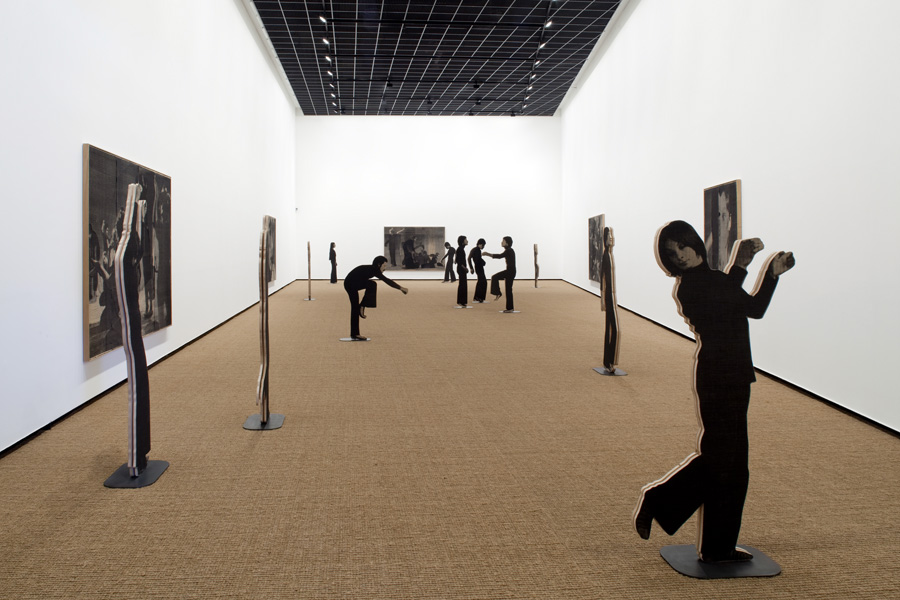
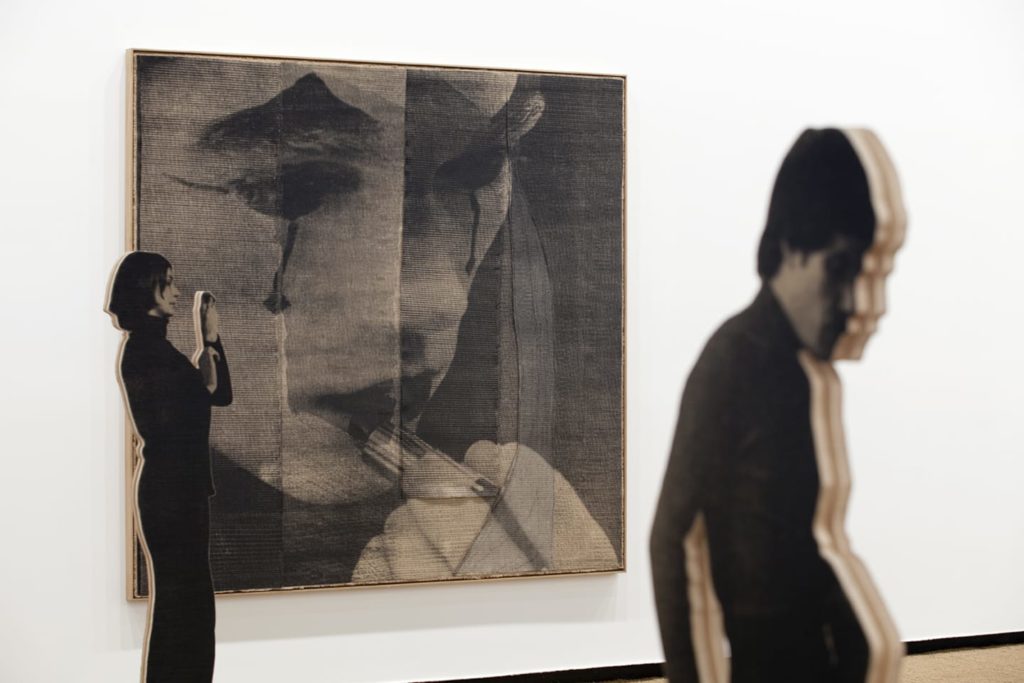
Installation view of Scenes by David Noonan at ACCA Photo: Marcus Bunyan
Thoughts
Limited colour palette of ochres, whites, browns and blacks.
Rough texture of floor covered in Jute under the feet.
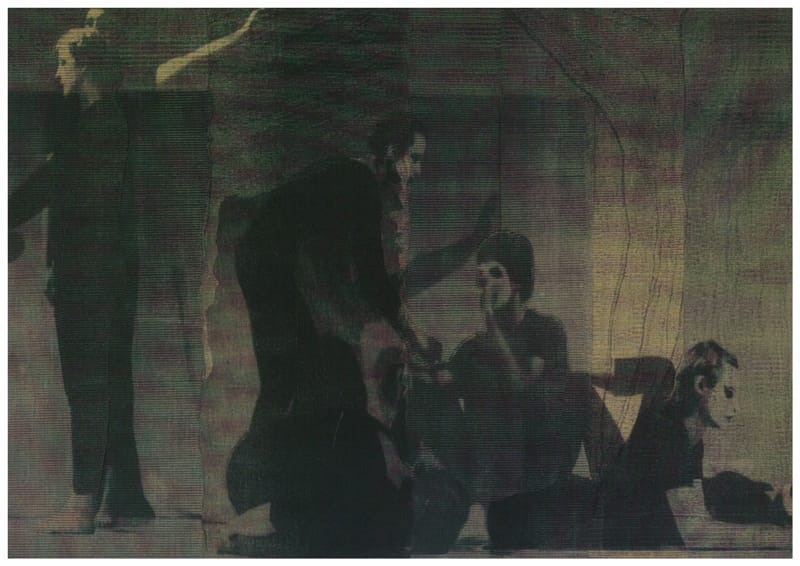
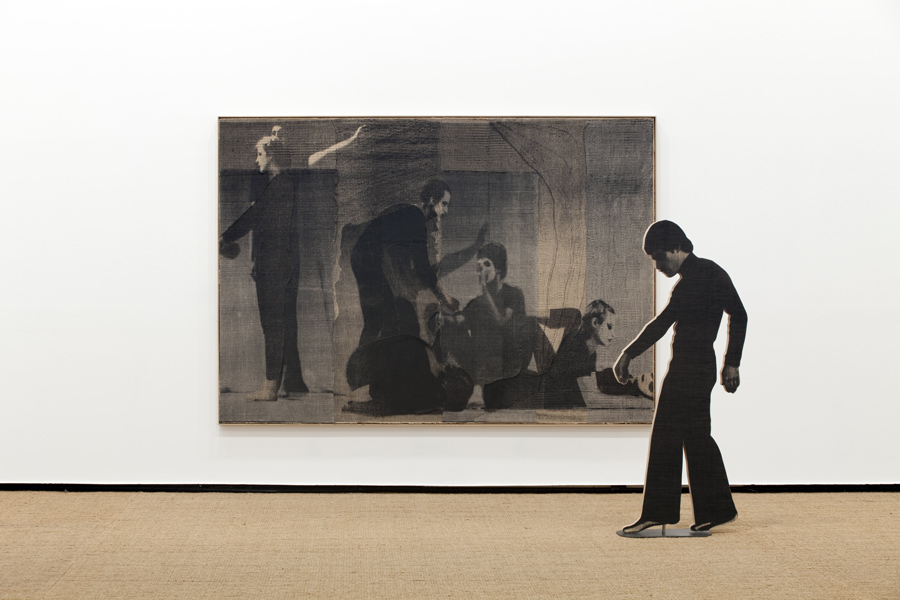
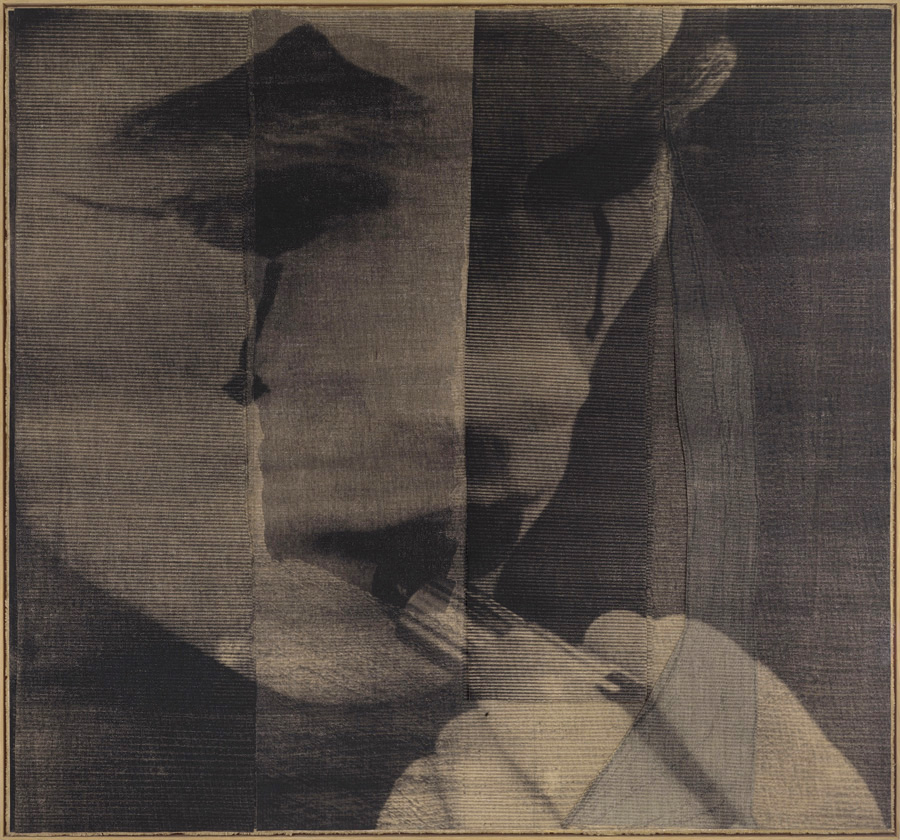
Layered, collaged print media figures roughly printed on canvas – elements of abstraction, elements of figuration.
The ‘paintings’ are magnificent; stripped and striped collages. Faces missing, dark eyes. There is something almost Rembrandt-esque about the constructed images, their layering, like Rembrandt’s Night Watch (1642) – but then the performance element kicks in – the makeup, the lipstick, the tragic / comedic faces.
Mannequin, doll-like cut-out figures, flat but with some volume inhabiting the tableaux vivant.
Twelve standing figures in different attitudes – a feeling of dancing figures frozen on stage, very Japanese Noh theater. Spatially the grouping and use of space within the gallery is excellent – like frozen mime.
The figures move in waves, rising and falling both in the standing figures and within the images on the wall.
Looking into the gallery is like looking through a picture window onto a stage set (see above image).
“The fracturing of identity, the distortion of the binaries of light and dark, absence/presence in spatio-temporal environments.
The performance as ritual challenging a regularized and constrained repetition of norms.” (Judith Butler).
Excellent, thought provoking exhibition.
Dr Marcus Bunyan
Many thankx to ACCA for allowing me to publish the photographs in the posting. Please click on the photographs for a larger version of the image.
Installation views of Scenes by David Noonan at ACCA Photos: Marcus Bunyan
Noonan often works with found photographic imagery taken from performance manuals, textile patterns and archive photographs to make densely layered montages. These works at once suggest specific moments in time and invoke disorientating a-temporal spaces in which myriad possible narratives emerge. The large-scale canvases framing this exhibition depict scenes of role-playing, gesturing characters, and masked figures set within stage-like spaces. Printed on coarsely woven jute, collaged fabric elements applied to the surface of the canvases further signal the cutting and splicing of images.
Noonan’s new suite of figurative sculptures, comprise life size wooden silhouettes faced with printed images of characters performing choreographed movements. While the figurative image suggests a body in space, the works’ two dimensional cut-out supports insist on an overriding flatness which lends them an architectural quality – as stand-ins for actual performers and as a means by which to physically navigate the exhibition space.
Press release from the Chisenhale Gallery website [Online] Cited 20/09/2009. No longer available online
For the Helen Macpherson Smith Commission, he will bring the characters depicted in his signature collage works off the wall and onto an imagined ‘stage’. Several life-size, wooden cut-out figures will inhabit the ACCA exhibition gallery, frozen in choreographed movements.
Noonan’s dancing figures will be framed by several large-scale canvas works, printed photographic and film imagery gleaned from performance manuals, textile patterns and interior books. Printed on coarse woven jute, he cuts, slices and montages images together constructing compositions that hover between two and three dimensionality, positive and negative space, past and present, stasis and action.
“‘Scenes’ recalls the experimental workshops and youth-focused exuberance of a more optimistic era, coinciding with the artists own childhood in the 1970s” says curator Charlotte Day. “With these new works, Noonan re-introduces the idea of ritual, of creating a temporal space beyond reason that is filled with both danger and hope.”
David Noonan (Australian, b. 1969) is the fifth recipient of the Helen Macpherson Smith Commission, one of the most significant and generous commissions in Australia. The partnership between ACCA and the Helen Macpherson Smith Trust offers Victorian artists the opportunity to create an ambitious new work of art, accompanied by an exhibition in ACCA’s exhibition hall.
Press release from the ACCA website [Online] Cited 20/09/2009. No longer available online
David Noonan returned to Melbourne with this significant project which extended his abiding interest in time and space. Using ACCA’s large room as a field of encounter, he created an ensemble of works in 2 and 3 dimensions that make purposeful use of the audience’s own navigation through the gallery. Visitors walking between David’s free-standing figures performed like time travellers in a landscape that had been paused. His enigmatic wall based works appeared to trap momentary scenes in a layered time warp.
This major commission allowed for an ambitious project by a Victorian artist who had reached a significant platform in their own practice. Elements of the commission were gifted to a Victorian regional gallery. In this case the recipient was Bendigo Art Gallery.
Text from the ACCA website [Online] Cited 24/04/2019
Installation views of Scenes by David Noonan at ACCA Photos: Marcus Bunyan
Australia Centre for Contemporary Art (ACCA) 111 Sturt Street, Southbank, Victoria 3006, Australia Phone: 03 9697 9999
Opening Hours: Tuesday to Friday 10am – 5pm Weekends & Public Holidays 11am – 5pm Open all public holidays except Christmas Day and Good Friday
Exhibition dates: 2nd September – 26th September, 2009
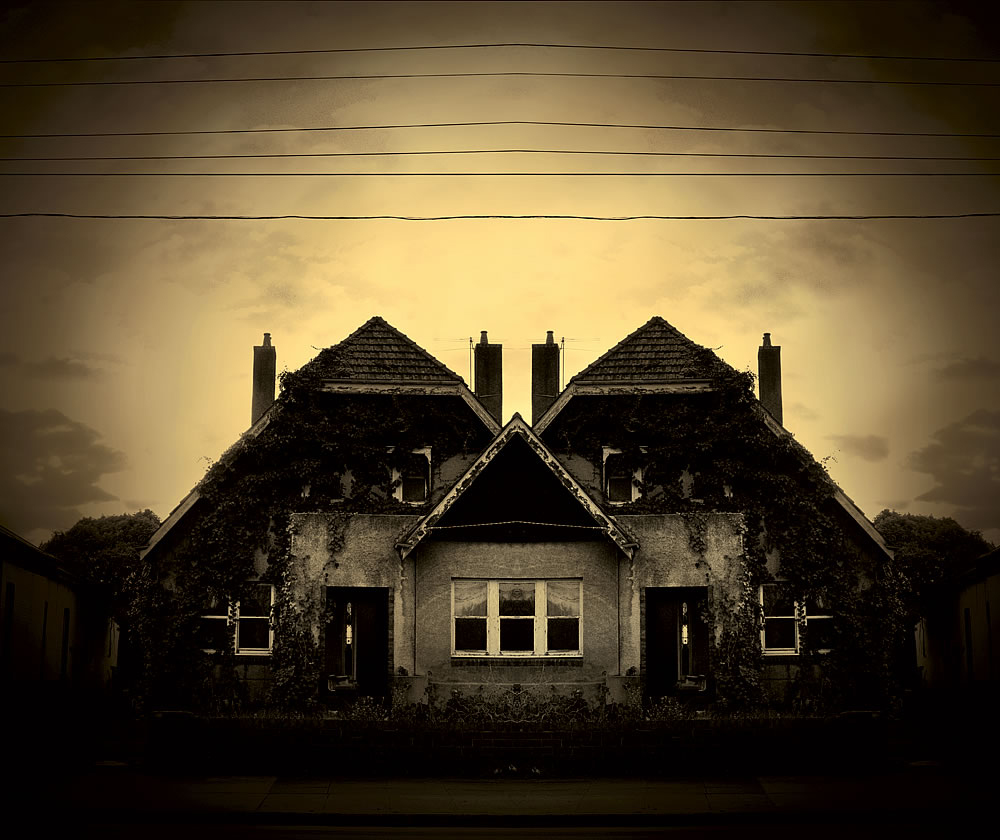
Jane Burton (Australian, b. 1966) Ivy #1 2009 Pigment print 89 x 75cm
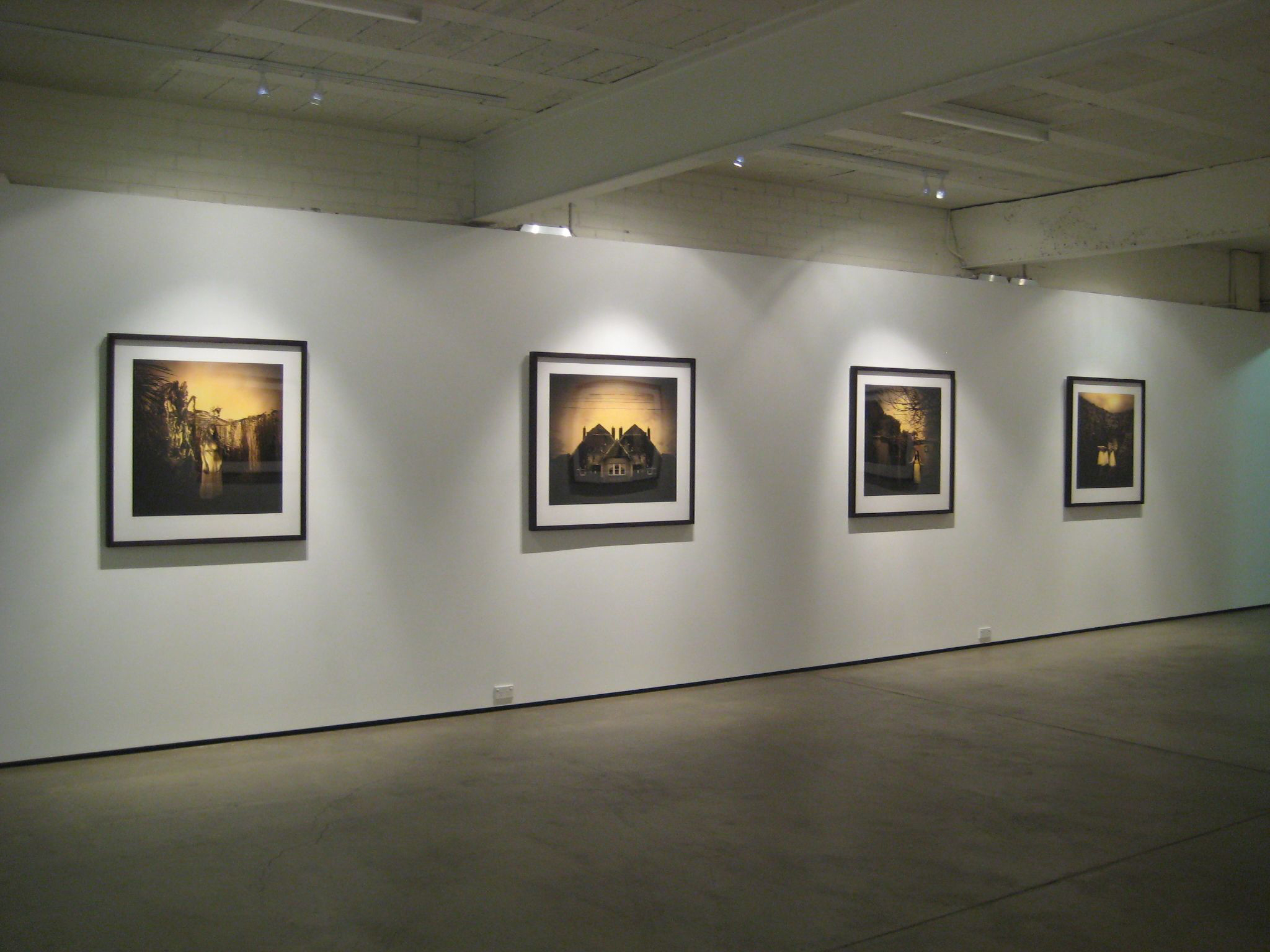
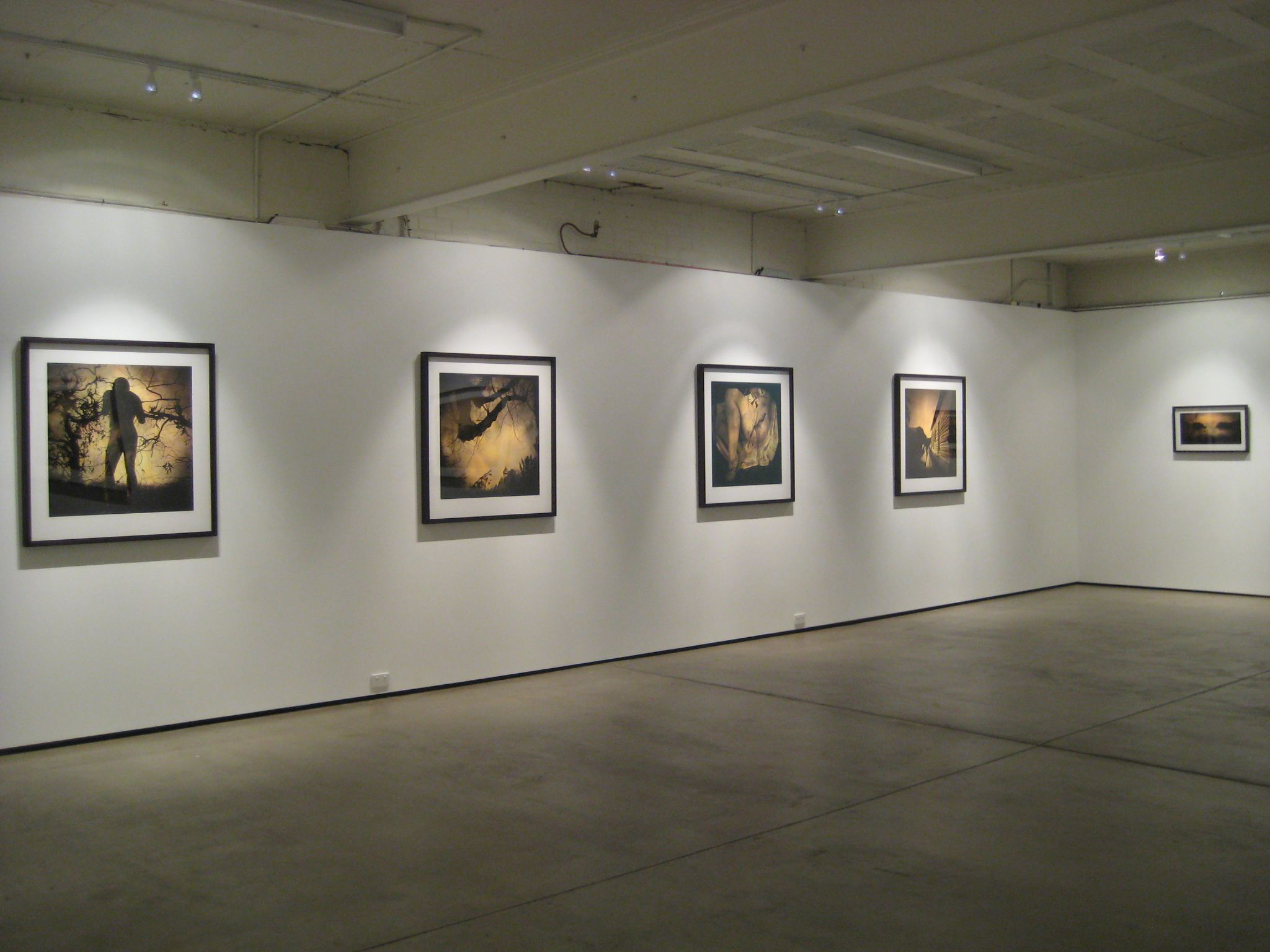
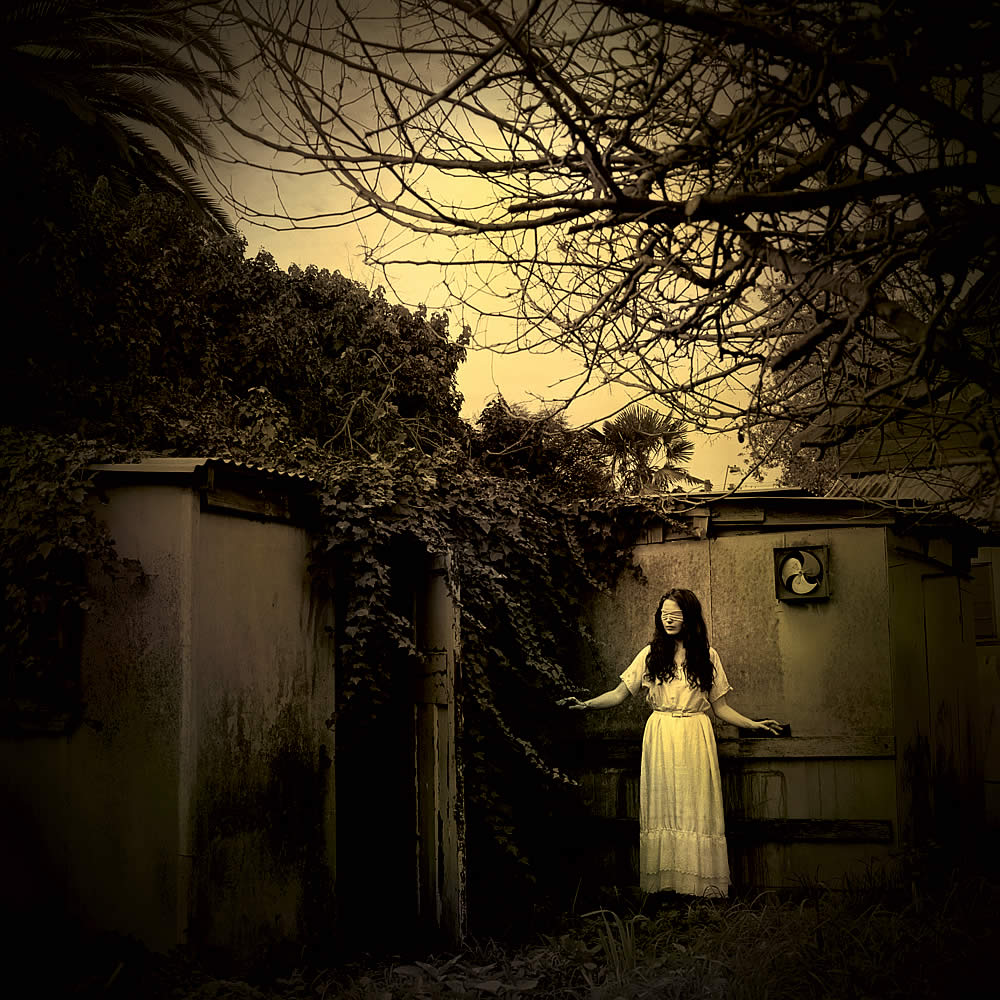
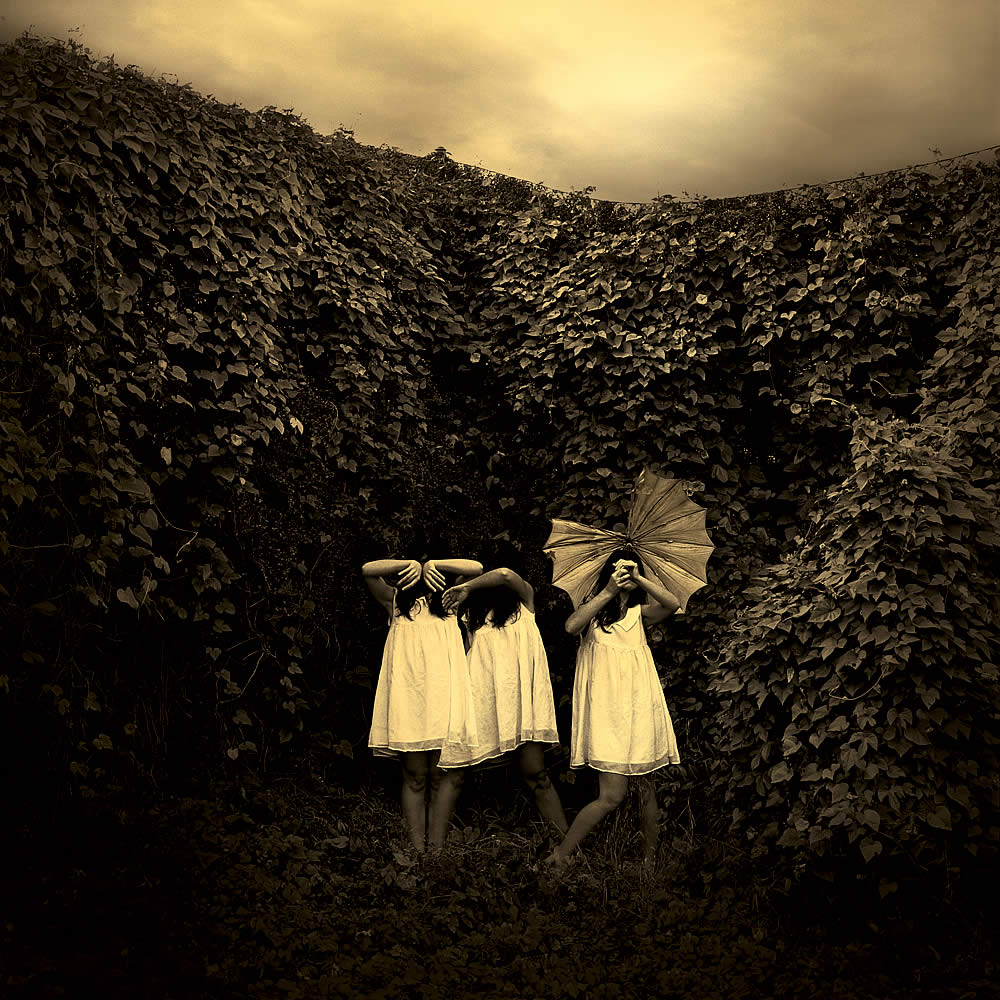
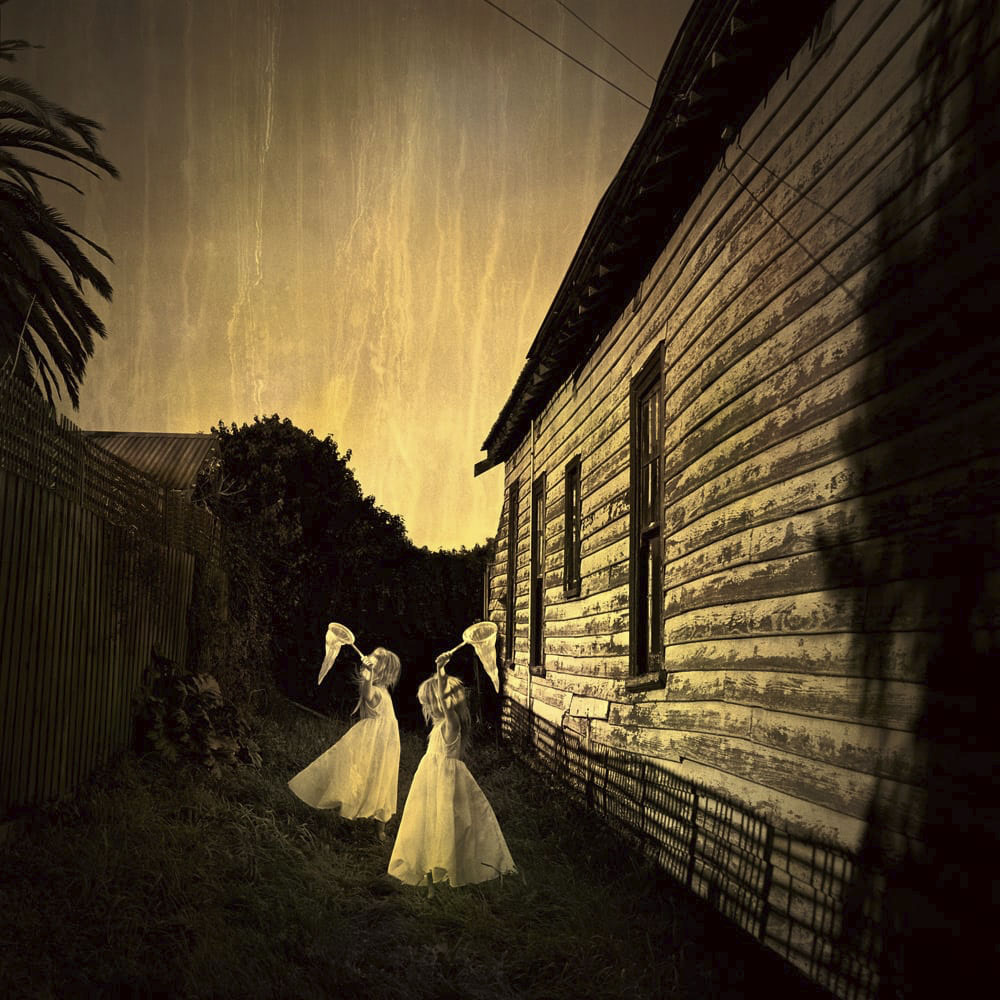
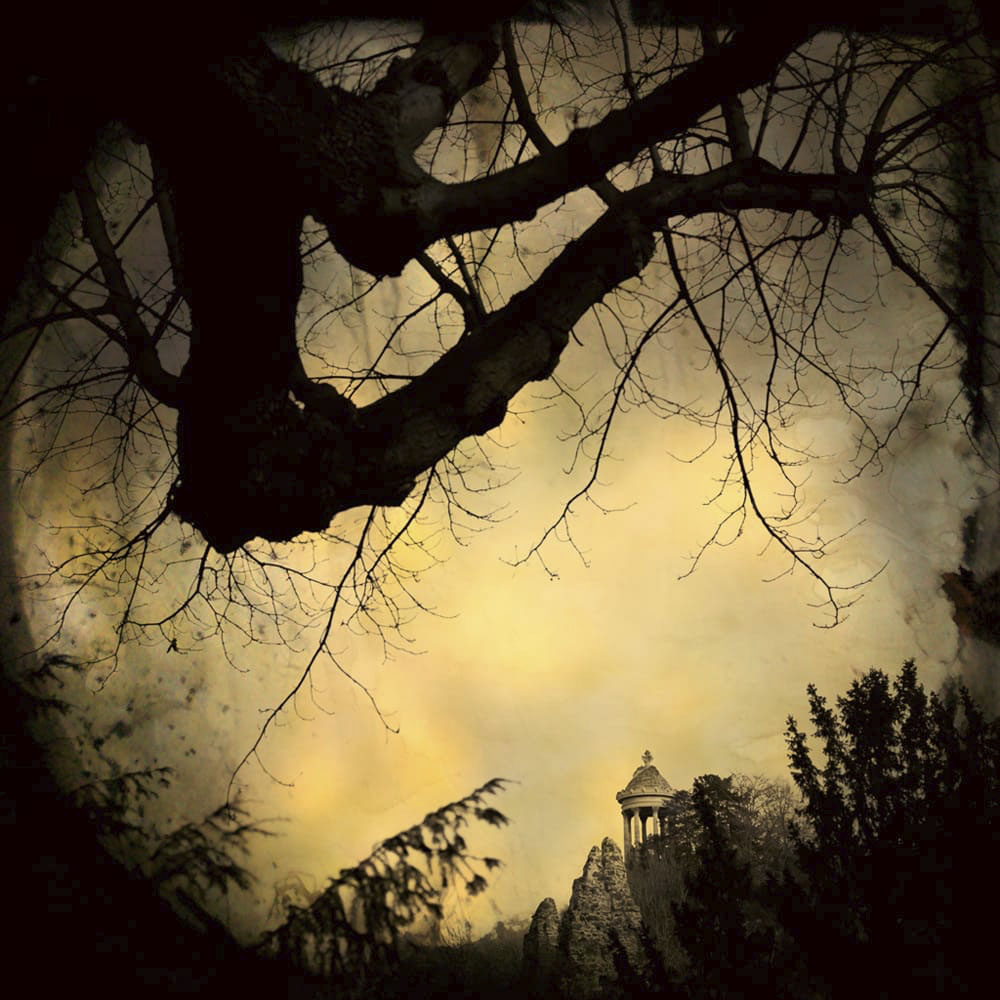
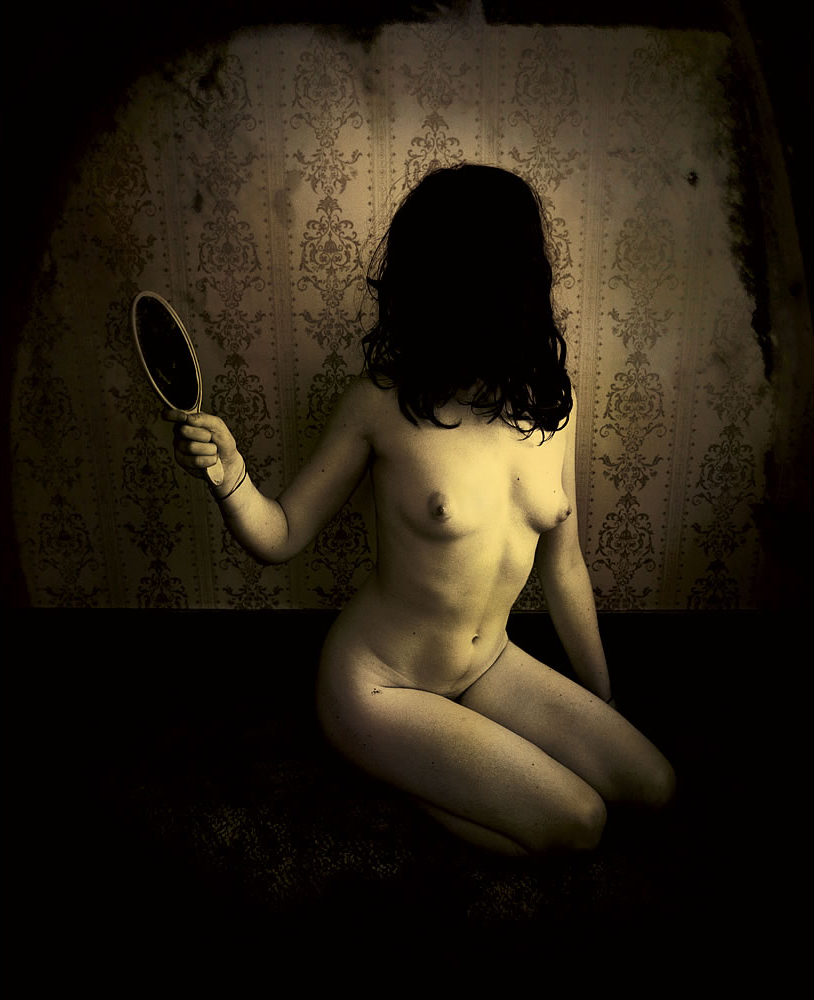
This is another outstanding body of photographic work on display in Melbourne. Featuring 10 large and 2 small sepia toned, vignetted pigment prints Burton’s work creates dark enchanted worlds of faceless female figures placed in the built environment that balance (meta)physical light and shade creating ambiguous narratives of innocence tinged with a darker edge.
The eponymous photograph Ivy #1 (above) is the seminal image of the series: a dark brooding house, hunched down positioned low in the photographic space, covered in ivy with black windows and dark eves has an ominous almost impenetrable presence and sets the tone for the rest of the work.
There are wonderful references to the history of photography if one cares to look (not simply generic references to Victorian daguerreotypes, postcards and family photographs). Ivy #2 (below) is a powerful photograph where the female figure is blindfolded, unable to see the encroaching tumescence of vegetation that surrounds and is about to engulf her. The placement of the hands is exquisite – unsure, reaching out, doubting her surroundings – with the 3-bladed fan hovering behind ready to devour the unwary. This photograph has resonances of the magical photographs of the garden by the Czech photographer Josef Sudek.
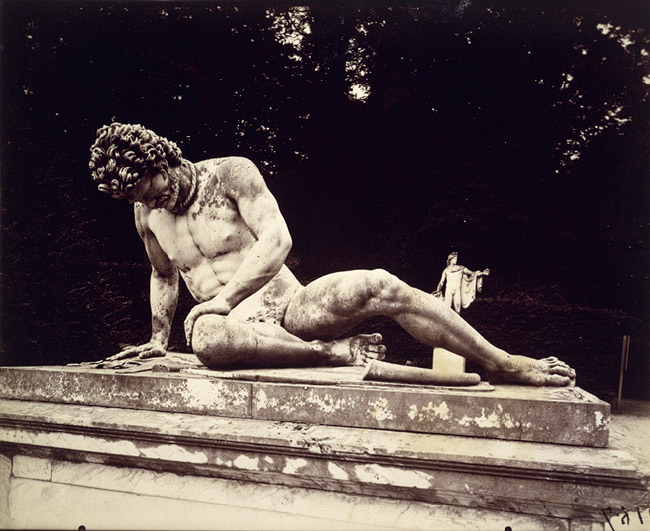
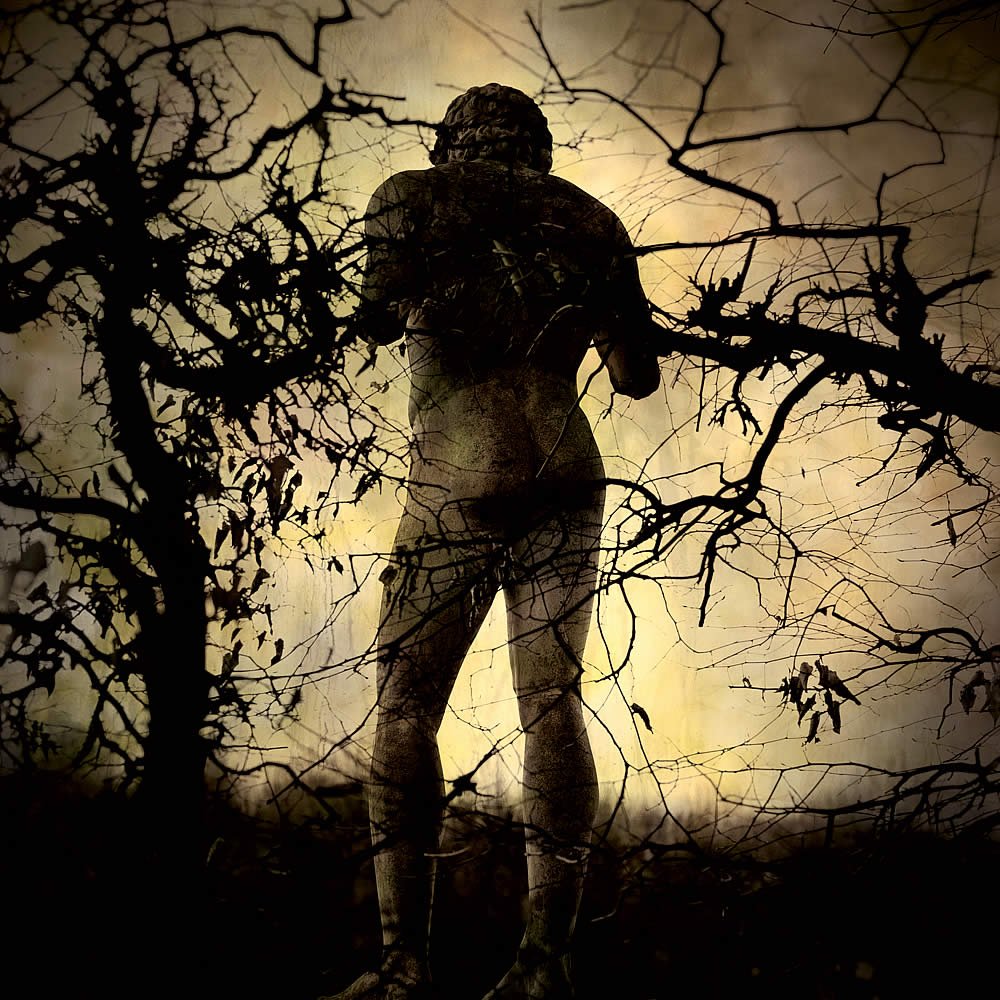
Ivy #3 (below) has echoes of the work of the American photographer Ralph Eugene Meatyard and his placement of masked people within built environments. In Burton’s photograph the broken umbrella becomes like insect wings, the faceless whiteness of the three-legged and three-armed creature cocooned among the overhanging predatory ivy, the luminescent sky offering the possibility of redemption. Other photographs such as Ivy #6 (below) and Ivy #7 with their wonderful colours, depth of field, heavy shadows and elegiac romantic feel have references to Eugene Atget and his photographs of the parks of Versailles (see photograph below).
Still further references to the history of photography can be found in the photographs Ivy #9 and Ivy #10 (below). In Ivy #9 the intersection of the two female bodies through double exposure forms a slippage in (photographic) reality and the disappearance of original identity in the layering of the photographs and into the empty non-reflection of the mirror. This non-reflection is confirmed in Ivy #10 where the faceless nude woman holds a mirror with no reflection. These photographs remind me of the photographs of New Orleans prostitutes in the early years of the 20th century by the photographer Bellocq with their masked faces and the ornamentation of the wallpaper behind the figures (see below).
I feel that in these photographs with their facelessness and the non-reflection of the mirror investigate notions of ‘Theoria’ – a Greek emphasis on the vision or contemplation of God where theoria is the lifting up of the individual out of time and space and created being and through contemplative prayer into the presence of God.1 In fact the whole series of photographs can be understood through this conceptualisation – not just remembrances of past time, not a blind contemplation on existence but a lifting up out of time and space into the an’other’ dark but enlightening presence.
The greatest wonder of this series is that the photographs magically reveal themselves again and again over time. Despite (or because of) the references to other artists, the beauty of Burton’s work is that she has made it her own. The photographs have her signature, her voice as an artist and it is an informed voice; this just makes the resonances, the vibrations of energy within the work all the more potent and absorbing. I loved them.
Dr Marcus Bunyan
Many thankx to Karen Woodbury Gallery for allowing me to publish the photographs in the posting. Please click on the photographs for a larger version of the image.
Installation views of Ivy by Jane Burton at Karen Woodbury Gallery, Melbourne Photos: Marcus Bunyan
Jane Burton (Australian, b. 1966) Ivy #2 2009 Pigment print 75 x 75cm
Jane Burton (Australian, b. 1966) Ivy #3 2009 Pigment print 75 x 75cm
Jane Burton (Australian, b. 1966) Ivy #5 2009 Pigment print 75 x 75cm
Jane Burton (Australian, b. 1966) Ivy #7 2009 Pigment print 75 x 75cm
Jane Burton’s exhibition, Ivy comprises a series of photographs captured in black and white. The final prints are rendered with a sepia, peach-champagne tone, with many displaying a mottled hand-coloured effect in faded pastels of pink and green. These works hope to suggest an era past, perhaps Victorian. The imagery is evocative of old picture postcards from Europe and old photographs from the pages of family albums.
Central to the series is an image of a house covered with ivy. Depicted as dark and malevolent, the house is ‘haunted’ by the traces and stains of family history, habitation, and the buried secrets of all that occurred within.
Anonymous female figures are seen in garden settings where the foliage is rampant and encroaching and the shadows deep. There is an air of enchantment perceived with unspecified darker edge. The figures are innocent and playful. The viewer is asked to question if the and girls aware of the camera capturing their activity? Are the poses staged or caught spontaneously. In another photograph, a dilapidated male statue stands broken and armless, the texture of stone worn, and bruised with dark lichen and moss.
In the interior photographs, several nudes are depicted in the style of 19th century French daguerreotype photographs. These vignetted images display women against wall-papered backdrops with theatrical props reminiscent of earlier works by Burton such as the series ‘The other side’ (2003). Posed suggestively for the camera and the viewer’s gaze, the subjects themselves are faceless, their own gaze and features hidden behind dark hair. The surface and texture of these particular works suggests the patina of decay and the damage and wear of time.
Text from the Karen Woodbury Gallery website [Online] Cited 20/09/2009. No longer available online
E. J. Bellocq (American, 1873-1949) Untitled [prostitute of Storyville, New Orleans] 1912
Jane Burton (Australian, b. 1966) Ivy #10 2009 Pigment print
Eugene Atget (French, 1857-1927) Versailles, France 1923 Albumen print
Jane Burton (Australian, b. 1966) Ivy #6 2009 Pigment print 75 x 75cm
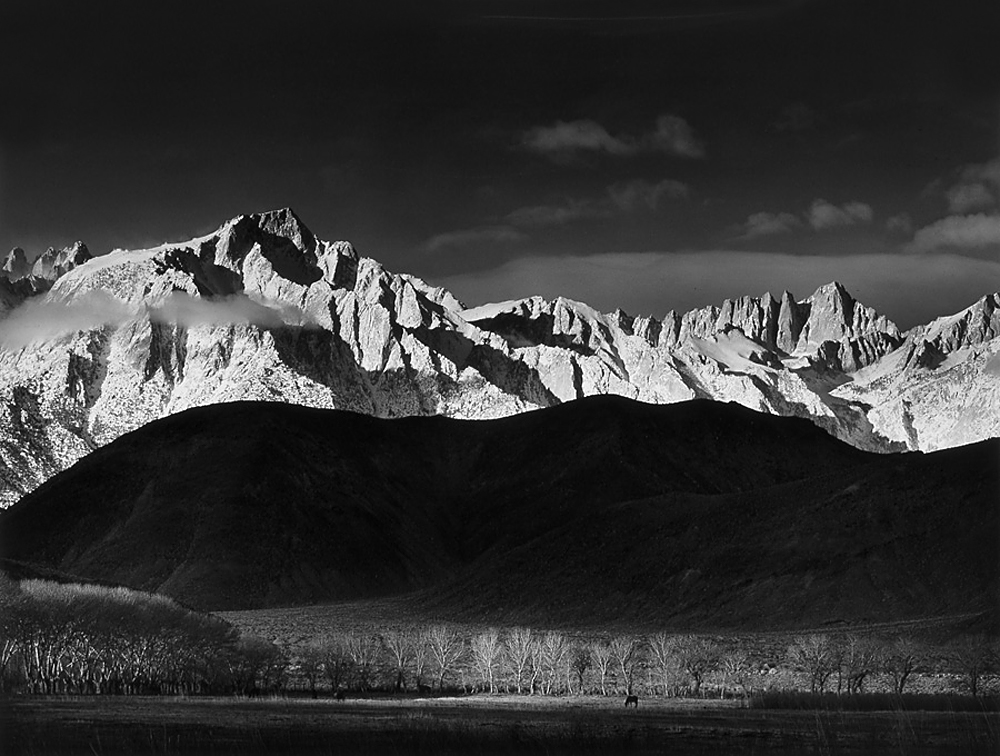
Ansel Adams (American, 1902-1984) Monolith, The Face of Half Dome, Yosemite National Park from the portfolio Parmelian Prints of the High Sierras 1927 Gelatin silver print
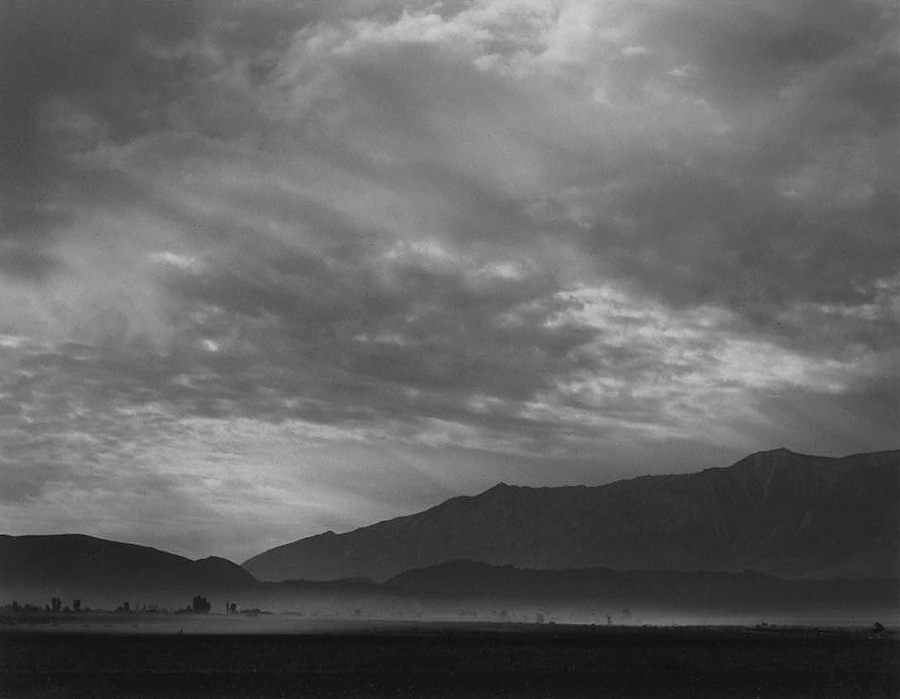
Some well known Ansel Adams images below with some less well known photographs from the Manzanar Relocation Center photographic series of 1943.
Marcus
Many thankx to the Museum of Photographic Arts for allowing me to publish the three photographs, Winter Sunrise, Sierra Nevada from Lone Pine, California (1944), Mount McKinley, Alaska (1948) and Aspens, Northern New Mexico (1958). Please click on the photographs for a larger version of the image.
Ansel Adams (American, 1902-1984) Marion Lake, Southern Sierra from the portfolio Parmelian Prints of the High Sierras 1927 Gelatin silver print
Ansel Adams (American, 1902-1984) Birds on wire, evening, Manzanar Relocation Center 1943 Gelatin silver print
The Museum of Photographic Arts (MoPA) in Balboa Park is pleased to present Ansel Adams: A Life’s Work. The exhibition includes over 80 photographs by the 20th Century master, and celebrates Adams as an artist and conservationist. A Life’s Work will be on view May 23, 2009 through October 4, 2009, and features an overview of Adam’s work from his early years in the Sierra Nevadas and Yosemite Valley to his work in the Japanese Internment Camp at Manzanar, as well as his well-known masterpieces.
Ansel Adams: A Life’s Work will be running concurrently with Jo Whaley: Theater of Insects on view from May 16 through September 27, 2009, as well as Picturing the Process: Exploring the Art and Science of Photography on view through July 25, 2009.
The exhibition begins with survey of Adams’ early years with the Sierra Club (1920s-1930s), where his photographs and essays were first published in the Club’s Bulletin. 1927 marked a pivotal point for Adams, where he participated in the Sierra Club’s annual High Trip, which took him to the high country of the Sierra. It was during this trip that he exposed the negative of the iconic image Monolith, the Face of Half Dome. Adams describes this photograph as “my first conscious visualisation; in my mind’s eye, I saw the final image.”
It was during this first High Trip that Adams met San Francisco-based arts patron, Albert Bender. Bender took immediate interest in Adam’s photographs, and published Adams’ first portfolio, The Parmelian Prints of the High Sierras (1927). The publication included an edition of 100 portfolios of 18 prints each, 75 were printed.
The exhibition features 15 of the rare Parmelian vintage prints, as well as eight photographs from the 1929 Sierra Club Portfolio.
The exhibition continues with a wide range of representative works from the 1930’s and 1940’s, including commercial work that the artist did for the YPCCO (Yosemite Park and Curry Company). From 1931 to 1937, Adams was hired by YPCCO, a group of businesses in Yosemite Valley, to photograph various winter sports for an advertising campaign. This opportunity provided a much needed source of income for the artist during the Great Depression. The exhibition also includes other various commercial assignments throughout his career, which Adams clearly separated from his fine art photography, but notes as a vital aspect of his career. In his Autobiography he wrote: “I have little use for students or artists who scorn commercial photography as a form of prostitution … Let them pay the bills! … I struggled with a great variety of assignments through the years. Some I enjoyed, some I detested, but learned from them all.”
ALife’s Work also includes the powerful and poignant images from the Manzanar Internment Camp. In late 1943 through 1944, Adams visited the camps in central California, where over 10,000 Japanese-Americans were interned during World War II. Adams’ intention for this self-assigned project was “to interpret the camp and its people, their daily life and their relationship to their community and their environment,” wrote Adams in his Autobiography.“As my work progressed, however, I began to grasp the problems of the remarkable readjustment these people had to make… With admirable strength of spirit, the Nisei rose above despondency and make a life for themselves… This was the mood and character I determined to apply to the project.”
A Life’s Work will feature many of his iconic masterworks, including Moonrise, Hernandez, New Mexico, as well as his works in colour, which he experimented with beginning in the late 1940s.
Press release from the Museum of Photographic Arts website [Online] Cited 15/09/2009
Ansel Adams (American, 1902-1984) View south from Manzanar to Alabama Hills, Manzanar Relocation Center 1943 Gelatin silver print
Ansel Adams (American, 1902-1984) View SW over Manzanar, dust storm, Manzanar Relocation Center 1943 Gelatin silver print
Exhibition dates: 7th August – 27th September, 2009
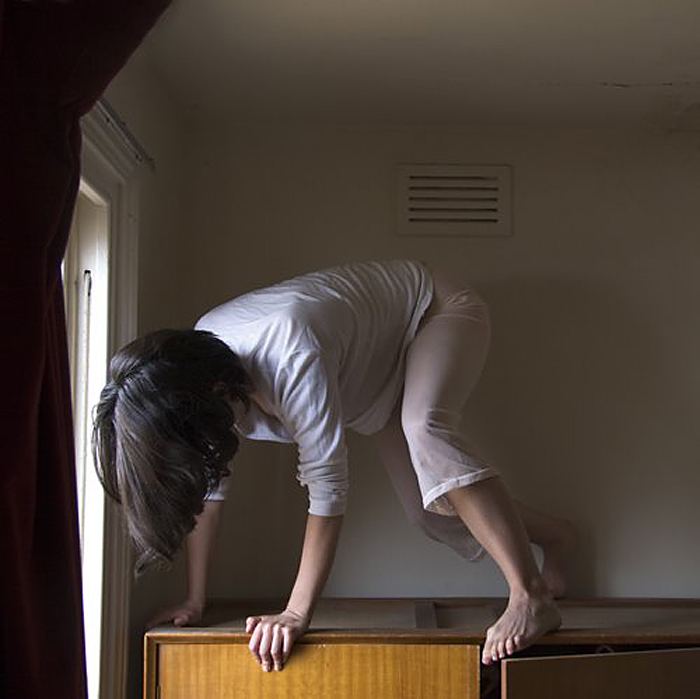
Clare Rae (Australian, b. 1981) Untitled 2009 From the series Climbing the Walls and Other Actions Pigment print on Museo Crane Silver Rag 50 x 50cm
“To withdraw into one’s corner is undoubtedly a meager expression. But despite its meagerness, it has numerous images, some, perhaps, of great antiquity, images that are psychologically primitive. At times, the simpler the image, the vaster the dreams.”
Gaston Bachelard.1
Usually I am not a great fan of ‘faceless’ photography as I call it but this series of work, Climbing the Walls and Other Actions (2009) by the artist Clare Rae is even better than the series by Tracey Moffatt in the previous review.
Exploring activities of the female body in closed domestic spaces these psychologically intense photographs push the physical boundaries of play through the navigation of space. As a child has little awareness about the inherent dangers of a seemingly benign environment so Rae’s self-portraits turn the lens on her conceptualisation of the inner child at play and the activating of the body in and through space. As the artist herself says, “the way children negotiate their surroundings and respond with an unharnessed spatial awareness, which I find really interesting when applied to the adult body.”2
Continuing the themes from the last review, that of spaces of intimacy and reverberation, these photographs offer us fragmentary dialectics that subvert the unity of the archetype, the unity of the body in space. Here the (in)action of the photographic freeze balances the tenuous positions of the body: a re-balancing of both interior and exterior space.
As Noel Arnaud writes, “Je suis l’espace ou je suis” (I am the space where I am). Further, Bachelard notes “… by changing space, by leaving the space of one’s usual sensibilities, one enters into communication with a space that is psychically innovating.”3
In these photographs action is opposed with stillness, danger opposed with suspension; the boundaries of space, both of the body and the environment, the interior and the exterior, memory and dream, are changed.
Space seems to open up and grow with these actions to become poetic space – and the simplicity of the images aids and abets the vastness of our dreams. This change of concrete space does not change our place, but our nature. Here the mapping of self in space, our existence, our exist-stance (to have being in a specified place whether material or spiritual), is challenged in the most beautiful way by these walls and actions, by these creatures, ambiguities, photographs.
Henri Lefebvre insightfully observes, “… each living body is space and has space: it produces itself in space and it also produces that space.”4
I am the (sublime) space where I am, that surrounds me with countless presences.
Dr Marcus Bunyan
1/ Bachelard, Gaston. The Poetics of Space. Boston: Beacon Press, 1969, p. 137
2/ Email from the artist 7th September, 2009
3/ Bachelard, Gaston. The Poetics of Space. Boston: Beacon Press, 1969, p. 206
4/ Lefebvre, Henri. The Production of Space. Oxford: Basil Blackwell, 1974, p. 170
All images by Clare Rae from the series Climbing the Walls and Other Actions 2009. Many thankx to Clare for allowing me to publish them.
Clare Rae (Australian, b. 1981) Untitled 2009 From the series Climbing the Walls and Other Actions Pigment print on Museo Crane Silver Rag 50 x 50cm
Clare Rae (Australian, b. 1981) Untitled 2009 From the series Climbing the Walls and Other Actions Pigment print on Museo Crane Silver Rag 50 x 50cm
Clare Rae (Australian, b. 1981) Untitled 2009 From the series Climbing the Walls and Other Actions Pigment print on Museo Crane Silver Rag 50 x 50cm
Climbing the Walls and Other Actions is primarily concerned with visually representing my experience of femininity, whilst also exploring aspects of representation that relate to feminism. The project considers the relationship between the body and space by including formal elements within each frame such as windows and corners. Through a sequence of precarious poses I explore my relationship with femininity, an approach born of frustration. I use the body to promote ideas of discomfort and awkwardness, resisting the passivity inherent in traditional representations of femininity. The images attempt to de-stabilise the figure, drawing tension from the potential dangers the body faces in these positions. Whilst the actions taking place are not in themselves particularly dangerous, the work demonstrates a gentle testing of physical boundaries and limitations via a child-like exploration of the physical environment.
Text from the Centre for Contemporary Photography website [Online] Cited 15/09/2009. No longer available online
Clare Rae (Australian, b. 1981) Untitled 2009 From the series Climbing the Walls and Other Actions Pigment print on Museo Crane Silver Rag 50 x 50cm
Clare Rae (Australian, b. 1981) Untitled 2009 From the series Climbing the Walls and Other Actions Pigment print on Museo Crane Silver Rag 50 x 50cm
Centre for Contemporary Photography Level 2, Perry St Building Collingwood Yards, Collingwood Victoria 3066
Exhibition dates: 7th August – 27th September, 2009
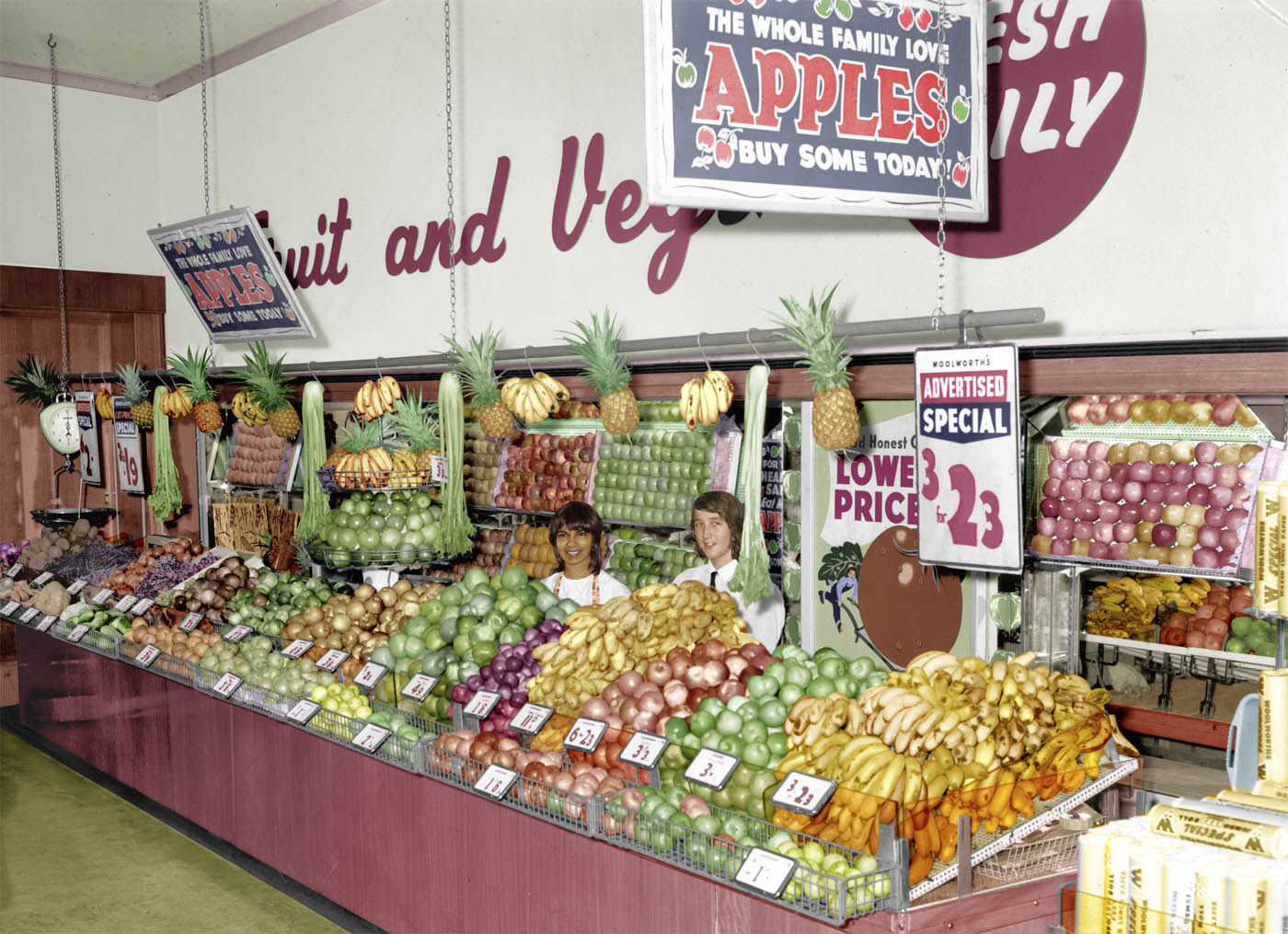
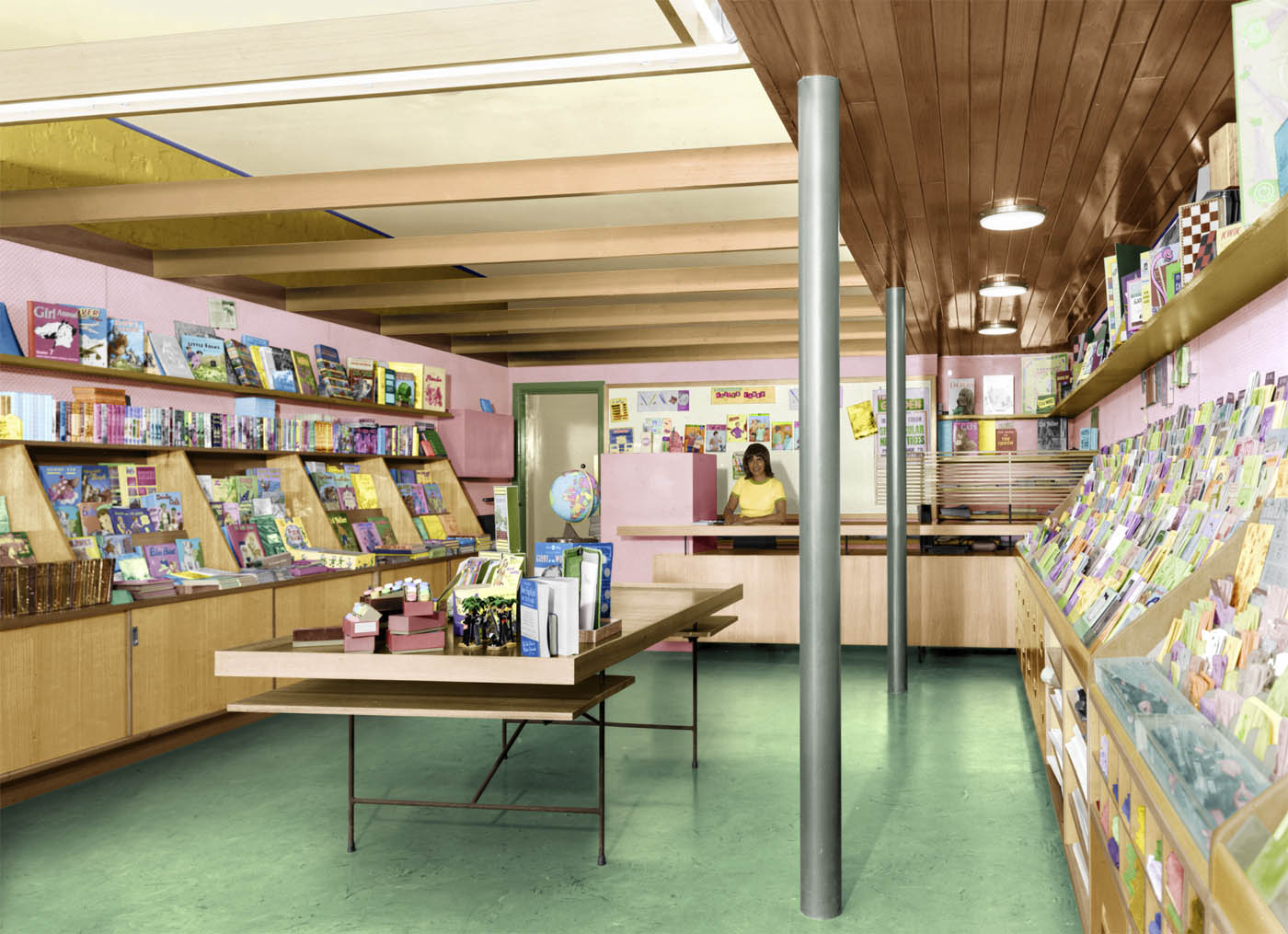
Tracey Moffat (Australian, b. 1960) First Jobs, Fruit Market 1975 Archival pigments on rice paper with gel medium 71 × 91.5cm
There are some wonderful bodies of photographic work on show around Melbourne at the moment and this is one of them.
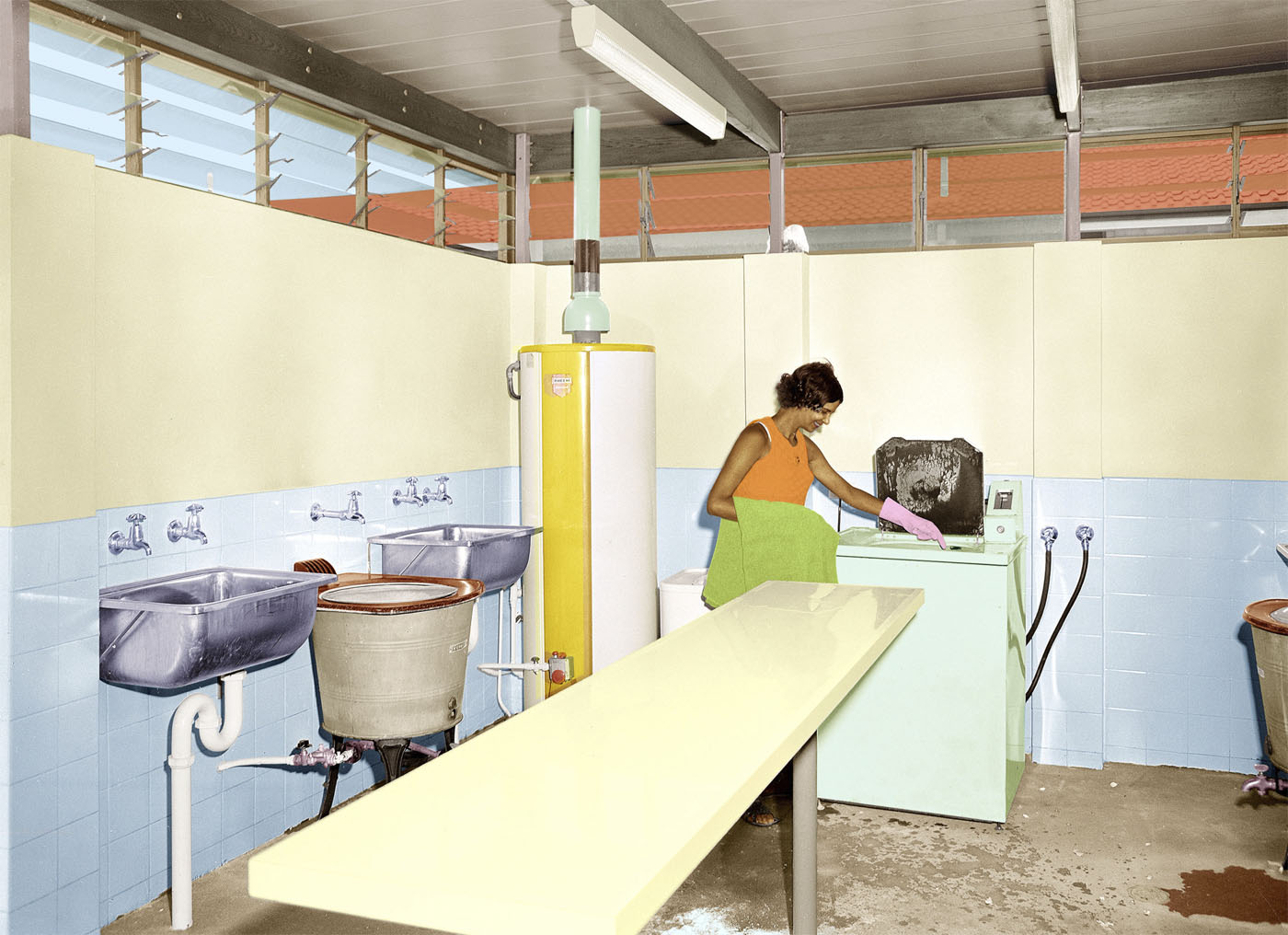
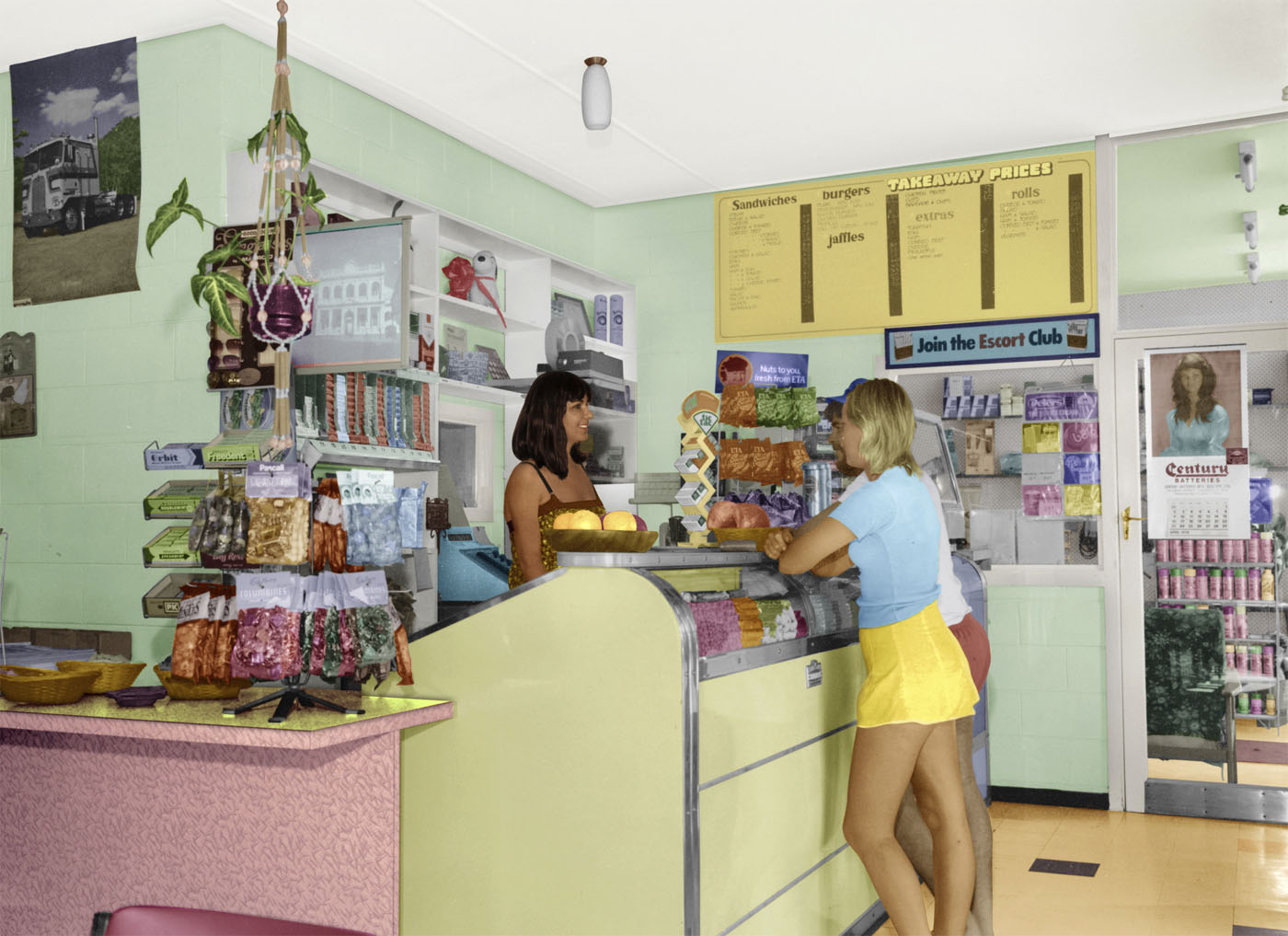
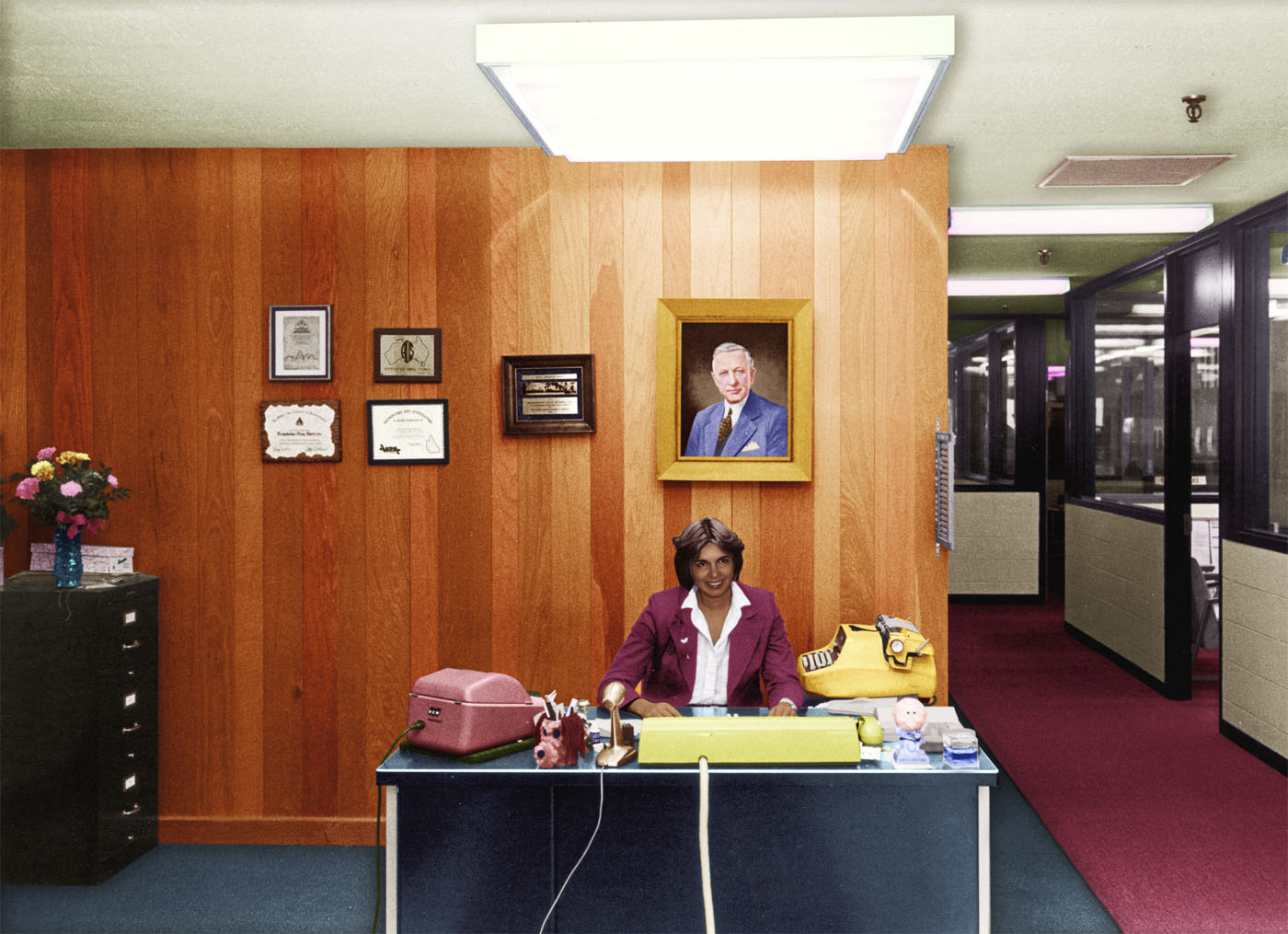
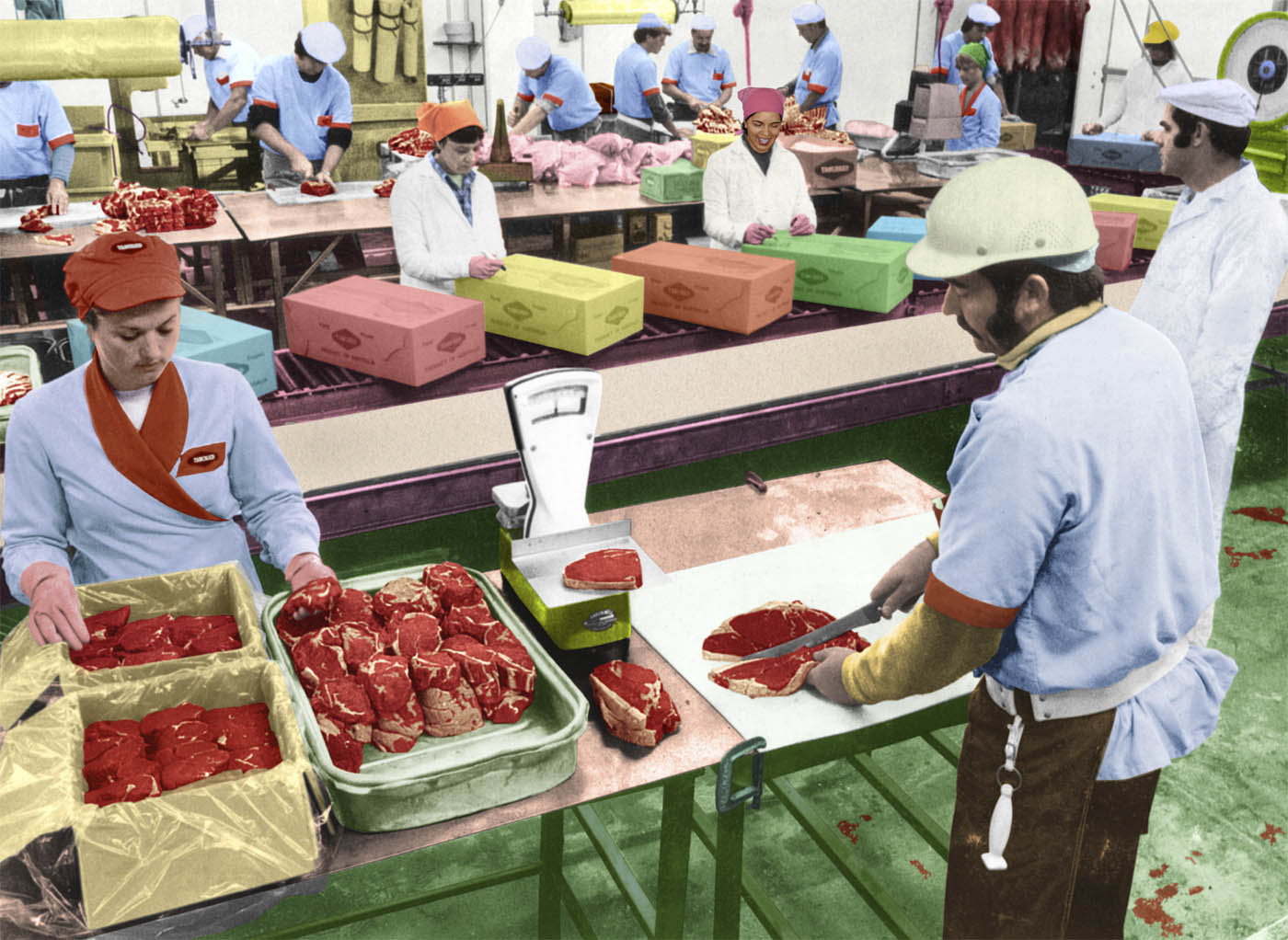
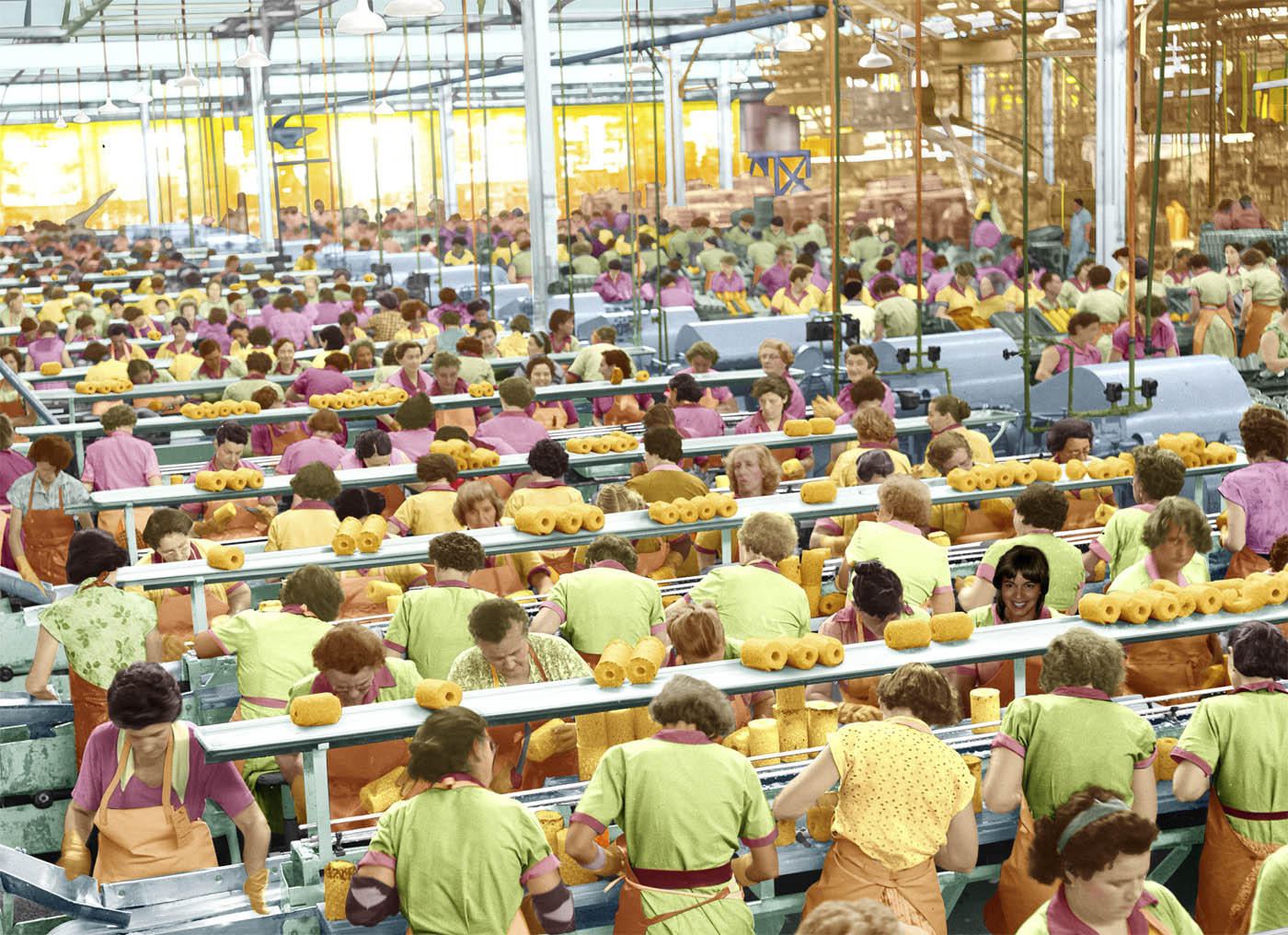
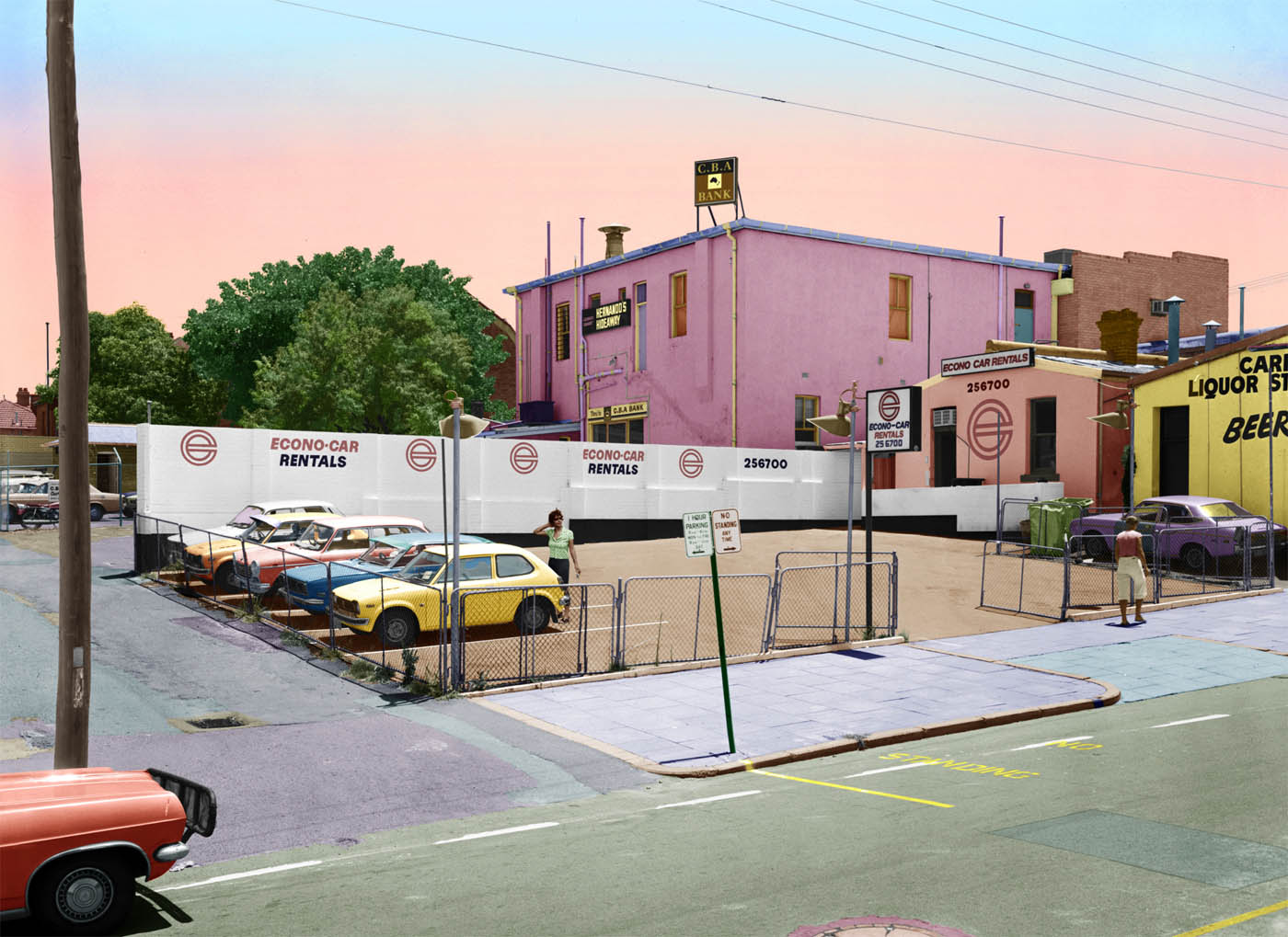
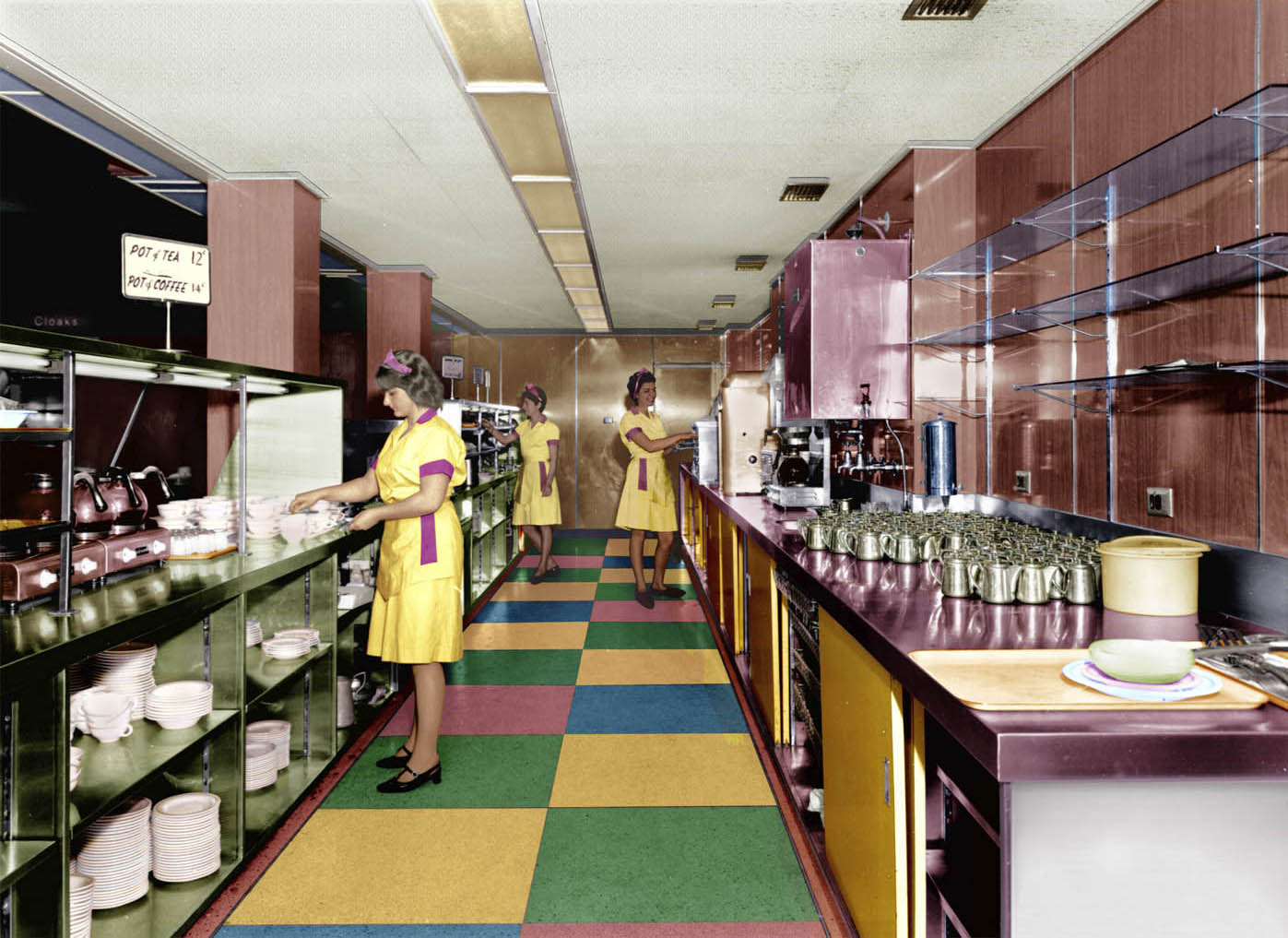
Featuring twelve archival pigment on rice paper with gel medium prints, Tracey Moffatt’s series First Jobs (2008) is a knockout. Images of the artist are inserted into found photographs which are then “hand coloured” (like old postcards) in Photoshop. Moffatt’s series conceptualises the early jobs that she had to do to survive – investigating the banality of the jobs, the value of friendships that were formed coupled with an implicit understanding of the dictum ‘work is life’.
Moffatt’s images hark back to the White Australia policy of the 1950s and the home and living books of that period. With their hyper-real colours, strange coloured skies, green washing machines and purple tarmac Moffatt amps up the voltage of these images and subverts their idealisation. Here is the re-presentation of the physical and spatial isolation of the figure (store clerk / housekeeper) or the sublimation of the usually female figure into the amorphous mass of the whole (meat packing / pineapple cannery) in quintessentially Australian environments. Here also is comment on the nature of a patriarchal society – the smiling receptionist sitting under the portrait of her male boss, awaiting his command.
The spaces of these photographs seem to (literally) consume the artist and her remembrance of these jobs. Despite her smiling face in each of the images we implicitly understand the banality of the jobs for we have done them ourselves. We know these spaces intimately: the spaces inhabit us as much as we inhabit them. As the viewer we experience the being of these images, their reverberation, where the two kinds of space – the space of intimacy and the world space – blend.1
The only sour note of the series comes not in the work itself but in the accompanying artist statement (see below). In this churlish expose of the ‘woe is me, I’m a full time artist and isn’t it so difficult to be a full time artist’ variety, Moffatt complains about the miserable voices in her head and about having to get up off the couch because she is the only person able to make the work and the money. Oh to be so lucky to actually make a living as a full time artist and have the time and space to be creative 7 days a week! Would I have her situation anytime soon? Ha, um, yes.
Dr Marcus Bunyan
1/ Bachelard, Gaston. The Poetics of Space. Boston: Beacon Press, 1969, p. 203.
Many thankx to the Centre for Contemporary Photography for allowing me to publish the photographs in the posting.
Tracey Moffat (Australian, b. 1960) First Jobs, Housekeeper 1975 Archival pigments on rice paper with gel medium 71 × 91.5cm
Tracey Moffat (Australian, b. 1960) First Jobs, Store Clerk 1975 Archival pigments on rice paper with gel medium 71 × 91.5cm
Tracey Moffat (Australian, b. 1960) First Jobs, Corner Store 1977 Archival pigments on rice paper with gel medium 71 × 91.5cm
Tracey Moffat (Australian, b. 1960) First Jobs, Receptionist 1977 Archival pigments on rice paper with gel medium 71 × 91.5cm
Tracey Moffat (Australian, b. 1960) First Jobs, Meat Packing 1978 Archival pigments on rice paper with gel medium 71 × 91.5cm
Over the years my friends and I joke about our dreadful past jobs. Jobs we worked as teenagers and young students. Awful jobs that we would rather forget about such as cleaning out the local cinema after a screening of The Exorcist in 1974.
When I was a kid I always had jobs and I always made my own money whether it was receiving a dollar for pulling up the weeds in the yard or baby sitting for neighbours or working at the local green grocers. The thing about making a bit of your own cash was that you could buy your own clothes and not have to wear the clothes that your mother picked out.
In 1978 at seventeen I worked in factories peeling pineapples. I also packed meat and shelled prawns. Such back breaking labour was exhausting but the money was good. After one year I saved enough money to travel to Europe and backpacked around for nine months. Then in 1980 I went to art school in Brisbane but continued part-time work as a waitress to pay for art materials.
After art school I was desperate for money to pay the rent and I worked many jobs. Some were: scrubbing floors in a women’s refuge, washing dishes in a canteen and parking cars in a car park beneath a restaurant called Dirty Dicks (I had no driver’s licence, but the patrons were always drunk and didn’t care.)
I am resentful and appalled at the work I had to do to survive. I hold a grudge towards rich kids who never had to slave like I did. Secretly though I’m proud of myself. When I think of those early years I realise that I was learning to be tough and work whether I liked it or not. I put my head down and was forced to be productive. I was learning how to get on with other people and learning to handle a boss. These days I do nothing but make art and have exhibitions. Being an artist feels like being on a permanent but jittery holiday in comparison to those early working days. Now I sleep in until 9.30am and press the ‘ignore’ button on my phone if I don’t feel like talking to anyone. But, as Bette Davis put it, it is ‘The Lonely Life’. You have come up with the ideas and make them happen. No-one else is going to do it for you.
But I remember the good things about the factory floor. Walking into work everyday and saying hi to people you knew, there was a camaraderie. The work was mindless but it didn’t mean that your mind couldn’t go places. Then there was knock-off time. The bell would ring and you would be out the door with a wad of cash in your hand and not a care in the world.
In being a full-time artist there never is any knock-off time. There’s always a nagging, miserable voice of ideas in your head and you MUST get up off the sofa and produce work. The bell never rings and you never know where your next buck is coming from. Your mind is constantly wound up. You’re never really physically tired not like when you had a real honest job. But would I go back to working in a factory just to get good a night’s sleep? Ha, um, no.”
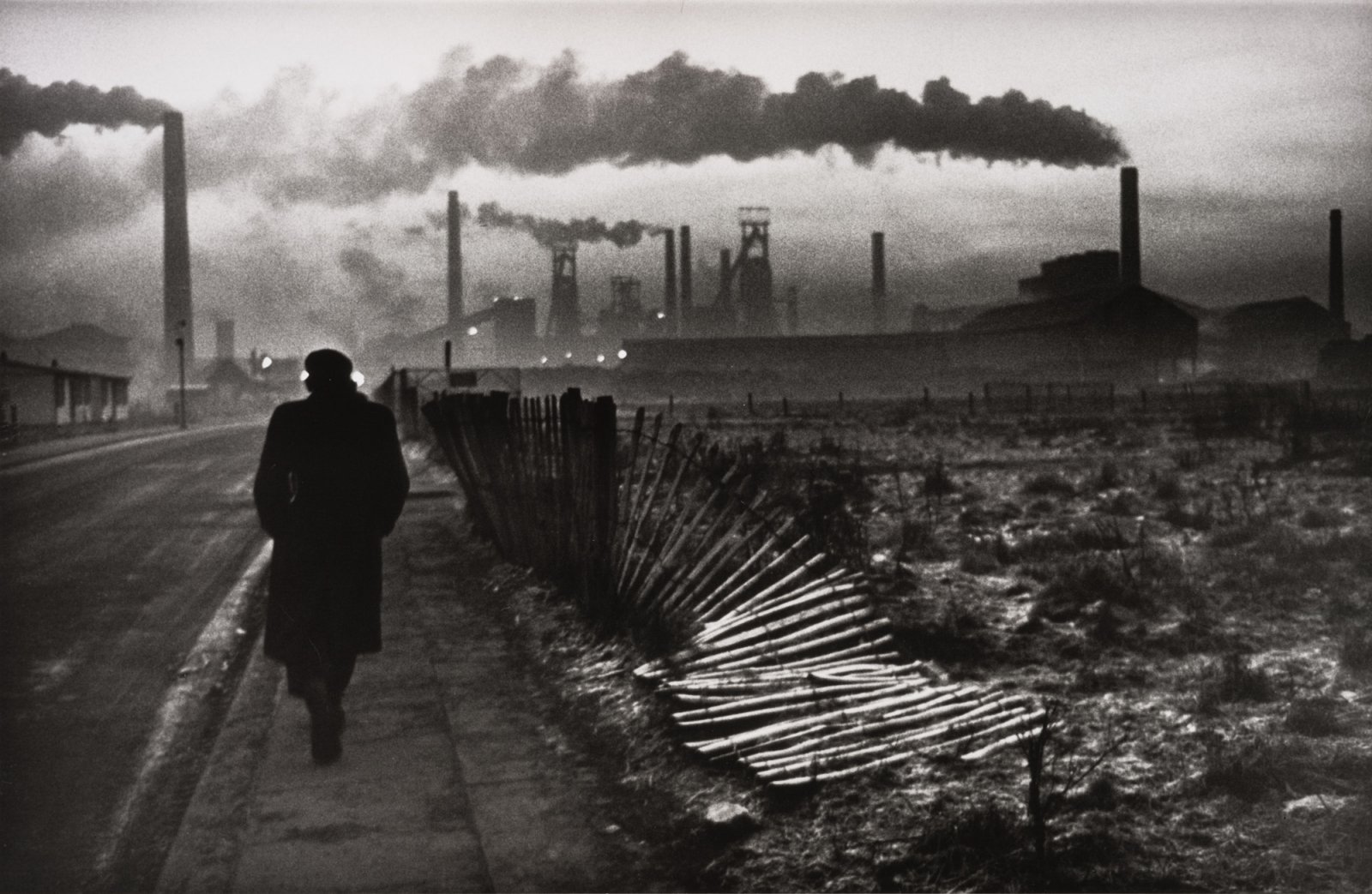
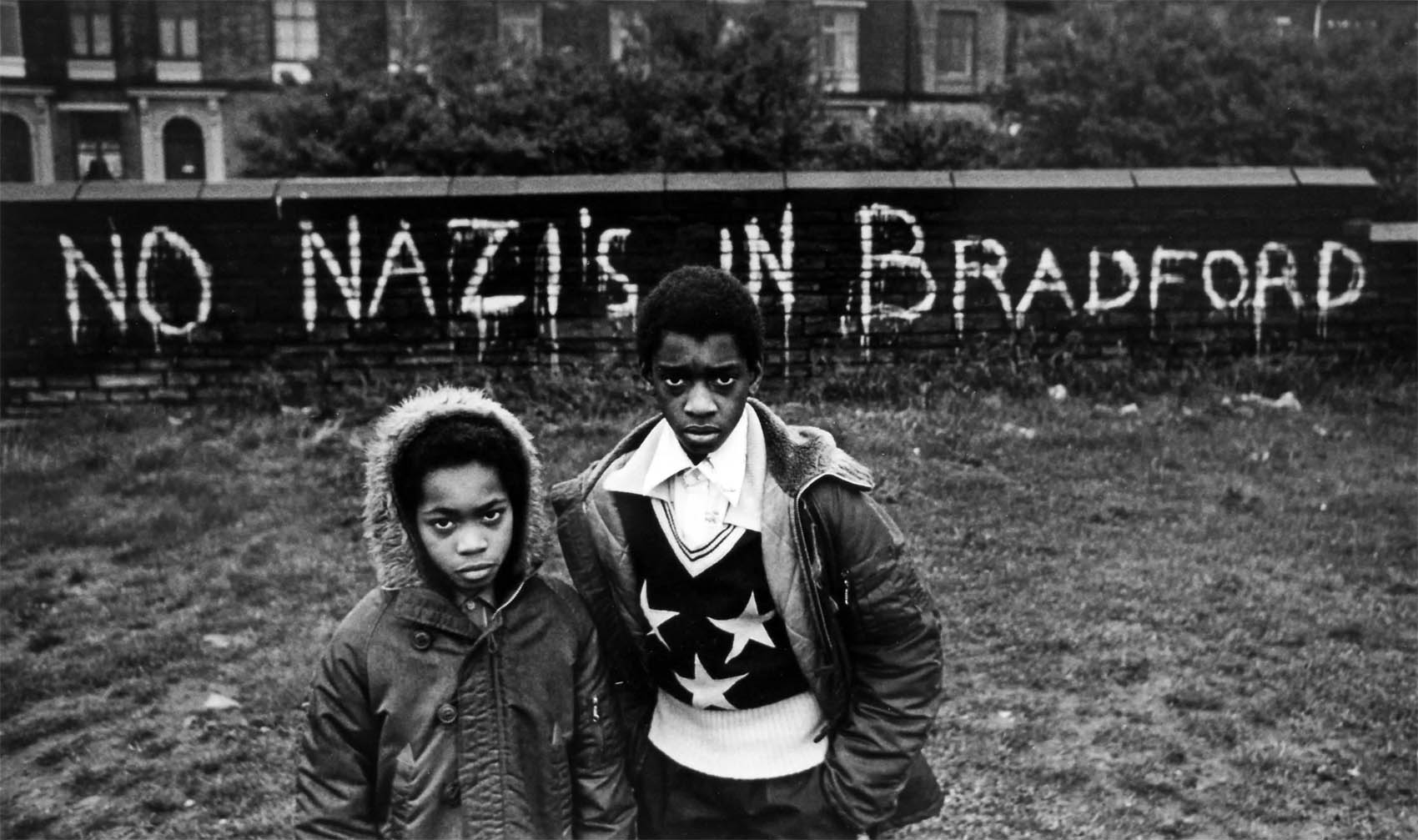
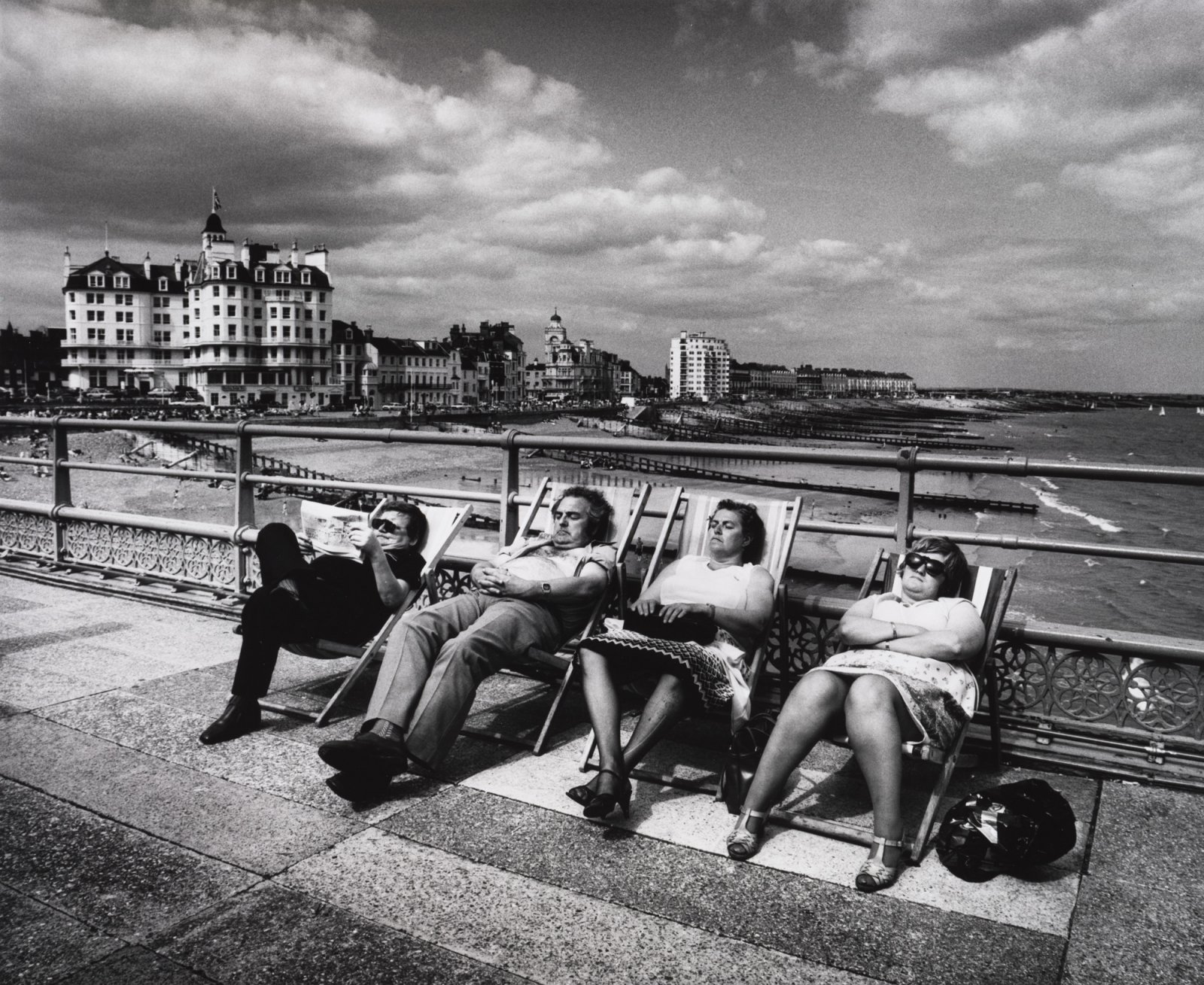
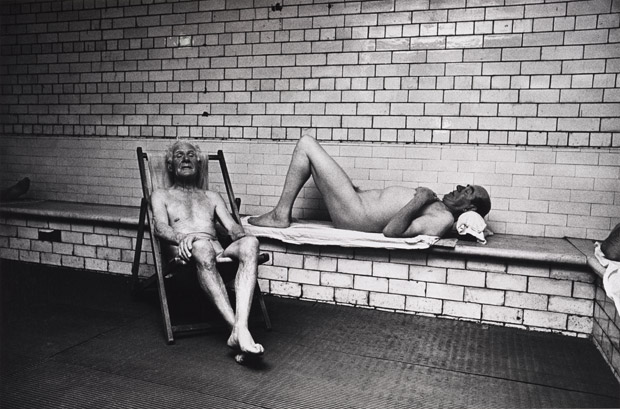
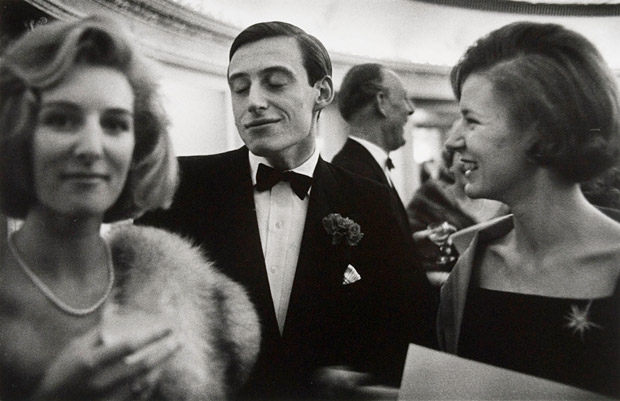
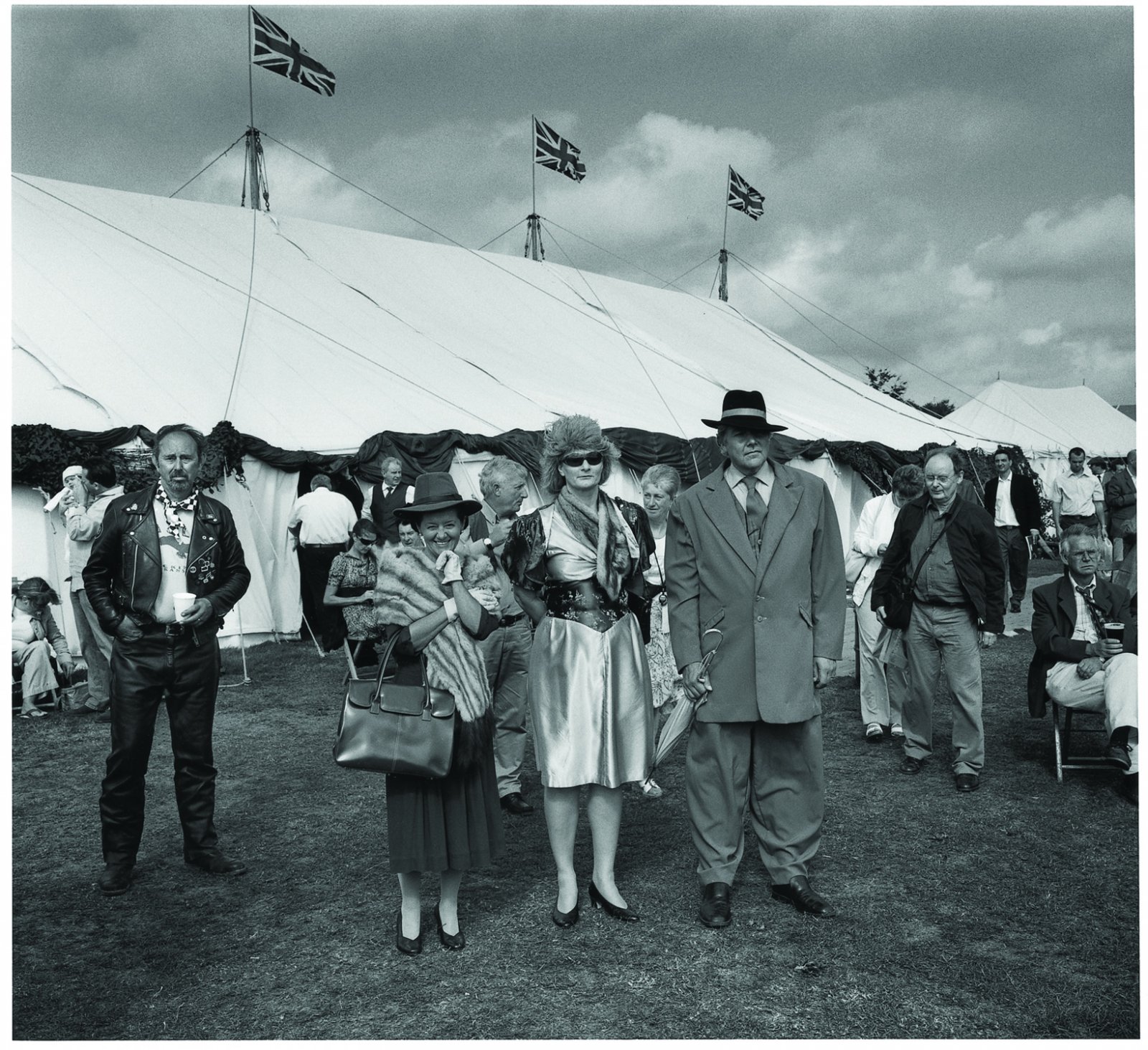
A passionate and personal view of England by one of our greatest living photographers, In England reflected on England from the 1950s to the present day. For half a decade McCullin recorded images of England, highlighting issues surrounding wealth, race, class and social justice. This was the first ever exhibition dedicated exclusively to this aspect of his work.
The images, taken mainly from two books – Homecoming (1979) and In England (2007) – are often imbued with their social or political context. Several exhibited photographs were taken during McCullin’s trips to Bradford and around his own home city, London, as well as Liverpool and the North East. The exhibition also included McCullin’s first ever published photograph, The Guv’nors.
Dr Marcus Bunyan
Many thankx to the National Media Museum for allowing me to publish the photographs in the posting. Please click on the photographs for a larger version of the image.
A passionate and personal view of Britain by one of our greatest living photographers is being showcased in a major free-to-enter exhibition at the National Media Museum from 8 May – 27 September 2009.
Don McCullin – In England reflects on Britain from the 1950s to the present day. For half a decade McCullin, in addition to travelling the world photographing war ravaged countries to great acclaim, has been recording England and highlighting issues surrounding wealth, race, class and social justice.
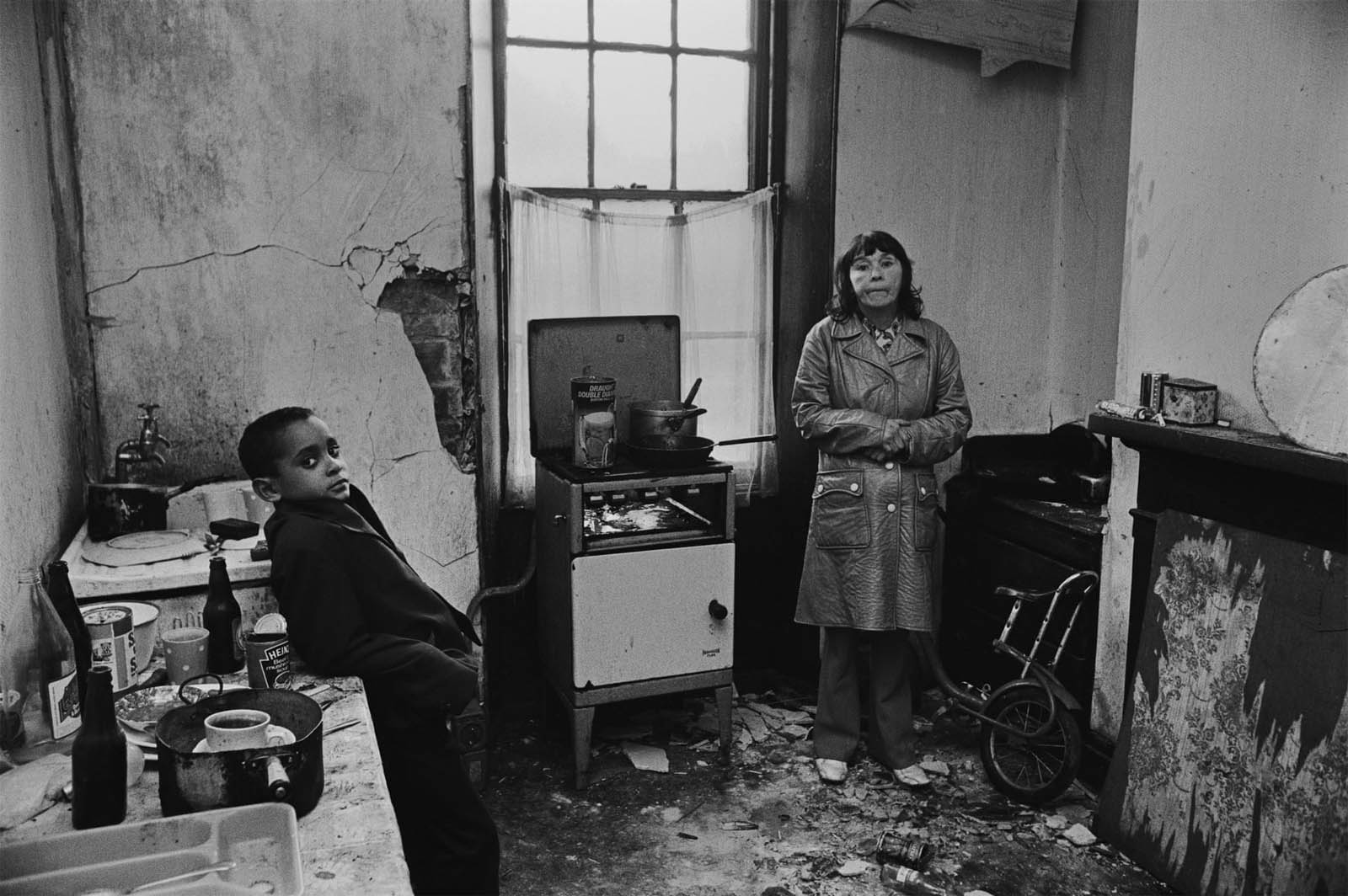
The National Media Museum is hosting the first ever exhibition dedicated exclusively to this aspect of his work. Curator Colin Harding said: “Although Don is probably best known for his war photography, he is not purely a war photographer and does not class himself as such. However, many of the 70 black and white images displayed in this new show are clearly influenced by his experiences abroad. Don’s vision of England is not a pretty one. He photographed what he saw and what he saw was often harsh – poverty, unemployment, discrimination, but he always photographs with passion and empathy.”
Many of the images have a political or social context and are taken extensively from two books – Homecoming (1979) and In England (2007); coincidentally published in the same years Margaret Thatcher came to power and Tony Blair left power respectively. Some of the images will be publicly displayed for the first time.
Don McCullin – In England gives audiences the chance to see his first ever published photograph – of The Guv’nors, a 1950s gang from his neighbourhood around Finsbury Park, London. The picture appeared in The Observer newspaper after a policeman was murdered by one of the gang members.
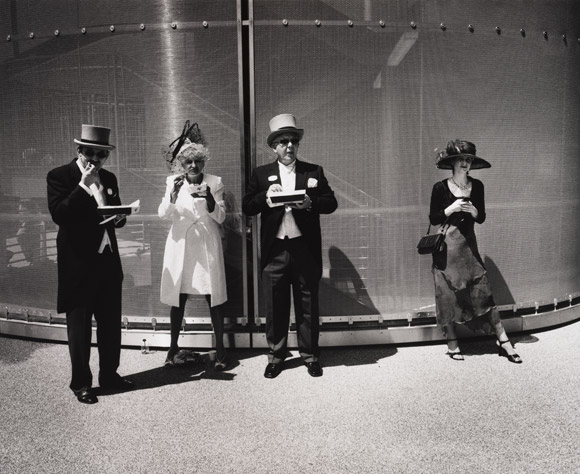
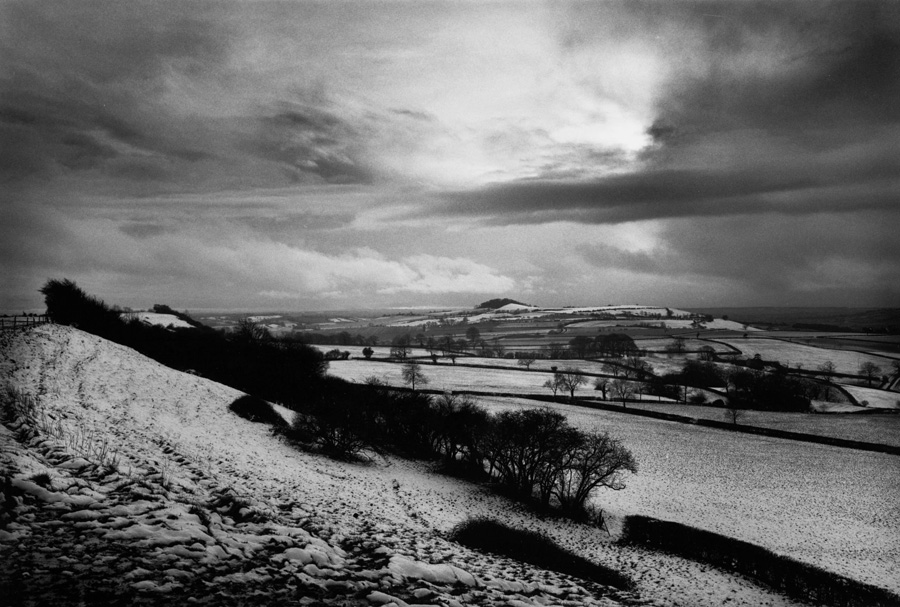
Several exhibited photographs were taken during McCullin’s trips to Bradford (the National Media Museum’s home city) and around his own home city, London, as well as Liverpool and the North East. Other aspects of English life are featured – a series of landscapes, including a study of Hadrian’s Wall taken earlier this year, a 1968 shoot with The Beatles, and trips to the seaside and Royal Ascot.
To complement the exhibition a new area will be produced on the Museum’s website offering exclusive video interviews, images, further information, and links to other relevant websites.
Text from the National Media Museum website Nd [Online] Cited 12/09/2009 no longer available online
Photographer Don McCullin on his early years In 2009 Don McCullin spoke to us about his early years as part of his In England exhibition at the museum.
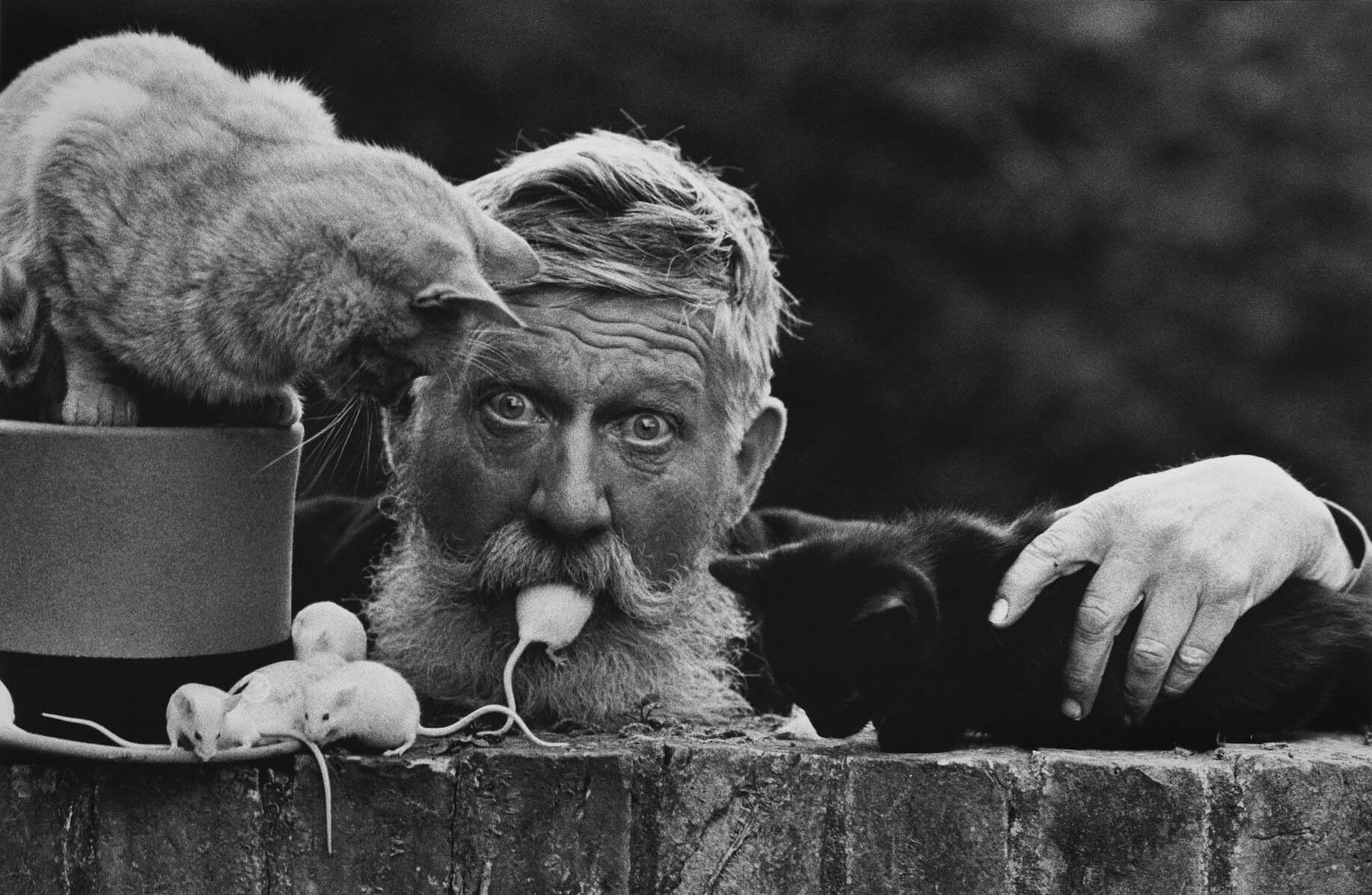
According to McCullin, a postcard of this photograph sold ‘like hotcakes’ in Australia. McCullin found Snowy, the man in the portrait, standing by the side of the road with an ice-cream barrow in Cambridge, in the early 1970s. He pulled the mouse out of his pocket and put it into his mouth as McCullin took pictures.
Exhibition dates: 3rd September – 3rd October, 2009
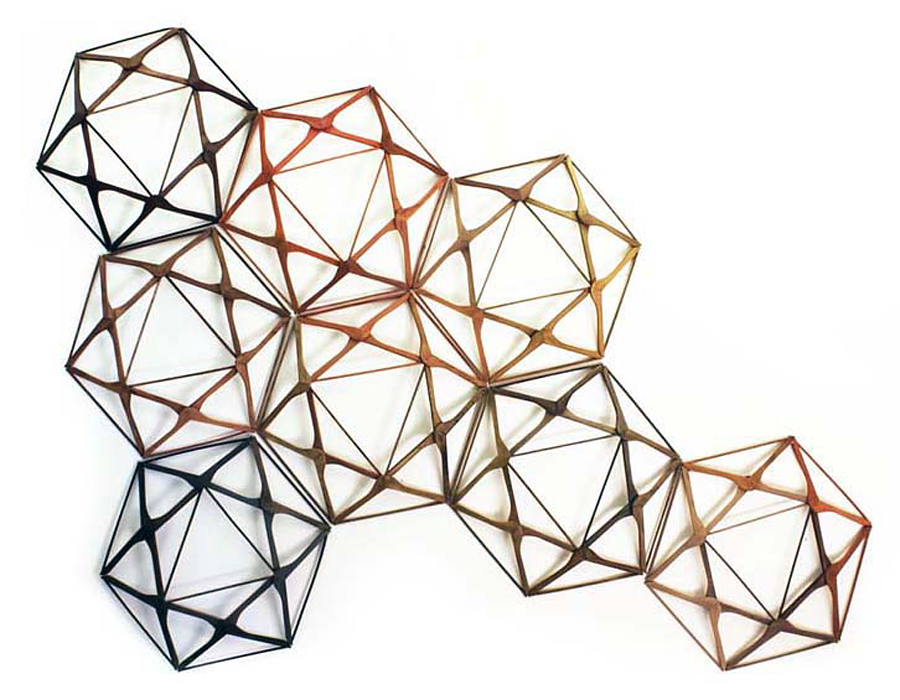
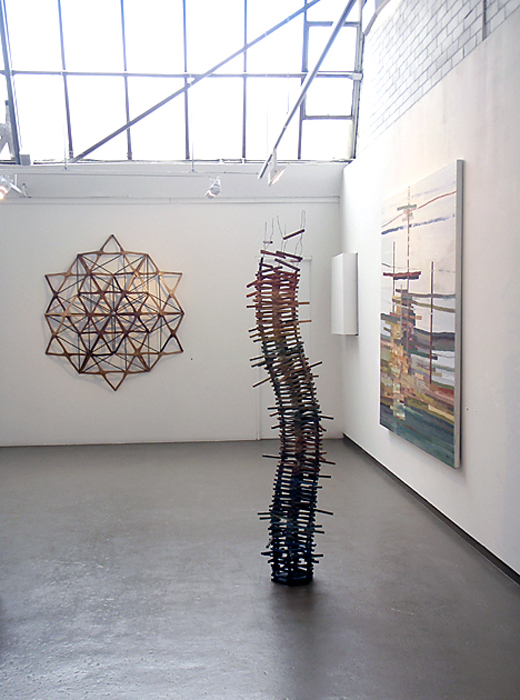
Lyndal Hargrave (Australia, b. 1959) Sacred Geometry 2009 Acrylic painted timber coat hangers, screws, staples 180 x 170cm Photo: Marcus Bunyan
This is a mixed bag of an exhibition by Lyndal Hargrave at Anita Traverso Gallery in Richmond, Melbourne.
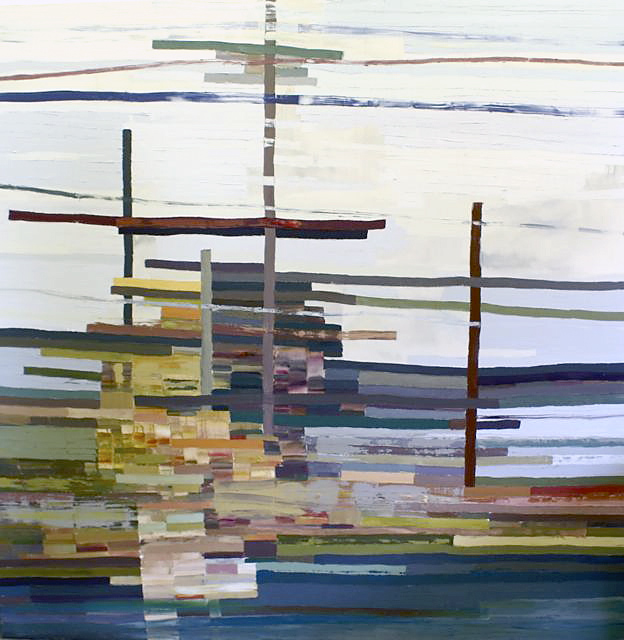
Despite one outstanding painting Breathing Space (2009, see below), the view from the back of the artist’s house onto a jetty with attendant wooden posts and sky, the other paintings are the weakest elements of the exhibition, lacking the strength and resonance of the sculptural work.
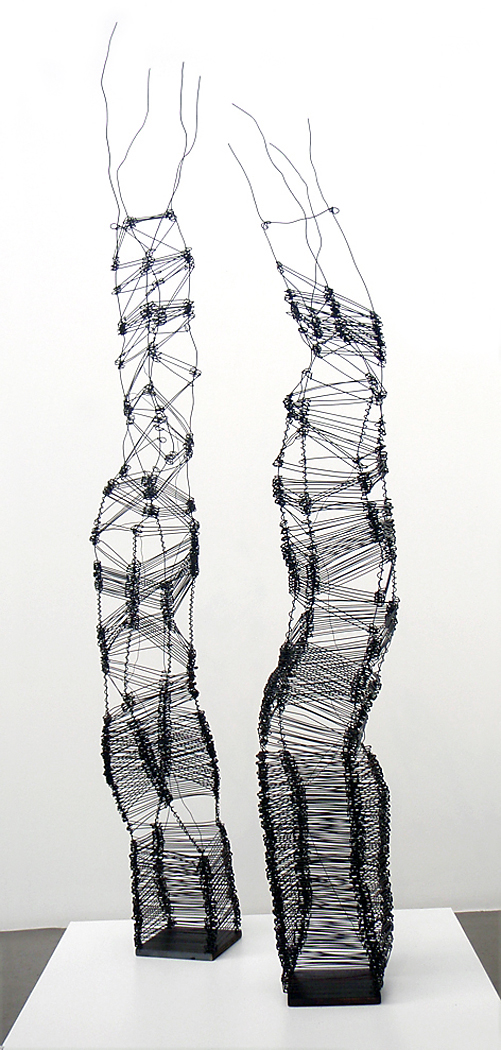
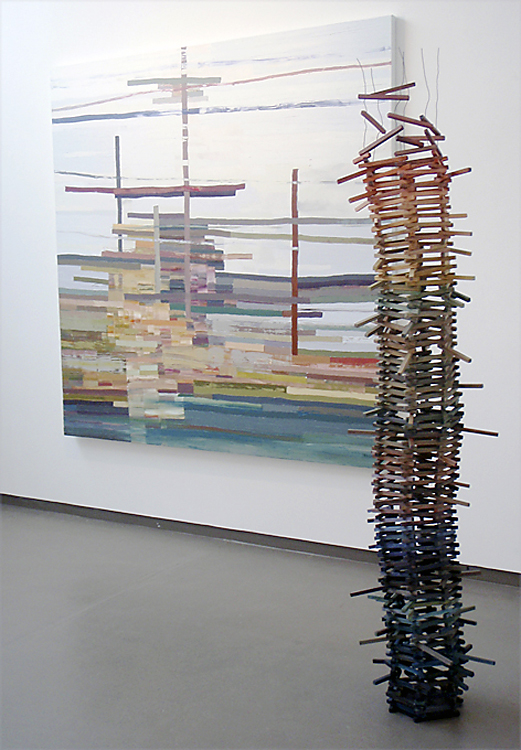
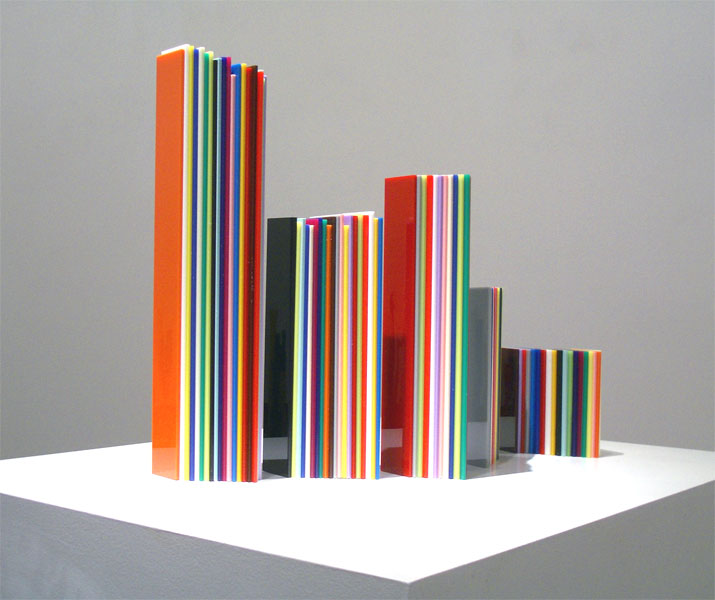
The two standing towers, Hairpin Dragons I & II and Jacob’s Ladder (both 2009, see below) are stronger work, Jacobs Ladder imitating the form of the painting Breathing Space in three-dimensional Cuisenaire-type coloured rods (see the installation photograph of the two pieces below).
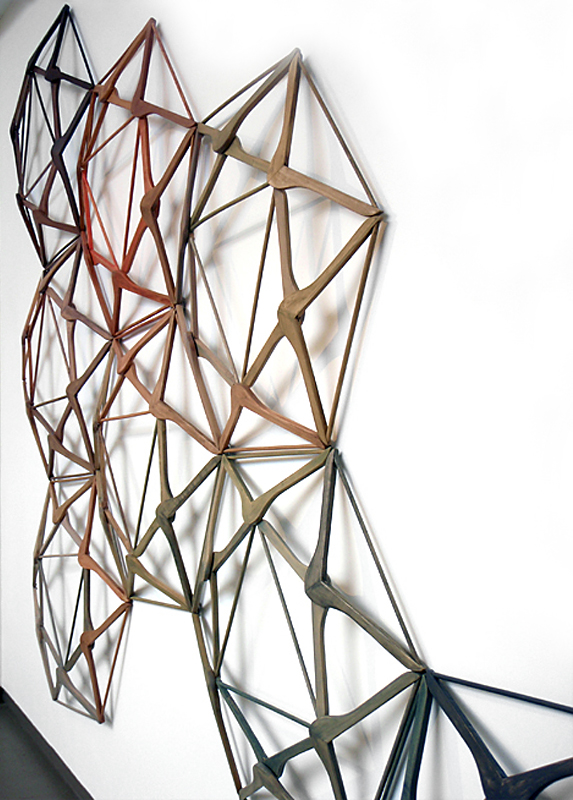
The best pieces in the exhibition are the wall mounted geometric, mandala-like sculptures made of wooden coat hangers. Delicately shifting patterns take the micro cellular form and make it macro, their patterns of construction offering a pleasing visual balance that is both complex, layered and innovative at one and the same time. As explorations of the notion of the universal structure, the golden ratio, they reward repeated viewing.
As the exhibition stands there are too many little pieces to make a holistic whole. Perhaps an exhibition solely of the towers or geometric pieces would have been stronger. I look forward to seeing how the geometric pieces (d)evolve in future work. Will the structures break down and reassemble in other marvellous incantations? I hope so!
Dr Marcus Bunyan
Many thankx to Anita Traverso Gallery for allowing me to publish the art work in the posting. Please click on some of the photographs for a larger version of the image.
Lyndal Hargrave (Australia, b. 1959) Arabesque 2009 Acrylic painted timber coat hangers, screws, staples 200 x 360cm Photo: Marcus Bunyan
Lyndal Hargrave (Australia, b. 1959) Arabesque (detail) 2009 Acrylic painted timber coat hangers, screws, staples 200 x 360cm Photo: Marcus Bunyan
Lyndal Hargrave (Australia, b. 1959) Hairpin Dragons I & II 2009 Wire, formply 170 x 15cm (varying) Photo: Marcus Bunyan
“It is a constant idea of mine that behind the cotton wool (of daily reality) is hidden a pattern, that we – I mean all human beings – are connected with this: that the whole world is a work of art; that we are parts of the work of art.”
~ Virginia Woolf
For as long as I can remember, my art practice has served as a filter between the outside world and my inside world. I realise now that the act of making the artwork informs my ideas rather than the other way round. Working intuitively results in a continuous stream of surprises that in retrospect mirror the pressing issues surrounding me at that time.
In All the Little Pieces my fascination with patterns of construction from micro to macro and natural to man-made continues. My work explores the gap between order and chaos and helps me to understand the meaning of balance.
Using mundane found objects, my sculptures probe the possibility of re-invention through the way the componentry of human habitation can be re-configured to offer us a new way of seeing and experiencing our world.
It is this process of metamorphosis that is at the centre of my investigation: how life forms make the transition from one state to another – tree to timber to tower or talisman; why some systems remain strong and others crumble.
Overarching my work is the notion of universal structure and the geometry that has informed our evolution from molecule to macro-system.”
Lyndal Hargrave 2009
Text from the Anita Traverso Gallery website
Lyndal Hargrave (Australia, b. 1959) Whirlpool Galaxy and The Samarian Star 2009 Acrylic painted timber coat hangers, screws, staples Photo: Marcus Bunyan
Installation view of the Lyndal Hargrave exhibition at Anita Traverso Gallery Photo: Marcus Bunyan
Photograph showing the relationship of form and colour between the work Jacob’s Ladder (2009) and the painting Breathing Space (2009) Photo: Marcus Bunyan
Lyndal Hargrave (Australia, b. 1959) Breathing Space 2009 Oil on canvas 200 x 200cm
Anita Traverso Gallery
The physical gallery has now closed.
PO Box 7001, Hawthorn North 3122 Phone: 0408 534 034 Email: art@anitatraversogallery.com.au
Exhibition dates: 25th August – 19th September, 2009
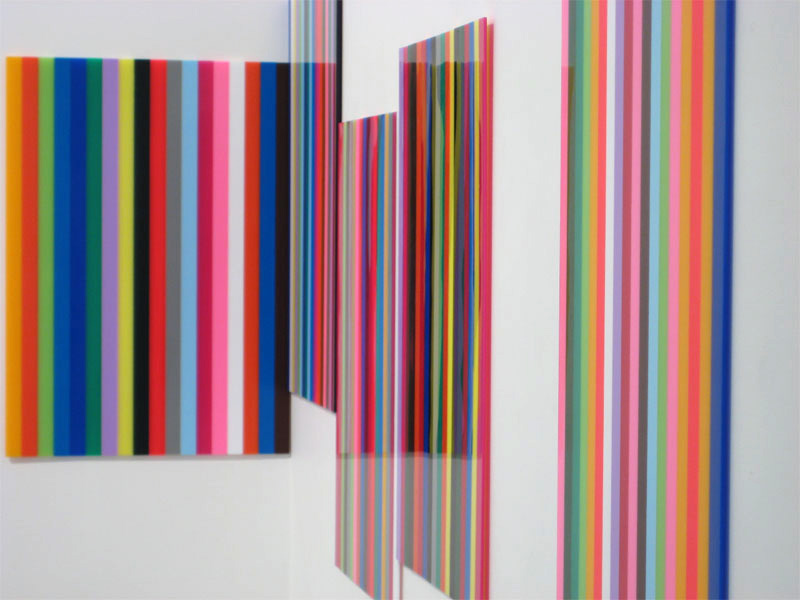
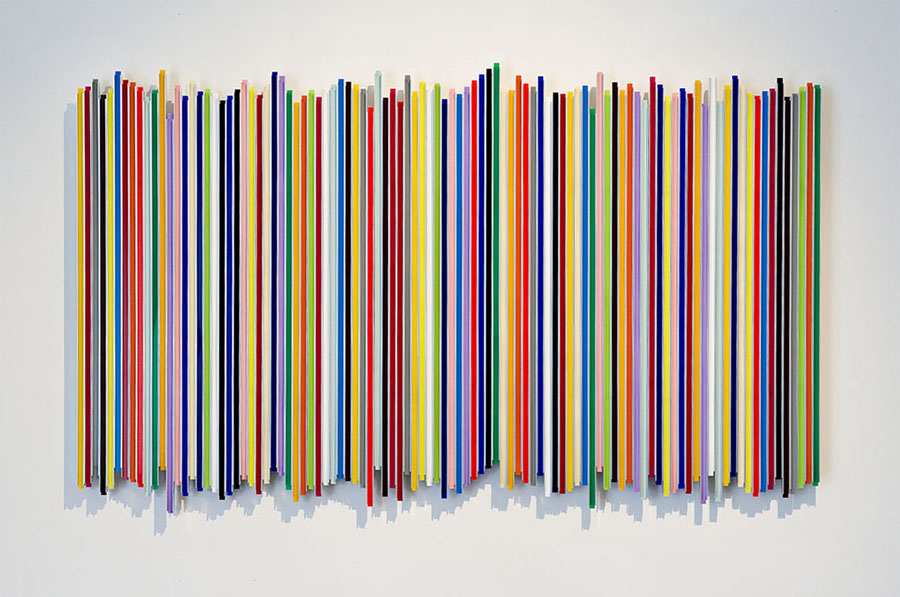
John Nicholson (Australian, b. 1970) Aerial Navigation 2009
You could say that the essence of the cosmos is not matter, it is consciousness.
It is not the external world that is real – it is “maya”, an illusion, for the real world lies within.
These works, with their striations, strata and suspension are emanations of that spirit – projections of the inner reality.
In terms of the ancient Chinese philosophy Lao Tzu we dream the butterfly and the butterfly is us. If you don’t ‘get’ these works, let go all pretensions and feel their colour as sound, as vibrations of energy.
Submerge yourself in their shape and form. Like DNA structure, a heart beat or the record of a seismic shock these works are music as art, the length of harmony quivering and slipping in our minds, before our eyes.
This is the colour music of Roy De Maistre’s paintings of the 1930’s updated to the 21st century. They are fugues of sound made physical entities, intertwining, coming and going. Here lines, tones and colours are organised in a parallel way – tone after tone, line after line. They are wavelengths of the interior made visible. The connection is solid and fluid at one and the same time; there are many connections to be discovered, many journeys to be made.
I hear them, I like them.
Dr Marcus Bunyan
Many thankx to Sophie Gannon Gallery for allowing me to publish the photographs in the posting. Please click on the photographs for a larger version of the image.
John Nicholson (Australian, b. 1970) Under the radar 2009 Photo: Marcus Bunyan
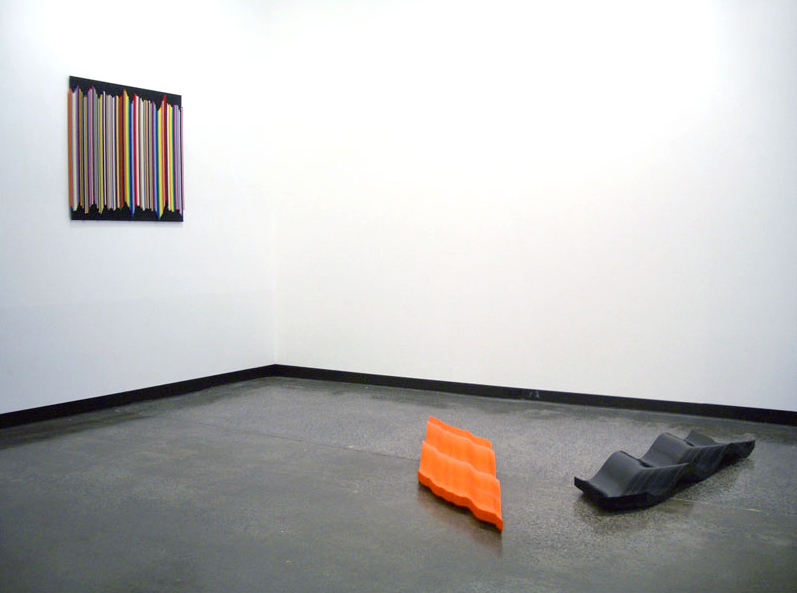
Installation views of Connection is Solid by John Nicholson at Sophie Gannon Gallery Photos: Marcus Bunyan
John Nicholson (Australian, b. 1970) Thrill seeker (detail) 2009 Photo: Marcus Bunyan
Roy de Maistre (Australian, 1894-1968) Arrested Movement from a Trio 1934 Oil and pencil on composition board 72.3 × 98.8cm
John Nicholson (Australian, b. 1970) Slip 2009
John Nicholson (Australian, b. 1970) The wire might sense 2009
John Nicholson (Australian, b. 1970) Swoop 2009 Photo: Marcus Bunyan
Installation view of Connection is Solid by John Nicholson with on the wall Satellite Graffitti (2009) and on the floor Cascade (2009) and Swoop (2009) Photo: Marcus Bunyan
Sophie Gannon Gallery 2, Albert Street, Richmond, Melbourne
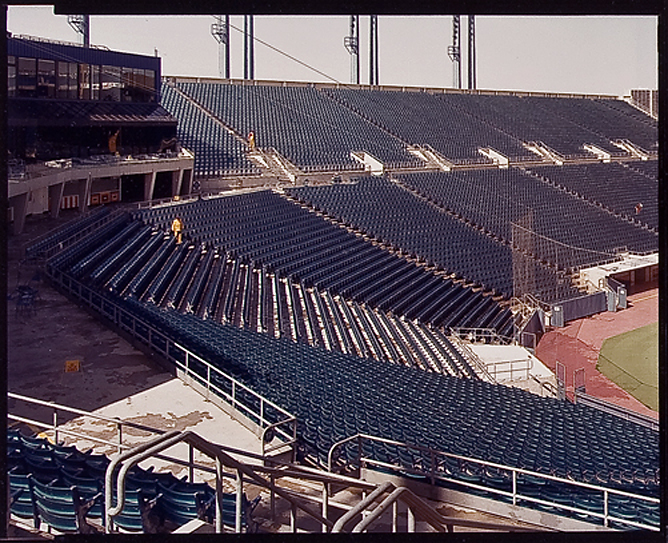
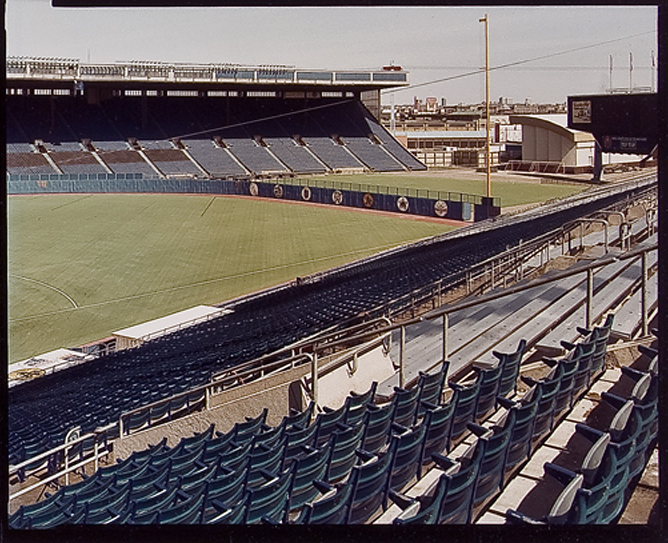
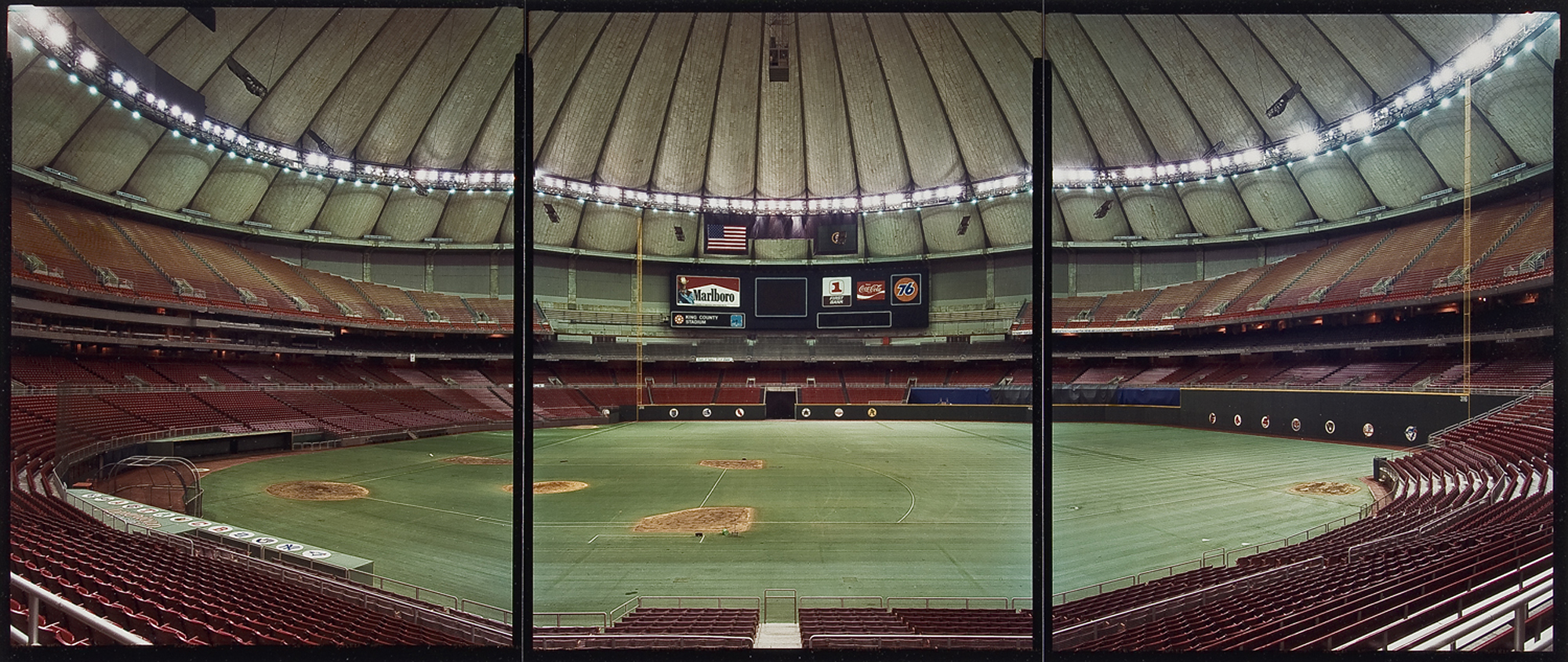
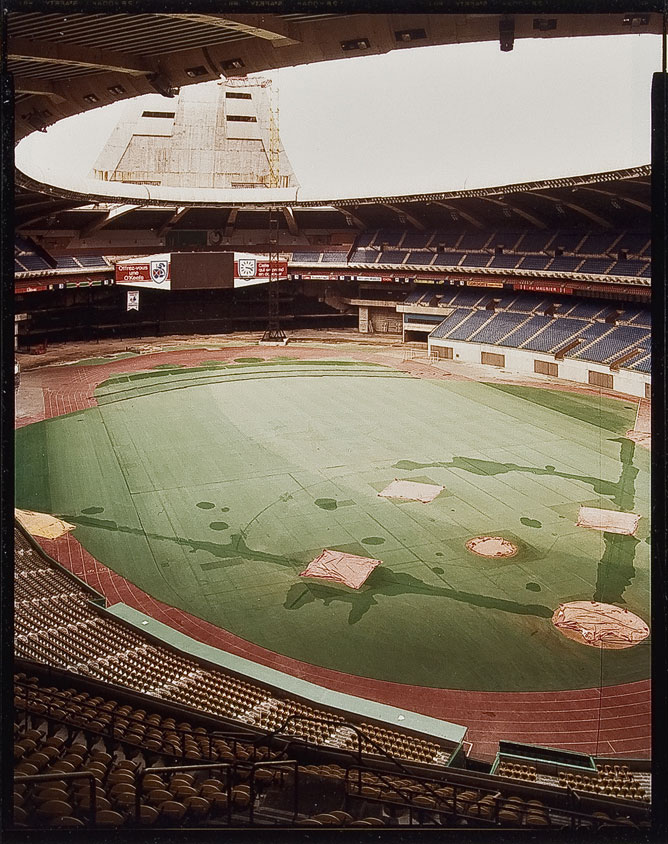
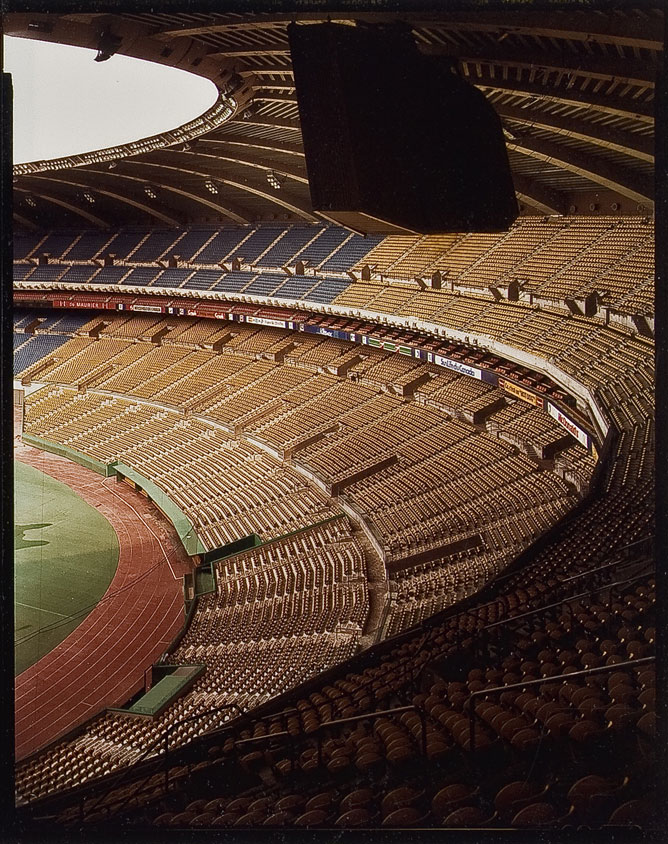
Jim Dow (American, b. 1942) Exhibition Stadium 1982 National Gallery of Canada, Ottawa Gift of Benjamin Greenberg, Ottawa, 1988 and 1989
These feel like religious reliquaries, a triptych form which arises from early Christian art but here a paean to the monumentalisation of sport, architecture, human heroics and grandiosity.
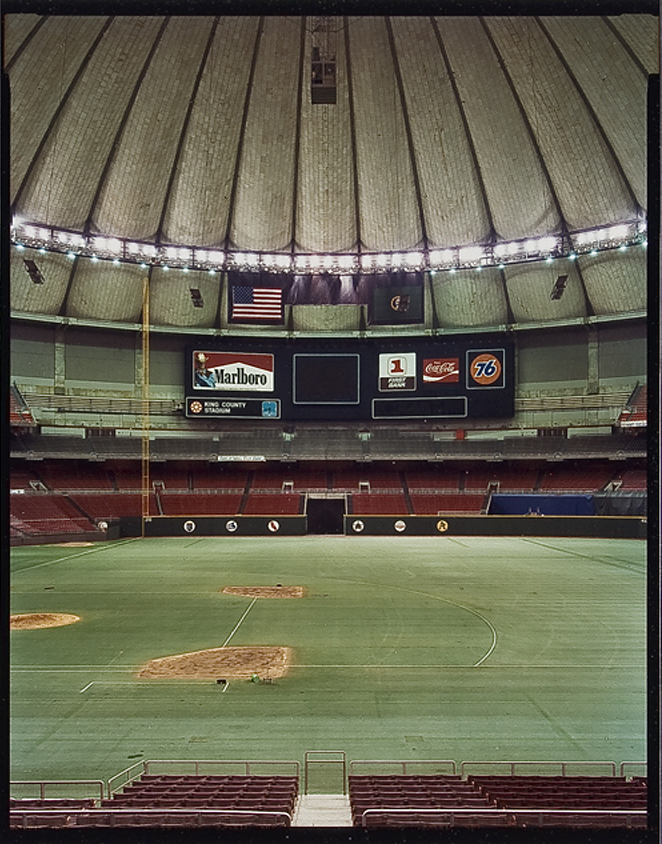
Apologies that the blog is not wide enough to display these panoramic images at a decent size but you can click on the photographs to see a larger version of the image. I have also displayed each 8″ x 10″ negative sequentially.
Dr Marcus Bunyan
Many thankx to The National Gallery of Canada for allowing me to publish the photographs in the posting. Please click on the photographs for a larger version of the image.
Jim Dow (American, b. 1942) Exhibition Stadium (individual frames) 1982 National Gallery of Canada, Ottawa Gift of Benjamin Greenberg, Ottawa, 1988 and 1989
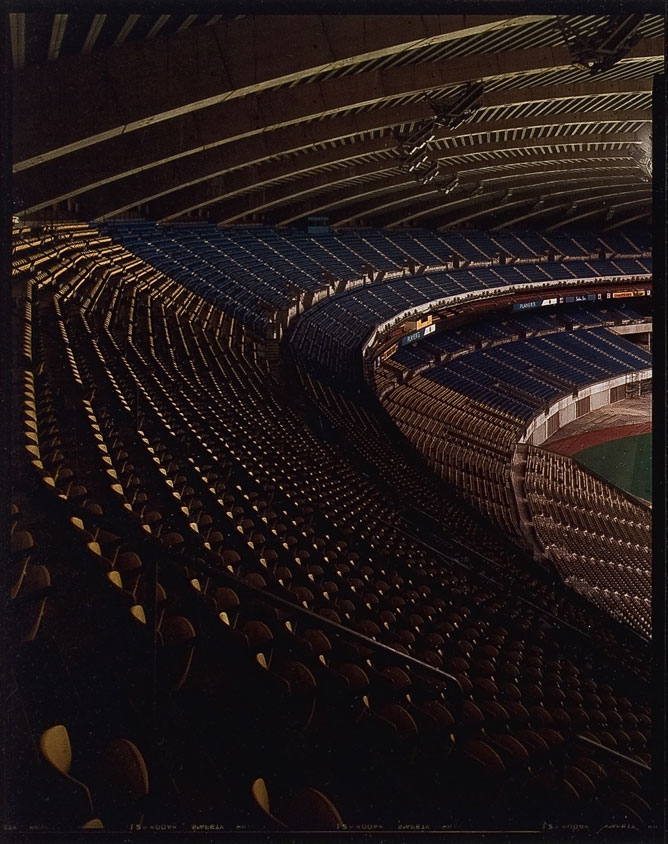
This installation from the National Gallery’s Collection of Photographs comprises 26 colour panoramic views of empty baseball stadiums across North America, from Exhibition Stadium, the home of the Toronto Blue Jays, and Montréal’s Olympic Stadium to the Houston Astro’s Astrodome. Taken in 1982, Jim Dow, a respected American photographer as well as a sports enthusiast, imparts through these images both a passion for the monumentality of the architecture and its abstract geometry and his love of baseball. The emptiness of the stadiums simultaneously evokes memory and a sense of anticipation.
Jim Dow’s interest in those places where people enact their everyday rituals, from the barbershop to the baseball park, has guided the path of his photographic career. Dow is concerned with capturing “human ingenuity and spirit” in endangered regional traditions – a barbershop with a heavy patina of town life covering the walls, the opulent time capsule of an old private New York club, the densely packed display of smoking pipes in an English tobacconist shop – all artefacts of a vanishing era.
Dow earned a B.F.A. and a M.F.A. in graphic design and photography from the Rhode Island School of Design in 1965 and 1968 respectively. An early influence was Walker Evans’s seminal book American Photographs (1938). Dow recalls the appeal of Evans’s “razor sharp, infinitely detailed, small images of town architecture and people. What stood out was a palpable feeling of loss … pictures that seemingly read like paragraphs, even chapters in one long, complex, rich narrative.” Soon after graduate school Dow had the opportunity to work with Evans. He was hired to print his mentor’s photographs for a 1972 Museum of Modern Art retrospective.
Dow has taught photography at Harvard, Tufts University and the School of the Museum of Fine Arts, Boston, and his work has been widely exhibited. Among his series is Corner Shops of Britain (1995), which features facades of small family-run businesses: vitrine-like shop windows showcase goods from candy jars to jellied eels. Another series, Time Passing (1984-2004), captures North Dakota “folk art” such as rural road signage, hand-painted billboards, and ornate gravestones.
Dow first gained attention for his panoramic triptychs of baseball stadiums, a project that began with an image he made of Veteran’s Stadium in Philadelphia in 1980. Using an 8 x 10″ camera, he has documented more than two hundred major and minor league parks in the United States and Canada.”
Text from Artdaily.org website [Online] Cited 17/04/2019
Jim Dow (American, b. 1942) The Kingdome. Seattle Mariners 1982 National Gallery of Canada, Ottawa Gift of Benjamin Greenberg, Ottawa, 1988 and 1989
Jim Dow (American, b. 1942) The Kingdome. Seattle Mariners (individual frames) 1982 National Gallery of Canada, Ottawa Gift of Benjamin Greenberg, Ottawa, 1988 and 1989
Jim Dow (American, b. 1942) Olympic Stadium, Montreal 1982 National Gallery of Canada, Ottawa Gift of Benjamin Greenberg, Ottawa, 1988 and 1989
Jim Dow (American, b. 1942) Olympic Stadium, Montreal (individual frames) 1982 National Gallery of Canada, Ottawa Gift of Benjamin Greenberg, Ottawa, 1988 and 1989
National Gallery of Canada 380 Sussex Drive P.O. Box 427, Station A Ottawa, Ontario Canada K1N 9N4
Hill & Adamson (Scottish, active 1843-1848) [Lane and Peddie as Afghans] 1843 Salted paper print from a paper negative 20.6 × 14.3cm (8 1/8 × 5 5/8 in.) The J. Paul Getty Museum
The team of Hill and Adamson initially began making dramatic portrait photographs as studies for one of Hill’s composite paintings. They also produced costume studies, including this scene in which Arabic scholar Mr. Lane and Mr. (Peddie) Redding appear in foreign garb.
What a fabulous selection of photographs to illustrate a fascinating “scene”. I love staged, theatrical, constructed, conceptual, collaged, surreal, imaginary, narrative photography.
Dr Marcus Bunyan
Many thankx to the J. Paul Getty Museum for allowing me to publish the photographs in the posting. Please click on the photographs for a larger version of the image.
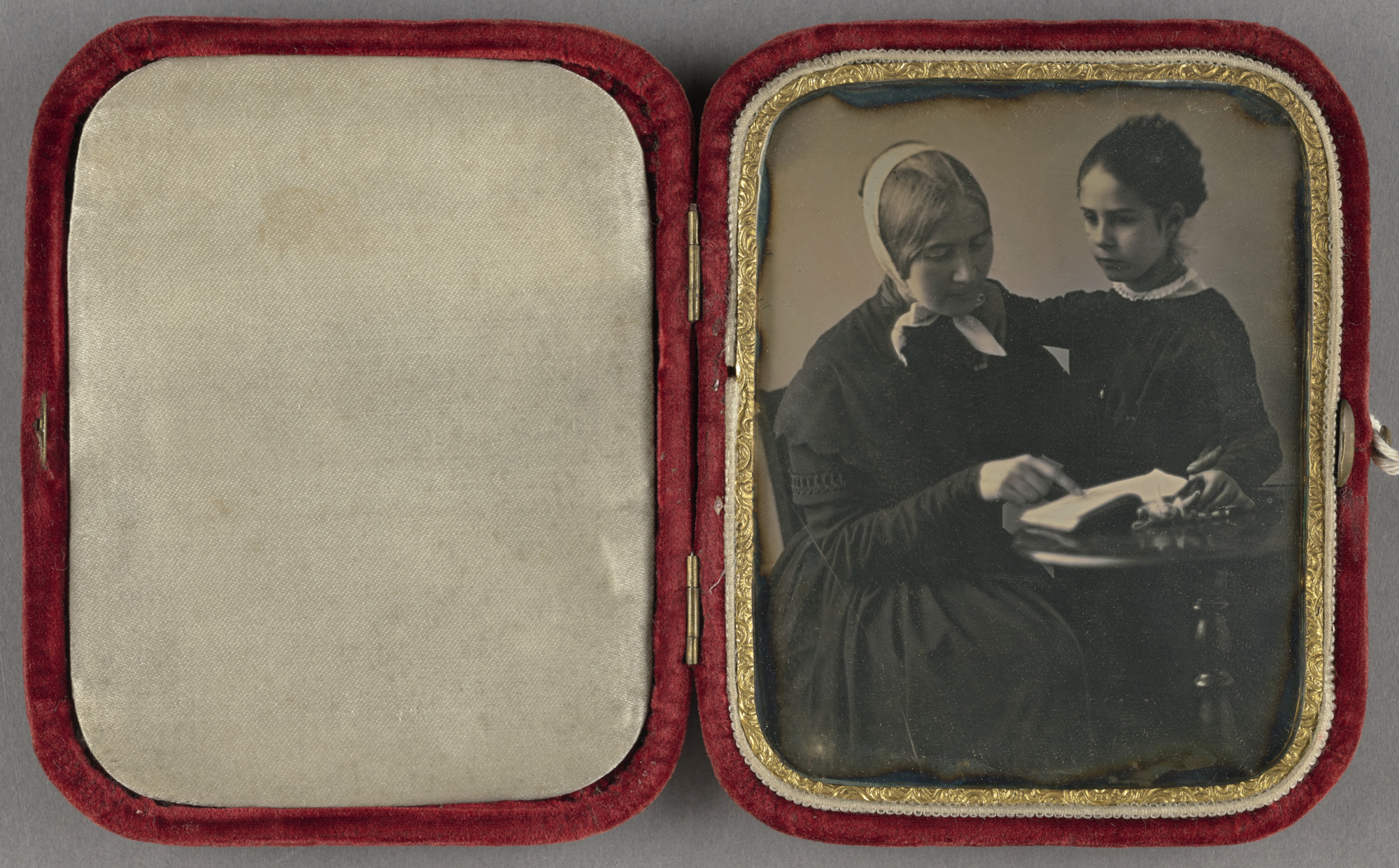
Unknown maker, French Woman Reading to a Girl c. 1845 Daguerreotype 9.1 × 7.1cm (3 9/16 × 2 13/16 in.) The J. Paul Getty Museum
Through a skilful manipulation, the light coming from above and behind the figures casts the faces of mother and child in a softly modulated half-shadow. Their close grouping and familiar, intimate gestures evoke tenderness. The reflected light on the woman’s pointing finger and on the glowing white pages of the open book forms a strong visual triangle, drawing the viewer’s eye and serving to integrate and balance the composition.
Oscar Gustave Rejlander (British born Sweden, 1813-1875) The Infant Photography Giving the Painter an Additional Brush c. 1856 Albumen silver print 6 × 7.1cm (2 3/8 × 2 13/16 in.) The J. Paul Getty Museum
Oscar Rejlander’s photograph could be read as a metaphor of his own career. The additional “brush” or image-making tool provided by photography to painters was evident from the beginnings of the medium. Many early practitioners arrived at photography from painting, as did Rejlander. Photographs were often thought of and used as sketching tools for painters. Although photographs never managed to signal the death of painting as initially predicted, they did frequently assume the function that drawing had traditionally held in relation to painting.
Compositionally, this is an unusual photograph. Rejlander employs a narrative device from painting: the use of figures, or parts of figures, as allegorical representations for ideas. A very young child represents the infant medium of photography. The Painter appears only as a hand extending into the frame at the upper left, although the traditional arts are also represented by the sculpture reproduction in the lower left corner. The Infant Photography, identified by the camera on which the child supports himself, faces away from the camera, his features totally obscured. The mirror behind the child gives a clear reflection of Rejlander at his camera, making this image.
Roger Fenton (English, 1819-1869) Contemplative Odalisque 1858 Albumen silver print 35.9 × 43.8cm (14 1/8 × 17 1/4 in.) The J. Paul Getty Museum Gift of Professors Joseph and Elaine Monsen
Three years after traveling in the Crimea, Roger Fenton made a series of Orientalist photographs in his London studio using props gathered during his travels and non-Eastern models. Orientalism refers to just such romanticised depictions of imagined scenes of Muslim culture in the Ottoman Empire and its territories in the Near East and North Africa.
Orientalist scenes were more often fiction than fact. Cultural biases and misunderstandings were laid down on paper or canvas and frequently became the only source of information on the subjects depicted. When a group of these Orientalist photographs was exhibited in 1858, one reviewer described them as “truly representing some phases in the life of this interesting people.”
But not everyone so easily accepted Fenton’s images at face value; a more astute critic called for “the necessity of having real national types as models.” The same model shown here also appears as “Nubian” and “Egyptian” in other photographs by Fenton. This photograph may have originally been exhibited with the title The Reverie. The odalisque, meaning a slave or concubine in a harem, poses upon her sofa. Barefoot, blouse open, her surroundings convey a sensual disarray that conforms to an Orientalising fantasy of the available woman.
Julia Margaret Cameron (British, born India, 1815-1879) The Rosebud Garden of Girls June 1868 Album silver print 29.4 × 26.7cm (11 9/16 × 10 1/2 in.) The J. Paul Getty Museum
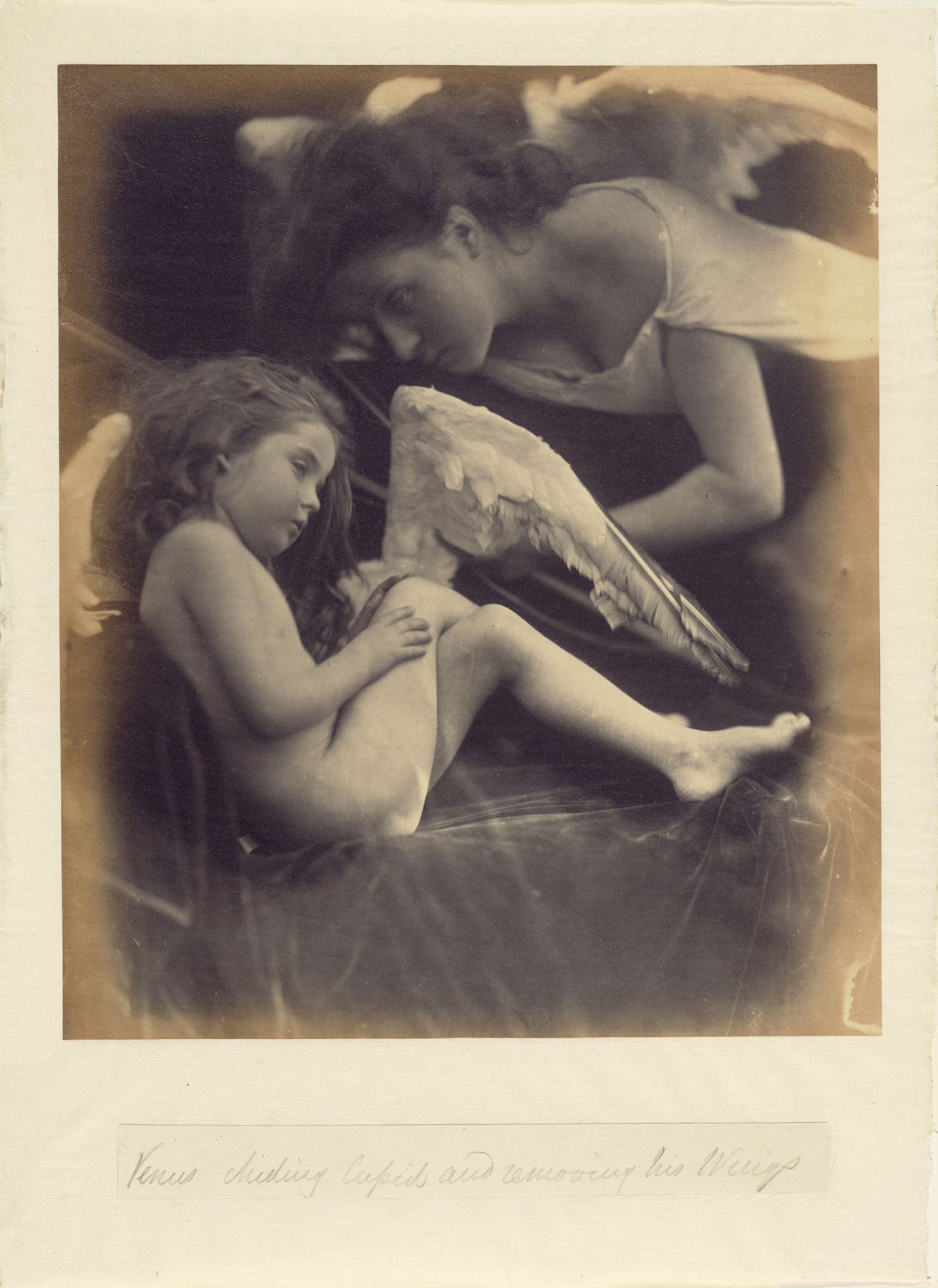
As evolutionary science and increasing secularism transformed the way Victorians understood the world, Cameron remained a devout Christian. She photographed influential public figures of her day as well as the women of her household, casting them in allegories of literary and religious subjects. Like her artistic contemporaries, the Pre-Raphaelite painters, who modelled their work on medieval religious and mythological art, Cameron intended her photographs to evince a connection between the spiritual and the natural realms.
Julia Margaret Cameron (British, born India, 1815-1879) Venus Chiding Cupid and Removing His Wings 1872 Album silver print 32.4 × 27.3cm (12 3/4 × 10 3/4 in.) The J. Paul Getty Museum
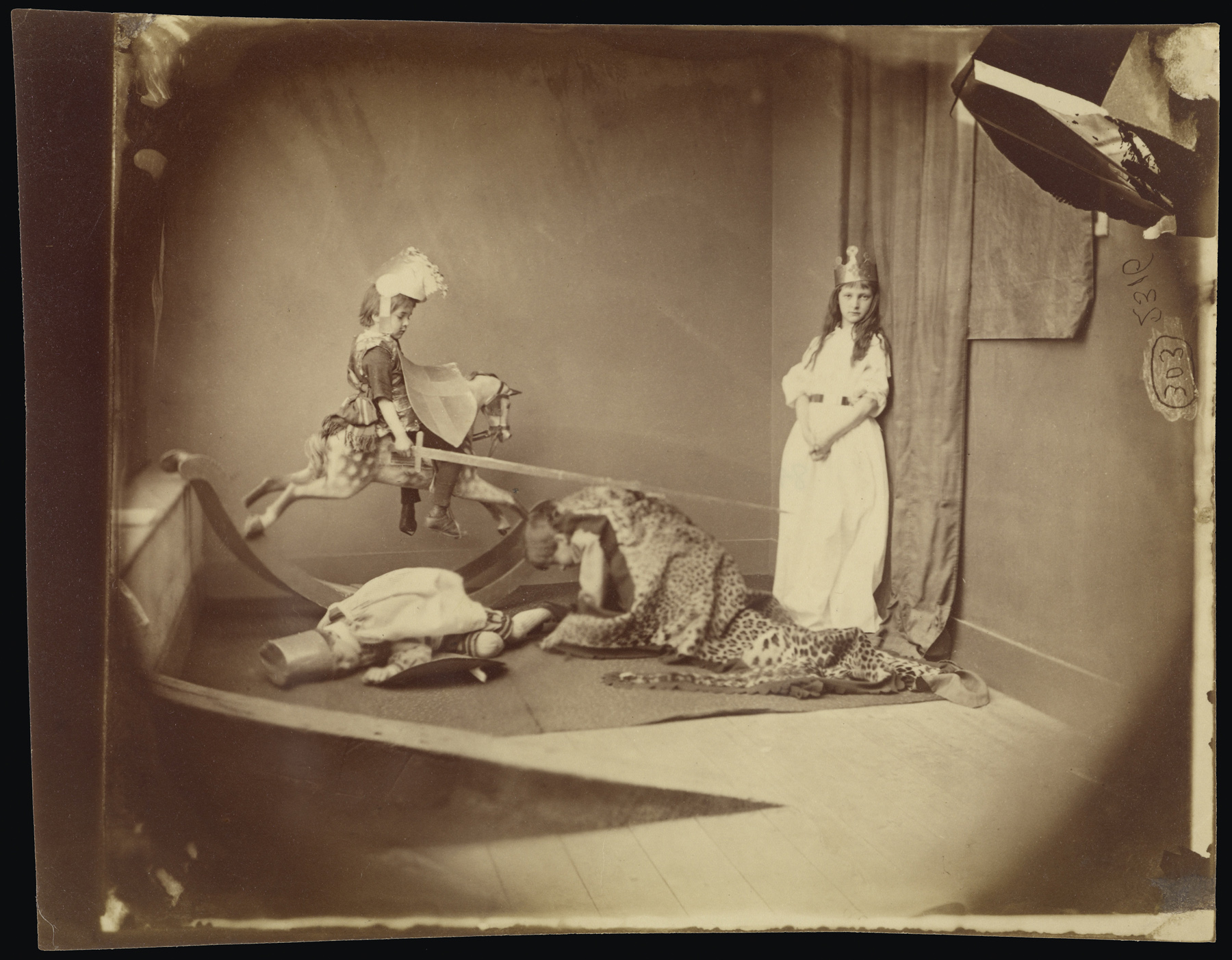
Lewis Carroll (British, 1832-1898) Saint George and the Dragon June 26, 1875 Albumen silver print 12.2 × 16.2cm (4 13/16 × 6 3/8 in.) The J. Paul Getty Museum
Like Alice’s Adventures in Wonderland and his other books, Carroll’s photographs are fantasies starring the children of his friends. In this production, the Kitchin siblings enacted the romantic legend of Saint George, the patron saint of England, who slayed a child-eating dragon before it devoured a princess. George later married the rescued princess and converted her pagan town to Christianity. Using crude stagecraft to reference key plot points, Carroll condensed the entire legend into a single scene in which the princess appears as both damsel in distress and bride.
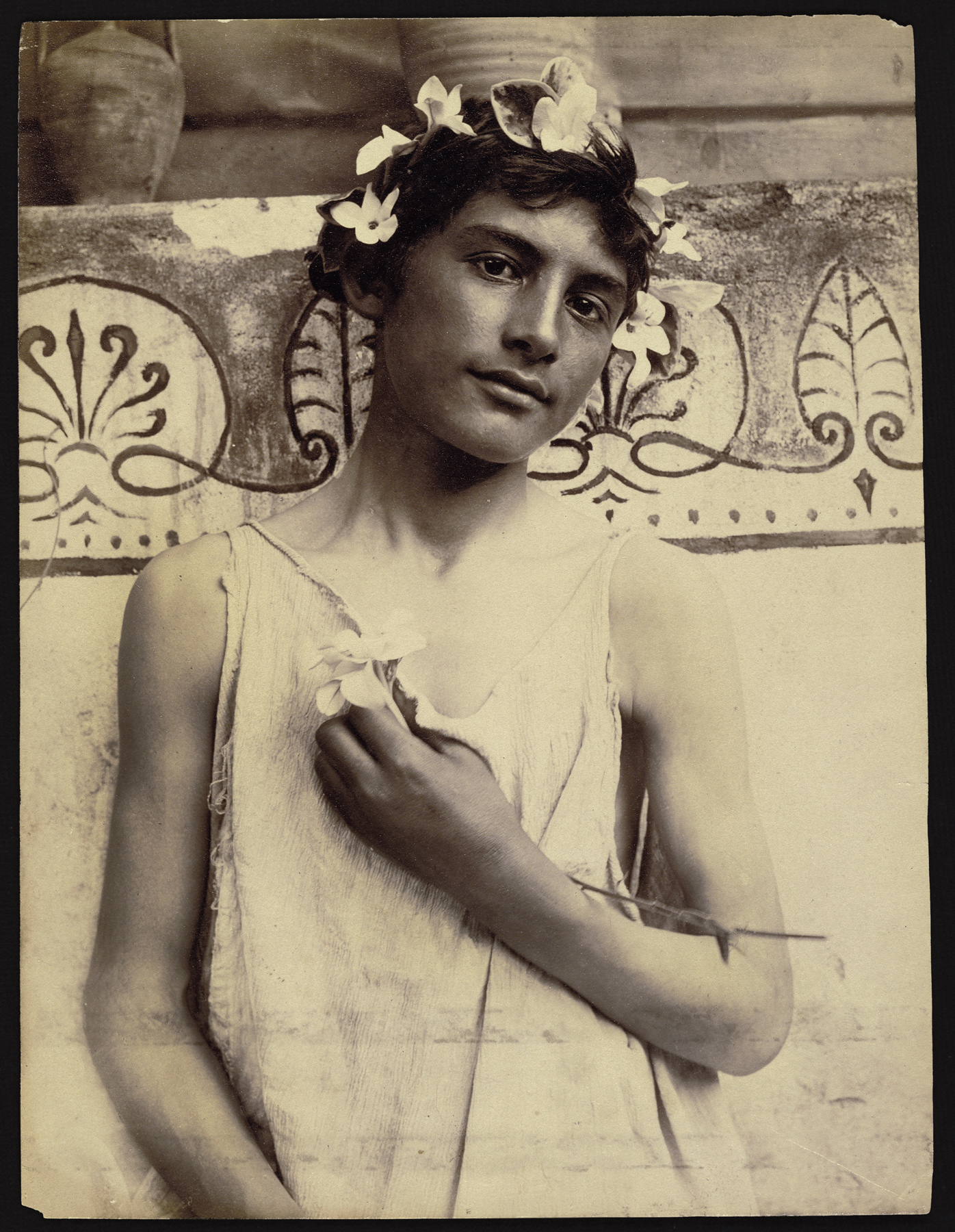
Baron Wilhelm von Gloeden (German, 1856-1931) Untitled [Two Male Youths Holding Palm Fronds] c. 1885-1905 Albumen silver print 23.3 × 17.5cm (9 3/16 × 6 7/8 in.) The J. Paul Getty Museum
Baron Wilhelm von Gloeden (German, 1856-1931) L’Offerta (The Offering) 1902 Albumen silver print 22.4 × 16.8cm (8 13/16 × 6 5/8 in.) The J. Paul Getty Museum
Von Gloeden left Germany and settled in a coastal town in Sicily, where he took up photography. His subjects were young native boys, whom he often photographed nude in classical compositions. Rather than reenact specific historical or literary scenes, von Gloeden mused nostalgically on the ancient Greek and Roman ancestry of his attractive models.
Guido Rey (Italian, 1861-1935) [The Letter] 1908 Platinum print 21.9 × 17cm (8 5/8 × 6 11/16 in.) The J. Paul Getty Museum
A deliberate homage to an earlier artistic style that Guido Rey admired, the composition derives from a painting made by Dutch artist Jan Vermeer in the 1600s. In this posed scene, a young suitor bearing flowers approaches a woman seated at her writing desk, with her pen poised in mid-air as she turns to greet him. A leaded glass window opens into her room, providing a natural light source for the photograph’s illumination. The mounted corner clock, decorative jar on the desk, and painting on the wall were Rey’s everyday household items or objects borrowed from friends, carefully chosen for period accuracy. Likewise, a seamstress who lived in the attic of Rey’s home in Turin created the costumes to his specifications.
Photography, although commonly associated with truthfulness, has been used to produce fiction since its introduction in 1839. The acceptance of staging, and the degree of its application, has varied greatly depending on the genre and the historical moment, but it has persisted as an artistic approach. The photographs in this exhibition, drawn exclusively from the J. Paul Getty Museum’s collection, make no pretence about presenting the world as it exists; instead, they are the productions of directors and actors who rely on stagecraft and occasional darkroom trickery to tell stories. Spanning photography’s history and expressing a range of sentiments, the images in this exhibition are inspired by art history, literature, religion, and mainstream media.
Like Alice’s Adventures in Wonderland and his other books, Lewis Carroll’s photographs are fantasies starring his friends’ children. In the image below, children enact the mythological story of Saint George, the patron saint of England, slaying a child-eating dragon before it could devour a princess.
Life Imitating Art
Well-represented in this exhibition are tableaux vivants (living pictures), inspired by the popular Victorian parlour game in which costumed participants posed to resemble famous works of art or literary scenes. The genre paintings of 17th-century Dutch masters Johannes Vermeer and Pieter de Hooch fascinated Guido Rey. Not self-conscious about being slavish to the past, he carefully studied the paintings and then arranged similar tableaux for his camera. His photographs captured equally serene domestic scenes and mimicked the minute architectural details of 17th-century interiors, such as the leaded-glass windowpanes and the checkerboard floor.
Playing Dress Up
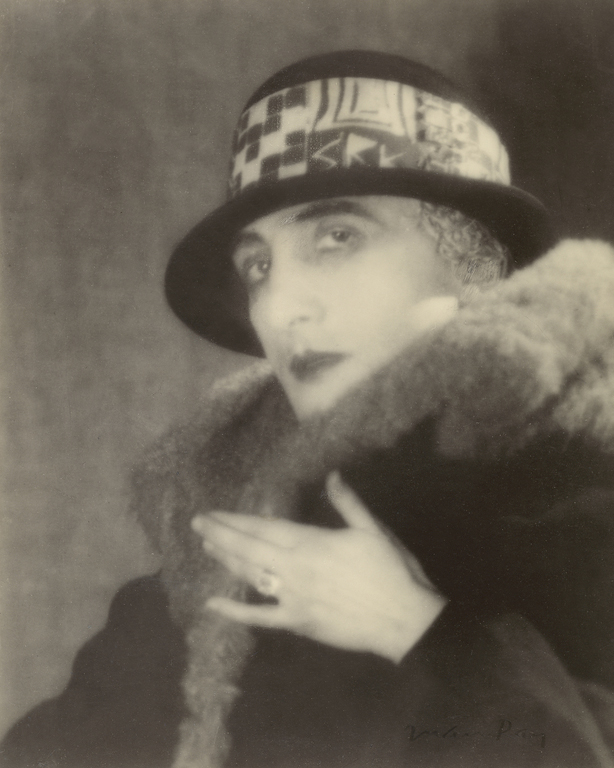
The exhibition also includes costume studies of people posing as literary characters and self-portraits of artists pretending to be other people. American painter and photographer Man Ray and the French artist Marcel Duchamp met in New York in 1915, and they began a playful, iconoclastic collaboration that resulted in the photograph (above), among others. Influenced by Dadaism, a cultural movement that rejected reason and logic in favour of anarchy and the absurd, their work embraced games of chance, performance, and wordplay. Here an irreverent Duchamp appears in women’s clothing as his alter ego, Rrose Sélavy, a pun on the French pronunciation “Eros, c’est la vie” (Sex, that’s life).
Imaginary Subjects
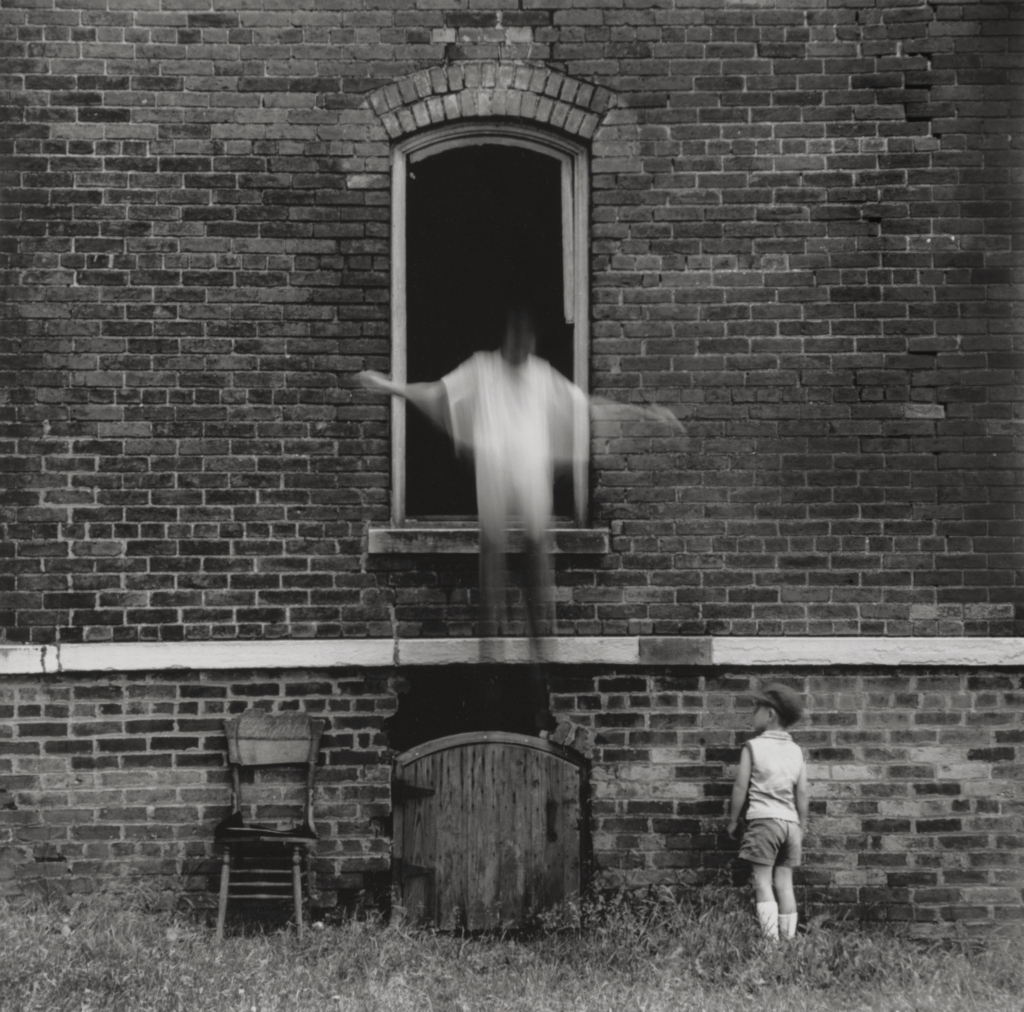
A number of photographs in the exhibition explore the medium’s capacity to visualise subjects of the imagination by using darkroom trickery to manipulate prints. An optician and family man, Ralph Eugene Meatyard photographed his children, friends, and neighbours enacting dramas in suburban backyards and abandoned buildings near his Lexington, Kentucky, home. He often used experimental techniques, such as multiple exposures and blurred motion. Uncanny details imbue Meatyard’s otherwise ordinary vernacular scenes with the qualities of a dream or supernatural vision.
Theatricality as a Critical Strategy
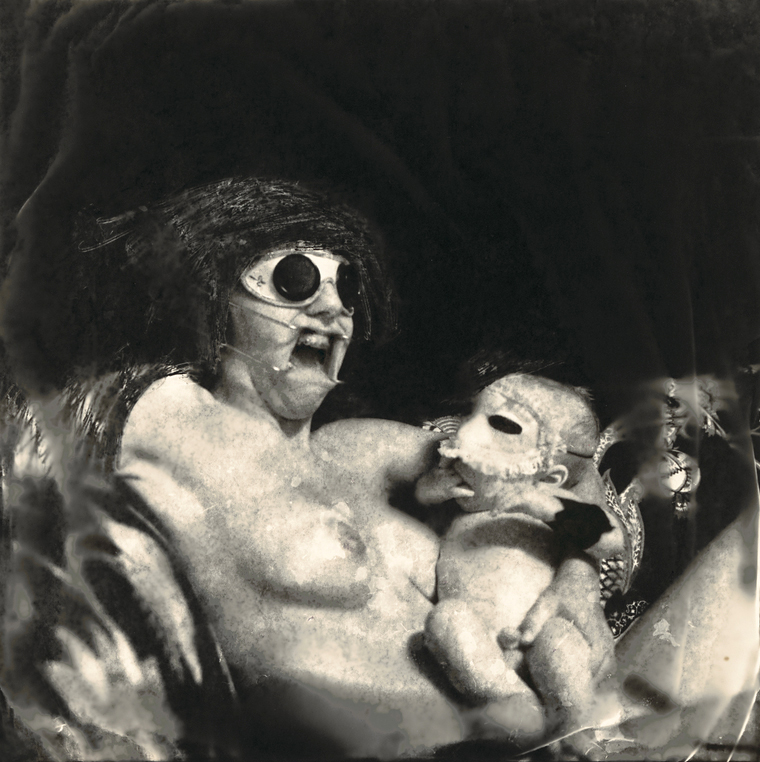
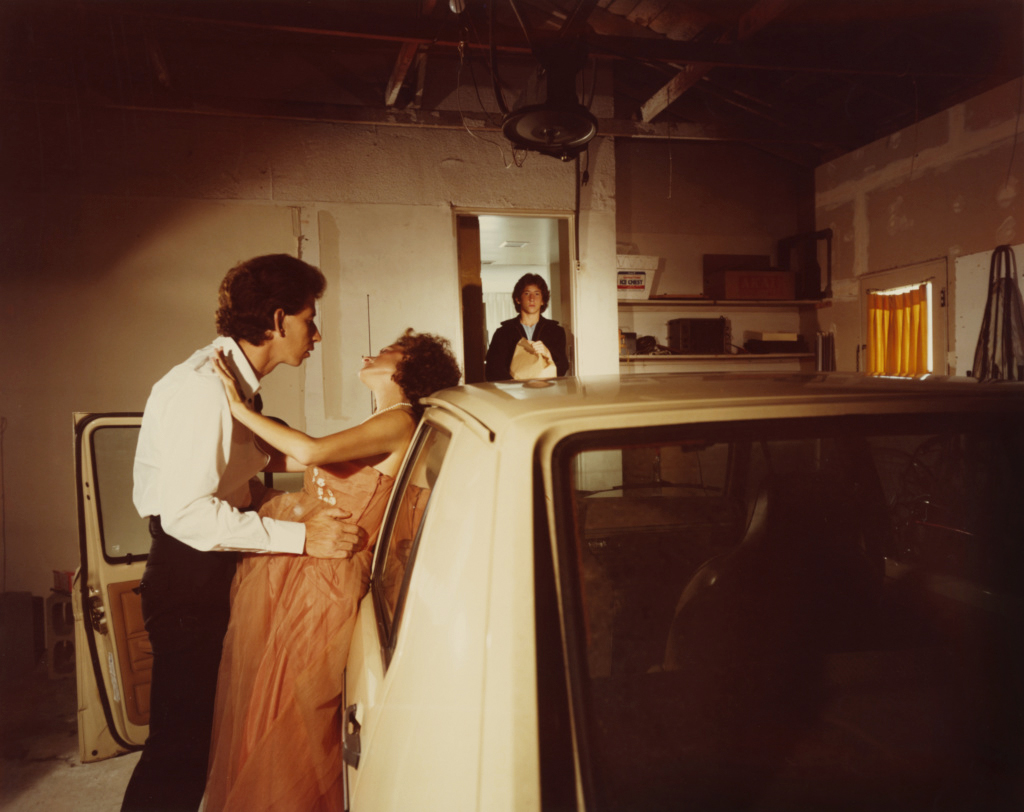
In recent decades there has been renewed interest in theatricality among contemporary photographers whose highly artificial scenes critique mainstream media and representation. In her series Family Docudrama Eileen Cowin blurs the boundaries between truth and fiction, and private behaviour and public performance. Drawing equally from family snapshots and soap operas, Cowin presents staged domestic scenes in which she and members of her family, including her identical twin sister, perform as actors. In these ambiguous, open-ended narratives, dramatic moments are exaggerated, and the camera’s glare is ever present.”
When Man Ray moved to Paris, he was greeted by his friend and artistic compatriot Marcel Duchamp, who introduced him to members of the Dada circle of writers and artists. The two men had collaborated in a number of creative endeavours in New York, including the creation of a female alter-ego for Duchamp named Rrose Sélavy (a pun on the French pronunciation Eros, c’est la vie “Sex, that’s life”). Man Ray photographed Duchamp several times as Rrose Sélavy.
Judging from his inclusion of this image in other photographic compositions, Man Ray must have considered Tears one of his most successful photographs. A cropped version of it with a single eye also appears as the first plate in a 1934 book of his photographs.
Like the emotive expression of a silent screen star in a film still, the woman’s plaintive upward glance and mascara-encrusted lashes seem intended to invoke wonder at the cause of her distress. The face belongs to a fashion model who cries tears of glistening, round glass beads; the effect is to aestheticise the sentiment her tears would normally express. Man Ray made this photograph in Paris around the time of his breakup with his lover Lee Miller, and the woman’s false tears may relate to that event in the artist’s life.
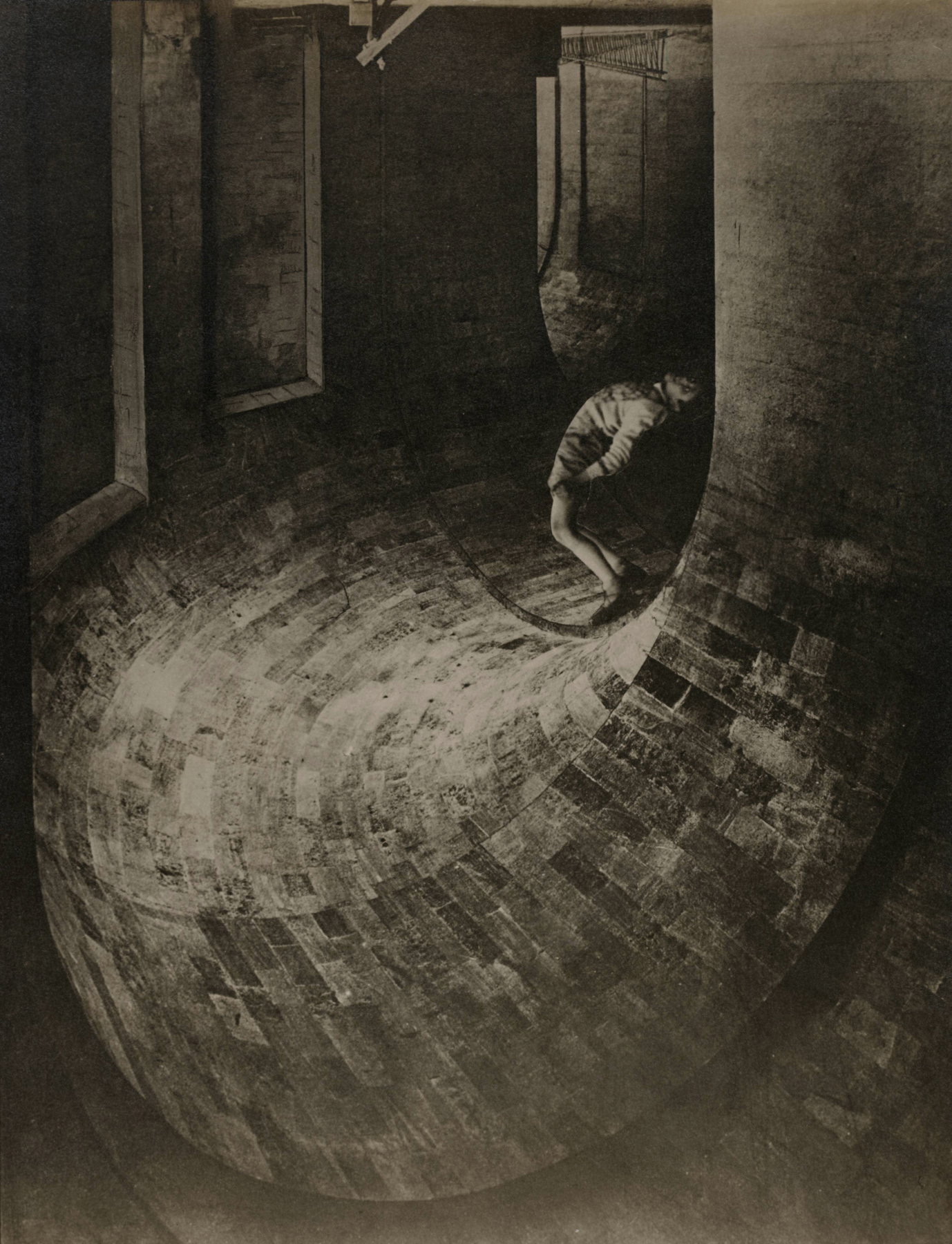
In this picture Dora Maar constructed her own reality by joining together several images and rephotographing them. The seamlessness of the photographic surface makes this construction believable and leaves the viewer wondering about the strange world the figure inhabits. On closer examination, the viewer may notice that the floor is an upside-down ceiling vault, that the bricked-in windows are drawn in by hand, and that the figure was added separately. Despite these discoveries, the picture resists logical interpretation.
An optician and family man, Meatyard photographed his children, friends, and neighbours enacting dramas in the suburban backyards and abandoned buildings of Lexington, Kentucky. He often used experimental techniques, such as multiple exposures and blurred motion. Uncanny details imbue Meatyard’s otherwise ordinary vernacular scenes with the qualities of a dream or supernatural vision.
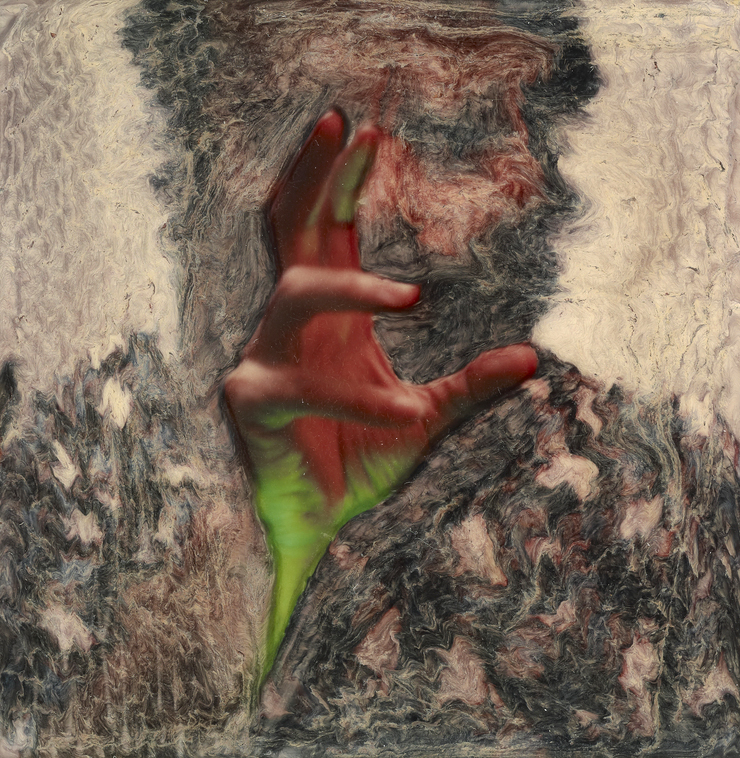
In this self-portrait, Lucas Samaras reaches out as if trapped in the photograph. In sharp contrast to the indistinct background of his upper body, his crisply defined fingers curl forward, as if he is searching for a way to transcend a two-dimensional world of his own creation. An overriding sense of claustrophobia defines this image, underscored by the small scale of the Polaroid print. Samaras, a hermit-like person, made many Polaroid self-portraits like this in the 1970s as a means of observing himself. The images are open to a wide range of interpretation. Here, Samaras may have tried to convey the sense of isolation he experiences as a reclusive person.
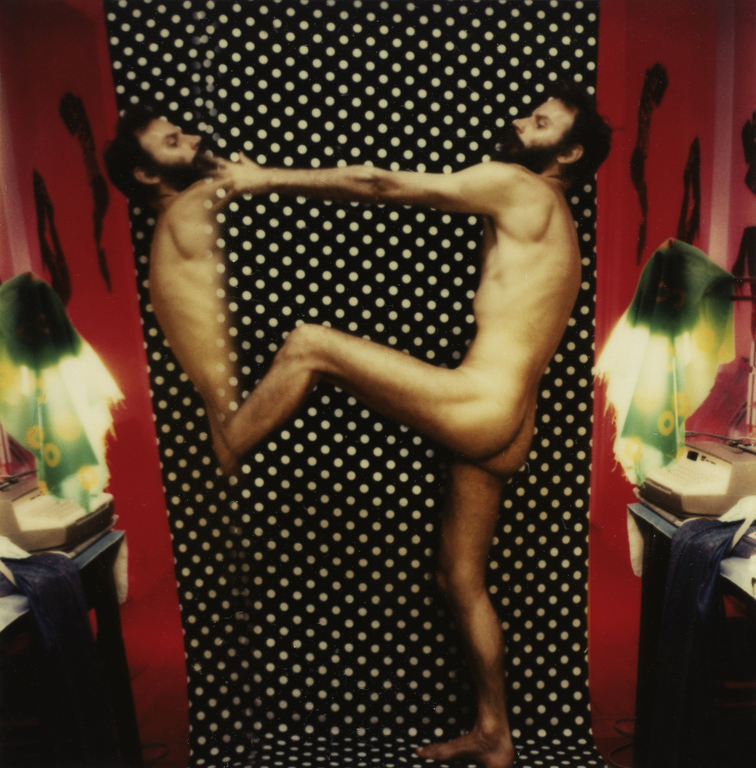
As if engaging in a tug-of-war with himself, Lucas Samaras confronts and struggles with his own reflection in this self-portrait. The leg-less reflection is incomplete, however, giving the impression of a deformed adversary. A monochromatic polka-dot background and a vibrant green and red border act as a stage for this dramatic struggle.
Samaras’s Photo-Transformations, which he made in the 1970s as a means to examine various facets of himself, could be understood as visual manifestations of internal conflict. They are complex psychological investigations that, according to at least one critic, illustrate one person’s efforts toward spiritual healing.
Submerged in narcissism, nothing remains… but “me and myself, I am my own audience, the other, contemplating my existence.”
Made in the 1970s as a means of studying himself, Lucas Samaras’s photographs illustrate the internal struggle that can occur between conflicting aspects of one personality. Bent over a captain’s chair, Samaras rests his head as if he is at the guillotine. Another blurry form hovers above, about to violently attack the submissive figure.
Samaras made his Photo-Transformations, a series of self-portraits, with SX-70 Polaroid film. Still wet, the film’s emulsions could be manipulated to alter the finished image. He used straight pins, rubber erasers, and other simple tools to “draw” into the developing surface. For this portrait, he created a diamond pattern over and around the dominant figure that underscores the frenzy of motion.
In her series Family Docudrama Cowin blurs the boundaries between truth and fiction, and private behaviour and public performance. Drawing equally from family snapshots and soap operas, she presents staged domestic scenes in which she and members of her family, including her identical twin sister, perform as actors. In these ambiguous, open-ended narratives, dramatic moments are exaggerated and the camera’s glare is ever present.
The J. Paul Getty Museum 1200 Getty Center Drive Los Angeles, California 90049

![E. J. Bellocq (American, 1873-1949) 'Untitled [prostitute of Storyville, New Orleans]' 1912](https://artblart.com/wp-content/uploads/2009/09/bellocq_1912_g.jpg "E. J. Bellocq (American, 1873-1949) 'Untitled [prostitute of Storyville, New Orleans]' 1912")

















![Hill & Adamson (Scottish, active 1843-1848) '[Lane and Peddie as Afghans]' 1843 from the exhibition 'In Focus: Making A Scene' at The J. Paul Getty Museum, Los Angeles, June - Oct, 2009](https://artblart.com/wp-content/uploads/2009/09/hill-and-adamson-lane-and-peddie-as-afghans-web.jpg "Hill & Adamson (Scottish, active 1843-1848) '[Lane and Peddie as Afghans]' 1843 from the exhibition 'In Focus: Making A Scene' at The J. Paul Getty Museum, Los Angeles, June - Oct, 2009")


![Baron Wilhelm von Gloeden (German, 1856-1931) 'Untitled [Two Male Youths Holding Palm Fronds]' c. 1885 - 1905](https://artblart.com/wp-content/uploads/2009/09/gloeden-two-male-youths-holding-palm-fronds-web.jpg "Baron Wilhelm von Gloeden (German, 1856-1931) 'Untitled [Two Male Youths Holding Palm Fronds]' c. 1885 - 1905")
![Guido Rey (Italian, 1861-1935) '[The Letter]' 1908](https://artblart.com/wp-content/uploads/2009/09/guido-rey-the-letter-1908-web.jpg "Guido Rey (Italian, 1861-1935) '[The Letter]' 1908")


 Art Blart _ art and cultural memory archive
You must be logged in to post a comment.