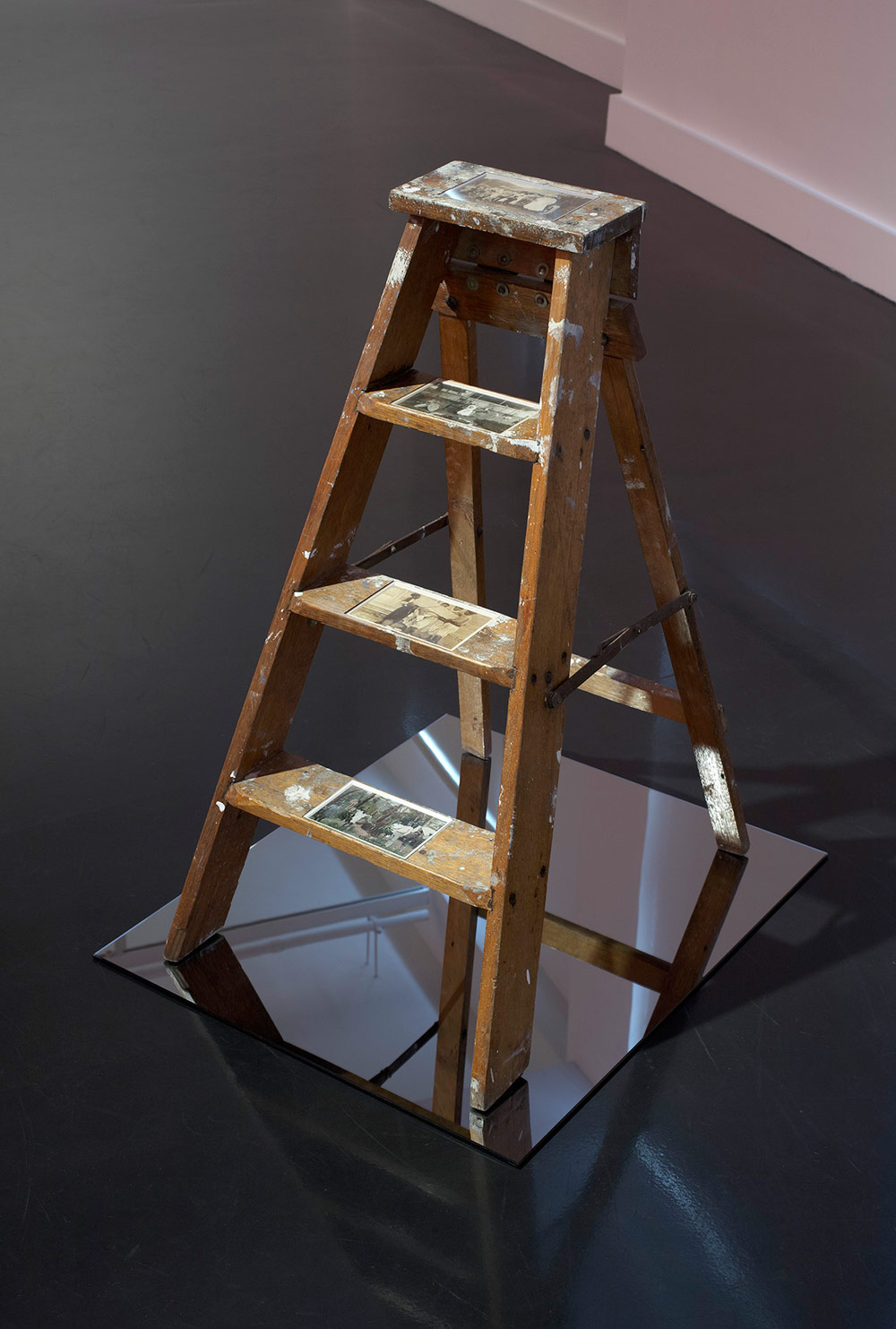
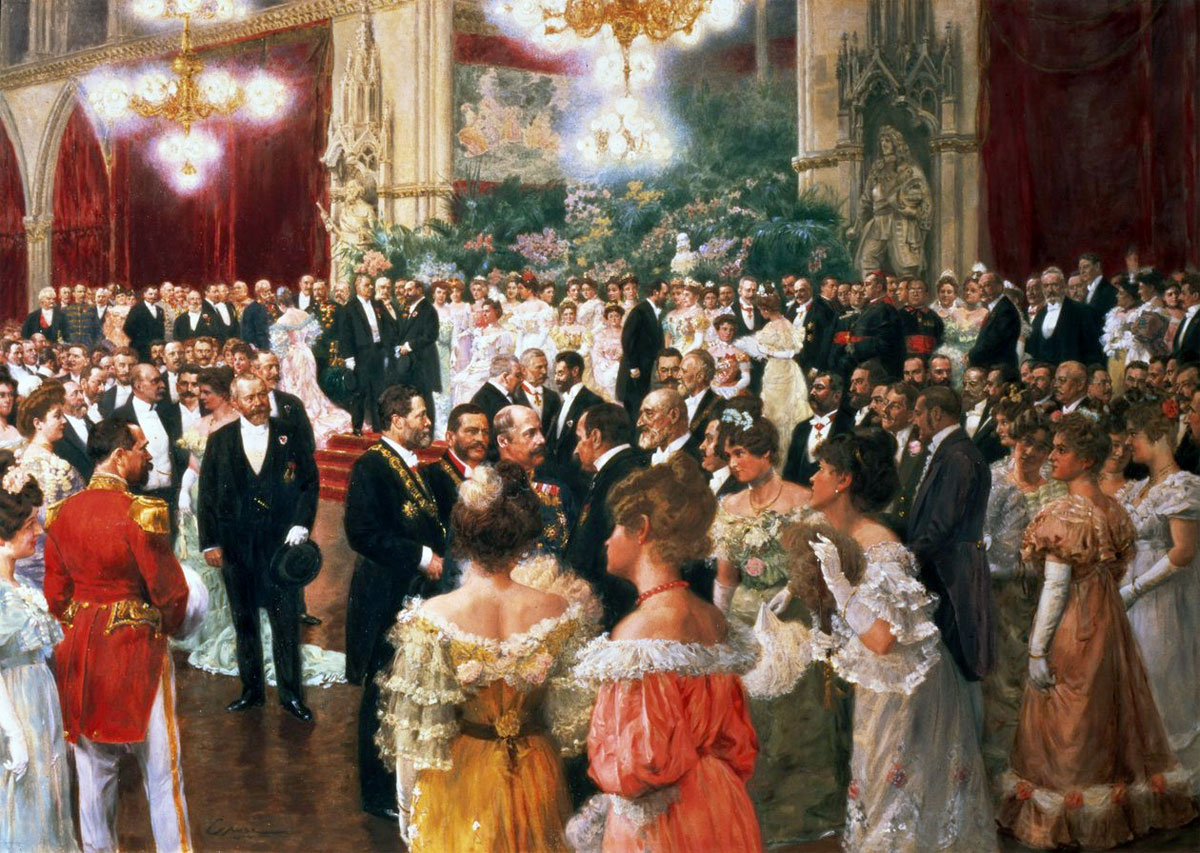
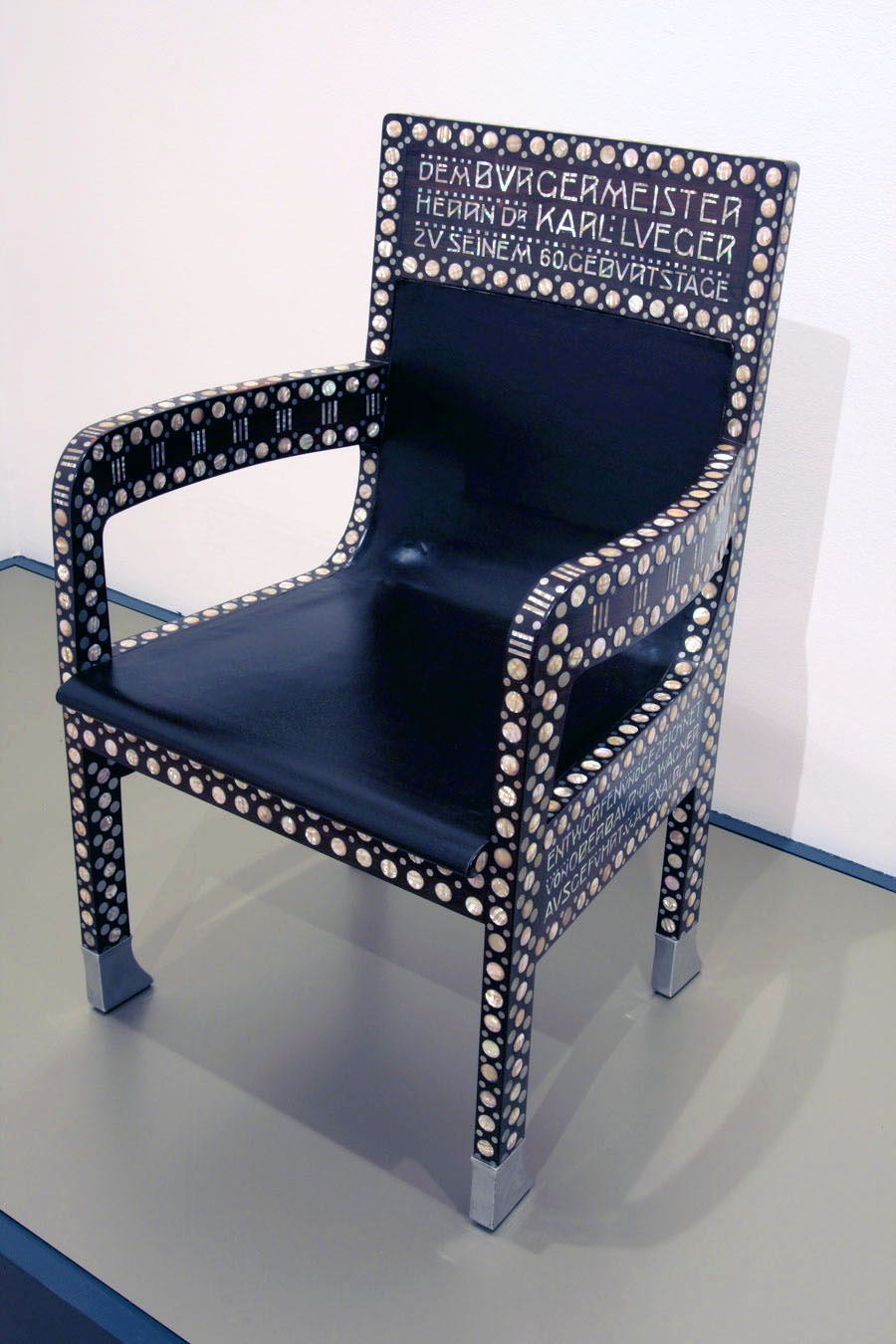
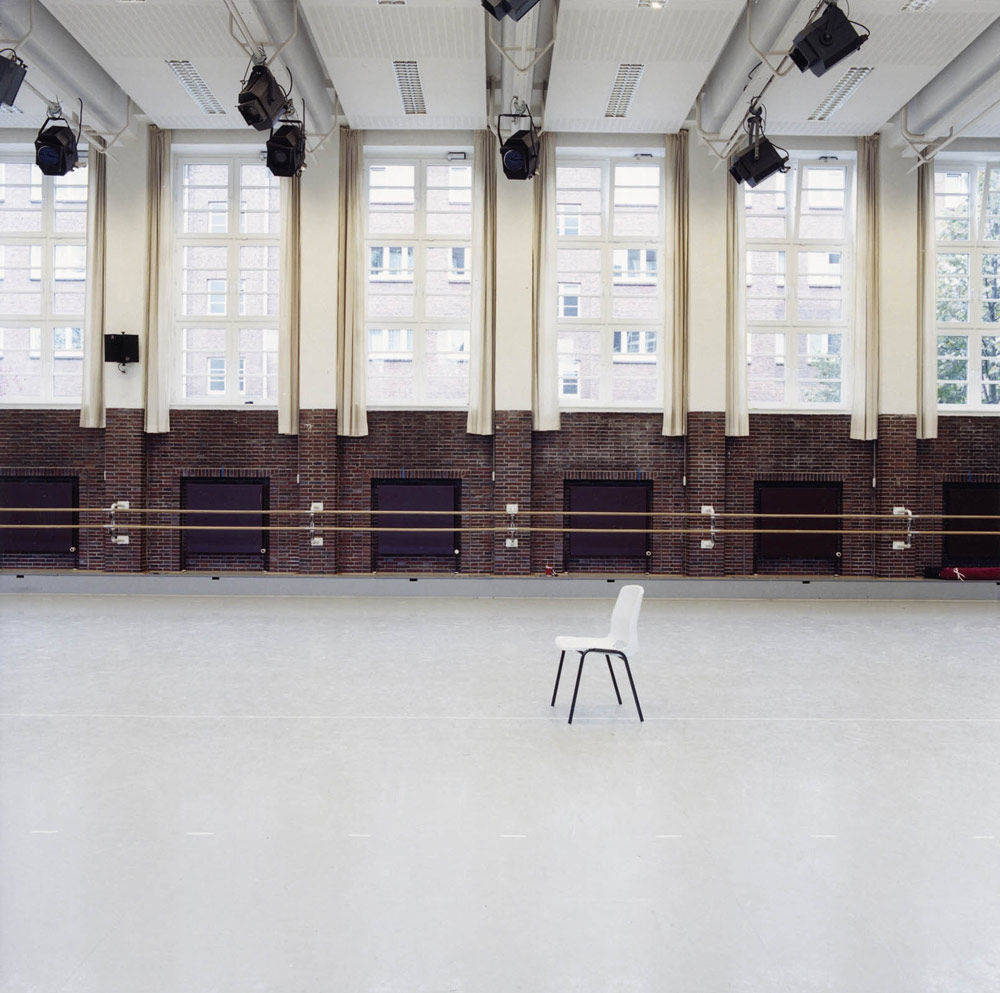
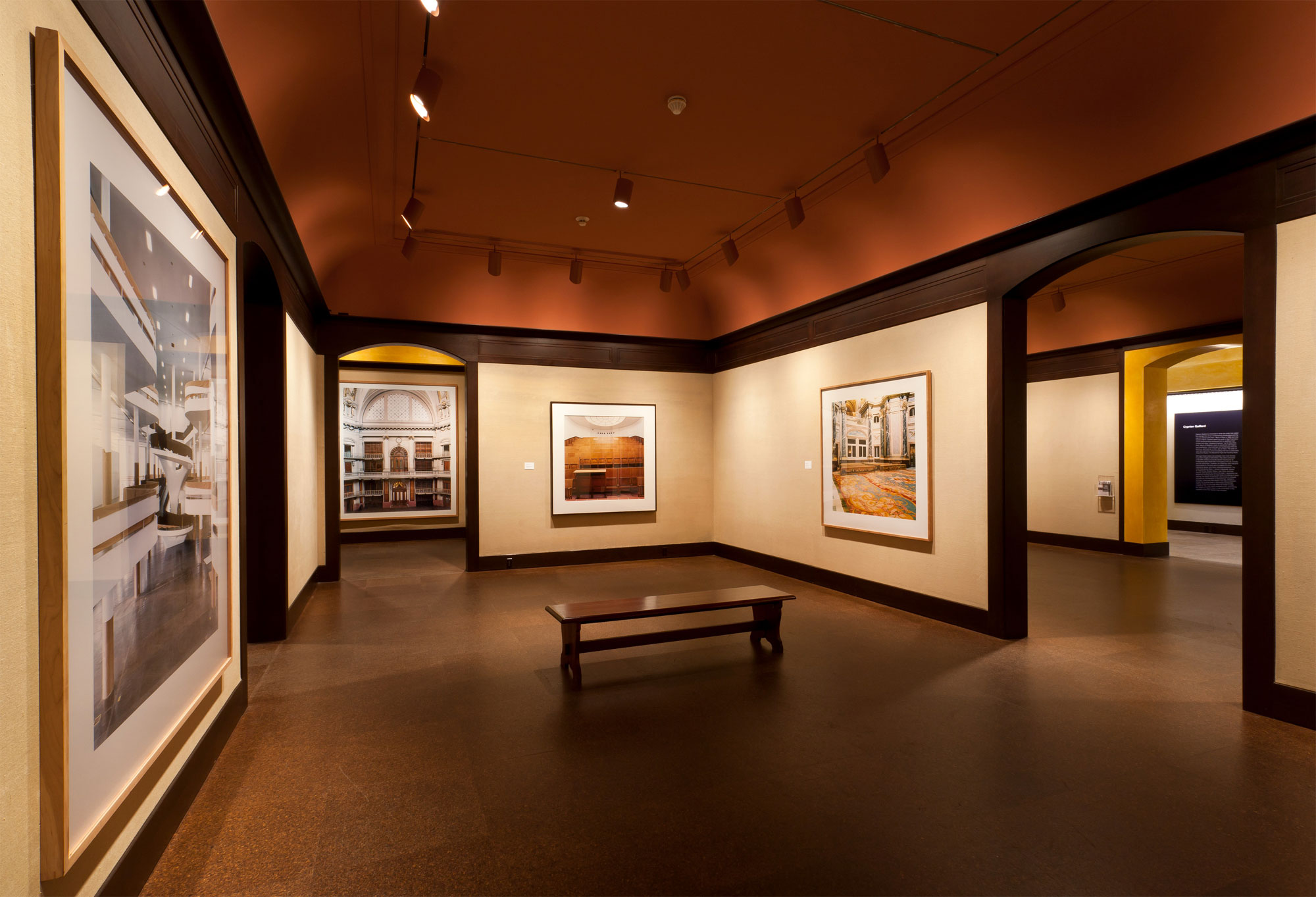
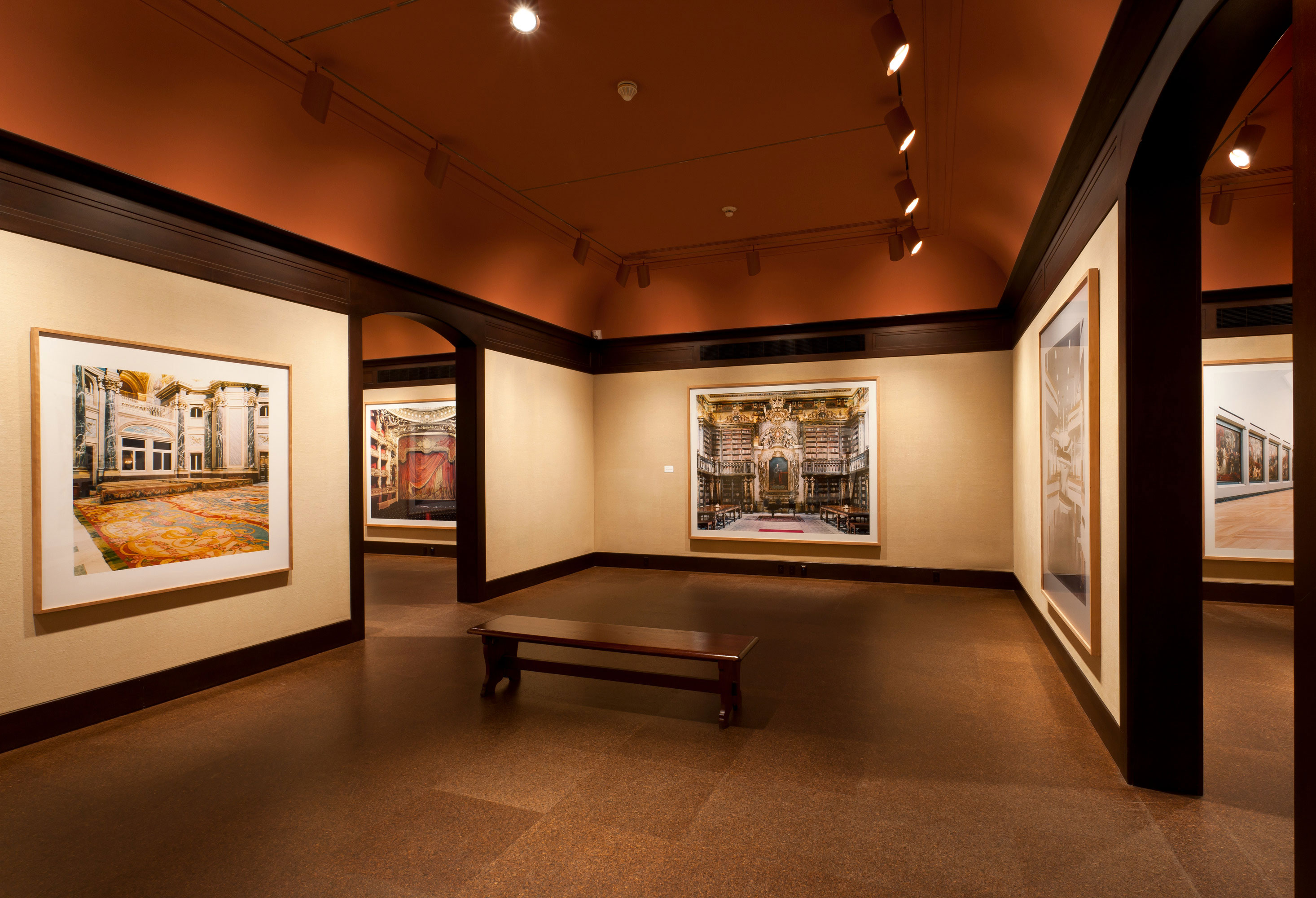
Candida Höfer (German, b. 1944) Ballettzentrum Hamburg III 2000 Chromogenic print Courtesy of Sonnabend Gallery
Inspired curating conjoins the monumental, classicist purity of Höfer with the picturesque, dystopian (dis)quietude of Gaillard in an exhibition that investigates our relationship to buildings and their environments and their relationship to us – the ‘i’ in our histor-i-city.
Dr Marcus Bunyan
Many thankx to the Carnegie Museum of Art for allowing me to publish the photographs in the posting. Please click on the photographs for a larger version of the image.
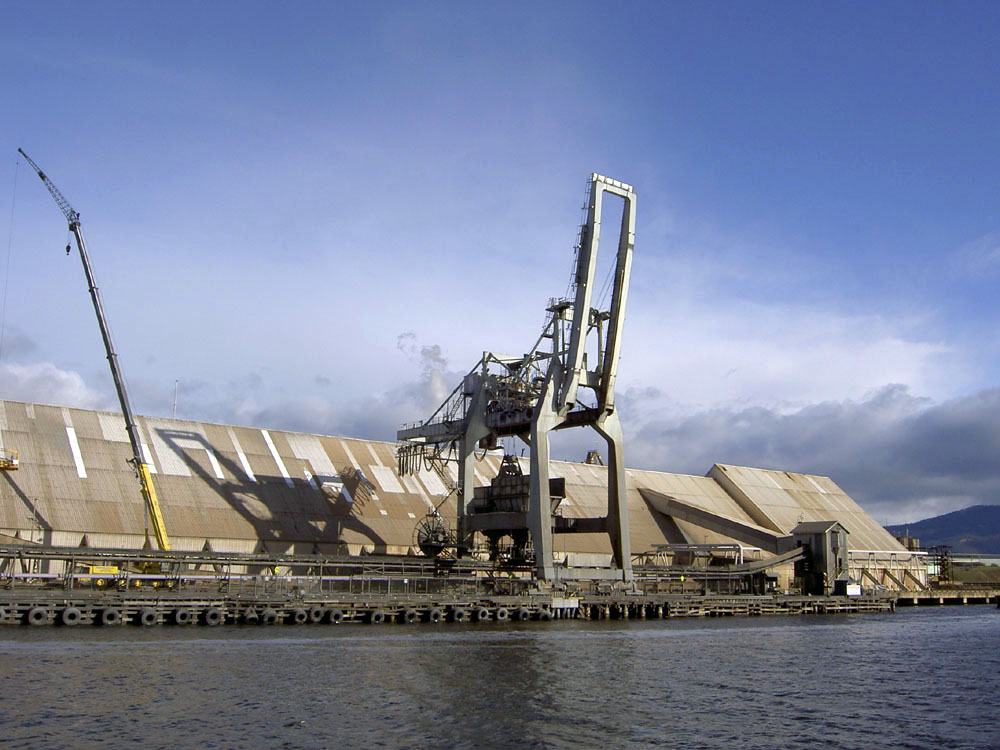
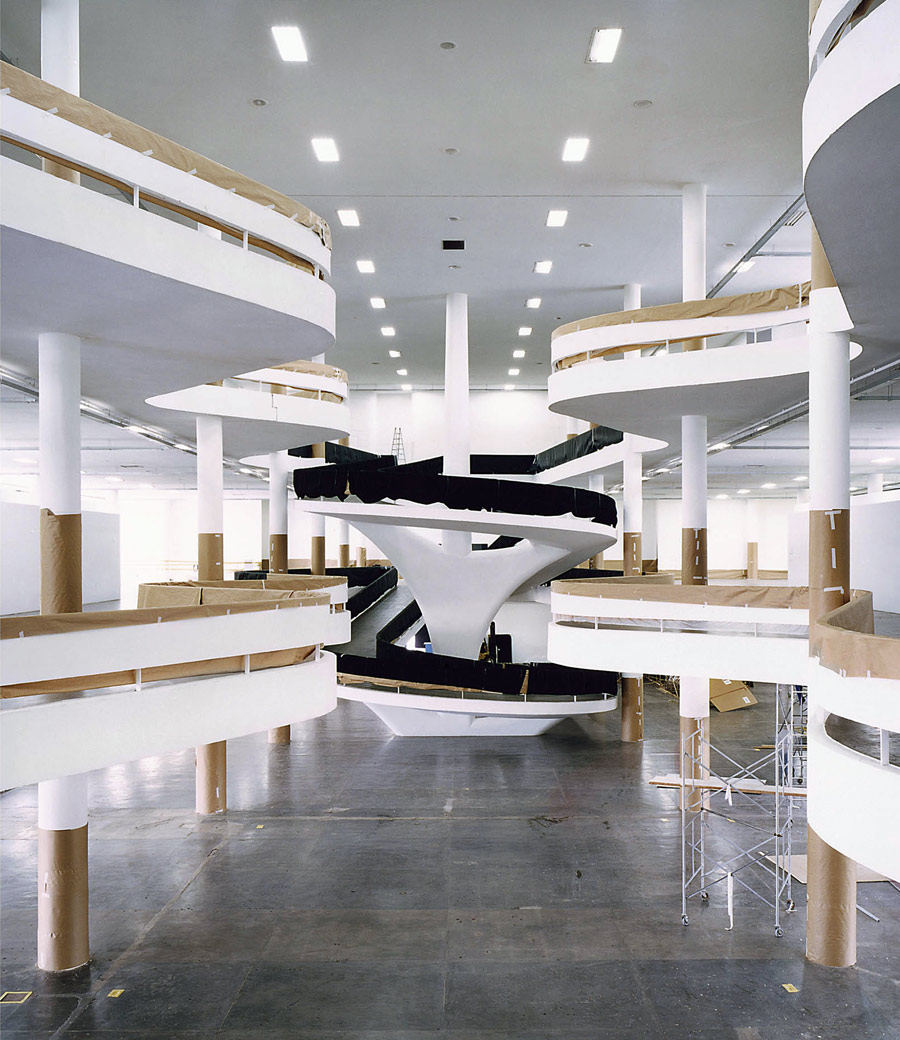
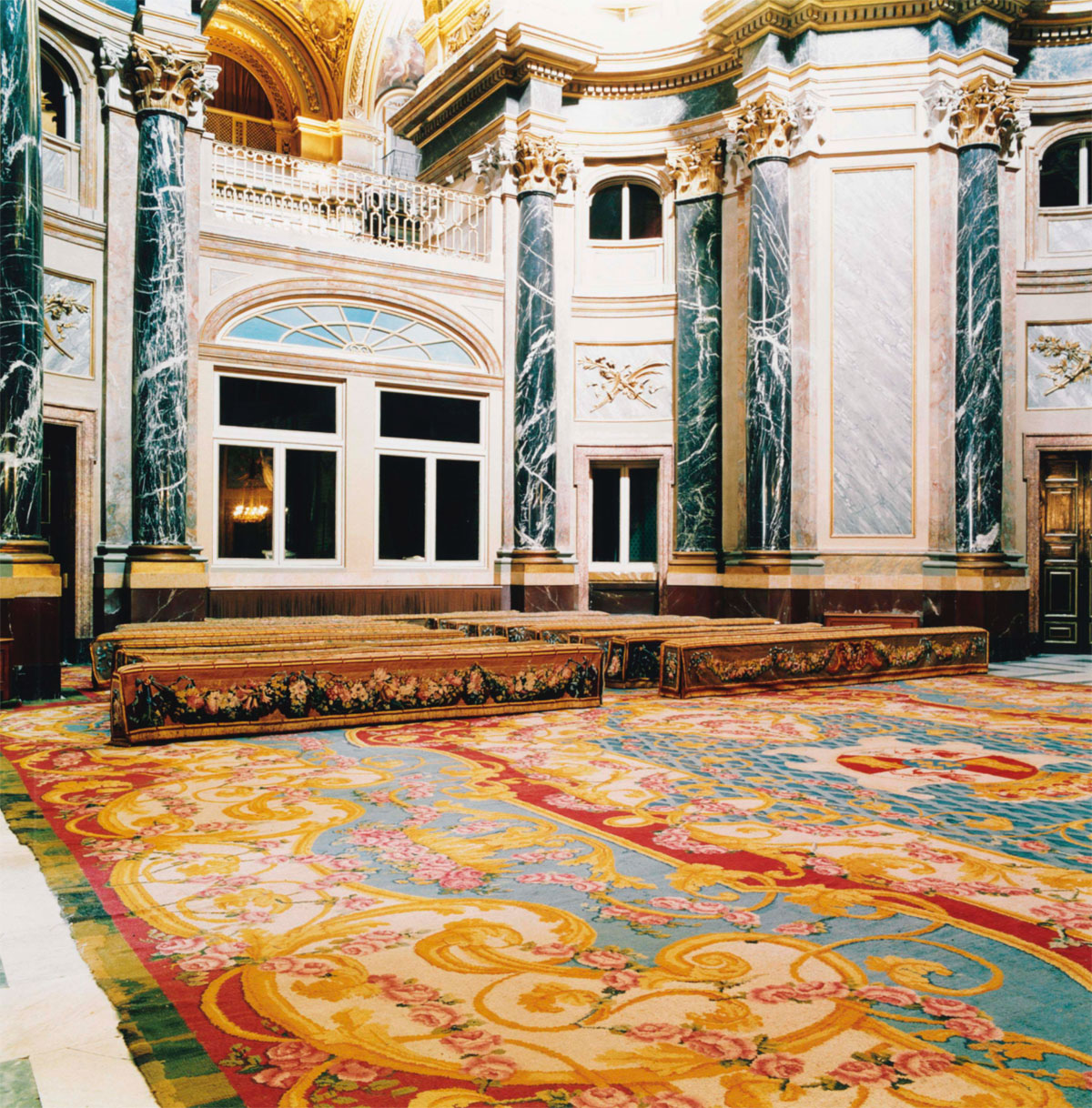
Candida Höfer (German, b. 1944) Fundação Bienal de São Paulo XI 2005 Chromogenic print 81 3/8 x 71 7/8 in. Courtesy of Sonnabend Gallery
Carnegie Museum of Art presents the powerful work of two contemporary artists – Candida Höfer and Cyprien Gaillard – who explore architectural environments and how they influence experiences and perceptions of the world.
“We shape our buildings, and afterwards our buildings shape us.” With that simple but profound insight, Winston Churchill conveyed people’s complex relationship to architecture: The physical form of a building is controlled by its designer, but the impact a constructed environment has can be unpredictable, emotional, and even visceral. That dynamic is evident in the upcoming exhibition You Are Here: Architecture and Experience, which brings together the photographs of German artist Candida Höfer and a video and etchings by French artist Cyprien Gaillard. Both artists express the formative power of architecture in different but complementary ways, according to Tracy Myers, curator of architecture at the Heinz Architectural Center and organiser of the exhibition.
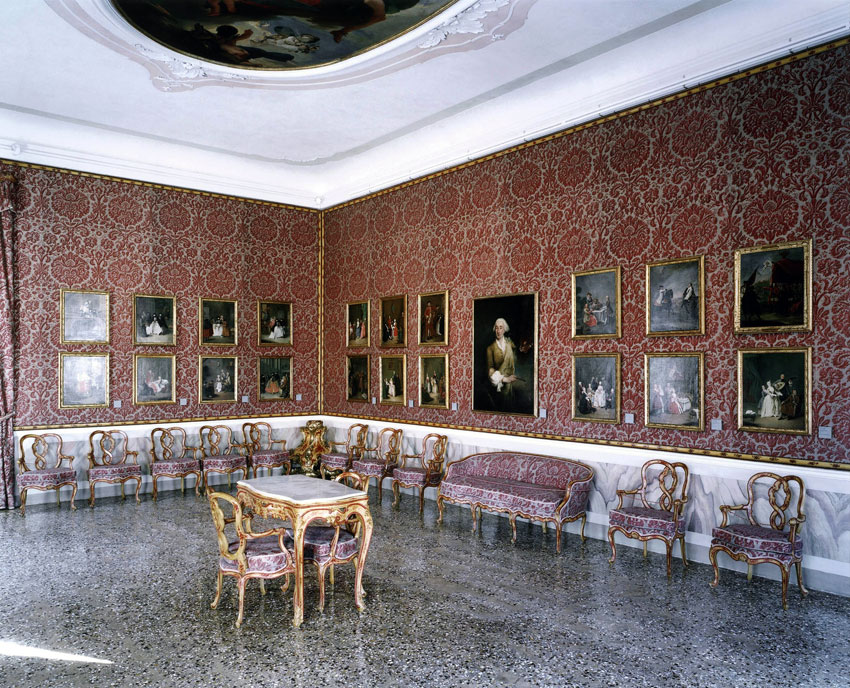
Candida Höfer’s lush colour photographs of ornate historical and contemporary interior spaces are usually devoid of humans, yet they reveal details that draw the viewer into a consideration of what each place means. Höfer’s photographs usually focus on spaces of cultural and social activity. Printed very large (from about 4 x 4 feet to a massive 6 x 8 feet), the 17 photographs in You Are Here represent the range of Höfer’s work in terms of scale, point of view, building type, and geographical location.
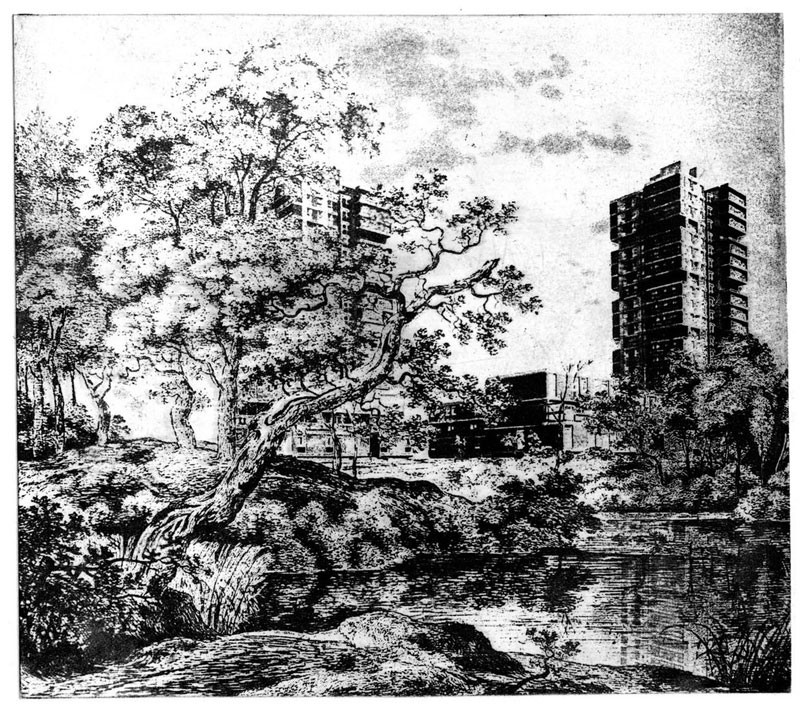
By contrast, Cyprien Gaillard’s video Desniansky Raion and his meticulously detailed etchings probe the human legacy of Modernist high-rise housing blocks. Constructed after World War II throughout the United States, Europe, and the Eastern Bloc to provide decent housing, these buildings often became warehouses for the poor and incubators of crime and antisocial behaviours.
Named for an administrative district in Kiev, Desniansky Raion poignantly reflects on the gap between the utopian Modernist aspiration for universal housing and the banal reality that instead prevailed. It comprises three parts. In the first section, weekend fight clubs of 50 or 100 people face off against each other in a pugilistic ritual set against the backdrop of housing towers in St. Petersburg, Russia. The second part shows the implosion of a similar tower in Meaux, a small city near Paris; the demolition of the building was treated by the city government as a literal spectacle, with a light show and fireworks preceding the destruction. The final third is a very long panning aerial shot of seemingly endless ranks of virtually identical housing blocks in Kiev, Ukraine. The video is accompanied by a soundtrack composed by Koudlam, a young musician born in the Ivory Coast. Also featured are six etchings by Gaillard, collectively titled Belief in the Age of Disbelief, in which the Modernist housing tower is placed in classic picturesque landscapes.
“Gaillard’s video packs a powerful and direct emotional punch: each time I view it, I experience physically the anticipation that ebbs and flows through the course of the work,” said Myers. “By contrast, Höfer’s photographs embody a kind of quietude that encourages slow, sustained exploration of the meaning that builds through accumulation of detail. But both works are equally affecting and bring the viewer with compelling intensity into the realm of architectural experience. Höfer and Gaillard capture the constant oscillation between what we make of our buildings, and what they make of us.”
Artists’ Biographies
Candida Höfer has been creating photographs for more than 30 years. Born in Eberswalde, Germany, in 1944, she studied with Berndt Becher and is identified with a group of German artists – Thomas Ruff, Andreas Gursky, Axel Hütte, and Thomas Struth – best known for their unsentimental photographs of architecture, landscapes, and urban developments. Höfer has made interiors her focus.
Cyprien Gaillard, born in Paris in 1980 and currently based in Berlin, explores contemporary landscapes and buildings in a variety of media, including video, painting, and etchings. Much of his work is concerned with the legacy and inheritance of buildings and landscapes that are left to us, and the ways in which we interact with them.
Press release from the Carnegie Museum of Art website
The video takes place in a parking lot of a drab housing complex in St. Petersburg, Russia, where he witness two large groups of men – one mostly wearing red shirts and the other blue – slowly walking towards each other. Set by Gaillard to the hypnotic electronic beats of French composer Koudlam’s I See you All, the video shows the colour-coordinated groups marching in loose formation, reminiscent of ancient armies confronting each other on some distant battlefield. Suddenly, signal flares billowing smoke arc through the air and the two groups come together, clashing in flurry of fists – a breathtaking display of raw physical violence set against the stark backdrop of the housing block. As the sounds of Koudlam’s pulsing music draw louder and more urgent, the furious hand-to-hand combat intensifies while bodies of the fallen lay strewn on the pavement. Before long, the blue faction beats a hasty retreat, only to regroup moments later on one side of a nearby pedestrian bridge. The two sides come together again, this time clashing on the impossibly narrow span of the footbridge. The blue group is once more chased off, and the victors in red erupt in victorious celebration.
Julia Margaret Cameron – you are one of my heroes!
Many thankx to the Musée d’Orsay for allowing me to publish the photographs in the posting. Please click on the photographs for a larger version of the image.

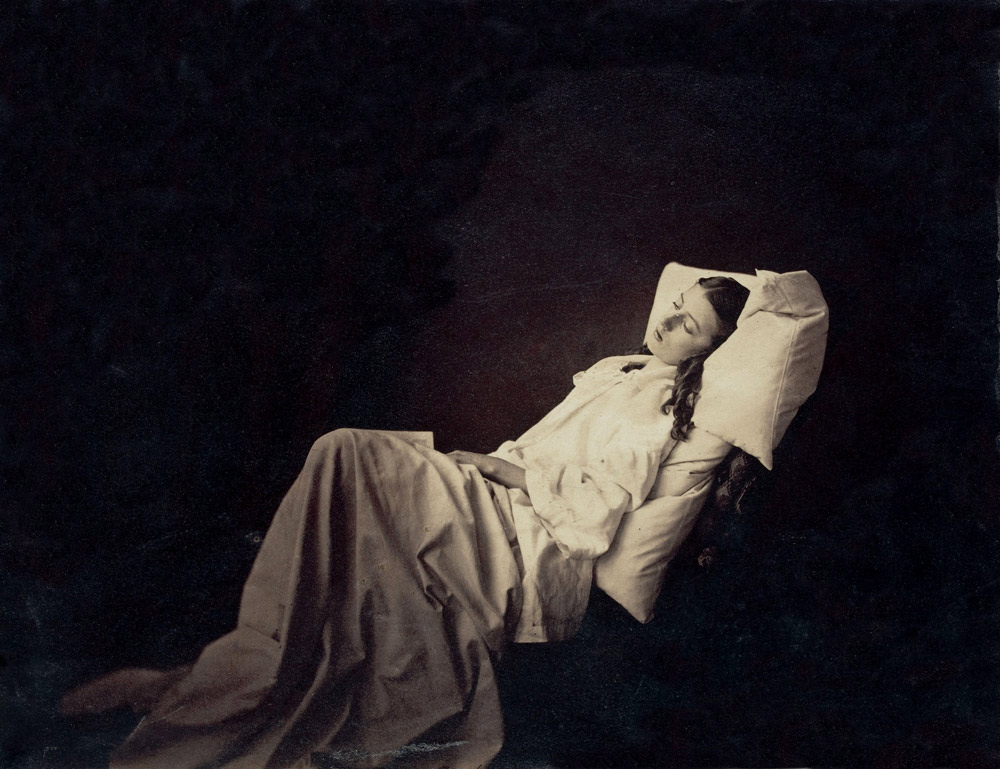
Consumed by the passion of unrequited love, a young woman lies suspended in the dark space of her unrealised dreams in Henry Peach Robinson’s illustration of the Shakespearean verse “She never told her love,/ But let concealment, like a worm i’ the bud,/ Feed on her damask cheek” (Twelfth Night II,iv,111-13). Although this picture was exhibited by Robinson as a discrete work, it also served as a study for the central figure in his most famous photograph, Fading Away, of 1858.
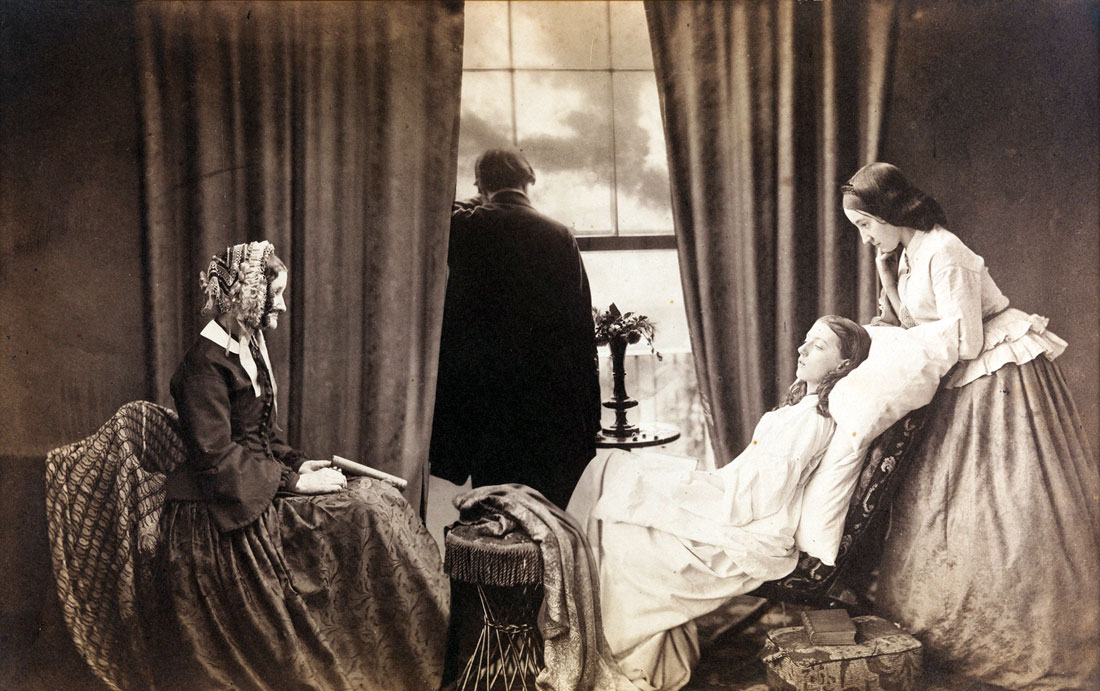
Purportedly showing a young consumptive surrounded by family in her final moments, Fading Away was hotly debated for years. On the one hand, Robinson was criticised for the presumed indelicacy of having invaded the death chamber at the most private of moments. On the other, those who recognised the scene as having been staged and who understood that Robinson had created the picture through combination printing (a technique that utilised several negatives to create a single printed image) accused him of dishonestly using a medium whose chief virtue was its truthfulness.
While addressing the moral and literary themes that Robinson believed crucial if photography were to aspire to high art, this picture makes only restrained use of the cloying sentimentality and showy technical artifice that often characterise this artist’s major exhibition pictures. Perhaps intended to facilitate the process of combination printing, the unnaturally black background serves also to envelop the figure in palpable melancholia.
Text from the Metropolitan Museum of Art website [Online] Cited 27/01/2020
The historian and art critic, John Ruskin, had a great influence in Great Britain not only on the Pre-Raphaelite movement created in 1848, but on the development of early photography in the 1850s. The leading Pre-Raphaelite painters, John Everett Millais, Dante Gabriel Rossetti, Holman Hunt and Ford Madox Brown and their followers, wished to change the pictorial conventions laid down by the Royal Academy, and in order to demonstrate the transformations in modern life, invented a radically new idiom marked by bright colours and clarity of detail.
Pre-Raphaelite painters and photographers frequently made similar choices of subjects, and the photographers, particularly Julia Margaret Cameron, David Wilkie Wynfield and Lewis Carroll, were often had close links with the painters.
When painting landscapes, the Pre-Raphaelite artists answered Ruskin’s call, meticulously observing nature in order to capture every nuance of detail. For their part, photographers, such as Roger Fenton, Henry White, William J. Stillman and Colonel Henry Stuart Wortley, experimented with the new process of wet plate collodion negatives that allowed much greater image detail, and achieved similar effects. Although highly impressed at first by the daguerreotype, which enabled the eye to see tiny, overlooked details, Ruskin was nonetheless still very critical of landscape photography, which could not reproduce the colours of nature and in particular of the sky. This failing also gave rise to a major debate amongst photography critics.
In portraiture, there were clear links between the painted portraits of Watts and Cameron’s photographic portraits. By using special lenses and photographing her models in close-up, Cameron, achieved, with a glass negative, exactly the opposite effect to the clear image advocated by Ruskin, and her work was distinctive for the breadth of relief and contour, as well as the compositions evoking Raphael’s paintings, also a source of inspiration for Watts.
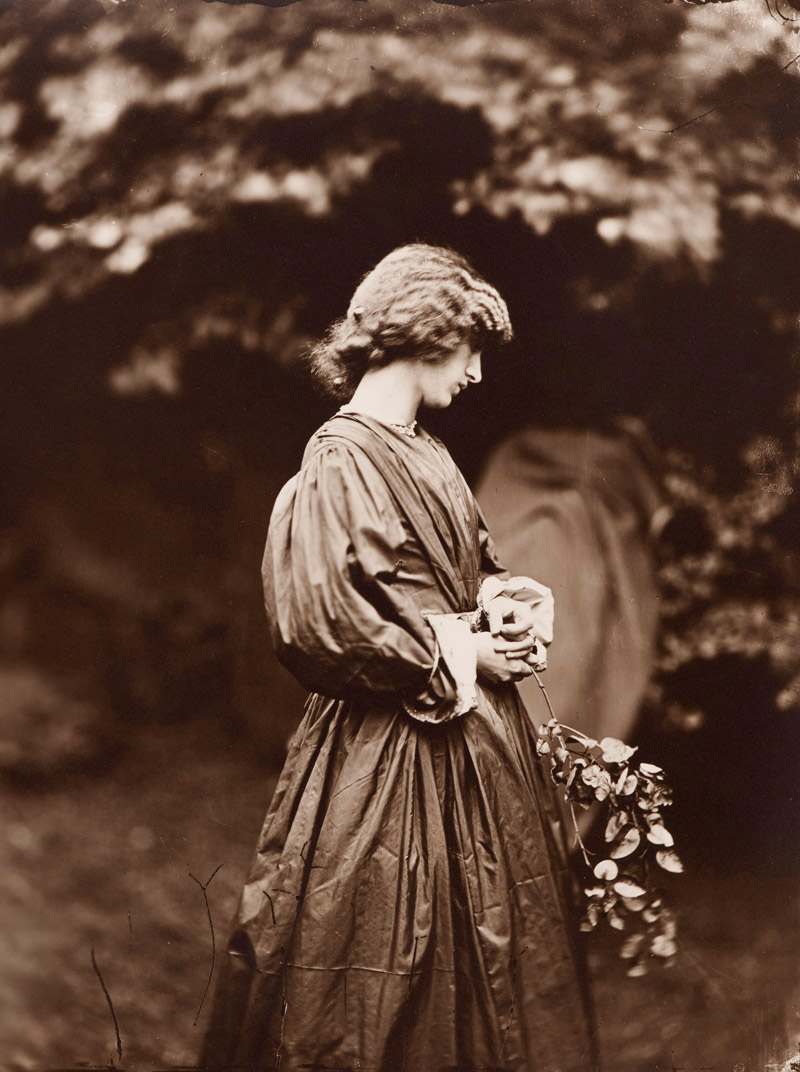
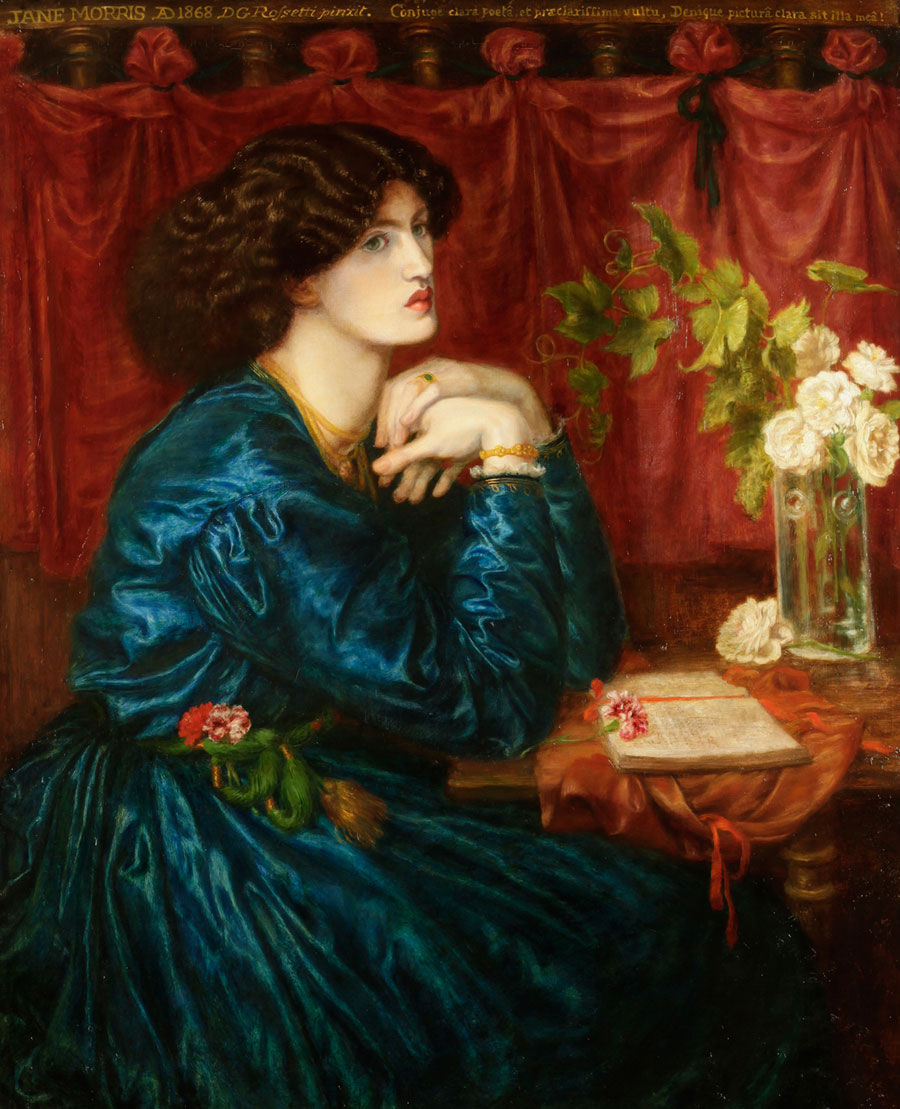
The painter Dante Gabriel Rossetti repeatedly drew and painted Jane Morris, a model with whom he was infatuated, and he asked Robert Parsons to produce a series of photographs, under his personal direction, which captured the fascinating presence of the young woman as effectively as his own paintings.
Just like the Pre-Raphaelite painters, Victorian photographers would turn to religious or historical subjects, finding a shared inspiration in the poems of Dante, Shakespeare and possibly Byron, and above all in the Arthurian legend made popular once more by Lord Tennyson, the poet laureate. From a formal point of view, Millais’ Ophelia, one of his most successful paintings, was a source for Henry Peach Robinson’s photograph, The Lady of Shalott, even though it had a different theme.
Finally, Pre-Raphaelite painters and Victorian photographers both liked to present scenes from modern life with a moralising undertone: hence She Never Told Her Love, a photograph by Robinson that was very successful when exhibited at the Crystal Palace in 1858, William Holman Hunt’s painting, Awakening of Conscience, and Rossetti’s Found, a painting depicting a countryman who comes across his former sweetheart, now a prostitute in the city.
In the 1880s, Pre-Raphaelite painting would be transformed, with artists and writers like William Morris, Burne-Jones, Whistler and Oscar Wilde, into a very different movement concerned only with the cult of beauty and rejecting Ruskin’s concept of art as something moral or useful. British photographers, however, inspired by the Pre-Raphaelites would inspire the Pictorialist movement that flourished in the 1890s, encouraged by the writings of Henry Peach Robinson and Peter Henry Emerson, extolling artistic photography.
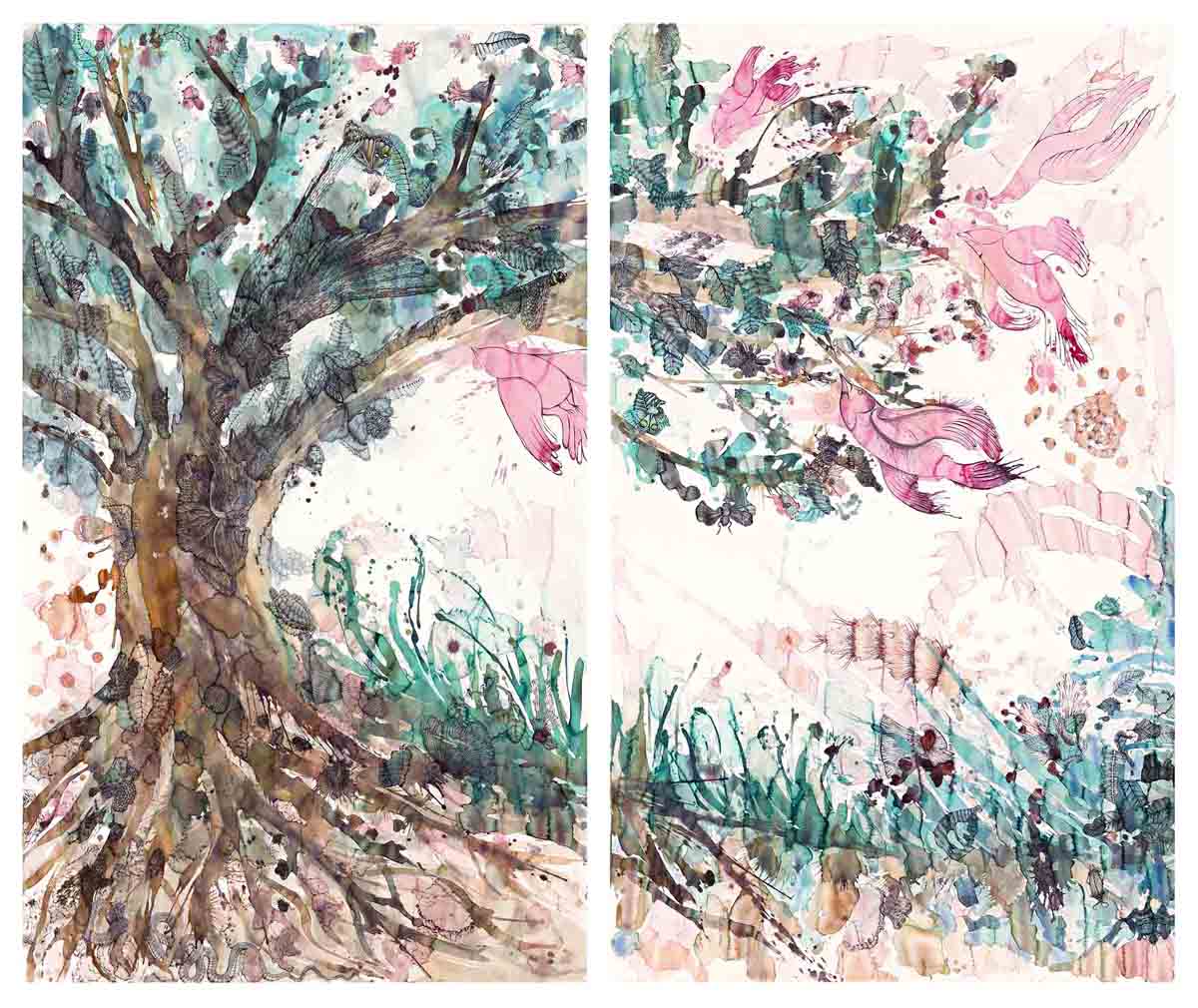
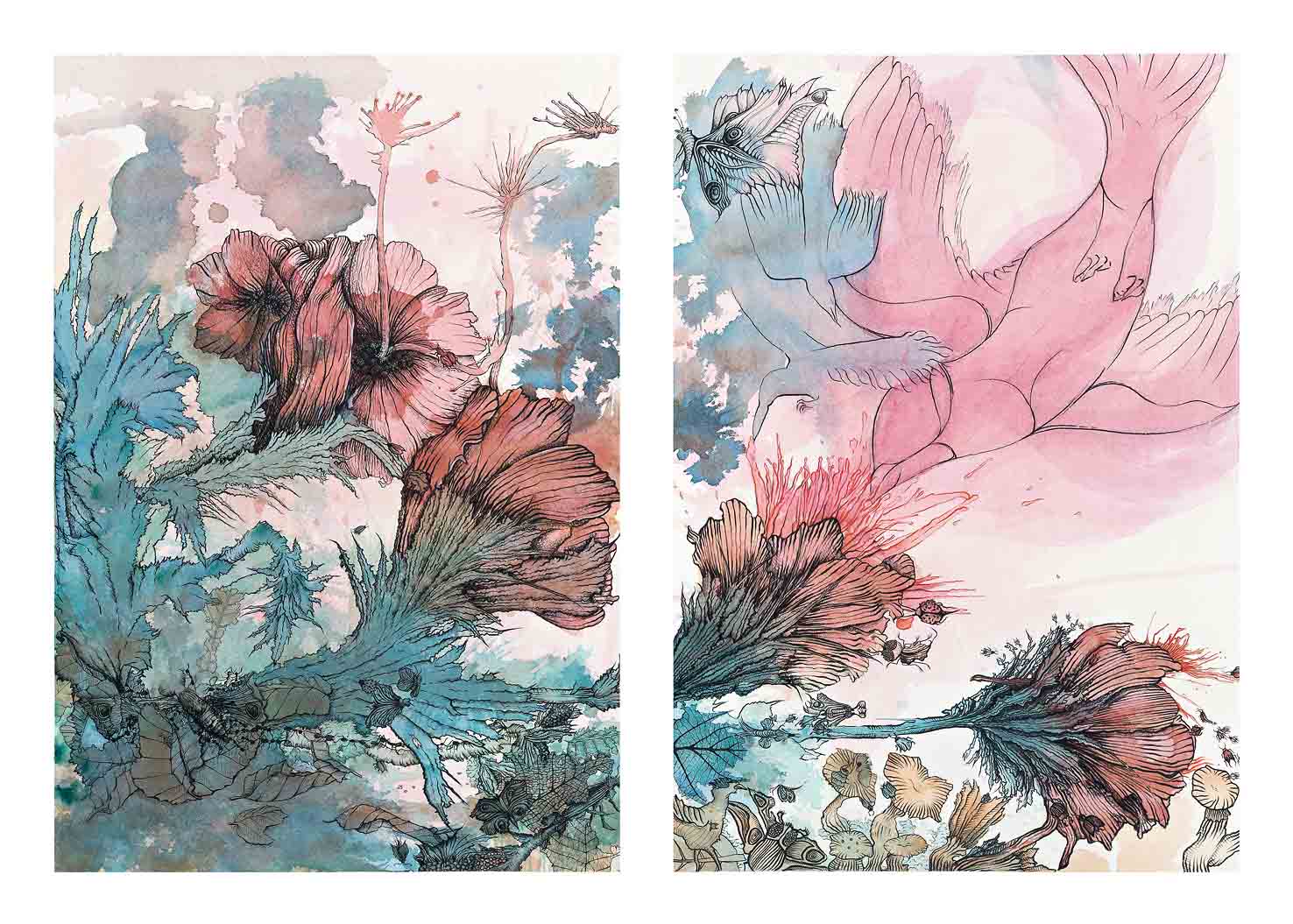
Monika Tichacek (Australian, b. 1975 Switzerland) To all my relations 2011 Diptych Gouache, pencil and watercolour on paper 244 x 300cm overall
This is a stupendous exhibition by Monika Tichacek, at Karen Woodbury Gallery. One of the highlights of the year, this is a definite must see!
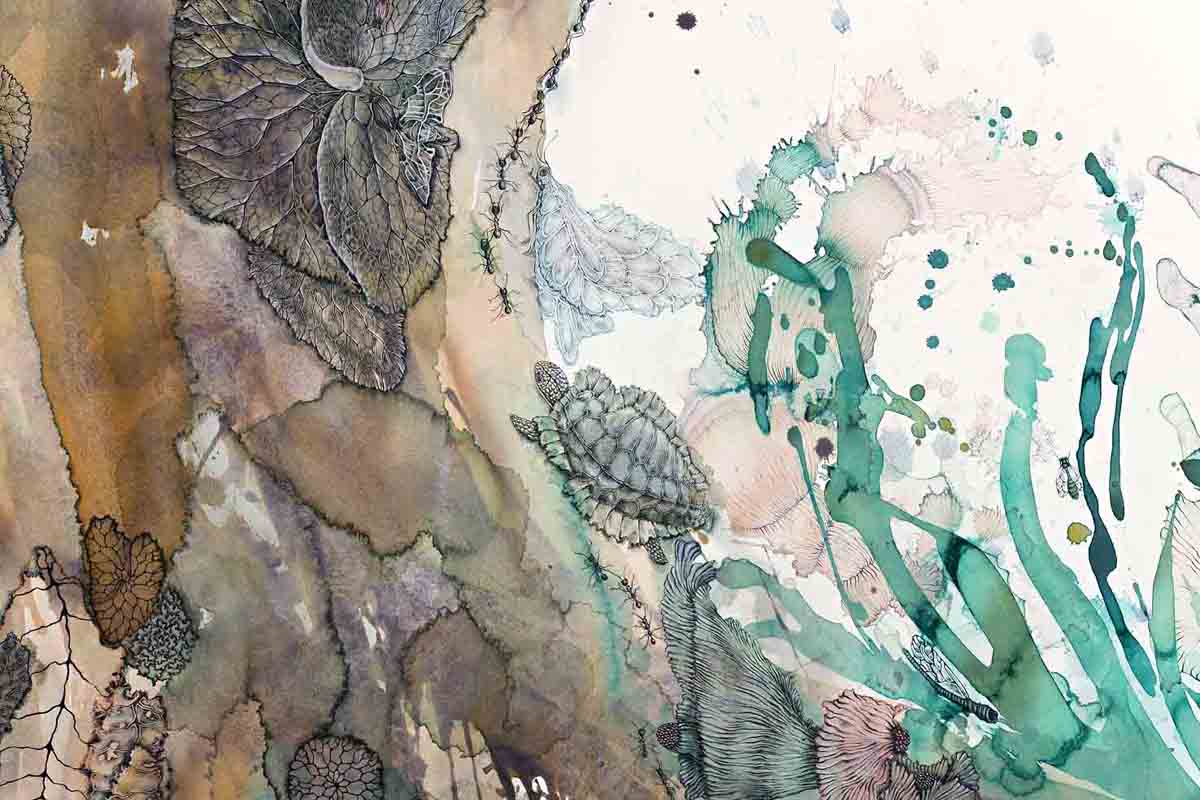
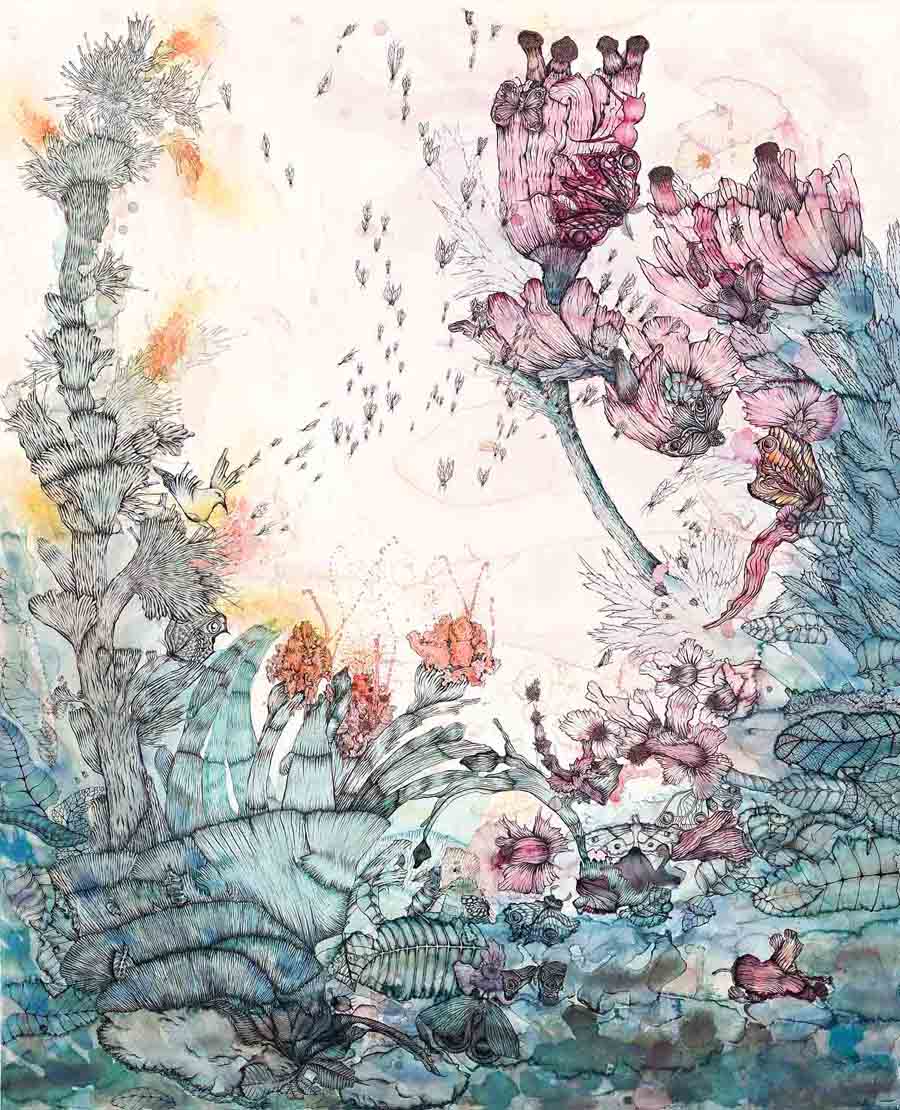
The work is glorious in it’s detail, a sensual and visual delight (make sure you click on the photographs to see the close up of the work!). The riotous, bacchanalian density of the work is balanced by a lyrical intimacy, the work exploring the life cycle and our relationship to the world in gouache, pencil & watercolour. Tichacek’s vibrant pink birds, small bugs, flowers and leaves have absolutely delicious colours. The layered and overlaid compositions show complete control by the artist: mottled, blotted, bark-like wings of butterflies meld into trees in a delicate metamorphosis; insects are blurred becoming one with the structure of flowers in a controlled effusion of life. The title of the exhibition, To all my relations,
“has inspired an understanding that all animist cultures’ peoples have who live in close relationship to the earth. We are all related, we all exist in an interdependent system. The ecosystem is such an unbelievably complex, harmonious system. Every drop of rain, every insect, every micro-organism has its place for the perfect functioning and health of nature… The title is an acknowledgement and honouring of all that is live-giving, every little element that makes up the big picture of life on earth.”1
It was very difficult to pull myself away from the beauty and intimate polyphony of voices contained within the work. I loved it!
Dr Marcus Bunyan
1/ O’Sullivan, Jane. “Artist Interview: Monika Tichacek,” on Australian Art Collector website, 19th May 2011 [Online] Cited 21/05/2010 no longer available online
Many thankx to Karen Woodbury Gallery for allowing me to publish the photographs and Art Guide Australia for allowing me to publish the text in the posting. The text by Dylan Rainforth was commissioned by Art Guide Australia and appears in the May/June 11 issue of Art Guide Australia magazine. Please click on the photographs for a larger version of the image.
Monika Tichacek (Australian, b. 1975 Switzerland) To all my relations (detail) 2011 Diptych Gouache, pencil and watercolour on paper 244 x 300cm overall
The Cycle of Nature – Monika Tichacek’s To All My Relations
Dylan Rainforth
Anyone used to the immaculately controlled, exactingly lit photographic and video mise en scène that Swiss-born artist Monika Tichacek presented in such series as The Shadowers, for which she won the prestigious Anne Landa Award for Video and New Media Arts in 2007, may be surprised by the direction her work has taken in her latest exhibition. To All My Relations consists entirely of works on paper – watercolour and ink drawings that evince a tension between abstract, gestural shapes and bleeds of colour, recalling (just for convenience’s sake) Kandinsky, and intricately rendered natural forms that owe more to the scientific, zoological and botanical narratives of the Endeavour voyages of Captain Cook, Joseph Banks and the artist Sydney Parkinson.
The work has come out of an intensive period over the last few years in which Tichacek spent considerable time in the jungles of South America and the deserts of the United States, as well as time spent in the New South Wales bush and studying nature books. “I’m getting more and more interested in the cellular, microscopic imagery that you get when you enlarge something and peer deeper into the structure of how material elements are composed, and that really coincides with my interest in Eastern philosophies of Buddhism and many other things too. I guess I’m looking as deeply into the nature of something as is possible but I’m trying not to do it so much with my mind – but of course that’s very challenging,” she says, laughing lightly.
“The exploration of feeling is quite important to me – it’s quite a departure from what I used to do, which were certainly works that came from a very inner landscape but then the execution would be very conceptual, obviously – it had to be and this new work is much more intimate.”
That challenge to the rational, objective Western subject is informed by Tichacek’s exposure to indigenous traditions in South America and other places.
“In 2006 I had a research grant and I went to the Amazon because I wanted to look more deeply into animist cultures, meaning cultures that really see the land as living and as alive with energy and with spirit or ‘beingness’. So I went to the Amazon and spent quite a long time there and also in the mountains in Peru and saw a little bit of Central America and also North America in the desert. I spent time there and really learnt a lot about their indigenous ways and got to participate in a lot of things and experience a lot of things. In the Amazon shamanic tradition there is a process – they call it dieting – you spend a few months more or less alone, existing on very limited foods. You get very little, limited food and very little contact and they give you different traditional plants that, through the communion they do, they are ‘told’ to give you. And you are encouraged to connect with this plant for its healing properties to come through. So that was quite an amazing time to get quite still…”
The exhibition title comes from a Native American ceremony. According to Tichacek, “It’s always said when entering the sweat lodge and it’s an acknowledgement of being related to everything in nature, every being, the understanding that without all these other relations one wouldn’t exist. In those cultures it’s much more understood – we’ve lost that understanding because we can just buy things in the supermarket and eat them but if we lived that way we would probably remember a lot more that we are closely related to everything around us.”
From this perspective we can see that this new work is not a complete departure from Tichacek’s earlier work after all, yet its intentions are radically different. Both the natural world and shamanistic knowledge played their part in The Shadowers. Professor Anne Marsh has described Tichacek’s video, played out in a violent scene occurring between three women (one of whom Marsh characterises as a witch doctor or shaman) in a forest environment, as “stretch[ing] the boundaries between body art, ritual and sado-masochism by assaulting the senses and transgressing the social realm. In psychoanalytic terms it tears at the screen of the real and immerses the viewer into the abject world of instinctual response where language has no authority.” [i]
Pain, sado-masochism, ritual and endurance certainly have their place in shamanistic traditions – one need only think of any number of initiation rites – but now Tichacek is looking for a less conflicted relationship with nature. “The work has always been very personal and I guess in The Shadowers that nature relationship was starting to come in but it was very tense and very violent and very confused. The continuation of that theme is still there – the exploration of how to understand the experience of the self and what we are doing here and how we come to exist. That’s definitely been there before but this new work is more in the realm of psychology and the previous works are more in the realm of the female body.”
To All My Relations will present several drawings, with one in particular being conceived on a massive scale that Tichacek intends to convey the sense of awe we experience when surrounded by nature. The artist will also stage a performance – something her interdisciplinary practice has always embraced – at the opening. Although she had not completely determined the details when I spoke to her the performance was inspired by a drawing she made a few years ago and will symbolically connect the artist’s body to the roots of a tree.
“I always feel like [performance serves] to bring my body into it. Although I feel like my body’s very much in these drawings there’s something about performance that’s really physically present.”
Dylan Rainforth.
Monika Tichacek (Australian, b. 1975 Switzerland) To all my relations (detail) 2011 Diptych Gouache, pencil and watercolour on paper 244 x 300cm overall
Monika Tichacek (Australian, b. 1975 Switzerland) Birth of generosity 2011 Diptych Pencil and watercolour on paper 70 x 114cm overall
Monika Tichacek (Australian, b. 1975 Switzerland) Transmission 2011 Pencil and watercolour on paper 150 x 125cm
Exhibition marking the 100th birthday of Kurt Kranz 19th November 2010 – 29th May 2011
Kurt Kranz (German, 1910-1997) Perspective 1931 Ingrid Kranz / Stiftung Bauhaus Dessau Foto: Lars Lohrisch / Abdruck mit Genehmigung der Kunsthalle
One of the great pleasures of publishing this archive is that I get to research the life of an artist whose work I never knew before. Kurt Kranz is one such artist.
Dr Marcus Bunyan
Many thankx to the the Bauhaus Dessau for allowing me to publish the photographs in the posting. Please click on the photograph for a larger version of the image.
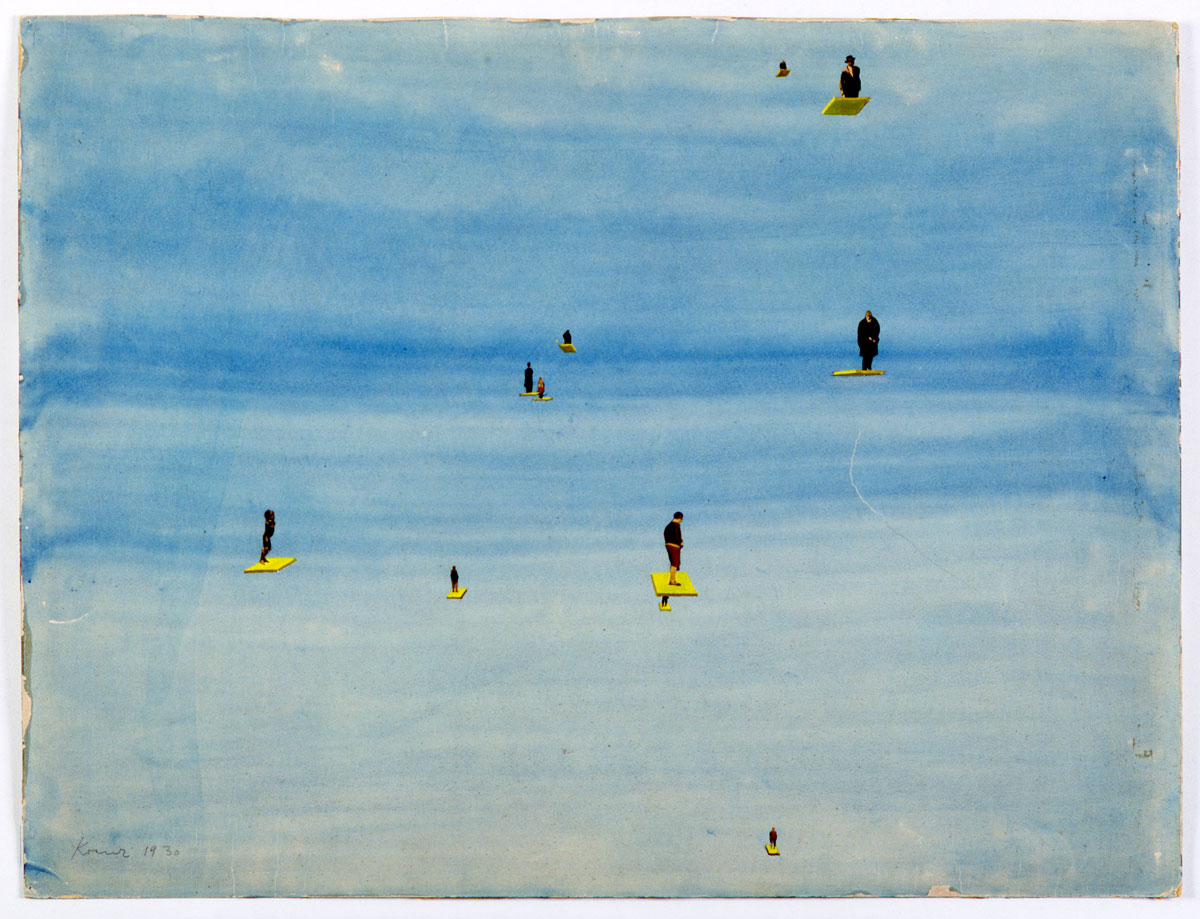
Kurt Kranz (German, 1910-1997) Vereinsamung (Isolation) Dessau 1930 Ingrid Kranz / Stiftung Bauhaus Dessau Leihgeber: Kunsthalle Bremen
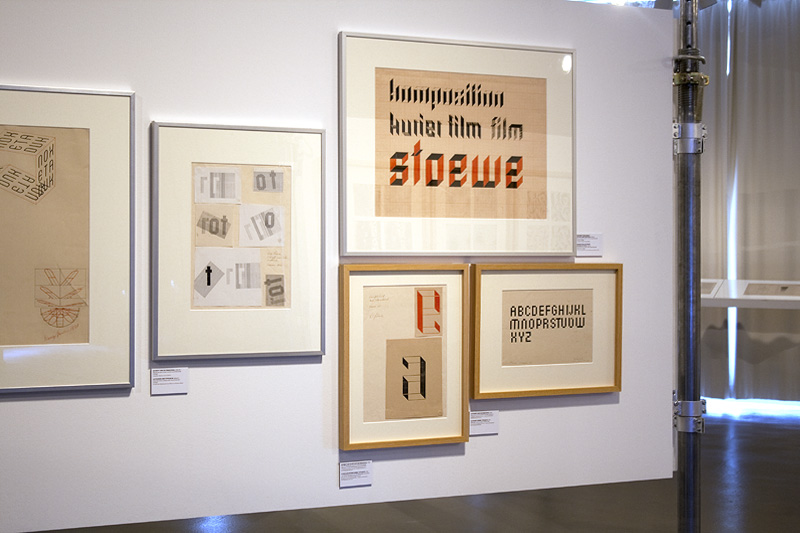
Installation photograph of Programming of Beauty by Kurt Kranz at the Bauhaus Dessau
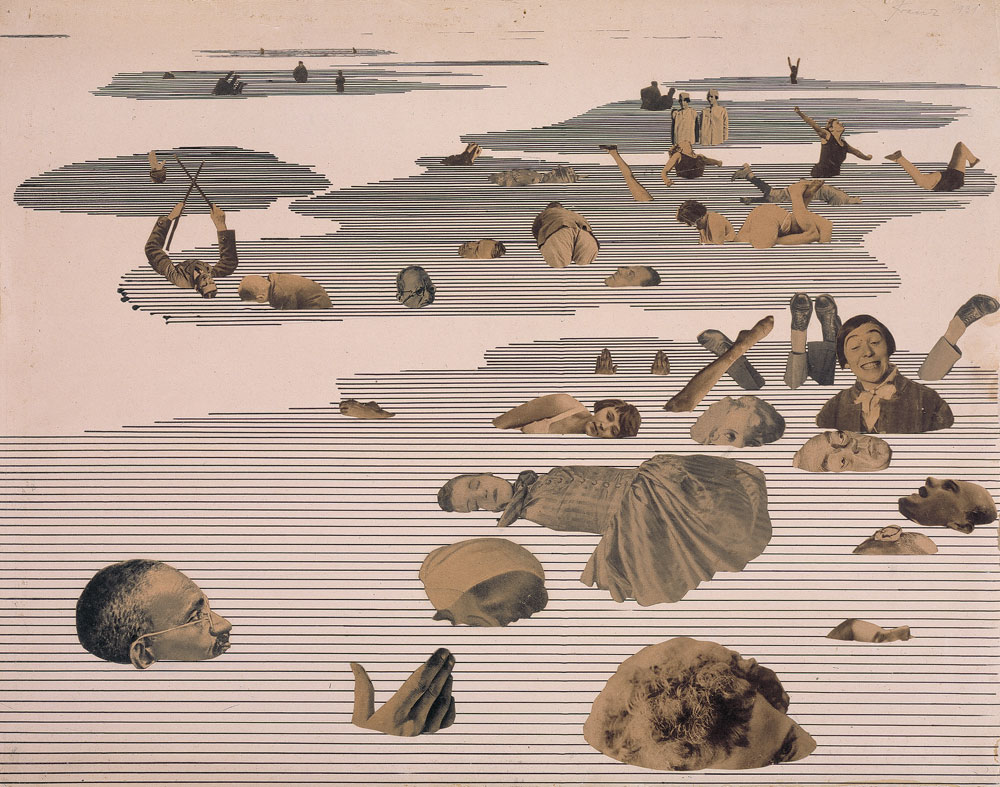
Kurt Kranz (German, 1910-1997) Versinkende (Sinking one) 1931 Ingrid Kranz / Stiftung Bauhaus Dessau
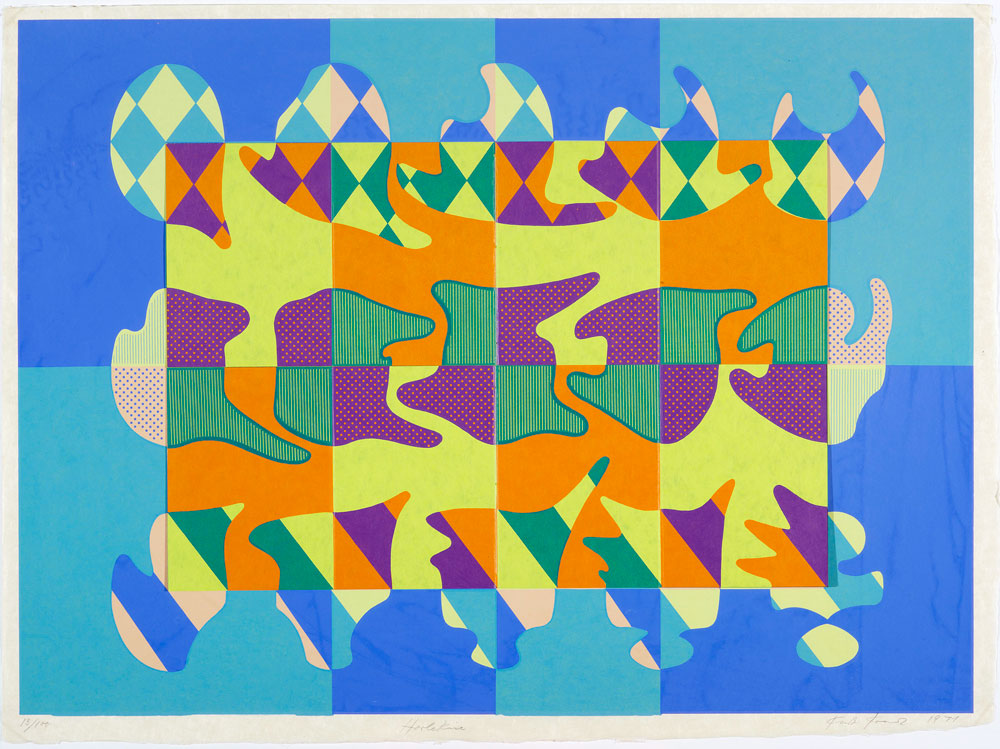
Kurt Kranz (German, 1910-1997) Persischer Garten (Persian garden) 1970 Ingrid Kranz / Stiftung Bauhaus Dessau Foto: Uwe Jacobshagen
The Bauhaus Dessau dedicates a comprehensive exhibition to the painter, graphic designer and photographer Kurt Kranz to mark his 100th birthday. In 1930, the then twenty-year-old lithographer came from Bielefeld to study at the Bauhaus Dessau, where he soon established himself as a pioneer of serial and generative methods. With his avant-garde work, Kranz’s methods anticipated those of later generations.
Inspired by a lecture by László Moholy-Nagy, Kurt Kranz came to the Bauhaus Dessau in April 1930. In Walter Peterhans’s photography class, Kranz began to experiment with photographic techniques and created some of the most striking abstract picture series to emerge from the Bauhaus. Alienated and abstracted faces and hands appear repeatedly in his dynamic picture series. These show Kranz’s early affinity for film as, page for page, the abstract forms interact with one another. Kranz drafted his first concepts for abstract films at the Bauhaus, although he was first able to realise these decades later in 1972.
The exhibition to mark the artist’s 100th birthday shows works from Kranz’s Bauhaus years and his later work as an advertising graphic designer, and focuses on a selection of his large picture cycles. Strikingly diverse leporellos dating from the 1960s onwards take centre stage, as do the so-called “Matrix-und Schiebebilder”
Text from the Bauhaus Dessau website
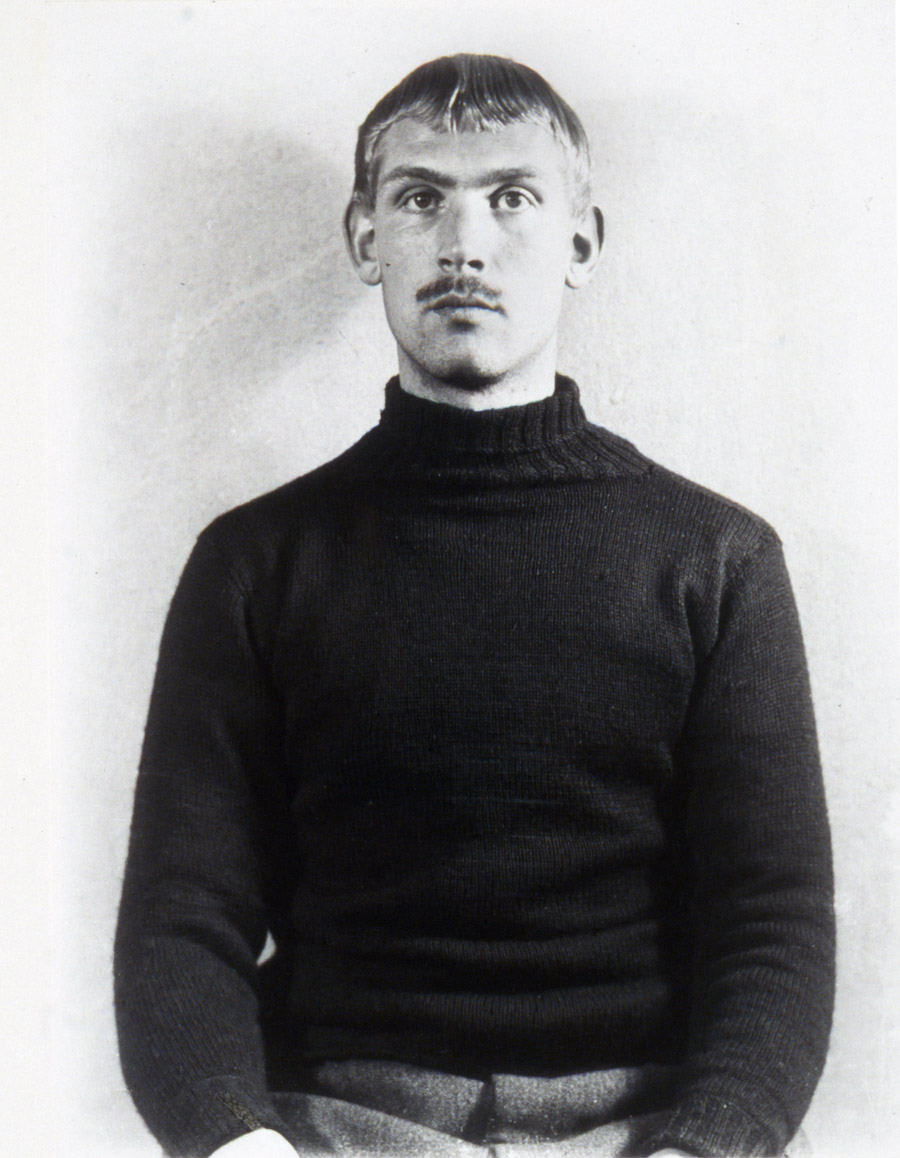
Kurt Kranz (German, 1910-1997) Selbstporträt en face (objektives Foto) (Self-portrait with face (objective photo)) 1931 Ingrid Kranz / Stiftung Bauhaus Dessau
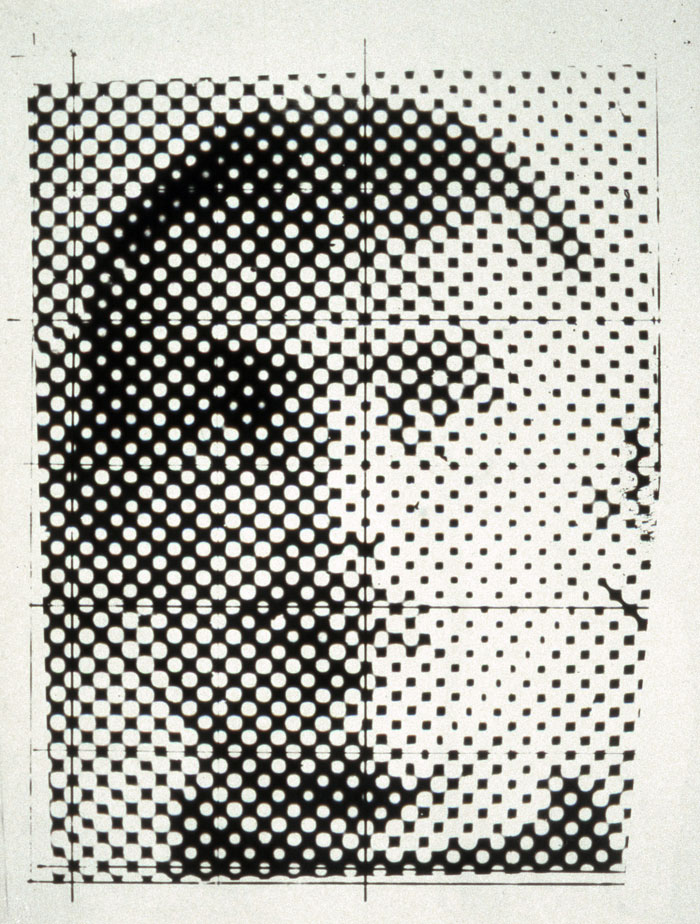
Kurt Kranz (German, 1910-1997) Rasterfoto (Raster photograph) 1932 Ingrid Kranz / Stiftung Bauhaus Dessau
Kurt Kranz (German, 1910-1997) Schwarz: Weiß (Black: White) 1928-1929 Ingrid Kranz / Stiftung Bauhaus Dessau Privatbesitz
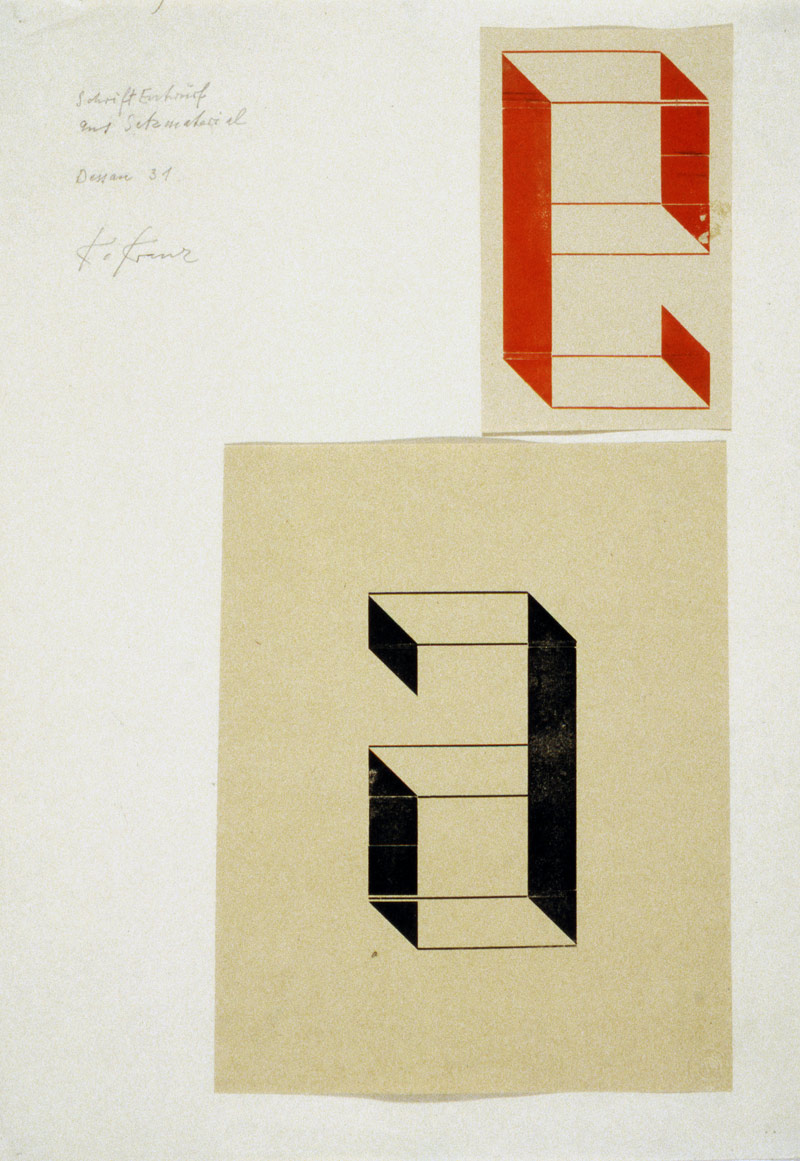
Kurt Kranz (German, 1910-1997) Schrift Entwurf aus Satzmaterial (Writing draft from sentence material) Dessau 1931 Ingrid Kranz / Stiftung Bauhaus Dessau
Kurt Kranz (German, 1910-1997) Aus der Serie “Sieben Schritte zum symmetrischen Oval” (From the series “Seven steps to the symmetrical Oval”) 1982 Ingrid Kranz / Stiftung Bauhaus Dessau Foto: Uwe Jacobshagen
Alan Constable (Australian, b. 1956) Konica Pop 2009 Ceramic 21 x 32 x 10cm
“For me, art is what is most animal in us … It is the most noble thing because it’s a celebration precisely of the forces of the body and the forces of life.”
Elizabeth Grosz
This Saturday, after a journey around the galleries of Albert Street, Richmond (underwhelming) and a visit to Sutton Gallery to see Simon Terrill’s photographic exhibition Phantom (an exhibition that I was going to review but when I saw it I changed my mind: two excellent photographs, Balfron Tower 2010-2011 and Rivoli #2 2010-2011, let down by three “empty” long exposure photographs allegedly showing traces of humanity, residues of presence) had left me a little deflated, I ventured to the opening of Alan Constable’s twenty-year retrospective Viewfinder curated by Dr Cheryl Daye at Arts Project Australia.
What a breath of fresh air this exhibition is!
The exhibition shows beautifully in the gallery space. Hung chronologically, the more tightly controlled early series feature luminous pastels that investigate themes: landscapes, birds (rarely figures) – the rubbed and layered medium building up an almost translucent surface that reminded me of the pastel work of Odilon Redon. Later work, such as the two paintings Not titled (person with binoculars) 2009 and Not titled (figure with camera) 2006 (both below) show a greater engagement with the world and a freeing up of technique – running figures, Barak Obama, Dr. Who, suited men with headdresses, football players: happenings – with exaggerated form (hands for example), wonderful spontaneity and an essential simplicity that engages the viewer directly. All the paintings evidence a spatial flatness that brings everything onto the same plane, gives everything equal importance within the image (denying Renaissance perspective; as Cliff Burtt notes in the catalogue the converging lines and horizons act as elements of design, forming the scaffolding of composition). This technique is one of the most powerful elements of Constable’s work. A wonderful understanding of light and use of colour are other essential elements. The transformational, rough hewn, playful clay cameras (such as Konica Pop, 2009, below) are a particular favourite of mine. The glazes on the cameras, their tactility, the colours – are luscious. To hold them, to pick them up and feel them in your hands is a very special experience for me. Outstanding.
Constable has a unique way of seeing and imaging the world; his working method is unique. After carefully selecting source images from journals, magazines (for example National Geographic) and newspapers, Constable visually scans the photograph from a few inches, holding it up to his eyes and carefully manoeuvring his way across the surface of the image, then making what he sees – a direct pointing to reality. Without a concept to worry about, through an enabled fluidity and freedom of expression, the artist cuts to the essential form of what he wants to make and because of this directness his work contains absolute kernels of wisdom. His observation is fantastic.
These are exuberant works that are a celebration of the body and of life. They have great spontaneity. What Constable sees, he feels and makes: the mark of the maker writ bold. They made me feel so alive. After the disappointment of earlier exhibitions in the day, this work made me laugh and smile!
You really can’t ask for more. It made my day.
Dr Marcus Bunyan
Many thankx to Sue Roff, Melissa Petty, Sim Lutin and everyone at Arts Project Australia for their help and for allowing me to publish the photographs in the posting. Please click on the photographs for a larger version of the image.
Alan Constable (Australian, b. 1956) Untitled (three-lens camera) 2011 Ceramic
Alan Constable (Australian, b. 1956) Not titled (person with binoculars) 2009 acrylic on canvas 71 x 71.5cm
Alan Constable (Australian, b. 1956) Not titled (figure with camera) 2006 gouache on paper 65.5 x 45cm
Alan Constable is both a painter and a ceramicist. Alan Constable: Viewfinder is a major survey exhibition that will include paintings, drawings and ceramics, opening Saturday 30 April until Wednesday 1 June 2011.
Showcasing more than 60 works selected from over a 20 year period, Viewfinder offers new and rich insights into the unique art of Alan Constable. Legally blind, Constable has been able to create a body of work that is highly regarded. He is been a finalist in numerous Australian Art Awards and his ceramic cameras are highly collectable.
‘Often when a painter is faced with a scene, there’s simply so much that’s appealing it’s hard to choose what to focus on’, says Dr Cheryl Daye, founding director, Arts Project Australia. ‘This is where a viewfinder comes in useful; as it helps you focus on particular parts of the scene, enabling you to decide what will make the best composition, both in terms of focus and format’. Daye has worked closely with Constable from the time he joined the Arts Project studio in 1987.
Viewfinder the title of his survey suggests the artist’s process and methodology as well as the composition and subject matter of his work.
In Constable’s two-dimensional works this can be traced from very early self-portraits (1992), through to carefully observed depictions of birds and animals to the series based on silhouettes framed in industrial or stormy landscapes, a fascination with light and energy and, more recently with colourful interpretations of political and cultural figures, all of which are sourced from photographic images carefully and sometimes painstakingly selected by the artist.
Based on imagery from newspapers and magazines, Constables recent paintings are notable for their vibrant kaleidoscopic effects and strong sense colour and patterning. Though Constable’s works are often centred on political events and global figures, his thematic concerns are frequently subjugated by the pure visual experience of colour and form.
His three-dimensional works, most notably the cameras, also sit well within this theme and given the fact that Constable is legally blind is also obliquely referenced. Constable’s ceramic works reflect a life-long fascination with old cameras, which began with his making replicas from cardboard cereal boxes at the age of eight. The sculptures are lyrical interpretations of technical instruments, and the artist’s finger marks can be seen clearly on the clay surface like traces of humanity. In this way, Constable’s cameras can be viewed as extensions of the body, as much as sculptural representations of an object.
Arts Project Australia supports people with disabilities to become practitioners in the visual arts. The studio and gallery nurtures and promotes artists with an intellectual disability as they develop their body of work.
Press release from Arts Project Australia
Arts Project Australia Artist Profile: David Hurlston on Alan Constable
Alan Constable’s ceramic cameras have seen international acclaim for their tactile, poetic resonances. In this video David Hurlston, Senior Curator of Australian Art at the National Gallery of Victoria, talks through Constable’s process, Constable’s highly idiosyncratic practice and why he believes Constable is one of the most important contemporary artists working today.
Alan Constable (Australian, b. 1956) Red NEK SLR 2011 Ceramic 5.5 x 12.25 x 4.75 inches
Alan Constable (Australian, b. 1956) Orange AKI SLR 2011 Ceramic 6 x 10 x 4 inches
Alan Constable (Australian, b. 1956) Not titled (explosion II) 1996 pastel on paper 50 x 66cm
Alan Constable (Australian, b. 1956) Not titled (fruit) 1993 pastel on paper 66 x 50cm Arts Project Australia Permanent Collection
Arts Project Australia
Studio 24 High Street Northcote Victoria 3070 Phone: + 61 3 9482 4484
Gallery Level 1 Perry Street building Collingwood Yards Enter via 35 Johnson Street or 30 Perry Street, Collingwood Phone: +61 477 211 699
Slow Swirl at the Edge of the Sea pictures two creatures dancing between sea and sky, surrounded by arabesques, spirals, and stripes. The forms “have no direct association with any particular visible experience, but in them one recognises the principle and passion of organisms,” Rothko said. For him art was “an adventure into an unknown world”; like the Surrealists before him, Rothko looked inward, to his own unconscious mind, for inspiration and material for his work.
Gallery label from Abstract Expressionist New York, October 3, 2010 – April 25, 2011
What a privilege to post all of these works together.
Aaron Siskind has to be one of my favourite photographers of all time (and space). His Martha’s Vineyard (see photograph below), like most of his work, is superb: the abstraction and counterpose are magnificent. Team this with a couple of Rothko, a Motherwell, a de Kooning and a knockout of a Hartigan and you certainly have the start of ‘The Big Picture’. I wish I could have been there to see this exhibition – sigh!
Dr Marcus Bunyan
Many thankx to The Museum of Modern Art for allowing me to publish the photographs in the posting. Please click on the photographs for a larger version of the image.
Installation view of the exhibition, Abstract Expressionist New York: The Big Picture at MoMA, New York October 3, 2010 – February 28, 2011 Photograph by Thomas Griesel
In the early 1940s Pollock, like many of his peers, explored primeval or mythological themes in his work. The wolf in this painting may allude to the animal that suckled the twin founders of Rome, Romulus and Remus, in the myth of the city’s birth. But “She-Wolf came into existence because I had to paint it,” Pollock said in 1944. In an attitude typical of his generation, he added, “Any attempt on my part to say something about it, to attempt explanation of the inexplicable, could only destroy it.” The She-Wolf was featured in Pollock’s first solo exhibition, at Art of This Century gallery in New York in 1943. MoMA acquired the painting the following year, making it the first work by Pollock to enter a museum collection.
Gallery label from Abstract Expressionist New York, October 3, 2010 – April 25, 2011
Installation view of the exhibition, Abstract Expressionist New York: The Big Picture at MoMA, New York October 3, 2010 – February 28, 2011 showing at right, Jackson Pollock’s painting Number 1A, 1948 Photograph by Thomas Griesel
While the style of “drip” painting has become synonymous with the name Jackson Pollock, here the artist has autographed the work even more directly, with several handprints found at the composition’s upper right. Around this time Pollock stopped giving his paintings evocative titles and began instead to number them. His wife, artist Lee Krasner, later explained, “Numbers are neutral. They make people look at a painting for what it is – pure painting.” Collectors did not immediately appreciate Pollock’s radical new style, and when first exhibited, in 1949 (then titled Number 1, 1948), this painting remained unsold. Later that year the work was shown again in the artist’s second solo exhibition (Pollock added “A” to the title to avoid confusion with more recent work) and shortly thereafter was purchased by MoMA.
Gallery label from Abstract Expressionist New York, October 3, 2010 – April 25, 2011
Bradley Walker Tomlin (American, 1899-1953) Number 20 1949 Oil on canvas 7′ 2″ x 6′ 8 1/4″ (218.5 x 203.9cm) Gift of Philip Johnson
Although some of the ribbons and bars that animate Number 20 are recognisable letters of the alphabet (E, X, or Z) these and their more abstract neighbours evoke calligraphy without constituting it. A critic described these symbols as “hieroglyphs that lack only the appropriate Rosetta Stone for their deciphering.” Tomlin distributed his nonobjective imagery evenly on the canvas, depriving the work of a traditional focal point and creating a staccato rhythm and allover design that invites the viewer’s glance to travel across its surface.
Gallery label from Abstract Expressionist New York, October 3, 2010 – April 25, 2011
Installation view of the exhibition, Abstract Expressionist New York: The Big Picture at MoMA, New York October 3, 2010 – February 28, 2011 showing at left, Barnett Newman’s painting Vir Heroicus Sublimis (1950-1951) Photograph by Thomas Griesel
Vir Heroicus Sublimis, Newman’s largest painting at the time of its completion, is meant to overwhelm the senses. Viewers may be inclined to step back from it to see it all at once, but Newman instructed precisely the opposite. When the painting was first exhibited, in 1951 at the Betty Parsons Gallery in New York, Newman tacked to the wall a notice that read, “There is a tendency to look at large pictures from a distance. The large pictures in this exhibition are intended to be seen from a short distance.” Newman believed deeply in the spiritual potential of abstract art. The Latin title of this painting means “Man, heroic and sublime.”
Gallery label from Abstract Expressionist New York, October 3, 2010 – April 25, 2011
Installation view of the exhibition, Abstract Expressionist New York: The Big Picture at MoMA, New York October 3, 2010 – February 28, 2011 showing at right, David Smith’s sculpture Australia (1951) Photograph by Thomas Griesel
At the time of its completion, Australia was Smith’s largest sculpture. By welding together thin rods and plates of steel he created a work that is simultaneously delicate and strong, a masterpiece of tension, balance, and form that he described as a “drawing in space.” Sculpture has traditionally been defined by volume and mass; Australia is, in contrast, built of lines. In what might be described as an allover sculpture, the linear activity is greatest at the perimeters, while the center is nearly empty. Because of its title, the work is sometimes read as an abstracted kangaroo, its lines capturing the spring of the animal’s leap.
Gallery label from Abstract Expressionist New York, October 3, 2010 – April 25, 2011
Installation view of the exhibition, Abstract Expressionist New York: The Big Picture at MoMA, New York October 3, 2010 – February 28, 2011 showing a wall of photographs by Aaron Siskind including at second right, Martha’s Vineyard (1954-1959) Photograph by Thomas Griesel
In the 1940s Gottlieb began to emulate the art of early Native American and Middle Eastern cultures, explorations that eventually inspired his Pictograph paintings, including Man Looking at Woman. This work and others like it feature hieroglyphic-like script distributed across the canvas in a series of gridded compartments. Gottlieb avoided using decipherable signs. In 1955 he said of these works, “I frequently hear the question, ‘What do these images mean?’ That is simply the wrong question. Visual images do not have to conform to either verbal thinking or optical facts. A better question would be: ‘Do these images convey any emotional truth?'”
Gallery label from Abstract Expressionist New York, October 3, 2010 – April 25, 2011
The evocative title of this work and the fiery intensity of the palette signal a departure from Gorky’s more lyrical abstractions of the preceding years. Agony, a blazing, impassioned scene, is often understood in relation to the traumatic events of the artist’s personal life, including a fire in his studio and cancer.
Gallery label from Abstract Expressionist New York, October 3, 2010 – April 25, 2011
Subtitled The Big Picture, this installation of 100 Abstract Expressionist paintings and a rich selection of some 60 sculptures, drawings, prints, and photographs, occupies the entire fourth floor of the Museum and chronicles the era of Abstract Expressionism. The movement drew together a host of artists with greatly varying stylistic approaches, but with a common commitment to the power of an abstract art that could express personal convictions and profound human values.
Organised in a loose chronology, intermittently interrupted by monographic galleries that allow for the in-depth study of an individual artist’s practice, the installation opens with a selection of paintings and drawings that attest to the acutely self-conscious sense of new beginnings present in the work of individuals such as Jackson Pollock and Mark Rothko. In the immediate aftermath of World War II, they and their peers – not yet a cohesive group – created imagery that evoked primitive man or ancient myth, and conjured an aquatic or geological pre-human world.
Upon entering the galleries, visitors are greeted by Jackson Pollock’s The She-Wolf (1943), which was featured in the artist’s first solo exhibition, in 1943, and was the first work by Pollock to enter a museum collection when MoMA acquired it the following year. Made before Pollock developed his signature “drip” style, the canvas shows that a free-form abstraction and an unfettered play of materials were already parts of his process. Also on view is Mark Rothko’s Slow Swirl at the Edge of the Sea (1944), a canvas picturing two creatures floating between sea and sky, surrounded by arabesques, spirals, and stripes that betrays the influence of Surrealism on Rothko’s early work.
A monographic gallery devoted to the work of Barnett Newman includes Onement, I (1952), which the artist later identified as his breakthrough painting. Modest in size, it consists of a monochromatic background divided in half by a vertical band, or “zip” as the artist later called it. Every successive painting by Newman, as seen in the seven works in this gallery, features this particular compositional motif, although their formal and emotional differences are apparent. The scale and proportions of the paintings, as well as their palette and brushwork, vary from work to work, as do the number of zips and their location in the field of colour. At the other end of the spectrum from this relatively small canvas is Vir Heroicus Sublimis (1950-1951), an 18-foot-wide, vibrant red expanse that was Newman’s largest painting at the time of its creation.
The distinctive materials, techniques, and approaches developed and practiced by the Abstract Expressionists can be seen in a number of other works from the late 1940s and early 1950s. For Painting (1948), Willem de Kooning used oil and enamel sign paint to create a densely packed painting in which the paint drips, bleeds, congeals, or dissolves into delicate streaks. Lee Krasner’s Untitled (1949) shows that she applied thick paint – sometimes directly from the tube – in rhythmic and repetitive strokes, giving equal attention to every inch of the canvas and creating an allover composition. Bradley Walker Tomlin, in Number 20 (1949), and Adolph Gottlieb, in Man Looking at Woman (1949), distributed imagery evoking the alphabet and hieroglyphics evenly across their canvases.
A large gallery focusing on the work of Jackson Pollock includes Full Fathom Five (1947), one of earliest “drip” paintings, and Number 1A, 1948 (1948), the first drip painting to enter MoMA’s collection (in 1950). For One: Number 31, 1950 (1950), a masterpiece of the drip technique and one of Pollock’s largest paintings (8′ 10″ x 17′ 5 5/8″ (269.5 x 530.8 cm)), the artist laid the canvas on the floor of his studio and poured, dribbled, and flicked enamel paint onto the surface, sometimes straight from the can, or with sticks and stiffened brushes. The density of interlacing liquid threads of paint is balanced and offset by puddles of muted colours and by allover spattering.
Eight paintings made by Mark Rothko over a 14-year period are presented in a single gallery. The earliest examples from 1948, such as No. 1 (Untitled), feature variously sized abstract forms caught mid-motion as they shift on the canvas. Beginning in 1950, Rothko’s “classic” style forms as the artist creates a composition from horizontal planes of thinly layered paint and highly modulated colour, simplifying the compositional structure of his paintings and arriving at his signature style. No. 10 (1950) is divided horizontally into three dominant planes of blue, yellow, and white that softly and subtly bleed into one another. Acquired by MoMA in 1952, it was the first Rothko to enter the Museum’s collection, and was considered so radical that a trustee of the Museum resigned in protest.
MoMA’s practice of making in-depth acquisitions of work by artists that its curators judged to be of greatest importance was complemented by acquisitions of smaller numbers of works by other artist who played roles too significant to be forgotten. The Big Picture includes paintings and sculptures by more than 20 artists.
There is a gallery devoted to a selection of photographs made by individuals who used a camera to explore kindred artistic concerns – often resulting in work with striking stylistic similarities. Aaron Siskind may be the photographer most closely associated with Abstract Expressionism, and numerous works of his on display suggest the depth of this connection. Also featured in this installation is work by Harry Callahan, Robert Frank, Minor White, and others, revealing the variety of ways in which the sensibility or structure of paintings from this period manifested itself photographically.
The exhibition includes some 30 items from the MoMA Archives, documenting the relation of the Museum to Abstract Expressionism. Materials represent the institution’s influential series of “Americans” exhibitions, organised by Dorothy C. Miller, which included several Abstract Expressionist artists in four of its iterations. In addition, documentation regarding the internationally circulating New American Painting show (also organised by Miller) is presented. This important exhibition travelled to eight European cities in 1958-59 and propelled the homegrown Abstract Expressionist movement onto the international art scene. A third section includes photographs of artists and their own statements and letters. Highlights include: exhibition catalogues, installation photographs, news clippings, and ephemera; photographs of artists in the studio with their artworks; a letter from Robert Motherwell to Miller describing the four themes of his art (automatic means, pure abstractions, political or a kind of “disasters” series, and intimate pictures), a letter from Ad Reinhardt to Miller recommending a different installation of his paintings, and a statement by Grace Hartigan identifying her subject as the “vulgar and vital in American life, and the possibilities of its transcendence into the beautiful.”
Text from the Museum of Modern Art press release
Installation view of the exhibition, Abstract Expressionist New York: The Big Picture at MoMA, New York October 3, 2010 – February 28, 2011 showing a wall of the photographs of Robert Frank (Swiss-American, 1924-2019) Photograph by Thomas Griesel
Robert Frank (Swiss-American, 1924-2019) Paris 1952 Gelatin silver print
Robert Frank (Swiss-American, 1924-2019) Mississippi, St Louis 1948 Gelatin silver print
Robert Frank (Swiss-American, 1924-2019) New York c. 1949 Gelatin silver print
This sculpture represents Kwannon (also known as Kannon), the Buddhist goddess of mercy and an attendant of Buddha. Lassaw thickened steel wire with molten bronze, creating an openwork metal scaffolding of irregular lines and voids – what he called a “drawing in space.” Lassaw wrote of this abstract figure, “Although I never try to depict or narrate or communicate, I feel that something of Kwannon entered this piece of sculpture.”
Gallery label from Abstract Expressionist New York, October 3, 2010 – April 25, 2011
De Kooning famously said, “Flesh is the reason oil paint was invented,” and although he often worked in an abstract style he continually returned to the figure. Woman I took an unusually long time to complete. De Kooning made numerous preliminary studies then repainted the canvas repeatedly, eventually arriving at this hulking, wild-eyed figure of a woman. An amalgam of female archetypes, from a Paleolithic fertility goddess to a 1950s pinup girl, her threatening gaze and ferocious grin are heightened by de Kooning’s aggressive brushwork and intensely coloured palette.
Gallery label from Abstract Expressionist New York, October 3, 2010 – April 25, 2011
In Memoria in Aeturnum (Eternal memory) Hofmann remembers five American painters who died in their prime: Arthur B. Carles, an early American Cubist, and four abstract painters whose work is on display in this exhibition – Arshile Gorky, Franz Kline, Jackson Pollock, and Bradley Walker Tomlin. Painted near the end of his life, Hofmann’s work is a tribute to the preceding decades of abstract art, incorporating a wide range of techniques that evoke the spirits of the departed: stains, drips, drawn-out brushstrokes, and smooth-edged geometric forms.
Gallery label from Abstract Expressionist New York, October 3, 2010 – April 25, 2011
Installation view of the exhibition, Abstract Expressionist New York: The Big Picture at MoMA, New York October 3, 2010 – February 28, 2011 showing at right, Mark Rothko’s painting No. 5 / No. 22 (1950) Photograph by Thomas Griesel
Sam Shmith (Australian born England, b. 1980) Untitled (In Spates 2) 2011 125 x 75cm Pigment print on archival rag
The Digital Punctum
Spate, definition: A sudden flood, rush, or outpouring
This is a visually strong body of work by Sam Shmith that thematically hangs together beautifully in the Arc One Gallery space. The mystery, the sublime and the journey are well handled by the artist. As a spectral ‘body’ the photographs work together to create a new form of hallucination, one that haunts and perturbs the mind, like a disturbing psychological thriller a la David Lynchian ‘Twin Peaks’. The work, as a whole, becomes a meta-narrative and as Shmith develops as an artist, they seem to me like work that has journeyed to the point of departure. The viewer is (not really) flying, (not really) floating above the clouds observing the meta-narrative, creating a visual memory of things. Spectral luminescences, not-quite-right perspectives, the photograph as temporal hallucination.
Shmith’s photographs are constructed from “30-40 photographs per pictorial narrative” taken during the day and then digitally darkened: the clouds from Queensland, the cities from here, the cars from there. To be honest the clouds and cities could be from anywhere they are just part of the process. Shmith’s technique is interesting to know and then is quickly forgotten when looking at the photographs – like reading, it does not become the meaning (just a layer) of the work. The images, when constructed (however!) take me to other spaces and memories, opening up new vistas in my imagination.
Shmith’s series acts as a punctum, working to create an unitary impression on the mind that pricks my consciousness. The whole work becomes punctum. This is a very interesting and powerful proposition.
The punctum, as argued by Barthes in Camera Lucida, relies on the QUESTION OF INTENTIONALITY – the detail that pricks and wounds is an unconscious act on the part of the photographer – not one of intention. It cannot be perceived by the photographer or indeed anyone else in the present. In other words, when the photographer photographs the total object, he cannot not not photograph the part object, which is what the punctum is:
“Hence the detail which interests me is not, or a least not strictly, intentional, and probably must not be so; it occurs in the field of the photographer thing like a supplement that is at once inevitable and graceful; it does not necessarily attest to the photographer’s art; it says only that the photographer was there, or else, still more simply, that he could not not photograph the partial object at the same time as the total object … The photographer’s “second sight” does not consist in “seeing” but in being there. And above all, imitating Orpheus, he must not turn back to look at what he is leading – what he is giving to me!” (CL 47/CC 79-80)
As Michael Fried observes in his analysis of Camera Lucida, the punctum is “antitheatrical” in the sense that we see it for ourselves and are not shown it by the photographer: it is not consciously constructed by the photographer but unconsciously captured as part of the total object:
“As Fried has argued, the experience of the punctum lives or dies for Barthes according to the absence of presence of intentionality on the part of the photographer; if there is visible intention, there is no punctum. That the punctum can exist only in the absence of intention is consistent, Fried claims, with his distinction between “seeing” (understood positively as antitheatrical) and “being shown” (understood negatively as theatrical). The possibility of the punctum is cancelled if bound to the photographer’s intention – if we are shown what can only be seen. As Fried states: “The punctum, we might say, is seen by Barthes but not because it has been shown to him by the photographer, for whom it does not exist; as Barthes recognizes, ‘it occurs [only] in the photographic field of the photographed thing,’ which is to say that it is not a pure artefact of the photographic event.”1
This changes in digital photography, especially with photographs such as Shmith’s constructed from 30-40 photographs. Here the construction can only be intentional (or can it?), dissolving the relation between referent and photograph, the unseen nature of punctum and the ability to not not photograph the part object:
“Fried mentions the subject I have in mind when he says digital photographs undermine the condition of the punctum by making it impossible that “a partial object in the photograph that might otherwise prick or wound me may never have been part of a total object, which itself may be a digital construction” (Michael Fried, “Barthes’s Punctum,” Critical Inquiry 31, Spring 2005, p.563). In the sentence just preceding that, Fried notes that digitalization “threatens to dissolve the ‘adherence’ of the referent to the photograph,” thus ending the fundamental claim that “the photographer could not not photograph the partial object at the same time as the total object.”2
But the digital punctum still exists. Shmith’s work is evidence of this. It exists in the mind of the artist and viewer, external to rather than strictly “in” or “of” the image:
“Curiously, however, Barthes does claim in Camera Lucida that the punctum may also be of the mind, or at the level of remembrance, rather than strictly “in” or “of” the image: “… the punctum (is) revealed only after the fact, when the photograph is no longer in front of me and I think back on it. I may know better a photograph I remember than a photograph I am looking at, as if direct vision oriented its language wrongly, engaging it in an effort of description which will always miss its point of effect, the punctum” (Roland Barthes, Camera Lucida: Reflections on Photography, trans. Richard Howard (New York: Hill and Wang, 1981), 53.) Indeed, the punctum is a most difficult thing to pin down, or, should one say, to prick. Fried recognizes the truly aporetic [characterised by an irresolvable internal contradiction or logical disjunction] nature of the punctum when he points to certain affinities between the literalist work of the Minimalists and the punctum, whereby the Minimalists understood the relationship between the literalist work and the beholder as ’emphatically not determined by the work itself’, suggesting that meaning in literalism was essentially indeterminate.”3
As James Elkins has observed, the punctum, or the image’s antitheatricality, is not necessarily threatened by digitalisation either through the detaching of the referent from the photograph or through the detaching of the part object from the full object within the image itself.
“The presence and efficaciousness of the part object are independent of digitalisation because the concept of the part object arises from a certain understanding of the internal structure of pictures and objects. Part objects can be found as readily in photographs of galaxies, which are assembled from layers of cleaned and enhanced digital images, as in the background of Wessing’s Nicaragua. Nor does the detachment of the photograph from its referent threaten the operation of the punctum because photographs with subjects that are wholly digitally constructed can be understood as having overlooked elements waiting to be discovered by each viewer.”4
My belief is that the digital photographer can evidence punctum in the construction of image through an anticipation of it’s affect – either consciously or unconsciously. Not through the ‘placement’ inside disparate texts but a holistic embedding through intertextuality. The punctum becomes the (non)intentional ground of discovery – the part part object if you like – the prick among many photographs now created as one, in this case 30-40 turned into one pictorial narrative. The punctum does not have to be part of a total object and digitalisation does not undermine the punctum; it may even enhance it so that, in this case, the whole series becomes punctum.
Shmith’s series and individual photographs within the series work best when the artist lets go of his consciousness and lets the ‘thing itself’ emerge, like a Japanese haiku poem. While consciously constructed by the artist the haiku takes on a life and meaning of it’s own outside the confines of intentionality.
“The artist can proffer a ‘releasement toward things’ (Heidegger, Martin. Discourse on Thinking. New York: Harper & Row, 1966, pp. 55-56), a coexistence between a conscious and unconscious way of perceiving which sustains the mystery of the object confusing the distinction between real time and sensual time, between inside and outside, input and output becoming neither here nor there. The mystery of the image is not to be found in its emasculation (in the sense of it’s deprivation of vigour) but by being attentive to the dropping a way of awareness, of memory, imagination, and the fixed gaze of desire through the glimpsing of a coexistence between a conscious and unconscious way of perceiving, a ‘releasement towards things’ which enables the seeing of the ‘Thing Itself’.”5
While Shmith’s series works as a whole and there are some wonderful individual images occasionally the artist has become too conscious of the punctum, the marks he intentionally makes. There are too many planes in clouds, the marking of these planes loosing their aura of (in)significance. They should be discovered afresh, “overlooked elements waiting to be discovered by each viewer,” not intentionally placed and shown by the artist. The series needed other themes embedded within them to allow the viewer to discover, to journey – more! As I said in the opening paragraph the photographs seems to me like work that has journeyed to the point of departure.
And what an exciting departure it is, for what happens next is in his, and our, imagination.
Dr Marcus Bunyan
1/ Fried, Michael. “Barthes’s Punctum,” in Critical Inquiry 31, Spring 2005 quoted in Hughes, Gordon. “Camera Lucida, Circa 1980,” in Batchen, Geoffrey (ed.,). Photography Degree Zero: Reflections on Roland Barthes’s Camera Lucida. Cambridge, MA: MIT Press, 2009
2/ Elkins, James. “What Do We Want Photography To Be?” in Batchen, Geoffrey (ed.,). Photography Degree Zero: Reflections on Roland Barthes’s Camera Lucida. Cambridge, MA: MIT Press, 2009, pp. 176-177
3/ Haraldsson, Arni. “Fried’s Turn,” on Fillip website, Spring 2004 [Online] Cited 12/04/2011. fillip.ca/content/frieds-turn
Many thankx to Angela Connor for her help and to Arc One Gallery for allowing me to publish the text and photographs in the posting. Please click on the photographs for a larger version of the image.
Sam Shmith (Australian born England, b. 1980) Untitled (In Spates 7) 2011 50 x 30cm Pigment print on archival rag
Sam Shmith (Australian born England, b. 1980) Untitled (In Spates 14) 2011 50 x 30cm Pigment print on archival rag
Sam Shmith’s photographs resemble the opening scenes of a Hollywood blockbuster. By harnessing our collective imagination, each image is charged with mystery and intrigue, leaving the viewer to draw their own conclusions about the narrative embedded in each of the works.
Digitally layered from an image bank of over 60,000 self-shot images, Sam’s twenty-two new landscapes choreograph a series of temporal clues into single images that simultaneously obliterate all references to a particular locality. His works are a hybrid of images from his personal archives, composited so that each journey is no longer distinct, but melded to create their single, artificial realities.
Influenced by François Truffaut’s film Day for Night (1973), the works are shot during the day, and meticulously transformed into twilight scenes. Reworking and repeating particular motifs, these elaborately constructed works are broken up into four distinct groups – sky, mountains, cities and roads. The centre of the frame concentrates an immediate human intervention enveloped by mountainous panoramas, vaporous clouds or close foliage to create a murky tension between the encompassing landscape and specks of synthetic light. Intuitively composited from between 30 to 40 photographs per pictorial narrative, the works are shot from cars, aeroplanes and hot air balloons producing mood scenes that have athematic unity.
Through his methods Sam fashions an unconventional approach to landscape photography. Citing the melancholic landscapes of Bill Henson, the suburban malaise of Gregory Crewdson and drawing motivation from Alfred Stieglitz’s Equivalents, In Spates communicates the artist’s devotional dedication to the emotive importance of the genre. Though isolation appears as a common theme in his work, Sam’s observations should also be considered as an arbitrary moment viewed from afar, evoking a feeling of alienation and disengagement between the environment and ourselves.
Text from the Arc One Gallery press release
Sam Shmith (Australian born England, b. 1980) Untitled (In Spates 5) 2011 125 x 75cm Pigment print on archival rag
Sam Shmith (Australian born England, b. 1980) Untitled (In Spates 21) 2011 125 x 75cm Pigment print on archival rag
Arc One Gallery 45 Flinders Lane Melbourne, 3000 Phone: (03) 9650 0589
Exhibition dates: 10th November 2010 – 10th April 2011
Many thankx to the The Metropolitan Museum of Art for allowing me to publish the photographs in the posting. Please click on the photograph for a larger version of the image.
Alfred Stieglitz (American, 1864-1946) The Terminal 1893, printed 1920s-30s Gelatin silver print 8.9 x 11.5cm (3 1/2 x 4 1/2 in.) The Metropolitan Museum of Art Alfred Stieglitz Collection, 1949
As proprietor of the Little Galleries of the Photo-Secession and publisher of the photographic journals Camera Notes and later Camera Work, Stieglitz was a major force in the promotion and elevation of photography as a fine art in America in the late nineteenth and early twentieth centuries. His own photographs had an equally revolutionary impact on the advancement of the medium.
Stieglitz took this picture using a small 4 x 5″ camera, an instrument not considered at the time to be worthy of artistic photography. Unlike the unwieldy 8 x 10″ view camera (which required a tripod), this camera gave Stieglitz greater freedom and mobility to roam the city and respond quickly to the everchanging street life around him. The Terminal predicts by over a decade the radical transformation of the medium from painterly prints of rarified subjects to what the critic Sadakichi Hartmann dubbed “straight photography.” This new photography would take as its subject matter the quotidian aspects of modern, urban life, using only techniques that are unique to the medium.
Text from The Metropolitan Museum of Art website
Edward Steichen (American born Luxembourg, 1879-1973) The Little Round Mirror 1901, printed 1905 Gum bichromate over platinum print 48.3 x 33.2cm (19 x 13 1/16 in.) The Metropolitan Museum of Art Alfred Stieglitz Collection, 1933
Alfred Stieglitz (American, 1864-1946) The Hand of Man 1902, printed 1910 Photogravure 24.2 x 31.9cm (9 1/2 x 12 9/16 in.) The Metropolitan Museum of Art Alfred Stieglitz Collection, 1949
The Hand of Man was first published in January 1903 in the inaugural issue of Camera Work. With this image of a lone locomotive chugging through the train yards of Long Island City, Stieglitz showed that a gritty urban landscape could have an atmospheric beauty and a symbolic value as potent as those of an unspoiled natural landscape. The title alludes to this modern transformation of the landscape and also perhaps to photography itself as a mechanical process. Stieglitz believed that a mechanical instrument such as the camera could be transformed into a tool for creating art when guided by the hand and sensibility of an artist.
Text from The Metropolitan Museum of Art website
Edward Steichen (American born Luxembourg, 1879-1973) The Flatiron 1904 Gum bichromate over platinum print 47.8 x 38.4cm (18 13/16 x 15 1/8 in.) The Metropolitan Museum of Art Alfred Stieglitz Collection, 1933
Edward Steichen (American born Luxembourg, 1879-1973) Alfred Stieglitz 1907 Autochrome 23.9 x 18cm The Metropolitan Museum of Art Alfred Stieglitz Collection, 1955
For the first time in more than 25 years, The Metropolitan Museum of Art will display five of its original Autochromes by Edward Steichen and Alfred Stieglitz for one week only – January 25-30, 2011 – as part of the current exhibition Stieglitz, Steichen, Strand. Invented by Auguste and Louis Lumière in 1907, Autochromes are one-of-a-kind color transparencies that are seductively beautiful when backlit.
The invention of the Autochrome was a milestone in the history of photography. It was the first commercially available means of making color photographs. Steichen was enthralled by the process and recommended it to his fellow photographers. Praising the luminosity of the new medium, he wrote, “One must go to stained glass for such color resonance, as the palette and canvas are a dull and lifeless medium in comparison.” Among the five Autochromes exhibited are Steichen’s portrait of Rodin in front of his sculpture The Eve and his widely reproduced portrait of Stieglitz holding an issue of his influential publication, Camera Work.
These fragile photographs – composed of minute grains of potato starch dyed red, blue, and green – cannot withstand the exposure of long-term display without suffering irreversible damage. Because of the high risk of the color fading, the Metropolitan – like most museums – has had a policy of not exhibiting its important collection of Autochromes. The Metropolitan recently completed a three-year study of the stability and light-sensitivity of Autochrome dyes, conducted by Luisa Casella, the Museum’s first Mellon Research Scholar in Photo Conservation, in close collaboration with Masahiko Tsukada of the Museum’s Department of Scientific Research, and supervised by Nora Kennedy, Sherman Fairchild Conservator of Photographs at the Metropolitan Museum. The study established that the Autochrome dyes are partially, though not completely, protected from light fading when in an environment where all oxygen has been removed.
Guided by this research, the Museum will display five original Autochromes by Steichen and Stieglitz within individual oxygen-free enclosures and under carefully controlled lighting conditions from January 25 to 30 in the exhibition Stieglitz, Steichen, Strand. During the other weeks of the exhibition, facsimiles of the photographs are displayed in their place.
Edward J. Steichen (American born Luxembourg, 1879-1973) Balzac, The Open Sky – 11 P.M. 1908, printed 1909 Direct carbon print 48.7 x 38.5cm (19 3/16 x 15 3/16 in.) The Metropolitan Museum of Art Alfred Stieglitz Collection, 1933
In late summer 1908 Rodin moved the plaster of his sculpture of the French writer Honoré de Balzac out of his studio and into the open air so that Steichen, who disliked its chalky aspect in the daylight, could photograph it by the moon. Waiting through several exposures as long as an hour each, Steichen made this exposure at 11 p.m., when the moonlight transformed the plaster into a monumental phantom rising above the brooding nocturnal landscape. Steichen recalled that when he presented his finished prints some weeks later, an elated Rodin exclaimed: “You will make the world understand my Balzac through your pictures. They are like Christ walking on the desert.”
Text from The Metropolitan Museum of Art website
Stieglitz, Steichen, Strand
Go behind the lens with Sarah Greenough and Joel Smith as they speak about the relationships between three giants of early twentieth-century photography – Alfred Stieglitz, Edward Steichen, and Paul Strand – whose diverse and groundbreaking works are among the Metropolitan’s greatest photographic treasures. Followed by a discussion among the participants. Malcolm Daniel, Curator in Charge, Department of Photographs, MMA, introduces the program.
“Steichen, Stieglitz, and the Art of Change” Joel Smith, Curator of Photography, Princeton University Art Museum
“Stieglitz and Strand: Mentor and Protégé/Friend and Rival” Sarah Greenough, Senior Curator of Photographs, National Gallery of Art, Washington.
Stieglitz and the New York Art Scene (1905-46)
Lisa M. Messinger, associate curator, Department of Nineteenth-Century, Modern, and Contemporary Art, The Metropolitan Museum of Art
Three giants of 20th-century American photography – Alfred Stieglitz, Edward Steichen, and Paul Strand – are featured at The Metropolitan Museum of Art, New York, through April 10, 2011, in the exhibition Stieglitz, Steichen, Strand. The diverse and groundbreaking work of these artists will be revealed through a presentation of 115 photographs, drawn entirely from the Museum’s collection. On view will be many of the Metropolitan’s greatest photographic treasures from the 1900s to 1920s, including Stieglitz’s famous portraits of Georgia O’Keeffe, Steichen’s large coloured photographs of the Flatiron building, and Strand’s pioneering abstractions.
Alfred Stieglitz (1864-1946) was a photographer of supreme accomplishment and a forceful and influential advocate for photography and modern art through his gallery “291” and his sumptuous journal Camera Work. Stieglitz also laid the foundation for the Museum’s collection of photographs. In 1928, he donated 22 of his own works to the Metropolitan; these were the first photographs to enter the Museum’s collection as works of art. In later decades he gave the Museum more than 600 photographs by his contemporaries, including Edward Steichen and Paul Strand.
Among Stieglitz’s works to be featured in this exhibition are portraits, views of New York City from the beginning and end of his career, and the 1920s cloud studies he titled Equivalents, through which he sought to arouse in the viewer the emotional equivalent of his own state of mind at the time he made the photograph, and to show that the content of a photograph was different from its subject.
The exhibition will also include numerous photographs from Stieglitz’s extraordinary composite portrait of Georgia O’Keeffe (1887-1986), part of a group of works selected for the Museum’s collection by O’Keeffe herself. Stieglitz made more than 330 images of O’Keeffe between 1917 and 1937 – of her face, torso, hands, or feet alone, clothed and nude, intimate and heroic, introspective and assertive. Through these photographs Stieglitz revealed O’Keeffe’s strengths and vulnerabilities, and almost single-handedly defined her public persona for generations to come.
Stieglitz’s protégé and gallery collaborator, Edward Steichen (1879-1973), was the most talented exemplar of the Photo-Secession, the loosely-knit group of artists founded by Stieglitz in 1902, seceding, in his words, “from the accepted idea of what constitutes a photograph,” but also from the camera clubs and other institutions dominated by a more retrograde establishment. In works such as The Pond – Moonrise (1904), made using a painstaking technique of multiple printing, Steichen rivalled the scale, colour, and individuality of painting.
Steichen’s three large variant prints of The Flatiron (1904) are prime examples of the conscious effort of Photo-Secession photographers to assert the artistic potential of their medium. Steichen achieved coloristic effects reminiscent of Whistler’s Nocturne paintings by brushing layers of pigment suspended in light-sensitive gum solution onto a platinum photograph. Although he used only one negative to create all three photographs, the variable colouring enabled him to create three significantly different images that convey the chromatic progression of twilight. The Metropolitan’s three prints, all donated by Stieglitz in 1933, are the only exhibition prints of Steichen’s iconic image.
In 1908 Steichen photographed the plaster of Rodin’s sculpture of Honoré de Balzac in the open air, by the light of the moon, making several exposures as long as an hour each. In Balzac, The Silhouette – 4 A.M., the moonlight has transformed the plaster into a monumental phantom rising above the brooding nocturnal landscape. Steichen recalled that when he presented his finished prints to Rodin, the elated sculptor exclaimed, “You will make the world understand my Balzac through your pictures.”
Among the unique early-20th-century works by Stieglitz and Steichen in the Museum’s collection are Autochromes, an early process of colour photography that became commercially available in 1907. Because of the delicate and light-sensitive nature of these glass transparencies, five original Autochromes by Stieglitz and Steichen will be displayed for one week only, January 25-30, 2011. During the other weeks of the exhibition, facsimiles of these Autochromes will be on view.
Stieglitz’s and Steichen’s younger contemporary, Paul Strand (1890-1976), pioneered a shift from the soft-focus aesthetic and painterly prints of the Photo-Secession to the straight approach and graphic power of an emerging modernism. Strand was introduced to Stieglitz as a high-schooler by his camera club advisor, Lewis Hine, the social reformer and photographer. He quickly became a regular visitor to “291,” where he was exposed to the latest trends in European art through groundbreaking exhibitions of works by Cézanne, Picasso, Matisse, and Brancusi.
Strand incorporated the new language of geometric abstraction into his interest in photographing street life and machine culture. His photographs from 1915-1917 treated three principal themes: movement in the city, abstractions, and street portraits. Stieglitz, whose interest in photography had waned as he grew more interested in avant-garde art, saw in Strand’s work a new approach to photography. He showed Strand’s groundbreaking photographs at 291 and devoted the entire final double issue of Camera Work (1917) to this young photographer’s work, marking a pivotal moment in the course of photography.
In From the El (1915), Strand juxtaposed the ironwork and shadows of the elevated train with the tiny form of a lone pedestrian. In 1916, he experimented with radical camera angles and photographing at close range. Among the astonishingly modern photographs he made that summer is Abstraction, Twin Lakes, Connecticut, one of the first photographic abstractions to be made intentionally. When Stieglitz published a variant of this image in Camera Work, he praised Strand’s results as “the direct expression of today.”
In the same year, Strand made a series of candid street portraits with a hand-held camera fitted with a special lens that allowed him to point the camera in one direction while taking the photograph at a 90-degree angle. Blind, his seminal image of a street peddler, was published in Camera Work and immediately became an icon of the new American photography, which integrated the humanistic concerns of social documentation with the boldly simplified forms of Modernism. As is true for most of the large platinum prints by Strand in the exhibition, the Metropolitan’s Blind, a gift of Stieglitz, is the only exhibition print of this image from the period.
Stieglitz, Steichen, Strand is organised by Malcolm Daniel, Curator in Charge of the Metropolitan Museum’s Department of Photographs, assisted by Russell Lord, Jane and Morgan Whitney Fellow in the Department of Photographs.
Text from the Metropolitan Museum of Art website
Alfred Stieglitz (American, 1864-1946) The City of Ambitions 1910, printed 1910-1913 Photogravure 33.8 x 26.0cm (13 5/16 x 10 1/4 in.) The Metropolitan Museum of Art Alfred Stieglitz Collection, 1949
This photograph belongs to a series of dynamic images Stieglitz made of New York of 1910. It appeared in the October 1911 issue of Camera Work along with eight other examples of his lyrical urban modernism – a contemporary vision certainly not lost on Coburn, Struss, and Strand.
Alfred Stieglitz (American, 1864-1946) Old and New New York 1910, printed in or before 1913 Photogravure 33.2 x 25.5cm (13 1/16 x 10 1/16 in.) The Metropolitan Museum of Art Alfred Stieglitz Collection, 1949
Paul Strand (American, 1890-1976) From the El 1915 Platinum print 33.6 x 25.9cm (13 1/4 x 10 3/16 in.) The Metropolitan Museum of Art Alfred Stieglitz Collection, 1949
Paul Strand was introduced to Alfred Stieglitz by his teacher Lewis Hine, and quickly became part of the coterie of painters and photographers that gathered at Stieglitz’s gallery at 291 Fifth Avenue. There he was exposed to the latest trends in European vanguard art through groundbreaking exhibitions of Cézanne, Picasso, Matisse, and Brancusi. Strand incorporated their abstracting compositional techniques into his work, marrying the new language of geometric surface design to his interest in street life and machine culture.
Strand’s vision of the city during these years often focuses on the problematic exchange between the sweep and rigor of the urban grid with the human lives that inhabit and pass through it. From the El is a good example of this dialectical approach, with the graphic power of the ironwork and street shadows punctuated by the tiny, lone pedestrian at the upper right. Strand addresses the effects of the new urban condition obliquely here, embedding a subtle political statement within the formal structure of the image.
Text from The Metropolitan Museum of Art website
Alfred Stieglitz (American, 1864-1946) From the Back Window – 291 1915 Platinum print 25.1 x 20.2cm (9 7/8 x 7 15/16 in.) The Metropolitan Museum of Art Alfred Stieglitz Collection, 1949
At the turn of the century, Stieglitz’s duties as gallery owner, publisher, editor, and promoter left him little time to photograph. When the mood struck him, however, which began to happen with some frequency about 1915, he did not look far afield but photographed his colleagues at the gallery and the view from his window with a modernist rigor exceeded only by Strand.
Paul Strand (American, 1890-1976) Blind 1916 Platinum print 34 x 25.7cm (13 3/8 x 10 1/8 in.) The Metropolitan Museum of Art Alfred Stieglitz Collection, 1933
Alfred Stieglitz (American, 1864-1946) Hodge Kirnon 1917 Palladium print 24.6 x 19.9cm (9 11/16 x 7 13/16 in.) The Metropolitan Museum of Art Alfred Stieglitz Collection, 1949
One of the least well known and most beautiful of Stieglitz’s portraits, this photograph depicts Hodge Kirnon, a man Stieglitz saw in passing every day. When preparing to close his historic gallery “291” in 1917 as a result of World War I, Stieglitz assessed his work and life and saw that Kirnon – who operated the elevator that transported the gallery’s visitors, its critics, and its provocative modern art – had been a true fellow passenger on the momentous trip.
Text from The Metropolitan Museum of Art website
Alfred Stieglitz (American, 1864-1946) Georgia O’Keeffe – Hands 1917 Platinum print 22.6 x 16.8cm (8 7/8 x 6 5/8 in.) The Metropolitan Museum of Art Gift of Georgia O’Keeffe, through the generosity of The Georgia O’Keeffe Foundation and Jennifer and Joseph Duke, 1997
Georgia O’Keeffe – Hands is one of the images that Stieglitz made during his first portrait session with O’Keeffe, in 1917, when she traveled by train to New York to see her second show of drawings and watercolours at 291. “A few weeks after I returned to Texas, photographs of me came,” she recalled. “In my excitement at such pictures of myself I took them to school and held them up for my class to see. They were surprised and astonished too. Nothing like that had come into our world before.” The notion that an expressive portrait might be made without including the sitter’s face was indeed novel.
Text from The Metropolitan Museum of Art website
Exhibition Overview
This exhibition features three giants of photography – Alfred Stieglitz (American, 1864-1946), Edward Steichen (American, b. Luxembourg, 1879-1973), and Paul Strand (American, 1890-1976) – whose works are among the Metropolitan’s greatest photographic treasures. The diverse and groundbreaking work of these artists will be revealed through a presentation of approximately 115 photographs, drawn entirely from the collection.
Alfred Stieglitz, a photographer of supreme accomplishment as well as a forceful and influential advocate for photography and modern art through his gallery “291” and his sumptuous journal Camera Work, laid the foundation of the Met’s collection. He donated twenty-two of his own works in 1928 – the first photographs to be acquired by the Museum as works of art – and more than six hundred by other photographers, including Steichen and Strand, in later decades. Featured in the exhibition will be portraits, city views, and cloud studies by Stieglitz, as well as numerous images from his composite portrait of Georgia O’Keeffe (American, 1887-1986), part of a group selected for the collection by O’Keeffe herself.
Stieglitz’s protégé and gallery collaborator Edward Steichen was the most talented exemplar of Photo-Secessionist ideas, with works such as his three large variant prints of The Flatiron and his moonlit photographs of Rodin’s Balzac purposely rivaling the scale, color, and individuality of painting. By contrast, the final issue of Camera Work (1917) was devoted to the young Paul Strand, whose photographs from 1915-1917 treated three principal themes – movement in the city, abstractions, and street portraits – and pioneered a shift from the soft-focus Pictorialist aesthetic to the straight approach and graphic power of an emerging modernism.
Text from The Metropolitan Museum of Art website
Alfred Stieglitz (American, 1864-1946) Georgia O’Keeffe – Neck 1921 Palladium print 23.6 x 19.2cm (9 5/16 x 7 9/16 in.) The Metropolitan Museum of Art Gift of Georgia O’Keeffe, through the generosity of The Georgia O’Keeffe Foundation and Jennifer and Joseph Duke, 1997
Alfred Stieglitz (American, 1864-1946) The Dancing Trees 1922 Palladium print 24.2 x 19.3cm (9 1/2 x 7 5/8 in.) The Metropolitan Museum of Art Gift of David A. Schulte, 1928
Alfred Stieglitz (American, 1864-1946) Spiritual America 1923 Gelatin silver print 11.6 x 9.2cm (4 9/16 x 3 5/8 in.) The Metropolitan Museum of Art Alfred Stieglitz Collection, 1949
In the decade leading up to the Great Depression, American modernism was a highly contested concept. Stieglitz, perhaps justifiably, considered himself one of the few qualified to dictate its course, having surrounded himself with a group of like-minded and devoted artists, critics, and writers whom he directed in an almost shamanistic fashion. Spirituality loomed large in his vision of American identity, but he was disheartened and offended with what he viewed as a pent-up, materialist, and culturally bankrupt American way. In a rare attempt at ironic commentary, Stieglitz produced this picture of a harnessed, castrated horse – a pure representation of eradicated sexual prowess and restrained muscular energy – and labelled it Spiritual America. In effect, he suggested that America was lacking in spirit by reinterpreting the horse, a traditional American symbol of unstoppable force, as a trussed-up pattern of slick geometry.
Text from The Metropolitan Museum of Art website
Edward J. Steichen (American born Luxembourg, 1879-1973) Gloria Swanson 1924, printed 1960s Gelatin silver print 24.0 x 19.1cm (9 7/16 x 7 1/2 in.) The Metropolitan Museum of Art Gift of Grace M. Mayer, 1989
Paul Strand (American, 1890-1976) Wild Iris, Maine 1927-1928 Gelatin silver print 24.8 x 19.8cm (9 3/4 x 7 13/16 in.) The Metropolitan Museum of Art Alfred Stieglitz Collection, 1955 Courtesy Aperture Foundation, Inc., Paul Strand Archive
Alfred Stieglitz (American, 1864-1946) Looking Northwest from the Shelton, New York 1932 Gelatin silver print 24.2 x 19.2cm (9 1/2 x 7 9/16 in.) The Metropolitan Museum of Art Ford Motor Company Collection Gift of Ford Motor Company and John C. Waddell, 1987
Stieglitz recorded the construction of the skyscrapers of midtown Manhattan from the windows of his gallery and of his nearby apartment in the Shelton Towers. His photographs seem not to celebrate the astonishing growth of new buildings but rather almost geological permanence and stability: “Crammed on the narrow island the million-windowed buildings will jut glittering, pyramid on pyramid…,” as John Dos Passos wrote.
Alfred Stieglitz (American, 1864-1946) Georgia O’Keeffe – Hand and Wheel 1933 Gelatin silver print 24.1 x 19.5cm (9 1/2 x 7 11/16 in.) The Metropolitan Museum of Art Gift of Georgia O’Keeffe, through the generosity of The Georgia O’Keeffe Foundation and Jennifer and Joseph Duke, 1997
Paul Strand (American, 1890-1976) Cristo – Oaxaca 1933, printed 1940 Photogravure 25.4 x 20.2cm (10 x 7 15/16 in.) The Metropolitan Museum of Art David Hunter McAlpin Fund, 1940
Paul Strand (American, 1890-1976) Coapiaxtla, Church 1933, printed 1940 Photogravure 16.2 x 12.7cm (6 3/8 x 5 in.) David Hunter McAlpin Fund, 1940
The Metropolitan Museum of Art 1000 Fifth Avenue at 82nd Street New York, New York 10028-0198 Information: 212-535-7710
Opening hours: Sunday – Tuesday and Thursday: 10am – 5pm Friday and Saturday: 10am – 9pm Closed Wednesday
Installation photograph of one of the galleries in the exhibition NETWORKS (cells & silos) at the newly opened Monash University Museum of Art (MUMA) with Nick Mangan’s Colony (2005) in the foreground Photo: Marcus Bunyan
This is a vibrant and eclectic exhibition at MUMA, one of the best this year in Melbourne. The curator Geraldine Barlow has gathered together some impressive, engaging works that are set off to good effect in the new gallery spaces. I spent a long and happy time wandering around the exhibition and came away visually satiated and intellectually stimulated.
The exhibition “explores the connections between artistic representation of networks; patterns and structures found in nature; and the rapidly evolving field of network science, communications and human relations.” (text from MUMA)
Networks connect – they describe (abstract) connections between people and things. Networks map simple or complex systems and can be real or an abstract representation of those systems. Networks form a nexus, “a sort of concentrated nodal point among a series of chains of markers” that reveals the centralising structure of networks (such as Facebook and Google). Robert Nelson in his review of this exhibition in The Age notes, “Geert Lovink and Ned Rossiter [in their catalogue essay] describe the way networks paradoxically disorganise you, creating a disempowering messy grid of protocols that colonise your headspace … It’s commonplace to celebrate networks because they stimulate excitement about belonging, about extending your reach and joining in. These hopes are as pervasive as the networks themselves. But in structural terms, networks are also insidiously colonising and hierarchical, built on the principle of the rich becoming richer and the poor becoming more dependent.”1
I believe that networks can also be altruistic and non-heirarchical, offering a horizontal consciousness rather than a vertical one: points of view and perspectives on the world that open up these (virtual) spaces to fluidity, mutation, transgression and subversion. Catherine Lumby observes that,
“The contradictory, constantly shifting nature of contemporary information and image flows tends to erode the moral authority of any social order, patriarchal or otherwise. It is this very collapse which has arguably fuelled social revolutions such as feminism and gay and lesbian rights, but which equally disrupts attempts by some to ground them in identity politics.”2
Critical to understanding the construction of these constantly shifting networks in contemporary society are the concepts of weaving and intertexuality. Intertextuality is the concept that texts do not live in isolation, “caught up as they are in a system of references to other books, other texts, other sentences: it is a node within a network… Its unity is variable and relative (Foucault, 1973)“3. In other words the network is decentred and multiple allowing the possibility of transgressive texts or the construction of a work of art through the techniques of assemblage (Deleuze and Guattari) – a form of fluid, associative networking that is now the general condition of art production.4
Infection of the network (by viruses for example) disrupts the pattern/randomness binary and may lead to mutations, ‘differance’ in Derrida’s terminology, spaces that are both fluid and fixed at one and the same time;neither here nor there.
On to (some of) the work.
Masato Takasaka’s series of fibre-tipped pen and pencil on paper, Information Superhighway (2006-07), are wonderful, kaleidoscopic works – inventive and fun, full of rhizomic, multi-layered dimensionality. Nick Mangan’s mixed media sculpture Colony (2005, see photograph below) is a spiky, totemic, figurative creature made of axe, shovel and hammer handles and riddled with holes like driftwood that looks like a bizarre, Medieval torture instrument.
Bryan Spiers paintings Shadowmath and New descending (both 2010, see photograph below) are excellent, puzzle-like reinterpretations of delicate, Futuristic movements. As he describes them, “I think of my paintings as puzzles or visual toys. They are images to be manipulated by the viewer; reconfigured, recomposed, expanded upon. Trajectories of change are implied by repeated shapes and graded colour transitions. They describe a continuum to be followed to its logical conclusion outside of the picture plane. This leads to the dissolution of the image, proposing new images yet to be made.”
Heath Bunting’s 3 panel work from The Status project (all 2010) features interrelated data sets that reach a “level of absurdity in attempting to relate radically different but inter-related information.” This mind mapping schematic of connections (coloured connections with labels, markers and legends) based around Bristol, England has some unbelievable entries if you look really closely:
~ A1072 Able to provide natural person date of birth 2010 ~ A1073 Able to access the Internet ~ A1003 A terrorist ~ A1047 Providing instruction or training in the use of imaginary firearms such as sticks ~ A1088 Providing training in leopard crawling
Aaron Koblin’s beautiful video Flight patterns (2010) offers a mapping of thousands of plane journeys across the USA over time (based on East Coast time) so that the explosion of their frequency becomes like a fireworks display. Andrew McQualter’s fantastic acrylic paint wall drawings Three propositions, one example (2010-11), painted directly onto the gallery wall show various people, isolated from each other and from the viewer, talking and listening to their iPhones. As Robert Nelson comments, “They’re isolated individuals, all on their own plane, presumably doing social networking or communicating. If you walked past them, they wouldn’t respond because, with heads bowed, they’re absorbed in another reality. Their hands and minds are busy with a reality elsewhere.”
Present but not present, (not) here and there at the same time. This is a critical debate in contemporary culture: do these type of networks lessen our ability to build friendships and connections in the real world or are they just another element in our rhizomic network of associations that help with our interconnectivity: utopian or dystopian or equal measure of both? Does it really matter?
From the UK Kit Wise’s large digital print on aluminium series (including KTM SEA MOW RUH 2010, see below) are effective, offering solarised, negative, brightly coloured collages of seemingly atomised cities (the titles refer to the cities airport abbreviation codes). Mass Ornament (2009) by American artist Natalie Bookchin is one of my favourite works in the exhibition. In a horizontal panel of wall mounted screens play videos of people dancing in their bedroom. Bookchin has gleaned these gems from uploaded personal videos on YouTube – there are handstands, contortions, tap dancing, all manner of performances (some then deleted by the performer) – then collated by the artist and set to a Broadway-type music number. Mesmeric and amazing!
Koji Ryui’s spatial constructions Extended network towards the happy end of the universe (2007-2011, see photograph below) are made of bendy, plastic drinking straws of different colours, encased and moulded into cellular shapes (reminding me of the white of the Melbourne Recital Centre exterior). Trailing off these structures in different colours are airborne-like filaments similar to the plant Old Man’s Beard. “Ryui repeats and arranges these objects in space to create peculiar environments and accidental narratives. In his installations, relationships or spaces between objects are equally as important as the objects themselves.” Wonderful.
Last but not least my favourite work in the exhibition: heart of the air you can hear by Sandra Selig (2011, see photographs below). The photographs do not do the work justice. Made simply from spun polyester, nails and paint this Spirograph-like construction is beautiful in its resonance and colour, captivating in its complexity. Built into a corner of the gallery the work floats at eye level, twists and turns and changes intensity of colour when viewed from different angles. From the front it looks like a spaceship out of Star Wars woven by light!
There are many other excellent works in the exhibition that I have not mentioned. Some of the work disrupts the continual reiteration of norms by weaving a lack of fixity into the network’s existence. Other work visually makes comment on and reinforces the structure of such networks. Whichever it is this is a truly engaging exhibition that no single body, let alone a networked one, should miss.
Dr Marcus Bunyan
1/ Nelson, Robert. “Networks, Cells and Silos” review in The Age newspaper. Melbourne: Fairfax Media, 23/02/2011 [Online] Cited 23/03/2011
2/ Lumby, Catharine. “Nothing Personal: Sex, Gender and Identity in The Media Age,” in Matthews, Jill (ed.,). Sex in Public: Australian Sexual Cultures. St. Leonards: Allen and Unwin, 1997, pp. 14-15
3/ Foucault, Michel cited in Thumlert, Kurt. Intervisuality, Visual Culture, and Education. [Online] Cited 01/04/2011 no longer available online
4/ “To understand the production of art at the end of tradition, which in our lifetime means art at the end of modernism, requires, as the postmodern debate has shown, a careful consideration of the idea of history and the notion of ending. Rather than just thinking ending as the arrival of the finality of a fixed chronological moment, it can also be thought as a slow and indecisive process of internal decomposition that leaves in place numerous deposits of us, in us and with us – all with a considerable and complex afterlife. In this context all figuration is prefigured. This is to say that the design element of the production of a work of art, the compositional, now exists prior to the management of form of, and on, the picture plane. Techniques of assemblage, like montage and collage – which not only juxtaposed different aesthetics but also different historical moments, were the precursors of what is now the general condition of production.” Fry, Tony. “Art Byting the Dust,” in Hayward, Phillip. Culture, Technology and Creativity in the Late Twentieth Century. London: John Libbey and Company, 1990, pp. 169-170
Many thankx to Monash University Museum of Art for allowing me to publish the text and photographs in the posting. Please click on the photographs for a larger version of the image.
Kerrie Poliness (Australian, b. 1962) Blue Wall Drawing #1 2007-2011 Photo: Marcus Bunyan
Hilarie Mais (British/Australian, b. 1952) The waiting – anon 1986 Photo: Marcus Bunyan
An interview with the curator: Geraldine Barlow
Where did your interest in networks come from?
I’ve long been fascinated by network maps of human relationships – the graphical representation of something seemingly so complex and multi-layered. The structure of the brain and how this relates to theories of mind is also an area of personal interest. Our society, bodies and relationships are all made up of different kinds of networks, and artists have long been interested in mapping out these structures. I realised some time ago that the visual representation of networks might make for an interesting exhibition, from this point on I collected and ‘tested’ different ideas of what the exhibition might include.
How is this explored in the exhibition?
Human relationships feature in some of the works in the exhibition, but not all. I hope the exhibition offers a wide variety of links between people’s familiar world and daily experiences on the one hand, and more abstract ideas on the other.
There are a number of works from the Monash University Collection included in the exhibition. Can you tell us about these and why you selected them?
The Monash University Collection is a great source of inspiration, it is a wonderful collection, but also, I think any artwork considered closely and over time opens up in surprising ways and offers unexpected insights, working with the works in the collection over a period of years allows me to think about them in a long and slow way.
Dorothy Braund’s work Christ with the disciples listening 1966 was given to the University in 1974. It is a very beautiful formal painting of a series of shaded circles and ellipses. At first glance it is simple and seems to represent a ring of figures, their heads and bodies gathered together. On closer examination it is not so clear where one figure ends and another begins, as a whole the clustered forms seem to operate more like a cell. Historically this cell of men and the ideas attributed to them has had a profound impact, in their day they might have been seen as a kind of terrorist cell.
Through the sensitive composition and balance of abstract form, the artist has created a complex representation of the relationships between people: the ways in which we are both connected to each other, and yet might also circulate ideas in a tight ‘Chinese whispers’ type circle. This work was painted in 1966, long before our current awareness of social and telecommunications networks, but it can still offer us insights in our contemporary world and the way we relate to each other.
How did the new gallery space affect the installation of the exhibition?
The exhibition was slowly forming in my mind, even as Kerstin Thompson’s wonderful gallery space was being designed and built. The gallery has offered a wonderful armature and character for the exhibition to work with, hopefully in the manner of a conversation. Kerstin was been very interested in understand and reflecting the essential structure of the building, not building over what was pre-existing. The exhibition like-wise has an interest in structural models, geometries and patterns – in finding a balance between the regular and the slightly warped. In the central corridor which runs down the spine of the gallery, Thompson has chosen to leave the mechanical services exposed, to allow the essential structure of the building to be a form of ornament. Many of the artists in the exhibition also have an interest in the relationship between structure and ornament.
Sandra Selig (Australian, b. 1972) heart of the air you can hear 2011 Photo: Marcus Bunyan
Sandra Selig (Australian, b. 1972) heart of the air you can hear (detail) 2011 Photo: Marcus Bunyan
Koji Ryui (Australian/Japanese, b. 1976) Extended network towards the happy end of the universe 2007-2011 Photo: Marcus Bunyan
The connections between artistic representations of networks and the rapidly evolving field of network science are the subject of the latest exhibition at the Monash University Museum of Art (MUMA).
Presenting the work of Australian and international artists, NETWORKS (cells & silos) reflects the organising principles and dynamics of our increasingly networked society, and related patterns found in organic, social and engineered forms.
MUMA’s Senior Curator, Geraldine Barlow conceived and developed the exhibition as a way of continuing the dialogue about the role and effect of different networks in society.
“Art and aesthetics are often treated as very separate enclaves from science, physics and mathematics,” Barlow says. “But art offers us a way to re- contextualise our associations and interactions with the networks around us and look at the effect they have on us. I hope the exhibition will prompt people to think about the networks in their lives and how they mould and shape us.”
A key inspiration for the exhibition was Annamaria Tallas’ documentary, How Kevin Bacon Cured Cancer, which features the work of network scientist Albert-László Barabási.
“The documentary explores the thesis that all networks – both natural and man-made – conform to a similar mathematical formula, with the same patterns emerging over and again,” Barlow said.
The artworks featured in NETWORKS (cells & silos) explore networks as diverse as those found in urban planning and cities, biology, organisations, travel and of course social networks, as well as the dual qualities of hyper-connectedness and isolation that technology has heightened in modern life.
Extending the dialogue about the possibilities of networks is of great interest to MUMA Director, Max Delany, particularly in the university context.
“Within a university we have a vast array of specialist disciplines – science, technology, humanities – all having conversations about how the world is and where we want to be heading,” Delany says. “Often these conversations are held in isolation from each other, but considered together, and from the standpoint of artists, the possibilities of collaborative networks become very exciting.”
This collaboration can be seen in Kerrie Poliness’ work Blue Wall Drawing #1 (2007/2011). Students from Monash University have created the piece, following the formal and conceptual guidelines set out by the artist. Each version of Poliness’ work creates unique patterns and networks as the collaborative team choose how to implement the drawing rules which are structured to allow a different outcome in each space where they are applied.
The exhibition’s accompanying publication contains essays from curator Geraldine Barlow, network and social theorists Geert Lovink and Ned Rossiter, and science documentary filmmaker Annamaria Tallas, all exploring the exhibition’s theme. Digital and hard copies are available on request.
Press release from the Monash University Museum of Art
Bryan Spier (Australian) Shadowmath and New descending (installation view) both 2010 Photo: Marcus Bunyan
Kit Wise (Australian born England, b. 1975) KTM SEA MOW RUH 2010 Digital photograph
Monash University Museum of Art (MUMA) Ground Floor, Building F. Monash University Caulfield campus 900 Dandenong Road Caulfield East, VIC 3145 Phone: +61 3 9905 4217
Curators: Maria Zagala, Associate Curator of Prints, Drawings and Photographs, Art Gallery of South Australia and Stephen Zagala, Curator at Monash Gallery of Art
Tracey Moffatt (Australia, b. 1960) Something More (no. 3) From the series of 9 photographs Something More 1989 Direct positive colour photograph 98 × 127cm Courtesy the artist and Roslyn Oxley9 Gallery, Sydney
Many thankx to the Art Gallery of South Australia for allowing me to publish the photographs in the posting. Please click on the photographs for a larger version of the image.
Tracey Moffatt: Narratives is the first major exhibition of this leading contemporary Australian artist to be held in Adelaide. The exhibition is a collaboration between the Monash Gallery of Art in Melbourne and the Art Gallery of South Australia and explores Moffatt’s interest in the history of cinema and the formal language of film and video in her construction of ‘photo-narratives’. It features seven of Moffatt’s multi-part photographic series, including Something More (1989), Scarred for Life I (1994) and II (1999), Up in the Sky (1997), Laudanum (1999), Invocations (2000), and The Adventure Series (2004).
In these series Moffatt uses photographic stills to build non-linear and open-ended stories. The narrative aspect of these series allows her to develop dream-like sequences, in which the real and the imaginary can unfold alongside each other. In this way, Moffatt invests the social reality of issues like race relations and domestic violence with uncertainty and subconscious dimensions. She presents disturbing subject matter in highly staged photographs which use the seductive language of film and popular culture to directly engage her audience.
The exhibition also includes Moffatt’s ground breaking films Nice Coloured Girls (1987), Night Cries (1990), Heaven (1997) and BeDevil (1993), and the critically acclaimed video montages produced with Gary Hillberg, Artist (2000), Revolution (2008) and Other (2009).
Text from the AGSA website
Tracey Moffatt (Australia, b. 1960) Something More (no. 5) From the series of 9 photographs Something More 1989 Direct positive colour photograph 98 × 127cm Courtesy the artist and Roslyn Oxley9 Gallery, Sydney
Tracey Moffatt (Australian, b. 1960) Something More (no. 1) 1997 From the series of 9 photographs Something More 1989 Direct positive colour photograph 98 × 127cm Courtesy the artist and Roslyn Oxley9 Gallery, Sydney
Tracey Moffatt (Australia, b. 1960) Job hunt, 1976 From the series of 10 prints Scarred for life I 1994 Colour photolithograph on paper 80 x 60cm Monash Gallery of Art, City of Monash Collection Courtesy of the artist and Roslyn Oxley9 Gallery, Sydney
Tracey Moffatt (Australia, b. 1960) Useless, 1974 From the series of 10 prints Scarred for life I 1994 Colour photolithograph on paper 80 x 60cm Monash Gallery of Art, City of Monash Collection Courtesy of the artist and Roslyn Oxley9 Gallery, Sydney
Tracey Moffatt (Australia, b. 1960) Up in the sky (no. 1) From the series of 25 prints Up in the sky 1997 colour photolithograph on paper 61 x 76cm Monash Gallery of Art, City of Monash Collection Courtesy of the artist and Roslyn Oxley9 Gallery, Sydney
Tracey Moffatt (Australia, b. 1960) Up in the sky From the series of 25 prints Up in the sky 1997 colour photolithograph on paper 61 x 76cm Monash Gallery of Art, City of Monash Collection Courtesy of the artist and Roslyn Oxley9 Gallery, Sydney
Tracey Moffatt (Australia, b. 1960) Laudanum (no. 1) From the series of 19 prints Laudanum 1998 Photogravure on paper 76 × 57cm Courtesy the artist and Roslyn Oxley9 Gallery, Sydney
Tracey Moffatt (Australia, b. 1960) Invocations (no. 2) From the series of 13 prints Invocations 2000 Colour silkscreen on paper 146 x 122cm Monash Gallery of Art, City of Monash Collection Courtesy of the artist and Roslyn Oxley9 Gallery, Sydney
Tracey Moffatt (Australia, b. 1960) Invocations (no. 5) From the series of 13 prints Invocations 2000 Colour silkscreen on paper 146 x 122cm Monash Gallery of Art, City of Monash Collection Courtesy of the artist and Roslyn Oxley9 Gallery, Sydney
Tracey Moffatt (Australia, b. 1960) Invocations (no. 7) From the series of 13 prints Invocations 2000 Colour silkscreen on paper 146 x 122cm Monash Gallery of Art, City of Monash Collection Courtesy of the artist and Roslyn Oxley9 Gallery, Sydney
Tracey Moffatt (Australia, b. 1960) Adventure Series (no. 1) from the series of 10 prints Adventure Series 2004 Inkjet print on paper 132 × 114cm Courtesy the artist and Roslyn Oxley9 Gallery, Sydney
Tracey Moffatt (Australia, b. 1960) Adventure Series (no. 2) From the series of 10 prints Adventure Series 2004 Inkjet print on paper 132 × 114cm Courtesy the artist and Roslyn Oxley9 Gallery, Sydney
Art Gallery of South Australia North Terrace Adelaide Public information: 08 8207 7000
You must be logged in to post a comment.