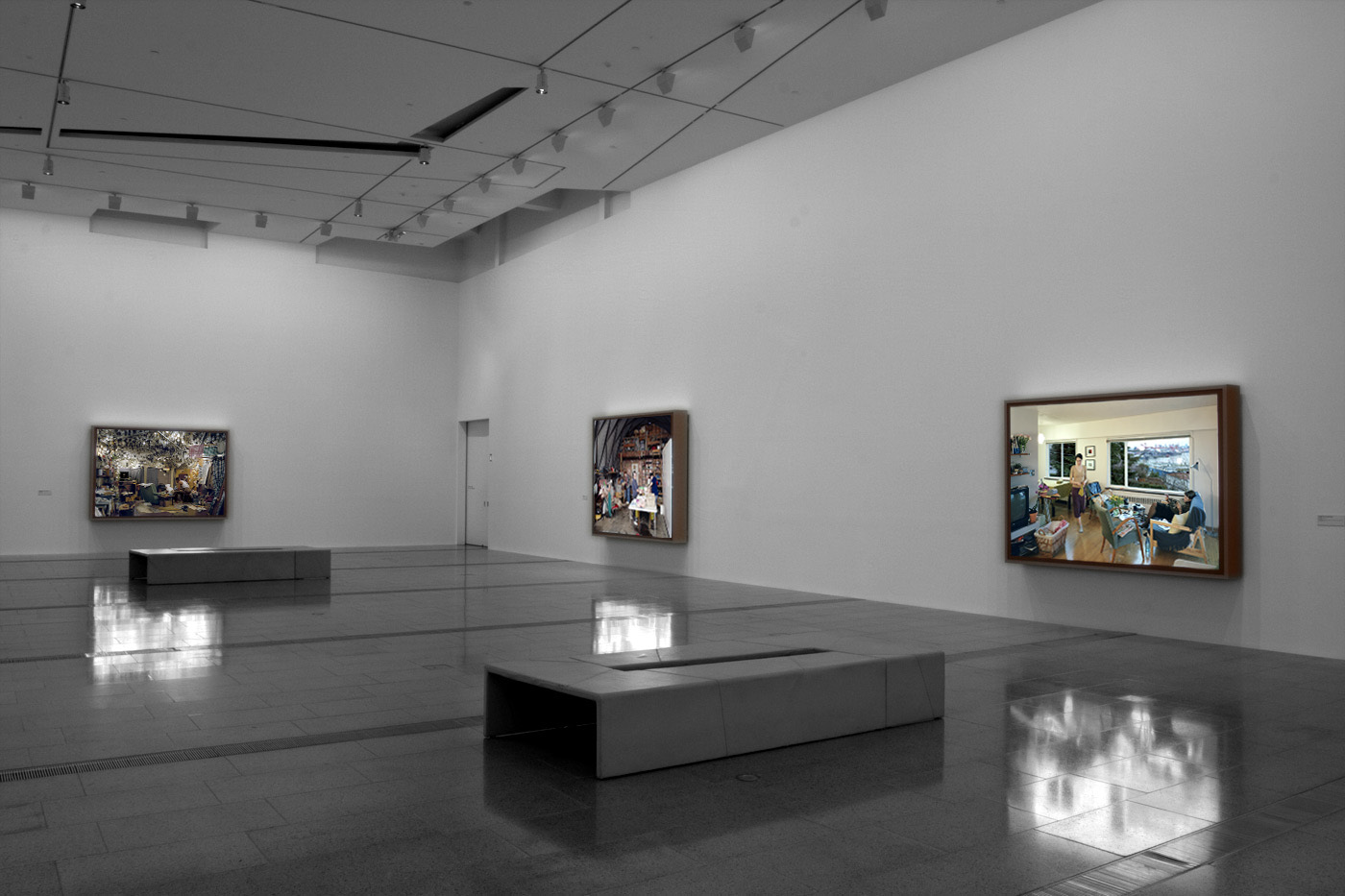
Exhibition: ‘Flatlands: photography and everyday space’ at the Art Gallery of New South Wales (AGNSW), Sydney

Exhibition dates: 13th September 2012 – 3rd February 2013


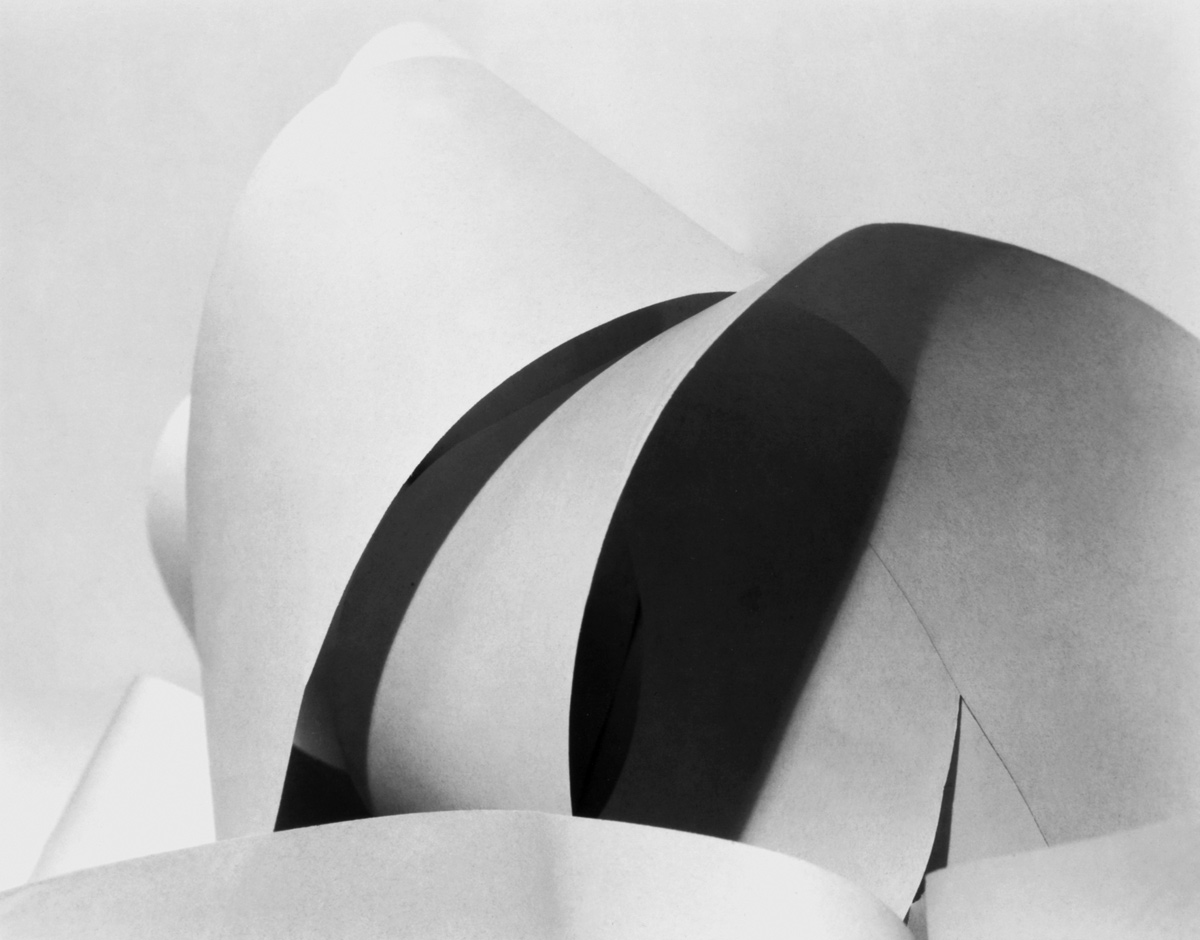
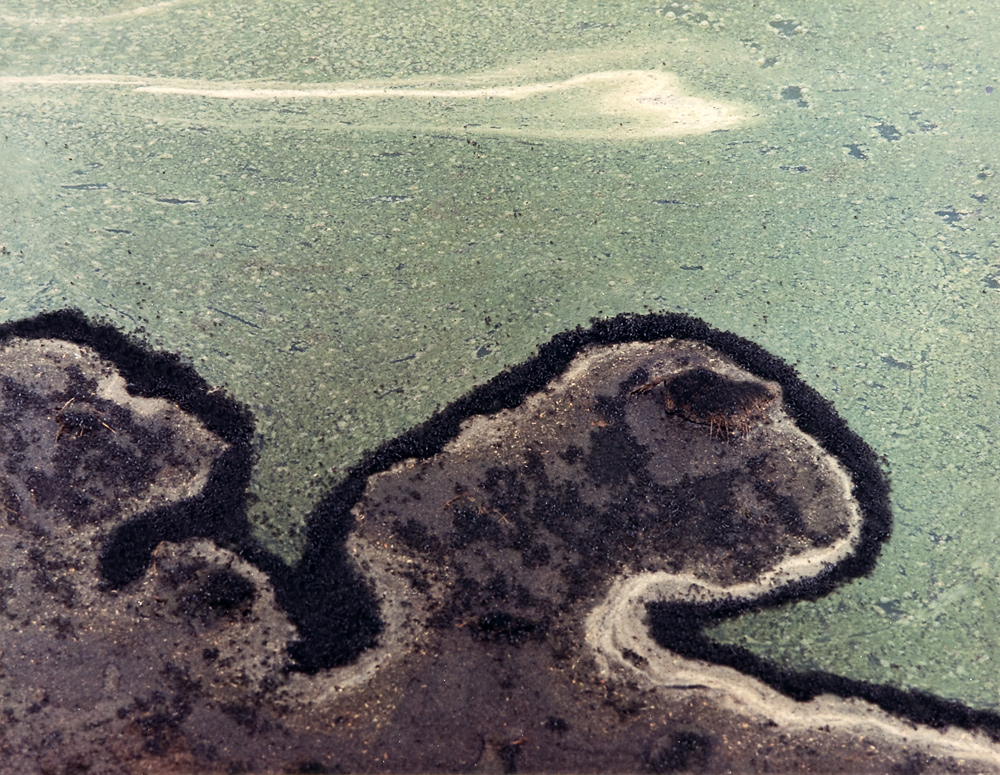
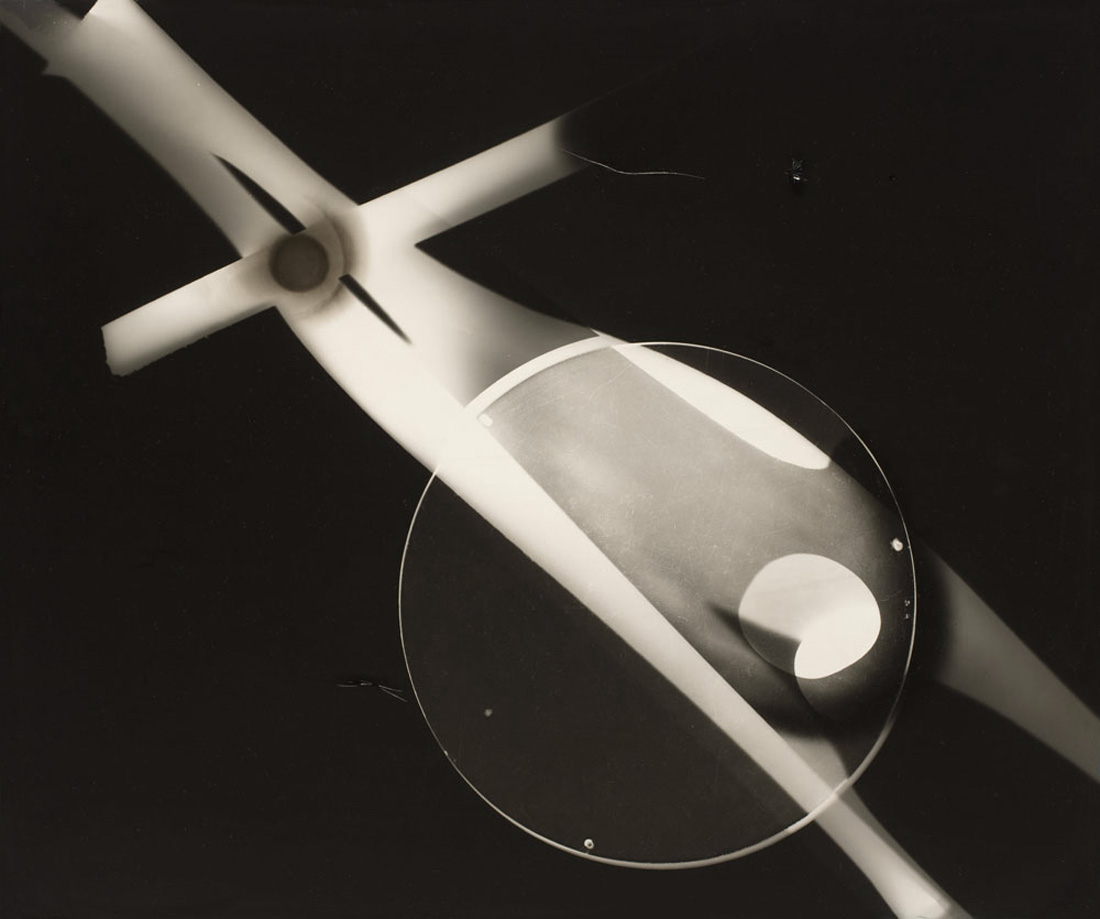
David Moore (Australia, 1927-2003) 'Light pattern, camera in motion' c. 1948, printed 1997


David Moore (Australia, 1927-2003)
Light pattern, camera in motion
c. 1948, printed 1997
Gelatin silver photograph
50.7 x 40.3cm
Art Gallery of New South Wales, Sydney
Gift of Karen, Lisa, Michael and Matthew Moore, 2004


This posting contains one of my favourite early works by Fiona Hall, Leura, New South Wales (1974, below) which is redolent of all the themes that would be expressed in the later work – an alien landscape that examines “the relationship between humankind and nature and the symbolic role of the [fecund] garden in western iconography.” In her work the “nature” of things (plants, money, videotape, plumbing fittings, birds nests, etc…) are re/classified, re/ordered and re/labelled.

Another stunning photograph in this posting is Minor White’s Windowsill daydreaming (1958, below). It is one of my favourite images of all time: because of the power of observation (to be able to recognise, capture and present such a manifestation!); because of the images formal beauty; and because of its metaphysical nature – a poetry full of esoteric allusions, one that addresses a very profound subject matter that is usually beyond ordinary knowledge or understanding. This alien presence, like the structure of an atom, is something that lives beyond the edges of our consciousness, some presence that hovers there, that we can feel and know yet can never see. Is it our shadow, our anima or animus? This is one of those rare photographs that will always haunt me.

Dr Marcus Bunyan


Many thankx to the Art Gallery of New South Wales for allowing me to publish the photographs in the posting. Please click on the photographs for a larger version of the image. All text accompanying photographs © Art Gallery of New South Wales Photography Collection Handbook, 2007.


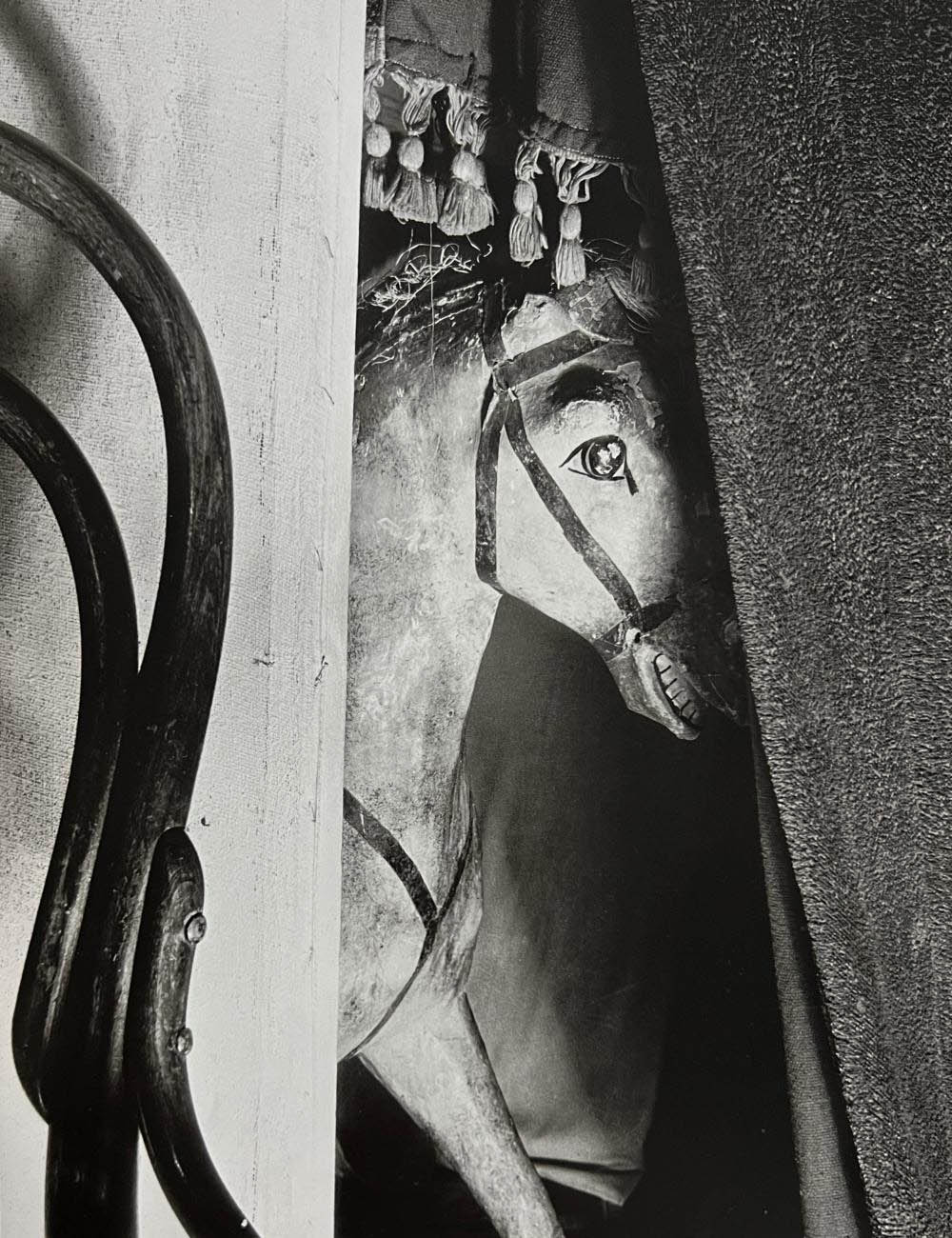
Olive Cotton (Australia, 1911-2003) 'By my window' 1930


Olive Cotton (Australia, 1911-2003)
By my window
1930
Gelatin silver photograph
20.3 x 15.1cm
Art Gallery of New South Wales, Sydney
Purchased with funds provided by the Photography Collection Benefactors’ Program 2006
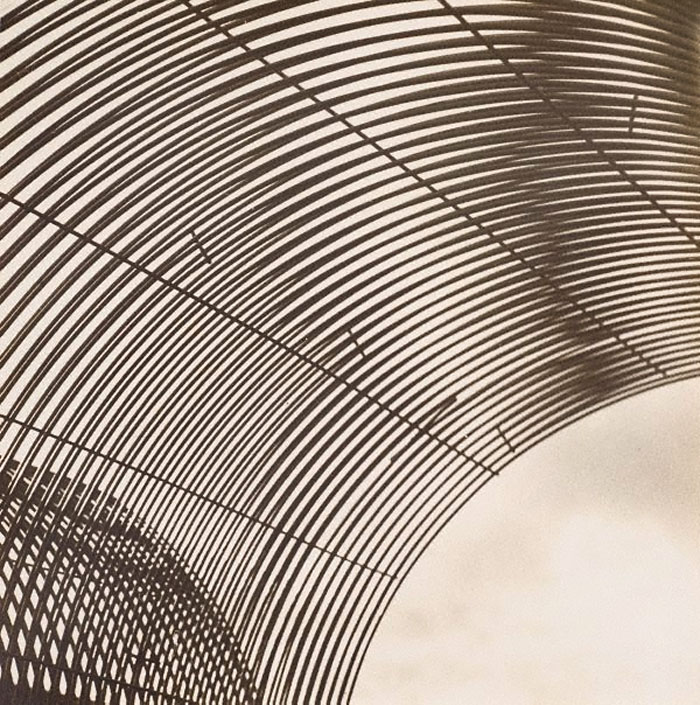
 

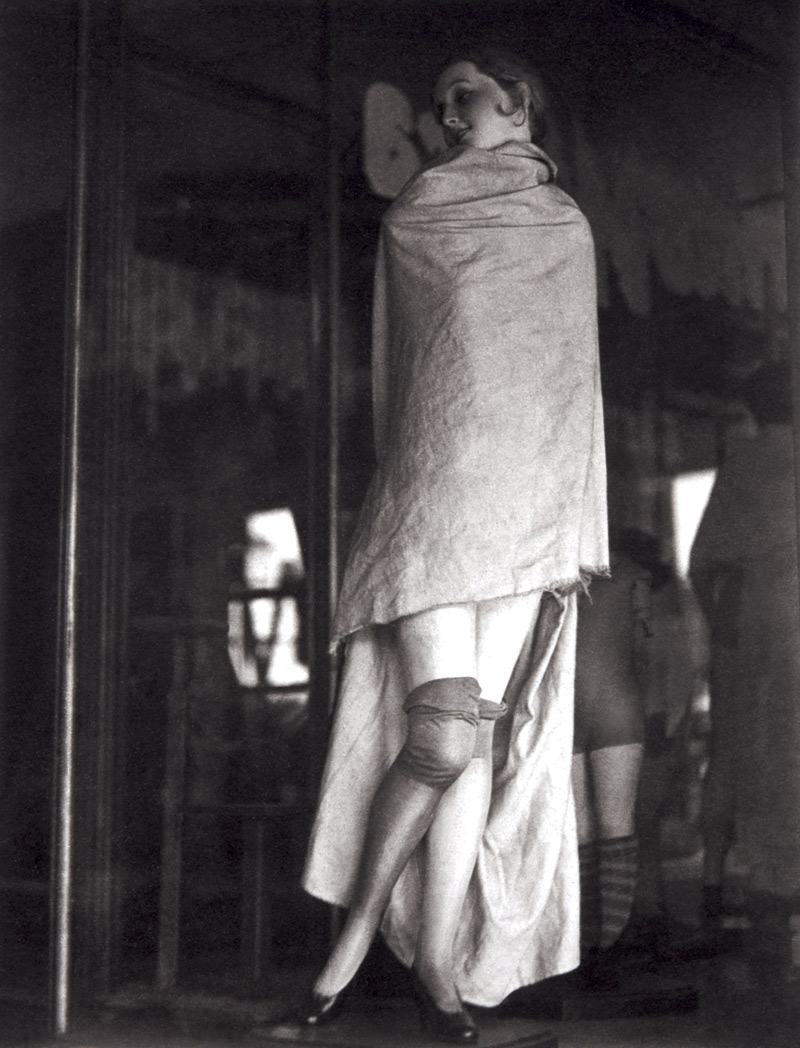
Keast Burke (Australian born New Zealand, 1896-1974) 'Untitled' 1930s


Keast Burke (Australian born New Zealand, 1896-1974)
Untitled
1930s
Gelatin silver print
23.1 x 23.1cm
Art Gallery of New South Wales, Sydney
Purchased with funds provided by the Photography Collection Benefactors’ Program 2003

Formwork for Sydney Harbour Bridge


Australasian Photo-Review’s cover of 15 March 1932 by Burke was the first which could be described as typically modernist with its dynamic photograph of the structures of Sydney Harbour Bridge. In December 1932 Burke had written:

The New Photography is the kind which seeks to shatter that blissful state of peace with photographs of an entirely different kind. It demands that photography shall be purely objective, shall photograph anything and everything – snap repetition and pattern wherever it is to be found.


That same year he published the Harbour Bridge photographs in a volume entitled Achievement: a collection of unusual studies of the Sydney Harbour Bridge, Sydney: Mick Simmons Ltd. His second modernist AP-R cover was for 14 January 1933 featuring a diver and diving board photographed in a similar style, emphasising form and structure and indistinguishable from images of divers and athletes being photographed by the Modernists of Europe and the USA.

Keast Burke’s determination to assimilate the new style into his work can be seen in the tug of war between the painterliness of pictorialism, in his warm-toned prints, and the boldness and geometricism of Modernism.

James McArdle. “January 16: Man,” on the On This Date In Photography website 16/01/2017 [Online] Cited 27/07/2024


Cecil Bostock (Australia, 1884-1939) 'Phenomena' c. 1938


Cecil Bostock (Australia, 1884-1939)
Phenomena
c. 1938
Gelatin silver photograph
26.3 x 30.5cm
Art Gallery of New South Wales, Sydney
Gift of Max Dupain 1980


Bostock remains an enigmatic personality in Australian pictorial and early modernist photography. This is at least in part due to his body of work being scattered on his death in 1939 as it was auctioned to cover his debts. Fortunately Phenomena was left to his former assistant Max Dupain who had worked with him from 1930 to 1933.

Phenomena was one of 11 photographs Bostock exhibited with the Contemporary Camera Groupe and it was placed in the window at David Jones along with other photographs such as Plum blossom 1937 by Olive Cotton and Mechanisation of art by Laurence Le Guay. Phenomena is a wonderful modernist work with its plays of light and dark and disorienting shapes and curving lines. It is impossible to tell exactly how the shapes are made or where the light is coming from, nor what the objects are. It could easily be exhibited upside down where the viewer could be looking down on objects arranged on a flat surface. Phenomena is a tribute to Bostock’s restless, inventive and exacting abilities.
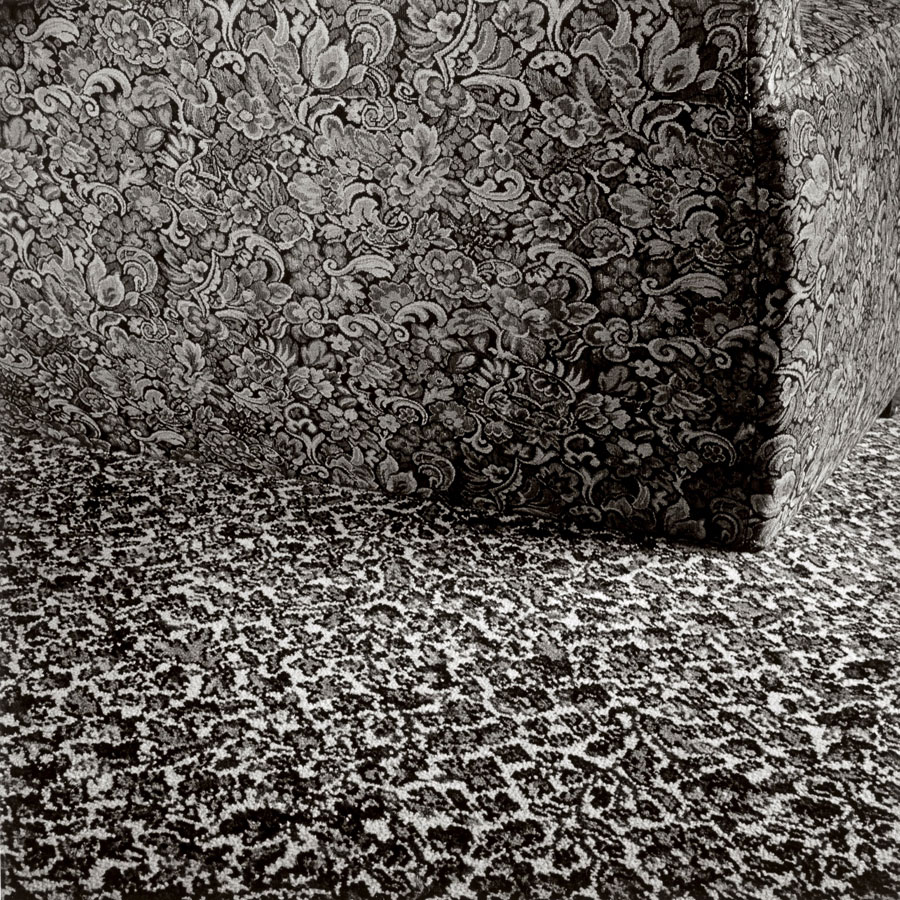
 

Fiona Hall (Australia, b. 1953) 'Leura, New South Wales' 1974


Fiona Hall (Australia, b. 1953)
Leura, New South Wales
1974
Gelatin silver photograph
27.8cm x 27.8cm
Art Gallery of New South Wales, Sydney
Purchased 1981
© Fiona Hall


The rich tones and fine detail of Leura, New South Wales were made possible by Hall’s use of a large-format nineteenth-century view camera. The antiquated technology, once used by colonial photographers to document nature and the taming of the Australian landscape, here records instead the verdant foliage of a floral-patterned couch and carpet. Made at the beginning of Hall’s career, it demonstrates her burgeoning interest in the representation of nature. The relationship between humankind and nature and the symbolic role of the garden in western iconography has since been a recurrent theme in her work, which ranges across photography, sculpture and installation. Leura… differs from Hall’s other photographs in that it documents a “found” object. Hall’s later works, such as The Antipodean suite 1981 and her large-format polaroids of 1985, are of her own constructions and sculptures. Her Paradisus terrestris series 1989-1990, 1996, 1999, of aluminium repousse sculptures takes the garden of Eden as its subject and treats it as an Enlightenment florilegium, wherein nature is classified, ordered and labelled. This kind of botanical transcription, like photography, was the process through which the alien Australian landscape was ‘naturalised’ by its colonists – a process which Hall wryly comments on in this acutely observed encounter within a domestic interior.
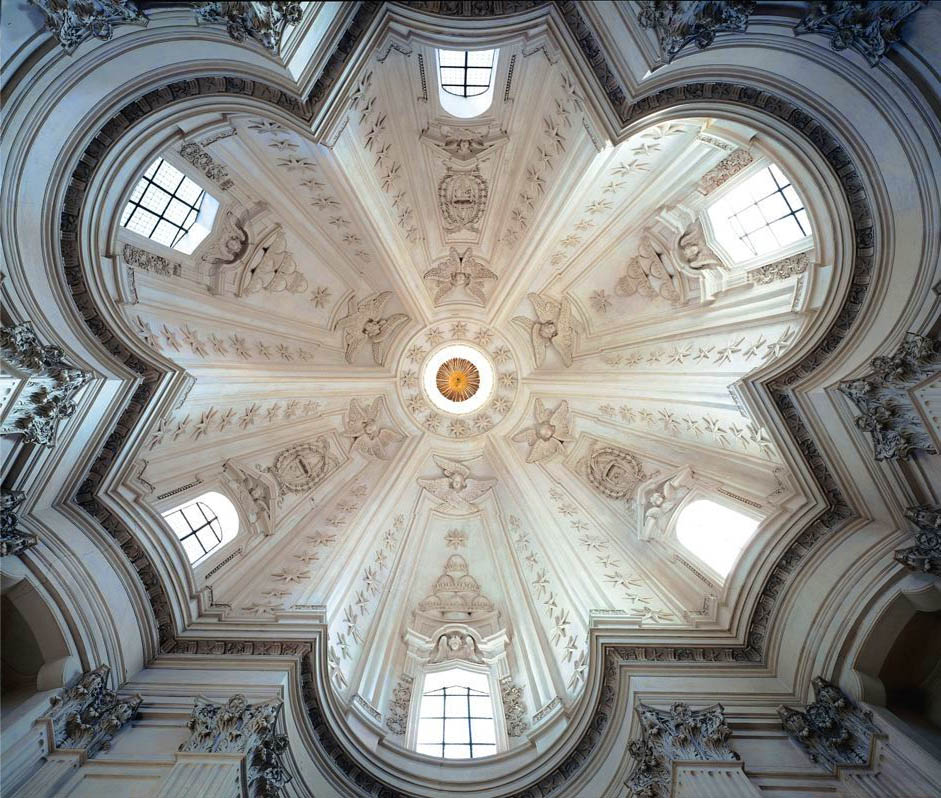
 

David Stephenson (USA/Australia, b. 1955) 'Sant'ivo alla Sapienza 1645-50 Rome, Italy' 1997


David Stephenson (USA/Australia, b. 1955)
Sant’ivo alla Sapienza 1645-50 Rome, Italy
1997
From the series Domes 1993-2005
Type C photograph
55 × 55cm
Art Gallery of New South Wales, Sydney
Purchased with funds provided by Joanna Capon and the Photography Collection Benefactors Program 2002
© David Stephenson


With poetic symmetry the Domes series considers analogous ideas. It is a body of work which has been ongoing since 1993 and now numbers several hundred images of domes in countries including Italy, Spain, Portugal, Turkey, England, Germany and Russia. The typological character of the series reveals the shifting history in architectural design, geometry and space across cultures and time, demonstrating how humankind has continually sought meaning by building ornate structures which reference a sacred realm.2 Stephenson photographs the oculus – the eye in the centre of each cupola. Regardless of religion, time or place, this entry to the heavens – each with unique architectural and decorative surround – is presented as an immaculate and enduring image. Placed together, the photographs impart the infinite variations of a single obsession, while also charting the passage of history, and time immemorial.

2. Hammond, V. 2005, “The dome in European architecture,” in Stephenson, D. 2005, Visions of heaven: the dome in European architecture, Princeton Architectural Press, New York p. 190.

© Art Gallery of New South Wales Photography Collection Handbook, 2007


David Stephenson (USA/Australia, b. 1955)
'Cathedral of the Assumption, Kremlin 1475-79, Moscow, Russia' 2000


David Stephenson (USA/Australia, b. 1955)
Cathedral of the Assumption, Kremlin 1475-79, Moscow, Russia
2000
Type C photograph
55 x 55cm
Art Gallery of New South Wales, Sydney
Purchased with funds provided by Graham and Mary Bierman, Josef and Jeanne Lebovic 2002
© David Stephenson
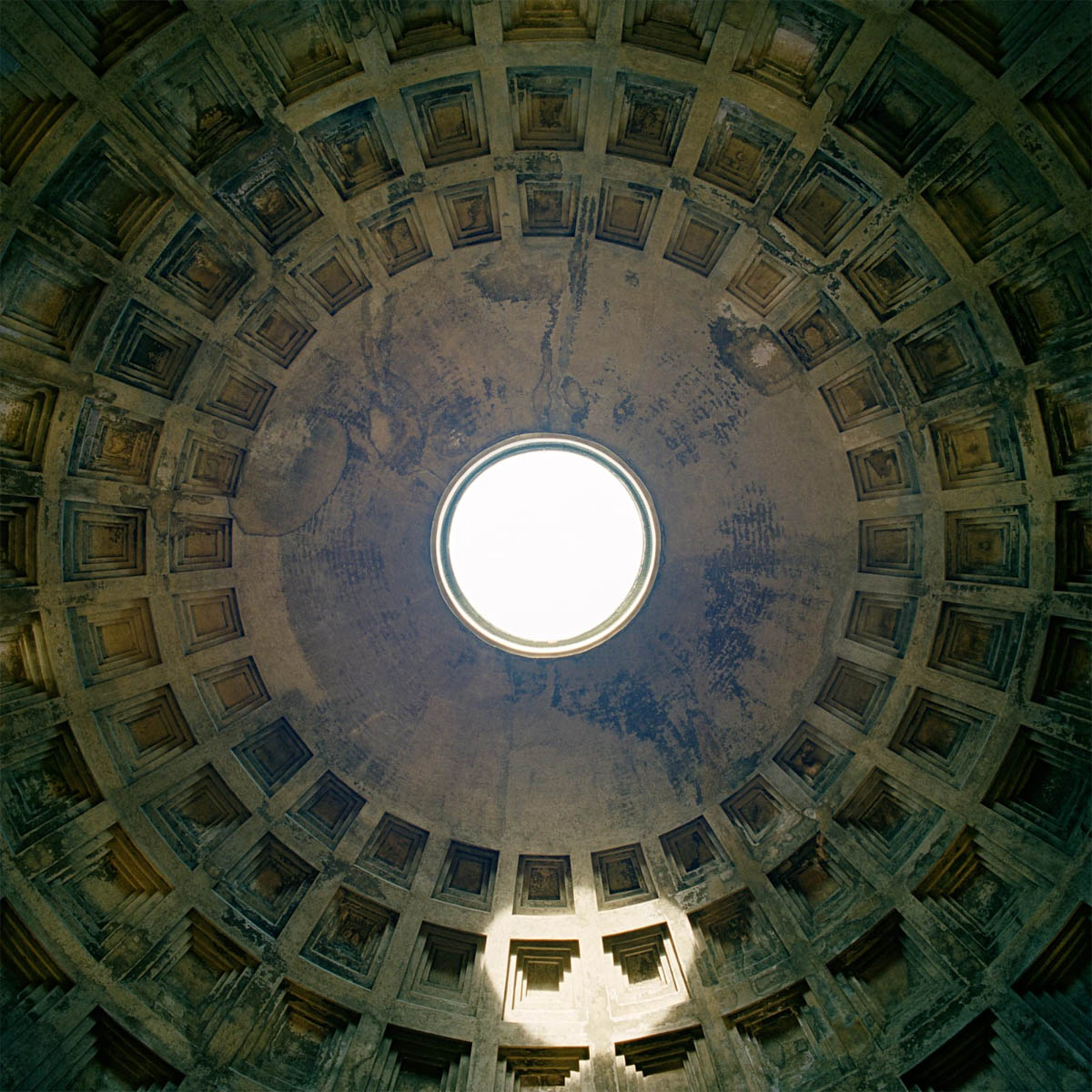
 

David Stephenson (USA/Australia, b. 1955) 'Pantheon c. 117-138, Rome, Italy' 1997, printed 2002


David Stephenson (USA/Australia, b. 1955)
Pantheon c. 117-138, Rome, Italy
1997, printed 2002
Type C photograph
55 x 55cm
Art Gallery of New South Wales, Sydney
Purchased with funds provided by Graham and Mary Bierman, Josef and Jeanne Lebovic 2002
© David Stephenson
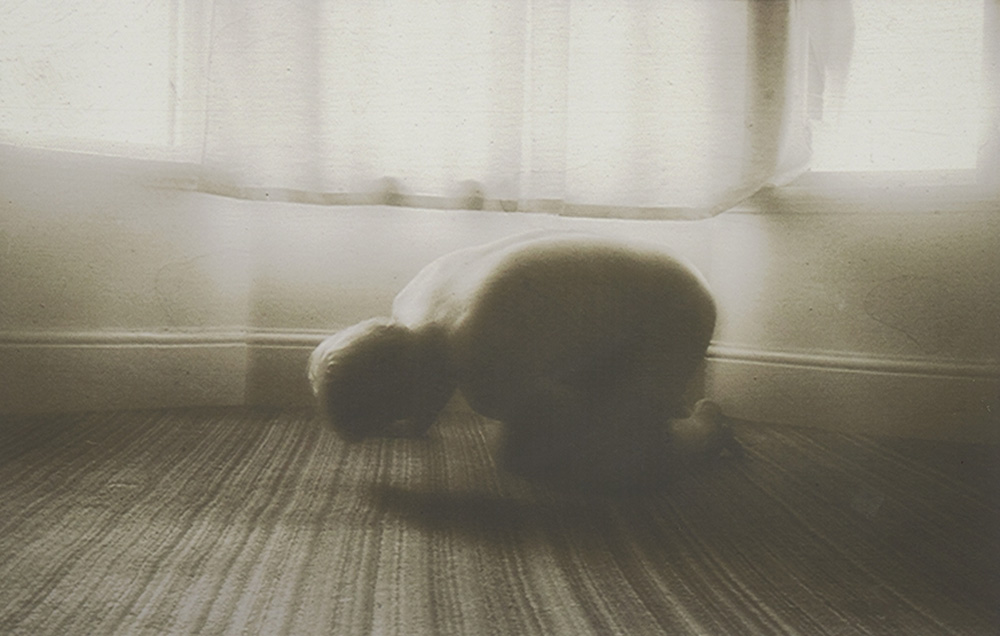
 

Pat Brassington (Australian, b. 1942) 'In marble halls #1' 2003


Pat Brassington (Australian, b. 1942)
In marble halls #1
2003
From the series In marble halls
Pigment print
90 x 140cm
Art Gallery of New South Wales, Sydney
Gift of the artist 2009
© Pat Brassington


Simryn Gill (Singapore/Malaysia/Australia, b. 1959) From 'A long time between drinks' 2005


Simryn Gill (Singapore/Malaysia/Australia, b. 1959)
From A long time between drinks
2005
Portfolio of 13 offset prints
29.8cm x 29.7cm
Art Gallery of New South Wales, Sydney
© Simryn Gill


Among Simryn Gill’s multi-disciplinary explorations of identity and belonging, investigations of suburban locations carry a particular resonance due to their often autobiographical nature. A long time between drinks 2009 is an intensely focused look at suburban Adelaide which was the artist’s first experience of Australia when she arrived in 1987 from Kuala Lumpur, and the city where she first exhibited. Gill returned to Adelaide in 2005 to revisit this early point of contact, producing an evocative series of 13 images.

The photographs impart an ostensible sense of alienation and isolation that corresponds to the artist’s position as an outsider looking in. Gill’s viewpoint of these empty streets that seem to lead nowhere is forensic and detached. But surprisingly, as repetitious compositions and details culminate across the photographs, the prosaic subject matter becomes increasingly surreal, abstract and even poetic.

As Sambrani Chaitanya has stated, “Gill’s work is an investigation of the limits of categorisation,”1 and this group of works, just as in Gill’s examination of Marrickville (where she now lives) in May 2006, emphasises the difficulty of defining an idea of place through mere description. Memory, time and pure invention are required to fill in the gaps. The eerie, yet evocative environment in these photographic prints is further enhanced by their presentation in a square box emulating those of sets of vinyl LP recordings.

1/ Sambrani, C. “Other realties, someone else’s fictions: the tangled art of Simryn Gill,” [Online], Art and Australia Vol. 42, No. 2, Summer 2004, p. 220.
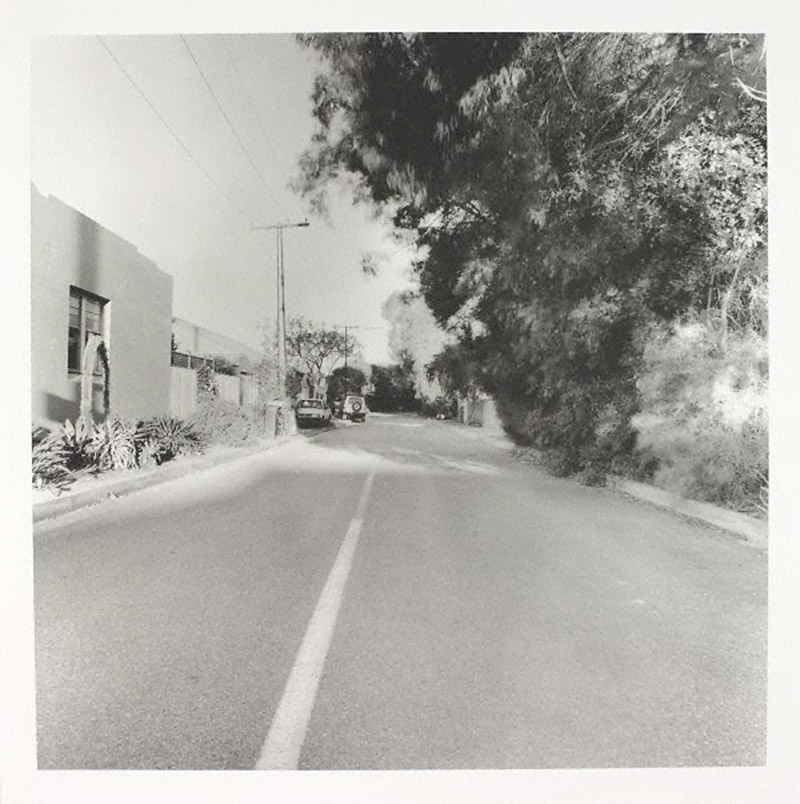
 

Simryn Gill (Singapore/Malaysia/Australia, b. 1959) From 'A long time between drinks' 2005


Simryn Gill (Singapore/Malaysia/Australia, b. 1959)
From A long time between drinks
2005
Portfolio of 13 offset prints
29.8cm x 29.7cm
Art Gallery of New South Wales, Sydney
© Simryn Gill


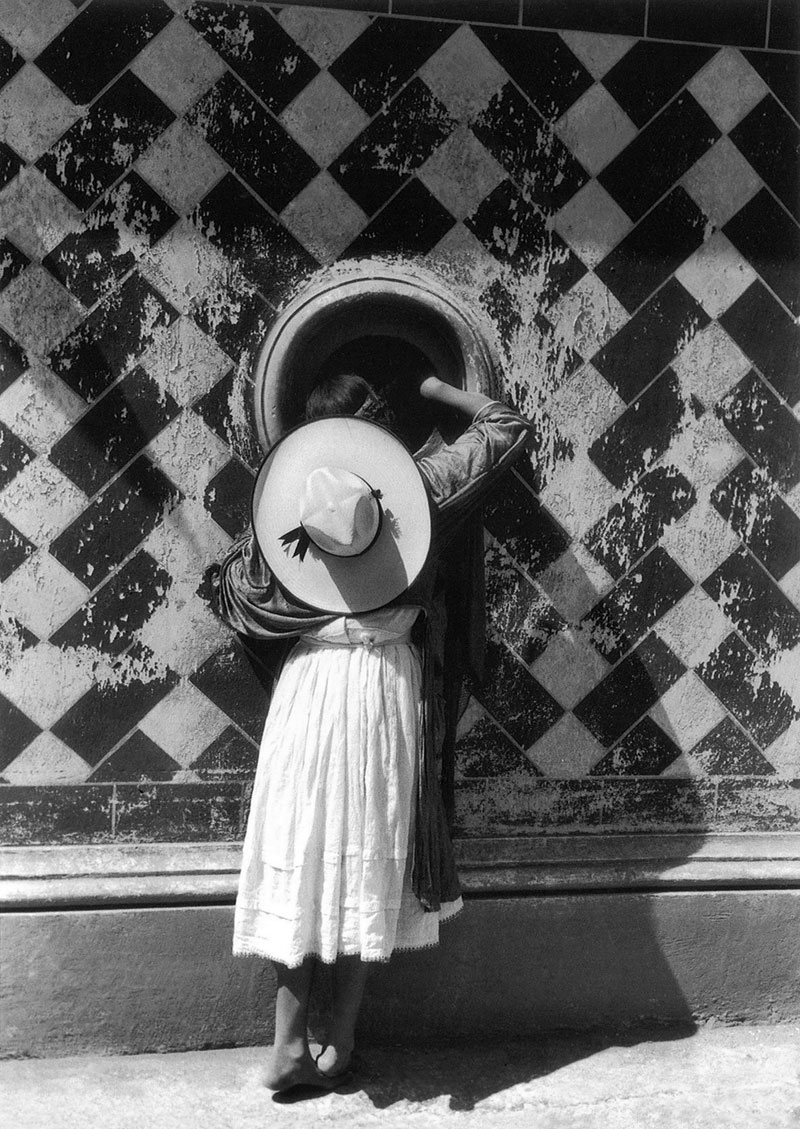
A new exhibition, Flatlands: photography and everyday space, examines photography’s role in transforming the way we perceive, organise and imagine the world. The 39 works by 23 Australian and international artists included in the exhibition have been drawn from the Gallery’s permanent collection of 20th century and contemporary photography.

Definitions of space have always depended on the scientific, social and cultural aspects of the human experience. At its birth in the 19th century, photography’s monocular vision was seen as the ultimate tool for representation and classification. Elusive phenomena such as distance, depth and emptiness seemed within grasp. Yet, limited to freezing single moments or viewpoints in time, the photograph’s ability to objectively represent the world was under question by the turn of the 20th century. Technological advancements, such as faster exposure times transformed the potential of the medium to not only show things that escaped the eye but new ways of seeing them as well.

Embracing partiality and ambivalence, modernist photography sought to capture the fragments, details and blurred boundaries in the expanses we call personal space. What the photograph began to reveal were dimensions which German cultural theorist Walter Benjamin described in 1931 as the ‘optical unconscious’ of reality. The works of photographers such as Melvin Vaniman, Frederick Evans, Harold Cazneaux, William Buckle, Franz Roh, Olive Cotton, David Moore, Josef Sudek, Minor White and Robert Rauschenberg explore the intangible in spaces which define our physical and spiritual relationship with reality. Windows, doorways, ceilings, staircases – these mundane and ordinary passageways suddenly acquire a centrality and metaphysical depth normally denied to them.

The edges between sacred and profane, public and private, natural and artificial, real and dreamed environments became further entangled in the subjective visions of late 20th century and contemporary photographic work. For Daido Moriyama, Fiona Hall, Pat Brassington, Simryn Gill, Christine Godden, Geoff Kleem, Leonie Reisberg, Ingeborg Tyssen, David Stephenson and Justine Varga, space is seen to be a product of the perception of the individual. Photographs are able to reveal realms outside of the scientific – that is those created by emotion, memory and desire.

As Fiona Hall commented in 1996, “our belief might be maintained, for at least as long as the image can hold our attention, in the possibility of inhabiting a world as illusory as the two-dimensional one of the photograph.” Collectively, these images destabilise naturalised certainties while activating the imaginary dimension and the unsettling, albeit poetic potential of photography to impact and alter our view of the world.

Press release from the AGNSW website
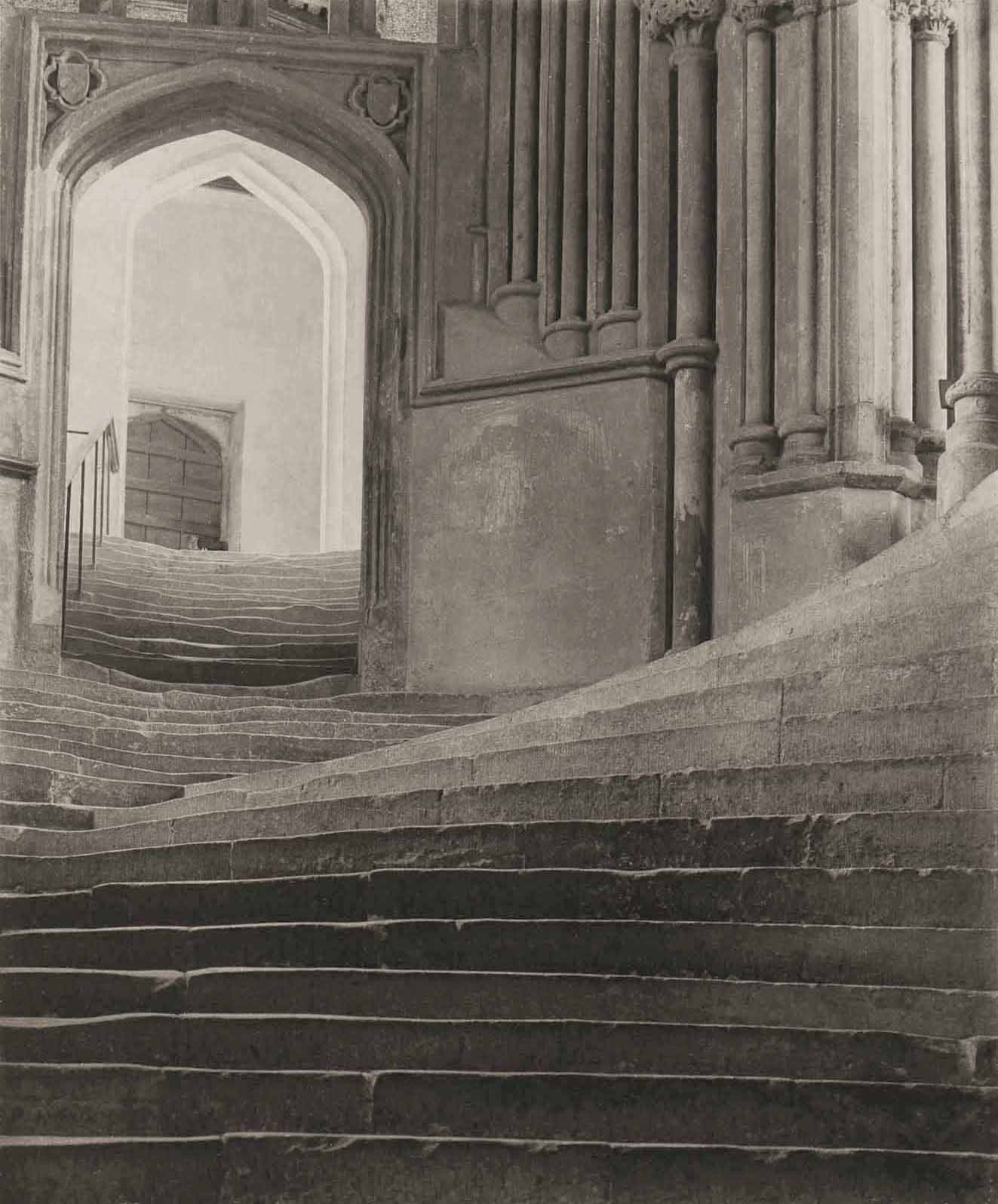
 

Frederick H. Evans (British, 1853-1943) 'A Sea of Steps - Stairs to Chapter House - Wells Cathedral' 1903


Frederick H. Evans (England, 1853-1945)
A sea of steps
1903
Platinotype photograph
23.6 x 19.2cm
Art Gallery of New South Wales, Sydney
Gift of the Sydney Camera Circle 1977
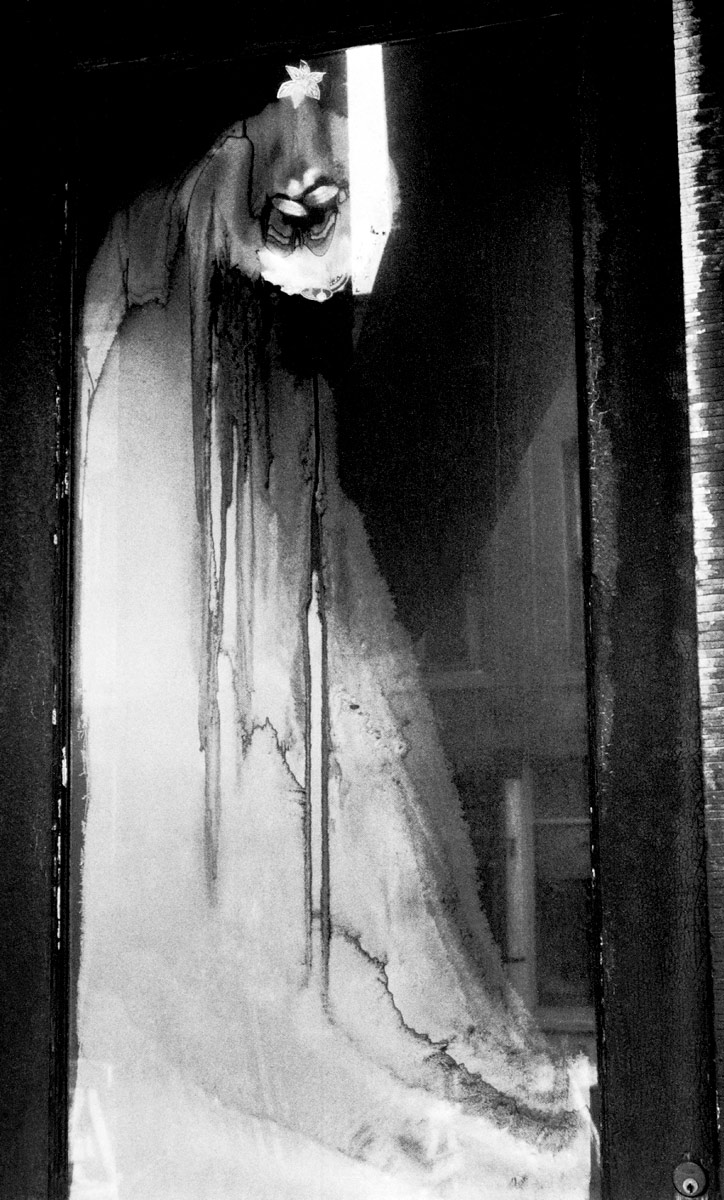
 

Minor White (America, 1908-1976) 'Christmas ornament, Batavia, New York, January 1958' 1958


Minor White (America, 1908-1976)
Christmas ornament, Batavia, New York, January 1958
1958
From the portfolio Sound of one hand 1960-1965
Gelatin silver photograph mounted on card
Art Gallery of New South Wales, Sydney
Gift of Patsy Asch 2005
Reproduction with permission of the Minor White Archive
© Princeton University Art Museum


Minor White. 'Windowsill daydreaming' 1958


Minor White (America, 1908-1976)
Windowsill daydreaming
Rochester, New York, July 1958
From the portfolio Sound of one hand 1960-1965
Art Gallery of New South Wales, Sydney
Reproduction with permission of the Minor White Archive
© Princeton University Museum of Art


Informed by the esoteric arts, eastern religion and philosophy, Minor White’s belief in the spiritual qualities of photography made him an intensely personal and enigmatic teacher, editor and curator. White’s initial experience with photography was through his botanical studies at the University of Minnesota where he learned to develop and print photomicrography images, a view of life that he saw as akin to modern art forms. White advocated Stieglitz’s concept of ‘Equivalence’ in which form directly communicated mood and meaning, that ‘darkness and light, objects and spaces, carry spiritual as well as material meanings’.1 White disseminated his photographic theories through the influential quarterly journal Aperture, which he edited and co-founded with his contemporaries Ansel Adams, Dorothea Lange, Beaumont Newhall and others.

Like Stieglitz, White also worked in sequences that through abstraction, expression and metaphor emphasised his mystical interpretation of the visual world. The sequences allow for a dialogue to continue through and in-between the images, engaging the viewer in a visual poem rather than any strict or formal narrative. The series, Sound of one hand, exemplifies White’s study of Zen and esoteric philosophies, reflecting his meditation of the Zen koan from which he saw rather than heard any sound. The first of the series, Metal ornament, Pultneyville, New York, October 1957 presents an abstracted form that is both sensual and elusive, slipping in and out of ocular register. The ambiguous graduated tones and reflected light pull the eye into the centre of the image before vicariously dragging it back. This broken semi-elliptical shape is mirrored in Windowsill daydreaming, Rochester, New York, July 1958 as the gently moving curtains play with the light and shadows of White’s flat, creating abstracted organic forms. Abstracted forms of nature were of great interest to White as can be seen in the rest of the series that capture the frosted window of his flat with its crystallised ice, condensation and glimpses of the outside world.

1/ Rice, S. 1998, “Beyond reality,” in Frizot, M. (ed.,). A new history of photography, Könemann, Cologne pp. 669-673
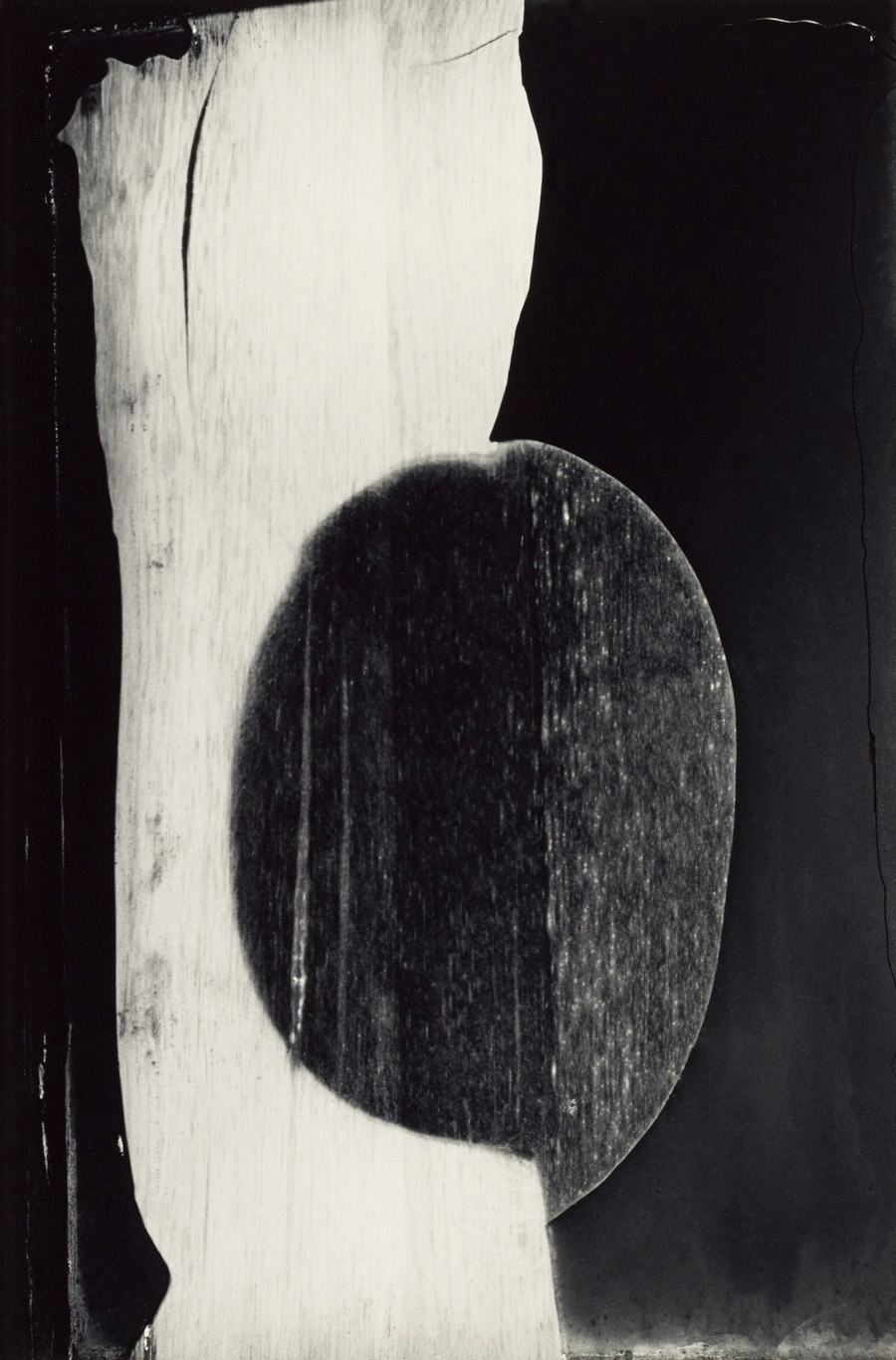
 

Minor White (America, 1908-1976) 'Burned mirror, Rochester, New York, June 1959' 1959


Minor White (America, 1908-1976)
Burned mirror, Rochester, New York, June 1959
1959
From the portfolio Sound of one hand 1960-1965
Gelatin silver photograph mounted on card
32.2 x 21.2cm
Art Gallery of New South Wales, Sydney
Gift of Patsy Asch 2005
Reproduction with permission of the Minor White Archive
© Princeton University Museum of Art


Olive Cotton (Australia, 1911-2003) 'Skeleton Leaf' 1964


Olive Cotton (Australia, 1911-2003)
Skeleton Leaf
1964
Gelatin silver photograph
24.7 × 19.6cm
Art Gallery of New South Wales, Sydney
Purchased with funds provided by the Photography Collection Benefactors’ Program 2006
© artist’s estate
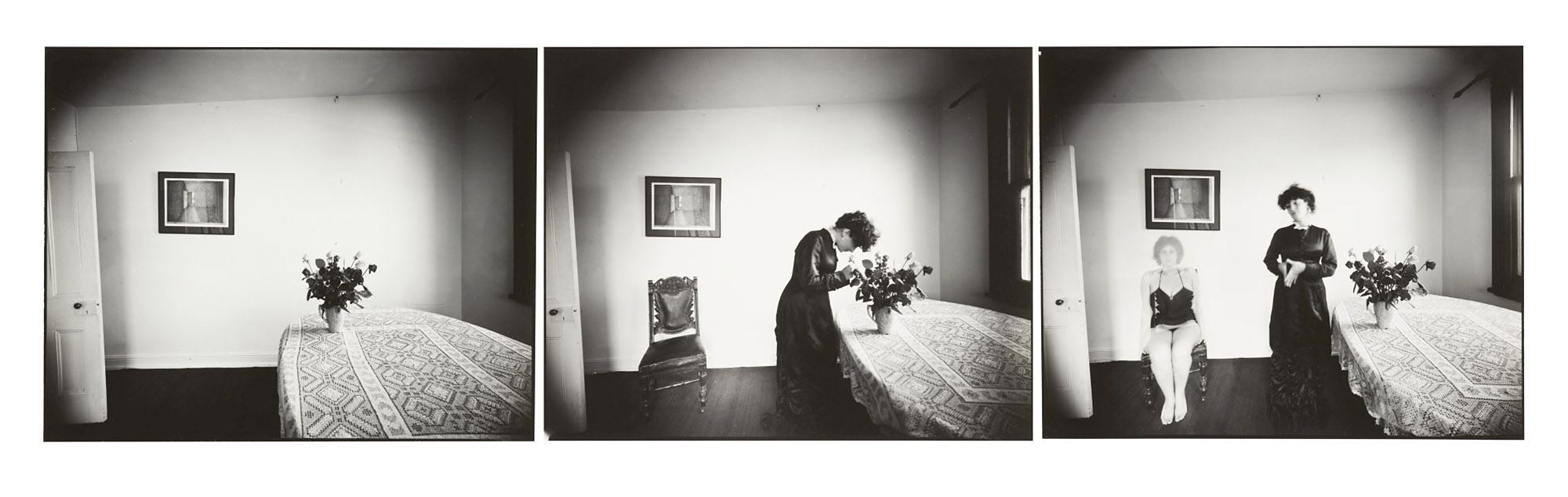
 

Leonie Reisberg (Australian, b. 1955) 'Fragments from the bizarre theatre of my life' 1980


Leonie Reisberg (Australian, b. 1955)
Fragments from the bizarre theatre of my life
1980
3 gelatin silver photograph
a – empty room, 19.6 x 24.4cm
b – room with woman, 19.7 x 24.5cm
c – room with woman and ghost, 19.7 x 24.4cm
Art Gallery of New South Wales, Sydney
Purchased 1981
© Leonie Reisberg


Deeply personal, Leonie Reisberg’s photographs delve into the ambiguities of intimate space. Like many women photographers of the 1970s-80s, such as Fiona Hall, Micky Allan, Robyn Stacey and Kate Breakey, Reisberg was interested in pushing the boundaries of the medium through techniques such as hand-painting, double exposure and collage.


Art Gallery of New South Wales
Art Gallery Road, The Domain
Sydney NSW 2000, Australia

Opening hours:
Open every day 10am – 5pm
except Christmas Day and Good Friday
Art Gallery of New South Wales website

LIKE ART BLART ON FACEBOOK

Back to top

Exhibition: ‘nude men: from 1800 to the present day’ at the Leopold Museum, Vienna

Exhibition dates: 19th October 2012 – 4th March 2013

Curators: Tobias G. Natter and Elisabeth Leopold

Warning: this posting contains art work of naked male bodies.


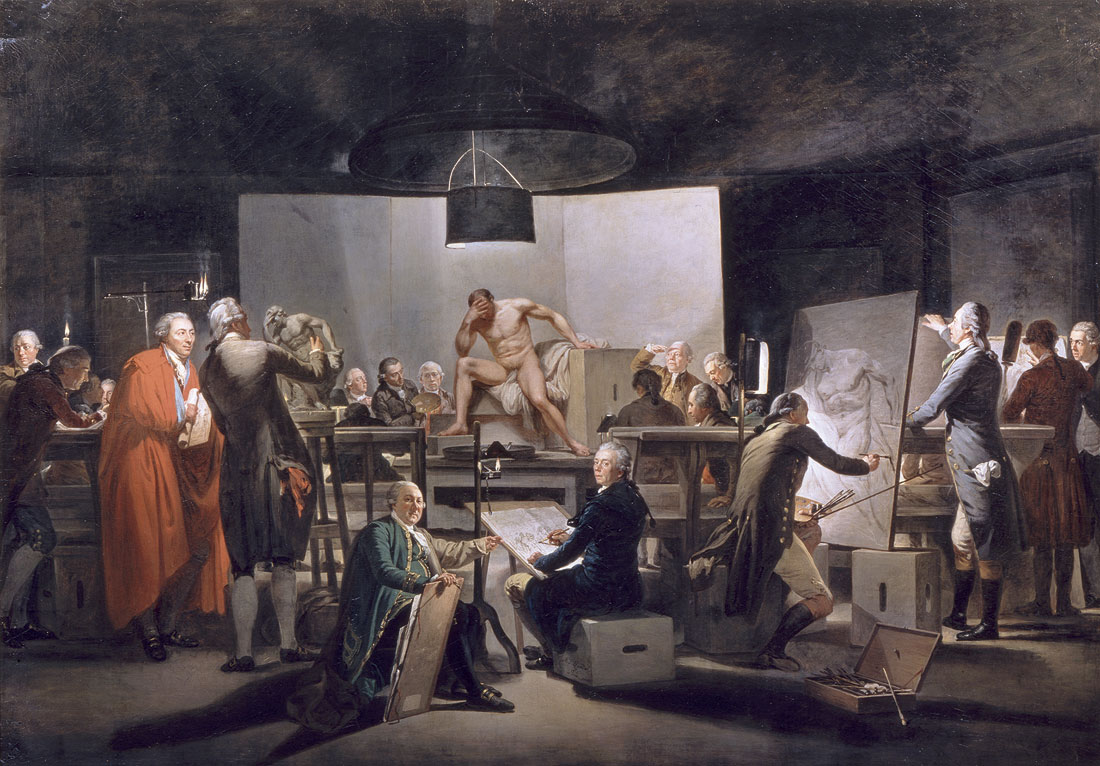
Martin Ferdinand Quadal (Moravian-Austrian, 1736-1811) 'Nude Life Class at the Vienna Art Academy in the St.-Anna-Gebäude' 1787


Martin Ferdinand Quadal (Moravian-Austrian, 1736-1811)
Nude Life Class at the Vienna Art Academy in the St.-Anna-Gebäude
1787
© Paintings Gallery of the Academy of Fine Arts Vienna


“When we stop and think about it, we all are naked underneath our clothes.”


(Heinrich Heine, Travel Pictures, 1826)


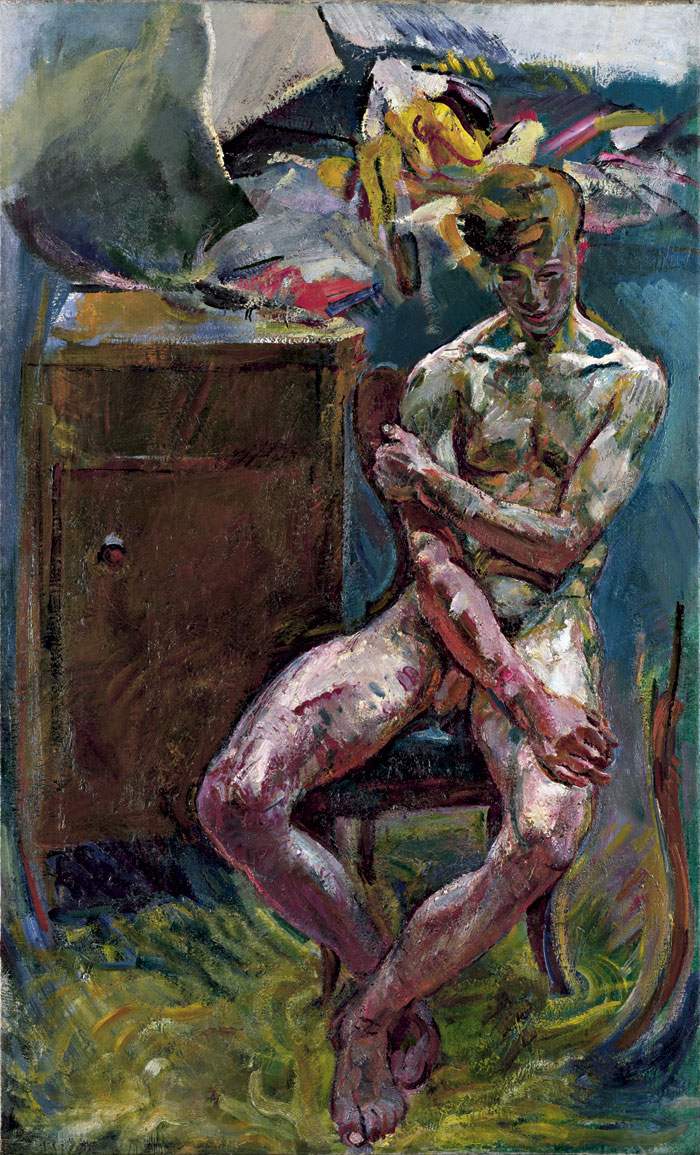
A great posting. I used to have a print of Querelle by Andy Warhol on my wall when I was at university in London aged 17 years old – that and We Two Boys Together Clinging by David Hockney. My favourite in this posting is the painting Seated Youth (morning) by Austrian expressionist painter Anton Kolig. Such vivacity, life and colour, perhaps a post-coital glow (was he straight, bisexual, gay? who cares, it is a magnificent painting).

There is very little information on Kolig on the web. Upon recommendation by Gustav Klimt and Carl Moll Kolig received a 1912 scholarship for a stay in Paris, where Kolig studied modern painting at the Louvre. He enlisted in the First World War in 1916 and survived, continuing to work in paint, tapestries and mosaic during the postwar years and the 1920s. He received two offers for professorships in Prague and Stuttgart, he opted for the Württemberg Academy in Stuttgart, where he trained a number of important painters. In addition, his work was also shown internationally at numerous exhibitions.

He was persecuted by the Nazis and his art destroyed because it was thought to be “degenerate” art. Kolig, who was essentially apolitical, remained until the fall of 1943 in Stuttgart, where he felt less and less well, however, and eventually returned to Nötsch. On 17 December 1944 Kolig was buried with his family in a bomb attack and seriously injured. Much of his work was destroyed there. He died in 1950.

Dr Marcus Bunyan


Many thankx for the Leopold Museum, Vienna for allowing me to publish the text and photographs in the posting. Please click on the photographs for a larger version of the image.


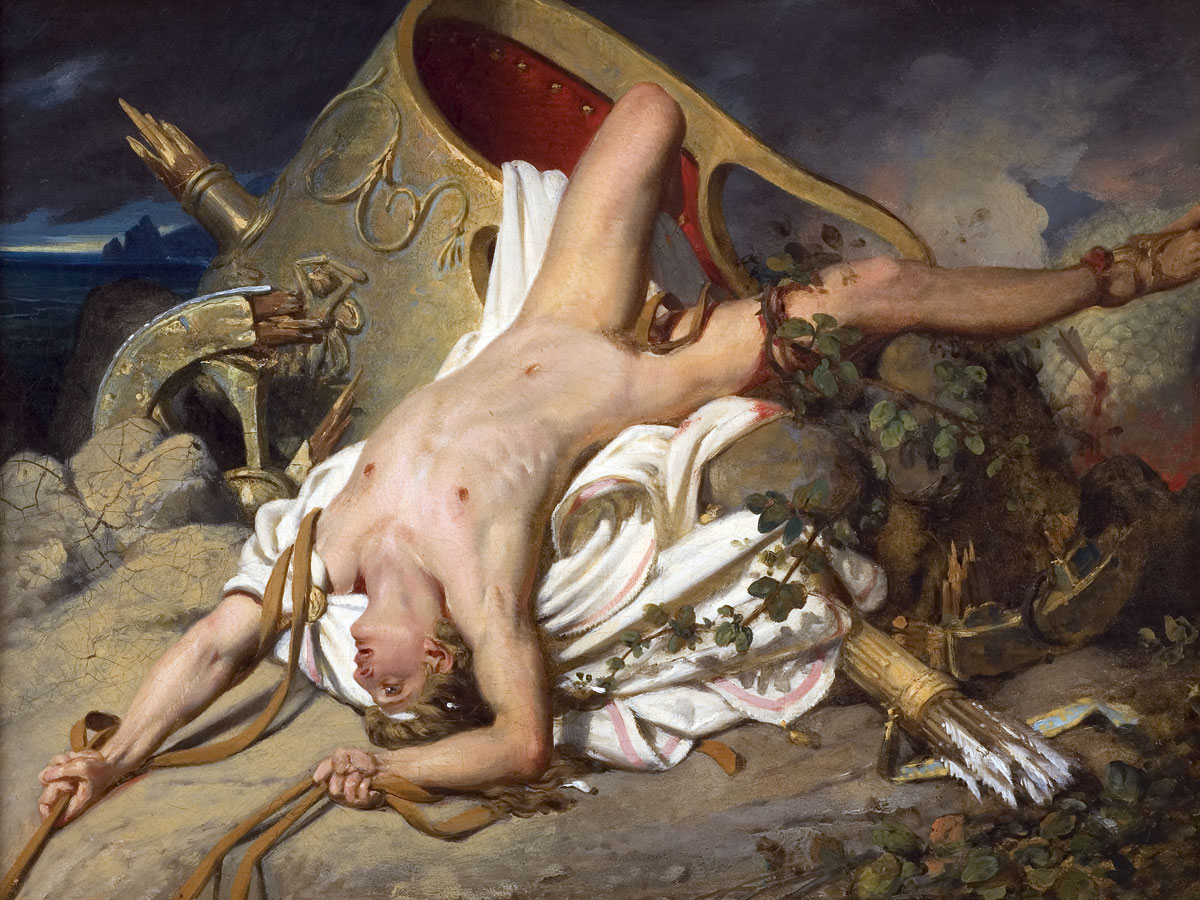
Joseph-Désiré Court (French, 1797-1865) 'Death of Hippolytus' 1825


Joseph-Désiré Court (French, 1797-1865)
Death of Hippolytus
1825
© Musée Fabre de Montpellier Agglomération


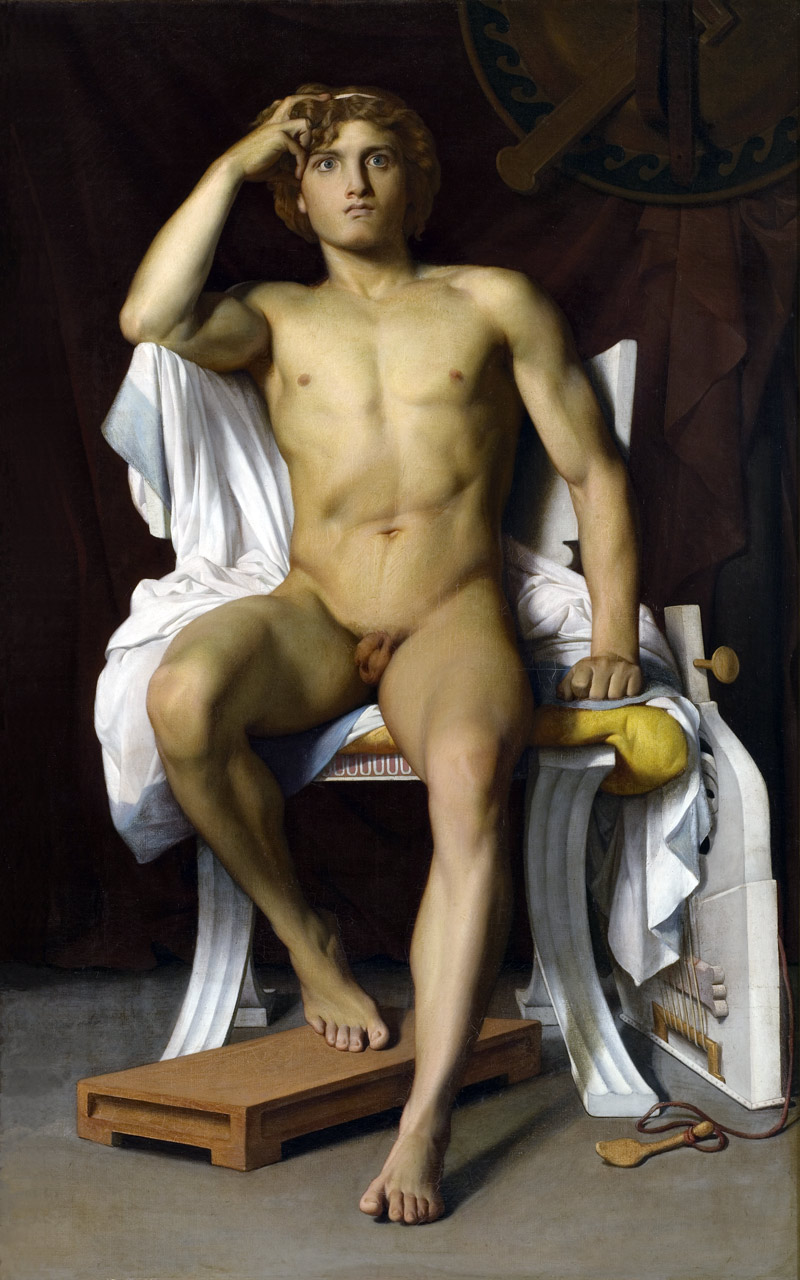
François-Léon Benouville (French, 1821-1859) 'Achills Zorn' 1847


François-Léon Benouville (French, 1821-1859)
Achills Zorn
1847
© Musée Fabre de Montpellier


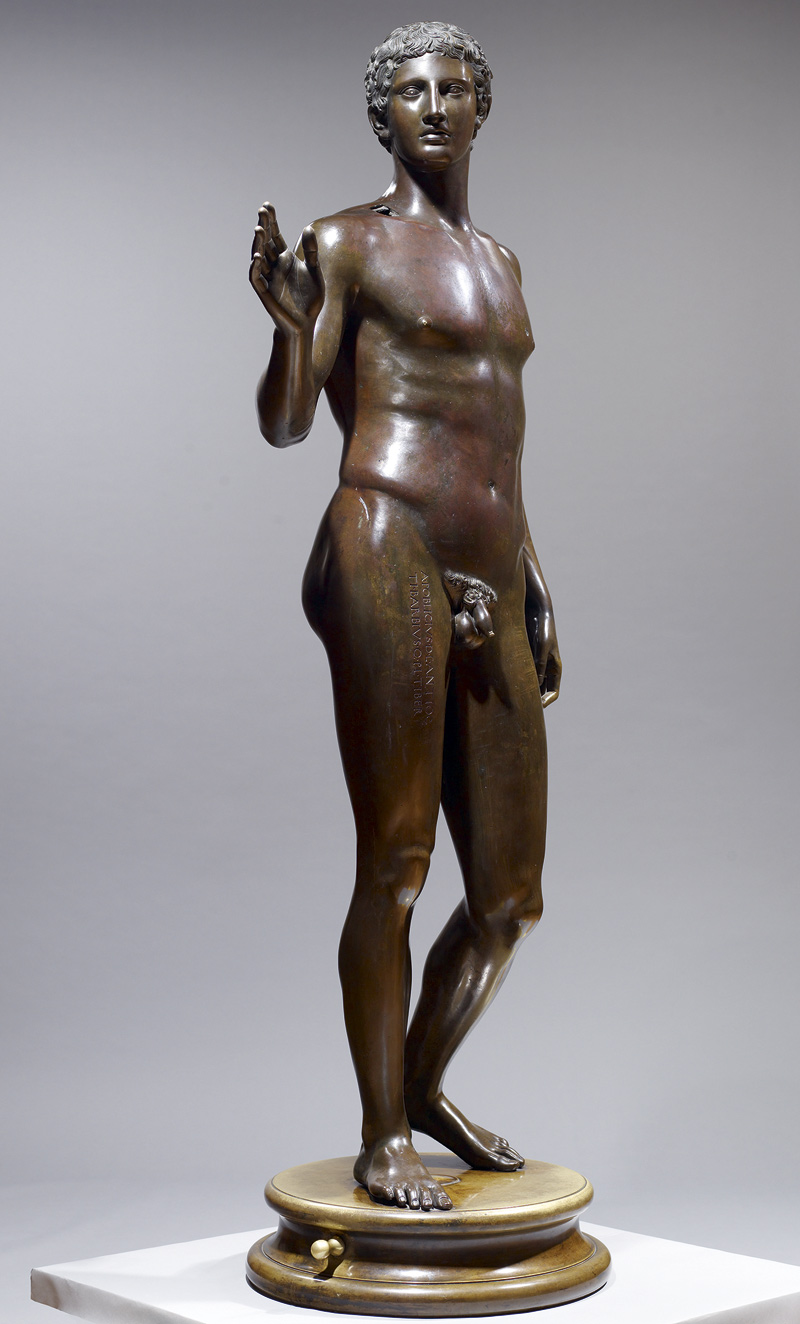
Anonymous maker. 'Anonymous Youth of Magdalensberg' 16th Century casting after Roman Original


Anonymous maker
Anonymous Youth of Magdalensberg
16th Century casting after Roman Original
© Kunsthistorisches Museum, Vienna, Antiquities


Anonymous maker. 'Anonymous standing figure of the court official Snofrunefer Egypt, Old Kingdom, late 5th Dynasty' around 2400 BC


Anonymous maker
Anonymous standing figure of the court official Snofrunefer
Egypt, Old Kingdom, late 5th Dynasty, around 2400 BC
© Kunsthistorisches Museum Vienna with MVK and ÖTM, Egyptian and Near Eastern Collection


Auguste Rodin (French, 1840-1917) 'The Age of Bronze' 1875-1876


Auguste Rodin (French, 1840-1917)
The Age of Bronze
1875/76
© Kunsthaus Zurich


Anton Kolig (Austrian, 1886-1950) 'Seated Youth (morning)' 1919


Anton Kolig (Austrian, 1886-1950)
Seated Youth (morning)
1919
© Leopold Museum, Wien, Inv. 406


Previous exhibitions on the theme of nudity have mostly been limited to female nudes. With the presentation “naked men” in the autumn of 2012 the Leopold Museum will be showing a long overdue exhibition on the diverse and changing depictions of naked men from 1800 to the present.

Thanks to loans from all over Europe, the exhibition “naked men” will offer an unprecedented overview of the depiction of male nudes. Starting with the period of Enlightenment in the 18th century, the presentation will focus mainly on the time around 1800, on tendencies of Salon Art, as well as on art around 1900 and after 1945. At the same time, the exhibition will also feature important reference works from ancient Egypt, examples of Greek vase painting and works from the Renaissance. Spanning two centuries, the presentation will show different artistic approaches to the subject, competing ideas of the ideal male model as well as changes in the concept of beauty, body image and values.

The exhibition, curated by Tobias G. Natter and Elisabeth Leopold, traces this theme over a long period and draws a continuous arc from the late 18th century to the present. Altogether, the showing brings together around 300 individual works by nearly 100 female and male artists from Europe and the USA. The objective of the two curators Tobias G. Natter and Elisabeth Leopold was “to clearly show the differing artistic approaches, competing models of masculinity, the transformation of ideas about the body, beauty and values, the political dimension of the body, and last but not least the breaking of conventions.”

“Over the past few years, portrayals of nude males have achieved a hitherto unseen public presence,” says Elisabeth Leopold. To which Tobias G. Natter adds, “At the same time, this exhibition is our way of reacting to the fact that categories which had previously seemed established, such as ‘masculinity’, ‘body’ and ‘nakedness’, have today become unstable for a broad swath of society.”

Diversity and abundance: showing for what “nude men” could stand

Elisabeth Leopold remarks that, “In the run-up to our project, we were very surprised to note that some commentators expected a ‘delicate’ exhibition. But in fact, we had no intention of treating the theme in such a way – with reserve, with tact, or in any other way delicately. And we did not understand this topic to be at all delicate in terms of an exhibition on art history somehow requiring a degree of discretion.” A project like nude men would be entirely unthinkable without the experiences and impulses of feminist art as well as cultural history, cultural studies and gender studies. With the exhibition nude men, the Leopold Museum seeks to react to the circumstance that societal categories commonly thought to be firmly established – such as “masculinity”, “body” and “nakedness” – are currently undergoing major changes.

By seizing on these developments, we understand the museum to be an institution which is relevant to today’s society – that is to say, a place for both the present and the future. Tobias G. Natter: “Our objective is to show the diversity and transformation of the portrayal of nude men in light of clearly defined thematic focuses. With fresh curiosity, without traditional scholarly prejudices, and with fascination for an inexhaustibly rich field, we use this exhibition to draw an arc spanning over 200 years which, not least, make a theme of the long shadow cast by the fig leaf.”

The exhibition

The exhibition traces its theme from the late 18th century to the present day. It has three key historical themes: the classical era and the Age of Enlightenment around 1800, classical modernism around 1900, and post-1945 art. These three themes are introduced by a prologue.

Prologue

The exhibition’s three focuses are preceded by a prologue. Using five outstanding sculptures from European art history, the prologue illuminates this theme’s long tradition. It runs from the “oldest nude in town” – a larger-than-life freestanding figure from ancient Egypt – and the statue known as the Jüngling vom Magdalensberg to Auguste Rodin and Fritz Wotruba, and on to a display window mannequin which Heimo Zobernig reworked to create a nude self-portrait.

Tobias G. Natter: “The curatorial intention behind prologue was to have the audience stroll through nearly five millennia of Western sculptural art in just a few steps. This is meant both to communicate both the long tradition of such images and to highlight the degree to which nude men were taken for granted to be the foundation of our art. These five thousand years form the exhibition’s outer referential frame. Strictly speaking, the showing begins in earnest with the Age of Enlightenment and the period around 1800.”

Theme 1: Classicism and the Power of Reason

In the 18th century and beginning in France, the emancipation of the bourgeois class and the swan song of the Ancien Régime occasioned a renegotiation of concepts of masculinity with both societal and aesthetic implications. The naked male hero was defined anew as a cultural pattern. It became the embodiment of the new ideals.

Theme 2: Classical Modernism

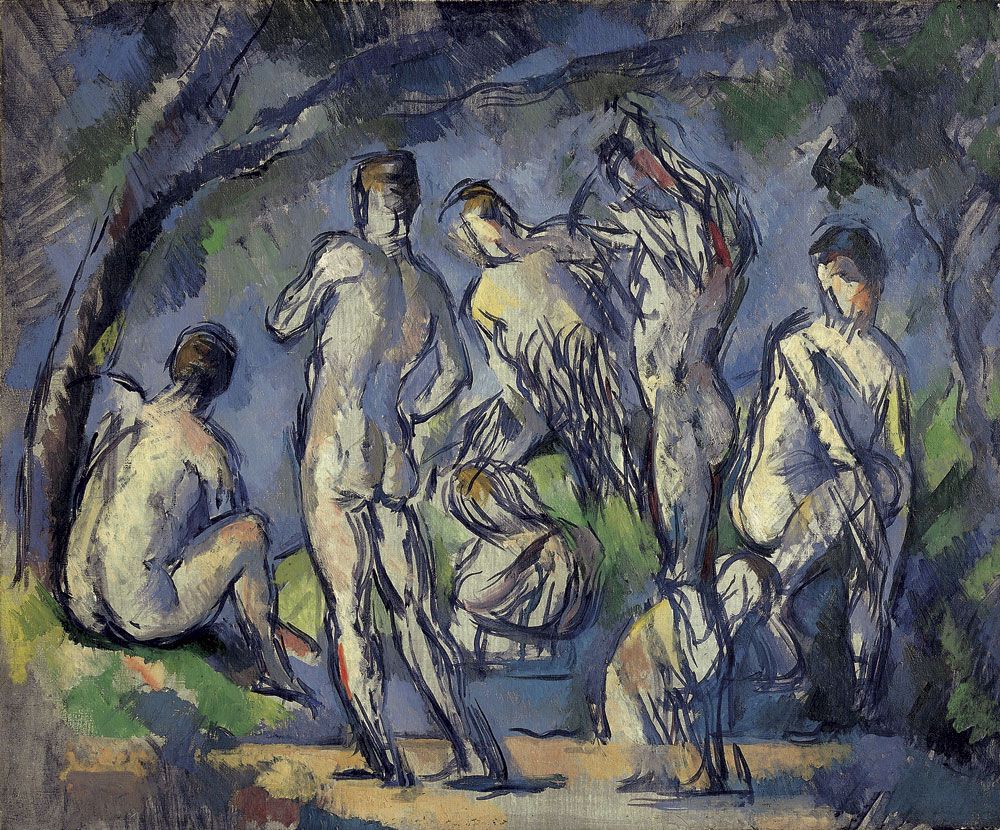
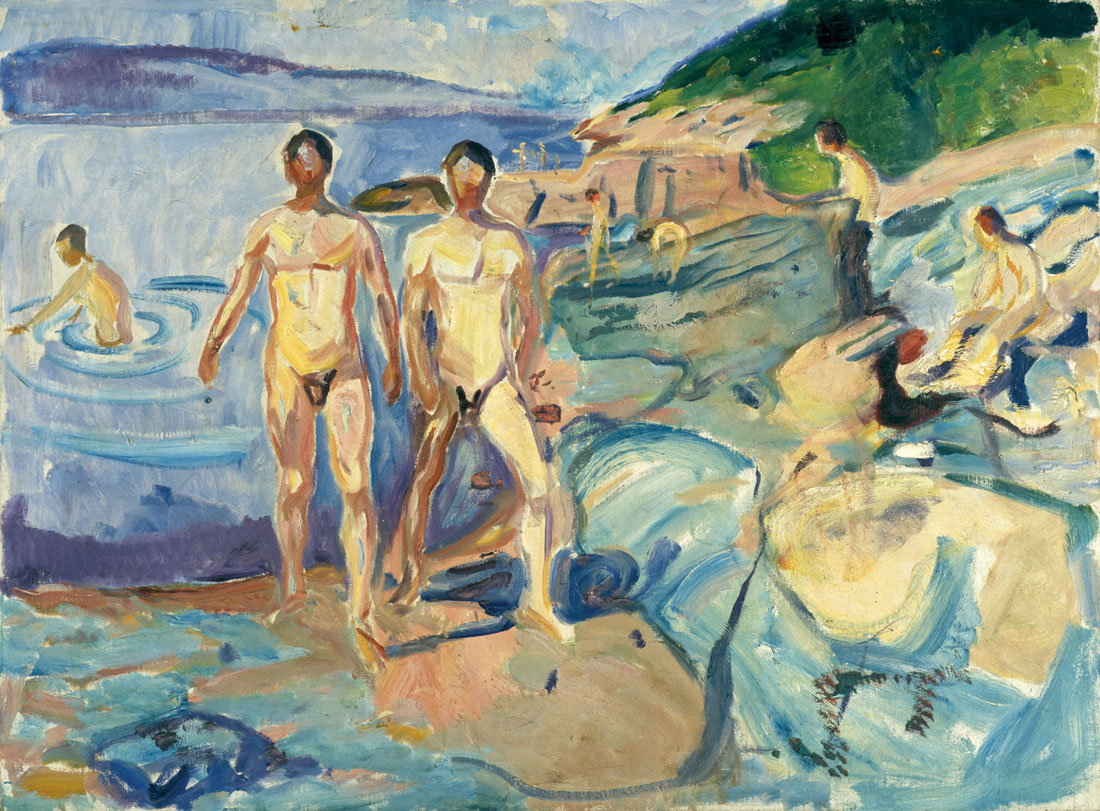
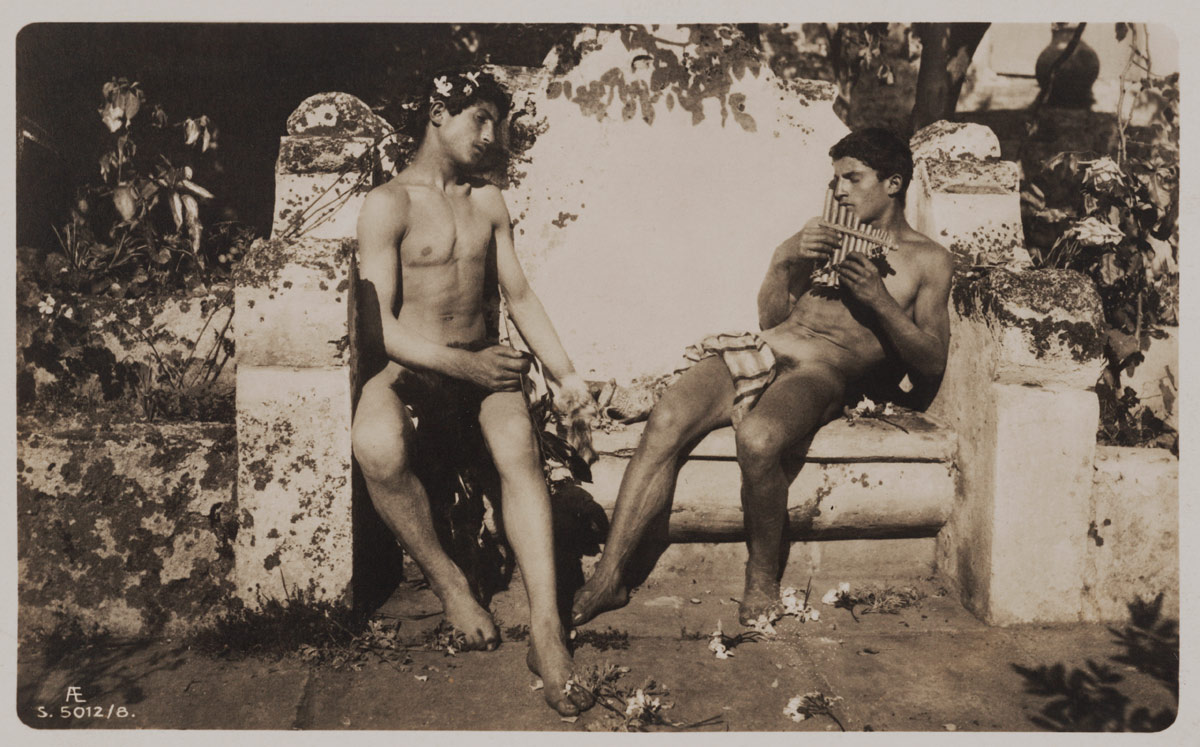
A new and independent pictorial world arose in the late 19th century with the casual depiction of naked men bathing in natural, outdoor settings. The various ways in which artists dealt with this topic can be viewed together as a particularly sensitive gauge of societal moods. In the exhibition, the genre is represented with prominent examples by Paul Cézanne, Edvard Munch, Wilhelm von Gloeden, Max Liebermann, Ernst Ludwig

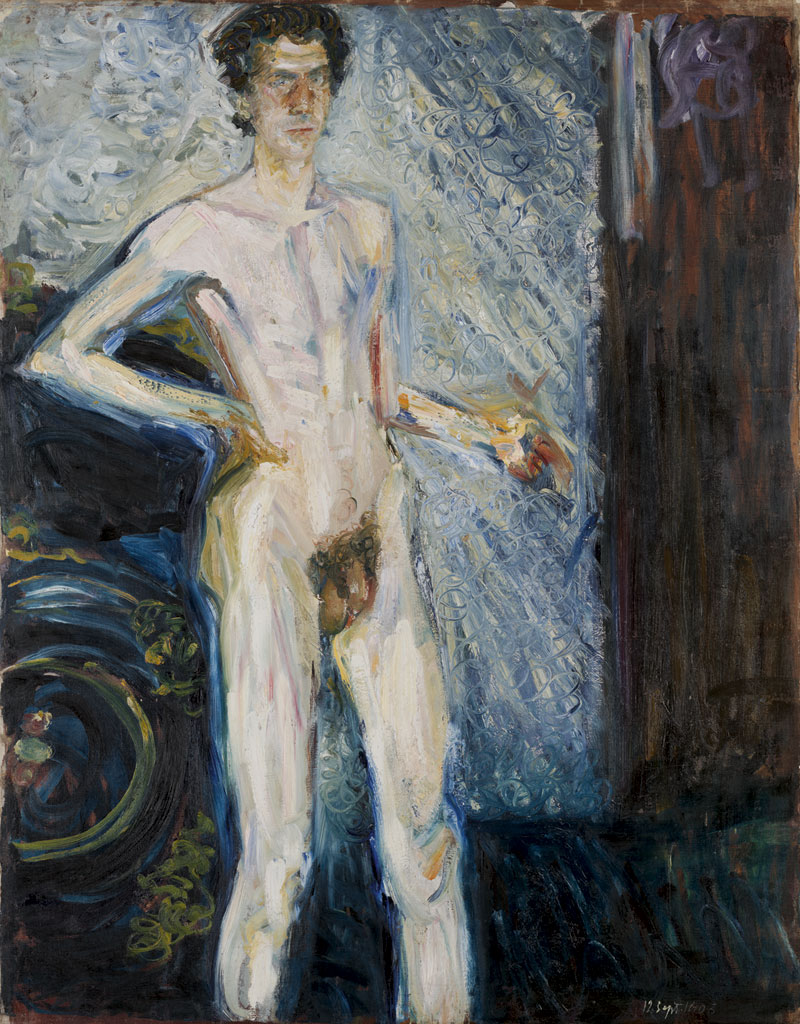
Kirchner and others. Classical modernism’s quest for a new artistic foundation also had its impact on the topics of nakedness and masculinity. But what happened when the painter’s gaze wandered on from the naked other to the naked self? A principle witness with regard to this phenomenon in turn-of-the-20th-century Vienna is Egon Schiele. With his taboo-breaking self-reflections, he radicalised artists’ self-understanding in a way that nobody had before him. Elisabeth Leopold: “The shift of the painter’s gaze from the naked opposite to the exposed self gave rise to the nude self-portrait – a shining beacon of modernism.”

Theme 3: Post-1945 Developments

In light of the abundance of interesting works from which to choose, the exhibition’s third theme comprises three specific focuses. Common to all three is the way in which the political potential of the naked body is explored. The first of these focuses concentrates on the battle fought by women for legal and social equality during the 20th century.

Outstanding examples of the intense way in which feminist artists have dealt with their own bodies as foils for the projection of gender roles can be found in the output of Maria Lassnig and Louise Bourgeois, whose works are included in the exhibition alongside others by younger woman artists. It was pioneers such as Lassnig and Bourgeois who set in motion the process which, today, underlies feminist art’s steadily increasing presence in terms of interpretation, resources, norms, power, and participation in the art business. The second area introduces artistic works that interlock nude self-portraits and the culture of protest, which bears great similarities to feminist criticism – the naked self between normativity and revolt.

The one issue is the nude self-portrait as a field for experimentation and a phenomenon which questions artistic and societal identities. The other issue has to do with substantive contributions to the gender debate, as well as with artists who take the crisis of obsolete male images as an opportunity to put forth self-defined identities. The third focus, finally, lies in the shift in roles in which the man goes from being the subject to being the object, in fact becoming an erotically charged object – perhaps one of the most fundamental shifts in terms of the forms via which nude men have been portrayed from 1800 to the present. Gay emancipation, in particular, served to radically cast doubt upon normative concepts of masculinity, which it opposed with its own alternative models. In this exhibition, these are represented above all in paintings that feature intimate closeness and male couples.

As the opening of this exhibition neared, a frequently-asked question was that of why the project is being undertaken. Tobias G. Natter’s response: “There are many reasons. But most importantly: because it is overdue.”

Press release from the Leopold Museum website


Three out of five characters from the Prologue "naked men"


Three out of five characters from the Prologue “naked men”

Anonymous maker
Freestanding figure of the court official Snofrunefer
c. 2400 B.C.
© Kunsthistorisches Museum, Vienna

Auguste Rodin (French, 1840-1917)
The Age of Bronze
1875/1876
© Kunsthaus Zürich

Heimo Zobernig (Austrian, b. 1958)
Untitled
2011
© VBK, Vienna, 2012


Paul Cézanne (French, 1839-1906) 'Seven Bathers' c. 1900


Paul Cézanne (French, 1839-1906)
Seven Bathers
c. 1900
Fondation Beyeler, Riehen/Basel


Edvard Munch (Norwegian, 1863-1944) 'Bathing Men' 1915


Edvard Munch (Norwegian, 1863-1944)
Bathing Men
1915
Munch Museum, Oslo
© The Munch Museum/The Munch Ellingsen Group/VBK, Vienna 2012


Wilhelm von Gloeden (German, 1856-1931) 'Flute Concert' 1905


Wilhelm von Gloeden (German, 1856-1931)
Flute Concert
1905
Verlag Adolph Engel, private collection


Richard Gerstl (Austrian, 1883-1908) 'Nude Self-portrait with Palette' 1908


Richard Gerstl (Austrian, 1883-1908)
Nude Self-portrait with Palette
1908
© Leopold Museum, Wien


Egon Schiele (Austrian, 1890-1918) '“Prediger” (Selbstakt mit blaugrünem Hemd) ["Preacher" (Nude with teal shirt)]' 1913


Egon Schiele (Austrian, 1890-1918)
‘”Prediger” (Selbstakt mit blaugrünem Hemd)’ [“Preacher” (Nude with teal shirt)]
1913
© Leopold Museum, Wien, Inv. 2365


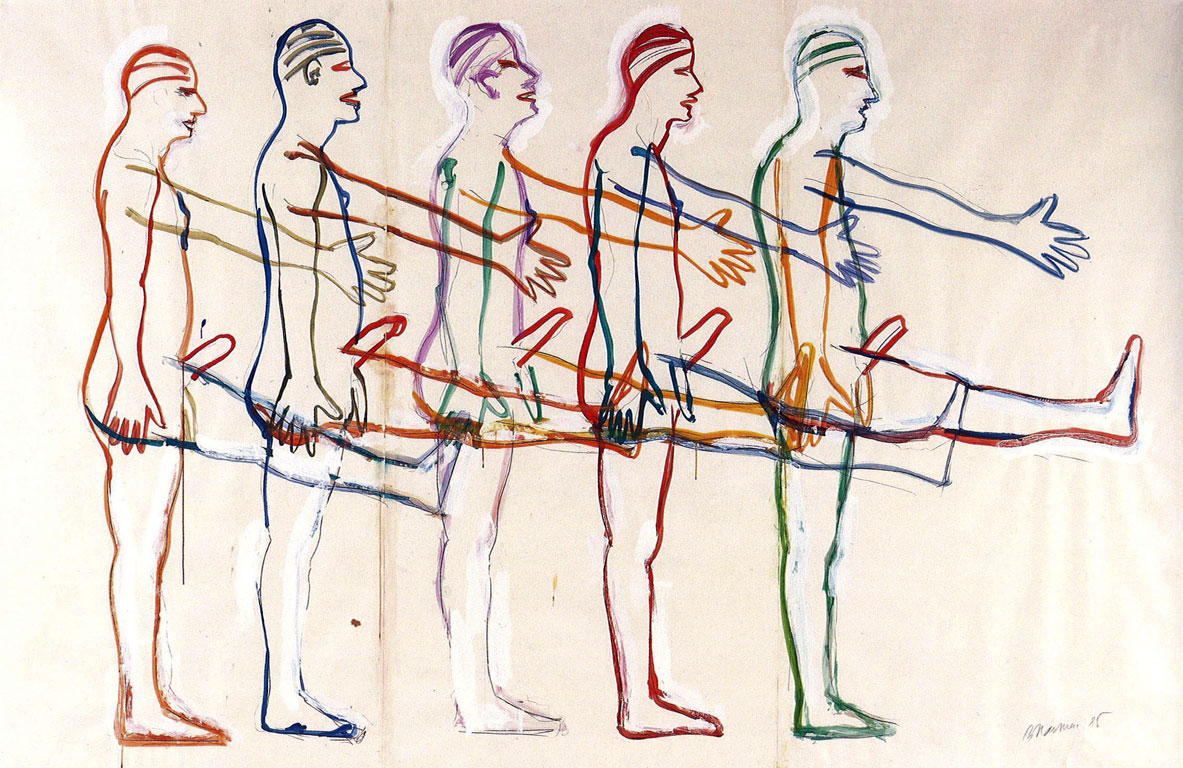
Bruce Nauman (American, b. 1941) 'Untitled (Five Marching Men)' 1985


Bruce Nauman (American, b. 1941)
Untitled (Five Marching Men)
1985
© Friedrich Christian Flick Collection / VBK Wien 2012


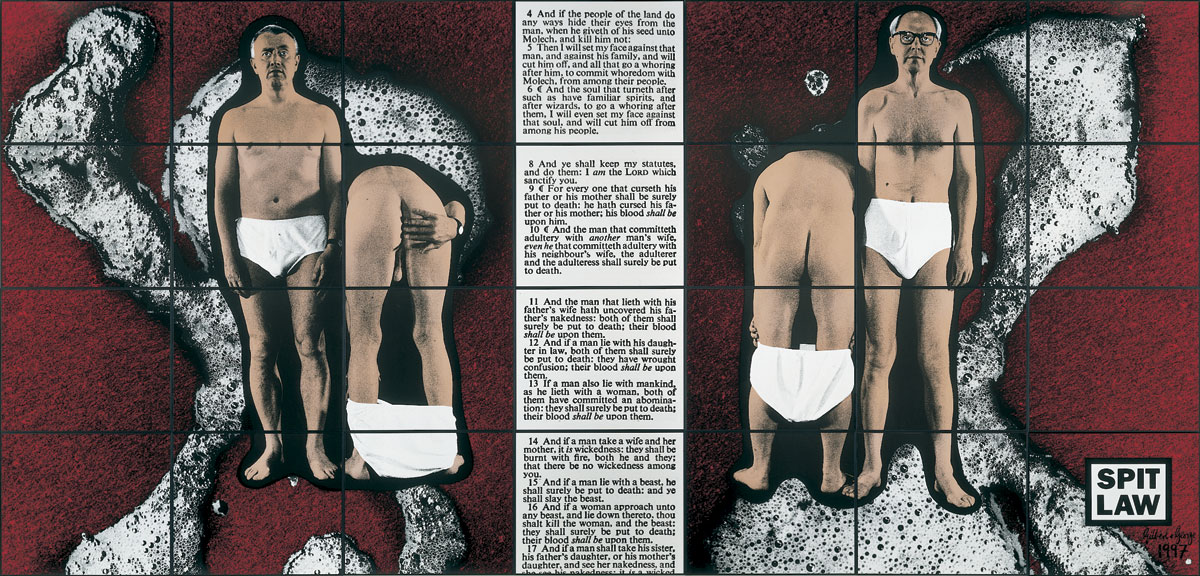
Gilbert & George (Gilbert Prousch, British born Italy, b. 1943 and George Passmore, British, b. 1942) 'Spit Law' 1997


Gilbert & George (Gilbert Prousch, British born Italy, b. 1943 and George Passmore, British, b. 1942)
Spit Law
1997
© Courtesy Galerie Thaddaeus Ropac, Paris / Salzburg


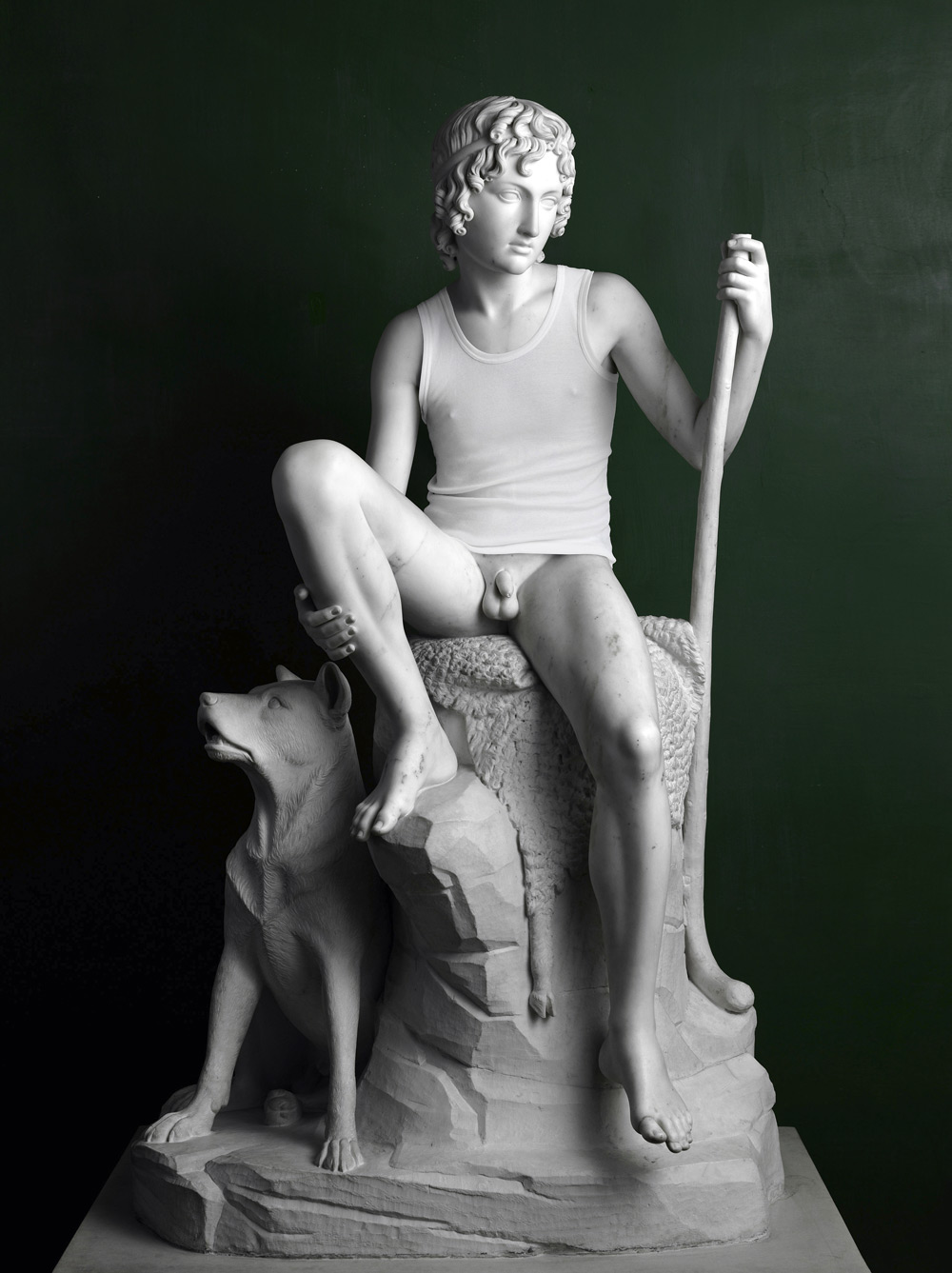
Elmgreen & Dragset (Michael Elmgreen Danish, b. 1961 and Ingar Dragset Norwegian, b. 1969) 'Shepherd Boy (Tank Top)' 2009


Elmgreen & Dragset (Michael Elmgreen Danish, b. 1961 and Ingar Dragset Norwegian, b. 1969)
Shepherd Boy (Tank Top)
2009
Courtesy Galleri Nicolai Wallner
© Courtesy Galleri Nocolai Wallner / VBK Wien 2012


Thomas Ruff (German, b. 1958) 'nudes vg 02' 2000


Thomas Ruff (German, b. 1958)
nudes vg 02
2000
Ed. 3/5
© Private collection Cofalka, Austria/with the kind support of agpro – austrian gay professionals
© VBK, Wien 2012


Jean Cocteau (French, 1889-1963) 'Male Couple Illustration for Jean Genet’s 'Querelle de Brest'' 1947


Jean Cocteau (French, 1889-1963)
Male Couple
Illustration for Jean Genet’s ‘Querelle de Brest’

1947
© Private collection © VBK, Wien 2012


Louise Bourgeois (French, 1911-2010) 'Fillette (Sweeter Version)' 1968, cast 1999


Louise Bourgeois (French, 1911-2010)
Fillette (Sweeter Version)
1968, cast 1999
© Ursula Hauser Collection, Switzerland © VBK, Wien 2012


Pierre & Gilles (Pierre Commoy and Gilles Blanchard) 'Vive la France [Long live France]' 2006


Pierre & Gilles (Pierre Commoy and Gilles Blanchard)
Vive la France [Long live France]
2006
© Private collection, Courtesy Galerie Jérôme de Noirmont, Paris


Andy Warhol (American, 1928-1987) 'Querelle' c. 1982


Andy Warhol (American, 1928-1987)
Querelle
c. 1982
© Privatsammlung/ VBK, Wien 2012


Leopold Museum
Museums Quartier, Museumsplatz 1
1070 Vienna, Austria

Opening hours:
Daily except Tuesday: 10am – 6pm

Leopolod Museum website

LIKE ART BLART ON FACEBOOK

Back to top

Exhibition: ‘Faking It: Manipulated Photography Before Photoshop’ at The Metropolitan Museum of Art, New York

Exhibition dates at the MMA: 11th October 2012 – 27th January 2013


Unidentified American artist. 'Two-Headed Man' c. 1855


Unidentified American artist
Two-Headed Man
c. 1855
Daguerreotype
The Nelson-Atkins Museum of Art, Kansas City, Missouri, Gift of Hallmark Cards, Inc.


What a fascinating subject. Having completed multiple exposure work under the black and white enlarger I can attest to how difficult it was to get a print correctly exposed. I was using multiple negatives, moving the piece of photographic paper and printing in grids. Trying to get the alignment right was quite a task but the outcomes were very satisfying. Of course today these skills have mainly been lost to be replaced by other technological skills within the blancmange that is Photoshop. Somehow it’s not the same. My admiration for an artist like Jerry Uelsmann will always remain undimmed for the undiluted joy, beauty and skill of their analogue imagery.

I will post different photographs in this exhibition from the National Gallery of Art hang when I receive them!

See the second posting on this exhibition.

Dr Marcus Bunyan


Many thankx to the The Metropolitan Museum of Art, New York for allowing me to publish the photographs in the posting. Please click on the photographs for a larger version of the image.


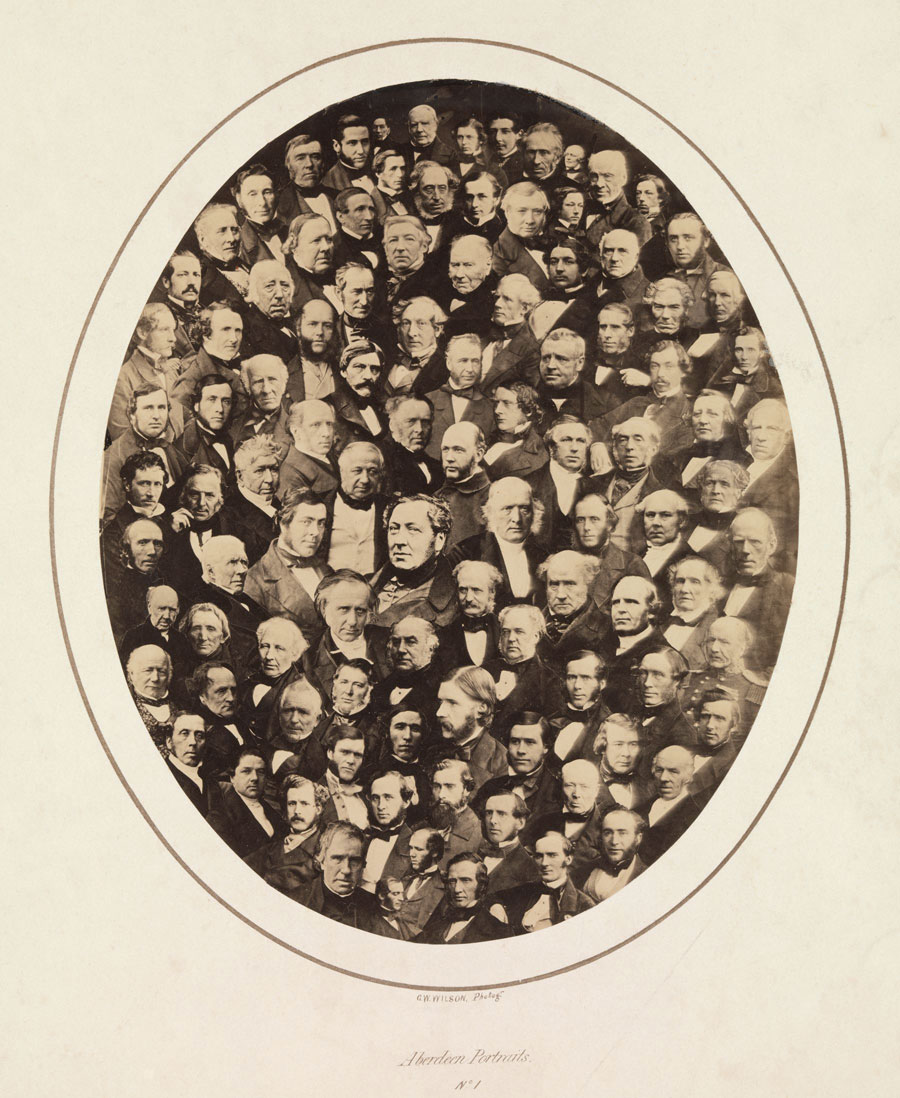
George Washington Wilson (Scottish, 1823-1893) 'Aberdeen Portraits No. 1' 1857


George Washington Wilson (Scottish, 1823-1893)
Aberdeen Portraits No. 1
1857
Albumen silver print from glass negative
The Metropolitan Museum of Art, The Horace W. Goldsmith Foundation Fund, through Joyce and Robert Menschel, 2011


Henry Peach Robinson (English, 1830-1901) 'Fading Away' 1858


Henry Peach Robinson (English, 1830-1901)
Fading Away
1858
Albumen silver print from glass negatives
The Royal Photographic Society Collection at the National Media Museum, Bradford, United Kingdom


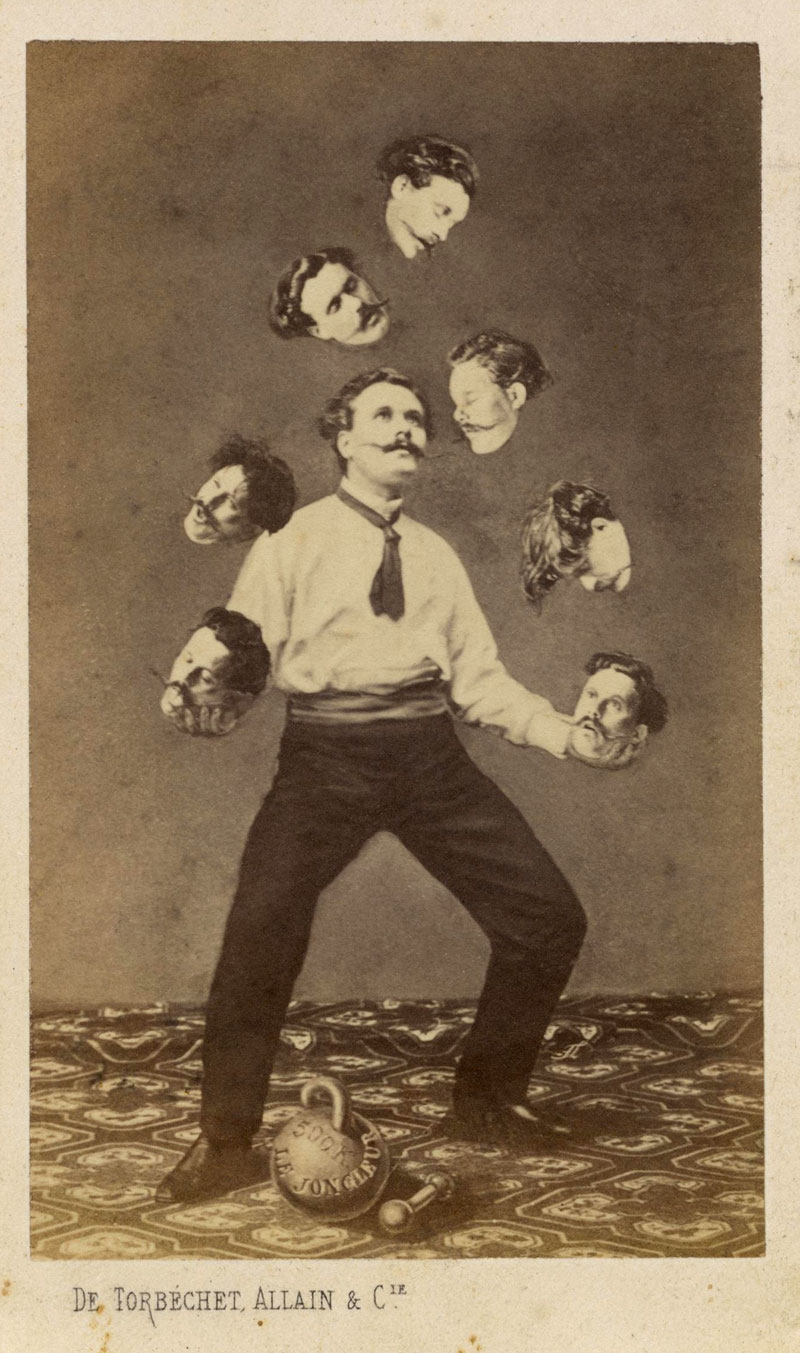
Unidentified artist / De Torbechet, Allain & Cie (publisher) 'Man Juggling His Own Head' c. 1880


Unidentified artist
De Torbechet, Allain & Cie
(publisher)
Man Juggling His Own Head
c. 1880
Albumen silver print from glass negative
Collection of Christophe Goeury


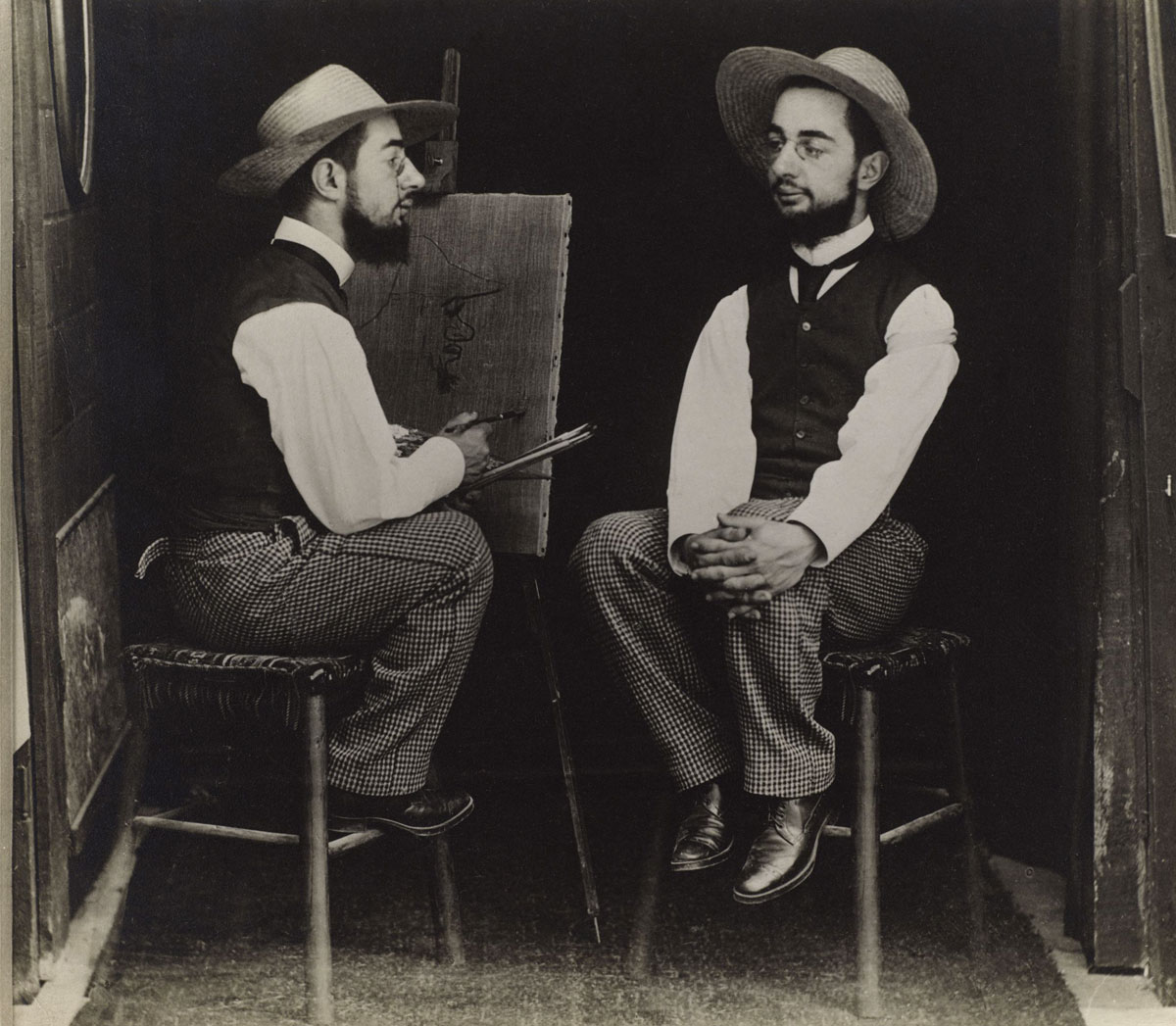
Maurice Guibert (French, 1856-1913) 'Henri de Toulouse-Lautrec as Artist and Model' c. 1900


Maurice Guibert (French, 1856-1913)
Henri de Toulouse-Lautrec as Artist and Model
c. 1900
Gelatin silver print
Philadelphia Museum of Art


F. Holland Day (American, 1864-1933) 'The Vision (Orpheus Scene)' 1907


F. Holland Day (American, 1864-1933)
The Vision (Orpheus Scene)
1907
Platinum print
The Royal Photographic Society Collection at the National Media Museum, Bradford, United Kingdom


Unidentified American artist. 'Man on Rooftop with Eleven Men in Formation on His Shoulders' c. 1930


Unidentified American artist
Man on Rooftop with Eleven Men in Formation on His Shoulders
c. 1930
Gelatin silver print
Collection of George Eastman House, International Museum of Photography and Film, Rochester


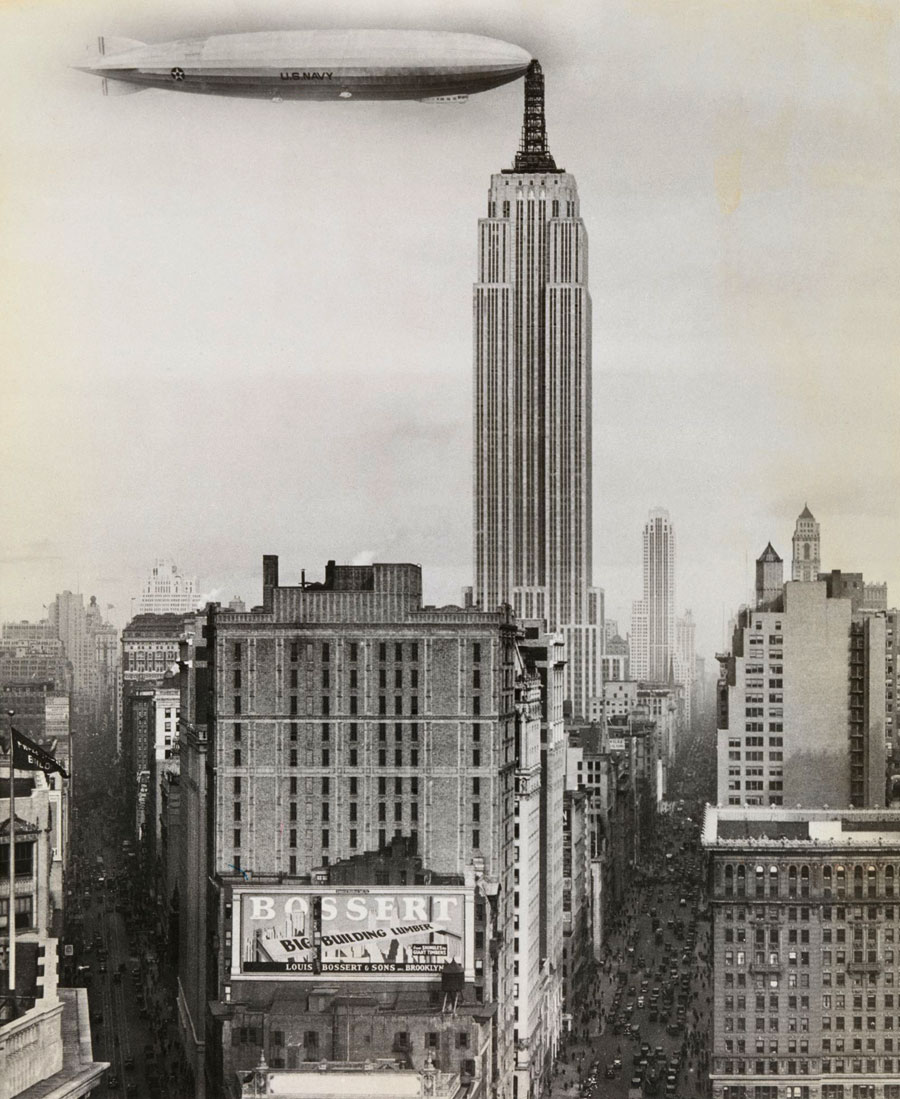
Unidentified American artist. 'Dirigible Docked on Empire State Building, New York' 1930


Unidentified American artist
Dirigible Docked on Empire State Building, New York
1930
Gelatin silver print
The Metropolitan Museum of Art, Twentieth-Century Photography Fund, 2011


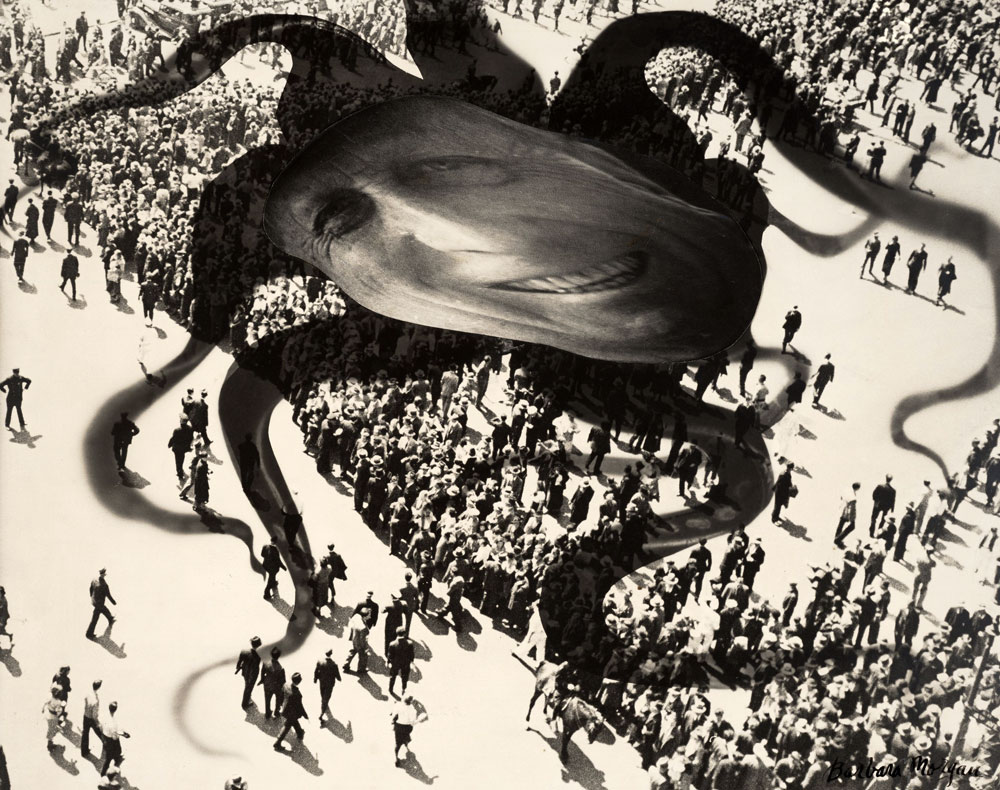
While digital photography and image-editing software have brought about an increased awareness of the degree to which camera images can be manipulated, the practice of doctoring photographs has existed since the medium was invented. Faking It: Manipulated Photography Before Photoshop at The Metropolitan Museum of Art is the first major exhibition devoted to the history of manipulated photography before the digital age. Featuring some 200 visually captivating photographs created between the 1840s and 1990s in the service of art, politics, news, entertainment, and commerce, the exhibition offers a provocative new perspective on the history of photography as it traces the medium’s complex and changing relationship to visual truth. 

The exhibition is made possible by Adobe Systems Incorporated. 

The photographs in the exhibition were altered using a variety of techniques, including multiple exposure (taking two or more pictures on a single negative), combination printing (producing a single print from elements of two or more 
negatives), photomontage, overpainting, and retouching on the negative or print. 

In every case, the meaning and content of the camera image was significantly transformed in the process of manipulation.

Faking It is divided into seven sections, each focusing on a different set of motivations for manipulating the camera image. “Picture Perfect” explores 19th-century photographers’ efforts to compensate for the new medium’s technical limitations – specifically, its inability to depict the world the way it looks to the naked eye. To augment photography’s monochrome palette, pigments were applied to portraits to make them more vivid and lifelike. Landscape photographers faced a different obstacle: the uneven sensitivity of early emulsions often resulted in blotchy, overexposed skies. To overcome this, many photographers, such as Gustave Le Gray and Carleton E. Watkins, created spectacular landscapes by printing two negatives on a single sheet of paper – one exposed for the land, the other for the sky. This section also explores the challenges involved in the creation of large group portraits, which were often cobbled together from dozens of photographs of individuals. 

For early art photographers, the ultimate creativity lay not in the act of taking a photograph but in the subsequent transformation of the camera image into a hand-crafted picture.

“Artifice in the Name of Art” begins in the 1850s with elaborate combination prints of narrative and allegorical subjects by Oscar Gustave Rejlander and Henry Peach Robinson. It continues with the revival of Pictorialism at the dawn of the twentieth century in the work of artist-photographers such as Edward Steichen, Anne W. Brigman, and F. Holland Day. 

“Politics and Persuasion” presents photographs that were manipulated for explicitly political or ideological ends. It begins with Ernest Eugene Appert’s faked photographs of the 1871 Paris Commune massacres, and continues with images used to foster patriotism, advance racial ideologies, and support or protest totalitarian regimes. Sequences of photographs published in Stalin-era Soviet Russia from which purged Party officials were erased demonstrate the chilling ease with which the historical record could be falsified. Also featured are composite portraits of criminals by Francis Galton and original paste-ups of John Heartfield’s anti-Nazi photomontages of the 1930s.

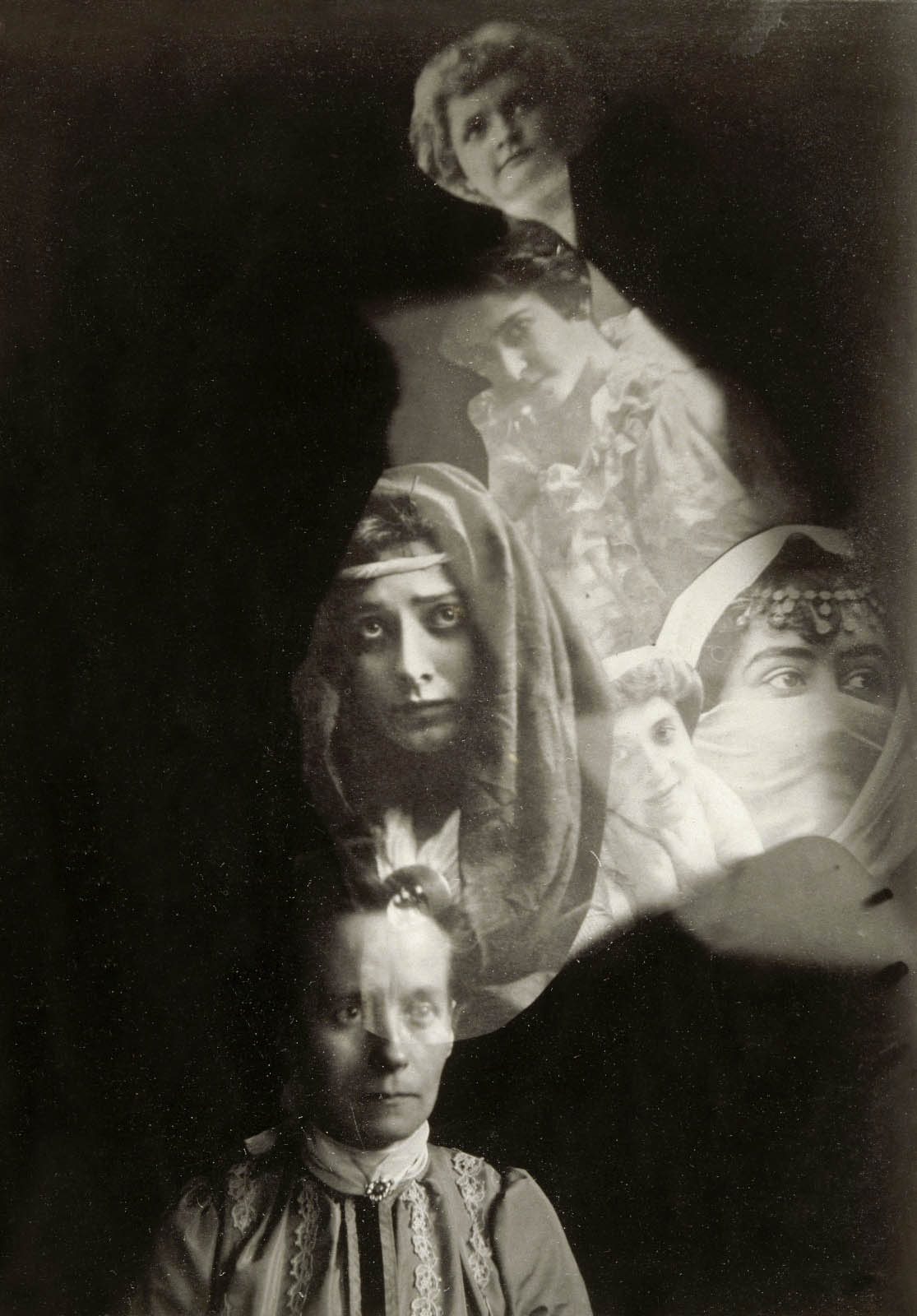
“Novelties and Amusements” brings together a broad variety of amateur and commercial photographs intended to astonish, amuse, and entertain. Here, we find popular images of figures holding their own severed heads or appearing doubled or tripled. Also included in this light-hearted section are ghostly images by the spirit photographer William Mumler, “tall-tale” postcards produced in Midwestern farming communities in the 1910s, trick photographs by amateurs, and Weegee’s experimental distortions of the 1940s. 

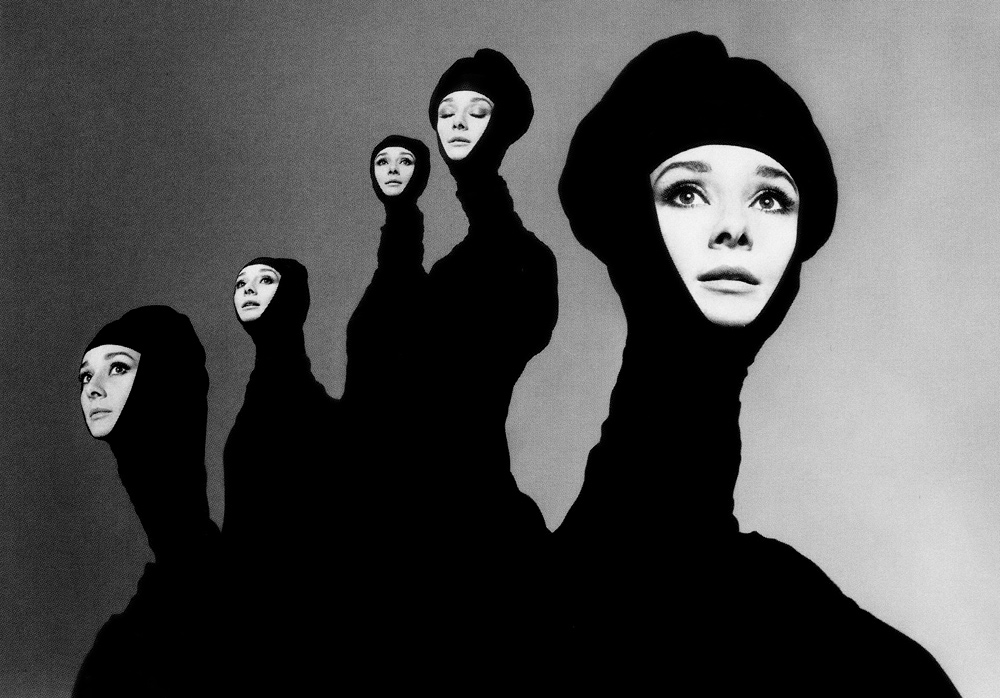
”Pictures in Print” reveals the ways in which newspapers, magazines, and advertisers have altered, improved, and sometimes fabricated images in their entirety to depict events that never occurred – such as the docking of a zeppelin on the tip of the Empire State Building. Highlights include Erwin Blumenfeld’s famous “Doe Eye” Vogue cover from 1950 and Richard Avedon’s multiple portrait of Audrey Hepburn from 1967.

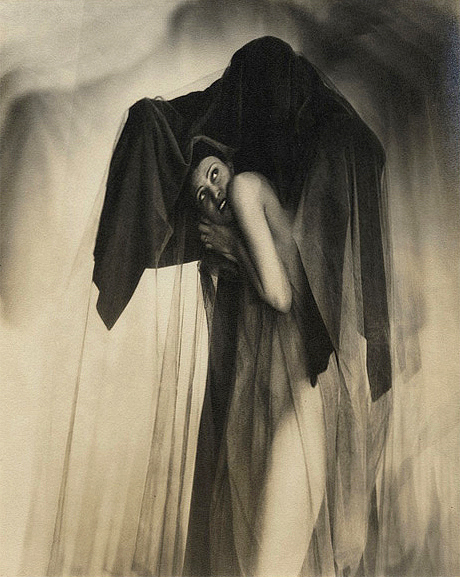
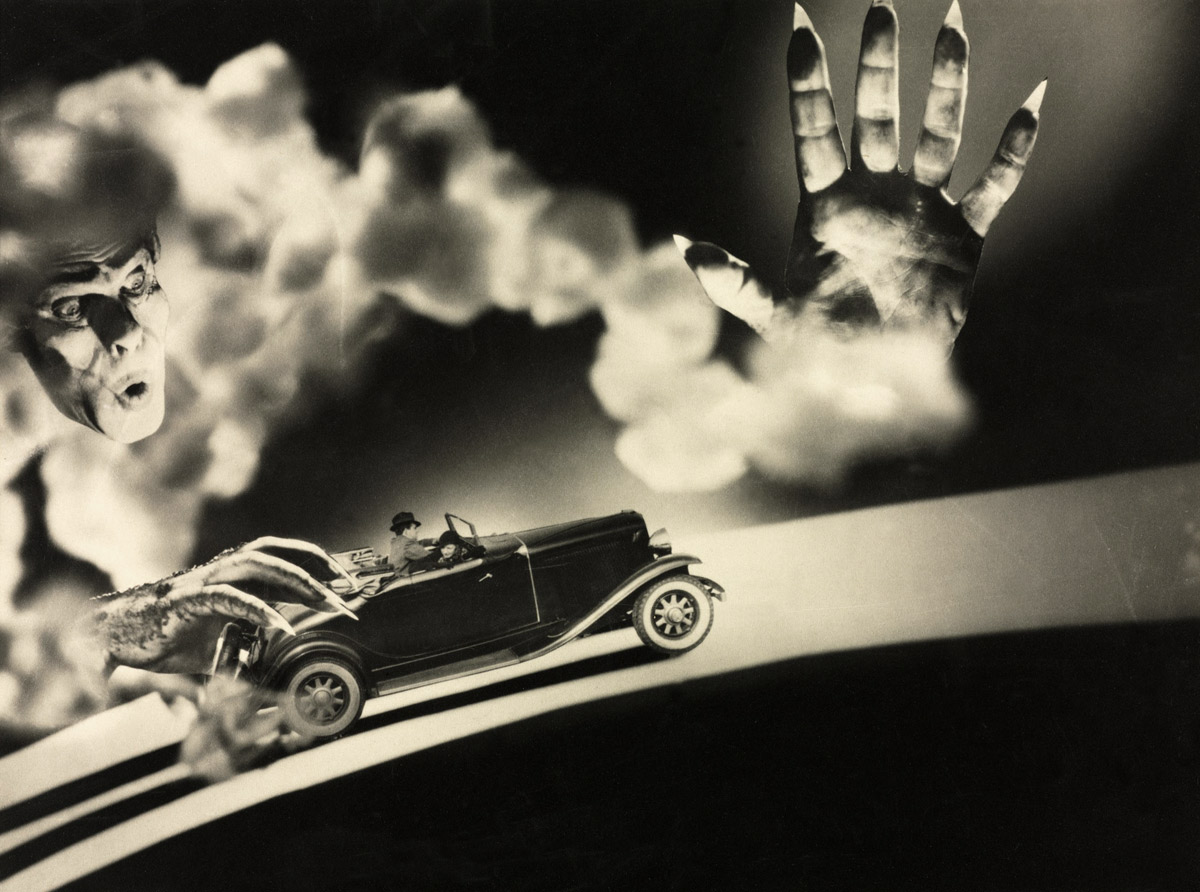
“Mind’s Eye” features works from the 1920s through 1940s by such artists as Herbert Bayer, Maurice Tabard, Dora Maar, Clarence John Laughlin, and Grete Stern, who have used photography to evoke subjective states of mind, conjuring dreamlike scenarios and surreal imaginary worlds. 

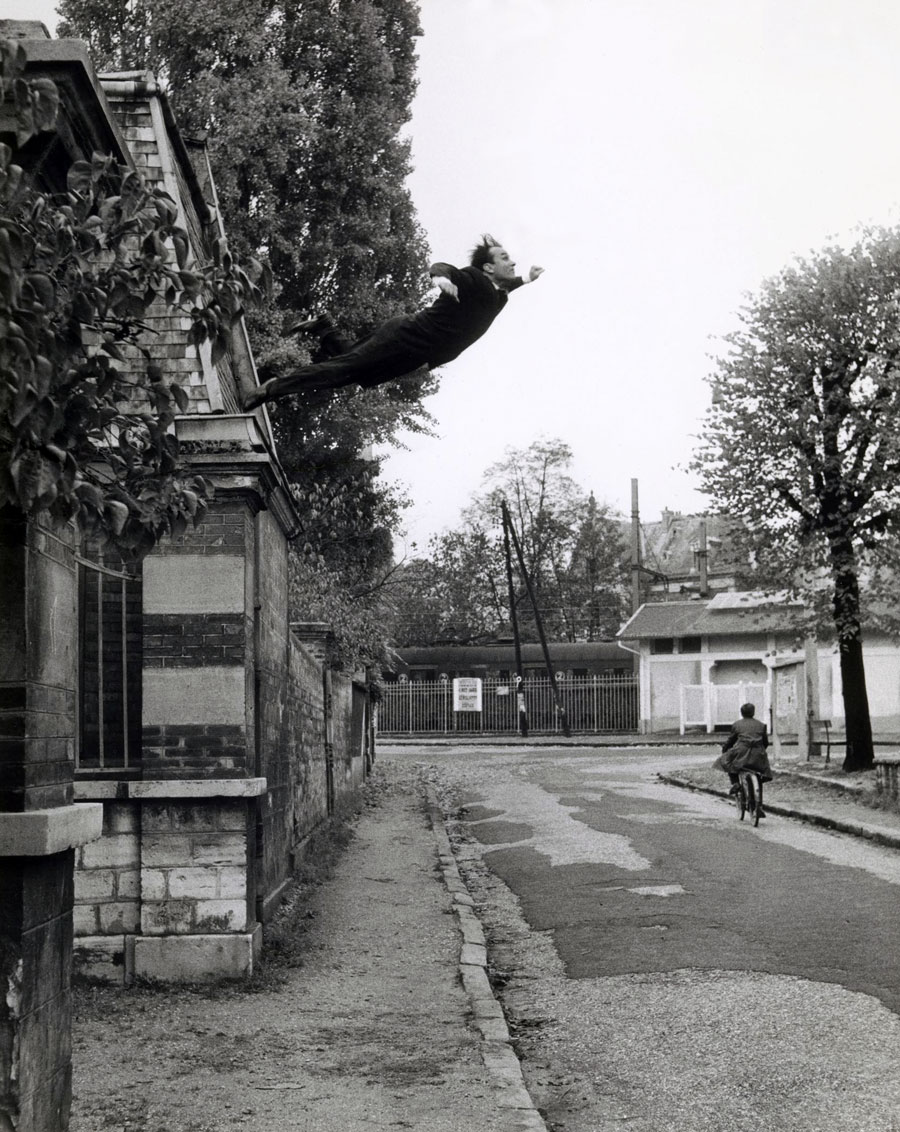
The final section, “Protoshop,” presents photographs from the second half of the 20th century by Yves Klein, John Baldessari, Duane Michals, Jerry Uelsmann, and other artists who have adapted earlier techniques of image manipulation – such as spirit photography or news photo retouching – to create works that self-consciously and often humorously question photography’s presumed objectivity.

Press release from The Metropolitan Museum of Art website


William Mortensen (American, 1897-1965) 'Obsession' c. 1930


William Mortensen  (American, 1897-1965)
Obsession
c. 1930
Gelatin silver print
18.4 x 14.5cm
The Elisha Whittelsey Collection, The Elisha Whittelsey Fund, 1975


Maurice Tabard (French, 1897-1984) 'Room with Eye' 1930


Maurice Tabard (French, 1897-1984)
Room with Eye
1930
Gelatin silver print
The Metropolitan Museum of Art, The Elisha Whittelsey Collection, The Elisha Whittelsey Fund, 1962


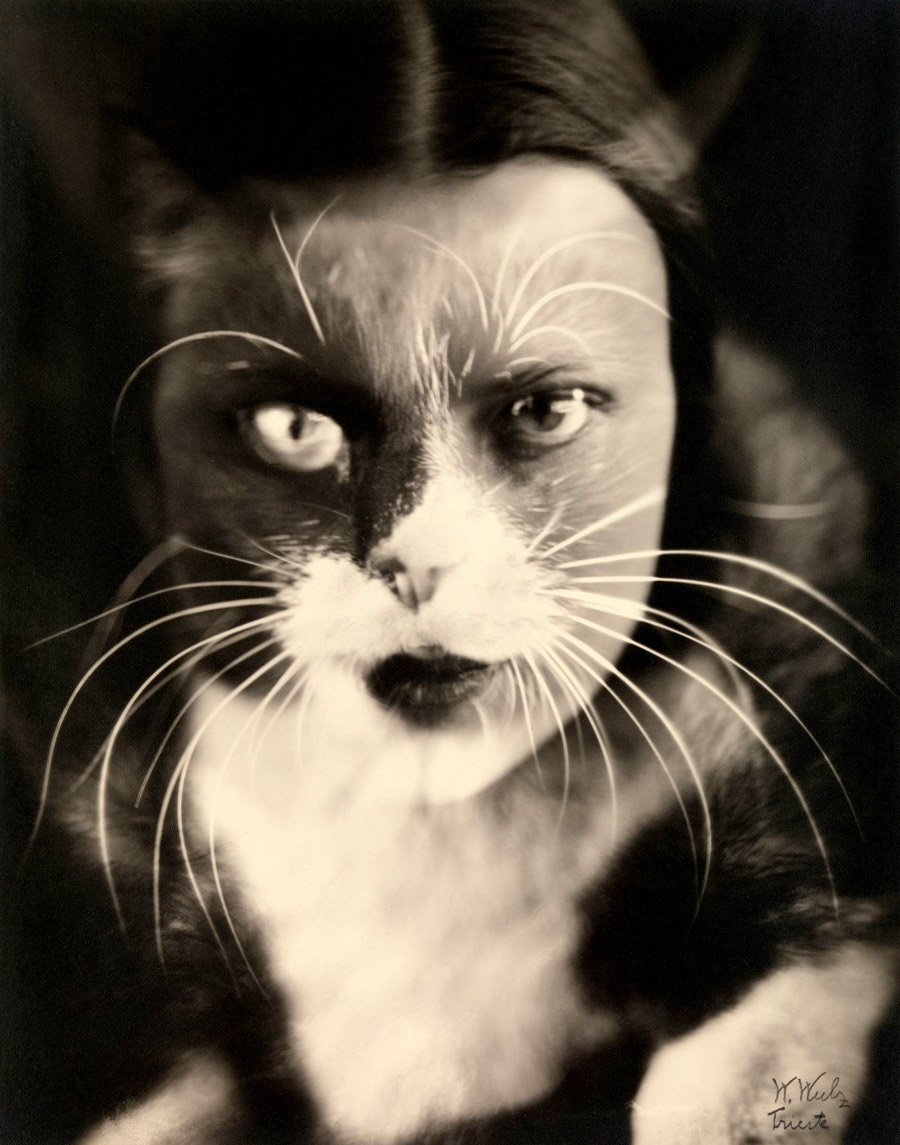
Wanda Wulz (Italian, 1903-1984) 'Io + gatto (Cat + I)' 1932


Wanda Wulz (Italian, 1903-1984)
Io + gatto (Cat + I)
1932
Gelatin silver print
The Metropolitan Museum of Art, Ford Motor Company Collection, Gift of Ford Motor Company and John C. Waddell, 1987
Alinari / Art Resource © Wanda Wulz


John Paul Pennebaker (American, 1903-1953) 'Sealed Power Piston Rings' 1933


John Paul Pennebaker (American, 1903-1953)
Sealed Power Piston Rings
1933
Gelatin silver print
1934 Art and Industry Exhibition Photograph Collection, Baker Library Historical Collections, Harvard Business School, Boston, Mass.
© John Paul Pennebaker


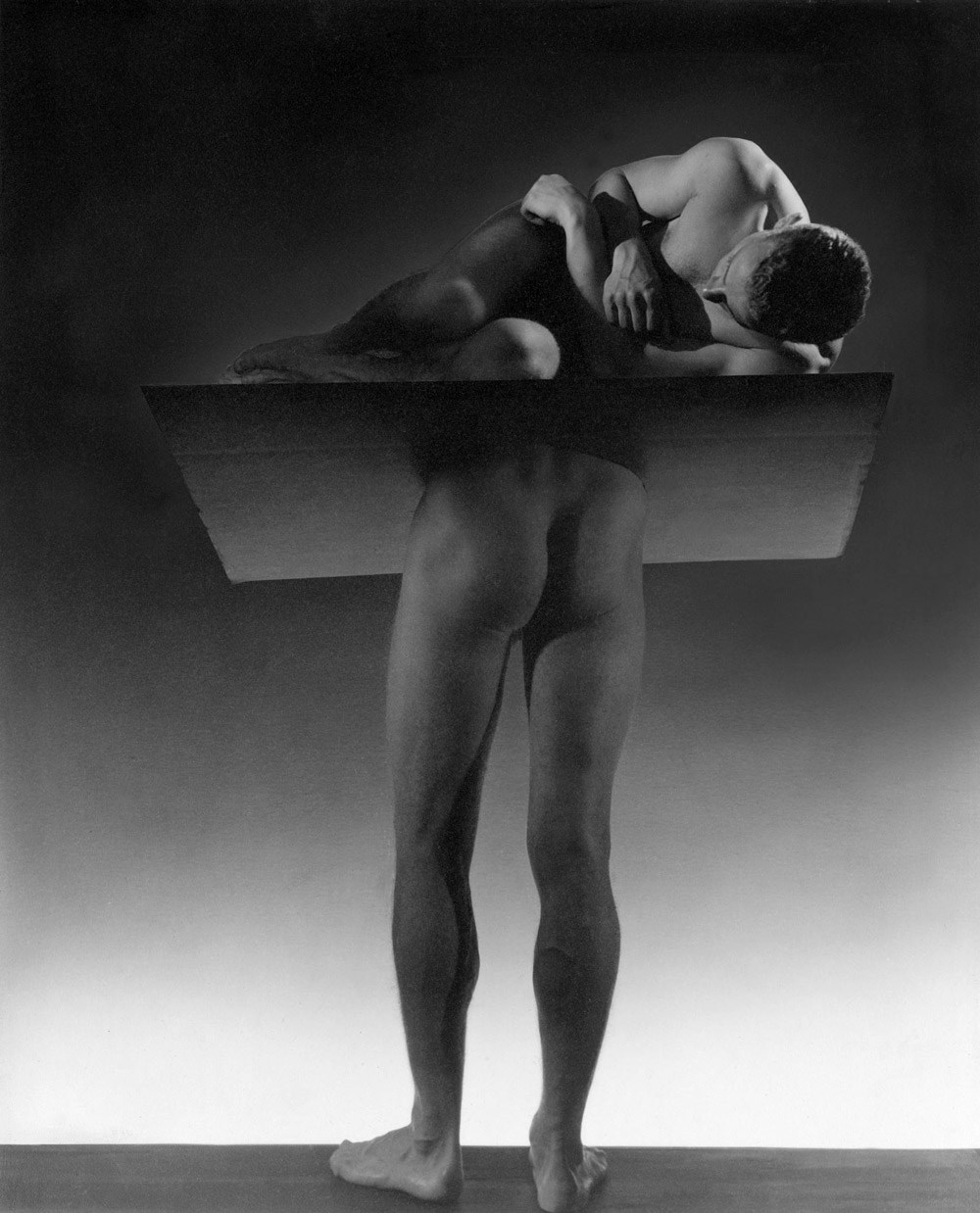
George Platt Lynes (American, 1907-1955) 'The Sleepwalker' 1935


George Platt Lynes (American, 1907-1955)
The Sleepwalker
1935
Gelatin silver print with applied media
The Metropolitan Museum of Art, Ford Motor Company Collection, Gift of Ford Motor Company and John C. Waddell, 1987
© The Estate of George Platt Lynes


Barbara Morgan (American, 1900-1992) 'Hearst over the People' 1939


Barbara Morgan (American, 1900-1992)
Hearst over the People
1939
Collage of gelatin silver prints with applied media
The Nelson-Atkins Museum of Art, Kansas City, Missouri, Gift of Hallmark Cards, Inc.


Grete Stern (Argentinian born Germany, 1904-1999) 'Dream No. 1: Electrical Appliances for the Home' 1948


Grete Stern (Argentinian born Germany, 1904-1999)
Dream No. 1: Electrical Appliances for the Home
1948
Gelatin silver print
The Metropolitan Museum of Art, Twentieth-Century Photography Fund, 2012
Courtesy of Galería Jorge Mara – La Ruche, Buenos Aires


Erwin Blumenfeld (American born Germany, 1897-1969) '"Doe Eye" Vogue cover' 1950


Erwin Blumenfeld (American born Germany, 1897-1969)
“Doe Eye” Vogue cover
1950


Yves Klein (French, 1928-1962) Photographed by Harry Shunk (German, 1924-2006) and János (Jean) Kender (Hungarian, 1937-2009) 'Leap into the Void' 1960


Yves Klein (French, 1928-1962)
Photographed by Harry Shunk (German, 1924-2006) and János (Jean) Kender (Hungarian, 1937-2009)
Leap into the Void
1960
Gelatin silver print
Purchase, The Horace W. Goldsmith Foundation Gift, through Joyce and Robert Menschel, 1992
© Yves Klein / Artists Rights Society (ARS), New York / ADAGP, Paris
Photograph Shunk-Kender © Roy Lichtenstein Foundation


Weegee (Arthur Fellig) (American, 1899-1968) 'Judy Garland' 1960


Weegee (Arthur Fellig) (American, 1899-1968)
Judy Garland
1960
Silver gelatin photograph
Copyright Weegee/International Center of Photography/Getty Images


Weegee (Arthur Fellig) (American, 1899-1968) 'American, 1899-1968 Draft Johnson for President' c. 1968


Weegee (Arthur Fellig) (American, 1899-1968)
Draft Johnson for President
c. 1968
Gelatin silver print
International Center of Photography, Bequest of Wilma Wilcox, 1993
Copyright Weegee/International Center of Photography/Getty Images.


Richard Avedon (American 1923-2004) 'Audrey Hepburn, New York, January 1967' 1967


Richard Avedon (American, 1923-2004)
Audrey Hepburn, New York, January 1967
1967
Collage of gelatin silver prints, with applied media, mylar overlay with applied media


Jerry N. Uelsmann (American, 1934-2022) 'Untitled' 1969


Jerry N. Uelsmann (American, 1934-2022)
Untitled
1969
Gelatin silver print
The Metropolitan Museum of Art, Twentieth-Century Photography Fund, 2011
© Jerry N. Uelsmann


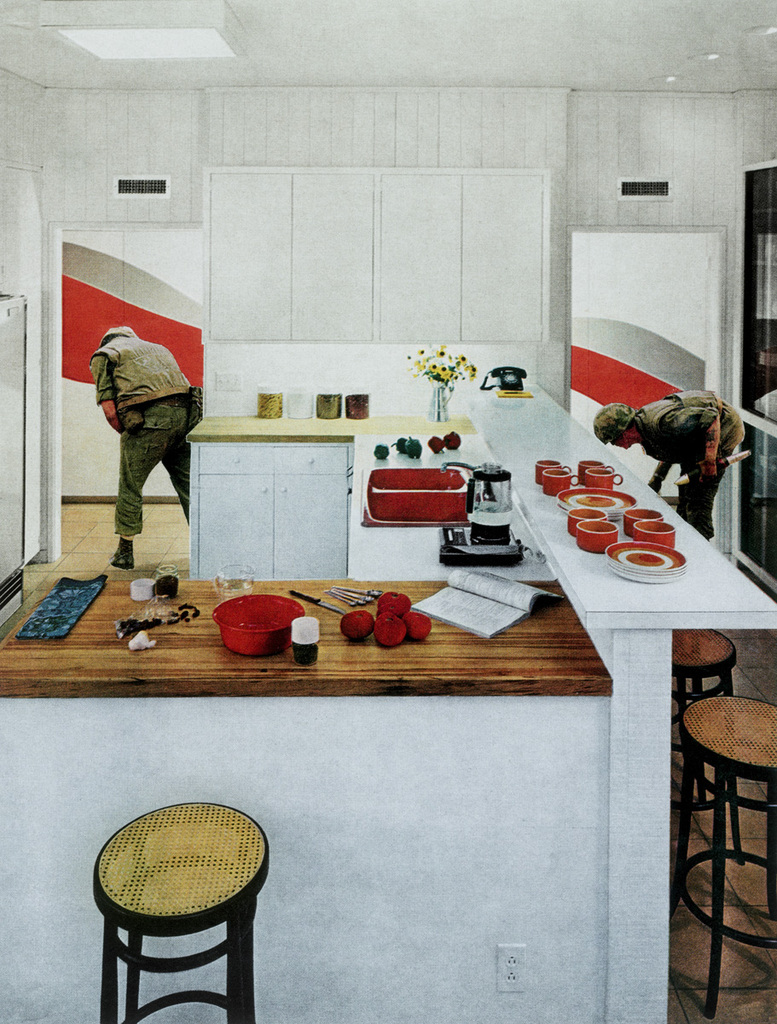
Martha Rosler (American, b. 1943) 'Red Stripe Kitchen', from the series "House Beautiful: Bringing the War Home" 1967-72


Martha Rosler (American, b. 1943)
Red Stripe Kitchen
1967-1972, printed early 1990s
From the series “House Beautiful: Bringing the War Home”
Chromogenic print
The Metropolitan Museum of Art, Purchase, Anonymous Gift, 2002
© Martha Rosler


The Metropolitan Museum of Art
1000 Fifth Avenue at 82nd Street
New York, New York 10028-0198
Phone: 212-535-7710

Opening hours:
Sunday – Tuesday 10am – 5pm
Closed Wednesdays

The Metropolitan Museum of Art website

National Gallery of Art
National Mall between 3rd and 7th Streets
Constitution Avenue NW, Washington

Opening hours:
Daily 10.00am – 5.00pm

National Gallery of Art website

LIKE ART BLART ON FACEBOOK

Back to top

Exhibition: ‘Wolfgang Tillmans’ at Moderna Museet Stockholm

Exhibition dates: 6th October 2012 – 20th January 2013


This slideshow requires JavaScript.


Installation photographs of various rooms of the exhibition Wolfgang Tillmans at Moderna Museet Stockholm, including Venus transit (2004) and Man pissing on chair (1997)
Photographs © Carmen Brunner


In this bumper posting, a big call: in my opinion, the greatest photography based image maker in the world today.

Tillmans challenges the way we think and feel about photography. As Tom Holert in his excellent catalogue essay The Unforeseen notes, Tillmans problematises and reconfigures narration and visualisation, experimenting with a sensory experiential backdrop against and within which the photographs are produced. Modes of perception and the regimes of emotion are inducted into the aesthetics of production and meaning so that, “the pictures communicate with each other in a way that is not bound to the pattern of a closed narrative or any particular line of argument. Instead they create a form of aesthetic and thematic interaction that Tillmans sees as ‘a language of personal associations and “thought-maps.”” The mobilisation and reversal of value and meaning are central strategies in Tillmans’ praxis.

In this way Tillmans opens up spaces for research, “in which learning and unlearning, resonance and interference, a new affective solidarity and real experimentation might be possible before the onset of all sorts of methods, all forms of governance, all kinds of discipline and doxa [common belief or popular opinion].

This form of experimentation does not lead to benchmark research results; nothing is ever proved or illustrated, regardless of what is in the images or what they may purport to show. Ever engaging in experiment Tillmans roams through the reality of materials, forms, affects and gives us tangible access to these unportrayble, unreferential realities. Tillmans engages his emotions when he is working, also and specifically when he is photographing people, or plants, machines and cities. Individual emotions separate off from the representation of living beings and objects and form nodes of emotion in the viewer’s mind.”

Through these rhizomic tendencies (a la Delueze and Guittari A Thousand Plateaus) Tillmans images generate emotion and affect, “rhythmically resonating between pictures, from wall to wall, from room to room, from side to side,” so that in each instance, in each publication or exhibition, he can “modify and modulate anew the relations between picture and picture support, representation and presentation, motif and materiality.”

Nothing is ever fixed in linear time. The work is presented as an infinitely variable, spatial and emotional relationship – an orthogonal performativity where the ritual of production and meaning is never fully predetermined at any stage of production and reception.

Tom Holert’s excellent catalogue essay The Unforeseen. On the Production of the New, and Other Movements in the Work of Wolfgang Tillmans includes information on Jacques Rancière’s concept of “‘aisthesis’ for the way in which very different things have been registered as ‘art’ for the last two hundred years or so. As he points out, “this is not about the ‘reception’ of works of art, but about the sensory experiential backdrop against and within which they come about. These are completely material conditions – places of performance or exhibition, forms of circulation and reproduction – but also modes of perception and the regimes of emotion, the categories that identify them and the patterns of thought that classify and interpret them.'” A thought provoking text (extracts below to accompany the photographs).

Dr Marcus Bunyan


Many thankx to the Moderna Museet for allowing me to publish the photographs and the text in the posting. Please click on the photographs for a larger version of the image.


Wolfgang Tillmans (German, b. 1968) 'Arkadia_I' 1996


Wolfgang Tillmans (German, b. 1968)
Arkadia_I
1996
© Wolfgang Tillmans. Courtesy Galerie Buchholz, Cologne/Berlin


Wolfgang Tillmans (German, b. 1968) 'New Family' 2001


Wolfgang Tillmans (German, b. 1968)
New Family
2001
© Wolfgang Tillmans. Courtesy Galerie Buchholz, Cologne/Berlin


Wolfgang Tillmans (German, b. 1968) 'Paper drop (window)' 2006


Wolfgang Tillmans (German, b. 1968)
Paper drop (window)
2006
© Wolfgang Tillmans. Courtesy Galerie Buchholz, Cologne/Berlin


Wolfgang Tillmans is one of the leading artists of his generation and is constantly in the public eye, with exhibitions all over the world. The exhibition at Moderna Museet is Tillmans’ first major show in Sweden and brings nearly twenty years of picture-making to a new audience. Moderna Museet is delighted to welcome Wolfgang Tillmans – an artist who has extended the boundaries of photography and redefined the medium of photography as an artform.

Wolfgang Tillmans (b. 1968) first attracted attention at the beginning of the 1990s, with his apparently mundane pictures of subjects taken from his own surroundings. After studying in Britain, he published photographs in prominent publications such as i-D, Spex and Interview. Today, these pictures are considered trendsetting for the young generation of the 1990s, and raise questions about subcultures and sexual identities. By turning everyday situations into almost monumental images, Tillmans very strikingly captured the spirit of the times. It soon became evident that his pictures renegotiate photographic conventions and reflect contemporary currents related to culture and identity. Since then, Tillmans has continued his in-depth investigations, expanding the the realm of photography and redefining the very medium as an artform.

“Wolfgang Tillmans moves freely between images of the club scene in Berlin, political manifestations, and skyscrapers in Hong Kong; all with the same direct tonality. At the same time, all of his pictures explore photography itself – as a medium, but also as a material, convention and process,” says Curator Jo Widoff.

Recently Tillmans’ art has taken a number of different directions, revolving around various issues, everything from still lifes and modern landscapes to his lifelong interest in astronomy and the night sky. He has also taken his in-depth exploration of abstract photography even further. Tillmans’ abstract images are more closely related to the painterly tradition and he researches photography as a self-reflexive medium. Abstract images, such as Freischwimmer and Silver, are made in the darkroom, striking a balance between the deliberate and chance. Since 1995, Tillmans has been working actively and strategically with the exhibition space, so as to reveal the possibilities and limitations of the space in interplay with the photographs. His installations display a bewildering variety of formats and sizes, ways of composing the hanging of the pictures, and contexts. The exhibition at Moderna Museet should thus be seen as a site-specific installation. In recent years, Tillmans has been travelling the world taking photographs with the general title Neue Welt. These pictures relate to the new world of markets and trade, to politics and economics, and to the hypermodern. The title also refers to the new digital camera that Wolfgang used to take these pictures, which captures and documents more detail than we can perceive with the naked eye.

“Wolfgang Tillmans is one of today’s most prominent artists. Despite its visual complexity, his pictorial language is immediately recognisable. He captures the explosive energy in social situations and crosses boundaries between different artforms. He is able to use photographic means to create a kind of abstract painting,” says Museum Director Daniel Birnbaum.

Press release from the Moderna Museet website


Wolfgang Tillmans (German, b. 1968) 'Lux' 2009


Wolfgang Tillmans (German, b. 1968)
Lux
2009
© Wolfgang Tillmans. Courtesy Galerie Buchholz, Cologne/Berlin


Wolfgang Tillmans (German, b. 1968) 'Iguazu' 2010


Wolfgang Tillmans (German, b. 1968)
Iguazu
2010
© Wolfgang Tillmans. Courtesy Galerie Buchholz, Cologne/Berlin


Wolfgang Tillmans (German, b. 1968) 'Paper drop (Roma)' 2007


Wolfgang Tillmans (German, b. 1968)
Paper drop (Roma)
2007
C-type print
30.5 x 40.6cm
Courtesy the artist and Maureen Paley, London


Wolfgang Tillmans (German, b. 1968) 'Freischwimmer 93' 2004


Wolfgang Tillmans (German, b. 1968)
Freischwimmer 93
2004
© Wolfgang Tillmans. Courtesy Galerie Buchholz, Cologne/Berlin


The Freischwimmer series – Free Swimmer is the most basic Lifesaving level in Germany and Switzerland – is an excellent example of Tillmans’s more experimental works. On one hand, the huge photographic papers were affixed to the wall with simple adhesive tape or paper clips; on the other, the images eluded all description and eschewed portraiture, landscape, still life or other subject matters he had centred on up to then.

The creative process of Freischwimmer, ongoing to the present, seems to speak to pure photography, divested of any form of intervention either in shooting or in enlargement, or indeed optical devices of any kind. We can almost imagine the artist in front of a large tray with reagents, performing some kind of alchemical ritual at the origin of these vaporous images, images containing a refinement that exceeds any human intention, just pure representations of themselves, of a unique and absolutely unrepeatable process. Of their reality.”

José Manuel Costa. “Swimming to Freedom 38,” on the CA2M Centro de Arte Dos de Mayo website [Online] Cited 12/10/2013 no longer available online


The Freischwimmer, which Tillmans started to produce in the early 2000s, form a group or family of images that are not made using a camera lens. As the results of gestural and chemical operations in the dark room, these originals on medium-sized photo paper, which are subsequently scanned and enlarged both as ink-jet prints and as light-jet prints on photo paper, are unrepeatable one-offs. It has been said that these images, which include ensembles such as Peaches, Blushes and Urgency, call to mind microscopically detailed images of biolog­ical processes, hirsute epidermises, highly erogenous zones, and that their aura fills the whole space – above all when they are presented in such large formats as in Warsaw or yet larger still, as in the case of the two monumental Ostgut Freischwimmer (2004) that used to grace the walls of the Panorama Bar at Berghain in Berlin. The Freischwimmer and their kin can be read as diagrams of sexualised atmospheres in private or semi-public spaces, in boudoirs or clubs, as highly non-representational images that both suspend and supplement conventional depic­tions of sex.

Extract from Tom Holert. The Unforeseen. On the Production of the New, and Other Movements in the Work of Wolfgang Tillmans. [Online] Cited 12/10/2013 no longer available online


Wolfgang Tillmans (German, b. 1968) 'Nanbei Hu' 2009


Wolfgang Tillmans (German, b. 1968)
Nanbei Hu
2009
Inkjet print
207 x 138cm
Courtesy the artist and Maureen Paley, London


Wolfgang Tillmans (German, b. 1968) 'Anders pulling splinter from his foot' 2004


Wolfgang Tillmans (German, b. 1968)
Anders pulling splinter from his foot
2004
© Wolfgang Tillmans. Courtesy Galerie Buchholz, Cologne/Berlin


Wolfgang Tillmans (German, b. 1968) 'Onion' 2010


Wolfgang Tillmans (German, b. 1968)
Onion
2010
© Wolfgang Tillmans. Courtesy Galerie Buchholz, Cologne/Berlin


Wolfgang Tillmans (German, b. 1968) 'Venus transit' 2004


Wolfgang Tillmans (German, b. 1968)
Venus transit
2004
© Wolfgang Tillmans. Courtesy Galerie Buchholz, Cologne/Berlin


Wolfgang Tillmans (German, b. 1968) 'Heptathlon' 2009


Wolfgang Tillmans (German, b. 1968)
Heptathlon
2009
Inkjet print
208.5 x 138cm
Courtesy the artist and Maureen Paley, London


Wolfgang Tillmans (German, b. 1968) 'Headlight (a)' 2012


Wolfgang Tillmans (German, b. 1968)
Headlight (a)
2012
© Wolfgang Tillmans. Courtesy Galerie Buchholz, Cologne/Berlin


Wolfgang Tillmans (German, b. 1968) 'Ushuaia Lupine (a)' 2010


Wolfgang Tillmans (German, b. 1968)
Ushuaia Lupine (a)
2010
© Wolfgang Tillmans. Courtesy Galerie Buchholz, Cologne/Berlin


Wolfgang Tillmans (German, b. 1968) 'Tukan' 2010


Wolfgang Tillmans (German, b. 1968)
Tukan
2010
Inkjet print on paper, clips


Wolfgang Tillmans (German, b. 1968) 'Photocopy' 1994


Wolfgang Tillmans (German, b. 1968)
Photocopy
1994
© Wolfgang Tillmans, Courtesy Galerie Daniel Buchholz, Köln


Extracts from Tom Holert. The Unforeseen. On the Production of the New, and Other Movements in the Work of Wolfgang Tillmans. [Online] Cited 12/10/2013. No longer available online

Parallelism – Subjectivism – Objectivism

This all means that the decorative unity of wall and image, which the hanging of the Freischwimmer initially promises, is not only thwarted by the shift in dimensions, the infringement of symmetrical order and the (supposed) discontinuity of abstraction and figuration, and by the fact that the different types of image and their configuration on this wall require the viewer to move around in the space and to continually readjust his or her gaze, bearing in mind that in the corner of one’s eye or following a slight turn of the body more pictures are constantly looming into view, mostly unframed, very small (postcard-sized), very large, hung very low down, but also very high up, portraits and still lifes, gestural abstractions, a close-up of a vagina, a picture of a modern Boy with Thorn, street scenes, an air-conditioning system. It also means that the pictures communicate with each other in a way that is not bound to the pattern of a closed narrative or any particular line of argument. Instead they create a form of aesthetic and thematic interaction that Tillmans sees as ‘a language of personal associations and “thought-maps”‘,1 as ‘… a pattern of parallelism as opposed to one linear stream of thought’,2 and which the critic Jan Verwoert has aptly described as a ‘performative experiment’ with the viewer.3

With all their variability and flexibility – underpinned by an invisible rectilinear grid yet fundamentally open in their interconnections – these installations serve Tillmans as reflections of his own way of perceiving the world, as externalisations of his thinking and feeling, and as a chance to fashion a utopian world according to his own ideas and fantasies.4 However, this Romantic subjectivism of self-expression or externalisation has to be seen in light of a radical objectivism (Tillmans attaches great importance to this) that specifically draws attention not only to the expressive potential arising from the ageing process, from evidence of wear and other precariousnesses in the materials of photography (paper, camera techniques, chemicals, developing equipment etc.) but also to the remarkable resistance and persistence of these same materials.

Amongst the phenomena that inform this objectivism there are those instances of loss of control that can arise during the mechanical production processes of analogue photography or from coding errors, glitches, in digital images. Temporality, finity, brevity come into play here – a certain melancholy that activates rather than paralyses.

Over the years Tillmans has constantly found new ways to explore, to interpret and to stage this dialectic of intention and contingency. His repertoire and means of aesthetic production have multiplied. And this expansion has not been without consequences for the presentation of his work. Tillmans himself feels that the character of his installations has changed since 2006/07, in other words, when different versions of a solo exhibition of his work toured to three museums in the United States. It was during this exhibition tour that Tillmans started to see the benefit of placing greater weight on individual groups of works in the various rooms of larger exhibitions. In so doing he gave visitors the chance to engage in a different kind of concentration, without the pressure of constantly having to deal with the ‘full spectrum’ (Tillmans) of his oeuvre.5

Value Theory, Value Praxis

The visitor to an exhibition of the work of Wolfgang Tillmans in the year 2012, in this case the author of these lines, arrives in expectation of a particular, clearly defined type of art and image experience. A sense (however fragmentary) of the artist’s past exhibitions and publications is always present in any encounter with his work. And this includes the need to see the ‘abstract pictures’ in the context of an oeuvre where realistic and abstract elements have never intentionally been separated from each other. On the contrary, abstraction is always co-present with figurative and representational elements. There is no contradiction between forms and matter free of meaning – that is to say, visual moments that on the face of it neither represent nor illustrate anything – and Tillmans’ photographs of people, animals, objects and landscapes; in fact there is an unbroken connection, a continuum. This applies both to individual images as much as to the internal, dynamic relationalism of his oeuvre as a whole. And it also applies to each individual, concrete manifestation of multiplicity, as in the case of the installation in the first room of the exhibition in Warsaw.

Both aesthetic theory and the institution of art itself provide decisive grounds for discussing photography and visual art in such a way that images are not solely considered in terms of documentary functions or ornamental aspects nor are they reduced to the question as to whether their contents are stage-managed or authentic, but that attention is paid instead to the material nature of the pictures and objects in the space, to their sculptural qualities. Having decided early on against a career as a commercial photographer and in favour of a life in art, there was no need for Tillmans to seek to justify the interest he had already felt in his youth in a non-hierarchical, queer approach to various forms and genres in the visual arts. For the young Wolfgang Tillmans the cover artwork for a New Order LP, a portrait of Barbara Klemm (in-house photographer at the Frankfurter Allgemeine Zeitung), or a screenprint collage of Robert Rauschenberg in Kunstsammlung Nordrhein-Westfalen were all ‘equally important’ images’.7 The mobilisation and reversal of value and meaning are central strategies in his praxis. He questions the ‘language of importance’8 in photography and alters valencies of the visual by, for instance – in a ‘transformation of value’9 – producing C-prints from the supposedly impoverished or inadequate visuality of old black-and-white copies or wrongly developed images and thus raising them to the status of museum art. However much he may set store by refinement and precision, he avoids conventional forms of presentation, that is to say, ‘the signifiers that give immediate value to something, such as the picture frame’.10

Conditions: Subject – Work – Mediation

If we take the line proposed by the philosopher Jacques Rancière, then the ‘aesthetic regime’ of the modern era, which – following the introduction of a modern concept of art and aesthetics – abandoned the regulatory aesthetic canon of the classical age in the nineteenth century, is distinguished by the fact that under its auspices the traditional hierarchies separating the high from the popular branches of narration and visualisation were problematised and reconfigured in such a way that a new politics of aesthetics and a ‘distribution of the sensible’ in the name of art ensued. Rancière has recently proposed the term ‘aisthesis’ for the way in which very different things have been registered as ‘art’ for the last two hundred years or so. As he points out, this is not about the ‘reception’ of works of art, but about the sensory experiential backdrop against and within which they come about. ‘These are completely material conditions – places of performance or exhibition, forms of circulation and reproduction – but also modes of perception and the regimes of emotion, the categories that identify them and the patterns of thought that classify and interpret them.’12

In order to understand why the work of Wolfgang Tillmans – so seemingly casual, so heterogeneous and so wide-ranging – is not only extremely successful, but has, for over twenty years, been intelligible and influential both within and outside the field of art, with the result that by now his praxis seems like a universal, subtly normative style of perception and image-making, it is essential to consider the ‘conditions’ alluded to by Rancière. For these are fundamental to the specific visibility and speakability of this oeuvre and to its legitimacy as art…

The Production of the New

Tillmans thus also makes his contribution to an answer to the question posed by the philosopher John Rajchman (in response to Gilles Deleuze and Michel Foucault and their deliberations on the production of the new and on the creative act in present-day, control-obsessed societies). Rajchman asked how, in and with the arts and their institutions, spaces for open searches and researches could be devised, in which learning and unlearning, resonance and interference, a new affective solidarity and real experimentation might be possible before the onset of all sorts of methods, all forms of governance, all kinds of discipline and doxa.18

This form of experimentation does not lead to benchmark research results; nothing is ever proved or illustrated, regardless of what is in the images or what they may purport to show. Ever engaging in experiment Tillmans roams through the reality of materials, forms, affects and gives us tangible access to these unportrayble, unreferential realities. Tillmans engages his emotions when he is working, also and specifically when he is photographing people, or plants, machines and cities. Individual emotions separate off from the representation of living beings and objects and form nodes of emotion in the viewer’s mind. ‘Artists are presenters of affects, the inventors and creators of affects’, as Gilles Deleuze and Félix Guattari put it in What is Philosophy?, ‘they draw us into the compound’.19 And indeed Tillmans’ laboratories are places where emotion and affect are generated and presented, rhythmically resonating between pictures, from wall to wall, from room to room, from side to side. The dog asleep on the stones, its breathing body warmed by the sun (in the video Cuma, 2011), Susanne’s lowered gaze (in Susanne, No Bra, 2006), with the line of her hair encircling her head like an incomplete figure of eight, but also the disturbed, interrupted, lurking monochromaticism of the Lighter and Silver works – they all open up the longer you look at them, the longer you are with them, to a perceiving in terms of forces and affects. They alert us to the fact that all images are fabricated.

Assimilating Photography into the Paradox

By virtue of the portability and variability of his works, with every print, with every exhibition, with every publication Tillmans can modify and modulate anew the relations between picture and picture support, representation and presentation, motif and materiality. In the two decades that have elapsed since his entry into the art business his praxis has continuously expanded. From the outset photography was his springboard for both integrative and eccentric acts. And even though this oeuvre may create the impression that the medium of photography knows no limits, photography – as discourse, as technique, as history, as convention – has remained the constant point of reference for all of Tillmans’ complex operations. It could also be said that he is immensely faithful to his chosen medium, although – or precisely because – that medium is not always recognisable as such. To quote an older essay on photography and painting by Richard Hamilton (whom Tillmans once photographed), his work is about ‘assimilating photography into the domain of paradox, incorporating it into the philosophical contradictions of art…’30 Since Tillmans’ experiments with a laser copier in the 1980s, he has produced hundreds of images that may be beholden to the etymology of photography (light drawing) but that also constantly undermine or overuse the social and epistemological functions of photography as a means to depict reality, as proof, as an aide mémoire, as documentation or as a form of aesthetic expression. The discourse on photography, with all its ‘post-photographic’ exaggerations, the debate on the status of the photographic image – none of these have been concluded; on the contrary, Tillmans is continuously advancing them on his own terms. His praxis forms the backdrop for experimentation and adventures in perception that are closely intertwined with the past and the present of photography and theories of photography; yet the specific logic of this oeuvre creates a realm of its own in which archive and presentation interlock in such a way that photography still plays an important part as historic and discursive formation, but the problems and paradoxes of fine art have now taken over the key functions.

The contagious impact of the epistemological problems of art has opened up new options for the medium of photography, new contexts of reception. And in this connection it is apparent, as Julie Ault has put it, that ‘Tillmans enacts his right to complex mediation’.31 In other words, photography provides a means for him to engage with a whole range of interactions with the viewer. In his eyes and hands photography becomes a realm of potential, where a never-ending series of constellations and juxtapositions of materialities, dimensions and motifs of the ‘unforeseen’ can come about. Photography thus regains a dimension of experimentation, an openness that is not constrained by aesthetic formats and technical formatting but that does arise from a precise knowledge and understanding of the history of the medium.”

Extracts from Tom Holert. The Unforeseen. On the Production of the New, and Other Movements in the Work of Wolfgang Tillmans. [Online] Cited 12/10/2013 no longer available online


Footnotes from extracts

1/ “Peter Halley in Conversation with Wolfgang Tillmans,” in Jan Verwoert, Peter Halley and Midori Matsui, Wolfgang Tillmans (London: Phaidon, 2002), 8-33 at 29

2/ Steve Slocombe, “Wolfgang Tillmans – The All-Seeing Eye,” in Flash Art, vol. 32, no. 209, November – December 1999, 92-95 at 95

3/ Jan Verwoert, “Survey: Picture Possible Lives: The Work of Wolfgang Tillmans,” in Verwoert et. al., Wolfgang Tillmans, 36-89 at 72

4/ See Slocombe, “Wolfgang Tillmans – The All-Seeing Eye” (see note 2), 95

5/ See Julia Peyton-Jones and Hans Ulrich Obrist, “Interview with Wolfgang Tillmans,” in Wolfgang Tillmans (London: Serpentine Gallery / Koenig Books, 2010), 21-27 at 24

7/ Wolfgang Tillmans, email of 12 May 2012.

8/ Julie Ault, “Das Thema lautet Ausstellen Installations as Possibility in the Practice of Wolfgang Tillmans,” in Wolfgang Tillmans. Lighter (Stuttgart/Berlin: Hatje Cantz/SMB), Nationalgalerie Staatliche Museen zu Berlin, 2008, 27

9/ See Hans Ulrich Obrist, Wolfgang Tillmans (Cologne: Verlag der Buchhandlung Walther König, 2007 = The Conversation Series, 6), 41

10/ Gil Blank, “The Portraiture of Wolfgang Tillmans,” in Influence, 2, autumn 2004, 110-21 at 117

12/ Jacques Rancière, Aisthesis. Scènes du régime esthétique de l’art (Paris: Galilée, 2011), 10

18/ Zepke (ed.), Deleuze, Guattari and the Production of the New (London: Continuum, 2008), 80-90 at 89

19/ See Deleuze and Guattari, What Is Philosophy?, trans. Hugh Tomlinson and Graham Burchell (New York: Columbia University Press, 1994), 175

30/ Richard Hamilton, “Photography and Painting,” in Studio International, vol. 177, no. 909, March 1969, 120-25 at 125

31/ Julie Ault, “The Subject Is Exhibition” (see note 8), 15


Wolfgang Tillmans (German, b. 1968) 'Alex Lutz back' 1992


Wolfgang Tillmans (German, b. 1968)
Alex Lutz back
1992
© Wolfgang Tillmans. Courtesy Galerie Buchholz, Cologne/Berlin


Wolfgang Tillmans (German, b. 1968) 'Smokin Jo' 1995


Wolfgang Tillmans (German, b. 1968)
Smokin Jo
1995
© Wolfgang Tillmans. Courtesy Galerie Buchholz, Cologne/Berlin


Wolfgang Tillmans (German, b. 1968) 'Lutz & Alex sitting in the trees' 1992


Wolfgang Tillmans (German, b. 1968)
Lutz & Alex sitting in the trees
1992
Inkjet print on paper, clips
208 × 138 cm


Moderna Museet, Stockholm

Moderna Museet is ten minutes away from Kungsträdgården, and twenty minutes from T-Centralen or Gamla Stan. Walk past Grand Hotel and Nationalmuseum on Blasieholmen, opposite the Royal Palace. After crossing the bridge to Skeppsholmen, continue up the hill. The entrance to Moderna Museet and Arkitekturmuseet is on the left-hand side.

Opening hours:
Tuesday – Sunday 11 – 18
Monday closed

Moderna Museet website

LIKE ART BLART ON FACEBOOK

Back to top

Exhibition: ‘William Klein + Daido Moriyama’ at the Tate Modern, London

Exhibition dates: 10th October 2012 – 20th January 2013


William Klein (French born America, 1926-2022) 'Candy Store, New York' 1955


William Klein (French born America, 1926-2022)
Candy Store, New York
1955
Gelatin silver print
© William Klein


More Daido Moriyama photographs can be found on my 2012 posting Fracture: Daido Moriyama at the Los Angeles County Museum of Art (LACMA) and 2009 posting Daido Moriyama: Tokyo Photographs at Philadelphia Museum of Art.

Dr Marcus Bunyan


Many thankx to the Tate Modern for allowing me to publish the photographs in the posting. Please click on the photographs for a larger version of the image.


William Klein (French born America, 1926-2022) 'Pray + Sin, New York' 1954


William Klein (French born America, 1926-2022)
Pray + Sin, New York
1954
Gelatin silver print
© William Klein


Explore modern urban life in New York and Tokyo through the photographs of William Klein and Daido Moriyama. This is the first exhibition to look at the relationship between the work of influential photographer and filmmaker Klein, and that of Moriyama, the most celebrated photographer to emerge from the Japanese Provoke movement of the 1960s.

With work from the 1950s to the present day, the exhibition demonstrates the visual affinity between their urgent, blurred and grainy style of photography and also their shared desire to convey street life and political protest, from anti-war demonstrations and gay pride marches to the effects of globalisation and urban deprivation.

The exhibition also considers the medium and dissemination of photography itself, exploring the central role of the photo-book in avant-garde photography and the pioneering use of graphic design within these publications. As well the issues of Provoke magazine in which Moriyama and his contemporaries showcased their work, the exhibition will include fashion photography from Klein’s work with Vogue and installations relating to his satirical films Mister Freedom and Who Are You Polly Maggoo?

Text from the Tate Modern website


William Klein (French born America, 1926-2022) 'Bikini, Moscow' 1959


William Klein (French born America, 1926-2022)
Bikini, Moscow
1959
Gelatin silver print
© William Klein


William Klein (French born America, 1926-2022) 'Piazza di Spagna, Rome' 1960


William Klein (French born America, 1926-2022)
Piazza di Spagna, Rome
1960
Gelatin silver print
© William Klein


William Klein (French born America, 1926-2022) 'Gun 1, New York' 1955


William Klein (French born America, 1926-2022)
Gun 1, New York
1955
Gelatin silver print
© William Klein


William Klein (French born America, 1926-2022) 'lsa Maxwell's Toy ball, Waldorf Hotel, New York' 1955


William Klein (French born America, 1926-2022)
lsa Maxwell’s Toy ball, Waldorf Hotel, New York
1955
Gelatin silver print
© William Klein


William Klein (French born America, 1926-2022) 'Kiev railway station, Moscow' 1959


William Klein (French born America, 1926-2022)
Kiev railway station, Moscow
1959
Gelatin silver print
© William Klein


William Klein (French born America, 1926-2022) 'School out, Dakar' 1963


William Klein (French born America, 1926-2022)
School out, Dakar
1963
Gelatin silver print
© William Klein


William Klein (French born America, 1926-2022) 'Dance Happening in Ginza, Tokyo' 1961


William Klein (French born America, b. 1928)
Dance Happening in Ginza, Tokyo
1961
Gelatin silver print
© William Klein


William Klein + Daidō Moriyama Exhibition Tate Modern, London

Slideshow of images from the press view at the William Klein / Daido Moriyama Exhibition at Tate Modern, London


Explore modern urban life in New York and Tokyo through the photographs of William Klein and Daido Moriyama. This is the first exhibition to look at the relationship between the work of influential photographer and filmmaker Klein, and that of Moriyama, the most celebrated photographer to emerge from the Japanese Provoke movement of the 1960s. With work from the 1950s to the present day, the exhibition demonstrates the visual affinity between their urgent, blurred and grainy style of photography and also their shared desire to convey street life and political protest, from anti-war demonstrations and gay pride marches to the effects of globalisation and urban deprivation. Taking as its central theme the cities of New York and Tokyo, William Klein + Daido Moriyama explores both artists’ celebrated depictions of modern urban life.

The exhibition is formed of two retrospectives side by side, bringing together over 300 works, including vintage prints, contact sheets, film stills, photographic installations and archival material. The influence of Klein’s seminal 1956 publication Life is Good & Good for You in New York, Trance Witness Revels, as well as his later books Tokyo 1964 and Rome: The City and Its People 1959, is traced through Moriyama’s radical depictions of post-war Tokyo in Sayonara Photography and The Hunter 1972. The juxtaposition of these artists not only demonstrates the visual affinity between their urgent, blurred and grainy style of photography, but also their shared desire to convey street life and political protest, from anti-war demonstrations and student protests to the effects of globalisation and urban deprivation.

This exhibition also considers the medium and dissemination of photography itself, exploring the central role of the photo-book in avant-garde photography and the pioneering use of graphic design within these publications. As well the issues of Provoke magazine in which Moriyama and his contemporaries showcased their work, the exhibition includes fashion photography from Klein’s work with Vogue and installations relating to his satirical films Mister Freedom and Who Are You Polly Maggoo? New ways of presenting photography are also demonstrated by Moriyama’s installation Polaroid/Polaroid 1997, which recreates his studio interior through a meticulous arrangement of Polaroid images.

Press release from the Tate Modern website


'William Klein + Daido Moriyama' exhibition banner


William Klein + Daido Moriyama exhibition banner


Daidō Moriyama (Japanese, b. 1938) 'Misawa' 1971


Daidō Moriyama (Japanese, b. 1938)
Misawa
1971
Gelatin silver print
© Daido Moriyama


Daido Moriyama (Japanese, b. 1938) 'Marine Accident (Premeditated or not 5)' 1969


Daidō Moriyama (Japanese, b. 1938)
Marine Accident (Premeditated or not 5)
1969
Gelatin silver print
© Daido Moriyama


William Klein + Daido Moriyama is the first exhibition to examine the relationship between the work of William Klein (born 1928), one of the twentieth century’s most important photographers and film-makers, and that of Daido Moriyama (born 1938), the most celebrated photographer to emerge from the Japanese Provoke movement. Taking as its central theme the cities of New York and Tokyo, William Klein + Daido Moriyama explores both artists’ celebrated depictions of modern urban life.

The exhibition is formed of two retrospectives side by side, bringing together over 300 works, including vintage prints, contact sheets, film stills, photographic installations and archival material. The influence of Klein’s seminal 1956 publication Life is Good & Good for You in New York, Trance Witness Revels, as well as his later books Tokyo 1964 and Rome: The City and Its People 1959, is traced through Moriyama’s radical depictions of post-war Tokyo in Sayonara Photography and The Hunter 1972. The juxtaposition of these artists not only demonstrates the visual affinity between their urgent, blurred and grainy style of photography, but also their shared desire to convey street life and political protest, from anti-war demonstrations and student protests to the effects of globalisation and urban deprivation.

This exhibition also considers the medium and dissemination of photography itself, exploring the central role of the photo-book in avant-garde photography and the pioneering use of graphic design within these publications. As well the issues of Provoke magazine in which Moriyama and his contemporaries showcased their work, the exhibition includes fashion photography from Klein’s work with Vogue and installations relating to his satirical films Mister Freedom and Who Are You Polly Maggoo? New ways of presenting photography are also demonstrated by Moriyama’s installation Polaroid/Polaroid 1997, which recreates his studio interior through a meticulous arrangement of Polaroid images.

William Klein was born in New York, USA in 1928 and now lives and works in Paris, France. Solo exhibitions of his work have been held at the Centre Pompidou, Paris and the Scottish National Gallery, Edinburgh and he received the Outstanding Contribution to Photography Award at the 2012 Sony World Photography Awards.

Daido Moriyama was born in Osaka, Japan in 1938 and moved to Tokyo in 1961, where he continues to live and work. He was recently given a Lifetime Achievement Award by the International Centre of Photography and his work has been the subject of solo exhibitions at the San Francisco Museum of Modern Art; The Cartier Foundation, Paris; and The National Museum of Art, Osaka.

William Klein + Daido Moriyama is co-curated by Simon Baker, Curator of Photography and International Art, Tate, and Juliet Bingham, Curator, Tate Modern, with Kasia Redzisz, Assistant Curator, Tate Modern. The exhibition is accompanied by new books about both photographers from Tate Publishing. A season of film screenings at Tate Modern is also being held to coincide with the exhibition, showing Klein’s feature films and documentaries.

Press release from the Tate Modern website


Daidō Moriyama (Japanese, b. 1938) 'Memory of Dog 2' 1981


Daidō Moriyama (Japanese, born 1938)
Memory of Dog 2
1981
Gelatin silver print
© Daido Moriyama


Daidō Moriyama (Japanese, b. 1938) 'Tokyo color' 2008-2015


Daidō Moriyama (Japanese, born 1938)
Tokyo color
2008-2015
© Daido Moriyama


Daidō Moriyama (Japanese, b. 1938) 'Tokyo' 2011


Daidō Moriyama (Japanese, b. 1938)
Tokyo
2011
Gelatin silver print
Courtesy Daido Moriyama Photo Foundation
© Daido Moriyama


After reading Jack Kerouac’s classic beat novel On The Road, Moriyama began photographing the roads leading into and out of Japanese towns. Instead of places people live in and feel comfortable with, he portrays cities primarily as destinations to be visited and left behind. The resulting book, Hunter (1972), is described as a “road map of images from all over Japan through a moving car window. Routes and roads are the hunting field for me as a photographer.”

Occasionally he finds beauty – in snowflakes falling, a train speeding past, or the patterning of fishnet tights or perforated steel – but ramping up the contrast of his black and white prints, Moriyama more often portrays the world as a dangerous place engulfed in existential darkness.

In all this chaos, his studio appears like a beacon of calm and stability. Recorded in a grid of polaroid shots, the room is recreated as an installation that offers a rare glimpse of clarity and colour in what can otherwise feel like a miasma – the world as seen through a dark fog.

While Klein undoubtedly influenced Moriyama’s love of grainy, out-of-focus shots taken from odd angles, to pair him with the American tells only half the story. Warhol was equally important as the inspiration behind his Accident series, which includes car crashes, shipping disasters, executions and a health scare linked to overcrowded beaches. Moriyama’s use of found images (the car crashes come from posters), his fascination with serialisation (banks of tins on supermarket shelves) and with juxtaposing unrelated images on a page were also inspired by Warhol. So pairing him with Klein is interesting, but doesn’t do him justice. Moriyama deserves to be seen as a law unto himself, rather than an acolyte of a more familiar western photographer.

Sarah Kent. “William Klein + Daido Moriyama, Tate Modern,” on The Arts Desk website Thursday, 11 October 2012 [Online] Cited 05/09/2022


Daidō Moriyama (Japanese, b. 1938) 'Setagaya-ku, Tokyo, Midnight 1986'


Daidō Moriyama (Japanese, b. 1938)
Setagaya-ku, Tokyo, Midnight
1986
Gelatin silver print
Courtesy Daido Moriyama Photo Foundation
© Daido Moriyama


Daidō Moriyama (Japanese, b. 1938) 'Another Country in New York' 1971


Daidō Moriyama (Japanese, b. 1938)
Another Country in New York
1971
Gelatin silver print
Tokyo Polytechnic University
© Daido Moriyama


Tate Modern
Bankside
London SE1 9TG

Opening hours:
Monday to Sunday 10.00 – 18.00

Tate Modern website

LIKE ART BLART ON FACEBOOK

Back to top

Exhibition: ‘Manuel Álvarez Bravo. A Photographer on the Watch (1902-2002)’ at Jeu de Paume, Paris

Exhibition dates: 16th October 2012 – 20th January 2013

Please note: This posting contains photographs of nudity. If you do not like please do not look


Manuel Álvarez Bravo (Mexican, 1902-2002) 'Waves of paper (Ondas de papel / Vagues de papier)' c. 1928


Manuel Álvarez Bravo (Mexican, 1902-2002)
Waves of paper (Ondas de papel / Vagues de papier)
c. 1928
Vintage silver gelatin photograph
Collection Colette Urbajtel / Archivo Manuel Álvarez Bravo, s.c.
© Colette Urbajtel / Archivo Manuel Álvarez Bravo, s.c.


What a dazzling, sensual (sur)realist Manuel Álvarez Bravo was, one of my favourite photographers of all time. What an eye, what an artist! The beauty of some of his images simply takes my breath away – such as The daughter of the dancers (La hija de los danzantes / La Fille des danseurs) (1933, below). Álvarez Bravo was one of a triumvirate of photographers that greatly influenced me when I started to study photography, along with Eugene Atget and Minor White. I feel a special affinity to him as we share the same initials.

The posting also includes two colour photographs, the first I have ever seen of Manuel Álvarez Bravo. Unfortunately the quality of some of the media photographs was again incredibly poor and I had to spend an inordinate amount of time repairing damage to the scans in order to bring them to you in this posting. Enjoy.

Dr Marcus Bunyan

PS. Please see my posting Photography in Mexico: Selected Works from the Collections of SFMOMA and Daniel Greenberg and Susan Steinhauser for a discussion of Manuel Álvarez Bravo and contemporary Mexican photography.


Many thankx to the Jeu de Paume, Paris for allowing me to publish the photographs in the posting. Please click on the photographs for a larger version of the image.


Manuel Álvarez Bravo au Jeu de Paume

Developed over eight decades, the photographic work of Manuel Álvarez Bravo (Mexico City, 1902-2002) constitutes an essential milestone in 20th-century Mexican culture. Both strange and fascinating, his photography has often been perceived as the imaginary product of an exotic country, or as an eccentric drift of the surrealist avant-garde.


Manuel Álvarez Bravo (Mexican, 1902-2002) 'Colchón / Mattress' 1927


Manuel Álvarez Bravo (Mexican, 1902-2002)
Colchón / Mattress
1927
Gelatin silver print
Collection Familia González Rendón
© Colette Urbajtel / Archivo Manuel Álvarez Bravo, s.c.


Manuel Álvarez Bravo (Mexican, 1902-2002) 'Concrete triptych 2 / La Tolteca (Tri'ptico cemento-2 / La Tolteca / Triptyque béton-2 / La Tolteca)' 1929


Manuel Álvarez Bravo (Mexican, 1902-2002)
Concrete triptych 2 / La Tolteca (Tri’ptico cemento-2 / La Tolteca. Triptyque béton-2 / La Tolteca)
1929
Vintage gelatin silver print
Collection Familia González Rendón
© Colette Urbajtel / Archivo Manuel Álvarez Bravo, s.c.


Manuel Álvarez Bravo (Mexican, 1902-2002) 'Bicycle Heaven (Bicicleta al cielo / Bicyclette au ciel)' 1931


Manuel Álvarez Bravo (Mexican, 1902-2002)
Bicycle Heaven (Bicicleta al cielo / Bicyclette au ciel)
1931
Modern silver gelatin photograph
Collection Colette Urbajtel / Archivo Manuel Álvarez Bravo, s.c.
© Colette Urbajtel / Archivo Manuel Álvarez Bravo, s.c.


Manuel Álvarez Bravo (Mexican, 1902-2002) 'El Soñador' (The dreamer) 1931


Manuel Álvarez Bravo (Mexican, 1902-2002)
El Soñador (The dreamer)
1931
Silver gelatin photograph
Collection Colette Urbajtel / Archivo Manuel Álvarez Bravo, s.c.
© Colette Urbajtel / Archivo Manuel Álvarez Bravo, s.c.


“When will we have sleeping logicians, sleeping philosophers? I would like to sleep, in order to surrender myself to the dreamers….,” wrote André Breton in the first Surrealist manifesto of 1924. Alvarez Bravo, a compatriot of Breton and the Surrealists in Mexico City during the 1920s and ’30s (although he was not an official member of the movement), made photographs that consistently seem to conjure Breton’s wish. His deep appreciation for the folklore and popular history of his native country-in which common objects were often imbued with a mystical symbolism of life and death and daily situations could easily assume political significance-produced moving images that seem to bask in sensuality while maintaining a connection to the intellectual process of metaphor. In this photograph, these seemingly paradoxical elements are solidly in evidence. Alvarez Bravo wrote of it: “There at number 20 Calle de Guatemala, I saw many things that marked me forever. I walked a lot through the adjoining streets; I especially liked to watch the customs porters in Santiago Tlatelolco station, who after work would fall asleep exhausted on the sidewalk. I felt great compassion for them. … I am happy to have lived in those streets. There everything was food for my camera, everything had an inherent social content; in life everything has social content.” His ability to render in this image Mexican life’s visceral confluence of pleasure, exhaustion, vulnerability, and reverie at the intersection of everyday life and the world of dreams is exceptional.

Text from the Metropolitan Museum of Art website


Manuel Álvarez Bravo (Mexican, 1902-2002) 'Muchacha viendo pájaros' (Girl watching birds) 1931


Manuel Álvarez Bravo (Mexican, 1902-2002)
Muchacha viendo pájaros (Girl watching birds)
1931
Silver gelatin photograph
Collection Colette Urbajtel / Archivo Manuel Álvarez Bravo, s.c.
© Colette Urbajtel / Archivo Manuel Álvarez Bravo, s.c.


Manuel Álvarez Bravo (Mexican, 1902-2002) 'Paisaje Y Galope' (Landscape and Gallop) 1932


Manuel Álvarez Bravo (Mexican, 1902-2002)
Paisaje Y Galope (Landscape and Gallop)
1932
Gelatin silver print
Collection Colette Urbajtel / Archivo Manuel Álvarez Bravo, s.c.
© Colette Urbajtel / Archivo Manuel Álvarez Bravo, s.c.


Manuel Álvarez Bravo (Mexican, 1902-2002) 'Striking Worker, Assassinated (Obrero en huelga, asesinado / Ouvrier en grève, assassiné)' 1934


Manuel Álvarez Bravo (Mexican, 1902-2002)
Striking Worker, Assassinated (Obrero en huelga, asesinado / Ouvrier en grève, assassiné)
1934
Vintage silver gelatin photograph
Collection Colette Urbajtel / Archivo Manuel Álvarez Bravo, s.c.
© Colette Urbajtel / Archivo Manuel Álvarez Bravo, s.c.


Manuel Álvarez Bravo (Mexican, 1902-2002) 'The Good Reputation Sleeping (La buena fama durmiendo / La Bonne Renommée endormie)' 1938


Manuel Álvarez Bravo (Mexican, 1902-2002)
The Good Reputation Sleeping (La buena fama durmiendo / La Bonne Renommée endormie)
1938
Vintage silver gelatin photograph
Collection Colette Urbajtel / Archivo Manuel Álvarez Bravo, s.c.
© Colette Urbajtel / Archivo Manuel Álvarez Bravo, s.c.


Manuel Álvarez Bravo (Mexican, 1902-2002) 'La desvendada #2' (The Unbandaged #2) 1939


Manuel Álvarez Bravo (Mexican, 1902-2002)
La desvendada #2 (The Unbandaged #2)
1939
Silver gelatin photograph
Collection Colette Urbajtel / Archivo Manuel Álvarez Bravo, s.c.
© Colette Urbajtel / Archivo Manuel Álvarez Bravo, s.c.


Manuel Álvarez Bravo (Mexican, 1902-2002) 'Que Chiquito es el Mundo' (How Small is the World) 1942


Manuel Álvarez Bravo (Mexican, 1902-2002)
Que Chiquito es el Mundo (How Small is the World)
1942
Silver gelatin photograph
Collection Colette Urbajtel / Archivo Manuel Álvarez Bravo, s.c.
© Colette Urbajtel / Archivo Manuel Álvarez Bravo, s.c.


Manuel Álvarez Bravo (Mexican, 1902-2002) 'Algo alegre' 1942


Manuel Álvarez Bravo (Mexican, 1902-2002)
Algo alegre
1942
Silver gelatin photograph
Collection Colette Urbajtel / Archivo Manuel Álvarez Bravo, s.c.
© Colette Urbajtel / Archivo Manuel Álvarez Bravo, s.c.


Manuel Álvarez Bravo (Mexican, 1902-2002) 'Boy in a triangle' (Running Boy) 1950


Manuel Álvarez Bravo (Mexican, 1902-2002)
Boy in a triangle (Running Boy)
1950
Silver gelatin photograph
Collection Colette Urbajtel / Archivo Manuel Álvarez Bravo, s.c.
© Colette Urbajtel / Archivo Manuel Álvarez Bravo, s.c.


Manuel Álvarez Bravo (Mexican, 1902-2002) 'Bicicletas en Domingo' 1966


Manuel Álvarez Bravo (Mexican, 1902-2002)
Bicicletas en Domingo
1966
Vintage silver gelatin photograph
Collection Colette Urbajtel / Archivo Manuel Álvarez Bravo, s.c.
© Colette Urbajtel / Archivo Manuel Álvarez Bravo, s.c.


Manuel Álvarez Bravo (Mexican, 1902-2002) 'The Colour (El color / La Couleur)' 1966


Manuel Álvarez Bravo (Mexican, 1902-2002)
The Colour (El color / La Couleur)
1966
Vintage chromogenic print
Collection Colette Urbajtel / Archivo Manuel Álvarez Bravo, s.c.
© Colette Urbajtel / Archivo Manuel Álvarez Bravo, s.c.


Manuel Álvarez Bravo (Mexican, 1902-2002) 'Castillo en el Barrio del Niño' (Fireworks for the Child Jesus) 1970


Manuel Álvarez Bravo (Mexican, 1902-2002)
Castillo en el Barrio del Niño (Fireworks for the Child Jesus)
1970
Silver gelatin photograph
Collection Colette Urbajtel / Archivo Manuel Álvarez Bravo, s.c.
© Colette Urbajtel / Archivo Manuel Álvarez Bravo, s.c.


Manuel Álvarez Bravo (Mexican, 1902-2002) 'Current, Texcoco (Corriente, Texcoco / Courant, Texcoco)' 1974-1975


Manuel Álvarez Bravo (Mexican, 1902-2002)
Current, Texcoco (Corriente, Texcoco / Courant, Texcoco)
1974-1975
Vintage chromogenic print
Collection Colette Urbajtel / Archivo Manuel Álvarez Bravo, s.c.
© Colette Urbajtel / Archivo Manuel Álvarez Bravo, s.c.


Getting away from the stereotypes about exotic Surrealism and the folkloric vision of Mexican culture, this exhibition of work by Manuel Álvarez Bravo at Jeu de Paume offers a boldly contemporary view of this Mexican photographer.

The photographic work done by Manuel Álvarez Bravo (Mexico City, 1902-2002) over his eight decades of activity represent an essential contribution to Mexican culture in the 20th century. His strange and fascinating images have often been seen as the product of an exotic imagination or an eccentric version of the Surrealist avant-garde. This exhibition will go beyond such readings. While not denying the links with Surrealism and the clichés relating to Mexican culture, the selection of 150 photographs is designed to bring out a specific set of iconographic themes running through Álvarez Bravo’s practice: reflections and trompe-l’œil effects in the big city; prone bodies reduced to simple masses; volumes of fabric affording glimpses of bodies; minimalist, geometrically harmonious settings; ambiguous objects, etc.

The exhibition thus takes a fresh look at the work, without reducing it to a set of emblematic images and the stereotyped interpretations that go with them. This approach brings out little-known aspects of his art that turn out to be remarkably topical and immediate. Images become symbols, words turn into images, objects act as signs and reflections become objects: these recurring phenomena are like visual syllables repeated all through his œuvre, from the late 1920s to the early 1980s. They give his images a structure and intentional quality that goes well beyond the fortuitous encounter with the raw magical realism of the Mexican scene. Indeed, Álvarez Bravo’s work constitutes an autonomous and coherent poetic discourse in its own right, one that he patiently built up over the years. For it is indeed time that bestows unity on the imaginary fabric of Álvarez Bravo’s photographs. Behind these disturbing and poetic images, which are like hieroglyphs, there is a cinematic intention which explains their formal quality and also their sequential nature. Arguably, Álvarez Bravo’s photographs could be viewed as images from a film. The exhibition explores this hypothesis by juxtaposing some of his most famous pictures with short experimental films made in the 1960s, taken from the family archives. The show also features some late, highly cinematic images, and a selection of colour prints and Polaroids. By revealing the photographer’s experiments, this presentation shows how the poetic quality of Álvarez Bravo’s images is grounded in a constant concern with modernity and language. Subject to semantic ambiguity, but underpinned by a strong visual syntax, his photography is a unique synthesis of Mexican localism and the modernist project, and shows how modernism was a multifaceted phenomenon, constructed around a plurality of visions, poetics and cultural backgrounds, and not built on one central practice.

Press release from the Jue de Paume website


Manuel Álvarez Bravo (Mexican, 1902-2002) 'Caballo de madera' (Wooden horse) c. 1928


Manuel Álvarez Bravo (Mexican, 1902-2002)
Caballo de madera (Wooden horse)
c. 1928
Vintage platinum palladium photograph
Collection Colette Urbajtel / Archivo Manuel Álvarez Bravo, s.c.
© Colette Urbajtel / Archivo Manuel Álvarez Bravo, s.c.


Manuel Álvarez Bravo (Mexican, 1902-2002) 'Maniquí tapado (Mannequin couvert)' 1931


Manuel Álvarez Bravo (Mexican, 1902-2002)
Covered Mannequin (Maniquí tapado / Mannequin couvert)
1931
Vintage platinum palladium photograph
Collection Colette Urbajtel / Archivo Manuel Álvarez Bravo, s.c.
© Colette Urbajtel / Archivo Manuel Álvarez Bravo, s.c.


Manuel Álvarez Bravo (Mexican, 1902-2002) 'Optic Parable' (Parábola óptica) 1931


Manuel Álvarez Bravo (Mexican, 1902-2002)
Optic Parable (Parábola óptica)
1931
Silver gelatin photograph
Collection Colette Urbajtel / Archivo Manuel Álvarez Bravo, s.c.
© Colette Urbajtel / Archivo Manuel Álvarez Bravo, s.c.


Manuel Álvarez Bravo (Mexican, 1902-2002) 'The Daughter of the Dancers' (La hija de los danzantes) 1933


Manuel Álvarez Bravo (Mexican, 1902-2002)
The Daughter of the Dancers (La hija de los danzantes)
1933
Gelatin silver print
Collection Colette Urbajtel / Archivo Manuel Álvarez Bravo, s.c.
© Colette Urbajtel / Archivo Manuel Álvarez Bravo, s.c.


Manuel Álvarez Bravo (Mexican, 1902-2002) 'The daughter of the dancers (La hija de los danzantes / La Fille des danseurs)' 1933


Manuel Álvarez Bravo (Mexican, 1902-2002)
The daughter of the dancers (La hija de los danzantes / La Fille des danseurs)
1933
Vintage platinum / palladium photograph
Collection Colette Urbajtel / Archivo Manuel Álvarez Bravo, s.c.
© Colette Urbajtel / Archivo Manuel Álvarez Bravo, s.c.


Manuel Álvarez Bravo (Mexican, 1902-2002) 'Cuando la buena fama despierta' (when good reputation awakens) 1938


Manuel Álvarez Bravo (Mexican, 1902-2002)
Cuando la buena fama despierta (when good reputation awakens)
1938
Gelatin silver print
Collection Colette Urbajtel / Archivo Manuel Álvarez Bravo, s.c.
© Colette Urbajtel / Archivo Manuel Álvarez Bravo, s.c.


Manuel Álvarez Bravo (Mexican, 1902-2002) 'Hair on Patterned Floor (Mechón / Mèche)' 1940


Manuel Álvarez Bravo (Mexican, 1902-2002)
Hair on Patterned Floor (Mechón / Mèche)
1940
Modern silver gelatin photograph
Collection Colette Urbajtel / Archivo Manuel Álvarez Bravo, s.c.
© Colette Urbajtel / Archivo Manuel Álvarez Bravo, s.c.


Manuel Alvarez Bravo’s photograph of a long lock of wavy hair lying on a geometrically patterned floor juxtaposes texture and materials, dreams and taboos, and invokes questions about the drama taking place outside the photograph. Was this hair placed on the floor intentionally, or did it fall accidentally? The natural presumption is that the hair belonged to a woman, but could it have belonged to a man? Stripped of a luxurious mane, so symbolic of power and passion, is its one-time “owner” now weak and indifferent? This complex image has led one writer to assert that “in theme and form, the photograph is divided between the hint of seduction and that of punishment.”


Manuel Álvarez Bravo (Mexican, 1902-2002) 'Ways to Sleep (De las maneras de dormir / Des manières de dormir)' c. 1940


Manuel Álvarez Bravo (Mexican, 1902-2002)
Ways to Sleep (De las maneras de dormir / Des manières de dormir)
c. 1940
Modern silver gelatin photograph
Collection Colette Urbajtel / Archivo Manuel Álvarez Bravo, s.c.
© Colette Urbajtel / Archivo Manuel Álvarez Bravo, s.c.


Manuel Álvarez Bravo (Mexican, 1902-2002) 'Unpleasant portrait (Retrato desagradable / Portrait désagréable)' 1945


Manuel Álvarez Bravo (Mexican, 1902-2002)
Unpleasant portrait (Retrato desagradable / Portrait désagréable)
1945
Vintage silver gelatin photograph
Collection Colette Urbajtel / Archivo Manuel Álvarez Bravo, s.c.
© Colette Urbajtel / Archivo Manuel Álvarez Bravo, s.c.


Manuel Álvarez Bravo (Mexican, 1902-2002) 'El umbral' / The Threshold 1947


Manuel Álvarez Bravo (Mexican, 1902-2002)
El umbral / The Threshold
1947
Gelatin silver print
Collection Colette Urbajtel / Archivo Manuel Álvarez Bravo, s.c.
© Colette Urbajtel / Archivo Manuel Álvarez Bravo, s.c.


Manuel Álvarez Bravo (Mexican, 1902-2002) 'Tentaciones en casa de Antonio' (The Temptation of Antonio) 1970


Manuel Álvarez Bravo (Mexican, 1902-2002)
Tentaciones en casa de Antonio (The Temptation of Antonio)
1970
Gelatin silver print
Collection Colette Urbajtel / Archivo Manuel Álvarez Bravo, s.c.
© Colette Urbajtel / Archivo Manuel Álvarez Bravo, s.c.


Manuel Álvarez Bravo (Mexican, 1902-2002) 'El trapo negro, Coyoacán, Ciudad de México' 1986


Manuel Álvarez Bravo (Mexican, 1902-2002)
El trapo negro, Coyoacán, Ciudad de México
1986
Gelatin silver print
Collection Colette Urbajtel / Archivo Manuel Álvarez Bravo, s.c.
© Colette Urbajtel / Archivo Manuel Álvarez Bravo, s.c.


Jeu de Paume
1, Place de la Concorde
75008 Paris
métro Concorde
Phone: 01 47 03 12 50

Opening hours:
Tuesday – Friday 12 – 8pm
Saturday – Sunday 11am – 7pm
Closed on Mondays

Jeu de Paume website

LIKE ART BLART ON FACEBOOK

Back to top

Melbourne’s magnificent eleven 2012

January 2013


Here’s my pick of the eleven best artists/exhibitions which featured on the Art Blart blog in 2012. Enjoy!

Marcus


1/ Review: The work of Robyn Hosking, AT_SALON at Anita Traverso Gallery, Richmond

6th March – 24th March 2012


Robyn Hosking (Australian, b. 1948) 'The Wing Walker' 2011


Robyn Hosking (Australian, b. 1948)
The Wing Walker
2011
Mixed media


Robyn Hosking (Australian, b. 1948) 'The Wing Walker' 2011 (detail)


Robyn Hosking (Australian, b. 1948)
The Wing Walker (detail)
2011
Mixed media


… My favourite has to be The Wing Walker (2011) as an irate Julia Gillard tries to get rid of Kevin Rudd once and for all, even poking him with a stick to push him off the edge of the biplane. Balanced on a slowly revolving turntable with the world at its centre, this political merry-go round is panacea for the soul for people sick of politicians. This is brilliant political satire. The planes are all ends up and even when Julia thinks she has got rid of Kevin there he is, hanging on for dear life from the undercarriage of one of the planes…

Reminding me of the fantasy creatures of Tom Moore, these whimsical manifestations deal with serious, life changing and challenging issues with purpose, feeling and a wicked sense of humour. I really enjoyed this art (and joy is the correct word) because it takes real world issues, melds fantasy and pointed observation and reflects it back, as the artist observes, in a funfair’s distorted mirror. Magic!


2/ Review: Martin Parr: In Focus at Niagara Galleries, Richmond, Melbourne

Exhibition dates: 6th March – 31st March 2012

This is a fine exhibition of the work of celebrated English photographer Martin Parr at Niagara Galleries, Richmond, albeit with one proviso. The mainly large colour prints are handsomely displayed in plain white frames within the gallery space and are taken from his well known series: Last Resort, Luxury, New British and British Food. Parr’s work is at its best when he concentrates on the volume of space within the image plane and the details that emerge from such a concentrated visualisation – whether it be the tension points within the image, assemblage of colour, incongruity of dress, messiness of childhood or philistine nature of luxury.

And so it goes. The dirt under the fingernails of the child eating a doughnut, the lurid colours of the popsicle and jacket of the kid with dribble on his face, all fantastic… They are joyous paeans to the quirky, incongruous worlds in which we live and circulate. They evidence life itself in all its orthogonal absurdity.


Martin Parr (British, b. 1952) 'England. New Brighton' 1983-1985


Martin Parr (British, b. 1952)
England. New Brighton
1983-1985
From the series Last Resort
1983-1985
Pigment print
Edition of 5
102 x 127cm
Image courtesy of the artist and Niagara Galleries, Melbourne


Martin Parr (British, b. 1952) 'England. New Brighton' 1983-1985


Martin Parr (British, b. 1952)
England. New Brighton
1983-1985
From the series Last Resort
Pigment print
Edition of 5
102 x 127 cm
Image courtesy of the artist and Niagara Galleries, Melbourne


3/ Review: Tourist #5: Disappearing Project 1 – 41 by Nicola Loder at Helen Gory Galerie, Prahran, Melbourne

Exhibition dates: 14th March – 7th April 2012

I have always loved the work of Nicola Loder ever since I saw her solo exhibition Child 1-175: A Nostalgia for the Present at Stop 22 Gallery in St Kilda in 1996. This exhibition is no exception. Loder is the consummate professional, her work is as imaginative and intriguing as ever and there has been a consistent thematic development of ideas within her work over a long period of time. These ideas relate to the nature of seeing and being seen, the mapping of identity and the process of its (dis)appearance…

Loder’s exquisitely sensuous description of disappearance allows us to see the phenomenal word afresh. I look forward with a sense of anticipation to the next voyage of discovery the artist will take me on.


'Tourist #5: Disappearing Project 1-41' by Nicola Loder, installation photograph at Helen Gorie Galerie


Tourist #5: Disappearing Project 1-41 by Nicola Loder, installation photograph at Helen Gorie Galerie


Nicola Loder (Australian, b. 1964) 'Tourist #5: Disappearing Project 1-41 (no 11)' 2012


Nicola Loder (Australian, b. 1964)
Tourist #5: Disappearing Project 1-41 (no 11)
2012
Polyester thread, muslin
86 x 69cm


4/ Review: Jane Brown / Australian Gothic at Edmund Pearce Gallery, Melbourne

Exhibition dates: 25th April – 12th May 2012


Jane Brown (Kuwait, Australia, b. 1967) 'Big Trout, New South Wales' 2010

Jane Brown (Kuwait, Australia, b. 1967)
Big Trout, New South Wales
2010
Museo silver rag print
59 x 46cm


Jane Brown (Kuwait, Australia, b. 1967) 'Adelong, New South Wales' 2011


Jane Brown (Kuwait, Australia, b. 1967)
Adelong, New South Wales
2011
Fibre based, silver gelatin print
16.5 x 20.5cm


This is a good exhibition of small, darkly hewn, traditionally printed silver gelatin photographs, beautifully hung in the small gallery at Edmund Pearce and lit in the requisite, ambient manner. There are some outstanding photographs in the exhibition. The strongest works are the surrealist tinged, film noir-ish mise-en-scènes, the ones that emphasise the metaphorical darkness of the elements gathered upon the stage. Photographs such as Big TroutThe Female Factory, Adelong, New South Wales and Captain’s Flat Hotel, New South Wales really invoke a feeling of unhomely (or unheimlich), where nature is out of kilter. These images unsettle our idea of Oztraliana, our perceived sense of Self and our place in the world. They disrupt normal transmission; they transmutate the seen environment, transforming appearance, nature and form.


5/ Review: Jacqui Stockdale: The Quiet Wild at Helen Gory Galerie, Melbourne

Exhibition dates: 18th April – 19th May 2012


Jacqui Stockdale (Australian, b. 1968) 'Rama-Jaara the Royal Shepherdess' 2012


Jacqui Stockdale (Australian, b. 1968)
Rama-Jaara the Royal Shepherdess
2012
Type C Print
100 x 78cm


Jacqui Stockdale (Australian, b. 1968) 'Lagunta Man, Leeawuleena' 2012 Type C Print 100 x 78cm


Jacqui Stockdale (Australian, b. 1968)
Lagunta Man, Leeawuleena
2012
Type C Print
100 x 78cm


These are incredibly humorous, magical and symbolic photographs. A thought came into my mind when I was in the gallery surrounded by the work: for me they represented a vision of the Major Arcana of the Tarot (for example Jaguar Hombre could be seen as an inverted version of the Hanged Man with his foot in a figure four, the Hanged Man symbolising the need to just be in the world, yielding his mind and body to the Universal flow). The Major Arcana deal with the human condition, each card representing the joys and sorrows every man and woman can experience in a lifetime. In a way Stockdale offers us her own set of subversive Major Arcana, images that transgress the boundaries of the colonial vernacular, offering the viewer a chance to explore the heart of the quiet wild.


6/ Review: Littoral by Kristian Laemmle-Ruff at Colour Factory Gallery, Fitzroy

Exhibition dates: 4th May – 26th May 2012


It was such a joy then to walk around the corner from the CCP to the Colour Factory Gallery and view the exhibition Littoral by emerging artist Kristian Laemmle-Ruff. This is one of the best, if not the best, “photography” exhibition I have seen so far this year. As soon as you walk into the simple, elegant gallery you are surrounded by fourteen large scale horizontal photographs that are suffused with colour variations bouncing across the gallery – here a blue, there a green, now a lush orange palette. The effect is much like Monet’s waterlilies at the Musée de l’Orangerie in Paris; seated in the middle of the four curved paintings you are surrounded by large daubs of paint of various hues that have an elemental effect – resonances of earth, air, water, fire – on the viewer. The same affection of colour and space can be found in Laemmle-Ruff’s photographs.


Kristian Laemmle-Ruff (Australian) 'Olympic Stadium' 2012


Kristian Laemmle-Ruff (Australian)
Olympic Stadium
2012
Type C print
100cm x 67cm


Kristian Laemmle-Ruff (Australian) 'Truck in Safi' 2010


Kristian Laemmle-Ruff (Australian)
Truck in Safi
2010
Type C print
100cm x 67cm


7/ Review: Lost & Found: Family Photos Swept away by the 3.11 East Japan Tsunami at the Centre for Contemporary Photography (CCP), Fitzroy, Melbourne

Exhibition dates: 1st June – 15th July 2012

What we are left with in these images are vestiges of presence, remnants or traces of people that have passed on. In a kind of divine intervention, these photographs ask the viewer questions about the one fact that we cannot avoid in our lives, our own mortality, and what remains after we pass on. We can never know these people and places, just as we can never know the place and time of our death – when our “time” is up – but these photographs awaken in us a subconscious remembering: that we may be found (in life), then lost (through death), then found again in the gaze of the viewer looking at the photographs in the future present. We are (dis)continuous beings.

There is no one single reading of these photographs for “there are only competing narratives and interpretations of a world that cannot be wholly, accurately described.” These indescribable photographs impinge on our consciousness calling on us to remember even as the speed of contemporary life asks us to forget. This ethical act of looking, of mourning and remembering, of paying homage to presence acknowledges that we choose not to let pass into the dark night of the soul these traces of our forebears, for each emanation is deeply embedded within individual and cultural memory.

These photographs are a contemporary form of Western ‘dreaming’ in which we feel a link to the collective human experience. In this reification, we bear witness to the (re)assemblance of life, the abstract made (subconsciously) concrete, as material thing. These images of absent presence certainly reached out and touched my soul. Vividly, I choose to remember rather than to forget.


'Untitled' from 'Lost and Found' 2011

'Untitled' from 'Lost and Found' 2011


Anonymous photographer
Untitled
2011
From Lost and Found 2011


8/ Review: Berlinde De Bruyckere: We are all Flesh at the Australian Centre for Contemporary Art (ACCA), Melbourne

Exhibition dates: 2nd June – 29th July 2012

The main work We Are All Flesh (2012) reminded me of a version of the game The Hanged Man (you know, the one where you have to guess the letters of a word and if you don’t get the letter, the scaffold and the hanged man are drawn). The larger of the two hanging pieces featured two horse skins of different colours intertwined like a ying yang paux de deux. Psychologically the energy was very heavy. The use of straps to suspend the horses was inspired. Memories of Rembrandt’s The Anatomy Lesson of Dr. Nicolaes Tulp and The Godfather rose to the surface. My favourite piece was 019 (2007). Elegant in its simplicity this beautiful display case from a museum was dismantled and shipped over to Australia in parts and then reassembled here. The figurative pieces of wood, made of wax, seemed like bodies drained of blood displayed as specimens. The blankets underneath added an element of comfort. The whole piece was restrained and beautifully balanced. Joseph Beuys would have been very proud.

The “visceral gothic” contained in the exhibition was very evident. I liked the artist’s trembling and shuddering. Her narratives aroused a frisson, a moment of intense danger and excitement, the sudden terror of the risen animal


Berlinde De Bruyckere (Belgian, b. 1964) 'We Are All Flesh' 2012


Berlinde De Bruyckere (Belgian, b. 1964)
We Are All Flesh
2012
Treated horse skin, epoxy, iron armature
280 x 160 x 100cm
Courtesy the artist, Hauser & Wirth and Galleria Continua


Berlinde De Bruyckere (Belgian, b. 1964) '019' 2007


Berlinde De Bruyckere (Belgian, b. 1964)
019
2007
Wax, epoxy, metal, glass, wood, blankets
293.5 x 517 x 77.5cm
Private Collection, Paris


9/ Review: Light Works at NGV International, Melbourne

Exhibition dates: 23rd March – 16th September 2012

This is an intimate and stimulating photographic exhibition at the NGV International featuring the work of artists Mike and Doug Starn, David Stephenson, Hiroshi Sugimoto, Bill Henson, Adam Fuss, Simone Douglas, Park Hong-Chun, Eugenia Raskopoulos, Sam Shmith, Christoph Dahlhausen and Patrick Bailly-Maitre-Grand. It is fantastic to see an exhibition of solely contemporary photographs at the National Gallery of Victoria taken from their collection (with nary a vintage silver gelatin photograph in sight!), one which examines the orchestration of light from which all photography emanates – used by different photographers in the creation, and there is the key word, of their work. Collectively, the works seem to ooze a mysterious inner light, a facing towards the transcendent divine – both comforting, astonishing and terrifying in part measure.


Hiroshi Sugimoto (Japanese, b. 1948-, worked in United States 1972- ) 'Winnetka Drive-In, Paramount' 1993


Hiroshi Sugimoto (Japanese, b. 1948-, worked in United States 1972- )
Winnetka Drive-In, Paramount
1993
Gelatin silver photograph
42.3 x 54.1cm
National Gallery of Victoria, Melbourne
Purchased with funds donated by the Bowness Family Fund for Contemporary Photography, 2009
© Hiroshi Sugimoto, courtesy The Pace Gallery, New York


Mike Starn (American, b. 1961) and Doug Starn (American, b. 1961)
'Sol Invictus' 1992


Mike Starn (American, b. 1961) and Doug Starn (American, b. 1961)
Sol Invictus
1992
Orthographic film, silicon, pipe clamps, steel and adhesive tape
175 x 200 x 35cm
National Gallery of Victoria, Melbourne
Purchased with funds donated by the National Gallery Women’s Association, 1994
© Doug Starn, Mike Starn/ARS, New York. Licensed by VISCOPY, Sydney


10/ Review: Gregory Crewdson: In A Lonely Place at the Centre for Contemporary Photography (CCP), Fitzroy, Melbourne

Exhibition dates: 28th September – 11th November 2012

In his visual mosaics Crewdson engages our relationship with time and space to challenge the trace of experience. His tableaux act as a kind of threshold or hinge of experience – between interior and exterior, viewer and photograph. His photographs are a form of monism in which two forces (interior / exterior) try to absorb each other but ultimately lead to a state of equilibrium. It is through this “play” that the context of the photographs and their relationship to each other and the viewer are “framed.” This device emphasises the aesthetic as much as information and encourages the viewer to think about the relationship between the body, the world of which it is part and the dream-reason of time. This intertextual (n)framing (n meaning unspecified number in mathematics) encourages the viewer to explore the inbetween spaces in the non-narrative / meta-narrative, “and by leaps (intuitive leaps, poetic leaps, leaps of faith)” encourage escapism in the imagination of the viewer. It is up to us as viewers to seek the multiple, disparate significances of what is concealed in each photograph as “felt knowledge” (Walter Benjamin), recalling to mind the sensory data placed before our eyes, something that can be experienced but cannot be explained by man: “the single moment of the present amidst the transience of life and searching for some kind of eternal truth.”


Installation photograph of the series 'Beneath the Roses' from the exhibition 'Gregory Crewdson: In a Lonely Place' at the Centre for Contemporary Photography (CCP), Melbourne


Installation photograph of the series Beneath the Roses from the exhibition Gregory Crewdson: In a Lonely Place at the Centre for Contemporary Photography (CCP), Melbourne


Gregory Crewdson (American, b. 1962) 'Untitled (Maple Street)' 2003-2005


Gregory Crewdson (American, b. 1962)
Untitled (Maple Street)
2003-2005
© Gregory Crewdson. Courtesy Gagosian Gallery


11/ Exhibition: Janina Green: Ikea at Edmund Pearce Gallery, Melbourne

Exhibition dates: 28th November 28 – 15th December 2012


Installation photograph of 'Ikea' by Janina Green at Edmund Pearce Gallery, Melbourne


Installation photograph of Ikea by Janina Green at Edmund Pearce Gallery, Melbourne


Janina Green (Australian born Germany, b. 1944) 'Orange vase' 1990 reprinted 2012


Janina Green (Australian born Germany, b. 1944)
Orange vase
1990 reprinted 2012
Silver gelatin print on fibre based paper, hand-tinted with orange photo dye
85 x 70 cm


Fable = invent (an incident, person, or story)

Simulacrum = pretends to be a faithful copy, but it is a copy with no original

Performativity = power of discourse, politicization of abjection, ritual of being

Body / identity / desire = imperfection, fluidity, domesticity, transgression, transcendence


Intimate, conceptually robust and aesthetically sensitive.
The association of the images was emotionally overwhelming.
An absolute gem. One of the highlights of the year.


LIKE ART BLART ON FACEBOOK

Back to top

Exhibition: ‘Licht-Bilder (Light images). Fritz Winter and Abstract Photography’ at the Pinakothek der Moderne, Munich

Exhibition dates: 9th November 2012 – 17th February 2013


Fritz Winter (German, 1905-1976) 'K 35' 1934


Fritz Winter (German, 1905-1976)
K 35
1934
Oil on paper on canvas
110 x 75cm
Bayerische Staatsgemäldesammlungen Pinakothek der Moderne, München
© VG Bild-Kunst, Bonn 2012


The glorious paintings of Fritz Winter show a beautiful synergy with the abstract photographs. The relationship between painting and photography has always been a symbiotic one, a close mutualist relationship that has benefited both art forms. This is fully evidenced in this outstanding posting, where I have tried to sequence the artworks to reflect the nature of their individuality and their interdependence. Great blessings on the curators that assembled this exhibition: an inspired concept!

Dr Marcus Bunyan


Many thankx to the Pinakothek der Moderne, Munich for allowing me to publish the photographs in the posting. Please click on the photographs for a larger version of the image.


Alvin Langdon Coburn (American, 1882-1966) 'Vortograph' 1917 (1962)


Alvin Langdon Coburn (American, 1882-1966)
Vortograph
1917 (1962)
Gelatin silver print
30.6 x 25.5cm
George Eastman House, Rochester, New York
© Courtesy of George Eastman House, International Museum of Photography and Film


Francis Bruguière (American, 1879-1945) 'Abstract Study' c. 1926


Francis Bruguière (American, 1879-1945)
Abstract Study
c. 1926
Gelatin silver print
24.3 x 19.3cm
George Eastman House, Rochester, New York
© Courtesy of George Eastman House, International Museum of Photography and Film


Fritz Winter (German, 1905-1976) 'Einfallendes Licht II' 1935


Fritz Winter (German, 1905-1976)
Einfallendes Licht II (Incident Light II)
1935
Oil on paper on canvas
44.2 x 33.4cm
Konrad Knöpfel-Stiftung Fritz Winter im Kunstmuseum Stuttgart
© VG Bild-Kunst, Bonn 2012


Laszlo Moholy-Nagy (Hungarian, 1895-1946) 'Untitled (Photogram)' c. 1939-1941


Laszlo Moholy-Nagy (Hungarian, 1895-1946)
Untitled (Photogram)
c. 1939-1941
Gelatin Silver Print
40 x 47.8cm
George Eastman House, Rochester, New York
© Artists Rights Society (ARS), New York / VG Bild-Kunst, Bonn 2012 Museum Folkwang, Essen, Fotografische Sammlung
© VG Bild-Kunst, Bonn 2012


In his lesser ­known early work, the German painter Fritz Winter (1905-1976) made an obsessive analysis of the aesthetic aspects of light. As a Bauhaus student he was influenced by the international avant­-garde’s boundless euphoria for light between Expressionism and Constructivism. The light of large cities with headlights, cinemas and illuminated advertisements gave a new impulse to aesthetics; x-­rays, radioactivity and microphotography made it possible to perceive previously unknown sources of energy and natural phenomena.

In his pictures of light beams and crystals created in 1934-1936, Winter devoted himself with virtuosity to aspects such as the reflection, radiation and refraction of light. His virtually monochrome paintings incorporate crystal shapes and bundles of rays; they focus on the earth’s interior and the infinite expanse of the cosmos; they block the pictorial space with dark grids or lend it a glass-­like transparency.

For the first time, 25 Licht-­Bilder by Fritz Winter will be juxtaposed with an international selection of 40 of the earliest abstract photographs in history of art. In the 1910s to 1930s artists experimented with the most varied of photographic techniques to ascertain the genuine qualities of photography beyond the merely representative. The New Vision in photography and abstract painting become immediately obvious through the display of vintage prints and paintings side by side.

The exhibition combines 25 exceptional paintings by Fritz Winter from German museums and private collections as well as 40 international lenders of photographic works including Centre Pompidou, Paris, George Eastman House in Rochester, New York, Museum Folkwang, Essen, Museum für Kunst und Gewerbe, Hamburg, Neue Galerie Kassel, Kunsthalle Mannheim, Ann and Jürgen Wilde Foundation, Munich and Kunstmuseum Stuttgart.

Press release from the Pinakothek der Moderne website


Fritz Winter (German, 1905-1976) 'Stufungen [Gradations]' 1934


Fritz Winter (German, 1905-1976)
Stufungen (Gradations)
1934
Oil on paper on canvas
100.5 x 75.5cm
Konrad Knöpfel-Stiftung Fritz Winter im Kunstmuseum Stuttgart
© VG Bild-Kunst, Bonn 2012


Alfred Ehrhardt (German, 1901-1984) 'Adular, Maderanertal, Schweiz' 1938-39


Alfred Ehrhardt (German, 1901-1984)
Adular, Maderanertal, Schweiz
1938-1939
Gelatin silver print
49.5 x 30cm
Stiftung Ann und Jürgen Wilde, Pinakothek der Moderne, München
© Alfred Ehrhardt Stiftung
© Courtesy of George Eastman House, International Museum of Photography and Film


Fritz Winter (German, 1905-1976) 'Weiß in Schwarz [White in Black]' 1934


Fritz Winter (German, 1905-1976)
Weiß in Schwarz (White in Black)
1934
Oil on paper on canvas
100.5 x 75.5cm
Museumslandschaft Hessen Kassel, Neue Galerie
© VG Bild-Kunst, Bonn 2012


Fritz Winter (German, 1905-1976) 'Licht, A 1' 1934


Fritz Winter (German, 1905-1976)
Licht, A 1
1934
Oil on paper on canvas
59 x 45cm
Private Collection
© VG Bild-Kunst, Bonn 2012


Laszlo Moholy-Nagy (Hungarian, 1895-1946) 'Untitled (Photogram)' 1925


Laszlo Moholy-Nagy (Hungarian, 1895-1946)
Untitled (Photogram)
1925
Gelatin silver print
23.7 x 17.8cm
Museum Folkwang, Essen, Fotografische Sammlung
© VG Bild-Kunst, Bonn 2012 Museum Folkwang, Essen, Fotografische Sammlung
© VG Bild-Kunst, Bonn 2012


Alfred Ehrhardt (German, 1901-1984) 'Beryll, Minas Geraes, Brasilien' 1938-39


Alfred Ehrhardt (German, 1901-1984)
Beryll, Minas Geraes, Brasilien
1938/1939
Gelatin silver print
49.7 x 29.9cm
Stiftung Ann und Jürgen Wilde, Pinakothek der Moderne, München
© bpk, Alfred Ehrhardt Stiftung
© Courtesy of George Eastman House, International Museum of Photography and Film


Pinakothek Der Moderne
Barer Strasse 40
Munich

Opening hours:
Daily except Monday 10am – 6pm
Thursday 10am – 8pm

Pinakothek der Moderne website

LIKE ART BLART ON FACEBOOK

Back to top

Exhibition: ‘Jeff Wall Photographs’ at The Ian Potter Centre: National Gallery of Victoria Australia, Melbourne

Exhibition dates: 30th November 2012 – 17th March 2013


Installation view of 'Jeff Wall Photographs' at NGV Australia showing, at right, 'The Destroyed Room' 1978


Installation view of Jeff Wall Photographs at NGV Australia showing, at right, The Destroyed Room 1978
Photo: Marcus Bunyan


Installation shots of the new Jeff Wall exhibition at NGV Australia. Review to follow in due course.

Many thankx to Jemma Altmeier and all the media team at NGV for all their wonderful help and congratulations to the curators, Susan van Wyk and Dr Isobel Crombie, for their restrained yet contemporary installations and for getting the exhibitions to Melbourne. They look magnificent. Well done!

Dr Marcus Bunyan


Many thankx to the NGV for allowing me to publish the photographs in the posting. Please click on the photographs for a larger version of the image. All photographs © Marcus Bunyan © National Gallery of Victoria. May not be reproduced without permission.


Jeff Wall & Thomas Demand: In Conversation, National Gallery of Victoria


Jeff Wall (Canadian, b. 1946) 'The Destroyed Room' 1978 (detail)


Jeff Wall (Canadian, b. 1946)
The Destroyed Room (detail)
1978
Transparency in light box, AP
159.0 x 234.0cm
Collection of the artist
© Jeff Wall


Installation view of 'Jeff Wall Photographs' at NGV Australia showing, at left, 'The Destroyed Room' 1978, and at right, 'Double Self-Portrait' 1979


Installation view of Jeff Wall Photographs at NGV Australia showing, at left, The Destroyed Room 1978, and at right, Double Self-Portrait 1979
Photo: Marcus Bunyan


Installation view of 'Jeff Wall Photographs' at NGV Australia showing, at right, 'Double Self-Portrait' 1979


Installation view of Jeff Wall Photographs at NGV Australia showing, at right, Double Self-Portrait 1979
Photo: Marcus Bunyan


Installation view of 'Jeff Wall Photographs' at NGV Australia showing, at left, 'Doorpusher' 1984, and at right, 'Polishing' 1998


Installation view of Jeff Wall Photographs at NGV Australia showing, at left, Doorpusher 1984, and at right, Polishing 1998
Photo: Marcus Bunyan


Jeff Wall (Canadian, b. 1946) 'Polishing' 1998 (detail)


Jeff Wall (Canadian, b. 1946)
Polishing (detail)
1998
Transparency in light box, 1/2
162.0 x 207.0cm
State Art Collection, Art Gallery of Western Australia
Purchased with assistance from the Art Gallery of Western Australia Foundation, 1999
© Jeff Wall


Jeff Wall (Canadian, b. 1946) 'Doorpusher' 1984 (detail)


Jeff Wall (Canadian, b. 1946)
Doorpusher
(detail)
1984
Transparency in lightbox
249 x 122cm
© Jeff Wall


Installation view of 'Jeff Wall Photographs' at NGV Australia showing, at centre, 'Doorpusher' 1984, and at right, 'Polishing' 1998


Installation view of Jeff Wall Photographs at NGV Australia showing, at centre, Doorpusher 1984, and at right, Polishing 1998
Photo: Marcus Bunyan


Installation view of 'Jeff Wall Photographs' at NGV Australia showing, at left, 'Diagonal Composition' 1993, and at right, 'Doorpusher' 1984


Installation view of Jeff Wall Photographs at NGV Australia showing, at left, Diagonal Composition 1993, and at right, Doorpusher 1984
Photo: Marcus Bunyan


Jeff Wall (Canadian, b. 1946) 'Diagonal Composition' 1993


Jeff Wall (Canadian, b. 1946)
Diagonal Composition
1993
Transparency in light box, AP
40 x 46cm
Collection of the artist
© Jeff Wall


Jeff Wall (Canadian, b. 1946) 'Pipe Opening' 2002 (detail)


Jeff Wall (Canadian, b. 1946)
Pipe Opening (detail)
2002
Transparency in light box, AP
40 x 46cm
Collection of the artist
© Jeff Wall


Installation view of 'Jeff Wall Photographs' at NGV Australia showing, at right, 'A view from an apartment' 2004-2005


Installation view of Jeff Wall Photographs at NGV Australia showing, at right, A view from an apartment 2004-2005
Photo: Marcus Bunyan


Installation view of 'Jeff Wall Photographs' at NGV Australia showing 'After 'Invisible Man' by Ralph Ellison, the Prologue' 1999-2000


Installation view of Jeff Wall Photographs at NGV Australia showing After ‘Invisible Man’ by Ralph Ellison, the Prologue 1999-2000
Photo: Marcus Bunyan


Jeff Wall (Canadian, b. 1946) 'After 'Invisible Man' by Ralph Ellison, the Prologue' 1999-2000 (detail)


Jeff Wall (Canadian, b. 1946)
After ‘Invisible Man’ by Ralph Ellison, the Prologue (detail)
1999-2000
Transparency in light box, AP
174 x 250.5cm
Collection of the artist
© Jeff Wall


Jeff Wall (Canadian, b. 1946) 'A view from an apartment' 2004-05 (detail)


Jeff Wall (Canadian, b. 1946)
A view from an apartment (detail)
2004-2005
Transparency in light box, 1/2
167.0 x 244.0cm
Tate, London
Purchased with assistance from the American Fund for the Tate Gallery and Tate Members, 2006
© Jeff Wall


Installation view of 'Jeff Wall Photographs' at NGV Australia showing 'A sudden gust of wind (after Hokusai)' 1993


Installation view of Jeff Wall Photographs at NGV Australia showing A sudden gust of wind (after Hokusai) 1993
Photo: Marcus Bunyan


The Ian Potter Centre: NGV Australia
Federation Square
Corner of Russell and 
Flinders Streets, Melbourne

Opening hours:
Daily 10am – 5pm

National Gallery of Victoria website

LIKE ART BLART ON FACEBOOK

Back to top

Exhibition: ‘Dark Romanticism. From Goya to Max Ernst’ at the Städel Museum, Frankfurt

Exhibition dates: 26th September 2012 – 20th January, 2013


Many thankx to the Städel Museum for allowing me to publish the reproductions of the artwork in the posting. Please click on the photographs for a larger version of the image.


This slideshow requires JavaScript.


Installation photographs of the exhibition Dark Romanticism. From Goya to Max Ernst at the Städel Museum, Frankfurt
Photos: Norbert Miguletz


Installation view of the exhibition 'Dark Romanticism. From Goya to Max Ernst' at the Städel Museum, Frankfurt

Installation view of the exhibition 'Dark Romanticism. From Goya to Max Ernst' at the Städel Museum, Frankfurt showing at left, Thomas Cole's 'Expulsion: Moon and Firelight '(c. 1828); at centre, Johann Henry Fuseli's 'The Nightmare (The Incubus)' (1781-1782); at second right, Samuel Colman's 'The Edge of Doom' (1836-1838); and at right, William Blake's 'The Great Red Dragon and the Woman Clothed with the Sun' (c. 1803-1805)


Installation views of the exhibition Dark Romanticism. From Goya to Max Ernst at the Städel Museum, Frankfurt showing at left in the bottom image, Thomas Cole’s Expulsion: Moon and Firelight (c. 1828, below); at centre, Johann Henry Fuseli’s The Nightmare (The Incubus) (1781-1782, below); at second right, Samuel Colman’s The Edge of Doom (1836-1838, below); and at right, William Blake’s The Great Red Dragon and the Woman Clothed with the Sun (c. 1803-1805, below)
Photos: Norbert Miguletz


Thomas Cole (American born England, 1801-1848) 'Expulsion: Moon and Firelight' c. 1828


Thomas Cole (American born England, 1801-1848)
Expulsion: Moon and Firelight
c. 1828
Oil on canvas
91.4 by 122cm (36.0 in × 48.0 in)
Thyssen-Bornemisza Museum, Madrid


Johann Henry Fuseli (Swiss, 1741-1825) 'The Nightmare (The Incubus)' 1781-1782


Johann Henry Fuseli (Swiss, 1741-1825)
The Nightmare (The Incubus)
1781-1782
Oil on canvas
77cm (30.3 in) x 64cm (25.1 in)
Goethehaus (Frankfurt) collection


Samuel Colman (British, 1780-1845) 'The Edge of Doom' 1836-1838


Samuel Colman (British, 1780-1845)
The Edge of Doom
1836-1838
Oil on canvas
54 x 78 1/2 in. (137.2 x 199.4cm)
Brooklyn Museum


William Blake (British, 1757-1827) 'The Great Red Dragon and the Woman Clothed with the Sun' c.1803-1805


William Blake (British, 1757-1827)
The Great Red Dragon and the Woman Clothed with the Sun
c. 1803-1805
Watercolour, graphite and incised lines
43.7 x 34.8cm
Brooklyn Museum, Gift of William Augustus White


Johann Henry Fuseli (Swiss, 1741-1825) 'The Nightmare' 1781


Johann Henry Fuseli (Swiss, 1741-1825)
The Nightmare
1781
Oil on canvas
101.6 × 126.7cm
Detroit Institute of Arts, Founders Society
© Bridgeman Art Library


Johann Henry Fuseli (Swiss, 1741-1825) 'Die wahnsinnige Kate'(La folie de Kate) (Mad Kate) 1806-1807


Johann Henry Fuseli (Swiss, 1741-1825)
Die wahnsinnige Kate (La folie de Kate) (Mad Kate)
1806-1807
Oil on canvas
92cm (36.2 in) x 72.3cm (28.4 in)
Francfort-sur-le-Main, Frankfurter Goethe-Haus
Freies Deutsches Hochstift, inv.1955-007
© Ursula Edelmann/ARTOTHEK


Installation view of the exhibition 'Dark Romanticism. From Goya to Max Ernst' at the Städel Museum, Frankfurt showing Paul Delaroche's 'The Wife of the Artist, Louise Vernet, on her Death Bed' (1845)


Installation view of the exhibition Dark Romanticism. From Goya to Max Ernst at the Städel Museum, Frankfurt showing Paul Delaroche’s The Wife of the Artist, Louise Vernet, on her Death Bed (1845, below)
Photo: Norbert Miguletz


Paul Hippolyte Delaroche (French, 1797-1856) 'Louise Vernet, the artist's wife, on her Deathbed' 1845-46


Paul Hippolyte Delaroche (French, 1797-1856)
Louise Vernet, the artist’s wife, on her Deathbed
1845-1846
Oil on canvas
62 x 74.5cm
Musée des Beaux-Arts de Nantes
© Musée des Beaux-Arts de Nantes


Installation view of the exhibition 'Dark Romanticism. From Goya to Max Ernst' at the Städel Museum, Frankfurt showing Gabriel von Max's 'The White Woman' (1900)


Installation view of the exhibition Dark Romanticism. From Goya to Max Ernst at the Städel Museum, Frankfurt showing Gabriel von Max’s The White Woman (1900, below)
Photo: Norbert Miguletz


Gabriel von Max (Austrian, 1840-1915) 'The White Woman' 1900


Gabriel von Max (Austrian, 1840-1915)
The White Woman
1900
Oil on canvas
100 x 72cm
Private Collection


Johann Henry Fuseli (Swiss, 1741-1825) 'Sin Pursued by Death' 1794-1796


Johann Henry Fuseli (Swiss, 1741-1825)
Sin Pursued by Death
1794-1796
Oil on canvas
Kunsthaus, Zürich


Théodore Géricault (French, 1791–1824) Cuirassier blessé quittant le feu / The Wounded Cuirassier 1814


Théodore Géricault (French, 1791–1824)
Cuirassier blessé quittant le feu / The Wounded Cuirassier
1814
Oil on canvas
358cm (11.7 ft) x 294cm (115.7 in)
Louvre Museum


The Wounded Cuirassier (French: Le Cuirassier blessé quittant le feu) is an oil painting of a single anonymous soldier descending a slope with his nervous horse by the French Romantic painter and lithographer Théodore Géricault (1791–1824). In this 1814 Salon entry, Géricault decided to turn away from scenes of heroism in favour of a subject that is on the losing side of the battle. On display in the aftermath of France’s disastrous military campaign in Russia, this life-size painting captured the feeling of a nation in defeat. There are no visible wounds on the figure, and the title has sometimes been interpreted to refer to soldier’s injured pride. The painting stood in stark contrast with Géricault’s Charging Chasseur, as it didn’t focus on glory or the spectacle of battle. Only his Signboard of a Hoofsmith, which is currently in a private collection, bears any resemblance in form or function to this painting.

The final salon version of The Wounded Cuirassier is at the Musée du Louvre and the smaller, study version, is located at the Brooklyn Museum.

Text from the Wikipedia website


Caspar David Friedrich (German, 1774-1840) 'Kügelgen's Tomb' 1821-1822


Caspar David Friedrich (German, 1774-1840)
Kügelgen’s Tomb
1821-1822
Oil on canvas
41.5 x 55.5cm
Die Lübecker Museen, Museum Behnhaus Drägerhaus, on loan from private collection


Ernst Ferdinand Oehme (German, 1797-1855) 'Procession in the Fog' 1828


Ernst Ferdinand Oehme (German, 1797-1855)
Procession in the Fog
1828
Oil on canvas
81.5 x 105.5cm
Galerie Neue Meister, Staatliche Kunstsammlungen Dresden


Caspar David Friedrich (German, 1774-1840) Rivage avec la lune cachée par des nuages (Clair de lune sur la mer) / Mond hinter Wolken über dem Meeresufer (Meeresküste bei Mondschein) / Moon behind clouds over the seashore (seashore by moonlight) 1836


Caspar David Friedrich (German, 1774-1840)
Rivage avec la lune cachée par des nuages (Clair de lune sur la mer) / Mond hinter Wolken über dem Meeresufer (Meeresküste bei Mondschein) / Moon behind clouds over the seashore (seashore by moonlight)
1836
Hambourg, Hamburger Kunsthalle
© BPK, Berlin, dist. RMN-Grand Palais / Elke Walford


Samuel Colman (American, 1780-1845) 'The Edge of Doom' 1836-1838


Samuel Colman (American, 1780-1845)
The Edge of Doom
1836-1838
Oil on canvas
137.2 x 199.4cm
Brooklyn Museum, Bequest of Laura L. Barnes


William-Adolphe Bouguereau (French, 1825-1905) 'Dante And Virgil In Hell' 1850


William-Adolphe Bouguereau (French, 1825-1905)
Dante And Virgil In Hell
1850
Oil on canvas
280.5cm (110.4 in) x 225.3cm (88.7 in)
Musée d’Orsay
© Musée d’Orsay, Dist. RMN-Grand Palais / Patrice Schmidt


Arnold Böcklin (Swiss, 1827-1901) 'Villa by the Sea' 1871-1874


Arnold Böcklin (Swiss, 1827-1901)
Villa by the Sea
1871-1874
Oil on canvas
108 x 154cm
Städel Museum, Frankfurt am Main


Serafino Macchiati (Italian, 1860-1916) 'Le Visionnaire' (The Visionary) 1904


Serafino Macchiati (Italian, 1860-1916)
Le Visionnaire (The Visionary)
1904
Oil on canvas
55.0 x 38.5cm
Don Serafino Macchiati, 1916
© Musée d’Orsay, Dist. RMN-Grand Palais / Patrice Schmidt


Pierre Bonnard (French, 1867-1945) 'Femme assoupie sur un lit' (Woman sleeping on a bed) 1899


Pierre Bonnard (French, 1867-1945)
Femme assoupie sur un lit (Woman sleeping on a bed)
1899
huile sur toile
96.4 x 105.2cm
Achat en vente publique, 1948
© Musée d’Orsay, Dist. RMN-Grand Palais / Patrice Schmidt


Pierre Bonnard (1867-1947)

A veritable hymn to voluptuousness, The Indolent Woman is a painting which relies on contrasts: the title already clashes with the young woman’s posture. Her body with its tense muscles – the left foot is literally hooked on to the right thigh – belies any idea of rest or laziness. Similarly, the modest gesture of the arm across the breasts is contradicted by the spread thighs. Sinuous lines run throughout the composition, materialised by the dark shadows on the sheets still bearing the undulating line of the bodies and the heavy jumble of the bedclothes. The electric blue “smoke” drifting across the woman’s thigh and ankle and the sumptuous dark hair spread across the bed accentuate the painting’s erotic charge.

This woman spread out for all to see after lovemaking is the epitome of unveiled intimacy, violent, passionate and sombre and, in the end, very “fin de siècle”. We are also struck by the modernity of the composition seen from above, with its monumental bed which seems to tip towards the viewer. The woman’s body, gnawed by shadows, has a tonic vibrant texture which gives it a strong timeless presence.

This is a crucial work in Bonnard’s career because it is one of the first nudes he painted, previously showing little interest in the theme. It can be compared with two other canvases from the same period: Blue Nude from the Kaganovitch collection and Man and Woman.

After seeing this painting, the famous art dealer and publisher Ambroise Vollard asked Bonnard to illustrate a collection of Paul Verlaine’s poetry, Parallèlement, which was published in 1900.

Text from the Musée d’Orsay website


Salvador Dalí (Spanish, 1904-1989) 'Dream caused by the Flight of a Bee around a Pomegranate a Second before Awakening' 1944


Salvador Dalí (Spanish, 1904-1989)
Dream caused by the Flight of a Bee around a Pomegranate a Second before Awakening
1944
Oil on wood
51 x 41cm
Museo Thyssen-Bornemisza, Madrid
© VG Bild-Kunst, Bonn 2012


The Städel Museum’s major special exhibition Dark Romanticism. From Goya to Max Ernst will be on view from September 26th, 2012 until January 20th, 2013. It is the first German exhibition to focus on the dark aspect of Romanticism and its legacy, mainly evident in Symbolism and Surrealism. In the museum’s exhibition house this important exhibition, comprising over 200 paintings, sculptures, graphic works, photographs and films, will present the fascination that many artists felt for the gloomy, the secretive and the evil. Using outstanding works in the museum’s collection on the subject by Francisco de Goya, Eugène Delacroix, Franz von Stuck or Max Ernst as a starting point, the exhibition is also presenting important loans from internationally renowned collections, such as the Musée d’Orsay, the Musée du Louvre, both in Paris, the Museo del Prado in Madrid and the Art Institute of Chicago. The works on display by Goya, Johann Heinrich Fuseli and William Blake, Théodore Géricault and Delacroix, as well as Caspar David Friedrich, convey a Romantic spirit which by the end of the 18th century had taken hold all over Europe. In the 20th century artists such as Salvador Dalí, René Magritte or Paul Klee and Max Ernst continued to think in this vein. The art works speak of loneliness and melancholy, passion and death, of the fascination with horror and the irrationality of dreams. After Frankfurt the exhibition, conceived by the Städel Museum, will travel to the Musée d’Orsay in Paris.

The exhibition’s take on the subject is geographically and chronologically comprehensive, thereby shedding light on the links between different centres of Romanticism, and thus retracing complex iconographic developments of the time. It is conceived to stimulate interest in the sombre aspects of Romanticism and to expand understanding of this movement. Many of the artistic developments and positions presented here emerge from a shattered trust in enlightened and progressive thought, which took hold soon after the French Revolution – initially celebrated as the dawn of a new age – at the end of the 18th century. Bloodstained terror and war brought suffering and eventually caused the social order in large parts of Europe to break down. The disillusionment was as great as the original enthusiasm when the dark aspects of the Enlightenment were revealed in all their harshness. Young literary figures and artists turned to the reverse side of Reason. The horrific, the miraculous and the grotesque challenged the supremacy of the beautiful and the immaculate. The appeal of legends and fairy tales and the fascination with the Middle Ages competed with the ideal of Antiquity. The local countryside became increasingly attractive and was a favoured subject for artists. The bright light of day encountered the fog and mysterious darkness of the night.

The exhibition is divided into seven chapters. It begins with a group of outstanding works by Johann Heinrich Fuseli. The artist had initially studied to be an evangelical preacher in Switzerland. With his painting The Nightmare (Frankfurt Goethe-Museum) he created an icon of dark Romanticism. This work opens the presentation, which extends over two levels of the temporary exhibition space. Fuseli’s contemporaries were deeply disturbed by the presence of the incubus (daemon) and the lecherous horse – elements of popular superstition – enriching a scene set in the present. In addition, the erotic-compulsive and daemonic content, as well as the depressed atmosphere, catered to the needs of the voyeur. The other six works by Fuseli – loans from the Kunsthaus Zürich, the Royal Academy London and the Staatsgalerie Stuttgart – represent the characteristics of his art: the competition between good and evil, suffering and lust, light and darkness. Fuseli’s innovative pictorial language influenced a number of artists – among them William Blake, whose famous water colour The Great Red Dragon from the Brooklyn Museum will be on view in Europe for the first time in ten years.

The second room of the exhibition is dedicated to the Spanish artist Francisco de Goya. The Städel will display six of his works – including masterpieces such as The Witches’ Flight from the Prado in Madrid and the representations of cannibals from Besançon. A large group of works on paper from the Städel’s own collection will be shown, too. The Spaniard blurs the distinction between the real and the imaginary. Perpetrator and victim repeatedly exchange roles. Good and evil, sense and nonsense – much remains enigmatic. Goya’s cryptic pictorial worlds influenced numerous artists in France and Belgium, including Delacroix, Géricault, Victor Hugo and Antoine Wiertz, whose works will be presented in the following room. Atmosphere and passion were more important to these artists than anatomical accuracy.

Among the German artists – who are the focus of the next section of the exhibition – it is Carl Blechen who is especially close to Goya and Delacroix. His paintings are a testimony to his lust for gloom. His soft spot for the controversial author E. T. A. Hoffmann – also known as “Ghost-Hoffmann” in Germany – led Blechen to paint works such as Pater Medardus (Alte Nationalgalerie, Berlin) – a portrait of the mad protagonist in The Devil’s Elixirs. The artist was not alone in Germany when it came to a penchant for dark and disturbing subjects. Caspar David Friedrich’s works, too, contain gruesome elements: cemeteries, open graves, abandoned ruins, ships steered by an invisible hand, lonely gorges and forests are pervasive in his oeuvre. One does not only need to look at the scenes of mourning in the sketchbook at the Kunsthalle Mannheim for the omnipresent theme of death. Friedrich is prominently represented in the exhibition with his paintings Moon Behind Clouds above the Seashore from the Hamburger Kunsthalle and Kügelgen’s Grave from the Lübecker Museums, as well as with one of his last privately owned works, Ship at Deep Sea with full Sails.

Friedrich’s paintings are steeped in oppressive silence. This uncompromising attitude anticipates the ideas of Symbolism, which will be considered in the next chapter of the exhibition. These ‘Neo-Romantics’ stylised speechlessness as the ideal mode of human communication, which would lead to fundamental and seminal insights. Odilon Redon’s masterpiece Closed Eyes, a loan from the Musée d’Orsay in Paris, impressively encapsulates this notion. Paintings by Arnold Böcklin, James Ensor, Fernand Khnopff or Edvard Munch also embody this idea. However, as with the Romantics, these restrained works are face to face with works where anxiety and repressed passions are brought unrestrainedly to the surface; works that are unsettling in their radicalism even today. While Gustave Moreau, Max Klinger, Franz von Stuck and Alfred Kubin belong to the art historical canon, here the exhibition presents artists who are still to be discovered in Germany: Jean-Joseph Carriès, Paul Dardé, Jean Delville, Julien-Adolphe Duvocelle, Léon Frédéric, Eugène Laermans and Lucien Lévy-Dhurmer.

The presentation concludes with the Surrealist movement, founded by André Breton. He inspired artists such as Ernst, Brassaϊ or Dalí, to create their wondrous pictorial realms from the reservoir of the subconscious and celebrated them as fantasy’s victory over the “factual world”. Max Ernst vehemently called for “the borders between the so-called inner and outer world” to be blurred. He demonstrated this most clearly in his forest paintings, four of which have been assembled for this exhibition, one of them the major work Vision Provoked by the Nocturnal Aspect of the Porte Saint-Denis (private collection). The art historian Carl Einstein considered the Surrealists to be the Romantics’ successors and coined the phrase ‘the Romantic generation’. In spite of this historical link the Surrealists were far from retrospective. On the contrary: no other movement was so open to new media; photography and film were seen as equal to traditional media. Alongside literature, film established itself as the main arena for dark Romanticism in the 20th century. This is where evil, the thrill of fear and the lust for horror and gloom found a new home. In cooperation with the Deutsches Filmmuseum the Städel will for the first time present extracts from classics such as Frankenstein (1931), Dracula (1931), Faust (1926), Vampyr (1931-32) and The Phantom Carriage (1921) within an exhibition.

The exhibition, which presents the Romantic as a mindset that prevailed throughout Europe and remained influential beyond the 19th century, is accompanied by a substantial catalogue. As is true for any designation of an epoch, Romanticism too is nothing more than an auxiliary construction, defined less by the exterior characteristics of an artwork than by the inner sentiment of the artist. The term “dark Romanticism” cannot be traced to its origins, but – as is also valid for Romanticism per se – comes from literary studies. The German term is closely linked to the professor of English Studies Mario Praz and his publication La carne, la morte e il diavolo nella letteratura romantica of 1930, which was published in German in 1963 as Liebe, Tod und Teufel. Die schwarze Romantik (literally: Love, Death and Devil. Dark Romanticism).

Press release from the Städel Museum website


Francisco de Goya (Spanish, 1746-1828) 'Witches in the Air' 1797-1798


Francisco de Goya (Spanish, 1746-1828)
Witches in the Air
1797-1798
Oil on canvas
43.5 × 30.5cm (17 1/8 in × 12 in)
Madrid, Museo Nacional del Prado
© Museo Nacional del Prado


Witches’ Flight (Spanish: Vuelo de Brujas, also known as Witches in Flight or Witches in the Air) is an oil-on-canvas painting completed in 1798 by the Spanish painter Francisco Goya. It was part of a series of six paintings related to witchcraft acquired by the Duke and Duchess of Osuna in 1798. It has been described as “the most beautiful and powerful of Goya’s Osuna witch paintings.” …

At center point are three semi-nude witches wearing penitential coroza bearing aloft a writhing nude figure, their mouths close to their victim, as if to devour him or suck his blood. Below, two figures in peasants’ garb recoil from the spectacle: one has thrown himself to the ground covering his ears, the other attempts to escape by covering himself with a blanket, making the fig hand gesture to ward off the evil eye. Finally, a donkey emerges on the right, seemingly oblivious to the rest of the scene.

The general scholarly consensus is that the painting represents a rationalist critique of superstition and ignorance, particularly in religious matters: the witches’ corozas are not only emblematic of the violence of the Spanish Inquisition (the upward flames indicate that they have been condemned as unrepentant heretics and will be burned at the stake), but are also reminiscent of episcopal mitres, bearing the characteristic double points. The accusations of religious tribunals are thus reflected back on themselves, whose actions are implicitly equated with superstition and ritualised sacrifice. The bystanders can then be understood either as appalled but unable to do anything or wilfully ignorant and unwilling to intervene.

The donkey, finally, is the traditional symbol of ignorance.

Text from the Wikipedia website


Eugène Delacroix (French, 1798-1863) 'Mephistopheles in the air, illustration from Goethe's Faust' 1828


Eugène Delacroix (French, 1798-1863)
Mephistopheles in the air, illustration for from Goethe’s Faust
1828
Lithograph
Frankfurt am Main, Städel Museum
© All rights reserved


Francisco de Goya (Spanish, 1746-1828) 'Flying Folly (Disparate Volante)' 1816-1819


Francisco de Goya (Spanish, 1746-1828)
Flying Folly (Disparate Volante)
from “The proverbs (Los proverbios)”, plate 5, 1816-1819, 1
Edition, 1864
Etching and aquatint
21.7 x 32.6cm
Städel Museum, Frankfurt am Main


“I am not afraid of witches, goblins, apparitions, boastful giants, evil spirits, leprechauns, etc., nor of any other kind of creatures except human beings.”


Francisco Goya


An enthusiastic champion of Enlightenment values, Goya was also on close terms with the progressive nobility, but his doubts and disillusionment increased as the French Revolution was succeeded by the Terror, and Europe was torn apart by warring armies.

The deceptively clear distinction between enlightenment and obscurantism was now supplanted by the vision of a new, grey, frightening and uncertain world, in which no sharp line could be drawn between good and evil, reality and fantasy, reason and absurdity, the beliefs of the past and the revolutionary fervour of the present.

But instead of living in the past or doing nothing, Goya swapped his court painter’s brush for the etcher’s unsparing needle. Black in all its shades was the keynote of the many series of engravings he now produced on freely chosen themes, with only the Inquisition’s censors to contend with.

The Caprices, a series produced at the end of the 18th century, reflects his amazement and exasperation at the imaginative wealth of Spanish popular culture, steeped in the superstition, fanaticism and ignorance promoted by the Jesuits.

Ten years later, the atrocities which marked the war against Napoleon inspired The Disasters of War – a cry of outrage and horror at the barbaric excesses of the “Grande Nation” and the terrifying emptiness of a world with no God or morality.

Anonymous. “The Angel of the Odd. Dark Romanticism from Goya to Max Ernst,” on the Musée D’Orsay website Nd [Online] Cited 12/08/2024


Louis Candide Boulanger (French, 1806-1867) 'Les Fantômes' 1829


Louis Candide Boulanger (French, 1806-1867)
Les Fantômes
1829
Oil on canvas
Maison de Victor Hugo


Carl Blechen (German, 1798-1840) 'Scaffold in Storm' 1834


Carl Blechen (German, 1798-1840)
Scaffold in Storm
1834
Oil on canvas and on board
29.5cm (11.6 in) x 46cm (18.1 in)
Galerie Neue Meister


Carl Eduard Ferdinand Blechen (29 July 1798 – 23 July 1840) was a German landscape painter and a professor at the Academy of Arts, Berlin. His distinctive style was characteristic of the Romantic ideals of natural beauty.


Eugène Delacroix (French, 1798-1863) 'Hamlet and Horatio in the Graveyard' 1839


Eugène Delacroix (French, 1798-1863)
Hamlet and Horatio in the Graveyard
1839
Oil on canvas
29.5cm (11.6 in) x 36cm (14.1 in)
Louvre Museum


Gustave Moreau (French, 1826-1898) 'Galatea' c. 1880


Gustave Moreau (French, 1826-1898)
Galatea
c. 1880
Oil on panel
85.5cm (33.6 in) x 66cm (25.9 in)
Musée d’Orsay


Paul Gauguin (French, 1848-1903) 'Madame la Mort' 1890-1891


Paul Gauguin (French, 1848-1903)
Madame la Mort
1890-1891
Charcoal on paper with wash highlights
33,5 x 23cm
Don de la société des Amis du musée d’Orsay, 1991
© RMN-Grand Palais (Musée d’Orsay) / Gérard Blot


Jean Delville (Belgium, 1867-1953) 'L'Idole de la Perversité' (The Idol of Perversity) 1891


Jean Delville (Belgium, 1867-1953)
L’Idole de la Perversité (The Idol of Perversity)
1891
81.5 x 48.5cm
Museum Wiesbaden, Collection Ferdinand Wolfgang Neess


Eugène Grasset (French, 1845-1917) 'Trois Femmes et Trois Loups' 1892


Eugène Grasset (French, 1845-1917)
Trois Femmes et Trois Loups
1892
Pencil, watercolour, Indian ink and gold highlights on paper
35.3 x 27.3cm
Musée des Arts Décoratifs, Paris


Franz von Stuck (German, 1863-1928) 'Le Péché' (Die Sünde) (The Sin) 1893


Franz von Stuck (German, 1863-1928)
Le Péché (Die Sünde) (The Sin)
1893
Zurich, galerie Katharina Büttiker
© Galerie Katharina Büttiker, Zürich


Franz Stuck (German, 1863-1928) 'The Kiss of the Sphinx' (Le Baiser du Sphinx) (Der Kuss der Sphinx) 1895


Franz Stuck (German, 1863-1928)
The Kiss of the Sphinx (Le Baiser du Sphinx) (Der Kuss der Sphinx)
1895
Collection particulière
© Droits réservés


Franz Ritter von Stuck (February 23, 1863 – August 30, 1928), born Franz Stuck, was a German painter, sculptor, printmaker, and architect. Stuck was best known for his paintings of ancient mythology, receiving substantial critical acclaim with The Sin in 1892. In 1906, Stuck was awarded the Order of Merit of the Bavarian Crown and was henceforth known as Ritter von Stuck.


Odilon Redon (French, 1840-1916) 'La Mort: C'est moi qui te rends sérieuse: Enlaçons-nous' (Death: It is I who Makes You Serious; Let Us Embrace) 1896


Odilon Redon (French, 1840-1916)
La Mort: C’est moi qui te rends sérieuse: Enlaçons-nous (Death: It is I who Makes You Serious; Let Us Embrace)
1896
Plate 20 from the series “La Tentation de Saint-Antoine” (The Temptation of Saint Anthony)
Lithograph
Sheet: 17 1/8 in. x 13 in. (43.5 x 33cm)


La Mort: C’est moi qui te rends sérieuse: Enlaçons-nous is one of twenty-four prints by the French artist Odilon Redon (1840-1916) that illustrated Flaubert’s play Temptation of Saint Anthony, a lesser-known work of the literary giant but one that Flaubert laboured on painstakingly throughout his life. A contemporary to Flaubert, Redon had worked in lithography for about two decades when the final version of Temptation of Saint Anthony was published. Already working with a repertoire of dark and absurd subjects, Redon was drawn to the grotesque characters described by Flaubert and wrote fondly of the play, calling it “a literary marvel and a mine for me.”

La Mort depicts a scene in the play where Death and Lust, disguised respectively as an emaciated old woman and a fair young one, reveal their real likenesses after failed attempts to seduce Saint Anthony:

The winding-sheet flies open, and reveals the skeleton of Death. The robe bursts open, and presents to view the entire body of Lust, which has a slender figure, with an enormous development behind, and great, undulating masses of hair, disappearing towards the end.

Death tries to lead Saint Anthony to step into the abyss under the cliff and take his own life, thereby ending all pain. “It is I who make you serious, let us embrace each other,” she says, telling Saint Anthony that, by destroying himself, a work of God, he will become God’s equal.

Redon’s accomplished use of chiaroscuro, the sharp contrast between light and dark, underscores the dramatic nature of this moment. Death’s winding-sheet is enveloped by the dazzling rays of light radiating from the voluptuous body of Lust, and Lust’s hair vanishes into the darkness that seeps through Death;s skeletal body. Although the appearance of Lust differs greatly from that of Death, the overlap of their bodies suggests that they are but different phantoms created by the Devil.

Ningyi Xi. “Odilon Redon,” on the Davis Museum website 2017 [Online] Cited 11/08/2024


Arnold Böcklin (Swiss, 1827-1901) 'Shield with Gorgon's head' (Bouclier avec le visage de Méduse) 1897


Arnold Böcklin (Swiss, 1827-1901)
Shield with Gorgon’s head (Bouclier avec le visage de Méduse)
1897
Papier-mâché
610 x 610cm
© RMN (Musée d’Orsay) / Hervé Lewandowski


Carlos Schwabe (Swiss, 1866-1926) 'La Mort et le fossoyeur' (Death and the Gravedigger) 1900


Carlos Schwabe (Swiss, 1866-1926)
La Mort et le fossoyeur (Death and the Gravedigger)
1900
Paris, musée d’Orsay, conservé au département des Arts Graphiques du musée du Louvre
Legs Michonis, 1902
© RMN (Musée d’Orsay) / Jean-Gilles Berizzi / Patrice Schmidt


Julien Adolphe Duvocelle (French, 1873-1961) 'Crâne aux yeux exorbités et mains agrippées à un mur' (Skull with bulging eyes and hands gripping a wall) 1902


Julien Adolphe Duvocelle (French, 1873-1961)
Crâne aux yeux exorbités et mains agrippées à un mur (Skull with bulging eyes and hands gripping a wall)
1902
Pencil and charcoal mounted on a sheet blackened with charcoal
Paris, musée d’Orsay, conservé au département des Arts Graphiques du musée du Louvre
Don de Mme Fourier en souvenir de son fils, 1995
© DR – RMN-Grand Palais (Musée d’Orsay) / Jean-Gilles Berizzi


Anonymous photographer. 'Photographie spirite (médium et spectres)' / Spiritual photography (medium and ghosts) c. 1910


Anonymous photographer
Photographie spirite (médium et spectres) / Spiritual photography (medium and ghosts)
c. 1910
Musée d’Orsay
© RMN-Grand Palais (Musée d’Orsay) / Hervé Lewandowski / DR


Paul Dardé (French, 1888-1963) 'Eternelle douleur' (Eternal Pain)
1913


Paul Dardé (French, 1888-1963)
Eternelle douleur (Eternal Pain)
1913
Plaster, direct carving
50cm
Musée de Lodève


Paul Dardé created Eternal Pain at 25, even though he had only just finished his year of training. Having gone through the Paris National School of Beaux-Arts and Rodin’s workshop, it is probably his journey to Italy and his mythological reading which fixed the theme of the Medusa in the mind of the artist. Carved from a block of plaster gleaned on the heights of Lodève, the piece would be exhibited seven years later side by side with the great Faun, at the Salon of French artists in 1920.

Text from the Musée de Lodève website


Edvard Munch (Norwegian, 1863-1944) 'Vampire' 1916-1918


Edvard Munch (Norwegian, 1863-1944)
Vampire
1916-1918
Oil on canvas
85 x 110cm
Collection Würth
Photo: Archiv Würth
© VG Bild-Kunst, Bonn 2012


Friedrich Wilhelm Murnau (German, 1888-1931) 'Nosferatu – A Symphony of Horror' Germany 1922


Friedrich Wilhelm Murnau (German, 1888-1931)
Nosferatu – A Symphony of Horror
Germany 1922
Filmstill
Silent film
© Friedrich-Wilhelm-Murnau-Stiftung


Roger Parry (French, 1905-1977) 'Untitled' 1929


Roger Parry (French, 1905-1977)
Untitled
1929
Illustration from Léon-Paul Fargue’s “Banalité” (Paris 1930)
Gelatin silver print
21.8 x 16.5cm
Collection Dietmar Siegert
© VG Bild-Kunst, Bonn 2012


Jacques-André Boiffard (French, 1902-1961) 'Renée Jacobi' 1930


Jacques-André Boiffard (French, 1902-1961)
Renée Jacobi
1930
Paris, Centre Pompidou, musée national d’Art moderne, Centre de création industrielle
© Centre Pompidou, MNAM-CCI, dist. RMN-Grand Palais
Image: Centre Pompidou MNAM-CCI © Mme Denise Boiffard


Hans Bellmer. 'La Poupée (tête et couteau)' / The Doll (head and knife) 1935


Hans Bellmer (German, 1902-1975)
La Poupée (tête et couteau) / The Doll (head and knife)
1935
Collection Dietmar Siegert
© ADAGP, Paris


René Magritte (Belgian, 1898-1967) 'Sentimental Conversation' 1945


René Magritte (Belgian, 1898-1967)
Sentimental Conversation
1945
Oil on canvas
54 x 65cm
Private Collection
© VG Bild-Kunst, Bonn 2012


Städelsches Kunstinstitut und Städtische Galerie
Schaumainkai 63, 60596 Frankfurt
Phone: +49(0)69-605098-170

Opening hours:
Tuesday – Wednesday, Friday – Sunday 10 – 18 h
Thursday 10 – 21 h
Monday closed

Städel Museum website

LIKE ART BLART ON FACEBOOK

Back to top