Review: Polixeni Papapetrou ‘A Performative Paradox’ and Daniel von Sturmer 
’After Images’ at the Centre for Contemporary Photography (CCP), Fitzroy, Melbourne

Exhibition dates: 24th May – 14th July 2013


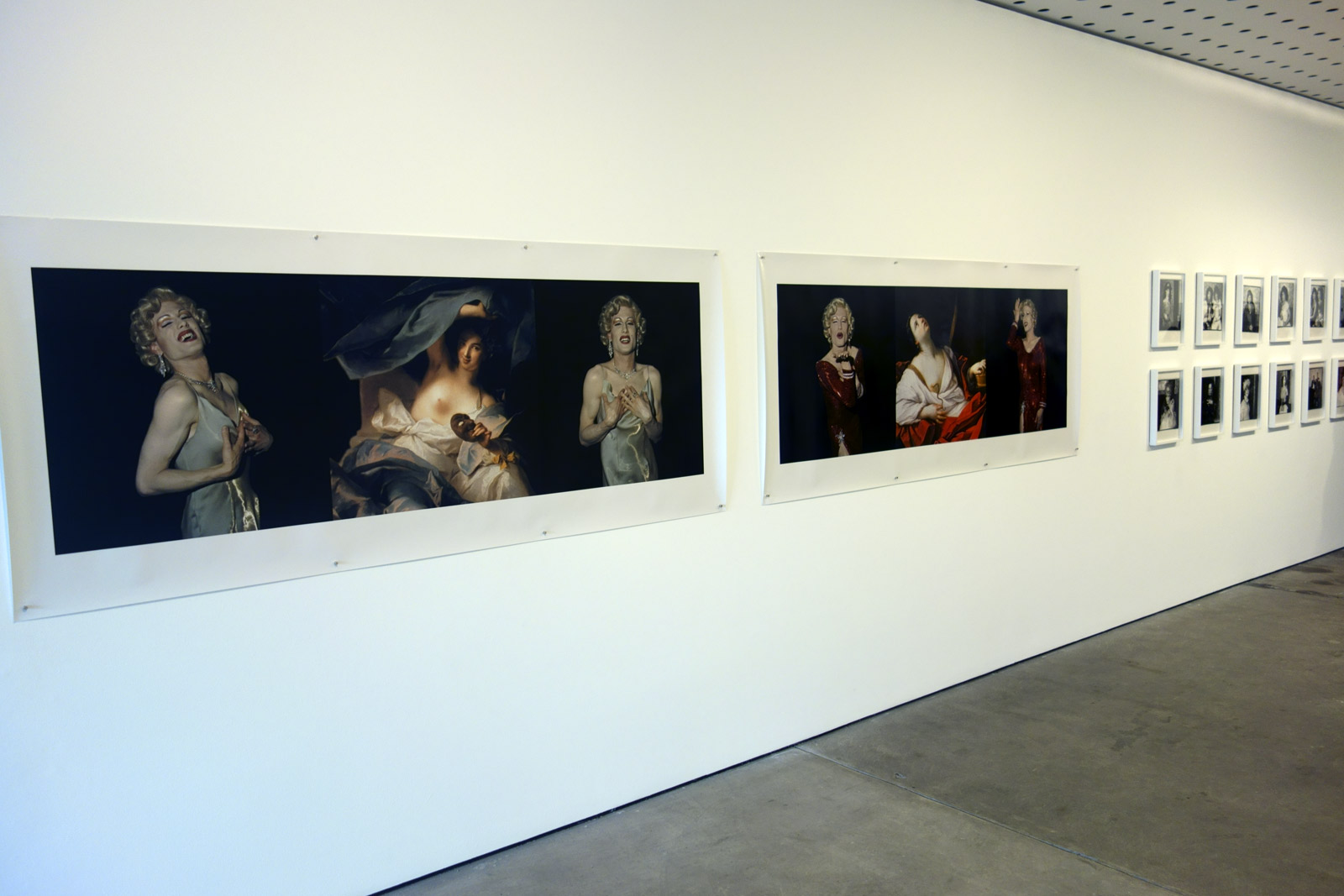
Polixeni Papapetrou (Australian, 1960-2018) 'Drag queen wearing cut out dress' 1993


Polixeni Papapetrou (Australian, 1960-2018)
Drag queen wearing cut out dress
1993
Gelatin silver photograph
28.5 x 28.5cm
Courtesy the artist and Nellie Castan Gallery, Melbourne and Stills Gallery, Sydney


Two solid if not overly memorable exhibitions are presented at the Centre for Contemporary Photography.

Polixeni Papapetrou A Performative Paradox is a bit of a dog’s breakfast. While it is wonderful to see early work by this artist – work that features Marilyn and Elvis impersonators, circus people, body builders and drag queens – too many bodies of work are crammed into too small a space with too few images. Some of the later series are represented by just one image giving a hotch potch feel to the whole exhibition ensemble. Perhaps it would have been better to concentrate solely on the early black-and-white images and colour images, work that is rarely seen and informs the staged work that followed. Having said that the black-and-white photographs are a joy to behold, documenting as they do performative identities. The photographs have an intangible presence. There are strong elements of the frontality of Diane Arbus in the photographs of circus performers and drag queens, coupled with a intrinsic understanding of light and texture. The photographs of drag queens are the highlight of both exhibitions and Drag queen wearing cut out dress (1993, below) reminded me of an early black-and-white photograph by Fiona Hall (Leura, New South Wales1974) in its use of patterned wallpaper. Let us hope there is a large retrospective of Polixeni’s work (at NGV or Heide for example) in the future, one that can do justice to the depth and complexity of her vision as an artist.

Daniel von Sturmer 
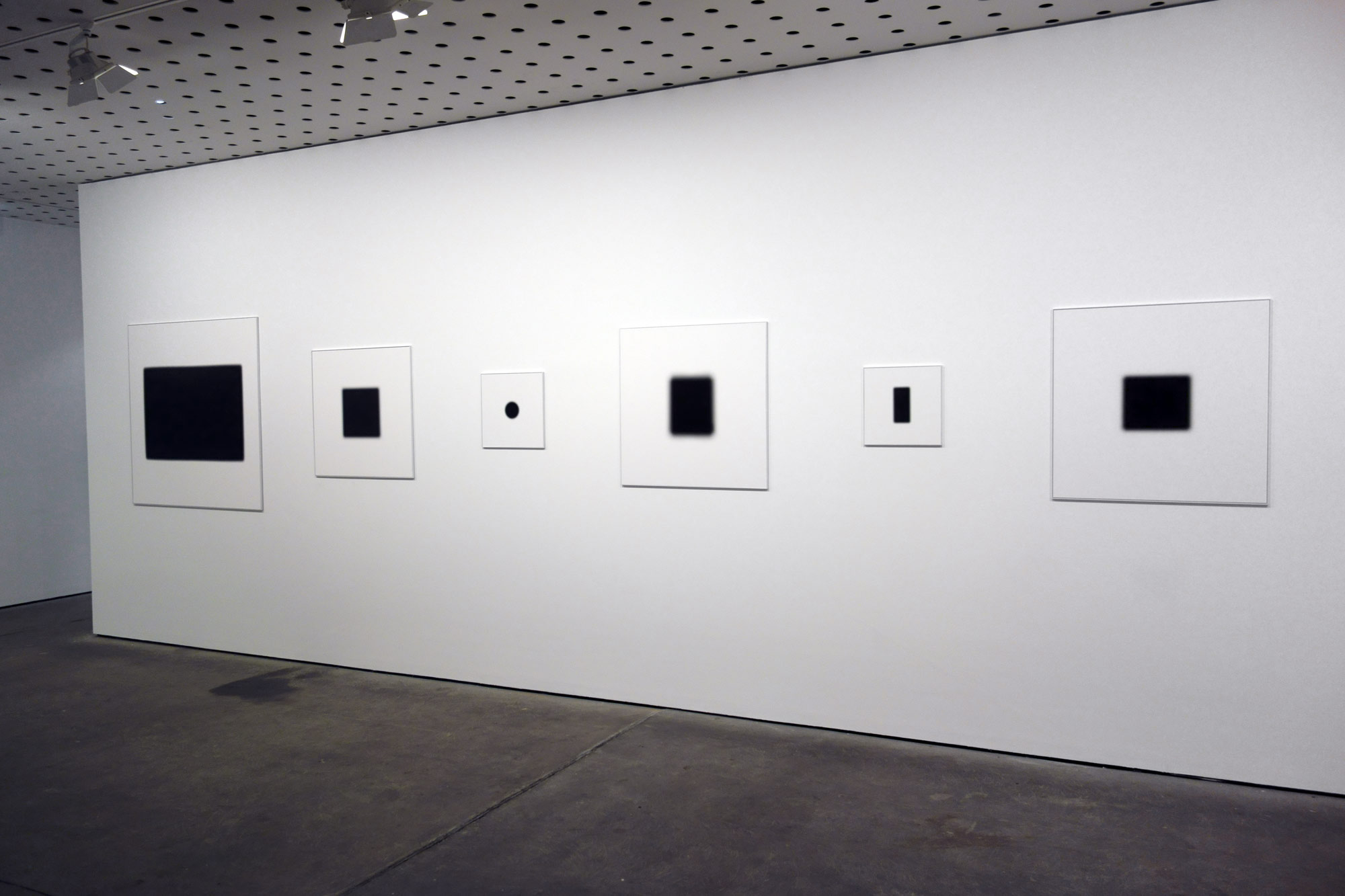
After Images is an interesting conceptual experiment, one that investigates the splitting of the image (shadow) from its referent (object). “The images propose a kind of transference; the object itself may be insignificant but its subjective meaning carries weight, and its shadow leaves a space the viewer fills with their own reading.” In their black-and-white fuzziness the work looks impressive when viewed in the gallery space (see installation views below) but upon close inspection the individual photographs fail to hold the viewers attention. Personally, I found it difficult to impart any great meaning to any of these works and the investigation certainly does not produce memorable images, ones that will stay with the viewer months and years later. For me the exhibition became an exercise in guessing what shadows were which objects, a game that grew quickly tiresome. The work then became an exercise in the importance of captioning an image, as I constantly looked around the room trying to match the titles of the works with the images themselves. As abstract images they imparted little metaphysical poetry as ghost images (an afterimage or ghost image is an optical illusion that refers to an image continuing to appear in one’s vision after the exposure to the original image has ceased). As images that investigate the link between text, object, shadow and language they started to become what the artist sought to enunciate: shadow objects bound to the realm of signification in some amorphous play, shadows that have the potential to become ‘Other’.

PS. As an analogy you could see these images as the equivalent of Jung’s human “shadow aspect” where, according to Jung, the shadow, in being instinctive and irrational, is prone to projection (as these shadows are projected by their objects). The shadow represents the entirety of the unconscious, ie. everything of which a person is not fully conscious, and is the seat of creativity. “Everyone carries a shadow,” Jung wrote, “and the less it is embodied in the individual’s conscious life, the blacker and denser it is.” (Jung, C.G. (1938). “Psychology and Religion.” In CW 11: Psychology and Religion: West and East. p. 131). Hence the potential halo/cination of these images.

Dr Marcus Bunyan


Many thankx to the CCP for allowing me to publish the photographs in the posting. Please click on the photographs for a larger version of the image. All installation photographs © Marcus Bunyan


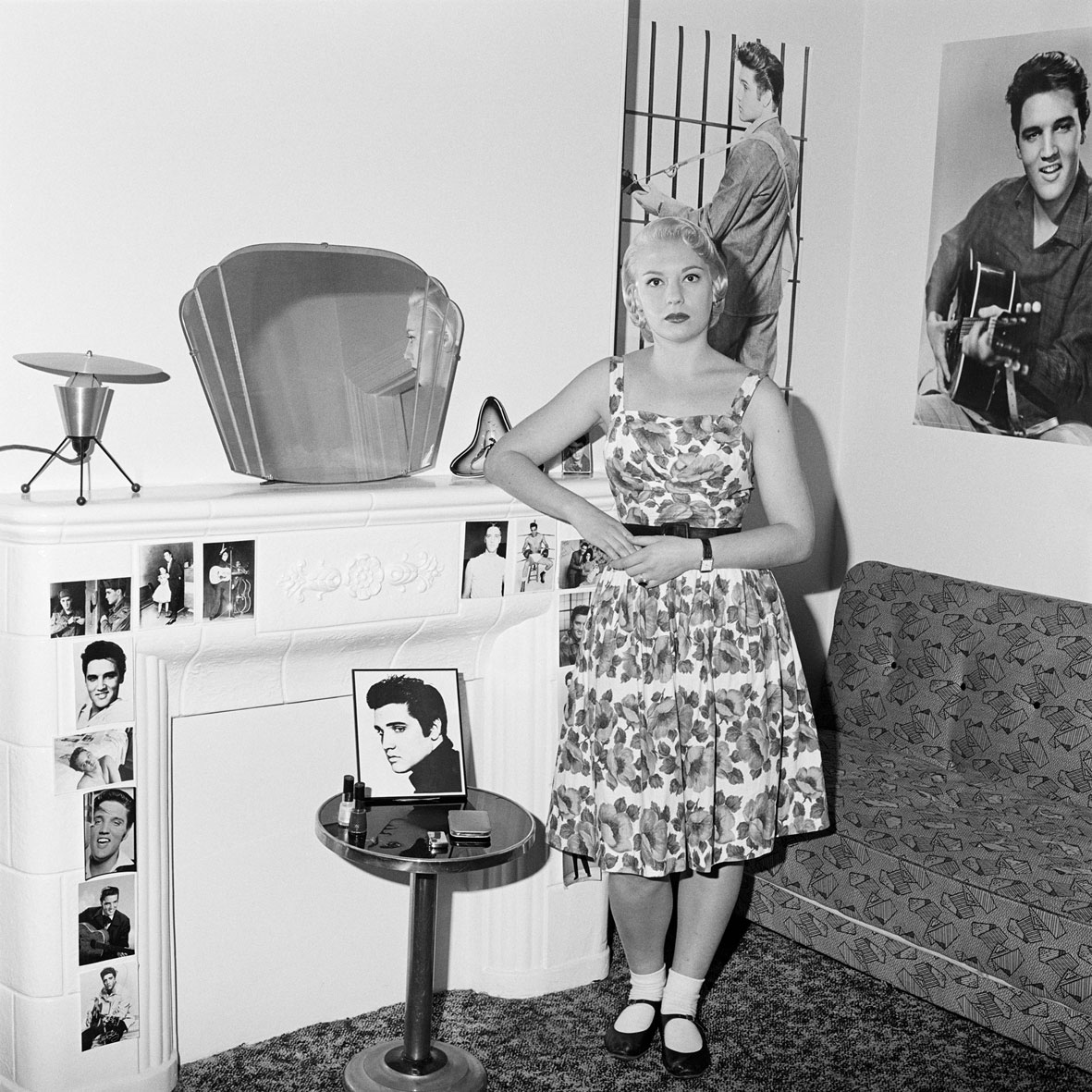
Polixeni Papapetrou (Australian, 1960-2018) 'Suzie, Elvis fan at home, Melbourne' 1989


Polixeni Papapetrou (Australian, 1960-2018)
Suzie, Elvis fan at home, Melbourne
1989
Selenium toned gelatin silver photograph
40.7 x 40.7cm
Courtesy the artist and Nellie Castan Gallery, Melbourne and Stills Gallery, Sydney


Polixeni Papapetrou (Australian, 1960-2018) 'Indian Brave' 2002


Polixeni Papapetrou (Australian, 1960-2018)
Indian Brave
2002
Pigment ink print
85 x 85cm
Courtesy the artist and Nellie Castan Gallery, Melbourne and Stills Gallery, Sydney


Polixeni Papapetrou (Australian, 1960-2018) 'Three young men paying homage to Elvis on the 13th anniversary of Elvis' death, Elvis Memorial Melbourne' 1990


Polixeni Papapetrou (Australian, 1960-2018)
Three young men paying homage to Elvis on the 13th anniversary of Elvis’ death, Elvis Memorial Melbourne
1990
Selenium toned gelatin silver photograph
40.7 x 40.7cm
Courtesy the artist and Nellie Castan Gallery, Melbourne and Stills Gallery, Sydney


This exhibition focuses on the performative in the work of Polixeni Papapetrou, from her early documentary work through to her directorial work with her children since 2002, regarded internationally as some of the most powerful and provocative works in the field of perfomative photography. Papapetrou’s enduring interest is in how the ‘other’ is represented and how the ‘other’ performs in reinforcing our own identity.

Polixeni Papapetrou is one of Australia’s leading contemporary photomedia artists. She has been exploring relationships between history, contemporary culture, landscape, identity and childhood through her photographic practice since the mid-eighties. In this exhibition, selected by Professor Anne Marsh in consultation with the artist, a particular thread has been selected across Papapetrou’s practice – that of the performative – from her early documentary work through to her directorial work with her children from 2002 to the present.

Her images are informed by her own experience as ‘other’, growing up as a Greek immigrant in a white, Anglo-Saxon, male-dominated culture in Australia in the 1960s and 1970s. Marilyn Monroe impersonators, Elvis Presley fans, body builders, circus performers and drag queens have all taken their turn in front of Papapetrou’s camera. All of these people are, one way or another, performing identities.

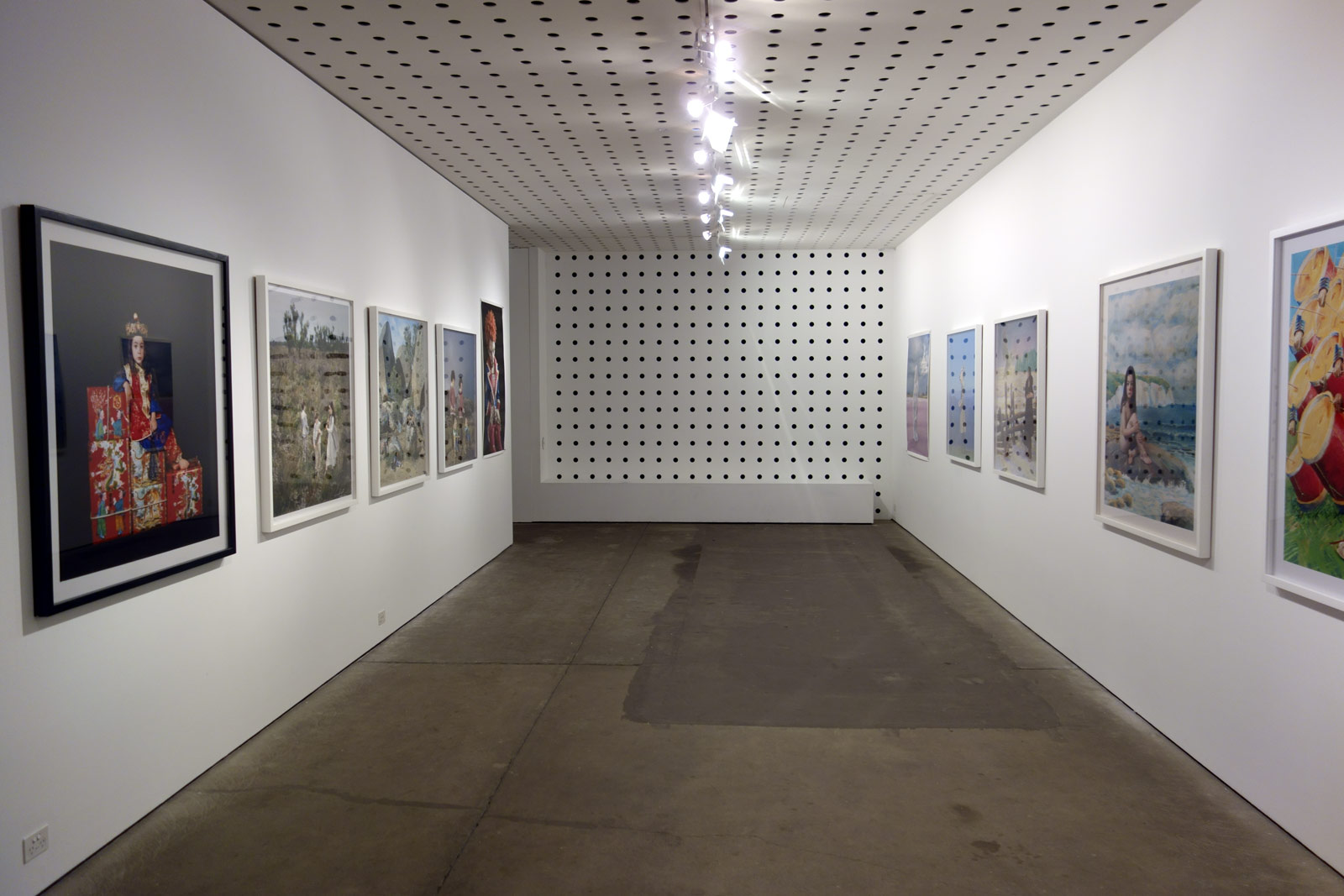
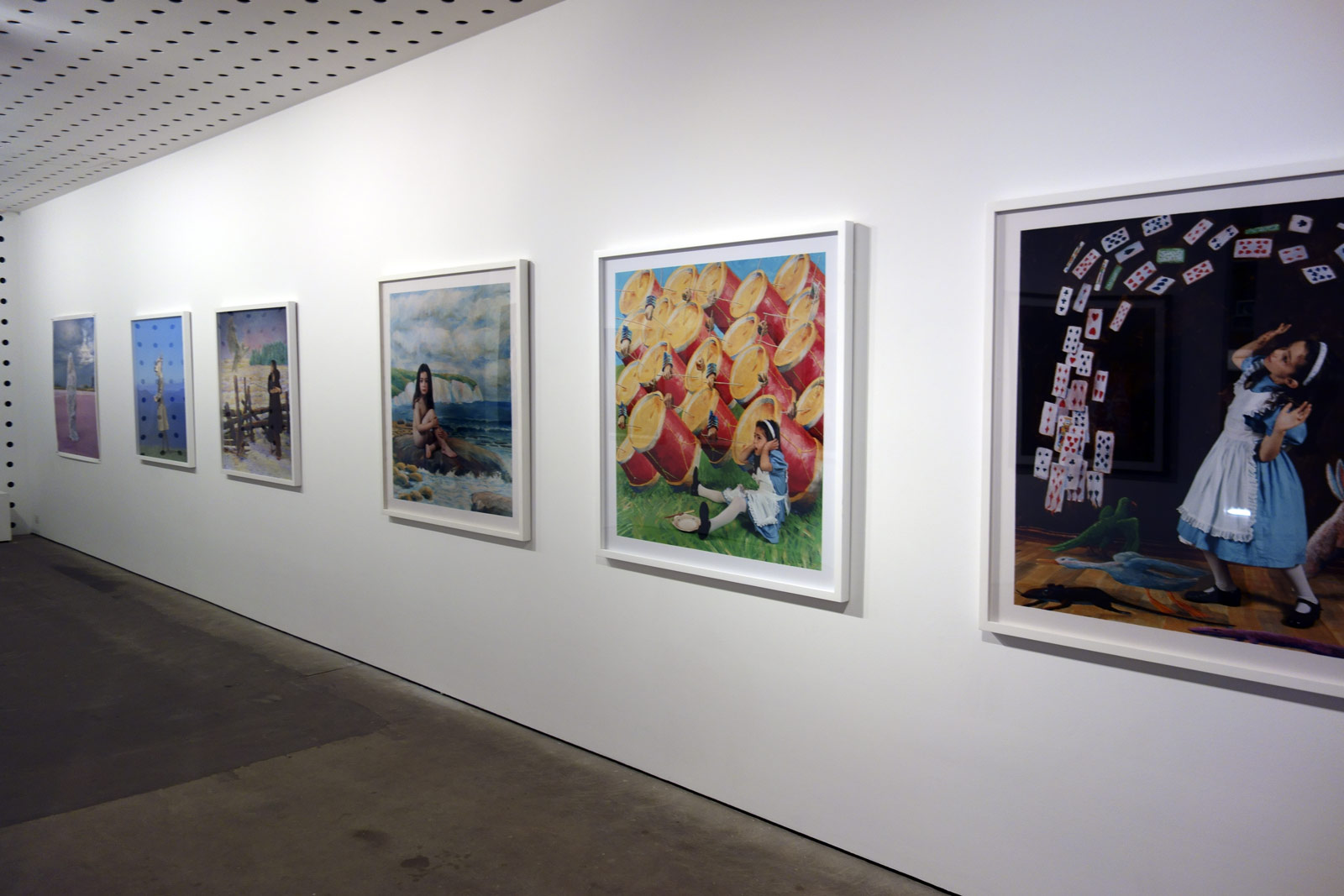
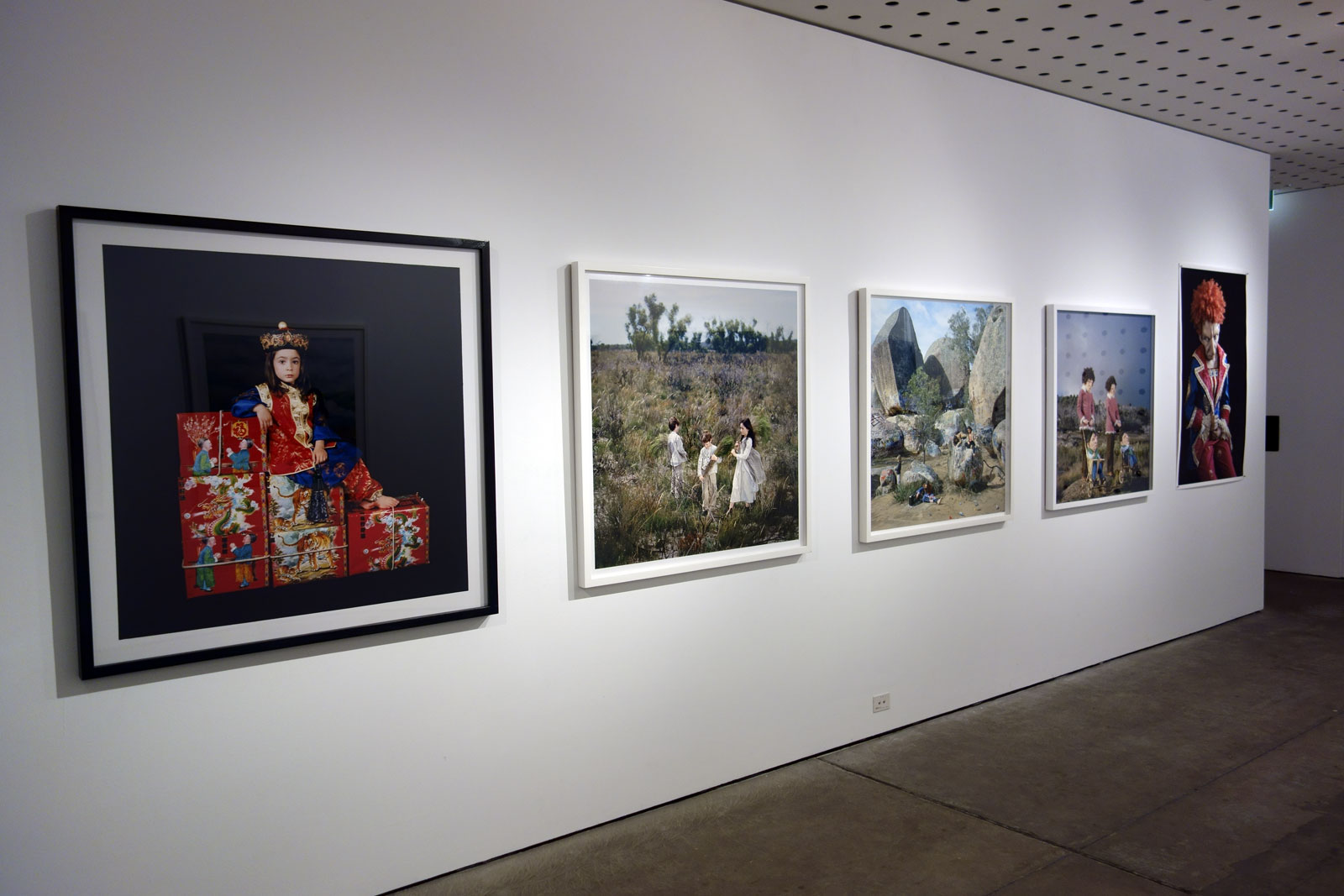
In 2002 Papapetrou turned her focus to the experience of childhood, using her children as the performers in her pictures. There is a challenging confusion between fantasy, mythology, archetype, animism and theatricality present in these works, ranging from the playful to the transgressive, wrangling with the question of identity and stressing the embodied nature of experience.

Text from the CCP website


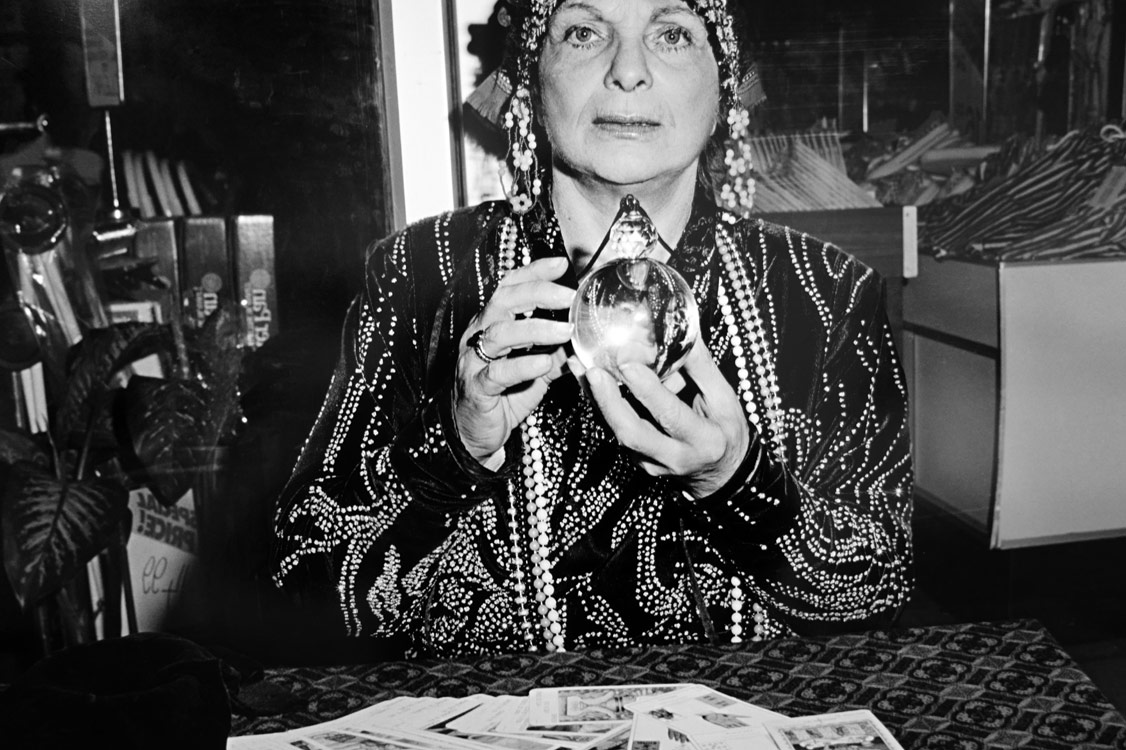
Polixeni Papapetrou (Australian, 1960-2018) 'Fortune teller' 1989 (detail)


Polixeni Papapetrou (Australian, 1960-2018)
Fortune teller (detail)
1989
From the series Ashton Circus, Silvers Circus 1989-1990


Polixeni Papapetrou. 'Levitation, Silvers Circus' 1989 (detail)


Polixeni Papapetrou (Australian, 1960-2018)
Levitation, Silvers Circus (detail)
1989
From the series Ashton Circus, Silvers Circus 1989-1990


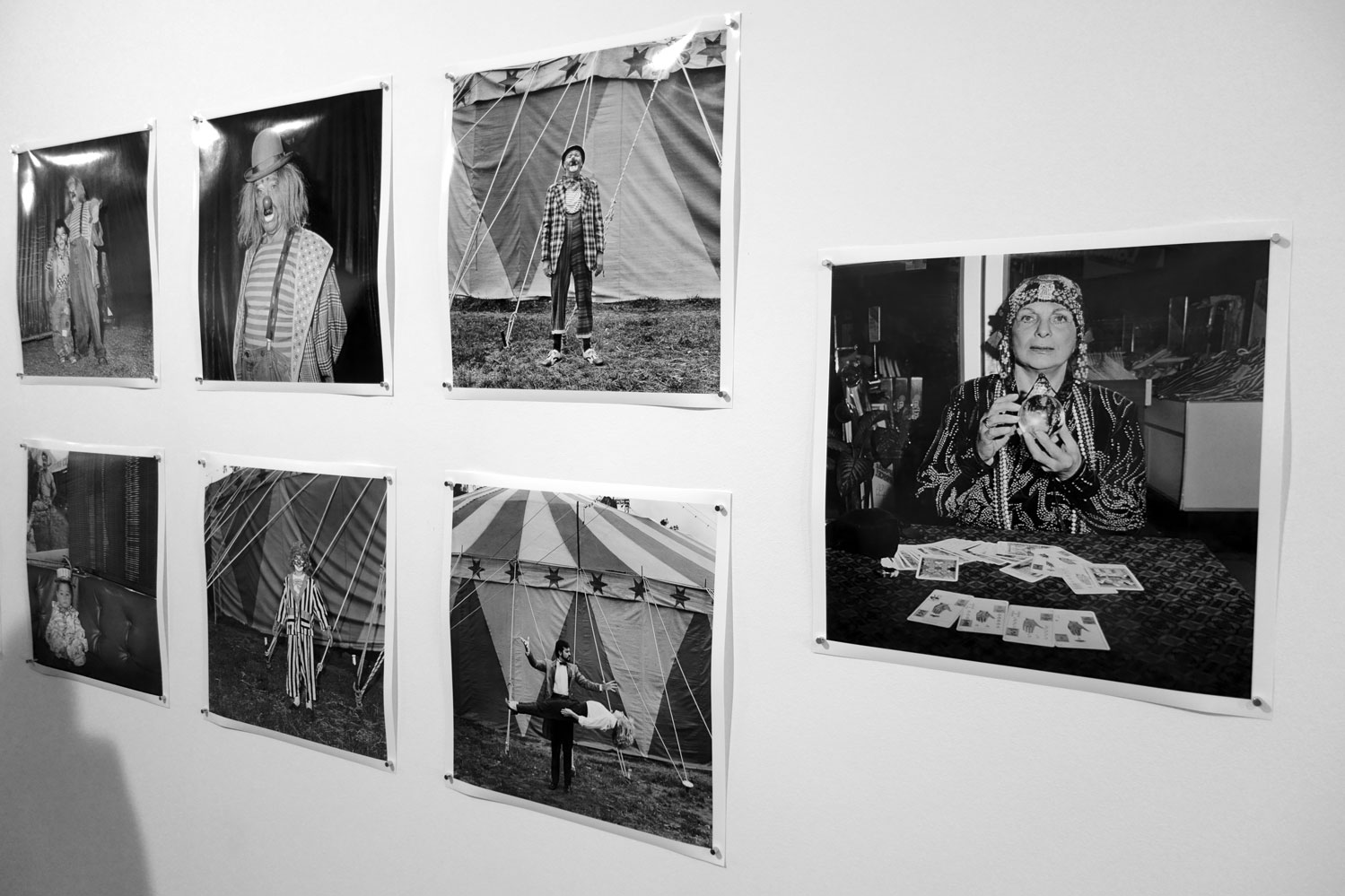
Polixeni Papapetrou (Australian, 1960-2018) 'Ashton Circus, Silvers Circus' series 1989-1990 (installation view)


Polixeni Papapetrou (Australian, 1960-2018)
Ashton Circus, Silvers Circus series (installation view)
1989-1990
Photo: Marcus Bunyan


Installation view of Polixeni Papapetrou 'A Performative Paradox' at the Centre for Contemporary Photography (CCP)

Installation view of Polixeni Papapetrou 'A Performative Paradox' at the Centre for Contemporary Photography (CCP)

Installation view of Polixeni Papapetrou 'A Performative Paradox' at the Centre for Contemporary Photography (CCP)

Installation view of Polixeni Papapetrou 'A Performative Paradox' at the Centre for Contemporary Photography (CCP)

Installation view of Polixeni Papapetrou 'A Performative Paradox' at the Centre for Contemporary Photography (CCP)


Installation views of Polixeni Papapetrou A Performative Paradox at the Centre for Contemporary Photography (CCP)
Photos: Marcus Bunyan


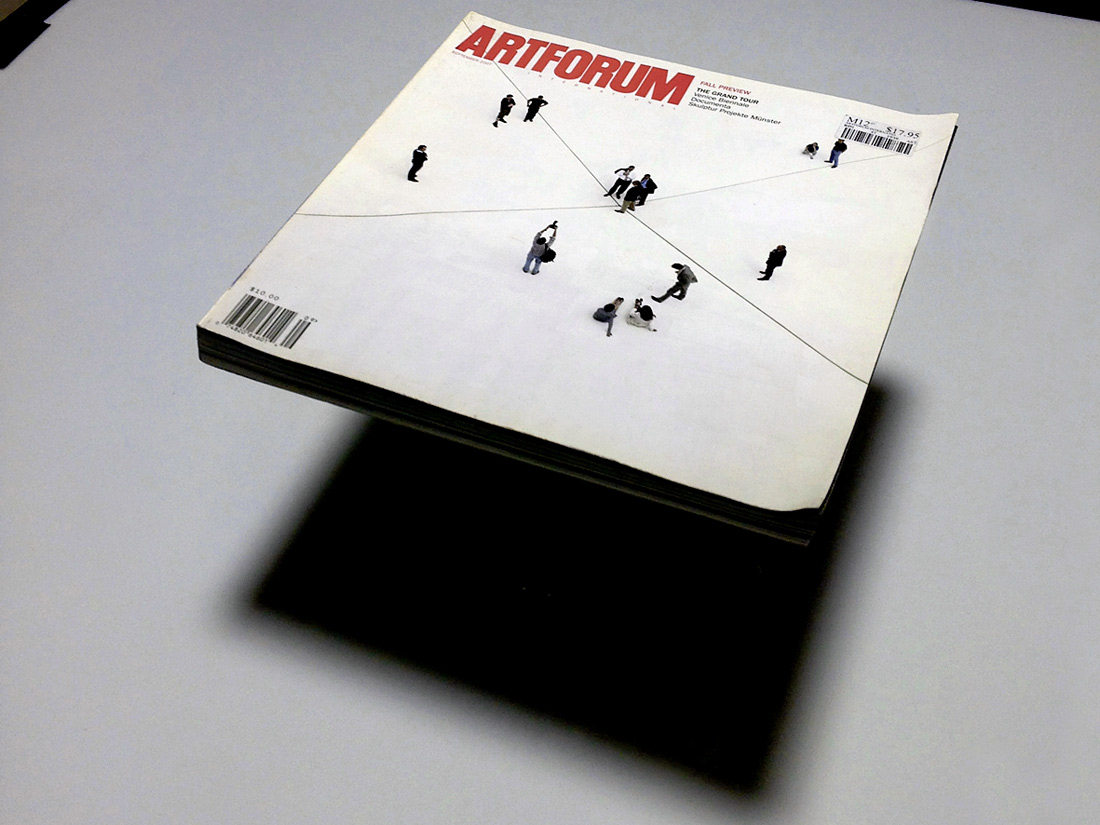
Daniel von Sturmer (New Zealand, b. 1972) 'Production Still for After Images'


Daniel von Sturmer (New Zealand, b. 1972)
Production Still for After Images
Courtesy the artist and Anna Schwartz Gallery, Melbourne and Sydney


In After Images the shadows of a set of subjectively ‘important artefacts’ (a business card, a phone, a letter…) are presented alongside generic objects from the studio, for example: a bin, some tape, a ruler… Presented at 1:1 scale, the images propose a kind of transference; the object itself may be insignificant but its subjective meaning carries weight, and its shadow leaves a space the viewer fills with their own reading.

Photographed using a specially constructed ‘set’ to enable the separation of an object from its shadow, the resulting image stands alone, separated from its object yet inextricably bound to the realm of signification from which it has been cast.

Text from the CCP website


Installation view of Daniel von Sturmer 'After Images' at the Centre for Contemporary Photography (CCP)

Installation view of Daniel von Sturmer 'After Images' at the Centre for Contemporary Photography (CCP)

Installation view of Daniel von Sturmer 'After Images' at the Centre for Contemporary Photography (CCP)

Installation view of Daniel von Sturmer 'After Images' at the Centre for Contemporary Photography (CCP)

Installation view of Daniel von Sturmer 
'After Images' at the Centre for Contemporary Photography (CCP)


Installation views of Daniel von Sturmer 
After Images at the Centre for Contemporary Photography (CCP)
Photos: Marcus Bunyan


Centre for Contemporary Photography

No permanent exhibition space at the moment

Centre for Contemporary Photography website

LIKE ART BLART ON FACEBOOK

Back to top

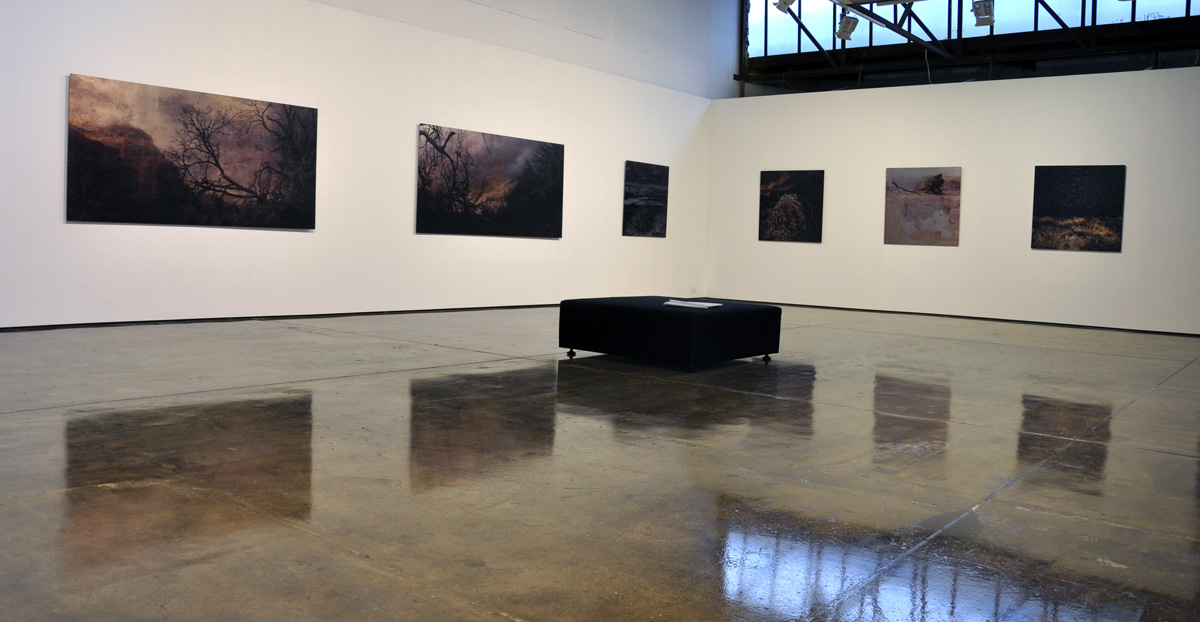
Exhibition: ‘Troy Ruffels: Cinder’ at James Makin Gallery, Collingwood, Melbourne

Exhibition dates: 13th June – 6th July, 2013


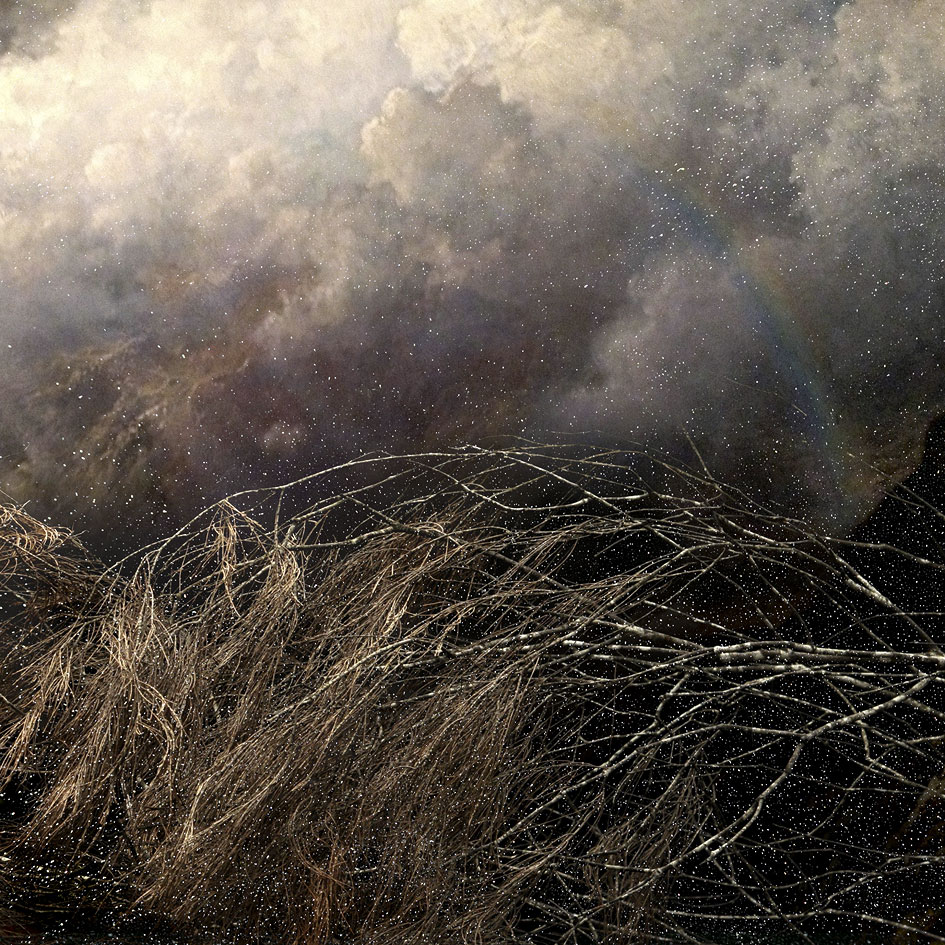
Troy Ruffels (Australian, b. 1972) 'Cicada' 2013 from the exhibition 'Troy Ruffels: Cinder' at James Makin Gallery, Collingwood, Melbourne, June - July, 2013


Troy Ruffels (Australian, b. 1972)
Cicada
2013
Archival solvent based inkjet print on composite aluminium
120 cm x 240cm
Edition of 3


This scratching away at reality. Abstractness of becoming.


Tension. Music. Light. Undertow.

1/ A current below the surface of the sea moving in the opposite direction to the surface current.

2/ An implicit quality, emotion, or influence underlying the surface aspects of something and leaving a particular impression.


Imagined, chthonian (of or relating to the underworld, from Greek khthonios, of the earth) landscape.

(Dis)possession of the land, as though the land is rebelling against subjective gaze of the viewer.

Prosaic titles (Bracken, Cinder, Rift) with a poetic zest (remains of the day).

Spaces of isolation / human marking (thumbprints on work) / absence / presence.


Manifestations of the mind.

The landscape as Other.


Dr Marcus Bunyan


Many thankx to James Makin Gallery for allowing me to publish the photographs in the posting. Please click on the photographs for a larger version of the image.


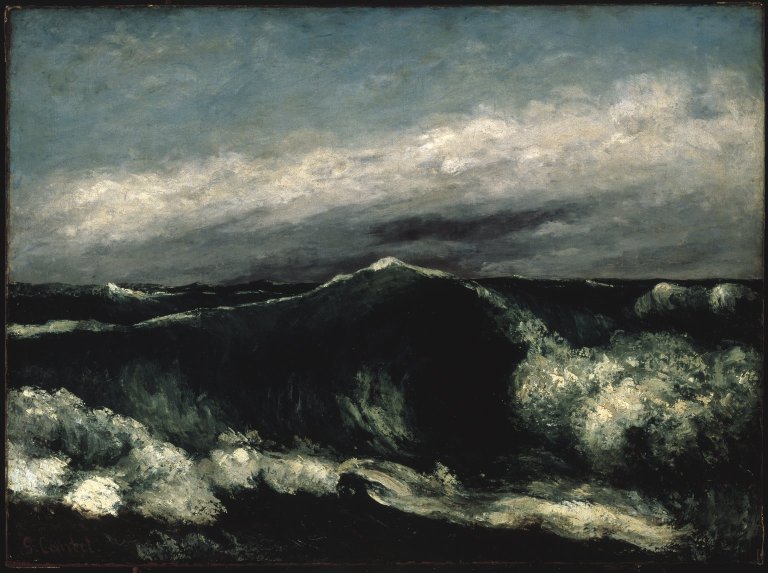
Gustave Courbet (French, 1819-1877) 'The Wave' c. 1869


Gustave Courbet (French, 1819-1877)
The Wave
c. 1869


Troy Ruffels (Australian, b. 1972) 'Sea #3 (remains of the day)' 2013 from the exhibition 'Troy Ruffels: Cinder' at James Makin Gallery, Collingwood, Melbourne, June - July, 2013


Troy Ruffels (Australian, b. 1972)
Sea #3 (remains of the day)
2013
Archival solvent based inkjet print on composite aluminium
107 cm x 107cm
Edition of 12


Troy Ruffels (Australian, b. 1972) 'Bracken' 2013


Troy Ruffels (Australian, b. 1972)
Bracken
2013
Archival solvent based inkjet print on composite aluminium
107 cm x 107cm
Edition of 12


Troy Ruffels (Australian, b. 1972) 'Cinder' 2013


Troy Ruffels (Australian, b. 1972)
Cinder
2013
Archival solvent based inkjet print on composite aluminium
107 cm x 107cm
Edition of 12


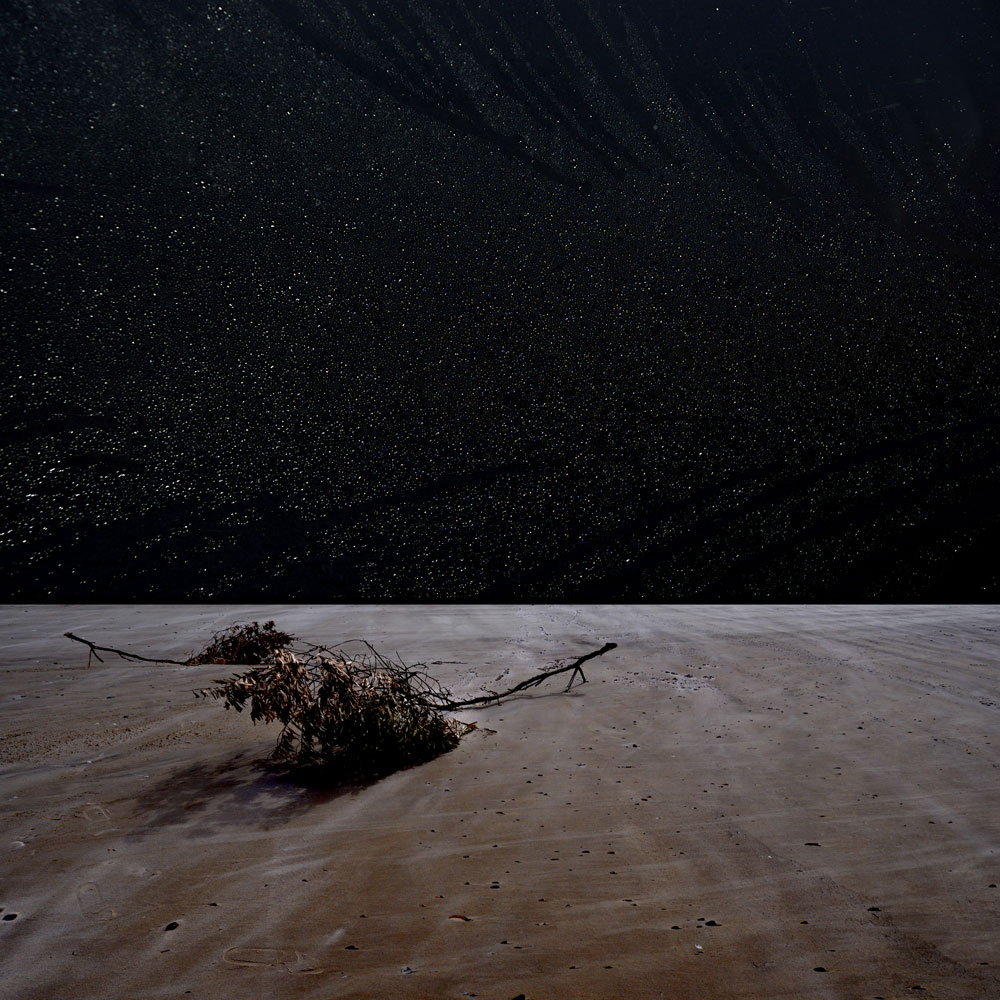
Troy Ruffels (Australian, b. 1972) 'Sea #4 (Second Winter)' 2013


Troy Ruffels (Australian, b. 1972)
Sea #4 (Second Winter)
2013
Archival solvent based inkjet print on composite aluminium
107 cm x 107cm
Edition of 12


This exhibition sees photo media artist Troy Ruffels employ innovative techniques to create his evocative imagery, which is heavily informed by the natural world. Ruffels has developed a unique process of drawing from multiple photographic source images to create each final work, which is subsequently printed using solvent based inks onto composite aluminium sheets, as opposed to standard archival papers. By utilising the reflective qualities of the aluminium Ruffels illuminates his intriguing landscape imagery with shifting light effects.

“Photo-media artist Troy Ruffels extends the boundaries of traditional photography towards a realm of limitless creative possibilities. Observing and recording sites within the Tasmanian wilderness and beyond, Ruffels draws from multiple source images to arrive at his final works. In doing so the artist weaves a highly personal and emotive response to various locations within the natural world that have remained lodged in his imagination. His process allows for a range of atmospheres and moods to be evoked, from a dreamlike softness, to a densely weighted gravity.

Overall the works in Cinder reflect a highly personal response to place, as in the process of revealing nature’s secrets the artist reveals a part of himself. Ruffels displays his impressive technical and creative prowess in transfiguring and reassembling the elements, blending fact with fiction to tell the understory of the night.” (Marguerite Brown, Cat. Essay JMG Journal, 2013)

Press release from the James Makin Gallery website


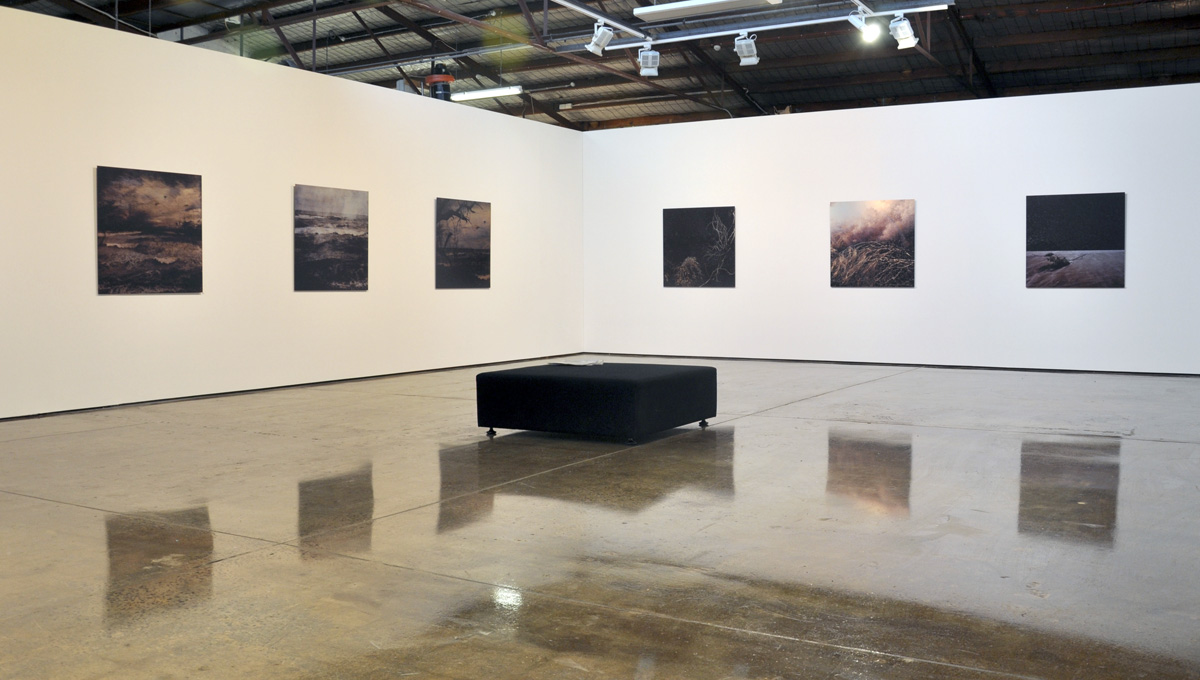
Installation view of 'Troy Ruffels: Cinder' at James Makin Gallery

Installation views of 'Troy Ruffels: Cinder' at James Makin Gallery

Installation view of 'Troy Ruffels: Cinder' at James Makin Gallery


Installation views of Troy Ruffels: Cinder at James Makin Gallery
Photos: Marcus Bunyan


Troy Ruffels (Australian, b. 1972) 'Etude No.9' 2013


Troy Ruffels (Australian, b. 1972)
Etude No.9
2013
Archival solvent based inkjet print on composite aluminium
107 cm x 107cm
Edition of 12


Troy Ruffels (Australian, b. 1972) 'Rift' 2013


Troy Ruffels (Australian, b. 1972)
Rift
2013
Archival solvent based inkjet print on composite aluminium
107 cm x 107cm
Edition of 12


Troy Ruffels (Australian, b. 1972) 'Understory' 2013


Troy Ruffels (Australian, b. 1972)
Understory
2013
Archival solvent based inkjet print on composite aluminium
107 cm x 107cm
Edition of 12


Troy Ruffels (Australian, b. 1972) 'Sea #1 (Arc)' 2013


Troy Ruffels (Australian, b. 1972)
Sea #1 (Arc)
2013
Archival solvent based inkjet print on composite aluminium
107 cm x 107cm
Edition of 12


James Makin Gallery

This gallery has now closed.

LIKE ART BLART ON FACEBOOK

Back to top
Exhibition: ‘Gilbert & George – London Pictures’ at MKM Museum Küppersmühle für Moderne Kunst, Duisburg

Exhibition dates: 20th March 20 – 30th June 2013


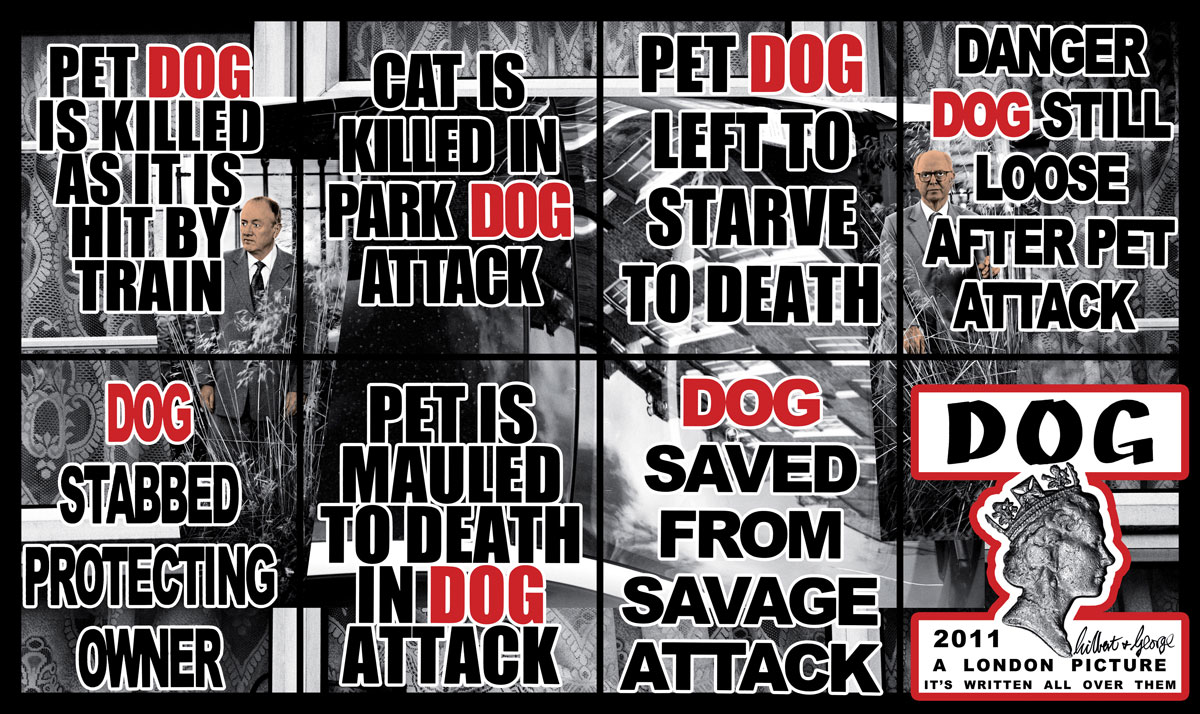
Gilbert & George (Gilbert Prousch) (English born Italy, b. 1943) and (George Passmore) (English, b. 1943) 'Dog' 2011


Gilbert & George (Gilbert Prousch) (English born Italy, b. 1943) and (George Passmore) (English, b. 1943)
Dog
2011
© Gilbert & George / Courtesy of the Artist and White Cube Gallery


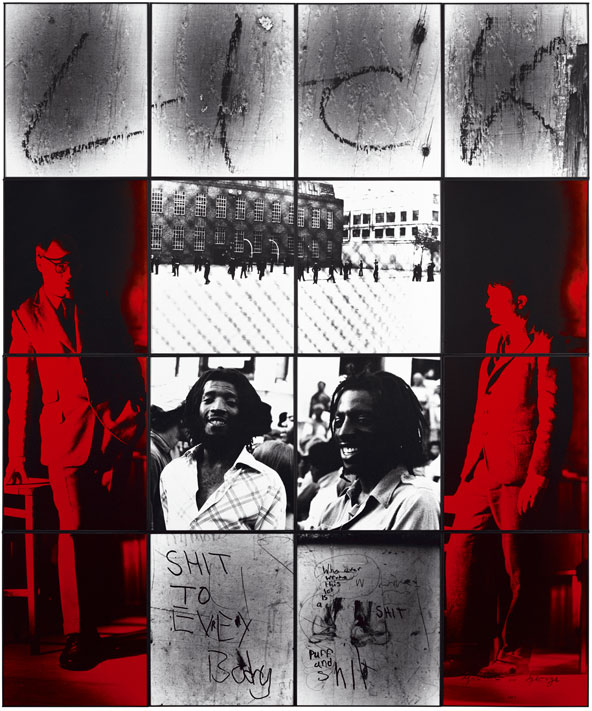
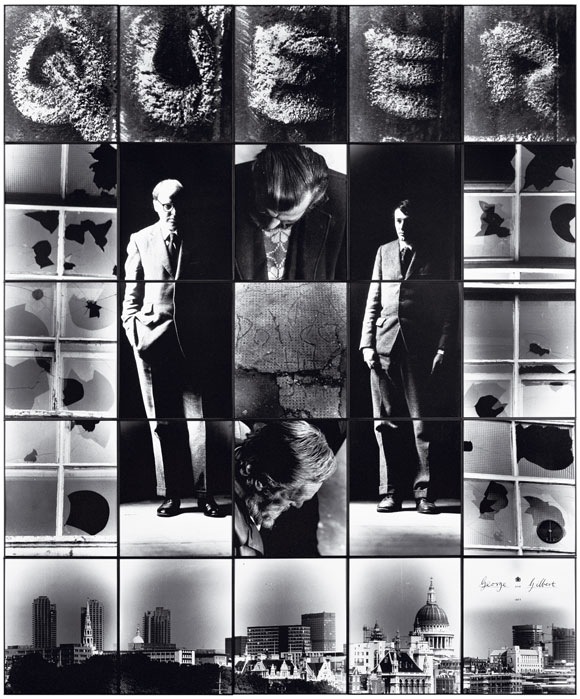
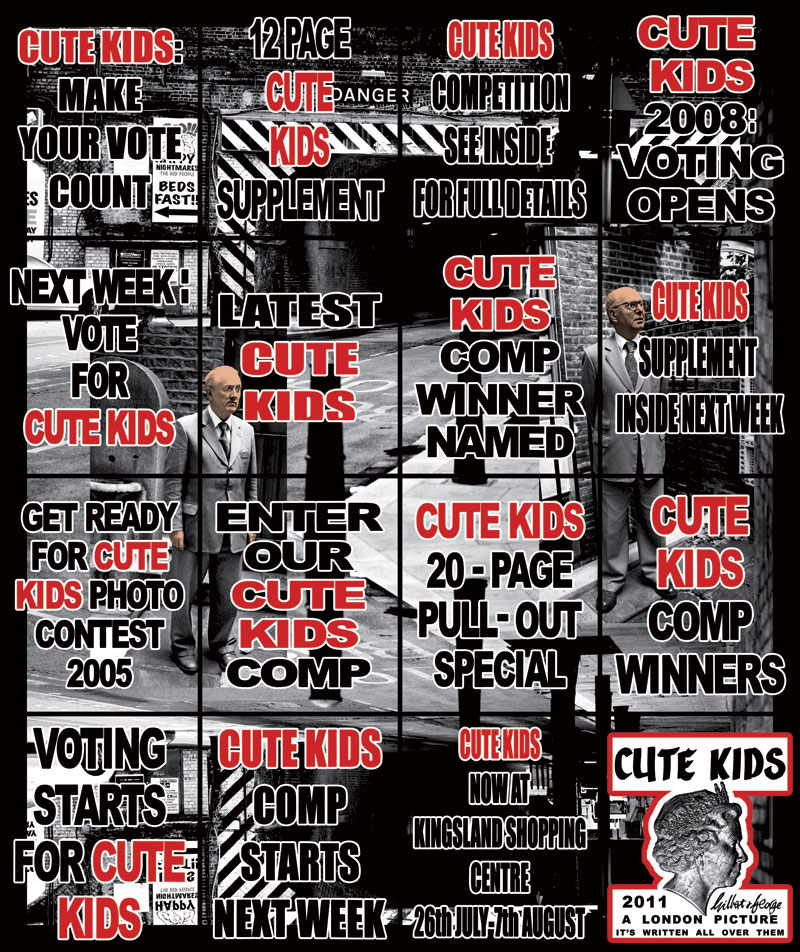
I used to think that Gilbert & George’s work was inventive and relevant, that it had something important to say about contemporary culture. These days I am not so sure. It seems all to easy to rip headlines from the tabloid newspapers. Who cares about dog, death, money, school, cute kids, etc… as commented on by these pulp editions. Gilbert & George seem to have become a pastiche of themselves, cartoon cut-outs hovering in contextless backgrounds with staring eyes and gormless faces. “I am contextless, unhappily spinning in the vacuum of my own indolence,” the work seems to be saying. We already know that we are becoming a society of shortened, fractured words and sentences on mobile phones and in newspaper headlines, of absence/presence where people absent themselves from their surroundings while on mobile devices, we know that already… I don’t think it takes mediocre art to point it out. It’s not very insightful (as Gilbert & George used to be).

I think they need a good boot up the bum to get them back to making work that takes the viewer somewhere, that actually challenges people’s belief systems, not some pulp driven comment on contemporary culture. Take a look at their early work if you don’t believe what I am saying: look at how alive the pictures were, how much vitality and energy they had, and how challenging the work was!

Dr Marcus Bunyan


Many thankx to the Museum Küppersmühle für Moderne Kunst for allowing me to publish the photographs in the posting. Please click on the photographs for a larger version of the image.


Gilbert & George (Gilbert Prousch) (English born Italy, b. 1943) and (George Passmore) (English, b. 1943) 'Lick' 1977


Gilbert & George (Gilbert Prousch) (English born Italy, b. 1943) and (George Passmore) (English, b. 1943)
Lick
1977


Gilbert & George (Gilbert Prousch) (English born Italy, b. 1943) and (George Passmore) (English, b. 1943) 'Queer' 1977


Gilbert & George (Gilbert Prousch) (English born Italy, b. 1943) and (George Passmore) (English, b. 1943)
Queer
1977


Gilbert & George (Gilbert Prousch) (English born Italy, b. 1943) and (George Passmore) (English, b. 1943) 'Money' 2011


Gilbert & George (Gilbert Prousch) (English born Italy, b. 1943) and (George Passmore) (English, b. 1943)
Money
2011
© Gilbert & George


Gilbert & George (Gilbert Prousch) (English born Italy, b. 1943) and (George Passmore) (English, b. 1943) 'School Straight' 2011


Gilbert & George (Gilbert Prousch) (English born Italy, b. 1943) and (George Passmore) (English, b. 1943)
School Straight
2011
© Gilbert & George / Courtesy of the Artist and White Cube Gallery


Gilbert & George (Gilbert Prousch) (English born Italy, b. 1943) and (George Passmore) (English, b. 1943) 'Death' 2011


Gilbert & George (Gilbert Prousch) (English born Italy, b. 1943) and (George Passmore) (English, b. 1943)
Death
2011
© Gilbert & George


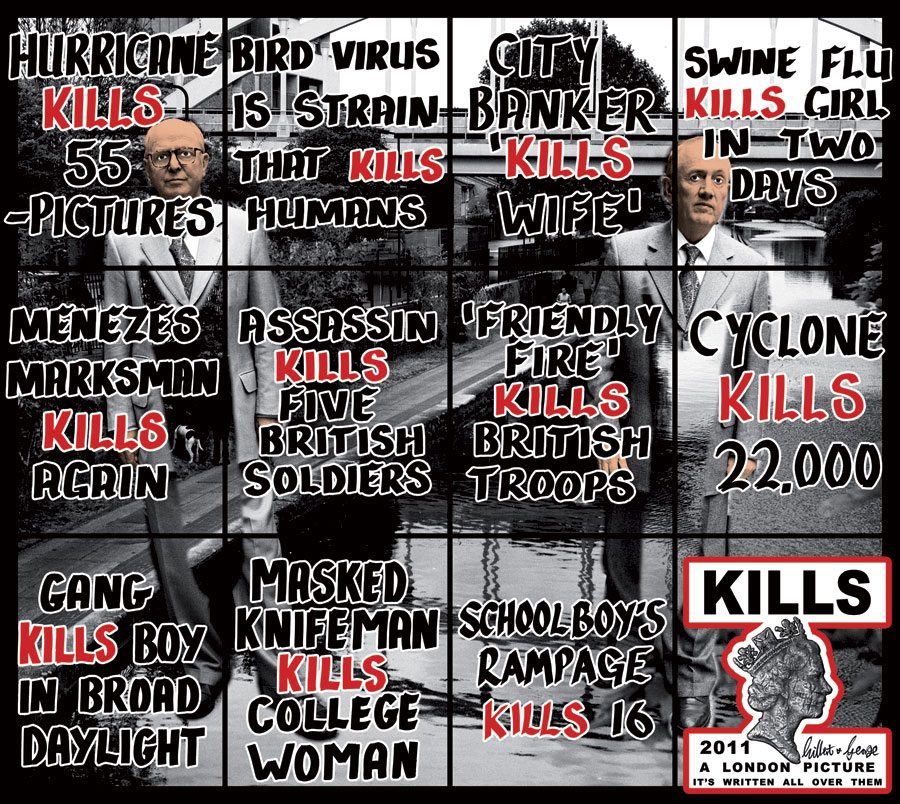
Completed in 2011, “London Pictures” is the title of the cycle created by the London-based artists Gilbert & George, to which the eponymous exhibition in the MKM from March 20, 2013, is dedicated. Taking as their theme the countless newsagent posters collected by the artists themselves over a period of six years, the artists compile a detailed inventory of quotidian human behaviour, which they then submit to their hallmark humanistic gaze, and in so doing, furnish their own perspective on the psycho-social condition of our Western societies. What emerges is an extensive series of images from which the MKM is, for the first time, showcasing 70 individual pictures and affording visitors the opportunity to intensively explore this new phase from the oeuvre of Gilbert & George.

In their “London Pictures” Gilbert & George have collated the newspaper posters, which, not only in London, but across England, garnish the sales stands of the newspaper dealers. Their explicit allusions to the most titillating, violent and bizarre stories of the day are designed to entice potential customers to buy the newspapers. These simple statements of facts promise tales of love and sex, violence and death, wealth and power -themes, which have fascinated humanity since time immemorial, and which expose our endless appetite for sensation, disaster and excess. Gilbert & George have taken 3712 images of these advertising posters, processed the material, arranged it according to themes and fashioned it into 292 carefully-created pictures. Not only are the artists documenting a commonly-used device within the marketing strategies of the Western press, they are also exploring its impact on both the individual and society as a whole, and applying artistic means to articulate their own response to, and perception of, this social phenomenon. “The “London Pictures” should not in the first instance be read as a critique of the media, but perhaps as a critique of ourselves”, explains MKM Director Walter Smerling, adding that: “Gilbert & George borrow the language of the media, place it in a different context and in so doing transform these newspapers posters into a new entity vested with an entirely new content. The careful collation and arrangement of hundreds of headlines (…) forges a platform for reflection which casts the spotlight on to our own complicity, intrigues and problems of existence.”

“The artists of course feature in their pictures: in the background as a pair of quizzical, piercing eyes or as a ubiquitous, immaculately besuited presence, appearing” (…) “as though the artists were psychic manifestations of the city itself, its sense of place and history. The “London Pictures” comprise both a directory of quotidian urban human behaviour – revealing and shocking and violent, in all its sluggish or volatile momentum – and as such the city’s moral portrait: an unflinching audit of modern western society’s relationship to itself, stripped of rhetoric or intellectual disguise.” (Michael Bracewell, author of the catalogue). Yet beyond focussing on the city of London itself, Gilbert & George also cast themselves directly as integral constituents of our society’s media landscape and its psychic condition. Their unrelenting gaze interrogates not only the message of the posters, but is trained at the observer who also becomes an essential part of each and every picture.

Gilbert & George are seeking to portray the “grandeur, mystery and drama” of our Western world. From competitions to find the cutest child to gruesome tales of murder and mayhem – the whole gamut of human experience is represented here and exercises an equally ineluctable fascination on readers in Germany: For as the artists themselves remark, the “London Pictures” and “London Problems” could just as easily be “Duisburg Pictures” and “Duisburg Problems”.

Biography

Gilbert (born in 1943 in St. Martin in Thurn, Italy) studied at the Wolkenstein School of Art in South Tyrol, the Hallein School of Art in Austria, and the Munich Academy of Fine Arts, before attending St. Martin’s School of Art in London. There, in 1967, he met George (born in 1942 in Plymouth, UK), who had previously been a student at Dartington Hall College of Art and Oxford Art School. During the 1960s, Gilbert & George expanded the concept of sculpture by making themselves the materials for their art, as Living Sculptures. They declared everyday activities to be art, and provoked opposition by using faeces, urine and sperm as principal motifs in their picture series. They were awarded the 1986 Turner Prize, exhibited in the British Pavilion at the 2005 Venice Biennale, and has held exhibitions in venues ranging from the Stedelijk Museum in Amsterdam (1971 and 1996) to Guggenheim Museum, New York (1985), Musee d’Art Moderne de la Ville, Paris (1997) and London’s Tate Modern (2007). Other major public exhibitions have been mounted in Russia (1990) and China (1993).

Press release from the MKM Museum Küppersmühle für Moderne Kunst website


Gilbert & George (Gilbert Prousch) (English born Italy, b. 1943) and (George Passmore) (English, b. 1943) 'Kills' 2011


Gilbert & George (Gilbert Prousch) (English born Italy, b. 1943) and (George Passmore) (English, b. 1943)
Kills
2011
© Gilbert & George


Gilbert & George (Gilbert Prousch) (English born Italy, b. 1943) and (George Passmore) (English, b. 1943) 'Woman' 2011


Gilbert & George (Gilbert Prousch) (English born Italy, b. 1943) and (George Passmore) (English, b. 1943)
Woman
2011
© Gilbert & George


Gilbert & George (Gilbert Prousch) (English born Italy, b. 1943) and (George Passmore) (English, b. 1943) 'Cute Kids' 2011


Gilbert & George (Gilbert Prousch) (English born Italy, b. 1943) and (George Passmore) (English, b. 1943)
Cute Kids
2011
© Gilbert & George


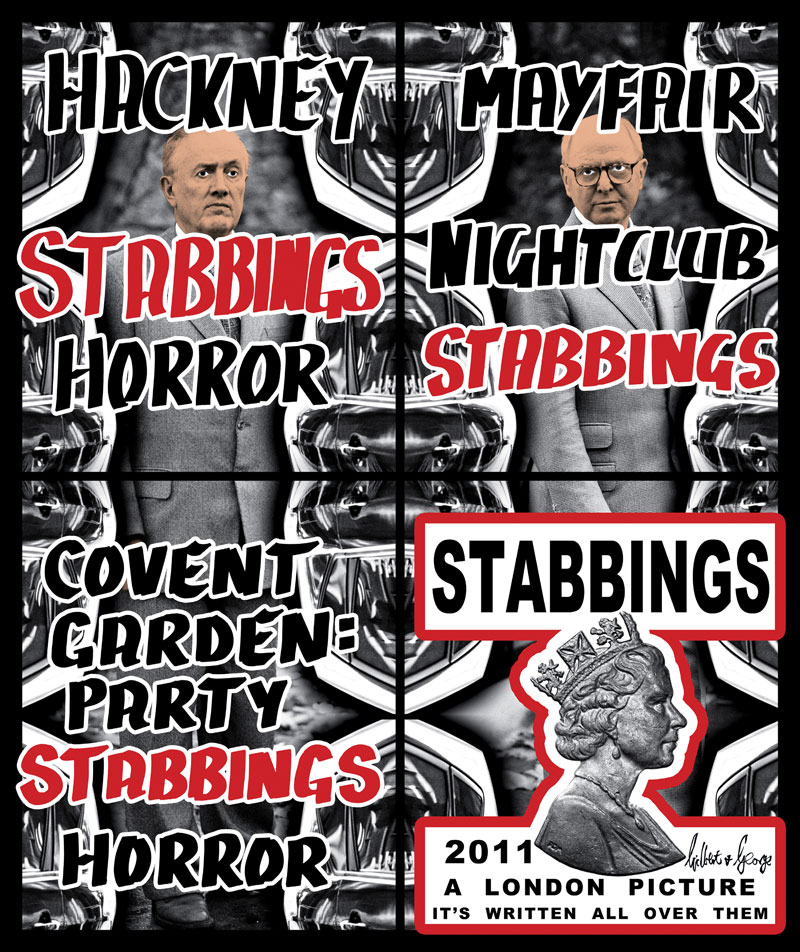
Gilbert & George (Gilbert Prousch) (English born Italy, b. 1943) and (George Passmore) (English, b. 1943) 'Stabbings' 2011


Gilbert & George (Gilbert Prousch) (English born Italy, b. 1943) and (George Passmore) (English, b. 1943)
Stabbings
2011
© Gilbert & George


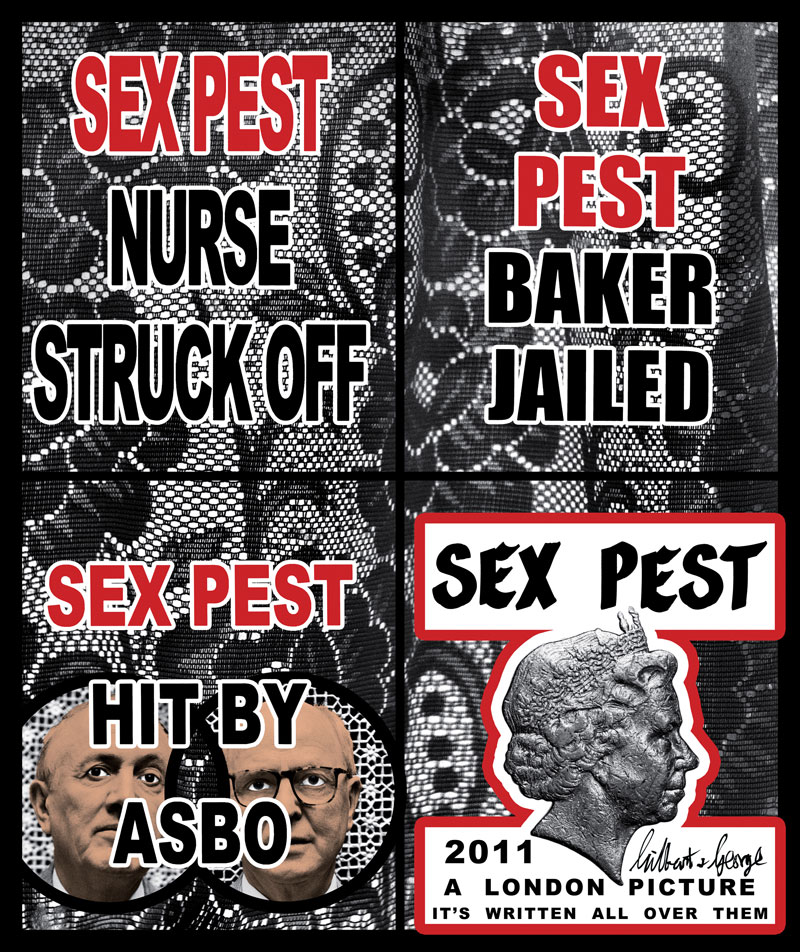
Gilbert & George (Gilbert Prousch) (English born Italy, b. 1943) and (George Passmore) (English, b. 1943) 'Sex Pest' 2011


Gilbert & George (Gilbert Prousch) (English born Italy, b. 1943) and (George Passmore) (English, b. 1943)
Sex Pest
2011
151 x 127 cm
© Gilbert & George / Courtesy Galerie Thaddaeus Ropac Salzburg, Paris


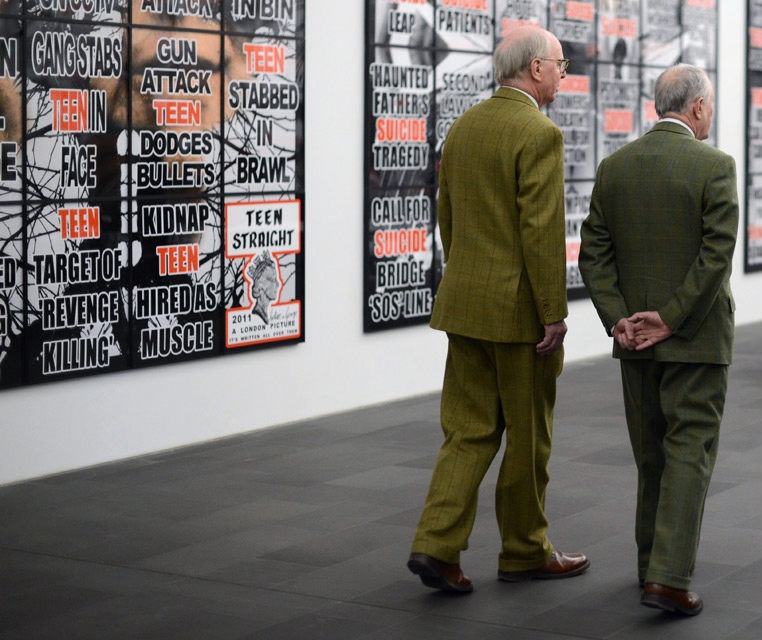
The British artists George Passmore (L) and Gilbert Prousch (R) pass in front of one of their art work 'London Pictures'


The British artists George Passmore (L) and Gilbert Prousch (R) pass in front of one of their art work ‘London Pictures’ as they arrive for a press conference at the museum Kueppersmuehle in Duisburg, western Germany, on March 14, 2013. AFP PHOTO / CAROLINE SEIDEL


MKM Museum Küppersmühle für Moderne Kunst
Philosophenweg 55, 47051 Duisburg
Germany
Phone: +49 (0)203 30 19 48 -10/-11

Opening hours:
Wed 2.00pm – 6.00pm
Thurs – Sun 11.00am – 6.00pm
Bank Holidays 11.00am – 6.00pm
Closed Mondays and Tuesdays

MKM Museum Küppersmühle für Moderne Kunst website

LIKE ART BLART ON FACEBOOK

Back to top

Exhibition: ‘Joan Ross: Touching Other People’s Shopping’ at Bett Gallery, Hobart

Exhibition dates: 7th June – 28th June 2013


Joan Ross (Australian, b. 1961) 'Mine' 2013


Joan Ross (Australian, b. 1961)
Mine
2013
hand painted pigment print on cotton rag paper
40 x 60cm
edition of 3


The claiming of things
The touching of things
The digging of land
The tagging of place
The taking over of the world

Tag and capture.
Tag and capture.
Shop, dig, spray, destroy.


An ironic critique of the pastoral, neo/colonial world, tagged and captured in the 21st century.

Excellent work. The construction, sensibility and humour of the videos is outstanding. I also responded to the two works Tag and capture and Shopping for butterfly (both 2013, below).

Dr Marcus Bunyan


Many thankx to Bett Gallery for allowing me to publish the photographs and videos in the posting. Please click on the photographs for a larger version of the image.


Joan Ross (Australian, b. 1961) 'I dig your land' 2013


Joan Ross (Australian, b. 1961)
I dig your land
2013
hand painted pigment print on cotton rag paper
31 x 50cm
Edition of 3


Joan Ross (Australian, b. 1961) 'Lassie come home' 2013


Joan Ross (Australian, b. 1961)
Lassie come home
2013
hand painted pigment print on cotton rag paper
32 x 50cm
Edition of 3


Joan Ross (Australian, b. 1961) 'Tagging' 2013


Joan Ross (Australian, b. 1961)
Tagging
2013
hand painted pigment print on cotton rag paper
33.5 x 60cm
Edition of 3


Joan Ross (Australian, b. 1961) 'Shopping for butterfly' 2013


Joan Ross (Australian, b. 1961)
Shopping for butterfly
2013
hand painted pigment print on cotton rag paper
51.5 x 50cm
Edition of 3


Joan Ross (Australian, b. 1961) 'Tag and capture' 2013


Joan Ross (Australian, b. 1961)
Tag and capture
2013
hand painted pigment print on cotton rag paper
50 x 47cm
Edition of 3


Joan Ross (Australian, b. 1961) 'The naming of things' 2013


Joan Ross (Australian, b. 1961)
The naming of things
2013
hand painted pigment print on cotton rag paper
40 x 70cm
Edition of 3


Joan Ross (Australian, b. 1961) 'Together we can take over the world' 2012


Joan Ross (Australian, b. 1961)
Together we can take over the world
2012
found ceramic and fluorescent reflector tape
50 x 24 x 20cm


Bett Galllery
369 Elizabeth Street
North Hobart Tasmania 7000
Australia
Phone: +61 (0) 3 6231 6511

Opening hours:
Monday – Friday 10am – 5.30pm
Saturday 10am – 4pm
Closed Sundays & public holidays

Bett Gallery website

LIKE ART BLART ON FACEBOOK

Back to top
Review: ‘Johsel Namkung: A Retrospective’ published by Cosgrove Editions, 2013

June 2013

Published by Cosgrove Editions, Johsel Namkung • A Retrospective is a collection of one hundred exquisite images selected from a remarkable career in photography spanning six decades.


Johsel Namkung (Korean American, 1919-2013) 'Big Meadow, Washington Pass, Washington September, 2000' 2000


Johsel Namkung (Korean American, 1919-2013)
Big Meadow, Washington Pass, Washington September, 2000
2000


“I like to give my viewers questions, not answers. Let them find beauty in the most mundane things, like roadside wildflowers and tumbled weeds.”


Johsel Namkung


“When we can find the abstract in nature we find the deepest art.”


Mark Tobey


“Photographs give us information; it seems that they give us information that is very packaged and they give us the information that we are already prepared to recognise obviously. It’s as if the words don’t have the weight they should have, so that one of the statements being made by any photograph is: “This really exists.” The photograph is a kind of job for the imagination to do something that we should have been able to do if we were not so disturbed by so many different kinds of information that are not really absorbed. Photographs have this authority of being testimony, but almost as if you have some direct contact with the thing, or as if the photograph is a piece of the thing; even though it’s an image, it really is the thing.”


Susan Sontag. Excerpt from a speech, Wellesley College photographic symposium, April 21, 1975


This is a superlative book by Cosgrove Editions that celebrates the sixty-year life in photography of the now 94-year-old Johsel Namkung. Rather than a retrospective I see this book as testimony to Johsel Namkung’s vision as an artist and the photographs, as Susan Sontag observes above, as testaments that allow the viewer to have some direct contact with the things that Johsel photographed, to see and feel with him the places that he visited and the things that he saw.

Some of the photographs in this book take your breath away. Taken with a large format camera Johsel’s compositions are heavily influenced by music and are almost fugue-like in their structure. They vibrate and sing like few other landscape photographs that I have ever seen. There is the absence of a horizon, so that his photographs seem to agree with the picture-plane rather than with the world at large.1 Rather, Johsel lets his images flow and in that flow he creates patterning that distinctly creates layers of landscape. The juxtaposing of lines on the landscape is reinforced in the sequencing of the book, where binary opposites are paired on facing pages: feminine / masculine, yang / ying, macro / micro. For example Rainy Pass, Washington July, 1989 is printed opposite Picture Lake, Mount Baker, Washington July 1979 (feminine / masculine); Steptoe Butte, Washington January, 1989 is printed opposite Oak Creek, Washington March, 1991 (yang / ying); and the vast Denali National Park, Alaska September, 1987 is printed opposite the almost Japanese-like delicacy of Arrigetch, Alaska September, 1980 (macro / micro). Although there are links to Abstract Expressionist painters such as Jackson Pollock and Mark Toby and photographers Ansel Adams, Minor White and Eliot Porter this work is wholly Johsel’s in its compositional structure – the position that the photographer puts himself in, both physically and mentally, to obtain these most beautiful of images.

Johsel has a love of small triangular shapes within the pictorial frame. They act like small punctum or pizzicato in musical terms and these given details are intended as such by the photographer. The little punctum in Johsel’s individual works become an accumulation of small punctum that resonate throughout the whole testimony of his work – through the placement of rocks and twigs, the use of triangles and layers whose presence Johsel so loves within the photograph. In this sense (that the photograph is written by the photographer), these are photographs of the mind as much as they are of the landscape. Working in the manner of Minor White (photographing in meditation, creating a pathway from the self to the object, from the object through the camera and back to the self, forming a circle), harmonising all elements (visual, physical, elemental, spiritual), Johsel exposes himself as much as the landscape he is photographing. This is his spirit in relation to the land, to the cosmos, even. Like Monet’s paintings of water lilies these photographs are a “small dreaming” of his spirit with a section of the land not necessarily, as in Aboriginal art, a dreaming and connection to the whole land.

As Minor White observes of the “recognition” of such dreaming when working with the view camera,

“First, there is a store of images, experience, ego problems, ideals, fears, which the man brings to his seeing at the start. Second, during the activity of seeing they are matched against the images in the visual world, like matching colours. This is done with some conscious effort and a great deal of unconscious participation. At the moment of matching or “recognition” there is a feeling of important at least, and sometimes a merciless impact. This in turn is secured by exposure – like a sudden gust of wind drops a ripe apple. So we can say “recognition” is the trigger of exposure. In view camera work the lapse between recognition and exposure may be relatively long. There is time for analysis and criticism of image and idea, and exposure sums up the entire experience.”2


Like the sudden gust of wind drops the ripe apple.

Oh the joy Johsel must have found when he recognised such invocations, by being aware of his surroundings and his relationship to the earth. I know from my own experience that when you find such a place and recognise it for what it is, it is then an entirely different matter to capture it on film for the camera imparts its own perspective. It is almost as if Johsel and the camera are one, and that the camera itself has disappeared into the landscape (I like the way that you can nearly see his camera but it is actually hidden in the photograph at the bottom of the posting). I get the feeling that Johsel is quite consciously working within an adopted aesthetic – sort of like a tea ceremony – and just making things purposefully and having faith that it is some sort “of way” of doing things. At no point is there any sense of difficulty here – it has all been removed. Yet there was so much physical effort: climbing, walking, waiting, patience, no trace of it. What a heroic act this is!

Johsel approaches a metaphysics of the Real, creating authentic visualisations of the world – an idealised, abstracted Real tending towards a (mental) s(t)imulation. In other words, he photographs the world not to reveal a specific place but a particular state of mind. Is the link to indexicality broken? No, but there is no ultimate truth or origin here, for his is an art of transformation (theatricality) through structure (modernism) which is the essence of aesthetic arts.

“This strategy rejects the search for an origin or ultimate Truth and instead interprets reality as composed, contingent and intersubjective; reality is, therefore, theatrical… Theatricality is made of this endless play and of these continuous displacements of the position of desire, in other words, of the position of the subject in process with an imaginary constructive space.”3


In Johsel’s photographs desire is displaced, ego is removed and his photographs become images of the mind as much as they are of the landscape. This is Johsel at play recognising, becoming these imaginary, constructive spaces. He is in the zone, he becomes the zone, even. Finally we can say: his photographs and his life are transformational; his imagination is the representation of possibility; his work is testimony to that representation.

Dr Marcus Bunyan


1/ Adapted from Robert Nelson commenting on the painting of Monet. “Impressionist’s ode to beauty trips into light fantastic,” The Age newspaper, Wednesday May 22nd 2013, p. 42

2/ White, Minor. “Exploratory Camera,” 1949 in Bunnell, Peter C. (ed.,). Aperture Magazine Anthology – The Minor White Years 1952-1976. Aperture, 2013, p. 64

3/ Féral, Josette. “Performance and Theatricality: The Subject Demystified,” in Modern Drama 25 (March) 1982, p. 177


Many thankx to Johsel Namkung, Dick Busher and Cosgrove Editions for allowing me to publish the text and photographs in the posting. Dick Busher allowed me to pick the photographs that I wanted to illustrate this posting and for that I am most grateful. Please click on the photographs for a larger version of the image.

The book has recently taken top honours in two different award competitions among independent publishers for photography books: The Independent Book Publishers Association’s Benny Awards, and the Independent Publishers IPPY Awards.

PS. I think that photographer is very aware of: “Let the subject generate its own composition” (MW) – coming from Weston’s “Composition is the strongest way of seeing.”


Johsel Namkung (Korean American, 1919-2013) 'Cougar Lake, Oregon June 1991' 1991


Johsel Namkung (Korean American, 1919-2013)
Cougar Lake, Oregon June 1991
1991


Johsel Namkung (Korean American, 1919-2013) 'Rainy Pass, Washington July, 1989' 1989


Johsel Namkung (Korean American, 1919-2013)
Rainy Pass, Washington July, 1989
1989


Johsel Namkung (Korean American, 1919-2013) 'Picture Lake, Mount Baker, Washington July 1979' 1979


Johsel Namkung (Korean American, 1919-2013)
Picture Lake, Mount Baker, Washington July 1979
1979


In his photography Johsel brings attention and importance to elements of nature that most people pass by on their way to the grand vistas. One of my favourite locations in Washington is the Palouse as seen from Steptoe Butte; Johsel’s interpretations of the undulating wheat fields just greening with new growth are sensuous and impressionistic. One feels the slope of the earth, the texture of the tilled fields rather than seeing it. The sophisticated simplicity of his vision is highlighted in a simple composition of a dark pond surface, afloat with delicate grasses; the fine lines flowing this way and that give a sense of constant movement, yet it is a still photograph. In a twig reaching out of the snow, the subtle reflection on a pond in late afternoon light, delicate frozen ripples of ice clinging to river rock, the geometric chaos of tree branches covered in snow, the rich patina of weather-beaten stone, Johsel celebrates the minute in a grand way; it becomes the symbol for the greater whole. Textures, rhythm of line and movement become the foremost elements in his work. Some of Johsel’s images are quiet and abstract, singing a single note, while others are full-out symphonies in a celebration of the rhythms. In particular I find his Korean landscapes extraordinary. In winter the alpine hillsides bare their architecture; ridge after ridge, speckled with leafless birch and pyramidal conifers, they overlap in a crescendo of natural beauty.

Art Wolfe, Introduction to Johsel Namkung • A Retrospective


Johsel Namkung (Korean American, 1919-2013) 'Steptoe Butte, Washington January, 1989' 1989


Johsel Namkung (Korean American, 1919-2013)
Steptoe Butte, Washington January, 1989
1989


Johsel Namkung (Korean American, 1919-2013) 'Oak Creek, Washington March, 1991' 1991


Johsel Namkung (Korean American, 1919-2013)
Oak Creek, Washington March, 1991
1991


Johsel Namkung (Korean American, 1919-2013) 'Steptoe Butte, Washington October, 1977' 1977


Johsel Namkung (Korean American, 1919-2013)
Steptoe Butte, Washington October, 1977
1977


Johsel Namkung (Korean American, 1919-2013) 'Steptoe Butte, Washington October, 1983' 1983


Johsel Namkung (Korean American, 1919-2013)
Steptoe Butte, Washington October, 1983
1983


Johsel Namkung (Korean American, 1919-2013) 'Denali National Park, Alaska September, 1987' 1987


Johsel Namkung (Korean American, 1919-2013)
Denali National Park, Alaska September, 1987
1987


Johsel Namkung (Korean American, 1919-2013) 'Arrigetch, Alaska September, 1980' 1980


Johsel Namkung (Korean American, 1919-2013)
Arrigetch, Alaska September, 1980
1980


Photography as a medium is still relatively young. Introduced publicly in 1839, its definition has remained complicated in discourse and practice, oscillating between practical application – whether scientific illustration, family record, or aid to commerce – and aesthetic or expressive concerns. Debates that arose shortly after its invention, contesting whether photography could be an artistic medium, remained heated a century later and beyond, resolving only after Photoshop and other types of photographic manipulation became commonplace. Questions about the role of the photographer, the relative merits of colour versus black-and-white, truth to the original shot versus darkroom manipulation, investigations about canon, hierarchy, and genre have continued to multiply, as have the social organisations – art schools, technical assistance and supplies, professional and amateur societies, regular shows and publications – that foster photographic work. Becoming a photographer in the middle of the twentieth century, Johsel Namkung emerged at the intersection of all these social and conceptual shifts. Taking advantage of this opening, he made several unconventional choices: deciding to work in colour although it was black and white that signified art photography until the 1970s or later; working abstractly, but hewing to the dictates of straight photography: available light, no darkroom manipulation, print the full negative.

From the acquisition of his first camera, Namkung developed high standards for his photographic practice, recalling to interviewer Alan Lau, “I always had a confidence in myself… I had a sort of a vision toward my photographic future. I knew I was going to be something.”1 Trained first as a musician, from the beginning Namkung defined photography in abstract terms, approaching his motifs in terms of rhythms, tonal relationships, pattern, and texture. Individual works reveal specific affinities. The calligraphic grasses in Lizzard Lake, Stampede Pass, WA, August 1976 suggests Harry Callahan’s images of reeds, which are associated with Abstract Expressionist photography. The lichen-covered stone in Blue Mountain, Olympic National Park, WA, September 1976 resembles Jackson Pollock or the famed White Paintings of Namkung’s friend Mark Tobey. The screen of regular tree trunks in Sherman Pass, WA, August 1993, recalls the hatched lines representing driving rain in modern Japanese printmaking. Like limpid watercolor strokes, the rolling hills of the Palouse – distinct in each version of Steptoe Butte, of 1976, 1977, and 1983 – allude to Morris Louis’s colour field paintings.

Namkung’s preface here recounts how successive unusual jobs supplied him with professional training as a photographer. Seattle in the postwar boom years also provided a rich and supportive context for his art. Skilled artists from the ranks of first- and second-generation immigrants, from Japan, China, Korea, and the Philippines, gathered in the International District but worked and showed farther afield. Art photography had a popular following and many innovative practitioners; Pictorialism – promoted by annual exhibitions like those organised by the Seattle Camera Club – encouraged aesthetic and technical exploration with cameras. The so-called Northwest Mystics represented only one of several artistic communities exploring abstraction, some emphasising its expressive potential, others seeking formal invention. Creativity was equally celebrated beyond fine art. Rarefied technical challenges were tackled and mastered at The Boeing Company as well as the scientific laboratories of the University of Washington. The richness of this cultural ecology fostered the unique development of Namkung’s career. In return, his thoughtful production has nourished local and international audiences for over four decades.

Elizabeth Brown, Former Chief Curator, Henry Art Gallery, Introduction to Johsel Namkung • A Retrospective


1/ Alan Chong Lau interview of Johsel Namkung conducted in Seattle, Washington, on October 5, 1989, for the Archives of American Art Northwest Asian American Project.


Johsel Namkung (Korean American, 1919-2013) 'Shi Shi Beach Buoy, Olympic National Park, Washington August, 1981' 1981


Johsel Namkung (Korean American, 1919-2013)
Shi Shi Beach Buoy, Olympic National Park, Washington August, 1981
1981


Johsel Namkung (Korean American, 1919-2013) 'Bissell, Washington December, 1981' 1981


Johsel Namkung (Korean American, 1919-2013)
Bissell, Washington December, 1981
1981


Johsel Namkung (Korean American, 1919-2013) 'Alaska Lichens, Date Unknown' Nd


Johsel Namkung (Korean American, 1919-2013)
Alaska Lichens, Date Unknown
Nd


Johsel Namkung (Korean American, 1919-2013) 'Blue Mountain, Olympic National Park, Washington September, 1976' 1976


Johsel Namkung (Korean American, 1919-2013)
Blue Mountain, Olympic National Park, Washington September, 1976
1976


Johsel Namkung (Korean American, 1919-2013) 'Weston Beach, Point Lobos, California May, 1988' 1988


Johsel Namkung (Korean American, 1919-2013)
Weston Beach, Point Lobos, California May, 1988
1988


Johsel Namkung (Korean American, 1919-2013) 'Frenchman Coulee, Washington May, 2002' 2002


Johsel Namkung (Korean American, 1919-2013)
Frenchman Coulee, Washington May, 2002
2002


Johsel Namkung (Korean American, 1919-2013) 'Kalaloch Beach, Olympic National Park, Washington October, 1984' 1984


Johsel Namkung (Korean American, 1919-2013)
Kalaloch Beach, Olympic National Park, Washington October, 1984
1984


Joshel Namkung on Hurricane Ridge, photographed by his friend Ken Levine


Joshel Namkung on Hurricane Ridge, photographed by his friend Ken Levine


Johsel Namkung • A Retrospective website

Cosgrove Editions is an independent publisher of books on photography. We also provide production and printing assistance for artists who self publish their work. Many of our projects have won some of the highest international awards for printing quality.

LIKE ART BLART ON FACEBOOK

Back to top
Exhibition: ‘Tim Hetherington / Doug Rickard’ at Stills Gallery, Sydney

Exhibition dates: 22nd May to 22nd June 2013

In association with Yossi Milo Gallery and Head On Photo Festival


Tim Hetherington (British, 1970-2011) 'Alcantara, Korengal Valley, Kunar Province, Afghanistan' 2008


Tim Hetherington (British, 1970-2011)
Alcantara, Korengal Valley, Kunar Province, Afghanistan
2008
from Sleeping Soldiers, 2008
Digital C-prints
76.2 x 114.3cm
Editions of 18 + 4AP


“Our generation is not attached to this myth of photography as objective reporting because we know it’s not. And so he and I had been kind of playing with the idea of, so where is that line? What does that mean? Are we, by definition, objective? Is there something else that can be reported about war that can be more about the experience? That touches on what it’s like to be there, on the individual conflict of what it means to be there? That’s what that particular work is about.”


Chris Anderson


The intimacy of war

Both of these series depict human bodies under surveillance. In one (Tim Hetherington) the subject is un/aware. Having given the photographer prior consent to be photographed while they were sleeping the American servicemen remain blissfully unaware of the result of the camera “snapping” them. Just as they seem to be on the very verge of snapping in the video Sleeping Soldiers_single screen (2009, below). The psychological scars of war don’t differentiate between awake and asleep, aware and unaware:

“The photographer wanted to reveal the soldiers how they must seem to their mothers: innocent, vulnerable. Still it is a portrait of the scars of war because, as Hetherington said, their sleep was often helped along by drugs… That a soldier allowed Hetherington to capture him while asleep illustrates the photographer’s dedication and connection to the platoon.” (Philip Brookman, Corcoran chief curator on the Washington Post website [Online] Cited 12/06/2013)


Hetherington spent 15 months in Afghanistan between 2007-2008 following the members of a 15-strong platoon of US paratroopers at one of the most remote and dangerous outposts in the war zone. He went on to make the award winning film Restrepo (2010) with the footage that he shot during his year-long engagement with the spaces of war. In repose, the US soldiers seem angelic, contemplative, or vulnerable: in the photographs posted here I see Adonis (Alcantara), foetal (Kelso), corpse (Lizama) and death mask (Richardson). As Michael Fried comments on the 1930s Walker Evans subway photographs were he took pictures of commuters with a hidden camera, “the notion that persons who are unaware of being photographed who at the limit are unaware of being beheld manifest the inner truth of their meaning on their faces.” This way of capturing an inner truth is rare in the history of art. While there are plenty of individual paintings that depict sleeping men in art I could find no body of work that depicts men sleeping in photography.

Although the exhibition is of the still photographs, what I find most chilling however is how Hetherington melds the sleeping bodies with action footage in the video. The overlaying of the sound of helicopters onto images of the sleeping soldiers, the blending of bodies and machines, the reverberation of voices with the rat tat tat of heavy weapons fire is particularly disturbing. The look in the soldier’s eyes as he freaks out when one of his compatriots is shot at 3.24 – 3.38 of the video is frightening. The grief, the fear, palpable – and then to end the video with the corpse-like body of Lizama… THIS is the horror of war. Kill or be killed, boredom, nightmares, as if fighting and sleeping in a dream. Hetherington lays it all on the line for the viewer.

“For me, it’s kind of the closest thing I’ve seen, in any form, that actually shows what it must feel like to be in combat. You’re right there with the soldiers, and they’re not heroic; they’re really just struggling to come to terms with what is going on around them. That’s really what this is. So instead of showing them just being honourable, he’s showing this stuff, the scenes of them being in combat, as a kind of dream.” (Philip Brookman, Corcoran chief curator)

Dr Marcus Bunyan


Many thankx to Stills Gallery for allowing me to publish the photographs in the posting. Please click on the photographs for a larger version of the image.


Tim Hetherington (British, 1970-2011) 'Donoho, Korengal Valley, Kunar Province, Afghanistan' 2008


Tim Hetherington (British, 1970-2011)
Donoho, Korengal Valley, Kunar Province, Afghanistan
2008
from Sleeping Soldiers, 2008
Digital C-prints
76.2 x 114.3cm
Editions of 18 + 4AP


Tim Hetherington (British, 1970-2011) 'Kelso, Korengal Valley, Kunar Province, Afghanistan' 2008


Tim Hetherington (British, 1970-2011)
Kelso, Korengal Valley, Kunar Province, Afghanistan
2008
from Sleeping Soldiers, 2008
Digital C-prints
76.2 x 114.3cm
Editions of 18 + 4AP


“The book and film are about the intimacy of war,” explains Hetherington. “And that’s what I see when I see the photographs of these guys sleeping. We are used to seeing soldiers as cardboard cut-outs. We dehumanise them, but war is a very intimate act. All of those soldiers would die for each other. We’re not talking about friendship. We’re talking about brotherhood.”

“You can get bored of taking pictures of fighting,” he says. “I got more interested in the relationship between the soldiers. That’s where the shots of them sleeping came from. If you go to these places you can sometimes get all your media oxygen sucked up by the fighting; we were lucky to have time to explore other things.”

“In America, soldiers are used by the right wing as a symbol of patriotic duty, but the truth is they are all individuals,” he concludes. “And the Left want a moral condemnation of the war. What I say is that if we have a full understanding of what the soldiers can and can’t do out there, it is a good starting point for peace-building. The heart of the war machine is in fact taking a group of young men and putting them on the side of a mountain. We need to understand that experience. Certainly if we have any hope of properly reintegrating them into society.”

Rob Sharp. “Combat fatigue: Tim Hetherington’s intimate portraits of US soldiers at rest reveal the other side of Afghanistan,” on The Independent website, 11th September 2010 [Online] Cited 19/09/2022


Tim Hetherington (British, 1970-2011) 'Kelso, Korengal Valley, Kunar Province, Afghanistan' 2008


Tim Hetherington (British, 1970-2011)
Kelso, Korengal Valley, Kunar Province, Afghanistan
2008
from Sleeping Soldiers, 2008
Digital C-prints
76.2 x 114.3cm
Editions of 18 + 4AP


Tim Hetherington (British, 1970-2011) 'Kim, Korengal Valley, Kunar Province, Afghanistan' 2008


Tim Hetherington (British, 1970-2011)
Kim, Korengal Valley, Kunar Province, Afghanistan
2008
from Sleeping Soldiers, 2008
Digital C-prints
76.2 x 114.3cm
Editions of 18 + 4AP


Tim Hetherington (British, 1970-2011) 'Lizama, Korengal Valley, Kunar Province, Afghanistan' 2008


Tim Hetherington (British, 1970-2011)
Lizama, Korengal Valley, Kunar Province, Afghanistan
2008
from Sleeping Soldiers, 2008
Digital C-prints
76.2 x 114.3cm
Editions of 18 + 4AP


Tim Hetherington (British, 1970-2011) 'Nevalla, Korengal Valley, Kunar Province, Afghanistan' 2008


Tim Hetherington (British, 1970-2011)
Nevalla, Korengal Valley, Kunar Province, Afghanistan
2008
from Sleeping Soldiers, 2008
Digital C-prints
76.2 x 114.3cm
Editions of 18 + 4AP


Tim Hetherington (British, 1970-2011) 'Richardson, Korengal Valley, Kunar Province, Afghanistan' 2008


Tim Hetherington (British, 1970-2011)
Richardson, Korengal Valley, Kunar Province, Afghanistan
2008
from Sleeping Soldiers, 2008
Digital C-prints
76.2 x 114.3cm
Editions of 18 + 4AP


Sleeping Soldiers_single screen (2009) from Tim Hetherington.


In association with Head On Photo Festival, Stills Gallery is delighted to host compelling works by two internationally acclaimed artists, Tim Hetherington and Doug Rickard, brought to Australian audiences from Yossi Milo Gallery, New York.

Without the guns and artillery of war, or the armor of bravado and aggression, Tim Hetherington’s images of sleeping American soldiers are disarmingly peaceful and childlike in their vulnerability. Hetherington observed this active-duty battalion while they were stationed in Afghanistan’s Korengal Valley during 2007-08, capturing beneath the camouflage the most intimate of moments, which are seemingly at odds with common reportage images of adrenaline-fuelled and stony-faced soldiers. Through his photographs, writing and films, Tim Hetherington gave us new ways to look at and think about human suffering. Tim was tragically killed on April 20, 2011, while photographing and filming the conflict in Libya.

Doug Rickard’s A New American Picture depicts American street scenes, located using the internet platform Google Street View. Over a four-year period, Rickard virtually explored the roads of America looking for forgotten, economically devastated, and largely abandoned places. After locating and composing scenes of urban and rural decay, Rickard re-photographed the images on his computer screen, freeing the image from its technological origins and re-presenting them on a new documentary plane. Rickard’s work evokes a connection to the tradition of American street photography. He both follows and advances that tradition, with a documentary strategy that acknowledges an increasingly technological world. Collectively, these images present a photographic portrait of the socially disenfranchised and economically powerless, those living an inversion of the American Dream.

Both artists are highly regarded for their contributions to contemporary photographic and film practices. Before his untimely death Hetherington received numerous accolades for his documentation of conflict zones, including the 2007 World Press Photo of the Year, the Rory Peck Award for Features (2008), an Alfred I. duPont Award (2009), and an Academy Award nomination for Restrepo (2011). His work has posthumously become part of the Magnum Photo Archive. Doug Rickard is founder of American Suburb X and These Americans, and his work has been widely exhibited including in New Photography 2011 at MOMA, New York, Le Bal, Paris, and the 42nd edition of Les Rencontres d’Arles. A monograph of A New American Picture was first published in 2010 and was rereleased in 2012.This is the first opportunity for Australian audiences to see many of these works, and it is also a new collaboration with the prestigious Yossi Milo Gallery, established in 2000, and focused on the representation of artists specialising in photo-based art, video and works on paper.

Text from the Stills Gallery website


Doug Rickard (American, b. 1968) '#32.700542, Dallas, TX (2009)' 2011


Doug Rickard (American, b. 1968)
#32.700542, Dallas, TX (2009)
2011
from A New American Picture
Archival pigment prints
66.04 x 105.41cm
Editions of 5 + 3AP

.

Doug Rickard (American, b. 1968) '#34.546147, Helena-West Helena, AR (2008)' 2010


Doug Rickard (American, b. 1968)
#34.546147, Helena-West Helena, AR (2008)
2010
from A New American Picture
Archival pigment prints
66.04 x 105.41cm
Editions of 5 + 3AP


Doug Rickard (American, b. 1968) '#40.700776, Jersey City, NJ (2007)' 2011


Doug Rickard (American, b. 1968)
#40.700776, Jersey City, NJ (2007)
2011
from A New American Picture
Archival pigment prints
66.04 x 105.41cm
Editions of 5 + 3AP


Doug Rickard (American, b. 1968) '#40.805716, Bronx, NY (2007)' 2011


Doug Rickard (American, b. 1968)
#40.805716, Bronx, NY (2007)
2011
from A New American Picture
Archival pigment prints
66.04 x 105.41cm
Editions of 5 + 3AP


Doug Rickard (American, b. 1968) '#82.948842, Detroit, MI (2009)' 2010


Doug Rickard (American, b. 1968)
#82.948842, Detroit, MI (2009)
2010
from A New American Picture
Archival pigment prints
101.6 x 162.56cm
Edition of 5 + 3AP


Doug Rickard (American, b. 1968) '#114.196622, Lennox, CA (2007)' 2012


Doug Rickard (American, b. 1968)
#114.196622, Lennox, CA (2007)
2012
from A New American Picture
Archival pigment prints
66.04 x 105.41cm
Editions of 5 + 3AP


Stills Gallery

This gallery has now closed.

Stills Gallery website

LIKE ART BLART ON FACEBOOK

Back to top
Exhibition: ‘Harry Callahan Retrospective’ at the House of Photography at Deichtorhallen Hamburg

Exhibition dates: 22nd March – 9th June 2013


Harry Callahan (American, 1912-1999) 'Eleanor, Chicago' 1948


Harry Callahan (American, 1912-1999)
Eleanor, Chicago
1948
Gelatin silver print
© The Estate of Harry Callahan. Courtesy Pace/MacGill Gallery, New York


Great to see some early colour photographs from this master.

Marcus


Many thankx to the House of Photography, Deichtorhallen Hamburg for allowing me to publish the photographs in the posting. Please click on the photographs for a larger version of the image.


“I wish that people felt that photography was an adventure the same as life itself and felt that their individual feelings were worth expressing.”


Harry Callahan


Harry Callahan (American, 1912-1999) 'Detroit' 1943


Harry Callahan (American, 1912-1999)
Detroit
1943
Gelatin silver print
© The Estate of Harry Callahan. Courtesy Pace/MacGill Gallery, New York


Harry Callahan (American, 1912-1999) 'Chicago' 1949


Harry Callahan (American, 1912-1999)
Chicago
1949
Gelatin silver print
© The Estate of Harry Callahan. Courtesy Pace/MacGill Gallery, New York


Harry Callahan (American, 1912-1999) 'Eleanor' 1947


Harry Callahan (American, 1912-1999)
Eleanor
1947
Gelatin silver print
© The Estate of Harry Callahan. Courtesy Pace/MacGill Gallery, New York


Harry Callahan (American, 1912-1999) 'Harry Callahan, Bristol' 1993


Stephan Brigidi (American, b. 1951)
Harry Callahan, Bristol
1993
© Stephan Brigidi


Harry Callahan (American, 1912-1999) 'Providence' 1979


Harry Callahan (American, 1912-1999)
Providence
1979
© The Estate of Harry Callahan. Courtesy Pace/MacGill Gallery, New York


Harry Callahan (1912-1999) is regarded as one of the most innovative and influential artists in the history of 20th-century US photography. Deichtorhallen Hamburg is taking the artist’s creative intensity, the aesthetic standing his oeuvre enjoys in the context of 20th-century US photography and the fact that 2012 marked the 100th anniversary of his birth as an opportunity to present his oeuvre in an extensive retrospective with over 280 works from March 22 through June 9, 2013. The exhibition is to date the most extensive show of his work, and includes both his black-and-white gelatin silver prints and his colour works produced using the dye-transfer process.

Harry Callahan was one of the first to overcome the prevailing aesthetics of Realism by advancing the New Vision, which László Moholy-Nagy had established in the New Bauhaus in Chicago, and Ansel Adams’ so-called “straight photography” in an innovative, highly sensitive way. Between 1946 and 1997 the Museum of Modern Art in New York alone honoured Callahan’s photographic oeuvre in a total of 38 exhibitions. Together with the painter Richard Diebenkorn, Callahan represented the USA at the 1978 Venice Biennale, the first photographer ever to do so. Nonetheless, in Europe Callahan’s multifaceted work is still considered a rarity in the history of photography.

In addition to photographs of nature and landscapes, Callahan’s oeuvre, spanning a period of nearly 60 years as of 1938, embraces pictures of his daily strolls through cities such as Detroit, Chicago, Providence, Atlanta, and New York. Portrayed frequently in very intense light, his leitmotifs were streets, shop windows, buildings and pedestrians hurrying past. Very early on he regarded photography as a purely artistic medium, and saw himself as an art photographer rather than a representative of applied photography. In later years other works, in which his wife Eleanor and daughter Barbara were the focal point, were superseded by another major experiment: the photographs he took on numerous trips to France, Italy, Morocco, Portugal, and Ireland. His works document the emergence of Modernism, which was taking an ever-greater hold on everyday life. Relating to his three main themes, nature, the familiar figure of his wife Eleanor, and cities, Callahan’s images reflect his life in ever-new references that become increasingly less interwoven with one another. At the same time they trace the social and cultural transformation in the USA discreetly, elegantly, and with a tendency to abstraction, recording the changes as a seismograph does earth tremors. In his images Callahan consistently reflects on both his own and the camera’s way of seeing.

Compiled by Sabine Schnakenberg, the exhibition at the House of Photography continues the series of major photographic retrospectives of internationally renowned representatives of photographic history previously staged at the Deichtorhallen in Hamburg, including Martin Munkacsi (2005), Lillian Bassman, Paul Himmel (2009), and Saul Leiter (2012). The exhibition is based on loans from two generous lenders, namely the Estate of Harry Callahan together with the Pace / MacGill Gallery in New York, and the extensive selection of Callahan’s images from F.C. Gundlach’s photographic collection, both those on permanent loan to Deichtorhallen as well as those in the collection of the F.C. Gundlach Foundation.

Press release from Deichtorhallen Hamburg website


Harry Callahan (American, 1912-1999) 'Atlanta' 1943


Harry Callahan (American, 1912-1999)
Atlanta
1943
© The Estate of Harry Callahan. Courtesy Pace/MacGill Gallery, New York


Harry Callahan (American, 1912-1999) 'Detroit' 1943


Harry Callahan (American, 1912-1999)
Detroit
c. 1943
© The Estate of Harry Callahan. Courtesy Pace/MacGill Gallery, New York


Harry Callahan (American, 1912-1999) 'Chicago' 1951


Harry Callahan (American, 1912-1999)
Chicago
1951
© The Estate of Harry Callahan. Courtesy Pace/MacGill Gallery, New York


Harry Callahan (American, 1912-1999) 'Eleanor, Chicago' 1951


Harry Callahan (American, 1912-1999)
Eleanor, Chicago
1951
© The Estate of Harry Callahan. Courtesy Pace/MacGill Gallery, New York


Harry Callahan (American, 1912-1999) 'Chicago' c. 1952


Harry Callahan (American, 1912-1999)
Chicago
c. 1952
© The Estate of Harry Callahan. Courtesy Pace/MacGill Gallery, New York


Harry Callahan (American, 1912-1999) 'Providence' 1978


Harry Callahan (American, 1912-1999)
Providence
1978
© The Estate of Harry Callahan. Courtesy Pace/MacGill Gallery, New York


Harry Callahan (American, 1912-1999) 'New York' c. 1975


Harry Callahan (American, 1912-1999)
New York
c. 1975
Dye-transfer print
© The Estate of Harry Callahan. Courtesy Pace/MacGill Gallery, New York


Harry Callahan (American, 1912-1999) 'Ireland' 1979


Harry Callahan (American, 1912-1999)
Ireland
1979
© The Estate of Harry Callahan. Courtesy Pace/MacGill Gallery, New York


Deichtorhallen Hamburg
Deichtorstrasse 1-2
20095
Hamburg
Phone: +49 (0)40 32103-0

Opening hours:
Tuesday – Sunday 11am – 6pm
Closed Mondays

Deichtorhallen Hamburg website

LIKE ART BLART ON FACEBOOK

Back to top
Exhibition: ‘Sophia Szilagyi: water studies’ at Beaver Galleries, Canberra

Exhibition dates: 23rd May – 11th June 2013


Sophia Szilagyi (Australian, b. 1973) 'night waves I' 2013


Sophia Szilagyi (Australian, b. 1973)
night waves I
2013
Pigment print on archival rag paper
Edition 2 of 15
29 x 29cm


“It is intangible, incalculable, a thing to be felt, not comprehended – a music of the eyes, a melody of the heart…”


John Ruskin, art critic


“Once, Turner had himself lashed to the mast of a ship for several hours, during a furious storm, so that he could later paint the storm. Obviously, it was not the storm itself that Turner intended to paint. What he intended to paint was a representation of the storm. One’s language is frequently imprecise in that manner, I have discovered.”

David Markson, Wittgenstein’s Mistress


How appropriate that these stunning water studies by artist Sophia Szilagyi should be exhibited in Canberra as the blockbuster J. M. W. Turner exhibition Turner from the Tate: The Making of a Master opens at the National Gallery of Australia.

I love everything thing about these works: the compacted and layered sense of space (the eye of the printmaker brought to bare in the construction of the images rather than the eye of the photographer), the lack of a traditional vanishing point that allows the viewer to be immersed in the prints, the tonality, the texture and immediacy of the images. Szilagyi pushes the work to the limits and, amid the swirling masses of light and colour, a powerful mood is evoked.1 These towering, raging canvases portray the gathering force of the sea, its immediacy and energy; its danger, wonder and sublime beauty. They are as much landscapes of the mind and the imagination as of the sea. Turner, lashed to  a mast during a furious storm so that he could later paint a representation of the storm, would surely have been proud of these meditations upon nature/life. Bravura. Bravo.

Dr Marcus Bunyan


1/ See Grishin, Sasha. “Genius shows his true colours,” in The Age newspaper, Saturday, June 1, 2013, p. 2.


Many thankx to Beaver Galleries for allowing me to publish the photographs in the posting. Please click on the photographs for a larger version of the image.


“Light shimmers, darkness settles, the sea opens its arms to swallow up the sky. Sophia Szilagyi’s imagery evokes the natural world and imbues it with an emotional resonance through the artist’s skilful manipulation of diametrically opposed elements. Light abuts dark, the dense almost claustrophobic space in some works contrast with open seas and vast skies that imply the infinite in others. Imagery is constructed through digital printmaking techniques, layered to create textural complexities, while capturing the oscillations in mood and atmosphere that mirror the ebb and flow of human emotions. Fear, wonder, and danger exist in these images that capture the beauty and grandeur found in the physical world, while also charting an internal topography.”


Marguerite Brown


Sophia Szilagyi (Australian, b. 1973) 'stormy seas (after Courbet)' 2013


Sophia Szilagyi (Australian, b. 1973)
stormy seas (after Courbet)
2013
Pigment print on archival rag paper
Edition 2 of 15
30 x 35cm


Sophia Szilagyi (Australian, b. 1973) 'wave' 2013


Sophia Szilagyi (Australian, b. 1973)
wave
2013
Pigment print on archival rag paper
Edition 9 of 20
49.5 x 57cm


Sophia Szilagyi (Australian, b. 1973) 'breaking' 2013


Sophia Szilagyi (Australian, b. 1973)
breaking
2013
Pigment print on archival rag paper
Edition 4 of 10
96 x 122cm


Sophia Szilagyi is a printmaker who uses digital printmaking to create scenes of re-interpreted memory and experience. In her multi-layered compositions, Sophia explores the relationship between fiction and non-fiction, challenging our perceptions of reality and the effects of physical sensation and emotional response on memory. Sophia’s artistic process begins with an impression of a certain painting, personal photograph or experience. Images from a variety of sources are combined and overlapped so that the general interpretation of her work is a patchwork of real and imagined experiences. Sophia achieves this seamless layering by using digital technology, giving her the freedom to manipulate the imagery to create the desired mood and expression. The completed works are printed on archival rag paper as this highly absorbent surface enhances the softness and dreamlike quality of her imagery. In this current exhibition, Sophia draws her inspiration from the sea and coast, exploring the dualities of intersections between light and dark, earth and ocean. Through her prints, Sophia seeks to capture a sense of wonder, fear, beauty and, sometimes, danger that exists in both nature and the imagination.

Sophia Szilagyi graduated with First Class Honours from the School of Art and Culture at RMIT in 2000. Since graduating, Sophia has held a number of solo shows as well as participating in many group exhibitions across Australia. Her work has been selected in numerous print awards including the Fremantle Print Prize (2007) and the Banyule Award for Works on Paper (2011, 2009 and 2007). In 2005, Sophia was commissioned to complete a work for the Print Council of Australia and her work is represented in collections including the Burnie Regional Art Museum, La Trobe Regional Art Gallery, Wagga Wagga Art Gallery, Queensland University of Technology and State Library of Victoria.

Press release from Beaver Galleries


Sophia Szilagyi (Australian, b. 1973) 'light sea' 2013


Sophia Szilagyi (Australian, b. 1973)
light sea
2013
Pigment print on archival rag paper
Edition 1 of 15


Sophia Szilagyi (Australian, b. 1973) 'dark sea' 2013


Sophia Szilagyi (Australian, b. 1973)
dark sea
2013
Pigment print on archival rag paper
Edition 1 of 15
22 x 22 cm


Sophia Szilagyi (Australian, b. 1973) 'ocean view I' 2013


Sophia Szilagyi (Australian, b. 1973)
ocean view I
2013
Pigment print on archival rag paper
Edition 1 of 5
76 x 77cm


Sophia Szilagyi (Australian, b. 1973) 'ocean view II' 2013


Sophia Szilagyi (Australian, b. 1973)
ocean view II
2013
Pigment print on archival rag paper
Edition 4 of 5
78 x 74cm


Sophia Szilagyi (Australian, b. 1973) 'settling' 2013


Sophia Szilagyi (Australian, b. 1973)
settling
2013
Pigment print on archival rag paper
Edition 2 of 10
80 x 70cm


Beaver Galleries
81 Denison Street
Deakin, Canberra
ACT 2600, Australia
Phone: 02 6282 5294

Opening hours
Tuesday – Saturday 10am – 5pm

Beaver Galleries website

LIKE ART BLART ON FACEBOOK

Back to top
Exhibition: ‘Garry Winogrand’ at the San Francisco Museum of Modern Art (SFMOMA)

Exhibition dates: 9th March – 2nd June 2013


Garry Winogrand (American, 1928-1984) 'Utah (Wyoming)' 1964


Garry Winogrand (American, 1928-1984)
Utah (Wyoming)
1964
Silver gelatin photograph
© The Estate of Garry Winogrand


“Every photograph is a battle of form versus content.”


Garry Winogrand


Playing God with his film

Form and content. Form and content.

I don’t like the work of Garry Winogrand. Never have, never will. I think his work is overrated and and somewhat trite. That should stir up all the Winophiles who think that he is one of the best street photographers in the history of the medium!

At best his form is average – technical aspects adequate; composition is pretty basic including dull use of tension points within the picture frame; and framing very bland, tilted angles not withstanding. His content is nothing special either, mainly frontal shots of people walking towards him or voyeuristic shots while mingled in crowds, or a mixture of both. As he himself says, “I don’t have anything to say in any picture. My only interest in photography is to see what something looks like as a photograph.” By letting the medium describe the world around him. And therein lies part of the problem.

Winogrand just looks – and you can’t fault someone for just looking. It’s just a not very interesting looking.

If I really look at Winogrand’s work I can see that he just states what he saw in shot after shot after shot, indiscriminately. Personally, I find there is a real cynicism in his work. The photographs “describe” his own state of mind – as much as he denies that he (or his state of mind) has anything to do with the act of describing the world through photography. You see, it’s all about how the camera sees the world and not how he sees it. Hence, Winogrand hardly embraces his feelings towards the world and if he does, it is only in a half-hearted manner. For example, he goes a certain way towards the dark (as in the photographs Utah (Wyoming), 1964 above, and Los Angeles, 1964, below) and then stops. The other part of the problem is this: what you can also fault is all the hyperbole that is laid over the top of his work by curators and museums – because on close examination the work really doesn’t justify it. It’s actually not that good.

Winogrand states and summarises but doesn’t solve. He just keeps adding to the list occasionally, under duress, ordering it (photographs of women in the book Women are Beautiful, 1975):

“During his Austin years he was preparing two books, Public Relations and Women are Beautiful. Given his method of printing every image on the contact sheet for the selection process, and given his proclivity for the physical act of shooting, no wonder he wasn’t out on the street as much as he’d like. Yes he had to print, select and publish some prints to survive unless he wanted to teach the rest of his life. I don’t believe he wanted to do that. Had there been a way, I believe he would died a blissful death had he been on the streets clicking away and either letting the exposed film rot or letting someone else process and print them, and arrange the books and shows and collect the money. That’s how much he loved the physical act of shooting.

He felt at home out there, looking for the next image to expose. He was also the boss out there, playing God with his film and deciding where to frame that next battle between form and content, then the next and the next.”1


Playing God with his film…

In some ways Winogrand reminds me of both the king and the court jester. King because he could frame the battle between form and content ad infinitum and jester because he was the fool, standing in front of people, laughing, smiling, obsequious, running hither and yon to get every shot, any shot. See the video below to understand what I mean. Unlike the photographs in Robert Frank’s The Americans, his is not a poetic understanding of the world for the difference between Robert Frank and Garry Winogrand is that the former’s photographs are undeniably poetic while the latter’s are prosaic aphorisms about the world. In Winogrand’s “describing” the social landscape he photographed is reduced to lists of things: “the dislocation of urban life, the rise of the suburb with its growing alienation, the skepticism of youth, and the collusion of the press and the powerful,” rarely pursued by any obvious means and certainly not through poetic evocation.

I think that Winogrand struggled with the question – do I add to the list or do I order the list? Obviously he chose the former, for if there is no order in life there can be no order in the archive. Hence we are left with the “Unfinished” Late Work, an archive of 250,000 images that have remained virtually unknown. A boon for researchers and curators wishing to position Winogrand’s legacy “revealing for the first time the full sweep of his career… creating a vivid portrait of the artist.”
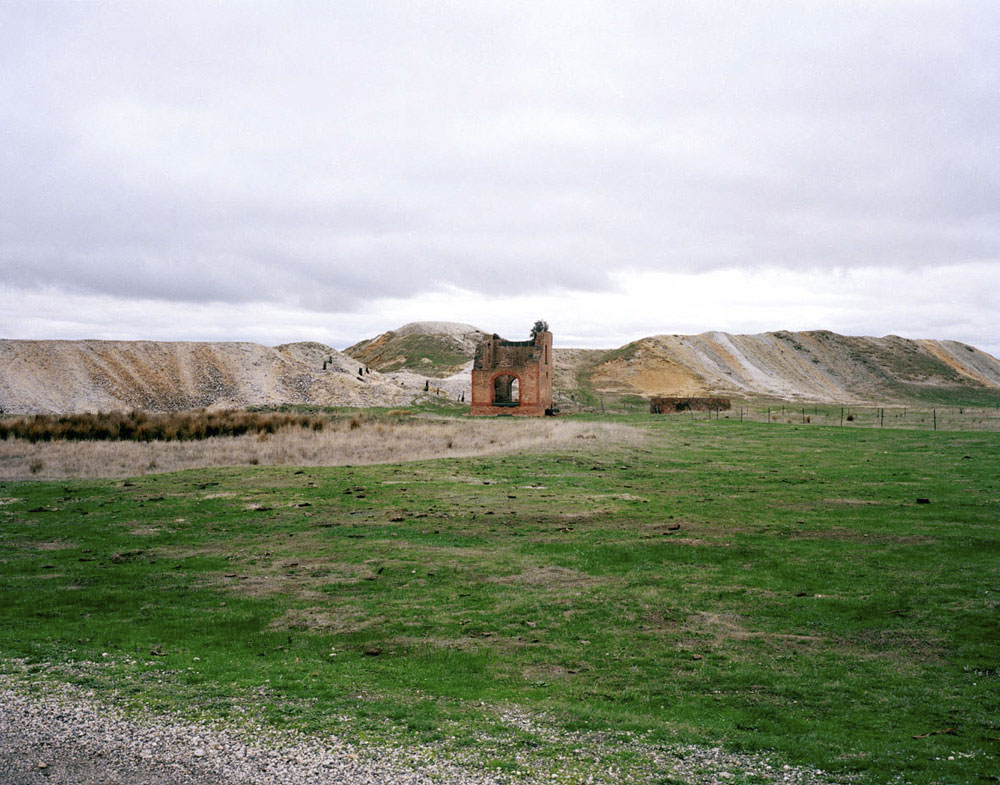
Even when the artist could not be bothered (so why should we bother).
Even when the images were never seen or acknowledged.
The artist streetwise in his omnipotent isolation.

Dr Marcus Bunyan


1/ Garza, O. C. Class Time with Garry Winogrand. 2007, p. 19 [Online] Cited 26/05/2013
www.ocgarzaphotography.com/documents/ClassTimewithGarryWinograndfinal2.pdf


“Great photography is always on the edge of failure.”

“I photograph to see what the world looks like in photographs.”

“I like to think of photographing as a two-way act of respect. Respect for the medium, by letting it do what it does best, describe. And respect for the subject, by describing as it is. A photograph must be responsible to both.”

“I don’t have anything to say in any picture. My only interest in photography is to see what something looks like as a photograph. I have no preconceptions.”


Garry Winogrand


“We quickly learned Winogrand’s technique – he walked slowly or stood in the middle of pedestrian traffic as people went by. He shot prolifically. I watched him walk a short block and shoot an entire roll without breaking stride. As he reloaded, I asked him if he felt bad about missing pictures when he reloaded. “No,” he replied, “there are no pictures when I reload.” He was constantly looking around, and often would see a situation on the other side of a busy intersection. Ignoring traffic, he would run across the street to get the picture.”


Mason Resnick


“Form and content are two keys which make a memorable street photograph. Consider “form” as the composition, framing, and technical aspects of a photograph. Consider “content” as what is actually happening in the photograph (whether it be an old couple holding hands, a boy holding two bottles of wine, or a man looking through a peep-hole)… Garry Winogrand shot with a 28mm lens for most of his life [using a Leica M4 35mm and Tri-X film pushed to 1200 ASA], which meant that for the majority of his shots he had to be quite close to his subjects (and in front of them). Therefore Winogrand wasn’t Henri Cartier-Bresson (trying to be invisible) but was actively a part of the action and immersed in the crowds. He would be very obviously taking photographs in the streets and would stick out like a sore thumb.”
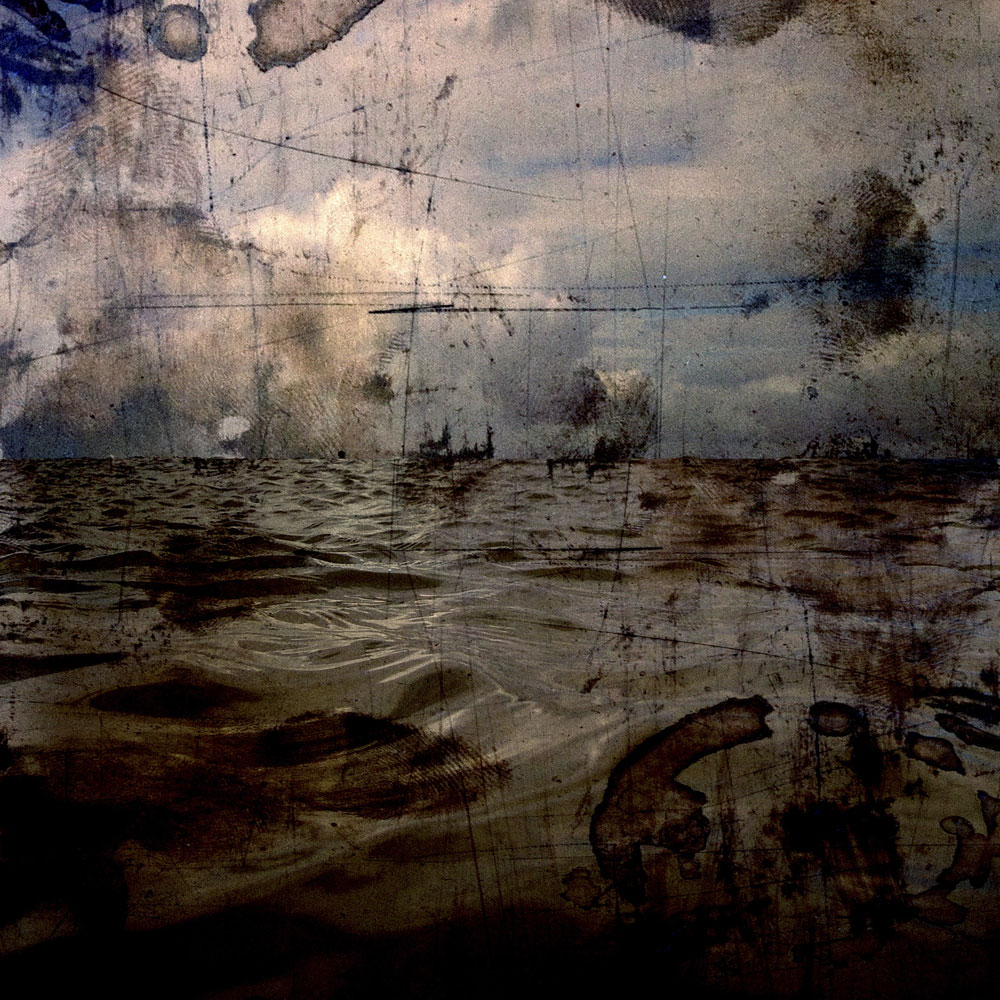

Eric Kim


Garry Winogrand – Part 1 


Garry Winogrand – Fotograf


Garry Winogrand – The Man In The Crowd


Garry Winogrand (American, 1928-1984) 'Albuquerque' 1957


Garry Winogrand (American, 1928-1984)
Albuquerque
1957
Gelatin silver print
Collection SFMOMA, gift of Dr. Paul Getz
© The Estate of Garry Winogrand, courtesy Fraenkel Gallery, San Francisco


Garry Winogrand (American, 1928-1984) 'Park Avenue, New York' 1959


Garry Winogrand (American, 1928-1984)
Park Avenue, New York
1959
Gelatin silver print
© The Estate of Garry Winogrand, courtesy Fraenkel Gallery, San Francisco


Garry Winogrand (American, 1928-1984) 'Central Park Zoo, New York' 1967


Garry Winogrand (American, 1928-1984)
Central Park Zoo, New York
1967
Gelatin silver print
© The Estate of Garry Winogrand, courtesy Fraenkel Gallery, San Francisco


Since Winogrand took this photograph of a white woman and a Black man, each holding a chimpanzee dressed in children’s clothing, many critics have noted the picture’s deliberate ambiguity – not only about the circumstances of how these figures came to be here, but also about the way Winogrand chose to frame them with his camera, cutting out most of the surrounding context.

During the 1960s, Winogrand became increasingly reluctant to speak about the “meaning” of his photographs, preferring to focus on their form and technique, in spite of their excessive narrative potential. Perhaps this was a reaction against his photojournalistic and advertising work, which was often illustrative. Winogrand would cite Susan Sontag’s influential essay “Against Interpretation” (1964), which deplored the growing impulse at the time to reduce works of art to their content in order to make them mean something. She argued, like Winogrand, in favor of the pleasure and poetry of seeing.

Anonymous. “Central Park Zoo-New York, New York,” on the Brooklyn Museum website Nd [Online] Cited 14/07/2024


Garry Winogrand (American, 1928-1984) 'Fort Worth, Texas' 1974


Garry Winogrand (American, 1928-1984)
Fort Worth, Texas
1974
Gelatin silver print
Collection SFMOMA, Accessions Committee Fund: gift of Doris and Donald Fisher and Marion E. Greene
© The Estate of Garry Winogrand, courtesy Fraenkel Gallery, San Francisco


Garry Winogrand (American, 1928-1984) 'Fort Worth, Texas' 1975


Garry Winogrand (American, 1928-1984)
Fort Worth, Texas
1975
Gelatin silver print
Collection SFMOMA, gift of Dr. Paul Getz
© The Estate of Garry Winogrand, courtesy Fraenkel Gallery, San Francisco


Garry Winogrand (American, 1928-1984) 'John F. Kennedy, Democratic National Convention, Los Angeles' 1960


Garry Winogrand (American, 1928-1984)
John F. Kennedy, Democratic National Convention, Los Angeles
1960
Posthumous digital reproduction from original negative
Garry Winogrand Archive, Center for Creative Photography, University of Arizona
© The Estate of Garry Winogrand, courtesy Fraenkel Gallery, San Francisco


Garry Winogrand (American, 1928-1984) 'Democratic National Convention, Los Angeles' 1960


Garry Winogrand (American, 1928-1984)
Democratic National Convention, Los Angeles
1960
Silver gelatin photograph
© The Estate of Garry Winogrand


Garry Winogrand (American, 1928-1984) 'New York' c. 1960


Garry Winogrand (American, 1928-1984)
New York
c. 1960
Gelatin silver print
Garry Winogrand Archive, Center for Creative Photography, University of Arizona
© The Estate of Garry Winogrand, courtesy Fraenkel Gallery, San Francisco


Garry Winogrand (American, 1928-1984) 'White Sands National Monument, New Mexico' 1964


Garry Winogrand (American, 1928-1984)
White Sands National Monument, New Mexico
1964
Gelatin silver print
© The Estate of Garry Winogrand, courtesy Fraenkel Gallery, San Francisco


Garry Winogrand (American, 1928-1984) 'New York' 1969


Garry Winogrand (American, 1928-1984)
New York
1969
Gelatin silver print
© The Estate of Garry Winogrand, courtesy Fraenkel Gallery, San Francisco


Garry Winogrand (American, 1928-1984) 'Elliot Richardson Press Conference, Austin, Texas' 1973


Garry Winogrand (American, 1928-1984)
Elliot Richardson Press Conference, Austin, Texas
1973
Silver gelatin photograph
© The Estate of Garry Winogrand


Elliot Lee Richardson (July 20, 1920 – December 31, 1999) was an American lawyer and politician who was a member of the cabinet of Presidents Richard Nixon and Gerald Ford. As U.S. Attorney General, he was a prominent figure in the Watergate Scandal, and resigned rather than obey President Nixon’s order to fire special prosecutor Archibald Cox.

Text from Wikipedia website


Garry Winogrand (American, 1928-1984) 'Centennial Ball, Metropolitan Museum, New York' 1969


Garry Winogrand (American, 1928-1984)
Centennial Ball, Metropolitan Museum, New York
1969
Silver gelatin photograph
© The Estate of Garry Winogrand


Garry Winogrand (American, 1928-1984) 'Point Mugu Naval Air-Station, California' 1979


Garry Winogrand (American, 1928-1984)
Point Mugu Naval Air-Station, California
1979
Silver gelatin photograph
© The Estate of Garry Winogrand


Garry Winogrand (American, 1928-1984) 'Untitled' 1970


Garry Winogrand (American, 1928-1984)
Untitled
1970
Silver gelatin photograph
© The Estate of Garry Winogrand


Garry Winogrand (American, 1928-1984) 'Venice Beach, Los Angeles' 1979


Garry Winogrand (American, 1928-1984)
Venice Beach, Los Angeles
1979
Silver gelatin photograph
© The Estate of Garry Winogrand


The first retrospective in 25 years of work by artist Garry Winogrand (1928-1984) – the renowned photographer of New York City and of American life from the 1950s through the early 1980s – will debut at the San Francisco Museum of Modern Art (SFMOMA) from March 9 through June 2, 2013. Jointly organised by SFMOMA and the National Gallery of Art, Washington, D.C., Garry Winogrand brings together the artist’s most iconic images with newly printed photographs from his largely unexamined archive of late work, offering a rigorous overview of Winogrand’s complete working life and revealing for the first time the full sweep of his career. More than 300 photographs in the exhibition and more than 400 in the accompanying catalogue will create a vivid portrait of the artist – a chronicler of postwar America on a par with such figures as Norman Mailer and Robert Rauschenberg who unflinchingly captured America’s wrenching swings between optimism and upheaval in the decades following World War II.

While Winogrand is widely considered one of the greatest photographers of the 20th century, his overall body of work and influence on the field remains incompletely explored. He was enormously prolific but largely postponed the editing and printing of his work. Dying suddenly at the age of 56, he left behind approximately 6,500 rolls of film (some 250,000 images) that he had never seen, as well as proof sheets from his earlier years that he had marked but never printed. Roughly half of the photographs in the exhibition have never been exhibited or published until now; over 100 have never before been printed.

“There exists in photography no other body of work of comparable size or quality that is so editorially unresolved,” says Rubinfien, who was among the youngest of Winogrand’s circle of friends in the 1970s. “This exhibition represents the first effort to comprehensively examine Winogrand’s unfinished work. It also aims to turn the presentation of his work away from topical editing and toward a freer organisation that is faithful to his art’s essential spirit, thus enabling a new understanding of his oeuvre, even for those who think they know him.”

The exhibition is divided into three parts, each covering a broad variety of subjects found in Winogrand’s art. “Down from the Bronx” presents photographs taken for the most part in New York from his start in 1950 until 1971; “A Student of America” looks at work made in the same period during journeys outside New York; and “Boom and Bust” addresses Winogrand’s late period – from when he moved away from New York in 1971 until his death in 1984 – with photographs from Texas and Southern California, as well as Chicago, Washington, Miami, and other locations. This third section also includes a small number of photographs Winogrand made on trips back to Manhattan, which express a sense of desolation unprecedented in his earlier work.

Winogrand was known as great talker with a flamboyant, forceful personality, and what he said accompanying his slide shows and lectures was often imaginative and very funny. A number of videos edited for presentation in the exhibition will allow visitors to experience the living Winogrand as audiences have rarely been able to do for 30-odd years. A short selection from Winogrand’s experimental 8mm footage taken in the late 1960s will also be on view.

After premiering at SFMOMA in spring 2013 Garry Winogrand will travel to the National Gallery of Art, Washington, D.C. (March 2 through June 8, 2014); The Metropolitan Museum of Art, New York (June 27 through September 21, 2014); the Jeu de Paume, Paris (October 14, 2014 through January 25, 2015); and the Fundacion MAPFRE, Madrid (March 3 through May 10, 2015).

An Epic Chronicler of Postwar America

Born in the Bronx, Winogrand did much of his best-known work in Manhattan during the 1960s, and in both the content of his photographs and his artistic style he became one of the principal voices of that eruptive decade – so much so that influential Museum of Modern Art curator John Szarkowski anointed him “the central photographer of his generation.”

Known primarily as a street photographer, Winogrand, who is often associated with famed contemporaries Diane Arbus and Lee Friedlander, photographed with dazzling energy and incessant appetite, exposing some 20,000 rolls of film in his short lifetime. He photographed business moguls, everyday women on the street, famous actors and athletes, hippies, rodeos, politicians, soldiers, animals in zoos, car culture, airports, and antiwar demonstrators and the construction workers who beat them bloody in view of the unmoved police. Daily life in postwar America – rich with new possibility and yet equally anxious, threatening to spin out of control – seemed to unfold for him in a continuous stream.

Yet if Winogrand was one of New York City’s prime photographers, he was also an avid traveller who roamed widely around the United States, bringing exquisite work out of locations that included Los Angeles, San Francisco, Ohio, Dallas, Houston, Chicago, Colorado, and the open country of the Southwest. “You could say that I am a student of photography,” he said, “and I am; but really I’m a student of America.” Winogrand’s expansive visual catalogue of the nation’s evolving social scene has led to comparisons to Walt Whitman, who also unspooled the world in endless lists of people, places, and things.

Winogrand’s pictures often bulge with twenty or thirty figures, and are fascinating both for their dramatic foregrounds and the sub-events at their edges. Even when crowded with people or at their most lighthearted – he was fond of visual puns and was drawn to the absurd – his pictures can convey a feeling of human isolation, hinting at something darker beneath the veneer of the American dream. Early on, some critics considered his pictures formally “shapeless” and “random,” but admirers and critics later found a unique poetry in his tilted horizons and his love of the haphazard.

“Winogrand was an artistic descendant of Walker Evans and Robert Frank, but differed sharply from them,” says Rubinfien. “He admired Frank’s The Americans, but felt the work missed the main story of its time, which in his mind was the emergence of suburban prosperity and isolation. The hope and buoyancy of middle-class life in postwar America is half of the emotional heart of Winogrand’s work. The other half is a sense of undoing. The tension between these qualities gives his work its distinct character.”

After serving in the military as a weather forecaster, Winogrand first began working as a photographer while studying painting on the G.I. Bill at Columbia University (1948-1951). During that time, he also studied briefly with Alexey Brodovitch at the New School for Social Research. While pursuing his personal work, he began supplying commercial photographs to a number of general-interest magazines such as Life, Look, Sports Illustrated, Collier’s, and Pageant, which were then at the height of their power and reach. His career was further shaped by the decline of those magazines and the rise of a new culture of photography centred in the art world.

“Winogrand worked at a moment when the boundaries between journalistic and artistic photography were less certain than they had ever been, yet it was also a time when the most advanced photographers were consciously abandoning journalistic values,” says Greenough. “The social landscape he photographed – the dislocation of urban life, the rise of the suburb with its growing alienation, the skepticism of youth, and the collusion of the press and the powerful – was of concern to many Americans. Yet Winogrand rarely pursued an obvious means to explicate these ideas, preferring poetic evocation over intelligible journalism.”

Winogrand went on to exhibit widely at prominent museums and achieved renown in his lifetime. Yet despite this recognition, he is perhaps the most inadequately understood of all his contemporaries.

“Unfinished” Late Work Thoroughly Investigated for the First Time

The act of taking pictures was far more fulfilling to Winogrand than making prints or editing for books and exhibitions – he often allowed others to perform these tasks for him. Near the end of his life, he spoke of reviewing and reediting all of his photographs, but never had a chance to oversee the shaping of his legacy, or even to review much of the output of his later years. Because of his working methods and his lack of interest in developing his film toward the end of his life, he left behind more than 2,500 rolls of exposed but undeveloped film, an additional 4,100 rolls that he had processed but never seen – an estimated total of 250,000 images that have remained virtually unknown.

Furthermore, Winogrand published just five modest books during his lifetime – The Animals (1969), Women Are Beautiful (1975), Garry Winogrand (1976), Public Relations (1977), and Stock Photographs (1980) – that represent only a fraction of his work and are mainly confined to narrow topical frames that don’t suggest the full scope of his importance.

“One reason that Winogrand is only now receiving the full retrospective treatment already devoted to peers of his era, including Diane Arbus, Lee Friedlander, and Robert Frank, is that any truly comprehensive consideration of his life’s work requires contending with the practical and ethical issues surrounding the vast archive he left behind,” says O’Toole. “In the absence of explicit instructions from him regarding how he wanted his work to be handled after he was gone, its posthumous treatment has been the subject of ongoing debate and raises provocative questions about the creative process and its relationship to issues specific to the medium.”

“Some argue that what was left behind should be left alone, and that no one should intrude upon the intentions of an artist,” adds Rubinfien. “But the quantity of Winogrand’s output, the incompleteness with which he reviewed it, and the suddenness of his death create a special case in which the true scope of an eminent photographer’s work cannot be known without the intervention of an editor.”

Now housed at the Center for Creative Photography of the University of Arizona, Tucson, Winogrand’s “unfinished” work was initially organized in the years just after his death by several colleagues and friends in preparation for the artist’s first major museum retrospective, held at the Museum of Modern Art, New York (MoMA) in 1988. Exhibition curator John Szarkowski felt the quality of Winogrand’s work had significantly deteriorated in the last 15 years of his life, and included only a small group of pictures from the mysterious late work in MoMA exhibition.

Nearly 30 years have elapsed since the last attempt to grapple with the complete arc of Winogrand’s career. Benefiting from new curatorial research undertaken for this project, the current exhibition will provide a long-awaited reevaluation of his accomplishments. As one of the first museums to recognise photography as a legitimate art form, SFMOMA has collaborated with the National Gallery of Art – who, like SFMOMA, is known for its photography scholarship – in a multi-year endeavour to spearhead the presentation of this important exhibition and publication.”

Press release from the SFMOMA website


Garry Winogrand (American, 1928-1984) 'New York' 1961


Garry Winogrand (American, 1928-1984)
New York
1961
Silver gelatin photograph
© The Estate of Garry Winogrand


Garry Winogrand (American, 1928-1984) 'New York' 1963


Garry Winogrand (American, 1928-1984)
New York
1963
Silver gelatin photograph
© The Estate of Garry Winogrand


Garry Winogrand (American, 1928-1984) 'San Marcos, Texas' 1964


Garry Winogrand (American, 1928-1984)
San Marcos, Texas
1964
Silver gelatin photograph
© The Estate of Garry Winogrand


Garry Winogrand (American, 1928-1984) 'Coney Island, New York' c. 1952


Garry Winogrand (American, 1928-1984)
Coney Island, New York
c. 1952
Gelatin silver print
Collection The Museum of Modern Art, New York, purchase and gift of Barbara Schwartz in memory of Eugene M. Schwartz
© The Estate of Garry Winogrand, courtesy Fraenkel Gallery, San Francisco; digital image
© The Museum of Modern Art/ Licensed by SCALA / Art Resource, NY


Garry Winogrand (American, 1928-1984) 'Fort Worth, Texas' 1974-77


Garry Winogrand (American, 1928-1984)
Fort Worth, Texas
1974-1977
Gelatin silver print
Garry Winogrand Archive, Center for Creative Photography, University of Arizona
© The Estate of Garry Winogrand, courtesy Fraenkel Gallery, San Francisco


Garry Winogrand (American, 1928-1984) 'John F. Kennedy International Airport, New York' 1968


Garry Winogrand (American, 1928-1984)
John F. Kennedy International Airport, New York
1968
Silver gelatin photograph
© The Estate of Garry Winogrand


Garry Winogrand (American, 1928-1984) 'New York' 1950


Garry Winogrand (American, 1928-1984)
New York
1950
Gelatin silver print
Collection SFMOMA, fractional and promised gift of Carla Emil and Rich Silverstein
© The Estate of Garry Winogrand, courtesy Fraenkel Gallery, San Francisco


Garry Winogrand (American, 1928-1984) 'New York' c. 1962


Garry Winogrand (American, 1928-1984)
New York
c. 1962
Gelatin silver print
Garry Winogrand Archive, Center for Creative Photography, University of Arizona
© The Estate of Garry Winogrand, courtesy Fraenkel Gallery, San Francisco


Garry Winogrand (American, 1928-1984) 'Venice Beach, Los Angeles' 1980-1983


Garry Winogrand (American, 1928-1984)
Venice Beach, Los Angeles
1980-1983
Gelatin silver print
Garry Winogrand Archive, Center for Creative Photography, University of Arizona
© The Estate of Garry Winogrand, courtesy Fraenkel Gallery, San Francisco


Garry Winogrand (American, 1928-1984) 'Grand Central Station' 1968


Garry Winogrand (American, 1928-1984)
Grand Central Station
1968
Silver gelatin photograph
© The Estate of Garry Winogrand


Garry Winogrand (American, 1928-1984) 'Los Angeles' 1964


Garry Winogrand (American, 1928-1984)
Los Angeles
1964
Silver gelatin photograph
© The Estate of Garry Winogrand


Garry Winogrand (American, 1928-1984) 'New York' 1968


Garry Winogrand (American, 1928-1984)
New York
1968
Silver gelatin photograph
© The Estate of Garry Winogrand


Garry Winogrand (American, 1928-1984) 'New York' c. 1969


Garry Winogrand (American, 1928-1984)
New York
c. 1969
Silver gelatin photograph
© The Estate of Garry Winogrand


San Francisco Museum of Modern Art
151 Third Street
San Francisco, CA 94103

Opening hours:
Monday – Tuesday: 10am – 5pm
Wednesday: Closed
Thursday: 12 – 8pm
Friday – Sunday: 10am – 5pm

San Francisco Museum of Modern Art website

LIKE ART BLART ON FACEBOOK

Back to top